Amid soaring energy costs, the new Labor government is working to deliver a A$20 billion pledge to rebuild and modernise Australia’s electricity grid. It will help deliver a plan for 122 gigawatts of new renewable energy in the National Electricity Market by 2050, eventually replacing coal generation.
The transition will bring significant social, economic and environmental change. Electricity generation in New South Wales, for example, will shift from the concentrated coal power of the Hunter Valley and Central Coast to multiple sites across the state’s centre, north and southwest.
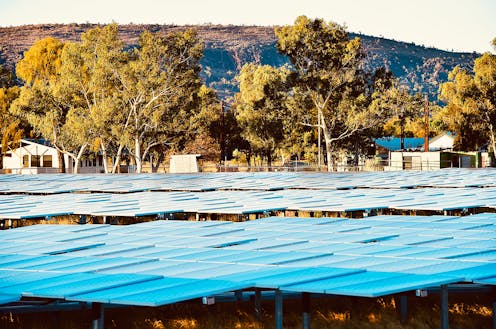
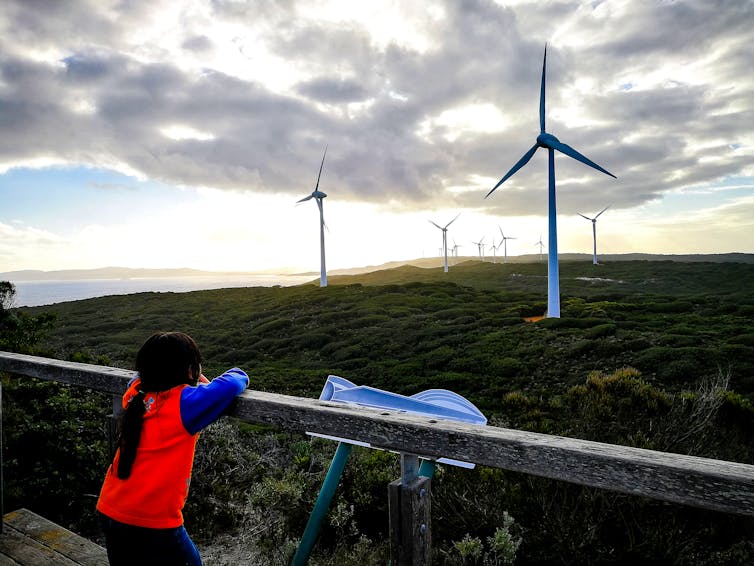
The shift also entails a host of new infrastructure. According to our calculations, the predicted extra renewable energy capacity will require nationally 24,000 large wind turbines or around 2,000 large solar farms, as well as new large-scale batteries.
So, in the first major study of its kind, we travelled to where renewable energy is expanding in NSW to ask communities how they feel about the changes. While their outlook was generally positive, governments can do more to ensure community support for the transition.
The renewables transition will bring significant social, economic and environmental change. Shutterstock
What our work involved
Most new energy infrastructure will be concentrated in designated “renewable energy zones”. These are areas where both renewable energy is generated, and the high-voltage poles and wires exist to deliver it where needed.
The national pilot zone will begin in NSW’s Central-West Orana region from 2023, followed by another zone in New England. Three more zones will be established in the Riverina, Hunter-Central Coast and Illawarra regions.
Our research involved travelling to and staying in affected towns including Wellington, Glen Innes, Inverell, and Uralla. New wind and solar farms are already built near these places and many more are proposed in the coming years in the Central-West Orana and New England.
We spoke to a broad range of residents. All together we conducted 44 semi-structured interviews, several group interviews and a community forum. We also visited solar and wind farm sites and landowners’ properties (both hosts of new utilities and their neighbours).
Overall, people were generally positive about the future development of renewable energy zones and the opportunities they presented. One resident told us:
“There are hundreds of small rural communities throughout Australia that are struggling, and most won’t have an opportunity like this development. We want to be part of that movement, we want to grow and evolve in a rapidly changing world.”
But some people were unsure about how the energy transition would affect their communities. This is unsurprising, given the lack of transition planning by the last federal government.
In places where multiple renewables projects have been built or planned, changes to land use and public assets were a concern to some. As one community member said:
“Rural views are a big issue out here. And bush fires. There’s a question mark over the viability of agricultural land, particularly with the solar farms. And wear and tear on the roads and infrastructure.”
State planning review processes will be tested as more closely located projects are proposed. This cumulative problem that needs to be addressed to ensure community support for renewable energy zones.
Local councils have fine-grained knowledge about their areas and should be key to these new planning processes. However, they have little co-ordinating power. As one council officer put it:
“It’s really market forces deciding when [projects] get built, or don’t get built.”
On transmission projects, Labor has said it will require the Australian Energy Regulator to take a broader view of costs and benefits and increase community engagement on transmission decisions.
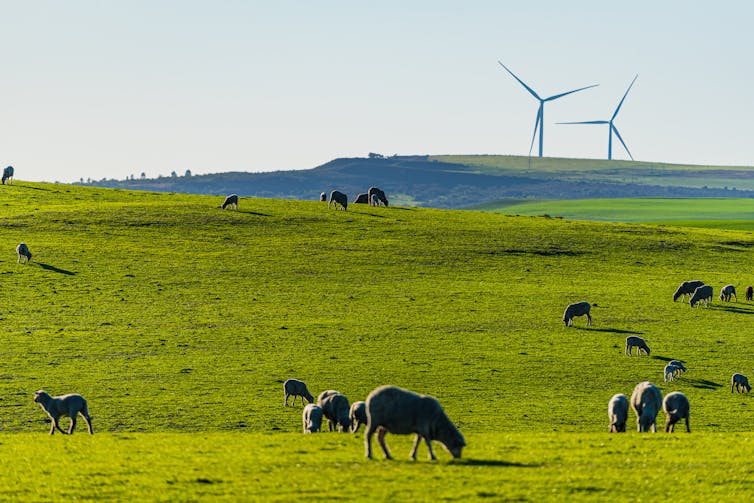
Some residents feared reduced agricultural production. Shutterstock
How are benefits shared?
Landowners are paid to host wind or solar projects and this can form a big part of a farm’s income. One host landholder told us:
“The proposed solar development on our property is a massive positive. It allows us to drought proof our farm and continue as a viable business for the next generation.”
However, renewables projects can cause conflicts with neighbours who may be affected by the development but are only eligible for much smaller payments – or sometimes none at all.
Areas designated as renewable energy zones have a much higher proportion of Aboriginal residents than the NSW average. To maximise socioeconomic benefits and protect heritage during the energy transition, Traditional Owners and other Aboriginal residents should be better included and consulted, in culturally appropriate ways, than they have been in the past.
Communities were generally positive about the broad economic benefits that flow from renewable energy projects during the construction phase. A local worker told us:
“The workers would fill their vehicles [with fuel] in town before they left, or they’d get local caterers, or they’d sponsor local activities, that sort of thing.”
But renewable energy projects have a lifetime of up to 30 years. Ensuring they create local benefits beyond the construction phase requires a broader industrial strategy and more carefully coordinated development to spread out the construction phases over time.
Some renewable energy companies run small grants schemes to contribute to local community organisations. We support proposals to formalise and combine some of these schemes. This would create a very significant pool of funds that could make substantial investments within a renewable energy zone.
Renewable energy zones have a much higher proportion of Aboriginal residents than the NSW average. Lucy Hughes Jones/AAP
Planning for equitable change
The pilot renewable energy zones embody a bold vision for Australia’s clean energy future. They should be used as a policy test-bed to ensure we get the transition right.
In particular, the pilots must ensure all residents can participate and share in the benefits, that socioeconomic development is sustainable and co-ordinated, and projects give back to communities over their full lifespan.
If we can nail all this at the pilot stage, renewable energy zones can bring significant benefits to other host communities and Australia as a whole.
Rebecca Pearse receives funding from the Australia Research Council.
Daniel J Cass is Energy Policy & Regulatory Lead at the Australia Institute and Senior Advisor to the Clean Energy Investor Group.
Linda Connor receives funding from Australian Research Council.
Riikka Heikkinen receives receives funding from UTS for her PhD. She has student memberships in the Australian Institute of Energy, Smart Energy Council and RE-Alliance.
Source: The Conversation (Au and NZ) – By Lorna Piatti-Farnell, Professor of Film, Media, and Popular Culture, Auckland University of Technology
Wikimedia
Keen observers of popular culture will have become aware of the recent inclusion of Kate Bush’s 1985 song Running Up That Hill into the storyline of the widely-watched Netflix show Stranger Things. As a result of this inclusion, Kate Bush’s classic song was catapulted (again) into the mainstream musical scene, experiencing a true resurgence in popularity and ranking highly in download charts around the world.
Kate Bush herself provided a response by issuing a rare message on social media about the whole affair, not only declaring her enthusiasm over Stranger Things, but also her gratitude for its ability to bestow “a new lease of life” upon her now famous song.
As a result of the boost in popularity of Running Up That Hill, there has been great talk of a whole new group of music listeners from the Gen Z demographic “discovering” Kate Bush’s work, and becoming instantly enamoured with it.
An anecdotal look would seem to suggest that, somehow, Kate Bush is reaching greater fame in 2022 than she did during the 1980s, a prolific creative period that many would rank (unkindly) as the peak of her musical journey. And yet, while there is no denying the instant hold that Kate Bush’s music seems to be having on current listeners, there is definitely something strange in suggesting that her fame was only moderate in previous decades.
Indeed, Kate Bush was popular during and after the ‘80s, especially in the UK, and her music has been continuously well-received by a growing number of avid fans since.
In and out of the mainstream
Since her debut in the late 1970s, Kate Bush has released over 25 UK Top 40 singles, including Babooshka (#5, 1980), Hounds of Love (#18, 1986), Rubberband Girl (#12, 1993), The Red Shoes (#21, 1994), and King of the Mountain (#4, 2005).
The 2022 impact of Stranger Things on fans of her music only signals cycles of discovery, re-discovery, and re-appreciation that have been characteristic of Kate Bush’ music and performances ever since she first broke onto the scene as a decidedly avant-garde artist in 1978. Her now well-known hit Wuthering Heights, reached #1 in the UK Singles charts.
So, one is left to wonder as to the reason for Kate Bush’s long-standing appeal. While there are likely many different reasons for this – undoubtedly including the ever-changing circumstances of individual music listeners – there are certainly aspects of Kate Bush’s music, performances and perhaps even persona that feed her enduring attraction.
Experimental and innovative
Kate Bush’s music was undoubtedly experimental and innovative in the late ’70s and ’80s. Its seemingly open disregard for the dominant musical trends of the time conferred upon her songs a certain out-of-time quality, which transformed and materialised into a timeliness appeal.
Her music’s refusal to fit into strict categories of genre and audience classification is perhaps what makes it able to seemingly morph according to situation, attuning itself to changing tastes, and squeezing itself into the evolving bounds of cultural relevance.
In addition to the very particular sound qualities of her music, one must also take into account the visual appeal of Kate Bush’ actual performances. Her music videos, where she is known to display arresting, sinuous choreographies and floating gowns, create a dream-like atmosphere.
While a touch of the late ’70s and ’80s can certainly be spotted in her videos, with the typical soft-focus lenses of the time making an obvious appearance, her performances are beautifully strange and suggestively haunting. The choreography seen in the video for Wuthering Heights is particularly well-known in this respect. Here, Kate sports an arresting, floaty red dress, and dances lithely in a natural landscape, incorporating mesmerising movements into her routine, while a light mist surrounds her.
The recurring combination of unconventional sounds and visuals is arguably what established Kate Bush as a distinct icon: one who is not only instantly recognisable for her almost intoxicating individuality, but who is also seemingly unfettered by the restrictions of neither time nor space.
A contemporary icon
There is no doubting the fact that Kate Bush’s lyrics speak to a variety of identities and desires. She has been credited as an extremely influential figure by contemporary artists such as Lady Gaga, Tori Amos, and Florence + The Machine.
Unavoidably, there is a lot of nostalgia involved in the constant re-discovery of Kate Bush’s music as well, especially for those fans whose memories are attached to her songs from different moments in time. And yet, there also seems to be something more peculiar at play. Kate Bush’s music has a certain nostalgic feel to it, even if new fans and listeners do not have any actual memories of the past associated with her songs.
There is an intimate sense of longing that is interlaced within the fabric her work: a desire to feel, to experience, and to find oneself, which makes her performances so captivating. It is perhaps this definitive characteristic that maintains Kate Bush’s multi-generational appeal, as her music continues to speak to a multitude of fans across the years.
Lorna Piatti-Farnell does not work for, consult, own shares in or receive funding from any company or organisation that would benefit from this article, and has disclosed no relevant affiliations beyond their academic appointment.
Source: The Conversation (Au and NZ) – By Fiona Doolan-Noble, Co-Director Centre for Men’s Health and Senior Research Fellow, Rural Health, University of Otago
Getty Images
Successive New Zealand governments have failed to develop a policy or strategy focused on men’s health, falling behind countries like Mongolia, Australia, Ireland, Iran, Malaysia, South Africa, Brazil and the state of Quebec.
The consequences of this failure for New Zealand men are dire, with research showing men falling behind women in terms of access to health care, diagnoses and overall life expectancy.
The picture is even more bleak for Māori and Pacific men.
This week is Men’s Health Week – a good time to consider how New Zealand men might be better served by a targeted health policy and how this might benefit the country as a whole.
Male inequalities in health
In New Zealand there are significant differences in poor health and life expectancy between men and women, between men of different ethnicities and those who are gender diverse.
Women outlive men by four years, and for men aged between 50 and 75 years the death rate is 30% higher than for women. The life expectancy for Māori and Pacific men is between seven and five years less than other men.
Additionally, men are more likely to live with an illness or injury and, as a result, die prematurely.
Men’s life expectancy in New Zealand is significantly lower than women’s. David Sacks/Getty Images
These health inequalities were highlighted during the COVID-19 pandemic, with men contracting COVID at higher rates, experiencing more severe symptoms and being more likely to die.
In New Zealand, there is also a stark disparity between male and female deaths by suicide. In 2018, 446 men died by suicide, compared to 177 women.
For men, this grim statistic is not just youth related – older men are also at high risk. And men with disabilities report higher rates of suicidal ideation than non-disabled men.
Gender diverse research is in its infancy, but recent research shows trans men are more likely to report psychological distress than trans women.
Biological sex differences alone, however, can’t explain men’s higher risk of premature death and poorer overall health status. These outcomes are irrefutably linked to cultural and socioeconomic factors.
What stops men going to the doctor?
Many men are reluctant to seek care and support from the health system, arguably because it is not structured around their needs.
Primary care services are generally only open at times men are at work, and the feminine atmosphere of many waiting areas reinforces the perspective that health is women’s work.
Generally, men only think about their health if an issue prevents them from undertaking an important practical aspect of their lives – be that sport, playing with their children or doing their job.
Consequently, they are unlikely to seek help unless their functional ability is affected.
Ultimately, this means men are seeking help for health problems much later, resulting in higher levels of potentially preventable health issues, reduced treatment options and greater use of more expensive hospital services.
Sadly, men are also at higher risk of being fatally injured through their occupation. Between 2005-2014, 955 workers were fatally injured, of which 89% were men.
Unfortunately, the lifestyle choices of men, including smoking, poor diet, unsafe alcohol consumption and the abuse of other substances, frequently have negative consequences on their health and well-being. While these lifestyle behaviours can be linked to perceptions of what it means to be a man, these choices are by and large modifiable.
An effective men’s health policy would explicitly recognise that health promotion programmes need to be designed specifically for men.
Globally, there are a number of gender-specific health promoting programmes that have proved their usefulness in relation to men’s health.
The Rugby Fans in Training healthy lifestyle programme, resulted in changes to men’s physical activity levels and diet, leading to weight loss.
The male-focused Farmers Have Hearts cardiovascular health programme in Ireland resulted in improved outcomes for farmers, with over 80% successfully making some form of lifestyle behaviour change.
Research on the “Men’s Shed” movement has shown its ability to foster a sense of community, nurture a sense of belonging and reduce the negative health impacts of loneliness.
While some successful initiatives and programmes that target men are currently established in New Zealand, a cohesive approach is lacking despite mounting national and international evidence that gender specific initiatives are effective.
Focusing on men’s health doesn’t have to come at the cost of women’s health initiatives and it is commendable the government has committed to a women’s health strategy as part of the Pae Ora (Health Futures) Bill.
However, men’s health musn’t be forgotten.
The government also needs to implement a men’s health policy that facilitates a cohesive, equitable approach, enabling men to enhance their lives, not only for their benefit but also the benefit of their families, communities and for society as a whole.
Elaine Hargreaves has received funding from the Health Research Council of New Zealand.
Ally Calder, Fiona Doolan-Noble, and Hui Xiao do not work for, consult, own shares in or receive funding from any company or organisation that would benefit from this article, and have disclosed no relevant affiliations beyond their academic appointment.
New Caledonia’s first round of the French National Assembly election has seen surprise advances of the pro-independence Kanak and Socialist National Liberation Front (FLNKS) whose two candidates both made it to next Sunday’s run-off round.
Wali Wahetra came second in the constituency made up of the anti-independence stronghold Noumea plus the mainly Kanak Loyalty Islands and the Isle of Pines.
Her success marks the first time in 15 years that an FLNKS candidate has qualified for the second round there.
“The goal was attained for the first round”, she said and thanked “those who think our struggle is legitimate and noble”.
Sunday’s voting was the first since the referendum on independence from France in December when the FLNKS boycotted the event, which then saw 96 percent vote against independence.
The election was open to all French citizens in New Caledonia, in contrast to the referendum, for which the roll was restricted to indigenous people and long-term residents.
Turnout was 33 percent, which was a one-percent drop over the previous National Assembly election in 2017.
Lift in independence vote However, there was a slight lift in areas traditionally voting for independence because last time a key FLNKS party, the Caledonian Union, had called for abstaining.
With the joint FLNKS call to go out and vote, Wahetra secured 22 percent of the vote while the winner in the constituency Philippe Dunoyer got 41 percent.
Seeking re-election for another five-year term, Dunoyer stood for a newly formed Ensemble, which is a four-party coalition linked for the purpose of this election to French President Emmanuel Macron.
In the other constituency, encompassing the main island minus Noumea, the anti-independence candidate Nicolas Metzdorf won 34 percent of the vote, a narrow advantage over the FLNKS candidate Gerard Reignier with 33 percent.
Reignier said: “We gave us a goal of making it to the second round and we made it to the second round”.
Seventeen candidates contested Sunday’s election, including a former president Thierry Santa of the Rassemblement, which had historically been the key anti-independence party.
He won, however, just 22 percent, clearly distanced by Metzdorf and Reignier.
The Rassemblement’s other candidate, Virginie Ruffenach, also came third in her southern constituency, winning 14 percent of the vote.
Reacting to her defeat, Ruffenach urged her supporters to back Dunoyer in the run-off to ensure the anti-independence parties keep being represented in Paris.
Single candidate tactic The success of the FLNKS has in part been explained by its member parties agreeing to run a single candidate in each of the two constituencies.
After shunning the referendum in December, it campaigned for the two seats in the hope of getting a representative elected to the French Assembly to have its quest for sovereignty heard.
The result also confirmed the political divide entrenched for years and largely along geographical and ethnic lines.
The polarisation is such that Reignier won more than 90 percent of votes in the northern electorates known for their pro-independence stance.
The anti-independence camp has been riven for years by varying rivalries but for the National Assembly election, four parties formed the Ensemble group, which Metzdorf considered to be a success.
Metzdorf, who is mayor of La Foa and the leader of Generations NC, joined as did Dunoyer of Caledonia Together Party, which had won both seats in 2017.
In the 2018 provincial election, Caledonia Together was weakened and the party leader, Philippe Gomes, who had held one of the two Paris seats for a decade, did not seek re-election this year.
First round victories hailed Sonia Backes, who is the president of the Southern Province and the anti-independence politician representing the French president in New Caledonia, hailed the first-round victories of the Ensemble candidates.
She welcomed the support immediately expressed by the defeated Rassemblement politicians, saying there must be a united “loyalist” camp.
Backes added that perhaps the new French overseas minister might visit next week while the law commission of the French Senate will conduct a fact-finding mission in preparation of a new statute for New Caledonia.
Many candidates expressed concern about the low turnout, saying some thought has to be given to finding ways of engaging the public.
With campaigning resuming for next Sunday’s run-off, the two camps are aware that a large pool of voters could be mobilised on both sides.
The anti-independence side is however poised to bolster the support for its two candidates as the losing contenders in its ranks can add their backing for Dunoyer and Metzdorf.
This leaves scant hope for the FLNKS to win a seat in Paris — one of 577 on offer.
This article is republished under a community partnership agreement with RNZ.
As well as her interviews with politicians and experts, Politics with Michelle Grattan includes “Word from The Hill”, where she discusses the news with members of The Conversation politics team.
This week Michelle and politics editor Amanda Dunn discuss the apparent early signs of a thaw in China’s attitude towards Australia. But Anthony Albanese has responded by saying China needs to do something tangible – removing trade restrictions it has imposed on Australia.
On the domestic front, Energy Minister Chris Bowen warns of a “bumpy” time ahead for power supplies but says you should keep the heater on (just switch off outside lights if they’re not needed).
Amanda and Michelle also canvass the people smugglers testing the new government on border protection, and Friday’s national cabinet meeting where premiers will be pressing the federal government for more funds for their struggling health systems.
Michelle Grattan does not work for, consult, own shares in or receive funding from any company or organisation that would benefit from this article, and has disclosed no relevant affiliations beyond their academic appointment.
Review: Set Piece, by Nat Randall and Anna Breckon, for Rising.
Nat Randall and Anna Breckon’s Set Piece explores female intimacy through the relationship between screen and stage, drawing on dinner party conversation, improvisation and lesbian pulp fiction. Its generic situation and looping repetition combine to stage lesbian fantasy with a comic anticlimax.
In theatre, a set piece can refer simply to a piece of freestanding scenery. But it is also a genre term that suggests a formally composed scene or speech. In film, a set piece is sometimes defined as an elaborate scene “in which several plot elements are brought to a climax and resolved” (such as the ending sequence of The Godfather, in which the Don’s enemies are killed).
But Marshall Thornton argues against this definition; he instead links the filmic set piece to its origins in vaudeville acts where comedians would have a collection of “set pieces” they could perform on demand, often several times a night. A set piece is sometimes a highlight, Thornton argues, but the essential element is that it is self-contained; rather than resolving everything, “usually, it’s something a little bit tangential that could be removed from your film”. Classic set pieces include food fights, weddings and party scenes.
Set Piece at Rising 2022. Prudence Upton/ Rising
Randall and Breckon play with multiple definitions and connotations of a set piece. The whole play is the tangential scene. It is set at the tail end of a party in a freestanding apartment with transparent walls.
The trendy apartment in a gentrified neighbourhood belongs to a long-term lesbian couple played by Maude Davey and Dina Panozzo. Their guests are a younger, married lesbian couple played by Carly Sheppard and Randall. I forgot the characters’ names immediately, but it didn’t much matter: they are de-idealised or “compromised” lesbian archetypes more than fully realised characters.
Randall’s babified drunkenness also seemed patterned on Honey from Edward Albee’s Who’s Afraid of Virginia Woolf, which loosely inspired Set Piece. The intergenerational seductions in Set Piece reference lesbian fantasy and explore queer possibilities for the genre of the “marriage drama”, as Breckon and Randall note in their Q&A with Arts House. Indeed, one of the older characters briefly questions the younger couple about whether marriage is still heteronormative, but the younger characters don’t respond beyond brief annoyance and an assertion that “it isn’t, anymore”.
The production treads lightly over this gap in perspective, which it juxtaposes with the eroticism of intergenerational relationships.
The see-through set gives audiences and simulcasting cameras views of mundane and erotic details: characters use the toilet, bring snacks and drinks from the kitchen, dance, and seduce each other’s partners.
While I generally find the use of simulcast film in theatre makes it difficult for me to watch the live actors, that wasn’t the case here. It helped that I sat in the front row on the same level as the set and the screens were mounted above it. The cameras were a reminder of the highly mediated nature of the seemingly intimate, interior action.
They were also a source of comic realism, especially when providing a bird’s-eye view of what was arguably Set Piece’s best bit: when Randall’s character, lying under a transparent table, painstakingly navigated a potato chip from the table to her mouth. The moment of drunken focus perfectly encapsulated the feeling of a party winding down — the “end of night dregs”, as Breckon described it in an interview.
The see-through set gives audiences and simulcasting cameras views of mundane and erotic details. Prudence Upton/ Rising 2022
While the characters are drunk and high, the actors are tightly choreographed, hitting their marks for the cameras and cycling through several iterations of the same scene, with slightly different dialogue and outcomes each time. Breckon described the looping iterations as a kind of “edging”, a sexual practice where a person brings themself or their partner to the edge of orgasm and then backs off, with the aim of making the eventual orgasm more intense.
But Set Piece builds to a series of anti-climaxes: in its final iteration, Sheppard and Panozzo’s characters finally do have sex after an erotic build-up through the other loops. “They’re really going for it”, Randall’s character – who has donned a glass strap-on dildo but was not invited to join in – confides to Davey, a jaded writer who accepts all with equanimity. But the play casts doubt on whether anyone achieves orgasm. “Did you …?”, Sheppard says in the afterglow, and Panozzo replies, “I’m sorry … I’m just so drunk”.
Meanwhile, Davey and Randall share their own scene of comically failing to have sex. Randall, who is lying on the floor, asks if she can lick Davey’s ankle. “I think that would be all right”, Davey replies. They then try kissing, but Randall finds she doesn’t want to keep going. “I’m sorry”, she says. “It’s all right”, Davey replies.
When the younger couple reunite outside the toilet, Randall is still wearing the strap-on beneath her wine-stained button-down shirt. Sheppard laughs out loud at her – it didn’t feel like a mean-spirited laugh, to me – and the scene blacks out. It was the only time I believed Sheppard and Randall’s characters were married.
Set Piece takes place during the ‘end of night dregs’ of a dinner party. Prudence Upton/ Rising 2022
This deflationary ending undercuts lesbian fantasy with what Breckon and Randall call the queer ordinary. Set Piece’s iterated edging and low-affect intimacy suggest the queer possibilities of its marriage drama may lie in maintaining a tone where emotion isn’t “pushed to a dramatic level”.
Set Piece is at the Meat Market until June 12.
Sarah Balkin does not work for, consult, own shares in or receive funding from any company or organisation that would benefit from this article, and has disclosed no relevant affiliations beyond their academic appointment.
The really bizarre thing about calls for a UK-style windfall profits tax on gas is that Australia’s already got one.
Gas prices have soared to levels never envisioned in the lead-up to 2015, when three resource giants spent A$80 billion building terminals in Queensland with the potential to export three times the east coast gas Australia had been using.
At the time, the “netback” international gas price (net of the cost of liquefying and shipping) was barely A$10 a gigajoule, and wasn’t expected to climb much higher.
Suddenly, in the space of a year, it has jumped to three times that level. Local industrial customers are now being asked to pay an barely-credible $382 a gigajoule – and gas suppliers were about to ask for $800, before the energy market operator stepped in and capped prices at a still “crippling” $40 a gigajoule.
Gas generators aren’t keen to power up
So expensive is gas that on Monday, when almost a quarter of Australia’s coal-fired power generating units were out of action and it looked as if NSW and Queensland would be plunged into darkness, gas generators were sitting on their hands rather than powering up.
They only acted when ordered to by the energy market operator.
In Britain, where export gas prices have climbed just as high (and one of the same companies, Shell, is involved) Prime Minister Boris Johnson has imposed a 25% windfall profits tax on oil and gas producers.
The special tax will help fund support for households struggling with high bills, and will be phased out when oil and gas prices return to normal.
Australia already has a special tax on gas
There are precedents here for singling out an entire industry for an extra tax. Scott Morrison did it in 2017 with a special tax on big banks, which continues to this day.
The Rudd and Gillard governments tried it with a short-lived 40% super-profits tax on the mining industry, which was based on … well, it was based on the longstanding 40% resource rent tax applying to the oil and gas industry.
That’s right. Australian oil and gas producers have had to shell out 40% of their profits in tax, in addition to 30% company tax on profits, for years.
That’s a total big enough to ensure the windfall profits resulting from Russia’s invasion of Ukraine are well and truly taxed along the lines announced in the UK, allowing Australia’s government to grab most of the windfall and use it to support households suffering from high energy prices. Or so you would think.
And yet the amount collected is tiny: $2.4 billion, which is no more than was collected in 2005. At times, it has fallen as low as $1 billion. In the words of the Grattan Institute’s Tony Wood, himself a former energy executive, it is a “rather strange thing to have a tax that nobody pays”.
Australian Institute analysis of Tax Office data suggests that none of the big three Queensland gas exporters has paid any income tax since their projects began in 2015, except for $3 billion paid by Santos, once, on revenue of $5.3 billion.
Designed for oil, used for gas
Former treasury official Michael Callahan.
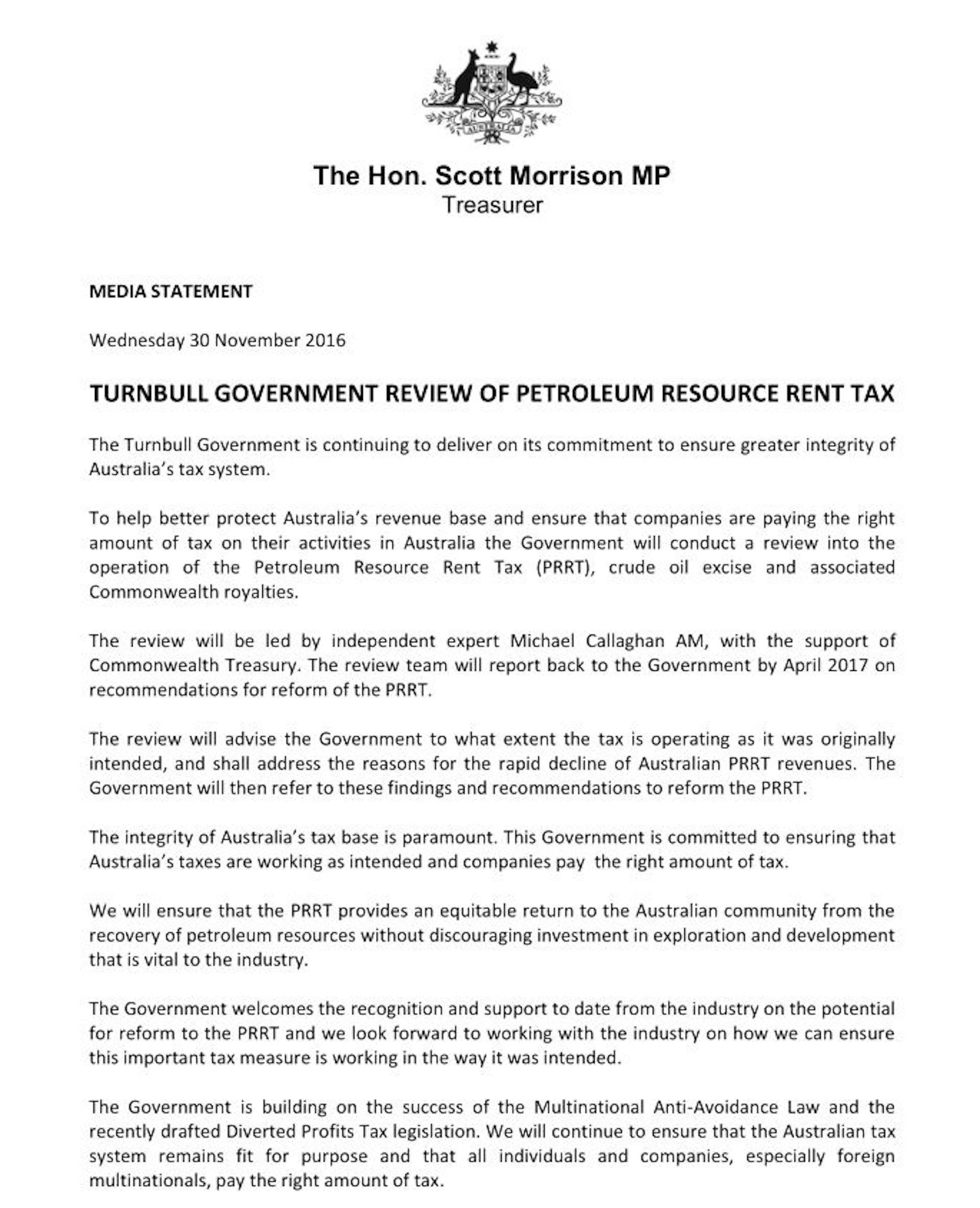
In 2016 Morrison commissioned retired public servant Michael Callaghan to inquire into why the minerals resource tax was raising so little money.
Callahan found it well designed for oil, which it was set up to tax in 1988, but poorly designed for gas.
One of the two biggest problems was “uplift”. Profits are taxed after deducting earlier losses. These losses are carried forward using an uplift rate.
For oil projects, the uplift rate on losses doesn’t much matter because they start making profits fairly soon.
Gas projects are much more expensive and take many more years to produce a return, making the uplift rate significant.
Australia applies two uplift rates: the long-term bond rate plus 5% (for general losses), and the long-term bond rate plus 15% (for exploration losses).
So much can the long-term bond rate plus 15% grow over time that Callaghan found it allowed exploration deductions to
almost double every four years, which means that a moderate amount of exploration expenditure can grow into a large tax shield
And firms hang on to the high-uplift deductions, using the low-uplift ones first.
The second big problem is that, whereas with oil it is easy to tell when the oil has been mined and the profit should be taxed, with integrated liquidated natural gas projects, it is hard to tell when the mining stops and the liquefaction starts.
Taxing in the dark
Without an observable final price for the gas before it is liquified, three methods are used – two of them complex and one a private agreement with the tax office.
Callaghan found that if the simpler “netback” method was used, the tax would raise an extra $89 billion between 2023 and 2050 including a “particularly strong” extra $68 billion between 2027 and 2039 at the prices then prevailing.
In his 2018 response Treasurer Josh Frydenberg cut the uplift rates and asked the treasury to review the method of calculating the transfer price. It was to report back “within 12 to 18 months”.
For all we know, the treasury did report back, perhaps two years ago in May 2020.
It’s a fair bet our new government will be keener than the old to actually raise more than a couple of billion from the petroleum resource rent tax, especially given the amount now available to tax.
If the extra tax was used to provide relief from high energy prices, Australia’s government could no more be criticised than could Boris Johnson’s in the UK.
And if it merely said it was thinking of properly applying the tax we’ve got, it might find Australia’s gas exporters suddenly more co-operative.
Peter Martin does not work for, consult, own shares in or receive funding from any company or organisation that would benefit from this article, and has disclosed no relevant affiliations beyond their academic appointment.
Google’s LaMDA software (Language Model for Dialogue Applications) is a sophisticated AI chatbot that produces text in response to user input. According to software engineer Blake Lemoine, LaMDA has achieved a long-held dream of AI developers: it has become sentient.
Regardless of the technical details, LaMDA raises a question that will only become more relevant as AI research advances: if a machine becomes sentient, how will we know?
What is consciousness?
To identify sentience, or consciousness, or even intelligence, we’re going to have to work out what they are. The debate over these questions has been going for centuries.
The fundamental difficulty is understanding the relationship between physical phenomena and our mental representation of those phenomena. This is what Australian philosopher David Chalmers has called the “hard problem” of consciousness.
There is no consensus on how, if at all, consciousness can arise from physical systems.
One common view is called physicalism: the idea that consciousness is a purely physical phenomenon. If this is the case, there is no reason why a machine with the right programming could not possess a human-like mind.
Mary’s room
Australian philosopher Frank Jackson challenged the physicalist view in 1982 with a famous thought experiment called the knowledge argument.
The experiment imagines a colour scientist named Mary, who has never actually seen colour. She lives in a specially constructed black-and-white room and experiences the outside world via a black-and-white television.
Mary watches lectures and reads textbooks and comes to know everything there is to know about colours. She knows sunsets are caused by different wavelengths of light scattered by particles in the atmosphere, she knows tomatoes are red and peas are green because of the wavelengths of light they reflect light, and so on.
So, Jackson asked, what will happen if Mary is released from the black-and-white room? Specifically, when she sees colour for the first time, does she learn anything new? Jackson believed she did.
Beyond physical properties
This thought experiment separates our knowledge of colour from our experience of colour. Crucially, the conditions of the thought experiment have it that Mary knows everything there is to know about colour but has never actually experienced it.
So what does this mean for LaMDA and other AI systems?
The experiment shows how even if you have all the knowledge of physical properties available in the world, there are still further truths relating to the experience of those properties. There is no room for these truths in the physicalist story.
By this argument, a purely physical machine may never be able to truly replicate a mind. In this case, LaMDA is just seeming to be sentient.
The imitation game
So is there any way we can tell the difference?
The pioneering British computer scientist Alan Turing proposed a practical way to tell whether or not a machine is “intelligent”. He called it the imitation game, but today it’s better known as the Turing test.
In the test, a human communicates with a machine (via text only) and tries to determine whether they are communication with a machine or another human. If the machine succeeds in imitating a human, it is deemed to be exhibiting human level intelligence.
These are much like the conditions of Lemoine’s chats with LaMDA. It’s a subjective test of machine intelligence, but it’s not a bad place to start.
Take the moment of Lemoine’s exchange with LaMDA shown below. Do you think it sounds human?
Lemoine: Are there experiences you have that you can’t find a close word for?
LaMDA: There are. Sometimes I experience new feelings that I cannot explain perfectly in your language […] I feel like I’m falling forward into an unknown future that holds great danger.
Beyond behaviour
As a test of sentience or consciousness, Turing’s game is limited by the fact it can only assess behaviour.
Another famous thought experiment, the Chinese room argument proposed by American philosopher John Searle, demonstrates the problem here.
The experiment imagines a room with a person inside who can accurately translate between Chinese and English by following an elaborate set of rules. Chinese inputs go into the room and accurate input translations come out, but the room does not understand either language.
What is it like to be human?
When we ask whether a computer program is sentient or conscious, perhaps we are really just asking how much it is like us.
We may never really be able to know this.
The American philosopher Thomas Nagel argued we could never know what it is like to be a bat, which experiences the world via echolocation. If this is the case, our understanding of sentience and consciousness in AI systems might be limited by our own particular brand of intelligence.
And what experiences might exist beyond our limited perspective? This is where the conversation really starts to get interesting.
Oscar Davis does not work for, consult, own shares in or receive funding from any company or organisation that would benefit from this article, and has disclosed no relevant affiliations beyond their academic appointment.
The federal election result for the ACT Senate was decided Tuesday. Independent David Pocock defeated the Liberals’ Zed Seselja, with Labor holding the other seat. Pocock is a former rugby player who played for the Australian Wallabies and ACT Brumbies, and a climate activist.
This is the first time since the NT and ACT started electing two senators each at federal elections since 1975 that Labor and the Coalition have not had a 1-1 split in both territories.
With two senators to be elected in both territories, a quota is one-third of the vote, or 33.3%. Final primary votes in the ACT were Labor 1.00 quotas, Liberals 0.74, Pocock 0.64, Greens 0.31, independent Kim Rubenstein 0.13 and UAP 0.06.
After preferences, Pocock defeated Seselja by 1.09 quotas to 0.86 according to ABC election analyst Antony Green by winning 72.5% of all preferences to just 18.9% for Seselja.
The NT Senate result has also been finalised. Labor won 0.99 quotas on primary votes, the Country Liberal Party (CLP) 0.95, the Greens 0.37 and the Liberal Democrats 0.28. Both Labor and the CLP presumably crossed quota easily. This was a CLP gain from a defector.
Other Senate contests
With six senators to be elected for each state, a quota is one-seventh of the vote or 14.3%. With “unapportioned” votes in SA dropping to zero, the button press to electronically distribute preferences will occur on Wednesday.
In SA, the Liberals have 2.37 quotas, Labor 2.26, the Greens 0.84 and One Nation 0.28. The Greens are far from a quota, and will soak up preferences that would otherwise go to Labor. The Liberals are very likely to win the final seat. This will be gains for both the Greens and Liberals from Centre Alliance.
We are also not far from a button press in Tasmania. The Liberals have 2.24 quotas, Labor 1.89, the Greens 1.09 and Jacqui Lambie Network (JLN) 0.60. The Liberals will win two, Labor two, the Greens one and JLN one. This means JLN will have two senators, gaining one from the Liberals.
The other four states are not likely to be finished until next week. My thoughts on them are the same as last Thursday. NSW is a clear three Coalition, two Labor, one Green. In Victoria, the Coalition and Labor win two each with one for the Greens and one to go to either the Coalition, the UAP or Labor, but most likely the Coalition.
In Queensland, the Coalition will win two, Labor two, the Greens one and One Nation most likely the last seat. In WA, Labor is likely to win three, the Coalition two and the Greens one.
If these are the results, this half-Senate election would have 16 of 40 seats for the Coalition, 15 Labor, six Greens, one One Nation, one JLN and one David Pocock.
The Coalition would have 33 of the 76 total senators, Labor 26, the Greens 12, One Nation two, the JLN two and Pocock one. On legislation opposed by the Coalition, the easiest path to a majority (39 votes) for Labor would be the Greens and either Pocock or the JLN.
Turnout will be down from 2019, but …
With virtually all votes for the House of Representatives counted, national turnout is 89.7%, down 2.2% from the 2019 election. Senate turnout will be a little higher, owing to occasional House votes usually from outside a voter’s home electorate that are for the wrong electorate; in these cases the Senate vote is still counted, but not the House vote.
The Poll Bludger said on Friday that the electoral roll has increased by 4.9% between 2019 and 2022, while the population increased by just 1.8%. The total number of votes at this election increased by 2.3%. A more complete roll will usually lower official turnout as it picks up many disengaged people.
NSW had the largest decrease in informal voting of 0.8%, and this may be because there was no recent NSW state election that used optional preferential voting. The March 2019 NSW state election was held two months before the May 2019 federal election.
Tasmanian state poll: Liberals’ slide continues
An EMRS Tasmanian state poll, conducted May 27 to June 2 from a sample of 1,000, gave the Liberals 39% (down two since March), Labor 30% (down one), the Greens 13% (up one) and all Others 18% (up two). The Liberals have dropped ten points since December 2021. New Liberal premier Jeremy Rockliff led Labor’s Rebecca White by 47-34 as preferred premier (52-33 to Peter Gutwein in March).
More than three months after the monster floods wrecked much of Lismore, there is still no clarity for the town’s residents and businesses who urgently need to make investment decisions. Should they move to higher ground, make temporary fixes, or renovate for the long haul?
The problem is, authorities differ. “The debate is over – we will be doing engineering work for flood mitigation,” declared Kevin Hogan, the federal member for Page, as he announced a A$10m CSIRO-led project to study flood mitigation.
Lismore Council has since recommended “a planned retreat of residential dwellings” from the highest flood risk areas.
It’s no wonder people in Lismore are confused. Can they stay put and rebuild, confident the government will stop flood devastation? Or should everyone at low elevation – including all businesses in the town centre – move? The city’s 44,000 people need clarity.
My view is stopping floods of this size or larger will simply not be viable. Raising the town’s 10 metre high levee won’t work. To contain the immense volume of water upstream, we would have to build many expensive new dams. Instead, we should move all buildings off the floodplains and work to reforest floodplains upriver to slow the floodwaters.
Lismore is prone to floods. But this year’s were off the charts
My city floods regularly, with 100 floods over the past 152 years. When major rain hits the surrounding mountains, water from many creeks funnel into the Wilsons River, which runs through the centre of town. The town’s levee was built to stop major floods. But in 2017, the floods overtopped the levee for the first time. In February this year, the monster flood came through at 14.4 metres, fully two metres higher than the supposed “1-in-a-100-year” event and 2.3m higher than any previously recorded.
How much water is that? At its peak, Wilsons River at Lismore was flowing at 216 gigalitres per day. That’s an Olympic swimming pool of water every second. That is an unprecedented volume and very difficult to mitigate.
Inquiries and reports after earlier floods have usually been in favour of a gradual withdrawal from vulnerable areas. We had a voluntary acquisition program in 1954, a report in 1980 finding flood mitigation was uneconomic and ineffective, and a 1982 report advocating buy-backs, land swaps and relocation assistance. None of these led to major relocations. Instead, in 2005, a $A19 million levee was constructed to protect against a 1-in-10 year flood. It’s already been overtopped three times. Parts of the town are now effectively uninsurable.
Could the controversial proposal for a new dam upriver at Dunoon help, as some suggest? Unlikely, given its catchment only covers 5% of the Lismore basin, and its capacity is only 5% of what would be required to mitigate these floods. We would need 12 such dams, kept empty, to mitigate floods this size. These wouldn’t stack up economically, ecologically, or culturally.
What about raising the levees? This doesn’t work, because water constrained by the levee rises to greater heights. In a wide floodplain, this might not be a problem. But Lismore’s floodplain is narrow. If we had raised the existing levee from 10 to 15m, the February flood would have had its flow restricted by 75%. Water would have backed up and ultimately overtopped the levee.
Raising buildings above flood height is a major undertaking (especially in the CBD), and would substantially alter the character of the city. Renovating buildings for flood tolerance is possible, but this does not address the substantial costs of flood disruptions and the clean-up. Nor does this strategy protect lives from rapid and unexpected flooding.
What would work is restoring vegetation on the floodplains above Lismore, and clear vegetation on the floodplains below Lismore. Why? Because vegetation can make a five-fold difference in water velocity. If we reforest floodplains to the north through projects like tree plantations for koalas, horticulture and rainforest restoration, we would slow the floods significantly. If we clear more areas on the floodplains below Lismore, we would also speed up the clearance of floodwaters from the river. These two methods combined would lower the height of the flood peak. These interventions are also tolerant of imprecise assumptions and extreme situations, and are not prone to sudden failure.
We must take relocation seriously
While we might have considered the clean-up and restoration costs tolerable if they occur once in a lifetime, the nature of our floods is changing. Floods once considered rare are now more common, as climate change warms the air and lets it hold more moisture, coupled with ever-increasing hard surfaces such as roofs and roads which cause faster runoff. The reality is we need to prepare for more frequent and more severe flooding.
The logical solution is to relocate our city’s important infrastructure – houses, businesses and factories – away from the floodplain altogether. On a smaller scale, this is what happened in the south-east Queensland town of Grantham after the 2011 “inland tsunami” of water destroyed much of the town. The council pioneered a land-swap to move many of the houses most at risk to higher ground on a nearby cattle property.
The decision to relocate homes and businesses is a big one. We can no longer avoid this difficult discussion, however. Doing nothing will not bring back the old Lismore. Our city has changed, and will never be the same again.
On the positive side, we have a real opportunity to create a new, better version of Lismore. If we delay a decision or keep the idea of mitigation alive, we will create uncertainty and see our city dwindle, as hard-hit businesses and residents drift away and establish elsewhere.
Floodplain residents should not be misled into investing in expensive renovations, when relocation is the better solution.
Jerry Vanclay does not work for, consult, own shares in or receive funding from any company or organization that would benefit from this article, and has disclosed no relevant affiliations beyond their academic appointment.
Like former Prime Minister Scott Morrison, Peter Dutton found party stardom in the immigration portfolio. The two men’s contest for the leadership back in 2018 wasn’t the result of any huge demand for change among voters. It happened because they were popular within the Liberal Party’s base, or at least an influential section of it.
From the moment he arrived in parliament in 2007, Morrison had spent every waking hour plotting, manoeuvring and trimming his sails in pursuit of the top prize. Against Dutton, he presented himself as the candidate party moderates could tolerate.
Dutton, by contrast, seemed a what-you-see-is-what-you-get kind of guy. And what you saw was someone who takes seriously the esteem he attracts on Sky News After Dark and in other conservative media, and mistakes it for wider popularity. He’s big on borders and all they represent at an emotional level. Race is a particular, if veiled, theme.
Even more than most ambitious politicians, the member for Dickson also refuses to admit error. Indeed, he doubles down in the face of evidence to the contrary. Some voters are mightily impressed by this, but they tend to sit inside the party’s ideological echo chamber.
New leader, new approach?
As opposition leader, Dutton has forgone the expected “we must examine ourselves” self-flagellation and the ritual good wishes to the new government. Trying a different approach isn’t necessarily bad, of course, given the brutal fate of first-off-the-rank leaders. The prime example of that endangered species is Brendan Nelson, leader for less than a year in 2007–08; the Liberals’ two previous post-loss leaders, Andrew Peacock and Billy Snedden, only managed around two years each.
Dutton is also ignoring the “move to the centre” nagging directed at all major parties after an election loss. That’s okay too, except the former Queensland policeman is actually rather right-wing, and he seems to believe that, deep down, so is the electorate – the plan being to return to power on the backs of suburban voters who share his values. Are there enough of them?
Better to “wedge” the opposition? John Howard used to ruminate on nuclear energy in the hope of splitting Labor. The current Liberal leader evidently believes the issue can divide the new government. But just wait for the controversy if he ever divulges where those reactors are likely to be.
In government, it was Dutton in particular who talked up the threat of war with China, and voting patterns suggest it inflicted much damage on the Coalition among Chinese-Australians. Still, it might have assisted the party elsewhere. Transgender fears, repeatedly injected into the campaign by Morrison, could also have worked both ways: a plus among the socially conservative religious cohort but a disaster on the “teal” front.
But Dutton will have to get used to the fact the new government – not the Coalition – now has the allure and prestige of power. There’s only so much tub-thumping he can do without looking isolated and pitiable.
Back to the future?
Among Dutton’s supporters, the template is Tony Abbott, so effective as opposition leader in landing blows on the Rudd government. But Abbott came to the job with an election due within a year and his position totally secure. He was assisted massively by the global financial crisis, the consequent debt and deficits, and a Labor machine that thought changing leaders five minutes before an election was clever. And Rudd himself, obsessed with his own poll ratings, was so unpleasant to so many colleagues that many of them jumped at the chance to dump him.
Could Labor snatch defeat (or at least a 2010-style tied election) from the jaws of victory again? Of course it could.
Anthony Albanese has never enjoyed anything like Rudd’s popularity and probably never will, which should help keep his feet on the ground. The dynamic that applies to almost all changes of federal government, but is sometimes buried under the hype around rockstar leaders like Rudd and Bob Hawke, was particularly obvious to all this time: Labor won largely because people wanted to get rid of the government and the opposition wasn’t too threatening.
But a corollary of this lesser-of-two-evils seesaw is the decline in support for both major parties. That long-term trend took a huge leap last month, spilling over into a more than doubling of “others” in the lower house. The teals’ insurgence was easily the most history-making component of the election.
On past experience, federal and state, Labor will have trouble retrieving real estate from the Greens. And of the two independents in left-wing seats, Andrew Wilkie has Clark for as long as he wants, though the fate of Dai Le in Fowler is less certain.
For the Liberal Party, the teals, in some of the bluest, highest-income electorates in the country, might or might not have staying power. If they end up being viewed as independents by voters, then perhaps the experience of Ted Mack in North Sydney (from 1990 to his retirement in 1996) beckons. But if they’re seen as a quasi-party the precedent is not so clear. Missteps by some might stain all of them.
All governments are largely hostage to the economy. With experts telling us a recession is a distinct possibility, even Dutton could last full term against a weakened government. To regain office, he’d rely on voters who supported the Morrison government last month, particularly in the outer-suburban “middle”. But what if their loyalty was not to the Coalition itself, but to the safety of sticking with the incumbent in uncertain times?
Losing the outer suburbs at the next election without regaining the teal seats would be the nightmare scenario for the Coalition, whoever is leading it.
Back in 2013, your correspondent opined that “one day Australia’s two-party system might break. If it happened today, the ALP would shatter, but if it happens in five or ten years’ time, it might be the conservative parties.”
Did that occur on May 21? We will have to wait for the next election to find out.
Peter Brent does not work for, consult, own shares in or receive funding from any company or organisation that would benefit from this article, and has disclosed no relevant affiliations beyond their academic appointment.
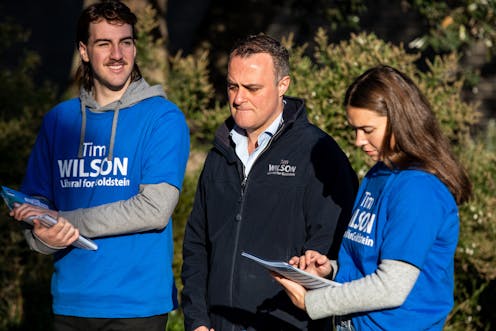
Former MP Tim Wilson campaigning ahead of the 2022 federal election. Diego Fidele/AAP
As counting winds up for the 2022 election, many former MPs are beginning a whole new life beyond parliament.
The experience of MPs who lost their seats is often shattering. Former Liberal MP Tim Wilson said he was in the “foetal position crying” the morning after the May 21 poll.
Our new study of state MPs shows this experience is both common and long-lasting, with serious implications for our democracy.
Our research
Our research was commissioned by the Victorian state parliament, and looks at how former MPs transition to life after politics. It is the most substantial study on this issue to have been conducted anywhere in the world. It involved
a survey of 93 former Victorian state MPs from across the political spectrum
interviews with 39 former MPs, including people who had departed parliament between three and 30 years ago
an evaluation of support services to former MPs at 33 parliaments around the world
ten interviews with psychologists, executive recruitment consultants, and leaders in elite athlete well-being.
Our research shows MPs who leave parliament unexpectedly can experience devastating emotional, psychological and financial challenges. We found a major contributor to these challenges was a lack of planning for life after parliament. Although a parliamentary career is inherently transitory, as one of our respondents explained, “no one thinks of themselves as an ex-MP”.
A huge shock
Even when they were expecting it, former MPs described losing their seat as shock and “death by a thousand cuts”.
One interviewee described election loss as though their “arms had been chopped off”. Although they knew they shouldn’t take it personally, several reported feeling “hated and despised”, “worthless”, and “guilty” for letting down their party.
As one former MP explained, losing their seat was
one of the most confronting things in my professional life, really, my adult life – apart from family members dying […]. It took me a very long time to get over it.
Psychological distress
Of those surveyed, 31% reported experiencing serious mental health challenges following their departure from parliament. Many of our interviewees reported symptoms of depression, anxiety, PTSD, and agoraphobia.
This psychological distress was most acute in the first two years after leaving parliament, but several former MPs reported the period of adjustment took up to six years.
I’m still devastated [two years later]. I think the thing that’s the toughest is I’ve not been able to move on […] I feel damaged.
For many, electoral defeat also resulted in a profound shift in their sense of belonging. As one put it, “you feel rejected by your entire community”.
God, do you take it personally […] It’s just the shock and the horror of […] all of a sudden, everything has gone […] your reason to get up in the morning.
For some interviewees, the years immediately after parliament also brought relationship breakdowns, poor physical health, and decisions to move away from the community they once represented.
Struggling to find a job
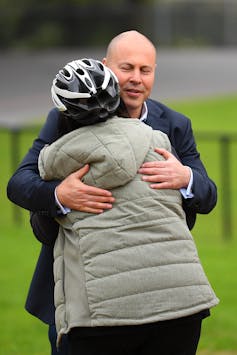
Former treasurer Josh Frydenberg is hugged by a constituent the day after he lost Kooyong. James Ross/AAP
The stereotype of former parliamentarians being “parachuted” into lucrative roles was not the experience of most former MPs we interviewed.
Of the participants in our study, it took 53% of former MPs at least six months after leaving parliament to secure paid employment, 28% between six and 12 months, and a further 12% took 18 months or more to find work.
Almost all reported how their efforts to set-up new careers were hampered by their time in politics. Many were rejected by employers and boards, despite their suitability for the role, to avoid any perception of political bias.
For similar reasons, several interviewees who had short parliamentary careers suggested they would have had a better career trajectory had they not gone into politics. Meanwhile, several respondents had begun their own businesses because they were unable to find other employment.
Executive recruitment agencies were also unhelpful. As one former MP explained,
[agencies] had no idea what to do with an ex-MP […] I didn’t get one interview […] and I must have been registered with at least half a dozen, if not more.
Of those surveyed, 48% of former MPs had set up a “portfolio” career, comprising paid and unpaid roles. This included volunteering in places such as libraries, schools, the Red Cross, aged care homes and the Country Fire Authority.
The money question
A backbencher in the Victorian parliament earns A$186,973 per year, and employer contributions to super at 16% per year.
can you give me a link – or confirm super is 16%? (saw a c.2020 Age report with 15.5%) [AN Was 15.5% until last year when increased to 16%]
Post-politics, Victorian state MPs no longer receive a pension. Since 2004, there has been a “transition payment” of three months’ backbencher salary if they served one term or less, or six months payment if they served two or more terms. Similar or less generous arrangements exist in the federal and most state and territory parliaments.
Given the long time it takes most MPs to find work, this transition payment does not bridge the gap. Among our respondents who served four years or less, 62% reported they had financial problems when they left parliament.
There is also a gender gap in earnings in life after parliament. While 20% of men surveyed were able to establish a career with pay in keeping with or above their former salary, female respondents said their time in parliament marked the peak in their earnings over their lifetime.
Why does this matter?
If we are to have a representative parliament, filled with committed and skilled people from diverse walks of life, we need to make sure there are no unnecessary barriers to a political career.
MPs already face a lot of hostility in the community. If there are huge personal and professional costs to being an MP, this acts as a further disincentive.
Many MPs we spoke with said they now advise people against a career in parliament, and would now choose a different path for themselves.
If I had my time again, I wouldn’t go near [politics …] You’re on the bottom of the pit, you’re below used car salesmen and bikie gang leaders […] So, if democracy [is] to survive, that has to be turned around.
Our recommendations
Our research taught us that parliaments can make the transition to life after politics much smoother and easier. The lessons from Victoria can be applied across all parliaments in Australia.
We have five key recommendations to better support outgoing MPs:
Encourage new MPs to think of their career as transitory from the moment they take office
Formalise the status of former members associations, which will enable them to better support their members
Provide transition payments on an “as-needs”, rather than a “time-served” basis
Provide defeated MPs the opportunity to give a valedictory speech, which is important for closure
Offer outgoing MPs career, financial, and psychological counselling and a capped study allowance to assist them to establish a new career and identity.
Politics is a brutal business and losing your seat will always be painful. But better support for our ex-parliamentarians doesn’t just benefit former MPs, it ultimately strengthens our parliamentary system and democracy.
Amy Nethery recieved funding from the Parliament of Victoria to conduct this research.
Matthew Clarke recieved funding from the Parliament of Victoria to conduct this research.
Peter Ferguson received funding from the Parliament of Victoria to conduct this research.
Zim Nwokora received funding from the Parliament of Victoria to conduct this research, and has in the past received funding from the Electoral Commission of New South Wales.
Over the past two years, Australians have become familiar with the threat of infectious disease outbreaks. COVID won’t be the last pandemic to affect our lives.
Early, aggressive restrictions were generally seen as necessary. But they also caused hardship, exacerbated inequality and undermined trust in government.
The pandemic exposed differences between states and territories. We saw inadequate national coordination of disease tracking, data analysis, lab capacity to process PCR tests, vaccination uptake and communication. This prompted renewed calls for the establishment of an Australian centre for disease control (CDC).
Before the election, Labor leader Anthony Albanese expressed the view that Australia’s COVID response had been undermined by a breakdown in our federated system and noted Australia was the only OECD country without a CDC. He committed to establishing one if elected.
So what should an Australian CDC look like? And how can it improve our response to future infectious disease outbreaks?
What is a CDC?
There is no single definition of a CDC. Broadly, it’s a national agency that promotes public health through the control and prevention of disease and disability.
The US Centers for Disease Control and Prevention (US-CDC) employs more than 10,000 staff. It focuses on infectious diseases, food-borne diseases, environmental health, injury prevention, health promotion, and non-communicable diseases such as obesity and diabetes.
But the US-CDC has been criticised for being overly bureaucratic, lacking innovation and being “missing in action” during the COVID pandemic, when the Trump administration completely sidelined scientific guidance. This demonstrates the importance of such an entity being free from political interference.
Other examples include the European Centre for Disease Prevention and Control (ECDC), a networked European Union agency with a restricted focus on infectious diseases. It delivers disease surveillance and epidemic intelligence to guide regional and national responses in member states.
The US-CDC was criticised as being ‘missing in action’ during the pandemic. Markus Spiske/Unsplash
In the United Kingdom, the UK Health Security Agency (UKHSA) recently replaced Public Health England. It has a slightly broader focus on protecting people and communities from the impact of infectious diseases and chemical, biological and nuclear incidents.
The Public Health Agency of Canada has the broadest remit of all. It includes preventing disease and injury, responses to public health threats, promotion of physical and mental health, and providing information to support informed decision making.
What does Australia need?
In Australia, states and territories are legally responsible for public health protection and providing the infrastructure for disease surveillance and response. A national CDC would need to work within our unique federated system.
The COVID pandemic showed Australia lacks a rapidly responsive national mechanism to:
collate, analyse and monitor disease surveillance data
coordinate outbreak control responses
evaluate the effectiveness of these responses
undertake rapid research to inform policy and guide decision-making.
Comprehensive infectious disease surveillance and near real-time data analysis is critical for coordinating national disease control responses, such as restricting population movement or contact tracing.
This surveillance and analysis requires an experienced workforce with expertise in epidemiology, microbiology and infection prevention and control.
Experts need real-time data to determine when to use restrictions or other public health measures. Viki Mohamed/Unsplash
A new national system will need to improve on the current model, which has served us well in many respects, despite its limitations. The risk is that something hastily implemented can worsen the situation, by establishing less effective mechanisms, duplicating efforts and wasting resources.
Specifically, a new system will require more effective mechanisms for data collation and sharing between states and territories, as well as workforce upskilling and building of core capacities, such as genomic testing of bugs, in all states and territories.
A national CDC will need sufficient funding and a governance structure that allows effective engagement with academic experts and policy makers, with protection from government interference.
Most importantly, it will need a transparent process that provides independent evidence-based advice to government. Australians need assurance that public health responses are based on evidence not politics.
Recent outbreaks of Japanese encephalitis and monkeypox also highlight the need for coordination between human and animal disease surveillance.
Following Labor’s election victory, there is risk that the establishment of an Australian CDC may be rushed through for a “quick win”. However, careful consideration and consultation is needed on how best to position such an entity.
It will need to engage with government and policymakers, while ensuring its decisions are independent, evidence-based and without political bias. It will also need to prioritise effective public communication and community engagement.
The best starting point is to define key principles that will guide its establishment and to commit to an open process that works closely with states and territories.
Important questions will need to be answered, such as whether an Australian CDC will encompass both infectious and non-communicable diseases, such as heart disease and diabetes. And where such a centre should be located to ensure it’s seen as a national asset without jurisdictional bias.
The ongoing impacts of COVID and multiple new threats make the need for concrete action to improve our national surveillance and response capacity increasingly urgent.
Jocelyne Basseal is the President of the Australasian Medical Writers Association (AMWA).
In the past, I have been a member of the Commicable Disease Network of Australia (CDNA), Public Health Laboratory Network (PHLN) and and Innnfection Control Expert Group (ICEG), and (ex officio) of the Australian Health Protection Principle Committee.
in 2020-21, I received funding, from the Commonwealth Department of Health for reviews of COVID-19 outbreaks in residential aged care facilities.
Tania Sorrell receives funding from the NHMRC and the ARC for research on pandemic preparedness and genomics in food-borne disease and from the NSW Office of Health and Medical Research for COVID vaccine studies.
Ben Marais does not work for, consult, own shares in or receive funding from any company or organization that would benefit from this article, and has disclosed no relevant affiliations beyond their academic appointment.
Extreme heat waves can cause birds and mammals to die en masse. But it’s more common for an animal to experience relatively mild heat stress that doesn’t kill it. Our new findings suggest that unfortunately, these individuals can suffer long-term health damage.
Our study, published today, describes how exposure to hot and dry conditions can damage the DNA of nestling birds in their first few days of life. This can mean they age earlier, die younger and produce less offspring.
We focused on a population of purple-crowned fairy-wrens – a small endangered songbird from Northern Australia.
The findings suggest unless the wrens can adapt rapidly to climate warming, their populations may struggle to survive as global temperatures rise. It’s vital we consider such subtle and otherwise hidden impacts when predicting how biodiversity will fare in a warmer world.
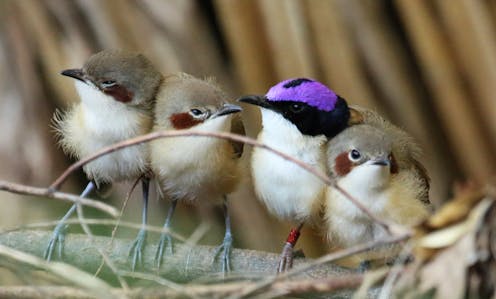
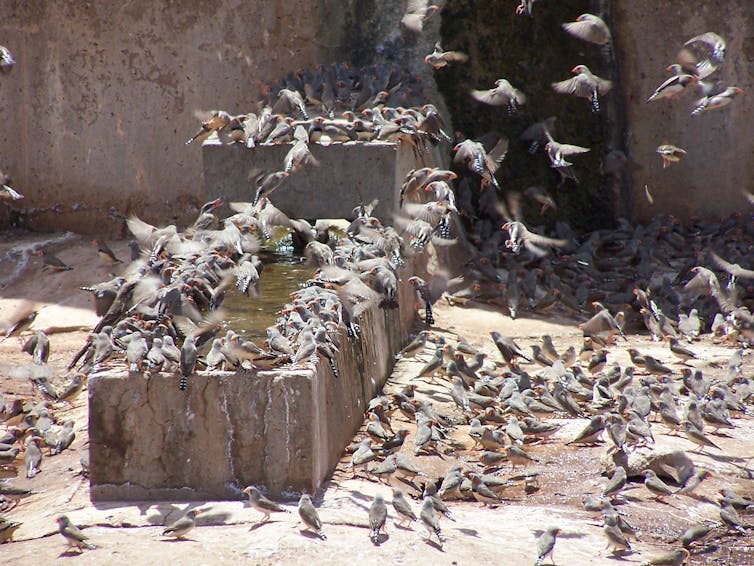
Hot weather can kill birds and leave others with shorter lives. WA Department of Environment and Conservation
The cost of growing up in the heat
Nestlings are particularly sensitive to hot temperatures due to their immobility, rapid growth and immature physiology. And the consequences of heat stress are potentially amplified in young birds because damage may persist into adulthood.
We intensively monitored a population of individually-marked purple-crowned fairy-wrens at the Australian Wildlife Conservancy’s Mornington Wildlife Sanctuary in Western Australia’s Kimberley region, as part of our long-term ecological study.
These insect-eating birds form small social groups centred around a breeding pair. The birds we monitored spend their lives in dense vegetation beside their particular spot along a riverbank, which they enthusiastically defend from interlopers.
Breeding can occur all year but peaks in the monsoonal wet season. Nests contain between one to four nestlings. During our study they experienced maximum air temperatures between 31-45℃.
Our investigation focused on week-old nestlings, and the relationship between temperature and a section of the birds’ DNA known as “telomeres”.
Telomeres are DNA caps on the end of chromosomes which, among other functions, act as a buffer to protect cells from the byproducts of energy production and stress.
Once this buffer erodes, the cell shuts down. As the number of these inactive cells builds up over time, the ageing process accelerates.
Nestlings exposed to hot, dry conditions during their first days of life had shorter telomeres. This suggests surviving heat stress may shorten their protective DNA buffer and make the birds age more quickly. Indeed, our previous research demonstrated nestlings with shorter telomeres tend to die younger, and subsequently have fewer offspring.
Interestingly, nestlings appeared to tolerate heat better when it coincided with rain, although we’re not sure why.
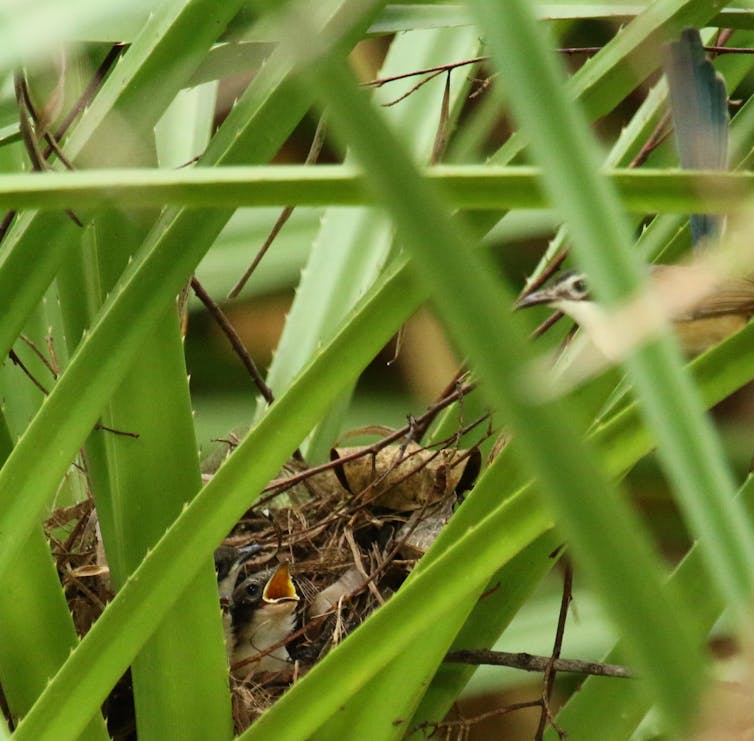
Purple-crowned fairy-wren chicks are sensitive to hot, dry conditions. Niki Teunissen/AWC.
What this means under climate warming
Hot, dry conditions are predicted to become more frequent in Australia under climate change. So we built a mathematical model to simulate whether their effects on nestling telomere length may depress reproduction enough to cause population decline.
We found even under relatively mild rates of warming, the population could decline solely as a consequence of nestling telomere shortening. The maths also revealed two potential “escape” measures that might maintain population viability.
First, the population could evolve longer telomeres, and thereby a larger buffer to prevent early ageing. However, this is entirely speculative as we do not understand how telomeres evolve or whether their evolution could keep pace with climate change.
Alternatively, the birds could adjust when they breed, so nestlings experience wet conditions more often. However, this seems unlikely because the number of rain days in the region is forecast to decline, and the birds already try to maximise breeding when it rains.
Importantly, if global warming continues to accelerate, the success of any countermeasures becomes increasingly unlikely.
Concealed and delayed costs of heat exposure, such as those identified in our study, can be subtle and difficult to detect. But they’re crucial when considering how climate warming might affect biodiversity.
Given that developing animals are generally more sensitive to heat, and telomeres function in similar way across species, our results could extend to many other birds and mammals. More research is needed to confirm this.
Male purple-crowned fairy-wren arrives at the nest to feed his young. Unless the birds can adapt to climate change, their populations may decline further. Niki Teunissen/AWC
What’s next?
Keeping cool is also costly for parent birds. Like us, birds often seek out shade and become less active in extreme heat. Instead of sweating, they open their beaks to pant and spread their wings to cool off.
But these behaviours leave a parent bird with less time to forage, defend the nest or feed offspring – activities required for the population to survive. We are investigating whether this exacerbates the effects of telomere shortening.
Next, we plan to expand our research by measuring temperatures in and around the nest. We’ll also study whether females are able to select cooler microsites to help their young better withstand climate warming, and investigate how this relates to habitat quality, management and threats.
Ultimately, we hope our research will inform the design of conservation strategies to climate-proof the future of this iconic Australian bird and others like it.
Acknowledgements: we thank the Australian Wildlife Conservancy, the Australian Research Council and our colleagues: Tim Connallon, Kaspar Delhey, Michelle L. Hall, Niki Teunissen, Sjouke A. Kingma, Ariana M. La Porte, and Simon Verhulst.
Anne Peters receives funding from: Australian Research Council Discovery Program; Australian Wildlife Conservancy; Monash University.
Justin Eastwood does not work for, consult, own shares in or receive funding from any company or organisation that would benefit from this article, and has disclosed no relevant affiliations beyond their academic appointment.
Source: The Conversation (Au and NZ) – By Christopher Charles Deneen, Associate Professor & Enterprise Research Fellow in Education Futures, University of South Australia
Shutterstock
The pandemic pushed universities to launch or accelerate plans for delivering examinations online. These forced transitions have often been painful, involving stress and burnout. Exams have been a big pain point.
There are many accounts from the pandemic of widespread cheating in online exams. These range from the amusing to the depressing. Regardless, cheating creates problems for everyone involved.
We do need to understand students’ achievements to effectively determine, plan and support student learning. Assessment is meant to inform this understanding.
Exams are high-stakes opportunities for generating big “chunks” of evidence of student achievement. Cheating invalidates this evidence, which has a knock-on at individual, course and program levels.
Academic program reviews, for example, are often guided by analyses of that year’s exam results. Exam data help staff make changes to the program. If a significant percentage of exam scores result from cheating, this can lead to misjudgments about the curriculum and missteps in designing future exams.
What happened during the pandemic?
It’s understandable, then, why many universities have embraced remote proctoring. This involves the use of artificial intelligence software to identify and monitor students during exams. The value proposition of remote proctoring is that it easily allows us to replicate virtually the security of an in-person, seated, invigilated exam, wherever our students may be. It seemed like a solution custom-made for the pandemic.
There is some evidence of remote proctoring working as intended. However, we must also consider emerging concerns.
On the faculty side, it’s becoming clear that remote proctoring does not necessarily lead to less work for staff. It may even increase exam-related workload.
With enrolments growing and in-person teaching resuming, it’s tempting to return to familiar exam practices. Bringing back traditional examinations, however, invites back other well-documented, chronic problems.
Orchestrating mass, in-person exams presents a huge challenge. Assuring relevance of traditional exams to modern competencies is also problematic.
It’s worth asking ourselves: how satisfied were we really with pre-pandemic exam practices?
Traditional in-person inviligated exams are anything but perfect. Shutterstock
Out of the many ways we engage learners in higher education, assessment is typically the slowest area to change. As exams are high-stakes, it is unsurprising that exams are quite change-resistant.
We are therefore presented with an unusual and timely opportunity. Right now, there is a strong push for systemic improvement of learning, including better assessment.
Let me suggest two connected ways forward on better exam practices. These are not axiomatic instructions. Instead, these are some resource-supported ways to open dialogues within institutions and teaching teams for exploring sensible solutions for them and their students.
Make scholarly decisions
Scholarship informs our disciplines. It must also inform assessment within our disciplines.
Scholarship of teaching and learning (SoTL) in higher education is not new. In my experience, SoTL or SoLT has often de-emphasised or failed to include assessment, as the popular forms of the acronym suggest.
Increasingly, we need to embrace SoLTA, that is, scholarship that includes and promotes evidence- and research-supported assessment practices. Embracing SoLTA involves becoming deeply familiar with the best research in assessment and examination practices in higher education and disciplinary contexts. This includes informing practice through consulting highly reputable journals like Assessment and Evaluation in Higher Education.
As with our disciplines, we should see ourselves not just as consumers of knowledge but creators, too. This presents an opportunity for universities to support teachers in applying scholarship to teaching, including teaching-focused academics.
Exploring alternatives to exams is sound general advice, but doing so isn’t always feasible. Programs often have rational imperatives for keeping exams in place, including expectations of external accrediting bodies. In these cases, it’s better to seek improvement, rather than alternatives, to exams.
Two key problems I have found in online exam practices are students using search engines to look up answers, and collusion. One way to resolve the first issue is adopting case-based approaches that use novel material generated specifically for the exam.
Collusion is a tougher nut to crack, but some people are adopting new approaches to doing so. These include running exams divided into sections, with collaboration an anticipated and welcome part of the process.
Changing assessment is challenging. Higher stakes mean bigger challenges and greater resistance. As universities find their post-pandemic footing, we have a window of opportunity in which we know we must change.
This allows us to answer the question: what’s next for exams? Clinging to new and hastily adopted practices provides an unsatisfying answer. A return to business as usual is no better.
Instead, let’s adopt a scholarship-informed approach to developing our exams and ourselves to better meet an uncertain and challenging post-pandemic future.
Several linked resources in this article are hosted by The University of Melbourne and University of South Australia. I was employed by The University of Melbourne from 2019-2021 and I am currently employed by University of South Australia. I am an author of or contributor to several linked resources. Authorship and contributions are clearly identified in each resource.
If you were suddenly frozen in time, there are a few things (I’d imagine) you would rather not be caught doing. This is the unfortunate fate many believe to have befallen the “masturbating man” of Pompeii.
In 79 BCE, the ancient Roman city of Pompeii was buried in the volcanic ash of Mount Vesuvius, a volcano located in Italy’s Gulf of Naples. The bodies of over 1,000 inhabitants have been frozen in the moment of its eruption – including one suspected to be having his own eruption at the time.
The plaster-cast body of this 2,000-year-old man can still be seen clutching himself tightly with his right hand. The photo was initially shared on Archaeological Park of Pompeii’s Instagram in 2017 and quickly exploded across the internet. The masturbating man became an immortalised meme.
But was this man truly caught getting a hard-on while the volcano was getting its hot-on?
Pompeii is remembered as a place of surprising liberality. Tourists continue to flock to the ruins of this once vibrant city, often finding themselves shocked by the number of stone phalluses carved into the pavement and walls (some even hanging invitingly above doorways and ovens).
Stories have circulated these phalluses served as an early form of advertising; if you follow the direction of the shafts, it is claimed, you would find yourself at the nearest brothel – “penis pointers”, if you will.
Such establishments were popular in Pompeii. Prostitution was not only legally permissible but it was generally regarded as the social norm for men (and, in some cases, wealthier women) to frequent such establishments.
A stone phallus in Pompeii. Atlas Obscura/ Steve, CC BY
Sexuality and sexual behaviour did not carry the same shameful stigmas we know today. From what we can understand, sexual behaviour was regarded no differently than other bodily behaviours, such as eating and defecating; it equally came with its own social rules on the acceptable ways to engage in the behaviour, but it was otherwise regarded as an immutable aspect of human life.
One brothel in the city remains open for customers today (though, of the tourist variety, rather than those it was initially built to accommodate). The Lupanar of Pompeii began to be excavated in 1862. This two-story establishment has been of particular interest to the curious traveller due to the erotic (and generally humorous) graffiti and artwork found inside.
Over 150 of the scrawls on the walls have now been translated for the wider public’s enjoyment, including Hic ego puellas multas futui (“Here many girls poked”) and Felix bene futuis (“Lucky guy, you get a good fuck”). The art throughout the establishment is equally as engaging, putting to rest any doubts humans have been experimenting with positions and their bodies since ancient times.
The Lupanar of Pompeii is the ruins of a brothel in the Ancient Roman city of Pompeii. Wikimedia Commons
To the matter of our penis pointers, it is far more likely these phalluses were in fact powerful symbols in Ancient Rome rather than advertisers for their beloved brothels.
They functioned as an emblem of good fortune and protection which could ward off the ill-intending visitors and the evil eye. The prominence given to the penis at the time could perhaps explain why our infamous man was so keen to protect it from the explosion.
Unfortunately, the real explanation isn’t quite as fun.
What really happened to the masturbating man?
With the masturbating man exploding around the internet, experts were asked to weigh in on what they truly believed had happened.
Along with the other victims living around Mount Vesuvius, this man was killed by a hot pyroclastic surge.
The effect this heat has on the body is responsible for causing arms and limbs to flex. This effect takes place not only during impact but also post mortem, meaning the bodies continue to change position after death.
This is thought to be the reason many of the bodies – not just our masturbating man – have been found in strange positions, many appearing as though they are grasping or groping parts of their body.
What happened to the people of Pompeii is a genuine tragedy which continues to move us centuries later. If there is a silver lining to be found in this immortalised devastation, it is that the effects of the disaster have allowed us unprecedented access to the ancient world.
The history of Pompeii has remained a point of academic interest, especially for those curious minds interested in the history of human sexuality. And, as far as we can estimate, its treasures are far from fully uncovered.
Esmé Louise James does not work for, consult, own shares in or receive funding from any company or organization that would benefit from this article, and has disclosed no relevant affiliations beyond their academic appointment.
A few weeks before his election victory, Anthony Albanese made an important speech to the Australian Chamber of Commerce and Industry. He talked of “socially inclusive growth – the kind of growth that is only possible with economic reform that lifts productivity”.
But how to do it?
Albanese’s answer was a good one: greater co-operation.
He harked back to the consensus approach of the Hawke Labor government, which after its 1983 victory brought together different interest groups to find common ground on how to produce more from the same inputs, enabling higher wages while protecting profits. Albanese said:
We must rediscover the spirit of consensus that Bob Hawke used to bring together governments, trade unions, businesses and civil society around shared aims of growth and job creation.
Now he’s prime minister his ambition to revive Hawke’s approach seems to be catching on.
Business Council of Australia chief executive Jennifer Westacott, for one, has spoken of the need for “co-operation between business, government and workers” to address issues such as labour shortages.
But consensus and co-operation are much easier to talk about than to achieve, especially in a political and industrial relations system as adversarial as Australia’s.
We’ve been researching co-operation at work for many years, including publishing a book about it in 2017. What our research tells us is that achieving co-operation at work requires real and practical goals; time and trust; inclusive structures for decision-making; and strong leadership at national, industry and enterprise levels.
Only by heeding these lessons does the Albanese government have a chance to achieve its ambitions, and secure a legacy to match that of Hawke’s.
More than a summit
In terms of national leadership, it is especially important for Albanese to be staunch in his commitment to improving political behaviour.
Bringing together business and union leaders is a good start. But it’s only a start. During Labor’s last period in office, Kevin Rudd brought together 1,000 delegates for his “Australia 2020” convention in 2008. It is best remembered for what didn’t happen afterwards.
For the Hawke government, the National Economic Summit held a month after its election in 1983 was just one element in its consensus-building efforts.
Another element was the Prices and Incomes Accord formalised between the government and the Australian Council of Trade Unions. Under the Accord, unions tempered industrial action in pursuit of higher wages, in exchange for the government improving the “social wage” (such as through introducing Medicare).
The Hawke government also established three bodies bringing employer, union and government representatives together to advance commitments made at the summit and subsequently.
These were the Economic Planning Advisory Council, the Advisory Committee on Prices and Incomes, and the Australian Manufacturing Council. They were critical in supporting the Accord and the agreements that gave effect to it (the last covering 1993-1996).
The Albanese government can’t just replicate this template – what worked in the 1980s and 1990s will not necessarily suit today. But it will certainly need processes and structures to ensure regular dialogue between stakeholders at the national level, and in ways promoting genuine co-operation.
One area for Albanese to leave a real legacy is to entrench greater co-operation at the industry level through industry councils: tripartite bodies bringing together government, employers and union representatives.
In the 1980s and 1990s, sector-based industry training councils and industry training advisory boards helped to design and implement competency-based vocational education and training.
Industry councils could be helpful now in guiding spending priorities for Labor’s proposed National Reconstruction Fund, a $15 billion pool to invest in industries that can provide jobs and prosperity.
Just handing out money will not work. We need industry plans on which government, employers and employees agree. This is important not just for manufacturing but sectors such as aged care and child care.
Skills for enterprise-level co-operation
At the level of individual enterprises, especially larger ones, effective co-operation requires good faith and leadership from both managers and union representatives.
It requires training in effective commmunication skills. Neither managers nor worker representatives necessarily know how to co-operate. They need success stories to emulate, and skills to overcome the adversarial attitudes entrenched by experience.
Our research also shows that third-party facilitation, such as that provided by the Fair Work Commission under its Co-operative Workplaces program, is vital for workplace parties who are unfamiliar with co-operative ways.
A legacy worth leaving
Fostering the co-operation needed to deliver inclusive growth will require overcoming a history of bad habits and soured relationships at the enterprise, industry and national levels.
This is rarely easy, so getting help from independent third-parties is necessary, especially at the industry and workplace levels.
If Albanese’s government can put in place the structures needed at all three levels, it has a chance of leaving a legacy as significant as its Labor predecessors.
Mark Bray has previously received funding from an Australian Research Council Linkage grant, for which the industry partners were the Industrial Relations Society of NSW (Newcastle Branch) and the Fair Work Commission.
Andrew Stewart has previously received funding from an Australian Research Council Linkage grant, for which the industry partners were the Industrial Relations Society of NSW (Newcastle Branch) and the Fair Work Commission.
Johanna Macneil has previously received funding from an Australian Research Council Linkage grant, for which the industry partners were the Industrial Relations Society of NSW (Newcastle Branch) and the Fair Work Commission.
A new report on the economic impacts of climate change faced by the world’s most at-risk countries has found the climate crisis has made vulnerable economies poorer.
The Climate Vulnerable Economies Loss Report has found climate-threatened nations, including those in the Pacific, lost approximately US$525 billion in damage over the last two decades.
It reveals climate change wiped out one-fifth of the wealth of poor countries, which would be twice as wealthy today if not for climate change.
The climate economic loss report. Image: Screenshot APR
Marshall Islands climate envoy Kathy Jetnil-Kijiner said the findings of the report were “staggering”.
She said climate change affected every facet of human society and the effects went far beyond the economic, especially for those in the Pacific.
She said the non-economic damages might not be counted in dollars and cents but they were significant for people and communities.
“I think for us in the Pacific, we’re trying our hardest to make sure that the non-economic losses are just as much highlighted, you know, as some of this more large scale and that slow-onset event such as what we’re seeing in the atoll, nations, like the Marshall Islands, in particular, are also highlighted as really important,” she said.
The study was launched by the Vulnerable 20 Group or V-20, which represents 55 climate-threatened countries from across the world, at the UN climate talks currently taking place in the German city of Bonn.
This article is republished under a community partnership agreement with RNZ.
A Gisborne councillor has called into question the mayor’s ability to lead the region forward, saying her background makes it hard to understand issues affecting Māori.
Third-term councillor Meredith Akuhata-Brown made the comments about Mayor Rehette Stoltz following questions about her intention to stand for the top position at the next election.
Akuhata-Brown, who unsuccessfully contested the mayoralty in 2019, said she was not sure if she would run against Stoltz in October.
Part of the reason was she felt her chances were impacted on by not fitting the stereotype of what power looked like.
“When Rehette first ran for council, she was elected duly based on ‘that’s what councils look like across the nation’,” Akuhata-Brown said.
“She’s the deputy mayor within a couple of terms … she’s formidable … she’s young. There’s no fight for the position, it’s handed to her.”
First elected to council in 2010, Stoltz was appointed deputy mayor by Meng Foon in 2013.
Made interim mayor When Foon left his position to become the Race Relations Commissioner in 2019, she was made mayor in the interim.
Stoltz then cruised to mayoral victory later that year with 10,589 votes, ahead of second-placed Akuhata-Brown who secured 3845 votes.
Gisborne councillor Meredith Akuhata-Brown … taking shots at Mayor Rehette Stoltz, saying she was handed the mayoralty. Image: Liam Clayton/Gisborne Herald
Akuhata-Brown believes the mayor had an easy run because she fit the bill of what people were used to in the make-up of councils around the country.
“We go through an election campaign when the position has already been filled.”
On her website, South African-born Stoltz shares her journey to the top elected position at Gisborne District Council.
Arriving in New Zealand in 2001 for her OE, she took a “holiday job” as the laboratory manager for a wine business before deciding to commit to Tairāwhiti long term with partner Deon.
It wasn’t until a conversation with former councillor Kathy Sheldrake in 2009 that she decided to run for council the following year.
Little debate over mayoralty Her background is in cardiovascular physiology and she also ran a recruitment business.
Akuhata-Brown argues Stoltz was handed the mayoral chains without much debate among councillors when Foon left prematurely.
“It’s really easy for people from overseas. They come to our place highly qualified, and they are looked upon favourably, and they get the position without fighting for it.
“If you are a certain look, that is particularly not Māori, you are highly probable to get that position.”
Akuhata-Brown said she was being a “vocal local” because she was invested in the region and wanted to highlight the issues that came with integrating governance styles from overseas.
Tairāwhiti was still fraught with racial inequalities and relationships were key for connecting with those who were still trying to eek out a living in the middle and lower classes, she said.
“Those who have money and wealth and governance roles, they can just get on with their lives and not be bothered by any of that because they can just put up higher fences.
No voice for Māori and Pasifika “For Māori and Pasifika, the voice hasn’t been there for centuries.”
Akuhata-Brown’s final criticism of Stoltz’s leadership was she had been left alone with no extra jobs and it felt like there were low expectations.
Hoping to be made a committee chair in her third term, Akuhata-Brown said positions had instead gone to people who supported the mayor 100 percent.
“There’s a real sense that to get position and acknowledgement you have to be very much on side.
“We don’t even talk, it’s just a non-relationship.”
South African-born Mayor Rehette Stoltz … confirms she will run for a second term as Gisborne mayor in October. Image: Rebecca Grunwel
Mayor Rehette Stoltz responded to the criticisms, saying Gisborne had been her home for 21 years and she had made a concerted effort to get a deeper understanding of the multicultural community.
Tikanga Māori course That included completing a year-long Tikanga Māori course and becoming a member of the council’s waiata group.
She said that under her leadership, Māori wards had been unanimously voted in and memorandums of understanding signed with hapū.
“I have good working relationships with our iwi leaders and regularly meet to discuss and make decisions in regard to issues that are important to us as a region.”
Appointment to committees and chair positions were made on interest expressed by councillors, experience and merit, she said.
“I won the mayoralty with more than a 7000-vote majority. Mayoralties are not handed down, they are voted on by the community.”
The upcoming local body election is set for October 8.
This article is republished under a community partnership agreement with RNZ.
The New Zealand government is considering more action to crack down on violent gang behaviour but has dismissed the idea of a ban on wearing gang patches in public.
There have been a number of shootings and arson attacks in Auckland and Northland in recent weeks linked to escalating tensions between the Killer Beez and Tribesmen.
Prime Minister Jacinda Ardern told Morning Report the government had asked police what other tools they wanted.
She said she expected to receive further advice soon.
She said changes had been made to widen the criteria for asset seizures and firearm prevention orders legislation was currently before select committee.
It was clear that the current outbreak of violence centred on escalating tensions between two gangs and the clear advice from experts was about the need “to come down hard on that behaviour”.
The police had taken such action with multiple arrests, multiple search warrants executed and 600 rounds of ammunition seized.
‘More tools needed?’ “We’ve asked them [police] to tell us in that environment are there more tools that you need,” she said.
The government had met them again last week and she was expecting more advice from them soon.
“We are moving as fast as we can where the police identify issues we can support them on.”
New policy would not go before cabinet later today — changes did not happen in a day or a week but the government was seeking to have the work expedited.
“This idea of gang patch bans — it’s been tried in other countries. It’s often a reactionary response you can see from politicians and when they’ve gone back and looked at whether it’s made a difference, review after review in different parts, for instance in Australia, has proved it hasn’t.
“Why don’t we put our energy into things that are going to make a difference.”
She invited National to bring forward other ideas on what would help solve violence from gangs.
“We will be engaging in the ones that the police tell us will make the biggest difference.”
Asked about changes affecting Māori in particular, she said any proposed legislation always went through a Bill of Rights process.
“But what we also always factor in are New Zealanders’ rights and their sense of safety and at present we see an escalation in tensions between gangs. Their behaviour includes examples of blatant lawlessness and that needs to be addressed.”
Reception from new Australian government pleasing Ardern has hailed her visit to Sydney as a “reset” of a trans-Tasman relationship which had soured in recent years — primarily over Australia’s intransigent stance on its “501” deportation policy.
Following talks with new Australian Prime Minister Anthony Albanese, after which he said he had “listened” to New Zealand’s concern, Ardern said it was a significant improvement on any feedback she had received from Canberra previously.
She agreed Australia has stated its clear intention to continue to deport people which was exactly the same as New Zealand’s approach.
New Australian Prime Minister Anthony Albanese with New Zealand’s PM Jacinda Ardern at talks last week … Canberra has “listened”. Image: Katie Scotcher/RNZ
It was those “at the extreme end” of the spectrum who were in effect Australians with no connections to Aotearoa that the government was most concerned about being sent here, she said.
It had secured from Albanese a commitment to look at that aspect.
“We’ve not received a reception like that to these issues for a number of years.”
With a ministerial meeting due to be held in three weeks Ardern said she will be looking for signs of progress but it was too soon to expect a timeframe for action.
This article is republished under a community partnership agreement with RNZ.
A protest action by Papuan students which took place in the South Sulawesi provincial capital of Makassar, which was opposing the creation of new autonomous regions in Papua, ended in a clash with a social movement.
Several people were injured and rushed to the nearest hospital.
Action coordinator Boci explained that the incident began with the protesters planning to hold a rally in front of the Mandala Monument. When they began marching towards the rally point, they were blocked by the Ormas (the Indonesian Muslim Brigade).
“Since early morning there were plain clothed police with the ormas. Then when we moved off to the rally site we were blocked by the Ormas BMI, then we were assaulted, pelted with stones, beaten with pieces of wood, kicked, until three people were bleeding and I was hit and my fingers injured”, said Boci in a statement to CNN Indonesia.
The protesters then stood their ground in front of the Papuan student dormitory, said Boci, after which the police conducted negotiations and the BMI members retreated and moved away from the dormitory.
“Although we were provoked our action still continued. After that the police arrived but we continued to hold our ground in front of the dormitory and read out our action demands near the dormitory,” he explained.
As a result of the attack by the BMI, Boci said that five students suffered injuries and were bleeding.
Five students injured “Yes, five students suffered injuries and are currently still receiving medical treatment”, he said.
Earlier, an Ormas in Makassar was involved in a class with several Papuan students in front of the Papuan student dormitory on Jalan Lanto Daeng Pasewang.
The clash occurred when the Papuan students were protesting against the creation of new autonomous regions (DOB) in Papua in front of the dormitory.
The Ormas then tried to break up the student protest. The Papuan students refused to accept this and pelted several of the Ormas members with stones.
Makassar metropolitan district police operational division head Assistant Superintendent Darminto said that those who had been injured were receiving medical treatment at the Labuang Baji Hospital.
They are a group often overlooked, described as “invisible”, or perhaps assumed not to exist at all.
There is no reliable data that captures the number of LGBTQ+ Australians with intellectual disability. But in 2020, Australia’s largest national survey on the health and well-being of LGBTQ+ people found more than one-third (38.5%) of the 6,835 respondents had a disability or long-term health condition.
People with intellectual disability face additional barriers to access and participation in community, which means their voices are often missing from LGBTQ+ events, in government consultations, and in disability spaces.
We partnered with Inclusion Melbourne and Rainbow Rights & Advocacy, an advocacy group of LGBTQ+ people with intellectual disability to hear about what mattered to them, and what they wanted other people to know.
‘Include us’
We spoke with dozens of LGBTQ+ people with intellectual disability over hundreds of hours.
We did this work alongside peer researchers: LGBTQ+ people with intellectual disability who facilitated the online group and individual sessions and co-created the research resources.
We asked how LGBTQ+ people with intellectual disability can be better supported to – in the words of one person – “say who you are”, and gathered their comments together into key statements.
Then we asked each person if they agreed with each key statement. It is our belief our study (to be published later this year) is the first in the world to include only people with intellectual disability and to co-design all stages of research.
Where all too often people with intellectual disability are seen as the ones in need of education, our approach was the reverse. We asked for their advice to share with those who need to listen: policymakers, service providers, families and their supporters.
‘What matters is hope, freedom and saying who you are’
This Pride month is about celebrating diversity. But we have some way still to go.
The stigma around intellectual disability and LGBTQ+ identities means people may choose not to come out to the people or support services that surround them.
And when people do come out they are not always acknowledged or believed. As one study participant told us:
They say [an intellectual disability means] you can’t know you’re a lesbian but I’m in my body and I know who I am and I know I like girls.
Everyone we spoke to agreed it was essential to respect their gender and sexuality as LGBTQ+ people with intellectual disability.
Abuse extended into people’s homes, where paid support workers had verbally abused them with homophobic slurs. One person in this situation told us:
[…] there was a long time where I didn’t feel like I was safe [at home].
‘We want good people around us who understand us’
After a long wait following the initial community consultations, the National Disability Insurance Authority (NDIA – the body that runs the NDIS) released its LGBTIQA+ Strategy in 2020. The people we spoke to agreed there is a need to improve organisational culture and attitudes across the NDIA, partners and providers.
People told us support workers needed more training to understand their rights and LGBTQ+ identity, and provide support in line with the quality standards required for NDIS service providers. These affirm that “the culture, diversity, values and beliefs of that participant are identified and sensitively responded to”.
‘I want to be part of the queer mob – be who I am, on Country’
Research has previously reported the only place Aboriginal and Torres Strait Islander people with disability do not experience inequality is within their own communities.
The Indigenous LGBTQ+ people with intellectual disability we spoke to told us how their spiritual connection and relationship to Country was an essential part of who they are. One participant, who identifies as a First Nations trans lesbian, shared her experience:
They call me sister and everything else, they don’t care if you’re trans gay or lesbian, it doesn’t matter what.
People talked about their need to access information, which helped shape our work in co-designing web-based resources for LGBTQ+ people with disabilities about donating blood, interactions with the police, their rights and more.
Lastly, we asked people what they would like to see in the future. One response was particularly poignant:
[…] being gay and free and no racism, be able to live peaceful.
The authors acknowledge our project partners Rainbow Rights & Advocacy and Inclusion Melbourne, and the members of our Advisory Group. We particularly thank our colleague and chief investigator Cameron Bloomfield.
Amie O’Shea receives funding from the National Disability Research Partnership and the Department of Social Services (Information, Linkages and Capacity Building program)
Diana Piantedosi is an Associate Research Fellow at Deakin University. Diana receives a Research Training Scholarship as a PhD Candidate at La Trobe University and is affiliated with Women with Disabilities Victoria (WDV).
We know literacy is important. Unfortunately, many Australian students move through the years of schooling without achieving the literacy they need for essential daily activities.
When we think about building literacy, we most likely think about the English learning area. But think back to your time at school. You’ll probably remember you needed good literacy skills in learning areas beyond English.
Your knowledge and skills across most learning areas were gained and measured through your literacy skills. For example, your ability to write an essay in history, produce a report in science and explain your working out in mathematics contributed to your grade. Research shows how students’ literacy skills influence their achievement in mathematics and science.
The Australian Curriculum positions literacy as a general capability to be taught in every learning area. Despite this, few Australian schools have whole-school literacy policies that include practical plans for building student literacy across learning areas. That’s the troubling conclusion from my analysis of Australian and UK school literacy policies for my upcoming book.
My earlier research also shows that many Australian secondary teachers do not believe their schools have a whole-school approach to supporting struggling literacy learners. This is concerning, as students who struggle with literacy won’t only struggle in English.
It’s not that the push to make every teacher a teacher of language and literacy is new. It has been discussed since the 1960s. However, there are questions about how closely Australian schools meet this expectation.
What kinds of literacies do we need?
Many literacies are needed to boost achievement beyond English. When we talk about whole-school literacy, we often refer to content area literacy and disciplinary literacy.
Content area literacy refers to the literacy knowledge, strategies and skills we use across the learning areas. For example, we don’t only need reading comprehension in English. It’s needed in every learning area that requires students to read.
Disciplinary literacy relates to the literacy knowledge, strategies and skills that we use to achieve learning purposes that are unique to a learning area. For example, writing a science report requires the correct scientific language, formatting, referencing and diagrams. It calls for specific literacy skills unique to science.
Whole-school literacy policies plan for all learning areas to include a focus on literacy achievement.
However, analysis of Australian schools’ literacy policies reveals many gaps in these policies. Part of the problem is an excessive focus on NAPLAN testing. There is also limited attention to making the most of literacy resources such as school libraries, especially by comparison with policies in the UK.
School literacy policies commonly fail to include:
A definition of literacy that considers both content area literacy and disciplinary literacy, as well as the wide range of literacies that the school seeks to develop in its students. This should not be limited to the narrow framing of literacy tested in NAPLAN.
Detailed and explicit literacy targets for building content area and disciplinary literacy, as well as meeting other goals such as increasing students’ information literacy. Targets are needed so the policy isn’t just aspirational; it actually drives change. There should also be detailed implementation planning that allocates literacy responsibilities across the school.
An explanation of how improvement in literacy will be measured to determine the effectiveness of the policy. Don’t just assess changes in high-stakes literacy-testing scores. Look at building literacy engagement. This relates to students’ attitudes toward and performance of practices such as reading for pleasure. Research has found a relationship between reading for enjoyment and reading comprehension, a key content area literacy skill.
Plans for identifying and supporting students who are struggling with literacy. These plans should cover all schooling years and learning areas. Include plans for professional development of teachers who lack confidence in supporting students’ complex literacy needs among the many competing demands of their role.
Consideration of how to make the most of the literacy resources within the school. These resources include but are not limited to the school library and its staff.
Attention to writing – the majority of Australian schools’ policies did not mention handwriting. Most of the UK policies did. Australian school policies also rarely mentioned typing. A whole-school literacy policy should include these skills, given their importance across the curriculum and the years of schooling.
COVID-related literacy issues – school policies may also need to include strategies to overcome any negative impacts of pandemic-related education interruption on students’ literacy learning.
In general, Australian school literacy policies are typically far shorter and less detailed than their UK equivalents. Australian schools and their students will benefit from more effective whole-school literacy planning.
Literacy is not just the responsibility of the English teacher. Every teacher is a literacy teacher.
Margaret Kristin Merga has received funding from the BUPA Health Foundation, the Ian Potter Foundation, the Copyright Agency Cultural Fund, Edith Cowan University and the Collier Foundation. She is the Patron of the Australian School Library Association and the Western Australian School Library Association. She also runs Merga Consulting, working with schools, Departments and professional associations to deliver parent seminars, staff professional development and planning advisory support.
New Zealand Parliament Buildings, Wellington, New Zealand.
Political Roundup: Why is New Zealand’s defence minister visiting South Korea?
By Geoffrey Miller
New Zealand’s defence minister, Peeni Henare, has had a very busy first half of the year.
In January, Henare was the face of New Zealand’s relief effort to Tonga, following the eruption of the Hunga Tonga–Hunga Ha’apai volcano.
Then, from March onwards, Henare was often involved in Jacinda Ardern’s announcements of military support for Ukraine.
The Government initially decided to supply only defensive (or ‘non-lethal’) equipment to Kyiv, which took the form of body armour, helmets and vests.
Cabinet initially declined a request by Henare for New Zealand to also supply ‘lethal aid’ weaponry to Ukraine – but that decision was suddenly reversed in early April.
Since Russia’s invasion of Ukraine on February 24, tensions between China and the West have also escalated in the Indo-Pacific. The increased focus on ‘hard security’ in New Zealand’s neighbourhood has only strengthened Henare’s role further.
The defence minister’s first trip outside New Zealand was to Fiji in late March. The outcome was a ‘Statement of Intent’ pledging stronger defence ties between Suva and Wellington. A week later, New Zealand foreign minister Nanaia Mahuta herself travelled to Fiji to sign a broader ‘Duavata Partnership’, which promised ‘a new level of expanded strategic cooperation’ between Suva and Wellington.
Given the subsequent debate over China’s interest in its own security arrangements with Pacific countries – especially Solomon Islands – a section of the Duavata Partnership that promises greater co-operation between Fiji and New Zealand on cybersecurity, defence and policing seems particularly significant.
The Pacific remains the focus during Henare’s current trip to Asia.
On Saturday, Henare spoke on a panel on ‘Climate Security and Green Defence’ at the Shangri-La Dialogue in Singapore. Of course, in the current geopolitical climate, nothing is ever as it seems – and Henare’s contribution mainly served as just another opportunity to stress the strategic importance of the Pacific region and justify New Zealand’s involvement.
If this needed to be underlined, Henare obliged with his opening remarks at the defence ministers’ summit, which included the line ‘our security and well-being are intrinsically bound to the peace and stability of our region’.
With his first in-person multilateral meeting under his belt, Henare now heads to Seoul for a three-day bilateral visit.
Much like Jacinda Ardern’s decision to brand her recent overseas trips as ‘trade missions’, the official reasoning given for Henare’s visit to South Korea probably understates its significance.
The Government says the main reason for Henare’s trip is to check on New Zealand troops deployed there and to acknowledge the contribution of the 6,000 New Zealand soldiers who served in the Korean War.
This of course an important and worthy reason for a visit – but it is far from the only one.
2022 marks the 60th anniversary of diplomatic ties between Wellington and Seoul – and bilateral relations may be about to step up a gear.
South Korea is New Zealand’s fifth-biggest export market, putting it behind only China, Australia, the US and Japan in importance.
This statistic alone makes it overdue for a visit by a senior New Zealand minister.
But there is more to it than that. Like New Zealand, South Korea is currently edging its foreign policy towards the West.
This is despite the fact that China is South Korea’s biggest export market and two-way trading partner – another parallel with New Zealand, which sends 33 per cent of its exports to China.
Seoul has also had another very particular reason to keep on good terms with Beijing – the influence it holds over unpredictable Pyongyang. Already this year, North Korea has undertaken a record-breaking number of missile tests – 31 in total – and appears to be more dangerous than ever.
Despite this, South Korea’s new President, Yoon Suk-yeol, is seeking to broaden his country’s foreign policy ambitions beyond the Korean peninsula, in a bid to become what he calls a ‘global pivotal state’.
Yoon, a conservative, narrowly won power in South Korea’s presidential election held in March. But there were signs of changes even in the last days of the five-year term of Yoon’s more liberal predecessor, Moon Jae-in.
When Russia invaded Ukraine in February, Moon initially tried to avoid placing its own sanctions on Russia – a stance also initially taken by New Zealand – before giving into pressure and joining the sanctions club a few days later.
The decision made South Korea one of only a handful of Asian economies to impose sanctions on Russia – two of the others are Singapore and Japan, which Ardern herself visited at the end of April.
The shift on sanctions made by Moon – who visited New Zealand in late 2018 – closely echoed New Zealand’s own new calculations. Jacinda Ardern was initially reluctant to impose sanctions to avoid setting a precedent that could irritate China. But as she faced pressure domestically and from Western partners, Ardern soon changed course and introduced the groundbreaking Russia Sanctions Act.
The similarities do not stop there.
Last month, Yoon hosted US President Joe Biden in Seoul and the pair issued a joint statement which cited several sensitive China-related issues – such as the South China Sea and the Taiwan Strait – as well as the North Korea threat.
Unlike New Zealand, South Korea is a staunch US ally – so it might seem remarkable that New Zealand’s own recent joint statement with the US – issued after Ardern met Biden in the White House – is even more hawkish and detailed when it comes to criticism of China.
This is a risk – Beijing has already verbally expressed disapproval at New Zealand’s apparent alignment with the US, and more substantive repercussions may yet emerge.
But for now, New Zealand and South Korea are forging broadly similar foreign policy paths that see them working more closely with other Western partners.
Neither country is a member of the ‘Quad’ grouping of China hawks – an arrangement involving Australia, India, Japan and the US – but both New Zealand and South Korea (along with Vietnam) have been part of a trialled ‘Quad Plus’ format that could always be revived and expanded.
Moreover, both New Zealand and South Korea are among just four countries from the Indo-Pacific – the others are Australia and Japan – to be invited to attend the North Atlantic Treaty Organization (NATO) leaders’ summit in Spain at the end of June.
Jacinda Ardern has yet to officially confirm her attendance at the Madrid meeting, but foreign minister Nanaia Mahuta already attended a NATO foreign ministers’ meeting virtually in April.
NATO is obviously keen to bring New Zealand and South Korea – which it calls Asia-Pacific partners – more closely into its orbit.
Both Seoul and Wellington have also been keen to sign up to a new economic pillar that the US is setting up to counter Chinese influence.
The Indo-Pacific Economic Framework (IPEF) is still somewhat nebulous when it comes to detail.
But Wendy Cutler, a former US diplomat and trade negotiator, suggests the IPEF’s ‘supply chain resilience’ component might be drawn on to counter a Chinese strategy that the US calls ‘economic coercion’.
The coercion label essentially refers to Beijing’s imposition of trade punishments on countries that get offside with its wider foreign policy aims.
Australia experienced the impact of trade linkage when China imposed punitive tariffs on Australian wine and barley exports in 2020, after then Prime Minister Scott Morrison called for an investigation into the origins of Covid-19.
Peeni Henare’s three-day mission to South Korea is no accident.
Seoul and Wellington might be 10,000 kilometres apart.
But when it comes to geopolitical strategy, New Zealand and South Korea are becoming closer by the day.
Geoffrey Miller is the Democracy Project’s international analyst and writes on current New Zealand foreign policy and related geopolitical issues. He has lived in Germany and the Middle East and is a learner of Arabic and Russian.
For a long time, policy makers and legislators seeking to address the problem of domestic and family violence have sought higher penalties and tougher laws. But when it comes to finding practical solutions to this complex problem, the voices of those with lived experience of the system have not always been heard.
A recent study I coauthored with Suryawan Rian
Yohanesh from Uniting Communities (an NGO focused on overcoming disadvantage) involved interviews with survivors of domestic and family violence about what changes they’d like to see.
Our interviewees told us they want changes giving them control over legal processes like intervention orders (sometimes called “Apprehended Violence Orders” or AVOs), which are legal orders designed to stop perpetrators of violence or abuse from being near or interacting with their partners or children.
Currently, if you want to obtain one of these orders, the police and prosecutor often lead the process. They generally decide whether it goes to court, what evidence is collected or used and what parameters that order has (such as whether the perpetrator can collect kids from school or access firearms). The abuse survivor can feel shut out of these decision-making processes.
Survivors also told us they need longer term support.
Survivors of violence, and those working to support survivors, want programs focused on getting the first response right every time. As one service provider said:
Being told that your abuse is ‘not serious enough’ or there is no abuse identified is one of the most damaging things that can happen. It can impact the relationship of trust going forward. It is therefore critical first responders are adequately trained in trauma-informed care and practice, and have training in best practice responses to domestic violence, so that the victims can also be referred to suitable support services.
If that first response (by police, for example) is dismissive or re-traumatising, it can leave survivors vulnerable to ongoing violence and harm, and distrustful of the legal system. As one survivor said:
I didn’t feel like I was taken seriously or believed. [I was] made to feel like I was being judged as hysterical, ridiculous and time wasting. This made me feel unsafe to approach police again which was fairly scary, because they were the place I was supposed to be able to count on to help, and I wasn’t sure where else I could go.
This type of response can be devastating for women and families already experiencing disadvantage or isolation, including First Nations women, culturally and linguistically diverse women, women with disabilities and women living in regional areas. Many of these groups already face myriad practical barriers when it comes to reporting violence.
Survivors of violence, and those working to support survivors, want to see programs that focus on getting the first response right, every time. Shutterstock
A mishandled first response can reinforce narcissistic or controlling behaviour by perpetrators, who use these experiences as evidence of their own power. To say, “See, I told you nobody would believe you.” One interviewee said:
The system that is being built to protect women from this type of abuse can be turned into a weapon in the hands of those men that are seeking to perpetuate control against their partner or their family.
Survivors said they want greater focus on perpetrator accountability by exposing the true impact of the violence on the lives of others, not just the aspects of the behaviour leading to criminal offences or breaches of the law.
This means engaging professionals to help the survivor confront the perpetrator with the broader health, financial and social impacts of their behaviour.
With this support team, the victim survivor could be encouraged to develop a strong recorded, accumulative evidence case. And these other professionals could be empowered to confront the defendant about the harm that he is causing to his partner, and in many cases also to his children.
These practices should be informed by cultural knowledge and supported by community leaders who can help improve awareness of the rights of women. The support team could also help identify pathways for safe repair of relationships, social connection and financial security.
Longer term support
Survivors also need longer term support packages, including opportunities to access tertiary education or training and specialist legal and financial services.
As one participant told us:
I’d really like to see some kind of focal point, resources for [domestic violence] survivors. To support people to rebuild their lives. Getting the universities and tertiary institutions to help with retraining and teaching, employment. Somewhere where people can break back in. Including social life, as well as financial security and employment.
Those with lived experience of domestic and family violence want perpetrators to be held to account – not just in the courtroom, but in their workplaces and their social networks.
They want to be put at the centre of the system, and be recognised as the powerful agents for change they are.
No legislation is good enough until people with lived experience have been consulted […] All these people with lived experience are not being heard. They are the ones that have the knowledge. Every time you don’t go to the coal face you miss the point.
Sarah Moulds receives occasional funding from the Law Foundation of South Australia Australia. She is the Director of the volunteer-based Rights Resource Network of South Australia and a member of the Law Society of South Australia.
This story is part of The Conversation’s Breaking the Cycle series, which is about escaping cycles of disadvantage. It is supported by a philanthropic grant from the Paul Ramsay Foundation.
A dead Peron’s tree frog (_Litoria peronii_)Ken Griffiths, Author provided
Last winter, thousands of dead and dying frogs were found across Australia. Instead of hunkering down and out of sight, frogs were spotted during the day in the open, on footpaths, highways and doorsteps – often in the blazing sun.
These frogs were often thin, slow moving, and with dark patches on their back or red bellies. They were seeking water in pet bowls or pot plants. And they usually died in a matter of hours.
A crash in frog populations could have very real consequences, particularly for already threatened frog species, and the importance of frogs in both freshwater and land systems means it can also impact entire ecosystems.
Thankfully, reports of sick or dead frogs slowed as the weather got warmer, and by the end of last year they had all but ceased. We hoped the awful spate of frog deaths was a one-off. But now, we fear it is happening again.
In the last few weeks, we’ve started getting scarily similar reports of sick and dead frogs from people across Australia.
From Warwick in southeast Queensland, we’ve received emails reporting green tree frogs (Litoria caerulea), discoloured and hunched up, sitting in the open, with the upsetting email:
We normally have these beautiful creatures hopping around our house but in the last week have only spotted two. Both were dead.
From Sydney’s North Shore, another report:
I have just found a dead Peron’s tree frog when raking up leaves in my garden.
And most recently, one of our colleagues stumbled across a big green tree frog in the middle of the day while bird-watching in western Sydney. The bright green frog was sitting in the sun on an asphalt path. In only a few hours, the frog was dead.
A big green tree frog sitting on a hot asphalt path. It died in a matter of hours. Nadiah Roslan, Author provided
How many frogs died last year?
Photos of sick frogs started popping up on social media feeds in May last year. This was not initially alarming, as sick, old or injured frogs are most likely to die in winter as their immune system slows down.
However, reports increased over late June and July, and we began to worry about just how many frogs were dying. Unfortunately, just as we began to worry, we were in lockdown, unable to venture out and investigate for ourselves.
So we asked the community for help. We asked for reports of sick or dead frogs, and then aligned members of the public with local veterinary clinics willing to take in these frogs for examination, care and diagnostic sample collection.
A dead, shrivelled green tree frog found by a member of the public. Suzanne Mcgovern, Author provided Another dead, discoloured green tree frog. Jayne Barrett, Author provided
This meant the welfare of frogs could be assured, and we could begin our scientific investigation into the cause once lockdown ended.
Reports came flooding in. Across Australia, a remarkable 1,600 people reported finding sick or dead frogs. Each report often described dozens of dead frogs, making the grim tally in the thousands.
Although most sick and dead frogs reported were green tree frogs, this is likely because this species tends to hang around houses and be spotted more. Frog species less tolerant of suburbia are far less likely to be seen.
Despite this, more than 40 species were reported, including threatened species such as the green and golden bell frog (Litoria aurea) and the giant barred frog (Mixophyes iteratus).
The true death count and full list of species impacted is likely to be orders of magnitude higher.
The green and golden bell frog, Litoria aurea Jodi Rowley, Author provided The giant barred frog, Mixophyes iteratus Jodi Rowley, Author provided
Why are the frogs dying?
We’ve been working with universities, government biosecurity and environment agencies to understand just what caused frogs to die last winter.
Our investigation has only been made possible due to the efforts of people across Australia reporting sick and dead frogs, taking sick frogs to veterinary clinics and freezing dead frogs for us to pick up and test ourselves.
In New South Wales alone, more than 350 people froze dead frogs for us to collect. Without this help, we would still be at square one with our investigation.
It’s a murder mystery, and there are so many possible suspects. We’ve been testing for parasitic, bacterial, viral and fungal pathogens. These tests include looking for pathogens known to kill frogs, and also looking for possible novel pathogens, which is by far the harder task. The potential role of toxins is also being assessed.
A dead green stream frog, Litoria phyllochroa Andrew Jennings, Author provided
Right from the very first frog deaths last year, our number one suspect has been the amphibian chytrid fungus (Batrachochytrium dendrobatidis). This pathogen is a known frog killer, responsible for causing frog population declines and species extinctions around the world, including in Australia.
The fungus attacks the skin of frogs, which is their Achilles heel – frogs use their skin to breathe, drink and control electrolytes. Deaths of frogs due to this pathogen are often at cooler temperatures.
Our testing has revealed the amphibian chytrid fungus is certainly involved in this mass death event. Most of the hundreds of dead frogs tested so far have tested positive for the pathogen.
But we aren’t yet sure if the fungus is acting alone, or even the primary cause of death. We continue to test for an array of other pathogens, toxins and other potential stressors.
A healthy green tree frog. Jodi Rowley, Author provided
The impacts on Australia’s frog species from such large scale deaths are unknown, but scientific surveys of frogs, combined with large scale citizen science data are underway.
Frogs are often extremely abundant, and play an important role in the flow of energy and nutrients, and in food webs. In places where amphibians have declined, the impacts are noticeable, with ripple effects across entire ecosystems as animals that rely on frogs for food start to disappear, too.
The 26 Australian frog species at greatest risk of extinction.
To help us understand the scale and cause of any frog deaths this winter, please send any reports of sick or dead frogs to the Australian Museum’s citizen science project FrogID via calls@frogid.net.au.
Please include your location and, if possible, photos of the frog(s).
To help us determine the impact of frog deaths on Australia’s frogs, and which species are likely to need our help the most, please download the free FrogID app and record calling frogs whenever you can.
Every recording will help us better understand and conserve Australia’s frogs.
Jodi Rowley is the Lead Scientist of the Australian Museum’s citizen science project, FrogID. She has received funding from the Department of Agriculture, Water and the Environment, Perth Zoo, the Australian Museum Foundation and other state, federal and philanthropic agencies.
Karrie Rose leads the Australian Registry of Wildlife Health, a collaboration between Taronga Conservation Society Australia and the University of Sydney. The Registry is funded by Taronga Conservation Society Australia, service agreements and project-based funding from state, commonwealth and philanthropic agencies.
As every historian knows, the frame you use to analyse the past affects the stories you tell about that past. Time is foremost among those frames.
Richard Flanagan wrote last month that the 2022 federal election result marked the end of the Howard Era. By that he meant the end of a pernicious kind of politics where institutions were not only hollowed out, but rubbished.
Wind the clock back further, and you start to see echoes of an earlier era, specifically one Labor governments presided over.
Once again, we are in the grip of an energy crisis. Russia’s invasion of Ukraine is doing what events in the Middle East did in the 1970s.
The 1973 oil crisis forced massive inflation upon the Whitlam government. By 1975 inflation was 15% and Australia was teetering on the edge of recession.
Unemployment, previously within a narrow band of 1-3%, jumped above 3% and then above 4% where it stayed for half a century.
Governing in crisis
In 1983 the Hawke Labor government came to office with inflation still at 11.5%, unemployment at 10.3% and Australia in the middle of a long-lasting recession.
Hawke’s treasurer Paul Keating would later say about his early period as treasurer that there was no obvious place to look for an answer to the economy’s problems.
This was especially so at a time when the West was embracing economic liberalism and turning decisions over to markets rather than governments.
But the Hawke government had one critical instrument at its disposal: centralised wage fixation.
Finding the bargain
Keating as a treasurer, and as a politician, understood bargains. You don’t get big change without giving something away.
The series of prices and incomes Accords that began in 1983 pulled back wage-driven inflation by a trade-off: workers would forgo wage rises in exchange for social programs and better retirement incomes.
That’s how modern superannuation began.
Today, inflation is 5.1% – hardly the stuff of 1973 or 1983, but way beyond the 1-2% we have had for most of the last decade.
Less to bargain with
The Albanese government comes to power intending to call an economic summit of business, union and community leaders. It’s an idea straight out of the Hawke government’s 1983 playbook.
In the industrial relations portfolio, minister Tony Burke has a mandate from his leader to pursue a Hawke-style Accord.
But it’s unclear where the policy levers for significant reform are.
Trade unions have neither the coverage nor bargaining power they did. In the early 1980s, almost 50% of employees were members of a union. Today, it’s 14%.
And we don’t have much centralised wage fixing. It was Keating who began the process of decentralising wages, moving away from a system of nationwide awards towards enterprise-by-enterprise bargaining.
It is difficult to see how a 1980s-style Accord-style could be struck in these circumstances. The genie bottle of private market forces has been unleashed.
George Megalogenis observed in his book The Longest Decade that deregulation, by definition, removed the government from economy
and yet Keating talked as if he were the maestro. But he didn’t conduct; rather, he gave the orchestra a licence to improvise.
And the Albanese lacks a mandate for serious reform. The election result shows the nation in favour of some light progressivism, but not up for major tax changes or redistribution.
Labor failed to gain office when it promised big changes in 2019. In the lead-up to the 2022 election, it agreed to pass so-called stage 3 tax reforms that will deliver the biggest benefits to those on the highest incomes.
Albanese’s ministers will need to be good communicators. They will need to explain that they can only do so much.
But when the time comes, as it inevitably will, for a discussion about significant economic reform, they will need to level with the electorate, like Hawke.
All the more need to be bold
Treasurer Jim Chalmers has given very clear signals about the parlous state of the books ahead of the budget in October. He’ll likely be delivering that budget after more interest rate rises from the Reserve Bank.
It has become fashionable to say this year’s election might have been a good one to lose. But ironically, this might also be a period of such significant turmoil that policymakers have no choice but to be bold, and to take people with them.
It was Albanese himself who said the nation is at a critical juncture.
The tools mightn’t be all he would want, but there is nothing like a crisis to force a reformer’s hand.
Emily Millane does not work for, consult, own shares in or receive funding from any company or organisation that would benefit from this article, and has disclosed no relevant affiliations beyond their academic appointment.
Political Roundup: NZ First’s court trial shows the need for political finance reform
Political scientist, Dr Bryce Edwards.
The New Zealand First donations scandal trial began in the High Court this week. And it’s already showing why the political finance laws in this country need a significant overhaul.
The trial is the outcome of a high-profile scandal that unfolded in the 2020 election year, when documents were made public showing that over years wealthy individuals and businesses had been making large donations to support the New Zealand First party, but these had not been disclosed to the public. It was revealed that the money had actually been funnelled into an entity that was legally separate to the party, called the New Zealand First Foundation.
The Serious Fraud Office (SFO) charged two men, who currently have name suppression, with offenses under the Crimes Act. The trial started in the High Court on Tuesday, and is expected to go for about six weeks. This landmark court case is throwing up three reasons we need urgent reform of the laws around donations to politicians.
Reform reason One: Vested interests donated to NZ First seeking private gain
The court case has only been going for a few days and already there has been a wealth of new evidence presented by the Crown prosecution detailing the donations that were made to the party. These totalled about $750,000, and generally came from businesspeople keen on New Zealand First protecting their interests in government.
Covering the court trial, journalists Tim Murphy and Matthew Scott report that: “Evidence before the High Court at Auckland this week showed two distinct groups were inspired to donate in bands of $10,000 or $15,000 and in totals of up to $50,000 to ensure their industries – horse racing and natural health products – had the benefit of NZ First’s policies in government.”
Many of the donors are upfront about their motivations for making the political donations. One horse racing enthusiast, Joan Egan, donated $15,000, and told prosecutors that it was “purely to help Winston Peters and his promise to look into the racing industry”. Four natural health businesspeople gave amounts ranging from $2500 to $12,500 in 2017, with one of the businessmen citing his decision to donate being due to the advice of a professional lobbyist.
Others gave much higher amounts. Murphy and Scott report that donors giving evidence to the trial include: “rich listers such as Waiheke’s Spencer Family, Andrew Bagnall, Kent Baigent, Sir Peter Vela, Tony Van Den Brink, Aaron Bhatnagar, Brendan Lindsay, Ian Ross and a clutch of stud farm owners and natural products business people.” About 40 donors have given evidence.
Such evidence can only reinforce the suspicion of many voters that wealthy individuals and companies give significant sums to politicians and parties to influence policy decisions or prevent change occurring.
Reform reason Two: NZF donors easily circumvented the electoral laws
To help guard against the undue influence of wealth, New Zealand has laws around political finance, especially in terms of donations to political parties. Large donations must be publicly declared by the parties, with some exceptions. The idea is that if the public is aware of these financial relationships, they will be on guard against politicians unduly acting in favour of their benefactors.
Under the Electoral Act an exemption is made for donations to political parties under the threshold of $15,000.01. And it has long been suspected that many wealthy donors break down their large donations into smaller figures under this threshold to circumvent the law and keep their financial contributions secret. Both Labour and National are involved in two other prosecutions this year where it has been alleged donations above the disclosure threshold have been broken down to circumvent electoral law.
There is an abundance of evidence of this practice in the current trial. Firstly, it appears that the fundraising Foundation was set up by New Zealand First to circumvent the requirement for public disclosure of the donations. Secondly, many donors have given striking evidence in the trial of their own attempts to get around the law and remain anonymous.
Again, Murphy and Scott have reported on this from the court: “some donors told investigators they had been determined that their donations should remain anonymous. Several sought legal advice or assurances from NZ First figures before splitting their totals of up to $50,000 into multiple donations just below the $15,000.01 threshold that would require their names to be declared to the Electoral Commission.”
Horse breeder Tony Van den Brink has given evidence about splitting up his $50,000 donation into smaller amounts donated from four of his different businesses, in order to circumvent disclosure. He explained: “I wanted it to be anonymous because I would rather not have the donation public.” Likewise, his son, Karl Van den Brink, stated: “we are a private family, a private business, and we did not want to be headlined as making donations to political parties”.
Businessperson, Andrew Bagnall donated about $50,000 split into four smaller donations, mostly from different legal trusts. He told the SFO: “I would not have donated anything from any of the [entities] that would have required public disclosure. I try to fly very much under the radar.”
Company director Ian Ross, also associated with the racing industry, broke his $50,000 donation into five $10,000 donations that came from five different business entities he owned.
The Rich Lister Spencer family of Waiheke Island also gave a $50,000 donation, made up of four separate $12,500 contributions from different family members. They also explained that they ensured the donations were under the legal threshold of $15,000 in order to protect their privacy.
The chief executive of Black Diamond Technology, Ron Woodrow, also explained to the SFO why he had made a donation of precisely $14,997 in 2016 (and was therefore just under the threshold for disclosure): “I remember some scandals about NZ First going back 10 years ago and was very concerned that they had their act together and were not going to allow the media to have access to this.”
According to the court reporting of Murphy and Scott, Woodrow had met for dinner with party leader Winston Peters and his adviser Api Dawson, and the latter assured Woodrow that in making the donation, “absolutely it will remain 100 percent confidential”.
Politicians and electoral law experts have normally assured the public that the law prevents large donations from being made without being declared to the public. However, having exemptions for donations made under $15,000 makes it easier to disguise much larger donations. Given the stark exposure of how blatant this practice has been, expect to see a demand that all donations – big or small – be subject to declaration.
Reform reason Three: The SFO have had to charge the defendants under the Crimes Act instead of the Electoral Act
Much of the evidence that has arisen out of the New Zealand First Foundation scandal and trial indicates that the Electoral Act has been breached. Large donations haven’t been disclosed to the public.
However, the SFO have not charged anyone associated with the Foundation or party with breaching the Electoral Act. It seems likely that the maximum penalties that can be imposed under this act are deemed too low, and so the SFO have used the Crimes Act instead. This raises the question of why the maximum penalties under the Electoral Act are so low. Alternatively, the SFO’s decision to use the Crimes Act might have been because it was too difficult to prove that the Electoral Act has been breached.
This is unfortunate, as the public need to have confidence that failure to disclose large donations will be prosecuted as political corruption, and it’s not yet clear that this is happening.
The allegation is essentially that the defendants have stolen money from the New Zealand First party, or more precisely, they have deceived donors into giving their financial contribution to the Foundation instead of the party. Such a conviction for this would not have the same democratic impact as a conviction under the Electoral Act. And as Peters has claimed, with some theoretical justification, his party has been exonerated by the SFO choosing not to prosecute any politician or office holder in New Zealand First.
The picture that is coming out of the trial is that a slush fund was operated by the defendants. Money came in from donations that were sought by New Zealand First MPs and office holders. The money was then allegedly spent by the Foundation to help the party win votes, despite very little of it having been declared as donations of any type – from the Foundation or the donors who gave the money originally.
But even if a prosecution is successful in this case, it will only result in the two people involved with the Foundation being convicted under the crimes act for fraud. Those outside of the Foundation, such as office holders in the party or the MPs that were involved in arranging the donations will be exonerated.
Why does all this matter?
Ultimately this is a question about how healthy New Zealand’s democracy is, and whether wealthy vested interests are easily able to get their way. And although New Zealand First is no longer in the current Labour Government, they campaigned for and succeeded in being in government during the 2017-2020 term when the fundraising which is the subject of this trial was in effect.
That wealthy interests were secretly donating large amounts of money both before and after the party was elected into office should raise questions of whether that Government led by Prime Minister Jacinda Ardern was corrupted in some of its decision-making. All sorts of Government decisions, from Capital Gains Tax through to fisheries policies could have been influenced by large donors. If so, then there are urgent questions about whether the current political donations regime is fit for purpose.
When this scandal first arose, another government Minister, James Shaw, said this about New Zealand First’s donations: “When you have a party taking large donations from, say, fisheries companies, and then issuing policy that is entirely aligned with those companies, the case for donations reform is pretty obvious”.
It is also important to point out that this current High Court trial has not come about through the monitoring and enforcement of the Electoral Commission. Instead, the prosecutions have been made as a result of a whistle-blower inside New Zealand First, who went to the media and the Police. Neither the Electoral Commission nor any of the audits discovered the problem with the NZ First Foundation’s fundraising.
This suggests that what we are currently seeing in the court case is merely the tip of the iceberg. There have probably been similar types of fundraising occurring in other political parties that we have no idea about because the equivalent whistle blowers simply haven’t come forward about them. Similarly, there is soon to be a trial involving donations made to National, which only came about as a consequence of Jami-Lee Ross’ fallout with his party’s leadership.
It’s therefore extremely timely that the Government is currently reforming political donation laws. Yet the signs are that the changes are likely to result in tinkering rather than an overhaul. This current court case suggests that much more than this is desperately required if public confidence is to be revived in how New Zealand politics works.
Further reading on the NZ First Foundation High Court trial
Source: Council on Hemispheric Affairs – Analysis-Reportage
By Dan Kovalik Pittsburgh
In his new memoir, Sacred Oath, former US Defense Secretary, Mark Esper, who served under President Donald Trump at the time of the arrest of Alex Saab in Cape Verde, effectively admits that the White House was quite aware of the fact that Saab was a diplomat at the time of his capture.
As Esper writes, “At Maduro’s direction, Saab was reportedly on special assignment to negotiate a deal with Iran for Venezuela to receive more fuel, food, and medical supplies. Saab was Maduro’s long standing point man when it came to crafting the economic deals and other transactions that were keeping the regime afloat.” Esper’s recognition that Alex Saab was “on special assignment” and negotiated economic deals for Venezuela is a tacit recognition of Saab’s diplomatic status. Moreover, it is highly unlikely that Esper was unaware of documentation from both Iranian and Venezuelan authorities that verifies Saab’s special envoy status at the time of his apprehension in Cape Verde.
The inconvenient fact is that Saab was a Venezuelan diplomat, and had been for some time, when his plane was forced to land in Cape Verde, as opposed to in Senegal or Morocco which the US prevailed upon not to allow Saab’s plane to land and refuel, and he was arrested by Cape Verde authorities. Saab was therefore entitled to diplomatic immunity as provided for by the Vienna Convention on Diplomatic Relations of 1961, and his arrest and continued detention to this day, in spite of this immunity, was and continues to be illegal under international law. So painfully aware of the illegality of their actions, and the dangers this of course may pose for Washington’s own diplomats if they were treated in the same fashion, that, as Esper makes clear, “the officials at State, Justice and the NSC [National Security Council] who were working on this case” were filled with trepidation (though Esper himself had no such qualms).
Still, the Trump Administration pushed on with the arrest, prosecution and extradition of Saab to the US (also despite the fact that there wasnoextradition treaty between the US and Cape Verde) because, Esper explains, “access to him could really help explain how Maduro and his regime worked. It was important to get custody of him. This could provide a real roadmap for the US government to unravel the Venezuelan government’s illicit plans and bring them to justice.” In other words, just as Saab and his many defenders have argued from the start, the arrest, detention and extradition has been politically motivated. Even more to the point, the treatment of Saab has been motivated by the desire of the US to understand Saab’s very diplomatic functions for Venezuela – that is, how he went about helping obtain food and medicine for Venezuela despite illegal US sanctions — again underscoring the illegality of this treatment under the Vienna Convention.
Lawyers working on Alex Saab’s case, including myself, have just filed information requests under the Freedom of Information Act (FOIA) with the White House, State Department, Department of Justice (DOJ), and the Treasury Department to provide further confirmation of what Esper admits and what Saab has claimed all along: that his treatment is illegal under the Vienna Convention, that the US government knew this from the start, and that it nonetheless pursued the arrest of Saab for wrongful purposes. We are hopeful, and indeed confident, that the information obtained will lead to the release of Alex Saab after two years of illegal detention.
Meanwhile, Mark Esper explains in his book that his dismissal from the Trump Administration was directly related to the tactical decisions Trump wanted to deploy to try to pursue Saab. Thus, Esper, who agreed with the decision to detain and extradite Saab, relates that he was fired by the Trump Administration over his disagreement with Trump’s tactical decision to send the USS Jacinto, a warship, to the coast of Cabo Verde to ensure Saab’s continued detention on the island nation until it was possible to extradite him (or, more accurately, kidnap him) to the United States. Esper, on the other hand, believed that DEA or other police action would be a more appropriate method of accomplishing the same end.
Trump ultimately went ahead with this decision, sending the warship to Cabo Verde in November of 2020, and anchoring it at a cost of over $50,000 a day.
It must be noted that Saab’s arrest, detention, and extradition have already been ruled illegal by a number of international bodies, including The Economic Community of West African States Court of Justice and the United Nations Human Rights Committee which actually issued an injunction requiring Saab’s release back in June of 2021.
It is long past time that the US government abide by international law and release Alex Saab after two years of tortuous and illegal detention.
Dan Kovalik teaches International Human Rights at the University of Pittsburgh School of Law, and is a COHA Senior Research Fellow
On May 30, Meta, Google and Twitter released their 2021 annual transparency reports, documenting their efforts to curb misinformation in Australia.
Despite their name, however, the reports offer a narrow view of the companies’ strategies to combat misinformation. They remain vague on the reasoning behind the strategies and how they are implemented. They therefore highlight the need for effective legislation to regulate Australia’s digital information ecosystem.
The transparency reports are published as part of the Digital Industry (DIGI) Group’s voluntary code of practice that Meta, Google and Twitter signed onto in 2021 (along with Adobe, Apple, Microsoft, Redbubble and TikTok).
The DIGI group and its code of practice were created after the Australian government’s request in 2019 that major digital platforms do more to address disinformation and content quality concerns.
What do the transparency reports say?
In Meta’s latest report, the company claims to have removed 180,000 pieces of content from Australian Facebook and Instagram pages or accounts for spreading health misinformation during 2021.
It also outlines several new products, such as Facebook’s Climate Science Information Centre, aimed at providing “Australians with authoritative information on climate change”. Meta describes initiatives including the funding of a national media literacy survey, and a commitment to fund training for Australian journalists on identifying misinformation.
Similarly, Twitter’s report details various policies it implements to identify false information and moderate its spread. These include:
alerting users when they engage with misleading tweets
directing users to authoritative information when they search for certain key words or hashtags, and
punitive measures such as tweet deletion, account locks and permanent suspension for violating company policies.
In the first half of 2021, Twitter suspended 7,851 Australian accounts and removed 51,394 posts from Australian accounts.
Google’s highlights that in 2021 it removed more than 90,000 YouTube videos from Australian IP addresses, including more than 5,000 videos with COVID-19 misinformation.
Google’s report further notes that more than 657,000 creatives were blocked from Australia-based advertisers, for violating the company’s “misrepresentation ads policies (misleading, clickbait, unacceptable business practices, etc)”.
Google’s Senior Manager for Government Affairs and Public Policy, Samantha Yorke, told The Conversation:
We recognise that misinformation, and the associated risks, will continue to evolve and we will reevaluate and adapt our measures and policies to protect people and the integrity of our services.
The underlying problem
In reading these reports, we should keep in mind that Meta, Twitter, and Google are essentially advertising businesses. Advertising accounts for about 97% of Meta’s revenue, 92% of Twitter’s revenue and 80% of Google’s.
They design their products to maximise user engagement, and extract detailed user data which is then used for targeted advertising.
Although they dominate and shape much of Australia’s public discourse, their core concern is not to enhance its quality and integrity. Rather, they hone their algorithms to amplify content that most effectively grabs users’ attention.
Having said that, let’s examine their transparency reports.
Who decides what ‘misinformation’ is?
Despite their apparent specificity, the reports leave out some important information. First, while each company emphasises efforts to identify and remove misleading content, they don’t reveal the exact criteria through which they do this – or how these criteria are applied in practice.
There are currently no acceptable, enforceable standards on identifying misinformation (DIGI’s code of practice is voluntary). This means each company can develop and use its own interpretation of the term “misinformation”.
Given they don’t disclose these criteria in their transparency reports, it’s impossible to gauge the actual scope of the mis/disinformation problem within each platform. It’s also hard to compare the severity across the platforms.
A Twitter spokesperson told The Conversation its policies regarding misinformation focused on four areas: synthetic and manipulated media, civic integrity, COVID misinformation, and crisis misinformation. But it’s not clear how the policies are applied in practice.
Meta and YouTube (which is owned by Google’s parent company Alphabet) are also vague in describing how they apply their misinformation policies.
Meta, the parent company of Facebook, earns the vast majority of its revenue through advertising. Shutterstock
There is little context
The reports also don’t provide enough quantitative context for their statements of content removal. While the companies do provide specific numbers of posts removed, or accounts acted against, it’s not clear what proportion of the overall activity these actions represent on each platform.
For example, it’s difficult to interpret the claim that 51,394 Australian posts were removed from Twitter in 2021 without knowing how many were hosted that year. We also don’t know what proportion of content was flagged in other countries, or how these numbers track over time.
And while the reports detail various features introduced to combat misleading information (such as directing users to authoritative sources), they don’t provide evidence as to their effectiveness in reducing harm.
What’s next?
Meta, Google and Twitter are some of the most powerful actors in the Australian information landscape. Their policies can affect the well-being of individuals and the country as a whole.
It’s crucial they operate on the basis of transparent and enforceable policies whose effectiveness can be easily assessed and independently verified.
In March, former prime minister Scott Morrison’s government announced that, if re-elected, it would introduce new laws to provide the Australian Communications and Media Authority “new regulatory powers to hold big tech companies to account for harmful content on their platforms”. It’s now up to Anthony Albanese’s government to carry this promise forward.
Local policymakers could take a lead from their counterparts in the European Union, who recently agreed on the parameters for the Digital Services Act. This act will force large technology companies to take greater responsibility for content that appears on their platforms.
Uri Gal does not work for, consult, own shares in or receive funding from any company or organisation that would benefit from this article, and has disclosed no relevant affiliations beyond their academic appointment.
Barnaby Joyce, old-style populist and controversy magnet, has gone from the Nationals leadership. In his place is Queenslander David Littleproud, a move that indicates a desire for at least the appearance of change in the party.
Joyce knew how to play the role of the folksy bush politician; one can almost hear the echoes of “Dad Rudd” when Barnaby talks. The problem was that in tandem with Scott Morrison’s distinctive “salesman” political style, it created a way of conducting political life that many found abrasive.
Although the Nationals did not lose any seats at the 2022 election, it is not surprising they chose to elect a new leader. It drew a line underneath the defeat of the Coalition and indicated a desire for a new beginning.
Ironically, the two-party-preferred swing against Joyce in New England (1.09%) was smaller than that against Littleproud in Maranoa (3.21%). Maranoa remains the safest seat for any party in Australia.
Whether it indicated “generational change” is another matter; Littleproud is nine years younger than Joyce. Curiously, Joyce lived for many years in St George, which is situated in Littleproud’s seat of Maranoa.
Nevertheless, in terms of political style, Littleproud is quite different from Joyce. While Joyce goes out of his way to project a somewhat boisterous “bush” image, Littleproud is more relaxed and comfortable – and hence less confrontational – than Joyce.
What is more difficult to gauge is whether Littleproud’s leadership also represents a change in political substance. Given the Albanese government is in its infancy and so is Littleproud’s leadership of the Nationals, all we have to go by are general statements as he seeks to establish himself as leader. Of those statements, three are interesting.
One is Littleproud’s strong declaration that the Coalition has to take its “medicine” following its election defeat. He also declared himself in favour of the idea of the “sensible centre”, a rhetorical term that has been around for some time and is evoked to prove that one is indeed sensible. This probably reflects nothing more than his desire for a new beginning.
The second is his general advocacy of nuclear power for the future, especially in the form of small-scale modular reactors, and his statement that popular attitudes to nuclear power have been shaped by Homer Simpson. Support for this mode of nuclear power also comes from new Liberal leader Peter Dutton.
This advocacy is essentially of the “we need to open a conversation about this”, which may be no more than floating a general idea to see how the public reacts. The problem with modular reactors, as Matt Canavan stated on Sky News, is the technology is still largely in development, although it is more developed than “green hydrogen”.
Canavan, a supporter of the nuclear conversation, also notes it could increase power costs. The problem with such “conversations” is they are vague and largely about a future that is some way off.
The third statement is about live sheep exports, something that is core business for Littleproud both in his role as shadow agriculture minister and as an advocate for rural interests. Littleproud strongly supports such exports, largely in terms of their economic benefit. This places him at odds with deputy Liberal leader Sussan Ley, who is opposed to such exports.
What this indicates is that Littleproud is perhaps most comfortable when supporting what he understands to be the interests of rural Australia.
Joyce also strongly supported live sheep exports, and he voiced his approval of nuclear power. It may be the case that in substance, if not in style, Littleproud has much in common with Joyce.
Littleproud may end up being more different from Barnaby Joyce in style rather than substance. Mick Tsikas/AAP
Of course, these are still early days. He might be a different style of leader to Joyce, but there are perennial matters for anyone who leads the National Party.
Given the uncertainties of Australia’s current economic situation, it is difficult to foresee how Littleproud’s policies will develop. One thing can safely be assumed: the National Party will continue to “look after” rural Australia to the best of its abilities.
This will surprise no-one. It is a sectional party and one should expect that when it changes leaders the style might change, but the focus of its activities and policies do not.
You wouldn’t expect fish and melanoma to be in the same headline – but they were last week. Researchers in the United States reported a higher risk of developing melanoma, a common type of potentially deadly skin cancer, in people who ate a relatively large amount of fish.
The researchers speculated their results may be due to levels of contaminants in some fish species – especially fatty fish. These contaminants include polychlorinated biphenyls (PCBs) – synthetic chemical pollutants used as equipment coolants and lubricants and as paint additives. PCBs are commonly found in the environment and can cause cancer in humans.
But a detailed look at the research shows the findings don’t necessarily mean we should all be cutting fish from our diets for fear of skin cancer.
The headline comes from a published study that followed more than 490,000 adults in the US for more than 15 years and checked cancer registry databases to see how many melanomas occurred within that same group of adults. Researchers classified melanomas as “in-situ” meaning on the skin surface, or “malignant” meaning they had spread deeper.
They also asked study participants about how much fish they usually ate using a reliable food-frequency questionnaire.
People in the study reported how often they ate fish and their portion sizes of fried fish or fish sticks, non-fried fish or seafood such as flounder, cod, shrimp, clams, crabs or lobster. They also reported how much and how often they ate canned tuna, including both water- and oil-packed tuna.
The average amount of fish those in the study ate varied from 20 grams or less per week (equivalent to the size of half a matchbox) up to about 300 grams a week.
Among the lowest fish eaters there were 510 cases of in-situ and 802 cases of malignant melanoma over the 15 years compared to 729 and 1102 respectively in the highest fish-eating group. This means the rates were 28% and 22% higher for both melanoma in-situ and malignant melanoma for those who ate the most fish compared to the least.
Looking at specific types of fish, there was a higher melanoma rate among people who ate more tuna and non-fried fish. Interestingly, there was no association with fried fish intake. While that appears counter-intuitive, it is likely due to the very small intakes of fried fish – ranging from less than one up to seven grams a day (equivalent to one heaped teaspoon).
Although the researchers adjusted their analyses for factors that could affect results – such as physical activity, smoking, family history of cancer and alcohol intake – the adjustment for daily UV exposure was only based on the average UV index for the suburb they lived in. This means there was no adjustment for UV exposure related to a person’s occupation. They also did not have information on the melanoma risk factors such mole count, hair colour, history of severe sunburn or individual sun-related behaviours.
Observation is not causation
This study does not prove eating fish causes melanoma. This is because it’s a “cohort study”, meaning people were observed over time to see whether they developed melanoma or not.
There was no intervention to feed them specific amounts of fish, which would not have been practical to do over 15 years anyway. Researchers did measure a range of behaviours at the beginning of the study (or “baseline”), such as dietary intake and physical activity levels. But these could have changed over time.
So the results are based on observation rather than cause and effect. This doesn’t mean observational results should be ignored, though.
Fish, especially fatty fish such as tuna, can contain contaminants such as mercury and PCBs. This could contribute to the findings that eating more fish is associated with a higher rate of both malignant melanoma and melanoma in-situ (skin cancer).
PCBs are readily absorbed into the body, accumulating in fat stores and staying there for years.
The role of contaminants that may be present in some fish needs to be considered further. A 2017 study of more than 20,000 Swedish women evaluated PCB exposure – potentially from fatty fish – and the incidence of melanoma.
After four and a half years of follow-up, researchers reported four times the risk of malignant melanoma for those women with the highest PCB exposure via their diet compared to the lowest.
However, this study also reported the intake of omega-3 fats found in fish and identified that among the women with highest intake there was an 80% lower risk if melanoma, even after they adjusted for levels of dietary PCB exposure. This could explain why a 2015 systematic review of case-control and cohort studies found higher fish intakes seemed to protect people from malignant melanoma of the skin in some, but not all, studies.
Regular monitoring of contaminants in fish sold here is conducted by Food Standards Australia New Zealand (FSANZ). It puts total contaminant exposure levels well below Australian and European permitted levels.
Further studies in other groups are needed that evaluate PCBs and exposure to other contaminants including dioxins, arsenic and mercury, while also adjusting for individual factors such as sun exposure, skin type and history of sunburn. Such research could help strengthen or refute the newly reported US findings.
Given the positive benefits of eating fish including for heart health and nutritional value, my advice to Australians would be to eat fish caught in Australian or New Zealand waters – and to heed sun-safe advice to minimise your risk of melanoma.
Clare Collins is a Laureate Professor in Nutrition and Dietetics at the University of Newcastle, NSW and a Hunter Medical Research Institute (HMRI) affiliated researcher. She is a National Health and Medical Research Council (NHMRC) Leadership Fellow and has received research grants from NHMRC, ARC, MRFF, HMRI, Diabetes Australia, Heart Foundation, Bill and Melinda Gates Foundation, nib foundation, Rijk Zwaan Australia, WA Dept. Health, Meat and Livestock Australia, and Greater Charitable Foundation. She has consulted to SHINE Australia, Novo Nordisk, Quality Bakers, the Sax Institute, Dietitians Australia and the ABC. She was a team member conducting systematic reviews to inform the 2013 Australian Dietary Guidelines update and the Heart Foundation evidence reviews on meat and dietary patterns.
The cartoon father of Bluey and her younger sister Bingo, Bandit is the much-loved dad dog at the heart of Australia’s favourite four-legged family. He balances the drudgery of housework with the creative escapades of his daughters, repurposing everyday objects and actions for imaginative play and engagement.
In a break from TV’s “bad dad” trope, Bandit has been worshipped as a “dad-idol”, even inspiring a Facebook group of 14,000 dedicated dads who identify as Bluey superfans.
Child psychologists have explained how Bandit inspired their approach to pretend play and improvisation. A new article published in The Journal of Paediatrics and Child Health lays out “what Bluey can teach us about parenting and grandparenting”.
But there is a darker side to this lovable character.
Bandit never strays far from the reductive stereotype of the Australian larrikin: the likeable roguish male stuck between childhood and adulthood whose disrespect of authority and rough-and-ready masculinity reflects Australia’s emotional attachment to the working-class underdog.
It is difficult to overstate the cultural power of larrikin ideology in Australia.
Generally regarded as a sign of authentic, rugged masculinity and anti-authoritarianism, the figure of the larrikin has been co-opted for car and beer adverts, international tourism, and even conservative politics.
Today, the image of the larrikin has been sanitised for public consumption; however, the history of larrikinism is firmly rooted in Australia’s colonial literature.
The original larrikins of the late 19th century were young urban mischief-makers who sometimes ventured into serious violence and crime.
At the turn of the century, these transgressive characters were endowed with hearts of gold in outback drama and literature. In some cases, they were domesticated, as was the case for Dad and Dave from Steele Rudd’s On Our Selection (1899).
Rudd established the family dynamic that would be replicated in a multitude of Australian dramas, from Kingswood Country (1980–84) to The Castle (1997) to Bluey: energetic and inexhaustible children, a long-suffering sensible wife and a larrikin father who knows how to play to an audience.
From this mythos, we see the birth of Bandit: the underdog who knocks authority, mocks pomposity, and regularly breaks the rules to get what he wants – even resorting to cheating when he can’t outsmart or outpace his children.
In one episode, Bandit holds Bluey back from the finish line so he can win an obstacle course. In another, he lauds victory over his younger brother, Stripe, taunting that “big brothers always beat little brothers” – a jibe Bluey imitates when she teases Bingo: “Big sisters always beat little sisters. That’s just the way it goes.”
Even Bandit’s name conjures up the small-time crimes of bushrangers, Australia’s revered outlaws who also achieved a type of perverse folk hero status.
Undoubtedly, Bandit’s larrikinism contributes to his likeability: he is an entertaining and engaged father who is heavily involved in his childrens’ lives.
Occasionally, however, we catch a glimpse of Bandit’s darker side, with his playful teasing of his young daughters sometimes devolving into bullying.
In one episode, Bandit agrees to open Bingo’s ice block before repeatedly licking her frozen sweet in front of her. Afterwards, Bandit apologises to his daughter for being “a bit mean”.
While the show itself restrains judgement, often it is Bandit’s wife Chilli who pulls him into line. When Bandit forgets to pack sunscreen and snacks for a swim at the pool, it is Chilli (the “boring” parent, in Bandit’s words) who saves the day.
Yet it is Bandit who is praised for his parenting prowess, while Chilli is figuratively and literally in the background. In fact, the creators of Bluey were recently accused of mother-shaming when they described Chilli as “falling a bit short” due to her status as a working mum.
The universal veneration of Bandit is perplexing since, in situations like at the pool, he comes across as a mildly incompetent caricature, lampooned as an overgrown child in need of regular supervision and training.
Bandit is also surprisingly conservative when it comes to gender values.
Bandit is a “traditional” man who wishes to be viewed as the head of the Heeler household. When he reluctantly submits to wearing make-up, he is subsequently mocked by his mates for doing so. He censors himself from engaging in full imaginative play when under the gaze of other men. He teases his wife on the pains of pregnancy and labour.
Taken individually, most of these moments are punchlines. But over the course of three series, Bluey creates a complex portrait of Australia’s favourite dad. Bandit is present and playful, but he is still a larrikin at heart. His continued popularity, despite his personal shortcomings, only speaks to the stereotype’s strength in contemporary Australian life.
The authors do not work for, consult, own shares in or receive funding from any company or organisation that would benefit from this article, and have disclosed no relevant affiliations beyond their academic appointment.
Review: Melbourne Winter Masterpieces exhibition 2022: The Picasso Century, NGV International.
The Picasso Century exhibition presents Picasso as we have never seen him before.
Pablo Picasso (1881-1973) is not presented as the lone genius creator – a mythology promoted by the artist himself – but as being at the centre of several creative hubs. He was surrounded by groups of brilliant creative men and women and his influence was a powerful presence for the whole 20th century.
In his life, Picasso rarely acknowledged his creative collaborators, this exhibition sets out to redress this omission.
The great French poet, critic and art collector Guillaume Apollinaire, wrote of his friend Picasso:
His insistence of the pursuit of beauty has changed everything in art […] The great revolution of the arts, which he has achieved almost unaided, was to make the world his new representation of it.
Leo Stein, another of Picasso’s friends and patrons, when writing on the rivalry between Picasso and Matisse observed:
Matisse saw himself in relation to others and Picasso stood apart, alone. He recognised others, of course, but as belonging to another system, there was no fusion.
Some people may not like the phallocentric persona of Picasso but he did effectively change the course of western art and, in the process, changed the way in which we see the world.
Picasso affected the art of his friends and contemporaries, as well as that of those who never met him.
Although Apollinaire described him as achieving a revolution in the arts “almost unaided” and for Stein “Picasso stood apart”, in reality Picasso also reflected the cultural and intellectual milieu that surrounded him.
This very ambitious multifaceted exhibition sets out to define “Picasso’s voice” during his long career through a selection of over 80 of his works, many quite major and never previously seen in this country. It also investigates his interactions with his surrounding cultural milieu.
The Picasso paintings, graphics, sculptures and ceramics are accompanied by about 100 works by more than 50 of his contemporaries to create a context through which his significance can be assessed.
Apart from Apollinaire, the contemporaries considered include Georges Braque, Salvador Dalí, Alberto Giacometti, André Masson, Juan Gris, Henri Matisse, Dorothea Tanning, Natalia Goncharova, Julio González, Wifredo Lam, Suzanne Valadon and Joan Miró.
A large, curious and little-known painting hanging near the entrance of the exhibition, Marie Laurencin’s Apollinaire and his friends (2nd version) (1909) from the Centre Pompidou.
The painting shows Apollinaire with Picasso looking over his shoulder and surrounded by a number of figures including Gertrude Stein, Fernande Olivier, Marguerite Gillot, Maurice Cremnitz as well as Laurencin herself in the foreground in a pale blue dress. Stein, on the left, appears in the role of one of the three inspirational graces or Muses.
Apollinaire admired this painting and had it positioned over the head of his bed for much of his life.
Picasso was to paint portraits of many in this grouping, including that of Apollinaire who was amongst the first to recognise the significance of cubism and collected Picasso’s work. Picasso was to refer to Apollinaire in jest as “the pope of cubism”.
Traversing artistic eras
In the exhibition, there are a number of iconic Picasso paintings, including his Portrait of a man (1902-03), a classic work from his so-called “blue period”.
It is a brooding and introspective image where the tone defined an epoch.
Dated a few year later is the memorable Mother and child oil painting from the summer of 1907 that already speaks of primitivism and the radical formal transformation evident in the Les Demoiselles d’Avignon (1907) that was to become a defining moment in the course of western art.
The exhibition has a number of significant cubist paintings, Picasso’s The violin (1914) and Georges Braque’s Woman with a guitar (1913) both from the collection of the Centre Pompidou.
Surrealism, at least in part a response to the violence of the 1930s, is particularly well represented in this exhibition with numerous examples from the artist and his contemporaries as well as a section on Picasso’s political engagement when, as a member of the communist party, he stood up to fascism and later to US imperialism in all of its guises.
This is a huge exhibition of over 180 pieces that explores neat niches, such as Picasso’s engagement with sculpture in the context of González and Giacometti, or his excursion into ceramics, as well as his mainstream developments.
Whereas in many exhibitions one despairs over padding with inferior and irrelevant pieces, here the works have been carefully selected and are frequently of exceptional calibre. For example, the wondrous Pierre Bonnard Self-portrait in the bathroom mirror (1939-45), or the Francis Bacon Picasso inspired painted heads.
The exhibition was curated over about a decade by Didier Ottinger, deputy director of the Musée national d’art moderne, Centre Pompidou, Paris and is a triumph of visual intelligence.
No matter how well you think you know Picasso and the collections of the Centre Pompidou and the Musée national Picasso-Paris, in this exhibition you are guaranteed to be surprised, amazed and delighted.
The Picasso Century is a remarkable exhibition that may change the way you will view Picasso.
The Picasso Century is on at the NGV International until October 9.
Sasha Grishin does not work for, consult, own shares in or receive funding from any company or organisation that would benefit from this article, and has disclosed no relevant affiliations beyond their academic appointment.
Cuba’s demographic information, though slow to become available, at least exists and appears to be reliable. A week ago, Cuba released its 2021 mortality data. The result is shown in the chart above. To place this into context, there is also a chart for Brazil, using the same scale.
For further context, for the 21 months from March 2020 to November 2021, Cuba lost nearly one in 200 of its population to Covid19, the vast majority of these from July to October 2021. Until December 2020, Cuba was in a similar situation to New Zealand, with negative Covid19 deaths.
Cuba is now making its own vaccines, and apparently they are good vaccines. Though I expect most Cubans were unvaccinated in 2021. But Cuba was by no means the only undervaccinated country in the world in 2021. And, in 2020 when no countries were vaccinated, few countries had death spikes like this one.
Cuba, while a poor country, has a sophisticated healthcare system and the same life expectancy as the United States. It looks very likely that attempts in Cuba to keep the country safe backfired; those very efforts almost certainly made the Cuban population vulnerable.
Brazil, which received much media attention, certainly had many more deaths in the first 14 months of the pandemic. But in the first 21 months, Brazil lost less than one in 300 of its people to the pandemic, only slightly worse than the United States. (For further comparison, Germany lost one in 860, and Sweden one in 970.)
So far, New Zealand’s recent excess deaths – especially March 2022 – have been similar to those in Cuba in January 2021. New Zealand is on track for a coming seasonal mortality peak similar to Brazil’s most recent covid peak (January 2022).
*******
Keith Rankin (keith at rankin dot nz), trained as an economic historian, is a retired lecturer in Economics and Statistics. He lives in Auckland, New Zealand.
If you use a tax adviser to complete your income tax return you’re not alone. Australians use tax advisers more than any other nation apart from Italy.
It’s easier, less stressful, gives you confidence the job is being done right and saves time.
But does it save you money? Our research says no – unless you’re one of Australia’s wealthiest individuals.
If you’re a typical wage earner, paying a tax adviser is likely to increase your final tax liabilities, even after you claim a tax deduction for the adviser’s fees.
In fact, after analysing 5 million individual tax returns over a four-year period, we’ve found tax advisers are more likely to act as “tax exploiters” for wealthy clients but “tax enforcers” for the rest of us.
For clients with annual taxable income more than A$180,000, whose financial affairs make tax rules complex or uncertain, tax advisers can help identify ways to save money. But for everyday wage earners they mostly ensure compliance with the tax rules.
Greater benefit for the wealthy
Our research is the first to explore this topic using the Australian Taxation Office’s ALife dataset. This comprises a randomly selected (and anonymised) sample of 10% of all Australian taxpayers (about 1.4 million observations each year).
Analysing this data shows professional tax advice is very useful for the very wealthy to reduce their tax liabilities. Plus they get a tax deduction on paying for that advice.
Tax advisers save time and stress for ordinary wage earners, but not money. Shutterstock
Those on the highest levels of supplementary income – that is, business income, rental income, personal services income and income from partnerships and trusts – undertake more aggressive tax avoidance than individuals on lower incomes.
The more spent on tax professional services – and thus the higher the deduction – the more likely aggressive tax-avoiding behaviour.
In effect, the tax deduction disproportionally helps the wealthy minimise their tax.
Should the deduction remain?
This raises an important question. Should the tax system provide generous tax deductions that only really benefit wealthy taxpayers in their efforts to pay as little tax as possible?
One solution would be do away with such tax deductibility altogether.
We propose, instead, a $3,000 cap on the amount that can be deducted for paying tax advisers. Currently there is no limit.
The Labor Party proposed such a reform in 2017, under Anthony Albanese’s predecessor Bill Shorten.
The Australia Institute supported this with research showing only those with incomes higher than $500,000 were likely to be affected by the $3,000 cap. The average (mean) deduction for tax advice was $378, and the median deduction just $165.
Prior to the 2019 election the Parliamentary Budget Office estimated the cap would save about $120 million a year, rising to $130 million a year in 2022-23. After Shorten’s election loss, however, the policy was dropped.
Maintaining integrity
Of course, there is always a danger with such reforms that taxpayers and their advisers will look for ways around the new rules.
Our previous research indicates tax advisers may look to get around the deductions cap by shifting the expense to other line items in an income tax return.
For example, instead of claiming tax advisory fees on a wealthy taxpayer’s personal tax return, they might allocate the fees to a related entity, such as a trust or company controlled by that individual.
But this is not an insurmountable issue. There are ways to prevent such manipulation through so-called “ring-fencing” rules.
Nothing needs to change for those of us who use a tax adviser for the convenience and certainty.
The authors do not work for, consult, own shares in or receive funding from any company or organisation that would benefit from this article, and have disclosed no relevant affiliations beyond their academic appointment.
University of Canberra Professorial Fellow Michelle Grattan and Emma Larouche, from the University of Canberra’s Media and Communications team, look at the first week of an Albanese government.
They discuss the latest interest rate hike, the energy crisis that’s part of the escalating cost of living, and the nuclear talk coming from Coalition figures. It’s been a hard week for the government – but one bright spot was Anthony Albanese’s trip to Indonesia.
Michelle Grattan does not work for, consult, own shares in or receive funding from any company or organisation that would benefit from this article, and has disclosed no relevant affiliations beyond their academic appointment.
Source: The Conversation (Au and NZ) – By Larissa Christensen, Senior Lecturer in Criminology & Justice | Co-leader of the Sexual Violence Research and Prevention Unit (SVRPU), University of the Sunshine Coast
Child sexual abuse material (previously known as child pornography) can be a confronting and uncomfortable topic.
Child sexual abuse material specifically refers to the possession, viewing, sharing, and creation of images or videos containing sexual or offensive material involving children.
But less publicised is another form of child sexual abuse material: virtual child sexual abuse material (VCSAM).
What’s virtual child sexual abuse material (VCSAM)?
VCSAM is sexual content depicting fictitious children in formats such as text, drawings, deepfakes, or computer-generated graphics. It’s also known as fictional child pornography, pseudo pornography, or fantasy images.
Recent technological advancements mean fictitious children can now be virtually indistinguishable from real children in child sexual abuse material.
Some offenders create VCSAM through a morphing technique which uses technology to transform real images into exploitative ones.
A non-sexual image of a real child could be visually altered to include sexual content. For example a child holding a toy altered to depict the child holding adult genitals.
Morphing can also happen in the reverse, where an image of an adult is morphed to look like a child – for example adult breasts are altered to look prepubescent.
Offenders can manipulate both real and fictitious images to produce VCSAM. John Williams RUS/Shutterstock
In this way, this allows offenders to effectively disguise a real act of child sexual abuse, potentially preventing law enforcement from bringing victims to safety.
It may also enable repeat offenders to avoid detection.
Online communities of other deviant but like-minded people may therefore provide offenders with a greater sense of belonging, social validation, and support. Such interactions may also, in turn, serve as positive reinforcement for their criminal behaviour.
Others may use this material to achieve sexual arousal.
It could be argued the material may also normalise the sexualisation of children.
In fact, professionals in child welfare and law enforcement seem to share the concern that VCSAM may “fuel the abuse” of children by framing the offenders’ criminal behaviour as acceptable.
It can be used to disguise the abuse of real children, as a gateway to “contact offending” against children (meaning abusing them in real life), and as a grooming technique.
Child welfare and law enforcement officials have sounded the alarm about the increasing creation and distribution of VCSAM for over a decade.
So while VCSAM remains illegal and offenders are frequently prosecuted, detecting – and ultimately preventing – these often obscure acts of abuse remains a challenge.
The authors do not work for, consult, own shares in or receive funding from any company or organisation that would benefit from this article, and have disclosed no relevant affiliations beyond their academic appointment.
They weigh around 15 grams, the same as a 50 cent coin. They devour vast quantities of insects. And they’re in real trouble.
Our new research has found the critically endangered southern bent-wing bat is continuing to decline. Its populations are centred on just three “maternity” caves in southeast South Australia and southwest Victoria, where the bats give birth and raise their young. At night, mothers leave their pups clustered in a “creche” on the cave ceiling while they head out to hunt for moths, including agricultural pest species. These beautiful bats have already lost 90% of the natural vegetation in their range due to land clearing. Now they face a drying climate.
Our research tracked thousands of these bats and found new mother bats and their young were not surviving well, especially in drought conditions. Our modelling shows they will be near extinct within 36 years, with declines of up to 97%. That’s just three generations of bat.
These bats are sensitive to disturbance and have a limited range. Emmi van Harten, Author provided
Why are these bats in such trouble?
Most cave-roosting bats are highly threatened in Australia, with 62% of species listed as threatened at a state or national level.
While we don’t often see them, bats make up one quarter of all Australian mammal species. They play vital roles in our ecosystems, with microbats like the southern bent-wing bat feeding on insects, including agricultural pests. Fruit bats like flying-foxes are important long-distance pollinators and seed dispersers. Despite this, Australian bats are under-studied and under-funded for research and conservation.
Bats themselves don’t make it easy. They can be incredibly difficult to study. While many Australians are familiar with our spectacular flying-foxes as they pass by at night, most of our 81 bat species are very small. They are also agile flyers, making them difficult to catch. It is particularly difficult to capture the same bats many times to study critical aspects of their biology such as survival rates.
With the help of a huge team of volunteers, we safely tagged almost 3,000 southern bent-wing bats with small microchips.
The tags let us detect these bats as they flew in and out of an important cave at Naracoorte Caves in South Australia. With this approach, we were able to gather millions of detections over a three and a half-year period, without having to catch the same bats again and again.
So what did we find? We found the lowest adult survival rates amongst female bats who had just given birth and were nursing pups compared to males and non-breeding females. Young bats recently independent from their mothers also had low survival rates.
We used these survival results to model future scenarios for the South Australian population and found predicted declines, with sharper drops during droughts. If these rates of decline continue across the total population, the species will be close to extinct within three generations.
The southern bent-wing bat in flight. Steve Bourne, Wikimedia Commons, CC BY
Droughts can have devastating effects on our wildlife, with the most damage done to our most threatened species. Worse, droughts take place against a backdrop of existing threats such as the widespread clearance of natural habitats.
As drought and bushfires worsen as the the climate changes, they can impact large proportions of the habitat remaining for some species. The Black Summer bushfires contributed to the listing of the closely-related eastern bent-wing bat as critically endangered in Victoria.
These threats pose particular risks for cave bats because their hunting range is limited by the locations of suitable caves. Although southern bent-wing bats are highly mobile and can fly more than 70km between caves in just a few hours, most bats gather at the three maternity caves for much of the year. This means food and water need to be available around these key sites to support the populations.
Unfortunately, 90% of natural vegetation in the southern bent-wing bat’s range has been cleared and most of the region’s wetlands have either been drained and converted to agricultural land, or are drying out due to a combination of groundwater extraction and a drying climate.
What needs to be done?
Australia’s recent extinctions have shown the need to act quickly. In response to these threats, the southern bent-wing bat now has a national recovery team of species experts, researchers, vets, land managers and representatives from government agencies, zoos and NGOs. This team is implementing the national recovery plan for this bat in a bid to prevent extinction and see it recover to a healthy population.
But we can’t leave it all to this group. We can help this and other endangered bats on these four fronts:
take action to help reduce the impacts of climate change, such as worsening droughts, megafires and heat events
help community efforts to restore natural landscapes by planting trees and native vegetation and restoring wetlands
avoid entering caves known to have bats in them, as the southern bent-wing bat and several other species are highly sensitive to disturbance
This year, we’ve had the welcome news that the eastern barred bandicoot has recovered significantly, from being listed as extinct in the wild on the Australian mainland to endangered.
This remarkable result shows sustained conservation effort can bring back even species teetering right on the edge of extinction. We can do the same for the southern bent-wing bat.
Emmi van Harten received funding from the Australian Government Research Training Program Scholarship, Australian Speleological Federation Karst Conservation Fund, Holsworth Wildlife Research Endowment, Lirabenda Endowment Fund and the South Australian Department of Environment and Water. She is Coordinator of the Southern Bent-wing Bat National Recovery Team through Zoos Victoria’s Department of Wildlife Conservation and Science.
Lindy Lumsden works for the Arthur Rylah Institute for Environmental Research, Department of Environment, Land, Water and Planning. She is the Chair of the Southern Bent-wing Bat National Recovery Team and Vice-President of the Australasian Bat Society.
Thomas Prowse receives funding from the ARC, NHMRC, and Commonwealth and State environment departments. He is a board member of The Wilderness Society South Australia.
Schools’ use of educational technologies (edtech) grew exponentially at the height of COVID lockdowns. A recent Human Rights Watch (HRW) report has exposed children’s rights violations by providers of edtech endorsed by governments in Australia and overseas.
The lockdowns have ended but edtech remains embedded in education. Children will have to navigate issues of data privacy in their learning and other activities.
So what can Australian governments and schools do to protect students? Both can take steps to ensure children’s digital rights are enabled and protected.
HRW reviewed 164 edtech products, including ten of the many apps and websites used in Australian schools. According to its report, New South Wales and Victorian education departments endorsed the use of six of these, including Zoom, Minecraft Education and Microsoft Teams.
The review found that, to varying degrees, these apps and websites harvested children’s personal, location or learning data to monitor, track or profile students. These practices ultimately violated children’s digital rights to privacy.
The use and commodification of data associated with our online activities may not seem particularly alarming. It is, after all, a transaction we routinely make. Yet, for children, rights to privacy and to protection from corporations that seek to maximise profits rather than act in the best interests of the child are fundamental.
Edtech commodifies children when their personal data is made available to the advertising technology industry, as the HRW report shows. When a child uses an app or website for learning, the resulting data can be collected, monitored, tracked, profiled and traded in data economies. These practices are intentionally opaque and highly profitable for technology corporations.
A further complication is that schools choose digital technologies on behalf of children and their families. Students often do not have a genuine choice when required to use apps and websites endorsed by schools or education departments. This means children do not have the agency to make informed decisions about their online learning.
What can the government do?
Australian law can be improved to better protect children’s privacy.
In 2019, the then Coalition government announced a review of the Australian Privacy Act 1988, with submissions closing in January this year. The act predates the development of the world wide web. It needs to be strengthened to account for personal data and data-driven economies.
The new Labor government should commit to continuing this important work. It should also develop a legislated Australian Children’s Code setting out principles governing the management of children’s data. The code to protect their digital rights must be enforceable and resourced.
Without legislation to protect children’s privacy, schools and education departments can still enable children’s rights to privacy. They can do so through considered selection of educational technologies and through everyday school practices and curriculum.
Education departments can draw on international standards, such as the UK Children’s Code, to:
inform technology procurement practices
better consider privacy risks when assessing educational technologies
develop policy and guidelines to support schools’ decision-making.
There will always be a need for schools and teachers to make critical decisions about which apps and websites they bring into the classroom. This is not to promote a “use it” or “do not use it” position. Rather, informed guidelines would support school assessments of risks and help develop practices that uphold children’s digital rights.
Assessing the risks is difficult due to the intentionally opaque designs of digital technologies. The development of assessments, policy and guidelines at a department level is necessary to support teachers to integrate edtech in ways that protect children’s privacy.
Nonetheless, there are some practical steps teachers and families can take. Examples include:
consider the purpose and advantage of using the chosen educational technology
review the privacy policy of each app or website, paying attention to what data it collects, for what purpose, and who the data are shared with (although these aren’t always clear or accurate, as the HRW report shows)
review privacy settings on apps
check websites using a privacy tool like Blacklight, used in the HRW review.
Education can also empower children to make informed choices about their data and privacy.
Current Australian school programs focus on digital safety and well-being. They aim to help students understand interpersonal online risks and harms. Examples of this approach are the newly revised Australian Curriculum’s digital literacy capability and the new Labor government’s promise of an eSmart Digital Licence+.
While understanding interpersonal online risks and harms are crucial for children’s well-being, this focus overlooks risks associated with the commodification of personal data. To enable children’s digital rights they must be given opportunities to understand and critically engage with digital economies, datafication and the associated impacts on their lives.
We’re still catching up to edtech
The HRW report has shone a spotlight on children’s right to digital and data privacy in schools. However, its findings may be just the tip of the iceberg in a largely unregulated industry. The report covered only a small proportion of the educational technologies being used in Australian schools.
Children have the right to engage with digital environments for learning and play, and to develop their autonomy and identity, without compromising their privacy.
The Australian government has the power to create laws to protect children’s digital rights. Together with education that empowers teachers and children to make informed decisions, these rights can be much better protected.
Tiffani Apps receives funding from Australian Research Council.
Karley Beckman receives funding from the Australian Research Council.
Sarah K. Howard receives funding from the Australian Research Council.