As Russia’s war in Ukraine becomes a quagmire of attrition, Western leaders are slowly coming to two realisations about Vladimir Putin’s intentions.
First, Russia’s war against Ukraine won’t be over soon, and is likely to grind on for the foreseeable future.
Second, it’s pointless to try to imagine a future in which relations with Moscow are characterised by anything other by mutual mistrust and hostility.
In spite of this, there is still the chance that Russia’s invasion falls off the international radar through a Western inability to deal with hard realities.
Putin’s war of expansion
In an interview with a German newspaper, NATO Secretary General Jens Stoltenberg estimated the war could take years, rather than months.
Patrick Sanders, the incoming chief of the British Army, has claimed the UK’s armed forces need to be oriented around fighting a ground war with Russia.
And after an awkwardly frosty hug with President Volodymyr Zelenskyy, even French President Emmanuel Macron, whose calls to Putin have annoyed Kyiv and who previously warned Putin must not be humiliated, has voiced his unequivocal support for Ukraine.
These epiphanies are long overdue. There’s no point in dreaming up elaborate diplomatic “off ramps” for Putin when it’s abundantly clear he sees no need for them.
Doing so also denies Ukraine agency in determining how the war ends, and presupposes a post-conflict European security order can meet both Russian and Western requirements. As witnessed prior to Russia’s invasion on February 24, the Kremlin isn’t content with anything short of regaining something close to the geo-strategic footprint of the USSR.
Obsessed with territorial aggrandisement, and having cynically cultivated a fetish for militarism in Russian society, Vladimir Putin recently admitted as much when he compared himself to Peter the Great, noting “now it’s our turn to get our lands back”.
At the very least, Putin’s words should put to bed the vastly overstated claim that the enlargement of Western security structures somehow forced Putin to invade Ukraine. This is clearly a war of Russian expansion, not NATO expansion.
Yet some Western security policymakers and commentators remain incapable of letting go of victor’s guilt over how the fledgling Russian state was treated following the USSR’s collapse.
While such sentiments are to an extent defensible, the West’s strategic failings nonetheless pale in comparison to Putin’s long history of internal repression, political warfare against external foes, nuclear threats, and brutality against those whose continued independence irk him.
Putin waiting the West out
Another reason the West should avoid the temptation of hand-wringing is because now is the most dangerous time in Ukraine’s efforts to repel the Russian invasion.
By its own estimation, Ukraine’s forces are outgunned ten-to-one by Russian artillery in the Donbas region. However, Ukraine has no option but to keep fighting, both for national survival and because suing for peace now – given what we know about the barbarism inflicted on Ukrainians by Russian invaders – would mean a swift end for Zelenskyy’s government.
Having initially failed to capture Kyiv in a poorly conceived and executed dash for the capital, Russian forces have adopted their typical approach to offensive operations – massive unguided fires in both urban and rural environments. That curtain of bombardment allows its military to advance, albeit painfully slowly.
This suits Putin just fine, at least for the moment. He has no incentive to go to the negotiating table since the limited territory he has seized from Ukraine so far cannot be spun as a great victory either at home or abroad.
His military calculus is simple: to continue capturing territory and destroy as much of Ukraine’s infrastructure as possible.
It also dovetails with his strategic calculus, which is to simply wait the West out. Previously – in Chechnya, Georgia and Crimea – he has correctly anticipated that Western tolerance for protracted confrontation is low, and it can be counted on to de-escalate.
Will the invasion fall off the radar?
Yet although Western elites are gloomily coming to the understanding Putin cannot somehow be managed, there remains a significant danger the conflict falls off the international radar, or that Western leaders waver as the conflict drags on.
We can already see some of this happening: in the tendency of the Western media to grasp at straws over Putin’s reputed ill-health, and in Germany’s egregious vacillation over allowing heavy weapons destined for Ukraine to transit its territory.
For his part, Zelenskyy is acutely aware of this. It’s why he has maintained the pressure on European nations to match words with deeds.
It’s also why he now expects something in return for the popularity sugar hit European leaders get from photo opportunities after taking the increasingly well-worn path to Kyiv to meet him.
3 reasons to meet Ukraine’s military requests
Meeting Ukraine’s requests for heavy weapons and ammunition is in the interests of NATO members for three reasons.
It’s critical to show Putin that escalation comes with real costs: something Western leaders have shied away from for decades.
It’s increasingly likely neither Ukraine nor Russia will be happy with any eventual settlement to the war, and a “frozen” conflict leaves Russia the chance to try again in future. Ukraine’s armed forces have performed far above expectations in denying the Kremlin the chance to “win”, at least in terms of its original ambitions. But although Kyiv’s desire to recapture all its lost territory – including Crimea – is unsurprising, there’s no realistic prospect of that without military assistance far beyond its requests.
A third reason for the West to meet Ukrainian hardware needs concerns the credibility of NATO’s and the EU’s assertions they protect international order and shared values. No matter how the war ends, a profoundly damaged Ukraine will take decades to rebuild.
And while it’s currently fashionable for Western leaders to proclaim how much they are doing to help, the reality is they’re safely watching Ukraine fight a major power.
With that track record, it would be completely understandable for those in other nations that might need Western security assistance in future to have little confidence in obtaining much more beyond noble sentiments, and bare minimum support.
Matthew Sussex has received funding from the Australian Research Council, the Carnegie Foundation and various government agencies.
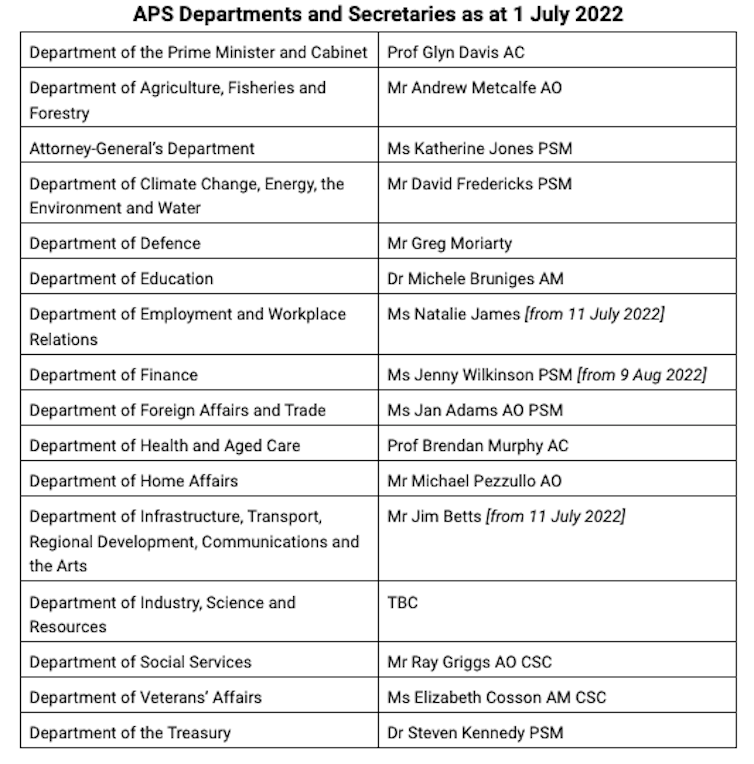
The secretary of the Department of Foreign Affairs and Trade, Kathryn Campbell, has been replaced in a shake-up of federal departmental heads announced by Prime Minister Anthony Albanese.
The new secretary will be Jan Adams, who is presently ambassador to Japan and has previously served as ambassador to China. She was Australia’s ambassador for climate change when the now foreign minister, Penny Wong, was climate change minister in the Rudd government.
In the changes the government has brought in two people from outside the federal service. Three of the four new secretaries are women. When Scott Morrison sacked five secretaries in 2019, three were women.
The removal of Campbell has been widely anticipated. Before the election Wong questioned her sharply at Senate estimates. Campbell has been DFAT secretary less than a year. Formerly she served as secretary of the departments of social services and human services, and was embroiled in the Robodebt disaster.
Albanese said Campbell would “be taking up a senior appointment in the Defence portfolio in an AUKUS-related role”.
In the changes, Jenny Wilkinson, a deputy secretary at Treasury, will become head of the Finance Department. She is a former head of the Parliamentary Budget Office. Wilkinson replaces Rosemary Huxtable, who had indicated for some time she intended to retire.
The new Department of Climate Change, Energy, the Environment and Water will be headed by David Fredericks, who shifts from his present position as secretary of the Department of Industry, Science and Resources.
Natalie James, a partner at Deloitte Australia, becomes secretary of the Department of Employment and Workplace Relations. She has had wide experience in public service and workplace relations, including being the Fair Work Ombudsman for the Commonwealth.
Jim Betts, who has worked in the NSW and Victorian public services, becomes secretary of the Department of Infrastructure, Transport, Regional Development, Communications and the Arts. He replaces Simon Atkinson, who was regarded by Labor as too close to the Coalition. Atkinson served as a ministerial adviser from 2013-16 and cabinet secretary from 2017-18.
In a farewell message to staff after the announcement Atkinson said: “It is critical that the secretary is the right fit to lead and provide advice and keep the department well connected to ministers.”
The appointment of Gordon de Brouwer as secretary for public sector reform, in a return to the public service, is further evidence of Albanese’s determination to re-invigorate the bureaucracy. De Brouwer will report to the minister for the public service, Katy Gallagher.
After the election Albanese appointed Glyn Davis as head of the Department of the Prime Minister and Cabinet. Part of Davis’s brief is to drive change in the service, which has been run down under the Coalition government.
Labor is committed to cutting the use of outside consultants, which reduced the role and capability of the public service. Both Davis and de Brouwer were members of the Thodey review of the service – the former government refused to take up many of its major recommendations that would have made the senior levels of the service more independent.
Albanese said a new secretary of the Industry Department would be announced soon.
Michelle Grattan does not work for, consult, own shares in or receive funding from any company or organisation that would benefit from this article, and has disclosed no relevant affiliations beyond their academic appointment.
A View from Afar – In this podcast, political scientist Paul Buchanan and Selwyn Manning will approach this episode in two parts.
First we will detail what to expect from the NATO leaders’ summit, which includes addresses from the prime ministers of Japan, Australia and New Zealand.
Why is NATO including addresses of NATO partners in this year’s leaders’ summit?
And secondly, are we beginning to see changes to the pre-pandemic globalisation framework? Are we witnessing a response to the breakdown of the global economic order?
If so, what does the emergence of near-shoring and friend-shoring mean for supply-chain issues, cost of living, and the global economy?
Join Paul and Selwyn for this LIVE recording of this podcast while they consider these big issues, and remember any comments you make while live can be included in this programme.
You can comment on this debate by clicking on one of these social media channels and interacting in the social media’s comment area. Here are the links:
Threat.Technology placed A View from Afar at 9th in its 20 Best Defence Security Podcasts of 2021 category. You can follow A View from Afar via our affiliate syndicators.
Today we make more clothing than ever before. And the driver for this is primarily economic, rather than human need. Over the past decade, the term “circular economy” has entered the fashion industry lexicon, wherein materials are made to be reused and recycled by design.
Yet we haven’t seen the same level of recycling in fashion as we have in other spaces – such as with plastic recycling, for instance. And this is mainly because clothing-to-clothing recycling is much more difficult.
The use of recycled polyester and cotton by brands such as H&M and Cotton On are key aspects of these companies’ sustainability initiatives – but the source of these recycled fibres usually isn’t clothing. Recycled polyester tends to come from plastic bottles, and recycled cotton is usually made from manufacturing waste.
The fact is most clothing is simply not designed to be recycled. Even when it is, the fashion industry lacks the kind of infrastructure needed to really embrace a circular economy model.
Why is recycling clothes difficult?
Recycling clothing isn’t like recycling paper, glass or metal. Clothes are endlessly variable and unpredictable. So they’re not ideal for recycling technologies, which require a steady and consistent source material.
Even a seemingly simple garment may contain multiple materials, with fibre blends such as cotton/polyester and cotton/elastane being common.
Despite seeming simple, clothes are complex products containing many components and materials. This means recycling them is very difficult. Shutterstock
Different fibres have different capacities for recycling. Natural fibres such as wool or cotton can be recycled mechanically. In this process the fabric is shredded and re-spun into yarn, from which new fabric can be woven or knitted.
However, the fibres become shorter through the shredding process, resulting in a lower quality yarn and cloth. Recycled cotton is often mixed with virgin cotton to ensure a better quality yarn.
Most fabrics are also dyed with chemicals, which can have implications for recycling. If the original fabric is a mixture of many colours, the new yarn or fabric will likely need bleaching to be dyed a new colour.
A complex garment such as a lined jacket easily contains more than five different materials, as well as trims including buttons and zippers. If the goal of recycling is to arrive at a material as close to the original as possible, all the garment’s components and fibres would first need to be separated.
This requires labour and can be expensive. It’s often easier to shred the garment and turn it into a low-quality product, such as shoddy which is used for insulation.
Even if a garment is designed to be recyclable, if the infrastructure needed is missing, it will likely still end up in landfill.
Companies such as BlockTexx and Evrnu have developed processes to recycle fibres from blended fabrics, though such recycled fibres aren’t yet widely available.
Through a proprietary technology, BlockTexx separates cellulose (present in both cotton and linen) and polyester from textile and clothing waste for new uses, including in new clothing. And Evrnu has developed a type of viscose made entirely from textile and clothing waste.
Spain-based company Recover meticulously sorts through different kinds of cotton textile waste to produce high quality, mechanically recycled, cotton fibre.
There’s also biological recycling. Fibre waste from the Rivcott cotton “gin” (or cotton engine) is composted to become fertiliser for a new cotton crop. The same is possible with natural fibres from worn-out clothing, after potentially toxic dyes and chemicals have been eliminated.
Synthetic fibres such as polyester and polyamide (nylon) can also be recycled mechanically and chemically. Chemical recycling through re-polymerisation (where the plastic fibre is melted) is an attractive option, since the quality of the original fibre can be maintained.
In theory it’s possible to use polyester clothing as the source for this. But in practice the source is usually bottles. This is because clothing is usually “contaminated” with other materials such as buttons and zippers, and separating these is too labour intensive.
The plastic problem
Almost all recycled polyester in clothing today comes from recycled plastic bottles, rather than previous polyester clothing. This is significant when you consider polyester accounts for more than 60% of all fibre use.
Given the rapid increase in the production of synthetic fibres, and the as-yet-unknown impact of microplastics (which were documented in human placentas last year) – the question remains whether clothing should be made from biologically incompatible materials at all.
Polyester clothes, regardless of fibre sources, contribute to microplastic pollution by shedding fibres when worn and laundered.
Although plastic bottles can be recycled into clothing, that clothing is very difficult to further recycle. Shutterstock
A new generation of synthetic fibres from renewable sources (recyclable and also biodegradable) offers a path forward. For instance, the Kintra fibre is made from corn.
Reduce and reuse before you recycle
There’s plenty of evidence that reducing the consumption of clothing by wearing items longer and buying second-hand is preferable to purchasing recycled fibre clothes.
But even second-hand fashion isn’t without problems when you consider the scale and pace of clothing production today.
Liz Ricketts of the US-based OR Foundation, a charity focused on sustainable fashion, paints a gruesome picture of the Kantamanto market in Ghana, where much of the world’s secondhand clothing ends up (including from Australia).
One path forward is for companies to take responsibility for products at their end of life. US fashion brand Eileen Fisher is a pioneer on this front.
The company has purchased garments back from customers since 2009. These are cleaned and sorted, and mostly resold under the Eileen Fisher Renew brand.
Garments too damaged for resale are given to a dedicated design team, which redesigns them to be sold under the Eileen Fisher Resewn collection. Off-cuts from this process are captured and turned into textiles for further use.
It’s commonly assumed Australia’s farmers and cities are divided over climate issues. This is not true. After all, farmers are on the front line and face the realities of our shifting climate on a daily basis.
In regional Australia, our research has found many farmers are already responding to climate change threats and finding ways to adapt.
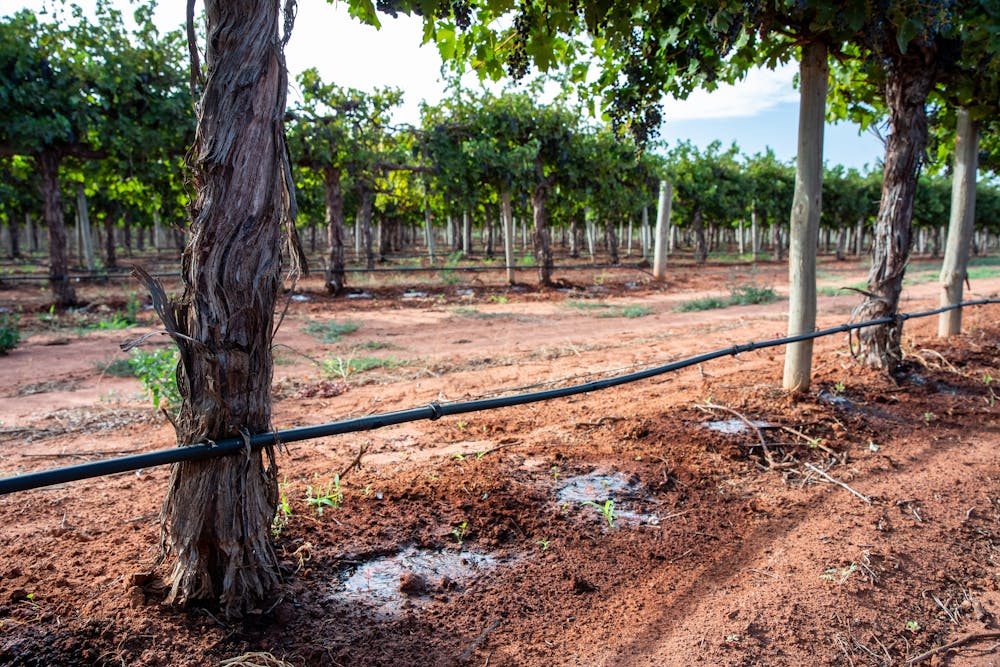
Wine grape growers are among those who are responding fastest. That’s because their crop is extremely sensitive to weather and climatic shifts. Growers have had to learn quickly how to adapt to safeguard their industry. Think pruning for better canopy management, growing cover crops to keep the ground cooler and promote soil health, and reducing how much water they use in irrigation.
Establishing a vineyard takes a long time – up to five years until the vines produce a full yield. Grape growers have to take a medium to long term perspective to farming, weighing up forecasts about climate change and market trends a decade or more in advance. Successful vignerons recognise the need to work together in a coordinated way to achieve positive outcomes. Maintaining local agency is crucial, and relinquishing this can open up new risks.
Australia’s broader farming community will have to draw on similar adaptations – preparing for less rainfall in some areas, or finding ways to capture the enormous but less frequent rain bursts predicted for other areas.
Vineyards have had to reduce water use. Shutterstock
Why have wine grape growers moved early?
Wine grape growers have had to act early because wine has enormous market differentiation based on variety. In turn, choice of varieties depends heavily on water and soil.
During the 1990s and 2000s, Australian wine exports boomed. The lion’s share of the cheap and cheerful Aussie wines bound for supermarket shelves around the world came from grapes from extensive irrigated vineyards throughout the Murray-Darling Basin, where grapes are grown relatively cheaply with lots of sunshine and lots of water. But the days of water abundance are no longer guaranteed.
Our research in South Australia’s Langhorne Creek wine region has found climate change is having most impact in respect to water.
Historically, this region has relied on groundwater or surface irrigation from seasonal floods along local watercourses. But as groundwater suffered from over-extraction, the aquifers became saltier.
In response, farmers sought to minimise reliance on groundwater. Some vineyards even installed desalination plants to make groundwater usable again. Community leaders spearheaded a push to cut their own allocations and seek supply from nearby Lake Alexandrina, which the Murray and other rivers empty into.
Then came the 2001–2009 Millennium Drought, which led to the shallow lake beginning to dry up through lack of inflow. The crisis of these drought years is seared into regional memory. Without a clear end in sight, many began to wonder if the region had a future.
The community backed a new private-public pipeline drawing directly from the Murray. When the new pipeline opened in 2009, it gave Langhorne Creek an important boost to water security. But it did so at the expense of tying its future directly to that of the Murray Darling Basin.
Now, farming in Langhorne Creek is at the mercy of everything that happens upstream. After two years of La Niña rains, there’s plenty of water in the system. For the time being, things are good – but farmers know better than most that good times don’t last.
In response to the broader shifts, many grape growers have increased plantings of southern Mediterranean varieties such as tempranillo or vermentino, better suited to hotter and drier conditions than traditional mainstays like shiraz and cabernet sauvignon grapes.
To date, Langhorne Creek offers an excellent example of how a strong community can act effectively in the face of environmental threat. As the region becomes integrated into the wider basin, there will be new challenges in navigating basin-wide management policies, a broadening bureaucratisation of decision making, and falling public trust in basin management.
While the technological fix of a new pipeline has helped grape growers overcome an immediate water supply issue, it does not defeat broader climate risk. What it does show is the need for forward thinking. The task for current and future farmers is to remain vigilant in confronting new climate risks, and responding through strong and coordinated local action and political cooperation.
Modern medical science has made remarkable progress in the treatment of asthma. Inhalers containing steroids are particularly effective in preventing an asthma attack. But getting people to take these preventive medicines long-term remains a challenge.
Because asthma is an ongoing condition, many people struggle to take their medication regularly, due to busy schedules or because the medication may not seem to work right away.
One potential solution lies in digital technologies that can reduce the risks associated with not taking medication as prescribed. These technologies include text message reminders, web-based apps, interactive voice response systems and smart inhalers.
The benefits could be considerable, given that asthma is one of the commonest health problems. It affects as many as 339 million people worldwide. New Zealand has one of the highest rates of asthma, with one in seven children and one in eight adults diagnosed.
Asthma attacks are also the commonest cause of days off school and work for people with the condition. In the UK it’s estimated someone has a potentially life-threatening asthma attack every ten seconds, with similar data in New Zealand. Asthma mortality is highest for Māori and Pacific peoples, with rates 4.3 and 3.2 times higher than for other groups.
While there are inhalers that work well on immediate symptoms, preventive medicines are key for long-term asthma control. These need be taken as prescribed, often once or twice a day. What’s known as “non-adherence” to such regimes is a major health problem and can lead to more symptoms and attacks.
Preventive treatments can be very effective, but sticking to a prescription is challenging for many. Getty Images
Medication adherence strategies
Achieving adherence is therefore very important to reduce the risk of death. With increasing investment in digital technologies designed to improve health, the research focus with asthma is on improving how existing medications are used and therefore improving outcomes.
Research in New Zealand has shown “smart” inhalers – devices that monitor when doses are taken and can provide reminders and feedback – improved medication adherence by 50% and improved control in children with asthma.
But we still don’t know whether digital technologies in general can improve the situation for all people with asthma and, even if they do, whether this will have a positive impact on asthma symptoms or attacks.
To learn more, we looked at all the randomised controlled trials of digital technologies and their impact on medication adherence in asthma. We found 40 studies around the world, with a collective sample base of more than 15,000 adults and children with asthma.
By pooling the data from all the separate trials, we were able to measure whether people who used digital technologies to improve their medication regime had better adherence – and fewer asthma symptoms and attacks – than those who did not.
How digital technologies can help
In a nutshell, digital technologies can work to improve asthma medication taking.
On average, 15% more people took their medication as prescribed when they had the technology, compared to those who did not (who took 45% of the prescribed amount of their medication).
This 15% increase can have significant impacts on people’s asthma management, as more regular medication use can reduce symptoms and cut the risk of attacks.
Looking at all the studies, people with access to the digital technology had fewer asthma symptoms and, on average, half the risk of asthma attacks compared with people who did not get the technology. These benefits could reduce the risk of asthma-related deaths.
We also found that people who had the technology had better quality of life and lung function, although the effect on lung function was small and may be of limited clinical importance.
Digital technologies can help, but they may not be for everyone and some may work better than others. Shutterstock
Everyday asthma care
For people with asthma who find it hard to take their medication regularly, digital technologies are likely to help improve their medication taking, which in turn can reduce asthma symptoms and attacks.
But we need more research into how these technologies can be integrated into routine asthma care. The available studies don’t tell us enough about the effects on time off work or school, the cost-to-benefit ratio, or whether there are any harmful outcomes.
Also, digital technologies may not work for everyone. While research shows users generally accept the technologies, people didn’t actually finish the full study in about 25% of the studies we examined.
Some technologies may also work better than others. We found smart inhalers and text message systems seemed better for improving medication taking than other technology types. But the small number of studies means we can’t be completely certain these technologies definitely work better.
Future tech potential
Digital technologies are constantly evolving and are likely to play an even bigger role in future asthma care. Devices like smart watches can monitor changes in a person’s physiology in real time.
These changes could be used to predict a change in a person’s risk of asthma attacks when put together with information from the environment such as changes in air temperature and humidity.
If proven to work, we could see a substantial change in how asthma is managed. Users might one day be able to monitor their asthma control status simply by looking at their phones.
Amy Chan has received asthma research funding from the Health Research Council, Asthma UK, and the University of Auckland. She is the Auckland Medical Research Foundation Senior Research Fellow. She has provided subject matter expertise to Active Healthcare Ltd, and is a Board member of Asthma NZ.
Senators Elizabeth Warren and Patty Murray responding to news that the Supreme Court is poised to overturn the Roe v. Wade decision. J. Scott Applewhite/AP
In the landmark 1973 decision of Roe v Wade, the US Supreme Court held that the right to privacy provided by the 14th amendment to the US Constitution protects a woman’s right to choose to have an abortion. Last month, a leaked draft of Dobbs v Jackson Women’s Health Organization revealed that a majority of the Supreme Court is poised to overturn that decision.
How did it come to this? In part, it’s a result of the extreme politicisation of the US judiciary, with judges routinely appointed based on their political views. Many people voted for former US President Donald Trump because he promised to appoint conservative judges. Many others voted for President Joe Biden because he promised to appoint judges that would protect Roe and other progressive laws.
Especially prominent in leading the charge against Roe v Wade and the politicisation of the US courts has been the Federalist Society, a libertarian-conservative legal movement. Founded in 1982, the society has played a major role in “deliberately, diligently shifting the country’s judiciary to the right”. As well as training and socialising conservative law students, lawyers and professors, the society helps appoint young conservatives to prominent positions in government and on the courts.
The society’s success has been startling. Drawing on an expansive understanding of free speech, it has been influential in weakening laws that limit how much can be spent on elections (the 2020 US election cost more than $14 billion). It has made gun control more difficult, almost led to the overthrow of Barack Obama’s signature healthcare law, and helped gut voting rights protections. Six of the nine judges on the US Supreme Court are current or former members of the Federalist Society.
Fortunately, political views are not relevant for appointment to the judiciary in Australia. But we must be vigilant: some politicians are publicly agitating for the creation of a similar legal movement here.
In 2020, a majority of the High Court of Australia held that Aboriginal Australians are not “aliens” under the Constitution – even if they were not born in Australia and are not citizens. In the Love; Thoms case, the Court explained that Aboriginal and Torres Strait Islander peoples’ longstanding and deep connection to Country means they cannot be considered as not belonging to the Australian community – even if they don’t hold citizenship.
In reaching this decision, the court extended the land-ownership principles of the famous Mabo case to determine who is a member of an Aboriginal group.
Given that few Aboriginal Australians are non-citizens facing deportation, the decision has limited practical consequences. But it infuriated many conservatives in and outside government. Peter Dutton claimed the decision was a stunning example of judicial activism, while IPA research fellow Morgan Begg called it the “most radical judgment in Australian history”. Former LNP senator John Stone even exclaimed that parliament should impeach the four judges in the majority.
Former Senator Amanda Stoker was the most forthright. In a paper presented to the conservative Samuel Griffith Society, the assistant minister to the attorney-general (as she then was) praised the work of the US Federalist Society. Drawing on their example, Stoker argued High Court judges should be selected on the basis of ideology with the aim of overturning Love; Thoms in the same way that Republican politicians have stacked the US Supreme court hoping for an overturning of the decision in Roe v Wade.
Stoker may have lost her Senate spot, but she might succeed in this endeavour. In 2020 and 2021, two justices of the High Court who found in favour of Daniel Love and Brendan Thoms retired, and were duly replaced by Morrison government appointees. Several months later, the federal government petitioned the High Court to overturn Love; Thoms. If the government is successful, some descendants of Australia’s First Nations peoples could be declared “aliens” in the country their people have occupied for more than 60,000 years.
It is not only our highest court that has seen political interference. Although the US Supreme Court receives the most attention, the Federalist Society has been successful at securing conservative judges at all levels of America’s court hierarchy. Similar moves to stack the Administrative Appeals Tribunal (AAT) in Australia have been exposed by a recent Senate inquiry.
The AAT reviews government decisions. Members must be – and be seen to be – independent. However, over the past few years, concerns have been raised about the appointment process. In March this year, the Senate Legal and Constitutional Affairs Committee found that the process of selecting AAT members had been inappropriately influenced by personal connections and political affiliations. Up to 40% of those appointed in the last three years by the Morrison government had political backgrounds. The committee recommended the current AAT be disbanded and a new system established as a matter of urgency.
The Albanese government should adopt this recommendation. It should also make sure that appointments to all Australian courts and tribunals are made without reference to political ideology. The last thing we need is to follow the US example.
Harry Hobbs is a member of the ALP.
George Newhouse is a member of the ALP, a director of the National Justice Project and a Company Secretary and member of the McKell Foundation.
Netball Australia CEO Kelly Ryan said last week she would consider accepting gambling sponsorship to help with Netball Australia’s debts.
Gambling sponsorships were “lucrative” for sports, she reasoned, adding netball had to “put itself a little bit more outside its comfort zone” in terms of financial partnerships.
While betting firms sponsor large female sporting codes in the United States, this is the first time a high profile women’s sport in Australia has publicly discussed accepting gambling sponsorship.
A social media backlash followed. Parents and fans expressed fears about the impact of exposure to commercial marketing for gambling via a code largely marketed to young girls.
While such partnerships may be financially lucrative for sporting codes, there are also hidden costs.
Gambling is an addictive product with a range of significant health and social costs for individuals, their families and communities. This includes children – with extensive research showing how gambling advertising in sport normalises gambling for young people.
As gambling brands attempt to market products to a relatively limited market, children are caught in the middle.
Thanks to a range of sophisticated and innovative marketing strategies – including the use of celebrity endorsements – children can name multiple gambling brands, and perceive gambling as a normal activity for sports fans. Some believe the deals provided by gambling companies, including free bets and money back offers, mean gambling has little risk attached to it.
Concern is mounting about the impact of gambling marketing in sport on young people. A joint commission report by The Lancet, WHO and UNICEF recently highlighted gambling as a commercial harm that threatens child health and well-being, calling it an “unaddressed public health challenge for children”.
No one likes gambling ads
Surveys show gambling advertising in sport is unpopular and worrying for sporting fans.
Even sporting leaders recognise its deeply problematic impact on young people. This week, a survey by The Age newspaper of AFL club bosses reported 11 out of 16 chief executives or chairs felt gambling advertising in sport was excessive. One said the AFL had “prostituted themselves” to the gambling companies.
Now it’s girls’ and women’s turn
So why are female sporting codes now following the well-trodden and heavily criticised path of male sporting codes – turning to an industry that poses an unnecessary risk to the health and well-being of fans?
To date, evidence about gambling marketing in sport has largely centred on the impact on boys and young men. But this does not mean girls and young women are immune to its impacts.
Gambling companies are increasingly targeting women to expand their customer base and profits. They have begun sponsoring television programs such as Married at First Sight, that are popular with a female audience.
They even offer information about how to bet on your pregnancy – including predictions of birth date, weight and “gender reveals”.
Gambling companies are taking steps to ‘feminise’ the idea of gambling. Shutterstock
Following the tobacco and alcohol playbook
The feminisation of gambling marketing and products should not be a surprise for policymakers, given the historical playbook of the tobacco and alcohol industries.
These industries spent millions of dollars aligning their products with the values and social practices of women – including sponsoring women’s sporting events – to appeal to new markets, and to legitimise the use of these products for women.
Our research shows gambling – including on sport – is becoming increasingly normalised and socially accepted for young women.
Women we interviewed felt gambling was commonly portrayed as a form of entertainment. Women also said they had signed up to betting accounts after seeing marketing for gambling companies, and that online companies had largely eliminated the stigma associated with going to a male-dominated betting venue.
Public health action from governments on this issue has been almost non-existent.
Public education is still largely based on the idea of personal responsibility, which can reinforce the normalisation of gambling by portraying gambling as a common leisure activity that can be kept in control with informed choices. Campaigns generally focus on young men and betting, and often portray women in stereotypical roles such as disgruntled girlfriends.
An audit of public education programs about gambling harms found they couldn’t match the scale or intensity of sports betting companies’ marketing.
Gambling education campaigns often focus on men’s experience and some use hopelessly outdated gender roles.
Sporting codes have repeatedly demonstrated they are unable to make decisions about gambling partnerships in the best interests of young people. Regulations should be implemented to prevent young people from being exposed to gambling marketing.
Our recent research with young people shows they agree with this view. They support comprehensive curbs on gambling marketing, including an untangling of the relationship between gambling and sport and protection from harm.
In the words of one 14-year-old female sports fan:
I’m a bit disappointed and sad that gambling is such a big part of sport now. I would say that, like, just do it because, watch it and do it because you love (sport) and don’t try to bring gambling into it. It doesn’t have to be about that, it doesn’t have to be about money.
Samantha Thomas has received funding for gambling research from the Australian Research Council Discovery Grant Scheme, the Victorian Responsible Gambling Foundation, and the New South Wales Office of Responsible Gambling. She has received travel expenses for gambling speaking engagements from the European Union, Beat the Odds Wales, the Office of Gaming and Racing ACT, and the Royal College of Psychiatry Wales. She is a member of the Responsible Gambling Advisory Board for LotteryWest, and is a member of the board of the International Confederation of ATOD Research Associations (ICARA). She does not receive any financial compensation for these roles.
Hannah Pitt has received funding from the Australian Research Council Discovery Grant Scheme, the Victorian Responsible Gambling Foundation, the New South Wales Office of Responsible Gambling, VicHealth, and Deakin University.
Simone McCarthy has been employed on research projects that are funded by the Australian Research Council and the Victorian Responsible Gambling Foundation.
An extensive ABC investigation has revealed confronting stories about children being sexually abused in state care, and other failings of Australia’s child protection systems.
This might all seem tragically familiar. We’ve seen dozens of inquiries, reports and reform efforts in child protection in Australia over the past three decades, yet terrible things still happen to children known to child protection agencies.
How does this keep happening?
I have studied systems and how they function for a long time. My focus is on how we can use “systems thinking” to understand the repeating patterns seen in our efforts to improve mental health and child protection systems – and how we can break these patterns.
So often we try to “fix” problems with a care system by targeting only one small part of it. Or we try to change many parts at once, without a coherent approach based on how systems work, how they maintain stability and how they change. A systems thinking approach looks holistically at problems to identify, in this case, how and why children end up in state care and what could have been done at much earlier stages to prevent that.
After so many inquiries and reform efforts, maybe we should start using real systems ideas to try to achieve lasting change.
Looking at child protection through a systems lens
If we look at child protection through a systems lens, we first see there are many layers to consider.
Harm through child abuse and neglect is often misrepresented as solely a problem of individual parents’ behaviour – but it’s much more complicated than that.
The huge overrepresentation of Indigenous children and families in our child protection systems is stark evidence of this.
If we really want to understand this area, we need to consider the disadvantage and trauma experienced by many families (often across generations). Many areas of government policy have a part to play.
For instance, we need welfare policies that support disadvantaged parents financially to reduce the risk of neglect (a common reason given for child removal). Neglect is a complex problem, often inextricably linked with poverty.
We also need education and training policies that help disadvantaged parents get and retain work. We need health policies that ensure disadvantaged parents and children can easily see doctors – including specialists – and access allied and mental health support where needed.
Shoring up the front lines
Second, we can see the front line workers of our child protection agencies are crucial. Any reform effort needs to start there.
The work child protection workers do is vastly complex, challenging and vital. It’s among society’s most important jobs; it requires expertise and sustained resources.
Yet staff turnover remains very high. Many newly graduated and inexperienced staff populate the front lines, working with high stress and limited support.
Reducing attrition rates requires workers to be well trained and well paid, operating under positive working conditions where excellence is rewarded.
The primary resource of our child protection agencies is these workers’ ability to communicate, to form good relationships, to appraise risk and to make complex decisions.
Every time we lose a good worker, we lose their experience – and what might have become their expertise if we had better supported them. Then someone new comes in, to face the same huge challenges.
We probably wouldn’t be as accepting of these human resource problems if it was our health system.
We have accumulated decades of evidence about what helps foster healthy development for our children; healthy attachment to adult carers who are themselves healthy, well-resourced, and socially connected is key. Shutterstock
A high degree of ‘otherness’ in child protection
Many think what happens in this area is not directly relevant to their lives. It happens to other kinds of people.
But we are talking about children, and, often, struggling and unsupported parents. There’s a lot of blame in child protection, especially when it hits the news. Society blames parents, and the workers who have “failed” to prevent harm to children or to protect them.
This raises the question of whether a “protection” ethos is the right one.
Decades of evidence about what helps foster healthy development for children shows healthy attachment to adult carers – who are themselves healthy, well-resourced and socially connected – is key.
That’s why we need a front line approach that supports families (not just mothers; there is a disproportionate focus on women in child protection).
Instead, we often revert to a reactive, “child rescue” focus, when evidence suggests having the right support and care would allow many families to care safely for their children and avoid removal altogether.
A reactive ethos, enacted by overburdened workers, sees too many children removed from birth families, in some cases spending their childhood in numerous foster placements or residential care facilities.
Politics plays a role
Finally, a systems view reveals politics plays a role. A scandal is followed by promises to make things better, always within a usually unacknowledged political context.
Just a few hours after the latest ABC story broke, the federal attorney-general said he was “deeply concerned” by these horrific findings.
We shall wait and see what the latest government’s response will be.
The ABC story raises the suggestion of a royal commission. We are getting used to those in Australia. Royal commission or not, if we want to really change a “system”, we need a true systems approach.
That requires beginning with what we know about the conditions required for healthy child development, and “building” the system backwards from there.
Real change may take decades, given the generational patterns at work. And there will likely always be a need for some children to not live with their birth families.
But how much evidence do we need that our present approach isn’t working?
This story is part of The Conversation’s Breaking the Cycle series, which is about escaping cycles of disadvantage. It is supported by a philanthropic grant from the Paul Ramsay Foundation.
As the Papua New Guinea elections approach next month there are increasing worries about the spreading of false information.
The poll begins on July 2 and is set to conclude three weeks later on July 22.
RNZ Pacific’s PNG correspondent Scott Waide said that while misinformation during elections was not new, it appeared to be more coordinated and managed during this election.
Waide runs classes on identifying misinformation and malinformation — which is information that is correct but is used to inflict harm.
He said one item that appeared on social media, and which he has used in his classes, was a false claim that the incumbent in the Bougainville regional seat, Peter Tsiamalili, had been shot dead.
He said even past information is being used to deceive.
“Another instance is of an [alleged] photo of candidates Sylvia Pascoe and Gary Juffa, a very intimate photograph of them — they had a relationship before,” he said.
“So, this photo is coming out on the eve of polling, being spread by people with intentions to destroy their integrity and their chances of political office.”
Police investigating discovery of uniforms Meanwhile, the police are investigating the discovery of police and PNG defence uniforms on a chartered flight to Hela Province.
Police Commissioner David Manning said security forces intercepted and confiscated the uniforms on the flight from Port Moresby to Komo Airport in Hela.
Manning said a pistol found on a person who was meeting the flight had been confiscated.
He said police were trying to uncover who chartered the aircraft and what role the ground staff at the airport played.
Last week, a Highlands police commander issued instructions to the public to look out for people masquerading as police officers during the general elections.
This article is republished under a community partnership agreement with RNZ.
Source: Council on Hemispheric Affairs – Analysis-Reportage
By Danny Shaw New York
On August 7th a new left of center government will take power in Colombia. Many questions remain to be answered but one thing is clear: this historic election marks a break with a long Colombian history of State violence and monolithic conservatism.
On June 19, Gustavo Petro beat his rival, the businessman Rodolfo Hernández, by a margin of 50.44%to47.03%, after 100% of the country’s polling stations reported their results.[1] Both his opponent and current president Iván Duque recognized the results, congratulating Petro.[2]
Despite an information war and decades of violence against the left, over 11 million Colombians successfully mobilized and voted for the historic change.[3] La Unión Patriótica (UP) was one leftist political party that suffered from this political genocide. Over 5,000 UP leaders were assassinated, including Bernardo Jaramillo, the UP presidential candidate in 1990, along with 21 lawmakers, 70 local councilors and 11 mayors. It is this reality of state and paramilitary violence that has long earned Colombia the infamous designation as the most dangerous place on earth for union leaders and journalists. Human Rights Watch and the Institute for Development and Peace Studies (Indepaz) have documented the hundreds of assassinations and dozens of massacres that occur in Colombia every year.
Petro is the seventh former leftist guerilla fighter to become president in a Latin American nation, joining Daniel Ortega from Nicaragua, Dilma Rousseff from Brazil, José Mujica from Uruguay, Salvador Sánchez Cerén from El Salvador, and Fidel and Raúl Castro, from Cuba. However, unlike the others from the list, Petro doesn’t belong to the Bolivarian momentum sweeping across the continent. This outcome of former guerrilla leaders, including Petro, serving their countries as presidents, as well as the recent elections of progressive presidents in Bolivia, Honduras, Mexico, and Argentina, shows clearly the weakness of the neoliberal model that is, so far, incapable of solving the poverty, corruption, hierarchies of domination, and chronic inequality that affects most of the Latin American continent. By electing Petro, the Colombian people are sending a strong message of frustration with a failed model that has brought organized crime, social disparities, chronic violence, a 40% poverty rate and militarization of the public sphere to the lives of millions of citizens.
Leaders of the Continent Congratulate Petro and Márquez
Upon hearing the results of the election, Mexican president Andrés Manuel López Obrador summarized the long history of violence against the popular sectors of Colombia and concluded: “Today’s triumph can be the end of this tragedy and the horizon for this fraternal and dignified people.”[4] Former president of Brazil, Luis Lula Ignacio da Silva, declared the importance of this victory for South American and third world integration.[5] Venezuelan president, Nicolás Maduro, congratulated Petro stating that “new times can now be envisioned.”[6] COHA Senior Fellow, AlinaDuarte, who has been on the ground in Cali covering the elections, wrote “It is impossible not to feel emotion with the victory of the Colombian people. So many years of war, dispossession and death. Today, a Black woman from Cauca, who was a domestic worker, single mother and defender of the land stands strong against oligarchy. What a beautiful day!”[7]
Francia Márquez became the first woman and first Afro-Colombian elected as vice-president (credit photo: Iván Castaneira)
In her acceptance speech FranciaMárquez pronounced: “After 214 years we achieved a government of the people, a popular government, of those who have calloused hands, the people who have to walk everywhere, the nobodies of Colombia. We are going to seek reconciliation for this country. We are for dignity and social justice.”[8]
Petro’s speech followed.[9] With the crowd chanting “libertad,” the president elect called for amnesty for political prisoners, enviromental justice and an end to impunity for State actors responsible for the murder of activists. He continued affirming: “It is time to dialogue with the U.S. government to find other ways of understanding one another…without excluding anybody in the Americas.” He concluded by promising to build “a global example of a government of life, of peace, of social justice and environmental justice.”
Which Way Forward?
The transition in Colombia, long a U.S. ally in the region, raises major questions about which we can only speculate right now.
How will the new people’s government orient towards the nine U.S. military bases in Colombia?[10] And how will the new administration, committed to overcoming corruption, confront the reality that Colombia still is the major planetary producer of cocaine, and the main source of the illegal drug in the U.S.?
There are also profound political and economic issues that will be decided in the coming days. Like Gabriel Boric in Chile, Pedro Castillo in Peru and Xiomara Castro in Honduras, Petro and Márquez will now have to balance a left or left of center ideology with the reality of a strong, embedded oligarchy that will fiercely resist all but certain anemic social-democratic reforms.[11]
The new administration will also have to define itself in relation to the Bolivarian cause of regional integration, multipolarity, and sovereignty. Boric has gone out of his way to condemn the Bolivarian camp, and on the largest global stage, at the exclusionary Summit of the Americas. López Obrador and Argentine president Alberto Fernández have been outspoken about building more links with Venezuela and denouncing U.S. unilateral sanctions. Petro seems to be leaning more in the direction of continental unity and a moderate approach to the current wave of progressive administrations, not declaring the U.S. as an enemy but instead trying to change the focus of the relationship to other more innocuous arenas like the environment. Washington seeks to retain its strong influence on Colombia, considering the warm words of congratulations expressed by its Secretary of State, Antony Blinken. Petro’s plan is to limit the oil projects in the country and move to more sustainable resources. However, this will be a main concern for U.S. energy interests, for sure. And it is to be seen how Petro will face the pressure to accommodate the multimillion dollar U.S. private and public security apparatus, including agencies like the DEA, that operate throughout Colombian territory.
Afro-Colombians and Indigenous Peoples are Now Visible
At the same time, the movement to which Márquez is accountable voted for Petro because of his commitment to the environment and the historic struggles of Afro-descendant and Indigenous peoples.[12] There is no doubt that Márquez inspired thousands of Colombians from all oppressed sectors of the country, as well as new young voters, women, and intellectuals who felt moved by this former “housekeeper.” She is the first Black and the first woman ever elected as vice president. But now, the question of the expectations created arises. If the grassroots sees too many compromises with the oligarchy will there be a revolt from within?
Petro and the Troika of Resistance
How will Petro relate to Venezuela, Cuba, Nicaragua and Bolivia? During the campaign, he distanced himself from the Bolivarian camp because in Colombia the vast majority of people have been taught by a constant barrage of state propaganda that Venezuela, Nicaragua and Cuba are “failed states” and “dictatorships.” In the immediate aftermath of the election, there is great interest in Washington as well as Caracas on Petro’s posture towards Venezuela. In a recent interview, Petro artfully stopped short of all out support for the movement for a definitive second Latin American emancipation[13] but recognized Maduro as President, anticipating enhanced economic links and “civilized bridges” with Venezuela.[14]
On the other hand, it is likely that the U.S. establishment and State Department have not pushed back on the outcome of the election precisely because of compromises made by the Petro-Márquez campaign. COHA Senior Analyst, William Camacaro, cautions that “the worst that can occur is to see a coalition of supposedly leftist governments–Chile, Peru and Colombia–joining Washington’s narrative against the Bolivarian revolution.”
Ending Impunity
Another major question was raised during the acceptance speeches. Just in the first six months of 2022, 86 social leaders have been murdered by State and paramilitary forces.[15] Last Sunday June 19, shoulder to shoulder with the president and vice-president elect, one of the mothers of the missing students and protestors asked if there will finally be justice for their sons and daughters who have been disappeared.[16] Petro’s ability to put an end to these murders and hold perpetrators accountable will be a major test of his leadership.
The Petro–Márquez victory was clearly a cause for celebration in the streets of Colombia and in the diaspora.[17] But when the fireworks and parties are over the class tensions in Colombia will still abound. The June 19th victory is a moment pregnant with hope for the most vulnerable sectors who have long fought the political and economic domination of the oligarchs and their foreign backers. But given the long history of oligarchic rule and political capture of significant parts of the State apparatus by organized crime this is also a historical moment wrought with challenges.[18]
Danny Shaw is Senior Research Fellow at COHA and an academic at City University of New York.
Frederick Mills, COHA’s Deputy Director, and Patricio Zamorano, COHA’s Director, collaborated as co-editors of this essay.
[13] The second emancipation refers to the struggle of emancipation from the domination of Latin America by the United States and overcoming the multiple hierarchies of domination that have been imposed over five centuries by colonization, dependency, and most recently the neoliberal regime. This process of liberation involves constructing forms of democracy with popular participation as well as representative governments that prioritize human life in harmony with the biosphere and are held accountable to constituents.The first emancipation refers to independence from Spain and Portugal.
[14] “Gustavo Petro ganó: ¿Restablecerá relaciones con el Gobierno de Maduro en Venezuela?”, https://www.wradio.com.co/2022/06/17/si-gana-gustavo-petro-restableceria-relaciones-con-el-gobierno-maduro-en-venezuela/
[15] “Asciende a 86 cifra de líderes colombianos asesinados en 2022”, https://www.telesurtv.net/news/colombia-aumento-lideres-asesinados-colombia-20220610-0023.html
The streaming wars are heating up. In March, Disney delayed the release date of Obi-Wan Kenobi to May 27 to coincide with the launch of Netflix’s top show, Stranger Things. This on the back of Google’s announcement YouTube Shorts had matched TikTok’s 1.5 billion subscribers in the short-form video market.
Facing increased competition, falling subscriber numbers and loss of content, Netflix and TikTok are having to diversify. And for this they’re turning to games. With more than three billion players worldwide, and an estimated market share of US$200 billion, the gaming industry is both popular and lucrative.
Netflix introduced mobile gaming last year for all its subscribers. This included two notable Stranger Things tie-ins. Meanwhile, TikTok has offered games to select users since 2019 and seems very likely to expand these offerings.
Retaining existing subscribers
Both Netflix and TikTok have transformed the entertainment business.
They appear diametrically opposed on the surface. The former gets revenue from subscriptions, and spends millions of dollars on licensing or creating content. The latter makes money by linking viewers to advertisers, with the help of streaming “influencers” who have mastered the art of short-form video.
With the rise of Youtube Shorts, TikTok is facing increased competition. Shutterstock
However, the two platforms share some key characteristics. They both:
deliver video content via the internet
aim to constantly grow their user base
benefit from unique and original content
collect user data and use it to improve their services, and
face considerable and rising competition from other companies and entertainment media.
Many well-loved films and television series are departing Netflix for competitor platforms. At the same time, TikTok is also losing short-form video influencers to other platforms. Both platforms are seeking new strategies for subscriber retention, growth, and original content.
This is where gaming comes in. According to one consumer insights report, 79% of the world’s online population engages with games in some form. And millennials rate gaming as either the most popular, or second-most popular entertainment activity – behind watching other people play games on video platforms.
Why is gaming an attractive space?
Games typically afford longer engagement periods than series or movies. This is due to the psychological principles of motivation that underpin most gameplay.
People invested in games will often seek out additional narrative (or “lore”) in the form of shows and movies. Alternatively, audiences invested in shows may also look to video games to provide alternative narratives and opportunities for world-building. So shows lead customers to games, and games keep them engaged between season releases.
This technique of telling a story across multiple platforms and formats is known as “transmedia storytelling” and has been used with great success by broadcast, social media and gaming companies. This is what platforms are banking on to keep audiences locked into their entertainment ecosystems.
Content creation has boomed since the pandemic, and younger audiences are spending more time than ever watching user-generated content online. They have been particularly tuned into games such as Crab Game (a fan-made version of the popular Netflix show Squid Game) – which also has millions of view hours on the streaming service Twitch.
The rise of Minecraft as a popular “modding” game (in which players can collectively transform the game space through their own modifications) has also helped video streaming and subscription services. Minecraft-related videos have been streamed more than one trillion times on YouTube.
Transmedia success provides additional avenues for companies looking to leverage their licensed or original copyrighted content.
Minecraft videos have been viewed more than one trillion times on YouTube. YouTube
Intellectual property and data analytics
We know games promote attention, motivation, emotion and socialising among players.
Companies such as the game-hosting platform Steam have demonstrated user data can influence the creation of new content by game developers. In fact, this is a market advantage that Netflix and TikTok have over rivals.
For example, one could easily imagine that a character who is popular in a game, as revealed through gaming data, would also be more likely to feature in an upcoming show based on that game.
Gameplay stats can be used by companies to help design future producers, with a focus on what users engage with most. STEAM
Netflix and TikTok can lose big
When we speak of the streaming wars and greater competition, it’s not a level playing field. There are crucial differences between Netflix and TikTok, and other players such as Disney+, Amazon Prime, Apple TV and YouTube.
Netflix is in the streaming business, and TikTok in the video-hosting industry. On the other hand, based on revenue Disney is in the theme park and toy business, Amazon the online sales industry, Apple the computing and phone industry, and Google in the search and advertising industry.
For these companies, streaming and video hosting is a small side business that provides useful data to feed a greater machine. So in the “streaming wars” they don’t have as much to lose, as they can run these side businesses at a loss.
Netflix and TikTok aren’t so lucky. By turning to games, they’re grabbing onto a lifeline they really need.
Netflix’s list of competitors is growing, and there’s now a variety of streaming services including HBO, Amazon Prime Video and Hulu. Shutterstock
The authors do not work for, consult, own shares in or receive funding from any company or organisation that would benefit from this article, and have disclosed no relevant affiliations beyond their academic appointment.
Anthony Albanese, as depicted by cartoonist David Pope.Canberra Times
There are three, not entirely compatible, things to say about how cartoonists are coping with the recent change of government in Canberra.
First, there is the usual mild distress at having lost a pet set of ministers who seem to get uglier and more recognisable with age. Cartoonists can be like chooks returning to an empty feeder: the cartoonists’ Robert Menzies “stayed on” long after his retirement in 1966; so too did Gough Whitlam and Malcolm Fraser well into the 1980s, and Bob Hawke and Paul Keating into the later ’90s.
Bill Leak’s classic whinge in The Australian in late 2007 sums up the problem. Every cartoonist, he said, had the right to feel
extremely disappointed, depressed or even downright angry at what Rudd and his cohorts have given us to work with […].
The cause of his disappointment? “Handsome men and attractive women make life hell for cartoonists, and the Rudd ministry is chock-a-block with them.”
Although time works grotesque wonders, that’s usually how a ministry looks when it steps out of the shadows. Add to that the debilitating instinct to give the not-yet-guilty party the benefit of the doubt.
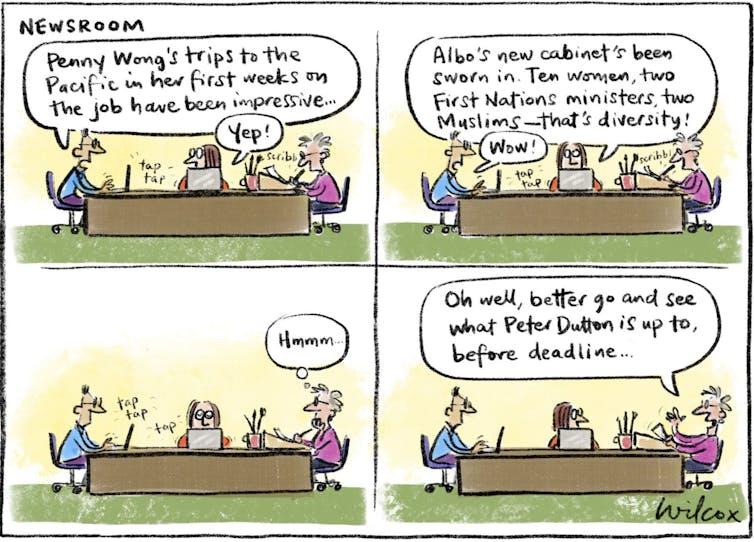
Cathy Wilcox, for one, suspended judgement of the new government for a honeymoon moment, and instead turned her ire on the broader media, which seem utterly at a loss without the Coalition:
Honeymoon for politicians: Cathy Wilcox in the Nine papers.
Interestingly, Bill Leak singled out one new minister with potential in 2007: >Anthony Albanese, whose open mouth looks like a cemetery after an earthquake, should prove valuable as long as he continues to resist calls to visit a dentist.
Perhaps “Albo” took notes: for many of the long, last months of the Gillard and second Rudd ministries, he was afflicted with braces.
The Albanese transformation was completed by his carb-free, grog-reduced 2021, resulting in the almost photoshopped presentability depicted in David Pope’s cartoon at the top of this article.
The grotesques are still those from the previous cast of characters — “ScoMo the Clown” and Kooyong Josh, with their pork barrels, swept away by the teal wave.
That’s because where there is real satirical ordure, it attaches largely to the mess left by the departing government, as demonstrated in this typically grotesque image by David Rowe.
The second thing to say is that temporary immunity for a new leadership team is disappearing very rapidly among cartoonists at the News Corp papers, where Johannes Leak, Mark Knight and Warren Brown had already warmed-up with a few anti-Albanese visual tropes. Leak was probably the first to nail down a really first-class negative “Albo” caricature, while the far more ligne claire style of Knight and Brown has struggled with the subtleties of the “new new” Labor PM.
Our study of election campaign cartoons suggests that, even in the most pro-Coalition newspapers, the gathering chaos in the Morrison-led campaign prompted some harsh cartooning.
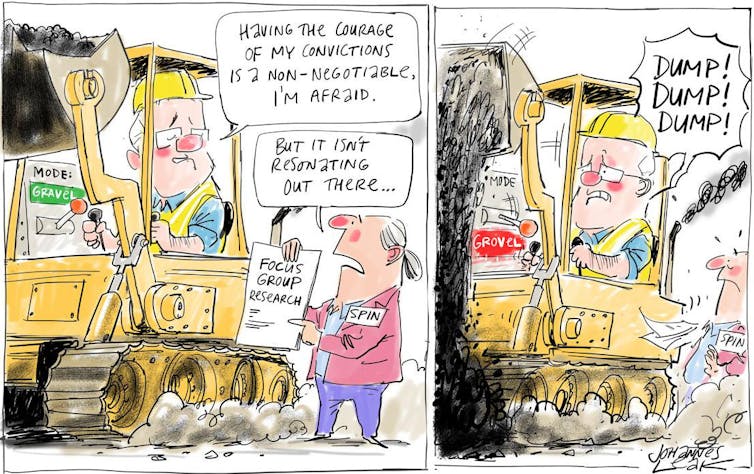
Brown was unimpressed by a Liberal leader who had come to self-identify as a bulldozer. Leak regularly deployed his pink-shirted, pony-tailed “spin doctor” to pillory the all-image-and-no-substance Morrison mob, just as he did to smirk at how much better Labor did in the polls when Albanese was in isolation with COVID.
Image problem: Johannes Leak in the Australian. News Corp
So, after the easy bit of making his debut on the international stage, Albanese had better get used to seeing himself in the papers looking like this:
Back to the future: Warren Brown’s depiction of a scruffy Anthony Albanese. News Corp
As he and his government take wear and tear, he will be joined by the more prominent ministers – even debonair ones like Penny Wong and Jim Chalmers.
Meanwhile, the third thing to say about post-election cartooning is a sad sign of the sectarian times. There is now very little dissonance between the cartoonists and the editorial line of their newspapers. Perhaps it lingers only at The Age – where Michael Leunig’s much-reduced role has made space for new talents and new ideas to shine – and via the genius of David Rowe at the Australian Financial Review.
There used to be more of this, particularly when cartoonists were often broadly to the left of the corporate lines their newspapers tread. But we do not mean this as a simple left-wing complaint. Guardian readers are no more likely to have their convictions challenged by First Dog on the Moon than are Australian readers by Spooner or Leak.
We are far from suggesting cartoonists are bending to editorial direction. That simply doesn’t happen, because it is well recognised among editors that cartoonists have to be free to be funny.
But the editorial cultures of newsrooms – assailed as they are by a fraying business model derived from the print age – seem to be getting tighter and narrower. They appear to be drawing cartoonists into line, either by selecting cartoonists who fit the polemical bent of the paper or by projecting a sort of team spirit in precarious financial times.
Either way, readers seem less likely to be surprised by the box of graphic mayhem in the paper than to get a blast of confirmation bias. We can be confident that cartoonists are devious enough jesters to overcome this situation if alerted to it. Not least because they are just as much forward-looking and -thinking as they are conscious of the past.
Our thanks to Lucien Leon, who collaborated with us on this article.
Source: The Conversation (Au and NZ) – By Evangeline Mantzioris, Program Director of Nutrition and Food Sciences, Accredited Practising Dietitian, University of South Australia
Shutterstock
Most of you will have noticed hosting a dinner party is harder than it used to be. One friend is gluten-free, another is dairy-free, one can’t eat onion and two more are vegetarian. Are food intolerances increasing? Or do we just hear more about them now?
What are food intolerances?
Food intolerances are reactions to eating foods, in normal quantities, that do not involve the immune system.
They are very different to food allergies which is when the body mounts an immune response to a food that is either ingested or even touches the skin. This immune response is very quick (within 20 minutes to two hours) and releases chemicals that can affect the person’s breathing, gastrointestinal tract and heart.
Common food allergies include eggs, peanuts, wheat and shellfish. Allergies differ from intolerances in that the most severe allergies cause anaphylaxis: severe allergic reactions that are life-threatening.
The mechanisms behind food intolerances can vary greatly. One common mechanism is when people lack enzymes that are needed for breaking down nutrients.
In one of the most common food intolerances, lactose intolerance, people lack the enzyme “lactase” which is used to break down this carbohydrate naturally found in milk and some other dairy products. Lactose is broken down into glucose and galactose in the small intestine, and then absorbed.
Without lactase, lactose stays in the intestine, where it draws water in from the blood supply to dilute the amount of lactose. Initially this leads to diarrhoea, and then as the lactose enters the large intestine it is fermented by the bacteria in our gut, which results in gas causing abdominal bloating, pain and discomfort.
Other food intolerances due to the lack of enzymes include intolerances to histamine and caffeine. Some people are unable to break down histamine, which is found in red wine, strong and blue cheeses, tuna, tomatoes and pork products.
This can lead to symptoms such as itching, red flushing on the skin, abdominal pain, nausea, dizziness, headaches and migraines. Similarly, people can also have a sensitivity to caffeine (found in coffee and cocoa).
Some people can’t break down the fructan in onion. Shutterstock
Food intolerances are also different from auto-immune responses, such as in coeliac disease. In this case, people develop an auto-immune response in the small intestine to a protein in wheat called gluten. The auto-immune response also damages the villi, the small finger-like structures that absorb all the nutrients.
Many people who experience gastrointestinal symptoms in reaction to wheat products assume they have coeliac disease. However, they may have a sensitivity to fructan, a type of carbohydrate in wheat. Fructan is a naturally fermentable carbohydrate and a “FODMAP” – which stands for Fermentable Oligo- Di- Monosacharides and Polyols, a group of nutrients that can cause sensitivity.
Like in the case of lactose (which is also a FODMAP carbohydrate), some people are unable to absorb large amounts of fructans (also present in onions and garlic). Like lactose, this causes diarrhoea, and then the bacteria in the large intestine ferment the fructan, producing gas, abdominal pain and discomfort.
So are food intolerances increasing?
While it may seem as if food intolerances are increasing, we have no good evidence this is really the case. Data is lacking on actual numbers, perhaps as food intolerances generally do not lead to the requirement to take medications or seek urgent medical treatment.
A 2009 report suggests about 20% of the population has one or more food intolerances, with no apparent change since 1994. A more recent survey from 2020 of self-reported intolerances in internet users indicated about 25% of the population.
There’s no evidence food intolerances are increasing over time. Shutterstock
The perceived increase may reflect many other factors. Some people may self-diagnose a food intolerance from well-intended but misleading health advice from family and friends.
Additionally, people may incorrectly attribute medical symptoms to foods they have eaten. We also have an increased ability to self-diagnose, thanks to Dr Google. In other cases dietary requests may reflect ethical choices about food.
We all know from attending social events with food how often we need to provide our dietary requirements. This is also contributing to normalising food intolerances, compared to even a decade ago. Previously people would have suffered in silence or simply avoided consuming their problematic trigger foods at events.
Another factor could be the greater proportion of people of different ethnicities living in Australia, some of whom are genetically more likely to have an intolerance.
If you suspect you have a food intolerance it’s best to get diagnosed by a doctor, to ensure you are not overlooking a potentially concerning medical problem. Also you may be needlessly avoiding a particular food group and missing out on essential nutrients required for optimal health.
Evangeline Mantzioris is affiliated with Alliance for Research in Nutrition, Exercise and Activity (ARENA) at the University of South Australia. Evangeline Mantzioris has received funding from the National Health and Medical Research Council, and has been appointed to the National Health and Medical Research Council Dietary Guideline Expert Committee.
Mangroves ring the shores of many of Indonesia’s more than 17,000 islands. But in the most populated areas, the world’s largest mangrove forests have been steadily whittled away, and with them, the ability to store blue carbon.
As the world’s fourth-most populous nation has grown, pressure on the mangroves has too. More than 756,000 hectares of mangroves have been cleared and turned into brackish ponds to farm water shrimp and milkfish.
Every year for the past three decades, another 19,000 hectares has been ripped out for aquaculture and increasingly, for oil palm plantations. As of 2015, an estimated 40% of the country’s mangroves had been degraded or lost.
Is this another predictable bad news story about the environment? No. This is a good news story. That’s because Indonesia’s government is, rising to the challenge of conserving its mangroves – and restoring lost forests.
Government investment in mangroves is rising and the political will is in place. Indonesia’s ambitious goal is to restore almost all of what’s been lost, rehabilitating 600,000 hectares of mangroves by 2024.
Why have Indonesia’s mangroves been hard hit?
In a 2012 interview, former Indonesian forestry official Eko Warsito explained why his country’s mangroves were disappearing:
More than 50% of Indonesia’s population lives in coastal areas, and most of them are poor. An ordinary plot of mangroves is worth $84 a hectare. But if it’s cleared and planted with oil palms, it can be worth more than $20,000 a hectare.
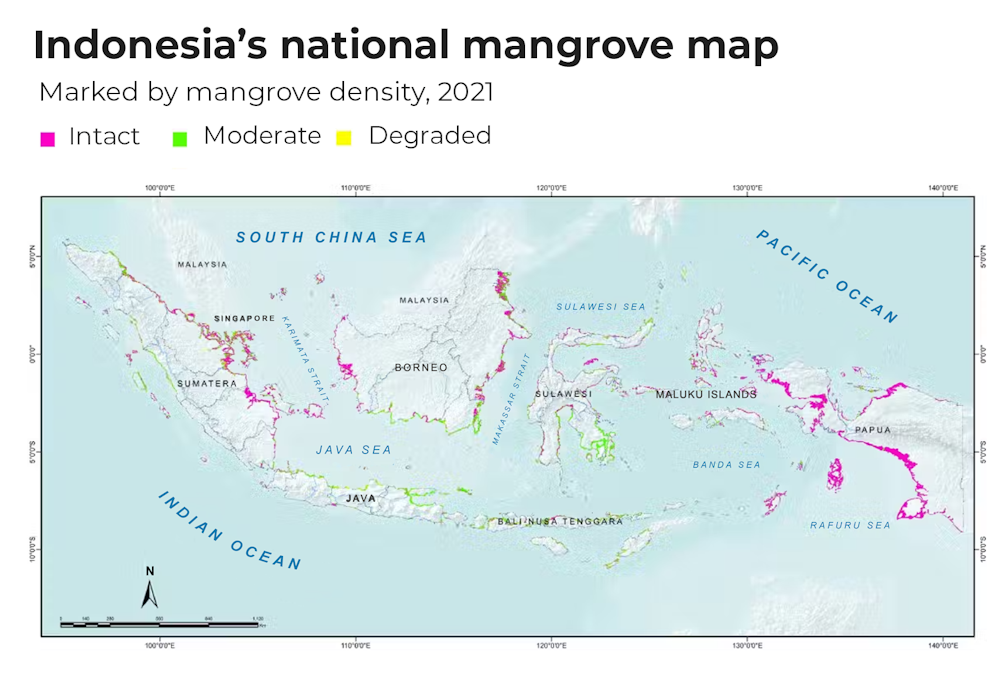
Unfortunately, this difference in perceived value has seen mangroves degraded or replaced. You can glimpse the current state of Indonesia’s 3.3 million hectares of mangrove area in the map below, which was released last year by Indonesia’s environment and forestry ministry.
Mangroves are broadly in good condition in the provinces of Papua and West Papua. But in the more populated areas – especially around the densely populated island of Java – mangroves have been largely deforested and degraded.
Adapted from a Ministry of Environment and Forestry, Republic of Indonesia map
Recent analysis by the World Bank puts the value of mangrove ecosystems at between A$21,000 to $70,000 per hectare per year. Similarly, a 2020 cost-benefit analysis of mangrove conservation versus conversion to shrimp aquaculture in Indonesia’s Papua province estimated the direct and indirect value of mangroves at A$34,000 per hectare per year.
But these valuations are heavily influenced by the role mangroves play in providing ecosystem services. Without these services, mangroves are worth two orders of magnitude less, at around A$340 per hectare.
Their real value lies in their ability to store large amounts of carbon, averaging almost 4000 tonnes of carbon dioxide equivalents per hectare. Until now, however, policy bottlenecks at the national level have stopped Indonesia from investing in better mangrove management and producing new revenue streams from stemming mangrove losses.
Mangroves like these from a village forest in Sumatra store an average of 1083 tonnes of carbon in their living tissues and the soil beneath. Benjamin Brown
Indonesia’s mangroves have suffered because of this disconnect between their real value and government policies and institutions. Over 20 institutions have some level of responsibility for mangrove management in Indonesia. It’s no wonder their agendas often conflict.
But progress is being made. Two years ago, President Joko Widodo added mangroves to the mandate of the country’s peatland restoration agency, after its success at restoring damaged peatlands. The goal for mangroves is to restore 600,000 hectares of mangroves by 2024.
There are alternatives to aquaculture
You might think it’s too hard to restore mangroves once they’ve been turned into shrimp farms. Previously, this has been true, with an over-reliance on simply planting more seedlings rather than tackling the harder work of social and economic reliance on former mangrove habitat. In response, Indonesia’s government has mapped around 77,000 hectares of the best restoration candidate areas across 300 villages in Sumatra and Kalimantan (Indonesian Borneo), working in full collaboration with coastal villagers.
Restoring mangroves requires human labour and machinery, as in this image of villagers in Sulawesi improving water flow and drainage into disused shrimp ponds. Rio Ahmad (Director of Yayasan Hutan Biru) This Google Earth image shows how quickly mangroves can rebound after hydrological restoration to make water flows more natural. Google Earth
To create alternatives to aquaculture, Indonesia’s national farmer field school program will expand to include hundreds of coastal villages. These coastal field schools help local villages improve their management of the coasts and develop alternative sources of income.
These include learning to use Nypah palms alongside mangroves, to allow villagers to harvest the valuable sugar from the sap. This species is the only palm considered a true mangrove. They can produce 800,000 litres of sap per hectare per year, forming a sustainable commodity base for organic palm sugar production as well as bio-ethanol.
Other options include encouraging production of honey, gluten-free flour, tea, juice, jam, and cosmetics. For some villages, eco-tourism could be an option, or shifting to more sustainable aquaculture.
Ratna Fadillah, an expert in non-timber forest product use, harvests holly mangrove leaves to make herbal green tea. These teas offer a low-cost opportunity to create a business, which many women and youth across Indonesia are adopting. Benjamin Brown
What’s next?
Indonesia’s government is drafting a new mangrove policy, focused on balancing mangrove protection, sustainable use and restoration. We’re already seeing welcome realignment between the nation’s ministries.
These efforts are being funded by a $A573 million loan from the World Bank and a $A27 million grant for the policy reforms and investment in coastal livelihoods. This loan will be repaid with credits from blue carbon. Indonesia’s government is seeking more financial support from other governments and multilateral organisations to scale up their mangrove management to a national scale.
Indonesia’s work to turn around the fate of their ailing mangroves will be shown on the world stage at the G20 summit in Bali in November. By then, there will be a public dashboard to represent progress captured by field-based and satellite monitoring.
World Bank natural resources expert André Rodrigues de Aquino contributed to the research underlying this article
Benjamin Brown consults for the World Bank. This article does not necessarily benefit the World Bank, as the loan arrangement is already finalized.
Satyawan Pudyatmoko does not work for, consult, own shares in or receive funding from any company or organisation that would benefit from this article, and has disclosed no relevant affiliations beyond their academic appointment.
A crisis, as the saying has it, combines danger and opportunity. The dangers of the current electricity crisis are obvious. The opportunity it presents is to end to the failed experiment of the national electricity market.
Having suspended the market last week, the Australian Energy Market Operator (AEMO) is now directing generators when to supply electricity. It’s also paying them lavish compensation for the financial shortfalls they suffer as a result.
These emergency measures are unsustainable. But they provide the starting point for a restructured electricity supply industry – one that’s better balanced between markets and planning.
Now’s the time to create a national grid that serves the Australian public and meets the challenges of a warming world. A new government-owned and operated body should take control of Australia’s electricity system. And decarbonising the grid, while ensuring reliable and affordable energy, should be its core business.
Decarbonising the grid should be a key goal of electricity reforms. Dave Hunt/AAP
A failed experiment
The National Electricity Market is where energy generators and retailers trade electricity. It was established about 25 years ago after technological advances allowed electricity grids to be connected across all states except Western Australia and the Northern Territory.
Before the market began, each state operated its own electricity industry with only limited interconnection. Back then, electricity companies were publicly owned. Most were also fully integrated, with one company responsible for the entire electricity supply chain, from generation to distribution and billing.
The national grid’s arrival coincided with the peak of enthusiasm for micro-economic reform. So, instead of a unified national enterprise, state utilities were broken up into separate parts – generation, transmission, distribution and retail – with the intention they would be privatised then engage in market competition.
Driving the trend towards privatisation was a widespread view that state-owned electricity enterprises had not performed well – particularly in investing to expand access to electricity.
Reflecting this view, the industry became fully or mostly privatised in Victoria, South Australia and New South Wales. Other states opened electricity generation and retail to competition.
The market was created just as the global need to reduce carbon emissions was being recognised. Despite this, the climate problem was not considered in the design of the market, which was based on a mix of coal and gas plants.
Until AEMO suspended the market last week, bids from generators determined the wholesale price of electricity at five-minute intervals. Retailers supplied electricity to consumers at prices that shielded them from the fluctuations in wholesale prices.
Prices typically sat around A$50 per megawatt hour. But in periods of very high electricity demand, the price can reach the market “price cap”, currently set at $15,100 per megawatt hour.
Meanwhile, electricity distribution – getting the power to homes and businesses using poles, wires and other infrastructure – was handed to a set of regulated monopolies, which were awarded high rates of return on low-risk assets.
The climate problem was not considered in the design of the market. Dan Himbrechts/AAP
What went wrong
The designers of the national electricity market hoped it would lead to better efficiency and more rational investment decisions. The market also aimed to lower consumer power bills and promote competitive retail offers tailored to individual needs. But none of this happened.
In fact, consumer electricity prices – after falling for the better part of a century in real terms under public ownership – rose dramatically.
This was partly due to high returns to private electricity distribution companies, and the need for infrastructure investment to improve reliability. A proliferation of highly paid marketers, managers and financiers were also required to run the market.
Over time, the failures of the original design led to an alphabet soup of agencies needed to run the industry. They include AEMO, AEMC, AER, ARENA and a bunch of state-level regulators. Finally, the Turnbull government created the misnamed Energy Security Board (ESB), which sat on top of the whole process.
All this delayed the transition from an old and unreliable coal-based system to its necessary replacement by a combination of solar, wind and storage.
Now, this rickety system has failed to deal with a major supply crisis. The temptation is to slap on another patch and restore “normal” market conditions. The ESB’s proposal to pay coal and gas generators to be on standby if needed is one such quick fix. But much more comprehensive reform is needed.
The national electricity market has failed to achieve its key aims. Shutterstock
Where to from here?
A combination of public and private investment is now needed to secure affordable electricity and transition to renewable energy generation.
The plethora of bodies regulating the market should be replaced by a single government agency that buys wholesale electricity from generators. This organisation could then sell electricity directly to customers or supply it to electricity retailers.
The emergency purchasing arrangements AEMO currently has in place should be replaced by “power purchase agreements”. These are long-term contracts between a buyer and a generator to purchase energy, in which prices, availability and reliability are set.
Within those terms, generators that consistently produce electricity at very low prices are the first to be called on. This dispatch method, known as merit order, has been shown in Germany to lead to lower prices for consumers.
At the same time, the Australian electricity grid should be returned to government ownership and operation. And its guiding principle should be moving to a decarbonised energy system, rather than the “net market benefit” test AEMO currently uses when deciding where to approve investment.
Labor’s Rewiring the Nation policy provides a starting point for reform. It should invest directly in the expanded transmission network needed to support the transition to renewable energy.
Australian energy policy took a wrong turn in the 1990s. It’s time to get back on course.
New federal Education Minister Jason Clare has announced a change to the National School Chaplaincy Program to allow schools to “choose” between having a religious chaplain and having a professionally qualified well-being worker.
The opposition has criticised the announcement as effectively meaning “the end of many school chaplains”. So what’s the fuss about?
The Howard Coalition government started the chaplaincy program in 2006. It has continued, with some variations, ever since.
A “project agreement” signed by federal, state and territory education ministers governs the chaplaincy program. The states and territories receive federal funding to pay for chaplains in public schools.
What do school chaplains do?
Chaplains are not counsellors in the psychologist sense. They are more like youth workers in the social worker sense.
The project agreement says chaplains are responsible for providing “pastoral care services” and strategies that support the “well-being of the school community”. It gives examples of activities like “co-ordinating volunteering activities and support, breakfast clubs, lunchtime activities, excursions, school incursions, and parent/carer workshops”.
These activities look non-religious. Any qualified youth worker, regardless of their religion, could deliver them. However, the National School Chaplaincy Association says:
“While chaplains must have underlying qualifications in youth work, community work or equivalent, school chaplaincy is religious in nature.”
The project agreement sets two key criteria for the appointment of chaplains:
all chaplains must have minimum qualifications such as a Certificate IV in Youth Work
all chaplains must be “recognised through formal ordination, commissioning, recognised religious qualifications or endorsement by a recognised or accepted religious institution”.
Rather than being school employees like teachers or front-office staff, chaplains are employed by third-party providers that have contracts with schools. One provider is a Christian organisation called Generate, which says its mission is:
“To bring God’s love, hope, and good news to children, young people, and families.”
Job advertisements for school chaplains usually require applicants to be Christians. For example, to apply for school chaplaincy positions advertised through Generate, this organisation says “you need to have a committed Christian faith”.
Schools working with Generate have effectively decided they will not have Jewish, Muslim, Hindu or atheist youth workers working with students. Generate is currently advertising positions at more than 20 public schools, including schools in highly multicultural areas such as western Sydney.
There is no public information about the processes public schools use to choose the school’s favoured religion for the purpose of hiring a chaplain.
Isn’t religious discrimination unlawful?
You might think refusing to hire someone for a job in a public school simply because that person doesn’t belong to a particular religion sounds like religious discrimination. Religious discrimination in employment is unlawful under anti-discrimination laws in every state and territory, except New South Wales and South Australia.
A number of state anti-discrimination commissioners have expressed concern about the National Schools Chaplaincy Program.
In 2020, Victoria’s Human Rights Commission told a Victorian MP: “we agree that the program may be in breach of [Victoria’s] Equal Opportunity Act 2010”.
In 2021, in response to advocacy by the Rationalist Society of Australia, Western Australia’s Equal Opportunity Commission said it was concerned that restricting youth worker/chaplain positions to religious people was “prima facie religious conviction discrimination” under Western Australia’s Equal Opportunity Act 1984. In 2020, Queensland’s Human Rights Commissioner said the practice involved “potential contraventions of the [Qld Anti-Discrimination] Act”.
A 2019 religious discrimination case in the Victorian Civil and Administrative Tribunal settled before the tribunal could rule on whether limiting youth worker/chaplain jobs in public schools to Christians breached state anti-discrimination laws.
“The government will open up the program to give schools the option to choose either a chaplain or a professionally qualified student welfare officer.”
The fact it was the new minister’s first big decision suggests the issue is important to him. There’s no good reason to force a public school to hire youth workers on the basis of religion. It’s why the ACT pulled out of the school chaplains program in 2019.
However, there are three key problems with the minister’s announcement.
First, all chaplains are already required to have professional qualifications. There’s nothing new about that.
Second, the minister has not explained how a public school – which schools legislation says are secular in character – could ever justify “choosing” that Jewish, Muslim, Hindu and atheist youth workers should not be eligible for a pastoral care job at the school.
The third and most practical problem is that this announced change won’t actually enable schools to hire youth workers without reference to the person’s religious affiliation.
Existing third-party providers like Generate are in the business of hiring only Christians. Unless new providers come onto the scene, public schools will have little choice but to continue to engage existing providers who will continue to hire only Christians.
The minister said he will work with his state and territory counterparts to revise the project agreement so a new system is in place for the 2023 school year.
If the nation’s education ministers want to make sure school youth workers/chaplains are hired based on merit and not on religion, they could make one simple change: get rid of outsourcing.
Requiring schools to hire directly rather than through third-party providers will ensure job ads don’t include selection criteria about a person’s religion. Some public schools might well be happy to allow their third-party provider to refuse to hire Jewish, Muslim and atheist youth workers. However, a public school is rather unlikely to itself ever put out an ad like that.
Getting rid of outsourcing would also mean the public money now used to fund the administration costs of third-party providers can be redirected to putting more youth workers in more schools.
Luke Beck is a member of the Australian Labor Party and is on the board of the Rationalist Society of Australia Inc. This article reflects only his personal views.
Source: The Conversation (Au and NZ) – By Markus Wagner, Associate Professor of Law and Director of the UOW Transnational Law and Policy Centre, University of Wollongong
India’s minister of commerce Piyush Goyal and WTO director-general Ngozi Okonjo-Iweala celebrate the end of the WTO’s 12th Ministerial Conference.Fabrice Coffrini/Pool/Keystone via AP
After decades of conflict that has neutered its work, the World Trade Organization looks to be back in business.
Its highest decision-making body – a conference of ministers from the organisation’s 164 member nations – has just met for the first time since 2017.
None of what the ministerial conference (dubbed MC12 due to being the 12th such meeting) agreed on was particularly groundbreaking. But the fact there was agreement at all – on areas such as agriculture, fishing, intellectual property, e-commerce and food insecurity – was itself a milestone.
The question is what happens now, with considerable challenges ahead for the WTO and its role in promoting and protecting a global rules-based trading system.
Fighting for relevance
The WTO’s job is to be the forum for multilateral rule-making, to observe the implementation of these trade rules, and to settle disputes among members.
In most situations, decisions must be made by consensus. This means a single detractor can scuttle initiatives supported by the rest of the WTO’s membership.
This has proved particularly problematic for the WTO’s rule-making function, which has largely been comatose for two decades, since negotiations on reducing trade barriers ground to a standstill at the ill-fated Doha Round launched in 2001.
Particularly damaging to the WTO has been the hostility of the US. Past administrations, especially the Trump administration, stymied the WTO’s dispute-settlement function by blocking the appointment and reappointment of judges to its appeal court (known as the Appellate Body). By 2019, there were not enough judges to hear appeals, leaving disputes in limbo.
The WTO has also been criticised for having few to no answers to the world’s most pressing issues: how to craft modern trade rules that support climate action and sustainability.
The rise of economic nationalism and unilateralism has increased trade friction making the WTO look increasingly irrelevant.
Reaching agreement
Given this, the ministerial conference held in Geneva last week delivered welcome agreements on several sometimes long and strongly contested areas.
The closing session of World Trade Organization’s ‘Ministerial Conference 12’ in Geneva, June 17 2022. Fabrice Coffrini/Pool/Keystone/AP
It agreed on limiting government subsidies for harmful fishing operations in an attempt to slow the depletion of rapidly declining fish stocks. This agreement will aid in curbing food insecurity and increase the sustainability of certain fish species.
Importantly, it is the first WTO treaty with environmental protection and sustainability as its objective.
Countries such as South Africa have been pushing for a waiver from provisions in the Agreement on Trade-related Aspects of Intellectual Property Rights so they can produce cheaper generic versions of vaccines. The impact should be limited, given vaccine supply is now enough to meet demand, but the concession may serve as a blueprint for the future.
It agreed to extend the moratorium on customs duties on “electronic transmissions” first agreed to in 1988.
It also agreed on reforming the WTO dispute settlement process, committing members – including the US – to “conduct discussions” to arrive at a “fully and well-functioning dispute settlement system accessible to all Members by 2024”.
Such soft language is a far cry from reinstating the Appellate Body. It was likely the only way to bring the US on board.
But fundamental differences remain
The ministerial conference is only the first step. It will be difficult – and take time – for WTO members to reach a compromise on many important issues.
Compromise is needed between the policy space governments demand for themselves and effective international trade rules.
For example, the US and its allies have been pushing for tightening the rules on China’s state-owned enterprises and industrial subsidies. China has showed strong resistance to any new rules it views as being against its interests.
Another issue is support measures adopted during the pandemic. Some governments understandably adopted policies to support domestic businesses in a time of crisis. But some of these measures are arguably against the WTO’s rules to eliminate trade distortions.
These points are symbolic of the larger disagreements between WTO members, with economic nationalism and unilateralism presenting a fundamental challenge to the organisation’s reason for being.
Examples abound. There are the US tariffs on steel and aluminium on national security grounds. China’s trade sanctions against Australia on products such as wine, coal, lobster, barley and beef. China’s Anti-Foreign Sanctions Law and the European Union’s Anti-Coercion Instrument allow these governments to retaliate against any foreign actions they deem to be unfair.
A common feature of these instruments or actions is governments taking the law into their own hands, ignoring the WTO’s rule book and its dispute resolution mechanisms.
To overcome these existential challenges, the multilateral trading system will need strong and sustained commitment from member governments.
The authors do not work for, consult, own shares in or receive funding from any company or organisation that would benefit from this article, and have disclosed no relevant affiliations beyond their academic appointment.
Back to June again, after the disruption of the last couple of years, and the twin festivals of light – Vivid and the Sydney Film Festival – once again galvanise the city.
Here are my picks for best films from among the 40 or so I managed to catch.
Tchaikovsky’s Wife
Tchaikovsky’s Wife, written and directed by Russian auteur Kirill Serebrennikov, is a spellbinding exploration of an individual’s idealistic obsession with greatness.
The film follows Antonina Miliukova (a wonderfully understated Alyona Mikhailova) as she meets and then decides she wants to marry celebrated composer Tchaikovsky (Odin Lund Biron). Tchaikovsky agrees to marry her, mainly, the film implies, as a beard covering up his sexuality and to access her proposed dowry.
He quickly tires of her – she’s annoying, clingy, doesn’t understand or fit into his Bohemian lifestyle – and demands a separation. But she refuses to let go, and much of the film involves following Antonina’s gruelling refusal to give up on her deluded belief in the fidelity and splendour of her marriage.
The film follows Antonina Miliukova (played by a wonderfully understated Alyona Mikhailova) as she meets and then decides she wants to marry celebrated composer Tchaikovsky (Odin Lund Biron). Sydney Film Festival
It is both incredibly sad and incredibly funny, a tale of an idiot whose naïve refusal to disbelieve in her love is as touching as it is infuriating. But by the end of the film, all traces of humour are gone – Antonina has had three children with her lawyer Nikolai (Miron Fedorov), all of whom have died in the orphanage to which she abandoned them. The whole thing culminates in a staggering, surreal dance sequence, the virtuosity of the production crew on full display.
Watching a film like Tchaikovsky’s Wife at the cinema is a genuine delight. It is replete with beautifully staged period details capturing the mania of 19th century Europe. I am sure this will hold up as one of the masterpieces of the 21st century.
Fire of Love
Similarly worth seeing on a big screen, Fire of Love is a documentary following the work and lives of Katia and Maurice Krafft, French husband and wife volcanologists.
Writer-director Sara Dosa skillfully foregrounds the contrast in temperament of the two researchers without undermining the seriousness of their research into volcanoes. Maurice appears at times like a media-savvy entertainer, almost a charlatan, in contrast with his sober, serious wife. This worked for the couple, Dosa points out, both personally and in their division of labour, with Maurice making their films and doing most of the speaking tours, and Katia writing up and publishing their research.
Fire of Love is a documentary following the work and lives of Katia and Maurice Krafft, French husband and wife volcanologists. Sydney Film Festival
Fire of Love plays incredibly well as a documentary. Miranda July’s narration is surprisingly restrained and the amazing footage of volcanoes captured by the couple on 16mm film blazes across the screen. The assembly of archival interview material is similarly first rate.
The enthusiasm the Kraffts have for volcanoes – and for each other – at all times underpins the film, lending it its energy, up to the tragic (and romantic) moment of the pair’s death, side by side, under the ashes of Mount Unzen in Japan in 1991.
The Passengers of the Night
Mikhaël Hers’ The Passengers of the Night is unapologetically sentimental with a degree of schmaltziness, I’m sure, bound to put off some viewers. But I loved it.
The narrative follows single mother Elisabeth (Charlotte Gainsboug, perfect as usual) as she takes on a job vetting calls for a late night talkback radio show to support herself, teenage son Matthias (Quito Rayon Richter) and daughter Judith (Megan Northam). Their family dynamic shifts when Elisabeth brings home charming drug addict waif Talulah (Noée Abita).
The film’s nostalgic recreation of 1980s Paris is punctuated by carefully observed (and at times genuinely touching) moments of connection between mother, son, daughter and friend. The blend of drama and comedy works so well because of Hers’ light touch, and the whole thing is refreshingly non-polemical (the current cinema of the Anglosphere could learn a lot).
The Passengers of the Night is unapologetically sentimental and schmaltzy. Sydney Film Festival
It is certainly a fantasy – a fantasy of family, friends, and resilience, of Parisian romance, of the 1980s – and, like the most effective fantasies, sweeps us out of the present into a moment that may have never been, but is nevertheless pleasurable to imagine once was – or could have been.
Hinterland
Hinterland, directed by Stefan Ruzowitzky, is an impressive film on all counts. It is visually magnificent, with its deliberate recreation of a German expressionist aesthetic working seamlessly with its engrossing narrative.
Peter Perg (Murathan Muslu), a battle-scarred soldier returning to Vienna following the second world war, resumes his occupation as a detective to track down a serial killer murdering ex-soldiers in some of the most gruesome ways you’ll see at the movies. Various clues point him back towards his memories of the war – and an ultimate reckoning with his frailty.
The tone is grim and unrelenting, but everything is so stylish, the actors are so charismatic – Muslu offers one of the most commanding performances in recent cinema – and the detective narrative so compelling that the movie passes by in a flash.
Hinterland follows Peter Perg (Murathan Muslu), a battle-scarred soldier returning to Vienna following WWI, who resumes his occupation as a detective to try to track down a serial killer who is murdering ex-soldiers/ Sydney Film Festival
Hinterland works as both a homage to the Golden Age of European cinema and a gripping serial killer thriller. It’s a splendid film, best seen on the biggest screen you can find, and continues Ruzowitzky’s legacy of making big budget Euro blockbusters.
The Forgiven
Sometimes John Michael McDonagh’s work fails to hit the mark – it can appear pretentious in its attempts at authenticity, in its deliberate political incorrectness and geezer-esque humour. This is certainly not the case with The Forgiven.
This is a near perfect film (marred by an imperfect ending), both a gruelling revenge and redemption film in the style of Calvary and a study – and critique – of the continued excesses of the Western elite in one of the former colonial outposts of Empire, Morocco.
Most of The Forgiven takes place during a party at affluent Richard Galloway’s (Matt Smith) ridiculous mansion in the High Atlas Mountains. Sydney Film Festival
Most of the film takes place during a party at affluent Richard Galloway’s (Matt Smith) villa-cum-pleasure palace in the High Atlas Mountains. When alcoholic grump David (Ralph Fiennes) and his wife Jo (Jessica Chastain) run over a local boy on their way to the party, David is forced to set off on a ritual journey involving his return to the boy’s home to help bury the body, while Jo stays behind at the party – and parties!
The contrast between Fiennes’ development from antisocial curmudgeon to empathetic humanist might appear too neat on paper (with whiffs of colonialism about it – the Arab body is good only for the redemption of the white master), but it is so skilfully rendered by McDonagh (and Fiennes) that it packs an emotional wallop for the viewer.
The Forgiven has all of McDonagh’s signature traits – gallows humour, lots of drinking, and a Catholic commitment to the possibilities of redemption in spite (or because) of the horrors of life. But its stark structure in which the earnestness of David’s journey is savagely contrasted with the bourgeois decadence of the party makes it more effective than his earlier films.
The Best of the Rest
There were several other films that could replace any from the list above.
The astonishing documentary Into the Ice, for example, featuring breathtaking footage of scientist Alun Hubbard as he abseils into the moulins in Greenland, or the Danish period drama Godland, stunningly shot on celluloid film following a priest’s frost-bitten journey across Iceland.
Day After… written and directed by Kamar Ahmad Simon is a striking picaresque documentary-fictional hybrid, following passengers on a paddle-steamer travelling from Chaka to Khulna in Bangladesh.
The Spanish horror thriller Piggy is one of the best of the genre I’ve seen and Inu-Oh, a bizarre anime rock opera, shows director Masaaki Yuasa to be one of the most original voices working in the medium today.
Piggy is a riveting social horror film about trauma and revenge. Sydney Film Festival
The only two disappointments were Unrest and Elvis. The premise of Unrest is excellent – in the late 19th century in Switzerland, we follow the work of clock makers as revolution brews – but its treatment is so dull it’s painful to watch. Elvis is similarly hampered by banal treatment, surprising given director Baz Luhrmann’s usual flair, and is almost sunk by a painful and irritatingly knowing performance from Tom Hanks as the Colonel, Elvis’ cut-throat manager.
One of the pleasant tragedies of most film festivals is that one can never see everything one wants to see, and some of the major films that I missed include Close, the winner of the Sydney Film Prize, Ruben Östlund’s Triangle of Sadness that won the Palme d’Or at Cannes, and Julia Davis’ crowd-pleaser Nude Tuesday. Given their international success, these films are sure to be released to theatres soon.
Ari Mattes does not work for, consult, own shares in or receive funding from any company or organisation that would benefit from this article, and has disclosed no relevant affiliations beyond their academic appointment.
Aotearoa New Zealand will enjoy a new official public holiday on June 24, with the country marking Matariki – the start of the Māori New Year. But with it comes the temptation for businesses to use the day to drive sales.
Some Māori have already expressed concern that businesses were positioning themselves to market Matariki as a shopping event.
On the back of those concerns, Skye Kimura, chief executive of Māori cultural marketing and communications agency Tātou, launched a campaign called “Matariki is not for sale”. “No one wants to see a Matariki Big Mac,” she argued.
But those trying to defend Matariki from mass commercialisation could be fighting a difficult battle.
Few public holidays, either in New Zealand and elsewhere, have been immune to commercial interests. In the United States, for example, businesses are facing criticism for attempting to make money from Juneteenth, a holiday to celebrate the emancipation of slaves.
Human tendency to mark the change
One of the difficulties facing critics of the commercialisation of public holidays is that they may be fighting deep habits born out of capitalism and human nature.
A lot of our special occasions are structured around various parts of the year and changes in the pattern of life. The earliest pagan rituals were about the change in seasons and to mark what was different from one period of life to the next.
From a social and possibly evolutionary perspective, we are already primed to do something different from our day-to-day activities to mark the significant changes we see around us.
When we have these seasonal celebrations, it doesn’t take much of a nudge for retailers to say, hey, people are looking to mark the change and shopping is a really good way to enact that transition between two phases – an “out with old, in with the new” message.
New Zealand’s new public holiday celebrates the new year in the Māori lunar calendar. Guo Lei/Getty Images
Shopping to celebrate is what we do
Each year is already punctuated with several cultural celebrations that have, over time, become shopping events. The most classic example is the commercialisation of Christmas.
Even though there is the Christian tradition of the three wise men giving gifts at the birth of Christ, establishing the ritual of gift giving, the three months leading up to December 25 have become about sales and opportunities to spend.
Easter, Valentine’s Day, Queen’s Birthday weekend and even Labour Day have all become sales events for retailers.
Matariki also lands in a quiet time of the year for retail – right in the middle of winter and between the big shopping weekends of Queen’s Birthday and Labour Day.
Potential for blowback against retailers
But when businesses commercialise anything there is always the question of whether they have the legitimacy to do so, or whether they’re bastardising the event for commercial gain.
There is the potential for significant blowback for businesses looking to cash in on Matariki. And they only need to look at Anzac Day as an example of commemoration that remains off limits to blatant commercialisation.
Yes, it’s fine to sell poppies or to have a donation box at your point of sale. It’s even okay to advertise with a “thank you for your service” banner. But if a business tries obviously to make money on the back of Anzac Day, people start to get a little upset.
That doesn’t mean businesses don’t try to get around public sentiment. Every year there is an element of “Anzac washing”, where companies try to make it look like they’re supportive of veterans, even if they have otherwise done nothing to support former and current military personnel.
It is likely that how we handle Anzac Day will provide a baseline for critics assessing businesses that try to use Matariki as a way to drive sales.
Businesses could be judged by whether or not they have Matariki sales, or whether there is some sort of attempt to “Matariki-wash” their other commercial offerings.
It is an area full of potential landmines, with little clear benefit at this stage.
Not only is there the commercialisation of a public holiday, which some people find annoying already, but there’s also the debate about cultural appropriation versus cultural appreciation.
Companies need to realise the potential for blowback and controversy is multiplied above other, more established public holidays. There are those who are annoyed about another public holiday adding labour costs for businesses. And there even are those objecting to the supposed “wokeness” of celebrating Matariki.
At a bare minimum, then, businesses determined to use Matariki as part of their sales pitch need to understand what the celebration is really about and its significance within the community.
It will be interesting to see if any are willing to risk the minefield for the sake of sales that come from an extra three-day weekend, or whether they’ll wait and see what happens to those who take the risk first.
Mike Lee does not work for, consult, own shares in or receive funding from any company or organization that would benefit from this article, and has disclosed no relevant affiliations beyond their academic appointment.
French Polynesia’s President Édouard Fritch has described the election of three candidates of the pro-independence Tavini Huiraatira party to the French National Assembly as “catastrophic”.
They won all three seats in a run-off against candidates of his ruling Tapura Huiraatira party, which holds two-thirds of all seats in French Polynesia’s Assembly.
Fritch said French Polynesia was sending people to Paris who would talk about sovereignty, independence, and the United Nations while the territory was near the end of its means.
He said French Polynesia was in the middle of an economic crisis, making him wonder how he could work when the three were part of the opposition to President Émmanuel Macron’s bloc.
Fritch said Tavini’s independence plan lacks a roadmap and only offers something nebulous.
He said after the first round of the election, all the opposition forces turned against the Tapura, accusing the unsuccessful candidates of the other parties of hypocrisy.
Fritch should resign, says Temaru French Polynesia’s pro-independence leader Oscar Temaru said after last weekend’s election defeat of the government candidates that President Fritch should resign.
Temaru’s Tavini Huiraatira party won French Polynesia’s three seats in the French National Assembly, defeating the three candidates of the ruling Tapura Huiraatira.
Pro-independence leader Oscar Temaru … calls on territorial President Édouard Fritch to resign. Image: Tinfos 30
Temaru said in view of this result it would only be fair if he quit.
He said the weekend victory was a “historic moment” that should resonate beyond French Polynesia and showed that the Māohi people wanted to be recognised for who they were.
Temaru said, however, that in the current situation French Polynesia had neither the institutions nor the means to solve its problems, but with independence, it would have them.
He said for French President Émmanuel Macron, the election result in Tahiti would be a “cold shower”.
He also said independence would not be achieved tomorrow but at a time when people wanted it.
This article is republished under a community partnership agreement with RNZ.
Three major parties have emerged as frontrunners to form the next government in Papua New Guinea with their party leaders eager to be next Prime Minister.
These are current coalition leader PANGU, headed by incumbent Prime Minister James Marape, opposition leader Belden Namah’s PNG Party and the People’s National Congress led by former prime minister Peter O’Neill.
These leaders and the parties have invested heavily in their campaign and candidates for next month’s general election. They are using strategic campaigning including social media outreach to network with supporters in the rural areas.
It is always a numbers game.
The party that wins the most seats gets the invite to form the next government with its leader the most likely Prime Minister.
But politics in PNG is fluid and smaller parties with critical numbers often hold sway over formations of government.
Eleventh hour horse trading in the past has always featured prominently with the formations of government and smaller parties would also be riding shotgun with the bigger parties.
Three-way race If anything, this is a three-way horse race with each party trying by any means on the campaign track to derail the other, even to the extent of attacking opponents, setting fire to their posters, and burning their properties.
All three leaders have been hot around the country, shopping their candidates to the voters, selling policies and even discrediting other parties, bringing in tension along the way.
PANGU’s James Marape is confident of returning to form government in the next Parliament and says he will step down if otherwise.
“I am taking the government formation to Wewak and taking all members who win and we will form the government there,” declared Marape.
Pangu is banking on 75 candidates for this election and Marape has travelled over four provinces to support their candidates.
Vocal opposition leader Belden Namah has also openly put up his hands to become Prime Minister after 15 years on the other bench.
“I am serious in the business to be Prime Minister of PNG after this election,” said Namah, who is leader of the PNG Party, which has endorsed a total of 50 candidates.
Ready to lead Namah added he had never raised his hands for the role in respect of late Sir Michael Somare but now he was ready to lead the country forward.
Another strong contender is former Prime Minister Peter O’Neill, leader of the People’s National Congress party, who has fielded 95 candidates contesting various seats across the country.
O’Neill has made it clear that the PNC party is ready to return to power.
He reportedly said that he and the PNC party was poised to return to government and “rescue” the country.
He said: “The new government needs to work harder… with a clear mandate to a political party with policies to deliver to the people and the country.
“To date, only PNC party has put [out] our policies, which are aimed at delivering basic services to our people and improving living standards.”
Other credible leaders But while all eyes are on Marape, Namah and O’Neill, there are other credible leaders who just may be the new Prime Minister after the elections are over.
National Alliance Party leader Patrick Pruaitch, currently deputy PM, may have a chance, having been part of the two most recent coalition governments. For this election NA has endorsed a 59 candidates.
Other leaders like Powes Parkop, William Duma and Don Polye are also in running for the role having expressed their intentions.
While all these leaders vie for this top post, the one that comes through with the most numbers will be invited by the Governor-General to form the government.
The Papua New Guinea general election is on July 2-22.
Following the United Kingdom’s decision to extradite Julian Assange to face trial in the United States, the International Federation of Journalists’ (IFJ) Australian affiliate, the Media, Entertainment and Arts Alliance (MEAA) has called on the Australian government to take swift steps to lobby for the dismissal of all charges against Assange.
The IFJ stands with the MEAA in condemning the extradition order and calls for Assange to be pardoned and allowed to be with his family.
On June 17, UK Home Secretary Priti Patel approved Assange’s extradition to the US to face charges, primarily under the nation’s Espionage Act, for releasing US government records that revealed the US military committed war crimes against civilians in Afghanistan and Iraq, including the killing of two Reuters journalists.
Assange, a member of the MEAA since 2007, may now only have a slim chance of challenging the extradition.
If found guilty, Assange faces up to 175 years in prison.
The WikiLeaks founder is highly likely to be detained in the US under conditions of isolation or solitary confinement, despite the US government’s assurances, which would severely exacerbate his risk of suicide.
WikiLeaks was awarded the Walkley Award for Most Outstanding Contribution to Journalism in 2011, an annual prize to reward excellence in Australian journalism, in recognition of the impact of WikiLeaks’ actions on public interest journalism by assisting whistleblowers to tell their stories.
According to the MEAA, Walkley judges said WikiLeaks applied new technology to”‘penetrate the inner workings of government to reveal an avalanche of inconvenient truths in a global publishing coup”.
Whistleblowers have since been used by other media outlets to expose global tax avoidance schemes, among other stories.
In the case of WikiLeaks, only Julian Assange faces charges, with no other WikiLeaks media partners cited in any US government legal actions.
In 2017, Chelsea Manning, a US Army intelligence analyst who released classified information to WikiLeaks, was pardoned by former US President Barack Obama.
MEAA media section federal president Karen Percy said: “We urge the new Australian government to act on Julian Assange’s behalf and lobby for his release. The actions of the US are a warning sign to journalists and whistleblowers everywhere and undermine the importance of uncovering wrongdoing.
“Our thoughts are with Julian and his family at this difficult time.”
The IFJ said: “The United Kingdom Home Secretary’s decision to allow the extradition of Julian Assange is a significant blow to media freedom and a dire threat to journalists, whistleblowers, and media workers worldwide.
“The IFJ urges the government of Australia to act swiftly to intervene and lobby the United States and United Kingdom governments to dismiss all charges against Assange. Journalism is not a crime.”
Last week on June 17 2022, UK Home Secretary Priti Patel issued a statement confirming she had approved the US government’s request to extradite Julian Assange.
The Australian founder of WikiLeaks faces 18 criminal charges of computer misuse and espionage.
This decision means Assange is one step closer to extradition, but has not yet reached the final stage in what has been a years-long process. Patel’s decision follows a March decision to deny leave to appeal by the UK Supreme Court, affirming the High Court decision that accepted assurances provided by the US government and concluded there were no remaining legal bars to Assange’s extradition.
The High Court decision overruled an earlier decision by a District Court that extraditing Assange to the US would be “unjust and oppressive” because the prison conditions he was likely to experience would make him a high risk for suicide.
In the High Court’s view, the American government’s assurances sufficiently reduced the risk.
Another appeal ahead WikiLeaks has already announced Assange will appeal the home secretary’s decision in the UK courts. He can appeal on an issue of law or fact, but must obtain leave of the High Court to launch an appeal.
This is a fresh legal process rather than a continuation of the judicial stage of extradition that followed his arrest in 2019.
Assange’s brother has stated the appeal will include new information, including reports of plots to assassinate Assange.
Several legal issues argued before the District Court in 2020 are also likely to be raised in the next appeal. In particular, the District Court decided the question of whether the charges were political offences, and therefore not extraditable crimes, could only be considered by the home secretary.
BREAKING: UK Home Secretary approves extradition of WikiLeaks publisher Julian Assange to the US where he would face a 175 year sentence – A dark day for Press freedom and for British democracy The decision will be appealedhttps://t.co/m1bX8STSr8pic.twitter.com/5nWlxnWqO7
The question of whether and how the home secretary decided on this issue could now be ripe for argument.
Assange’s next appeal will also seek to re-litigate whether US government assurances regarding the prison conditions Assange will face are adequate or reliable. His lawyers will also again demand the UK courts consider the role of role of freedom of expression in determining whether to extradite Assange.
Assange will remain detained in Belmarsh prison while his appeal is underway. The decision of the High Court on his appeal against the home secretary’s decision may potentially be appealed to the Supreme Court.
If, after all legal avenues are exhausted in the UK, the order to extradite stands, Assange could take a human rights action to the European Court of Human Rights.
However, the European Court has rarely declared extradition to be contrary to the European Convention on Human Rights, except in cases involving the death penalty or whole-life sentences.
It has not yet considered freedom of expression in an extradition case.
Further appeals could add years more to the saga of Assange’s detention.
Responses from the Assange family and human rights advocates Assange’s wife, Stella Moris, called Patel’s decision a ‘“travesty”. His brother Gabriel Shipton called it “shameful”. They have vowed to fight his extradition through every legal means available.
Julian Assange’s family respond to decision. Video: Reuters
According to the secretary-general of Amnesty International Agnes Callamard:
Assange faces a high risk of prolonged solitary confinement, which would violate the prohibition on torture or other ill treatment. Diplomatic assurances provided by the US that Assange will not be kept in solitary confinement cannot be taken on face value given previous history.
What role for the Australian government? Australian Foreign Minister Penny Wong and Attorney-General Mark Dreyfus responded to the latest development last night. They confirmed Australia would continue to provide consular assistance to Assange:
The Australian government has been clear in our view that Mr Assange’s case has dragged on for too long and that it should be brought to a close. We will continue to express this view to the governments of the United Kingdom and United States.
However, it remains unclear exactly what form Australia’s diplomatic or political advocacy is taking.
In December 2021, Anthony Albanese said he could not see what purpose was served by the ongoing pursuit of Assange. He is a signatory to a petition to free Assange. Since he was sworn in as prime minister, though, Albanese has resisted calls to demand publicly that the US drop its criminal charges against Assange.
In contrast, Albanese recently made a public call for the release of Sean Turnell from prison in Myanmar.
In a way, Patel’s decision last week closes a window for stronger advocacy between Australia and the UK. While the matter sat with the UK Home Secretary, the Australian government might have sought to intervene with it as a political issue.
Now it seems possible Australia may revert to its long established position of non-interference in an ongoing court process.
Some commentators argue this is insufficient and that Australia must, finally, do more for Assange. Tasmanian MP Andrew Wilkie said it was high time Australia treated this as the political matter it is, and demand from its allies in London and Washington that the matter be brought to an end.
Barrister Greg Barns likened Assange’s situation to that of David Hicks, who was imprisoned at Guantanamo Bay:
The Howard government at the time brought him back to Australia. This is not unprecedented. It is important that Australia is able to use the great relationship it has with Washington to ensure the safety of Australians.
These comments suggest that Australia ought to focus any advocacy towards the US government, making a case for the criminal charges and extradition request to be abandoned.
At this stage it is impossible to say if the Albanese government has the will to take a stronger stand on Assange’s liberty. The prime minister and foreign minister have certainly invested heavily in foreign relations in the early weeks of their government, with emphasis on the significance of the US alliance.
Perhaps strong advocacy on Assange’s behalf at this time might be regarded as unsettling and risky. The US has had plenty of opportunity, and its own change of government, and yet it has not changed its determination to prosecute Assange.
This is despite former President Barack Obama’s decision to commute the sentence of Chelsea Manning, the whistleblower who provided classified material to Assange for publication through Wikileaks.
Stronger Australian advocacy may well be negatively received. Assange’s supporters will continue to demand that Albanese act regardless, banking on the strength of the Australia-US alliance as capable of tolerating a point of disagreement.
In an unprecedented result, French Polynesia’s pro-independence Tavini Huiraatira Party candidates have won a clean sweep of all three seats in the French National Assembly.
The three will sit with the left-wing Nupes group which emerged as the second biggest force in the 577-strong National Assembly.
The success of the alliance around Jean-Luc Melenchon was emulated by Marine Le Pen’s National Rally on the right of the political spectrum, resulting in Emmanuel Macron’s centrist bloc losing its absolute majority.
In New Caledonia, Macron’s Ensemble party won both seats and also won the single seat in Wallis and Futuna, but none in French Polynesia.
A surprise novice in the Assembly is Tahiti’s Tematai Le Gayic, who as a 21-year-old has become the youngest person ever to be elected to the National Assembly of the Fifth French Republic.
Le Gayic, who interrupted his university studies for the election campaign, won just under 51 percent of the votes in the Papeete constituency to defeat former Tourism Minister Nicole Bouteau of the ruling Tapura Huiraatira party.
In the first round, Bouteau had the best score of any candidate.
Brotherson returned Another new Tavini candidate, Steve Chailloux, scored 59 percent in his constituency to beat Tepuaraurii Teriitahi.
Moetai Brotherson, who was the only Assembly member left in the run for a second term, won his seat with more than 61 percent of the vote, beating Tuterai Tumahai.
Tavini’s Moetai Brotherson … won 61 percent of the vote in his electorate. Image: Walter Zweifel/RNZ Pacific
The three, who had been campaigning for French Polynesia’s sovereignty, are now bound for Paris to take up their seats.
Le Gayic told local media that he wants France to recognise the Māohi culture.
“Because of in the French constitution, only one people is recognised, the French people, and only one language is recognised, the French language. As soon as the Māohi people are recognised as a people, the Māohi language can be made official in this territory’, he said.
In a first reaction, President Edouard Fritch said the defeated Tapura candidates were aligned with the majority of President Emmanuel Macron, which raised the question of how French Polynesia can push its concerns in Paris and how it can ask for France’s support.
Fritch said the loss was due to “an amalgamation of everything and anything”.
Observers noted that the Tapura may have been sanctioned for the way it managed the pandemic, which saw an extraordinary first spike in late 2020 and was followed by dissent over vaccination mandates.
Two weeks ago, Fritch and the former Vice-President Tearii Alpha were both fined for flouting covid-19 rules they put in place last year.
Alpha, who was vice-president at the time, invited 300 people, including all cabinet members, to his wedding at the height of restrictions.
New Caledonia New Caledonia’s anti-independence candidates have retained the territory’s two Assembly seats, defeating the challengers of the pro-independence FLNKS.
Philippe Dunoyer was re-elected for a second five-year term in the constituency centered on Noumea, standing for a four-party coalition tied to French president Emmanuel Macron’s Ensemble.
Dunoyer won 66 percent of the vote, beating Wali Wahetra who was the first pro-independence politician to make the run-off in the Noumea area in 15 years.
In the other constituency, comprising the rest of the main island, the mayor of La Foa, Nicolas Metzdorf, won comfortably against Gerard Reignier.
Metzdorf has been a member of New Caledonia’s Congress since 2014 and in 2020, he became mayor, but to comply with French law on the cumulation of offices, he is expected to relinquish the mayoralty.
The election result reflected the sharp split already seen in the independence referendums of the past four years, with Kanak voters overwhelmingly favouring independence.
Reignier scored more than 90 percent of the votes in several electorates, and even attained more than 96 percent in Belep.
The winning candidates have been campaigning for a new statute anchoring New Caledonia within France after last December’s third rejection of independence.
They want the electoral rolls for referendums and provincial elections to be opened to all French citizens residing in New Caledonia — a proposition fiercely contested by indigenous groups.
Yesterday’s vote was open to all French citizens.
Wallis and Futuna The candidate of the ruling majority in Wallis and Futuna, Mikaele Seo, has narrowly won the territory’s Assembly seat.
Seo beat the opposition-backed Etuato Mulukihaamea by just 16 votes, which is a score so tight that it may get challenged.
Seo, who is the president of the permanent commission of the Assembly of Wallis and Futuna, had already been in the Paris seat since 2019 after the last winner Sylvain Brial fell ill and had to quit his post.
Mulikihaamea is the head of the local Olympic committee and known for his engagement in rugby.
The living component among these pieces was Rodrigo Duterte — an ally who, when elected president, normalised Marcos’ machinery, painting over a picture of murders and plunder to show glory and heroism instead.
“I think that really, if we are to make a metaphor [to] describe the role of Duterte to Marcos’ win, it’s really Duterte being the sponsor or a ninong to Marcos Jr…. I think Duterte ultimately is the godfather of this all,” said Fatima Gaw, assistant professor at the University of the Philippines (UP) Diliman.
The alliance Marcos’ disinformation machinery that was years in the making was complemented by his longtime ties to the Duterte family. Before “Uniteam,” there was “AlDub” or Alyansang Duterte-Bongbong.
Marcos courted Rodrigo Duterte in 2015, but Duterte chose Alan Peter Cayetano to be his running mate. Even then, calls for a Duterte-Marcos tandem persisted.
Gaw said Duterte played a part in driving interest for Marcos-related social media content and making it profitable. The first milestone for this interest, according to Gaw, was when Marcos filed his certificate of candidacy for vice-president in 2015.
They saw an influx of search demand for Marcos history on Google.
“There’s interest already back then but it was amplified and magnified by the alliance with Duterte. So every time there’s a pronouncement from Duterte about, for example, the burial of Marcos Sr. in the Libingan ng mga Bayani, that also spiked interest, and that interest is actually cumulative, it’s not like it’s a one-off thing,” Gaw said in a June interview with Rappler.
Using CrowdTangle, Rappler scanned posts in 2016 with the keyword “Marcos,” yielding over 62,000 results from pages with admins based in the Philippines. Spikes can be seen during key events like the EDSA anniversary, the Pilipinas 2016 debate, election day, and instances after Duterte’s moves to bury the late dictator Ferdinand Marcos at the Libingan ng mga Bayani.
On February 19, 2016, Duterte said that if elected president, he would allow the burial of the late dictator at the Libingan ng mga Bayani. On August 7, 2016, Duterte said that Marcos deserved to be buried at the Libingan ng mga Bayani for being a soldier and a former president.
The burial pushed through on November 18, 2016 and became a major event that allowed the massive whitewashing of the Martial Law period.
Made with flourish Related content would then gain views, prompting platforms to recommend them and make them more visible, Gaw said. In a research she conducted in 2021 with De La Salle University (DLSU) communication professor Cheryll Soriano, they found that when searching “Marcos history” on YouTube, videos made by amateur content creators or people unaffiliated with professional groups were recommended more than news, institutional, and academic sources.
“A big part of Marcos’ success online and spreading his message and propaganda is because he leveraged both his political alliances with [the] Dutertes, as the front-facing tandem and political partnership. And on the backend, whatever ecosystem that the Duterte administration has established, is something that Marcos already can tap,” Gaw said.
In an upcoming study on social media and disinformation narratives authored by Aries Arugay and Justin Baquisal, they identified four thematic disinformation narratives in the last election campaign — authoritarian nostalgia/fantasy, conspiracy theories (Tallano gold, Yamashita treasure), “strongman”, and democratic disillusionment.
Arugay, a political science professor at UP Diliman, said these four narratives were the “raw materials” for further polarisation in the country.
“Para sa mga kabataan, ’yung mga 18-24, fantasy siya. Kasi naririnig natin ‘yun, ah kaya ko binoto si Bongbong Marcos kasi gusto kong maexperience ‘yung Martial Law,” Arugay said in an interview with Rappler in June.
(For the youth, those aged 18-24, it’s a fantasy. We hear that reasoning, that they voted for Bongbong Marcos because they want to experience Martial Law.)
Arugay described this as “unthinkable,” but pervasive false narratives that the Martial Law era was the golden age of Philippine economy, that no Filipino was poor during that time, that the Philippines was the richest country next to Japan, among many other claims, allowed for such a fantasy to thrive.
Institutionalising disinformation While traditional propaganda required money and machinery, usually from a top-down system, Gaw said Duterte co-opted and hijacked the existing systems to manipulate the news cycle and online discourse to make a name for himself.
“I think what Duterte has done…is to institutionalise disinformation at the state level,” she said.
This meant that the amplification of Duterte’s messaging became incorporated in activities of the government, perpetuated by the Presidential Communications Operations Office, the Philippine National Police, and the government’s anti-communist task force or the NTF-ELCAC, among others.
Early on, Duterte’s administration legitimized partisan vloggers by hiring some of them in government. Other vloggers served as crisis managers for the PCOO, monitoring social media, alerting the agency about sentiments that were critical of the administration, and spreading positive news about the government.
Bloggers were organized by Pebbles Duque, niece of Health Secretary Francisco Duque III, who himself was criticised over the government’s pandemic response.
Mocha Uson, one of the most infamous pro-Duterte disinformation peddlers, was appointed PCOO assistant secretary earlier in his term. (She ended up campaigning for Isko Moreno in the last election.)
Now, we’re seeing a similar turn of events — Marcos appointed pro-Duterte vlogger Trixie Cruz-Angeles as his press secretary. Under Duterte’s administration, Angeles had been a social media strategist of the PCOO.
Following the Duterte administration’s lead, they are again eyeing the accreditation of vloggers to let them cover Malacañang briefings or press conferences.
“So in the Duterte campaign, of course there were donors, supporters paying for the disinformation actors and workers. Now it’s actually us, the Filipino people, funding disinformation, because it’s now part of the state. So I think that’s the legacy of the Duterte administration and what Marcos has done, is actually to just leverage on that,” Gaw said.
Targeting critics What pieces of disinformation are Filipinos inadvertently funding? Gaw said that police pages are some of the most popular pages to spread disinformation on Facebook, and that they don’t necessarily talk about police work but instead the various agenda of the state, such as demonising communist groups, activist groups, and other progressive movements.
Emboldened by their chief Duterte, who would launch tirades against his critics during his speeches and insult, curse, and red-tag them, police pages and accounts spread false or misleading content that target activists and critics. They do this by posting them directly or by sharing them from dubious, anonymously-managed pages, a Rappler investigation found.
Facebook later took down a Philippine network that was linked to the military or police, for violating policies on coordinated inauthentic behavior.
The platform has also previously suspended Communications Undersecretary and NTF-ELCAC spokesperson Lorraine Badoy who has long been targeting and brazenly red-tagging individuals and organizations that are critical of the government. She faces several complaints before the Office of the Ombudsman accusing her of violating the Anti-Graft and Corrupt Practices Act and the Code of Conduct for public officials.
“PCOO as an office before wasn’t really a big office, they’re not popular, but all of a sudden they become so salient and so visible in media because they’re able to understand that half of the battle of governance is not just doing the operations of it but also the PR side of it,” Gaw said.
Facebook users recirculated a post Badoy made in January 2016, wherein she talked about the murders of Boyet and Primitivo Mijares under Martial Law. In that post, just six years ago, Badoy called Bongbong an “idiot, talentless son of the dead dickhead dictator.”
Badoy has since disowned such views. In a post on May 2022, Badoy said she only “believed all those lies I was taught in UP” and quoted Joseph Meynard Keynes: “When the facts change, I change my mind.”
Angeles also said the same in June 2022 when netizens surfaced her old tweets criticising the Marcos family. She said, “I changed my mind about it, aren’t we entitled to change our minds?”
But the facts haven’t changed. A 2003 Supreme Court decision declared $658 million worth of Marcos Swiss deposits as ill-gotten. Imelda Marcos’ motion for reconsideration was “denied with finality”.
According to Amnesty International, 70,000 were imprisoned, 34,000 were tortured, and 3,240 were killed under Martial Law.
“Red-tagger” Lorraine Badoy … spokesperson of the National Task Force to End Local Communist Armed Conflict (NTF-ELCAC) pictured in November 2020. Image: Rappler
The rise of alternative news sources Outside government channels, Badoy co-hosts an SMNI programme named “Laban Kasama ng Bayan” with Jeffrey “Ka Eric” Celiz — who is supposedly a former rebel — where they talk about the communist movement. SMNI is the broadcasting arm of embattled preacher Apollo Quiboloy’s Kingdom of Jesus Christ church.
SMNI has been found to be at the core of the network of online assets who red-tag government critics and attack the media. The content that vloggers and influencers produce to defend Duterte’s administration now bleeds into newscasts by organisations with franchises granted by the government.
The first report of the Digital Public Pulse, a project co-led by Gaw, found that on YouTube, leading politician and government channels, including that of Marcos, directly reach their audiences without the mediation of the media.
“This shift to subscribing to influencers and vloggers as sources of news and information, and now subscribing to nontraditional or non-mainstream sources of information that are [still considered institutional] because they have franchises and they have licences to operate, it’s part of the trend of the growing distrust in mainstream media,” Gaw said.
She said that given the patronage relationship that religious organisations have with politicians, alternative news sources like SMNI and NET25 don’t necessarily practice objective, accountable, or responsible journalism because their interest is different from the usual journalistic organisation.
“I think that in general these two are politically tied and economically incentivised to perform the role that the administration and the incoming presidency of Marcos want them to play, and exactly, serving as an alternative source of information,” she said.
A day after he was proclaimed, Marcos held a press conference with only three reporters, who belonged to SMNI, GMA News, and NET25.
Rappler reviewed NET25’s Facebook posts and found that it has a history of attacking the press, Vice-President Leni Robredo, and her supporters. The network had also released inaccurate reports that put Robredo in a bad light.
Gaw said because these alternative news channels owned by religious institutions have a mutually-benefiting relationship with the government, they are given access to government officials and to stories that other journalists might not have access to. There is thus no incentive for them to report critically and perform the role of providing checks and balances.
“They would essentially be an extension of state propaganda,” Gaw said.
For Arugay, the Marcos campaign was able to take advantage of how the state influenced the standards of journalism.
“Part [of their strategy] is least exposure to unfriendlies, particularly media that’s critical. I think at the end they saw the power of critical media. And once they were able to get an opportunity, they wanted to turn things around. And this is where democracy suffers,” Arugay said.
Under Duterte, journalists and news organisations faced a slew of attacks that threatened their livelihood and freedom. Rappler was banned from covering Malacañang, faced trumped-up charges, then witnessed its CEO Maria Ressa being convicted of cyber libel.
Broadcasting giant ABS-CBN was shut down. Journalist Frenchie Mae Cumpio is in her second year in jail.
While the international community lauds the courageous and critical reporting of Philippine journalists, Filipinos are shutting them out.
All bases covered While Duterte mostly used a Facebook strategy to win the election, Marcos went all out in 2022 — and it paid off.
“[The] strategy of the Marcos Jr. campaign became very complicated [compared with] the Duterte campaign because back then they were really, they just invested on Facebook. [That’s not the case here]…. No social media tech or platform was disregarded,” Arugay said.
At one point in 2021, YouTube became the most popular social media platform in the Philippines, beating Facebook. Whereas Facebook at least has a third-party fact-checking programme, YouTube barely has any strong policies against disinformation.
“I think with the Marcos campaign, they knew Facebook was a battleground, they deployed all their efforts there as well, but they knew they had to win YouTube. Because that’s where we can build more sophisticated lies and convoluted narratives than on Facebook,” Gaw said.
YouTube’s unclear policies allow lies to thrive A study by FEU technical consultant Justin Muyot found that Marcos had the highest number of estimated “alternative videos” — those produced by content creators — on YouTube. These videos aimed to shame candidates critical of Marcos and his supporters, endear Marcos to the public, and sow discord between the other presidential candidates.
YouTube is also where hyperpartisan channels thrive by posing as news channels. These were found to be in one major community that includes SMNI and the People’s Television Network.
This legitimises them as a “surrogate to journalistic reporting”.
“That’s why you’re able to sell historical disinformation, you’re able to [have] false narratives about the achievements of the Marcoses, or Bongbong Marcos in particular. You’re able to launch counterattacks to criticisms of Marcos in a very coherent and coordinated way because you’re able to have that space, time, and the immersion required to buy into these narratives,” Gaw said.
Apart from YouTube, Gaw said that Marcos had a “more clear understanding of a cross-platform strategy” across social media.
On Twitter, freshly-made accounts were set up to trend pro-Marcos hashtags. The platform later suspended over 300 accounts from the Marcos supporter base for violating its platform manipulation and spam policy.
Outgoing Vice-President and unsuccessful presidential candidate Leni Robredo – the only woman to contest the president’s office last month. Image: David Robie/APR
Ruining Robredo was a ‘coordinated effort’ Duterte and Marcos had a common target over the years: Robredo. She is another female who was constantly undermined by Duterte, along with Leila de Lima, a victim of character assassination who continues to suffer jail time because of it.
“It has been a coordinated effort of Duterte and Marcos to really undermine her, reap or cultivate hatred against her for whatever reason and to actually attach her to people and parties or groups who have political baggage, for example LP (Liberal Party) even if she’s not running for LP,” Gaw said.
The meta-partisan “news” ecosystem on YouTube, studied by researchers of the Philippine Media Monitoring Laboratory, was found to deliver propaganda using audio-visual and textual cues traditionally associated with broadcast news media.
They revealed patterns of “extreme bias and fabricated information,” repeating falsehoods that, among others, enforce negative views on Robredo’s ties with the Liberal Party and those that make her seem stupid.
Rappler found that the top misogynistic attack words used against Robredo on Facebook posts are “bobo,” “tanga,” “boba,” and “madumb,” all labeling her as stupid.
Fact-checking initiative Tsek.PH also found Robredo to be the top victim of disinformation based on their fact checks done in January 2022.
“By building years and years of lies and basically giving her, manufacturing her political baggage along the way, that made her campaign in [2022] very hard to win, very hard to convert new people because there’s already ambivalence against her,” Gaw said.
Arugay and Gaw both said that the media, academe, and civil society failed to act until it was too late. “The election result and [and where the] political landscape is at now is a product of that neglect,” Gaw said.
There is still a lack of a systemic approach on how to engage with disinformation, said Gaw, since much of it is still untraceable and underground. To add, Arugay said tech companies are to blame for their nature of prioritising profit.
“Just like in 2016, the disinformation network and architecture responsible for the 2022 electoral victory of Marcos Jr. will not die down. They will not fade.
“They will not wither away. They will just transition because the point is no longer to get him elected, the point is for him to govern or make sure that he is protected while in power,” Arugay said.
When the new administration comes in, it will be the public’s responsibility to hold elected officials accountable. But if this strategy — instilled by Duterte’s administration and continued by Marcos — continues, crucifying critics on social media and in real life, blaming past administrations and the opposition for the poor state of the country, and concocting narratives to fool Filipinos, what will reality in the Philippines look like down the line?
Loreben Tuquerois a journalist for Rappler. Republished with permission.
As well as her interviews with politicians and experts, Politics with Michelle Grattan includes “Word from The Hill”, where she discusses the news with members of The Conversation politics team.
Politics editor Amanda Dunn and Michelle discuss Reserve Bank Governor Philip Lowe’s Tuesday statements about the economic outlook. Lowe has again warned of more rate rises, indicating the bank is determined to reduce inflation from a likely 7% at year’s end down to the 2-3% target range. But the Governor says he doesn’t expect Australia to face a recession.
Meanwhile Home Affairs Minister Clare O’Neil has visited Sri Lanka this week amid concerns the people smugglers are looking to test Australia’s borders now there’s a new government. Australia, which needs Sri Lanka to be as active as possible in stopping boats leaving, has announced $50 million in aid for that country, directed to its food and health needs.
With Wikileaks founder Julian Assange facing extradition from Britain to the United States, Anthony Albanese is under pressure to make strong representations to have the Australian freed. Albanese is sympathetic, but whether he can achieve any progress is another matter.
The calendar for the new parliament has now been released, showing only four sitting weeks between now and the October budget.
Michelle Grattan does not work for, consult, own shares in or receive funding from any company or organization that would benefit from this article, and has disclosed no relevant affiliations beyond their academic appointment.
Last year experts raised their eyebrows when the Morrison government announced Australia would abandon its contract for French-built Attack class submarines, in favour of eight nuclear-powered submarines delivered under the AUKUS partnership.
Retired Royal Australian Navy Chief Petty Officer Greg Jones was one key individual who questioned whether the choice is appropriate for Australia’s defence needs (at least in the short to medium term).
One particularly controversial point is the time it will take for the nuclear submarines to become operational. Most estimates indicate they won’t enter service until the 2040s.
The Australian Industry Defence Network is now calling for an “interim submarine” class to be purchased to plug the gap. But what would this even look like?
Why are there calls for an interim submarine?
In its contract with France, Australia intended to purchase up to 12 Attack class boats at a cost of up to A$90 billion.
The Morrison government justified its decision to pull out of the deal by arguing the conventional diesel-electric submarines would be obsolete by the time they became operational in the early to mid-2030s. This is despite Defence insisting for years they were appropriate.
The former government said Australia would need more survivable and longer-range nuclear-powered boats to overcome the “narrowing” of the “technological edge enjoyed by Australia and our partners”.
While not overtly mentioned, this was a thinly veiled statement that it intended to counter the potential threat of an increasingly confident and capable China.
In some respects, the cancellation of the Attack class was justified. The development of the project had been rocky for some time. There were allegations of cost blowouts and time-frame issues, leading to questions about whether the submarines would indeed become obsolete not long after entering service.
Given submarines provide a significant contribution to Australia’s military deterrent, a potential capability gap is receiving a lot of attention. But there are several arguments regarding how the gap should be addressed (or whether it can be).
There are persuasive arguments both for, and against, the adoption of an interim capability until the future nuclear-powered boats enter service. Advocates argue Australia’s current Collins class won’t be enough to face more modern technology entering service in the Indo-Pacific region.
Former Royal Australian Navy submariners have written to Defence Minister Richard Marles, arguing Australia faces an important decision: to operate the Collins class for longer than intended (and likely longer than it will remain capable), or purchase an interim capability.
In contrast, senior figures in Defence, including Navy Chief Vice-Admiral Mike Noonan, have rejected the idea an interim capability is required. One argument is that it wouldn’t be viable to operate a third class of submarine, given the small size of the Australian Navy.
Another difficult question is what the interim capability would be. Some argue for a modernised and refurbished Collins class, or a new “son of Collins” class.
According to Lars Tossman, head of business at Swedish company Saab Kockums (the designer of the Collins class), the current A-26 submarine design could be adapted for Australia’s interim needs as a more modern “son of Collins” class submarine.
However, both prospects appear to be at risk due to Australia’s naval ship builder, ASC Corporation. ASC has so far refused to work closely with Saab Kockums for a Collins class refurbishment. The program could potentially extend the operational lifespan of Australia’s existing Collins class by up to a decade.
Even if the current Collins class boats are modernised, Australia’s ability to operate and deploy them is questionable. Some assessments indicate that out of the six boats available, only a handful are available for deployment at any one time.
Difficulty sticking to plans
Another issue is the Defence department’s recent track record in relation to procurement, with several prominent purchases suffering significant issues.
For instance, the Hunter class frigate currently in development has been revealed to be underpowered and arguably too lightly armed for Australia’s needs. The Boxer class combat reconnaissance vehicle has cost almost $2 billion, yet only 25 training vehicles have been delivered. And of course the cancellation of the Attack class submarines cost more than $4 billion (including the cost of the program before cancellation) – with nothing to show for it.
These examples call into question Defence’s decision-making capabilities. These issues are particularly concerning given that the scope of the AUKUS nuclear submarine project vastly exceeds any previous procurement.
Another significant procurement could lead to more delays and cost blowouts, even if only for an interim measure. This could detract focus and funding from other important projects.
Looking to the US for help
Another option, recently hinted at by opposition leader and former defence minister Peter Dutton, is the United States may be willing to sell two Virginia class submarines (the increasingly preferred nuclear-powered submarine option) “off the shelf” at some point in the next eight years – and supply personnel to serve on the vessels and train Australian crews.
In effect, this handful of nuclear-powered boats would accelerate the AUKUS procurement. The plan would go some way towards addressing the capability gap, but is reliant on the US providing the submarines and crew. Yet the US is struggling to meet its own demand for the Virginia class.
The cost of procuring the Virginia class has been estimated to be between A$117 billion and $171 billion. Given the expenses involved in procuring nuclear-powered submarines, it would ultimately be a better option than trying to develop or purchase yet another submarine class in the interim, particularly one that would only be a temporary measure.
But even this option raises questions. Experts argue if the US were willing to provide two nuclear boats off the shelf, Australia lacks the naval support to operate them. Peter Briggs, former head of the Navy’s submarine capability program, said this capability would take 10-15 years to develop.
Unfortunately, there’s no simple solution. And it seems Marles will face a difficult decision no matter which way he turns.
James Dwyer does not work for, consult, own shares in or receive funding from any company or organization that would benefit from this article, and has disclosed no relevant affiliations beyond their academic appointment.
In a recent media release, Australian Federal Police said:
We have about 51 Italian organised crime clans in Australia. We have identified 14 confirmed ‘ndrangheta clans across Australia, involving thousands of members.
The ‘ndrangheta, widely considered Italy’s wealthiest and most powerful mafia group, are connected with Calabria, a region in southern Italy. They have important international links with – and are sometimes in a superior position to – local groups, such as bikies.
A flurry of recent reporting and police comment on the ‘ndrangheta may give the impression their activity in Australia is a relatively new phenomenon.
But in truth, the ‘ndrangheta has been successfully planting seeds into Australian society for 100 years. It is integrated into Australian society; it’s not an alien guest or recent virus.
The recent AFP statement was celebrating first anniversary of “the overt action taken under Operation Ironside, the biggest and most significant organised crime operation” in AFP history.
Operation Ironside – otherwise known as operation AN0M or Trojan Horse in the United States – involved a joint action between the FBI and the AFP that took place on June 8 last year.
According to the AFP statement, “globally, excluding Australian statistics, more than 700 alleged offenders have been charged”, thanks to Ironside. In Australia, it said, 383 alleged offenders have been charged with 2,340 offences.
The recent anniversary of this joint action led to a spike in media reports about the ‘ndrangheta in Australia, with AFP Assistant Commissioner Nigel Ryan quoted as saying:
It’s entirely possible that people will be living next door to members of the ‘ndrangheta without knowing.
I thought it was notable the AFP’s press release mentioned 51 Italian crime groups, of which only 14 are recognised ‘ndrangheta clans; this begs the question of who are the remaining groups.
The AFP’s statement didn’t specify, and focused chiefly on the ‘ndrangheta.
As someone who has researched the ‘ndrangheta for a decade – and specifically the Australian ‘ndranghetasince 2014 – I didn’t think there was much urgent or new in the recent “revelations” tied to the anniversary of the Ironside arrests.
The ‘ndrangheta – also known as “the honoured society” – has operated in Australia in a structured way for at least a century.
The ‘ndrangheta in Australia
The criminal organisation even has an Australian “birthday”: December 18, 1922 when the ship King of Italy docked at the Western Australian port of Fremantle, then in Adelaide and then in Melbourne. It left in each of these ports one of the three founders of the ‘ndrangheta.
The ‘ndrangheta has capitalised on Calabrian/Italian migration to Australia to grow and entrench its power in Australia.
Australian institutions were quicker than their Italian counterparts to recognise the specificities of the ‘ndrangheta between the mid-1950s and mid-1960s. At this time, Italian authorities were largely focused on the more famous Cosa Nostra, the Sicilian mafia.
The history of the AFP’s policing of Italian organised crime in this country is marked by widely spruiked success, rarely mentioned failure and extended periods of malaise.
As his report noted, in the past 20 years alone Australian law enforcement has produced maps of ‘ndrangheta families and confidential reports about its members and activities.
Drugs, political infiltration and power
Much media and police focus has been on ‘ndrangheta and the drug trade (Operation Ironside is, so far, no exception).
Yes, the drug trade is fundamental to ‘ndrangheta wealth and power in Australia and has been for many years.
However, as outlined in my recent book, Chasing the Mafia and by investigative reporters, there is a world of political infiltration, too. Legal businesses have been born on the back of proceeds of crime, and powerful men who have a say in the Calabrian/Italian community.
This is less talked out, partly due to fear and intimidation but also due to consensus, friendships, and exploitation of ethnic solidarity.
The ‘ndrangheta is deeply integrated into Australian society; it is a phenomenon with many heads.
When it comes to the ‘ndrangheta in Australia, the combined knowledge of the AFP, the NSW police and the Victorian police is unparalleled. Much of this knowledge is, of course, left out of official statements. These statements have arguably one good effect: they raise the level of attention yet again.
But any attempt to take the ‘ndrangheta seriously requires sustained political will and resources. Swinging between a flurry of attention on the ‘ndrangheta and collective forgetfulness of the issue does not help.
Anna Sergi does not work for, consult, own shares in or receive funding from any company or organisation that would benefit from this article, and has disclosed no relevant affiliations beyond their academic appointment.
Australia’s electricity generators would be paid extra money to be available even if they don’t actually generate any energy, under a new mechanism proposed by the federal government’s Energy Security Board (ESB).
Controversially, the ESB has recommended all generators be eligible for the payment, including ageing coal-fired generators that are increasingly breaking down.
The proposal comes after federal and state ministers last week requested the ESB advance its work on a “capacity mechanism … to bring on renewables and storage”. The ESB says a mix of generators is crucial for the mechanism to be effective, guaranteeing energy supply to the grid.
So will this capacity mechanism lower energy prices for households? Probably not, because it includes unreliable coal-fired power stations, and consumers are likely to pick up the cost when the plants ultimately fail.
The electricity market is in crisis
Wholesale electricity prices have surged due to two main factors: high coal and gas prices (driven by Russia’s invasion of Ukraine) and roughly one in four coal power stations being out of action at various times in the past few weeks.
The coal stations are unavailable because of maintenance as well as the sudden exit of 3,000 megawatts of power due to breakdowns, with almost all Australian coal-fired power stations now older than their original design life.
The Australian Energy Market Operator has suspended the market in response to the crisis, and it’s unclear when it will restart.
Under the temporary system now in place, generators provide their availability and the market operator tells generators when to run to ensure secure supply. Market prices are then fixed at the past 28-day average for that hour of the day, between A$150 and $300 per megawatt hour.
If generation costs are higher, power station owners can apply for additional compensation, which will be later recovered from consumers. Unfortunately, this means all electricity customers will effectively subsidise the companies that own the unreliable coal generators that caused this crisis.
AEMO last week suspended the National Electricity Market in response to the rising energy prices. Shutterstock
Would a capacity market have helped avoid this crisis?
The short answer is no. The long answer is actually worse: a capacity market is likely to cause further crises such as the one we’re currently in.
The ESB suggests that selling “capacity certificates” three or four years in advance will mean coal generators will signal when they intend to close. But coal generators are unlikely to face penalties if they don’t turn up when needed – they will just hand back the extra payments they’ve received.
This sort of arrangement is what economists call a “free option” – it costs nothing to participate. If the coal stations fail to deliver, as they have done over the last two months, it will be left to consumers to deal with the consequences.
By including all existing generators (including coal), a traditional capacity market is actually more likely to delay investment in new, fast-start, dispatchable technologies (such as batteries, pumped hydro and hydrogen-ready gas turbines) than accelerate them, as ministers want.
Indeed, ESB’s recommendation is already looking difficult to implement. Federal Energy Minister Chris Bowen says it will be up to the states to choose which generators are eligible, and Victoria has already said fossil fuels will not be.
Any capacity mechanism needs to have a solution to unexpected and sudden shortfalls of capacity.
The ESB has noted the biggest risk to consumers is that coal will exit suddenly with little warning because it is old and prone to breaking down. This has been a significant contributing factor to the current crisis.
It also drove higher prices in 2017 when Hazelwood suddenly closed without sufficient time for investment in new capacity to be brought online.
The market operator didn’t foresee any reliability problems less than two months ago – and neither did anyone in the market. The ESB’s proposed capacity market would have implicitly recommended less capacity in the system.
Hazelwood workers left their hats on the power station’s last day. Shutterstock
A capacity mechanism needs to create a reserve
As older coal power stations are increasingly unreliable, it may be prudent to have new generation in place before coal power stations fail.
Governments should create a capacity reserve market. Effectively, a capacity reserve pays new generators for new capacity until it’s needed, whereas a traditional capacity market (like the ESB is recommending) pays all existing generators that would have been available anyway. This is the key difference between a capacity market and a capacity reserve.
Under a capacity reserve, governments could provide payments only to new, modern, reliable, fast-start, firm capacity such as batteries, hydrogen-ready gas turbines and pumped hydro. This could be brought into a “waiting room” and held until it’s needed.
New generators could be deployed immediately when coal power stations fail, helping prevent the type of crisis we’re going through now.
Importantly, consumers would only be paying for new generation, not coal-fired power stations. This will cost less, and is the only way to provide the insurance the market needs.
Ministers want a smooth transition to renewables. Shutterstock
We already have the tools in place
Several years ago, the ESB introduced the Retail Reliability Obligation, which requires retailers to hold contracts with generators for their share of peak electricity demand. This is intended to encourage retailers to plan ahead.
The Retail Reliability Obligation framework could be modified to address situations such as what we’re in now.
If coal-fired generators fail and the market operator is forced to intervene like it did last week, then any costs the market operator incurred could be recovered from the retailers without enough generation or contracts in place to supply all of their customers.
This would be better than today, where the operator’s costs are recovered from all electricity consumers.
By strengthening price signals and building some reserves, we can help prevent future crises and deliver what ministers have rightly requested: a smooth pathway to more renewables and storage.
It’s also worth remembering coal-fired generators received a windfall of up to $5 billion under the Clean Energy Future package in 2012. How much more money do coal generators need from taxpayers and energy consumers to simply do the right thing and make their plant reliable? Or to shut it down with sufficient notice to allow new capacity to be built?
Tim Nelson is an Associate Professor at Griffith University and the EGM, Energy Markets at Iberdrola Australia, that develops renewable projects and batteries
Joel Gilmore is an Associate Professor at Griffith University and the GM Energy Policy & Planning at Iberdrola Australia, that develops renewable projects and batteries
Summer evenings by the pool, lake or BBQ mean mosquitoes. But what about during winter when we’re mostly indoors? As the weather cools, these bloodsucking pests are rarely seen.
But where do they go?
Warm, wet conditions suit mosquitoes
Mosquitoes have complex life cycles that rely on water brought to wetlands, flood plains, and water-holding containers by seasonal rainfall. Depending on whether we’re experiencing a summer under the influence of El Niño or La Niña, mosquito populations will change in different ways.
During warmer months, their life cycle lasts about a month. Eggs laid around water hatch and the immature mosquitoes go through four developmental stages. Larvae then change to pupae, from which an adult mosquito emerges, sits briefly on the water surface, and then flies off to buzz and bite and continue the cycle.
Water is crucial but temperature is really important too. Unlike warm-blooded animals, mosquitoes can’t control their own body temperatures. The warmer it is, the more active mosquitoes will be. There’s usually more of them about too.
But once cold weather arrives, their activity slows. They fly less, they don’t bite as often, they reproduce less, and their life cycle takes longer to complete.
Temperature also plays a role in determining the ability of mosquitoes to spread viruses.
Ponds and puddles may be frozen but that doesn’t mean all mosquitoes have disappeared. Tom Keldenich/Unsplash, CC BY
Mosquitoes don’t disappear completely
On a sunny afternoon in winter, you may notice the occasional mosquito buzzing about in your backyard. Not as many as in summer but they’re still around.
Some mosquitoes do disappear. For example, the activity of the pest mosquito Culex annulirostris, thought to play an important role in the spread of Japanese encephalitis virus in Australia, dramatically declines when temperatures start dropping below 17.5℃.
Studies in Sydney have shown some mosquitoes, such as Culex annulirostris, disappear. Others, such as Culex quinquefasciatus and Culex molestus, remain active throughout the winter. You just may not notice them (unless they enter your home to buzz about your ears).
Some mosquitoes, such as the common Aedes notoscriptus, may occasionally be seen buzzing about in winter. Cameron Webb/NSW Health Pathology
Mosquitoes can disappear into diapause
We’re familiar with the idea of mammals hibernating through winter but mosquitoes, like many other insects, can enter a phase of inactivity called diapause.
Once cold weather arrives, adult mosquitoes find hiding places such as tree hollows and animal burrows, within the cracks and crevices of bushland environments, or in garages, basements or other structures around our homes, suburbs and cities. These mosquitoes may only live a few weeks during summer but going into diapause allows them to survive many months through winter.
Mosquitoes can also be found in frozen bodies of water, whether it is a bucket of water in your backyard or a near freezing wetland. For example, there is a group of mosquitoes that belong to the genus Coquillettidia whose larvae attach to the submerged parts of aquatic plants and can survive the cold winter temperatures. Their development dramatically slows and they’ll stay in the water until spring arrives.
By going into ‘diapause’ adults can survive in places like tree hollows for the cold months. Unsplash/Pat Whelan, CC BY
Some mosquitoes make it through the winter thanks to their eggs. Mosquito eggs can be incredibly resilient. They survive being dried out in hot and salty coastal wetlands during summer but also frozen in snow-covered creeks in winter.
In coastal regions of Australia, eggs of the saltmarsh mosquito (Aedes vigilax), sit perfectly safely on soil. Once the weather warms and tides bring in water to the wetlands, these eggs will be ready to hatch.
There is also a special mosquito in Australia known as the “snow melt mosquito” (Aedes nivalis) whose eggs survive under snow and hatch once that snow melts and fills ponds, creeks and wetlands throughout alpine regions.
Knowing the seasonal spread of mosquitoes helps health authorities design surveillance and control programs. It may help understand how invasive mosquitoes survive conditions in Australia outside their native ranges by hiding out from the cold, such as in rainwater tanks.
This knowledge may even expose the chilly chink in mosquito’s armour that we can use to better control mosquito populations and reduce the risks of disease outbreaks.
Cameron Webb and the Department of Medical Entomology, NSW Health Pathology, have been engaged by a wide range of insect repellent and insecticide manufacturers to provide testing of products and provide expert advice on mosquito biology. Cameron has also received funding from local, state and federal agencies to undertake research into mosquito-borne disease surveillance and management.
I woke up on Friday morning a pawn in a Kafka-esque story. Except I hadn’t been transformed into a chess piece but was a diplomatic pawn, a small player in a much larger international story. I read the news that I and 119 other “prominent” Australians were banned from travelling to Russia “indefinitely”.
The Russian sanctions were a response to Western sanctions and the “spreading of false information about Russia”. The Russian Foreign Ministry announced 121 people had been sanctioned but, in a beautifully Russian bureaucratic bungle, Air Vice-Marshal Darren Goldie was banned twice, making it just 120 of us on the list.
As usual, I was the second person in my family to know. My wife had woken before me and was listening to the news. “Russia has banned a bunch more Australians,” she told me. “Bet you’re on the list.”
The rest of the list was made up of journalists, business people, army officials, politicians and the odd academic like myself. What unites us is our outspoken criticism of Russia’s actions in Ukraine.
No more trips to Russia
This is one club of which I am proud to be a member.
And rather than silence the critics, Russia’s actions only give our concerns more exposure. After all, you wouldn’t be reading this if Russia hadn’t banned me.
I have a number of Russian friends and colleagues that I am saddened now not to be able to visit. I was at a conference in Moscow a few years ago and had a great time. I promised then to return to see the delights of St Petersburg.
And I always imagined one day I’d follow Paul Theroux’s footsteps on the trans-Siberian express. But it seems I will now only ever read about such adventures from the comfort of my armchair.
AI-powered landmines
This brings me to my outspoken criticism of Russia’s actions in Ukraine.
At the start of last week, I had the pleasure to speak about artificial intelligence (AI) at DevFest Ukraine, an online charity event put on by the tech community that raised over US$100,000 for those impacted by Russia’s invasion. And, in acknowledging the ownership of the land on which I was speaking, I acknowledged the ownership of all lands illegally occupied including those in Ukraine.
But I am sure it was another act that was the cause of my sanction: casting doubt on Russia’s claims about AI. In April, I was interviewed for a story about Russian weaponry in the Australian – and as the author is the only tech journalist who made the Russian list, I’m confident that article is to blame.
I can just imagine the Russian official in some non-descript office in bowels of the Foreign Ministry reading the Australian and pulling out the file to which my name was added.
When the mine is triggered, an expelling charge projects the warhead roughly one metre above ground level, at which point the warhead detonates. The warhead is packed with toothed rings designed to harm vital organs in a target’s body many metres away.
The mine is triggered by a seismic sensor that detects approaching footsteps.
Russia claims the mine is equipped with AI that can recognise friendly soldiers, thus minimising the risk of collateral damage.
This is an absurd claim. The footsteps of Ukrainian and Russian soldiers will produce the same seismic footprint. No AI can tell them apart.
Not too late to limit AI weapons
Russia’s wild claim illustrates a worrying trend where states will say weapons use “AI” to target combatants rather than civilians. Handing over battlefield decision-making to AI is a hugely dangerous proposition.
And this is just one the many dangers of AI in warfare. Others include the lowering of the barriers to war, and the development of new weapons of mass destruction.
Fortunately, it’s not too late to regulate this space. Indeed, the increasing use of hi-tech drones in the conflict in Ukraine has been a wake-up call to militaries around the world that technologies like this are fundamentally changing how we fight wars.
Discussions are moving slowly at the United Nations to limit the use of lethal autonomous weapons.
Australia has an opportunity to take leadership in this area. Australia has long been at the forefront of international efforts to combat the spread of chemical and biological weapons but has taken a back seat in the diplomatic efforts around autonomous weapons.
It’s time we took up the cause of regulating weapons that use AI to identify, track and target humans. I could then get back to reading about the wonderful history of Russia from my armchair.
Toby Walsh receives funding from the Australian Research Council as an ARC Laureate Fellow.
Recent Victorian and New South Wales government announcements may signal the first steps in a profound change to Australia’s early childhood sector.
And it’s been a long time coming. Over the past 30 years there has been a big increase in the use of early learning. There are more parents in the workforce and more children in formal care than ever before.
Low pay and poor conditions have led to major problems with attracting and retaining the skilled workforce we need to deliver early learning and care services.
The state governments’ promises are significant. They follow the new federal Labor government’s promise to investigate how to introduce universal high-quality childcare.
But a lot of work needs to be done for Australia’s early childhood sector to live up to the promises being made by governments.
These services use a subsidy-based funding model where providers set their price and charge parents a fee.
The federal government supports the cost through a subsidy, based on family income and paid directly to the childcare service.
A major part of the NSW and Victorian government announcements is an expansion of preschool programs.
Whereas childcare can cater for children aged 0 to 5 years, preschool is more focused on the year or two years before school. Preschool involves structured play-based learning in a range of settings. These include schools, standalone centres and, increasingly, alongside childcare services in centre-based day care.
By expanding access to preschools, the state governments are offering to create more places, particularly for children aged 3 to 5.
Like the school sector, they will use a direct funding model. This is where governments pay a pre-determined amount directly to a centre based on enrolments.
The NSW and Victorian government also announced measures focusing on the supply-side of childcare.
The Victorian government is promising to establish 50 government-operated childcare centres, bucking a trend of relying on non-government providers to deliver childcare.
NSW will create a fund to support an increase of 47,000 childcare places at non-government providers.
The current early childhood system has strengths, but many weaknesses too.
The total amount of subsidies provided is large – about A$8.5 billion per year. But so is the cost to parents. Estimates based on federal government data suggest the current average out-of-pocket cost for the first child in centre-based day care is A$5,000 per year.
Access is another big issue. Recent Mitchell Institute research highlights the extent of the problem of “childcare deserts”. These are areas where there are more than three children vying for every available place.
About 35% of Australians live in a childcare desert. And 1.1 million Australians do not have access to a childcare centre at all.
Unlike the school system, governments do not have an obligation to provide access to childcare. Instead, providers choose where to operate. Price plays a central role in the system’s design, and weak or unstable demand means it can be too risky to operate in certain locations.
Providers can be encouraged to go where there is more demand and where they can charge more.
Finding the workforce to enable increased supply will be a further challenge to the proposed expansion. The sector is experiencing record workforce shortages.
A high-quality workforce is a major component of a quality system. Attracting skilled workers and retaining them will be very important.
Behind the flurry of announcements are long-term demographic shifts. The proportion of children in formal childcare has increased by 75% since 1996. About 66% of three-year-olds were in a subsidised service in the July 2021 quarter. Nearly 90% of eligible children were enrolled in a preschool program in the year before they started school.
If home is where we start from, some form of early learning is where most children will end up next.
Making sure that families are supported in a way that meets their needs and matches a child’s stage of development is vitally important.
The early childhood sector is only part of the response. Meeting the needs of families and children also requires reform of parental leave, maternal and child health services, and other wraparound services.
The announcements made by the federal, NSW and Victorian governments set the scene for the next stage of reform in the early childhood sector.
Designing a system that delivers affordable, accessible, high-quality early childhood education and care will require a lot more work, and a lot more resources than what has just been announced.
Peter Hurley works for the Mitchell Institute who receive funding from Minderoo’s Thrive By Five to undertake research into early childhood education and care.
The final buttons to electronically distribute preferences for the Senate were pressed in NSW, Victoria and Western Australia on Monday. I wrote about the distribution of preferences in Queensland, South Australia and Tasmania on Saturday, and the climate activist’s David Pocock’s ACT Senate victory on Tuesday.
All states have 12 senators, with six up for election at half-Senate elections. A quota is one-seventh of the vote, or 14.3%. State senators are elected for six-year terms beginning July 1, barring a double dissolution.
Final primary votes in WA were Labor 2.42 quotas, the Liberals 2.22, the Greens 1.00, One Nation 0.24, Legalise Cannabis 0.24, the Christians 0.15 and UAP 0.15. The outcome was three Labor, two Liberals and one Green, with Labor gaining from the Liberals.
This was a crucial victory for Labor, because it means Labor, the Greens and Pocock will have 39 of the 76 senators, enough to pass legislation opposed by the Coalition.
The preference distribution shows that One Nation was well ahead of the third Liberal when the Liberals were excluded: 0.71 quotas for Labor’s third candidate, Fatima Payman, 0.61 One Nation and 0.46 Liberals.
Had Liberal preferences heavily favoured One Nation, Payman would have lost, but non-exhausting Liberals were about 50-50, with Payman defeating One Nation by 0.85 to 0.75 quotas.
In Victoria, final primary votes were Coalition 2.26 quotas, Labor 2.20, the Greens 0.97, UAP 0.28, Legalise Cannabis 0.21 and One Nation 0.20. Two Coalition, two Labor and one Green were elected, with the UAP’s Ralph Babet defeating the Coalition’s Greg Mirabella for the final seat to gain this seat from the Coalition.
ABC election analyst Antony Green said Babet led One Nation by 0.44 quotas to 0.40 when One Nation was excluded, and gained over 50% of their preferences. Had Mirabella beaten Labor into third, he may have benefited from Labor preferences.
But he trailed Labor by 0.50 quotas to 0.55 with Babet on 0.64. Babet extended his lead on Mirabella’s preferences to win by 0.83 quotas to 0.69 for Labor.
Final primary votes in NSW were 2.57 quotas for the Coalition, 2.13 Labor, 0.80 Greens, 0.29 One Nation and 0.24 UAP. Three Coalition, two Labor and one Green were elected. This was a Greens gain from Labor.
Analyst Kevin Bonham said the third Liberal, Jim Molan, defeated One Nation by 2.4%, down from a 4.0% primary vote gap.
Overall Senate results
The outcome of this half-Senate election is 15 Coalition out of 40 (down three including a gain from a defector), 15 Labor (steady), six Greens (up three), one One Nation (steady), one Jacqui Lambie Network (JLN) (up one), one UAP (up one) and one Pocock (up one). The defector from the Coalition in the NT and two Centre Alliance in SA (one a defector) all lost their seats.
Other than the states listed above, the JLN gained from the Liberals in Tasmania, the Greens gained from the LNP in Queensland, the Liberals and Greens gained from two Centre Alliance in SA, David Pocock gained from the Liberals in the ACT and the NT Country Liberals gained from a defector.
The overall Senate is 32 Coalition out of 76, 26 Labor, 12 Greens, two One Nation, two JLN, one UAP and one Pocock. On legislation opposed by the Coalition, Labor will need the Greens and one of the six Others, most likely Pocock or the JLN.
It’s the highest Senate representation for the Greens, reflecting their wins in all states at the last two half-Senate elections.
The table below shows the results for this election by state and nationally. ONP is One Nation and Others are UAP in Victoria and Pocock in the ACT.
2022 Senate results.
The JLN won one seat on just 0.2% of the national vote. They only contested Tasmania, which is easily the least populous Australian state, but all states have 12 senators.
There are many Other parties, but their voters don’t usually like each other, so they struggle to win seats. Left-wing Others prefer Labor and the Greens ahead of right-wing Others, and right-wing Others prefer the Coalition and One Nation.
Senate primary vote swings were different from House of Representatives swings
Antony Green has a table of the final national Senate vote. The Coalition won 34.2% (down 3.8% since 2019), Labor 30.1% (up 1.3%), the Greens 12.7% (up 2.5%), One Nation 4.3% (down 1.1%), UAP 3.5% (up 1.1%) and Legalise Cannabis 3.3% (up 1.5%).
House of Representatives national votes were 35.7% Coalition (down 5.7%), 32.6% Labor (down 0.8%), 12.2% Greens (up 1.8%), 5.0% One Nation (up 1.9%), 4.1% UAP (up 0.7%) and 5.3% independents (up 1.9%).
The reason for the swing to One Nation in the House, but a swing against in the Senate was that One Nation contested 149 of the 151 house seats, up from 59 in 2019. In the Senate, One Nation contested all states, as they had in 2019. So the Senate swing is a better guide to One Nation’s overall support.
As One Nation is a right-wing party, they took votes away from the Coalition by contesting almost every House seat. Labor’s House vote was down due to the teal independents, who were not factors in the Senate apart from Pocock in the ACT.
Senators up at next half-Senate election
These are the senators who will be up for election if the next election is a normal half-Senate election. That election would need to be held by May 2025.
senators up.
The four ACT and NT senators only have three year terms, while the state senators up are the ones who were elected in 2019. In every state except Tasmania, the Coalition will be defending three seats. Another bad election for the Coalition would be costly in the Senate.
The Greens will be defending their seats in every state, while Pocock will be defending his ACT Senate seat.
LNP easily holds Callide at Queensland state byelection
At Saturday’s Queensland state byelection for Callide, the LNP crushed Labor by 71.4-28.6, a 5.6% swing to the LNP since the 2020 state election. Primary votes were 49.8% LNP (down 7.4%), 19.6% Labor (down 6.1%), 14.4% One Nation (did not contest previously) and 9.8% Katter’s Australian Party (up 1.4%). The Greens did not contest the byelection.
This byelection was caused by the resignation of LNP member Colin Boyce to contest the federal seat of Flynn, which he won.
Macron’s coalition loses majority in French legislative elections
I covered Sunday’s French legislative elections for The Poll Bludger. President Emmanuel Macron’s Ensemble coalition lost its majority, and will probably depend on the conservative alliance to pass legislation. Both the left and the far-right made big gains.
Also covered: two Conservative-held UK byelections that occur this Thursday, and US President Joe Biden’s ratings are now worse than Donald Trump’s at this point in both their presidencies.
Adrian Beaumont does not work for, consult, own shares in or receive funding from any company or organization that would benefit from this article, and has disclosed no relevant affiliations beyond their academic appointment.
Source: The Conversation (Au and NZ) – By Joanna Mendelssohn, Principal Fellow (Hon), Victorian College of the Arts, University of Melbourne. Editor in Chief, Design and Art of Australia Online, The University of Melbourne
Zan Wimberley/Ngununggula
Review: Land Abounds, Ngununggula
Ngununggula (pronounced Nun-uhn-goola), in the Southern Highlands of New South Wales, at first appears to be the most contradictory of contemporary art spaces. The reconfigured dairy is a part of Retford Park, the grand estate bequeathed by James Fairfax to the National Trust.
The gallery, designed by Brian Zulaikha, places the new so that it sits gracefully with the old.
The entrance pavilion shows Quandamooka artist Megan Cope who worked with the local Aboriginal community to create an installation to celebrate their language and culture.
Director Megan Monte aims to embed connections between land, place and people into all Ngununggula’s activities. These are not limited to art. People come for Yoga and Tai Chi classes, and stay for coffee and art. Children are welcome both as participants in Saturday art classes and to visit on school excursions.
Local artist Ben Quilty was involved in the considerable networking and fundraising to get a gallery of this scale built. One of his original motivations was realising his children had to travel to Canberra or Sydney to see art exhibitions.
The exhibition program ranges from a survey of the local artist John Olsen, to the intellectual and emotional challenge of the current exhibition, Land Abounds.
A place for new and old art
James Fairfax is rightly remembered as the visionary chair of John Fairfax & Sons, the man who presided over The Sydney Morning Herald, The Age, The National Times and the Australian Financial Review when they published some of the best journalism this country has seen.
In 2011, Fairfax commissioned a heritage assessment of Retford Park, originally built as the country estate of Samuel Hordern. After he had bought it in 1964, Fairfax had restored the house and landscaped the gardens, but paid no attention to the dairy.
The gallery is housed in an old dairy. Tamara Dean/Ngununggula
For over 30 years local residents had been agitating for a regional gallery, a place to show new art, as well as old.
Local artist Ben Quilty may be best known for his art, but he has another talent – networking. He knows how connections between people work, and with a disarming smile, can convince people of the reasonable nature of his vision.
The National Trust was persuaded the old dairy and veterinary clinic, at risk of deterioration, was the ideal site for a functioning art gallery. The local Wingecarribee Shire Council and the state government were persuaded to join the partnership. The distinguished heritage architects Tonkin Zulaikha Greer undertook a feasibility study to show all was possible.Private donors, including the James Fairfax Foundation, completed the picture.
Two artist brothers: Abdul Abdullah and Abdul-Rahman Abdullah, living on opposite sides of the country, have bounced their work against that of one of their most admired artists, Tracey Moffatt, in particular the movie montages she made in conjunction with Gary Hillberg.
Abdul-Rahman has described the exhibition as “an ongoing conversation between the practices of my brother and I, brought to bear on the enduring legacy of Tracey Moffatt.”
They see their work as being profoundly influenced by the way she elegantly confronts the big questions of race and cultural difference mainstream society prefers to ignore.
Abdul Abdullah has said, “I have felt that my entire practice was influenced by seeing her work Other at the 2011 Singapore Biennale.”
The exhibition sees the work of Abdul Abdullah and Abdul-Rahman Abdullah in conversation with the art of Tracey Moffatt. Zan Wimberley/Ngununggula
The brothers first met Moffatt in 2014, participating in her work Art Calls, and as Abdul Abdullah describes it, they “have been friends ever since”.
Visitors to the exhibition can see video conversations with the brothers, next to a screening of Moffatt’s Doomed (2007), reworking catastrophe.
The sense of unease is accelerated in Abdul-Rahman’s The Dogs, where a pack of black carved animals appear to race toward the viewer, teeth bared, their savagery emphasised by the glittering chandeliers that hang above them, telling the viewer to go away.
Although the Abdullah brothers are the seventh generation of their family to be Australians, their Muslim faith and names continue place them as perpetual outsiders.
There is a sense of unease throughout the works on display. Zan Wimberley/Ngununggula
Abdul-Rahman Abdullah’s carved animals have a frightening reality. His Dead Horse lying on the hard gallery floor, evokes pity for its state. The artist sees its many possibilities:
A horse is many things; a trophy, a companion, a resource.
A dead horse is many things; a tragic failure, a half tonne of pet food, a senseless repetition.
The horse’s isolation is emphasised by being placed in front Abdul Abdullah’s epic work, Legacy assets, a ten metres long painted panorama of the pastoral ideal. This classic landscape of the Southern Highlands, fields and trees with a river running through it, is countered by the stark white printing of the artist’s message:
WHAT WOULD OUR PUBLIC COLLECTIONS LOOK LIKE IF WE DIVESTED THEM OF SEX PESTS AND PAEDOPHILES?
There is no comfort here. Abdullah has long been concerned that “the projection of genius on deeply flawed individuals was used to justify and obfuscate abhorrent behaviour”.
This is a painting to make us ask whether the aesthetic ends ever justify the means. Can the price of beauty be too high? Is the language of art a “language of entitlement”?
On the opposite wall Tracey Moffatt screens Other (2009), wittily mocking the exploitation of people of colour in popular American cinema.
The name Ngununggula, in the language of the local Gundungurra people, translates as “belonging”. It works.
The signing of a security agreement between Solomon Islands and China in April 2022 brought geopolitical competition and militarisation in the Pacific to the fore of public discussion.
Australian policymakers and the public are concerned about the potential for a Chinese military base in the Pacific region. They harbour wider concerns that China’s influence is becoming sharper and more destructive.
At a time of intensifying geostrategic competition, Australia may feel pressure to take a short-term and transactional approach towards the Pacific. Such crisis thinking would be unnecessary and counterproductive.
Australia should frame its relationship with the Pacific in terms of long-term, generational partnership. It should be responsive to the Pacific’s priorities for development with a clear eye on a shared, long-term future.
The Pacific will always be of great strategic significance for Australia. Peace and stability in Pacific island countries goes to the heart of Australia’s security, prosperity and national interest.
This means Australia’s interest in the region, and the attention it pays to it, should remain clear, consistent and coherent, irrespective of whether there are crises or not. Genuine, consistent Australian engagement should address each Pacific island country’s unique needs through both bilateral and regional Pacific-led initiatives.
There is a danger that a focus on China could overtake other priorities. This would undermine trust and lead to Australia’s diplomatic intentions not always being well-received. If Australia privileges its own institutional requirements and solutions above local agency and solutions, it can feed negative perceptions about Australia’s intent.
Foreign Minister Penny Wong has spent much time in the Pacific since Labor won office. AAP/AP/Department of Foreign Affairs
When Pacific leaders look at regional security they have an expanded view, which includes climate change, human security, gender equality, environmental and resource security, transnational crime and cybersecurity. This reflects insecurity in the Pacific at multiple levels:
globally, as a warming planet presents ecological and civilisational threats
regionally, as players and relationships change
nationally, as countries respond to the effects of COVID-19, natural disasters, illegal fishing, transnational crime and other threats, compounded by gender inequality
locally, where community leaders and security agencies struggle to control violence and conflicts in several countries. In some areas, law and order challenges and the proliferation of firearms mean the risks to individual safety and tribal and political violence are extremely real.
These shared challenges and mutual threats require the long-term attention of Australia and Pacific island countries. We need to move beyond paying lip service to each others’ security concerns and develop a common security framework that responds to the full set of peace and security challenges in the Pacific. This requires deepening relationships and making sure shared concerns are not lost along the way.
The good news is there are strong foundations to work on in Australia-Pacific co-operation. Australia has security co-operation arrangements with most Pacific Island states. These include police-to-police co-operation, defence capacity-building and joint military exercises.
There are development programs designed to address drivers of fragility such as inequality and inclusive economic growth. There has been co-operation on climate science, sustainable fisheries and preserving maritime boundaries in the face of sea-level rise. Australia has goodwill in the region to draw on.
There is a risk that Australia’s concerns about geopolitical change lead it to overstate differences with Pacific island countries. There will always be areas where views and interests align, and others where they do not.
Australia needs to envisage Pacific island countries as a network of interaction, trade, exchange, communication and influence reaching across much of the Pacific Ocean. Strong relationships are not made up only of defence and security ties, and do not come into play only in situations of threat. They are the product of long-term, consistent and multifaceted engagement, genuine partnership with and respect for countries that are equally sovereign, and exchange that takes seriously all parties’ priorities, concerns and values.
The opportunity exists for a rhetorical reset framing Australia as a generational partner for Pacific societies. Faced with a challenge to its profile and influence, Australia should pursue a long-term approach. The focus should be on economic integration, reciprocity and sustained commitment to generational progress.
Australians should accept that Pacific island countries will engage with other countries, and work towards bridging the gaps in our defence, development and diplomatic relationships with the region.
Melissa Conley Tyler is Program Lead at the Asia-Pacific Development, Diplomacy & Defence Dialogue (AP4D). This research is based on a report “What does it look like for Australia to be a Partner in Climate Leadership in Southeast Asia?” funded by the Australian Civil-Military Centre. Thanks to all those involved in consultations to produce this report.
Social housing has become extremely difficult to access; in 2021 around 160,000 households were on the waiting list.
To have any chance of getting a social housing spot in a reasonable time frame, applicants must be on the priority waiting list; people on the general waiting list may never get social housing.
However, to get on the priority list, applicants need to
show they have tried to find private rental accommodation.
In short, they have to prove they are massively disadvantaged.
To find out more, we interviewed 43 people involved in the social housing application process in NSW, Tasmania and Queensland. This included assessment workers, support workers and government staff.
Our study, published in the journal Housing, Theory and Society, found an applicant’s chances of getting on the priority waiting list are much greater if they have help from advocates who know what arguments to make and how.
Success can depend on whether advocates can invest a significant amount of emotional effort to help the applicant and connect them to professionals who can track down supporting documentation.
The application form for social housing is demanding.
In NSW it requires answering 31 questions and – depending on the applicant’s situation – up to 18 supporting documents.
Completing the form optimally requires a fair amount of literacy and “cultural capital” – things such as presenting and speaking “well” or being able to draw on the benefits of a good education.
Claire (all names used are pseudonyms), a NSW community housing provider worker, said even understanding the application form is challenging:
I think sometimes it’s the interpretation of what is actually required. What are they asking in this question? And if you don’t have the context of why that question is being asked, sometimes it can be very difficult to know how much information to put [in]. Do I just skip it or […] what do I do with that [question], or what does that even mean?
Jess, an assessment team manager in Tasmania, said:
… [the] majority would need assistance and do get help from supports, family and advocates, as it is onerous. Also literacy, language interpretation would be an issue, especially for lower socio-economic cohorts.
James, an assessment worker in NSW, said some applicants simply abandon the process:
It’s really an overwhelming process […] Sometimes people will say, “You know […] this is too much. Forget about it.”
Marie, a Queensland homelessness worker, said:
It’s more common that they won’t know how to do the process, and so I’ll go through it with them. I assist them with identifying well-being barriers, complete the application with them, get it, and then when it’s approved, also do community housing applications with them if they wish.
The challenge of gathering ‘evidence’
Producing evidence of clients’ vulnerabilities is potentially challenging.
Karim, a homelessness support worker in Queensland, said:
So, getting onto the wait list, that is a battle in itself, right? [Part of that is] getting people document ready […] So, say someone is on the streets, we know they are very, very unwell, but they don’t have documents to prove that. We have done the housing application, it’s gone to department of housing and they’re waiting for further information, because this person’s checked that they have chronic health issues. So [the department] want medical documents or confidential medical report from the GP. This person does not have a GP. What do we do? We try and link them in with the GP, take them there […]
Lots of people, their stuff’s stolen. They’re more worried about where the next meal is coming from instead of worrying about IDs. So getting ID documents, medical documents to go along with the housing application, to get it approved, is the first battle.
Susan, a women’s refuge worker in Sydney, said:
Every question has […] evidence requirements […] and they have to gather all of that and you know obviously just gathering all of that is a challenge […] But that’s definitely something that we support them with; to get all the support letters and stuff in order.
In Queensland and NSW, an applicant who needs social housing because they are fleeing domestic violence needs to provide substantiation.
Susan told us:
The types of documents people would have to collect for this question are copies of AVOs (apprehended violence orders), police event numbers, doctor reports (GP or psychiatrist), support letters from social services. So, as you can imagine, these are quite onerous as many people don’t report to police or perhaps their doctor doesn’t record the injuries as resulting from violence. On top of that, if they’ve just experienced violence they might not feel like running around.
To get on the priority list, applicants need to be in danger of becoming homeless. Shutterstock
Emotional capital: care, empathy and compassion
Working with vulnerable people requires empathy and compassion.
Avril, an assessment worker in Tasmania, said:
So much of it is about rapport. These people who are often really sick of systems, really sick of them and they don’t want to divulge their entire life to someone that they’ve just met once. They don’t want to sit still in a small room for an hour and a half.
What we’ve found is that by having Pat, she’s our specialist rough sleeper front door worker, [and] is based in services that they know and frequent. She’s known to them and they do tend to [open up] bit by bit.
Jill, an ex-manager in a community housing provider in NSW, explained:
Also refugees or people who are trauma, torture survivors, DFV (domestic and family violence) survivors […] experience additional layers and complexities in applying.
Whilst the system aims to only ask a client to tell their story once and not multiple times, this is not always possible. So it adds further challenges to these applicants and brings up the trauma again, especially if not handled well by untrained staff.
Applying for social housing is fraught, onerous and competitive; applicants have to “prove” their vulnerability is greater than others.
Assistance from skilled advocates clearly helps get you on the priority wait list, which begs the question: what hope do others have?
Alan Morris has received funding from the ARC. This story is part of The Conversation’s Breaking the Cycle series, which is about escaping cycles of disadvantage. It is supported by a philanthropic grant from the Paul Ramsay Foundation.
Andrew Clarke receives funding from the Australian Research Council.
Cameron Parsell receives funding from the ARC
Catherine Robinson receives funding from the ARC and would like to acknowledge the particular contribution of Anglicare Tasmania, a partner organisation supporting this research.
Source: The Conversation (Au and NZ) – By Sarah Hellewell, Research Fellow, Faculty of Health Sciences, Curtin University, and The Perron Institute for Neurological and Translational Science, Curtin University
Understanding the facial expressions of others is an important development stage. It helps us learn non-verbal communication and to recognise when someone is angry or scared and primes us to react to threats or show empathy for others’ feelings. A growing body of evidence suggests our neighbourhood environment shapes this response in children’s brains in different ways, depending on the dynamics of the neighbourhood itself.
The amygdala is an important brain structure for recognising and reacting to facial expressions. It is responsible for our “fight or flight” response and is sensitive to emotional facial expressions, especially those related to threats.
While this primitive alert system is useful to keep us safe, the amygdala can’t differentiate between real threats and emotions like stress, aggression, anger or fear. This means we often have the same “fight or flight” response to different situations.
A recent study examined the link between neighbourhood disadvantage and amygdala reactivity to emotional faces in kids. The researchers wanted to understand whether positive or negative social aspects of the neighbourhood could influence amygdala reactivity in childhood.
The right and left amygdala drive responses to emotional stimuli, real or imagined. Shutterstock
The amygdala is particularly responsive to our environment, especially as children when our brains are developing.
Kids exposed to extreme trauma growing up – such as living in a warzone or experiencing physical or emotional abuse – show altered brain pathways for fear and anger processing, with new brain connections allowing faster and more intense emotional responses. This means that kids may be more “on guard” and quick to react to negative emotions.
People who grow up in disadvantaged neighbourhoods may have an enlarged amygdala, which is related to increased fearfulness.
They are more likely to show heightened sensitivity to emotional stimuli. Neighbourhood disadvantage and amygdala reactivity are also linked to antisocial child and youth behaviours.
What is less known is how the environment and social processes of neighbourhoods can shape the developing brain, for better or worse. Positive social processes of neighbourhoods might include shared beliefs about what behaviour is appropriate, community support and trust, and willingness of neighbours to intervene for the common good.
To understand how neighbourhood environments could influence brains, researchers examined 700 children from different neighbourhoods in Michigan, United States. To get accurate information about neighbourhoods, they used census information to rate neighbourhood disadvantage based on employment rates, education, home ownership, and income.
Researchers then used birth records to locate families with twins. Twins are helpful for this kind of research because they live in the same environment so should have the same brain responses. The study included twin families living above and below the poverty line to specifically examine effects of disadvantaged neighbourhoods.
Twins underwent task-based Magnetic Resonance Imaging (MRI) scans. They were shown faces for two seconds and matched faces based on whether they were angry, fearful, happy, or neutral (no expression). The MRI scans detected reactivity of the amygdala in their scans in real-time when viewing the faces.
The study also included adults from the same neighbourhoods as the twins. These adult neighbours provided an independent rating of the neighbourhood. There were about four neighbours to each twin family.
Neighbours filled out questionnaires about social processes such as community support (e.g. how willing people are to help their neighbours); informal social order (e.g. what someone in the neighbourhood might do if a child was left home alone at night); and behavioural norms (e.g. how people in the neighbourhood might intervene if a child was doing something dangerous, even if it was not their child).
Neighbourhood disadvantage, over-active brains
The study found experiences of neighbourhood disadvantage resulted in over-activity of the right amygdala, with kids from these neighbourhoods being more reactive to facial expressions of anger and fear.
Likewise, if neighbours scored the neighbourhood social processes low and thought neighbours did not look out for one another, kids from these neighbourhoods were more likely to have a highly reactive amygdala response to emotional faces.
However, researchers also found positive neighbourhood social processes could mediate, or lessen, the relationship between neighbourhood disadvantage and amygdala reactivity.
When neighbours said the neighbourhood worked together cooperatively and was supportive – there was no effect of neighbourhood adversity on amygdala reactivity. The kids from these neighbourhoods had the same response to expressions of anger and fear as kids from less disadvantaged neighbourhoods.
In communities where neighbours report strong social support and interpersonal connections, researchers found less effect on brain reactivity. Shutterstock
Neighbourhood environments and social connections are critically important for shaping emotional recognition in kid’s brains. This influence can be positive or negative, depending on the social dynamics of the neighbourhood.
This fresh research shows no matter how disadvantaged a neighbourhood is, the actions, attitudes and behaviour of the people who live there are highly important influences on how growing children understand and process threats around them.
Growing up in a positive and connected neighbourhood where people look out for one another and act in the best interests of the community is one of the best things we can do to give our kids a stable start in life.
This story is part of The Conversation’s Breaking the Cycle series, which is about escaping cycles of disadvantage. It is supported by a philanthropic grant from the Paul Ramsay Foundation.
It’s that time of year again, when the humpback highway is about to hit peak blubber to blubber as humpback whales migrate up Australia’s east and west coasts from Antarctic waters.
They’re headed to the whale disco – warm breeding waters where males will sing their whale song to attract female company, and pregnant females will birth their calves.
Already this season we’ve seen dolphins dancing with whales, dwarf minke whales with their calves, killer whales and a re-sighting of Curly, the humpback with an unusual curved tail. That’s only just the beginning.
Curly the humpback whale with the unique tail. Photo: Dr Vanessa Pirotta.
We expect more than 40,000 humpback whales to make this annual journey. I’ll be joining the ABC for their special tonight, Southern Ocean Live, to explore the science around this glorious migration first hand.
But as excitement for the whale season builds, there’s just one whale on the minds of many: the famous white humpback whale named Migaloo.
Who is Migaloo?
Migaloo is by far one of the world’s most recognisable whales, because he is completely white. Thanks to genetic sampling of Migaloo’s skin, scientists have identified that he’s male, and his albino appearance is a result of a variation in the gene responsible for the colour of his skin.
Simply by looking different, Migaloo has become an icon within Australia’s east coast humpback whale population. Indeed, Migaloo has his own Twitter account with over 10,000 followers, and website where fans can lodge sightings and learn more about humpback whales.
Migaloo is an all white humpback whale. Jodie Lowe, Author provided
He was first discovered in 1991 off Byron Bay, Australia, and has since played hide and seek for many years, with many not knowing where or when he’ll show up next. He’s even surprised Kiwi fans by showing up in New Zealand waters.
With the last official sighting two years ago, the time has once again come for us to ask: where is Migaloo?
Already this year there have been false sightings, such as a near all white whale spotted off New South Wales. To make things more confusing, regular-looking humpbacks can trick whale watchers when they flip upside down, due to their white bellies.
Not Migaloo: a northward migrating whale upside down photographed during whale snot drone collection, Sydney, Australia. Macquarie University/Heliguy Scientific, Scientific Licence 101743, Author provided
Migaloo as a flagship whale
The annual search for Migaloo connects people with the ocean during the colder months, and is an opportunity to learn more about the important ecological role whales play in the sea.
Migaloo’s popularity has also help drive modern marine citizen science. For example, the Cape Solander Whale Migration study records sightings of Migaloo as part of their 20 year data set. His presence was always a highlight for citizen scientists in the team.
Migaloo also represents the connection whales play between two extreme environments: the Antarctic and the tropics, both of which are vulnerable to climate change.
Humpback whales are the connection between two extreme environments: Antarctica and the tropics. Dr Vanessa Pirotta, Author provided
Earlier this year humpbacks were removed from Australia’s list of threatened species, as populations bounced back significantly after whaling ceased. But climate change poses a new threat, with a paper this year suggesting rising sea surface temperatures may make humpback whale breeding areas too warm.
Other changes to the ocean – such as ocean currents and the distribution of prey – may change where whales are found are when they migrate.
In Australia, for example, we’re already seeing many whales dine out on their migration south. Humpback whales are known to primarily feed once they’re back in Antarctic waters, so scientists are closely watching any new feeding areas off Australia.
Feeding in Australian waters might even become an annual event, and may mean southern NSW waters become an area of importance for migrating humpback whales. This behaviour encourages us to ask more about what’s going on below the surface, and the potential changes in the broader marine ecosystem we just don’t yet know about.
Humpback whales feed on krill in the Southern Ocean, before they travel northwards to breed. Shutterstock
So where is he now? Could he be dead?
Migaloo’s presence – or lack thereof – highlights the variations in whale migration. Some whales may choose to migrate early or late, or even elsewhere such as in New Zealand. Others might choose not to migrate at all and remain in the Southern Ocean.
Migaloo’s presence may be driven by several factors. This includes social circumstances, such as interactions with other whales (including moving between different pods) or biological needs (the desire to head north the reproduce).
Environmental conditions, such as currents and water temperature, may also impact when and where Migaloo chooses to swim.
Unfortunately, Migaloo and other whales do face a number of human-caused threats in the ocean every day, such as entanglement in fishing gear or collisions with ships. They also face natural threats, such as predation by killer whales.
Fortunately, Migaloo’s sighting history has shown us he can turn up when we least expect it, or not. So, there’s still hope we might see him yet. After all, being in his mid 30s, he’s likely in the prime of his whale life.
How to get involved
The continuing search for Migaloo shows how marine citizen science has become a powerful way to learn about wildlife. Many eyes make science work, as a network of citizen scientists can cover vast areas scientists can’t alone.
A team of 200 citizen science scuba divers, for example, surveyed 2,406 ocean sites in 44 countries over a decade to track how warming oceans impact marine life. They found fish may expand their habitat, pushing out other sea creatures.
But participating in marine citizen science is often as easy as recording wildlife observations on your phone next time you’re at the beach. Opportunities include Happy Whale, RedMap, Wild Sydney Harbour and INaturalist.
It’s peak season for whale watching in Australia. Shutterstock
This year’s annual migration will last until October or November, so here’s hoping we’ll see Migaloo once again. The power of this unique whale to generate discussion, despite not being seen for years, is true testament to just how curious we are about the mysteries of the deep.
Vanessa Pirotta does not work for, consult, own shares in or receive funding from any company or organization that would benefit from this article, and has disclosed no relevant affiliations beyond their academic appointment.
Australia’s east coast energy market has been on a rocky road for the past few weeks. It begs the question: how could the market change to avoid the next crisis?
To date, discussion has largely focused on the need to generate more energy. But there’s another way to ease strain on the system – by using less energy.
Last week, New South Wales residents were asked to find safe ways to consume less power during the evening peak, such as not running dishwashers until after they went to bed. Such actions, when deployed at scale, can make a big difference to shoring up short-term supplies.
But Australia has only scratched the surface of what’s possible when it comes to managing energy demand. As the transition away from fossil fuels continues, we should scrutinise every bit of electricity consumption to make sure it’s needed. It’s not about going without, but making the best use of what’s available.
Demand management is not about going without energy, but doing more with what we have. Jono Searle/AAP
Getting smart about energy use
Asking people to reduce electricity use is known in energy circles as “demand management”.
Sometimes it involves paying consumers to use less electricity. That’s because offering financial rewards is far cheaper than blackouts or bringing more emergency reserve supply onto the market.
The current system of demand management is currently geared towards major energy consumers, such as industrial plants. AEMO has severalmechanisms through which it pays big energy users to power down when the system is struggling.
But more can be done to encourage households to reduce their electricity demand.
Some energy retailers offer incentives to encourage households to reduce their use at given times. It might mean people turning down the heater, using appliances outside peak times or tapping into rooftop solar power stored in home batteries instead of taking power from the grid.
Householders signed up to the scheme are sent a text message asking them to propose a reduction in energy use ahead of an expected supply shortage. Credits are paid if the household achieves the reduction.
Reducing household electricity demand will become easier as home appliances become increasingly internet-enabled and remotely controlled. This allows people to, for example, turn off a home appliance while they’re at work.
In future, it could even allow people to opt into a scheme where a retailer temporarily turns off appliances in thousands of homes when they’re unoccupied.
Currently, only a small number of households take part in schemes – but retailers see much greater potential. For instance, over the next four years Origin Energy proposes to scale up their scheme to 2,000 megawatts – capacity similar to a large power station such as Loy Yang A in Victoria.
There’s huge potential to better manage household energy demand. Shutterstock
Net-zero and beyond
There are many ways to improve the way we currently manage demand – and many of them can lead to lower bills for consumers.
Time-of-use tariffs, which offer cheaper electricity outside peak times, are a key potential measure. Some homes already use the lower overnight electricity rates to heat their hot water. But big energy users have traditionally made most use of these incentives.
As householders increasingly use smart meters – devices that digitally measure energy use – opting into these tariffs will become easier.
Appliances, lighting and heating connected to the internet can dramatically increase the broader power of demand management. Businesses could offer services to, for instance, monitor the wholesale electricity market and remotely turn on electric hot water heaters when prices are cheapest.
Managing energy demand is crucial for the longer-term transition to net-zero emissions. As sectors such as transport and industry become electrified or move to green hydrogen (produced by renewable energy), new supply challenges will emerge.
For heavy industry, reduced energy use – as part of a broader shift away from fossil fuels – will reduce business costs and increase competitiveness. A new report, which we contributed to, shows a coordinated transition could also lead to wider benefits such as thousands of new jobs and cuts to greenhouse gas emissions.
The challenge for AEMO is to integrate renewable energy generation and storage, and a far greater use of demand management, into its next plan for the national electricity market.
And much can be done at a household level. Millions of Australian homes are costly to heat or cool because they’re poorly insulated and designed. All levels of government could support the proposed revision of the National Construction Code to increase energy performance standards.
Proposed standards for new homes could improve household energy efficiency. Russell Freeman/AAP
Looking ahead
Managing demand makes sense well beyond a crisis. Doing it well will go a long way to creating the clean, affordable and reliable energy system Australians need.
The potential for demand management only grows as renewable energy makes the electricity system more decentralised, and technology enables consumers to participate more actively.
The Energy Security Board is taking the right steps by working on issues such as flexible demand and consumer technology choices. The next test is how well the nation’s energy ministers embrace the power of managing energy demand.
Anna Malos is part of Climateworks Centre which receives funding from philanthropy and project-specific financial support from a range of private and public entities including federal, state and local government and private sector organisations and international and local non-profit organisations. Climateworks Centre works within Monash University’s Sustainable Development Institute.
Emi Minghui Gui is part of Climateworks Centre which receives funding from philanthropy and project-specific financial support from a range of private and public entities including federal, state and local government and private sector organisations and international and local non-profit organisations. Climateworks Centre works within Monash University’s Sustainable Development Institute. Emi previously worked for AEMO from 2010-2012.