How are social media platforms managing vaccine misinformation at this stage in the pandemic?
Anti-vaccine sentiment has been building since 2020, and hasn’t gone anywhere. In fact, it will have intensified following the recent approval of COVID-19 vaccinations for some babies and children under five, and the recommendation for a fourth booster shot for people over 30.
And although anti-vaxxers can be found in most online spaces, Facebook has historically been one of their platforms of choice.
Swinburne PhD student Damilola Ayeni has been interviewing anti-vaccine activists since 2019, to learn about how they grow their audience on Facebook and how they evade moderation.
Her findings help shed light on the tug-of-war between Facebook’s content moderation efforts and an unrelenting slew of vaccine misinformation.
The Australian Technical Advisory Group on Immunisation has recommended vaccinations for certain at-risk children aged six months to five years. Shutterstock
What’s been happening?
Facebook has been moderating content under the COVID-19 and vaccine policy. It does this by warning group admins and moderators, deleting offending accounts or groups, and flagging posts containing misinformation.
In its first response to Australia’s DIGI Misinformation and Disinformation Code, Facebook said it had “removed over 14 million pieces of content that constituted misinformation related to COVID-19” – of which 110,000 were from Australian pages.
Despite this, Facebook’s moderation approach has loopholes that anti-vaxxers continue to exploit. For instance, the ABC recently fact-checked anti-vaxxers who were spreading misinformation on Facebook by claiming COVID-19 vaccines were responsible for the sudden death of a Queensland toddler.
Ayeni’s research found anti-vax Facebook groups are now “self-moderating”. This means they predict what Facebook’s automated moderation tools and independent fact-checkers will be looking for, and change their posting techniques accordingly.
Group members share in-house “rules” to help guide content strategies. In some cases, group administrators will allow content to stay up for a short time, so there’s opportunity to see it before it’s flagged by Facebook.
One anti-vaxxer told Ayeni they now conduct more research on other members’ posts; if the content is obviously untrue or controversial, they delete the post themselves.
Ayeni also found content that’s likely to be targeted by fact-checkers or automated moderation is creatively manipulated. For instance, users may use screenshots or images to avoid text-based moderation. Or they may intentionally misspell key words such as “anti-vaccine”, or leave them out altogether.
Satire and sarcasm are also used in an effort to misdirect Facebook’s fact-checkers, while “signalling” the poster’s vaccine beliefs to like-minded users. One post seen by Ayeni sarcastically challenged the government to get a “real” COVID-19 vaccine before administering it to the public.
Are anti-vaxxers moving away from Facebook?
Interviewees said they initially gravitated towards Facebook because it met some of their privacy needs, including the ability to create private and secret groups.
In 2019, Facebook began a platform redesign focused on improving users’ privacy. Its goal was to encourage more encrypted and intimate forms of communication through Messenger and in Facebook groups. And this brought along features that attracted anti-vaxxers to the platform early in the pandemic.
Moderators told Ayeni Facebook groups provided an environment where they could safely offer support to other members and build communities for “like-minded” individuals.
However, Facebook’s increased moderation has undoubtedly made it less attractive. Some users said they want to leave altogether due to the consistent reporting of their accounts and difficulty fighting platform decisions.
Many were looking to migrate to less moderated platforms such as Telegram, Parler, MeWe, Mighty Networks and Wimkim. All of these are uncensored, unmoderated and all too easy to access.
Telegram in particular is now favoured by far-right and conspiracy groups. It has also attracted high-profile anti-vaxxers including former TV presenter Pete Evans and former Liberal MPs George Christensen and Craig Kelly – individuals who were repeatedly moderated and eventually de-platformed from Facebook’s products.
In April 2021, Facebook banned Kelly for breaching its misinformation policies in relation to COVID-19 and vaccinations. At the time he claimed Facebook “burnt and torched and incinerated” his voice, but his following on Telegram has swelled from 10,000 back then to about 74,000 now.
What can be done?
Facebook has become increasingly reliant on automated moderation during the pandemic. This experiment has not gone well for it. Machine-learning algorithms still can’t detect wordplay, sarcasm, and embedded messaging in images as well as human moderators can.
We believe platforms need to recognise anti-vaxxers’ tactics are evolving to keep pace with moderation tools. And meaningful push-back will require more investment in human moderators, not just AI.
At the same time, it would make sense to ensure other platforms operating in Australia – such as Telegram, for instance – are subject to the same regulatory scrutiny as Facebook is. Until these smaller platforms also take responsibility for vaccine misinformation, they will continue to be a magnet for it.
The authors do not work for, consult, own shares in or receive funding from any company or organisation that would benefit from this article, and have disclosed no relevant affiliations beyond their academic appointment.
Source: The Conversation (Au and NZ) – By Philippa Martyr, Lecturer, Pharmacology, Women’s Health, School of Biomedical Sciences, The University of Western Australia
It’s hard to measure the impact of any one drug on world history. But here are five drugs we can safely say made a huge difference to our lives, often in ways we didn’t expect.
They have brought some incredible benefits. But they’ve usually also come with a legacy of complications we need to look at critically.
It’s a good reminder that today’s wonder drug may be tomorrow’s problem drug.
1. Anaesthesia
In the late 1700s, English chemist Joseph Priestley made a gas he called “phlogisticated nitrous air” (nitrous oxide). English chemist Humphry Davy thought it could be used as pain relief in surgery, but instead it became a recreational drug.
It wasn’t until 1834 that we reached another milestone. That’s when French chemist Jean-Baptiste Dumas named a new gas chloroform. Scottish doctor James Young Simpson used it in 1847 to assist a birth.
Soon anaesthesia was more widely used during surgery, bringing better recovery rates. Before anaesthesia, surgical patients would often die of shock from the pain.
But any drug that can make people unconscious can also cause harm. Modern anaesthetics are still dangerous because of the risks of suppressing the nervous system.
What happened in 1928 to Scottish physician Alexander Fleming is one of the classic stories of accidental drug discovery.
Fleming went on holiday, leaving some cultures of the bacterium streptococcus on his laboratory bench. When he came back, he saw some airborne penicillium (a fungal contaminant) had stopped the streptococcus from growing.
Penicillin and its descendants are enormously successful front-line drugs for conditions that once killed millions of people. However, their widespread use has led to drug-resistant strains of bacteria.
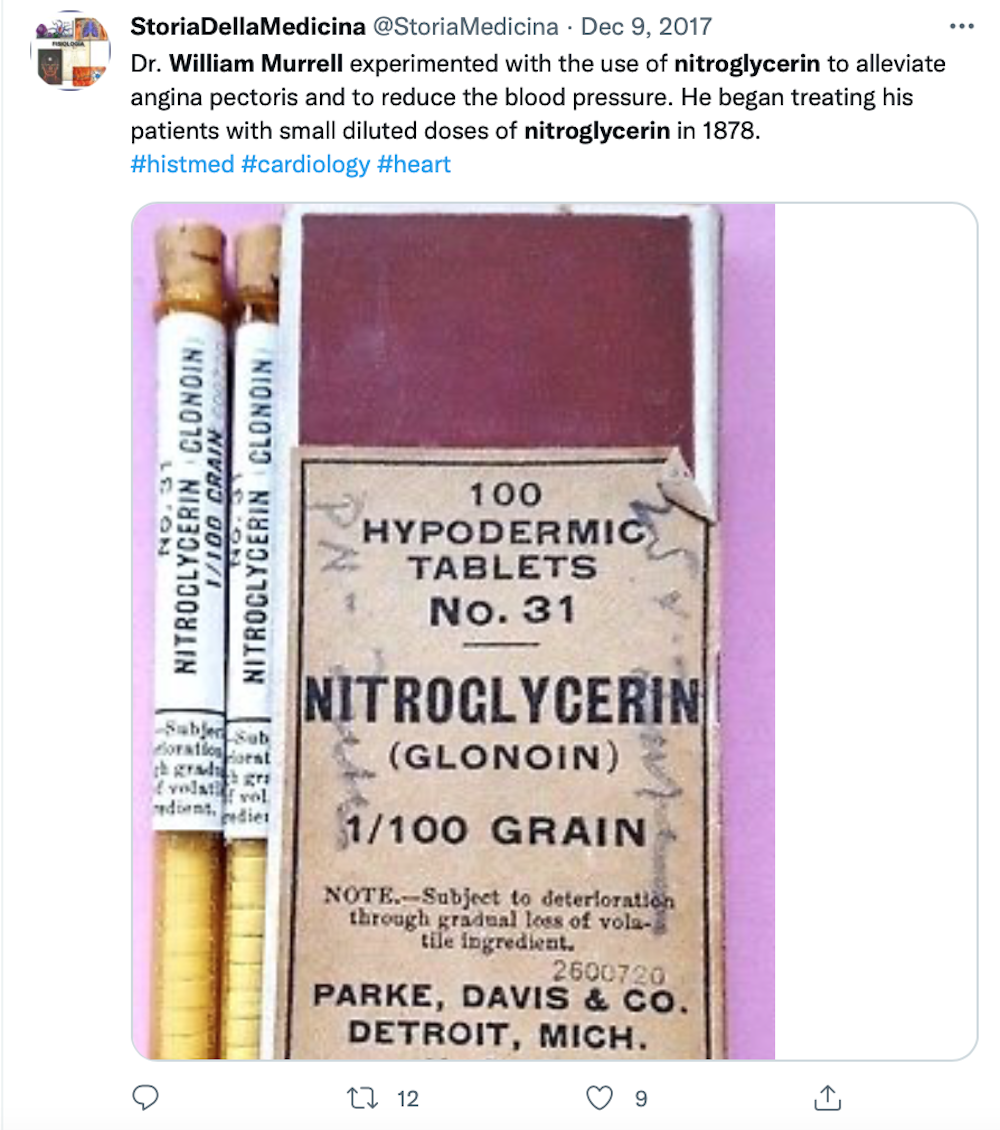
Nitroglycerin was invented in 1847 and displaced gunpowder as the most powerful explosive in the world. It was also the first modern drug to treat angina, the chest pain associated with heart disease.
Factory workers exposed to the explosive began to experience headaches and flushing in the face. This was because nitroglycerin is a vasodilator – it dilates (opens) the blood vessels.
London physician William Murrell experimented with nitroglycerin on himself and tried it on his angina patients. Twitter
London physician William Murrell experimented with nitroglycerin on himself and tried it on his angina patients. They got almost immediate relief.
Nitroglycerin made it possible for millions of people with angina to live relatively normal lives. It also paved the way for medications such as blood pressure-lowering drugs, beta-blockers and statins. These medicines have extended lives and increased the average lifespan in Western countries.
But because people’s lives are now extended, there are now higher rates of deaths from cancer and other non-communicable diseases. So nitroglycerin turned out to be a world-changing drug in unexpected ways.
Pincus found that progesterone helped to stop ovulation, and used this to develop a trial pill. Clinical trials were conducted on vulnerable women, notably in Puerto Rico, where there were concerns about informed consent and side effects.
The new drug was released by GD Searle & Co as Enovid in 1960, with US Food and Drug Administration approval. This was granted because the risk of pregnancy was seen as greater than the risk of side effects, such as blood clots and strokes.
It took ten years to prove a link between oral contraceptive use and serious side effects. After a 1970 US government inquiry, the pill’s hormone levels were lowered dramatically. Another outcome was the patient information sheet you will now find inside all prescription drug packets.
This and related drugs were not sold as “cures” for anxiety. Instead, they were supposed to help people engage in psychotherapy, which was seen as the real solution.
Polish-American chemist Leo Sternbach and his research group chemically altered Librium in 1959, producing a much more powerful drug. This was diazepam, marketed from 1963 as Valium.
Cheap, easily available drugs like these had a huge impact. From 1969 until 1982, Valium was the top-selling pharmaceutical in the United States. These drugs created a culture of managing stress and anxiety with medication.
Valium paved the way for modern antidepressants. It was more difficult (but not impossible) to overdose on these newer drugs, and they had fewer side effects. The first SSRI, or selective serotonin reuptake inhibitor, was fluoxetine, marketed from 1987 as Prozac.
Philippa Martyr does not work for, consult, own shares in or receive funding from any company or organisation that would benefit from this article, and has disclosed no relevant affiliations beyond their academic appointment.
The Vanuatu Prime Minister Bob Loughman has confirmed he will attend the next sitting of an extra-ordinary Parliament session on Friday to face a motion of no-confidence in his leadership.
Loughman and 20 MPs loyal to his government boycotted Parliament yesterday, forcing an adjournment to Friday — because of a lack of a quorum — effectively thwarting the opposition’s attempt to move the motion against him.
In response to the boycott opposition leader Ralph Regenvanu said Loughman was only delaying the inevitable.
“We think it’s just a power grab, it’s a last ditch attempt to try in stay in power beyond this week because the numbers have shifted,” Regenvanu said.
Regenvanu also said a request, from the Council of Ministers, conveyed by the Prime Minister over the weekend to the Head of State, calling for the dissolution of Parliament was equally futile.
RNZ Pacific’s reporter in Vanuatu, Hilaire Bule, reported yesterday afternoon that the Head of State, Nikenike Vurobaravu, has now declined the request for a dissolution of Parliament, effectively setting the scene for a showdown in Parliament on Friday.
Bob Loughman said he is prepared to defend himself on the floor.
“We will be there during which time I will have the opportunity to respond to allegations raised against me and I am very confident that the allegations raised against me are baseless,” he said.
Part of Loughman’s confidence also stems from the make up of the 17 government MPs who crossed the floor to join the opposition.
Vanuatu PM Bob Loughman speaks during independence celebrations. Image: Hilaire Bule/RNZ Pacific
The only complete political party grouping to shift is a handful of MPs from the Reunification Movement for Change Party led by former prime minister Charlot Salwai.
The rest of the MPs to cross over have done so as individuals leaving their party members still aligned with the government, many of them in ministerial roles.
“That to me will continue to provide instability because you cannot satisfy all of the members at any one time,” Loughman said.
“My view is rather than going to other motions coming in the next one-and-a-half-years (the next election will be in 2024) that it would be in the best interest of this country to go for a fresh election,” he said.
But Regenvanu said deliberations among the MPs that had helped shift the balance of power in the House were already well advanced.
“We expect that we will be able to form government on Friday quite peacefully and efficiently and we are currently finalising the policy platform for the new government for the remaining 18 months or so of the legislature,” Regenvanu said.
Opposition leader Ralph Regenvanu … “We expect that we will be able to form government on Friday.” Image: Hilaire Bule/RNZ Pacific
Both leaders had messages for Vanuatu citizens in the country and around the world watching the political developments unfold.
Regenvanu called for calm and urged citizens to respect the democratic process.
“We have the interest of the people at heart and we are making the changes for the better (sic) of the public,” Regenvanu said.
Prime Minister Loughman also reiterated that the motion of no confidence was a normal parliamentary process but he urged the public to ensure their leaders were making these moves for the right reasons.
“What concerns me though is members, individual members of Parliament moving across from one side of the house to the other for their personal interests as compared to national interests,” Loughman said.
This article is republished under a community partnership agreement with RNZ.
Multiple delays and a NZ$60 entry cost have done little to quench enthusiasm for New Zealand’s first Costco, with New Zealanders lining up for more than 90 minutes recently for a chance to buy a membership to the store.
A members-only warehouse retailer, the store will sell a wide range of products including food and grocery items, clothing, electronics, furniture and more. Commentators and people familiar with the brand have claimed the store will disrupt the duopoly that currently dominates New Zealand’s grocery sector.
But to enter the warehouse you must pay a membership fee, set at $60 a year or $55 if you own a business.
Just going by what is currently open – the petrol station – shoppers would need to spend $1,494 on petrol to gain enough savings to make up for the membership. A saving of 10 cents per litre on a 60 litre tank will require ten fills. That said, in the US, replacing one tyre would allow you to break even.
Considering the upfront cost for shoppers, will Costco actually be worth it?
Are prices really cheaper?
Research shows that club store prices can be 22.5% lower than traditional supermarkets.
Already, Costco’s store-adjacent petrol station in Auckland, which opened in April, has had a significant impact on fuel prices in the neighbouring community.
As the world’s third largest retailer, Costco has significant buying power to support its everyday low pricing strategy.
Costco buys in bulk, allowing the store to achieve economies of scale creating savings which can then be passed on to members. The company limits the mark-up on merchandise to between 14 and 15% above costs. In comparison, department stores typically mark up their products by 30% or above.
Costco also has a no-frills self-service store environment and an extremely low marketing budget – which save around 2% a year in costs.
But shoppers will need to get used to a smaller range of each product. Instead of eight brands of toothpaste offered by Countdown online, for example, you might only find four in Costco. Fewer brands in a category allows Costco to buy more of a single product and push for discounts from suppliers.
Costco, the world’s third largest retailer, is set to open its first New Zealand store later this year. John Greim/Costco
Costco will push a behaviour change
Costco differs from traditional supermarkets in that it is a warehouse-style shopping experience where you shop from pallets and buy in bulk. Package sizes are often three times larger compared with traditional supermarkets. So, instead of a 405 gram jar of mayonnaise, Costco sells a 1.8 kilogram jar.
The company also pushes the use of grocery coupons, common in the United States but less so in New Zealand.
People go crazy for Costco
Overseas, Costco is a destination store and research suggests that travel distances can be almost 12 times longer compared with traditional supermarkets.
Once at the store, people usually spend considerable amounts of time to do their shopping. There are no in-store signs or directories and shopping can feel like a scavenger hunt.
That said, Costco has a massive following. One fanatic even tattooed the Costco’s private label brand (Kirkland Signature) on himself, and other loyal shoppers have proposed or even tied the knot in the warehouse.
The adoration seems to be building in New Zealand with 70,0000 followers on a local fan page.
How to save
To get the most out of the membership, shoppers are likely to visit the store more frequently and more visits can mean more money spent. If you decide the opportunity for bulk buying is worth the joining fee, here are some tips for resisting the urge to splurge.
Big warehouses encourage bulk buying, but the average New Zealand home may not have the space to store the items. Getty Images
1. Buy only what you need
The chance to buy in bulk is a novelty for many Kiwis, so try to temper the temptation by making a list and sticking to it. Remember, whatever you buy you have to store somewhere and will need to use before it expires.
Kiwi fridges and pantries tend to be small compared to US storage space. The standard New Zealand fridge, for example, is 60 centimetres wide, while the average fridge in the US is 90cm wide.
The long travel distance for some is a sunk cost, so shoppers will buy more than they need to ensure the visit is worthwhile.
2. ‘Limited time only!’ offers aim to empty your wallet
The highly edited assortment that is only offered for a limited period creates a sense of urgency – buy now or it will be gone tomorrow.
Of the 4,000 products available at a typical Costco warehouse, 25% are considered treasure hunt products. These are seasonal or speciality items that are constantly changing.
An interesting part of this strategy is the sense of scarcity it creates. Shoppers are more likely to buy if they realise goods are not going to be on offer the following week. This can be exciting and enhances the treasure hunt feeling, but it can also lead to increased spending.
Although prices are very low, a study found that people who shop at Costco-like stores don’t necessarily reduce their total spending. The savings from planned purchases usually free up budget to be spent on impulse items.
Licensing theory suggests that once shoppers have made progress toward their goal (maybe finding what they need), they then give themselves permission to indulge in a treat.
4. Take the savings and stick to what you will actually use
The larger product sizes can lead to greater purchase quantities. Larger families and heavy buyers are more susceptible to this. Buying more than you need can accelerate consumption. It might also lead to food waste if you don’t consume it all before it expires, especially fresh food items such as a massive bag of salad.
My undergraduate retail class is currently working on a project for Costco’s entry to the market.
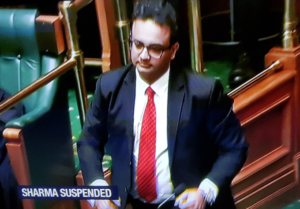
The last 10 days has seen the entire media focus (aside from the ubiquitous concern for the All Black prospects in a rugby test and then the fate of coach Ian Foster) has been on allegations of bullying by new opposition National MP Sam Uffindell and bullying of first term Labour government MP Gaurav Sharma.
Sam Uffindell’s future is still up in the air while Dr Sharma’s political career has resembled a meteorite — a brief, bright burn.
Meanwhile, over this time we were visited by US Deputy Secretary of State Wendy Sherman, who was on a whirlwind visit through the Pacific which the US has just rediscovered after finding China has been courting our Pacific neighbours.
Sherman was here to remind us the US fought in the Pacific 75 years ago, that it is ready to fight here again (on the side of “democracy” and “freedom” of course) and probably assessing when best for the US to launch a destabilising campaign against Solomon Islands Prime Minister Manasseh Sogavare, who has had the audacity, from the US point of view, to sign a development agreement with China.
There is a host of good, hard questions that should have been put to Sherman by our journalists but alas there is nothing of substance anywhere.
Calling it a “soft” interview doesn’t describe it well — “cringing embarrassment” would be better.
Full of talking points Sherman was full of US talking points such as the importance of the “[US] rules-based international order developed after World War II” and “no country should decide the political future of another country or bend that country to their political will”.
Just read that last Sherman quote again. She is aiming at China but probably three quarters of humanity have experienced precisely that interference at the hands, guns, banks and bombs of the US since World War II — democracies included.
Suspended backbench Labour MP Dr Guarav Sharma … a “meteoric career”. Image: Prime News screenshot APR
RNZ let it all go unchallenged. The US is already on the record as saying they will “not sit by” and allow China to get a foothold in the Solomon Islands or the Pacific.
Why wasn’t Sherman interrogated on this? Why weren’t hard questions asked? The danger signs for our corner of the world are everywhere — but invisible to RNZ.
Instead the hard questions were saved for the hapless thug Uffindell and those responsible for Dr Sharma’s meteoric career.
Aotearoa New Zealand got closest to an independent foreign policy in the mid-1980s but there seems no journalistic memory. Instead of asking about US intentions in the Pacific and suggesting that New Zealanders don’t want to see superpower rivalry on our doorstep, RNZ simply asks what are the prospects of New Zealand joining the AUKUS alliance (Australia, the UK and the US who are joining forces to arm Australia with nuclear submarines to counter China)
Meanwhile, Aotearoa New Zealand moves insidiously closer to the US military.
In case anyone hasn’t caught up with developments, Rocket Lab is now majority owned by the US military and has launched numerous rockets for direct military purposes.
John Minto is a political activist and commentator. This article was first published by The Daily Blog and is republished with the author’s permission.
One of the most obvious changes COVID has made to early childhood education in Australia has been around drop-offs and pick-ups.
Pre-pandemic, parents would come into centres and help their child settle in every day. During this time, they could see where their child spent their day and chat informally to educators.
But COVID has seen this stop or become sporadic. It is now common for parents to just drop their children off at the front door or gate, as centres and preschools/kindergartens try and control the spread of the virus. Understandably, this can leave families feeling disconnected from their child’s early learning and their educators.
We are researchers in early childhood education. Here’s why is it important for parents to have strong relationships with their child’s teachers – and how can you keep them going in the pandemic.
Our research
During lockdowns in 2020, we did a study with a group of 40 kindergarten (preschool) teachers and student teachers in metropolitan Melbourne.
We wanted to know how their work changed during the pandemic.
The results are published in a newly released book about early education and childcare around the world during COVID.
Why is the relationship between parents and educators so important?
Some parents may think they just need to drop their children off and pick them up each day. But in reality, the closer and more communicative their relationship is with their child’s teacher, the better.
Research has shown strong relationships support children’s academic learning, including early literacy and numeracy knowledge.
Other studies show stronger family-teacher relationships and communication enhances children’s persistence, levels of attention, motivation, and emotional regulation.
When families are involved in what children are learning in their centre, this shows them how to continue this learning at home. In turn, if families share what they are doing at home, teachers can continue this learning in the classroom. This supports shared involvement in children’s learning and development.
What changed during COVID?
More than two years of the pandemic has seen centre closures and parents banned from classrooms. This has made it much more difficult for parents and teachers to interact.
Teachers in our study talked about moving online to communicate with parents, using digital platforms, such as Storypark, Kinderloop and Playgound. These allow teachers to upload photos and messages about the day and children’s wellbeing and development. Like other professionals, Zoom has also been used to meet children and parents outside the classroom.
These methods really helped teachers and families stay connected but they were no replacement for in-person interactions. The long breaks from centres increased the challenges around making children comfortable at their centre or preschool.
What did this mean for drop-offs?
The changes brought by COVID made it more difficult to keep to routines and unsettled some children. However, as our study found, other children benefited from more independence at drop-offs.
As one teacher noted:
Some children haven’t quite gotten into the routine of things so in the morning, they might have a little bit of a cry […] you can tell they’re a bit confused and they’re still getting used to things.
Another interviewee added:
Kids are obviously finding it hard to come back […] Some kids are quite upset or the other direction [in terms of behaviour], they’re just bouncing off the walls.
However, once children got used to coming back to in-person learning, not having parents do drop-offs in the classrooms had some unintended benefits. As one teacher told us:
I’ve missed the parents, but I tell you what, the children are much more settled.
Another teacher noted, when the children come into the classroom, “they’re more independent” for example, they take responsibility for their own belongings.
In fact, the new opportunities for increasing children’s independence led to some teachers deciding to continue the practice of families farewelling children at the gate.
How can you build a relationship with your child’s educator?
Early childhood educators are passionate about your child’s learning and want to work with you. They know strong relationships with parents are a key part of their jobs.
Here are some ways you can facilitate a good relationship:
if you have to drop your child at the gate, ensure you communicate clearly that you are leaving and what the pick-up arrangement will be later today. For example: “I’m going now, and Nana will pick you up after lunch”
ask your child’s educator open-ended questions about your child’s day, such as “What was the highlight of Archie’s day?” or “What is something Millie learned today?”
tell your child’s educator what you did over the weekend or during family holidays, to help them engage with your child about home life
share information about cultural events celebrated in your family
if you are using digital sharing platforms, instead of just “liking” a post, share something similar or relevant that happens at home.
A sector under pressure
In 2022, there remains significant disruption and uncertainty around early childhood education, due to ongoing staff and child illnesses.
There are also staff shortages which are causing centres to close for days at a time.
Building relationships with your child’s educators and centre has never been more important. If you support them, they can better support your child’s learning.
The authors would like to acknowledge Early Childhood Management Services as a partner in the research informing this article.
Katherine Bussey is affiliated with Infant and Toddler Advocacy Network Australia (ITANA), a not for profit organisation.
Deborah Moore received funding from the Department of Education and Training (DET), Victorian Government, for the implementation of the study this paper is based on.
Natalie Robertson received funding from the Department of Education and Training (DET), Victorian Government, for the implementation of the study this paper is based on
Shelli Giosis works as a teacher for Early Childhood Management Services.
Jordan Peele has only made three films, over a five-year period, but in that time he has emerged as a master of a new kind of genre: high-concept black horror-thrillers with a social edge and bitingly satirical takes on race, class and gender.
Peele began his career as a comedian in the sketch series Key & Peele alongside Keegan-Michael Key, spoofing horror classics like The Exorcist (1973). But it was his directorial debut in 2017 – Get Out – that catapulted him to fame.
Get Out follows Chris (Daniel Kaluuya), a young black man who uncovers a horrific secret when visiting the rich parents of his white girlfriend. A creepy mash-up of The Stepford Wives (1975) and Guess Who’s Coming to Dinner (1967), Get Out shed disturbing light on America’s slave past and barely concealed prejudices.
If America was supposed to be living in a blissful state of post-racial harmony, Peele was not buying the lie. Get Out used jump scares and odd camera angles to unsettle us: in one scene, the housekeeper, playing a white woman trapping a black woman in her own body, smiles so hard she cries.
An Oscar followed, plus commercial success, and a reputation was forged for smart, socially inflected horror that peeled back the façade of white America to show its terrible secrets beneath.
Peele won an Academy Award for Best Original Screenplay, along with nominations for Best Picture and Best Director. The film grossed over $250 million at the box-office. A new horror auteur had arrived.
Peele continued to explore a double-edged American society with Us (2019). This time around, a young black woman encounters her own violent doppelganger. The twisting narrative unpacks complex social issues such as poverty, the disenfranchised, and the locked-away traumas of American’s past.
“Who are you people?”, asks one frightened character. The matter-of-fact answer: “We’re Americans”: the murderous villains are our own mirror images, living in the shadows.
By now, Peele had become a by-word for smart black horror that explored America’s insidious racism and inequality. He subsequently co-produced the Candyman remake in 2021 (another horror film with a harsh social edge), and worked on horror drama Lovecraft Country, plus a reboot of The Twilight Zone.
A huge nope to Nope
Unfortunately Peele’s latest film, Nope (2022) is a terrible disappointment in comparison to his previous work: a film brimming with ideas (lots of them silly), innumerable homages to better ones (Jurassic Park (1993), King Kong (1933), Jaws (1975)), and lacking the tautness of Get Out, or the inventiveness of Us.
It’s an intriguing story about two siblings, OJ and Emerald – Kaluuya and Keke Palmer – who run a horse wrangling business for film productions in California. When they see what appears to be an UFO, the owner of a nearby theme park spots an opportunity to profit.
I don’t wish to reveal too much, but it is difficult to sum up Nope’s plot – there is enough in the opening 40 minutes alone to fill five films.
What is Peele trying to say here? Why does the central “monster” want to watch, but never be watched? Is Peele critiquing our 21st-century surveillance culture? Have we become a society intent on monetising the past, selling death and destruction to the masses (the celebrity gossip site TMZ does not fare well)? How foolish are we in trying to tame nature?
OJ and Emerald also claim to be descendants of the unnamed black jockey featured in Eadweard Muybridge’s famous The Horse in Motion animation. Once again, forgotten history, the emergence of cinema, and America’s black past are immediately brought to mind.
Perhaps Nope (that title is an acronym for Not Of Planet Earth) is just an old-fashioned monster movie. Two names that spring to mind are Steven Spielberg and M. Night Shyamalan.
Any film that deals with UFO sightings and alien encounters will always hark back to Spielberg’s Close Encounters of the Third Kind (1977) (and there are clear visual references throughout Nope to big skies and high spectacle). And Nope’s slow-burning twists and switches remind us of Signs (2002) and The Sixth Sense (1999).
There are certainly moments of dread in Nope – a flashback scene with a chimpanzee is particularly chilling – but the overall effect feels baggy and repetitive. Perhaps the slowly increasing running time of Peele’s films is an indicator of their decreasing quality – Get Out was 104 minutes, Us 121, and now Nope clocks in at 135.
Is that the sign of a writer-director brimming with ambitious ideas, or an artist whose earlier successes have made them immune to the importance of tight editing and focused storytelling?
Despite this misfire, Peele’s name brings audiences to see his films. Nope made $44 million on its opening weekend last month, the best wholly original film opening in America since April 2019 (and that film was Us).
That is compelling evidence of Peele’s transformative effect on Hollywood’s fragile ecosystem. At a time when cinema is relying on comic book adaptations, remakes and sequels, Peele is offering a robust form of counterprogramming: visually impressive, inventive tales about contemporary America. His horror auteur status is secure.
But as for Nope? Well… nope.
Ben McCann does not work for, consult, own shares in or receive funding from any company or organization that would benefit from this article, and has disclosed no relevant affiliations beyond their academic appointment.
Source: The Conversation (Au and NZ) – By Jeffrey Cooke, Professor, Centre for Astrophysics and Supercomputing, Swinburne University of Technology
CSIRO , Author provided
We often think of astronomy as a visual science with beautiful images of the universe. However, astronomers use a wide range of analysis tools beyond images to understand nature at a deeper level.
Data sonification is the process of converting data into sound. It has powerful applications in research, education and outreach, and also enables blind and visually impaired communities to understand plots, images and other data.
Its use as a tool in science is still in its early stages – but astronomy groups are leading the way.
In a paper published in Nature Astronomy, my colleagues and I discuss the current state of data sonification in astronomy and other fields, provide an overview of 100 sound-based projects and explore its future directions.
The cocktail party effect
Imagine this scene: you’re at a crowded party that’s quite noisy. You don’t know anyone and they’re all speaking a language you can’t understand – not good. Then you hear bits of a conversation in a far corner in your language. You focus on it and head over to introduce yourself.
While you may have never experienced such a party, the thought of hearing a recognisable voice or language in a noisy room is familiar. The ability of the human ear and brain to filter out undesired sounds and retrieve desired sounds is called the “cocktail party effect”.
Similarly, science is always pushing the boundaries of what can be detected, which often requires extracting very faint signals from noisy data. In astronomy we often push to find the faintest, farthest or most fleeting of signals. Data sonification helps us to push these boundaries further.
The video below provides examples of how sonification can help researchers discern faint signals in data. It features the sonification of nine bursts from a repeating fast radio burst called FRB121102.
Casey Law/Youtube.
Fast radio bursts are millisecond bursts of radio emission that can be detected halfway across the universe. We don’t yet know what causes them. Detecting them in other wavelengths is the key to understanding their nature.
When we explore the universe with telescopes, we find it’s full of cataclysmic explosions including the supernova deaths of stars, mergers of black holes and neutron stars that create gravitational waves, and fast radio bursts.
Here you can listen to the merger of two black holes.
LIGO/YouTube.
And the merger of two neutron stars.
LIGO/YouTube.
These events allow us to understand extreme physics at the highest-known energies and densities. They help us to measure the expansion rate of the universe and how much matter it contains, and to determine where and how the elements were created, among other things.
Upcoming facilities such as the Rubin Observatory and the Square Kilometre Array will detect tens of millions of these events each night. We employ computers and artificial intelligence to deal with these massive numbers of detections.
However, the majority of these events are faint bursts, and computers are only so good at finding them. A computer can pick out a faint burst if it’s given a template of the “desired” signal. But if signals depart from this expected behaviour, they become lost.
And it’s often these very events that are the most interesting and yield the biggest insight into the nature of the universe. Using data sonification to verify these signals and identify outliers can be powerful.
More than meets the eye
Data sonification is useful for interpreting science because humans interpret audio information faster than visual information. Also, the ear can discern more pitch levels than the eye can discern levels of colour (and over a wider range).
Another direction we’re exploring for data sonification is multi-dimensional data analysis – which involves understanding the relationships between many different features or properties in sound.
Plotting data in ten or more dimensions simultaneously is too complex, and interpreting it is too confusing. However, the same data can be comprehended much more easily through sonification.
As it turns out, the human ear can tell the difference between the sound of a trumpet and flute immediately, even if they play the same note (frequency) at the same loudness and duration.
Why? Because each sound includes higher-order harmonics that help determine the sound quality, or timbre. The different strengths of the higher-order harmonics enable the listener to quickly identify the instrument.
Now imagine placing information – different properties of data – as different strengths of higher-order harmonics. Each object studied would have a unique tone, or belong to a class of tones, depending on its overall properties.
With a bit of training, a person could almost instantly hear and recognise all of the object’s properties, or its classification, from a single tone.
Beyond research
Sonification also has great uses in education (Sonokids) and outreach (for example, SYSTEM Sounds and STRAUSS), and has widespread applications in areas including medicine, finance and more.
But perhaps its greatest power is to enable blind and visually impaired communities to understand images and plots to help with everyday life.
The ‘ticking’ noise that plays with the walk signal at traffic lights is one example of how sonification can assist blind and visually impaired people. Shutterstock
It can also enable meaningful scientific research, and do so quantitatively, as sonification research tools provide numerical values on command.
This capability can help promote STEM careers among blind and visually impaired people. And in doing so, we can tap into a massive pool of brilliant scientists and critical thinkers who may otherwise not have envisioned a path towards science.
What we need now is government and industry support in developing sonification tools further, to improve access and usability, and to help establish sonification standards.
With the growing number of tools available, and the growing need in research and the community, the future of data sonification sounds bright!
Jeffrey Cooke does not work for, consult, own shares in or receive funding from any company or organization that would benefit from this article, and has disclosed no relevant affiliations beyond their academic appointment.
Media partnerships are an important part of the region’s journey and narrative as a Pacific family, says Vanuatu’s Finance and Economic Management Director-General Letlet Augustus in a message to news media.
Opening the Forum Economic Ministers Meeting (FEMM) Media Workshop in Port Vila last week, he said the skillset of media practitioners in ensuring information made sense in Pacific languages for growing awareness was also important for those leading economic recoveries.
“The Vanuatu FEMM is a historical moment for media and public access to this meeting. [Media] will have new access to the private sector and civil society dialogues,” he said.
Wansolwara student editor Sera Tikotikoivatu-Sefeti. Image: Wansolwara
“This bodes well for quality reporting of the FEMM as the space where we must set and share our plans for economic resilience and stability,” he told participants of the workshop organised by the Pacific Assistance Media Scheme (PAMS), Pacific Islands News Association (PINA) and the Pacific Islands Forum (PIF).
Wansolwara student editor Sera Tikotikoivatu-Sefeti was one of four journalists from the region selected by PIF to attend the masterclass and report on the FEMM proceedings in Vanuatu.
She said the opportunity to be part of the media workshop would boost her journalism knowledge and training to report on FEMM fairly and accurately.
“The masterclass will enable and equip me with the right skills to understand and formulate questions relating to the economy and its impact on the community,” said the final-year journalism student at the University of the South Pacific’s Laucala campus, who is also a freelance writer for Islands Business.
‘Upskill my knowledge’ “It would also upskill my knowledge on the various economic jargon and how to best relay this to the public,” she said.
“The workshop would also allow us access to leaders in decision-making roles, especially relating to economic development.”
PIF Secretary-General Henry Puna said media partnerships helped cement awareness of the Forum and its members, on the importance of regionalism and leaving no one behind.
“The core message is that as a sea of islands we are stronger when we are together. We are in unprecedented times and face unprecedented challenges and opportunities,” he said.
“The onus now lies with us to seize these opportunities and with it, heighten our visibility as an influential bloc at the global level.”
Republished under a student partnership between Asia Pacific Report and the University of the South Pacific’s Wansolwara.
Islands Business editor Samantha Magick (from left), Pacific Islands News Association’s Pita Lagaiula, Fiji Television Limited’s Mereoni Mili (USP journalism alumni) and Wansolwara‘s Sera Tikotikoivatu-Sefeti. Image: Wansolwara
Source: The Conversation (Au and NZ) – By Ron May, Emertius Fellow, attached to the State, Society and Governance in Melanesia Program, Australian National University
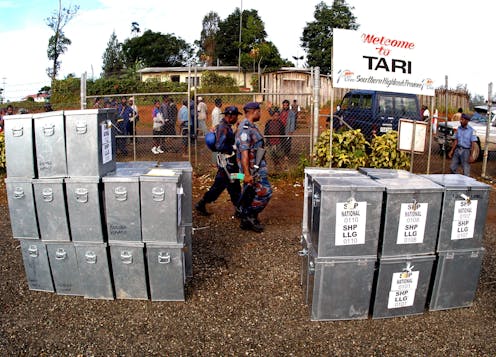
Paramilitary police and soldiers patrol ballot boxes at Tari airport, Southern Highlands, PNGAAP Image
Despite Australia “stepping up” its relations with the Pacific since the election of the Albanese government, one of the notable things about the recent national election in Papua New Guinea (PNG) was the almost complete lack of coverage of it in Australian media – except for the odd report of violence.
2022 election outcome
For the record, voting took place across the country from July 4 to 22. Counting was supposed to be completed and writs returned by July 29, but that was extended to August 4. On August 9, with 99 of the 118 seats declared, the National Parliament met to elect a prime minister.
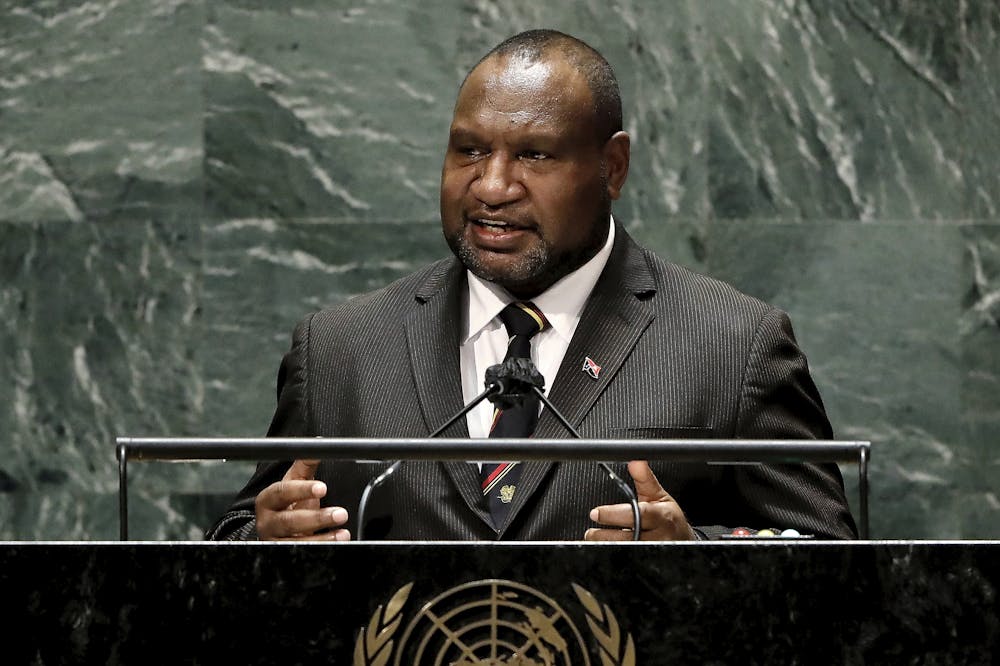
As leader of the party with the largest number of endorsed candidates elected (Pangu Pati with 36 members at August 9), outgoing prime minister James Marape was invited by the governor-general to form government and was re-elected to the office. Unusually, he was elected unopposed.
Like all other prime ministers before him, Marape heads a coalition government, including at least 17 parties and some independents. Most of the 17 parties have only one or two MPs and, with the independents, will probably merge with the larger parties in the early months of the new parliament.
Prime Minister James Marape was re-elected to office in 2022. AP
The new parliament will include two women, better than the zero in 2017-2022, but still a disappointing result given the efforts to promote women candidates, whose numbers were fewer in 2022 than in 2017.
In many parts of the country, this year’s elections were carried out without incident or drama. The previous election, in 2017, was widely described as the worst in the nation’s history, with inaccurate electoral rolls, vote-buying and intimidation of voters in some parts of the country.
The election was also afflicted by delays in polling and counting, theft and destruction of ballot boxes, and violence throughout. This included an estimated 200 “election-related deaths” (though “election-related deaths” are difficult to measure in a country where intergroup and domestic violence are endemic).
Some observers have suggested the 2022 election was more flawed and more violent than that of 2017, despite a substantial security presence and logistic support from the Australian Defence Force. A clearer picture will emerge once the reports of the ANU-coordinated domestic monitoring teams have been processed. However, the number of “election-related deaths” to date has been put at 50.
Counting has been delayed in several electorates, and elections may have failed in at least three electorates due to allegations of vote fixing and other problems. Two of the potential failed election cases are in Morobe Province, while counting has been delayed in electorates of the National Capital District (Port Moresby) where violence has occurred.
Societal and political context of election violence
To understand the problems of elections in Papua New Guinea, and the violence associated with them, it is necessary to appreciate the social and political context in which elections take place.
Around 80-85% of Papua New Guineans live in rural villages and hamlets with limited involvement in the cash economy. Politics therefore tends to be heavily localised.
Around 80% of PNG’s population live in rural villages. Getty Images
Political parties play a very minor role in how electors vote. Voters tend to vote for candidates they believe will give them access to government and bring them local services and other benefits – usually members of their clan or former public servants or businessmen who have a good local record.
Competition to get elected is intense, with large and growing numbers of candidates contesting in most electorates (on average 29 per electorate in 2022, but over 70 in two electorates). Some candidates invest large sums of money campaigning, including vote buying.
In the lead-up to the 2022 election, as in 2017, there were reports of sophisticated weapons being imported and distributed among candidates’ supporters in the highlands. The weapons were presumably for use in case of confrontations between rival candidates and their supporters.
Voting shifts
In 2007, Papua New Guinea shifted from a first-past-the-post system of voting, where the voter casts a single vote for the candidate of their choice, to one of limited preferential voting, where voters can indicate an order of preference for three candidates on their ballots.
This change was made in the hope of encouraging cooperation between candidates and reducing confrontation. However, there has been little evidence of changed behaviour. In some electorates, candidates have sought to prevent rivals from campaigning in the candidate’s core support area, even to the point of shooting at a helicopter bringing in a rival candidate.
Treacherous terrain, poor road networks and remote locations in much of the country have made it difficult and expensive to organise polling and to transport ballot boxes safely to counting centres. These physical conditions also contribute to the difficulties of compiling accurate electoral rolls, a continuing source of anger among voters whose names cannot be found on the rolls.
Corruption, control and other factors
However, the problems of inaccurate rolls and delayed polling are not just the result of geography and terrain, or even of inadequate or tardy payments from the government to the Electoral Commission and from the Electoral Commission to polling officials.
The ability of the Electoral Commission in Port Moresby to control what goes on at the local polling level is limited. Domestic monitoring in 2017 reported a number of instances where politicians appointed partisan polling officials. In other cases, supporters of candidates, sometimes in association with polling officials, filled out multiple ballots for one candidate – a reason that ballot boxes have sometimes been stolen of destroyed.
In 2022, almost 10,300 police and defence force personnel were deployed to provide security for polling; in designated “hotspots,” polling was limited to one day to maximise the coverage of security details. These efforts undoubtedly had an impact but were not sufficient to completely eliminate violence from frustrated would-be voters or supporters who believed that their candidate had been cheated.
After being elected, Marape promised to review and reform the voting process. However, it is difficult to see what can be done without a fundamental change in the behaviour of candidates, their supporters, and the voters themselves.
Ron May does not work for, consult, own shares in or receive funding from any company or organisation that would benefit from this article, and has disclosed no relevant affiliations beyond their academic appointment.
Even a relatively small nuclear war would create a worldwide food crisis lasting at least a decade in which hundreds of millions would starve, according to our new modelling published in Nature Food.
In a nuclear war, bombs dropped on cities and industrial areas would start firestorms, injecting large amounts of soot into the upper atmosphere. This soot would spread globally and rapidly cool the planet.
Although the war might only last days or weeks, the impacts on Earth’s climate could persist for more than ten years. We used advanced climate and food production models to explore what this would mean for the world’s food supply.
Conflicts between nuclear-armed powers are an ongoing concern in multiple parts of the world. If one of these conflicts escalated to nuclear war, how would it affect the world’s food supply? And how would the impacts on global food production and trade scale with the size of such a war?
To try to answer these questions, we used simulations of the global climate coupled with models of major crops, fisheries and livestock production. These simulations let us assess the impacts of nuclear war on global food supply for 15 years after the conflict.
We simulated six different war scenarios, because the amount of soot injected into the upper atmosphere would depend on the number of weapons used.
The smallest war in our scenarios was a “limited” conflict between India and Pakistan, involving 100 Hiroshima-sized weapons (less than 3% of the global nuclear arsenal). The largest was a global nuclear holocaust, in which Russia and the United States detonate 90% of the world’s nuclear weapons.
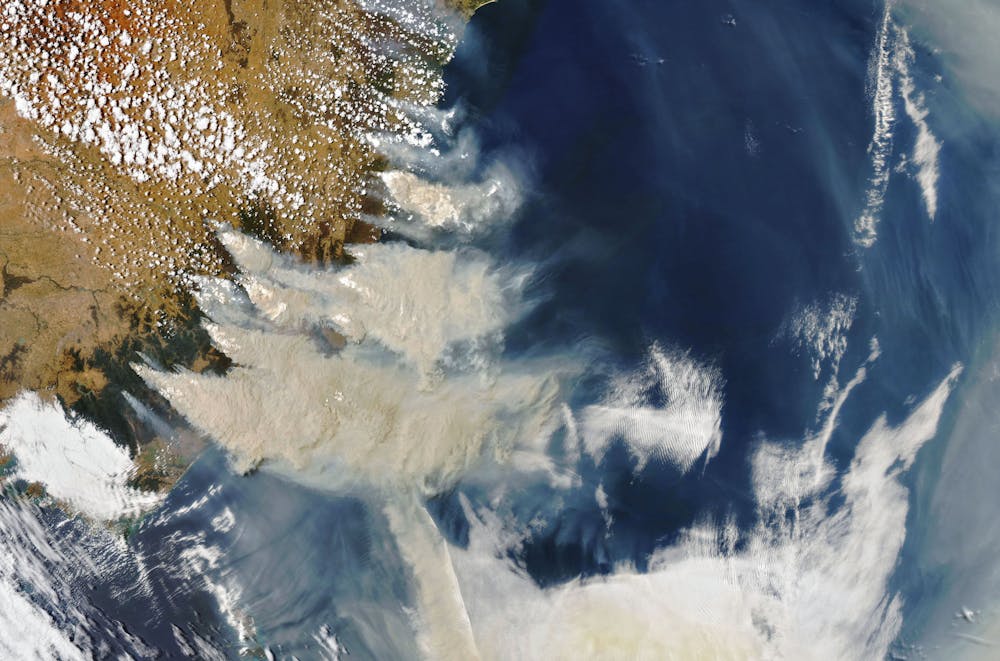
The Australian bushfires of 2019–20 injected a million tonnes of soot into the upper atmosphere, but even a ‘limited’ nuclear war would have a much greater impact. NASA Earth Observatory
The six scenarios injected between 5 million and 150 million tonnes of soot into the upper atmosphere. For context, the Australian summer bushfires of 2019–20, which burned an area greater than the United Kingdom, injected about one million tonnes of smoke into the stratosphere.
Although we focused on India and Pakistan for our regional-scale war scenarios, nuclear conflict involving other nations could result in similar amounts of smoke and thus similar climate impacts.
Widespread starvation
Across all scenarios, impacts on the world’s climate would be significant for about a decade after a nuclear war. As a consequence, global food production would decline.
Even under the smallest war scenario we considered, sunlight over global crop regions would initially fall by about 10%, and global average temperatures would drop by up to 1-2℃. For a decade or so, this would cancel out all human-induced warming since the Industrial Revolution.
In response, global food production would decrease by 7% in the first five years after a small-scale regional nuclear war. Although this sounds minor, a 7% fall is almost double the largest recorded drop in food production since records began in 1961. As a result, more than 250 million people would be without food two years after the war.
Unsurprisingly, a global nuclear war would be a civilisation-level threat, leaving over five billion people starving.
In this scenario, average global temperatures would fall by 10-15℃ for the first five years after the war, while sunlight would crash by between 50–80% and rainfall over crop regions would drop by over 50%. As a result, global food production from land and sea would fall to less than 20% of pre-war levels and take over a decade to recover.
No such thing as a limited nuclear war
Behavioural change could avert some starvation after a relatively small nuclear war, but only regionally. We found that reducing household food waste and diverting feed from livestock to humans would lessen a regional nuclear war’s effect on food supply, but only in major food-exporting countries such as Russia, the United States and Australia.
Although great improvements have been made in recent decades, global food distribution remains a major challenge. Despite present-day food production being more than sufficient to nourish the world’s population, over 700 million people suffered from undernutrition worldwide in 2020.
In a post-nuclear-war world, we expect global food distribution would cease entirely for several years, as exporting countries suspend trade and focus on feeding their own populations. This would make war-induced shortages even worse in food-importing countries, especially in Asia, Europe and the Middle East.
Our results point to a stark and clear conclusion: there is no such thing as a limited nuclear war, where impacts are confined to warring countries.
Ryan Heneghan does not work for, consult, own shares in or receive funding from any company or organisation that would benefit from this article, and has disclosed no relevant affiliations beyond their academic appointment.
Source: The Conversation (Au and NZ) – By Katherine Livingstone, NHMRC Emerging Leadership Fellow and Senior Research Fellow at the Institute for Physical Activity and Nutrition, Deakin University
Shutterstock
The popularity of plant-based proteins, or “fake meat”, has increased in recent years as consumers look to eat fewer animal products. In fact, plant-based protein is projected to be a A$3 billion opportunity for Australia by 2030.
Many consumers believe these fake meats are better for their health, as well as better for the environment, but is that right?
It may sound obvious, but the first thing to say is that fake meat is not meat. Referring to these products as meat has been widely criticised by the meat industry, resulting in a recent Senate Committee report recommending mandatory regulation for the labelling of plant-based products.
Fake meats fall into two categories: plant-based proteins and cell-based proteins.
The plant-based burgers and sausages found on supermarket shelves are made by extracting the protein from plant foods, often pea, soy, wheat protein, and mushrooms.
But a myriad of additives are needed to make these products look and taste like traditional meat.
For example, chemically refined coconut oil and palm oil are often added to plant-based burgers to help mimic meat’s soft and juicy texture. Colouring agents, such as beetroot extracts, have been used in Beyond Meat’s “raw” burger to mimic the colour change that occurs when meat is cooked. And the additive soy leghemoglobin, produced by genetically engineered yeast, has been used to create the Impossible Foods “bleeding” burger.
Something not yet available on supermarket shelves in Australia is cell-based or “cultured” meat. This fake meat is made from an animal cell that is then grown in a lab culture to create a piece of meat. While it may sound like a far-off concept, Australia already has two cell-based meat producers.
Lab grown meat is yet to hit supermarket shelves in Australia, but it’s probably not far off. Shutterstock
Is fake meat healthier?
Not necessarily.
In good news, an audit of over 130 products available in Australian supermarkets found plant-based products were, on average, lower in calories and saturated fat, and higher in carbohydrates and fibre than meat products.
But, not all plant-based products are created equal.
In fact, there are considerable differences in the nutrition content between products. For example, the saturated fat content of plant-based burgers in this audit ranged from 0.2 to 8.5 grams per 100 grams, meaning some plant-based products actually contained more saturated fat than a beef patty.
Salt levels in plant-based products are high, but vary between products. Plant-based mince can contain up to six times more sodium than meat equivalent products, whereas plant-based sausages contain two thirds less sodium on average.
The question then is, does swapping animal-based foods for plant-based foods improve health?
An eight week trial of 36 US adults investigated this, and researchers found switching to eating more plant-based products (while keeping all other foods and drinks as similar as possible) improved risk factors for heart disease, including cholesterol levels and body weight. However, research in this area is still in its infancy, and longer term trials are needed.
The bottom line is most fake meats are classified as ultra-processed foods.
They have undergone extensive industrial processing and include substances of “no or rare culinary use”, which means you would not find them in your average kitchen cupboard.
There is an opportunity for government and the food industry to ensure these highly processed plant-based products are re-formulated to contain less saturated fat and sodium, and to minimise the use of chemically derived additives.
Fake meats are engineered to look, cook, taste and sometimes even bleed like real meat. Shutterstock
Is fake meat better for the environment?
Yes, it can be.
The US Beyond Meat burger claims to use 99% less water, 93% less land and produce 90% fewer greenhouse gas emissions than a traditional beef patty.
Yet, the environmental footprint of plant-based products is a contentious topic, especially since ultra-processed foods have been widely criticised as being environmentally unsustainable.
A study published this month in The Lancet Planetary Health looked at the ethical and economic implications of eating more plant-based products. Researchers concluded switching from beef to plant-based products would reduce the carbon footprint of US food production by 2.5–13.5%, by reducing the number of animals needed for beef production by 2–12 million.
However, researchers noted any benefits to the agricultural workforce and natural resources were less clear.
Fake meats can be enjoyed as part of a healthy diet as a “sometimes food”.
When choosing plant-based products, check the label to choose lower salt and higher fibre options.
If you are looking for an alternative to meat that is both healthy for you and the environment, then whole plant foods are by far the best option for a plant-based or flexitarian diet.
Fresh or canned legumes, beans and chickpeas can be used to make your own meat-free burgers, and herbs and spices can add flavour to tofu.
Eating these whole plant foods also aligns with the Australian Guide to Healthy Eating, that recommends choosing lean meats and poultry, fish, eggs, tofu, nuts and seeds, and legumes/beans, and eating fewer processed meats such as salami, bacon, and sausages.
Katherine Livingstone receives funding from a National Health and Medical Research Council Investigator Grant (APP1173803).
Laura Marchese receives funding from a Deakin University Postgraduate Research Scholarship and a CSIRO Top-Up Scholarship.
Within less than three years, the World Health Organization (WHO) has declared two public health emergencies of international concern: COVID-19 in February 2020 and monkeypox in July 2022.
At the same time, extreme weather events are being reported continuously across the world and are expected to become more frequent and intense.
These are not separate issues. We will have a better chance of suppressing infectious diseases only if we adopt what the WHO calls a One Health approach and integrate predictive modelling and surveillance used in both infectious disease control and climate change.
But as long as these surveillance systems depend on diseases that have already emerged, they remain behind the curve and we risk “sleepwalking” into the next pandemic.
Given the impacts of a changing climate on ecosystems, any surveillance of new disease outbreaks must include humans, animals and planetary changes.
COVID-19 will continue to evolve into new variants despite high vaccination rates in some countries and the availability of antiviral treatments. At the same time, new diseases will continue to emerge.
Polio has now also been detected in wastewater samples in New York and public health authorities in other wealthy countries are racing to head off the re-emergence of a virus that had been almost eliminated.
While the latter is most likely due to a global drop in vaccinations, health experts are warning that new pathogens, particularly those that jump between animals and humans, will become more frequent as habitats change in a warming world.
Health scientists refer to diseases such as COVID-19 and monkeypox as zoonoses – pathogens known to be transmitted from animals to humans. Close contact between humans and wild animals is increasing as forests are destroyed to make way for agriculture and trade in exotic animals continues.
The link between human, animal and environmental health
Global climate models are increasingly sophisticated at projecting how climate change will affect Earth systems and ecosystems. There are efforts to “connect the dots” by integrating human and animal health and the “sickness of the planet”, as described by the late Norwegian physician Per Fugelli in his 1994 essay, In Search of a Global Social Medicine.
Incremental steps in integrating disease and planetary surveillance are under way. In 2008, the WHO, the Food and Agriculture Organization (FAO), the World Organisation for Animal Health (WOAH) and other organisations jointly drafted a framework for how best to diminish the risk and minimise the global impact of pandemics.
In 2014, a manifesto published in the Lancet called for an urgent transformation in our values, based on the recognition of our “interdependence and interconnectedness of the risks we face”.
In 2021, the One Health high level expert panel adopted a definition of an integrated, unifying approach that aims to balance and optimise the health of people, animals and ecosystems.
A One Health approach to disease surveillance is now used by the African Centers for Disease Control and the global network to address antimicrobial resistance. In 2019, the UN’s interagency coordinating group on antimicrobial resistance recognised that microbes that infect animals and humans share the same ecosystems and their prevention therefore requires a coordinated approach.
These are relatively recent initiatives in our effort to understand and track past, present and future outbreaks. There may be a long way to go in integrating disciplines, but the answer to predicting and preempting future outbreaks and pandemics lies in a One Health approach.
Arindam Basu does not work for, consult, own shares in or receive funding from any company or organisation that would benefit from this article, and has disclosed no relevant affiliations beyond their academic appointment.
Source: The Conversation (Au and NZ) – By Anthony Halog, Lecturer/Research Group Leader in Industrial Ecology and Circular Economy, The University of Queensland
The Brisbane 2032 Olympic organising committee boardDarren England/AAP
In a year of major sporting events – the Commonwealth Games, the FIFA World Cup, cricket’s T20 World Cup, the Winter Olympics – conversations on greening such events are more essential than ever. While the Brisbane Olympics are a decade away, lessons from events like these need to be applied from the start to maximise the benefits of the city’s transformation for the 2032 Games. Good planning can produce a positive environmental legacy for years to come.
In recent years, the focus on the impacts of such events on host cities, specifically the environmental impacts, has sharpened. As the costs of environmental degradation and climate change mount, Olympic plans must adapt to the host city’s sustainable development or redevelopment, as opposed to the city being developed around the Olympics.
Of course, these considerations are not new. Sustainability has been established as the third pillar of the Olympics since the 1990s.
Past Olympic hosts have tried to reduce their environmental impacts. Whether it’s planting trees to offset carbon emissions, cleaning up rivers, recycling materials to reduce waste, increasing public transport use, or using renewable energy, host cities have been making efforts and claims to be green for years.
And yet behind each host’s proclaimed success lies a multitude of shortcomings.
For example, host cities often need to improve or redevelop their transport systems. Most development projects in the past have been Games-specific rather than focused on improving the city for residents. The priorities are usually in areas most impacted by the event, so often don’t match residents’ ongoing needs.
We saw this in Rio de Janeiro, host of the 2016 Olympics. Projects were constructed in poorly planned locations with limited transport access. Only 15 of the original 27 venues hosted some sort of post-Olympics event. Others became deteriorating white elephants.
In London, multiple projects such as the Crossrail project were postponed before the 2012 Olympics. Residents’ needs were downgraded.
One must also wonder how the Olympics can be environmentally friendly when so many resources are diverted or newly invested in projects dedicated to an event lasting a couple of weeks at most.
Some Games, such as the 2008 Beijing Olympics, did improve aspects such as air quality that benefited all residents. However, these improvements were short-term, which is typical among host cities. Even for this year’s Beijing Winter Olympics, where organisers used renewable energy, retrofitted venues and considered a range of emissions, a more holistic approach would have improved outcomes.
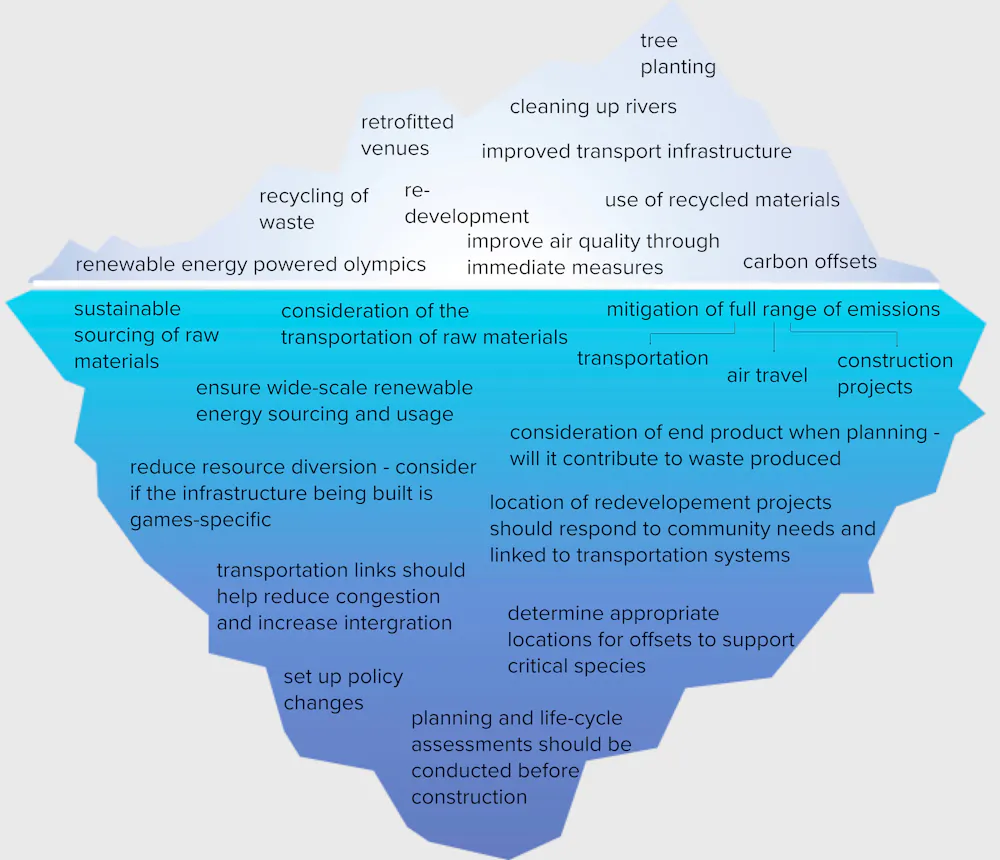
Host cities haven’t been approaching design, planning and hosting in the most comprehensive and sustainable way. They have tended to focus on the obvious tip-of-the-iceberg environmental impacts. However, many other issues are lurking beneath the surface, with interrelated knock-on effects.
Event organisers typically target the obvious environmental issues – the tip of the iceberg – neglecting the hidden impacts. Drawn by Manudi Periyapperuma, Author provided
For example, planting trees (as Beijing did) can help offset emissions and establish new habitat. However, it has been reported that the clearing of habitat in Songshan National Nature Reserve to house the National Alpine Ski Centre could affect vulnerable species. Planting trees as offsets does not excuse such irreversible impacts.
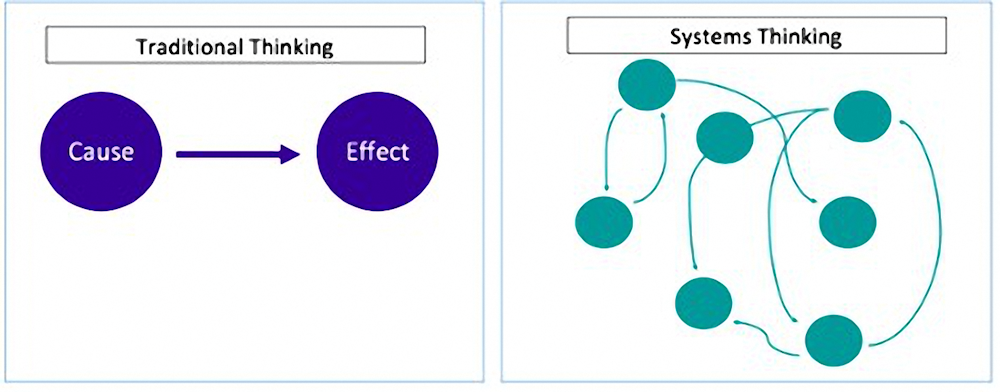
To host truly environment-friendly events, cities must consider the whole picture of emissions, resource consumption, waste production, transport links, habitat impacts and more. This requires a system-thinking approach that considers the life cycle of the product or project. It means planning where construction takes place, which venues can be retrofitted or recycled, what materials are used and where they are sourced. It also means deciding how construction projects will be powered and, ultimately, ensuring the resources invested in projects are not wasted after the event.
Systems thinking is built on the understanding that every element, aspect or action is part of a constantly evolving web of interactions. Adapted from M. Seibert (2018)/Solutions, CC BY
So, how can Brisbane build on Sydney’s success? The detailed planning is still being resolved, but Brisbane’s more holistic approach gives the city a head-start. Its “climate-positive” commitment has four core principles:
repurposing and upgrading existing infrastructure
encouraging residents to change behaviours and be more environmentally conscious
implementing pollution and waste management incentives
better transport planning.
An overview of the Brisbane 2032 master plan.
The master plan isn’t simply responding to selected environmental issues. Instead, Brisbane is on the path to a climate-positive Games through a combination of:
integrating public transport services
strategically locating venues across Queensland – 80% of the venues already exist
ensuring community needs across the state are met
investing in innovative solutions such as a sustainable hydrogen industry
promoting policy and behavioural changes to help solve deep-rooted issues.
However, Brisbane needs to go further by committing to life-cycle assessments of Olympic projects and following up on promised outcomes over the years.
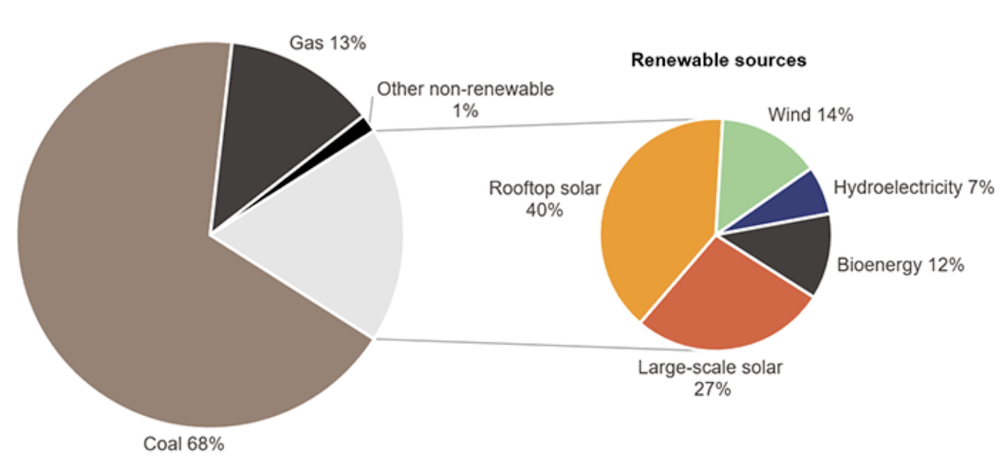
One shortcoming stands out in particular. Energy consumption and sourcing are not among the core principles for hosting the Olympics. Even if Brisbane were to achieve a zero-emissions event by using renewable energy, that doesn’t cover emissions from the next ten years of construction. And Queensland is still a mostly coal-powered state.
Brisbane is treating the Olympic Games as a platform for urban development that can transform how we travel, integrate multiple urban centres across South-East Queensland, and result in lasting changes to policies and behaviours. These goals stem from the importance of leaving a climate-positive legacy that will last.
This article would not have been possible without the research assistance of Manudi Periyapperuma and the funding support of UQ’s 2022 Global Change Youth Research Program.
Anthony Halog does not work for, consult, own shares in or receive funding from any company or organization that would benefit from this article, and has disclosed no relevant affiliations beyond their academic appointment.
It’s hard for parents to help kids with homework without doing it for them. It can be especially difficult to work out where to start when your child is preparing a speech for school.
You might find your child is procrastinating more about getting started with a speech than about other homework. This could be because they are anxious about it.
Having something that they want to say to their class can help to increase your child’s confidence and motivation when they deliver the speech. A positive speechmaking experience can increase confidence for next time, which is why some schools teach public speaking in a systematic way.
It’s important to keep in mind that public speaking has two parts to it: writing the speech, and delivering it.
Here are some tips for how to help your kid with both aspects of preparation.
Having something that they want to say to their class can help to increase your child’s confidence and motivation when they deliver the speech. Shutterstock
First, help your child find something they want to say to their audience.
When a child is delivering a speech to the class, they are being listened to, observed, and watched by their peers. Most other classwork is only read by the teacher. In a speech, they are sharing their ideas with the whole class.
That’s why it is really important they own what they are saying, and say it in their own words.
It’s key they own the topic (if it is a free choice of topic) or that they own the stance they are taking (if the topic is set by the teacher).
As a parent, it’s tricky to support your child to find their own words to say – but it’s very important you don’t write the speech for them.
Help them to think about what they care about and what they think is important to share with their class.
Apart from the fact the teacher will spot a parent-written speech a mile away, if your child has no ownership of their speech, they will not care about communicating the ideas to the class.
Next, help your child to think about organising their ideas.
It’s good to have a hook or a catchy introduction into the main idea of the speech. That could be a rhetorical question, an anecdote or an amazing fact. They can then think of around three main points about the topic.
Ask your child questions that help them to think about some examples or evidence that support their ideas.
Finally, help them to finish their speech. Often, the ending might return to the beginning to round off the point being made – a kind of “I told you so”!
It is really important the child owns what they are saying, and says it in their own words. Shutterstock
Delivering the speech – 4 tips for parents
1. Encourage your child to focus on communicating their idea to their audience.
If they focus on sharing their ideas, rather than worrying about themselves, everything will come together. Encourage them to think about looking at the audience and making sure everyone can hear them.
2. Practise the speed of delivery and time their speech.
One of the easiest things to practise that makes a big difference to the delivery of the speech is the pacing.
The big tip is to slow down. When speakers feel nervous they tend to speed up, sometimes just a little — but often students will deliver their speeches at breakneck speed, racing to just get it done so they can go and sit down.
I’ve listened to thousands of student speeches and have never heard one delivered too slowly. But I have heard many that sound like a horse-race call.
3. Be an affirmative audience to their speech.
Listen to your child practise when they feel ready to share with you, but don’t push them if they are resistant.
Focus on building their confidence by talking to them about the moments you felt they were connecting with you as an audience member. Be appreciative of their jokes or show you share their feelings about ideas they care about.
Your children seek your approval – don’t be stingy with it.
4. If they are feeling confident, suggest they work on nuancing their delivery.
Once they are feeling confident about delivering the speech, the child can add variety and texture.
For instance, they might slow down for emphasis on certain words, add a pause after asking a question, or think about some moments where they might speak more softly or loudly.
Variation will add interest to the delivery of the speech and help to grab and keep the audience’s attention. It also helps further convey your child’s ideas.
It’s hard to get the balance right when supporting your child to prepare their speech. Shutterstock
Good support takes time
It’s hard to get the balance right when supporting your child to prepare their speech. The trick is to understand that it will take more than one sitting.
So, plan for a few chunks of time, and work on building their ideas and enthusiasm.
Source: The Conversation (Au and NZ) – By Christopher Day, PhD Student, Economic and Industrial Policy, Institute of Transport and Logistics Studies, University of Sydney
Shutterstock
The NSW government’s industrial dispute with rail unions over the new intercity trains is tipped to add hundreds of millions of dollars to costs on Australia’s largest infrastructure project that has already blown out by billions.
But even without overruns pushing the cost of the driverless-train project to more than A$55 billion, the economics of the “Sydney Metro” project are questionable – in particular the decision to cannibalise parts of the existing Sydney train network to create one of the four planned automated routes.
The new driverless trains – as used in megacities throughout the world – have fewer seats, increased standing room, and more doors than Sydney’s main fleet of double-decker trains, making them better suited to peak-time congestion.
The Metro project promises to deliver up to 15 services an hour (every four minutes) to cope with Sydney’s growing population.
A driverless train in Bangkok, Thailand. Shutterstock
Driverless trains will eventually operate on three lines from the CBD (to the northwest, west and southwest) and one in far-western Sydney, connecting to the city’s second airport site at Badgery’s Creek.
By far the biggest cost for the project are new tunnels under the harbour and CBD. Our focus, however, is on the merits of cannibalising existing rail infrastructure – namely the rail line to Bankstown, about 16km southwest of the Sydney CBD – for the southwest Metro line.
This part of the project involves converting 11 stations between Bankstown and the inner-eastern suburb of Sydenham. (A new tunnel has been built from Sydenham into the CBD, where the line links to the Northwest Metro line).
Our analysis shows the costs, disruptions and lost opportunities associated with converting this line for the Metro network outweigh the benefits and potential savings, largely achieved from replacing drivers.
Straightening the line
Automated trains are now commonplace in cities throughout Asia, Europe and the Middle East. Their high-frequency services and platform screen doors enable the transport of large numbers of commuters with minimal staff supervision. They have proven safe and effective.
The issue is whether they are worth cannibalising existing services for. There are two main calculations to consider: the initial cost; and the ongoing costs.
In terms of initial costs, the Bankstown line is not well-suited for automatic trains. Automatic trains, which stop precisely at gateways on enclosed platforms, require straight platforms. The Bankstown line, and five of its station platforms, are sharply curved.
Straightening up: the curved platform of Campsie train station, on the Bankstown line in south-western Sydney, is being converted for automatic trains as part the NSW government’s Sydney Metro rail project. Wikimedia Commons, CC BY
Calculating the full cost of making these right for driverless trains is complicated, because maintenance and renovations to improve accessibility and amenity would have happened in any circumstance.
Based on the NSW government’s public announcements, we estimate converting the line and stations to driverless trains will cost about A$1 billion. We conservatively estimate $500 million of that is purely to meet the operating requirements of driverless trains. This excludes the cost of new train storage, control systems and power upgrades specifically incurred by the choice of automated trains.
Savings on drivers
On the other side of the ledger are potential savings – notably on driver costs. We estimate operating the Bankstown railway as an automated metro will save about $15 million a year on driver costs.
This is based on the driver cost of providing train services at least every 10 minutes all week, and every five minutes during peak times. The NSW government has indicated Metro services will operate up to every four minutes, but the timetable for the Bankstown line metro is not yet public.
We estimated driver costs based on the May 2022 timetable for the Bankstown line – about 1,500 services a week (1,210 during the week, and 324 at weekends). To approximate matching the higher frequency promised by the Metro trains, we calculated driver costs for 1,900 services a week.
This would require employing about 100 drivers, allowing for normal working hours, holidays and other leave. Based on the cost of employing a driver, including administrative overheads, being about $150,000 a year, the savings from replacing drivers on this line is about $15 million a year.
Assuming a 5% rate of return on the $500 million cost to automate the line, this saving is offset by the $25 million a year in opportunity costs on the $500 million line conversion.
Time for a rethink
Augmenting established rail networks with new automated rail services is one thing. Cannibalising existing infrastructure to build those new lines is quite another.
Fortunately for taxpayers, the NSW government is not repeating this conversion approach with the other Metro lines.
By our calculation, Sydney would be better served by following the approach adopted in Melbourne and Brisbane. Both cities are investing heavily in new rail lines, but they are acquiring new trains compatible with their existing railway systems.
This would make much more sense for the Metro line yet to be built between the CBD and the western-Sydney centre of Parramatta.
Greater compatibility will enable services to be readily extended onto existing tracks west of Parramatta while avoiding the cost and complexities of the Bankstown line conversion.
Christopher Day receives funding from the Commonwealth Government through a PhD scholarship.
The authors acknowledge the significant contribution to this research and article of Dick Day, general manager of timetabling and rail planning for Sydney Trains from 1990 to 2008.
Rico Merkert does not work for, consult, own shares in or receive funding from any company or organisation that would benefit from this article, and has disclosed no relevant affiliations beyond their academic appointment.
When it was announced that the creators of Breaking Bad would be filming a prequel spin-off to their iconic series, few could have imagined the critical acclaim it would receive in its own right.
It joins a list of other prestige TV shows that have come and gone in recent years: Game of Thrones, The Wire, The Sopranos, Mad Men, Dexter, and of course Breaking Bad.
Better Call Saul is often considered part of the new golden age of television, stretching roughly from 2000 to the present, characterised by high-quality, original shows with prolonged, complex story arcs, compelling visual aesthetics and morally ambiguous characters.
Thanks in part to cable networks like HBO, AMC and Showtime, television was elevated to high art, leading to HBO’s famous slogan: “It’s not TV, it’s HBO.”
Today, however, decade-defining shows are scarce. The streaming wars have inundated audiences with content, leaving them overwhelmed. Judy Berman, writing in Time, calls this “peak redundancy”:
We may still be deluged with viewing options, many of exceptional quality. But we also have too many shows that feel interchangeable.
Better Call Saul remains the last of those defining, golden age shows, and will leave a poignant mark on the television landscape.
Law and chaos
As a prequel spin-off, Better Call Saul was always going to be compared to its beloved predecessor. But thanks to intelligent dialogue, skilful shifts in tone, and multifaceted characters, the show has established its own unique legacy under the guardianship of creators Vince Gilligan and Peter Gould.
Breaking Bad was notorious for fulminated-mercury explosions and gruesome deaths (271 deaths compared to 65 in Better Call Saul, as of the penultimate episode). Better Call Saul, by contrast, is renowned for its unhurried momentum and painstaking focus on the minutiae of the legal world.
For decades, law firms have been portrayed on television as realms of glamour and intrigue. The reality can be pretty awful.
While Breaking Bad felt slick and gritty, Better Call Saul feels painfully real. Jimmy is not the romanticised anti-hero Walter White is. He is not a Dexter Morgan or a Tony Soprano. If anything, Jimmy is one of life’s losers, struggling to hold onto his individuality in a corporate system that thrives on conformity.
We like Jimmy because he is kind, irreverent, resourceful and idealistic. His girlfriend-turned-wife, Kim Wexler (Rhea Seehorn) remains the primary voice of reason until the end of season five, when she succumbs to the lure of Jimmy’s scheming ways.
Like Jimmy, Kim is torn between the stability of corporate life and her passion for public defender cases. She, too, realises that law and justice are not always the same thing.
Rhea Seehorn as Kim Wexler and Bob Odenkirk as Jimmy McGill in Better Call Saul. IMDB
Better Call Saul resonates because it’s filled with characters who feel smothered by dead-end compromises, like Ignacio “Nacho” Varga (Michael Mando) and Mike Ehrmantraut (Jonathan Banks), both of whom are caught in the orbit of the drug cartel. Like Jimmy, their tragic arcs are amplified by the choices they feel they are forced to make.
We pity Jimmy in particular as he tries in vain to be accepted by the corporate mainstream. But his past as a small-time conman makes this transition impossible. No matter how much Jimmy tries to appease the establishment, and his brother, Chuck (a formidable Michael McKean), he can never quite shake his reputation as “Slippin’ Jimmy”.
For Berman, this is where Better Call Saul excels, in showing us the hypocrisy of the American judicial system, where “even the attorneys who uphold this system don’t really believe in second chances.”
Jimmy and his clients, she says, are
shut out of institutions they’ve earned the right to re-enter — and so they do whatever it takes to survive outside of those institutions.
Faced with these untenable conditions, Jimmy descends further into the world of the con, gradually forsaking his idealism and fulfilling a destiny that others – institutions, colleagues, his brother – have written for him.
This is what makes Jimmy’s slow transformation into Saul Goodman so despairing, and yet so relatable. Unable to be himself, and yet unable to affect real change by the book, the corporate world eats away at his resolve until there’s nothing left but the thrill of the scam.
I think one of the themes of Better Call Saul is that real, fundamental change of a person is driven by some pretty hard and powerful forces. You have to really crunch the psyche of a person to get them to change fundamentally.“
Like its predecessors, Better Call Saul combines strong, cinematic visuals with methodical storytelling to give audiences a complex portrait of the land of opportunity’s shadow-world.
As it comes to an end, so does the golden age of TV. In the streaming era, we seem to be losing the patience for such storytelling, with shows constantly one-upping each other for shock value, from The Witcher to rise-and-fall dramas Super Pumped and WeCrashed.
its meticulous shabbiness inspires nostalgia for a slightly less overheated TV era, when shows didn’t have to jostle and compete and shout ‘look at me!’ for attention.
The universe that Gilligan and Gould created is not one we are likely to forget, its departure signalling the end of a truly great era of television.
Siobhan Lyons does not work for, consult, own shares in or receive funding from any company or organisation that would benefit from this article, and has disclosed no relevant affiliations beyond their academic appointment.
The only credible explanation for Scott Morrison personally installing himself, as an undisclosed ministerial partner, in several portfolios is the former prime minister’s passion for control.
The fact he didn’t tell senior colleagues, let alone the public, of this strange arrangement reflects another of his passions – for secrecy.
The revelation of the arrangement has further tarnished Morrison’s already battered reputation after his humiliating election loss.
As of late Monday, Morrison had given no public explanation for his highly unorthodox and indefensible behaviour towards his ministers.
He texted Sky, which sought comment, that since leaving the prime ministership he had not “engaged in any day to day politics”. Sky quickly pointed out he’s still in parliament.
Morrison’s strange behaviour was revealed in a new book, Plagued, by Simon Benson and Geoff Chambers, journalists with The Australian.
They wrote that early in the pandemic Morrison “hatched a radical and until now secret plan […] He would swear himself in as health minister alongside [Greg] Hunt.
“Such a move was without precedent, let alone being done in secret, but the trio [which included attorney-general Christian Porter] saw it as an elegant solution to the problem they were trying to solve – safeguarding against any one minister having absolute power.
”‘I trust you, mate,’ Morrison told Hunt, ‘but I’m swearing myself in as health minister, too.’
“It would also be useful if one of them caught Covid and became incapacitated. Hunt not only accepted the measure but welcomed it.
“Considering the economic measures the government was taking, and the significant fiscal implications and debt that was being incurred, Morrison also swore himself in as finance minister alongside Mathias Cormann. He wanted to ensure there were two people who had their hands on the purse strings,” Benson and Chambers wrote.
This “elegant solution” was anything but. In allegedly protecting against a minister having too much power, it was just increasing the prime minister’s power. As for a minister becoming incapacitated: replacing them quickly is easy.
Unlike Hunt, Cormann didn’t even receive the courtesy of being told he had a silent ministerial partner.
Morrison did not exercise any powers as finance minister but it was another story in resources, as we have learned as more information comes out.
According to The Australian, in April 2021 Morrison was appointed minister for the portfolio industry, science, energy and resources.
Later that year, with the election approaching, the PM used his power to veto the permit for the PEP11 gas exploration off the NSW coast. This was a highly political move to try to save and win votes. The bid, however, was unsuccessful – all four backbenchers whose names were on the press release lost their seats.
Resources minister, Keith Pitt – who had another view on the exploration issue – has indicated he knew of the dual ministerial power some time before and wasn’t happy.
Morrison at the time was asked about his earlier line that the ultimate decision on the drilling lay with Pitt. “I decided to take the decision as the prime minister, which I’m authorised to do,” he said.
In retrospect, his wording was precise, alluding to his own ministerial power.
The matter is now in court, where Morrison is named as “the responsible Commonwealth minister”.
Barnaby Joyce, Nationals leader before the election, knew of Pitt’s situation (as did Joyce’s predecessor, Michael McCormack) although he wasn’t aware of the other double ups.
David Littleproud, now Nationals leader, on Monday described Morrison’s behaviour as “pretty ordinary”. “If you have a cabinet government, you trust your cabinet.”
Opposition leader Peter Dutton was in the dark, saying, “Obviously the then prime minister had his reasons, his logic for it, but it was not a decision I was party to or was aware of. It was a decision-making process that he’s made.”
Anthony Albanese has sought advice from the Solicitor-General and was being briefed on Monday about the arrangement.
“This is extraordinary and unprecedented,” Albanese said. Morrison had been running “a shadow government that was operating in the shadows”.
It was “the sort of tin-pot activity that we would ridicule if it was in a non-democratic country”.
Governor-General David Hurley indicated in a statement from his office that the constitutional provisions had been satisfied.
“The Governor-General, following normal process and acting on the advice of the government of the day, appointed former prime minister Morrison to administer portfolios other than the Department of the Prime Minister and Cabinet,” the statement said.
“The appointments were made consistently with section 64 of the Constitution.
“It is not uncommon for ministers to be appointed to administer departments other than their portfolio responsibility. These appointments do not require a swearing-in ceremony – the Governor-General signs an administrative instrument on the advice of the prime minister.”
This highlights the different between what is legal and what is proper.
Morrison was savvy enough to ensure his arrangement did not flout the law. But it did flout the conventions of how cabinet government and ministerial accountability should work.
Morrison treated senior colleagues with disdain.
He treated the public as mugs, undeserving of the right to know.
But, though the voters had no idea of this strange and narcissistic arrangement, they knew him well enough to decide in May that he wasn’t the leader they wanted.
Michelle Grattan does not work for, consult, own shares in or receive funding from any company or organisation that would benefit from this article, and has disclosed no relevant affiliations beyond their academic appointment.
On August 14 1912, a small New Zealand newspaper published a short article announcing global coal usage was affecting our planet’s temperature.
This piece from 110 years ago is now famous, shared across the internet this time every year as one of the first pieces of climate science in the media (even though it was actually a reprint of a piece published in a New South Wales mining journal a month earlier).
So how did it come about? And why has it taken so long for the warnings in the article to be heard – and acted on?
This short 1912 article made the direct link between burning coal and global temperature changes. The Braidwood Dispatch and Mining Journal, National Library of Australia
The fundamental science has been understood for a long time
American scientist and women’s rights campaigner Eunice Foote is now widely credited as being the first person to demonstrate the greenhouse effect back in 1856, several years before United Kingdom researcher John Tyndall published similar results.
Her rudimentary experiments showed carbon dioxide and water vapour can absorb heat, which, scaled up, can affect the temperature of the earth. We’ve therefore known about the relationship between greenhouse gases and Earth’s temperature for at least 150 years.
Four decades later, Swedish scientist Svente Arrhenius did some basic calculations to estimate how much the Earth’s temperature would change if we doubled the amount of CO₂ in the atmosphere. At the time, the CO₂ levels were around 295 parts per million molecules of air. This year, we’ve hit 421 parts per million – more than 50% higher than pre-industrial times.
Arrhenius estimated doubling CO₂ would produce a world 5℃ hotter. This, thankfully, is higher than modern calculations but not too far off, considering he wasn’t using a sophisticated computer model! At the time, the Swede was more worried about moving into a new ice age than global warming, but by the 1900s he was startling his classes with news the world was slowly warming due to the burning of coal.
The 1912 New Zealand snippet was likely based on a four-page spread from Popular Mechanics magazine, which drew from the work of Arrhenius and others.
When climate advocates point to articles like this and say we knew about climate change, this overlooks the fact Arrhenius’ ideas were generally considered fringe, meaning not many people took them seriously. In fact, there was backlash about how efficient carbon dioxide actually was as a greenhouse gas.
When the first world war began, the topic lost momentum. Oil began its rise, pushing aside promising technologies such as electric cars – which in 1900 had a third of the fledgling US car market – in favour of fossil-fuel technological developments and military goals. The idea humans could affect the whole planet remained on the fringe.
The Callendar Effect
It wasn’t until the 1930s that human-induced climate change resurfaced. UK engineer Guy Callendar put together weather observations from around the world and found temperatures had already increased.
Not only was Callendar the first to clearly identify a warming trend and connect it to changes in atmospheric carbon dioxide, he also teased apart the importance of CO₂ compared to water vapour, another potent greenhouse gas.
Guy Callendar’s 1938 results compared to recent global temperature trend calculations, as published in the latest IPCC assessment report. IPCC AR6 WG1
Just like the 1912 article, Callendar also underestimated the rate of warming we would see in the 80 years after his first results. He predicted the world would be only 0.39℃ hotter by the year 2000, rather than the 1℃ we observed. However it did get the attention of researchers, sparking intense scientific debate.
But at the end of the 1930s, the world went to war once more. Callendar’s discoveries swiftly took a backseat to battles, and rebuilding.
Fresh hope scuttled by merchants of doubt
In 1957, scientists began the International Geophysical Year – an intense investigation of the Earth and its poles and atmosphere. This saw the creation of the atmospheric monitoring stations tracking our steady increase in human-caused greenhouse gases. At the same time, oil companies were becoming aware of the impact their business was having on the Earth.
During these post-war decades, there was little political polarisation over climate. Margaret Thatcher – hardly a raging leftie – saw global warming as a clear threat during her time as UK Prime Minister. In 1988, NASA scientist James Hansen gave his now famous address to the US Congress claiming global warming had already arrived.
Hawaii’s Mauna Loa observatory has kept track of carbon dioxide levels since 1958, the longest observational record of greenhouse gases. Getty
Momentum was growing. Many conservationists were encouraged by the Montreal Protocol, which more or less halted the use of ozone-depleting substances to tackle the growing hole in the ozone layer. Surely we could do the same to stop climate change?
As we now know, we didn’t. Phasing out a class of chemicals was one thing. But to wean ourselves off the fossil fuels on which the modern world was built? Much harder.
Climate change became politicised, with conservative pro-business parties around the world adopting climate scepticism. Global media coverage often included a sceptic in the interests of “balance”. This, in turn, made many people believe the jury was still out – when the science was becoming ever more certain and alarming.
With this scepticism came delays. The 1992 Kyoto Protocol aimed at reducing greenhouse gases took until 2005 to be ratified. Science — and scientists themselves — came under attack. Soon a vicious tussle was underway, with loud voices – often funded by fossil fuel interests – questioning overwhelming scientific evidence.
Sadly for us, these noisy efforts worked to slow action. People refusing to accept the science bought the fossil fuel industry at least another decade , even as climate change continued to increase, with supercharged natural disasters and intensifying heatwaves.
The best time to act was 1912. The next best time is now
After decades of setbacks, climate science and social movements are now louder than ever in calling for strong and meaningful action.
The science is beyond doubt. While the first Intergovernmental Panel on Climate Change report in 1990 stated global warming “could be largely due to natural variability”, the latest from 2021 states humans have “unequivocally […] warmed the atmosphere, ocean and land”.
We’ve even seen a welcome change in previously sceptical media outlets. And as we saw at May’s federal election, public opinion is on the side of the planet.
National and international climate policies are stronger than ever, and although there is still much more to be done, it finally seems that government, business and public sentiment are moving in the same direction.
Let’s use the 110th anniversary of this short snippet as a reminder to keep speaking up and pushing, finally, for the change we must have.
It has been reported that, during the pandemic, the then prime minister, Scott Morrison, swore himself in as a minister to several portfolios, including health, finance and resources.
Can this be done?
Uncertainty about the facts
First, there are inconsistent stories about what occurred. There has been reference to Morrison “swearing himself in” as a minister, when only the governor-general can appoint ministers.
It has also been said the attorney-general found a way for the governor-general to be cut out of the process by making changes by way of an administrative order. It is claimed the health minister knew about and supported such action, while the finance minister and the resources minister were unaware.
Another news story said the Commonwealth government has presented evidence to court that the prime minister was sworn in as minister for resources by the governor-general on April 15 2021.
It has since been confirmed the governor-general did appoint the prime minister to administer other ministerial portfolios, but no details have so far been provided. The details of exactly what happened therefore remain unclear.
Can ministers share the administration of legislation?
Because the titles and roles of ministers change all the time, statutes tend simply to confer power on “the minister”, without specifying which one. Section 19 of the Acts Interpretation Act says that to work this out you should look to the relevant “Administrative Arrangements Order”.
An Administrative Arrangements Order sets out the matters and legislation that fall within the responsibility of particular departments and their administering minister.
For example, during the pandemic, the Administrative Arrangements Orders said the Biosecurity Act was administered by the minister for health in relation to human health and the minister for agriculture in relation to animals and plants. They did not allocate the administration of this act to the prime minister.
The governor-general makes Administrative Arrangements Orders on the advice of the Federal Executive Council. The orders are published on the Federal Register of Legislation. No such order allocates the administration of the health, finance or resources legislation to the prime minister.
So the only way the prime minister could exercise powers granted by that legislation was if he was also appointed, or acting, as the minister for health, finance or resources.
The Cabinet could reach a collective decision about a policy issue, including how a minister’s power should be exercised in relation to it, and the minister would be bound by collective ministerial responsibility to act consistently with that decision. But the prime minister alone has no legal power to instruct a minister how to exercise powers conferred by statute on that minister.
Can a minister exercise the powers of another minister?
Ministers can be struck down sick, go on holidays or be out of the country on business, so there is always a need for another minister to be able to exercise their powers. This is recognised in section 19(4) of the Acts Interpretation Act, which says a reference to a minister in an Act can include a reference to another minister who is acting on behalf of the first minister.
But this is usually when the first minister is unavailable. It is therefore different from the scenario of the prime minister simultaneously having the same powers as the ministers for health, finance and resources.
Section 34AAB of the Acts Interpretation Act also says that a minister who administers an Act may authorise another minister to act on behalf of the first minister in exercising powers under the Act. The authorisation must be in writing.
It is possible this power was used if, for example, the health minister agreed to exercise it. But it would not cover cases where the first minister did not choose to grant such an authorisation and did not know about it.
Resources Minister Keith Pitt was reportedly shocked to discover Scott Morrison had been sworn in as a second minister. Lukas Coch/AAP
Appointing a minister to administer a portfolio
It is the governor-general who appoints ministers to particular portfolios and swears them in. This happens under section 64 of the Constitution. It is ordinarily done publicly, when a new ministry is being sworn in. The ministerial changes are then published in the Commonwealth Gazette and on the Federal Register of Legislation.
For example, on February 6 2020, Keith Pitt was appointed as minister for resources, water and Northern Australia. But it does not seem any ministerial change announcement was made for the appointment of the prime minister to become minister for resources in April 2021 (or at least, I haven’t yet found it).
A spokesperson for the official secretary of the governor-general stated:
The Governor-General […] appointed former Prime Minister Morrison to administer portfolios other than the Department of the Prime Minister and Cabinet.
This was done by an administrative instrument on the advice of the prime minister. The spokesperson also stated the decision whether to publicise such appointment is a matter for the government of the day.
Is it appropriate for ministers to be secretly appointed to exercise statutory powers?
No, such matters should be notified to parliament and formally published so members of the public can know who is entitled to exercise particular powers. That is why we have Administrative Arrangements Orders and notifications of changes in ministerial responsibility that are recorded on the Federal Register of Legislation.
It is inappropriate for such matters to be kept secret – especially if it is kept secret from the Cabinet and from the minister who was formally allocated responsibility for a portfolio by the governor-general.
Such a lack of transparency is indicative of a lack of respect for the institutions of government and for the general public who have a right to know how power is allocated.
Anne Twomey has received funding from the Australian Research Council and occasionally does consultancy work for governments and inter-governmental bodies.
Social media platforms have had some bad press in recent times, largely prompted by the vast extent of their data collection. Now Meta, the parent company of Facebook and Instagram, has upped the ante.
Not content with following every move you make on its apps, Meta has reportedly devised a way to also know everything you do in external websites accessed through its apps. Why is it going to such lengths? And is there a way to avoid this surveillance?
‘Injecting’ code to follow you
Meta has a custom in-app browser that operates on Facebook, Instagram and any website you might click through to from both these apps.
Now ex-Google engineer and privacy researcher Felix Krause has discovered this proprietary browser has additional program code inserted into it. Krause developed a tool that found Instagram and Facebook added up to 18 lines of code to websites visited through Meta’s in-app browsers.
This “code injection” enables user tracking and overrides tracking restrictions that browsers such as Chrome and Safari have in place. It allows Meta to collect sensitive user information, including “every button and link tapped, text selections, screenshots, as well as any form inputs, like passwords, addresses and credit card numbers”.
Krause published his findings online on August 10, including samples of the actual code.
In response, Meta has said it isn’t doing anything users didn’t consent to. A Meta spokesperson said:
We intentionally developed this code to honour people’s [Ask to track] choices on our platforms […] The code allows us to aggregate user data before using it for targeted advertising or measurement purposes.
The “code” mentioned in the case is pcm.js – a script that acts to aggregate a user’s browsing activities. Meta says the script is inserted based on whether users have given consent – and information gained is used only for advertising purposes.
So is it acting ethically? Well, the company has done due diligence by informing users of its intention to collect an expanded range of data. However, it stopped short of making clear what the full implications of doing so would be.
People might give their consent to tracking in a more general sense, but “informed” consent implies full knowledge of the possible consequences. And, in this case, users were not explicitly made aware their activities on other sites could be followed through a code injection.
Why is Meta doing this?
Data are the central commodity of Meta’s business model. There is astronomical value in the amount of data Meta can collect by injecting a tracking code into third-party websites opened through the Instagram and Facebook apps.
At the same time, Meta’s business model is being threatened – and events from the recent past can help shed light on why it’s doing this in the first place.
It boils down to the fact that Apple (which owns the Safari browser), Google (which owns Chrome) and the Firefox browser are all actively placing restrictions on Meta’s ability to collect data.
Last year, Apple’s iOS 14.5 update came alongside a requirement that all apps hosted on the Apple app store must get users’ explicit permission to track and collect their data across apps owned by other companies.
Meta has publicly said this single iPhone alert is costing its Facebook business US$10 billion each year.
Apple’s Safari browser also applies a default setting to block all third-party “cookies”. These are little chunks of tracking code that websites deposit on your computer and which tell the website’s owner about your visit to the site.
Google will also soon be phasing out third-party cookies. And Firefox recently announced “total cookie protection” to prevent so-called cross-page tracking.
In other words, Meta is being flanked by browsers introducing restrictions on extensive user data tracking. Its response was to create its own browser that circumvents these restrictions.
How can I protect myself?
On the bright side, users concerned about privacy do have some options.
The easiest way to stop Meta tracking your external activities through its in-app browser is to simply not use it; make sure you’re opening web pages in a trusted browser of choice such as Safari, Chrome or Firefox (via the screen shown below).
Click ‘open in browser’ to open a website in a trusted browser such as Safari. screenshot
If you can’t find this screen option, you can manually copy and paste the web address into a trusted browser.
Another option is to access the social media platforms via a browser. So instead of using the Instagram or Facebook app, visit the sites by entering their URL into your trusted browser’s search bar. This should also solve the tracking problem.
I’m not suggesting you ditch Facebook or Instagram altogether. But we should all be aware of how our online movements and usage patterns may be carefully recorded and used in ways we’re not told about. Remember: on the internet, if the service is free, you’re probably the product.
David Tuffley does not work for, consult, own shares in or receive funding from any company or organisation that would benefit from this article, and has disclosed no relevant affiliations beyond their academic appointment.
As a parent, it might feel like you are constantly giving your children worm treatments – usually in the form of chocolate or sweetened chewable tablets.
In fact, most kids in Australia (or any other rich country) get very few worms compared to kids in places where poor hygiene practices make all sorts of worms common. But there is one species of worm so common and so tied to humanity, it can defeat even our most comprehensive hygiene standards.
Young children are really good at transmitting infection with these tiny pests. And they can get really cranky in the process.
Pinworms are an ancient species and have been found in fossilised 230-million-year-old proto mammalian poo. The closest relatives of the pinworm humans get are found in our closest cousins, the apes. Our pinworms are thought to have evolved with us. The oldest pinworm eggs from a human host were found in some 10,000-year-old dried human stools discovered in a Colorado cave. So, pinworms are very well adapted to living in and with humans.
Pinworm infection is present in between 5% and up to 50% of primary school children, though easy access to good treatments and school education programs have reduced levels over the last 20 to 30 years.
These worms are white and thread-like with females measuring up to 13 milimetres long. Males are less than half that size. They live in humans worldwide, mostly in children between four and 11 years old. They can also infect adults though usually with less negative effects.
The problem isn’t usually the adult worms, which live in the caecum (a pouch where the small and large intestines meet) for up to two months.
When the female wriggles out of the gut to lay her eggs around the anus – usually early in the morning – it can cause irritation. But the biggest issue is caused by eggs that are stuck onto the perianal skin with an irritating glue. This is what causes even more irritation and itching.
The worm’s life cycle actually depends on the child or adult scratching their bum. When the eggs are scratched off onto the hands or under the nails they can be transferred to other children at home or at school, or to adults. Most often they go to the scratching child’s mouth where they can be swallowed and start another infection, known as an “auto infection”.
The eggs are so light they can infest pyjamas, bed clothes, the bedroom and in long term infections they are found in house dust (though studies suggest these eggs are not viable beyond one week).
Pinworm eggs are literally a pain. They can make a child scratch so much they cause skin inflammation called puritis. This becomes very painful and can result in lost sleep and a very tired and cranky child.
Pinworm infection can cause intense itching. Shutterstock
There are many reasons for a child to be tired and cranky. But if your primary school age child is behaving this way and has an itchy bum, pinworm may be the culprit.
Pinworm eggs are so small they can’t be seen individually but the females lay more than 10,000 in creamy coloured clumps, which may be visible around the anus. The female is also visible when laying eggs, which means a check of your child’s bottom when they are itching intensely may be revealing. Otherwise a sticky tape swab of the skin next to the anus can be analysed for eggs under a microscope. Your doctor can organise such a test.
Treatment is simple and easily obtained from the chemist. Most worming brands use the same drug, called mebendazole. Medication should be taken by each member of the family and the dose should be repeated two weeks later to ensure control of pinworm in the home. Contaminated clothing and bedding should be washed in hot water.
Other methods of preventing infection include regularly washing hands and scrubbing finger nails. A shower with a good bum wash is also a good idea, especially in the morning. Trying to stop children sucking their fingers and thumbs, sucking toys or other items that might carry eggs is also suggested, though not easily achieved.
Although we have better control of pinworms in the 21st century, they are still with us and we are very unlikely to be able to eradicate such a well-adapted and intimately entwined parasite.
Mark Sandeman does not work for, consult, own shares in or receive funding from any company or organisation that would benefit from this article, and has disclosed no relevant affiliations beyond their academic appointment.
With more independents, women, Indigenous Australians and MPs from a multicultural background than ever before, federal parliament seems ready to deal with issues that have been lying dormant for years.
And one of these – highlighted by the heavily contested Senate race in the national capital in May – is the right of the ACT (and the Northern Territory) to enact their own voluntary assisted dying legislation.
The anomaly is especially evident to Canberrans. A person living in the NSW town of Queanbeyan who drives ten or 15 kilometres to work in Canberra has more democratic rights than colleagues who live in the ACT.
At the border they encounter section 122 of the Australian constitution, with its legislative override of ACT democracy – despite self-representation for the ACT having been legislated in 1988 (and 1978 for the NT).
Before self-government, the federal territories minister made all decisions about the ACT. Since 1988, the locally elected ACT Legislative Assembly is responsible for making laws for the ACT, and its counterpart in Darwin makes laws for the NT.
It was section 122 that empowered Coalition frontbencher Kevin Andrews to champion the Euthanasia Laws Act 1997, which reduced the power of the ACT and NT assemblies to make laws permitting doctors to help a terminally ill person end their life. The Restoring Territory Rights Bill 2022, passed in the house on August 3, is designed to reverse that legislation.
Debate on the bill resumes in the Senate on September 5. If it passes, as looks likely but not certain, it will restore the right of territorians to equality of self-government – at least in this respect, and at least for the time being, given the threat of override is always hanging.
A long road to self-government
The road to representation for residents of the ACT and the NT began with the Senate (Representation of Territories) Act 1973, passed in August 1974, which allowed for two senators each from the Northern Territory and the ACT in the 1975 and subsequent elections. Each state was represented by ten senators (formerly six), a number that increased to 12 in 1983.
Comparisons make the anomaly obvious. Tasmania, with a population only slightly more than the ACT, has 12 senators while the ACT and the NT are still stuck on two. Back in 1975, the NT’s population was around 100,000; by 2021, according to the census, it was 233,000.
Over the same period the ACT’s population has grown from 200,400 to more than 454,000. In each state, population growth over those 46 years has merited two more senators, but each territory’s representation has stayed at two.
Section 40 of the Commonwealth Electoral Act allows the number of senators in the ACT or the NT to increase beyond two only when the number of House of Representatives seats in the jurisdiction grows to six or more. With the ACT’s House representation now on three, there is little prospect of this. (Tasmania, with 402,000 electors at this year’s election to the ACT’s 314,329, has five lower house seats.)
A simple but effective change
But the Commonwealth Electoral Act can be amended by the parliament under section 122 of the Constitution. Doing so would open the Commonwealth’s ear to the ring of Canberra and NT residents’ views about decisions that have a specific impact on the territories. It would also enable smaller parties and independents the same opportunities to reflect the diversity of the territories’ citizenry as they do elsewhere in the country.
Increased representation would also make a bill like the Euthanasia Laws Act 1997 much less likely. How? Under the Senate’s proportional representation system, a candidate currently needs 33% of the vote to be elected in the ACT or NT. Increasing the number of Senators to four, but retaining the current three-year terms, would reduce that quota to 20%.
This is still a significant threshold, but it would give smaller parties and independents a real chance at each election of obtaining representation.
This year’s serious contest for the ACT’s Senate places, with the surprise election of an independent candidate, David Pocock, means that the ACT’s needs are for the first time taken seriously by all parties. Labor’s Restoring Territory Rights Bill 2022 is the striking result.
A simple doubling of territory representation in the Senate is nowhere near as dramatic as a proposal for the ACT or the NT to become a state, which would require constitutional change. It is a modest change to legislation that would have a similar practical impact while helping restore democracy in our federal system.
Kim Rubenstein received funding for earlier research projects from the Australian Research Council. In May this year she and Kim Huynh ran as “Kim for Canberra” candidates for the Senate in the ACT.
Source: The Conversation (Au and NZ) – By Evangeline Mantzioris, Program Director of Nutrition and Food Sciences, Accredited Practising Dietitian, University of South Australia
Shutterstock
If you wake up in the morning feeling thirsty, you might be dehydrated.
There are a few things which might be at play here, including not drinking enough the day before.
The temperature overnight will also impact your hydration levels, with warm conditions meaning you will sweat overnight.
However, even during cold weather, we still lose fluid from breathing, which you’ve probably noticed when your breath becomes visible in the cold.
Often people avoid drinking fluids just before bed to avoid waking in the night to visit the toilet, which may further exacerbate dehydration.
And one of the commonest causes for waking up thirsty is consuming too many diuretics, especially alcohol. Diuretics are things which cause you to lose fluid through urine, but beyond what you would normally lose from the volume you have consumed.
So why is it so important to stay hydrated, and what can we do to ensure we are?
How do I know if I’m dehydrated?
Our brains release a hormone called “antidiuretic hormone” when it senses we are becoming dehydrated. It also releases this during the night to help us retain fluid since we can’t drink water while we sleep.
This hormone does two things. It makes us feel thirsty, prompting us to go and drink water, and it tells our kidneys to absorb more water back into the body, rather than turning it into urine.
This response occurs when we are dehydrated by 1-2% of our body weight. So if you weigh 70kg, and you have lost 1.4kg of weight over the day, it is a 2% loss of body fluids. (We know this amount of weight loss is fluids and not body weight, as it would almost be impossible for people to lose this amount of fat and/or muscle in a day).
The colour of your first morning urine is a really good indicator of how hydrated you are. The darker the colour, the more dehydrated you are. You should be aiming for your first morning urine, as viewed in a white toilet bowl, to be the colour of hay.
Dehydration, even at 2% of body weight, can impact physical performance – this includes things like fine motor skills, coordination, and strength and endurance when working and exercising. It also makes you feel like you are exerting yourself more than normal, which means you will tire more easily.
Cognitive performance and ability are also affected at 1-2% dehydration. This includes the ability to concentrate, solve problems and make decisions.
Dehydration also increases your risk of feeling more unwell with heat, and of course in heat you are more at risk of dehydration. Health is further impacted if dehydration goes beyond 2%. At about 10% dehydration (so losing 7kg of fluids in a 70kg person), delirium can set in, as well as renal failure and even death.
What are diuretics and why do they make us dehydrated?
Diuretics are a class of drugs that make the kidneys remove salt and water from the body through urine, usually to treat high blood pressure. But naturally occurring diuretics are also found in our diet.
Alcoholic drinks above 4% alcohol concentration cause our body to turn more fluid into urine than the amount of fluid we’re actually drinking. Given most beers, wines and spirits are above this level, a night with friends having a couple of glasses of alcohol may cause dehydration.
Alcohol above 4% concentration causes you to lose more fluid than you gain from drinking it. Andreas M/Unsplash, CC BY
Coffee is also a diuretic as it contains two chemicals, caffeine and theophylline, which both increase blood flow to the kidneys – this makes them excrete more fluid. Intakes below 450mg of caffeine (about three to four coffees) are unlikely to impact hydration levels, and most people have a lot of milk and water with their coffee which would replenish most of the fluid lost.
Other known diuretics include cranberry juice, ginger, fennel, apple cider vinegar and some teas including green, dandelion and nettle. There are many herbs that are known to be diuretics. However, this does not mean they should be avoided as they offer many other important nutrients, and fluid recommendations account for diuretics in foods consumed in typical serve sizes.
Eating foods high in salt does not lead to total water loss from your body, but it causes fluid loss from your cells. This is problematic for your body and the way cells are regulated. So it’s crucial to drink plenty of fluids when consuming a high-salt meal or diet.
Activities that lead to increased sweating, such as training, playing sport or even gardening, can cause dehydration. So be sure to increase your fluid intake if you have been active, or if the weather is warm.
All fluids contribute to your intake, but water is very effective.
Recently a group of researchers looked at the potential of different beverages to affect hydration status relative to water.
Sparkling water, sports drinks, cola, diet cola, tea and coffee were equivalent to water. Milk (any fat percentage) from either dairy or soy, milk-based meal replacements, oral rehydration solutions and beer under 4% alcohol were superior to water. And of course alcohol above 4% alcohol concentration was inferior to water.
Evangeline Mantzioris is affiliated with Alliance for Research in Nutrition, Exercise and Activity (ARENA) at the University of South Australia. Evangeline Mantzioris has received funding from the National Health and Medical Research Council, and has been appointed to the National Health and Medical Research Council Dietary Guideline Expert Committee.
In the early 1990s, British neuroscientist Karl Friston was poring over brain scans. The scans produced terabytes of digital output, and Friston had to find new techniques to sort and classify the massive flows of data.
Along the way he had a revelation. The techniques he was using might be similar to what the brain itself was doing when it processed visual data.
Could it be he had stumbled upon a solution to a data engineering problem that nature had discovered long ago? Friston’s eureka moment led to a “theory of everything”, which claims to explain the behaviour of the brain, the mind, and life itself.
As we discovered when we put together a collection of papers, the theory – known as the “free energy principle” – is controversial among scientists and philosophers.
Re-engineering nature
Friston’s initial idea was appealing because the problem facing the brain is similar to that facing an experimental scientist. Both must use the data they have to draw conclusions about events they cannot observe directly.
The neuroscientist uses scan data to infer facts about brain processes. The brain uses sensory input to infer facts about the external world.
The algorithm Friston used to draw conclusions from his data – a mathematical operation called “minimising free energy” – was based on existing techniques in statistical analysis.
Karl Friston thought the method he used to interpret brain scans might be the same as the method the brain itself used to interpret visual data. NIMH / Wikimedia
Friston (and others such as computer scientist Geoff Hinton) realised artificial neural networks could easily carry out this operation. And if artificial neural networks could do it, perhaps biological neural networks could too.
But Friston didn’t stop there. He reasoned that the problem of drawing conclusions from limited information is a problem faced by all living things.
This led him to the “free energy principle”: that every living thing, everywhere, minimises free energy.
The free energy principle
But what, exactly, is free energy? Why might all living things minimise it?
Start with a simpler idea: every organism is trying to minimise how surprising its experiences are. By “surprising”, we mean experiences that have not been encountered previously by the organism or its ancestors.
Your ancestors were successful enough to produce a lineage that eventually produced you, so what they experienced must have promoted survival. And your own experiences so far have resulted in you still being alive.
So experiences you have not had before – surprises, in other words – may be dangerous. (The ultimate surprise is death.)
We can dress this idea in mathematical clothes by defining surprise in terms of probabilities. The less probable an experience, the more surprising.
And that’s where “free energy” enters the picture. It’s not energy as we would usually think of it – in this situation, free energy measures how improbable your experience would be if a certain unobserved situation were true.
No surprises?
Minimising free energy means choosing to believe in the unobserved situation that makes your observations least surprising.
Here’s an example: imagine you are picnicking in the park, watching two friends kick a football to and fro. Your view is occluded by a tree, so you don’t see the full trajectory of the kicked ball.
Now, it is possible that there is a third person behind the tree, who catches the ball each time it passes them and then throws on a spare ball they have handy.
There might be a person behind this tree. But on the whole, it’s less surprising to believe there isn’t one. Simon Wilkes / Unsplash
However, there is no evidence for the existence of this third person, so their existence would be very surprising. So you can minimise your surprise by believing there is no secret third person behind the tree.
Minimizing free energy can help guide our actions, too. According to the free energy principle, you should do things that will change the world in such a way that your experiences are less likely to be surprising!
Seen from this perspective, we eat to avoid the surprise of extreme hunger, and we seek shelter to avoid the surprise of being cold.
How much does a ‘theory of everything’ actually explain?
So the free energy principle is a “theory of everything” spanning neuroscience, psychology and biology! But not everyone is convinced it’s a useful idea.
Some of the skepticism concerns whether or not the theory is true. An even bigger concern is that, even if it is true, it may not be very useful.
But why would people think this?
The American population biologist Richard Levins famously outlined a dilemma facing scientists who study biological systems.
These systems contain a huge amount of potentially important detail, and when we model them we cannot hope to capture all of it. So how much detail should we attempt to capture, and how much should we leave out?
Levins concluded there is a trade-off between the level of detail in a model and the number of systems it applies to. A model that captures a lot of detail about a specific system will be less informative about other, similar systems.
For instance, we can model the technique of an Olympic swimmer in order to improve their performance. But that model will not faithfully represent a different swimmer.
On the other hand, a model that covers more systems will be less informative about any particular system. By modelling how humans swim in general, we can design swimming lessons for children, but individual differences between children will be ignored.
The moral is that our models should fit our aims. If you want to explain the workings of a particular system, produce a highly specific model. If you want to say things about a lot of different systems, produce a general model.
Too general to be useful?
The free energy principle is a highly general model. It might even be the most general model in the life sciences today.
But how useful are such models in the day-to-day practice of biology or psychology? Critics argue Friston’s theory is so general that it is hard to see how it might be put to practical use.
Proponents claim successes for the free energy principle, but will it turn out to be an enormous breakthrough? Or do theories that try to explain everything end up explaining nothing?
Michael David Kirchhoff receives funding from the Australian Research Council.
Ross Pain and Stephen Francis Mann do not work for, consult, own shares in or receive funding from any company or organisation that would benefit from this article, and have disclosed no relevant affiliations beyond their academic appointment.
Mohandas Gandhi, who led India’s fight for independence, talks to a crowd in Ahmedabad, India in 1931. AP
On this day 75 years ago, after a long battle for self-government, Great Britain finally withdrew from the subcontinent – allowing independence for India and Pakistan.
Once described as the “jewel in the crown”, the British withdrawal from the Indian empire was a reflection of the strength of the freedom movement, led by Mohandas Gandhi and others, as well as Great Britain’s plummeted standing as a power after the second world war.
As two countries part of the British empire, India and Australia had at least that in common. So what did India’s independence mean for its relationship with Australia?
A history of mistrust and neglect
There are few countries in Asia today that have more in common in both values and interests than India and Australia. The recently signed Economic Cooperation and Trade Agreement (EKTA) and the deepening security cooperation through the “Quad” (the Quadrilateral security dialogue, which also includes Japan and the United States) are examples of the robustness of the bilateral relationship.
But this was not always the case. For nearly six decades, bilateral relations were characterised by misperception, lack of trust, neglect, missed opportunities and even hostility.
Historically, Australia and India established diplomatic relations even before India’s independence. New Delhi set up a High Commission in Canberra in 1945, while Australia had done so a year earlier.
In April 1947, Australia sent observers to the Asian Relations Conference in Delhi hosted by India’s future prime minister, Jawaharlal Nehru, signalling its willingness to identify with the “National Movements for Freedom” of the colonised countries of Asia. The then Labour government of Prime Minister Ben Chifley welcomed India’s independence and its willingness to be part of the Commonwealth.
However, this diplomatic honeymoon dramatically changed after Robert Menzies became prime minister in 1949. Menzies had been sceptical about India’s independence, describing it as a country that had “not yet reached the stage at which the majority of its people are by education, outlook and training, fit for self-government,” and disagreed with India’s decision to become a republic although remaining part of the Commonwealth of States.
In 1955, Menzies – Australia’s longest serving prime minister – went further. He decided Australia should not take part in the Bandung Afro-Asian conference. By distancing Australia from the “new world”, Menzies (who would later confess that the western world did not understand India) alienated Indians, offended Prime Minister Jawaharlal Nehru (India’s longest standing prime minister) and left Australia unsure, for decades, about its Asian identity.
Through these years, India and Australia rarely had a meaningful conversation. The reasons are not difficult to identify: the White Australia Policy, the Cold War, the Nehru-Menzies discord, India’s economic policies which strived for self-sufficiency, Canberra’s strident response to New Delhi’s nuclear tests in 1998, and attacks on Indian students in Victoria in 2009.
The legacy of each was long-lasting: years after the White Australia Policy became history and Australia became one of the most multicultural nations, it seemed, at least anecdotally, that most Indians were unaware of this fundamental change. The only exposure most Indians had to Australia was to the Australian cricket team — the least multicultural of institutions. We used to celebrate each other’s problems rather than our successes.
Improved relations
A new chapter in India’s relations with Australia began in the second decade of the 21st century. In September 2014, the visit of Liberal prime minister, Tony Abbott, to India — also the first stand-alone state visit to be hosted by the Narendra Modi-led government — brought any sour historical relations to a close.
In a reciprocal gesture, two months later Modi became the first Indian prime minister to visit Australia in 33 years. The last Indian prime minster to visit Australia had been Indira Gandhi, a visit remembered for its insignificance since it did nothing to improve relations.
Today, apart from being two English-speaking, multicultural, federal democracies that believe in and respect the rule of law, both have a strategic interest in ensuring a balance in the Indo-Pacific and in ensuring the region is not dominated by any one hegemonic power. In addition, Indians are today the largest source of skilled migrants to Australia.
Relations between India and Australia have deepened dramatically over the past decade. India’s economic growth and its burgeoning demand for energy, resources and education have made it suddenly one of Australia’s largest export markets.
Beyond the trade links, there is the shared concern in Canberra and New Delhi about security and stability in the region. We are living through a period of immense turbulence, disruption and even subversion. The near overwhelming presence of an illiberal, totalitarian China, increasingly unilateralist, interventionist and mercantilist – willing to write its own rules – is the single biggest challenge to the two countries. It was for this reason the Quad partnership began.
Lessons for Australia
As India and Indians celebrate the 75th anniversary of independence, it is more than just an event. For Indians independence was the culmination of a struggle of nearly 200 years, and the decades after independence have demonstrated the country’s growth as a self-confident country.
It has sustained, for the most, itself as a liberal democracy and improved its standing in the international system while earning the respect of the rest of the world, despite continuing problems.
Perhaps it’s time Australia – learning from the Indian example – declared itself as a republic, became much more inclusive in terms of empowering the Indigenous people, and recognised that it is today an Asian country, in a real sense, rather than being part of the Anglosphere.
Amitabh Mattoo does not work for, consult, own shares in or receive funding from any company or organization that would benefit from this article, and has disclosed no relevant affiliations beyond their academic appointment.
My colleagues and I published the most detailedstudies of the earliest events in the COVID-19 pandemic last month in the journal Science.
Together, these papers paint a coherent evidence-based picture of what took place in the city of Wuhan during the latter part of 2019.
The take-home message is the COVID pandemic probably did begin where the first cases were detected – at the Huanan Seafood Wholesale Market.
At the same time this lays to rest the idea that the virus escaped from a laboratory.
Huanan market was the pandemic epicentre
An analysis of the geographic locations of the earliest known COVID cases – dating to December 2019 – revealed a strong clustering around the Huanan market. This was true not only for people who worked at or visited the market, but also for those who had no links to it.
Although there will be many missing cases, there’s no evidence of widespread sampling bias: the first COVID cases were not identified simply because they were linked to the Huanan market.
The Huanan market was the pandemic epicentre. From its origin there, the SARS-CoV-2 virus rapidly spread to other locations in Wuhan in early 2020 and then to the rest of the world.
The Huanan market is an indoor space about the size of two soccer fields. The word “seafood” in its name leaves a misleading impression of its function. When I visited the market in 2014, a variety of live wildlife was for sale including raccoon dogs and muskrats.
Chinese authorities closed the Huanan market on the first day of 2020. Getty Images
At the time I suggested to my Chinese colleagues that we sample these market animals for viruses. Instead, they set up a virological surveillance study at the nearby Wuhan Central Hospital, which later cared for many of the earliest COVID patients.
Wildlife were also on sale in the Huanan market in 2019. After the Chinese authorities closed the market on January 1 2020, investigative teams swabbed surfaces, door handles, drains, frozen animals and so on.
Most of the samples that later tested positive for SARS-CoV-2 were from the south-western corner of the market. The wildlife I saw for sale on my visit in 2014 were in the south-western corner.
This establishes a simple and plausible pathway for the virus to jump from animals to humans.
SARS-CoV-2 has evolved into an array of lineages, some familiar to us as the “variants of concern” (what we call Delta, Omicron and so on). The first split in the SARS-CoV-2 family tree – between the “A” and “B” lineages – occurred very early in the pandemic. Both lineages have an epicentre at the market and both were detected there.
Further analyses suggest the A and B lineages were the products of separate jumps from animals. This simply means there was a pool of infected animals in the Huanan market, fuelling multiple exposure events.
Reconstructing the history of mutations in the SARS-CoV-2 genome sequence through time showed the B lineage was the first to jump to humans. It was followed, perhaps a few weeks later, by the A lineage.
All these events are estimated to have occurred no earlier than late October 2019. Claims that the virus was spreading before this date can be dismissed.
A team of people working on disinfecting the Huanan Wholesale Seafood Market, March 2020. China News Service/Getty Images
What’s missing, of course, is that we don’t yet know exactly which animals were involved in the transfer of SARS-CoV-2 to humans. Live wildlife were removed from the Huanan market before the investigative team entered, increasing public safety but hampering origin hunting.
The opportunity to find the direct animal host has probably passed. As the virus likely rapidly spread through its animal reservoir, it’s overly optimistic to think it would still be circulating in these animals today.
The absence of a definitive animal source has been taken as tacit support for counter claims that SARS-CoV-2 in fact “leaked” from a scientific laboratory – the Wuhan Institute of Virology.
Death knell for the lab leak theory
The lab leak theory rests on an unfortunate coincidence: that SARS-CoV-2 emerged in a city with a laboratory that works on bat coronaviruses.
Some of these bat coronaviruses are closely related to SARS-CoV-2. But not close enough to be direct ancestors.
Sadly, the focus on the Wuhan Institute of Virology has distracted us from a far more important connection: that, like SARS-CoV-1 (which emerged in late 2002) before it, there’s a direct link between a coronavirus outbreak and a live animal market.
Consider the odds that a virus that leaked from a lab was first detected at the very place where you would expect it to emerge if it in fact had a natural animal origin – vanishingly low. And these odds drop further as we need to link both the A and B lineages to the market.
Was the market just the location of a super-spreading event? Nothing says so. It wasn’t a crowded location in the bustling and globally connected metropolis of Wuhan. It’s not even close to being the busiest market or shopping mall in the city.
For the lab leak theory to be true, SARS-CoV-2 must have been present in the Wuhan Institute of Virology before the pandemic started. This would convince me.
But the inconvenient truth is there’s not a single piece of data suggesting this. There’s no evidence for a genome sequence or isolate of a precursor virus at the Wuhan Institute of Virology. Not from gene sequence databases, scientific publications, annual reports, student theses, social media, or emails.
Even the intelligence community has found nothing. Nothing. And there was no reason to keep any work on a SARS-CoV-2 ancestor secret before the pandemic.
To assign the origin of SARS-CoV-2 to the Wuhan Institute of Virology requires a set of increasingly implausible “what if?” scenarios. These eventually lead to preposterous suggestions of clandestine bioweapon research.
The lab leak theory stands as an unfalsifiable allegation. If an investigation of the lab found no evidence of a leak, the scientists involved would simply be accused of hiding the relevant material. If not a conspiracy theory, it’s a theory requiring a conspiracy.
It provides a convenient vehicle for calls to limit, if not ban outright, gain-of-function research in which viruses with greatly different properties are created in labs. Whether or not SARS-CoV-2 originated in this manner is incidental.
The acrid stench of xenophobia lingers over much of this discussion. Fervent dismissals by the Chinese scientists of anything untoward are blithely cast as lies.
Yet during this crucial period these same scientists were going to international conferences and welcoming visitors. Do we honestly believe they would have such a pathological disdain for the consequences of their actions?
The debate over the origins of COVID has opened wounds that may never be healed. It has armed a distrust in science and fuelled divisive political opinion. Individual scientists have been assigned the sins of their governments.
The incessant blame game and finger pointing has reduced the chances of finding viral origins even further. History won’t judge this period kindly.
Global collaboration is the bedrock of effective pandemic prevention, but we’re in danger of destroying rather than building relationships. We may even be less prepared for a pandemic than in 2019. Despite political barriers and a salivating media, the evidence for a natural animal origin for SARS-CoV-2 has increased over the past two years. To deny it puts us all at risk.
Edward C Holmes receives funding from the Australian Research Council and the National Health and Medical Research Council. He has received consultancy fees from Pfizer Australia and has held honorary appointments (for which he has received no renumeration and performed no duties) at the China CDC in Beijing and the Shanghai Public Health Clinical Center (Fudan University)
Developer Thrive Construct recently announced the world’s tallest steel-timber hotel to be built at Victoria Square, Adelaide. Australia has caught onto the trend of building taller in timber, with other plans for three buildings 180-220 metres high submitted in Perth and Sydney. These would more than double the current world record for a timber building.
Tall timber buildings, made entirely of mass timber (layers of wood bonded together) or steel-timber and timber-concrete hybrid construction, are gaining popularity worldwide. Every couple of months a yet taller timber building seems to pop up somewhere. My colleagues and I joke that we have stopped trying to keep up.
Timber is a sustainable, renewable material that stores carbon while in use, and the appeal of using it in skyscrapers is clear. But I worry that focusing only on the tall means we overlook the “middle”: apartment buildings, hospitals, schools and shopping centres. Buildings like these are dominated by concrete, steel and brick, all of which are carbon- or energy-intensive materials.
The “middle” is not sexy, and probably won’t make the news, but it’s where timber construction can have a significant sustainability impact.
A 2017 study found Australia’s construction sector is responsible for 18% of the country’s carbon footprint. Current emissions are expected to double by 2050 if we don’t change the way we build.
Change is challenging. Developers and designers favour familiar construction materials and methods where cost estimates are straightforward. Timber requires a change of thinking and early contractor involvement to be cost-competitive.
But if we truly want to do something about our nation’s carbon footprint, the whole construction industry urgently needs to shift, with Australian government support, towards renewable, low-carbon construction materials and methods. This means to build with timber if we can, use steel and concrete if we must.
Timber technology is transforming construction
The Australian timber industry has embraced mass timber such as glue-laminated timber (glulam or GLT) for beams and columns, and cross-laminated timber (CLT) for panels. Mass timber is more homogeneous than sawn timber, resulting in higher strength, and allowing us to build taller than ever before. Australia’s third CLT plant is set to open in 2023 in Tasmania.
Globally, timber has reached new heights over the past 15 years. Noteworthy projects include the University of British Columbia’s Brock Commons student accommodation, 53 metres high and made of mass timber and concrete. The tallest timber building until recently was the 85-metre-high Mjøstårnet in Norway, made entirely of CLT and glulam. It lost its title to Ascent, an 86-metre, 25-storey, timber-concrete tower in the United States.
In comparison, Australia’s tallest buildings to date reach a mere ten storeys. Australia’s “first” was Lendlease’s Forté Melbourne, a CLT apartment building finished in 2013. Aurecon’s 25 King Street in Brisbane was Australia’s first open-plan office building, 52 metres high and made entirely of mass timber.
Another interesting “tall-ish” timber building is Monterey Kangaroo Point luxury apartments in Brisbane. The developers Gardner Vaughan opted for a relatively lightweight solution of CLT and a single concrete core, as the building stands above the Clem Jones Tunnel.
Australia is determined to go tall in timber. The University of Queensland’s Future Timber Hub is studying how to build taller timber buildings, including extensive research on fire safety. Better understanding of fire behaviour has driven a change in legislation, lifting height limits on timber buildings, and boosted developers’ confidence to plan much taller buildings.
Building tall in timber is an art, technically challenging, and exciting for engineers and architects alike. I know this since I researched the seismic design of connections in tall timber buildings for my PhD. I am still involved in tall timber research with the Council for Tall Building and Urban Habitat, and European research on the Holistic Design of Taller Timber Buildings.
And what’s not to love about timber? It practically grows itself, stores carbon in durable wood products, can be cascaded into other timber products, and used as fertiliser for sustainable forests at the end of its life.
But building taller and taller timber buildings alone isn’t the answer to the climate crisis.
In 2011, Forest and Wood Products Australia (FWPA) reported on the opportunities and constraints of timber construction. Its report identified multi-residential, educational and office buildings as having the biggest potential for building with timber.
Almost all of these buildings are still being constructed out of concrete and brick. Despite efforts to make both materials “greener”, their production currently consumes vast amounts of non-renewable resources and emits a lot of carbon.
FWPA’s report identified the biggest problem as a lack of timber construction expertise. This is not surprising, since Australian universities offer hardly any timber courses.
The University of Tasmania offers a graduate certificate in timber design for professional engineers. The University of Queensland is the only other Australian university offering a dedicated timber design course to structural engineering undergrads.
In response to the construction industry’s lack of timber knowledge, WoodSolutions, the educational branch of FWPA, has been running an entire mid-rise advisory program. It allows those exploring mid-rise timber solutions to get free information and advice from a group of experts.
Advancing structural timber engineering education is only one piece of the puzzle. We also need a shift of mentality to move past the idea that timber can only be used in detached single-family homes. In fact, we need to move away from such homes altogether. The federal HomeBuilder grant scheme led to a nation-wide timber shortage and added to urban sprawl.
Instead, we need to embrace well-built, mid-rise apartment buildings made from engineered timber. This material can safely use lower-grade wood and take the pressure off timber supplies.
Tall timber buildings are exciting, and we shouldn’t stop dreaming tall, but we need to focus on the missing middle to make construction sustainable.
Lisa Ottenhaus receives funding from the Australian Research Council to research adaptable timber buildings. They are affiliated with the University of Queensland’s Future Timber Hub and involved in the educational program of WoodSolutions.
While we all like to be prepared for what might happen in the future, like those difficult conversations and life choices, some go to extraordinary lengths to try and ensure a happy outcome.
Comedian Nathan Fielder explores this in his new reality TV series, The Rehearsal, where he goes to great lengths to help people rehearse future events.
The people Fielder works with are confessing to a lie they have been keeping for years, or exploring whether to make a life choice like having a child.
Using complex flow charts and scripting conversations and actions, Fielder goes to extremes to recreate future situations and plan for all possible outcomes.
In the first episode, Fielder builds a replica bar and hires actors to play the role of patrons and staff to mirror the environment where Brooklyn teacher Kor will tell his friend he has been lying to her about having a masters degree.
Fielder documents scripts for conversations in advance, including for making telephone calls to alert actors to a change in circumstances to their agreements.
The future situations are practised, repeatedly, until the person feels comfortable and ready to do the real thing.
Interestingly, for many people with autism, The Rehearsal won’t be that different to everyday life, where rehearsing and practising future scenarios is a way to cope with the anxiety of unpredictable social interactions and life events.
We all, to some extent, rehearse future events or interactions in our lives.
We might talk it through with our friends and family to work out what to say and how, or imagine in our minds the way future situations will play out.
Rehearsing future situations and conversations is also a common activity in therapy. It might include role-playing being assertive in a relationship, asserting needs in a friendship or asking for a pay increase at work.
Everyone rehearses – but it’s not normally this high tech. HBO
Elite athletes mentally rehearse a future performance in the sporting domain, like how they will launch out of the blocks and run the 100 metres to ensure an optimum performance.
Some rehearsals, such as medical simulation, are rather similar to Fielder’s recreated world, and ensure medical professionals can practise and rehearse complex medical procedures.
You can even rehearse your dreams to change recurring nightmares to have a happier ending.
Social stories
Most of us don’t go to the level of detail of Fielder in The Rehearsal. That is, unless you have autism or perhaps have a child with autism.
One of the core symptoms of autism is being resistant to change and becoming distressed and upset when things don’t go to plan.
Another core symptom is not knowing how to act and what to say in social situations.
These characteristics can result in experiencing negative social interactions or being upset by unexpected events, resulting in anxiety about future similar situations.
To try and prevent this anxiety and possible poor outcomes, people with autism can engage in meticulous planning for future situations.
For children with autism, social stories have been a mainstay intervention, where a future activity is put into story book form with pictures and scripts. This can help children to understand what will happen and what to do and say, so they can imagine and practise the situation and cope with any emotions that might arise.
The freedom to be yourself
Over time, to try and fit in with the world, people with autism can learn to mask, where they hide their real feelings and natural responses, and instead behave in ways considered “socially acceptable”.
They might practise masking in a social situation, similar to Fielder’s rehearsals.
We all mask to some extent, but for a person with autism masking can be an invalidating and exhausting experience where they can lose their sense of self with negative impacts on their mental health.
Having space to fully be yourself, in any situation, is important for everyone. HBO
There is a growing neurodiversity movement that sees autism and other neurodevelopmental conditions as different, not disordered, and challenges the notion that neurodiverse people have to change to fit in with the world.
This means creating environments where people can feel safe to unmask and be themselves.
This space to unmask and be your full, authentic self is important. As Fielder shows in The Rehearsal, things don’t always go to plan. In the third episode, Patrick leaves the show midway through his rehearsal, finding the simulation resolved his feelings and he no longer needed to confront his brother.
Rehearsals can be helpful and prepare us. Fielder takes them to extremes, taking up time that perhaps could be better used living one’s life, rather than playing out scenarios that may never occur.
None of us can ever be fully prepared for what might happen. That’s what makes life interesting and scary at the same time.
Tamara May does not work for, consult, own shares in or receive funding from any company or organisation that would benefit from this article, and has disclosed no relevant affiliations beyond their academic appointment.
Big business wants a “catch up boost” to permanent migration, with at least two thirds of the places going to skilled workers,
In proposals for next month’s jobs and skills summit, the Business Council of Australia’s chief executive Jennifer Westacott has also stressed the need to immediately address “the backlog of visa approvals across all categories because we simply don’t have enough people to do things”.
Migration, labour market reform, and skills shortages will be central issues at the summit. After a weekend report the government wanted to increase the migrant intake to between 180,000 and 200,000, Minister for Skills and Training Brendan O’Connor told reporters the government had not yet settled on a number.
Under the Morrison government the 2022-23 migration program planning level was 160,000, 109,900 of them in the skilled stream.
Immigration is always a sensitive debate, both in terms of numbers, and the balance between importing skills and training locals.
Westacott said: “We need to move from a short-term, ad hoc system to long-term planned migration with a focus on four year visas, pathways to permanent migration, and future planning of our population growth so we get the housing, transport and health services right”.
On workplace relations, she said the summit must agree on the need “to restore the role of collective bargaining as the centrepiece” of the system “because it delivers better outcomes for both workers and employers”.
It had to “be accessible to different types of employers. It also has to be vastly simpler and easier to navigate”.
“It is by reviving the ability for enterprise agreements to be genuine substitutes for awards that we once again attract innovation and investment to drive growth in productivity and real wages.
“To succeed, we need to remove the red tape and blockages that prevent businesses, unions and workers from negotiating new agreements in a simple and effective way that is easy to use.”
Westacott said, in relation to improving skills, the tertiary education system needed redesigning “so it looks and feels different for learners and employers. It needs to be more interoperable between VET and higher education and centred around learners and their employers.”
Last week the ACTU released the first of its papers ahead of the summit, in which it called for regulation of labour markets “so that real wages rise in tandem with labour productivity”.
It also urged an excess profits levy on companies that had windfall profits as a result of the present inflation, and a cancellation of the legislated stage three tax cuts “which only benefit higher-income households and will exacerbate inflationary pressures”.
The government has ruled out a super profits tax and reneging on the tax cuts, and Treasurer Jim Chalmers quickly distanced himself from these calls from the unions.
The summit has seen the federal opposition at sixes and sevens, with opposition leader Peter Dutton refusing an invitation to attend but Nationals leader David Littleproud saying he is anxious to go to represent regional communities.
Chalmers will release a discussion paper for the summit this week.
Michelle Grattan does not work for, consult, own shares in or receive funding from any company or organisation that would benefit from this article, and has disclosed no relevant affiliations beyond their academic appointment.
Australia’s top economists are divided about how to tackle ballooning inflation of 6.1% that’s forecast to climb to a three-decade high of 7.75% by the end of the year.
Three of the 48 leading economists surveyed by the Economic Society of Australia and The Conversation say Australia should be able to tolerate an inflation rate of 8% or higher.
Seven expect inflation to fall back to an acceptable level without the need for any further action other than Reserve Bank adjustments to interest rates.
That view was lent weight by news from the United States last week that annual inflation slid from 9.1% to 8.5% in July, after inflation of zero over the month.
Asked how high an inflation rate Australia should be prepared to tolerate, most nominated a rate at the top of or above the Reserve Bank’s 2-3% target band.
Twelve nominated a rate well above the target band.
Ten said the step-up in inflation was primarily caused by events overseas not within Australia’s power to control.
The economists polled are recognised as leaders in their fields, including economic modelling and public policy. Among them are former Reserve Bank, Treasury and OECD officials, and a former member of the Reserve Bank board.
Beyond rate rises, what could be done?
There are three kinds of actions governments can take to bring consumer price inflation down
actions that suppress consumer spending (“demand”)
actions that boost the supply of goods and services (“supply”)
actions that directly restrain prices
Invited to choose from a menu of options, and add options to the menu, the panel placed slightly greater weight on measures to restrain demand than measures to boost supply, and greater weight on both than measures to directly restrain prices.
The most popular measure, backed by 37% of those surveyed, was winding back government spending. Almost as popular, backed by 33%, was a super-profits tax on fossil fuel producers, with the proceeds used to reduce cost of services.
Another tax measure – increased income taxes with the proceeds used to reduce cost of services – was backed by 17%. Two of those surveyed wanted to abandon the legislated Stage 3 tax cuts for higher earners due to take effect in 2024.
But several of those who advocated winding back government spending or boosting tax did so without enthusiasm, believing that while the government should be prepared to assist the Reserve Bank in suppressing consumer demand, suppressing demand wouldn’t tackle the main reasons prices were climbing.
The risks of doing too much
The Australian National University’s Robert Breunig said much of the inflationary pressure had come from things such as oil prices that were beyond the power of Australians to influence, making it “important not to overreact”.
Melbourne University banking specialist Kevin Davis said what appeared to be high inflation might actually mainly be a series of short-term supply-induced price rises, making it hard to see how choking demand could do much good.
Australia’s current ultra-low unemployment rate was an achievement that should be celebrated, rather than put at risk without a good reason.
If high inflation did stay for a while and spread to wages, a welcome side effect would be more affordable housing.
Curtin University macroeconomist Harry Bloch made the point that while measures to suppress demand in Europe and the United States would indeed have an impact on global energy and food prices, that wasn’t true of measures to suppress demand in Australia, which is too small to influence global prices.
Consulting economist Rana Roy disagreed, saying the fact that high inflation wasn’t primarily caused by excess demand was no reason not to treat it by containing demand. Whatever the cause, containing demand would contain inflation.
Mala Raghavan from the University of Tasmania and Leonora Risse from RMIT University suggested winding back or delaying spending in two areas where it was clear the government was contributing to domestically-driven higher prices: subsidies for, and spending on, construction and infrastructure.
Withholding gas, boosting immigration
The most popular ideas for boosting the supply of goods and services to take pressure off inflation were reserving a portion of Australian gas and other commodities for domestic use, and boosting immigration, supported by 33% and 29% of the economists surveyed.
Reserving a portion of Australian east coast gas for use in Australia would help decouple Australia’s east coast gas prices from sky-high international prices as has happened in Western Australia, which reserves 15% of its gas for domestic use.
Boosting immigration would take pressure off costs by easing labour shortages.
Federation University’s Margaret McKenzie suggested investigating blockages in supply chains and offering diplomatic and industry support to bust them.
Subsidising childcare, subsidising fuel
The most popular idea for directly restraining prices was increased subsidies for childcare, supported by 25% of the economists surveyed, several of whom suggested it could also boost the supply of workers who had previously been prevented from working by unaffordable childcare.
Other ideas that would directly restrain some prices included pushing for below-inflation wage rises in the Fair Work Commission and extending the six-month cut in fuel excise due to expire in September.
Former Reserve Bank board member Warwick McKibbin warned against pursuing low inflation for its own sake, saying when the economy was weak or in recession a high rate of inflation could be more easily justified than at other times.
He said the Reserve Bank should stop targeting inflation and instead target the rate of growth in national spending, an idea he will be putting to the independent review of its operations.
Detailed responses:
Peter Martin does not work for, consult, own shares in or receive funding from any company or organisation that would benefit from this article, and has disclosed no relevant affiliations beyond their academic appointment.
In Fiji’s politically charged context, national elections are historically a risky period. Since the 2022 campaign period was declared open on April 26, the intensity has been increasing.
Moreover, with three governments toppled by coups after the 1987, 1999 and 2006 elections, concerns about a smooth transfer of power are part of the national conversation.
The frontrunners in the election, which must be held by January 2023 but is likely to be held later this year, are two former military strongmen — Prime Minister Voreqe Bainimarama and former Prime Minister Sitiveni Rabuka.
Both men have been involved in Fijian coups in the past. Rabuka took power through the 1987 coups in the name of Indigenous self-determination. He became the elected prime minister in 1992 but lost power in 1999 after forming a coalition with a largely Indo–Fijian party.
Bainimarama staged his 2006 coup in the name of good governance, multiracialism and eradicating corruption, before restoring electoral democracy and winning elections under the FijiFirst (FF) party banner in 2014 and 2018.
FijiFirst was formed by the leaders and supporters of the 2006 coup during the transition back to democratic government via the 2014 election. Many of the FF leaders were part of the post-coup interim government that created the 2013 constitution, which delivered substantial changes to Fiji’s electoral system.
These changes included the elimination of seats reserved for specific ethnicities, replaced by a single multi-member constituency covering the whole country, and the creation of a single national electoral roll. Seat distribution is proportional, meaning each of the eight competing parties will need to get five percent of the vote to win one of the 55 seats up for grabs this year.
Popularity a key factor As votes for a particular candidate are distributed to those lower down their parties’ ticket once they cross the five percent threshold, the popularity of single candidates can make or break a party’s electoral hopes.
For example, Bainimarama individually garnered 69 percent of FF’s total votes in 2014 and 73.81 percent in 2018, demonstrating the extent to which his party’s fortunes rest on his personal brand.
This will be crucial as FF’s majority rests on a razor thin margin, having won in 2018 with only 50.02 percent of the vote, compared to its 59.14 percent in 2014.
As for his major rival Rabuka, following his split with the major Indigenous Fijian party, Social Democratic Liberal Party (SODELPA), he formed and now heads the People’s Alliance Party (PAP).
The split came after Rabuka lost a leadership tussle with SODELPA stalwart Viliame Gavoka. Rabuka’s departure is seen as a setback for SODELPA, given that he attracted 77,040, or 42.55 percent, of the total SODELPA votes in 2018.
When it comes to issues, the state of the economy, including cost of living and national debt, are expected to be at the top of most voters’ minds. Covid-19 brought a sudden halt to tourism — which before the pandemic made up 39 percent of the country’s gross domestic product (GDP) — putting 115,000 people out of work.
As a result, the government borrowed heavily during this period, which according to the Ministry of Economy saw the “debt-to-GDP ratio increase to over 80 percent at the end of March 2022 compared to around 48 per cent pre-pandemic”.
Poverty ‘undercounted’ The government stated that it borrowed to prevent economic collapse, while the opposition accused it of reckless spending. The World Bank put the poverty level at 24.1 percent in April 2022, but opposition politicians have claimed this is an undercount.
For example, the leader of the National Federation Party (NFP) Professor Biman Prasad has claimed the real level of unemployment is more than 50 percent.
Adding to this pressure is inflation, which reached 4.7 percent in April — up from 1.9 percent in February — and while the government blames price increases in wheat, fuel, and other staples on the war in Ukraine, the opposition attributes it to poor economic fundamentals.
Another factor which could define the election outcome was the pre-election announcement of a coalition between the PAP and NFP. By combining the two largest opposition parties, there is clearly a hope to form a viable multiethnic alternative to FF.
This strategy, however, is not without risks in the country’s complex political milieu. In the 1999 election, the coalition between Rabuka’s ruling Soqosoqo ni Vakavulewa ni Taukei Party and NFP failed when Rabuka’s 1987 coup history was highlighted during campaigning.
This saw NFP’s Fijian supporters of Indian descent desert the party.
Whether history will repeat itself is one of the intriguing questions in this election. According to some estimates, FF received 71 percent of Indo-Fijian votes in 2014, and capturing this support base is crucial for the opposition’s chances.
Transfer of power concerns Against the background of pressing economic and social issues loom concerns about a smooth transfer of power. Besides Fiji’s coup culture, such anxieties are fuelled by a constitutional provision seen to give the military carte blanche to intervene in national politics.
Section 131(2) of the 2013 Fijian constitution states: ‘It shall be the overall responsibility of the Republic of Fiji Military Forces to ensure at all times the security, defence and well-being of Fiji and all Fijians’.
This has concerned many opposition leaders, such as NFP president Pio Tikoduadua, who has called for the country to rethink how this aspect of the constitution should be understood.
These concerns are likely to increase by the prospect of a close or hung election. As demonstrated after last year’s Samoan general election, the risk of a protracted dispute over the results could have adverse implications for a stable outcome.
As such, it is essential that all candidates immediately commit to respect the final result of the election whatever it may be and lay the foundations for a peaceful transition of power. In the longer-term interest, however, it will be necessary for Fiji to clarify the potential domestic power of the military implied by the constitution to put all undue speculation to rest.
Dr Shailendra Singh is coordinator of the University of the South Pacific journalism programme. This article is based on a paper published by ANU Department of Pacific Affairs (DPA) as part of its “In brief” series. The original paper can be foundhere.It was first published at Policy Forum, Asia and the Pacific’s platform for public policy analysis and opinion. Republished with the permission of the author.
The Queen’s Representative in the Cook Islands, Sir Tom Marsters, has confirmed Mark Brown as the Prime Minister.
In a statement issued from Mark Brown’s office, Sir Tom said he was “satisfied” that Mark Brown had the majority of the MPs elected to Parliament.
Following the final count of the Cook Islands general elections, the Cook Islands Party (CIP) gained 12 seats in the 24-seat Parliament, including the Ngatangiia seat which was initially tied between CIP’s candidate Sonny Williams and Cook Islands United Party’s Margaret Matenga.
Brown thanked the community for a fair and peaceful election process.
“The people of the Cook Islands have spoken and I will now go through the process of confirming a government,” he said.
Petitions post-elections ‘expected’ Despite a clear majority, all candidates and parties have one week to lodge petitions and Cook Islands News editor Rashneel Kumar said it would be surprising if there were not any petitions.
“The bigger news normally is if we don’t have any petitions. So we do expect it,” he said.
“Since the Cook Islands gained self governing status from New Zealand, we have had petitions every elections so we do expect it and I think there are already parties that have been walking on that, so we will know by early next week, how many petitions have been filed.”
Flights start between Cook Islands and Tahiti An inaugural flight from Rarotonga to Tahiti-Faa’a airport in Pape’ete, French Polynesia, took place today.
Prime Minister Mark Brown was boarding the flight along with a delegation.
The flight comes after a deal between Cook Islands and French Polynesian airlines — Air Rarotonga and Air Tahiti Nui — in hopes to attract visitors from America and Europe to the Cook Islands.
This article is republished under a community partnership agreement with RNZ.
Federal Education Minister Jason Clare and his state colleagues met in Canberra on Friday.Lukas Coch/AAP
Last Friday, Australia’s state and federal education ministers met with emotional teachers, who spoke of working on weekends and Mothers’ Day to cope with unsustainable workloads – and how they were thinking about leaving the profession.
This was part of their first meeting hosted by the federal minister Jason Clare. The top agenda item was the teacher shortage.
The issue has certainly reached crisis point. Federal education department modelling shows the demand for high school teachers will exceed the supply of new graduate teachers by 4,100 between 2021 to 2025.
Meanwhile, a 2022 Monash University survey found only 8.5% of surveyed teachers in New South Wales say their workloads are manageable and only one in five think the Australian public respects them.
Ministers say they are working towards a plan to fix the crisis. But are they addressing the right issues?
What happened at the meeting?
On a positive note, all ministers agreed Australia has as problem and it is national one. As NSW Education Minister Sarah Mitchell said, “no matter which state minister would be speaking to you […], we’re all dealing with the same issues and challenges”.
Clare told reporters the ministers had tasked their education departments to develop a national plan to address the problem. This will be brought back to the ministers’ next meeting in December for tick off.
The “National Teacher Workforce Action Plan” will focus on five areas: “elevating” the teaching profession, improving teacher supply, strengthening teaching degrees, maximising teachers’ time to teach, and a better understanding of future workforce needs.
In the post-meeting press conference, Clare particularly emphasised the need for more opportunities for student teachers to get practical experience, more focus on how to teach maths and English and encouraging more teachers to mentor their colleagues.
Key questions are missing
Before the election, Labor promised to fix teacher shortages by attracting high-performing school graduates into teaching, paying additional bonuses to outstanding teachers, and importing experts from other fields to teaching.
Not surprisingly, these same ideas appear in the media release for the forthcoming national action plan.
One priority in the proposed new plan is to “maximise” teachers’ time to teach. In fact, Australian teachers already teach for more hours than their peers in other OECD countries.
What would improve teachers’ working conditions is not more time to teach per se, but enough time to plan and work with their colleagues to find more productive ways of teaching.
Workload is the most common reason for intending to leave the teaching profession. In the 2022 Monash University survey, teachers reported their workloads were intensifying and difficult to fit into a reasonable working week. This is due to overwhelming administration, reporting and paperwork for compliance purposes.
The detail we have so far from ministers is silent on how to fix current teacher workloads.
What about pay?
Another reason for teacher shortages is non-competitive pay, especially when it comes to salary progression over a teaching career.
So far, ministers are talking about “rewarding” high-performing teachers.
International studies show unexpected things can happen when teachers strive for “excellence” to receive monetary bonuses. Performance-based pay can lead to declining creativity and collegiality in schools when test scores become the dominant driver of teachers’ work.
This also takes away from the main issue. Instead of paying some teachers more, every teacher in Australia deserves fair compensation that reflects the work they do.
A plan to have a plan
Australia is a Promised Land of action plans and working groups. But we are not so good at implementation.
But we struggle to turn these into practice. There is a real risk the new “National Teacher Workforce Action Plan” will just see more good intentions and little concrete action.
Australia can learn from other countries
The good news is, Australia is not alone. The United States and England have suffered from chronic shortage of teachers in their schools for some time.
Even in Estonia and Finland – the OECD’s highest-performing countries in education – teaching is not as attractive profession as it used to be. So, there is an opportunity to learn how other countries deal with the teacher workforce challenge.
Every year since 2011 the OECD and Education International have organised the International Summit on the Teaching Profession with the world’s top-performing education systems. Here education ministers and education leaders from 20 countries explore current issues in the teaching profession. Collaboration between ministers and teachers’ unions is the key principle of the summit.
Australia has been invited to these summits since 2011 but has never attended. So, a decade of opportunities to work with other countries has been wasted.
But it is not too late, Clare could attend in the 2023 summit that will be held in Washington DC. Not only to see what others do, but to learn what might be improved in governments’ action plan and teacher policies.
This is what all “education nations” do. Why don’t we?
Pasi Sahlberg does not work for, consult, own shares in or receive funding from any company or organisation that would benefit from this article, and has disclosed no relevant affiliations beyond their academic appointment.
ANALYSIS:By Russel Norman, executive director of Greenpeace Aotearoa
Only people power can ensure genuine enduring progress on climate and people need to know the truth if they are to act on it. For that reason greenwashing is the enemy of progress on climate and where you stand on greenwashing is the Rubicon of our times.
I have spent decades of my life as a climate activist fighting various deliberate forms of climate science denial propagated by climate polluting companies and their allied political parties, politicians, lobby groups and commentators.
The good news is that we have mostly won that battle. The bad news is that they have a new tactic, greenwashing, which is now a major obstacle to progress on climate change. Greenwashing is when businesses or politicians give a false impression, or spin, on their products or policies to give the impression that they have a positive impact on the environment when they don’t.
We now face a new landscape in which even oil companies claim to be doing their bit for the climate with “carbon offsets” and “2050 net zero goals”. Their aim is to stop real action on climate by making people think it is all under control.
One of the jobs of the government is to sort out the real climate actions from the greenwashing, to hold industry to account. And of course, one of the jobs of the government is to not engage in greenwashing themselves.
The problem with some of the actions of the current Aotearoa New Zealand government is that rather than holding business to account for its greenwashing, on some vital climate issues the government is actually a proponent of greenwashing.
This greenwashing is closely linked to a wrong-headed theory of change which we hear repeatedly from this government — the idea that climate issues can only be solved through consensus, especially consensus with the polluters and their representatives. The idea that we can’t make real policy to cut climate pollution without the consent of the polluters and their representatives is dangerous and inconsistent with the history of making change.
There are fundamental conflicts in the climate policy space — some industries will not accept that they need to cut emissions. The attempt to gloss over these conflicts and seek consensus means the government adopts policies that the polluters will accept, and which consequently do not cut emissions. This policy outcome is then sold to the public as a great victory when in truth it is a defeat — it is greenwashed.
Before getting into the specifics of the problems I want to acknowledge that this government has done some good things on climate. The ban on new oil and gas exploration permits was a win, even though it excluded onshore Taranaki and allowed existing permits to be extended.
The cap on synthetic nitrogen fertiliser was a win, even though it is a very high cap which has yet to be enforced. Greenpeace publicly celebrated these wins and congratulated the government on making these decisions, even while pointing out their limitations.
I tried to provide a transparent assessment of the environmental performance of the Ardern government back in 2020. I spent a decade as Green Party co-leader and I know there are wins and losses in politics and that compromise is a reality of politics in a healthy democracy.
But honestly admitted compromise is one thing, and greenwashing is another.
There will always be arguments as to what is an acceptable political compromise. We need to separate the issue of what is an acceptable compromise to enter government from the issue of greenwashing. Determining what is an acceptable compromise for the Greens to join the Labour government is formally a matter of decision for the Green Party and the Labour Party rather than the climate movement.
People like me are entitled to our views of the compromise, but it is the Green Party and the Labour Party that have to decide if it’s worth it. I am not a member of the Green Party or the Labour Party.
The issue of greenwashing, however, is an issue which is of direct and immediate concern for the wider climate movement. This is because when the government sells their policies as great climate advances, when in reality they are not, it misleads the wider public and the climate movement.
People can think they don’t need to push hard on climate because it is under control, when it is not. We then need to spend our time highlighting and explaining why the claimed win is actually spin, rather than campaigning for meaningful action.
This undermines our ability to get more significant progress on climate policy because the power and leadership to get progress on climate (like all other progressive issues) comes from civil society and if civil society is disarmed by greenwashing then climate policy follows dead end paths, stalls or stops.
But why is greenwashing the biggest challenge the climate movement faces at the moment. How did we get here?
Goals remain unchanged, but tactics evolve As I mentioned above, the first thing to understand is that climate policy is unavoidably and irrevocably conflictual, and hence political. That is because on the one hand the enduring overarching goal of big climate polluters in the fossil fuel business and industrial agribusiness is to prevent government regulations that will force them to cut their climate emissions.
While on the other hand the climate movement aims for emission cuts to achieve a stable climate.
This is a fundamental conflict globally, and in Aotearoa, and no amount of pseudo consensus can wish this conflict away.
Big climate polluters believe, rightly, that government regulation and pricing to drive emissions reductions threatens their business models and profitability. Other sectors of the economy, such as IT, can more easily adapt to a low carbon future, but those businesses in the industries like coal and synthetic fertiliser can’t adapt, and they intend to fight efforts to cut emissions all the way.
While their goal of preventing government regulation to force reductions in emissions has remained consistent, their tactics to achieve this goal have changed. And it is understanding the way their tactics have evolved that it becomes clear just how problematic the current government’s climate policies have become.
At the beginning the tactic they used was to deny the compelling weight of scientific evidence supporting the theory of human induced climate change. Climate denial was stock in trade for many right wing parties and agribusiness and oil industry lobby groups from the 1990s through to the 2010s.
But after a while that stopped working so they changed tactics to stressing uncertainty especially in the 2000s. They said climate change might be a thing, but there is so much uncertainty so we shouldn’t do anything about it. They played up the nature of scientific inquiry — that theories are not beyond questioning because they are not religious texts — to emphasise uncertainty and the need for delay. It was really just another form of climate denialism.
Billions spent on climate denialism The polluting industries spent billions promoting climate denialism and uncertainty in order to block government regulation to cut emissions. They bought politicians, public relations firms and sadly some scientists to promote these ideas to delay action on climate. Their ideas were reproduced widely by the conservative commentariat, and many still are.
I spent many years of my life fighting climate denialism and eventually through the efforts of millions of climate activists we (mostly) won the battle against climate denialism. There are now few major governments or corporations or industry lobby groups that rely on climate denialist arguments to block government regulation to cut emissions.
Straight out climate science deniers have been pushed to the margins like Groundswell or the Act Party.
But the goal of the fossil fuel and agribusiness polluters remains consistent — they still want to stop government regulation to cut emissions — so they need a new tactic. And that tactic is greenwashing.
These days the polluters and their representatives say, “yes climate change is a thing” and “yes we should do something about it and you will be happy to know that we are doing something about it.”
Hence, they argue, there is no need for government regulation. Even though they spent the last 30 years blocking every attempt to reduce emissions and even denying climate science, they argue that they now take it seriously and there is absolutely no need for the government to do anything.
And what they are doing is often nonsense like net carbon zero targets in 2050 or buying offshore carbon credits or an industry controlled pricing mechanism like He Waka Eke Noa, or nitrification inhibitors etc. They don’t actually cut emissions in any significant way.
The purpose of greenwashing may seem relatively retail when it is done by a single company to sell stuff to consumers, but at a systemic level the purpose of greenwashing is to head off government attempts to introduce regulations and pricing that will force emission reductions.
There are of course some corporations and governments taking significant actions to cut emissions, but there are also many corporate and government actions that are just greenwashing.
Separating out the genuine climate actions from greenwashing is something that defines the climate politics of our time. And this is why the approach taken by the New Zealand government is so very problematic. People assume that the Climate Minister, especially a Green Party Climate Minister, will not perpetuate greenwashing, and will call it out, but it has not always been the case with James Shaw, and that makes it all the more insidious.
Government greenwashes the biggest polluter: Agribusiness Which brings us to the problem with the current New Zealand government climate policy. Climate policy in this country mostly boils down to what you are doing about agribusiness emissions (biogenic agriculture emissions alone are about 50 percent of emissions) and transport (20 percent). The rest matters too but if you aren’t tackling these two then you aren’t tackling climate change.
Transport policy has not been great from a climate perspective but here I want to focus on the bigger problem — agribusiness — particularly intensive dairy.
We have had the same Prime Minister and the same Climate Minister for the nearly five years of this government. There have been a plethora of nice sounding climate announcements — the PM said that climate was her generation’s “nuclear free moment”, we’ve had the so-called Zero Carbon Act, a climate emergency declaration, an independent climate commission established, emissions reductions plans, improved nationally determined targets for reduction, signed the global methane pledge etc.
But there is still no effective government policy to cut emissions from agribusiness, by far the biggest polluter.
The problem is not just that the government is doing virtually nothing to cut emissions from agribusiness, the problem is that it is saying that it is taking climate change seriously.
It is equivalent to the Australian government doing nothing about coal or the Canadian government doing nothing about tar sands oil — all while telling us how seriously they take climate change. This is greenwashing and it is dangerous because many people think climate action is happening.
When the claims of meaningful action are fronted by a “nuclear free-moment” Prime Minister and a Green Party Climate Minister – the general observer could be forgiven for trusting that those claims are true.
The evidence that this government has done very little to cut agribusiness emissions is bountiful but let me focus on just one central area — agriculture and the Emissions Trading Scheme (ETS).
Taking government at its word The government repeatedly tells us that the Emissions Trading Scheme is the most important tool to cut emissions. This is debatable but let us take them at their word.
If it is so important then why, 14 years after the ETS began in 2008, is the biggest polluting sector, agribusiness, still exempt from the ETS? For 14 years agribusiness lobbyists and industry groups such as Federated Farmers and Dairy NZ have successfully fought a battle of predatory delay to stop their sector facing a price on emissions, apparently the most important climate tool.
And every government (Clark, Key, Ardern) has given them exactly what they want — perpetual delay.
When the ETS was passed into law in 2008, the Labour government of the day delayed agriculture’s entry until 2013. A bad start.
At the time, myself and many others argued against the delay but the Clark government wouldn’t budge. The John Key-Bill English National government (2008-2017) that followed, delayed agriculture’s entry indefinitely. From the perspective of agribusiness, delaying is winning, and they were winning.
For a moment in 2017/2018 it looked like the newly elected Ardern government might have the courage of its convictions and that the agribusiness lobby would finally lose its battle to stop climate action.
The Labour-NZ First coalition agreement explicitly committed them to support agriculture’s entry into the ETS at 5 percent of its obligations. With NZ First’s vote secured, there was a Parliamentary majority to bring agriculture into the ETS. Finally.
Backed down under pressure But then in 2019 the Jacinda Ardern and James Shaw backed down to agribusiness pressure and instead of agriculture facing a price on its emissions they adopted an industry proposal — He Waka Eke Noa.
He Waka Eke Noa was a proposal from agribusiness for a joint government-agribusiness initiative looking at pricing agribusiness climate pollution. In effect He Waka Eke Noa handed over to industry the design of the system to price their own pollution. New Zealand agribusiness was beside themselves with joy.
In time it would become clear that it was not just that industry would design the system, but they would design a system that they would control going forward.
And, the target date for starting pricing was 2025. That was two elections away — 2020 and 2023 — and the chances of the current ministers still being there was remote. And if they did manage to win in 2020 and 2023, it was almost unheard of for a government to win a fourth term in 2026 so anything implemented in 2025 could be easily undone.
He Waka Eke Noa’s timelines left the industry partying. And as for the politicians, none of them were likely to be around to get the blame when nothing happened either.
Prime Minister Jacinda Ardern alongside Dairy NZ’s Tim Mackle. Image: Greenpeace
In one of the defining moments of this government’s climate inaction, Jacinda Ardern and James Shaw stood next to Dairy NZ and Federated Farmers to launch the five year He Waka Eke Noa project, instead of implementing their own policy of immediately putting agriculture into the ETS.
James Shaw celebrated He Waka Eke Noa and went so far as to say “nothing about us without us” — that is he used the slogan of the disability advocacy movement to infer that the agribusiness sector shouldn’t be regulated without their consent and agreement. That was a real low point I must say.
Predictably, three years of delay later, in 2022, the final report from He Waka Eke Noa was released detailing a complicated system that would cut agribusiness emissions by less than 1 percent. The headline reduction was higher but that is because it included the reductions that are supposed to come from technologies that don’t currently exist (magic bullets), the reductions that result from the unrelated freshwater regulations, and the reductions that come out of the waste sector.
Incidentally agribusiness has been saying those same magic bullets have been just around the corner for the last 20 years. If you strip out reductions projected to come from magic bullets, freshwater regulations and waste, the emissions reductions from the He Waka Eke Noa pricing mechanism are less than 1 percent. In addition, under the proposal industry would control the mechanism for regulating their own pollution — classic industry capture.
From the industry perspective He Waka Eke Noa was designed to stop government regulation i.e. stop agribusiness going into the ETS. Under criticism from Groundswell, both Federated Farmers and DairyNZ touted their achievement in keeping their industry out of the ETS.
The National Party also voiced its support for the final report. The Climate Minister was a little more muted.
Most people listening to the government talk about He Waka Eke Noa would think that it has been a tremendous success — after all doesn’t the government always say it wants consensus on climate? Whereas in fact its sole success has been to delay government regulation of agribusiness climate pollution — by three years so far — and, even if it were implemented, by its own calculations emissions would be reduced by less than 1 percent.
That is what consensus with polluters looks like and that is the corner that Ardern and Shaw have painted themselves into.
The purpose of greenwashing is to make us think industry is finally taking climate seriously and hence there is no need for government regulation, while in reality very little is happening to cut emissions.
He Waka Eke Noa is a perfect example of greenwashing:
It looks like industry is taking climate change seriously with media coverage of all their hard work;
The new scheme, if it is implemented, is controlled by industry, so full industry capture;
The scheme has almost no impact on actually reducing emissions; and
Even if, god forbid, the government were to reject He Waka Eke Noa and instead revert to putting agribusiness into the ETS when it makes a decision in late 2022, it is too late for that decision to be fully institutionalised before the next election, so it will be easily removed if there is a change of government in 2023 and not so hard even after the 2026 election. Predatory delay has been such a successful tactic so far for the industry, why change now?
The Glasgow target The decisions by this government not to cut agribusiness emissions created cascading international problems of perception for the New Zealand government when it was required to offer a new target for emissions reductions at the Glasgow climate conference in November 2021.
The government wanted to look good with an ambitious target (known as a Nationally Determined Contribution) but had few policies to actually cut emissions. Other countries were raising doubts about the government’s climate commitment. The ETS was supposed to do the heavy lifting but, as the Climate Commission admitted recently, under current settings the “NZ ETS is likely to deliver mostly new plantation forestry rather than gross emission reductions”.
The answer was to use the potential future purchase of overseas carbon offsets to present a net target that looked ambitious.
The Climate Minister announced with great fanfare that New Zealand would commit to a 50 percent cut in net emissions below 2005 levels by 2030. NZ paraded its 50 percent target around the Glasgow climate conference. It sounds good until you realise not only does the target use tricky accounting to make it look much larger than it is, but that TWO THIRDS of the emissions reductions would come from buying offshore carbon offsets.
Sorry about the shouty capitals but nothing yells “greenwashing” quite like offshore carbon offsetting. Carbon offsets are notoriously corrupt, open to double counting, and are the carbon equivalent of papal indulgences. They are what you do when you don’t have policy to cut emissions but want to look good.
Yet this is the government’s plan to reach our international climate target — greenwashing. The Climate Commission has urged the government to contract the offsets fast: “It is essential that the government secure access to sources of offshore mitigation as soon as possible”. Instead of, you know, actually cutting emissions.
And just to show the government is not without a sense of humour they signed up to the global methane pledge to cut methane emissions — without a plan to cut methane emissions! In fact, in case industry was worried, when Shaw returned from Glasgow he confirmed that the government would not introduce any new policies to cut methane. Moooo.
But what about the giant climate bureaucratic superstructure? Faced with this evidence of greenwashing on agribusiness and the Nationally Determined Contribution (NDC) some people say “what about the Zero Carbon Act”? That proves they are serious doesn’t it? I think that we do need institutional reform to deal with climate, and I’ve pointed to what we need and some of the problems of the Zero Carbon Act before, but it should not be at the expense of immediate climate action.
Much of the government’s climate policy focus in the last five years has been on building an elaborate climate bureaucratic structure. This began with the years-long process to get cross-party support for the Zero Carbon Act, the years-long process to establish the Climate Commission, then there was the years-long processes to build the carbon budgets and the Emissions Reduction Plan.
These structures and processes do look good but they don’t cut emissions – only regulations and policies that cut emissions actually cut emissions. Now you might argue that over time this bureaucratic superstructure will lead to significant emission reductions, and maybe they will, and maybe they won’t, and maybe they can be improved.
The problem is we don’t have years to wonder and hope. We need to have been tangibly cutting actual emissions for the last five years, and cutting them harder over the next five, if we are to play any part in stalling global climate catastrophe.
Spending five years on not implementing much policy to cut emissions, in order to implement a bureaucratic superstructure that might result in emissions cuts down the road if a future government has the courage to use the climate superstructure to implement the policies that this one has not, is plainly not a serious policy to cut emissions. Just implement the policies.
However, in agriculture, our biggest polluter, there is no ambiguity that this climate policy structure has delivered nothing. The Emissions Reduction Plan (ERP) has almost nothing to offer except magical technologies that don’t currently exist. The government’s excuse for offering no serious policy on cutting agribusiness emissions in the ERP is, you guessed it, He Waka Eke Noa. Predictably Federated Farmers really liked the Emission Reduction Plan, because it, you know, didn’t reduce agribusiness emissions!
The 2022-23 Budget that followed the ERP allocated $710 million over four years to agribusiness climate initiatives, but it turns out the money is to look for magic bullets to cut emissions. And some of these magic bullets might be worse — recently $11 million was given to research nitrification inhibitors that kill soil biology in order to cut nitrous oxide emissions following the application of synthetic nitrogen fertilisers.
Killing our soils is the exact opposite of what we need to do. The money in the ERP comes from ETS revenue paid by others, because agribusiness is not required to pay into the Emissions Trading Scheme. It is a giant subsidy from everyone else to agribusiness to maintain the pretence of climate action.
It seems a big price to pay to maintain the pretence — it would be a lot cheaper just to paint the cows green.
Some might argue that the climate bureaucratic superstructure may not achieve much in reality, but it is not actually harmful. Sure, the argument goes, this elaborate policy superstructure has wasted lots of time and energy which could have gone into policies that would actually cut emissions, but it is harmless enough.
Well, maybe you’d only think that if you haven’t been following the litigation. Crown Law, the government’s lawyers, are using the Zero Carbon Act etc to actually block climate action in the courts. Here are two quick examples.
In the most recent case against the Energy Minister’s decision to issue more onshore oil and gas exploration permits, the Minister’s lawyers argued that the Zero Carbon Act allowed for more oil and gas exploration and so it was fine. This is in spite of the fact that the world already has more oil and gas reserves than can be burnt to stay under the 1.5 degree guidance that is in the Zero Carbon Act.
Previously climate lawyers have been able to argue that the global situation for oil and gas must be taken into account but now, significantly, under the Zero Carbon Act, the Crown argues you can only consider the New Zealand situation. So the Zero Carbon Act is being used to justify oil exploration and protect it from legal attack by climate activists.
And in a previous case against the Climate Commission, James Shaw’s lawyers argued that the 1.5 degree target in the Zero Carbon Act was only “aspirational” and not binding on the government.
Marc Daalder reported it thus:
“Crown Law counsel Polly Higbee told the High Court references to 1.5 degrees [in the Zero Carbon Act] used “broad, aspirational language” and it would be “too prescriptive” to argue that the purpose section placed any actual duty on the Government.”
No actual duty on the government from the 1.5 degree target in the Zero Carbon Act is what Shaw’s lawyers told the court. Outside the court, when speaking to climate activists, Shaw says that the 1.5 degrees target is binding, but in court, where it matters, his lawyers argue it is not.
It’s hard to think of a clearer example of greenwashing. There were many people in the climate movement who worked hard to deliver the Zero Carbon Act and honestly believed it would be a significant tool to cut emissions, rather than defend oil exploration against legal attack.
The final argument for these bland instruments like the Zero Carbon Act is that we need to get broad political elite consensus on climate to get change. History tells us the opposite. To choose just one example which is close to the PM’s heart — nuclear free.
Nuclear free New Zealand was not a result of a consensus process. It was vociferously opposed by the National Party and its many allies — they voted against the legislation and spoke out against it. Nuclear free NZ was not won by reducing our ambitions to what was acceptable to the National Party and the US State Department.
Thousands of peace and environment activists campaigned for it and the Labour government eventually came round to their position, and stood up to provide leadership. There was no political elite consensus. The reason that the National Party never repealed the nuclear free legislation when they returned to government in 1990 was because of its broad support from civil society, support that resulted from civil society campaigners and a Prime Minister willing to fight for the policy (once he finally came round to it).
Introducing vacuous climate legislation that achieves little, in order to get the National Party to vote for it, is pointless, or worse.
Winning the debate on real climate action is the only way to ensure it sticks, and greenwashing undermines that public campaigning.
Conclusion During the 2017 election campaign I bumped into Jacinda Ardern in Wellington airport and she told me my job at Greenpeace was to hold her government accountable. I respected her for saying that and I agreed with it, and still do. And so that is what I’m doing.
The government has done some good stuff on climate, but on the really big and difficult climate policy issues they are greenwashing. And the greenwashing has disoriented and weakened the climate movement and meant that we are getting much weaker climate policy out of this government than we would otherwise.
And I refer to Ardern rather than Shaw deliberately because there is an uncomfortable political reality that sits behind all this: Jacinda Ardern makes the climate policy in this government and James Shaw presents it. The first rule of politics is to learn how to count — look at the numbers and you will understand this government — Labour has a simple majority and Shaw isn’t even in Cabinet.
James Shaw may like the climate policy, he may not, I don’t know. He may be the architect of crucial bits of it, or not, I don’t know. He is allowed to say he would like to improve the climate policy, but he cannot speak out against it and keep his job. And once you dwell on that hard political truth, all this makes a lot more sense.
It’s not my job or Greenpeace’s job to say whether that is an acceptable position for the Green Party to find itself in, but it is our job to call out greenwash when we see it. We believe that only people power can ensure genuine enduring progress on climate and people need to know the truth if they are to act on it.
For that reason greenwashing is the enemy of progress on climate and where you stand on greenwashing is the Rubicon of our times.
Dr Russel Norman is executive director of Greenpeace Aotearoa and was co-leader of the Green Party for nine years. He resigned from Parliament as an MP in 2015 to take up the Greenpeace position.
Papua New Guinea’s Electoral Commissioner Simon Sinai says he will seek a further extension from the Governor-General for the return of writ for Southern Highlands provincial seat which has faced protracted delays in counting.
He said any discussions and talks of “failing” an election and calling for a supplementary or a byelection was not on his table and would not happen as the costs of running elections had escalated and were expensive.
Sinai said he would be writing to the Governor-General, Grand Chief Sir Bob Dadae, today requesting an extension for for Southern Highlands and other remaining electorates that were still being counted.
The last extension for the return of writs from July 29 to August 12 expired today.
The commissioner called on all Southern Highlanders to cooperate and allow the electoral process to continue without interference and delays to the counting as for the past couple of weeks.
“I am calling on all Southern Highlanders, especially those in Mendi, to observe and respect the rule of law and let the electoral process continue without interruptions,” he said.
Sinai said the commission would be seeking more police reinforcements for Southern Highlands to beef up security on the ground and ensure that counting was completed and the result delivered.
The commissioner expressed concern over a public perception people had about Southern Highlands as a “place of trouble”. He urged local leaders and supporters to put politics aside and think about building and protecting the image of the province.
“The democratic process that we have adopted is not about physical fight, but it is a fight through the ballot papers and whoever scores well during the scrutiny and counting process wins,” he said.
“It’s a game — one has to win and one has to lose. If you are aggrieved by the outcome, you can always seek an intervention of the court.”
Australia’s energy ministers on Friday voted to make emissions reduction a key national energy goal, in a major step forward in the clean energy transition.
Federal, state and territory energy ministers agreed to include emissions in what’s known as the “national energy objectives”. The objectives guide rule-making and other decisions concerning electricity, retail energy and gas.
Announcing the deal on Friday, Climate Change and Energy Minister Chris Bowen said it was the first change to the objectives in 15 years. He added:
This is important, it sends a very clear direction to our energy market operators, that they must include emissions reductions in the work that they do … Australia is determined to reduce emissions, and we welcome investment to achieve it and we will provide a stable and certain policy framework.
The agreement comes not a moment too soon. To meet Australia’s net-zero goals, variable renewable energy capacity must increase nine-fold by 2050. That means doubling Australia’s renewables capacity every decade. So let’s take a closer look at what the deal means.
Prioritising emissions reduction
A body called the Australian Energy Market Commission (AEMC) makes the rules for the electricity and gas market. It must refer to the national energy objectives to guide the formation of these rules.
The exclusion of emissions from the objectives meant the commission did not have to consider the long-term climate implications of the rules it set. Instead, the objectives mostly meant the commission considered the price, quality, safety, reliability and security of energy.
This limited scope meant some investment decisions by the commission were based on short-term economic grounds. For example, these old regulations required a transmission company to maintain diesel generators rather than build a world-first clean energy mini-grid near Broken Hill, New South Wales.
Other jurisdictions worldwide already include sustainability objectives in electricity laws.
For example, a principal objective of the United Kingdom’s Electricity Act 1989 requires officials to protect the interests of existing and future consumers. The first listed priority is the need to reduce greenhouse gas emissions from electricity supply.
The environment used to be included in the objectives, but the Howard government removed it more than two decades ago. The move was a major setback for climate action and the transition to renewable energy.
The energy market operator may consider the environmental or energy policies of participating jurisdictions to identify effects on the power system. But Friday’s deal means consideration of emissions would no longer be optional for the commission.
The traditional principles of efficiency and reliability are, of course, still crucial to energy systems. Yet, the ongoing energy crisis shows we must invest in a suite of technologies to reach net-zero goals while assuring future energy security.
Consideration of emissions will no longer be optional. Shutterstock
Ensuring the transition is fair
Including emissions in investment decisions is crucial for planning the future of the National Electricity Market. Some states are making excellent progress.
For example, New South Wales has mapped five “renewable energy zones” to replace ageing coal-fired generators. The roadmap’s objectives explicitly include improving “the affordability, reliability, security and sustainability of electricity supply”.
A successful energy transition must also consider society’s values. This includes consulting with landholders and communities about developing renewable energy projects on their land.
Making sure Australia’s transition is fair for everyone means prioritising people and their involvement. It also means getting a social licence for energy industry decisions.
The requirement to consider emissions in energy investment decisions may create further incentives for energy bodies to consider societal impacts. This is also reflected in Friday’s ministerial commitment to work on a co-designed First Nations clean energy strategy.
Considering climate impacts in energy financing and planning decisions is also crucial to the resilience of our energy systems. It will help ensure we don’t see a repeat of the Black Summer bushfires in 2019-2020, when entire sections of the national grid were destroyed.
This is a momentous period for Australia’s energy policy. The new federal government recently established Australia’s first offshore wind zone and is close to enshrining an emissions target in legislation. All this signals a long-needed embrace of the energy transition towards net zero.
This latest change increases this momentum. Importantly, it sends a direct signal for more investment net-zero technologies.
The international COP27 climate conference is due in November and Australia wants to co-host COP29 in 2024 with our Pacific Island neighbours. With that in mind, our regulation must reflect our commitment to the energy transition – and this new deal is a crucially important step.
Madeline Taylor has received funding from ACOLA and the AIEN. She is a Climate Councillor for the Climate Council and is on the Management Committee for RE-Alliance.
Source: The Conversation (Au and NZ) – By Ben Wadham, Director, Open Door: Understanding and Supporting Service Personnel and their Families, Flinders University
The Royal Commission into Defence and Veteran Suicide has released its interim report after more than 1,900 submissions and 194 witnesses.
It includes recommendations considered so urgent the royal commission is making them now (it still has two years left to run).
After years of lobbying efforts by the veteran community, the government finally relented and established the royal commission in 2021. The evidence presented and initial findings justify how important it is.
The interim report is a good start and we hope the problem of independence and accountability for the effects of the Australian Defence Force (ADF) culture and systems will be addressed.
Defence and veteran suicide is predominantly understood as a mental health issue. But an overemphasis on mental health neglects the impact institutional cultures and systems have on the wellbeing of service personnel.
Institutional abuse is a significant issue in the ADF. The hierarchical and closed character of the military provides environments where service personnel can harass and bully each other.
Cohesion and a sense of pride and loyalty in each unit are central to military effectiveness. But this can create the conditions for abuse.
As we told the royal commission, there’s often a culture of tribalism and exclusion in military settings. This is created by factors including hyper-masculinity, intense stigma against acknowledging injuries (physical or psychological), and the total authority commanders have over military life.
The military justice system permits commanders to use their discretion to discipline their subordinates, which can result in administrative violence. This refers to commanders using their authority arbitrarily to make the life of a subordinate unbearable.
From our own research into institutional abuse in the ADF, the effects of a closed system that perpetrates administrative violence against members can be a contributing factor in veterans self-harming.
We also consistently heard how these processes were used to further traumatise victimised members. We call this the second assault.
Moving from military to civilian
The royal commission recognises the importance of the transition from military to civilian life. Moving from the closed military institution to the open civilian world is a significant upheaval, with service personnel losing their sense of identity, purpose and belonging.
The ADF is very effective at socialising civilians into the military – it needs to direct that expertise to transitioning them safely out.
Another key focus of the interim report is the management of the Department of Veterans’ Affairs (DVA) and the claims system. When veterans leave the service the DVA manages their injuries.
The royal commission noted the DVA had yet to determine more than 62,000 claims as of June 2022. It recommends urgent and immediate action to clear the backlog of claims, as claim delays can significantly worsen veterans’ mental health.
The royal commission is right to ask why it has taken so long for the ADF to change, despite decades of scrutiny.
It identified over 50 previous reports, with 750 recommendations since 2000. The commissioners say:
We have been dismayed to come to understand the limited ways that Australian Governments have responded to these previous inquiries and reports.
We recently concluded an Australian Research Council Discovery grant on institutional abuse in the ADF. We conducted nearly 70 interviews with survivors and assessed the ADF’s inquiries and policy attempts to reform military culture. Our yet-to-be-published research extends back to 1969 – when the same culture of bullying was identified, followed by institutional cover-up and victim blaming.
The ADF has undertaken many inquiries into these problems yet has been unable to effect meaningful change.
Independent scrutiny is crucial
The royal commission flagged there’s a “compelling case” for an independent body to oversee the implementation of recommendations from inquiries and reviews. The commission will explore this further over its final two years.
We think the development of an independent body that sits outside the chain of command is urgent. The entity should also be able to address member grievances.
At the institutional level, Defence has been unable to reform itself and needs to be subject to independent scrutiny.
But this isn’t the first time such an entity has been flagged. In 2005, the Senate Inquiry into the Effectiveness of the Australian Military Justice System recommended something similar, called the Australian Defence Force Administrative Review Board. It was vetoed by Defence and the federal government.
This highlights a fundamental tension for the ADF – between keeping things in house and continuing the legacies of abuse, or empowering an external body that protects the rights of service personnel. The problem is such an entity will inevitably come into conflict with the ADF command.
The royal commission must seek more answers from the leaders and commanders of the ADF and DVA. Their leadership is the key site of institutional dysfunction that disempowers members, veterans and their families, and perpetuates the systems of abuse.
The royal commission must stand up to this power in order to recognise and support those who serve their country.
If this article has raised issues for you, or if you’re concerned about someone you know, call the following support services:
Suicide Call Back Service: 1300 659 467 (phone and online counselling)
Defence Member and Family Helpline: 1800 624 608 (free and confidential, 24/7 national counselling service for Australian veterans and their families, provided through the Department of Veterans’ Affairs)
Lifeline Australia: 13 11 14 or text 0477 13 11 14 (24-hour crisis support)
ADF Mental Health All-hours Support Line: 1800 628 036
1800RESPECT: 1800 737 732 (free, immediate, short-term counselling from the national domestic, family and sexual violence counselling, information and support service)
No To Violence Men’s Referral Service: 1300 766 491 (24-hour counselling service for sexual assault, family and domestic violence)
Open Arms: 1800 011 046 (for men concerned about their own use of violence, or abuse)
Ben Wadham received funding from the Australian Research Council for research on institutional abuse and organisational reform in the ADF. He also received funding from the Department of Veterans Affairs on veterans and higher education pathways, as well as Veteran wellbeing measures and Veteran in Corrections. Ben also received funding from the Freemasons Male Health and Wellbeing Research Centre and Flinders Foundation to research male veteran suicide. Ben also received funding from the Hospital Research Foundation for research on female veteran experiences of military to civil transition. Ben also is funded by the Royal Commission into Defence and Veteran Sucide.
Ben is a member of the Defence Force Welfare Association (DFWA), the Royal Australian Regiment Association (SA), the Australian Peacekeepers and Peacekeeping Veteran’s Association and the Military Police Association of Australia.
James Connor receives funding from the Australian Research Council for research on institutional abuse and organisational reform in the ADF. James is also funded by the Royal Commission into Defence and Veteran Suicide.
Source: The Conversation (Au and NZ) – By Mathieu O’Neil, Associate Professor of Communication, News and Media Research Centre, University of Canberra
GettyImages
Donald Trump derided any critical news coverage as “fake news” and his unwillingness to concede the 2020 presidential election eventually led to the January 6, 2021 riot at the US Capitol.
For years, radio host Alex Jones denounced the parents of children slaughtered in the Sandy Hook school shooting in Newton, Connecticut as “crisis actors”. On August 5, 2022 he was ordered by a jury to pay more than US$49 million in damages to two families for defamation.
These are in no way isolated efforts to flood the world’s media with dishonest information or malicious content. Governments, organisations and individuals are spreading disinformation for profit or to gain a strategic advantage.
But why is there so much disinformation? And what can we do to protect ourselves?
Three far-reaching reasons
Three schools of thought have emerged to address this issue. The first suggests disinformation is so pervasive because distrust of traditional sources of authority, including the news media, keeps increasing. When people think the mainstream media is not holding industries and governments to account, they may be more likely to accept information that challenges conventional beliefs.
Secondly, social media platforms’ focus on engagement often leads them to promote shocking claims that generate outrage, regardless of whether these claims are true. Indeed studies show false information on social media spreads further, faster and deeper than true information, because it is more novel and surprising.
Lastly, the role of hostile and deliberate disinformation tactics cannot be overlooked. Facebook estimates that during the 2016 US election, malicious content from the Russian Internet Research Agency aimed at creating division within the American voting public reached 126 million people in the US and worldwide.
This crisis of information is usually framed in terms of the diffusion of false information either intentionally (disinformation) or unwittingly (misinformation). However this approach misses significant forms of propaganda, including techniques honed during the Cold War.
Most Russian influence efforts on Twitter did not involve communicating content that was “demonstrably false”. Instead, subtle, subversive examples of propaganda were common and unrelenting, including calling for the removal of American officials, purchasing divisive ads, and coordinating real life protests.
Russian disinformation on Twitter involved calling for removal of American officials and coordinating real life protests. AP
Sadly even misinformation spread unwittingly can have tragic consequences. In 2020, following Donald Trump’s false claims that hydroxychloroquine showed “very encouraging results” against COVID-19 rapidly spread over social media, several people in Nigeria died from overdoses.
So how have various entities addressed both mis- and disinformation?
The Jones jury case and verdict is one example of how societies can counter disinformation. Being hauled into court and forced by a jury of your peers to shell out $49 million in damages would cause most people to verify what they’re saying before they say it.
Governments and corporations have also taken significant steps to mitigate disinformation. In the wake of the 2022 Russian invasion of Ukraine, the EU ceased retransmitting Russia Today, the well-known Russian state-controlled television network, and it is now no longer available in Europe or in Africa.
The EUvsDisinfo project has countered Russian propaganda and addressed “the Russian Federation’s ongoing disinformation campaigns affecting the European Union, its Member States, and countries in the shared neighbourhood” since 2015. In 2022 Google followed suit, launching its Russia-Ukraine ConflictMisinfo Dashboard, which lists dubious claims related to the invasion and fact-checks their veracity.
Ordinary citizens have several avenues to counter disinformation as well. Information literacy is typically framed as an individual responsibility, but Swedish scholars Jutta Haider and Olof Sundin point out that “a shared sense of truth requires societal trust, especially institutional trust, at least as an anticipated ideal”.
How can we re-create a common sense of truth? Wikipedia – the freely accessible online encyclopedia where knowledge is collectively produced – is a good place to start.
Wikipedia has emerged as a compelling resource in fighting disinformation. EPA
Wikipedia has community-enforced policies on neutrality and verifiability. Anyone can edit a Wikipedia page, but countless administrators, users and automated type-setting “bots” ensure these edits are as correct as possible. Modifications and disputes about article content are archived on the website and visible to all: the editorial process is transparent. With the possible exception of obscure topics where very few editors are involved, misinformation is weeded out fast.
Education is key
As information consumers, some important steps we can take to protect ourselves from disinformation include seeking out and reading a wide variety of sources and not sharing dubious content. Schools are doing their part to spread this message.
Notable initiatives in Australia include Camberwell Grammar School in Canterbury, Victoria where teachers have drawn on resources produced by ABC Education to teach their students how to identify credible news sources. And a University of Canberra pilot program using Stanford University’s “lateral reading” principle is being trialled in three primary and secondary ACT schools this year. The program instructs participants to open another tab and check Wikipedia if they come across any unknown or dubious claims. If the claim is not verifiable, move on.
Such information education needs to be complemented with an awareness of democratic norms and values. And it should also incorporate a better understanding of the importance of privacy: the more we share about ourselves, the more likely we are to be targeted by disinformation campaigns.
Though disinformation may continue and even prosper in certain corners, our best lines of defence are ensuring we read information from multiple, credible sources; utilise fact-checking services; and are more discerning about what we read and share.
To put it simply, don’t feed the trolls – or the platforms where they thrive.
Mathieu O’Neil has received grants from the ACT Education Directorate and the US Embassy (Aust). He is affiliated with the Digital Commons Policy Council.
Michael Jensen has received funding from the Australian Defence Science and Technology Group, a fellowship from the Taiwan government, and the Australian Research Council.
On August 9 2022, Australia’s COVIDSafe app was officially decommissioned, and all its features removed. People were encouraged to uninstall the app. Reports of its closure have made international news.
On ceasing COVIDSafe, health minister Mark Butler said the “Albanese government acted to delete the wasteful and ineffective COVIDSafe app” and accused the former government of wasting “more than $21 million of taxpayer’s money on this failed app”.
Was COVIDSafe a magic bullet, as per the previous government, or a total failure, as the current government wants us to believe?
Rewind to the first months of the pandemic, and Australians were encouraged by then prime minister Scott Morrison to download the app, which he compared to putting on sunscreen when going outdoors and a “ticket to opening up our economy”.
Overall, the decommissioning of the app this week shouldn’t come as a surprise – there was also a strict sunset clause put into law when it was first developed.
The COVIDsafe website has been updated to urge users to uninstall the app. covidsafe.gov.au
But is there a silver lining – can we learn anything from the COVIDSafe experiment? Here is our scorecard.
Some passes, some fails
PASS: Automating manual contact tracing
At the start of the COVID-19 pandemic, most public health systems relied on manual contact tracing, a tool many thought at first would be ineffective for managing and controlling a rapidly spreading disease on a large scale.
One of the goals of COVIDSafe was to automate the manual work, to help the efforts of contact tracers at scale. This goal was achieved, although the value and effectiveness are questionable, as we discuss below.
PASS: Mass adoption
Few systems have needed rapid and widespread adoption to the extent that COVIDSafe did. The app did reach the initial expected target threshold of 40%. There were more than 7.7 million downloads, with 3 million Australians downloading the app by the end of April 2020.
Getting so many Australians to download new and contested technology is an unparalleled achievement. While the number of downloads doesn’t tell us how many people were actively using the app, it shows some success in getting people to at least download and engage with it.
A significant challenge was also to make the app accessible to a wide range of people with varying levels of tech aptitude. Despite its questionable effectiveness, technical and registration issues, COVIDSafe struck a balance between being aesthetic and relatively easy to use.
FAIL: Improving the efficiency and accuracy of contact tracing
The COVIDSafe app only helped to identify two positive cases not reported by manual contact tracing. This can be partly attributed to the success of Australia’s suppression strategy – low case numbers in 2020 meant the app was not fully tested “in the wild”.
As of November 2021, only 792 COVID-positive COVIDSafe users consented to upload their data to the national database. Australian states also introduced QR code scanning at public places (such as transport, shops, sport venues, cafes, hotels and restaurants) that overlapped with the role of the app.
Independent evaluation suggests that COVIDSafe was “an additional step that increased workload [for contact tracing staff] without delivering any added value”.
FAIL: Easing restrictions, opening the economy, and returning to ‘normal’
The Morrison government framed COVIDSafe as an integral part of its plan to remove restrictions imposed on society and open the economy. COVIDSafe failed to deliver on this, as much of Australia continued to face tough restrictions and remained in lockdowns until late 2021.
FAIL: Suppressing COVID-19 and its spread
Another widely popularised goal of COVIDSafe was controlling the spread of the disease. Despite early optimism around such apps, this goal was not achieved.
It was unrealistic to expect a contact-tracing app to suppress the spread of a virus whose epidemiological characteristics evolve over time.
Getting systems right is a process. Understanding the failures and successes of COVIDSafe is a useful starting point to advance the conversation on what “digital contact tracing 2.0” should look like.
Avoid techno-optimism
A techno-optimism ideology – the idea that there’s a tech solution for every complex problem – was at the root of developing COVIDSafe in the first place. Officials used metaphors such as “digital vaccine”, “sunscreen” and “road to recovery”, suggesting the app would protect individuals from being infected and return life back to “normal”.
In developing health applications, government should use “digital also” instead of a “digital first” approach. Health apps, especially new and rapidly deployed ones, should not be conflated with medical solutions. Otherwise, we risk unrealistic expectations and loss of public trust.
Understanding the needs
COVIDSafe showed that digitalising a manual contact-tracing process doesn’t necessarily make it more effective. In a July 2021 report to parliament, then health minister Greg Hunt admitted “the use of existing, well established tracing processes has limited the need of public health officials to rely on COVIDSafe”.
When defining the scope and purpose of an app, we need a better understanding of everyone’s requirements and existing manual processes.
Manage data volume
As COVIDSafe was developed and launched, much attention was lavished on privacy concerns, Bluetooth connectivity, accessibility and mass acceptance.
But it seems less attention was given to the needs of public health staff. The app complicated the work of contact tracers who were quickly overwhelmed by data volume. Public health staff should be provided with effective tools to manage incoming data; in this case, it would have helped to figure out which encounters needed to be checked for potential close contacts.
Privacy preservation
Privacy considerations were central in the development of COVIDSafe, with a range of measures applied across the actual app, its legislation and its use.
Future apps should be developed to give people control over the collection and sharing of their mobility data, so users can select appropriate options according to their personal privacy preferences.
COVIDSafe reflects the urgency of early 2020 and the strong support for such technology from epidemiologists and other medical professionals.
It was also a bit like taking out an insurance policy we didn’t fully need: initial public acceptance did not align with low positive case numbers. It’s unclear whether a similar app deployed in 2022 would have led to a different outcome.
Overall, it is hard to expect a financial return on such emergency investment. The app gave some people hope and comfort during the dark periods of 2020, arguably delivering a social return on investment.
Professor Alemayehu Molla is affiliated with the Department of Information Systems and Business Analytics, RMIT University. He is a Member of the Australian Computer Society and the Association for Information Systems
Stan Karanasios does not work for, consult, own shares in or receive funding from any company or organisation that would benefit from this article, and has disclosed no relevant affiliations beyond their academic appointment.