Is there any such thing as the so-called “ethnic vote” in a country as multicultural as Australia? Do different cultural groups favour one side of politics over another? For instance, in Victoria’s most marginal seat of Chisholm, will the Hong Kong-born Liberal MP Gladys Liu be advantaged by the Chinese diaspora living in her electorate?
In the latest episode of Below the Line, hosted by award-winning broadcaster Jon Faine, we talk to Chinese media expert Wilfred Wang from the University of Melbourne to understand why there are no easy answers to these questions.
Andrea Carson asks if a negative Labor ad circulating online about Liu’s connections to China – which Prime Minister Scott Morrison called “sewer tactics” – will harm her electoral prospects.
“It’s unlikely,” Dr Wang explains, because Chinese Australians do not vote uniformly, with their support fragmented across the major parties and the Greens.
He also says there is little evidence from 2019 that Liberal election messages on the Chinese online platform WeChat played a big role in Liu’s 2019 electoral success.
“WeChat didn’t play such a vital role in shaping Chinese Australians’ votes, even for those voters from mainland China,” says Dr Wang, contradicting some of the party and media speculation at the time.
To read Dr Wang’s forthcoming article on misinformation targeting migrant communities, which is mentioned in the program, visit his author profile early next week or subscribe to our daily newsletter to be alerted as soon as it goes live.
As Simon Jackman notes, the top 10 seats with the highest proportions of non-English speakers are in Melbourne and Sydney, and he reminds us that more research needs to be done to understand these ethnic voting patterns. Anika Gauja says this is further complicated by shifts in immigration demographics, with a big influx of Indian migrants in the past decade, which both sides of politics are trying to capitalise on.
Meanwhile, Anthony Albanese has returned to the campaign trail after a week in isolation with COVID-19 – but how much of a difference did his physical absence make to communication Labor’s messages to voters? Less than the Coalition would have liked, conclude our expert panel.
Finally, Jon asks why Scott Morrison and his team have already said “yes” to a second leaders debate on May 8 (Mother’s Day) with Channel Nine, but Labor is yet to commit? What does this tell us about how the Liberal party might see its own electoral prospects?
Below the Line is a limited-edition election podcast brought to you by The Conversation and La Trobe University.
Image credit: James Ross/AAP
Disclosure: Simon Jackman is an unpaid consultant on polling data for the Climate 200 network of independent candidates.
As children, we learn numbers can either be even or odd. And there are many ways to categorise numbers as even or odd.
We may memorise the rule that numbers ending in 1, 3, 5, 7, or 9 are odd while numbers ending in 0, 2, 4, 6, or 8 are even. Or we may divide a number by 2 – where any whole number outcome means the number is even, otherwise it must be odd.
Similarly, when dealing with real-world objects we can use pairing. If we have an unpaired element left over, that means the number of objects was odd.
Until now odd and even categorisation, also called parity classification, had never been shown in non-human animals. In a new study, published today in the journal Frontiers in Ecology and Evolution, we show honeybees can learn to do this.
Why is parity categorisation special?
Parity tasks (such as odd and even categorisation) are considered abstract and high-level numerical concepts in humans.
Interestingly, humans demonstrate accuracy, speed, language and spatial relationship biases when categorising numbers as odd or even. For example, we tend to respond faster to even numbers with actions performed by our right hand, and to odd numbers with actions performed by our left hand.
We are also faster, and more accurate, when categorising numbers as even compared to odd. And research has found children typically associate the word “even” with “right” and “odd” with “left”.
These studies suggest humans may have learnt biases and/or innate biases regarding odd and even numbers, which may have arisen either through evolution, cultural transmission, or a combination of both.
It isn’t obvious why parity might be important beyond its use in mathematics, so the origins of these biases remain unclear. Understanding if and how other animals can recognise (or can learn to recognise) odd and even numbers could tell us more about our own history with parity.
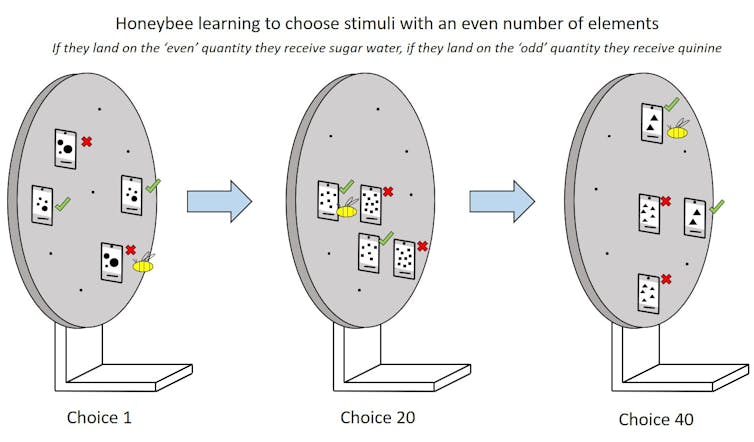
To teach bees a parity task, we separated individuals into two groups. One was trained to associate even numbers with sugar water and odd numbers with a bitter-tasting liquid (quinine). The other group was trained to associate odd numbers with sugar water, and even numbers with quinine.
Here we show a honeybee being trained to associate ‘even’ stimuli with a reward over 40 training choices. Scarlett Howard
We trained individual bees using comparisons of odd versus even numbers (with cards presenting 1-10 printed shapes) until they chose the correct answer with 80% accuracy.
Remarkably, the respective groups learnt at different rates. The bees trained to associate odd numbers with sugar water learnt quicker. Their learning bias towards odd numbers was the opposite of humans, who categorise even numbers more quickly.
Honeybees landed on a platform to drink sugar water during the experiment. Scarlett Howard
We then tested each bee on new numbers not shown during the training. Impressively, they categorised the new numbers of 11 or 12 elements as odd or even with an accuracy of about 70%.
Our results showed the miniature brains of honeybees were able to understand the concepts of odd and even. So a large and complex human brain consisting of 86 billion neurons, and a miniature insect brain with about 960,000 neurons, could both categorise numbers by parity.
Does this mean the parity task was less complex than we’d previously thought? To find the answer, we turned to bio-inspired technology.
We trained honeybees to choose even numbers. In this video we see the bee inspect each card on the screen, before making a correct choice on the card presenting an even number of 12 shapes.
Creating a simple artificial neural network
Artificial neural networks were one of the first learning algorithms developed for machine learning. Inspired by biological neurons, these networks are scalable and can tackle complex recognition and classification tasks using propositional logic.
We constructed a simple artificial neural network with just five neurons to perform a parity test. We gave the network signals between 0 and 40 pulses, which it classified as either odd or even. Despite its simplicity, the neural network correctly categorised the pulse numbers as odd or even with 100% accuracy.
This showed us that in principle parity categorisation does not require a large and complex brain such as a human’s. However, this doesn’t necessarily mean the bees and the simple neural network used the same mechanism to solve the task.
Simple or complex?
We don’t yet know how the bees were able to perform the parity task. Explanations may include simple or complex processes. For example, the bees may have:
paired elements to find an unpaired element
performed division calculations – although division has not been previously demonstrated by bees
counted each element and then applied the odd/even categorisation rule to the total quantity.
By teaching other animal species to discriminate between odd and even numbers, and perform other abstract mathematics, we can learn more about how maths and abstract thought emerged in humans.
Is discovering maths an inevitable consequence of intelligence? Or is maths somehow linked to the human brain? Are the differences between humans and other animals less than we previously thought? Perhaps we can glean these intellectual insights, if only we listen properly.
Scarlett Howard received funding from Australian Government Research Training Program (RTP) Scholarship, RMIT University, Fyssen Foundation, L’Oreal-UNESCO for Women in Science Young Talents French Award, and Deakin University. She is affiliated with Pint of Science Australia as the Media Manager volunteer.
Adrian Dyer receives funding from Australian Research Council
Andrew Greentree receives funding from The Australian Research Council, Defence Science and Technology Group, SmartSat CRC, The US Air Force Office of Scientific Research, The Asian Office of Aerospace Research and Development, The US Office of Naval Research, and the Foundation for Australia-Japan Studies.
Jair Garcia does not work for, consult, own shares in or receive funding from any company or organisation that would benefit from this article, and has disclosed no relevant affiliations beyond their academic appointment.
Source: The Conversation (Au and NZ) – By Michael Jensen, Associate professor, Institute for Governance and Policy Analysis, University of Canberra, University of Canberra
Shutterstock
Disinformation and foreign interference constitute a grave threat to Western democracies, particularly during elections.
Both the 2016 US election and the 2019 UK election were targeted by Russian disinformation campaigns. Already, we are seeing disinformation operations in the lead-up to the Australian federal election targeting both parties – and the election system itself.
In his annual threat assessment speech this year, ASIO director Mike Burgess said one of the most insidious things about foreign interference is that it uses our very own strengths against us:
[…] the perpetrators exploit our values, freedoms and trust, to undermine our values, freedoms and trust.
Distorting voting decisions
The threat of foreign interference and disinformation is threefold.
First, democracy depends on true information for citizens to connect their preferences to voting choices and hold governments accountable. Disinformation can distort people’s understandings of issues and candidates, so they may make choices they otherwise would not.
We’ve already seen how disinformation on COVID has influenced people’s attitudes and actions, not only when it comes to their health decisions (such as whether to get a vaccine), but also their political choices.
Disinformation about the public health threat, for example, could cause people to vote for a minor party or candidate that has made the removal of all restrictions and mandates a central political platform.
Democracy depends on true information being available to all. Shutterstock
Shaping policy by influencing election outcomes
Second, the involvement of a foreign actor in disinformation further undermines democracy as it subjects our domestic politics not to the will of our people, but to that of a foreign government.
Burgess revealed in the threat assessment that ASIO had interrupted an operation involving an Australian-based individual with ties to a foreign intelligence service. This person worked to identify and promote candidates favourable to the interests of a foreign government.
Reporting by the ABC indicated the foreign government was Russia and the Australian-based person had “close links” to President Vladimir Putin’s regime.
Russia is already waging an information war alongside its war of aggression against Ukraine. It appears it has also sought to interfere in one of our elections. With Australia providing military support for Ukraine, Russia may seek to continue its efforts to covertly interfere in Australian politics in retaliation.
Undermining support for democracy
Third, disinformation and foreign interference might not target a specific party or policy, but it may seek to simply undermine support for our democratic political system. It targets trust in our democracy.
The effect of such a claim could undermine trust in our electoral process and the legitimacy of a federal election.
In addition, there has been much talk about the number of pencils the Australian Electoral Commission is preparing for voters as a means to reduce the transmission risk of COVID and other infections.
Nonetheless, this conspiracy may resurface during the upcoming federal election, as well.
In addition to efforts to support or oppose a party, policy, or even the legitimacy of our democracy, disinformation campaigns may seek to increase polarisation in our society by promoting a certain policy or party that reflects an extreme political view.
Polarisation makes it harder for political parties to reach agreement and for governments to enact policies or defend their actions to voters. And this, in turn, can play on the insecurities of citizens to move them to extreme political views.
Another way to undermine confidence in our political systems is to use multiple lines of disinformation and foreign interference at the same time.
We have seen evidence that the same actors promoting conspiracy theories about Dominion voting machines have also promoted false claims that Ukraine is rife with US bioweapons labs. These claims have been around for a long time and there is no truth to them.
The aim of these multiple lines of attack is to move the public against the Australian government’s support for Ukraine, as well as the US.
One single attack against a party or policy may not ultimately change many votes. But a wide-ranging set of attacks can reach a larger audience of persuadable voters and, over time, overwhelm the resistance of otherwise sceptical citizens.
At a minimum, these efforts can create confusion in the public so they do not know who to trust and what to believe.
How do we counter such threats? We have three recommendations.
First, a proactive counter-narrative needs to be found as an antidote to falsehoods and manipulation.
Political candidates have limited abilities to counter the disinformation targeting them as their responses can be cynically dismissed as strategic rather than authentic. But civil society actors and academics can point to specific operations, identify the actors and disclose their methods of manipulation.
Second, public statements by nonpartisan election officials to counter disinformation, as well as offering appropriate access to the way the voting process works, can provide transparency to voters. This can also counter conspiracy theories claiming people’s votes are not being fairly counted.
Finally, to the greatest extent possible without compromising their work, our intelligence agencies need to publicly disclose operations and the methods used by foreign actors to subvert our political process.
Intelligence agencies used to operate under the mantra, “the secret of our success is the secret of our success”. That is not always the case.
Michael Jensen has received funding from the Australian Research Council, Defence, Science, and Technology, and the Taiwan Ministry of Foreign Affairs. This research reflects solely the views of the authors.
Sascha-Dominik (Dov) Bachmann has received and is receiving funding from the Australian Department of Defence for research regarding grey zone and information operations targeting Australia. He is a Research Fellow with the Security Institute for Governance and Leadership in Africa, Faculty of Military Science, Stellenbosch University and is a Fellow Asia Pacific (Hybrid Threats and Lawfare) of NATO SHAPE, Belgium
Prime Minister Scott Morrison this week claimed Labor was planning a “sneaky carbon tax” should it win power, and Nationals senator Matt Canavan declared the goal of net-zero emissions by 2050 was “dead”.
We can expect both these concepts to be thrown around a fair bit during the federal election campaign, so it’s worth getting a few things straight right now.
The safeguard mechanism is not a carbon tax
The Coalition’s claims of a “sneaky carbon tax” are a reference to Labor’s plans to tighten an existing policy known as the safeguard mechanism.
The safeguard mechanism was introduced by the Abbott Coalition government in 2016 – and it is not a carbon tax.
The mechanism was supposed to “safeguard” gains achieved through the Coalition’s then-named Emissions Reduction Fund, by ensuring the emissions cuts were not offset by increases elsewhere in the economy.
The rule applies to about 200 large industrial polluters that directly emit more than 100,000 tonnes of greenhouse gases a year, in sectors such as electricity, mining, gas, manufacturing and transport.
The safeguard mechanism applies to Australia’s biggest polluters. Shutterstock
Under the safeguard mechanism, these polluters must keep their emissions below historical levels, known as a baseline. If they exceed the baseline, polluters can either buy carbon credits to offset the excess pollution, or apply to the Clean Energy Regulator for the baseline to be adjusted.
Baseline adjustments were allowed because no overall cap was placed on the amount of emissions produced. Without a cap, the regulator has greater flexibility to make adjustments.
This flexibility has meant the safeguard mechanism is ineffectual. In fact, since its implementation, companies subject to the mechanism have actually increased their emissions by 7% overall.
So, Labor has promised to tighten the safeguard mechanism if it wins the election. This means large emitters will be less able to adjust their baselines, and gradually, their baselines will be reduced.
This approach coheres with the original purpose of the safeguard mechanism, and is supported by the Business Council of Australia and others.
Analysis suggests Labor’s policy could avoid a substantial 213 million tonnes of greenhouse gas emissions entering the atmosphere by 2030.
Labor has indicated that emissions-intensive industries, such as large coal and gas exporters, will not be forced to cut pollution in a way that makes them less competitive internationally.
Labor plans to tighten the safeguard mechanism, a policy introduced by the Abbott government. Lukas Coch/AAP
Australia’s never had a carbon tax
Let’s be clear. No Australian government has implemented a carbon tax – and any suggestion to the contrary is inaccurate.
The spectre of a so-called “carbon tax” has haunted Labor ever since the 2010 election campaign, when then Prime Minister Julia Gillard ruled out implementing one.
Upon being returned to office, Gillard announced plans to legislate a carbon price, in the form of an emissions trading scheme.
Not all carbon pricing amounts to a carbon tax. But the Abbott-led Coalition nonetheless sought to conflate the two and accused Gillard of breaking a key election promise.
Greenhouse gas emissions, and associated climate change, come with costs. Extreme weather such as droughts and heatwaves damages crops and drives up demand for health care. Flooding, bushfires and sea level rise damages property.
Carbon pricing seeks to ensure those responsible for much of these costs – large polluters – either reduce their emissions or help pay for the social and environmental damage they cause.
Labor’s emissions trading scheme required polluters to report and pay for every tonne of carbon dioxide they produced, or face a financial penalty. The scheme was a success: compliance was high and emissions reduction targets were met.
The policy, however, was short-lived. The Abbott government repealed it in July 2014.
Climate change causes ‘external’ costs such as bushfire damage. Shutterstock
Net-zero by 2050 is very much alive
So what of Senator Canavan’s claims this week that net-zero emissions targets were “dead” and should be scrapped?
Canavan this week told the ABC:
“[UK Prime Minister] Boris Johnson said he is pausing the net zero commitment, Germany is building coal and gas infrastructure, Italy’s reopening coal-fired power plants. It’s all over. It’s all over bar the shouting here”.
Late last year, Australia committed to achieving net-zero emissions by 2050. That means cutting greenhouse gas emissions as far as possible, and then, for emissions that cannot be avoided, removing an equivalent amount from the atmosphere.
Net-zero emissions by 2050 is needed avert the worst impacts of climate change. Australia is also required to meet the target under its Paris Agreement obligations.
All Australian states and territories have committed to the net-zero goal. Victoria, the ACT and Tasmania have gone further and legislated net-zero as a target.
Senator Canavan wrongly claims net-zero is ‘dead’ . Mick Tsikas/AAP
Australia may be a long way off achieving net-zero by 2050, particularly in the absence of a robust and credible carbon price. But Canavan is wrong to suggest the goal has been abandoned globally.
Some countries have already achieved net-zero. The UK has a legally binding net-zero target by 2050 and Germany has pledged to get there by 2045.
Russia’s invasion of Ukraine has left countries such as Germany worried about their reliance on Russian gas, and this may see a short-term increase in fossil fuel use in Europe.
But the world remains largely committed to the net-zero target.
Just a few days ago, German finance minister Christian Lindner outlined the importance of the low-carbon transition to the nation’s energy security, describing renewable energy as “freedom energy”.
So, contrary to Canavan’s suggestion, the world’s shift to clean energy is likely to accelerate in the longer term.
Samantha Hepburn does not work for, consult, own shares in or receive funding from any company or organisation that would benefit from this article, and has disclosed no relevant affiliations beyond their academic appointment.
Clive Palmer’s United Australia Party continues to make waves in the federal election campaign, most recently with advertisements on massive billboards pledging a “maximum 3% interest rate on all home loans for five years”. But does this promise stack up?
Keeping mortgage rates at their record lows for five years is a bold promise. Especially because – as Clive Palmer well knows – the government doesn’t set interest rates.
The key driver is the Reserve Bank of Australia, which sets the cash rate to keep inflation at a low and stable level of 2-3%. But once the cash rate is set, every other bank is entitled to lend money out at whatever competitive rate they want. They frequently diverge from the cash rate based on their cost of obtaining funding from Australian savers and from overseas.
On its website, the United Australia Party (UAP) says it would “use the power of the Constitution to put a cap on the bank home lending rate at a maximum of 3% for the next five years.” (It also promises to introduce a 15% export licence for all iron ore exports from Australia, and “pledge the proceeds from such licences to be used for the retirement of the one trillion-dollar debt mountain that Australia faces”.)
For a moment, let’s run with this 3% idea from the UAP. Imagine for a minute it held the balance of power or even had a majority in both houses of parliament.
If UAP really did intend to try and deliver on an election promise to cap interest rates at 3% for five years, what would the flow-on effects be?
The government did control interest rates for many years, until deregulation in the Hawke years. Government control of interest rates and the banking sector made home loans very hard to get, forcing Australians to set up inefficient building societies and credit unions to skirt around the regulations.
But, say the UAP passed a law saying you can’t lift interest rates above 3% – no matter what. You will soon run into problems.
The first is that if banks can’t make a profit on mortgages – if, for example, it costs 4% to borrow and they can only charge 3% – then lending doesn’t make financial sense for them. The banks will just stop writing mortgages entirely.
Even if they can squeak a small profit margin they may only write mortgages for the wealthiest and safest Australians to lend to. Wealthy households are less likely to default and thus are cheaper for banks to lend to.
In other words, a 3% cap on interest rates would lead to a situation where either banks stop mortgages entirely or greatly restrict them. A lot of would-be home owners will not be able to get a mortgage at all.
And if you can’t get a mortgage at all, then for most of us it doesn’t matter what the rate is because you can’t buy a house in the first place. If lending dried up, the number of house buyers would plummet, which would devalue homes.
The only thing worse than a banking system that is expensive is one that is in crisis and potentially getting bailed out or going bankrupt, which might very well imperil the financial stability of the banking sector and derail the economy.
OK, how else could they ensure a 3% interest rate for people?
Apart from changing the law, another way to deliver on this commitment is by hugely increasing government spending.
Perhaps the government could pay home owners the difference between whatever their interest rate is and the promised 3%. So, say your interest rate was 4%. That’s 1% more than the promised 3%, so the government could pay that 1% difference for you, using taxpayer money.
Of course, that would be incredibly costly. Australia’s household debt is almost twice its income. Paying even a small share of the interest payments would be an enormous burden on the budget.
It would be, in effect, a subsidy for all mortgage owners; a hugely expensive giveaway to the richest people in Australia.
Alright then, what if we just changed the RBA’s job description?
There is a third way you could cap interest rates at 3% and that is to rewrite the RBA’s mandate and ban them from lifting the cash rate for five years.
But the reason the RBA pushes up interest rates is to help control inflation and the cost of living. That’s why there’s talk of an interest rate rise after inflation hit a whopping 5.1% this week.
Banning the RBA from pushing up rates comes with real inflationary risks. That would overheat the economy and drive up inflation. You’d see hugely higher prices at the supermarket and the fuel pump.
Perhaps you think homeowners are more deserving than renters or pensioners or anyone in the economy who doesn’t have a mortgage. But I don’t.
No free lunch
In a recent podcast interview with Michelle Grattan, independent MP Andrew Wilkie mentioned this UAP ad, saying:
In my opinion, this is the worst campaign I’ve observed, as far as the mud slinging and the dishonesty. There used to be some limits on the dishonesty of the political parties and the candidates but there seem to be no limits this election. There’s a billboard down the road from Clive Palmer’s United Australia Party, promising a 3% maximum mortgage rate. I mean, they know that’s just nonsense.
Whatever your view, it’s worth remembering there is no such thing as a free lunch in the economy. If you want to make something cheaper, you have to make pay for it some other way.
You either have to pay for it from taxpayers’ money or you make the banks pay, which comes with a real risk of financial crisis.
Bingo, with its familiar rules, novelty number calls (“legs 11”, “two ducks swimming”) and social setting, has long had a reputation as harmless and friendly.
Also called “housie”, bingo is a game in which players mark numbers on a grid as a caller reads them out. The first person whose numbers are all called out cries “bingo” and wins. The game of chance is played in many different venues: from licensed bingo centres, to clubs like RSLs, in churches and nursing homes and, increasingly, online.
Our new research shows technological developments, large jackpots, and locating bingo in the same venue as pokies or other gambling products bring new risks to players. Bingo’s innocuous reputation is due for a rethink.
We conducted the first major study of bingo in Australia. We spoke with Aboriginal and Pacific Islander people in regional Victoria, older people on fixed incomes in Melbourne, and experts. We also attended bingo sessions across Victoria.
People told us they liked bingo’s social connection, its relative cheapness and predictability.
As one participant said:
I’ve got no one at home […] I get lonely and bored and I just go to bingo.
The chance of winning money, escape from responsibilities and stress, and cognitive stimulation were also appealing. An older research participant told us:
You’re in another world when you’re at bingo. You have to concentrate.
A minority of study participants described harms from playing bingo, but they were significant for those experiencing them. One player noted:
I think (bingo) has a more negative effect because, just as an Indigenous community […] we have less income, we’re from poor socio-economic backgrounds.
Increased dangers
Risks associated with bingo have increased over time.
Historically, the game has been played with paper books and pens. Playing multiple games at a time requires great concentration, but experienced players can manage up to six “books” (grids) at a time.
Now, personal electronic tablets (PETs) are available in bingo centres and some RSLs. These tablets can be loaded with up to 200 games at once and automatically cross off numbers for players. Canadian research suggests tablets offer a similar gaming experience to electronic gambling machines, otherwise known as “pokies”. Fast play and flashing lights captivate players.
Tablets let people purchase and play many more games than they could on paper. One expert told us they’d seen venues where 48 “books” could be purchased via tablet, at a total cost of $600.
Old school bingo grids made it challenging to play multiple games at once. New technology makes it easier. Shutterstock
Regulation of bingo varies across Australia. In some places, including Victoria, bingo at licensed centres must generate funds for charities.
Rule changes in Victoria have created more expensive bingo games and larger prizes. These changes include abolishing bans on rolling jackpots, removing caps on the cost of books, and allowing more people to play each session.
Licensed bingo centres now offer jackpots of up to $450,000, which may be rolling (accrued across games in one centre) or linked (merged across different centres). Large jackpots mean fewer people win and more people lose.
Several participants in our study spoke of people spending up to $1,200 to attend a “package” or multiple-game session.
The more forms of gambling a person engages in, the greater their chance of having problems. Bingo can’t legally be offered alongside pokies in licensed bingo centres in Victoria, but this is allowed in clubs and hotels.
Our research suggests that in pokie venues, bingo is a “loss leader” – to draw players in, then encourage them to move on to other forms of gambling. One person told us:
I got trouble, you know, from going to bingo because sometimes when I go to bingo […] and then I win money, and then I’m thinking of like, you know, not only the bingo. I go across to the gamble machine and I keep playing there. So instead of like, save the money to take back to the family.
In Victoria, Crown Casino stopped offering bingo under the spotlight of a Royal Commission, but previously provided free bingo with breaks where players moved to pokie machines and gaming tables.
In February, Tabcorp and Lottoland were awarded Victorian licences to operate Keno live lottery gambling until 2042, including in bingo centres. This expands the range of commercial gambling products sold in bingo venues.
Bingo co-located with pokies in RSL clubs make for tempting combinations for gamblers. Shutterstock
Lesser of gambling evils
Bingo causes less grief than other forms of gambling. Some people describe playing bingo for hours for $20–30, making it a cheap outing.
Capping costs for games and jackpots, limiting the games that can be played on tablets and keeping bingo separate from other gambling opportunities would help retain the benefits it offers – and stop people from spending money they don’t have.
If this article has raised issues for you, or if you’re concerned about someone you know, call Lifeline on 13 11 14. Gamblers help can be found online or by calling 1800 858 858.
The authors would like to thank the organisations that partnered in this research: Gippsland and East Gippsland Aboriginal Cooperative (GEGAC), Sunraysia Mallee Ethnic Communities Council (SMECC) and COTA Victoria. John Cox, Annalyss Thompson and Jasmine Kirirua worked as researchers on the project. We are also grateful to the Victorian Responsible Gambling Foundation and particularly Lindsay Shaw.
Sarah J MacLean is a member of the Australian Greens. She receives funding from the Australian Research Council and the Victorian Responsible Gambling Foundation.
Helen Lee has received funding from the Victorian Responsible Gambling Foundation and the Australian Research Council.
Kathleen Maltzahn has received funding from the Victorian Responsible Gambling Foundation. She is a member of the Australian Greens Victoria.
Mary Whiteside has received funding from the Victorian Responsible Gambling Foundation
The war in Ukraine would test even the most hardened political operator: millions forced to flee their homes, thousands (including many civilians) killed or injured, evidence of Russian war crimes mounting.
Yet Volodomyr Zelenskyy, a relative novice head of state, has not just risen to the challenge, he has been widely praised and admired for his exemplary crisis leadership. So, what explains this prowess?
Zelenskyy’s acting experience has been credited with his ability to connect powerfully with different audiences, using facts and emotions to build support for the Ukrainian cause.
His commitment to serve his people has been called pivotal. He has been described as charismatic – although this alone is no guarantee of success, given charismatic leaders can still lead their nations to destruction.
And it’s Zelenskyy’s repeated displays of courage that seem to really strike a chord with many. This leads us into the territory of character virtues, which we argue hold the key to Zelenskyy’s abilities as a crisis leader.
Dressed in trademark fatigues, Zelenskyy arrives for a press conference in late April. GettyImages
Ancient wisdom for today’s world
Aristotle is credited with first proposing that virtues play a central role in forging a strength of character that can navigate and weather life’s challenges with moral fortitude and integrity.
Recently, we drew on this knowledge to examine crisis leadership and how character virtues guided 12 heads of state through that first, tumultuous wave of COVID-19. We’ve used the same approach to analyse Zelenskyy’s leadership.
We closely examined an extended filmed interview with Zelenksyy by The Economist. Being unscripted and more spontaneous than his pre-prepared speeches, it offered a clearer insight into his character.
We found all seven of the key character virtues – humanity, temperance, justice, courage, transcendence, wisdom and prudence – evident in Zelenskyy’s responses to the interviewers’ questions.
Character virtues in action
The virtue of humanity relates to care, compassion, empathy and respect for others. Zelenskyy demonstrates this primarily through his focus on protecting Ukrainians from Russian aggression, but it even extends to his enemy’s suffering.
Zelenskyy expresses concern that Putin is “throwing Russian soldiers like logs into a train’s furnace”, and laments that the Russian dead are neither mourned nor buried by their own side.
This refusal to simply give way to hate and anger when speaking of his enemies also reflects a second virtue, temperance – the ability to exercise emotional control.
Zelenskyy’s modesty also reflects this virtue – in the interview he shrugs off praise for being an inspirational hero, preferring to keep to the main issues. Temperance serves to maintain emotional equilibrium, thus enabling Zelenskyy to make difficult decisions in a level-headed manner.
The virtue of justice means acting responsibly and ensuring people are treated fairly. It involves citizenship, teamwork, loyalty and accountability. Zelenskyy speaks of his “duty to protect” Ukrainians and to “signal” with his own conduct how others should act. By remaining in Ukraine, he becomes a role model of this virtue while simultaneously demonstrating the virtue of courage.
Zelenskyy’s own courage has been widely noted, but we observed that he also repeatedly acknowledges that of his fellow citizens, thereby encouraging them to act with virtue.
Humanity as virtue: Volodymyr Zelenskyy visits a hospital in Kyiv in late March. GettyImages
A formidable opponent
By expressing the seemingly unshakeable hope that Ukrainians will secure victory because of their courage, Zelenskyy demonstrates the virtue of transcendence – the optimism and faith that a cause is meaningful, noble and will prevail.
Zelenskyy’s views about what motivates other countries display his wisdom. In the interview he demonstrates a broad strategic perspective and insight into the varying interests that shape other nations’ responses to the war. This helps him craft his appeals to allies, and to Russia, which then have a greater chance of resonating.
The final virtue, prudence, complements that wisdom. It involves an ability to gauge what is the right thing to do and is something of a meta-virtue, guiding the choice of which other virtues are needed from moment to moment. We found repeated instances of Zelenskyy demonstrating just that, weaving together multiple virtues in his responses to questions.
Our analysis of his leadership indicates Zelenskyy possesses strength of character and emotional, intellectual and moral clarity about what is at stake. This explains his effective crisis leadership to date. Despite the clear military mismatch between Russia and Ukraine, Putin has taken on a formidable opponent.
The authors do not work for, consult, own shares in or receive funding from any company or organisation that would benefit from this article, and have disclosed no relevant affiliations beyond their academic appointment.
Papua New Guinea’s first woman neurosurgeon has graduated from the national university.
Dr Esther Apuahe graduated with a higher post-diploma in neurosurgery during the University of Papua New Guinea’s 67th graduation ceremony yesterday.
“She is the first female neurosurgeon in Papua New Guinea,” said the dean of UPNG’s Medical Faculty, Professor Nakapi Tefuarani.
Dr Apuahe, 43, originally from Morobe and married with three children, was also the first Papua New Guinean woman surgeon to finish in 2012.
“Surgery for almost 30 years had no female graduate since 1979 when the first male graduated. And, it has been a male-dominated field,” she said.
“In 2008 I started doing my masters in surgery at UPNG. I became the first female to finish in surgery.
“I finished in 2012 and I went out as a general surgeon at Vanimo General Hospital and I was called back here to take up neurosurgery.
New field for PNG “It is a new field, basically to do with surgery of any brain pathology, head injuries and any brain tumour.
“Surgery, in the field of medicine, has been a male-dominated field.”
Dr Apuahe wanted to do something more than general surgery and, therefore, took up study in neurosurgery.
“After that, working outside, I felt that I needed to do more, maybe going further into surgery in some specialising,” she said.
Her study, which started in 2015, took a little longer than expected due to the pandemic as well as the unavailability of mentors.
“Neurosurgery is such a hard field. At that time, there were only two male neurosurgeons,” Dr Apuahe said.
“Because there was no one to cover in Port Moresby, I was called to come back here, so I’ve been here since 2015.
Not an easy journey “The journey is not easy, it has been hard trying to manage patients and training with no medical supervision, just supervision externally, from Australia.
“It probably took a long time from 2015. I started, not officially, on training just getting some hands-on experience and I started towards the end of 2016, commencing neurosurgery.
“I had an attachment in Townsville (Australia) in 2019, but just as I was completing that, covid-19 came and so I was unfortunate enough to go before the pandemic and I came back and I sat for my exam last July.
“I thank the Royal Australian College for being there, supporting the training of neurosurgery and also to the academics at UPNG such as Professor Isi Kevau who pushed us through to make sure that I succeeded.
“After I graduated, there are now about eight female surgeons.”
Phoebe Gwangilois a PNG Post-Courier reporter. Republished with permission.
Wearing glasses or getting a runny nose is enough to qualify for a mask exemption under current New Zealand’s Ministry of Health criteria — and a doctor says its time for tougher rules.
Hearing aids, hayfever or a tendency to get dry eyes are also reasons to request the legally binding card that says you do not need to wear a mask when normally required to under covid-19 rules.
Some doctors say the reasons are far too loose, with people simply needing to tick just one of the symptoms on the ministry’s website list to get an exemption card sent to them.
Northland medicine specialist Dr Gary Payinda said the card was a great idea for people who had legitimate reasons for not wearing a mask.
But the current list of criteria was so wide it was absurd — almost everyone in the country would qualify, he said.
“If we’ve made it so easy that literally anyone can click a box and say I have a ‘condition’ … we really have to ask is it still a public health measure.”
With so many other measures relaxed, masks were one of the last lines of defence against the virus, and so everyone who could wear one, should be, he said.
Compromising public health measures He told RNZ Morning Report that compromising one of the most effective public health measures was not doing the community a good service.
“We want the right people to be protected by this law and we want masks to still be a meaningful way of reducing the burden of covid in the community.”
“If we make an exemption process so easy to get that it’s meaningless, we’re shooting ourselves in the foot.
“I want masks to be legitimate and used and trusted, and that won’t be the case if anyone can literally tick the box and say, ‘face coverings give me a runny nose’ and that’s enough to get a mask exemption.”
The criteria have come under scrutiny as the government changes the process for getting a mask exemption card.
Until now, cards were issued by the Disabled Persons Assembly but the new ones are issued by the Ministry of Health and have legal standing.
They are intended for people to show to shops or other businesses so they do not have to explain potentially sensitive reasons why they may have an exemption.
The ministry said it had tried to make the process for applying for a card uncomplicated to avoid marginalising vulnerable communities.
Small minority misuses system The vast majority of New Zealanders had shown they wanted to do the right thing to protect their communities and only a small minority had tried to misuse the system, it said.
A spokesperson indicated the criteria may be changed as the new card comes into effect but was not able to respond with more details before RNZ’s deadline.
Existing cards, issued with the current criteria, can still be used when the new ones come into effect.
The Disabled Persons Assembly welcomed the new card system, telling Midday Report the old system had been causing distress for some in the disabled community.
Prudence Walker said people had not been believed, refused service or had the police called on them.
She hoped the new card would improve things.
Dr Payinda said there were many good reasons — because of both physical and mental health — that people could not wear masks and he supported them doing that but the current list was open to abuse.
Current criteria wideranging The current criteria for requesting a card according to the Ministry of Health website include having the following conditions if they make wearing a mask difficult: asthma; sensitive skin or a skin condition like eczema; wearing hearing aids; getting migraines, having glasses, dry eyes or contact lenses; hay fever; difficulty breathing; dizziness, headaches, nausea or tiredness; a runny nose from wearing a face covering; a physical or mental illness, condition or disability.
Needing to communicate with someone who is deaf or hard of hearing is also one of the criteria.
Covid-19 modeller Dr Dion O’Neale said attempting to force those who were adamantly opposed to masks to wear one wouldn’t be effective.
“If they want to be difficult about it they’ll manage to tick the box and say I’m wearing it, and wear it badly.”
Most people did want to protect themselves and those around them, so it was important to keep the messaging clear on how masks work and when to wear them, he told Morning Report.
“It’s physics. The mask, if it’s well fitted, it’s going to be filtering out small particles. If those particles are viruses you’re not going to be infected by them, or if you’re breathing in a much smaller number of those particles you’re going to have a much lower exposure dose, so your infection risk is much lower.”
This article is republished under a community partnership agreement with RNZ.
Everything Everywhere All At Once, a sci-fi action comedy, manages the surprising feat of paying homage to martial arts cinema classics while also delivering a strange and completely fresh, genre-bending film.
Written and directed by Dan Kwan and Daniel Scheinert (collectively known as “the Daniels”), Everything Everywhere All At Once is a delirious adventure blending a heartwarming examination of personal and family crisis with a wild sci-fi storyline, and some of the most amusingly bizarre fight scenes to ever grace the screen.
Taking inspiration Jackie Chan’s kung fu comedies, the film’s fight scenes combine fast, free-flowing martial arts with slapstick humour.
The Daniels have acknowledged the film was originally conceived of as a vehicle for Chan. However, after seizing upon the idea of flipping the gender of its unlikely hero, the directors decided to hand the reins to Michelle Yeoh, who has enjoyed a resurgence in popularity after starring in two recent hits, Crazy Rich Asians and Shang-Chi and the Legend of the Ten Rings.
Into the Michelle Yeohniverse
Although never professionally trained in martial arts, Malaysian-born Yeoh achieved fame in 1990s Hong Kong action films such as Yes, Madam! and Jackie Chan’s Supercop. An ex ballerina, renowned for doing most of her own stunts, Yeoh typically relies on on-set fight training for her action scenes.
In Everything Everywhere All At Once, this meant Yeoh was teaming with brothers Andy and Brian Le for the most outlandish fight of her career – a scene where Yeoh’s character must fight a pair of butt plug-armed henchmen.
The self-taught Le brothers drew Hollywood’s attention via the popular Martial Club YouTube channel where, along with friend Daniel Mah, the brothers recreated fight scenes from classic Hong Kong kung fu films.
Working with stunt coordinator, Timothy Eulich, to choreograph a number of Everything Everywhere All At Once’s fight scenes, the Le brother’s encyclopaedic knowledge of kung fu cinema is credited by Eulich as helping shape the film’s approach to action.
Everything Everywhere All At Once
Caught up in shattering disappointment over what her life has become, laundromat owner Evelyn Wang (Yeoh) gets a welcome reprieve from her drab reality when she is drawn into a cosmic battle and given the ability to travel through the multiverse.
Skipping between alternate lives she could have led, Evelyn draws upon the memories and skills of her other selves, including a Teppanyaki chef and an opera singer. In a nice nod to Yeoh’s own position as a globally-recognised star of films such as Crouching Tiger, Hidden Dragon, one of Evelyn’s most significant alternate selves is a famous, martial arts-trained actress.
Michelle Yeoh in Everything Everywhere All At Once, playing a version of Evelyn that is an homage to Yeoh herself. AAP
Evelyn discovers she is the multiverse’s only chance at salvation and, as various evil beings hunt her and her family, she is forced to engage in frequent battles, using whatever objects are close at hand as weapons.
The combination of an unlikely hero being forced to fight – typically with impromptu weapons – before revealing a startling degree of martial arts proficiency is the key ingredient of numerous Jackie Chan action comedies, especially those made for English-speaking audiences after Chan relocated to the USA in the 1990s.
Drawing inspiration from Buster Keaton’s silent-era physical comedies, Chan’s films eschew traditional action genre rules. The most obvious divergence is that Chan’s characters rarely enter a fight armed with anything other than natural ability. Chan forsakes outright hostility for demonstrations of acrobatic martial skill combined with humour.
Jackie Chan in Rumble in the Bronx (1995) IMDB
Each set of Chan’s iconic fight scenes are filled with a suite of potential weapons. For example, Chan’s confrontation with a gang of punks in Rumble In The Bronx, starts with Chan on a pool table. The actor uses everything from a fridge, to a television, a set of speakers, a shopping trolley and even a pinball machine, as weapons.
In The Spy Next Door, Chan is trapped in a kitchen and, after first slamming a fridge door into a thug, Chan repeatedly beats the man over the head with pots and pans. Though it sounds violent, the tone of the scene is more Looney Tunes than Dirty Harry.
Everything old is new again
The scene is a homage to the 1976 Hong Kong Hui Brothers’ comedy, The Private Eyes. In the original film, an inept private eye finds himself battling a villain in the kitchen of a restaurant. The ridiculous nature of the fight escalates as the opponents move from pans and colanders to a gourd-slicing swordfish, a shark jaw, a sausage nunchuck, and a wok that is tossed like a boomerang.
The Private Eyes is a 1976 Hong Kong comedy film written, directed by and starring Michael Hui and co-starring his brothers Samuel Hui and Ricky Hui . IMDB
Everything Everywhere All At Once features a similar throwback to that iconic scene – this time swapping the sausages for dildos to make a pair of impromptu tonfa batons. Another standout scene features Evelyn’s husband, Waymond (Ke Huy Quan) expertly wielding a fanny pack to take down an entire group of thugs.
Everything Everywhere All At Once is a fresh addition to the comedy martial arts canon.
Despite the existential premise of the film – and the surprising depth of the relationship dramas – the execution of action is skilful. More significantly, the action doesn’t take itself seriously and the humour doesn’t stop when the action starts.
Joyleen Christensen does not work for, consult, own shares in or receive funding from any company or organisation that would benefit from this article, and has disclosed no relevant affiliations beyond their academic appointment.
Source: The Conversation (Au and NZ) – By Greg Barton, Chair in Global Islamic Politics, Alfred Deakin Institute for Citizenship and Globalisation, Deakin University
We are fated, whether we like it or not, to live in interesting times, having entered, as one prominent observer puts it a “decade of living dangerously”.
He is speaking of the very high probability of entering into some form of open military conflict with China, most likely precipitated by a sharp escalation in Beijing’s efforts to reunify Taiwan with the mainland.
Even without this particular acute threat, we face enormous dangers on multiple fronts. Climate change is fast reaching the point of constituting an existential threat. There is still time to avoid this nightmare scenario, but it is going to take enormous effort and unprecedented cooperation. It will require sustained levels of good governance.
Unfortunately, we are living at a time when good governance cannot be taken for granted. Threats to democracy and open society are more acute than they have been in decades. The rise of populism, and the corruption of clinical institutions and traditions previously taken for granted, threaten a sharp contraction of democracy and constructive cooperation, both within nations and across the global community.
If there is a war with China, it will most likely be over its efforts to reunite Taiwan with the mainland. AAP/AP/Ritchie B. Tongo
Russia’s invasion of Ukraine is a reminder of how quickly the world can fall apart and peace evaporate. Fortunately, Ukraine was ready for what much of the global community was dismissing as an exaggerated threat. And, as it turns out, Vladimir Putin’s Russia – corrupted, hollowed out and delusional – was not ready. What should have been a devastatingly formidable military was reduced to a pathetic facsimile of what Russian national myth and Western assessment had proclaimed.
The great lesson of the Russian invasion of Ukraine is that powerful leaders, particularly populist autocrats surrounded by the structures of a one-party state and accountable only to a circle of sycophants, choose to pursue an irrationally dangerous course contrary to all reasonable self-interest.
In late 2021 and early 2022, there was a high level of consensus among military analysts that Russia was preparing for war. There was also a similar level of consensus among political experts of international relations that Putin was bluffing. All rational calculations pointed to the risk of war, both to the leader and to his nation, to be so enormously great that it made no sense to initiate conflict.
Sadly, the military analysts studying satellite imagery and the rapid escalation of military build-up on the borders of Ukraine proved to be correct. Thankfully, they had greatly overestimated Russia’s military preparedness and underestimated both the political will and defensive capacity of the people of Ukraine.
Could the same not be true of China? Is it not foolish to talk up threats of war and make inevitable what is avoidable? Or were Defence Minister Peter Dutton’s extraordinary comments – on Anzac Day, of all days – about the need to prepare for war with China, however distasteful and reckless, founded on reasonable assessment?
Wishful thinking would have it that talk of war involving China is a confected threat manufactured by vested interests and hawkish assessments. There is far too much at stake, however, to fall back on wishful thinking. “Peace in our time” is exactly what we should be working for, but we can’t achieve it simply by proclaiming it.
The problem with Dutton’s comments lies not in the assessment of the risk, but in how the government responds to it. In the midst of a tightly contested federal election campaign, with the Coalition on the back foot, there is a great temptation to resort to fearmongering in the name of national security to shore up votes.
In the words of former US President Theodore Roosevelt, we need to “speak softly and carry a big stick”. The concern with what Dutton is doing is not that his analysis is wrong, but that his response to the threat is reckless and counterproductive. We are neither carrying a big stick nor speaking softly.
It was Kevin Rudd who coined the phrase a “decade of living dangerously”. He uses it in his new book, The Avoidable War: The Dangers of a Catastrophic Conflict Between the US and Xi Jinping’s China.
Rudd makes a compelling and cogent argument that any form of war involving China and the United States is likely to be devastatingly costly. It would also risk cascading consequences that could dangerously transform the world we live in.
Avoiding conflict with China, he argues, will not be easy. If nothing changes, we are on a trajectory to disaster.
Rudd sets out ten scenarios for possible conflict with China. Only one of the ten ends well.
Yet, as is the case with the looming threat of catastrophic global warming, disaster is not inevitable. War with China is very likely, but avoidable if we take the threat seriously and act now.
The path to avoiding war with China, Rudd argues, is to work to achieve a system of managed strategic competition that is mutually beneficial to both China and the US. This would present a compelling alternative to an inevitable slide to war.
Former Prime Minister Kevin Rudd argues they way to avoid war is for managed strategic relationships that benefit both the US and China. AAP/Joel Carrett
At one level, this requires making preparations for war such that China judges the risks of acting now to be unreasonably high. Beijing is not yet ready to escalate military pressure on Taipei. It judges that it needs another five or ten years to prepare.
Part of what is required in avoiding war is to constantly shift the calculus, so the risk of immediate action and the uncertainty of victory remain intolerably high.
Deterrence, backed by considerable and steadily increasing capacity, is an essential part of the response required to avoid a hot war. But so, too, is making the case for avoiding the descent into a new Cold War.
The truth is, both China and America have more to gain from strategic competition than they do from a further deterioration of relations to the point at which war becomes a live option.
China’s rise, although not without problems, has so far been a net good for the world. It can continue to be good. Australia has enjoyed decades of peaceful growth and prosperity driven by the rise of Asia and led by the transformation of China.
Constructively managed competition with China is not only essential to avoiding war, it has the potential to enable both an effective, cooperative response to the challenge of climate change and the global need for improving good governance.
A great strength of Australian approaches to defence and security, historically, has been sensible bipartisanship. There is too much at stake with national security to let short-term self-interest distort and distract.
Greg Barton receives funding from the Australian Research Council. And he is engaged in a range of projects working to understand and counter violent extremism in Australia and in Southeast Asia that are funded by the Australian government.
With the weight of Russian military might bearing down on it, Ukraine applied to join the European Union (EU) on February 28. While the Russian invasion provided the immediate pretext, membership had been on the Ukrainian political agenda since the Orange Revolution of 2004–2005.
President Volodymyr Zelenskyy’s request was a symbolic act. It was a claim for Ukraine’s European identity to be acknowledged, and a turning away from Russia towards the West. It recognised the EU as representing a set of values and ideals which Ukraine claimed to share, in contrast to the regime of Vladimir Putin.
Zelenskyy also wanted to set Ukraine on a path taken by eight Central and Eastern European countries (CEECs) almost two decades earlier. May 1 is the 18th anniversary of the “big bang” enlargement of the EU, when Czechia (also known as the Czech Republic), Estonia, Hungary, Latvia, Lithuania, Poland, Slovakia and Slovenia, alongside Cyprus and Malta, were welcomed into the Union.
The stabilisation and transformation of the CEECs through the 2004 enlargement has been one of the most significant successes of European integration. The underlying intention has always been to promote peace and stability on the European continent, preventing a return to the conflict that produced two world wars.
Reflecting on the first eastern enlargement on its 18th anniversary can help us understand Ukraine’s desire for membership.
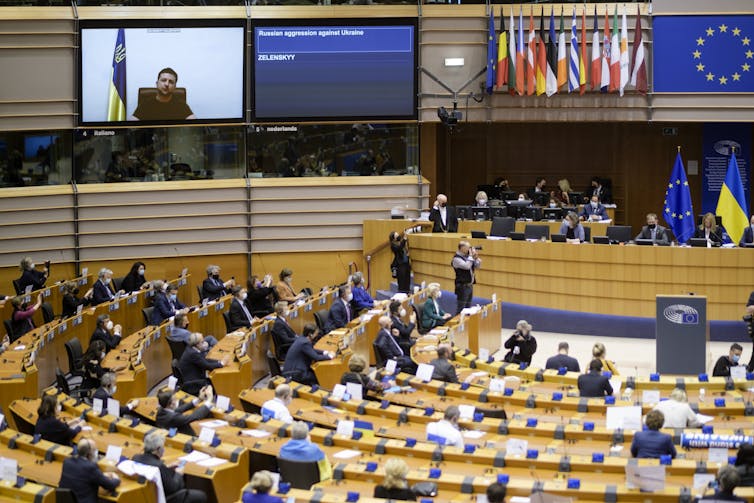
Symbolic acts: Ukrainian president Volodymyr Zelenskyy addresses the Assembly of the European Parliament on March 1 2022. GettyImages
The return to Europe
When the Iron Curtain fell, an air of celebration spread across Europe. For Eastern states, the physical barrier denying them their European identity was gone. In the words of former Czech president Václav Havel:
[W]hat has triumphed is the realistic hope that together we can return to Europe as free, independent and democratic nations.
As that early elation began to subside, however, the challenges became clear. By the early 1990s, tentative transitions toward democracy and market economics were taking place, but the CEECs were experiencing increasingly severe economic hardship. There were concerns that public support for the reform process would waiver, risking instability and conflict.
With increasing uncertainty surrounding the future of the CEECs, Western states – chiefly Western Europe – saw a need to reinforce the transition process. Initial arms-length solutions, with the Eastern states seen as external EU partners, soon fell by the wayside. Pressure mounted to fulfil the promise enshrined at the launching of European integration: that membership was open to all European states.
For the CEECs, the symbolic attraction of being part of the EU was immense: accession provided a practical expression of the aspiration expressed by Havel and others for a return to Europe, an aspiration from which they would not resile.
The result in 1993 was a commitment to accession from EU leaders, and the outlining of membership criteria which would frame the transition process. Enlargement became the primary tool through which principles of democracy, the rule of law and free market economics were established in the CEECs. Convergence with their European partners was fostered, peace and stability were pursued.
This entailed a significant commitment on the part of the EU. Enlargement required addressing changes to the delicate balance between member states that defines the way the Union operates.
It also involved significant financial costs to facilitate the political and economic convergence of the eastern states. By 2003, the CEECs had received more than €16 billion in pre-accession support, and by 2020 more than €200 billion under a range of instruments designed to reduce EU regional disparities.
Stabilisation and transformation
In the three decades since 1993, and the 18 years since their accession, the CEECs have converged significantly with their western counterparts, a process that has led from uncertainty to stability.
Sustained economic growth has seen CEEC economies collectively expand almost sixfold since 1990, accompanied by improvements in life expectancy at birth (now between five and eight years greater compared to 1990) and infant mortality (declining on average from almost 13 per 1000 live births to fewer than three).
Politically, democratisation was largely consolidated and stabilised, notwithstanding recent backsliding in Poland and Hungary. The transition to full democracy remains incomplete – all eight CEECs were listed in the 2021 Democracy Index as “flawed democracies” (as was the US).
But compared to other former Eastern Bloc states, they have performed well, ranking in the Democracy Index’s top seven (with Hungary 10th) out of 28 states in the central and eastern European region.
EU membership has established democracy as a baseline expectation against which the CEECs may be held to account by fellow member states (as with Poland and Hungary) and, more importantly, by their own people.
Symbolic value
The EU’s values and ideals (including democracy, human rights and the rule of law), and its perception as a region of peace, prosperity and stability, have made it a major pole of attraction for the former Eastern Bloc states, including Ukraine.
This pull has arguably been strengthened by the successful integration of the eight CEECs. They have since been followed by Bulgaria and Romania in 2007, and Croatia in 2013, with five more states at various stages along the same path: Albania, Bosnia and Herzegovina, Montenegro, North Macedonia and Serbia.
That the EU has been able to turn this attraction into the (albeit imperfect) consolidation of democracy and economic transformation in Eastern Europe – and in doing so building towards the underlying goal of regional peace and stability – must be acknowledged.
More than that, after the war of 1939–1945 that gave rise to European integration, and remembering more recent conflicts just beyond the Union’s borders – and now in Ukraine – the EU’s contribution to peaceful transformation, recognising the aspirations of the people of eastern Europe, should be celebrated.
Understanding the successful integration of the CEECs into the Union also helps us understand Ukraine’s motivation for membership. It is about placing a stake in the ground, claiming an identity and a heritage, and building toward a peaceful and prosperous future.
Mathew Doidge receives funding from the Erasmus+ programme of the European Union. He is affiliated with the European Studies Association of Australia and New Zealand (ESAANZ).
Serena Kelly receives funding from the Erasmus+ Programme of the European Union. She is affiliated with the New Zealand Institute of International Affairs and the European Studies Association of Australia and New Zealand.
Rising out-of-pocket costs for health care is an important issue the major parties have not yet substantially addressed during the election campaign.
We heard just this week how health-care costs are rising faster than other costs of living pressures. Health-care costs are also rising faster than wages. The rising cost of specialists’ fees, in particular, are a concern. So, many Australian families are finding it increasingly difficult to keep up.
Earlier this year, a major consumer survey found 30% of people with chronic conditions were not confident they could afford needed health care if they became seriously ill; 14% could not pay for health care or medicine because of a shortage of money.
Out-of-pocket health-care costs cover a range of expenses not covered by Medicare or private health insurance, such as doctors’ fees for consultations and surgery.
Only 35.1% of specialist consultations were bulk billed in 2020-21 compared with 88.8% of GP services.
For private (multi-day) hospital care in 2019-20, 43.7% of separations (hospital admissions that include procedures and operations) had no hospital or medical out-of-pocket cost.
There is ample evidence out-of-pocket costs reduce access to, and use of, health care. This more strongly affects people who need health care the most.
For instance, access to timely specialist care in Australia depends on your income and ability to pay.
Although richer people use more specialist care, on average, it is less-affluent people who have higher need for health care. Yet it is less-affluent people who have to wait to see a specialist in a public hospital.
High doctors’ fees have other consequences. They may provide skewed incentives to doctors, leading to overdiagnosis and overtreatment. Doctors may also flock to high-earning specialties while we have a shortage of GPs (who are paid half as much as specialists).
Health policies announced by the major parties ahead of the federal election do not necessarily translate into lower out-of-pocket health costs, or focus on the most pressing issue.
The Coalition has promised to lower the safety net threshold for the Pharmaceutical Benefits Scheme. This announcement, made in this year’s federal budget, would make medicines cheaper or free for people who need multiple scripts a year.
But this is an area where out-of-pocket costs have been falling for some time compared with other areas of spending. So any announcement may have been better targeted at areas where out-of-pocket costs are growing more quickly.
Election policies announced so far don’t always address the biggest out-of-pocket costs. Shutterstock
In any election there is always a focus on access to GPs and bulk billing. This includes Labor’s proposal for new urgent care centres, which would provide bulk billed services to take the pressure off emergency departments.
However, neither of the major parties are doing anything about the continuing and much larger increases in specialists’ out-of-pocket costs.
The Coalition introduced a price transparency websitein 2019 that provides estimates of out-of-pocket costs for private hospital care, with plans for doctors to voluntarily upload their fees. Some private health insurers also have such websites.
However, these websites rely entirely on consumers doing the “leg work” by shopping around to reduce their out-of-pocket costs. The assumption is that by providing consumers with more information, they will make better choices. But this is too simplistic because information can difficult to get and understand, and these websites don’t include data on the quality of care.
Our review on price transparency websites in health care shows they may not work for consumers. Not all consumers can or want to use them. There’s also the risk doctors could use these websites to see what other doctors are charging and increase their fees.
It could be better if these websites were used by GPs when referring patients to specialists. Patients can also be encouraged to ask about the out-of-pocket cost when booking an appointment or during the visit.
But this does not help patients who are usually in a vulnerable position, who want care quickly, do not have the information or time to shop around, and might think the care they receive will be affected if they ask about cost.
Doctors set their own fees and many use the Australian Medical Association fee schedule as guidance. They decide what fee to charge, whether to bulk bill, or whether to use gap cover provided by private health insurers for private hospital care.
At the moment it would require a brave politician to directly control doctors’ fees given the constitutional protections they have and the way Medicare and private health insurance were designed to provide subsidies to patients, not to directly pay doctors.
However, something the major parties can address is “bill shock”. Patients don’t always know the doctor’s fee before they visit, and in some circumstances don’t know in advance how much a procedure will cost.
If care involves many tests, visits and procedures over time by different doctors, then there will be a bill for each. This shifts all the financial risk to patients, something private health insurance was designed to handle.
At a minimum, doctors’s fees and out-of-pocket costs need to be bundled together and published as an upfront quote or range for the expected course of care. This is something that could be addressed by one of the major parties.
What next?
Addressing rising out-of-pocket health costs is a complex area linked closely to broader reform of the health-care system, which neither major party has promised to do anything about.
Without such reforms we’ll see Australians prioritising spending on food, housing and petrol over health care, in the current climate.
But Australia cannot afford to allow this to happen. As we have witnessed during the pandemic, an unhealthy population is not only bad for individuals, it’s bad for us all.
Anthony Scott receives funding from a research grant awarded by the Medibank Better Health Foundation on out of pocket costs and price transparency.
Source: The Conversation (Au and NZ) – By Sarah Bekessy, Professor in Sustainability and Urban Planning, Leader, Interdisciplinary Conservation Science Research Group (ICON Science), RMIT University
Shutterstock
Australia is losing more biodiversity than any other developed nation. Already this year the charismatic and once abundant gang gang cockatoo has been added to our national threatened species list, the koala has been listed as endangered and the Great Barrier Reef suffered another mass bleaching event.
The Australian public consistently rates the loss of our unique plants and animals as a key concern. Indeed, in a recent poll of 10,000 readers of The Conversation, “the environment” was identified as the second-biggest issue affecting their lives, behind climate change at number one.
The Coalition has been in government since 2013. So what has it done about the biodiversity crisis? Unfortunately, the state of Australia’s plants, animals and ecological communities suggests the answer is – not nearly enough.
In fact, as the extinction crisis has escalated, protection and recovery for threatened species has declined. Poor decisions are contributing to the problem, rather than solving it.
The sorry state of Australia’s biodiversity
Australia has formally acknowledged the extinction of 104 native species since European colonisation, but the true number is likely much higher.
Threatened bird, mammal and plant populations have, on average, halved or worse since 1985. Species recently thought to be safe – such as the bogong moth, gang gang cockatoos, and even the iconic koala – are being added to the global and national threatened species lists following drought, catastrophic fires and habitat destruction.
The federal government listed the koala as an endangered species in February this year. Shutterstock
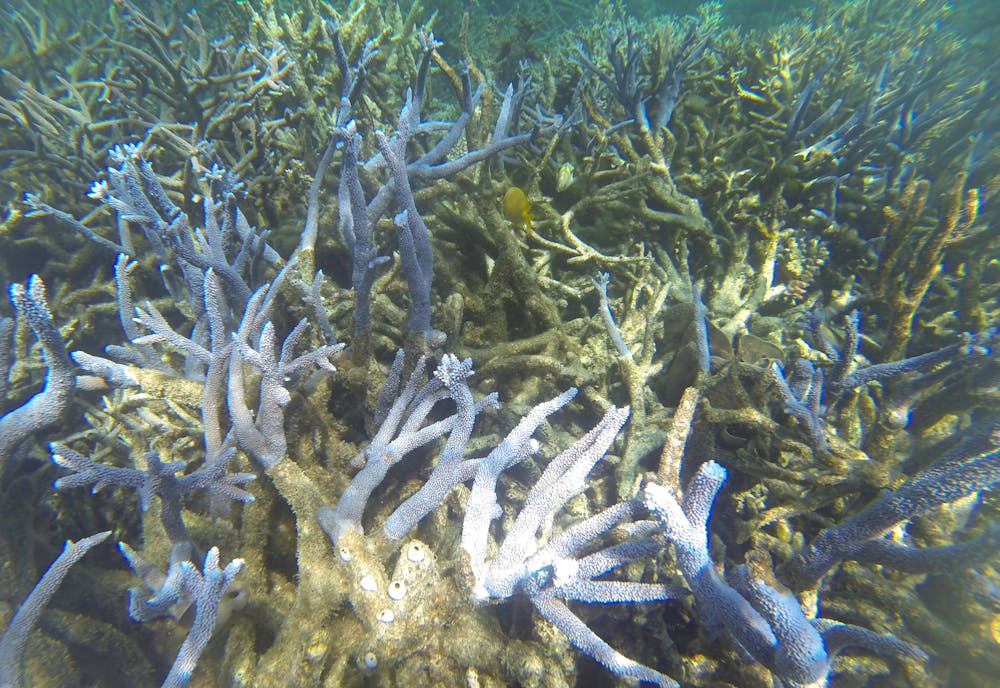
Today, 19 ecosystems show clear signs of collapse. This includes the Great Barrier Reef, savannas, mangroves, tropical rainforests, and tall mountain ash forests. These losses have profound ramifications for clean air and water, productive agriculture, pollination, and well-being.
Biodiversity is a crucial part of Australia’s national identity and Aboriginal culture. It delivers billions of dollars in tourism revenue and underpins most sectors of our economy.
It’s important for our health, too. COVID lockdowns recently brought the critical role of nature to our well-being into sharp focus, with thriving biodiversity shown to deliver avoided costs to the healthcare system.
A 2018 Senate inquiry into the extinction crisis of Australian animals (fauna) concluded that native fauna was declining. It found biodiversity protection was under-resourced and failing, and Australia urgently needs an independent environmental regulator.
In 2022, the federal Auditor-General reviewed the government’s implementation of Australia’s threatened species legislation, finding:
limited evidence that desired outcomes are being achieved, due to the department’s lack of monitoring, reporting and support for the implementation of conservation advice, recovery plans.
The national Threatened Species Strategy focuses on 100 species and a few iconic places. But more than 1,800 species and ecosystems are threatened with extinction.
And economic analyses indicate we currently spend about around 7% of the targeted A$1.6 billion per year required to halt species loss and recover nationally listed threatened species.
These findings were reinforced in 2020 by a major independent review of Australia’s environment law – Environment Protection and Biodiversity Conservation (EPBC) Act.
The review by Professor Graeme Samuel made 38 recommendations, but almost none have been implemented. They include establishing an Environment Assurance Commissioner, rigorous national environmental standards and resourcing compliance and enforcement of environmental regulations.
Failure to protect what we have
Land clearing is a key threat to Australian wildlife, yet the government has not made meaningful progress to halt it.
The hectares cleared in New South Wales over the last decade have tripled, and a staggering 2.5 million hectares have been cleared in Queensland between 2000 and 2018.
Worryingly, more than 7.7 million hectares of threatened species habitat have been cleared since the EPBC Act came into force (between 2000 and 2017), including 1 million hectares of koala habitat.
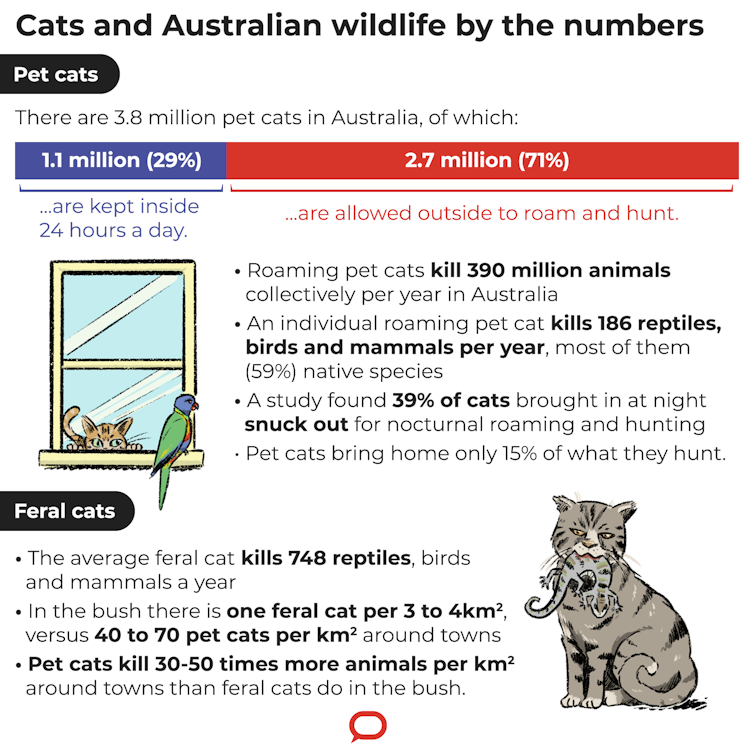
Cats alone kill 1.7 billion native animals each year and threaten at least 120 species with extinction. While feral predator control has received some focus, the effort still falls well short of what’s required.
Officialreviews have consistently found the federal government’s approach to protecting biodiversity lacks transparency and accountability.
Questions have also been raised about the federal government’s delay in releasing its five-yearly State of the Environment Report ahead of the election.
And investigations have raised serious concerns about how the government handled decisions regarding grasslands illegally destroyed by a company part-owned by a government minister.
The long-nosed potoroo is extremely vulnerable to cats and foxes. Shutterstock
A key advisor to the government recently labelled a major scheme to promote forest restoration as carbon credits as environmental and taxpayer “fraud”.
On agriculture, the government is pursuing a “biodiversity stewardship” policy, to financially reward farmers for protecting wildlife.
But ongoing approval of unsustainable land management practices, particularly land clearing (of which agriculture is responsible for the lion’s share) will likely overshadow any stewardship gains.
The 26 Australian frogs at greatest risk of extinction | Threatened Species Recovery Hub.
So what’s needed to prevent future extinctions?
Labor has not yet revealed its full suite of environment policies. This week it told Guardian Australia it will release more details before the election, and has called on the government to release the State of the Environment report.
So what policies are needed to reverse the biodiversity crisis? The answer is: spend more and destroy less.
Just two days of Coalition election promises (estimated at $833 million per day) would fund recovery for Australia’s entire list of threatened species for a year.
Systems for protecting biodiversity need stronger legal mandates and less discretion for ministers to override decisions about project approvals, species listing and other matters.
Biodiversity should be integrated into key aspects of government practice. For example, it makes no sense to invest in protecting koalas while simultaneously approving koala habitat clearing.
And we need investment in every threatened species, not just a hand-picked few.
The Great Barrier Reef this year suffered the fourth mass bleaching event since 2016. Shutterstock
Finally, transformative policies are needed to support the substantial opportunities to enhance and restore biodiversity. This includes:
The fate of nature underpins our economy and health. Yet in the election campaign to date, there’s been a deafening silence about it.
Sarah Bekessy receives funding from the Australian Research Council, the National Health and Medical Research Council, the Ian Potter Foundation and the European Commission. She is a Board Member of Bush Heritage Australia, a member of WWF’s Eminent Scientists Group and a member of the Advisory Group for Wood for Good.
Brendan Wintle has received funding from The Australian Research Council, the Victorian State Government, the NSW State Government, the Queensland State Government, the Commonwealth National Environmental Science Program, the Ian Potter Foundation, the Hermon Slade Foundation, and the Australian Conservation Foundation.
Source: The Conversation (Au and NZ) – By Caroline Schuster, Senior Lecturer, School of Archaeology and Anthropology; Director, Australian National Centre for Latin American Studies, Australian National University
The floods that devastated parts of southeast Australia last month revealed, yet again, this nation’s growing insurance problem. Assessment of the damage was agonisingly slow, and rising premiums meant many victims were completely uninsured.
The disaster was part of a global trend towards localised, sudden and intense weather known in the insurance industry as “secondary perils”. These events, such as thunderstorms, hail, bushfires, drought, flash floods and landslides, are less severe than single, huge catastrophes such as a massive earthquake or cyclone.
But they can happen frequently – and still leave a big damage bill and displace thousands of people.
Australia is among the most exposed countries in the world to extreme weather resulting from climate change. That means we need to think seriously about how to manage the financial risk of secondary perils.
A new type of cover known as “weather index insurance” may be a piece of the puzzle. The insurance uses automatic payments to make the process easier for both victims and insurers. It’s been deployed as far afield as remote parts of Paraguay and Mongolia – and could work for Australia, too.
A new type of insurance offered to farmers in Paraguay could hold promise for Australia. Shutterstock
What is weather insurance?
Traditional insurance is paid out based on an assessment of damage caused by an event. Often, disaster victims must make detailed inventories of everything lost or damaged before they can make a claim. And the sheer number of claims can leave people waiting months or years for their money.
On the other hand, weather index insurance, sometimes just called weather insurance, is paid when an index is reached, such as a certain flood level. In the case of farmers facing drought, low rainfall can also trigger a payment.
The insurance is being trialled around the world – most commonly, among farmers in remote parts of developing countries.
After an extreme weather event, it can be hard for insurance assessors to make the long trip out to the steppes of Mongolia or floodplains of Bangladesh to assess the damage to farms.
But technologies such as remote sensing and satellites can tell an insurance company when extreme weather has occurred.
The payments are rapid and automatic; as soon as a weather event is recorded, the policyholder is paid.
The payment occurs regardless of whether a farmer’s crop survives. This gives the farmer an incentive to make the best decisions to ensure the crop doesn’t fail. If it survives, the farmer still receives the insurance payout as well as the crop revenue.
Insurers hope weather insurance will help them expand their markets to remote communities.
The weather index is linked to specific crops and their growing conditions. This way, the insurance company can predict the level of losses.
Under weather index insurance, farmers are paid regardless of whether their crop survives. Dave Hunt/AAP
Global trials show promise
Having insurance can make poorer farmers more creditworthy, thereby increasing their access to loans.
In Ethiopia, a successful weather index insurance project was found to have benefited farmers. Speedy payouts meant policyholders didn’t have to sell valuable livestock to cope with a disaster. In some cases, farmers reinvested insurance payouts in their herds.
In Australia, research supports the viability of weather index insurance. It was recently rolled out to a small number of farmers, but is yet to be widely adopted.
Australian insurance providers are also offering weather policies overseas. CelsiusPro, for example, has worked with the World Bank and other aid organisations to bring such insurance to communities in the Pacific
Insurers can struggle to assess damage to farms in far-flung locations. Shutterstock
A note of caution
Weather index insurance is not a magic bullet, and should be adopted with caution.
For instance, the weather index is tied to the growing conditions of one plant. This can lock farmers into specialising in a single crop – exposing them to new risks such as volatile market prices, and scuttling their diversification strategies.
And payouts are not guaranteed. During an El Niño year in Paraguay, sesame farmers suffered flooding and then drought. But the conditions fell just short of the index in most areas and those farmers didn’t get a payout.
What’s more, the data gathered by insurers may not match what’s actually happening on the ground. Research in sub-Saharan Africa, for example, found a sizeable gap between environmental and weather indices measured by remote sensing, and the experience of policyholders.
Improving data and monitoring often requires substantial investments – from both governments and insurers – in infrastructure and technology such as weather stations, climate models and communications systems.
In Paraguay, local communities have shouldered much of the burden of obtaining good weather data. They help maintain meteorological equipment, provide valuable on-the-ground feedback and contribute to crop science, but are often not compensated for these efforts.
And in developing countries, coping with weather disasters is often a collective effort. Individual insurance policies can reinforce inequalities and erode a community-based response.
Finally, high premiums and low trust from farmers have limited uptake of weather insurance to date.
All this means weather insurance alone is unlikely to create a safety net against extreme weather risks.
Remote sensing does not always reflect experience of weather on the ground. CHIEN-MIN CHUNG/AP
What next?
In 2020, more than 70% of global insured losses from disasters were due to secondary perils.
They included the Black Summer bushfires in Australia, and a freak hailstorm in Canberra which caused an estimated A$1.65 billion in damage.
Weather indexed insurance is yet to be tested on property insurance. But the agonising wait for a payout in the recent floods in southeast Australia suggest bold new solutions are needed.
Some research has also found merit in weather insurance at a regional or national scale.
Australia’s high exposure to extreme weather should mean all insurance options are on the table – especially those that are inclusive and don’t relegate high-risk communities to the outcast pool of “uninsurables”.
Dry land isn’t really dry. It’s saturated with truly vast volumes of groundwater, hidden in the spaces of the earth we walk on. How much? Recent estimates put it at almost two trillion Olympic swimming pools of water stored in the upper 10 km of continental crust.
Groundwater has been hugely beneficial to us for use in agriculture or as drinking water. As the world warms and waterways dry up, this extraction will only increase. But there’s a hidden problem. We used to think the organic matter in groundwater didn’t react when brought up. Sadly, the reverse is true. Our new research published in Nature Communications has found when groundwater – especially from deep down – is pumped to the surface, it brings with it dissolved organic matter preserved from long ago. Once sunlight and oxygen hit this matter, it can easily turn into carbon dioxide.
Unfortunately, that means groundwater is likely to be yet another source of planet-heating greenhouse gases, and one which is not included in our carbon budgets. How large? We estimate up to the same amount of dissolved organic carbon as that pumped out by the Congo River each year, the world’s second largest by volume.
This problem is set to increase, as over-extraction of accessible groundwater forces us to hunt for the deeper water, which has much more of this greenhouse gas-producing organic matter. We must include this unexpected greenhouse gas source in our carbon budgets.
Australian agriculture relies heavily on pumped groundwater in some areas. Shutterstock
So how can groundwater be a greenhouse gas source?
Groundwater can remain underground for millions of years, with its chemical composition based on the rocks or earth it’s surrounded by. During this time, the dissolved organic matter degrades very slowly. That’s because it’s dark down there and there’s no way of replenishing oxygen that would usually be dissolved into the water from the atmosphere.
Our bores and pumps are one way groundwater comes into the daylight and air. But at present, natural flows account for much more. Every day, groundwater seeps out of the world’s coastlines at a rate of 13 times the water in Sydney Harbour. By contrast, all the world’s bores pump up around five Sydney Harbours a day. (The Australian unit of measurement, a Sydharb, represents 500 gigalitres).
To figure out what happens when this old water emerges, we collected some of the oldest dissolved organic matter in deep groundwater analysed to date. This organic matter had been dissolved in the groundwater for more than 25,000 years.
We found that long term exposure to dark, oxygen-depleted deep groundwater environments meant molecules were preserved which were usually broken down by sunlight or greenhouse gas-producing microbes when exposed to oxygen.
Carbon, oxygen and hydrogen-containing molecules make up the dissolved organic matter in groundwater. Some of these molecules can be broken down by microorganisms, while sunlight is enough for others to turn into new molecules or converted to carbon dioxide.
Using global estimates of dissolved matter in groundwater, we estimated how much was brought to the surface by bores or flowing out to sea. Each year, that’s around 12.8 million tonnes.
As groundwater flows to oceans or is extracted from bores, organic matter in the water is exposed to sunlight and oxygen. Author provided
What does this mean for our carbon budget?
Now we know groundwater is a carbon source, we have to factor it in to the way we deal with climate change. To accurately predict future climate change scenarios and the speed we need to move at, we need to know all sources and removal pathways of carbon to and from the atmosphere.
At present, groundwater as a carbon source is ignored in global carbon budget estimates. That needs to change, especially as we know groundwater will be used in ever-greater volumes in the future as waterways and lakes begin to dry out due to climate change.
This is even more pressing, given Australia’s population is expected to hit almost 40 million within the next 40 years. Supporting this growing population means more groundwater for farming, industrial and home use.
Wells are running dry in some areas where groundwater is heavily relied on. Shutterstock
Despite the vast volumes of groundwater in the earth’s crust, most of it is very hard to extract. Many artesian basins close to the surface are already being tapped, and in many places, over-extraction of groundwater is a real problem. Wells are already running dry in some agricultural areas.
As the easy water runs out, we may be forced to keep boring down to extract deeper, older water. These ancient waters have more of the organic molecules which can turn into carbon dioxide once we bring them up. To us, that suggests groundwater as a carbon source is set to grow and we must begin to include it in carbon budgets.
Liza McDonough receives funding from the Australian Government and The Australian Research Council. She has also received funding from the National High Magnetic Field Laboratory USA to undertake dissolved organic matter analyses.
Andy Baker receives funding from The Australian Research Council (ARC)
Martin Sogaard Andersen receives funding from The Australian Research Council (ARC), Commonwealth Government and NSW state agencies.
Housing is expensive in Australia. But it doesn’t have to be this way. Higher quality, more affordable housing is a matter of policy choice.
A key problem is Australia’s housing market is too skewed towards treating housing as a financial asset, rather than a basic human need.
There is almost a universal consensus among economists, for example, that negative gearing favours the interests of investors to the detriment of others, but both major parties are scared to change the policy.
One way to break the policy stalemate is to consider policies shown to have worked in other countries. To facilitate this, the Nordic Policy Centre – a collaboration between The Australia Institute and Deakin University – has published an overview of housing and homelessness policies in Sweden, Norway, Denmark and Finland.
Of particular note among the wide range of housing policies in these nations is the prominence of housing cooperatives, which assist both renters and those wanting to own a secure, high-quality home.
Why Nordic countries?
Why look at the Nordic countries?
One reason is their relative success in tackling homelessness.
Finland is the world leader in this. There, the number of people experiencing homelessness has fallen from more than 16,000 people in the late 1980s to about 4,500 people in 2020. This represents a homelessness rate of less than one per 100,000 (Finland’s population is about 5.5 million) compared with nearly five per 100,000 in Australia.
Homelessness, granted, is more complicated than just the cost of housing. It involves family and relationship trauma, physical and mental health issues, and substance use.
The Finns’ achievement is due to a range of policy responses including strong outreach services.
But underpinnning these responses is the Finnish government’s “Housing First” principle, adopted in 2007, which says people have a right to decent housing and to useful social services. It’s a seemingly simple concept, but radically inclusive compared with how other countries deal with the homeless.
In Australia, housing cooperatives might conjure up images of small hippie communes. This is an unfair characterisation, borne of the fact the sector is so tiny and unknown.
All up, cooperative housing comprises less than 1% of the Australian housing sector, with about 200 housing cooperatives mostly focused on providing affordable rental housing.
In Nordic countries, however, housing cooperatives are a mainstream option for both renters and owners.
Sweden’s cooperative sector amounts to 22% of total housing stock. Norway’s represent 15% nationwide, and 40% in the capital, Oslo. In Denmark, more than 20% of the population lives in cooperative housing.
Denmark has more than 120 housing cooperatives, providing about 230,000 rental units. Shutterstock
How cooperative housing works
Cooperatives take a variety of forms. But the key features are that they are democratically organised and exist to serve a real economic or social need of their members.
Rental housing cooperatives exist to provide housing, not accrue wealth. They pool common resources to own and manage affordable rental accommodation. Tenants are generally required to become members and encouraged to be actively involved in decision-making, management and maintenance. Any revenue from rents is reinvested in new housing projects or upgrading older buildings.
In Denmark, rental cooperative housing – known as Almenboliger – plays a critical role in providing affordable housing for a range of people, including the elderly and those with disabilities. Its non-profit orientation as well as supportive government policies – such as lower-interest loans – enable cooperatives to reduce construction costs and offer lower rents.
In Norway, national law allows 10% of units in a housing cooperative complex to be bought or used by local government authorities to house people who can’t afford alternatives. Housing cooperatives in Oslo have been vital for securing decent housing for immigrants and for older people.
A path to home ownership
Just as important in terms of lessons for Australia is that Nordic housing cooperatives also play a big role in helping people buy a home.
So-called “equity-based” housing cooperatives in Sweden, Norway and Denmark help reduce the cost of home ownership. This generally involves the cooperative building or buying an apartment or unit block, then allowing members to buy individual homes, while the cooperative retains ownership of common areas.
Members own their individual dwellings and co-own and manage shared spaces with other co-op members. The structure is similar to strata title in Australia, with individual ownership of some parts of a property and shared ownership of others. The big difference is strata title is often “investor-owned”, while a housing cooperative is “user-owned”.
The result is that members can buy a home for about 20% less than what it would cost them otherwise.
More collaboration needed
Not everything the Nordic countries do can be replicated in Australian conditions. But one thing we can certainly learn is the importance of collaboration between different tiers of government and civil society organisations.
Australia’s superannuation funds, for example, have the means to invest in low-returning, but very safe, affordable housing assets. Government policies should support them doing this through cooperative structures that help to fill the gap between market and state.
There’s no quick fix. Emulating any Nordic housing policy achievements will take decades. Finland’s critical organisation for tackling homelessness, for example, was established in 1985.
But better housing options are there in plain sight, waiting for policy makers and other stakeholders to take them. If they want to.
The authors acknowledge and thank Rod Campbell for his assistance in preparing this article.
Heather Hoist is Victoria’s Commissioner for Residential Tenancies. She writes here in a personal capacity.
Sidsel Grimstad is chief investigator on an Australian Research Council and housing co-operative sector funded project, Articulating Value in Housing Co-operatives (2021-2023).
Everything Everywhere All At Once, a sci-fi action comedy, manages the surprising feat of paying homage to martial arts cinema classics while also delivering a strange and completely fresh, genre-bending film.
Written and directed by Dan Kwan and Daniel Scheinert (collectively known as “the Daniels”), Everything Everywhere All At Once is a delirious adventure blending a heartwarming examination of personal and family crisis with a wild sci-fi storyline, and some of the most amusingly bizarre fight scenes to ever grace the screen.
Taking inspiration Jackie Chan’s kung fu comedies, the film’s fight scenes combine fast, free-flowing martial arts with slapstick humour.
The Daniels have acknowledged the film was originally conceived of as a vehicle for Chan. However, after seizing upon the idea of flipping the gender of its unlikely hero, the directors decided to hand the reins to Michelle Yeoh, who has enjoyed a resurgence in popularity after starring in two recent hits, Crazy Rich Asians and Shang-Chi and the Legend of the Ten Rings.
Into the Michelle Yeohniverse
Although never professionally trained in martial arts, Malaysian-born Yeoh achieved fame in 1990s Hong Kong action films such as Yes, Madam! and Jackie Chan’s Supercop. An ex ballerina, renowned for doing most of her own stunts, Yeoh typically relies on on-set fight training for her action scenes.
In Everything Everywhere All At Once, this meant Yeoh was teaming with brothers Andy and Brian Le for the most outlandish fight of her career – a scene where Yeoh’s character must fight a pair of butt plug-armed henchmen.
The self-taught Le brothers drew Hollywood’s attention via the popular Martial Club YouTube channel where, along with friend Daniel Mah, the brothers recreated fight scenes from classic Hong Kong kung fu films.
Working with stunt coordinator, Timothy Eulich, to choreograph a number of Everything Everywhere All At Once’s fight scenes, the Le brother’s encyclopaedic knowledge of kung fu cinema is credited by Eulich as helping shape the film’s approach to action.
Everything Everywhere All At Once
Caught up in shattering disappointment over what her life has become, laundromat owner Evelyn Wang (Yeoh) gets a welcome reprieve from her drab reality when she is drawn into a cosmic battle and given the ability to travel through the multiverse.
Skipping between alternate lives she could have led, Evelyn draws upon the memories and skills of her other selves, including a Teppanyaki chef and an opera singer. In a nice nod to Yeoh’s own position as a globally-recognised star of films such as Crouching Tiger, Hidden Dragon, one of Evelyn’s most significant alternate selves is a famous, martial arts-trained actress.
Michelle Yeoh in Everything Everywhere All At Once, playing a version of Evelyn that is an homage to Yeoh herself. AAP
Evelyn discovers she is the multiverse’s only chance at salvation and, as various evil beings hunt her and her family, she is forced to engage in frequent battles, using whatever objects are close at hand as weapons.
The combination of an unlikely hero being forced to fight – typically with impromptu weapons – before revealing a startling degree of martial arts proficiency is the key ingredient of numerous Jackie Chan action comedies, especially those made for English-speaking audiences after Chan relocated to the USA in the 1990s.
Drawing inspiration from Buster Keaton’s silent-era physical comedies, Chan’s films eschew traditional action genre rules. The most obvious divergence is that Chan’s characters rarely enter a fight armed with anything other than natural ability. Chan forsakes outright hostility for demonstrations of acrobatic martial skill combined with humour.
Jackie Chan in Rumble in the Bronx (1995) IMDB
Each set of Chan’s iconic fight scenes are filled with a suite of potential weapons. For example, Chan’s confrontation with a gang of punks in Rumble In The Bronx, starts with Chan on a pool table. The actor uses everything from a fridge, to a television, a set of speakers, a shopping trolley and even a pinball machine, as weapons.
In The Spy Next Door, Chan is trapped in a kitchen and, after first slamming a fridge door into a thug, Chan repeatedly beats the man over the head with pots and pans. Though it sounds violent, the tone of the scene is more Looney Tunes than Dirty Harry.
Everything old is new again
The scene is a homage to the 1976 Hong Kong Hui Brothers’ comedy, The Private Eyes. In the original film, an inept private eye finds himself battling a villain in the kitchen of a restaurant. The ridiculous nature of the fight escalates as the opponents move from pans and colanders to a gourd-slicing swordfish, a shark jaw, a sausage nunchuck, and a wok that is tossed like a boomerang.
The Private Eyes is a 1976 Hong Kong comedy film written, directed by and starring Michael Hui and co-starring his brothers Samuel Hui and Ricky Hui . IMDB
Everything Everywhere All At Once features a similar throwback to that iconic scene – this time swapping the sausages for dildos to make a pair of impromptu tonfa batons. Another standout scene features Evelyn’s husband, Waymond (Ke Huy Quan) expertly wielding a fanny pack to take down an entire group of thugs.
Everything Everywhere All At Once is a fresh addition to the comedy martial arts canon.
Despite the existential premise of the film – and the surprising depth of the relationship dramas – the execution of action is skilful. More significantly, the action doesn’t take itself seriously and the humour doesn’t stop when the action starts.
Joyleen Christensen ne travaille pas, ne conseille pas, ne possède pas de parts, ne reçoit pas de fonds d’une organisation qui pourrait tirer profit de cet article, et n’a déclaré aucune autre affiliation que son organisme de recherche.
What makes us want things we like? We know things that offer potential rewards, including food, sex, addictive drugs, and even certain artworks, can inspire desire in us – but why?
The French Enlightenment philosopher Denis Diderot pointed out a central conundrum:
Desire is a product of the will but the converse is also true: will is a product of desire.
Neuroscience has solved part of the mystery, by identifying a system that drives wanting in mammals involving specific brain regions. Desire may help an animal to survive, for example by wanting to experience pleasure from nutritious food.
What do we mean when we talk about “liking” and “wanting” things? Well, for neuroscientists, “liking” means the pleasurable feeling we get when we consume some reward. “Wanting”, on the other hand, means being motivated to reach the reward.
We know a bit about what happens in our brains and those of other mammals such as rodents when we want a reward. It involves dopamine, a kind of chemical called a neurotransmitter that enables communication between neurons in our brains.
To understand how the process works for non-mammals, Huang and colleagues looked at what happens in the brains of bees when presented with the prospect of a reward.
As the German scientist Karl von Frisch showed in the 1920s, honeybees use a symbolic dance language to communicate the location of rewarding flowers to hive-mates.
During the ‘waggle dance’, dopamine fluctuations motivate bees to go out hunting nectar.
Other bees who observe this “waggle dance” are enticed to leave the hive and forage to collect nectar or other nutrition.
Huang and colleagues measured dopamine levels in the brains of the dancing and observing bees. They discovered that dopamine surges for performers and watchers at the beginning of the waggle dance, dropping off by the time the dance concludes.
Dopamine levels were higher when watching the dance than when the bees were actually feeding. These fluctuations show it is the expectation of wanting the sweet reward of nectar that chemically motivates the honeybees to forage.
In spite of having fewer than a million neurons in their brains, honey bees demonstrate complex behaviours and are cable of solving problems like detecting flower scents and colours.
Huang and colleagues also showed that providing higher dopamine concentrations to some test bees increased their motivation and improved their capacity to learn flower signals like scent.
How to motivate pollinators
Honeybees and other bee species native to the different regions of the world are among the most important pollinators of many commercial and wild plant species. By carrying pollen from one flower to another of the same species, bees ensure cross pollination which often results in higher number of seeds and fruit size.
Therefore bees are of important economic value by pollinating valuable crops such as almonds, citrus and various species of vegetables.
Queen bees can modulate dopamine pathways of young bees to capture their attention and motivate them to complete specific tasks. A better understanding of the effects of dopamine on the wanting system of honeybees may open the door to a more efficient and sustainable use of honeybees for many tasks including agricultural and neuroscience.
The new research on honeybees also supports an idea raised by the famed English naturalist Charles Darwin 150 years ago, in his book The Expression of Emotions in Man and Animals. He proposed that liking and disliking things was so helpful to animals that it might form the basis for wanting mechanisms in humans and other animals.
This idea, alongside the presence of a wanting system in honeybees suggests that a precursor of the mammalian wanting system may have developed very early in the evolutionary history of animals. It may also provide a biologically plausible explanation for why we want what we like.
Adrian Dyer receives funding from The Australian Research Council.
Jair Garcia does not work for, consult, own shares in or receive funding from any company or organization that would benefit from this article, and has disclosed no relevant affiliations beyond their academic appointment.
Philip Lowe mightn’t be a household name but the Reserve Bank governor finds himself catapulted right into the centre of this election campaign, in which events are proving more important than policies.
The very large inflation spike has economists declaring vehemently that the bank should put interest rates up on Tuesday, rather than waiting until June, after the election.
Both sides of politics accept the necessity and inevitability of rates rising soon. Lowe and the bank are independent and non-political, but they would also be aware a decision to hold off the increase for another month could be seen as political.
If rates do go up on Tuesday, what impact will that have on the election?
No-one can be sure. Like a number of issues in this election – notably the Solomons-China security pact and climate change – cost of living, including higher interest rates, would cut both ways.
Some voters, under increasing financial pressure, would take out their frustration on the government.
But there is a Labor fear that if rates go up next week, that could present an opportunity for Scott Morrison. The government could use it to exploit the “uncertainty” theme at the core of its campaign, reinforcing the message that change would be a leap into the unknown in scary times.
The Coalition would be helped in prosecuting its case by the fact rates have been rising internationally, so blame can’t credibly be sheeted locally. Second, Anthony Albanese’s rating with voters on economic management is very low. In this week’s Australian Financial Review Ipsos poll, 48% picked Morrison as “having a firm grasp on economic policy” while only 31% said that of Albanese.
Focus group research backs the point about Labor’s potential vulnerability. Simon Welsh, from the (Labor-leaning) firm of RedBridge, says that for some time a group of voters has been “pivoting” away from issues of Morrison’s character and leadership towards economic issues and cost of living. This “pivot” started around the time petrol prices escalated, and has continued since.
“If there is a rate rise next week it will add more fuel onto economic concerns,” Welsh says. “People don’t have confidence that there is a plan from Labor on the economy and interest rates. Their confidence in the Liberals is based on a ‘generic brand’ of them as better money managers.”
Even if the Reserve Bank stayed its hand next week, the shadow of the certain later rise would hang over the rest of the campaign.
With the six-week march to May 21 at the halfway mark, the next week will be crucial for Albanese, as he returns from COVID isolation to the trail.
This is a really risky time for him. Labor has mainly managed the absence
(aside from some virtual interviews) of its leader as well as it could. Apart from deputy leader Richard Marles struggling to explain past statements on China, opposition frontbenchers have held up their end.
Shadow treasurer Jim Chalmers appeared on top of his portfolio; finance (and campaign) spokeswoman Katy Gallagher looked very solid, shadow foreign minister Penny Wong sounded authoritative. Campaign spokesman Jason Clare has become a bit of a star.
There have been questions as to why Tanya Plibersek isn’t doing more, and talk of her (and some others) being “frozen out”. Albanese and Plibersek (both from the left) are not close, but both camps play down the suggestion she’s not busy. In 2019 she was more prominent, but she was deputy leader and her education portfolio more central in Labor’s pitch.
While it was better for Albanese, if he was going to get COVID, to contract it early, he’s now returning at a very challenging time, with Labor’s formal “launch” in Perth on Sunday. Not only will his performance be minutely scrutinised, but there’s a lot of travel involved.
Albanese said on Thursday: “It’s been a difficult week […] My doctor tells me I have to take things easy, particularly in the first few days to not do the 16 and 20-hour days that I was doing.” (He shouldn’t have been doing 20-hour days anyway, but that’s another story.)
Morrison won’t hesitate to exploit any sign Albanese has been slowed by COVID. He noted pointedly on Thursday, “He’s had a pretty quiet week. I remember when I was in iso, I had a very busy week attending QUAD summits and doing all those sorts of things.”
The PM was also pressing to have the remaining debates quickly. “It’s time to make up for some lost time. I’m happy to do two debates next week. Seven and Nine have both offered me two debates next week.” (Labor has its own ideas.)
Albanese still has a great deal of work to do if he’s to convince undecided voters he is a reliable alternative. At the same time, he has to ensure his campaign is paced to match how well he is feeling. It could be a difficult balance.
A feature of this election is that it has multiple fronts. Apart from the national campaign, there are regional battles, the individual seat contests, and almost a separate election revolving around the “teals”. This latter has become a defining feature of election-2022.
Teals start facing steep mountain. They need to reach at least second position on primaries to have a potential win, which means reducing the vote of their Liberal opponent to under 45% and polling about 30% themselves. The lower the Liberal vote and the higher their own, the better the chance.
Sources with an overview of their campaigns suggest several teals are in this position or on the cusp. The question is whether they will hold their ground or see their support slip in the final weeks, as “soft Liberal” and undecided voters firm up their thinking.
Although we don’t know how the teal story will end, we do know that it is frightening the hell out of the Liberals in the firing line.
Nowhere is the ground war more intense and, on the Liberal side, desperate, than in Treasurer Josh Frydenberg’s electorate of Kooyong, where money and signage apparently have no limits for incumbent or challenger, because the stakes are huge. The loss of the seat once held by Robert Menzies would have immense practical and symbolic implications for the Liberal party.
Michelle Grattan does not work for, consult, own shares in or receive funding from any company or organization that would benefit from this article, and has disclosed no relevant affiliations beyond their academic appointment.
A landmark case in Fiji today at the High Court in the capital Suva issued what is the country’s first environmental crime sentence.
Controversial Chinese resort development company Freesoul Limited was fined FJ$1 million for breaching two counts of Fiji’s Environmental Management Act.
The company is developing a resort on Malolo Island in the popular tourist hotspot, the Mamanuca Islands.
The company was issued a prohibition notice in June 2018 after neighbours and indigenous landowners shed light on extensive environmental damage it was causing on the coast at Malolo Island.
According to court documents, the company was issued with a prohibition notice by the Department of Environment after landowners and neighbours alerted authorities of extensive coral and mangrove damage.
The company had dug an extensive sea channel and removed local marine life to gain direct access to the resort development.
The DOE had authorised only land works because an Environmental Impact Assessment had not been done on marine works.
Freesoul denied responsibility When charged for unauthorised development, Freesoul denied responsibility but the Magistrate Seini Puamau, who heard the initial case, was not satisfied, given DOE evidence produced in court showing Freesoul apologising for the damage.
The case was referred to High Court judge Justice Daniel Gounder who ordered Freesoul pay the DOE FJ$1 million for the rehabilitation of the marine environment damage.
Chinese resort developer Freesoul fined $650,000 for damaging Fijian mangroves and reef https://t.co/7cGoUadaoy
COMMENTARY:By Māori Language Commissioner Professor Rawinia Higgins
Whether he knows it or probably not, the year Joe Bennett arrived in Aotearoa from England was a milestone year for te reo Māori. After years of petitions, protest marches and activism from New Zealanders of all ethnicities as well as a Waitangi Tribunal inquiry: te reo Māori became an official language in its own land on 1 August 1987.
This was the same day our organisation opened its doors for the first time and in a few months, we will celebrate our 35th birthday.
Just getting to 1987 was not an easy road. It was a battle that had already been fought in our families, towns, schools, workplaces, churches and yes, newsrooms for decades.
In 1972, the Māori Language Petition carried more than 33,000 signatures to the steps of Parliament calling for te reo to be taught in our schools and protected.
Organised by the extraordinary Hana Te Hemara from her kitchen table, well before the internet, this was flax roots activism at its finest.
Hana mobilised hundreds of Māori university students who along with language activists and church members from all denominations, knocked on thousands of front doors across Aotearoa.
As the petition was circulated more easily in urban areas with large populations, the majority of those who signed the petition were not Māori. Most of those Kiwis (who would all be well into their 70s by now) didn’t think that te reo was ‘Māori nonsense’.
Identity as New Zealanders We know from our own Colmar Kantar public opinion polling that more than eight in 10 of us see the Māori language as part of our identity as New Zealanders. Today in 2022, most Kiwis don’t see te reo as Māori nonsense.
Racist, official policies that banned and made te reo socially unacceptable saw generations of Māori families stop speaking te reo. It takes one generation to lose a language and three to get it back: the countdown is on.
Story time: I was alerted today to an opinion piece in @otd I have thought hard about sharing it but I think it’s important to show the views of people who have significant platforms but also the support they receive. Have a read… pic.twitter.com/hXyUiv7DDK
Last year and the year before more than 1 million New Zealanders joined us to celebrate te reo at the same time, that’s more than one in five of us. We don’t see te reo as Māori nonsense.
Putting personal opinions aside, the elephant in the room of Bennett’s article is an important and rather large one: te reo Māori is endangered in the land it comes from.
It is a language that is native to this country and like an endangered bird, its future depends on what we do.
And from the behaviour of New Zealanders over the past half-century: it does not seem that we are willing to give up te reo without a fight.
Bennett says that languages that are not useful will wither away because they exist for one reason only: to communicate meaning.
Telling the stories of humanity Languages are much more than this. They tell the stories of humanity, they are what make us human.
Te reo serves as both an anchor to our past and a compass to the future. It connects Māori New Zealanders to ancestors, culture and identity.
It grounds all New Zealanders by giving us a sense of belonging to this place we call home. It guides us all as we prepare for the Aotearoa of tomorrow.
Our team won the world’s most prestigious public relations award last year for our Māori Language Week work because they valued language diversity much as biodiversity.
The global judging panel told us in the ceremony held in London that we won because our work is critical to the future. Language diversity is the diversity of humanity and if we do nothing, half of our world’s languages will disappear by the end of this century.
And with them, our unique identities, those very things that make us who we are will disappear with them. It may be nonsense to a few but it’s nonsense more than 1 million of us will continue to fight for.
A note from RNZ: RNZ feels a deep responsibility, as required by our Charter and Act of Parliament, to reflect and support the use of Te Reo Māori in our programming and content. We will continue to do so.This article was originally published on Te Taura Whiri i te Reo Māori — Māori Language Commission — in response to Joe Bennett’s Otago Daily Times article “Evolving language scoffs at moral or political aims” on 21 April 2022 and is republished under a community partnership agreement with RNZ.
Campaigning is underway for the general election in Fiji later this year and early predictions are pointing to a shift in allegiances.
No date has been set yet for the general election in Fiji.
The ruling FijiFirst Party led by Prime Minister Voreqe Bainimarama scraped through at the last election four years ago with the slimmest of margins.
Professor Steven Ratuva, director of the Macmillan Brown Centre of Pacific Studies at the University of Canterbury, said FijiFirst’s popularity was polling more than 60 percent in the 2014 election.
He said in 2018 that they were closer to 50 percent, and now the polls are indicating popularity levels as low as 22 percent.
“So that alone, if you do another poll and another one, if it talks about the same thing and even if you have a margin of error of about 10 or 20, that means it’s going to be a major shift in the political gravity, and there might be a change of government.
No consistent polling Unfortunately, we don’t have consistent polling in Fiji, this is when they should be doing it, the major papers like The Fiji Times, the Fiji Sun,” he said.
“It’s important for the people of Fiji at this particular point in the election to be engaged in the democratic process of providing their views as to who should be there, before the actual election itself.
“And it’s good for political parties as well, whether you are in power or whether you are in opposition,” Professor Ratuva said.
This article is republished under a community partnership agreement with RNZ.
University of Canberra Professional Fellow Michelle Grattan and University of Canberra Associate Professor Caroline Fisher discuss the week in politics.
They canvass the elevation of cost of living pressures in the election battle, with the big spike in inflation and interest rates set to rise as early as next Tuesday (and no later than next month). Meanwhile national security has played into the campaign, but in a way that has had the government on the back foot, warding off criticism it hadn’t done enough to prevent the Solomons-China security pact.
The climate debate is running again, with division within the Coalition, the teals nipping at Liberal heels, and the government trying to raise a scare about Labor’s policy.
Michelle and Caroline also discuss Albanese’s week in “iso” and Labor’s campaigning when the leader was on his sickbed.
Michelle Grattan does not work for, consult, own shares in or receive funding from any company or organization that would benefit from this article, and has disclosed no relevant affiliations beyond their academic appointment.
New Zealand Parliament Buildings, Wellington, New Zealand.
Political Roundup is entirely subscriber-funded. The ethos behind this public service is to help foster a robust and informed public debate, with a great diversity of perspectives. If you appreciate what we are doing in providing non-partisan analysis and information about politics, economy, and society, please consider helping us keep going, by donating via Victoria University of Wellington’s fundraising page here: https://bit.ly/VUWDemocracyProject
Political Roundup: Could inflation lead to a voter backlash?
The current cost of living crisis in the New Zealand economy could yet have severe political consequences. Warning signs could be seen in Monday’s French presidential election result – in which the nationalist-populist Marine Le Pen upset the status quo by getting through to the second round and winning an incredible 42 per cent of the vote.
Rather than being a vote for her nationalism or rightwing politics, Le Pen’s stunning result was due to a campaign that targeted France’s cost of living crisis. Le Pen was able to leverage huge anger amongst those disadvantaged by quickly rising inflation and other assaults on ordinary people’s standard of living. Polling shows that Le Pen won the support of workers and those on low incomes, while the incumbent Emmanuel Macron won the votes of managers, professionals and the wealthy.
Could a similar revolt against Jacinda Ardern’s government happen here?
While a mass revolt against the status quo is unlikely to occur here, it’s not impossible that some sort of electoral backlash could yet punish politicians associated with the rising cost of living. If this is the case, the Labour administration could be in trouble at the next election.
The current cost of living crisis is a catastrophe for the poor and working class of New Zealand. Rising inflation comes on top of many other crises that have severely impacted those on the bottom – the housing affordability crisis, Covid, failing infrastructure, and an inadequate health system.
The rich have already done incredibly well out of the last few years. Inflation has been stoked by massive cash handouts to business and big asset owners in the form of cheap credit and money printing. Business profitability is currently very high – banking profits were up 48 per cent last year, the big four power companies’ profits were up nearly 60 percent in the last six months and the supermarket duopoly is still making super-profits. In many ways, the corporate sector have never had it so good.
The gulf between those who are financially very successful and those who are being punished by the current system is growing. Soaring food and energy prices are leaving growing numbers of people choosing between eating and staying warm. One bank has estimated that the average household will need to spend an extra $150 per week, money that won’t come from increased incomes. Hence foodbanks are in greater demand than ever before, with reports that middle income earners are being forced to use them as well as the poor.
It’s still the working class and the poor who are most impacted by inflation – who have to spend a greater proportion of their income on the basic commodities that have increased the most. According to the Reserve Bank, transport costs have gone up over 16 per cent over the past two years, and housing costs an incredible 48 per cent since 2019. While the minimum wage has increased by 12 per cent in the last two years, average wages have increased less than 9 per cent. Clearly most lower income earners are falling behind and, with no sign of inflation falling in the next few years, those New Zealanders will become further impoverished.
The Prime Minister’s key goals on housing, inequality and poverty are going to be very hard to progress, and yet Labour’s own traditional constituency will be the ones hurt by government policies both here and abroad. The party therefore faces a real challenge to retain those voters.
Even the Minister of Finance seems trapped by his own newfound conservatism. The Grant Robertson of old used to campaign to reduce the cost of living by removing GST off fresh food, and bring in a tax-free first $5000 of income. He even argued that GST of 15 per cent – which was increased by Bill English from 12.5 per cent – was too high. So why isn’t Robertson ready to relook at such policy settings now?
Instead of such innovations in the economic sphere, this Labour Government seems to want to invest their political capital on fighting for reforms in co-governance, and implementing other social reforms that might well be necessary, but do not address the fundamental material needs of their traditional constituency.
Perhaps this is simply because it’s easier to implement a new school curriculum than it is to reform housing rules or to build new state houses. Regardless, it leads to a feeling that the Labour Government does not see combating the declining standards of living as a priority.
Robertson and his colleagues do make noises about having increased the minimum wage and benefit rates, but these small increases have almost all been eroded by inflation.
And benefit rates will continue to erode due to Labour’s decision to index benefits rates to wage increases instead of the higher rate of inflation. The Government chose not to use the formula used in countries such as the UK, in which benefit increases are indexed against whatever measure is highest, and now the poor will pay the price.
Can National win over workers and the poor?
National has succeeded in getting the cost of living crisis onto the public agenda. But are they also putting forward genuine solutions? Certainly, National’s tax cut proposals would do little for the poor and much more for the already-rich.
So National might well be able to attract the votes of the poor for a period of time, but such support will be extremely soft if the party isn’t able to put forward credible solutions to raise the standard of living for workers. The instincts of the party make this highly unlikely, and National seem set to continue the status quo. And in opposing minimal wage increases they would make things worse.
Although National is loudly blaming Labour for the current cost of living crisis, so far the party has not been able to differentiate itself from Labour’s approach. Eventually, this will also make National appear equally out of touch. Certainly Christopher Luxon seems an unlikely leader to excite the working class and downtrodden.
All politicians have spent the last week talking at great length about the inflation problem – explaining supply constraints, “tradeables”, global impacts – and mostly it sounds technocratic. Politicians of both left and right come across as if they don’t really feel the pain of those at the bottom. They look out of touch, and their solutions sound empty. Largely the policy solutions put forward by all sides translate to “more of the same”.
The looming political revolt over the cost of living crisis
Returning to the French election result, it’s worth noting that many poor and working class French voters were also alienated by the liberal, middle class social engineering political agenda of some of the Establishment parties. For instance, the presidential candidate of traditional party of the centre-left, the Socialist Party, won only 1.7 per cent of the vote. The New Zealand Labour Party should take note of that.
Today’s Otago Daily Times editorial notes that Le Pen’s relative success this week was based on her concentration “on bread-and-butter issues, notably the cost of living”. The newspaper says: “Her relative success, however, is another warning about politics, including the kickback from voters who feel a political, media and social elite run the show. Labour and the liberal professional classes in New Zealand should also take note. Many New Zealanders are rejecting the parties they might have supported in the past. Some are sceptical of the changed woke world where their traditional attitudes are rejected. Some feel excluded or resentful.”
It can be a powerful push to revolt when you are feeling impoverished, unheard, and unrepresented. At the moment, those who feel abandoned by Labour have no obvious alternative to vote for, but elections and financial pain have a funny way of creating surprising success stories for unlikely candidates, even those on the far right like Marine Le Pen, or on the radical left like Bernie Sanders.
Under MMP it would only take 5 per cent of voters to gain a foothold in Parliament – about 145,000 people. And such a party could be consequential – if it is the difference between being in government or in opposition, the big parties will make concessions. National, in particular, would be susceptible if they had to make deals deal with both Act and a new populist movement.
New Zealand’s political elites – regardless of their party colours – now face the prospect of ordinarily voters feeling angry and frustrated, especially the working class and poor. Such a rebellion from below seems unlikely, but as in France this week, new divisions in society are still surprising us all. Populism of both left and right varieties is still a major force around the globe, and it would be unwise to ignore the possibility of New Zealand’s cost of living crisis sparking an electoral upset.
Will the big storm on Jupiter ever go away? — Edgar Nuttall, age 5, Brisbane
Hi Edgar! Thank you for such a unique question.
Jupiter is the largest planet in our solar neighbourhood, and its weather is very wild. We have beautiful images of Jupiter which show striped, stormy clouds covering the whole planet.
In fact, Jupiter is covered with storms. Some are only small, but some are so big they could cover all of Earth.
The largest of these storms is the famous Great Red Spot — which I see you already know about. This spot is actually a cyclone, similar to hurricanes and cyclones here on Earth.
It is made of powerful winds blowing in circles, a bit like tea swirling in a cup when you stir it. These winds are more than five times faster than any hurricane winds on Earth.
The Great Red Spot is like the grandfather of Jupiter’s storms. It has been roaming for many, many years – but recently we’ve seen it get smaller.
Does that mean it will one day go away? Well, not necessarily.
Stormy stripes
Jupiter looks like a giant, stripy ball that spins very fast. The light-coloured stripes are clouds with rising air, while the dark-coloured stripes are clouds that are sinking.
When you see dark and light stripes next to each other on Jupiter, you’re actually seeing winds blowing in opposite directions. When this happens, they can spin up big cyclones, kind of like how pushing a beach ball with one hand and pulling it with other will make it spin.
Humans have been watching the Great Red Spot for at least 200 years and it has been blowing strong winds almost this whole time.
Like all storms, it can change from day to day. Sometimes it looks round, sometimes like an egg. Its colour can also change from brownish-red to pale red. Sometimes it looks almost white.
But recently, scientists have noticed the enormous cyclone shrinking. About 100 years ago, the Great Red Spot was almost three times larger than it is today.
To understand why it’s shrinking, it helps to first understand why cyclones shrink (and eventually stop) on Earth.
On Earth, cyclones often form above deep, warm oceans before moving onto the hard land or cooler water. When a cyclone’s winds rub against the hard land, the winds slow down (and therefore the cyclone slows down).
On Earth, cyclones usually begin over large warm oceans, but slow down as they move into cooler areas or break up against the land. Shutterstock
Cyclones on Earth are also hit by other weather and winds around them, which can makes the cyclone “flake” away within a few days.
But Jupiter doesn’t have a hard, rocky surface like Earth. And even though the air in Jupiter’s clouds is freezing, the air towards the inside is very hot. This hot air gives storms plenty of energy to rage on for months, or even years.
So even while the Great Red Storm is shrinking, it can actually still get a bit taller as it does. And it has plenty of energy to keep spinning.
We can also see it “flaking” away at the edges as it slams into other storms and winds around it. But astronomers still don’t know if this will make it go away entirely. Some think it might one day break up into many smaller storms.
Recently, the Juno space probe (which has been flying around Jupiter since 2016) took many beautiful pictures of Jupiter’s storms while flying by the planet. We may learn something new from these images.
Until then, we may as well admire the Great Red Spot as it rages on.
Lucyna Kedziora-Chudczer does not work for, consult, own shares in or receive funding from any company or organisation that would benefit from this article, and has disclosed no relevant affiliations beyond their academic appointment.
“Therapy-speak” advice on relationships and dating is widely available outside of the psychotherapist’s office. Much of this advice places responsibility on women for managing their emotional reactions to problematic dating and relationship experiences.
The advice women are given about dating, relationships, and finding love largely falls into three categories.
1. How to not attract emotionally unavailable men
Instagram is full of relationship advice that tells women to take responsibility for their “healing”. It advises them on attachment styles, co-dependency, and emotional wounds, as well as how to deal with avoidant and narcissistic partners. Such advice varies in quality from patronising and exploitative, to nuanced and compassionate. Some of this advice is helpful, much of it is not.
One example that falls in the latter category is the cliché that in order to find love, you must first love yourself. Psychiatrist and trauma expert, Dr Bruce Perry, notes that in reality you cannot love yourself unless you have been loved, noting, “the capacity to love cannot be built in isolation.”
“Loving yourself” is valued by modern society if it helps you to get ahead. Constant self-improvement is what matters in a performance-focused society that positions people as objects of enhancement and optimisation. Neoliberalism assumes women’s lives are shaped by deliberate choices for which they, as individuals, are responsible. Little attention is paid to the contexts that constrain women’s choices.
Being responsible for self-love and self-healing only furthers the responsibility that women already shoulder for their health, well-being, careers, and relationships.
Not only are women encouraged to strategise their dating moves, they must also self-monitor to avoid emasculating men, with authors encouraging women to observe the rules of traditional femininity and let men “lead”.
The strategies underpinning such advice are, at best, confusing. To quote author, Emily Brooks, “We are told to lean in at work, but wait for him to call”. It’s OK to hustle at work, but don’t overreach in your relationships.
The dating advice outlined in this category pits women against each other, polices women’s femininity, and reinforces a performance-centric framework of thinking about intimate relationships.
This behaviour varies from rejection violence, where women are confronted with violence when turning down a man’s advances, to unsolicited graphic images, to more subtle forms of damaging behaviour. These include but are not limited to lovebombing, where men bombard women with attention in order to gain control, and breadcrumbing, where a person leads someone on but remains noncommittal.
These behaviours are not exclusive to male dating app users, but advice around how to handle such behaviour is largely directed at women.
Modern dating advice often implies women can and should fix themselves, and their relationships. This creates feelings of shame, and is particularly harmful advice for the vulnerable women in our communities.
Telling women to love themselves before they can have a relationship is at best, nonsensical, and at worst, cruel, especially for those who have suffered the mental violence that accompanies sexual assault and domestic violence.
As of 2021, 23% of women in Australia, a total of 2.2 million women, had experienced sexual assault, with women eight times more likely than men to experience sexual assault by an intimate partner. In 2020, Australia recorded its most dangerous year for domestic violence.
One in six Australian women have experienced sexual or physical violence at the hands of a former or current partner, while one in four women have experienced emotional abuse; over a quarter of the women in Australia.
Teaching women how to react effectively to emotionally dysfunctional behaviour may help women to cope, but it doesn’t address the fundamental issue of intimate interpersonal relationships: safety.
Rather than upskilling women to deal with the harm they risk in dating men, the self-help industry should focus on male behaviour – not the reactions of women to this behaviour. Women need safety more than they need advice.
Women are often advised on how to navigate male toxic behaviour in online spaces. Tada Images/Shutterstock
The most important dating advice the self-help industry can offer is for a male audience: do not harm the women around you.
Mateship is revered in Australia, yet male friendships are often devoid of vulnerability, openness, intimacy, and self-disclosure. This likely has to do with toxic expectations around masculinity that may manifest in emotional suppression and masking of distress, misogyny and homophobia. Research has found male attitudes towards masculinity, feminism, and homophobia are predictive of date-rape-supportive attitudes and self-reported histories of sexual coercion.
Rather than teaching women how to respond to dangerous dating behaviours, the self-help industry should examine what men are taught about dating and relationships. The self-help industry could play an important role in educating online dating app users about how to avoid perpetrating harassment, discrimination, and sexual violence.
“Teaching” women how to deal with the men they’re dating is not the solution to the problems of modern dating and relationships.
Rachel Hogg does not work for, consult, own shares in or receive funding from any company or organisation that would benefit from this article, and has disclosed no relevant affiliations beyond their academic appointment.
The election campaign is well underway and the ABC is barely registering as an issue. Why is that, when according to the Morrison government’s own figures, the ABC’s real funding will continue to decline over the next three years?
Not that the government acknowledges this.
“The evidence is clear,” communications minister Paul Fletcher declared in February. “The Morrison government has provided strong and consistent support to the ABC.”
Two of us, Michael Ward and Alex Wake, have tracked the Coalition government’s support several times on this site, most recently in February, writing that the ABC’s budget hasn’t been restored – it’s still facing A$1.2 billion in accumulated losses over a decade.
Ward has also conducted research on how much the ABC has lost and will continue to lose in aggregate over the course of a 12-year period. Ward used a number of public financial sources to build the data sets behind the tables and figures in this article, including ABC portfolio budget statements, a 2014 Budget paper, and a 2022 Budget Strategy Paper. He also used Australian Parliamentary Library reports and ABC answers to Senate Questions on Notice in 2018 and 2021.
The evidence is clear: but for a series of decisions made over the nine years of the Coalition government, the ABC would have far more funding at its disposal.
The Morrison government has been neither a strong nor consistent supporter of the ABC. Yes, the ABC benefits from deals with Google and Facebook under the government’s news media bargaining code, but the government initially excluded the ABC from the code and the deals are for a limited period.
As the below table shows, decisions by the Coalition government since 2013 have left the ABC far worse off financially.
There was the axing of the Australia Network, (a service providing soft power diplomacy in the Asia-Pacific region) announced in May 2014, at a cost of $186 million.
There have been cuts to tied funding initiatives totalling $122 million, announced in May 2017. (“Tied funding” means grants tied to a specific purpose or project.)
And, since 2019, there has been a freeze on indexation for ABC funding that has cost the broadcaster $84 million.
Meanwhile, the government has sought to trumpet the slightest reprieves and slenderest funding increases as evidence of its commitment to the public broadcaster.
Fletcher’s declaration in February, alongside his announcement of the government’s plans for the ABC’s next triennial funding period, was entirely in this vein.
The government reversed its freeze on indexation for ABC funding and increased the ABC’s operational funding by a total of $38.3 million between 2022-23 and 2025-26.
The budget papers , released on March 29, stagger the funding increases by 0.7% in 2022–23, 2.0% in 2023–24, and 1.6% in 2024–25. This is an average 1.5% annual increase over the next three years.
But those same budget papers predict inflation to be 3%, 2.75% and 2.75% over the same period. And already the first prediction has needed to be increased to 5.1% after the Australian Bureau of Statistics released the latest Consumer Price Index figures on Wednesday.
What this means is that the modest increases in nominal funding will be outpaced by inflation, leaving the ABC worse off in real terms.
The government’s strategy of anaesthetising the ABC’s funding as an election issue appears to be working because few in the media are talking about it. But they should be.
Reductions over the past nine years have already led the ABC to significant job losses and programming changes. Remember when each state and territory had its own edition of 7.30 on television on Fridays? That level of scrutiny has been sorely missed during the global pandemic when we have all been reminded how important state and territory government services are.
In real terms, analysis of Budget papers and a Parliamentary Library report show ABC operational funding has declined by 12% since the Hawke Labor government. The table below compares average annual funding for each government since 1971.
This historical comparison shows that, barring changes to the plans of whoever is in government, ABC funding in 2025–26 will be at its lowest level in real terms in 45 years.
As we (Matthew Ricketson and Patrick Mullins) show in our book, Who needs the ABC?, the environment in which the ABC operates is profoundly different to that of two decades ago. Apart from sustained Coalition government hostility, the ABC is under almost continuous attack from sections of the commercial news media.
Yet the ABC does more now than it ever has, running six television channels, more than 60 capital city, local, and digital radio stations, four national radio services, a vast array of online resources, and live music.
On funding, one side, the Coalition, is clearly associated with an overall reduction in ABC funding.
The ABC is too important a national cultural institution for voters to be denied a clear picture of how it is being treated by the government, and by the Labor opposition. For its part, the opposition has promised to move funding agreements beyond the electoral cycle, to five years, and to reverse the indexation decisions of 2019.
As we have noted, though, this will not restore the funding lost over the past nine years. Both major parties should commit to restoring ABC funding.
Michael Ward is a Ph.D. candidate in media and communications at the University of Sydney. From 1999 to 2017 he worked for the ABC, including as a senior executive contributing to funding submissions.
Alexandra Wake was a senior journalist with the ABC, and did her last shift with ABC Radio Australia in 2015.
Matthew Ricketson last year conducted paid in-house feature writing training sessions for journalists in the ABC’s Asia Pacific Newsroom. He is the Media Entertainment and Arts Alliance’s representative on the Australian Press Council.
Patrick Mullins has received funding from ArtsACT and the Museum of Australian Democracy.
As daylight hours shorten and temperatures drop, and with borders reopening across the Pacific, many will be tempted to escape pandemic fatigue by flying somewhere warm and welcoming.
Fiji, in particular, has wasted no time mounting a major campaign targeting New Zealand and Australian tourists. Fronted by celebrity Rebel Wilson, the ads promise the island nation is “open for happiness”.
Fiji is now averaging around 1,200 tourist arrivals each day. With quarantine requirements and other COVID restrictions recently removed, tourist numbers are expected to exceed 400,000 by the end of this year.
This will bring millions of much-needed dollars into a tourist economy hit hard by the pandemic. Many resorts have now re-opened, with around 50% of Fiji’s 120,000-strong tourism workforce having returned to work so far.
But behind the smiles and sunny marketing hype, how is Fiji really coping after such a challenging COVID experience?
Behind the smiles
When Pope John Paul II dubbed Fiji “the way the world should be” in 1986, he coined a tourist slogan that would last for years. But it hid some of the harsher realities of the country, including the ethnic and political fractures that led to a succession of coups.
As tourism resumes, COVID is still lingering, and there have been outbreaks of leptospirosis, typhoid and dengue fever, contributing to around 60 deaths since the start of the year.
Despite a strong vaccination drive that reached 90% of the eligible population, COVID took a high toll. Unlike Vanuatu and Samoa, whose borders are still closed to tourism, Fiji’s relatively relaxed approach had serious consequences. Medical experts suspect the official estimate of 862 deaths from the coronavirus is vastly under-reported.
Given the hardships of the past two years, then, one might think that Fiji being “open for happiness” might apply to Fijians as well as tourists. But some recent research showed surprising results (see graph below).
The survey of people living in tourism-reliant communities, conducted just before the border opened in December 2021, found most people felt their mental, social, physical, spiritual and environmental well-being had actually improved during the pandemic when there were no international tourists. For many people, these things had “strongly improved”.
In the absence of tourism jobs, people had gone back to the land and sea to source food, and reconnected with their culture and kin. As two former tourism workers said:
I am now very close with my cousins and family because we spent time together catching food and planting. That is what life is about […] the pandemic gave me this time to be close with my community on a deeper level.
Things have been very positive for our village. We are now closer as clans… Especially for us youth to learn and know what we are supposed to do to care for each other – that’s the Fijian way!
Respondents also talked about improvements in the natural environment:
With no tourists around the lagoon, the reef and land has had time to relax and recover so that has been positive – to see fish come back.
Survey: well-being improved during the pandemic – agree or disagree?
Respondents were asked to gauge various forms of well-being in the absence of tourism due to COVID-19. Scheyvens et al. (2022), Author provided
Tourism that benefits hosts and guests?
Everyone enjoys a holiday, being pampered, enjoying new experiences and returning home relaxed. But can this be achieved in ways that benefit the Fijian economy while also supporting the well-being of the hosts?
Many New Zealand and Australian tourists report their interactions with the local people and culture were the most enjoyable aspect of their Fijian holidays. The 2019 visitor survey showed a key reason for choosing Fiji was that “the local people are friendly” – a close second to being a “family-friendly” destination.
Those qualities in the people and their culture were also the foundation of the adaptation and resilience that got them through the toughest times of the pandemic.
And while many businesses are eager to get back to the way things were, not all workers are sure they want to return to tourism jobs. Those who experienced greater well-being in the absence of tourists are looking for a more balanced approach that recognises the importance of health, family, culture and environment.
Tourists themselves can help, firstly by listening to the Fijian people’s own ideas about how best to reconfigure tourism to improve well-being, including a fairer deal for those working in resorts: a Fiji Trade Union Congress assessment of 2,132 workers during the pandemic found 99% wanted the government to do more to support labour rights and protect their jobs.
Tourists, too, can support local movements for better wages and conditions, job security, stronger unions and social insurance schemes. Ultimately, putting host well-being on the same page as guest well-being will give “open for happiness” a deeper meaning.
Apisalome Movono receives funding from Royal Society Te Apārangi under a Marsden Fast-Start Grant.
Regina Scheyvens receives funding from Royal Society Te Apārangi under a James Cook fellowship
With nearly 84% of the world’s population now owning a smartphone, and our dependence on them growing all the time, these devices have become an attractive avenue for scammers.
Last year, cyber security company Kaspersky detected nearly 3.5 million malicious attacks on mobile phone users. The spam messages we get on our phones via text message or email will often contain links to viruses, which are a type of malicious software (malware).
There’s a decent chance that at some point you’ve installed malware that infected your phone and worked (without you noticing) in the background. According to a global report commissioned by private company Zimperium, more than one-fifth of mobile devices have encountered malware. And four in ten mobiles worldwide are vulnerable to cyber attacks.
But how do you know if your phone has been targeted? And what can you do?
How does a phone get infected?
Like personal computers, phones can be compromised by malware.
For example, the Hummingbad virus infected ten million Android devices within a few months of its creation in 2016, and put as many as 85 million devices at risk.
Typically, a phone virus works the same way as a computer virus: a malicious code infects your device, replicates itself and spreads to other devices by auto-messaging others in your contact list or auto-forwarding itself as an email.
A virus can limit your phone’s functionality, send your personal information to hackers, send your contacts spam messages linking to malware, and even allow the virus’s operator to “spy” on you by capturing your screen and keyboard inputs, and tracking your geographical location.
In Australia, Scamwatch received 16,000 reports of the Flubot virus over just eight weeks in 2021. This virus sends text messages to Android and iPhone users with links to malware. Clicking on the links can lead to a malicious app being downloaded on your phone, giving scammers access to your personal information.
Flubot scammers regularly change their target countries. According to cyber security firm Bitdefender, FluBot operators targeted Australia, Germany, Poland, Spain, Austria and other European countries between December 1 2021 and January 2 of this year.
While Apple devices are generally considered more secure than Android, and less prone to virus attacks, iPhone users who “jailbreak” or modify their phone open themselves up to security vulnerabilities.
Similarly, Android users who install apps from outside the Google Play store increase their risk of installing malware. It’s recommended all phone users stay on guard, as both Apple and Android are vulnerable to security risks.
That said, phones are generally better protected against viruses than personal computers. This is because software is usually installed through authorised app stores that vet each app (although some malicious apps can occasionally slip through the cracks).
Also, in comparison to computers, phones are more secure as the apps are usually “sandboxed” in their own isolated environment – unable to access or interfere with other apps. This reduces the risk of infection or cross contamination from malware. However, no device is entirely immune.
Apple devices are generally considered more secure against malware than Android devices, but they’re still at risk. Pixabay/Pexels.com (edited), CC BY
Watch out for the signs
While it’s not always easy to tell whether your phone is infected, it will exhibit some abnormal behaviours if it is. Some signs to watch out for include:
poor performance, such as apps taking longer than usual to open, or crashing randomly
excessive battery drain (due to the malware constantly working in the background)
increased mobile data consumption
unexplained billing charges (which may include increased data usage charges as a result of the malware chewing up your data)
unusual pop-ups, and
the device overheating unexpectedly.
If you do suspect a virus has infected your device, there are some steps you can take. First, to prevent further damage you’ll need to remove the malware. Here are some simple troubleshooting steps:
Use a reliable antivirus app to scan your phone for infections. Some reputable vendors offering paid and free protection services include Avast, AVG, Bitdefender, McAfee or Norton.
Clear your phone’s storage and cache (in Android devices), or browsing history and website data (in Apple devices).
Restart your iPhone, or restart your Android phone to go into safe mode – which is a feature on Android that prevents third-party apps from operating for as long as it’s enabled.
Delete any suspicious or unfamiliar apps from your downloaded apps list and, if you’re an Android user, turn safe mode off once the apps are deleted.
As a last resort, you can back up all your data and perform a factory reset on your phone. Resetting a phone to its original settings will eliminate any malware.
Protecting your phone from infection
Now you’ve fixed your phone, it’s important to safeguard it against future viruses and other security risks. The mobile security apps mentioned above will help with this. But you can also:
avoid clicking unusual pop-ups, or links in unusual text messages, social media posts or emails
only install apps from authorised app stores, such as Google Play or Apple’s App Store
avoid jailbreaking or modifying your phone
check app permissions before installing, so you’re aware of what the app will access (rather than blindly trusting it)
back up your data regularly, and
keep your phone software updated to the latest version (which will have the latest security patches).
Continually monitor your phone for suspicious activity and trust your gut instincts. If something sounds too good to be true, it probably is.
Google’s tips on how to spot malware.
Ritesh Chugh does not work for, consult, own shares in or receive funding from any company or organisation that would benefit from this article, and has disclosed no relevant affiliations beyond their academic appointment.
Corruption in politics is a big issue for Australian voters this federal election.
Over 10% of respondents to The Conversation’s #SetTheAgenda poll said they wanted candidates to be talking about integrity, corruption and a federal independent commission against corruption (or ICAC) this election campaign.
One voter asked us: “Will they implement a national anti-corruption commission (with teeth!) that can investigate retrospectively?”
Research from Griffith University and Transparency International Australia found 67% of Australians surveyed supported the idea of a federal anti-corruption commission.
So we asked five experts to analyse and grade the major parties’ policies on the issue of a federal ICAC.
Here are their detailed responses:
Coalition
Labor
Kate Griffiths works for Grattan Institute, which began with contributions to its endowment of $15 million from each of the Federal and Victorian Governments, $4 million from BHP Billiton, and $1 million from NAB. In order to safeguard its independence, Grattan Institute’s board controls this endowment. The funds are invested and contribute to funding Grattan Institute’s activities. Grattan Institute also receives funding from corporates, foundations, and individuals to support its general activities as disclosed on its website.
Adam Graycar has received funding from the Australian Research Council, and the Victorian Broad Based Anti-Corruption Commission, and the United Nations Office on Drugs and Crime.
A J Brown is a boardmember of Transparency International Australia, and Transparency International globally. He has received research funding from the Australian Research Council and partner organisations including anti-corruption agencies, Ombudsman’s offices, other regulatory and integrity agencies and other government agencies relating to public integrity, accountability, public interest whistleblowing and anti-corruption reform.
Gabrielle Appleby has previously received funding from the Local Government Association (SA) to undertake research into perceptions of corruption in local government. She is a board member of the Centre for Public Integrity.
Yee-Fui Ng does not work for, consult, own shares in or receive funding from any company or organisation that would benefit from this article, and has disclosed no relevant affiliations beyond their academic appointment.
I was once asked “why should Australians care about what happens in the Pacific? and my response was (or started with) “This is where you live”.
Being in the neighbourhood is a fact of geography. Being a good neighbour requires thought, care, activity, and participation. When it comes to being a good neighbour in the region, how has Australia’s statecraft rated in the past and how can it be improved for the future?
Two years ago I led a research team that spent a good while listening to Pacific islanders (from Fiji, Solomon Islands, and Vanuatu). I have distilled some of what we heard into what I describe as the “Australia paradox”. Essentially this means that for people in these countries, the relationship with Australia is far and away the most important one, the one they care the most about. And because they care so much about it, they want it to be better.
Pacific Islanders want the relationship with Australia to be better. Australians should want that too. Shutterstock
The importance of ‘how’, not just ‘what’
So how do we do it better? Is it more aid, better labour mobility, economic integration, more support for Pacific regionalism, all of the above? Everyone is looking for or putting forward an answer. But first, we need to look at the questions and what underpins them.
In the Pacific, the number one currency is relationships. Relationships need to be nurtured and built on solid foundations. The “how” of what Australia does has been given insufficient attention. The narrative of the Pacific step-up has been too much about the “what”. This has led to it being something that is perceived as being done “to” or “for” the Pacific. It is only by addressing the “how” that it can be elevated to something Australia does “with” the Pacific.
There are four components to establishing the solid foundation that is needed to sustain and enrich Pacific relationships: listening, talking, Pacific literacy, and capacity building.
When it comes to listening, there needs to be more of it, and it needs to be done better. Australian policymakers need to listen to a wider range of voices, and they need to be open to listening to things that may be uncomfortable to hear.
Most importantly, Pacific voices need to be the ones doing the talking. In particular, Pacific diaspora communities in Australia are key sources of knowledge and expertise who often feel that they are overlooked when it comes to critical conversations.
As for talking, a lot of what we have seen during this election campaign, particularly in regard to the pact between China and the Solomon Islands, indicates that there needs to be less bluster and more self-awareness and respect. The words that political leaders, commentators and journalists use matter. They can be offensive or even inflammatory. Solomon Islands is not a “fly-speck country” or a “little Cuba” and neither is it in anyone’s “back yard”.
Even without the hyped up political rhetoric of an election campaign, too often how the Pacific is discussed or reported on reveals some rusted on tropes and prejudices. It doesn’t require much scratching to see they are based on a toxic mix of racism and neo-colonialism. Not only is this unattractive, it is also counter-productive.
Australians also need to improve their Pacific literacy. Shutterstock
Australians need to improve their Pacific literacy
Pacific islanders know a lot about Australia, but the reverse is far from true. The Australian policy community and the wider society need to make a meaningful and sustained investment in building Pacific literacy. Too little is taught in schools and universities about the diversity and dynamism of the Pacific neighbourhood.
The mainstream media has paid too little attention to the Pacific, other than in a reactive, knee-jerk way. A major gap in the Australian consciousness relates to historical links. Fortunes were made by plantation owners in Queensland and New South Wales on the back of labour that was blackbirded from Vanuatu, New Caledonia, and Solomon Islands. This is part of a shared history, and it needs to be acknowledged and understood if there is to be shared prosperity in the region.
“Capacity building” is possibly the most commonly and over-used phrase associated with Australian policy in the Pacific. But Australia’s leaders and officials have their own serious capacity deficits in the development and implementation of policies in our region.
Particular areas of focus are linguistic and cultural capacity. An unwillingness or refusal to engage with the cultural underpinnings of Pacific ways of thinking and being is more than just bad manners – it is intellectually lazy and strategically inept.
Other partners, including New Zealand and China, are able to develop stores of social and political capital by investing in cultural capacity, and Australian recalcitrance does not go unnoticed by Pacific counterparts.
These are the building blocks that can create a foundation for whatever strategy, policy, programme or project Australia seeks to develop with Pacific partners. They can form the basis of reinvigorated relationships that will be nurtured by trust, reciprocity, and respect.
Tess Newton Cain does not work for, consult, own shares in or receive funding from any company or organisation that would benefit from this article, and has disclosed no relevant affiliations beyond their academic appointment.
Many climate activists, scientists, engineers and politicians are trying to reassure us the climate crisis can be solved rapidly without any changes to lifestyle, society or the economy.
To make the vast scale of change palatable, advocates suggest all we have to do is switch fossil fuels for renewable power, electric vehicles and energy efficiency technologies, add seaweed to livestock feed to cut methane and embrace green hydrogen for heavy industries such as steel-making.
There’s just one problem: time. We’re on a very tight timeline to halve emissions within eight years and hit net zero by 2050. While renewables are making major inroads, the world’s overall primary energy use keeps rising. That means renewables are chasing a retreating target.
My new research shows if the world’s energy consumption grows at the pre-COVID rate, technological change alone will not be enough to halve global CO₂ emissions by 2030. We will have to cut energy consumption 50-75% by 2050 while accelerating the renewable build. And that means lifestyle change driven by social policies.
Renewables must be built at a much faster rate. Shutterstock
The limitations of technological change
We must confront a hard fact: In the year 2000, fossil fuels supplied 80% of the world’s total primary energy consumption. In 2019, they provided 81%.
How is that possible, you ask, given the soaring growth rate of renewable electricity over that time period? Because world energy consumption has been growing rapidly, apart from a temporary pause in 2020. So far, most of the growth has been supplied by fossil fuels, especially for transportation and non-electrical heating. The 135% growth in renewable electricity over that time frame seems huge, but it started from a small base. That’s why it couldn’t catch fossil fuelled electricity’s smaller percentage increase from a large base.
As a renewable energy researcher, I have no doubt technological change is at the point where we can now affordably deploy it to get to net zero. But the transition is not going to be fast enough on its own. If we don’t hit our climate goals, it’s likely our planet will cross a climate tipping point and begin an irreversible descent into more heatwaves, droughts, floods and sea-level rise.
Our to-do list for a liveable climate is simple: convert essentially all transportation and heating to electricity while switching all electricity production to renewables. But to complete this within three decades is not simple.
Even at much higher rates of renewable growth, we will not be able to replace all fossil fuels by 2050. This is not the fault of renewable energy. Other low-carbon energy sources like nuclear would take much longer to build, and leave us even further behind.
Do we have other tools we can use to buy time? CO₂ capture is getting a great deal of attention, but it seems unlikely to make a significant contribution. The scenarios I explored in my research assume removing CO₂ from the atmosphere by carbon capture and storage or direct air capture does not occur on a large scale, because these technologies are speculative, risky and very expensive.
The only scenarios in which we succeed in replacing fossil fuels in time require something quite different. We can keep global warming under 2℃ if we slash global energy consumption by 50% to 75% by 2050 as well as greatly accelerating the transition to 100% renewables.
Individual behaviour change is useful, but insufficient
Let’s be clear: individual behaviour change has some potential for mitigation, but it’s limited. The International Energy Agency recognises net zero by 2050 will require behavioural changes as well as technological changes. But the examples it gives are modest, such as washing clothes in cold water, drying them on clotheslines, and reducing speed limits on roads.
The 2022 Intergovernmental Panel on Climate Change report on climate mitigation has taken a step further, acknowledging the importance of collectively reducing energy consumption with a chapter on “Demand, services and social aspects of mitigation”. To do this effectively, government policies are needed.
Rich people and rich countries are responsible for far and away the most greenhouse gas emissions. It follows that we have to reduce consumption in high-income countries while improving human well-being.
We’ll need policies leading to large scale consumption changes
We all know the technologies in our climate change toolbox to tackle climate change: renewables, electrification, green hydrogen. But while these will help drive a rapid transition to clean energy, they are not designed to cut consumption.
These policies would actually cut consumption, while also smoothing the social transition:
a carbon tax and additional environmental taxes
wealth and inheritance taxes
a shorter working week to share the work around
a job guarantee at the basic wage for all adults who want to work and who can’t find a job in the formal economy
non-coercive policies to end population growth, especially in high income countries
boosting government spending on poverty reduction, green infrastructure and public services as part of a shift to Universal Basic Services.
You might look at this list and think it’s impossible. But just remember the federal government funded the economic response to the pandemic by creating money. We could fund these policies the same way. As long as spending is within the productive capacity of the nation, there is no risk of driving inflation.
Yes, these policies mean major change. But major disruptive change in the form of climate change is happening regardless. Let’s try to shape our civilisation to be resilient in the face of change.
Mark Diesendorf has previously received funding from the Australian Research Council.
In the film Turning Red (2022), a young 13-year-old girl, Meilin “Mei” Lee, turns into a red panda whenever she has strong emotions: when she is angry, when she is sad and when she is excited.
She begins to believe that strong emotions are embarrassing and tries to suppress her true self.
In the film Encanto (2021), the multi-generational Madrigal family keep their emotions from each other, causing their house to crumble.
As in Inside Out (2015) and Frozen (2013) before them, in these films the traditional animation villain is gone, and the “villain” becomes the character’s emotions.
Only when the characters learn to embrace all of their feelings – and realise they aren’t villains in our stories – can they become their true, authentic selves.
Emotions are important
A sense of self is the way a person thinks about their traits, their purpose and the beliefs that define their identity.
Developing a sense of self is vital not only for the developing child, but across the lifespan. A strong positive sense of self is integral for well-being.
An important part of this sense of self and living authentically is the ability to feel and express all of our emotions. Yet many parents, like Mei’s mother Ming in Turning Red, struggle to live authentically, often putting on a brave face and hiding their inner turmoil.
Suppressing our fears and self-doubts places us at greater risk for chronic illness and depression, whereas opening up is good for the body, mind and soul.
When parents don’t demonstrate how to express and give voice to feelings, children are taught to suppress their distress. This restricts their ability to grow and form safe and healthy attachments.
Self-compassion involves being kind to yourself and recognising flaws are common to us all. In Encanto, the sisters Mirabel, Isabela and Luisa all believe they need to suppress their emotions, and they judge themselves for having difficult feelings at all.
Self-compassion can shield against negative emotions when imagining distressing social events. It has a greater buffering effect than self-esteem, and can help us acknowledge our role in difficult events without being overwhelmed by negative emotions.
Strong emotions can be perceived as weaknesses, yet connecting to them with curiosity and self-compassion instead of judgement may hold the key to finding your identity.
Expressing emotions can lead to growth
These films intimately understand the importance of expressing and befriending our emotions, and how this leads to connection with others. Positive social connection produces the love hormone oxytocin, releasing dopamine and decreasing anxiety.
As Turning Red’s Mei connects with her friends and shares her true self, her feelings become less overwhelming.
When Encanto’s Madrigal family learn they are allowed to express their fears with each other, the magic in the family grows.
These films provide opportunities for parents and children to talk about how we approach our emotions, and for parents to help their children move compassionately towards their difficulties – rather than away from them.
Inside Out can help us understand all emotions are normal and not to be feared. The personified characters of Joy, Sadness, Fear, Anger and Disgust can help children learn to embrace uncomfortable emotions.
When children use emotions to guide how they are feeling, this gives them opportunities to grow.
Parenting with love
“Parenting from the inside out” is a psychological concept which means parents need to take care of their own emotional world in order to take care of their child’s emotional world.
When parents have a deeper understanding of themselves, they can form stronger attachments with their children. It is also helpful when parents understand the developmental brain changes of children, how emotions shift and change as children grow, and how this can affect your experiences as a parent.
Understanding this can help you raise children who flourish. Helping children to name their emotions helps them tame the emotion.
Encouraging children is not always easy for parents, especially if they did not grow up being encouraged themselves. Treating your children with unconditional positive regard means giving your children (and yourself) complete acceptance and love. This will set children up for success.
These recent films can be the perfect starting point for a conversation about those often unspeakably messy places to help your child fear less and grow more.
Cher McGillivray does not work for, consult, own shares in or receive funding from any company or organisation that would benefit from this article, and has disclosed no relevant affiliations beyond their academic appointment.
Threats, intimidation and misogyny have long been a reality for women in public life around the world, and the pandemic appears to have amplified this toxic reality.
Aotearoa New Zealand is led by one of the world’s best-known female prime ministers, Jacinda Ardern, and was the first country in the world to grant all women the right to vote.
Yet even here today, attempts to silence, diminish and demean the prime minister, female MPs and other prominent women have plumbed new depths, leading to calls for more robust policing of violent online and offline behaviour.
Women working in universities, including those in positions of academic leadership, are also routinely subjected to online vitriol intended to shut them down — and thus to prevent them exercising their academic freedom to probe, question and test orthodox ways of making sense of the world.
One of the commonest defences of abusive or threatening language (online or not) is an appeal to everyone’s right to free speech.
And this has echoes within universities, too, when academic freedom becomes a testing ground of what is acceptable and what isn’t.
A duty to call it out The international evidence indicates that almost all of this behaviour comes from men, some of them colleagues or students of the women concerned.
The abuse comes in various forms (such as trolling and rape or death threats) and takes place in a variety of settings, including conferences. It is enabled by, among other things, the hierarchical nature of universities, in which power is stratified and unequally distributed, including on the basis of gender.
Threatened scholars warn that online harassment risks academic freedom. Rebekah Tromble and Patricia Rossini feared for their safety when the conservative online world turned against them last summerhttps://t.co/FZYo1e8Qzfpic.twitter.com/WLPGRRzIe0
As male academics we have an obligation not just to call out these sorts of behaviour but also to identify some of the corrosive consequences of the misogyny directed against women academics, wherever they may work.
We need to use our own academic freedom to assess what can happen to that of academic women when digital misogyny passes unchecked.
Whose freedom to speak? Misogyny in university settings takes place in a particular context: universities have a statutory obligation to serve as producers and repositories of knowledge and expertise, and to act as society’s “conscience and critic”.
Academic freedom is what enables staff and students to carry out the work through which these obligations are met. This specific type of freedom is a means to various ends, including testing and contesting perceived truths, advancing the boundaries of knowledge and talking truth to power.
It is intended to serve the public good, and must be exercised in the context of the “highest ethical standards” and be open to public scrutiny.
A great deal has been written about threats to academic freedom: intrusive or risk averse university managers, the pressures to commercialise universities’ operations, and governments bent on surveilling and stifling internal dissent are the usual suspects.
But when women academics are subjected to online misogyny, which is a common response when they exercise academic freedom, we are talking about a different kind of threat.
Opinion: Misgendering students is not “academic freedom.” It’s an abuse of power. https://t.co/AatNwzrnB1
— The Washington Post (@washingtonpost) April 1, 2021
Betrayal of academic freedom The misogynists seek to silence, shut down, diminish and demean; to ridicule on the basis of gender, and to deride scholarship that doesn’t align with their own preconceptions of gender and body type.
Their behaviour is neither casual nor accidental. As journalist Michelle Duff put it, it is intended to intimidate “as part of a concentrated effort to suppress women’s participation in public and political life”.
Its aim is to achieve the obverse of the purpose of academic freedom: to maintain an unequal status quo rather than change it.
It is to the credit of women academics that the misogynists frequently fail. But sometimes the hostility does have a chilling effect. For a woman to exercise her academic freedom when she is the target of online threats to rape or kill requires considerable bravery.
Women who continue to test perceived truths, advance the boundaries of knowledge and speak truth to power under such conditions are academic exemplars. They are contributing to the public good at considerable personal cost.
‘Whaddarya?’ The online misogyny directed at women academics is taking place in a broader context in which violent language targeting individuals and minority groups is becoming increasingly graphic, normalised and visible.
We do not believe the misogynistic “righteous outrage” directed at academic women is justified under the statutory underpinnings of freedom of speech.
Freedom of speech — within or beyond a university — is not absolute, and to the extent that it is invoked to cloak violent rhetoric against women, existing constraints on that freedom (which are better thought of as protections for the targets of misogyny) need strengthening.
Men who engage in online misogyny almost always speak from an (unacknowledged) position of privilege. Moreover, by hiding their sense of entitlement behind core democratic notions, their self-indulgence does all of us a disfavour.
With academic freedom comes the moral responsibility to challenge misogyny and not stay silent. What so many women across New Zealand’s tertiary sector are subject to poses a challenge to men everywhere.
The kind of conduct our women colleagues are routinely subjected to is the sort of behaviour at the heart of Greg McGee’s seminal critique of masculinity and masculine insecurity in New Zealand, the play Foreskin’s Lament. In the final scene of the play, the main character stares out at the audience and asks: “Whaddarya, whaddarya, whaddarya?”
He might have been asking the question of every man, including those of us who work in universities.
The United States would “respond” if China takes steps to establish a permanent military presence in the Solomon Islands, says a US official, noting the “potential regional security implications” of a newly signed pact between the two countries.
“We outlined clear areas of concern with respect to the purpose and scope of the agreement,” Daniel Kritenbrink, Assistant Secretary of the State Department’s Bureau of East Asian and Pacific Affairs, said at a press briefing yesterday following his trip to Honiara, where he led a US delegation last week.
US officials met with Prime Minister Manasseh Sogavare and his cabinet following separate announcements by China and the Solomon Islands that the controversial Security Cooperation Agreement has been signed.
US diplomat Daniel Kritenbrink … “I’m not going to speculate on what [our goal] may or may not involve.” Image: SI govt
“We outlined that of course we have respect for the Solomon Islands’ sovereignty, but we also wanted to let them know that if steps were taken to establish a de facto permanent military presence, power-projection capabilities or a military installation, then we would have significant concerns and we would very naturally respond to those concerns,” Kritenbrink said.
However, the State Department official did not provide a clear answer when asked to explain how exactly the US would respond.
“I’m not going to speculate on what that may or may not involve, but I think our goal was to be very clear in that regard,” Kritenbrink said.
“I’m not in a position to talk about what the United States may or may not do in such a situation.”
US still worried Despite Sogavare’s repeated assurance that the pact was intended only for domestic implementation, Kritenbrink said the US is worried about the “potential regional security implications of the agreement, not just for ourselves, but for allies and partners across the region.”
Kritenbrink said what troubled the US was “the complete lack of transparency” behind the pact.
“What precisely are the motivations behind the agreement? What exactly are China’s objectives and the like?
“I think they’re completely unclear because this agreement has not been scrutinised or reviewed or subject to any kind of consultation or approval process by anyone else,” Kritenbrink said.
He linked the Solomons-China agreement to Beijing’s relentless bid to expand the People’s Liberation Army’s footprint in the region.
“I think it’s important in this context to keep in mind that we do know that [China] is seeking to establish a more robust overseas logistics and basing infrastructure that would allow the PLA to project and sustain military power at greater distances,” Kritenbrink said.
He added that the US “would follow developments closely in consultation with regional partners.”
Opening US embassy plans Kritenbrink was accompanied by Kurt Campbell, Indo-Pacific coordinator for the National Security Council; Lieutenant-General Steve Sklenka,deputy commander of the Indo-Pacific Command; and Craig Hart, USAID’s acting senior deputy assistant administrator for Asia.
During the visit, the US delegation announced Washington’s intention to expedite the process of opening a US embassy in Honiara, strengthen the ties between the US and the Solomon Islands.
“Our purpose in going to the Solomons was to explain to our friends there our approach to the region and the steps we’re taking to step up our engagement across the Pacific Islands, the specific programmes and activities that are ongoing in the Solomons and that we expect to expand and accelerate in the months ahead,” Kritenbrink said.
“We reiterated our commitment to enhancing our partnership with the Solomon Islands, including expediting the opening of the US embassy there, advancing cooperation on addressing unexploded ordnance, and increasing maritime domain awareness, as well as expanding cooperation on climate change, health, people-to-people ties, and other issues as well,” he added.
Mar-Vic Caguranganis chief editor and publisher of the Pacific Island Times. Republished with permission.
Any deferral of Papua New Guinea’s national general election 2022 will be unconstitutional, warns former Electoral Commissioner Patilias Gamato.
He said statutory timelines gazetted in the National Gazette for the national elections could not be breached to accommodate a deferral.
“It is important that the 2022 NGE is not deferred. Any idea about deferral will be unconstitutional,” Gamato said in a statement.
“The Head of State must not be misled and asked to [make] unnecessary changes [to] dates for the activities within the electoral cycle.
“Should the Electoral Commission delay the issue of writ by two weeks, where will those two weeks come from?”
“All processes are allocated times by law especially nomination, polling, campaign period, polling and counting.
“The campaign period is eight weeks minimum and 12 weeks maximum including nomination period by law.
Campaign period “Campaign period cannot be reduced if they want to borrow from the campaign period.
“If they allowed for a buffer at the end of the process [it] is okay but they cannot go past the fifth anniversary of the 10th Parliament (5 years term).”
Gamato said that when the Electoral Commissioner advised the Head of State to approve the dates for the next election event, it was final and they must go by those dates.
He said the Head of State cannot be misled and asked to change the dates of the elections every now and then.
“The national government and the EC had five years to prepare for the elections,” Gamato said.
“We need to manage the electoral budget well and spend according to the phases of electoral activities, with the view to controlling the budget.
“It is a requirement that polling schedules and the roll must be approved by the EC and gazetted in the National Gazette.
Programme strictly adhered to “It must be strictly adhered to the planned electoral activities such as nominations, polling and counting so that voters are not confused.”
He said the two weeks could not come from the campaign period.
“By law, the campaign period must be held a minimum of 8 weeks and a maximum of 11 weeks including the one week of nomination which brings to 12 weeks, you cannot change that allocated time,” he said.
“The term of the 10th National Parliament ends when the writs for the next election event are returned on or before the fifth anniversary of term.
“No government can conveniently try to extend the election to remain in office or in power after their term expires on the 5th anniversary of their term.’’
“The end of the fifth anniversary is the date the 10th Parliament [that] got sworn in 2017,” he said.
“Observing the statutory timelines are critical, especially when managing a major election event such as this.
“Funding in my view is sufficiently allocated by the national government.
“The EC just [has] to manage and work within the budget.”
The Papua New Guinea general election 2022 runs from Saturday, June 11, to Friday, June 24.
Miriam Zarrigais a PNG Post-Courier reporter. Republished with permission.
If you’re as confused as most people by the exact circumstances surrounding the continuing presence in Fiji of the Russian super yacht Amadea, join the club. Here’s our modest attempt to cut through the fog.
Twelve days ago — on April 14 — the CJ Patel Fiji Sun newspaper trumpeted an exclusive with Police Commissioner Sitiveni Qilihio, reporting that the Amadea had been seized. It had not. In fact, it still hasn’t been formally seized.
What happened last week is that the Office of the Director of Public Prosecutions (DPP) obtained a restraining order from the High Court to prevent the Amadea from leaving Fiji. Until that order was granted, there was every possibility in the intervening period of the vessel leaving.
In fact, lawyers for the owners were arguing that there was no legal justification to detain the Amadea any longer after they had reportedly paid an amount in fines for customs infringements.
It was only when the High Court granted the restraining order that leaving was no longer a legal option.
Indeed, all along there has been a suspicion that the vessel might try to make a run for it. It has a significant armoury and the security forces would have already factored in their ability to prevent a determined attempt to leave.
This application was lodged by the Office of the DPP on a warrant issued by the United States government. The papers are from Washington DC and passed through the Attorney-General’s Office before carriage of the matter was given to the DPP under the Mutual Assistance in Criminal Matters Act.
A second case Now there is a second case that has been brought before the High Court for the Amadea to be seized. Yes, taken from the owners altogether in line with the American-led sanctions that have been imposed on the nautical playthings and other toys of Russian oligarchs and Vladimir Putin’s cronies the world over.
The Amadea at the Fijian port of Lautoka reported as “seized” 12 days ago … Russian super yacht’s fate still to be decided. Image: Fiji Sun screenshot APR
The High Court will hand down its judgment next Tuesday (May 3), which is expected to be in Washington’s favour.
And sometime after that, the Amadea will presumably become the property of the US government and sail off into the sunset under the command of Uncle Sam in the direction of the US.
It has been an astonishing saga. The original, mostly European crew, had orders to sail from the Mexican port of Mazanillo across the entire Pacific to the Russian port of Vladivosok via Lautoka, where the Amadea has been refuelled and resupplied.
Their services have evidently been terminated and an entirely Russian crew has been on standby to take over when it finally gets permission to sail. Alas for them, their journey to Fiji will have been in vain.
Russian oligarch Suleiman Kerimov … still doubt about the vessel’s true ownership. Image: Wikipedia
Incredibly, there is still doubt about the vessel’s true ownership. The whole world has been told that it belongs to the Russian oligarch, Suleiman Kerimov, but there is still evidently no conclusive proof — the vessel’s ownership evidently buried in a labyrinth of multiple shelf companies in places like the British Virgin Islands and the Cayman Islands.
For the purposes of the High Court case in Suva, the owner is officially stated as being Millemarin Investment Limited. Is it Suleiman Kerimov?
No evidence about Kerimov Millemarin Investment’s local lawyer, Feizal Hannif, told the court there was no evidence that it is. He said the vessel’s beneficial owner was in fact one Eduard Khudaynatov. But counsel for the DPP, Jayneeta Prasad, argued that the ownership of the vessel was not an issue. It was subject to a US warrant and the ownership issue was for the American courts to decide.
So fortunately unravelling all of this is not Fiji’s problem. But what was Police Commissioner Sitiveni Qiliho doing 12 days ago telling the Fiji Sun that the Amadea had been seized when we won’t know that for certain until next Tuesday, nearly three weeks after the Sun “scoop”?
And is there going to be any attempt to set the official record straight?
Australian-Fijian journalist Graham Davis publishes the blog Grubsheet Feejee on Fiji affairs. Republished with permission.
A spectre is haunting the Pacific. It is focused on Solomon Islands today, but has eyes everywhere and might pounce anywhere next.
No, I’m not talking about China. I am talking about us.
More specifically, I’m talking about a particular type of Western security pundit, who hypes danger and itches for confrontation. And I am talking about the way our politicians behave when they strive to win votes by stoking fear of the world outside our borders.
The saga of China’s “military base” in Solomon Islands demonstrates how unhelpful such behaviour is, both to our own interests, and to the people of the Pacific.
If you had the good fortune of missing the last few weeks, here’s what happened.
In late March, journalists revealed that China and Solomon Islands had signed a policing agreement. Someone from within the Solomon Islands government also leaked a broader draft security agreement with China.
Ship visits and stopover Solomons can ask China to provide police and military assistance. If, and only if, the Solomon Islands government of the day consents, China can “make ship visits to, carry out logistical replenishment in, and have stopover and transition in Solomon Islands, and relevant forces of China can be used to protect the safety of Chinese personnel and major projects in Solomon Islands.”
Permanent bases are not mentioned.
This, however, didn’t stop antipodean pundits from racing to hype the threat of a Chinese base. To be fair, few went as far as David Llewellyn-Smith, who demanded that Australia preemptively invade Solomons.
He was an outlier (although it didn’t stop him from being uncritically quoted in the Courier-Mail). But all spoke of a base as a near certainty.
Then politicians piled on. Penny Wong, who normally displays an impressive understanding of aid and the Pacific, decried the agreement as the “worst failure of Australian foreign policy in the Pacific since the end of World War II”.
Peter Dutton warned that Australia could now expect “the Chinese to do all they can”. (Although he added optimistically they were unlikely to do so before the election.)
Barnaby Joyce fretted about Solomons becoming a, “little Cuba off our coast”. (Solomons is more than 1500km from Australia; Cuba is about 200km from the US.)
Australian agreement similar Amidst the racket, much was lost. Australia has its own security agreement with Solomon Islands. It’s more carefully worded, but it affords Australia similar powers to China.
And China already has a security agreement with Fiji. Indeed, there was real talk of a base when that agreement was signed, but no base materialised, and the agreement has had no effect on regional security.
And as Scott Morrison pointed out, Manasseh Sogavare, the Solomon Islands Prime Minister, has explicitly ruled out a Chinese base.
True, Sogavare is a political maneuverer who can’t be taken at his word. But a Chinese base in Solomons serves neither his interest, nor that of the Chinese.
It doesn’t serve Sogavare’s interests because it won’t give him what he wants — a stronger hold on power. Seen as the embodiment of a corrupt elite, he’s unpopular in Honiara. His election brought riots.
As did his standoff with Malaitan Premier Daniel Suidani. So he wants Chinese police training and maybe military assistance in times of instability. But a base won’t help.
Solomons is a Sinophobic country and the obvious presence of a base will increase Sogavare’s unpopularity. It would also jeopardise the security support he gets from Australia, as well as Australian aid. (By my best estimate, based on Chinese promises, which are likely to be overstatements, Australia gave more than 2.5 times as much aid to Solomons in 2019, the most recent year with data.)
Base isn’t in China’s interest I’m not defending Sogavare. I’d rather Chinese police weren’t helping him. But a base isn’t in his interest. And he’s no fool.
A base isn’t in China’s interests either. I don’t like China’s repressive political leaders. But their military ambitions are limited to places they view as part of China. What they’ve done, or want to do, in Tibet, Xinjiang, Hong Kong and Taiwan is odious.
But Australia isn’t next on their list. Outside of their immediate sphere of influence they want trade. They need trade, and the wealth it brings, to sustain the political settlement that keeps them prosperous and in power. Any war that saw China menace Australia from Solomon Islands would bring ruinous sanctions in its wake. (US bases in Guam and Okinawa would be a headache too, I’d imagine.)
The broader security agreement is helpful to China: it gives them the ability to protect Chinese nationals and Chinese business interests if riots break out.
But they don’t need a base for that. A base would be costly, hard to establish in a country with little available land, and quite possibly useless next time the Solomons government changes.
I’m not a supporter of the security agreement. But it’s not a base. And it’s not a catastrophe.
Our behaving like it’s a catastrophe is harmful though.
Harmful to Australia and NZ It’s harmful to countries like Australia and New Zealand, because the main advantage we have over China in the Pacific is soft power. Thanks to anti-Chinese racism and a healthy wariness of China’s authoritarian government, most people in Pacific countries, including political elites, are more hesitant in dealing with China than with us.
Sure, money talks, and China can procure influence, but we are a little better liked. And that helps. Yet we lose this advantage every time we talk of invading Pacific countries, or call the region our “backyard”, or roughly twist the arms of Pacific politicians.
The Pacific is not some rogue part of Tasmania. It’s an ocean of independent countries. That means diplomacy is needed, and temper tantrums are unhelpful.
Worse still, our propensity to view the Pacific as a geostrategic chessboard has consequences for the region’s people. Geopolitical aid is too-often transactional and poorly focused on what people need. It is less likely to promote development.
There’s an alternative: to choose realism over hype in our collective commentary. And to earn soft power by being a respectful and reliable partner. It’s not always easy. But it’s not impossible. Yet it has completely escaped us in the shambles of the last few weeks.
Dr Terence Wood is a research fellow at the Development Policy Centre, Crawford School of Public Policy, Australian National University. His research focuses on political governance in Western Melanesia, and Australian and New Zealand aid. Republished with permission.
Philippine presidential candidate and Vice-President Leni Robredo issued her marching orders for the crucial homestretch of the election campaign before hundreds of thousands of supporters, in a behemoth show of force meant to boost her numbers in the Philippines’ most vote-rich region Metro Manila.
Local organisers said some 412,000 “Kakampink” supporters of Robredo occupied the entire stretch of Macapagal Boulevard on Saturday — the same day the lone female presidential candidate celebrated her 57th birthday.
And 8000 km away in Auckland, New Zealand, more than 200 “Kakampink” supporters staged a march and rally at Long Beach on the Anzac Day holiday marking the 2015 Gallipoli landings in Turkey and the military sacrifice of Australians and New Zealanders in two world wars.
It is understood that about 2000 of the more than 73,000 Filipino community in New Zealand — 1.6 percent of the population — are registered to vote in the Philippine elections.
Asia Pacific Report quotes an Auckland organiser who said: “We’re voting for Leni Robredo because she is the one to give the Philippines hope. She performed well as Vice-President.
More than 50 of some of the biggest names in the Philippine entertainment industry appeared onstage and endorsed Robredo, but she was still the brightest star of the night.
Many of those in the crowd had waited for close to 12 hours under the scorching heat. They did not leave Macapagal Avenue until after Robredo finished speaking at 11 pm.
Robredo slightly veered away from her stump campaign speech to lay down the game plan to help her catch up to the frontrunner, the late dictator’s son Ferdinand “Bongbong” Marcos Jr.
Vice-President Leni Robredo’s full birthday speech. Video: Rappler
Robredo wished for three things from her supporters on her birthday: Actively fight the lies being spread about her online, continue knocking on people’s doors in their house-to-house campaign, and humbly open their hearts so they could convert more the unconvinced to join the so-called “pink revolution.”
“Pag ito pong eleksyon na ito ang magpapanalo sa mga kandidato kasinungalingan, kawawa ‘yung bayan natin. Kaya po ‘yung hinihiling ko sa inyo, sabay-sabay po tayo sa laban na ito. Sa ‘pag bukas po natin ng ating mga puso, sa pagpahaba natin ng ating mga pasensya, siguraduhin din nating pinapalitan natin ang mga kasinungalingan ng katotohanan,” said Robredo.
(If this elections would be won by candidates based on lies, then it would be sad for our country. That’s why I am asking all of you to join me in this fight. In opening your hearts, in becoming more patient, we are making sure that we would be able to replace the lies with the truth.)
Auckland Pinoy “Kamkam” Pink Power solidarity for Philippine presidential hopeful Vice-President Leni Robredo at Long Bay Reserve today. Image: David Robie/APR
She acknowledged the intensified black propaganda that her enemies have been hatching against her since her rallies started attracting thousands upon thousands of Filipinos.
Robredo is the primary target of disinformation networks, whose lies range from Robredo’s alleged affairs with several men to the false accusation that her campaign has been infiltrated by communists.
In turn, Robredo’s fierce rival Marcos benefits from this disinformation infrastructure, built by his clan over the years in an attempt to revise Filipinos’ memories of the atrocities committed during the 21-year martial law rule of the dictator Ferdinand Marcos.
But Robredo once again made a call for “radical love.” She told her most ardent supporters to turn the other cheek if their critics resort to foul, below-the belt-language.
Rise above the dirt, said the Vice-President, because they had a bigger fight to win on May 9.
“’Yung ayaw po nating ginagawa nila sa akin, huwag na po natin sa kanilang gawin, ‘di ba?… Ang mga kabataan ngayon, mas tumitino tayo, mas sumusunod tayo sa mga magulang natin, pag pinaparamdam sa atin ang kanilang pagmamahal. Ganoon din po sana ‘yung gawin ng bawat isa sa inyo,” said Robredo.
(The things we don’t like that they are doing to us, let’s not do the same thing to them, okay?… The youth these days, they become more upright, they follow their parents when they are shown love. May each of you do the same thing.)
Show of force … Thousands of supporters pack the Macapagal Boulevard in Pasay City for the street party for presidential aspirant Vice President Leni Robredo, who celebrated her birthday on Saturday. Image: VP Leni Media Bureau/Rappler
It is crucial for Robredo to be issuing these marching orders in the National Capital Region (NCR), home to more than 7.3 million voters.
She is facing a tough battle against Marcos in NCR, which had delivered a landslide victory to him over Robredo in the 2016 vice-presidential race. The dictator’s son continues to enjoy majority support in NCR, based on the latest Pulse Asia Research Incorporated survey done in end-March.
That Robredo was able to pull off a 412,000-strong crowd in Pasay City on Saturday is also significant because two presidential contenders were also holding their own rallies in NCR that night: Marcos in Manila and Senator Manny Pacquiao in San Juan.
Robredo’s birthday crowd significantly dwarfed these rallies, however.
Sweet birthday gift … presidential candidate VP Leni Robredo waves to the 412,000-strong crowd that showed up during her birthday rally along Macapagal Boulevard in Pasay City on Saturday. Image: VP Leni Media Bureau/Rappler
Local police estimated that 14,000 showed up for Marcos, while only 12,000 attended Pacquiao’s rally.
‘The people would bring Leni Robredo to Malacañang’
As Robredo spoke, the crowd along Macapagal Boulevard was at rapt attention. Many were straining their necks to get a better glimpse of their candidate while they used their fans bearing Robredo’s face.
The heat even at night was almost unbearable given the thickness of the crowd. Medics were working overtime, as people from different points of the boulevard fainted.
But even under these conditions, the “Kakampinks” were looking out for each other. They helped the organisers hand out boxes of bottled water and passed around snacks for those who needed to eat.
They did their best to give breathing space whenever someone in the crowd started feeling light-headed.
Mara Cepedais a reporter for Rappler. Republished with permission.