Page 674

Heat yourself, not your house: how to survive winter with a 15℃ indoor temperature

Source: The Conversation (Au and NZ) – By Robert Nelson, Honorary Principal Fellow, The University of Melbourne

shutterstock

How high should you put the heating up over winter? If you don’t mind the bills and ecological impact, you have the encouragement of the World Health Organization to keep the house warm. They recommend an indoor temperature of at least 18°, declaring that you face health risks at lower temperatures. This advice is echoed by the Australian government. The tone of some reports is monitory and severe.

Based on these instructions, anyone would feel a reflex to bump up the thermostat. But before you brace for the bill-shock amid soaring energy prices, consider a different approach. Some people cope positively with the freeze and others face deep winter with panic. Given the range of psychological responses, I can only imagine there would be a difference in how people’s health would fare. If I’m full of dread at the prospect of feeling chilly, this stress could aggravate existing health issues.

It is entirely possible to avoid heating your entire house to 18℃ to stay warm. If you view your cold house as a project, you can take pleasure in the power of staying warm in your modern cave, while remembering that we evolved to withstand the cold with fewer options than we have today.

Staying warm in a cold house

Over the last couple of winters, I’ve discovered many strategies for comfortable living at lower room temperatures. To add to traditional methods such as multiple layers of clothing and physical activity, there are now excellent appliances to fend off the chill. Personal heating devices have become rightly popular, such as electrical heated throw rugs to warm your clothing rather than ambient air.

These new devices – think a more flexible electric blanket – are extremely efficient. Canberra energy efficiency enthusiast David Southgate found using these devices rather than heating the air cut his heating bill by 95%.

electric throw
Electric throw rugs and other personal heating devices are gaining popularity.
Shutterstock

Personally, I have found adequate clothing makes a temperature of 15℃ acceptable. In fact, dressing warmly poses more risk of overheating with low levels of activity. It’s satisfying to create your own warmth rather than rely on artificially supplied warmth. You start to notice thermodynamic properties of clothing that you’d never appreciate by relying on a thermostat.

If you wear a hooded gown, you’ll find not only that your ears are warm from being covered, but your uncovered face becomes flushed. That’s because warmth generated by your body wafts upward to escape through the aperture of the hood. As a result, the air that you breathe is also warm.

When it comes to clothing, we can equate warmth simply with insulation. In turn, we assess the insulating qualities of textiles with their thickness or air-trapping abilities. We often tend to overlook the design of the clothing, which plays a key role in funnelling body warmth to exposed skin. The archetype of the hood was known two millennia before thermostats in both Greece (the garments μαφόρτης and κάλυμμα) and Rome (the garments cucullus, lacerna and tunica palliolata). They’re just as effective today.

Wearing a cowl won’t warm up your hands; but if the rest of you is warm – especially your feet – your exposed hands will benefit by the circulation. For anyone unconvinced by this assurance, fingerless gloves are a backstop.

The way medical science has catastrophised indoor temperatures lower than 18℃ wouldn’t be so bad if it were only incurious and unimaginative. Alas, there are alarming ecological consequences of a population believing that they’ll automatically get sick in the cold.

Carbon emissions from domestic heating are significant. You get a picture from gas bills in Queensland, which go up 1.4 times from summer to winter. In colder states, the figure is much higher: 3.5 times in Victoria and 5.2 times in nippy Tasmania. We have to scrutinise if we really need our thermostats pegged at 18℃.

Before we accept recommendations on indoor temperatures by medical authorities, we need to know if the science has grappled with different experiences of cold.

Future research must distinguish between people in a cool room who feel cold and miserable or feel protected against cold by a range of practical measures.

Understanding the effect of these variables is urgent, because current authoritative guidance pushes us into heating our houses more than we have to. For most of the world, that means burning fossil fuel.

The Conversation

Robert Nelson does not work for, consult, own shares in or receive funding from any company or organization that would benefit from this article, and has disclosed no relevant affiliations beyond their academic appointment.

ref. Heat yourself, not your house: how to survive winter with a 15℃ indoor temperature – https://theconversation.com/heat-yourself-not-your-house-how-to-survive-winter-with-a-15-indoor-temperature-185587

Sendit, Yolo, NGL: anonymous social apps are taking over once more, but they aren’t without risks

Source: The Conversation (Au and NZ) – By Alexia Maddox, Research Fellow, Blockchain Innovation Hub, RMIT, RMIT University

Shutterstock

Have you ever told a stranger a secret about yourself online? Did you feel a certain kind of freedom doing so, specifically because the context was removed from your everyday life? Personal disclosure and anonymity have long been a potent mix laced through our online interactions.

We’ve recently seen this through the resurgence of anonymous question apps targeting young people, including Sendit and NGL (which stands for “not gonna lie”). The latter has been installed 15 million times globally, according to recent reports.

These apps can be linked to users’ Instagram and Snapchat accounts, allowing them to post questions and receive anonymous answers from followers.

Although they’re trending at the moment, it’s not the first time we’ve seen them. Early examples include ASKfm, launched in 2010, and Spring.me, launched in 2009 (as “Fromspring”).

These platforms have a troublesome history. As a sociologist of technology, I’ve studied human-technology encounters in contentious environments. Here’s my take on why anonymous question apps have once again taken the internet by storm, and what their impact might be.

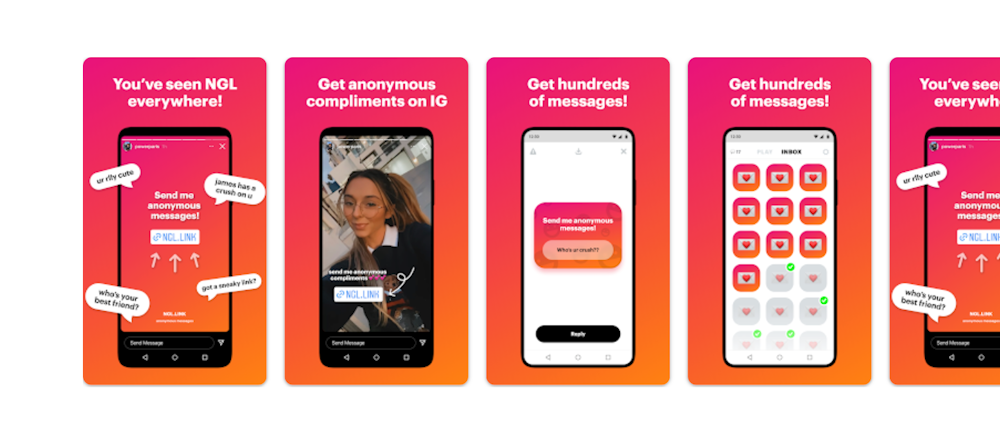
A series of screens advertising various features of the 'NGL' app.
The app NGL is targeted at ‘teens’ on the Google app store.
Screenshot/Google Play Store

Why are they so popular?

We know teens are drawn to social platforms. These networks connect them with their peers, support their journeys towards forming identity, and provide them space for experimentation, creativity and bonding.

We also know they manage online disclosures of their identity and personal life through a technique sociologists call “audience segregation”, or “code switching”. This means they’re likely to present themselves differently online to their parents than they are to their peers.

Digital cultures have long used online anonymity to separate real-world identities from online personas, both for privacy and in response to online surveillance. And research has shown online anonymity enhances self-disclosure and honesty.

For young people, having online spaces to express themselves away from the adult gaze is important. Anonymous question apps provide this space. They promise to offer the very things young people seek: opportunities for self-expression and authentic encounters.

Risky by design

We now have a generation of kids growing up with the internet. On one hand, young people are hailed as pioneers of the digital age – and on they other, we fear for them as its innocent victims.

A recent TechCrunch article chronicled the rapid uptake of anonymous question apps by young users, and raised concerns about transparency and safety.

NGL exploded in popularity this year, but hasn’t solved the issue of hate speech and bullying. Anonymous chat app YikYak was shut down in 2017 after becoming littered with hateful speech – but has since returned.

A screenshot of a Tweet from @Mistaaaman
Anonymous question apps are just one example of anonymous online spaces.
Screenshot/Twitter

These apps are designed to hook users in. They leverage certain platform principles to provide a highly engaging experience, such as interactivity and gamification (wherein a form of “play” is introduced into non-gaming platforms).

Also, given their experimental nature, they’re a good example of how social media platforms have historically been developed with a “move fast and break things” attitude. This approach, first articulated by Meta CEO Mark Zuckerberg, has arguably reached its use-by date.

Breaking things in real life is not without consequence. Similarly, breaking away from important safeguards online is not without social consequence. Rapidly developed social apps can have harmful consequences for young people, including cyberbullying, cyber dating abuse, image-based abuse and even online grooming.

In May 2021, Snapchat suspended integrated anonymous messaging apps Yolo and LMK, after being sued by the distraught parents of teens who committed suicide after being bullied through the apps.

Yolo’s developers overestimated the capacity of their automated content moderation to identify harmful messages.

In the wake of these suspensions, Sendit soared through the app store charts as Snapchat users sought a replacement.

Snapchat then banned anonymous messaging from third-party apps in March this year, in a bid to limit bullying and harassment. Yet it appears Sendit can still be linked to Snapchat as a third-party app, so the implementation conditions are variable.

Are kids being manipulated by chatbots?

It also seems these apps may feature automated chatbots parading as anonymous responders to prompt interactions – or at least that’s what staff at Tech Crunch found.

Although chatbots can be harmless (or even helpful), problems arise if users can’t tell whether they’re interacting with a bot or a person. At the very least it’s likely the apps are not effectively screening bots out of conversations.

Users can’t do much either. If responses are anonymous (and don’t even have a profile or post history linked to them), there’s no way to know if they’re communicating with a real person or not.

It’s difficult to confirm whether bots are widespread on anonymous question apps, but we’ve seen them cause huge problems on other platforms – opening avenues for deception and exploitation.

For example, in the case of Ashley Madison, a dating and hook-up platform that was hacked in 2015, bots were used to chat with human users to keep them engaged. These bots used fake profiles created by Ashley Madison employees.


Read more:
‘Anorexia coach’: sexual predators online are targeting teens wanting to lose weight. Platforms are looking the other way


What can we do?

Despite all of the above, some research has found many of the risks teens experience online pose only brief negative effects, if any. This suggests we may be overemphasising the risks young people face online.

At the same time, implementing parental controls to mitigate online risk is often in tension with young people’s digital rights.

So the way forward isn’t simple. And just banning anonymous question apps isn’t the solution.

Rather than avoid anonymous online spaces, we’ll need to trudge through them together – all the while demanding as much accountability and transparency from tech companies as we can.

For parents, there are some useful resources on how to help children and teens navigate tricky online environments in a sensible way.


Read more:
Ending online anonymity won’t make social media less toxic


The Conversation

Alexia Maddox does not work for, consult, own shares in or receive funding from any company or organisation that would benefit from this article, and has disclosed no relevant affiliations beyond their academic appointment.

ref. Sendit, Yolo, NGL: anonymous social apps are taking over once more, but they aren’t without risks – https://theconversation.com/sendit-yolo-ngl-anonymous-social-apps-are-taking-over-once-more-but-they-arent-without-risks-186647

How do we teach young people about climate change? We can start with this comic

Source: The Conversation (Au and NZ) – By Gemma Sou, Vice Chancellor’s Research Fellow, RMIT University

Gemma Sou, Author provided

We know young people are “angry, frustrated and scared” about climate change. And they want to do more to stop it.

However, the school system is not set up to help them address their concerns and learn the information they seek.

There are no explicit mentions of climate change in the Australian primary school curriculum and it is mainly taught through STEM (science, technology, engineering, mathematics) subjects in high school.


Read more:
How well does the new Australian Curriculum prepare young people for climate change?


More broadly, the main ways we talk about climate in the community and media are focused on science and economics. They tend to involve abstract ideas such as “the planet is warming” or “rainfall is more unpredictable”. While these are important components, they overlook the social, cultural and psychological ways people around the world are affected by climate change.

So, how can we better support schools and teachers to approach climate change in a way that will suit young people’s interests and concerns?

Our comic

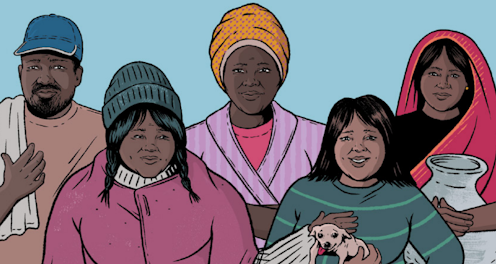
We are geography and environment researchers who have written a comic that looks at how people around the world experience climate change. This is aimed at high school students, but will also appeal to university students and the broader public.

Called Everyday Stories of Climate Change, it looks at the ways low-income families have had to adapt to climate change in five countries across three continents.

It begins with a student, waking up in Australia and heading to school. Here the teacher notes that climate change is impacting people around the world, “today we are going to explore some of these places”.

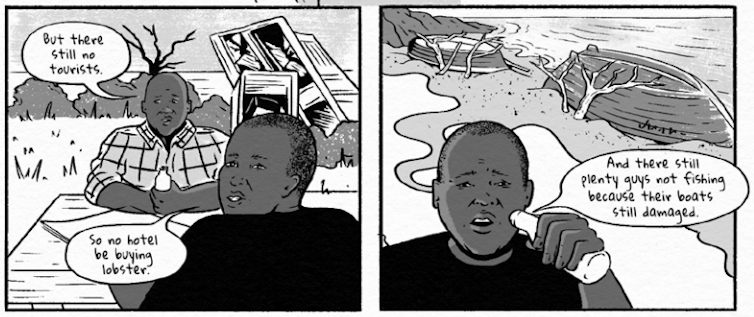
The comic introduces students to the global effects of climate change through the day-to-day stories of people around the world – starting with one very close to their own.
Gemma Sou/Author provided, Author provided

For example, in Bangladesh, sea-level rise has contributed to the salinity of the local river. So women must walk hours to get fresh water from another river. In Puerto Rico, after hurricane Maria, people struggle to get nutritious food and the streets are too dirty for the kids to play outside. In Barbuda, the government is trying to displace people from their lands, so that private businesses can build luxury hotels after hurricane Irma.


Gemma Sou, Author provided

The characters in the comics are fictionalised but their stories are based on research – via interviews and surveys – the comic authors did about people’s experiences of climate change in Bolivia, Puerto Rico, Barbuda, South Africa and Bangladesh.

The importance of stories

Researchers have long argued we need to put a human face on climate change and communicate in ways that resonate with people. This means, we need to do more than present a graph or rattle off statistics.

Comics are an effective way to put a human face on issues because they allow us to show first-person narratives and experiences. This can create both understanding of the issues and evoke empathy in readers.


Gemma Sou, Author provided

The comic is deliberately engaging and accessible. By showing real people going about their lives, it also challenges patronising ideas about people and places adversely impacted by climate change in the so-called “global south,” which often portrays them as “helpless” victims.

The comic also allows people to see the tangible, everyday ways people around the world live with, respond to and adapt to climate change.

For example, the family in Puerto Rico raise their own chickens and grow their own vegetables so they can eat the food they want during food shortages after hurricane Maria. In drought-stricken Cape Town, people save the bathwater for the garden and plant drought-tolerant aloes.

Real world problems (and solutions) help students to understand the impact climate change is having and how people affected are already adapting.
Gemma Sou, Author provided

It is important to show these solutions as research suggests it gives people a sense of agency and hope they can adapt to climate change.

Parents, teachers and students can download the comic for free here and here.


Everyday Stories of Climate Change is a collaboration between Gemma Sou (RMIT University), Adeeba Nuraina Risha (BRAC University), Gina Ziervogel (University of Cape Town), illustrator Cat Sims and the Geography Teachers’ Association of Victoria.

The Conversation

Gemma Sou receives funding from the Economic and Social Research Council and the Royal Geographical Society-IBG

Adeeba Nuraina Risha receives funding from BRAC Institute of Governance and Development (BIGD), BRAC University

Gina Ziervogel receives funding from AXA Research fund.

ref. How do we teach young people about climate change? We can start with this comic – https://theconversation.com/how-do-we-teach-young-people-about-climate-change-we-can-start-with-this-comic-186740

Labor promised a new committee of 15 young people to guide policy. So who gets picked, and how?

Source: The Conversation (Au and NZ) – By Lucas Walsh, Professor and Director of the Centre for Youth Policy and Education Practice, Monash University

Shutterstock

The federal government has announced Anne Aly is Australia’s new minister for youth. This will restore youth consultation to government decision-making after the abolition in 2013 of the Youth Advisory Council and the Office for Youth.

Labor has promised a new youth engagement model driven by a steering committee of up to 15 young people.

Getting this panel of 15 young people right will be crucial to its effectiveness. Here are three factors to consider.

1. Young Australians are diverse

Generation Z (10–24 years old) represents about 18% of Australia and about 30% of the Aboriginal and Torres Strait Islander population.

(Looking at an older cohort of young people, Australian Bureau of Statistics data show about 3.2 million young people aged between 15–24 years made up 12% of the Australian population in 2020).

Made with Flourish

ABS data show 74.5% of young people lived in major cities, 16.6% lived in inner regional areas and 8.9% live in outer regional, remote and very remote areas. So including voices from regional, rural and remote Australia on the government youth advisory committee will be important.

According to 2019 data, about a quarter of young people aged 15–24 were born overseas; 9.3% had a disability; just over half (51%) were male, 49% female; and 6.1% identified as gay, lesbian or having another sexual orientation.

Other Australian Bureau of Statistics data is notably limited. Questions in the recent census were not inclusive of a wider spectrum of gender and sexuality.

So, finding 15 people who can advise on behalf of such a diverse constituency is no easy feat.

2. The population is changing

The demographic makeup of Australia is shifting. From 1971 to 2020, the population of people aged 15–24 grew from 2.3 million to 3.2 million.

But sustained low fertility and increased life expectancy has also meant their proportion relative to the Australian population is declining.

In 2021 we released our Australian Youth Barometer, which drew on a survey of more than 500 Australians aged 18-24, and interviews with 30 more about health, education, employment, money, housing, food, safety and citizenship.

We found just under a quarter of young people are pessimistic about having children in the future.

Young people remain a significant proportion of the population and their choices will continue to shape the future demographic makeup of Australia. The 15-person youth advisory committee should seek to reflect the range of views among Australian young people on issues such as family and future.

3. Who puts their hand up?

Who typically volunteers to participate on such a steering committee? Attempts at youth representation sometimes skew towards those most likely to self-nominate, such as the highly educated, articulate and confident.

But often it’s those least likely to put their hand up whose voice we need to hear the most.

Voices from disadvantaged backgrounds can be particularly absent.

The government’s approach must reflect the diversity of young people, include voices less commonly heard and address the big-ticket items identified by young people.
Shutterstock

The stakes are high for young people

As Labor notes:

younger people now face a future of high underemployment, depleted retirement savings, significant barriers to education and training, and a rent and housing affordability crisis.

While youth underemployment has slightly fallen recently, it remains pervasive. Australia also has the fourth-highest incidence of part-time employment in the OECD.

65% of Australians believe owning a home is no longer an option for most young Australians.

Climate change looms large. An Australian Institute for Disaster Resilience survey of 1,447 Australians aged 10–24 found more than 80% of participants above the age of 16 were concerned about climate change.

Looking at data from the 2021 Australian Youth Barometer, 20-year-old Rebecca from our Youth Reference Group said many young people feel ignored and so turn to

protesting and using social media to share their voices and enact their agency. It is important that the diversity of young people’s voices are being listened to, encouraged, and supported.

Young people are also acutely aware – and critical – of the standards set by politicians.

One female survey respondent, aged 21, said:

In parliament there are people who are getting sexually assaulted and the government doesn’t say jack shit about it […] You don’t understand the dangers of being a woman.

Many young people don’t feel that politicians actually listened or respected them.

As one young Indigenous person told us in a different piece of research:

[politicians] have no respect for Aboriginal people […] There was a big debate about ‘was this country settled’ […] It wasn’t settled, it was invaded.

Going beyond the committee

It’s encouraging that the new government is seeking to engage with young people, which strikes a different note to their predecessors (remember when politicians told School Strike 4 Climate Action protesters to “stay in school”?)

The new government has vowed to engage with young people in a way that goes

beyond the committee, by incorporating local forums, workshops, and town halls for young Australians to directly engage in debate and offer their perspectives and ideas.

This is promising; too often, young people’s voices are sought in tokenistic or symbolic ways.

But the government’s approach must reflect the diversity of young people, include voices less commonly heard and address the big-ticket items identified by young people.

As one 20-year-old from Victoria told us:

Obviously, we’re going to be the future leaders, presidents, prime ministers and treasurers and all that, so we have to make sure that we have our priorities set now, going into the future, so that when we do take over, we know what plans and goals to achieve and what action to take.


Read more:
Growing up in a disadvantaged neighbourhood can change kids’ brains – and their reactions


The Conversation

Lucas Walsh is a Chief Investigator of The Q Project, a partnership between Monash University and the Paul Ramsay Foundation investigating and improving the use of research by educators. This story is part of The Conversation’s Breaking the Cycle series, which is about escaping cycles of disadvantage. It is supported by a philanthropic grant from the Paul Ramsay Foundation.

ref. Labor promised a new committee of 15 young people to guide policy. So who gets picked, and how? – https://theconversation.com/labor-promised-a-new-committee-of-15-young-people-to-guide-policy-so-who-gets-picked-and-how-186037

RATs for flu exist – should we be self-testing for that too?

Source: The Conversation (Au and NZ) – By Stavros Selemidis, Professor of Pharmacology, RMIT University

Shutterstock

Flu season has begun uncharacteristically early this year, and so far we’ve seen around 187,000 laboratory-confirmed cases, 1,323 hospitalisations, and 113 deaths.

The risk of infection from either COVID or influenza this winter will be very high. The risk of being infected with both at the same time will also be significant, and will likely put a huge strain on our already overburdened health system.

A large number of people who get the flu do not get tested, unless the symptoms are severe. Early detection of flu can improve treatment to prevent significant illness, particularly in the young, elderly and immunocompromised.

A simple RAT test, the same as the ones we’ve become accustomed to using for COVID, could potentially help in detecting the virus early, and stopping the spread of flu.

How do flu RATs work?

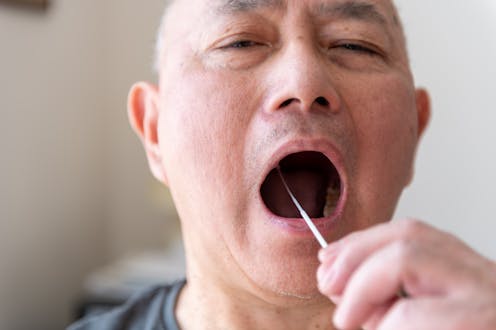
RATs are short for rapid antigen tests and they can quickly test whether a person has Influenza A or B – two of the most common strains of flu virus.

The test is designed to pick up the presence of specific antigens of the flu virus, which when detected produce a coloured band to indicate a positive test result, similar to the line you’ve seen on your COVID RATs.

At the moment, RAT tests for flu are not widely available, are expensive compared to the COVID tests, and most suffer problems with sensitivity and/or specificity (their ability to detect positive cases) that need further work and testing. However, this could change if there was more demand for flu RATs.

Woman in hospital bed with mask on
Antivirals reduce the risk of hospitalisation in flu patients.
Shutterstock

Could flu RATs make a different to rates of flu and illness from flu?

Influenza and COVID cause similar symptoms, however, the drugs we have to manage these diseases require a precise identification. This is critical, as it governs what type of antiviral drug is given.

Current flu RATs are most sensitive up to four days after symptom onset. A positive detection during this period can facilitate a quicker treatment strategy with antivirals, as these drugs have a narrow window of therapeutic opportunity.

If a patient tests positive for flu, they can then receive Tamiflu, the antiviral recommended for flu cases, which reduces the risk of hospitalisation.

However this must be taken within two days of infection (when symptoms emerge) for it to be effective. Everyone can get Tamiflu but they require a prescription, which makes it difficult to get the drug within the two-day window needed to be effective.

Tamiflu would not work against COVID, which requires a different antiviral for elderly and otherwise unwell patients, such as Paxlovid.

A flu RAT would benefit people at risk of severe illness such as babies, young children, the elderly and the immunocompromised. This would increase the chance of early detection to enable treatment, and it could also give us more accurate figures of the number of people with flu each season.

Flu RATs could also help in the management of outbreaks in high-risk communities such as aged care, nursing homes, schools and day care. A quick detection of flu could assist in measures to reduce the chances of transmission by antiviral treatment and isolation, as we’ve seen with COVID.


Read more:
New ad urges us to ‘take on winter’ by getting COVID and flu vaccines. But it misses some key things


Are flu RATs available in Australia?

There are currently no flu RATs approved by the Therapeutic Goods Administration (TGA) in Australia, for public use at home. The TGA has approved eight tests that are used only in a clinical setting, and these are designed to detect both flu and COVID.

We need to lobby the government to action TGA approval of home flu RATs, as public demand will help drive this process. The TGA will require time and money to test and develop the RATs to a high standard.

Therefore we can’t expect Australian-based RATs for this flu season, but given we are now all so comfortable with at-home antigen testing, testing for flu is the logical next step.


Read more:
Flu may be back, but COVID is far from over. How do they compare?


The Conversation

Stavros Selemidis receives funding from National Health and Medical Research Council of Australia.

Doug Brooks receives funding from National Health and Medical Research Council.

John O’Leary receives funding from National Health and Medical Research Council.

ref. RATs for flu exist – should we be self-testing for that too? – https://theconversation.com/rats-for-flu-exist-should-we-be-self-testing-for-that-too-185602

We lost the plot on COVID messaging – now governments will have to be bold to get us back on track

Source: The Conversation (Au and NZ) – By Stephen Duckett, Honorary Enterprise Professor, School of Population and Global Health, and Department of General Practice, The University of Melbourne

Overall, Australian governments managed the first two years of the COVID pandemic well. Border closures and state actions such as lockdowns averted 18,000 deaths in 2020 and 2021.

This came at a cost in terms of separation of families and friends because of border closures, disruption to schooling and economic activity, and individual stress.

The public supported these measures and thought state governments had managed the pandemic well. Support for the Commonwealth government was also high until mid-2021, when the bungled vaccine rollout caused support to plummet.

Now, we are in the grip of a fresh COVID wave. Hospital systems and ambulance services are under severe strain, not just because of an increase in patients, but because the virus has decimated their own workforces. Governments now appear to be much more reluctant to introduce measures to curb its spread, a big difference from the start of the pandemic in 2020.

So, how did it come to this?

Contest of values and rhetoric

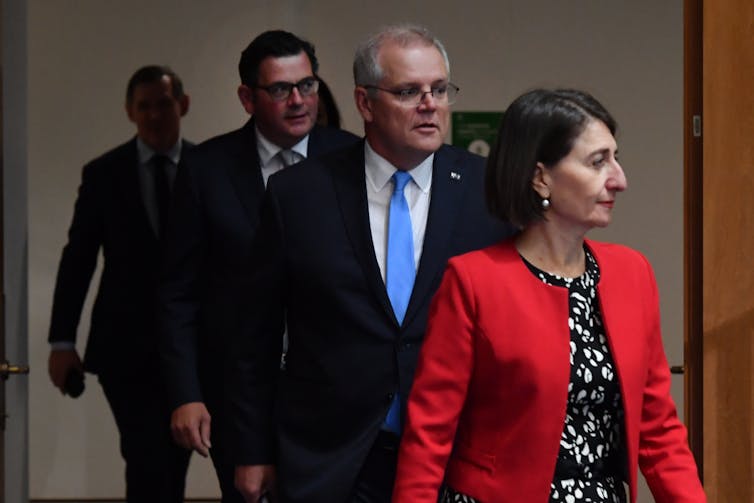
Despite the much-vaunted national cabinet, for most of 2020 and 2021 there was no coherent national leadership of COVID-19 response. Then-Prime Minister Scott Morrison and other federal ministers downplayed COVID risks and undermined state public health measures. They attacked lockdowns, state border closures and school shutdowns, while dog-whistling to anti-vaxxers.

This weakened the states’ social licence to pursue effective public health measures.

The differences between the Commonwealth and state governments were in part due to different weighing of the risks of COVID. In 2020 and for the first half of 2021, there was either no vaccine or not enough vaccines, and the prevalent virus strain was quite virulent. As a result, other public health measures were key to controlling the pandemic and minimising hospitalisations and deaths.

In the earlier stages of the pandemic, the federal and state governments took very different approaches.
Mick Tsikas/AAP

But from the middle of 2021, the rhetoric and messaging changed. Led by the Commonwealth government, there was increasing talk of “living with COVID”, reducing restrictions and reopening borders, with the underlying assumption being that, with vaccines, the pandemic was under control. Even the advent of the Omicron wave in late 2021 didn’t lead to a reset, as it was dismissed as “mild”.

There have also been ideological differences throughout the pandemic. Morrison preferred “personal responsibility” to mandates, the latter of which was viewed pejoratively. Individual responsibility is a comfortable position for conservative politicians who tend to minimise the role for government.

In contrast, the very essence of public health is that it is an organised response by society, to quote a standard definition of the field.


Read more:
How has COVID affected Australians’ health? New report shows where we’ve failed and done well


The federal electoral context

By early 2022, the effect of undermining the social licence was increasingly prevalent. The public, especially those that who had borne the brunt of the more extensive public health measures, were tired of lockdowns. The evidence about vaccine waning had not yet become apparent, so reliance on vaccines was seen as the appropriate principal public health response. “Living with COVID” was becoming the dominant narrative.

Around the same time, anti-vaxxers had begun to get organised and protested against any public health measures. States sniffed the wind and began to roll back their restrictions.

A Melbourne joke from 2021 went like this:

Question: what is the hardest part of a one-week snap lockdown?
Answer: Week five.

The federal Coalition attempted to paint Labor as the party that would reintroduce lockdowns and border closures. The Labor opposition did not want to talk about the pandemic to avoid that bullet.

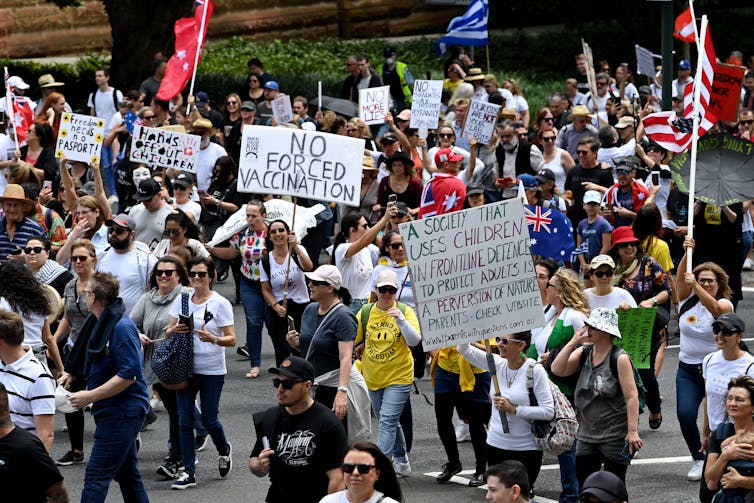
By 2021, anti-vaccination rallies were making loud protests about public health measures.
Bianca de Marchi/AAP

Post-election politics

This long history is necessary context for the confusion we see today. Despite its defeat at the election, the Morrison government’s pandemic legacy is hindering Australia’s ability to manage the pandemic because of the weakening of the social licence to regulate.

Labelling the more transmissible Omicron variant as mild hasn’t helped, as low average severity coupled with high incidence still leads to overburdened hospitals. The Morrison rhetoric of personal responsibility has proved hard to shift as well. It is certainly seductive – “it is your job to protect yourself and if you don’t, tough luck, you will wear the consequences”.

Of course, that position assumes we are all perfectly rational decision-makers and we bear the full cost of our decisions. Neither is true. We tend to discount future consequences of our decisions, and we are unrealistically optimistic about the chances of getting COVID and its consequences.

Just one person’s infection can have a big impact on others – for example, if they are hospitalised, that impedes access to hospital beds for others – so the cost of poor choices by one person potentially falls on others too.

The public health messaging is also confusing. If I have had only two doses, am I “fully vaccinated”? Does “individual responsibility” involve my lugging a very heavy HEPA filter to ensure clean air in any room I go into? Is the Omicron variant genuinely mild? If so, why do we see all those stories about hospital problems?

And what is the right thing to do about masks? Are cloth masks any good? Or should we all have N95s? And should they then be subsidised? And if masks are “strongly recommended”, why are they not mandated?

It all comes back to the COVID social licence. What proportion of the public will accept a mask mandate? If the public is not convinced of the threat or benefit to themselves and others, compliance will be low. This means public health leaders need to talk up collective responsibility and collective benefit, the antithesis of the individual responsibility mantra. This has been missing from the national response.

Talking up individual responsibility means leaders don’t have to lead or shape collective behaviour. Media hype about regulatory fatigue, a fraught catch-all concept where the evidence is still developing, hasn’t helped either.

Both New South Wales and Victoria face elections in the next 12 months. Neither government wants to be attacked as the government of lockdowns and mandates when the risks of not acting have been downplayed for so long.


Read more:
How the pandemic has brought out the worst — and the best — in Australians and their governments


So where to from here?

Public health messaging over the past six months has been woeful. Political leaders are sometimes seen in masks, but mostly not. There has been little messaging about third and fourth doses, and so we have poor third-dose rates, despite what we now know about vaccine waning. The “Omicron is mild” message has led to a “no worries mate” insouciance among the public.

But political and public health leaders must now exercise leadership. Public health requires collective action, not simply a reliance on the easy cop-out of individual responsibility. This will require a carefully planned transition from the discredited positions that have made a public response so much harder now than it was a year ago, and consistent positions across party lines that put the public’s health ahead of cheap political shots.

Leaders need to adopt a more nuanced approach to responding to COVID, jettisoning the simplistic all-or-none dichotomy.

Finally, the mainstream media also need to resile from their knee-jerk rejection of any public health action as akin to lockdowns and economic catastrophe.

The Conversation

The authors do not work for, consult, own shares in or receive funding from any company or organisation that would benefit from this article, and have disclosed no relevant affiliations beyond their academic appointment.

ref. We lost the plot on COVID messaging – now governments will have to be bold to get us back on track – https://theconversation.com/we-lost-the-plot-on-covid-messaging-now-governments-will-have-to-be-bold-to-get-us-back-on-track-186732

Albanese just laid out a radical new vision for Australia in the region: clean energy exporter and green manufacturer

Source: The Conversation (Au and NZ) – By John Mathews, Professor Emeritus, Macquarie Business School, Macquarie University

Shutterstock

Gone are the days when the federal government would cheer on Australia’s fossil fuel exports to the exclusion of all else, while seemingly doing everything in its power to hold back the switch to renewables.

Now we have a new government, the clean energy transition is accelerating. Labor is framing the transition not just as decarbonisation but as a green economic boom through manufacture of electrolysers, green steel, green cement and green fertiliser. If successful, this will amount to a green industrial revolution.

This radical new vision was laid out in Prime Minister Anthony Albanese’s speech this week to the Sydney Energy Forum. He proposed a new era for Australian energy industries and exports as well as using our wealth of renewables to drive deeper involvement in our region.

It makes good commercial and climate sense for the federal government to target the Indo-Pacific for this green industrial revolution, since the region is already the world’s leader in clean energy investments.

As of 2021, our region accounts for over 80% of the world’s private investment in clean energy. India, China, Japan, Korea, Indonesia and Pacific nations are natural partners for Australia in this new green push as well as leaders creating the market for clean energy and green products.

What does this actually look like?

For a sign of what’s to come, look to the massive Sun Cable project, launched four years ago with early funding by Australian billionaires Mike Cannon-Brookes of Atlassian and Andrew Forrest of Fortescue Minerals Group.

The project’s ambitious goal is to become the first intercontinental exporter of renewables, by generating massive amounts of energy from solar farms in the Northern Territory and transmitting it to energy-hungry Singapore through a 4,200 km-long high voltage undersea cable. Government backing will help it progress faster.

The project has gained strong support from both territory and federal governments, and is now attracting support from the Indonesian and Singaporean governments. Indonesia’s government has given in principle approval for the cable’s undersea route through its national waters and has approved the undersea survey permit. There will be spillover benefits, such as $A1.5 billion earmarked for a marine repair base in Indonesia.

Sun Cable and other renewable megaprojects, such as Western Australia’s proposed Asian Renewable Energy Hub, show the move away from reliance on fossil fuel exports is actually happening. The Albanese government has signalled its intention to promote clean energy exports as well as green industrial development across the Indo-Pacific.

Our research project on the clean energy shift in north-east Asia has captured the progress made by major regional economies China and Korea in powering ahead with their own green transitions since the 2000s. These ongoing transitions offer major opportunities, such as exporting Australian-made green hydrogen to fuel cars in these countries.

Our clean and green transition is bigger than just renewables

Since Labor took office, we’ve heard a lot about our future as a renewables superpower. Often overlooked is the fact this would mean not just generating renewable electricity and green hydrogen at vast scale but also investing in new industries and processes to grasp as many opportunities as we can.

This would mean investing in upstream industries such as solar array fabrication and electrolyser manufacture, as well as downstream industries such as green steel, green cement and green fertiliser. These new green products would be produced using locally generated supplies of green hydrogen and cheap clean renewable power, as economist Ross Garnaut has outlined.

Green energy is no longer a niche concern. Australia’s largest companies are leading the way.

Andrew Forrest’s new spin-off company, Fortescue Future Industries, has begun constructing a $1 billion project building green hydrogen manufacturing components, cabling and renewable generation in central Queensland. This single project is expected to double the global production capacity of green hydrogen. It will make Queensland home to a new green hydrogen fuel and components export industry.


Read more:
Will Australia’s new climate policy be enough to reset relations with Pacific nations?


If our new government can pull this off and turn vision to reality, we could embrace a new green growth economy and begin our own green industrial revolution.

Better yet, Australia could finally make full use of its abundant land and renewable resources to fast-track the clean economic development of our Indo-Pacific neighbours.

power lines
Generating and transmitting green power could be a major boon to Australia.
Shutterstock

Green energy comes with security and geopolitical benefits

For decades, Pacific nations have seen climate change as the single greatest threat to their people. As a result, Australian investment in exportable renewables will become a key diplomatic tool as geopolitical competition between China and the US intensifies in our region.

China isn’t standing still either. Until recently, China focused its regional aid and investment on traditional infrastructure projects such as airports, roads and stadiums. Now Beijing is ramping up its climate responses to the region, with climate change issues at the top of the agenda at the China-Pacific Islands forum held in 2019.

In light of China’s growing green activism in the Pacific, the Australian government has a lot of ground to make up.

It should start with a major rethink of Australia’s traditional approach to financing energy projects, which has seen us support fossil fuel power in the region.

We can no longer keep propping up fossil fuels, with the costs of this support not only environmental, but geostrategic as well. Partnering with China on Pacific projects, as Pacific minister Pat Conroy has flagged, could also help.

Albanese’s speech this week was promising. He laid out a very different role for Australia in our region – one where our regional engagement policy is in line with a new domestic policy on climate goals, and where renewable energy provides a means of deepening regional cooperation on tangible investment projects. Now comes the hard part: delivery.


Read more:
South Korea’s Green New Deal shows the world what a smart economic recovery looks like


The Conversation

John Mathews receives funding from the Australia Research Council (ARC) Discovery Project 2019-2022.

Elizabeth Thurbon currently receives funding from the Australia Research Council (ARC), the Academy of Korean Studies (AKS), and the Commonwealth Department of Defence. She has previously received funding from The Korea Foundation and the Academy of the Social Sciences in Australia (ASSA). She is currently a Fellow of The Asia Society (sponsored by the Commonwealth Department of Foreign Affairs and Trade) and a member of the Research Committee of the Jubilee Australia Research Centre.

Hao Tan receives funding from the Australia Research Council (ARC) Discovery Project 2019-2022. He previously received funding from the Academy of the Social Sciences in Australia, and funding from the Confucius Institute Headquarters under the “Understanding China Fellowship” in 2017.

Sung-Young Kim receives funding from the Australia Research Council (ARC) and has previously received funding from the Academy of Korean Studies (AKS). He is on the Executive Committee of the Australian Political Studies Association (APSA) and also on the Executive Committee of the Korean Studies Association of Australasia (KSAA).

ref. Albanese just laid out a radical new vision for Australia in the region: clean energy exporter and green manufacturer – https://theconversation.com/albanese-just-laid-out-a-radical-new-vision-for-australia-in-the-region-clean-energy-exporter-and-green-manufacturer-186815

China’s big tech problem: even in a state-managed economy, digital companies grow too powerful

Source: The Conversation (Au and NZ) – By Joanne Gray, Lecturer in Digital Cultures at The University of Sydney, University of Sydney

China’s digital economy has advanced rapidly over the past two decades, with services, communications and commerce moving online.

The Chinese government has generally encouraged its citizens to accept digital technologies in all aspects of daily life. Today China has around a billion internet users.

China has made clear it aims to be a global leader in digital infrastructure and technologies. Leadership in digital tech has been deemed critical to China’s future economic growth, domestically and internationally.

Like Western countries, China has seen the rise of a handful of dominant digital platform or “big tech” internet companies. We studied China’s recent efforts to regulate these companies, which may hold lessons for Western nations trying to manage their own big tech problems.

China’s ‘big four’ tech companies

China’s biggest tech firms are Baidu, Alibaba, Tencent and Xiaomi (often collectively called BATX for short). Broadly speaking, Baidu is built around search and related services, Alibaba specialises in e-commerce and online retail, Tencent focuses on messaging, gaming and social media, and Xiaomi makes phones and other devices.

Like their Silicon Valley counterparts Google, Amazon, Facebook and Apple (or GAFA), the BATX companies dominate their competitors. This is largely thanks to the enormous network effects and economies of scale in data-driven, online business.

The BATX businesses (again, like GAFA) are also known for gobbling up potential competitors. In 2020, Tencent reportedly made 168 investments and/or mergers and acquisitions in domestic and international companies. Alibaba made 44, Baidu 43 and Xiaomi 70.

The tech crackdown

In the past 18 months or so, the BATX companies have come under increased scrutiny from the Chinese government.

In November 2020, an IPO planned for Ant Group, an affiliate of Alibaba, was effectively cancelled. Ant Group was forced to restructure after Chinese regulators “interviewed” the company’s founder.

The following month, Alibaba’s Ali Investment and Tencent’s Literature Group were fined RMB 500,000 (about A$110,000) each for issues relating to anti-competitive acquisitions and contractual arrangements.

At the same time, China’s General Administration of Market Supervision opened a case against Alibaba for abuse of its dominant market position in the online retail platform services market.

In March 2021 more fines were issued including to Tencent and Baidu. They were fined RMB 500,000 each for anti-competitive acquisitions and contractual arrangements.


Read more:
Facial recognition for gamers, app store bans for Didi: what’s behind China’s recent crackdown on big tech?


Then in April 2021, Chinese authorities met with 34 platform companies, including Alibaba and Tencent, to provide “administrative guidance sessions” for internet platforms. That month Alibaba was also fined a spectacular RMB 18.228 billion (around A$4 billion) and Tencent another RMB 500,000 for anti-competitive practices.

In July 2021, Chinese authorities prohibited a merger between two companies that would have further consolidated Tencent’s position in the gaming market.

The government’s efforts are ongoing. Earlier this week, regulators imposed new fines on Alibaba, Tencent and others for violating anti-monopoly rules about disclosing certain transactions.

What’s motivating Chinese authorities to intervene?

The evolution of China’s digital giants shows how data-driven markets work on a “winner takes all” basis in both state-managed and capitalist economies.

The BATX companies now wield significant social and economic power in China. This conflicts with China’s ideological commitment to state-managed social order.

In January 2022, President Xi Jinping called for stronger regulation and administration of China’s digital economy. The goal, he said, was to guard against “unhealthy” development and prevent “platform monopoly and disorderly expansion of capital”.

State-orchestrated social order is not possible where there is an excessive accumulation of private power.

China’s digital policy agenda is designed to achieve strong economic growth. However, the Chinese Communist Party also seeks to maintain strong state control over the structure and function of digital markets and their participants to ensure they operate according to Chinese values and Chinese Communist Party objectives.

What can we learn from China’s approach to ‘big tech’?

How can we regulate digital platforms, particularly to improve competition and public oversight? This remains a largely unsolved public policy challenge.

Australia and the EU, like China, have demonstrated significant willingness to take up this challenge.

In Europe, for example, where the US platforms dominate, policymakers are actively seeking to achieve independence from foreign technology companies. They are doing this by improving their own domestic technology capacities and imposing rules for privacy, data collection and management, and content moderation that align with European values and norms.


Read more:
China’s tech and finance crackdown is a challenge to western ideas that cuts across developing world


While the EU and China are aiming at very different goals, both are willing to take a significant role in regulating digital platforms in accordance with their stated economic, political and social values.

This stands in stark contrast to the situation in the US, which has so far had little appetite for meaningfully restricting the behaviour of tech companies.

In theory, China’s centralised political power gives it space to try different approaches to platform regulation. But it remains to be seen whether Chinese authorities can successfully overcome the tendency for monopolies to form in digital markets.

If China succeeds, there may be valuable lessons for the rest of the world. For now we must wait and watch.


Read more:
TikTok and geopolitics: how ‘digital nationalism’ threatens to entrench big tech


The Conversation

Joanne Gray has previously received research funding from Meta Platforms Inc. formerly known as Facebook Inc.

Yi Wang does not work for, consult, own shares in or receive funding from any company or organisation that would benefit from this article, and has disclosed no relevant affiliations beyond their academic appointment.

ref. China’s big tech problem: even in a state-managed economy, digital companies grow too powerful – https://theconversation.com/chinas-big-tech-problem-even-in-a-state-managed-economy-digital-companies-grow-too-powerful-186722

A trade deal with the EU makes sense for NZ, but what’s in it for Europe? Symbolically, a lot

Source: The Conversation (Au and NZ) – By Serena Kelly, Senior Lecturer, National Centre for Research on Europe, University of Canterbury

NZ PM Jacinda Ardern and EU Commission President Ursula von der Leyen after their meeting on June 30. Getty Images

It’s easy to understand New Zealand’s motivation for securing a free trade agreement (FTA) with the European Union (EU). What’s less apparent is why the EU chose to pursue the agreement with a small and distant country, currently ranked its 50th most important trading partner.

By contrast, the EU is New Zealand’s fourth largest trading partner (after China, Australia and the US). And although the deal has been criticised by some in the dairy and meat industries, it is still expected to be worth an extra NZ$1.8 billion per annum to the New Zealand economy by 2035.

But the trade deal, announced in late June during Prime Minister Jacinda Ardern’s European visit (during which she also attended a NATO summit), has been hard won.

It went through 12 negotiation rounds in the face of various challenges and distractions for the EU: Brexit, EU opposition to New Zealand agricultural exports, the global pandemic and the war in Ukraine. All of which suggests more than just economic motivations were at play for the 27 EU member states.

Digging deeper, then, we can see several significant strategic considerations for the European Union that demonstrate some of its current thinking, not only about the direction of its global trade policy but also its international ambitions.

The EU back on track

Negotiations between the EU and New Zealand were formally launched in 2018 (alongside a yet-to-be concluded EU–Australia FTA). At the time, New Zealand was one of only a handful of countries that had neither concluded nor was negotiating a preferential trading relationship with the EU.

The EU fast-tracked New Zealand and Australian negotiations as a counter to the perceived trade protectionism represented by Brexit and the Trump presidency in the US.


Read more:
Some see NZ’s invite to the NATO summit as a reward for a shift in foreign policy, but that’s far from accurate


With a population of five million and a GDP of just US$250 billion, New Zealand doesn’t represent much financially for the EU. Symbolically, however, it has wider significance.

The agreement has been called a “welcome and much-needed resumption of an ambitious EU trade agenda”. This had been hampered by member state resistance to ratifying the FTA with the South American regional trade bloc Mercosur, increased protectionism due to the pandemic, and EU trade sanctions against Russia.

Climate change and security

The EU has also hailed the agreement as containing the “most ambitious sustainability commitments in a trade agreement ever”. The inclusion of mutually sanctionable commitments to the Paris Agreement, is part of strengthening the EU’s claim to be a world leader in climate change policy.

The EU already has some of the strongest climate policies in the world, with around 87% of its citizens agreeing “the EU should set ambitious targets to increase renewable energy and support energy efficiency”.


Read more:
Behind the ‘inclusive’ window dressing, the NZ-UK free trade deal disappoints politically and economically


Although the EU was a leading voice in the Paris Agreement, it is trickier to persuade non-member countries to follow its own high environmental standards. This FTA will set a new standard, not only for the EU but also the world.

A voice in the Indo-Pacific

Perhaps most importantly, though, closer cooperation with New Zealand can strengthen the EU’s place in the increasingly fraught Indo-Pacific, a region where it has already named New Zealand as one of its partners.

EU and New Zealand officials often play up their shared values of democracy, human rights and the rule of law. And the EU is an important stabiliser in the rules-based international system that remains so important for small states like New Zealand.

EU cooperation with like-minded countries in the Pacific is a key factor in its pursuit of recognition and legitimacy in a region that is increasing in geo-strategic importance.


Read more:
German election: the race to replace Angela Merkel and why it matters to New Zealand


The EU launched its Indo-Pacific strategy in 2021, following the example of Australia (2016) and the US (2017), and New Zealand’s own Pacific Reset (2018).

And while New Zealand is a small country, it enjoys a broadly positive international image through its independent foreign policy, and is an important regional player. It is a member of the Pacific Islands Forum, and was the first country in the world to sign an FTA with China.

Benefits beyond trade

The establishment of the AUKUS pact in 2021 further elevated the significance of New Zealand’s importance as an Indo-Pacific partner to the EU, involving as it did the withdrawal of Australia from a contract to buy French submarines.

That deal had been viewed by France as the cornerstone of its own approach to the region. Its collapse has somewhat soured Australia’s relationship with one of the EU’s key players.

For all these reasons, then, the EU-NZ FTA can be viewed as a positive development that cements an economic relationship as well as emphasising common values, goals and benefits beyond purely monetary gains.

While potentially economically advantageous to New Zealand – and not without its critics – it can be understood as a signal of the EU’s intention to extend its global influence beyond trade, staking a claim as a political and security actor of real significance.

The Conversation

Serena Kelly receives funding from the Erasmus+ Programme of the European Union. She is affiliated with the New Zealand Institute of International Affairs and the European Studies Association of Australia and New Zealand.

Mathew Doidge receives funding from the Erasmus+ programme of the European Union. He is affiliated with the European Studies Association of Australia and New Zealand (ESAANZ).

ref. A trade deal with the EU makes sense for NZ, but what’s in it for Europe? Symbolically, a lot – https://theconversation.com/a-trade-deal-with-the-eu-makes-sense-for-nz-but-whats-in-it-for-europe-symbolically-a-lot-186637

Paws for thought: the pros and cons of a pet-friendly office

Source: The Conversation (Au and NZ) – By Janette Young, Lecturer in Health Promotion, University of South Australia

Shutterstock

For you and your pooch a pet-friendly workplace may seem a no-brainer.

More of us are facing pet separation anxiety than ever before. Dog ownership surged with pandemic lockdowns and working from home. Now, with the boundaries between work and home already so blurred, shouldn’t every inclusive, caring employer embrace an open-doggy-door policy?

What’s the harm? After all, isn’t there a growing body of research showing the benefits of pets in the workplaces?

Maybe. Yes, pets certainly can bring benefits to the workplace. These include reducing stress
and improving social interaction and job satisfaction.


Read more:
Pet therapy: how dogs, cats and horses help improve human wellbeing


But the same studies showing benefits, and that most people support pet-friendly workplace, also highlight the risks, hazards and concerns that must be considered for a pet-friendly workplace to be inclusive, equitable and sustainable.

Smiling young usinesswoman playing with golden retriever dog in office
It is important to be able to care for your dogs while working without much disturbance.
Shutterstock

Dogs aren’t for everyone

Not everyone loves dogs. Some people just don’t like them, and a small percentage fear them – a condition called cynophobia.

A commonly reported number of how many this affects is 5% of the population, but this is likely US-specific, with rates differing by country and culture. Global studies suggest about 3.8% have a lifetime animal phobia (2% of men, 5.4% of women), including dogs and cats.

About 10–20% of the global population are allergic to dogs or cats. This rate is increasing.

But 100% of workers have a right to feel safe and not have their health compromised at work.

This doesn’t automatically rule out a pet-friendly policy, but it does require exploring and addressing all these issues adequately.


Read more:
Understanding dog personalities can help prevent attacks


Equity matters

Does everyone get to bring their pet to work?

If the boss can because they have a separate office but those sharing a open-plan space can’t, it’s likely to cause resentment.

The time spent petting, feeding or taking a dog for toilet breaks may also stoke negative feelings among some colleagues.

A dog near Google headquarters
Google has allowed its employees to bring their dogs to work since 2018.
Shutterstock

What about those with other types of pets? Some cats also suffer separation anxiety. Parrots (budgerigars, cockatiels, conures and others) also form strong attachments to humans and can become highly stressed when left alone.

Getting to work is also an equity issue. In many countries a pet-friendly workplace will require driving to work, because only registered assistance animals are allowed on public transport and in public spaces. It’s unfair if the only workers able to take advantage of a pet-friendly workplaces are those who can drive.

Bernese Mountain Dog laying on the floor of the train
In most cities only registered assistance animals are allowed on public transport.
Shutterstock


Read more:
How the presence of pets builds trust among people


What’s in it for the dog?

Even though most dog owners want to take their dog to work, it’s very important to ask if that really is in your pet’s best interest.

Yes, dogs are a highly social species; and yes, your dog likes to be around you. But, like humans, not every dog is a people person. For some dogs home is their safe space. Even with their “human” they may be stressed away from it.

Dogs, being sensitive to human emotions, may well feel stressed by your workplace if it also stresses you.

Other animal issues to consider include the presence of other dogs.

Organisational factors

A workplace therefore needs to consider multiple factors to make a pet-friendly policy work.

It needs to ensure the feelings of all workers have been considered, and whether the policy favours some at the expense of others.

In needs to ensure the work space is suitable for both human and animal well-being and hygiene. Though dogs’ space needs vary enormously, even the smallest dog needs space out of walkways and kick zones – being under a desk is not really suitable – as well as ready access to water bowls and outdoor toileting areas.

French Bulldog puppy lying on bed under desk in office whilst owner works
Having dogs under desks is not ideal.
Shutterstock

It needs policies codifying expected standards of behaviour – both human and animal. This may include requiring proof of proper socialisation, such as a certificate of basic obedience.

It needs procedures mapping out all contingencies. Owners should be responsible for cleaning up after their dogs and ensuring they do not cause disruption. But whose insurance will cover potential animal or human injuries, or damage to property? Do workers’ compensation policies cover animal-related incidents?

How to make pet-friendly work

It may seem we’re focusing on barriers to workplaces being dog-friendly. But assessing and addressing all the risks makes the likelihood of success much greater.

A useful document to help work through all the issues is the Pets at Work Tookit (funded by pet food maker Mars Petcare) which covers things from making a case to senior management to how to create a workplace pet policy.

Another useful document is the Safe Animal Friendly Environments multi-species companion-animal risk management tool developed in 2021 by University of South Australia researchers for the UK’s Society for Companion Animal Studies.

Though designed specifically to promote people entering aged care to keep their pets, this document includes a comprehensive list of risks, responsibilities and mitigation actions.

Small dog under desk in office.
A pet-friendly workplace requires a pet-friendly policy.

So if taking your dog to work appeals to you, chat to your colleagues, identify the issues and put a policy in place.

It may prove to be a great thing for your colleagues, you and most of all your dog.

The Conversation

Janette Young has received funding from the not-for-profit Society for Companion Animals (UK) to develop a multi-species risk management tool for including companion animals in communal care settings. She is a Director of Animal Therapies Ltd.

Saravana Kumar does not work for, consult, own shares in or receive funding from any company or organisation that would benefit from this article, and has disclosed no relevant affiliations beyond their academic appointment.

ref. Paws for thought: the pros and cons of a pet-friendly office – https://theconversation.com/paws-for-thought-the-pros-and-cons-of-a-pet-friendly-office-185761

How the James Webb deep field images reminded me the divide between science and art is artificial

Source: The Conversation (Au and NZ) – By Cherine Fahd, Associate Professor of Visual Communication in the School of Design, University of Technology Sydney

NASA/STScI, CC BY-SA

The first task I give photography students is to create a starscape.

To do this, I ask them to sweep the floor beneath them, collect the dust and dirt in a paper bag and then sprinkle it onto a sheet of 8×10 inch photo paper. Then, using the photographic enlarger, expose the detritus-covered paper to light. After removing the dust and dirt, the paper is submerged in a bath of chemical developer.

In less than two minutes, an image slowly emerges of a universe teeming with galaxies.

I love it when the darkroom fills with the sound of their astonishment the moment they realise the dust beneath their feet is transformed into a scene of scientific wonder.

I was reminded of this analogue exercise when NASA’s James Webb Space Telescope shared the first deep field images. The public expression of wonder is not unlike that of my students in the darkroom.

But unlike our makeshift starscapes, the Deep Field images capture an actual galaxy cluster, “the deepest, the sharpest infrared view of the universe to date.”

This imaging precision will help scientists to solve the mysteries in our solar system and our place in it.

But they will also inspire continued experiments by artists who address the subject of space, the universe and our fragile place in it.


Read more:
Two experts break down the James Webb Space Telescopes’s first images, and explain what we’ve already learnt


Creating art of space

Images of the cosmos afford considerable visual pleasure. I listen to scientists passionately describing the information stored in their saturated colours and amorphous shapes, what the luminosity and shadows are, and what lurks in the deep blacks that are spotted and speckled.

The mysteries of the universe are the stuff of science and of the imagination.

Throughout history, artists have imagined and created proxy universes: constructions that are lyrical and speculative, alternate worlds that are stand-ins for what we imagine, hope and fear is “out there”.

A group of five galaxies that appear close to each other in the sky
The James Webb Space Telescope’s image of Stephan’s Quintet.
NASA/STScI, CC BY-SA

There are the photo-real drawings and paintings of Vija Celmins. The night sky painstakingly drawn or painted by hand with extraordinary detail and precision.

There is David Stephenson’s time lapse photographs that read as lyrical celestial drawings reminding us that we are on a moving planet. Yosuke Takeda’s ambiguous star bursts of colour and light. Thomas Ruff’s sensuous star photos made through the close cropping of the details of existing science images he bought after failing to be able to capture the cosmos with his own camera.

There’s also the incredible work of the Blue Mountains based duo Haines & Hinterding where polka dots become stars, black pigment is the night sky, bleeding coloured ink is a gas formation. They make rocks hum and harness the sun’s rays so we can hear and smell its energy.

These artworks highlight the creative drive to draw on science for the purposes of art. The divide between science and art is an artificial one.


Read more:
How making a film exploring Indigenous stories of the night sky enriched my perspective as a scientist


Pictures of our imaginations

The Webb telescope shows science’s capacity to bring us images that are aesthetically imaginative, expressive and technically accomplished but – strangely – they don’t make me feel anything.

Science tells me these shapes are galaxies and stars billions of years away, but it isn’t sinking in. Instead, I see a fabulously constructed landscape like James Nasmyth’s famous moon images from 1874.

In my imagination, I picture the Webb images as made of fairy lights, coloured gels, mirrors, black cloth, filters and photoshop.

A planetary nebula, seen by the Webb telescope.
NASA/STScI, CC BY-SA

Art’s stand-ins invade my psyche. When I look at the deep field and planetary nebula, I remember that even these “objective” machine made images are constructed. The rays of light, holes and gases are artistic experiments in photographic abstraction, examining what lies beyond vision.

Imaging technology always transforms what is “out there”, and how we see it is determined by what is “in here”: our own subjectivity; what we bring of ourselves and our lives to the reading of the image.

The telescope is a photographer crawling through the cosmos, making more of the unseen seen. Giving artists more references for appropriation, imagination and also critique.

While scientists see structure and detail, artists see aesthetic and performative possibilities for asking pressing questions that concern the politics of space and place.

Art in space

Webb’s images present a renewed opportunity to reflect on the work of American artist Trevor Paglen, who sent the world’s first artwork into space.

Paglen’s work examines the political geography that is space and the ways in which governments aided by science use space for mass surveillance and data collection.

The background of space is black. Thousands of galaxies appear all across the view
The deepest and sharpest infrared image of the early universe ever taken.
NASA/STScI, CC BY-SA

He created a 30 metre diamond-shaped balloon called the Orbital Reflector, supposed to open up into an enormous reflective balloon and be seen from Earth as a bright star. It was rocketed into space on a satellite, but the engineers could not complete the sculpture’s deployment due the unexpected government shutdown.

Paglen’s artwork was criticised by scientists.

Unlike astronomers, he wasn’t trying to unlock the mystery of the universe or our place in it. He was asking: is space a place for art? Who owns space, and who is space for?

Space is readily available to government, military, commercial and scientific interests. For the time being, Earth remains the place for art.


Read more:
James Webb telescope: a scientist explains what its first, amazing images show – and how it will change astronomy


The Conversation

Cherine Fahd does not work for, consult, own shares in or receive funding from any company or organisation that would benefit from this article, and has disclosed no relevant affiliations beyond their academic appointment.

ref. How the James Webb deep field images reminded me the divide between science and art is artificial – https://theconversation.com/how-the-james-webb-deep-field-images-reminded-me-the-divide-between-science-and-art-is-artificial-186818

How China’s creeping influence undermines Pacific media freedom

ANALYSIS: The restrictions on Pacific news media during Chinese Foreign Minister Wang Yi’s recent Pacific trip are only the most recent example of a media sector under siege, writes Shailendra Singh.

For the Pacific news media sector, Chinese Foreign Minister Wang Yi’s recent eight-nation South Pacific tour may be over, but it should not be forgotten. The minister and his 20-member “high-level” delegation’s refusal to take local journalists’ questions opened a veritable can of worms that will resonate in Pacific media circles for a while.

However, Wang’s sulky silence should not be seen as isolated incident but embedded in deeper problems in media freedom and development for the Pacific.

Besides dealing with their own often hostile national governments and manoeuvring through ever-more restrictive legislation, Pacific media is increasingly having to contend with pressure from foreign elements as well.

China is the most prominent in this regard, as underscored by Wang’s visit, but there have been other incidents of journalist obstruction involving countries like Indonesia as well.

What is particularly appalling is how some Pacific governments seem to have cooperated with foreign delegations to stop their national media from asking legitimate questions.

Fijian journalist Lice Mavono’s account of the extent to which local Fijian officials went to limit journalists’ ability to cover Wang’s visit is highly troubling. In scenes rarely seen before, Wang and Prime Minister Voreqe Bainimarama’s joint press conference was apparently managed by Chinese officials, even though it was on Fijian soil.

When some journalists defied instructions and yelled out their unapproved questions, a Chinese official shouted back at them to stop. One journalist was ordered to leave the room with a minder attempting to escort him out, but fellow journalists intervened.

Journalists obstructed
Similar behaviour was witnessed at the Pacific Islands Forum-hosted meeting between Wang and forum Secretary-General Henry Puna, where Chinese officials continued to obstruct journalists even after forum officials intervened on the journalists’ behalf.

The Chinese officials’ determined efforts indicated that they came well prepared to thwart the media. It also conveyed their disrespect for the premier regional organisation in the Pacific, to the point of defying forum officials’ directives.

However, what should be most concerning for the region as a whole is the way this episode exposed the apparent ability of Chinese officials to influence, dominate, and even give instructions to local officials.

This is all the more disturbing as China is ramping up its engagement with Pacific governments. Consequently, longstanding questions about China’s impact on the region’s democratic and media institutions become even more urgent.

Indeed, just weeks after Wang’s visit, Solomon Islands media reported that Prime Minister Manasseh Sogavare, in an extraordinary gazette, announced that the government would be taking full financial control of the state broadcaster, Solomon Islands Broadcasting Corporation (SIBC).

There are fears that this arrangement — which draw comparisons with the Chinese state-owned broadcaster CCTV — will give the government far more control over SIBC, potentially both editorially and in its day-to-day management.

This is troubling given Sogavare’s antagonism towards the SIBC, who he has accused of giving more airtime to government critics than to officials. Veteran Solomon Islands journalist Dorothy Wickham condemned the move, stating: “We now don’t have a public broadcaster!”

Additional steps
This trend indicates the need for additional steps to strengthen media rights by, among other things, boosting journalist professional capacity. This is simply because good journalists are more aware of and better able to safeguard media rights.

To this end, one area that clearly needs work is a greater focus on reporting regional events effectively. As major powers jostle for influence, and Pacific politics become ever more interconnected, what happens in one country will increasingly affect others.

Journalists need to be aware of this and more strongly frame their stories through a regional lens. However, this will not happen without focused and targeted training.

In this context, media research and development is an oft-overlooked pillar of media freedom. While all kinds of demands are made of Pacific journalists and much is expected of them, there seems to be little regard for their welfare and not much curiosity about what makes them tick.

To get an idea of how far behind the Pacific is in media research, it is worth considering that there has only been one multi-country survey of Pacific journalists’ demography, professional profiles and ethical beliefs in 30 years.

This recent, important research yielded valuable data to better understand the health of Pacific media and the capabilities of Pacific journalists.

For instance, the data indicates that Pacific journalists are more inexperienced and under-qualified than counterparts in the rest of the world. In addition, the Pacific has among the highest rate of journalist attrition due to, among other things, uncompetitive salaries, a feature of small media systems.

Conditions ignored
So, while governments make much of biased journalists, they conveniently ignore the working conditions, training, education, and work experience that are needed to increase integrity and performance.

In other words, the problems in Pacific media are not solely the work of rogue elements in the news media, they are structural in nature. These factors are not helped by draconian legislation which is supposedly intended to ensure fairness, but in fact only further squeezes already restricted journalists.

This situation underscores the need for further research, which can identify and offer informed solutions to the problems in the sector. Yet, scholarships and fellowships for Pacific media research are as rare as hen’s teeth.

Furthermore, Wang’s Pacific visit and China’s activities in the region are a wake-up call for regional media as to the urgent need for capacity-building. Any remedial actions should be informed by research and need to consider problems in a holistic manner.

As we have seen, “band-aid’ solutions at best provide only temporary relief, and at worst misdiagnose the problem.

This China fiasco is also a reminder to care about Pacific journalists, try to understand them and show concern for their welfare. We should not regard journalists as merely blunt instruments of news reporting.

Rather, a free and democratic media is the lifeblood of a free and democratic Pacific.

Dr Shailendra B Singh is the head of journalism at the University of the South Pacific and a research fellow at the Australian National University. This article was first published by ANU’s Asia and the Pacific Policy Society Policy Forum and is republished here with the author’s permission.

Print Friendly, PDF & Email

Article by AsiaPacificReport.nz

US tells Pacific leaders it will ‘deepen commitment’ to the region

RNZ Pacific

United States Vice-President Kamala Harris has assured Pacific Islands Forum Leaders meeting in the Fiji capital Suva that Washington will “significantly deepen” its engagement in the region.

Harris joined the regional leaders today to announce half a dozen new commitments to signal America’s renewed commitment to the region.

The commitments included the establishment of embassies in Kiribati and Tonga, tripling the funding for economic development and ocean resilience, and the appointment of the first-ever US envoy to the Pacific Islands Forum.

She said the US recognised that it had not provided the “diplomatic attention and support” to Pacific nations in recent years.

But she said that would now change.

“We will significantly deepen our engagement in the Pacific Islands. We will embark on a new chapter in our partnership, a chapter with increased American presence, where we commit to work with you in the short and long term to take on the most pressing issues that you face,” she said.

“The United States is a proud Pacific nation and has an enduring commitment to the Pacific islands which is why President Joe Biden and I seek to strengthen our partnership with you.

‘Support that you deserve’
“We recognise that in recent years the Pacific Islands may not have received the diplomatic attention and support that you deserve. So, today, I am here to tell you directly, we are going to change that.

“In this region and around the world, the United States believes it is important to strengthen the international rules based order. To defend it, to promote it and to build on it.

“These international rules and norms have brought peace and stability to the Pacific for more than 75 years.

“Principles that importantly state that the sovereignty and terriotorial integrity of all states must be respected. Principles that allow all states big and small to conduct their affairs free from aggression or coercion.

“At a time when we see bad actors trying to undermine the rules-based order we must stand united. We must remind ourselves that upholding a system of laws, institutions, and common understandings … well, this is how we ensure stability and indeed prosperity around the world.

“We will continue to work with all of you and all of our partners and allies to craft new rules and norms for future frontiers grounded in our shared values of openness, transparency and fairness.

“All of us convened we recognise there is so much we can do together. We have a strong foundation and we will build on this and embark in a new chapter – all in the spirit of partnership, friendship and respect.”

Tripled funding
Harris also said the US planned to triple funding for economic development and ocean resilience for Pacific islands.

She said a request would go to the US Congress for US$600 million.

“Sixty million dollars per year for the next 10 years. These funds will help strengthen climate resilience, invest in marine planning and conservation and combat illegal unreported and unregulated fishing and enhance maritime security.”

The forum Secretary-General Henry Puna welcomed the commitment from the United States, saying it was a good sign of friendship.

“That was very refreshing and also very reassuring that the Americans are fully committed to re-engaging with the Pacific in a meaningful and substantive way.”

Fiji’s Prime Minister Voreqe Bainimarama has commended the United States for its renewed intentions.

US policies welcomed
Bainimarama said he and fellow leaders welcomed policies such as appointing a designated US envoy to the forum.

“I think it’s clear to see that the US is certainly looking more like the Pacific partner that we have traditionally held it to be. We look forward to deeper engagement to support our development and build our capacity at the regional and national level,” he said.

Last year, President Joe Biden was the first US president to address the forum Leaders, which was followed up by a visit to Fiji by Secretary of State Antony Blinken to launch the America’s Indo-Pacific strategy.

Harris said Washington planned to build on this foundation in the months and years ahead.

This article is republished under a community partnership agreement with RNZ.

Print Friendly, PDF & Email

Article by AsiaPacificReport.nz

Indonesia sues PNG for K105m over storage of ‘illegal’ oil shipments

By Melisha Yafoi in Port Moresby

The Indonesian government has filed a K105.6 million (US$30 million) writ against Papua New Guinea, naming two senior officials as persons of interest toward the illegal shipments of hazardous materials.

The two officials named are acting managing director for Conservation and Environment Protection Authority (CEPA) Gunther Joku and State Solicitor Daniel Rolpagarea.

Republic of Indonesia’s Ministry of Environment and Forestry-Basel Protocol’s Department’s Chief Compliance Officer Siti Muhammad told the Post-Courier they had been given the cold shoulder by the PNG government over the issue.

Last week the Indonesian government, in a letter addressed to the CEPA’s’s acting managing director Gunther Joku demanded that the PNG government pay a fine of K105.6 million (US$30 million) in 14 days for the management and storage of six illegal oil shipments.

Muhammad said that by 1 August 2022 PNG would be required to seek written approval from Indonesia Environment prior to the loading of any oil-related products, including but not limited to HS 1511 – Palm Oil HS 2710 – Crude Oil.

“We have advised Sime Darby (Malaysia) of the new process required effective August 1 2022 toward any oil palm shipments which transit through our waters and Indonesia Customs is advising PNG customs as such,” she said.

“It is my intent to ensure that any shipments coming from Papua New Guinea are monitored and checked for correct information due to the ongoing mislabeling issues.

Filed a writ
“We have filed a writ against the State of Papua New Guinea, naming Mr Gunther Joku and Mr Daniel Rolpagarea as persons of interest toward the illegal shipments of Hazardous Materials from Papua New Guinea and they will be advised in due course and requested to attend the hearing in Jakarta.”

Muhammad said they were currently planning a ban on any oil shipments through Indonesian waters either to or from PNG until such a time they had assurance that the products which were being claimed, were indeed what were being shipped.

This includes oil palm and crude oil.

“The waters of Indonesia are critical to the Asia-Pacific region and we acknowledge that on the previous instance of PNG causing a spill from an illegal shipment, no recognition or rectification was provided,” Muhammad said.

“Our waters provide transit for fuel to Australia, New Zealand and the Pacific. Closing our waters due to an issue from Papua New Guinea will see the entire Indo-Pacific shut down and provide an unthinkable security risk to the region.

“Many countries will suffer if our waterways are blocked due to this occurrence. Indonesia will not take such risks purely because Papua New Guinea lacks the interest to implement programs which she has signed to.”

Melisha Yafoi is a PNG Post-Courier reporter. Republished with permission.

Print Friendly, PDF & Email

Article by AsiaPacificReport.nz

Politics with Michelle Grattan: Health Minister Mark Butler warns COVID wave will worsen

Source: The Conversation (Au and NZ) – By Michelle Grattan, Professorial Fellow, University of Canberra

With COVID cases surging in a new wave and half the winter still ahead, the news from Health Minister Mark Butler isn’t good.

“We haven’t reached the peak of the wave yet,” he tells the podcast. “Case numbers are going to continue to climb over the coming weeks […] and as a result, hospitalisations are going to continue to climb as well.”

The response, he says, is “a question of balance”.

People accept “that wearing a mask does reduce transmission”, but “we’re not going to move into lockdowns. We’re not going to see very broad-based mandates or government orders.”

Health authorities, as much as political leaders, recognise that “to get a balanced community response, you need to have a mix of targeted mandates”.

“We’ve had them all through the course of this year. So, for example, visitors to aged care facilities, to health facilities, public transport, aeroplanes – either where there is very high risk of transmission or where there is a population at high risk of severe illness.”

“You will continue to see those targeted mandates, I think, for some time. But beyond that, there is really strong advice, clear advice given to people about about using the common sense lessons that we’ve learnt over the last couple of years.”

“What we don’t want to end up with is a position where the community thinks government is being heavy handed or just continuing a situation which the community tolerated very well over [..] the first two years of the pandemic, but I think is starting to reach the end of their tether about.”

He defends not extending payments to workers forced to stay at home with COVID. “They are hard decisions for government not to continue those emergency payments. But as a number of us, from the Prime Minister to the Treasurer and myself, have made clear over the last few days, we’ve taken the hard view that we simply can’t continue emergency payments, very expensive emergency payments, forever with the budget that’s one trillion dollars in debt.”

“We’ve all hoped and maybe concluded that maybe this thing’s over. And every time that’s been the case, this virus has mutated again. It’s become more infectious. It keeps coming back. And so we are moving into a different phase of the pandemic where we recognise that the virus is endemic in Australia. It’s deeply established. We’ve got millions of people [who] have had it, hundreds of thousands of people have it today. And we need to find a response to the pandemic that reflects that, that we have moved out of an emergency phase.”

The pandemic has put huge pressure on already faltering hospital systems.

“We are going to have to have a good, long, hard talk to states about the position of the hospital system. The head of Prime Minister and Cabinet and his colleagues that head the premiers’ departments, are working on that right now.”

“But we also need to recognise that a lot of the pressure on our hospitals reflects the running down of general practice, the running down of aged care staffing arrangements, and as the Commonwealth has responsibility directly for those areas the best thing we can do in the immediate term to relieve pressure on our hospitals is to rebuild general practice, to strengthen Medicare and to put nurses back into nursing homes.”

Health ministers have agreed to meet on a monthly basis, and “to have a very early meeting dedicated just to these [health] workforce challenges”.

The problems facing the caring economy will be discussed at the September 1-2 jobs summit. “We know that the engine room of jobs growth really over coming years and decades will come from the health sector, the aged care, disability and early childhood sectors. So there will be a strong discussion, strong representation at the jobs summit around the care economy.”

The Conversation

Michelle Grattan does not work for, consult, own shares in or receive funding from any company or organisation that would benefit from this article, and has disclosed no relevant affiliations beyond their academic appointment.

ref. Politics with Michelle Grattan: Health Minister Mark Butler warns COVID wave will worsen – https://theconversation.com/politics-with-michelle-grattan-health-minister-mark-butler-warns-covid-wave-will-worsen-186915

Two experts break down the James Webb Space Telescopes’s first images, and explain what we’ve already learnt

Source: The Conversation (Au and NZ) – By Karl Glazebrook, ARC Laureate Fellow & Distinguished Professor, Centre for Astrophysics & Supercomputing, Swinburne University of Technology

NASA/JWST

Today we saw the release of the first batch of images taken by the James Webb Space Telescope. This is something we have both been waiting on for nearly 25 years. Back in those days, we were analysing the first Hubble images of the distant universe, and the details they revealed were shocking compared to anything we’d seen in ground-based images.

It seems the bar has been raised once again, and Webb is set to herald a new age for astronomy and space research. Its large mirror helps it produce images that are two to three times sharper than Hubble’s, and which go much deeper into space (which means it can see fainter sources).

Webb can also see far redder infrared wavelengths, opening up a new view on the universe. This is especially important to study the early universe due to “cosmological redshift”, a process which refers to the stretching of light (with the expansion of the universe) as it travels across cosmic space.

It’s also useful for studying fascinating sources such as planets going around nearby stars, and the regions where stars form.

We’ve written before about the tremendous technical challenges involved in the construction of Webb and its journey into orbit. Now, with the long-awaited first images in our hands, let’s take a look at what they show.


Read more:
NASA’s James Webb Space Telescope has reached its destination, 1.5 million km from Earth. Here’s what happens next


Intense clarity

In a sneak peak, US President Joe Biden yesterday presented the very first image of Webb’s “deep field”. This is the massive galaxy cluster SMACS-0723 that contains thousands of galaxies clustered around a central super-bright galaxy squatting at the centre.

The giant southern cluster SMACS 0723 was captured by Webb.
NASA, ESA, CSA, and STScI

You’ll immediately notice the many elongates arcs, representing background galaxies which have been “gravitationally lensed” as a result of the cluster’s mass. In other words, the huge forces of gravity at play have resulted in the light from the galaxies becoming distorted (stretched) and amplified, providing a highly enhanced image of the distant universe.

The clarity is astonishing, especially in terms of the structure of the lensed images. Here’s a zoomed-in look at one tiny region, compared with an image of similar exposure time from Hubble:

A comparison of Webb (left) and Hubble (right) in their view of the same region. This is a zoomed-in area of the Webb deep field.
Adapted from images by NASA, ESA, CSA, and STScI

The enlarged images above portray a region in the deep field containing a spiral galaxy astronomers have affectionately been calling “The Slug”. It’s located several times further than the SMACS-0723 cluster.

But our eyes were drawn more to the very thin arc just above (marked with arrows). This little sliver demonstrates Webb’s power. This arc was barely detected by Hubble, but Webb sees the “beads on a string” clearly. They are likely individual star clusters in the extremely distant, tiny galaxy.

We can see similarly amazing details all over the deep field. For point-like objects, Webb is expected to be beyond 100 times more sensitive than Hubble, and this definitely demonstrates that.

The field is also scattered with some faint red objects, which are already attracting attention by experts. Some of these could potentially be the most distant galaxies, where the light has taken the longest to reach us.

Revealing hidden elements

Webb is also capable of extremely sensitive infrared spectroscopy, where light is broken down in wavelengths to reveal the composition of an object.

While Hubble is very poor at this, Webb manages to do this nicely – shown below by the spectrum of the massive planet WASP 96b. Located some 1120 light-years away, this planet weighs in at about half the mass of Jupiter.

Webb captured the spectrum of exoplanet WASP-96b, a hot gas giant.
NASA, ESA, CSA, and STScI

The dips in the spectrum reveal the presence of water vapour in the planet’s atmosphere. Now, WASP 69b is unlikely to harbour life because of its proximity to its parent star. Yet this demonstration is very exciting since the same method can be applied to the 5,000 or so other known exoplanets.

With spectroscopy, we’ll eventually be able to detect potential signatures of life such as ozone and methane.

Seeing dust and gas

The third image is of the Southern Ring Nebula, about 2,000 light-years away in the Milky Way. This image shows off Webb’s mid-infrared capability (which is again well beyond Hubble’s range).

The Southern Ring planetary nebula, with a near-infrared image on the left and a mid-infrared one on the right.
NASA, ESA, CSA, and STScI

It’s a classic example of a “planetary nebula” (a misnomer since no planet is involved) in which the central star has transformed into a tiny white dwarf by blowing off its outer layer. This happens at a speed of about 15 kilometres per second, sending out rings of gas and dust.

The brightest star in the centre is actually a companion star, and the white dwarf is the fainter partner which can only be seen in the mid-infrared since it’s obscured by dust. The mid-infared also highlights the dust being formed in the expanding gas.

The fourth image below shows us Webb’s view of nearby galaxies. Here we see a famous galaxy group called Stefan’s Quintet, located about 290 million light-years away. The five galaxies are in close proximity. Four are interacting with each other and triggering abundant star formation.

Stephan’s Quintet is a compact group of interacting galaxies.
NASA, ESA, CSA, and STScI

The red streaks and clumps show the location of new star formation via the associated dust. The detail of the dust distribution and the tug-of-war taking place between the galaxies leaps out from the image. And the mid-infrared reveals light from a supermassive black hole in the centre of the top galaxy.

What also stands out is the vast sea of distant galaxies in the background. We expect to see this in every Webb image, even when Webb points to sources within the Milky Way. That’s because infrared light passes through dust. Webb’s infrared-detecting capabilities are so sensitive it will see right through objects within our galaxy.

This means distant background galaxies will be photo-bombing every Webb image. See if you can spot them in the Southern Ring and Carina images.

And finally, we have Webb’s homage to Hubble’s famous Pillars of Creation image.

The Carina Nebula, a cosmic nursery cocooned in gas and dust.
NASA, ESA, CSA, and STScI

This infrared view shows the Carina Nebula, a stellar nursery of gas and dust 7,600 light-years away where new stars are forming and destroying their birth cloud.

The image is extremely complex, and the intricate swirls of dust, gas and young stars are jaw-dropping. It will probably take astronomers many years of hard work to figure out exactly what’s going on here.

Just this handful of preview images, a few days work for Webb, have given astronomers tremendous amounts of new data that will drive years of research. And that’s just the beginning.

The Conversation

Karl Glazebrook receives funding from the Australian Research Council for research with the James Webb Space Telescope.

Simon Driver does not work for, consult, own shares in or receive funding from any company or organization that would benefit from this article, and has disclosed no relevant affiliations beyond their academic appointment.

ref. Two experts break down the James Webb Space Telescopes’s first images, and explain what we’ve already learnt – https://theconversation.com/two-experts-break-down-the-james-webb-space-telescopess-first-images-and-explain-what-weve-already-learnt-186738

What happens if you die without a will?

Source: The Conversation (Au and NZ) – By Prue Vines, Professor, Law Faculty, UNSW Sydney

Actor Chadwick Boseman, star of Marvel’s Black Panther, died in 2020 aged 43 from colon cancer. It came to light last month his estate would be split evenly between his widow and his parents, following a legal process.

Although he knew for some time that he was dying, he did not make a will. This is why his estate (all his money and assets) passed by what’s legally called “intestacy” – the rules governing someone’s estate if they don’t have a will.

Boseman was one of around 66% of Americans who didn’t make a will before he died.

Australians are different. They have one of the highest rates of will-making in the world. For example, in Queensland in 2012, 79% of people over 35 had made a will and 54.5% of those over 18 had made one.

It’s possible this is a function of Australia’s high level of home ownership comparative to other countries, and that people often make their first will when they buy their first house.

But here’s what happens if you die without a will in Australia – and why you should make one if you haven’t already.


Read more:
Why families fight over inheritances – and how to avoid it


The law of intestacy

If you don’t leave a will, then the law of intestacy will apply.

Each state and territory in Australia has rules for intestacy. These set out who is to inherit, and in what shares, when the deceased hasn’t made a will. The rules are based on Western ideas of kinship, derived from English law. They focus on the nuclear family as it descends over time.

Although rules differ in each state, there’s a pattern that puts the spouse first (married, registered partner, de facto, same sex, heterosexual). The spouse gets a significant part – sometimes all – of the estate.

If there’s anything left after the spouse takes their share, then the children, and grandchildren, and so on share the remainder. If there’s no spouse and no children or grandchildren, then the estate may go to parents, then aunts, uncles and cousins. Some states extend this a little, but if none of these relatives survives, the estate goes to the government.

If you make a will, you can decide not only who will take particular parts of your estate, but also who is your “executor” – the person tasked with carrying out your wishes.

You can explain your wishes and trust they will carry them out after they have been granted “probate”. Probate gives them the right to deal with your body and property.

If you die intestate you get no choices – a court will decide who should administer your estate, and appoint someone (the administrator) to do that. This might be the Public Trustee or anyone the court thinks suitable.

The executor or administrator is supposed to pay debts, gather assets, do the last tax return for the deceased and manage the property until it’s clear who will benefit, and then distribute to the beneficiaries.

People making a will
Making a will gives you choices and control over what happens to your money and assets when you die.
Shutterstock

Who’s in the family?

In intestacy it’s assumed you think about your family in the same way the legal system does.

Intestacy may work very well where property held isn’t very complex, and for people whose idea of family matches the law’s view of family.

But many people in Australia do not, including some immigrants whose ideas of family may be more extended, and many Aboriginal and Torres Strait Islander people whose ideas of family connections may be very different.

Where kinship ideas don’t match, intestacy can be problematic. For example, in many Aboriginal groups, children regard their aunt or uncle as “mother” or “father”. Aunts and uncles often have obligations to help take care of their siblings’ children, who they think of as their own children, according to my research into culturally appropriate will making.

But the intestacy scheme will ignore this. This can create ill-feeling and confusion.

This is why in the Northern Territory, New South Wales and Tasmania it’s possible to use customary law for Aboriginal and Torres Strait Islander people who die without a will.

You lose choice without a will

For the rare people whose property consists only of a house held in joint tenancy, a joint bank account and superannuation, you may not need a will because property will pass to the other owner by the mere fact of living longer.

But anyone with more complex property than this needs a will.

Intestacy has no room for individual differences. For example, without a will you cannot set up a special trust for a child who has an intellectual disability, or donate to a charity, or pick out the particular people you wish to get particular things.


Read more:
Want to do more for your favorite charity? Consider a planned gift


Death creates grief and sometimes grief overwhelms good sense and creates greed leading to disputes. Intestacy is a safety net, but where there has been no planning in the form of a will there may be greater grief and confusion because people do not know what to do.

The advantages of a will include that it can smooth the changeover of property from one person to another, and allows the individual to have their own wishes respected.

The Conversation

Prue Vines received funding from the NSW Trustee and Guardian for research contributing to this article.

ref. What happens if you die without a will? – https://theconversation.com/what-happens-if-you-die-without-a-will-186384

We have international laws to stop plastic pollution from fishing vessels now. Why are we not enforcing them?

Source: The Conversation (Au and NZ) – By Karen Scott, Professor in Law, University of Canterbury

plastic

Ocean plastic pollution was a focus at the recent UN oceans conference, which issued a declaration in support of an earlier decision by the UN Environment Assembly to start negotiations for a global plastics treaty.

This initiative has been welcomed almost universally, but it must not distract from the fact we actually already have good international laws regulating ships that plastics overboard. We are just not enforcing them properly.

An estimated half of ocean plastic pollution comes from some 4.5 million fishing vessels operating in national and international waters. Recent research suggests more than 100 million pounds of plastic enters the oceans from industrial fishing gear alone.

Better implementation and enforcement of existing laws would be a much faster way of addressing ship-source plastic pollution than waiting for a new treaty to be adopted.

Plastic waste from fishing vessels includes lost and deliberately abandoned fishing gear such as nets, pots, floats, crates and fish aggregation devices (FADs).

Plastics have been found in the deepest part of the ocean in the Mariana Trench and in remote regions such as Henderson Island in the Pitcairn group.

Lost or abandoned fishing gear can result in “ghost fishing” where nets, FADs and other gear continue to “fish” for decades. Other impacts of ocean plastic pollution include entanglement, ingestion, transfer of invasive species and toxins, navigational hazards and beach fouling.


Read more:
How to get abandoned, lost and discarded ‘ghost’ fishing gear out of the ocean


Global rules on plastic pollution from fishing vessels

In contrast to land-based sources of plastic pollution, where global regulation is weak, the international rules relating to ship-source plastic pollution are robust, at least on paper.

Two principal regimes have been developed under the International Maritime Organisation (IMO). One is the London dumping regime, which regulates the deliberate dumping of plastic waste at sea from vessels and platforms. The other is the International Convention for the Prevention of Pollution from Ships (MARPOL), which regulates both deliberate and accidental discharge of plastics from vessels.

SCUBA divers attempting to remove a ghost fishing net tangled over a tropical coral reef.
Lost or abandoned fishing gear can continue ‘ghost fishing’ for decades.
Shutterstock/Richard Whitcombe

Under the London dumping regime, plastic waste including fishing nets and FADs must not be dumped or discarded deliberately by any vessel in all maritime zones outside the internal waters of states. Although there is an exception for the disposal of material incidental to the “normal” operation of vessels, it cannot be argued this includes deliberate disposal of plastic waste, given the harm it causes to marine ecosystems.

This position was confirmed by the parties to the London regime in 2018, when they asserted that deliberate disposal of fishing gear is contrary to its goals.

Accidental loss overboard

While the London regime does not apply to accidental loss of fishing gear, MARPOL does by prohibiting the discharge into the sea of all plastics, including nets, FADs and other fishing gear, both deliberate and accidental.

There is, however, an important loophole: the prohibition does not apply to fishing vessels where “all reasonable precautions have been taken to prevent such loss” or where the discharge of fishing gear is necessary for the protection of the environment. Guidelines adopted in 2017 provide some indication of what constitutes reasonable precaution – for example, proper sorting and collection of plastic waste in a manner that avoids their loss overboard.


Read more:
Where does plastic pollution go when it enters the ocean?


Plastic pollution has also become an issue for regional fisheries management organisations (RFMOs). They collaborate with the UN Food and Agricultural Organisation on various initiatives to minimise the loss of fishing gear and the effects of ghost fishing.

For example, the Commission for the Conservation of Antarctic Marine Living Resources (CCAMLR), which manages fisheries in the Southern Ocean, bans the use of plastic packaging bands on most vessels.

Fishing gear washed up on a beach.
Two international regimes regulate the deliberate or accidental discharge of plastics from ships.
Shutterstock/Jennifer Bosvert

The problem with these rules is lack of enforcement. It is hard to monitor and enforce the prohibition on plastic pollution from vessels on the high seas. Flag states often lack an incentive to do so.

Practical measures such as the marking of gear and particular stowage technologies to reduce waste are often contained in non-binding guidelines rather than mandatory rules. And there are insufficient incentives to persuade vessels to retrieve abandoned gear they come across while fishing.

Plastic pollution solutions

States should use their legal powers under the international law of the sea to take action against vessels entering their ports if there is evidence they have abandoned or negligently lost fishing gear at sea.

Flag states should require their own vessels to mark their gear and create financial incentives so that floating fishing gear can be retrieved and safely disposed of.

The London regime has a robust compliance process that could be more regularly used to address the dumping of fishing gear and highlight this issue at an international level.

While the new plastics treaty may ultimately play an important role in addressing ocean plastics, we do not have to wait until then to better address plastics pollution from ships. We just need to better enforce the laws we already have.

The Conversation

Karen Scott does not work for, consult, own shares in or receive funding from any company or organization that would benefit from this article, and has disclosed no relevant affiliations beyond their academic appointment.

ref. We have international laws to stop plastic pollution from fishing vessels now. Why are we not enforcing them? – https://theconversation.com/we-have-international-laws-to-stop-plastic-pollution-from-fishing-vessels-now-why-are-we-not-enforcing-them-185951

When you pick your nose, you’re jamming germs and contaminants up there too. 3 scientists on how to deal with your boogers

Source: The Conversation (Au and NZ) – By Mark Patrick Taylor, Chief Environmental Scientist, EPA Victoria; Honorary Professor, Macquarie University

Shutterstock

Come on, you know you do it.

Whether you’re in the trusted company of your spouse, or sneaking a quick one when you think nobody’s looking, we all pick our noses. Other primates do it too.

The social stigma around nose picking is widespread. But should we really be doing it – and what should we do with our boogers?

We’re scientists who have researched the environmental contaminants – in our homes, our workplaces, our gardens – so we’ve have some insight on what you’re really jamming up there when your finger is slotted satisfyingly into your sniffer.

Here’s what you need to know before you pick and flick.

Children who have not yet learn social norms quickly realise that the fit between a finger and a nostril is pretty good.
Shutterstock


Read more:
Wearing shoes in the house is just plain gross. The verdict from scientists who study indoor contaminants


What is in a booger?

Nose picking is an entirely natural habit — children who have not yet learned social norms realise very early on that the fit between their forefinger and a nostril is pretty good. But there’s lot more than just snot up there.

During the ~22,000 breathe cycles per day, the booger-forming mucus up there forms a critical biological filter to capture dust and allergens before they penetrate our airways, where they may cause inflammation, asthma, and other long-term pulmonary issues.

Cells in your nasal passage called goblet cells (named after their cup-like appearance) generate mucus to trap viruses, bacteria and dust containing potentially harmful substances like lead, asbestos and pollen.

Nasal mucus and its antibodies and enzymes are the body’s front line immune defence system against infections.

The nasal cavity also has its own microbiome. Sometimes these natural populations can be disturbed, leading to various conditions such as rhinitis. But in general, our nose microbes help repel invaders, fighting them on a mucus battlefield.

The dust, microbes and allergens captured in your mucus eventually get ingested as that mucus drips down your throat.

This is typically not an issue, but it can exacerbate environmental exposure to some contaminants.

For instance, lead – a neurotoxin prevalent in house dust and garden soils – enters children’s bodies most efficiently through ingestion and digestion.

So, you may worsen particular environmental toxic exposures if you sniff or eat boogers up instead of blowing them out.

Nose picking is formally known as rhinotillexomania, and eating those sticky boogers is known as mucophagy.
Shutterstock

What does the science say about the risks of booger-mining?

Golden Staph (Staphylococcus aureus, sometimes shortened to S. aureus) is a germ that can cause a variety of mild to severe infections. Studies show it is often found in the nose (this is called nasal carriage).

One study found:

Nose picking is associated with S. aureus nasal carriage. The role of nose picking in nasal carriage may well be causal in certain cases. Overcoming the habit of nose picking may aid S. aureus decolonization strategies.

Nose picking may also be associated with an increased risk of Golden Staph transmission to wounds, where it poses a more serious risk.

Sometimes, antibiotics do not work on Golden Staph. One paper noted:

growing antibiotic resistance calls for health care providers to assess patients’ nose picking habits and educate them on effective ways to prevent finger-to-nose practices.

Nose picking could also be a vehicle for transmission of Streptococcus pneumoniae, a common cause of pneumonia among other infections.

In other words, sticking a digit in your nose is a great way to jam germs further into your body, or spread them around your environment with your snotty finger.

There’s also the risk of gouging and abrasions inside the nostrils, which can allow pathogenic bacteria to invade your body. Compulsive nose picking to the point of self-harm is called rhinotillexomania.

Well, I picked. Now what?

Some people eat them (the technical term is mucophagy, meaning “mucus feeding”). Apart from booger eating being disgusting, it means ingesting all those inhaled mucus bound germs, toxic metals and environmental contaminants discussed earlier.

Others wipe them on the nearest item, a little gift to be discovered later by someone else. Gross, and a great way to spread germs.

Some more hygienic people use a tissue for retrieval, and dispose of it in a bin or toilet afterwards.

That’s probably among the least worst options, if you really must pick your nose. Just make sure you wash your hands extra carefully after blowing or digging in your nose, given that until mucus has completely dried, infectious viruses can remain on the hands and fingers.

Some more hygienic and respectable people use a tissue for retrieval, and then dispose of it in a bin or toilet afterwards.
Shutterstock

No advice in the world will keep you from digging away

In secret, in the car or on napkins, we all do it. And truth be told, it is so very satisfying.

But let’s honour the tireless labour done by our remarkable noses, mucus and sinus cavities – such amazing biological adaptations – and remember they’re trying hard to protect you.

Your snoz is working overtime to keep you healthy, so don’t make it any harder for it by jamming your grubby fingers up there. Don’t be a grub – blow discreetly, dispose of the tissue thoughtfully and wash hands afterwards.


Read more:
New evidence shows blood or plasma donations can reduce the PFAS ‘forever chemicals’ in our bodies


The Conversation

Mark Patrick Taylor received funding via an Australian Government Citizen Science Grant (2017-2020), CSG55984 ‘Citizen insights to the composition and risks of household dust’ (the DustSafe project). He is also the recipient of Australian Research Council funding. He is an Honorary Professor at Macquarie University and a full time employee of EPA Victoria, appointed to the statutory role of Chief Environmental Scientist.

Michael Gillings receives funding from the Australian Research Council.

Gabriel Filippelli does not work for, consult, own shares in or receive funding from any company or organisation that would benefit from this article, and has disclosed no relevant affiliations beyond their academic appointment.

ref. When you pick your nose, you’re jamming germs and contaminants up there too. 3 scientists on how to deal with your boogers – https://theconversation.com/when-you-pick-your-nose-youre-jamming-germs-and-contaminants-up-there-too-3-scientists-on-how-to-deal-with-your-boogers-185052

Enforcing adult chaperones of teens at Splendour in the Grass actually undermines public health

Source: The Conversation (Au and NZ) – By Alison Hutton, Professor, University of Newcastle

Krists Luhaers/Unsplash

On Monday night, Splendour in the Grass, an annual three-day music festival in Byron, New South Wales, posted to social media the news that all patrons under the age of 18 “must be accompanied by a responsible adult at all times whilst at the event.”

The festival is due to begin on July 22. Prior to this new restriction from New South Wales Police, only people under the age of 16 had to be accompanied by an adult.

Changing the rules two weeks out from opening has the potential to be damaging to the livelihood of the event. Tickets start at $189 for a single day pass, and families will need to plan their days differently around the event, if they can afford additional tickets at all.

Festivals like Splendour have the opportunity to be a transformative event for young people: a unique experience with their friends, fostering social connectivity.

Events like Splendour help young people develop their own skills around healthy behaviour, but for this to happen we need to trust them – and their community.

What we talk about when we talk about safety

“Safety” has become increasingly significant in the vocabulary of researchers, public bodies, event managers and police. Social health, mental well-being, physical safety and experiences are all central to successful events – even more so now with COVID.

But there is a lack of psychological understanding in how different forms of safety can intersect.

Event managers, police and medical teams all have different views of safety within an event. Too often, event safety is considered in silos. The police are making decisions independently of event managers, medical teams and those tasked with occupational health and safety.

Experienced event managers will tell you events like Splendour are intuitively designed through many years of personal experience. This new decision demonstrates a real lack of trust on behalf of the police.

A crowd dancing
Music festivals are carefully planned with health and safety in mind.
Stephen Arnold/Unsplash

This poor communication between the event managers and police is exacerbated by the lack of consistency and tools used to maintain safety around events.

Risk assessment gets trapped in a legislative environment which bumps up against what we want an event to be. We want events to be a place where people come together and work towards one cause – this should be as true for planning the safety of an event as for the enjoyment of the event itself.

Unidirectional decisions like this from the NSW Police shut the door on creative ideas on health and safety. And without any formal evaluation, we won’t know the impacts of this on these young people, their families and the event as a whole.

There is a real opportunity for events to promote health for their audiences and the community. Part of this means there is an ownership of risk among the attendees: an agreement from everyone involved that they will work together to take care of each other.

Information sharing between onsite care providers can lead to more targeted and effective strategies, such as how to manage inebriated patrons, crowd control and drug use. All parties need to have a debrief post event and evaluate the good, the bad and the ugly, and identify and address any issues.


Read more:
When the coroner looked at how to cut drug deaths at music festivals, the evidence won. But what happens next?


Evaluation ensures we are not repeating mistakes, and good strategies are continued.

Splendour in the Grass actually has a strong track record in considering the health of attendees, offering free STI screenings on site. Sexually transmitted infections (STIs) are a health issue for all sexually active people; young people are at an increased risk due to the exploration of their own sexuality, and other risk-taking behaviours such as drug and alcohol consumption.

The success of this program has shown events can successfully engage young people in their health.

Learning how to navigate the world

Young people learn a lot from their parents. For many young people, their family is their safety net. But at 16 and 17, young people are more attracted to their peer group. Events give young people a chance for freedom and experimentation in a controlled environment with established support.

Freedom doesn’t necessarily mean drugs and alcohol. Instead, it is about navigating a crowd, being safe and taking care of friends.

The event managers at Splendour in the Grass want their community to look out for each other. They want participants to drink water, recycle and get home safe. They have worked for years to establish a festival community which supports this.

This decision by the police creates turbulence around the event. Rather than tasking civic responsibility onto the community which gathers at Splendour, the police are announcing they have the responsibility – without creating an opportunity to create a shared space for risk reduction.

Friends sit on the grass
It is important teenagers learn to look out for each other.
Aranxa Esteve/Unsplash

We should be asking festival goers to support young people. We want people to teach 16 and 17-year-olds how to behave safely at these events: how to make sensible choices around drugs, how to be safe around people who are drinking, when to ask for help.

By mandating these young people must be supervised, the impact the wider community can have is diminished.

Events like Splendour in the Grass can help young people develop their own skills around healthy behaviour. But messages need to be empowering. We can empower these young people by giving them knowledge and skills about navigating the world and giving them the space to make informed choices.

Saying they need to be accompanied by a “responsible adult” will undermine the independence young people are starting to feel, and they will miss opportunities to facilitate healthy behaviours when they go back out into the world.


Read more:
Three ways to help your teenage kids develop a healthier relationship with alcohol


The Conversation

Alison Hutton does not work for, consult, own shares in or receive funding from any company or organisation that would benefit from this article, and has disclosed no relevant affiliations beyond their academic appointment.

ref. Enforcing adult chaperones of teens at Splendour in the Grass actually undermines public health – https://theconversation.com/enforcing-adult-chaperones-of-teens-at-splendour-in-the-grass-actually-undermines-public-health-186831

‘The ultimate invader’: high-tech tool promises scientists an edge over the cane toad scourge

Source: The Conversation (Au and NZ) – By Arman Pili, PhD candidate, Monash University

Shutterstock

Cane toads are invasive frogs that threaten the survival of several Australian wildlife species. Scientists and conservation managers have long grappled with how to stop the toad’s march across the continent.

That’s where our new research comes in. A paper just published describes a computer simulation program we developed to help test cane toad management in the virtual world before strategies are rolled out in real life.

The program, structured like a video game, answers questions such as: should toads be hand-caught or trapped? When is the best point in a toad’s lifecycle to eradicate it? And how best to balance effort and cost versus reward?

We hope the program will help guide scientists and conservation managers to get an edge over their poisonous amphibian foe.

A video narrated by the author explaining how virToad works.

The cane toad disaster

The cane toad is the ultimate invader, spreading up to 50 kilometres a year and breeding explosively.

What makes the cane toad truly devastating is its weapons of environmental destruction — poison packed in specialised skin glands on its shoulders. This weapon can quickly kill native predators that take a bite, such as goannas, quolls, snakes and even crocodiles.

The cane toad was brought to Australia from Hawaii in 1935 to control beetles that were damaging sugar cane plantations. While the toads had little impact on the beetles, they thrived in the wild.

Cane toads are now found across Australia’s north and they’re fast creeping southwest. Within a few years, cane toads are expected to reach the Kimberley-Pilbara corridor.

There, man-made waterbodies for livestock grazing are likely to provide cane toads with safe passage through arid landscapes and into the Pilbara region – an important refuge for many native species.

close up of cane toad face
Cane toads are found across Australia’s north.
Shutterstock

Managing cane toad invasions

The Kimberley-Pilbara corridor is now a crucial battleground between cane toads and conservation managers. But cane toads must also be suppressed in landscapes where the species is already established. And preventing the toads from invading Australia’s offshore islands, or eradicating them once there, is also imperative.

Achieving all this with limited resources is a struggle. We developed virToad to guide scientists and conservation managers in their decisions. virToad is a free and open-source program that builds on existing literature and models.

Unlike previous models, virToad simulates the vulnerabilities of cane toads at various stages of their lifecycle, and the management strategies that can exploit them. These nuances make virToad’s predictions more useful than previous models.

For example, cane toads need water to breed and rehydrate, so virToad simulates management strategies along freshwater shorelines. These include traps that lure tadpoles, juveniles and adults, by releasing chemical cues, mimicking toad calls or attracting insects (a food source) with UV lights.

virToad also simulates a promising new strategy of releasing chemical pheromones to suppress tadpole development.

virToad players can trial various management strategies, in any Australian landscape and over timescales of days to years. Each can be carried out in isolation or in combination:

By playing around with different strategies, and understanding the effort needed to implement them, virToad allows conservation managers to calculate whether they have the people and budget to deploy a plan on the ground.


Read more:
What is a waterless barrier and how could it slow cane toads?


cane toad at night on rock
Cane toads need water to breed and rehydrate.
Shutterstock

So what worked best?

Our simulations showed some actions worked better than others in managing cane toad invasions.

In the Northern Territory tropics, for example, hand-collecting and trapping juveniles and adults made the most significant and lasting difference. In fact, a daily effort over a year eradicated toads. But this strategy is expensive and labour-intensive.

The simulation showed similar results could be obtained when adults and juveniles were hand-captured or trapped once a week, for a year – that’s 85% less cost and effort than the daily strategy.

Unfortunately, hand-collecting toads for one day a year – as happens with community-led toad-busting activities – had no noticeable impact.

Likewise, fencing waterbodies and trapping or chemically suppressing tadpoles had no lasting impact in the NT tropics simulation. But these strategies may be more effective in other environments. For example, fencing waterbodies may be effective in the arid Kimberley-Pilbara corridor, where other water sources are scarce.

In perhaps our most significant finding, small-scale interventions had negligible long-term benefits. Our simulations showed local toad populations re-established a year after any localised strategy was implemented, regardless of its initial success or the effort expended.

This clearly indicates a landscape-scale approach is needed to manage cane toad invasions. And virToad is uniquely well-suited to guide managers on this undertaking.

Of course, our findings are only virtual. While we took steps to validate the realism of our model, real-world data on the impact of various management strategies is needed to confirm our simulated findings.


Read more:
How indigenous expertise improves science: the curious case of shy lizards and deadly cane toads


cane toads in bucket with people's feet
Once-a-year catching efforts have a negligible effect on toad numbers.
Tracey Nearmy/AAP

A new arsenal

We hope virToad gives scientists and conservation managers a new arsenal in the fight against cane toads, by helping ensure their decisions are both science-based and cost-effective.

While the design is based on Australian conditions, it can potentially be used in other parts of the world. And as the biodiversity crisis worsens globally, we hope virToad will inspire research into ways of managing other damaging invasive species.

We also plan to further develop virToad into a computer simulation “game” that the general public can play. Through this, we hope to spread the word that effectively fighting cane toads is vital to saving threatened wildlife.


Read more:
Pest plants and animals cost Australia around $25 billion a year – and it will get worse


The Conversation

The authors do not work for, consult, own shares in or receive funding from any company or organization that would benefit from this article, and have disclosed no relevant affiliations beyond their academic appointment.

ref. ‘The ultimate invader’: high-tech tool promises scientists an edge over the cane toad scourge – https://theconversation.com/the-ultimate-invader-high-tech-tool-promises-scientists-an-edge-over-the-cane-toad-scourge-186542

Guilt, shame, dissatisfaction: workers and customers on the gig economy (and how to make it better)

Source: The Conversation (Au and NZ) – By David Bissell, Associate Professor, The University of Melbourne

Shutterstock

The gig economy is in trouble. Rideshare drivers are cancelling in droves. Wait times for food delivery are ballooning out and driver shortages are leading to food waste.

So, what’s going on? To find out more, I interviewed 30 Melbourne gig workers who worked as rideshare drivers, food deliverers or for task-based platforms such as Airtasker.

I also spoke to 30 customers who use such services, and to 20 industry stakeholders. My colleague, Elizabeth Straughan from the University of Melbourne, conducted a further ten interviews with gig workers after the pandemic set in, to learn how they’d been affected.

Our five years of research reveals an industry facing pushback from both workers and customers. Many workers we spoke to sought to leave the gig economy.

Customers, meanwhile, often have complicated feelings – including guilt and shame – about using rideshare or food delivery services that rely on gig economy workers. Many have already quit them.

Many workers told researchers they are keen to leave the gig economy.
Shutterstock


Read more:
‘Getting onto the wait list is a battle in itself’: insiders on what it takes to get social housing


‘It just felt really entitled and selfish’

One of our customer interviewees, “Mel” (all names are pseudonyms), reported feeling uneasy about food delivery:

It just felt really entitled and selfish and gluttonous and ashamed. So, I wouldn’t want people to see me doing it and then I’d close the door and it’d be my secret thing inside […] the packaging made me feel I want to cry because there was so much of it […] so much guilt.

Mel also worried she was robbing herself of skills such as food preparation or interacting with real people when ordering and collecting food herself:

It’s teaching me helplessness.

Others lamented poor service. Khalid said:

It’s kind of lost the sense of quality and customer service that they used to have that I really enjoyed […] it got to the point where, say I’d order twice in one week, both orders would come, and they’d be cold. Basically inedible. The drivers would literally have no idea where they’re going.

His household has since vowed not to use food delivery services.

Another customer, Li, found she was spending too much on food delivery:

There are times where I used it for like breakfast, lunch and dinner and I was spending like almost A$200 a day on it […] I stopped it and started cooking for myself now.

She’s also cut back on ordering rideshares, saying:

It’s so much better to walk, because there’s so many things going on that you miss from a car.

Some customers reported having complex feelings about using delivery services reliant on gig economy workers.
Shutterstock

Workers looking for the exit

Many workers we interviewed said they’re looking to exit the gig economy.

James does rideshare and delivery work, but admits to feeling ashamed about it:

I actually don’t share with too many people that I’m doing rideshare. To most people, I just say ‘I’ve just stopped working’.

Lui does food delivery on a bike most nights. It’s punishing, low-paid, and he only drinks one glass of water so he doesn’t have to return home to use the bathroom. He told us:

In the future, I still have to get a full-time secure job because this delivery job is not enough for me.

Lui said he will leave this work off his CV.

Vijay, who has experienced racist abuse as a rideshare driver, says he’s also looking to get out:

There is no money in Uber anymore […] I’m desperately looking for work, to just jump into something else.

The COVID-induced slowdown on migration has reduced the pool of gig workers to replace those leaving the industry.
Shutterstock

Recommendations for policymakers, customers, platforms and gig workers

The gig economy is facing twin challenges: cost-of-living pressures are forcing customers to cut costs, while the COVID-induced slowdown on migration has reduced the pool of gig workers to replace those leaving the industry.

Platform companies are constantly adapting the way they work, but, as our research shows, many workers and customers are growing tired of the gig economy.

Our report made several recommendations to a range of different stakeholders.

Our recommendations for policymakers include:

  • enhance oversight and regulation of platform companies by ensuring these workers are recognised as employees
  • invest in ways to help people working in industries being displaced
    by platform-based gig work to transition to new training and employment opportunities
  • continue to invest in public transport, a vital public good for the future of cities; rideshare is not a sustainable or socially just replacement for public transport
  • provide adequate facilities in urban centres for food delivery riders and rideshare drivers to wait between gigs
  • raise public awareness of the hardships faced by many gig workers
  • apply tougher penalties for abusive behaviour towards gig workers.

Platform companies should:

  • offer fairer and more consistent rates of pay
  • provide paid training for workers on how to better deal with challenging interpersonal situations
  • better assist workers who have been abused by customers or involved in accidents
  • organise social events connecting workers and make them feel part of a valued community.

Customers should:

  • always treat gig workers with courtesy and respect – even small kind gestures
    can significantly improve their well-being
  • consider how the use of gig work platforms might reduce the viability of similar established services
  • tip gig workers, until regulation improves their pay
  • choose more socially progressive options, such as platform cooperatives, where they exist.

We recommended gig workers:

  • recognise the transferable “soft skills” they’ve developed doing gig work
  • connect with other workers to foster a sense of collective endeavour and belonging
  • work together to bring about positive change in the regulation of gig work.


Read more:
Growing up in a disadvantaged neighbourhood can change kids’ brains – and their reactions


The Conversation

David Bissell receives funding from the Australian Research Council. This article is part of The Conversation’s Breaking the Cycle series, which is about escaping cycles of disadvantage. The series is supported by a philanthropic grant from the Paul Ramsay Foundation.

ref. Guilt, shame, dissatisfaction: workers and customers on the gig economy (and how to make it better) – https://theconversation.com/guilt-shame-dissatisfaction-workers-and-customers-on-the-gig-economy-and-how-to-make-it-better-185502

When people say the West should support Taiwan, what exactly do they mean?

Source: The Conversation (Au and NZ) – By Andrew MacLeod, Visiting Professor, War and Security Studies/International Genetics, King’s College London

Independent? Helicopters rehearsing with a Taiwanese flag for Taiwan’s national day last October. Ceng Shou Yi/NurPhoto via Getty Images

There is a growing antagonism towards China in Western commentary, provoked by its treatment of the Uighurs, Hong Kong and Taiwan, its activities in the South China Sea and its role in Sri Lanka’s debt crisis.

Some of this commentary is undoubtedly justified. But is the West sleepwalking to war with China – and would it be a just war, or a foolhardy act of declining powers?

In Western China, the Uighur people are being mistreated, no doubt about it.

Britain leased Hong Kong from the Chinese and gave its people almost no democracy. Complaining now about China’s behaviour there is like tenants asking for repairs to be done to an office building 25 years after they’ve left. We might not like what is happening to Hong Kong, but it is Chinese territory.

China’s claims in the South China Sea using its the semi-fictional “Nine-Dash Line” stand up to almost no historical scrutiny. They are largely false.

As for Sri Lanka’s debt, 9.8% is held by the Chinese. That’s not a typo: less than 10% of Sri Lanka’s debt is held by China. The rest is held by Japan, the Asian Development Bank and private lenders. How is Sri Lanka’s gross mishandling of its own economy somehow China’s fault, when it holds less of Sri Lanka’s debt than Japan does?

Queue of cars waiting for fuel
Homegrown crisis: Sri Lankan motorists queuing for fuel in Colombo.
Eranga Jayawardena/AP

So far it’s a mixed report card for China.

But what of Taiwan? Voices are saying more loudly, especially since Russia invaded Ukraine, that Taiwan’s independence must be supported.

The problem, though, is that Taiwan is not independent, has not claimed independence, and indeed still claims to be the government of all of China.

That isn’t a typo either. Taiwan claims to govern all of China.

History matters

How could Taiwan make that claim?

Rival Chinese nationalists and communists united during the second world war to defeat Japan, then descended into a brutal civil war of their own.

Communist forces gained the ascendancy and nationalist forces fled to Taiwan, where they partly displaced and repressed the indigenous peoples. Nevertheless, the international community continued to recognise the nationalist forces in Taipei as the government of “all of China”, including by allowing them to hold the UN Security Council seat for China.

Chinese communists in Beijing played a long game and supported many pro-independence movements in Africa. This paid off big time in 1971, when many of the newly independent African countries pushed for UN General Assembly Resolution 2758, which changed the UN’s recognition of the government of all of China from Taipei to Beijing.

The resolution clearly states that the communist powers in Beijing are “the only legitimate representative of China to the United Nations” and removed “the representatives of Chiang Kai-shek” (Taiwan) from the UN.

When UN Resolution 2758 was voted on, Britain, Canada and European countries supported recognising Beijing rather than Taipei as the seat of Chinese government while keeping the sovereign territory as a single whole.

The US and Australia voted to keep recognising the government in Taipei. It was the first time Australia had voted against Britain and with the United States on a major issue.

Vanquished government: representatives of Chiang Kai-Shek’s Chinese Nationalist government leaving the hall as the General Assembly prepares to vote to recognise the People’s Republic of China as the government of China in July 1971.
United Nations photo

Today, all members of the UN, bar 13 small countries, recognise the government in Beijing as the government of “all of China”. The US does, Britain does, all EU states do and Australia does.

Competing claims

So where is this independence that some want the West to go to war to defend?

The UN could perhaps have recognised Taiwan and China as two countries. But it didn’t. One of the reasons it didn’t is that the government in Taipei didn’t ask to be independent.

To this day, the constitution of Taiwan claims to govern all of China and even makes temporary provision in its constitution for voting in “free China” until “reunification”.

So, mainland China claims Taiwan to be a “renegade province”. Likewise, the Taiwanese constitution paints mainland China as the renegade.


Read more:
Is Australia in the firing line of a new Chinese campaign against the US?


The underlying truth in Taiwan is that the Chinese civil war, started in the 1940s, has never formally finished.

So, when people say the West should support Taiwan, what exactly do they mean?

Do they mean a status quo of what the Americans call “strategic ambiguity”?

Do they mean supporting independence when Taiwan hasn’t declared it?

Do they mean forcing the continuation of the civil war’s stalemate until a formal resolution?

Do they mean supporting the Taiwanese constitution’s claim to govern all of China – that is, continue the civil war until the communists are pushed out of Beijing?

High-risk talk

Words are increasingly important. The status quo can only be maintained while Beijing sees it in their best interest not to act. But the more people talk of Taiwan’s independence, or talk of going to war, the more China is pushed into a corner.

And while nothing can justify Vladimir Putin’s invasion of Ukraine, nor his atrocities in Ukraine, we can see that sometimes “virtue signalling” has unintended consequences in international affairs.

Taiwan is not independent; nor has it claimed to be. Calling for “support to Taiwan”, like calling for “NATO expansion”, has clear dangers. Policy-makers need to tread very carefully: a conflict with China and Taiwan will make Ukraine and Russia look like the preview, not the war.

The Conversation

Andrew MacLeod does not work for, consult, own shares in or receive funding from any company or organisation that would benefit from this article, and has disclosed no relevant affiliations beyond their academic appointment.

ref. When people say the West should support Taiwan, what exactly do they mean? – https://theconversation.com/when-people-say-the-west-should-support-taiwan-what-exactly-do-they-mean-186744

How soon can I get COVID again? Experts now say 28 days – but you can protect yourself

Source: The Conversation (Au and NZ) – By Ashwin Swaminathan, Senior Lecturer, Australian National University

My glorious two and a half year run of negative COVID tests came to a shuddering halt last week, after receiving a text confirming I was among the pandemic’s latest catch.

My case adds to the rising slope of the third Omicron wave in seven months, currently rolling across Australia.

While shivering through my mild bout, I’d optimistically thought that at least I would have several months’ reprieve from isolation precautions and testing. But emerging evidence suggests the possibility of reinfection within a shorter timeframe for newer subvariants.

Experts have reduced the protective window of prior infection from 12 weeks to 28 days. This week, the New South Wales, Western Australia and Australian Capital Territory governments all announced those who’ve had COVID before will need to test after 28 days if they experience symptoms. If positive, they’ll be treated as new cases.


Read more:
Australia is heading for its third Omicron wave. Here’s what to expect from BA.4 and BA.5


Reinfection – testing positive for SARS-CoV-2 (the virus that causes COVID) after having recovered from a prior infection – is on the way up. Reinfection made up 1% of all cases in the pre-Omicron period in England, but in recent weeks it comprised more than 25% of daily cases there and 18% in New York City.

We do not yet have comparative Australian data, but it will likely be a similar story, given the emergence of BA.4 and BA.5 Omicron subvariants here. These are more easily transmitted and able to cause breakthrough infection in those previously vaccinated or infected.

Understanding our risk of reinfection at an individual level is easier if we break it down into four key factors: the virus, each person’s immune response to past infection, vaccination status, and personal protective measures. There is not much we can do about the first two factors, but we can take action on the latter two.


Read more:
Got COVID again? Your symptoms may be milder, but this won’t always be the case


The virus

Much has been written about the immune system evading characteristics of the Omicron subvariants due to multiple new mutations of the SARS-CoV2 spike protein.

Pre-Omicron, infection with one variant of COVID (Alpha, Beta, Delta) gave long-lasting cross-variant immunity. This also gave effective protection against symptomatic infection.

However, all that changed with the emergence of the Omicron BA.1 subvariant in late 2021, with studies demonstrating reduced cross-protection from prior infection that was linked to less robust antibody responses.

Fast forward several months, and we can see even infection with early Omicron subvariants (BA.1, BA.2) does not necessarily protect us from their newer siblings (BA.4, BA.5).

crowd of people in Indian street scene
Scientists say the newest variant, called BA.2.75, may be able to spread rapidly and get around immunity from vaccines and previous infection.
AP/R S Iyer


Read more:
Access to a second COVID booster vaccine has been expanded to people 30 years and over


Our response to past infection

How our immune system dealt with the previous COVID infection can influence how it negotiates a future exposure.

We know immune-suppressed individuals are at increased risk of reinfection (or indeed relapse from a persistent infection).

The large UK COVID Infection Survey shows that in the general population, people who report no symptoms or have lower concentrations of virus on their PCR swabs with their prior infection are more likely to be reinfected than those with symptoms or higher viral concentrations.

This indicates that when the body mounts a more robust immune response to the first infection, it builds defences against reinfection. Perhaps a slim silver lining for those who shivered, coughed and spluttered through COVID!


Read more:
Could I have had COVID and not realised it?


Vaccination status

When COVID vaccinations were being rolled out in 2021, they provided both excellent protection against severe disease (resulting in hospitalisation or death) and symptomatic infection.

Importantly, protection from severe disease still holds, due to our immune system responses against the parts of the virus that have not mutated from the original strain. But Omicron variants can infect people even if they’re vaccinated as the variants have found ways to escape “neutralisation” from vaccine antibodies.

A new study shows six months after the second dose of an mRNA vaccination (such as Pfizer and Moderna), the antibody levels against all Omicron subvariants are markedly reduced compared with the original (Wuhan) strain. That is, the vaccine’s ability to protect against infection with the subvariants drops off more quickly than it does against the original strain of the virus.

Antibody levels across all variants rose again two weeks after participants had a booster shot, but BA.4 and BA.5 showed the smallest incremental gains. Interestingly in this study (and relevant to our highly immunised population), there were higher antibody levels in subjects who had been both infected and vaccinated. Again, the gains were smaller for the newer Omicron subvariants.

Personal protection

Most of the discussion of late has been about the immune-evading prowess of COVID. But don’t forget the virus still has to get into our respiratory tract to cause reinfection.

SARS-CoV-2 is spread from person to person in the air by respiratory droplets and aerosols, and by touching contaminated surfaces.

We can disrupt transmission by doing all the things we have been taught over the past two years – social distancing and wearing a mask when we can’t (preferably not a cloth one), regularly washing our hands, improving ventilation by opening windows and using an air purifier for poorly ventilated spaces. And we can isolate when we’re sick.


Read more:
How accurate is your RAT? 3 scenarios show it’s about more than looking for lines


A reinfected future?

There is some hopeful recent data that shows while reinfection might be commonplace, it is rarely associated with severe disease. It also shows booster shots provide some modest protection.

While some (unlucky) individuals have become reinfected within a short time frame (less than 90 days), this appears to be uncommon and related to being young and mostly unvaccinated.

Plans for the rollout of mRNA booster vaccines to target the Omicron spike protein mutations offer the promise of regaining some immunological control of these variants. That said, it will only be a matter of time before further mutations develop.

The bottom line is it will be hard to outrun becoming infected or reinfected with a COVID variant in the years to come.

We can’t do much about the evolution of the virus or our own immune systems, but we can dramatically reduce the risk of severe infection in ourselves (and our loved ones) and disruption to our lives, by staying up to date with vaccinations and following simple infection-control practices.

The Conversation

Ashwin Swaminathan does not work for, consult, own shares in or receive funding from any company or organisation that would benefit from this article, and has disclosed no relevant affiliations beyond their academic appointment.

ref. How soon can I get COVID again? Experts now say 28 days – but you can protect yourself – https://theconversation.com/how-soon-can-i-get-covid-again-experts-now-say-28-days-but-you-can-protect-yourself-185491

We studied how the Antarctic ice sheet advanced and retreated over 10,000 years. It holds warnings for the future

Source: The Conversation (Au and NZ) – By Richard Selwyn Jones, Research Fellow, Monash University

Richard Selwyn Jones, Author provided

Alarming stories from Antarctica are now more frequent than ever; the ice surface is melting, floating ice shelves are collapsing and glaciers are flowing faster into the ocean.

Antarctica will be the largest source of future sea-level rise. Yet scientists don’t know exactly how this melting will unfold as the climate warms.

Our latest research looks at how the Antarctic ice sheet advanced and retreated over the past 10,000 years. It holds stark warnings, and possibly some hope, for the future.

The current imbalance

Future sea-level rise presents one of the most significant challenges of climate change, with economic, environmental and societal impacts expected for coastal communities around the globe.

While it seems like a distant issue, the changes in Antarctica may soon be felt on our doorsteps, in the form of rising sea levels.

Antarctica is home to the world’s largest single mass of ice: the Antarctic ice sheet. This body of glacier ice is several kilometres thick, nestled on top of solid land. It covers entire mountain ranges beneath it.

The ice sheet “flows” over the land from the Antarctic interior and towards the surrounding ocean. As a whole it remains a solid mass, but its shape slowly deforms as the ice crystals move around.

Although the ice sheet is a solid mass, the continuous movement of ice crystals results in the sheet “flowing” outwards to the ocean, while being replenished by snowfall from above.

While the ice sheet flows outward, snowfall from above replenishes it. This cycle is supposed to keep the system in balance, wherein balance is achieved when the ice sheet is gaining the same amount of ice as it’s losing to the ocean each year.

However, satellites keeping watch from above show the ice sheet is currently not in balance. Over the past 40 years, it has lost more ice than it has gained. The result has been global rising sea levels.

But these historical observations span only four decades, limiting our understanding of how the ice sheet responds to climate change over much longer periods.

We wanted to look further back in time – before satellites – and even before the first polar explorers. For this, we needed natural archives.

Digging up Antarctica’s past

We brought together various natural archives to unearth how the Antarctic ice sheet changed over the past 10,000 years or so. These included:

  • ice cores collected from Antarctica’s remote interior, which can show us how snow accumulated in the past
  • rocks collected from exposed mountain peaks, which reveal how the ice sheet has thickened or thinned with time
  • sediment cores collected from the seafloor, which reveal how the ice sheet margin – where the edge of the land ice meets the ocean – advanced or retreated
  • lake mud and old beaches, which reveal how the coastline changed in response to the ice sheet growing or shrinking.
Ice coring in Antarctica
Ice cores provide an archive of how snow accumulation changed in the past.
Liz Thomas

When we started our research, I wasn’t sure what to expect. After all, this period of time was long considered fairly dull, with only small changes to the ice margin.

Nevertheless, we studied the many different natural archive one by one. The work felt like a 1,000-piece jigsaw puzzle, full of irregular-shaped pieces and seemingly no straight edge. But once we put them together, the pieces lined up and the picture was clear.

Most striking was a period of ice loss that took place in all regions of Antarctica about 10,000 to 5,000 years ago. It resulted in many metres of sea-level rise globally.

In some regions of Antarctica, however, this ice loss was then followed by ice gain during the past 5,000 years – and a corresponding global sea-level fall – as the ice sheet margin advanced to where it is today.

Cores of sediment collected from the seafloor tell us when the ice sheet retreated.
Author provided

A warning

Understanding how and why the Antarctic ice sheet changed in this fashion offers lessons for the future.

The first lesson is more of a warning. The period of ice loss from 10,000 to 5,000 years ago was rapid, occurring at a similar rate to the most dramatically changing parts of the Antarctic ice sheet today.

We think it was likely the result of warm ocean water melting the underside of floating ice shelves – something that has also happened in recent decades. These ice shelves hold back the ice on land, so once they’re removed the ice on the land flows faster into the ocean.

In the future, it’s predicted ice loss will accelerate as the ice sheet retreats into basins below sea level. This may already be under way in some regions of Antarctica. And based on what happened in the past, the resulting ice loss could persist for centuries.

Bouncing back

The second lesson from our work may bring some hope. Some 5,000 years ago the ice sheet margin stopped retreating in most locations, and in some regions actually started to advance. One explanation for this relates to the previous period of ice loss.

Before the ice began melting away, the Antarctic ice sheet was much heavier, and its weight pushed down into the Earth’s crust (which sits atop a molten interior). As the ice sheet melted and became lighter, the land beneath it would have lifted up – effectively hauling the ice out of the ocean.

Another possible explanation is climate change. At Antarctica’s coastal fringe, the ocean may have temporarily switched from warmer to cooler waters around the time the ice sheet began advancing again. At the same time, more snowfall took place at the top of the ice sheet.

Ice loss and ice gain were driven by several factors over the past 10,000 years, many of which are predicted to occur in the future.
Author provided

Our research supports the idea that the Antarctic ice sheet is poised to lose more ice and raise sea levels – particularly if the ocean continues to warm.

It also suggests uplift of the land and increased snowfall have the potential to slow or offset ice loss. However, this effect is not certain.

The past can never be a perfect test for the future. And considering the planet is warming faster now than it was back then, we must err on the side of caution.


Read more:
Scientists in Antarctica discover a vast, salty groundwater system under the ice sheet – with implications for sea level rise


The Conversation

Richard Selwyn Jones receives funding from the Australian Research Council.

ref. We studied how the Antarctic ice sheet advanced and retreated over 10,000 years. It holds warnings for the future – https://theconversation.com/we-studied-how-the-antarctic-ice-sheet-advanced-and-retreated-over-10-000-years-it-holds-warnings-for-the-future-185505

$1.5bn has gone into getting disadvantaged students into uni for very small gains. So what more can be done?

Source: The Conversation (Au and NZ) – By Sarah O’ Shea, Professor and Director, National Centre for Student Equity in Higher Education, Curtin University

Shutterstock

The proportion of Australian university students from under-represented backgrounds has “barely moved” in more than a decade, federal Education Minister Jason Clare noted last week. About 15% of undergraduates came from low-socieconomic-status (SES) backgrounds in 2008, he said, and a target of 20% by 2020 was set. Today the figure is around 17%.

Since 2010, the Australian government has invested nearly A$1.5 billion in higher education equity programs. Yet participation and retention rates for the various equity groups remain stubbornly lower than for other students. Equity groups include students from low-SES backgrounds and regional and remote areas as well as Indigenous students and students with a disability.


Read more:
Bridging programs transform students’ lives – they even go on to outperform others at uni


The new minister’s commitment to improving outcomes for students from disadvantaged backgrounds is welcome. The challenge is to identify exactly how to achieve that goal. Reasons for the lack of progress to date are both “big” (macro) and “small” (micro).

At a macro level, the systemic issues include:

All these issues mean attending university is a more complicated endeavour for students from disadvantaged backgrounds.


Read more:
Why first-in-family uni students should receive more support


What needs to be done instead?

Achieving more equitable participation in higher education requires fundamental shifts.

The first shift relates to how universities consider diverse students. Current equity group definitions do not adequately capture the diversity of learners within equity groups.

Students should not be characterised only in terms of “binary” groups – for example, low socio-economic status or not. We need far more nuanced understandings of students’ individual circumstances than postcode identifiers or outdated classifications can provide.

The lack of progress on equity points to the need to avoid a “one size fits all” approach. Targeted support attuned to students’ individual needs is essential.

Technology can be used to provide support at critical stages of students’ academic journey, pre-empting decisions to quit their studies. An example of this would be using data analytics to check that students are regularly accessing online content. Checks like these should be followed up with in-person support via telephone or email.


Read more:
Odds are against ‘first in family’ uni students but equity policies are blind to them


Disruption has created opportunities

The timing for such change is perfect. The pandemic has caused a major disruption to higher education delivery. At the same time, the global move to blended learning – combining electronic or online learning with face-to-face options – offers huge flexibility to better focus on students as individuals.

Students with a disability or who are older, have family or work responsibilities or live a long way from campus need this flexibility. Designing learning that works for students amid the realities of the pandemic particularly favours those from equity groups. The lack of flexibility in traditional on-campus offerings often excluded them.

Carefully embracing the possibilities of technology can lead to inclusive practices being “embedded” across the institution, rather than being an add-on or an afterthought. However, this is expensive work that requires adequate resourcing.

Recent research found full-time students from financially disadvantaged backgrounds are four to six times more expensive to support. Smaller regional campuses are often the ones that bear these costs.

The researchers called for more transparent and realistic funding models that cover the hidden investment by some institutions. They found the “opaque” nature of equity funding is a problem.

For example, a student may belong to more than one equity group and so receive funding from various schemes. Or the services provided for equity students are used by all students for much broader benefit. These complexities mean a realistic cost analysis is difficult.


Read more:
We can put city and country people on more equal footing at uni — the pandemic has shown us how


And what can each institution do?

Such big changes need to be accompanied by actions at an institutional and individual level. The mantra “you can’t be what you can’t see” challenges universities to reconsider how their marketing and recruitment portray “being a student”.

Nearly one in four students are older than 24 when they start university. Marketing and images that assume a younger school-leaver cohort need to be discarded.

This is important from an equity perspective. If you already have a lower sense of belonging or feel like an “imposter” at university, depictions of youthful student “homogeneity” only confirm this.

Equally, small but important gestures can make a big difference to learners’ achievements in higher education. Using an “equity lens” to look at all facets of the university is key. Begin with things like:

  • providing clear and simple explanations instead of obtuse university terminology

  • scrutinising timetables to avoid unintentional exclusion – this might include specific options for parenting students or those who work to support their studies

  • ensuring inclusive design principles underpin decisions on assessment and program design

  • highlighting the diversity of staff.

These are simple but effective ways to promote feelings of belonging not only for equity groups but also students in general.

To realise the minister’s laudable ambition, all these changes need to be co-ordinated and based on solid evidence. An overarching equity roadmap is needed.

Any change should be informed by significant research in this field and key stakeholders. They include not only those working at the equity coalface but also the people most affected by greater inclusion: the students, families and communities that our higher education institutions serve.


This article is part of The Conversation’s Breaking the Cycle series, which is supported by a philanthropic grant from the Paul Ramsay Foundation.

The Conversation

Sarah O’ Shea receives funding from the Australian Research Council and the Department of Education. She is affiliated with University of Wollongong (Honorary Fellow), the Churchill Trust and the National Centre for Student Equity in Higher Education. This article is part of The Conversation’s Breaking the Cycle series, which is about escaping cycles of disadvantage. The series is supported by a philanthropic grant from the Paul Ramsay Foundation.

ref. $1.5bn has gone into getting disadvantaged students into uni for very small gains. So what more can be done? – https://theconversation.com/1-5bn-has-gone-into-getting-disadvantaged-students-into-uni-for-very-small-gains-so-what-more-can-be-done-186630

Australia is getting a wellbeing budget: what we can – and can’t – learn from New Zealand

Source: The Conversation (Au and NZ) – By Stephen Bartos, Professor of Economics, University of Canberra

Federal Treasurer Jim Chalmers has confirmed Australia will follow Aotearoa New Zealand’s example and put wellbeing at the centre of the national budget.

So what is a wellbeing budget? To understand that requires a short explanation of how Australia budget works now, and how wellbeing goals will change the process.


Read more:
Beyond GDP: Jim Chalmers’ historic moment to build a well-being economy for Australia


How the budget has worked till now

Governments around the world budget in different ways. Some deliver little more than a statement of economic policy aspirations. Others, like Australia and New Zealand, publish detailed and useful information.

The standard Australian budget since the 1980s has included an economic outlook, official estimates of likely revenue and expenses, and details on proposed changes to taxes and spending. There are sections on risks, estimates of debt, and much else besides.

Preparing the budget is a mammoth undertaking by bureaucrats, ministers, and ministerial offices.

Nevertheless government decisions actually only affect the budget at the margins.

The bulk of spending is locked in to programs that roll on year after year – such as aged pensions, health and defence. Budgeting is incremental. Cabinet’s key budget decision-making body, the Expenditure Review Committee, will work for months to shift just 2-3% of spending.

There are exceptions. When a major new tax such as the GST is introduced, for example. Or when a government spends big in response to a global financial crisis or pandemic. But these are rare.

Government budget decisions at the margin are, however, what the media and political debate focuses on, because they show the government’s priorities.

These priorities typically change each year, reflecting political imperatives.

The grab-bag of disparate spending increases in the Morrison government’s last budget, for example, reflected an impending election. Its 2021-22 budget reflected the pandemic. Its 2019-20 budget reflected its long-term plan to deliver a surplus.

New Zealand makes the shift

Until 2019 and its first wellbeing budget, New Zealand’s process was so similar to Australia’s that observers lumped them together as the “Antipodean” model of budgeting.

No longer. The New Zealand government’s policy decisions still remain mostly at the margins. But the way those marginal decisions are made has changed.


Read more:
Australia vs New Zealand. You can tell a lot about a country by the way it budgets


Priorities are no longer just set according to the government’s whim but are more constant – reflecting long-term goals identified as important to national wellbeing. These priorities aren’t meant to change significantly between years, or terms, or even decades.

Setting national priorities

New Zealand first wellbeing budget in 2019 set out five priorities for budget funding:

  1. transition to a sustainable and low-emissions economy
  2. social and economic opportunities
  3. lifting Maori and Pacific peoples’ opportunities
  4. reducing child poverty
  5. improving mental health.

These priorities have stayed the same over four wellbeing budgets – albeit with some minor changes, such as adding physical wellbeing to the mental health objective.

Extra funding has been allocated to these priorities in each of the four years. The 2022 budget, for example, had an extra NZ$580 million (about A$525 million) for health, social and justice program contributing to Māori wellbeing.

Has it made a difference?

It is not yet apparent what wellbeing budgeting has achieved for New Zealand. But that’s to be expected.

Challenges such as child poverty, greenhouse emissions or mental health need decades of sustained effort, not four years of the standard budgeting cycle. These are areas that have often been neglected precisely because they can’t provide some “announceable” outcome in time for an election.

Criticisms of the New Zealand process for not yet improving outcomes) thus fail to appreciate the point of the reform. They are even more unfair given the context of the past two years, with the challenges of COVID-19, supply chain disruptions and global inflation.

Evidence from Scotland

A sense of the long-term benefits of wellbeing measures comes from Scotland.

It has not yet gone as far as New Zealand with a wellbeing budget, but for 15 years it has had a “well-being framework” helping to shape spending priorities.


Read more:
5 charts on Australian well-being, and the surprising effects of the pandemic


The National Performance Framework was adopted in 2007 with a ten-year vision to measure and improve wellbeing outcomes.

Updated in 2018, it covers 11 major outcomes – from “a globally competitive, entrepreneurial, inclusive and sustainable economy” to children growing up “loved, safe and respected” – with 81 measures of improvement (such as social and physical development scores as measures of child well-being).


Main goals of Scotland's national performance framework.
Main goals of Scotland’s national performance framework.
Scottish Government, CC BY

Public policy researcher Jennifer Wallace (and current director of the Carnegie UK Trust) says the Scottish experience:

tells a strong story of how a focus on wellbeing can reorientate government by creating a shared language for public services and a sense of unity of purpose.

Not perfect, but a step in the right direction

New Zealand’s wellbeing budget is not a complete departure from a standard budget. It still has economic content and, like any set of papers produced by a government, cannot escape politics.

Nonetheless it puts wellbeing spending at the forefront of the government’s most important policy statement of the year. It is working on measuring progress in more sophisticated ways than standard indicators such as GDP.

It encourages departments and their ministers to prepare policy bids with a view to these priorities. It makes wellbeing a benchmark by which to judge the budget – even by critics.

New Zealand has long been a budget innovator. It led the world in introducing outcomes and outputs budgeting – categorising spending according to desired results rather than inputs such as staff and buildings. This is now considered standard good practice for a developed country.

In Australia the wellbeing budget could turn out to be an equally useful model – though there will always be more work to be done.

The Conversation

Stephen Bartos does not work for, consult, own shares in or receive funding from any company or organisation that would benefit from this article, and has disclosed no relevant affiliations beyond their academic appointment.

ref. Australia is getting a wellbeing budget: what we can – and can’t – learn from New Zealand – https://theconversation.com/australia-is-getting-a-wellbeing-budget-what-we-can-and-cant-learn-from-new-zealand-186725

NZ has reached ‘full employment’ – but not all workers will benefit from a tighter labour market

Source: The Conversation (Au and NZ) – By Michael P. Cameron, Associate Professor in Economics, University of Waikato

Getty Images

New Zealand’s unemployment rate hit a low of 3.2% in the fourth quarter of 2021 and again in the first quarter of this year. That’s the lowest the rate has been since at least 1986, both overall and separately for men (3.1% in both quarters) and women (3.3% in both quarters).

However, that low unemployment rate still represents over 90,000 people without jobs who are actively seeking work. So, why are some commentators starting to talk about “full employment” when it is clear that not everyone who wants a job has one?

Also, if businesses are struggling to fill positions, does this mean all workers will be able to flex their muscles in negotiations on pay and work conditions?

To understand New Zealand’s current labour market, we first need to understand the concept of full employment.

So what is full employment?

Economists define full employment as the absence of any “cyclical unemployment”, which is unemployment related to the rise and fall of the economy – also known as the business cycle.

As the economy reaches a peak in the cycle, employers increase production, requiring a high number of workers. The availability of these extra jobs reduces the number of unemployed, eventually reaching full employment.

Graph showing decline in unemployment rate
The unemployment rate is the lowest it has been since 1986.
Stats NZ, Author provided

But that doesn’t mean that when there is full employment there is no unemployment at all. There will still be some employment that is “frictional” (because it takes time for unemployed workers to be matched to jobs) and “structural” (because some unemployed workers don’t have the right skills for the available jobs).


Read more:
Why income inequality is the policy issue to make or break governments


Rather than “full employment”, the Reserve Bank of New Zealand (RBNZ) prefers to use the term “maximum sustainable employment”, which they define as “the highest amount of employment the economy can maintain without creating more inflation”.

Maximum sustainable employment reflects the RBNZ’s “dual mandate” to maintain low and stable inflation (between 1% and 3%) while “supporting maximum levels of sustainable employment within the economy”.

Clearly, in imposing the dual mandate on the RBNZ, the government believes full employment is an important goal. “Work, care and volunteering” is one of the domains of individual and collective well-being in Treasury’s Living Standards Framework, because these “are three of the major ways in which people use their capabilities to contribute to society”. Full employment means more people are contributing to their own and society’s well-being.

Woman circling job advertisements in the newspaper
New Zealand’s unemployment rate is the lowest it has been in decades, leading some commentators to say we are at full employment.
Getty Images

A worker’s job market?

So, what does full employment mean for low-income workers?

When there is full employment, it starts to become more difficult for employers to find workers to fill their vacancies. We are seeing this already, with job listings hitting record levels.

A tight labour market, where there are relatively more jobs than available workers, increases the bargaining power of workers.


Read more:
Job guarantees, basic income can save us from COVID-19 depression


But that doesn’t mean workers have all of the power and can demand substantially higher wages, only that workers can push for somewhat better pay and conditions, and employers are more likely to agree.

This shift in bargaining power is why some employers are now willing to offer significant signing bonuses or better work conditions and benefits, including flexible hours or free insurance.

Low-wage workers will still feel the pinch

If you look closer at the types of jobs where signing bonuses and more generous benefits packages are being offered, however, you will quickly realise those are not features of jobs at the bottom end of the wage spectrum.

Many low-income workers are in jobs that are part-time, fixed-term or precarious. Low-wage workers are not benefiting from the tight labour market to the same extent as more highly qualified workers.

Nevertheless, a period of full employment may allow some low-wage workers to move into higher paying jobs, or jobs that are less precarious and/or offer better work conditions. That relies on the workers having the appropriate skills and experience for higher-paying jobs, or for increasingly desperate employers to adjust their employment standards to meet those of the available job applicants.


Read more:
Not just a number: Defining full employment


Overall it is clear that not all low-wage workers benefit from full employment. Those who remain in low-wage jobs may even be worse off in a full-employment economy. If wage demands from other workers feed through into higher prices of goods and services it will exacerbate cost-of-living increases.

The RBNZ is already implementing tighter monetary policies to address high inflation, leading to higher mortgage interest payments for home owners. Renters will likely face higher rents as landlords pass on the increased interest rates. These higher housing and living costs will hit low-wage workers particularly hard.

Although a full employment economy seems like a net positive, not everyone benefits equally, and we shouldn’t ignore that some low-wage workers remain vulnerable.

The Conversation

Michael P. Cameron receives funding from Te Hiringa Hauora/Health Promotion Agency.

ref. NZ has reached ‘full employment’ – but not all workers will benefit from a tighter labour market – https://theconversation.com/nz-has-reached-full-employment-but-not-all-workers-will-benefit-from-a-tighter-labour-market-186717

Word from The Hill: ‘Pandemic fatigue’ takes its toll of mandates and even the expert health advice

Source: The Conversation (Au and NZ) – By Michelle Grattan, Professorial Fellow, University of Canberra

Michelle Grattan

As well as her interviews with politicians and experts, Politics with Michelle Grattan includes “Word from The Hill”, where she discusses the news with members of The Conversation politics team.

Politics editor Amanda Dunn and Michelle discuss the rising number of COVID cases, and state governments’ reluctance to bring back mandates such as for mask-wearing. These governments know many of the public have COVID fatigue, when it comes to restrictions. And even the “health advice” doesn’t count for quite what it used to.

Amanda and Michelle also canvass the challenges of the Albanese government’s September 1-2 jobs summit. More immediately, there is the Prime Minister’s latest foreign summitry, in Fiji, where he will be attending the Pacific Islands Forum.

The Conversation

Michelle Grattan does not work for, consult, own shares in or receive funding from any company or organisation that would benefit from this article, and has disclosed no relevant affiliations beyond their academic appointment.

ref. Word from The Hill: ‘Pandemic fatigue’ takes its toll of mandates and even the expert health advice – https://theconversation.com/word-from-the-hill-pandemic-fatigue-takes-its-toll-of-mandates-and-even-the-expert-health-advice-186832

Labor’s renewable target is much more ambitious than it seems. We need the best bang-for-buck policy responses

Source: The Conversation (Au and NZ) – By Bruce Mountain, Director, Victoria Energy Policy Centre, Victoria University

Shutterstock

Earlier today, Prime Minister Anthony Albanese gave his first major climate change speech, touting Australia’s future as a renewable superpower and promising Labor’s ambitious new renewable target would “unlock $52 billion of private sector investment.”

This follows Labor’s pre-election commitment to cut Australia’s greenhouse gas emissions by 43% below 2005 levels by the end of the decade, while boosting renewable electricity production to 82% of our electricity supply.

These goals are entwined. To cut emissions, we have to rapidly switch to renewables. That’s because the largest and cheapest emissions reductions are found by shifting electricity production to renewable sources. Since winning office, the Labor government has left no doubt about its commitment to these goals.

While the Greens have called for more rapid action, the goal to get to 82% renewables is much bigger than it seems. For the first time in a decade, the federal government is well out ahead of the states. Making this a reality, however, means tackling key missing parts of the clean energy shift: storage and grid modernisation. To galvanise change, my colleagues and I propose setting targets (and supporting policy) for storage as well as ramping up the renewable energy target.

Solar farm ACT
Deployment of solar farms like this one in the ACT will have to accelerate.
Shutterstock

Is the new government target really that big?

The government’s target isn’t plucked from thin air. It comes from the future scenario that Australia’s energy market operator, AEMO, said was deemed most likely by experts and stakeholders among all scenarios modelled in its 2022 Integrated System Plan.

If this 82% target is achieved, it really will be a step change. This target is four-fifths bigger than the targets of any of the coal-dependent eastern states, home to most of our population.

Victoria and Queensland are aiming for 50% renewables by 2030, while the New South Wales electricity roadmap is also consistent with a target of around 50%. Getting an extra 32% of renewables beyond this is ambitious, but entirely possible.

Tasmania hit 100% renewables last year and South Australia is well on its way to 100% renewables. But these successes are partly offset by the fossil fuel dependence of Western Australia, the Northern Territory and smaller grids elsewhere.

To reach 82% nationally, this means we will require roughly the same proportion of renewable electricity in the three big coal states. While the coal states are making progress, the federal government clearly wants them to go much faster.

How can we get there? Modelling by the market operator shows we need to build 45 gigawatts more wind and solar generation, plus 15GW of storage by the end of the decade. That will cost an estimated $115 billion for renewable energy and storage. Victoria and NSW in particular envisage private capital driving this investment.

In Australia, we have had policies encouraging renewable energy for 22 years. That’s given us about 32GW of renewable generation, of which about two-thirds is solar on the roofs of homes and businesses. Over this period, just 1GW of storage has been added – all of it from chemical batteries.

In short, this means we are set for a great acceleration. To achieve the 82% target means building renewables around five times faster than we have over the past two decades, and building storage at about ten times the rate of the past five years.

Undertaking this massive transformation so quickly will require serious policy support. To that end, we’ve proposed a Renewable Electricity Storage Target, to accelerate the storage build.


Read more:
Tasmania’s reached net-zero emissions and 100% renewables – but climate action doesn’t stop there


We believe this would work, as it is based on the highly successful Renewable Energy Targets supported by successive federal Labor governments, and it can be developed and implemented quickly.

To supercharge the renewable expansion will also require policy support. We don’t have to reinvent the wheel. Greatly expanding the Renewable Energy Target is one proven way to do this.

Producing the power is useless if we can’t transmit it. Modernising our grid is crucial too. Here, too, all three coal states are making good headway in innovative arrangements to improve transmission and grid access.

Power prices are likely to be a stumbling block

There’s no obvious financing issue for transmission. The challenges here are about connection, regulatory approval and community support. The Albanese government can help by letting a thousand flowers bloom rather than constraining developments through centrally imposed uniformity.

Before the election, Labor promised to cut household power bills by $275 per year by 2025. Wholesale electricity prices climbed to stratospheric highs before the May election, and have stayed there ever since. Unless these prices drop – and it is increasingly uncertain they will – households will be facing huge retail electricity price increases.

This is likely to pose serious problems for many low-income households. The federal government will be pressured to do something about it. But this, too, will be hard, given there are much tougher budgets flagged.

Does this mean the 82% target is unattainable? No, but arcane debates on market design must play second fiddle to decisive storage and renewable electricity policy. And the government will have to plan very carefully how it directs public money to achieve its goals – while helping the states to put out menacing energy price spot fires as well.


Read more:
A 21st-century reinvention of the electric grid is crucial for solving the climate change crisis


The Conversation

Bruce Mountain does not work for, consult, own shares in or receive funding from any company or organisation that would benefit from this article, and has disclosed no relevant affiliations beyond their academic appointment.

ref. Labor’s renewable target is much more ambitious than it seems. We need the best bang-for-buck policy responses – https://theconversation.com/labors-renewable-target-is-much-more-ambitious-than-it-seems-we-need-the-best-bang-for-buck-policy-responses-186302

‘Why are you so scared of breasts?’: how Florence Pugh’s sheer Valentino gown provoked a discussion about misogyny and women’s bodies

Source: The Conversation (Au and NZ) – By Harriette Richards, Lecturer, Fashion Enterprise, RMIT University

Vittorio Zunino Celotto/Getty Images

Last Friday, actor Florence Pugh attended the Fall/Winter 2022 Valentino couture show in Rome. She wore a frothy pink gown that, being sheer, exposed her breasts. Posting photos of herself on Instagram looking radiant at the show, Pugh cheekily claimed of her nipples: “Technically they’re covered?”

The show itself, entitled The Beginning, was an exuberant celebration of the history and future of the Valentino brand. An assertively diverse catalogue of models traversed the Spanish Steps draped in flowing red silk, glittering silver sheaths and billowing pink feather capes.

As extravagant as the show was, it was the appearance of celebrity guests such as Pugh that captured the attention of the mainstream. Even those who have not seen images of the show have likely seen a photograph of Pugh, whose image quickly went viral.

Why is an image of a beautiful actor in a pink dress at a luxury fashion event in Rome causing such controversy? As Pugh herself puts it, it’s “all because of two cute little nipples…” In 2022, visible nipples on social media remain a point of contention.

Fashion statements

Celebrities frequently make statements with what they wear. Just two days before the Valentino show, all eyes were on Kim Kardashian at the Jean Paul Gaultier show in Paris, where she wore a replica of the iconic pinstriped dress famously worn by Madonna to the 1992 American Foundation for AIDS Research (amFAR) Gala.

Yet, rather than being breast-baring like Madonna’s famous look, the gown was a modest version, with the bust cups in-filled with nude fabric. On Kardashian, the radical political statement made by Madonna thirty years ago somehow felt kitsch and staid.

The pink confection Pugh wore in Rome, defiantly feminine in its colour and silhouette, was not a statement in itself. It was not until she posted the images on Instagram that it became a lightning rod. Even then, it was not the dress that was the statement, it was what the dress revealed.

Instagram and #freethenipple

Upon posting, Pugh immediately became the recipient of two different responses. There were those who, in opposition to Instagram’s famously strict no female nipples policy, were quick to comment on the beauty of Pugh’s look and to praise her for eschewing long outdated policing of women’s bodies. And then there was the influx of toxic comments on Pugh’s body.

Pugh has since uploaded a second post, in which she responds to the misogynistic comments she received on the initial post. In the caption Pugh provokes: “Why are you so scared of breasts?” She directed this question to the swathe of men who posted negative comments about her body, but it could equally be directed at Instagram’s controversial content moderation practices.

The caption not only draws attention to how “easy it is for men to totally destroy a woman’s body, publicly, proudly, for everyone to see…” but also how the mechanisms of social media contribute to unrealistic beauty standards. It is precisely these expectations Pugh rejects, proudly proclaiming:

It has always been my mission in this industry to say “fuck it and fuck that” whenever anyone expects my body to morph into an opinion of what’s hot or sexually attractive.

Pugh isn’t the first celebrity to make a political statement about the experience of misogyny online and the ways that women’s bodies and self expression through nudity is disproportionately policed. In 2015, Naomi Campbell’s contribution to the digital #freethenipple campaign was removed for violating Instagram’s Terms of Use. Since then, Miley Cyrus, Lena Dunham and Cara Delevingne have all made their own claims to Free the Nipple.

However, despite the longstanding campaign to change attitudes toward women’s bodies, Instagram’s community guidelines continue to penalise femme-presenting nipples.

Doubling down on double standards

At present, Pugh’s post is still on Instagram. This is positive and suggests the dial may be shifting slightly. However, Pugh is young, white, cis-gendered and conventionally attractive. She is a successful movie star with vast quantities of cultural capital. Many Instagram users who do not fit into these categories would likely have an equivalent photograph quickly removed.

In 2020, Instagram’s nudity policy came under fire when an image of model Nyome Nicholas-Williams, semi-nude and with her arms wrapped around her breasts, was repeatedly removed. The take down of the photo reignited claims of racial bias and fat-phobia in Instagram’s content moderation processes.

Notably, the photograph did not show any nipples, but fell foul of an Instagram policy prohibiting images depicting “breast squeezing”. This was called out for penalising fat and plus-sized users by not taking into account how those with larger breasts are able to hold themselves. Instagram has since attempted to improve its policy on this specific type of nudity to allow for breast “holding” or “cupping.”

Due to a lack of transparency in content moderation practices, research into the impacts and potential biases of content governance on Instagram remains a challenge.

Some community-based research suggests that the removal of posts on Instagram disproportionately targets women, people of colour, plus-sized users, and members of LGBTIQ communities. The harmful impact on sex workers, even when not posting in capacity as a sex worker, has also been documented.

Yet other research also found images of “underweight” women to be removed from Instagram at a higher rate, suggesting that while content moderation is applied inconsistently across body types, a perceived bias towards thin women may be overstated.


Read more:
Kim Kardashian’s Met Gala Marilyn moment shows how good she is at her job: being famous


Political fashion

Displaying breasts on the catwalk is far from noteworthy. Indeed, several models walking at the Valentino show wore sheer garments through which their breasts could be seen. It was in Pugh’s Instagram post that the knowing political statement was made. As she notes in the caption of her second post: “we all knew what we were doing.”

Regulation of bodily autonomy has, of course, become a particularly volatile issue in recent weeks, since the overturning of Roe vs. Wade. The policing of bodies online can be seen as a mirror of more dangerous policing offline.

While Instagram’s guidelines state that in some cases photographs of “female nipples” are allowed “as an act of protest,” in such an environment, it’s hard to see how any image of women’s breasts can be anything other than an act of protest.

That a post such as this could elicit such vehement responses surely tells us it is high time we #freethenipple.

The Conversation

This article was co-authored with Samantha Floreani, Program Lead at Digital Rights Watch.

ref. ‘Why are you so scared of breasts?’: how Florence Pugh’s sheer Valentino gown provoked a discussion about misogyny and women’s bodies – https://theconversation.com/why-are-you-so-scared-of-breasts-how-florence-pughs-sheer-valentino-gown-provoked-a-discussion-about-misogyny-and-womens-bodies-186746

What is foot and mouth disease? Why farmers fear ‘apocalyptic bonfires of burning carcasses’

Source: The Conversation (Au and NZ) – By Michael Ward, Chair of Veterinary Public Health and Food Safety, University of Sydney

Shutterstock

Foot and mouth disease – usually referred to by its acronym FMD – is the most feared livestock disease in the world. It can cripple the livestock sector, cause immense animal suffering, destroy farmer businesses, create food insecurity and has massive trade impacts for Australia.

It’s little wonder Australian farmers, rural communities, consumers and governments have reacted to the incursion and spread of FMD through Indonesia with dread.

This high impact livestock disease has not been on our doorstep since the 1980s. Keeping it out is a new challenge and a national priority.

What is foot and mouth disease?

This disease is caused by a viral infection. It’s present in many areas of southeast Asia, and most recently in Indonesia, where it has so far spread eastwards to Bali. Papua New Guinea, Australia and the South Pacific are historically FMD-free.

What makes FMD virus so remarkable is its environmental resistance. It can persist on many inanimate objects, such as equipment used with livestock, people’s clothing and shoes, on the tyres of vehicles and in livestock transport.

It can also persist in livestock feed and livestock products, such as meat and hides. It can even remain infectious on the hands and within noses of those in contact with infected livestock.

This means everything associated with infected livestock can become contaminated. On the positive side, FMD is not a disease that readily infects humans, and meat and milk from infected livestock are considered safe to consume.

Still, despite human safety, countries free of FMD would not buy Australian meat or milk if we became infected because of the fear of importing the disease.

The nature of this virus is what scares agricultural industries. FMD virus could plausibly be introduced via a tourist’s contaminated shoes, or through smuggled meat products in a passenger’s bag or the mail. There is a plethora of incursion pathways.

How does FMD affect animals?

FMD affects cloven-hoofed animals, such as cattle, sheep, goats, pigs and deer. FMD is one of the most contagious diseases known – it’s at least as contagious as the Omicron variant of COVID-19 in some situations, for example.

The characteristic sign in FMD infected animals is blisters. These are apparent in the mouths and hooves of infected animals – especially in the soft tissue immediately above the hoof, and between the two toes that form the hoof.

Rupture of these blisters produce ulcers. FMD lesions are very painful: animals stop walking, stop eating and drool. The severity of signs vary with different strains of FMD virus and different species.

Another remarkable characteristic is that within an infected herd or flock, nearly all animals become infected and sick, yet few will die from the disease in normal circumstances. It is a high morbidity, low mortality disease with a massive economic impact.

A vet inspects a cow lying down
The characteristic sign in FMD infected animals is blisters.
EPA/Bagus Indahono

Why FMD is so hard to control

FMD is globally distributed and globally feared. Infected countries are isolated from the global livestock trade.

There are a large number of FMD virus strains. This is important because one measure to prevent economic and welfare impacts is to vaccinate susceptible livestock.

However, the vaccine needs to match closely with the strain in a region that is causing FMD. Also, the protection period is generally short-lived, perhaps 12 months or less.

Maintaining high levels of vaccination and herd immunity is challenging in livestock populations, especially in developing countries. It requires an advanced system of livestock identification, and advanced vaccine manufacture and delivery infrastructure.

Another problem is the host range of FMD. Besides managed livestock, in Australia FMD virus could infect feral pigs, feral goats and wild deer.

Once the infection enters these unmanaged populations, disease control becomes exponentially more difficult.


Read more:
‘One of the most damaging invasive species on Earth’: wild pigs release the same emissions as 1 million cars each year


For example, we haven’t been able to successfully manage feral pigs, despite the massive damage they inflict to our environment, such as degrading our waterways and threatening native species.

If Australia’s feral population gets infected, it might mean we can never eradicate FMD, should an incursion occur.

Four black feral pigs
Foot and mouth disease may be impossible to eradicate if the virus infected feral pigs.
Shutterstock

The response

When responding to an FMD incursion in developed countries such as Australia, the goal is eradication. Based on the economic impacts of the disease, it’s less costly in the long run to eradicate than to live with the disease.

Perhaps the best example of such a response is when FMD entered the United Kingdom in 2001. How it entered is unknown, but a theory is the virus entered from illegally imported infected meat fed to Northumberland pigs.

There was a delay in detection. By the time authorities recognised the problem, the infection had spread widely. The response involved identifying both infected premises and those likely to be infected because of possible contact with the virus, and then culling all livestock on those premises.

This devastated the UK’s agriculture and tourism sectors, resulted in the death of more than 6.5 million livestock and cost £8 billion. The media coverage presented images of apocalyptic bonfires of burning carcasses and soldiers digging mass graves.

Even if a country demonstrates that elimination has been successful, it still won’t be able to trade again for many months, as its trading partners respond. This is why it’s so important to get on top of any incursion rapidly.


Read more:
Hear me out – we could use the varroa mite to wipe out feral honey bees, and help Australia’s environment


The closest analogy to an FMD response we’re familiar with is the incursion of equine influenza (“horse flu”) in New South Wales and Queensland in 2007.

Although culling isn’t part of the response for to equine influenza, the bans on horse movements and equine events, the mobilisation of a large veterinary workforce, and the creation of disease “zones” would be repeated, with the same disruptive effect on communities.

To Australia’s advantage, because FMD is such a high profile and high impact disease, federal, state and territory governments have well-developed response plans and have “war-gamed” FMD scenarios over many decades.

And more recently, other animal pest and disease incursions such as varroa mite in honey bees and Japanese encephalitis in pig herds have helped test our response systems for an FMD incursion.

However, we shouldn’t underestimate the cost and challenge of confronting this disease that has arrived just this month on our doorstep. So much depends on it.

The Conversation

Michael Ward receives funding from Meat & Livestock Australia, World Organisation for Animal Health.

ref. What is foot and mouth disease? Why farmers fear ‘apocalyptic bonfires of burning carcasses’ – https://theconversation.com/what-is-foot-and-mouth-disease-why-farmers-fear-apocalyptic-bonfires-of-burning-carcasses-186741

James Caan was rarely a star. But he was a remarkable actor’s actor who could hold his own among the greats

Source: The Conversation (Au and NZ) – By Daryl Sparkes, Senior Lecturer (Media Studies and Production), University of Southern Queensland

James Caan, right, with Al Pacino in The Godfather. Paramount Pictures via AP

James Caan, who died last week at 82, was one of those actors who wouldn’t attract mass audiences to a movie just because he was in it. He wasn’t a “star” in the same way we see his contemporaries such as Jack Nicholson, Jane Fonda, Al Pacino or Robert De Niro.

In essence, Caan was an actor’s actor. He never cared for the trappings of stardom or desired the celebrity status so many other actors craved. He was into acting for one thing: the craft.

In the 1960s, actors were experimenting with their craft just as much as the youth culture around them was experimenting with drugs, art, music and writing. A new generation of actors was emerging who were wildly different from their predecessors, influenced by Lee Strasberg’s method acting. Caan signed up for classes at the Neighborhood Playhouse School of Theatre in New York, where he learned the Method and stayed for five years.

Caan’s years at the Playhouse School developed in him the urge to be seen as a serious actor, rather than a “star”. When offered a leading role in a television series in 1965 he turned it down, fearful the role would make him rich and diminish his love of acting.

This was the thing with Caan. He couldn’t be typecast. De Niro has always traded on his tough-guy image; Pacino, the outsider; Nicholson, crazy and cool. But Caan couldn’t be put in a box. You had the volatile, violent son in The Godfather (1972), the zany comedy police detective in Freebie and the Bean (1974), the passive victim in Misery (1990), and the uptight, reserved father in Elf (2003).

He was a prolific actor, but rarely the lead. This took nothing away from his performances, but it highlights how uninterested he was in stardom. His quality as an actor lies in how he was able to turn these smaller roles into his own. When he was on screen, you knew he was there. He demanded attention.

He owned those characters. No role was too small for his light to shine through.

Even when playing a smaller role, he had the ability to eclipse the leads. Perhaps nothing shows this better than his role as Sonny Corleone in The Godfather. Caan is explosive. He almost jumps out of the screen with his frenetic energy, and deservedly gained a best supporting actor Oscar nomination along with Pacino – although Caan had much less screen time.


Read more:
The Godfather at 50: set among the American Mafia of the 40s, Coppola’s film is unmistakably a film of the disillusioned 70s


Life imitates art

Caan’s personal life was as dramatic as his on-screen characters.

Linked to Mafia groups and periods of drug addiction, he had phone calls tapped by the FBI and had numerous run-ins with the law.

The death of his sister – also his manager – affected him greatly. The theft of his money by a dodgy accountant left him penniless for a while.

As a result of his ongoing troubles, especially into the 1980s, Caan’s career faltered. There are large gaps in his acting resume where little happened for him. Hollywood didn’t lock him out, but it didn’t go looking for him either.

It is interesting to think of the roles Caan could have had and what he would have brought to them.

He was considered for or offered the leads in Kramer Vs Kramer, One Flew Over the Cuckoo’s Nest, Blade Runner, Star Wars and even the 1970s Superman. But for all he either refused or was passed over.

The 1990s and 2000s saw him return to steady work. Supporting roles in features and starring roles in lesser television movies became more prolific.

In these later productions, you could still see the glimmer of greatness in the ageing Caan’s work. Occasionally, in dramas such as The Yards (2000), City of Ghosts (2002) and Dogville (2003), we witness a resurgence of Caan’s energy and intensity back on the screen.

His longevity as an actor, rather than as a “star”, through his six-decade career came down to his versatility. He was noticeable, without having that star recognition.

Perhaps that was a blessing in disguise and his secret weapon as an actor. When we see a famous actor we see the “star” first and the actor second. With Caan we see the actor – and acting – first. He was able to transform into whatever character he was playing and make his audience believe he was that role, free from the artifice of stardom.

Caan did not have a particularly stellar career compared with some of his contemporaries. But that is immaterial. He was a remarkable actor who, at his best, could hold his own among the greats.


Read more:
From the Moscow stage to Monroe and De Niro: how the Method defined 20th-century acting


The Conversation

Daryl Sparkes does not work for, consult, own shares in or receive funding from any company or organisation that would benefit from this article, and has disclosed no relevant affiliations beyond their academic appointment.

ref. James Caan was rarely a star. But he was a remarkable actor’s actor who could hold his own among the greats – https://theconversation.com/james-caan-was-rarely-a-star-but-he-was-a-remarkable-actors-actor-who-could-hold-his-own-among-the-greats-186635

The unconscionable prosecution of Bernard Collaery was an assault on the values Australia holds dear

Source: The Conversation (Au and NZ) – By Spencer Zifcak, Allan Myers Chair of Law/Professor of Law, Australian Catholic University

Last week Attorney-General Mark Dreyfus put an end to Canberra lawyer Bernard Collaery’s criminal prosecution.

Collaery was prosecuted in 2018 and was facing five charges, including allegedly conspiring with his client, “Witness K”, to disclose confidential information about the Australian government’s spying operation in Timor-Leste.

The prosecution was a scandal and should never have been commenced.

So how did we get here?

In 2004, at former foreign minister Alexander Downer’s behest, the Australian Secret Intelligence Service (ASIS) planted surveillance devices in the Palacio Governo, the building that housed the offices of Timor-Leste’s prime minister and the national cabinet conference room.

The purpose of this intelligence-gathering enterprise was to listen in to Timor-Leste’s cabinet deliberations concerning a legal dispute between the two countries over the location of the maritime boundary between them.

The outcome of that dispute would determine the share of lucrative oil and gas revenues that Timor-Leste and Australia would each receive from prospective drilling in the Timor Sea.

Through this secret surveillance activity, the Australian government obtained crucial information regarding Timor’s case about the maritime boundary before the International Court of Justice (ICJ). This provided Australia with an unfair advantage in the oil and gas dispute.

In the end, to evade the court’s judgement, the Australian government withdrew from its jurisdiction.


Read more:
The shaky case for prosecuting Witness K and his lawyer in the Timor-Leste spying scandal


“Witness K” had been an ASIS officer involved in the surveillance operation. He was troubled by it, so he lodged a complaint with the Inspector-General of Intelligence and Security suggesting that the surveillance may have been illegal.

The Inspector-General agreed Witness K could disclose relevant information as evidence in any related legal proceedings. Information regarding the secret surveillance operation made its way progressively into Australia’s and Timor-Leste’s media.

In 2013, Timor-Leste sought to reopen proceedings with respect to the maritime boundary issue in the Permanent Court of Arbitration in the Hague. It briefed Collaery to represent its interests, as he had a long history of representing the interests of the country.

Then, in an extraordinary action in late 2013, the Australian Federal Police raided Witness K’s and Collaery’s homes and offices.

At Collaery’s office, the police uncovered a detailed legal memorandum containing his advice to Timor-Leste’s government with respect to the location of the maritime boundary.

Criminal prosecution

Things went quiet for five years. Then, in late 2018, out of the blue and for reasons that remain unclear, former Attorney-General Christian Porter approved the criminal prosecution of Witness K and Collaery. Porter alleged they had disclosed classified information illegally.

Legal argument with respect to the conduct of the prosecution continued for four years, to Collaery’s great personal and financial detriment.

There are several matters concerning the prosecution that warrant close consideration.

It’s highly likely the Australian government itself acted unlawfully. ASIS undertook an act of criminal trespass in Timor-Leste by planting surveillance devices to monitor the Timor-Leste’s Cabinet’s deliberations.

As in every other democratic country, Timor Leste’s cabinet deliberations are, by law, secret.

Under a United Nations convention (the Convention on Jurisdictional Immunities of States and their Property), states and their property are immune from the domestic jurisdiction of another country.

Australia clearly broke international law by raiding Witness K’s and Collaery’s offices and confiscating documents that were the property of the government of Timor-Leste.

In Australia, the law protects communications between lawyer and client. By effectively stealing Collaery’s extensive legal advice to the Timor-Leste government, ASIS transgressed the confidentiality of lawyer-client communications.

Next, Porter made application after application to the ACT Supreme Court to ensure Collaery’s trial would be conducted in secret.

The government argued that should documents revealing ASIS operations become public, foreign intelligence agencies into whose hands such documents fell may be able – when combining them with other sources of information – to construct an intelligible mosaic from which the processes and methods of Australian secret surveillance activities could be ascertained.

In this case, however, the documents in question related to a single intelligence operation conducted in a tiny country 18 years ago. It would come as a surprise to any informed lay observer, and probably to any capable intelligence analyst, if historical methods of surveillance used in 2004 could cast even the remotest light on the technological methodology of contemporary intelligence practice.

A secret trial constitutes a radical attack on the fundamental principles of open justice and fair trial.

Everything turned upside down

There was a certain Alice in Wonderland quality about all this. Everything had been turned upside down.

The two people who acted in the national interest by disclosing unlawful activity undertaken by Australia’s overseas intelligence service in bugging East Timor’s Cabinet were the defendants in the criminal case.

Those in government who initiated the unlawful, covert operation, through their successors in government, had become the prosecutors. Something had gone very wrong.

Had Collaery’s case proceeded to trial, the ramifications of the case for freedom of expression, journalism and governmental accountability would have resonated through Australian law and society for years.

It was a direct assault on freedom of political communication, and it intimidated whistleblowers.

It discouraged investigative journalism, undermined press freedom, involved criminal trespass and contractual fraud, invaded legal privilege, violated UN Conventions, and denied fair trial. It was a blot on the conduct of Australia’s foreign relations and was a grievous attack on individuals of conscience.

Dreyfus should be highly commended for drawing this scandalous legal proceeding to a close.

The Conversation

Spencer Zifcak is the Chair of the Accountability Round Table. He worked with the United Nations in Timor-Leste betweem 1999 – 2004.

ref. The unconscionable prosecution of Bernard Collaery was an assault on the values Australia holds dear – https://theconversation.com/the-unconscionable-prosecution-of-bernard-collaery-was-an-assault-on-the-values-australia-holds-dear-186560

For the love of Thor! Why it’s so hard for Marvel to get its female superheroes right

Source: The Conversation (Au and NZ) – By Angelique Nairn, Senior Lecturer in Communication Studies, Auckland University of Technology

©Marvel Studios 2022. All Rights Reserved

When it was first revealed that Natalie Portman was to become the “female Thor” in Marvel’s latest superhero instalment, Thor: Love and Thunder, fans were quick to condemn the decision on social media.

Portman was lambasted as not “swole” enough, too petite, and generally not what people imagined the character to be. Ten months of intensive workouts and a high-protein diet later, and Portman is being applauded for arms that “could actually throw giant hammers at baddies’ heads”.

Yet that early reaction to Portman’s casting attests to how the representation of female superheroes can be difficult for movie-makers when the established audience is often perceived to be young, white, cisgender and male.

It seemingly doesn’t matter that the number of women consuming superhero content has increased. Offering feminist depictions of characters that could challenge the defining masculinity of the genre remains a problem.

What does this mean for Portman and the female superheroes who have come before (and will follow) her? The answer seems to be that the makers of superhero movies inevitably subvert some gender stereotypes while maintaining others.

In short, they offer token female representation so as not to ostracise audiences. So while she might now be more muscular, Portman is still subordinated to Chris Hemsworth’s Thor by highlighting that she is first and foremost his love interest.

More muscles but still mainly the love interest: Natalie Portman and Chris Hemsworth in Thor: Love and Thunder.
©Marvel Studios 2022. All Rights Reserved

Too few female superheroes

Granted, the Marvel Cinematic Universe (MCU) franchise has at least attempted to cast female leads and to advocate for women’s issues. For example, Black Widow’s standalone film was in part intended to contribute to the dialogue around the #Timesup and #MeToo movements.

And the latest Thor offering explores the value of female friendships, with co-star Tessa Thompson attesting to her character Valkyrie being “happy to have found a new sister”.

There’s no doubt female viewers can identify with these powerful women and their stories and as a result form positive attitudes to the superhero genre in general. But that means more superhero films need to be made with the female viewer in mind.


Read more:
The witch treatment: What Dr. Strange’s Wanda tells us about representations of female anger


Such offerings are few and far between, however. Let’s not forget it took Marvel ten years to give Black Widow her own film after her original introduction to the franchise (in 2010’s Iron Man 2).

In many ways, Marvel’s films continue to depict women as auxiliaries – damsels in distress, love interests, or subordinate in some way to their male counterparts. In fact, actress Scarlett Johansson criticised the earlier “hyper-sexualisation” of her Black Widow character.

Similarly, Scarlet Witch, one of the most powerful of the Avengers characters, is often defined by the male relationships in her life. In the recent Dr Strange: The Multiverse of Madness, she typifies many unfavourable female tropes, including the “hysterical woman” and “monstrous mother”.

A billboard advertising Scarlett Johansson as Black Widow: ‘hyper-sexualised’ stereotypes.
Getty Images

The hyper-sexualised stereotype

Treating even powerful female characters as subordinate or dependent might reassure male fans that superheroines aren’t a threat to the masculine undertones of the genre, but it does a disservice to the female audience.

Asked to assess superhero graphic novels and films, most women in one study said they disliked and avoided the DC Comics character of Catwoman because she was presented as manipulative and emotional.


Read more:
Captain Marvel: why female superheroes are not just for International Women’s Day


Other research has found that exposure to messages of powerlessness can lead girls to feel demoralised and dissatisfied with their own identities, and the overly sexualised depiction of female superheroes can result in lower body esteem in women.

On the other hand, some also rebel against the stereotypes. The Hawkeye Initiative, for example, parodies the male gaze within the comic book genre by depicting men in the same absurd costumes and poses normally reserved for female characters.

Male backlash and box office risk

The real issue, though, is whether women should even have to challenge such depictions. If more films and comics were made by women for women, perhaps there would be fewer tokenistic portrayals to begin with.

Marvel has rejected criticism of its female characters, with its president saying the studio has always “gone for the powerful woman versus the damsel in distress” and pointing to the recent release of female-led superhero films and TV programs such as She-Hulk and Ms Marvel.


Read more:
Superman’s not the first hero to be portrayed as bisexual, but he’ll bring hope to LGBTQ+ fans


Trouble is, it’s hard to keep everyone happy. Marvel has felt the backlash from die-hard male fans to a supposed feminist agenda underpinning the studio’s direction. 2019’s Captain Marvel, for example, was touted as bringing feminism to the Marvel universe, but poor reviews and audience ratings were attributed in part to perceived political correctness and a narrative based on female agency.

Researchers such as Stephanie Orme have contended that the dominance of men in the superhero genre leaves many female fans feeling alienated and unable to change the gender stereotypes, precisely because they’re not seen as the target audience.

It seems that without more and better film and comic female superheroes telling women’s stories, these male-centric genres will continue to alienate female audiences – and to fall short of their creative and commercial potential.

The Conversation

Angelique Nairn does not work for, consult, own shares in or receive funding from any company or organisation that would benefit from this article, and has disclosed no relevant affiliations beyond their academic appointment.

ref. For the love of Thor! Why it’s so hard for Marvel to get its female superheroes right – https://theconversation.com/for-the-love-of-thor-why-its-so-hard-for-marvel-to-get-its-female-superheroes-right-186639

Twenty years on, the International Criminal Court is doing more good than its critics claim

Source: The Conversation (Au and NZ) – By Matt Killingsworth, Senior Lecturer in International Relations, University of Tasmania

Under pressure: the ICC headquarters in The Hague. Shutterstock

When the International Criminal Court began operating 20 years ago this month, its existence reflected a unique historical and political epoch. Buoyed by the successful creation of war-crimes tribunals for the former Yugoslavia and Rwanda, delegates to the conference in Rome that created the court were optimistic for the future of international law.

They believed the new post–cold war political order could be underpinned by widely observed international laws and a form of global justice that wasn’t decided by powerful states.

Remarkably, all the countries of South America and large numbers of African states signed the Rome Statute establishing the ICC. They did this knowing they were likely to be the focus of its investigations, but encouraged by the hope that justice would extend to the powerful global north. Crucially, the UN Security Council was not given a monopoly on referring cases to the court.

Once the ICC became operational, however, this optimism quickly dissipated. The court took until 2006 to start its first trial and a further six years to announce its first conviction. Indeed, in its 20 years of operation, with a total budget of nearly €1.5 billion (A$2.2 billion), it has made only ten convictions and four acquittals.

Over that period, African countries became increasing disaffected with the court, not only accusing it of “hunting Africans” but also expressing frustration at its inability and lack of will to hold the United States and other major powers to account.

Frustrating performance

Some of the critics misrepresented the ICC’s institutional and jurisdictional limitations. But the fact it took until 2016 to open an investigation outside Africa (in Georgia) reinforced the view that the court is a neo-colonial, Western-influenced institution.

Further frustration arose from the ICC’s focus on “low hanging fruit” and its failure to pursue sexual and gender-based crimes in particular. More recently, the decision by the court’s appeals chamber to reverse the ICC’s conviction of Jean-Pierre Bemba Gombo, commander-in-chief of the Mouvement de Libération du Congo, raised concerns about the court’s ability to prosecute high-ranking public officials.

But perhaps the critics’ greatest frustration with the ICC is its perceived failure to hold the United States (and Israel, to a lesser extent) to account. However, much of this frustration represents a misunderstanding about the court’s legal reach. Neither the US nor Israel is a signatory to the Rome Statute, and the US could veto any attempt to initiate a referral through the UN Security Council.

Critics gained some satisfaction when it was announced the ICC prosecutor’s office would investigate American military and intelligence personnel who allegedly used “torture, cruel treatment, outrages upon personal dignity, and rape” in Afghanistan. That hope evaporated when a new prosecutor, Karim Khan, announced the investigation would no longer focus on those alleged crimes.

Great expectations

These concerns about the ICC are the result of two factors outside the ICC’s control: the refusal of some countries to sign the Rome Statute and the increased expectations generated when the court was created.

Nowhere is this more evident than in the current Ukraine–Russia conflict. Almost as soon as Russia invaded Ukraine, questions were being asked about how the instigators of the war might be investigated, and ultimately punished, for committing a crime of aggression.

ICC offical in Ukraine
ICC prosecutor Karim Asad Ahmad Khan QC (left) pictured near Borodianka’s Taras Shevchenko monument, damaged during the Russian invasion, in northern Ukraine.
Pavlo Bagmut/Ukrinform/Future Publishing via Getty Images

The Ukraine conflict is not a straightforward matter for the ICC. It has the power to investigate Russia for crimes it commits in Ukraine because Ukraine has accepted the ICC’s jurisdiction (though without signing the Rome Statute). But it can’t prosecute Russia for the crime of aggression because the Russian government hasn’t signed the statute.

More broadly, the fact that an unprecedented number of countries have referred the Ukraine invasion to the ICC is evidence of the court’s ongoing importance.

The atrocities committed by the Syrian government (also a non-signatory, and a close ally of Russia) during the conflict in that country also fall outside the ICC’s jurisdiction.

But courts in France, Germany and Sweden, under the principle of universal jurisdiction, have investigated and prosecuted Syrian individuals. This includes regime intelligence officers, suspected of serious crimes.


Read more:
Russia’s Ukraine invasion is slowly approaching an inflection point. Is the West prepared to step up?


Indeed, the existence of the ICC and other new international mechanisms has encouraged an unprecedented collation of evidence about atrocities committed in Syria. This has been done in the hope that those responsible will one day be held to account.

The ICC has had one other important effect. The spectre of a possible ICC investigation into crimes allegedly committed by Australian SAS troops in Afghanistan was a clear factor in the Australian Defence Force’s decision to launch its own investigation. Before the ICC was created, no such incentive existed for national defence forces to investigate the behaviour of their own personnel.

The ICC isn’t perfect. Created in a unique period of cooperation, its operations now reflect the more state-centric and less cooperative world we inhabit. To condemn it solely because of its low prosecution rate would be short-sighted. Instead, we should appreciate the central role it has played in creating expectations that global justice can be realised.

The Conversation

Matt Killingsworth does not work for, consult, own shares in or receive funding from any company or organisation that would benefit from this article, and has disclosed no relevant affiliations beyond their academic appointment.

ref. Twenty years on, the International Criminal Court is doing more good than its critics claim – https://theconversation.com/twenty-years-on-the-international-criminal-court-is-doing-more-good-than-its-critics-claim-186382