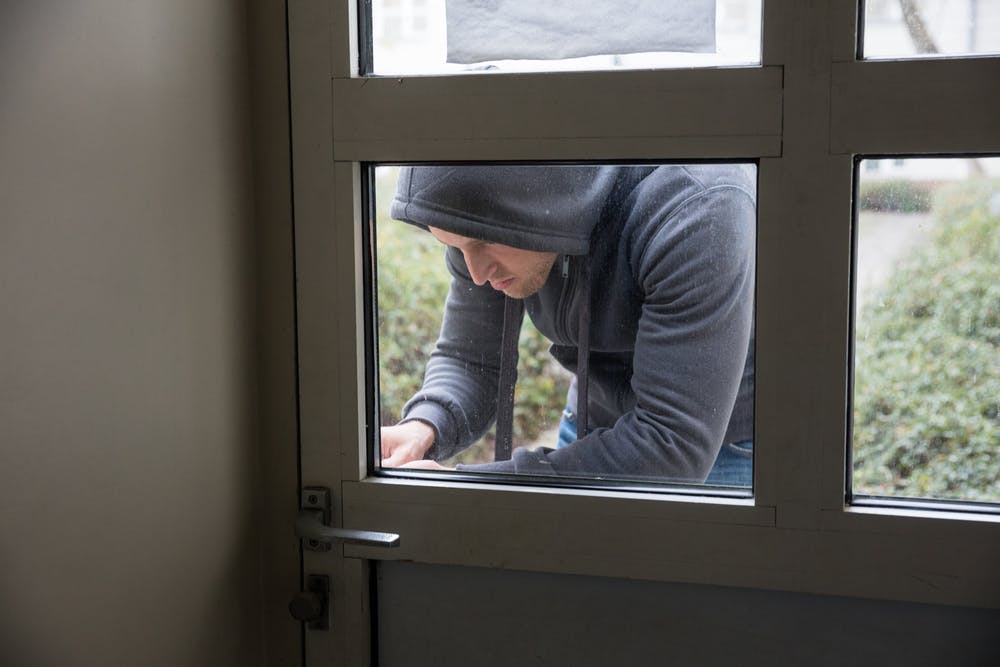
The lead-up to the holiday period is often referred to as the silly season — but it is when offenders get serious; burglary ratestend to increase during the festive season.
Why? Homes around this time of year are often full of Christmas presents, so there is a lot of new merchandise to attract burglars. And sometimes people also break into houses looking to steal food and goods they need, or items they can pass on as gifts – and burglars know there’s a good chance the home will be empty during the holiday season.
Our research has focused on finding out more about why offenders commit burglary, what they’re looking for, and how they decide which house to target. Here’s what you need to know.
The lead-up to the holiday period is often referred to as the silly season — but it is when offenders get serious. Shutterstock
Burglars tell us they choose houses that are easy to access, often looking out for unlocked windows and doors.
Some kind of cover is important, too. Are there large or overgrown plants they can hide behind? Are they hidden from view of main roads or neighbours?
Finally, they want the burglary to be worth it; ideally, they want valuables that are easy to access, conceal and sell on. Examples include online package deliveries, small electronics, jewellery, cash or gift vouchers.
Any valuables visible from windows or left in gardens or driveways are considered fair game.
Protecting your home while you are away
Over the holiday period many of us take some well-deserved time away, so how can you reduce the risk of burglary while you’re out of town? It helps to understand what “types” of burglars there are.
We sort burglars into three categories:
“opportunists” are not out to burgle but will if they see something they fancy
“searchers” are planning to burgle but have not selected the premises yet; and
“planners” are more professional and will watch or “case” a property in preparation for a burglary.
To best deter opportunists, keep valuables out of sight. Garage doors should stay shut and don’t leave empty cardboard boxes lying around near the bins. These empty boxes advertise your new Christmas acquisitions, and should be kept out of sight away from the kerb until bin day.
Don’t make it obvious you’re out of town. Shutterstock
To reduce the risk of becoming a target for searchers, lock your doors and windows. Remove hiding places from your front door or rear access so they cannot remain hidden while breaking into the house.
We also know searchers look for houses that are obviously empty of people. If you’re going away, ask someone to put out and bring in your bins and collect your mail, so a loaded letterbox doesn’t advertise an empty home.
Planners usually target homes that will produce a significant haul but are deterred by sophisticated security systems and alarms. They can often recognise a decoy security camera for what it is.
All burglars we’ve interviewed have reported not liking dogs, alarms, neighbours or anyone who could potentially identify them.
Our previous research shows burglars are aware of old tricks such as leaving a radio or light on constantly while you are away. Instead, you could try using timer-based indoor lights that come on in the evenings.
You should also resist the urge to announce your holiday plans on social media, and make sure your home contents insurance is up to date and you have individual items photographed and insured.
Older children home alone during the holidays? Make a plan
School holidays are long and most parents’ annual leave won’t doesn’t cover the entirety of the school break. That means older children are often left home alone while their parents are at work, particularly in January. It’s important you speak to your children about how to reduce the risk of your house becoming a target while they are home alone.
If your children are coming and going during the school holidays, make sure they know how to lock up the house and remind them not to leave their valuables in view.
It is common for young people to leave new bikes, skateboards and scooters outside the front door. Put reminders up so they remember to take them inside, or out of view.
When young people return home, teach them to take notice of anything that looks out of place. If they suspect someone has been in the house, tell them not to enter but go to a trusted neighbour, call their emergency contact, or contact the police. That way they stay safe and do not interrupt a crime in progress and put themselves in danger.
Our recent research showed when young people target a house, the most common method they use is to knock on the door and see if someone is home. If it looks like someone is coming to the door, they run.
We quite often tell young people at home not to open the door when parents and caregivers are out. You might consider whether you feel comfortable with them making it clear someone is home (by calling out or making some noise inside) but not opening the door. It’s up to you to develop a strategy you and your children feel comfortable with.
The authors do not work for, consult, own shares in or receive funding from any company or organisation that would benefit from this article, and have disclosed no relevant affiliations beyond their academic appointment.
Source: The Conversation (Au and NZ) – By C Raina MacIntyre, Professor of Global Biosecurity, NHMRC Principal Research Fellow, Head, Biosecurity Program, Kirby Institute, UNSW Sydney
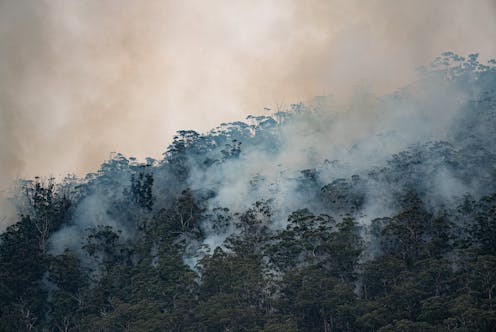
It’s bushfire season. So you might be wondering about the best way to protect yourself from the health impacts of smoke.
Guidelines suggest wearing respirators, avoiding outdoor air and avoiding vigorous activity outdoors. Many people use the cheaper option of a surgical mask during bushfires. But there has never been a clinical trial to measure how well these interventions work. That’s why our group is looking into it.
In the meantime, here’s what you can do to reduce your exposure to bushfire smoke.
Australia’s 2019/2020 summer bushfires resulted in more than 400 estimated deaths and thousands of hospitalisations from smoke exposure.
You don’t have to have a lung condition to suffer the ill-effects of bushfire smoke. Breathing difficulties, eye irritation and heart attacks are among the well-documented short-term impacts.
But people with asthma, emphysema, chronic bronchitis and other lung conditions are particularly susceptible to smoke exposure, triggering asthma attacks and breathing difficulties.
This was the typical pattern we saw during our own research, conducted during the same bushfire season. We showed smoke exposure caused ill health in people with and without existing lung disease.
However, we found people under 65 had a higher risk of ill health after smoke exposure than older people. This may be because younger people tend to go outdoors more during bushfires.
If you live in an area potentially affected by bushfire smoke, the first thing to do is to get an early alert about fires and smoke using one or more apps. Examples include, the Fires Near Me app or the AirRater app for air quality.
You can also use a visual method to assess air quality. This involves identifying a landmark on the horizon about 5 kilometres away and noting if it becomes hazy. This would be the trigger for using a respirator or avoiding outdoor air.
2. Stay inside if it’s safe
Try to avoid exposure to smoke, avoiding outside air and staying indoors if it is practical and safe to do so. Vigorous exercise outdoors can be dangerous as it results in greater smoke inhalation and risks to the heart and lungs.
Close all doors and windows, set air-conditioning to recirculate, and seal gaps under or around doors, windows and wall vents with towels, blankets or plastic.
Unfortunately, these instructions are the opposite of what to do if there is COVID at home, when you would want fresh air in the house. If that is the case, wear a mask indoors in common areas and social distance from the person with COVID.
Most people who need to go outside during a bushfire can use some type of disposable respirator to filter the smokey air.
You will have seen people wearing these P2, P3 or N95 respirators to protect themselves and others from SARS-CoV-2, the virus that causes COVID.
These and other types of disposable respirators filter very fine particles and fit closely around the face. Choose one with a full band around the back of the head (rather than ear loops) as these provide a better fit.
Some disposable respirators have valves, which means they filter inhaled air but allow you to exhale more comfortably. This option may help people with asthma or lung disease to breathe more comfortably. If you have COVID, though, wearing a respirator with a valve does not reduce the risk of you infecting others, because the air you breathe out through the valve is unfiltered and contaminated.
Respirators will filter particles larger than 0.3 microns (micrometres). However, they may not filter smaller particles contained in smoke, which is why avoiding outside air is still important.
People who live in bushfire-prone areas may want to consider a type of respirator they can clean and re-use when needed, known as an elastomeric respirator. Their filters need to be changed at specified intervals.
An elastomeric mask, such as this one, can be re-used. Shutterstock
If you have trouble getting one of the mentioned respirators, you can use a disposable KN95 respirator. However, these have ear loops and do not fit well around the face, so air can leak through.
Surgical masks are not likely to protect you because they are so loose. But medical-grade ones provide good filtering. For this to be effective, wear one with a mask brace or clip to provide a better fit and to help prevent air leaking in from the sides.
In a nutshell
Be prepared by downloading an app to monitor bushfires and air quality near you, and stocking up on good quality respirators ahead of time if you can. You can re-use these if they are not visibly soiled or damaged.
Staying out of the smoke is also important, particularly if you have asthma, emphysema and other lung disease. Young people may be less aware of the health effects of smoke exposure, and even people without lung disease can experience ill health due to smoke.
Do you have asthma, emphysema, chronic bronchitis or bronchiectasis? Do you live in an area in Australia affected by bushfires or bushfire smoke (including metropolitan areas)? You may be eligible to be part of our study into the best way to protect yourself from bushfire smoke.
C Raina MacIntyre has consulted for mask companies including Detmold and Ascend. She receives funding from the NHMRC and the MRFF currently.
With energy prices and temperatures both rising, keeping cool in summer is an increasingly costly challenge for many Australians. Energy bills are predicted to increase by 50% over the next two years, adding to the cost-of-living crisis. For some, this creates stark choices between paying energy bills or putting food on the table.
Many households will have to contend with high temperatures this summer, and it’s getting hotter by the year. Last summer Onslow, Western Australia, endured the highest temperature ever recorded in Australia at 50.7℃. Research suggests climate change will lead to summer temperatures as high as 50℃ becoming common in Sydney and Melbourne.
Australians need to take the risks of heat seriously and do what they can to keep their homes cool. As the World Health Organization points out, energy and health are inextricably linked.
So, while energy policy often focuses on managing costs and reducing energy use in the name of climate action, we should not forget the impacts of heat on health and wellbeing. Fortunately, there are things Australians can do to keep cool this summer while managing their energy bills.
Based on our research and the available evidence, our team has developed several resources including newsletters, videos and brochures on managing energy use while staying cool.
A mix of approaches can help strike a balance between staying comfortable and keeping costs down.
Here are our top ten tips:
1. Insulate your home.Insulation is often the most practical and effective way to make a home more energy-efficient. It’s a barrier to heat gain in summer (and loss in winter). Sealing gaps around windows, doors, walls and floors can make a big difference.
2. Shade helps keep your home cool. External shading of windows can block up to 90% of unwanted heat gain. Awnings, adjustable shutters and trees (ideally deciduous so they don’t block winter sun) and vegetation around windows can help block out the summer sun.
3. Close windows, curtains and blinds during the day. Blocking the sunlight stops heat from getting into your home. Thermally insulated double-glazed or secondary-glazed windows also help, as do honeycomb/solar blinds and blackout curtains with white backing.
4. Open doors and windows when the air is cooler outside. Opening up the house at the right times helps cool it down when the building is retaining heat during a warm spell. The coolest part of the day is usually between 4am and 7am, so if you are an early riser this is a good time to open up and let cool air in. Cool breezes often occur in the late afternoon or early evening, providing another good opportunity to cool your home.
5. Stay hydrated. Hydration is important for health and wellbeing, especially during summer. If you don’t drink enough water, you can start to feel unwell including symptoms of tiredness and headaches. Women need about eight cups or 2 litres, and men need about ten cups or 2.5 litres of fluid every day. Beverages with alcohol, caffeine or sugar are not as good for keeping you hydrated – water is best!
6. Wear suitable clothing. Natural fabrics such as cotton and linen absorb sweat and allow air to circulate against your skin. These are much better than synthetics, which can leave you feeling hot and uncomfortable.
7. Personal cooling practices can help. Using a spray bottle or a wet washcloth for your face and neck can help take the edge off the heat, as can a lukewarm bath or shower. Rest, if possible, during the hottest part of the day – usually 11am-4pm. Vigorous physical activity at these times on hot days can be damaging for your health.
8. Visit cool public places. When your home gets too hot, air-conditioned sanctuaries include shopping malls, libraries, galleries and eateries.
9. Switch on fans. Fans are a cheap and effective way to keep cool. The air flow provides a similar improvement to comfort as reducing the air temperature by around 3℃. Direct the air flow to your face because the face has so many receptors on it. If the outside temperature is lower than in your home, place your fan next to an open window to draw in cool air.
10. Think twice about switching on air conditioners. An air conditioner typically uses ten times more energy than a fan. Try using a fan in combination with an air conditioner. This means you can set the air conditioner to a higher temperature in summer (add at least 3℃) and still benefit. The combined cost will be far lower than running the air conditioner alone set at a lower temperature. For efficient air conditioning, your home or room should be well sealed and well insulated, and windows should be shaded from the sun.
Don’t underestimate the humble fan – it can be very effective. Shutterstock
Keeping cool can protect your health
If, to save on energy costs, households don’t cool their homes, the consequences can be more serious than being a bit uncomfortable.
Our research found energy consumption is important for families to care for children, cook and eat well, and live comfortably in the family home. We also found that for older Australians energy is vital for preventing ill health and death, managing illness or disease, supporting good mental health and sustaining social relationships. But our research shows people worry about the costs and need support to use energy to maintain their health and well-being.
Heat exposure can cause dehydration, heat exhaustion and stress. It can also worsen existing health problems such as heart and lung disease. As a result, heatwaves significantly increase hospital admissions and deaths, killing 354 people in Australia between 2000 and 2018.
Hot nights can also cause poor sleep and have harmful impacts on mental health. So, to protect your health, do what you can to keep cool this summer.
Ross Gordon has received funding from The Australian Research Council, Energy Consumers Australia, and the Commonwealth Government. Ross is a member of the World Health Organization Technical Advisory Group on Behavioural Insights and Sciences for Health.
Gordon Waitt receives has received funding from The Australian Research Council, Energy Consumers Australia, and the Commonwealth Government.
Theresa Harada receives funding from the Australian Research Council and Energy Consumers Australia.
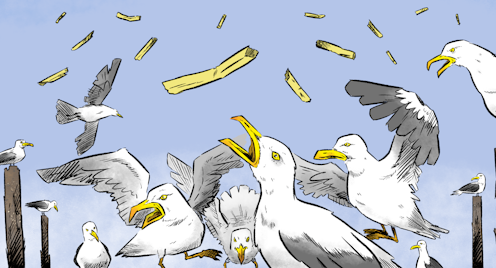
Whether they’re stealing your chips or screeching at your picnic table, seagulls are a hallmark of Australian summers. But how much do you really know about them?
In Australia, the most common species of seagull is the silver gull (Larus novaehollandiae), which is found throughout the continent. People in southern Australia may have also seen its larger, dark-winged cousin, the Pacific gull (Larus pacificus).
And in fierce competition with the Pacific gull is the kelp gull (Larus dominicanus), which established itself in Australia in the 1940s and is found in all states.
Here are four fascinating facts about seagulls that might make you see them a little differently.
Seagulls are a hallmark of Australian summers. Shutterstock
1. Seagulls thrive in cities
Gulls are part of “Laridae” family of seabirds and are found worldwide. While they’re synonymous with the sea, they can also thrive inland, particularly in urban areas.
Life in urban areas can be hard for birds. Without natural habitat, birds must learn to live among human-made infrastructure. However, gulls have adapted well to our highly modified landscape.
For example, research has found gulls are highly tolerant to urban disturbances, such as loud traffic and industrial noise as well as pedestrian and vehicle traffic. They have even adapted their nesting behaviour to use, for instance, ovals and flat roofs on buildings.
Gulls have a large brain relative to their body. Research suggests birds with larger brains can more successfully adapt to changing habitats and colonise new environments.
Seagulls thrive in cities. Shutterstock
An interesting study last year tested the intelligence of ring-billed gulls, which are predominately found in Canada and northern United States.
Researchers attached a piece of sausage to a string, and placed it inside a clear box. Some 75% of the 138 gulls tested attempted to solve the task by pulling the string to bring the food closer, and 25% were successful.
This study shows gulls are curious and try to solve problems – both skills that serve them well in the urban jungle.
Gulls are opportunistic feeders, meaning they will try almost any food they encounter. They’re renowned for stealing food from other gulls and even from us, a behaviour called “kleptoparasitism”.
A 2019 study showed herring gulls, found along the shores of western Europe and the UK, are aware of the direction of the human gaze. The herring gulls in the study more quickly snatched up food placed near a person, when the person was looking away from the gull.
Other research looked at how herring gulls interacted with food after they watched a person handle it. It found the gulls were much more likely to peck at food a human had handled, rather than food that hadn’t been touched.
Silver gulls in Australia have a diverse range of natural prey. This includes cnidarians (such as jellyfish), squids, insects, fish, frogs, small birds such as sparrows and wrens, plants and, when possible, small rodents.
Gulls, especially silver gulls, are also expert scavengers, and often exploit landfills. A study from 1993 recorded 6,000 silver gulls per hour leaving a single urban landfill site in Wollongong in Australia.
A more recent study in 2012 found a kelp gull breeding colony in the De La Guardia Islands of Patagonia, Chile, is sustained by food from an inland rubbish tip.
When conditions are right and food is plentiful, gulls can breed all year around. Peak breeding season for silver gulls is roughly between August and November and they lay one to four eggs.
Seagulls are traditionally found sleeping and nesting on flat beaches. Some gull species, including Australia’s silver gull, may create “nest scrapes” – shallow depressions in the the ground lined with, for instance, leaves and other vegetation.
Silver gulls prefer to nest in islands. But as urban development encroaches into their habitat, seagulls have adapted to roost and nest in a range of places. Their simple nest design means they can nest in grass cricket pitches, ovals, car parks, low shrubs between rocks and even flat roofs.
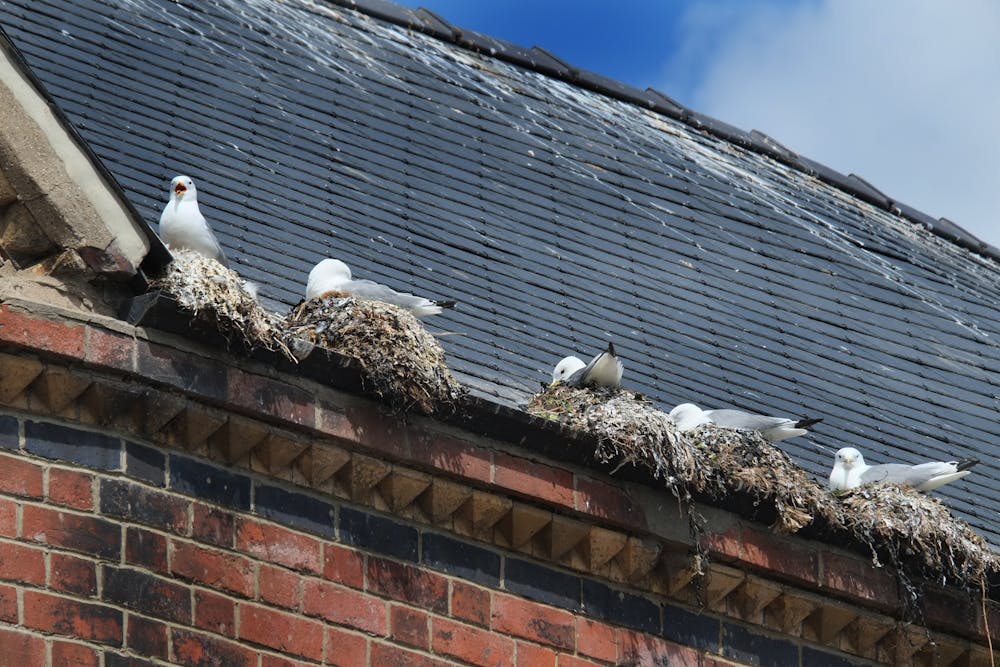
Seagulls nesting in a gutter in the UK. Shutterstock
The downside for ground-nesting birds such as gulls is that they’re especially vulnerable to human disturbances, such as lawnmowers, pedestrians and their dogs, and even footy games.
Still, gulls seem to make it work. The abundance of human food seems to benefit breeding birds – a Tasmanian study on silver gulls in 2008 found urban males were heavier and had greater body condition then non-urban male gulls. Interestingly no difference were detected between females.
Further research is need to see how successful urban silver gulls are at breeding and raising young on human food.
Cats (both pet and feral) are a downside to urban life for gulls. Foxes and wild dogs can also pose a significant threat.
This is where team works come in. When silver gulls detect a predator, they work together using aerial group defence tactics to drive away the threat.
Black-headed gulls mobbing a crane.
One anti-predator strategy is called social mobbing. This is where a group of gulls unite to harass a potential enemy – such as a cat or fox – by flying towards it and making alarm calls, until it goes away.
Some gulls might even vomit or defecate on the predator, with startling accuracy.
Grainne Cleary does not work for, consult, own shares in or receive funding from any company or organisation that would benefit from this article, and has disclosed no relevant affiliations beyond their academic appointment.
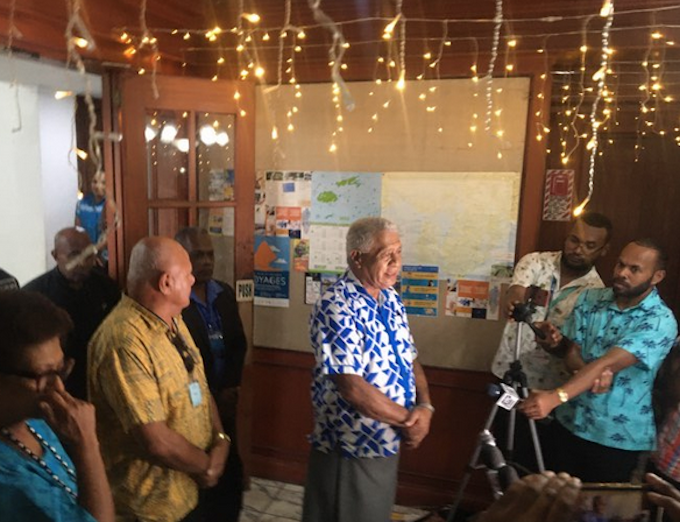
An official communication will be sent to Fiji’s President confirming the new People’s Alliance, National Federation Party and Sodelpa government is ready to lead under the new Prime Minister, Sitiveni Rabuka.
NFP leader Professor Biman Prasad said the leaders were pleased to give Fijians a Christmas present of a strong and united coalition government ready to respond to their call for change.
“People have chosen a new way, a new path, and a new government and we the coalition partners — now the People’s Alliance, the NFP and Sodelpa — promise the people of Fiji that a new era will be starting as the new government takes on the power in this country.”
People’s Alliance leader Sitiveni Rabuka thanked Fijians, saying they had voted for change and the coalition had given them that.
He also thanked outgoing FijiFirst Prime Minister Voreqe Bainimarama and his cabinet for running the affairs of the nation for the past 16 years.
“Losing the election is not the end. I lost in 1999 and I kept trying. I’ve been given the opportunity this time, once in 2018 and again this time and different party. Play your cards right. Lead your team well and work hard.”
Sixteen members of the Sodelpa management board voted in favour of PAP and NFP, while 14 voted for FijiFirst.
Outgoing Prime Minister Voreqe Bainimarama on TVNZ News . . . lost the numbers game. Image: TVNZ screenshot APRjubilant Fijians in Suva celebrating the change of government. Image: TVNZ screenshot APR
Exiled University of the South Pacific vice-chancellor Professor Pal Ahluwalia says he is thrilled at the prospect of returning to Fiji.
Speaking to The Fiji Times from Los Angeles in the United States yesterday, he said Prime Minister Sitiveni Rabuka — when he was in opposition — made a commitment to pay Fiji’s outstanding debt of $90 million to USP and to allow him to return to Fiji.
“Mr Rabuka said it, National Federation Party leader Professor Biman Prasad said it, and the Social Democratic Liberal Party leader also said it,” Professor Ahluwalia said.
“So it’s part of all three parties’ manifestos and part of their public statements, so we as a university are delighted that this amount that has been outstanding for so long will finally come to the university.
“It’s excellent news, not just for the Fijian students but for the entire region because the region has been carrying Fijian students for quite a while and there will now be a chance for us to do a lot of things that we have deferred and not been able to do, particularly issues around maintenance.
“It also means we can now aggressively look for quality academic staff.”
Rabuka issued a statement on Boxing Day saying the prohibition order against Professor Ahluwalia had been lifted and he was welcome to travel to Fiji at any time.
Professor Ahluwalia and his wife Sandra Price claimed that on Wednesday February 3, 2021, 15 people made up of immigration officials and police stormed into their USP home and forcefully removed them at about 11.30pm.
They claimed they were driven the same night to Nadi International Airport and deported on the morning of Thursday, February 4, to Australia.
The FijiFirst government on February 4, 2022 issued a statement that the Immigration Department had ordered Professor Aluwahlia and his partner Sandra Price to leave Fiji with immediate effect following alleged “continuous breaches” by both individuals of Section 13 of the Immigration Act.
Government said under Section 13 of the Immigration Act 2003, no foreigner was permitted to conduct themselves in a manner prejudicial to the peace, defence, public safety, public order, public morality, public health, security, or good government of Fiji.
Fiji now ‘free country’ RNZ Pacific reports that Finance Minister Professor Biman Prasad said all three parties in the coalition had promised this in their election campaigns and manifestos.
The former FijiFirst government have withheld the payments since 2019 over a protracted battle with Professor Ahluwalia, now operating in exile out of Samoa.
“They didn’t like a man who was doing the right thing who exposed corruption within the university,” Professor Prasad said.
“And it has done you know, to some extent, terrible damage not only to the university, but also the unity in the whole region.”
In July, the two unions representing staff at the university said the Fiji government owes the institution F$78.4 million and the debt has increased since then.
“Well, I can’t tell you the timetable, but all I can say is…that the university will receive the appropriate funding, as well as the government will pay what is due as a result of the previous government withholding the grant to the university,” Professor Prasad said.
His revelation comes after the government statement by Prime Minister Rabuka inviting Professor Ahluwalia to return to Fiji.
Personal apology Rabuka said he wanted to apologise to Professor Ahluwalia in person upon his arrival for the way he had been treated by Fiji.
The prime minister has also invited the widow of exiled Fijian academic, Professor Brij Lal, who passed away on Christmas Day last year to bring home his ashes for burial at Tabia near Labasa.
Professor Prasad said they look forward to welcoming home more Fijians and expatriates exiled during Voreqe Bainimarama’s 16-year-reign.
“Fiji is now a free country. We will welcome everyone who wants to come to Fiji. No one should fear about any kind of vindictiveness or harassment,” Professor Prasad said.
“That is what we promised during our campaign, and that is what this government will deliver.”
Felix Chaudhary is a Fiji Times reporter. Republished with Fiji Times permission. This article is also republished under a community partnership agreement with RNZ.
Former New Zealand prime minister Helen Clark is supporting aid agencies’ decision to halt operations in Afghanistan, and a UN official has urged the Taliban to reverse its ban on women humanitarian workers.
It said the move, which was condemned globally, was justified because some women had not adhered to the Taliban’s interpretation of Islamic dress code for women.
The news led to the beginning of a withdrawal by organisations such as the Norwegian Refugee Council, Save the Children, and Unicef.
Former Prime Minister of New Zealand Helen Clark . . . “It’s a huge violation of human rights of women.” Image: RNZ News
Clark, who also used to head the UN Development Programme, said the aid agencies were forced to suspend their services or yield to an oppressive policy.
She condemned Afghanistan’s banning of female humanitarian workers.
“It’s a huge violation of human rights of women. Where do you draw the line? If the organisations simply capitulated to this edict from the Taliban, they would be seen to be going along with a huge violation of women’s rights,” she said.
“So it is important that big organisations are speaking out now as they have, and are saying they will suspend their operations while this policy holds.
“The problem is the Taliban and these horrible hostile decisions that they’re taking towards women.”
Clark said the Taliban had tried to present itself as more legitimate than the last time it ruled Afghanistan, but a leopard did not change its spots.
She expected the Taliban leadership would face strong ongoing pressure from the UN and other entities, and they would see the consequences of foreign aid groups withdrawing.
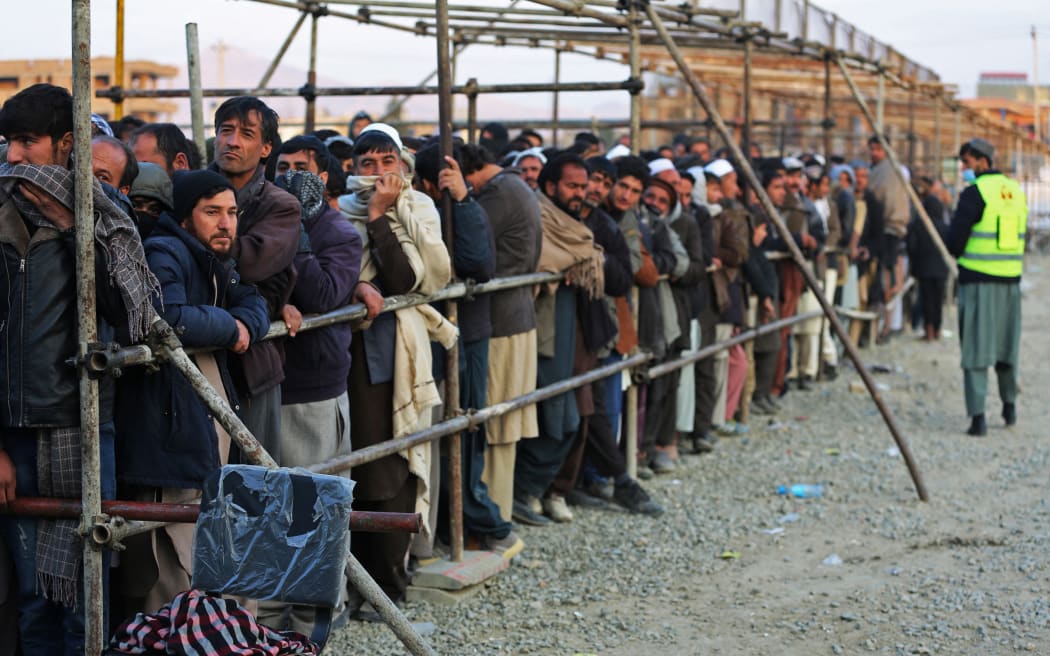
Afghan men stand in queues to receive food aid from a non-governmental organisation in Kabul on Christmas Day 2022. Image: RNZ/AFP
UN calls for Taliban to reverse the decision A senior UN official has urged Afghanistan’s Taliban administration to reverse the ban on female humanitarian workers, and charities fear it will worsen winter hardships.
“Millions of Afghans need humanitarian assistance and removing barriers is vital,” UNAMA said in the statement, adding that its acting head and humanitarian coordinator Ramiz Alakbarov had met with Economy Minister Mohammad Hanif.
The directives barring women from working at NGOs came from Hanif’s ministry.
The orders did not apply directly to the United Nations, but many of its programmes were carried out by NGOs subject to the order.
Four major global NGOs, whose humanitarian efforts had reached millions of Afghans, announced they were suspending operations on Sunday. Other smaller NGOs had also announced suspensions, including UK-based Islamic Relief Worldwide.
The NGOs said they were unable to run their programmes without female staff.
More than half of Afghanistan’s population relied on humanitarian aid, according to aid agencies. Basic aid was more critical during the mountainous nation’s harsh winter.
Two spokesmen for the Taliban administration did not respond to queries on the suspension of humanitarian programmes.
NGOs were also a critical source of employment for tens of thousands of Afghans, particularly women, as the local economy had collapsed following the withdrawal of US-led foreign forces and the Taliban takeover last year.
One such employee, a 27-year-old female aid worker in western Afghanistan who asked for her identity to be concealed because she feared retribution, said that her NGO had shut its office on Saturday and she could not go to work.
The NGO, funded by a Western country, worked with women in the agriculture sector, helping them set up sustainable incomes.
She said she was worried that losing her job would have a huge impact on her family because she was a single woman and the sole breadwinner.
Her father was dead and her mother was a housewife, she said, adding that she supported four sisters, three of whom were university students who could not complete their degrees since the Taliban administration barred women from attending university last week.
This article is republished under a community partnership agreement with RNZ.
Each December, Christmas, Hanukkah and Kwanzaa, among others, take over our thoughts and our wallets as we participate in ceremonies our ancestors have practised for as long as we can remember. These are all example of traditions. And in most cases, traditions are accompanied by rituals.
What’s the difference?
In scientific terms, a “tradition” refers to the passing down of customs and beliefs from one generation to the next. A “ritual”, on the other hand, is a series of actions performed according to a prescribed order, and which is often embedded in a larger symbolic system, such as religion or philosophy.
For example, while celebrating birthdays is a tradition, blowing out the candles on a cake is a ritual. Similarly, while getting married is a tradition, exchanging vows is a ritual.
New rituals can be created at any time. To become tradition they only need to be understood and replicated by a wider community.
Communities around the world have different rituals practised during weddings, often passed down through generations. Shutterstock
And it’s not just in grand gestures that humans practise rituals; some are so embedded into our everyday lives we no longer recognise them. The very particular way someone makes their tea or coffee in the morning is a ritual they enact daily.
Basically, rituals are everywhere. That raises the question: why do we have them at all?
Ritual behaviour has very deep origins in humanity. However, tracking these origins and their development is difficult as rituals often leave little or no physical traces behind for archaeologists to find.
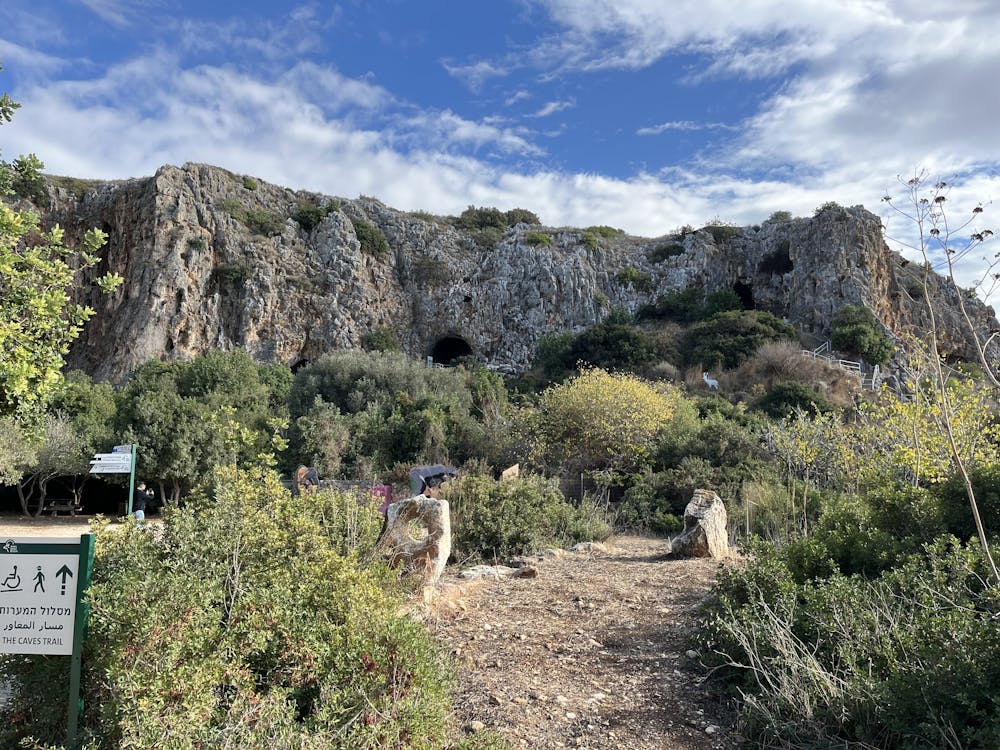
Thus far, the best evidence for ancient rituals is the deliberate burial of loved ones. The oldest example is found at Mt Carmel in Israel, where some 130,000 years ago a Neanderthal woman was laid to rest by her community.
Mt Carmel in Israel is the site of the oldest known human burial. A Neanderthal woman was laid to rest here some 130,000 years ago. Michelle Langley
Archaeologists also suggest the extensive use of coloured pigments (particularly bright red) to paint bodies, objects and rock walls points to the practice of “symbolic” behaviour, including ritual. The oldest reliable evidence for colourant use dates to between 500,000 and 310,000 years ago and comes from several archaeological sites in southern Africa.
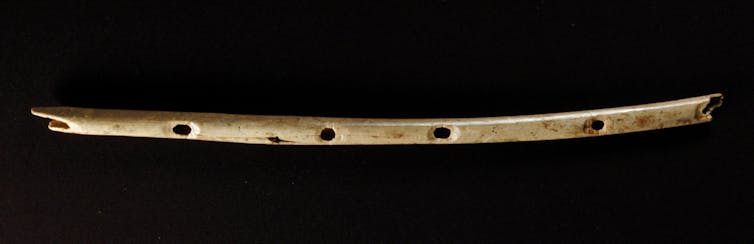
Another type of evidence that is often intrinsically tied to rituals and traditions is musical instruments. Bone flutes dating back to about 42,000 years ago have been found in Western Europe. How long people have used the very first instruments – the human voice, clapping hands and stomping feet – remains unknown.
This bone flute, found at the German Palaeolithic site of Hohle Fels, is at least 42,000 years old. Jensen/University of Tubingen
Rituals play a very important role in human communities for a number of reasons.
First, rituals help reduce individual and collective anxieties, especially when we ourselves, our family, or our whole community is facing uncertain times or crisis.
Research has shown that by praying or singing together we feel connected and supported and our anxiety is reduced. This may explain why Parisians were moved to sing together as they watched their beloved Notre Dame Cathedral burn in 2019.
Parisians sing together as Notre Dame burns – a spontaneous ritual to deal with an unexpected crisis.
Rituals also help reduce anxiety by allowing us to feel control over our surroundings. For instance, new parents may be anxious about protecting their baby. Rituals that welcome the infant into the family and community help them feel they’ve done everything possible – including drawing on supernatural protection – to ensure their child’s wellbeing.
Second, rituals bring people together to celebrate or otherwise mark important life milestones. Births, graduations, marriages and deaths are all marked by rituals and traditions across the globe. These events provide a time and place to gather and encourage people to renew their bonds with friends and family.
These bonds are especially important in times of bad luck, which helps explain why the incentive to maintain them has endured through human history.
Imagine living tens of thousands of years ago, when human communities were much smaller and often lived farther apart. If a volcano erupted, the resulting destruction could mean plant and animal resources – essential food and materials needed for survival – would not be available for months, or perhaps years.
You would then have to rely on the bonds you maintained with neighbouring communities through shared rituals. Such bonds would encourage the sharing of resources until circumstances improve.
Finally, rituals help us remember and share huge amounts of cultural information. By learning a format or pattern of behaviour through ritual, we can absorb information and recall it later more easily.
This approach works astonishingly well to ensure information is passed down orally over long periods. Thus far, the oldest story dated using scientific methods is the Aboriginal Gunditjmara people’s story of the Budj Bim volcano eruption, which occurred 37,000 years ago in what is now south-western Victoria.
Being able to retain information about changes in the landscape, its plants, animals and people ultimately increased the likelihood that your family would not only survive – but thrive.
Rituals will remain
Without rituals, and the traditions in which they become embedded, it is unlikely humanity would have advanced to its current state of cultural and technological development.
We wouldn’t have been able to continually gather and share information, maintain bonds over extensive geographical areas, or make it through difficult periods.
Despite being surrounding by increasingly complex technologies, rituals today remain more important than ever. With extreme weather events and conflicts continuing to displace people all over the globe, they will act as an essential social glue that holds our communities together.
Michelle Langley is an Associate Professor of Archaeology in the Australian Research Centre for Human Evolution (ARCHE) and the School of Environment and Science at Griffith University.
Every parent knows kids spend their time differently when they’re on holidays. Our new research found out just how differently.
During the school term, kids get up around 7am, get into their uniforms, make their way to school, eat food from their lunchboxes or canteens, play at recess and lunch, have PE lessons, sit and get bored or excited in class, and then head home. Their day is highly structured.
However during school holidays, all this goes out the window. Our new research shows in the summer holidays, kids are getting less physical activity, more screentime, and eating more junk food and less fruit than they do during term time.
We asked 358 children aged nine to 11 years from 24 primary schools across Adelaide to wear an activity band for four weeks across the school year and one week during the summer holidays. At the same time, we asked the children to tell us about the activities they did and what they ate.
From the activity band data, we found during the summer holidays, kids sit for an extra 27 minutes, and spend 12 minutes less doing physical activity. From asking the kids about the activities they did, we found kids get 73 minutes more screen time each day, they spend an extra 22 minutes in cars, buses and trains, and 23 more minutes eating or grooming. They also spend an extra 16 minutes just chilling (sitting listening to music or doing nothing).
These findings mean their overall energy expenditure is about 13% lower. We also found kids’ diet quality is lower — more junk food and about half a serve less fruits each day than in school time.
More physical activity and less screen time are linked to better physical and mental health, higher levels of fitness, better school grades, and lower risk of becoming overweight. Overweight and obesity in childhood can lead to an increased risk of developing type 2 diabetes, problems sleeping, and low self-esteem.
During the school year kids don’t gain much weight, but they do in the summer holidays. We found on average, all participating kids’ weight increased six times faster during the summer holidays than during term time. In fact, if kids lived every day like they do when they’re on summer holidays, they’d put on an extra 6 kilograms a year. Kids are also losing fitness, and their mental health and wellbeing suffer over the summer holidays.
These effects are worse in children from poorer, less educated backgrounds, and kids who are already overweight.
How can we maintain the benefits of kids being at school, during the holidays?
Some have called for shorter school holidays. But Australian summer holidays are quite short by world standards. Parents in Australia might welcome the four weeks enjoyed by Singaporean students, and children the 14 weeks endured by parents in Egypt.
In the United States and Europe, many children go to summer camps in the summer holidays. These can be overnight camps, where kids stay overnight, or day camps where kids go home at the end of each day. The length of these camps varies widely and can be short (1 to 2 weeks), mid-length (3 to 5 weeks) or the full summer session (7 weeks or more).
Research has shown where kids go to a summer camp daily (Monday to Thursday) for six weeks over the summer, kids are more active, less stationary and eat healthier diets on the days they go to summer day camp, compared to the days when they stay at home. These camps may be residential or day camps, and may combine physical activity with specific learning activities, such as coding, art or drama.
Families may also try getting their kids outdoors. Research has shown kids are likely to be more active when they are outdoors. Families may also try getting their kids to do something physically active before allowing them screen time – this could even be doing chores like mopping the floor.
Families may try to add extra structure to their children’s holiday days, but it’s pretty hard to resist the opportunity to sleep in, snack and binge on Netflix and video games, when the content is precisely designed to keep kids watching.
Big problems need bold solutions – is it time for school administrators and policy makers to reconsider the length of the school holidays, or the lack of summer holiday programming, for the sake of our kids’ health?
Summer holiday programming might come from a variety of organisations such as sports and activity clubs, schools, religious organisations, museums and art galleries, disability groups, as well as the private sector which also offers summer camps.
Some ways to get everyone out of the house and moving could include the family enjoying a day out at the zoo, going climbing at [Tree Climb], spending the day swimming and sliding at your local aquatic centre, or spending time with the animals at Hahndorf’s Farm Barn.
Amanda Watson receives funding from the National Health and Medical Research Council.
Carol Maher receives funding from the Medical Research Future Fund, the National Health and Medical Research Council, the National Heart Foundation, the SA Department for Education, the SA Department for Innovation and Skills, Healthway, Hunter New England Local Health District, the Central Adelaide Local Health Network, and LeapForward.
Tim Olds receives funding from the Australian Research Council and the National Health and Medical Research Council.
For Australians, memories of childhood Christmas often include gifts, prawns and shooing uninvited buzzing guests away from the pavlova.
But have you ever wondered why the air is full of bugs some years and almost empty in others? Insect populations boom and bust frequently.
This year is our third successive La Niña, and a wet summer is forecast yet again for Australia’s east.
Wet, warm weather is ideal for many of the insects, spiders and slugs that share our homes and gardens. That means we’re likely to have a very buggy Christmas.
Aren’t all the insects dying?
As we heat up the planet and take over natural areas, invertebrate species are responding in unpredictable ways. Many species are in trouble: researchers have warned of an insect apocalypse facing flying bugs like wasps, butterflies, and beetles in densely populated Europe.
Subsequent research has drawn less drastic conclusions, and some American researchers claim that population sizes haven’t significantly changed overall, with some species booming and others dying off.
Researches warn of a decline in populations of butterflies and other insects in Europe. Shutterstock
Longer term, climate change and human takeover pose real challenges for many bugs – but not all.
When ecosystems tip out of balance, the most adaptable species find opportunities despite – or because of – unpredictable and changing conditions. Consider the locust swarms vast enough to blot out the sun and threaten crops in many East African nations.
So what should you look for? Here are four creepy crawlies that might arrive at your place more often this summer.
Huntsman spiders
Although spiders have shared our houses for thousands of years, huntsmans have rarely been popular roommates. That’s probably because of their heart-stopping habit of skittering across the wall when you least expect them.
Despite this, most of Australia’s 155 huntsman species are shy and rarely aggressive. They generally live solitary lives, although female huntsman spiders will actively guard their egg sacs after mating – and protect the up to 200 spiderlings which hatch from them.
Like many introverts, huntsman spiders prefer the indoors – especially in bad weather, when they like to enter houses and cars to get out of the rain. This is actually good news, believe it or not. Having huntsman spiders in residence means you’ll have less cockroaches and mosquitoes.
So be ready not to freak out. With recent heavy rains and the predicted influx of roaches and mozzies this summer, you can expect to see a few more eight-legged off-lease roommates than usual.
Huntsman spiders are often flat, to hide under bark and in rock crevices. Shutterstock
Mole crickets
Nicknamed the platypus of insects, mole crickets look like several different creatures jammed together. Seeing one aboveground is always a shock. The shovel-like forelegs. The yabby-like carapace. The surprising size of it.
Don’t panic. These minibeasts are meant to be here. They live happily across Australia, preferring life beneath well-watered vegetation. They use their leg-shovels to dig tunnel networks where they can lay their eggs. After young adults dig their tunnels, they come to the surface in spring to find a mate.
Mole crickets look like mash-ups of other creatures. Wikimedia, CC BY
So why are you likely to see them in summer? Rain. When heavy rain hits, underground creatures have to activate contingency plans. Tunnels and rain don’t mix. For mole crickets, that means digging upwards through sodden ground and clambering across the surface looking for higher ground.
You’ve probably heard the male mole cricket’s persistent chirping on rainy evenings as he looks for a mate. Their characteristic call is so loud it’s sometimes confused with a frog. The powerful sound is due to clever engineering. Mole crickets sculpt a horn-shaped burrow to maximise their noise. Think of it as building an underground bugle.
European Earwigs
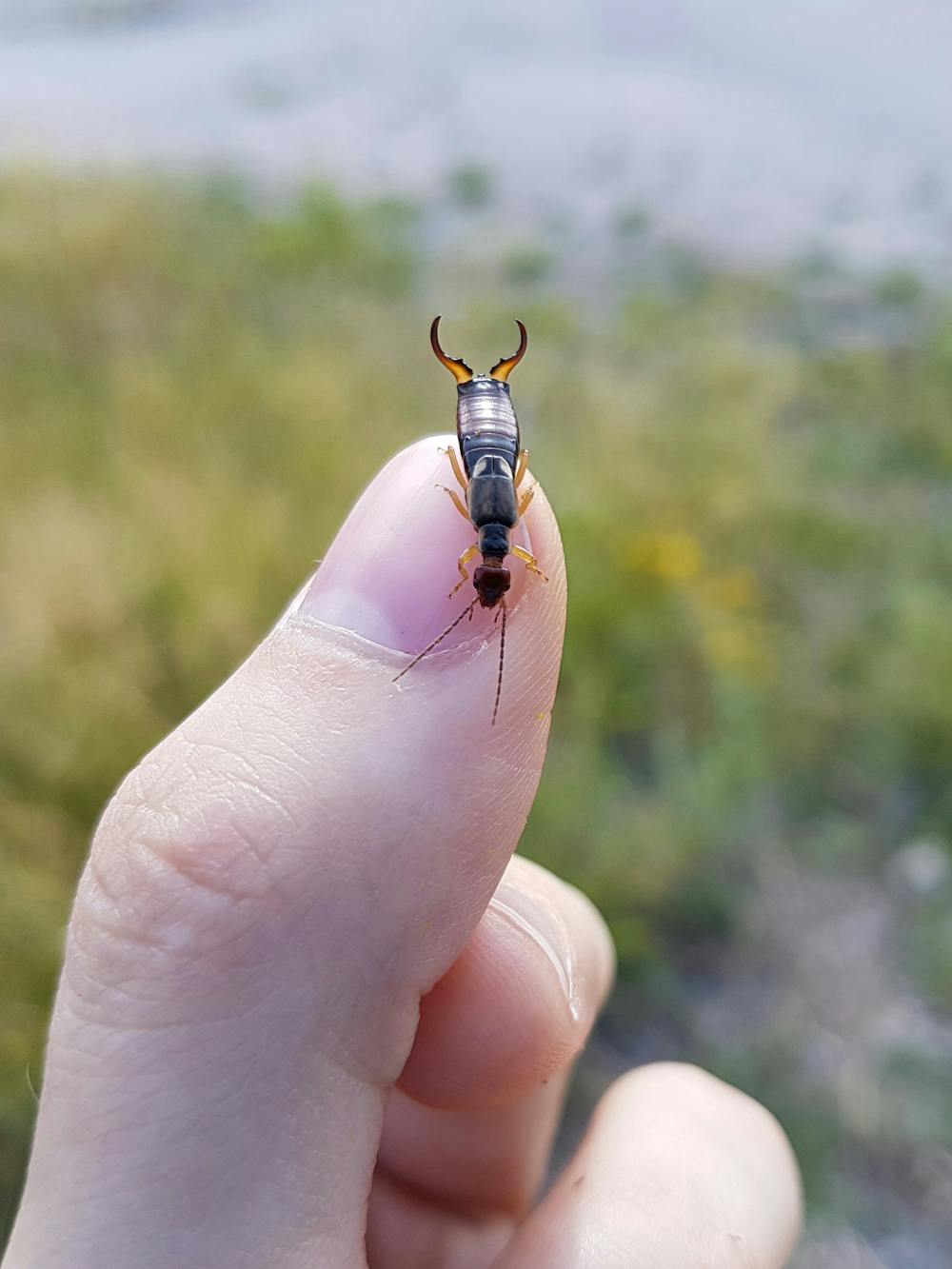
European earwigs are harmless despite their pincers. Wikimedia, CC BY
European earwigs are everywhere in Australia’s temperate south – even though they’re not from here. These invasive pinchy bugs from Europe are unmistakable, with elongated abdomens topped with forcep-like pincers. Most of our 85 earwig species are natives, but you’re likely to see the European variety.
Their name may come from the Old English phrase “ear wiggler”, which in turn comes from an enduring belief that earwigs invade people’s ears when you sleep. Thankfully, this is false. When researchers tested this story, they found earwigs weren’t interested. It’s actually cockroaches that can sometimes get stuck inside our ears.
While earwig pincers can hold onto human skin, they don’t usually hurt. The pincers are used for courting, defence, and catching prey. Earwigs are omnivores, eating plants and critters.
Rainy winters boost earwig numbers, as the increased rainfall keeps burrows moist. This helps their eggs and nymphs to survive and ensures plenty of plants for them to eat.
This winter was our wettest nationwide since 2016. This means conditions are perfect for an earwig bonanza. Researchers say grain-growing areas outside Melbourne and Adelaide are prime real estate for earwig expansion.
Red triangle slugs
These gaudy gastropods live happily in urban vegetation along the Queensland and New South Wales coastline. Australia’s largest native land slug can be cream, greyish-green, yellow or orange-red, but you’ll know them from the distinctive red triangle shield on their back. While it might not look it, this is actually camouflage. It helps these nocturnal slugs blend in with leaf litter.
Red triangle slugs are hard to miss – especially in large numbers. Shutterstock
After rain, these slugs come out of hiding and slurp up moisture through their skin, leaving a slimy mucus trail. It’s not just for gliding along – it’s defence. Their mucus acts like a slug superglue, with scientists finding it’s strong enough to stick predators like green tree frogs firmly in place.
They’re already popping up in Brisbane backyards, but there are more to come, given ideal conditions for the growth of the algae these slugs eat.
These four species are set to boom. But what about the iconic Christmas beetle?
Christmas beetles
If you can remember the 1980s and 1990s, chances are you have fond childhood memories of these metallic beauties clinging to your screen door, or buzzing indignantly as they try to turn themselves right side up on your driveway.
These days, Christmas beetles don’t seem to arrive in large numbers. There are 36 species of these shiny scarab beetles nationwide, but sightings are falling.
We don’t know the full story, but we have clues. Almost one in four of Australia’s native eucalyptus species are now threatened with extinction, with some populations dropping by half due to land clearing and urbanisation.
That’s a major problem for Christmas beetles. Their larvae depend on plant roots and the adults emerge after thunderstorms to snack on eucalyptus leaves. Two key species they like to eat – yellow box and fuzzy box – have just been listed as threatened.
Without intervention, such sightings will become increasingly rare.
If you do see Christmas beetles this summer, you can help by logging your sighting on the iNaturalist beetle count to help scientists understand where these Christmas favourites are still visiting.
Erin Siostrom does not work for, consult, own shares in or receive funding from any company or organization that would benefit from this article, and has disclosed no relevant affiliations beyond their academic appointment.
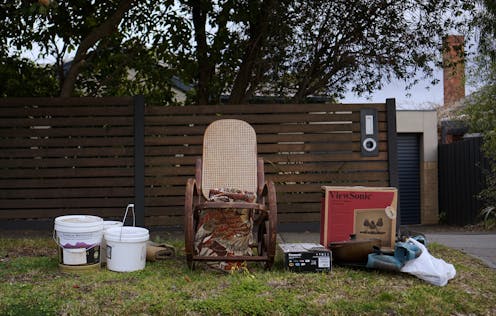
Driving home recently, I encountered a familiar sight: four dining chairs on the kerb waiting for some sucker to rescue them. Loading them into the car (sucker!) I wondered: how long were these chairs in shed limbo-land before finally getting kicked to the kerb?
When a wooden chair goes a bit wonky, it feels counter-intuitive to throw it away when it’s mostly OK. It’s often demoted to the shed, with the optimistic thought: “The wood is still good. Maybe it could be fixed.”
But will you really fix it? Sell it? Give it? Keep it? Nah. Chuck it.
Chucking has become easy – and socially acceptable. The pressure to de-clutter, galvanised by the Marie Kondo tidying-up craze, can feel moralistic. “Just chuck it already!” we say to ourselves, or our partners.
Kondo’s books (more than 13 million sold) implore us to discard ruthlessly any item that doesn’t immediately “spark joy”, with Kondo urging us to:
not be distracted by thoughts of being wasteful […] to get rid of what you no longer need is neither wasteful nor shameful […] so, arm yourself with plenty of garbage bags and prepare to have fun!
Kondo promotes throwing things “away” or “out” without addressing where exactly that nebulous place is.
These items do not disappear when flung into the ether. They land quite concretely in expanding landfills that degrade landscapes and ecosystems, taint water supplies, and pump out methane as carbon is released during decomposition.
In a world of unbridled consumerism, we are experiencing a waste crisis. We dispose of tremendous amounts of furniture while consuming masses of new furniture, all in the midst of global timber supply shortages.
Even buying well-crafted, locally made “green” furnishings from sustainably harvested timber doesn’t stop our chucked-out things from rotting in landfill.
In my research, I have spoken to craftspeople, academics, community organisers, and environmental activists about furniture waste. The message is consistent: try to keep what already exists circulating in the world.
Waste as a cultural construct
Waste is often described as “matter out of place”. What we define as rubbish is a matter of perspective. It’s a cultural construct.
A wonky chair may be only negligibly different to its original state. But even if still functioning, or easily repaired, it becomes worthless once worn or wobbly.
This loss of value is reflected in waste collection policies and op-shops. It’s simple to book a council pickup collection or donate to an op-shop. It’s just so easy to get rid of things.
But either that chair is in good serviceable condition and is diverted from the waste stream for reuse, or it’s deemed rubbish and sent to the pit. There is no middle ground for easily repairable items.
If a chair is an antique, finely crafted, or of sentimental value, people tend to make the effort and spend money on expert restoration work.
But it can be hard to justify that for an ordinary chair.
Sandie Parkes, founder and owner of the Canberra Green Sheds, is awash in chairs to the point where they intermittently need to cull them, saying:
Every day we are offered about ten times more chairs than we can possibly sell.
Few people know where to begin with fixing a wooden chair. Ashley Eriksmoen, Author provided
Learning to repair
Few people know where to begin with fixing a wooden chair. But many community groups teach such skills. Two Sheds Workshops in Canberra and Bega has woodworking and upholstery classes for women and children to learn basic skills and boost confidence.
Jess Semler, Two Sheds Workshop’s Canberra manager, told me, told me repair “doesn’t have to be a convoluted or long process. There is no one right way to fix something.” Once the process is demystified, students can work out how to fix other things, bringing creativity and playfulness to the process.
Greg Peters, key conservator of Patinations Conservation Service in Canberra, reiterated that for everyday, mass-produced furniture with no inherent historical or financial value, most repairs are actually relatively simple if you just “give it a go”, learn from the internet and remember there’s usually nothing to lose in trying.
Don’t have the tools? Ask around. Dr Niklavs Rubenis, a senior lecturer in object design at the University of Tasmania, suggests tapping into the collective knowledge of communities by asking neighbours for advice, or to borrow and share tools.
One positive global trend is the proliferation of repair cafes, where volunteers and clients can drop-in to pop-up repair events.
Griffith University’s Professor Leanne Wiseman researches the international Right to Repair movement, and is part of the Australian Repair Network. Wiseman counts about 100 repair cafes in Australia, most of which are listed here, operated mostly by volunteers bringing their own equipment.
Time poor or not keen to repair? Try posting on Facebook Marketplace or your local Facebook Buy Nothing group. You might connect your old chair to someone keen to fix it or harvest its usable timber for creative reuse.
My practice as an artist involves re-purposing abandoned chairs into works of critical design, which provokes viewers to rethink everyday objects.
My work: The Dream, or The view from here is both bleak and resplendent. David Paterson of Dorian Photographics, Author provided
The chairs I rescued recently were made from dark stained wood. The look was dated, and the white seats were stained, but structurally, the chairs were in good nick. I will be deconstructing them and shaping parts into leafy stems to make new sculptural works that return the wood to plant and tree-like forms, like I did in my recent work for Sculpture by the Sea in Bondi. Another chair set saved from the pit.
I get it. Holidays and new year’s resolutions often mean big clean-ups. But before you chuck out good or almost-good things for the sake of decluttering, ask yourself if there’s a less wasteful option. (And if you really must get new chairs, consider finding quality second-hand chairs that will last).
Think before you chuck. Shutterstock
Nobody is saying you should become a hoarder. But not everything needs to be Marie Kondo-ed just because it doesn’t “spark joy”. Make peace with old items, even if they’re a bit dated. They can often be spruced up with a bit of glue, paint or fresh upholstery. Think carefully before you throw out something good or fixable as part of a furious spring clean.
When I bring furniture into my house, I think of it like a pet – something that should be cared for and not discarded on a whim. Furniture can last for generations if we just let it.
Ashley Jameson Eriksmoen has received funding from Australia Council for the Arts, ArtsACT, Melbourne Art Foundation, Transport Canberra and City Services. She is a board member of the non-profit Greenwood Global.
In 1994, the Australian federal government finally extended recognition to Australian South Sea Islander people as a distinct cultural group. This recognition was important: racism put Australian South Sea Islanders at a disadvantage, yet there was little public recognition of the unique circumstances they and their ancestors had experienced and survived.
The same year opens Black Snow, a six-part drama on Stan. Isabel “Izzy” Baker (Talijah Blackman-Corowa) is murdered on the way home from her school formal. Local cops decide the murderer was likely a seasonal worker passing through town, and drop the case.
But when a time capsule created by the school leavers is opened 25 years later, a letter from Isabel provides new leads.
The action unfolds in the shadow of a bronze statue of sugar planter James Ashford – a stand-in for Robert Towns for whom Townsville is named.
Isabel’s death, the botched investigation and cover-up reflect that 1994 was only the beginning of a much-needed reckoning with the history of forced labour in Australia.
An Australian history of slavery
Isabel’s letter brings detective James Cormack (Travis Fimmel) to town. He’s a cold-case specialist from the city with baggage of his own. Cormack butts heads with the local senior sergeant who would rather the skeletons of the past stay firmly in the closet.
But Cormack befriends the town’s rookie cop, Dale Quinn (Gulliver McGrath). Quinn conveys to the audience both police procedure, and the appalling labour practices of the 19th century and the more recent past.
Despite having grown up in the town, Quinn has to google James Ashford when the statue is vandalised. “I never knew we had slavery in Australia,” he says mournfully.
There was plenty of forced labour in Australia, not least of Indigenous people. Also at the heart of Australia’s history of slavery are the lives of South Sea Islanders.
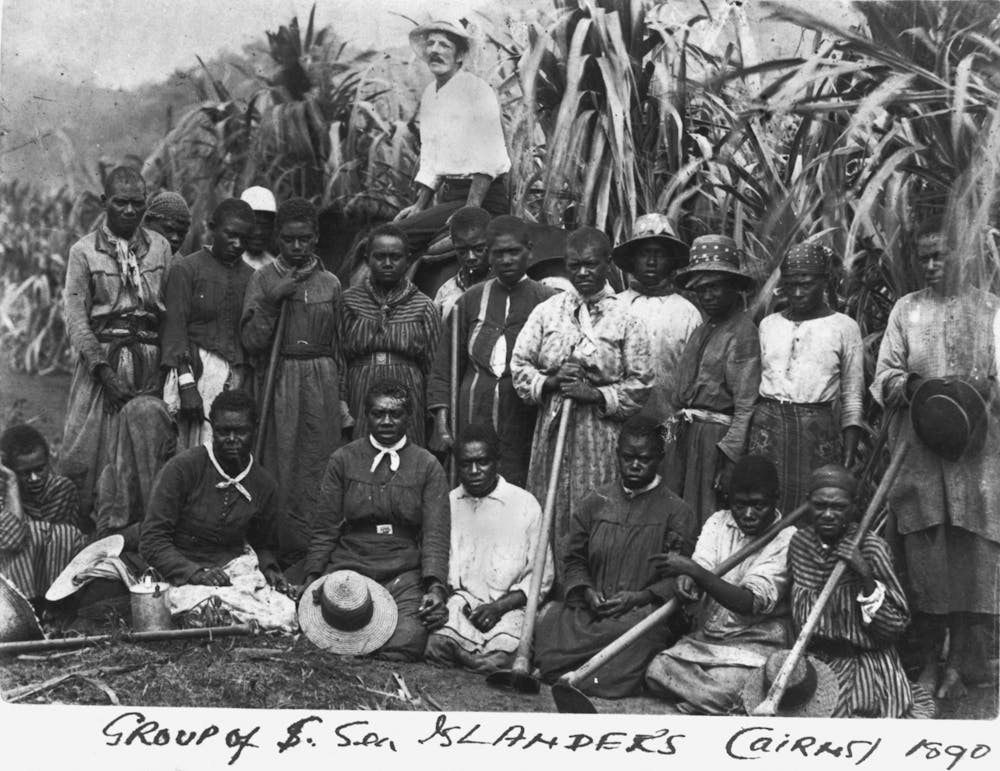
62,000 South Sea Islanders were shipped to Australia to work on plantations. State Library of Queensland
Some 62,000 people were shipped to Australia between 1863 and 1904, mostly to Queensland, where they worked mainly in the sugar trade.
These workers hailed from islands in what are now New Caledonia, Vanuatu, the Solomon Islands and east of Papua New Guinea. Some were abducted, while others came after signing dubious contracts.
All were treated somewhere between poorly and viciously. They suffered the highest death rate by far of any contemporaneous immigrant group to Australia.
Such ignorance of this history is not for a lack of trying on the part of Australian South Sea Islander people.
In the nearly 30 years since government recognition, they have made a concerted effort to educate people in Australia and beyond about their history and culture.
The creator and initial producers, who are white, strove to make Black Snow a genuinely collaborative effort.
Kaylene Butler, a descendant of a trafficked man from Vanuatu, signed on as a producer. Boyd Quakawoot, of mixed Indigenous and South Sea Islander ancestry, joined the writing team. Cinematographer Murray Lui was born and raised in the Torres Strait. Marion Healy contributed her valuable expertise as a cultural and historical consultant.
There is a sense of a genuine collaborative effort behind Black Snow. Stan
The involvement of Australian South Sea Islander creatives is evident right from the title sequence, co-designed by Australian South Sea Islander visual artist Jasmine Togo-Brisby.
Singer-songwriter Ziggy Ramo, who also appears as the character Ezekiel, created the music with composer Jed Palmer. Their work included a recording trip to Tanna Island, Vanuatu.
The cast includes 14 Australian South Sea Islander actors. Considering that 12 of them are appearing on screen for the first time, the power of the acting – especially leads Talijah Blackman-Corowa (Isabel) and Jemmason Power (Hazel) – is remarkable.
The show portrays the central place of faith and the church in the community. And although the pastor is Isabel’s father, the community really revolves around the Australian South Sea Islander women.
The gentle and deep friendship between Isabel’s mother (Seini Willett) and aunt (Lisa Blackman), and the way they resolve conflicts between others, is particularly affecting.
A fight for recognition
The scenes in 1994 showcase the Australian South Sea Islander community, but in the present-day scenes Cormack takes centre stage. The casting of Fimmel risked a problematic “white saviour” narrative, but the show carefully balances the two timelines to centre the stories of the Australian South Sea Islanders.
Black Snow steers away from a white saviour narrative. Stan
It has been a long fight for recognition in Australia.
Women like Faith Bandler and Patricia “Patsy” Corowa were a part of an intricately connected global Black Power movement. From the late 1960s, activists in Australia collaborated with Black activists in the Pacific, Caribbean, United States and elsewhere to fight for rights and power.
This struggle is ongoing and remains global. Isabel includes a Black Power salute in a mural she paints in her last weeks alive. In the present-day, Isabel’s niece Kalana (an excellent Eden Cassady) expresses solidarity with the Black Lives Matter movement. She leads a small group of teenage activists to repeatedly graffiti Ashford’s statue with red paint and the chilling figure of 62,000.
Our hauntings
The show has an important message about conditions today for Pacific workers who are vital to Australia’s farming sector.
Current labour regulation prioritises employers’ profit over seasonal Pacific workers’ rights.
This pacy murder mystery reminds us slavery and exploitation are not safely in the past. Their legacies remain, and should haunt us all.
Clare Corbould has received funding from the Australian Research Council. She is a member of the Australian Greens. She has collaborated previously with artist Jasmine Togo-Brisby, mentioned in this article.
Hilary Emmett is a member of the UK Labour Party. She has collaborated previously with artist Jasmine Togo-Brisby, mentioned in this article.
The greenlight has been given to University of the South Pacific vice-chancellor, Professor Pal Ahluwalia, and Dr Padma Lal, to return to Fiji by Prime Minister Sitiveni Rabuka.
Exiled Professor Ahluwalia currently resides in Samoa and Dr Lal in Australia.
Rabuka has made it clear today that both of them are free to enter the country.
“I am ready to meet Dr Lal and Professor Ahluwalia personally,” he said.
“I will apologise on behalf of the people of Fiji for the way they were treated.”
Dr Lal had been prevented from coming to Fiji with her husband’s ashes for them to be taken to his birthplace at Tabia, near Labasa.
First anniversary Today marks the first anniversary of Professor Lal’s death.
Rabuka said prohibition orders against Professor Brij Lal and Dr Lal, as well as Professor Ahluwalia, were “unreasonable and inhumane” and should never have been made.
He had promised his government would bring to an end the injustices suffered by Professor Ahluwalia, and Professor Lal.
“I received a clarification today from the Department of Immigration that neither Dr Padma Lal nor Professor Ahluwalia were the subject of written prohibition orders,” he said.
Josefa Babitu is a Fiji Sun reporter. Republished from the Fiji Sun.
Fiji’s new Deputy Prime Minister and Minister for Finance Professor Biman Prasad says the good policies of the government that are in place will continue.
He said policies would only change through consultation and dialogue.
“People understand the policy direction of the new government,” Professor Prasad said.
“But that does not mean that tomorrow, we’re going to change every policy or everything that was being done or has been done in the past.
“We will review — we will look at those policies. Good policies that are there will continue.
“It will never be about changing policies willingly without thinking through, without consultation, without dialogue.”
He said one of the hallmarks of the style of the new government would be to make policies with appropriate consultation, appropriate evidence and through dialogue.
“So that the implementation of the policy is not only simple, easy, but also that people understand generally the impact of those policies,” Professor Prasad said.
“So yes, we will do this with humility with understanding and keep good policies and build on good policies that are there.”
Rakesh Kumar is a Fiji Times reporter. Republished with permission.
Fiji has finally reached the other side of the long and winding road that was the 2022 general election and can enjoy the festive season with a new leader decided.
Sitiveni Rabuka is Fiji’s first new leader in 16 years, but the work has only just begun for his three-party coalition government.
Rabuka was elected with 28 votes to 27.
“It was a very close margin,” Social Democratic Liberal Party (Sodelpa) youth forum president Ben Daveta said.
From the polls to Parliament, every decision was balanced on a knife’s edge.
Then it took the king-makers Sodelpa two split-votes to choose a coalition partner — and even in the final secret ballot to elect a prime minister, someone in the opposition ranks voted for the other side.
It has been a frantic time, Daveta said.
“Well, first of all, I’ve really been trying to get my breath for the last few minutes and it was nerve-wracking.
Former coup leader Sitiveni Rabuka emerges after being named prime minister of Fiji. Image: RNZ Pacific
“Democracy came through, their prayers came through.”
Prominent Sodelpa member and democracy advocate Pita Waqavonovono said this is the way forward.
He expressed a sense of excitement to “make Fiji better again”.
Pita Waqavonovono (left) and Ben Daveta … “Democracy came through, their prayers came through.” Image: Kelvin Anthony/RNZ Pacific
“It is time for us to have a real democracy and FijiFirst has shown an unwillingness to govern democratically,” Waqavonovono said.
In its first 100 days Rabuka’s government must find a way to unite Fijians and tackle the challenges of a nation emerging from the pandemic.
Congratulations sent to Fiji Congratulatory messages continue to pour in for Rabuka.
Congratulations to the new PM, SLR, of Fiji and the Coalition. Vinaka vakalevu to the outgoing government of former PM , FVB and Fiji First for your service to our region. Best wishes to the people of Fiji as they witnessed the peaceful transfer of powers, a democratic process.
Congratulations to Hon. Sitiveni Rabuka @slrabuka on his assumption of office as Prime Minister of Fiji. We believe our bilateral relations will be further strengthened to better benefit our two countries and peoples.@FijianGovtpic.twitter.com/AIeRkHrqyj
The Embassy of France congratulates @FijianGovt on the conduct of the General Elections. Best wishes to the new Prime Minister Honorable @slrabuka, @alliancefj@nfpfiji@SODELPAHQFiji and all elected Members of Parliament in their high offices.
Pacific Islands Forum Secretary-General Henry Puna congratulated Sitiveni Rabuka on his appointment as Prime Minister of the Republic of Fiji.
“Fiji has come through a general election and its subsequent parliamentary milestone and can now fully enjoy the full measure of this festive season,” Puna said.
Former Prime Minister Voreqe Bainimarama . . . acknowledged for his leadership as the Chair of the Pacific Islands Forum. Image: Samuel Rillstone/RNZ Pacific
Puna also acknowledged former Prime Minister Voreqe Bainimarama for his leadership as the Chair of the Pacific Islands Forum (PIF).
Puna thanked Fiji for upholding the values of peace and goodwill as Pacific leaders together work towards a productive and successful 2023.
This article is republished under a community partnership agreement with RNZ.
Source: The Conversation (Au and NZ) – By David Bean, Senior Lecturer in Microbiology and Fermentation Technology, Federation University Australia
Shutterstock
Drinking alcohol has been part of Australian culture for at least 240 years, and perhaps millennia prior.
In recent years, however, there’s been a growing trend towards opting for low- and no-alcohol versions of traditional drinks. Just check out the soft drink aisle of your supermarket if you need proof.
Non-alcoholic drinks have been on the market for decades, but for a long time their range was limited and, in most cases, the flavours were inferior to their alcoholic counterparts.
Now online retailers (some of which specialise in non-alcoholic drinks) are stocking up to 100 different low- or no-alcohol beers and a similar number of non-alcoholic wines – with the majority produced in Australia.
What’s behind the big boom in this side of the industry? And where might it go from here?
With a rise in demand, most global beer brands now offer zero-alcohol substitutes. Shutterstock
It all starts with fermentation
Alcoholic beverages are produced via microbes, most commonly yeasts, which convert sugars to ethanol (alcohol) in the process of fermentation.
In addition to producing ethanol, fermentation also leads to other desirable flavour changes. This means the fermentation process is integral to the flavour of beer and wine, and we can’t just forgo it to make low- and no-alcohol drinks.
Consider the difference between unfermented grape juice and wine: it’s not merely the presence of alcohol that creates the flavour profile of wine!
As such, the production of most non-alcoholic wine and some non-alcoholic beer starts with the typical fermentation process, after which the alcohol is removed using a few different advanced systems.
High-tech systems changed the game
The two most common ways to produce no-alcohol beer and wine involve filtration and distillation. Both systems are technologically advanced and expensive, so they’re usually only used by larger producers.
In membrane filtration – and specifically one technique called “reverse osmosis” – beer and wine are pumped under pressure through filters with holes so small they separate compounds based on their molecular size. Relatively small molecules such as water and ethanol pass through, but others can’t.
The water is continuously added back to the mix of the larger “flavour” compounds to reconstitute the beer or wine. This process is continued until all the ethanol is removed.
Another process is distillation, in which compounds are separated based on the temperature at which they boil. Therefore, distillation requires heat, and heat changes the flavour of beer and wine – leading to a less desirable product.
To minimise the impact on flavour, the distillation used to make no-alcohol products happens under very low pressures and in a vacuum. In these conditions ethanol can be removed at around 35℃-40℃, as opposed to 80℃ under atmospheric pressure. This is based on the same principle that dictates why water boils at a lower temperature at altitude than it does at sea level.
A wide variety of beer styles are now available in alcohol-free forms. Shutterstock
Small brewers are becoming master craftspeople
While the increase in low- and no-alcohol beer production reflects consumer preference, it’s also partially driven by the wide range of craft beers now available.
Many craft breweries in Australia are producing delicious low-alcohol beer without additional expensive equipment. They do this by carefully manipulating the fermentation process using two main methods.
In the first method, brewers intentionally reduce the amount of simple sugars available for the yeast. With less sugar to use, the yeast produces less ethanol.
There are a few ways to achieve this, including using a higher- or lower-than-normal temperature during mashing (the process of extracting simple sugars from the barley grain). The brewer can also stop the fermentation process early, before too much sugar is converted into alcohol.
The brew deck at Federation University has all the tools to make a great brew, including conical fermentation vessels. Federation University, Author provided
The second method involves using different yeasts. Traditionally most beers have been produced using the yeast Saccharomyces. This genus has been domesticated over millennia to make beer, wine and bread.
But there are thousands of species of yeast, and some aren’t adept at producing ethanol as a byproduct. These yeasts are gaining popularity in the production of low-alcohol beers. They still provide the flavour compounds we expect, but with very low levels of alcohol (sometimes even lower than 0.5%).
Although most yeast strains are likely to be commercially available and previously described, some breweries are still secretive about the exact strain they use to produce low-alcohol beers.
There are various companies dedicated to developing new yeast strains for the brewing market. Besides using naturally sourced strains, two strains can be cross-bred to create hybrids. Shutterstock
Soon you’ll barley notice a difference
It’s difficult to make low- and no-alcohol beer or wine that tastes exactly like the full-strength counterparts. That’s because ethanol contributes to the flavour profile of alcoholic drinks, and it’s more evident in wine (typically about 13% alcohol) than beer (about 5%).
The removal of ethanol and water also leads to the removal of compounds with smaller molecules and volatile compounds (chemicals that vaporise under normal atmospheric conditions) – although manufacturers do their best to add them back to the final product.
Similarly, changing mash conditions or using unconventional yeast strains for low-alcohol beer also leads to different flavour profiles than those achieved through a “normal” process.
Despite these challenges, producers are constantly improving their products. Our preliminary investigations have shown even some experienced beer drinkers can’t tell non-alcoholic beers apart from their alcoholic counterparts.
So if the mood or circumstance warrants it, don’t hesitate to try a low- or no- alcohol beer or wine this festive season (or throughout the year). You may be surprised by how the range and quality of these products has improved. And of course, the benefits are obvious.
The authors do not work for, consult, own shares in or receive funding from any company or organization that would benefit from this article, and have disclosed no relevant affiliations beyond their academic appointment.
We’ve all been at a work or family gathering when someone has offered a seemingly authoritative statement about the way the law operates.
Without some knowledge of the field of law, listeners may simply nod their heads sagely and tut-tut about the perceived inadequacies and injustices that have been revealed.
But there are many misconceptions about the law. Here are 8 common falsehoods.
1. If people laugh at my joke then it’s not sexual harassment
This is not correct. Sexual harassment is defined as any unwelcome sexual behaviour that makes a person feel offended or humiliated, where that reaction is reasonable in the circumstances.
A survey by the Australian Human Rights Commission found over the past five years, one in three workers experienced sexual harassment in their workplace. The survey found reporting of workplace sexual harassment remains alarmingly low, at only 18%.
Women (41%) were far more likely than men (26%) to experience harassment. More than three-quarters of harassers were men.
In November, the federal parliament passed the Respect@Work bill which creates a positive duty on all employers to implement measures to prevent sexual harassment.
2. I don’t have to give my name and address to police, as I have a right to silence
The right to remain silent when questioned by police is a fundamental protection provided by the common law. However, this right is not absolute, and does not mean you don’t have to give them certain personal information.
Legislation in every Australian jurisdiction gives police the right to ask for details that will assist their enquiries. For example, in South Australia, you must provide your full name, date of birth and address if a police officer has reasonable cause to suspect you have committed or are about to commit an offence, or if you may be able to assist in the investigation of an offence.
It’s an offence to refuse to give police your personal details, or if you provide false or misleading information. Police can also ask you to identify drivers of motor vehicles in which you’re travelling. But they can’t demand that you answer any further questions, and must give you a caution that anything you might say may be later used in evidence.
Where there has been a violent arrest, or the arrested person is unable to appreciate or understand their rights, the caution must be repeated once the arrested person has settled down or sobered up.
3. My boyfriend moved in with me a year ago and left last week, so now I have to give him half of my assets
For a person in a de facto relationship to be successful in any property settlement, they must satisfy the Family Court that:
the relationship has lasted at least two years
or the parties have had a child together
or the relationship was registered under a state or territory relationship registration scheme
or one party has made substantial financial or non-financial contributions to the other party and that serious injustice would result if an order were not made.
Also, there’s no presumption of a 50:50 split in Australian family law. In determining a just and equitable division of property, the court will consider the parties’ respective assets, the contributions each party has made to the relationship, and each party’s future needs.
4. I’m not responsible for things others write on my Facebook
While it may be hard to believe, you may still be liable for things others post on your social posts, even if you don’t know about them.
In 2021 the High Court ruled that media companies could be liable for defamatory comments made by readers on their Facebook posts. The ruling extends beyond Facebook and likely applies to any social media platform including Instagram, TikTok, Twitter and LinkedIn.
It also extends beyond media companies and covers businesses and private individuals, including those running online community groups and forums, such as administrators of Facebook groups.
But watch this space – state and territory attorneys-general have just given in-principle agreement to amend defamation laws to protect “internet intermediaries” such as social media administrators. The details are yet to emerge but are not likely to defend egregious comments that should have been noticed and removed by a person posting on their own social media platforms.
Under current case law, you’re responsible for what others write on your social media posts. Shutterstock
5. I can leave my kids in the car for a few minutes so long as I leave a window open
This is not true. While every jurisdiction in Australia has slightly different laws, it’s generally an offence to leave a child unattended in a car regardless of whether they suffer any distress or injury.
Any police attention, and charges that may flow from that, will depend on the circumstances of the alleged neglect, including the ambient temperature, the extent of child distress (if any), and the proximity of the driver including the time taken for them to, for example, pay for fuel.
6. I can urinate in public if it’s on my back tyre
If this was once the law with horses and drays, it is no longer the law today. Any such displays in public (especially in a built up area) can amount to “offensive behaviour” and can be prosecuted.
However it’s entirely contextual. For example, marathon runners who receive urgent calls from Mother Nature would be unlikely to be prosecuted.
7. Saying you wish Charles would cark it so William can be king is treason
The offence of treason still exists, but one must do more than declare disparaging (or even treacherous) thoughts about the reigning monarch to excite the authorities into prosecuting.
The Commonwealth Criminal Code section 80.1 sets out what amounts to treasonous behaviour. You really have to be serious about acting on your declarations before the treason threshold is reached.
8. Australian consulates overseas are Australian territory
This is a common misconception. Article 31 of the Vienna Convention on Consular Relations provides some protection to consular premises from outside intrusion.
This includes a rule that the police of the host state can’t enter consular premises without the consulate country’s permission, unless it’s an emergency. But this doesn’t turn the consulate into Australian territory.
Rick Sarre is an office bearer in the Dunstan sub-branch of the SA Labor party.
Sarah Moulds receives occasional funding from the Law Foundation of South Australia Australia. She is the Director of the volunteer-based Rights Resource Network of South Australia and a member of the Law Society of South Australia.
Juliette McIntyre, Lisa Parker, and Michelle Fernando do not work for, consult, own shares in or receive funding from any company or organization that would benefit from this article, and have disclosed no relevant affiliations beyond their academic appointment.
A rally to free John Zarb, December 1968.Search Foundation and the State Library of New South Wales
One of the first moves of the newly elected Whitlam Labour government in December 1972 was to free seven men imprisoned for their beliefs. Their crime had been refusal to comply with the National Service Act, a so-called “lottery of death” that sent some 15,300 young Australians to fight in Vietnam. Two hundred of them never came home.
The issue of national service – often dubbed “the draft” following American vernacular – was perhaps the most powerful in the anti-war movement’s arsenal. “Draft resisters” mobilised public sentiment with their heroic stands, respectable mothers campaigned to “Save our Sons” and, as I explore in a newly published book chapter, the Australian wing of Amnesty International classed these men as “prisoners of conscience”.
Today, Australia grapples again with the question of criminalising conscience. Laws in several Australian states impose harsh penalties on the use of “direct action” by climate change activists. Fifty years ago, similar questions of a right to disobey sparked fierce debates: where should the legal limits of conscience lie?
University students protest the National Service Act outside the Anzac Memorial in Hyde Park, Sydney. Courtesy of the Search Foundation and State Library of New South Wales
In Australia, it is a crime not to kill
National service was re-introduced in Australia in 1964, with a previous scheme having quietly ended in 1959. The first “nashos” were committed to Vietnam in 1966. The scheme was highly selective – by its end some 800,000 20-year-olds had registered and less than 10% had been “called up”.
Opposition to national service emerged almost immediately, through such groups as the Youth Campaign Against Conscription. In November 1966, Sydney schoolteacher Bill White became the first person imprisoned for failure to comply with the act. He had applied for conscientious objector status almost a year earlier, but been denied because he did not fit the strict criteria.
Public outrage played a part in White’s early release in December 1966, but over time penalties became more harsh. John Zarb, a part-time postman, received a two-year sentence in October 1968 for refusing to comply with his call-up notice. His opposition to the Vietnam war only, rather than war in general, made him ineligible for objector status.
These moral-political stances encouraged further opposition. As well as releasing jailed objectors, Whitlam’s incoming government threw out cases against 350 individuals. For the anti-war movement, these cases demonstrated the conflict’s contradictions. As one activist leaflet put it: “In Australia, it is a crime not to kill.”
The politics of conscience
To a nascent human rights movement, however, the issue was not as clear-cut. Amnesty International, founded by the British lawyer Peter Benenson in 1961, established an early foothold in Australia. A Victorian section was founded in March 1962, and groups in other states soon followed.
One of the group’s appeals was its rejection of “Cold War” politics. By adopting “prisoners of consciences” from the first, second and third worlds, they could claim impartiality, while the use of letter writing as a tactic invoked the power of global opinion.
Yet the definition of a prisoner of conscience in the group’s early years proved controversial. To meet Amnesty’s definition, a prisoner needed to have been jailed for crimes of opinion and have not advocated violence. Infamously, this definition excluded Nelson Mandela. For Amnesty, the question of whether objectors like White or Zarb should be considered prisoners of conscience divided the Victorian and New South Wales sections.
Draft Resisters Union meeting, 1972. Courtesy of the Search Foundation and State Library of New South Wales
The Victorians believed those who “register for national service and apply for exemption”, but whose “applications fail either through some apparent miscarriage of justice or because the law does not presently encompass their objections […] are prima facie eligible for adoption”. However, those who “basically refuse to co-operate with the National Service Act” merely “maintain a right to disobey a law which they believe to be immoral” – and adopting them would “seriously damage […] our high repute”.
The New South Wales section condemned this “legalistic interpretation”. Instead, it insisted “the Non-Complier in gaol for conscientiously held […] views suffers no less than one who has tried in vain to act ‘according to the law’ ”. The Victorians’ belief that Amnesty should accept some degree of compulsion in democratic societies was also challenged: conscription was in fact a universal problem that occurred on both sides of the “Iron Curtain”.
Is it right to resist?
In the end, the views of the New South Wales section won out. Amnesty sections around the world adopted Australian non-compliers.
This clash of principles reminds us that human rights have never been straightforward. Rather, these ideas have long been open to contest and reinterpretation. From today’s vantage point, it also seems the Victorian section’s belief that the right to disobey could be limited was wildly optimistic.
Indeed, the sentencing of climate protester Deanna “Violet” Coco to 15 months in jail for the crime of disrupting traffic in New South Wales shows that the questions posed by Amnesty in the 1960s are very much still with us. The climate emergency is in many ways the Vietnam of today’s young people. The 50th anniversary of the release of resisters to that conflict should give today’s decision-makers pause for thought.
Jon Piccini does not work for, consult, own shares in or receive funding from any company or organisation that would benefit from this article, and has disclosed no relevant affiliations beyond their academic appointment.
Source: The Conversation (Au and NZ) – By Meg Elkins, Senior Lecturer with School of Economics, Finance and Marketing and Behavioural Business Lab Member, RMIT University
Shutterstock
Nudging – the idea that simple changes to how a choice is presented can lead people to make better decisions – has been one of the most popular ideas to emerge from economics in the past two decades.
But nudging is now under attack, entangled in the bitter partisan dispute over pandemic policy responses.
Since the idea was popularised in the 2000s, governments – particularly democratic ones – have been enthusiastic about the potential to “nudge” people towards choices that are better for them and society – be it recycling, exercising more, eating more healthily or gambling more responsibly.
Every individual transaction that has a social cost is what economists call an “externality” – a textbook scenario for some form of government intervention into the market.
Nudges promise interventions that are both cheap and benign. They may be as simple as changing the layout of a bill statement or painting racetrack lines to challenge you to take the stairs rather than an escalator.
Track lines at Jungfernstieg station in Hamburg, Germany.
But the use of nudges during the COVID pandemic – whether to encourage people to wear face masks or to present statistical information on the effectiveness of vaccines – has made nudges controversial.
Media outlets such as the Daily Telegraph and The Epoch Times have characterised nudges as “psychological tricks” and “manipulation” to “increase compliance”.
Such framing suggests widespread misunderstanding about what nudges are, how they work, and what they can achieve.
What are nudges?
To recap, a “nudge” is about making a socially desirable decision easier or more attractive. That is all.
A classic example is organ donation. Most people support it. But few make the effort to “opt in” to donation schemes attached to driver’s licences. Making schemes “opt-out” has increased donor rates from less than 20% to 98%.
Nudge, by Richard Thaler and Cass Sunstein. Yale University Press
They are clear that changing “choice architecture” should never limit options or significantly change incentives to choose any particular option.
In other words, anything that limits free choice is not a nudge:
To count as a mere nudge, the intervention must be easy and cheap to avoid. Nudges are not mandates. Putting fruit at eye level counts as a nudge. Banning junk food does not.
This potential – to influence behaviour without limiting individual choice – has led democratic governments to establish dedicated units, drawing on behavioural research, to advise on “choice architecture”.
The United Kingdom was first in 2010, creating a Behavioural Insights Team within the UK Cabinet Office. The United States, Australia, Canada, the Netherlands, Germany, Singapore and Japan have followed. In 2018 the OECD counted more than 200 institutions globally applying behavioural insights to public policy.
Like other government agencies, these units are publicly accountable. They are not secret and clandestine as some critics have claimed. Indeed, the attempt to portray them as such has required a considerable twisting of facts.
For example, the “secret documents” the Daily Telegraph claimed it needed a Freedom of Information request to “reveal”, were actually available on the website of the NSW Behavioural Insights Unit.
You can read how the unit framed choices for youths to wear face masks here, and about its behavioural strategies to increase COVID testing here.
How well do nudges work?
Ironically, the attempt to paint nudges as sinister is occurring at the very time the effectiveness of nudges is being hotly debated within academia.
An analysis of more than 200 nudging studies published in December 2021 found the average effect of nudges was “small to medium”.
A subsequent study published in June 2022 was even less positive. It argued the results of the December 2021 paper were due to “publication bias” – with journals being more likely to accept papers reporting the effectiveness of nudges.
Other researchers argue that real interventions tend to be less effective than the experiments academics do in their labs.
A January 2021 analysis of 126 nudge trials in the US involving 23 million people found nudges, on average, increased good choices from 17.2% to 18.6% – a 1.4 percentage-point effect. This compared with academic studies finding nudges increased good choices by 8.7 percentage points.
To say nudges are useless is to jump the gun. This is a developing practice. Trial and error is part of its development. We may find nudges useless in particular areas or circumstances, but highly effective for some things, or if done in a certain way.
Multiply even small positive effects of low-cost nudges by millions of people and there’s an easy case to make for the value of nudges that only change a small percentage of behaviour.
Equally, to say nudges are some sinister form of brainwashing is fanciful. There’s absolutely no evidence they can manipulate you to make a choice against your better judgement or own self-interest.
Yes, nudges are designed to influence. They can correctly be described as a form of “libertarian paternalism”. But in essence they are no different to the nudges we give ourselves, from strategically placed “notes of self”.
Portraying them as manipulative and deceptive seems to have less to do with reality than with the desire to paint particular COVID policies, and government actions more generally, in an unfavourable light.
If a nudge supported a bad policy then, yes, the nudge would be bad. But those
seeking to nudge us to towards that view ought to make their case on the merits of those policies, not on misinformation.
Swee-Hoon Chuah served a secondment to the Behavioural Economics Team of the Australian Government (BETA) in 2019.
Meg Elkins and Robert Hoffmann do not work for, consult, own shares in or receive funding from any company or organization that would benefit from this article, and have disclosed no relevant affiliations beyond their academic appointment.
What do you think of when you hear the word “immersive”?
It conjures up different things for different people. For some, it’s a simple feeling you get hitting the beach, the pool or even the floatation tank.
For others, it’s immersion through imagination – through books, theatre, exhibitions or the cinema.
For the more tech-savvy, immersion may involve picking up their phone, turning on a game console and grabbing a controller or strapping on a head-mounted display to enter a different reality.
All these interpretations are correct. Immersion is sensorial. It hits one or more of your senses – sight, hearing, touch, smell and taste. It makes you physically engage, interact and navigate with and through an experience.
Here are five different methods to immerse you this summer beyond jumping into the ocean.
For the uninitiated, augmented reality is a way to interact with digital content superimposed and interacting with the real world, usually through your mobile device.
While augmented reality hasn’t had a considerable impact post the heady days of 2016 and Pokémon GO, the team behind that worldwide smash haven’t been resting on their laurels.
Ingress Prime is an excellent option for those coming from the Pokémon experience, with a more adult open-ended story and elements of “capture the flag” mixed with old-fashioned geocaching.
During game play, you pick a team and your phone is transformed into a “scanner”, and local landmarks are turned into “portals”. Two teams compete to claim ownership of these portals.
And their brand new app Peridot, currently in beta, will be familiar to Tamagotchi owners, here with a few twists. You get to raise, care for and even breed your virtual pet with other player’s pets in order to avoid extinction.
But unlike Tamagotchis of old, you can take these creatures for virtual walks, as you explore the actual, physical world around you.
See that fancy flatscreen television sitting in the corner of the lounge? Chances are that if it was purchased in the early to mid-2010s it may have been part of the push for 3D TVs and may have even come with a bunch of 3D glasses similar to the ones you might get at the cinema.
There are some great hidden 3D gems you can watch at home.
The Young and Prodigious T. S. Spivet (2013), is a lovely example of a road movie, as our ten-year-old protagonist travels across the country to accept an award from the Smithsonian for inventing a perpetual motion machine.
Slightly more adult is Long Day’s Journey Into Night (2019), which plays like a Lynchian dream for most of its running time and features an astonishing hour-long 3D sequence presented as a single take as the film’s protagonist wanders through town.
Finally, the 2018 Oscar winner for animated feature, Spider-Man: Into the Spider-Verse is a downright trippy and loopy experience if you can find it in 3D.
3. Escape rooms
Immersive experiences don’t have to take in technology.
In an escape room, a small team bands together to solve a series of puzzles to “escape” from the “room” these puzzles are set in.
You can find many different escape rooms in almost all Australia’s capital cities. My personal favourite is the Cipher Room in Sydney’s inner west and their monochrome, film noir inspired Marlowe Hotel.
My advice is to dress up in black and white to make for a completely immersive experience, as you and your friends solve a series of clues in order to break into the hotel and retrieve some incriminating documents.
4. Virtual reality games
While embracing new tech, why not get your retro-gaming fix simultaneously?
Older gamers might remember the classic 1990s CD-Rom adventure Myst, where the player explores a mysterious island solving puzzles along the way (also serving as inspiration for thousands of escape rooms across the globe).
The game has now been re-imagined for virtual reality as a free-roaming adventure and has never looked better.
Fans of 2000s consoles systems will get a kick from Psychonauts in the Rhombus of Ruin which continues the wacky Tim Burton-esque aesthetics of the classic Psychonauts (2005), picking up the story from the end of the first adventure and taking it into new dimensions and levels.
As per the original game you take on the role of Raz, as you use his psychic powers to solve a series of puzzles to escape the Rhombus of Ruin. Terrific for a bit of lazy afternoon casual gameplay.
Fans of first-person shooters will dig the multi award-winning Half-Life: Alyx.
This is the game to play if you want to sweat it out, as you run around fighting against aliens that have taken over the Earth. Alyx’s storyline serves as a prequel to Half-Life 2 (2004), and features some hilarious voice acting from Rhys Darby as the character Russell. Highly recommended.
James Cameron has finally finished his sequel to 2009’s Avatar, and the best way to experience Avatar: The Way of Water is going to be the fully immersive experience of 4DX, a cinema experience available in most capital cities. The technology blends on-screen images with synchronised motion seats and environmental effects such as water, wind, fog, fragrance, snow and more.
Cameron’s film should offer a completely immersive experience, using the 4DX cinema’s synchronisation of 3D visuals, motion simulation and fog effects. Especially given the flying and underwater sequences, the wind and water effects should make for a completely immersive experience over summer.
Gregory Ferris does not work for, consult, own shares in or receive funding from any company or organization that would benefit from this article, and has disclosed no relevant affiliations beyond their academic appointment.
As 2022 draws to a close, I would like to thank everyone who has supported the West Papuan struggle this year. To our worldwide solidarity groups, including those within Indonesia, to Alex Sobel and the International Parliamentarians for West Papua (IPWP), the International Lawyers for West Papua, to our friends in the Basque Country and Catalonia, the Pacific Conference of Churches, the government of Vanuatu and all our supporters in the Pacific: my deepest thanks.
The struggle for West Papuan liberation is a struggle for humanity, dignity, and fundamental rights. By supporting us, you are making history in the fight against modern day colonialism.
2022 was a difficult year for West Papua. We lost great fighters and leaders like Filep Karma, Jonah Wenda, and Jacob Prai. Sixty-one years since the fraudulent Act of No Choice, our people continue to suffer under Indonesian’s colonial occupation.
Indonesia continues to kill West Papuans with impunity, as shown by the recent acquittal of the only suspect tried for the “Bloody Paniai’” massacre of 2014.
Every corner of our country is now scarred by Indonesian militarisation. This month, nearly 100 West Papuans on Yapen Island were displaced from their villages by a sudden wave of military operations. Along with tens of thousands of West Papuans displaced since 2019, they will be forced to spend Christmas in the forest, as refugees in their own lands.
We continue to demand that Indonesia withdraw their military from West Papua in order to allow civilians to peacefully return to their homes.
In July, we signed an historic Memorandum of Understanding with our Melanesian brothers and sisters in Kanaky, strengthening the bonds of friendship and solidarity that have always connected our two movements.
In October, countries including Australia, Canada, and the US called for immediate investigation of rights abuses in West Papua at the UN, while the Marshall Islands called for West Papuan self-determination. Throughout the year, we have continued to build up our infrastructure on the ground.
We are ready to reclaim the sovereignty that was stolen from us and govern our own affairs.
To all West Papuans, whether in exile, prison, in the bush or the refugee camps, I say your day will come. Though the road to freedom is long and hard, we are making incredible progress at all levels.
One day soon we will celebrate Christmas in an independent West Papua. Until then, we must be strong and united in our struggle. As our national motto says, we are One People with One Soul.
To everyone around the world reading this message, I urge you to remain steadfast in your support for West Papua. Please pray for all West Papuans who cannot celebrate this Christmas, whether in Yapen Island, Nduga, Puncak Jaya, or elsewhere. Until we win our freedom, we need your solidarity.
On behalf of the ULMWP and the people of West Papua, thank you and Merry Christmas.
Benny Wenda Interim President ULMWP Provisional Government
United Liberation Movement for West Papua (ULMWP) solidarity workers in London, United Kingdom. Image: ULMWP
Former coup leader and ex-prime minister Sitiveni Rabuka was today elected Fiji’s new prime minister, winning 28 votes to Voreqe Bainimarama’s 27.
The secret ballot vote in Parliament ends Bainimarama’s reign as leader of the country after 16 years. Bainimarama has dominated Fiji politics since he staged the 2006 military coup.
Today’s result was met with jubilant celebrations in the capital Suva with similar scenes playing out across the country on social media.
Rabuka, who staged Fiji’s first two military coups in 1987 and previously served from 1992 to 1999 as an elected prime minister, described himself as “humbled” as he left to be sworn in.
Breaking – Sitiveni Rabuka speaks to media first time after being elected Fiji’s new prime minister. He says he feels “humbled” as he makes his way to the President’s office to get sworn in. #FijiPolpic.twitter.com/C6XxeDpUxQ
Rabuka now heads a three-party coalition government consisting of his People’s Alliance, the National Federation Party led by Professor Biman Prasad and the kingmaking Sodelpa Party, led by Viliame Gavoka.
Gavoka had this to say to reporters following the vote:
‘Democracy has won’ “Democracy has won. We live in a wonderful country.”
The NFP’s Dr Prasad said his party was happy to work with everyone and even the opposition.
Former Prime Minister Voreqe Bainimarama . . . defeated after 16 years heading the Fiji government. Image: RNZ Pacific
Bainimarama appears to have conceded defeat peacefully, and spoke to reporters.
“I want to thank the supporters of FijiFirst,” he said. “We still are the biggest political party in there, so I want to thank them for that.”
“This is democracy, and this is my legacy, the 2013 Constitution,” he said.
Breaking – Frank Bainimarama thanks the FijiFirst supporters and says “this is democracy and this is my legacy. The 2013 Constitution.” #FijiPolpic.twitter.com/irLMTdHIRV
Bainimarama was asked if he would be opposition leader, and laughed and said, “I hope so.”
Cabinet named soon Rabuka is expected to announce the members of his cabinet in the coming days.
Where the three Sodelpa MPs end up will be the first indication of what was agreed to in the coalition negotiations.
Tuvalu’s Minister for Foreign Affairs Simon Kofe was one of the first foreign politicians to congratulate Rabuka.
This article is republished under a community partnership agreement with RNZ.
Congratulations to 🇫🇯’s new Prime Minister Hon. Sitiveni Rambuka. Congratulations also to the new Speaker of the House Ratu Naiqama Lalabalavu and Deputy Speaker Hon Lenora Qereqeretabua @lenoraqfj. Looking forward to working with the new Government. 🇫🇯🤝🇹🇻
Thousands of people will be cancelling their Christmas Day plans thanks to the invisible grinch, covid-19.
Leading epidemiologist Professor Michael Baker estimates 85,000 people will be in isolation by then.
He says gathering outdoors or in well-ventilated spaces is key to limiting the Christmas spread of covid — and testing beforehand.
“No-one will thank you for turning up and infecting other people, particularly if there are vulnerable people there. This is a time to be responsible and test if you have got symptoms, and then act accordingly.”
Crunching the numbers, Professor Baker said we could expect about 12,000 new infections on Christmas Day, based on the daily average of reported cases, plus the same number again of unreported ones.
Covid Modelling Aotearoa programme co-leader Dion O’Neale agreed.
“We’re sitting at the peak of a relatively decent-sized wave at the moment, so definitely lots of people will end up missing Christmas because they’re a confirmed case and will have to isolate.”
“They just don’t report a case when they’re having a fun time, that’s almost certainly happened this week with schools knocking off and a bunch of people leaving work.”
‘We have had to actually cancel Christmas’ One Auckland man, who wished to remain anonymous, said Covid had slipped through the chimney at his house – he had two family members who tested positive this week.
“Sadly we have had to actually cancel Christmas. We had been really looking forward to getting together with my sister and her kids for a big family get-together… and I had to phone her yesterday and say, ‘Look, I’m really sorry we can’t do it, it’s all off’.”
They would take Christmas Day as it came and delay their family gathering.
“We’re just going to have to try and make it as nice as we possibly can, depending how people are feeling. It could be that some people are feeling unwell.”
Auckland woman Melanie Bruges will get out of isolation in time to celebrate Christmas Day with family.
“We’re having family over on Christmas Day on Sunday, so I’m going to keep a really low-profile until then. We’ll probably test on Christmas Day before everybody comes over.”
If her husband or their seven-year-old tested positive, they would postpone.
“We’ve got five grandparents around for Christmas Day and we wouldn’t want them to be exposed to anything just for the sake of a meal. We can always put it off.” Free biscuit not worth the risk For the thousands who were flying to their Christmas Day destination, O’Neale said it paid to be cautious and mask-up.
“Is it really diminishing your travel experience if you don’t get your free glass of water and a dry biscuit on the plane? Would you rather have a dry biscuit or covid?”
Professor Michael Baker . . . “A matter of making small changes in how you do things just to make it a lot safer for everyone.” Image: RNZ News
He and Professor Baker did not want the grinch to steal Christmas.
“It’s absolutely essential for your health, wellbeing and enjoyment of life to get out and reconnect with your family and friends and have an enjoyable summer, that is so important,” Professor Baker said.
“Covid should not get in your way at all, and it’s a matter of making small changes in how you do things just to make it a lot safer for everyone.”
This article is republished under a community partnership agreement with RNZ.
This was the message to Fiji from kingmakers Social Democratic Liberal Party (Sodelpa) management board member and MP Tanya Waqanika after their meeting in Suva ended this evening.
Asked whether her Christmas wishes meant good news for the people of Fiji, she responded: “Free at last.”
Waqanika was one of the 26 management board members who participated in the secret ballot — which voted in favour of a coalition with the People’s Alliance and the National Federation Party, the second time in barely 72 hours that the board backed the coalition.
This vote confirms the end of 16 years of domination of Fiji politics by 2006 coup leader Voreqe Bainimarama — half as the military leader and the rest as an elected FijiFirst party prime minister.
It will usher in a new era with coalition rule and 1987 coup leader and former prime minister Sitiveni Rabuka heading the government.
‘Anomalies’ forced new vote In Tuesday’s vote, the numbers were 16-14 in favour of the People’s Alliance-led coalition. However the validity of that vote was challenged over claimed “anomalies”.
Party vice-president Anare Jale said the next step now was to work on a coalition agreement.
Sodelpa vice-president Anare Jale speaks to news media in Suva tonight to announce their coalition with the People’s Alliance Party-NFP. Image: Timoci Vula/The Fiji Times
He said that agreement would detail all the information and work that would be taking place today and during the holidays.
“Hopefully, something will be concluded and signed on Wednesday next week,” Jale said at the press conference after the day-long Sodelpa meeting.
Timoci Vulais a Fiji Times reporter. Republished with permission.
#LATEST Fiji’s kingmaker, Sodelpa has announced it’s joining Sitiveni Rabuka-led People’s Alliance-National Federation (PA-NFP) coalition to form the next government.https://t.co/57wLytvuHf
The Social Democratic Liberal Party (Sodelpa) today decided to go into a coalition government in Fiji with the People’s Alliance and the National Federation Party, reports Fijivillage News.
Sodelpa vice-president Anare Jale announced that 13 management board members voted for the People’s Alliance/NFP coalition led by Sitiveni Rabuka while 12 votes backed the FijiFirst party of incumbent prime minister Voreqe Bainimarama.
Jale told news media Sodelpa was ready to be part of the government with the Alliance and NFP.
According to Fijivillage, Sodelpa leader Viliame Gavoka said democracy had won and the party had observed the process to its fullest.
Gavoka said it was very close again and came “down to the wire”.
He said Sodelpa made the decision fully committed, ensuring that it had the best interest for the people of Fiji, reported Fijivillage.
Police Commissioner Brigadier-General Sitiveni Qiliho said this today in a statement.
Yesterday, People’s Alliance general secretary and registered officer Sakiasi Ditoka lodged a police complaint against Sayed-Khaiyum, alleging comments he made during a news conference this week incited racial hatred, violence and communal antagonism.
Commissioner Qiliho said the complaint had been handed over to the CID and that investigators were conducting their analysis before the next course of action was decided.
Sodelpa meeting Meanwhile, Talebula Kate reports that members of the media covering the Sodelpa management board meeting at the Southern Cross Hotel in Suva have now been allowed near the hotel but remain outside the premises on the public walkway.
This development came after media members had been standing in the rain for more than 30 minutes some distance away from the hotel entrance.
Media personnel are allowed into the meeting venue but can only stand outside.
Today’s meeting is for members of the Sodelpa management board to vote for the party they will form a coalition with to form the next Fiji government over four years.
Ian Chuteis a Fiji Times reporter. Republished with permission.
The news of a hot chilli sauce shortages earlier this year – due to high temperatures and drought in agricultural regions – prompted warnings to stock up on supplies or forego adding this flavor to your food. But what prompts people to want to do this in the first place?
We are usually born with an aversion to the sensations like the taste of chilli on our tongue. This isn’t surprising because the key ingredient in chilli is a compound called capsaicin, which causes a painful and even burning sensation when it comes into contact with sensitive areas of our skin, eyes and mouth. Little wonder that it is also a key ingredient in pepper spray.
But in smaller, tolerable amounts, we can adapt to the sensations evoked by chilli and find them desirable.
Chilli can even act as a natural opiate, making our bodies release endorphins in a similar way to a “runner’s high”.
A taste sensation
We react to capsaicin because we have a family of receptors in sensory nerves lining the epithelial (outer) layers of our skin, naso-oral and gastrointestinal tract. These bind to the capsaicin and relay signals to our brain.
These receptors are temperature sensitive and respond to heat in addition to being activated by capsaicin.
In the case of biting into a chilli pepper, the release of capsaicin onto our tongue generates a sensation that ranges from mild tingling to burning heat, depending on the degree to which we have adapted to it.
What distinguishes the sensation compared to other flavours – for example, salty, sweet and bitter – is that it continues long after we have swallowed the mouthful of food containing the chilli. This is because capsaicin is soluble in fat so it is not easily washed off from its receptors on our tongue and mouth by drinking water. In this way, the sensation can intensify with further mouthfuls of chilli-containing food.
We experience capsaicin as a burning sensation that is amplified when the temperature of the food is hot. Our brain interprets this as both pain and excessive warmth, which is why our facial skin flushes and we start to sweat.
Well, firstly, all that burning increases saliva production, a response that dilutes the heat as well as enhancing the ability to chew the food. This also dissolves and spreads other flavours in food around the tongue, which enhances the perception of these flavours.
Some volatile organic compounds with flavour can also rise up from the back of the mouth to the nasal sensors when the food is swallowed. Think of the pungent hit of wasabi that comes with sushi or the complex mix of aromas in a Thai red curry. Relatively bland food like rice has its flavor increased by the addition of chilli.
Another factor is that endorphins are released in response to the painful stimulus, which provide their own pain-numbing and mood-enhancing effects. This is a similar situation to people who get addicted to running – the effect of endorphins released by prolonged or intense exercise is to reduce feelings of pain and make us feel good.
People may increase their consumption of chilli as their response to capsaicin receptors adapts and they develop more tolerance and preference for the taste and its effects.
However, it is possible to have too much chilli, shown in the link between high daily consumption of chilli (more than 50 grams – or three or four tablespoons – per day) and declines in memory.
Endorphins in a bottle or torture test? Shutterstock
COVID and taste
One thing people have noticed as a frequent side-effect of COVID infection and some antiviral treatment is that their sense of taste and smell is temporarily reduced or lost.
While this eventually recovers in most people, it can go on long after the initial illness. This loss of the ability to smell and taste flavours in food (anosmia and ageusia) leads to reduced enjoyment and quality of life.
Researchers have focused on the mechanisms through which the different COVID variants affect olfactory neurons (the parts of the brain that process and respond to smell) and supporting cells in order to find treatments.
These include smell training using essential oils, which may assist people whose smell remains impaired longer than a month post-COVID. Chilli might also assist, as a taste enhancer.
One study by a meals company of 2,000 diners with COVID found 43% of them were increasing the amount of chilli and other spices they were adding to food to amplify the flavour of meals. Danish experts say eating foods like chilli might be useful to provide sensory stimulation to diners when their sense of smell isn’t quite up to scratch.
Michael Mathai does not work for, consult, own shares in or receive funding from any company or organisation that would benefit from this article, and has disclosed no relevant affiliations beyond their academic appointment.
This year’s FIFA men’s World Cup has cast a media spotlight on Qatar’s human rights record. The tournament also offered an opportunity to draw attention to the current protests in Iran surrounding the mistreatment of women.
Qatar’s imbalance in rights and treatment of women in particular has been called out. Discrimination against women has long been enshrined in Qatari law, including unclear rules on male guardianship. This means Qatari women face inequities and lack of access to basic freedoms.
Although Iran was not a host country, the World Cup has been an opportunity for people to protest the treatment of women in Iran following the death in custody of Kurdish-Iranian woman Mahsa Amini. Iranian footballer Amir Reza Nasr Azadani was this month sentenced to death for joining in protests against the country’s clerical establishment.
Host nations of large sports events are often called out by the international public for their track record on human rights. If they fall short of human rights expectations they are increasingly accused of “sportswashing” – enhancing their reputation by leveraging the goodwill associated with sport.
While Australia is unlikely to be accused of sportswashing to the same extent as nations like Qatar, should we be? As we prepare to co-host (with New Zealand) the 2023 FIFA women’s World Cup, will the world bring focus to Australia’s treatment of women?
In 2017, amid mounting criticism of its decision to award the 2022 tournament to Qatar, FIFA, the international governing body of football, adopted a Human Rights Policy with the aim of encouraging member countries to respect and protect all human rights. However, FIFA stands accused of failing to adhere to its own human rights commitments.
This includes FIFA praising Russia for hosting a successful tournament in 2018, despite the country doing little to hold that nation to account for abuses of foreign workers, repression of LGBTQIA+ people and its persecution of Ukraine.
Is Australia levelling the playing field for women?
It’s important to note that unlike Qatar and Iran, Australia doesn’t have constitutional or legally formalised repression of women or sexual minorities. However, women (especially First Nations women) in Australia still navigate deeply entrenched inequities and disadvantage for a range of reasons.
This is why in the lead-up to Australia co-hosting the Women’s World Cup, the nation needs to look at its own gender inequities. For example, Australia is currently ranked 43rd in the world by the World Economic Forum for gender equality. In contrast, our 2023 Women’s World Cup hosting partners New Zealand ranks fourth.
One woman a week dies in Australia as a consequence of intimate partner violence. One in two Australian women have experienced sexual harassment in their lifetime. It’s been estimated violence against women costs the Australian economy $21.7 billion a year. Migrant, refugee and First Nations women are at greater risk.
Australia’s lack of progress is also reflected in Australian men having been found to hold some of the most sexist and misogynistic views in the world. This research found more men in Australia believe “it’s a woman’s obligation to have sex with her boyfriend or husband even if she doesn’t feel like it” than men in any of the 30 countries surveyed.
Inequity against women is also present in workplaces. Despite legislative and other apparent protections, inequities against women are weaved into the very fabric of our nation. From the private domain, workplaces to the law and public office, masculine (typically white) privilege is retained.
At the current rate of progress, it will take more than 200 years for Australian women to achieve pay equity with men.
First Nations women disproportionately affected by inequity in Australia
Through Australia’s Legacy ‘23 plan to increase diversity in professional sport, there is an opportunity for First Nations women and gender-diverse people to participate in football. While a great sporting opportunity, how will this materially or culturally benefit these First Nations people in the long term?
First Nations peoples’ public participation in sport is not enough, as academics Toni Bruce and Emma Wensing have found in their research. They analysed the reception to Cathy Freeman’s success at the Sydney Olympics, and found that widepsread media coverage of Freeman’s achievements did nothing to change the country’s racial attitudes towards Aboriginal people.
While widespread media coverage of participation in sport is certainly a great opportunity for some First Nations people in Australia, it could be considered a form of sportswashing, where media use sport and sporting achievements to distract from bigger issues. For example, in 2016–17, Indigenous women in Australia reported three times as many incidents of sexual violence and accounted for one in three family violence hospitalisations, and were more likely to be killed due to assault.
Australia has voluntarily entered into human rights treaty commitments including the Elimination of All Forms of Discrimination Against Women (CEDAW).
As it stands, we aren’t doing enough to honour this commitment. Uplifting women will have positive cultural and economic effects that benefit all Australians, we’re on the same team after all. To build women’s strengths Australia could start by investing in meaningful amounts of paid parental leave. First Nations people must also be valued and empowered to address inequities affecting them.
Perhaps some rules of the game need changing? Or maybe the goalposts need to be shifted altogether. Calling foul on workplace harassment, eliminating the gender pay gap, reducing violence against Indigenous women and enabling women to progress are rights Australia has sworn to practice and protect.
This would be a win for everyone.
Sonya Pearce works with Homelessness NSW and is Consultant for DVSM RAP PLAN, and received grants from PAUL RAMSAY FOUNDATION and UTSB.
Alison Pullen, Hazel Maxwell, Michelle O’Shea, and Sarah Duffy do not work for, consult, own shares in or receive funding from any company or organisation that would benefit from this article, and have disclosed no relevant affiliations beyond their academic appointment.
New Zealand Parliament Buildings, Wellington, New Zealand.
New Zealand Politics Daily is a collation of the most prominent issues being discussed in New Zealand. It is edited by Dr Bryce Edwards of The Democracy Project.
French Polynesia’s pro-independence leader Oscar Temaru has accused the environment minister of defamation over seabed mining.
Last week, Environment Minister Heremoana Maamaatuaiahutapu claimed Temaru’s party Tavini Huiraatira did not support an assembly vote on a seabed mining moratorium because Temaru had signed a mining contract with China when he was president.
Temaru denied this, saying it had never been a policy of Tavini Huiraatira party to “sell off the country or its soul”.
The moratorium called for a block on any activity until more is known as there had to be evaluations to understand the risks seabed mining posed to the environment.
Temaru said his party did not support the assembly’s moratorium text because it did not tie mining rights to decolonisation.
The Tavini wants the moratorium linked to a 2016 UN resolution which urges the administering power to guarantee the permanent sovereignty of the people of French Polynesia over its natural resources, including marine resources and submarine minerals.
While Temaru’s party wants to formalise recognition of the property rights of French Polynesia, France considers the exclusive economic zone of French Polynesia to be a French national asset.
Huge economic zone French Polynesia’s exclusive economic zone (EEZ) is more than 4.7 million sq km and accounts for almost half of the water surface under French jurisdiction.
Temaru said the UN process called on France to respect the territory’s right to sovereignty over all resources, including those at sea.
He said under French law, the state could claim French Polynesia’s resources if they were declared of strategic value.
Paris believes it has the rights to the territory’s seabed and continental shelves, which are thought to be rich in rare earths.
Three years ago, France submitted a claim to extend the continental shelves in French Polynesia by almost a quarter of a million sq km.
The submission had been made in New York at the Commission on the Limits of the Continental Shelf in the presence of Maamaatuaiahutapu.
Obligations to indigenous In 2019, a lawyer of the group Blue Ocean Law Julian Aguon said that while France had designs to exploit seabed resources it also had fiduciary obligations as by law the indigenous people had permanent sovereignty over natural resources.
He said France was a party to both the International Covenant on Civil and Political Rights and the International Covenant on Economic, Social, and Cultural Rights, which were binding treaties.
Aguon said a precedent was set by the International Court of Justice when it ruled in favour of Nauru which challenged Australia for breaching trusteeship obligations over phosphate mining.
This article is republished under a community partnership agreement with RNZ.
The Carina star-forming region imaged by the JWST.NASA
It is no exaggeration to say the James Webb Space Telescope (JWST) represents a new era for modern astronomy.
Launched on December 25 last year and fully operational since July, the telescope offers glimpses of the universe that were inaccessible to us before. Like the Hubble Space Telescope, the JWST is in space, so it can take pictures with stunning detail free from the distortions of Earth’s atmosphere.
However, while Hubble is in orbit around Earth at an altitude of 540km, the JWST is 1.5 million kilometres distant, far beyond the Moon. From this position, away from the interference of our planet’s reflected heat, it can collect light from across the universe far into the infrared portion of the electromagnetic spectrum.
This ability, when combined with the JWST’s larger mirror, state-of-the-art detectors, and many other technological advances, allows astronomers to look back to the universe’s earliest epochs.
As the universe expands, it stretches the wavelength of light travelling towards us, making more distant objects appear redder. At great enough distances, the light from a galaxy is shifted entirely out of the visible part of the electromagnetic spectrum to the infrared. The JWST is able to probe such sources of light right back to the earliest times, nearly 14 billion years ago.
The Hubble telescope continues to be a great scientific instrument and can see at optical wavelengths where the JWST cannot. But the Webb telescope can see much further into the infrared with greater sensitivity and sharpness.
Let’s have a look at ten images that have demonstrated the staggering power of this new window to the universe.
1. Mirror alignment complete
Left: The first publicly released alignment image from the JWST. Astronomers jumped on this image to compare it to previous images of the same part of sky like that on the right from the Dark Energy Camera on Earth. NASA/STScI/LegacySurvey/C. Jacobs
Despite years of testing on the ground, an observatory as complex as the JWST required extensive configuration and testing once deployed in the cold and dark of space.
One of the biggest tasks was getting the 18 hexagonal mirror segments unfolded and aligned to within a fraction of a wavelength of light. In March, NASA released the first image (centred on a star) from the fully aligned mirror. Although it was just a calibration image, astronomers immediately compared it to existing images of that patch of sky – with considerable excitement.
2. Spitzer vs MIRI
This image shows a portion of the ‘Pillars of Creation’ in the infrared (see below); on the left taken with the Spitzer Space Telescope, and JWST on the right. The contrast in depth and resolution is dramatic. NASA/JPL-Caltech (left), NASA/ESA/CSA/STScI (right)
This early image, taken while all the cameras were being focused, clearly demonstrates the step change in data quality that JWST brings over its predecessors.
On the left is an image from the Spitzer telescope, a space-based infrared observatory with an 85cm mirror; the right, the same field from JWST’s mid-infrared MIRI camera and 6.5m mirror. The resolution and ability to detect much fainter sources is on show here, with hundreds of galaxies visible that were lost in the noise of the Spitzer image. This is what a bigger mirror situated out in the deepest, coldest dark can do.
3. The first galaxy cluster image
SMACS 0723 galaxy cluster – from Hubble on the left, and JWST on the right. Hundreds more galaxies are visible in JWST’s infrared image. NASA/STSci
The galaxy cluster with the prosaic name of SMACS J0723.3–7327 was a good choice for the first colour images released to the public from the JWST.
The field is crowded with galaxies of all shapes and colours. The combined mass of this enormous galaxy cluster, over 4 billion light years away, bends space in such a way that light from distant sources in the background is stretched and magnified, an effect known as gravitational lensing.
These distorted background galaxies can be clearly seen as lines and arcs throughout this image. The field is already spectacular in Hubble images (left), but the JWST near-infrared image (right) reveals a wealth of extra detail, including hundreds of distant galaxies too faint or too red to be detected by its predecessor.
4. Stephan’s Quintet
Hubble (l) and JWST (r) images of the group of galaxies known as ‘Stephan’s Quintet’. The inset shows a zoom-in on a distant background galaxy. NASA/STScI
These images depict a spectacular group of galaxies known as Stephan’s Quintet, a group that has long been of interest to astronomers studying the way colliding galaxies interact with one another gravitationally.
On the left we see the Hubble view, and the right the JWST mid-infrared view. The inset shows the power of the new telescope, with a zoom in on a small background galaxy. In the Hubble image we see some bright star-forming regions, but only with the JWST does the full structure of this and surrounding galaxies reveal itself.
The so-called Pillars of Creation is one of the most famous images in all of astronomy, taken by Hubble in 1995. It demonstrated the extraordinary reach of a space-based telescope.
It depicts a star-forming region in the Eagle Nebula, where interstellar gas and dust provide the backdrop to a stellar nursery teeming with new stars. The image on the right, taken with the JWST’s near-infrared camera (NIRCam), demonstrates a further advantage of infrared astronomy: the ability to peer through the shroud of dust and see what lies within and behind.
6. The ‘Hourglass’ Protostar
The ‘hourglass protostar’, a star still in the process of accreting enough gas to begin fusing hydrogen. Inset: A much lower resolution view from Spitzer. NASA/STScI/JPL-Caltech/A. Tobin
This image depicts another act of galactic creation within the Milky Way. This hourglass-shaped structure is a cloud of dust and gas surrounding a star in the act of formation – a protostar called L1527.
Only visible in the infrared, an “accretion disk” of material falling in (the black band in the centre) will eventually enable the protostar to gather enough mass to start fusing hydrogen, and a new star will be born.
In the meantime, light from the still-forming star illuminates the gas above and below the disk, making the hourglass shape. Our previous view of this came from Spitzer; the amount of detail is once again an enormous leap ahead.
7. Jupiter in infrared
An infrared view of Jupiter from the JWST. Note the auroral glow at the poles; this is caused by the interaction of charged particles from the sun with Jupiter’s magnetic field. NASA/STScI
The Webb telescope’s mission includes imaging the most distant galaxies from the beginning of the universe, but it can look a little closer to home as well.
Although JWST cannot look at Earth or the inner Solar System planets – as it must always face away from the Sun – it can look outward at the more distant parts of our Solar System. This near-infrared image of Jupiter is a beautiful example, as we gaze deep into the structure of the gas giant’s clouds and storms. The glow of auroras at both the northern and southern poles is haunting.
This image was extremely difficult to achieve due to the fast motion of Jupiter across the sky relative to the stars and because of its fast rotation. The success proved the Webb telescope’s ability to track difficult astronomical targets extremely well.
8. The Phantom Galaxy
Hubble visible light (l), JWST infrared (r) and combined (middle) images of the ‘Phantom Galaxy’ M74. The ability to combine visible light information about stars with infrared images of gas and dust allow us to probe such galaxies in exquisite detail. ESA/NASA
These images of the so-called Phantom Galaxy or M74 reveal the power of JWST not only as the latest and greatest of astronomical instruments, but as a valuable complement to other great tools. The middle panel here combines visible light from Hubble with infrared from Webb, allowing us to see how starlight (via Hubble) and gas and dust (via JWST) together shape this remarkable galaxy.
Much JWST science is designed to be combined with Hubble’s optical views and other imaging to leverage this principle.
9. A super-distant galaxy
A ‘zoom in’ on a galaxy from one of the universe’s earliest epochs, when the universe was only about 300 million years old (the small red source visible in the centre of the right panel). Galaxies at this distance are impossible to detect in visible light as their emitted radiation has been ‘redshifted’ far into the infrared. NASA/STScI/C. Jacobs
Although this galaxy – the small, red blob in the right image – is not among the most spectacularly picturesque our universe has to offer, it is just as interesting scientifically.
This snapshot is from when the universe was a mere 350 million years old, making this among the very first galaxies ever to have formed. Understanding the details of how such galaxies grow and merge to create galaxies like our own Milky Way 13 billion years later is a key question, and one with many remaining mysteries, making discoveries like this highly sought after.
It is also a view only the JWST can achieve. Astronomers did not know quite what to expect; an image of this galaxy taken with Hubble would appear blank, as the light of the galaxy is stretched far into the infrared by the expansion of the universe.
10. This giant mosaic of Abell 2744
An image of the galaxy cluster Abell 2744 created by combining many different JWST exposures. In this tiny part of the sky (a fraction of a full Moon) almost every one of the thousands of objects shown is a distant galaxy. Lukas Furtak (Ben-Gurion University of the Negev) from images from the GLASS/UNCOVER teams
This image is a mosaic (many individual images stitched together) centred on the giant Abell 2744 galaxy cluster, colloquially known as “Pandora’s Cluster”. The sheer number and variety of sources that the JWST can detect is mind boggling; with the exception of a handful of foreground stars, every spot of light represents an entire galaxy.
In a patch of dark sky no larger than a fraction of the full Moon there are umpteen thousands of galaxies, really bringing home the sheer scale of the universe we inhabit. Professional and amateur astronomers alike can spend hours scouring this image for oddities and mysteries.
Over the coming years, JWST’s ability to look so deep and far back into the universe will allow us to answer many questions about how we came to be. Just as exciting are the discoveries and questions we can not yet foresee. When you peel back the veil of time as only this new telescope can, these unknown unknowns are certain to be fascinating.
Where there are players and a game to be won, you can expect some “rough and tumble” on the sporting field. But when do the bumps become a problem for players? And what can we do to protect them from traumatic brain injury?
Submissions are open for Australia’s senate inquiry into concussions and repeated head trauma in contact sports, with findings to be reported by mid year. The inquiry was borne out of growing concern about the long-term impact of such injuries, whether they can cause chronic brain problems and the liability of sporting organisations.
Head impacts are not uncommon in some sports, particularly contact sports like football and rugby, or combat sports such as boxing and mixed martial arts. Minor head injuries are also relatively common in military settings.
While much of the inquiry’s focus will be on professional players and leagues, local teams and young players should also look out for its findings.
The severity of head injuries varies widely, depending on factors including the velocity and the angle of impact between the head and the ground or another player. The brain can also be injured when there is no impact, such as in a whiplash injury.
Appropriate assessment, diagnosis and rehabilitation is important since severe brain injury can occur with repeated impacts and have lifelong consequences regarding a person’s ability to learn, work, communicate and socialise.
Mild traumatic brain injury, also referred to as “concussion”, may not have initial signs and symptoms that appear as debilitating as severe brain injury. But appropriate rehabilitation can still be challenging. And researchers are exploring whether repeated concussion can lead to serious problems.
The senate inquiry’s terms of reference include an examination of “the lack of a consistent definition of what constitutes ‘concussion’”.
While some sources define concussion as a temporary unconsciousness or confusion caused by a blow to the head, the Centres for Disease Control and Prevention is more specific, describing it as:
a type of traumatic brain injury caused by a bump, blow, or jolt to the head or by a hit to the body that causes the head and brain to move rapidly back and forth. This sudden movement can cause the brain to bounce around or twist in the skull, creating chemical changes in the brain and sometimes stretching and damaging brain cells.
Adding to the challenge for clinicians dealing with assessment and rehabilitation, are the active attempts of athletes, to get an “all clear” status quickly. Some may pass tests of balance or memory even though they have not recovered fully.
Current “return to play” guidelines vary across sporting codes. The Australian Football League guidelines outline a 24–48 hour period of rest as part of a minimum 12-day break, supervised activity and medical clearance before returning to play.
The National Rugby League has a similar guideline with a minimum of seven to eight days before a player can return to play. It states they should have returned to normal daily activities, such as work or school, without symptoms and the decision to play should be made by a medical practitioner.
It’s unclear how well these safety protocols flow down to semi-professional, club and junior competitions.
Concussion in children has been treated in the same way as adults in the past, though some suggest management should be more conservative for developing brains.
Long-term effects
Scientific investigation into the long-term effects of mild traumatic brain injury is relatively new.
Based on a small number of autopsies, researchers have suggested a link between early onset dementia among retired National Football League athletes in the United States and their history of head impacts. However, more recent research is showing the link between concussion and dementia remains tenuous.
The danger appears to be largely due to repeated impacts over long periods. Some research suggests a link between repeated mild traumatic brain injury and a neurodegenerative condition called chronic traumatic encephalopathy, which can impair thinking, reasoning and memory. More research is needed to confirm this link.
The challenge with sport-related head injuries is that the athlete, their coach, manager and sponsors typically want them to remain in the contest or return to it as quickly as possible.
When an athlete – or amateur or junior player – returns to sport too soon, his or her skills may be compromised. Vision can be affected, balance, coordination and decision-making may be less than perfect. These deficits increase the danger of another similar injury.
So can begin a downward spiral into repeated injuries and the potential development of chronic problems later in life.
When an athlete does experience a concussion, a monitored rehabilitation program should include graded exercise, beginning at a very low level (such as 15 minutes walking daily) and gradually increase in intensity, with tests of balance, memory and manual dexterity every three to four days. Any symptoms such as headache, fogginess or poor sleep quality should be monitored.
Once the athlete has fully recovered, a maximal exercise test called the Buffalo Concussion Treadmill Test can be performed. This involves gradually increasing the intensity of treadmill running to maximal, or near maximal, effort. If this does not induce any symptoms, the athlete can be cleared to play by their medical practitioner.
Slow progress
There has been some progress to protect players. Some contact sports have altered their rules to reduce the chances of mild traumatic brain injury and impose heavy penalties for head high tackles. Mandatory rest periods after injury have been outlined by the AFL. Junior soccer leagues have removed “heading” (where the player strikes the ball with their head) for younger players entirely and rugby has altered tackle rules to improve player safety.
Understanding the potential short- and long-term effects of concussion on brain health and quality of life is very important. Hearing from people who have experienced mild traumatic brain injury through sport or other incidences helps us to develop better protocols.
Coaches, first aiders, players and parents of players should be aware of the dangers of mild traumatic brain injury and the importance of an appropriate return to play plan. This can reduce the likelihood of further injuries and their long-term effects, and extend players’ years on the field.
Andrew Lavender does not work for, consult, own shares in or receive funding from any company or organization that would benefit from this article, and has disclosed no relevant affiliations beyond their academic appointment.
Greater conservation efforts are needed to protect Antarctic ecosystems, and the populations of up to 97% of land-based Antarctic species could decline by 2100 if we don’t change tack, our new research has found.
The study, published today, also found just US$23 million per year would be enough to implement ten key strategies to reduce threats to Antarctica’s biodiversity.
This relatively small sum would benefit up to 84% of terrestrial bird, mammal, and plant groups.
We identified climate change as the biggest threat to Antarctica’s unique plant and animal species. Limiting global warming is the most effective way to secure their future.
Climate change is the biggest threat to Antarctica’s unique plant and animal species. Shutterstock
Threats to Antarctic biodiversity
Antarctica’s land-based species have adapted to survive the coldest, windiest, highest, driest continent on Earth.
The species includes two flowering plants, hardy moss and lichens, numerous microbes, tough invertebrates and hundreds of thousands of breeding seabirds, including the emperor and Adélie penguins.
Antarctica also provides priceless services to the planet and humankind. It helps regulate the global climate by driving atmospheric circulation and ocean currents, and absorbing heat and carbon dioxide. Antarctica even drives weather patterns in Australia.
Some people think of Antarctica as a safe, protected wilderness. But the continent’s plants and animals still face numerous threats.
Chief among them is climate change. As global warming worsens, Antarctica’s ice-free areas are predicted to expand, rapidly changing the habitat available for wildlife. And as extreme weather events such as heatwaves become more frequent, Antarctica’s plants and animals are expected to suffer.
What’s more, scientists and tourists visiting the icy continent each year can harm the environment through, for example, pollution and disturbing the ground or plants. And the combination of more human visitors and milder temperatures in Antarctica also creates the conditions for invasive species to thrive.
So how will these threats affect Antarctic species? And what conservation strategies can be used to mitigate them? Our research set out to find the answers.
Antarctica’s ice-free areas are expected to expand under climate change. Shutterstock
What we found
Our study involved working with 29 experts in Antarctic biodiversity, conservation, logistics, tourism and policy. The experts assessed how Antarctica’s species will respond to future threats.
Under a worst-case scenario, the populations of 97% of Antarctic terrestrial species and breeding seabirds could decline between now and 2100, if current conservation efforts stay on the same trajectory.
At best, the populations of 37% of species would decline. The most likely scenario is a decline in 65% of the continent’s plants and wildlife by the year 2100.
The emperor penguin relies on ice for breeding, and is the most vulnerable of Antarctica’s species. In the worst-case scenario, the emperor penguin is at risk of extinction by 2100 – the only species in our study facing this fate.
Climate change will also likely wreak havoc on other Antarctic specialists, such as the nematode worm Scottnema lindsayae. The species lives in extremely dry soils, and is at risk as warming and ice-melt increases soil moisture.
Climate change won’t lead to a decline in all Antarctic species – in fact, some may benefit initially. These include the two Antarctic plants, some mosses and the gentoo penguin.
These species may increase their populations and become more widely distributed in the event of more liquid water (as opposed to ice), more ice-free land and warmer temperatures.
Gentoo penguins are predicted to benefit from climate change. Jasmine Lee
So, what to do?
Clearly, current conservation efforts are insufficient to conserve Antarctic species in a changing world.
The experts we worked with identified ten management strategies to mitigate threats to the continent’s land-based species.
Management strategies for conserving Antarctic species. Jasmine Lee
Unsurprisingly, mitigating climate change (listed as the “influence external policy” strategy) would provide the greatest benefit. Reducing climate change to no more than 2℃ of warming would benefit up to 68% of terrestrial species and breeding seabirds.
The next two most beneficial strategies were “managing non-native species and disease” and “managing and protecting species”. These strategies include measures such as granting special protections to species, and increasing biosecurity to prevent introductions of non-native species.
Strong biosecurity measures are needed to ensure human visitors to Antarctica don’t bring invasive species. JOHN BOZINOV
How much would it all cost?
The United Nations’ COP15 nature summit concluded in Canada this week. Funding for conservation projects was a core agenda item.
In Antarctica, at least, such conservation is surprisingly cheap. Our research found implementing all strategies together could cost as little as US$23 million per year until 2100 (or about US$2 billion in total).
By comparison, the cost to recover Australia’s threatened species is estimated at more than US$1.2 billion per year (although this is far more than is actually spent).
However, for the “influence external policy” strategy (relating to climate change mitigation) we included only the cost of advocating for policy change. We did not include the global cost of reducing carbon emissions, nor did we balance these against the much greater economic costs of not acting.
As Antarctica faces increasing pressure from climate change and human activities, a combination of regional and global conservation efforts is needed. Spending just US$23 million a year to preserve Antarctica’s biodiversity and ecosystems is an absolute bargain.
Jasmine Lee received funding from the Royal Commission for the Exhibition of 1851, the Holsworth Wildlife Research Endowment, an Australian Government Research Training Program Scholarship, and the Australian Antarctic Science Program (project 4297).
Iadine Chadès receives funding from the NSW Department of Planning, Industry and Environment (Saving our Species program, the Biodiversity Conservation Trust), the Queensland Department of Environment and Science, the NHMRC Centre of Research Excellence (CRE) SPECTRUM, and from the Machine Learning and Artificial Intelligence Future Science Platform (CSIRO).
Justine is funded through the Australian Research Council Special Research Initiative – Securing Antarctica’s Environmental Future. She has previously received funding from the Australian Antarctic Science Program.
She is also a director of Homeward Bound Projects Pty Ltd and a director of the Landscape Recovery Foundation.
Justine was employed by the Australian Antarctic Division as a Principal Research Scientist in 2022, on a part time appointment
When the British colonised Australia they assumed terra nullius, “nobody’s land”, and aqua nullius, “nobody’s water”. In 1992, terra nullius was overturned – but aqua nullius remains.
Aqua nullius denies the existence of Indigenous peoples’ own water governance principles, laid down through ancestral “first laws”. These customary laws are carried through songlines, trade routes and ceremony, embedded in a deep reciprocal economy of sharing. First laws guide the custodianship of living waters, with attention to intergenerational equity.
Living waters – from rivers, to ancient aquifers to wetlands – are sacred and alive. As the source of energy to animate Country, living waters are critical to Indigenous Peoples’ collective survival. The responsibility of caring for waters (and land) are a central concern of Indigenous Peoples – but this responsibility is thwarted by aqua nullius.
Queensland, Northern Territory and Western Australia have sought to distribute water rights to Indigenous people by establishing “Indigenous (or Aboriginal) water reserves”, setting aside a portion of water from the consumptive pool for Indigenous people’s future use.
In our new policy brief, we unpack the benefits and limitations of these reserves. As it stands, the policy measure alone does not deliver justice for Indigenous peoples. A broader approach is needed.
The right to water
Indigenous people must be able to access water in their territories if they so choose.
A United Nations declaration recognises the right to water for Indigenous people. Yet First Nations water holdings in Australia and elsewhere are abysmally low. For example, Indigenous people or organisations hold less than 0.2% of surface water entitlements in the Murray Darling Basin.
In the struggle against aqua nullius, Indigenous people’s right to make decisions about water on Country is a priority. But importantly, when we talk about “water rights” for Indigenous people, the rights to access and use water is only one aspect.
The bigger picture problem is that the decision-making power over water remains with governments, and this power is not shared with Indigenous people.
We agree aqua nullius is unacceptable and must change. Establishing Indigenous water reserves is one option, but it’s far from clear it will deliver what Indigenous communities need.
Living waters – from rivers, to ancient aquifers to wetlands – are sacred and alive. Shutterstock
Water allocation plans define the consumptive pool – that is, how much water can be taken each year for consumptive purposes, such as for drinking supplies or irrigation.
There are at least 19 Indigenous water reserves across Northern Australia. This approach has not yet been adopted by other Australian states and territories.
A major limitation of Indigenous water reserves is their narrow scope. In the NT and WA, their overall purpose is to provide economic opportunities for Indigenous people. Queensland reserves generally provide water to help Indigenous people achieve both economic and social aspirations.
A focus on using water for commercial purposes risks other crucial items – such as ensuring sufficient water for Country and to maintain ecosystem health – falling off the agenda, upholding the unacceptable status quo.
There are two main reasons Indigenous water reserves should not be viewed solely through a market-based lens.
First, water in Indigenous reserves in the Northern Territory are only distributed when there is surplus water. The Central Land Council has stated:
in the majority of cases where the SAWRs [Strategic Aboriginal Water Reserves] should be available, the water resources have been fully or over-allocated and there is no water available for SAWR.
In other words, if there is no water surplus left, as determined by Australian governments, then the reserve is considered “notional”: in reality, non-existent.
Second, land tenure rules and regulations are being used to determine the allocation to Indigenous water reserves.
For example, in the Northern Territory, Indigenous holders of non-exclusive possession native title (that is, native title that co-exists with other forms of land tenure, such as a pastoral lease) are ineligible for water reserves.
This splits native title holders into those with water and those without, based on native title rules, creating an unfair division.
Arbitrary rules about who is eligible for Indigenous water reserves does not respond to the injustice of land and water stolen or forcibly acquired from Indigenous nations. In response to this failing, the Northern Land Council noted it:
has been disappointed that one of its key recommendations throughout the development of the [Aboriginal Water Reserve] was not adopted through the legislative amendment – that is, that eligibility should be broadened to encompass Aboriginal people and communities who have neither land rights nor exclusive native title.
Are there any benefits?
In contrast with top-down and arbitrary water allocation planning policies, water reserves can also be established through Indigenous land use agreements. A negotiated agreement between Indigenous groups and Australian governments, potentially has more scope to respond to past injustice and deliver meaningful benefits.
This is because it’s a negotiated settlement intended to be between partners, rather than a top-down “one size fits all” process for an entire state or territory.
One possible example is the Yamatji Southern Regional Corporation (YSRC) lease of water to sand mining company Perpetual Resources in 2020. It is the first agreement between the WA government and an Indigenous nation to establish a negotiated access to water with an Indigenous Water Reserve.
This agreement is the first of its kind and demonstrates how our Strategic Aboriginal Water Reserve can generate opportunities and economic benefits for the Yamatji Nation.
Missing details
An holistic approach is needed to ensure water rights support living waters, the environment, and spiritual and cultural connections. If Indigenous water reserves are to benefit Indigenous people, then governments must listen and negotiate in good faith with Indigenous nations.
When applied in water allocation plans, Indigenous water reserves must be part of a cohesive and comprehensive approach – one that delivers sovereignty for water to Indigenous nations and responds to the gross injustice and lie of aqua nullius.
Importantly, Indigenous water reserves need to be one part of a bigger-picture approach to water justice if aqua nullius is to be overturned.
The Water Justice Hub receives funding from the Australian Research Council Laureate Fellowship FL190100164.
Anne Poelina is the volunteer Chair with the Martuwarra Fitzroy River Council. She does not own, share or acquire any benefits from the Martuwarra Fitzroy River Council. She is the Managing Director (Volunteer) of Madjulla Inc. Indigenous Not for Profit Organisation based in the Kimberley, WA. She is also a member of the Aboriginal Water Group (AWG) advising the WA Department of Water and Environmental Regulations; a member of the Commonwealth Aboriginal Water Interest; and of the Murray Darling Basin (MDB) inaugural First Nations appointment to its independent Advisory Committee on Social, Economic and Environmental Sciences.
Quentin Grafton receives research funding from the Australian Research Council.
Each year, New Zealand imports about 2 million tonnes of palm kernel expeller (PKE), a by-product of palm-oil processing in Indonesia and Malaysia, to feed dairy cows, at a cost of NZ$800 million.
But our research shows PKE contains concentrations of some elements that may be harmful to cows.
We analysed the chemical composition of several batches of PKE imported into New Zealand over two years. We found it contained concentrations of iron, magnesium and phosphorus that exceeded safe levels for dairy cattle health. Some batches contained concentrations of aluminium, copper, sulphur and potassium within 90% of their safe limits.
These elements may have both positive and negative effects on the health of dairy cows and soils. But there is no monitoring and our research shows the chemical composition of different batches imported into New Zealand is highly variable.
PKE may be a source of fertilising nutrients into soils. It contains high concentrations of phosphorus, which will improve pasture growth when deposited on the soil in animals’ manure.
However, the concentrations of iron, aluminium, potassium and sulphur in PKE may cause nutrient imbalances in dairy cows. The actual effects on dairy farms, soils and milk are yet unknown. Other evidence suggests these chemical elements, when eaten by cows, may end up in milk.
Currently, environmental regulations require farmers to quantify every input to their farms in order to meet nutrient budgets to stay within freshwater quality standards. When the composition of PKE changes batch by batch, it becomes very difficult to quantify farm inputs and meet farm-nutrient budgets.
Fonterra and Synlait, two of New Zealand’s largest dairy companies, actively discourage the use of PKE because it can change milk composition, giving it a higher fat content.
However, it remains widely used due to feed shortages. Potentially, PKE use could be offset by reusing some of the more than 2 million tonnes of food and food-processing waste New Zealand produces annually.
Palm kernel expeller is a by-product of palm oil processing. Shutterstock/Yogie Hizkia
Palm oil production
Even if PKE were proven to be beneficial to New Zealand agriculture, there is still the ethical question of whether New Zealand should be supporting an industry with unsustainable production patterns.
The production of palm oil has been linked todeforestation in tropical rainforests in Indonesia, as more and more land is needed to produce this increasingly common commodity used in everyday foods and personal-care products.
Even when PKE is certified by the Roundtable on Sustainable Palm Oil – a certification program for palm oil growers, suppliers and users – researchhas shown this palm oil is no different to any other in terms of social, environmental and economic outcomes for people and the environment.
The production of palm oil has been linked to deforestation in tropical rainforests in Indonesia. Shutterstock/Rich Carey
In 2015 and 2019, Indonesia gained media attention for forest fires to clear land for palm oil production, resulting in air pollution in neighbouring countries.
An audit by the Indonesian government in 2018 found 81% of palm oil plantations were breaching environmental regulations. Breaches included failing to obtain permits, not complying with sustainability standards and encroachment into surrounding protected forests.
New Zealand’s support of this industry is controversial, especially when there are potential alternatives.
Possible alternatives to PKE
New Zealand imports more PKE than the European Union. There are possible alternatives made in New Zealand that currently end up in landfill, including biowaste from the food and beverage sector. This waste includes leftover products from potato processing, wine making, brewing and other food-processing industries.
By importing PKE, New Zealand is forgoing the opportunity to use these locally produced waste materials as animal feeds and to avoid greenhouse gas emissions produced when they are sent to the landfill.
There is an opportunity here to repurpose food waste and the nutrients it contains for New Zealand’s primary sector. This is the subject of ongoing research at the University of Canterbury, Lincoln University, Manaaki Whenua Landcare Research and ESR.
Hadee Thompson-Morrison received funding from the Centre for Integrated Biowaste Research funded by the Strategic Science Investment Funding from Ministry of Business, Innovation and Employment, New Zealand (contract C03X1701). She is affiliated with Darwin Animal Doctors and Sumatra Community & Conservation Trust.
Sally Gaw previously received funding from Auckland Regional Council, Tasman District Council and Waikato Regional Council to investigate accumulation of trace elements in agricultural soils.
Brett Robinson does not work for, consult, own shares in or receive funding from any company or organization that would benefit from this article, and has disclosed no relevant affiliations beyond their academic appointment.
Many parents want to encourage their children to be creative. This is not just about training the next Archibald Prize winner. Young people develop important emotional and cognitive skills when they make art.
But at the same time, it can be tricky to know where to start. Or how to overcome the fear of a big clean up.
I am a visual artist and art educator of big and small people. Here are some ways to support your child to set up their own art studio at home.
All you have to do is make a space for them, supply the materials and not get too hung up on the mess!
How to set up a kids studio
First, you need to set up a space or a “kids studio”. Ideally, this is a place where your child can make and leave work in progress.
Artists need time to mull over ideas. If they have to pack up their work at the end of each session, it disrupts the creative process. Artists like to make, take a break, think and go back to their work in spurts. Spurts can be five minutes or five hours.
A ‘studio’ could simply be a corner of a table. Madalyn Cox/Unsplash
Not everyone has a separate backyard studio in their home. So your studio could be the dining table or a corner of the lounge room. You can always cover the studio with a tablecloth to signify it is “closed” during dinner or for other activities.
Another excellent option is an easel. Standing at an easel to paint and draw helps the artist see their work better, as it allows them to stand back and look at the proportions of what they are doing.
Kids are also happy to make on the floor! A simple mat can help designate a studio space. The important thing is your child can come and go as the urge takes them.
And you don’t need special lights. Natural light is best as it doesn’t distort the colours and forms you are working with.
How can you encourage them to start?
Under the Reggio Emilio teaching philosophy, the environment around a child plays a central role in the process of making learning meaningful.
One way to encourage your child to begin creating is to place freshly sharpened pencils in a jar (not a box that needs opening) on the table with some paper and a provocation. This could be some shells or anything you know your child might find curious. This becomes an offering to “come and draw here”.
This video shows you how to make a mythical beast.
You could also have a construction area with a pile of cardboard next to masking tape (which children can tear themselves), scissors and a fully loaded stapler and a few images of houses as a provocation.
You might like to consider having a wet area and a dry area. Painting, gluing and clay work happen in the wet area and cutting and drawing happen in the dry area.
While it’s great to set up spaces for your child, remember they are the ones using it. So, one way of encouraging them is to invite them to set up and design the space with you. This means they are invested in where things go (and putting things away).
Basic materials for your studio
Pencils
Steiner schools know that using quality art materials enhances the creative process. I love the pencils from German brand Lyra. Prismacolor pencils are another excellent brand.
Invite your child to draw with a jar of sharp pencils. Debby Hudson/Unsplash
I also love Lyra’s stubby fat graphite sticks. These are good for all ages (from one and up) because they are sturdy and easily gripped. They also change when you add water, the graphite turns to paint – changing the drawing into a painting!
Good quality pencils will need to be sharpened less, break less when they are dropped and will last a very long time. You can also replace individual pencils, so in the long run it is more economical.
Paper
Good quality paper also makes a difference. The feeling of a pencil dragging across a rough or smooth surface promotes a sensory feeling that you do not get from inferior quality materials.
Little children will go through paper very quickly. Shutterstock
I like to use heavy watercolour paper. Look for paper thickness (200 to 300gsm) and feel the texture. You are looking for a nice surface (touch lots of paper and you will begin to know what a nice surface feels like). Canson make good water colour pads and you can find something similar at most art shops.
But sometimes all you need is a packet of A3 copy paper or a roll of butchers paper (which you can get from IKEA or Officeworks).
As influential professor of art education Viktor Lowenfeld noted, children under four are in the “scribbling” phase of their artistic development. So, young children will burn through paper.
Paint
IKEA make great acrylic and watercolour paints and the colours are vibrant.
Watercolours are easily ‘woken up’ with water. Nick Collins/Pexels
I particularly like to use watercolours because they are like magic. They have a beautiful effect as they wash together, and they don’t dry up into blobs of plastic and destroy brushes (if you don’t clean them straight away). It’s easier to come and go from your work without the palaver of “getting the paints out”.
When watercolours dry up, you just “wake them up from their sleep” with water.
Brushes
Use soft bristle brushes for water colour and firm bristle brushes for acrylic paint.
Try to provide an assortment of sizes, of short and long handles and shapes such as round and flat. This will help your young artist explore a range of different marks.
You can get brushes from art stores but also Officeworks and IKEA. Examine the bristles closely: long soft floppy bristles or hard plastic ones are terrible to use and take the fun out painting.
Use recycled materials where possible
Art materials don’t have to cost the earth and you can be sustainable. Save magazines, newspapers, catalogues, flyers and cardboard boxes as they provide endless open-ended opportunities for making.
Things to say and NOT to say
As adults we tend to have decided what we can and can’t do. But do not say things to your child such as, “I can’t draw” or “I’m no good at art”.
Role model a positive can-do attitude and show your child that you can try anything (and it doesn’t matter whether you are “good” or not).
Try the ‘Exquisite Corpse’ drawing game.
I like to give my students practical skills they can apply to open-ended activities. That is, there is no prescribed outcome. This is important to keep in mind. If you set your child up with a certain activity but they do something completely different – this is not wrong or bad.
It seems counterintuitive, but avoid saying things such as, “that’s beautiful” or “that’s pretty”. Art isn’t just about making beautiful things it’s also about expressing yourself or trying to make sense of the world. It is a process as much as a product. So, don’t get hung up on the final art work.
So, instead of saying, “Oh that’s a great drawing of a giraffe”, ask them, “what were you thinking about when you made this?”
Keep in mind, there’s also a good chance it’s not even a giraffe! Very young children can change what they are drawing along the way. They might start out drawing their family but end up drawing something completely different. And when you show them the drawing after a week they might have a completely different explanation for the artwork.
So, don’t “correct” your child if they colour outside of the lines or draw something you can’t immediately understand. By the same token, never finish your child’s work for them.
A final word on mess
Creativity can (and should!) look really messy. It’s important to give your child the opportunity to make a mess in order to discover new possibilities, generate ideas and think through materials.
This can understandably be off-putting for parents. But if you have a designated area, then hopefully you can relax and know you are providing your child space to grow and develop creative and critical skills they need for now and in the future.
Naomi Zouwer shows you how to make a zine.
You can find more activities and suggestions on Naomi Zouwer’s YouTube channel.
Naomi Zouwer does not work for, consult, own shares in or receive funding from any company or organization that would benefit from this article, and has disclosed no relevant affiliations beyond their academic appointment.
There were nearly 300 water engineer positions advertised on recruitment website Seek last month. The high demand for these specialist engineers bodes ill for the government’s Three Waters reform, which will rely heavily on experts the country currently doesn’t have in the required numbers.
The shortage mirrors the situation in other construction fields. Time and again, staff shortages have affected major infrastructure projects in New Zealand. It’s a chronic problem that needs addressing urgently.
Water engineers specialise in the design, construction and management of wastewater, drinkable water and stormwater systems. They will have typically completed a four-year engineering degree, usually civil or environmental engineering, before specialising. Competency can take an extra five years.
Currently, these specialists are in very high demand internationally. Companies regularly compete to employ engineers with five or more years’ experience, offering excellent wages and conditions. There is simply not a large enough pool of water engineers in New Zealand, and the situation is set to get worse.
A global skills shortage
The government announced the Three Waters reform program in July 2020, with the enabling (and contentious) legislation passed in December this year. It represents a radical reshaping of water, wastewater and stormwater delivery – renewing, consolidating and building a new integrated system across New Zealand.
The cost of the work is hard to determine, but is estimated to be between NZ$120 billion and $185 billion over the next three decades.
This massive infrastructure investment will clearly require a large number of staff, including unspecified numbers of engineers. A Department of Internal Affairs analysis estimates the reforms will create 6,000 to 9,000 jobs over the next 30 years.
Engineering New Zealand has outlined the need for specialised engineers that will arise from the water sector reforms. And a recent report from workforce strategists We Are Water also put a spotlight on the urgent and significant recruitment challenges:
Transformation will require thousands of new workers to design and complete capital projects and to operate the reformed industry.
To complete the Three Waters reforms, then, New Zealand will need to train more water engineers. This will take time, so the obvious next step is to look overseas. But New Zealand is competing for these specialists during a global shortage of engineers.
Water engineers and civil engineers with land development experience are on Immigration New Zealand’s “green list” for fast-track residency. It has estimated 1,500 more engineers will be needed across a range of specialities each year just to match economic growth – let alone replace those who retire or change careers.
Recruit and retain
The Association of Consulting Engineers New Zealand (ACENZ) released a report in 2021 outlining the need for 2,100 new engineers in the next 12 months.
Skills shortages can be solved with upskilling and retraining. But for water engineers, this would take a minimum of one year of specialised education or in-house company training.
Better pay and more attractive packages can help, too. But in a fiercely competitive environment, retention depends on a company’s resources, and retaining staff doesn’t actually increase the pool of available engineers.
Overseas recruitment and immigration are time-consuming, even when there isn’t an international shortage of engineers. Foreign-trained engineers would also need to complete some retraining to be familiar with New Zealand conditions.
Unless the government acts quickly, it’s hard to see how Three Waters will be started and progressed in a timely manner.
Major New Zealand construction projects like the Auckland City Rail Link are often affected by skills shortages. Getty Images
Deeper than Three Waters
Skills shortages in engineering are a perennial industry problem. New Zealand needs to balance the capacity and capability of the construction sector with all the national construction demands.
The construction sector in general faces frequent challenges in delivering the proposed national pipeline of construction work, a situation exacerbated by frequent stresses and shocks, including operating in the post-COVID environment.
Our government-funded research program CanConstructNZ has identified a need to focus on the overall sector, including planning for the entire pipeline of work and balancing this with sector capacity and capability to deliver projects.
To achieve this balance we need robust data, collected from the sector, which clearly identify capacity and capability. We can then match this data to forward work programs. CanConstructNZ is working with the Construction Sector Accord, Infrastructure NZ and the New Zealand Infrastructure Commission to help achieve this.
We have already identified that many government projects are delayed or postponed because of unfilled skills gaps in the construction sector. Without adequate long-term planning and good data, when huge projects like Three Waters disrupt the industry, skills shortages are the predictable outcome.
Suzanne Wilkinson receives funding from the Endeavour Programme, Ministry of Business, Innovation and Employment.
Rod Cameron is an independent consultant who receives funding from the Endeavour Programme, Ministry of Business, Innovation and Employment.
Source: The Conversation (Au and NZ) – By Siobhan McHugh, Honorary Associate Professor, Journalism, Consulting Producer, The Greatest Menace, Walkley-winning podcast, University of Wollongong
It’s been a strange year for podcasts. Serial, the original 2014 blockbuster from the United States, was back in the news when its protagonist, Adnan Syed, had historic murder charges against him “vacated”. But Serial’s update episode glossed over the flaws in their original reporting, gaps instead plugged by the rival lawyer-hosted podcast Undisclosed.
In Australia, The Teacher’s Pet gave oxygen to the cold case of Lynette Dawson, but what a judge called its “prejudicial, sensationalist and inflammatory” style could have caused the eventually convicted murderer, Chris Dawson, to escape prosecution.
It was a reminder that podcasts can be most powerful when they tap into deeply personal material – but this raises high ethical stakes. My picks for 2022 handle sensitive content with care and flair.
This series delivers a satisfyingly 3D profile of Chinese President Xi Jinping, arguably the most powerful man in the world.
In one gobsmacking clip from 1993, his wife, Peng Liyuan, reassures a TV presenter that her husband contentedly plays second fiddle to her, a celebrated pop singer.
Engagingly hosted by Australian-Chinese journalist, Sue-Lin Wong, the series is anchored by strong archival tape and solid interview talent, but it is the structure that shines. Unlike the many rambling, self-indulgent podcasts out there, each episode addresses a clearly delineated theme, with tight scripting and deft production helping to weave an illuminating picture of Xi’s unwavering journey from minor official to autocratic leader.
This podcast by Louisa Lim (who grew up in Hong Kong) and a team at ABC Radio National, starts slowly but builds to a stirring portrait of a subversive Hong Kong graffiti artist, Tsang Tsou-choi, and the struggle by Hong Kongers to avoid being subsumed by the totalitarian forces of Xi’s China.
SPOILER: in one electrifying moment, Lim crosses the line from journalist to activist. I cheered.
This extraordinary series by Australian-Hungarian filmmaker Laura Nagy is partly an exploration of an internet community that’s into ASMR (Automated Sensory Mediated Response, a tingling feeling of wellbeing that can come from whispered voices and sounds). It’s also a #MeToo reclamation, and most searingly, unsparing memoir, as Nagy details her excoriating relationship with her ex-boyfriend, the repulsive Caleb.
Made through the lockdown years, Pillow Talk captures the sweet digital intimacy that ASMR devotees co-create via audio messages to assuage loneliness and mental health issues – material masterfully crafted to swirl around Nagy’s at times playful, at times harrowing, but ultimately uplifting true story.
Companion: Lights Out, intriguing, creative, sound-rich “documentary adventures” from the brilliant indie UK production house, Falling Tree. The Saigon Tapes episode is a marvel of montage.
The ultimate family history of the 1970s US radical movement known as The Weather Underground, this podcast is beautifully written by host Zayd Dohrn, whose parents declared war on the US government and tried to build a social revolution.
Zayd’s mother, Bernardine Dohrn, went from law student to what the FBI termed “the most wanted woman in America”. His father, Bill Ayres, moved from being a teacher to gearing up to build bombs and brawl with police.
Now a successful playwright and creative writing academic, Zayd does not shy away from challenging his parents on how they thought they could combine being on the run with raising a child (him). Excellent use of archive and candid interviews make for a compelling investigation – though oddly, the emotional register remains mostly low.
Companion: Who Was Michael X is a fascinating portrait of a West Indian-British activist in the United Kingdom in the same period, who took his name from his US hero, Malcolm X.
Scottish journalist Audrey Gillan (Tara and George, On The Ground) shows her trademark combination of Glasgow grit, empathy and tenacious burrowing for the deeper story in this reappraisal of a murder investigation she had worked on as a young reporter in the 1990s.
“Bible John” was a serial killer who preyed on working-class women who frequented a Glasgow dance hall in the 1960s. Working with close colleagues including the writer Andrew O’Hagan, Gillan teases out the nuances of the victims’ lives, overturning the patronising and misogynistic framing by contemporary police and press, and restoring the women’s full human dignity.
Companion: Bloodguilt examines the chilling story of Richard Burroughs, a former Navy sailor who committed suicide in Perth in 2014. A posthumous message stated he had killed three people, with scant legal consequences.
With a finely balanced mix of determination and delicacy, hosts Dan Box (Bowraville) and Kate Wild (Code of Silence) expose the racial, class and other prejudices around the victims, which prevented their cases receiving justice.
This slickly produced podcast investigates the suspicious death in New York in 1985 of US-Cuban performance artist Ana Mendieta, who fell from the 34th floor of the apartment she shared with her husband, sculptor Carl Andre.
Hosted by prominent curator, Helen Molesworth, the podcast interrogates themes of power, race and gender in the moneyed and overwhelmingly white art world, then and now. (Episode 6 is the narrative climax: the following episode charts worthy but unsurprising data on the art world’s lack of diversity, better delivered as website notes.)
Companion: For Who is Daniel Johns, host Kaitlyn Sawrey had rare access to the eponymous former Silverchair frontman. She and co-creators Amelia Chappelow and Frank Lopez piece together a revealing and at times touching portrait of a troubled artist who found fame too young and has been struggling to cope since.
Siobhan McHugh gave a masterclass in narrative podcasting to the Sydney Writers Festival 2022, which was attended by Sue-Lin Wong, host of The Prince. The podcaster Audrey Gillan is featured in McHugh’s book, The Power of Podcasting: Telling Stories Through Sound (Columbia University Press 2022).
The Liberal Party’s review of its election rout has highlighted the party’s broad and deep problem with the female vote, but shied away from recommending quotas to elect more women.
Like Labor’s recent post-mortem, the Liberal analysis also points to the key importance of voters’ negative perceptions of Scott Morrison in his government’s election loss.
Prepared by former party director Brian Loughnane and senator Jane Hume, the Liberal report, released today, presents a stark picture of extensive political and organisational failure.
“Put simply, by the time of the election the Coalition had lost control of its brand,” the report says. “We were not in control of the politics, and we were unable to frame the electoral contest.”
Morrison’s “standing with voters deteriorated significantly through 2021 to become a significant negative. The Prime Minister and the Party were seen as ‘out of touch’.
“The leadership choice between Scott Morrison and Anthony Albanese became the most influential driver of voting intention during the campaign period.”
In the year before the election, “there was a loss of political capital and an accumulation of negative issues” for the government.
These included lost political focus due to the demands of the pandemic; allegations of the poor treatment of, and attitude toward, women; scandal, disunity and instability in the government; the government’s longevity and its lack of a clear forward agenda; and faults of state divisions of the party.
To rebuild, the report says, the Liberals must establish a “strong, grassroots presence”, state executives must act in the party’s electoral interests, the parliamentary team must be united and disciplined, and campaigning must be significantly improved.
In an important message as the party struggles against not just Labor but the new “teal” wave, the review declares the Liberals mustn’t give up on any of the seats lost to the teals in May. It also warns teal candidates could threaten other seats in future.
Surveying the Liberals’ current parlous electoral position, the review says: “The Party has lost nearly all of its inner metropolitan seats: 13 seats lost, 6 to Labor, 5 to Teal, 1 to Green, and 1 to redistribution. The Coalition now holds 4 [of the 44 inner metropolitan seats].
“The Party has not held or provided any gains in outer metropolitan seats: 5 seats lost; 3 to Labor, 1 to Teal, 1 to Green. The Coalition now holds 16.
“Of particular concern in the results is that in seats with high numbers of female professional voters, the Liberal Party only holds three of the top 30 seats where previously it held 15. In the top 50 seats by female professionals, the Liberal Party only holds 10 seats where previously it held 25.”
Overall, the party “performed particularly poorly with female voters, continuing a trend that has been present since the election of 1996”.
A majority of women preferred Labor across all age segments, the report says.
The Liberals’ two-party preferred vote was the weakest among women aged 18-34. Women aged 35-54 were the most likely segment to move from the Liberals, and women in this age group were the most likely segment to vote independent.
“Liberal defectors in Teal seats were highly likely to agree with the statement that ‘the treatment or attitude toward women within the Liberal Party had a strong influence on my vote’.”
The review says that if the Liberal party “is to fully reflect the Australian community the objective must be to improve the level of female members, particularly younger women, and to increase the level of representation of women as successful members of parliament, not just as candidates.
“The Party must therefore ensure that all Divisions are working to increase female membership, particularly of women under 50. The Party must also ensure there is a much larger number of high-quality female candidates contesting key, winnable seats at the next election.
“It is expected that by broadening the membership base with young women, and retaining them, that this will assist in identifying strong pre-selection candidates.”
The review recommends a target of 50% female representation in the party’s parliamentary ranks within ten years or three terms.
But it does not suggest imposing quotas for female candidates or MPs, as Labor has. There have been calls from some Liberals for quotas, but also strong resistance within the party to having them.
Urging a robust fightback against the teals, the report says: “The Party must concede no seat and must vigorously contest the Teal seats at the next election.
“This will require the strongest possible candidate in each seat and a rebuilding of the Party infrastructure in each seat. It will also require specific strategies for each seat,” it says.
“The Liberal Party must monitor Teal statements and commitments as they will be the basis for future candidates campaigning against Teal incumbents.
“In addition, public comments by Teal campaign leaders are foreshadowing the possibility of Teal campaigns in additional seats currently held by the Coalition at the next election.
“The Party should be conscious of candidates as they are announced and work with Liberal incumbents to develop plans to counter these future candidates’ campaigns.”
The review recommends that for teal seats, the party begins searching early for possible candidates with strong community credentials.
The review urges action to win back the support of Chinese-Australians, who swung against the Morrison government. It recommends the parliamentary party should “develop an outreach programme for Party MPs and Senators to [culturally and linguistically diverse] communities, in particular the Chinese Australian community” as well as reviewing “the need for the appointment of additional staff with bilingual language skills”.
Michelle Grattan does not work for, consult, own shares in or receive funding from any company or organisation that would benefit from this article, and has disclosed no relevant affiliations beyond their academic appointment.
The agent that contaminated baby spinach, prompting the recent national recall, has been revealed. It’s a weed, not deliberate misadventure or a chemical contaminant.
The culprit is thornapple, otherwise known as jimsonweed or, to give it its scientific name, Datura stramonium.
Multiple cases of poisoning, now extending into their hundreds, have been reported across numerous Australian jurisdictions in the past couple of weeks, following the consumption of baby spinach.
“Toxidromes” are patterns of symptoms that give medical responders clues to what agent might be responsible for a poisoning. Not all types of poisoning come with their own toxidrome, but of those that do, anticholinergic poisoning is one of the most colourful and well-characterised.
There would be very few medical students who would not be familiar with some version of the mnemonic
red as a beet, dry as a bone, blind as a bat, mad as a hatter, hot as a hare, full as a flask.
This reflects the characteristic flushing, drying up of sweating and saliva, dilation of pupils, “altered mental state”, fever and, in some occasions, urinary retention. Additional features can include stomach cramps. An “altered mental state” can manifest as delirium, hallucinations, agitation, restlessness or confusion, together with possible changes in speech and gait, among other effects.
All of these affects are due to toxins that block the action of an essential neurotransmitter (chemical messenger in the nervous system), acetylcholine and its receptor.
These are vital cogs in the autonomic nervous system, the maintenance janitor of our nervous system. Fundamental as it is to our survival, it is hardly a surprise that any disturbance of its function results in fairly dramatic effects.
It is also similarly not that surprising that humans have known about plant materials that exert these effects for as long as humans have been interested in using plants for either therapeutic or nefarious purposes.
Titian’s Woman with a Mirror is thought to depict use of deadly nightshade to dilate the pupils. Sailko/Wikimedia, CC BY
Tropane alkaloids are both valuable, and potentially dangerous, compounds with a rich history.
Ancient Egyptians reportedly burned henbane and inhaled its smoke as one of the earliest treatments for asthma.
Deadly nightshade was used in Renaissance Italy as both a poison and as a cosmetic agent, with drops of extract used to dilate the pupils of wealthy ladies. Titian’s Woman with a Mirror is thought to depict this.
Then there were the naked soldiers
Thornapple has its own peculiar story, which is impossible to confirm but may give us clues to the origin of its other name, jimsonweed.
There is a widely reported story from colonial times in Jamestown, Virginia, where British soldiers were sent to quell an uprising in Bacon in the 1600s.
The soldiers prepared a meal from the plant and shortly afterwards, were entirely incapacitated. They were, apparently “stark naked … sitting up in a corner, like a monkey, grinning and making mows at them”. Another of the affected soldiers would “fondly kiss, and paw his companions”.
This was regarded as a something of a worry in an armed expeditionary force. So the plant earned the additional names “devil’s snare” or “devil’s trumpet”.
Plants from the Datura genus and it’s closely related, woody cousin, angel’s trumpet, are widely grown for their decorative flowers around Australia. Occasionally some people deliberately consume them for their hallucinogenic effects, with misadventure requiring medical intervention not uncommon.
Every year, poisons centres and emergency departments around the country are involved in managing these recreational overdoses.
Accidental overdoses, such as the one affecting the baby spinach crop, are less common but not unheard of. One such outbreak was reported in Italy earlier this year.
Unfortunately, thornapple is a hardy plant, with seeds that can reputedly last several decades. Without constant agricultural vigilance, contamination of plants meant for human consumption remains a possibility.
For those not anticipating the effects, poisoning can be quite disturbing, not just from the obvious physical effects, but from the disconcerting hallucinations. Fortunately, the treatment of such exposures, once identified, is usually relatively straightforward.
Given the characteristic toxidrome, and the efficiency of modern poisons information centres, outbreaks and sources can be identified very rapidly, and the public protected from further exposure, as has been the case here.
David Caldicott has previously been the recipient of an NH&MRC partnership grant.