Many year 12 students who are receiving their exam results at the moment will go straight to further study and training next year. But others may be planning or dreaming about a break.
As a professor of education with a focus on positive psychology, I think of a gap year as a dynamic transition time that allows you to be your own person. It is a chance to reconnect to who you are and what you want in life. It is so much more than a break!
It can mean working, volunteering, doing a program with the Australian Defence Force or travelling.
Despite what some assume, it is not a year of doing nothing, or slacking off. Nor is it an indication you won’t return to further study. Here are some things to consider if you are thinking about a gap year.
Although a gap can be taken at any time, the first real opportunity for most is at the end of high school.
Each year, about one in seven Australian year 12 students who then do a bachelors degree take a gap year (although the proportion fell from 16% in 2009 to 11% in 2016).
Gap years often involve travel overseas or in Australia. Wanaporn Yangsiri/Unsplash
For some students, this is a practical reality. Students from regional and remote areas are more likely than city students to take a gap year. And students from less advantaged areas are more likely to do paid work during this time.
Every university will have a support team to advise you on how to defer for a year once you are accepted, and can let you know when you need to make a decision. You can also change your course preferences if you want to.
It can be a form of self-care
Taking a gap year can be dedicated time to explore who you are as a person, build new connections and relationships, and be curious. You can gain confidence, perspective, and open-mindedness.
From a self-care perspective, it is important to tune into how you are feeling about yourself and moving ahead with future studies now or not.
Finishing high school and the stress of exams is draining at the best of times. Studying during the pandemic – away from teachers and friends and with so many disruptions and uncertainties – has been exhausting.
If you take a gap year, this is likely to be a precious and unusual time in your life. The pandemic has also changed priorities for some people. So what is it that you want to change, interrupt or do differently? Ask yourself honestly:
what do I want?
what’s working in my life?
what have I learned from things that haven’t been working?
what will the year look like?
what will success look and feel like at the end?
According to US education researcher Joseph O’Shea, you need to pay attention to the organisation, resourcing and quality of your gap year. Think about these questions:
how much money will I need?
how will I support myself?
has someone else done the same type of gap year activity before? What did they learn that can help?
who can be a mentor for me?
A note for parents
And for parents and carers who may be hesitant to support a gap year, it does not mean your child will turn their back on study forever. Figures show students taking a gap year are just as likely to complete their degree within six years than students who do not.
A gap year does not mean you will ‘lose momentum’ for study. Karlis Reimanis/Unsplash
As a university lecturer I have also taught many students who have taken a gap year. For me, what stands out with every single one of them is that on return they are super focused, ask thought-provoking questions in class and know exactly what their purpose is.
Research also suggests a gap year has a positive impact on academic performance once you return to university, with the greatest impact on those who performed less well at school. It has also shown to increase students’ motivation to study when they come back.
So, tune into what you are curious about and how it will help you become the best person you want to be. Don’t compare yourself with others. There are so many pathways to finding meaning and purpose in life – a gap year might be exactly what you need.
Narelle Lemon does not work for, consult, own shares in or receive funding from any company or organisation that would benefit from this article, and has disclosed no relevant affiliations beyond their academic appointment.
Woollen swimwear, popular a century ago, might soon make a splash on Australian beaches again.
In the 19th century, when natural fibres were the only option, beach-goers donned costumes made of wool or cotton. Swimsuits worn at the water’s edge or in the crashing waves transformed across the 20th century from natural fibres to sleek, high-performance synthetics.
But with concern mounting over microplastics and the search for sustainable options, the woollen swimsuits of the past could be the swimwear of the future.
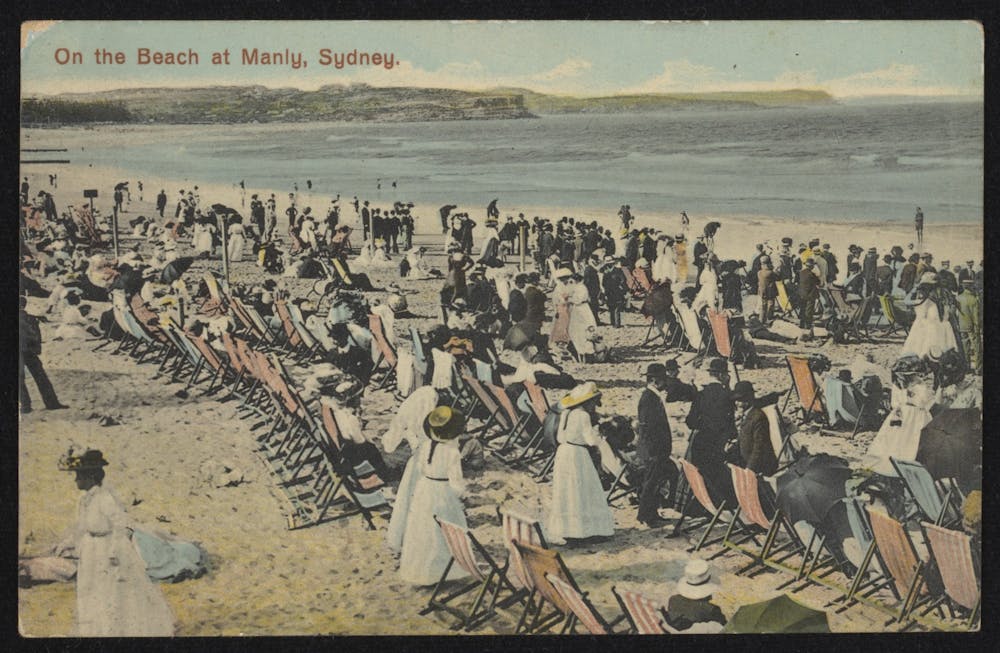
Plenty who enjoyed a day on the sand in the first decades of the 20th century did so fully clothed. It was not uncommon for men to dress for the beach in three-piece suits or for women to wear gowns that fell to their ankles.
At the beginning of the last century, people often went to the beach fully clothed. National Museum of Australia
But women who ventured into the water donned belted, knee-length bathing gowns that featured bloomers to conceal the legs. Men’s two-piece bathing costumes revealed a little more, with a top extending to the thighs paired with shorts to the knees.
In the space of a couple of decades, however, swimsuits radically changed. Styles altered as attitudes to the exposure of bodies relaxed, shifting ideas around public morality.
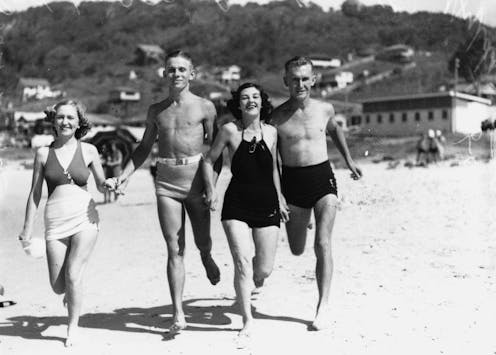
Both men and women were modestly dressed for swimming. State Library of Queensland
The 1930s witnessed a rise in topless bathing for men as they adopted trunks. Some had half skirts at the front, and many sported belts with buckles to keep them firmly on the waist.
Women’s swimwear now revealed the arms, legs and back – then even more when bikinis appeared on Australian beaches in 1950. Shock rippled across the sand.
Swimwear had reached body-baring new dimensions.
As the decades passed, bathing suits got smaller. Mark Strizic/State Library of Victoria
Wool on the beach
Knitted wool – rather than woven wool or cotton – fitted swimwear snugly to the body, helping it shrink in size.
For wearers of Foy & Gibson’s evocatively named wool suits in the late 1920s and early 1930s – “Sunnybeach”, “Sunbath”, “Seafit” and “Siren” among them – this knit offered comfort and freedom.
The Australian Women’s Weekly provided instructions to knit these bathers in 1938. Trove
Speedo’s knitted wool trucks in the late 1930s were made to streamline men’s figures, sparking the enticing slogan: “Next to your figure Speedo looks best!”
Those with knitting skills could make their own swimsuits that decade, using instructions like those given in the Australian Women’s Weekly.
With the introduction of “Lastex” – a rubber yarn – to woollen swimsuits in the 1930s, they transitioned to even more body-hugging fits. These exuded a new kind of glamorous appeal that elevated swimwear to a “sea-ductive” (as one newspaper columnist quipped) new height.
When synthetics burst onto the market, Australians embraced the new “modern” fibres. Wool was also in short supply, prioritised for uniforms and blankets for second world war troops.
Swimwear started to be made in the so-called “miracle” fibres: nylon in the 1940s, then polyester (known as “Terylene” in Australia) in the 1950s. From the 1960s, “Lycra” (also called elastane and spandex) was blended into swimsuits. These made sleeker, slimmer, more satin-like suits.
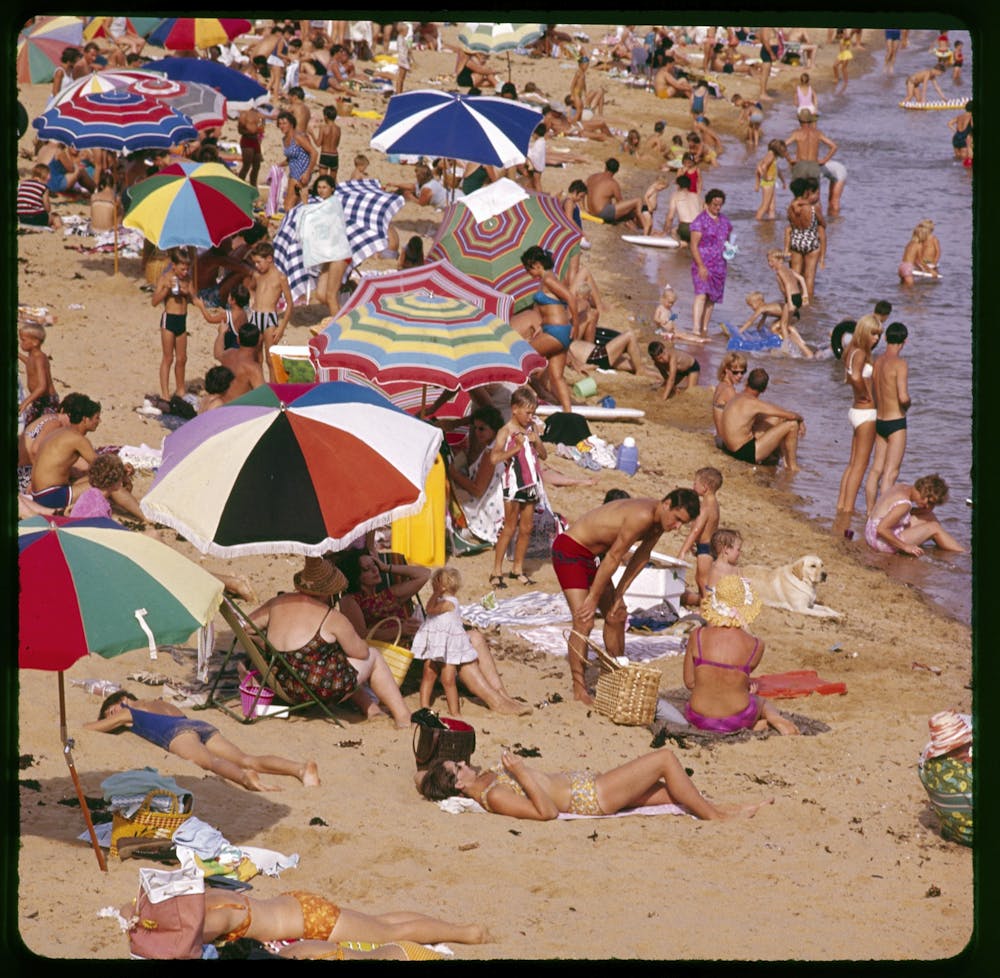
By the 1960s, bathing suits were more streamlined and made with synthetic fibres. H. Dacre Stubbs/State Library of Victoria, CC BY
Neoprene, a foam fabric, first appeared in wetsuits on Australia’s beaches in the late 1950s – increasing the possibilities for winter surfing. Wetsuits improved significantly in decades to follow, keeping their wearer warm by trapping a thin layer of water heated by the body.
In the pool, our Olympic swimmers tested more advanced fabrics. Those at the Sydney Games in 2000 wore the Speedo “fastskin”, with its compression fabric and replication of shark skin scales that streamlined the body in the water.
More recently, swimsuits made from recycled plastic – bottles, bags and other plastic waste – have emerged as an eco-friendly option. Some question, however, just how green these recycled swimmers truly are when reducing all plastic consumption is needed to make a difference.
We might dismiss woollen swimsuits from the 20th century’s first decades as unpleasant or uncomfortable to wear. Or we might see them as unflattering for the way they sagged when wet.
But new processes for working with wool suggest it is ideal to wear in the water. New merino boardshorts have been designed to dry in less than seven minutes. Wool is also thermo-regulating, helping the body maintain an even temperature.
It’s not just that wool options are increasingly available. As we buy and throw away clothing at alarming rates, some have embraced the natural fibre as a sustainable, renewable alternative to synthetics.
Today’s knitted bathers look quite different to these. Museums Victoria
Wool is biodegradable, naturally returning to and nourishing the earth, unlike synthetics that can take centuries to break down. Clothes in artificial fibres linger in landfill, with devastating consequences.
Our growing awareness of microplastics – tiny fibres released with washing that pollute marine (and other) environments – is also driving this shift.
So is it time to rethink wearing wool as you head to the beach this summer?
Lorinda Cramer receives funding from the Australian Research Council, and as Redmond Barry Fellow for the State Library of Victoria’s Fellowships Program 2022.
A possible coalition between the Social Democratic Liberal Party (Sodelpa) and the ruling FijiFirst Party — which has lost its 16-year majority in Fiji’s Parliament in this week’s general election — or the opposition People’s Alliance Party and National Federation Party partnership is still a work in progress.
Sodelpa leader Viliame Gavoka clarified this at a press conference today saying the party would need to “understand the gravity” of what was required.
He said the party would make its decision with “due process” in accordance with good practice and with approval by the management board.
Gavoka said the party had non-negotiable issues and other issues that it could negotiate on.
“We are pretty much an iTaukei party,” he said.
“Our base is the indigenous people of this country and their issues are always paramount with us and that is very much part of those issues that we will not negotiate on.”
Decision over next few days FijiVillage reports that Gavoka says there was no truth in comments being circulated that he had said that he would not be able to work with People’s Alliance leader Sitiveni Rabuka.
He also said that thoughts of the family of the founders of the party such as the late Laisenia Qarase would be considered before the Sodelpa management board decided on the options.
Gavoka said that a decision over the coalition government would be made over the next few days — before the 14-day deadline.
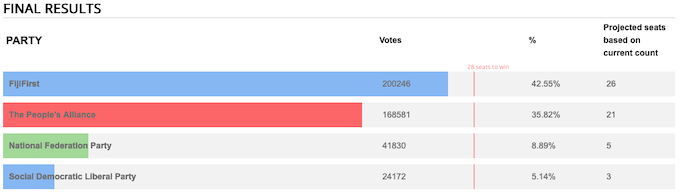
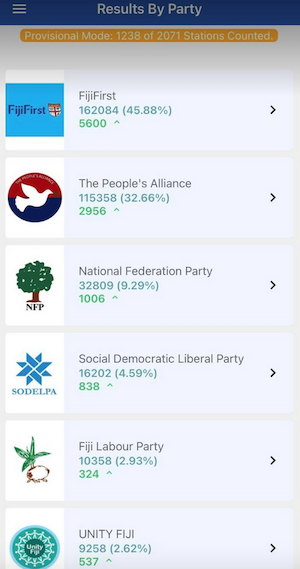
The make-up of the new 55 seat Parliament will be FijiFirst with 26 seats, the People’s Alliance Party with 21 seats, the National Federation Party with 5 seats and the Social Democratic Liberal Party (Sodelpa) with 3 seats.
In order to be able to form government 28 seats are needed.
The PAP — led by 1987 coup leader and former prime minister Sitiveni Rabuka — and the National Federation Party, led by Professor Biman Prasad, formed a pre-election partnership.
But Sodelpa made no such pre-election promises.
Gavoka also has close family ties to incumbent Prime Minister Voreqe Bainimarama’s right-hand man and the Attorney-General Aiyaz-Sayed Khaiyum.
Talebula Kateis a Fiji Times reporter. Republished with permission.
The final results of the 2022 Fiji general election are in and there appears to be a “hung” Parliament
The make-up of the new 55 seat Parliament — according to the Fiji Elections Office results app — will be FijiFirst with 26 seats, the People’s Alliance Party with 21 seats, the National Federation Party with 5 seats and the Social Democratic Liberal Party (Sodelpa) with 3 seats.
In order to be able to form government 28 seats are needed.
This means that for the first time since the return of democracy to Fiji in 2014, the 2006 coup leader and incumbent Prime Minister Voreqe Bainimarama’s dominant FijiFirst Party has failed to secure the majority of seats to rule.
Bainimarama will now need to woo at least one of the three opposition party leaders to join him if he is to remain in power.
The People’s Alliance Party — led by 1987 coup leader and former prime minister Sitiveni Rabuka — and the National Federation Party, led by Professor Biman Prasad, formed a pre-election coalition and are unlikely targets for the FijiFirst leader.
But Sodelpa, led by Viliame Gavoka, made no such pre-election promises.
Gavoka also has close family ties to Bainimarama’s right-hand man and the Attorney-general Aiyaz-Sayed Khaiyum.
There is also bad blood between Sodelpa and Rabuka, who broke away from the party to form his current People’s Alliance Party, after having led Sodelpa through the last election in 2018.
Supervisor of elections Mohammed Saneem said the official elections results would be handed over to the Electoral Commission later this afternoon.
‘Not hypocritical’, says Duru The Fiji Times reports that Sodelpa’s general secretary Lenaitasi Duru denied that the party was being hypocritical negotiating with FijiFirst.
“It’s not hypocritical if you’re going to bring change by joining FFP leader Voreqe Bainimarama,” Duru told the media outside the party headquarters in Suva.
“Right now we’re sitting in the middle, we’re watching and waiting for what is on offer.
“Then, we’ll make the decision based on what’s best for the nation.”
When questioned on the possibility of the party dropping below the five percent threshold he told The Times they are holding on and hoping for the best.
This article is republished under a community partnership agreement with RNZ.
Former opposition Sodelpa member Mick Beddoes has appealed to the party’s management board to end the 16-year rule of Voreqe Bainimarama’s FijiFirst government.
In an open letter on his official Facebook page to Sodelpa vice-president Ro Teimumu Kepa, president Ratu Manoa Roragaca, leader Viliame Gavoka and the management board today, Beddoes said: “After many years of inner turmoil, you have the entire country holding their breath to hear your decision, which will either deliver to our people a Christmas gift unlike any we have had for the past 16 years or you will knowingly condemn us all to another four more years of undeserved vindictive, bullying, corrupt, self serving, self enriching and uncaring governance.”
He added that the decision to stay with the people was a “no brainer” to prevent avoid a “hung” parliament.
The official results indicated that FijiFirst had lost its majority with just 26 members of Parliament — the same combined number as the opposition coalition of the People’s Alliance led by former 1987 coup leader Sitiveni Rabuka (21 members) and the National Federation Party (5 seats).
Former leading member of the opposition Sodelpa Mick Beddoes . . . “Please give our people the Christmas gift they all deserve.” Image: The Fiji Times
Soldelpa – the only other party of nine contesting the general elections to get across the 5 percent threshold — hold the balance of power with three seats.
“While the decision to stay with the greater interest of all our people, is a ‘no brainer’ I do appreciate the need for the party to take into account the interests and aspirations of its membership,” Beddoes said.
“However, in doing so it has to be weighed against the greater interest of our nation given we have all witnessed in broad daylight and experienced over the past 16 years the greed and self enrichment by the narrow interests of the favored few and as the voting thus far has very clearly indicated por people want change and we as opposition political leaders are ‘obliged to deliver this’ as this is what we promised.”
‘Theft’ of the Fijian name “Need I remind you that this is the very same government who raided your home at night and took you in for interrogation because you offered to host the Methodist Church Conference, this is the same government who from 2007 to 2013 imposed more than 17 derogatory decrees against your own people, which among other things included the ‘theft’ of the name Fijian from your people by a stroke of a pen, and they banned the right of educated iTaukei students from attending and supporting their respective provincial councils.
FIJI ELECTIONS 2022
“They have excluded your own people from chair positions and board appointments by a margin of 80 percent from all government entities under the guise of ‘merit based’ appointments.
“When they had the opportunity to remove all these oppressive and discriminatory decrees at the time they drafted and imposed their 2013 constitution prior to the 2014 elections, they did not and it remains the law against your people today and they built in provision into the constitution that makes amendments to the constitution near impossible.
“This government’s policies and deliberate discrimination against your own people has resulted your people accounting for 75 percent of our 208,256 absolute poorest citizens, which means more than 156,192 of your own people live in absolute poverty despite owning 89 percent of all the land and you want to even ‘consider’ talking to them?”
Beddoes said Ro Teimumu led Soldelpa in the first opposition challenge that resulted in their first national platform from which to speak out and he was part of the team then.
“In that first effort in 2014, Sodelpa and its opposition colleagues received 202,650 votes to FijiFirst’s 293,714, we were 91,064 short. In our second effort in 2018, we increased our support level to 227,094 vs FijiFirst’s 227,241 and reduced their advantage to just 147 votes.
“Today while we are all still trying to figure out where all the extra votes came from the latest vote tally show we are at this time 58,635 votes ahead and you, Marama, are once again in a position with Bill and your management board to complete the mission we all started back in 2007 and remove the cruel, vindictive, bullying, arrogant, disrespectful and uncaring government that FijiFirst is.
“I beg you Marama, Ratu Manoa and you Bill and your management board, please do not waiver from our initial promise of change and finish the mission we started 15 years ago and end our 16 years of suffering and please give our people the Christmas gift they all deserve.”
Final results of the Fiji general election today showing just the four parties that met the 5 percent threshold. Image: Fijivillage
Sodelpa in negotiations with both sides SBS News reports that Sodelpa is in negotiations with both the FijiFirst government and People’s Alliance over which it will support with its balance of power.
Bainimarama’s FijiFirst party is the largest single party with 42.5 per cent of the vote while People’s Alliance and the NFP — which have already said they would join forces — sit at 36 and nine percent respectively.
Sodelpa holds just over five percent of the vote.
Sodelpa general secretary Lenaitasi Duru said today it would enter a second round of negotiations with both parties.
Talebula Kateis a Fiji Times reporter. Republished with permission.
Source: The Conversation (Au and NZ) – By Corey J. A. Bradshaw, Matthew Flinders Professor of Global Ecology and Models Theme Leader for the ARC Centre of Excellence for Australian Biodiversity and Heritage, Flinders University
Climate change is one of the main drivers of species loss globally. We know more plants and animals will die as heatwaves, bushfires, droughts and other natural disasters worsen.
But to date, science has vastly underestimated the true toll climate change and habitat destruction will have on biodiversity. That’s because it has largely neglected to consider the extent of “co-extinctions”: when species go extinct because other species on which they depend die out.
Our new research shows 10% of land animals could disappear from particular geographic areas by 2050, and almost 30% by 2100. This is more than double previous predictions. It means children born today who live to their 70s will witness literally thousands of animals disappear in their lifetime, from lizards and frogs to iconic mammals such as elephants and koalas.
But if we manage to dramatically reduce carbon emissions globally, we could save thousands of species from local extinction this century alone.
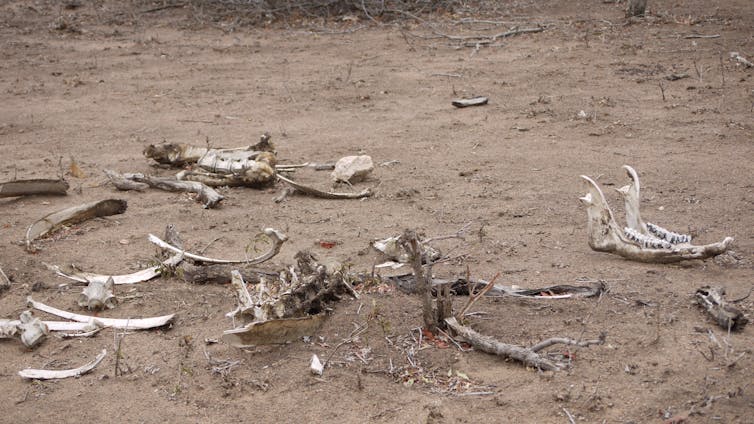
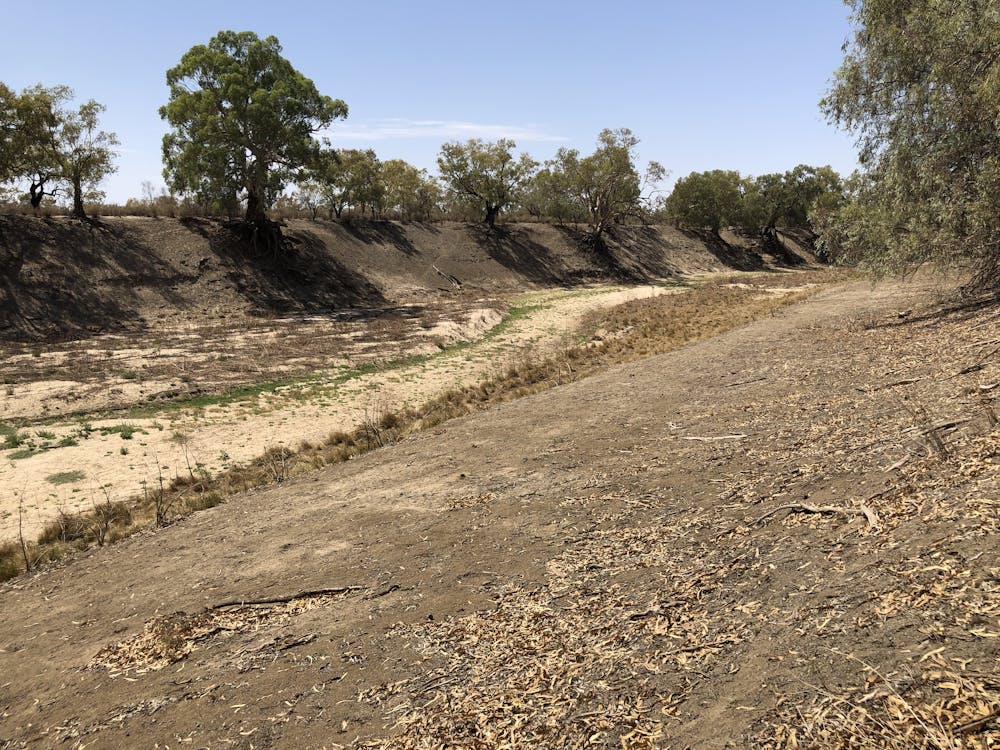
Ravages of drought will only worsen in coming decades. CJA Bradshaw
Every species depends on others in some way. So when a species dies out, the repercussions can ripple through an ecosystem.
For example, consider what happens when a species goes extinct due to a disturbance such as habitat loss. This is known as a “primary” extinction. It can then mean a predator loses its prey, a parasite loses its host or a flowering plant loses its pollinators.
A real-life example of a co-extinction that could occur soon is the potential loss of the critically endangered mountain pygmy possum (Burramys parvus) in Australia. Drought, habitat loss, and other pressures have caused the rapid decline of its primary prey, the bogong moth (Agrotis infusa).
All species are connected in food webs. The spider shown here is an elongated St. Andrews cross spider Argiope protensa from Calperum Reserve, South Australia. CJA Bradshaw
Research suggests co-extinction was a main driver of past extinctions, including the five previous mass extinction events going back many hundreds of millions of years.
But until now, scientists have not been able to interconnect species at a global scale to estimate how many co-extinctions will occur under projected climate and land-use change. Our research aimed to close that information gap.
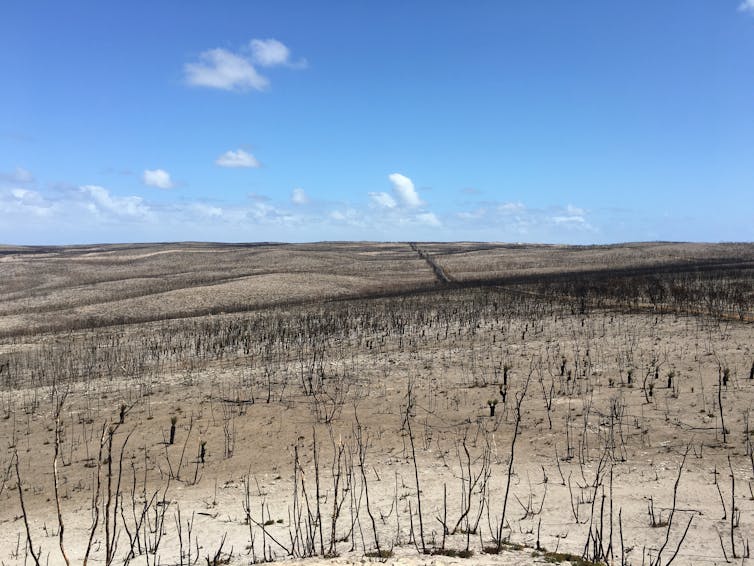
The unprecedented bushfires of 2019/2020 on Kangaroo Island killed thousands of individuals in many different wildlife populations. CJA Bradshaw
Using one of Europe’s fastest supercomputers, we built a massive virtual Earth of interconnected food-web networks. We then applied scenarios of projected climate change and land-use degradation such as deforestation, to predict biodiversity loss across the planet.
Our virtual Earths included more than 15,000 food webs that we used to predict the interconnected fate of species to the end of the 21st Century.
Our models applied three scenarios of projected climate change based on future pathways of global carbon emissions. This includes the high-emissions, business-as-usual scenario that predicts a mean global temperature increase of 2.4℃ by 2050, and 4.4℃ by 2100.
If this scenario becomes reality, ecosystems on land worldwide will lose 10% of current animal diversity by 2050, on average. The figure rises to 27% by 2100.
Adding co-extinctions into the mix causes a 34% higher loss of biodiversity overall than just considering primary extinctions. This is why previous predictions have been too optimistic.
Worse still is the fate of the most vulnerable species in those networks. For species highest in food chains (omnivores and carnivores), the loss of biodiversity due to co-extinctions is a whopping 184% higher than that due to primary extinctions.
Without enough prey, predators like this African lion, will perish. CJA Bradshaw
We also predict that the greatest relative biodiversity losses will occur in areas with the highest number of species already – a case of the rich losing their riches the fastest.
These are mainly in areas recognised as “biodiversity hotspots” — 36 highly threatened areas of the Earth containing the most unique species, such as Southwest Australia and South Africa’s Cape Floristic region. This is because the erosion of species-rich food webs makes biological communities more susceptible to future shocks.
Tropical forest is the main ecosystem found in many biodiversity hotspots worldwide.
We also detected that these networks of interacting species themselves will change. We used a measure of “connectance”, which refers to the density of network connections. Higher connectance generally means the species in a food web have more links to others, thereby making the entire network more resilient.
Connectance, we learnt, will decline between 18% and 34% by the end of this century in the worst-case climate scenario.
This reduction in connectance was also driven by the loss of some key species occupying the most important positions in their local networks. These could be top predators such as wolves or lions keeping plant eaters in check, or an abundant insect eaten by many different insectivores.
When such highly connected species go extinct, it makes the network even less resilient to disturbance, thereby driving even more loss of species than would otherwise have occurred under a natural ecological regime. This phenomenon illustrates the unprecedented challenges biodiversity faces today.
It follows the recent COP27 climate change summit in Egypt, where the resulting agreement was inadequate to deal with the global climate crisis.
We hope our findings will, in future, help governments identify which policies will lead to fewer extinctions.
For example, if we manage to achieve a lower carbon-emissions pathway that limits global warming to less than 3℃ by the end of this century, we could limit biodiversity loss to “only” 13%. This would translate into saving thousands of species from disappearing.
Clearly, humanity has so far underestimated its true impacts on the diversity of life on Earth. Without major changes, we stand to lose much of what sustains our planet.
Corey J. A. Bradshaw receives funding from the Australian Research Council.
Giovanni Strona does not work for, consult, own shares in or receive funding from any company or organisation that would benefit from this article, and has disclosed no relevant affiliations beyond their academic appointment.
Source: Council on Hemispheric Affairs – Analysis-Reportage
Daniel Kovalik Miami
On December 12 to 13, 2022, an evidentiary hearing in the case of The United States v. Alex Saab was heard before Judge Robert Scola in the U.S. District Court for the Southern District of Florida. The only issue in the hearing was the question of whether Mr. Saab is entitled to diplomatic immunity, a question which, if resolved in his favor, would lead to his release from custody. I had the opportunity to be in the courtroom to witness this hearing, and it was both fascinating and revealing.
A diplomat in chains
Alex Saab, who is accused of money laundering and of no violent offense, was brought into the court literally in chains. He was handcuffed and the handcuffs were themselves connected by chains to leg cuffs. Saab wore a jumpsuit the color of brown mustard. He looked remarkably healthy given his now two and half years of incarceration. His hair was long and tied up in a bun in the back. Saab sat at the defense table with his lawyers from Baker Hostetler. The two rows behind the defense table were kept empty by the court bailiffs, presumably to prevent any contact between Saab and any visitors in the courtroom – a move which again seemed unnecessary given that he is not even accused of being a violent offender. Upon the request of his counsel, the judge did allow Saab to be released from his handcuffs so that he could take notes, write suggestions to his counsel, and otherwise assist in his own defense.
On the prosecution side, there were two attorneys and two agents from the Drug Enforcement Agency (DEA), again seemingly strange given that Saab is not and has never been accused of any drug-related offenses. The two bald and bulky DEA agents, both attired in dark suits, looked almost identical and resembled the mysterious twins in Breaking Bad who pursued their targets for violence with quiet precision and relentlessness. For the past several years, the target of these DEA agents has been Alex Saab, his real “crime” being his success in getting around illegal U.S. sanctions to get food, medicine, fuel, and building materials to the people of Venezuela. And now, strangely, the DEA claims that Saab was actually an informant for the DEA – a claim that Saab denies, but which is intended to discredit Saab in the eyes of people in Venezuela and in the Western left.
The prosecution clashes with the reality of Saab’s diplomatic status
The argument of the defense team was simple. Saab was a diplomat, specifically a Special Envoy, of Venezuela, when he was captured in Cabo Verde, a country off the coast of West Africa in which Saab’s plane stopped to refuel on the way to Iran. Saab, the defense contends, was and is therefore entitled to diplomatic immunity. And, this is so, the defense argues, because he met three critical criteria: (1) he was on an official mission of the Venezuelan government to Iran where he was to negotiate a deal for food and medicine, just as he had done on at least two prior occasions; (2) Iran had accepted him as an envoy for said mission; and (3) he was on his way to fulfill this diplomatic mission at the time of his detention.
In reality, there should be little to no dispute about these key facts and therefore about Saab’s diplomatic status. Therefore, the prosecution has set out to aggressively deny reality before the court, arguing that all of the evidence of Saab’s diplomatic mission and work were fabricated after the fact to get him off the hook. For example, the prosecution claimed that diplomatic letters — originally sealed in diplomatic pouches and given to Saab before his flight to Iran – most notably from Venezuelan President Nicolás Maduro to Iran’s Supreme leader Ali Khameni and from Venezuelan Vice-President Delcy Rodríguez to Iran’s agricultural minister, were created after Saab was captured to try to prove he was a diplomat when he really was not. Much to the prosecution’s chagrin, reality asserted itself in the hearing.
The author, Dan Kovalik, in front of the U.S. District Court for the Southern District of Florida, next to journalists, lawyers and activists from the U.S., Colombia, Argentina and Tunisia (photo credit: Dan Kovalik)
To prove the key elements of Saab’s diplomatic status, the defense put on Saab’s security guard, Juan Carlos Arrieche, as a witness. Arrieche testified from Venezuela via Zoom and through an interpreter. And, he testified to the fact that he accompanied Mr. Saab to a meeting with President Nicolás Maduro before his fateful flight to Iran through Cabo Verde; that Saab was given the diplomatic pouches described above; and that he witnessed Saab with these pouches just before he boarded his flight. While this seemed like pretty solid evidence, this was not enough for the prosecution to relent on this issue.
Manipulation of evidence
The defense then called a young lawyer from Cabo Verde who flew in person to the hearing to testify. In what would become the most dramatic testimony of the hearing, the young lawyer was meticulously questioned about how he came to meet Mr. Saab in prison in Cabo Verde and to come in possession of the property of Mr. Saab which was being held by Cabo Verde prison officials. As he described, he went to meet Saab after he learned of his plight and learned that he was not, as per Cabo Verde prison policy, given the opportunity to designate someone to receive the property he had in his possession at the time he was seized. He encouraged Saab to sign a letter designating himself as the person to receive this material, and Saab did so. After a short while, the young lawyer was given two suitcases belonging to Saab along with a detailed list of the contents. However, as he soon discovered, not all of the contents had been listed. Thus, when he brought the suitcases home and opened them to see what was within, he discovered the diplomatic pouches, these pouches not being listed in the property description.
Curiously, the young lawyer found that all of the diplomatic pouches had been unsealed and opened, revealing the letters from President Maduro and Vice President Delcy Rodríguez within. Therefore, not only did these diplomatic pouches exist, at least per the lawyer’s testimony, but the Cabo Verde officials were clearly aware of their existence and therefore of Saab’s diplomatic status. And, it appears that U.S. authorities or their agents had also been made aware of this at the time. Thus, the defense asked the young lawyer about markings at the top of the letters which showed a date (June 20, 2020) as well as a “jpg” designation, meaning that the letters had been scanned. The lawyer testified that those markings were not on the letters that he had seen at the time. However, copies in evidence, which were produced by the prosecution to the defense did have those markings, strongly suggesting the following – that while the prosecution is trying to claim that these documents were created after the fact, copies of them had actually been scanned and sent to U.S. officials way back in June of 2020.
To put a finer point on it, the U.S. also knew of Saab’s diplomatic status back then and it is the prosecution which is now lying about this to try to make its case against Saab.
The judge got exasperated with the prosecutors
After this dramatic presentation, the lead prosecution attorney then stood up to cross-examine the young lawyer from Cabo Verde. However, the prosecution attorney started peppering the young lawyer with questions completely unrelated to his discovery of the relevant documents. The defense therefore objected to the line of questioning on the basis that it went beyond the scope of direct and was otherwise irrelevant. Judge Scola, who came across as a fair and no-nonsense judge, seemed to have had enough. He looked at the prosecution attorney and asked him if he really intended to challenge the fact that the young attorney had discovered the diplomatic letters as he claimed. The prosecution attorney, a bit taken aback, was forced to answer in the negative. Judge Scola, exasperated, then asked the natural next question of why the prosecution was then continuing with his line of questioning. With no good answer to this query, the prosecution attorney sat down, and court was adjourned for the day.
Given the above, Mr. Saab’s case for diplomatic immunity should be a slam dunk, especially since the precedent in the 11th Circuit in which his case is being heard is very favorable on this issue. However, my optimism is tempered by the fact that the U.S. government has been so relentless in its pursuit of Saab, and its treatment of Saab so unfair, that justice in this case seems quite elusive. One can only hope that justice ultimately prevails.
Oral arguments based on the evidence submitted in the hearing described above are scheduled for December 20. The Judge has promised to rule on the diplomatic immunity issue by the end of this year.
Daniel Kovalik is a Senior Research Fellow at COHA. He teaches International Human Rights at the University of Pittsburgh School of Law.
[Main photo: Mobilization in Caracas, December 16, 2022, to Free Alex Saab. Credit: VTV]
The People’s Alliance Party took an early lead in the Fiji general election vote tally this evening with a total of 21,810 votes recorded after the completion of counting from 470 of the 2071 polling stations.
The governing FijiFirst Party was in second place with 16,515 votes and SODELPA running third with 3684 votes.
The National Federation Party followed with 3256 votes and Unity Fiji in fifth place with 1688 votes.
The other results by party as at the 5pm update provided by the Fijian Elections Office are:
Fiji Labour Party – 1269 We Unite Fiji Party – 1179 All Peoples Party – 614 New Generation Party – 175 Rajendra Sharma (Independent) – 26 Ravinesh Reddy (Independent) – 21
Counting continues at the National Count Centre and the next update is due to be provided by the Supervisor of Elections at 10pm.
Timoci Vula is a Fiji Times reporter. Republished with permission.
Fiji’s military will respect electoral process – Kalouniwai RNZ Pacific reports that the Fiji military commander has rejected a request by opposition party leaders to intervene in a dispute over the country’s election process.
Major-General Jone Kalouniwai said the military (RFMF) as an institution would put its trust in the electoral process.
“I wish to reassure the people of Fiji that the RFMF will not respond to [PAP leader Sitiveni ] Rabuka’s insistence or any political party, that we intervene under our responsibilities from Section 131.2 of the 2013 Constitution,” Kalouniwai said.
“The constitutional responsibility of the RFMF section 131.2 does not make any reference to intervening or getting involved with the electoral processes or management of voting or counting of votes with the assistance of the military.”
Kalouniwai explained that using the military in any form during the electoral process was unconstitutional.
The statement came after a group of opposition party leaders called for a halt to vote counting yesterday, demanding an audit of the country’s electoral system.
It was triggered by an anomaly in provisional results that was displayed on a Fiji Election Office results app on Wednesday night.
This article is republished under a community partnership agreement with RNZ.
In this, our last podcast for 2022, we talk with Prime Minister Anthony Albanese and Opposition Leader Peter Dutton. We spoke to each of them on the day the parliament was back to pass the energy package.
Albanese, who met Chinese President Xi Jinping during the recent summit season, reveals he anticipates a further positive development in China’s relationship with Australia within weeks.
Asked whether he expects some relaxation of China’s trade restrictions on Australia any time soon, he says: “I’m hopeful that any of the barriers to normal economic activity are removed and that we have stronger economic relations.
“China is our major economic partner and I think in coming weeks you will see further measures and activities which indicate a much-improved relationship, which is in the interests of both of our countries, but importantly as well is in the interests of peace and security in the region.”
Pressed on whether he’s indicating a likely loosening of restrictions on our exports, Albanese says: “I’m hoping that there’ll be further indications of an improvement in the relationship […] and we’ll see how that plays out over the next coming weeks.”
On the 2023 referendum for the Voice to Parliament, Albanese is “absolutely confident” its passage would make Closing the Gap more attainable.
“That is the objective. […] We know that where Indigenous Australians feel a sense of ownership over decisions, where they’re consulted about programs that have a direct impact on them, then you get better outcomes. And we see that in practical ways through the rangers’ program, through justice reinvestment programs.
“We have tried doing things from Canberra or from state capitals, seeking to make decisions on behalf of Aboriginal and Torres Strait Islander peoples. The successful programs have been ones that have directly consulted them and had their input.”
Carrying the referendum would also improve “the way that Australia is perceived internationally”.
In the Albanese interview we also canvass:
Julian Assange
energy policy
COVID changes
the 2023 budget
Labor’s challenge in “heartland” seats.
Peter Dutton: Coalition won’t be ‘small target’ at next election
Dutton’s main task since the election has been holding together an opposition demoralised by defeat. But as he oversees policy development for the 2025 election will be adopt a “small target” strategy, as Albanese did?
“At the next election we will have a very significant offering of policy, which will distinguish us quite markedly from the Labor Party,” Dutton says.
“I’ve been in the parliament for 21 years. I have a good sense of balance and proportion, and there does need to be a balance of risk-taking. There needs to be an element of the government getting it wrong. There needs to be an opportunity for us to get the policies right.
“And I want to bring that experience to bear in the next election campaign. And I believe that, as a result of that, we won’t be small target, but we’re not going to be silly about policies. I mean, you went from one extreme under Bill Shorten in 2019 to the other under Anthony Albanese in 2022. So we have a balance to strike and I’ll be making those judgment calls as we get closer to the next election.”
The Liberals are always saying they need more women candidates but what are they actually going to do about getting them?
Dutton says (in an unspoken comparison with his predecessor): “I don’t have a problem with women and I’m not perceived to. I have a very significant track record and I’m happy to be compared against the prime minister or anybody else.”
Pushed on quotas, he says: “The Liberal Party doesn’t have a culture of imposing quotas. I want to see more women. I’ve made that very clear to the state presidents, I have made it very clear to preselection bodies. But in the Liberal Party our branch members have the say as to who they want as their local candidate. And generally that is somebody who has worked very hard on campaigns in the local electorate over a long period of time.”
In the Dutton interview we also canvass:
cost of living
the Liberal Party’s stance on the Voice
Josh Frydenberg’s future
Scott Morrison
participation in the NSW state election.
Michelle Grattan does not work for, consult, own shares in or receive funding from any company or organisation that would benefit from this article, and has disclosed no relevant affiliations beyond their academic appointment.
The killing of two police officers and a good samaritan, as well as the wounding of two other officers in Wieambilla, Queensland, has sent shockwaves through Australia.
While more details about possible motives will emerge over time, evidence already suggests that at least one of the alleged gunmen – Gareth Train – was a firm believer in a host of conspiracy theories.
This is important because the killings are the clearest example of what security, policing researchers, and law enforcement have warned of – conspiracy beliefs can be motivators for actual or attempted violence against specific people, places, and organisations.
So what should police do, if anything, to counter conspiracy theories?
Not always just harmless speculation
The Wieambilla killings are the latest in a string of serious incidents involving conspiracy theorists.
These cases tell us that conspiracy theories aren’t always just harmless speculation. An important reason for this is because people who express belief in one conspiracy theory often endorse others, including completely unrelated or contradictory ones.
As I have argued elsewhere, this has a range of impacts on police operational environments. Conspiracism may lead believers to try to correct perceived wrongdoing through coercion and violence. Justification for the use of violence often stems from the frequent “othering” of certain groups by conspiracy theories through painting them as dangerous or using them as scapegoats.
Emerging evidence also suggests conspiracy theories are a radicalisation risk and are being used as recruitment tools by extremist groups as they often focus on emotive subjects such as child protection, freedom, and health.
What should police do about conspiracism?
But what, if anything, can and should police do about conspiracism?
An obvious starting place is monitoring. This could be done through “fixated persons units” – the specialist capability in some police jurisdictions that undertakes risk assessments of people with obsessions, grievances or ideologies that may lead to serious violence.
Yet monitoring may be counterproductive, as it could reinforce ideas of persecution and distrust. Indeed when Australian media began reporting on Train’s preoccupation with conspiracies, online conspiracy groups began to assert the killings were a hoax designed to justify the persecution of conspiracy theorists.
There’s also evidence that links certain mental health conditions to conspiracy theories. Conditions like PTSD, paranoid schizophrenia, and bipolar disorder may also contribute to a willingness to act on conspiratorial beliefs. This is not to suggest these conditions are solely responsible, but that they are a common feature of some cases where individuals have acted on conspiratorial views. For example, one study found around 60% of QAnon conspiracy adherents who committed crimes before and after the January 6 Capitol insurrection had documented mental health conditions. This is an important consideration for any future monitoring, as knowledge of this may worsen mental health conditions or motivate action.
Other strategies include targeting suppliers of conspiracies before conspiracies spread (“pre-emptive strikes”) or afterwards to limit their damage (“counter-strikes”). However, these strategies are of limited use for police, as they rely on either taking down platforms and removing/flagging conspiratorial content. These areas lie beyond policing’s role.
Preventative or responsive strategies targeting conspiracy consumers are more promising for police, able to be employed by general duties officers in their interactions with the public.
Low trust environments also breed conspiracies. A continued focus on police trust-building initiatives may therefore also help immunise against conspiracies.
Finally, general duties officers may be able to engage in “alleviating” strategies when interacting with conspiracists. This could include “rationality based debunking” which emphasises focusing on the internal logic of a conspiracy theory or on key facts integral to the theory.
The Wieambilla killings will likely lead to increased police focus on the threat posed by conspiracy theories. In doing so, police should consider including conspiracism into existing frameworks for countering violent extremism, while being mindful of the risk monitoring poses to the entrenchment of views. Focusing on procedural justice and trust-building will also be vital.
Nicholas Evans is affiliated with the New Zealand Australia Policing Advisory Agency (ANZPAA).
Source: The Conversation (Au and NZ) – By Peter Pudney, Associate Professor of Industrial and Applied Mathematics, University of South Australia
Shutterstock
Batteries are undoubtedly part of our energy future. Should you put one in your home now to store solar output, manage your energy use and cut costs? It really depends on what you want to achieve.
Studies in 2017 and 2021 identified key motivations for installing home batteries:
using your own solar energy
good for environment
independence from the grid
saving money.
With these goals in mind, our research suggests it’s hard to justify buying a battery right now on cost savings alone. If other reasons also matter to you, it might be justified.
Using your own solar
More than 30% of Australian homes have solar systems. They typically generate more than is needed during the middle of the day, less than is needed during morning and evening demand peaks, and nothing at night.
If you don’t have a battery, when you need more power than your solar system generates it’s imported from the grid. You can also export surplus energy to the grid and be paid for it.
But, as solar capacity grows, the maximum power new solar system owners are allowed to export is being limited in many locations. And if too many people in your street are exporting, the local voltage will go high and solar inverters will curtail generation.
One way you can avoid curtailment is by shifting some of your energy use to the middle of the day. Significant loads that could be shifted include:
water heating
pool pumps
air conditioning
appliances such as dishwashers, clothes washers and dryers
electric vehicle charging.
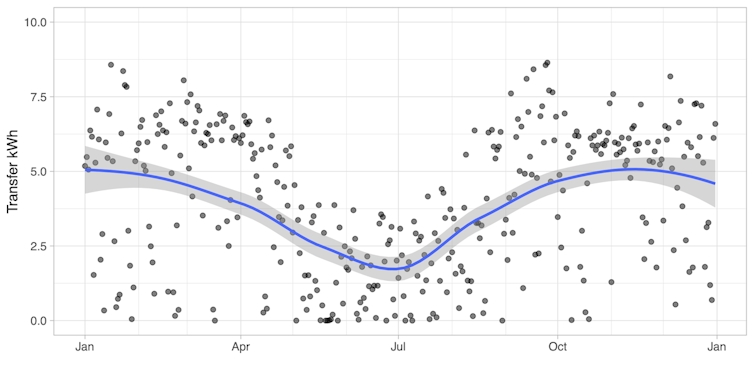
If you still have surplus generation, it can be stored in a battery and used later to reduce the energy you import from the grid to cover loads you can’t shift. The energy you could transfer via a battery each day will be whichever is the minimum of your excess generation and the amount you normally import. For example, if you have 3 kilowatt-hours (kWh) of excess generation in a day but import only 2kWh to meet your overnight loads, the maximimum energy you can transfer via a battery is 2kWh.
The graph below shows an example of the energy that could be transferred each day of a year, averaged over 40 houses at Lochiel Park, a precinct of low-energy housing in Adelaide.
Average energy transfer for each day of a year.
For these households, a battery with an 8kWh capacity could handle the energy transfer most days. However, the average energy transferred each day is only 4kWh because some days have low surplus generation or low overnight demand. Households with large solar systems and large daily energy imports from the grid can transfer more.
The battery itself will limit rates of charging and discharging. If you are generating more power than it can handle, some of the surplus will be exported or the solar output could be curtailed. If your load is more than it can handle, you will need extra power from the grid.
A 2017 study found nearly 70% of respondents wanted to eventually disconnect from the grid. Remote households have done it for decades, but need large solar systems and large batteries backed up by diesel generators and gas for heating and cooking.
Being connected to a grid has significant benefits. When not generating enough solar power you can get energy from somewhere else. And when generating more than you need, you can send the surplus somewhere else that needs it. Connecting many loads to many generators increases flexibility and efficiency.
A home battery can let you run your home when the grid fails, but you may need extra equipment to isolate it from the grid at such times. Being off-grid means you may also need to manage your battery differently to keep enough energy in reserve to meet your needs during outages.
Saving money
You could use a battery to reduce costs in two ways:
store surplus solar energy during periods of a low feed-in tariff (the money you receive for exporting energy to the grid), then use it later instead of importing energy when the price is high
join a virtual power plant (VPP).
Let us explain further.
The cost of electricity varies throughout each day, depending on demand and on available generation. If you have a meter that records when energy is used, time-of-use and dynamic tariffs will allow you to make the most of price fluctuations.
If the difference between your feed-in tariff and your peak import price is 40c/kWh, each kWh of solar energy you store then use during the peak period saves you 40c. The graph above showed an average daily transfer of 4kWh, saving $1.60 per day. But this household requires an 8kWh battery, costing about $9,600. The payback period is over 16 years – beyond the warrantied life of the battery.
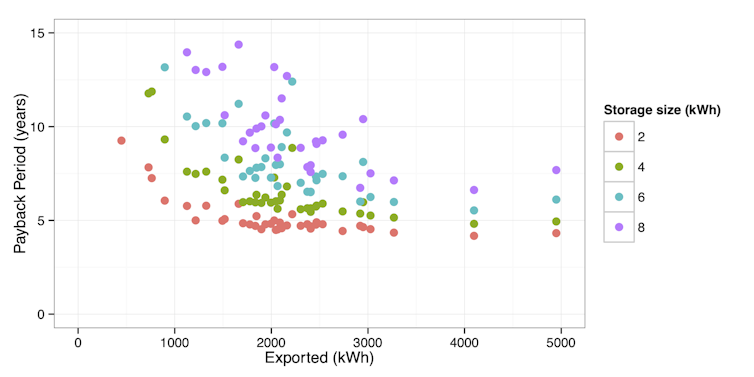
In 2017 we simulated battery use for 38 houses with solar to determine the viability and payback period. Each dot in the graph below indicates the payback period for a particular household with given battery size. The horizontal axis shows the annual surplus energy it generated.
Energy storage payback periods for 38 households.
The payback period is better for smaller batteries, which cost less, and for houses with larger annual export.
We assumed a price difference of 40c/kWh between import price and feed-in tariff. We also assumed a future battery price of $600/kWh – we are not there yet (unless you can get a generous subsidy).
The other way of reducing the payback period, and supporting the grid, is to join a virtual power plant (VPP). A VPP is a network of home solar batteries from which the electricity grid can draw energy in times of need.
VPP operators typically offer discounts on the battery cost, its management to take advantage of the retail tariffs on offer, and payments for allowing them to use your battery to trade energy on the electricity markets. Subsidies and payments vary across VPPs.
Understand why you want a battery before you start looking. There are other options for making better use of your solar generation, getting clean energy and reducing your costs.
If you have a large solar system, high grid imports and can get a good subsidy, or if you just want cutting-edge energy technology, then you might be able to justify a battery.
If you don’t have solar already, the economics of a solar system with a battery can look attractive. But the solar panels will provide most of the savings.
Peter Pudney received funding from the Cooperative Research Centre for Low Carbon Living.
Adrian Grantham works for APG Insights and CXC – undertaking contract work for AEMO.
Heather Smith chairs the Coalition for Community Energy. She has received funding from the Australian Government’s Remote and Regional Microgrids and Preparing Communities programs and CSIRO. She consults as Changing Weather to community energy groups.
John Boland receives funding from the Regional and Remote Communities reliability Fund, and has in the past received funding from the Australian Renewable Energy Agency.
Research has found people with ethnic-sounding names have felt they need to use more “English-friendly” names to be considered for job interviews.shutterstock
All names of participants mentioned are pseudonyms to protect their identity.
In our recent study of 150 non-English speaking background migrants and refugees living in Australia, nearly 80% revealed using their birth names in their CVs led to fewer call-backs or no response at all.
This highlights language-based discrimination, and is an example of “name microaggressions” – negative assumptions based on ethnic-sounding names.
Our participants said experiencing microaggressions against their birth names has taken a heavy psychological toll on them.
What is name microaggression?
Name microaggression refers to a stigma based on negative assumptions associated with migrants and refugees, purely based on their ethnic-sounding birth names. Research has found more ethnic-sounding birth names can cause unfounded negative beliefs about the person, such as being less skilled or less capable than someone with a more Anglo-sounding name.
Name microaggressions can present as names being mispronounced, misspelled, misunderstood, misgendered, or mocked. A common occurrence is for some people choosing to use a more “English-friendly” variation of a migrant’s name instead of the person’s birth name if it’s not easy to say, spell or remember. This microaggression is an act of symbolic violence that is not always intentional, but is still hurtful and disrespectful.
Our participants talked about why name microaggressions are so hurtful, describing how their birth name carries crucial cultural, ethnic, linguistic, and family significance. Many participants suffered and continue to suffer from psychological distress and negative emotions such as embarrassment, self-shaming, fear, anxiety, and nervousness when they hear their names mispronounced.
Name microaggressions are often barriers to employment
Our interview data found newly arrived migrants and refugees who use their birth names seem to be the most vulnerable. Because their birth name sounds different, looks odd or is hard to pronounce, their skills and qualifications are discounted or rejected in institutional contexts such as recruitment and employment.
Name microaggression is primarily found in the initial hiring process of recruitment when a candidate’s CV is examined before they decide whether to go ahead with an interview.
For example, one research participant, Oksana (pseudonym) from Ukraine, has altered her birth name by removing her heavily “post-Soviet sounding/looking” last name “Пугачева” (Pugacheva) to give a more Western feel. Instead she uses “Pugachev” in order to sound more Western.
Name microaggressions are not limited to job recruitment. We found most of our participants adopted “renaming practices” in every day life. This involves choosing new Anglo-sounding names instead of correcting their teachers, peers, friends, and colleagues when their names are mispronounced.
Some Chinese participants replaced their names with English names during their adolescent years while taking English classes in China.
The first step in maintaining an inclusive multicultural society is to start respecting migrants’ birth names. Names are identities and histories. Names not only specify and individualise their bearers but also serve as means of empowerment and belonging. This sense of belonging connects them to their respective cultures, and the correct usage of birth names can bring a feeling of belonging in society.
When educators, policymakers, or employers practise name microaggressions, they convey a message that people’s racial, ethnic, cultural, and linguistic backgrounds don’t matter.
Most employers in Australia explicitly declare their commitment to diversity. But our research shows they still engage in these microaggressions against migrants. Someone’s birth name may not seem like a big deal, but it shows a significant expression of ignorance.
Workplaces, schools, colleges and universities need to improve their efforts to build an inclusive environment that accepts diverse names originating from many different languages.
Social justice, diversity and inclusion all start here.
Sender Dovchin does not work for, consult, own shares in or receive funding from any company or organisation that would benefit from this article, and has disclosed no relevant affiliations beyond their academic appointment.
Lots of kids your age wonder about how babies are made. It’s an important question because making babies allows the human species (and other animals) to continue.
Knowing the body parts
The first step in making a baby happens when a sperm from a man’s body joins with an egg from a woman’s body.
To understand how this happens, it is helpful to know the proper names for different body parts. These picturesmay help.
When I say man, I’m referring to a person with a penis and testes (sometimes called testicles).
When I say woman, I’m referring to a person with a uterus (where the baby grows), vagina (the passage inside the vulva that leads to the uterus), and ovaries.
But sometimes, people are born with differences in these body parts. And sometimes these body parts don’t match how people think of themselves – as a man or woman or non-binary person.
Where do the sperm and egg come from?
Puberty is the time when your body begins to develop, and changes from child to adult, usually in later primary school and early high school years.
Sperm look a bit like tadpoles but are so small that you need a microscope to see them. They are made in the man’s testes and are released in a liquid called semen.
Once a boy goes through puberty, their testes can produce millions of sperm each day.
Sperm are so small you’d need a microscope to see them. Shutterstock
Eggs are stored in the woman’s ovaries and after puberty there is usually one egg released per month.
An egg is just big enough to see – it’s about the size of a grain of sand (still pretty small!).
How do the sperm and egg join?
So how do the sperm and egg join to make a baby? This is called conception.
The most common way conception happens is when a woman and a man have sexual intercourse. This means that the man’s penis goes inside the woman’s vagina and semen squirts out.
Sperm come out of the penis and go up into the vagina and if one of the sperm connects with an egg, the two may combine to make a baby (actually, it’s called an embryo at this stage).
The sperm and egg combine to make an embryo, which grows into a baby. Shutterstock
The embryo makes its way to the uterus, where it will grow for the next nine months, until the baby is ready to be born.
Babies can be conceived in other ways too
Some families have two mums, and they may ask a man to provide sperm (called a sperm donor). The doctor places the sperm in the uterus of one of the mums.
There is also a process called IVF (in-vitro-fertilisation). For this, doctors take sperm from a man and an egg from a woman and combine them in a dish to form an embryo.
Then the embryo is put inside the woman’s uterus by the doctor and continues to grow there, just like other babies.
OK, then what happens?
After the egg and sperm join to make an embryo, the embryo attaches to the mother’s uterus.
An organ called the placenta forms to supply the growing baby with all the nutrition it needs.
The placenta, shown here on the right, feeds the baby while it’s in its mother’s uterus. Shutterstock
When the baby is ready to be born, the muscles of the mum’s uterus start to contract and push the baby out through the vagina.
Some babies can’t be safely pushed out through the vagina and are delivered by an operation where a doctor removes the baby through a cut below the mum’s belly button (called a caesarean or c-section). During the operation, the doctor gives the mum a special injection in her back to take the pain away.
Have more questions? Kids often do
Often kids have more questions to ask about some of the things discussed in this article. Some kids want to know a lot more and others maybe just a couple of things.
If you have more questions, then have a chat with mum, dad, or another trusted adult, such as a teacher. Here is a good resource for them to look at if they are unsure about how much to explain.
Bianca Cannon does not work for, consult, own shares in or receive funding from any company or organisation that would benefit from this article, and has disclosed no relevant affiliations beyond their academic appointment.
Christmas comes but once a year – as do Christmas party games. With such little practice it’s hard to get good at any of them.
Let me help. I’m going to share with you some expert tips, tested through mathematical modelling, on how to win one of the most popular games: Bad Santa – also known as Dirty Santa, White Elephant, Grab Bag, Yankee Swap, Thieving Secret Santa, or simply “that present-stealing game”.
This isn’t advice on being a bad sport. It’s about being a good Bad Santa – which is the name of the game. You might even come away with a good gift and bragging rights.
How Bad Santa works
Bad Santa is a variation of the classic Kris Kringle (or Secret Santa) game, in which each guest receives an anonymous gift bought by another guest. Part of the fun (for others) is the unwrapping of silly and useless gifts, which is done one by one.
Bad Santa spices things up. All the gifts are pooled. Guests take turns to choose one to unwrap. Or they can choose to “steal” a gift already opened by someone else. The person losing their gift then gets the same choice: open a wrapped present or steal someone else’s.
It’s a good alternative to buying a gift for everyone, and a great way to ruin friendships.
The order of players is usually determined by drawing numbers from a hat. This is important, because you’ve probably already noted the disadvantage of going first and the benefit of going last. The right rules can mitigate this. There are at least a dozen differentversionsof this game published online, and some are much less fair than others.
How I tested Bad Santa
The best way to test Bad Santa rule variations and playing strategies would be to observe games in real life – say, by attending 1,000 Christmas parties (funding bodies please call me).
In my model there are 16 virtual guests and 16 gifts. Each has different present preferences, rating opened gifts on a scale of 1 to 10. They will steal a gift they rate better than a 5. To make it interesting, three gifts are rated highly by everyone and there are three no one really wants – probably a novelty mug or something.
Or something. Shutterstock
After simulating 50,000 games with different rules, I’ve found a set of rules that seems the most fair, no matter what number you draw from the hat.
Choosing the fairest rules
The following graph shows the results for four different game variations.
The higher the line, the greater the overall satisfaction. The flatter the lines, the fairer the result. (If gifts were chosen randomly with no stealing, every player’s average satisfaction score would be 5.)
The most unfair result comes from the “dark blue rules”, which stipulate that any gift can only be stolen once in any round. This mean if you’re the last person, you’ve got the biggest choice and get to keep what you steal. If you go first, you’re bound to lose out.
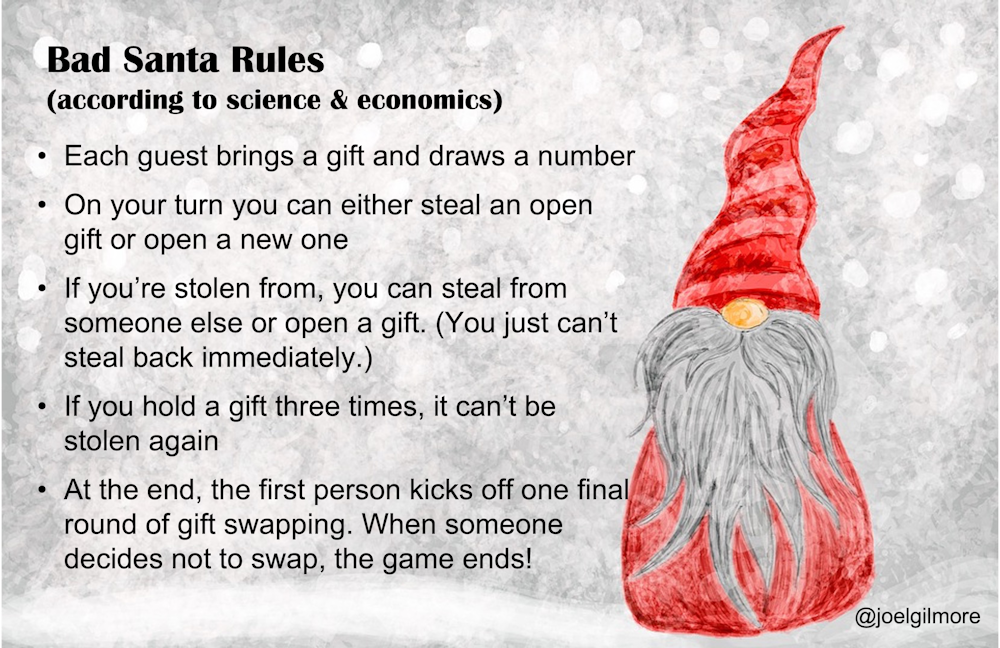
Fairest and best Bad Santa rules
The most fair outcomes come from the “red rules”:
A gift can be stolen multiple times each turn. This keeps presents moving between guests, which adds to the fun.
Once a person holds the same gift three times it becomes “locked”, and can no longer be stolen. This evens the game out a lot. Later players still see more gifts, but earlier players have more chance to lock the gift they want. It also ensures games don’t go on for hours.
After the last player’s turn, there is one more round of stealing, starting with the very first player. This also gives them a chance to steal at least once – and a slight advantage. But overall, these rules provide the most even outcomes.
Like most games, the rules are’t perfect. But the maths shows they are better than the alternatives. If you want to test other scenarios using my model, you can download my source code here.
Optimal rules for playing Bad Santa. Joel Gilmore / Background by Monika from Pixabay
Three tips on game strategy
The right rules help level the playing field. They don’t eliminate the need for strategic thinking to maximise your chance to get a gift you want.
As in real life, seemingly fair rules can be manipulated.
One thing you could do is team up with other players to manipulate the “three holds and locked” rule. To do this, you’ll need at least two co-conspirators.
Say your friends Donner and Blitzen have their preferred gifts, and now it’s your turn. You steal Blitzen’s gift. Blitzen in turn steals Donner’s, who steals yours, and so on. Donner and Blitzen end up holding their chosen gifts a second time, then a third. You helped them out, and then can choose another gift.
Alright, let’s go over the plan again. I steal this gift, then you steal that gift, and then you steal my gift. Shutterstock
In competitive markets this type of co-operation is usually know as collusion – and it’s illegal. In sport, it would simply be called cheating. So I’m not saying you should do this; I am merely explaining how the strategy works. If you do this and end up on the naughty list, don’t blame me.
I haven’t yet tested rules variations in my model to see how this collusion can best be eliminated or minimised. Maybe by next Christmas. (Or maybe not – for me, cheating through maths is half the fun of the game.)
So let me leave you with two perfectly legitimate strategies.
First, and most obviously, you must steal gifts!
My modelling quantifies how necessary this is. I simulated a game in which four guests will never steal a gift. Those guests are 75% less satisfied with their final gifts than the players who do steal. They’re also much less fun at parties.
Second, steal even if there’s nothing you want yet.
Steal the present you think someone else will want. If a later player steals your gift, you get another chance to pick again when more gifts have been opened.
And if someone gets Grinchy when you use these techniques to bag the best gift, just be sure to tell them you read about it on The Conversation.
Joel Gilmore ne travaille pas, ne conseille pas, ne possède pas de parts, ne reçoit pas de fonds d’une organisation qui pourrait tirer profit de cet article, et n’a déclaré aucune autre affiliation que son organisme de recherche.
Machado-Joseph-Disease (MJD) is a rare neurodegenerative disease that affects muscles in the body, including those required for speech. It is prevalent in some remote First Nations communities in the Northern Territory and Queensland.
Yolŋu First Nations people from northeast Arnhem Land are among those disproportionately affected. Yolŋu knowledge is shared through clan songlines, painting of clan designs, ceremonial song, dance, and storytelling. Growing up with a strong clan-based identity is the highest priority for Yolŋu families, and language is paramount.
This is why Julie Gungunbuy, a Yolŋu researcher from Galiwin’ku community, and Balanda (non-First Nations) researcher Rebecca Amery have developed Yolŋu (Djambarrpuyŋu) alternative communication systems. Julie is the principal Yolŋu researcher working on the study exploring communication difficulties for Yolŋu living with MJD, a disease in her extended family.
Neurodegenerative diseases like Parkinson’s, Huntington’s, and Machado-Joseph disease cause cells in the brain to die slowly over time. Cognitive function is not affected in MJD, but speech gradually becomes more difficult to understand, until eventually it is no longer possible.
MJD results in a slow loss of control of muscles and function that also affects mobility, vision, and sleep. A single copy of the disordered gene from one parent is enough to cause MJD. Children have a 50% chance of inheriting the disease from an affected parent and can experience the first symptoms at a young age.
People living with MJD usually require full assistance with daily activities within ten years from the first onset of symptoms. When speech becomes unclear, alternative ways of communicating such as using gestures, pointing to words, pictures, photos, and symbols are helpful. With appropriate medical care, people can live for more than a decade with severe-stage MJD.
Creating Yolŋu communication systems for loss of speech
For First Nations families and communities, practising culture through their primary language is crucial for health and wellbeing. It’s how deeper thoughts and feelings are expressed and understood, and how families and cultures stay strong.
Six years ago, together with other Yolŋu researchers in Julie’s family, the MJD Foundation and Charles Darwin University, we began to collaborate on developing alternative communication systems to support Yolŋu living with MJD when their speech becomes hard to understand.
Julie’s galay (first cousin) Barbara Rarrapul has the disease and is one of our research participants. She will eventually lose the ability to control and coordinate muscles to speak. She knows five languages: Djambarrpuyŋu (the most common Yolŋu clan language), as well as Gumatj, Wangurri, Warramirri and English.
We developed alternative communication systems with Yolŋu words, grammar, and pictures that Yolŋu can use to communicate by pointing to the words and pictures to share their message when their speech is too hard to understand. The creation of these systems was guided by Yolŋu language, culture, and personal preferences of participants, rather than by modifying existing systems in English.
In collaborative family research sessions, we developed cards with the Yolŋu alphabet, syllables, and words, as well as everyday pictures to explore different ways of representing components of Yolŋu speech.
In planning for inevitable loss of speech, we developed four alternative communication system prototypes for Yolŋu with varied confidence with Yolŋu literacy.
The prototypes include Yolŋu and English alphabets and a core vocabulary of almost 250 Yolŋu words, including common words from daily conversation and core concepts from Yolŋu culture. The systems were designed to emphasise identity and relationships and enable Yolŋu people to communicate in ways that are inviting and familiar.
The Yolŋu research team developed a metaphor to represent and share the research from a Yolŋu perspective: gulaka-buma or “harvesting yams”.
You need to go hunting for yams with experienced people who know the right time of year and what leaves to look for. You have to walk carefully through the jungle, so you don’t break the vines. Follow the vine right down to the head of the yam. Dig right down, all the way to the end and pull out the yam with roots on it. Don’t break it halfway. If you run out of daylight, cover it up and leave it. Come back another day when you have more time and keep digging.
It’s Julie’s hope that this research, and these alternative communication systems in Yolŋu languages, become a major step forward to supporting quality of life for Yolŋu people living with MJD.
This research highlights the importance of collaborating with First Nations peoples in their primary languages to enable meaningful participation in finding their own solutions.
The communication systems are a potential game changer for Yolŋu families, and the localised, collaborative, and respectful partnerships seen in this process are a model for enabling us to continue to develop more equitable allied health services in Australia.
Research participant names featured have been published with permission.
Rebecca Amery received research funding from a Research Training Program scholarship with Charles Darwin University and a Top-Up Industry Scholarship from the MJD Foundation.
People’s Alliance leader Sitiveni Rabuka says he has evidence his party is ahead in the 2022 polls, contrary to the official results posted by the Fijian Elections Office.
At a media conference yesterday, he called on the people of Fiji to remain calm and said he would write to President Ratu Wiliame Katonivere, the Republic of Fiji Military Forces Commander Major General Ro Jone Kalouniwai and the Supervisor of Elections Mohammed Saneem to express his dissatisfaction.
“We have discovered that we still have the majority — working on the results that were published in the pink copies of provisional results as per the polling booths,” Rabuka said.
“Those were collected, they were photographed, they were relayed to us and we have a count of those.
“And from all counts that we have, we have enough evidence to support our claim in a court.”
Rabuka said the shift in results after a glitch in the FEO results app had not been satisfactorily explained by Saneem.
“After the glitch last night [Wednesday], before we were actually ahead in the count; when the system came back on there was a big change and not in our favour.
Right to redress “It is only natural for us, for the people to expect the so-called ‘offended parties’ to have the right to redress.
“The redress I mean — that we will convey our feelings to the Supervisor of Elections to say that we are not satisfied with the outcome after the break.
“The constitutional officer that has the overall responsibility according to the Constitution is the commander RFMF and we will also be communicating with him.”
Rabuka said other constitutional offices they had written to also included the President’s office.
Meri Radinibaraviis a Fiji Times reporter. Republished with permission.
How the Fiji Times and the Fiji Sun today reported the controversial elections data glitch. Image: TPN
By Yasmine Wright-Gittins and Geraldine Panapasa of Wansolwara in Suva
The People’s Alliance Leader, Sitiveni Rabuka, will be writing to key Fiji general election figures expressing their dissatisfaction with the provisional results that followed the surprising technical glitch last night on the Fijian Elections Office app.
At 10.51pm on election day, the FEO released a statement on social media platform Facebook advising the public that provisional results were “temporarily on hold”. The post generated significant interest online.
Around 2.50am today, the FEO App was back online. However, the outcome that followed its resumption resulted in significant changes to the provisional results for contesting parties and candidates.
“It is something that is not within our control but we can engage activities that will allow us redress of what the situation is,” the statement said.
“We will convey our feelings to the Supervisor of Elections (SOE) to say that we are not satisfied with the outcome after the break, the glitch, last night.
“Before that [glitch], we were ahead in the count. When the system came back on, there was a big change not in our favour. It is only natural for people to expect the so-called offended parties to have the right to redress.”
Supervisor Of Elections Mohammed Saneem revealed that the FEO found anomalies in its system when uploading data to the FEO results mobile app.
Mismatch of numbers While the issue has now been fixed, Saneem said the technical glitch resulted in a mismatch of candidate numbers led to a misallocation of votes.
“What happened last night caught us by surprise. It shouldn’t have happened. We had to take the app and results platform down because when we published the last results with 507 polling stations, we detected an anomaly in which we noted certain candidates had results that were 28,000 and 14,000 on the app,” Saneem said.
“To cure this, the FEO had to review the entire mechanism through which we were pushing out results.”
He said the results management system was an offline system and a staging laptop was used to transmit the results to the app and website.
Saneem explained that an interruption in the process midway through the transference of data from the stating laptop to FEO results app caused a mismatch of the identification of the candidate on the FEO app to the staging laptop, hence vote numbers changed for certain candidates who received a lot of votes on the app.
“We had to delete the data that had been published and then reupload data on the FEO app.”
At 7am, Saneem officially announced the closure of provisional results for the 2022 general election.
Data entry stage He said they were now in the data entry stage of the final results, which would be available on Sunday.
“The database has been flushed. We will now enter fresh results. This is not the provisional results database, this is a separate database completely for final results,” he said.
“The provisional results will remain. Data entry will be done from the beginning.
“The number will be lesser [than] the provisional results but this only means that the results will be re-entered from zero.”
Meanwhile, Rabuka called for Fijians to remain calm as they continued to explore avenues for redress.
Published in collaboration with the University of the South Pacific journalism programme’s Wansolwara News.
Source: The Conversation (Au and NZ) – By Kim M Caudwell, Lecturer – Psychology | Chair, Researchers in Behavioural Addictions, Alcohol and Drugs (BAAD), Charles Darwin University
Louis Hansel/Unsplash
You’re catching up with a few friends before you go out. Everyone’s having a drink, listening to some tunes, and the mood is good. A ride share is pulling up in the driveway – everyone quickly finishes their drinks and piles into the car, headed to a gig where more alcohol will be consumed.
This is the typical pre-drinking scenario – drinking alcohol in one place, typically someone’s home, before drinking more somewhere else, such as a pub, club or event.
You might be familiar with pre-drinking (colloquially known as pre-loading) and think nothing much of doing it.
In reality, it’s a complex behaviour that has been of great interest to health psychologists and public health strategists for the past 15 years.
And as popular as it is, pre-drinking isn’t without risk.
Why do people pre-drink?
The considerable public health effort to reduce excessive drinking in licensed venues has meant some drinkers appear to have abandoned the traditional “pub to club” model in favour of a “home to pub to club” version.
You can understand the appeal – compared to a busy venue, someone’s house is likely to be less noisy, less cramped, and probably doesn’t include a cover charge.
In Australia, a common reason people cite for pre-drinking is the relatively cheaper cost of pre-purchased alcohol compared with prices at a licensed venue.
Indeed, behavioural economists have observed we tend to be quite discerning when figuring out the most cost-effective way to drink.
Add our complex taxation system and public health initiatives such as minimum unit pricing to the mix, and it’s no surprise we are looking for ways to get a buzz on the cheap.
More than money?
Outside Australia, evidence shows alcohol price is less of a driver for pre-drinking. Other motivational themes have emerged – mainly from psychological research in North America and Europe.
These include the “enhancement” aspect of pre-drinking itself (as the opening scenario illustrates), controlling alcohol consumption in situ (such as only drinking your preferred brand), or in anticipation of less access to alcohol later on (think long lines for beer at the footy).
Generally, the aim of pre-drinking appears to be getting “sufficiently intoxicated” before going out.
But one motive, commonly mentioned by men, has been labelled as “intimate pursuit”. This is where hanging out during pre-drinks is used to built rapport with someone you might be romantically interested in.
Although these themes are generally endorsed by Australian pre-drinkers, cost is still an important driver of our pre-drinking, especially among young Australians.
In our research, we asked participants about the cheaper cost of pre-drinking, alongside these other motives. It was the strongest predictor of pre-drinking, and also predicted participants’ experience of alcohol-related harm over the previous 12-month period.
From a psychological perspective, this may be because alcohol affects our “inhibitory control”. Although our goal with having pre-drinks is to keep total alcohol expenditure down, the drunker we get, the harder it is to resist buying another round.
The unique harm of pre-drinking
Unfortunately, research consistently shows pre-drinking is uniquely linked to excessive alcohol consumption, and alcohol-related harm.
One reason may be that we drink faster while pre-drinking, relative to sitting on a pint at the pub. This means pre-drinkers may reach higher levels of intoxication, more quickly.
Research shows pre-drinking serves important practical and social functions – catching up with friends in a more relaxed environment, and warming up for a night out.
As such, it is unlikely we will eliminate pre-drinking entirely, but we can try to make it a bit less risky.
One challenge for pre-drinking is that people may drink out of whatever vessel is around – say, a mug – and will find it difficult to keep track of their consumption.
Licensed premises serve alcohol in standardised containers such as pints and schooners, or use measured pours. So, having schooners or jiggers on hand when pre-drinking would be a good place to start.
Health psychologists often promote “protective behavioural strategies” – things that help keep our alcohol consumption under control. For example, we can set ourselves a drink limit, or set a timer between drinks to slow our intake. Work is ongoing to investigate how these strategies might be better tailored to the pre-drinking context.
Ultimately, if you’re planning a pre-drinking session before an event, it’s a good idea to make sure there are plenty of non-alcoholic or low-alcohol options, and food – as you would with any party.
The most important thing pre-drinkers can do is keep an eye on each other, making sure everyone makes it to the event, has a good time, and gets home safely.
Kim M Caudwell does not work for, consult, own shares in or receive funding from any company or organisation that would benefit from this article, and has disclosed no relevant affiliations beyond their academic appointment.
New Zealand Parliament Buildings, Wellington, New Zealand.
Analysis by Dr Bryce Edwards.
Political Roundup: National is failing to inspire voters
Political scientist, Dr Bryce Edwards.
Labour’s Hamilton West by-election loss at the weekend has been widely described as a disaster for the party, illustrating just how much the tide has turned on the Government.
But what did the by-election result say about the state of the National Party? Tama Potaka’s win was a vote of confidence in him as a candidate and for the party as a whole. Winning 46 per cent of the vote was a strong performance, easily beating the Labour candidate’s 30 per cent support.
National failed to inspire voters in Hamilton West
However, the extremely low voter turnout really does need to be considered when evaluating National’s success. According to the Electoral Commission, the eligible voting population in Hamilton West is about 57,211. Therefore, 14,392 votes is a turnout of only about 25 per cent. (Some news reports suggest a higher turnout figure, but they’re failing to include the number of eligible voters in Hamilton West who weren’t enrolled.)
What’s more, Potaka’s winning total of 6629 represents the endorsement of less than 12 per cent of eligible voters in Hamilton West. So while Potaka crushed his Labour opponent, a sober reading of the result shows it was somewhat less than the total victory it appears to be.
The problem is that National, by and large, failed to mobilise support for their candidate. Potaka actually received 7807 fewer votes than National’s losing candidate in 2020, Tim McIndoe – so that’s less than half the vote National mobilised just two years ago at a time when the tide was going out on the party.
Despite Luxon’s underdog posturing in the run-up to election day it would have been shocking if National hadn’t won, as the party had everything going in its favour. The cost of living crisis, together with the increased concern about crime and ram raids on shops provided the perfect conditions for National to take the seat off Labour. What’s more, the whole contest had been sparked by the embarrassing resignation of Gaurav Sharma, who had made all sorts of damaging accusations about bullying in the Labour Government.
National’s failure to take advantage of Labour’s woes
In mobilising only 12 per cent of eligible Hamilton West voters to choose Potaka, the by-election highlights how National is also failing to convince voters throughout the rest of the country.
Right now, the National Party is polling consistently above its Labour rival, and while this is a significant turnaround from the last few years, there needs to be an acknowledgement that National is still trapped in the high 30s – the most recent Curia poll had National on 39 per cent, the Kantar poll had them on 38 per cent.
Shouldn’t National be doing better than this? The Labour Government has had a terrible year, handing the Opposition the best conditions to prosper in years, and yet National hasn’t been able to take full advantage of this. The feeling inside National must be that they should currently be at least ten points ahead of Labour rather than just a few.
On just about every major issue that is important to voters, Labour has been in trouble throughout 2022. The crises keep coming – the housing crisis and the cost of living crisis are the two big ones in which voters have great reason to be most dissatisfied with Labour’s performance. But there have been so many other failures that have created the perfect conditions for the Opposition. From the unconvincing Three Waters reforms through to Hate Speech laws and the RNZ-TVNZ merger, Labour has stumbled.
National’s inability to leverage Labour’s weaknesses more fully is partly down to Christopher Luxon. On the one hand, the new leader has obviously done well to keep his party united and lift their support up. And his own preferred prime minister poll numbers are relatively good. But has he really inspired the public? There’s not much evidence of it.
Luxon is probably aware of his need to appear to be more substantial. Hence in an RNZ interview this morning he talks of the need to carry out reforms that are more than just “incrementalism”. The RNZ news item is titled, “Christopher Luxon pledges to be bolder if elected”.
National failing to present an alternative
Overall, National is doing a relatively good job of opposing the Labour Government, but is failing to present a convincing alternative to the status quo. Yes, the true-blue supporters are relatively happy that the party is more coherent and organised than in the past. But National is currently far too bland and thin in vision to really win over many of the voters that are losing faith in Labour.
Part of the reason is the Act Party. David Seymour is likely to be labelled the “Politician of the Year” by many commentators. His boldness and chutzpa put Luxon to shame. And so for as long as Act is positioning itself as the “rightwing party of ideas and principles”, then National is going to look rather uninspiring.
The blandness of National is also by design rather than neglect. National strategists have obviously decided to take a small target approach, in which they try to minimise the areas in which they can be critiqued on. By deliberately not projecting an alternative to Labour, National will be hoping to avoid alienating any floating, centrist voters.
Defenders of National might suggest that National is keeping its powder dry for the election campaign. And, yes, more policies will be released on the campaign trial. But they are likely to be more bland than bold.
National’s boldest policy so far has been its military academy announcement. And we saw last week that this is popular – 60 per cent believe that serious youth offenders should indeed be sent to bootcamps. Meanwhile, crime and justice experts continue to view the policy as anything more than populism.
The Hamilton-West by-election also indicated that a focus on law and order is the one area that National is willing to be bold and radical on. The issue of ram raids and crime was successfully leveraged by candidate Tama Potaka in a sign of what we might expect much more of from National in 2023.
But will a hard line on law and order be enough to get National’s vote up in the 40s? It’s unlikely. To win over former Labour voters, National will have to release some convincing policies to deal with the housing crisis and the cost of living. And more widely, it needs to show what it actually stands for – because that is far from clear at the moment.
Luxon will also have to lift his game. In 2022 he has been too gaffe-prone and unimpressive in his media interviews. But the bigger problem is that people generally find him too bland and empty.
National is clearly doing quite well at the moment, and is very much the odds-on favourite to be in government in a year’s time. New Zealand doesn’t allow political gambling, but the Australian betting sites are currently only paying $1.65 for a National win, versus $2.20 for a Labour win – which suggests there is about a 60 per cent chance of a change of government.
But before National gets too complacent, it should continue to ponder why its successful by-election candidate only managed to mobilise 12 per cent of the eligible electorate to turn out for him, and why National is struggling to hit 40 per cent support in highly-favourable conditions.
National and Luxon are clearly still failing to inspire.
Holidays are a time when lots of us tend to overindulge in food and drink, and many people gain weight. Once gained, weight is difficult to lose, and it is likely that much of the holiday weight gain will stay with us.
Overindulgence might happen for some people around relaxed and positive family gatherings, especially if COVID has limited travel and family occasions in recent years. For others, holiday gatherings hold the potential for conflict and emotional challenges and that can lead to having more to eat and drink. For some people it will be a sad and lonely period, without family or significant others around, and food might seem comforting.
Holiday gatherings are typically social, featuring foods that are delicious, energy-dense and plentiful. It can be challenging to resist the temptations on offer. Yet some people overindulge, but others do not. Why?
Research tells us how different “eating personalities” influence our tendency to overdo it at the festive buffet.
Eating personalities
The various combinations of our eating behaviours (our usual ways of behaving and thinking about food) interact with each other as “eating personalities”.
Technically, eating personalities (or eating phenotypes) refer to habitual patterns of eating behaviours and thoughts that are the result of interactions between our genetic makeup, individual characteristics and the environment.
Eating personalities affect how we eat (such as how fast), what we eat (healthy or unhealthy foods), how much we eat in different situations, and importantly, why we overeat. Eating personalities are apparent even in infants and continue to evolve and change over our lifetime. They also inform how we select specific weight-loss strategies.
For some it’s the pudding, for others it’s the turkey that’s hard to turn down. Pexels, CC BY
Our eating personalities could include:
how we respond to prompts for overeating, such as the presence of tempting foods or drinks at a buffet lunch, and whether we sometimes lose control
how desirable or appealing or rewarding we find different foods or drinks. It might be a glossy chocolate cake for one person but crispy roast potatoes for another
whether we notice and respond to internal signals of fullness
our tendency to serve large portions and eat until the plate is clean
whether we are able to wait until we start feeling hungry again to begin eating, rather than being guided by the clock or a tempting snack
our capacity to stick to longer-term goals in the presence of tempting foods or drinks
how fast we eat and whether we tend to maintain this pace or slow down during the course of eating
whether we are “emotional eaters” who eat when we feel down or to celebrate success.
Research published this year, based on a randomised clinical trial with 217 adults, indicates that knowing your eating personality can help identify strategies to manage food intakes and weight. A second recent study of 165 people supports these findings.
Matching strategies to your particular eating personality traits could help you manage or avoid overindulgence.
1. The overeater
If eating when you’re not actually hungry is a component of your eating personality, improving awareness of hunger versus other triggers for eating when you feel full, and developing skills in responding to these cues before deciding to eat, could help.
2. The food admirer and impulsive eater
If high attraction to food is a factor, and you have difficulty resisting, acknowledging the attractiveness of food cues and practising using avoidance, distraction or resistance strategies may be effective.
3. The emotional eater
People who recognise they eat for emotional reasons might try other strategies such as mindfulness, walking or listening to music to work through their feelings.
4. The plate cleaner
If resisting food is hard once it’s on your plate, choosing smaller portions could help, along with developing awareness of fullness cues, or selecting some food but saving some for later in a separate location. Some young children do this naturally, spreading holiday chocolates or treats over days or weeks.
5. The speed eater
If eating quickly means you tend to eat too much, pay greater attention to your eating speed during the meal and attempt to slow down by interspersing eating with other things like chatting or drinking water.
Eating patterns and responses are highly individualised. Unsplash, CC BY
It is a common experience to have tried, and sometimes failed, to temper food intakes during holiday periods and celebrations.
Food is a central part of holiday celebrations – it provides social and cultural connection, and is a source of enjoyment. However, if avoiding overindulgence is a priority for your health and wellbeing, it is worth exploring your eating personality. This is a path to a better understanding of overindulgence, and possibly to strategies for moderating what you eat and how much, during the holiday period and beyond.
Georgie Russell is affiliated with the Nutrition Society of Australia and the Australian and New Zealand Obesity Society.
Alan Russell does not work for, consult, own shares in or receive funding from any company or organisation that would benefit from this article, and has disclosed no relevant affiliations beyond their academic appointment.
To tackle the energy crisis about to send our bills skywards, the Albanese government last week capped gas prices temporarily in the east coast market, proposing a figure of A$12 per gigajoule. A gigajoule of gas has the same energy as about 26 litres of petrol.
But has the government been too generous to the three gas majors? After all, before the Ukraine war and sanctions on Russia jolted prices up, the average price gas producers were asking to supply gas next year was around $9.20 per GJ, with 96% of price offers under $12. Australia, of course, is the world leader in producing and exporting liquefied natural gas (LNG), so there’s no issue with supply.
If you look west, you’d immediately think the government’s cap is indeed too generous. Western Australia’s gas prices are roughly $5.50 per GJ. So while capping prices at $12 may stop gouging, it’s still more than we needed to be paying. And a higher cap on prices may actually encourage more greenhouse emissions, as it gives gas producers the incentive to ramp up production. Gas producers and lobby groups argue price caps will push investment away from Australia to other countries.
So who’s right? Let’s find out.
Keeping the gas flowing is a necessity for the time being. Ms S. Ann/Shutterstock
How does a price cap work?
Put simply, the $12 price cap will apply to all new contracts for wholesale gas on Australia’s east coast gas market.
It will only apply to the east coast domestic market because WA has had in place a separate domestic gas reservation policy since 2006, which requires 15% of locally produced LNG to be kept for the local market. As a result, WA has been largely protected from global price hikes this year. Gas prices have averaged between $5.50 and $6 per GJ.
After 12 months, the price cap will expire. Or will it? Once the year is up, the government will consult with industry and reassess the cap under what it has described as a “reasonable price” plan. This means the government will inspect future gas contract offers to see if the price is “reasonable” based on cost of production plus an agreed profit margin.
This suggests some form of price control will be with us for a while. Government control over energy prices – in countries that produce gas – is now imperative given the global disruptions to the market. Higher energy prices are likely to be with us for the foreseeable future and gas will continue to influence energy pricing until the renewable sector can replace it.
Did the gas majors get too much?
It depends: $12 per GJ is much more than east coast gas producers were being paid before the Ukraine war started in February. Before that, producers were still turning a profit while selling at $5-7 per GJ. This year, prices reached as high as $45 per GJ.
These prices are simply unsustainable, distorting the market and causing major disruption to domestic consumers and industry. This windfall boosted gas producers’ profits but came at significant cost for many heavy energy using industries. The government had to act.
Free market purists would say we should have let the market decide. But that would have plunged many into energy poverty, where people would be unable to afford to heat or cool their homes and many industries would have had to shut. As Rod Sims, former head of the Australian Consumer and Competition Commission, has pointed out, failing to act would not have been good for the social fabric of the community.
While alternatives like heat pumps will start to displace domestic gas use, it will be with us for a while yet. Shutterstock
Even so, intervening in the market was always going to be difficult. It’s no surprise the eastern gas companies squealed, given they have never been subjected to a price cap, a reservation policy or even had the so-called gas trigger pulled to ensure supply volumes were adequate. Producers have variously described the price cap as “reckless”, “rushed” and an “ill-considered” intrusion. If you had been raking it in, you might be miffed too.
Capping gas prices at $12 is certainly not the best pricing option. As others have pointed out, $7 per GJ would still give gas producers a significant profit and could help us cut our greenhouse gas emissions.
But bear in mind this price cap was always intended as a first-base plan, allowing the government to act quickly to keep energy prices from ballooning. It would have been a very difficult year if the government had not done this – especially as voters are fully aware they live in a country with an abundant supply of gas.
Because this is the first time gas contracts on the east coast have been subjected to a price cap, the government had to act cautiously. That’s why it gave gas producers more than $7, to keep them on side.
It’s far better we pay $12 for gas rather than the $26 per GJ gas producers were making on the spot market last quarter. In the longer term, the goal is to fend off the forecast price hike of 56% over the next 18 months.
So, we should see this as a two-part plan. First, stop prices soaring into the stratosphere immediately. And second, tackle distorted energy prices in the medium term by introducing reasonable profit rules after that, ensuring producers can make reasonable profits without subjecting consumers to the wild excesses of the global market.
You might wonder – why are we doubling down on fossil fuels? Certainly, we have to phase out fossil fuels to fend off the worst of climate change. But right now, Australia is not as far along as it needs to be in shifting to clean energy. If we want to accelerate this shift, we could look once again at pricing greenhouse gas pollution rather than hoping price caps will do the work indirectly.
What about the fact that gas is still much cheaper in WA? Why can’t east coast residents match this? Well, the reservation policy in WA has been in place for nearly 17 years, and the gas price reflects this long-term framework.
Over east, this $12 price cap captures what Treasurer Jim Chalmers describes as the need to balance support for the east coast gas sector while preventing a disrupted global market from hollowing out local industries and adding yet more strain to struggling families.
How should we see this cap?
If you’d floated the idea of direct government intervention in the gas market a year ago, you’d have got a sceptical response. Governments messing with markets is usually controversial. That’s why we’ve seen strong pushback. But the government could not have let things keep going as they were. It was politically and socially unacceptable.
The price cap is a reasonable short-term approach. Producers will keep banking significant profits, and consumers will be better protected from huge energy market volatility. This cap gets the ball rolling. But it’s not the end of government directing markets. These are not ordinary times.
Samantha Hepburn does not work for, consult, own shares in or receive funding from any company or organisation that would benefit from this article, and has disclosed no relevant affiliations beyond their academic appointment.
Source: The Conversation (Au and NZ) – By Michael Westaway, Australian Research Council Future Fellow, Archaeology, School of Social Science, The University of Queensland
Deal Lewis/AAP
Apart from managing the land, Indigenous people have also managed waterways, including the Murray River and the Darling/Baaka River, for thousands of years.
Like many Indigenous peoples of Australia, the Barkandji people of the Baaka manipulated and enhanced the river and floodplain ecosystems of their country.
Now, our research on stone, wood and earthen fish traps and fish weirs on the Baaka and its floodplains reveals how these aquatic resources were managed, grown and stored by the Barkandji.
These structures, and the cultural practices that sustain them, are still significant to the Barkandji people – but they’ve been severely affected by colonisation, and remain at risk from government commitments to irrigation.
Reconstructing the Baaka’s Aboriginal past
To study the structures in the Baaka we relied on archaeological methods, Barkandji knowledge and oral history, and written accounts from early settlers and explorers.
We found most of the wooden or earthen fish traps on the Baaka’s floodplains have not endured and aren’t archaeologically visible. There are, however, some existing and remnant stone traps – which were once common along the 1,200km channel.
These structures were encountered by explorers, ship pilots, graziers and other settlers who travelled along the Baaka between Wentworth and Bourke.
The first threat to the traps were paddle steamers
The first paddle steamer travelled in 1861 up the Baaka from Wentworth at the Murray-Darling junction to Brewarrina on the Barwon River. It was piloted by Captain William Randell, and was unable to pass over the fish traps due to a lack of draught over the rocks.
This voyage initiated the famous paddle steamer trade that continued into the 1940s. Rocks in the river often stopped these vessels from navigating at low water levels, and they occasionally even sank.
A photo published in 1926 of the ‘P.S. Colonel’ and barges drifting downstream at Christmas Rocks. PRG 1258/2/2260 Godson Collection, State Library South Australia
This prompted government-resourced teams to force a passage through by blasting the rocks with dynamite. This blasted rock can still be seen at some outcrops, including areas that have the remains of fish traps or are known to have once had them. Indigenous people built new traps in these areas, often using the blasted rock.
During the 20th century, a series of low-level weirs were built at the small towns along the river to secure water supplies. Settlers sought the same river features to build weirs that Indigenous people did when choosing sites for stone fish traps, so many weirs were built on outcropping rock.
These weirs tended to have loose boulders on the downstream side to hold the weir wall in place. At Wilcannia, the Indigenous workers who carted and placed the rocks at the weir later made them into stone fish traps, which are still used today.
They are made in steps going up the weir wall, helping fish climb the wall like a modern fish ladder.
The Wilcannia weir stone fish traps are still used by young Barkandji people. Sarah Martin
Taking too much water for irrigation
During the last two decades an increasing amount of water has been removed for large-scale irrigation from the Baaka and its northern tributaries. By 2019, excessive water extraction had virtually dried the Baaka and Barwon rivers from Wentworth to Collarenebri – a route more than 2,000km long.
The mass fish kills at Menindee in 2018–2019 showed the devastating effects of removing so many of the small to medium flows that kept the ecosystem functioning.
This extended dry river resulted in the near extinction of many species, including river snails, mussels, catfish and silver bream. Also, without water in the river, the Barkandji could not use their fish traps or pass along knowledge of their history and significance.
The Baaka dried up due to excessive water extraction. Pictured here is an area at Wilcannia in 2019. Sarah Martin, Author provided
The New South Wales government’s response to the crisis now presents a new threat to the fragile fish traps. In 2019 the government passed legislation to fast-track new water infrastructure, despite strong evidence it needs to reduce the amount of water allocated to irrigation.
The legislation enables new dams and new (higher) weirs. The old weir at Wilcannia, which has been used by Indigenous people as a series of fish traps for at least 60 years, will be partly demolished and will no longer function as a fish trap. This is despite the Indigenous community’s strong opposition.
The legislation also allows for the “re-establishment of natural rock weirs on the Darling River between Bourke and its junction with the Murray River”. This suggests all the rock outcrops in the Darling Baaka were originally weirs that stretched like a wall across the river and held water back (before being blasted to allow paddle steamers to pass).
But our field survey coupled with historical material indicates most rock outcrops were originally uneven, with openings and numerous loose rocks. This allowed water to flow through and over the rocks at different river heights, enabling the fish traps to work and helping sustain the ecosystem.
Fish traps set by Aboriginal people along the Baaka offer valuable insight into how this precious body of water could be managed. The first thing is the river needs its “low and medium flows” protected.
Historically, Aboriginal people have held ceremonies (and to some extent still do) to mark mass migrations of fish such as golden perch and silver bream that travel upstream to spawn. These fish have to be able to travel up and down the river unimpeded. As seen at the Wilcannia weir, fish traps assist with this.
There are also several benefits from water flowing over and through fish trap stone walls. The walls increase flow turbulence, reduce silting, improve water quality and are “keyed” to let small fish through. They also provide a rocky habitat that effectively forms “multi-storey apartments” for invertebrates such as yabbies and river snails.
Stone fish traps are also often found in association with shallow aquifer springs, with one recorded trap built around a spring. This is evidence of fish management; the fresh spring water attracts fish and acts as a refuge during drought.
Local Indigenous people also understand the necessity of regularly filling floodplain lakes, swamps and billabongs. They previously enhanced these water bodies by using temporary wooden and earthen weirs – providing fish reserves, fish nurseries and rich and diverse habitats for aquatic life.
These structures kept aquatic plants and animals safe to seed the river with life when floods came down after dry periods. They held water to replenish the shallow aquifers that create springs and soaks in the river.
Water managers have so far largely ignored the potential for Indigenous knowledge to facilitate the sustainable management of the Baaka. Yet Indigenous people living along the Baaka have known about how its water moves long before scientists did.
The NSW government’s proposed infrastructure will not only endanger the remnants of culturally significant fish trap structures, but also impact the river’s ecology. Unless Indigenous people’s experience and knowledge are taken seriously, the Baaka and its precious resources may be depleted beyond the point of saving.
Acknowledgment: we would like to thank our colleague Sarah Martin, who led the research paper this article is based on, and whose contributions were invaluable in gathering these findings.
Michael Westaway receives funding from the Australian Research Council.
Sue Jackson receives funding from the Australian Research Council and the Commonwealth Government’s Murray Darling Basin Water and Environment Program. Sue is a member of the Murray Darling Basin Authority’s scientific advisory committee.
Badger Bates does not work for, consult, own shares in or receive funding from any company or organisation that would benefit from this article, and has disclosed no relevant affiliations beyond their academic appointment.
Only 24% of local councils in Australia separately collect household food organics and garden organics (FOGO) waste. Another 16% provide garden waste collection only. This limited progress has prompted the federal government to push back the target date, from 2023 to 2030, for all councils to collect food and garden waste separately from landfill waste.
Most food waste currently goes into red bins as mixed waste bound for landfills. Kerbside collection of organic waste will become a standard service for all residents in New South Wales and Victoria by 2030, for metropolitan residents in South Australia and Western Australia by 2025 and for Canberra residents by 2023.
To achieve these targets, effective policies and incentives will need to be put in place for councils or private waste management companies. They will have to build and operate the infrastructure needed to process FOGO waste, and will want to recoup their costs.
Happily, this waste has increasing value as a source of both high-quality compost and biogas, which can be used like natural gas. The markets for these products, with gas prices in particular soaring, should help drive widespread adoption earlier than 2030.
The rationale for diverting organic waste from increasingly limited landfill space is clear. Collecting this waste separately reduces landfill impacts and costs, while delivering other environmental benefits.
Organic waste in a landfill will biodegrade slowly, eventually turning into biogas (methane and carbon dioxide). It can also produce organic acids that dissolve and mobilise heavy metals, creating a toxic hazard.
Modern landfills operate for decades. Waste is covered as it is placed, but only with soil until the landfill is full. Despite the use of multi-layer liners and impermeable final covers, these eventually deteriorate. In addition to harmful local environmental legacies of landfills, emissions of methane – a potent greenhouse gas – cause global harm.
In contrast, returning clean organic material to soils is beneficial. Australia’s arable soils are typically low in organic carbon, which needs to be regularly supplemented.
Food waste in landfill emits methane but it can instead be used to produce valuable compost and biogas. Shutterstock
But, to produce high-quality compost, FOGO must be collected in a separate bin to avoid contamination. It’s possible to extract organic material from mixed (red bin) waste. This is done by grinding the waste and then using magnets, eddy currents, water flotation and air sorting to remove glass, plastic and metal fragments.
However, red bin waste is not closely monitored. It can contain batteries, electrical goods, paints and other sources of heavy metals in dissolved or fine-particle form.
This is why NSW banned the use on land of compost derived from mixed waste in 2019. A NSW EPA review had identified cadmium, zinc and copper as metals of high concern in this compost. It also found chemicals such as flame retardants and disinfectants were household sources of persistent organic pollutants.
How much waste are we talking about?
The size and composition of the FOGO resource will change if Australia achieves the UN Sustainable Development Goal of halving the food waste generated per person by 2030, compared to 2015. The 2019 National Waste Policy and Action Plan adopted this goal.
Estimates of food waste in Australia vary. The most comprehensive survey was a nation-wide audit in 2020 of 450 kerbside bins by the Fight Food Waste Cooperative Research Centre. It showed weekly food waste was 0.79kg per person, including 0.34kg of inedible peels, bones and expired or perished food. These households disposed of a similar amount of food waste in the home by composting, feeding to pets or flushing down the sink.
The United Nations Environment Programme’s 2021 estimate is similar at 1.5-1.7kg of weekly food waste per person. The National Waste Database estimate for Australia is higher at 2.37kg.
According to the database, 31% of food waste in NSW was separately collected and composted or digested in 2018-19. The figure was less than 10% in all other states except Western Australia, where it was 13%.
As for garden waste, 2.01kg per person each week goes into kerbside bins. Over 50% of garden waste (85% in South Australia) is separately collected in all mainland states.
The demand for organic carbon in Australian soils far exceeds the amount of compost that could be produced from FOGO. But, to tap into this market, the compost quality must be consistent.
A clear definition of acceptable FOGO and carefully controlled operations are needed to produce consistent quality compost. The waste management industry and advice to government have called for FOGO bins to be limited to food waste and garden waste, excluding materials like paper, cardboard and animal waste.
Many councils compost garden waste on open pads, some under cover. Machinery is used to shred and turn over the piles to control temperature and moisture levels.
The control of this process becomes more critical for FOGO. Food waste can be smelly, particularly if the composting process is open to the air but not adequately aerated.
Tighter control, particularly of odour, can be achieved if composting is done in vessels. Typically, these take the form of concrete tunnels.
High-quality compost for farming can fetch A$50 to $80 per cubic metre. That makes separate collection and processing of bio-waste more attractive financially.
In addition, surging gas and electricity prices and the revival in value of renewable energy credits have increased the viability of first anaerobically digesting FOGO to produce biogas, then composting the digested material. FOGO can be digested in sealed tunnels similar to composting tunnels.
This biogas will not solve Australia’s gas shortage (FOGO biogas could meet about 2% of the demand). However, I calculate, as a conservative figure, that the income to an anaerobic digestion operator would exceed $40 per fresh tonne of waste. This figure is based on a conservative methane yield of 50m³ per tonne, a wholesale electricity price of $200 per MWhr and a renewable energy credit value of $50 per MWhr.
All of these considerations indicate we should be confident almost all households will have a FOGO service before 2030. The alternative is to waste this resource in landfills, with all their future environmental liabilities.
William Clarke has received funding from the Australian Research Council on projects related to the degradation of organic wastes in landfills and in anaerobic digesters. He has also performed numerous consulting projects assessing the biogas yields from various organic wastes.
Source: The Conversation (Au and NZ) – By Sally Patfield, Senior Research Fellow, Teachers and Teaching Research Centre, University of Newcastle
Marina Stoichkova/Pexels
This week, year 12 results have been released in Victoria, New South Wales, Queensland and Tasmania. Other states will follow next week.
The Higher School Certificate and its equivalents are seen as the pinnacle of schooling in Australia – the culmination of years of hard work and anticipation. Yet each year, the same narrow narrative about “success” appears in the media.
We hear about the “top-performing” high schools, which are disproportionately private and government selective schools. And we hear about the individual “high achievers” who top a subject or achieve a high university entrance rank. These results are of course impressive, but recent analysis of NSW data showed the proportion of high achievers from disadvantaged schools is shrinking.
There are other ways of thinking about success in year 12. Federal Education Minister Jason Clare often notes he was the first in his family to finish high school and go to university (he pointed this out as recently as Monday in a speech at Western Sydney University).
Our research shows how significant this achievement is for many young Australians and their families, and how we need to broaden our ideas about what success means for year 12 students.
Being first-in-family
In 2022 between 13% and 55% of all new undergraduates in Australia were the first in their families to go to university, depending on where they enrolled.
Topping a subject is not the only way to measure success in year 12 exams. Paul Miller/AAP
As the name suggests, “first-in-family” students are those whose parents do not already hold a university-level qualification themselves. Frequently, they also don’t have any siblings or relatives who have gone to university.
Research has also shown first-in-family students are more likely to be Indigenous, and more likely to live in socio-economically disadvantaged communities and/or rural and remote areas. This means their journey through formal schooling and into tertiary education is likely to have been much more complex than for their more advantaged peers.
So, at university, they must navigate a new and unfamiliar pathway. They also enter a system where entry is still very much tied to family background. According to 2012 data (the most recent available), a young person with a university-educated parent is twice as likley to enrol in university than someone who does not.
Our research
Since 2010, my colleagues and I have been conducting one of the largest studies to date on the aspirations of Australian school students.
In 2021, we did a follow-up study with more than 50 NSW students we had previously interviewed. About 80% were first-in-family students.
For the first-in-family students in our study, four things stood out.
First, students and their families placed immense value on schooling to foster greater opportunities and get to university. There was a hope they could change their life trajectory through education. As Bella*, a year 9 student, told us about her parents:
Because they didn’t go to university, they want me to go […] They don’t expect a lot of me, but they just want me to go so I can get a better job than what they have.
The second thing we noticed was first-in-family students saw themselves as breaking down barriers. This is not just in terms of getting to university, but giving voice to others in their situation. Frank is currently studying politics and international relations at university. He told us:
My family have always been the workers. They have always been those who have been impacted by government policy […] I think it’s about time that someone from my family was in a position to be able to be on the other side of that and help in a positive way rather than just being impacted by it.
Third, teachers were described as a big influence. As year 12 student Brice told us:
Our careers adviser, Ms Bradshaw […] I don’t know what we’d do without her, really. She’s the biggest help that we have […] she knows what all of us want to be individually so if there’s one thing she goes, ‘Oh, I know that Lachlan really wants to do that’, she goes and talks to him about it.
And finally, students didn’t refer to the HSC or a high tertiary admissions rank (ATAR) as a form of “success”. Instead, they often focused on realising their passions and aspirations. When we spoke to Martha last year, she had just graduated from university and is working as a speech pathologist:
I knew this was the job I wanted straight out of school. I was like, get it done, four years and then no schooling. I feel like so many things have led me to where I am now that I’m happy. I’m really enjoying life […] I said in my original interview many years ago that I’m going to be a speechie. And now, in this interview, I am a speechie!!
A different version of success
So, when you read typical portrayals of year 12 “success”, consider the first-in-family students who have the odds of getting to university stacked against them.
For some of these students, getting to the end of high school is an important “first” in itself that must be recognised. This is encapsulated by year 11 student Ayla, as she reflects on her family’s past and her own future:
My mum dropped out of school when she was in year 8 and my dad went through to year 11 and my sister dropped out in year 11 […] So I don’t really have a lot of experience, a lot of people telling me stories about it [university], and I haven’t gone to any campuses and stuff so I don’t really know a lot about it, but I’ve heard that it’s good.
While first-in-family students are a diverse cohort, what they often share is a belief in the role of education to change the future – for themselves, their families, communities, and society-at-large. There is still much more to do to ensure the education system rises to this challenge.
The Aspirations Longitudinal Study and related studies (2010-2021) were funded by the Australian Research Council, the NSW Department of Education, and the National Centre for Student Equity in Higher Education. Sally Patfield received funding via an Australian Government Research Training Program (RTP) Scholarship to support her research.
On a December night 50 years ago, Eastern Airlines Flight 401 crashed in the Everglades, Florida. Miraculously, 77 people survived the initial impact but then endured a traumatic wait for rescue in the alligator infested swamp, surrounded by wreckage and jet fuel.
To lift their spirits, they sang Christmas carols.
What drove these survivors to sing in such distressing conditions? What is it about group singing that has the remarkable ability to bring people together, express deep emotions, and feel connected with each other?
United in song
It’s no coincidence that shared moments in life are often accompanied by singing together. As a leisure activity, group singing engages many beneficial biological, psychological, behavioural and social processes.
For example, when we sing, we consciously manage our breathing, unlike when we speak or are at rest. Managing our breathing during singing affects heart rate variability, and research demonstrates group singing can synchronise singers’ heart beats and breathing patterns. To borrow a line from a well-known song, when we sing in a group it is as if “our hearts, they beat as one”.
Group singing also has psychosocial benefits for people living with a range of health conditions. Such benefits include building resilience, enhancing mood, creating a sense of belonging and purpose, improving quality of life, and promoting flourishing and wellbeing. Research shows that group singing can improve individual and social wellbeing for people with Parkinson’s and their caregivers, mothers with post-natal depression and people living with cancer, to name just a few examples.
While many of us think of singing as a performance, these studies suggest that singing is a feel-good activity available to anyone willing to try it. Thought of in this way, singing is no longer about “sounding good” but becomes a widely available and easily accessible tool for building wellbeing and belonging.
The origins of carolling
The Christmas tradition of singing together to feel uplifted has existed for centuries. English historian Professor Ronald Hutton traced the origins of carolling to the followers of Saint Francis of Assisi in the 15th century. Prompted by a need to raise spirits during long, bleak winter months, these friars sang the first Christmas carols while holding hands and dancing in a circle.
The spread of carols expanded during The Reformation in the 16th century with the replacement of Latin text in church music with language spoken by everyday people. This helped bring carols into church services, allowing everybody to join in congregational singing.
Carols by Lytras Nikiphoros (1872) Wikimedia
In the 20th century, community carol singing took yet another form that led to one of Australia’s favourite Christmas traditions. While walking home on Christmas eve in 1937, Melbourne radio announcer Norman Banks saw an elderly woman through a window. She sat alone in candlelight singing with her radio to Away in a Manager.
It inspired him to create the first Carols by Candlelight to help lonely people share in the joy of Christmas time. In 1938, 10 000 people gathered for the inaugural celebration. Since then, community carol singing events have expanded across Australia and involved some of our most notable Australian vocalists, including recently lost legends Olivia Newton-John and Judith Durham.
As we continue to navigate the COVID-19 pandemic, community connection and comfort are needed more than ever. Group singing suffered during the pandemic.
Lockdowns prevented groups world wide from meeting, with many resorting to virtual sessions in place of face-to-face gatherings. Recent research shows that while singing with others over Zoom is better than not singing at all, the psychological benefits may not be quite the same as singing in person.
On the plus side, the uncertainty around in person group singing spawned some wonderful online events like Couch Choir and The Sofa Singers. Others saw the humorous side, with a satirical call to ban plosive consonants like “p” and “b” because they increased the risk of spread of Covid?.
What’s really under the Christmas tree?
While new variants of COVID continue to proliferate, you don’t need to sing with thousands of others in a park at Christmas to reap the many benefits of group singing.
This Christmas – or whatever you celebrate – why not take the opportunity with friends and family to dust off some favourite songs to experience the positive effects of belonging and sharing with others.
When you sing together, what you really get for Christmas isn’t just more socks or the latest techno gadget – it’s the real gift of joyful human connection.
The authors do not work for, consult, own shares in or receive funding from any company or organisation that would benefit from this article, and have disclosed no relevant affiliations beyond their academic appointment.
Scott Morrison will forever be known as “the bulldozer”, and he lived up to his self-description at the Robodebt royal commission this week.
It was vintage Morrison, verbally lumbering about, up and down side streets of varying relevance, as he gave evidence on a scandal that involved appalling treatment of people wrongfully pursued in the name of the “integrity” of the welfare system.
What the inquiry is exposing is the extent of the integrity failure within government and the federal public service.
As the senior minister at the start, Morrison might be characterised (fairly or not) as the father of Robodebt: it was developed by the department of human services together with input from his department while he was in the social services portfolio. Someone who saw himself as a tough “cop” on the welfare block, the plan, worked up in the bureaucracy, naturally appealed to him.
The big issue at Wednesday’s hearing was whether he was advised that legislation was needed for the scheme to be legal. Morrison said he wasn’t.
He maintained that, while an early executive minute referred to legislation, the final departmental submission did not indicate that would be required. A box asking whether the proposal would need legislative change was ticked “no”.
Pressed on why he did not pursue the matter, Morrison said he’d assumed the department had done its work. In the end, of course, the scheme was found illegal and the government had to repay a huge amount.
It was less the content of Wednesday’s evidence that was remarkable than the style of its delivery. Royal Commissioner Catherine Holmes reprimanded Morrison multiple times for rambling rather than simply answering what he was being asked.
At one point, rather in the manner of a school teacher, she asked him sharply if he was listening. At another, she said: “I do understand that you come from a background where rhetoric is important but it is necessary to listen to the question.”
Senior counsel assisting the commission, Justin Greggery, repeatedly called Morrison back on track, telling him ten minutes had been wasted in one diversion.
Painful to watch, Morrison’s performance was another reminder of how out of touch with his surroundings he can be, which was a major reason he flopped as PM.
While Morrison was having yet another bad week, his successor was enjoying his latest win, with the government’s energy package passing parliament, which had been recalled on Thursday to deal with it.
The legislation caps the gas price for 12 months, gives the government long-term authority to impose a “reasonable” pricing on gas, and provides relief to some household and business users (with detail to be worked out over summer). This relief will cost the federal government $1.5 billion, matched by the states.
The legislation was always going to get through. The government is fortunate in having a compliant Senate, and the energy story gave an insight into how it operates.
The government needs the Greens plus one more vote. This majority will almost always be there for the government; equally, there will usually be minor power play along the way.
On the energy bill, the Greens have received a promise of measures in the budget to help households and businesses electrify. Details later.
It was a gesture from the government but the Greens also had nowhere else to go if Labor had wanted to resist. Running into Christmas there was no way they were going to hold this up.
In any event, potential federal compensation for coal producers, if the production cost is above the coal cap the states are set to impose, is not contained in this legislation – and that compensation is the Greens’ main objection.
There’s an interesting dynamic in relation to Senate ACT independent David Pocock on the one hand and Tasmanian crossbencher Jacqui Lambie (who now has a second senator, Tammy Tyrrell, in her Jacqui Lambie Network).
Pocock has been high-profile and receives extensive media attention. The government relied on his vote to get its industrial relations legislation through, and he will be Labor’s natural go-to person.
On IR, the government gave some concessions to clinch a deal with Pocock, including agreeing to a new body that will review social security payments before each budget and provide recommendations.
Lambie, who was often in the news during the Morrison years, has been put somewhat in the shade by the arrival of Pocock and the configuration of the new Senate. It is not a position she’s used to. So it was unsurprising this week that Lambie was out of the blocks early, supporting the energy legislation. That meant Pocock’s vote wasn’t needed.
Jostling among the crossbenchers – perhaps Pauline Hanson will deal One Nation into the play at some point – is something we’re likely to see in the months ahead. Crossbenchers need to be able to say to their voters they have the ability to “deliver”.
The energy package is the second major piece of legislation (the other was the IR bill) on which the government has clashed with business interests.
Business groups complained that the widening of multi-employer bargaining in the IR legislation would lead to more strikes. The government responded that its priority (and election commitment) was to get wages moving.
The handling of that legislation told business something it might have anticipated. Despite Albanese insisting he and the business community have a good relationship, when the crunch comes, the government won’t shy away from a fight.
The energy package has drawn protests and threats from some resource companies, with claims the government’s interventionist approach will deter investment.
Time will tell whether this is just hot air. Clearly the government judged it had little choice but to do something, given the massive increases householders and enterprises are facing in their bills.
Whatever the longer-term fallout, the government knows whose side the public will be on – and it won’t be that of the resource companies. And within business, manufacturers are happy at anything that restrains the magnitude of the energy price hikes.
Industry Minister Ed Husic has taken the lead on confronting the gas companies. This week, speaking to the Australian Financial Review, he accused them of “behaving just like big tech in threatening nations when they don’t like a regulatory response that’s done in the national economic interest”.
Labor’s major pieces of legislation go to two of the biggest issues the government faces – real wages that are a long way from increasing, and energy bills that will keep on rising. The government’s actions will to an extent ameliorate, but won’t solve these problems.
Wages and energy will remain dominant issues in 2023, continuing to put a lot of pressure on the Albanese government.
Michelle Grattan does not work for, consult, own shares in or receive funding from any company or organisation that would benefit from this article, and has disclosed no relevant affiliations beyond their academic appointment.
Koalas have adapted to Australia’s rugged terrains. But bushfires, land clearing and other extreme threats can mean they suffer prolonged stress – and this has a significant effect on their wellbeing.
Stress can make koalas more vulnerable to disease, suppresses their reproduction and can ultimately lead to their death.
My research team, The Stress Lab, has been monitoring koalas and other wildlife across Australia over the past decade. We’ve noted high stress levels in rescued koalas, which creates additional challenges for clinical recovery. In fact, chronically stressed and diseased koalas in clinical care are often euthanised, rather than released back in the wild.
In our new paper, we gauged the effectiveness of a commercially available stress test kit widely used for more than 100 species worldwide, including humans. We found the test did indeed provided reliable, valuable data on koala stress levels in under two hours.
This is a really positive finding, because it validates an off-the-shelf tool to help save koalas from extinction. We hope our research will help koala rescuers and clinicians better determine whether koalas in care are overly stressed by a particular intervention, and change their care tactic accordingly.
Few rescued koalas survive
Stress isn’t always a bad thing. An animal’s stress physiology helps them survive in the wild, such as by helping them avoid being eaten by predators.
The koala joey’s stress endocrine (hormonal) system is, to a large extent, matured in the womb. While in care, joeys continue to gather vital environmental information, further preparing them for the big outside world.
We can measure stress hormones in their fur and faecal pellets. Stress hormone levels vary between individual koala joeys, signifying that each joey is physiologically and metabolically different.
But too much stress can exacerbate many issues, especially diseases such as chlamydia. This is a huge obstacle for clinicians when koalas enter animal hospitals, and a particularly important challenge to address when so few koalas remain.
Koalas were declared endangered earlier this year and a parliamentary inquiry found that without significant intervention, they could become extinct in New South Wales by 2050.
Data from NSW in 2020 showed over 15% of rescued koalas were either euthanised or died in care over a 29 year period. Meanwhile, a 2016 study found over 60% of koalas were euthanised or died in care in southeast Queensland between 2009 and 2014. Only a small proportion are released back to the wild.
Improving koala care
Our new research aimed to improve clinical care for rescued koalas and their joeys. While the challenge isn’t easy and there’s no quick solution, our findings could significantly boost their welfare and reduce this tragic death rate.
We compared the commercially available cortisol kit with our own, laboriously laboratory-validated in-house stress test.
The commercial test works by sending a small faecal pellet to a nearby laboratory, such as within an animal hospital. Once tested, it can provide a result within two hours.
A comparable stress test in humans is a salivary cortisol test for patients with conditions such as fatigue, reduced stress tolerance, depression and sleep disorders.
Corroborating the stress test data with, for instance, prognosis and treatment, offers clinicians critical additional information to understand the stress koalas are experiencing in any given treatment. As a result, clinicians can alter their care.
Stress and cuddling koalas
In any case, a lot of stress in koalas can be reduced by carers understanding wild koala and joey behaviour. For example, it’s important carers do not handle wild koalas unnecessarily.
Wild koalas that don’t interact with humans do not like to be handled. Humans are also a source of stress for even well-adapted, captive, zoo koalas.
Koala social behaviour is nothing like humans’. They live in a complex social nexus, and sense their environment through, for instance, their nose.
Outside breeding, they don’t need to touch each other, and do not want it from another species. So while they may look cuddly, koalas would prefer you kept your hands to yourself.
We are running against time. Without tackling stress in rescued koalas, the workload burden in clinics will continue to rise. But combining research on stress with education on the needs of wild koalas may kick some conservation goals.
Edward Narayan receives funding from the Australian Koala Foundation. For previous research, he received funding from the
International Fund for Animal Welfare. He and his team conducted the study independently of the kit’s manufacturer.
“We are part of them and they are part of us,” declared politician Augustine Rapa, founder and president of the PNG Liberal Democratic Party, on the 61st anniversary of the struggle for West Papuan independence earlier this month.
Rapa’s statement of West Papua at Gerehu, Port Moresby, on December 1 was in response to Papua New Guinean police who arrived at the anniversary celebration and tried to prevent Papuans from the other side of the colonial border from commemorating this significant national day.
According to Rapa, the issue of West Papua’s plight for liberation should be at the top of the agenda in PNG. Rapa also urged PNG’s Foreign Affairs Minister Justin Tkatchenko to take the plight of West Papuans to the United Nations.
Frank Makanuey, a senior West Papuan representative, also appealed to the PNG government to alter its foreign policy and law so Papuans from the other side of the border could continue to freely express their opinions peacefully, akin to the opinions and rights inscribed in the UN Charter of Indigenous People.
According to Makanuey, 7000 West Papuans living in PNG will continue to fight for their freedom for as long as they live, and when they die will pass on the torch of resistance to their children.
On the day of the commemoration, Minister Tkatchenko appeared in a short video interview reiterating the same message as Rapa.
“These West Papuans are part of our family; part of our members and are part of Papua New Guinea. They are not strangers,” the minister reminded the crowd.
‘Separated by imaginary lines’ “We are separated only by imaginary lines, which is why I am here.”
He added: “I did not come here to fight, to yell, to scream, to dictate, but to reach a common understanding — to respect the law of Papua New Guinea and the sovereignty of Indonesia.”
Foreign Affairs Minister Justin Tkatchenko says PNG will “respect Indonesian sovereignty”. Video: EMTV Onlne
The minister then explained how West Papuans in PNG should be accommodated under PNG’s immigration law through an appropriate route.
A few days after this speech, the same minister attended bilateral meetings with countries and international organisations in the Pacific, including Papua New Guinea, Timor-Leste, Vanuatu along with the Director General of the Melanesian Spearhead Group (MSG), ahead of the Indonesia-Pacific Forum for Development (IPFD) in Bali on December 6.
Following a ministerial meeting with the Indonesian Foreign Minister, Retno Marsudi, Tkatchenko said: “As Papua New Guineans, we must support and respect Indonesia’s sovereignty.”
Tkatchenko said Port Moresby would work with Indonesia to resolve any issues that arose with West Papuans living in the country.
One of the most critical and concerning developments of this visit was the announcement of the defence cooperation agreement between Papua New Guinea and Indonesia.
“We are moving forward in the process of signing a defence cooperation agreement between PNG and Indonesia. We will work harder and partner on a common goal to achieve security along both countries’ borders,” Tkatchenko said.
Sllencing Melanesian leaders? In January 2022, there was a meeting in Jakarta at the office of the state intelligence agency. It was intended to silence all Melanesian leaders who supported West Papua’s independence and bring them under Jakarta’s sphere of influence, with an allocation of roughly 450 billion rupiahs (about A$42.5 million).
A couple of months later, on March 30, the Prime Minister of Papua New Guinea led a large delegation to Indonesia for bilateral discussions.
Forestry, Fisheries, Energy, Kumul companies, and the Investment Promotion Authority were among the key sectors represented in the delegation. Apparently, this 24 hour trip in an Air Niugini charter from Port Moresby to Jakarta cost K5 million kina (A$2 million).
Considering such a large sum of money was spent on such a brief visit; this must have been a significant expedition with a considerable agenda.
Visits of this kind are usually described with words such as, “trade and investment”, but the real purpose for spending so much money on such a brief trip before an election, are facts the public will never know.
In this case, the “public” is ordinary Papuans on both sides of the border, that the foreign minister himself stated were separated by “imaginary lines”.
It is those imaginary lines that have caused so much division, destruction, and dislocation of Papuans from both sides to become part of Western and Asian narratives of “civilising” primitive Papuans.
Imaginary to real lines Could the proposed defence agreement remove these imaginary lines, or would it strengthen them to become real and solid lines that would further divide and eliminate Papuans from the border region?
A “colonisation” map of Papua New Guinea and West Papua. Image: File
Prime Minister Marape grew up in the interior Papuan Highlands region of Tari, of the proud Huli nation, which shares ancient kinship with other original nations such as Yali, Kimyal, Hubula, Dani and Lani on the West Papuan side of the border.
As a custodian of this region, the Prime Minister may have witnessed some of the most devastating, unreported, humanitarian crises instigated by ruthless Indonesian military in this area, in the name of sovereignty and border protection.
Why does his government in Port Moresby boast about signing a defence agreement in Jakarta? Is this a death wish agreement for Papuans — his people and ancestral land, specially on the border region?
Which entity poses an existential threat to Papuans? Is it China, Australia, Indonesia, or the Papuans themselves?
There is nothing unusual or uncommon about countries and nations making bilateral or multilateral agreements on any matter concerning their survival, no matter what their intentions may be. Especially when you share a direct border like Indonesia and Papua New Guinea, which has been stained by decades of protracted war waged against Papuans.
Why now for defence pact? However, what is particularly interesting and concerning about the development between these two countries is, why now is the time to discuss a defence agreement after all these years?
What are the objectives of this initiative? Is it to serve the imperial agenda of Beijing, the United States, Jakarta, or is it to safeguard and protect the island of New Guinea? What is the purpose of a defence agreement, who is protected and who from?
Exactly like the past 500 years, when European vultures circled the island of New Guinea and sliced it up into pieces, new vultures are now encroaching upon us as the global hegemonic power structure shifts from West to East.
Responding to these developments, James Marape warned that his country would not be caught up in a geopolitical standoff with the US, Australia, or China, saying the global powers should “keep your fights to yourselves”.
But does the prime minister have a choice in this matter? Does he have the power to stop war if or when it breaks out in the Pacific like the past?
Let‘s be honest and ask ourselves, when did Papuans from both sides of this imaginary line have the power to say no to all kinds of brutal, exploitative behaviour exhibited by foreign powers?
From World War I to II, then to Pacific nuclear testing, and to foreign international bandits currently exploiting papua New Guinea’s natural resources?
Brutality of Indonesia Since its independence, when has the PNG government been able to halt the brutality and onslaught of the Indonesians against their own people on the other side of these imaginary lines?
Why does PNG’s foreign affairs minister sit in Jakarta negotiating a defence deal with an entity that threatens to annihilate West Papuans, after he himself conveyed a heartfelt message to them on December 1?
Can both the prime minister and the foreign affairs minister avoid being caught in the middle of a looming war as the Pacific becomes yet another gift for strategic war space between the Imperial West and the Imperial East?
Benny Wenda, an international icon for the liberation of West Papua, made the following statement on his Facebook page in response to the defence agreement: “Let’s not make this happen, please, our PNG brothers and sisters open your eyes! Can’t you see they’re trying to take over our ancestors Land.”
While the PNG government gambles on West Papua’s fate with Jakarta, West Papuans are marginalised, chased, or hunted by establishing unlawful settler colonial administrative divisions across the heartland of New Guinea and direct military operations.
As Wenda warned in his latest report, “mass displacements are occurring in every corner of West Papua”.
Whatever the philosophical approach underlying Papua New Guinea’s foreign policies in relation to West Papua’s fate — realist or idealist, traditional or transcendental — what matters most to West Papuans is whether they will survive under Indonesian settler colonialism over the next 20 years.
A reverse situation What if the situation is reversed, where Papuans in PNG were being slaughtered by Australian settler colonial rule, while the government of West Papua continues to sneak out across the border to Canberra to keep making agreements that threaten to annihilate PNG?
Papuans face a serious existential threat under Indonesia settler colonial rule, and the PNG government must be very careful in its dealings with Jakarta. Every single visit and action taken by both Papua New Guinea and Indonesia will leave a permanent mark on the wounded soul of West Papua.
The only question is will these actions destroy Papuans or rescue them?
The government and people of Papua New Guinea must consider who their neighbours will be in 100 years from now. Will they be a majority of Muslim Indonesians or a majority of Christian West Papuans?
It is a critical existential question that will determine the fate of the island, country, nation, as well as languages, culture and existence itself in its entirety.
Will the government and the people of Papua New Guinea view West Papuans as their brothers and sisters and restructure their collective worldview in the spirit of Rapa’s words, “we are part of them, and they are part of us”, or will they continue to sign agreements and treaties with Jakarta and send their secret police and army to chase and threaten West Papuans seeking protection anywhere on New Guinea’s soil?
West Papua is bleeding. The last thing West Papua needs is for the PNG government apparatus and forces to harass and chase them as they seek refuge under your roof.
Papua New Guinea is not the enemy of West Papua; the enemy of PNG is not West Papua.
The enemies are those who divide the island into pieces, exploit its resources and sign defence agreements to further solidify imaginary lines while leaving its original custodians of the land stranded on the streets and slums like beggars.
Papuans have lived in this ancient and timeless land from Sorong to Samarai for thousands of years. The actions we take today will determine whether the descendants of these archaic autochthons will survive in the next thousands of years to come.
Yamin Kogoya is a West Papuan academic who has a Master of Applied Anthropology and Participatory Development from the Australian National University and who contributes to Asia Pacific Report. From the Lani tribe in the Papuan Highlands, he is currently living in Brisbane, Queensland, Australia.
The release of OpenAI’s ChatGPT chatbot has given us a glimpse into the future of teaching and learning alongside artificial intelligence.
Educators immediately pointed out the chatbot’s ability to generate meaningful responses to questions from assessments and exams. And it’s often not possible to attribute these responses to a particular source – making it difficult to detect plagiarism.
Concerns didn’t go unnoticed. Shortly after ChatGPT’s release, OpenAI announced it was developing a “digital watermark” to embed into the chatbot’s responses. This kind of watermark is embedded as a digital signal that can identify the content as being AI-generated, and which (in theory) should be difficult to remove.
But as experts have pointed it, people will likely find workarounds. And it won’t be long before other AI models just as capable as ChatGPT pop up. What will this mean for our educational spaces?
It’s safe to say we can expect some challenging years ahead.
ChatGPT is powered by GPT3, a large language model (LLM) trained on an enormous amount of text data — about 500 billion words to be precise. Large language models work by predicting the next most-likely word when given a list of input words (usually phrased as a question).
The model is trained using many billions of parameters that can represent the complexity of the world. By inputting real-world data, the algorithm readjusts its parameters until it can produce human-like responses to a range of questions. For example:
How many eggs can fit into a grain of rice?
It is not possible for eggs to fit into a grain of rice, as a grain of rice is much smaller in size than an egg. A grain of rice is a small, round seed that is typically less than a millimetre in diameter, whereas an egg is a much larger object that typically measures several centimetres in length and width […]
Although it’s not foolproof, ChatGPT’s capabilities both shock and inspire. It can write songs, programming code, and simulate entire job interview sessions. It even passed the Amazon Web Services Certified Cloud Practitioner exam, which typically takes 2-6 months to prepare for.
Perhaps what’s most alarming is the technology is still in its early stages. The millions of users exploring ChatGPT’s uses are simultaneously providing more data for OpenAI to improve the chatbot.
The next version of the model, GPT4, will have about 100 trillion parameters – about 500 times more than GPT3. This is approaching the number of neural connections in the human brain.
The power of AI systems is placing a huge question mark over our education and assessment practices.
Assessment in schools and universities is mostly based on students providing some product of their learning to be marked, often an essay or written assignment. With AI models, these “products” can be produced to a higher standard, in less time and with very little effort from a student.
In other words, the product a student provides may no longer provide genuine evidence of their achievement of the course outcomes.
And it’s not just a problem for written assessments. A study published in February showed OpenAI’s GPT3 language model significantly outperformed most students in introductory programming courses. According to the authors, this raises “an emergent existential threat to the teaching and learning of introductory programming”.
Moving forward, we’ll need to think of ways AI can be used to support teaching and learning, rather than disrupt it. Here are three ways to do this.
1. Integrate AI into classrooms and lecture halls
History has shown time and again that educational institutions can adapt to new technologies. In the 1970s the rise of portable calculators had maths educators concerned about the future of their subject – but it’s safe to say maths survived.
Just as Wikipedia and Google didn’t spell the end of assessments, neither will AI.
In fact, new technologes lead to novel and innovative ways of doing work. The same will apply to learning and teaching with AI.
Rather than being a tool to prohibit, AI models should be meaningfully integrated into teaching and learning.
2. Judge students on critical thought
One thing an AI model can’t emulate is the process of learning, and the mental aerobics this involves.
The design of assessments could shift from assessing just the final product, to assessing the entire process that led a student to it. The focus is then placed squarely on a student’s critical thinking, creativity and problem-solving skills.
Students could freely use AI to complete the task and still be marked on their own merit.
3. Assess things that matter
Instead of switching to in-class examination to prohibit the use of AI (which some may be tempted to do), educators can design assessments that focus on what students need to know to be successful in the future. AI, it seems, will be one of these things.
AI models will increasingly have uses across sectors as the technology is scaled up. If students will use AI in their future workplaces, why not test them on it now?
The dawn of AI
Vladimir Lenin, leader of Russia’s 1917 Bolshevik Revolution, supposedly said:
There are decades where nothing happens, and there are weeks where decades happen.
This statement has come to roost in the field of artificial intelligence. AI is forcing us to rethink education. But if we embrace it, it could empower students and teachers.
Vitomir Kovanovic does not work for, consult, own shares in or receive funding from any company or organization that would benefit from this article, and has disclosed no relevant affiliations beyond their academic appointment.
Federal Labor Senator Nita Green has recently moved to establish a Senate inquiry into sexual consent laws.
These are the laws that describe how sexual consent is defined for rape and sexual assault offences. In Australia, these definitions differ across the states and territories, which causes inconsistencies and confusion, as well as complexities in sexual consent education.
The varying definitions create a situation where victims are protected differently depending on what jurisdiction they live in. This makes it challenging to send clear and unambiguous messages about what the law requires in sexual encounters.
One focus of the inquiry would be to look at whether there are benefits to aligning, or harmonising, the definitions across Australia.
The Senate inquiry has the backing of Greens Senator Larissa Waters and follows earlier calls by Grace Tame for sexual consent laws to be made uniform across the country.
This area of law has been under the spotlight following recent legal changes in NSW, the ACT and Victoria. Each has taken law reform steps towards an affirmative consent standard, which means consent is understood as ongoing communication.
Each person must say or do something to indicate consent and check that the other is willing to proceed. Tasmania was the first state to move towards affirmative consent in 2004.
The current push to harmonise sexual consent law is important and timely. It would help support educational efforts around sexual consent and reduce confusion about the law. It has the potential to clarify the standard of ongoing communication expected before and during sex – a crucial component of affirmative consent models.
The recent legal reforms in NSW, the ACT and Victoria, along with announcements or enquiries in Queensland and WA, mean the time is right to address this issue on a national level.
Risks and challenges
Nonetheless, the push to harmonise sexual consent laws faces significant risks and challenges.
We recently conducted the first comprehensive academic study of the prospects for success in this area, which is due to be published in mid-2023.
One risk is what we term the “levelling-down” problem. This occurs when jurisdictions that are progressive and reformist adopt legal principles favoured by less reformist ones to achieve common standards. Harmonisation to the lowest common denominator risks slowing needed reforms.
In the case of sexual consent laws, it seems unlikely that Tasmania, NSW, the ACT and Victoria, having endorsed affirmative consent, would roll back those reforms to attain uniformity. This suggests harmonisation should aim at some form of affirmative consent standard.
However, although these jurisdictions have moved towards affirmative consent, their laws differ in their details. For example, they apply different tests for whether a defendant has a reasonable but mistaken belief in consent, which provides an excuse for rape charges.
Deep-seated differences also exist between common law and code-based criminal law jurisdictions. These differences would need to be overcome to produce a common model.
There are other reasons why legal harmonisation may not be easy. Criminal law reform – and sexual offence law in particular – tends to engage strong advocacy coalitions.
These advocacy groups, on all sides of the issue, often have entrenched positions that are difficult to change. Some engage in public advocacy and media work, while others rely on informal networks and lobby behind the scenes.
The difficulty of satisfying all these groups creates a challenging political dynamic. It gives legislators an incentive to preserve the status quo.
For example, the strong opposition of the Queensland Law Society and Bar Association to consent law reforms in that state arguably explains the past reluctance of the state government to drive legal changes in this area.
The history of criminal law harmonisation in Australia also sounds a note of caution. For example, the campaign for a Model Criminal Code in the mid 1990s – which aimed to craft a common criminal code for all Australian jurisdictions – fell well short of its aims.
Persistence will be needed
History suggests harmonisation won’t occur unless done in a politically strategic way that aims to build a broad consensus for reform – while also being willing to push past the objections of groups that actively work to preserve the status quo.
The harmonisation effort must be accompanied by prolonged attention, political will and sufficient resources if it’s to overcome jurisdictional differences, historical inertia and entrenched views of advocacy coalitions within the criminal law arena.
Jonathan Crowe is Director of Research at Rape and Sexual Assault Research and Advocacy.
Guzyal Hill does not work for, consult, own shares in or receive funding from any company or organisation that would benefit from this article, and has disclosed no relevant affiliations beyond their academic appointment.
For Aboriginal and Torres Strait Islander people, being physically active has been a part of culture for many thousands of years, through traditional active lifestyles.
These activities are still relevant today. Having a spiritual connection to Country, or caring for Country, provides opportunities for physical activity. This is essential for health and wellbeing.
Physical activity guidelines recommend children do at least 60 minutes of moderate-to-vigorous activity every day. This means activity that makes their heart beat faster and might include teams sports like football or netball as well as cycling, swimming, or active play.
First Nations children tend to be more active than non-Indigenous children. Around half of Aboriginal and Torres Strait Islander children do at least 60 minutes of physical activity a day, compared with one-third of non-Indigenous children.
But evidence from international studies and our previous research shows physical activity levels tend to drop during teenage years for both Indigenous and non-Indigenous children, leading to lower levels in adulthood. So it’s important to provide children with opportunities to be active as they get older.
The longitudinal study of Indigenous children, Footprints in Time, aims to help Indigenous children “grow up strong”. The study collects annual data from around 1,700 Indigenous children, who were 0-5 years at the start of the study in 2008, in urban, rural and remote areas of Australia.
Most of the data are collected through a survey competed by the child’s parent, usually their biological mother. Early on, parents were asked culturally relevant questions about their social and emotional wellbeing, their child’s engagement with culture and community, screen time and family circumstances such as employment and source of income.
Parents’ postcode was also used to calculate the socioeconomic status of where they lived and how remote it was.
In 2016, parents were asked whether their child (who was then aged 8-13 years) did at least 60 minutes each day of moderate-to-vigorous physical activity. Half the children met the physical activity guidelines.
Half the children in our previous study met the physical activity guidelines. Shutterstock
Out latest study
In our most recent study, we looked at what was happening in the children’s lives aged 0-5 and whether this was linked to their physical activity at age 8-13.
In assessing parental wellbeing when the children were aged 0-5, parents were asked about a range of factors, including their level of connection with their family and community, loneliness, having interests, and feelings of anger and worry.
We found that when the parent (who was usually the birth mother) had high levels of wellbeing when the child was aged under five, their child was more likely to do at at least 60 minutes each day of moderate-to-vigorous physical activity at age 8-13. This was regardless of family employment status, income or the socioeconomic or geographical area they lived in.
So higher parent wellbeing during the early years was linked to higher physical activity of their child eight years later.
Children were more likely to meet the physical activity guidelines at age 8-13 if they hadn’t played electronic games as a family between age 0-5 years. Again, this was regardless of the family’s employment status, income, or their socioeconomic or geographical area. But the study didn’t ask about the amount of time spent playing electronic games.
Greater parental wellbeing when a child was young correlated with more physical activity later on. Shutterstock
Boosting parents’ welling pays dividends for kids
Finding ways to promote parent wellbeing and reduce levels of family screen time during the early years is important for Aboriginal and Torres Strait Islander children’s future physical activity levels.
There may be stronger benefits from family cultural engagement, particularly in cultural practices that involve physical activity such as hunting and fishing.
A number of programs are already doing this across Australia. But they need careful evaluation, including hearing about Aboriginal and Torres Strait Islander people’s experiences of them. First Nations families should also be included in the design and implementation of future programs.
While our study didn’t examine the drivers of wellbeing among parents, it’s clear we need to find ways to improve parent wellbeing, which could impact physical activity levels among children in early adolescence.
A View from Afar - S03 E25 with Paul G. Buchanan and Selwyn Manning. Hostage Taking, Prisoner Exchanges and Back-Channels.
A View from Afar
PODCAST: Hostage Taking, Prisoner Exchanges and Back-Channels - Buchanan and Manning
/
RSS Feed
Share
Link
Embed
PODCAST – In this, the 25th episode of A View from Afar for 2022 political scientist Dr Paul Buchanan and host Selwyn Manning examine how hostage taking, prisoner exchanges, and establishing diplomatic back-channels work and how they are used by states during times of conflict.
Specifically, Paul and Selwyn examine:
How hostage diplomacy appears to increase where authoritarians rise and are emboldened to challenge international norms
How states use prisoner exchanges to establish two-way common-ground
How back-channels can also be established through prisoner exchanges.
Is this what we are seeing in the Russian-Ukraine conflict?
What dangers arise when warring opponents reach a deadly stalemate in the battlefield?
Threat.Technology placed A View from Afar at 9th in its 20 Best Defence Security Podcasts of 2021 category. You can follow A View from Afar via our affiliate syndicators.
FijiFirst’s Voreqe Bainimarama, the incumbent Prime Minister, looks to have scored a comfortable win in Fiji’s general election.
While the voting system and count has been complicated, and lost much credibility when the system went down, FijiFirst is likely to hold a majority of the Legislative Assembly’s 55 seats.
Sitiveni Rabuka’s People’s Alliance and the National Federation Party will make up the opposition.
Provisional results of the Fiji general elections after 1238 of 2071 polling stations had been counted. Image: FEO
Social Democrats and Fiji Labour Party have failed to make the five percent threshold and will not be in Parliament.
The Suva-based regional news magazine Islands Business reports that the election count was plagued by a long delay and technical breakdown last night, “as former coup leader turned Prime Minister [Voreqe] Bainimarama aimed to extend his 16-year grip on power.”
According to reporter Steven Trask, “his chief political rival Sitiveni Rabuka, a two-time coup leader nicknamed “Rambo”, held an early lead on Wednesday night before results were abruptly taken offline.
“Bainimarama’s governing FijiFirst party was in front when the reporting resumed some four hours later.
“In a hastily-arranged press conference in the early hours of [today], election supervisor Mohammed Saneem said vote counters had detected an ‘anomaly’.”
RNZ Pacific described it as a “glitch” in the system.
People’s Alliance leader Sitiveni Rabuka says any successor in government in Fiji — even if they are from an opposition party — should be accepted as a normal process in democratic systems.
Speaking to members of the media after casting his ballot at the Lower Ragg Ave polling station in Namadi, Suva, yesterday, Rabuka said he believed the polls would proceed “very well”, yet the ultimate victory belonged to God.
He also spoke about FijiFirst leader Voreqe Bainimarama feeling confident in this year’s polls.
“I think he’s feeling confident too,” he said, adding opposition parties had to be extremely cautious in the lead-up to the elections.”
When asked whether or not Bainimarama would accept the outcome should he fail to secure a majority win, Rabuka said the incumbent party had avenues such as the Court of Disputed Returns to turn to should the results not be in their favour.
He also said he was hoping for a “flood of votes” to ensure a strong victory.
“I accepted my defeat in 1999, congratulated Mr [Mahendra] Chaudhry outside his house and office and I hope we [Rabuka and Bainimarama] can do that.
‘Normal process’ “We cannot live forever. We cannot rule forever so successions, and even a successor who is from an opposition party, should be accepted as a normal process in democratic systems.”
He was also asked about his message to Fijians of Indian descent.
“I think there’s still fear in them but from 1992 to now, in 30 years it’s been a great era for them.
“They have seen no discriminatory policies introduced by my government. They should be pretty certain that I mean what I said then and what I say now.”
Shayal Deviis a Fiji Times reporter. Republished with permission.
James Cameron’s Avatar 2: The Way of Water, is released worldwide today. It’s the long-awaited sequel to Avatar (2009), also directed by Cameron, and has cost an enormous amount of money to make.
Some sources list the budget at around $350 million dollars, meaning it will need to make upwards of $2 billion at the worldwide box office just to break even.
But do we actually need this sequel? Do people remember the original Avatar? Aside from the 3D glasses and 10-foot tall aliens, what was memorable about it? Is Avatar in fact not a blockbuster, but a forgotbuster?
When it comes to describing a certain type of film, the word blockbuster dates back nearly 80 years. It was first used in the 1940s in film trade magazines such as Variety and Motion Picture Herald. It was in the 1970s – with the release of Jaws (1975) and Star Wars: A New Hope (1977) – that the concept of the blockbuster became commonplace.
Ever since, the term has been used to described a certain type of (usually) Hollywood film – full of CGI and special effects, with a fast-paced and action-packed narrative, full of memorable heroes, villains and one-liners, and financially lucrative at the box office.
The term “forgotbuster” was first coined by US film critic Nathan Rabin in 2013 to describe those movies that were among the top 25 grossing films the year of their release, but have receded culturally.
In other words, forgotbusters attracted huge numbers of audiences at the time, but have failed to endure. Rabin’s first example was Monster-In Law (2005), a now largely forgotten comedy vehicle for Jane Fonda and Jennifer Lopez. Rabin’s subjective list would also include the likes of Hannibal (2001), Disclosure (1994) and What Women Want (2000). By far his most controversial choice was Avatar.
On its release in December 2009, Avatar quickly became a staggering financial success. Unadjusted for inflation, it remains to this day the most successful film ever made in terms of box office receipts. It was nominated for nine Academy Awards (winning three) and briefly brought 3D technology to the mainstream. It was lauded for its exquisite world-building and the IMAX grandiosity of its special effects.
Avatar (2009) film poster. 20th Century Studios
Some fans even admitted to experiencing depression after seeing the film as they realised the alien world Pandora where most of the film takes place was not real. Several billion dollars later, James Cameron announced he was not going to make just one sequel, but potentially four.
The critic Roger Ebert described the film as “an Event, one of those films you feel you must see to keep up with the conversation”. But do people still talk fondly or nostalgically about Avatar in the way they do, say, Lord of the Rings (2001-2003), Star Wars, or James Cameron’s other era-defining films like Terminator 2: Judgement Day (1991) and Titanic (1997)?
Why hasn’t Avatar seeped into our cultural consciousnesses the way other films have? Rubin’s answer was unequivocal – he criticised the film’s “weaknesses and instant datedness”, focusing particularly on the poor acting.
What makes Avatar a forgotbuster?
I think there are three other reasons Avatar might be regarded as a forgotbuster.
Firstly, Avatar encouraged film studios to subsequently hike ticket prices based on a “3D premium”. Paying $15 for a regular ticket suddenly became $20 for Avatar and the dozens of movies that followed in the period from late 2009 to mid-2012.
Films were often retrofitted for 3D as studios sought to capitalise on Avatar’s success. This resulted in many sub-standard films being released that offered this supposed 3D experience – and cast Avatar as the film responsible for this surge in bad 3D.
Secondly, beyond its technological advances and impressive visual feats, what else do we remember from Avatar? What was the name of the lead character? Or the planet he landed on? Or the tribe he spent time with?
Avatar’s frozen-in-time memorability stems in large part from its status as an “event”. People went to the cinema multiple times, with family, then friends, then again alone, each time slipping on the 3D glasses and watching in awe at the immersive visual spectacle.
Unlike Cameron’s other classic films, full of indelible figures like Ripley in Aliens (1986) or Arnold Schwarzenegger in The Terminator (1984), Avatar lacks memorable characters or iconic lines.
A still from Avatar: The Way of Water (2022) 20th Century studios
Thirdly, and perhaps most importantly, Avatar is not like other contemporary blockbusters. It is not a sequel, or part of a connected cinematic universe (yet), or based on an existing property. It is not full of star names. It trades heavily on ecological, pro-environmental, and anti-military themes.
Because Avatar isn’t a brand like Harry Potter, Star Wars or DC Comics, it lacks the cultural stickiness those franchises rely on to stay relevant in our saturated media landscape. Avatar burned brightly, and then was forgotten.
Avatar’s cultural footprint was temporary. What will happen to Avatar 2? Will it endure?
Despite the mixed reviews, the early indications are Cameron’s sequel will be a roaring commercial success, and will presumably gross in excess of $2 billion at the global box office. Avatar 3 is due in December 2024, and two more sequels have been greenlit.
Perhaps this extended Avatar universe will ultimately help both the sequels and the original re-enter popular culture and remind us of Cameron’s impressive skill at blending action, special effects, and the narrative beats that define the contemporary blockbuster.
Ben McCann does not work for, consult, own shares in or receive funding from any company or organisation that would benefit from this article, and has disclosed no relevant affiliations beyond their academic appointment.
The Fiji Elections Office app is back online after a glitch last night forced the suspension of provisional results.
Supervisor of Elections Mohammed Saneem briefed media in the early hours of today saying attempts to restart a failed data transfer had caused the app to glitch out and give a disproportionate amount of votes to some candidates.
Two candidates in particular received a boost of about 28,000 and 14,000 votes respectively.
“The situation occurred because of the termination of a data transfer. And then when we retried to do it, that’s when things got messy. Of course, with the results that are provisional right now, we are uploading you know with the result management system data directly,” Saneem explained.
Saneem reassured media the problem had now been rectified and promised to email media copies of data releases being uploaded to the app going forward to 7am Fiji time, so that they could verify for themselves the data was accurately reflected in the app.
At 7am provisional results stopped being released and the official count began.
No further provisional results were being released, and official results are expected on Sunday.
Reassurances for political parties? Responding to a question from RNZ Pacific’s regional correspondent Kelvin Anthony about whether he had any reassurances for political parties that might be concerned about the app malfunctioning, Saneem replied: “Well, none of the political parties are at the results centre.
“So, we believe that they have full confidence in the system.”
Saneem stressed that manual data entry had not stopped while the app was down, and that the counting process was well under way and would continue throughout today.
The Supervisor of Elections also wanted to make it clear that data reloaded onto the app for the restart of the provisional results roll-out was from a different set of polling stations than the one released at 9pm last night, hence the difference in the data sets.
The first results released at last night had shown the People’s Alliance Party in the lead with 2600 votes over Fiji First’s 667 votes.
The new results released at the relaunch of the app around 2.30am Fiji time showed FijiFirst leading with 65,949 votes over the People’s Alliance Party who had 50,348 votes, with 531 of 2071 stations counted.
“It’s not the exact same polling stations that we had initially uploaded. But this is 531 sets of data that has been pulled by the laptop,” Saneem explained.
“We will email all the media, the result management system print out in a PDF format for you to be able to verify that the data that is on the app against the provisional results – by party – that has been printed out by the result management system,” he said.
Fiji uses an open list proportional electoral system with the whole nation voting as a single constituency.
This year nine political parties are contesting 55 seats in the country’s unicameral Parliament.
This article is republished under a community partnership agreement with RNZ.
Breaking a bone in childhood is not just a rite of passage. It could be a warning sign of future fracture risk and osteoporosis.
A history of prior fracture is one of the strongest predictors of future fractures, yet current guidelines used to determine osteoporosis risk ignore childhood fractures.
We investigated the history of fractures in a group of middle-aged people who are part of the Dunedin Study, a comprehensive longitudinal project that has continued for five decades.
We found people who broke a bone more than once in their childhood had more than double the odds of breaking a bone as an adult. In women, this also resulted in lower bone density at the hip at age 45.
The people in our study are young for investigating fracture risk and osteoporosis, but if lifestyle changes to improve bone density can be implemented earlier in life, it may have the greatest impact on lifelong bone health and the reduction of osteoporosis risk.
Childhood fractures predict osteoporosis risk
About one in two children break a bone during childhood, with almost a quarter of boys and 15% of girls suffering multiple fractures. But we don’t currently fully understand why some children repeatedly break bones or whether this will predict adult bone health.
About half of all children will break a bone during childhood. Shutterstock/Ekaterina Gladskikh
Children who fracture repeatedly may also have especially fragile skeletons, they may be “accident-prone”, or their bone fractures may occur during sport or physical activity. But an important question is whether kids who break bones have temporary reductions in bone strength during rapid growth, or if these bone weaknesses continue into adulthood.
The people we studied are all part of the unique Dunedin Study, which tracked the development of a thousand babies born in Ōtepoti Dunedin between April 1972 and March 1973. Study members have been assessed repeatedly every few years since, on a wide range of topics including risk-taking behaviours, sport participation, physical abuse, child and adult deprivation, among others.
They’ve also repeatedly undergone face-to-face interviews asking about injuries, including fractures since they were children. This means we can compare their medical fracture history in middle age with their own recollections from childhood.
Importantly, because the Dunedin Study also collects comprehensive information about other factors that may explain why some children suffered repeated fractures, we could include these aspects in our analyses.
Both boys and girls who suffered more than one fracture as a child were more than twice as likely to fracture as an adult. Also, those who were fracture-free in childhood tended to stay so in adulthood.
Among females, childhood fractures were associated with lower bone mineral density at the hip later in life, but this was not the case among males.
Many otherstudies have sought to determine whether children who sustain a single fracture during childhood have skeletal fragility that persists into adulthood. Our study is the first to demonstrate an increased risk of adult fracture in both males and females who repeatedly fracture in childhood.
Exactly why this is the case is not clear though. The persistent risk was not associated with other behavioural factors, such as risky behaviour, demographics, obesity, childhood abuse or sports participation.
Increased weight-bearing activity is one of the interventions that can help protect bone strength. Shutterstock/sutlafk
Why this matters
Although we don’t know the exact mechanisms for this increased risk of fracture in adulthood, the results could be used to raise awareness for those most at risk. Parents of children who repeatedly fracture in childhood should be informed about various ways to prevent persistent skeletal fragility with age.
Behavioural changes such as increased weight-bearing activity, optimal intake of calcium and vitamin D and increased protein and dairy consumption are all beneficial interventions that can be initiated early and maintained throughout the lifespan.
Osteoporosis tends to affect adults after middle age. We hope to continue investigating the relationship between childhood fractures and adult bone health in this very special population of people as they age, to find out whether these links persist after menopause in women or affect lifelong risk in men.
Kim Meredith-Jones does not work for, consult, own shares in or receive funding from any company or organisation that would benefit from this article, and has disclosed no relevant affiliations beyond their academic appointment.
LIVE@MIDDAY NZ Time – 6pm USEST – In this, the 25th episode of A View from Afar for 2022 political scientist Dr Paul Buchanan and host Selwyn Manning will examine how hostage taking, prisoner exchanges, and establishing diplomatic back-channels work and how they are used by states during times of conflict.
Specifically, Paul and Selwyn will examine:
How hostage diplomacy appears to increase where authoritarians rise and are emboldened to challenge international norms
How states use prisoner exchanges to establish two-way common-ground
How back-channels can also be established through prisoner exchanges.
Is this what we are seeing in the Russian-Ukraine conflict?
What dangers arise when warring opponents reach a deadly stalemate in the battlefield?
Threat.Technology placed A View from Afar at 9th in its 20 Best Defence Security Podcasts of 2021 category. You can follow A View from Afar via our affiliate syndicators.
There has been a lot of debate recently about the quality, safety and cost of National Disability Insurance Scheme (NDIS) services. Some of it relates to the types of providers people purchase services from.
Some NDIS service providers are registered with the NDIS Quality and Safeguards Commission. To be registered, service providers must undertake compliance and auditing processes, which can be time-consuming and expensive. Some providers choose not to do this.
All NDIS participants can purchase supports from registered providers, but some (those who are self-managed or plan-managed, rather than NDIS-managed) can also buy services from providers who are unregistered. Around two-fifths of NDIS spending goes to unregistered providers. Unregistered providers tend to be smaller operators than registered providers, and more numerous. For NDIS participants who are plan-managed, only 10% of their providers are registered but they represent 60% of payments.
We interviewed 30 NDIS participants and plan nominees who use unregistered providers, to find out why they do so. What is different about their experiences with this type of provider? And what do they see as some of the benefits of using unregistered providers?
We recruited interviewees of different ages and genders from around Australia via social media with the help of disability advocates and community organisations.
Interview participants purchased four main types of services or supports from unregistered providers (also called non-registered providers). Each comes with its own considerations for risk, quality and safety.
1. Consumables
Purchasing basic pieces of access equipment, medical supplies and assistive technologies from unregistered providers often represented significant cost savings and reduced delays, with no difference in the quality.
2. Household services
Participants did not experience discrimination or an elevated sense of risk in the delivery of non-disability household services such as cleaning or gardening services delivered by unregistered providers. They liked the option of being able to use local and small businesses and said this helped them feel more connected to the community. There were often cost savings and improved service quality.
3. Allied health and other therapies
While many allied health providers and therapists such as occupational therapists, physiotherapists and psychologists are not NDIS-registered, these providers typically hold registration or accreditation with appropriate professional bodies. Interviewees generally felt NDIS registration would not provide greater safety or quality.
4. Support workers
Unregistered support workers can be employed as sole contractors (such as via online platforms), through a provider who is unregistered, or through direct employment. This category of supports is arguably the most controversial in discussions about registration given some of these supports involve personal care often delivered in domestic contexts.
Some groups have expressed concern unregistered support workers might increase risk for participants and workers as they are less closely regulated. The argument has been made this might increase potential for abuse and exploitation of both participants and workers, although some recent and shocking cases of abuse have involved registered providers.
But for many of our participants, using unregistered support workers equated to more flexible shift times, increased choice of workers, greater consistency with workers, and the ability to set worker wages. They said it meant they could move away from “agency rule book” limitations, and they felt more empowered within the support interaction.
Several participants told us they’d had negative experiences with support workers from registered agencies. They spoke of high staff turnover and “just anyone” being sent for shifts. They described feeling safer and better supported when they chose their own support workers through unregistered pathways.
Unregistered providers are sometimes the only option
Some NDIS participants find it not only desirable to purchase services from unregistered providers, but essential.
Interviewees described push factors (reasons they preferred to avoid registered providers) and pull factors (reasons they preferred or required the services of unregistered providers).
Push factors included negative experiences with or perceptions of registered providers. These often related to services they had received in the “bad old days” of pre-NDIS block-funded services, where they had little or no choice in service provision and coordinators acted as gatekeepers. Interviewees described bad behaviour by some registered providers, incompatible “deficit” culture (where people with disability are framed around what they can’t do, not what they can), invasive scrutiny of their lives, inflexibility, “price gouging”, and distrust of large organisations.
Pull factors included perceptions of better, more person-centred service, flexibility, innovation, choice, empowerment, social inclusion, and improved cost-effectiveness associated with using unregistered providers. Contrary to public perception, many of the participants we spoke to said using unregistered providers allowed them to be more cost-savvy with purchases.
But some interviewees reported having to do work to support some unregistered workers with things such as getting an ABN, invoicing, insurance, and tax and superannuation obligations.
‘Thin markets’
“Thin markets” also contribute to these decisions. A lack of providers, long waiting lists, or a lack of registered providers with the required expertise meant interviewees often had no choice but to use unregistered providers.
The supply of support workers has also been affected by COVID and related policy responses, as well as some people are leaving disability care to work in aged care. Using unregistered support workers helps increase the pool of available staff.
Upset at the thought of losing unregistered services
The participants we interviewed had concerns about what would happen if they were only allowed to use registered providers.
Nearly everyone mentioned inconvenience or hassle, but there were far stronger reactions too. “It would be absolutely devastating,” a participant we’ll call Davina* said.
“I’d lose everything,” said Harriet, while Kim said she would “be extremely upset”. Gabrielle predicted “it would be chaos”. Yasmin said the thought make her “feel sick in my stomach” and Owen got “anxious just thinking about it”.
Choice and control
Ultimately, the ability to use unregistered providers is about exercising choice and control through the NDIS. In light of this, we’ve set out the implications and some possible ways to preserve two kinds of providers in the disability service market. This affords NDIS participants the “dignity of risk” in choosing freely between registered and unregistered providers.
Our findings indicate both clients and providers may need support to navigate the unregistered provider space. We suggest helping NDIS participants and providers to understand their options, legal rights and obligations.
For NDIS participants this would mean they get a clear sense of what they should expect in terms of quality and safe services and how to speak out if they feel something is wrong. This would be of benefit not just in using unregistered providers, but also registered providers. For providers and workers, building capacity would give them a better sense of their responsibilities and the processes for delivering effective services, and help guard against exploitation.
Indeed, capacity development of NDIS participants is likely to have positive implications far beyond the unregistered provider space. It would work towards continuous improvements and benefits across the entire scheme.
Names have been changed to protect participants’ privacy.
Helen Dickinson receives funding from ARC, NHMRC and CYDA
Raelene West receives funding from UNSW
Sophie Yates does not work for, consult, own shares in or receive funding from any company or organisation that would benefit from this article, and has disclosed no relevant affiliations beyond their academic appointment.
Renewable energy’s share of Australia’s main electricity grid has more than doubled from 16% to 35% in five years, and the federal government wants this figure to reach 82% by 2030.
Nearly all new power plants in Australia are solar and wind because these are the cheapest sources of electricity. Some of the extra solar capacity will be on rooftops. However, most solar and wind farms will necessarily be in regional areas. So where are the best sites?
Our report, released today, set out to answer this question. We developed so-called “heat maps” that identify which sites across Australia are – and are not – suitable for wind and solar projects.
The maps highlight the importance of being close to existing or planned high-voltage transmission lines. We hope our findings will empower communities, landholders, local councils when negotiating with renewable energy developers.
What makes a site suitable?
So what makes a site suitable for a renewable energy project? It depends on:
solar and wind resources – wind in particular can vary greatly from place to place, such as a windy ridge top versus a still valley bottom
access to high-voltage transmission – the transformers, towers and cables that carry generated electricity to the cities
social, cultural and environmental constraints – urban areas, national parks and remnant native forest are unsuitable
aspect (ideally north-facing for solar) and slope (not too steep)
willing hosts – landholders host solar and wind farms and transmission lines in return for large annual payments
social licence – local community support in response to the economic activity and jobs that flow from constructing and maintaining solar and wind farms
government incentives or disincentives
access to roads, skilled workers and local electrical loads.
The two important siting factors that most often vary greatly from place to place within a region are access to the transmission network and to wind resources.
Access to transmission is the largest constraint. Typical power lines cross dozens to hundreds of properties and require complex negotiations with many people.
In contrast, solar and wind farms generally fit on one or a few properties. That usually makes an access agreement much easier to negotiate.
Our high-resolution heat maps identify the solar and wind potential of all prospective areas close to existing or approved high-power transmission.
Pixels in the map are red if a location scores well. Yellow and blue pixels indicate less preferred locations. Green pixels are unsuitable land such as conservation reserves, urban regions and native forests.
The pixels are 1km by 1km for solar and 250m by 250m for wind, because the wind resource varies more rapidly with location.
Users can zoom and pan with ease. Clicking on a pixel obtains an indicative relative cost of generating solar or wind electricity (in A$/MWh) for that location. It includes the cost of energy from a solar or wind farm plus the cost of a low-voltage powerline to the nearest existing or planned high-voltage transmission lines.
Heat map showing Victorian solar resource for a low-cost scenario with overhead powerlines. RE100 Group, Author provided
It doesn’t include costs for environmental and geotechnical approvals, road upgrades, substations, payments to host farmers, risk and others. These costs vary greatly with the scale of the project. To include these costs, heat-map users can select high, medium or low-range costs.
All existing and planned transmission lines with voltage of 275kV or above are included. These include anticipated or actionable projects discussed in the Australian Energy Market Operator’s 2022 Integrated System Plan. We added two scenarios for 220kV lines in Tasmania in order to include the Battery of the Nation hydropower project.
We modelled 12 scenarios: six each for solar and wind. The scenarios cover high, medium and low-cost assumptions, with overhead or underground low-voltage powerline connection to the transmission network. Going underground increases the cost by six times.
Landholders might be able to negotiate a substantial annual access fee for overhead powerlines to the transmission network, to allow developers to avoid the costs of going underground. Hybrid overhead-underground powerlines might sometimes be an attractive compromise.
Solar and wind generation within each pixel is assigned to one of five cost classes: A, B, C, D and E. The lower-cost A, B and C classes are strongly preferred.
For each local government area in Australia, we estimated potential solar and wind capacities for the five different cost classes. The renewable resource that can be used will depend on local transmission line capacity and local loads. We can provide detailed information to local councils.
Class A, B and C sites are all close to existing and planned high-voltage transmission. This consideration outranks excellence of local solar and wind resources. Landholders in Class A/B/C regions can negotiate attractive terms to host solar and wind farms and powerline connections to transmission networks.
A particularly attractive region for solar and wind farms in NSW is the Goulburn-Lithgow district. It’s well served by transmission and has good wind and solar resources.
Heat map around Goulburn for the scenario with underground power lines and low solar costs. RE100 Group, Author provided
In Victoria, the Yallourn district is attractive because of good wind potential and strong existing transmission into Melbourne, plus there’s a need to replace local coal industry jobs. There’s also extensive wind potential west of Melbourne, good solar potential in the state’s north and extensive offshore wind resources in Bass Strait.
South Australia has excellent wind and solar potential to the east of St Vincent and Spencer gulfs.
Queensland’s best wind and solar sites follow the coastal transmission lines north from Brisbane.
Queensland sites for solar under the low-cost scenario with overhead powerlines.
Good wind and solar sites in Western Australia follow the transmission lines north and south of Perth.
Tasmania has extensive wind resources along the north coast, on King and Flinders islands and in Bass Strait. Their development depends on the Marinus Link being constructed across Bass Strait.
Tasmanian sites for wind under the low-cost scenario with overhead powerlines.
Solar and wind farm developers have extensive information and experience in evaluating locations. This creates a large imbalance in knowledge when they negotiate with landholders, communities and governments.
By empowering local councils and landholders to identify suitable sites, our heat maps will help reduce this imbalance.
Developers might benefit, too, if the maps reduce the complexity and time involved in gaining legal access and community acceptance.
Local governments can also use these maps to identify potential zones for multiple solar and wind farms. These renewable energy zones, which are recognised by the states, could help attract developers, boosting local economic activity.
The authors gratefully acknowledge funding support for this research from CWP Renewables and Innovation Connections.
Cheng Cheng receives funding from the Australian Renewable Energy Agency, Innovation Connections, and several private companies.
Andrew Blakers receives funding from the Australian Renewable Energy Agency, Innovation Connections and several private companies
Anna Nadolny receives funding from the Australian Renewable Energy Agency.