Page 595

Losing the natural world comes with major risks for your super fund and bank

Source: The Conversation (Au and NZ) – By Madeline Combe, Doctoral student, University of Technology Sydney

Shutterstock

As the economist Herman Daly pithily said, the economy is a wholly owned subsidiary of the environment – not the reverse. Nature makes our lives possible through what scientists call ecosystem services. Think healthy food, clean water, feed for livestock, building materials, medicine, flood and storm control, recreation, and attractions for tourists.

Despite this, Australian businesses and financial institutions have so far failed to track how their activities both rely on and affect nature. This means our investments and superannuation could be exposed to hidden financial risks because of nature loss – and may also contribute to the destruction of nature.

That’s set to change. The private sector is waking up to nature’s value (and the risks of losing it). The world’s biodiversity rescue plan agreed to last year could help motivate governments and businesses to clean up their investments by directing more money to protect nature and less towards bankrolling extinction.

There’s one crucial plank we’re missing though – mandatory reporting of how businesses both depend on and impact nature.

Nature and financial health are inextricably linked

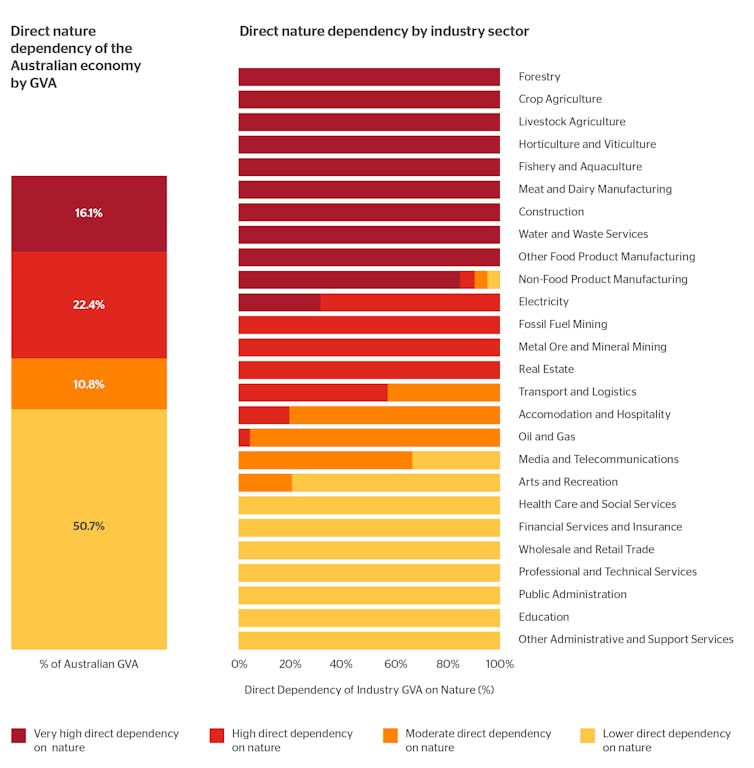
Fully half of the world’s total economic activity – around A$61 trillion – is moderately or highly dependent on nature and its services.

In Australia, that figure is very similar: around half of our GDP – $896 billion – has a moderate to very high direct dependence on ecosystem services provided by nature.

Australia’s economy and industries are dependent on nature. GVA refers to gross value added to the economy by industry.
Australian Conservation Foundation

What happens when we breach nature’s limits? Ecosystem services seize up or collapse, eventually disrupting these sectors. The tireless pollination work of honeybees, for instance, is valued at $14 billion a year. Or take Australia’s wheatbelt, where poor soil health is now costing farmers almost $2 billion a year in lost income.

Ecosystem services are not hypothetical. They have real value – and we will absolutely notice if they are gone.

Bee on apple blossom
Without pollinators, many agricultural businesses would struggle.
Shutterstock

What does this have to do with my super?

Australia’s super sector is responsible for the retirement savings of around 12 million Australians. Super funds are directly exposed to financial risk from nature loss through their investment portfolios.

Just as farmers can’t grow crops without healthy soils or pollinators, developers can’t build apartments without timber or environmental permits. In turn, that has implications for their value as investments.


Read more:
Taking care of business: the private sector is waking up to nature’s value


And because so many sectors are exposed, classic investment strategies such as diversification may no longer protect your super from losses.

So what are our super funds and banks doing about it?

To find out, we surveyed ten super funds and ten retail banks about their responses to nature-related risks. The survey – commissioned by the Australian Conservation Foundation – is the first time this has been done in Australia.

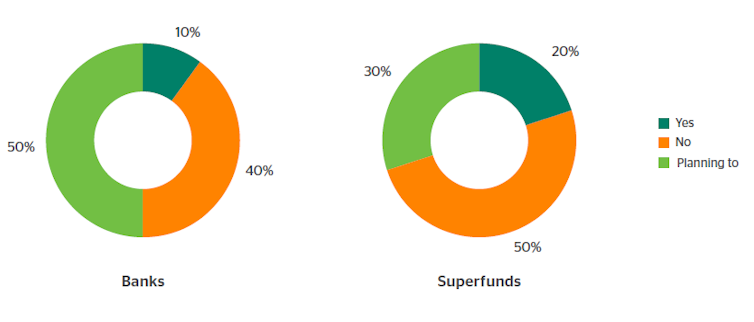
The findings? Not ideal. Every participating super fund and bank agreed the loss of nature now presented a serious risk to investment returns. They all agreed it was part of their responsibility to members and customers to measure and manage these risks. But only 20% of super funds and 10% of banks had attempted to assess how exposed they were.

Of the ten super funds and ten banks we surveyed, just 10% of banks (left) and 20% of super funds (right) had assessed their nature-related risks or opportunities. Half of the banks and 30% of super funds had plans to, while 40% of banks and 50% of super funds had no plans yet.
Australian Conservation Foundation

Again, this is not abstract. Super funds often have large holdings in the big four banks. Together, these banks have $170 billion in exposure to agriculture, mining, fisheries, and forestry – sectors directly reliant on a functioning natural world.

So why isn’t it a higher priority? One issue may be that many financial institutions are currently focused on climate change, given how rapidly impacts are mounting. But climate change and the breakdown of natural systems are twin crises. Nature offers far and away the largest method of taking carbon back out of the atmosphere, for instance. But that only works if salt marshes and wetlands and forests are intact.

Net zero targets for our banks and super funds are not fully credible unless there is a commitment to end the financing of deforestation. Only one organisation, Australian Ethical, had made such a commitment.

You would think Australia’s super funds and banks would be interested to find out how exposed their investments were to this growing risk. Tools to do this such as IBAT and ENCORE are readily available.

But to date, our survey findings don’t indicate banks and funds will do this voluntarily.

Banks and super funds may soon have to report these risks

The biodiversity rescue plan agreed to last year – known as the Kunming-Montreal agreement – is intended to set expectations for responsible finance and business globally, as the Paris Agreement did for climate change.

That means Australia will be expected to introduce disclosure requirements. If this comes to pass, banks, super funds, and the businesses they invest our savings in will have to measure and publicly report their impact on nature – as well as how much they rely on nature to make a profit.

First, though, the Australian government must introduce mandatory nature risk reporting. It’s already moving ahead with plans to make climate risk disclosures mandatory.

Treasurer Jim Chalmers has indicated nature is also on his radar.

The question then will be whether making this information public will actually do what we hope it will and use money to help natural systems rather than extract from them.

sugar cane and forest
For farms to function, they need natural services such as clean water, pollinators and healthy soil.
Shutterstock

What happens next?

Since taking office, the Labor government has pledged to take action on the perilous decline of the natural world with plans such as bringing the value of nature into our national accounts.

While positive, the real action won’t happen until nature risk reporting is mandatory, environment laws with teeth are introduced, and until both governments and private industry direct serious money into helping nature, not harming it. Risky nature credit markets aren’t going to cut the mustard.

You don’t have to sit back and wait. Why not ask your super fund and bank what nature-related risks they are exposing your money to?


Read more:
The historic COP15 outcome is an imperfect game-changer for saving nature. Here’s why Australia did us proud


The Conversation

Madeline Combe receives funding from the University of Technology, Sydney.

The research report on how super funds and banks are responding to nature-related risks was funded by the Australian Conservation Foundation.

Dr Megan Evans is one of Madeline’s PhD supervisors.

Megan C Evans receives funding from the Australian Research Council through a Discovery Early Career Research Award. She received funding from the Australian Conservation Foundation to support this research. She has previously been funded by the Department of Agriculture, Water and the Environment, WWF Australia, and the National Environmental Science Program’s Threatened Species Recovery Hub.

Nathaniel Pelle is an Honorary Associate of the Sydney Environment Institute, University of Sydney, and works for the Australian Conservation Foundation.

ref. Losing the natural world comes with major risks for your super fund and bank – https://theconversation.com/losing-the-natural-world-comes-with-major-risks-for-your-super-fund-and-bank-198669

Grit or quit? How to help your child develop resilience

Source: The Conversation (Au and NZ) – By Sarah Jefferson, Lecturer in Education, Edith Cowan University

Shutterstock

Grit. Don’t quit.

That’s the mantra many parents may have in mind when they, like me, spend what feels like years ferrying children to a seemingly endless variety of sports and activities. From enduring sheets of almost vertical icy rain while cheering them on a hockey pitch, to obscenely early morning starts for rowing, I can happily say my own grit and resilience has been tested to its upper limits. But what about the children’s?

When it comes to grit, resilience and kids sport, the question around their enrolment, ongoing participation and right to quit is often the topic of much conversation – and consternation. As parents, what should we do when kids announce, often mid-season, they want to “take a break” or quit altogether?

As a parent and educator this raises the question of that invisible line we often tread about how much to push them, when to let them take a break and when it’s OK to just let them quit.

A kid plays soccer.
Kids and adolescents are still developing grit and the ability to work strenuously towards a goal.
Photo by Kampus Production/Pexels, CC BY


À lire aussi :
If you want your child to be more resilient, get them to join a choir, orchestra or band


Grit matters

More than mere buzzwords, the terms grit and resilience have themselves been the subject of extensive research. US-based researcher Angela Duckworth has defined grit as “perseverance and passion for long-term goal”, saying it involves

working strenuously towards challenged, maintaining effort and interest over years despite failure, adversity, and plateaus in progress.

Grit has been associated with growth mindset, satisfaction and a sense of belonging.

One US study found

perseverance of effort predicted greater academic adjustment, college grade point average, college satisfaction, sense of belonging, faculty–student interactions, and intent to persist, while it was inversely related to intent to change majors.

A study of children coping with reading disorders found

strong evidence that grit and resilience is significantly related to mental health, academic success, and quality of life.

Duckworth suggests resilience is a component of grit but there are other models, too.

For instance, Special Air Service Regiment (SAS) veterans Dan Pronk, Ben Pronk and Tim Curtis (authors of the book, The Resilience Shield) propose groups of resilience factors as a series “layers” (such as a professional layer, a social layer, an adaptation layer) which interact with each other. They note the challenge of defining resilience, referring to it as “an outcome better than expected given the adversity being faced”.

A girl looks sad at a sport match.
Grit or quit?
Shutterstock

Giving grit a chance to grow

As adults, perhaps we can reflect on experiences we’ve had in life that have helped build our resilience. But kids and adolescents are still developing grit and the ability to work strenuously towards a goal. Their brains are undergoing significant developmental changes.

My research has a focus on teacher education and what helps teachers stick with a career that can occasionally be extremely challenging.

Learning to help children and adolescents navigate challenging situations and being able to cultivate your own resilience in the face of trying circumstances is a crucial skill for teachers.

A child's hands on a piano.
Grit has been associated with a growth mindset, satisfaction and a sense of belonging.
Shutterstock

So how do we handle those difficult conversations when kids announce they want to quit a sport or activity?

Firstly, remain neutral and check the temperature of the conversation. Is this a heat-of-the-moment conversation? Right after a big loss or a less-than-stellar piano recital? Good decisions are not usually made in those moments.

Talk to the coach or tutor to figure out what may really be going on. Sometimes the problem can be peer related and again, it is important for kids to learn to navigate those challenges.

All told, when kids announce they want to quit, keep the dialogue open. Listen carefully when they explain their reasons, but talk to your children about grit, too.

Share with them research that compares a growth mindset (which teaches that even when things get hard, we can learn and grow and get better) with a fixed mindset (which posits that either you’re good at something or not and there’s little room to change). Research suggests having a growth mindset can foster persistence and positive long-term outcomes.

The key is that parents don’t teach resilience to children just by telling them about it. It is truly built through experience.


À lire aussi :
True grit – we measured it and found it protected doctors from career burnout


The Conversation

Sarah Jefferson ne travaille pas, ne conseille pas, ne possède pas de parts, ne reçoit pas de fonds d’une organisation qui pourrait tirer profit de cet article, et n’a déclaré aucune autre affiliation que son organisme de recherche.

ref. Grit or quit? How to help your child develop resilience – https://theconversation.com/grit-or-quit-how-to-help-your-child-develop-resilience-195195

Short selling Adani: how an obscure US firm profited from triggering the Indian giant’s price plunge

Source: The Conversation (Au and NZ) – By Mark Humphery-Jenner, Associate Professor of Finance, UNSW Sydney

Sam Shere/Wikimedia Commons

A few weeks ago, Gautam Adani was indisputably India’s richest man.

Now his fortune is slipping away as the stocks of his many companies crash, thanks to the efforts of a relatively obscure US company named after the 1937 Hindenberg disaster (in which a hydrogen-filled airship caught fire, killing 98 people).

Adani’s personal fortune was an estimated US$150 billion in 2022. He catapulted past the previous richest Indian, Mukesh Ambani, on the back of the meteoric rise of Adani Group, a multinational conglomerate with holdings in mining, energy, airports, cement, food processing and weapons manufacturing.

Gautam Adani is no longer India's richest person.
Gautam Adani is no longer India’s richest person.
Aijaz Rahi/AP

Since January 25, Adani Group’s stock price has fallen 45%. The catalyst? An explosive report published on January 24 by Hindenburg Research, alleging Adani Group engaged in “brazen stock manipulation and accounting fraud scheme over the course of decades”.

What complicates this report is that Hindenburg Research isn’t just a research company. It’s an “activist short seller”, with a financial incentive in seeing Adani’s stock price fall.

Hindenburg makes its profits by identifying “man-made disasters floating around in the market”. It bets on the stock falling, then publicises that company’s negatives – including doing so in Adani’s case:

After extensive research, we have taken a short position in Adani Group Companies through US-traded bonds and non-Indian-traded derivative instruments.

Adani’s response includes calling the report a “calculated attack on India” and “intended only to create a false market in securities to enable Hindenburg, an admitted short seller, to book massive financial gain through wrongful means at the cost of countless investors”.

Activist short selling is certainly controversial. But it’s not necessarily illegal, nor unethical.


Read more:
Unpicking the labyrinth that is India’s Adani


How does short selling work?

Short selling (also known as having a “short exposure”, or “shorting”) is essentially betting on a company’s stock falling.

The process is more complicated than betting on a share price rising, for which all you have to do is buy the stock and wait for it to appreciate.

It can be done in several ways. The most common is to sell borrowed stock. The “short seller” makes a contract with a share owner to borrow shares for an agreed period. They then sell that stock, banking the proceeds. When the time comes to return the stock, they buy shares on the market to “repay” the loan. If the price has fallen in the meantime, they make a profit.

There are also methods that involve “derivatives”. These are financial instruments that allow investors to “bet” on financial outcomes. For example, a “put option” involves betting a stock’s price will fall below a specific level (called the strike price). Similarly, a futures contract pays out the difference between the current stock price and the future stock price. This allows the investor to effectively bet on price movements.

Investors might also invest via bonds. A corporate bond is much like a loan. Investors can short sell a bond like they would a stock. Alternatively, they can buy “credit default swaps”, which enable betting on a company defaulting on on its debt repayments.

There are even more complicated strategies than these. For fun explanations, check out the 2015 movie The Big Short, about the guys who bet on the collapse of the subprime mortgage market that led to the 2008 Global Financial Crisis.


Short selling explained by Margot Robbie in ‘The Big Short’.

Is short selling legal?

There are two main legal issues arising with short selling.

Market manipulation. It is illegal in most jurisdictions for activist short sellers to profit by spreading false or misleading information. This is the case in Australia and the US (where Hindenburg and some of its positions in Adani are based). But this is relatively easy to discover.

Insider trading. it would be illegal to bet on a company’s future share price using information that is not generally available, then reveal that information.

On this, Hindenburg Research is skating on thin ice with some of its assertions. For example, its report says of Adani’s deals to build a rail line to transport coal in Queensland:

None of the transactions were specifically disclosed in the Adani Enterprises annual reports. We uncovered them only by reviewing financials for the private Singaporean Carmichael Rail entity.

If those financials were publicly available in a database or online, Hindenburg Research is in the clear. But if the financials were not generally available, it risks being accused of insider trading.

However, Hindenburg’s report contains many allegations involving a large volume of public information, which means it would be difficult to establish whether it also used any non-public information to assemble the report.


Read more:
Vital Signs: ASIC’s crusade against activist short sellers will be bad for regular folk


Is this ethical? Should we be concerned?

There are some concerns about the ethics of profiting from a company’s demise.

Ethics can be arbitrary. However, we can consider some guidelines. These include:

  • Does society benefit from information about fraud coming to light?

  • If there were no financial incentive, would a company really spend two years doing detailed forensic analysis?

  • Does anyone unfairly lose to justify rules or laws to discourage such profits?

Exposing fraud is in the public interest. There must be some financial incentive to do such work. Existing shareholders are losing from Adani’s stock tumble, but that should properly be credited to the alleged fraud, not the report.

Ultimately, then, companies such as Hindenburg are generally a net positive if they comply with all relevant laws, securities regulations and privacy guidelines.

If the report is truthful, blaming Hindenburg for Adani’s crash is like blaming an alarm for a fire.

The Conversation

Mark Humphery-Jenner receives funding from the Australian Research Council and AFAANZ.

ref. Short selling Adani: how an obscure US firm profited from triggering the Indian giant’s price plunge – https://theconversation.com/short-selling-adani-how-an-obscure-us-firm-profited-from-triggering-the-indian-giants-price-plunge-198991

Why social media makes you feel bad – and what to do about it

Source: The Conversation (Au and NZ) – By Divna Haslam, Senior Research Fellow, Queensland University of Technology

Shutterstock

Have you ever found yourself scrolling through social media and noticed you felt a bit down? Maybe a little envious? Why aren’t you on a yacht? Running a startup? Looking amazing 24/7?

The good news is you are not alone. Although social media has some benefits, it can also make us feel a little depressed.

Why does social media make us feel bad?

As humans we inherently compare ourselves to others to determine our self-worth.
Psychologists call this social comparison theory.

We primarily make two types of comparisons: upward and downward comparisons.

Upward comparisons occur when we compare ourselves to someone else (in real life or on social media) and feel they are better than us (an unfavourable comparison for us) in whatever domain we are assessing (such as status, beauty, abilities, success, and so on).

For example, comparing your day at work to your friend’s post from the ski fields (we’re looking at you Dave!) is likely to be an upward comparison. Another example is making appearance comparisons which can make you feel worse about yourself or your looks .

Although upward comparison can sometimes motivate you to do better, this depends on the change being achievable and on your esteem. Research suggests upward comparisons may be particularly damaging if you have low self-esteem.

In contrast, downward comparisons occur when we view ourselves more favourably than the other person – for example, by comparing yourself to someone less fortunate. Downward comparisons make us feel better about ourselves but are rare in social media because people don’t tend to post about the mundane realities of life.

Comparisons in social media

Social media showcases the best of people’s lives. It presents a carefully curated version of reality and presents it as fact. Sometimes, as with influencers, this is intentional but often it is unconscious bias. We are just naturally more likely to post when we are happy, on holiday or to share successes – and even then we choose the best version to share.

When we compare ourselves to what we see on social media, we typically make upward comparisons which make us feel worse. We compare ourselves on an average day to others on their best day. In fact, it’s not even their best day. It’s often a perfectly curated, photoshopped, produced, filter-applied moment. It’s not a fair comparison.

That’s not to say social media is all bad. It can help people feel supported, connected, and get information. So don’t throw the baby out with the bathwater. Instead, keep your social media use in check with these tips.

Concrete ways you can make yourself feel better about social media

Monitor your reactions. If social media is enjoyable, you may not need to change anything – but if it’s making you exhausted, depressed or anxious, or you are losing time to mindless scrolling, it’s time for change.

Avoid comparisons. Remind yourself that comparing your reality with a selected moment on social media is an unrealistic benchmark. This is especially the case with high-profile accounts who are paid to create perfect content.

Be selective. If you must compare, search for downward comparisons (with those who are worse off) or more equal comparisons to help you feel better. This might include unfollowing celebrities, focusing on real posts by friends, or using reality focused platforms like BeReal.

Redefine success. Influencers and celebrities make luxury seem like the norm. Most people don’t live in pristine homes and sip barista-made coffee in white sheets looking perfect. Consider what real success means to you and measure yourself against that instead.


À lire aussi :
Want to delete your social media, but can’t bring yourself to do it? Here are some ways to take that step


Practise gratitude. Remind yourself of things that are great in your life, and celebrate your accomplishments (big and small!). Create a “happy me” folder of your favourite life moments, pics with friends, and great pictures of yourself, and look at this if you find yourself falling into the comparison trap.

Unplug. If needed, take a break, or cut down. Avoid mindless scrolling by moving tempting apps to the last page of your phone or use in-built focus features on your device. Alternatively, use an app to temporarily block yourself from social media.

Engage in real life. Sometimes social media makes people notice what is missing in their own lives, which can encourage growth. Get out with friends, start a new hobby, embrace life away from the screen.

Get amongst nature. Nature has health and mood benefits that combat screen time.

Be the change. Avoid only sharing the picture-perfect version of your life and share (in a safe setting) your real life. You’d be surprised how this will resonate with others. This will help you and them feel better.

Seek help. If you are feeling depressed or anxious over a period of time, get support. Talk to your friends, family or a GP about how you are feeling. Alternatively contact one of the support lines like Lifeline, Kids Helpline, or 13Yarn.

The Conversation

Divna Haslam has received funding from various granting bodies and the Australian Government. These are unrelated to this piece.

Sabine Baker ne travaille pas, ne conseille pas, ne possède pas de parts, ne reçoit pas de fonds d’une organisation qui pourrait tirer profit de cet article, et n’a déclaré aucune autre affiliation que son organisme de recherche.

ref. Why social media makes you feel bad – and what to do about it – https://theconversation.com/why-social-media-makes-you-feel-bad-and-what-to-do-about-it-197691

Myanmar’s military has ‘turned whole country into a prison’

Airstrikes ordered against civilian targets, destruction of thousands of buildings, millions displaced, nearly 3000 civilians murdered, more than 13,000 jailed, the country’s independent media banished, and the country locked in a deadly nationwide civil war. Myanmar civilians now ask what else must happen before they receive international support in line with Ukraine, writes Phil Thornton.

SPECIAL REPORT: By Phil Thornton

In the two years since Myanmar’s military seized power from the country’s elected lawmakers it has waged a war of terror against its citizens — members of the Civil Disobedience Movement, artists, poets, actors, politicians, health workers, student leaders, public servants, workers, and journalists.

The military-appointed State Administration Council amended laws to punish anyone critical of its illegal coup or the military. International standards of freedoms — speech, expression, assembly, and association were “criminalised”.

The Assistance Association for Political Prisoners (Burma), reported as of 30 January 2023, the military killed 2901 people and arrested another 17,492 (of which 282 were children), with 13,719 people still in detention.

One hundred and forty three people have been sentenced to death and four have been executed since the military’s coup on 1 February 2021. Of those arrested, 176 were journalists and as many as 62 are still in jail or police detention.

The Committee to Protect Journalists ranks Myanmar as the world’s second-highest jailers of journalists. Fear of attacks, harassment, intimidation, censorship, detainment, and threats of assassination for their reporting has driven journalists and media workers underground or to try to reach safety in neighbouring countries.

Journalist Ye Htun Oo has been arrested, tortured, received death threats, and is now forced to seek safety outside of Myanmar. Ye Htun spoke to the International Federation of Journalists (IFJ) of his torture, jailing and why he felt he had no choice, but to leave Myanmar for the insecurity of a journalist in exile.

They came for me in the morning
“I started as a journalist in 2007 but quit after two years because of the difficulty of working under the military. I continued to work, writing stories and poetry. In 2009 I restarted work as a freelance video and documentary maker.”

Ye Htu said making money from journalism in Myanmar had never been easy.

“I was lucky if I made 300,000 kyat a month (about NZ$460) — it was a lot of work, writing, editing, interviewing and filming.”

Ye Htun’s hands, fingers and thin frame twist and turn as he takes time to return to the darkness of the early morning when woken by police and military knocking on his front door.

“It was 2 am, the morning of 9 October 2021. We were all asleep. The knocking on the door was firm but gentle. I opened the door. Men from the police and the military’s special media investigation unit stood there — no uniforms. They’d come to arrest me.”

Ye Htun links the visit of the police and army to his friend’s arrest the day before.

“He had my number on his phone and when questioned told them I was a journalist. I hadn’t written anything for a while. The only reason they arrested me was because I was identified as a journalist — it was enough for them. The military unit has a list of journalists who they want to control, arrest, jail or contain.”

Ye Htun explains how easy it is for journalists to be arrested.

“When they arrest people…if they find a reference to a journalist or a phone number it’s enough to put you on their list.”

After the coup, Ye Htun continued to report.

“I was not being paid, moving around, staying in different places, following the protests. I was taking photos. I took a photo of citizens arresting police and it was published. This causes problems for the people in the photo. It also caused some people to regard me and journalists as informers — we were now in a hard place, not knowing what or who we could photograph. I decided to stop reporting and made the decision to move home. That’s when they came and arrested me.”

In the early morning before sunrise, the police and military removed Ye Htun from his home and family and took him to a detention cell inside a military barracks.

“They took all my equipment — computer, cameras, phone, and hard disks. The men who arrested and took me to the barracks left and others took over. Their tone changed. I was accused of being a PDF (People’s Defence Force militia).

“Ye Htun describes how the ‘politeness’ of his captors soon evaporated, and the danger soon became a brutal reality. They started to beat me with kicks, fists, sticks and rubber batons. They just kept beating me, no questions. I was put in foot chains — ankle braces.”

The beating of Ye Htun would continue for 25 days and the uncertainty and hurt still shows in his eyes, as he drags up the details he’s now determined to share.

“I was interrogated by an army captain who ordered me to show all my articles — there was little to show. They made me kneel on small stones and beat me on the body — never the head as they said, ‘they needed it intact for me to answer their questions’”.

Ye Htun explained it wasn’t just his assigned interrogators who beat or tortured him.

“Drunk soldiers came regularly to spit, insult or threaten me with their guns or knives.”

Scared, feared for his life
Ye Htun is quick to acknowledge he was scared and feared for his life.

“I was terrified. No one knew where I was. I knew my family would be worried. Everyone knows of people being arrested and then their dead, broken bodies, missing vital organs, being returned to grieving families.”

After 25 days of torture, Ye Htun was transferred to a police jail.

“They accused me of sending messages they had ‘faked’ and placed on my phone. I was sentenced to two years jail on 3rd November — I had no lawyer, no representative.”

Ye Htun spoke to political prisoners during his time in jail and concluded many were behind bars on false charges.

“Most political prisoners are there because of fake accusations. There’s no proper rule of law — the military has turned the whole country into a prison.”

Ye Htun served over a year and five months of his sentence and was one of six journalists released in an amnesty from Pyay Jail on 4 January 2023.

Not finished torturing
Any respite Ye Htun or his family received from his release was short-lived, as it became apparent the military was not yet finished torturing him. He was forced to sign a declaration that if he was rearrested he would be expected to serve his existing sentence plus any new ones, and he received death threats.

Soon after his release, the threats to his family were made.

“I was messaged on Facebook and on other social media apps. The messages said, ‘don’t go out alone…keep your family and wife away from us…’ their treats continued every two or three days.”

Ye Htun and his family have good cause to be concerned about the threats made against them. Several pro-military militias have openly declared on social media their intention against those opposed to the military’s control of the country.

A pro-military militia, Thwe Thauk Apwe (Blood Brothers), specialise in violent killings designed to terrorise.

Frontier Magazine reported in May 2022 that Thwe Thauk Apwe had murdered 14 members of the National League of Democracy political party in two weeks. The militia uses social media to boast of its gruesome killings and to threaten its targets — those opposed to military rule — PDF units, members of political parties, CDM members, independent media outlets and journalists.

Ye Htun said fears for his wife and children’s safety forced him to leave Myanmar.

“I couldn’t keep putting them at risk because I’m a journalist. I will continue to work, but I know I can’t do it in Myanmar until this military regime is removed.”

Air strikes target civilians – where’s the UN?
Award-winning documentary maker and artist, Sai Kyaw Khaing, dismayed at the lack of coverage by international and regional media on the impacts of Myanmar’s military aerial strikes on civilian targets, decided to make the arduous trip to the country’s northwest to find out.

In the two years since the military regime took illegal control of the country’s political infrastructure, Myanmar is now engaged in a brutal, countrywide civil war.

Civilian and political opposition to the military coup saw the formation of People Defence Force units under the banner of the National Unity Government established in April 2021 by members of Parliament elected at the 2020 elections and outlawed by the military after its coup.

Thousands of young people took up arms and joined PDF units, trained by Ethnic Armed Organisations, to defend villages and civilians and fight the military regime. The regime vastly outnumbered and outmuscled the PDFs and EAOs with its military hardware — tanks, heavy artillery, helicopter gunships and fighter jets.

Sai Kyaw contacted a number of international media outlets with his plans to travel deep inside the conflict zone to document how displaced people were coping with the airstrikes and burning of their villages and crops.

Sai Kyaw said it was telling that he has yet to receive a single response of interest from any of the media he approached.

“What’s happening in Myanmar is being ignored, unlike the conflict in Ukraine. Most of the international media, if they do report on Myanmar, want an ‘expert’ to front their stories, even better if it’s one of their own, a Westerner.”

Deadly strike impact
Sai Kyaw explains why what is happening on the ground needs to be explained — the impacts of the deadly airstrikes on the lives of unarmed villagers.

“My objective is to talk to local people. How can they plant or harvest their crops during the intense fighting? How can they educate their kids or get medical help?

“Thousands of houses, schools, hospitals, churches, temples, and mosques have been targeted and destroyed — how are the people managing to live?”

Sai Kyaw put up his own money to finance his trip to a neighbouring country where he then made contact with people prepared to help him get to northwestern Myanmar, which was under intense attacks from the military regime.

“It took four days by motorbike on unlit mountain dirt tracks that turned to deep mud when it rained. We also had to avoid numerous military checkpoints, military informers, and spies.”

Sai Kyaw said that after reaching his destination, meeting with villagers, and witnessing their response to the constant artillery and aerial bombardments, their resilience astounded him.

“These people rely on each other, when they’re bombed from their homes, people who still have a house rally around and offer shelter. They don’t have weapons to fight back, but they organise checkpoints managed by men and women.”

Sai Kyaw said being unable to predict when an airstrike would happen took its toll on villagers.

Clinics, schools bombed
“You don’t know when they’re going to attack — day or night — clinics, schools, places of worship — are bombed. These are not military targets — they don’t care who they kill.”

Sai Kyaw witnessed an aerial bombing and has the before and after film footage that shows the destruction. Rows of neat houses, complete with walls intact before the air strike are left after the attack with holes a car could drive through.

“The unpredictable and indiscriminate attacks mean villagers are unable to harvest their crops or plant next season’s rice paddies.”

Sai Kyaw is concerned that the lack of aid getting to the people in need of shelter, clothing, food, and medicine will cause a large-scale humanitarian crisis.

“There’s no sign of international aid getting to the people. If there’s a genuine desire to help the people, international aid groups can do it by making contact with local community groups. It seems some of these big international aid donors are reluctant to move from their city bases in case they upset the military’s SAC [State Administration Council].”

At the time of writing Sai Kyaw Khaing has yet to receive a reply from any of the international media he contacted.

It’s the economy stupid
A veteran Myanmar journalist, Kyaw Kyaw*, covered a wide range of stories for more than 15 years, including business, investment, and trade. He told IFJ he was concerned the ban on independent media, arrests of journalists, gags and access restrictions on sources meant many important stories went unreported.

“The military banning of independent media is a serious threat to our freedom of speech. The military-controlled state media can’t be relied on. It’s well documented, it’s mainly no news or fake news overseen by the military’s Department of Propaganda.”

Kyaw lists the stories that he explains are in critical need of being reported — the cost of consumer goods, the collapse of the local currency, impact on wages, lack of education and health care, brain drain as people flee the country, crops destroyed and unharvested and impact on next year’s yield.

Kyaw is quick to add details to his list.

“People can’t leave the country fast enough. There are more sellers than buyers of cars and houses. Crime is on the rise as workers’ real wages fall below the poverty line. Garment workers earned 4800 kyat, the minimum daily rate before the military’s coup. The kyat was around 1200 to the US dollar — about four dollars. Two years after the coup the kyat is around 2800 — workers’ daily wage has dropped to half, about US$2 a day.”

Kyaw Kyaw’s critique is compelling as he explains the cost of everyday consumer goods and the impact on households.

“Before the coup in 2021, rice cost a household, 32,000 kyat for around 45kg. It is now selling at 65,000 kyat and rising. Cooking oil sold at 3,000 kyat for 1.6kg now sells for over double, 8,000kyat.

“It’s the same with fish, chicken, fuel, and medicine – family planning implants have almost doubled in cost from 25,000 kyat to now selling at 45,000 kyat.”

Humanitarian crisis potential
Kyaw is dismayed that the media outside the country are not covering stories that have a huge impact on people’s daily struggle to feed and care for their families and have the real potential for a massive humanitarian crisis in the near future.

“The focus is on the revolution, tallies of dead soldiers, politics — all important, but journalists and local and international media need to report on the hidden costs of the military’s coup. Local media outlets need to find solutions to better cover these issues.”

Kyaw stresses international governments and institutions — ASEAN, UK, US, China, and India — need to stop talking and take real steps to remove and curb the military’s destruction of the country.

“In two years, they displaced over a million people, destroyed thousands of houses and religious buildings, attacked schools and hospitals — killing students and civilians — what is the UNSC waiting for?”

An independent think tank, the Institute for Strategy and Policy – Myanmar, and the UN agency for refugees confirm Kyaws Kyaw’s claims.The Institute for Strategy and Policy reports “at least 28,419 homes and buildings were torched or destroyed…in the aftermath of the coup between 1 February 2021, and 15 July 2022.”

The UN agency responsible for refugees, the UNHCR, estimates the number of displaced people in Myanmar is a staggering 1,574,400. Since the military coup and up to January 23, the number was 1,244,000 people displaced.

While the world’s media and governments focus their attention and military aid on Ukraine, Myanmar’s people continue to ask why their plight continues to be ignored.

Phil Thornton is a journalist and senior adviser to the International Federation of Journalists in Southeast Asia. This article was first published by the IFJ Asia-Pacific blog and is republished with the author’s permission. Thornton is also a contributor to Asia Pacific Report.

*Name has been changed as requested for security concerns.

Print Friendly, PDF & Email

Article by AsiaPacificReport.nz

Nick Young: NZ’s climate floods expose stark truth – people paying price of corporate greed crisis

By Nick Young of Greenpeace

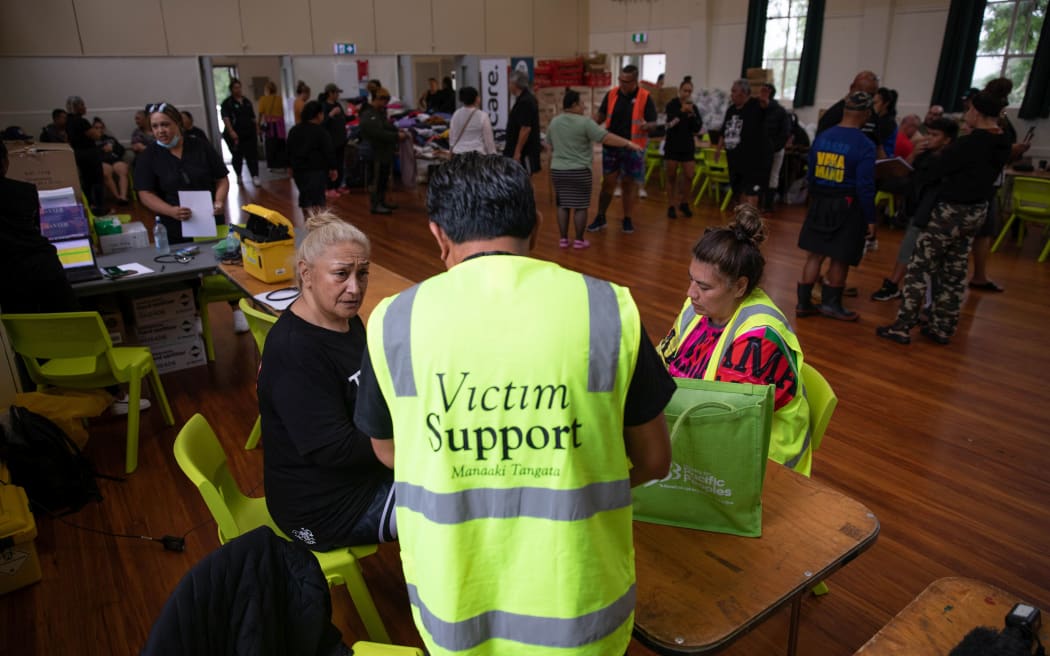
My family and I are lucky to have come through it unscathed, but my neighbourhood in Titirangi has been ravaged.

Many people here and around the wider region have lost their homes altogether.

I’ve seen people’s belongings out on the streets in piles ruined beyond repair, houses swamped and whole properties carved away by slips leaving them unlivable. It’s hard to imagine what that is like.

And it made me angry.

Angry that this storm, and storms like it are now all made more intense by climate change that’s caused by industry that has been left to pollute unregulated for far too long. And this is only the latest in a series of similar climate floods in Aotearoa that have left people’s lives in ruin.

We’ve been let down by governments who have failed to regulate the dairy industry to cut methane emissions. They’ve failed to eliminate fossil fuels fast enough, and failed to redesign our towns and cities to be resilient enough.

They’ve known this was coming. Scientists have been saying it for years. Everyone’s been saying it. But still government has failed to act.

Confronting climate crisis
So as our communities come together to clean up after the floods and help make sure everyone has shelter, food and essentials, our resolve to confront and eliminate the causes of climate change is stronger than ever.

These climate floods have brought home the stark truth: People and communities are paying the price of a climate crisis that’s driven by corporate greed and governments unwilling to stand up to them.

I’ve also been inspired seeing the people coming together to help each other in a crisis. People helping out a neighbour, offering a place to stay, feeding tireless volunteers, donating bedding and clothes to the evacuation centres.

It shows me that we can work together to face the bigger challenges.

This is going to be a big year. With your help we can confront the dairy industry to reduce methane emissions. Together we can push our elected government to act to cut emissions from the biggest climate polluters.

Nick Young is head of communications at Greenpeace Aotearoa. Follow him on Twitter. Republished on a Creative Commons licence.

Devastating . . . New Zealand's seven major floods in a year
Devastating . . . New Zealand’s seven major floods in a year. Montage: Greenpeace
Print Friendly, PDF & Email

Article by AsiaPacificReport.nz

NZ flash floods: Residents slam council inaction over rubbish disposal

By Jonty Dine, RNZ News reporter

While Auckland residents enjoy a brief reprieve from the rain, the rubbish continues to pile up as the full cost of the New Zealand flash floods continues to be counted.

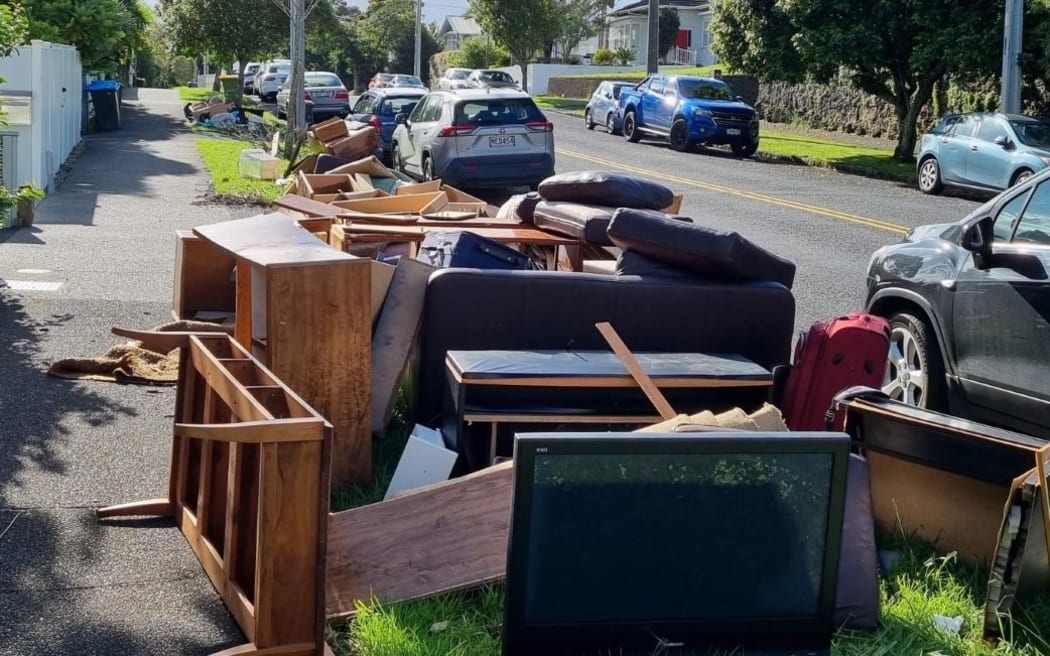
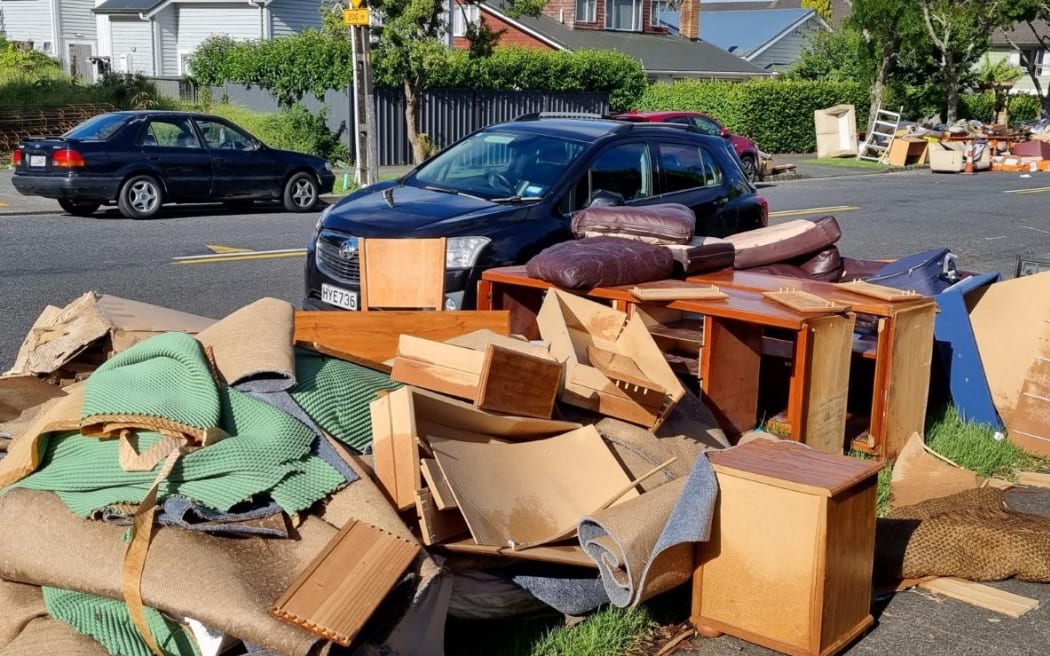
Some streets in Auckland are littered with items damaged and discarded from Friday’s freak flooding — causing a health hazard for locals.

Electronics, furniture, books and clothing line Shackleton Road in Mt Eden.

Connor O’Boyle’s home was inundated with one and a half metres of flood waters leaving most of what he owns destroyed.

“Everything is contaminated with black water. It’s actually a health hazard and it’s been a long time waiting to get feedback from the insurers so we’re really not sure how the clean-up is going because 20 other of my neighbours have all been flooded.”

He said residents tried to keep the street tidy but became overwhelmed.

“We initially tried to keep things tidy; we have flexi-bins and skips, but there is just too much.”

Frustrating wait
O’Boyle said it has been a frustrating wait for its removal.

“My other neighbours have been emailing the mayor’s office and they have got responses to take the rubbish to waste disposal sites but we physically can’t get there so we have got no real answers with the rubbish.”

Auckland flooding - piles of rubbish on Shackleton Road in Mt Eden
The rubbish from the flash floods lines the Mt Eden street Shackleton Road, leaving residents feeling overwhelmed. Image: Jonty Dine/RNZ

O’Boyle has criticised the council’s communication.

“It would just be nice for a plan to be put together for the residents, pretty much the response from the local government is: ‘it’s your problem you sort it out’.”

Another couple, the Naras, echoed his sentiments and said help has been scarce.

“It is difficult to find help, everything is in shortage. If you don’t get help within three days there is no use in getting help because it stinks. I cleaned up everything myself, if after six days you’re going to come and clean up the house [it] is already damaged.”

Another neighbour said looters were also a big issue.

Wardrobes stolen
“Going through, all the remnants of the flood, we had a couple of guys come and steal two wardrobes, they were drying out to be assessed by insurance, it’s pretty bad.”

Auckland flooding - piles of rubbish on Shackleton Road in Mt Eden
Street-stored flood debris . . . “Being a first world country this shouldn’t happen to us. This is New Zealand.” Image: Jonty Dine/RNZ News

The man said the council officials have let the residents down.

“Being a first world country this shouldn’t happen to us. This is New Zealand. We should have better drainage facilities here and the response should be pretty quick. The council and government have failed us in this area.”

Neighbour Fraser said they have been left with few options.

“This is probably not nice on the eyes either but what else can we do about it?”

He said even the efforts they have made have been exploited by others.

“It is quite unfortunate that people have just been dumping their rubbish in our bin, they are probably not aware that we paid for that ourselves. Even the swimming pool, a lot of people have been dumping stuff in that.”

‘This is huge’ – council
Council general manager of waste solutions Parul Sood said the flooding was an unprecedented undertaking for the clean-up crews.

“This is just huge, we haven’t dealt with something like this before.”

Sood said they have increased the number of dump sites but admitted it had been difficult to get to all the city’s streets and it could be a long time until the final piece of waste was collected.

“It is quite a massive impact on the city. I just think it will be a while before we clean out each and every piece of rubbish that has been generated by this really massive storm.”

However, O’Boyle said the response has not been good enough.

“It’s just disappointing that we can’t get the street cleaned, it’s not only a health hazard but it’s probably also causing contamination in our waterways. We all want to try to do the right thing and we just need it tidied up.”

This article is republished under a community partnership agreement with RNZ.

Auckland flooding - piles of rubbish on Shackleton Road in Mt Eden
Street debris . . . response “not good enough”. Image: Jonty Dine/RNZ News
Print Friendly, PDF & Email

Article by AsiaPacificReport.nz

Former FBC chief Riyaz paid almost $225k in bonuses, claims chair

By Wata Shaw in Suva

Former Fijian Broadcasting Corporation chief executive Riyaz Sayed-Khaiyum was paid $224,792 in bonuses during his term at FBC which began in 2008, the new board chair has claimed.

He was due for a $30,000 bonus this year.

FBC chair Ajai Bhai Amrit also revealed Sayed-Khaiyum, brother of former attorney-general Aiyaz Sayed-Khaiyum, received a salary of F$304,453 (NZ$218,000) and was paid a bonus of $25,671 during the covid-19 pandemic.

Amrit revealed this while speaking to the media.

Amrit said FBC would have incurred a loss of more than $63 million if the company had not received annual grants from government.

He clarified questions regarding the purchase of a vehicle by the sacked CEO.

“The final price of the vehicle was $207,470 and the vehicle is at Customs,” Amrit said.

“The vehicle will be tendered, I haven’t seen it yet.”

He said no staff would lose their jobs and the board was now dealing with the company’s annual reports and continuing investigations into its operations.

Wata Shaw is a Fiji Times reporter. Republished with permission.

Riyaz Sayed-Khaiyum denies chair’s claims
FijiVillage News reports that Riyaz Sayed-Khaiyum said in a statement today that Amrit’s comments that he was being paid $32,000 a month in salary was “absolutely false”.

Sayed-Khaiyum said that under his most recent 3 year contract, which was approved by the previous board in late December, he was paid “nowhere near” what has been falsely reported.

He said that for all his contracts over the last 15 years of his tenure as CEO, FBC had been strictly sanctioned and approved by several boards with a clearly defined job description.

The former FBC chief executive said the board had always approved his salary, bonus and other entitlements based on performance and job evaluation reports.

He said the board also sanctioned every major development at the FBC over the past 15 years.

Riyaz Sayed-Khaiyum said Amrit’s allegation that Sayed-Khaiyum had received more than $304,000 in salary during the covid19 pandemic was also incorrect.

He said that during this time the FBC staff went through a 10 percent salary reduction for about half a year in order to mitigate the effects of the pandemic on their revenue, and he took a 12 percent salary reduction on his own volition.

Wata Shaw is a Fiji Times reporter. Republished with permission.

Print Friendly, PDF & Email

Article by AsiaPacificReport.nz

Is terrorism returning to Pakistan?

Source: The Conversation (Au and NZ) – By Zahid Shahab Ahmed, Senior research fellow, Deakin University

Muhammad Sajjad/AP

Earlier this week, a suicide blast ruptured the relative calm that had returned to Pakistan in recent years. The attack at a mosque in the northwestern city of Peshawar killed more than 100 people and stunned many Pakistanis who thought the days of such horrific suicide bombings were long behind them.

While Monday’s attack was among the worst in the country in a decade, the blast doesn’t necessarily signal a return of terrorism so much as an escalation of a problem that never really went away.

The Pakistan Taliban, also known as Tehreek-e-Taliban Pakistan (TTP), denied responsibility for Monday’s blast. Instead, a TTP faction, Jamaat-ul-Ahrar, claimed to be behind it.

But in many ways, Pakistan’s deteriorating security situation is directly linked to a resurgent TTP and the increasing fragility in neighbouring Afghanistan since the Taliban’s takeover in August 2021.


Read more:
How Pakistan stands to gain — or lose — from the Taliban’s victory in Afghanistan


The Pakistani government had supported the Afghan Taliban for years, but the relationship began to break down after the Afghan Taliban offered shelter to TTP fighters and released thousands of terrorists from prison after taking power.

The TTP not only appeared to be strengthened and energised by the Taliban’s return to power in Afghanistan, it also drew closer to the group.

Last year, the Afghan Taliban facilitated dialogue between the Pakistani government and the TTP that led to a ceasefire deal. But by November, the TTP ended the five-month truce, claiming the government had not complied with all its requests, most notably the freeing of important TTP members.

The result has been a slow but steady uptick in terrorist attacks.

Documented acts of terrorism hit a high of 3,923 in Pakistan in 2013, with more than 2,000 deaths. The number of fatalities plunged to 267 in 2021, but last year, started to climb again to 365.

Pakistan also only registered four suicide attacks in 2021, but there were 13 last year and four already this year. The TTP has claimed responsibility for most attacks.

Decade-long war on extremism

Pakistan had achieved enormous strides against terrorism over the past 15 years, in large part because of its significant “Rah-e-Rast” military operation in 2009 and the “Zarb-e-Azb” operation in 2014.

The TTP retaliated to the latter with an attack on an army public school in Peshawar in 2014, killing more than 130 children. This prompted the army to intensify its activities, and by 2017, it had largely routed the TTP.

A protest following the Taliban attack on a military-run school in Peshawar in 2014.
Fareed Khan/AP

These security operations, however, only addressed the symptoms of the problem by pushing most TTP fighters across the border into Afghanistan. Terrorist attacks in Pakistan declined, but the problem didn’t go away.

Despite the development of a counter-terrorism blueprint called the National Action Plan in 2014, the government’s security operations have been too limited in scope. They do not focus on all terrorist groups, but selectively target a few, such as the TTP.

The National Counter Terrorism Authority has registered 78 terrorist organisations in Pakistan, but little is known what the government is doing to counter them. The National Action Plan also does not focus much attention on preventative measures like education.


Read more:
‘It is a big relief for me’: how the welfare provided by madrassas holds a key to fighting the Taliban


Addressing the root causes of extremism

Nonetheless, there is growing interest in Pakistan to invest more in promoting a stronger national counter-narrative against extremist ideologies, such as the Paigham-e-Pakistan, which the government developed with the help of hundreds of Islamic scholars.

Moreover, there is a growing desire in policymaking circles to address the root causes of extremism, including the grievances of locals in the region previously known as the Federally Administered Tribal Areas on the Afghan border and Balochistan in southwestern Pakistan.

The growing insecurity in Balochistan, for instance, is in part driven by Chinese investment, which is opposed by the militant Baloch Liberation Army. The group believes the government has exploited the region’s resources and ignored its development needs. It has targeted Chinese citizens in numerous attacks.

The stakes here are very high for Pakistan, which is desperate for foreign investment. As such, Planning Minister Ahsan Iqbal has urged the government to focus on addressing the socio-economic concerns of locals, in particular young people, so they don’t turn toward extremism.

The same grievances exist in the former tribal areas, where millions have suffered due to the government’s neglect.

Until 2018, this region was governed under the notorious, colonial-era Frontier Crimes Regulation. This meant Pakistani laws did not apply and there were no local courts or political parties, allowing armed groups to thrive. The first time residents participated in any election was in 2019, more than 70 years after independence.

When the government merged the tribal areas with a neighbouring province in 2018, residents believed their lives would improve. But this coincided with the resurgence of the TTP in the region, bringing new concerns about security and stability.

What the state should do now

For now, Pakistan’s counter-terrorism efforts are largely focused on TTP, but the country needs a broader approach.

First, Pakistan needs to have its own house in order by addressing the ongoing governance challenges in the former tribal areas and Balochistan.

Second, the government can no longer limit counter-terrorism operations to only a few areas. This will only increase the grievances of locals, who continue to suffer due to displacement and disempowerment. As terrorist groups are spread across the country, it is time the state tries a more holistic approach.

With the TTP, it is already clear that attempting dialogue has not worked. It only provided the group more legitimacy and time for recruitment and fundraising.

Instead of playing into the hands of terrorist groups, the government needs to address the structural causes of extremism, such as the marginalisation of millions living in peripheral areas, in particular highly vulnerable young people.

The Conversation

Zahid Shahab Ahmed receives funding from the Australian Research Council.

ref. Is terrorism returning to Pakistan? – https://theconversation.com/is-terrorism-returning-to-pakistan-198995

Win-win: how solar farms can double as havens for our wildlife

Source: The Conversation (Au and NZ) – By Eric Nordberg, Senior Lecturer (Applied Ecology and Landscape Management), University of New England

Shutterstock

Australia’s renewable energy transition has prompted the construction of dozens of large-scale solar farms. The boom helps reduce Australia’s reliance on fossil fuels, but requires large areas of land to be converted to host solar infrastructure.

Solar farms are mostly built in rural areas. This has raised concerns about a potential decline in both agricultural production – as arable land is used for solar energy production – and wildlife habitat.

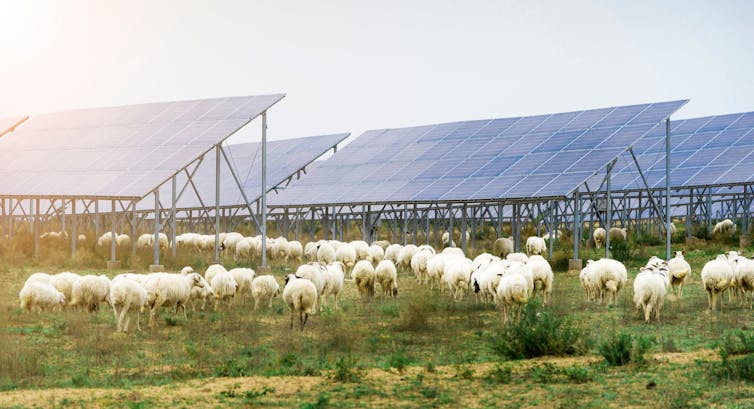
But there are ways to expand solar infrastructure so both nature and people win. We’ve already seen this in so called “agrivoltaics”, where land under and around solar panels is used to grow crops and graze livestock. But what about “conservoltaics”, combing conservation and solar energy?

My new research examines whether solar farms could also be used to help conserve native species. I found solar panels can provide valuable habitat for wildlife – and potentially benefit both the land and farmers.

sheep graze among solar panels
‘Agrivoltaics’ involves combining solar generation with agriculture – but what about ‘conservoltaics’?
Shutterstock

A new place to call home

Our wild landscapes are diminishing and protected areas, such as national parks, cover only about 9% of Australia.

Many agricultural landscapes have been cleared of trees to provide pasture for livestock. It means wildlife that rely on trees have lost vast tracts of habitat.

So we must find new places for wildlife to forage, rest, shelter and breed.

My work examines how solar parks on agricultural land can double as wildlife habitat. It involves surveys and trapping to identify what plants and animals occupy solar farms, how long they take to recolonise, and how we can promote even more biodiversity.

My new paper coins a new term for this dual land-use: conservoltaics. I highlight research from overseas into how solar parks can bring conservation benefits, and describe the research still needed.

Solar panels add three-dimensional structure and complexity to an environment. They can provide animals shelter from predators and the elements, much like artificial reefs in lakes and oceans. They can also act as perch or nesting structures.

Solar infrastructure also creates a mosaic of sun and shade patches – and so provide many “micro-habitats” for plants and animals.

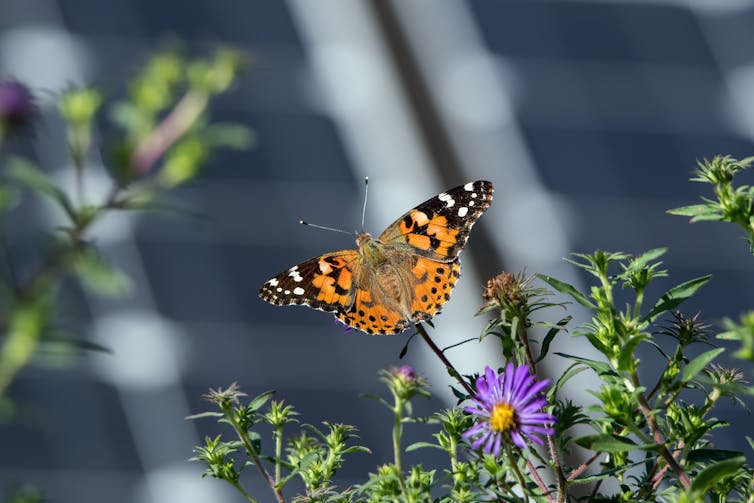
Research from Europe has shown large solar farms can enhance the diversity and abundance of plants, grasses, butterflies, bees and birds.

What’s more, vegetation between solar panel rows can also provide travel corridors, nesting sites and shelter for wildlife.


Read more:
Why Queensland is still ground zero for Australian deforestation


butterfly on plant in front of solar panel
Research shows solar arrays can increase the presence of pollinators such as butterflies.
Shutterstock

Management is key

Research suggests several management strategies that can maximise the benefits of solar farms for wildlife.

Land managers should provide a diverse mix of flowering plant species to encourage pollinators. And grass between solar panels should not be mowed too short or too often. Pollinators prefer tall vegetation where they can forage – though vegetation should not be so tall that it shades the solar panels.

The use of herbicides and other chemicals should be avoided where possible. And solar farms should be connected to other vegetated areas, using features such as hedgerows and wildflower strips, so wildlife can move between the solar farm and other habitats.

Landholders who combine solar farms with wildlife habitat may reap several benefits.

They could receive financial returns by earning environmental credits through schemes that reward carbon sequestration and biodiversity improvements.

They may also improve the health of their land by, for example, increasing pollination or providing habitat for predators such as raptor perches or nest boxes – which in turn could help control pests.

Much work remains, however, to understand these opportunities.

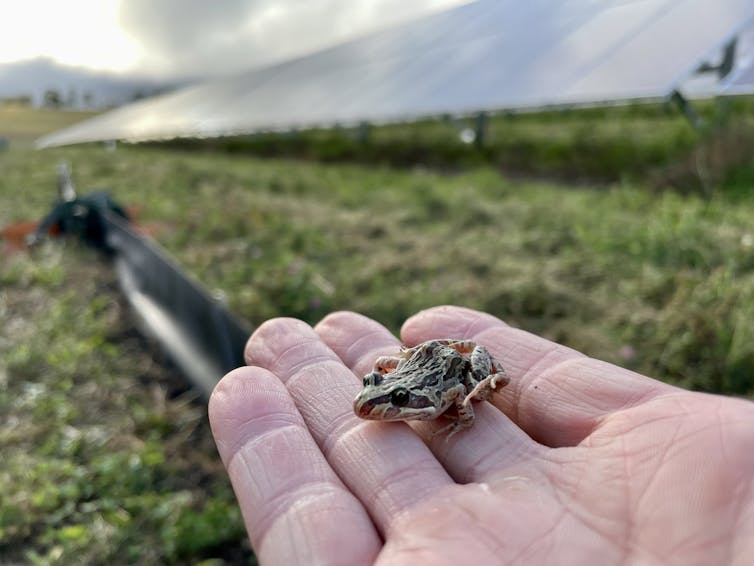
small frog on human hand in front of solar panels
Farm management strategies can maximise the benefits of solar farms for wildlife.
Eric Nordberg

Looking ahead

The benefit of renewable energy in reducing carbon emissions is well known. But more work is needed to understand how solar farms can benefit wildlife.

Research is also lacking on how to locate, configure and manage solar farms to best enhance biodiversity. Collaboration between industry, land managers and researchers is needed so clean energy production and conservation can go hand-in-hand.


Read more:
Australia needs much more solar and wind power, but where are the best sites? We mapped them all


The Conversation

Eric Nordberg does not work for, consult, own shares in or receive funding from any company or organisation that would benefit from this article, and has disclosed no relevant affiliations beyond their academic appointment.

ref. Win-win: how solar farms can double as havens for our wildlife – https://theconversation.com/win-win-how-solar-farms-can-double-as-havens-for-our-wildlife-194920

This strange donkey orchid uses UV light to trick bees into thinking it has food

Source: The Conversation (Au and NZ) – By Adrian Dyer, Associate Professor, Monash University

Stephen Buckle/iNaturalist, CC BY-NC

If you’ve ever compared a frozen pizza to the photo on the box, you know the feeling of being duped by appetising looks.

In our latest study we show that animals – in this case, bees – are also prone to being tricked into making poor decisions, which explains a lot about how gaps in perception are exploited in nature.

When Charles Darwin was testing the theory of evolution 150 years ago, he looked at the interaction between flowering plants and the animals that forage to collect nectar.

This helped establish that flowers have adaptations to promote easier pollinator access, making it beneficial for the animal who gets a food “reward” from them. At the same time, it means the plants get pollinated and can reproduce.

One perplexing problem is some flowering plants that reproduce by pollination are non-rewarding – the animal doesn’t get nectar from visiting the flower. This is true of certain orchids, yet these flowers are still visited by pollinators and survive well in nature.

A mistaken identity

With the benefit of modern scientific tools like a spectrophotometer that measures the amount of colour, digital ultraviolet (UV) photography and computer modelling of how bees see the world, our international team set out to understand how some orchids have evolved dazzling floral displays.

Our chosen species was the winter donkey orchid (Diuris brumalis), endemic to Western Australia. This non-rewarding, food deceptive plant blooms at the same time as rewarding native pea plants (Daviesia).

A yellow flower with two large petals on top and a similar orange flower next to it
A winter donkey orchid (left) and a prickly bitter-pea.
Cal Wood/iNaturalist;
caitlind164/iNaturalist
, CC BY

As a result, native Trichocolletes bees appear to mistake the orchid for legume plants frequently enough that the orchid gets pollinated.

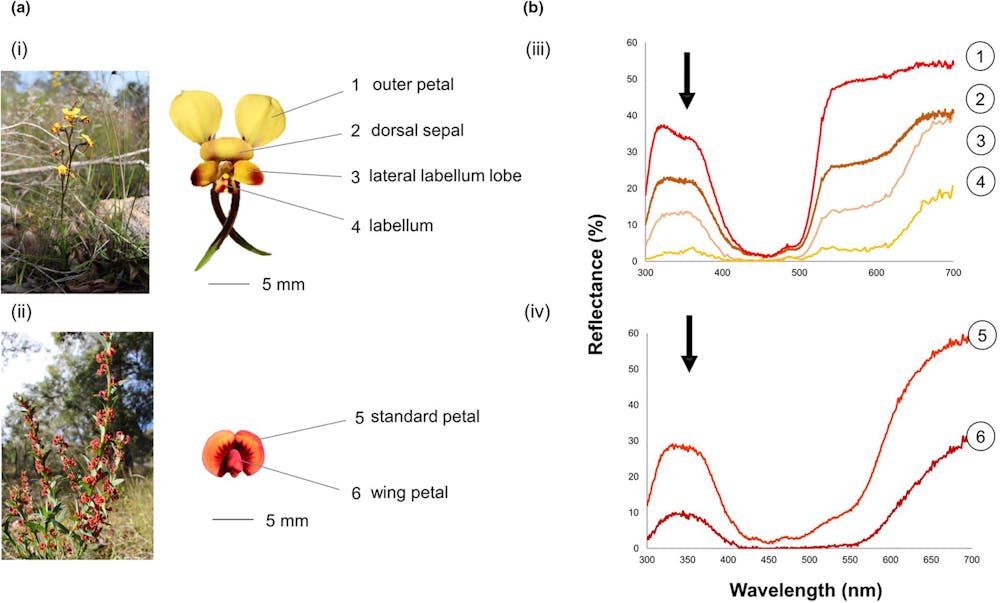
We quantified the flower colour signals from both plants, revealing the main component of the visual information perceived by a bee was in the short wavelength UV region of the spectrum.

This made sense – while our vision sees blue, green and red wavelengths of light as primary colours, bees can see UV reflected light but lack a channel for perceiving primary red.

By using computer models of bee pollinator perception, we observed the orchid mimic species and the native pea plant species did actually look similar in colour to bees.

A chart showing two images of flowers, a larger yellow one and a smaller one, with graphs next to them
Flower shape and colour properties of an orchid (upper row) and a native pea flower (lower row) shown in the field, as individual flowers, and with spectral measurements.
Scaccabarozzi et al., 2023, Author provided

Putting a UV block on flowers

What was surprising, however, was the non-rewarding orchid flowers – pollinated by deception – actually have more conspicuous advertising for bee vision.

For example, the main display outer flower petals were significantly larger on the orchid plants, and also produced a stronger UV colour signal.

To understand if such signalling was biologically relevant, we next conducted field experiments with the plants. We used a special UV sun-blocking solution to remove the strong UV signals in half of the orchid species, whilst the other half retained their natural appearance.

A row of colourful and greyscale images showing flowers next to a hexagonal chart
UV photographs of orchid flowers (upper left panel) in natural state and also with applied UV blocking screen. Middle panels show false-colour photographs of flower appearance for a bee, and right hand panel a computer model of how bee vision perceives flower colours.
Scaccabarozzi et al., 2023, Author provided

At the completion of the field season, several months latter, we could measure which plants were more successfully pollinated by bees, revealing the strong UV signals had a significant role in promoting pollination in the orchids.

A second interesting finding of the field experiments was the distance between the pea flowers and their copycat orchids was a major factor in the success of the orchids’ deception strategy.

If the orchids with strong UV signals were within close proximity – a meter or two – to the rewarding native pea flowers, the deception was less successful and few orchid flowers were pollinated. However, if the deceptive orchids were about eight meters away from the rewarding model species, this produced the highest success rate in pollination.

Why deception works

It turns out a distance of about eight meters is important because of the way bee brains process colour. When bees see a pair of colours in close proximity, they can evaluate them at the same time. This leads to very precise colour matching. A similar process happens in human brains – we also have to see colours at the same time.

However, seeing colour stimuli with a time interval in between means the brain has to remember the first colour, inspect the second colour, and make a mental calculation about whether the two samples are indeed the same.

Neither bee brains, nor our own, are good at successive colour comparisons. This is why when we purchase paint for a repair job we take a sample to get a precise match, rather than try and remember what we thought the colour should look like.

Deceptive flowers are successful by exploiting this perceptual gap in how brains have to code information when bees need to fly several meters in search of more food.

By using a “look at me” strategy (essentially, better advertising than other plants) it is possible to survive in nature without actually offering a food reward to the pollinators. To do this, the plants need to be at an optimal distance from the plants they are mimicking. Not too close and not too far, and success is assured.


Read more:
‘Like finding life on Mars’: why the underground orchid is Australia’s strangest, most mysterious flower


The Conversation

Adrian Dyer receives funding from The Australian Research Council.

Endeavor Fellowship Program grant ID 5117_2016 (Daniela Scaccabarozzi)
Templeton World Charity Foundation grant TWCF0541 (Monica Gagliano)

ref. This strange donkey orchid uses UV light to trick bees into thinking it has food – https://theconversation.com/this-strange-donkey-orchid-uses-uv-light-to-trick-bees-into-thinking-it-has-food-198980

We’re missing opportunities to identify domestic violence perpetrators. This is what needs to change

Source: The Conversation (Au and NZ) – By Nicola Helps, Research fellow, Monash University

Shutterstock

Identifying perpetrators of domestic and family violence is critical to ending violence against women.

Practitioners across different sectors, including mental health, alcohol and drug services, have a vital opportunity to “screen” clients to identify if they’ve experienced or perpetrated domestic violence.

However, our new research reveals practitioners across a range of services are missing opportunities to identify people who choose to perpetrate violence.

The research, funded by the Australian Institute of Criminology and led by Griffith University’s Silke Meyer, reveals there’s significant work to be done to embed screening practices across a range of different services.

States and territory governments across Australia have repeatedly committed to increasing perpetrator accountability. This research shows we need to improve the training of practitioners across various sectors to ensure perpetrators are consistently identified at the earliest opportunity.

Identifying and assessing risk

People who perpetrate domestic violence routinely come into contact with a range of services for other, often co-occurring issues, such as mental health concerns. Each contact with a service presents an opportunity to screen for perpetrators of such violence, and to support the safety of victim-survivors.

Screening for potential perpetrators involves practitioners reviewing available information and asking questions. It can require them to identify warning signs that may signal the perpetration of violence.


Read more:
See What You Made Me Do: why it’s time to focus on the perpetrator when tackling domestic violence


Practitioners use risk assessment tools, such as Victoria’s Multi-Agency Risk Assessment and Management Framework, as well as their professional judgement. This is highly skilled and challenging work.

Without effective screening and risk assessment practices, people who perpetrate violence may go undetected, may not be referred to intervention services, and their ongoing risk of violence remains unaddressed.

Our research found missed opportunities are evident in child protection, health settings, mental health settings, drug and alcohol interventions, and in corrections.

We need to invest more in training

Our findings demonstrate that enhancing specialist training increases practitioners’ likelihood of screening. Yet practitioners in our study reflected on the often limited training available. One corrections staff member commented:

People coming into our agency generally don’t have a good understanding of domestic and family violence, and it’s something that they’re learning either on the job or through a DV person […] There’s nothing really consistent, as a whole agency.

Practitioners consistently said they want more domestic violence training. This will require substantive investment in specialist workforce training across all relevant service sectors.

In our study, mental health practitioners were least likely to report regular screening of clients for potential domestic violence perpetration. Practitioners described mental health services, in particular emergency settings and crisis responses, as fast-paced and under-resourced.

A mental health practitioner told us:

Everybody’s under the pump, and you just see people […] meeting just the bare minimum to cover your back and meeting the minimum standards.

This environment increases the likelihood that perpetrators will be missed.

Increased resources, specialist training, and improved information sharing across the mental health system as well as other services is needed to ensure perpetrators are more consistently identified, their risks assessed and monitored.

Also, the need for improved practices doesn’t stop at the point of identifying risk. Practitioners in our study said there are limited services available for referrals. There’s a need for more early intervention referral options for domestic violence perpetrators.

The study also highlights the importance of organisational leadership and the need to prioritise risk assessment of domestic violence as “core business”. Practitioners in these service settings are well placed to screen potential perpetrators for use of violence. Embedding this in everyday practice will ensure screening occurs at every opportunity.

Achieving perpetrator accountability

This study focused on Queensland and to a lesser extent Victoria. However, the research findings have national importance.

Launched in 2022, Australia’s National Plan to End Violence Against Women and Children 2022-2032 includes a key principle to hold perpetrators to account. To achieve this goal we must ensure they’re identified at every opportunity.


Read more:
To end gender-based violence in one generation, we must fix how the system responds to children and young people


Australian governments are currently preparing the first five-year Action Plan. This strategy will identify the actions needed to progress the National Plan’s goal to eliminate gender-based violence in one generation. Our research highlights why consistent and improved screening and risk assessment processes must be included.

The Conversation

This research was funded by the Australian Institute of Criminology. Nicola also receives funding for family violence related research from No to Violence and Family Safety Victoria.

This study was funded by the Australian Institute of Criminology.
Kate also receives funding for family violence related research from the Australian Research Council, Australia’s National Research Organisation for Women’s Safety, the Victorian Government and the Department of Social Services. This piece is written by Kate Fitz-Gibbon in her capacity as Director of the Monash Gender and Family Violence Prevention Centre and are wholly independent of Kate Fitz-Gibbon’s role as Chair of Respect Victoria.

ref. We’re missing opportunities to identify domestic violence perpetrators. This is what needs to change – https://theconversation.com/were-missing-opportunities-to-identify-domestic-violence-perpetrators-this-is-what-needs-to-change-198071

COVID remains a global emergency, the World Health Organization says, but we’re at a transition point. What does this mean?

Source: The Conversation (Au and NZ) – By Hassan Vally, Associate Professor, Epidemiology, Deakin University

As we enter the fourth year of living with COVID, we are all asking the predictable question: when will the pandemic be over?

To answer this question, it’s worth reminding ourselves that a pandemic involves the worldwide spread of a disease that requires an emergency response at a global level.

This week, World Health Organization (WHO) Director-General Tedros Adhanom Ghebreyesus declared COVID continues to be a public health emergency of international concern.

As Ghebreyesus notes, we still face significant challenges, with high rates of transmission in many countries, the risk of a game-changing new variant ever-present, and an unknown impact of long COVID.

Despite limited testing, we’re still seeing large numbers of confirmed cases.
Our World in Data/Johns Hopkins University CSSE COVID-19 Data, CC BY

Yet COVID pandemic “fatigue” means it’s harder to reach people with public health messaging, while misinformation continues to circulate. In addition, many countries have deprioritised COVID testing and surveillance, so we don’t have accurate data about the extent of transmission.

But while we’re still in the emergency phase of our COVID response, three years after the original declaration, the WHO also acknowledged we’re at a transition point. This means we’re moving towards the “disease control” phase of our response to COVID and learning to live with the virus.

What are we transitioning to?

Moving out of the emergency response phase for COVID doesn’t mean ignoring COVID or returning to exactly what our lives looked like before March 2020. Rather, we need to learn to coexist with COVID.

Living with COVID means applying appropriate prevention and control measures for COVID as we go about our lives. This is what we do for other infectious diseases, including other respiratory diseases.


Read more:
We’re entering a new phase of COVID, where we each have to assess and mitigate our own risk. But how?


The most effective thing we can do to reduce the risk of COVID is to be up-to-date with our vaccinations and boosters. COVID vaccines don’t completely stop transmission, but they greatly reduce your likelihood of becoming seriously ill.

We can also reduce the likelihood of spreading COVID by masking up in high-risk settings, socialising in well-ventilated spaces, and staying away from others when unwell.

Living with COVID also involves government continuing with public health actions to monitor disease transmission and to prevent, control and respond to infections.

What has prompted the transition?

We’ve entered the transition phase because the risk associated with COVID has shifted. Thanks to safe and effective vaccines, along with high levels of prior infection, we have increased immunity at the population level and COVID infection is less likely to lead to severe disease.

This, combined with the emergence of less virulent variants (for now) and the addition to our armoury of a number of effective treatment options, has reduced the overall threat COVID poses to health. The position we are in now is very different to where we were at the beginning of the pandemic.


Read more:
How has COVID affected Australians’ health? New report shows where we’ve failed and done well


One of the main characteristics of this transition phase of the pandemic is a shift towards a risk-based approach to COVID. The focus of public health interventions will be to target the most vulnerable to COVID in the community. This means ensuring older age groups, those with underlying health conditions and others at increased risk of severe outcomes from COVID are adequately protected.

Older woman in mask looks out the window
Our COVID response will prioritise those at higher risk of severe disease.
Shutterstock

What might get in the way?

A smooth path through this transition phase and into the next phase is reliant on continuing to maintain a high level of population immunity overall. One of the biggest challenges is how to promote the uptake of vaccines as the perceived threat of COVID fades.

The difficulty in ensuring a high uptake of boosters is a worldwide problem. Waning immunity, which could be topped up with additional vaccine doses, remains a significant concern and we need to find better ways to address this issue.

The main challenge for health authorities right now is to, on the one hand, acknowledge the reduction in the risk COVID poses while, on the other hand, ensuring people don’t become complacent and completely ignore COVID.

Health authorities are also propping up very fatigued and stretched health systems.

So when will it end?

The WHO’s recognition we are entering a transition phase of the pandemic means we’re one step closer to the end of the pandemic. But while pandemics begin with a bang, they don’t end that way.

Pandemics fade as individuals and populations gradually return to living their lives in a more “normal” way as their risk changes. This can be incredibly messy, with countries transitioning out of the emergency response phase of the pandemic at different times.

So the pandemic isn’t over but an end is in sight.


Read more:
COVID will soon be endemic. This doesn’t mean it’s harmless or we give up, just that it’s part of life


The Conversation

Hassan Vally does not work for, consult, own shares in or receive funding from any company or organisation that would benefit from this article, and has disclosed no relevant affiliations beyond their academic appointment.

ref. COVID remains a global emergency, the World Health Organization says, but we’re at a transition point. What does this mean? – https://theconversation.com/covid-remains-a-global-emergency-the-world-health-organization-says-but-were-at-a-transition-point-what-does-this-mean-198876

Slippery slopes: why the Auckland storm caused so many landslides – and what can be done about it

Source: The Conversation (Au and NZ) – By Martin Brook, Associate Professor of Applied Geology, University of Auckland

Getty Images

The January 27 storm that hit Auckland broke all previous rainfall records and has caused widespread damage, mostly from flooding and landslides. But while climate change helps explain the intensity of the rainfall, the way land has been used and built on in the city is a major factor in what happened.

Such rainfall events generate significant landslides, probably in the thousands. What geologists refer to as “multiple-occurrence regional landslide events” (MORLEs) are sometimes also triggered by earthquakes (such as happened in Kaikoura in 2016).

But predicting where and when land might slide is not easy. Influencing factors include local geology, the properties of the slope material (soil and/or rock), slope geometry and angle, surface vegetation cover, drainage, and any buildings which can add weight and “load” to a slope.

Combinations of these factors were involved in Auckland, and understanding what happened and why will be important for ensuring the city is protected from similar events in future.

Weak saturated soil

Auckland has weak, clay-rich soils formed by the weathering of underlying (often) weak rocks. It also has a lot of steep slopes. Even in their natural state, these slopes can be prone to sliding if the soils become saturated enough.

A further issue is the seasonal drying and wetting of soils. Auckland’s clay-rich soils show high “shrink and swell” properties, meaning there is a natural annual cycle of wetting (swelling) and drying (shrinking).

This can cause a progressive weakening of the soils over years and decades, called “strain-softening” (a bit like taking a steel fork and bending it back and forth). The soil is then more prone to failure when a large rainfall event occurs.


Read more:
The Auckland floods are a sign of things to come – the city needs stormwater systems fit for climate change


In theory, then, more extreme climate effects could lead to an increased rate of soil deterioration, causing the properties of the soil to change more rapidly.

Rainfall “thresholds” are also important to consider. These are the rainfall totals – measured across either 24, 48 or 72 hour intervals – that can initiate landslides on a given slope. But using rainfall forecasts to predict landslides oversimplifies the issue because the prevailing (“antecedent”) soil moisture conditions are also important.

Soils are made of solids (the grains), water, and air which creates “pore” spaces. If it’s been a very wet few weeks preceding a storm event, water increases within the pores (“porewater”), creating an increase in pressure. This lowers the strength of the soil, meaning less rainfall may be required to trigger landslides.

Too close to cliffs

While climate change and the warming of oceans that pump-prime extreme weather events are certainly pressing issues, changing land use is also of growing importance. Indeed, some studies now suggest it is as important as, or possibly exceeds, the effects of climate change on landslides.

These changes include the removal of vegetation, which allows more water to directly enter the soil; the creation of impermeable surfaces; and the cutting and filling of undulating slopes to enable roads and buildings to be constructed. All of these affect the near-surface drainage and hydrology.


Read more:
Auckland floods: even stormwater reform won’t be enough – we need a ‘sponge city’ to avoid future disasters


A further problem in Auckland is often the lack of adequate building “set-back” distances. This is the distance between a dwelling and a slope or cliff edge. In some countries and jurisdictions this is specified within regional plans and taken very seriously.

One way used to calculate these distances is to project an imaginary 45 degree plane from the bottom of a slope. One third of the cliff height is then added to this. For example, a 30-metre high slope would have a set-back distance of 40 metres.

But local geology and climate is also important. With weak soils in a humid climate, a conservative rule of thumb could be a set-back distance of three times the height of the slope or cliff. So, a house on a 30-metre high North Shore cliff, with superb views across to Rangitoto Island, should be set-back around 100 metres from the cliff edge.

Yet there are many houses within just a few meters of cliff edges in parts of the North Shore and eastern Auckland. Swimming pools constructed on slopes can add to the loading and stress, making the slope more prone to failure during a significant rainfall event.

Set-back from the bottom of slopes is also important, because inundation (“runout”) from landslides on slopes above houses can occur, as witnessed in various parts of Auckland.

Three ways forward

Looking ahead, there are three broad approaches to mitigating rainfall-induced landslides in Auckland. First, it will be interesting to see how set-back distances are applied and whether changes to the Auckland Unitary Plan are made in light of recent events.

The Earthquake Commission (EQC) covers land within eight metres of homes and outbuildings. But many houses will now be much closer to the edge of properties. For houses still more than eight metres away from a failing slope, gradual slope creep may suggest future failure is only a matter of time.

Second, landowners should limit vegetation removal and make sure stormwater drains properly into reticulated systems, rather than informal soak-aways.


Read more:
Climate change is already putting the heat on insurance companies – Auckland’s floods could be a turning point


Any surface cracking or bulging, cracked masonry, or difficult-to-open doors or windows should be checked by a chartered engineer. This can be useful in determining what is generally benign (but annoying) seasonal cracking due to soil shrinkage, and what is more serious.

Third, for scientists, engineers and local authorities, a more sophisticated region-wide approach to identifying unstable land is needed. The Interferometric Synthetic Aperture Radar (InSAR) uses space-borne radar to measure ground surface movement at a scale of millimetres-per-year.

I led an EQC-funded team that successfully applied this technique to Gisborne from 2016 to 2021 using the European Space Agency’s Sentinel satellite constellation. This provides measurements every 12 days, with the raw data being free. It has proved very useful to Gisborne District Council in their planning and decision making.

In Europe, the EU-sponsored European Ground Motion Service displays almost real-time measurements of slope movements across the continent that anyone can access. Such a service would be useful across New Zealand – and the events in Auckland suggest this should be a priority.

The Conversation

Martin Brook receives funding from the Earthquake Commission (EQC).

ref. Slippery slopes: why the Auckland storm caused so many landslides – and what can be done about it – https://theconversation.com/slippery-slopes-why-the-auckland-storm-caused-so-many-landslides-and-what-can-be-done-about-it-198984

Business owners see cutting carbon emissions as ‘the right thing to do’, despite the challenges of making change

Source: The Conversation (Au and NZ) – By Pii-Tuulia Nikula, Principal Academic, Eastern Institute of Technology

GettyImages

An increasing number of businesses in Aotearoa New Zealand are changing how they operate to reduce their overall climate impact. These measures, which include reducing carbon emissions, are largely voluntary outside of specific sectors, such as the fuel, energy and waste industries.

So, what motivates businesses to take climate action when they do not have to?

As part of my research, I interviewed 13 businesses in Aotearoa New Zealand to better understand their climate mitigation efforts and experiences.

All of the businesses had made a voluntary commitment to reduce their emissions. Many of these businesses had reduced their carbon footprints by changing how they approached freight, business travel, energy use and waste.

Understanding the drivers and challenges businesses face when implementing climate-friendly measures is important as we consider how to accelerate the fight against climate change.

Driven by values

Underlying values were one of the key reasons for the introduction of voluntary climate mitigation measures. Climate action was often framed as simply the “right thing to do”.

My work found that more traditional economic considerations did not appear to explain the initial decision to reduce the carbon footprint of the business.


Read more:
Plastic pollution in Nigeria: whose job is it to clean up the mess?


That said, many interviewees reported benefiting financially thanks to cost savings – for example, from improved energy efficiency or lower business travel and freight-related costs. These types of activities could be framed as “win-win” situations, where environmental and financial goals aligned.

Many of the interviewees also believed that climate action contributed to their brand image and reported positive feedback from customers or employees.

Barriers to climate-friendly action

On the flip-side, most businesses also reported challenges that limited further sustainability efforts.

Many of those interviewed did not think there was sufficient customer willingness to pay the price premium for climate-friendly products or services in New Zealand.

Furthermore, interviewees felt customer expectations meant lower-carbon practices were not always possible. Most customers expected to receive their products as soon as possible, for example, making it difficult to choose slower transport modes that would have a lower carbon footprint.


Read more:
Davos: three ways leaders can use these summits to create a more sustainable world


The businesses also identified specific issues around infrastructure in New Zealand as a barrier to increasing their sustainability efforts.

These issues included the limited availability of e-vehicle charging stations and limited rail infrastructure. Also the lack of available or affordable low carbon technology was mentioned as a barrier.

In addition to issues with infrastructure, small and medium-sized businesses reported struggling to have any real influence on their supply chains.

Finally, many of those interviewed believed that both public and private sector procurement processes failed to sufficiently take into account climate-friendly practices.

A way forward?

Besides reducing the carbon footprint of their own operations, many of the businesses interviewed attempted to influence their peers. They actively talked about the importance of climate action to others. This included suppliers and distributors, other businesses, industry networks and local communities.

Considering the looming climate crisis, the voluntary sustainability measures of these companies are laudable. These businesses have shown leadership by mitigating their own emissions and influencing others.

But if we want more businesses to introduce and embrace sustainability measures, we need to promote the “win-win” elements of making the change – such as efficiency and savings.

Small and medium sized businesses often have limited resources and knowledge of how to get started with accounting and reducing their emissions. Low-cost and easily accessible resources, emission calculators and other support is important in the beginning of the climate journey.


Read more:
‘Boys will be boys’: why consumers don’t punish big polluters for greenwashing lies


At national and regional level further investment in low-carbon infrastructure – such as rail and e-vehicle charging stations – would make climate friendly choices easier.

Large businesses and national and local governments should encourage further low-carbon transformations by requiring and using emission data in their procurement processes.

The interviews provided some evidence of emerging climate-friendly business ecosystems, in which firms prefer to purchase from – and work with – other businesses that are also taking climate action. The impact of these ecosystems will increase as they grow in size.

Call for action

Considering the emerging impact of climate change, all businesses should start considering their emissions and finding ways to reduce their footprint.

The challenges faced and solutions offered will differ somewhat between industries. To accelerate this transition, customers and employees can make their low-carbon preferences clear.

It is unlikely that all businesses are interested in taking climate action on a voluntary basis and in the current business-as-usual mindset financial gains are prioritised over climate considerations. Therefore, it is likely that further government regulation will be required if New Zealand and other countries are to meet their zero carbon pledges.

Current policies and actions are not compatible with the science-based climate targets. The IPCC report published last year highlighted the urgency of rapid and decisive action.

That means that a more radical transformation of our economies is needed if we are to reduce emissions to achieve the set climate targets. It is important that businesses involved in climate mitigation are actively part of that discussion and share their own practices and insights.

The Conversation

Pii-Tuulia Nikula is co-founder and a board member of Climate Action Network for International Educators (CANIE).

ref. Business owners see cutting carbon emissions as ‘the right thing to do’, despite the challenges of making change – https://theconversation.com/business-owners-see-cutting-carbon-emissions-as-the-right-thing-to-do-despite-the-challenges-of-making-change-197675

The world’s oldest fossils or oily gunk? New research suggests these 3.5 billion-year-old rocks don’t contain signs of life

Source: The Conversation (Au and NZ) – By Birger Rasmussen, Adjunct Professor, The University of Western Australia

Saul Shepstein, Author provided

The Pilbara region of Western Australia is home to one of the most ancient surviving pieces of Earth’s crust, which has been geologically unchanged since its creation some 3.5 billion years ago.

Some of the oldest signs of life have been found here, in the North Pole area west of the town of Marble Bar, in black rocks composed of fine-grained quartz called chert.

A piece of black rock with veins of other colours, next to an Australian two dollar coin for size comparison.
Veins of black chert found in the Pilbara open a window onto Earth as it was 3.5 billion years ago.
Birger Rasmussen

Some features in the so-called “Apex chert” have been identified as the fossilised remains of microbes much like the bacteria that still survive today. However, scientists have debated the true origin of these features ever since they were discovered 30 years ago.

In new research published in Science Advances, we show the carbon-rich compounds also found in the chert may have been produced by non-biological processes. This suggests the supposed “fossils” are not remnants of early lifeforms but rather artefacts of chemical and geological processes.

Controversial Pilbara fossils

In 1993, American palaeobiologist William Schopf spotted carbon-rich filaments in outcrops of the 3.45 billion year old Apex chert. He interpreted them as the charred remains of fossilised microbes similar to cyanobacteria, which were Earth’s first oxygen-producing organisms and are still abundant today.

The existence of fossilised cyanobacteria in such old rocks would imply that life was already pumping oxygen into the air more than a billion years before Earth’s atmosphere became rich in oxygen.

A key piece of evidence in favour of life was the association of organic compounds with the ancient fossils. This is because living cells are made up of large organic molecules, which comprise mainly carbon as well as hydrogen, nitrogen, oxygen and other elements.

Microscope images showing biological-looking structures in rock.
Tiny structures like these, found in ancient black chert, have been interpreted as fossilised bacteria.
Brasier et al.

In 2002, Schopf’s interpretation was challenged by English palaeobiologist Martin Brasier and his team. They showed the “fossils” displayed a variety of shapes and sizes uncharacteristic of cyanobacteria, and indeed, inconsistent with microbial life. What’s more, they also showed the fossil-bearing black cherts were not horizontal beds deposited on the seafloor, but angled veins cutting across the underlying layers of rock.

The fossil-bearing cherts appeared to have formed at high temperatures during volcanic activity. Brasier argued this environment was hostile to life and the “fossils” were, in fact, formed from graphite impurities in the rock. They also speculated that the carbon associated with the “fossils” may not even be biological in origin.

A lively debate ensued, and it has continued ever since.

Microbes or hot fluids?

To try to determine where the carbon-rich deposits in the black chert veins came from, we took a very close look at them with a high-magnification electron microscope.

We found it did not come from fossilised bacteria. The oil-like substance occurs as residues in fractures and as petrified droplets, which have previously been mistaken for ancient fossils.

The textures in the black chert veins indicate they were formed when hot fluids rich in silica and carbon moved through cracks in lava flows below vents in the seafloor similar to modern “black smoker” vents. Upon approaching the seafloor, the hot fluids infiltrated layers of volcanic sediment, replacing it with black chert.

An underwater photo showing smoke above glowing lava on the seafloor.
Black chert veins may have formed when water came into contact with lava at seafloor vents.
NOAA

If the carbon came from such a hot fluid, this supports findings that the carbon-rich filaments in the Apex chert are not fossils. However, it also raises a new question.

Typically, organic compounds such as oil and gas, which are referred to as “fossil fuels” because they form from the dead remains of algae, bacteria and plants, are generated when these remains are buried and heated to temperatures above 65℃. Chemical reactions release organic compounds, which may accumulate to form oil and gas fields.

However, the sediments from the North Pole area are very thin (less than 50m thick), poor in organic molecules, and sandwiched between kilometres of lava flows. So, how did the organic compounds form in such surroundings?

Seafloor vents on early Earth

A possible alternative pathway is suggested from experimental evidence and research on Martian meteorites. In the absence of traditional biological sources, some of the organic molecules in the chert veins could have formed by non-biological processes.

For instance, when hot water circulates through lava or other igneous rock, water and carbon dioxide can react with mineral surfaces to form organic compounds. Similar reactions have been proposed to explain the presence of organic molecules in Martian meteorites and in some igneous rocks on Earth.


Read more:
A 3.5-billion year old Pilbara find is not the oldest fossil: so what is it?


The carbon in black cherts from the Pilbara outback may therefore represent relics of organic compounds that were produced by reactions between water and rock. Indeed, on the early Earth seafloor vents may have created more organic compounds than biological processes did, making it difficult to distinguish between authentic carbon-bearing fossils and oily artefacts.

While more work is underway, early results suggest life was only just surviving 3.5 billion years ago, struggling to gain a foothold in an inhospitable environment. The world then was wracked by regular volcanic eruptions that covered Earth’s surface in lava, and bathed in harsh solar radiation streaming through an atmosphere with no protective ozone layer.

Looking further back in time, the black cherts offer a glimpse of a lifeless planet. Reactions between water and rock at seafloor vents produced a cocktail of organic compounds, perhaps supplying the raw materials for the assembly of the first living cells.

The Conversation

Birger Rasmussen receives funding from the Australian Research Council.

Janet Muhling receives funding from the Australian Research Council.

ref. The world’s oldest fossils or oily gunk? New research suggests these 3.5 billion-year-old rocks don’t contain signs of life – https://theconversation.com/the-worlds-oldest-fossils-or-oily-gunk-new-research-suggests-these-3-5-billion-year-old-rocks-dont-contain-signs-of-life-198865

8 everyday foods you might not realise are ultra processed – and how to spot them

Source: The Conversation (Au and NZ) – By Sarah Dickie, PhD Candidate in Public Health Nutrition, Deakin University

Shutterstock

For years, the term “junk food” has been used to refer to foods considered bad for you, and not very nutritious. But junk can mean different things to different people.

Official dietary guidelines have used more palatable terms such as “discretionary foods”, “sometimes foods” and “foods high in sugar, salt and fat”. But these labels haven’t always made the task of identifying nutritious foods much easier. After all, many fresh fruits are high in sugar and some salad vegetables are low in nutrients – but that doesn’t make them unhealthy. And food products such as soft drinks with “no added sugar” and muesli bars fortified with nutrient additives aren’t necessarily healthy.

In 2009, experts proposed using the extent and purpose of industrial food processing as a key indicator of nutrition problems.

The theory acknowledged some food processing helps make foods more convenient, safer and tastier. But it also nominated a class of foods – called “ultra-processed foods” – as unhealthy, based on more than the content of salt, fat and sugar.

A large body of evidence now shows ultra-processed food consumption is associated with poorer human health (including rates of heart diseases, diabetes and obesity) and planetary health (plastic pollution, excessive energy and land use, biodiversity loss).

But how can you spot those foods when you’re planning what to buy or eat?


Read more:
Ultra-processed foods are trashing our health – and the planet


What counts as an ultra-processed food?

Ultra-processed foods are made using industrial processing methods and contain ingredients you wouldn’t usually find in your home pantry.

Processing methods used may include extrusion, moulding, chemical modification and hydrogenation (which can turn liquid unsaturated fat into a more solid form). But manufacturers don’t need to state the processes foods undergo on the label, so it can be challenging to identify ultra-processed foods. The best place to start is the ingredients list.

There are two types of ingredients that classify ultra-processed foods: industrial food substances and cosmetic additives. Food substances include processed versions of protein and fibre (such as whey powder or inulin), maltodextrin (an intensely processed carbohydrate), fructose or glucose syrups, and hydrogenated oils.

Cosmetic additives are used to improve the texture, taste or colour of foods. They make ultra-processed foods more attractive and irresistibly tasty (contributing to their over-consumption). Examples are colours and flavours (including those listed as “natural”), non-caloric sweeteners (including stevia), flavour enhancers (such as yeast extract and MSG), and thickeners and emulsifiers (which modify a food’s texture).


Read more:
Ultra-processed foods – like cookies, chips, frozen meals and fast food – may contribute to cognitive decline


8 foods you might not realise are ultra-processed

Ultra-processed is not just another name for junk – although foods like soft drinks, confectionery and chips are ultra-processed. There are many packaged foods we’d normally consider healthy that are ultra-processed.

1. Breakfast cereals

Many cereals and breakfast drinks marketed as healthy are ultra-processed. They can contain maltodextrins, processed proteins and fibres, and colours. Oats, on the other hand, contain just one ingredient: oats!

2. Protein and muesli bars and balls

Despite the healthy hype, many of these are ultra-processed, containing processed fibres and proteins, invert sugars (sugars modified through an industrial process) and non-caloric sweeteners.

3. Plant-based ‘milks’

Many dairy alternatives contain emulsifiers, vegetable gums and flavours. Not all brands are ultra-processed so check the ingredients list. Some soy milks only contain water, soybeans, oil and salt.

array of different coloured breakfast cereals
Some ultra-processed foods are easy to spot. But others seem healthy enough.
Shutterstock


Read more:
Food and drinks are getting sweeter. Even if it’s not all sugar, it’s bad for our health


4. Breads

Some packaged breads contain emulsifiers, modified starches (starches altered through industrial methods) and vegetable gums – they’re usually the plastic wrapped, sliced and cheaper breads. Fresh bakery breads, on the other hand, are rarely ultra-processed.

5. Yogurts

Flavoured yogurts often contain additives like thickeners, non-caloric sweeteners or flavours. Choose plain yogurts instead.

6. Meal bases and sauces

Pre-prepared pasta and stir-fry sauces typically contain ingredients such as thickeners, flavour enhancers and colours. But simple sauces you can make at home with ingredients like canned tomatoes, vegetables, garlic and herbs are minimally processed.

7. Processed meats

Packaged cold meats may have emulsifiers, modified starches, thickeners and added fibres – making them ultra-processed. Replace packaged processed meats with alternatives such as cold roast meats or chicken instead.

8. Margarine

The way margarines and non-dairy spreads are made (by hydrogenating the vegetable oils) and the additives they contain, such as emulsifiers and colours, make them an ultra-processed food – unlike butter, which is essentially cream and some salt.

man in supermarket looks confused
Ultra-processed foods dominate supermarket shelves. But it’s worth checking the ingredients list.
Shutterstock


Read more:
Misleading food labels contribute to babies and toddlers eating too much sugar. 3 things parents can do


But are all ultra-processed foods bad?

Some types of ultra-processed foods may look healthier than others, having fewer industrial ingredients or being lower in sugar. But these are not necessarily less harmful to our health. We know Australians consume up to 42% of their energy from ultra-processed foods and the cumulative effect of industrial ingredients over the whole diet is unknown.

Also, when you consume an ultra-processed food, you may be displacing a nutritious fresh food or dish from your diet. So, reducing ultra-processed foods as much as possible is a way to move to a healthier and more sustainable diet. Though not exhaustive, there are online databases that rate specific products to guide food choices.

Supermarkets are dominated by ultra-processed foods, so it can be difficult to avoid them entirely. And sometimes choices are limited by availability, allergies or dietary intolerance. We can all make positive changes to our diet by choosing less processed foods. But governments can also legislate to make minimally processed foods more available and affordable, while discouraging the purchase and consumption of ultra-processed foods.

The Conversation

Mark Lawrence receives funding from the Australian Research Council. He is a Board member of Food Standards Australia New Zealand. The views expressed in this article do not necessarily reflect the positions of any organisation with which he is associated.

Priscila Machado receives funding from an Alfred Deakin Postdoctoral Research Fellowship provided by Deakin University, and has received funding from the Australian Research Council and Sao Paulo Research Foundation. She is affiliated with Nutrition Society of Australia, the World Public Health Nutrition Association and the Healthy Food Systems Australia advocacy group.

Julie Woods and Sarah Dickie do not work for, consult, own shares in or receive funding from any company or organisation that would benefit from this article, and have disclosed no relevant affiliations beyond their academic appointment.

ref. 8 everyday foods you might not realise are ultra processed – and how to spot them – https://theconversation.com/8-everyday-foods-you-might-not-realise-are-ultra-processed-and-how-to-spot-them-197993

The pleasure and pain of cinephilia: what happened when I watched Groundhog Day every day for a year

Source: The Conversation (Au and NZ) – By Adam Daniel, Tutor / Lecturer in Film and Media Studies, Western Sydney University

Columbia Pictures

“What would you do if you were stuck in one place, and every day was exactly the same, and nothing that you did mattered?”

So asks time-stranded weatherman Phil Connors, played by Bill Murray, as he begins to come to grips with his predicament in the 1993 comedy classic Groundhog Day.

On February 2, while reporting on the annual Groundhog Festival in the quaint Pennsylvanian town of Punxsutawney, Phil becomes trapped in a time warp where he lives the same day over and over again.

In 2021 I was wrestling with the same question. Living in lockdown, I was feeling frustration, ennui, and like forward progress had ground to a halt. The circumstances created an opportunity to subject myself to a very unusual challenge: to watch the same film once a day, every day, for a year.

As a film scholar and cinephile, I wanted to find out how well a movie would sustain this kind of viewing and what a viewer might get out of the experience. Groundhog Day was the natural candidate.

On a Monday morning in September of 2021, I sat down on my couch and hit play.


Read more:
When each pandemic day feels the same, Phil the Weatherman in “Groundhog Day” can offer a lesson in embracing life mindfully


The act of watching

In the first month, my primary engagement was with the narrative.

Like many previous viewers, I found myself asking how long Phil was trapped in the loop for (my own approximation is 30 years, which sits between the 10 years offered by director Harold Ramis and the 10,000 years in the original screenplay by Danny Rubin).

I questioned the credibility of Rita (Andie MacDowell) falling in love with Phil having only known him for a day. I wondered how much of Murray’s performance was improvised (in Rubin’s words, some “colouring” but proportionally less than is assumed).

Gradually, my familiarity with the narrative led me to shift focus. Rewatching became about exploration, as I sought to discover details the average viewer may have missed.

I began to notice the re-occurrence of certain extras from scene to scene, building my own narrative around their identities. I realised the boy in a wheelchair in the background of the hospital scene is the same boy Phil will eventually save from breaking his leg every day.

I consumed as much extra material on the film as possible. Rubin’s screenplay and accompanying commentary, film critic Ryan Gilbey’s detailed monograph and Harold Ramis’s commentary were all illuminating. I realise in hindsight that I was following my natural inclination as a scholar, to try to understand something more fully by diving more deeply into it.

And then I reached the doldrums.

Shifting perspectives

By the midway point, my viewing had shifted into a mode of cataloguing and memorisation. Phil Connors’ weather reports ran through my head unbidden, and I had built myself a mental map of Punxsutawney to the extent I felt like I could give directions to a visitor. I began to talk to the film as it played.

Some days, the viewing felt like a curse.

When Rita discovers Phil’s dilemma, she says: “Maybe it’s not a curse. Maybe it depends on how you look at it.”

My own shift in perspective came into play in the final three months. I found myself returning to the exploratory mode of viewing, encouraged by sharing and discussing theories with others who liked the film but who weren’t nutty enough to watch it hundreds of times.

New theories emerged.

I decided the bartender at the Pennsylvanian Hotel is clearly aware of Phil’s predicament (make note of his knowing looks and how quickly he serves them their favourite drinks), and that one of the Punxsutawney townspeople is clearly having an affair, as he can be seen visiting the Groundhog Festival with his wife and the banquet with his mistress.

I’m not the first to posit alternative readings of the film, but I understood in my final stretch of viewing that a film can transform with us, revealing new layers from viewing to viewing.

Films as friends

In recent years, many scholars have examined the practice of repeat viewing, particularly with the emergence of technologies that provide flexibility to view when and where we like.

Film theorist Barbara Klinger suggests familiar movies have the capacity to become our “friends” and she introduced the term “karaoke cinema” to describe the joy of deep familiarity and quotability, arguing this experience provides the audience with an element of both comfort and mastery.

My experience certainly affirms her claims. Watching Groundhog Day every day for a year provided me with a deeper appreciation for how a film may contain multitudes – particularly those we choose to willingly re-experience.

The legacy of Groundhog Day can be seen in the recurring appeal of the time loop narrative in TV shows and films such as Palm Springs, Russian Doll and Happy Death Day.

And, like every piece of worthwhile art, it can also sustain its own deep interrogation and reveal to the curious rewatcher its multifaceted layers and dimensions.

On reaching the finish line I was elated and celebrated with a final viewing on the big screen. I have a feeling it will be some time before I revisit the film, but it’s comforting to know it will be there when I’m ready, an old friend who welcomes visitors.


Read more:
What Groundhog Day (and my time in a monastery) taught me about lockdown


The Conversation

Adam Daniel does not work for, consult, own shares in or receive funding from any company or organisation that would benefit from this article, and has disclosed no relevant affiliations beyond their academic appointment.

ref. The pleasure and pain of cinephilia: what happened when I watched Groundhog Day every day for a year – https://theconversation.com/the-pleasure-and-pain-of-cinephilia-what-happened-when-i-watched-groundhog-day-every-day-for-a-year-198668

Future of Fiji’s democracy at stake over coalition, warns Ratuva

By Felix Chaudhary in Suva

New Zealand-based Fijian academic Professor Steven Ratuva says that if the coalition government is strong, resilient and lasts, “this will reflect well as a future model for coalitions in Fiji”.

“It’s a learning process for a new government and a new democracy and we expect teething problems in the beginning and hopefully we settle down quickly and move on,” said the director of the University of Canterbury’s Macmillan Brown Centre for Pacific Studies.

However, he said that if it collapses, it would “signal a rather dark future of political instability for the country”.

Professor Ratuva said failure would “send out a negative message to investors, tourists and the rest of the world”.

“Thus it is imperative to make sure that the coalition works and for this the politicians need to be politically smart, strategic, humble and empathetic in their dealings and approaches with each other for the sake of the country, beyond the narrow political party agenda,” he said.

Professor Ratuva was referring to recent claims by Sodelpa general secretary Lenaitasi Duru that senior party members were unhappy with the lack of Sodelpa appointees to government statutory boards by the coalition government.

However, Sodelpa leader Viliame Gavoka said the party remained committed to the deal it struck with the People’s Alliance (PA) and National Federation Party (NFP) that resulted in the formation of the coalition Government.

‘Vast majority’ in support
He said the “vast majority” of the Fijian people wanted the coalition government to prevail.

Professor Ratuva said Sodelpa would need to innovatively address its internal issues as a party while ensuring that the coalition government worked for the sake of the country.

“Fiji’s current coalition experiment has great implications for the future of Fiji’s democracy because governments in the foreseeable future under our constitutionally-prescribed proportional representation (PR) system will most likely be in the form of coalitions,” he said.

He said a large number of countries which used the PR system had coalition governments.

“Thus we have to make sure that this coalition works by being strategic and smart about having a watertight agreement between the coalition partners as well as making everyone happy through give and take compromises.

“This is challenging, especially when you still have fractures and differences within Sodelpa, an important partner.

Need for innovation
“Sodelpa will need to innovatively address its internal issues as a party while ensuring that the coalition works for the sake of the country.”

The PR system was introduced by the Bainimarama-led regime which overthrew the democratically elected Laisenia Qarase government in December 2006.

The 51 members of Parliament after the 2014 General Election were elected from a single nationwide constituency by open list proportional representation with an electoral threshold of five percent.

The seats were allocated using the d’Hondt method.

Felix Chaudhary is a Fiji Times journalist. Republished with permission.

Print Friendly, PDF & Email

Article by AsiaPacificReport.nz

Flash flood impacted Pasifika communities in NZ on alert

By Finau Fonua, RNZ Pacific journalist

Many Pasifika families affected by the flash floods and torrential rainfall that have lashed New Zealand’s North Island over the past few days were braced for more bad weather overnight.

With four people dead and hundreds forced out of their homes over the weekend a state of emergency remained in force for Auckland and one has also now been issued for Northland.

The predominately Pasifika neighbourhood of Māngere is among the worst affected areas in Auckland.

Streets throughout the suburb were submerged after torrential rain last Friday caused rivers to overflow their banks.

Māngere resident Louisa Opetaia said the water rose so suddenly that it rapidly flooded her entire home while she was still asleep.

“When I got home from work, I took a nap at about 7.30pm. When I woke up an hour later and I got off my bed, I splashed into water,” said Opetaia.

“It was already halfway up my calf and up to my knee, and the three rooms in my house were flooded,” she added.

Emergency centres were quickly set up, providing supplies and temporary shelter over the weekend and even now to the dozens of families displaced by the floods.

One of the busiest centres is the Māngere Memorial Hall in Manukau.

Flooded Mangere home, Louisa Opetaia
A flooded home in South Auckland’s Māngere. Image: Louisa Opetaia/RNZ

Auckland city councillor Alf Filipaina, who has been helping to organise relief efforts, said many families continued to arrive at the hall on Tuesday, requiring basic goods and household items ruined by the floods.

“Heaps of families have been affected and we’ve been working tirelessly,” said Filipaina.

“We’ve had all the groups here from KaingaOra, the Fono, Ministry of Social Development and others. They’re all here helping people,” he said.

“We’ll be open 24/7 for people who also want a roof over their heads.”

Auckland councillor Alf Filipaina at the community hub at Māngere Tuesday 31 January 2023
Auckland councillor Alf Filipaina at the Māngere Centre. Image: Felix Walton/RNZ Pacific

Filipaina said that some families were in a desperate situation, being forced out of their homes and having lost most of their possessions, including even their vehicles.

“There are people who need financial assistance,” said Filipaina.

“Some of them have lost everything, and we can only give what donations and goods that we have,” he explained.

The community response has been swift in Manukau with various agencies and good Samaritans donating goods and providing services, including from local heroes such as David Tua and All Black Ofa Tu’ungafasi.

“People are always offering to help,” Louisa Opetaia said.

“People have been taking our laundry to the laundromat for us, which is really helpful, and we’ve received a lot of food. That’s what I love about our Pasifika community in Māngere, everyone comes together when people need help.

“We were able to talk to Ministry of Social Development at the Māngere Memorial Hall. I’m not on the benefit so I wasn’t sure if I would qualify for any help but I do.”

Flood relief at the Mangere Memorial Hall.
Flood relief at the Māngere Memorial Hall. Image: Angus Dreaver/RNZ Pacific

Opetaia said she was now moving out of her house as it was too hazardous to live there.

She said the biggest challenge for her at the moment was getting rid of damaged furniture drenched and ruined by the floods.

“We are trying to get the council to help us get a skip bin so that we can throw anything that was affected by the flood waters, and we have a big pile of stuff at the moment,” Opetaia said.

“I understand that there a lot of people who are more severely affected than us. We do need help but at the same time we are grateful because we are in a better situation than others.”

Furniture damaged by flash flooding
Furniture damaged by flash flooding in Māngere. Image: Louisa Opetaia/RNZ Pacific

Meanwhile, according to the NZ Metservice many Aucklanders living south of Orewa may not see heavy rain last night — but localised downpours were still forecast for some.

Meteorologist Georgina Griffiths told RNZ Checkpoint that the key danger was rain falling on saturated soil making the region flood quickly.

But she predicted some parts of the city would escape a deluge.

Georgina Griffiths said Auckland was nearly out of the woods, with a drier weekend forecast and a dry week from Tuesday.

This article is republished under a community partnership agreement with RNZ.

Print Friendly, PDF & Email

Article by AsiaPacificReport.nz

Sort out the uncertain Fiji military constitutional role, says professor

RNZ Pacific

A New Zealand-based professor in comparative politics says the Fiji constitution needs to clear up the role of the military.

Dr Jon Fraenkel of Victoria University, formerly of the University of the South Pacific, says the 2013 constitution revived the provision that existed in the 1990 constitution which gave the military responsibility for looking after the well-being of the Fiji people.

But he told Pacific Waves this needed clarifying.

“Of course, when that was first introduced in 1990, it was as part of an ethno-nationalist constitution that was seeking to codify indigenous paramountcy in the states. At that point, I think the Fiji military [Republic of Fiji Military Forces] contemplated briefly assuming power in an unconstitutional way for 16 years.

“But it didn’t do that. And by the early 1990s, things had calmed down there was a desire to read for civilian government, for the military to keep out of politics. It’s only really in the wake of the [George] Speight coup that Mohammed Aziz rehabilitated this provision in the 1990 constitution, and suggested that it was still applied under the 1997 constitution, and then they put it in the 2013 constitution.

“And what does this mean? Well, it could mean just about anything. What does it mean to look after the welfare of the Fiji people? You could interpret that to mean anything at all?

“I noticed that before the final result, when [Sitiveni] Rabuka, perhaps misguidedly, complained to the military commander about the glitch about the counting of the election ballots, the military commander said that that wasn’t within his remit.

Protecting ‘well-being’
“In other words, he thought that it didn’t fall under section 131 of the Constitution that gives the military right to intervene to protect the well-being of the Fiji people.

“But after the formation of the new government in early January, the military commander, Major-General Jone Kalouniwai did make a peculiar statement where he expressed concern about the ambition of the government and about the speed at which things were moving.

“And he also suggested that the military might have some responsibility for making sure that the separation of powers is guaranteed.

“Now, that’s usually a role for the courts, not for the military. So one has to be careful about this kind of expansive understanding of the role of the military and the new Fiji. I think there needs to be further discussions about what that actually means.”

This article is republished under a community partnership agreement with RNZ.

Fiji's Biman Prasad (from left), Bill Gavoka and Sitiveni Rabuka
Party leaders of Fiji’s new coalition government . . . Deputy Prime Minister Biman Prasad, National Federation Party (NFP) (from left); Deputy PM Viliame Gavoka (Sodelpa); and Prime Minister Sitiveni Rabuka, People’s Alliance(PA). Image: RNZ Pacific
Print Friendly, PDF & Email

Article by AsiaPacificReport.nz

‘No secret’ that Fiji’s media law is target for free press review soon

By Repeka Nasiko in Lautoka

Fiji’s Media Industry Development Act will soon be reviewed over the next few weeks.

Speaking to The Fiji Times in Lautoka on Monday, Minister for Communications Manoa Kamikamica said the review was one of the main objectives of the coalition government when it came to freedom of the press.

“The Media Decree is going to be reviewed,” he said.

“It is no secret that it is one of the priorities of the coalition government, so hopefully in the next few weeks we will be making some progress on that.”

He said that since the change in government media freedom had been felt among the industry.

“You can see there is already freedom of the press that you can feel when there is a change in leadership.

“So that is a positive for the media industry and I can assure you that the Media Decree review is happening and it will be happening over the coming weeks.”

More communication plans
He added that there were more plans to develop Fiji’s communication sector.

“There are a lot of things to do in communication,” he said.

“There are still a lot of people that have not been reached yet in terms of service delivery so that is a priority of government as well.

“There are also a lot of technological industries that are starting to come to Fiji for example the BPO (business process outsourcing) sector.

“This is one so need to make sure that the government supports and there are a few things we are going to be doing there.

“So there’s a lot to do and we have a plan and we will take it forward.”

Repeka Nasiko is a Fiji Times reporter. Republished with permission.

Print Friendly, PDF & Email

Article by AsiaPacificReport.nz

Chris Hipkins’ first question time as PM – will he ‘win the House’?

ANALYSIS: By Peter Wilson, political commentator for RNZ News

Tuesday, February 7, at 2pm. That’s when New Zealand’s new Prime Minister Chris Hipkins’ parliamentary year begins and he faces National leader Christopher Luxon in the debating chamber for the first question time of 2023.

He needs to “Win the House”, as the saying goes. That means getting the better of the other side, and Hipkins has to show his caucus that he is up to it.

Hipkins is a vastly experienced parliamentarian, but there is nothing like being in the hot seat directly facing the leader of the opposition.

He can be expected to take it to Luxon and ACT leader David Seymour more aggressively than Jacinda Ardern did, he is more of a “take no prisoners” politician than she was and he needs to get some hits in early on.

Hipkins has had a great start with two opinion polls showing Labour has regained the ground it lost to National.

The 1News Kantar poll showed Labour up five points to 38 percent and National down one point to 37 percent.

Newshub’s Reid Research poll had Labour up 5.7 points to 38 percent and National down 4.1 points to 36.6 percent.

Hipkins slightly ahead
In the preferred prime minister stakes, Hipkins was slightly ahead of Luxon in both polls.

Stuff‘s political editor Luke Malpass said the polls showed what no Labour figures dared to consider a fortnight ago — that the party might have better prospects under a leader other than Jacinda Ardern.

“Hipkins, it now appears, could be that person,” he said.

“In other words, by the time Ardern left she might have been a drag on the party vote.”

Luxon dismissed the poll results, saying nothing had changed.

“It’s the same government, and a new leader who can’t deliver,” he said. “It’s going to be an incredibly tight race.”

The poll details, and what the results would mean in terms of seats if an election was held now, are on RNZ’s website.

Labour’s new champion
After settling in to his debating chamber role as Labour’s new champion, Hipkins has to get his next big agenda item off the blocks — ditching policies and programmes that are in the way of his pledge to totally focus on “bread and butter” issues that affect people, which means the cost of living.

This process was started by Ardern at the end of last year and Hipkins needs to get it done and dusted because there’s sure to be the usual cries of “U-turn, U-turn”.

Although Ardern and Hipkins have explained it as necessary to the new focus on dealing with inflation and the cost of living crisis, there Is also an obvious political need in election year.

Outgoing NZ Prime Minister Jacinda Ardern and Incoming Labour leader and Prime Minister Chris Hipkins during Rātana celebrations
Former prime minister Jacinda Ardern and Prime Minister Chris Hipkins share a light moment at the Rātana celebrations on Ardern’s last day as leader. Image: Hagen Hopkins/Getty Images/RNZ News

Labour wants to get rid of liabilities, policies and programmes that are causing trouble and are easy targets for the opposition.

Hipkins needs what MPs call clear air to explain and implement policies Labour hopes will reset the party’s direction, entrench the lead over National and ACT, and deliver a platform for the election campaign.

The new prime minister may be in his honeymoon period but the media knows he has to deliver.

“He will have to show there is more on the tin than just a new sticker, and in pretty short order,” said Malpass.

“It won’t be enough to just chuck the odd media merger and dank old bits of legislation over the side: It will have to be replaced by some actions on the ‘bread and butter’ issues Chris Hipkins says he is concerned about.”

Plagued by troubles
The New Zealand Herald’s
political editor Claire Trevett said Hipkins’ job was to convince voters that Labour was focused “on the various troubles plaguing them now — from potholes to hip ops to the price of bread”.

“The talk is one thing, the delivery is another. Hipkins has no real option but to deliver.”

There’s been speculation about which policies and programmes will get the chop or be put on the slow track, and Stuff published a list with the top three being the RNZ/TVNZ merger, the Income Insurance Scheme (which National calls a jobs tax) and Auckland Light Rail.

It said other lesser known projects could join the list.

Hipkins must also deal with Three Waters, which has given the government more problems than anything else.

That’s more difficult because the legislation has been passed, but Hipkins has acknowledged he has to do something about it.

“We are going to look closely at the Three Waters programme,” he told Trevett in an interview. “There’s no question there has to be change. I don’t think we can just sit back and say ‘this is not our problem, this is a council problem’.

“I don’t think that would be responsible. But we also need to bring people along with us and what we are doing.”

Policy clear-out
When it comes to the policy clear-out, Hipkins has much more freedom than Ardern would have had.

She would have faced ferocious opposition attacks for dumping policies she had supported, her words would have been thrown back at her.

But Hipkins is a new prime minister, doing things his way, just as Ardern told him when she said “you must do you”. She was giving him free rein to do it his way.

Did she know Labour was heading in the wrong direction under her leadership, and that it wouldn’t win the next election unless there was drastic change?

One commentator who thinks so is Matthew Hooton.

Writing in the Herald, Hooton said Ardern so badly wanted her government to win a third term that she was prepared to step down.

“Labour’s masterful transition was carefully planned before Christmas by Ardern and her closest allies, Grant Robertson and Chris Hipkins, and flawlessly executed,” he said.

Capturing the initiative
“Political strategists spend every December working out how to capture the initiative in January, especially in election year. None has ever succeeded like Labour over the last week.”

Christopher Luxon at a media standup in Papakura in Auckland
National Party leader Christopher Luxon . . . not a good run-up to the parliamentary year. Image: Nick Monro/RNZ News

Luxon hasn’t had a good run-up to the new parliamentary year.

Inevitably, he’s been eclipsed by Hipkins simply because he is the new prime minister but when Luxon has been able to get into the media he might have wished he hadn’t.

“National strategists seem dumbstruck,” Hooton said in his article. “Christopher Luxon was more incoherent than usual trying to explain where he stands on co-governance, the Māori seats, and whether women politicians receive worse abuse than males, pleasing neither the liberal nor conservative wings of his party.”

Stuff’s Andrea Vance said Luxon had actually helped ease Hipkins into the job “by being more mediocre than usual”.

“Somehow Luxon — whose one job last week was to stay on message — managed to drive down a co-governance cul-de-sac at`Rātana, and then spend the rest of the week doing bunny-hop u-turns to get out of it,” she said.

“And how did he manage to piss off women, again? The correct answer was ‘yes’, Christopher. Female politicians patently face more abuse than men.”

Abuse of women
She was referring to Luxon responding to a question about whether women politicians suffered more abuse than men by saying he wasn’t sure.

When Hipkins takes his seat in Parliament on Tuesday he’ll have his revamped front bench alongside him.

The cabinet reshuffle, as RNZ reported, means some of the government’s most contentious portfolios will have a fresh face.

One of the most interesting facets was Hipkins’ decision to appoint Michael Wood as Minister for Auckland.

Hipkins explained the need to “get Auckland pumping” after a difficult couple of years, but there’s a political imperative behind it as well which the Herald’s Trevett saw.

“It is aimed as a pre-emptive counter to the inevitable attacks from Auckland-based opposition leaders such as Christopher Luxon and David Seymour that the Wellington-based Hipkins is a beltway creation and out of touch with Auckland’s concerns,” she said.

“It sends a signal that Hipkins has his eye on Auckland and knows its importance.”

Peter Wilson is a life member of Parliament’s press gallery, 22 years as NZPA’s political editor and seven as parliamentary bureau chief for NZ Newswire. This article is republished under a community partnership agreement with RNZ.

Print Friendly, PDF & Email

Article by AsiaPacificReport.nz

Hybrid future? Interbreeding can make heat-averse species more resilient to climate change

Source: The Conversation (Au and NZ) – By Luciano Beheregaray, Matthew Flinders Professor of Biodiversity Genomics, Flinders University

Shutterstock

As the climate heats up rapidly, many species will struggle to avoid extinction. If they had time, they could evolve to the new environmental conditions. But they don’t. That’s where hybridisation could help. When related species interbreed, the flow of new genetic diversity could help them adapt to warmer environments.

Hybridisation can often be a cause for concern for species conservation. Our new research suggests genetic mixing across species may, in fact, offer better chances of survival for some species – especially those that don’t tolerate much environmental variation and are likely to be the worst hit by a hotter climate.

Some species won’t have to face a very uncertain future wholly alone. Related species may well be able to help.

We looked at what happened when cold-adapted and warm-adapted rainbowfish interbred. We found the welcome infusion of new genetic diversity was a boon, bringing down the risk of extinction for threatened species and potentially making them more resilient.

Upland rainbowfish are less able to adapt to warmer water – but hybrid rainbowfish are better placed.
Diana-Elena Vornicu

What did we learn?

Australia’s wet tropics run roughly from Townsville to Cooktown, including the Daintree Rainforest. Sadly, this spectacular bioregion is expected to be particularly badly hit by climate change. The cooler climates of the mountainous rainforest are likely to vanish.

In the rivers here live many species of tropical rainbowfish (Melanotaenia spp.). Some species live in colder water, higher up in the headwaters. Others live in the warmer waters lower down, but are slowly moving up the rivers as the climate warms. Different rainbowfish species can readily interbreed.


Read more:
How hybrids could help save endangered species


We collected samples of five species of rainbowfish adapted to life at different elevations. These included a widespread lowland species known for its adaptability, as well as three species only able to live in a narrow range of mountain rivers and one only able to live in the lower reaches.

Using genomic analyses, we found a mixture of pure and hybrid populations of these rainbowfish species. Then, we found the genes enabling rainbowfish to adapt to the region’s varying climates and estimated how vulnerable each of the species was to future climate.

rainbowfish australia
One of the rainbowfish species we collected from Australia’s wet tropics.
Keith Martin, Author provided

What did we find? That the cooler-water rainbowfish species were better placed to adapt to future climates if they had hybridised with the generalist warm-water species.

Then we modelled the habitats available to cool-water species against the warming expected in climate models. We found upland rainbowfish species would probably lose more than 90% of their habitat within 50 years, while the lowland warm-water species would lose relatively little habitat.

If the upland species are to survive, they have to either find new habitats or adapt to new conditions. Freshwater fish are, of course, extremely limited in their ability to find new habitat. These rainbowfish, in particular, live in Australia’s last remaining cool tropical cloud forests. Even if we wanted to relocate them, there’s not many places for them to go.

The only other option is to adapt in situ.

Luckily for rainbowfish – and potentially, many other species – we found hybrid fish from warm and cool species had more genetic diversity. This was particularly true for genes associated with the ability to live in warmer conditions.

These hybrids also don’t require as much overall genetic change to keep up with climate change compared to the pure populations. Taken together, that means we could be seeing a kind of natural evolutionary rescue, which may help moderate the impact of climate change.

They’ll need every bit of help they can get to escape the hot water they’ll find themselves in. Our climate models suggest pure rainbowfish populations will need to evolve far faster in the coming decades than they did since the arrival of the Holocene era about 11,000 years ago.

wet tropics stream
Many species have very restricted ranges, such as the rainbowfish living only in cooler streams in the wet tropics.
Michael Hammer, Author provided

How can hybridisation help?

Genetic diversity is one of the best resources a species can have. Food, water and shelter are immediately important to individual animals. But from a bird’s eye view, genes also matter.

When a species has broad genetic diversity, they’re far better placed to weather changes. If their environment changes, they have a better chance of evolving to cope with new conditions.

That’s especially important now, as millions of species face the existential threat of climate change. If they had enough time to adjust, they could cope. But this is happening at warp speed. Species that can’t handle much variation to their environment are at higher risk of extinction because they often lack genetic diversity for adapting to climate change.


Read more:
Which species will win and lose in a warmer climate? It depends where they evolved


When you think genetic diversity, you might think of a large population of one species. But in fact, genes can jump across species.

This means both interbreeding and mixing among populations (through migration) or between species (hybridisation) can potentially enable some threatened species to gain welcome infusions of novel genetic diversity from species already adapted to warmer environments.

Hybrids have often been seen as a problem.

There’s an old saying in conservation: “local is best”. By that, scientists mean local, often small populations are best managed in isolation to maintain the genetic purity of lineages. But more and more, we have come to understand this doctrine can be more harmful than good.

Hybrid populations have often been overlooked – or even thought of as threatening the gene pool of endangered species.

What we hope our research demonstrates is that hybridisation may contribute to the persistence of some species.

Of course, mixing between other species may not always produce the same result. We need to find out when hybridisation could be beneficial to conservation.

We hope this work offers rare empirical support for the idea that genetic mixing isn’t always a threat. In fact, it may hold the promise of a new tool for conservation.


Read more:
Hybrid species are on the march – with the help of humans


The Conversation

Luciano Beheregaray receives funding from the Australian Research Council.

Chris Brauer receives funding from the Australian Research Council.

ref. Hybrid future? Interbreeding can make heat-averse species more resilient to climate change – https://theconversation.com/hybrid-future-interbreeding-can-make-heat-averse-species-more-resilient-to-climate-change-198877

I study how radiation interacts with the environment – and the capsule lost in WA is a whole new ballgame

Source: The Conversation (Au and NZ) – By Madison Williams-Hoffman, PhD Candidate in Environmental Radioactivity, Edith Cowan University

WA Department of Fire and Emergency Services

By now, you’ve probably heard about a tiny radioactive capsule that went missing from the back of a truck somewhere in Western Australia. Inside is a small but dangerous amount of Caesium-137, a radioactive chemical element that can harm both people and nature.

My research focuses on detecting human-caused radioactive elements in the Australian environment.

These chemicals can persist in water, soil, sediments, plants and animals, and even travel up food chains. But the situation of the lost capsule is unique. That makes it hard to predict the environmental damage it might cause.

Should the capsule not be found immediately, we can’t just write it off as lost. A long-term system of surveys and sampling will be needed, across a broad area, to monitor for radiation and protect humans and the environment.

rocky hills at sunset
The landscape near Newman in remote WA, where the capsule began its journey. The environmental effects of the accident are unknown.
Shutterstock

Stay well away

The radioactive capsule fell from a truck somewhere along a 1,400-kilometre stretch of road between Newman and Perth. Authorities are now searching for it.

The device was part of a gauge being used at a Rio Tinto mine in the Kimberley region and was being transported by a contractor.

It contained Caesium-137, a nuclear fission product used in high-tech equipment. The radioactive element is also a byproduct of nuclear weapons and reactors.

The lost device is tiny – just 6mm by 8mm. The Caesium-137 is contained in ceramic material, which is then encased in a steel outer shell.

The capsule could eventually corrode when exposed to the elements.

People who come across the capsule could become seriously unwell, including developing burns, radiation sickness and, in the longer term, cancer. But plants, animals and ecosystems are at risk, too.

How might nature be harmed?

It’s well-documented that caesium can accumulate in food webs.

The capsule was lost in a remote outback area. There, small animals such as insects and rodents could ingest all or part of the capsule, and suffer ill-effects. Plants can also absorb radiation.

If those animals or plants are then eaten by other animals, the radioactive caesium may travel up the food chain.

Research has found lower animal population sizes and reduced biodiversity in high-radiation areas. Radioactive caesium from Chernobyl, for example, can still be detected in some food products today.

The damage caused by radiation varies depending on the type of radiation emitted, the amount of radiation present, and the ways a person or organism interacts with it. An animal that ingests the capsule, for instance, would suffer more harm than one that briefly walked past it.

My PhD research involves testing for radioactivity in the marine environment of the Montebello Islands off WA, where Britain conducted nuclear tests in the 1950s.

My colleagues and I discovered human-caused radioactive elements including Caesium-137. The elements exceeded “background” levels – in other words, the levels you could expect in the soil in a suburban backyard or in sand at your local beach.

We are currently seeking to understand if these levels pose a risk to people and nature, and how the radioactive elements move around the environment.


Read more:
A tiny radioactive capsule is lost on a highway in Western Australia. Here’s what you need to know


woman stands in coastal landscape with pipes
The author, Madison Hoffman, at the Montebello Islands where she and her team tested for radioactivity.
Kathryn McMahon

The great unknown

WA authorities are searching for the lost capsule by trying to detect radiation from Caesium-137 in the environment. But this will not be easy.

The radiation was not dispersed over a large area, such as in a mushroom cloud following a weapons test. It was encased and condensed – though it may eventually escape the casing.

Working out what harm the radiation may cause is also difficult. The two most notable releases of Caesium-137 to date have occurred overseas, at Chernobyl in Ukraine and Fukushima in Japan. Both were large-scale releases from nuclear power plants – very different to the current situation in WA.

There have been smaller radioactive releases around the world. But most occurred in environments very different to Australia’s. We don’t have a great deal of information about how Caesium-137, and other radioactive elements, move through hot, arid environments such as ours.

damaged nuclear power plant
Most Caaesium-137 releases to date have occurred overseas at places such as Fukushima.
AP/KYDPL KYODO

How long will the radiation last?

This lost capsule is an entirely different ballgame to Caesium-137 releases in the past. Its radiation is currently 19 billion becquerels (a unit used to measure radioactivity). That is many orders of magnitude greater than what I’m dealing with at the Montebello Islands, for example.

If we apply what’s known as the exponential decay equation, in 100 years’ time the capsule’s radiation level will have fallen to about 1.9 billion becquerels. But even then it might still pose a risk to people or the environment.

Using the same equation, in 1,000 years, the radiation level will be about 1.9 becquerels. This might be too low for our current instruments to detect, and might not necessarily pose a significant safety hazard. However, the risk would still depend on many variables.

The long game

At the moment, the search for the lost capsule is in the acute phase. Let’s hope authorities find it soon.

If that doesn’t happen, the next step will be determining how to best keep looking for it.

The current resource-intensive searching – such as scouring highways on foot or slowly by vehicle – can’t go on forever. But if the capsule remains lost, ongoing sampling, surveys and monitoring is needed to protect people and the environment over the longer term.

Understandably, headlines about radiation accidents evoke public concern. But it’s important to stress that, if the device remains on the side of the road, the probability of a person stumbling across it by accident is very small.

Although unfortunately, the same can’t be said for wildlife.


Read more:
Are bananas really ‘radioactive’? An expert clears up common misunderstandings about radiation


The Conversation

Madison Williams-Hoffman receives funding from the federal government RTP Scholarship program, Her PhD has also been partially funded by Australian Radiation Protection and Nuclear Safety Agency (ARPANSA).

ref. I study how radiation interacts with the environment – and the capsule lost in WA is a whole new ballgame – https://theconversation.com/i-study-how-radiation-interacts-with-the-environment-and-the-capsule-lost-in-wa-is-a-whole-new-ballgame-198870

Australia is finally getting a last-chance view of a green comet not seen for 50,000 years

Source: The Conversation (Au and NZ) – By Jonti Horner, Professor (Astrophysics), University of Southern Queensland

Alessandro Bianconi/Edu INAF/Flickr , CC BY-SA

Over the past few weeks, social media has been abuzz with excited posts about the green comet that is currently “whizzing” or “flying through the sky”.

Now, comets don’t so much whizz as crawl. Despite that, there is a grain of truth in the reports – along with a whole heap of hype.

There is a relatively bright, green comet in the sky at the moment. Sadly, despite the hyperbole, you’re unlikely to spot it with the unaided eye – unless you have great eyesight, a dark sky, and know where to look.

People in the Northern Hemisphere have been following the comet for weeks. Now, for us in Australia, it will finally become visible, just a few days after its closest approach to Earth. So what’s all the fuss about?

Green and rare

Comet C/2022 E3 (ZTF) is a small dirty snowball discovered in March 2022 by the automated Zwicky Transient Facility (hence the name ZTF).

Unlike asteroids, which are made of rock, comets are icy bodies. When they approach the Sun and the temperature rises, that icy surface sublimates (changes directly from a solid to a gas). The comet thus becomes shrouded in a fuzzy “coma” of gas and dust. Radiation pressure from the Sun, along with the effects of the solar wind, pushes the gas and dust outwards, and the comet grows a “tail”.

The gas released by the comet is exposed to sunlight in the vacuum of space. That radiation, particularly the ultraviolet light, excites the gas. This means the gas gets rid of the energy it absorbs by shining in specific colours.

Much of the work astronomers do is based on breaking the light from distant objects into its component colours, to study what they are made of. Comet tails are usually blue, but comet ZTF has a very distinct greenish hue. Green is the telltale sign the comet is emitting large amounts of diatomic carbon and cyanogen, which both create a greenish glow when excited.

So, by looking at the comet’s colour, we can immediately learn a bit about its composition – which is pretty cool!

A dark star field with a bright green and white light on the lower-right corner, with two white streaks coming out of it in different directions
A close-up view of Comet C/2022 E3 (ZTF) on January 27 2023, captured at Lake Sonoma in California, US. You can see both its tail and even an ‘anti-tail’, an optical illusion caused by our viewing position on Earth.
Moshen Chan/Flickr, CC BY-NC

Upon discovery, the comet was just inside the orbit of Jupiter. Astronomers soon realised it would come relatively close to Earth in January and February this year, just a couple of weeks after its closest approach to the Sun (perihelion, which came on January 12).

Comet ZTF is a “long period comet”, which means it’s moving on an extremely elongated orbit around the Sun. It originated in the Oort cloud – a vast cloud of trillions of cometary nuclei that stretches halfway to the nearest star, leftovers from planetary formation 4.5 billion years ago. Those comets are held in cold storage until something nudges them inwards.

The last time comet ZTF graced the inner Solar System was around 50,000 years ago. While long period comets are not uncommon, interestingly this is likely ZTF’s final swing past our star. Thanks to a quirk of celestial mechanics, it is going to leave the Solar System altogether, travelling just fast enough to escape the Sun’s gravity.

Our Solar System (and all other planetary systems) are continually shedding comets like dandruff – with ZTF being just one more flake to add to the interstellar snowstorm.

A perfect ringside seat

Now, under normal circumstances, comet ZTF would be solely of interest to keen amateur and professional astronomers. It is actually a relatively small comet, with a nucleus likely no more than a few hundred metres across.

Were it not for the fact of its relatively close approach, it would never get bright enough to be noteworthy.

Instead, pure chance has led to the comet passing through the inner Solar System at just the right time to come close to us. Instead of a dim and distant view, our planet has a perfect ringside seat to see the comet at its finest.

When and where can we see it in Australia?

At 17:54 UT on February 1 (that’s in the early morning of February 2 in Australia, around 5am on the east coast, but earlier in west), comet ZTF will be just under 42.5 million kilometres (0.284 au) from Earth.

Just as expected, the comet is now at its brightest – visible to observers in the Northern Hemisphere as a faint fuzzy blob (with the naked eye, from dark skies), albeit one that is made significantly harder to spot thanks to the glare of the nearly full Moon.

For observers in the Southern Hemisphere, we had to wait because the comet was too far in the northern sky – essentially “above” our planet in space.

Fortunately, the comet is now moving southwards at a rate of around five or six degrees per day for the first ten days of February. Observers in the far north (Cairns and Darwin) might catch a glimpse low in the northern sky on the evening of February 2. Those in Hobart will have to wait until February 7 or 8 before it creeps high enough above the horizon to be spotted.

A good resource to check when the comet will be above the horizon from your home town is the free web-based planetarium package Stellarium. Go to the site, pan around to the north, and set the clock (at the bottom right) to an hour or two after sunset – then step forward day by day until ‘C/2022 E3 (ZTF)’ is visible above the northern horizon.

Get your gear ready

Technically, the comet is currently bright enough to see with the naked eye. Eagle-eyed northern observers have been reporting sightings without optical aid since mid-January.

However, the comet is only just visible in this way – which means you need to know exactly where to look, and to have a really dark sky. And even if you can, what you see will likely be underwhelming – a dim fuzzy blob.

By the time the comet is visible in Australia, it will be dimming quite rapidly, making it harder to see from one night to the next.

If you’re keen to see it, your best bet is to at least get a pair of binoculars. Work out where it should be, and scan the sky slowly, looking for a fuzzy patch of light.

The best time to find the comet will likely be February 11, when it will be within a degree of Mars, which currently shines bright and red, high to the north in the evening sky.

On the night of the 11th, find Mars with your binoculars, and pan just slightly to the right – you should be able to find the comet there.

But the best way to view the comet will be online. Astronomers worldwide are capturing incredible images of our celestial visitor. Taken with exposures many minutes in length, these photos reveal a view far better than anything possible with the naked eye.

The Conversation

Jonti Horner does not work for, consult, own shares in or receive funding from any company or organization that would benefit from this article, and has disclosed no relevant affiliations beyond their academic appointment.

ref. Australia is finally getting a last-chance view of a green comet not seen for 50,000 years – https://theconversation.com/australia-is-finally-getting-a-last-chance-view-of-a-green-comet-not-seen-for-50-000-years-198867

Why the violence between Israel and the Palestinians may be entering a devastating new phase

Source: The Conversation (Au and NZ) – By Susan de Groot Heupner, Senior Research Fellow, Griffith University

US Secretary of State Antony Blinken rushed to the Middle East this week to make yet another push for a negotiated settlement between Israel and the Palestinians following yet another dramatic escalation in violence between the two sides.

Blinken urged peace in his meetings with Israeli Prime Minister Benjamin Netanyahu and the president of the Palestinian Authority, Mahmoud Abbas, but the prospects could hardly be dimmer.

More than 30 Palestinians have been killed in the West Bank since the beginning of this year, mostly at the hands of Israeli security forces. And last Friday, a Palestinian gunman killed seven Israeli civilians outside a synagogue in the Israeli settlement of East Jerusalem, one of the worst attacks in the city in years.

This follows the deadliest year in the West Bank since the UN started tracking deaths in 2005, with 154 Palestinians killed by Israeli security forces in the West Bank and East Jerusalem.

I spent a month in the West Bank in October as part of research for a book on far-right and Islamist politics. Within the first ten days after I arrived, seven children under the age of 18 were reported to have been killed. Over the course of one month, I documented 29 Palestinian deaths in total – and two killings of Israeli soldiers – most of whom under the age of 30.

Because the mainstream English media does not consistently report on these killings, I relied on several social media channels to cross-check names and pictures. And because of regular censorship on these platforms of Palestinian news sources, such as the Hamas-affiliated Quds News Network, the death toll is likely to have been even higher.

While peace has long been elusive in the occupied Palestinian territories, there is a new dimension to the latest violence in the West Bank, which some observers believe could now spiral out of control.

Unlike previous unrest, newly emerging Palestinian militant groups are increasingly fragmented and calling for a popular uprising. This demand, in turn, coincides with a radical shift to the extreme right in Israel’s government.


Read more:
Israel’s new hard-line government has made headlines – the bigger demographic changes that caused it, not so much


The emergence of the Lion’s Den

Many Palestinians, and the young in particular, have lost trust in the governing body of the West Bank, the Palestinian Authority, and other local factions to protect them from expanding Israeli settlements and suppression by Israeli security forces.

This new phase of resistance aims to unite these disaffected youths who are seeking an alternative to the traditional Palestinian power structures.

Several new armed groups have emerged in the past year and a half as the public support for armed resistance has grown stronger. Israeli security forces responded in early 2022 with an operation called “Break the Wave”, which targeted fighters in two West Bank cities, Nablus and Jenin.

This operation, which has paralysed the security apparatus of the Palestinian Authority in these areas, was followed by many more raids by security forces throughout 2022 and a deadly start to 2023. This has only amplified the anger of Palestinians.

At the vanguard of this uprising is one group called the Lion’s Den. It is believed to have evolved as an offshoot of an earlier group, the Nablus Brigade (an affiliate of the Al-Aqsa Martyrs Brigades).

The Lion’s Den has gained strength since the August killing of one of its founders,
Ibrahim al-Nabulsi, a charismatic fighter also known as the Lion of Nablus. He was reported to be either 18 or 19 at the time of his death.

As an alternative to more established groups, such as the Islamic Jihad, the Lion’s Den has a relative lack of structure and organisation. This disruptive appeal is part of what draws people to the group. Each time a notable member of the Lion’s Den is targeted and eliminated, the group loses strength in numbers and organisation, but is boosted in its overall appeal.

As one fighter told Al Jazeera,

We are a group and not an organisation. Anyone who wants to resist the occupation is welcome. […] It’s about sending a message [to Israel], that we will not sit idly by.

A right-wing government in Jerusalem

The pendulum of violence is also becoming less predictable with the establishment of an unprecedented far-right government in Israel.

The re-election of Netanyahu and the formation of a new coalition government with the ultra-orthodox and anti-Arab parties, the Religious Zionist Party and Otzma Yehudit, is likely to further legitimise support for de-centralised groups such as the Lion’s Den.

The appointment of Itamar Ben-Gvir as national security minister could inflame tensions even further. Ben-Gvir has previously been convicted for incitement of racism and unashamedly promoted violence against Palestinians in the weeks leading up to taking office.. He is also an outspoken advocate for settlement expansion and the ultimate annexation of the West Bank.

Isreal’s Security Cabinet has also announced a series of harsh responses to the latest outbreak of violence in the West Bank. These include strengthening Jewish settlements in the West Bank, along with cancelling the social security benefits for families of attackers and making it easier for Israeli citizens to obtain gun licenses.

Whether it is the Lion’s Den or another group that takes the lead in the uprising, it is clear young Palestinians in the West Bank will no longer take a passive role when it comes to the actions of Israeli security forces or politicians.

With Abbas lacking any control over the new armed Palestinian groups and Israeli political leaders such as Bezalel Smotrich (head of the Religious Zionist Party) and Ben-Gvir shaping the narrative of Israeli politics, discussions of a two-state solution and peace in the Palestinian territories are likely to take a backseat for the foreseeable future.


Read more:
New Israeli power broker seeks to rewrite history to justify violence against Palestinians


The Conversation

Susan de Groot Heupner does not work for, consult, own shares in or receive funding from any company or organisation that would benefit from this article, and has disclosed no relevant affiliations beyond their academic appointment.

ref. Why the violence between Israel and the Palestinians may be entering a devastating new phase – https://theconversation.com/why-the-violence-between-israel-and-the-palestinians-may-be-entering-a-devastating-new-phase-198788

Humanising capitalism: Jim Chalmers designs a new version of an old Labor project

Source: The Conversation (Au and NZ) – By Carol Johnson, Emerita Professor, Department of Politics and International Relations, University of Adelaide

Mick Tsikas/AAP

Treasurer Jim Chalmers begins his Monthly essay “Capitalism After the Crises” with a quote from the ancient Greek philosopher Heraclitus: “No man ever steps in the same river twice. For it’s not the same river, and he’s not the same man.”

Chalmers’ main point is that we need new economic thinking to deal with a new combination of crises. However, he actually addresses a very old issue – namely, the relationship between the state and the private sector.

Ever since 19th century British Factory Acts legislated better ventilation in factories to prevent employers from killing their own workers, there have been times when the state has had to save private enterprise.

In 2009, Kevin Rudd argued in The Monthly that the Global Financial Crisis (GFC) was one such occasion when

not for the first time in history, the international challenge for social democrats is to save capitalism from itself.

His government resorted to Keynesian stimulus strategies to protect the Australian economy.

Chalmers is arguing that the combination of the GFC, the pandemic and global energy and inflation crises, aggravated by the war in Ukraine, is another such moment. The possibility of further future crises and challenges makes the issues even more pressing.

Jim Chalmers argues a series of crises, exacerbated by the Russian invasion of Ukraine, require a new kind of economic thinking.
Darvik Maca Vojtech/AP/AAP

‘Value’ in the economy

Chalmers draws his major inspiration from a new generation of economic thinkers such as Mariana Mazzucato . Mazzucato argues that neoliberalism’s belief in facilitating private sector entrepreneurism by reducing government’s role fundamentally misunderstands how modern capitalism has worked.

In fact, direct and indirect state investment has played a crucial role in facilitating major companies’ economic and technological innovation, including Google and Tesla.


Read more:
Politics with Michelle Grattan: Treasurer Jim Chalmers answers critics of his ‘values-based capitalism’


Mazzacuto’s work also resurrects the issue of value that was central to 19th century political economy. She aims to put value “once again at the centre of economic thinking” raising issues such as “more fulfilling jobs, less pollution, better care, more equal pay.” She wants to create “an economics of hope” based on dreams “of a better future”.

In the process, Mazzucato has influenced a range of politicians, from the former British Conservative Minister David Willetts to the left-wing US Democrat Alexandria Ocasio-Cortez.

Willetts argues that Mazzacuto highlights the benefits of state intervention for conservatives not just the left. Nonetheless, one can see why her work particularly appeals to social democrats such as Chalmers. A central tenet of modern social democracy has been to humanise capitalism, to produce a more just and fair society through incremental reform.

In Chalmers’ view, the neoliberal neglect of economic planning has left western economies poorly equipped to face ongoing crises. Citing Mazzucato, Chalmers argues that: “the problem wasn’t so much more markets as poorly designed ones.” He urges a new partnership between business, labour and government “to efficiently and effectively direct resources” in order to create a socially beneficial “values-based capitalism”.

Labor’s long project

Chalmers is producing a new version of an old Labor project. Labor has long argued that both business and labour have a common interest in producing a prosperous, socially beneficial capitalist economy.

Previous Labor leaders, including Kevin Rudd and Julia Gillard, have tried to humanise capitalism, but with limited success.
Alan Porritt/AAP

The Curtin and Chifley Labor governments (1941-9) argued public investment could play a crucial role in stimulating desirable private capital expenditure. The governments set up tripartite industry committees consisting of government, business and labour representatives to facilitate post-war industrial development.

The Whitlam government (1972-5) also set up tripartite industry advisory panels to assist industry planning. So did the market-friendly Hawke/Keating governments (1983-96) as part of their plans to make Australian industry more globally competitive.

More recently, the first Rudd government (2007-10) unsuccessfully attempted to shape a carbon trading market as part of its climate change policies. Prime Minister Julia Gillard (2010-13) argued that

the microeconomic challenges of the future are not a simplistic choice between the market and the state, but the more sophisticated challenges of market design so that we bring public and private resources together to deliver better services and increased productivity.

Of course, such plans did not always work out as Labor intended. Both the Chifley and Whitlam governments ended up facing major business opposition to their attempts to reshape markets. Some business sectors were sympathetic to the Rudd government’s climate change policies. Others, were vehemently opposed.

The Rudd government also encountered difficulties investing in private sector businesses to generate employment and combat climate change. A neglect of occupational health and safety issues contributed to several workers’ deaths as they installed pink batts insulation. The Gillard government’s attempt to develop human capital by subsidising private sector investment in vocational training was undermined by shonky providers trying to game the system.

In addition, Mazzacuto has noted that state investment and bailouts have all too often resulted in private sector profit but without ensuring the future financial benefits for governments and taxpayers. She argues that all too often “we socialize risks but privatize rewards” because we don’t recognise that governments also create value, not just private enterprise.

Chalmers does not address Mazzacuto’s suggested solution of public wealth funds or equity stakes. Nor does he address past Labor governments’ attempts at shaping markets.

Chalmers has strongly rejected ideas he has abandoned the market-friendly policies espoused by the Hawke and Keating governments.
National Archives of Australia

However, he has strongly rejected claims he is breaking with the market-friendly Hawke/Keating tradition. Indeed, he discussed his ideas with Keating.

An economy that can be effective – and equitable

Chalmers advocates using forms of co-investment, collaboration, well-being criteria and providing better metrics and information in order to facilitate redesigning markets “for investment in social purposes”. He wants an economy that can address issues such as climate change, technological challenges and unreliable supply chains while putting “equality and equal opportunity at the centre.” He argues such an economy will also strengthen Australia’s democracy, preventing populist appeals to those left behind economically.

In short, Chalmers is reworking traditional Labor aims in the context of contemporary economic developments. He is also potentially positioning himself as a future prime minister. Chalmers is one of Labor’s more innovative and reflective thinkers, but he is no radical leftist. His agenda is one that some far sighted businesspeople, aware of current economic challenges, might well support. Indeed, building a values-based capitalism obviously requires business cooperation.


Read more:
If Labor wins, he is set to become treasurer. So who is Jim Chalmers?


Chalmers seems surprised by the response to his essay. As with so many previous Labor government attempts to shape the economy, his essay has met with considerable opposition from sections of business and right-wing commentators. A recent headline in The Australian reads: “Chalmers vision: Corporates wake in fright”. Key business leaders have expressed concern at the prospect of increased government intervention and have instead called for further deregulation of the economy.

Perhaps Chalmers should have begun his essay with an aphorism not from Heraclitus but from the 19th century French writer, Alphonse Karr: “Plus ça change, plus c’est la même chose” — the more things change, the more they are the same.

The Conversation

Carol Johnson has received funding from the Australian Research Council.

ref. Humanising capitalism: Jim Chalmers designs a new version of an old Labor project – https://theconversation.com/humanising-capitalism-jim-chalmers-designs-a-new-version-of-an-old-labor-project-198763

Macular diseases cause blindness and treatment costs millions. Here is how to look after yours

Source: The Conversation (Au and NZ) – By Justine R. Smith, Professor of Eye & Vision Health, Flinders University

Shutterstock

The single most expensive drug for the Australian government today, costing more than A$400 million per year, is one called aflibercept. It stops the growth and “leakiness” of blood vessels, and is given to treat a range of different eye diseases. These diseases have one thing in common: they all affect a piece of tissue inside the eye called the macula.

The macula is a structure that distinguishes us humans, as well as some other primates including apes and monkeys. It is a part of the retina that lets us recognise people’s faces, navigate a car and read the newspaper. Our eye is built to focus images onto the macula to achieve this level of vision.

Like the rest of the retina, the macula consists of cells that detect light – photoreceptors – plus nerve cells and other supporting cells, but they are arranged differently to ensure images are seen in high resolution. The macula also contains the highest body concentration of yellow carotenoid pigments – protective antioxidants which filter out blue light to hone vision.

Scientists are working to understand why so many diseases and conditions, including diabetes, inflammation and parasitic infection, affect the macula. This is likely due to a host of factors: from the special anatomy of cells, to blood supply, the need for carotenoid pigments and a high metabolic rate.

The many causes of macular disease

When a person’s macula becomes diseased, they often experience changes in vision. However, because the macula is just one part of the retina, even severe macular disease generally does not cause complete loss of sight.

Dame Judi Dench has talked about her macular disease – macular degeneration – including how friends help her learn lines by repeating them over and over to her, and how fellow performers help her know where to face when she is acting. Having this condition might mean she no longer drives a car, but she continues to live a full life.

Macular degeneration affects about one in seven people over 50 years of age, and can occur as an overgrowth of blood vessels or as a loss of tissue.

Diabetes causes an accumulation of fluid in the macula, called macular oedema; around one in 15 people with diabetes develop this condition. Other causes of macular oedema include a blocked blood vessel or inflammation inside the eye. It can also be a complication after cataract surgery.

older woman with short hair poses for photo on red carpet
Dame Judi Dench has spoken about how macular degeneration has limited her eyesight.
Vianney Le Caer/Invision/AP


Read more:
We could be doing more to prevent vision loss for people with diabetes


There are many more macular diseases.

Toxoplasmosis – a parasite infection – often affects the macula.

Macular disease is a side effect of some drugs, such as hydroxychloroquine used to treat inflammatory diseases like lupus, and the new immunotherapy drugs for cancers including melanoma.

Central serous chorioretinopathy is a macular disease that affects younger adults and is associated with high levels of the stress hormone cortisol. Rare inherited conditions can affect the macula even earlier in life.

woman shields her eyes from sun on beach
Sun protection isn’t just about your skin.
Shutterstock


Read more:
One in three people are infected with _Toxoplasma_ parasite – and the clue could be in our eyes


Treatments and prevention: 5 ways

Treatments depend on the type of macular disease. Most drugs are given by injection with a fine needle into the back part of the eye, called the vitreous. This quick procedure may be done in the doctor’s office.

But understanding what the causes of disease have in common points to lifestyle changes that can protect the macula or slow the damage of diseases.

1. Diet

Researchers at the United States National Eye Institute have shown the benefits of a Mediterranean diet, heavy in legumes and other vegetables, fruits, nuts and whole grains, and favouring fish over red meat, for protection against macular degeneration. A supplement combining vitamin C and E, lutein and zeaxanthin, zinc and copper is also recommended to limit progression of certain types of degeneration.

2. Avoiding smoking

Not taking up smoking or quitting if you are already a smoker safeguards your macula. Smoking has been linked to a number of macular diseases, including macular oedema and central serous chorioretinopathy, as well as macular degeneration.

3. Sun smarts

Wearing a sunhat and sunglasses from childhood may have benefits beyond skin safety. Some studies suggest sunlight exposure is a risk factor for macular degeneration. Physical activity can also protect against this condition, although there is debate about whether vigorous exercise is protective or potentially dangerous.

4. Shut eye

Quality sleep protects the macula. Sleep apnoea is associated with several macular diseases, including macular degeneration, macular oedema and central serous chorioretinopathy. Moreover, people with these diseases and untreated sleep apnoea may need more frequent drug injections for their condition.

5. Busting stress if possible

Limiting stress in life is difficult, but stress is a well-established risk factor for central serous chorioretinopathy. One group of US researchers reported an unusually high number of people with the disease at their local health network early in the COVID pandemic, which was a highly stressful time.

woman waking up and reaching for glasses
Getting enough good quality sleep protects eye health.
Shutterstock

Controlling other aspects of diseases that affect the macula can be important too. For example, the macula benefits from: keeping blood pressure well-controlled, stabilising blood sugars in people with diabetes, and reducing inflammation in people with uveitis.


Read more:
Syphilis is making a come-back, and causing some unusual health problems


Check it and see

You can monitor your own macula using a simple test called the Amsler grid, available for free online.

Testing with an Amsler grid picks up changes in the vision caused by macular diseases.

Self-testing doesn’t take the place of regular checks with your eye health practitioner. They can examine your macula directly, usually after dilating the pupils, and may employ a powerful technology – optical coherence tomography – to scan through it.

The Conversation

Justine R. Smith receives funding from Macular Disease Foundation Australia, Queensland Eye Institute Foundation, Flinders Foundation and the National Health and Medical Research Council of Australia.

ref. Macular diseases cause blindness and treatment costs millions. Here is how to look after yours – https://theconversation.com/macular-diseases-cause-blindness-and-treatment-costs-millions-here-is-how-to-look-after-yours-196796

Climate change is transforming Australia’s cultural life – so why isn’t it mentioned in the new national cultural policy?

Source: The Conversation (Au and NZ) – By Catherine Strong, Associate professor, Music Industry, RMIT University

In its new national cultural policy, the Australian government grapples with issues extending well beyond the creative arts.

The policy document places issues like First Nations representation, work and wages, technological upheaval, discrimination and sexual harassment front and centre.

This holistic approach has been welcomed and takes important forward steps in many areas.

But it is silent on one key issue.

After winning the climate election, Prime Minister Anthony Albanese promised a “new era” of Australian leadership on the issue.

So where is climate change in the new national cultural policy?


Read more:
After many false dawns, Australians finally voted for stronger climate action. Here’s why this election was different


Floods and fires

Nowhere in the arts has the impact of climate change been more pronounced than music festivals.

Perhaps the most famous example is last year’s “Splendour in the Mud”. After two years lost to COVID-19, Splendour in the Grass 2022 symbolised the triumphant return of festivals to our cultural calendar. But the first day of the event was cancelled as the site was inundated by an unusually heavy downpour that overwhelmed bad weather preparation on the site.

We have counted more than a dozen music festivals around the country postponed or cancelled due to last year’s record floods. These include Yours and Owls in Wollongong, Strawberry Fields in Tocumwal, and The Grass is Greener in Canberra and Geelong.

This follows the summer festival season immediately before the pandemic, which coincided with the Black Summer fires. Festivals such as Falls and Day on the Green in Victoria and Lost Paradise in New South Wales were cancelled due to threats from fire or hazardous smoke.

Cancellations and postponements have knock-on effects. Festivals provide tourism and economic benefits to the areas where they are held. Big festivals boost the Australian music ecosystem by providing jobs, opportunities for local acts to reach new audiences and opportunities for these audiences to see global touring acts that may otherwise be put off by the logistics of touring a large country with few significant population centres.

When festivals are cancelled, especially at short notice, organisers, artists, suppliers, production companies, local communities and punters all pay a price. When cancellations start to become common, the viability of festivals comes into question.

Climate scientists tell us the events that led to recent festival cancellations – not just the fires and floods, but also the pandemic – are likely to become more frequent and more extreme because of climate change.

In addition to this, increasing heat will make the summer festivals that are currently the norm more and more dangerous.

The music festival in the form we have become accustomed to in this country is undoubtedly at risk.


Read more:
Climate change has already hit Australia. Unless we act now, a hotter, drier and more dangerous future awaits, IPCC warns


Mitigation and adaptation

Arts organisations are reacting to the climate crisis. Responses to climate change can be divided into mitigation (trying to reduce impacts, mainly by cutting emissions) and adaptation (finding ways to cope with the changing circumstances).

Festivals such as Womadelaide and Woodford Folk Festival have employed mitigation strategies like waste reduction, renewable energy and using local produce. Other artforms, such as visual art and theatre, are also looking at how they can mitigate the effects of climate change.

When it comes to adaptation, we are likely to see music festivals in the future changing their date and location to avoid risks such as the heat of midsummer or bushfire-prone areas. Significant work would need to be done to understand the flow-on effects of such decisions.

Other solutions may involve fundamentally rethinking what a festival looks like in Australia – including a turn from destination mega-events to something more local – an approach that would require a high level of risk by festival operators in an already risky area.

In the meantime, we are likely to see more festivals cancelled or disrupted due to climate change. Aware of this, submissions to the Cultural Policy Review that informed the new Revive policy called for an interruption or insurance fund, like that put in place for COVID-19 related cancellations in the film and television industries.

Any form of insurance failed to make an appearance in the final policy document.

Taking on the challenge

A document like Revive would ideally incorporate considerations of what mitigation and adaptation might look like for all areas in the arts, and provide resources to assist equipping the sector to take on the challenges of climate change.

Revive notes the importance of making creative careers sustainable. It places great emphasis on ensuring cultural ventures adhere to workplace and employment standards. Incorporating considerations of environmental standards to ensure the sustainability and health of the sector and the careers of those within it would be an important further step.

The climate crisis will necessitate change to business-as-usual approaches to the arts.

We will increasingly see the development of new ways of approaching events and creative work to mitigate their environmental impact and make events, arts organisations and artists more resilient in the face of climate impacts.

Revive, while breaking important new ground in many respects, has missed an opportunity to lead this crucial work.


Read more:
‘Arts are meant to be at the heart of our life’: what the new national cultural policy could mean for Australia – if it all comes together


The Conversation

Catherine Strong is an activist with Extinction Rebellion and other climate groups.

Ben Green does not work for, consult, own shares in or receive funding from any company or organisation that would benefit from this article, and has disclosed no relevant affiliations beyond their academic appointment.

ref. Climate change is transforming Australia’s cultural life – so why isn’t it mentioned in the new national cultural policy? – https://theconversation.com/climate-change-is-transforming-australias-cultural-life-so-why-isnt-it-mentioned-in-the-new-national-cultural-policy-198881

Big money was spent on the 2022 election – but the party with the deepest pockets didn’t win

Source: The Conversation (Au and NZ) – By Kate Griffiths, Deputy Program Director, Grattan Institute

Lukas Coch/AAP

Nine months after the 2022 federal election, voters finally get a look at how much the parties spent and who funded their campaigns.

Data released today reveal Australia’s political parties collectively spent a whopping $418 million in the year leading up to the federal election.

Money matters in Australian elections because it helps spread political messages far and wide. But political parties remain highly dependent on a small number of powerful individuals, businesses, and unions, to fund their campaigns. In the shadowy world of donations and lobbying, this dependence creates enormous risks of private influence over public decision-making.

The Coalition was the biggest spender, followed by Clive Palmer

The Coalition outspent Labor in the year leading up to the 2022 federal election, declaring $132 million in expenditure compared to Labor’s $116 million. The Coalition has been the biggest spender at every federal election since 2007.

Clive Palmer’s United Australia Party came in second in 2022 (on $123 million), outspending Labor. Palmer was a big presence in the 2019 federal election campaign too, but this is the first time he has edged out a major party in the spending stakes.

The 2022 election is the first federal election since 2010 where the party with the biggest wallet didn’t win.

Clive Palmer broke his own previous record by donating $117 million to his United Australia Party.
AAP/James Ross

Who funded the 2022 election?

Clive Palmer broke records again, with his mining company Mineralogy donating $117 million to his United Australia Party. This breaks his own previous record of $84 million in the lead up to 2019 election, and dwarfs all other donations on record.

Anthony Pratt’s paper and packaging company Pratt Holdings was the next largest donor in 2022, at $3.7 million, with the funds more or less evenly split between the Coalition and Labor.

Most of the major donors to Labor were unions (Figure 1), who collectively contributed more than half of all Labor’s declared donations. Labour Holdings, an investment arm of the party, was also a major contributor, and Pratt Holdings was the largest individual donor for Labor.


Read more:
How big money influenced the 2019 federal election – and what we can do to fix the system


By contrast, most of the major donors to the Coalition were wealthy individuals and corporate donations funnelled through fundraising entities associated with the Liberal or National parties. The Coalition’s top five donors accounted for more than a third of their declared donations and included $3.9 million from the Cormack Foundation (an investment arm for the Liberal Party). Other big donors to the Coalition included Sugolena Holdings, owned by businessman and investor Isaac Wakil, and Jefferson Investments (Figure 1).

Figure 1: Top Labor donors were mostly unions, while top Coalition donors were mostly wealthy individuals
Figure 1: Top Labor donors were mostly unions, while top Coalition donors were mostly wealthy individuals.

What about the Teal independents?

Independents and other individual candidates collectively spent about $21 million at the 2022 federal election. While this was a lot more than the $7 million they spent in the 2019 federal election, it was only 5% of party expenditure in the 2022 election.

A big chunk of independent candidate funds came from pro-climate action donors – largely under the banner of Climate 200, an organisation set up to fund political action on climate change, with wealthy backers including Mike Cannon-Brookes, Scott Farquhar, and Simon Holmes à Court. Climate 200 donated $6 million across 19 candidates. Most other large donors were also Climate 200 donors.

But many of the Teal candidates ran strong grassroots campaigns too. For example, Monique Ryan raised $1.8 million from 3,762 donors for her successful campaign to unseat former treasurer Josh Frydenberg in the Melbourne seat of Kooyong.

How to prevent donors ‘buying’ influence

As a 2018 Grattan Institute report showed, political donations buy access and sometimes influence over public policy. While explicit quid pro quo is probably rare in Australia, the risk is in more subtle influences – that donors get more access to policymakers and their views are given more weight. These risks are exacerbated by a lack of transparency in dealings between policymakers and special interests.

Political donations and lobbying activity should be much more transparent. This would in turn give politicians, journalists, and the broader public the information to call out those “in the room” – and speak out for those who are not.

There is a lot of private money we know nothing about in federal elections (Figure 2). To improve transparency, we believe the donations disclosure threshold should be lowered from the current threshold of $15,200. Labor has a policy to lower it to $1,000, which would mean all donations big enough to matter are on the public record. Political parties should be required to aggregate multiple donations from the same donor, so big donors can’t hide. And it is frankly ridiculous that donations data is released long after the election is over. Real-time disclosure already happens in some states, and it should happen federally as well. Voters should know who’s funding political campaigns when they go to the polls.

Figure 2: There’s a lot of private money funding elections
Figure 2: There’s a lot of private money funding elections.

Transparency is important, but it is not enough on its own. Ultimately, to reduce the influence of money in politics, parliament should introduce an expenditure cap during election campaigns. Limiting expenditure by political parties – and third parties – would reduce parties’ dependency on major donors and limit the “arms race” to raise more and more funds.

Politicians could still spread their messages far and wide – but they’d have to rely more on people power and less on private money.

The Conversation

The Grattan Institute began with contributions to its endowment of $15 million from each of the Federal and Victorian Governments, $4 million from BHP Billiton, and $1 million from NAB. In order to safeguard its independence, Grattan Institute’s board controls this endowment. The funds are invested and contribute to funding Grattan Institute’s activities. Grattan Institute also receives funding from corporates, foundations, and individuals to support its general activities as disclosed on its website.

Iris Chan does not work for, consult, own shares in or receive funding from any company or organisation that would benefit from this article, and has disclosed no relevant affiliations beyond their academic appointment.

ref. Big money was spent on the 2022 election – but the party with the deepest pockets didn’t win – https://theconversation.com/big-money-was-spent-on-the-2022-election-but-the-party-with-the-deepest-pockets-didnt-win-198780

Marketers are targeting teens with cheap and addictive vapes: 9 ways to stem rising rates of youth vaping

Source: The Conversation (Au and NZ) – By Janet Hoek, Professor of Public Health, University of Otago

Getty Images

Existing regulations have not managed to reduce the rising rates of youth vaping in Aotearoa New Zealand.

Both the latest NZ Health Survey and Snapshot Y10 survey reported high levels of daily vaping among young people aged 18 to 24 (23%) and 14 to 15 (10% overall, but more than 20% among rangatahi Māori). Other studies and reports from school principals confirm we need urgent action to address youth vaping.

But what measures should policymakers implement? To answer this question, we need to consider how vape marketing makes these products widely available, appealing, addictive and affordable.

We outline nine measures that would counter vape marketing and help reduce vaping prevalence among young people.

Making vapes harder to access

Aotearoa treats vaping products like consumer items. This approach means they are as ubiquitous as milk and essential household items.

The number of vape retailers has risen rapidly, with more than 1,100 R18 vape stores able to sell a full array of different flavours. A growing number of these “specialist” stores are located within dairies (small convenience stores), where young people will have potentially high exposure to vaping products.

Access to vaping products by young people could be reduced by:

1. removing vapes from generic outlets, such as dairies and service stations, and allowing only dedicated specialist vape stores to sell vaping products

2. setting proximity and density limits that prevent vape stores from trading near schools or proliferating within shopping areas.

Making vapes less appealing to young people

People who smoke should be supported to quit, and vaping is one of the tools to help them move away from smoking. While early vaping products replicated the appearance of cigarettes and offered a visual analogue of a smoked cigarette, more recent designs target a much broader market.

Vaping “pods” have high aesthetic appeal but remain easy to conceal – attributes young people value. Limited-life devices known as “disposables” combine these features with low prices (NZ$10 or less) and, as Health Minister Ayesha Verrall has noted, have become an “easy gateway product to vaping”.


À lire aussi :
E-cigarette maker Juul settled a lawsuit over its practice of targeting teens through social media, parties and models – here’s why the company is paying $438.5 million to dozens of states


While priced to appeal to young people, disposables offer less value to people who smoke, who typically require a product with a longer lifespan as they transition from smoking to vaping.

Unlike smoked-tobacco products, which cannot be displayed in stores, vaping products are on full display and often occupy large display units with high visibility behind cash registers.

A shop front inviting people to switch from tobacco to vapes
Vaping can help people who smoke quit tobacco, but vape designers target a much broader market.
Getty Images

Vaping products could be made less appealing to young people by:

3. ending sales of disposable vapes

4. disallowing vaping product displays within generic stores and ensuring vaping products sold in R18 specialist stores are visible only once people have entered the store

5. requiring all vaping products to use plain packaging, thus removing the colourful designs likely to appeal to young people

6. introducing and enforcing age validation measures on all product websites; current “tick box” systems enable people of all ages to access what should be R18 sites

7. regulating social media promotions and disallowing promotions such as free offers, competitions, “buy one get one free” and referral offers.

Making vapes less addictive and less affordable

Many e-liquids used in vapes have high nicotine concentrations; these make vaping highly addictive and mean young people may become dependent on nicotine quickly.

Vaping products could be made less addictive to young people by:

8. instating a maximum nicotine concentration, for example 20mg/ml, as permitted in the EU.

It is important not to impede switching among people who could potentially benefit by moving from smoking to exclusive vaping, but low-cost disposable products nevertheless need stronger regulation. Ending sales of disposable vapes would also reduce young people’s ability to afford vaping products.


À lire aussi :
Vaping is glamourised on social media, putting youth in harm’s way


It is crucial to develop a robust evaluation process to assess the effectiveness of new measures, particularly given evidence that vaping is imposing a greater burden on rangatahi Māori than other ethnic groups.

To address evidence of underage sales and findings that more than 50% of young people reported buying vaping products from dairies, we need greater monitoring and stronger penalties for stores found to have sold vaping products to minors.

Measures to assess new vaping product regulations should include:

9. increased surveillance (including studies exploring why young people vape, their perceptions of vaping, how they source vaping products and how vape use evolves) and compliance monitoring.

Youth vaping is a serious public health problem and we need comprehensive measures that control the marketing strategies used to target young people. Our rangatahi deserve no less.

The Conversation

Janet Hoek receives (or has received) funding from the Health Research Council of New Zealand, the Royal Society Marsden Fund, and the Cancer Society of New Zealand. She has served on several advisory committees for national and international public health and policy groups that aim to reduce smoking prevalence and she co-directs the ASPIRE Centre, whose members support the Government’s Smokefree 2025 goal.

ref. Marketers are targeting teens with cheap and addictive vapes: 9 ways to stem rising rates of youth vaping – https://theconversation.com/marketers-are-targeting-teens-with-cheap-and-addictive-vapes-9-ways-to-stem-rising-rates-of-youth-vaping-198291

Paramedics could sound early warnings of child abuse or neglect – but they need support and more training

Source: The Conversation (Au and NZ) – By Simon Sawyer, Adjunct Senior Lecturer, Australian Catholic University

Shutterstock

Child abuse and neglect is, unfortunately, a far more common occurrence in Australia than many people realise.

In Australia in 2020–21 (the most recent figures available), there were more than half a million notifications to child protection services. Around 180,000 children and young people are receiving child protection support and 46,000 are in out-of-home care. These figures are all on the rise.

Child maltreatment can be hidden. Often children don’t know what they are experiencing is maltreatment, and they can find it hard to speak up. People who notice something isn’t right may not know how to get support. And those inflicting the harm may go to great lengths to cover it up.

Protecting children and young people is everyone’s business, but there are some groups who can play a key role. Teachers, for example, are in a unique position to build trust with children and observe changes over time and are responsible for around one-quarter of all notifications.

There is another workforce who encounter children and young people at risk of maltreatment. They have the advantage of being regularly asked to enter people’s houses, and are able to observe children at home: paramedics.


Read more:
Bad for patients, bad for paramedics: ambulance ramping is a symptom of a health system in distress


A unique view into the home

Emotional abuse (when a child is made to feel worthless, isolated or frightened) is the type of harm child protection services most commonly hear about (around half the cases in Australia). This is followed by neglecting to provide essential care for children’s physical or emotional development (21%), physical abuse (14%) and sexual abuse (10%).

Child maltreatment is not usually the result of an unknown, “evil” person preying on vulnerable children. The harm is more likely to be inflicted by a family member, or someone known to the child, and it’s also not always because they want to harm the child. Sometimes caregivers simply do not have adequate resources to properly care for their children. They may have poor access to health care or medications, or be in the grips of food insecurity.

In the past five years, 764 children (aged 0–17) were flagged by a paramedic for suspected maltreatment in Victoria alone. It is likely this is only a tiny fraction of the true number of children experiencing maltreatment who are seen by paramedics.

Paramedics are in a unique position to witness early signs of abuse and neglect that may otherwise remain hidden. Despite this potential, they have very little education on child maltreatment, and they report feeling unprepared and unsure how to help. This is likely a major contributor to the low reporting rates.


Read more:
Almost 9 in 10 young Australians who use family violence experienced child abuse: new research


How well do paramedics recognise and report child maltreatment?

We asked 217 Victorian paramedics about their knowledge of child maltreatment. They mostly understood how to make a report to child protection services. However, when we gave them ten short written portrayals of child maltreatment paramedics commonly encounter and asked them what they would do, the results were different.

Paramedics are quite good at identifying visible signs of maltreatment, such as physical or sexual abuse or neglect, but struggle to identify less-visible forms, such as emotional abuse or exposure to family violence.

They are also less likely to make a report about cases involving emotional abuse, which is worrying considering emotional abuse accounts for half of all substantiated cases.

Paramedics want to make sure children and young people are safe, but feel unsure and don’t act unless the maltreatment is obvious. They are being reactive – rather than taking a proactive, risk-based approach to prevent maltreatment before it occurs.

Typical reasons health-care professionals don’t make a report when they suspect child maltreatment include not feeling supported by their employer to do so. There are a few simple things we can do to address this.

Change is needed

Paramedics could fill a huge gap in our child protective services, undertaking an “early warning system” role to help prevent maltreatment before it occurs. This would fall within the existing scope of practice for all paramedics in Australia, who have a legal and ethical responsibility to ensure the safety of their patients.

To do this we first need legislative change. In Australia there is legislation in each state making it a crime for certain people to fail to report suspected child maltreatment. Paramedics are not listed in the legislation, despite nurses, doctors and teachers being listed.

Adding paramedics to this group would ensure there is a sufficient legal impetus for them to make a report. Mandatory reporting increases the visibility of maltreated children and does not appear to significantly discourage people from using a health service.

Next, we need to improve paramedic education so they have a full understanding of all forms of child maltreatment and interrupting cycles of violence. This must emphasise less visible forms of maltreatment and early warning signs. Ambulance services should ensure paramedics understand their obligations, have access to clear policies and procedures, and feel supported.

Perhaps most importantly, we need to train our paramedics to be proactive, rather than reactive. Our research shows paramedics are reluctant to make a report until they see clear signs maltreatment has occurred. Because maltreatment often escalates over time, the earlier warning signs are identified, and children and caregivers connected with supportive services, the safer children will be.


Read more:
To end gender-based violence in one generation, we must fix how the system responds to children and young people


If you are under 18 and reading this

You can always tell a paramedic if you don’t feel safe. Paramedics are caring and trustworthy adults and will be able to find the right people to help you.

You can also call the Kids Help Line if you want to talk to someone on 1800 55 1800.

The Conversation

Simon Sawyer is affiliated with the Australasian College of Paramedicine.

Alex Cahill receives funding from a range of Australian, state, and territory governments, and non-government agencies including child welfare and out-of-home care providers.

Daryl Higgins receives funding from the National Health and Medical Research Council, a range of Australian, state, and territory governments, and non-government agencies including child welfare and out-of-home care providers.

Navindhra Naidoo is affiliated with Western Sydney University, Australasian Council of Paramedicine and Australasian Council of Paramedicine Deans.

Stephen Bartlett is affiliated with Queensland University of Technology and Australasian College of Paramedicine

ref. Paramedics could sound early warnings of child abuse or neglect – but they need support and more training – https://theconversation.com/paramedics-could-sound-early-warnings-of-child-abuse-or-neglect-but-they-need-support-and-more-training-197900

The nightmarish underside of the dream factory: how Babylon captures Hollywood in the 1920s

Source: The Conversation (Au and NZ) – By Jennifer Frost, Associate Professor, University of Auckland

Paramount Pictures

In his latest film, Babylon, director Damien Chazelle presents a very different vision of the home of America’s motion picture industry than he did in his Oscar-winning 2016 film, La La Land.

Instead of a romantic, wistful homage to the dream of Hollywood stardom and success, Babylon reveals the nightmarish underside of the dream factory in the 1920s. In telling the rise-and-(mostly)-fall stories of a group of striving movie celebrities against the backdrop of social, cultural and technological change in the new, modern, 20th-century America, the movie has both relevance and resonance today.

Hollywood in the roaring twenties

The Roaring Twenties – an era of affluence and consumption, of cultural ferment and innovation – put Hollywood on the map. Movie-making became an economic powerhouse. With the financial centre in New York and the production centre in California, the industry consolidated from many small firms to eight major companies, such as Warner Brothers, Paramount and Twentieth Century-Fox. The big studios achieved near-monopolistic control, extending from production through distribution to exhibition, and churned out thousands of movies for an ever-growing audience at home and abroad.

Chazelle gets a lot right about the history of Hollywood in this decisive decade. The development of the star system, which produced and sold the movies as star vehicles and created celebrity icons with millions of fans, is shown right from the start, with an over-the-top party that is at once lavishly ostentatious and garishly outrageous. At the party, we meet Nellie LaRoy (Margot Robbie), a young starlet about to get her big break, and Jack Conrad (Brad Pitt), an established star, two characters loosely based on the tragic lives of Clara Bow and John Gilbert.

The excess and debauchery of Hollywood as captured by Babylon (2023).
Paramount Pictures

Drugs, drinking and sexual debauchery are on full display at the party and lead to the death of a young actress, a tragedy that recalls the Roscoe “Fatty” Arbuckle scandal of 1921. At the time an incredibly popular and highly paid comedy star, Arbuckle was accused of rape and tried for manslaughter in the death of Virginia Rappe. Although he was eventually exonerated, the scandal ended Arbuckle’s career and exposed the seamy behind-the-scenes reality of what came to be called “Hollywood Babylon.”

Newspaper scan of the outcome of the infamous Roscoe Arbuckle third trial.
Wikimedia Commons

Morality and scandal in Hollywood

The Arbuckle scandal and others that followed led to public outcry and political calls for a “moral makeover” in Hollywood. The studios inserted “morals clauses” into employees’ contracts, allowing the studios to fire an employee for social or sexual impropriety or causing a public scandal.

They formed a trade association, the Motion Picture Producers and Distributors of America, and hired to head it Will Hays, the former chairman of the Republican National Committee. Promising to clean up the movies, Hays promoted a list of “Don’ts and Be Carefuls” and then the Production Code of 1930 (informally known as the Hays Code), to prevent profanity, nudity, sex and “ridicule of the clergy” from appearing on screen.

This crackdown on movie content was part of a wider conservative backlash, as the United States entered the modern era. By 1920, most Americans were living in cities. Consumer and popular culture were thriving. Women had the right to vote. And European immigration and African American migration had made evident a more multicultural America. Many Americans feared and resisted these changes, and they sought to reestablish cultural homogeneity and control, including over the motion picture industry.


Read more:
Chinese American actresses Soo Yong and Anna May Wong: Contrasting struggles for recognition in Hollywood


From silence to sound

These culture wars profoundly mirror our current ones, whereby social groups – in this case, conservative and liberal Americans – compete and conflict over whose values and beliefs will dominate the culture.

But Babylon’s plot focuses instead on the movie industry’s transition from silent to sound film and the impact of that change for stars of the silent era. Chazelle accurately introduces sound by featuring Al Jolson in the 1927 film The Jazz Singer. The wildly enthusiastic audience reception for the film dashed the confident assumption of those who thought sound would be a passing fad.

The industry shifted to the new technology, at great cost, and right before the Great Depression hit. Investment in microphones, sound-proofing studios, and wiring movie theatres and hiring new technicians and screenwriters proceeded. Actors without the right voice, accent, or diction didn’t make the cut. Chazelle covers this history well with a mix of humour, showing the difficulties of filming on the new sound stages, and heartbreak, as the careers of the main characters, Robbie’s LaRoy and Pitt’s Conrad, crash and burn.

Rags to riches

Babylon’s other characters represent significant aspects of the movies in the 1920s. The rise of Manny Torres (Diego Calva) from studio gofer to producer conveys the opportunities available to Latino filmmakers, such as René Cardona, and that rags-to-riches could still happen in the studio era. Ruth Adler (Olivia Hamilton), a director modelled on the pioneering Dorothy Arzner, alludes to the prominence of women as writers, editors, and directors in early Hollywood.

Chazelle also highlights the vital role that gossip columnists played in publicising Hollywood, its movies, stars, and fantasies. Elinor St John (Jean Smart) unsentimentally agrees with being characterised as a “cockroach”. Although the real-life inspiration for her character, British novelist Elinor Glyn, wouldn’t have agreed, gossips did feed off the crumbs of the industry and outlasted even the most celebrated stars.

Two additional characters matter very much for the film and its larger historical meaning. An African-American jazz musician, Sidney Palmer (Jovan Adepo), and Lady Fay Zhu (Li Jun Li) pay respects to Louis Armstrong and Anna Mae Wong. The characters’ egregious treatment by the studios in the film – Palmer is required to perform in blackface and Lady Zhu can’t get cast as an actress – exposes the racism and sexism that dominated Hollywood for most of its history.

Mexican actor Ramón Novarro and Chinese-American actress Anna May Wong in a publicity photo for the film Across to Singapore (1928).

As a result of pressure from inside and outside, the industry is starting to change. However, these small steps have infuriated today’s cultural conservatives. For example, the casting of Halle Bailey, an African-American actress-singer in the live-action The Little Mermaid coming out this year, catalysed a storm of racist reaction. As was true 100 years ago, Hollywood is once again at the centre of America’s culture wars.

The Conversation

Jennifer Frost does not work for, consult, own shares in or receive funding from any company or organisation that would benefit from this article, and has disclosed no relevant affiliations beyond their academic appointment.

ref. The nightmarish underside of the dream factory: how Babylon captures Hollywood in the 1920s – https://theconversation.com/the-nightmarish-underside-of-the-dream-factory-how-babylon-captures-hollywood-in-the-1920s-198406

Our future could be full of undying, self-repairing robots. Here’s how

Source: The Conversation (Au and NZ) – By Jonathan Roberts, Professor in Robotics, Queensland University of Technology

frank60/Shutterstock

With generative artificial intelligence (AI) systems such as ChatGPT and StableDiffusion being the talk of the town right now, it might feel like we’ve taken a giant leap closer to a sci-fi reality where AIs are physical entities all around us.

Indeed, computer-based AI appears to be advancing at an unprecedented rate. But the rate of advancement in robotics – which we could think of as the potential physical embodiment of AI – is slow.

Could it be that future AI systems will need robotic “bodies” to interact with the world? If so, will nightmarish ideas like the self-repairing, shape-shifting T-1000 robot from the Terminator 2 movie come to fruition? And could a robot be created that could “live” forever?

Energy for ‘life’

Biological lifeforms like ourselves need energy to operate. We get ours via a combination of food, water, and oxygen. The majority of plants also need access to light to grow.

By the same token, an everlasting robot needs an ongoing energy supply. Currently, electrical power dominates energy supply in the world of robotics. Most robots are powered by the chemistry of batteries.

An alternative battery type has been proposed that uses nuclear waste and ultra-thin diamonds at its core. The inventors, a San Francisco startup called Nano Diamond Battery, claim a possible battery life of tens of thousands of years. Very small robots would be an ideal user of such batteries.

But a more likely long-term solution for powering robots may involve different chemistry – and even biology. In 2021, scientists from the Berkeley Lab and UMAss Amherst in the US demonstrated tiny nanobots could get their energy from chemicals in the liquid they swim in.

The researchers are now working out how to scale up this idea to larger robots that can work on solid surfaces.

Repairing and copying oneself

Of course, an undying robot might still need occasional repairs.

Ideally, a robot would repair itself if possible. In 2019, a Japanese research group demonstrated a research robot called PR2 tightening its own screw using a screwdriver. This is like self-surgery! However, such a technique would only work if non-critical components needed repair.

Other research groups are exploring how soft robots can self-heal when damaged. A group in Belgium showed how a robot they developed recovered after being stabbed six times in one of its legs. It stopped for a few minutes until its skin healed itself, and then walked off.

Another unusual concept for repair is to use other things a robot might find in the environment to replace its broken part.

Last year, scientists reported how dead spiders can be used as robot grippers. This form of robotics is known as “necrobotics”. The idea is to use dead animals as ready-made mechanical devices and attach them to robots to become part of the robot.

A video of a spider attached to a syringe being lowered onto another spider and picking it up
The proof-of-concept in necrobotics involved taking a dead spider and ‘reanimating’ its hydraulic legs with air, creating a surprisingly strong gripper.
Preston Innovation Laboratory/Rice University

A robot colony?

From all these recent developments, it’s quite clear that in principle, a single robot may be able to live forever. But there is a very long way to go.

Most of the proposed solutions to the energy, repair and replication problems have only been demonstrated in the lab, in very controlled conditions and generally at tiny scales.

The ultimate solution may be one of large colonies or swarms of tiny robots who share a common brain, or mind. After all, this is exactly how many species of insects have evolved.

The concept of the “mind” of an ant colony has been pondered for decades. Research published in 2019 showed ant colonies themselves have a form of memory that is not contained within any of the ants.

This idea aligns very well with one day having massive clusters of robots that could use this trick to replace individual robots when needed, but keep the cluster “alive” indefinitely.

A close-up swarm of orange ants forming a living bridge between two green leaves
Ant colonies can contain ‘memories’ that are distributed between many individual insects.
frank60/Shutterstock

Ultimately, the scary robot scenarios outlined in countless science fiction books and movies are unlikely to suddenly develop without anyone noticing.

Engineering ultra-reliable hardware is extremely difficult, especially with complex systems. There are currently no engineered products that can last forever, or even for hundreds of years. If we do ever invent an undying robot, we’ll also have the chance to build in some safeguards.

The Conversation

Jonathan Roberts is Director of the Australian Cobotics Centre, the Technical Director of the Advanced Robotics for Manufacturing (ARM) Hub, and is a Chief Investigator at the QUT Centre for Robotics. He receives funding from the Australian Research Council. He was the co-founder of the UAV Challenge – an international drone competition.

ref. Our future could be full of undying, self-repairing robots. Here’s how – https://theconversation.com/our-future-could-be-full-of-undying-self-repairing-robots-heres-how-196664

Back-to-school blues are normal, so how can you tell if it’s something more serious?

Source: The Conversation (Au and NZ) – By Vanessa Cobham, Professor of Clinical Psychology, The University of Queensland

Shutterstock

Many children come down with a case of the back-to-school blues as summer slips away. Having spent the holidays staying up late and having fun with friends and family, it can be a struggle to get back into a routine.

For some children, going back to school can also be daunting if they are worried about keeping up with schoolwork, friendship problems or how they might go with a new teacher and class. Nerves about returning to school can manifest in a number of ways, from irritability to tears at the school gates.

How can you cope with this routine challenge? And how do you tell if is it something more serious?

How to tackle black-to-school blues

There are a few ways you can support your child and the family as you all head back the daily routine of school.

Plan ahead together

There are lots of ways you can gently work in a new routine – from encouraging kids to pack their bag the night before, to thinking of lunchbox ideas together.

School lunchboxes packed withs sandwiches, fresh fruit and dried fruit.
Planning school lunches with your child can help ease you both back into the routine of a new year.
Antoni Shkraba/Pexels

Giving your child choices and the chance to be part of the decision-making process around routines will give them a sense of ownership and independence. For example, you could negotiate bedtime for the school term.

There are other fun, simple ways you can support them through this time. For example, you could could create a music playlist for the school run, set aside a regular time after school to do something you both enjoy (like a play at the park, seeing friends or buying an ice-cream) or set up a reward system for getting homework done on time.

Chat about school

Check in regularly with your child about how they are feeling, particularly in the early weeks.

Try to do this in a way that shows that you’re interested rather than concerned. For example, keep the questions open-ended: “what happened in your day?”. And keep a positive focus: “what was the best bit of your day?”

Look after yourself

With a hundred different things to think about, many parents and carers often forget about their own needs. But it is crucial to give yourself time to recharge, and reach out for support from friends, family or a health professional if needed.

If you are calm and positive, your kids will find it easier to remain calm and positive, too.


Read more:
A message to anxious parents as 320,000 Australian children start school


When is it more than the blues?

Nervousness about returning to school is normal. But some children will experience a level of anxiety about going to school that causes them significant problems.

Mother talking to teenager, who has hoody drawn over their face.
Being nervous about a new school year is normal.
Shutterstock

Because everybody feels worried or anxious from time to time, it can be really tough to know how to distinguish between “normal” nervousness and problematic (or clinically significant) anxiety.

There are two key ideas to keep in mind: are the feelings causing high and persistent levels of distress? Are they stopping your child from doing what they want or should be able to do?

What should I look for?

When it comes to school-related anxiety, here are some specific signs to look for:

  • frequently feeling physically sick (such as a tummy or headache) and unable to go to school. Anxiety causes real physical changes in our bodies, so when kids say they’re feeling sick, they’re telling the truth. It’s just they might be describing “worry sick” as opposed to “doctor sick”

  • becoming teary, angry or aggressive when thinking or talking about school

  • being uncharacteristically slow to get moving on school mornings

  • avoiding activities that relate to school, such as joining a sporting team, putting on their uniform or going on a play date.

Is this school refusal?

School refusal or avoidance (when a child regularly fails to attend class for some or all of the day) has anecdotally been on the increase since COVID. The Senate is currently conducting an inquiry into the issue, with a report due in March.

If you’re starting to think your child’s anxiety may be falling into the problematic zone, you are not the only one. Anxiety is the second most common mental health problem experienced by all children in Australia (among girls, it takes first place).


Read more:
Is your child anxious about starting school? The approaches we use for children with disability can help all families


Without treatment, children with clinically significant anxiety don’t tend to “just grow out of it”. Anxiety (often together with ADHD), tends to be the cause of school reluctance or refusal.

Next steps

If you notice your child is struggling to get to school, it’s important to act quickly. The more time kids miss in school, the harder it becomes for them to return.

The first thing to do is work with school staff. Your child’s classroom teacher will be able to tell you if they or someone else in the school is the best person to be talking to.

If necessary, seek further support from a health professional. You can start with your GP, who may suggest a referral to a psychologist. There are also free, evidence-based programs been developed by clinical psychologists for parents of children who are experiencing anxiety.

Although it can be daunting, it is important to know you are not alone and there are interventions that can help.


If this article has raised issues for you or someone you know, you can call Lifeline on 13 11 14 or Kids Helpline on 1800 55 1800.

The Conversation

Dr. Cobham is the lead author of Fear-Less Triple P. The Triple P – Positive Parenting Program – is developed and owned by The University of Queensland (UQ). Royalties are distributed to the Faculty of Health and Behavioural Sciences at UQ and contributory authors of published Triple P resources. Triple P International (TPI) Pty Ltd is a private company licensed by Uniquest Pty Ltd. on behalf of UQ, to publish and disseminate Triple P worldwide. Dr. Cobham has no share or ownership of TPI. Dr. Cobham is an employee at UQ and may in future receive royalties from TPI.

ref. Back-to-school blues are normal, so how can you tell if it’s something more serious? – https://theconversation.com/back-to-school-blues-are-normal-so-how-can-you-tell-if-its-something-more-serious-198671

Australia’s cotton farmers can help prevent exploitation in the global garment industry

Source: The Conversation (Au and NZ) – By Martijn Boersma, Associate Professor, University of Notre Dame Australia

Ten years ago, the garment industry’s worst industrial accident – the Rana Plaza collapse in Dhaka, Bangladesh – killed more than 1,100 workers and highlighted the travesty of conditions for millions of garment workers globally.

It spurred action to address exploitation, but for many workers little has changed.


Read more:
Years after the Rana Plaza tragedy, Bangladesh’s garment workers are still bottom of the pile


Just in the past few months, Britain’s Tesco supermarket chain has been accused of profiting from the “effective forced labour” of workers in Thailand (making Tesco-brand jeans), while the world’s biggest clothing retailer, China’s fast-fashion brand Shein, has been exposed for rampant human rights abuses.

Such incidents are meant to have been eliminated, as big brands are supposed to leverage their power to effect change in global supply chains. Australia’s Modern Slavery Act, for example, requires companies with more than A$100 million in annual revenue to publicly report on their efforts to ensure their supply chains are free of labour exploitation.

The expectation has been that pressure from consumers and investors will be enough for retailers (who profit the most from driving down production costs) to drive change. Campaigners for better conditions say these requirements are all too often a “fig leaf”, because audits can easily be fudged.

Limited attention has been given to what suppliers can do to ensure their products aren’t associated with exploitation.

In this, Australia’s cotton industry could make a valuable contribution, as the world’s fourth-largest exporter (behind the United States, Brazil and India). Most of this cotton goes to low-wage countries in Asia to be spun, knitted or woven into cloth, and then turned into garments.


Producers don’t have anywhere near the same influence of buyers. Yet there is more they can do protect the workers overseas who transform their product into material goods.

Extending producer responsibility

We received funding from the Cotton Research and Development Corporation (which is funded by the Commonwealth government and cotton growers) to look at ways the Australian industry can ensure its cotton is not tainted by exploitation.

The idea of sellers taking responsibility for what end users do with a product is not entirely new. The principle of “extended producer responsibility” is credited to a 1990 report by academic Thomas Lindquist.

Since then, producer responsibility (or “product stewardship”) obligations have become accepted as needed to reduce waste and environmental pollution.

In Europe, clothing retailers are being asked by regulators to address the waste caused by consumers disposing of their clothing. They will have to ensure their clothes are more durable and have less impact on the environment. Retailers will also need to provide consumers with information on how to reuse, repair and recycle clothing.

In Australia, the concept has also been applied to animal welfare, following a public furore in 2011 over animal cruelty in Indonesian abattoirs.

In response, the federal government introduced the Exporter Supply Chain Assurance System.

Exporters now require their buyers to provide information about the supply chain including the port of arrival, transport, handling and slaughter of the livestock.

There is also a push to make coal and gas exporters responsible for the greenhouse gas emissions released by the use of their products.

Taking a book-end approach

Our report examines how to increase transparency and traceability in cotton supply chains. Among other approaches, it looks at extending the Australian cotton industry’s existing certification scheme.


Read more:
Blockchain can help break the chains of modern slavery, but it is not a complete solution


This scheme helps market Australian cotton on its sustainability credentials. Our idea is to extend the existing “chain of custody” checklist – which serves as proof of the cotton’s Australian origin – to include information about working conditions further along the chain in spinning, fabric and garment production.

This could potentially enable Australian growers to sell their cotton at a premium. Buyers already know Australian cotton isn’t tainted by child or forced labour, unlike cotton from many other exporter nations. This assurance could then be extended to the final products made from Australian cotton too.

There is, of course, some debate about the size of the market for ethical materials. But research and growing commitments to ethical standards by major retailers suggest it is growing.

A “book-end” approach that combines actions by producers and retailers is, in our view, the best way to rid the global cotton supply chain of exploitation.


The authors wish to acknowledge the other report contributors: Rowena Maguire and Justine Coneybeer (Queensland University of Technology), and Timo Rissanen and Karina Kallio (University of Technology Sydney).

The Conversation

Martijn Boersma receives funding from the Cotton Research and Development Corporation (CRDC).

Alice Payne receives funding from the Cotton Research and Development Corporation (CRDC).

Erin O’Brien receives funding from The Cotton Research and Development Corporation and the Australian Research Council. She currently serves on the board of the T.J. Ryan Foundation.

ref. Australia’s cotton farmers can help prevent exploitation in the global garment industry – https://theconversation.com/australias-cotton-farmers-can-help-prevent-exploitation-in-the-global-garment-industry-198390

Hipkins revives Labour’s fortunes – but the election will be about more than ‘bread and butter issues’

Source: The Conversation (Au and NZ) – By Richard Shaw, Professor of Politics, Massey University

New prime minister Chris Hipkins with deputy Carmel Sepuloni. Getty Images

With a cabinet reshuffle just a day after two polls showing Labour ahead again – in which he promoted more Māori MPs to the front bench, created a new Minister for Auckland portfolio and drew a line under the previous administration by demoting several of Jacinda Ardern’s senior ministers – it’s fair to say new prime minister Chris “Chippy” Hipkins is off to a good start.

Most of all, it seems this year’s general election is back in play. For now at least, the sense of entropy that surrounded Labour during the final part of Jacinda Ardern’s reign has gone.

However, October 14 is still a long way off. The sense of momentum Hikpins and his new team have generated could drop away as quickly as it emerged. With the election campaign being framed as a “mano-a-mano” contest with National’s Christopher Luxon, the battle of the two Christophers will go a long way to determining the outcome.

But let’s put the personality politics aside for now, because there are other things rumbling away beneath the surface of New Zealand politics that we should be paying much closer attention to.

Transformation or compromise?

The first is the nation’s inability to solve serious policy challenges that have plagued us for decades: income and wealth inequality, a volatile housing market, a low wage economy, and a health system in serious trouble.

In 2020, former prime minister Jacinda Ardern’s rhetoric of transformation sounded promising. But Ardern governed cautiously, choosing not to use her party’s parliamentary majority to achieve the sort of change needed.


Read more:
New Zealand’s tax system is under the spotlight (again). What needs to change to make it fair?


Those hoping Hipkins will take a more muscular approach are likely to be disappointed, too. If anything, the indications are that he will steer even more closely to the centre.

There are reasons for this that have nothing to do with Ardern, Hipkins or any of the other prime ministers – from the centre left or centre right – who have also failed to sort these problems out.

Partly it’s to do with the proportional electoral system. Many New Zealanders rightly take pride in the way MMP has transformed the parliament into a chamber that looks a lot more like the people it represents. But the constraints MMP places on governments’ ability to address policy challenges are often overlooked.

The problem with moderation

With the exception of the current one, every administration formed since the first MMP election in 1996 has needed the support of at least one other parliamentary party to govern.

Under MMP, the winner no longer takes it all: sometimes it has to share things around. And many will say that is entirely the point, and an improvement on the executive arrogance of the Labour and National governments of the 1980s and early 1990s.


Read more:
This election year, NZ voters should beware of reading too much into the political polls


But at what point does MMP’s inherent tendency towards policy moderation become a problem? What if significant policy change is needed to address what the prime minister is calling the “bread and butter issues” facing New Zealanders?

What if the fundamental policies MMP inherited from the first-past-the-post era – a tendency to fiscal conservatism and orthodox monetary policy – remain broadly in place and are simply not up to the job of helping us break decisively with the legacy of policy failure?

We know the answers to these questions: policy cans keep getting kicked down the road, the problems back up, future generations inherit the results.

Uncivil society

The other problem rumbling under the surface concerns New Zealanders’ relationship with government. We expect ministers to act quickly when we need them to, but we get grumpy if we think they are being too active.

Many welcomed Ardern’s rhetoric – there is no shortage of things in need of transformation – but reacted badly when it came time to do the actual transforming. Neither are we willing to pay for the change we need: we want Scandinavian-standard public services but at US tax rates.


Read more:
Jacinda Ardern’s resignation: gender and the toll of strong, compassionate leadership


Put this together with the dynamics of MMP – including that it gives voters an effective means of sanctioning governments, which is why Hipkins is tacking to the centre – and you have a recipe for caution: broad continuity when things are ticking over nicely, but not what you want when a policy step change is needed.

Exacerbating it all is the rising lack of civility and outright extremism that potentially puts politicians off making bold decisions, and even potentially drives them out of politics altogether.

The 2020 election, which took place in an environment where the phrase “team of five million” could be uttered without triggering guffaws or derision, feels an age ago.

More than bread and butter

In the three years since, the same destructive forces of unreason that have undermined democracies in other parts of the world have been loosed here, too.

The departure of a woman from the role of prime minister may mean some of the repugnant behaviour that has become increasingly normalised receives less publicity. But other women politicians and journalists will still be attacked.

How – and whether – we act to stop the erosion of democratic norms and conventions this year will have consequences reaching far beyond who gets to form a government. It will shape the kind of country we become.

What happens in a nation that likes to think of its parliamentary system as one of consensus and compromise, when those two things are breaking down in the wider culture? The lesson from overseas is that, once released, the genies of violence, misogyny, intolerance and anti-democracy are disinclined to be put back in their bottles.

So, yes, there is an election in Aotearoa New Zealand this year. But it isn’t only about the price of bread or butter.

The Conversation

Richard Shaw does not work for, consult, own shares in or receive funding from any company or organisation that would benefit from this article, and has disclosed no relevant affiliations beyond their academic appointment.

ref. Hipkins revives Labour’s fortunes – but the election will be about more than ‘bread and butter issues’ – https://theconversation.com/hipkins-revives-labours-fortunes-but-the-election-will-be-about-more-than-bread-and-butter-issues-198666

We’ve lost a giant: Vale Professor Will Steffen, climate science pioneer

Source: The Conversation (Au and NZ) – By John Finnigan, Leader, Complex Systems Science, CSIRO

Shutterstock

One of Australia’s leading climate scientists, Professor Will Steffen, died on Sunday. Steffen has been hailed as a leading climate thinker, selfless mentor and gifted communicator. He is survived by his wife Carrie and daughter Sonja. Steffen’s colleagues and friends remember him here.

John Finnigan – Honorary Fellow, CSIRO

The last time I talked to Will was in early January. We had a drink or two before I left for a few weeks work in the United States. He was looking forward with optimism to an operation to get rid of the cancer he had dealt with for a year so he could get on with his life. Unfortunately, there were complications.

The world has lost an enormously influential environmental scientist. And I’ve lost a very dear friend.

Will Steffen and I were close friends for more than 40 years. I came from England to Canberra in the 1970s, and Will came from the US. At that time, it seemed like everyone in Canberra was from somewhere else. As a result, we formed a kind of family. We’d look after each other’s children, or do babysitting so the others could go cross-country skiing. Will and his wife Carrie looked after our kids and we looked after theirs.

I was a scientist at CSIRO when Will joined us as an editor and information officer. Very soon, his obvious scientific intelligence meant he was headhunted to the nascent International Geosphere Biosphere Program, an international consortium of scientists. This was the early 1980s, when the field now known as Earth system science was just taking off. Will proved enormously effective, not just as a manager but as a synthesiser and broadcaster of his group’s ideas.

Many of those ideas are now mainstream but back then, they were radical. Ideas such as the Great Acceleration – the sudden increase in our impact on the environment since the 1950s, brought about by trends such as spiking fossil fuel use, and population growth.

After Nobel laureate Paul Crutzen proposed that the world had entered a new geological epoch, the Anthropocene, Will ran with the concept, helping popularise the idea that our collective activity is now a force as potent as natural forces in shaping our planet.


Read more:
Dawn of the Anthropocene: five ways we know humans have triggered a new geological epoch


Will was also a skilled rock and ice climber who climbed mountains all over the world. In 1988 he was part of the ANU expedition which climbed Nepal’s 7,162 metre Mount Baruntse, an icy spire east of Everest. Of his climbing, Will once said:

Climbing is like science. To get up a hard rock or ice climb, just like when you’re solving a problem in the carbon cycle, you have to be ultra-focused, you have to make holistic decisions and you have to be absolutely aware of your surroundings. When you come off a big climb, you really appreciate the beauty of what’s around you. That’s the buzz you get in science when you solve a big problem and suddenly see how it all fits together.

In the best of ways, Will could also be a stubborn bugger. He refused to let things defeat him – whether on the mountain or taking on climate deniers. On the latter, he was never accommodating. And he’d never fall for their leading questions. He knew how easy it was to edit an interview to twist his words and was smart enough to insist interviews were live.

I remember one interview where he was asked if he accepted carbon dioxide was good for humanity. I might have made the mistake of saying “yes, at certain levels”. But Will knew how to avoid those traps. He said something like: “No. That’s the wrong way to think of it.” He never got boxed in.

During the decade of political climate wars in Australia, Will got a lot of abuse on social media. At one stage, his office at the Australian National University had to be locked down due to death threats. It didn’t stop him.

people rally and hold signs
Steffen shrugged off the social media abuse he copped during the political climate wars.
Alan Porritt

He never saw deniers or obstructionist politicians as his personal enemies. He didn’t waste his time on the negativity of climate politics. While he was angry at the way the selfish actions of vested interests were sacrificing the future of coming generations, including his daughter, Sonja, he did not despair. Instead, he channelled his anger into action.

When the Abbott government shut down the Climate Commission in 2013, Will and his colleagues – Tim Flannery, Lesley Hughes and Amanda McKenzie – didn’t just quit. Instead they crowd-sourced A$1 million in a week and founded the Climate Council, now a leading independent source of climate advice in Australia.

As well as a hugely influential scientist, Will was a really nice bloke and a true friend. He was calm, not confrontational. He had a wry sense of humour and could see the funny side, even when the climate politics were crazy.

Would he have been happy about recent efforts to speed up action on climate change? Yes and no.

He felt, as I do, that things are much further advanced and much worse than generally recognised. He felt limiting global warming to 1.5℃ was already well out of reach and that it was going to be very difficult to keep it under 2℃. While he was heartened by recent progress, he knew it was all but impossible to change fast enough to keep warming to a safer level. But he knew we had to try.


Read more:
Australia’s stumbling, last-minute dash for climate respectability doesn’t negate a decade of abject failure


bird flies in front of sun
Steffen knew keeping warming to a safe level was all but impossible – but he knew we had to try.
Dave Hunt/AAP

Pep Canadell – Chief Research Scientist, CSIRO

Will Steffen took global environmental research to a whole new level.

Beginning when fax machines were the main tool to communicate across multiple time zones, Will developed unparalleled skill in scientific diplomacy and leadership. His work helped create research networks across the world involving tens of thousands of scientists.

In the 1980s, environmental research labs and individual scientists were mostly still working on their own. The new scientific networks spurred on by Will’s brokering made globally coordinated research possible. This was necessary to understand the planetary changes caused by human activity.

Will achieved this global impact through positions such as executive director of the highly influential International Geosphere Biosphere Program (IGBP). His most powerful tools were his never-ending appetite for the very latest science, his kind nature and genuine people skills, his focus and hard work ethic, and his exceptional communication abilities which let him convey the gravity of complex problems and the need for immediate action.

I came to Australia in the late 1990s to take the job Will had left when he moved to Sweden to become the director of the IGBP. I was never able to fill his shoes. But I have tried, with colleagues, to build on his work in bringing together many strands of research.

Will was a visionary in many ways. He understood the environmental problems we were trying to solve spanned many academic disciplines and were deeply interconnected. Few people had his ability to absorb so many diverse types of science and to work with the diverse research communities whose expertise was urgently needed as part of the solutions.

Steve Lade – ARC Future Fellow, Australian National University

I first encountered Will during one of his talks in Canberra. He was an incredible public speaker and a role model for how a scientific specialist could broaden themselves into a holistic thinker on the most important topics imaginable. Hearing him as a PhD student changed the direction of my career.

My scientific interactions with Will began in the mid-2010s as a researcher at the Stockholm Resilience Centre, where he was a frequent visitor. Will had recently co-developed the planetary boundaries framework, now one of the most influential ideas in sustainability science. These boundaries show us the environment is not boundless and elastic, able to absorb all that we throw at it or take from it. Our planet has limits – and if we push too far, we will break something, leading to dramatic changes to the only life-bearing planet we know of.

Planetary boundaries are just one of his discipline-changing contributions to sustainability science – others include co-developing the concept of the Great Acceleration and promoting the concept of the Anthropocene. His ideas were grounded in his view of the Earth as a complex, interconnected, evolving system. Viewing the world in this way helps us understand what we have done to our environment – and how to begin fixing the problems.

Will’s scientific, policy and advocacy efforts were directed at helping us recognise our role as planet-shapers. He knew we must transform our mindset from exploitation to stewardship if we and our planet as we know it are to survive. His career is an exemplar of how to be an interdisciplinary, inclusive, caring and socially responsible sustainability scientist. Let us continue his legacy.


Read more:
‘Failure is not an option’: after a lost decade on climate action, the 2020s offer one last chance


The Conversation

The authors do not work for, consult, own shares in or receive funding from any company or organisation that would benefit from this article, and have disclosed no relevant affiliations beyond their academic appointment.

ref. We’ve lost a giant: Vale Professor Will Steffen, climate science pioneer – https://theconversation.com/weve-lost-a-giant-vale-professor-will-steffen-climate-science-pioneer-198873

After a decade of decline, Australia is back on the rise in a global anti-corruption ranking

Source: The Conversation (Au and NZ) – By Adam Graycar, Professor of Public Policy, University of Adelaide

Just months after Australia legislated to establish the long-anticipated National Anti-Corruption Agency, our standing is back on the rise in Transparency International’s annual Global Corruption Perceptions Index. This is a small but important turn-around following a decade of steady decline.

Australia ranked 13th out of 180 countries in the index released today, up from a low of 18th last year. The index ranks countries on their perceived levels of public sector corruption – the higher the score, the less perceived corruption.

Australia was ranked as high as seventh in 2012. But since then, the country has been trending downward. From 2012 to 2021, Australia dropped 12 points on the index, more than any OECD country apart from Hungary, which also fell 12 points. The only countries to have fallen by more are Syria, Cyprus and Saint Lucia.

It’s no coincidence Australia’s big fall happened during the Coalition’s near-decade-long hold on the federal government, though local events like the quagmire around former NSW Labor minister Eddie Obeid also sent bad signals.

Turning the results around isn’t a quick fix. But the fact Australia has arrested the decline and is headed back up the list is significant, though not a matter for complacency.

The biggest collapse this year was the UK, whose ranking fell dramatically from 11th to 20th, with a loss of 5 points. This shows that resolve and actions of government affect global perceptions of corruption.


Read more:
Australia and Norway were once tied in global anti-corruption rankings. Now, we’re heading in opposite directions


Where we’ve faltered

The Corruption Perceptions Index isn’t a direct measure of corruption, but a perceptions index. Using rigorous methodology, the index assesses the perceptions of business leaders and experts on every country’s efforts to prevent and control corruption, and then scores and ranks them.

Ranking 13th out of 180 is pretty good, but we have done better and the public expects better. This was evident in the last federal election, when integrity in government became a focal point. The Coalition had dragged its feet on creating a federal anti-corruption body, a point that was heavily criticised by Labor, the Greens and teal independents.

The Morrison government eventually proposed legislation for an anti-corruption commission in the lead-up to the election. But to many independent observers, it looked more like a protection racket for politicians than an attempt to deal with scandals involving politicians and public money.

The independent Centre for Public Integrity said the proposed watchdog would have lacked the power to investigate the $100 million “sports rorts” affair or the $660 million commuter car park scheme – just two high-profile examples of government ministers allegedly using public money for political gain in recent years.


Read more:
Perceptions of corruption are growing in Australia, and it’s costing the economy


How we’re getting back on track

Although Australia isn’t a high-corruption country, the passage last November of legislation to establish a National Anti-Corruption Commission (NACC) is an important first step.

The legislation sets a high bar by defining corruption as conduct that adversely affects, or could affect, the honest or impartial exercise or performance of any public official’s power, functions or duties. The NACC will also have broad jurisdiction, operate independently from government, hold public hearings, and make public findings.

However, it would be a mistake to assume the NACC will be a magic bullet.

Politicians are always looking for partisan advantage and government agencies with tens of thousands of employees will always have somebody on the make. This is why, in addition to the establishment of a federal anti-corruption body, it’s important to focus on changing the culture within government agencies too.

Australian government agencies have robust integrity processes, but when there are breaches, the loss is often more likely to be of trust and morale. Services and governance suffer. Eliminating corruption completely is not feasible, but making it even rarer than it is now is something we can achieve.

A way forward

Reporting recently on a national integrity research project, a team led by government integrity expert AJ Brown at Griffith University proposes a five-point blueprint for action. Two of these steps are already underway: a national integrity plan and a strong federal integrity commission.

The other themes focus on the need to strengthen open, trustworthy decision-making in government; ensure we have a fair and honest democracy; and enhance protections for public interest whistleblowing.

These involve much more than nailing somebody who looks the other way for a few dollars or manipulates a contract for a bag full of cash.

Open, trustworthy decision-making involves better parliamentary and ministerial standards, and an overhaul of the lobbying system. We need our politicians to observe the highest ethical standards, and if they deal with special interests, as they must, they need to make that more transparent.

A fair and honest democracy, meanwhile, requires desperately needed reform of our campaign financing laws. We need to ensure all campaign donations are reported in real time, and with lowered thresholds. We need to make sure that political donations are just that – donations and not transactions.

And when things don’t look right, public servants, employees and journalists should be able to call them out without fear of persecution or reprisals. The public sector has fallen behind the private sector in whistleblowing protections, though there are hopefully signs the government will move ahead on reforms.


Read more:
How and why Australian whistleblowing laws need an overhaul: new report


This bundle of proposals shows that corruption is more than receiving bribes or favouring family and friends in obtaining benefits or jobs. Australia needs to take a more comprehensive approach to ensuring government integrity, and when it does, we’ll be on our way back into the top ten in the global anti-corruption rankings.

The Conversation

Adam Graycar has received funding from the Independent broad based anti-corruption commission (Victoria) and the Australian Research Council..

ref. After a decade of decline, Australia is back on the rise in a global anti-corruption ranking – https://theconversation.com/after-a-decade-of-decline-australia-is-back-on-the-rise-in-a-global-anti-corruption-ranking-198305