The Royal Papua New Guinea Constabulary “has a gap” in its accountability and governance in the organisation, warns Police Commissioner David Manning.
And the missing gap needs to be filled.
Manning said that during the launch of a workshop for Governance and Accountability when he reminded divisional commanders, directors, provincial police commanders, legal experts and stakeholders that more needed to be done to fulfil the expectation of government and the people in the country.
“As a discipline organisation, governance and accountability is a key ingredient to successful work and I urge all officers to share their experiences with stakeholders taking part in this workshop and learn from them on leadership and accountability,” Manning said.
He said the workshop was part of the Corporate Plan 2022-2030 for the constabulary.
Former Police Commissioner Ila Geno officially launched the workshop, saying accountability was “part and parcel of governance”.
“The governance speaks about controls or authority, the action or manner in system of government. We must be committed to better build the constabulary and it all starts from individuals and adding values to our work.”
Geno shared his experience as police commissioner during the 1988-98 Bougainville Crisis dealing with the people and the issues in efforts to maintain peace and order.
Marjorie Finkeois a PNG Post-Courier reporter. Republished with permission.
Democracy in New Zealand could and should be improved in so many ways. So it’s a pity that the Government has yet again produced a review of elections that has delivered a disparate and incomplete package of recommendations. Few of the recommendations will ever see the light of day and, if they do, those chosen will favour the vested interests of whoever is in government at the time.
The interim report of the Labour Government’s He Arotake Pōtitanga Motuhake – Independent Electoral Review has just been published, and as an overall package it’s unconvincing. There are plenty of individual proposals that on their own might improve politics, but the whole project is unlikely to lead to the sort of sweeping reform that the panel are suggesting.
Reforms for the vested interests of politicians
The headline recommendations of the report from the panel are about lowering the voting age, holding a referendum to shift to a four-year parliamentary term, giving all prisoners the right to vote, decreasing the MMP threshold to 3.5%, abolishing the “coat-tail” rule, and capping donations that people can make to politicians. Some of these would make New Zealand more democratic, while others would make the country less so.
For example, getting rid of the one electorate “coat-tail” rule will be good for parties like Labour and National – and might generally be populist – but will reduce the representation of minor parties, leading to a less representative parliament. Parties that win an electorate seat and get, say, three per cent of the vote, would no longer be proportionally represented in Parliament. In the current Parliament, for example, Te Pāti Māori would be denied its second seat.
But the problem is that the panel’s package is something of a pick-and-mix selection for politicians to choose between. A scattergun approach has been taken – with tinkering here and there, but nothing comprehensive.
Most of the recommendations will appeal more to the Green and Labour politicians’ interests. And already there have been criticisms that the reforms appear designed for the interests of those parties currently in power. This is unfortunate. In dealing with major changes to how the rules of elections are run, the process needs to be one that works on a level playing field rather than just handing more power to whoever is in charge.
A Wasted opportunity for reform
The latest review has been sold to the public as a “once in a lifetime” chance to overhaul elections and the creaking old Electoral Act. However, it’s turned out to be quite the opposite – a piecemeal process, which mostly just rehashes the flawed review carried out in 2012 by the Electoral Commission, which was also toothless and lightweight.
The current review could have been so much more useful if it had concentrated on just political finance – fixing up the very serious problems of money in politics. This was actually the main justification for the review, and yet on the question of political fundraising it ends up being very much “once over lightly” instead of dealing with the problem systematically and in-depth.
For example, although one of the biggest current issues in political funding is the propensity for politicians to run “Cash for access” schemes in which Cabinet ministers and the like charge for meetings with wealthy businesspeople, this has been ignored by the report – as has a lot of other dodgy fundraising that has led to scandals, Serious Fraud Office charges, and court cases.
The panel has come up with novel recommendations for dealing with donations and state funding of parties, and these now need some serious discussion. But unfortunately, the panel has hardly scratched the surface, and proposed various recommendations that may not work in practice.
Similarly, the panel could have focused on constitutional reforms, a review of the MMP electoral system, or even just electoral administration. Instead, the panel has dipped into some areas, left others alone, and all without any discernible pattern or logic. The result is that each recommendation sits on its own, is seemingly superficial, and is unrelated to the other recommendations.
This isn’t exactly the fault of the panellists that the Government handpicked for the role. This was a panel set up by former Justice Minister Kris Faafoi before he gave up the portfolio and became a lobbyist. Unfortunately, he didn’t do his homework when he set up the review, which led to a botched terms of reference that directed his panel on what they should and shouldn’t look at.
Any attempt to design a process to build consensus and broad support for changes to democracy has been thrown out in favour of a process that is likely to treat electoral rules like a political football.
The review could have been a significant and in-depth opportunity to look at every aspect of the electoral system, or even just one aspect like political donations, and to consider all sorts of radical or fresh ideas that might improve the way our elections translate the popular will of the people into parliamentary representation.
More debate is required and less partisan manoeuvring
Despite the shortcomings of how the whole exercise has been set up and what they have come up with, all of the recommendations do deserve much more debate and serious consideration. So far, the public reaction to the interim reactions has been rather muted, which suggests the conversation is already ended before it’s begun.
On the one hand, the Greens have strongly endorsed the recommendations, and on the other hand Act has declared the recommendations to be essentially partisan attempts “produced by left-wing activists trying to screw the scrum”.
What’s more, the Prime Minister has now said that the Labour Party will essentially cherry-pick from the interim review, and put forward its own solutions on electoral reform at the election, pre-empting its own panel’s final report which is due a month after the election.
This brings the whole process into question, making it look like a waste of everyone’s time. Once more the public could be forgiven for feeling that the process is just another one of Faafoi’s botched attempts at reform that won’t go anywhere but is designed to make it look like the Government is delivering something when they’re not.
Referendums on the electoral system
The one recommendation that all the politicians agree upon from the report is reducing elections to every four years instead of three. Of course, this is to be expected – the politicians have a very strong vested interest in having their job performance reviewed much less often. This simply amounts to having less democracy.
So, if there is one recommendation that the review panel might easily get across the line it’s the idea of having a referendum on the length of the parliamentary term.
But maybe other areas should also be taken to a referendum. The most interesting one would be on what amount of donation should be allowed from any one individual over a term of Parliament.
The panel has recommended individuals should be allowed to give up to $30,000. Of course, there are not many people who could afford to give away anywhere near that amount. And it’s curious as to why the panel think that this exact amount should be allowed.
Recent survey evidence commissioned by the Victoria University of Wellington shows that about two-thirds of people want donations above $10,000 to be made illegal, and almost half of the public would outlaw donations above $1000. Hence, if a referendum was held on the topic, then surely a much lower figure than $30,000 would be agreed upon.
All of this serves as a reminder that in designing the rules of our democracy, we should be wary of listening too much to either the loudest voices or the vested interests of the politicians themselves. It’s time now for the public to have their say – you can read the report and make a submission here: He Arotake Pōtitanga Motuhake – Independent Electoral Review.
Source: The Conversation (Au and NZ) – By Martie-Louise Verreynne, Professor in Innovation and Associate Dean (Research), The University of Queensland
Jeff Chiu/AP
Apple’s new Vision Pro mixed reality headset has generated a significant amount of buzz. Announcing it at this year’s Worldwide Developers Conference, chief executive Tim Cook said the virtual and augmented reality headset will allow users to “see, hear and interact with digital content just like it’s in your physical space […] seamlessly blending the real and virtual worlds”.
The Vision Pro is the first new product category Apple has introduced since the Apple Watch in 2014. It marks the company’s foray into spatial computing. Analysts, markets and consumers have been quick to react – and not all positively.
On one hand, the headset has been lauded for its technical features. It’s less clunky than competitors’ offerings and has a range of advanced capabilities, including hand and eye tracking, and the seamless combination of virtual and augmented reality.
The mixed reality headset has had a mixed reception, although it has generally impressed on the technical front. Jeff Chiu/AP
However, others can’t help but point out the hefty price tag of US$3,500 – and the fact that the general public has simply notembraced mixed reality headsets.
Globally, the demand for these headsets has been slowing. Fewer than nine million units were shipped in 2022 (mostly by Meta, Apple’s biggest competitor in this category).
Meta sees spatial computing as a big part of the tech future, despite market analysts and critics calling for the metaverse to be abandoned. Last week it released the Quest 3 at a relatively low cost of US$499. With continued heavy spending on the metaverse, developers of Quest 3 Reality Labs recorded an operating loss of US$3.99 billion in the first quarter of 2023.
So if there is no demand, who is Apple targeting?
While Meta’s recent history might seem like a cautionary tale, timing and strategy are critical when it comes to technological innovation. And compared to Meta, Apple’s strategy seems prudent.
Apple is likely betting the app developer community will provide it with the use cases it needs to turn the Vision Pro (and subsequent iterations) into its next big income generator – and perhaps change how we interact with this technology forever.
Getting developers to build exciting complementary offerings, such as apps and device add-ons, would give Apple a springboard to convince users of the Vision Pro’s value. But this won’t work without developers’ buy-in, which leads us to believe the Vision Pro is (at least for now) aimed at Apple’s 34 million registered app developers, rather than the broader user market.
It’s expected many of the apps on the App Store will work on Vision OS, the Vision Pro’s operating system, by the time the product is launched. Apple is already supporting developers with programs and tools to redesign apps for compatibility with the Vision Pro, and create new ones.
Users are attracted to a product that provides more app variety, and their migration to it further piques developers’ interest. Typically, this becomes a self-reinforcing cycle. Such a multiplication of value for consumers, coupled with Apple’s manufacturing capabilities, could allow the Vision Pro to rise to dominance.
And this isn’t just speculation; Apple has used this approach before.
Leveraging an app-driven ecosystem
Apple has a history of leveraging its app-driven ecosystem business model to give its products the upper hand. One early example of this was the iPod and iTunes, wherein the Apple Music store, cloud connectivity and massive storage capacity (at the time) created an environment that locked users in.
More importantly, with the sophistication of the hardware and software, the ease of use and the novelty of the experience, users were happy to be locked in.
This approach has been repeated time and again with other Apple products, such as the Apple Watch. Once more, Apple drove innovation by linking the hardware to other devices and systems, introducing unique features and providing high-quality apps to generate interest.
Ultimately, users will judge the value of the Vision Pro through a combination of objective and subjective information. According to initial reviews, the Vision Pro operates well, and Apple is using branding and marketing tactics to further create a perception of value.
All things considered, Apple’s entry into the mixed reality market represents a big threat to competitors. It has a track record of building hardware at scale and with progressively affordable prices. And let’s not forget its base of some two billion active devices to which the Vision Pro can link.
Apple’s massive ecosystem – built on devices, apps, developers and manufacturing partners – won’t be running dry anytime soon. And by the very fact of its existence, the Vision Pro has a shot at success.
Samoan Prime Minister Fiame Naomi Mataafa has urged her fellow Pacific leaders to stop paying lip service to regionalism and walk the talk when making collective decisions.
Fiame made the remarks last night as she welcomed the Secretary-General of the Pacific Islands Forum, Henry Puna, to Apia.
Fiame said Samoa strongly believed in being part of the Blue Pacific that was free from military competition, and a Pacific that remained free from unrest and war that affected many other parts of the globe.
“More than ever, there is increased interest and jostling for attention in our Blue Pacific region thus creating a very crowded and complex geopolitical landscape for all of us, and our regional architecture,” she said.
Fiame said collectivism was needed more than ever.
“Our Blue Pacific region has never ceased to provide us with opportunities to strengthen regionalism. To act collectively and to formulate and carry out effective joint responses to address the challenges we face.
“But for regionalism to work, Forum leaders must provide inspired and committed leadership in our foreign policy. It is not good form to speak often about the centrality of the Forum, its values and principles, but lack the conviction to act together.
“The 2050 strategy encapsulates how we can best work together to achieve our shared vision and aspirations through a people-centered lens and the Pacific in control of its regional agenda to improve the lives of our Pacific peoples.
“In the conduct of Samoa’s relations and work, we endeavor to deal fairly and openly with all our partners, remain a strong advocate of the Forum unity and centrality, as well as promote an inclusive approach and respect for each other’s sovereignty, regardless of size, or economic status.”
This article is republished under a community partnership agreement with RNZ.
New Zealand pilot Phillip Mehrtens has now been held hostage in West Papua for four months. Stalled attempts to negotiate his release, and an unsuccessful Indonesian military rescue attempt, suggest a confused picture behind the scenes.
Members of the West Papua National Independence Army (TPNPB) kidnapped Mehrtens on February 7, demanding Indonesia recognise West Papua’s independence. The Nduga regency, where Mehrtens was taken and his plane burnt, is known for separatist violence and military reprisals.
New Zealand’s Ministry of Foreign Affairs and Trade has said: “We’re doing everything we can to secure a peaceful resolution and Mr Mehrtens’ safe release, including working closely with the Indonesian authorities and deploying New Zealand consular staff.”
Meanwhile, the Indonesian military (TNI) has continued its military operation to hunt down the TPNPB – including by bombing from aircraft, according to Mehrtens in one of several “proof of life” videos released by the TPNPB.
Early negotiations
From late February, I was authorised by the TPNPB to act as an intermediary with the New Zealand government. This was based on having previously worked with pro-independence West Papuan groups and was confirmed in a video from the TPNPB to the New Zealand government.
In this capacity, I communicated regularly with a New Zealand Police hostage negotiator, including when the TPNPB changed its demands.
The TPNPB had initially said it would kill Mehrtens unless Indonesia recognised West Papua’s independence. But, after agreeing to negotiate, the TPNPB said it would save Mehrtens’ life while seeking to extract concessions from the New Zealand government.
Its current position is that New Zealand stop its citizens from working in or travelling to West Papua, and also cease military support for Indonesia. In late May, however, frustrated by the lack of response, the TPNPB again said it would kill Mehrtens if talks were not forthcoming.
My involvement with the New Zealand government ended when I was told the government had decided to use another channel of communication with the group. As events have unfolded, my understanding is that the TPNPB did not accept this change of communication channels.
Latest in a long struggle
The TPNPB is led by Egianus Kogeya, son of Daniel Yudas Kogeya, who was killed by Indonesian soldiers in an operation to rescue hostages taken in 1996. The TPNPB is one of a small number of armed separatist groups in West Papua, each aligned with a faction of the pro-independence movement.
The West Papua independence movement grew out of Dutch plans to give West Papua independence. Indonesia argued that Indonesia should be the successor to the Dutch East Indies in its entirety, and in 1963 assumed administration of West Papua with US backing. It formally incorporated West Papua in 1969, after 1,035 village leaders were forced at gunpoint to vote for inclusion in Indonesia.
As a result of Indonesians moving to this “frontier”, more than 40% of West Papua’s population is now non-Melanesian. West Papuans, meanwhile, are second-class citizens in their own land. Despite the territory having Indonesia’s richest economic output, West Papuans have among the worst infant mortality, average life expectancy, nutrition, literacy and income in Indonesia.
Critically, freedom of speech is also limited, human rights violations continue unabated, and the political process is riven by corruption, vote buying and violence. As a consequence, West Papua’s independence movement continues.
There have been a number of mostly small military actions and kidnappings highlighting West Papua’s claim for independence. “Flag-raising” ceremonies and street protests have been used to encourage a sense of unity around the independence struggle.
These have resulted in attacks by the Indonesian military (TNI) and police, leading to killings, disappearances, torture and imprisonment. Human rights advocates suggest hundreds of thousands have died as a result of West Papua’s incorporation into Indonesia.
Illustrating the escalating conflict, in 2018 the TPNPB kidnapped and killed more than 20 Indonesian workers building a road through the Nduga regency. It has also killed a number of Indonesian soldiers, including some of those hunting for Mehrtens.
TPNPB spokesperson Sebby Sambom has said foreigners were legitimate targets because their governments support Indonesia. Despite Kogeya’s initial claim that Mehrtens would be killed if demands were not met, Sambom and TPNPB diplomatic officer Akouboo Amadus Douw had responded positively to the idea of negotiation for his release.
Since talks broke down, however, the TPNPB has said there would be no further proof-of-life videos of Mehrtens. With the TPNPB’s late May statement that Mehrtens would be killed if New Zealand did not negotiate, his kidnapping seems to have reached a stalemate.
The TPNPB has told me it is concerned that New Zealand may be prioritising its relationship with Indonesia over Mehrtens and has been stalling while the TNI resolves the situation militarily.
At this stage, however, Mehrtens can still be safely released. But it will likely require the New Zealand government to make some concessions in response to the TPNPB’s demands.
Meanwhile, the drivers of the conflict remain. Indonesia continues to use military force to try to crush what is essentially a political problem. And, while the TPNPB and other separatist groups have little hope of removing Indonesia from West Papua, they feel they have run out of options other than to fight and to take hostages.
Damien Kingsbury has advised a number of separatist organisations on negotiations to end conflict, most notably in Aceh in 2005.
Reducing the number of First Nations children in out-of-home care is a priority of the national Closing the Gap targets.
However, child protection authorities have been removing First Nations children from their parents at increasing rates over the past decade. This is due to a range of factors, including over-surveillance of First Nations families and systemic racism leading to social disadvantage, service and structural inequalities, and mandatory reporting.
For all children, the preferred outcome is for them to return to their birth parents as soon as they are safe and able to do so. This is called reunification or restoration.
Our research, to be published later this year, suggests reuniting children with their parents can reduce the number of Aboriginal and Torres Strait Islander children in care, instead of moving them out of the system through guardianship or adoption by non-Indigenous parents.
However, reunification of First Nations children with their parents is largely overlooked in child and family welfare practice.
The numbers show we’re not closing this particular gap
Under the Closing the Gap targets, the government aims to reduce the rate of over-representation of First Nations children in out-of-home care by 45% by 2031.
Government efforts to achieve this have mostly focused on preventing children entering out-of-home care through early intervention and preservation work. This means working to keep families together when concerns have been raised about the safety of children. However, there are still high numbers of First Nations children in out-of-home care, despite these efforts.
The recent release of the annual Australian Institute of Health and Welfare Child protection Australia 2021-22 report reveals the number of First Nations children living in out-of-home care on June 30 2022 was 19,432 nationwide.
This represents 43% of all children in out-of-home care on that date, and an increase of nearly 12% over the past five years.
In NSW, the number of First Nations children living in out-of-home care has increased by 48% over the past decade. Meanwhile, the numbers of First Nations children being reunified with birth parents has decreased by 41% over the same period.
Our new research found a reunification rate of just 15.2% for over 1,000 Aboriginal children in out-of-home care in NSW over the last decade who were part of a longitudinal study.
It is clear to see there is a serious problem: First Nations children are coming into care and not going home.
Legislation and child protection services in Australia create barriers to reuniting First Nations families.
In New South Wales, for example, parents are given about two years to make the changes required so their children can return home, or they transition to long-term care. These expectations put considerable pressure on families who do not have access to support systems or have difficulty addressing structural challenges such as housing.
If reunification is not possible, the next best alternative for First Nations children is to live with other family members, or a First Nations family in their same community. If this is not possible, the next option is foster care, preferably with a First Nations person or family.
But many First Nations children are placed with non-Indigenous foster carers. These children are at a high risk of growing up disconnected from their family and culture. This undermines connections of First Nations children to family and kin, community, Country and the crucial role of culture and lifelong wellbeing.
Bring them home, keep them home is a collaborative research project involving a team of First Nations and non-Indigenous researchers working alongside Aboriginal community-controlled organisations delivering out-of-home care services and AbSec, the NSW child and family peak body.
This project is focused on understanding the best practices to bring First Nations children back to their families. It explores the experiences of First Nations parents who have had their children placed in out-of-home care, and have either been reunited or are still navigating the system to get them back.
Our research identified two key groups, each with specific needs.
The first group consisted of (mostly young) children recently removed from their parents on short-term or interim orders. These parents are required by child protection authorities to demonstrate they have made swift and significant changes to address the causes of removal. They are unable to address many of these issues without support, such as housing insecurity and family violence.
The second group was a larger group of children and adolescents who have been living in out-of-home care on long-term guardianship and custody orders. These children may have the opportunity to return home to their families. Many want to return home and demonstrate this by running away and going back to their families.
In all states and territories, there are laws that give parental responsibility back to parents if they make an application to the Children’s Court to overturn the guardianship or custody orders.
However, many parents are unaware this is an option for them. Unless the child can no longer live with their out-of-home carer, or a parent pursues legal options, children often remain in out-of-home care until they are 18.
Where to from here
For reunification to be successful, greater investment needs to be provided to culturally safe services to support families. As of 2020-21, only 17% of funding for child protection services went to First Nations-led organisations. The remaining funds went to child protection interventions and out-of-home care services.
Resourcing for caseworkers and child protection services needs to be focused on reuniting potentially thousands of First Nations families who have been failed by child protection systems.
Child protection systems also need to recognise that First Nations children’s cultural and family connections are vital to their wellbeing. First Nations families need better support to stay together, prevent child protection entries and bring their children home.
We acknowledge and thank our research partners, AbSec, Waminda, South Coast Medical Service Aboriginal Corporation, and Illawarra Aboriginal Medical Service, for their continued leadership and commitment to this research.
BJ Newton receives funding from the Australian Research Council. Please she her UNSW page for further project details.
Ilan Katz receives funding from Australian Research Council and NSW Department of Communities and Justice
Kathleen Falster receives funding from the Australian National Health and Medical Research Council, the Australian Research Council, the Medical Research Future Fund, NSW Health and the NSW Department of Communities and Justice.
Kyllie Cripps receives funding from the Australian Research Council.
Paul Gray receives funding from the Australian Research Council, the Medical Research Future Fund, and AIATSIS, as well as undertaking research commissioned through various government bodies. He serves in various community roles, including co-chair of the Family Matters campaign, a Company Member of the Aboriginal Legal Service (NSW/ACT), and as an independent member of the Early Childhood Care and Development Policy Partnership under the National Agreement on Closing the Gap, and is a member of the Safe and Supported Aboriginal and Torres Strait Islander Leadership Group (convened by SNAICC – National Voice for our Children. He has previously held roles with AbSec – NSW Child, Family and Community Peak Aboriginal Corporation, who he continues to support, and the NSW Department of Community Services.
In any household with children there is an inevitable accumulation of possessions. Birthdays, Christmas, the celebration events like sporting victories and random impulse buys bring in a stream of toys, clothes and other stuff.
But getting rid of these possessions is another story. While some children can be convinced to send their old toys to the op shop, or give clothes that are too small to younger friends to wear, other kids really struggle.
Here’s why it’s so difficult and how parents and guardians can help.
Why help your kids learn to let go of possessions?
The obvious reason is to avoid clutter. For people who value their home being tidy, research shows clutter can negatively impact their mood and wellbeing. However, the definition of what constitutes a cluttered space varies dramatically across people.
In extreme cases, children can develop a hoarding disorder if they consistently struggle letting go of items, and having to do so causes them a lot of distress.
The psychological act of letting go of possessions has similarities with getting over other things, such as thwarted expectations (such as an event being cancelled), or getting over a relationship breakdown. Cultivating an ability to let go of possessions in childhood may have positive implications well beyond simply avoiding clutter.
Are kids’ toys taking over your house? Shutterstock
When and why do kids become attached to possessions?
Attachment to objects begins in a child’s first year of life. Infants can become distressed when blankets and teddy bears are removed. Researchers view this early attachment behaviour as the objects acting as a comforting parental substitute in between parental contact.
As children get older, through early childhood into early teens, a sense of comfort remains as one of the primary reasons behind attachment to possessions. However, the type of comfort can become more complex as the child ages.
Over time, children may come to treat a toy as a unique individual. In one clever study, children were presented with a “duplicating machine” based on a simple conjuring trick. They could either choose to have a copy of their toy, or have their original toy returned. Children were more likely to request their original toy be returned instead of the new copy, indicating a level of attachment to the original toy.
Some toys take on a kind of “friend” status. Interacting with toys in this way is believed to have benefits for psychological and social development. It’s easy to imagine how parting with something viewed in such a manner might be a challenge.
Possessions can also act as memory cues. That old, now ill-fitting and faded t-shirt they are reluctant to throw out might be serving as a reminder of how special and loved they felt at their birthday party.
Just like adults, children can fall into the “I might need this later” trap. For example, a child that used to love colouring but has since moved onto different hobbies might still be reluctant to throw out the old crayons just in case.
Like adults, children hold onto things ‘just in case’ they need them again. Shutterstock
So what can you do?
First, try to model the behaviour you would like your child to perform. If you have trouble letting go of your own possessions, they will be less likely to see the need to throw away their stuff.
Next, talk with the child about their underlying motivations behind their resistance to let go – and help them deal with their mental blocks.
For a possession that feels like a friend, you might encourage them to concentrate on their other toys that are also special. Help them understand relationships can end, and that’s OK. There are new relationships they can have. Take a gradual approach and encourage them to donate their toy when they are ready. This can help them feel they are not disposing of their toy altogether. The toy continues to exist, just with someone else.
For a possession that is helping them remember good times with sentimental value, remind them those good times will still have happened. There are other ways to keep memories alive, such as photos, or reminiscing with loved ones.
For “I might need this later”, one strategy is to take away the concern that underpins the resistance. Tell them “you can get another one if need be in the future”. Chances are it won’t happen.
There are going to be other reasons and motivations beyond those above, so take a targeted approach. Do this by communicating with your child to understand their point of view. Then tailor your strategy to best alleviate the specific concerns they have.
Try to understand what’s behind your child’s resistance to letting something go. Shutterstock
Try to avoid only lamenting about the mess, which might backfire if the child starts harbouring feelings of guilt and resentment about letting go of their possessions.
Instead, finding out the underlying reasons for their reluctance will allow you to work with them to deal with those thoughts and emotions.
The authors do not work for, consult, own shares in or receive funding from any company or organization that would benefit from this article, and have disclosed no relevant affiliations beyond their academic appointment.
First, work out who these house guests really are. Honeybees are often the culprits, but European wasps (Vespula germanica) also occasionally build their nests inside human-made structures. Their nests have a papery appearance and are made from chewed-up plant fibres.
European wasps are a more dramatic yellow and black, and have narrower waists. Honeybees have less slender waists, appear furrier, and are a duller orange-brown colour.
If they are inside homes or high-traffic areas, both honeybees and European wasps will usually need to be removed by a professional.
Depending on where you live, other social bees such as stingless bees and bumblebees may occasionally build colonies in human-built structures, but they rarely cause any serious problems.
Solitary native bees such as carpenter bees, blue banded bees and teddy bear bees do not live in colonies. However, they sometimes build their individual nests close to one another. These insects are rarely aggressive and can often be left alone.
Once inside, bees produce wax to build the hexagonal cells that make up the nest. Shutterstock
How did they get there?
When a honeybee colony outgrows its current dwelling, the bees embark on a quest to find a new home.
In preparation, the queen bee lays eggs in special cells known as “queen cells”. The larvae in these cells are fed with royal jelly, which helps them develop into new queens.
Once the new queens emerge, the old queen leaves the hive accompanied by a substantial number of worker bees.
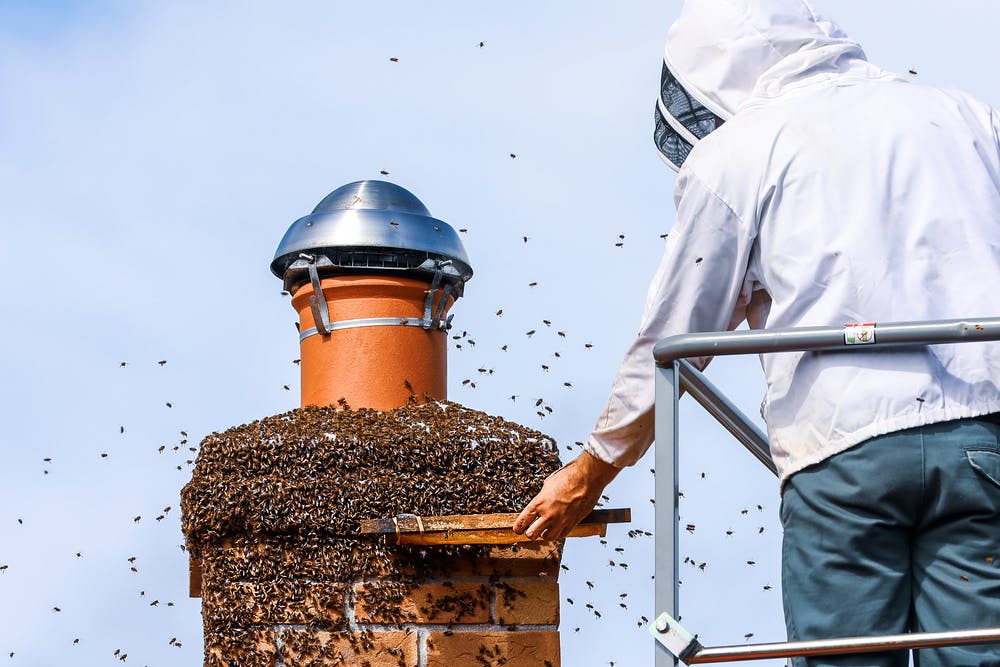
Now homeless, the house-hunting bees gather together in a tight cluster called a “swarm ball” on a nearby object. From this temporary base of operations, the bees send out scouts to find potential nesting sites.
When a scout discovers a suitable location, she returns to the swarm ball and performs an extraordinary routine known as a “waggle dance”.
Astonishingly, this dance communicates the location of the potential new home to other scouts, who then venture out to inspect the advertised site. If they agree with its suitability, they return to the hive and do their own waggle dance.
Once enough scouts agree on the suitability of the new home, the entire swarm soars through the air to their new home.
Unfortunately, the bees occasionally choose to settle in human-made structures. Once inside, they produce wax to build the hexagonal cells that make up the nest. Some cells are used as nurseries for larvae, while others are used to store pollen and honey.
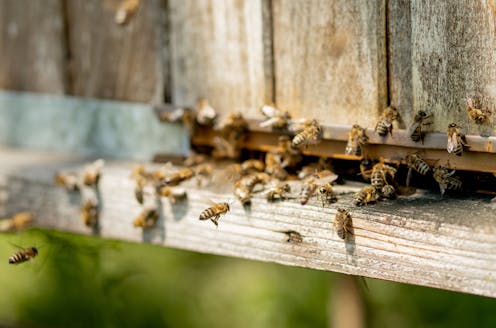
The most obvious sign is usually a steady stream of bees flying in and out of the hive, usually from a small hole or gap in the wall.
You might also hear a buzzing sound.
What will the honeybees do to my house?
The honey and wax produced by bees can melt when the colony dies or during hot weather. This leads to stains and damage to walls, while the lingering honey may draw in rodents. The growing weight of a colony can also cause structural damage over time.
While honeybees are generally not aggressive, they will sting in self-defence, particularly near their colony.
If honeybees have taken up residence in your home, ask a professional, such as a beekeeper, to remove them.
Do not attempt to remove the bees yourself; this could be dangerous. Spraying insecticides or repellents into your walls may not kill all the bees and could trigger aggression.
Even if the insecticide does kill the colony, the dead bees, wax and honey will decay and melt, creating a bigger mess and attracting pests.
Not all beekeepers are equipped to remove bees from homes. Look for beekeepers who advertise “bee removal” or “bee rescue” services.
You can also try contacting amateur beekeeping associations, which may maintain a list of experienced bee removers. If there are no appropriate beekeepers in your area, or the colony is not easy to access, you may need to contact a pest controller.
Sometimes, colonies can be removed alive and relocated but this is not always possible. Your options will depend on the size of the colony, whether or not the beekeeper can access the colony, their level of experience and how long the colony has been there.
If you live in certain regions of New South Wales, it’s very important you report honeybee swarms or wild colonies to the Department of Primary Industries.
Wild colonies may harbour invasive Varroa mites, which are a deadly honeybee parasite. Varroa mites are currently subject to an eradication program. Varroa mite is only in NSW at the moment.
Colonies can be removed alive and relocated. However, this is not always possible. Shutterstock
Prevention is key
Try to prevent bees getting in your house in the first place. Seal cracks or holes in exterior walls and put fly screen mesh over outdoor vents.
Beekeepers can prevent swarms happening in the first place by making sure they manage their hives appropriately. Joining a local beekeeping club is an excellent way to learn about bee care.
While honeybees are important pollinators and honey producers, they can also be a nuisance in your home.
Tanya Latty receives funding from the Australian Research Council, The Branco Weiss Foundation and AgriFutures Australia. She co-founded and works with Invertebrates Australia, a conservation organisation dedicated to the conservation of insects and other invertebrates. She is President of the Australasian Society for the Study of Animal Behaviour, and sits on the Education Committee for the Australian Entomological Society.
Nadine Chapman receives funding from AgriFutures Australia and the Department of Agriculture, Fisheries and Forestry. She is a member of the NSW Apiarist Association and the Amateur Beekeepers Association.
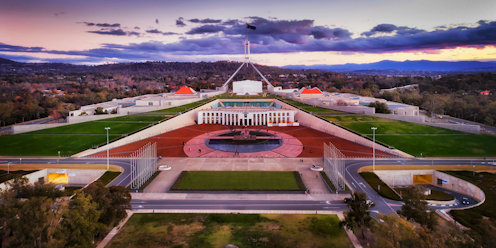
New Zealand Parliament Buildings, Wellington, New Zealand.
New Zealand Politics Daily is a collation of the most prominent issues being discussed in New Zealand. It is edited by Dr Bryce Edwards of The Democracy Project.
“Splinternet” refers to the way the internet is being splintered – broken up, divided, separated, locked down, boxed up, or otherwise segmented.
Whether for nation states or corporations, there’s money and control to be had by influencing what information people can access and share, as well as the costs that are paid for this access.
The idea of a splinternet isn’t new, nor is the problem. But recent developments are likely to enhance segmentation, and have brought it back into new light.
The core question is whether we have just one single internet for everyone, or whether we have many.
Think of how we refer to things like the sky, the sea, or the economy. Despite these conceptually being singular things, we’re often only seeing a perspective: a part of the whole that isn’t complete, but we still experience directly. This applies to the internet, too.
A large portion of the internet is what’s known as the “deep web”. These are the parts search engines and web crawlers generally don’t go to. Estimates vary, but a rule of thumb is that approximately 70% of the web is “deep”.
Despite the name and the anxious news reporting in some sectors, the deep web is mostly benign. It refers to the parts of the web to which access is restricted in some ways.
Your personal email is a part of the deep web – no matter how bad your password might be, it requires authorisation to access. So do your Dropbox, OneDrive, or Google Drive accounts. If your work or school has its own servers, these are part of the deep web – they’re connected, but not publicly accessible by default (we hope).
We can expand this to things like the experience of multiplayer videogames, most social media platforms, and much more. Yes, there are parts that live up to the ominous name, but most of the deep web is just the stuff that needs password access.
The internet changes, too – connections go live, cables get broken or satellites fail, people bring their new Internet of Things devices (like “smart” fridges and doorbells) online, or accidentally open their computer ports to the net.
But because such a huge portion of the web is shaped by our individual access, we all have our own perspectives on what it’s like to use the internet. Just like standing under “the sky”, our local experience is different to other people. No one can see the full picture.
A fractured internet poised to fracture even more
Was there ever a single “Internet”? Certainly the US research computer network called ARPANET in the 1960s was clear, discrete, and unfractured.
Alongside this, in the ‘60s and ’70s, governments in the Soviet Union and Chile also each worked on similar network projects called OGAS and CyberSyn, respectively. These systems were proto-internets that could have expanded significantly, and had themes that resonate today – OGAS was heavily surveilled by the KGB, and CyberSyn was a social experiment destroyed during a far-right coup.
Each was very clearly separate, each was a fractured computer network that relied on government support to succeed, and ARPANET was the only one to succeed due to its significant government funding. It was the kernel that would become the basis of the internet, and it was Tim Berners-Lee’s work on HTML at CERN that became the basis of the web we have today, and something he seeks to protect.
The Marshall Islands released a postal stamp in 1999 celebrating English computer scientist Tim Berners-Lee as the inventor of the World Wide Web. Shutterstock
Today, we can see the unified “Internet” has given way to a fractured internet – one poised to fracture even more.
Many nations effectively have their own internets already. These are still technically connected to the rest of the internet, but are subject to such distinct policies, regulations and costs that they are distinctly different for the users.
For example, Russia maintains a Soviet-era-style surveillance of the internet, and is far from alone in doing so – thanks to Xi Jinping, there is now “the great firewall of China”.
Surveillance isn’t the only barrier to internet use, with harassment, abuse, censorship, taxation and pricing of access, and similar internet controls being a major issue across many countries.
Content controls aren’t bad in themselves – it’s easy to think of content that most people would prefer didn’t exist. Nonetheless, these national regulations lead to a splintering of internet experience depending on which country you’re in.
Indeed, every single country has local factors that shape the internet experience, from language to law, from culture to censorship.
While this can be overcome by tools such as VPNs (virtual private networks) or shifting to blockchain networks, in practice these are individual solutions that only a small percentage of people use, and don’t represent a stable solution.
We’re already on the splinternet
In short, it doesn’t fix it for those who aren’t technically savvy and it doesn’t fix the issues with commercial services. Even without censorious governments, the problems remain. In 2021, Facebook shut down Australian news content as a protest against the News Media Bargaining Code, leading to potential change in the industry.
Facebook (now known as Meta) attempted to create a walled garden internet in India called Free Basics – this led to a massive outcry about corporate control in late 2015 and early 2016. Today, Meta’s breaches of EU law are placing its business model at risk in the territory.
This broad shift has been described in the past by my colleague Mark Andrejevic in 2007 as digital enclosure – where states and commercial interests increasingly segment, separate and restrict what is accessible on the internet.
The uneven overlapping of national regulations and economies will interact oddly with digital services that cut across multiple borders. Further reductions in network neutrality will open the doors to restrictive internet service provider deals, price-based discrimination, and lock-in contracts with content providers.
The existing diversity of experience on the internet will see users’ experiences and access continue to diverge. As internet-based companies increasingly rely on exclusive access to users for tracking and advertising, as services and ISPs overcome falling revenue with lock-in agreements, and as government policies change, we’ll see the splintering continue.
The splinternet isn’t that different from what we already have. But it does represent an internet that’s even less global, less deliberative, less fair and less unified than we have today.
Aboriginal and Torres Strait Islander readers are advised this article contains names and/or images of deceased people.
For many non-Indigenous Australians, it might seem the Voice to Parliament – the first step in the Uluru Statement’s process of “voice, treaty, truth” – is a recent idea. Conservative voices have framed it as a dangerously untested prospect.
But as First Nations have always known, voice, treaty and truth carry long histories. They’ve long been at the centre of Indigenous rights campaigns in Australia. They’ve also existed in other settler nations like New Zealand and Canada where treaties were forged at the point of colonisation.
These histories remind us how long First Nations people have waited for political recognition in this country – and that, compared to other former colonial sites, Australia is the exception, not the rule.
The Larrakia petition
Calls for voice as political representation have been part of First Nations activism in Australia for at least a century.
In the 1970s, Australian Aboriginal civil and lands rights movements harnessed long-running campaigns by Aboriginal activists calling for rights to treaty, land and political representation.
One famous example is the Larrakia petition to the queen, organised in 1972 to coincide with Princess Margaret’s royal visit. It carried more than 1,000 signatures.
It drew the queen’s attention to the failure of the British Crown to sign treaties with Indigenous peoples in Australia, unlike in New Zealand and North America, and called for her assistance in achieving
land rights and political representation, now.
The Larrikia organisers waited patiently outside Government House in Darwin to hand the petition directly to Princess Margaret. When a police barricade prevented them and tore the petition, they taped it together and sent it directly to Buckingham Palace.
William Cooper’s petition
Decades earlier, Yorta Yorta civil rights activist and co-founder of the Australian Aborigines’ League, William Cooper, spent the mid-1930s collecting more than 1,800 signatures from Indigenous communities across Australia for a petition to the king.
It urged the Crown to safeguard the interests of Aboriginal people as the original heirs and successors of the land and called for Indigenous political representation in the federal parliament.
As with the Larrakia petition, Australian government officials prevented the delivery of Cooper’s petition.
Even so, it remains a powerful reminder of the longevity of First Nations campaigns for a parliamentary voice. It also reminds us how long Australia has resisted activating one.
In other countries, it has been different
In Canada and New Zealand, the British Crown did make treaties with Indigenous peoples at the point of formal colonisation. In these countries, the right of political representation has not been contested in the same way.
That’s not to say these nations provide a direct model for Australia. Each country has its own history and political relationship between Indigenous peoples and government. And nobody’s suggesting treaties in other places fixed sovereignty disputes or guaranteed Indigenous rights.
But treaty rights dating back to the 1800s gave First Nations peoples in other settler colonial sites political leverage in a way Australia’s First Nations have been denied.
In Canada, First Nations treaty rights and rights of self-determination are enshrined in the Constitution. An elected Assembly of First Nations liaises with the federal government as the representative body.
In New Zealand, Māori have had dedicated parliamentary seats since the 1860s. Political representation is enshrined in the Māori Representation Act 1867, which gave all Māori men the right to vote.
Colonial officials originally conceived the Māori Representation Act 1867 as a way to bring Māori into the colonial political system rather than as a vehicle for an independent political voice.
Despite its colonial underpinnings, it shows how a formal avenue of Indigenous political representation existed almost from the beginning of the colonial relationship in a setting where treaty existed.
This raises the longer history of treaty discussions in colonial Australia.
Australia’s missed opportunities for treaty
Australia was exceptional in Britain’s settler empire for having no formal history of treaty between Indigenous peoples and the Crown.
The doctrine of terra nullius, or land belonging to no one, was how Britain claimed possession in 1788.
But that doctrine did not necessarily hold true in perpetuity, and the continuing absence of treaties in Australia was not inevitable.
By the 1800s, the mood of the Colonial Office (the British government department that managed colonies) had shifted.
In the early 1830s, Tasmania was coming through its devastating land wars. This experience motivated Tasmania’s Governor George Arthur to write to the Colonial Office in London. He suggested treaty arrangements should be made with Indigenous peoples in the territories of western and southern Australia to avoid a similar risk.
Arthur’s intervention dovetailed with a larger agenda for colonial reform after the abolition of slavery, and the British imperial government was receptive to his advice.
In 1835, the Colonial Office told South Australia’s colonisation commissioners that the Crown would not sanction British settlement there unless they could show they would protect Aboriginal people’s
earlier and preferable title.
The colonisation commissioners committed to purchase Aboriginal lands on those conditions. But because colonial authorities decided “earlier and preferable title” did not exist according to the law of possession, these purchases didn’t happen.
The year 1835, then, was a turning point. Treaties might have been forged with Indigenous peoples in the new colony of South Australia, but they were not.
Instead, the Crown tried to mitigate problems of frontier warfare by claiming Aboriginal people as British subjects who would receive equal protection under the law.
This became settled colonial policy across Australia, although it was almost never realised in practice.
Truth: resetting the relationship, not just the record
This brings us to the question of truth. When we speak about remembering past injustices – especially the history of colonial land wars – it’s often presented as uncovering a hidden or secret history.
But in 19th century Australia, the frontier wars were far from secret. Colonial authorities constantly debated the problem. Until the end of the 19th century (and later in northern Australia), it was one of the most persistent topics in official correspondence and the colonial press.
What’s missing from the colonial records are the voices and perspectives of the Indigenous communities who experienced the frontier wars.
These histories, however, have always had a strong presence in Indigenous intergenerational knowledge, as well as the intergenerational knowledge of settler-descended communities where these events occurred.
Legal scholars Gabrielle Appleby and Megan Davis have emphasised that the value of truth is not just in resetting the historical record but in constructively resetting the relationship between First Nations and the rest of the nation.
The longer histories of voice, treaty and truth tell us the time for politically constructive reform is well overdue.
While most people survive and recover from COVID, for some people symptoms can persist for months or years. When symptoms last longer than 12 weeks, the condition is known as long COVID.
Long COVID encompasses up to 200 different symptoms. To determine evidence-based treatments for these symptoms, we need to understand the causes. One factor that may be associated with long COVID is that the virus hasn’t fully cleared from the body after the initial infection.
We know from other viruses that viral fragments can remain in different tissues for months or even years. This could be the case with SARS-CoV-2, the virus that causes COVID. Here’s what the science says so far.
Other viruses lurk in the body
Herpesviruses (such as Epstein-Barr virus, the cause of glandular fever), as well as HIV (human immunodeficiency virus) can exist in a “latency state” for life. This means the virus conceals itself within cells and remains dormant.
HIV, in particular, can remain dormant in infected cells throughout the body. Even though it’s inactive, it can still promote immune activation and inflammation.
Other viruses such as Zika, measles and Ebola have been found in tissues of infected people months or years after initial infection. This viral persistence can cause chronic illness.
Several studies have shown COVID can also reactivate the Epstein-Barr virus, which has remained in the body in a latent state. Research shows this has been linked to fatigue and problems with thinking and reasoning in people with long COVID.
Latent viruses can cause fatigue and problems with thinking and reasoning. Wes Hicks/Unsplash
How do we know COVID stays in the body?
Several studies have identified the genetic sequences of SARS-CoV-2 (RNA) as well as SARS-CoV-2 proteins in tissues and stool (poo) samples months following infection.
These studies include multiple autopsy reports that found viral RNA and protein in a variety of tissues from people who died up to seven months after infection. SARS-CoV-2 RNA was detected in at least half the samples of heart, lymph glands, eye, nerve, brain and lung tissue tested.
In people who survived, viral RNA was found four months after infection within intestinal tissues obtained through colonoscopy, when a thin tube is used to take tissue from the large intestine. These patients had asymptomatic COVID and were PCR-negative from swabs of the nose and throat at four months.
A 2022 study found SARS-CoV-2 in the stool of about half of the participants in the first week after infection. At four months, there was no virus present in the respiratory tract but 12.7% of stool samples were RNA positive. A further 3.8% of faecal samples remained positive for RNA at seven months.
Initial studies did not always suggest a strong relationship between the long-term detection of SARS-CoV-2 and long COVID symptoms.
But more recently, the presence of SARS-CoV-2 RNA (or protein translated from RNA) in the blood and gut tissue was found to increase the likelihood of developing long COVID symptoms.
The presence of SARS-CoV-2 in the blood increases the likelihood of developing long COVID symptoms. Nguyễn Hiệp/Unsplash
How might the delay in clearing the virus impact people with long COVID?
Delayed clearance of SARS-CoV-2 particles in different parts of the body could drive illness through several potential processes:
1) Inflammation. The continued immune stimulation by viral proteins causes inflammation, makes our immune system tired, and alters how our immune cells work as time goes on.
We have previously shown immune dysfunction and inflammation persist up to eight months in people with long COVID that initially had mild to moderate disease.
2) Activation of other dormant viruses. The continued immune response to persistent SARS-CoV-2 can cause reactivation of latent viruses.
Antibodies reactive to Epstein-Barr virus are elevated in people with long COVID suggesting Epstein-Barr virus reactivation, likely through activating the immune system.
Other latent viruses, such as human endogenous retroviruses (HERVs; ancient viruses that have become a part of our DNA, like a genetic fossil) have recently been shown to become reactivated after infection. HERV proteins were detected in blood cells and tissues of COVID patients.
These proteins could potentially drive inflammatory processes in long COVID.
Reactivation of the Epstein-Barr virus could drive inflammation in long COVID. Shutterstock
3) Antibodies made by combating SARS-CoV-2 could become “self” reactive. These autoantibodies (antibodies produced by our immune system that mistakenly target and attack our own body’s tissues or organs) might cross-react with host receptors or proteins and drive autoimmune disease.
Importantly, recent studies have shown new onset of autoimmune diseases (such as type 1 diabetes, inflammatory bowel disease and psoriasis) are significantly associated with SARS-CoV-2 infection and a link between autoimmunity and long COVID is plausible.
This suggests COVID not only has immediate health impacts but could also potentially trigger long-term changes in the immune system.
While the studies mentioned above provide initial evidence of persistence of SARS-CoV-2 long after initial infection, more studies are needed to show a convincing link between lingering virus and long COVID. This should include examination of viral RNA and protein in both blood and tissues in people with long COVID independent of disease severity. And it must involve well-developed cohort studies that track large groups of people internationally.
Severaltrials are underway to assess whether treating long COVID with antivirals such as Paxlovid may reduce viral antigens and improve symptoms, although this remains experimental.
Stephen Kent receives funding from the NHMRC, the MRFF, the ARC and the NIH.
Chan Phetsouphanh receives funding from NHMRC and MRFF.
The Bureau of Meteorology this week declared a 70% chance of an El Niño developing this year. It’s bad timing for the electricity sector, and means Australians may face supply disruptions and volatile prices.
El Niño events are associated with increased temperatures and heatwaves. These conditions drive demand for electricity, especially in summer.
These same conditions can also mean some generators don’t produce at full capacity. And unfortunately, the likely El Niño comes as the electricity sector grapples with other significant headwinds.
Australia’s electricity grid may be fine this summer. But given what’s on the horizon, it would be prudent to plan for the worst.
How does hot weather affect energy supplies?
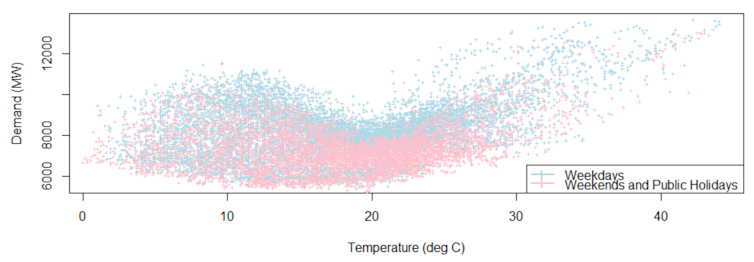
Increased air conditioning use in summer can cause demand to peak, particularly during heatwaves, as the below graph shows.
Scatterplot of New South Wales demand and temperature, example based on 2017 calendar year. AEMO
At the same time, electricity generators – including coal, gas, solar and wind – can become less efficient in hot temperatures, and so provide less energy to the system. And the hotter transmission lines get, the less electrical current they can safely carry. This lowers their capacity to transport energy.
When the electricity grid is under stress, this can lead to “load shedding” or blackouts – when power companies deliberately switch off the power supply to groups of customers to prevent the overall system from becoming dangerously unstable.
This happened in Victoria in early 2019, when more than 200,000 customers lost power during a period of extreme heat.
El Niño events are also associated with reduced rainfall. Among other effects on the electricity grid, this can reduce output from hydroelectricity generators (which produce electricity by pumping water through turbines). This occurred in Tasmania in 2016, and contributed to an energy crisis in that state.
Aside from facing a likely El Niño, the electricity sector faces other headaches.
Earlier this year, the Australian Energy Market Operator warned electricity demand “may exceed supply” at times over the next decade due to factors such as weather conditions or generator outages.
The market operator pointed to delays to the Snowy 2.0 hydro project and the gas-fired Kurri Kurri Power Station, both in New South Wales.
The Kurri Kurri project has been delayed for a year. It was scheduled to begin operating in December this year – in time for the first summer since the Liddell coal-fired power station closed.
The Australian Energy Market Operator said the electricity system was expected to meet the “reliability standard” in all regions for the next five years. The standard requires at least 99.998% of forecast demand be met each year. Unmet demand can lead to interrupted supply, or blackouts.
But the operator also said delays to the Kurri Kurri project posed risks to reliability in NSW this summer.
Adding to the pressures on the system, Queensland’s Callide C coal-fired power station is still not back to capacity more than two years after an explosion at the site. The station’s owners last week announced the plant would not be fully operational until mid-2024.
Combine all this with a likely El Niño, and the electricity sector may be facing a challenging summer.
In August, the Australian Energy Market Operator is due to publish a new assessment of the grid’s expected reliability over the next decade. It may well show reliability standards will be achieved.
On first blush, that sounds like good news. However, the way the assessment is derived may mask the real risk during El Niño periods.
The assessment combines a number of scenarios, which are based on different forecasts of electricity demand. The scenarios based on average weather conditions are given the most weight.
But if an El Niño arrives, this summer will not be average. We’re likely to experience very hot and dry conditions. This may lead to higher demands on the energy system, and a greater likelihood of blackouts.
This won’t be properly reflected in the assessment. So the grid may be deemed reliable even though electricity supplies are under immense pressure.
The grid may be deemed reliable even though it’s under pressure. Shutterstock
What can be done?
You might find all this news worrying. But there are measures and technologies in place to help reduce the risks.
A mechanism exists that allows the market operator to secure emergency energy reserves. It could mean, for example, calling on a large industrial plant to pause operations to reduce its electricity use, or starting up a standby diesel generator. The operator can start procuring this months ahead of time, and will no doubt be monitoring the situation closely.
In the medium term, the uptake of so-called “consumer energy resources” such as rooftop solar farms and small-scale battery storage shows promise. These technologies are located at homes and businesses. They can reduce demand on the grid at peak times and can potentially be built faster than big projects.
Longer term, we need to build more “stuff”. This includes renewable energy and other “dispatchable” resources – which can provide energy when it’s needed – as well as more transmission infrastructure.
The reality is that ageing coal plants are closing – and while they remain open, they’re contributing to reliability challenges in the energy system. Unchecked climate change will also add considerable strain, through natural disasters and more extreme weather.
Unfortunately, investment in renewable and other low-emission technology has been slower than necessary. This has slowed Australia’s emissions reduction efforts and cast questions over the reliability of our energy supplies as an El Niño looms.
Dylan McConnell’s current position is supported by the ‘Race for 2030’ Cooperative Research Centre.
Iain MacGill receives funding from a range of government funding sources including the Australian Research Council, Australian Renewable Energy Agency and Federal and State Governments. He also has projects supported by joint government and industry funding sources including the RACE2030 CRC and ARC Training Centre for the Global Hydrogen Economy (globH2E).
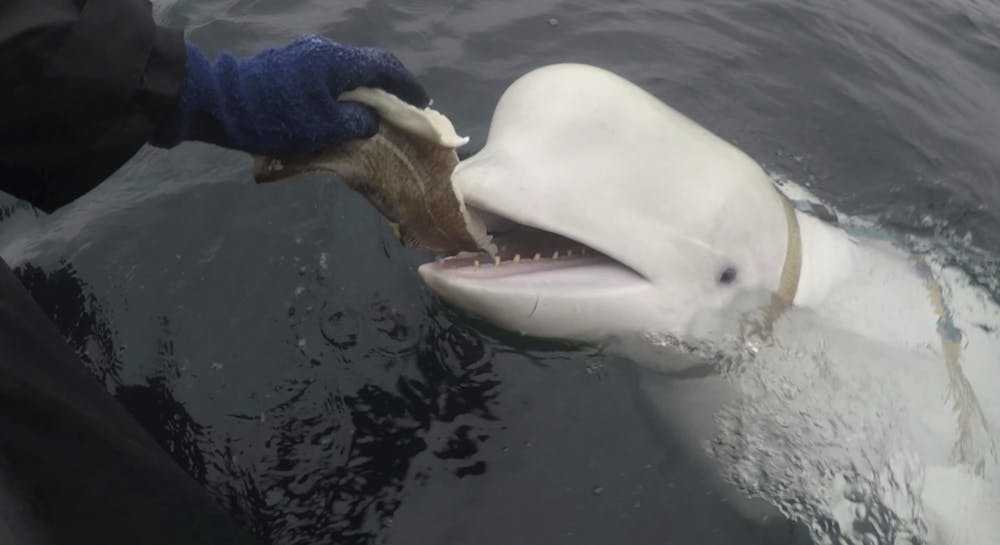
Off the coast of Spain and Portugal, killer whales have been biting boats. And the famous beluga whale nicknamed “Hvaldimir” has popped up again – this time in Sweden. When first spotted in Norway in 2019, wearing a suspicious harness, some suggested he could be a Russian spy.
These unusual human-wildlife interactions raise questions about managing risk. Both situations present a maritime safety concern. And the whales are at risk of being injured or killed by the boat.
What’s more, fans of Hvaldimir are also putting themselves in harm’s way – by trying to get too close to a wild animal that lives in the water, leaning from boats and dangling from wharves.
So what’s driving these unusual whale antics? And how and when should we intervene?
Mariners have filmed killer whales biting rudders, causing steering wheels to violently move from side to side.
In extreme cases, the killer whales have broken rudders, created holes in boats and sunk at least three vessels, forcing sailors to seek maritime assistance.
Feeling helpless, British mariner Martin Even decided to stop for a cup of tea when killer whales bit on their rudder.
A friendly ‘Russian spy’ in Swedish waters
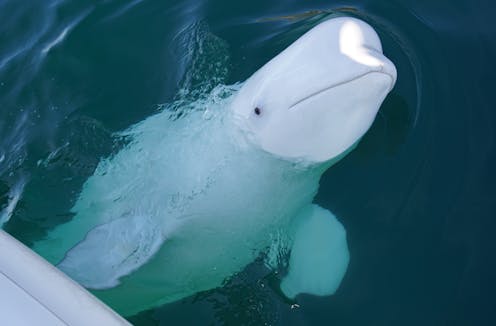
Hvaldimir the beluga whale came to fame in 2019 when he turned up in Norwegian waters wearing a harness labelled “Equipment St. Petersburg”. (His name is a combination of the Norwegian word for whale “hval” and the Russian name Vladimir.)
Obviously, wild beluga whales don’t wear harnesses. So Hvaldimir must have been taught to do that, just as you teach a dog to wear a collar.
This means it’s likely he spent time in captivity. He appears to enjoy human company. Viral videos show him retrieving mobile phones and playing ball.
After four years off the coast of Norway, Hvaldimir travelled into Swedish waters. No one is quite sure why.
There are concerns for his safety. This area is busy with boats and fishing activity. His presence may annoy some people, such as boaties and fishers, but attract others. They’re clamouring to get close to him, on boats, jet skis and busy wharves. I call this “Hvaldimir tourism”.
There might also be less fish for him to eat in comparison to Norwegian waters.
Understanding this behaviour
We don’t know why the killer whales are biting boats. But there are several theories.
One is that a matriarch killer whale known as White Gladis may have had a negative interaction with a boat and begun biting back at them, prompting others to copy her behaviour.
Or could yachts be a plaything for killer whales? When the rudder moves from side to side it makes a sound, much like a noisy dog toy or baby toy. Recent reports from people monitoring this behaviour have said the killer whales became disinterested and left soon after they broke off boat rudders.
Perhaps over time, the killer whales will lose interest in boats. Maybe it’s a passing fad, just like killer whales’ “salmon hat trend” observed in the 1980s.
And what about Hvaldimir’s behaviour? His time in care may have taught him that humans are “good”. Beluga whales are very social, often found in pods. So he might just be lonely.
Wild animals can choose what they want to do. Hvaldimir chooses to engage with humans. For the killer whales, it’s the vessels they’re interested in.
The Atlantic Orca Working Group continues to investigate this “disruptive” activity. This is a collaborative effort with the Iberian maritime community, marine mammal experts, various organisations and the public.
They provide communication around killer whale behaviour and provide a place to report sightings. There’s also a dedicated app mariners can use. And of course, authorities remain in place to help mariners in need of assistance.
Hvaldimir’s presence does present a challenge. He’s very mobile and seeks out humans. Norwegian and Swedish Authorities – and dedicated organisations such as OneWhale – are seeking to protect him.
So should we just let Hvaldimir roam free and continue monitoring him? He’s proven his maritime smarts over the last four years. He’s not dependent on humans, able to feed himself, navigate coastal waters and dodge most human activities (although he has been injured by boats and fishing gear).
Or, do we move him to his own “safe fjord” – a closed off area with minimal human interaction and a vet on standby? This would keep him safe from tourists, vessels and fishing gear. Other “rescued” captive whales could also be placed there, with the potential for later release back to the wild. However, this is not always a straightforward endeavour.
Hvaldimir will continue to require human assistance, regardless of whether he remains wild or moves into a captive environment. If left to roam free, he may still feed himself but he will continue to seek opportunities to interact with people. These interactions will have to be monitored.
If he’s taken into human care, he will be removed from the general public but will require food from humans. He may also be visited by people who wish to see him.
There’s no silver bullet
Efforts to monitor both situations remain ongoing. Collaborative management involving the maritime community, scientists and the general public is key to protecting these marine mammals.
No doubt lessons will be learnt from the management of both situations and possibly adapted to managing future interactions between wildlife and humans.
Vanessa Pirotta does not work for, consult, own shares in or receive funding from any company or organisation that would benefit from this article, and has disclosed no relevant affiliations beyond their academic appointment.
Pierre Bonnard, unlike his older contemporary, Paul Gauguin, never visited Australia, yet Bonnard’s influence on Australian art is pervasive and profound.
This unusual and magnificent exhibition at the National Gallery of Victoria allows us to see Bonnard like never before.
In part, this is due to the exceptional depth in the selection of the more than 100 works by Bonnard for this exhibition, largely drawn on the extensive collection held by Paris’s Musée d’Orsay.
Also, in part, by a stroke of genius in commissioning the celebrated Paris-based architect and designer India Mahdavi to create the exhibition’s scenography.
The exhibition is like a creative collaboration between the artist and the designer. Architectural props, painted walls, special carpets and furnishings all combine to create an intimate environment, setting the mood to be captivated by the magic of Bonnard’s colour.
A solitary path
Like his contemporary, the Russian artist Wassily Kandinsky, Pierre Bonnard (1867-1947) initially studied law. After graduating, he abandoned it to pursue a career as an artist.
Also like Kandinsky, he lived and worked in the centre of the art world of his day. He was associated with many of the key artists, and yet, in the final analysis, Bonnard – like Kandinsky – was essentially a loner who traced for himself a solitary path.
Pierre Bonnard ,Paris, Rue de Parme on Bastille Day, 1890. Oil on canvas, 79.2 x 40.3 cm. National Gallery of Art, Washington D.C. Collection of Mr. and Mrs. Paul Mellon. Photo: National Gallery of Art, Washington, DC.
In the final decade of the 19th century, Bonnard together with several other young Paris-based artists, including Edouard Vuillard, Maurice Denis and the sculptor Aristide Maillol, formed an artistic brotherhood on similar lines to that of the Nazarenes and the Pre-Raphaelites.
They called themselves “The Nabis” (a Hebrew and Arabic word meaning “prophets”) and essentially adopted Gauguin’s aesthetic stance of Synthetism.
The basic argument of Synthetism was that the art object an artist produced was a synthesis of the artist’s own vision, training, the medium involved, as well as the stimulus of the scene or object depicted.
In other words, it was a theory which gave the creative person greater artistic licence in interpreting a scene or composition in a work of art, rather than merely transcribing it.
Early Bonnard Nabis masterworks include Twilight, or The croquet game (1892), and Paris, Rue de Parme on Bastille Day (1890). These revel in the qualities of the flattened picture plane, the unexpected viewpoints and the strong ornamental properties.
Siesta (1900), a great painting from the NGV’s own collection, has Bonnard moving towards a lighter and more luminous palette with adventurous spatial constructions.
Ostensibly, it is simply a painting of the model shown within the intimate space of the artist’s studio.
Pierre Bonnard French 1867-1947 Siesta (La Sieste) 1900 oil on canvas 109.0 × 132.0 cm National Gallery of Victoria Felton Bequest, 1949.
However, as you enter the picture space, you realise the figure is being presented from a high angle. You literally peer into the space where the mass of crumpled sheets and soft sensuous flesh meet the richly patterned wallpaper and carpet that seem to envelop and surround them.
Although the figure in her pose may allude to a well-known statue from classical antiquity, the rendition is thoroughly modern. The bedside table thrusts diagonally towards the figure and opens the work to a whole host of Freudian interpretations.
While Bonnard here may well be drawing on artistic sources as diverse as Manet, Matisse and Cézanne, the painting itself is a wonderfully resolved and unified artistic statement – a triumph of visual intelligence.
It is displayed together with the photographs Bonnard took of his model that may have served as source material for the artist.
Bonnard was inspired by photography and the unexpected angles and the cropping of images and implemented these strategies in his art.
The window
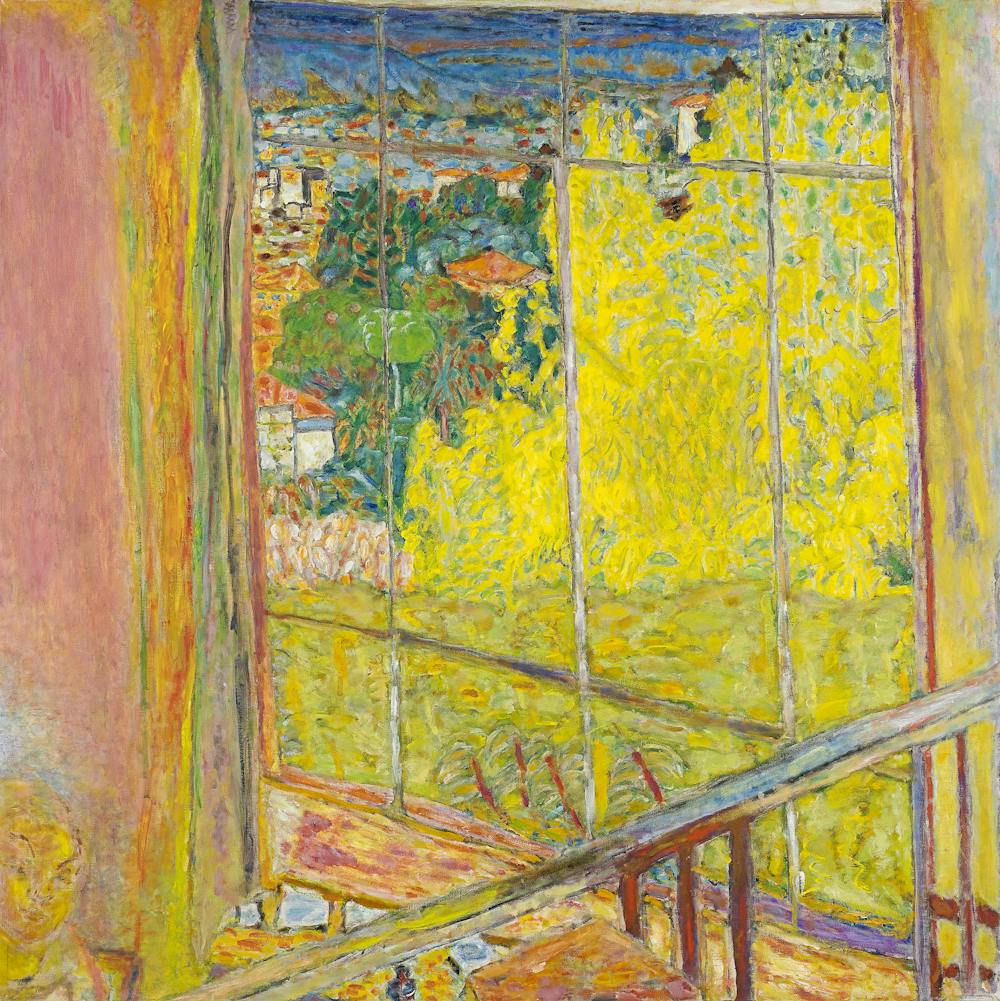
The window (1925) is a beautiful and lyrical painting executed by Bonnard while staying with a woman called Marthe in a rented holiday villa at Le Cannet, near Cannes, in the south of France.
Looking out of the window, we see the red roofs of the little town of Le Cannet and beyond that sweeping Cézannesque hills.
Although his chief preoccupation appears to have been with the attempt to balance the tonal values of his palette and to create the compositional structure through colour, the artist also seems intent on loading the work with a private iconography.
In the foreground on the table lies a book and a sheet of paper with writing implements. On the balcony, in a central position, appears the head of Marthe, shown in profile reading.
The book is clearly identified by an inscription on its cover as the novel Marie by Peter Nansen that Bonnard illustrated.
If one adds together the visual clues, one possible interpretation is Marie was Marthe’s real name and in the year the painting was painted, 1925, Bonnard finally married Marthe. One could speculate that the piece of paper alludes to a marriage certificate.
Ultimately, Bonnard was the master of shimmering luminosity who painted very clever and difficult paintings and yet made them appear lucid and accessible. The open window, the doorway and particularly a mirror were his favourite ploys to give space an ambiguous but convincing formal structure.
His painted surfaces have a textural presence with choppy, visible brushstrokes.
Unlike the Impressionists who followed the reliable path of contrasting complementary colours to make them visually vibrate, Bonnard would set himself impossible tasks such as juxtaposing pink and orange or lemon yellow and olive green.
While I have viewed many Bonnard exhibitions in Australia and abroad, this is the most moving and subtle display that I have encountered. I left the show spiritually refreshed and with tears in my eyes.
Pierre Bonnard: Designed by India Mahdavi is at the National Gallery of Victoria International until October 8.
Sasha Grishin does not work for, consult, own shares in or receive funding from any company or organisation that would benefit from this article, and has disclosed no relevant affiliations beyond their academic appointment.
Auckland Council ended its meeting yesterday without a decision on the annual budget.
The long-debated budget will attempt to close a $325 million deficit, exacerbated by a further $40 million in storm-related costs.
Councillors arrived in good cheer, cracking jokes about the lengthy session ahead of them, which included a debate over the council’s sale of its 18 percent stake in Auckland International Airport Ltd.
The mayor said the meeting would take as long as it needed to.
“This is a difficult process. It may take more time than expected, that’s fine,” Mayor Wayne Brown said. “We may have to come back next week, we’re not rushing this process.”
Three councillors declared a stake in the airport ahead of the meeting.
Airport shares declared Just a few hours before, Albany Ward councillor Wayne Walker admitted to owning $3 million in shares through a trust. His neighbour at the table, Maurice Williamson, poked fun at Walker on his way into the chamber.
Chris Darby and Julie Fairey also declared airport shares in the days leading up to the meeting, prompting questions of whether they could vote on the sale.
All three said they had received advice from the auditor-general.
“In their view, my situation does not represent a conflict of interest,” Fairey said.
“Their advice was that I do not have a financial interest in the share sale,” Darby said.
“Same advice, and so I can participate in today’s decisions,” Walker said.
Just three councillors — Andy Baker, Maurice Williamson and Desley Simpson — unambiguously declared their support for a full sale.
After hearing the positions of his fellow councillors, Brown offered a partial sale of 8 percent, meaning the council would hold onto a 10 percent stake.
“I’m now proposing that we sell 8.09 percent of our 18.09 percent shareholding,” Brown said as councillors returned from their lunch breaks.
“This means that we have to find another $32 million in operating savings or rates to balance the budget. I’m proposing we fill this gap with a general rates increase of 7.7 percent.”
The issue of selling the shares was contentious, leaving councillors divided. Manukau Ward’s Lotu Fuli opposed the sale, declaring the shares had value.
“This is a high-performing asset, it is an asset that we ought to keep,” she said. “And yes, we should consider our underperforming assets, but that’s a discussion to have at the long-term plan.”
Council would regret sale Fuli said the council would regret letting go of the shares.
“Let’s not be rash, let’s not sell off these shares, $2.3 billion worth of shares, in order to plug a $325 million hole,” she said. “Let’s not make the mistake that past councils have made.”
Waitematā and Gulf Ward councillor Mike Lee agreed the shares had value.
“This is a real asset, folks,” he said. “This is an earning asset, just like the Ports of Auckland. Not only does it earn us money, but it earns us capital gains on our balance sheet. Any decent accountant will tell you that.”
Councillors Chris Darby (left) and Richard Hills . . . “It [council] isn’t a nice place at the moment and I think the city knows that. Image: RNZ News
North Shore Councillor Richard Hills said the months of debate around the budget had soured its culture.
“This has been the hardest six months of my career, it hasn’t been nice,” he said.
“It hasn’t just been about things you’ve said, mayor, there’s been a lot of other discussions around this table that I’ve been appalled at around staff, each other. It isn’t a nice place at the moment and I think the city knows that.”
He said the council needed to be careful about repeating the same mistakes next year.
“I want to work with the majority here, because we will break our staff and our city if we make them do this again next year,” he said. “I think we need to be really clear about that — we’ll do that again if we don’t make a hard decision today.”
Few in support Albany Ward councillor Wayne Walker said the council needed to adjust its spending habits if it wanted to fix the issue.
“We’re not addressing the underlying financial issues, and that is that we are spending beyond our means. We’ve been doing it for successive years, and that has to stop,” he said.
“Fortunately, we have a mayor that’s committed to turning that around.”
He said there was time enough to make large decisions like selling the shares.
“We have a very, very good situation to go forward and not have to make decisions immediately in this long term plan that may be counter-productive.”
Some councillors, like Maurice Williamson, strongly favoured a full sale. He said the assets were not making enough money.
“I’m very much in favour of selling any asset that’s costing us more to keep than it’s returning to us. There’s a good old Tremeloes song, ‘Even The Bad Times Are Good’ — well, even the good times are bad.”
Williamson warned other councillors against accepting more debt.
“There’s so much more coming down the pipe at us,” he said. “The CRL, god knows what’s coming, I’ve been told the final figure is going to be $7.25 [billion], we’re going to have to borrow debt to fund that, and that debt ratio is already near the ceiling.
“So please, please look at trying to bring that back down.”
Auckland Mayor’s revised proposals:
Mayor Wayne Brown is now pushing for the sale of 8 percent of the council’s shareholding in Auckland Airport, instead of the full 18 percent of shares
Brown has also proposed $4 million of reductions to local board funding, and $5 million of unallocated to chief executive, Jim Stabback
An average general rates increase of 11 percent has been proposed, with adjustments that will result in an overall rates increase of 7.7 percent for average households
Plans to establish a political working group on the council’s investments has been set out, which aims to oversee assets like the remaining council shares in Auckland airport, and make recommendations to the governing body on long-term investment in other funds
Even Brown’s deputy, Desley Simpson, cautioned members. She said the final form of the budget needed to be balanced.
Deputy mayor Desley Simpson . . . Image: Dan Cook/RNZ News
“We’ve talked this through so much, and it’s going to be a hard task to balance a budget that is fair for Aucklanders and meets the needs and desires of all those around the table.”
Brown’s new proposal included the establishment of a working group to oversee council investments, as well as a $4 million reduction to local board funding.
Questions about the updated proposal brought the meeting to a close at 5pm, with no time left to debate or cast votes.
Mayor Brown said the council would reconvene at 10am today.
During the election campaign Anthony Albanese repeated, endlessly, that everything was going up except people’s wages.
More than a year later, things are still going up, now including some people’s wages.
The latter increase is all good, surely? Yes, up to a point. There’s dispute about whether the (still modest and limited) wage rises recently delivered by the Fair Work Commission will lead to other things going up further.
Jim Chalmers was blooded as a staffer to the then treasurer, Wayne Swan, during the global financial crisis. Now Chalmers is in the driver’s seat as another Labor government copes with an economic crisis – very different from the GFC, but similar in that it has arisen from circumstances not of the government’s making.
Chalmers insists the Fair Work Commission’s 8.6% rise in the minimum wage and 5.75% increase in award wages won’t add to Australia’s inflation problem. The minimum wage rise (which is above current inflation) affects only a few people; the increase in awards is below the inflation level. In total, the increases affect up to a quarter of wage earners.
Regardless of the government’s confidence, the medium-term effect of the wages decision remains one of those “time will tell” issues.
Reserve Bank Governor Philip Lowe this week made the obvious point. “How much it adds to the inflation outcomes really depends upon whether it spreads across other parts of the labour market.”
It’s clear current inflation hasn’t been driven by wages. Their future course will rest on what expectations are generated and whether unions muscle up to extract substantial pay deals.
The trajectory of wages is just one of the unknowns in the complex situation facing the economy, and thus the government, over the next year.
For many Australians, however, the picture is starkly simple. Their mortgage payments have been hit again, with the Reserve Bank this week increasing the cash rate by a quarter of a percentage point. The bank has indicated there could be another hit to come. Meanwhile the necessities of life are at sky-high prices.
Many critics are yet again railing against Lowe. One-time Labor minister Stephen Conroy, who probably should know better, declared: “This bloke has lost the plot. He’s given the middle finger on the way out the door to the Australian public as he gets shuffled out the door.”
Lowe’s home truths regularly provoke fury. “If people can cut back on spending or, in some cases, find additional hours of work, that would put them back into a positive cash-flow position,” he said this week.
True, but it’s not what cash-strapped people want to hear (or necessarily can do), especially when the governor makes it clear the bank will, if necessary, inflict more pain. Anyway, higher interest rates will mean some people losing jobs.
While the recent review of the Reserve Bank suggested it should explain itself more, arguably Lowe would have done better to say less over recent years (certainly that’s true of his prediction rates would not move until 2024). Treasurer Jim Chalmers may list communication skills as one criterion when he chooses Lowe’s successor.
Chalmers himself is strong on messaging, this week carefully keeping his distance from the latest rate rise.
As Wednesday’s national accounts showed the economy slowing and productivity going backwards, the government is caught in a pincer movement.
It must meet the challenge of managing the economy, which means at this point, as Chalmers says, putting the fight against inflation to the fore. Chalmers is always quick to quote those (including Lowe) who say the budget wasn’t inflationary.
Being good economic managers is objectively necessary, but politically too. It’s a mantle Labor needs to wear for the government’s long-term survival.
On the other hand, Labor’s base and its election pitch push in another direction.
This is a LABOR government. Its core constituents, including and especially those on low wages, are hurting badly, while its core union base is feeling its oats.
Labor’s mantra, before the election and since, has been to get wages moving. The unions demanded, and were given, changes to the industrial relations system to improve their bargaining power in the pursuit of wage rises.
Last year’s jobs summit brought together business and unions (as well as the community sector). But, by the end of it, there was no doubt the unions had the upper hand, which was always going to be the case.
This week a coalition of business groups launched a campaign against the government’s “Same Job, Same Pay” legislation, designed especially to stop labour hire companies undercutting wages.
It hasn’t taken long for the traditional scratchy relationship between Labor and business to emerge, although in a relatively mild form – nothing like, for example, the fight between the Rudd government and the miners over the resource super profits tax, which is still fresh in Chalmers’ memory.
What happens to the economy in the period ahead is partially out of the government’s hands, dependent on international factors.
Having said that, a lot will rest with Chalmers and his colleagues.
For instance, if wage pressures do become a worry, will the government require a more creative approach to the problem, including perhaps more innovative submissions to the Fair Work Commission or a tax trade-off with the union movement?
The government urgently needs to find ways to get productivity moving, because that’s the route to sustainable real wage rises. No one, however, underestimates how difficult it is to restart this motor.
To an extent, Chalmers finds himself in a relatively isolated position within the government.
Like all treasurers, he has to be the one who (often) says no to spending ministers. He also should be, to some degree, a counter weight to the colleague who in effect speaks for the unions, Employment Minister Tony Burke.
Inevitably, a treasurer must carry the economic debate for the government, although that burden is always shared between treasurer and prime minister.
In this government, for various reasons, including his many international engagements and his preoccupation with the Voice referendum, Albanese has not been doing as much of the economic heavy lifting as some of his predecessors. As people become increasingly agitated about their circumstances, that might have to change.
Michelle Grattan does not work for, consult, own shares in or receive funding from any company or organisation that would benefit from this article, and has disclosed no relevant affiliations beyond their academic appointment.
New Zealanders are supposed to be able to trust that there are adequate systems in place to ensure our politicians aren’t corrupt. There are mandatory systems of transparency requiring MPs and ministers to disclose all possible conflicts of interest, and yet we have learnt that this integrity system has fallen over once again. This time Labour Cabinet Minister Michael Wood has been caught out for not complying with the Cabinet and Parliamentary rules in properly disclosing his ownership of shares in Auckland International Airport.
Wood has been stood down from his Transport role temporarily as a result. But it’s not yet clear that Wood should be reinstated as Transport Minister, or indeed whether he can reasonably continue as a minister at all. His numerous transgressions paint a picture of a politician lacking in the necessary integrity – or perhaps even competency – that New Zealanders expect of politicians.
Transgression #1: Not declaring shares in the Parliamentary pecuniary register
All MPs must file a return each year detailing their assets, such as ownership of company shares. They do this in the Pecuniary Interests Register – which is designed to create accountability and transparency, because it ensures the public can be aware of any personal financial interests that might influence politicians.
Wood has owned hundreds of shares in Auckland International Airport since 1998, and was obliged to note these in his returns each year he’s been in Parliament. His failure to disclose these has been a clear breach of Parliament’s Standing Orders, and the Speaker can refer Wood to the Privileges Committee over the violation.
Transgression #2: Not correcting the Parliamentary pecuniary register
MPs are human and make mistakes, and Parliament’s rules take this into account. In terms of the rules around omissions from the Pecuniary Interests Register, MPs are meant to confess any such mistakes and correct them. The Standing Orders rules are very clear about this – MPs need to retrospectively correct their past declarations if they were incorrect.
In the case of Michael Wood, he has blatantly failed to do this. After not declaring his shares in Auckland Airport for five years, when he was made aware of this in 2022 he only started including the declaration in the register going forward. He did not file the necessary amendments for the previous years between 2017 and 2021.
Transgression #3: Continuing to hold Airport shares as a Minister
When Michael Wood became a minister in 2020 he became subject to the Cabinet Manual – which is the bible for how government operates. The manual directs ministers to uphold the highest ethical and behavioural standards, and this includes declaring and managing conflicts of interest. It is also made clear that ministers cannot be financially invested in any companies that they are involved in regulating. And they are not allowed to be involved in decisions in which there might be a perception that they could be making a personal financial gain.
In the case of Wood, by continuing to directly own shares in Auckland Airport, the public might rightly ask whether he has been serving the interests of the company he has shares in, or the public interest? As today’s New Zealand Herald editorial states, the situation “cannot be overstated for its egregious potential conflicts of interest.”
Transgression #4: Ignoring 12 reminders to sell the Airport shares
Michael Wood and his boss, Prime Minister Chris Hipkins, have explained the minister’s failure to divest himself of his airport shares as due to forgetfulness and Wood’s busy work and home life.
This explanation has fallen apart after subsequent revelations that the Cabinet Office instructed Wood to divest himself of his shares for two and half years, with a total of twelve reminders to deal with the problem – including as recently as ten weeks ago. What’s more, it turns out that although Wood claims he was let down by others in the divesting process, he didn’t even start this process until well over a year after the Cabinet Office started reminding him to do so.
To make matters worse, it appears as though Wood has also misled the Cabinet Office on the issue of divesting his shares. According to the Prime Minister, “One of the challenges is that the Cabinet Office had been advised by [Wood] on a number of occasions that he has divested himself of the shares, that clearly hasn’t happened. That is quite a material issue”.
Transgression #5: Not recusing himself from Transport decisions relating to the Airport
As a Cabinet Minister, and especially as Minister of Transport, Michael Wood has been involved in numerous decisions that impact Auckland Airport, which he has an ownership stake in and, therefore, a financial interest in the outcome. The normal procedure would be for a minister to manage any such conflict of interest by recusing themselves from such decisions.
When Cabinet decided at the height of Covid to give generous government support to airlines, which was strongly welcomed by Auckland Airport, Wood should have recused himself from the decision, as he was well aware that he had a stake in the company that would benefit from this.
Likewise, in terms of the planned light rail to Auckland Airport, Wood has been driving the case to keep this $14.6 billion project going in the face of strong opposition.
But the most obviously egregious decision made by Wood was when he had responsibility for aviation regulation, and he blocked an application from a rival Auckland airport, North Shore Aerodrome, to expand. Despite Transport officials recommending that the North Shore Airport should be given Airport Authority status, Wood decided otherwise.
It’s not clear that Wood’s decision was incorrect, and it seems unlikely that he acted out of self-interest, holding only $13,000 worth of shares, but nonetheless his decision was not as squeaky clean as is required. Critics can rightly argue that Wood’s actions were advantageous to Auckland Airport, because it meant that their monopoly in Auckland was protected.
Transgression #6: Not informing the Prime Minister
Michael Wood failed to keep his boss informed of his conflict of interest – neither Jacinda Ardern nor Chris Hipkins were made aware of the problem. Arguably this was also the fault of the Cabinet Office, which apparently didn’t warn the PM’s Office. Hipkins said yesterday, “I’m somewhat frustrated that when I was doing the reshuffle, which the cabinet office were consulted on, they had not highlighted that as an issue for me.”
Even when the Herald first uncovered the story last Thursday, and approached Michael Wood’s office about his ownership of the shares, Wood didn’t inform Hipkins personally about the problem. It is normal procedure that a party leader and prime minister should be immediately informed by their MPs of any integrity stories about to be published by the media. Instead, Hipkins says he wasn’t informed until Monday – although the blame also lies in part with Hipkins own staff who learnt about it on Friday.
Problems with the integrity systems in Parliament and Cabinet
There are increasing calls for Michael Wood to be stripped of all ministerial roles. Taken together, all of the above transgressions certainly bring Wood’s integrity into too much question.
There is still significant confusion about how Wood allowed this situation to occur, with most putting it down to incompetence or arrogance on the part of the minister. In the end the exact reasons for his failings don’t matter as much as the overall picture of multiple integrity transgressions.
Ultimately, however, it’s the integrity systems of Parliament and Cabinet that are tarnished by this episode. The public will now have less reason to trust that the pecuniary declarations of MPs can be trusted, nor that the Cabinet Manual is adhered to or enforced. Once again, we are seeing that the political process is not sufficiently protected from the vested interests of politicians.
New Zealand Parliament Buildings, Wellington, New Zealand.
New Zealand Politics Daily is a collation of the most prominent issues being discussed in New Zealand. It is edited by Dr Bryce Edwards of The Democracy Project.
Labor had pledged to wind back the use of the big four consulting firms by the public service well before the scandal engulfing PricewaterhouseCoopers over the sharing of confidential government information.
The policy it took to the May 2022 election pledged to stop “the excessive reliance and waste of public funds on contractors, consultants and labour hire companies for work that can be done more effectively by public servants”.
It costed the budget saving at $1 billion over four years, a modest sum given that at the time the Coalition government was reported to have entered into contracts worth $1.28 billion with PwC, Accenture, Deloitte, EY and KPMG over the previous ten months.
In May the Finance Department effectively banned PwC from winning new work by ordering officials to consider confidentiality breaches when evaluating bids.
But undoing the relationships that have been developed over decades will prove more difficult than it might seem for several reasons, the most important of which is that they suit public service managers.
One quarter of the public service off the books
After decades of growth, outsourcing has become so embedded in the Commonwealth public service that the government’s latest employment audit identified 54,000 equivalent full-time staff engaged as consultants or contractors or through labour hire firms, compared with 144,000 employed directly.
It means every fourth person working the public service is employed externally rather than directly by the government.
The audit distinguishes between four types of external labour: outsourced service providers, contractors, employees of labour hire firms, and consultants.
Each makes life more comfortable for public service managers, though in different ways.
Outsourced service providers include those doing routine functions such as cleaning and security, and account for 35,000 of the 54,000, with the bulk working in defence. They provide welcome efficiencies, and no one is seriously suggesting that they be brought back into the public service.
Labour hire includes staff employed on a temporary basis, and makes up another 6,700 of the 54,000 (mostly in the department of social services but with significant numbers also in health, veterans affairs, education, and other agencies).
Such workers are not subject to full public service conditions of employment and offer attractive administrative shortcuts. Though such positions could, in theory, be easily brought in-house, public service managers can be expected to drag their feet in order to retain flexible control of their workforces.
Many contractors provide IT services. Shutterstock
Contractors, defined as specialists engaged to provide designated outcomes under government direction or supervision, account for about 18,000 of the 54,000.
They include the increasing numbers of information technology specialists on whom governments are heavily dependent.
Information technology outsourcing dates from the Howard government’s determination to rely solely on private businesses for IT, but has been compounded by the inability of public service pay to keep pace with the private sector.
Any stemming of this tide would require radical adjustment of pay rates for technical staff.
Pure consulting is rarer. It is defined by the audit as the provision of
professional, independent advice, and other strategic services that involve the development of an intellectual output which represents the independent view of the service provider and assists with entity decision-making.
This is the realm of PwC and the other big consulting firms and accounts for only 950 of the 54,000 external employees, although these firms also provide more routine services as contractors.
3 reasons public servants like consultants
The consultants are often themselves former public servants, and operate more as partners with the public servants who hire them than as service providers.
Many are well integrated into the upper levels of agencies, particularly policy-focused departments. They perform functions that could, in theory, be done in-house but, for several reasons, their apparent independence is useful to their paymasters.
First, their apparent independence gives senior public servants and governments the ability to present their advice as if it comes from outside government, either backing the government or, if it doesn’t, allowing the government to quietly bury it, as it did with PwC’s advice on Robodebt.
Second, senior public servants can commission a sympathetic consultant’s report to help persuade reluctant ministers who distrust the public service, a technique used most often when dealing with Coalition ministers who are more likely to be receptive to advice that comes from outside the public sector.
Third, and finally, providing a flow of work for consultants helps maintain a revolving door through which senior public servants may wish to escape, knowing they can leave their job (and perhaps collect their super) but continue to work on the issues they know best for the employer they know best.
It’s why actually winding back the use of consultants will be an uphill battle.
Richard Mulgan does not work for, consult, own shares in or receive funding from any company or organization that would benefit from this article, and has disclosed no relevant affiliations beyond their academic appointment.
Pope Francis has had an operation this week to remove a hernia, which his surgeon said had been causing him increasingly frequent pain.
This planned surgery was to remove a type of hernia caused by scarring from previous operations, known as an incisional hernia.
Hernias are common and there are many different types. Not all need surgery. But what actually is a hernia? And if you do need surgery, what can you expect?
Your abdomen has a number of layers of muscle that help protect and wrap around your internal organs. A hernia occurs when tissues or organs bulge through a weak point in that muscular wall.
Hernias can be present at birth but can also arise later in life when the abdomen is under a lot of pressure.
Pregnant women are prone to developing hernias, as are people who are overweight, those lifting heavy weights (either at work or in the gym), and people with chronic health conditions that increase abdominal pressure, such as constipation.
These occur when fatty tissue or a bit of the small bowel pokes through a weak area in the lower abdominal wall. They tend to develop on one side of the groin.
Inguinal hernias are the most common type of hernia and account for almost three-quarters of all abdominal wall hernias.
Some 27% men and 3% of women will develop an inguinal hernia at some point in their lives. The risk increases with age.
The first sign of a hernia may be a painful or noticeable bulge in your groin on either side of the pubic bone. Shutterstock
2. Femoral hernias
Fatty tissue or a bit of the small bowel can also poke into two deeper passages in the groin called the femoral canals. Hernias through these passages are known as femoral hernias. They’re far less common than inguinal hernias and are much more common in women than in men.
3. Umbilical hernias
These occur when fatty tissue or a bit of the small bowel bulges through the opening of the abdominal muscles close to the belly button.
They are most common in newborns and infants younger than six months. They result from the abdominal opening that the umbilical cord passes through not sealing properly after birth.
The vast majority of these hernias don’t cause any issues and will disappear by the time the child is five years old.
Adults can get umbilical hernias too. Risk factors include being overweight and having a chronic condition that increases abdominal pressure, such as a chronic cough or fluid in the abdomen (called ascites) that often arises from liver disease.
There are different types of hernia, some more common than others. Shutterstock
4. Hiatus hernias
These occur when the upper part of the stomach bulges through the large muscle separating the abdomen and chest (the diaphragm). You’re more likely to develop these if you are older or overweight.
Many people with small hiatus hernias will have no symptoms. But in some people, large ones can be associated with reflux symptoms, such as heartburn and regurgitation.
These hernias can occur after surgery, which is what happened with Pope Francis.
These arise when there is a weakness in the abdominal wall located at the site of a cut made during a previous operation. Pope Francis’ incisional hernia was repaired because the loops of small bowel in that hernia were getting partially blocked and causing pain.
Surgery may be needed to remove a hernia. Shutterstock
6. Others
There are several other types of hernias. These include muscle hernias where part of the muscle can poke through surrounding tissue. These are most common in leg muscles after an injury.
What to do about a hernia?
The first sign of an inguinal or femoral hernia may be a painful or noticeable bulge in your groin. This bulge will generally become more noticeable when you stand up, cough or strain during a bowel movement. For umbilical or incisional hernias, you may notice a bulge on the abdomen.
You should seek urgent medical attention if you have a hernia and experience severe abdominal pain, nausea and vomiting, difficulty in passing wind or if the hernia becomes very firm and tender. This could signify the blood supply to the bit of bowel inside the hernia is cut off or the bowel has become twisted and is fully blocked.
Fortunately, the vast majorityof abdominal hernias can be repaired with surgery.
In many cases, such as with Pope Francis, this surgery is carried out with the assistance of a surgical mesh. This is a medical device that supports damaged tissue around hernias as it heals. Mesh helps to reduce the risk of a hernia returning.
Most people are able to go home the same day or the day after surgery, with a full recovery expected within a few weeks.
Vincent Ho does not work for, consult, own shares in or receive funding from any company or organization that would benefit from this article, and has disclosed no relevant affiliations beyond their academic appointment.
PODCAST: Geopolitical balancing in the South-West Pacific and Does this mean Conflict is inevitable?
/
RSS Feed
Share
Link
Embed
A View from Afar: In this episode political scientist, and former Pentagon analyst, Dr Paul Buchanan, and Selwyn Manning analyse the question:
What does theGeopolitical balancing that is taking place in the West and South-West Pacific mean for the region and the globe?
Analysis: Paul and Selwyn consider the question from several angles, and provide a context to the headlines that suggest both global powers, the USA and the Peoples Republic of China, are on a collision-course toward conflict.
Paul takes us through the US-PNG and Japan-NZ bilateral security/military agreements as a balancing response to the PRC-Solomons security agreement.
In addition, Paul considers the question: Does the PRC have legitimate interests in the Pacific and, as a great power, should those interests be understood and respected?
Selwyn considers whether China’s ascendancy as a global power threatens the United States’ position as the perceived ‘preeminent defender’ of the Global Order?
And Selwyn raises for debate, highlighting what the two global powers’ messaging was at the Shangri-La security dialogue that took place over last weekend.
Paul then analyses what this all means for the Asia-Pacific region and the world.
Threat.Technology placed A View from Afar at 9th in its 20 Best Defence Security Podcasts of 2021 category. You can follow A View from Afar via our affiliate syndicators.
French Polynesia’s new President Moetai Brotherson is in Paris for wide-ranging talks with the French government and the organisers of the 2024 Paris Summer Olympics.
His visit involves meetings with a range of ministers and officials to continue cooperation arrangements initiated by his predecessor.
“I’m not here to come begging,” Brotherson said, adding that he wanted to ensure that France was helping to decrease dependence on French financial transfers by developing French Polynesia as a country with its own resources.
He told the news site Outremers360 that he wants any process of self-determination to be arbitrated by the United Nations.
Restating a timeframe of up to 15 years until a referendum on independence, Brotherson said that it was not utopian.
“[French] Polynesia is as big as Europe, and in terms of population, it is [the size of] Montpellier”, he said, referring to the southern French city with its 300,000 inhabitants.
He said time needed to be taken to prepare, and by seeking independence “we will be able to take decisions with full responsibility”.
By contrast, he said the preceding pro-autonomy governments had the reflex to say that in the end, if they did not make the right decisions, they would turn to “mother” France.
Support for seabed mining ban Brotherson met the State Secretary for the Sea Herve Berville who reconfirmed the French government’s support for a seabed mining ban.
Berville also reconfirmed that such a ban would also apply to French Polynesian waters.
Brotherson again expressed his unwavering support for next year’s Olympic surfing competition to be held in Tahiti.
After flooding in the area last month, French Polynesian Sports Minister Nahema Temarii cast doubt on Tahiti being able to go ahead with the competition.
However, the site manager of the Paris Olympics organising committee, as well as Brotherson, said the event would go ahead as planned.
After becoming President last month, Brotherson will this week officially relinquish his seat in the French National Assembly, to which he was re-elected last year when his pro-independence Tavini Huira’atira for the first time won all three available Paris seats.
This article is republished under a community partnership agreement with RNZ.
French gendarmes in Paris during Tahiti President Moetai Brotherson’s official visit this week. Image: Polynésie 1ère screenshot APR
From August 2023, Australian beer, wine, spirits and pre-mixed drinks have to warn of the harms of drinking alcohol while pregnant. But they don’t have to mention the other harms of alcohol for the wider population.
Ireland recently signed legislation to introduce tougher alcohol warning labels, to warn about the risks of liver disease and fatal cancers from drinking alcohol. These will be in place from 2026.
Considering the ongoing efforts of the industry to undermine the introduction of effective alcohol labelling worldwide, the Irish example is an important victory for public health.
In Australia, it’s time to put consumer health and rights before commercial interests and warn people drinking and buying alcohol of the risks.
There is strong evidence that from the first drink, the risk of various cancers (of the breast, liver, colon, rectum, oropharynx, larynx and oesophagus) increases. This is because:
ethanol (pure alcohol) and its toxic by-product acetaldehyde damages cells by binding with DNA, causing cells to replicate incorrectly
alcohol influences hormone levels, which can modify how cells grow and divide
direct tissue damage can occur, increasing the absorption of other cancer-causing substances.
Many people are unaware of the link between alcohol and cancer. Shutterstock
Countering industry influence
The alcohol industry currently uses alcohol labels and packaging as a marketing and branding tool. Alcohol warning labels help counter these marketing messages.
In Australia, the alcohol content and number of standard drinks must be listed on the product’s label. However, there is no requirement, as for other foods and drinks, that ingredients (except for certain allergens such as milk or gluten) and nutritional information (energy, carbohydrates, and so on) be listed.
Aside from warnings to pregnant women to abstain from alcohol, there is no provision for consumer information about the risks of alcohol consumption on alcohol packaging. Yet such warnings are required for other hazardous substances taken into the body, such as tobacco.
How Ireland is leading the charge
Ireland is leading the world with its alcohol labelling. From 2026, drinks containing alcohol will have to inform consumers about the specific risks of liver disease and fatal cancers.
Labels will also have to notify buyers of the alcohol risks to pregnancy, the calorie content of the beverage, and the number of grams of alcohol it contains.
Health warning labels will be mandatory in Ireland from 2026. Shutterstock
The new labelling move demonstrates the government has prioritised reducing alcohol-related disease and has widespread support. A recent household survey in Ireland found 81.9% of the more than 1,000 participants supported the introduction of health warning labels on alcohol.
Barriers to overcome in Australia
In 2020, in the face of intense pressure from industry groups, the Australian government decided on new labelling requirements for alcoholic beverages, but only to warn about the risks of drinking during pregnancy. From a public health point of view, this was a mediocre compromise.
Australia is currently considering introducing energy content (kilojoule) labelling on alcoholic beverages. This would be a positive step and but it is as far as Australia seems willing to go for now. There are no plans for Australia to follow Ireland’s lead.
Some countries seem to be gearing up to use the World Trade Organization’s processes to oppose Ireland’s new labels.
Australia previously opposed enhanced alcohol warning labels Thailand proposed, at the same time Australia was seeking international support for its tobacco plain packaging laws. This time, Australia should prioritise the public’s health over commercial interests and support Ireland’s alcohol warning messages in the World Trade Organization.
In the last five years, Emmanuel Kuntsche has received funding from La Trobe University, the Australian Research Council, the Victorian Health Promotion Foundation, the University of Bayreuth Centre of International Excellence “Alexander von Humboldt”, the Veski Foundation, the Foundation for Alcohol Research and Education, the Swiss National Science Foundation, Queensland Mental Health Commission, New South Wales Department of Family and Community Services, and the Netherlands Organisation for Scientific Research.
Paula O’Brien has received funding from the University of Melbourne, the Foundation for Alcohol Research and Education, the Victorian Health Promotion Foundation, and the National Health and Medical Research Council. Paula is employed by the University of Melbourne and the Victorian Government, The views expressed here do not reflect those of either of her employers.
Robin Room has received funding from the Australian Research Council; the NHMRC; the US National Institutes of Health; the Centre for Addiction and Mental Health in Ontario, Canada; Victoria, New South Wales and Western Australia state agencies; the World Health Organization; Stockholm University; La Trobe University; and the California Public Health Institute.
Cyclone Gabrielle has highlighted forestry slash as a problematic aspect of relying on plantation forests to draw down carbon dioxide (CO₂) from the atmosphere.
While we no doubt must prioritise reducing emissions, we will have to find other effective methods of CO₂ removal. This includes protecting and restoring natural carbon sinks.
Aotearoa New Zealand is a maritime nation with 94% of the continent of Zealandia under water. Marine sediments provide the largest store of organic carbon on Earth, so why aren’t we looking to the sea as we plan our way out of the climate crisis?
The concept of blue carbon (carbon captured by the marine environment) was coined around 15 years ago. But it is only this week, as the UN Framework Convention on Climate Change (UNFCCC) meets in Germany in preparation for the next climate summit in November, that blue carbon is emerging as a mainstream global option for carbon sequestration and accounting.
Blue carbon opportunities are varied, but it makes sense to focus first on the most productive marine carbon sinks. Research shows that fiords in temperate areas such as New Zealand’s Fiordland and in Scotland have some of the highest potential for carbon storage.
The emergence of blue carbon solutions
New Zealand’s Climate Change Commission recently released its draft advice to inform the strategic direction of the government’s second emissions reduction plan, covering the 2026–2030 emissions budget.
In terms of carbon removals, we see heavy reliance on exotic pine forestry, despite the limitation that carbon held in production forests is only stored for as long as the trees remain standing or the products made from them endure. Forestry planting is also limited by availability of land.
Blue carbon opportunities range from the restoration of wetlands to seaweed farming. They differ markedly in the scientific understanding of the rate and permanence of carbon sequestration – and how ready they are to be developed into climate change policy. The challenge lies in reliably measuring where and how fast carbon is being stored long term.
This can prove particularly challenging in scenarios where the place of carbon deposition (such as deep ocean sediments) is far removed from the place of carbon capture (the surface waters where photosynthesis occurs).
While there is growing international recognition that natural carbon stores should be protected, governments are particularly interested in management actions that lead to increased carbon capture and long-term storage.
Such efforts, including the planting of mangrove forests in the tropics, need to reliably demonstrate “additionality” (more carbon being sequestered) and “permanence”. These verification requirements have slowed large-scale investment.
Fiords in temperate regions may account for 11% of the global marine organic carbon burial. Shutterstock
Fiords are hotspots for carbon burial
The first blue carbon initiatives included coastal wetlands like mangrove forests and salt marshes. They were incorporated into carbon accounting under the UNFCCC in 2013. But the coastal and deeper ocean also offer carbon sequestration opportunities.
It is well established that organic carbon that settles to the seafloor and is quickly buried can result in long-term storage. Some aquatic environments are hotspots for carbon burial. Fiords in temperate areas, such as in Fiordland, are among the hottest of hotspots, burying the largest amount of organic carbon per area in the world.
Fiords occupy less than 0.1% of Earth’s surface, but researchers estimate they account for 11% of global marine organic carbon burial. In Fiordland, this process is amplified because additional organic material from the rainforest is deposited into the fiords and quickly sinks to deep low-oxygen environments where it is preserved.
A recent estimate of New Zealand’s carbon budget derived from atmospheric measurements and modelling found Fiordland’s carbon sink is larger than previously thought. It could potentially offset 10-20% of New Zealand’s annual greenhouse gas emissions.
Although Fiordland has a high level of protection, we don’t yet know whether there are human actions (for example, freshwater input from electricity generation) that have altered the capacity of this massive carbon sink.
We also suspect the remarkable capacity of fiords to lock away carbon could be at risk in the future as the climate continues to change. Parts of Fiordland could lock away less carbon, or worse, switch from being carbon stores to carbon sources.
Looking to Scotland for leadership
Scotland is leading the way in the blue carbon space, having established a blue carbon forum in 2018 that facilitates science and policy development.
The growing global awareness of fiords as important blue carbon systems points to a new “fiord nations” partnership that could encourage stock assessments.
The Scottish government’s Bute House Agreement (2021) includes a commitment to protect 10% of Scotland’s seas under Highly Protected Marine Area (HPMA) designations. In a radical step, blue carbon potential is part of the selection of these HPMA sites.
Scottish sea lochs (or fiords) meet many of the criteria for HPMA designation, including their unique marine ecosystems and organic-rich sediments. This highlights a global leadership opportunity, where the protection of blue carbon hotspots might help change our appreciation of the growing pressures these forgotten seascapes are facing.
Under the Paris Agreement, countries regularly make climate pledges, known as Nationally Determined Contributions (NDCs). They give a good sense of how ambitious each country is.
The UK’s latest NDC (2022) paints a comprehensive picture of aspirations for improving marine management in accordance with their marine strategy to improve carbon sequestration and biodiversity. Indeed, Scotland published its own “indicative” NDC in 2021, in which it highlighted the potential for blue carbon.
New Zealand’s NDC, updated in 2021, dedicates just one sentence to the ocean, stating it “looks forward to considering” new methodologies regarding wetlands over time.
New Zealand does not yet have a marine policy. But the enormous potential of our seas and, specifically fiords, to sequester carbon is becoming apparent. We could be doing so much more to understand, protect and restore parts of our coastline and seafloor that sequester carbon, potentially delivering benefits for climate, a sustainable blue economy and marine life.
Rebecca J McLeod receives funding from the Ministry of Business Innovation and Employment (Endeavour Fund). She is the Chairperson of the Fiordland Marine Guardians.
William Austin does not work for, consult, own shares in or receive funding from any company or organization that would benefit from this article, and has disclosed no relevant affiliations beyond their academic appointment.
Some say we should keep sport out of politics. But that seems to be almost impossible in the case of Tasmania.
The announcement that Tasmania will get its own AFL team has become the centrepiece of one of the fiercest political battles the state has seen – and it’s about a stadium.
As part of the deal to launch the 19th AFL team, the league required Tasmania to build a fresh stadium, which was agreed to be a new precinct on the Hobart waterfront.
Premier Jeremy Rockliff has pledged $375 million from the state government to build the precinct, about half the $715 million price tag. Prime Minister Anthony Albanese also pledged $240 million from the federal government, plus $65 million for an upgrade to Launceston’s York Park. And the AFL has promised $15 million towards the stadium.
But Rockliff has come under fire from all directions for the cost of the new precinct. It has led to him losing his majority in the lower house after two Liberals resigned over the stadium, pushing the nation’s only Liberal state government into minority.
Tasmanian Labor has argued the government shouldn’t be committing to the stadium amid a cost-of-living crisis, although the party still supports a Tasmanian AFL team.
There have also been public protests on the grounds that Tasmania shouldn’t be building a new stadium precinct when it has a health and housing crisis, with some people being forced to live in makeshift campsites in Hobart.
While it was hoped that having an AFL team at last would bring Tasmanians together, some believe it has split them politically.
Despite the understandable concerns about health and housing, some misconceptions have formed about the economics of the Tasmanian team.
Tasmanian government research suggests there will be knock-on benefits from the new precinct in terms of extra economic activity, estimated at $2.2 billion over 25 years, including 6,720 new jobs and a potential boost to tourism of around 123,500 international and interstate visitors per year, plus visitors from elsewhere in Tasmania coming to watch the games in Hobart.
Queensland is getting $3.4 billion from the federal government for stadium upgrades for the Gabba and other facilities for the Brisbane Olympics 2032. So the Commonwealth’s $240 million for Tasmania is relatively cheap. This is especially the case when you consider this sets up the Tasmanian team for the rest of the century, while the Olympics and Paralympics are held across just four weeks.
What’s more, the precinct in Tasmania is cheaper than recent stadiums built in the United States for NFL teams and in Europe for soccer, where price tags routinely top A$1.5 billion and are often partially financed by local and state governments.
In some ways, building a new stadium precinct is like building a new bridge. Because of the huge initial outlay, it can only be done by government, as the returns are public and cannot be totally captured commercially. No private-sector funder could make a return on it, and nor could a sporting organisation. Like the AFL itself, it’s a public good.
Having a team in Tasmania is a significant social investment. In assessing the value of the new precinct, we should look at its creative and community potential in addition to the excitement of the Tasmanian team in the AFL.
Yet the political stakes are undeniably high. If the stadium precinct is blocked by the parliament, Tasmania will lose its AFL team – likely forever. And the stadium’s opponents, whether it be the Greens, the independents or Tasmanian Labor, will likely get the blame.
The death of the Tasmanian team would then be worn like a crown of thorns for at least a generation or two.
Tim Harcourt does not work for, consult, own shares in or receive funding from any company or organisation that would benefit from this article, and has disclosed no relevant affiliations beyond their academic appointment.
These developments are already destabilising the federal government’s environmental law reform agenda, and could even derail it.
While the states regulate forestry, the Commonwealth does have constitutional powers to intervene. But it could then face legal claims for compensation, as well as fierce opposition from the logging industry and unions.
Ultimately, though, the government’s hand may be forced.
The disputes over forestry in Australia go back to the early 1970s. That was when environmentalists began fighting the clearing of native forests to make way for federally funded softwood plantations and the exporting of native timber woodchips.
Later forest battles in the 1980s, including over World Heritage nominations, brought forests such as the Daintree in Queensland and the Lemonthyme in Tasmania to public attention.
Prime Minister Paul Keating struck a deal with the premiers in 1992. All governments committed to the National Forest Policy Statement and to regional forest agreements (RFAs). They agreed to cooperate to conserve the forest environment while encouraging the forestry industry.
Later that decade the Howard government negotiated ten regional agreements, covering forests in New South Wales, Victoria, Western Australia and Tasmania. Queensland negotiated its own RFA-like deal for its south-east region. Logging there is due to end from 2024.
Each agreement would last 20 years, but be reviewed every five. These agreements were exempt from the Commonwealth’s shiny new Environment Protection and Biodiversity Conservation (EPBC) Act. The rationale was that the agreements had already gone through their own environmental approval process.
In 2021, when the WA government announced it would end native forest logging, it cited environmental reasons and declining timber yields.
Then, last November, Victorian environment groups managed to win two Supreme Court cases. Essentially, they won on the ground that the state-owned VicForests was not following ecological protocols put in place for regional forest agreements.
This brought logging to a temporary halt, now made permanent after this year. No doubt the extra cost of complying with the protocols was a major factor in the decision.
The government committed to “work towards” bringing the forestry agreements under the new standards. But it has yet to spell out the detail. The future of forestry in NSW, Tasmania and Queensland remains unclear.
What can the Commonwealth actually do? Can it at least raise the environmental bar for native forest logging to the same standard as for everything else, if not more?
The states directly regulate forestry and are in the forestry business themselves. The easiest way to raise environmental standards then would be for the remaining forestry states to take their own action. However, the prospects of that happening are unclear.
A 2022 plan by the then Perrotet government to end native forest logging in NSW was blocked by the junior Coalition partner, the Nationals. Queensland’s review of its native timber industry remains ongoing after two years. Tasmania remains committed to its forest industry.
Even though the Commonwealth has preferred to pull strings from a distance, through national policy and regional forest agreements, it does have constitutional powers up its sleeve. These powers include the capacity to protect biodiversity directly in implementing the international Convention on Biological Diversity.
Problems are less a matter of powers than politics
The problems lie more on the policy side. With the non-Victorian forestry agreements renewed for 20 years, the industry will cry foul if new environmental standards take more forest acreage out of play. They also have a card up their sleeves. The agreements provide for the Commonwealth to pay compensation if it passes legislation to increase environmental protection in the forests.
On the other hand, a standard for forests that made little difference to current forestry, or which took effect only after agreements expire, would be unacceptable to environment groups.
Then there is the crossbench push to override regional forest agreements and ban native forest logging across the nation. Given its liking for small-target approaches, it’s hard to see the Albanese government coming at something with such sweeping implications, including for union members, despite agitation from Labor’s own environment ginger group, LEAN.
Then again, the government might not have much choice.
In Victoria, the courts forced the state government’s hand. For the Albanese government, it may be the Senate, where the crossbench has the power to hold the government’s entire environmental reform package to ransom.
It seems time is being called on the forest settlement of the 1990s. The government could use the time between now and next year’s Senate debate on its reform package to work up a new approach. It could be built around forest restoration, conservation and Indigenous empowerment, as experts are proposing.
Peter Burnett does not work for, consult, own shares in or receive funding from any company or organisation that would benefit from this article, and has disclosed no relevant affiliations beyond their academic appointment.
Claims the US government has secretly retrieved crashed alien spacecraft and their non-human occupants are hardly new. They are firmly entrenched in post-war American UFO lore and conspiracy theory, inspiring the most famous narrative in ufology: the “Roswell incident”.
Now, however, journalists Leslie Kean and Ralph Blumenthal have injected fresh vigour into these ageing claims – apparently with the Pentagon’s approval.
In an article for science and technology news site The Debrief, they report the US government, its allies, and defence contractors have retrieved multiple craft of non-human origin, along with the occupants’ bodies.
Additionally, they report this information has been illegally withheld from US Congress, the All-domain Anomaly Resolution Office established by the US Department of Defense in 2022 to look into UFOs, and the public.
What are the claims?
The primary source for the new claims is former US intelligence official David Grusch.
Grusch’s credentials, verified by Kean and Blumenthal, are impressive. He is a veteran of the National Geospatial-Intelligence Agency and the National Reconnaissance Office. He represented both organisations on the US government’s task force studying unidentified aerial phenomena (the official term for UFOs).
Unidentified aerial phenomena, such as this video taken by a US Navy pilot released in 2020, have been a source of renewed interest in recent years. US Navy / Wikimedia
of exotic origin (non-human intelligence, whether extraterrestrial or unknown origin) based on the vehicle morphologies and material science testing and the possession of unique atomic arrangements and radiological signatures.
Grusch’s claims are supported by Jonathan Grey, who works for the National Air and Space Intelligence Center, where he focuses on analysis of unidentified aerial phenomena. Grey told Kean and Blumenthal:
The non-human intelligence phenomenon is real. We are not alone […] Retrievals of this kind are not limited to the United States.
How credible are the claims?
Kean and Blumenthal are credible and accomplished reporters on UFOs.
In 2017, writing with Helene Cooper for the New York Times, they revealed a secret US$22 million Pentagon UFO research program. That article did much to initiate a wider rethinking about UFOs, avoiding stereotypes, stigma and sensationalism.
Most of the subsequent “UFO turn” in US defence policy and public discourse has focused on images and eyewitness testimony of anomalous airborne objects. Now, Kean and Blumenthal may have brought anomalous objects themselves – and even their supposed non-human occupants – into the conversation.
David Grusch’s claims have reached the public through a multi-pronged media effort.
Shortly after the Debrief article, Australian journalist Ross Coulthart’s interview with Grusch appeared on US news network News Nation. Former Deputy Assistant Secretary of Defense for Intelligence, Christopher Mellon, has also published an article in Politico calling for greater transparency.
This looks a lot like an orchestrated effort to convince the public (and US Congress) something much more substantial than “things in the sky we can’t explain” is going on.
Approved by the Pentagon?
Grusch seems to have followed Pentagon protocol in publishing his information. Kean and Blumenthal write Grusch:
provided the Defense Office of Prepublication and Security Review at the Department of Defense with the information he intended to disclose to us. His on-the-record statements were all “cleared for open publication” on April 4 and 6, 2023, in documents provided to us.
What does that mean? A Prepublication and Security Review is how the Pentagon confirms information proposed for public release is reviewed to ensure compliance with established national and Department of Defense policies, and to determine it:
contains no classified, controlled unclassified, export-controlled, or operational security related information.
If Grusch’s information is true, it is surely both “classified” and “operational security related”. So why would the Pentagon approve its publication?
If Grusch’s information is false, it would probably not qualify as classified or operational security related. But this raises another question: why would the Pentagon approve the publication of an unfounded conspiracy theory about itself?
Doing so would likely mislead the public, journalists, and Congress. It would also undermine the Pentagon’s own attempt to understand the unidentified aerial phenomena problem: the All-domain Anomaly Resolution Office.
An official denial
Indeed, the All-domain Anomaly Resolution Office told News Nation it:
has not discovered any verifiable information to substantiate claims that any programs regarding the possession or reverse-engineering of extraterrestrial materials have existed in the past or exist currently.
Grusch has an explanation for this apparent ignorance. When it comes to unidentified aerial phenomena investigations, he says, the US government’s left hand doesn’t know what its right is doing, with:
multiple agencies nesting [unidentified aerial phenomena] activities in conventional secret access programs without appropriate reporting to various oversight authorities.
Timothy Good’s classic 1987 exploration of UFO investigations, Above Top Secret, described similar bureaucracy.
Nested activities and segregated knowledge
The notion of “nested” unidentified aerial phenomena activities, segregating knowledge within vast bureaucracies, is partly what makes Grusch’s claims both intriguing and (for now) unverifiable.
If this is the case, organisations focusing on unidentified aerial phenomena, such as the All-domain Anomaly Resolution Office, may operate in earnest and report transparently on the best information they have. Yet they may also be deprived of information essential to their activities.
This would make them little more than PR fronts, designed to create the impression of meaningful action.
In the absence of direct experience of unidentified aerial phenomena, most of us rely on information about them to form our beliefs. Scrutinising how this information is produced and distributed is essential.
US government activity in this area will continue. Congressman James Comer, chair of the House Oversight Committee, has said he will hold a hearing on UFOs in response to Grusch’s allegations.
Adam Dodd does not work for, consult, own shares in or receive funding from any company or organisation that would benefit from this article, and has disclosed no relevant affiliations beyond their academic appointment.
Artificial intelligence is a challenging policy area that’s moving towards the centre stage of public and government attention. Some experts emphasise the immense potential of AI, while others are deeply troubled about the ramifications the technology may have on humans.
AI has the potential to open up employment opportunities, but also to replace many jobs.
The Albanese government has recently begun consultations as it formulates a policy for seeking to ensure AI technology is both safe and responsible.
In this podcast, Ed Husic, the minister for industry and science, who is overseeing the AI policy development process, joins us to talk about this new frontier.
Husic is an enthusiast for what AI can deliver. “It’s been estimated […] it could potentially add up to $4 trillion to our economy by the early 2030s. But I look at it as the way in which it could change, particularly in terms of health.” He highlights how AI saved time in the pursuit of a COVID vaccine.
But, he says, “This is not about just plugging in a bit of technology, flicking the switch on and thinking that everything will be sorted out. It does require the pairing of human capacity to the capacity of people and their skills with the technology to get the outcomes we want and to think about how the technology will be used.
“We have a challenge within layers of management to understand, to have awareness about what technology is capable of, to then use that awareness to make investment decisions. And then when they’ve made those decisions, how to integrate technology in a way that is not hugely or unnecessarily disruptive.
“If we get it right, there is a potential for huge benefit.”
AI has experienced a boom of interest since the pandemic. Generative AI chatbots like ChatGPT are becoming smarter and more widespread. Students are using ChatGPT, which has worried some educators. The minister for education, Jason Clare, has commissioned work on a draft framework for the use of AI in schools.
Husic argues that AI can be incorporated into the education system and the workforce in a way that benefits everyone.
“AI can be used […] in personalising the way in which we are taught to take into account what our skills and capabilities are and then work out how to build and develop and improve those capabilities, not just for young people, but also I see a career transition benefiting from that re-training and having personalised training that suits individuals.”
A major concern about AI is the potential to create and spread misinformation and disinformation.
“I think that’s a genuine concern,” Husic says, highlighting the danger of “deepfakes”. “You’ll see something on a computer screen, on a phone or a TV and think this is a person that’s speaking to you doing something or saying something horrible or out of line. And it turns out it’s not. It’s been a manipulation of an image to make it look like that person.”
“It may influence people’s thinking or it may trigger a response out of government or authorities or create a climate that is forcing decisions to be made by governments that clearly it’s just wrong.
“We can’t afford to see that happen […] we will need to think about how we modernise or shape up our regulatory frameworks to avoid that, to tackle that and to give people confidence and comfort that what they’re saying is legitimate and that it’s not provoking decisions made of false or erroneous way.”
Michelle Grattan does not work for, consult, own shares in or receive funding from any company or organisation that would benefit from this article, and has disclosed no relevant affiliations beyond their academic appointment.
INTERACTIVE WEBCAST: Join the LIVE recording of Paul G. Buchanan and Selwyn Manning’s podcast A View from Afar shortly after midday today Thursday (New Zealand time) and Wednesday 8pm (US EDT).
Today, In this episode of A View from Afar political scientist, and former Pentagon analyst, Dr Paul Buchanan, and Selwyn Manning will analyse the question:
What does theGeopolitical balancing that is taking place in the West and South-West Pacific mean for the region and the globe?
Paul and Selwyn will consider this question from several angles, and provide a context to the headlines that suggest both global powers, the USA and the Peoples Republic of China, are on a collision-course toward conflict.
Paul will take us through the US-PNG and Japan-NZ bilateral security/military agreements as a balancing response to the PRC-Solomons security agreement.
In addition, Paul will consider the question: Does the PRC have legitimate interests in the Pacific and, as a great power, should those interests be understood and respected?
Selwyn will consider whether China’s ascendancy as a global power threatens the United States’ position as the ‘preeminent defender’ of the Global Order?
And Selwyn will raise for debate, highlighting what the two global powers’ messaging was at the Shangri-La security dialogue that took place over last weekend.
Paul will then analyse what this all means for the Asia-Pacific region and the world.
INTERACTION WHILE LIVE: Paul and Selwyn encourage their live audience to interact while they are live with questions and comments.
Threat.Technology placed A View from Afar at 9th in its 20 Best Defence Security Podcasts of 2021 category. You can follow A View from Afar via our affiliate syndicators.
Defence Minister Andrew Little’s recent announcement that New Zealand would be “willing to explore” participation in military technology sharing – or “pillar two” – under the AUKUS security arrangement has already divided opinion.
Proponents have argued participation will enhance New Zealand’s security and help deter China in an increasingly contested geopolitical environment. Critics have suggested it would compromise New Zealand’s antinuclear commitment, undermine diplomacy and raise the prospect of a destabilising arms race in the Pacific region.
But missing from the debate so far is any clear analysis of how participation in pillar two of AUKUS might infringe on New Zealand’s policy approach to autonomous weapons systems (AWS).
That’s because of lack of clarity about two things: what kinds of technology sharing and development would be included under pillar two, and just what New Zealand’s policy position on AWS currently is.
What do we know about pillar two?
When AUKUS was announced, the promise to equip Australia with nuclear-powered submarines naturally dominated headlines. The other focus of the partnership, however, is cooperation on “advanced capabilities”.
While little detail has been released publicly, these capabilities include a range of high-tech applications: undersea robotics and autonomous systems, quantum technologies, AI and autonomy, advanced cyber technologies, hypersonic and counter-hypersonic capabilities, electronic warfare, defence innovation and information sharing.
In some ways, pillar two of AUKUS is more significant than pillar one. It is certainly more imminent than the submarine delivery. It may also be “of greater long-term value and more strategically challenging”, according to analysis by the Australian Strategic Policy Institute.
There are a lot of uncertainties with emerging technologies, with no way to predict how they will develop or be adopted for military purposes. They also have more wide-reaching societal and economic implications, since much of the research and development capacity sits in civilian industries and universities.
AUKUS and autonomous systems
Ultimately, of course, AUKUS is about competing militarily with China. It’s the “most consequential strategic competitor” of the US and its allies and partners, according to US Assistant Secretary of Defense Mara Karlin.
Pillar two cooperation, Karlin argues, is necessary to accelerate military innovation, enhance interoperability and integrate the “defence industrial base” across partner countries in response to the threat posed by China.
Last month, it was revealed Australia, the US and the UK had held a trial of AUKUS advanced capabilities, focused on AI and autonomy. According to the UK Ministry of Defence, the event succeeded in achieving several “world firsts”, including AI-enabled assets from the three countries successfully operating as a “swarm”.
The systems were “testing target identification capabilities”, indicating the likely lethal applications of some pillar two technologies.
Where does NZ stand now?
Former disarmament minister Phil Twyford. Getty Images
While some clarity is beginning to emerge on the technologies being explored under pillar two, New Zealand’s policy approach to these types of technologies has become increasingly murky.
Following advocacy by the former minister for disarmament and arms control, Phil Twyford, cabinet committed to supporting international regulations and bans on AWS in late 2021.
When Twyford announced the policy, he declared the emergence of lethal AWS would be “abhorrent and inconsistent with New Zealand’s interests and values”, and would have “significant implications for global peace and security”.
Yet the cabinet paper itself contained significant caveats. These were aimed at allowing for maintenance of interoperability with key defence partners, and ensuring the New Zealand tech sector could continue to pursue “the responsible development and use of AI”.
Twyford’s leadership on this policy position is important given the loss of his ministerial role following Chris Hipkins’ first cabinet reshuffle as prime minister. Whether the approach outlined in the 2021 cabinet paper survives his demotion is not yet clear.
Thus far, his successor in the disarmament and arms control role, Nanaia Mahuta, has made no statements on AWS policy.
Defence Minister Andrew Little: interest in collaboration on cybersecurity, quantum computing and AI. Getty Images
Interests and values
Given these developments, Andrew Little’s openness to considering pillar two cooperation under AUKUS takes on an interesting complexion and raises numerous questions.
Some have suggested the defence minister has moderated his original comments on openness to pillar two, perhaps having faced some pushback from the prime minister and foreign minister.
Most recently, Little has emphasised the uncertainty around what New Zealand could offer under pillar two. But he has maintained there was an interest in collaboration on cybersecurity, quantum computing and artificial intelligence.
The recent tests of military AI technologies by the AUKUS partners, and the associated comments on their likely military purposes, point to the likelihood of various combinations of lethal and autonomous capabilities emerging from pillar two cooperation.
Before making any commitment to engaging in this part of the AUKUS arrangement, New Zealand’s political leaders need to carefully consider if these technologies are in keeping with the “interests and values” behind Phil Twyford’s initial push toward banning or regulating AWS.
Jeremy Moses receives funding from Royal Society of New Zealand Marsden Fund.
Sian Troath receives funding from The Royal Society of New Zealand Marsden Fund.
Like something out of a spy movie, thermal cameras make it possible to “see” heat by converting infrared radiation into an image. They can detect infrared light given off by animals, vehicles, electrical equipment and even people – leading to specialised applications in a number of industries.
Despite these applications, thermal imaging technology remains too expensive to be used in many consumer products such as self-driving cars or smartphones.
Our team at Flinders University has been working hard to turn this technology into something we can all use, and not just something we see in spy movies. We’ve developed a low-cost thermal imaging lens that could be scaled up and brought into the lives of everyday people. Our findings are published in the journal Advanced Optical Materials.
Thermal imaging across industries
Thermal imaging has obvious applications in surveillance and security, given its ability to detect the heat signature of people. It’s not surprising defence forces all over the world use this technology – including in Australia.
In medicine, it can be used to detect tissues of a higher temperature. This means thermal cameras are useful in the non-invasive detection of tumours, which run at a higher metabolism (and temperature) than healthy tissue.
Thermal imaging even plays a crucial role in space exploration. For instance, it can be used to image distant stars, galaxies and planets, because infrared light can penetrate dust clouds much better than visible light. NASA’s James Webb Space Telescope also takes infrared images – and its ability to see far “redder” wavelengths is opening up new corners of the universe for us.
Above are just some examples in a long list of the specialised applications of thermal imaging. Yet this technology could have many more potential uses if it wasn’t so expensive to produce.
The high cost comes, in part, from the materials used to produce the camera lenses. These lenses need to have special properties that allow them to be used with infrared radiation in a way standard lenses can’t.
Most glasses and plastics will absorb infrared radiation, so expensive materials such as germanium or zinc selenide must be used. Both materials can be difficult to manufacture and maintain; germanium is a critical element in short supply, and zinc selenide contains toxic elements.
Our team wanted to address the lens challenge head-on. We developed a new polymer made from the low-cost and abundant building blocks of sulfur and cyclopentadiene (an organic compound that takes the form of a colourless liquid).
The cost of the raw materials for the lens we’ve developed is less than one cent per lens. In comparison, some germanium lenses can cost thousands of dollars.
This new sulfur-based lens can also be moulded and cast into a variety of complex shapes through common techniques used in the plastics industry. These techniques are simpler and less energy-intensive than those used to create conventional infrared lenses – further reducing the cost and making the polymer more scalable.
The key to developing this material was figuring out how to use cyclopentadiene as a gas for the reaction with sulfur. By doing this, we could precisely control the composition of the resulting polymer – leading to a lens with enhanced capabilities for thermal imaging.
Despite being completely opaque to visible light, the polymer has the highest long-wave infrared transmission of any plastic that has been reported – which means it can be used with a thermal imaging camera.
The lens is black and opaque. Author provided
Possible applications
The development of this material opens doors to many new thermal imaging applications that weren’t possible before.
Self-driving cars could use this technology to detect pedestrians or vehicles – even in low light or fog. Or it could be used in agriculture to monitor irrigation and crop health. Importantly, it would be affordable for farmers.
The new lens is also lightweight, which is helpful for aerial imaging by drone.
Finally, it could be integrated into consumer electronics such as smartphones, computers and home automation systems, to name a few. This would enable users to take thermal images or videos at any time from their phone. It could even be used to create next-generation smoke alarms.
The advances developed in this new study have significantly reduced the barrier to using thermal imaging – and may help revolutionise how it’s used in our everyday lives.
Samuel Tonkin studies at Flinders University. He receives funding from Flinders University Impact Seed Funding for Early Career Researchers and the Australian Research Council (DP200100090 and FT220100054) awarded to Future Fellow Prof Justin Chalker. Additional support for quantum mechanical calculations was also provided by the ARC to Prof Michelle Coote (DP210100025). Samuel Tonkin is an inventor on a provisional patent application covering the manufacture and use of thermal imaging materials discussed in this article (AU2022900289).
Justin M. Chalker receives funding from Flinders University and the Australian Research Council (FT220100054, DP230100587, DP200100090) for this project. Justin Chalker is an inventor on a provisional patent application covering the manufacture and use of the thermal imaging materials discussed in this article (AU2022900289).
Climate change is increasing the risk of plant-destroying insects, diseases and invasive weeds entering Aotearoa New Zealand. Border security is not enough to protect us from the next biosecurity threat – it’s time to be proactive in preventing the risks.
As New Zealanders, our natural world is important for our wellbeing and our sense of identity. It is also important economically and for food production.
With a total economic cost of pests estimated at NZ$9.2 billion in 2020 (2.9% of GDP), biosecurity is a major component of our annual budget.
Most of New Zealand’s biosecurity detection is concentrated at the border – monitoring ships and cargo coming into New Zealand. But this approach does not take into account pests that arrive by other ways.
A number of pest species, such as myrtle rust, are wind-blown. We miss their pending arrival because we are typically focused on what is already here.
New Zealand needs to be more proactive to biosecurity threats. This means developing new monitoring tools, and utilising new technologies like environmental DNA (or “eDNA”, the DNA that is left behind as organisms pass through an environment) to better inform our baseline data.
We also need to sequence the genomes for species that aren’t represented in our databases. This will enable faster identification of dangerous interlopers.
Learning from the fall armyworm
The fall armyworm highlights why we urgently need to develop proactive biosecurity responses and tools.
We knew for some time the fall armyworm was heading to New Zealand (most likely from Australia) – which it did in February 2022. It quickly established and began to decimate crops.
Unfortunately for New Zealand’s agricultural sector, the fall armyworm is a highly adaptable pest. The moths fly extremely well and the caterpillars feed on around 350 different plant species, with a preference for crops like maize and sweetcorn.
And they’re voracious. The caterpillars gather in armies to decimate all plants in their path. Northland growers report picking crop plants and hearing the caterpillars fall from them en masse. The fall armyworm is now widespread in the north of the North Island and has also reached the South Island.
There was a missed opportunity in proactive management before the fall armyworm arrived. This was perhaps due to the prevalent belief that it wouldn’t be able to overwinter in New Zealand (it can and did!).
But we also failed to prevent the fall armyworm’s arrival because there has been a general reticence to put money towards something that isn’t a problem yet. Particularly absent in our response was the use of genomic tools to predict the pest’s invasive potential before arrival, and then to rapidly identify its incursion pathway once here.
Carried by the wind
A number of scientists believe the fall armyworm was carried over on the wind from Australia. This theory could be confirmed using genomic data to identify the global population with which the New Zealand samples share most ancestry. It would also be easy to ascertain whether the South Island incursion came from the North Island or via a separate wind event from Australia.
Why is it important to understand where the pest has come from? Origin determines genomic signatures and understanding these in a pest may give us a better idea of how likely it is to survive in certain conditions. We could, for example, see if it carried particular genetic variants that show insecticide resistance or an ability to survive colder temperatures.
Meanwhile, understanding incursion pathways could facilitate the rapid blocking of particular trade routes or the identification of ideal sites for pheromone trapping to intercept flight pathways into the country for wind-blown organisms.
The initial plan to eradicate fall armyworm has now been abandoned. In April 2023, New Zealand moved to management of the pest.
Looking to the next threat
Our reactive response strategy is set to become a bigger issue, with incursions from more pests expected as the country continues to warm as a consequence of climate change.
The Queensland fruit fly and the painted apple moth both pose a risk to fruit crops, with the moth also enjoying native species like kōwhai and karaka. The brown marmorated stink bug infests houses to shelter from the cold and releases a foul scent when disturbed. Each of these three pests is regularly intercepted at the New Zealand border.
We learn nothing from failed invasions right now, but we could use genome sequencing to search for signatures in the genome that help us to understand and better predict establishment outcomes.
And, when a pest does arrive – because it can, and it will – we could move more quickly before it gets a foothold with genomics in our biosecurity toolbox. We could more rapidly detect the pest, determine where it came from and understand the genetic arsenal it brings with it. This would help us determine the best approaches to mitigate any environmental damage.
These methods are there for the taking. Similar methods are already applied in conservation contexts. Sometimes we even eventually use them for pests. But almost always, we do this reactively once eradication efforts have already been abandoned.
If we want to prevent the next big pest threat to New Zealand, then it is long past time to invest in the prevention rather than the cure.
Ang McGaughran has received funding from the Royal Society of New Zealand, from the MBIE Smart Ideas funding programme, and from Genomics Aotearoa.
In the wake of the PwC scandal, there is renewed interest in the work of outside agencies within Australian government.
Earlier this year, an audit showed almost A$21 billion was spent on external labour hire in the Australian Public Service in 2021-22.
Contained within this figure is a significant jump in the amount spent on consultants. While some outsourcing will be to fill genuine gaps, there is evidence that overreliance on consultancies can undermine the longer-term capability of the public service.
Australia is not the only country with an interest in consultants. It is a truly worldwide phenomenon that spans government and private business. In 2023, it is estimated the global management consultants market is worth over $US860 billion.
However, Australia’s consulting industry (made up of public and private sector spending) is the fourth largest in the world, and significantly larger than other comparable countries.
External organisations undertake a broad range of functions, including giving advice on strategy, accounting services and IT services. Sometimes entire government functions (for example, operating offshore detention facilities) are outsourced.
The use of outside labour has a long and interlinked history. Their worldwide rise started following a number of reforms from the late 1970s that aimed to introduce more market-based structures into public services. This transformed the corporate structures of governments.
Governments were encouraged to outsource a range of functions (such as delivering disability or employment services) on the basis that they could contract this to firms that could do this more effectively and efficiently. Governments could stick to making policy and ensuring this delivered the outcomes consumers wanted.
But the separation of policy design and management from service delivery was not as simple as it might have first appeared. In separating these functions, many governments have experienced a “hollowing out”, losing the knowledge, skills and institutional memory that is key to managing services.
And so this had a snowballing effect, with governments increasingly turning to consultants to carry out the jobs they once did.
Consultants in the Australian Public Service
Over the past decade, the total volume of consultancy work undertaken for the APS by the so-called “Big Four” consultancy firms has increased 400% from $282 million in 2012-13 to over $1.4 billion in 2021-22.
Most often the reason given for contracting consultancies is a “need for specialised or professional skills”. This may be because, the rationale goes, the skills don’t exist within the APS or because an external perspective is needed that can’t be gained from internal employees.
But some believe a culture of preferencing advice from consultants over the public service has taken hold. At times, this can lead to governments receiving the advice they want rather than a more rounded view of an issue.
The use of consultants within government doesn’t always mean these skills are not available in the APS. One important issue to consider is the level of APS staffing. After the 2015-16 budget, the previous government constrained the size of the APS to around the 2006-2007 average staffing level of just over 167,500. It is argued this cap on staffing numbers left the APS unable to undertake all the work it needed to do, making it reliant on consultants to fill gaps.
The Australia Institute argues the $1.1 billion spent on consultancy services in 2018-19 could have employed an extra 12,346 public servants. It notes that, in reality, consultants are often paid at a much higher rate than public servants.
Implications for public service capability
A number of inquiries and reviews have expressed concern that reliance on consultants has long-term impacts for the public sector.
In 2019, the Independent Review of the APS found labour contractors and consultants were increasingly being used to do work that had been core public service capability, such as program management.
These findings were confirmed in a 2021 Senate Finance and Public Administration Reference Committee report on the capability of the Australian Public Service. It found that when government spends money on policy advice from private consulting firms, this undermines public service capability.
The Community and Public Sector Union has argued that consultants are often engaged to do more strategic and complex work that APS employees should be doing. All too often, public servants are asked to provide administrative support to consultants, and therefore miss out on opportunities to develop their skills and expertise.
These issues have also been noted in other countries. Most notably in the UK, Lord Agnew of Oulton noted the UK civil service was “too reliant on consultants. Aside from providing poor value for money, this infantilises the civil service by depriving our brightest people of opportunities to work on some of the most challenging, fulfilling and crunchy issues.”
When consultants undertake entire areas of work, the requisite skills and knowledge are not transferred to the APS. In effect, this sets up a negative feedback loop, where APS employees lose skills and institutional knowledge because of the reliance on consultants, meaning the next project or piece of work needs the input of consultants.
Time for change
Although concerns about public sector capability have been around for more than a decade, there is some sign action might finally be taken. A Senate Finance and Public Administration References Committee inquiry into the management and assurance of integrity by consulting services is due to report by the end of September. It will likely make a number of recommendations about the use of consultants.
The recent federal budget announced the government was committed to rebuilding the capability of the APS, increasing average staff numbers by around 10,800. This figure includes a number of individuals on external labour hire arrangements who will effectively be brought in-house.
But restricting the use of consultants will be just one step in rebuilding the APS and its capability. Significant investment and a change of culture are both needed if the use of consultants is to decrease substantially.
Helen Dickinson receives funding from ARC, NHMRC and CYDA.
Source: The Conversation (Au and NZ) – By Rachael Jefferson-Buchanan, Lecturer in Human Movement Studies (Health and PE) and Creative Arts, Charles Sturt University
Spending an average of US$2 million a year on an anti-ageing regimen, Johnson claims he now ages slower than some children. He explains: “the pace my body accumulates ageing damage is less than the average ten year old”.
Many of Johnson’s age-reversal methods are questionable, involve dodgy science, and have known side effects.
While you can’t stop the ageing process, and the gradual decline our bodies experience as we advance in years, there are some things we can all do – for free – to maintain our health as we age.
What does Johnson do? And is it scientific?
Fasting
Johnson reports fasting for 23 hours a day. He then eats one meal a day: 2,250 calories of nutrient-dense food “customised” to his body’s needs.
However, a Spartan-like food intake can impair how our body responds to sugar (known as glucose tolerance). And it’s not necessarily any more effective for weight maintenance than reducing calorie intake at each meal.
Large-scale, long-term human trials are needed to confirm the limited risk-benefit findings of fasting.
Johnson has weekly acid peels (which use a mild acid to exfoliate the skin) to maintain a “youthful glow”.
But you cannot smooth sagging facial skin or remove deep scars or wrinkles. Acid peels also come with risks, including organ damage, infection, scarring and swelling.
Plasma infusions
Perhaps the most bizarre youth-inducing procedure Johnson has attempted is receiving blood transfusions from his 17-year-old son.
US biotech companies have explored plasma infusions to tackle age-related diseases in humans for decades. But there are no proven clinical benefits.
Humans have been experimenting with anti-ageing methods for centuries. These have included all sorts of behavioural and lifestyle practices that are quirky, questionable, and even sadistic.
Ancient practices included crocodile dung face masks, which the Greeks and Romans used to brighten their complexions.
Romans also used donkey milk and swan fat to minimise wrinkles, due to their acclaimed rejuvenating properties.
Cleopatra apparently took daily baths in sour donkey milk. To sustain this lavish habit, she had a herd of 700 donkeys. Sour milk contains lactic acid, a naturally occurring alpha-hydroxy acid (AHA) that exists in many modern-day exfoliants. So this idea was grounded in basic science, at least.
Dutch motivational speaker Wim Hof includes cold water immersion as one of the three pillars of his Wim Hof Method to “increase mind-body connection”.
Athletes such as Cristiano Ronaldo use cryotherapy, exposing their bodies to extremely cold temperatures for two to four minutes to decrease the signs of ageing and enhance their general health.
However, the risks of cryotherapy include bone fractures, frostbite, nerve damage, bleeding, cramping, swelling and skin infections.
Two of the more mainstream anti-ageing methods that Johnson recommends are the daily self-care habits of sleep and exercise.
He has a strict sleep schedule that involves retiring to bed at 8pm, with a one-hour wind-down in a darkened room.
Adults report poorer sleep quality and difficulty being able to sleep for long enough as they age. Sleeping too much or too little is associated with a greater risk of obesity, heart disease and premature death.
Developing a regular sleep routine, reducing bedroom distractions such as mobile phones, and exercising regularly can all help to alleviate sleep problems.
From middle age onwards, we all need to exercise regularly, to increase our muscle mass, bone density, strength, endurance, coordination and balance. One of the greatest health risks for older people is falling, which balance, flexibility, endurance and strength training can help reduce. Physical activity can bring social benefits in older adults if undertaken in groups, and there are well-known mental health gains.
Rachael Jefferson-Buchanan does not work for, consult, own shares in or receive funding from any company or organisation that would benefit from this article, and has disclosed no relevant affiliations beyond their academic appointment.
The predatory beetle eurylychnus blagraveiNick Porch, Author provided
The Black Summer megafires engulfing south-eastern Australia in 2019–2020 were so intense they burned habitats rarely exposed to fire, such as southern warm temperate rainforest.
These rainforests range from East Gippsland in Victoria up to just south of Sydney. Usually, they stay moist enough to prevent major fires. But in that unprecedented summer of fire, 80,000 hectares burned. Our new research estimates more than 60 billion invertebrates in the soil and leaf litter died too.
While our hearts went out to the burned koalas and kangaroos, this was a silent tragedy. These tiny creatures are enormously important in ecosystems. They eat dead leaves, create rich soil, and provide a key food source for bandicoots and lyrebirds. Many species have very small ranges, putting them at real risk of decline or even extinction from fire.
As renowned naturalist E. O. Wilson once said, invertebrates are the “the little things that run the world”. But because they are small and out of sight, we still underestimate their significance in ecosystems and their contribution to Australia’s biodiversity. They’re all but forgotten when ecological disasters strike.
Temperate rainforests such as those in East Gippsland are not used to intense fire. Joshua Grubb, Author provided
How did we find out how many invertebrates died?
In warm temperate rainforests, there’s a layer of moist leaf litter which is home to an abundance of ancient lifeforms. These include the macroinvertebrates big enough to see with the naked eye, such as velvet worms, snails, land hoppers, millipedes, slaters and beetles.
Many of these groups include species with very small ranges, putting them at particular risk from bushfire and other changes to their environments.
Common macroinvertebrates of these rainforests include velvet worms, snails, slaters, beetles, millipedes and land hoppers (clockwise from left) Nick Porch, Author provided
The fires incinerated much of the leaf litter and its inhabitants. To find out the toll on these creatures, a year after the fires we set out to collect leaf litter samples from 52 temperate rainforest sites ranging from Buchan in East Gippsland, Victoria, to Nowra in New South Wales, across the lands of the Kurnai, Bidawal and Yuin people. Then we compared sites subject to medium and high severity fires with those that had escaped the fire.
Back in the lab, we ran the samples through Tullgren funnels, which sort leaves from creatures, then counted the macroinvertebrates. We excluded the tiny springtails and mites, which are hugely abundant mesoinvertebrates. We found every hectare of unburnt rainforest had 2.5 million litter macroinvertebrates, while severely burnt forests had a quarter as many.
We used Tullgren funnels to sort leaf litter fron its inhabitants. Heloise Gibb, Author provided
If we look at all temperate rainforest burned at different severities across the south-east that means 60 billion tiny deaths. But of all the forest that burned during that summer, rainforests made up only about 1%. The total loss might be closer to 6 trillion individuals. Then to get to truly extraordinary numbers, we can include mites and springtails which account for around 95% of individual invertebrates. That would give us an estimate of 120 trillion.
Why are these tiny creatures so important?
Invertebrates account for fully 99% of all animal species and most of the weight of animals on the planet. Renowned Australian scientist Baron Robert May is famously quoted as saying “to a good approximation, all species are insects”. Even now, an estimated 70% of all Australian invertebrate species remain undescribed. Many will go extinct before we have time to document them.
Although we know little of the ecology of most invertebrate species, collectively we know they play crucial roles in ecosystems. Losing this rich food source is likely to slow the recovery of key ecosystem engineers such as lyrebirds and bandicoots, which turn over large volumes of dirt in search of them.
When we try to replant forests without invertebrates, many plants and trees struggle. That’s why conservationists are using leaf litter transplants to move vital invertebrates from healthy forests to new ones.
These critters are a vital way nutrients cycle through our forests by breaking down leaves and other organic matter. Globally, they’re directly responsible for converting about 40% of all leaf litter into soil. By turning over leaves or shredding them into pieces, they make it possible for microbes to help decompose organic matter. Without this work, leaf litter would begin to pile up, setting the scene for more fires.
Springtails and mites are by far the most abundant invertebrates in leaf litter, with thousands in an average square metre. On the right is a predatory snout mite (Bdellidae) feeding on a purple springtail (Collembola). Nick Porch, Author provided
When we lose billions or trillions of invertebrates, we may see the area become more susceptible to future fires.
More frequent fires means slower decomposition, which means leaf litter builds up more rapidly. This might be a direct effect of the loss of invertebrates due to fire.
We found the most damaging fires were those where almost all of the canopy was burned. These intense treetop fires killed off three to four times as many invertebrates as fires where only half of the canopy burned.
That’s good news, as it suggests species can tolerate fires, as long as some litter habitat is left. Recovery efforts should focus on the sites where the most canopy burned.
In the wake of fires, rainforest species risk getting pushed out by surrounding eucalyptus trees, which are better at tolerating fire – and encourage more fires by dropping large volumes of litter.
You might think bugs can easily bounce back as the rainforest regrows. But recolonisation doesn’t always happen. Land hoppers, millipedes and isopods (slaters) can be extremely abundant in leaf litter, but none of them can fly to a new location. The dry forest between two sheltered rainforest gullies is so hostile to invertebrates like land hoppers that they can die in minutes when removed from their moist homes.
What can we do?
The future holds more fire, as the world heats up. How can we protect these vital invertebrates? One method is to make their habitats better connected wherever possible. Another is to rewild with minibeasts, seeding severely burnt sites with healthy litter invertebrates from nearby unburnt rainforests.
While we can calculate the numbers of individuals lost to fire, we don’t know much about whether the fires caused extinctions because many species are still unknown to science.
We can no longer overlook these minibeasts and the vital roles they play in ecosystems. We would miss them if they were gone.
Heloise Gibb receives funding from the Australian Research Council, the Bushfire Wildlife and Habitat Recovery Scheme (Federal Department of Agriculture, Water and the Environment), the NSW Environment Trust and the Hermon Slade Foundation.
Nick Porch receives funding from the Australian Research Council, the Australian Nuclear Science and Technology Organisation, the Plomley Foundation, the Marsden Fund, National Geographic, The Hermon Slade Foundation and the Wildlife and Habitat Bushfire Recovery Program (Department of Agriculture, Water and the Environment).
When we were asked to survey people in Melbourne about their relationship with nature, little did we know our findings would reinforce a well-known cultural divide between those living north and south of the Yarra River. Residents of neighbourhoods to the south were overall less connected to nature.
But perhaps a more important finding was that people in Melbourne overwhelmingly supported the creation of more space for nature in the city.
The City of Melbourne commissioned the study and is already applying its findings in programs that aim to foster residents’ connection with nature.
The differences in connection to nature north and south of the Yarra River, with green areas being neighbourhoods with higher average connection to nature and yellow areas having lower average connection. Selinske et al 2023, CC BY
In our survey of nearly 1,600 residents, commuters and visitors to Melbourne, 86% wanted the city to create more space for nature. Their reasons included:
to promote mental and physical wellbeing
to conserve native plants and wildlife in the city
civic pride
a belief that if Melbourne could create more nature it would help attract more visitors and help the city’s post-pandemic recovery.
Nearly 75% of respondents had a high connection to nature. More than 75% said they were concerned about climate change and the destruction of nature.
These figures should give heart to anyone promoting greening or conservation actions in the city – the public has your back.
Retirees and university students who had lived most of their lives within the greater Melbourne area had the lowest connection to nature. Despite there generally being more tree cover and beach access south of the Yarra, residents of those areas tend to have a lower connection to nature than those to the north.
City parks with high biodiversity help strengthen people’s connection with nature. Shutterstock
Why promote people’s connection with nature?
The City of Melbourne commissioned the study as part of its Nature in the City Strategy. Its aim, in part, is to “create a more diverse, connected and resilient natural environment” and “connect people to nature”.
The strategy set this target: “By 2027, more residents, workers and visitors encounter, value and understand nature in the city more than they did in 2017.”
Connection to nature is the extent to which an individual identifies with nature. It stems from a belief that we all have a natural affinity for nature, known as biophilia.
Nature anywhere can offer respite from stresses and be a source of inspiration, creativity and spiritual connection. But individuals have varying levels of connection to nature, which may change during their lifetime.
Those who feel less connected are less likely to engage with nature. Their wellbeing can suffer as a result.
Barriers to engaging with nature as identified from responses to the survey. Selinske et al 2023, CC BY
Exposure to and engagement with nature are important for our physical and mental health. Studies have shown exposure to natural environments reduces blood pressure and stress levels, and improves cardiovascular health.
Nature also fosters emotional wellbeing. Research has consistently shown spending time in nature reduces anxiety, depression and mental fatigue.
This is especially important for stressed city residents. As well as its health benefits, urban nature has positive impacts on our mood, crime rates, social cohesion and quality of life.
The reasons for the north-south divide in residents’ connections to nature aren’t clear and require more research. However, the other findings are already being applied to strategies to help people engage with nature and enjoy the benefits.
Research has shown young people’s connection to nature tends to decline when they reached their mid-teens. While there might be a spike in connection as they reach their 20s, it can plateau by later adulthood.
Young people go through many changes in their lives before adulthood. For many, other activities take priority over spending time in nature. Re-engagement strategies could include more nature-based social events for teens and young adults, to help sustain their connection to nature through to adulthood.
While some retirees had strong knowledge of Australian biodiversity, their low connection to nature could be due to lack of mobility and social connection. One possible way to re-engage this group is to bring nature to them. We could set up more community gardens near them, creating social opportunities as well, or make nature part of their homes.
In response to our findings, the City of Melbourne ran online workshops to identify where retirees engage in nature, how connections with nature are formed, and possible barriers and strategies to strengthen these connections.
New residents of Australia are a really engaged, environmentally conscious group. Finding ways to increase their local biodiversity knowledge may create stronger ties to the Melbourne area and foster emerging conservation allies. The City of Melbourne is planning programs to increase learning opportunities for these residents who identified awareness as a barrier to taking part in conservation activities.
The city council can also make structural changes to increase the time people spend in nature. Biodiverse streetscapes and green buildings can enhance exposure and connection to nature for residents and visitors.
For starters, the council could green streets while reducing traffic by converting parking spaces into gardens and passing Amendment C376 for Sustainable Building Design. This change to the planning scheme will increase green roofs and walls and the number of trees in the city.
As Melbourne recovers from pandemic lockdowns and becomes the most populated urban area in Australia, making more space for nature is vital to maintain and increase the city’s liveability. Most Melburnians would agree.
We all benefit from spending time in nature whether that takes place north or south of the Yarra.
The author acknowledges and thanks Blake Alexander Simmons, Environmental Social Scientist at Tampa Bay Estuary Program, and Lee Harrison, Senior Ecologist at City of Melbourne, co-authors of the peer-reviewed study published in Biological Conservation.
Matthew Selinske receives funding from Australian Research Council and the City of Melbourne and is a board member of the Society for Conservation Biology’s Social Science Working Group.
A significant proportion of young Australians still do not finish high school.
According to data released by the Productivity Commission on Tuesday, about one in five students leave before they reach Year 12.
In 2022, about 79% of students started Year 12, the lowest in the last ten years of data reported. The rate was higher for non-government schools (87.2%) than government schools (73.5%).
If a student reaches Year 12 it doesn’t mean they complete the year. Figures released last month by the South Australian Department for Education show of those who began Year 12 in the state, only 64% completed their Year 12 certificate.
This is a problem. But our work with non-mainstream schools is showing how we can retain and engage more students if they are treated with more respect and given more choice in the senior years.
Why is it important for young people to finish Year 12?
It is hugely important for young people to finish Year 12. Low-skilled, entry level jobs are disappearing.
In 2022, the National Skills Commission found more than nine out of ten new jobs to be created in the next five years will require post-secondary qualifications.
There is a clear link between finishing Year 12 and higher earning capacity – for one, students are more likely to earn above the minimum wage. But more than this, Year 12 is where young people start to build a career, rather than have a job.
School completion also means young people are more likely to be engaged in their communities and have a longer, healthier life.
Why are these students leaving?
Over the last few decades, the collapse in the youth labour market and raising the school leaving age has meant senior secondary schooling must accommodate a more diverse range of young people.
But it is still designed for a time when this stage of education was meant for a small elite.
If young people do not see themselves reflected in the curriculum or school structure, this is a problem. Exams and a heavy academic workload will not work for everyone. Simply bolting on vocational education and training programs don’t give young people enough choice and power to express their interests and skills.
If young people do not think school is relevant to them, they will not stay. Mart Production/ Pexels
We know if young people live in poverty, rural and remote locations or come from an Indigenous background, they have a have significantly lower chance of staying on for and completing Year 12.
Disadvantaged young people who don’t fit the narrow image and academic aspirations of schooling “success” are often told by their schools they would be better off leaving. This can be to another school or perhaps a vocational program. But it can start the journey out of school, without clear direction or guidance.
Many come to this conclusion themselves. The implicit contract that Year 12 completion leads to higher paid work in the future is not enough to counter the lack of belonging they feel at school.
A new type of school
Increasingly, research is showing us the way we do schooling needs to change to support all young people.
Our work is with new schools that are adapting to meet the needs of different groups of students.
Independent “special assistance schools” – sometimes known as flexi schools – cater for young people who have left mainstream education, because they have either failed or become disengaged. There is growing demand: there were 48 independent special assistance schools in the 2014 and 96 as of 2022 in addition to those in the Catholic sector.
Special assistance schools have much to teach mainstream schools. Their strength comes from being small, usually with less than 150 students, with a focus on relationships that foster understanding and responding to their students.
These schools work with generalist teachers and a range of youth workers, social workers, makers, coaches and other adults to support student wellbeing. The curriculum follows students’ interests and passions.
There is direct negotiations about what students do. For example, a young person with an interest in visual arts may work with an artist-in-residence to organise and plan an exhibition on youth experiences with mental health.
In addition to the art making, they would explore the maths of organising an exhibition space, the literacy in communicating to others and increase their knowledge and understanding of their own wellbeing and how artists make a living.
The students accessing these schools arrive with their own issues, ideas, aspirations, skills and capabilities. These young people have already made a choice, wanting to continue their education.
For some they want to do learning in the way they did it at school but in a smaller, more respectful place. Others come with a clear idea of what they want to achieve but not knowing how to get there. For others it is about testing the water.
Special assistance schools empower young people to pursue their own interests in a supported environment. The Lazy Artist Gallery/Pexels
We know students benefit from being treated like adults, where they feel their voice is heard and they have a say in how the school works.
We are partnering with special assistance schools in South Australia to speak to education authorities about how to get their work accredited. This could reimagine how learning and achievement is recognised for these young people.
This could potentially see students finish Year 12 without doing a battery of exams or assignments. Instead, they would develop a “learner profile”, which would reflect the the skills and learning they had developed.
But more than this, they will have developed networks, support and the confidence to talk about their capabilities and achievements.
The authors do not work for, consult, own shares in or receive funding from any company or organization that would benefit from this article, and have disclosed no relevant affiliations beyond their academic appointment.
On Monday, eight of Australia’s largest employer groups launched a campaign against the government’s Same Job, Same Pay Bill, saying it was “unfair”.
The television ads and website say the proposed law would penalise hard workers with “decades of knowledge and experience” by forcing employers to pay everyone the same (in the hard workers’ case, lower) wage.
Minerals Council of Australia advertisement.
The employer groups are right about one thing. What’s at stake is fairness, although not in the way they suggest.
The bill, introduced in November, is designed to regulate the disingenuous use of labour-hire contracts.
Its explanatory memorandum says its aim is to “ensure that workers employed through labour-hire companies will receive no less than the same pay as workers employed directly”.
It does this in two ways.
labour-hire businesses would be required to afford to all workers whom they provide to another person “pay and conditions which are no less favourable” than those required to be paid to direct employees of that person
firms or people that use labour-hire businesses would be required to provide the labour-hire business with all the information it would reasonably require to comply with the act and to refrain from engaging any labour-hire business that did not comply with the act.
The bill is part of an election promise Labor made to address instances of employers using labour-hire firms to deliberately undercut the wages and conditions they offer in enterprise agreements.
Labor hire isn’t all bad
Many labour-hire arrangements are put in place for legitimate reasons.
Among the examples are aged-care workers contracted through an external agency to backfill sick leave and production workers contracted to deal with unexpected increases in demand.
In the preamble to the bill, the government explicitly says it will not affect the ordinary and fair use of labour hire, including as a reasonable way to manage surge periods and employee absences.
But the misuse of labour-hire agreements is contributing to the fracturing of Australian workplaces by setting up two – and sometimes more – sets of employment conditions, which is inherently unfair.
But labour-hire workers can be poorly paid
The Bureau of Statistics finds 84% of workers on labour-hire contracts don’t have access to paid leave entitlements. Their median annual earnings are A$33,100. Labour-hire work is insecure and poorly compensated for being insecure.
Labour-hire workers are also more likely to sustain workplace injuries due to inadequate training and management practices.
In November the South Australian Employment Tribunal found in favour of a worker who was “not trained adequately or at all in relation to the safe completion of the task” that resulted in their death.
The employers’ groups campaigning against the Bill include the Australian Chamber of Commerce and Industry, the Australian Petroleum Production & Exploration Association, the Business Council of Australia and the Council of Small Business Organisations.
They also include the Minerals Council of Australia headed up by Tania Constable who told 2GB’s Ray Hadley on Monday the bill would mean someone could “be employed by a business for six months and get the same pay as somebody that has been there for six years”.
The bill does not require every worker to be paid the same
The bill does not relate to the rates of pay within organisations. What it would do is require labour-hire firms to provide pay and conditions “no less favourable” than those paid to direct employees performing the same duties.
It would not change or override anything in enterprise agreements.
The employers groups have also claimed the bill would suppress wage growth when the opposite is more likely to be true.
Fragmented workplaces and the low wages common in insecure contracts (including labour-hire agreements) have been exerting a downward pressure on Australian wages.
It is more likely to lift than depress wages
Rather than lowering permanent employees’ wages, the bill would lift the wages of labour-hire workers up to their level.
Claims that it would disincentivise hard work or hurt productivity (or cost jobs) obscure what the bill is about: ensuring workers who are doing the same job go home with the same paycheck at the end of each day.
The government will put the bill before parliament later this year.
It is worth considering what the motives might be of those who oppose it. It might be that they are not as keen to increase wages, productivity and employment as they say and are more concerned about keeping the right to pay externally hired contractors less than the workers they work alongside.
Gemma Beale does not work for, consult, own shares in or receive funding from any company or organization that would benefit from this article, and has disclosed no relevant affiliations beyond their academic appointment.
In a recently viral TikTok series, creator Ali Tate Cutler spends time with her terminally ill grandma who has made the choice to end her life through euthanasia.
While sharing start-of-life stories – such as ultrasound pictures or childhood milestones – is commonplace, posting end-of-life “journeys” online has users conflicted.
Such stories raise questions of autonomy, vulnerability and privacy, but are ultimately useful in changing how we talk about preparing for death.
Dying, virally
In Cutler’s series of videos, they show off their outfits before their “last lunch” together. Cutler’s grandma “Bubbie” gives life advice, and they talk through their thoughts and feelings about the euthanasia process.
Cutler’s videos are divisive. Many commenters criticise the attention gained through this subject, commenting, “Why would you publicise this? So wrong.”
However, some recognise it as an important story to tell and reply with their own stories about loved ones, showing kindness to Cutler’s family. Some recent comments have said:
This needs to be regular practice. Thank you for sharing your story.
It’s a blessing to be privy to conversations like this.
Sending her love on her next adventure. Safe travels to a beautiful soul.
It’s telling that many commenters thank Cutler and mention being “privy” to a usually private moment; we hear far fewer end-of-life stories than start-of-life stories.
Talking about death and dying
As scholars who research health, death and grief, we know there can be stigma and silence around end-of-life stories, despite an underlying obsession with death which pervades our media and social circles.
Experts in the field, such as those working in palliative care, call for more open conversations and stories about dying. They argue that not doing so is hindering happier deaths.
Mentioning death and happiness in the same breath may seem like an oxymoron. It’s natural that death and dying bring feelings of worry, fear, grief and regret. Those who talk about death and dying publicly (as we can attest as researchers in these fields) are often labelled grim, maudlin and even “clout-chasing”.
These reactions are understandable – we are biologically and socially conditioned to fear death. Our brains “shield” us from the reality of death, leading us to imagine it as something which happens to others rather than ourselves.
The “other people” we often imagine dying are elderly people. They can face infantilisation and assumptions that they are forgetful or incapable of making choices and speaking for themselves. Maturity of age, experience, autonomy and storytelling capabilities are overlooked.
Commenters assume Cutler is milking her grandma’s death for “clout” rather than enabling her grandma to tell stories which are important.
Cause to be cautious
Concerns of safety and vulnerability are legitimate and, of course, not all those at the end of their lives can tell their own stories. As life narrative theorist Paul John Eakin states, the breakdown of adult life and memory brings us “face to face with the end of an identity’s story”.
However, assuming that all elderly or dying people are beyond constructing stories of their identities or lives is folly. We must share end-of-life stories – safely, collaboratively – or risk oversimplifying the complexity of dying and denying the autonomy of dying people to share their feelings.
Out of pages and into our screens
End-of-life storytelling isn’t new, autothanatography – writing about one’s own imminent death – is an established literary genre.
This unique genre not only helps us process death (our own or a loved one’s), but also normalises anticipatory grief (grieving before the fact). Australian authors such as Cory Taylor and Georgia Blain have penned their own deaths.
This miniature is my life in words, and I have been so grateful for every minute of it.
As writers and creators like Cutler demonstrate, the end-of-life stage can be difficult and heartbreaking, but is also a time to reflect. Autothanatological stories, whether written or digital, are a chance to “shape” death and to contemplate the past and the future at once.
The platform is the message
Backlash aimed at Cutler may be due to her platform of choice. TikTok can be denounced as an app for young, vain people creating dance videos and “thirst traps”.
But content about dying is in demand, as evidenced by popular sub-categories “DeathTok” and “GriefTok”. The juxtaposition between lighthearted posts and stories about dying on the “video dance app” can be an adjustment.
Cutler, a Victoria Secret model, posts both kinds of content concurrently. Some users may find this jarring but it demonstrates that loss is an integrated part of life, not something separate. TikTok and similar sites are ripe for developing such nuanced conversations and even cultural practices around death.
Sites like TikTok create a unique space for end-of-life narratives to reach vast audiences through visual, auditory and algorithmic timelines, suggesting content, and encouraging engagement. Users interact with one another, and explore the complexity and inherent contradictions in reflecting on a life while preparing to lose the person who lived it.
As Cutler responds to a commentor, “This was the hardest and most beautiful conversation I’ve ever had”.
These narratives are moving rapidly from the pages of memoir to the instant accessibility of our mobile phones and we must make conscious efforts to be open to diverse stories about dying.
If we interrogate how we feel when we encounter challenging or surprising end-of-life stories, we can broaden the ways we think and talk about dying, and, indeed, even celebrate happy moments among the sad.
The authors do not work for, consult, own shares in or receive funding from any company or organization that would benefit from this article, and have disclosed no relevant affiliations beyond their academic appointment.