Page 573

Finland in 1944, Kurdish ghettos of Bonn, and January 6: the top 5 films at the Sydney Film Festival in 2023

Source: The Conversation (Au and NZ) – By Ari Mattes, Lecturer in Communications and Media, University of Notre Dame Australia

Afire, directed by Christian Petzold. Sydney Film Festival

Winter on Market Street, and it’s time to switch off one’s phone and retreat to the cinema cave for the 12 days of hibernation known as the Sydney Film Festival.

From the 50 or so films I caught this year, my top five (in no particular order) are below.

Afire

Afire is the latest from writer-director Christian Petzold.

Serial grump Leon (Thomas Schubert) and friend Felix (Langston Uibel) stay at a house near the Baltic Sea to spend time on their work removed from the distractions of city life (as though holidays don’t proffer more distractions!).

When they arrive at the house, they find out they will be sharing it with Nadja (Paula Beer). The scene is set for various dalliances and miscues – sexual and otherwise – as Leon tries to eke out a space to complete his second novel (it’s not going well).

Meanwhile, raging bushfires creep closer and closer, and the petty nature of the absurd mishaps in Leon’s life – and his blindness to the world – come into stark relief when the fires kill two of the group.

Much of the film is very funny, centred on the discomfort of pompous and awkward Leon. He’s the kind of person who wears a full suit of clothes to the beach, the kind of person for whom everything seems difficult – even the wind seems to be out to get him. The grace and ease of everyone around him only amplify his social and physical ineptitude.

At the same time, we empathise with Leon’s interior, muted longing, as he gazes at the happier denizens of the planet breezing by him.

Afire is a wicked comedy about everything going wrong and the capacity of “the quake of love” to transcend this, to pull us out of ourselves into a genuine engagement with the world.

A Storm Foretold

Trump’s former mover and confidant Roger Stone may be an easy target for this documentary from Danish filmmaker Christoffer Guldbrandsen.

But the genius of Guldbrandsen’s film lies in its refusal to morally condemn Stone, and in its documenting of the fraught but (apparently) tender relationship that develops between Guldbrandsen and Stone over the course of the project.

Stone’s charisma is evident throughout – he is eminently watchable, as much as we may dislike him – as he plans and prepares for the “Stop the Steal” movement that leads to the January 6 attack on the US Capitol.

With Richard Nixon as his idol, he comes across as something of a lunatic, a poser, insecure and arrogant, childish, petulant – but also a man with a good sense of humour. At the same time, Stone’s capacity to organise is impressive. More than anything else, he appears as a canny political operator, cynical but effective.

When Guldbrandsen has a heart attack midway through the making of the film, Stone reaches out to him in a gesture of friendship that helps Guldbrandsen complete the film. But we also follow Stone as he becomes increasingly militant, surrounded by his thuggish cult of defenders, routinely appearing on Alex Jones’ Infowars to drum up paranoiac support. Once it becomes clear the “Stop the Steal” movement has failed, Stone bolts from DC. When his expected pardon from Trump doesn’t come, he unleashes in a burst of fury.

Guldbrandsen’s footage from camera and phone is intercut with archival material, some involving nasty explosions of street violence. The whole thing develops with the dreadful anticipation of an apocalyptic thriller or disaster film.

Guldbrandsen’s documentary is an intimate and effective image of a political operator, remarkable for what Stone allows him to capture on camera.


Read more:
Why Congress can’t curb Trump’s power to commute Stone’s sentence and pardon others


Rheingold

Rheingold is an irreverent, riotous, rags-to-riches, macho gangster yarn from German-Turkish filmmaker Fatih Akin.

Based on the true story of German drug dealer, bandit and rapper Xatar (real name Giwar Hajabi), we follow Hajabi from his birth to Kurdish parents in Iran to his youth in a Kurdish ghetto in Bonn to his move to Amsterdam to become a serious drug dealer.

Music remains the consistent thing underpinning his criminal life. While in prison for an outlandish gold heist, he writes and records commercially successful songs.

A brilliant performance by Emilio Sakraya, who plays Xatar for most of the movie, anchors the character with humour and humanity. At times Sakraya plays Xatar like a ragamuffin street urchin comically out of his depth, at other times like a sensitive chap responding as best he can to the cards he has been dealt, strutting through life with a cheeky grin and twinkle in his eye.

Despite the absolute brutality of much of the violence, Hajabi never appears like a bloodthirsty maniac. This will rub many viewers the wrong way, though realism is far from the point of this film.

While other biopics often painfully try to recreate the sense of reality of the subject, Rheingold joyfully dispenses with any sense of reality from the beginning, delighting in its own absurdity and exploiting the fabulous nature of its premise for all its cinematic worth.

At the same time, the film does draw attention to the other continuity, along with music, throughout Hajabi’s life – imprisonment – and it is within this context of the life of the global refugee that all of the glee of the film should be read.

Rheingold is an amoral, violent and kinetic cinematic romp. It’s Akin’s most wilfully pleasurable film to date.


Read more:
Five films that will help you understand the modern Arab World


Sisu

Sisu, from Finnish writer-director Jalmari Helander, is set in 1944. The war is winding down. The Nazis are retreating across Europe, leaving scorched earth in their wake.

Meanwhile, wizened, stoical goldminer Aatami (Jorma Tommila) strikes it rich and begins travelling with his gold and his dog back to the city. Alas, miner and Nazis cross paths.

The Nazis, led by equally stoical psychopath Bruno (Aksel Hennie), seize the opportunity and attempt to rob Aatami of his gold.

Their increasingly extreme attempts to kill Aatami continue to fail, while his vengeance exponentially ramps up. Bruno and company learn Aatami is a kind of living legend, a mythical ex-soldier who doesn’t seem to be able to die, no matter how many times he’s blown up, stabbed or shot.

The premise of Sisu is patently absurd, but it works so well because it is played seriously for all its worth.

Every aspect of Sisu is well done. The score and soundscape add intensity to the action sequences without seeming overbearing. The violence is grim, bloody and brutal without feeling like a senseless gorefest.

The tone is just right – mythical and epic, like the best westerns, but also effortlessly kinetic, as action cinema should be. An immensely satisfying film.

May December

May December, from Todd Haynes, follows actress Elizabeth Berry (Natalie Portman) as she shadows middle-aged “American mom” Gracie Atherton-Yoo (Julianne Moore) and her much younger husband Joe (Charles Melton) as they live the dream in Savannah, Georgia.

Twenty or so years earlier Gracie and Joe were all over the tabloid headlines. Gracie, in her mid-30s, had a sexual relationship with 13-year-old Joe in the pet shop where they worked. She was convicted and sentenced to prison, where her daughter was born.

Berry is playing Gracie in a new Hollywood movie and wants to understand her character. Her arrival sheds light on cracks in the façade of Gracie and Joe’s “happy marriage”.

Gracie appears as a tyrannical and desperate matriarch. Joe appears stunted, naïve and terribly unhappy. This unfolds before Berry’s cold eye as she ingratiates herself into their world.

Like much of Haynes’ work, May December takes ostensibly “ordinary” scenarios – a family dinner or a high school graduation – and endows them with a strangely disturbing, off-putting intensity.

The whole thing has echoes of Gothic melodrama, but Haynes masterfully represses the expected contours of character and story, leaving us with a far stranger experience, with this containment of dramatic action generating much of the film’s pulsing energy.

May December is about the way people represent themselves and the way they are represented, confirming the value of art that exploits the banal and weird stories of everyday people for a higher purpose. Berry’s commitment to the recreation of events, feelings, desires – her remarkably focused manufacturing of desire with Joe in order to better embody and understand Gracie – amplifies both the feeling of exploitation and the excuse for it.

As we watch the final sequences – the melodramatic Hollywood treatment of the story of Gracie and Joe – we feel both amused and mildly disgusted at the shabbiness of it all.


Read more:
Hollywood has got method acting all wrong, here’s what the process is really about


Other great ones

The problem with top five lists is that great films are invariably omitted. This year this seems to be more the case than usual, with at least ten other films that could make the list.

Silver Haze, from writer-director Sacha Polak, is a tender working-class British drama, slow and atmospheric, following a burn victim as she falls in love with a younger woman and together they plot her revenge.

A Thousand and One, starring Teyana Taylor as a mother who kidnaps her son from foster care and then raises him, stunningly recreates the feel of 1990s and early 2000s NYC culture, demanding our attention at every turn.

Aki Kaurismäki’s Fallen Leaves – a delightfully goofy romance exquisitely shot on 35mm film – and Wim Wenders’ Perfect Days – a sleepy and cerebral, lyrical film following the day to day of a fastidious toilet cleaner in Tokyo who philosophically enjoys the simpler pleasures of his life – could easily be in the top five.

The Indian films Joram and Kennedy – big-budget, cinematic thrillers interweaving political critique with traditional genre tropes – are both exceptional, as is the Serbian film, The Happiest Man in the World, based on a bizarre true story in which a woman at a Sarajevo speed-dating event meets the sniper who shot her.

The Mother of All Lies – this year’s winner of the Sydney Film Prize – is a thoroughly immersive documentary from Moroccan filmmaker Asmae El Moudir as she elicits her family’s memories of the 1981 Bread Riots.

The Mexican film Heroic also deserves mention. Set in an officer training academy built around an Aztec structure, it follows a young officer in training from recruitment to graduation as he is subjected to bullying and hazing. The whole thing is interspersed with surreal, eerie nightmare set pieces. It is an exceptional film and will probably be one of the best of 2023.

All equally impressive are the extremely well-made thriller Reality, starring Sydney Sweeney, with all dialogue taken from FBI transcripts of the interrogation of whistleblower Reality Winner; Australian horror film Late Night with the Devil; Canadian coming-of-age film Riceboy Sleeps; and the intellectually charged experimental film Connection of the Sticks from Australian artist Kuba Dorabialski.

Only two terrible films

There were only two films I regretted seeing.

The Cape is an Australian true crime story made for Stan. While the original case involving the disappearance/murder of a father and son in a fishing community on the Cape York Peninsula is certainly interesting, the film has nothing new to offer in terms of interpretation of the events or any kind of new evidence.

It is difficult to imagine why a project that unambitiously retreads a murder from 20 years earlier with no new information would have been greenlit. This kind of lurid true crime stuff is strictly bottom of the barrel. It may work on TV for true crime diehards, but it was a complete waste of time seeing this in a cinema.

How to Blow up a Pipeline is a more earnest, less cynical affair than The Cape, and it has the makings of an exciting eco-thriller, moving through the planning, execution and aftermath of an activist attack in Texas. But the dialogue is so laughably expositional, and the acting so amateurish, that the neat design (and good music) are completely undermined.

Because the acting is so bad and the dialogue even worse, the whole thing becomes very irritating to watch. I almost wished climate change had already done its worst, so I didn’t have to sit through this movie.

Alas, 50 films, around a third brilliant and only two duds? We would never find this outside of an international film festival, which is why, when winter rolls around next year, the hibernation will begin again.

The Conversation

Ari Mattes does not work for, consult, own shares in or receive funding from any company or organisation that would benefit from this article, and has disclosed no relevant affiliations beyond their academic appointment.

ref. Finland in 1944, Kurdish ghettos of Bonn, and January 6: the top 5 films at the Sydney Film Festival in 2023 – https://theconversation.com/finland-in-1944-kurdish-ghettos-of-bonn-and-january-6-the-top-5-films-at-the-sydney-film-festival-in-2023-208094

NZ’s housing market drives inequality – why not just tax houses like any other income?

Source: The Conversation (Au and NZ) – By Susan St John, Honorary Associate Professor, Economic Policy Centre, Auckland Business School, University of Auckland

Getty Images

The Green Party made waves recently when it proposed to tax net wealth over NZ$2 million for individuals and $4 million for couples. As part of a broad range of actions, the policy aims to “end poverty”.

Reactions ranged from endorsement to accusations it was fuelled by envy, but the debate signalled what could become a major election issue: the wealth gap and how to fix it.

The claim it amounts to an “envy tax” assumes all wealth has been fully earned and fully taxed in the first place. But we know that’s not the case. A good portion of the wealth accumulated at the top is attributable to fortunate circumstances generating significant tax-free gains.

Inland Revenue’s recent survey of the wealthiest 311 New Zealand families revealed an average net worth of $276 million. At the same time, we know many households are struggling with the rising cost of living.

According to Stats NZ, around 155,000 households feel their incomes aren’t sufficient to meet everyday basic needs. Foodbanks report ever-rising numbers of families unable to feed themselves.

The major source of this lopsided wealth is the housing market. New Zealand has seen the biggest housing boom in the western world. Property owners have ridden the wave to make large tax-free capital gains, while others languish in substandard emergency housing or are forced to live in garages and cars.

Far too much of our scarce labour, building materials, imported fixtures and land have been diverted to unproductive high-end housing, leaving too little to meet the real housing need. Because it isn’t taxed properly, investing in housing has been encouraged as a way to accumulate wealth.

The trouble with a wealth tax

While the Greens’ wealth tax is a useful start to a wider discussion about inequality, it inevitably creates obstacles that in the end may be too difficult to overcome.

Probably the biggest hurdle is that this kind of tax can be incredibly complex and would provoke endless debate about what should be included.

The Greens’ proposal, for example, would capture business assets, shares, art above a certain value, and cars above $50,000. But what if you have two cars worth $49,000 each – why should they be excluded when one valued at $80,000 is included?

And how is debt factored into calculations of net wealth? House mortgages may be straightforward, but what about credit card debt, car finance or borrowing to finance overseas travel?


Read more:
Proving the wealthiest New Zealanders pay low tax rates is a good start – now comes the hard part


Not a capital gains tax

For all these reasons, it’s time to get away from debating notions of a confiscatory wealth tax and make the issue simply one of treating all income the same for tax purposes.

Instead of a complicated net wealth tax on everything, let’s start with the biggest culprit – housing. This would address the under-taxation of income from holding housing as an asset.


Read more:
New Zealand’s tax system is under the spotlight (again). What needs to change to make it fair?


This is not the same as a capital gains tax – those days are over. Numerous tax working groups have failed over 30 years to make headway on this. Politically it is a dead duck.

Besides, the real problems – inequality and misallocation of resources – wouldn’t be touched by a capital gains tax. Such a tax can only apply to gains made on houses sold in the future, not the accumulated gains over many years, and it will always exempt the family home.

How a house tax works

Instead, let’s take the total value of all housing held by each individual, subtract registered first mortgages, and allow a $1 million exemption to reflect that everyone is entitled to a basic family home.

Then we treat this net equity as if it was in a term deposit generating a taxable interest return. When houses are held in trusts and companies, in most cases the income would be taxed at the trust or company rate with no exemption.

Calculated annually and pegged to the capital value of properties, this effective income would be taxed at the person’s marginal tax rate. It would affect those with second homes, multiple rentals, high-value properties – but without significantly affecting the great majority of homeowners who have much less than $1 million of net equity.

Thus a couple living in a $3 million house with a $1 million mortgage would fall under the threshold.

This approach would help put investment in housing, after a basic home, on the same footing as money in the bank or in shares. Better choices for the use of scarce housing resources should follow.

Landlords would no longer need expensive accountants to minimise taxable rental income. And it would reduce the blight of “ghost houses” and residential land-banking.


Read more:
Cutting GST on fresh produce won’t help those most in need – a targeted approach works better


A circuit breaker

The simplicity of this income approach means the government can build on the existing tax system. It lives up to the mantra of a “broad base, low rate” tax system and affects only the very wealthy and those whose tax rates are highest.

Moreover, it is possible to implement quickly, using existing property valuations and registered mortgages, unlike a net wealth tax where the devil is in the contentious detail.

The effect should be positive for those struggling in the housing market, as more housing for sale or rent is opened up. Good landlords should welcome the greater simplicity.

In the longer term, the extra taxable income could produce revenue for redistribution and social investment. Critically, however, it would start to give the right price signals to reduce the over-investment in luxury housing and real estate held for capital gain.

The approach is essentially a circuit breaker that can simply and quickly address the accumulation of wealth by a small group of people.

Crucially, it has a sound economic rationale. By taking the first step and including luxury and investment housing returns that are currently under the radar, it reduces the advantages of holding housing rather than more productive investments.

The Conversation

Susan St John is affiliated with the Child Poverty Action Group.

ref. NZ’s housing market drives inequality – why not just tax houses like any other income? – https://theconversation.com/nzs-housing-market-drives-inequality-why-not-just-tax-houses-like-any-other-income-208003

Australians’ feelings towards China are thawing but suspicion remains high: Lowy 2023 poll

Source: The Conversation (Au and NZ) – By Michelle Grattan, Professorial Fellow, University of Canberra

Shutterstock

The diplomatic thaw between China and Australian since the election of the Albanese government is being followed by a limited thaw in Australians’ negativity towards China, according to the Lowy Institute’s 2023 Poll.

But Australians remain deeply concerned about China as a long term potential military threat.

In the poll, more than half (56%) saw the resumption of ministerial contact as positive for Australia, while there has been a decline in those seeing China as a security threat.

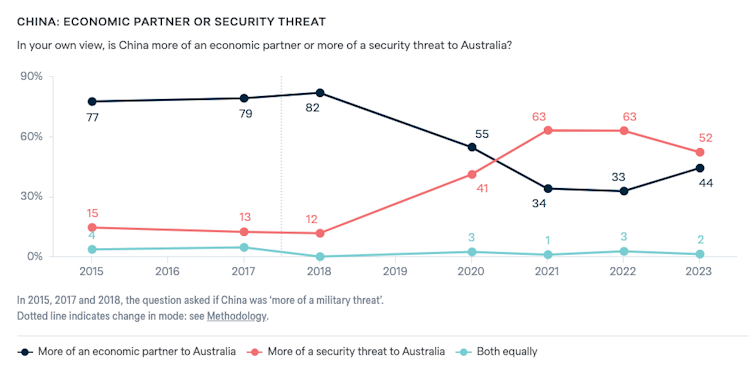
Asked whether China is more of an economic partner or more of a security threat to Australia, those nominating a security threat is down 11 points from 2022 (to 52%). Those nominating an economic partner has risen 11 points to 44%.


Lowy Institute, Author provided

This still contrasts with Australians’ feelings in 2020, when more people saw China as more of an economic partner (55%) than a security threat (41%).

Also, three quarters (75%) of Australians continue to believe it is likely China will become a military threat in the next 20 years, unchanged since last year.

Nearly nine in ten people (87%) are concerned about China potentially opening a military base in a Pacific island country.

More than half (56%) say that in the event of a military conflict between China and the United States, Australia should remain neutral. This is five points above 2022.

Asked about reaction to a Chinese invasion of Taiwan, 64% would support Australia sending arms and military supplies to the Taiwanese government. Six in ten (61%) would support using the Australian navy to help prevent China imposing a blockade around Taiwan. But only 42% would support “sending Australian military personnel to Taiwan to help defend it from China”.

Lowy’s executive director Michael Fullilove writes in his preface to the poll: “The sharp decline in Australian perceptions of China has levelled out.

“However, the levels of trust, confidence and warmth towards China and President Xi Jinping remain strikingly low. Five years ago, more than half of Australians trusted China to act responsibly in the world. Today, that figure is only 15%.”


Read more:
Dialogue is vital ‘guardrail’ in dealing with China, Albanese tells international security forum


The poll comprises two nationally representative surveys taken March 14-26 and April 11-26 2023, with sample sizes of 2,077 and 4,469 Australian adults, respectively. This is the 19th edition of the Lowy Poll.

The poll found that while trust in the United States has declined by four points from last year, it is 10 points higher than in 2020, the last year of the Trump presidency.

Confidence in President Joe Biden is 59%, steady since last year but 10 points under 2021, his first year in office.

More than eight in ten (82%) of people say the Australian-US alliance is important to Australia’s security. This is five points lower from last year’s 87%, which was a record high.

About half (49%) believe AUKUS will make Australian safer, while 46% believe it will make the region safer.

Two-thirds (67%) support the decision to acquire nuclear-powered submarines.


Read more:
China and the US are talking again – so, where does the relationship go from here?


Polling in April, a month after the San Diego announcement of the detail of the submarine program, showed mixed feelings about the impact of the submarines on the likelihood of conflict in the region: 28% believed it will deter military conflict, while 20% thought it will increase the risk of conflict.

Asked whether the total cost of the submarine program (between $268 billion and $368 billion) is worth paying for the additional capability provided, 47% did not think the cost worth it.

When people were asked about threats to Australia’s vital interests in the next decade, cyberattacks from other countries ranked top (68%), ahead of a military conflict between the US and China over Taiwan (64%).

Fullilove sums up the feelings of the nation in 2023. “The 2023 Lowy Institute Poll reveals a sober optimism on the part of Australians looking out to the world. More Australians feel safe than last year. Their belief in democracy remains strong. They remain relatively hopeful about Australia’s economic outlook.

“But there has been no return to factory settings. The shocks of recent years broke many underlying assumptions about the world,” Fullilove writes.

The poll asked people how they rated the foreign performances of the six prime ministers of the past 15 years. Anthony Albanese ranked the highest with 83% saying he had done a very good or reasonable job handling foreign policy. He was followed by Kevin Rudd (78%), Julia Gillard (77%), Malcolm Turnbull (69%), Tony Abbott (50%) and Scott Morrison (46%).

The Conversation

Michelle Grattan does not work for, consult, own shares in or receive funding from any company or organisation that would benefit from this article, and has disclosed no relevant affiliations beyond their academic appointment.

ref. Australians’ feelings towards China are thawing but suspicion remains high: Lowy 2023 poll – https://theconversation.com/australians-feelings-towards-china-are-thawing-but-suspicion-remains-high-lowy-2023-poll-208103

Politics with Michelle Grattan: Special Minister of State Don Farrell wants donation and spending caps for next election

Source: The Conversation (Au and NZ) – By Michelle Grattan, Professorial Fellow, University of Canberra

The next federal election could be conducted under dramatically reformed electoral laws, with caps on spending and donations, and a much lower disclosure threshold for the disclosure of donations.

The changes, being worked up by Special Minister Don Farrell, would also trim the wings of third parties, such as Simon Holmes à Court’s Climate 200.

Farrell tells The Conversation’s Politics Podcast he is not waiting for the final report of the parliamentary Joint Standing Committee on Electoral Matters, which in its interim report has recommended a set of reforms broadly in line with Labor policy. The report was tabled on Monday.

Farrell says waiting until the final report comes at the end of the year would make it harder to get legislation in place for the next election, due by May 2025. He will have negotiations over the coming months and wants as much bipartisanship as possible, despite the Coalition opposing key recommendations of the majority report.

The government’s reform package would drastically reduce the threshold for donation disclosure, from the current $15,200 to $1000, and provide for disclosure in “real time”.

On spending caps, Farrell says: “The Australian electoral system shouldn’t be just open to people with lots of money”, citing Clive Palmer’s huge spend of $117 million at the last election.

He’s hoping for “broad consensus” across parties “that we’ve got to do something to firstly restrict the amount of money that individuals can spend, but also ensure that combination of transparency so that ordinary people can run campaigns”.

“The expenditure by wealthy people to essentially buy election results is now completely out of control and we’ve got to do something about it”.

Farrell says caps should apply to third parties because “it’s got to be a level playing field”. There has to be as “balance” – increasing transparency, restricting the ability of rich people to by elections, and improving access to democracy.

“My job in the next six months before the final report [from the committee] will be to try and find that balance.”

Ambitiously, Farrell says: “I’d like to see a consensus outcome before the end of the year, and that implemented either this year or early next year so that the Australian Electoral Commission has got plenty of time to implement whatever we agree upon.”

He said a provision for truth in advertising, also recommended by the committee, would be in the government’s package “if we can get consensus on it in the lead up to the next election”.

Farrell hopes the date for the Voice referendum – which Anthony Albanese has said will be in the last quarter of the year – is sooner rather than later, because of the weather in the north in the latter months of the year. The speculation is that the vote will be in October.

“Look, it’s a challenge in every election getting into Indigenous communities and of course the later in the year that you go, then the more difficult it can be with storms and so forth [in the north of Australia] and of course that’s where large numbers of Indigenous Australians live.”

“I’m pleased to report that since this government came to office, we’ve lifted Indigenous enrolment from roughly 81% that it was at the time of the last election up to 84½%, and we’re expecting to get some more figures next month, which I’m confident will show an even greater participation. (At the next federal election more than 98% of the eligible general population will be on the roll.)

Farrell has made it easier for Indigenous people to enrol by allowing a Medicare card to be used as identification. “It’s a challenge but I think we have to devote more resources to getting more Indigenous Australians on the roll and I think you’ll find more Indigenous Australians will vote on this issue in the referendum.”

This week Farrell warned that the government’s legislation for its $10 billion Housing Australia Future Fund, deferred by the Greens and the Coalition until mid October, could be on the way to being double dissolution legislation.

He tells the podcast: “Look, I’m not advocating a double dissolution. What I am advocating is for the Greens political party to come to their senses.”

The Conversation

Michelle Grattan ne travaille pas, ne conseille pas, ne possède pas de parts, ne reçoit pas de fonds d’une organisation qui pourrait tirer profit de cet article, et n’a déclaré aucune autre affiliation que son organisme de recherche.

ref. Politics with Michelle Grattan: Special Minister of State Don Farrell wants donation and spending caps for next election – https://theconversation.com/politics-with-michelle-grattan-special-minister-of-state-don-farrell-wants-donation-and-spending-caps-for-next-election-208107

Missing Titanic sub: what are submersibles, how do they communicate, and what may have gone wrong?

Source: The Conversation (Au and NZ) – By Stefan B. Williams, Professor, Australian Centre for Field Robotics, University of Sydney

OceanGate

An extensive search and rescue operation is underway to locate a commercial submersible that went missing during a dive to the Titanic shipwreck.

According to the US Coast Guard, contact with the submersible was lost about one hour and 45 minutes into the dive, with five people onboard. The vessel was reported overdue at 9.13pm local time on Sunday (12.13pm AEST, Monday).

The expedition was being run by US company OceanGate as part of an eight-day trip with guests paying US$250,000 per head to visit the wreck site. As of Monday afternoon (Tuesday morning in Australia), US Coast Guard Rear Admiral John Mauger said the watercraft likely had somewhere between 70 and the full 96 hours of oxygen available to the passengers.

The Titanic’s wreck sits some 3,800 metres deep in the Atlantic, about 700km south of St John’s, Newfoundland. Finding an underwater vehicle the size of a small bus in this vast and remote expanse of ocean will be no small feat. Here’s what the search and rescue teams are up against.

OceanGate’s Titan submersible goes missing

Submersibles are manned watercraft that move in a similar fashion to submarines, but within a much more limited range. They’re often used for research and exploration purposes, including to search for shipwrecks and to document underwater environments. Unlike submarines, they usually have a viewport to allow passengers look outside, and outside cameras that provide a broader view around the submersible.

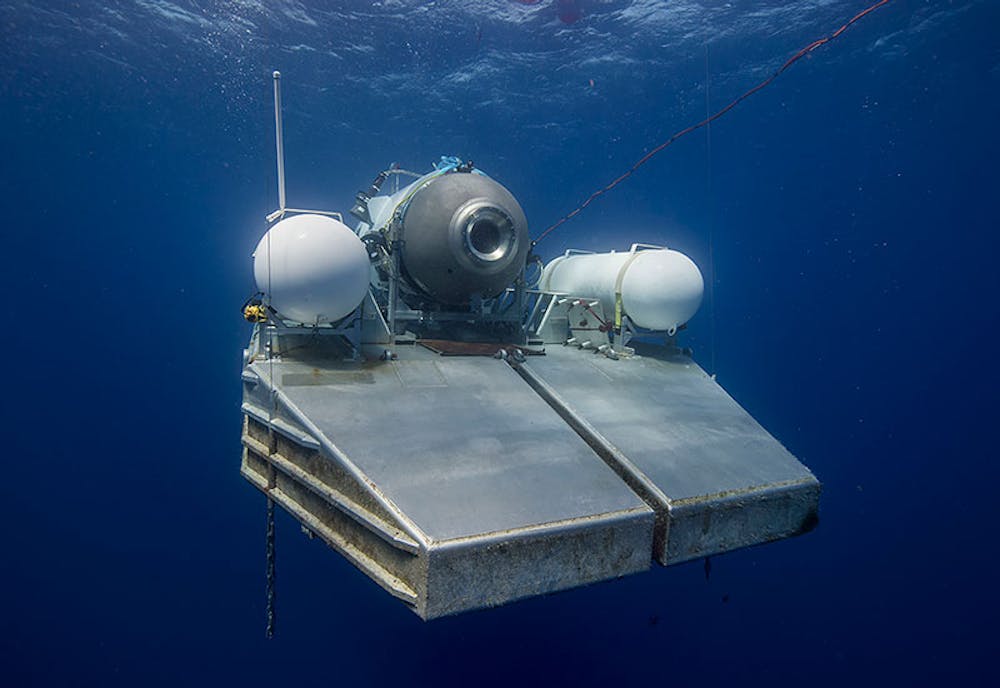
The missing submersible in question is an OceanGate Titan watercraft, which can take five people to depths of up to 4,000m. The Titan is about 22 feet in length, with speeds of about 3 knots, or 5.5km per hour. Although submersibles are often connected to a surface vessel by a tether, video and photos suggest the Titan was likely operating independently of the surface ship.

According to OceanGate’s website, the Titan is used “for site survey and inspection, research and data collection, film and media production, and deep-sea testing of hardware and software”.

It also has a “real-time hull health monitoring (RTM) system”. This would likely include strain gauges to monitor the health of the Titan’s carbon fibre hull. A strain gauge is a kind of sensor that can measure applied force and small deformations in material resulting from changes in pressure, tension and weight.

The Titan’s carbon fibre hull connects two domes made of composite titanium – a material that can withstand deep-sea pressures. At 3,800m below sea level (the depth of the Titanic) you can expect pressures about 380 times greater than the atmospheric pressure we’re used to on the surface of the earth.

Several tube like shapes on a rectangular concrete platform underwater
Titan on the launch platform underwater, awaiting a signal to commence the dive.
OceanGate

Communication and rescue efforts

The Titan would have had an acoustic link with its surface vessel, set up through a transponder (a device for receiving a sonar signal) on its end, and a transceiver (a device that can both transmit and receive communications) on the surface vessel.

This link allows for underwater acoustic positioning, as well as for short text messages to be sent back and forth to the surface vessel – but the amount of data that can be shared is limited and usually includes basic telemetry and status information.

The Titan is a battery-operated watercraft. Given it has lost all contact with its surface vessel, it may have suffered a power failure. Ideally, there would be an emergency backup power source (such as an independent battery) to maintain emergency and life support equipment – but it’s unclear if the missing vessel had any power backup on hand.

According to reports, at least two aircraft, a submarine and sonar buoys were being used to search for the vessel. The sonar buoys will be listening for underwater noise, including any emergency distress beacons that may have gone off.

One of the major challenges in the rescue effort will be contending with weather conditions, which will further shrink an already narrow search window.

A dark blue image with a tube like shape floating in the lower third
Titan commencing a dive to 4,000m underwater.
OceanGate

What might have happened?

In a best case scenario, the Titan may have lost power and will have an inbuilt safety system that will help it return to the surface. For instance, it may be equipped with additional weights that can be dropped to instantly increase its buoyancy and bring it back to the surface.

Alternatively, the vessel may have lost power and ended up at the bottom of the ocean. This would be a more problematic outcome.

The worst case scenario is that it has suffered a catastrophic failure to its pressure housing. Although the Titan’s composite hull is built to withstand intense deep-sea pressures, any defect in its shape or build could compromise its integrity – in which case there’s a risk of implosion.

Another possibility is that there may have been a fire onboard, such as from an electrical short circuit. This could compromise the vehicle’s electronic systems which are used for navigation and control of the vessel. Fires are a disastrous event in enclosed underwater environments, and can potentially incapacitate the crew and passengers.

Time is of the essence. The search and rescue teams will need to find the vessel before its limited supplies of oxygen and water run out.

There’s an ongoing debate in scientific circles regarding the relative merit of manned submersibles, wherein each deployment incurs a safety risk – and the safety of the crew and passengers is paramount.

Currently, most underwater research and offshore industrial work is conducted using unmanned and robotic vehicles. A loss to one of these vehicles might compromise the work being done, but at least lives aren’t at stake. In light of these events, there will likely be intense discussion about the risks associated with using these systems to support deep-sea tourism.


Read more:
Indonesian submarine found: what might have happened to the KRI Nanggala in its final moments?


The Conversation

Stefan Williams works for the University of Sydney. He receives funding from the Australian Research Council, the Integrated Marine Observing System and the Trusted Autonomous Systems Defence Cooperative Research Centre for work related to the development and deployment of marine robotic systems.

ref. Missing Titanic sub: what are submersibles, how do they communicate, and what may have gone wrong? – https://theconversation.com/missing-titanic-sub-what-are-submersibles-how-do-they-communicate-and-what-may-have-gone-wrong-208100

Deadly tragedy off the coast of Greece exposes how human traffickers are exploiting Pakistan’s economic meltdown

Source: The Conversation (Au and NZ) – By Zahid Shahab Ahmed, Senior Research Fellow, Deakin University

original

Pakistan is experiencing a confluence of crises attributed to a decline in governance standards. Security challenges, chiefly posed by terrorism, have exacerbated the country’s economic deterioration, which in turn has given rise to energy shortages, rampant unemployment and soaring inflation rates.

As the nation’s economic predicament worsens, unscrupulous human traffickers are capitalising on the vulnerabilities of thousands of aspiring migrants who hope for better prospects in Europe. It is in this context that the overloaded ship sank into the waters off Greece.

The BBC has claimed Greek authorities failed to save the migrants vessel, which was not moving for at least seven hours before it capsized.

Initial estimates suggest that about 80 people died. It is too early to suggest how many of those were Pakistanis, but Pakistani authorities are fearing the worse. Prime Minister Shahbaz Sharif declared June 19 a national mourning day.


Read more:
How Imran Khan’s populism has divided Pakistan and put it on a knife’s edge


Economic meltdown driving Pakistanis towards the deadly journey

As authorities move to act against human traffickers, there is a need to look at push factors behind this exploitation of economic migrants from Pakistan. Pakistan’s economy faces serious challenges. Its GDP growth rate is expected to drop to 0.5% in 2023, compared to 6% in 2022. Moreover, the International Monetary Fund has estimated the inflation rate might rise to 27% during 2023. The unemployment rate has also increased from 6.6% in 2020 to 7% in April 2023.

These economic hardships have led to some unprecedented scenes. Free food distribution points in major cities, organised by charities, are inundated. Such is the desperation that several people died earlier this year while fighting to receive free food.

Migrants often walk miles for days and night and pass through tough terrain to reach their destinations.
shutterstock

The Pakistani government has asked for economic help from the IMF and its close friends like China and the Gulf states. But it does not have enough resources to meet the needs of its growing population.

The traditional lenders like the IMF are also very careful dealing with Pakistan where the endemic corruption of the elite has been a contributing factor to the economic crisis. While the IMF is cautious to provide further loans to Pakistan, it has imposed austerity measures and increasing general sales tax on goods and serviceslike reducing government spending.

Under such circumstances and with limited employment opportunities, millions of Pakistanis have been migrating from the country on a regular basis. Common destinations include the Middle East, Europe, and North America. Most of Pakistani migrant workforce 98 percent is in the Gulf region, from where Pakistan receives most of its remittances that support the economy.

This trend has grown sharply in recent years due to Pakistan’s economic meltdown. Because of strict rules and lengthy procedures associated with legal migration, many are opting for illegal migration instead.

People offer their support to Raja Yousaf, right, whose son Raja Sajid is missing after a shipwreck off the Greek coast, in Bindian village in Kotli, a district of Pakistan’s administrator Kashmir.
Nasir Mehmood/AP

Rackets of human traffickers mushrooming

The desperate situation has led to the mushroom growth of people smugglers in Pakistan. In exchange for a large amount of money, they offer people transportation, fake documentation and other resources for a swift departure from the country.

Once on board the dangerous journey, the migrants can fall under the full control of the human smugglers, who can subject them to all sorts of exploitation. In the tragic boat accident in the Mediterranean, the women and children were forced below the deck to make space for more and more migrants on the old and rusty fishing boat.

The Mediterranean Sea has been a major route for migrants attempting to reach Europe from various countries in North Africa, the Middle East, and elsewhere. But due to overcrowded and unworthy vessels, inadequate safety measures, and harsh weather conditions, many of these endeavours end tragically, with sinking boats and loss of life. According to the International Organization of Migration, 174 migrants died in the Mediterranean in 2022 alone.

picture of protesters holding anti human trafficking slogans
Greece has declared three days of mourning for the shipwreck that killed at least 78 people.
Petros Giannakouris/ AP

Efforts have been made by international organisations and governments to address these issues. They include enhancing border controls and surveillance, implementing rescue operations, providing humanitarian aid, improving legal pathways for migration and addressing the root causes of migration. However, this might not be enough without addressing the underlying reasons millions are forced to leave their homelands.

While conflicts remain a major push factor, the grim economic situation in many countries continue to be another spur for people to leave their homelands.

Considering the latest boat tragedy, the government of Pakistan has demonstrated a reactive response only towards the issue of people smuggling.

However, it is imperative for the government to adopt a more proactive approach by formulating and implementing a comprehensive strategy that effectively addresses this complex problem.

Primarily, the government can prioritise the development of ample job opportunities at home. This can be achieved through enhanced investments in local industries and small scale enterprises, fostering economic growth and curtailing the allure of desperate measures to seek a life elsewhere.


Read more:
Is terrorism returning to Pakistan?


The Conversation

Zahid Shahab Ahmed is a chief investigator in a research project called ‘Religious populism, emotions and political mobilisation’, funded by the Australian Research Council (DP220100829).

ref. Deadly tragedy off the coast of Greece exposes how human traffickers are exploiting Pakistan’s economic meltdown – https://theconversation.com/deadly-tragedy-off-the-coast-of-greece-exposes-how-human-traffickers-are-exploiting-pakistans-economic-meltdown-208013

China and the US are talking again – so, where does the relationship go from here?

Source: The Conversation (Au and NZ) – By David S G Goodman, Director, China Studies Centre, Professor of Chinese Politics, University of Sydney

Leah Millis/Pool Reuters/AP

A potentially significant meeting took place in Beijing this week when Chinese President Xi Jinping met US Secretary of State Antony Blinken.

Blinken’s visit to Beijing was ostensibly to meet his Chinese counterpart, Foreign Minister Qin Gang. Qin had previously been China’s ambassador to the US until earlier this year and was well-known in Washington diplomatic circles. Blinken’s trip to Beijing had been scheduled for some time, and then postponed.

The meeting with Xi, however, was uncertain until shortly before it happened.

Media coverage of the event seems to reflect some of the inherent uncertainties in the US-China relationship, as well. Some photographs depict Blinken as slightly concerned or ferocious, while others appears to show Xi towering over Blinken.

Some images, however, show more open, friendly gestures between the two – perhaps signalling a genuine thawing of the recent frosty relations between the two superpowers.

How relations deteriorated this year

So, what does this meeting mean in reality? In terms of significance, its not the content of the talks that matter so much as what preceded them.

When Biden came into office in early 2021, it seemed to herald a slight rapprochement between the two governments. Though there were still disagreements over many issues, the two leaders held a virtual summit at the end of 2021.

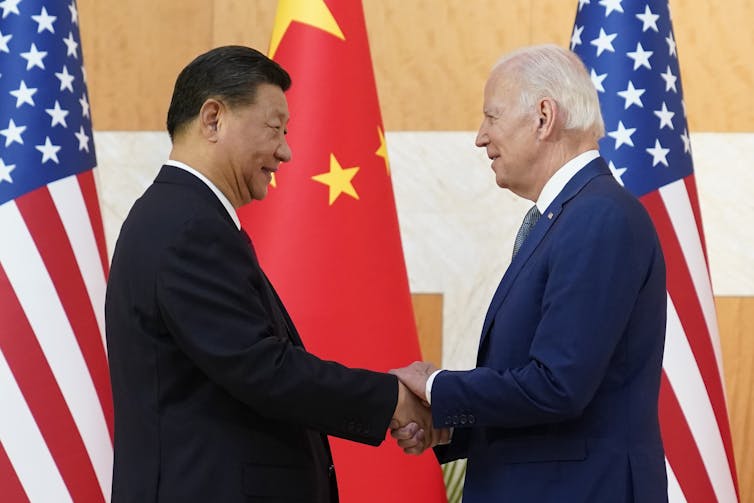
Then, on the sidelines of the G20 meeting in Bali in November 2022, Xi and Biden met face to face and spoke at some length. There was a general feeling of mutual appreciation in their respective positions on global issues such as climate change. It was not so much a meeting of minds, but rather an agreement to avoid the catastrophe of open conflict.

Biden and Xi engaged in a warm handshake in Bali.
Alex Brandon/AP


Read more:
US-China talks: Biden and Xi attempt to play down superpower tensions but Ukraine and Taiwan loom large


The leaders also agreed that Blinken would visit Beijing in the new year.

This atmosphere of gradually improving relations came to a halt in February, however, when a Chinese high-altitude balloon – dubbed a “spy balloon” in the US – drifted across North America and was eventually shot down by the US Air Force. Blinken’s visit was postponed, and China criticised the US for destroying the balloon, which it claimed was a weather balloon.


Read more:
Spy balloon drama elevates public attention, pressure for the US to confront China


While both sides eventually emphasised the continued need for dialogue, a standoff developed. The situation only worsened when a US reconnaissance flight in the South China Sea was intercepted by a Chinese fighter in late May.

Then, three weeks ago, western media reported that the Chinese defence minister, Li Shangfu, had snubbed the US secretary of defence, Lloyd Austin, by turning down the opportunity to meet at a security conference in Singapore.

Given the several meetings between US presidential advisers and their Chinese counterparts that had taken place in May before the summit, the significance of Li and Austin not speaking in Singapore may have been exaggerated. At worst, it could be considered a lost opportunity.

The Chinese government may have wanted to ensure Blinken’s rescheduled visit to Beijing would go ahead this month, putting more emphasis on these high-level talks than the meeting between defence officials.

‘Candid, substantive and constructive’

While there were apparently no major breakthroughs in Beijing, Blinken’s visit appears to have succeeded in returning relations between the two governments to where they were in November 2022.

The leaders seemed to reinforce the sentiments of that earlier meeting in Bali, focusing on mutual respect and the need to avoid a drift to conflict. Among other things, Xi told Blinken that rivalry between great powers could not solve problems in the United States or challenges facing the world.

Neither party can shape the other according to its own wishes, let alone deprive the other of its legitimate right to development.

The State Department, meanwhile, characterised the discussions as “candid, substantive and constructive”, emphasising

the importance of maintaining open channels of communication across the full range of issues to reduce the risk of miscalculation.

Both sides still have domestic constituencies to appease and without a doubt Washington’s may prove less biddable than Beijing’s.

For example, from the Chinese reports of the meeting Beijing seems to be willing to reopen discussions with Washington on climate change and cooperation on transnational crime of various sorts.

In return, China might well expect some greater commitment from the US to not interfere in what Beijing considers its domestic interests in Taiwan. As China-based commentators have pointed out, American electoral politics may make that commitment difficult (though not impossible) for Biden and Blinken to deliver.

The next step in placing US-China relations on a more even keel would be increased interactions between the two governments. While these have been agreed for the near future in foreign affairs, finance and economic development, the two sides have apparently not agreed to resume talks between their military leaders.

Biden and Xi are expected to meet again face to face later this year, perhaps at international summits in India or San Francisco.

Biden is unlikely to visit China himself, though, in the near future. In what is increasingly becoming not just a bad-tempered but an inherently divisive presidential election campaign in the US, that might prove a difficult step for the incumbent to do.

The Conversation

David S G Goodman does not work for, consult, own shares in or receive funding from any company or organisation that would benefit from this article, and has disclosed no relevant affiliations beyond their academic appointment.

ref. China and the US are talking again – so, where does the relationship go from here? – https://theconversation.com/china-and-the-us-are-talking-again-so-where-does-the-relationship-go-from-here-208096

Cash could be almost gone in Australia in a decade – but like cheques, who’ll miss it?

Source: The Conversation (Au and NZ) – By Peter Martin, Visiting Fellow, Crawford School of Public Policy, Australian National University

Shutterstock

Late last year, the Reserve Bank gave 1,000 Australians diaries and asked them to record every payment they made over the course of a week. Of the 13,000 payments, only 17 were with cheques.

It’s been an astounding collapse. Back in 1980 at the start of the credit card era, 85% of non-cash payments were made with cheques. Today it’s less than 0.1%.

Earlier this month, the government announced it was following New Zealand, Denmark, the Netherlands and others, closing our cheque system down by 2030.

Meanwhile, New Zealand is already on to the next thing. Having phased out cheques, it’s now looking at winding down the use of cash.

So how close is Australia now to becoming a cash-free nation?

The hidden costs of cheques and cash

Cheques are horrendously expensive to process. The average cost of everything that had to happen to process a cheque exceeds $5 per payment, mostly borne by banks.

But cash is expensive in its own way. The average cost of creating, sorting and trucking all those sheets of plastic and coins exceeds 50 cents per payment, mostly passed on to banks and retailers, and it is soaring as the number of payments plummets.

As recently as 2007, the vast bulk of consumer payments – 69% – were in cash. By 2019 only 27% were in cash. By 2022, after two years of COVID, it was only 13%.

At this rate, it’s hard to be certain how long cash will last.

What made cheques so slow and costly

For those who’ve never had to write one, cheques are bank-issued pieces of paper on which the owner writes the name of the person they want the bank to pay and the amount. They they hand it to that person, who then hands it to their bank, which then tries to get the money from the payer’s bank.

Cheques used to be exchanged in bags.
cottonbro/pexels

Behind the scenes, until recently when the electronic transmission of digital images changed things, each bank would collect all the cheques that had been presented to its branches each day and sort them into bags, one for each originating bank.

Then, late at night, its “bag man” would travel to a nondescript city location with a bag for each bank, hand the correct one to each of the other bagmen, and be given bags in return, which the bagman would take back to the bank for signature checking.

When each bank worked out what it owed the other bank, they would usually discover the flows largely cancelled each other out, and then make net payments which would be reflected in the cheque-writer’s account, up to five business days later.

Always expensive, the cost per cheque grew and grew as the number of Australians paying with cheques dwindled to a fraction of what it had been.

How moving cash became a loss-making business

It’s the same sort of story with cash. Although we don’t often think about it, cash costs an awful lot to move, sort and restock.

Printing the notes still makes money – it costs about 32 cents to make each note, whether it’s worth $5 or $100, although making some coins now does lose money.

The real expense is in moving notes and coins around, keeping them nearby and restocking banks and cash registers. Aside from payments the Reserve Bank makes to banks for returning damaged notes, the banks (and, through them, the retailers) are expected to pay for the lot.


Read more:
The Mint and Note Printing Australia make billions for Australia – but it could be at risk


Until recently that gave the two firms that dominate the business (Linfox Armaguard, and Prosegur, which owns Chubb Security) a pretty good deal.

Except that the volume of cash they’ve carried has dived 47% over the past ten years, 30% of it during COVID.

Both firms say their money-moving arms are incurring “heavy financial losses” and that if they increase their prices much more, retailers might move even further away from cash, pushing their costs even higher.

Linfox Armaguard and Prosegur have been given permission to merge.
Linfox

Last week, the Competition and Consumer Commission allowed them to merge on the condition that they limit their price increases to the consumer index plus 7.5% per year. That increase is so steep as to suggest a death spiral: the more they charge, the less retailers will use cash, the more they’ll have to charge.

The only way out, unless they can make really big efficiencies, or unless the decline in the use of cash stops, would be for the government to return to subsidising the use of cash. It’s hard to see how it could make the case to do that when there are cheaper emerging technologies.

Bank transfers cost a mere fraction of using cash, and pretty soon we’ll be able to use them for everything, via things such as QR codes.

So when will cash go the way of cheques?

A previous federal government has already tried to eliminate the use of cash for transactions worth more than $10,000, as part of its attack on the black economy.

Announced in 2016 by the Turnbull Coalition government, the ban was due to come into force in 2019. But in 2020, the Morrison-led Coalition government backed down.

If Australia wants to ban cash (and ban it for small transactions too – cash is now used less than electronic methods for transactions of all sizes) the easiest solution might be simply to wait.


Cards are now the dominant means of exchanging money, and direct transfers are growing from a small base.

Pure extrapolation would suggest cash has less than a decade to go, but it will probably hang around for longer as an (expensive, little-used) backup that maintains privacy.

Like cheques, cash will probably die gradually, then suddenly. By the time it does, there will be few users left who care.

The Conversation

Peter Martin does not work for, consult, own shares in or receive funding from any company or organisation that would benefit from this article, and has disclosed no relevant affiliations beyond their academic appointment.

ref. Cash could be almost gone in Australia in a decade – but like cheques, who’ll miss it? – https://theconversation.com/cash-could-be-almost-gone-in-australia-in-a-decade-but-like-cheques-wholl-miss-it-208020

Why are we paying so much for alcohol-free drinks that aren’t taxed?

Source: The Conversation (Au and NZ) – By Cameron Shackell, Visiting Fellow, Queensland University of Technology

Shutterstock

Dry July, an Australian fundraising campaign to support people affected by cancer, is almost here again. The premise is that abstaining from booze and hangovers for a month frees up money to donate.

But with prices in the booming alcohol-free drinks category often rivalling those of regular tipples, participants this year might find they have less spare cash than they anticipate.

Traditional alcohol producers, who have expanded into the US$11 billion non-alcoholic drinks industry, have helped make the high prices charged seem acceptable to consumers by using a marketing tactic called price-anchoring.

Lured into paying more

When we encounter a new product, we latch onto whatever seems relevant in the immediate environment to estimate its value. Sellers often exploit this by staging information at purchase points. The classic is a price tag with $99 struck out and $79 written in. Whether it’s accurate or not, the $99 reference point shapes our perception of value and price.

This so-called “price anchoring”, is just one example of the broader anchoring cognitive bias described by psychologists Amos Tversky and Daniel Kahneman.

The essence of anchoring is that we tend to rely too heavily on an initial piece of information (the “anchor”) when making decisions. This can lead to skewed judgements and poor decisions in everything from deciding whether to have surgery to buying real estate.


Read more:
Australia’s system of taxing alcohol is ‘incoherent’, but our research suggests a single tax rate isn’t the answer


Anchoring has been used to reinvent and elevate the virgin drinks category by exploiting the fact we are used to paying high prices for alcohol in bottles, cans or glasses of a certain size, shape and sophistication. When alcohol-free versions with similar labels appear beside them on the shelf, website or menu, we tacitly accept they should command roughly the same prices.

It’s not just that the next bottle along provides a suggestive price. Our brains, steeped in marketing, know that alcohol prices can range far upwards from “normal”, making them not just comparison points but the proverbial $99 scratched out. So even if we spend a lot on non-alcoholic wine, we feel like we have scored compared with what we might have dropped on a bottle of Grange.

Where we are most susceptible

The effect is strongest in bottle shops and bars, where the glitz of alcohol marketing, social pressure and the sheer number of expensive items overwhelms our rational thinking. But it also works on websites of the national liquor outlets where special zero-alcohol categories have been established beside the traditional beer, wine and spirits listings.

It doesn’t take much browsing to confirm that prices are similar. Currently, on one of the big retailers’ websites, a case of 330ml bottles of Heineken Lager (5% alcohol) is $55, Heineken 3 (3.3% alcohol) is $50, and Heineken Zero (less than 0.5% alcohol) is $49. Among the non-alcoholic spirits, 700ml of Lyre’s Dry London Spirit – “crafted to capture the essence of a classic gin” – is $51 at another outlet while the same size bottle of 37% alcohol Gordon’s London Dry Gin is $45. Gordon’s own non-alcoholic offering – Gordon’s 0.0 Alcohol Free – is listed at $38.

Price anchoring in the alcohol-free market comes with an extra twist of lemon.

Brands will encourage you to think their investment in developing “healthier options” using “high-quality ingredients” means high prices are fair enough, and that a non-alcoholic drink made with arcane “botanicals” and “adaptogens” in a nice bottle is worth a splurge.

Woman selecting wine in supermarket
We get caught thinking it’s worth paying extra for non-alcoholic versions of well known brands.
www.shutterstock.com

But look at what makes up the price. All processed drinks incur a Goods and Services Tax (GST). And drinks that contain alcohol are hit with a heavy additional excise. The exact percentage is difficult to calculate, but the alcohol-related tax on a bottle of full-strength beer can exceed 30%.

Industry players don’t pay that tax on non-alcoholic drinks. So, in a sense, they are pocketing a hefty bonus that well-anchored customers forget is not being passed on to the government. Ouch.

Supermarkets and nurturing the next generation

Seemingly at odds with price anchoring is the appearance of non-alcoholic versions of some famous brands in supermarkets.

An incentive for names like Heineken, Coopers and Gordon’s to be in supermarkets is visibility in a family-friendly environment. Their brand becomes recognisable to customers who are underage now, but will soon be ready to buy alcohol for their 18th birthday bash.

It’s a risky strategy, however, and can attract adverse publicity. In fact, to protect their reputations, several supermarket chains in New Zealand require customers to show ID when purchasing non-alcoholic lookalike drinks.

Is there a way to overcome the illusion?

The Australian government’s Behavioural Economics Team (BETA) has an informative blog post on minimising the impact of price anchors. But research suggests even experts are susceptible.

Besides awareness, you can reduce the effect by curating your exposure to price information. If you need non-alcoholic drinks for home or an event, visit the supermarket before the bottle shop. The range may not be as big, the drinks may not be any cheaper, and you may need to go to the bottle shop anyway. But the experience will put the untaxed non-alcoholic products in a fairer context – the soft drink aisle. Comparing prices under those sober lights, you might suddenly feel like picking up a bottle of ginger ale instead.


Read more:
We’re getting really good at making alcohol-free beer and wine. Here’s how it’s done


In bars and clubs, you can try to flip the script. Ask for your soda water in a fancy glass with lots of ice and slices of lemon or lime. This anchors what’s in your hand to high-priced cocktails.

Of course, if you embrace the life of a true ascetic, H₂O is a zero-dollar option that, as Nietzsche said always suffices. In Dry July, you might even join the hype and call it non-alcoholic vodka.

The Conversation

Cameron Shackell works for GeneriTrend, a firm using AI to quantify the genericness of brands and trademarks. Its customers at the time of publication do not include any drinks-related brands, alcoholic or otherwise.

ref. Why are we paying so much for alcohol-free drinks that aren’t taxed? – https://theconversation.com/why-are-we-paying-so-much-for-alcohol-free-drinks-that-arent-taxed-207728

Is climate change outpacing our ability to predict extreme heatwaves?

Source: The Conversation (Au and NZ) – By Damien Irving, Climate Data Scientist, CSIRO

When an extreme weather event happens somewhere in the world these days, it’s common to read quotes from climate scientists explaining this is exactly the kind of event we expect to see more often as climate change progresses. Such events are often devastating, but not surprising if you’ve been paying attention to the climate projections issued by scientists for many decades now.

But every so often, an event is so extreme it causes scientists to question our understanding of just how fast climate change is progressing. One such event was the heatwave across the Pacific Northwest region of the United States and Canada in the northern summer of 2021, when temperatures at some locations hit 49℃ (121℉) – hotter than the all-time record for Texas.

It broke heat records by such a wide margin that scientists were quoted in the media saying they hadn’t expected to see temperatures so high in the Pacific Northwest until much later this century.

The basic concern for these scientists was that our computer climate models are best at simulating things that span large areas and long time periods, such as the annual average global temperature (what we broadly mean when we say “the climate”). They aren’t as good at simulating smaller-scale things such as an individual storm or hot wind (that is, “the weather”).


Read more:
‘Statistically impossible’ heat extremes are here – we identified the regions most at risk


It’s not that our models can’t simulate small-scale weather – they’re basically the same models we use for weather forecasting – it’s just very computationally expensive to have them zoom in and run in “weather mode” to get a highly detailed simulation. It’s feasible for a seven-day weather forecast, but not for a century-long climate simulation.

Given this limitation, the scientists quoted in the media were concerned extreme weather events might be more sensitive to climate change than our models suggest.

Quantity matters too

While these concerns around the quality of our model simulations at weather-relevant scales are valid, what’s often overlooked is the quantity of model simulations involved. Given the natural variability in the climate system, scientists prefer not to rely on just one model simulation when making climate projections. Instead, they run a range of century-long simulations – from just a handful up to 50 or more for the most well-resourced modelling groups – and look at the range of possible outcomes.

For climate metrics such as the annual average global temperature, that’s enough simulations to capture the full range of possibilities. It’s a value that doesn’t vary much from year to year because it’s an average over the entire globe, so the climate change signal dominates over natural variability. To use a slightly more technical term, we say it has a high “signal-to-noise” ratio.

In contrast, the weather can vary greatly over relatively short time frames, and therefore has a very low climate signal-to-noise ratio. Something like the hottest day of the year at a given location is especially noisy, because small variations in the alignment of weather patterns can make all the difference between a regular hot day and a record-shattering one.

In this situation, many more simulations would be required to reliably estimate the upper limit on what extreme temperatures are possible.


Read more:
“Weather” and “climate” are used interchangeably. They shouldn’t be


How many simulations are enough?

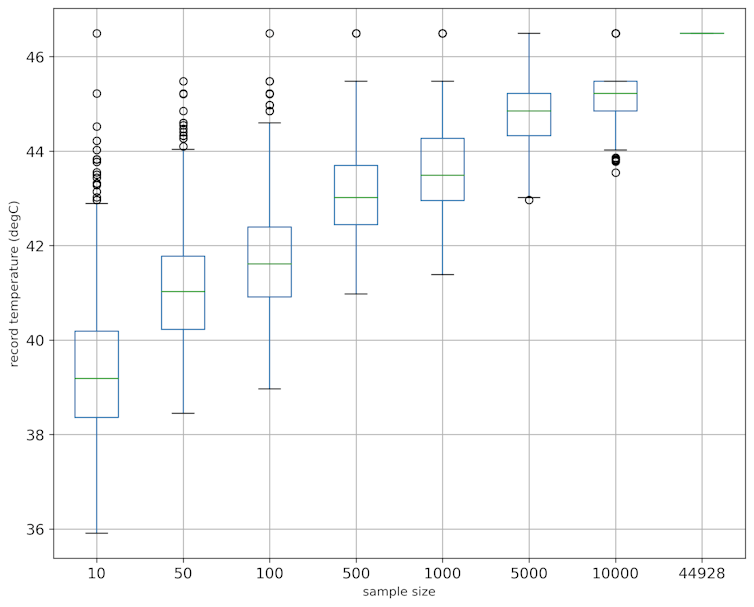
To try and understand how many model simulations would be needed, our recently published research used a climate model to simulate 45,000 years’ worth of daily weather at Seattle-Tacoma airport in the Pacific Northwest.

We then went through a process of picking out 1,000 random samples of 100 years of data from this population of 45,000 years, then 1,000 samples of 500 years, 1,000 years, 5,000 years, and so on. For each sample, we wrote down the maximum daily temperature we found (that is, the record temperature produced in each of these sample simulations).

Distribution of record temperatures at Seattle Tacoma airport for 1000 repeated sub-samples of varying size.

To our surprise, as the samples got bigger, the record temperatures we found showed little evidence of stabilising. They just continued to grow, indicating even samples spanning several thousand years are insufficient to capture the full range of possible extreme temperatures.

The reason we kept finding hotter days as the sample size grew is that the larger samples included more weather patterns. This meant there was a greater chance of producing a unique pattern with the near-perfect alignment of weather systems to generate even more heat at our fixed location. It turns out the weather patterns that produce the most extreme heat are very unique – and indeed far rarer than we’d expected.

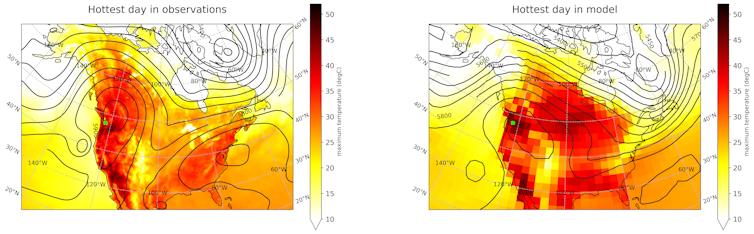
The weather pattern for the hottest day at Seattle Tacoma airport (green cross) in the observational record (June 28 2021, left) and our model simulations (right). The similarity between the two suggests extremely hot days in the model are generated by similar weather patterns as in the real world.

Luck of the draw

From this perspective, the record-shattering heat experienced in the Pacific Northwest in 2021 was due not just to the overall trend of global heating, but also to the random shuffling of the weather. And our research suggests the latter factor plays an even larger role in this type of event than many climatologists had suspected.

This means that even though the Pacific Northwest heatwave broke records by such a wide margin, that is not necessarily a sign climate change is happening faster than expected, or that our models are doing a bad job of simulating how climate change increases the likelihood of extreme heatwaves.

It could simply be that our sample sizes are too small. If we had run more model simulations we could have simulated the right chance alignment of weather to generate a record-shattering day, meaning this real-life heatwave wouldn’t then have outstripped climatologists’ predictions to such an extent.


Read more:
The North American heatwave shows we need to know how climate change will change our weather


Advances in supercomputers have traditionally been used to run climate models at higher resolution (that is, to zoom in and get closer to “weather mode”). But when it comes to predicting just how extreme the weather can get in a warming world, we might get more bang for our buck by using those advances to run many more simulations as well. That will show us what kind of extreme heat is possible as a rare event now, and what will be more commonplace in the coming decades.

The Conversation

The authors do not work for, consult, own shares in or receive funding from any company or organisation that would benefit from this article, and have disclosed no relevant affiliations beyond their academic appointment.

ref. Is climate change outpacing our ability to predict extreme heatwaves? – https://theconversation.com/is-climate-change-outpacing-our-ability-to-predict-extreme-heatwaves-207925

AI is already being used in healthcare. But not all of it is ‘medical grade’

Source: The Conversation (Au and NZ) – By Karin Verspoor, Dean, School of Computing Technologies, RMIT University, RMIT University

Shutterstock

Artificial intelligence (AI) seems to be everywhere these days, and healthcare is no exception.

There are computer vision tools that can detect suspicious skin lesions as well as a specialist dermatologist can. Other tools can predict coronary artery disease from scans. There are also data-driven robots that guide minimally-invasive surgery.

To precisely diagnose diseases and guide treatment choices, AI is used to analyse patients’ genomic and molecular data. For instance, machine learning has been applied to detect Alzheimer’s disease and to help choose the best antidepressant medication for patients with major depression.

Deep learning methods have been used to model electronic health record data to predict health outcomes for patients and provide early estimates of treatment cost.


Read more:
AI to Z: all the terms you need to know to keep up in the AI hype age


With new language-based generative AI technologies like ChatGPT, the clinical world is abuzz with talk of chatbots for answering patient questions, helping doctors take better notes, and even explaining a diagnosis to a concerned grandchild.

There is no doubt that in terms of patient health, workflows and system efficiency, AI will benefit the health system.

But there are legitimate concerns about the accuracy of such tools, including how well they work in new settings (such as a different country or even a different hospital from where they were created), and whether they “hallucinate” – or make things up.

An operating room with no people and only several robot arms hovering above a patient
Robot-assisted surgery is already the reality in some technologically equipped hospitals.
Shutterstock

Developing ‘medical grade’ tools

In our recent article in the Medical Journal of Australia, we argue using AI effectively in healthcare will require retraining of the workforce, retooling health services, and transforming workflows.

Critically, we also need to collect evidence AI tools are “medical grade” before we use them on patients.

Many claims made by the developers of medical AI may lack appropriate scientific rigour and evaluations of AI tools may suffer from a high risk of bias. This means the tests run to ensure their accuracy are too narrow.

AI tools can make errors, or stop working when the application context changes. Conversational agents such as chatbots may produce misleading medical information that may delay patients seeking care. They may also make inappropriate recommendations.

All this means we need standards for the AI tools that impact diagnosis and treatment of patients. Clinicians should be given training on how to critically assess AI applications to understand their readiness for routine care.

We should expect to be able to replicate the results from one context to another, under real-world conditions. For example, a tool developed using historical data from a hospital in New York should be carefully trialled with live patient data in Broome before we trust it.

Randomised controlled trials of AI tools, where these differences are controlled for, would represent a gold standard of evidence for their use.


Read more:
AI has potential to revolutionise health care – but we must first confront the risk of algorithmic bias


We can’t just copy what other countries do

It is important to carefully examine how AI tools are embedded into workflows to support clinical decisions. The benefits and risks of a tool will depend on precisely how the human clinician and the tool work together.

There’s a view that all we need to do in Australia is adopt the best of what is produced internationally, and that we don’t need deep sovereign capabilities.

Perhaps we can rely on the regulation of AI tools under way through the European Union’s AI Act, or the United States Food and Drug Administration’s processes for assessing Software as a Medical Device.

Nothing is further from the truth.

AI requires local customisation to support local practices, and to reflect diverse populations or health service differences. We don’t want to just export our clinical datasets and import back the models built with them without adapting to our contexts and workflows. We need to monitor the clinical deployments of AI tools into our settings.

Without some degree of algorithmic sovereignty – the capability to produce or modify AI in Australia – the nation is exposed to new risks and the benefits of the technology will be limited.


Read more:
How should Australia capitalise on AI while reducing its risks? It’s time to have your say


A roadmap for AI in Australian healthcare

The Australian Alliance for Artificial Intelligence in Healthcare has produced a roadmap for future development.

It identifies gaps in Australia’s capability to translate AI into effective and safe clinical services and provides guidance on key issues such as workforce, industry capability, implementation, regulation, and cybersecurity.

These recommendations offer a path toward an AI-enabled Australian healthcare system capable of delivering personalised and patient-focused healthcare, safely and ethically.

The plan also envisages a vibrant AI industry sector that creates jobs and exports to the world, working side by side with an AI-aware workforce and AI-savvy consumers.

AI has the potential to transform medicine. It can do so by harnessing computational power to discern subtle patterns in complex data spanning biology, images, sensory and experiential data, and more.

With care and strategic investment, innovations in AI will surely benefit clinicians and patients alike. Now is the time to act to ensure Australia is well-placed to benefit from one of the most significant industrial revolutions of our time.

The Conversation

Karin Verspoor receives funding from the NHMRC and the ARC. She serves as a Board member of BioGrid Australia. Karin is a co-founder of the Australian Alliance for Artificial Intelligence in Healthcare, along with the other authors of this article.

David Hansen receives funding from NHMRC. David serves as a Board member of Australasian Institute of Digital Health. David is a co-founder of the Australian Alliance for Artificial Intelligence in Healthcare, along with the other authors of this article.

Enrico Coiera receives funding from NHMRC. Enrico is a shareholder and Board member of
Evidentli, a digital health company. Enrico is a co-founder of the Australian Alliance for Artificial Intelligence in Healthcare, along with the other authors of this article.

ref. AI is already being used in healthcare. But not all of it is ‘medical grade’ – https://theconversation.com/ai-is-already-being-used-in-healthcare-but-not-all-of-it-is-medical-grade-207912

Fiji children ‘abandoned, forgotten’ by overseas workers, says counsellor

By Elena Vucukula in Suva

Children are abandoned and forgotten when a large number of Fijians leave the country for work and start new relationships abroad.

Consultant Marica Tabualevu of the Fiji-Australian Humanitarian Partnership has called for measures that would hold people responsible or accountable for forgotten children.

She said adults who engaged in such behaviour forgot they had children “left behind with no income or very little parental support” just because they did not want their partner anymore.

Tabualevu told a public consultation in Suva last Friday discussing a draft of the Child Care and Protection Bill and Child Justice Bill 2023 that too many children were being “abandoned”.

Fiji Women’s Crisis Centre’s senior counsellor advocate and community educator Ilisapeci Veibuli also called on the Fiji government to ensure there was sufficient budget to support the draft law as implementation and enforcement were important.

In a separate event, the NGO Empower Pacific said that last year more than 1040 children were counselled with the bulk of them suffering from depression.

Elena Vucukula is a Fiji Times reporter. Republished with permission.

Print Friendly, PDF & Email

Article by AsiaPacificReport.nz

USP signs ‘milestone Pacific MOUs’ for enterprising journalism initiatives

By Viliame Tawanakoro in Suva

The University of the South Pacific’s regional journalism programme has penned three milestone Memorandums of Understanding that will usher in greater collaboration with media industry partners over student upskilling and training, joint workshops and seminars, and publication of the award-winning training newspaper Wansolwara.

Papua New Guinea’s National Broadcasting Corporation (NBC) and the Pacific Islands News Association (PINA) have formalised three-year MOU partnerships with the region’s longest running journalism programme at Laucala campus.

They were signed by NBC managing director Kora Nou and PINA managing editor Makereta Komai respectively.

The signing ceremony was witnessed by PNG’s Minister for Communication and Information Technology Timothy Masiu — a former journalist — and USP’s deputy vice-chancellor (regional campuses and global engagement) Dr Giulio Paunga.

“It is indeed history because we have never had such an MOU between this prestigious university and our National Broadcasting Corporation, which is a flagship of PNG,” said  Masiu.

“The intention of this MOU is basically threefold — student training, staff exchanges and joint workshops, seminars, research activities. We are really looking forward to this; very interesting times ahead for NBC and your university.”

To further strengthen the MOU, Masiu announced a F$10,000 funding support for the journalism programme through the PINA office. NBC’s managing director is also current chair of PINA.

Masiu as a journalist
Masiu also shared his excitement and delight at being part of the signing ceremony and reminisced about his time as a broadcaster for NBC, and later a journalist for The National daily newspaper in Port Moresby.

Dr Paunga said the university was also currently working closely with the PNG government and the progress of this collaboration demonstrated great things to come between the two countries, its people and future students.

USP Journalism programme coordinator Associate Professor Shailendra Singh said the programme was doing some good work in journalism in Fiji and the region. He commended Komai and Nou for their cooperation and vision over the MOU.

PNG's Communications Minister Timothy Masiu
PNG’s Communications Minister Timothy Masiu . . . shared his background experience as a former journalist. Image: Wansolwara

“The MOU we have signed is going to take the training and development of our journalists to another level,” he said.

“We have been training journalists for a long time. Under this MOU, we will be able to decide our own agenda when it comes to training and research, instead of everything being designed from someplace else and us merely implementing it.

“We know PNG will be sending students to study at USP. Talks are underway and if that happens then there will be greater collaboration and interaction between students coming from PNG.”

Dr Singh said USP had 12-member countries and PNG was set to become the 13th member if talks went according to plan.

Fiji Times partnership

The latest 32-page Wansolwara
The latest 32-page Wansolwara . . . published as a Fiji Times insert thanks the new MOU.

Earlier, on May 3 — World Press Freedom Day — USP Journalism signed the first MOU with Fiji Times Limited. The partnership includes, among other supportive initiatives, the publication of Wansolwara, twice a year.

The first Wansolwara edition for 2023 was published in The Sunday Times last week and featured 32 pages of news, sports and special reports written and produced by USP journalism students across Fiji and the region.

Dr Singh said the partnership with Fiji Times Ltd was also a boost for the programme.

“This is a historic moment, not just for us but also for our students, as this will give them the exposure they need to contribute and improve the standard of journalism in our region,” he said.

“Fiji Times Ltd has been supportive of the USP Journalism Programme for many years, and this partnership will strengthen their commitment to promote a free and fair environment for journalists.”

Fiji Times Pte Ltd general manager Christine Lyons said the company would cover the printing of Wansolwara twice in the academic year. This amounted to one publication per semester.

“It will be circulated as an insert in The Fiji Times as part of its corporate social responsibility,” she said.

Fiji Times Ltd was represented by editor-in-chief Fred Wesley at the May MOU signing.

Viliame Tawanakoro is a final-year student journalist at USP’s Laucala Campus. He is also the 2023 student editor for Wansolwara, USP Journalism’s student training newspaper and online publication. Republished in a partnership between Asia Pacific Report and Wansolwara.

Print Friendly, PDF & Email

Article by AsiaPacificReport.nz

Proposed spending and donations caps may at last bring genuine reform to national election rules

Source: The Conversation (Au and NZ) – By Graeme Orr, Professor of Law, The University of Queensland

Luis Ascui/AAP

Money in electoral politics is like salt in the human body. Essential for activity – but too much imperils the heart.

Australia’s laws for the financing of national elections are the least developed of any comparable country. The present model marks its 40th birthday this year. In that time, other nations, and most Australian states, have modernised and tightened their laws.

Parliamentary committee recommendations that have just been released – with the endorsement of Labor, Greens and crossbench members – may be the catalyst for change.

What is the current regime? What reforms are proposed? And what are the prospects for lasting reform?


Read more:
Sweeping election donation and spending reforms recommended by parliamentary committee


Current rules

The Hawke government laid down the essentials of the present system in 1983. Then, as now, they involve some public disclosure of donations, plus public funding for parties or candidates that receive over 4% of the vote.

Disclosure is meant to achieve transparency around sources of campaign money. Public funding is “clean money”, to defray the cost of electioneering. (It has particularly helped minor parties, which attract few corporate donations.) Together, these measures aimed for improved integrity and a modicum of political equality.

The disclosure net has widened, particularly under the last Coalition government, to cover all sorts of lobby groups that electioneer. But at most it only requires annual reporting.

The net is also replete with holes. Parties only have to disclose “gifts” over $15,200 a year. Smaller donations, for federal electioneering, may be given anonymously to each division of a party.

Worse, the Liberal and Labor parties charge six-figure annual sums to join their business “network” or “forum”. The Australian Electoral Commission then lets them decide if that is a “gift” or a valuable purchase. This equates the undemocratic sale of access to politicians to, say, a genuine conference fee.

Public funding started at 30 cents per vote (quaintly, the cost of a stamp for a mailout). It is now over $3.12 per vote. Without limits on spending or donations, it has acted more like bankable seed funding than an incentive to avoid big and possibly dodgy donations.

Proposed reforms

The latest recommendations aim for holistic regulation across four topics. In doing so, they approximate Canada’s system, the most comprehensively regulated of our liberal-egalitarian democratic cousins. The system would also be similar to those that have evolved, over the past 15 years, for state elections in New South Wales and Queensland.

The first topic is transparency. The report recommends that gifts over $1,000 a year to a party – or to a lobby group for electioneering – be disclosed. For greater timeliness, it follows Queensland in proposing “real-time” disclosure.

The second topic is spending limits. These are a must for fairness. For the last two national elections we witnessed the farce of Clive Palmer’s United Australia Party splurging record amounts to drown out its rivals.

Spending limits can rein in that arms race. While the UAP had little formal success, it still distorted the agenda (and vexed many electors).

The third topic is donation caps. As with spending limits, no dollar amount is yet proposed. This gives wriggle room to find a “Goldilocks” figure somewhere between the Greens’ desire for a low cap and what the Liberal-National parties and Climate 200-backed teal independents would prefer.

By comparison, state caps range between $7,000 a year to a NSW party and just $4,320 over a four-year term in Victoria. As with spending limits, it’s important to adjust for the bigger stage of national campaigns.

The freedom of expression of lobby groups also must be accommodated, without letting them dominate. (Unlike parties, lobby groups are neither up for election, nor publicly accountable.)

The final topic is public funding. To compensate for reining in donations, public funding will rise. The report also recommends “administrative funding” for parties, to assist with compliance costs. Taxpayers struggling with the burgeoning cost of living can but hope public funding does not swell to the $8+ per vote enjoyed by ACT parties.

The money spent by Clive Palmer and his United Australia Party at the 2019 election did not win seats, but it did distort the outcome.
Michael Chambers/AAP

Political prospects

“It’s time for change”, as the old slogan goes. But change to what? The recommendations merely outline a model. It presumably enjoys in-principle government support.

Much needs to be thrashed out over the rest of the year. Whatever bill the government ultimately proposes to the Senate will require the Greens’ and crossbench support, or opposition backing. It is unlikely to attract the latter.

Liberal-National committee members embraced greater disclosure, but at the $8,000-a-year mark, and not more than monthly. They rejected donation and spending caps “as proposed”. Not outright: Liberal MPs felt the sting of being outspent by teal independents in 2022.

Being in opposition, they have a point. Labor will attract extra donations while it wields power. Above all, the Coalition wants the “affiliation fees” of those unions that are part of the Labor Party to be capped like donations. It also worries about unions electioneering in ways that most businesses would not.


Read more:
Stronger laws on ‘foreign’ election influence were rushed through this week – limiting speech but ignoring our billionaire problem


Independent MPs Senator David Pocock and Kate Chaney broadly supported the proposals. However, they also want concessions to “recognise barriers” to independent candidates (who lack party infrastructure and nationwide branding) and new parties.

Politics necessarily mixes principle and pragmatics. In the law about politics, pragmatics includes self-interest. Reform, at last, seems likely. Yet, to be lasting, reform should also attract a broad array of parties and even lobby groups.

The Conversation

Graeme Orr has worked on two ARC grants involving political finance issues, including one supported by the Electoral Council of Australia. He currently is an ‘expert’ member of the NSW Electoral Commission’s iVote panel.

ref. Proposed spending and donations caps may at last bring genuine reform to national election rules – https://theconversation.com/proposed-spending-and-donations-caps-may-at-last-bring-genuine-reform-to-national-election-rules-208031

Can I put cortisone on my face? The right advice on creams to fix irritated skin

Source: The Conversation (Au and NZ) – By Yousuf Mohammed, Dermatology researcher, The University of Queensland

Shutterstock

Topical corticosteroids, also referred to as corticosteroids or cortisone, are the go-to treatment for many skin disorders including eczema, dermatitis and psoriasis. They can be found in various forms such as creams, ointments, and solutions.

These medications work by entering the skin cells and mimicking natural hormones, blocking inflammation and constricting blood vessels. Topical corticosteroids come in different strengths, from mild (such as 0.5% Hydrocortisone, available over the counter) to very potent prescription formulations.

But the way different people react to topical steroids can be unpredictable. While some people might get significant relief with short-term use, others could need continuous care.

So, how should you use cortisone creams and ointments? And why is there conflicting advice about their long-term use?


Read more:
Health Check: why do we get dry skin in winter?


‘Use sparingly’

Patients are currently recommended to use cortisone formulations “sparingly” or “thinly”. But this can increase the risk they won’t work effectively. Treatment failure can add to “steroid phobia” and stop people getting the medication they need.

Such warnings ignore the fact many patients are prescribed modest-strength topical steroids, which are safe and effective when used properly. Adverse effects, such as when the formulations damage or irritate skin, are not typical.

From the patient’s perspective, the current warnings lump all steroids together regardless of their potential for side effects. Also, the advice tends to support false concerns: that topical and ingested (orally taken) corticosteroids carry the same dangers, which they do not.

Mixed messages

Should you use a weaker formulation for longer? Or hit the problem hard with a stronger concentration for less time?

At the moment, some treatment recommendations – such as for scalp psoriasis – say patients should use a high-dose cortisone formulation for four weeks and increase frequency of use if it’s not effective. If cortisone is extensively used, it is advised adults and children should be examined yearly for side effects.

person rubs white skin cream on to hand
Some conditions need long-term cortisone treatment – so breaks might be needed.
Shutterstock

Skin atrophy (or deterioration) is the most common side effect of topical corticosteroids and manifests as tiny degenerative alterations within a few weeks. The patient’s age, body site, cortisone potency and the existence of any coverings, all have an impact on the extent of skin damage.

Reduced skin cell growth, decreased collagen development and stimulation of tiny vessels and capillaries in the skin are the main features of such skin atrophy. Thinner skin, more moisture, higher temperatures, and partial blockage make areas where skin folds on the body (for example, the armpits, between fingers, the groin) particularly vulnerable. These are also often the sites of skin irritation needing treatment.

Skin thinning

Topical steroids cause the skin to reabsorb a type of connective tissue building block, called mucopolysaccharide ground material. Repeated use in the same spot on the body results in alterations to the skin’s connective tissue and epidermal thinning.

That can result in lax, translucent, wrinkled skin as well as striae (stretch marks), fragility, hypo-pigmentation (fading) and the prominence of underlying veins.

More research is needed to help specialists choose the best corticosteroids for a given condition. High-potency cortisone formulations, long-term use and sun exposure have been implicated in chronic fragile skin syndrome, which is increasingly common and features the symptoms outlined above.

However, if best practice guidelines are followed, these side effects can be reduced by using lowering the potency of corticosteroids and stopping treatment when the patient has fully recovered.

Corticosteroids should only be used for a maximum of three months. For some conditions, such as vitiligo, they need to be used for longer periods, so regularly taking several weeks’ break is advised.

The good news is that once topical corticosteroids are stopped, short-term atrophy from treatment can be reversed, although skin normalisation may take months.

cream on scratched up skin
Patients need reassurance and guidance on how much cortisone cream to use and for how long.
Shutterstock


Read more:
Drugs and the sun – your daily medications could put you at greater risk of sunburn


Can you use it safely on your face?

Due to the substantial risk of steroid-induced skin deterioration, the guidelines recommend against using potent and very potent corticosteroids on the face, flexures (parts of the body that bend, such as elbows) or genitalia. So, mild to moderate-potency corticosteroids are the main treatment option.

Using strong cortisone creams or ointments on the face can lead to steroid dependence. Patients who are dependent on steroids and have acne, rosacea, perioral dermatitis or telangiectasia (widened blood vessels on the skin) continue to use the drug because they worry stopping the drug could worsen their condition.

Topical steroids on the face can cause symptoms sometimes referred to as “red face syndrome”, dermatitis rosaceaformis steroidica or steroid addiction. And stopping steroid use on the face after an extended period can have considerable rebound effects including erythema (redness), burning and scaling.


Read more:
What is sodium lauryl sulfate and is it safe to use?


The bottom line

When used correctly, cortisone creams, ointments and lotions can be safe and effective.

Clear instructions could include estimating dosage in “fingertip units”, with a chart showing the number of units needed for various body parts, such as one unit to treat skin on an adult’s hand but seven units to treat skin on their back.

To avoid skin damage, corticosteroids should only be used on skin affected by a skin disease. Better education and information is needed to reflect the minimal risks from topical corticosteroids that are low to moderate strength and how important it is to use enough medication to treat a condition.

Finally, treatment should be customised based on the person’s symptoms, the body parts affected and how long treatment might be required.

The Conversation

Yousuf Mohammed receives funding from U.S FDA grants. This article reflects the views of the author and
should not be construed to represent views or
policies.

Khadeejeh AL-Smadi does not work for, consult, own shares in or receive funding from any company or organisation that would benefit from this article, and has disclosed no relevant affiliations beyond their academic appointment.

ref. Can I put cortisone on my face? The right advice on creams to fix irritated skin – https://theconversation.com/can-i-put-cortisone-on-my-face-the-right-advice-on-creams-to-fix-irritated-skin-203575

What’s a fair price to pay for music? In Australia, musicians aren’t getting paid as much as overseas artists for songs played on the radio

Source: The Conversation (Au and NZ) – By Rod Davies, Lecturer in popular music and songwriting, Monash University

The Australian recording industry recently announced a campaign called Radio Fair Play⁠.

The campaign argues “artists and rights holders aren’t getting paid fairly for songs played on radio”, in reference to the license fees radio stations pay for the use of songs in their broadcasts.

In Australia, sound recording license fees are collected by the Phonographic Performance Company of Australia (PPCA) who distributes the revenue as income to record labels and artists. PPCA claims Australian radio pays between just 10 and 27% of the commercial rates paid elsewhere in the world and artists here are being considerably underpaid.

It seems like a simple argument – “pay artists fairly”. But there are more factors at play than just whether radio stations will pay higher fees.

For starters, standing in the way is a 55-year-old Australian law that currently protects commercial radio and the ABC from paying more.

What are radio caps?

Formal recognition of economic rights in sound recordings didn’t exist in Australia until the introduction of the Copyright Act in 1968. Prior to this, only songwriters received royalties when their music was played on the radio.

Parliamentary negotiations leading up to the Copyright Act were dominated by the broadcasters and record companies, and focused on two crucial points of contention: who do the broadcasters have to pay? And how much do the broadcasters have to pay?

The Labor opposition supported the legislation of sound recording rights for all parties – record labels, broadcasters and performers. However, the governing coalition was dramatically split in its support. While the Liberals were keen on the proposal, the Country Party held serious concerns that license fees would severely impact regional radio, a position that threatened to dismantle the coalition.

In the end, the Copyright Act 1968 included an economic right for sound recordings, but in order to keep the government intact and appease the broadcasters, limitations on license fees were also legislated.

“Radio Caps” place an upper limit on annual license fees for the use of sound recordings, such as songs. Commercial stations are capped at no more than 1% of their gross revenue, while the ABC pays $0.005 (half a cent) multiplied by the total population of Australia.

PPCA argues these laws are unfair, “unique to sound recordings” and puts Australia in a position that is “out of step” with the rest of the world.

They have a point. The rate for sound recordings is currently set at 0.4%. In comparison, songwriting royalty rates for Australian commercial radio, which have no such statutory cap, are set at a much higher rate of up to 3.76%.

If the caps are scrapped, the market could determine what the music is worth and, effectively, the size of the revenue pool. Labels and artists expect their share of the pool, which is determined according to their proportion of airplay, to receive a significant boost.

Paying artists more for the use of their music on radio is a great concept, but the Radio Fair Play campaign cannot result solely in “better deals” for record companies and artists. It must be fair for all musicians, as well as the listeners, consumers and communities who rely on broadcast radio.


Read more:
Australia is one of few countries that doesn’t pay session musicians ongoing royalties. Our music industry suffers as a result


Is it as easy as removing the caps?

PPCA have “fought for decades” to remove these caps. Their claims have been supported by a number of independent reviews, and in 2006 the Australian government announced the caps would be abolished – but this has never happened.

If PPCA want to be successful this time around, they will need to have broader support across not only the music industry, but the wider community as well.

This campaign must address the potential effects of higher license fees on regional radio, such as redundancies and closures. The demise of local regional print journalism has been well documented, and radio is one of few remaining media that offers communities a local voice.

There are a number of solutions that have already been proposed for the struggling regions, such as new media monopoly laws, government advertising subsidies, and startup funding for new communications technologies.

But concrete plans to support these communities need to be designed and implemented by industry and government before regional media receive another shattering blow in being forced to pay a higher proportion of their revenue in music licensing.


Read more:
Regional journalism is dying: advertising subsidies won’t help


More than just an ‘artist’ issue

There is another issue for performers that needs to be addressed as well. New laws that aim to grow the royalty revenue pool should also remunerate musicians that are currently not being supported by license fees.

While the Copyright Act 1968 offered no economic rights to performers at large, there has since been global advancements in intellectual property rights and equitable remuneration.

From the late 90s, session musicians on sound recordings have received a share of broadcast license fees all around the world – except in Australia, where session musicians get no royalty payments at all.


Read more:
Australia is one of few countries that doesn’t pay session musicians ongoing royalties. Our music industry suffers as a result


This issue is absent from the Radio Fair Play campaign. If the recording industry believes fixing one anomaly is important, they should also support fairness overall.

It will take a unified approach and some bold reform to ensure there is a whole-of-industry solution that covers all of the issues and equitably remunerates all of the players. Australia painted itself into a corner in 1968, and now there’s quite a lot of renovating to do.

The Conversation

Rod Davies is a freelance musician and a member of MEAA/Musicians Australia, which is part of a coalition campaigning and working on behalf of musicians for equitable remuneration.

ref. What’s a fair price to pay for music? In Australia, musicians aren’t getting paid as much as overseas artists for songs played on the radio – https://theconversation.com/whats-a-fair-price-to-pay-for-music-in-australia-musicians-arent-getting-paid-as-much-as-overseas-artists-for-songs-played-on-the-radio-207310

Is leaving dog poo in the street really so bad? The science says it’s even worse than you think

Source: The Conversation (Au and NZ) – By Melissa Starling, Postdoctoral researcher, University of Sydney

Shutterstock

What’s that smell? Is that what you think it is? You check your shoes and, sure enough, one is adorned with a sticky, foul-smelling patty of fresh wrongness. You have stepped in a landmine of the canine variety.

We’ve all been there, and we all know footpaths, nature strips, parks, playing fields and front lawns are not good places for dog poo to sit.

Yet, our streets and parks continue to be littered with dog poo. And with the pandemic driving a surge in dog ownership, anecdotal reports suggest the dog poo problem has grown only worse in recent years.

Beyond the obvious unsightliness and the likelihood of making unwanted contact with dog poo, there are some other important reasons to pick up after dogs.

Here’s what you need to know and what the science says about common efforts to deter dogs from pooping on your yard.

Best to bag it and bin it.
Shutterstock


Read more:
Is my dog too cold? How cold is too cold for a walk? Here’s how to tell


Dog poo is linked to illness, pollution and antibiotic resistance

Dog faeces may contain microorganisms that cause illness in humans such as Salmonella, E. coli, Giardia and internal parasites.

Dog poo can also be a potential reservoir for antibiotic-resistant bacteria, meaning humans could develop bacterial infections that are difficult to treat through contact with dog faeces.

A recent Sydney study also identified dog faeces washed into storm water as a significant contributor to water pollution.

This topic, in spite of its relevance and impact, has received little attention from scientists. Thankfully, however, we have a few brave souls who can say they have studied dog crap for the betterment of humanity.

This research has revealed some patterns in where dog faeces is found in public.

Dog poo can be a potential reservoir for antibiotic-resistant bacteria.
Shutterstock

Where is the dog poo problem more common?

Dog fouling is significantly more common in parks where dogs are allowed off-leash, and areas close to car parks.

The way dog walkers have traditionally used an area may also be an important factor, with one UK study noting:

availability of bins, path morphology, visibility, and path location are key factors in determining the occurrence of dog faeces.

The same study noted that while most dog walkers do the right thing, some are too “proud to pick up”, while others make contextual judgements about where and when it could be permissible to leave dog waste. Yet others are “disengaged” dog walkers, who “will not pick up even if they are aware of the health and environmental consequences”.

Other research has suggested targeting keeping dogs on-leash between car parks and off-leash areas and providing waste disposal stations on popular dog-walking routes.

This doesn’t help if you have a neighbour who lets their dog out to relieve themselves on the nature strip (or your yard), or people who walk their dogs without carrying waste disposal bags.

And we all love the ones who bag the poop but leave the bag tied to a fence or by a gate.

What about the old water-bottles-on-the grass trick?

Dog owners who don’t pick up after their dog can be fined, but it can be hard to catch them in the act, and reporting a neighbour to authorities can often lead to ongoing hostility.

Bottles of water on the grass is a time-honoured strategy to deter dogs, but there is no evidence this is effective and no clear reason why it would be.

Dogs sometimes like to circle and find just the right spot to go, so they may prefer an area that has fewer obstacles to negotiate. Perhaps a yard bristling with lawn ornaments would enjoy some protection. (Interestingly, science suggests dogs may circle around like this to align their body to face north.)

There are commercially available dog deterrents, but little evidence they are effective and under what conditions.

Some believe any strong scent may deter an animal with a very strong sense of smell from lingering long enough to take a dump. But scent travels, so heavy and repeated applications would likely be needed (and this strategy could have unintended side effects on native urban ecosystems).

Most dog walkers do the right thing.
Shutterstock

Educating dog walkers is key

Aside from providing bags and a bin and enforcing leash laws particularly around carparks close to off-leash areas, research suggests education does help.

Messages emphasising that good neighbours and members of the community diligently pick up after their dogs may be most effective, as people are responsive to social messages.

If you have tried to appeal to your neighbour’s sense of community to no avail, and you’re not keen on a front yard bristling with garden gnomes and flamingos or drenched in possible dog-deterring chemicals, you could try providing bags and a sign promising surveillance.

For all the dog owners out there that do pick up after their dogs, your community thanks you.

The best way to dispose of dog faeces is in the bin. Composting requires high temperatures to neutralise the nasties in dog poop, and home composts are unlikely to get hot enough. And burying it simply allows these microorganisms to build up in the soil.


Read more:
Is your dog happy? Ten common misconceptions about dog behaviour


The Conversation

Melissa Starling does not work for, consult, own shares in or receive funding from any company or organisation that would benefit from this article, and has disclosed no relevant affiliations beyond their academic appointment.

ref. Is leaving dog poo in the street really so bad? The science says it’s even worse than you think – https://theconversation.com/is-leaving-dog-poo-in-the-street-really-so-bad-the-science-says-its-even-worse-than-you-think-207416

The world’s fish are shrinking as the climate warms. We’re trying to figure out why

Source: The Conversation (Au and NZ) – By Timothy Clark, Associate Professor – Animal Ecophysiology, Deakin University

Marius Masalar / Unsplash

Fish are the most diverse group of vertebrates, ranging from tiny gobies and zebrafish to gigantic tunas and whale sharks. They provide vital sustenance to billions of people worldwide via fisheries and aquaculture, and are critical parts of aquatic ecosystems.

But fish around the world are getting smaller as their habitats get warmer. For example, important commercial fish species in the North Sea have declined in size by around 16% in the 40 years to 2008, while the water temperature increased by 1–2℃. This “shrinking” trend is forecasted to significantly exacerbate the impacts of global warming on marine ecosystems.

The link between warmer water and smaller size is well known, but poorly understood. Our experiments keeping fish in warmer water offer some crucial clues – and may help us learn how to prepare for a warmer future with smaller fish.

The temperature–size rule

Fisheries are a potential confounding factor when studying the effect of warmer waters on fish, because fisheries often target large fish. Removing these larger fish from the population benefits the survival of fish that mature quickly and reproduce at a younger age, when they are smaller.

This trait of maturing early can be passed through fish generations. Indeed, it can lead to a phenomenon known as “fisheries-induced evolution”, where the exploited species tends to decrease in size over time.

How do we tell the difference between the impacts of climate warming and those of fisheries?

One way is to examine the body size trends in fish species that are not targeted by fisheries. Several fish species in French rivers, for example, are not exploited by fisheries but have decreased in size over several decades while their environment has grown warmer.

An underwater photo showing a large number of round, silvery fish
Fishing can reduce fish sizes, but even fish populations largely unaffected by fisheries appear to be shrinking.
Sebastian Pena Lambarri / Unsplash

Another way is to examine fish under controlled conditions, by manipulating water temperature and studying the impact on fish size. Such experiments have shown that fish do indeed end up smaller in body size when kept under warm conditions, and the trend is so common it has been given a name: the “temperature–size rule”.

We also know that smaller fish produce proportionally fewer offspring. And if fish are shrinking, fisheries that base their catch quotas on weight will be taking a larger number of individual fish.

So shrinking fish means each fish will have fewer offspring, and more fish being caught. This is likely to have substantial ecological and commercial ramifications.

Supply and demand

Warmer water means smaller fish, but why?

The most popular current theories suggest the cause is due to a mismatch between how much oxygen a fish needs (to sustain its body’s metabolism) and how much it can get (via its gills).

The argument is that fish gills do not grow at the same pace as the rest of their bodies. Once a fish reaches a certain body size, its gills can only supply enough oxygen to keep its body running – there is no oxygen left over for growth.


Read more:
How is climate change affecting fishes? There are clues inside their ears


What does this have to do with warming? The next step of the argument says fish use more oxygen in warmer water – but their gills don’t get any bigger. So fish reach the limit of their growth at a smaller size, leading to the temperature–size rule.

This “oxygen mismatch” theory has sparked heated debate among global scientists, largely because insufficient data exist to confirm or refute it.

Oxygen supply can keep up with demand

To get some data, we have carried out long-term experiments keeping fish under warmer water conditions than normal. We also tried providing extra oxygen, to see if it benefited their growth.

We have regularly taken metabolic measurements, and quantified the gill surface area of the fish to understand how well they can transport oxygen from the water into the body.

A side-on photo of a silvery-blue fish, showing its head and gills
Fish need more oxygen when they live in warmer waters – but research shows their gills are capable of keeping up with the increase in demand.
Paco Joss / Unsplash

Our results show the “oxygen mismatch” theory doesn’t hold up. While the metabolism of fish does increase with warming of the water, we found the gills grow sufficiently to keep up with the increased oxygen demand as fish increase in size.

So, why then are fish shrinking as the climate warms?

Is reproduction the key?

We know that fish tend to grow faster in warmer conditions and reach reproductive maturity at an earlier age and smaller size. It is possible that once fish start reproducing, energy is channelled into reproduction rather than further growth.

Evidence for this comes from a population of fish living in a Swedish lagoon that gives us an eye to a warmer future, as the lagoon receives warm (non-contaminated) water from a nearby nuclear power plant.

Fish in the warm lagoon grow faster and reach reproductive maturity earlier, then they tend to die at a younger age and at a smaller body size than their counterparts living in adjacent, cooler waterways. “Live fast, die young”, as the saying goes.

While this idea seems to be broadly applicable, some conflicting findings point to the need for more focused research attention.

Fish can’t keep shrinking forever

As our understanding of the relationship between temperature and fish size increases, we would also like to know whether we can do anything about it.

In our latest research, we explored differences in growth rates between individual fish of the same species.

One thing we wanted to know was whether particular physiological traits may allow some individuals to get around the temperature–size rule and be impacted less by climate warming. We found there is significant variability across individual fish, but we don’t know how this variability could be harnessed to future-proof fish populations.


Read more:
Warming oceans are changing Australia’s fishing industry


As our work continues, we also look to the future and think about the ramifications to fish and the industries that rely on them.

Fish cannot keep shrinking forever. There is a minimum size that each species must reach in order to maintain a viable population.

If species reach their specific thermal limits in particular locations, they will not be able to reproduce and they will cease to exist in those locations. If their entire habitat range becomes too warm, the species will become extinct.

These considerations of smaller fish and shifting thermal habitats will be critical for the sustainability of fisheries and aquaculture industries as we continue into a future with a warmer, more extreme climate. Our efforts to quantify and forecast the impacts will help resource managers and industries prepare for climate-linked disruption.

The Conversation

Timothy Clark receives funding from the Australian Research Council and Deakin University.

ref. The world’s fish are shrinking as the climate warms. We’re trying to figure out why – https://theconversation.com/the-worlds-fish-are-shrinking-as-the-climate-warms-were-trying-to-figure-out-why-207729

Genetics and concussion – why a minor knock can be devastating for some people

Source: The Conversation (Au and NZ) – By Lyn Griffiths, Professor, Queensland University of Technology

Shutterstock

Concussion and head trauma is a real and serious risk for many Australians. While most people suffer acute and relatively short-lived effects, such as dizziness and headache, in some cases symptoms persist for weeks, months or years. It can result in long-term and debilitating neurological impairment.

Concussion in sport – from the junior to the elite level – is being prioritised as a public health concern in Australia. A Senate inquiry into concussions and repeated head trauma in contact sport is due to report in August. Of note in the hearings has been the AFL’s acknowledgement of an association between head trauma and chronic traumatic encephalopathy, a neurodegenerative disease found in several deceased players.

The latest data show concussion can happen in nearly every sport, not just contact sports, with almost 3,100 hospitalisations for concussion caused by sports in 2020–21.

But not everyone responds the same way to concussion. At present, there are few reliable indicators of who will suffer specific or long-term effects. We do know the number and severity of symptoms and multiple concussions are important. And we are developing understanding of how a person’s genes play a role.

Traumatic brain injury

Concussion is a form of traumatic brain injury that can result in neurological dysfunction, including migraine, cognitive deficit, confusion, slowed reaction times, personality changes, drowsiness and emotional changes. Some people also suffer long-term problems with memory, thinking and other symptoms, such as anxiety and mood disturbances.

After brain injury there is a cascade of events that impacts the health of neurons and affects the flow of chemical ions, such as calcium, in the brain. Mutations in genes that affect the transport of neuronal ions (atoms or molecules with a positive or negative electrical charge), termed ion channel genes, can also affect how the brain works.

The strongest evidence of a connection between concussion response and ion channel gene function is from patients with a family history of a rare type of migraine (hemiplegic migraine, which causes the sufferer to experience severe migraine associated with motor impairment and muscle weakness) and episodic ataxia (which causes bouts of movement incoordination).

Specific types of these severe neurogenetic disorders are caused by mutations in the calcium channel gene CACNA1A. Patients with these mutations can be highly sensitive to head impacts. Some specific mutations can see very minor head trauma lead to concussion, seizures, cerebral oedema (swelling), coma and sometimes death.

Research has also shown 35% of patients with mutations in a second hemiplegic migraine ion channel gene, ATP1A2 – which is linked to hemiplegic migraine, ataxia, epilepsy and other seizures and controls brain sodium and potassium levels, report concussion symptoms following mild head trauma.

Focusing on all ion channel genes, our genomics lab (Griffiths Centre for Genomics and Personalised Health) recently studied 117 concussion-affected people. We found mutations in 21 ion channel genes, 14 of which could have an impact on concussion susceptibility or outcomes.


Read more:
Concussion: almost half of people still show signs of brain injury after six months


Other types of genes

Apart from a role for ion channel genes, there have been a number of additional genes linked by research to concussion.

One of the most studied is the ApoE gene, which is involved in transporting cholesterol in the body and has long been recognised as a risk factor for Alzheimer’s disease. Studies have indicated a variant of this gene (ApoE4) is linked with poorer and more long-term concussion outcomes. Those who carry this variant are also more likely to have significant signs of brain degeneration after concussion.

Another genetic variation in the ApoE gene that makes it less productive has been linked to a higher likelihood of concussion.

Beyond ApoE, genes that help control a variety of brain functions have been suggested as factors in concussion – including some involved in neuronal growth, dopamine receptors and, most recently, brain axon (nerve fibre) development.


Read more:
Hit your head while playing sport? Here’s what just happened to your brain


A predisposition for injury

Questions concerning the link between genetic predisposition to injury in sport are not new. Twenty years ago, the Australian Law Reform Commission referred to research showing

[…] a milder form of this condition [CTE or punch-drunk syndrome] could occur in players of rugby, soccer and other sports associated with repetitive blows to the head.

In 2016, the Australian Institute of Sport (AIS) released a position statement on the ethics of genetic testing and research in sport. But the latest AIS Concussion and Brain Health Position Statement does not mention the use of genetic information concerning concussion-related susceptibility.

Currently, there is available DNA diagnostic testing for the two ion channel genes already implicated in concussion, because this testing is used for the diagnosis of familial hemiplegic migraine and episodic ataxia. But genetic testing is not currently undertaken for concussion.

In Australia, it is difficult to find information on whether genetic testing occurs in elite sport. In the United Kingdom, genetic testing does take place, although it is not common. Athletes and support staff there are open to the idea of genetic information being used to improve sport performance and reduce injury risk.


Read more:
Uncharted Brain: Decoding Dementia – a three-part series to read and listen to


What’s next?

It is vital there is more careful consideration of genetic factors involved in concussion development and response. Clarification of the role of ion channel gene mutations and other gene variants, along with information from additional biomarkers and imaging, will be important in developing better concussion management and treatment approaches.

Before introducing genetic testing, regulatory and governance frameworks would also need careful consideration. Wider ethical and legal implications will need to be fully examined including health privacy laws, privacy of genetic samples, anti-discrimination laws and employment-related laws, especially in professional sport.

With the growing awareness of concussion-related injury risks highlighted by the Senate inquiry, further research in Australia could also investigate attitudes toward the use of genetic testing and predisposition to injury risk in sport.

The Conversation

Lyn Griffiths has received migraine and concussion research funding from the Australian National Health and Medical Research Council, US Migraine Research Foundation, US Dept of Defence and Teva, and in addition receives research funding for a Defence Innovation Hub from Australian Defence and from VariantBio for her Norfolk Island genetics studies. She is a member of the Human Genetics Society of Australasia and Chair of the Board of Censors for Diagnostic Genomics.

Annette Greenhow receives funding from the Government of Canada Social Sciences and Humanities Research Council and previously received funding from Australian Catholic University and the City of Gold Coast Ambassador Program. She is affiliated with the Australia and New Zealand Sports Law Association as a board member (views are her own).

ref. Genetics and concussion – why a minor knock can be devastating for some people – https://theconversation.com/genetics-and-concussion-why-a-minor-knock-can-be-devastating-for-some-people-204528

97% of Australians want more action to stop extinctions and 72% want extra spending on the environment

Source: The Conversation (Au and NZ) – By Liam Smith, Director, BehaviourWorks, Monash Sustainable Development Institute, Monash University

Rawpixel.com, Shutterstock

Most Australians (97%) want more action to protect nature, even if they don’t know the full extent of the biodiversity crisis. That’s the startling finding emerging from our first national survey of 4,000 voters.

Biodiversity matters. We rely on nature for healthy food, clean air and water. Roughly half of the global economy depends on natural systems. But Australia is losing biodiversity at a cracking pace. Over the past 200 years, a species has become extinct every second year on average. This includes one in ten of Australia’s mammal species. Thousands of species that were once common and widespread are now rare.

Halting and reversing species loss requires the support of the whole community. So we wanted to find out what Australians think about these issues and the potential solutions.

We found most of the community strongly supports pro-nature policies, such as ending logging of native forests and requiring businesses to report their impacts on nature. We hope the results in our Biodiversity Council report released today will galvanise support for greater conservation action.

Introducing the Biodiversity Council.


Read more:
If the budget ditched the Stage 3 tax cuts, Australia could save every threatened species – and lots more


Understanding the biodiversity crisis

Biodiversity refers to the richness and diversity of plants, animals and other living things in nature. Australia has one of the most unique and diverse natural environments in the world.

However, the state of the Australian environment is declining. The effects of climate change, land clearing, invasive species, pollution and more are causing irreparable damage.

The pace of loss and its consequences are even greater than previously thought. For example, biodiversity loss reduces the availability of clean water and air, and may limit future discoveries of potential treatments for many diseases and health problems. The loss of wild pollinators threatens the production of food crops globally.

This has led the World Economic Forum to declare biodiversity loss as the third most severe threat humanity will face in the next ten years.

As with climate action, the involvement and support of the wider community is essential to tackling the issue and requires people to take personal action. We also need people to back policies that protect and restore biodiversity.


Read more:
Nature is in crisis. Here are 10 easy ways you can make a difference


Australians want action

In late 2022, we conducted an online survey of more than 4,000 people across Australia. We had a representative sample across age, gender and location, benchmarked against Australian census data. We asked people about their attitudes to nature, how much they participated in “pro-biodiversity” behaviours such as native gardening and sustainable consumption, and how concerned they were about biodiversity loss.

We also explored people’s opinions about the state of the environment, government performance and relevant policies.

Many people were not aware of the full extent of biodiversity loss, with 60% believing that the state of the Australian environment is “good” or “very good”.

Yet the vast majority of people still cared deeply for Australia’s environment. More than eight out of ten people were concerned about biodiversity issues (85%) and said it was important that nature in Australia is looked after (83%). As many as six out of ten (63%) people were “very” or “extremely” concerned.

Encouragingly, almost everyone (97%) wanted more action to conserve biodiversity. More than half wanted “a lot” or “a great deal” more action (58%). This shows that even when awareness is limited, people value nature and recognise the importance of protecting our natural environment.

Most people agreed everyone in Australia has a role to play (68%). More than half already engaged in actions to protect nature, such as being a sustainable consumer and managing pets or gardens for nature.

What about policy solutions?

Most of our survey respondents also believe all levels of government are responsible for taking action. Around three-quarters (72%) said more money should be spent on the environment. Only about one in 20 (6%) said less should be spent.

Most Australians were supportive of introducing new policies that could help protect biodiversity. The vast majority of people (80% or higher) support or strongly support:

  • restoring water to wetlands and rivers
  • increasing fines for people caught smuggling illegal wildlife or products
  • restoring nature in cities and towns
  • increasing fines for high polluters
  • tougher fines and stronger laws to stop illegal habitat destruction and tree clearing.

More than 70% of people also support:

  • banning logging in native forests
  • introducing laws to prevent domestic cats roaming the streets
  • requiring businesses to report their impact on nature
  • establishing new protected areas (such as national parks) at places with high biodiversity.
Levels of support for a range of policies related to biodiversity.
Biodiversity Council

A majority of Australians from all states and territories, political alignments, and regions, and from urban and rural areas supported these policies.

Significantly, very few people opposed these policies (between 3% and 9% across the suite of policy options). The remainder neither supported nor opposed policy action.

This means stronger laws and policies to protect and restore the environment are far less contested among Australians than is often depicted in the media and political debates.


Read more:
Can a ‘nature repair market’ really save Australia’s environment? It’s not perfect, but it’s worth a shot


What now?

Policymakers should see our survey results as a green light to take stronger action for nature. Now is the time to start strengthening environmental laws, ceasing native forest logging, and increasing investment in biodiversity protection and restoration.

Around seven in ten Australians in our survey also indicated that nature conservation issues could influence their vote in future elections.

Politicians should take note. Self-identified swinging voters are significantly more concerned than non-swing voters (for example, 73% are “very” or “extremely” concerned about extinction compared with 66% of non-swing voters). They also believe more action is needed (63% believe “a lot” or “a great deal” more action is needed compared with 57% of non-swing voters), and state they are more likely to vote accordingly (80% of swing voters would be influenced by nature conservation in their Federal election votes compared with 73% of non-swing voters).

Australia has a lot to gain from engaging everyone in nature conservation and restoration, and much to lose if we fail.

The Conversation

Liam Smith receives funding from all levels of government, NGOs and the private sector. He is a Lead Councillor on the Biodiversity Council.

Jaana Dielenberg works for the Biodiversity Council and is hosted by The University of Melbourne. She receives funding from the Ian Potter Foundation, The Ross Trust, Trawalla Foundation, The Rendere Trust, Isaacson Davis Foundation, Coniston Charitable Trust and Angela Whitbread through the Biodiversity Council. She is a member of the Ecological Society of Australia.

Kim Borg receives funding from multiple State and Federal government agencies, NGOs, and the private sector via her work at BehaviourWorks Australia to conduct research on behaviour change topics.

Rachel Morgain receives funding from the Ian Potter Foundation, the Hermon Slade Foundation, the Ross Trust, Rendere Trust, environmental NGOs and the Victorian and Australian Governments. She works and consults with NRM Regions Australia.

ref. 97% of Australians want more action to stop extinctions and 72% want extra spending on the environment – https://theconversation.com/97-of-australians-want-more-action-to-stop-extinctions-and-72-want-extra-spending-on-the-environment-207811

Supermarket shelves were empty for months after the Lismore floods. Here’s how to make supply chains more resilient

Source: The Conversation (Au and NZ) – By Fiona Berry, Research Principal, Institute for Sustainable Futures, University of Technology Sydney

Brendan Beirne, Author provided

From the outside, the Northern Rivers region of New South Wales seems idyllic. Rainforests, mountains, beaches and Byron Bay. But the past few years have made life harder for many who live there, with Black Summer bushfires, the COVID pandemic and intense flooding.

These disasters have exposed a key vulnerability: food. While it’s often assumed Australia’s strong agricultural sector means we are secure, these successive disasters show the danger of this assumption.

Much of this region’s food is trucked in from cities and food grown in the region transported out. The 2022 flood crisis damaged farms, cut off roads and freight lines, and inundated cool storage facilities. This, in turn, led to empty supermarket shelves. And not just for a day. In Lismore, they were empty for weeks or up to four months for major supermarkets.

Our new research found that shortening supply chains will be vital to make regions more resilient to these shocks – as well as drawing on community efforts such as farmers’ markets.

lismore flood 2022
Lismore and the Northern Rivers region was hard-hit by floods in 2022.
Shutterstock

Shorter supply chains are stronger supply chains

During the floods, food supply chains bent or broke. Food simply couldn’t get into some towns in the Northern Rivers. You could see the evidence: empty supermarket shelves and major impacts on food-based livelihoods including grocers, cafes and other local businesses.

As a local food business owner told us:

We are not making any money at the moment, just working to maintain customers.

What’s the solution? First, we must think of food as a local system rather than a linear supply chain.

Communities move fast while government often moves slowly

In the wake of the floods, an inquiry found a worrying lack of preparedness or ability to respond by the state government. The community had to respond as best it could.

Local farmers’ markets reopened in a week after the major Lismore flood in February 2022, thanks to the work of managers, farmers and volunteers who worked to clean up muddy sites and supply food. As one helper told the ABC:

Everywhere is closed – that’s why we wanted to open the farmers’ market, because everyone’s out of supplies.

Without trucks, supplies came from local farmer networks, existing stocks and supplies, people’s own pantries and, when the floodwaters receded, from unaffected food outlets south and north of the region. As a farmers’ market manager told us:

Supermarket shelves were completely empty [but] we had all this produce.

The people running local food exchanges and pop-up kitchens served and delivered food to those who couldn’t access food on their own. They could do this thanks to the town’s strong community networks. As a resident put it,

It was more a case of community coming together, rather than it come from anywhere else.

During and before the disasters, local food champions have been testing and sharing resilient farming approaches, diversifying food production and ensuring equipment is flood-resilient and easily repairable.

farmer's market yamba
Farmer’s markets are one way to localise food supply chains.
Shutterstock

Food insecurity is on the rise – and worsened by disasters

Food insecurity was already a major problem across Australia before these successive shocks. But it’s surged even higher as the nation weathers the economic fallout from the pandemic and rising living costs.

In 2022, Foodbank reported that one-third of Australian households had problems with finding enough to eat.

Our study found food charities in the Northern Rivers were also disrupted by the floods. A year on, the sector is still require funding and resources to meet ongoing demand.

We also found there was hidden demand for even more food assistance. For instance, one remarkable Lismore resident cooked more than 1,400 meals a week in their home kitchen to donate to people who didn’t feel comfortable or able to go to food charities. They carried on doing so for 10 months afterwards. As the resident said:

Most days I could have given meals out twice over as there was just so much need.


Read more:
How many Australians are going hungry? We don’t know for sure, and that’s a big part of the problem


We should build up community food networks and regional circular economies

Even before the floods, Lismore was one of the most disaster-prone areas in Australia. This won’t be the last major shock the region faces.

So what can we do? Our recommendations to boost food resilience include:

  • creating a regional food plan and food policy council, as recommended in last year’s state government inquiry into food production and supply

  • finding ways to respond rapidly across the food supply chain during disasters

  • strengthening food system connections and collaboration

  • supporting local food champions and community food efforts.

While Lismore’s plight drew huge attention, other parts of Australia have been suffering food shortages too. April’s enormous Cyclone Ilsa cut roads and broke bridges in Western Australia’s Pilbara region, causing food shortages. And last year’s floods in South Australia cut the vital Trans-Australian railway, which transports 80% of WA’s food. That left supermarket shelves empty.

We must make the vital food systems supporting our regions more resilient. What does that look like? Picture better funding and support for food charities, building food hubs, and preventing high value arable land from being turned into suburbs, particularly those slated for relocating flood-affected residential housing out of the floodplain.

Our recommendations are in line with the CSIRO’s 2050 roadmap for the future of our food supplies, as well as important work being done elsewhere in Australia by the Canberra Region Food Collaborative, Sydney Food Futures, Logan Local Food Map, Cardinia Food Circles and Bega Circular Valley.

Crises brings a chance to think differently. We should seize it to rebuild and strengthen our food systems so we can weather these shocks.

If we harness community networks, innovative solutions and drive policy change, we can build a more resilient and secure food system for the Northern Rivers – and beyond.


Read more:
What is food insecurity?


This report was produced by researchers from Plan C, the Institute for Sustainable Futures at the University of Technology Sydney and Wild Community. It was funded by the Northern Rivers Community Foundation.

The Conversation

Fiona Berry receives funding from various government and non-government organisations. In 2023 this includes the Northern Rivers Community Foundation and Plan C.

Sheriden Keegan receives funding from Plan C and Northern Rivers Community Foundation.

Somayeh Sadegh Koohestani works for Institute for Sustainable Futures and received funding in 2023 from Northern Rivers Community Foundation and Plan C.

Jean S. Renouf does not work for, consult, own shares in or receive funding from any company or organisation that would benefit from this article, and has disclosed no relevant affiliations beyond their academic appointment.

ref. Supermarket shelves were empty for months after the Lismore floods. Here’s how to make supply chains more resilient – https://theconversation.com/supermarket-shelves-were-empty-for-months-after-the-lismore-floods-heres-how-to-make-supply-chains-more-resilient-207982

Most parents don’t pick a parenting style. But that’s why being a ‘conscious parent’ matters

Source: The Conversation (Au and NZ) – By Cher McGillivray, Assistant Professor Psychology Department, Bond University

Josh Willink/Pexels

The program Parental Guidance has been showing on Channel 9 this month. This is the second season of the show that pits 12 sets of parents with very different parenting styles against each other to work out which is “best”.

This year, for example, there is a couple who use “American-style” parenting, pushing their young daughter to excel in a range of academic and sporting pursuits. Then there are parents who adopt an “unstructured style”, which prioritises a child’s own decisions and mental health over “conventional measures of success”.

But do most parents actively pick a parenting style? What should you think about when it comes to how you parent?


Read more:
Free-range vs helicopter: Channel Nine’s Parental Guidance and the quest to find the ‘best’ way to bring up kids


Approaches to parenting

The way you parent does matter. Research shows parenting is one of the greatest contributors to child and adolescent development and wellbeing.

Most parenting approaches fall under one of four main approaches:

1. neglectful: these parents do not show enough love or interest in the child, or set boundaries around behaviour. The 2023 Australian Childhood Maltreatment Study found about 8.9% of surveyed Australians aged over 16 had experienced neglect as children. Parental neglect can result in a child who does not have the ability to regulate their own emotions, has poor self-esteem and relationships difficulties.

2. permissive: these parents are lenient, accepting, promote psychological autonomy and avoid coercive behavioural practices. This approach has been linked to children lacking resilience, doing worse in school and struggling to control their impulses.

3. authoritarian: these parents shows little warmth and are strict. This may result in compliance when the child is young, but when a child is older, they may rebel, have low self-esteem and behavioural issues.

4. authoritative: here, parents are warm and loving but give their child firm boundaries. They support their child to develop a sense of autonomy. The parent works together with the child to solve problems rather than telling them or controlling them. Research shows this leads to a positive self-esteem.

Falling into a style

But while many parents view parenting as central to their lives, they often don’t make a conscious choice about their parenting style.

They tend to fall into a style because of how they were parented, their culture, personality, family size, education level and religion.

For example, if you were raised by very strict parents and it worked for you, you may seek to do this with your own children. If you hated this, this may seek to raise to children without a lot of rules.

Even if parents do eagerly read up on different styles before having a child, the pressures of life, work and family tend to see parents lack the energy to remain consistent. They either become more permissive as a way of letting go or become stricter to regain control.

It is important to be conscious about parenting

So, while most of us won’t actively “choose” a parenting approach and may use combinations of approaches, it is important to be conscious of how you are parenting.

Being a conscious parent means being mindful and aware of who you are as a parent. This allows you you to react in more helpful ways while ensuring your needs as a parent are also met.

This means reflecting on your and your child’s temperaments.

For example, if you see a young person’s disruptive behaviour as something that is done on purpose and rude, you will likely have a bad reaction. But if you understand your child has an exuberant temperament, their behaviour may become less agitating.

Or, if your parents pushed you hard to succeed academically, you may need to adjust your definition of “success” if you have a child with learning difficulties or who is much more interested in sport.

Being a conscious parent also means looking after yourself. If you are aware of your needs, you can make sure you get the rest and recuperation you need to make good decisions as a parent.


Read more:
Exhausted, disconnected and fed up – what is ‘parental burnout’ and what can you do about it?


Be consistent but adapt

But while parenting needs to be consistent (so kids know what to expect), this does not mean you can’t or should not adapt your style to the circumstances.

For one thing, it will likely alter as your child grows. Parenting a toddler or young child is very different from parenting a teenager. Younger children can be directed and “told” a lot more than older children. But other circumstances also change. Your shy, clingy toddler may become an extroverted, independent teen.

Lastly, don’t worry about what your friends (or people on TV) are doing. Just keep thinking about what your family needs are and how your choices are fitting in with your parenting goals.

The Conversation

Cher McGillivray does not work for, consult, own shares in or receive funding from any company or organisation that would benefit from this article, and has disclosed no relevant affiliations beyond their academic appointment.

ref. Most parents don’t pick a parenting style. But that’s why being a ‘conscious parent’ matters – https://theconversation.com/most-parents-dont-pick-a-parenting-style-but-thats-why-being-a-conscious-parent-matters-207824

Mosul faced mass heritage destruction by the Islamic State. We asked residents what they thought about rebuilding

Source: The Conversation (Au and NZ) – By Benjamin Isakhan, Professor of International Politics, Deakin University

After the Islamic State captured the northern Iraqi city of Mosul in mid-2014, they unleashed a wave of devastating human suffering and unprecedented heritage destruction.

The Islamic State targeted many of Mosul’s most sensitive and important cultural heritage sites.

Most notoriously, in 2015 the Islamic State released a number of propaganda videos in which they had filmed themselves using sledgehammers to topple and destroy statues at the Mosul Museum, and using power tools to deface giant reliefs at the ancient archaeological site of Nineveh.

In response to such mass heritage destruction, the international community has launched various initiatives worth millions of dollars to reconstruct the heritage sites of the city.

However, very little is known about whether or not the people of Mosul support such initiatives.

To find out, we conducted a survey of 1,600 people from across Mosul. Here are four of the more significant findings.


Read more:
ISIS is destroying ancient artefacts to send a message of intent


1. Heritage is not a priority

We wanted to gauge whether or not heritage reconstruction was a priority for the people of Mosul, given other urgent needs following years of dictatorship, war and Islamic State control.

We presented respondents with a list of ten options, and asked:

If you had to choose just three, which of the following do you think are the most urgent priorities for the future of Iraq?

The top answers were “safety and security” (61%), “unemployment and poverty” (54%), “education and schools” (52%) and “hospitals, health and sanitation” (49%).

Only 16% of respondents listed “heritage protection and reconstruction” in their top three urgent priorities.

2. But people still believe heritage sites should be reconstructed

We also wanted to gauge respondents’ overall attitude to heritage reconstruction efforts in Mosul.

We asked whether they agreed with the statement:

Heritage sites that were damaged or destroyed during recent conflicts should be restored or reconstructed.

The overwhelming majority (98%) of respondents agreed with the statement.

So, while very few respondents considered heritage reconstruction to be among the most urgent priorities facing Iraq, assuming it would continue regardless of their preferences, it had broad support from the people of Mosul.

3. Restoration should prioritise modernising buildings

We also wanted to know what form they would like restoration to take.

We provided respondents with a list of six possible answers, and asked:

What would you prefer to see happen to the heritage sites that have been damaged or destroyed during the recent conflicts?

None of those surveyed wanted to see damaged or destroyed heritage sites left in ruins. Only 4% wanted them developed into entirely new structures.

Instead, the vast majority (96%) wanted to see buildings restored and reconstructed, with the largest number of respondents (48%) indicating they would like to see the sites “restored and reconstructed into a new and more modern structure”.

The people of Mosul prefer damaged structures to be transformed into new and more usable buildings for the community over projects that aim to match historical or pre-war conditions.

This finding has implications for foreign heritage actors as they undertake reconstruction works in Mosul. It points to a long-standing dichotomy in heritage practice between UNESCO’s stated preference to preserve the “authenticity” of heritage sites and developing something meaningful and useful for a living community.

4. Iraqis think rebuilding should be Iraqi-lead

Finally, we sought to understand respondents’ views on who had done the most to restore heritage sites to date and who they would like to see leading such works in the future.

We asked two key questions:

Which actor do you think has done the most to restore or reconstruct heritage sites across Iraq?

And:

If you had to choose just one, who would you most like to see being entrusted with any restoration or reconstruction work at heritage sites?

After each question, we presented respondents with a list of 14 actors, from the Iraqi government to foreign states and multilateral institutions.

For the question concerning who respondents understood to have done the most reconstruction work, 17% identified global agencies such as UNESCO, 13% chose the Iraqi government and 8% identified the Gulf States. Only 2% saw Western governments as having done the most to restore heritage sites across Iraq.

This contrasts sharply with results from the second question on which agencies locals would most like to see leading the reconstruction efforts.

Most respondents named the Iraqi government (48%), with only 8% support for UNESCO, 6% for the involvement of the Gulf States, and just 2% for Western governments to lead restoration projects.

Despite an acknowledgement that multilateral actors like UNESCO have led much of the reconstruction to date, people expressed a clear preference for the Iraqi government to be entrusted with heritage projects into the future.

To harness local support for the rebuilding effort, international actors must make every effort to work closely with local partners and communities in Mosul to ensure their endeavours are embedded within broader security, developmental and infrastructure investment.

For Iraqis themselves to embrace ongoing efforts to reconstruct Mosul’s heritage, foreign actors will need to foster an authentic grass-roots process where Iraqis take ultimate responsibility for the reconstruction of their heritage.

Taken together, our findings demonstrate engaging with local opinion on heritage is perhaps the only way efforts to restore heritage can have a meaningful long-term impact on the prospects of peace in complex environments like Mosul.


Read more:
Iraq war, 20 years on: how the world failed Iraq and created a less peaceful, democratic and prosperous state


The Conversation

Benjamin Isakhan has received funding from the Australian Department of Defence and the Australian Research Council.

Lynn Meskell has received funding from the Australian Research Council.

ref. Mosul faced mass heritage destruction by the Islamic State. We asked residents what they thought about rebuilding – https://theconversation.com/mosul-faced-mass-heritage-destruction-by-the-islamic-state-we-asked-residents-what-they-thought-about-rebuilding-207725

1 in 5 Australian workers have non-compete clauses, making it harder to get better paid jobs: new survey

Source: The Conversation (Au and NZ) – By Dan Andrews, Visiting Fellow and Director – Micro heterogeneity and Macroeconomic Performance program, Crawford School of Public Policy, Australian National University

Shutterstock

To many of us, “non-compete clauses” are for other people – TV presenters and chief executives; the sort of people who, if they left their employer for a competitor, would take with them inside knowledge and so must be stopped by a legal agreement, at least for a period of time.

Our concerning finding, reached as Australia’s competition minister Andrew Leigh asks the Australian Competition and Consumer Commission and Treasury for advice on the extent of non-compete clauses in Australia, is that they may be even more widespread here than in the United States.

In the US, researchers from the Bureau of Labor Statistics have found an extraordinary 18% of workers are subject to non-compete clauses of some kind. They even apply where you might think they would not: to 9% of care workers, and 12% of US construction workers.

In Australia, in the first survey on non-compete clauses conducted using the same methodology as the US survey, we’ve found 22%.

22% may be an under-estimate

As with the US survey, because some workers might not know whether they are subject to non-complete clauses, we restricted our questions to those who had changed jobs in the past 12 months.

The job leavers were asked whether, as far as they knew, they were “not allowed to join or start a business in competition with” their former employer.

Restricting the survey to job leavers means that, if anything, our finding that 22% of the workforce is subject to non-compete clauses might be an understatement. Workers tightly bound by non-compete clauses might find it hard to change jobs.

Adding in those workers restricted in other ways – not able to poach former clients or co-workers (non-solicitation clauses) and not able to share their former employer’s confidential information (non-disclosure clauses) – we found half of all Australian workers are subject to some sort of restraint.

Childcare workers, yoga instructors

As part of the research I and Bjorn Jarvis conducted for the e61 Institute, we asked legal practitioners to tell us how the use of restraints had changed over time.

They told us non-compete clauses had become more common and were now the default option in many employment contracts, applying to outward-facing junior roles in industries such as childcare and yoga instruction, in addition to more senior roles in law, finance and business services.

Our survey suggests they apply to 27% of trade union members, 43% of gig workers, and 26% of community and personal service workers.

Workers who switch jobs get paid 8% more.
Julian Smith/AAP

Once, non-complete clauses were put in place to protect legitimate business interests, such as trade secrets and client relationships.

But these days it seems they are increasingly also being used to stifle job mobility. While good for employers, as they face less wage pressure, it is bad for workers and Australia’s productivity.

Workers who switch jobs get 8% more pay on average (and better mental health), yet the probability that the average Australian worker switches jobs has fallen from 12.8% in the mid-1990s to 9.5% in 2022.

And the benefits of being able to switch extend to workers who choose not to. The more they are able to switch, the greater their bargaining power.

The benefits also extend to the economy more broadly, as the reallocation of workers from less-productive to more-productive firms boosts aggregate productivity.

The US is considering banning non-compete clauses

In January, the US Federal Trade Commission proposed a ban on non-compete clauses, which it said could increase wages by US$300 billion per year.

The US Senate is currently debating a workforce mobility bill that would enshrine the ban in law.

In Australia, non-compete clauses are only enforceable if they can be shown to reasonably protect a legitimate business interest.

But in practice they exert a chilling effect. Around 40% of US workers are estimated to have turned down job offers from competitors due to non-compete clauses, even though they have worked in states where they are unenforceable.


Read more:
How more job-switching could make us better off


In addition to taking advice about the impacts of non-compete clauses in Australia, Andrew Leigh is also investigating no-poach clauses.

His own research has found they are widespread within franchise operations including McDonalds, Bakers Delight and Dominos. This means that, for example, no McDonalds store is able to offer more pay to get a worker to move from another McDonalds store, leaving the workers themselves none the wiser.

Leigh’s findings and ours suggest Australia’s labour markets are more restricted than generally realised, with many of the restrictions imposed by employers.

Sweeping them away would be one of the easiest ways to boost productivity.

The Conversation

Dan Andrews receives funding from the Susan McKinnon Foundation (via the e61 Institute).

ref. 1 in 5 Australian workers have non-compete clauses, making it harder to get better paid jobs: new survey – https://theconversation.com/1-in-5-australian-workers-have-non-compete-clauses-making-it-harder-to-get-better-paid-jobs-new-survey-207987

Pasifika people using kava and talanoa to boost mental health

By Alualumoana Luaitalo, Te Rito journalism cadet

​A new business initiative in Aotearoa New Zealand aims to open up conversations about the benefits of kava on mental health.

Tongan entrepreneur ‘Anau Mesui-Henry and her photographer husband Todd Henry own Four Shells Kava Lounge in Auckland, creating a space for the community to use the Pacific Island drink to maintain its value and cultural identity.

They have started talanoa on kava and mental health in Auckland, Wellington and Gisborne.

Public Interest Journalism Fund
PUBLIC INTEREST JOURNALISM FUND

The couple say the KAVAX sessions bring in people from all walks of life, and they get to enjoy some authentic kava for the night.

Mesui-Henry says because it is talanoa, it is open for everyone to come together and speak.

“Not all people will open up and share, but it’s a safe space where they can come through, indulge in some kava and explore solutions on how we can heal using our Pasifika culture,” she says.

“It’s the mana in knowing your natural tāonga, a tool to help us as people to heal and the silent battles that we face.”

Pasifika tools to connect
Mesui-Henry says although organisations like the Mental Health Foundation are doing great work with the resources they have, a “white approach” will not work alone.

She says Pasifika people have the tools to connect through kava, and improve mental health.

Mesui-Henry says some of the misconceptions around kava they have to work on dispelling are that it is bad for you, it’s “muddy water”, or once it numbs you, you are drunk.

“We are a community grassroots kind of place, and knowing our cultural keystone, kava has a place in society.”

Kava is part of significant cultural practices in different Pacific Islands, is known internationally for its relaxing properties, and is used as a herbal remedy.

The website of the Alcohol and Drug Foundation NZ advises that if a large amount of kava is consumed the following effects may be experienced: drowsiness, nausea, loss of muscle control, mild fever and pupil dilation and red eyes.

It is legal to drink kava in New Zealand.

A Pacific Media Network News article under the Public Interest Journalism Fund. Republished with permission.

Print Friendly, PDF & Email

Article by AsiaPacificReport.nz

PNG global tourism can thrive in local communities, says Yasina Park chief

By Nelson Joe in Goroka

At least a self-contained shelter is enough to attract international eco-tourists to Papua New Guinea, say tourism operators.

David Van, an international tour guide operator, told the Bena tribe in Eastern Highlands province that international tourists had not experienced local life.

The tribe nurtures the 217ha Yasina Nature Park at Megabo in ward seven of the Upper Bena Local Level Government area in Unggai-Bena District, Eastern Highlands.

Van said he would work with them starting with self-contained shelters where the tourists can enjoy privacy for days and appreciate exposure to such experience.

Yasina Nature Park director Paul Pake said Van would help the park improve one of the existing guest houses with sanitary kits and bed fittings.

“He [David Van] told us to build more guest houses, so we will start erecting structures now,” Pake said, adding that Van would help them as well, like he did with the Asaro Mudmen and 11 self-contained guest houses.

David Van, a Belgian operating out of Thailand organising photo tourism in Asia, said Papua New Guinea had a big potential in tourism.

‘Best country’ for photo travel
“I always do a lot of photo travel in the world, including Vietnam, Myanmar, but Papua New Guinea is the best country with different cultures compared to the world.”

He said that at least a decent shelter in the local communities with friendly environment was enough for international tourists from big cities to see where their food came from.

“They have been living in the big cities,” Van continued. “When they come here to Papua New Guinea, they will stay in hotels, come here, spend one hour and go back.

“They will not appreciate the real local life fully. Tourists would like to stay with the local people.”

Van said they would have to provide decent shelters where the tourists could enjoy their privacy while they mingled with the local life.

He assured them that he would expose Yasina Nature Park and others internationally.

“There is good potential here because the Bena tribe is not known, not many people know about it,” Van said.

“What I will do is take more pictures.

Yasina pythons
Yasina pythons . . . wildlife has been introduced to the park. Image: PNG Post-Courier

Organising Yasina tours
“When I go back I will contact many people throughout the world, organise their tours and guide them to this place.”

He said the tour duration depended on the number of activities the park could organise for the tourists.

“If you can take them for a walk to see some waterfalls, do some farming, they would love to sweep soil away and pull sweet potatoes out of the ground,” Van said. “That is really  local life.

“That’s what they want to see because they live in big cities — 20 floors up in the big buildings — and have never seen where their food comes from, how they are farmed.

“They have never even seen pig killing too.”

He said those were some areas where they could work around to develop tourism products.

Van has been in Papua New Guinea since last week.

He plans to visit other cultures and environment conservation sites in the Highlands region and help them develop tourism products.

Republished with permission.

Traditional Highlands cooking
Traditional Highlands cooking . . . an exposure for international tourists. Image: PNG Post-Courier
Print Friendly, PDF & Email

Article by AsiaPacificReport.nz

Pacific journos urged not to let geopolitics ‘skew their narratives’

RNZ Pacific

The editor of the Marshall Islands Journal, Giff Johnson, is urging Pacific journalists not to be swayed by geopolitical narratives and to stay true to reporting stories that affect people in their daily lives.

Held last Friday in Majuro, Johnson, who is also the co-founder of the Pacific Media Institute, hosted Pacific journalists and media trainers for a workshop and summit on democracy.

Increased competition between the United States and China in the Pacific has dominated headlines and political discourse over the past few years but Johnson said that while it is important to stay on top of such developments they were far removed from the day-to-day realities of island living.

Print Friendly, PDF & Email

Article by AsiaPacificReport.nz

Sweeping election donation and spending reforms recommended by parliamentary committee

Source: The Conversation (Au and NZ) – By Michelle Grattan, Professorial Fellow, University of Canberra

Caps on spending and donations for federal elections and “real time” disclosure of donations to parties and candidates are among the sweeping recommendations for reform made by a powerful parliamentary committee.

The Joint Standing Committee on Electoral Matters, in its interim report tabled on Monday, also recommends donation and spending caps apply to third parties and associated entities.

The majority report also urges a new system of increased public funding for parties and candidates, in light of the impact its proposed changes would have on private funding in elections.

Under the reforms proposed, the donation disclosure level would be reduced to $1000. The present threshold (from July 1 last year) is $15,200.

The committee has also said the government should develop legislation “to provide for the introduction of measures to govern truth in political advertising”.

The committee does a review after each election.

In her foreword to the report, the committee chair, Labor’s Kate Thwaites says the evidence it heard allowed the committee “to develop clear goals for reform to increase transparency in election donations and curb the potentially corrupting influence of big money, to build the public’s trust in electoral and political processes, and to encourage participation in our elections”.

The Albanese government is committed to substantial reform on electoral spending and donations. The committee will undertake further evidence and work before its final report to be delivered late in the year.

Electoral reform is likely to become a battlefield between the government and Coalition. In addition the community candidate movement will be concerned that some reforms would disadvantage aspiring new players.

Coalition members of the committee put in a dissenting report, disagreeing with the “caps” on donations and spending as they are proposed, and with other aspects of the majority report.

Opposing spending caps the Coalition dissenting report says: “A spending cap that fails to take into account Labor’s union-funded campaign machine is nothing short of a financial gerrymander”. It also says if any caps on donations or spending are introduced, they should apply to third parties and associated entities, and any spending caps should be lower for third parties and related entities.

The report points out that while there have been reforms in many states and territories to improve transparency and accountability, there has not been substantial reform at the Commonwealth level.

“It is time for the government to reform the Commonwealth system,” the report says. It says the issues are not new and urges reform before the next federal election. Changes should be implemented together.

The report says the aims of the reforms are to improve transparency, reduce “the potentially corrosive influence of big money”, level the playing field for new entrants, ensure integrity and compliance, and allow continued participation in elections from the public, civil society, business, parties and others.

Crossbencher Kate Chaney, a member of the committee, said “imposing caps is complicated. People don’t want big money influencing election outcomes, but they also want to know they have a choice of candidates.

“The major parties have developed an election funding system that embeds them. Only about 0.4% of Australians are members of a major political party and voters want to know about other candidates too. We need to level the election playing field” by addressing party and incumbent advantages, she said.

The report notes the 2022 election saw “the rise of independents who were the recipients of donations from a significant third party – Climate 200, a crowdfunding initiative with over 11,000 Australians who provided donations’ Climate 200 raised about $13 million which was donated to selected independent candidates, Wealthy individuals also donated substantial amounts to Climate 200.”

Special Minister of State Don Farrell said, “The Albanese Government is committed to improving transparency and accountability across our democracy”. It looked forward to the final report. “Electoral reform should always be consultative and bipartisan,” he said.

The Conversation

Michelle Grattan does not work for, consult, own shares in or receive funding from any company or organisation that would benefit from this article, and has disclosed no relevant affiliations beyond their academic appointment.

ref. Sweeping election donation and spending reforms recommended by parliamentary committee – https://theconversation.com/sweeping-election-donation-and-spending-reforms-recommended-by-parliamentary-committee-208030

Government’s housing fund legislation delayed by Green-Coalition alliance

Source: The Conversation (Au and NZ) – By Michelle Grattan, Professorial Fellow, University of Canberra

The Greens and the Coalition have teamed up again to present a vote being taken on the government’s $10 billion Housing Australia Future Fund.

Consideration of the legislation has been delayed until October 16.

The government at the weekend announced an immediate $2 billion for social housing – which will go to states and territories over this fortnight – hoping that would persuade the Greens to support the fund.

But the Greens are holding out for controls on rents, which are actually within the jurisdiction of the states.

Anthony Albanese, answering a Greens question in parliament, said the Greens had made themselves “irrelevant to the debate”.

“I understand that renters are doing it tough,” he said. “Yes, I want to do things about that”, and the government was working with the states on various measures. But “what we are not doing is destroying supply while we do it. Because the key to fixing housing is supply.”

If the government did what the Greens wanted there would be less supply of housing, Albanese said the Greens should have had “the guts” to vote against the legislation rather than deferring it.

The Minister for Housing, Julie Collins, said “there is a cost to these delays.

“Every day of delay is more than $1.3 million that does not go to housing for people that need it. If this bill gets delayed until October, the Greens political party and the Liberals would have succeeded in delaying it for more than six months. Every six months is $250 million that could have gone to building more homes.”

This is the second time the Greens and Coalition have prevented a vote on the legislation. The proposed $10 billion fund would produce $500 million a year for social and affordable rental housing.

Finance Minister Katy Gallagher said the fund was “an important piece of national infrastructure”.

Opposition leader in the Senate Simon Birmingham told Sky the Coalition had “always thought that adding these billions of dollars extra to government debt for no immediate impact on the housing market was a bad idea, especially so for a policy that has no benefit in terms of addressing rates of home ownership in Australia”.

The Senate’s action prompted speculation that the deferral could form the initial step to having the bill qualify as double dissolution legislation. Special Minister of State Don Farrell said: “If the Senate defers bills to October, the government will regard this as the Senate failing to pass the bill, and I’m sure you understand the consequences of that”.

Greens leader Adam Bandt said that “it says a lot about the government that they’d rather tout this as a double dissolution trigger rather than negotiating to pass their own bill”.

The Constitution’s Section 57 provides that if the House of Representatives passes a bill and the Senate “rejects or fails to pass it” and after three months the lower house again passes the bill and the Senate again rejects or fails to pass it, it can become the basis for a dissolution of both houses.

Sydney University constitutional expert Anne Twomey said the High Court has previously held that the Senate needs a reasonable amount of time to debate and deliberate upon a bill.

“This may include sending it to a parliamentary committee. But in this case, the delay is not due to a need to deliberate. It is for the purpose of waiting to see if the Albanese Government will change its policy and negotiate an agreement in National Cabinet which suits the policy aim of the Greens,” Twomey said.

“While there is no certainty, the government would have a good case to argue that a delay of this kind amounts to a failure to pass. Even taking into account the winter recess, there is still plenty of time to properly debate the bill before 16 October”.

The Conversation

Michelle Grattan does not work for, consult, own shares in or receive funding from any company or organisation that would benefit from this article, and has disclosed no relevant affiliations beyond their academic appointment.

ref. Government’s housing fund legislation delayed by Green-Coalition alliance – https://theconversation.com/governments-housing-fund-legislation-delayed-by-green-coalition-alliance-208016

In a Voice campaign marked by confusing, competing claims, there’s a better way to educate voters

Source: The Conversation (Au and NZ) – By Ron Levy, Associate professor, Australian National University

With parliament now having passed the Voice to Parliament referendum bill, and with the campaign about to get underway in earnest, there is a critical need for more trusted information. As scholars of deliberative democracy, we suggest Australia borrow from the US state of Oregon a new way of informing the public in referendums.

The federal government has already announced a civics education program for the referendum campaign. Better information can’t come soon enough, given the spread of confusing and sometimes misleading information in the lead-up to the referendum so far.

But will the government’s plan work? Not if it mostly involves top-down communication to voters, with information solely written and communicated by experts and politicians.

The trouble is, as good as this information may be, many voters are uncertain whom to trust. That’s especially so as the campaign descends into the rabbit hole of debate over technicalities. Few voters are deeply versed in constitutional law or Indigenous affairs.

This is where a “citizens’ referendum review”, first used in Oregon but later adopted in many other places, could be beneficial.

This kind of review is based on a public engagement tool called a “mini-public”, a body of randomly selected citizens who form a microcosm of the wider society in both demographics and attitudes.

Members of such a body first learn extensively about a topic from a diverse range of experts and advocates. They then engage in extended deliberations with each other to hash out a fair and informed recommendation to provide the public.

This is called a “citizens’ statement”, which explains precisely what’s at stake in the referendum, doing so in clear, balanced, accurate and accessible terms.


Read more:
What can history teach us to ensure a successful referendum for A First Nations Voice to parliament?


How mini-publics have worked elsewhere

Mini-publics have been used hundreds of times around the world, if not more – often with considerable success.

When a matter is complex and contentious – say, policies related to climate change or COVID-19 – mini-publics can be especially effective.

For instance, in Oregon, some of the first citizens’ reviews considered the wisdom of referendums aiming to impose minimum criminal sentences for sex crimes and drunk driving, and to legalise medical marijuana.

These were complex issues. But the Oregon experience showed that a collection of citizens could be brought up to speed on the issues and effectively communicate the pros and cons of the referendum proposals to the wider population.

One of the crucial aspects of these bodies is they tend to be better trusted than more top-down models led entirely by governments or academic elites. Voters often view the members as being “just like me”.

Indeed, mini-publics are usually designed to be demographically, regionally and politically diverse. Participants are also not politicians. Thus, they tend not to be as stuck in their polarised tribes. Comparatively speaking, ordinary citizens generally lack the same motivation and desire to wage no-holds-barred battles with the other side.

We are not the only ones calling for this model in Australia. The non-partisan newDemocracy foundation has also suggested it as a potential model for providing better information to voters about the Voice.

A fair and trusted source of information

There needs to be a source of information on the Voice that is informed, reasonable, fair and trusted. The government’s Voice campaign materials so far may be fair, but in our hyper-polarised political environment, any information authorised by the government of the day may not be widely trusted.

Information pamphlets distributed in past referendums – which included contributions from political leaders and other partisans – have faced similar problems.

As University of Sydney constitutional law expert Helen Irving recalls, the push for the republic in 1999 ran into problems partly because voters had low trust in three types of elites:

there were the alleged ‘elites’ (‘Chardonnay drinkers’) at the heart of the republican movement, those classed as ‘elites’ merely by being residents of Sydney, Melbourne and Canberra, and another version of ‘elites’ meaning simply federal politicians.

The citizens’ referendum review model shows more promise. We know from many studies of mini-publics around the world that they are, on the whole, fair, informed, flexible and highly trusted by a wide cross section of people.

They may provide what political leaders cannot – a fresh and open mind, and a sense of perspective about which arguments do or don’t hold up.


Read more:
How we can avoid political misinformation in the lead-up to the Voice referendum


What a mini-public could do in the Voice campaign

Importantly, though, running a citizens’ referendum review should not be an excuse to reassess what question should be put to voters. That has already been decided.

Moreover, the review must be well-designed. Rather than being dominated by one side in the referendum debate, it must be deliberatively broad-ranging and non-partisan. The promise of mini-publics depends on their being genuinely independent and impartial.

The review should also not reach any single verdict for or against the Voice, but rather cover all reasonable arguments and provide a set of pro and con arguments for dissemination in the referendum campaign.

The federal government should fund the review adequately and publicise its results across the country. The panellists could even write the “yes” and “no” pamphlets being sent to Australian households.

The Australian voting public should have the benefit of this kind of review to help inform their votes. In a campaign already cluttered with confusing, competing claims, we need a better approach.

The Conversation

Ron Levy has received funding from the Australian Research Council and convenes the International Advisory Panel on Referendums.

John Dryzek receives funding from the Australian Research Council and Medical Research Future Fund.

Selen A. Ercan receives funding from the Australian Research Council.

ref. In a Voice campaign marked by confusing, competing claims, there’s a better way to educate voters – https://theconversation.com/in-a-voice-campaign-marked-by-confusing-competing-claims-theres-a-better-way-to-educate-voters-206193

Ashes rivalry is as alive as ever. But when it comes to the economics of cricket, India is in the box seat

Source: The Conversation (Au and NZ) – By Tim Harcourt, Industry Professor and Chief Economist, University of Technology Sydney

The first test of the 2023 Ashes is well underway at Edgbaston in Birmingham, featuring England’s aggressive “Bazball” style of play (named after New Zealand-born coach Brendan “Baz” McCullum) and a surprise early declaration by the hosts at the end of the first day. This invited an Australian fightback inspired by Usman Khawaja, who notched a 141-run haul before being bowled by paceman Ollie Robinson (whose expletive-laden send-off is making headlines).

England currently leads by 35 runs on the end of day three, and it all sets the scene for an exciting series.

It comes just a week after Australia won the World Test Championship, defeating India in comprehensive style at The Oval in south London.

The Ashes always excites the traditionalists, as the Australia-England rivalry is the oldest in cricket.

But while playing the old enemy for the Ashes is, for many, the pinnacle of Australian cricket, Australia-India is developing as a modern rivalry.

This is significant because when it comes to the economics of cricket, it’s India that’s in the box seat, not England.

India is the new cricket powerhouse

The 2023 season of the Indian Premier League drew more than 500 million viewers, a 32% growth in television ratings on last season.

The very first IPL game of the 2023 season in fact attracted more viewers than the Super Bowl, the climax of the NFL’s American football season and one of the biggest dates on the world sporting calendar.

The first IPL match attracted 130 million viewers, compared with a record 115.1 million for the 2023 Super Bowl.

The 2023 IPL champions the Chennai Super Kings are valued at about US$1.15 billion (A$1.67 billion), according to Forbes in 2022. They’ve been touted as the “Manchester United of the IPL”, and may one day become one of the top global sporting franchises like the Dallas Cowboys (A$11.7 billion) and Real Madrid (A$7.4 billion).

So how did India do it?

When T20 took off in England and spread to the cricketing nations, everyone thought test cricket would die. But it didn’t. In fact, it’s stronger than ever.

If anything, it’s the game in between T20 and test cricket, the 50-over game, that’s likely to become obsolete – with only the World Cup played every four years attracting significant attention (although now the T20 World Cup overshadows that too).

India acted fast to surf the T20 wave. The IPL was formed by the Board of Control for Cricket in India (BCCI) following India’s victory in the 2007 World Cup, after a breakaway league had been mooted to break the BCCI’s grip on the game.

According to the BCCI Vice President Lalit Modi, at the time the IPL was

designed to entice an entire new generation of sports fans into the grounds throughout the country. The dynamic Twenty20 format has been designed to attract a young fan base, which also includes women and children

Part of India’s success is its size, overtaking China this year to have the largest population of any country with 1.4 billion people, as well as its economic success in recent decades with a growing middle class. By 2025, India’s middle class will number 583 million, or 41% of the country’s projected population.

This has been supercharged by the digitisation of the Indian economy, with televisions and smart phones giving the average cricket lover access to their favourite teams.

The IPL has attracted the top cricketers from around the world, mainly off the back of private franchises, many of which are owned by billionaires. This gives teams deep pockets when buying players from all over the globe, with the TV broadcast rights topping up IPL coffers too.

This has also boosted women’s cricket, including their pay packets, with the launch of the Women’s Premier League in India earlier this year.

Cricket diplomacy

It just shows the power of India in world cricket, and more generally the power of sport in today’s global economy.

Indeed, sport is no longer about small talk, but an intrinsic part of the global economy and geopolitics.

I was in India last month hosting the “Cricket, Collaboration and Commonwealth” conference for the University of Technology Sydney (UTS) in New Delhi. There was a robust discussion on the economics of the IPL and the role of “cricket diplomacy” in Australia-India relations.

While I was in New Delhi, Indian Prime Minister Narendra Modi was in Australia speaking to packed houses of India diaspora in Sydney. Modi wanted to build on the momentum of the blossoming India-Australia partnership, after Prime Minister Anthony Albanese visited India in March.

Cricket diplomacy was on display then too, spawning now famous images of Prime Ministers Modi and Albanese on a chariot before the fourth test match in Ahmedabad.

Albanese used the trip to announce a new education deal with India. Nearly 50% of Indians are under the age of 25, and only 21% of Indians aged 25-34 have a tertiary qualification, so there are immense opportunities for Australian universities and TAFEs.


Read more:
Albanese visit hopes to strengthen ties with India amid China’s rise. But differences remain


Cricket diplomacy has been central to the Modi-Albanese partnership, which highlights the role of sport in political and economic relationship building.

And the rise of the IPL has boosted India’s ascendancy as a superpower in world cricket. Its economic power has been as important as the improved on-field performance of Team India.

What’s more, the large attendances at The Oval for the ICC World Test Championship and now the raucous crowds at the Ashes shows the supposed death of test cricket has been greatly exaggerated.

The Conversation

Tim Harcourt does not work for, consult, own shares in or receive funding from any company or organization that would benefit from this article, and has disclosed no relevant affiliations beyond their academic appointment.

ref. Ashes rivalry is as alive as ever. But when it comes to the economics of cricket, India is in the box seat – https://theconversation.com/ashes-rivalry-is-as-alive-as-ever-but-when-it-comes-to-the-economics-of-cricket-india-is-in-the-box-seat-207812

PNG court finds Boship Kaiwi guilty over death of Jenelyn Kennedy

PNG Post-Courier

The Waigani National Court has finally handed down a ruling finding Boship Kaiwi guilty of causing the death of his wife Jenelyn Kennedy three years ago.

Despite persistent denials by Kaiwi that he had caused the death of Kennedy, he admitted to the court during the trial that he had elbowed and punched Kennedy around 18 June 2020.

Kaiwi’s defence lawyer had also argued that there was no direct evidence by the state to prove that Kaiwi had caused the death of Kennedy.

Jenelyn Kennedy
Jenelyn Kennedy … died aged 19 in a tragic domestic violence case in Papua New Guinea in 2020. Image: EMTV News

However, acting judge Justice Laura Wawun-Kuvi, when handing down the verdict on Thursday, ruled that the court was satisfied beyond reasonable doubt that Kaiwi had caused the death of Kennedy.

Justice Wawun-Kuvi was satisfied with the witness statements that Kaiwi actually had an abusive relationship with Kennedy and he did cause the injuries that led to the death of Kennedy.

“I’m satisfied beyond reasonable doubt that the defendant (Kaiwi) had caused the death of Kennedy,” Justice Wawun-Kuvi said in her ruling.

The judge therefore found Kaiwi guilty.

A decision on sentence will follow in the coming weeks once the pre-sentence report and other documents are presented to court recommending the type of penalty to be imposed on Kaiwi.

Kaiwi was accused of torturing and assaulting his 19-year-old wife Jenelyn Kennedy between June 18 and 23, 2020, leading to her death.

Her case became a major issue and sparked public outrage and demands for tougher action over domestic violence in Papua New Guinea.

Republished with permission.

Print Friendly, PDF & Email

Article by AsiaPacificReport.nz

The Australian remake of The Office has the potential to be great – if the writers remember how unique our humour is

Source: The Conversation (Au and NZ) – By Philippa Burne, Lecturer, BFA Screenwriting, Victorian College of the Arts, University of Melbourne, The University of Melbourne

Netflix

Twenty-two years after the original UK television series The Office was released, and 18 years after the highly successful US remake (2005-2013), Australia is getting its own version of The Office. This will be the 14th remake of the concept by Ricky Gervais, which has included adaptations in Chile, France, Finland, India, Israel, Saudi Arabia, Germany and other countries.

It’s an interesting move by Prime Video when there are already two highly rewatched English language versions available – highlighting the ongoing relevance of the workplace comedy.

It also speaks to the relative safety of remaking a known series concept rather than an original, in a time of expensive television production. Starting from an idea that has already proven hugely popular with audiences worldwide can seem to minimise the financial risk of making a new TV show – if it’s done right.

Comedian and actor Felicity Ward will star in The Office Australia, which will start on Amazon Prime in 2024.
Prime

A history of remakes

There has been a long history of remakes on television. Ugly Betty (as it is known in the US version) is one of the most recognised. Originally a Colombian telenovela, Yo Soy Betty, la Fea (1999-2001), the concept has been remade in other languages around 20 times to date. Other versions include Na Daj Se, Nina (Croatia, 2007-2008) and Lotte (The Netherlands, 2006-2007), both of which I worked on adapting from the Colombian original.

Australian television concepts from the 1970s and 1980s travelled remarkably well. Sons and Daughters has versions in Germany (Verboten Liebe, 1995-2015) and Croatia, (Zabranjena Ljubav, 2004-2008). The Australian classic Prisoner became the highly popular Hinter Gittern (1997-2007) in Germany. And long-running soap opera Neighbours has been the basis of shows in Poland, Sweden and Slovakia.

A common factor in all of these is the internationally successful Grundy Television and creator Reg Watson.

What Grundy Television realised and honed was that to give an international remake the best chance of success, writers and producers need to be willing to pull a series back to its foundational concept – such as twins separated at birth meet and fall in love, a women’s prison, neighbours becoming good friends – and then to build culturally informed stories and characters from that.

Localising is not just changing a few small details, it requires driving characters and stories from deep within a local culture and storytelling tradition. It requires a deep commitment to developing a show as if it was a new idea, even if it is based on an existing series. Audiences are savvy and want nuance, history, politics, issues.


Read more:
Bluey was edited for American viewers – but global audiences deserve to see all of us


Recently, many international dramas have formed the basis for successful US shows, such as Israel’s Prisoners of War (2010-2012) becoming Homeland (Showtime, 2011-2020), and the Danish/Swedish Noir series The Bridge (2011-2018) spawning The Bridge (US/Mexico), as well as The Tunnel (UK/France), The Bridge (Russia/Estonia), The Bridge (Malaysia/Singapore), Der Pass (Germany/Austria) and Gefyra (Greece/Turkey).

These shows incorporated a deep socio-political angle within the familiar thriller or crime genre, giving audiences a new depth and breadth to the stories.

Mistakes and flops

Less successful have been US attempts to remake Australian comedies such as Kath & Kim (2008-2009) and dramas such as The Slap (2015). Perhaps their Australian contexts, social mores and comedy did not translate – or were not translated well.

Reviewers said of the American Kath and Kim that the humour was unfunny, the characters unlikeable and unrelatable. Variety’s Brian Lowry said, “If this was a major hit in Australia,” he said, “then something has been seriously lost in translation.”

Ironically, one of the greatest mistakes screenwriters make is sticking too closely to the original. No matter how popular it was, how good the writing is, how funny the jokes are, translating scripts very rarely works due to cultural differences in humour, socio-economic circumstances and workplace politics.

The Dutch version of the Yo Soy Betty, la Fea began shooting Dutch translations of Colombian scripts: the production shut down one week in as it became clear that none of the circumstances, relationships, tone, rhythm or humour made sense in a Dutch context.

That’s when I was brought in to work with the Dutch writers to completely redevelop the show for the local context. (I brought television storytelling experience and relied on the Dutch writers for character specifics, local stories, cultural specificities, etc.)


Read more:
Noice. Different. Unusual. Watching Kath and Kim as a (locked down) historian


An Office in Australia?

The Office Australia might seem a simple prospect, given there have been two preceding series in English. Plus, culturally, Australia has been well-informed of and by the UK and US. What could possibly go wrong?

Humour and social mores will have changed: the world is a very different place in 2023 compared to 2001. Many of David Brent’s 2001 exploits and jokes would see him quickly fired by any 2023 risk-averse company no matter how apathetic and downtrodden his staff might be.

Also when The Office came out, mockumentary felt fresh to television, now we’ve had Parks and Recreation, Modern Family, and our own The Games and Utopia. Plus, of course, we’ve had reality TV shows where things quickly spiral beyond any inappropriate awkwardness The Office ever came up with – think about Vanderpump Rules or Selling Sunset.

Australia is different to the UK and the US, in the way we live, work, joke, date and play. Australian comedy has a different rhythm, pace and flavour to that of anywhere else.

One of the most important things a good adaptation understands is that specificity is key. For instance, the character Gareth/Dwight is less likely to be territorial army or army reserve and more Steve Irwin; an office party probably involves backyard cricket not bowling alleys. This provides a great opportunity to add a fresh edge to familiar characters, plus a cultural specificity intriguing to international audiences.

For example, the US adaptation Ugly Betty brought in the story of Betty’s family’s immigration issues, highlighting a relatable problem for many immigrant Americans and deepening the difference in class, power and privilege between Betty and the other characters in her workplace.

The Office Australia is making one major change from the UK and US versions: the office boss is a woman, Hannah Howard (played by Felicity Ward). This is a potentially brilliant, timely change, which will differentiate it as a series. But beware the scriptwriter who thinks you can simply swap a gender and keep all the traits, insecurities, worries, jokes and dynamics the same.

There’s the potential for wonderfully rich, new comedy material – if the writers and producers are willing to pull The Office apart, go back to its key concept, characters, themes and its story engine – and then rebuild it, for a new time, place and gender.

The Office Australia launches in 2024 into 240 countries and territories. It will be interesting to see if they understand us. And whether we understand ourselves well enough to make a compelling new version of this popular show.

The Conversation

Philippa Burne does not work for, consult, own shares in or receive funding from any company or organisation that would benefit from this article, and has disclosed no relevant affiliations beyond their academic appointment.

ref. The Australian remake of The Office has the potential to be great – if the writers remember how unique our humour is – https://theconversation.com/the-australian-remake-of-the-office-has-the-potential-to-be-great-if-the-writers-remember-how-unique-our-humour-is-207614

Where was the Sun? Here’s why astronomers are more useful in court cases than you’d think

Source: The Conversation (Au and NZ) – By Brad E Tucker, Astrophysicist, Australian National University

Obed Hernández/Unsplash

Over the past eight years, I have been asked to submit astronomical evidence for court cases all over Australia.

Normally when we think of evidence in court, we think of eyewitnesses, DNA or police reports. Often, this evidence requires an expert to explain it – to be able to communicate the findings and data to the members of the court to make an informed decision. These experts are typically in medicine, engineering, psychology, or other fields.

Expert astronomers usually are not what one pictures in court, but that is exactly what I do.

The first time I was asked by police to do it came as a bit of a surprise. I had never thought about applying astronomy to the courtroom. Once the first group knew I can do it, more and more requests came in, from colleagues in the same police force or division, or investigators having seen my evidence elsewhere.

Now, I’m asked to submit evidence for roughly 1–2 cases per week. Usually this requires submitting a statement of evidence to the court. But sometimes I am asked to attend court and explain what the evidence means.

When I’m needed as an expert in court, it tends to be for matters of consequence. My evidence is either critical to a part of the case, or the case itself is fairly major and all the details are being checked and verified.

But what exactly am I providing evidence for?

Tracking the Sun and the Moon

Most court evidence from an astronomer involves calculating the positions and lighting from an astronomical body – the Sun or Moon. Luckily, the tools we use to calculate the positions of celestial bodies are very accurate, and can be calculated hundreds to thousands of years into the past or future.

An obvious example is when someone claims the Sun was in their eyes, causing a glare, and they get into a car accident. Someone needs to say where the Sun was, its position, and how it aligned with the street and direction of travel. At certain times and in certain directions, the Sun may indeed hinder someone’s vision.

There is also the situation where someone sees something, but it happened around sunrise or sunset. An expert is needed to say what the lighting level was – as there are very clear definitions based on the Sun’s position below the horizon, and how much you can see. For instance, what if the event occurred five minutes after sunset? The light level depends on the time of year, the location and other factors. It is not a clear-cut case of daytime versus nighttime.

The Moon can feature in court evidence as well. Especially in dark locations away from city lights, an astronomer can provide evidence on how much light the Moon provided on a given night.

There are also historical cases or times when people note the view or phase of the Moon as a way of defining when something happened. The full Moon has a precise definition, but the day before or after may appear to look like a full Moon, despite it not technically being full.

A photo of a gibbous moon on a black background
Gibbous, full, waning? Astronomers can define the phases of the Moon with greater precision, which can be useful in a court case.
Patrick Ilao/Unsplash

The limitations of expertise

Of course, like any part of science, there are limits to what I can say. If someone was looking through a window – how refractive was the window? Were there clouds blocking the Moon or Sun? It is up to other experts, and other parts of the legal system to sort out these factors.

Just like many fields, space technology is changing, and so too is its impact on law and crime. Satellites are being used more and more in cases to help track things as they happen. For example, the space technology company Maxar operates some of the highest-resolution commercial satellites to image Earth. For a small cost, people can task these satellites to look at certain areas and/or times.

Lately, we have seen the impact of satellites on Russia’s war in Ukraine, and how they have been instrumental in looking at troop movements, and even evidence of some of the alleged war crimes.


Read more:
Ukraine war: offensive use of satellite tech a sign of how conflict is increasingly moving into space


Satellite images have been used for a range of criminal investigations, such as people smuggling or illegal mines.

They are also being used in Australia for criminal matters. This is yet another situation where an expert is needed to explain the satellite imagery and what it may mean, or even help access it altogether.

Experts are vital

Working as an expert witness has given me hope, because I see the extent to which the justice system will sometimes go to get all the details right – like taking into account the phase of the Moon or the position of the Sun. It is also the perfect example of the importance of experts in our society.

In science, we are actively encouraging people to go to sources of accurate and trustworthy information, especially in an era of rife misinformation.

Through experts, fields like space and astronomy can impact people’s lives directly – even in the court room.


Read more:
Servant or partner? The role of expertise and knowledge in democracy


The Conversation

Brad E Tucker does not work for, consult, own shares in or receive funding from any company or organisation that would benefit from this article, and has disclosed no relevant affiliations beyond their academic appointment.

ref. Where was the Sun? Here’s why astronomers are more useful in court cases than you’d think – https://theconversation.com/where-was-the-sun-heres-why-astronomers-are-more-useful-in-court-cases-than-youd-think-204276

Is it finally time to ban junk food advertising? A new bill could improve kids’ health

Source: The Conversation (Au and NZ) – By Peter Breadon, Program Director, Health and Aged Care, Grattan Institute

Shutterstock

Today independent MP and former GP Sophie Scamps will introduce a bill into federal parliament that would restrict junk food advertisements aimed at children.

The bill would target advertising for unhealthy foods Australia’s health ministers have previously defined, including sugar-sweetened drinks, confectionary and unhealthy fast food meals. Advertising for these foods and drinks would be banned on television, radio and streaming services from 6am to 9.30pm, and banned altogether online and on social media. The proposal highlights one of our biggest health challenges and does something about it.

The share of Australian adults who are overweight or obese has tripled since 1980. Today, about a quarter of Australian children are overweight or obese. The consequences are serious. Obesity increases the risk of a range of illnesses, such as diabetes, cancer, and heart disease, setting children up to develop chronic disease. The health care costs of obesity run into the billions of dollars each year, not to mention all the years of life lived with illness and disability, or lost to early death.

This isn’t the first time a ban on junk food advertising has been floated. But there is more reason than ever to make it happen.

Why now?

Unhealthy diets are the main cause of Australia’s obesity epidemic, and restricting advertising for unhealthy foods could help improve what we eat.

That’s why experts have been calling for advertising restrictions for years. Back in 2009, the Australian National Preventive Health Agency recommended them, and they have long been recommended by the World Health Organization. They’re supported by evidence that advertising influences children’s diets and preferences, driving cravings and feelings of hunger.

Even without this evidence, it would be a safe assumption that junk food advertising works. Otherwise, companies wouldn’t spend money on it, and they certainly do.

One study found Australian advertising on sugary drinks alone costs nearly five times more than government campaigns promoting healthy eating, physical activity and obesity prevention. And companies carefully design advertising to entice children. Their strategies include promotional characters, gifts, and games and shifting advertising online to follow changing viewing habits.

Most parents don’t need any persuading to know advertising works, having seen younger children employ “pester power” and older children spend their pocket money on unhealthy options. That’s probably one reason two thirds of Australians support bans on junk food advertising during children’s viewing hours.


Read more:
Are you living in a food desert? These maps suggest it can make a big difference to your health


What’s taking so long?

So why haven’t governments acted? When health bodies started calling for advertising restrictions nearly 15 years ago, the industry promptly came up with a plan of its own. Optional codes of conduct were drawn up for “responsible advertising and marketing to children”. But there are significant loopholes and gaps in these codes, which are voluntary, narrow, vague, and consequence-free.

Predictably, self-regulation hasn’t reduced junk food advertising to children. While countries with mandatory policies have seen junk food consumption fall, it has increased in countries where the industry sets the rules.

In the meantime, Australia and its children have been left behind. Since Quebec in Canada introduced the first ban back in 1980, more than a dozen countries around the world have followed and more are planning to. The proposals being debated in our parliament are modelled on policies adopted in the United Kingdom in 2021.

This isn’t the only area where Australia has fallen behind when it comes to setting sensible food rules. We are not among the 43 countries with rules to reduce trans-fats, which cause cardiovascular disease, or one of the 85 countries with a tax on sugar-sweetened beverages, which are linked to diabetes.

Our policies to reduce salt consumption and improve food labelling are weaker than those in leading countries too.


Read more:
How to save $50 off your food bill and still eat tasty, nutritious meals


It’s time to make healthy choices easier

Unhealthy diets need to improve, but the simple answer of blaming the individual is the wrong one. Unhealthy food choices are shaped by things like time pressures, cost of living pressures, the availability of fresh food and the marketing adults and children are constantly bombarded with.

That’s why governments need to make healthy choices cheaper, more convenient and more appealing, so that they can compete with unhealthy options. Taking advertising aimed at children out of the equation would be a good first step.

The Conversation

Peter Breadon’s employer, Grattan Institute, has been supported in its work by government, corporates, and philanthropic gifts. A full list of supporting organisations is published at www.grattan.edu.au.

ref. Is it finally time to ban junk food advertising? A new bill could improve kids’ health – https://theconversation.com/is-it-finally-time-to-ban-junk-food-advertising-a-new-bill-could-improve-kids-health-207906

Referendum legislation passes 52-19 to applause but Lidia Thorpe condemns ‘assimilation day’

Source: The Conversation (Au and NZ) – By Michelle Grattan, Professorial Fellow, University of Canberra

The legislation to enable the Australian people to vote in a referendum for an Indigenous Voice to Parliament has passed the Senate by 52 to 19.

The vote took place with the public gallery crowded with supporters, and was greeted with prolonged applause. Those watching included prominent leaders of the “yes” campaign, including Megan Davis, Pat Anderson and Thomas Mayo.

But Indigenous crossbencher Lidia Thorpe labelled it “assimilation day” and interjected repeatedly during the debate on the bill’s third reading, and during the applause.

Those who voted against the legislation will be involved in preparing the no case for the yes/no pamphlet that will be sent to all voters.

Earlier, Nationals leader David Littleproud told the ABC he did not support having the claim the Voice would “re-racialise” Australia – a claim Opposition Leader Peter Dutton has made – included in the pamphlet’s no case. “I don’t support those sort of words. I’m not prepared to put my weight behind those words,” he said.

The government has not announced a date for the vote yet.

The referendum legislation required an absolute majority, so every vote was recorded.

In the final round of speeches in the Senate, shadow Attorney-General Michaelia Cash said “we are opening up a legal can of worms. The proposed model […] is not just to the parliament but to all areas of executive government. It gives an unlimited scope.”

Opposition spokeswoman for Indigenous Australians Jacinta Nampijinpa Price said the Voice would divide the country.

Greens Senator Dorinda Cox said the Greens “remain committed to the full implementation of the Uluru Statement from the Heart, truth, treaty and voice. The referendum is the first important step.”

ACT crossbencher David Pocock said the Voice was “about ensuring that First Nations people, Australia’s first peoples, have a say on issues that affect them”.

Thorpe declared: “Happy assimilation day”. She said the Voice was “appeasing white guilt in this country by giving the poor little blackfellas a powerless advisory body”. She would be voting no to something that gave no power.

“”There is not one law in this country that has ever, ever, ever been good for us, not one. And now we’re meant to accept a powerless voice. It is truly assimilating our people so we’ll fit nicely as your little Indigenous Australians, it’s what you want us to be, right?”

She was asked by Senate President Sue Lines to cover her T-shirt, which had “gammin” in it, used in Aboriginal slang to mean fake.

Pauline Hanson said many people were still very confused about the proposal.

Assistant Minister for Indigenous Australians Malarndirri McCarthy said “this is a critical moment in our country’s history. It is the right thing to do.” McCarthy paid tribute to Senator Patrick Dodson, who is on extended leave due to illness.

Murray Watt, representing the attorney-general, called for the coming debate to be respectful, saying there was an onus on people to “tell the truth” and accusing no supporters of misinformation.

The Conversation

Michelle Grattan does not work for, consult, own shares in or receive funding from any company or organisation that would benefit from this article, and has disclosed no relevant affiliations beyond their academic appointment.

ref. Referendum legislation passes 52-19 to applause but Lidia Thorpe condemns ‘assimilation day’ – https://theconversation.com/referendum-legislation-passes-52-19-to-applause-but-lidia-thorpe-condemns-assimilation-day-208006

Starved of funds and vision, struggling universities put NZ’s entire research strategy at risk

Source: The Conversation (Au and NZ) – By Nicola Gaston, Co-Director of the MacDiarmid Institute for Advanced Materials and Nanotechnology, University of Auckland

The crisis in Aotearoa New Zealand’s university and wider research sector did not happen overnight. While funding shortfalls and sweeping redundancies are now making headlines, the underlying problems have been evident for years.

As I wrote after last year’s budget, financial support for research across our universities and crown research institutes “is steadily eroding and has been doing so for some time”, given the impacts of inflation.

The year before was no better. “The 2021 budget is not the investment we needed to see,” I wrote then. “Anything other than an increase in line with inflation is rather a slap in the face.”

And of 2020’s COVID-dominated budget, I could only say: “Under normal conditions, I might describe this as a disappointing budget for science […] missing not merely in action, but in aspiration.”

It was a similar story in 2019, with a 1.8% increase to tertiary tuition subsidies only slightly alleviating inflation pressure; and in 2018, when the government restated its intention to lift research funding to 2% of gross domestic product (GDP) over ten years.

That 2% of GDP target has been around for a long time now, with little significant movement and a current spend of 1.47%. The lack of new funding for science and research in recent successive budgets might once have been explained by sector reform being a work in progress. But time is running out.

With redundancies wreaking havoc across the university sector in particular, getting new funding into the system should have been a priority in this year’s budget. The opportunity cost of not doing this is simply too great.

Challenge and capacity

The university sector is now undeniably in crisis, with the scale of the cuts – most seriously at Otago and Victoria University of Wellington, but also at Waikato and Massey – becoming clearer in the past few weeks.

The prime minister and minister of education refuse to interfere in what they see as operational matters, saying universities need to adapt to changing realities.

And there is little doubt universities face real challenges, from the changing nature of work, to increased expectations of digital learning, and the implications of artificial intelligence tools.


Read more:
University funding debates should be broadened to reflect their democratic purpose


But cutting staff undermines the sector’s capacity to deal with those challenges in the first place – because capacity lies at the heart of this issue. As former prime minister Helen Clark said last week:

It has taken decades to build the current capacities of our universities. That should not be destroyed by short-term budgetary considerations. The money required to maintain viable and comprehensive universities is small in the overall scheme of things.

The missing money may indeed be small. But a lack of inflation adjustment over multiple years has created real problems – especially given universities did not qualify for any financial support during COVID-19, and have cut or not replaced staff over the past three years already.

A system at odds with itself

This year, the key budget hole is traceable to a dip in student numbers, likely related to sub-optimal student experiences during the pandemic, and perhaps the relatively strong job market. It’s easy to sympathise with this, and to hope those students return to tertiary education in future. The question is, what will our universities look like if and when they do?

That research funding target of 2% of GDP – reiterated again in this year’s budget – has been with us since 2017.

Patience was encouraged on the basis that, while government funding was below target, business expenditure on research and development (R&D) was even worse. We needed to wait for R&D tax credits to move that dial before government funding would increase.


Read more:
The arts helped us through the pandemic – NZ’s budget should radically rethink how and why they’re funded


But the reverse is now true. As last year’s white paper from science sector reform programme Te Ara Paerangi-Future Pathways made clear, it was no longer business R&D capacity that was holding us back – it was capacity on the public side:

The current [research, science and innovation] system is poorly placed to utilise increased funding to prepare us for [the] future.

That the loss of capacity threatened by current university cuts seems not to have raised concerns in government about the viability of its own research strategy suggests something is profoundly wrong.

Simple funding solutions

The immediate solution shouldn’t be that hard. As has been pointed out elsewhere, money to cover projected higher student enrolments was originally budgeted for by the government.

The decision not to allocate that money due to lower than expected enrolments is really a question of funding priorities and structures.

The research activities of universities are supported first through baseline funding to ensure there is available capacity; and secondly through contestable grants that allow governments to invest in research areas on strategic grounds (such as health or economic development).

A shift in the balance between baseline and per-student funding is not a dramatic structural change. An alternative might be to set a floor on how much per-student funding can be cut from one year to the next – just like the government sets a cap on raising student fees, for example.


Read more:
Are New Zealand’s universities doing enough to define the limits of academic freedom?


A coordinated national strategy

In the longer term, it would also be good to see stronger coordination and collaboration between universities at both governance and academic levels.

Perhaps a “supercouncil” composed of representatives of each university council could provide the forum for this. It would help ensure individual university strategies were complementary, making the most of their distinctiveness and responsibilities to local communities.

And to address those concerns about adaptation to modern realities, a ministry of education initiative to develop strategic plans for disciplines and programmes (with academic input) would be welcome.

The relationship between university research and teaching, mandated in the Education Act, should mean that changing research realities have implications for how and what we teach.

It is a matter of academic freedom that universities and academics make these decisions themselves. But having national strategic thinking available to support those decisions could only be a good thing.

At the very least, it would be rather more strategic than making these decisions based on the order in which staff apply for redundancy.

The Conversation

Nicola Gaston receives funding from the Tertiary Education Commission, as Co-Director of the MacDiarmid Institute for Advanced Materials and Nanotechnology. She also receives funding from the Marsden Fund, administered by the Royal Society Te Aparangi.

ref. Starved of funds and vision, struggling universities put NZ’s entire research strategy at risk – https://theconversation.com/starved-of-funds-and-vision-struggling-universities-put-nzs-entire-research-strategy-at-risk-207708

‘A win for all Kanak people’ says first indigenous Harvard graduate

By Finau Fonua, RNZ Pacific journalist

New Caledonian Joe Xulue has made history by becoming the first person of Kanak heritage to graduate from Harvard University in the United States.

During his graduation in Boston on June 6, he proudly wore the Kanak flag as he received a diploma in law — and photos of the moment have since gone viral, celebrated by fellow Kanaks across social media.

Xulue said his accomplishment is collective because it sets an example to fellow Kanaks.

“It’s a win for all Kanak people,” said Xulue.

“I see it as a service — a way of giving back to my community — even by just going to Harvard . . . it can mean a lot to a young Kanak kid who is unsure of the dreams and aspirations that they have about themselves,

“When I was up there holding the flag, despite alot of the things that my people have gone through because of colonisation, it felt so proud to showcase how much we can achieve.

“Getting to Harvard wasn’t easy, I’ve had to go through more rejection than acceptance to get to where I am today.”

Joe Xulue poses with his wife Yasmin at Harvard University
Joe Xulue with his wife Yasmin at Harvard University . . . “It’s pretty clear that colonisation has dis-enfranchised so many of our people.” Image: Joe Xulue/RNZ Pacific

An avid New Caledonia pro-independence supporter, Xulue said his and other Kanak successes contributes to the indigenous movement for self-determination.

“It’s pretty clear that colonisation has dis-enfranchised so many of our people,” said Xulue.

“Young Kanaks like me are trying to change the narrative — to effectively reverse years and years of colonial rule, and policy guidelines and directions that have left us in a poor state.”

The French territory has seen recent political turbulence, with pro-independence supporters disputing a referendum in 2021 that rejected independence from France.

Political dissatisfaction is widespread among the Kanak people who inherit a history marred by war and oppression. The majority of native Kanaks, who make up over 41 percent of New Caledonia’s population, support independence.

Xulue is one of them, and he said getting a Harvard degree is one way of improving the socio-political condition of Kanaks.

“This idea of a neocolonial territory to exist in a world where we are supposed to be allowing countries to have independence is disconcerting,” he said.

“I find it so strange that a country like France will talk about equality and freedom for all, but won’t guarantee it to a nation like New Caledonia where they can clearly see the effects of colonisation on an indigenous group.

“On one hand, the French government talks about freedom and rights, but they don’t guarantee them to people who inherently deserve those rights.”

Outside Harvard University in Boston on the day that Prime Minister Jacinda Ardern received an honorary doctorate.
Outside Harvard University in Boston on graduation day when former Prime Minister Jacinda Ardern received an honorary doctorate. Image: Harvard Gazette/Kris Snibbe/RNZ Pacific

Harvard is a vehicle for change
Before going to Harvard, Xulue completed a law degree at Auckland University — a hub for Pasifika academics.

He applied to Harvard after being encouraged to do so by others including Samoan Harvard graduate Dylan Asafo.

A key focus of his study was creating cultural spaces to improve justice systems.

“My application was based on the idea of using indigenous ideas and practices, to shape the more traditional legal structures that we have in New Zealand,” said Xulue.

“That was the basis for why I wanted to study and I knew it would give a platform to the Kanak struggle for independence.

“We see alot of the ways that different tikanga practices are in the New Zealand justice systems . . . we see how changing the settings like allowing for the kaumatua to get involved or allowing for the marae for youth justice processes can occur . . . simple ways we can use indigenous knowledge within the current colonial hegemony.”

“I look at the law as a tool to effect positive change for our people . . . I think that’s what Harvard saw and why they accepted me into their university.”

The French president Emmanuel Macron (centre) and overseas minister Annick Girardin (right) meet with Kanak leaders at the customary senate in Noumea, the capital of New Caledonia.
French President Emmanuel Macron (centre) and overseas minister Annick Girardin (right) meet Kanak leaders at the customary Senate in Noumea, the capital of New Caledonia. Image: Twitter/@EmmanuelMacron/RNZ Pacific

This article is republished under a community partnership agreement with RNZ.

Print Friendly, PDF & Email

Article by AsiaPacificReport.nz