Page 571

Letters on West Papua – ‘united voices for justice will not be silenced’

Pacific Media Watch

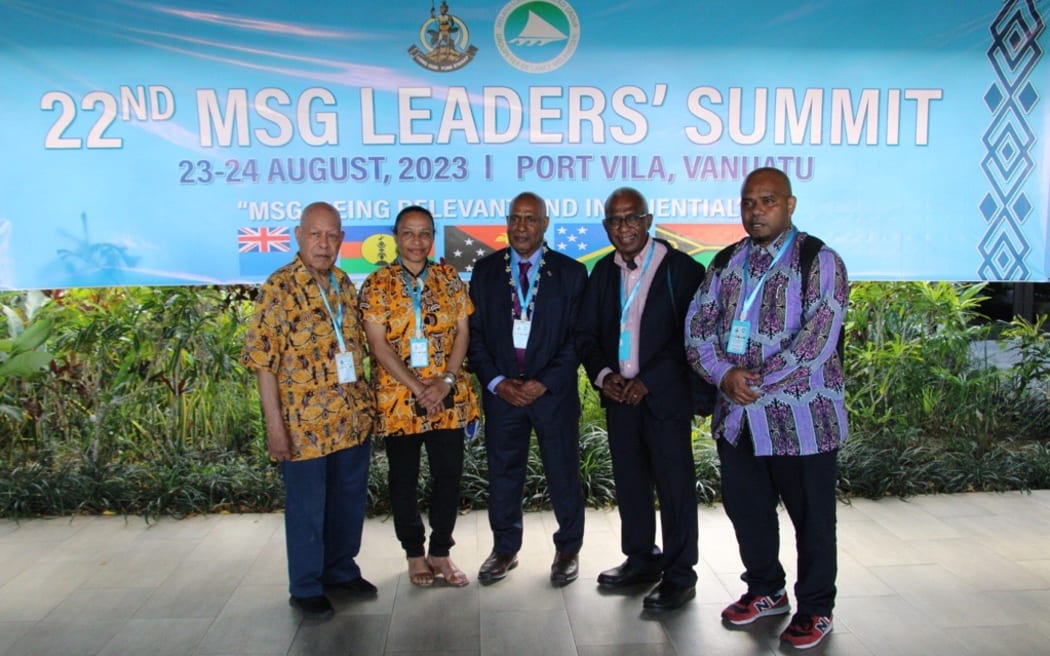
Vanuatu Daily Post civil society correspondents have written in unison condemning the failure of the Melanesian Spearhead Group to admit West Papua as full members of the organisation at last month’s leaders’ summit in Port Vila.

The Australia West Papua Association (AWPA) says that “it’s tragic that the MSG leaders did not respond” to the call of the Melanesian grassroots that took to the streets in support of West Papua memnbership.

“Many [West Papuans] were arrested, and beaten as they rallied peacefully,” wrote Joe Collins, spokesperson for AWPA, who was in Port Vila for the leaders’ summit.

“Free West Papua” criticised the “strategic move by Indonesia to sway opinion among Pacific island nations”.

“The fear is that this could be an attempt to showcase Indonesia in a positive light, downplaying the grave issues [of human rights violations] in West Papua.”

The letter also criticised a plan to open an Indonesian embassy in Vanuatu, cloaming such a move “could serve as a platform to exert influence and suppress the ongoing struggle for justice and freedom in West Papua”.

Some of the letters:

MSG has failed West Papua: Regenvanu
“It’s not just [Climate Change Minister Ralph] Regenvanu, who believes that the MSG failed West Papua at their summit. It’s every West Papuan and their supporters who also feel let down by the MSG leaders.

“Over the past few months in West Papua, the grassroots took to the streets showing support for the United Liberation Movement For West Papua (ULPWP’s) application and calling on the MSG to grant full membership to West Papua. Many were arrested, and beaten as they rallied peacefully.

“It’s tragic that the MSG Leaders did not respond to their call. Do the MSG leaders not read the reports of the ongoing human rights abuses in West Papua?

“If the MSG Leaders failed West Papua, the people of the Pacific and Vanuatu in particular do not. In the few days I spent in Port Vila, I saw support for West Papua everywhere.

“The West Papuan flag flying free and Free West Papuan stickers on walls. I was impressed with the support and kindness of the Vanuatu people and the Vanuatu Free West Papua Association who help keep the struggle alive.

“The West Papuan representatives, who had their own summit, showed a determined people committed to their freedom. Something the leaders of the region should note. The issue of West Papua is not going away.”

Joe Collins, Australia West Papua Association, Sydney, VDP, August 31, 2023

Indonesian funding

The ground-breaking ceremony for the Indonesian-funded ugrade of the VIP Lounge in Port Vila
The ground-breaking ceremony for the Indonesian-funded ugrade of the VIP Lounge at Port Vila’s Bauerfield Airport last month. Image: Vanuatu Daily Post

“The funding Indonesia is providing Vanuatu (VDP, August 24), is that a case of chequebook diplomacy to blunt Vanuatu’s solidarity with West Papua’s struggle against Indonesian colonial occupation and oppression?”

Rajend Naidu, Sydney, VDP, August 25, 2023

Indonesian ‘trail of violence’
“The chairman of the Vanuatu Free West Papua Association (VFWPA) delivered a poignant statement that resonates with the deep concerns shared by the people of Vanuatu.

“For over five decades, the Indonesian military’s actions in West Papua have left a trail of violence and human rights abuses. The chairman’s statement underscores the lasting impact of these killings and highlights the passionate support of Vanuatu for the people of West Papua.

“The Melanesian Arts Festival, a cultural celebration of the region’s diversity, became a stage for diplomatic tension as Indonesia’s uninvited presence raised eyebrows. The chairman’s remarks revealed a resolute belief that this unexpected appearance was not merely coincidental, but a strategic move by Indonesia to sway opinion among Pacific island nations.

“The fear is that this could be an attempt to showcase Indonesia in a positive light, downplaying the grave issues in West Papua.

“Moreover, Indonesia’s reported plans to open an embassy in Vanuatu raise further suspicions about their intentions.

“Concerns are mounting that such a move could serve as a platform to exert influence and suppress the ongoing struggle for justice and freedom in West Papua.

“The people of Vanuatu, however, remain steadfast in their support for their brothers and sisters in West Papua. Despite potential political and financial pressures, they refuse to turn a blind eye to the human rights violations that have plagued the region for far too long.

“The chairman’s statement reflects the sentiments of a nation determined to stand united against injustice.

“This unwavering support from Vanuatu is a testament to the power of solidarity among Pacific island nations. It sends a strong message to the international community that human rights and justice cannot be compromised for political gains or financial interests.

“The situation in West Papua demands attention, and the people of Vanuatu have vowed to be a voice for those who have been silenced.

“As the saga unfolds, the eyes of the world are on Vanuatu, watching how the nation navigates this delicate diplomatic dance. Their commitment to supporting West Papua’s quest for justice and freedom remains resolute, and they must navigate this situation with tact and conviction.

“In times of adversity, the bonds of brotherhood are tested, and Vanuatu has proven that their ties with West Papua go beyond borders. Their stance is a reminder that human rights violations should never be brushed aside or obscured by political maneuvers.

“It is a call for action, urging the global community to stand alongside Vanuatu and West Papua in their pursuit of justice.

“As we continue to witness the developments in this complex situation, the world awaits with bated breath to see how Vanuatu’s unwavering support for West Papua will unfold. Will their resolute determination inspire others to join their cause, or will political pressures prevail?

“Only time will tell, but one thing remains clear: the voices of Vanuatu and West Papua will not be silenced, and their pursuit of justice and freedom will persist until it is achieved.”

“Free West Papua”, VDP, July 29, 2023

Print Friendly, PDF & Email

Article by AsiaPacificReport.nz

Election 2023: Labour kicks off campaign with free dental promise

RNZ News

Labour has officially kicked off its Aotearoa New Zealand election 2023 campaign with a promise to extend free dental care to all those under 30.

The party is pitching the dental policy as beginning “the journey” towards universal free dental, while making provision for training more dentists over coming years.

Free dental care would cover annual check-ups, teeth cleaning, basic fillings and extractions; the government would prioritise 18 to 23-year-olds from July 2025, and then to those under 30 the following year.

At the moment free dental is available to those under 18.

Labour has recently rejected calls for universal free dental as being far too expensive. This policy is costed at $390 million over four years, reflecting the delay in implementing it fully until 2026, and limiting it to those under 30.

Once in place it would cover about 800,000 New Zealanders.

The cap on places for dental training would be increased by 50 percent.

High recorded costs
“New Zealand has some of the highest recorded rates of unmet need for adult dental care — overwhelmingly because of cost.

“In 2022 alone, 1.5 million Kiwis didn’t visit a dentist because it was just too expensive,” said Hipkins.

Today’s media conference.  Video: RNZ News

“Children and young people currently have access to free basic dental services but as soon as they turn 18, they face big bills and often drop out of the system.”

Hipkins said the age targets were because tooth decay tended to start in the 20s, and acting on them will help prevent health issues down the line.

By the end of next term, if Labour was re-elected, “nearly 40 percent of all Kiwis will have access to free dental care,” he said.

Hipkins said “successive Labour governments will expand the commitment based on workforce, healthcare capacity and fiscal settings”.

Health spokesperson Dr Ayesha Verrall said poor oral health had “a lasting impact on both mental and physical health and can lead to avoidable hospitalisations”.

‘Substantial step’
“The policy we’re announcing today is a substantial step towards Labour’s ultimate goal of universal dental care. It prioritises those most likely to put off dental care for financial reasons — young people.

“Labour knows such a fundamental change in our public health settings needs to be carefully designed,” she said.

“Choosing a start date of July 1 2025 means we have time to enable the sector to prepare, which is why we’re rolling out the policy in stages.”

Labour would “work collaboratively with health agencies, regulatory and professional bodies to make sure we have the oral health therapists, dental hygienists and dentists” the country needs, and increase the number of places in Bachelor of Dental Surgery course by 50 percent.

Hipkins said he had now announced eight parts of the Labour Party’s 10-point plan to tackle the cost of living crisis.

This article is republished under a community partnership agreement with RNZ.

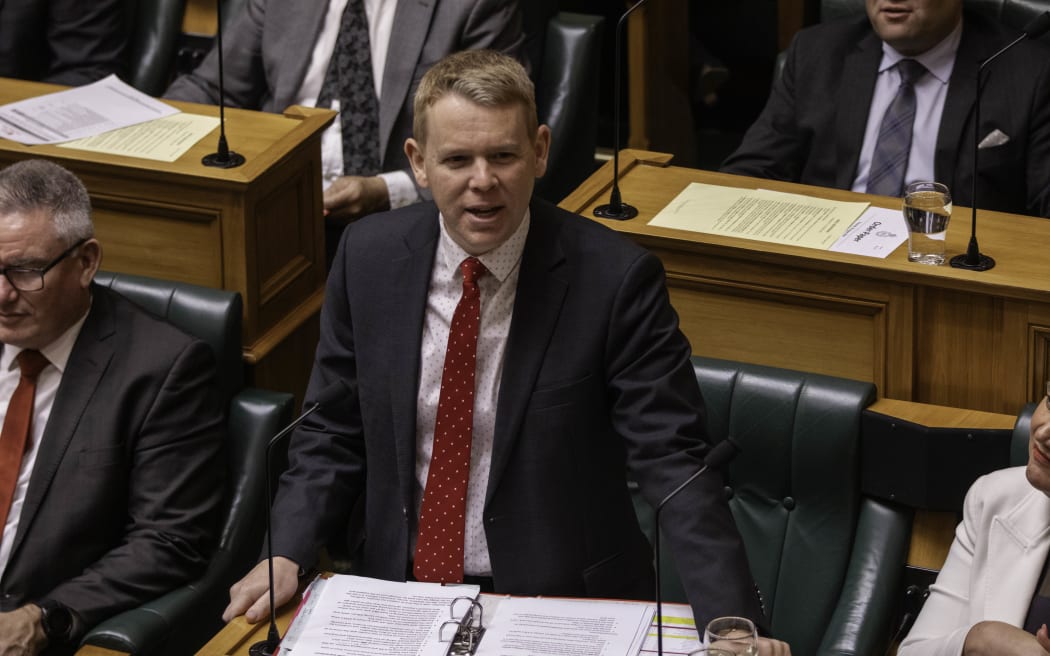
Labour Party leader Chris Hipkins (centre) greeting supporters at the party's campaign launch on 2 September, 2023.
Labour will “work collaboratively with health agencies, regulatory and professional bodies to make sure we have the oral health therapists, dental hygienists and dentists” the country needs. Image: RNZ/Craig McCulloch
Print Friendly, PDF & Email

Article by AsiaPacificReport.nz

Fiji’s Prasad reaches out to the NZ diaspora to help rebuild nation

By Venkat Raman, editor of Indian Newslink

Fiji is on the road to economic recovery and the government looks forward to the support and assistance of the Fijian diaspora in its progress, says Deputy Prime Minister and Finance Minister Professor Biman Prasad.

Inaugurating the Fiji Centre, an entity established at the premises of the Whānau Community Centre and Hub in Mount Roskill last night, Dr Prasad said that while the challenges faced by his administration were many, he and his colleagues were confident of bringing the economy back on track.

He said tourism was the first industry to recover after the adverse effects of the covid-19 pandemic, but foreign remittances by Fijians living overseas had been a major source of strength.

Dr Prasad was elected to the Fiji Parliament and is the leader of the National Federation Party, which won five seats in the current Parliament.

His NFP formed a Coalition government with Sitiveni Rabuka’s People’s Alliance Party and the Social Democratic Liberal Party (SODELPA).

The general election held on 14 December 2023 ousted former prime minister Josaia Voreqe Bainimarama and his FijiFirst Party.

Bainimarama took over the leadership after a military coup on 5 December 2006, but the first post-coup general election was not held until 17 September 2014.

Individual foreign remittances
“Tourism was quick to bounce back to pre-pandemic levels and personal remittances have been extremely helpful. The diaspora remitted about F$1 billion last year and I hope that the trend will continue,” Dr Prasad said.

He appealed to New Zealand-resident Fijians to also invest in Fiji.

“Fiji was under siege for 16 years and many suffered silently for fear of being suppressed and punished but that has changed with the election of the new Coalition government . . . The first law change was to amend the Media Industry Development Act which assures freedom of expression,” he said.

“Freedom of the media is essential in a democracy.”

Auckland's Fiji Centre
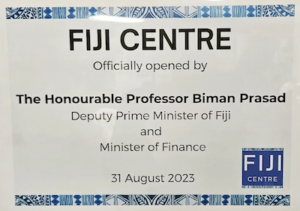
Formal opening of Auckland’s Fiji Centre . . . the inauguration plaque. Image: APR

Dr Prasad said that the pandemic was not the only reason for the state of the Fijian economy.

“Our economy was in dire straits. We inherited a huge debt of F$10 billion after 16 years of neglect, wasteful expenditure on non-priority items and total disregard for public sentiment,” he said.

“We believe in consultation and understanding the needs of the people. The National Business Summit that we organised in Suva soon after forming the government provided us with the impetus to plan for the future.”

Dr Prasad admitted that governments were elected to serve the people but could not do everything.

“We are always guided by what the community tells us. People voted for freedom at the . . . general election after an era of unnecessary and sometimes brutal control and suppression of their opinions,” he said.

“They wanted their voices to be heard, be involved in the running of their country and have a say in what their government should do for them.

“They wanted their government to be more accountable and their leaders to treat them with respect.”


Professor Biman Prasad’s speech at Auckland’s Fiji Centre. Video: Indian Newslink

Formidable challenges
Later, speaking to Indian Newslink, Dr Prasad said that the first Budget that he had presented to Parliament on 30 June 2023 was prepared in consultation with the people of Fiji, after extensive travel across the islands.

His Budget had set total government expenditure at F$4.3 billion, with a projected revenue of F$3.7 billion, leaving a deficit of F$639 million.

The debt to GDP ratio is 8.8 percent.

He said that education had the largest share in his budget with an allocation of F$845 million.

“This includes the write-off of F$650 million [in the] Tertiary Scholarship and Loan Service Debt of $650 million owed by more than 50,000 students.

“But this comes with the caveat that these students will have to save a bond. The bond savings will be years of study multiplied by 1.5, and those who choose not to save the bond will have to pay the equivalent cost amount,” he said.

Dr Prasad allocated F$453.8 million for health, stating that there would be a significant increase in funding to this sector in the ensuing budgets.

He said that the Fijian economy was expected to grow between 8 percent to 9 percent, revised from the earlier estimate of 6 percent since there is greater resilience and business confidence.

According to him, the average economic growth for the past 16 years has been just 3 percent, despite various claims made by the previous regime.

“We have promised to do better. We will stand by our commitment to integrity, honesty, accountability and transparency.

“The consultative process that we have begun with our people will continue and that would our community in countries like Australia and New Zealand,” he said.

He said that the Fiji diaspora, which accounted for about 70,000 Indo-Fijians in New Zealand and larger numbers in Australia, the United Kingdom, the United States of America and Canada, had the potential to support the rebuilding efforts of his government.

Engagement with trading partners
“Whenever I visit New Zealand, I like to spend more time with our community and listen to their views and aspirations.

“I invite you to return to Fiji and help in rebuilding our economy. We are in the process of easing the procedures for obtaining Fijian citizenship and passport, including a reduction in the fees.

“The future of Fiji depends on our communities in Fiji and across the world,” he said.

Dr Prasad that he and his government were grateful to the Australian and New Zealand governments which had provided aid to Fiji during times of need including the pandemic years and the aftermath of devastating cyclones.

“We want to re-engage with our traditional partners, including New Zealand, Australia, India, the USA, the UK and Japan (as a member of Quad),” he said.

Dr Prasad said that while both Australia and New Zealand had had long ties with Fiji, he had always been drawn towards New Zealand.

He said that his wife had completed her PhD at the University of Otago and that his children received their entire education, including postgraduate qualifications, in this country.

Dr Prasad is in New Zealand to meet the Fiji diaspora, including the business community.

He addressed a meeting of the New Zealand Fiji Business Council at the Ellerslie Convention Centre in Auckland today.

Republished with permission from Indian Newslink.

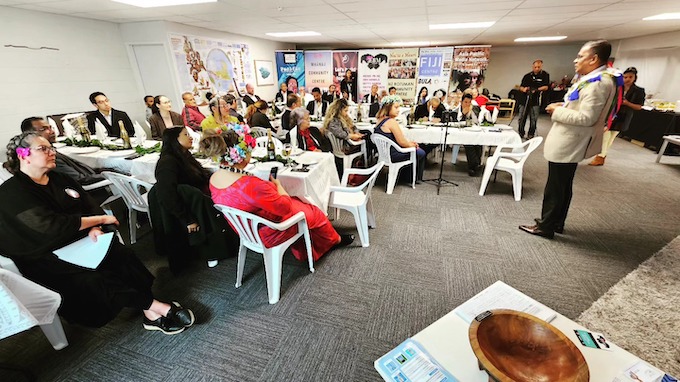
Fiji's Dr Prasad speaking at the Fiji Centre in Auckland last night
Fiji’s Dr Prasad speaking at the Fiji Centre in Auckland last night . . . While both Australia and New Zealand have had long ties with Fiji, Dr Prasad has always been drawn towards New Zealand. Image: David Robie/APR
Print Friendly, PDF & Email

Article by AsiaPacificReport.nz

The silent war – Australia and Indonesia mum on Papuan human right abuses

An Australian academic has lit the fuse of diplomatic fury by publicly criticising Indonesia’s brutal response to the Papuan independence movement, a sensitive topic for governments of both countries. Duncan Graham reports from Indonesia on the silent war to the north.

ANALYSIS: By Duncan Graham

An Australian academic is risking an eruption of diplomatic fury by publicly criticising Indonesia’s brutal response to the Papuan independence movement, a hypersensitive topic for the governments of both countries.

Queensland historian Dr Greg Poulgrain last month told a Jakarta seminar that the Indonesian government’s approach “has long been top-heavy, bureaucratic, clumsy and self-serving.

“The military arrived in 1962 and 60 years later they’re still there in strength . . . more troops there now than ever before.

“The NGO Kontras declared that 734 Papuans were killed in 2022. That’s two-and-a-half times the number of Palestinians killed by the Israeli army last year. And from (the Highland province) Nduga there were 60,000 refugees.”

His comments were made just as the West Papua independence movement failed to get Pacific Islands’ backing at a stormy meeting of the Melanesian Spearhead Group (MSG) in Vanuatu with an Indonesian delegation walk-out.

The bid was thwarted by an alleged “corrupt alliance” of member states apparently after pressure from Indonesia which is funding Vanuatu airport repairs (including the VIP lounge) worth A$1.47 million. More of this later.

A report of the Jakarta seminar, organised by the government research agency Baden Riset dan Inovasi Nasional (BRIN), was published in Indonesia’s leading newspaper Kompas. It ran to 830 words but never mentioned Dr Poulgrain or his comments, although he was the invited international guest speaker.

Australian government stays hush
An estimated 500,000 indigenous Papuans are alleged to have died in the past 50 years through Indonesian military action. But the Australian government stays hush.

Before she became Foreign Minister, Senator Penny Wong, wrote that Labor was distressed by “human rights violations” in West Papua. However, there is a “don’t touch” clause in a two-nation pact signed 17 years ago “to address security challenges”.

The Lombok Treaty binds Australia and Indonesia to mutually respect the “sovereignty, territorial integrity, national unity and political independence of each other”.

New England University academics Dr Xiang Gao and Professor Guy Charlton claim “non-interference” limits Australian responses “despite the domestic sympathy much of the Australian public has given to the West Papuan population”.

They quote a 2019 website post from Wong saying the treaty “remains the bedrock of security cooperation” between Australia and Indonesia.

Dr Poulgrain told his Jakarta audience that the military’s presence in Papua “has led to amazing problems.

“In the first 40 years, the Papuan death toll was horrendous. In 1983 the London-based Anti-Slavery Society sent me to check a report that Papuan under-fives in the Asmat district (South Papua) were dying like flies — six out of ten were dying. The report was correct.

Hardly any benefit at all
“We’re dealing with a people about whom very little effort to understand has been made. It has been claimed that the indigenous inhabitants of Papua should be grateful that so much money is spent . . . but the benefit they receive (as a percentage of the intended amount) is hardly any benefit at all.”

The Indonesian government says it has allocated more than Rp 1,036 trillion (A$106 million) in the past eight years for development (mainly roads) in a bid to appease self-government demands. That’s a tiny sum against the income.

The Grasberg mine in Central Papua has “proven and probable reserves of 15.1 million ounces of gold”. If correct that makes it the world’s biggest gold deposit.

It is run by PT Freeport Indonesia, a joint venture between the Indonesian government and the US company Freeport-McMoRan.

Dr Poulgrain claims gross revenue from the mine last year was about A$13 billion:

“We can be sure that the immense wealth of gold was a crucial influence on the sovereignty dispute in the 1950s and still influences the politics of Papua and Indonesia today.”

Despite the riches, Papua is reportedly one of the least developed regions in Indonesia, with poverty and inequality levels up to three times above the national average of 9.5 percent, as calculated by the Asian Development Bank.

In 1962 control of the Western half of the island of New Guinea, formerly part of the Dutch East Indies, was temporarily run by the UN. In 1969 it was ceded to Indonesia after a referendum when 1025 “leaders” hand-picked by the Indonesian military voted unanimously to join Jakarta.

‘Act of No Choice’
It was labelled an Act of Free Choice; cynics called it an “Act Free of Choice”, of “Act of No Choice”.

Historian Dr Emma Kluge wrote: “West Papuans were denied independence also because the UN system failed to heed their calls and instead placed appeasing Indonesia above its commitment to decolonisation and human rights.”

Pro-independence groups have since been fighting with words at the UN and at first with spears and arrows in the Highland jungles. Some now carry captured modern weapons and have been ambushing and killing Indonesian soldiers and road workers, and suffering casualties.

In February the West Papua National Liberation Army (TPNPB), the armed section of the umbrella Organisasi Papua Merdeka (OPM, Papua Freedom Organisation), kidnapped NZ pilot Philip Mehrtens and demanded independence talks for his release.

After searching for six months the Indonesian military (TNI) has so far failed to free the Kiwi.

The OPM started gaining traction in the 1970s. Indonesia has designated it a “terrorist group” giving the armed forces greater arrest and interrogation powers.

Amnesty International claimed this showed Indonesia’s “lack of willingness to engage with the real roots of the ongoing conflict”, although it failed to pick apart the “roots” or offer practical solutions.

Journalists are banned
Communications in the mountains are tough and not just because of the terrain. Cellphone signals could lead to discovery. Journalists are banned. Requests for entry by this correspondent were given verbal OKs but are now ignored.

The only news comes from Christian pastors smuggling out notes, and statements from different West Papua freedom movement factions like the United Liberation Movement for West Papua (ULMWP).

This is chaired by Benny Wenda who lives in exile in the UK. In 2003, he was granted political asylum by the British government after fleeing Indonesia while on trial for leading an independence procession.

He has not backed the kidnapping of Mehrtens. The pro-independence movement’s failure to speak with one voice exposes their weakness.

Earlier this year, Wenda was in Fiji where Prime Minister Sitiveni Rabuka pledged support and more recently Vanuatu has been seeking support for Papua independence through the Melanesian Spearhead Group formed in 1998.

The lobbying is angering Jakarta, a major donor to the region. Papuans identify as Melanesians and are mainly Christian. The Indonesian delegation walked out in Port Vila when Wenda got up to speak.

Indonesia’s deputy Foreign Minister Pahala Mansury was quoted as saying: “Indonesia cannot accept that someone who should be responsible for acts of armed violence in Papua, including kidnappings, is given the opportunity to speak at this honourable forum.”

‘The world is watching’ – it’s a test for Melanesian leaders over West Papua, says Wenda

Could not reach consensus
The ABC reported that the leaders could not reach a consensus, but Wenda told Radio NZ he was confident the ULMWP would eventually get full membership: “The whole world is watching and this is a test for the leadership to see whether they’ll save West Papua”.

PNG’s National Capital District Governor Powes Parkop told Asia Pacific Report: “I am totally disappointed in the failure of the MSG leaders to seize the opportunity to redefine the future of West Papua and our region.

“Fear of Indonesia and proactive lobbying by Indonesia again has been allowed to dominate Melanesia to the detriment of our people of West Papua.”

Curiously Indonesia is an associate member of the MSG though the republic is dominated and led by Javanese. Around two million (0.7 percent) Papuans are Indonesian citizens.

Dr David Robie, NZ-based publisher of Asia Pacific Report, responded: “The MSG has thrown away a golden chance for achieving a historical step towards justice and peace in West Papua by lacking the courage to accept the main Papuan self-determination advocacy movement as full members.

‘Terrible betrayal’
“Many see this as a terrible betrayal of West Papuan aspirations and an undermining of Melanesian credibility and solidarity as well as an ongoing threat to the region’s security and human rights.”

Wenda is not the only emigre: Prize-winning Indonesian human rights lawyer Veronica Koman is wanted by the Indonesian police for allegedly speaking out on violence in Papua.

Like Wenda, she says she does not support hostage-taking.

Koman lives in Australia, works with Amnesty International and says she gets death threats. Her parents’ house in Jakarta has reportedly been stoned.

Just like The Hague’s handling of Indonesian anti-colonialists in the 1945-49 Revolutionary War, Jakarta’s policy has been force. Protesters are dehumanised, tagged as “criminals” or “terrorists”, however mild their involvement, an ancient tactic in warfare making it legally easier to shoot than arrest.

The pro-independence cause gets little sympathy from Indonesians in other provinces. Papuan students in Java have been attacked and suffered racial abuse. Anyone caught flying the Morning Star flag of independence risks 15 years in jail.

Vice-President Ma’ruf Amin has urged the military to “get tough”. At a Jakarta ceremony in June, former President Megawati Soekarnoputri was quoted as saying: ‘”If I were still a commander, I would deploy the number of battalions there. That’s cool, right?”

Battalions will not solve the problem
No, said Dr Poulgrain: “The history of the Papuan people that has become the norm is not correct. This is still a problem today. It’s our perception that’s the problem. Adding battalions will not solve the problem today.”

Dr Poulgrain is a specialist in Indonesian history and an adjunct fellow at the University of the Sunshine Coast and Malang State University in East Java. His interest in Papua goes back to his student years as a backpacker exploring the archipelago.

Dr Poulgrain said his involvement in the debate was as an independent historian seeking a peaceful settlement. After speaking in Jakarta he flew to Jayapura to address a seminar at the Papua International University.

In 1999, when Megawati was vice-president (she is now the chair of BRIN), he was invited to a meeting on Papua with 10 of her advisors:

“They said to me, quite frankly, Papua was a problem they did not know how to solve. I suggested vocational training schools. We started — but the whole educational project stopped when the East Timor referendum established independence. Times haven’t changed.”

In 2018, activists delivered a petition to the UN with 1.8 million signatures demanding an independence referendum. That has gone nowhere. Instead, Jakarta has split West Papua into six provinces supposedly to give locals more say, but to no real effect.

Bolder stance unlikely
An analysis by the Washington-based Centre for Strategic and International Studies concludes:

“As the US and Australia continue to support Indonesia’s sovereignty and territorial integrity in Papua, both administrations are unlikely to take bolder stances.

“International action in the situation is likely to remain limited to the Pacific Islands . . .  Separatist violence, having shown its resiliency to Indonesia’s attempts to control the region, is thus likely to continue.’

Duncan Graham has been a journalist for more than 40 years in print, radio and TV. He is the author of People Next Door: Understanding Indonesia (UWA Press) and winner of the Walkley Award and human rights awards. He lives in East Java and is now writing for the English language media in Indonesia on a permanent resident visa with work rights. This took five years to get using sponsorship through his Indonesian wife. He contributes to Asia Pacific Report and this article was first published by Michael West Media and is republished with permission.

Print Friendly, PDF & Email

Article by AsiaPacificReport.nz

Australia tops the world for podcast listening. Why do we love them so much?

Source: The Conversation (Au and NZ) – By Dylan Bird, PhD candidate, University of Tasmania

Shutterstock

“We’re here because this moment demands an explanation.”

So begins the first ever episode of New York Times’ The Daily podcast, delivered by host Michael Barbaro in his now famous style. It arrived on Wednesday February 1, 2017 – less than a fortnight after Donald Trump’s inauguration as President of the United States.

By the end of Trump’s term, it was wildly popular, reportedly attracting some four million daily downloads and referred to as the newspaper’s “new front page”.

The Daily’s success inspired many other news outlets to develop podcasts, including in Australia, with the likes of ABC’s The Signal (since replaced by ABC News Daily), Schwartz Media’s 7am, and Guardian Australia’s Full Story launching from 2018.

According to 2023 data from The Infinite Dial – which tracks digital media use internationally – Australia has now surpassed the US to be a world leader in podcast listening, with 43% of the population aged 12 and over having listened to a podcast in the past month.

Australia also has the third highest rate of news podcast listening, behind the US and Sweden, with 14% of news consumers listening to news podcasts in the past month.

Despite these trends, there’s been limited research on news podcast listening in Australia. My recent research, published in June, found news podcast listeners in Australia tend to be politically left-leaning, wealthier, and more highly educated than average.

I also found they tend to be politically active, and value news podcasts for enabling them to better participate in democratic life.

Interestingly, listeners didn’t appear to trust podcasts more than other forms of news in general, with 61.1% reporting “the same” level of trust. However, they reported a high level of trust in news they choose to consume.

The rise of news podcasts happened amid a volatile political climate. In 2023, as Trump prepares for another run for president, and with a political storm brewing in Australia as we approach a referendum on an Indigenous Voice to parliament, there are good reasons to consider the role this podcast genre plays in democracy.


Read more:
Michelle Obama, podcast host: how podcasting became a multi-billion dollar industry


From radio to podcast news

Radio news developed slowly following the invention of mass broadcasting in the early 1920s. It began with announcers reading press agency reports on air, giving rise to an authoritative and detached presenting style, reflecting the journalistic value of objectivity. While formats have differed, this has characterised radio news for much of its history.

Podcasting emerged in the early 2000s out of the disruption caused by the internet, and particularly the ability of users to generate and share content.

The lack of time constraints compared to radio meant podcast episodes could go for any length. And because they could be downloaded, listeners could engage with content in their own time, on their own terms.

Slate’s Political Gabfest (2005-) was one of the first “native” podcasts – that is, produced specially for digital consumption – exploring news and politics. But it wasn’t until 2014, with podcasting’s breakout moment in true-crime sensation Serial, that news podcasts began to take off.

The Daily grew out of the New York Times’ election podcast The Run-Up. It pioneered the format known as the “daily deep dive” – defined by the Reuters Institute as “heavily produced using sound design and narrative storytelling techniques”.

Many news podcasts since have similarly deployed narrative storytelling and immersive sound design to explore issues in the news. This has been championed as offering a more “human” approach to the news, featuring personal presenting styles and the harnessing of emotion.

Media fragmentation and politics

Reuters’ 2023 Digital News Report notes how in the podcasting sphere “news jostles for attention with lifestyle and specialist shows”. This may explain the degree of ambivalence around trust in news podcasts, with a wide variety of offerings categorised as “news” in podcast players such as Apple Podcasts.

Podcasting is difficult to regulate, and there’s a risk of the medium being used to spread dangerous messages, as has happened across social media generally.


Read more:
Misinformation is rife and causing deeper polarisation – here’s how social media users can help curb it


In his new book, Bruce Wolpe, Senior Fellow at the United States Studies Centre, considers what a second Trump presidency would mean for Australia. He notes the corrosive influence of Trump and his Fox News acolytes on public trust, and warns that Australia should prepare for an emboldening of the populist right-wing sentiment that accompanied his rise on the political scene.

In the face of this, independent and rigorous journalism, supported by a well-funded ABC, has an important role to play.

As my study highlights, it’s important to acknowledge news podcast listeners tend to be from the higher social classes. There’s an impetus, then, to ensure coverage includes the perspectives of those who might not otherwise be well represented across the media sphere.

This has particular importance in relation to issues like the upcoming referendum, with a risk of it being used to fan the flames of culture wars.


Read more:
Who is Joe Rogan, and why does Spotify love him so much?


At their best, news podcasts can engage us meaningfully in important issues, transporting us to unexpected places and highlighting the human impact at the heart of news stories, supported by facts and informed analysis.

With Australians among the most active news podcast listeners globally, there’s reason to have hope they can play a productive role in helping us navigate politically uncertain times.

The Conversation

Dylan Bird receives funding through an Australian Government Research Training Program Scholarship.

ref. Australia tops the world for podcast listening. Why do we love them so much? – https://theconversation.com/australia-tops-the-world-for-podcast-listening-why-do-we-love-them-so-much-208937

Future diets will be short of micronutrients like iron — it’s time to consider how we feed people

Source: The Conversation (Au and NZ) – By Mahya Tavan, Postdoctoral research fellow – Sustainable Nutrition Initiative, Massey University

Getty Images

Iron deficiency is one of the most common forms of nutrient deficiency around the world.

Severe iron deficiency, also known as anaemia, affects nearly 50% of women of reproductive age in regions like South Asia, Central Africa and West Africa (in contrast to 16% of women in high-income countries).

In New Zealand, 10.6% of women aged 15-18 and 12.1% of women aged 31-50 suffer from iron deficiency. The risk increases during the third trimester of pregnancy, and the iron status must be carefully monitored to ensure good health for both the mother and baby.

As more people consider switching to plant-based diets, the risk of iron deficiency will likely increase.

Our modelling of nutrient availability in current and future global food systems also suggests we can expect a gap in dietary iron by 2040 if global patterns of food production and supply remain unchanged.

This means we’ll have to address iron shortfalls in our diet, especially in populations with higher requirements such as adolescents and women. We argue that fortifying foods with iron could provide a one-stop solution to bridge nutrient gaps caused by inadequate dietary intake.


Read more:
Low iron is a health risk made worse by COVID. How to get more without reaching for supplements


Food fortification

Many foods in supermarket shelves, including common staples such as bread and cereals, already have added nutrients.

Unlike mandatory iodine and folic acid fortification of bread, there is currently no government initiative to encourage or mandate iron fortification in New Zealand.

Since iron-fortification strategies have the potential to prevent deficiencies in many countries, including New Zealand, we argue that introducing iron to our foods may be a convenient and cost-effective way to provide a source of dietary iron.

A bowl of vegan foods
New Zealand has seen a 19% increase in the adoption of vegan and vegetarian diets.
Getty Images

Shift to plant-based diets

More consumers are opting for diets that include fewer animal-sourced foods in the hope of reducing environmental impacts and emissions. Recent statistics show a 19% increase in the adoption of vegan and vegetarian diets among New Zealanders from 2018 to 2021.

Considering these plant-based diets for a sustainable food system must involve conversations about nutrient availability. Plant foods often contain high amounts of fibre and phytates, which reduce the body’s capacity to absorb the iron.

Iron in plant foods such as whole grains, nuts, seeds, legumes and leafy greens is known as non-heme and is less readily absorbed than heme iron in animal-sourced foods. In a mixed diet, consisting of vegetables, grains and animal-sourced foods, the consumption of some red meat, fish or poultry facilitates non-heme iron absorption.


Read more:
What to drink with dinner to get the most iron from your food (and what to avoid)


Fortification can be a potent strategy in helping people to shift towards plant-based diets by enriching these diets with nutrients that would otherwise be lacking.

A recent study investigating this potential revealed that fortifying foods with essential micronutrients, including iron, enables a more gradual dietary adjustment. Consumers wishing to adopt more plant-based diets without compromising nutrient adequacy may find this approach helpful.

However, there’s a caveat. These iron-fortified foods often contain wheat or cereal-based ingredients, which can act as iron absorption inhibitors. As these are common breakfast foods that may be consumed with a morning coffee or tea, the inhibition effect may be even stronger due to the presence of phenolic compounds in these beverages.

One solution could be to eat iron-rich plant foods with foods high in vitamin C, such as orange juice, which helps to convert iron to a more absorbable form.

Is NZ ready for iron-fortified foods?

Although fortified foods can offer great benefits in tackling iron deficiency, some consumers are hesitant to include these foods in their diets.

Food Standards Australia New Zealand (FSANZ), a government entity responsible for developing food regulations for both nations, found many consumers had second thoughts about reaching for fortified foods, viewing them as unnatural, processed and less healthy.

This hesitancy was particularly evident when it came to non-mandatory fortifications. Added vitamins and minerals in breakfast cereals or, more recently, in plant-based milks and meat alternatives, are examples of non-mandatory or “voluntary fortification”. Consumers often perceive this as a marketing tactic rather than a health-promoting intervention.

Given the importance of adequate dietary iron intake and the projected shortage in dietary iron, it is crucial to evaluate the benefits of fortification. Educational interventions such as promoting awareness of iron deficiency and positive impacts of fortification may help improve consumers’ acceptance of these initiatives.

The Conversation

Mahya Tavan receives funding from the Global Dairy Platform for developing a dietary optimisation model called The iOTA Model.

Bi Xue Patricia Soh does not work for, consult, own shares in or receive funding from any company or organisation that would benefit from this article, and has disclosed no relevant affiliations beyond their academic appointment.

ref. Future diets will be short of micronutrients like iron — it’s time to consider how we feed people – https://theconversation.com/future-diets-will-be-short-of-micronutrients-like-iron-its-time-to-consider-how-we-feed-people-212355

Our modelling suggests future diets will be short of micronutrients like iron — it’s time to consider how we feed people

Source: The Conversation (Au and NZ) – By Mahya Tavan, Postdoctoral research fellow – Sustainable Nutrition Initiative, Massey University

Getty Images

Iron deficiency is one of the most common forms of nutrient deficiency around the world.

Severe iron deficiency, also known as anaemia, affects nearly 50% of women of reproductive age in regions like South Asia, Central Africa and West Africa (in contrast to 16% of women in high-income countries).

In New Zealand, 10.6% of women aged 15-18 and 12.1% of women aged 31-50 suffer from iron deficiency. The risk increases during the third trimester of pregnancy, and the iron status must be carefully monitored to ensure good health for both the mother and baby.

As more people consider switching to plant-based diets, the risk of iron deficiency will likely increase.

Our modelling of nutrient availability in current and future global food systems also suggests we can expect a gap in dietary iron by 2040 if global patterns of food production and supply remain unchanged.

This means we’ll have to address iron shortfalls in our diet, especially in populations with higher requirements such as adolescents and women. We argue that fortifying foods with iron could provide a one-stop solution to bridge nutrient gaps caused by inadequate dietary intake.


Read more:
Low iron is a health risk made worse by COVID. How to get more without reaching for supplements


Food fortification

Many foods in supermarket shelves, including common staples such as bread and cereals, already have added nutrients.

Unlike mandatory iodine and folic acid fortification of bread, there is currently no government initiative to encourage or mandate iron fortification in New Zealand.

Since iron-fortification strategies have the potential to prevent deficiencies in many countries, including New Zealand, we argue that introducing iron to our foods may be a convenient and cost-effective way to provide a source of dietary iron.

A bowl of vegan foods
New Zealand has seen a 19% increase in the adoption of vegan and vegetarian diets.
Getty Images

Shift to plant-based diets

More consumers are opting for diets that include fewer animal-sourced foods in the hope of reducing environmental impacts and emissions. Recent statistics show a 19% increase in the adoption of vegan and vegetarian diets among New Zealanders from 2018 to 2021.

Considering these plant-based diets for a sustainable food system must involve conversations about nutrient availability. Plant foods often contain high amounts of fibre and phytates, which reduce the body’s capacity to absorb the iron.

Iron in plant foods such as whole grains, nuts, seeds, legumes and leafy greens is known as non-heme and is less readily absorbed than heme iron in animal-sourced foods. In a mixed diet, consisting of vegetables, grains and animal-sourced foods, the consumption of some red meat, fish or poultry facilitates non-heme iron absorption.


Read more:
What to drink with dinner to get the most iron from your food (and what to avoid)


Fortification can be a potent strategy in helping people to shift towards plant-based diets by enriching these diets with nutrients that would otherwise be lacking.

A recent study investigating this potential revealed that fortifying foods with essential micronutrients, including iron, enables a more gradual dietary adjustment. Consumers wishing to adopt more plant-based diets without compromising nutrient adequacy may find this approach helpful.

However, there’s a caveat. These iron-fortified foods often contain wheat or cereal-based ingredients, which can act as iron absorption inhibitors. As these are common breakfast foods that may be consumed with a morning coffee or tea, the inhibition effect may be even stronger due to the presence of phenolic compounds in these beverages.

One solution could be to eat iron-rich plant foods with foods high in vitamin C, such as orange juice, which helps to convert iron to a more absorbable form.

Is NZ ready for iron-fortified foods?

Although fortified foods can offer great benefits in tackling iron deficiency, some consumers are hesitant to include these foods in their diets.

Food Standards Australia New Zealand (FSANZ), a government entity responsible for developing food regulations for both nations, found many consumers had second thoughts about reaching for fortified foods, viewing them as unnatural, processed and less healthy.

This hesitancy was particularly evident when it came to non-mandatory fortifications. Added vitamins and minerals in breakfast cereals or, more recently, in plant-based milks and meat alternatives, are examples of non-mandatory or “voluntary fortification”. Consumers often perceive this as a marketing tactic rather than a health-promoting intervention.

Given the importance of adequate dietary iron intake and the projected shortage in dietary iron, it is crucial to evaluate the benefits of fortification. Educational interventions such as promoting awareness of iron deficiency and positive impacts of fortification may help improve consumers’ acceptance of these initiatives.

The Conversation

Mahya Tavan receives funding from the Global Dairy Platform for developing a dietary optimisation model called The iOTA Model.

Bi Xue Patricia Soh does not work for, consult, own shares in or receive funding from any company or organization that would benefit from this article, and has disclosed no relevant affiliations beyond their academic appointment.

ref. Our modelling suggests future diets will be short of micronutrients like iron — it’s time to consider how we feed people – https://theconversation.com/our-modelling-suggests-future-diets-will-be-short-of-micronutrients-like-iron-its-time-to-consider-how-we-feed-people-212355

The humble spotted gum is a world class urban tree. Here’s why

Source: The Conversation (Au and NZ) – By Gregory Moore, Senior Research Associate, School of Ecosystem and Forest Sciences, The University of Melbourne

Shutterstock

Most of us find it very difficult to identify different species of eucalypt. You often hear people say they all look the same.

Of course, they don’t. There are over 700 species of the iconic tree genus, and they can be very different in form, height, flowers and colours.

With all this variety, it’s nice to have a few species we can identify from metres away, just from looking at the colours and patterns of the bark on the trunk. The spotted gum is one of these instantly recognisable eucalypts.

You may well have seen a spotted gum growing happily on an urban street. These smooth-barked eucalypts have been planted up and down many suburban streets.

In fact, if the spotted gum has a secret superpower, it would be the ability to fit into our cities with a minimum of fuss. They’re big trees, and produce vast quantities of blossoms, attracting nectar-eaters like rainbow lorikeets in droves. They grow easily, grow straight and grow tall.

Why are spotted gums special?

Spotted gum used to be called Eucalyptus maculata. Now it’s officially Corymbia maculata after a name change about 25 years ago. Some people still debate this.

It was probably the trunk and bark of these trees which first caught your eye. These trees replace their bark seasonally, but not all at once. Instead, bits of the bark are shed and new bark grows at different rates. That leaves the famous spots on their trunks (maculatus is Latin for spotted).

Early in the growing season some of these spots can be a bright green before fading to tans and greys over the coming months. Many patterns can be stunningly beautiful.

These trees are loved by many. But there are sceptics. Some feel the trees can be a nuisance, and even dangerous because of the bark and branches they shed. There is some truth to it, as they can drop branches during droughts. Interestingly, these hardwood trees are actually considered fire resistant.

But there are very good reasons our city planners and councils turn to the spotted gum. Their wonderfully straight, light coloured and spotted trunks are impressive whether trees are planted singly, in avenues (meaning two rows of trees) or in boulevards (four rows of trees).

They often get to an impressive 30–45 metres in height. Old trees can get over 60m.

During profuse flowering, anthers (the pollen-bearing part of the stamen) shed from a single tree can cover the ground, paths, homes, roads and vehicles in a white snow-like frosting.

In nature, the spotted gum and close relatives, the lemon scented gum (C. citriodora) and large leafed spotted gum (C. henryii) grow along the east coast of Australia, from far eastern Victoria to southern Queensland. In New South Wales forests, you might be lucky enough to spot the pairing of spotted gums and native cycads (Macrozamia), ancient plants resembling palms.

spotted gum leaves and flowers
Every few years, spotted gums flower profusely.
Shutterstock

Spotted gums are quick growing and hardy, if a little frost-sensitive when young. They can tolerate periods of waterlogged soil. These traits make the species well suited to urban use, where disturbed and low-oxygen soils are common due to paving, compaction and waterlogging.

Urban trees have to be able to establish quickly and with relatively little care. They need to cope with environmental stresses and very poor quality urban soils. They need tall straight trunks so people and vehicles can pass under them, and so our cities keep their clear sight lines.

But we also want street trees to have broad, spreading canopies with a dense green foliage, to give shade, privacy and beauty.

As you can see, it’s a tough set of requirements. The spotted gum meets all of these. In fact, it has the potential to be one of the great urban tree species, not just in Australia but internationally.


Read more:
Climate change threatens up to 100% of trees in Australian cities, and most urban species worldwide


Resilient trees for the future climate

Spotted gums are tough. On urban streets in many parts of Australia, they will endure as the climate changes – possibly for decades or even centuries. They possess both lignotubers, the protective swelling at the base of the trunk, and epicormic buds, which lie dormant under the bark in readiness for fire and other stresses. These let the trees cope well with the abuses urban life can throw at them.

spotted gum trunk
You might notice the mottled bark first.
Shutterstock

Horticulturalists have been working to make the tree even better suited to urban use. Careful selection has created spotted gum varieties geared towards dense, spreading canopies and with reduced risk of dropping branches.

But not all spotted gums you see are like this. These varieties were uncommon or didn’t exist 50 years ago, which means old urban trees might be more likely to shed limbs or have less attractive forms.

These trees are survivors. Near Batemans Bay in New South Wales lives Old Blotchy, the oldest known spotted gum. It’s estimated to be 500 years old.

Some urban trees are already 150 years old and in fine condition. Planting good quality spotted gums in a good position is a way to leave a lasting legacy.

As climate change intensifies, city planners are looking for resilient street trees able to provide cooling shade in a hotter climate. They could do a lot worse than choosing C. maculata.


Read more:
Without urgent action, these are the street trees unlikely to survive climate change


The Conversation

Gregory Moore does not work for, consult, own shares in or receive funding from any company or organisation that would benefit from this article, and has disclosed no relevant affiliations beyond their academic appointment.

ref. The humble spotted gum is a world class urban tree. Here’s why – https://theconversation.com/the-humble-spotted-gum-is-a-world-class-urban-tree-heres-why-212540

PNG capital’s Bomana jail full – refusing any new prisoners

PNG Post-Courier

Bomana jail, the main prison near Papua New Guinea’s capital city of Port Moresby, is not accepting new prisoners due to overcrowding.

The jail currently holds more than 800 inmates. It can no longer accept new prisoners.

Last Friday, an unreported incident involved several remanded inmates taken to Bomana jail being sent back to Port Moresby for police to ‘take care of the problem”.

Chief jailer Stephen Pokanis confirmed yesterday, that the management had requested police and courts to use their discretion to grant bail to offenders classified as low risk and attending court hearings.

“That is the avenue we are looking at now because Bomana is just like other jails — experiencing overcrowding — and that is the best option we can use for police and court to help us,” Pokanis said.

Several incidents of break outs from overcrowded PNG prisons have been reported this year.

Bomana management will have classified low risk prisoners out of the high maximum-security unit in order for them to be transferred out to a low minimum-security unit, creating space for incoming remanded prisoners.

Correctional Service Employee Association president Daniel Mollen said yesterday it was
sad that while financial constraints were hitting the country and the Correctional Service, a frontline department mandated for correcting and reforming prisoners, no adequate budgetary funding had been made to increase manpower capacity, update the aged jail facilities, and mitigate any risk of the breakout.

He said government must take note that all prisons in the country were overcrowded and police could not keep prisoners in their cells so they transferred them to prison while waiting for court hearings, adding responsibility in terms of cost and risk.

Print Friendly, PDF & Email

Article by AsiaPacificReport.nz

How do we get urban density ‘just right’? The Goldilocks quest for the ‘missing middle’

Source: The Conversation (Au and NZ) – By Elek Pafka, Senior Lecturer in Urban Planning and Urban Design, The University of Melbourne

What would Goldilocks do if given the chance to pick the “just right” density for our cities? Depends who you ask.

Debates over densities in our cities divide between advocates of low-rise detached housing and supporters of higher-density towers. Both offer little diversity. In Australian cities, but also in North America, we see a clear contrast between ground-scraping suburbs and clusters of CBD skyscrapers.

The combination of these two patterns of development has produced largely car-dependent cities. Commute times are long and carbon emissions high. Options are limited for those who wish to live in a neighbourhood with corner shops, short walking distances to a local centre, communal green space and public parks.

Neighbourhoods like this are enabled by mid-rise (three to seven storeys), mid-density housing. This form of building has been dubbed the “missing middle”. Decades of planning for urban consolidation has made little difference – medium density is still missing in many of our cities.


Source: X – read more


Read more:
Houses and high-rises (and nothing in between): why land zoning hasn’t been effective for improving urban density


Lack of clarity bedevils density debates

In debates about urban density, there’s often a confused mix of different conceptions and measures of density. For example, the widely used measure of dwellings per hectare conflates building and population densities, capturing neither with precision. Often such debates don’t consider basic distinctions such as those between building and population densities, residential and job densities, internal and external densities (inside and outside buildings), measured and perceived densities.

A census can easily capture residential night-time population densities. However, fluctuating daytime densities cannot be measured accurately. Building densities can be accurately measured as floor area ratio (FAR, the total floor area of buildings divided by the total site area) but this is rarely applied.

Metrics are often heavily biased by inconsistent reference areas. What spatial scales matter for which desired outcome is seldom questioned.

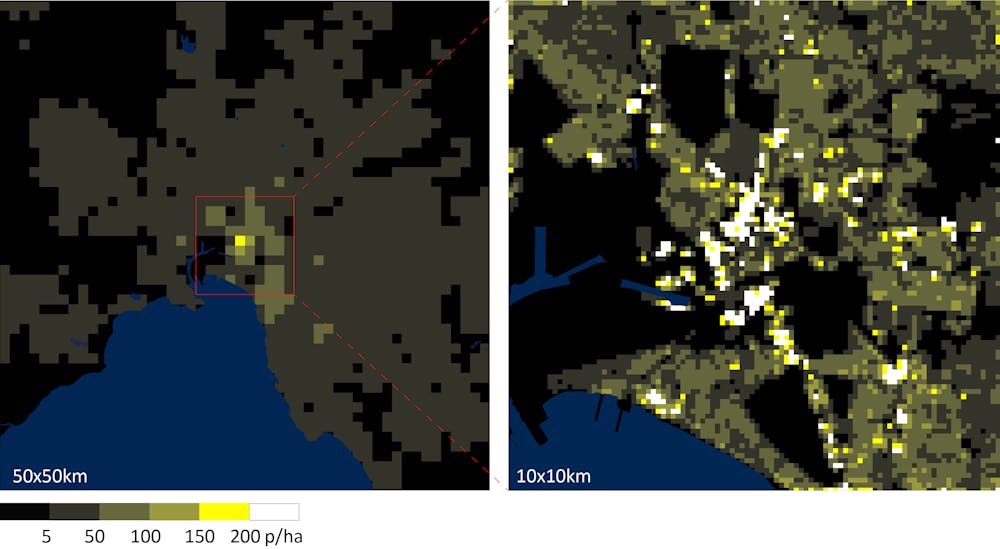
For example, a reference area of about 1 square kilometre is relevant for a walkable neighbourhood. Our perceptions of densities depend on the spatial reach of our senses, mostly up to 100 metres. These include the visual sense of enclosure, the diversity and quality of the public-private interfaces, street layouts, trees and other vegetation.

Gross residential densities (people per hectare) in Melbourne at 1x1km walkable neighbourhood scale and 100x100m experiential scale.
Pafka 2022

If experts are unable to accurately measure urban densities, how can we expect everyone else to understand?


Read more:
Urban density matters – but what does it mean?


Buzzwords don’t solve the problem

With confusions persisting, the stigmatisation of urban density, meaning for many “too dense”, persists. This tendency has been often countered through linguistic attempts to reframe the term.

For example, in Vancouver, Canada, the urbanist Brent Toderian has been calling for “density done well”. This term has been adopted in Melbourne too. Other terms include “Goldilocks density” – “not too high, not too low, but just right” – “optimal-quality density” and “EcoDenCity”.

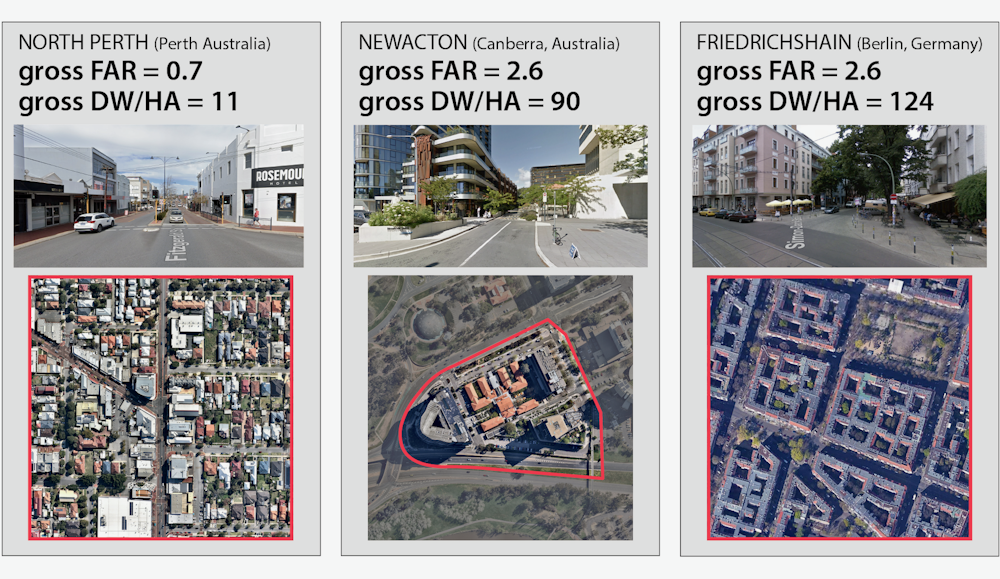
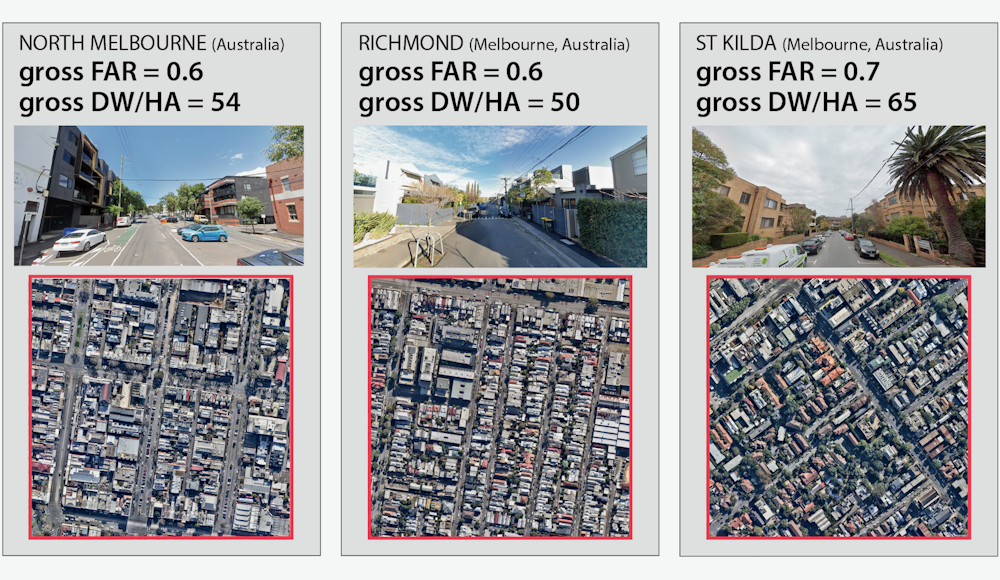
But these are vaguely defined terms that can mean many things to different people. Our research shows that planning professionals in Melbourne associate “density done well” with neighbourhoods as different as North Perth, Western Australia, and Friedrichshain in Berlin. Their gross floor area ratios range from 0.7 to 4.3.

Put simply, “good” density is not limited to ratio of buildings to space. And it’s prone to change over time.

Three neighbourhood examples of 'density done well' provided by planning professionals in Melbourne.
Three neighbourhood examples of ‘density done well’ provided by planning professionals in Melbourne.
By Merrick Morley, based on GoogleEarth and StreetView


Read more:
People love the idea of 20-minute neighbourhoods. So why isn’t it top of the agenda?


Getting density right depends on local contexts

The “missing middle” is sometimes exemplified by the three-to-seven-storey perimeter block. The block is formed by attached buildings aligned with the streets with a large communal courtyard in the middle. It’s common and well understood in Europe (Friedrichshain is an example above), but less so in Australia and North America.

David Sim describes this building type in detail in his book Soft City. He links it to nine quality criteria, including the diversity of buildings and open spaces.

Research testing these criteria for Melbourne shows only five larger pockets come close to meeting them, with floor area ratios of 0.6-0.7. These are inner-city suburbs built along tram lines and with diverse building types. Their buildings include two-storey terrace housing, three-storey walk-ups and occasionally taller apartments. None of these are perimeter blocks, which are largely absent in Australia.

Examples of larger pockets of 'soft density' in Melbourne
Examples of larger pockets of ‘soft density’ in Melbourne.
By Ben Thorp and Merrick Morley, based on GoogleEarth and StreetView


Read more:
What makes a city tick? Designing the ‘urban DMA’


We argue that well-meaning discourses about “good” densities risk masking divergent desires through linguistic tactics. Rather, we need a better understanding of the different conceptions and metrics of densities and how they relate to people’s everyday experiences. This will require increased urban density literacy, through formal and informal education, as well as public deliberation, so we can build cities as diverse as our societies.

Goldilocks confronted very simple challenges with very simple means. But cities are made of diverse people with different tastebuds. None would have to burn their tongue if they were more aware of the knowledge and tools we have at hand.

The Conversation

We thank Ben Thorp for his contributions to this article. Elek Pafka does not work for, consult, own shares in or receive funding from any company or organisation that would benefit from this article, and has disclosed no relevant affiliations beyond his academic appointment.

Merrick Morley receives a stipend from the City of Melbourne for his PhD candidature

ref. How do we get urban density ‘just right’? The Goldilocks quest for the ‘missing middle’ – https://theconversation.com/how-do-we-get-urban-density-just-right-the-goldilocks-quest-for-the-missing-middle-211208

Hipkins warns NZ voters against ‘turning the clock back’ on reforms

By Russell Palmer, RNZ News digital political journalist

Parliament has ended for another term, shutting down ahead of the Aotearoa New Zealand election campaign with a debate where many focused on attacking their political opponents.

Labour Party leader and Prime Minister Chris Hipkins warned New Zealanders: “We can continue to move forward under Labour, or we can face a coalition of cuts, chaos, and fear: A National/ACT/New Zealand First government that would be one of the most inexperienced and untested in our history.”

Parliament typically rises at the end of a term with an adjournment debate, and Thursday’s seemed to confirm the coming election on October 14 would be full of negative campaigning.

Here is a brief summary of the political leaders’ speeches:

Chris Hipkins (Labour):

Prime Minister Chris Hipkins on the last day of parliament before the 2023 election
Labour Party leader and PM Chris Hipkins . . . “Ours is a government that has been forged through fire. Every challenge that has been thrown our way, we have risen to that.” Image: RNZ/Angus Dreaver

Labour’s leader and incumbent Prime Minister Chris Hipkins launched into the closing adjournment debate reflecting on the eventful past six years. He said his own tenure in the role had not broken that mould, with the Auckland floods sweeping in just two days after he was sworn in, followed by Cyclone Gabrielle.

“Ours is a government that has been forged through fire. Every challenge that has been thrown our way, we have risen to that,” he said.

He said Labour had achieved a lot, but there was more to do — and much at stake in the coming election.

“We can continue to move forward under Labour, or we can face a coalition of cuts, chaos, and fear: A National/ACT/New Zealand First government that would be one of the most inexperienced and untested in our history, a government who want to wind the clock back on all of the progress that we are making.”

He praised Finance Minister Grant Robertson’s handling of the economy, highlighting a 6 percent larger economy than before the covid-19 pandemic, record low unemployment, and wages “growing faster under our government than inflation”.

He soon returned to attacking political opponents, however.

“Now is not the time to turn back. Now is not the time to stoke the inflationary fires with unfunded tax cuts as the members opposite promised, and it is not a time to turn our backs on talent by introducing a talent tax,” he said, referring to National’s plan to increase levies on visas.

“National wants to turn the clock backwards; we want to keep moving forward.”

He finished by saying Labour had a positive vision for New Zealand, before his final parting words: “and I wave goodbye to Michael Woodhouse, too, because he’s guaranteed not to be here after the election”.

Christopher Luxon (National):

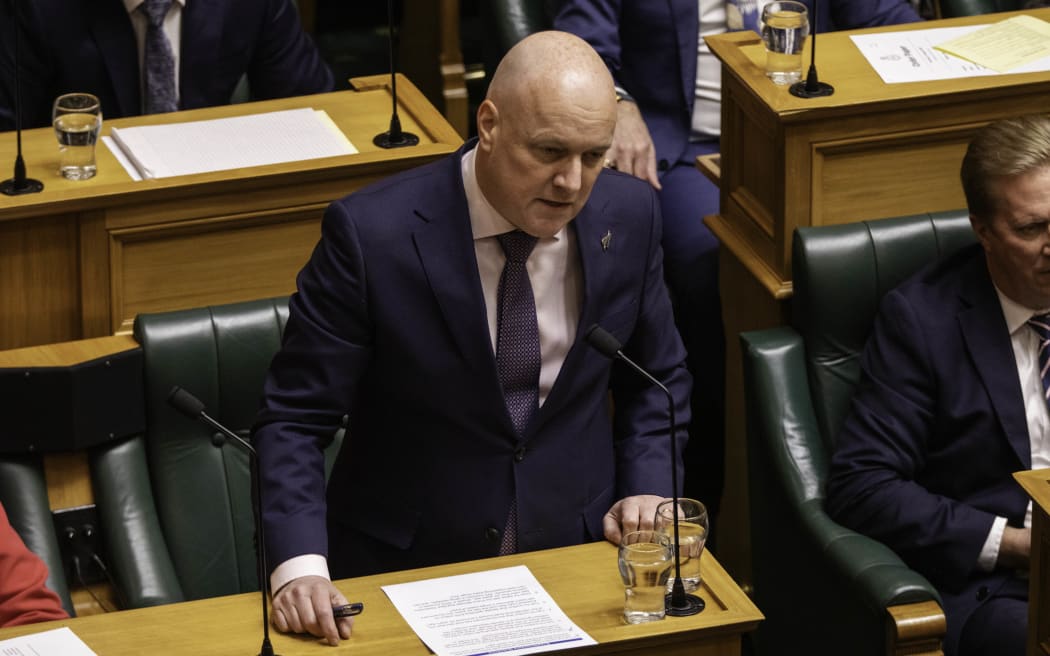
Leader of the National Party Christopher Luxon
National Party leader Christopher Luxon . . . “[The Labour government] turned out it was all words and no action, because, as we expected, [Hipkins] just carried on doing more of the same: Excessive, addicted government spending.” Image: RNZ/Angus Dreaver

The National leader said Hipkins’ speech should be one of apology, “to the parents and the kids who actually have been let down by an education system …to all the people who have waited for endless times and hours in hospital emergency departments … to all the victims of ram raids in dairies and superettes … to all the people that are lying awake at night worried about how they’re going to make their payments and keep their house.”

He continued with the requisite thanks such speeches so often sprinkle on officials, staff, supporters and workers before thanking the man he had been criticising.

“I do want to thank, in particular, the Prime Minister Chris Hipkins for his services to the National Party, because he rode in very triumphantly in February, and he announced that he was sweeping away everything that Jacinda Ardern stood for-especially kindness. But I have to say it turned out it was all words and no action, because, as we expected, he just carried on doing more of the same: Excessive, addicted government spending.

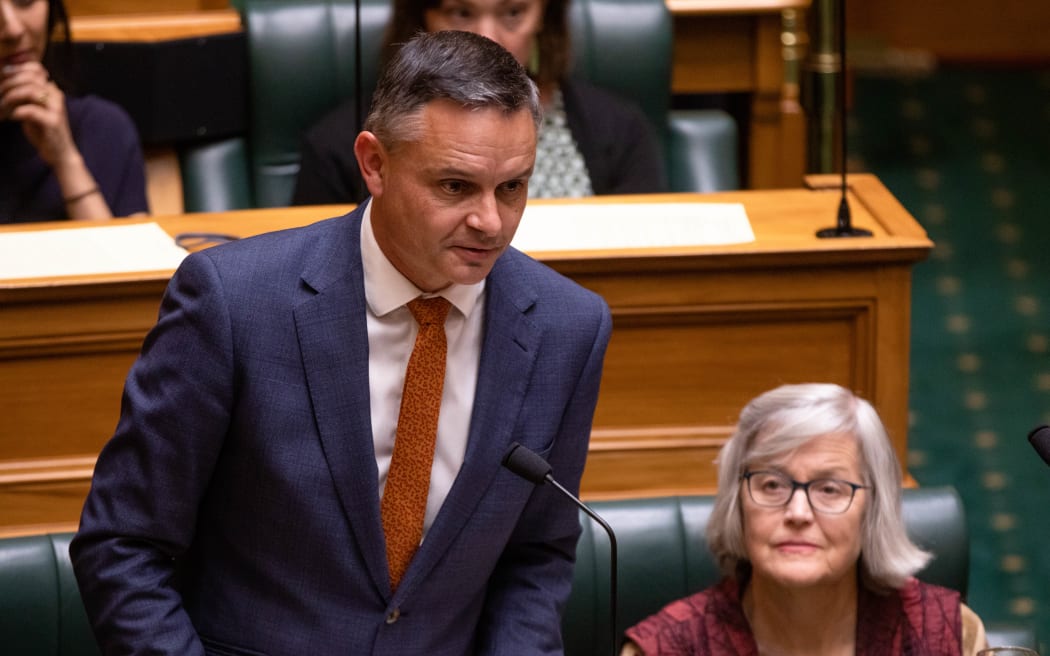
He turned to the slew of Labour personnel problems of the past year and more, likening the government to a car with the wheels falling off; the Greens were “in this rally too, they’re on their e-bikes, and they’re pedalling along the Wellington cycle lanes,” while Te Pāti Māori were “in their waka, but, sadly, they’re not the party of collaboration that they once were”.

“Then there are the ACT folk. They’re off in their pink van, and it’s been wonderful. They’re travelling the countryside, and David’s reading Mandela’s Long Walk to Freedom, which is a good read, as you well know, Mr Speaker.”

He lavished praise on his own team, singling out deputy Nicola Willis, then closed by promising National was “ready to govern, we are sorted, we are united, we have the talent, we have the energy, we have the ideas, we have the diversity to take this country forward”.

David Seymour (ACT):

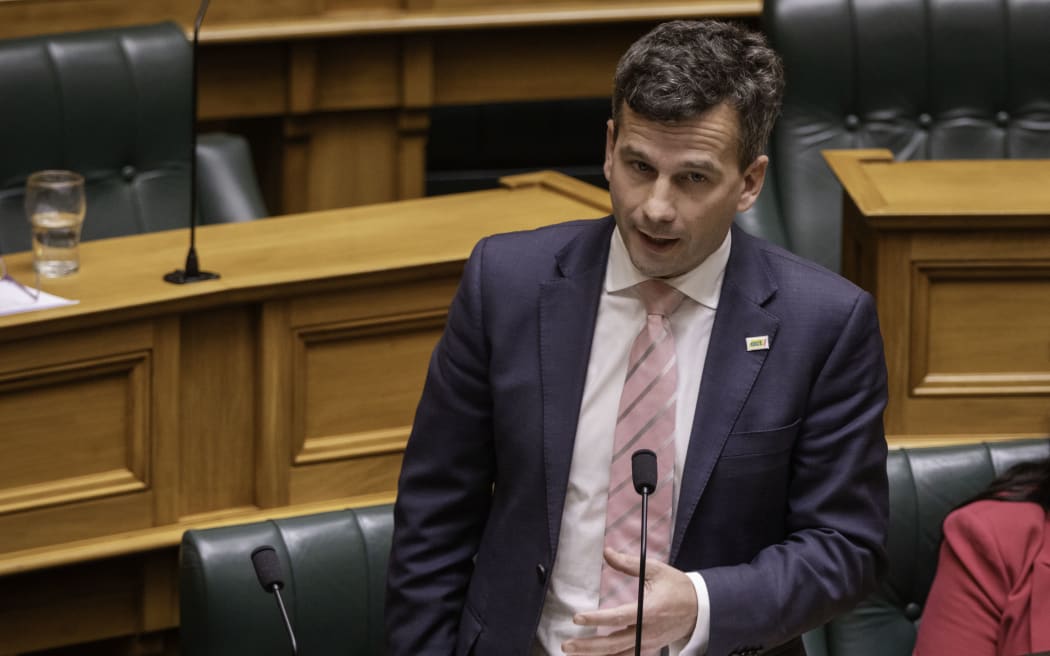
ACT party leader David Seymour speaks at the censure of National MP Tim van de Molen
ACT party leader David Seymour . . . “Half the people who voted for Labour at the last election have abandoned voting for Labour in three years. The question that they must be asking themselves is why that is.” Image: RNZ/Angus Dreaver

ACT’s leader also honed in on his political opponents, targeting Labour’s polling.

“It’s been a long three years in this Chamber and it has been characterised by one fact that lays bare what has happened, and that is the fact that the Labour Party, in Roy Morgan, polled 26 percent. That means that half the people who voted for Labour at the last election have abandoned voting for Labour in three years. The question that they must be asking themselves is why that is.”

“I think the reason that we have so much change and support-Labour have lost half of their supporters in the last three years because, frankly, never has so much been promised to so many and yet so little actually delivered … New Zealanders overwhelmingly say this country is going in the wrong direction, and they also will tell you that their number one concern is the cost of living. That is Grant Robertson’s epitaph.”

He targeted housing, debt, inflation, victimisation, and child poverty before targeting the government for taking “a divisive approach to almost every single issue”.

“If you take the example of vaccination. Now, I’m a person who says that vaccination was safe and effective, yet by using ostracism as a tool to try and increase vaccination levels this government has eroded social cohesion and divided New Zealanders when they didn’t need to,” he said.

“New Zealand have had enough of that style of politics. They’ve had enough of Chris Hipkins going negative. They’ve had enough of the misinformation.”

He finished by saying the choice for New Zealanders now was not between swapping “Chris for Chris and red for blue”, but “we’ll actually deliver what we promise, we’ll cut waste, we’ll end racial division, and we’ll get the politics out of the classroom. Those aren’t just policies, those are values that we all share.”

James Shaw (Greens):

Green Party co-leader James Shaw
Green Party co-leader James Shaw . . . “Our greenhouse gas emissions in Aotearoa are falling, and that is because — and it is only because — with the Green Party in government with Labour, we have prioritised that work every single day.” Image: RNZ/Angus Dreaver

The Green co-leader took his own opening shot at Seymour, as “the leader of ‘New New Zealand First’”.

“Mr Seymour must be feeling quite grumpy right now, because last term he worked so hard to get rid of Winston Peters so that this term he could become Winston Peters, and now Winston Peters is calling and he wants his Horcrux back because that blackened shard of a soul can only animate the body of one populist authoritarian at once.”

He turned the hose on both major parties in one statement, saying it was odd National was proposing more new taxes than Labour while the Greens were promising bigger tax cuts than National. He criticised National over its plan to spend the funds from the Emissions Trading Scheme, before turning to climate change overall as — unusually — a source of positivity.

“Our greenhouse gas emissions in Aotearoa are falling, and that is because — and it is only because — with the Green Party in government with Labour, we have prioritised that work every single day.”

But positivity did not last long.

“Under the last National government, one in 100 new cars sold in this country was an electric vehicle. Last June, it was one in two … and National want to cancel all of that so that they can have an election year bribe.”

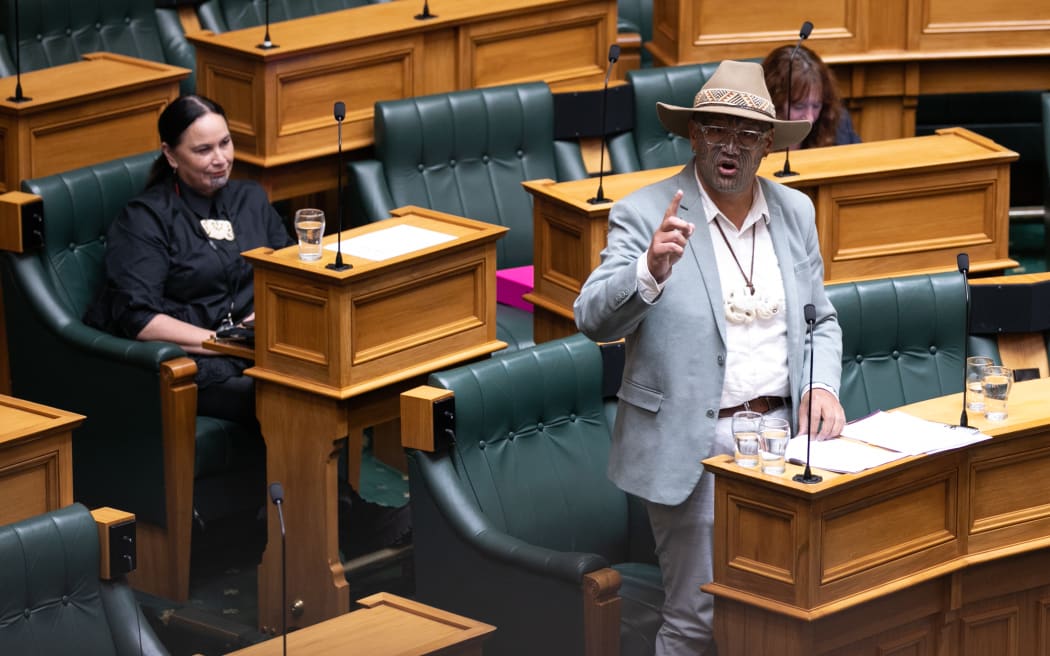
Rawiri Waititi (Te Pāti Māori):

Te Pati Māori MPs Debbie Ngarewa-Packer and Rawiri Waititi (speaking) on the Budget debate, 18 May 2023
Te Pati Māori MPs Debbie Ngarewa-Packer and Rawiri Waititi (speaking) . . . “Te Pāti Māori is a movement that leaves no one behind, whether you are tangata whenua or a tangata Tiriti, tangata hauā, takatāpui, wāhine, tāne, rangatahi, mokopuna — you are whānau.” Image: Johnny Blades

The Pāti Māori leader Rawiri Waititi began with a fairy tale.

“It seems like this side of the House can find a grain of salt in a sugar factory. I just wanted to say, as I heard the story about Goldilocks — Mama Bear, Papa Bear, Baby Bear — I tell you, it’s been very difficult to sit next to a polar bear and a gummy bear, and it’s been quite hard to contain the grizzly bear in me.”

He spoke in te reo Māori before giving a speech which — unlike the other leaders — focused exclusively on his own party’s promises.

“We are the only movement that will fight for our people,” he said.

“What does an Aotearoa hou look like? It looks like how we would treat you on the marae. We will welcome you. We will feed you. We will house you. We will protect you. We will educate you. We will care you. We will love you.”

“Te Pāti Māori is a movement that leaves no one behind, whether you are tangata whenua or a tangata Tiriti, tangata hauā, takatāpui, wāhine, tāne, rangatahi, mokopuna — you are whānau.”

He spoke of the need to reduce poverty and homelessness, before making the second of two references to his suspension from Parliament this week, then said it was time to “believe in ourselves to be proud, to be magic, and to believe in your mana”.

“I am proud of you all, I am proud of our movement, and I’m proud to head into this campaign, doing what we said we would do.”

This article is republished under a community partnership agreement with RNZ.

Print Friendly, PDF & Email

Article by AsiaPacificReport.nz

What would an ancient Egyptian corpse have smelled like? Pine, balsam and bitumen – if you were nobility

Source: The Conversation (Au and NZ) – By Nicole Boivin, Professor, Max Planck Institute of Geoanthropology

Museum August Kestner, Hannover. Photo: Christian Tepper.

In 1900 – some 22 years before he discovered the tomb of Tutankhamen – British archaeologist Howard Carter opened another tomb in the Valley of the Kings. In tomb KV42, Carter found the remains of a noblewoman called Senetnay, who died around 1450 BCE.

More than a century later, a French perfumer has recreated one of the scents used in Senetnay’s mummification. And the link between these two events is our research, published today in Scientific Reports, which delves into the ingredients of this ancient Egyptian balm recipe.

Recreating the smells of a disappeared world

Our team drew upon cutting-edge technologies in chemistry to reconstruct ancient scents from jars of Senetnay found in the tomb.

We used three variations of chromatographic and mass spectrometric techniques, which work by breaking samples down into individual molecules. Specific substances have different assemblages of molecules. Based on these characteristic compounds and through comparison to known reference materials, we identified the different ingredients.

After the excavation by Carter, two of Senetnay’s jars recovered from the tomb made their way to Germany. So, in 2020, we approached the Museum August Kestner in Hannover about the possibility of analysing the jars with these new methods.

These jars are known as canopic jars. They are made of limestone and were used to store the mummified organs of the ancient Egyptian elite.

Somewhere along the way, however, Senetnay’s jars lost their contents. All that remained of the mummified organs were faint residues on the bottom of the jars.

Remarkably, chemical analyses allow scientists to take such trace remains and reconstruct the original contents.


Read more:
Curious Kids: who was the first ancient mummy?


An ancient ingredients list

Our analysis revealed the balms used to coat and preserve Senetnay’s organs contained a blend of beeswax, plant oil, fats, bitumen, an unidentified balsamic substance, and resins from trees of the pine family (most likely larch).

One other substance was narrowed down to either a resin called dammar – found in coniferous and hardwood trees in South-East and East Asia – or Pistacia tree resin.

The results were exciting; these were the richest and most complex balms ever identified for this early time period.

It was clear a lot of effort had gone into making the balms. This suggests Senetnay, who was the wet nurse of the future Pharaoh Amenhotep II, had been an important figure in her day.

The findings also contribute to growing chemical evidence that the ancient Egyptians went far and wide to source ingredients for mummification balms, drawing on extensive trade networks that stretched into areas beyond their realm.

Since trees of the pine family are not endemic to Egypt, the possible larch resin must have come from somewhere further afield, most likely Central Europe.

This map shows the distribution of potential conifer resin sources in relation to the Valley of the Kings. You can see larches (which belong to the genus Larix, of the family Pinaceae) aren’t found anywhere near Egypt.
B. Huber et al., 2023, CC BY-SA

The most puzzling ingredient was the one identified as either Pistacia or dammar resin. If the ingredient was Pistacia – which is derived from the resin of pistachio trees – it likely came from some coastal region of the Mediterranean. But if it was dammar, it would have derived from much farther away in South-East Asia.

Recent analysis of balms from the site of Saqqara identified dammar in a later balm dating to the first millennium BCE. If the presence of dammar resin is confirmed in Senetnay’s case, this would suggest ancient Egyptians had access to this South-East Asian resin via long-distance trade, almost a millennium earlier than previously thought.

A perfume for the ages

Senetnay’s balm would not only have scented her remains, but also the workshop in which it was made and the proceedings of her burial rites – perfuming the air with pine, balsam, vanilla and other exotic notes. The vanilla scent comes from a compound called coumarin, and from vanillic acid, and in this case likely reflects the degradation of woody tissue.

Due to the volatile nature of scents, however, Senetnay’s unique scents gradually vanished once her remains were deposited in the Valley of the Kings.

Earlier this year, we began a collaboration with perfumer Carole Calvez and sensory museologist Sofia Collette Ehrich to bring Senetnay’s lost scent back to life.

The results of this effort will go on display at the Moesgaard Museum in Denmark in October, as part of its new exhibition: Egypt – Obsessed with Life.

This new olfactory display will be like a time machine for the nose. It will provide a unique and unparalleled window into the smells of ancient Egypt and the scents used to perfume and preserve elite individuals such as Senetnay.

Such immersive experiences provide new ways of engaging with the past and help broaden participation, particularly for visually impaired people.


Read more:
Holy bin chickens: ancient Egyptians tamed wild ibis for sacrifice


The Conversation

Barbara Huber receives funding from the Max Planck Society and the Joachim Herz Foundation.

Nicole Boivin does not work for, consult, own shares in or receive funding from any company or organization that would benefit from this article, and has disclosed no relevant affiliations beyond their academic appointment.

ref. What would an ancient Egyptian corpse have smelled like? Pine, balsam and bitumen – if you were nobility – https://theconversation.com/what-would-an-ancient-egyptian-corpse-have-smelled-like-pine-balsam-and-bitumen-if-you-were-nobility-212504

What will putting the interests of Qantas ahead of Qatar Airways cost? $1 billion per year and a new wave of protectionism of legacy carriers

Source: The Conversation (Au and NZ) – By Rico Merkert, Professor in Transport and Supply Chain Management and Deputy Director, Institute of Transport and Logistics Studies (ITLS), University of Sydney Business School, University of Sydney

Shutterstock

The government’s decision to deny Qatar Airways the right to fly an extra 21 flights per week into Australia’s three biggest cities might just be returning Australia to the old days where we protected Australia’s national carrier at the expense of Australians.

For more than 15 years I’ve had the privilege to research and teach airline strategy in the context of global aviation bilateral air service agreements.

These agreements are essentially trade deals between the 193 governments that are signatories to the 1944 Chicago Convention on Civil Aviation.

The agreements allow designated airlines in the two signatory countries to operate air services connecting them in accordance with the reciprocity principle used in trade agreements, which is broadly: “I’ll let you in if you let me in”.

Australia has traditionally tried to deregulate international aviation, to make air travel easier for both Australians and visitors.

But in July, in an initially announced decision, Transport Minister Catherine King rejected an application for Qatar to double its flights into Australia by providing what amounted to an extra flight a day into Brisbane, Melbourne and Sydney.

After being asked about the decision, the minister provided four different justifications, one of which was the “national interest”.


Read more:
Grattan: Albanese’s government has questions to answer on competition


Assistant Treasurer Stephen Jones this week expanded on this reasoning, saying he didn’t want to drive ticket prices down to the point at which it was “unsustainable to run an airline” and that having Qantas occasionally make a profit was “actually a good news story”.

On its face, this suggests the government is making decisions about landing rights in order to protect the profits of Qantas – a private company it hasn’t owned since 1995. This would be a seismic shift in Australia’s international aviation policy.

A case could be made that this is in breach of the Chicago convention. Regardless, it is damaging to Australia’s international reputation and Australia’s economy.

$1 billion per year in economic damage

By my conservative estimate, the decision will cost Australia’s economy about $1 billion per year in lost income from tourism, business travel and freight.

By my conservative estimate, the decision will cost Australia’s economy about $1 billion per year in lost income from tourism, VRF (visiting friends and relatives) as well as business travel and freight.

My calculations suggest capacity on the Kangaroo Route between Australia and Europe is only back to 70% of where it was before COVID, allowing current operators such as the Emirates-Qantas alliance to charge much more than they could before the pandemic.

Turkish Airlines is also finding it hard to get approval from Australia.
Shutterstock

Qantas announced last week it would add 250,000 seats to its international network, but not a single one was on flights to Europe.

The extra Qatar Airways flights would have also gone on to New Zealand, adding further capacity to that route and cutting prices for flights across the Tasman.

And it’s not only Qatar Airways. Turkish Airlines, through the Turkish government, has asked for permission to increase of the frequency of its Australian flights from four to 14 a week, providing daily services to Melbourne and Sydney.

Turkey hasn’t yet received an answer.

Extra costs in reputational damage

The message Australia is sending is a dangerous one.

When COVID hit in 2020 and airlines including Qantas grounded their fleets, Qatar Airways temporarily became Australia’s “de facto international airline”, getting Australians home who might otherwise have been stranded. During the pandemic, some Qatar flights arrived in Australia with just 20 seats filled.

Qatar might have expected Australians to remember this and keep flying with them, and it has applied for enough flights to allow it to happen.

By denying Qatar this opportunity (and denying many Australians the opportunity to travel to Europe via Doha), Australia has shown it is prepared to be ungracious, and made it easier for other countries to treat it in the same fashion.

Australia’s number two domestic airline Virgin Australia, is planning a share market float. By appearing to signal it is prepared to go out on a limb to support Qantas against competitors, Australia has perhaps unintentionally sent a powerful message to potential investors – that Virgin’s opponent gets protection it does not.

The weak case for offering Qantas protection

There might be a case for offering Qantas protection if it was at risk of needing a taxpayer-funded bailout to stay afloat. But Qantas has returned to profit – a record A$2.5 billion profit in the year to June, after doubling its revenue.

There might also be a case (and King has made this case) that Qantas needs to be protected because it has just purchased new, quieter “better for the environment” planes on which it will need to see a return and will need to spend a further A$12 billion to A$20 billion on fleet renewal to reach its net-zero target.

But for years (including after last week’s profit announcement) Qantas has been returning capital to its shareholders by share buy-backs instead of using it to buy planes. It thinks it can do both, and perhaps it is making so much profit that it can, but if it can’t do both, it can ease off on returning capital to shareholders.

Another argument (also put by King) is that supporting Qantas will support “long-term, well-paid, secure jobs by Australians in the aviation sector.”

But much of Qantas’s international skilled work is already done offshore including on its premier QF1 flight to London which is maintained by crews from the United Kingdom.

Is there something we don’t know about?

Unless there is some sort of hidden rationale, the decision to deny Qatar Airways extra flights seems inexplicable; and given Australia’s history, unAustralian.

It is important to recognise that these are trade agreements of considerable magnitude and that decisions taken by Australia invite retaliation.

As I keep telling my students, these seemingly-boring bilateral air service agreements can have big consequences if mishandled.

Years of worth of research and international best practice indicate that an open approach to air rights delivers the best economic outcomes, especially for the country doing the opening.

More trade results in a more prosperous Australia which is good for Australian travellers, Australian businesses, and ultimately Australian airlines, too.

Australia used to tell the rest of the world that trade was good. It would need to have a very good reason for behaving differently when it came to air travel.

The Conversation

Rico Merkert receives funding from the ARC and various industry partners. He loves to work with and for airlines, including Qantas and Virgin Australia.

ref. What will putting the interests of Qantas ahead of Qatar Airways cost? $1 billion per year and a new wave of protectionism of legacy carriers – https://theconversation.com/what-will-putting-the-interests-of-qantas-ahead-of-qatar-airways-cost-1-billion-per-year-and-a-new-wave-of-protectionism-of-legacy-carriers-212495

What will putting the interests of Qantas ahead of Qatar Airways cost? $1bn per year and a new wave of protectionism of legacy carriers

Source: The Conversation (Au and NZ) – By Rico Merkert, Professor in Transport and Supply Chain Management and Deputy Director, Institute of Transport and Logistics Studies (ITLS), University of Sydney Business School, University of Sydney

Shutterstock

The government’s decision to deny Qatar Airways the right to fly an extra 21 flights per week into Australia’s three biggest cities might just be returning Australia to the old days where we protected Australia’s national carrier at the expense of Australians.

For more than 15 years I’ve had the privilege to research and teach airline strategy in the context of global aviation bilateral air service agreements.

These agreements are essentially trade deals between the 193 governments that are signatories to the 1944 Chicago Convention on Civil Aviation.

The agreements allow designated airlines in the two signatory countries to operate air services connecting them in accordance with the reciprocity principle used in trade agreements, which is broadly: “I’ll let you in if you let me in”.

Australia has traditionally tried to deregulate international aviation, to make air travel easier for both Australians and visitors.

But in July, in an initially announced decision, Transport Minister Catherine King rejected an application for Qatar to double its flights into Australia by providing what amounted to an extra flight a day into Brisbane, Melbourne and Sydney.

After being asked about the decision, the minister provided four different justifications, one of which was the “national interest”.


Read more:
Grattan: Albanese’s government has questions to answer on competition


Assistant Treasurer Stephen Jones this week expanded on this reasoning, saying he didn’t want to drive ticket prices down to the point at which it was “unsustainable to run an airline” and that having Qantas occasionally make a profit was “actually a good news story”.

On its face, this suggests the government is making decisions about landing rights in order to protect the profits of Qantas – a private company it hasn’t owned since 1995. This would be a seismic shift in Australia’s international aviation policy.

A case could be made that this is in breach of the Chicago convention. Regardless, it is damaging to Australia’s international reputation and Australia’s economy.

$1 billion per year in economic damage

By my conservative estimate, the decision will cost Australia’s economy about $1 billion per year in lost income from tourism, business travel and freight.

By my conservative estimate, the decision will cost Australia’s economy about $1 billion per year in lost income from tourism, VRF (visiting friends and relatives) as well as business travel and freight.

My calculations suggest capacity on the Kangaroo Route between Australia and Europe is only back to 70% of where it was before COVID, allowing current operators such as the Emirates-Qantas alliance to charge much more than they could before the pandemic.

Turkish Airlines is also finding it hard to get approval from Australia.
Shutterstock

Qantas announced last week it would add 250,000 seats to its international network, but not a single one was on flights to Europe.

The extra Qatar Airways flights would have also gone on to New Zealand, adding further capacity to that route and cutting prices for flights across the Tasman.

And it’s not only Qatar Airways. Turkish Airlines, through the Turkish government, has asked for permission to increase of the frequency of its Australian flights from four to 14 a week, providing daily services to Melbourne and Sydney.

Turkey hasn’t yet received an answer.

Extra costs in reputational damage

The message Australia is sending is a dangerous one.

When COVID hit in 2020 and airlines including Qantas grounded their fleets, Qatar Airways temporarily became Australia’s “de facto international airline”, getting Australians home who might otherwise have been stranded. During the pandemic, some Qatar flights arrived in Australia with just 20 seats filled.

Qatar might have expected Australians to remember this and keep flying with them, and it has applied for enough flights to allow it to happen.

By denying Qatar this opportunity (and denying many Australians the opportunity to travel to Europe via Doha), Australia has shown it is prepared to be ungracious, and made it easier for other countries to treat it in the same fashion.

Australia’s number two domestic airline Virgin Australia, is planning a share market float. By appearing to signal it is prepared to go out on a limb to support Qantas against competitors, Australia has perhaps unintentionally sent a powerful message to potential investors – that Virgin’s opponent gets protection it does not.

The weak case for offering Qantas protection

There might be a case for offering Qantas protection if it was at risk of needing a taxpayer-funded bailout to stay afloat. But Qantas has returned to profit – a record A$2.5 billion profit in the year to June, after doubling its revenue.

There might also be a case (and King has made this case) that Qantas needs to be protected because it has just purchased new, quieter “better for the environment” planes on which it will need to see a return and will need to spend a further A$12 billion to A$20 billion on fleet renewal to reach its net-zero target.

But for years (including after last week’s profit announcement) Qantas has been returning capital to its shareholders by share buy-backs instead of using it to buy planes. It thinks it can do both, and perhaps it is making so much profit that it can, but if it can’t do both, it can ease off on returning capital to shareholders.

Another argument (also put by King) is that supporting Qantas will support “long-term, well-paid, secure jobs by Australians in the aviation sector.”

But much of Qantas’s international skilled work is already done offshore including on its premier QF1 flight to London which is maintained by crews from the United Kingdom.

Is there something we don’t know about?

Unless there is some sort of hidden rationale, the decision to deny Qatar Airways extra flights seems inexplicable; and given Australia’s history, unAustralian.

It is important to recognise that these are trade agreements of considerable magnitude and that decisions taken by Australia invite retaliation.

As I keep telling my students, these seemingly-boring bilateral air service agreements can have big consequences if mishandled.

Years of worth of research and international best practice indicate that an open approach to air rights delivers the best economic outcomes, especially for the country doing the opening.

More trade results in a more prosperous Australia which is good for Australian travellers, Australian businesses, and ultimately Australian airlines, too.

Australia used to tell the rest of the world that trade was good. It would need to have a very good reason for behaving differently when it came to air travel.

The Conversation

Rico Merkert receives funding from the ARC and various industry partners. He loves to work with and for airlines, including Qantas and Virgin Australia.

ref. What will putting the interests of Qantas ahead of Qatar Airways cost? $1bn per year and a new wave of protectionism of legacy carriers – https://theconversation.com/what-will-putting-the-interests-of-qantas-ahead-of-qatar-airways-cost-1bn-per-year-and-a-new-wave-of-protectionism-of-legacy-carriers-212495

Here’s what new 60-day prescriptions mean for you and your hip pocket

Source: The Conversation (Au and NZ) – By Andrew Bartlett, Associate Lecturer Pharmacy Practice, University of Sydney

Shutterstock

From today, there are significant changes to how some common medicines are prescribed and dispensed in Australia. This means you could walk away from the pharmacy with 60-days’ worth of your usual medicine from a single prescription.

Until now, most long-term medicines were only available for 30 days at a time. So the price of these medicines for some patients may effectively halve.

You would also need fewer trips to the GP for a prescription and fewer visits to the pharmacy to have your medicine dispensed.

But not all medicines are yet eligible for 60-day scripts and not everyone is prescribed 60-days’ worth of medicine at a time. Here’s what the changes mean for you.


Read more:
Last year, half a million Australians couldn’t afford to fill a script. Here’s how to rein in rising health costs


Can I get a 60-day script today?

If you have a current prescription, you need to use this prescription first before you get a new one. To be eligible for a prescription that provides medicine for 60 days your medication needs to be on the approved list.

Your doctor also needs to assess if you are stable on it. This is to avoid wastage. We know new treatments can result in frequent changes to medication regimens, which would result in wasted medicines if they don’t end up being used.

Your doctor may also give you “repeat” prescriptions for 60-days’ worth of medicines at a time. Under the new rules, this could mean up to 12 months’ supply of medicine (the initial script plus five “repeats”). You would have to pay for each of these repeat scripts when your medicine is dispensed every 60 days.


Read more:
What time of day should I take my medicine?


Is my medicine on the list?

The roll-out of 60-day scripts will be in three stages. The first stage, which begins today, includes medicines for cardiovascular disease (such as heart disease and stroke), heart failure, high cholesterol, gout, osteoporosis, and the gut conditions Crohn’s disease and ulcerative colitis.

This includes some of the most common medicines prescribed in Australia, such as atorvastatin for lowering cholesterol, and perindopril for lowering blood pressure.

Person adding medications to pill organizer
Not all your medicines may be affected by the changes.
Laurynas Mereckas/Unsplash

The following stages, set to be rolled out over the coming 12 months, include medicines for diabetes, epilepsy, glaucoma, asthma and Parkinson’s disease.

When fully implemented, these changes will affect more than 300 prescription medicines available on the Pharmaceutical Benefits Scheme (PBS).

These medicines have been chosen because they are appropriate treatments for people living with stable, chronic health conditions, they meet clinical safety criteria, and are considered cost-effective.

Medicines not available for 60-day dispensing are those only for short-term use and medicines known to be at risk of overuse. These include pain medicines and some medicines for mental health conditions.


Read more:
Here’s why pharmacists are angry at script changes – and why the government is making them anyway


Will I save money?

The government has brought in these changes mainly to try to make medicines more affordable. We know people do not seek medical care or fill prescriptions due to cost.

The maximum price you pay at the pharmacy for a PBS script (known as the co-payment) is not changing. It’s still A$7.30 for concession card holders and $30 for non-concession card holders. But by having 60-day dispensing, you’ll only be charged this every two months instead of every month.

But not everyone will save money from a 60-day prescription because in some cases your pharmacy may already be discounting your medicine. If the price for 60-days’ supply would not take the price over $30, you may not be getting two scripts for the price of one.

For example, a commonly discounted medicine is atorvastatin. In Australia, a non-concession patient generally pays between $8 and $22 for 30-days’ supply. But it’s likely that a 60-day supply would cost between $15 and $30.

The amount you or your family need to pay to reach the PBS safety net is also not changing. This is the threshold you need to reach before medicines become free (for concession card holders) or discounted (non-concession card holders) for the rest of the calendar year. In some instances, 60-day dispensing may result in you or your family reaching the safety net threshold later, or not at all.

Older woman looking into purse, holding coin
The changes are meant to make medicines more affordable.
Shutterstock


Read more:
What is the PBS safety net and is it really the best way to cut the cost of medicines?


How should I store my medicine?

If you don’t store your medicines correctly at home they can become degraded and not work so well. With a 60-day supply, correct storage is even more important.

As a general rule of thumb, never store your medicines in hot rooms or your car (even in winter) and don’t store them in direct sunlight. If your medicine needs to be stored in the fridge, your pharmacist will let you know.

One example is latanoprost, which are drops for the eye condition glaucoma. You can keep the bottle you are using in the cupboard but you need to store the unopened, second bottle in the fridge.


Read more:
Health Check: what should you do with your unused medicine?


In a nutshell

Remember, 60-day dispensing is only available for new prescriptions. When you next see your doctor, if your condition is stable and your medicine is suitable, you will be provided a 60-day script. Your pharmacist will then dispense a 60-day supply.


If you have any questions about the new rules, ask your local pharmacist. Information is also available from the Commonwealth health department and the Consumers Health Forum.

The Conversation

Andrew Bartlett is a member of the Pharmaceutical Society of Australia, a previous director of Blooms the Chemist management services and remains a shareholder.

Associate Professor Nial Wheate in the past has received funding from the ACT Cancer Council, Tenovus Scotland, Medical Research Scotland, Scottish Crucible, and the Scottish Universities Life Sciences Alliance. He is a Fellow of the Royal Australian Chemical Institute, a member of the Australasian Pharmaceutical Science Association, and a member of the Australian Institute of Company Directors. Nial is the chief scientific officer of Vaihea Skincare LLC, a director of SetDose Pty Ltd a medical device company, and a Standards Australia panel member for sunscreen agents. Nial regularly consults to industry on issues to do with medicine risk assessments, manufacturing, design, and testing.

ref. Here’s what new 60-day prescriptions mean for you and your hip pocket – https://theconversation.com/heres-what-new-60-day-prescriptions-mean-for-you-and-your-hip-pocket-211412

Even if her leadership is now doomed, Annastacia Palaszczuk will still be a Labor legend in Queensland

Source: The Conversation (Au and NZ) – By Paul Williams, Associate Professor, Griffith University, Griffith University

Whatever fate awaits Annastacia Palaszczuk over the coming weeks, Queensland’s 39th – and only the second woman – premier will never lose her standing in the Australian Labor pantheon.

Palaszczuk, the state Labor leader since 2012 and premier since 2015, is already Australia’s most successful female political leader. She was the first woman to lead a party into government from opposition anywhere in Australia, the first woman to attain three successive election victories in Australia, and the first head of a majority-female cabinet.

If Palaszczuk can survive the building pressure on her to resign, she could next year become Queensland’s fourth longest-serving – and Labor’s second longest-serving – premier since 1860. But that prospect is becoming increasingly unlikely.

In July, a Freshwater Strategy poll for the Australian Financial Review found just 39% of Queenslanders now approve of Palaszczuk’s leadership, with 47% disapproving – a net negative of eight points.

And an August Resolve Strategic Poll showed 37% of respondents preferring Liberal-National Party Opposition leader David Crisafulli as premier, compared to 36% who preferred Palaszczuk. This was the first time in almost a decade an LNP leader has taken the lead.

What a far cry from the heights of the COVID-19 pandemic. In July 2020, Newspoll found 64% of Queenslanders approving of Palaszczuk’s leadership, with 81% approving of her management of the pandemic and subsequent hard border closures. Just 29% disapproved of her leadership – a net positive of 35 points.

Worse for Labor, Resolve now pegs LNP first-preference support at 38% (up three points since the 2020 election), with Labor at just 32% (down seven). The LNP also has an after-preference lead of 53–47% over Labor.

If this lead is held, it would likely be enough to allow the LNP to win the 14 seats needed for majority government in next October’s election.


Read more:
Did someone say ‘election’?: how politics met pandemic to create ‘fortress Queensland’


A perception of a ‘checked-out’ premier

To outsiders it might appear Palaszczuk – who has dominated Queensland politics like no other since Peter Beattie more than a decade ago – has suffered a rapid fall from grace. But Palaszczuk’s decline has been a slow burn.

A year after securing her third term as premier in the 2020 election, Palaszczuk was wholly untroubled by a virtually unknown opposition leader.

But, by early 2022, Palaszczuk had found herself enmeshed in several integrity crises, including accusations the Crime and Corruption Commission had not been impartial in its investigation of alleged local government corruption, and that senior public servants had allegedly suffered political interference from ministerial staff.

Worse, Palaszczuk appeared slow to respond to the allegations before appointing three separate inquiries. One inquiry, under Professor Peter Coaldrake, published unfavourable findings.

Queensland Premier Annastacia Palaszczuk issues surprise apology after integrity questions.

The effect was rapid and seismic: the hitherto Teflon Palaszczuk now looked flawed, and opinion polls soon reflected Labor’s vulnerability. By June 2022, YouGov had revealed a five-point collapse in Labor’s primary vote, with the LNP, now on 38%, leading Labor for the first time.

But as the dust settled on Labor’s integrity issues, the LNP and a conservative news media cleverly switched narratives. Palaszczuk was then framed as a “checked-out”, “red carpet” premier more interested in mixing with celebrities and attending glitzy gala events with her new partner.

That narrative appeared to gain public traction when, in August last year, the media accused Palaszczuk of cancelling a cabinet meeting to spend time on a luxury yacht. The coincidental circumstance of Palaszczuk last week leaving for a holiday in Italy, just as the media storm broke over her leadership troubles, can only deepen perceptions of a “part-time” premier.

As public policy crises have continued to dominate the media over the past year, the accusation that Palaszczuk has taken her eye off the policy ball has only gained further traction. With a soaring cost of living, deepening housing crisis, overcrowded hospitals and budget blowouts in infrastructure projects, it’s little wonder voters have started to turn on her government.

But, more than any other, it’s the issue of youth crime that has most profoundly brought Palaszczuk’s leadership into question. Her government has been roundly criticised for the hastily passed legislation last week that could see children held “indefinitely” in Queensland watch houses – a move that was resisted by Labor’s majority Left faction.


Read more:
Queensland is not only trampling the rights of children, it is setting a concerning legal precedent


Who might step into her large shoes?

In short, Palaszczuk has been Labor’s best asset in Queensland since 2012; now she appears a liability.

Despite unconvincing reassurances from senior government ministers that Palaszczuk will lead Labor to the October 2024 election, the momentum of leadership change now appears beyond the point of no return. It’s almost certain Queensland will have a new Labor premier, possibly by the end of this month.

There appear to be only three candidates:

  • Steven Miles, the deputy premier and leader of the Left faction of the party

  • Shannon Fentiman, the health minister and a member of the Left faction

  • Cameron Dick, the treasurer and head of Labor Forum, a right Labor faction

Dick has long been touted as a future premier but, given the Left has controlled the Labor caucus since 2015, either a Miles or Fentiman premiership is the more likely outcome.

Because Queensland Labor rules around leadership spills are so complicated – a ballot must be held in caucus, among grassroots members and among the unions – it’s likely Palaszczuk will be urged to resign when she returns from her holiday, with a single candidate emerging as her successor.

Either way, the next Labor leader would have very large shoes to fill. Labor had suffered a rout in the 2012 election, with the LNP capturing 78 seats in the 89-seat parliament – the then-largest majority in Australian history. When Palaszczuk put her hand up to lead the seven remaining Labor MPs, nobody would believe she’d topple the once-popular premier, Campbell Newman, just three years later.


Read more:
Who is Annastacia Palaszczuk, Queensland’s likely next premier?


But, by 2015, Queenslanders had been angered by Newman’s proposal to privatise state-owned assets. They also appeared tired of big personalities like Joh Bjelke-Petersen, Peter Beattie and Newman. Even those in regional Queensland warmed to a Labor leader who looked and sounded like a friendly next-door neighbour.

Will a leadership change be too little, too late to reverse the fortunes of a Labor Party looking for a fourth term? Probably. But it’s foolish to completely write off the party that has dominated Queensland politics for 28 of the past 33 years.

The Conversation

Paul Williams is an associate with Queensland’s T. J. Ryan Foundation.

ref. Even if her leadership is now doomed, Annastacia Palaszczuk will still be a Labor legend in Queensland – https://theconversation.com/even-if-her-leadership-is-now-doomed-annastacia-palaszczuk-will-still-be-a-labor-legend-in-queensland-212446

‘Emu Men’: a new way to recognise and celebrate Indigenous fathers

Source: The Conversation (Au and NZ) – By Bhiamie Williamson, Research Fellow, Monash University

Aboriginal and Torres Strait Islander readers are advised this article contains images of deceased people. All images featured in this article have been published with respective permissions.

Father’s Day is an opportunity to celebrate men who have shaped and inspired us.

For many Indigenous peoples, this includes our biological father, adopted fathers, as well as our grandfathers, uncles, brothers, cousins, friends, and more.

Yet Indigenous fatherhood is a contentious topic in white Australia. Even today, mainstream perceptions often frame Indigenous men as dangerous, vagrant and neglectful.

These false representations can be deeply damaging to the psyche of Indigenous men, and potentially erode the fabric of our communities.

Indigenous fathering has emerged as a key priority in my research examining Indigenous men and masculinity. It is a topic of immense personal importance to me as a Euahlayi (Yuwaalaraay) man, a son, brother, uncle, husband and father.

Indigenous traditions of fathering

Stories of fathers are as old as Indigenous societies. Many First Nations in southeastern Australia continue to hold and transmit stories of the Creator, or All-Father, known in different places as Bhiamie, Bunjil or Dharamulan.

Fathering traditions are also evident in some Indigenous languages and kin structures. It is common for some Indigenous children to have not one father but many. This was particularly the case for a child’s patrilineal uncle, who is also known to the child as father.

In the late 1700s, some European explorers observed and recorded the centrality of fathering in Indigenous societies. For example, New South Wales Judge-Advocate David Collins observed Bennelong, a senior Eora man, returning from an outing with his sister’s child on his shoulders before cooking fish while his sisters and their children slept and ate oysters in the sun.

In 1793, Bruny D’Entrecasteaux “witnessed the tokens of tenderness that these simple and kind men displayed towards their children” in Port du Nord, Tasmania.

The evidence of Indigenous fathering in historical accounts can be hard to uncover because it appeared to be so everyday and unremarkable to Europeans and anthropologists. Yet casting an eye over these various recordings of history, from both Indigenous and European records, reveals the existence of strong, consistent and widespread traditions of care, nurture and love between Indigenous fathers and their children.

Breaking the bonds of fatherhood

Colonisation significantly impacted all Indigenous societies. The introduction of foreign diseases, violent frontier conflict, removal of people from Country, and removal of children are well established historical truths.

There were also colonial impacts on Indigenous families. Colonisation caused disruptions to Indigenous fathering in many ways.

Economic conditions meant many Indigenous men were forced to be away from their children for extended periods, such as when working in pastoral or pearling industries.

Legally, Indigenous fathers were replaced as agents of care and responsibility through various protection acts in Australia’s colonies. Discourses of “protection” broke apart Indigenous families, which affected mothers, fathers and extended family and their roles caring for their children.

Introducing rations removed important roles as hunters and providers. Notwithstanding some men who did continue to hunt, these traditional sources of food were supplementary to the rations provided by colonial and religious authorities.

Social and political assaults on Indigenous men as fathers

Last week, references to Indigenous men as “violent black men” and ‘woman bashers” were heard at the CPAC conference.

The racist cartoon by the late Bill Leake showed that even as recently as 2016, a mainstream media outlet such as The Australian considered it acceptable to ridicule and denigrate Indigenous fathers.

The 2007 Northern Territory Intervention demonstrates how demonising Indigenous men can be used as a political weapon. This was done by portraying Indigenous men as neglectful, violent, unsafe, and in need of heavy-handed government responses. “You’ve got to instil responsiblity,” said the then prime minister John Howard.

Positive representations of Indigenous Dads matter

In response to Leake’s cartoon, #IndigenousDads trended on social media platforms. These intensely personal homages of Indigenous fathers presented an antidote to the tsunami of negativity towards Indigenous fathers.

Other important representation of Indigenous men have been through the publication of the book Dear Son by Thomas Mayo, as well as a range of children’s books by men including Adam Goodes, Meyne Wyatt and Briggs. Indigenous performers such as Luke Carroll and Hunter Page-Lochard now feature regularly on the ABC’s Play School.

It is clear Indigenous fathering carries its own meaning and interpretation. Features such as sharing of fathering roles, transmission of culture, the making of young boys into men, and the public affection and displays of love fathers share with children.

I draw from the gendered patterns of Emus to describe these deep constitutions of fathering. Emus are unique in their gendered patterns. During nesting season female emus lay the eggs, but it is the male emus that sit on the nests to warm the eggs and keep them safe. After the eggs hatch, the male emu rears the chicks, raising them into adulthood.

Emus are especially important to some Indigenous groups across Australia. For many, they are creation beings and an important totem. They offer food and resources such as feathers, eggs, and ointments made from fat.

I suggest a new term – “Emu Man” – as an apt description of these deeply embedded Indigenous male roles. This unique and deeply Indigenous masculinity is highly valued and integral to healthy communities.

This Father’s Day, let’s all acknowledge and honour the unique place of Indigenous fathers, and celebrate their place in our families, and contributions to healthy communities.

Let the land blossom with Emu Men once more.

The Conversation

Bhiamie Williamson does not work for, consult, own shares in or receive funding from any company or organisation that would benefit from this article, and has disclosed no relevant affiliations beyond their academic appointment.

ref. ‘Emu Men’: a new way to recognise and celebrate Indigenous fathers – https://theconversation.com/emu-men-a-new-way-to-recognise-and-celebrate-indigenous-fathers-211741

How ‘dad jokes’ prepare your kids for a lifetime of embarrassment, according to psychology

Source: The Conversation (Au and NZ) – By Shane Rogers, Lecturer in Psychology, Edith Cowan University

Shutterstock

This Father’s Day you may be rolling out your best “dad jokes” and watching your children laugh (or groan). Maybe you’ll hear your own father, partner or friend crack a dad joke or two. You know the ones:

What is the most condescending animal? A pan-DUH!

Why don’t scientists trust atoms? Because they make up everything!

Yes, dad jokes can be fun. They play an important role in how we interact with our kids. But dad jokes may also help prepare them to handle embarrassment later in life.


Read more:
The lowdown on laughter: from boosting immunity to releasing tension


What are dad jokes?

Dad jokes are a distinct style of humour consisting of puns that are simple, wholesome and often involve a cheesy delivery.

These jokes usually feature obvious wordplay and a straightforward punchline that leaves listeners either chuckling or emitting an exaggerated groan.

This corny brand of humour is popular. There are hundreds of websites, YouTube videos and TikToks dedicated to them. You can even play around with dad joke generators if you need some inspiration.


Read more:
Must love jokes: why we look for a partner who laughs (and makes us laugh)


Why are dad jokes so popular?

People seem to love dad jokes, partly because of the puns.

A study published earlier this year found people enjoy puns more than most other types of jokes. The authors also suggested that if you groan in response to a pun, this can be a sign you enjoy the joke, rather than find it displeasing.

Other research shows dad jokes work on at least three levels:

1. As tame puns

Humour typically violates a kind of boundary. At the most basic level, dad jokes only violate a language norm. They require specific knowledge of the language to “get” them, in a way a fart joke does not.

The fact that dad jokes are wholesome and inoffensive means dads can tell them around their children. But this also potentially makes them tame, which other people might call unfunny.

2. As anti-humour

Telling someone a pun that’s too tame to deserve being told out loud is itself a violation of the norms of joke-telling. That violation can in turn make a dad joke funny. In other words, a dad joke can be so unfunny this makes it funny – a type of anti-humour.

3. As weaponised anti-humour

Sometimes, the purpose of a dad joke is not to make people laugh but to make them groan and roll their eyes. When people tell dad jokes to teasingly annoy someone else for fun, dad jokes work as a kind of weaponised anti-humour.

The stereotypical scenario associated with dad jokes is exactly this: a dad telling a pun and then his kids rolling their eyes out of annoyance or cringing from embarrassment.


Read more:
Kids learn valuable life skills through rough-and-tumble play with their dads


Dad jokes help dads be dads

Dad jokes are part of a father’s toolkit for engaging with his loved ones, a way to connect through laughter. But as children grow older, the way they receive puns change.

Children at around six years old enjoy hearing and telling puns. These are generally innocent ones such as:

Why is six afraid of seven? Because seven ate nine!

As children age and their language and reasoning abilities develop, their understanding of humour becomes more complex.

In adolescence, they may start to view puns as unfunny. This, however, doesn’t stop their fathers from telling them.

Instead, fathers can revel in the embarrassment their dad jokes can produce around their image-conscious and sensitive adolescent children.

Young woman looking annoyed
Dad jokes, funny? As if.
Shutterstock

In fact, in a study, one of us (Marc) suggests the playful teasing that comes with dad jokes may be partly why they are such a widespread cultural phenomenon.

This playful and safe teasing serves a dual role in father-child bonding in adolescence. Not only is it playful and fun, it can also be used to help educate the young person how to handle feeling embarrassed.

Helping children learn how to deal with embarrassment is no laughing matter. Getting better at this is a very important part of learning how to regulate emotions and develop resilience.

Modelling the use of humour also has benefits. Jokes can be a useful coping strategy during awkward situations – for instance, after someone says something awkward or to make someone laugh who has become upset.


Read more:
Dads’ time to shine online: how laughter can connect and heal


Dad jokes are more than punchlines

So, the next time you hear your father unleash a cringe-worthy dad joke, remember it’s not just about the punchline. It’s about creating connections and lightening the mood.

So go ahead, let out that groan, and share a smile with the one who proudly delivers the dad jokes. It’s all part of the fun.

The Conversation

The authors do not work for, consult, own shares in or receive funding from any company or organisation that would benefit from this article, and have disclosed no relevant affiliations beyond their academic appointment.

ref. How ‘dad jokes’ prepare your kids for a lifetime of embarrassment, according to psychology – https://theconversation.com/how-dad-jokes-prepare-your-kids-for-a-lifetime-of-embarrassment-according-to-psychology-212109

Fewer of us are cycling – here’s how we can reverse the decline

Source: The Conversation (Au and NZ) – By Matthew Mclaughlin, Adjunct Research Fellow, The University of Western Australia

Rates of cycling are falling in Australia, a national report released today shows. More people started riding bikes early in the pandemic, but that hasn’t lasted. The percentages of people who cycle are lower now than in 2011.

Less than one in six Australians report riding a bicycle weekly. Just over one in three have ridden in the past year.

During the time of pandemic restrictions, when there was less other traffic on the road, people perhaps felt safer to ride. Creating streets that are less busy, noisy and easier to ride on and cross safely encourages more people to cycle and walk.

Most people want to walk and ride more. Two-thirds of people want more transport funding to go into walking, cycling and public transport.

Even if you’re not interested in riding a bike, you should be worried about this decline. Walking and cycling are part of the solution to several of the most pressing issues facing our cities.

The decline isn’t surprising

The decline in cycling probably shouldn’t surprise us. In the past 40 years, the percentage of children who walk or ride to school has dropped from 75% to 25%.

Furthermore, cycling receives only about 2% of transport budgets. The United Nations Environment Program recommends 20% of transport funding should go to “non-motorised transport”.

Most of our transport funding goes into building wider and longer roads, embedding car dependency. However, making it easier to drive leads to more driving and ultimately more congestion, an effect known as induced demand. The problem even featured in an episode of the TV show Utopia.


Read more:
Cycling and walking can help drive Australia’s recovery – but not with less than 2% of transport budgets


Short trips by car – everyone loses

Most car journeys in Australian cities are short. Two-thirds of these trips could be done by bike in 15 minutes or less.

So, for example, of the 4.2 million daily car trips in Perth, 2.8 million are less than 5km. In Victoria, about half of all trips under 2km are driven – that’s more than 2 million a day.

These short car trips – such as the school drop-off, the short drive to the shops or the local park – are bad for public health, emissions and climate change, road safety and congestion. Walking and cycling can help solve all these problems.

Venn diagram showing intersection of cycling and walking with the problems of road safety, congestion, emissions and public health
How cycling and walking intersect with the issues of road safety, congestion, emissions and public health.
Author supplied (data from: 1. DCEEW, 2. AIHW, 3&4. Infrastructure Australia, 5. ISPAH).

Urban sprawl and car use have a high cost

Urban sprawl makes it less appealing to walk and cycle to our destination, further entrenching car dependency.

Urban sprawl costs governments too. Last week, the New South Wales Productivity Commission reported building homes closer to the city centre, rather than in outer suburbs, can save up to A$75,000 in infrastructure costs.

The extra costs of building farther away include providing schools, roads, parks, water and wastewater infrastructure.


Read more:
Urban sprawl is ‘not a dirty word’? If the priority is to meet all kids’ needs, it should be


3 transport priorities

For people to walk and cycle, we need to provide so-called healthy streets: not too noisy, easy to cross, with clean air and where people feel safe.

In 2022, the Asia-Pacific Society for Physical Activity and cycling advocacy group We Ride Australia proposed three transport priorities for Australia supported by a national alliance of 13 public health, transport, education and climate organisations.

1. Safer default speed limits

The current default speed limit of 50km/h in built-up areas is unsafe and leads to many deaths and injuries each year.

Default 30km/h speed limits in built-up areas are an immediate low-cost way to increase road safety.

Other countries are showing it can be done. For example, this month Wales is set to adopt a default speed limit of 20 miles an hour (32km/h).


Read more:
Busted: 5 myths about 30km/h speed limits in Australia


2. 1,500m school zones

Most students live within 3km of their school. That’s less than a 10-minute bike ride or a 30-minute walk.

However, to boost walking and cycling to school, parents need to feel it’s safe for their children to do so. The solution is to create safe walking and cycling routes with pedestrian priority crossings within 500–1,500m of schools. Streets along these routes are easy to cross and not too busy or noisy.

3. E-bike subsidies

Cutting carbon emissions to limit climate change and air pollution requires us to reduce private car use. Focusing purchase incentives solely on electric cars in Australia is slowing down the race to zero emissions. Indeed, research shows cycling is ten times more important than electric cars for achieving net-zero cities.

E-bikes assist the rider with pedalling, which makes them slightly faster than a regular bike. Typically e-bike users ride greater distances than regular push-bike users.

However, the upfront price of e-bikes is one of the main barriers to buying one.
Providing incentives for people to buy an e-bike would increase their uptake. Research shows a return on investment of $2–$3 for every $1 spent on these incentives.

What else can we do?

As well as the three transport priorities, we can of course take many more actions that would help increase walking and cycling. These measures include: boosting housing density, beautifying our neighbourhoods, programs to build people’s confidence and skills to walk and cycle, such as beginners bike tours, and more frequent public transport.


Read more:
12 best ways to get cars out of cities – ranked by new research


By prioritising walking and cycling for short trips, Australia can reduce the national combined cost of $67 billion a year of traffic injuries and deaths, traffic congestion, air pollution and physical inactivity.

Here are four actions you can take to help boost walking and cycling in your area:

  1. look for opportunities where you can walk, wheel or cycle short journeys

  2. join a community-led coalition, such as Better Streets

  3. score your local neighbourhood for walkability using this tool

  4. write to your local MP asking for the three transport priorities to be adopted.

The Conversation

Matthew ‘Tepi’ Mclaughlin receives research funding from the Australian Government’s Medical Research Future Fund and The Government of Western Australia’s Healthway. He also receives salary support through the Australian Research Council’s Centre of Excellence for Children and Families over the Life Course. He is a member of the Asia-Pacific Society for Physical Activity and a member of the Active Transport Advisory Group of Westcycle.

Peter McCue receives an Australian Postgraduate Research Award to study a PhD. He is a member of the Executive Committee and Chair of the Advocacy Committee of the Asia-Pacific Society for Physical Activity.

ref. Fewer of us are cycling – here’s how we can reverse the decline – https://theconversation.com/fewer-of-us-are-cycling-heres-how-we-can-reverse-the-decline-212260

Labor’s new Murray-Darling Basin Plan deal entrenches water injustice for First Nations

Source: The Conversation (Au and NZ) – By Grant Rigney, Indigenous Knowledge

Erin O’Donnell

The federal government has struck a new deal with most of the states in the nation’s largest river system. The agreement, announced last week, extends the $13 billion 2012 Murray-Darling Basin Plan to rebalance water allocated to the environment, irrigators and other uses.

Environment and Water Minister Tanya Plibersek said the government has:

negotiated a way to ensure there is secure and reliable water for communities, agriculture, industry, First Nations and the environment.

But there is no mention of water for First Nations in the agreement. This follows a history of Indigenous peoples being shortchanged by Murray-Darling Basin planning. Yet again, this latest deal ignores First Nations’ interests, despite millennia of custodianship.


Read more:
Murray-Darling Basin Plan to be extended under a new agreement, without Victoria – but an uphill battle lies ahead


Shortchanged in reforms

The Murray-Darling Basin Plan was agreed in 2012 to try and improve the health of the largest and most complex river system in Australia.

It was a historic compromise that sought to address the often conflicting demands of states, irrigators and the environment. But the plan overlooked First Nations rights to own, manage and control water on Country. The plan’s current provisions include only weak requirements for governments to “have regard to” First Nations values and uses.

In 2018 the Turnbull government put $40 million on the table for First Nations. This deal offered a glimmer of hope as it saw the then water minister David Littleproud and Labor water spokesperson Tony Burke commit the funds to support Basin First Nations’ investment in cultural and economic water entitlements.

But despite Labor renewing the commitment as part of its 2022 election platform, the money remains with government and has not been spent. Last week, Plibersek said that when Labor came into government there was “very little work done about how this might happen”, and that “it is proceeding”.

A commitment of $40 million is also a paltry amount in the context of the wider river basin. Water research firm Aither’s 2023 Water Market Report estimates the total value of water entitlements in the southern basin as $32.3 billion, so the government commitment of $40 million is only 0.1% of the total.

Aerial view of Brewarrina historical Aboriginal fish traps on the Barwon River in the far north west of New South Wales.
The heritage-listed stone Brewarrina fish traps on the Barwon River, which feeds into the Darling River.
John Carnemolla, Shutterstock


Read more:
Water injustice runs deep in Australia. Fixing it means handing control to First Nations


Shortchanged in the market

First Nations organisations have maintained pressure on the federal government and attempted to hold successive ministers to account for unnecessary delays in delivering the funding.

These delays mean the committed funds are decreasing in value.

When Littleproud initially committed the $40 million, the money was equally split between the northern and southern regions of the basin. Aither analysis conducted for the Murray Lower Darling Rivers Indigenous Nations shows at today’s prices, the $20 million for Nations in the southern basin can only buy two-thirds of the water that could have been acquired in 2018. In 2023, buying the same volume of water that could have been purchased in 2018 will cost almost $11 million more.


Read more:
Terra nullius has been overturned. Now we must reverse aqua nullius and return water rights to First Nations people


A fair go: investment and reform needed

Limited government investment from other sources has supported some Basin First Nations to develop plans that could guide water use, to nourish their Country, maintain culture, and generate sustainable livelihoods.

However, realising these opportunities means they need water. In an overallocated river system, amid water scarcity and rising prices, this requires genuine political will coupled with necessary reforms and adequate funding.

As another drought looms, and water entitlement prices remain high, more than 40 Basin Nations must share very limited funding that can only acquire a tiny – and diminishing – fraction of their water needs. These deals demonstrate sustained and systemic bipartisan political indifference to First Nations’ inherent rights.

If Plibersek is sincere about delivering “secure and reliable water” for First Nations, she must listen to First Nations people, and actually deliver tangible outcomes. Governments must urgently commit adequate funding for First Nations in the basin to secure water that meets our needs, before future generations are priced out of the market forever.

Funding for cultural flows must be coupled with reform to transform the foundations of water governance and implement the Echuca Declaration. This declaration establishes cultural flows as the “inherent rights” of all First Nations in the Basin.

As a start, the Water Act 2007 needs to be strengthened to enshrine Basin Nations’ authority and ensure their voices are heard.

As the terms of the basin plan implementation are being reassessed and renegotiated, governments have an opportunity not only to listen, but also to deal First Nations in.

The Conversation

Grant Rigney is a citizen of the Ngarrindjeri Nation and Chair of the Murray Lower Darling Rivers Indigenous Nations (MLDRIN). He is also a member of the Committee on Aboriginal Water Interests and Chair of the Ngarrindjeri Regional Authority. Grant is a member of the Greens Party. MLDRIN receives funding from the Australian, Victorian and NSW governments.

Dr Erin O’Donnell is a settler who lives and works on unceded Wurundjeri Woi-wurrung Country. She is a member of the Birrarung Council, appointed by the Victorian Minister for Water. She receives funding from the Australian Research Council (DE230100622). She has received funding in the past from the state government of Victoria, the Murray Lower Darling Rivers (MLDRIN), the Federation of Victorian Traditional Owner Corporations, the Coalition of Aboriginal and Torres Strait Islander Peak Organizations.

Fred Hooper is a Murrawarri man from the Murrawarri Nation. Fred is the Chair of the Murrawarri Peoples Council and former Chair of the Northern Basin Aboriginal Nations (NBAN). He is also a member of the Blak Sovereign Movement. NBAN has previously received funding from the federal and state governments.

Dr Lana D. Hartwig is a settler who lives and works on unceded Yugambeh Country. She is employed by Murray Lower Darling Rivers Indigenous Nations (MLDRIN). She has received funding in the past from the Murray-Darling Basin Authority and the Coalition of Aboriginal and Torres Strait Islander Peak Organizations.

ref. Labor’s new Murray-Darling Basin Plan deal entrenches water injustice for First Nations – https://theconversation.com/labors-new-murray-darling-basin-plan-deal-entrenches-water-injustice-for-first-nations-212261

Australia needs a ‘knowledge economy’ fuelled by scientists and arts graduates: here’s why

Source: The Conversation (Au and NZ) – By Matt McGuire, Dean, School of Humanities and Communication Arts, Western Sydney University

Cottonbro Studio/ Pexels

The federal government has been asking for “bold ideas” to “reimagine” the future of Australian higher education for decades to come.

An interim report for the Universities Accord was released in July. Feedback on this draft is due today.

While there have been many ideas floated by commentators and the review panel (such as a new national university for regional students and a levy on international student fees), there has been less discussion about what our university education system is for.

We think there is an urgent need to talk about how higher education can fuel a “knowledge economy” – an economy based on technical and scientific advances. This is crucial if we are going to move past our economic reliance on carbon.

We are not the only ones calling for a shift. On Thursday, Australian Academy of Science president Chennupati Jagadish told ABC’s Radio National “we need to move towards a knowledge-based economy […] do we really want to be so vulnerable as an economy and as a country?”


Read more:
The Universities Accord draft contains ‘spiky’ ideas, but puts a question mark over the spikiest one of all


What is a knowledge economy?

A knowledge economy is focused on activities that accelerate the pace of technical and scientific advances. Research and development generate products and services which lead to the formation of new companies, new industries and new economic opportunities.

This requires both the discovery of new technologies and the application of these technologies to new and existing industries, in both domestic and international markets.

Australia has a strong history here. We have invented Wi-Fi, solar panels and cochlear implants.

But we need to do more.


Read more:
The Job-ready Graduates scheme for uni fees is on the chopping block – but what will replace it?


Economic complexity

The Atlas of Economic Complexity is produced at Harvard University. It is better for countries to be ranked as more complex. The assumption is the more complex a country’s exports are, the less exposed they will be to cheap substitutes from rival nations.

According to 2021 data, we ranked 93rd out of 133 countries, down from 60th in 2000. This is way behind countries such as Japan (first), Germany (fourth), the United Kingdom (eigth) and the United States (14th).

As the Atlas notes, “⁨Australia⁩ is ⁨less complex than expected⁩ for its income level”.

Another huge ongoing area of weakness for Australia is our lack of investment in research. As the interim report notes with concern, Australia’s university research “has become too reliant on uncertain international student funding”.

Currently, Australia invests only 1.8% of its GDP in research and development. The OECD average is 2.7% and other countries invest significantly more. For example, Germany (3.1%), Japan (3.3%), the United States (3.5%), South Korea (4.9%) and Israel (5.6%).

As Professor Jagadish told Radio National on Thursday, Australian investment in research as a share of GDP has declined each year since 2008. “We cannot tolerate [this] if we want to stay as a smart country”.

Translating our research

In a report on innovation released earlier this year, the Productivity Commission noted Australia was a “small open economy with limited (business and public) research capacity [so] many ideas and technologies will come to Australia from overseas”.

This means our efforts should focus on how we apply and encourage the uptake of new knowledge or “knowledge diffusion”. This is about how we make the most of new technologies. An example could be the use of new accounting software to free up staff time, shorten the billing cycle or expand the analytical capacity of a business.

According to the 2022 Global Innovation Index, while Australia ranks 25th for its innovation capabilities, it is way back in 72nd for “knowledge diffusion”.

The best countries in the world for knowledge diffusion are Ireland, Finland, Israel and the Netherlands. Australia should spend more time studying the nature and performance of these small, open economies.

What is the role for universities?

Universities have a crucial role to play in securing this future for Australia. Their mission is already to discover new knowledge through research and disseminate this through teaching and learning.

Australia could learn more by studying US regions like Boston and San Francisco (where there are top-class research universities) and their impact on entrepreneurialism in their local economies. Geography matters when cutting-edge technology firms are looking to attract talented graduates, collaborate with experts and commercialise research innovation.

But it is not just STEM disciplines who will need to be involved. While science and technology are key when it comes to the discovery and development phases, the humanities and social sciences are needed to adapt and translate the research.

The World Economic Forum’s 2023 Future of Jobs Report notes how the most important skills for workers over the next five years will be analytical thinking and creative thinking and then technological literacy.

Analytical and creative thinking are key to disciplines that dominate the humanities, from history to political science and economics.

What should the Universities Accord do?

In its initial draft, the Universities Accord notes the need to promote “commercial use” of Australian research capability and to “encourage” universities to “move towards” research translation.

In its final report in December, we suggest there is far greater emphasis on the transformation needed to ensure Australia is sustainable and productive into the future.

This means adequate government funding of university research as well as a focus on the skills needed to come up with new ideas and products and then apply them in real-world contexts.

In doing so, the review panel and the government should not forget this will require a focus on humanities and social science skills, as well as the more obvious STEM skill sets.


Read more:
We solve problems in 30 days through ‘research sprints’: other academics can do this too


The Conversation

Matt McGuire is a Board member of the Australasian Council of Deans of Arts, Social Sciences and Humanities.

Catharine Coleborne was President of the Australasian Council of Deans of Arts, Social Sciences and Humanities (DASSH) between 2020 and 2022.

ref. Australia needs a ‘knowledge economy’ fuelled by scientists and arts graduates: here’s why – https://theconversation.com/australia-needs-a-knowledge-economy-fuelled-by-scientists-and-arts-graduates-heres-why-212366

What price placing the interests of Qantas ahead of Qatar Airways? $1bn per year and a new wave of protectionism of legacy carriers

Source: The Conversation (Au and NZ) – By Rico Merkert, Professor in Transport and Supply Chain Management and Deputy Director, Institute of Transport and Logistics Studies (ITLS), University of Sydney Business School, University of Sydney

Shutterstock

The government’s decision to deny Qatar Airways the right to fly an extra 21 flights per week into Australia’s three biggest cities might just be returning Australia to the old days where we protected Australia’s national carrier at the expense of Australians.

For more than 15 years I’ve had the privilege to research and teach airline strategy in the context of global aviation bilateral air service agreements.

These agreements are essentially trade deals between the 193 governments that are signatories to the 1944 Chicago Convention on Civil Aviation.

The agreements allow designated airlines in the two signatory countries to operate air services connecting them in accordance with the reciprocity principle used in trade agreements, which is broadly: “I’ll let you in if you let me in”.

Australia has traditionally tried to deregulate international aviation, to make air travel easier for both Australians and visitors.

But in July, in an initially announced decision, Transport Minister Catherine King rejected an application for Qatar to double its flights into Australia by providing what amounted to an extra flight a day into Brisbane, Melbourne and Sydney.

After being asked about the decision, the minister provided four different justifications, one of which was the “national interest”.


Read more:
Grattan: Albanese’s government has questions to answer on competition


Assistant Treasurer Stephen Jones this week expanded on this reasoning, saying he didn’t want to drive ticket prices down to the point at which it was “unsustainable to run an airline” and that having Qantas occasionally make a profit was “actually a good news story”.

On its face, this suggests the government is making decisions about landing rights in order to protect the profits of Qantas – a private company it hasn’t owned since 1995. This would be a seismic shift in Australia’s international aviation policy.

A case could be made that this is in breach of the Chicago convention. Regardless, it is damaging to Australia’s international reputation and Australia’s economy.

$1 billion per year in economic damage

By my conservative estimate, the decision will cost Australia’s economy about $1 billion per year in lost income from tourism, business travel and freight.

By my conservative estimate, the decision will cost Australia’s economy about $1 billion per year in lost income from tourism, VRF (visiting friends and relatives) as well as business travel and freight.

My calculations suggest capacity on the Kangaroo Route between Australia and Europe is only back to 70% of where it was before COVID, allowing current operators such as the Emirates-Qantas alliance to charge much more than they could before the pandemic.

Turkish Airlines is also finding it hard to get approval from Australia.
Shutterstock

Qantas announced last week it would add 250,000 seats to its international network, but not a single one was on flights to Europe.

The extra Qatar Airways flights would have also gone on to New Zealand, adding further capacity to that route and cutting prices for flights across the Tasman.

And it’s not only Qatar Airways. Turkish Airlines, through the Turkish government, has asked for permission to increase of the frequency of its Australian flights from four to 14 a week, providing daily services to Melbourne and Sydney.

Turkey hasn’t yet received an answer.

Extra costs in reputational damage

The message Australia is sending is a dangerous one.

When COVID hit in 2020 and airlines including Qantas grounded their fleets, Qatar Airways temporarily became Australia’s “de facto international airline”, getting Australians home who might otherwise have been stranded. During the pandemic, some Qatar flights arrived in Australia with just 20 seats filled.

Qatar might have expected Australians to remember this and keep flying with them, and it has applied for enough flights to allow it to happen.

By denying Qatar this opportunity (and denying many Australians the opportunity to travel to Europe via Doha), Australia has shown it is prepared to be ungracious, and made it easier for other countries to treat it in the same fashion.

Australia’s number two domestic airline Virgin Australia, is planning a share market float. By appearing to signal it is prepared to go out on a limb to support Qantas against competitors, Australia has perhaps unintentionally sent a powerful message to potential investors – that Virgin’s opponent gets protection it does not.

The weak case for offering Qantas protection

There might be a case for offering Qantas protection if it was at risk of needing a taxpayer-funded bailout to stay afloat. But Qantas has returned to profit – a record A$2.5 billion profit in the year to June, after doubling its revenue.

There might also be a case (and King has made this case) that Qantas needs to be protected because it has just purchased new, quieter “better for the environment” planes on which it will need to see a return and will need to spend a further A$12 billion to A$20 billion on fleet renewal to reach its net-zero target.

But for years (including after last week’s profit announcement) Qantas has been returning capital to its shareholders by share buy-backs instead of using it to buy planes. It thinks it can do both, and perhaps it is making so much profit that it can, but if it can’t do both, it can ease off on returning capital to shareholders.

Another argument (also put by King) is that supporting Qantas will support “long-term, well-paid, secure jobs by Australians in the aviation sector.”

But much of Qantas’s international skilled work is already done offshore including on its premier QF1 flight to London which is maintained by crews from the United Kingdom.

Is there something we don’t know about?

Unless there is some sort of hidden rationale, the decision to deny Qatar Airways extra flights seems inexplicable; and given Australia’s history, unAustralian.

It is important to recognise that these are trade agreements of considerable magnitude and that decisions taken by Australia invite retaliation.

As I keep telling my students, these seemingly-boring bilateral air service agreements can have big consequences if mishandled.

Years of worth of research and international best practice indicate that an open approach to air rights delivers the best economic outcomes, especially for the country doing the opening.

More trade results in a more prosperous Australia which is good for Australian travellers, Australian businesses, and ultimately Australian airlines, too.

Australia used to tell the rest of the world that trade was good. It would need to have a very good reason for behaving differently when it came to air travel.

The Conversation

Rico Merkert receives funding from the ARC and various industry partners. He loves to work with and for airlines, including Qantas and Virgin Australia.

ref. What price placing the interests of Qantas ahead of Qatar Airways? $1bn per year and a new wave of protectionism of legacy carriers – https://theconversation.com/what-price-placing-the-interests-of-qantas-ahead-of-qatar-airways-1bn-per-year-and-a-new-wave-of-protectionism-of-legacy-carriers-212495

Under-counting, a gendered industry, and precarious work: the challenges facing Creative Australia in supporting visual artists

Source: The Conversation (Au and NZ) – By Grace McQuilten, Associate professor, RMIT University

Earl Wilcox/Unsplash

When Arts Minister Tony Burke launched the bill introducing Creative Australia, the new organisation at the heart of the Revive Cultural Policy, he did so with a bold statement:

Creative Australia recognises that artists and creatives throughout our great landscape, from metropolitan cities to the red desert, are workers. In exchange for what they give us, they should have safe workplaces and be remunerated fairly.

In 2022, we surveyed 702 visual and craft artists and arts workers, making this the largest single scholarly survey of this cohort in Australia to date. We were interested to find out the ways artists combined income from various sources, within and beyond their art practice.

Our new research identifies three key areas that need to be addressed to ensure fair remuneration for all visual and craft artists. We need to acknowledge the likely under-counting of the number of artists in Australia, the gendered nature of this population, and the complex ways artists earn an income.


Read more:
‘Arts are meant to be at the heart of our life’: what the new national cultural policy could mean for Australia – if it all comes together


Counting the artists

It is impossible to provide a single estimate of the number of visual and craft artists in Australia as different surveys use different definitions of “artist”.

According to the 2021 ABS census, there are 6,793 visual art and craft professionals in Australia, 64% of whom identified as female.

But the criteria used to count being an artist as a profession in the census require art to be the “main job” of the respondent in the week before the census. This leads to an under-counting of artists, as most visual art and craft artists support themselves through other work – either related to their artwork, such as in academia or in arts management, or in an entirely different field. As such, they would not be identified in the census as visual or craft artists.

A woman weaving.
Many artists are excluded from the census, because art making is not their ‘main work’.
ALAN DE LA CRUZ/Unsplash

A more accurate estimate is likely provided by the ABS Survey of Cultural Participation. In this survey, 106,000 Australians reported earning some income from a visual art activity, and 94,800 from a craft activity, in the 2021–22 financial year. These figures cannot be totalled as those engaged in both activities were counted separately. Nonetheless, at a minimum the survey identifies an additional 100,000 visual and craft artists not captured within the census definition.

If all artists are to be remunerated fairly, it is critical Creative Australia ensures support mechanisms extend to the around 100,000 visual and craft artists for whom art making is not their primary occupation.

The gendered nature of the industry

In our survey, we did not impose any requirements that respondents devote a certain amount of time to their art making, nor earn a particular level of income. Instead, we left it open to respondents to self-identify as an artist.

This inclusive definition produced a much higher proportion of female artists than the census, with 73% identifying as female. This aligns with other estimates of the gender breakdown of the industry. The ABS Cultural Participation Survey estimated 67% of people who earned income from visual art activity and 79% who derived income from craft activity were female.

In our survey, 3.1% of respondents identified as non-binary, and so we were not able to collect enough data for further analysis of this cohort.

We found a distinctive experience of female artists compared to their male counterparts, suggesting policy responses need to recognise the gendered nature of art making.

Female artists in our survey reported an average annual income of A$8,507 from their arts practice, compared to the annual income reported by male artists of $22,906.

While earning 37% of male artists’ earnings, women spent 76% of the time male artists spend on their practice (29 hours compared with 38 hours per week).

A man paints.
On average, male artists earn more than female artists.
Antonio Francisco/Unsplash

So, male artists earn more from their art practice than female artists, and proportionately even more when accounting for the hours spent on their practice.

Our research suggests the shadow cohort of visual and craft artists who do not show up in census results are predominantly female. The gendered nature of the visual arts and craft sector must be front of mind in the design of remuneration policies for artists undertaken by Creative Australia.


Read more:
The gender pay gap is wider in the arts than in other industries


How artists earn a living

For many artists, the practice of visual art and craft making does not readily align with traditional concepts of an employee and is not attached to a single workplace.

In our survey, only 30% of respondents spent 100% of their working time as an artist, with 60% receiving at least some income from non-artistic work within and outside the arts sector.

The life of an artist is more likely to look like a combination of multiple part-time, casual and contract jobs, with occasional grant income and artwork sales.

Many visual art and craft artists conduct their practice from their home and operate as a sole trader. For many, outside work is the only way they can support their art practice.

Three people in an office
Most artists support themselves with a job other than art making.
Arlington Research/Unsplash

Achieving the goal of remunerating artists fairly is not just about payment for art making. It is also about the other work these artists must undertake to make a living, much of which consists of part-time employment elsewhere in the arts and cultural sector.

Any policy interventions from Creative Australia to support visual and craft artists’ incomes will need to take a sector-wide approach.


Read more:
Male artists dominate galleries. Our research explored if it’s because ‘women don’t paint very well’ – or just discrimination


The Conversation

Grace McQuilten receives funding from the Australian Research Council for the Linkage Project ‘Ambitious & Fair: Strategies for a Sustainable Visual Arts Sector.’

Chloë Powell receives funding from the Australian Research Council for the Linkage Project ‘Ambitious & Fair: Strategies for a Sustainable Visual Arts Sector.’

Jenny Lye receives funding from the Australian Government through the Australian Research Council for the Linkage Project Ambitious and Fair: strategies for a sustainable arts sector (LP200100054)”

Kate MacNeill receives funding from the Australian Government through the Australian Research Council for the Linkage Project Ambitious and Fair: strategies for a sustainable arts sector (LP200100054)

Marnie Badham receives funding from the Australian Research Council for the Linkage Project ‘Ambitious & Fair: Strategies for a Sustainable Visual Arts Sector.’ She is affiliated with Res Artis.

ref. Under-counting, a gendered industry, and precarious work: the challenges facing Creative Australia in supporting visual artists – https://theconversation.com/under-counting-a-gendered-industry-and-precarious-work-the-challenges-facing-creative-australia-in-supporting-visual-artists-208021

Grattan on Friday: It can be a battle to get information from the Albanese government

Source: The Conversation (Au and NZ) – By Michelle Grattan, Professorial Fellow, University of Canberra

Thank goodness for Senate committees. This week, they’ve proved, yet again, to be worth their weight in accountability gold.

On Monday, at an inquiry into the cost of living, senators from both sides gave Qantas boss Alan Joyce a salutary roughing-up, over everything from yet-to-be-returned flight credits to the government’s blocking of extra Qatar Airways flights and Joyce’s contacts with Anthony Albanese. (Subsequently, Qantas has announced it is removing the expiry date on the COVID travel credits.)

On Tuesday, the Senate Legal and Constitutional Affairs References
Committee, which is probing the operation of the federal Freedom of Information laws, heard disturbing evidence from former FOI commissioner Leo Hardiman, who months ago resigned only a year into his five-year term.

Hardiman detailed a litany of obstacles in resourcing and culture in the administration of FOI, which he could not overcome.

The regular Senate estimates hearings, which grill bureaucrats, are welcomed and feared, depending where people sit in the political process.

It was Senate inquiries, it might be remembered, that did the deep diving into the PwC scandal and the entrails of other consultancy firms that receive huge amounts of taxpayer money. Labor backbencher Deb O’Neill and the Greens’ Barbara Pocock were forensic in their questioning.

Like most governments, this one arrived in office promising more accountability and transparency. Also like others, in practice it has a penchant for control and secrecy.

It did set up the National Anti-Corruption Commission, and for that it has been rightly praised.

Even there, however, there’s arguably too much secrecy – and that’s leaving aside the minimalist approach to public hearings specified in the NACC legislation.

Surely it will be a problem if we are not told what inquiries the NACC is pursuing.

Serious allegations demand investigation, but if it’s not known whether the NACC has taken the matter up (or passed it to another agency), what can a government do? It can hardly set up another inquiry, given this information vacuum.

Once the NACC has decided on an investigation, there’s a solid case for it to say so – which it has the discretion to do.

Whatever one thinks of secrecy around the NACC, there are plenty of other areas where it is clearly excessive.

Rex Patrick is a former senator who started with the Nick Xenophon Team and later became an independent. He lost his seat in 2022. While in parliament, Patrick fought the Coalition government’s secrecy; out of parliament he is in full pursuit of its Labor successor. He’s able to devote himself to poking numerous bears thanks, in part, to financial backing from business figure Ian Melrose.

Patrick defeated, in a legal judgment, the Morrison government’s attempt to keep secret all the documents of the National Cabinet. After the election, he was still given the runaround, but finally he’s nailed that one. National Cabinet documents are now treated according to ordinary freedom-of-information provisions.

Currently, Patrick is after Anthony Albanese’s official diary, Treasury’s briefing to Treasurer Jim Chalmers on the Stage 3 tax cuts, material on AUKUS and much else besides.

The PM’s diary is particularly interesting. In opposition, then shadow Attorney-General Mark Dreyfus sought then Attorney-General George Brandis’ diary and finally, after some trouble, extracted it.

But Patrick’s attempt to peek more deeply into Albanese’s schedule was blocked, as was another application from the Australian Financial Review.

In a submission to the Senate FOI inquiry, Patrick noted the reason given was that processing “would unreasonably divert” staff resources and also unreasonably interfere with the PM’s work.

Patrick said this “flew in the face” of the Federal Court decision in the Dreyfus case, in which more days of the relevant diary were sought (causing more work for fewer staff). The matter has gone to the Administrative Appeals Tribunal.

The reluctance to publish the PM’s diary is at odds with the release of those of most ministers (including Chalmers and Foreign Minister Penny Wong).

Why should we have leaders’ diaries? Among other reasons, because they show who has access to a government’s top decision-maker. In Albanese’s case, it might even yield the odd clue about his relationship with Alan Joyce – who, incidentally, has been asked by those pesky senators to supply dates of any Qantas contact with the PM over the Qatar matter.

Meanwhile, Greens Senator David Shoebridge is trying to get hold of a report on the national security threats global warming poses. Albanese before the election promised an inquiry into this, and later commissioned one from the Office of National Intelligence. Now, apparently even a redacted version is too sensitive to release – because of national security.

Other crossbench senators, including independent David Pocock, have been interested in this report too. But a move in the Senate to force the issue was stymied by a cosy alliance of government and Coalition. Interesting companionships can be formed in the name of confidentiality.

Separate efforts in the Senate by Shoebridge and One Nation’s Malcolm Roberts to obtain documents relating to the March ditching of a Taipan helicopter at Jervis Bay failed. The government said there was an inquiry, which we haven’t seen. Subsequently, another Taipan crashed off the Queensland coast, with multiple fatalities.

Then there’s the politically delicate issue of the passenger manifests of VIP flights. Once, destinations and passenger lists of these flights were routinely made available by governments. That stopped under the Morrison government, and the suppression remains. A review, chaired by the Australian Federal Police and launched in 2022, recommended continued secrecy.

Again, national security is the excuse. But it’s not convincing, review or not. Knowing, well after the event, that a PM took a couple of mates, relatives or political contacts on a flight can give insights into a leader’s use of their privileges, or reveal who’s in a PM’s ear.

To some extent, this secrecy has been stymied. Passenger lists might not be available but destinations of VIP flights are, through tracking apps. At present Deputy PM Richard Marles is under criticism for taking VIP flights to Avalon, near his Geelong base, rather than catching a commercial flight to Melbourne’s Tullamarine airport.

At Tuesday’s Senate Committee hearing, Hardiman said: “FOI may not be considered a sexy subject matter or as being of life-changing importance. […] however, the FOI system is an important adjunct to the doctrine of responsible government inherent in our Westminster system of government.”

At the moment, the problem is not just the serious flaws of the FOI regime, but that the government is not living up to its own commitments to the people’s right to know.

The Conversation

Michelle Grattan does not work for, consult, own shares in or receive funding from any company or organization that would benefit from this article, and has disclosed no relevant affiliations beyond their academic appointment.

ref. Grattan on Friday: It can be a battle to get information from the Albanese government – https://theconversation.com/grattan-on-friday-it-can-be-a-battle-to-get-information-from-the-albanese-government-212606

Mercedes-Benz’s legal win over car dealers could transform the way new cars are sold in Australia

Source: The Conversation (Au and NZ) – By Vishal Mehrotra, Assistant Professor, Bond University

Shutterstock

In what has been called the most important legal case in the history of the Australian automotive industry, the Federal Court has rejected a $650 million compensation claim against Mercedes-Benz for replacing its traditional dealership model with a fixed-price, direct-to-customer agency model.

It’s a decision that could transform the way roughly a million Australians buy a new car each year – an experience that has been consistent for decades, with shopping around for value and haggling over the price part of the ritual.

Cracks began to appear in this sales model in 2014 with the arrival in Australia of electric car maker Tesla, which sells directly to customers at set prices and has only a handful of bricks-and-mortar shopfronts. Honda followed suit in 2021, switching to fixed prices at its dealerships.

But after Mercedes-Benz shifted to fixed-price sales in January 2022, 38 of its 49 Australian dealerships banded together to seek compensation for changes they argued decimated the value of their businesses.


Read more:
Australians pay too much for luxury cars…or do they?


The parties spent seven weeks in court in 2022. Federal Court judge Jonathan Beach had been expected to deliver his decision at the beginning of the year. It was finally handed down yesterday, after a nine-month delay that highlights the significance of the case.

Justice Beach’s verdict, which runs to 567 pages, is decisive. It dismisses all the dealers’ claims against Mercedes-Benz, describing the case as “forensically complex although legally straightforward”.

Why dealers took Mercedes-Benz to court

Dealerships are independent businesses. As official franchisees, Mercedes-Benz would sell them vehicles at wholesale prices. They would the resell the vehicles at a price negotiated with customers. This allowed them to set their own profit margins.

The basis for the dealers’ compensation claim was that Mercedes-Benz allegedly bullied them into signing “agency agreements” that upended this model.

The new agreements meant Mercedes-Benz took control of the sales process. It retained ownership of the vehicles and set the sales prices, paying dealers a fixed commission on sales. A buyer could buy a car online. Their only contact with a dealership might be to pick up their new vehicle.

The dealers argued this had stripped them of valuable “customer goodwill”.

Goodwill is an intangible asset that represents the value of a business over its book value (based on assets and liabilities). This value can come from brand, reputation, customer and employee relations, intellectual property, or a loyal customer base.

With dealer showroom traffic already declining, dealers contended that reducing their interaction with customers would dramatically affect their profitability.

Mercedes-Benz’s lawyers argued the manufacturer was entitled to make this change, which was not a breach of Australia’s franchise code, and that it acted in good faith, needing to respond to rivals changing their own sales models.

Claims dismissed

While Justice Beach said the dealers’ case was “successful on many issues of fact”, it failed on fundamental issues of law. He dismissed all claims against Mercedes-Benz.

His judgement upholds Mercedes-Benz’s right to cancel its existing franchisee contracts and replace them with agency agreements. He rejected the claim that dealers were forced to sign the new agreements under economic duress.

Just because a dealer was financially worse off under the agency model compared with the dealer model, he said, that did not mean Mercedes-Benz had acted unconscionably or failed to act in good faith.

He also rejected the goodwill claim, because there is no “right at law for a franchisee to be compensated for goodwill on non-renewal of a franchise agreement”.

Sign outside Mercedes dealership
The judgement ruled that Mercedes is legally entitled to move to fixed pricing.
Shutterstock

This judgement has potentially far-reaching consequences for all franchise agreements. It seems to expand the boundaries around what franchisers can and cannot do under their agreements, and what “goodwill” means at the end of such agreements.

In a telling statement, Justice Beach suggested the case brought by the dealerships “although unsuccessful, concerns statutory unconscionable conduct”. He unambiguously stated that “further consideration needs to be given to the terms of the franchising code and possible modification”. This may have important implications for the federal government, which this month embarked on an independent review of the Australian Franchising Code of Conduct with a view to evaluating its current fitness for purpose.

What does this mean for customers?

While many buyers will welcome fixed prices, evidence of their widespread adoption and appeal remains mixed. Fixed-price sales do not appear to blunt Tesla’s momentum, with the Tesla Model Y zooming up the charts to become Australia’s third-best-selling car.

Honda, however, in March 2023 reported a 72% decline, recording its lowest new car sales in its history in Australia.


Read more:
Who’s holding back electric cars in Australia? We’ve long known the answer – and it’s time to clear the road


What’s more, some industry experts say squeezing dealerships out of the sales process could lead to higher prices, given the elimination of price competition between rival dealerships.

Our case study of Mercedes-Benz’s new sales strategy points to the fact that while Australians are growing more comfortable with buying big-ticket items without face-to-face interactions, it is too early to provide a verdict on whether the move to an agency model is good or bad overall for car buyers.

The court verdict makes one thing clear. All parties need to reset and refine their roles and responsibilities in a rapidly evolving consumer landscape. While we know that for the forseeable future there will always be plenty of people lining up to buy new cars, the judgement raises the question of whether their days of buying them from standalone dealerships are numbered.

The Conversation

The authors do not work for, consult, own shares in or receive funding from any company or organisation that would benefit from this article, and have disclosed no relevant affiliations beyond their academic appointment.

ref. Mercedes-Benz’s legal win over car dealers could transform the way new cars are sold in Australia – https://theconversation.com/mercedes-benzs-legal-win-over-car-dealers-could-transform-the-way-new-cars-are-sold-in-australia-212189

Unsexy but vital: why warnings over grid reliability are really about building more transmission lines

Source: The Conversation (Au and NZ) – By Tony Wood, Program Director, Energy, Grattan Institute

Shutterstock

“To ensure Australian consumers continue to have access to reliable electricity supplies, it’s critical that planned investments in transmission, generation and storage projects are urgently delivered.”

This week, we heard one of the strongest warnings yet from Daniel Westerman, head of the Australian Energy Market Operator (AEMO).

So far, media coverage has framed his comments as a warning about the anticipated angry El Niño summer, which is likely to drive energy-intensive aircon use even as our coal plants become less and less reliable.

But this isn’t what the warning is really about. It’s about transmission lines and our sluggish pace of change. Australia’s emissions are falling much more slowly than we’d like to think, if we omit the sometimes controversial land use sector. We’re down just 1.6% below 2005 levels.

Solar and wind farm investment has slowed markedly. This is because we don’t have the right grid – yet. Building the transmission infrastructure needed to slash emissions by 2030 means acting much faster than government is used to.

These aren’t ordinary times. We can’t act as if they are.


Read more:
Australia’s energy market operator is worried about the grid’s reliability. But should it be?


The grid will withstand summer – but bigger threats lie ahead

It’s quite likely the grid will withstand this summer, as long as maintenance is done to keep the old coal clunkers running and to ensure gas peaking plants are ready for times of highest demand. We also have the reserve system, whereby big energy users can be paid not to consume electricity during the hottest days.

There’s no shortage of solar and wind resources in Australia. And there’s no shortage of solar and wind farm projects waiting to be built. But the great renewable build is stalling – not because there’s no demand for cheap power, but because regulatory approvals are too slow and there’s no way to get the power to the cities and heavy industries.

The real problem is we’re not moving fast enough to build the unsexy but vital infrastructure we need: new transmission lines. The old grid was built around big power stations, from hydro in the Snowy Mountains to coal plants near coal mines, with transmission lines connecting them to cities.

But renewable-rich zones are often in different places. What’s more, shifting to a grid full of renewables means building more interconnectors between states, so on a big day for Victoria’s mooted offshore wind farms, for instance, the surplus power can be sent to South Australia, New South Wales and Queensland too.

What’s the delay? After all, we were able to build transmission lines when the current grid was taking shape.


Read more:
A clean energy grid means 10,000km of new transmission lines. They can only be built with community backing


A big part of the issue is community pushback and process. Local farmers and communities are resisting many of the planned new transmission lines.

If we had the luxury of time, it might be possible to get strong community support. But we don’t. Our coal plants are on the way out and no one is going to build a new one. The barrier between us and a clean energy future is getting transmission and storage built, fast.

Labor went to the 2022 election with a $20 billion plan to build the transmission lines envisaged by AEMO in its latest integrated system plan.

Westerman last year listed the five most urgent transmission links:

  1. HumeLink to bring Snowy 2.0 pumped hydro power to the grid

  2. the Sydney Ring, designed to improve connections between New South Wales’ four largest population centres, Sydney, the Central Coast, Newcastle and Wollongong

  3. transmission links from the New England renewable energy zone

  4. the Marinus link to better connect Tasmania’s wealth of hydro with the mainland

  5. the KerangLink interconnector between Victoria and New South Wales.

Most of these projects have had their own issues, ranging from lengthy approval processes, to heated community calls to put lines underground, to cost blowouts.

One problem is the range of government agencies involved. There’s no single body responsible for making these nation-building projects happen as quickly and happily as possible.

transmission lines
Transmission lines are vital – but often unpopular.
Shutterstock

How can we speed up these vital projects?

Here are a few ideas:

  • compensate affected landholders. Farmers who agree to host transmission towers get paid. To smooth the build, governments could bite the bullet and expand whom they compensate. Or, as with many other major infrastructure projects, as a last resort, they could compulsorily acquire the easements

  • give one agency the responsibility and authority for making these essential projects happen

  • ramp up regional training centres to produce the skilled electrical workers we’ll need.

We’ve come a fair way down the road in our efforts to wean ourselves off coal, and, eventually, gas-fired electricity. But it could all be for nought if we don’t get transmission sorted as soon as possible.


Read more:
5 policy decisions from recent history that led to today’s energy crisis


The Conversation

Tony Wood owns shares through his superannuation in companies that may have an interest in these issues. Tony Wood’s employer, Grattan Institute, has been supported in its work by government, corporates, and philanthropic gifts. A full list of supporting organisations is found at www.grattan.edu.au

ref. Unsexy but vital: why warnings over grid reliability are really about building more transmission lines – https://theconversation.com/unsexy-but-vital-why-warnings-over-grid-reliability-are-really-about-building-more-transmission-lines-212603

How audio erotica creates the intimate fantasy of a boyfriend experience, without needing a boyfriend

Source: The Conversation (Au and NZ) – By Jodi McAlister, Senior Lecturer in Writing, Literature and Culture, Deakin University

The last decade has seen a widespread rise in the popularity of audio media. Podcasts began to emerge during the 2000s, aided first by technology like the iPod and the launch of dedicated podcast apps, and then the publication of the enormously popular serialised true crime podcast Serial in 2014.

Audiobooks similarly enjoyed a resurgence, abetted by new technology that allowed them to be downloaded to devices. They are now one of the fastest growing sectors of the publishing industry.

Is it any wonder that erotica and pornography have also found their way into the audio space?

Audio erotica apps

A typical piece of audio erotica tells the story of a sexual encounter between two or more protagonists. Some feature extensive narrative build-up, some jump right to the action – and some feature stories with narrative build-up which allow listeners to jump right to the action.

Stories range in length from 30 seconds to over an hour, and range across a broad narrative spectrum. Everything from cosy nights in between established couples to encounters between strangers in public places to erotic takes on Greek mythology.

While audio erotica has existed for some time in enclaves on platforms like Reddit, it is now predominantly associated with dedicated apps. Two of the most prominent are Dipsea (founded 2018 by Gina Gutierrez and Faye Keegan) and Quinn (founded 2019 by Caroline Spiegel).

Both apps were founded by women, centre women in their marketing, and focus on women as their core audience, although not their only audience: Dipsea’s FAQ states it was “designed with women in mind […] but the app is a safe space for all perspectives, preferences, and genders”, while Quinn is “made by women, for the world”.

Dipsea, Quinn and many other audio erotica apps are rooted in an assumption that mainstream visual porn is often misogynistic, exploitative and unfriendly – if not actively hostile – to women. They position their erotic audio content as an alternative rooted in self-knowledge and empowerment.


Read more:
Fifty shades of erotica: how sex in literature went mainstream


Dipsea imagines itself as “an empowering experience that leaves room for your imagination”, while Quinn describes their app as “a place to get to know yourself outside of conventional pornography”.

Both apps liberally use the language of wellness, and have been framed as “Headspace, but make it horny”.

There are many different kinds of audio erotica stories. The apps have detailed tagging and metadata systems, so listeners can seek out the content they desire (at the time of writing, the top three most frequent tags on Quinn are “praise”, “boyfriend”, and “MDom”).

Broadly speaking, though, there are two main kinds of audio erotica: third person erotica, with two (or sometimes more) performers enacting a scene, and second person erotica, where one performer directly addresses the listener.

Intimacy in audio erotica

Audio erotica often creates a sense of closeness between speakers and listeners. Perhaps the most obvious reason for this is because it tells stories about intimate, emotionally-charged sexual encounters.

Another important reason for this is rooted in the technologies associated with audio. In particular, binaural recording techniques (where sound is recorded in three dimensions) and headphones bring the voice of a physically distant speaker into close contact with the listener, often producing the sensation of someone whispering in your ear.

Audios that feature a performer addressing the listener can produce a particularly intimate effect. In Dipsea’s Tender Worship, Patrick confesses to the listener “I feel so connected with you”. In Quinn’s Netflix and Chill, Anonyfun whispers: “I love taking care of you.”

Intimacy is created when performers speak to listeners in a casual familiar tone, tell jokes, chuckle, mumble, yawn, whisper, trip over their words and call listeners terms of endearment like “baby” and “sweetheart”.

These audios also often feature performers asking a question, followed by a few quiet beats, in which the listener is invited to imagine their own response. All of these elements create a fantasy scenario that invites listeners to imagine they are involved in an intimate encounter with the speaker.

Intimacy in ‘Boyfriend Experience’ audio erotica

One of the most popular genres of second-person audio erotica is the “Boyfriend Experience”. Audios in this genre further intensify intimacy, partly because they typically take place in a cosy, gentle and comfortable and care-filled domestic space.

Quinn refers to these audios as having “sweet, loving vibes”. Listeners hear sounds like fireplaces crackling, rain on window panes, bath taps running, bed linens ruffling and sock-clad feet padding across floorboards, which create a cocooning, warm soundscape.

Against this cosy backdrop, the boyfriend experience fantasy unfolds: the story is about a man taking care of a woman (the implied listener). These stories often open with the boyfriend character taking care of household work and readying the home for the woman’s return. In these stories, the boyfriend character is entirely focused on emotionally supporting and sexually satisfying his partner.

For example, Dipsea’s In the Bath features the gentle sounds of Killian preparing a warm bath and tenderly whispering: “lean back and just relax, let me pamper you now. Close your eyes, beautiful. You deserve this.”

In this fantasy domestic world, it’s the male speaker who takes on the bulk of the physical and emotional work of intimacy in order to prioritise the pleasure of his partner.

This notably contrasts with the well-documented reality where women often take on a “second shift” of unrecognised domestic and emotional labour in their partnerships with men. So this is a fantasy of intimacy as well as of being cared for, instead of being in the often maternal position of carer.

There are lots of reasons why people enjoy boyfriend experience audios and audio erotica more broadly. These kinds of intimacy – intimacies which, perhaps, many people do not find in mainstream visual porn – are central to its appeal.

It’s not just the content of the narratives which create this (although, in the case of the boyfriend experience, intimacy is very important to the story), but also the audio mode of delivery.

After all, is there anything more intimate than someone whispering a story into your ear?

The Conversation

The authors do not work for, consult, own shares in or receive funding from any company or organisation that would benefit from this article, and have disclosed no relevant affiliations beyond their academic appointment.

ref. How audio erotica creates the intimate fantasy of a boyfriend experience, without needing a boyfriend – https://theconversation.com/how-audio-erotica-creates-the-intimate-fantasy-of-a-boyfriend-experience-without-needing-a-boyfriend-210964

How can I get better sleep on long-haul flights?

Source: The Conversation (Au and NZ) – By Leigh Signal, Professor in Fatigue Management and Sleep Health/Associate Dean, Research, Massey University

Shutterstock

For most of us, the prospect of a long-haul flight is exciting, mixed with a few nerves. We’re off somewhere different – perhaps a holiday, maybe to catch up with friends or family. Even work can be more interesting when you’re in a new location.

Of course, you want to arrive fully rested and ready to go. But by its very definition, a long-haul flight involves travelling for a long period of time, often more than 12 hours. If you’re on a flight from New York to Singapore, it can be close to 19 hours.

All that time you’re confined in a seat that’s supposed to recline but feels like it hardly moves, while the seat in front seems to recline ten times lower than yours.

So, what can you do to get a a decent rest?

Accept the situation

The first tip for sleep in this setting is to relax your expectations a little.

Humans are just not well designed to sleep in an almost upright position. Unless you’re lucky to fly in a class with a lie-flat seat, you’re very unlikely to step off a long-haul flight having had a solid eight hours of sleep.

Research by colleagues and myself has shown pilots – who get a bunk to sleep in during their in-flight rest breaks – have light and fragmented sleep. Despite not having great quality sleep, you can be assured our research also shows pilots remain very good at their job throughout a long-haul flight. This, plus findings from many other lab-based studies, tells us that even a short amount of light sleep has benefits.

So, even if you can’t get your usual eight hours during the flight, any sleep you do get will help you feel and function better at your destination.

Also, we’re not great at judging how much sleep we’ve had, particularly if our sleep is light and broken. So you’re likely to have slept more than you think.

Time your sleep and drinks

The timing of your flight, and consumption of alcohol and caffeine will directly impact your ability to sleep on an aircraft.

Assuming you’re adjusted to the time zone the flight departs from, daytime flights will make sleep on board much harder, whereas nighttime flights make sleep easier.

All humans have a circadian (24-hour) time-keeping system, which programs us for sleep at night and wakefulness during the day. Sleeping (or waking) against this biological time-keeping system poses significant challenges.

We do have a natural decrease of alertness in the middle of the afternoon, which makes this a good time to try for sleep on a daytime flight. On nighttime flights it will be easier to sleep once the dinner service is finished, otherwise you will be battling noise, light and the movement of people around you.


Read more:
Explainer: can you pay off your ‘sleep debt’?


As a stimulant, caffeine helps us stay alert. Even if you’re a regular coffee drinker and can fall asleep after drinking caffeine, your sleep will be lighter and you’ll be more easily woken.

On the other hand, alcohol makes us feel sleepy, but it interferes with our brains’ ability to have REM sleep (also known as dreaming sleep). Although you may fall asleep more easily after consuming alcohol, your sleep will be more disturbed once your body metabolises the alcohol and attempts to catch up on the REM sleep it’s missed out on.

What about taking melatonin or other drugs?

Some people find taking a sleeping tablet or melatonin can help on a plane. This is a very personal choice.

Before taking sleeping medication or melatonin you should see your doctor, and only take what’s prescribed for you. Many sleeping medications do not allow perfectly normal sleep to occur and can make you feel groggy and drowsy after waking.


Read more:
I can’t sleep. What drugs can I (safely) take?


Importantly, melatonin is a hormone our brains use to tell us it’s nighttime. Melatonin can assist with sleep, but depending on when and how much you take, it can also shift your circadian clock. This could shift you further away from being aligned with the destination time zone.

Taking melatonin in your biological afternoon and evening will shift your circadian time-keeping system east (or earlier) and taking it toward the end of your biological night and in your biological morning will shift the circadian time-keeping system west (or later). It gets complicated very quickly!

A woman with long hair folded over on an airplane
Our muscles naturally relax when we’re asleep, making it difficult to keep the head supported.
Shutterstock

Prepare your clothes and accessories

Be prepared so you can create the best possible sleep situation within the constraints of an aircraft seat.

Wear comfy layers, so you can take things off if you get too hot or put things on when you cool down, and hang on to that blanket instead of losing it under your seat.

Light and noise disturb sleep, so pack eye shades and earplugs (or a noise cancelling headset) to block these out. Practice with eye shades and earplugs at home, as it can take a few sleeps to get used to them.

A normal and necessary part of the falling asleep process is relaxation, including our neck muscles. When sitting up, this means our heavy heads will no longer be well supported, resulting in that horrible head-dropping experience most of us have had. Try supporting your head with a neck pillow or, if you have a window seat, against the aircraft wall. (Unless you know the person in the next seat well, they are probably not a good option to prop you up.)

Don’t try to force it

Finally, if you wake up and are struggling to go back to sleep, don’t fight it.

Take advantage of the in-flight entertainment. This is one of the few times sleep scientists will tell you it’s okay to turn on the technology – watch a movie, binge-watch a TV series, or if you prefer, listen to music or read a good book.

When you feel sleepy, you can try going back to sleep, but don’t get stressed or worried about getting enough sleep. Our brains are very good at sleeping – trust that your body will catch you up when it can.


Read more:
Jetlag hits differently depending on your travel direction. Here are 6 tips to get over it


The Conversation

Leigh Signal, or the research team she is a member of, have received funding from Boeing Commercial Airplanes, Royal Society of New Zealand, South African Airways, Air New Zealand, Delta Air Lines, Civil Aviation Authority of Singapore and the United States Air Force Office of Scientific Research.

ref. How can I get better sleep on long-haul flights? – https://theconversation.com/how-can-i-get-better-sleep-on-long-haul-flights-211821

Access and attention: why serial killers like Lucy Letby often work in healthcare

Source: The Conversation (Au and NZ) – By Xanthe Mallett, Forensic Criminologist, University of Newcastle

British nurse Lucy Letby was last week sentenced to life in prison for murdering seven infants in her care, and attempting to murder a further six.

As a forensic criminologist, many people have asked me why a medical professional would murder their patients.

While they’re very rare, serial killer healthcare workers often share common traits, and they target a specific, and very vulnerable, victim pool.

While limited research has been conducted on serial killer medicos, there are some trends among serial killers that can help us understand the role of the profession in the act of serial murder.

‘Custodial’ killers

A serial killer is usually defined as someone who kills at least three people in a series, but not in a single event – there needs to be a cooling-off period between the killings. Although the public is generally fascinated by these predators, serial killings are a rare event, comprising fewer than 1% of all murders in any given year in the United States.

Serial killers come from many walks of life, and not all are dysfunctional loners – many are married or in a stable relationship.

A 2014 research paper found serial killers can be understood via several subtypes, including: those who kill for sexually sadistic pleasure; professional killers who are motivated by money and the power they derive from the kill; and, as relevant to Letby, “custodial killers”.

Custodial killers are often healthcare workers who murder helpless or dependent people in their care.

The paper’s author writes of custodial killers:

The most common examples include “angel of death” cases involving nurses in hospitals or nursing homes who surreptitiously murder ill or elderly patients, usually by asphyxiation or medication overdose. This group is likely to contain the highest number of female serial killers.

It’s likely the method of murder is linked to their profession. Healthcare workers have access to medications not available to others, as well as the knowledge to hide their crimes more effectively.

One research group studied 64 female serial killers in the US between 1821 and 2008, and found nearly 40% of them worked in healthcare.

But the question remains, why do they kill? If we look at women specifically, the 2014 research paper suggests that, unlike men who murder as a result of predatory lust and/or compulsive rage, women serial killers are typically driven by histrionic attention-seeking or financial gain.

Letby and healthcare killers

Another research paper specifically studied the characteristics of 16 convicted healthcare serial killers, which the authors defined as “nurses who have been convicted of at least two murders, which they have carried out within a hospital setting”.

While a small sample size, they found 56% were female, and the average age of those being charged was 36 years.

About 44% killed between five and nine victims before being caught, and 75% killed in only one location. Insulin was the most common method of murder, followed by muscle relaxant.


À lire aussi :
Women can be psychopaths too, in ways more subtle but just as dangerous


Letby fits several of these characteristics. She’s a woman, 33 years old, and murdered seven infants. She killed, as far as we currently know, in only one location, and she used insulin to murder some of her victims.

A 2007 book, Inside the Minds of Healthcare Serial Killers: Why They Kill, provides a checklist of 22 “red flags” for this group of killers, including:

  • secretive/difficult personal relationships

  • history of depression or mental instability

  • higher incidents of death when they are on shift

  • making colleagues anxious or suspicious

  • craving attention.

Letby certainly made her colleagues suspicious, and they reported her in the years preceding her arrest. There were more child deaths on her shifts than on those of any other staff member, which is how she was caught.

One criminal psychologist suggested part of the rationale behind the killings may have been to gain the attention of a male colleague, whom prosecutors claimed she had a “crush” on. This would fit with research suggesting attention-seeking is a motive for female serial killers more generally.

Other infamous healthcare killers

Harold Shipman was an English general practitioner who is considered one of the most prolific serial killers in modern history.

He was convicted of murdering 15 of his patients in 2000, but is suspected in the deaths of up to 250 people.

Most of his victims were older women in good health. He killed many by injecting them with lethal doses of diamorphine (medical-grade heroin), after which he falsified their death certificates to indicate they had died of poor health.

Suspicions were raised as the number of his patients dying was very high, as were the number of cremation orders his colleagues were being asked to countersign.

Given the patients he killed were largely in good health, misguided “altruism” cannot explain his crimes.

Niels Högel, a German nurse, is another example. In 2019, Högel was found guilty of using lethal injections to murder 85 of his patients, some of whom he attempted to resuscitate to show off to his colleagues.

Medics who murder are rare

The reason the Letby case (like Shipman’s before it) is causing such significant public interest and horror is because we see medics as trusted professionals.

We put our lives in their hands, and cases such as these cause significant fear when one is found to have breached that trust so fundamentally.

But it’s important to acknowledge they also cause such interest precisely because they are so rare.

While medics who turn serial killer are incredibly prolific, we should not fear unnecessarily for ourselves or our loved ones.

If you are concerned about a medical professional, you should report them to the appropriate authority. High-profile cases such as Letby’s have shown these individuals can be caught and their patterns of behaviour can be identified, and in that way we can protect the most vulnerable among us.

The Conversation

Xanthe Mallett ne travaille pas, ne conseille pas, ne possède pas de parts, ne reçoit pas de fonds d’une organisation qui pourrait tirer profit de cet article, et n’a déclaré aucune autre affiliation que son organisme de recherche.

ref. Access and attention: why serial killers like Lucy Letby often work in healthcare – https://theconversation.com/access-and-attention-why-serial-killers-like-lucy-letby-often-work-in-healthcare-212105

Bipolar disorder isn’t the same for everyone. So people should have more say in how they’re treated

Source: The Conversation (Au and NZ) – By Gordon Parker, Scientia Professor, UNSW Sydney

Imagine you, or someone you know, is diagnosed with bipolar disorder. One drug is prescribed, but you have heard another drug is better. What are your next steps? Do you seek evidence? And if so, what type of evidence would you consider?

Around 2% of the adult population have a bipolar disorder. It can create high levels of suffering, carry suicide risks, and persist for decades. Management options vary, and if you search for information online, it’s easy to become overwhelmed by the many different views and interpretations of “the evidence” obtained from clinical trials.

Some medications can be extremely helpful for stabilising mood, but they can often have side effects. Certain medications may be more beneficial for certain types of bipolar disorder, but how do you know which “type” you or a loved one has?

Clinical specialists, including psychiatrists, often rely on guidelines authored by professional organisations to evaluate the evidence for treatments. However, there is minimal agreement between many of the current guidelines. A new approach is needed that places emphasis on “real-world” effectiveness and respects the observations of people with bipolar disorder.

Two types of bipolar disorder

As far back as Hippocrates, bipolar disorder has been known to the medical community. Originally called “manic-depressive psychosis”, it is now known as bipolar I disorder. In the mid-1990s, bipolar II disorder was defined. Although this second “sibling” has always existed, it was previously viewed as more of a personality style, and frequently given the label of “cyclothymia”.

Both bipolar I and bipolar II are marked by pronounced mood swings. During “highs”, individuals feel energised and “wired”. They talk more, spend more, and require less sleep but don’t feel tired. They might experience a heightened sex drive, feel more creative, or so “bulletproof” they take more risks. Anxiety seems to melt away.

During “lows”, depression rolls in like a fog. Sufferers may lie in bed for days, lacking any energy. They can’t derive any pleasure in life. Cheerless and battling impaired cognitive capacity, they can be at greater risk of suicide.

The key distinguishing feature between the two bipolar conditions is the presence of psychotic features (delusions and/or hallucinations) in those with bipolar I.


Read more:
Better bipolar diagnosis may reduce suicide rates in boys – new research


Current treatments

Medication is the main way bipolar disorders are managed.

Melbourne psychiatrist John Cade discovered the effectiveness of lithium as a treatment for manic depression in 1949. This landmark research ushered in the era of condition-specific psychopharmacology.

Psychiatry can proudly claim its status as an evidence-based discipline. Practitioners refer to research-based guidelines to determine the best medications to help stabilise a bipolar disorder. Options now include lithium, three anti-epileptic drugs, multiple antipsychotic drugs and antidepressants. While most guidelines rate lithium highly for both bipolar types, we personally favour lithium as the first choice medication only for bipolar I, and the anti-seizure drug lamotrigine for bipolar II.


Read more:
What causes depression? What we know, don’t know and suspect


But evidence isn’t everything

In 2017, our research group examined 11 guidelines published by professional organisations. All were “evidence-based”, but we found minimal agreement between them, thus raising questions about their validity. New guidelines have been published since then but the trend for minimal agreement continues.

Assessing a psychiatric evidence base is difficult. For medical trials, the treatment being tested is compared against a treatment in common use, and/or against a placebo. Results from multiple trials are aggregated to compare their overall impact.

But the way study participants are selected to participate in trials presents a problem. Recruitment is generally limited to those with milder conditions, those without co-existing disorders, or those taking limited medications. Participants might also sign up to obtain medication at no cost, which may affect their motivation and reporting. Finally, the observations made by managing doctors commonly differ from those made by the patients about the benefits and side effect impact of the drugs given.

So there is a strong argument for the need for “real-world” studies prioritising the views of patients with a bipolar disorder, instead of judging drugs via clinical trials and external raters.

Accounting for side effects

In addition to evaluating the effectiveness of any drug, we need to assess the side-effects. For instance, lithium can be the right medication for some with a bipolar disorder and, as noted, it is the most frequently recommended medication across clinical guidelines. However, it has multiple side effects.

Our 2021 efficacy study compared lithium and lamotrigine in a small sample of patients with bipolar II. For the 28 patients who completed the study, the benefits were similar for the two medications. But 50% of the completers receiving lithium experienced distinctive cognitive impairment – side effects that affected their thinking and reasoning.

This is of particular concern because bipolar disorders are known to be over-represented in creative people and high achievers. We suspect, from clinical observation, that lithium is not the best option for bipolar II, and the first author has long observed it is more cognitively “toxic” for those individuals with a bipolar II condition.

Many of the antipsychotic drugs nominated in guidelines also have major side effects, including weight gain and diabetes. People who are stable while taking these medications without major side effects should not be alarmed. But these risks support a push for more tailored treatments based on real-life costs and benefits, informed by people’s experiences.


Read more:
A poo dose a day may keep bipolar away. When it comes to mental health, what else could poo do?


We want to hear from people with bipolar disorders

All these concerns highlight the need for research focused on “real-world” samples to determine the best treatments that consider each person’s responses to any medication. We are conducting such a study now, in collaboration with the Black Dog Institute. If you are interested, you can access the study here.

The Conversation

Gordon Parker receives funding from the Australian National Health and Medical Research Council.

Michael Spoelma does not work for, consult, own shares in or receive funding from any company or organization that would benefit from this article, and has disclosed no relevant affiliations beyond their academic appointment.

ref. Bipolar disorder isn’t the same for everyone. So people should have more say in how they’re treated – https://theconversation.com/bipolar-disorder-isnt-the-same-for-everyone-so-people-should-have-more-say-in-how-theyre-treated-211124

Sexual offence trials have improved, but there is more to be done: new research

Source: The Conversation (Au and NZ) – By Julia Quilter, Professor of Law, University of Wollongong

More than 40 years ago, law-makers began listening to sexual violence victim-survivors, advocates and activists when they explained that the traditional criminal law and criminal trial were not serving them well.

In NSW, the Crimes (Sexual Assault) Amendment Act 1981 (NSW) was the first of many statutes introduced to address the gendered biases of the law. This included the unacceptable treatment of victim-survivors when giving evidence that was characteristic of rape trials.

In 2023, on paper, the laws governing offence definitions, evidence rules and trial procedure are very different from those that operated in the 1970s. But how different are things in practice?

We were recently commissioned by the New South Wales government to conduct a study of transcripts from sexual offence trials in the District Court of NSW, as part of a larger review of “the experiences of complainants of sexual offences in the NSW criminal justice system”.

In its 2020 report Consent in Relation to Sexual Offences, the NSW Law Reform Commission emphasised the importance of follow-up research that evaluates whether the intended benefits of legislative reforms are actually being achieved.

This was a rare and important opportunity – a study of this scale based on access to trial transcripts had not been completed since the landmark Heroines of Fortitude report by the then NSW Department for Women in 1996.

In sharing our main findings here, we want to acknowledge the complainants in the sexual offence trials examined in this report. Although we never met them, their stories were at the heart of this study and their voices were present in (anonymised) quotes from transcripts that feature in the full report that was recently published by the NSW Bureau of Crime Statistics and Research.


Read more:
I’m a sexual assault counsellor. Here’s why it’s so hard for survivors to come forward, and what happens when they do


The study

We examined more than 30,000 pages of transcripts from 75 sexual offence trials finalised in the District Court of NSW between 2014 and 2020. Our primary aim was to assess the adequacy of existing arrangements for meeting the legitimate needs and expectations of complainants.

Our findings can roughly be divided into two categories: aspects of trials that have changed for the better, and those that have not (yet) been reformed.

Improvements

We found that procedural reforms designed to improve complainant experience in sexual offence trials were generally operating as intended. This included arrangements such as allowing complainants to give evidence via CCTV from a remote location. Not all complainants want to give evidence in this way (some choose to appear in person in the courtroom), but it is an important measure to reduce the distress of being a witness and ensure witnesses don’t have to be in the same room as the person whom they have accused of sexual violence.

We also saw that complainants regularly had access to a support person, and, with a few exceptions, judges ensured the court was closed to members of the public when the complainant was giving evidence.

In addition, most of the time, judges and lawyers adopted respectful modes of communication with the complainant, and were sensitive to the need for breaks when the complainant was distressed or tired.

“Rape shield” laws contained in the Criminal Procedure Act 1986 (NSW) – which are designed to prohibit questions about sexual “reputation” and regulate questions about sexual experience – were generally operating as intended.

Against the backdrop of criticism that these rules are too restrictive, we note that some form of sexual experience questioning was permitted in 50% of trials in this study.


Read more:
Four in ten Australians think women lie about being victims of sexual assault


Trial features that persist

Rape myths and stereotypes were still very prominent in the sexual offence trials we examined. Many of the trials in this study were conducted in a way that was framed by a set of unwritten (and problematic) rules about what a “real rape” looks like and how a “genuine” victim of sexual violence would behave.

Importantly, this wasn’t just a result of how defence lawyers cross-examined the complainant – the prosecution case was also often built on the foundation of one or more “real rape” attributes.

For example, the Crown case often emphasised that the complainant physically resisted the attack, or that the complainant reported the matter immediately –-despite the fact that these are no longer required to sustain an allegation.

The defence often played the other side of the “real rape” coin, highlighting the absence of features traditionally associated with a “genuine” allegation.


Questioning and closing submissions that accused the complainant of lying were common. In 73% of trials, the complainant was accused of fabricating the sexual offence allegation for an ulterior purpose (for example, in one case, to extract compensation to be used for cosmetic surgery).

Defence counsel were permitted to ask questions across a broad range of topics. These included distressing matters such as the complainant’s history of mental illness, substance use, criminal convictions or having had children removed from their care. Questions about prior “flirtatious” behaviour were common, as were questions that suggested the complainant had failed to behave after the event in the ways that a “true” victim would.

Further reforms

Much has changed in terms of how complainants are questioned in sexual offence trials, but there is more still to do.

Our report for the NSW Bureau of Crime Statistics and Research identified a number of further reforms that warrant consideration. These include:

  1. A modified approach to framing the Crown case, with a greater focus on consent as “free and voluntary agreement”, reduced reliance on “real rape” attributes, and more space for the complainant’s voice.

  2. A more robust and restrictive approach to the admissibility of evidence about the complainant and their actions, including what counts as “relevant”.

  3. The introduction of pre-trial “ground rules” hearings for all sexual offence trials. These should include advance determinations not only on how questions are asked, but also what topics are covered.

These measures could contribute to the long overdue removal from sexual offence trials of rape myths and stereotypes and unfair scrutiny of complainants.

The Conversation

Julia Quilter receives funding from the NSW Department of Communities and Justice and the Australian Research Council .

Julia Quilter receives funding from the NSW Department of Communities and Justice and the Australian Research Council.

ref. Sexual offence trials have improved, but there is more to be done: new research – https://theconversation.com/sexual-offence-trials-have-improved-but-there-is-more-to-be-done-new-research-211895

West Papuan supporters ‘let down’ by MSG leaders, says advocate

Asia Pacific Report

An Australian advocacy group in support of West Papuan self-determination has criticised the Melanesian Spearhead Group leaders for failing to grant West Papua full membership in the organisation at last week’s summit in Port Vila.

While praising Vanuatu Minister for Climate Change Adaptation Ralph Regenvanu for his public stance in support of the West Papuans, Australia West Papua Association (AWPA) spokesperson Joe Collins said that “every West Papuan and their supporters also feel let down by the MSG leaders”.

Collins, who was in Port Vila for the coinciding second West Papuan leaders summit, said in a statement: ”Over the last few months in West Papua, the grassroots have taken to the streets calling on the MSG to grant full membership to the ULMWP (United Liberation Movement for West Papua) at the MSG.

“Many were arrested, beaten, tortured and jailed as they rallied peaceful in calling on the MSG to support them.

“It is tragic that the MSG did not respond to their call. Do the MSG leaders not read the reports of the ongoing human rights abuses in West Papua?”

Collins cited a video and human rights report about attacks on villages around Kiwirok in West Papua and the aftermath exposing Indonesian military brutality as recent examples.

“Surely with all the aid flowing to the Pacific countries it’s not simply a case of ‘follow the Money?’, Collins said.

Humanitarian aid
He referred to an article in the Vanuatu Daily Post which reported: “A top Vanuatu government official allegedly travelled to Jakarta to negotiate a reported VT300 million to fund the VIP Lounge of Port Vila International Airport and fund humanitarian aid.

“The ground breaking ceremony happened recently.”

The ground-breaking ceremony for the Indonesian-funded ugrade of the VIP Lounge in Port Vila
The ground-breaking ceremony for the Indonesian-funded ugrade of the VIP Lounge at Port Vila’s Bauerfield Airport last week. Image: Vanuatu Daily Post

Collins said that when the Indonesian delegation walked out of the MSG summit as ULMWP leader Benny Wenda prepared to speak, “it was not only an insult to West Papua but to the MSG leaders as well.”

“The leaders should have granted full membership to the ULMWP [in response to] that outrageous act alone,” Collins added.

“If the MSG leaders failed West Papua, the people of the Pacific, and Vanuatu in particular, do not.

“Just spending a few days in Port Vila, one can see the support for West Papua everywhere. The West Papuan flag flying free, and stickers, in taxis and on walls.”

The West Papuan representatives at their own summit also “showed a determined people committed to their freedom”.

The West Papuan summit was addressed by Regenvanu and a former Vanuatu prime minister, Barak Sope.

Print Friendly, PDF & Email

Article by AsiaPacificReport.nz

Flood protection based on historical records is flawed – we need a risk model fit for climate change

Source: The Conversation (Au and NZ) – By Xinyu Fu, Senior Lecturer in Environmental Planning, University of Waikato

Despite countries pouring billions of dollars into “protecting” communities, flood-related disasters are becoming more frequent and are projected to become even more severe as the climate crisis worsens.

In fact, many areas that flooded during recent extreme weather events, from Auckland to Henan in China, were deemed to be relatively safe. This should raise an obvious question: to what extent is our existing approach fit for purpose in a changing climate?

Traditionally, managing flooding has relied heavily on building higher levees or increasing the capacity of drainage systems. But this can be a mixed blessing. While they contain water most of the time, when levees or drains exceed their original design capacity, we experience damaging floods.

These technical solutions have tended to operate on a flawed assumption that future flooding can be reliably predicted based on decades of historical flood data. They also create the “levee effect” – a false sense of security that encourages development in still risk-prone areas.

As climate change brings unpredictable rainfall patterns and higher intensities, these historic design assumptions are falling well short of the realities. And it means there remains a “residual risk”, even when infrastructure improvements have been made or planned for.

Red tape and risk

We can use the analogy of wearing a seat-belt to understand residual risk. The belt will reduce harm in case of an accident, but it does not mean you are entirely protected from injury.

Now imagine road conditions and weather are gradually worsening, and traffic volumes increasing. Some might look at the new risk and decide not to drive, but for those already on the road it is too late.


Read more:
Climate extremes make NZ’s supply chains highly vulnerable – it’s time to rethink how we grow and ship food


Most countries are still managing floods just like this: sometimes building higher levees or installing bigger pipes. But development often occurs incrementally, without the strategic investment needed or the room to safely store excess water volumes in urban areas when failure occurs.

Housing development is needed, but too often current (let alone future) flood risk is not adequately considered. Planning controls, or additional infrastructure costs, are routinely referred to as “red tape” that raises costs. As a result, recovery costs are ongoing and residual risk gradually rises.

Weather-related disasters in 2023, including Cyclone Gabrielle in New Zealand and wildfires in the northern hemisphere, have led to a new focus on understanding how residual risk is managed. But whether it is even acknowledged or incorporated in planning policy varies from country to country.

National strategy missing

Our research team from the University of Waikato recently undertook a survey with flood risk practitioners in New Zealand to shed some light on this.

New Zealand has little in the way of national-level guidance on managing flood risk. Despite this, survey responses suggest flood risk professionals are aware of the issue. They agree residual flood risk is increasing, mainly due to climate change and ongoing development in flood-prone areas currently designated as “protected”.


Read more:
Natural hazards, a warming climate and new resource laws – why NZ needs geoscientists more than ever


They also agree the current practice of flood risk management needs improving. But there are several barriers, with the lack of a clear national directive on managing flood risk being the most notable in our survey.

Several respondents noted that changing risk management practice is difficult, given the existing institutional framework. This includes the “build more levees” approach to flood planning.

Local governments also vary in their capacity and resources. Many small councils lack quality flood risk information, such as the likely impact of climate change, which is critical for making wise land-use decisions.

As a result, housing and other developments are continuing in risky places. And to keep development costs down, infrastructure is not being systematically upgraded.


Read more:
Incremental environmental change can be as hazardous as a sudden shock – managing these ‘slow-burning’ risks is vital


Planning for residual risk

We expect the New Zealand experience reflects similar trends elsewhere. Practitioners are aware of the growing threat of residual risk and would like more power to manage it. But there is a lack of urgency and resources to upgrade infrastructure. And there is political pressure to enable more housing and reduce red tape.

If these patterns persist, not only will the impacts from future floods become more frequent and expensive, but the insurance sector will retreat further from offering flood policies.

This will eventually leave central governments as de facto insurers-of-last-resort for flooding events. And they will be picking up an increasingly big bill, as already evidenced by the US$20.5 billion deficit faced by the United States National Flood Insurance Program.


Read more:
Creating ‘sponge cities’ to cope with more rainfall needn’t cost billions – but NZ has to start now


Internationally and in New Zealand, attention is shifting to the need to build “sponge cities” or create more “room for water” in flood risk management. But we argue that acknowledging and managing the growing residual risk from climate change is missing from the debate.

A better-informed approach would see stronger guidelines against ill-advised development in flood-prone areas unless the infrastructure investment reduces that residual risk. Development on floodplains can still happen. But land use and investment must account for an uncertain future and lower the overall risk profile, rather than increase it.

The reality of more frequent flooding demands a multi-faceted response that makes cities, towns and rural areas more resilient – and prepared for inevitable infrastructure failure. Residual risk needs to be central to planning if we are to avoid an endless cycle of mopping up, rebuilding and compensating for financial loss.

The Conversation

Xinyu Fu receives funding from the Ministry of Business, Innovation and Employment’s Endeavour Fund and the Toka Tū Ake Earthquake Commission to conduct research on issues related to flood risk management and future land use planning.

Iain White receives funding from the National Science Challenge: Resilience to Nature’s Challenges – Kia manawaroa – Ngā Ākina o Te Ao Tūroa. He also receives funding from the Ministry of Business, Innovation and Employment’s Endeavour Fund to research issues connected to flood risk mapping and better decision making, and from Toka Tū Ake Natural Hazards Commission to research how to better incorporate risk into future settlement planning.

Rob Bell receives funding from Toka Tū Ake Earthquake Commission, as an advisor to the University of Waikato team to research issues connected to flood risk mapping, management and future land use planning. Rob was also funded by the Ministry for the Environment to revise the 2023 national Coastal Hazards and Climate Change guidance for local government in NZ.

Silvia Serrao-Neumann receives funding from the Ministry of Business, Innovation and Employment’s Endeavour Fund and the Toka Tū Ake Earthquake Commission to conduct research on issues related to flood risk management and land use planning.

ref. Flood protection based on historical records is flawed – we need a risk model fit for climate change – https://theconversation.com/flood-protection-based-on-historical-records-is-flawed-we-need-a-risk-model-fit-for-climate-change-212454

MSG leaders back Kanak challenge to Macron over ‘not valid’ referendum

By Kelvin Anthony, RNZ Pacific lead digital and social media journalist

The leaders of five Melanesian nations have agreed to write to French President Emmanuel Macron “expressing their strong opposition” to the results of the third New Caledonia referendum.

In December 2021, more than 96 percent of people voted against full sovereignty, but the pro-independence movement FLNKS (Kanak and Socialist National Liberation Front) has refused to recognise the result because of a boycott by the Kanak population over the impact of the covid pandemic on the referendum campaign.

Since then, the FLNKS has been seeking international support for its view that the referendum result was not a legitimate outcome.

The Melanesian Spearhead Group leaders — Fiji, Solomon Islands, Papua New Guinea, Vanuatu and the FLNKS — met in Port Vila last week for the 22nd edition of the Leader’s Summit, where they said “the MSG does not recognise the results of the third referendum on the basis of the PIF’s Observer Report”.

FLNKS spokesperson Victor Tutugoro told RNZ Pacific the pro-independence group had continued to protest against the outcome of the December 2021 referendum.

“We contest the referendum because it was held during the circumstances that was not healthy for us. For example, we went through covid, we lost many members of our families [because of the pandemic],” Tutugoro said.

“We will continue to protest at the ICJ (International Court of Justice) level and at the national level. We expect the MSG to help us fight to get the United Nations to debate the cause of the Kanaks.”

The leaders have agreed that “New Caledonia’s inclusion on the UN List of decolonisation territories is protected and maintained”.

The MSG leaders have also directed the UN permanent representative to “examine and provide advice” so they can seek an opinion from the ICJ “on the results of the third referendum conducted in December 2021”.

Victor Tutugoro at the 22nd Melanesian Spearhead Group Leaders' Summit in Port Vila.
FLNKS spokesperson Victor Tutugoro at the 22nd Melanesian Spearhead Group Leaders’ Summit in Port Vila. . . . “We contest the referendum because it was held during the circumstances that was not healthy for us.” Image: RNZ Pacific/Kelvin Anthony

They have also requested that the UN provide a report on the “credibility of the election process, and mandated the MSG UN permanent representatives, working with the MSG Secretariat and the FLNKS, “to pursue options on the legality of the 3rd referendum”.

Support for West Papua
New Caledonia’s pro-independence FLNKS movement also said it would continue to back the United Liberation Movement for West Papua (ULMWP) to become a full member of the Melanesian Spearhead Group.

Tutugoro told the 22nd MSG Leader’s Summit in Port Vila that FLNKS had always supported West Papua’s move to join the MSG family.

He said by becoming a full member of the sub-regional group, FLNKS was able to benefit from international support to counterbalance the weight of France in its struggle for self-determination.

He said the FLNKS hoped the ULMWP would have the same opportunity and in time it could be included on the UN’s list of non-self-governing territories.

This article is republished under a community partnership agreement with RNZ.

United Liberation Movement for West Papua delegates at the 22nd Melanesian Spearhead Group Leaders' Summit in Port Vila. 24 August 2023
United Liberation Movement for West Papua delegates at last week’s 22nd Melanesian Spearhead Group Leaders’ Summit in Port Vila, Vanuatu. Image: RNZ Pacific/Kelvin Anthony
Print Friendly, PDF & Email

Article by AsiaPacificReport.nz

We need a new way to pay for aged care. But it can’t shut out those on low incomes

Source: The Conversation (Au and NZ) – By Stephen Duckett, Honorary Enterprise Professor, School of Population and Global Health, and Department of General Practice, The University of Melbourne

Aged-care funding is again on the agenda, with the latest Intergenerational Report predicting Australia’s aged population will triple over the next 40 years. As a community, we will need to spend more on aged care than we do today, with aged-care spending expected to more than double its share of gross domestic product by 2063.

We cannot sleepwalk into this increased spending. It needs to be planned so access is protected and all older people, regardless of income, are able to get the aged care they need.

Aged-care funding should include taxpayer-funded care and resident co-payments. But we need to ensure funding changes don’t reduce access for those on low incomes.

Two distinct types of services

Most experts now accept the two main types of services older people receive in aged care facilities or in their home require different policy responses:

  • ordinary costs of living. These would have ordinarily been paid for by older people themselves earlier in their lives, for things like cleaning the house or food preparation. Housing and accommodation is sometimes a special subset of these costs

  • care and support. This includes nursing care, podiatry, physiotherapy and other health services, either in the home or in a residential aged care facility. These would generally not have been needed earlier in life.


Read more:
Lump sum, daily payments or a combination? What to consider when paying for nursing home accommodation


Funding ‘care’ services

Medicare is now almost 40 years old. Australians long ago made the choice that hospital and medical care should be publicly funded – and people should not be forced to forgo necessary care because of cost. The same arguments apply to the aspects of aged care which look more like health care.

There is usually some form of health assessment for these services and so consumers don’t initiate these services themselves. Because of this gatekeeping, the arguments for people to pay out-of-pocket for aged care (other than ordinary costs of living) are weak.

It’s also hard for consumers to assess the quality of these services, and so one of the preconditions of a functioning market – the ability for consumers to make informed choices – does not exist.

In these circumstances, funding should come from the public purse. Governments should pay the full costs of care (other than ordinary costs of living) for all aged-care residents and those who receive care in their home.

So how should ‘care’ costs be funded?

Future funding requirements for care should be met through economic growth, or a specific adjustment to taxation revenue, such as increasing company or income tax payable, or reducing inequitable tax loopholes.

An “aged-care levy”, effectively an increase in income tax modelled on the Medicare levy is an alternative option. An aged-care levy might be specifically allocated – or “hypothecated” – to aged care or, as with the Medicare levy, just go into the total pot of Commonwealth revenue.

The downsides of hypothecated taxes are they potentially reduce government flexibility and make it harder for government to set priorities across all areas of government. Direction setting is even harder if the hypothecated tax generates more or less than expected. A focus on a special hypothecated tax creates blinkers, which may mean the full range of potential revenue sources aren’t considered.

However, an aged-care levy may be a politically palatable source of additional revenue. It’s the most equitable and efficient way of increasing Commonwealth revenue to pay for aged care. Its major downside is that it continues the current policy approach that today’s taxpayers pay for the aged-care needs of yesterday’s taxpayers, and this raises issues of “intergenerational equity”.


Read more:
Money’s tight for young people. Adding a Medicare-style levy to everyone’s tax bill is the wrong way to increase aged-care funding


Funding ‘ordinary costs of living’ in later life

Most people meet the full cost of their meals, accommodation, cleaning and so on during their working life, so the normal expectation is that they would meet them later in life too.

However, there are a few reasonable exceptions to the rule:

  • some people don’t earn enough to pay for their own accommodation and live in public housing during their middle years
  • most people’s income in retirement is lower than their income during their working life. Renters especially may not have enough income to pay for accommodation in later years
  • some people are unable to maintain their own homes and need to pay others to do so, at increased cost
  • some people might require special foods or different accommodation, and so their costs of living might be substantially higher than previously.

All of this means that ordinary costs of living may need to be subsidised when they weren’t previously.

Currently there is a mish-mash of policies for consumer co-payments for the ordinary costs of living. People in residential aged-care facilities face income and assets tests which determine co-payments, but residents can pay more for additional amenities. Consumers face a bewildering array of choices for contributions toward accommodation (capital) costs.

Contributions to home care are less structured and providers have more leeway about consumer co-payment policies.


Read more:
Aged-care funding reforms must ensure users pay their fair share


Issues relating to accommodation costs for residential care are very complex, as much of a homeowner’s capital is tied up in the family home. This creates transition issues, especially if one member of a couple needs to move to a different type of accommodation. A complex web of payment arrangements for accommodation costs in residential care has evolved, and a shake up of these arrangements is overdue.

So how should ‘ordinary costs of living’ be paid for?

Some form of means- and asset-tested co-payment must be part of the mix, with means and assets including superannuation balances and income streams.

There should also be more consistency across providers in the co-payments consumers have to pay.

Although aged-care policy must balance equity and financial sustainability, the full cost of aged care – including care costs and ordinary costs of living – cannot be met by recipients themselves, so we must be wary of the calls for massive increases in out-of-pocket payments.

Increased contributions from the public purse will be required through income tax, with an aged-care levy one option, or reduced tax loopholes.


Read more:
Our older population will triple in 40 years. But a social insurance model won’t fix the aged care funding crisis


The Conversation

Stephen Duckett is a Life Member of the Brotherhood of St Laurence which, among other things, is a not-for-profit provider of aged care services.

ref. We need a new way to pay for aged care. But it can’t shut out those on low incomes – https://theconversation.com/we-need-a-new-way-to-pay-for-aged-care-but-it-cant-shut-out-those-on-low-incomes-212017

We won’t always have to use animals for medical research. Here’s what we can do instead

Source: The Conversation (Au and NZ) – By Greg Williams, Associate Director, CSIRO Futures, CSIRO

Shutterstock

Animals have been used for medical research for thousands of years, dating back to ancient Greece where the first dissections were performed.

These days, one of the main uses of animals is to ensure the safety of medical products before they’re trialled in humans.

But in addition to the important ethical reasons for minimising animal use, the reality is sometimes animals just aren’t that good at predicting human responses. No animal model, for example, has captured all the human characteristics of complex illnesses like Alzheimer’s disease or chronic inflammatory demyelinating polyneuropathy (a neuromuscular disease). This makes is hard to develop effective treatments and cures.

Thankfully, researchers are making progress in developing a collection of alternative approaches, called “non-animal models”. A new report from our team at CSIRO Futures examines the potential of non-animal models and the actions Australia will need to take to pursue their use.


Read more:
Can we ethically justify harming animals for research?


What are non-animal models?

Non-animal models are an alternative set of models that use human cells, tissues and data.

These have the potential to better mimic human responses. In doing so, this can more accurately predict if a medical product is likely to fail, allowing reinvestment in products that are more likely to succeed.

Computer simulations or “in silico models” are one example. These can be used across the medical product development process to complement – and in time potentially replace – other model types. They can be used in drug studies to model a drug’s behaviour within the body, from cellular interactions to processes that involve multiple organs.

Complex three-dimensional biological models are also maturing quickly. Examples include:

  • organoids – organ “buds” that can be propagated from stem cells or taken from biopsies

  • organs-on-chips – cells cultured in a miniature engineered chip. These attempt to replicate the physical environment of human organs.

What can we use non-animal models for?

In theory, we can use non-animal models for everything we use animal models for – and more.

Simple non-animal models (human cells cultured over a flat surface) are already used to help identify drug targets due to their ability to test a large number of compounds and experimental conditions.

In the future, non-animal models will reduce – and eventually replace – animal use across a range of applications:

  • screening potential drugs to see how well they work
  • toxicology (safety) testing
  • helping to screen, select and stratify shortlisted participants for clinical trials. This might include an assessment of their unique response to a potential drug.
  • using patient cells to identify the treatment most likely to help that individual.

Outside of medical products designed for humans, non-animal models can also support innovation in veterinary and agricultural medicines, cosmetic testing and eco-toxicology.

Woman applies lipstick
Non-animal models can be used to test cosmetics.
Shutterstock

An export opportunity for Australia

Non-animal models present an economic opportunity for Australia, where the models, their components, and surrounding services could be exported to the world.

Our novel economic analysis sized the potential Australian market for two non-animal models: organoids and organs-on-chips. Other models were unable to be sized due to a lack of global market data.

We estimate the Australian organoid market could be worth A$1.3 billion annually by 2040 and create 4,200 new jobs.

The organs-on-chips market could be worth A$300 million annually by 2040 and create 1,000 new jobs. This estimate is lower as this technology is currently less advanced but holds the potential to grow significantly beyond 2040.


Read more:
Mechanical forces in a beating heart affect its cells’ DNA, with implications for development and disease


Several Australian entities are already contributing to these opportunities. The Murdoch Children’s Research Institute, for example, provides stem cell and modelling expertise as part of reNEW, a €300 million international collaboration.

Another example is from Schott Minifab, an international biotech and medical device company with Australian roots, which has successfully established scaled production of non-animal model components in Australia for domestic and export markets.

Making it a reality

Non-animal models have already begun to complement and replace animal use in some areas, such as identifying drug targets.

However, accelerating their development and adoption across a wider range of applications will require further technical advances to lower cost and validate their performance as superior models.

Australia has several research strengths in this field but we need a concentrated effort to help our research make it through to real world impact.

Our report makes ten recommendations for supporting Australia’s pursuit of these opportunities. Critical activities over the next five years include:

  • coordinating local capabilities
  • investing in upgraded infrastructure
  • creating and collating data that compares animal and non-animal model performance.

Governments, industry and research must collaborate to deliver against these actions. Success will only come from collective efforts.


Read more:
Is it time for Australia to be more open about research involving animals?


The Conversation

The authors do not work for, consult, own shares in or receive funding from any company or organisation that would benefit from this article, and have disclosed no relevant affiliations beyond their academic appointment.

ref. We won’t always have to use animals for medical research. Here’s what we can do instead – https://theconversation.com/we-wont-always-have-to-use-animals-for-medical-research-heres-what-we-can-do-instead-212182

We studied more than 1,500 coastal ecosystems – they will drown if we let the world warm above 2C

Source: The Conversation (Au and NZ) – By Neil Saintilan, Professor, School of Natural Sciences, Macquarie University

Simon Albert

Much of the world’s natural coastline is protected by living habitats, most notably mangroves in warmer waters and tidal marshes closer to the poles. These ecosystems support fisheries and wildlife, absorb the impact of crashing waves and clean up pollutants. But these vital services are threatened by global warming and rising sea levels.

Recent research has shown wetlands can respond to sea level rise by building up their root systems, pulling carbon dioxide from the atmosphere in the process. Growing recognition of the potential for this “blue” carbon sequestration is driving mangrove and tidal marsh restoration projects.

While the resilience of these ecosystems is impressive, it is not without limits. Defining the upper limits to mangrove and marsh resilience under accelerating sea level rise is a topic of great interest and considerable debate.

Our new research, published today in the journal Nature, analyses the vulnerability and exposure of mangroves, marshes and coral islands to sea level rise. The results underscore the critical importance of keeping global warming within 2 degrees of the pre-industrial baseline.

A photo showing uprooted trees in tropical waters of the Solomon Islands.
Coral islands are contracting, causing habitat loss in the Solomon I re: photo, any other attribution?slands.
Simon Albert


Read more:
Not waving, drowning: why keeping warming under 1.5℃ is a life-or-death matter for tidal marshes


What we did

We pulled together all the available evidence on how mangroves, tidal marshes and coral islands respond to sea level rise. That included:

  • delving into the geological record to study how coastal systems responded to past sea level rise, following the last Ice Age

  • tapping into a global network of survey benchmarks in mangroves and tidal marshes

  • analysing satellite imagery for changes in the extent of wetlands and coral islands at varying rates of sea level rise.

Altogether, our international team assessed 190 mangroves, 477 tidal marshes and 872 coral reef islands around the world.

We then used computer modelling to work out how much these coastal ecosystems would be exposed to rapid sea level rise under projected warming scenarios.

A photo of the eroding wetland at Towra Point in Sydney, showing the stumps and exposed roots of trees washed up on the beach
Eroding wetland at Towra Point in Sydney.
Neil Saintilan

What we found

Mangroves, tidal marshes and coral islands can cope with low rates of sea-level rise. They remain stable and healthy.

We found most tidal marshes and mangroves are keeping pace with current rates of sea level rise, around 2–4mm per year. Coral islands also appear stable under these conditions.

In some locations, land is sinking, so the relative rate of sea level rise is greater. It may be double this 2–4mm figure or more, comparable to rates expected under future climate change. In these situations, we found marshes failing to keep up with sea level rise. They are slowly drowning and in some cases, breaking up. What’s more, these are the same rates of sea level rise under which marshes and mangrove drown in the geological record.

These cases give us a glimpse of the future in a warming world.

So if the rate of sea level rise doubles to 7 or 8 millimetres a year, it becomes “very likely” (90% probability) mangroves and tidal marshes will no longer keep pace, and “likely” (about 67% probability) coral islands will undergo rapid changes. These rates will be reached when the 2.0℃ warming threshold is exceeded.

Even at the lower rates of sea level rise we would have between 1.5℃ and 2.0℃ of warming (4 or 5mm a year), extensive loss of mangrove and tidal marsh is likely.

Tidal marshes are less exposed to these rates of sea level rise than mangroves because they occur in regions where the land is rising, reducing the relative rate of sea level rise.


Read more:
Rising seas threaten to drown important mangrove forests, unless we intervene


Let’s give coastal ecosystems a fighting chance

We know mangroves and tidal marshes have survived rapid sea level rise before, at rates even higher than those projected under extreme climate change.

They won’t have long enough to build up root systems or trap sediment in order to stay in place, so they will seek higher ground by shifting landward into newly flooded coastal lowlands.

But this time, they will be competing with other land uses and increasingly trapped behind coastal levees and hard barriers such as roads and buildings.

If the global temperature rise is limited to 2℃, coastal ecosystems have a fighting chance. But if this threshold is exceeded, they will need more help.

Intervention is needed to enable the retreat of mangroves and tidal marshes across our coastal landscapes. There is a role for governments in designating retreat pathways, controlling coastal development, and expanding coastal nature reserves into higher ground.

The future of the world’s living coastlines is in our hands. If we work to restore mangroves and tidal marshes to their former extent, they can help us tackle climate change.


Read more:
Climate change can drive social tipping points – for better or for worse


The Conversation

Neil Saintilan receives funding from the Australian Research Council, the National Environmental Science Program, and the Alexander Von Humboldt Foundation.

ref. We studied more than 1,500 coastal ecosystems – they will drown if we let the world warm above 2C – https://theconversation.com/we-studied-more-than-1-500-coastal-ecosystems-they-will-drown-if-we-let-the-world-warm-above-2c-211431