Page 544

How can I get better sleep on long-haul flights?

Source: The Conversation (Au and NZ) – By Leigh Signal, Professor in Fatigue Management and Sleep Health/Associate Dean, Research, Massey University

Shutterstock

For most of us, the prospect of a long-haul flight is exciting, mixed with a few nerves. We’re off somewhere different – perhaps a holiday, maybe to catch up with friends or family. Even work can be more interesting when you’re in a new location.

Of course, you want to arrive fully rested and ready to go. But by its very definition, a long-haul flight involves travelling for a long period of time, often more than 12 hours. If you’re on a flight from New York to Singapore, it can be close to 19 hours.

All that time you’re confined in a seat that’s supposed to recline but feels like it hardly moves, while the seat in front seems to recline ten times lower than yours.

So, what can you do to get a a decent rest?

Accept the situation

The first tip for sleep in this setting is to relax your expectations a little.

Humans are just not well designed to sleep in an almost upright position. Unless you’re lucky to fly in a class with a lie-flat seat, you’re very unlikely to step off a long-haul flight having had a solid eight hours of sleep.

Research by colleagues and myself has shown pilots – who get a bunk to sleep in during their in-flight rest breaks – have light and fragmented sleep. Despite not having great quality sleep, you can be assured our research also shows pilots remain very good at their job throughout a long-haul flight. This, plus findings from many other lab-based studies, tells us that even a short amount of light sleep has benefits.

So, even if you can’t get your usual eight hours during the flight, any sleep you do get will help you feel and function better at your destination.

Also, we’re not great at judging how much sleep we’ve had, particularly if our sleep is light and broken. So you’re likely to have slept more than you think.

Time your sleep and drinks

The timing of your flight, and consumption of alcohol and caffeine will directly impact your ability to sleep on an aircraft.

Assuming you’re adjusted to the time zone the flight departs from, daytime flights will make sleep on board much harder, whereas nighttime flights make sleep easier.

All humans have a circadian (24-hour) time-keeping system, which programs us for sleep at night and wakefulness during the day. Sleeping (or waking) against this biological time-keeping system poses significant challenges.

We do have a natural decrease of alertness in the middle of the afternoon, which makes this a good time to try for sleep on a daytime flight. On nighttime flights it will be easier to sleep once the dinner service is finished, otherwise you will be battling noise, light and the movement of people around you.


Read more:
Explainer: can you pay off your ‘sleep debt’?


As a stimulant, caffeine helps us stay alert. Even if you’re a regular coffee drinker and can fall asleep after drinking caffeine, your sleep will be lighter and you’ll be more easily woken.

On the other hand, alcohol makes us feel sleepy, but it interferes with our brains’ ability to have REM sleep (also known as dreaming sleep). Although you may fall asleep more easily after consuming alcohol, your sleep will be more disturbed once your body metabolises the alcohol and attempts to catch up on the REM sleep it’s missed out on.

What about taking melatonin or other drugs?

Some people find taking a sleeping tablet or melatonin can help on a plane. This is a very personal choice.

Before taking sleeping medication or melatonin you should see your doctor, and only take what’s prescribed for you. Many sleeping medications do not allow perfectly normal sleep to occur and can make you feel groggy and drowsy after waking.


Read more:
I can’t sleep. What drugs can I (safely) take?


Importantly, melatonin is a hormone our brains use to tell us it’s nighttime. Melatonin can assist with sleep, but depending on when and how much you take, it can also shift your circadian clock. This could shift you further away from being aligned with the destination time zone.

Taking melatonin in your biological afternoon and evening will shift your circadian time-keeping system east (or earlier) and taking it toward the end of your biological night and in your biological morning will shift the circadian time-keeping system west (or later). It gets complicated very quickly!

A woman with long hair folded over on an airplane
Our muscles naturally relax when we’re asleep, making it difficult to keep the head supported.
Shutterstock

Prepare your clothes and accessories

Be prepared so you can create the best possible sleep situation within the constraints of an aircraft seat.

Wear comfy layers, so you can take things off if you get too hot or put things on when you cool down, and hang on to that blanket instead of losing it under your seat.

Light and noise disturb sleep, so pack eye shades and earplugs (or a noise cancelling headset) to block these out. Practice with eye shades and earplugs at home, as it can take a few sleeps to get used to them.

A normal and necessary part of the falling asleep process is relaxation, including our neck muscles. When sitting up, this means our heavy heads will no longer be well supported, resulting in that horrible head-dropping experience most of us have had. Try supporting your head with a neck pillow or, if you have a window seat, against the aircraft wall. (Unless you know the person in the next seat well, they are probably not a good option to prop you up.)

Don’t try to force it

Finally, if you wake up and are struggling to go back to sleep, don’t fight it.

Take advantage of the in-flight entertainment. This is one of the few times sleep scientists will tell you it’s okay to turn on the technology – watch a movie, binge-watch a TV series, or if you prefer, listen to music or read a good book.

When you feel sleepy, you can try going back to sleep, but don’t get stressed or worried about getting enough sleep. Our brains are very good at sleeping – trust that your body will catch you up when it can.


Read more:
Jetlag hits differently depending on your travel direction. Here are 6 tips to get over it


The Conversation

Leigh Signal, or the research team she is a member of, have received funding from Boeing Commercial Airplanes, Royal Society of New Zealand, South African Airways, Air New Zealand, Delta Air Lines, Civil Aviation Authority of Singapore and the United States Air Force Office of Scientific Research.

ref. How can I get better sleep on long-haul flights? – https://theconversation.com/how-can-i-get-better-sleep-on-long-haul-flights-211821

Access and attention: why serial killers like Lucy Letby often work in healthcare

Source: The Conversation (Au and NZ) – By Xanthe Mallett, Forensic Criminologist, University of Newcastle

British nurse Lucy Letby was last week sentenced to life in prison for murdering seven infants in her care, and attempting to murder a further six.

As a forensic criminologist, many people have asked me why a medical professional would murder their patients.

While they’re very rare, serial killer healthcare workers often share common traits, and they target a specific, and very vulnerable, victim pool.

While limited research has been conducted on serial killer medicos, there are some trends among serial killers that can help us understand the role of the profession in the act of serial murder.

‘Custodial’ killers

A serial killer is usually defined as someone who kills at least three people in a series, but not in a single event – there needs to be a cooling-off period between the killings. Although the public is generally fascinated by these predators, serial killings are a rare event, comprising fewer than 1% of all murders in any given year in the United States.

Serial killers come from many walks of life, and not all are dysfunctional loners – many are married or in a stable relationship.

A 2014 research paper found serial killers can be understood via several subtypes, including: those who kill for sexually sadistic pleasure; professional killers who are motivated by money and the power they derive from the kill; and, as relevant to Letby, “custodial killers”.

Custodial killers are often healthcare workers who murder helpless or dependent people in their care.

The paper’s author writes of custodial killers:

The most common examples include “angel of death” cases involving nurses in hospitals or nursing homes who surreptitiously murder ill or elderly patients, usually by asphyxiation or medication overdose. This group is likely to contain the highest number of female serial killers.

It’s likely the method of murder is linked to their profession. Healthcare workers have access to medications not available to others, as well as the knowledge to hide their crimes more effectively.

One research group studied 64 female serial killers in the US between 1821 and 2008, and found nearly 40% of them worked in healthcare.

But the question remains, why do they kill? If we look at women specifically, the 2014 research paper suggests that, unlike men who murder as a result of predatory lust and/or compulsive rage, women serial killers are typically driven by histrionic attention-seeking or financial gain.

Letby and healthcare killers

Another research paper specifically studied the characteristics of 16 convicted healthcare serial killers, which the authors defined as “nurses who have been convicted of at least two murders, which they have carried out within a hospital setting”.

While a small sample size, they found 56% were female, and the average age of those being charged was 36 years.

About 44% killed between five and nine victims before being caught, and 75% killed in only one location. Insulin was the most common method of murder, followed by muscle relaxant.


À lire aussi :
Women can be psychopaths too, in ways more subtle but just as dangerous


Letby fits several of these characteristics. She’s a woman, 33 years old, and murdered seven infants. She killed, as far as we currently know, in only one location, and she used insulin to murder some of her victims.

A 2007 book, Inside the Minds of Healthcare Serial Killers: Why They Kill, provides a checklist of 22 “red flags” for this group of killers, including:

  • secretive/difficult personal relationships

  • history of depression or mental instability

  • higher incidents of death when they are on shift

  • making colleagues anxious or suspicious

  • craving attention.

Letby certainly made her colleagues suspicious, and they reported her in the years preceding her arrest. There were more child deaths on her shifts than on those of any other staff member, which is how she was caught.

One criminal psychologist suggested part of the rationale behind the killings may have been to gain the attention of a male colleague, whom prosecutors claimed she had a “crush” on. This would fit with research suggesting attention-seeking is a motive for female serial killers more generally.

Other infamous healthcare killers

Harold Shipman was an English general practitioner who is considered one of the most prolific serial killers in modern history.

He was convicted of murdering 15 of his patients in 2000, but is suspected in the deaths of up to 250 people.

Most of his victims were older women in good health. He killed many by injecting them with lethal doses of diamorphine (medical-grade heroin), after which he falsified their death certificates to indicate they had died of poor health.

Suspicions were raised as the number of his patients dying was very high, as were the number of cremation orders his colleagues were being asked to countersign.

Given the patients he killed were largely in good health, misguided “altruism” cannot explain his crimes.

Niels Högel, a German nurse, is another example. In 2019, Högel was found guilty of using lethal injections to murder 85 of his patients, some of whom he attempted to resuscitate to show off to his colleagues.

Medics who murder are rare

The reason the Letby case (like Shipman’s before it) is causing such significant public interest and horror is because we see medics as trusted professionals.

We put our lives in their hands, and cases such as these cause significant fear when one is found to have breached that trust so fundamentally.

But it’s important to acknowledge they also cause such interest precisely because they are so rare.

While medics who turn serial killer are incredibly prolific, we should not fear unnecessarily for ourselves or our loved ones.

If you are concerned about a medical professional, you should report them to the appropriate authority. High-profile cases such as Letby’s have shown these individuals can be caught and their patterns of behaviour can be identified, and in that way we can protect the most vulnerable among us.

The Conversation

Xanthe Mallett ne travaille pas, ne conseille pas, ne possède pas de parts, ne reçoit pas de fonds d’une organisation qui pourrait tirer profit de cet article, et n’a déclaré aucune autre affiliation que son organisme de recherche.

ref. Access and attention: why serial killers like Lucy Letby often work in healthcare – https://theconversation.com/access-and-attention-why-serial-killers-like-lucy-letby-often-work-in-healthcare-212105

Bipolar disorder isn’t the same for everyone. So people should have more say in how they’re treated

Source: The Conversation (Au and NZ) – By Gordon Parker, Scientia Professor, UNSW Sydney

Imagine you, or someone you know, is diagnosed with bipolar disorder. One drug is prescribed, but you have heard another drug is better. What are your next steps? Do you seek evidence? And if so, what type of evidence would you consider?

Around 2% of the adult population have a bipolar disorder. It can create high levels of suffering, carry suicide risks, and persist for decades. Management options vary, and if you search for information online, it’s easy to become overwhelmed by the many different views and interpretations of “the evidence” obtained from clinical trials.

Some medications can be extremely helpful for stabilising mood, but they can often have side effects. Certain medications may be more beneficial for certain types of bipolar disorder, but how do you know which “type” you or a loved one has?

Clinical specialists, including psychiatrists, often rely on guidelines authored by professional organisations to evaluate the evidence for treatments. However, there is minimal agreement between many of the current guidelines. A new approach is needed that places emphasis on “real-world” effectiveness and respects the observations of people with bipolar disorder.

Two types of bipolar disorder

As far back as Hippocrates, bipolar disorder has been known to the medical community. Originally called “manic-depressive psychosis”, it is now known as bipolar I disorder. In the mid-1990s, bipolar II disorder was defined. Although this second “sibling” has always existed, it was previously viewed as more of a personality style, and frequently given the label of “cyclothymia”.

Both bipolar I and bipolar II are marked by pronounced mood swings. During “highs”, individuals feel energised and “wired”. They talk more, spend more, and require less sleep but don’t feel tired. They might experience a heightened sex drive, feel more creative, or so “bulletproof” they take more risks. Anxiety seems to melt away.

During “lows”, depression rolls in like a fog. Sufferers may lie in bed for days, lacking any energy. They can’t derive any pleasure in life. Cheerless and battling impaired cognitive capacity, they can be at greater risk of suicide.

The key distinguishing feature between the two bipolar conditions is the presence of psychotic features (delusions and/or hallucinations) in those with bipolar I.


Read more:
Better bipolar diagnosis may reduce suicide rates in boys – new research


Current treatments

Medication is the main way bipolar disorders are managed.

Melbourne psychiatrist John Cade discovered the effectiveness of lithium as a treatment for manic depression in 1949. This landmark research ushered in the era of condition-specific psychopharmacology.

Psychiatry can proudly claim its status as an evidence-based discipline. Practitioners refer to research-based guidelines to determine the best medications to help stabilise a bipolar disorder. Options now include lithium, three anti-epileptic drugs, multiple antipsychotic drugs and antidepressants. While most guidelines rate lithium highly for both bipolar types, we personally favour lithium as the first choice medication only for bipolar I, and the anti-seizure drug lamotrigine for bipolar II.


Read more:
What causes depression? What we know, don’t know and suspect


But evidence isn’t everything

In 2017, our research group examined 11 guidelines published by professional organisations. All were “evidence-based”, but we found minimal agreement between them, thus raising questions about their validity. New guidelines have been published since then but the trend for minimal agreement continues.

Assessing a psychiatric evidence base is difficult. For medical trials, the treatment being tested is compared against a treatment in common use, and/or against a placebo. Results from multiple trials are aggregated to compare their overall impact.

But the way study participants are selected to participate in trials presents a problem. Recruitment is generally limited to those with milder conditions, those without co-existing disorders, or those taking limited medications. Participants might also sign up to obtain medication at no cost, which may affect their motivation and reporting. Finally, the observations made by managing doctors commonly differ from those made by the patients about the benefits and side effect impact of the drugs given.

So there is a strong argument for the need for “real-world” studies prioritising the views of patients with a bipolar disorder, instead of judging drugs via clinical trials and external raters.

Accounting for side effects

In addition to evaluating the effectiveness of any drug, we need to assess the side-effects. For instance, lithium can be the right medication for some with a bipolar disorder and, as noted, it is the most frequently recommended medication across clinical guidelines. However, it has multiple side effects.

Our 2021 efficacy study compared lithium and lamotrigine in a small sample of patients with bipolar II. For the 28 patients who completed the study, the benefits were similar for the two medications. But 50% of the completers receiving lithium experienced distinctive cognitive impairment – side effects that affected their thinking and reasoning.

This is of particular concern because bipolar disorders are known to be over-represented in creative people and high achievers. We suspect, from clinical observation, that lithium is not the best option for bipolar II, and the first author has long observed it is more cognitively “toxic” for those individuals with a bipolar II condition.

Many of the antipsychotic drugs nominated in guidelines also have major side effects, including weight gain and diabetes. People who are stable while taking these medications without major side effects should not be alarmed. But these risks support a push for more tailored treatments based on real-life costs and benefits, informed by people’s experiences.


Read more:
A poo dose a day may keep bipolar away. When it comes to mental health, what else could poo do?


We want to hear from people with bipolar disorders

All these concerns highlight the need for research focused on “real-world” samples to determine the best treatments that consider each person’s responses to any medication. We are conducting such a study now, in collaboration with the Black Dog Institute. If you are interested, you can access the study here.

The Conversation

Gordon Parker receives funding from the Australian National Health and Medical Research Council.

Michael Spoelma does not work for, consult, own shares in or receive funding from any company or organization that would benefit from this article, and has disclosed no relevant affiliations beyond their academic appointment.

ref. Bipolar disorder isn’t the same for everyone. So people should have more say in how they’re treated – https://theconversation.com/bipolar-disorder-isnt-the-same-for-everyone-so-people-should-have-more-say-in-how-theyre-treated-211124

Sexual offence trials have improved, but there is more to be done: new research

Source: The Conversation (Au and NZ) – By Julia Quilter, Professor of Law, University of Wollongong

More than 40 years ago, law-makers began listening to sexual violence victim-survivors, advocates and activists when they explained that the traditional criminal law and criminal trial were not serving them well.

In NSW, the Crimes (Sexual Assault) Amendment Act 1981 (NSW) was the first of many statutes introduced to address the gendered biases of the law. This included the unacceptable treatment of victim-survivors when giving evidence that was characteristic of rape trials.

In 2023, on paper, the laws governing offence definitions, evidence rules and trial procedure are very different from those that operated in the 1970s. But how different are things in practice?

We were recently commissioned by the New South Wales government to conduct a study of transcripts from sexual offence trials in the District Court of NSW, as part of a larger review of “the experiences of complainants of sexual offences in the NSW criminal justice system”.

In its 2020 report Consent in Relation to Sexual Offences, the NSW Law Reform Commission emphasised the importance of follow-up research that evaluates whether the intended benefits of legislative reforms are actually being achieved.

This was a rare and important opportunity – a study of this scale based on access to trial transcripts had not been completed since the landmark Heroines of Fortitude report by the then NSW Department for Women in 1996.

In sharing our main findings here, we want to acknowledge the complainants in the sexual offence trials examined in this report. Although we never met them, their stories were at the heart of this study and their voices were present in (anonymised) quotes from transcripts that feature in the full report that was recently published by the NSW Bureau of Crime Statistics and Research.


Read more:
I’m a sexual assault counsellor. Here’s why it’s so hard for survivors to come forward, and what happens when they do


The study

We examined more than 30,000 pages of transcripts from 75 sexual offence trials finalised in the District Court of NSW between 2014 and 2020. Our primary aim was to assess the adequacy of existing arrangements for meeting the legitimate needs and expectations of complainants.

Our findings can roughly be divided into two categories: aspects of trials that have changed for the better, and those that have not (yet) been reformed.

Improvements

We found that procedural reforms designed to improve complainant experience in sexual offence trials were generally operating as intended. This included arrangements such as allowing complainants to give evidence via CCTV from a remote location. Not all complainants want to give evidence in this way (some choose to appear in person in the courtroom), but it is an important measure to reduce the distress of being a witness and ensure witnesses don’t have to be in the same room as the person whom they have accused of sexual violence.

We also saw that complainants regularly had access to a support person, and, with a few exceptions, judges ensured the court was closed to members of the public when the complainant was giving evidence.

In addition, most of the time, judges and lawyers adopted respectful modes of communication with the complainant, and were sensitive to the need for breaks when the complainant was distressed or tired.

“Rape shield” laws contained in the Criminal Procedure Act 1986 (NSW) – which are designed to prohibit questions about sexual “reputation” and regulate questions about sexual experience – were generally operating as intended.

Against the backdrop of criticism that these rules are too restrictive, we note that some form of sexual experience questioning was permitted in 50% of trials in this study.


Read more:
Four in ten Australians think women lie about being victims of sexual assault


Trial features that persist

Rape myths and stereotypes were still very prominent in the sexual offence trials we examined. Many of the trials in this study were conducted in a way that was framed by a set of unwritten (and problematic) rules about what a “real rape” looks like and how a “genuine” victim of sexual violence would behave.

Importantly, this wasn’t just a result of how defence lawyers cross-examined the complainant – the prosecution case was also often built on the foundation of one or more “real rape” attributes.

For example, the Crown case often emphasised that the complainant physically resisted the attack, or that the complainant reported the matter immediately –-despite the fact that these are no longer required to sustain an allegation.

The defence often played the other side of the “real rape” coin, highlighting the absence of features traditionally associated with a “genuine” allegation.


Questioning and closing submissions that accused the complainant of lying were common. In 73% of trials, the complainant was accused of fabricating the sexual offence allegation for an ulterior purpose (for example, in one case, to extract compensation to be used for cosmetic surgery).

Defence counsel were permitted to ask questions across a broad range of topics. These included distressing matters such as the complainant’s history of mental illness, substance use, criminal convictions or having had children removed from their care. Questions about prior “flirtatious” behaviour were common, as were questions that suggested the complainant had failed to behave after the event in the ways that a “true” victim would.

Further reforms

Much has changed in terms of how complainants are questioned in sexual offence trials, but there is more still to do.

Our report for the NSW Bureau of Crime Statistics and Research identified a number of further reforms that warrant consideration. These include:

  1. A modified approach to framing the Crown case, with a greater focus on consent as “free and voluntary agreement”, reduced reliance on “real rape” attributes, and more space for the complainant’s voice.

  2. A more robust and restrictive approach to the admissibility of evidence about the complainant and their actions, including what counts as “relevant”.

  3. The introduction of pre-trial “ground rules” hearings for all sexual offence trials. These should include advance determinations not only on how questions are asked, but also what topics are covered.

These measures could contribute to the long overdue removal from sexual offence trials of rape myths and stereotypes and unfair scrutiny of complainants.

The Conversation

Julia Quilter receives funding from the NSW Department of Communities and Justice and the Australian Research Council .

Julia Quilter receives funding from the NSW Department of Communities and Justice and the Australian Research Council.

ref. Sexual offence trials have improved, but there is more to be done: new research – https://theconversation.com/sexual-offence-trials-have-improved-but-there-is-more-to-be-done-new-research-211895

West Papuan supporters ‘let down’ by MSG leaders, says advocate

Asia Pacific Report

An Australian advocacy group in support of West Papuan self-determination has criticised the Melanesian Spearhead Group leaders for failing to grant West Papua full membership in the organisation at last week’s summit in Port Vila.

While praising Vanuatu Minister for Climate Change Adaptation Ralph Regenvanu for his public stance in support of the West Papuans, Australia West Papua Association (AWPA) spokesperson Joe Collins said that “every West Papuan and their supporters also feel let down by the MSG leaders”.

Collins, who was in Port Vila for the coinciding second West Papuan leaders summit, said in a statement: ”Over the last few months in West Papua, the grassroots have taken to the streets calling on the MSG to grant full membership to the ULMWP (United Liberation Movement for West Papua) at the MSG.

“Many were arrested, beaten, tortured and jailed as they rallied peaceful in calling on the MSG to support them.

“It is tragic that the MSG did not respond to their call. Do the MSG leaders not read the reports of the ongoing human rights abuses in West Papua?”

Collins cited a video and human rights report about attacks on villages around Kiwirok in West Papua and the aftermath exposing Indonesian military brutality as recent examples.

“Surely with all the aid flowing to the Pacific countries it’s not simply a case of ‘follow the Money?’, Collins said.

Humanitarian aid
He referred to an article in the Vanuatu Daily Post which reported: “A top Vanuatu government official allegedly travelled to Jakarta to negotiate a reported VT300 million to fund the VIP Lounge of Port Vila International Airport and fund humanitarian aid.

“The ground breaking ceremony happened recently.”

The ground-breaking ceremony for the Indonesian-funded ugrade of the VIP Lounge in Port Vila
The ground-breaking ceremony for the Indonesian-funded ugrade of the VIP Lounge at Port Vila’s Bauerfield Airport last week. Image: Vanuatu Daily Post

Collins said that when the Indonesian delegation walked out of the MSG summit as ULMWP leader Benny Wenda prepared to speak, “it was not only an insult to West Papua but to the MSG leaders as well.”

“The leaders should have granted full membership to the ULMWP [in response to] that outrageous act alone,” Collins added.

“If the MSG leaders failed West Papua, the people of the Pacific, and Vanuatu in particular, do not.

“Just spending a few days in Port Vila, one can see the support for West Papua everywhere. The West Papuan flag flying free, and stickers, in taxis and on walls.”

The West Papuan representatives at their own summit also “showed a determined people committed to their freedom”.

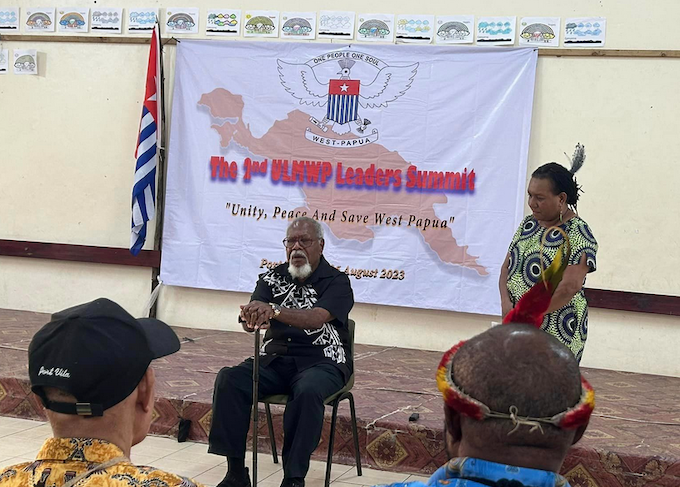
The West Papuan summit was addressed by Regenvanu and a former Vanuatu prime minister, Barak Sope.

Print Friendly, PDF & Email

Article by AsiaPacificReport.nz

Flood protection based on historical records is flawed – we need a risk model fit for climate change

Source: The Conversation (Au and NZ) – By Xinyu Fu, Senior Lecturer in Environmental Planning, University of Waikato

Despite countries pouring billions of dollars into “protecting” communities, flood-related disasters are becoming more frequent and are projected to become even more severe as the climate crisis worsens.

In fact, many areas that flooded during recent extreme weather events, from Auckland to Henan in China, were deemed to be relatively safe. This should raise an obvious question: to what extent is our existing approach fit for purpose in a changing climate?

Traditionally, managing flooding has relied heavily on building higher levees or increasing the capacity of drainage systems. But this can be a mixed blessing. While they contain water most of the time, when levees or drains exceed their original design capacity, we experience damaging floods.

These technical solutions have tended to operate on a flawed assumption that future flooding can be reliably predicted based on decades of historical flood data. They also create the “levee effect” – a false sense of security that encourages development in still risk-prone areas.

As climate change brings unpredictable rainfall patterns and higher intensities, these historic design assumptions are falling well short of the realities. And it means there remains a “residual risk”, even when infrastructure improvements have been made or planned for.

Red tape and risk

We can use the analogy of wearing a seat-belt to understand residual risk. The belt will reduce harm in case of an accident, but it does not mean you are entirely protected from injury.

Now imagine road conditions and weather are gradually worsening, and traffic volumes increasing. Some might look at the new risk and decide not to drive, but for those already on the road it is too late.


Read more:
Climate extremes make NZ’s supply chains highly vulnerable – it’s time to rethink how we grow and ship food


Most countries are still managing floods just like this: sometimes building higher levees or installing bigger pipes. But development often occurs incrementally, without the strategic investment needed or the room to safely store excess water volumes in urban areas when failure occurs.

Housing development is needed, but too often current (let alone future) flood risk is not adequately considered. Planning controls, or additional infrastructure costs, are routinely referred to as “red tape” that raises costs. As a result, recovery costs are ongoing and residual risk gradually rises.

Weather-related disasters in 2023, including Cyclone Gabrielle in New Zealand and wildfires in the northern hemisphere, have led to a new focus on understanding how residual risk is managed. But whether it is even acknowledged or incorporated in planning policy varies from country to country.

National strategy missing

Our research team from the University of Waikato recently undertook a survey with flood risk practitioners in New Zealand to shed some light on this.

New Zealand has little in the way of national-level guidance on managing flood risk. Despite this, survey responses suggest flood risk professionals are aware of the issue. They agree residual flood risk is increasing, mainly due to climate change and ongoing development in flood-prone areas currently designated as “protected”.


Read more:
Natural hazards, a warming climate and new resource laws – why NZ needs geoscientists more than ever


They also agree the current practice of flood risk management needs improving. But there are several barriers, with the lack of a clear national directive on managing flood risk being the most notable in our survey.

Several respondents noted that changing risk management practice is difficult, given the existing institutional framework. This includes the “build more levees” approach to flood planning.

Local governments also vary in their capacity and resources. Many small councils lack quality flood risk information, such as the likely impact of climate change, which is critical for making wise land-use decisions.

As a result, housing and other developments are continuing in risky places. And to keep development costs down, infrastructure is not being systematically upgraded.


Read more:
Incremental environmental change can be as hazardous as a sudden shock – managing these ‘slow-burning’ risks is vital


Planning for residual risk

We expect the New Zealand experience reflects similar trends elsewhere. Practitioners are aware of the growing threat of residual risk and would like more power to manage it. But there is a lack of urgency and resources to upgrade infrastructure. And there is political pressure to enable more housing and reduce red tape.

If these patterns persist, not only will the impacts from future floods become more frequent and expensive, but the insurance sector will retreat further from offering flood policies.

This will eventually leave central governments as de facto insurers-of-last-resort for flooding events. And they will be picking up an increasingly big bill, as already evidenced by the US$20.5 billion deficit faced by the United States National Flood Insurance Program.


Read more:
Creating ‘sponge cities’ to cope with more rainfall needn’t cost billions – but NZ has to start now


Internationally and in New Zealand, attention is shifting to the need to build “sponge cities” or create more “room for water” in flood risk management. But we argue that acknowledging and managing the growing residual risk from climate change is missing from the debate.

A better-informed approach would see stronger guidelines against ill-advised development in flood-prone areas unless the infrastructure investment reduces that residual risk. Development on floodplains can still happen. But land use and investment must account for an uncertain future and lower the overall risk profile, rather than increase it.

The reality of more frequent flooding demands a multi-faceted response that makes cities, towns and rural areas more resilient – and prepared for inevitable infrastructure failure. Residual risk needs to be central to planning if we are to avoid an endless cycle of mopping up, rebuilding and compensating for financial loss.

The Conversation

Xinyu Fu receives funding from the Ministry of Business, Innovation and Employment’s Endeavour Fund and the Toka Tū Ake Earthquake Commission to conduct research on issues related to flood risk management and future land use planning.

Iain White receives funding from the National Science Challenge: Resilience to Nature’s Challenges – Kia manawaroa – Ngā Ākina o Te Ao Tūroa. He also receives funding from the Ministry of Business, Innovation and Employment’s Endeavour Fund to research issues connected to flood risk mapping and better decision making, and from Toka Tū Ake Natural Hazards Commission to research how to better incorporate risk into future settlement planning.

Rob Bell receives funding from Toka Tū Ake Earthquake Commission, as an advisor to the University of Waikato team to research issues connected to flood risk mapping, management and future land use planning. Rob was also funded by the Ministry for the Environment to revise the 2023 national Coastal Hazards and Climate Change guidance for local government in NZ.

Silvia Serrao-Neumann receives funding from the Ministry of Business, Innovation and Employment’s Endeavour Fund and the Toka Tū Ake Earthquake Commission to conduct research on issues related to flood risk management and land use planning.

ref. Flood protection based on historical records is flawed – we need a risk model fit for climate change – https://theconversation.com/flood-protection-based-on-historical-records-is-flawed-we-need-a-risk-model-fit-for-climate-change-212454

MSG leaders back Kanak challenge to Macron over ‘not valid’ referendum

By Kelvin Anthony, RNZ Pacific lead digital and social media journalist

The leaders of five Melanesian nations have agreed to write to French President Emmanuel Macron “expressing their strong opposition” to the results of the third New Caledonia referendum.

In December 2021, more than 96 percent of people voted against full sovereignty, but the pro-independence movement FLNKS (Kanak and Socialist National Liberation Front) has refused to recognise the result because of a boycott by the Kanak population over the impact of the covid pandemic on the referendum campaign.

Since then, the FLNKS has been seeking international support for its view that the referendum result was not a legitimate outcome.

The Melanesian Spearhead Group leaders — Fiji, Solomon Islands, Papua New Guinea, Vanuatu and the FLNKS — met in Port Vila last week for the 22nd edition of the Leader’s Summit, where they said “the MSG does not recognise the results of the third referendum on the basis of the PIF’s Observer Report”.

FLNKS spokesperson Victor Tutugoro told RNZ Pacific the pro-independence group had continued to protest against the outcome of the December 2021 referendum.

“We contest the referendum because it was held during the circumstances that was not healthy for us. For example, we went through covid, we lost many members of our families [because of the pandemic],” Tutugoro said.

“We will continue to protest at the ICJ (International Court of Justice) level and at the national level. We expect the MSG to help us fight to get the United Nations to debate the cause of the Kanaks.”

The leaders have agreed that “New Caledonia’s inclusion on the UN List of decolonisation territories is protected and maintained”.

The MSG leaders have also directed the UN permanent representative to “examine and provide advice” so they can seek an opinion from the ICJ “on the results of the third referendum conducted in December 2021”.

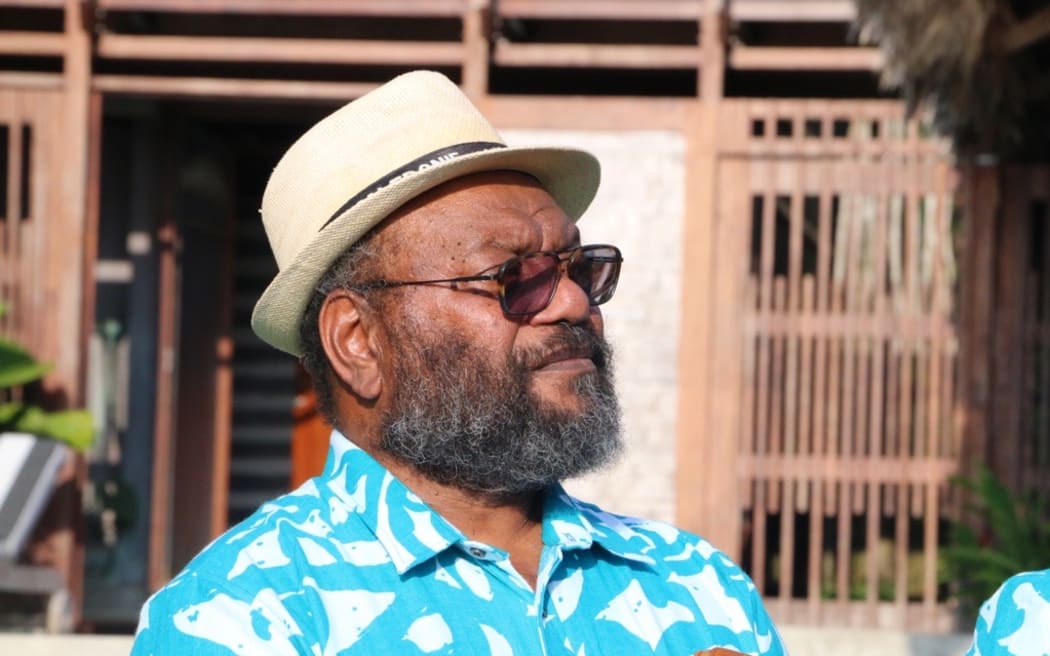
Victor Tutugoro at the 22nd Melanesian Spearhead Group Leaders' Summit in Port Vila.
FLNKS spokesperson Victor Tutugoro at the 22nd Melanesian Spearhead Group Leaders’ Summit in Port Vila. . . . “We contest the referendum because it was held during the circumstances that was not healthy for us.” Image: RNZ Pacific/Kelvin Anthony

They have also requested that the UN provide a report on the “credibility of the election process, and mandated the MSG UN permanent representatives, working with the MSG Secretariat and the FLNKS, “to pursue options on the legality of the 3rd referendum”.

Support for West Papua
New Caledonia’s pro-independence FLNKS movement also said it would continue to back the United Liberation Movement for West Papua (ULMWP) to become a full member of the Melanesian Spearhead Group.

Tutugoro told the 22nd MSG Leader’s Summit in Port Vila that FLNKS had always supported West Papua’s move to join the MSG family.

He said by becoming a full member of the sub-regional group, FLNKS was able to benefit from international support to counterbalance the weight of France in its struggle for self-determination.

He said the FLNKS hoped the ULMWP would have the same opportunity and in time it could be included on the UN’s list of non-self-governing territories.

This article is republished under a community partnership agreement with RNZ.

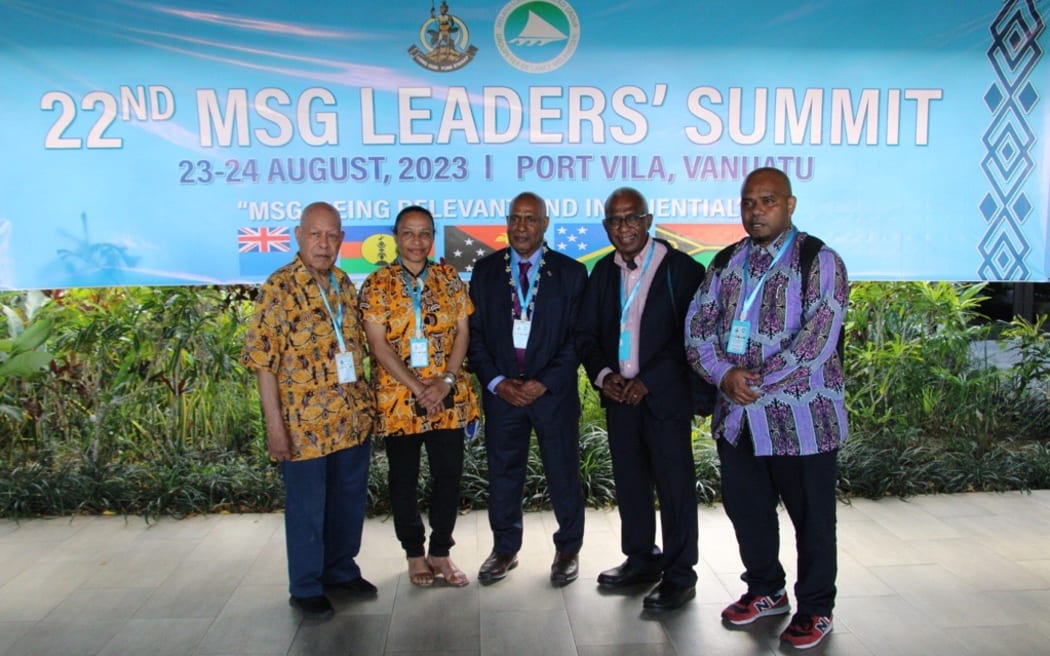
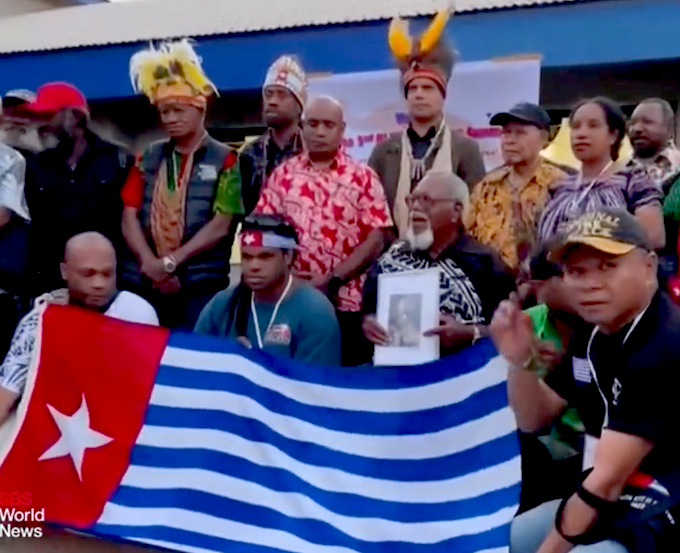
United Liberation Movement for West Papua delegates at the 22nd Melanesian Spearhead Group Leaders' Summit in Port Vila. 24 August 2023
United Liberation Movement for West Papua delegates at last week’s 22nd Melanesian Spearhead Group Leaders’ Summit in Port Vila, Vanuatu. Image: RNZ Pacific/Kelvin Anthony
Print Friendly, PDF & Email

Article by AsiaPacificReport.nz

We need a new way to pay for aged care. But it can’t shut out those on low incomes

Source: The Conversation (Au and NZ) – By Stephen Duckett, Honorary Enterprise Professor, School of Population and Global Health, and Department of General Practice, The University of Melbourne

Aged-care funding is again on the agenda, with the latest Intergenerational Report predicting Australia’s aged population will triple over the next 40 years. As a community, we will need to spend more on aged care than we do today, with aged-care spending expected to more than double its share of gross domestic product by 2063.

We cannot sleepwalk into this increased spending. It needs to be planned so access is protected and all older people, regardless of income, are able to get the aged care they need.

Aged-care funding should include taxpayer-funded care and resident co-payments. But we need to ensure funding changes don’t reduce access for those on low incomes.

Two distinct types of services

Most experts now accept the two main types of services older people receive in aged care facilities or in their home require different policy responses:

  • ordinary costs of living. These would have ordinarily been paid for by older people themselves earlier in their lives, for things like cleaning the house or food preparation. Housing and accommodation is sometimes a special subset of these costs

  • care and support. This includes nursing care, podiatry, physiotherapy and other health services, either in the home or in a residential aged care facility. These would generally not have been needed earlier in life.


Read more:
Lump sum, daily payments or a combination? What to consider when paying for nursing home accommodation


Funding ‘care’ services

Medicare is now almost 40 years old. Australians long ago made the choice that hospital and medical care should be publicly funded – and people should not be forced to forgo necessary care because of cost. The same arguments apply to the aspects of aged care which look more like health care.

There is usually some form of health assessment for these services and so consumers don’t initiate these services themselves. Because of this gatekeeping, the arguments for people to pay out-of-pocket for aged care (other than ordinary costs of living) are weak.

It’s also hard for consumers to assess the quality of these services, and so one of the preconditions of a functioning market – the ability for consumers to make informed choices – does not exist.

In these circumstances, funding should come from the public purse. Governments should pay the full costs of care (other than ordinary costs of living) for all aged-care residents and those who receive care in their home.

So how should ‘care’ costs be funded?

Future funding requirements for care should be met through economic growth, or a specific adjustment to taxation revenue, such as increasing company or income tax payable, or reducing inequitable tax loopholes.

An “aged-care levy”, effectively an increase in income tax modelled on the Medicare levy is an alternative option. An aged-care levy might be specifically allocated – or “hypothecated” – to aged care or, as with the Medicare levy, just go into the total pot of Commonwealth revenue.

The downsides of hypothecated taxes are they potentially reduce government flexibility and make it harder for government to set priorities across all areas of government. Direction setting is even harder if the hypothecated tax generates more or less than expected. A focus on a special hypothecated tax creates blinkers, which may mean the full range of potential revenue sources aren’t considered.

However, an aged-care levy may be a politically palatable source of additional revenue. It’s the most equitable and efficient way of increasing Commonwealth revenue to pay for aged care. Its major downside is that it continues the current policy approach that today’s taxpayers pay for the aged-care needs of yesterday’s taxpayers, and this raises issues of “intergenerational equity”.


Read more:
Money’s tight for young people. Adding a Medicare-style levy to everyone’s tax bill is the wrong way to increase aged-care funding


Funding ‘ordinary costs of living’ in later life

Most people meet the full cost of their meals, accommodation, cleaning and so on during their working life, so the normal expectation is that they would meet them later in life too.

However, there are a few reasonable exceptions to the rule:

  • some people don’t earn enough to pay for their own accommodation and live in public housing during their middle years
  • most people’s income in retirement is lower than their income during their working life. Renters especially may not have enough income to pay for accommodation in later years
  • some people are unable to maintain their own homes and need to pay others to do so, at increased cost
  • some people might require special foods or different accommodation, and so their costs of living might be substantially higher than previously.

All of this means that ordinary costs of living may need to be subsidised when they weren’t previously.

Currently there is a mish-mash of policies for consumer co-payments for the ordinary costs of living. People in residential aged-care facilities face income and assets tests which determine co-payments, but residents can pay more for additional amenities. Consumers face a bewildering array of choices for contributions toward accommodation (capital) costs.

Contributions to home care are less structured and providers have more leeway about consumer co-payment policies.


Read more:
Aged-care funding reforms must ensure users pay their fair share


Issues relating to accommodation costs for residential care are very complex, as much of a homeowner’s capital is tied up in the family home. This creates transition issues, especially if one member of a couple needs to move to a different type of accommodation. A complex web of payment arrangements for accommodation costs in residential care has evolved, and a shake up of these arrangements is overdue.

So how should ‘ordinary costs of living’ be paid for?

Some form of means- and asset-tested co-payment must be part of the mix, with means and assets including superannuation balances and income streams.

There should also be more consistency across providers in the co-payments consumers have to pay.

Although aged-care policy must balance equity and financial sustainability, the full cost of aged care – including care costs and ordinary costs of living – cannot be met by recipients themselves, so we must be wary of the calls for massive increases in out-of-pocket payments.

Increased contributions from the public purse will be required through income tax, with an aged-care levy one option, or reduced tax loopholes.


Read more:
Our older population will triple in 40 years. But a social insurance model won’t fix the aged care funding crisis


The Conversation

Stephen Duckett is a Life Member of the Brotherhood of St Laurence which, among other things, is a not-for-profit provider of aged care services.

ref. We need a new way to pay for aged care. But it can’t shut out those on low incomes – https://theconversation.com/we-need-a-new-way-to-pay-for-aged-care-but-it-cant-shut-out-those-on-low-incomes-212017

We won’t always have to use animals for medical research. Here’s what we can do instead

Source: The Conversation (Au and NZ) – By Greg Williams, Associate Director, CSIRO Futures, CSIRO

Shutterstock

Animals have been used for medical research for thousands of years, dating back to ancient Greece where the first dissections were performed.

These days, one of the main uses of animals is to ensure the safety of medical products before they’re trialled in humans.

But in addition to the important ethical reasons for minimising animal use, the reality is sometimes animals just aren’t that good at predicting human responses. No animal model, for example, has captured all the human characteristics of complex illnesses like Alzheimer’s disease or chronic inflammatory demyelinating polyneuropathy (a neuromuscular disease). This makes is hard to develop effective treatments and cures.

Thankfully, researchers are making progress in developing a collection of alternative approaches, called “non-animal models”. A new report from our team at CSIRO Futures examines the potential of non-animal models and the actions Australia will need to take to pursue their use.


Read more:
Can we ethically justify harming animals for research?


What are non-animal models?

Non-animal models are an alternative set of models that use human cells, tissues and data.

These have the potential to better mimic human responses. In doing so, this can more accurately predict if a medical product is likely to fail, allowing reinvestment in products that are more likely to succeed.

Computer simulations or “in silico models” are one example. These can be used across the medical product development process to complement – and in time potentially replace – other model types. They can be used in drug studies to model a drug’s behaviour within the body, from cellular interactions to processes that involve multiple organs.

Complex three-dimensional biological models are also maturing quickly. Examples include:

  • organoids – organ “buds” that can be propagated from stem cells or taken from biopsies

  • organs-on-chips – cells cultured in a miniature engineered chip. These attempt to replicate the physical environment of human organs.

What can we use non-animal models for?

In theory, we can use non-animal models for everything we use animal models for – and more.

Simple non-animal models (human cells cultured over a flat surface) are already used to help identify drug targets due to their ability to test a large number of compounds and experimental conditions.

In the future, non-animal models will reduce – and eventually replace – animal use across a range of applications:

  • screening potential drugs to see how well they work
  • toxicology (safety) testing
  • helping to screen, select and stratify shortlisted participants for clinical trials. This might include an assessment of their unique response to a potential drug.
  • using patient cells to identify the treatment most likely to help that individual.

Outside of medical products designed for humans, non-animal models can also support innovation in veterinary and agricultural medicines, cosmetic testing and eco-toxicology.

Woman applies lipstick
Non-animal models can be used to test cosmetics.
Shutterstock

An export opportunity for Australia

Non-animal models present an economic opportunity for Australia, where the models, their components, and surrounding services could be exported to the world.

Our novel economic analysis sized the potential Australian market for two non-animal models: organoids and organs-on-chips. Other models were unable to be sized due to a lack of global market data.

We estimate the Australian organoid market could be worth A$1.3 billion annually by 2040 and create 4,200 new jobs.

The organs-on-chips market could be worth A$300 million annually by 2040 and create 1,000 new jobs. This estimate is lower as this technology is currently less advanced but holds the potential to grow significantly beyond 2040.


Read more:
Mechanical forces in a beating heart affect its cells’ DNA, with implications for development and disease


Several Australian entities are already contributing to these opportunities. The Murdoch Children’s Research Institute, for example, provides stem cell and modelling expertise as part of reNEW, a €300 million international collaboration.

Another example is from Schott Minifab, an international biotech and medical device company with Australian roots, which has successfully established scaled production of non-animal model components in Australia for domestic and export markets.

Making it a reality

Non-animal models have already begun to complement and replace animal use in some areas, such as identifying drug targets.

However, accelerating their development and adoption across a wider range of applications will require further technical advances to lower cost and validate their performance as superior models.

Australia has several research strengths in this field but we need a concentrated effort to help our research make it through to real world impact.

Our report makes ten recommendations for supporting Australia’s pursuit of these opportunities. Critical activities over the next five years include:

  • coordinating local capabilities
  • investing in upgraded infrastructure
  • creating and collating data that compares animal and non-animal model performance.

Governments, industry and research must collaborate to deliver against these actions. Success will only come from collective efforts.


Read more:
Is it time for Australia to be more open about research involving animals?


The Conversation

The authors do not work for, consult, own shares in or receive funding from any company or organisation that would benefit from this article, and have disclosed no relevant affiliations beyond their academic appointment.

ref. We won’t always have to use animals for medical research. Here’s what we can do instead – https://theconversation.com/we-wont-always-have-to-use-animals-for-medical-research-heres-what-we-can-do-instead-212182

We studied more than 1,500 coastal ecosystems – they will drown if we let the world warm above 2C

Source: The Conversation (Au and NZ) – By Neil Saintilan, Professor, School of Natural Sciences, Macquarie University

Simon Albert

Much of the world’s natural coastline is protected by living habitats, most notably mangroves in warmer waters and tidal marshes closer to the poles. These ecosystems support fisheries and wildlife, absorb the impact of crashing waves and clean up pollutants. But these vital services are threatened by global warming and rising sea levels.

Recent research has shown wetlands can respond to sea level rise by building up their root systems, pulling carbon dioxide from the atmosphere in the process. Growing recognition of the potential for this “blue” carbon sequestration is driving mangrove and tidal marsh restoration projects.

While the resilience of these ecosystems is impressive, it is not without limits. Defining the upper limits to mangrove and marsh resilience under accelerating sea level rise is a topic of great interest and considerable debate.

Our new research, published today in the journal Nature, analyses the vulnerability and exposure of mangroves, marshes and coral islands to sea level rise. The results underscore the critical importance of keeping global warming within 2 degrees of the pre-industrial baseline.

A photo showing uprooted trees in tropical waters of the Solomon Islands.
Coral islands are contracting, causing habitat loss in the Solomon I re: photo, any other attribution?slands.
Simon Albert


Read more:
Not waving, drowning: why keeping warming under 1.5℃ is a life-or-death matter for tidal marshes


What we did

We pulled together all the available evidence on how mangroves, tidal marshes and coral islands respond to sea level rise. That included:

  • delving into the geological record to study how coastal systems responded to past sea level rise, following the last Ice Age

  • tapping into a global network of survey benchmarks in mangroves and tidal marshes

  • analysing satellite imagery for changes in the extent of wetlands and coral islands at varying rates of sea level rise.

Altogether, our international team assessed 190 mangroves, 477 tidal marshes and 872 coral reef islands around the world.

We then used computer modelling to work out how much these coastal ecosystems would be exposed to rapid sea level rise under projected warming scenarios.

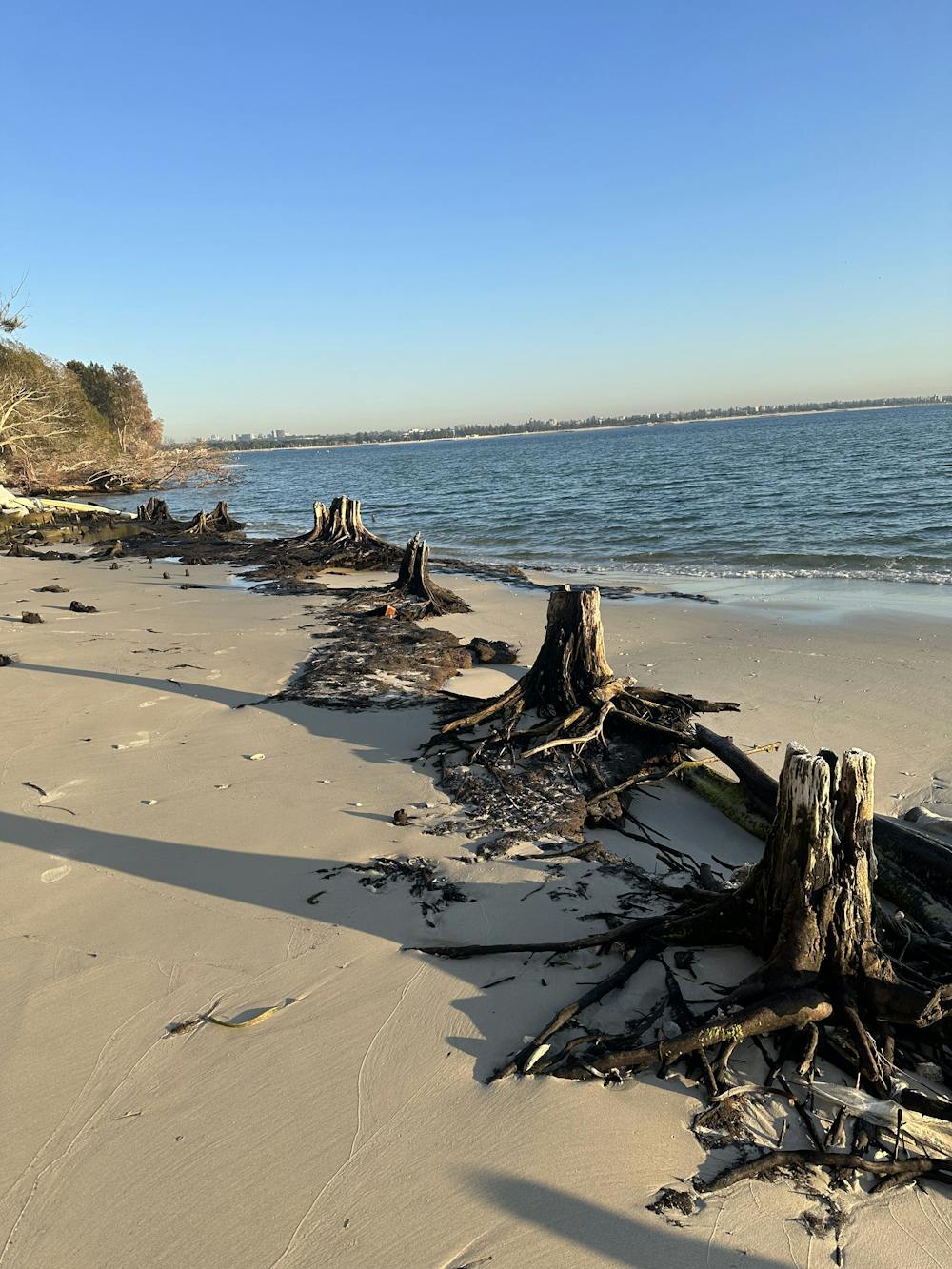
A photo of the eroding wetland at Towra Point in Sydney, showing the stumps and exposed roots of trees washed up on the beach
Eroding wetland at Towra Point in Sydney.
Neil Saintilan

What we found

Mangroves, tidal marshes and coral islands can cope with low rates of sea-level rise. They remain stable and healthy.

We found most tidal marshes and mangroves are keeping pace with current rates of sea level rise, around 2–4mm per year. Coral islands also appear stable under these conditions.

In some locations, land is sinking, so the relative rate of sea level rise is greater. It may be double this 2–4mm figure or more, comparable to rates expected under future climate change. In these situations, we found marshes failing to keep up with sea level rise. They are slowly drowning and in some cases, breaking up. What’s more, these are the same rates of sea level rise under which marshes and mangrove drown in the geological record.

These cases give us a glimpse of the future in a warming world.

So if the rate of sea level rise doubles to 7 or 8 millimetres a year, it becomes “very likely” (90% probability) mangroves and tidal marshes will no longer keep pace, and “likely” (about 67% probability) coral islands will undergo rapid changes. These rates will be reached when the 2.0℃ warming threshold is exceeded.

Even at the lower rates of sea level rise we would have between 1.5℃ and 2.0℃ of warming (4 or 5mm a year), extensive loss of mangrove and tidal marsh is likely.

Tidal marshes are less exposed to these rates of sea level rise than mangroves because they occur in regions where the land is rising, reducing the relative rate of sea level rise.


Read more:
Rising seas threaten to drown important mangrove forests, unless we intervene


Let’s give coastal ecosystems a fighting chance

We know mangroves and tidal marshes have survived rapid sea level rise before, at rates even higher than those projected under extreme climate change.

They won’t have long enough to build up root systems or trap sediment in order to stay in place, so they will seek higher ground by shifting landward into newly flooded coastal lowlands.

But this time, they will be competing with other land uses and increasingly trapped behind coastal levees and hard barriers such as roads and buildings.

If the global temperature rise is limited to 2℃, coastal ecosystems have a fighting chance. But if this threshold is exceeded, they will need more help.

Intervention is needed to enable the retreat of mangroves and tidal marshes across our coastal landscapes. There is a role for governments in designating retreat pathways, controlling coastal development, and expanding coastal nature reserves into higher ground.

The future of the world’s living coastlines is in our hands. If we work to restore mangroves and tidal marshes to their former extent, they can help us tackle climate change.


Read more:
Climate change can drive social tipping points – for better or for worse


The Conversation

Neil Saintilan receives funding from the Australian Research Council, the National Environmental Science Program, and the Alexander Von Humboldt Foundation.

ref. We studied more than 1,500 coastal ecosystems – they will drown if we let the world warm above 2C – https://theconversation.com/we-studied-more-than-1-500-coastal-ecosystems-they-will-drown-if-we-let-the-world-warm-above-2c-211431

Romantic comedies, Japanese reality television and New Zealand true crime: the best of streaming this September

Source: The Conversation (Au and NZ) – By Dennis Altman, VC Fellow LaTrobe University, La Trobe University

We have never been more spoilt for choice when it comes to what we can watch on (streaming) television. But the downside of this gluttony of riches is the sheer overwhelm that can come from having to choose your next show.

Have you found yourself reaching to rewatch an old favourite, just to make the choice easier? Us too.

But fear not, The Conversation’s writers are on the case. In this new series, our experts will be bringing you the best new shows, films and seasons to watch every month.

From comedy to reality television to crime drama, we hope you’ll find your next favourite here.

Glamorous

Netflix

Kim Cattrall showed considerable savvy when, rather than rejoin the cast of Sex and the City, she opted to play Madolyn Addison, the dynamic head of beauty brand Glamorous. The series revolves around a young gender-fluid assistant, Marco Mejia (Miss Benny), who inspires the company to break boundaries while exploring his own uncertainties around sexuality and gender.

On the surface this is even frothier than Sex and the City, and some critics have panned it. Angie Han in the Hollywood Reporter (a publication not known for its commitment to high art) saw it as:

A workplace comedy that has no grasp of how work works, a rom-com that fails to generate a single convincing spark, a Gen-Z coming-of-age saga with the cultural references of a geriatric Millennial.

These objections are like complaints that Midsomer Murders gives an unrealistic depiction of police procedure. I know little about the cosmetics industry, but I suspect it is more accurately portrayed here than the cringing improbabilities of the British royal court in Red, White and Royal Blue.

There is a taken-for-granted queerness of the program: here heterosexuals, led by Cattrall and her ever-faithful chauffeur, are in the minority. The series plays with stereotypes, from the A-list gay boys at Provincetown to the drag queens in Marco’s favourite club. And Han must have a heart of stone to have missed the ongoing heartbreak of Marco’s geeky workmate, Ben.

Glamorous is as camp as Barbie, but far cleverer and more subversive: without a spoiler, it’s worth comparing the way the two end.

– Dennis Altman


Read more:
‘Gay guys can do missionary?’ – how Red, White & Royal Blue brings queer intimacy to mainstream audiences


Starstruck season three

ABC iView (Australia) from September 6 and TVNZ+ (New Zealand) from September 2

The delightful romantic-comedy Starstruck follows the successes, failures and absurdities of an unexpected romance.

The two charismatic, neurotic non-white leads make this a far-from-standard rom-com: Nikesh Patel’s Tom Kapoor is a world-famous British movie star; Rose Matafeo’s Jessie is far more intense, obnoxious and funny than your average rom-com heroine.

Starstruck’s creator and star Matafeo has crafted a world that feels real with inside jokes that invite you in, an ironic sincerity that is sweet but not saccharine, and neurotic characters written with endearing specificity, warmth and humour.

Last season ended with a moment that was equal parts romantic and absurd, as Jessie and Tom reconcile and make out in a pond. But the new season opens with a montage tracing the subsequent two years of moving in together and then drifting apart.

Starstruck understands what makes Jessie and Tom interesting to watch: not domestic bliss, but their awkward banter and difficulty overcoming their mismatched quirks, despite their obvious chemistry and attraction. For those who love a smart, sizzling rom-com in the tradition of Hepburn and Tracy this is a must-watch.

The new season continues the excellent form of the first two seasons, as Tom and Jessie attend a very awkward wedding and end up back in each other’s orbit.
– Jessica Ford

Far North

ThreeNow (New Zealand) and Paramount+ (Australia)

The terrific new New Zealand dark comedy Far North dramatises a bizarre meth-smuggling case from 2016, in which a ridiculously inept gang nearly got half a ton of methamphetamine to market, only to be rumbled by the locals.

Veteran actors Temuera Morrison and Robyn Malcolm are excellent as decent Ahipara couple Ed and Heather, who become embroiled in the bungled plot when local criminals try to get their Chinese bosses out to sea off Ninety Mile Beach to intercept a stranded drug shipment.

If things can go wrong, they do – and events swiftly turn into a cascading comedy of errors.

Creator David White co-wrote a true crime book on the subject, and you can see his eye for detail throughout. The whole thing is run through with a mordant, deadpan sensibility that will have you spitting out your tea with laughter even as you are wincing at some of the more horrific elements of the case.

Impeccably shot, and featuring a wonderfully motley assortment of low-rent crims, desperate drug runners, cartel mobsters and salt-of-the-earth locals, Far North is easily one of the best (and funniest) New Zealand shows in years.

–Erin Harrington

Mother and Son

ABC iView

Mother and Son has long been regarded as one of Australia’s greatest sitcoms.

First airing in 1984, the tale of the ageing Maggie Beare and her hapless son, Arthur, was not only very funny, but revealed the pain, frustration and love that underpinned their relationship.


Read more:
The Mother and Son reboot has fresh things to say about adult children and their ageing parents


For anyone who has cared for an ageing parent – or faced the diminution of their autonomy as they have aged – Mother and Son still strikes a nerve.
Where the original series featured a baby boomer looking after his mother, in the revival, it’s a millennial looking after his boomer mum – a story being played out in homes across the nation.

In the 2023 Mother and Son, Maggie (Denise Scott) is a free-spirited eccentric who almost burned down the family home while cooking dinner for her grandchildren. Childless, unmarried Arthur (Matt Okine), meanwhile, is attempting to start a web business.

The new Mother and Son is likeable, gentle comedy. It has a diverse, multicultural cast and the writing is largely well-observed. Yet in remaking a much-loved classic comedy, the creators have set themselves an impossibly high bar: Scott and Okine, while charming, are no match for Ruth Cracknell and Garry McDonald.

– Michelle Arrow

Ai no Sato (Love Village)

Netflix

This year we have seen a new wave of interest in reality dating shows with older protagonists. In the US, Gerry Turner, aged 71, has just been announced as the first “Golden Bachelor”. In the UK, the upcoming show My Mum, Your Dad (an Australian version aired in 2022) is being billed as “middle-aged Love Island”.

Perhaps the best example, though, comes from Japan. Ai no Sato, or Love Village, is a take on the stalwart Japanese reality dating format Ainori (Love Wagon). In Ainori, contestants travel the world in a minibus and fall in love along the way. In Ai no Sato, by contrast, contestants (all aged over 35) renovate a house in rural Japan together … and fall in love along the way.

I love Ainori, but Ai no Sato takes things to a new level. Because its contestants are older, they have a deep well of life experience and relationship baggage, which makes for very compelling romance narratives – and, in particular, confessions of love that carry incredible emotional weight.

The vast majority of reality romance shows would treat a love triangle with a 60-year-old woman at its apex as jokey or gimmicky, but I defy anyone to watch this show and not be deeply hoping that Minane finds (in the show’s parlance) the last love of her life.

And if the romance aspect doesn’t interest you? There’s always the house renovation. This house is gorgeous.

– Jodi McAlister


Read more:
The guilty pleasure of watching trashy TV


Unforgotten season five

Binge (Australia) and TVNZ+

There are a lot of British crime dramas out there. You only need to look at the back catalogue of BritBox to see just how extensive it is. There are a lot of excellent series out there (Broadchurch, Happy Valley and Karen Pirie are all exceptional). There is also a lot of chaff, where the premise is more formulaic. This is perhaps why it took me so long to give Unforgotten a go. I was, however, quickly hooked and proceeded to binge the series very quickly.

Each season begins with the discovery of a murder that the historical crimes unit must solve, led by DCI Cassie Stuart (the wonderful Nicola Walker) and DI Sunil Khan (Sanjeev Bhaskar).

Initially, the subplots about miscellaneous suspects all seem unrelated and random. However, the investigation (very well plotted out) slowly pieces all these characters together. As the investigation develops, the suspects’ lives, and everyone close to them, are upended.

Season five sees the departure of Walker and new to the team is DCI Jessica James (Sinéad Keenan). The season’s central tension is around her gruffness and the resentment of her not being DCI Stuart, who everyone loved. DCI James must lead her team to investigate the human remains discovered up a chimney in a newly renovated London stately home, which leaves a diverse array of suspects somehow connected to the crime.

For those that love a gripping British crime drama, I highly recommend this series.

– Stuart Richards

Beautiful Disaster

Prime

If Beautiful Disaster, the new film from Cruel Intentions director Roger Kumble, had come out 20 years ago, no one would have paid it much attention. It’s an enjoyably formulaic girl-meets-boy rom-com, but it’s aesthetically drab, looking more like a telemovie (which it is) than a made-for-cinemas release.

However, streaming in 2023 – now the rom-com has disappeared as a mainstay of Hollywood cinema – there’s something refreshingly delightful about it.

Abby (Virginia Gardner) leaves her father, a hopeless gambler in Las Vegas, to set out for college in Sacramento. On her first night at an underground mixed martial arts fight, she bumps into – literally – beefy brawler Travis (Dylan Sprouse, better known as the teen star of Disney’s The Suite Life of Zack & Cody).

At first he comes off as an arrogant jerk – not to mention Abby is sprayed with blood when he knocks out his opponent – but, as their relationship develops, his sensitivity becomes evident.

After many expected shenanigans, sexual and otherwise, and following run-ins with gangsters back in Vegas (to which Abby has to return to help Daddy out of a bind), the pair finish up happily ever after.

There is nothing unexpected here, but the charming qualities of the leads and the film’s general good humour carry it, along with cameos from TV stars who had their heyday in teen fare in the 90s and 2000s, including Brian Austin Green and Michael Cudlitz from Beverly Hills 90210, Autumn Reeser from The O.C. and Rob Estes from Melrose Place.

At the same time, only sometimes effectively, Beautiful Disaster thinks through questions around erotic power dynamics in a post-#MeToo era, comically centring on the kind of guilt Abby feels regarding her attraction to Travis.

– Ari Mattes

The Conversation

Michelle Arrow receives funding from the Australian Research Council.

Ari Mattes, Dennis Altman, Erin Harrington, Jessica Ford, Jodi McAlister, and Stuart Richards do not work for, consult, own shares in or receive funding from any company or organization that would benefit from this article, and have disclosed no relevant affiliations beyond their academic appointment.

ref. Romantic comedies, Japanese reality television and New Zealand true crime: the best of streaming this September – https://theconversation.com/romantic-comedies-japanese-reality-television-and-new-zealand-true-crime-the-best-of-streaming-this-september-212011

Gig economy workers set for new protections in Albanese government’s legislation introduced next week

Source: The Conversation (Au and NZ) – By Michelle Grattan, Professorial Fellow, University of Canberra

Shutterstock

A suite of protections for gig workers will be contained in legislation to be introduced into parliament by Workplace Relations Minister Tony Burke next week.

The government argues the changes balance protections with work flexibility. The new regime will begin from July 1.

The legislation, called the Closing Loopholes Bill, will also include measures on rights for casual workers, stopping wage theft, and preventing companies with enterprise agreements using labour hire to undercut wages.

Business has been campaigning strongly against the new round of industrial relations legislation.

Under the changes, the Fair Work Commission will set minimum standards for “employee-like workers” in the gig economy. These are people who work through a digital labour platform, notably in food delivery, ride share and the care economy.

Businesses will be able to apply to the commission for minimum standards orders tailored to the work performed under them.

The terms the commission will be able to consider for an order include payment, record keeping and insurance. But it would not set minimum standards on overtime rates, rostering, or terms that would change how a worker is engaged.

These workers will also be protected from being unfairly removed from digital labour platforms, and they will be able to ask the commission to resolve disputes.

The government says the changes will allow the commission to respond flexibly to these new, quickly evolving business models.

It stresses they will not affect independent contractors, such as skilled tradespeople, who have a high-degree of autonomy over their work.
Rather, they are aimed at protecting workers who are neither “employees” nor small businesses.

Gig workers are estimated to number in the hundreds of thousands.

Burke said at least 13 gig workers have died on the roads in the last few years..
“We know there is a direct link between low rate of pay and safety: it leads to a situation where workers take risks so they can get more work because they’re struggling to make ends meet,” he said.

“We can’t continue to have a situation where the 21st century technology of the gig platforms comes with 19th century conditions.

“At the moment if you’re classed as an employee you have a whole lot of rights such as sick leave, annual leave and minimum rates of pay. If not, all those rights fall off a cliff. What we want to do is turn the cliff into a ramp.

“We’re not trying to turn people into employees when they don’t want to be employees. But just because someone is working in the gig economy shouldn’t mean that they end up being paid less than they would if they’d been an employee.”

The Conversation

Michelle Grattan does not work for, consult, own shares in or receive funding from any company or organisation that would benefit from this article, and has disclosed no relevant affiliations beyond their academic appointment.

ref. Gig economy workers set for new protections in Albanese government’s legislation introduced next week – https://theconversation.com/gig-economy-workers-set-for-new-protections-in-albanese-governments-legislation-introduced-next-week-212541

View from The Hill: Australians go into the referendum divided – can the country emerge united?

Source: The Conversation (Au and NZ) – By Michelle Grattan, Professorial Fellow, University of Canberra

The stakes in the October referendum are high. For Anthony Albanese, who has made the Voice his great social cause of his first term. For Peter Dutton, who has defied those who say he is on the “wrong side of history”.

For those Aboriginal and Torres Strait Islander people who look to the referendum for affirmation of their special place in our society, as well as giving them a chance for some tangible improvements in their lives and opportunities.

For Australia’s international reputation.

The latest polling has put the “no” side ahead, after a slide over the months in the initial substantial support for the constitutional amendment. History is on the “no” side. Only eight of 44 referendum questions have been carried since federation.

But the result remains open, at the start of this campaign. Both sides accept there is a substantial bloc of uncommitted voters, as well as others, presently nominally in the “yes” or “no” camps, who are “soft” and thus open to persuasion.

Many voters haven’t yet tuned in; this is unsurprising, especially when the cost of living is dominating so many people’s attention.

The strength of support from younger voters, a lot of them still unengaged, will be a crucial factor in the outcome.

Albanese will be prominent in the campaign, but it won’t fill his calendar, according to his office. This is not an election. Indeed in a few days the PM is off overseas, visiting Indonesia and the Philippines ahead of the G20 meeting in India. The government says it wants this campaign to be grassroots-led. Yes23 already has some 28,000 volunteers in the field door-knocking.

If the “no” side won, it would be a significant blow to Albanese. This might not translate into a longer problem for the Labor vote, because the caravan would move on: people would make their judgements on Labor versus the Coalition on other grounds. But the interesting thing would be whether Albanese’s authority among his colleagues would be diminished. Would cabinet ministers become more inclined to question his judgement?

Looking ahead, a re-elected Labor government would have to think twice, or thrice, about going ahead with a referendum for a republic if it couldn’t carry one for the Voice.

Conversely, a win would strengthen even further the PM’s authority. Dutton would take a hit, especially in current and potential “teal” seats – those seats the Liberals need to win back or prevent from falling at the next election. The Voice has already set Liberals against each other – whichever way the vote goes, Dutton will have to rebuild unity.

The government would try to heap as much blame as possible on the opposition in the event of a “no” victory, but the cost to Dutton would probably be overshadowed by the wider fallout. And blame-shifting would involve saying the electorate got it wrong, which is always tricky.

A loss would be devastating for Indigenous people, even accepting that not all of them support the “yes” case. It would invite despondency, unleash anger, strengthen the radical activists in the Indigenous community, and deeply harm reconciliation. It would be the end of what many saw as a new beginning.

On the other hand, a “yes” result would start another long journey. Most immediately, that would involve putting together the Voice itself, about which the government has only been willing to specify the barest bones. The task wouldn’t be easy, involving fresh consultations with Indigenous people and, almost certainly, a good deal of argument.

That would be followed by activity on treaty and truth telling, to which the government is committed under its pledge of support for the Uluru Statement from the Heart as a whole.

In future years, the worth of a successful referendum would be judged, in part, by whether the Voice did in fact contribute to noticeably better outcomes in closing the gap in health, education, housing, employment and other markers of equality, fairness and opportunity.

Would it turn out to be a cohesive, informed, influential body, or fall victim to politics, internal or external? In a decade, would it be seen as a failure or a facilitator?

Other countries mightn’t be hanging out for the referendum result, but it will be noticed internationally – or at least, its defeat would be.

On Monday, Foreign Minister Penny Wong and former Foreign Minister Julie Bishop campaigned together in Perth for the “yes” case. A sparky pair, these two, in their very different ways.

Bishop, who is now Chancellor of the Australian National University, warned: “Australia’s international reputation can be affected by a ‘no’ vote.

“I have no doubt that it would be sending a very negative message about the openness, and the empathy, and the respect and responsibility that the Australian people have for Aboriginal and Torres Strait Islanders,” she said.

The referendum campaign will, unfortunately but inevitably, sharply divide the country. For voters, a crucial question should be, what outcome will leave Australia most united afterwards?

The Conversation

Michelle Grattan does not work for, consult, own shares in or receive funding from any company or organisation that would benefit from this article, and has disclosed no relevant affiliations beyond their academic appointment.

ref. View from The Hill: Australians go into the referendum divided – can the country emerge united? – https://theconversation.com/view-from-the-hill-australians-go-into-the-referendum-divided-can-the-country-emerge-united-212448

Sad Regenvanu condemns MSG for ‘failing’ people of West Papua

By Len Garae in Port Vila

The Melanesian Spearhead Group (MSG) has failed West Papua, says a Vanuatu government champion of West Papuan self-determination.

Minister for Climate Change Adaptation Ralph Regenvanu, a former foreign minister and who is also a pioneer spokesman for freedom for the Melanesian people of West Papua, said this when delivering his remarks at the closing of the United Liberation Movement for West Papua (ULMWP) Second Summit in Port Vila last weekend.

“Today I feel very sad because the MSG has failed West Papua. When I found out the decision of the leaders, I was shocked and I was really sad,” he said.

“We have not gone forward, we have gone backward here in Vanuatu. And this should not have happened in Vanuatu as we are the chair of MSG.”

Today's Vanuatu Daily Post front page featuring Minister Ralph Regenvanu's condemnation of the MSG
Today’s Vanuatu Daily Post front page featuring Minister Ralph Regenvanu’s condemnation of the MSG. Image: Vanuatu Daily Post screenshot APR

Speaking on behalf of the Vanuatu government, he described the failure to admit West Papua as the latest full member of MSG, as “a failure not only by the Vanuatu fovernment, but a failure by the Vanuatu Free West Papua Association (VFWPA), a failure by the ULMWP and we all have to pull up our socks”.

He continued: “If we had all been much better prepared in working together, I think we would have had a different result here in Vanuatu.

Why was ULMWP left out?
“For example, the Vanuatu government gave an office here for ULMWP, but the ULMWP was not a participant of the senior officials’ meeting of MSG.

“What is the purpose of having a meeting to decide the agenda for the leaders if ULMWP was absent from the meeting?”

However, he assured the second ULMWP summit, “For me this meeting is more important than the MSG Summit.

“Because it is a meeting to represent the unity for the people of West Papua for the self-determination of the people of West Papua”.

Minister Regenvanu challenged ULMWP to learn from Vanuatu’s political history.

“Vanuatu became independent because we formed a political grouping called Vanua’aku Pati and everybody got behind it to become independent. In fact without it, we would not have become independent,” he said.

“I am pleading with you to refocus this organisation which was formed here in Port Vila (in 2014). Rebuild, reunite, restrategise and with a truly united movement representing all Melanesians of West Papua, and one which is responsive and strategic and smart, we can achieve what we all want to help the Vanuatu government to do better next time.

‘This is your struggle’
“The Vanuatu government is helping you but this is your struggle. We are your backup but we can’t set the direction for you. So please help us to help you.”

Vanuatu’s first former roving ambassador and a former prime minister, Barak Sope, was the second speaker.

Former Vanuatu prime minister Barak Sope
Former Vanuatu prime minister Barak Sope . . . speaking at the West Papua leaders’ summit in Port Vila at the weekend. Image: Joe Collins/AWPA

“We struggled for our freedom from Britain (and France),” he said.

“Despite what happened now [failure to adopt West Papua as latest full member of MSG], the struggle must continue until victory is certain.

“We fully support the statement of Mr Regenvanu that ‘united we stand, divided we fall’. Vanuatu will continue to support the struggle of the people of West Papua.

“We’ve always taken the stand that West Papua should have been the first Melanesian country to become independent.

“The first Speaker of Parliament (of West Papua) Ayamiseba stayed with us here. He told us everything that happened.

People of West Papua ‘sold’
“How Holland, the colonial power, sold the people of West Papua, how the United States and Australia also sold the West Papuan people.

“And how the United Nations sold the people of West Papua.

“So we must never accept how Indonesia came in and stole your freedom.

“The reason for their presence is because of West Papua’s resources and not because of us the Melanesians.

“They are stealing (Melanesian resources). They are stealing our lands, they are stealing our trees, and they are stealing our gold so the struggle must continue for West Papua victory is certain!”

ULMWP president Benny Wenda with supporters in Port Vila
ULMWP president Benny Wenda with supporters in Port Vila, including a former Vanuatu prime minister, Barak Sope. Image: SBS World News screenshot APR

The ceremony was closed with a prayer from the Vanuatu Christian Council.

A Melanesian custom ceremony followed. It was coordinated by the chairman of the Council of Chiefs of West Papua, referred to as “Chief Tommy”.

Witnessed by the interim president of ULMWP, Benny Wenda, and his delegates and custom chiefs of Efate, the ceremony ended in the Melanesian way with the presentation of three live pigs, food, kava and mats to the government, Vaturisu [Council of Chiefs on Efate island] and VFWPA.

Len Garae is a Vanuatu Daily Post journalist. Republished with permission.

Print Friendly, PDF & Email

Article by AsiaPacificReport.nz

From old and crispy to bold glamour – TikTok filters are helping us tell stories online

Source: The Conversation (Au and NZ) – By Edith Jennifer Hill, Associate Lecturer, Flinders University

TikTok

TikTok can be a confusing place, with users going from extreme yassified glamour, to rotating through 20 eyebrow shapes, to turning into a crispy old man with a simple click. This is all thanks to the magic of filters.

Filters are an integral part of the TikTok experience – and they are coaxing life stories out of users. However, filters have a long history on social media platforms before TikTok. They are a massive part of social media culture and storytelling practices.

The history of filters

Photoshop, first released in 1990, enabled users to edit pictures. The first decade of the 2000s was filled with conversations about editing pictures in advertisements and commercials. Seemingly, people were shocked at the level of editing that professional photos went through.

The 2010s was the age of Facetune. Facetune is an app that allows users to retouch photos. Unlike Photoshop, which takes a certain level of skill to master, Facetune provided a quick, easy and cheap way for everyday people to edit their photos.

Instagram began adding face-altering filters in 2017. What began as bunny ears and exaggerated features (think Snapchat filters) quickly developed into filters that “perfected” facial features. These filters, often conforming to Western beauty standards, would slim the face, sharpen the jawline, enlarge the eyes and whiten teeth.

While early versions of these filters seemed unrealistic and “fake”, recent filters have mastered undetectable face alterations.

Of course, not all filters aim to seamlessly perfect facial features. TikTok’s massive range of filters not only include a wide variety of face alterations (everything from adding sun-kissed freckles to simulating lip injections), but can change anything imaginable: skin, eyes, hair, makeup and yes, even age.

Coaxed affordances

When you create a video on TikTok, you are prompted to an editing screen where you can add voice filters, sounds, visual filters and more. The presence of this editing screen encourages creators to make use of the platform’s features.

These are called platform “affordances” and they are the fundamental things that influence how something can be used. Affordances allow, and often compel, users to share and interact in specific ways online.

On TikTok, affordances dictate how users interact with the platform and with each other. They are the “For You” page, the ability to like and comment, the ability to watch live videos and send creators gifts. They make the platform what it is.


Read more:
People are pretending to be ‘NPCs’ on TikTok and it’s not just weird, it’s also lucrative


Aimée Morrison, associate professor of language and literature at the University of Waterloo, says we need to consider the “prompts that coax and restrict user actions”, as they shape life stories online just as much as the people who make them. When we watch a TikTok that utilises filters as part of the storytelling, the filter becomes an integral part of the video and is so much more than simply a storytelling device.

On TikTok, filters are coaxed affordances. Trending filters are suggested to users (along with trending audio) to use when they make videos. This is a prompting action from the platform itself that encourage users to create in specific kinds of ways.

Of course, these filters do not function in isolation, and trending formats and audios also play a large role in the types of stories that are created.

Filters as storytelling devices

Filters coax stories from creators, encourage them to talk about distinct topics, look a certain way or share specific stories.

For example, a filter will guess what someone’s “girl dinner” will be, and creators will react and reuse the filter until it predicts only foods the creator likes. While this seems incredibly simple on the surface, this filter is coaxing a life story from the creator. We, the audience, now know more about the person we are watching.

Creators often use make-up and hair filters to differentiate between characters in a story (all played by the same person), or as devices to highlight themselves at different points in time. People can tell stories quickly by using filters, utilising different hair colours or make-up looks to make note of who is speaking.

Popular creator Kendra Matthies is a make-up artist who tells stories about doing make-up for weddings. Using different make-up filters, Kendra plays the bride, bridesmaids, the future mother-in-law and herself (interestingly enough, without a filter).

The filters change your appearance enough that the audience can clearly differentiate between characters in a story. This way, a creator can tell a story with a full cast of characters (and costumes) but only need themselves and their phone.

One trending filter is called “Aged”. This filter shows what the creator would look like at a much older age. A popular dermatologist on the platform, Dr Joyce Dermatologist, or @teawithmd, made a video discussing how this filter was an accurate look into ageing. She breaks down the filter and talks about the process of skin ageing.

Many creators have jumped on this trend, with 20.9 million videos made using this filter. The filter has prompted countless stories to be told by users about their fears of ageing, usually will a comedic twist. TikTok creator @turquoiseprince, for instance, used the filter and spoke happily about how it made them look like their dad.

Like all things online, this filter has also been memed. Another popular filter, titled “old but crispy baby” shows a much less flattering look into ageing. Many creators are reacting to videos talking kindly about ageing by making their own videos using this different filter that presents an exaggerated, “creepy” look at ageing.

Filters and their applications are developing rapidly and are increasingly ingrained in social media culture. While some may decry the use of filters and unrealistic beauty standards, it is undeniable they have wonderful storytelling capabilities.

The Conversation

Edith Jennifer Hill does not work for, consult, own shares in or receive funding from any company or organisation that would benefit from this article, and has disclosed no relevant affiliations beyond their academic appointment.

ref. From old and crispy to bold glamour – TikTok filters are helping us tell stories online – https://theconversation.com/from-old-and-crispy-to-bold-glamour-tiktok-filters-are-helping-us-tell-stories-online-211908

Too many young people who’ve been in detention die prematurely. They deserve better

Source: The Conversation (Au and NZ) – By Lucas Calais Ferreira, Postdoctoral Research Fellow, The University of Melbourne

Shutterstock

Young people in contact with the criminal justice system – be it under community-based orders or in youth detention – are among the most marginalised in our society. And the health and health-care disadvantage faced by these young people may be evident for years.

Our research found high levels of largely-preventable diseases and avoidable premature deaths for these young people in Australia. This indicates inadequate health care both in youth detention and in the community.

It’s time we provided health care for people in youth detention that’s culturally safe and equivalent to what’s available in the community. That includes access to Australia’s so-called universal health-care scheme, Medicare.


Read more:
Locking up kids damages their mental health and sets them up for more disadvantage. Is this what we want?


Children as young as 10

Australian courts can sentence children as young as ten who are convicted of a criminal offence to a community-based order, or to youth detention.

During the 2021-22 financial year, 4,350 young people aged ten to 18 were detained at some point, typically for eight days or less.

Almost 50% of young people under youth justice supervision are Indigenous, and they are 24 times more likely than non-Indigenous young people to go into youth detention.

Young people in detention commonly have very poor health. This includes high rates of one or more physical and mental health problems, cognitive and neurodevelopmental disabilities, and substance dependence.


Read more:
The social determinants of justice: 8 factors that increase your risk of imprisonment


What we found

In the nearly 25 years of data covered in our study, we found young people with a history of contact with the youth justice system died at a rate more than four times higher than those of the same age and sex in the general Australian population.

We found those most at risk of dying prematurely were Indigenous children, males, and those whose first contact with the youth justice system was before they were 14 years old.

Until now, there’s been a remarkable lack of evidence on the burden of noncommunicable diseases, such as cancers and cardiovascular diseases, among young people during and after contact with the youth justice system. However, we found that compared with their peers, these young people have nearly double the rate of dying from such diseases.

For young Indigenous males, cardiovascular and digestive diseases, including chronic liver diseases, were particularly prominent (and largely preventable) causes of death.


Read more:
First Nations people in the NT receive just 16% of the Medicare funding of an average Australian


What we need

Our findings highlight the need for young people involved with the justice system to access high-quality and holistic health care that’s age- and culturally appropriate. This is essential to identify and manage their complex health conditions, both during periods of supervision and – critically – after return to the community.

Aboriginal Community Controlled Health Organisations are well placed to provide this and to support continuity of care as these children transition in and out of detention.

But the Northern Territory is the only jurisdiction where they are funded to provide health care in youth detention.

Aboriginal Community Controlled Health Organisations are unable to access Commonwealth funding to support health care in detention elsewhere.

Discriminatory exclusion from access to Medicare, which typically prevents access to Aboriginal Community Controlled Health Organisations in detention, is an example of the “inverse care law”. This is when those most in need of high-quality health care are least likely to receive it.


Read more:
Victoria’s prison health care system should match community health care


Progress has been slow so far

Health-care reform in youth justice is clearly and urgently required, but progress has been slow. One reason is the lack of independent oversight of these systems.

Despite ratifying the UN Optional Protocol to the Convention against Torture in 2017, Australia has yet to establish the mechanisms required under this protocol to permit independent scrutiny of places of detention.

As a priority, we need to meet our international obligations – through both permitting unfettered access to all youth detention centres and investing appropriately in independent scrutiny – in every state and territory.

Australia is also lagging behind in routine monitoring of health and health care in youth detention. More than five years ago, the Australian Institute of Health and Welfare recommended producing regular reports on health care in youth justice settings. But there is still no Commonwealth or state/territory funding or mechanism for this critical monitoring.


Read more:
Australia’s twice extended deadline for torture prevention is today, but we’ve missed it again


Why we need to lift our game

Improving the health of this marginalised group is important to improving health equity, closing the gap, and preventing the tragic loss of young lives.

Australia can no longer ignore that some of our most disadvantaged children are dying at a much faster rate than expected, and from causes that are largely preventable. Doing so would amplify cycles of racism and social exclusion.

Under the UN Convention on the Rights of the Child all children, including those in contact with the youth justice system, have the right to the highest attainable standard of health. We owe it to them to make this a reality.

The Conversation

Lucas Calais Ferreira receives funding from Suicide Prevention Australia.

Stuart Kinner receives funding from the National Health and Medical Research Council.

Professor Susan Sawyer is a member of the Youth Justice Act Independent Expert Group for the Victorian Government, Department of Justice and Community Safety.

Alex Brown does not work for, consult, own shares in or receive funding from any company or organization that would benefit from this article, and has disclosed no relevant affiliations beyond their academic appointment.

ref. Too many young people who’ve been in detention die prematurely. They deserve better – https://theconversation.com/too-many-young-people-whove-been-in-detention-die-prematurely-they-deserve-better-211046

How gene mapping almost all remaining kākāpō will help NZ’s rare night parrot survive

Source: The Conversation (Au and NZ) – By Joseph Guhlin, Postdoctoral Researcher with Genomics Aotearoa, University of Otago

Shutterstock/FeatherStalker Don

The genetic mapping of almost the entire kākāpō population has shed new light on specific traits that will help conservation biologists in their efforts to save the critically endangered flightless night parrots.

It also provides a blueprint for conservation genomics of other threatened species.

Kākāpō are remarkable and unusual birds, found only in Aotearoa New Zealand. They only breed every few years, triggered by the availability of certain forest foods such as the fruits of the native rimu tree.

The fruit of a rimu tree.
Rimu fruit is part of the kākāpō diet and is thought to trigger breeding.
Veronika Meduna, CC BY-SA

The parrots’ life history and habits, combined with the impact of people, brought them close to the brink when their population dropped as low as 51 during the 1990s.

Thanks to the sustained efforts of the Department of Conservation, in partnership with Ngāi Tahu iwi, the kākāpō population is now up to 247 birds, living on offshore, predator-free islands. Earlier this month, four male kākāpō returned to the mainland for the first time in decades when they were transferred to the Maungatautari sanctuary.

But kākāpō suffer from diseases such as the fungal infection aspergillosis and many of their eggs are infertile.

Our genome analysis provides major insights into the genetic reasons behind these problems and will aid the birds’ recovery.


Read more:
Plant hormone boost for New Zealand’s critically endangered night parrot


Intense species management

Only remarkable conservation efforts have saved kākāpō from extinction – for now.

The extent of the work is astounding. Each bird is tracked and mechanical bird feeders are coded such that only individual birds have access to food prepared specifically for them. Vast amounts of data are recorded and stored, and veterinary hospitals around the country stand by to intervene if a kākāpō becomes ill or injured.

Deidre Vercoe using tracking devices to find kākāpō on Whenua Hou.
The kākāpō recovery team tracks birds on predator-free Whenua Hou/Codfish island.
Andrew Digby, CC BY-SA

A few years ago, as part of this conservation effort, a crowdfunding project led by the Genetic Rescue Foundation raised money to sequence the genomes of all kākāpō. This was a considerable task, even with only 125 birds alive at the time. Additional generations were added later to bring the total to 169 sequenced individuals.

The aim was to gather as much information as possible on each bird, hoping this would allow better management and identification of risks.

The guardians of this genome data are Ngāi Tahu and the Department of Conservation.
Our team from Genomics Aotearoa applied for access to the data to see if we could develop new tools to help manage kākāpō and perhaps other endangered species.


Read more:
A huge project is underway to sequence the genome of every complex species on Earth


Understanding the genetics of kākāpō biology

We used the most up-to-date tools to identify genetic variation between kākāpō, employing AI technology to mark those areas of the genome that differ between individuals. This allowed us to update the kākāpō family tree and to identify families with unusual genetics.

We studied a range of biological features to link genomic information with observable traits. This has produced a wealth of information on genetic variations affecting growth, fertility, embryo survival and the number of eggs in each clutch.

But we wanted to go beyond genetics to find ways to support the kākāpō recovery team, providing them with science-based tools and advice that will make managing the birds more effective and less resource-intensive.

One important trait is the early growth rate of chicks. Each kākāpō chick that hatches is monitored closely and weighed frequently. We wondered if, from the genomic data, we could predict the growth rates of chicks based on their parents’ genomes.

A kākāpō chick on the nest.
Genomic data from the parents can help predict growth rates of kākāpō chicks.
Andrew Digby, CC BY-SA

To do this, we had to consider all other factors influencing growth rates – food sources, whether the birds were hand-reared or not, what island they are on – and remove that variation to see what comes from genetics alone.

Using new probability tools developed for other complex processes, such as predicting traffic flows, we developed a technique that predicts the growth rate of a chick from the genomes of its parents.

This gives the kākāpō recovery team a way to know when a chick is deviating from its expected growth, and to intervene with extra care. Prioritising care using genomics-based information will also help to identify individual birds for transfers to other sites, and to monitor those with poor growth or high disease risk.


Read more:
Back from the brink: how genome research is helping the recovery of the Chatham Island black robin


Looking towards kākāpō’s future

None of this work would be possible without the considerable data the kākāpō recovery team has gathered for this species. This is not always available for other species of conservation concern.

Our work confirms that the active management carried out over the past 45 years has maintained diversity in breeding values. This diversity means that kākāpō have enough genetic diversity and evolutionary potential to cope with future challenges.

The kākāpō recovery programme is now incorporating our data, showing that genomic science can inform the day-to-day decisions of a conservation team.

In the past few months, we have caught up with the sequencing by completing the genomes of all the chicks hatched since the first sequencing effort. These are a test of our predictions and an opportunity to finetune our models to raise the future prospects for the species.

We can’t wait to see if our work is validated in the genomes of the next generations of kākāpō.

The Conversation

None of this work would have been possible without the Kākāpō Recovery Team, international funders and researchers, and Genomics Aotearoa.

ref. How gene mapping almost all remaining kākāpō will help NZ’s rare night parrot survive – https://theconversation.com/how-gene-mapping-almost-all-remaining-kakapo-will-help-nzs-rare-night-parrot-survive-212451

Taxing questions: is National glossing over the likely cost of administering its new ‘revenue measures’?

Source: The Conversation (Au and NZ) – By Jonathan Barrett, Associate Professor in Commercial Law and Taxation, Te Herenga Waka — Victoria University of Wellington

The National Party’s newly released tax package makes a clear and politically prudent play for the middle-income vote. Proposing to alleviate the financial pain of this “squeezed middle”, it may be key to determining who forms the next government.

The package attempts to provide some tax relief without fuelling inflation. To pay for the proposed tax cuts, the party would introduce new “revenue measures”. Just what these might cost to set up and administer may be a missing element of the picture.

National has announced four key initiatives as part of its tax plan, with implications for those on middle incomes, as well as those at the top and bottom of the income spread:

• shifting income tax brackets to compensate for inflation

• expanding tax credits to reach more modest income earners

• introducing the “FamilyBoost” childcare tax credit (while ending Labour’s extension of 20 hours’ early childhood education for two-year-olds that was scheduled to start in July 2024)

• increasing Working for Families tax credits for working families (from July 2024).

Relief measures aimed at superannuitants include promising to increase NZ Super annually – although that already happens under the current scheme – and to keep the Winter Energy Payment.

Environmental measures are a mixed bag. The Clean Car Standard or “ute tax” will be abolished, as will the Auckland Regional Fuel Tax. National has also promised not to increase fuel levies in its first term.

The party’s plans for the Emissions Trading Scheme are vague, but polluters will be expected to pay more for the damage they cause in the future. As the tax policy makes clear, short-term concerns about the cost of living trump longer-term considerations about climate change.

Revenue neutral means new taxes

To ensure the package is revenue neutral, four new taxes will be introduced. If the policy is aimed at those who vote, then three of the new taxes are aimed at shifting the tax burden to those who cannot vote.

The Foreign Buyer Tax (FBT) will be levied at a flat rate of 15% on residential properties worth more than NZ$2 million bought by non-residents.

A second stream of revenue will come from a tax on offshore gambling.

And a third will be from cost recovery from immigrants to cover public spending on the immigration system. To be competitive, charges will not exceed 90% of corresponding Australian immigration charges.

The last seems to be least problematic, although questions might be raised about barriers to overseas student entry.

While there are overseas examples of the FBT, National could face logistical hurdles in introducing something similar here. The Vancouver FBT, for example, piggybacks on the state transfer tax (stamp duty) and so there is an existing administrative structure.


Read more:
MMP in New Zealand turns 30 at this year’s election – a work in progress, but still a birthday worth celebrating


It would be interesting to see whether a low-cost new tax can be introduced without existing infrastructure.

The casino tax seems most problematic. According to this new policy, a National government would establish a “regulatory regime” requiring foreign online betting operators to report their New Zealand income. This proposal seems fanciful.

It is also interesting to compare this initiative with the proposal to scrap Labour’s proposed extension of GST to providers of platform-based services, such as Airbnb. Both proposals are aimed at offshore services but Labour’s seems far easier to implement.

Generally, two of the new proposals appear to gloss over the massive IT costs that tend to accompany new taxes. Establishing a new bureaucracy to chase offshore companies also goes against the reduction of the public sector espoused by ACT, National’s likely partner.

The fourth proposal to scrap depreciation for commercial buildings, introduced during the COVID-19 pandemic, is the least National-like initiative. It seems to jar with the reinstatement of favourable tax treatment of rental properties.

Safeguarding the ‘un-squeezed top’

If National’s package is aimed at helping the “squeezed middle”, it is likely to go some way to achieving that goal – and secure votes. What the package does not do is engage with the problem of tax-free wealth.

Just this week the International Monetary Fund once again urged New Zealand to introduce a comprehensive capital gains tax. National’s package favours “the un-squeezed top” by reinstating tax deductions for rental properties, reducing the brightline test to two years, and leaving capital gains untaxed.


Read more:
How to read the political polls: 10 things you need to know ahead of the NZ election


And the bottom? National would increase Working for Families tax credits. But as the Child Poverty Action Group have consistently observed, the discrimination against the children of non-working welfare recipients is unjustified and unfair.

Moving the income tax thresholds and extending eligibility for the Independent Earner Tax Credit are welcome. But these will make little difference to the lowest income earners.

Take a single person with no children earning the minimum wage of $22.70 per hour, working 37.5 hours per week ($44,265 a year). They gain around $1.30 a fortnight from the extended Independent Earner Tax Credit, and around $4.30 a fortnight from the income tax threshold movement.

So, roughly $5.60 a fortnight – not enough for a café coffee, let alone that lower priced tank of petrol the National Party policy also promises.

Contrast this with a single person without children who earns $180,000 per year. This person benefits to a greater extent from the movement of the income tax thresholds and gains $40 per fortnight – roughly seven times the gain of someone on minimum wage.

Combined with policies like the removal of the Community Connect public transport subsidies (targeted at young and low-income people) and stopping Fair Pay Agreements, there isn’t a lot here for the least well off. But these are probably not the voters National is after.

The Conversation

The authors do not work for, consult, own shares in or receive funding from any company or organisation that would benefit from this article, and have disclosed no relevant affiliations beyond their academic appointment.

ref. Taxing questions: is National glossing over the likely cost of administering its new ‘revenue measures’? – https://theconversation.com/taxing-questions-is-national-glossing-over-the-likely-cost-of-administering-its-new-revenue-measures-212529

US military plans to unleash thousands of autonomous war robots over next two years

Source: The Conversation (Au and NZ) – By Peter Layton, Visiting Fellow, Griffith Asia Institute, Griffith University

The United States military plans to start using thousands of autonomous weapons systems in the next two years in a bid to counter China’s growing power, US Deputy Secretary of Defense Kathleen Hicks announced in a speech on Monday.

The so-called Replicator initiative aims to work with defence and other tech companies to produce high volumes of affordable systems for all branches of the military.

Military systems capable of various degrees of independent operation have become increasingly common over the past decade or so. But the scale and scope of the US announcement makes clear the future of conflict has changed: the age of warfighting robots is upon us.

An idea whose time has come

Over the past decade, there has been considerable development of advanced robotic systems for military purposes. Many of these have been based on modifying commercial technology, which itself has become more capable, cheaper and more widely available.

More recently, the focus has shifted onto experimenting with how to best use these in combat. Russia’s war in Ukraine has demonstrated that the technology is ready for real-world deployment.


Read more:
Ukraine war: drones are changing the conflict – both on the frontline and beyond


Loitering munitions, a form of robot air vehicle, have been widely used to find and attack armoured vehicles and artillery. Ukrainian naval attack drones have paralysed Russia’s Black Sea fleet, forcing their crewed warships to stay in port.

Military robots are an idea whose time has come.

Robots everywhere

In her speech, Hicks talked of a perceived urgent need to change how wars are fought. She declared, in somewhat impenetrable Pentagon-speak, that the new Replicator program would

field attritable autonomous systems at scale of multiple thousands, in multiple domains, within the next 18 to 24 months.

Decoding this, “autonomous” means a robot that can carry out complex military missions without human intervention.

“Attritable” means the robot is cheap enough that it can be placed at risk and lost if the mission is of high priority. Such a robot is not quite designed to be disposable, but it would be reasonably affordable so many can be bought and combat losses replaced.

Finally, “multiple domains” means robots on land, at sea, in the air and in space. In short, robots everywhere for all kinds of tasks.

The robot mission

For the US military, Russia is an “acute threat” but China is the “pacing challenge” against which to benchmark its military capabilities.

China’s People’s Liberation Army is seen as having a significant advantage in terms of “mass”: it has more people, more tanks, more ships, more missiles and so on. The US may have better-quality equipment, but China wins on quantity.

By quickly building thousands of “attritable autonomous systems”, the Replicator program will now give the US the numbers considered necessary to win future major wars.

The imagined future war of most concern is a hypothetical battle for Taiwan, which some postulate could soon begin. Recent tabletop wargames have suggested large swarms of robots could be the decisive element for the US in defeating any major Chinese invasion.

However, Replicator is also looking further ahead, and aims to institutionalise mass production of robots for the long term. Hicks argues:

We must ensure [China’s] leadership wakes up every day, considers the risks of aggression, and concludes, “today is not the day” — and not just today, but every day, between now and 2027, now and 2035, now and 2049, and beyond.

A brave new world?

One great concern about autonomous systems is whether their use can conform to the laws of armed conflict.

Optimists argue robots can be carefully programmed to follow rules, and in the heat and confusion of combat they may even obey better than humans.

Pessimists counter by noting not all situations can be foreseen, and robots may well misunderstand and attack when they should not. They have a point.

Among earlier autonomous military systems, the Phalanx close-in point defence gun and the Patriot surface-to-air missile have both misperformed.


Read more:
AI researchers should not retreat from battlefield robots, they should engage them head-on


Used only once in combat, during the first Gulf War in 1991, the Phalanx fired at a chaff decoy cloud rather than countering the attacking anti-ship missile. The more modern Patriot has proven effective in shooting down attacking ballistic missiles, but also twice shot down friendly aircraft during the second Gulf War in 2003, killing their human crews.

Clever design may overcome such problems in future autonomous systems. However, Hicks promised a “responsible and ethical approach to AI and autonomous systems” in her speech – which suggests any system able to kill targets will still need formal authorisation from a human to do so.

A global change

The US may be the first nation to field large numbers of autonomous systems, but other countries will be close behind. China is an obvious candidate, with great strength in both artificial intelligence and combat drone production.

However, because much of the technology behind autonomous military drones has been developed for civilian purposes, it is widely available and relatively cheap. Autonomous military systems are not just for the great powers, but could also soon be fielded by many middle and smaller powers.

Libya and Israel, among others, have reportedly deployed autonomous weapons, and Turkish-made drones have proved important in the Ukraine war.

Australia is another country keenly interested in the possibilities of autonomous weapons. The Australian Defence Force is today building the MQ-28 Ghostbat autonomous fast jet air vehicle, robot mechanised armoured vehicles, robot logistic trucks and robot submarines, and is already using the Bluebottle robot sailboat for maritime border surveillance in the Timor Sea.

And in a move that foreshadowed the Replicator initiative, the Australian government last month called for local companies to suggest how they might build very large numbers of military aerial drones in-country in the next few years.

At least one Australian company, SYPAQ, is already on the move, sending a number of its cheap, cardboard-bodied drones to bolster Ukraine’s defences.

The Conversation

Peter Layton does not work for, consult, own shares in or receive funding from any company or organisation that would benefit from this article, and has disclosed no relevant affiliations beyond their academic appointment.

ref. US military plans to unleash thousands of autonomous war robots over next two years – https://theconversation.com/us-military-plans-to-unleash-thousands-of-autonomous-war-robots-over-next-two-years-212444

Politics with Michelle Grattan: Battle of The Voice – Yes23 campaign director Dean Parkin and former deputy prime minister John Anderson

Source: The Conversation (Au and NZ) – By Michelle Grattan, Professorial Fellow, University of Canberra

October 14, is the day Australians will head to their polling booths to vote for or against an Indigenous Voice being enshrined in the Constitution.

Anthony Albanese announced the date in a speech in Adelaide on Wednesday, as politicians across the spectrum and Indigenous “yes” campaign leaders rallied around the country.

In this podcast, we are joined by the campaign director for Yes23, Dean Parkin, and former deputy prime minister John Anderson, who sits on the no campaign’s advisory board. We spoke with each of them on the eve of Albanese’s announcement.

The Conversation

Michelle Grattan does not work for, consult, own shares in or receive funding from any company or organisation that would benefit from this article, and has disclosed no relevant affiliations beyond their academic appointment.

ref. Politics with Michelle Grattan: Battle of The Voice – Yes23 campaign director Dean Parkin and former deputy prime minister John Anderson – https://theconversation.com/politics-with-michelle-grattan-battle-of-the-voice-yes23-campaign-director-dean-parkin-and-former-deputy-prime-minister-john-anderson-212471

A divided Australia will soon vote on the most significant referendum on Indigenous rights in 50 years

Source: The Conversation (Au and NZ) – By Sana Nakata, Principal Research Fellow, James Cook University

Aboriginal and Torres Strait Islander readers are advised this article contains names and/or images of deceased people.

Today, Australian Prime Minister Anthony Albanese has announced an October 14 date for a national referendum on whether to amend the Constitution to establish a new advisory body for Aboriginal and Torres Strait Islander people.

Called the “Voice to Parliament”, the new body would provide advice and make representations to parliament and the government on any issues relating to First Nations people.

The Voice to Parliament has been toted as a vital step toward redressing Australia’s painful history of discrimination against Aboriginal and Torres Strait Islander people.

The minister for Indigenous Australians, Linda Burney, has said it would also remedy a “long legacy” of failed policies on a variety of issues, from the over-representation of First Nations people in the prison system to poorer outcomes for First Nations people in health, employment and education.

The Voice represents a new approach. Initially proposed in a document called the Uluru Statement from the Heart following a First Nations constitutional convention in 2017, the Voice would be enshrined in the Constitution to ensure it would have a permanent presence and role in Australian government.

This is why a referendum is needed – and why this particular one has been so fiercely debated for years.

Decades of efforts toward equality

In order for a constitutional referendum to be successful, it must garner a majority of votes nationally, as well as a majority of votes in a majority of states (this means four of the six states). Votes in Australia’s two territories – the Australian Capital Territory and the Northern Territory – will count toward the national vote count but not toward the majority of states requirement.

Referendums don’t pass frequently. Only eight out of 44 previous referendums have passed in the country’s history.

The last time Australia voted on a referendum dealing with Indigenous affairs was in 1967.

This referendum made two things possible: the Commonwealth could count Aboriginal and Torres Strait Islander people in the national census and make laws with respect to Aboriginal and Torres Strait Islander people.


Read more:
The 1967 referendum was the most successful in Australia’s history. But what it can tell us about 2023 is complicated


The referendum passed by a huge margin. With the government able to make laws about First Nations people for the first time, it ensured they would be protected by the Racial Discrimination Act that was passed in 1975. This act prohibits discrimination in employment, housing and access to public facilities, such as swimming pools, cinemas and shops.

But for all the 1967 referendum made possible, progress has been slow.

Aboriginal and Torres Strait Islanders make up a very small minority of the overall Australian population (less than 4%), so the right to vote has not always ensured political representation.

Although there are currently 11 Aboriginal members of parliament, they cannot represent all Aboriginal people. And there have yet to be any representatives at the Commonwealth level from the Torres Strait Islands (an archipelago between Australia and Papua New Guinea).


Read more:
With 11 Indigenous politicians in parliament, why does Australia need the Voice?


The “yes” and “no” campaigns

In the lead-up to this year’s referendum, the nation has been split along a stark “yes” and “no” divide.

The “yes” campaign has declared it’s time for change, emphasising how governments have consistently failed First Nations communities across the country.

They say better policy decisions result from local communities being heard on matters that affect them. To secure support from a mostly non-Indigenous population, the campaign also presents the Voice as an opportunity for all Australians to come together in support of recognition and democratic renewal.

Arguments against the Voice have been made on two different grounds.

Independent Senator Lidia Thorpe, a DjabWurrung, Gunnai and Gunditjmara woman, has argued the Voice is a powerless advisory body. She has called for the government to pursue a treaty with Aboriginal and Torres Strait Islander people instead.

However, treaty processes can take many years to progress. For example, the state of Victoria began a treaty process with First Nations people in 2018 and negotiations are only just about to commence.

The official “no” campaign, led by the conservative opposition parties, has depicted the proposed Voice as a body for elites in Canberra, the nation’s capital, which would be divisive for the country and prone to judicial overreach. “Yes” campaigners contend many of the “no” arguments are misinformation.

The significance of the vote

Even after 1967, it remains clear that existing voting rights and political institutions alone cannot represent the interests of Aboriginal and Torres Strait Islander people to the federal government.

Internationally, other countries have attempted to create improved political participation and government accountability for Indigenous peoples.

In New Zealand, for example, there is designated Māori representation in the parliament. In Scandinavia, the Sámi parliament represents seven Indigenous nations across Finland, Norway and Sweden. In Canada, First Nations people have both “first-contact” treaties that were negotiated upon European arrival, as well as modern treaties.

The 2023 referendum is the first occasion Australia has considered how Aboriginal and Torres Strait Islander people can be meaningfully represented in the federal government. Whatever the outcome of the referendum, it will send a powerful message to rest of the world about how Australians view their country.


Read more:
10 questions about the Voice to Parliament – answered by the experts


The Conversation

Sana Nakata receives funding from the Australian Research Council.

ref. A divided Australia will soon vote on the most significant referendum on Indigenous rights in 50 years – https://theconversation.com/a-divided-australia-will-soon-vote-on-the-most-significant-referendum-on-indigenous-rights-in-50-years-212259

Australians will vote in a referendum on October 14. What do you need to know?

Source: The Conversation (Au and NZ) – By Anne Twomey, Professor emerita, University of Sydney

Australians will go to the polls on October 14 to vote in a referendum on an Aboriginal and Torres Strait Islander Voice. We have not voted in a federal referendum since 1999. So what do you need to know?

How is a referendum run?

A referendum is run by the Australian Electoral Commission in the same way as they do elections. That means most people will vote in a polling booth on Saturday October 14 at a local school or community centre. There will probably be a barbecue, with a democracy sausage or two, and a cake stall if you are lucky.

But there will also be pre-poll voting and postal voting, just like in an ordinary election. Voting in a referendum, like an election, is compulsory.

One difference will be that there will only be one ballot paper, and it will be short and easy to fill out. So the queues at polling booths should move quickly.

What will I be voting on?

A referendum is used to ask the Australian people whether they approve of a change being made to Commonwealth Constitution, which is Australia’s ultimate law.

In this case, the amendment doesn’t change existing words, but instead adds new words to the Constitution. If passed, the amendment would insert a new Chapter IX at the end of the Constitution, saying:

Chapter IX — Recognition of Aboriginal and Torres Strait Islander Peoples

129 Aboriginal and Torres Strait Islander Voice

In recognition of Aboriginal and Torres Strait Islander peoples as the First Peoples of Australia:

(i) there shall be a body, to be called the Aboriginal and Torres Strait Islander Voice;

(ii) the Aboriginal and Torres Strait Islander Voice may make representations to the Parliament and the Executive Government of the Commonwealth on matters relating to Aboriginal and Torres Strait Islander peoples;

(iii) the Parliament shall, subject to this Constitution, have power to make laws with respect to matters relating to the Aboriginal and Torres Strait Islander Voice, including its composition, functions, powers and procedures.

Despite the rather confusing public debate about other issues, all that voters are being asked to do in a referendum is decide whether or not the above words should be inserted in the Constitution.


Leer más:
10 questions about the Voice to Parliament – answered by the experts


What is the question and how do I fill in the ballot paper correctly?

The ballot paper does not contain the words of the amendment you will be voting on, as in many cases the amendment would be far too long.

Instead, voters are asked to approve the amendment as set out in the proposed law that has been already passed by parliament. That proposed law is identified by its “long title’, which gives a brief description of its nature. In this case, voters will be asked:

A Proposed Law: to alter the Constitution to recognise the First Peoples of Australia by establishing an Aboriginal and Torres Strait Islander Voice.

Do you approve this proposed alteration?

A single box is then provided, and you fill in your ballot paper by either writing “yes” or “no” in that box.

While there are some “savings provisions” that allow votes in other forms to be counted if the voter’s intention is clear, it is best not to risk it. Just follow the directions and vote “yes” or “no” to ensure your vote counts.

If you want to see a copy of the amendment when you are voting, you could bring with you the pamphlet outlining the “yes” and “no” cases that the Australian Electoral Commission is currently sending to each household. It sets out the amendment and the arguments either way.

Giving an informed vote is important. The people who wrote the Constitution entrusted us with the final say about changes to Australia’s most important law, in the expectation that we would perform our constitutional duty responsibly. We shouldn’t betray that trust.


Leer más:
We now know exactly what question the Voice referendum will ask Australians. A constitutional law expert explains


How is the outcome of the referendum determined and when will we know?

All the votes given in polling booths will be counted by hand on the night, so the results should come in pretty quickly, as it is a single ballot paper with a simple “yes” or “no” choice. Pre-poll votes and those postal votes that have already been received will also be counted on the night.

That means we should get a good idea of the result on the night, but if it is very close, we would have to wait some days until the rest of the postal votes arrive and are counted.

All votes go through two counts to double-check results and the counting process can be watched by scrutineers.

Unlike an election, there is a special double majority that has to be met for a referendum to pass.

First, a majority of formal votes across the country (including in the territories) would need to be “yes” votes.

Second, there would have to be a majority of “yes” votes in at least four out of six states (for which territory votes do not count). This means, for example, that 60% of voters in the country could vote “yes”, but the referendum could still fail if a majority of voters in three of the less populous states voted “no”.

What happens if the referendum passes or fails?

If the referendum passes, it is then sent to the governor-general, who gives assent to it. Once that happens, the amendment to the Constitution is made.

The amendment says “there shall be a body, to be called the Aboriginal and Torres Strait Islander Voice”. But it also says legislation is needed to determine the composition of the Voice and how it operates. The next step would be consultation about such matters before legislation is enacted to give effect to the Voice.

If the referendum fails, no change to the Constitution is made.

The Conversation

Anne Twomey has previously received funding from the Australian Research Council and sometimes does consultancy work for governments, Parliaments and inter-governmental bodies. She was a member of the Constitutional Expert Group, which advised the Commonwealth Government’s Referendum Working Group on the wording of the proposed referendum. She is also a part-time consultant for Gilbert + Tobin Lawyers.

ref. Australians will vote in a referendum on October 14. What do you need to know? – https://theconversation.com/australians-will-vote-in-a-referendum-on-october-14-what-do-you-need-to-know-195352

Why the ‘yes’ campaign should embrace the politics of nationhood

Source: The Conversation (Au and NZ) – By Ben Wellings, Associate Professor in Politics and International Relations, Monash University

The fact that altering the Australian constitution requires a vote by the Australian people means that Voice referendum will become a vote about Australian nationhood.

This also means that the underlying question of the referendum is value-laden rather than strictly constitutional: what kind of nation does Australia want to be on the morning after the vote?

This discussion about nationhood is part of the logic of creating a winning coalition out of diverse constituencies that on their own are not big enough to secure a “yes” vote. But it should also be embraced tactically by the “yes” campaign to counter claims that the Voice is divisive.

Progressives tend to be wary of the politics of nationhood. But this doesn’t mean this political terrain should be abandoned to the forces of reaction.

Nationhood is something that conservatives are far more comfortable with than their progressive compatriots. For conservatives, nationhood is not a problematic category. Instead it speaks to unity, togetherness, and a purpose higher than that of the individual.


Read more:
The Voice: what is it, where did it come from, and what can it achieve?


It is for this reason that the “no” campaign has pitched many of its arguments in the frame of unitary nationhood. The message that enshrining a specific form of representation for a particular group in the constitution is divisive resonates with deep-rooted Australian notions of egalitarianism.

So “no” campaign strategists are sticking with this argument as an important corollary to the “Don’t know, vote no” message.

Criticisms of the (very small) sums spent on Welcome to Country ceremonies in the past financial year speak to the emergent “national conservative” base in parts of Australia. But the idea that the Voice contradicts Australian egalitarianism is a heavy-hitting argument, presumably with much wider traction among undecided voters.

For this reason, the “yes” campaign would be well advised to contest this vision of Australian nationhood with a vision of its own. That vision should be inclusive, tolerant and open to plural understandings of sovereignty. Crucially, these values should not be opposed to the idea of Australian nationhood, but made central to it.

We saw that inclusive, tolerant and pluralistic Australia during the World Cup. Of course, sport and politics are very different things. But the positive energy around support for the Matildas shows there is a desire for Australia to present an inclusive vision to the world and importantly, to ourselves.

This vision of Australia is there to be mobilised for positive change that represents an important step towards justice for Indigenous peoples. Justice in the Australian idiom translates to “fairness”. This language about Australia as a “fair nation” will be amplified as we approach the final weeks of the referendum.

Emphasising fairness doesn’t mean denying there is racism in Australia. It means acting in a way that seeks to work with the grain of Australian nationhood to win undecided small-c conservative voters to the cause of the Voice.

And it shouldn’t be forgotten that referendums are ultimately a numbers game. Every vote counts. This makes the creation of the “winning coalition” – a sometimes unusual alliance of voters who would not otherwise vote in similar ways – especially important.

Not everyone thinks about politics all the time. Their engagement may be focused only a few weeks, days or even hours prior to a vote. This means that positive messages about inclusive nationhood, for Indigenous Australians, descendants of settlers, or more recent migrants, can act as an important way to bring undecided voters to the side of change right up to polling day.

Progressives, millennials, centrist conservatives – and not least Indigenous peoples – cannot form a winning coalition in Australia on their own to pass a double-majority referendum. Potential “yes” voters from different backgrounds need a unifying vision to bind them in a temporary alliance to win the referendum, after which they can go their usual political ways.

Visions of inclusive nationhood will become the vehicle for such an alliance. They will create positive connections between diverse voters across Australian society and bring centrist voters to the “yes” camp.


Read more:
Establishing a Voice to Parliament could be an opportunity for Indigenous Nation Building. Here’s what that means


If this sounds naïve, then that may be a price to be paid for winning the vote. Politics is about compromise. Lost referendums in other countries – notably the Brexit referendum in the United Kingdom – suggest that leaving the potent force of nationhood to the opposition is to provide it with an open goal.

Harnessing nationhood may sound like riding the tiger to some people. There are of course grounds to be wary of nationalism. But nationhood is largely an empty vessel. It can be filled with diverse ideologies and messages, and not just illiberal ones. It has been famously described as “Janus-faced”, meaning that like the Roman god of time, transitions and doorways, it faces forwards and backwards – it can be progressive as well as regressive.

Framing the Voice referendum in the politics of Australian nationhood will help position the “yes” campaign in the “sensible centre” of the debate. It will complicate the “no” campaign’s promotion of a reactionary vision of Australia. It will help shape the nation that we want to be the day after the vote.

The Conversation

Ben Wellings does not work for, consult, own shares in or receive funding from any company or organisation that would benefit from this article, and has disclosed no relevant affiliations beyond their academic appointment.

ref. Why the ‘yes’ campaign should embrace the politics of nationhood – https://theconversation.com/why-the-yes-campaign-should-embrace-the-politics-of-nationhood-212006

As referendum set for October 14, ‘yes’ is behind and the poll trends are unfavourable

Source: The Conversation (Au and NZ) – By Adrian Beaumont, Election Analyst (Psephologist) at The Conversation; and Honorary Associate, School of Mathematics and Statistics, The University of Melbourne

Prime Minister Anthony Albanese today announced that the referendum on an Indigenous Voice to parliament will be held on October 14. To succeed, a constitutional referendum requires a majority in at least four of the six states as well as a national majority.

I have been tracking 2023 Voice polls in a graph since early July. This graph now shows the referendum date.

A Voice poll hasn’t been conducted since the mid-August Resolve poll that gave “no” a 54–46 lead. But all recent polls have trended to “no”, with the most friendly pollster for “yes” (Essential) showing “no” ahead by 47–43 in their early August poll.

In early May I wrote that just one out of 25 Labor-initiated referendums had succeeded in winning the required double majority. Furthermore, while not succeeding, referendums held by Labor had performed much better when held with a general election than as a standalone vote.


Read more:
While the Voice has a large poll lead now, history of past referendums indicates it may struggle


With the polling trends as they are, it’s very difficult to see “yes” winning a national majority. If “no” wins nationally, the state results don’t matter.

Ticks and crosses referendum issue

The Australian Electoral Commission will instruct voters to write either “yes” or “no” in the space provided on the ballot paper. But in a media release last Friday, the AEC said that, owing to longstanding legal advice, ticks would be counted as “yes” votes, but crosses would be informal.

This legal advice says a tick is used to indicate approval, so it should be counted as “yes”. A cross can indicated disapproval, but can also indicate a choice, such as on government forms. As a cross is ambiguous, it should not be counted.

Analyst Kevin Bonham said the informal rate at the two 1999 referendums was about 0.9%, and these informal votes would have included blank and other clearly informal votes, so the cross informal rate was likely about 0.1%.

The “no” side is now well ahead in polling for this referendum, and that lead is increasing. It’s very unlikely the ticks and crosses issue will affect the result.

Essential poll: 51–43 to Labor including undecided

In last week’s federal Essential poll, conducted August 16–20 from a sample of 1,151, Labor led by 51–43 including undecided (52–42 the previous fortnight). Primary votes were 33% Labor (steady), 33% Coalition (up three), 14% Greens (up two), 5% One Nation (down three), 3% UAP (up one), 7% for all Others (down one) and 6% undecided (steady).

Respondents were asked to rate Albanese, Peter Dutton and Greens leader Adam Bandt from 0 to 10. Ratings of 0–3 were counted as negative, 4–6 as neutral and 7–10 as positive. Albanese was at 37–29 positive (36–27 in June). Dutton was at 35–27 negative (34–27 previously). Bandt was at 36–21 negative (38–21 previously).

In a forced choice, 57% said they were glad Albanese’s Labor government won the last election, while 43% said it would have been better if Scott Morrison’s Liberal government had been re-elected.

By 67–13, voters agreed that professional sportswomen and sportsmen should be paid equally, and by 50–21 they agreed their interest in women’s sport had increased after Australia hosted the women’s soccer world cup.

On regulation of rents, 34% wanted rents frozen until economic conditions improve, 44% allowed to rise once a year by no more than inflation, 11% allowed to rise once a year by any amount and 10% unlimited rent increases.

By 90–10, voters thought they should have a right to know whether content is generated by Artificial Intelligence or not. On benefits and risks, 54% thought AI development has an equal amount of benefits and risks, 36% more risks than benfits and 10% more benefits than risks.

By 52–48, voters said they were financially comfortable over struggling, the first lead for comfortable in this question since late March.

Morgan poll: 53.5–46.5 to Labor

In this week’s federal weekly Morgan poll, conducted August 21–27 from a sample of 1,396, Labor led by 53.5–46.5, a 0.5-point gain for Labor since the previous week. Primary votes were 35% Labor (up 1.5), 35% Coalition (down 1.5), 13.5% Greens (up one), 5% One Nation (down one), 6.5% independents (down two) and 5% others (up two). Labor dropped 1.5 points last week.

NSW: Mark Latham resigns from One Nation

On August 22, New South Wales upper house MPs Mark Latham and Rod Roberts resigned from One Nation, after accusing the party of “defrauding NSW electoral funds”. They will continue to sit as independents in the NSW upper house. Latham had earlier been ousted by Pauline Hanson as One Nation’s NSW leader.

These defections reduce One Nation from three to one NSW upper house MP. Two of their three MPs were elected in 2019, and will be up for election in 2027. Latham was elected in 2023, so his term doesn’t finish until 2031.


Read more:
Labor gains in Newspoll but Voice support slumps in other polls; NSW final results and Queensland polls


Victorian Warrandyte byelection: Liberals crush Greens

At the 2022 Victorian state election, the Liberals beat Labor in Warrandyte by a 54.2–45.8 margin. Labor did not contest Saturday’s byelection. The Liberals defeated the Greens by 71.1–28.9, from primary votes of 57.4% Liberals (up 8.9%), 18.6% Greens (up 7.4%), 5.7% Labour DLP (new), 4.1% independent Maya Tesa (new) and 3.9% Victorian Socialists (new). Labor won 33.2% in 2022.

It’s difficult to interpret byelections that are forfeited by one major party, but the Liberals will be happy with the surge in their primary vote. Many Labor voters clearly voted Liberal instead of Greens.

Right likely to win October 14 New Zealand election

I wrote for The Poll Bludger on August 23 that the two main right-wing New Zealand parties are likely to form government after the October 14 New Zealand election, replacing the current Labour government. The right is also likely to win the October 22 Argentine election, while there’s a UK byelection in an SNP-held seat to come.

The Conversation

Adrian Beaumont does not work for, consult, own shares in or receive funding from any company or organisation that would benefit from this article, and has disclosed no relevant affiliations beyond their academic appointment.

ref. As referendum set for October 14, ‘yes’ is behind and the poll trends are unfavourable – https://theconversation.com/as-referendum-set-for-october-14-yes-is-behind-and-the-poll-trends-are-unfavourable-212005

Voice referendum: is the ‘yes’ or ‘no’ camp winning on social media, advertising spend and in the polls?

Source: The Conversation (Au and NZ) – By Andrea Carson, Professor of Political Communication, Department of Politics, Media and Philosophy, La Trobe University

Prime Minister Anthony Albanese has confirmed the Voice to Parliament referendum will take place on Saturday October 14.

This is a critical moment in the referendum’s outcome. The “yes” and “no” campaigns for a Voice to Parliament are about to be supercharged as both sides begin a six-week countdown to voting day.

To give you an idea of what that might look like, a team of political scientists has come together at The Conversation to provide fortnightly updates on various indicators of the state of the two campaigns until polling day.

This includes the key messages that are getting the most public attention – in the news, social media, online ads and opinion polls.

To win, “yes” needs to get a majority of voters in a majority of states. Currently our estimate of the pooling of the national polls has the “yes” vote at about 46 and “no” at 54 (with a margin of error of 2.9%).

There are too few state polls to apply the same analysis, but earlier individual polls such as YouGov suggested Victoria and NSW were more supportive than other states.

What’s happening in the news?

Working with mainstream (print, radio and TV) and social media data from Meltwater, a global media monitoring company, our keyword analytics show that on average the referendum debate is attracting about 5,500 mentions across all media a day since January 1, 2023.

This week it is averaging 7,184 mentions, showing how attention to the debate is slowly building since the start of the year.

To date, public engagement through media and social media posts is more likely to be piqued by criticism of the Voice than support for it.

What’s trending on social media?

An analysis of X (formerly Twitter) data shows key events attracting the most public attention this year were Opposition Leader Peter Dutton’s decision not to support the Voice to Parliament, and the subsequent party resignations of Liberals Ken Wyatt, Noel Pearson and Fred Chaney on April 6.

When we look at who and what is getting public attention on Facebook and X, it is most often conservative figures and politicians sharing Sky News reports critical of the Voice.

In the past three months, the top five items that have had the most interactions – tens of thousands of shares each and reaching more than 6 million viewers collectively – on X and Facebook, are:

  1. Gina Rinehart being named “Western Australian of the Year”. This was along with Ken Wyatt, who was awarded the “Wesfarmers Aboriginal Award”, which describes him as “a strong advocate for an Aboriginal Voice to Parliament”

  2. A critical Sky News Australia story accusing RMIT Fact Lab of working with Meta (the owner of Facebook) to “censor Voice debate”

  3. One Nation MP Pauline Hanson commenting on a Sky News story featuring Peta Credlin criticising the Voice agenda

  4. Nationals MP Barnaby Joyce complaining about the mechanics of voting on the AEC website

  5. Nationals MP Keith Pitt referencing a Sky News report to link the Voice to implications for WA Heritage Laws.

These snapshots are concerning because some stories contain misleading information such as Pitt linking the Voice to state laws. But they also show the power of negative stories to attract attention, and the reach of Rupert Murdoch’s Sky News TV stories beyond its paywall.

What’s happening in online advertising?

The “Yes23” campaign is outpacing all other paid referendum campaign groups in its spending.

In three months, most of the “Yes23” campaign’s ads are reinforcing their affirmative message in more supportive states: New South Wales ($176,952) and Victoria ($168,024); followed by ads to the more oppositional states of Queensland ($156,011) and Western Australia ($98,025). About 14% of ad spending is reserved for elsewhere, namely South Australia ($73,528) and Tasmania ($26,739).

However, Yes23’s core messages are more disparate than the “no” ads paid for by Advance Australia for the “Fair Australia” campaign. The “no” ad spend focuses on its stronghold states in Queensland ($33,652) and Western Australia ($27,234), and the possible flip-state South Australia ($16,6712).

While there are many more “yes”(1,009) than “no” (164) ads circulating, the “yes” message is dispersed across 33 different themes, some align (about “listening” and “unity”) but are distinctive enough to be separately categorised.

In comparison, the “no” advertisements cover just seven themes and all are negative. The top three most used messages by both sides – as judged by the number of advertisements – are summarised in Table 1 and overlap in their use of the theme of “unity”, but in opposite ways.


How are the polls looking?

Finally, if we look at how the polls are tracking by pooling together the major polling companies’ data, Professor Simon Jackman finds a loss of 20% in voter support for the “yes” campaign over the past 12 months.

In looking at the key messages, the ad spend, and the polls, we can provide a snapshot of the state of the two campaigns so far.

It is not an exhaustive view of the many actors contributing to the campaign, but it does tell us the “yes” campaign has a lot of ground to cover in the next six weeks if it’s going to succeed.

As with any voting campaign, much can change as public attention sharpens as polling day looms. Until then, we will bring you updates every fortnight.


Read more:
Your questions answered on the Voice to Parliament


The Conversation

Andrea Carson receives funding from the Australian Research Council, Women’s Leadership Institute Australia and Meta. This research is supported by a La Trobe University Synergy grant.

Max Grömping receives funding from the Australian Research Council (DP220100050; DP230101777). He is an affiliate of the International Panel on the Information Environment (IPIE), and member of the Electoral Integrity Project‘s International Advisory Board.

Simon Jackman is a past recipient of funding from the National Science Foundation and, currently, LaTrobe University and the Australian Research Council. He is a life member of the Australian Republican Movement.

ref. Voice referendum: is the ‘yes’ or ‘no’ camp winning on social media, advertising spend and in the polls? – https://theconversation.com/voice-referendum-is-the-yes-or-no-camp-winning-on-social-media-advertising-spend-and-in-the-polls-208956

We can talk about a higher rate of GST in Australia, but it will never happen

Source: The Conversation (Au and NZ) – By John Quiggin, Professor, School of Economics, The University of Queensland

A group of crossbench parliamentarians have revived the idea of increasing the rate of the goods and services tax from 10% or removing exemptions on food, education and health purchases.

The group, which includes Allegra Spender and David Pocock, say increasing the GST rate would raise revenue to lessen government dependence on income tax as the population ages.


Read more:
Slower ageing, slower growth: the Intergenerational Report in 7 charts


Raising more from the GST is among the perennial candidates. In 2015 then treasurer Joe Hockey floated the idea but quickly abandoned it.

It can safely be predicted that this latest push from the crossbench will go the same way – nowhere.

Premiers must agree to rate change

The reason dates back to the debate over introducing the GST in the late 1990s, when opponents predicted the 10% rate would soon be raised, as had happened in New Zealand in the 1980s.

Then prime minister John Howard staved off this objection by designing the GST legislation so any increase in the rate required the unanimous support of all state and territory governments, as well as both houses of the federal parliament.

Getting such agreement is virtually impossible, as Hockey discovered. Even in the unlikely event of an agreement in principle, disputes over how the extra revenue should be shared would almost certainly derail any deal.

It might be possible in theory for the Commonwealth to renege on its deal by amending the GST legislation to remove or modify the states’ veto power. But the likelihood of getting such legislation through the Senate (notionally the “states’ house”) is almost zero.

Removing exemptions would increase cost of living

There remains the option of removing exemptions.

Imposing the GST on health and education would be pointless. For the most part the government would be taxing itself. That leaves only the option of taxing food, strongly supported by free-market economists but rejected by nearly everyone else.

Taxing food would be a bad idea at any time, as it bears most heavily on low-income households. But in a context where the major parties have locked in a massively regressive cut to income tax for the well-off, it would be even worse. And, of course, it would directly increase the cost of living – the exact opposite of what our political leaders are promising.

In the absence of an increased GST, and with many other reforms ruled out following the 2019 election defeat of Labor under Bill Shorten, there seems little alternative but to rely more heavily on income tax.

It has been suggested, with some horror, that the top marginal rate might have to rise to 60%, still well below the rates that prevailed during the boom economy of the decades after 1945.


Read more:
Inheritance taxes, resource taxes and an attack on negative gearing: how top economists would raise $20 billion per year


Increased reliance on income tax goes against the neoliberal belief that high marginal tax rates are a strong disincentive to work.

But the evidence for this belief is very weak. The bigger problem in our tax-welfare system is the high effective marginal tax rate paid by many families (often well above 60%) caused by the combined effect of income tax and the clawback of means-tested benefits.

Australia will have to choose between some challenging options to pay for the services we will collectively need in the future. But, for good or ill, an increase in GST is not among them.

The Conversation

John Quiggin was a prominent advocate for the exclusion of food from the GST when it was introduced

ref. We can talk about a higher rate of GST in Australia, but it will never happen – https://theconversation.com/we-can-talk-about-a-higher-rate-of-gst-in-australia-but-it-will-never-happen-212380

More work to do: how Chinese-Australians perceive coverage of themselves and China in Australian media

Source: The Conversation (Au and NZ) – By Wanning Sun, Professor of Media and Cultural Studies, University of Technology Sydney

Australian media have significantly increased their reporting on the People’s Republic of China (PRC) and Chinese-Australian communities in the past few years.

But how fair is that coverage? The Lowy Institute asked 2,000 Australians exactly this question in 2022. In response, 61% said it was “fair and balanced”, while 10% of respondents said it was “too positive”. Only 26% said it was “too negative”.

Lowy then asked the same question of Chinese-Australians. In 2022, 42% of Chinese-Australian respondents said Australian media reporting about China was “too negative”. By contrast, in the previous year’s poll, 57% had said such reporting was “too negative”.

What accounts for the striking difference between the assessments of mainstream Australians and Chinese-Australians?

Lowy’s survey of Chinese-Australians included individuals of various backgrounds: different histories and trajectories of migration, and countries of origin.

The 2021 Census found just under 550,000 respondents were born in China. This makes up 2.2% of the entire Australian population, with 227,414 (41%) of these PRC-born individuals reporting Australian citizenship.


Read more:
New research shows Chinese migrants don’t always side with China and are happy to promote Australia


This raises another question: in what ways are people who have immigrated from China similar to, or different from, Chinese-Australians in general? And do they typically maintain closer ties with mainland China than other diasporic Chinese?

Our new research sought to answer these questions by conducting three focus groups, a quantitative survey of 689 respondents and 20 in-depth interviews.

Three broad questions were pursued:

(1) how Australia’s PRC migrants see themselves and their community portrayed in the media

(2) how they see the PRC portrayed in the media

(3) what impact they think such portrayals have on Australia’s general public.

The rationale behind this research is simple. Social cohesion is fundamental to our national interest, and research tells us the media play an important role in building social cohesion.

Key findings

Interviewees generally expressed more trust in Australian media than in Chinese state media. Both focus group discussions and in-depth interviewees perceived a high level of professionalism in the Australian English-language media’s reporting on domestic issues. They acknowledge that Australia’s English-language media have different news values from Chinese state media, and so tend to adopt a critical stance on the issues they are covering.

At the same time, a substantial majority (78%) of survey respondents believed that when Australia’s English-language media report on Australia’s Chinese communities, they tend to lack balance, depth and independence.

Just over half (51%) believed Australia’s English-language media were either “relatively distrustful” (42%) or “completely distrustful” (9%) of Chinese-Australian communities. Seven in 10 (70%) believed the media tended to portray them, both collectively and individually, as objects of suspicion and risks to national security.

These findings point to a widespread feeling among respondents that their community is substantially more likely to be mistrusted, misunderstood and misinterpreted by the Australian English-language media now than in the past.

There is a widespread perception among survey respondents that Australian English-language media reporting on PRC-related issues has led to a low level of acceptance of their community by the Australian public. About six in ten (63%) respondents reported feelings of emotional and mental anguish in response to the media’s biased reporting.

Somewhat consistent with Lowy’s surveys of Chinese-Australians, more than half of survey respondents (53%) believe Australian English-language reporting on the PRC has been “too negative”.

Interviewees emphasised they did not have a problem with “negative” news about China. However, they frequently perceived a particular news-making agenda in Australian English-language media that frames the PRC and Chinese-Australians as hostile entities.

This in turn has posed serious challenges for PRC migrants in their efforts to be accepted into Australian society.

The majority of survey respondents (58%) believe they are better informed about the PRC than both Australia’s English-speaking public and the Chinese public living in the PRC. This in turn makes them feel better positioned than either group to assess the accuracy of the Australia’s media reporting on the PRC. They were also acutely aware of the widespread public perception that they had been “brainwashed” by PRC propaganda.


Read more:
‘The media normalises war-mongering’: how Chinese Australians respond to talk of war in mainstream media


Around six in 10 (63%) reported feelings of powerlessness in relation to having their voices heard by the media. While 14% reported having lodged complaints about media reporting by writing either to politicians (8%) or the media (6%), most reported they tended to process such daily feelings by airing them within their own community and through their own networks. This might mean discussing them with family and friends (55%) or sharing in their social media networks (23%).

There is a high level of ambivalence and uncertainty towards both Australia and the PRC when questions about belonging were discussed.

On the one hand, respondents seem to remain strongly committed to making Australia home. Compared with five years ago, one in three (33%) reported no change in their sense of belonging. Another 38% reported a stronger sense of belonging. Another 10% reported having a substantially reduced sense of belonging to Australia, while only 2% say they no longer have any sense of belonging.

On the other hand, 46% of respondents either strongly agree (17%) or are inclined to agree (29%) that reading media stories about the “China threat” has diminished their sense of belonging to mainstream Australian society.

An overwhelming majority of respondents (91%) are concerned by the Australian English-language media’s tendency to engage in speculation about war with China. This is primarily because they believe such speculation could become a self-fulfilling prophecy. They are equally concerned about how Chinese-Australians would be treated if Australia found itself at war with the PRC.

Given that social cohesion and inclusiveness are crucial to national interest, these findings offer an important insight into Australia’s bid for social cohesion. They may also ask questions of Australia’s media in regard to their role in promoting or damaging that cohesion.

The Conversation

Wanning Sun received funding from the Australia-China Relations Institute at the University of Technology Sydney (UTS:ACRI). She was the recipient of a UTS:ACRI research grant in 2023 for the project ‘News consumption and belonging: Australian media coverage of China and Mandarin-speaking first-generation migrants in Australia’. She recently assumed the position of UTS:ACRI Deputy Director.

ref. More work to do: how Chinese-Australians perceive coverage of themselves and China in Australian media – https://theconversation.com/more-work-to-do-how-chinese-australians-perceive-coverage-of-themselves-and-china-in-australian-media-211432

Threat of another coup still ‘one of biggest dangers’ for Fiji, says Ratuva

By Anish Chand in Lautoka

The biggest danger to Fiji’s security and stability remains the possibility of another coup “when the circumstances are right”, warns a leading Fiji academic.

University of Canterbury’s Macmillan Brown Centre for Pacific Studies director Professor Steven Ratuva said this while speaking at the recent National Federation Party’s Diamond Jubilee celebrations in Rakiraki.

“Elections don’t solve problems — in fact in the case of Fiji, coups start after an election,” he said.

“So elections is a means to achieving towards something. In the last few weeks we have heard rumours about coups.

“What is this thing about rumours and coups in Fiji?

“It has developed a particular consciousness where it has been seen as a potential alternative to political change.

“In the case of Fiji, because of that consciousness that is built in us, which has been there and has been deep, that whenever there is an election, people just start feeling the consciousness of the potential for a coup to happen.

“How can we talk about the consciousness of coups and the way we see coups as something that we still see, it’s there, lurking around.

“The effects may linger and when the circumstances are right, they might come out again and that is one of the biggest dangers in terms of Fiji’s security and stability in the country.”

Anish Chand is a Fiji Times journalist. Republished with permission.

Print Friendly, PDF & Email

Article by AsiaPacificReport.nz

Sahara space rock 4.5 billion years old upends assumptions about the early Solar System

Source: The Conversation (Au and NZ) – By Evgenii Krestianinov, PhD candidate, Research School of Earth Sciences, Australian National University

Steve Jurvetson / Wikimedia, CC BY-SA

In May 2020, some unusual rocks containing distinctive greenish crystals were found in the Erg Chech sand sea, a dune-filled region of the Sahara Desert in southern Algeria.

On close inspection, the rocks turned out to be from outer space: lumps of rubble billions of years old, left over from the dawn of the Solar System.

They were all pieces of a meteorite known as Erg Chech 002, which is the oldest volcanic rock ever found, having melted long ago in the fires of some now-vanished ancient protoplanet.

In new research published in Nature Communications, we analysed lead and uranium isotopes in Erg Chech 002 and calculated it is some 4.56556 billion years old, give or take 120,000 years. This is one of the most precise ages ever calculated for an object from space – and our results also cast doubt on some common assumptions about the early Solar System.

The secret life of aluminium

Around 4.567 billion years ago, our Solar System formed from a vast cloud of gas and dust. Among the many elements in this cloud was aluminium, which came in two forms.

First is the stable form, aluminium-27. Second is aluminium-26, a radioactive isotope mainly produced by exploding stars, which decays over time into magnesium-26.

Aluminium-26 is very useful stuff for scientists who want to understand how the Solar System formed and developed. Because it decays over time, we can use it to date events – particularly within the first four or five million years of the Solar System’s life.

The decay of aluminium-26 is also important for another reason: we think it was the main source of heat in the early Solar System. This decay influenced the melting of the small, primitive rocks that later clumped together to form the planets.

Uranium, lead and age

However, to use aluminium-26 to understand the past, we need to know whether it was spread around evenly or clumped together more densely in some places than in others.

To figure that out, we will need to calculate the absolute ages of some ancient space rocks more precisely.

Looking at aluminium-26 alone won’t let us do that, because it decays relatively quickly (after around 705,000 years, half of a sample of aluminium-26 will have decayed into magnesium-26). It’s useful for determining the relative ages of different objects, but not their absolute age in years.


Read more:
A pristine chunk of space rock found within hours of hitting Earth can tell us about the birth of the Solar System


But if we combine aluminium-26 data with data about uranium and lead, we can make some headway.

There are two important isotopes of uranium (uranium-235 and uranium-238), which decay into different isotopes of lead (lead-207 and lead-206, respectively).

The uranium isotopes have much longer half-lives (710 million years and 4.47 billion years, respectively), which means we can use them to directly figure out how long ago an event happened.

Meteorite groups

Erg Chech 002 is what is known as an “ungrouped achondrite”.

Achondrites are rocks formed from melted planetesimals, which is what we call solid lumps in the cloud of gas and debris that formed the Solar System. The sources of many achondrites found on Earth have been identified.

A small rock sitting against a ruler.
Achondrite meteorites like Erg Chech 002 offer clues about the early years of the Solar System.
Yuri Amelin, CC BY

Most belong to the so-called Howardite-Eucrite-Diogenite clan, which are believed to have originated from Vesta 4, one of the largest asteroids in the Solar System. Another group of achondrites is called angrites, which all share an unidentified parent body.

Still other achondrites, including Erg Chech 002, are “ungrouped”: their parent bodies and family relationships are unknown.

A clumpy spread of aluminium

In our study of Erg Chech 002, we found it contains a high abundance of lead-206 and lead-207, as well as relatively large amounts of undecayed uranium-238 and uranium-235.

Measuring the ratios of all the lead and uranium isotopes was what helped us to estimate the age of the rock with such unprecedented accuracy.

We also compared our calculated age with previously published aluminium-26 data for Erg Chech 002, as well as data for various other achondrites.


Read more:
What are asteroids made of? A sample returned to Earth reveals the Solar System’s building blocks


The comparison with a group of achondrites called volcanic angrites was particularly interesting. We found that the parent body of Erg Chech 002 must have formed from material containing three or four times as much aluminium-26 as the source of the angrites’ parent body.

This shows aluminium-26 was indeed distributed quite unevenly throughout the cloud of dust and gas which formed the solar system.

Our results contribute to a better understanding of the Solar System’s earliest developmental stages, and the geological history of burgeoning planets. Further studies of diverse achondrite groups will undoubtedly continue to refine our understanding and enhance our ability to reconstruct the early history of our Solar System.

The Conversation

Evgenii Krestianinov does not work for, consult, own shares in or receive funding from any company or organisation that would benefit from this article, and has disclosed no relevant affiliations beyond their academic appointment.

ref. Sahara space rock 4.5 billion years old upends assumptions about the early Solar System – https://theconversation.com/sahara-space-rock-4-5-billion-years-old-upends-assumptions-about-the-early-solar-system-212255

How do the ‘yes’ and ‘no’ cases stack up? Constitutional law experts take a look

Source: The Conversation (Au and NZ) – By Gabrielle Appleby, Professor, UNSW Law School, UNSW Sydney

Australian Electoral Commission

In the coming weeks, Australians will be asked to vote “yes” or “no” to the constitutional amendment to recognise Aboriginal and Torres Strait Islander people through establishing a body known as the Voice.

Anticipating the referendum, the Australian Electoral Commission has started to post to every voter the official “yes” and “no” cases. These cases were approved by the politicians who voted in favour of, or against, the amendment in parliament. They have not been subject to an independent fact check or analysis before publication. The Australian Electoral Commission has not reviewed or endorsed them.

As members of the Gilbert + Tobin Centre of Public Law and the Indigenous Law Centre, we have spent the past few weeks carefully reviewing the substantive claims made in the official “yes” and “no” cases. We wanted to identify where the claims are based on history, facts and research, where the claims need further explanation, and where the claim is misleading or simply unsupported.


Read more:
10 questions about the Voice to Parliament – answered by the experts


Our analysis reveals the claims made to support the “yes” case are accurate. They are based in the historical development of the Voice proposal by Aboriginal and Torres Strait Islander people, and the ongoing support within their communities for the reform. They are supported by significant Australian and international research that practical progress will be made in areas such as health, housing and education when governments listen to Aboriginal and Torres Strait Islander people. This in turn results in better value for money in the long term.

The “yes” claims are informed by the vast weight of opinion from legal experts who have considered the wording of the draft amendment that the Australian people will be voting on. They reflect the government’s publicly agreed commitments for the future design of the Voice.

In contrast, the claims made to support the “no” case are largely misleading. Many of the claims simply ignore the existence of contrary facts and history.

The “no” case ignores, for instance, the views of the vast majority of legal experts that the amendment is not risky, or that significant details have been provided to the Australian people about the constitutional amendment and the future design of the Voice.

It also misrepresents the current position of Aboriginal and Torres Strait Islander people under the Constitution. It implies the Voice will bring discrimination and unequal treatment, whereas human rights experts agree the Voice proposal is consistent with the right to equality and provides recognition for the First Nations’ unique history, culture and connection to land.

The claims misrepresent the Voice as a bureaucracy and ignore the existence of significant research that demonstrates that structural changes such as the Voice will result in better practical outcomes. The “no” case misrepresents the scope and powers of the Voice, inaccurately explaining the constitutional limits on these while ignoring the practical and political limits.


Made with Flourish

Made with Flourish

Our analysis reveals that Australian voters need to be wary when reading the official pamphlet and making up their minds on the Voice. They will need to separate out the factual, supported claims from those that are misleading, unsupported or just plain wrong. Our report is designed to help voters with that process.

In our view, the “no” case has failed voters. It does not cater to the millions of Australians who want to hear fair-minded arguments in relation to the constitutional amendment before they make up their minds.

The Conversation

Gabrielle Appleby was a pro bono constitutional consultant to the Regional Dialogues and First Nations Constitutional Convention that delivered the Uluru Statement from the Heart. She is a member of the Indigenous Law Centre (UNSW Law & Justice) and supports the work of the Uluru Dialogues.

Paul Kildea has previously received funding from the Australian Research Council.

Sean Brennan was a member of the pro bono support team to the Regional Dialogues and First Nations Constitutional Convention that delivered the Uluru Statement from the Heart. He is a member of the Gilbert + Tobin Centre of Public Law (UNSW Law & Justice) and supports the work of the Uluru Dialogues.

ref. How do the ‘yes’ and ‘no’ cases stack up? Constitutional law experts take a look – https://theconversation.com/how-do-the-yes-and-no-cases-stack-up-constitutional-law-experts-take-a-look-212364

Pharmacists should be able to work with GPs to prescribe medicines for long-term conditions

Source: The Conversation (Au and NZ) – By Peter Breadon, Program Director, Health and Aged Care, Grattan Institute

A national review of primary care workforce regulations is investigating ways to increase Australians’ access to quality health care.

The review is considering how health-care workers can use more of their skills and training, to work to their full scope of practice. This includes exploring who should be allowed to prescribe medications.

Independent pharmacist prescribing is increasing around the world, and now trials are starting in most Australian states.

The review should focus on expanding pharmacists prescribing for stable conditions and long-term medications, under the direction of a GP.

What’s the problem?

It often seems like health workers are at odds, but there’s one thing the professional bodies for doctors, nurses, and allied health workers all seem to agree on: we need more team-based care. Governments agree too.

As rates of complex chronic disease rise, it’s no longer possible for one clinician to provide all the care, advice and support many patients need.

There is good evidence that a team of different kinds of health professionals working together can improve access to and quality of care, and reduce costs.

But Australia lags other countries when it comes to letting primary care professionals use all their skills. Partly as a result, Australia ranks behind most wealthy nations in the share of GPs who say they delegate aspects of care to other workers.

That’s one reason for rushed appointments and long wait times, with nearly one-quarter of Australians saying they wait too long to see a GP, and almost one-third not getting to see their preferred GP.


Read more:
How do you fix general practice? More GPs won’t be enough. Here’s what to do


There are lots of things holding teamwork back. They include workforce shortages in some parts of Australia, cultural barriers, inadequate IT systems, a fee-for-service funding model, and clinics getting too little support to change how they work.

But the rules about who can do what, and who gets paid for doing what, are a big part of the problem. That will be the focus of this review.

Scope to share prescribing

The Pharmaceutical Benefits Scheme funds 215 million prescriptions each year. In the five years to 2021–22, that number rose by an average of 3.3 million prescriptions each year.

Those prescriptions can be written by authorised practitioners, such as doctors, dentists and optometrists, as well as nurse practitioners and midwife practitioners, who have post-graduate degrees.

Trials are underway to share this growing workload with pharmacists. This recognises pharmacists’ expertise in medicines, and their availability on a walk-in basis in most communities around Australia, including those with long waits for GP care.

It also reflects support from pharmacists and patients for a prescribing role.

Victoria’s 12-month pilot is set to begin in October, and will allow pharmacists to prescribe repeat scripts for oral contraceptive pills, as well as treatments for some mild skin conditions and urinary tract infections (UTIs).

A similar trial is under way in New South Wales.


Read more:
Should pharmacists be able to prescribe common medicines like antibiotics for UTIs? We asked 5 experts


Queensland, which already allows pharmacists to prescribe medications for UTIs, will begin a new trial later this year, allowing pharmacists to prescribe for a broader range of common health conditions.

Just a few weeks ago, Western Australia introduced pharmacy prescribing for UTIs.

It’s new here, but in many other countries pharmacist prescribing is well established. Models vary, but pharmacists can write prescriptions in countries including Canada, New Zealand, the United States and the United Kingdom.

In a growing number of countries, pharmacists can prescribe independently. For example, in England all newly qualified pharmacists will soon be able to do so.

An approach that has been around for longer overseas but that isn’t part of trials here, is pharmacists prescribing under a clinical management plan agreed with a patient’s GP.

Under this model, people with stable, long-term conditions that are being successfully managed with medication can get prescriptions renewed by their pharmacist, rather than having to return to the GP.

The evidence shows this type of prescribing can be just as effective as prescribing by doctors.

What approach should Australia take?

The Australian review is an opportunity to follow the evidence and catch up with other countries. If expanding prescribing rights is done carefully, it will improve access to care and reduce costs, without compromising the quality and safety of care.

But if there are too many prescribers working independently, it could increase fragmentation of care in a system that is already disjointed and hard to navigate. This has been one criticism of recent Australian pharmacy prescribing trials, all of which have some component of independent prescribing.

By working in partnership with GPs, pharmacist prescribing could go beyond the narrow range of medicines and conditions covered in independent prescribing schemes. It would complement effective pharmacy services that review medications and advise patients about them.

That’s why the review should focus on collaborative prescribing for stable, chronic conditions. This will help more patients, while keeping GPs at the heart of the primary care team, making sure that the pieces fit together.


Read more:
The evidence shows pharmacist prescribing is nothing to fear


As in other countries, additional training will be needed for pharmacist prescribers, and a range of implementation issues need to be considered. This includes ensuring:

  • pharmacists have sufficient training and skills
  • efficient systems are in place for sharing clinical information and working with GPs
  • both the pharmacists and the GPs they work with are paid appropriately.

Getting to the future of team-based care that all the major health professional groups espouse will require compromise. Pharmacy prescribing is already here, and it’s likely to go further. To get the best results for patients, community pharmacists should welcome leadership from GPs, while GPs should support pharmacist prescribing.

The Conversation

Peter Breadon’s employer, Grattan Institute, has been supported in its work by government, corporates, and philanthropic gifts. A full list of supporting organisations is published at www.grattan.edu.au.

Aaron Yin is currently on secondment to the Grattan Institute from the Victorian Department of Health.

Grattan Institute, has been supported in its work by government, corporates, and philanthropic gifts. A full list of supporting organisations is published at www.grattan.edu.au.

ref. Pharmacists should be able to work with GPs to prescribe medicines for long-term conditions – https://theconversation.com/pharmacists-should-be-able-to-work-with-gps-to-prescribe-medicines-for-long-term-conditions-212359

‘I tend to be very gentle’: how teachers are navigating climate change in the classroom

Source: The Conversation (Au and NZ) – By Kim Beasy, Lecturer in Curriculum and Pedagogy, University of Tasmania

Tima Miroshnichenko/Pexels

Climate change education is increasingly seen as an essential part of schooling.

The main international test of 15-year-olds’ progress (which Australia participates in) has just announced the next round of testing will include environmental knowledge alongside English, maths and science literacy.

Australia’s national curriculum (updated last year under the Morrison government) barely mentions climate change. But as a signatory to the United Nations Sustainable Development Goals and Paris Agreement, we have committed to develop climate change education policies.

Regardless of what policies or curricula say, our climate is changing. As scientists keep reminding us, urgent action is required.

In our new research, we interviewed nine primary and high school teachers about how they include climate change in their teaching.

We found teachers are becoming the bearers of bad news in the classroom as young people learn about the climate crisis, and they need better training and more support.


Read more:
How well does the new Australian Curriculum prepare young people for climate change?


‘I wouldn’t say I’m a scientist’

Climate change is a complex social, political, economic and environmental problem. But it is often presented as an issue that requires scientific interpretation and technological solutions.

This means teachers of non-science subjects may feel out of their depth trying to teach it. A number of teachers expressed a lack of confidence speaking in depth about climate change. As one told us:

I am definitely not weak, but I wouldn’t say I’m like a scientist.

But teachers who felt confident with the scientific “facts” of climate change, often felt less equipped to respond to student enquiries about social and emotional dimensions of climate change. This included feelings of sadness or feeling unsupported by older generations.

‘What can the world do?’

Teachers emphasised the importance of moving between the local and global, and individual and societal scales of climate problems and solutions. They described this as a way to support constructive conversations and positive feelings.

As one teacher told us:

Instead of the children feeling like they have the weight of what can they do as individuals, which we’ve discussed […] we’re going to talk about ‘what can the world do?’ As a global citizen, what can everybody do? And working together as a bigger part of the whole, so they’re not feeling that weight on their own shoulders as much, but more what the world is doing [through] solutions-based technology.

Teachers spoke of the importance of pre-designed learning units, the role of community experts and videos and podcasts to engage students and support teachers. As one teacher explained the value of a guest speaker:

I think the kids after a while get a little bit, ‘You’re [a teacher] just a piece of the furniture,’ and they don’t always switch on and listen to you.

‘I try and speak hopefully’

Teachers also talked about the challenge of finding materials that present the “right amount of information that will prompt action as opposed to feeling sad”.

Teachers said they had to be very tuned in to the mood of the class.

If they’re starting to ask questions that potentially sound worried or concerned, that’s usually an indicator that you might need to soften what you’ve delivered.

Teachers in our study were doing their very best to maintain a hopeful and positive message for students, but this often conflicted with their own feelings. As one teacher told us:

Personally, what I have to do is to try and make sure that I speak hopefully, even though it is not hopeful in my opinion […] I try and use language that will encourage students to feel empowered and want to make a change and fight for action […] as opposed to just knowing for the sake of knowing and then feeling sad about it.

Another teacher spoke of the need to be sensitive when talking about looming environmental disasters.

I tend to be very gentle and very careful or I’m very focused on hope.

What is needed?

Teachers need professional development to support their understandings of different aspects of climate change, from the scientific to the economic and social.

Uncertainty over how to talk to children about climate change in a way that is honest but remains hopeful rather than overwhelming is an ongoing challenge for teachers and parents alike.

Students need opportunities to talk about the future in ways that empower them to ask questions and get involved. This can be done via programs such as Curious Climate Schools a free resource, which we have developed for schools in Tasmania.

Specific professional learning is also needed to ensure teachers are able to support themselves and their students in grappling with the emotions that can surface when learning about climate change.

In schools, we need teaching about climate change to be integrated across science and humanities subjects. Climate change needs to be better represented across the curriculum so that teachers have more opportunities to include it in their very busy timetables. Finally, we need innovation from policy makers and school leadership so crucial climate change education is consistently available for all students.

Dr Gabi Mocatta, Dr Rachel Kelly, Charlotte Jones and Deniz Yildiz contributed to the research on which this article is based.


Read more:
How should we teach climate change in schools? It starts with ‘turbo charging’ teacher education


The Conversation

Kim Beasy is affiliated with the Centre of Marine Socioecology.

Chloe Lucas received funding from the Centre for Marine Socioecology, the University of Tasmania, and the Tasmanian Climate Change Office for the research and engagement reported in this article, as part of the Curious Climate Schools program. She is also funded by the Australian Research Council. Chloe is a member of the Centre for Marine Socioecology, the Institute of Australian Geographers and the International Environmental Communication Association, and is a member of the Editorial Board of Australian Geographer.

Gretta Pecl receives funding from the Centre for Marine Socioecology, Australian Research Council, CSIRO, FRDC, DCCEEW, Department of Agriculture Water and the Environment, and Department of Primary Industries NSW.

ref. ‘I tend to be very gentle’: how teachers are navigating climate change in the classroom – https://theconversation.com/i-tend-to-be-very-gentle-how-teachers-are-navigating-climate-change-in-the-classroom-212370

Flying under the radar: Australia’s silent and growing competition crisis

Source: The Conversation (Au and NZ) – By Dan Andrews, Visiting Fellow and Director – Micro heterogeneity and Macroeconomic Performance program, Crawford School of Public Policy, Australian National University

Shutterstock

Australia has long had far less competition in consumer markets than the US.

New research from the e61 Institute finds that in all but one of 17 broad industry divisions identified by the Australian Bureau of Statistics, Australian industries are on average more concentrated than their counterparts in the United States.

The measure used is “CR4” – the market share of the top four firms.

In 2017, the most recent year for which we could obtain comparable figures, Australia was far more prone to high levels of market concentration, with the top four firms accounting for 80% of some markets and averaging more than 60% across some industry categories.


Average concentration across industry groups, Australia versus United States

Market share of the top four firms, per cent


Importantly, we find market concentration in Australia increasing over time.

Between 2006 and 2020 Australia’s average CR4 measure of concentration increased 3 percentage points, with notable increases in industries that initially had a moderate level of concentration, such as retail and transport.

Concentrated industries don’t welcome new entrants

To be sure, concentrated does not always mean that competition is lacking, especially if there is credible threat of being displaced by dynamic upstarts.

But we found that in highly concentrated industries the four largest firms rarely got dislodged from their top positions over the 14 years between 2007 and 2021.

And those industries that experienced a rise in concentration over the seven years to 2014 recorded a decline in new firm entry over the following seven years.

This might mean we have as many as 6,300 fewer employing firms than we would have, giving Australian workers fewer employment options and suppressing real wage growth. And given that young firms are more innovative, it might mean lower productivity growth.

Concentrated industries break rules more often

Ranking Australian industries by their average concentration, we found the most concentrated had the most infringement notices and enforceable undertakings issued by the Australian Competition and Consumer Commission.

The airline industry, which is famously concentrated, has been hit with 12 such notices and enforceable undertakings over the past 30 years compared to only four for the accommodation industry.


ACCC infringement notices and undertakings versus industry concentration

Infringement notices and enforceable undertakings per 1,000 firms 1993-2023. Industry concentration is defined as the average sales concentration of the top 10 firms over 2007-2021.
ABC, ACCC, e61

Concentration means higher prices

To explore the impact of market concentration on prices, we examined margins between retail and wholesale petrol prices in Brisbane and the Gold Coast and their relationship to the number of competing petrol stations within three kilometres.

We found that where petrol stations faced less competition they tended to charge higher margins, and that when wholesale prices rose, they appeared to be quicker in passing on this cost to consumers to maintain margins.


Competitors within 3 kilometres versus average petrol margins


Concentration is happening more quietly

Whereas in the US large mergers have to be reported to regulators, in Australia mergers are more like marriages.

Just as you don’t have to tell your family you are getting married, you don’t have to notify the Australian Competition and Consumer Commission you are about to merge with a competitor.

Companies are encouraged to notify the ACCC if the merged parties make either substitutes or complements and the merged firm will have a market share of more than 20%, but that is a guideline rather than a requirement, and the guidance was relaxed in 2008.

If you are high-profile enough to be listed on the Australian Securities Exchange, the ACCC is going to find out anyway through the media (ASX companies have to disclose significant acquisitions), so in practice most companies planning large mergers ask for the ACCC’s blessing ahead of time to avoid embarrassment.


Read more:
Are mergers harming consumers? We won’t know if we don’t check


That means while voluntary notification works well enough for bringing royal-wedding-style mergers to the ACCC’s attention, Vegas-style elopements can go undetected.

Although these small transactions can seem innocuous, their collective impact can be significant. In the US, it is estimated transactions too small to be reported account for 28–47% of the increase in concentration between 2022 and 2016.

In Australia, there is a risk that many of these transactions are going undetected.

e61 has found the number of private mergers (not reported to public financial markets) reviewed by the ACCC has plummeted since the ACCC relaxed the reporting guidelines, from 55 in 2006 to just 12 in 2022


Number of private mergers reviewed by the ACCC per year


The head of the Competition and Consumer Commission Gina Cass-Gottlieb told the National Press Club this year she wanted Australia to move away from voluntary notifications to formal clearances of the kind required overseas where there was

  • a mandatory requirement to notify the ACCC of mergers above specified thresholds

  • a requirement for transactions to be suspended from completion prior to ACCC clearance

Parties proposing a non-contentious merger could apply for a notification waiver that, if granted, would mean they wouldn’t need to make a full formal application and the proposal could be dealt with quickly.


Read more:
Cartels caught ripping off consumers should be hit with bigger fines


Cass-Gottlieb said businesses were increasingly pushing the boundaries of the informal system, giving the ACCC late, incomplete, or incorrect information, and threatening to complete their transactions before it completed its reviews.

At times overseas authorities knew about proposed transactions involving Australian companies before the Australian authorities.

Our research finds that not only are Australian industries concentrated and becoming more so, but mergers might be increasingly flying under the radar.

The government has announced a review of competition policy that will include a review of merger laws as well as non-compete clauses. Our research suggests there’s a strong economic case for taking action on both fronts.


Read more:
1 in 5 Australian workers have non-compete clauses: new survey


The Conversation

Dan Andrews is affiliated with the e61 Institute.

Elyse Dwyer is affiliated with the e61 Institute

ref. Flying under the radar: Australia’s silent and growing competition crisis – https://theconversation.com/flying-under-the-radar-australias-silent-and-growing-competition-crisis-212116

To boost Indigenous employment, we need to map job opportunities to skills and qualifications. Our new project does just that

Source: The Conversation (Au and NZ) – By Claire Mason, Principal Research Scientist, CSIRO

Shutterstock

For employers wanting to recruit Indigenous workers, two key factors stand in their way: geography combined with lack of job diversity, and a mismatch between educational qualifications and job opportunities.

We’ve charted this mismatch with the Indigenous Jobs Map, using artificial intelligence to analyse more than 10 million job ads.

The map, is an Indigenous-led project supported by researchers and experts across CSIRO and external organisations.

It identifies three types of Indigenous-related job ads: those seeking an Indigenous candidate; those seeking “cultural capability” (for which a non-Indigenous candidate might also qualify); and jobs for which Indigenous candidates are encouraged to apply.

Using AI to analyse all job ads posted in Australia between 2016 and 2022, we calculate:

  • about 10% of all ads encouraged Indigenous applicants. These were ads stating that applications from Aboriginal and Torres Strait Islander peoples were welcomed or encouraged.

  • about 2% were for roles that required Indigenous cultural knowledge, skills and expertise, or experience working with Aboriginal and Torres Strait Islander people.

  • about 1% were for roles that only Indigenous peoples can apply for (or which give priority to Indigenous applicants in the selection process). These roles typically involve direct interaction with Aboriginal and/or Torres Strait Islander communities.

Of course, Indigenous workers can apply for any job, regardless of whether it specifically targets or encourages Aboriginal and Torres Strait Islander applicants.

However, the 2.3% of job ads for Indigenous people or requiring Indigenous cultural capability reflects the strong demand for Indigenous talent in the Australian labour market.

The number of these advertisements is increasing; in 2016 they represented 1.0% of Australian job ads and by 2022 they had reached 3.6%. Aboriginal and Torres Strait Islander people comprise about 2% of the workforce (either employed or actively seeking work).

So why aren’t these efforts to attract Indigenous workers making more of a difference?

Geographic mismatch

The infographic illustrates how geography limits these efforts. Each bubble represents a region of Australia. The size of the bubble represents the number of Indigenous workers in the region.


Regions above the horizontal black line have a higher-than-average proportion of Indigenous-focused job ads. Regions below this line have fewer Indigenous-focused job postings than average.

Regions to the left of the vertical line have a lower-than-average proportion of Indigenous workers in their labour market. Regions to the right have a higher-than-average proportion of Indigenous workers.

If demand for Indigenous workers was aligned with supply, most regions would be positioned on, or near the red diagonal line.

Instead, we see many regions where demand for Indigenous workers is relatively high but the supply of Indigenous workers is relatively low.

The Ballarat region in Victoria illustrates this disparity, with 2,910 Indigenous- focused job ads compared to an Indigenous workforce of 640 individuals. In contrast, in the New England region of New South Wales, there were 5,821 Indigenous workers and 2,483 Indigenous-focused job ads.

In other words, employers are recruiting for Indigenous talent in the wrong places.

Limited range of job types

There is also a lack of diversity in the roles being advertised. Most are in just three sectors: public administration and safety; health care and social assistance; and education and training. A disproportionate number are for community and personal-service worker roles.

This strong sector-specific demand does not align with the qualifications of the Indigenous workforce.

For example, we counted 7,610 Indigenous focused job ads requiring a qualification in medicine. But the 2021 Census counted just 585 Indigenous people holding their highest qualification in medicine.
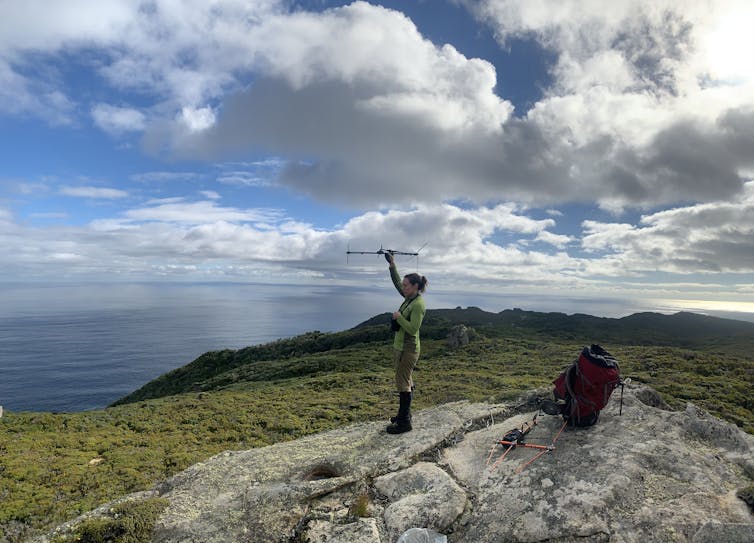
The following chart illustrates these demand and supply differences according to educational field.


The size of each bubble reflects the number of Indigenous workers with formal qualifications in this field. The position of the bubble (to the left or right of the vertical line) reflects the proportion of Indigenous-focused job ads that require this qualification.

Employers post job ads seeking Indigenous workers with qualifications in society and culture, health and education. While Indigenous workers are likely to have qualifications in society and culture, they are not well represented in health and education. Indigenous workers are better represented in fields such as agriculture and environment, society and culture and food, hospitality and personal services.

Job ads targeting Indigenous workers are not found across the board. When we look across all jobs ads (not just those targeting Indigenous workers), management and commerce qualifications are in highest demand. The opportunities for Indigenous workers are limited in diversity and often not well-aligned with the educational pathways commonly chosen by Indigenous peoples.

Feast and famine

The effect of this geographic and qualification mismatch is to create a landscape of feast (for some) and famine (for many others).

For instance, in Melbourne there were more than 60,000 Indigenous-focused job ads for each Indigenous worker in the region with an Information Systems qualification.

On the flip side, there were very few employers targeting Indigenous workers with a building qualification. For example, in Townsville there was one Indigenous-focused job ad for the 128 Indigenous workers with a qualification in building.

By understanding the career pathways of Indigenous peoples and tailoring their workforce strategies to align with the locations and qualifications held by Indigenous peoples, employers can do more to ensure that they are successful in their efforts to attract Indigenous workers.

Education is key

Remote work arrangements can help mitigate the geographic mismatch between current demand for and supply of Indigenous talent. But, ultimately, improving job opportunities for Indigenous Australians requires a whole-of-ecosystem approach involving Indigenous communities, educators, employers and policy makers.

The visible growth in employers’ efforts to recruit Indigenous workers represents positive change. The Indigenous Jobs Map reveals how these efforts can be directed more effectively so they translate into employment outcomes.


Read more:
Indigenous-owned businesses are key to closing the employment gap


The data also confirms education is the key pathway to highly skilled and well-paid employment. A Bachelor’s degree is most highly sought after, being required in 22.5% of Indigenous focused job ads. Effort needs to be directed towards improving the number of Indigenous people gaining higher educational qualifications.

By engaging Indigenous students in schools, employers can help students and carers understand how their unique knowledge and approach add value in the workplace. Connecting directly and early with Indigenous communities will improve the pipeline of Indigenous talent and ultimately, achieve a more inclusive labour market.

The Conversation

Claire Mason works for the CSIRO.

Haohui Chen works for CSIRO.

Louisa Warren does not work for, consult, own shares in or receive funding from any company or organisation that would benefit from this article, and has disclosed no relevant affiliations beyond their academic appointment.

ref. To boost Indigenous employment, we need to map job opportunities to skills and qualifications. Our new project does just that – https://theconversation.com/to-boost-indigenous-employment-we-need-to-map-job-opportunities-to-skills-and-qualifications-our-new-project-does-just-that-212440

Accident or medical, new research shows we need to treat conditions equally to get people back to work

Source: The Conversation (Au and NZ) – By Michelle Cameron, Senior Lecturer, Te Huataki Waiora School of Health, University of Waikato

After receiving a head injury from a car accident in 2014, I was given support through the Accident Compensation Corporation (ACC) to recover and return to work as a health professional.

But I am keenly aware that those who have brain injuries after medical events – such as a stroke – are often left to negotiate health and rehabilitative services with significantly less support.

To be covered by ACC, your injury has to be caused by an accident. New Zealanders suffering from strokes, cancers or mental health conditions, along with other non-accident injuries, are subsequently disadvantaged by the cause of their health condition. And this can have a considerable financial and emotional toll.

Partly because of my own experience, for my doctoral research I looked at the services that were available to support people with health challenges who did not qualify for ACC – essentially any condition that affects a person’s ability to work or study, but which wasn’t caused by an accident.

I investigated whether they were effective in getting people back into work, and also looked at how we assess the outcomes of these programmes. What I found was the significant gap in resources and services and the need for a wraparound service, or at the very least, targeted support on the road to recovery.

Helping people back to work helps us all

The amount of support available after illness or injury can make a significant difference to a person’s life.

A 2013 study found 79% of people who received ACC support after a brain injury from an accident were in paid work one year after the injury. But this dropped to 50% for those with a similar brain injury not caused by an accident (such as a stroke).


À lire aussi :
ACC’s policy of not covering birth injuries is one more sign the system is overdue for reform


While ACC will pay up to 80% of a person’s income, New Zealanders on Jobseeker Support-Health Condition or Disability (JS-HCD) receive a weekly payment of just NZ$337.

But it’s not just about the money. As one person who was living with a long-term health condition told me:

Work isn’t just for the finances. It’s the people. It gets you out of bed. I miss it. I want to work. I want to be a part of the society that’s around me. I want to walk down the street and feel I am a part of that.

Learning from ACC’s success

The outcomes for those who receive ACC show what can happen when people access tailored support after an injury.

ACC offers a wraparound rehabilitative service targeted to a person’s individual needs to return to working life.

But systems to support people with health conditions and disabilities tend to be siloed into speciality organisations. These are not designed to meet complex individual needs.

So why not apply a wraparound, cross-agency approach to health and injury issues similar to ACC? It could be applied to people receiving the JS-HCD benefit.

The idea is not breaking entirely new ground.

Between 2016 and 2021, Te Whatu Ora-Waikato and the Ministry of Social Development (MSD) partnered to pilot the Realising Employment through Active Coordinated Healthcare (REACH) programme.

The goal of the REACH programme was to remove the barriers experienced by people living with health conditions and disabilities through a “whole person” approach.

Support included a key worker who met with the client regularly to build strategies to manage health and mental wellbeing, as well as a living coach who provided tailored support for reentry into the workforce once their health was stabilised.

People in the REACH programme were also able to access funding for services that were not covered by MSD.


À lire aussi :
Life after a stroke: Family and friends provide nearly all post-hospital care, but who’s caring for the caregivers?


During my 18 month research period, 138 people participated in REACH and 96 completed the programme. Those who had completed the programme were 53% more likely to gain paid employment or enrol in full-time study than those who did not participate.

But funding for REACH was pulled before the outcomes were fully assessed. The pilot ended in 2021, ahead of the restructure of the district health boards into Health New Zealand-Te Whatu Ora and the Māori Health Authority.

A short-term focus misses the growing problem

The number of New Zealanders living with long-term health conditions is growing. Despite many wanting to return to work, this population often falls into the cracks between health and social services.

My research suggests that integrated and individualised services like REACH are effective in helping people with health conditions and disabilities achieve positive outcomes, including returning to work.


À lire aussi :
Cancer survivors urgently need funded rehabilitation care


But the removal of funding for the REACH programme highlights the bigger barriers for people who don’t qualify for ACC support in getting back to work: ineffective assessment of outcomes and a focus on the short-term costs and benefits.

Replicating the ACC model for people living with health challenges holds potential. But we are going to need sustained and long-term funding for such programmes, as well as patience to achieve the desired results.

The Conversation

Michelle Cameron ne travaille pas, ne conseille pas, ne possède pas de parts, ne reçoit pas de fonds d’une organisation qui pourrait tirer profit de cet article, et n’a déclaré aucune autre affiliation que son organisme de recherche.

ref. Accident or medical, new research shows we need to treat conditions equally to get people back to work – https://theconversation.com/accident-or-medical-new-research-shows-we-need-to-treat-conditions-equally-to-get-people-back-to-work-211034

Obituary: Meraia Taufa Vakatale – Fiji anti-nuclear activist and feminist trailblazer

By Asenaca Uluiviti and Sadhana Sen

Fiji recently lost Dr Meraia Taufa Vakatale, a monumental woman leader who broke many glass ceilings with her numerous firsts. As an educationalist, diplomat and politician, she profoundly impacted on the lives of tens of thousands in Fiji and the Pacific region, particularly young women in politics and anti-nuclear activists.

Dr Vakatale was Fiji’s first woman deputy prime minister, the first woman to be elected as a cabinet minister, the first female to be appointed as a deputy high commissioner, and the first Fijian woman principal of a secondary school in Fiji.

Dr Vakatale was also a fervent anti-nuclear activist. In 1995 she took a costly stand against her party and the then Sitiveni Rabuka government on renewed French nuclear testing on Moruroa Atoll in “French” Polynesia.

Joining a protest march against French testing led to her losing her cabinet position in the Rabuka-led government, in which she served as a member of the Soqosoqo ni Vakavulewa ni Taukei (SVT) party.

She held the portfolio of Education, Science and Technology in two stints — from 1993 to 1995 and then, after being reinstated, from 1997 to 1999. In 1997, she was appointed Deputy Prime Minister.

In 2000, she resigned as President of the SVT party over the 2000 coup fallout.

She was a woman ahead of her time. Dedicated to her principles, she “paid it forward” to Pasifika generations by her fight to keep the Pacific a nuclear-free zone.

Idealism inspired thousands
Dr Taufa Vakatale’s spirited and unwavering determination, her activism, idealism and her principles inspired thousands of women and youth to fearlessly pursue their dreams.

The name Taufa Vakatale was first linked to the renowned all-girls Adi Cakobau School when she became a pioneer student there in 1948, aged 10 years. She was also the first female student at the all-male Queen Victoria School.

She completed her 6th form year at Suva Grammar School, where she became the first Fijian female to pass the NZ University Entrance. She entered the University of Auckland and in 1963 was the first Fijian woman to graduate with a Bachelor of Arts degree, privately funding her studies from her wages as a teacher in Fiji.

Taufa Vakatale went on to further studies in the United Kingdom from 1963 to 1971. On return to Fiji, she became the first Fijian woman president of the Fiji YWCA and principal of her old school, the Adi Cakobau School.

The YWCA in Fiji was the driving force of the anti-nuclear protest movement in the early 1970s, while she was president.

In her time as an educator, Dr Vakatale disciplined fairly, understood her students, and entrusted them with positive goals for their future, instructing them to “leave the world better than we found it”.

She was respected and honoured. Her feats helped ease the students’ own steps, to bring to life the Adi Cakobau School motto.

Towering moral stature
Of petite and elegant frame, in moral stature Dr Vakatale towered above many. In diplomacy she served as Fiji’s Deputy High Commissioner to the UK in 1980, while single-handedly raising her daughter to become a lawyer.

The University of St Andrews in Scotland awarded her an Honorary Doctorate of Letters for her contribution to the cause of Pacific women, while Fiji bestowed her with the Order of Fiji in 1996.

The extraordinary Dr Meraia Taufa Vakatale died on 24 June 2023, aged 84. She leaves behind her only daughter Alanieta Vakatale, three granddaughters, and many more following in her footsteps to leave this world a better place.

Thirty eight years on from the sinking of the Rainbow Warrior and the adoption of the Pacific nuclear-free zone treaty, the Rarotonga Treaty, and with the imminent release of Japan’s Fukushima nuclear plant radioactive waste into the Pacific ocean, the leadership and sacrifices of Dr Vakatale must be hailed, and her life celebrated.

Asenaca Uluiviti is a community legal officer in Auckland. She has worked as a state solicitor in Fiji and at its diplomatic mission in the UN, and has served as chairperson of Fiji YMCA, and on the NZ board of Greenpeace. She went to the Adi Cakobau School. Sadhana Sen is regional communications adviser at the Development Policy Centre. Republished from the DevPolicy blog through a Creative Commons licence.

Print Friendly, PDF & Email

Article by AsiaPacificReport.nz

Wenda welcomes MSG call for UN visit and fights on for full membership

Asia Pacific Report

In spite of again being denied full membership of the Melanesian Spearhead Group, the United Liberation Movement for West Papua (ULMWP) has welcomed the call from the MSG Leaders’ Summit in Port Vila last week for Indonesia to allow the long-awaited visit of the UN High Commissioner for Human Rights to West Papua.

“I hope that the MSG chair will honour the commitment to write to Indonesia as a matter of urgency, as every day that international intervention is delayed sees more West Papuans suffer and more Melanesian blood spilt,” ULMWP president Benny Wenda declared.

“Even in the run up to the MSG summit, with the eyes of the Pacific region on human rights in West Papua, Indonesia brutally cracked down on peaceful rallies in favour of ULMWP full membership, arresting dozens and killing innocent civilians,” he said in a statement.

As an associate member of the MSG, Indonesia must respect the chair’s demand, Wenda said.

“If they continue to deny the UN access, they will be in violation of the unified will of the Melanesian region.

“As the leaders’ communique stated, the UN visit must occur this year in order for the commissioner’s report to be put before the next MSG summit in 2024.”

Wenda said he also welcomed the MSG’s commitment that it would write to the Pacific Islands Forum (PIF) chair to ensure that the UN visit was undertaken.

‘Guarantee UN visit’
“The PIF must honour this call and do all they can to guarantee a UN visit,” he said.

United Liberation Movement for West Papua (ULMWP) interim chair Benny Wenda being interviewed by Vanuatu Television
United Liberation Movement for West Papua (ULMWP) interim chair Benny Wenda being interviewed by Vanuatu Television during MACFEST2023.

“We must remember that the UN visit has already been demanded by over 85 states, including all Melanesian states as members of PIF, and the 79 members of the Organisation of African, Caribbean, and Pacific States.”

Wenda said that in 2019, Pacific leaders described West Papua as a “festering human rights sore” and called for UN intervention as soon as possible.

“Since then, we have seen 100,000 West Papuans displaced by Indonesian military operations, villages depopulated and burned, and massacres in Wamena, Timika and elsewhere.

“And yet Indonesia has come no closer to allowing the United Nations access. Mere words are clearly not enough: the MSG Leaders’ Summit must be the trigger for international pressure of such overwhelming force that Indonesia has no choice, but to allow a UN visit.

“Although we are disappointed to have been denied full membership on this occasion, our spirit is strong and our commitment to returning home to our Melanesian family is undiminished.

“We are not safe with Indonesia, and will only find security by standing together with our Pacific brothers and sisters.

“Full membership is our birthright: culturally, linguistically, ethnically, and in our values, we are undeniably and proudly Melanesian.”

Youngsolwara Pacific criticises MSG
Meanwhile, the Youngsolwara Pacific movement has made a series of critical statements about the MSG communique, including deploring the fact that the leaders’ summit was not the place to discuss human rights violations and reminded the leaders of the “founding vision”.

They called on the MSG Secretariat to “set terms, that should Indonesia fail to allow and respect the visits of an independent fact-finding mission by PIF, and the UN High Commissioner for Human Rights, then Indonesia must be BANNED from the MSG.”

They also demanded “clarity on the criteria for associate members and their respective engagement”.

Indonesia is the only associate member of the MSG while the ULMWP has observer status.

Print Friendly, PDF & Email

Article by AsiaPacificReport.nz