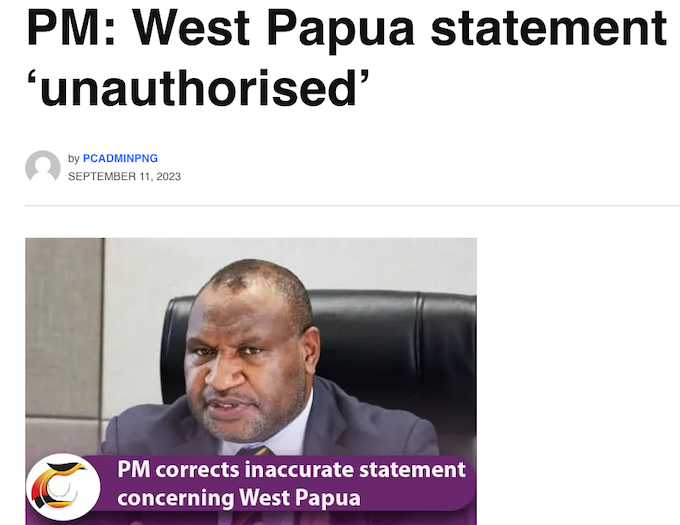
A Radio New Zealand Pacific journalist has alleged that an Indonesian official attempted to both bribe and intimidate him following an interview at the Melanesian Spearhead Group (MSG) leaders’ summit in the Vanuatu capital of Port Vila last month.
The International Federation of Journalists (IFJ) and its affiliates, the Media Association Vanuatu (MAV) and the Alliance of Independent Journalists (AJI) Indonesia, have condemned the attempted bribery and harassment of the journalist and urged the relevant authorities to thoroughly investigate the incident.
On August 23, RNZ Pacific journalist Kelvin Anthony reported that a representative of the Indonesian government, Ardi Nuswantoro, attempted to bribe him outside Port Vila’s Holiday Inn Resort after Anthony conducted an exclusive interview with Indonesia’s Australian ambassador, Dr Siswo Pramono.
According to Anthony, Nuswantoro had previously expressed the Indonesian government’s displeasure at RNZ’s coverage of ongoing independence efforts in West Papua, reported the IFJ in a statement.
The journalist had advised him of the outlet’s mandate to produce “balanced and fair” coverage and was invited to the hotel for the interview, where he questioned Dr Pramono on a broad range of pertinent topics, including West Papua.
Following the interview, Anthony was escorted from the hotel by at least three Indonesian officials. After repeatedly inquiring as to how the journalist was going to return to his accommodation, Nuswantoro then offered him a “gift” of an unknown amount of money, which Anthony refused.
Anthony reported that he felt harassed and intimidated in the days following, with Nuswantoro continuing to message, call, and follow him at the conference’s closing reception.
Interview not aired RNZ chose not to air the interview with Dr Pramno due to the incident.
In response to the claims of bribery and intimidation sent to the Indonesian government by RNZ, Jakarta’s Ministry of Foreign Affairs, Asia Pacific and African Affairs director-general Abdul Kadir Jailani said, “bribery has never been our policy nor approach to journalists . . . we will surely look into it.”
RNZ Pacific journalist Kelvin Anthony . . . “harassed” while covering the Melanesian Spearhead Group leaders’ summit in Port Vila last month. Image: Kelvin Anthony/X
In a September 6 interview, New Zealand Prime Minister Chris Hipkins reiterated his government’s commitment to press freedom, stating the importance of free and independent media.
Journalists and civil society in West Papua have faced increasing threats, restrictions and violence in recent years. Indonesian media has disproportionately reflected state narratives, with state intervention resulting in the censorship of independent outlets and effective barring of local or international journalists from Indonesian-administered Papua.
In February, renowned Jubi journalist Victor Mambor was subject to a bombing attack outside his Jayapura home.
MAV said: “The Media Association of Vanuatu (MAV) is concerned about an alleged bribery attempt by foreign officials at a Melanesian Spearhead Group regional meeting.
MAV president Lillyrose Welwel denounces such actions and urges MAV members to adhere to the Code of Ethics, as journalism is a public service. She encourages international journalists to contact the association when in the country, as any actions that do not reflect MAV’s values are not acceptable.”
AJI calls for ‘safety guarantee’ AJI said:“AJI Indonesia urges the Indonesian government to investigate the incident with transparency. This action must be followed by providing guarantees to any journalist to work safely in Papua and outside.
“The Indonesian government must also guarantee the protection of human rights in Papua, including for civilians, human rights defenders, and journalists.”
The IFJ said: “Government intervention in independent and critical reporting is highly concerning, and this incident is one in an alarming trend of intimidation against reporting on West Papua.
“The IFJ urges the Indonesian government to thoroughly investigate this incident of alleged bribery and harassment and act to ensure its commitment to press freedom is upheld.”
Pacific Media Watch condemnation Pacific Media Watch also condemned the incident, saying that it was part of a growing pattern of disturbing pressure on Pacific journalists covering West Papuan affairs.
“West Papua self-determination and human rights violations are highly sensitive issues in both Indonesia and the Pacific. Journalists are bearing the brunt of a concerted diplomatic push by Jakarta in the region to undermine Pacific-wide support for West Papuan rights. It is essential that the Vanuatu authorities investigate this incident robustly and transparently.”
According to a CNN Indonesia report on September 6, Indonesian authorities denied the attempted bribery and harassment allegation.
Jakarta’s “denial” reported by CNN Indonesia. Image: CNN Indonesia screenshot APR
Your GP says you have high cholesterol. You’ve six months to work on your diet to see if that’ll bring down your levels, then you’ll review your options.
Could taking supplements over this time help?
You can’t rely on supplements alone to control your cholesterol. But there’s some good evidence that taking particular supplements, while also eating a healthy diet, can make a difference.
There are two main types of cholesterol, both affecting your risk of heart disease and stroke. Both types are carried in the bloodstream inside molecules called lipoproteins.
Low-density lipoprotein or LDL cholesterol
This is often called “bad” cholesterol. This lipoprotein carries cholesterol from the liver to cells throughout the body. High levels of LDL cholesterol in the blood can lead to the build-up of plaque in arteries, which leads to an increased risk of heart disease and stroke.
High-density lipoprotein or HDL cholesterol
This is often called “good” cholesterol. This lipoprotein helps remove excess cholesterol from the bloodstream and transports it back to the liver for processing and excretion. Higher levels of HDL cholesterol are linked to a reduced risk of heart disease and stroke.
Diet can play a key role in reducing blood cholesterol levels, especially LDL (“bad”) cholesterol. Healthy dietary choices are well recognised. These include a focus on eating more unsaturated (“healthy”) fat (such as from olive oil or avocado), and eating less saturated (“unhealthy”) fat (such as animal fats) and trans fats (found in some shop-bought biscuits, pies and pizza bases).
You can find unsaturated fat in foods such as olive oil and avocado. Shutterstock
An additional way to significantly reduce your total cholesterol and LDL cholesterol levels through diet is by eating more soluble fibre.
This is a type of fibre that dissolves in water to form a gel-like substance in your gut. The gel can bind to cholesterol molecules preventing them from being absorbed into the bloodstream and allows them to be eliminated from the body through your faeces.
You can find soluble fibre in whole foods such as fruits, vegetables, oats, barley, beans and lentils.
There are also many fibre supplements and food-based products on the market that may help lower cholesterol. These include:
natural soluble fibres, such as inulin (for example, Benefiber) or psyllium (for example, Metamucil) or beta-glucan (for example, in ground oats)
synthetic soluble fibres, such as polydextrose (for example, STA-LITE), wheat dextrin (also found in Benefiber) or methylcellulose (such as Citrucel)
natural insoluble fibres, which bulk out your faeces, such as flax seeds.
Most of these supplements come as fibres you add to food or dissolve in water or drinks.
Psyllium is the fibre supplement with the strongest evidence to support its use in improving cholesterol levels. It’s been studied in at least 24 high-quality randomised controlled trials.
These trials show consuming about 10g of psyllium a day (1 tablespoon), as part of a healthy diet, can significantly lower total cholesterol levels by 4% and LDL cholesterol levels by 7%.
You can mix psyllium fibre into a drink or add it to your food. Shutterstock
Other cholesterol-lowering supplements, such as probiotics, are not based on fibre. Probiotics are thought to help lower cholesterol levels via a number of mechanisms. These include helping to incorporate cholesterol into cells, and adjusting the microbiome of the gut to favour elimination of cholesterol via the faeces.
Using probiotics to reduce cholesterol is an upcoming area of interest and the research is promising.
In a 2018 study, researchers pooled results from 32 studies and analysed them altogether in a type of study known as a meta-analysis. The people who took probiotics reduced their total cholesterol level by 13%.
Most of these studies use probiotics containing Lactobacillus acidophilus and Bifidobacterium lactis, which come in capsules or powders and are consumed daily.
Ultimately, probiotics could be worth a try. However, the effects will likely vary according to the probiotic strains used, whether you take the probiotic each day as indicated, as well as your health status and your diet.
Red yeast rice is another non-fibre supplement that has gained attention for lowering cholesterol. It is often used in Asia and some European countries as a complementary therapy. It comes in capsule form and is thought to mimic the role of the cholesterol-lowering medications known as statins.
A 2022 systematic review analysed data from 15 randomised controlled trials. It found taking red yeast rice supplements (200-4,800mg a day) was more effective for lowering blood fats known as triglycerides but less effective at lowering total cholesterol compared with statins.
However, these trials don’t tell us if red yeast rice works and is safe in the long term. The authors also said only one study in the review was registered in a major database of clinical trials. So we don’t know if the evidence base was complete or biased to only publish studies with positive results.
Red yeast rice is often used in Asia and some European countries to lower cholesterol. Shutterstock
Diet and supplements may not be enough
Always speak to your GP and dietitian about your plan to take supplements to lower your cholesterol.
But remember, dietary changes alone – with or without supplements – might not be enough to lower your cholesterol levels sufficiently. You still need to quit smoking, reduce stress, exercise regularly and get enough sleep. Genetics can also play a role.
Even then, depending on your cholesterol levels and other risk factors, you may still be recommended cholesterol-lowering medications, such as statins. Your GP will discuss your options at your six-month review.
Lauren Ball works for The University of Queensland and receives funding from the National Health and Medical Research Council, Queensland Health, Mater Misericordia and the Royal Australian College of General Practitioners. She is a Director of Dietitians Australia, a Director of the Darling Downs and West Moreton Primary Health Network and an Associate Member of the Australian Academy of Health and Medical Sciences.
Fiji’s Parliament has passed a motion for the coalition government to establish a Truth and Reconciliation Commission “to facilitate open and free engagement in truth telling” to resolve racial differences and concerns in the country.
On Wednesday, 28 MPs voted for the motion, 23 voted against while four did not vote.
While tabling the motion in the Parliament, Fiji’s Assistant Minister for Women Sashi Kiran said people were still hurting from “political upheavals” and “many unresolved issues” from the past.
Kiran said the commission would offer “closure and healing” to individuals who were still affected by Fiji’s turbulent history.
Assistant Women’s Minister Sashi Kiran . . . Fiji has been plagued by political turmoil for more than three decades with four coups. Image: Parliament of the Republic of Fiji FB/RNZ Pacific
In May, the Methodist Church of Fiji initiated a national prayer and reconciliation programme during the Girmit Day celebrations. Kiran said the participation of leaders and various faith groups at the event signalled that Fijians were ready for the healing process.
“Some may ask whether this is the time for it. Some may say we should focus on cost of living and on better public services and I understand [that],” she said.
‘Many unresolved issues’ “I know from many long years of personal engagement with our people a lot of people are hurting. There are many unresolved issues that need closure.
“Can we be a prosperous society if we live in fear and insecurity, if we do not trust our neighbours and carry wounded hearts.”
She said Fiji had been plagued by political turmoil for more than three decades with four coups.
“We are not looking deep inside ourselves to learn the lessons of the past. It is easier to look away from the painful events and perhaps pretend that they did not happen.
“But constant echoes of divide, narratives of the past remind us that there are deep rooted wounds in may hearts unable to heal.”
An emotional Rabuka said the commission would “remove the division between the two main communities that have co-existed since well before independence” in 1970.
He said the opposition did not have any reason to oppose the motion.
‘I am opening it up’ “I have, but I am opening it up. I would probably want to hide a long of things I know [but] none of you [MPs] has anything to hide so we should cooperate and work for this,” Rabuka said.
However, opposition MPs did not back the motion, saying a Truth and Reconciliation Commission would do more harm than good.
An emotional Prime Minister Sitiveni Rabuka . . . opposition should back the government over the commission. Image: Parliament of the Republic of Fiji FB/RNZ Pacific
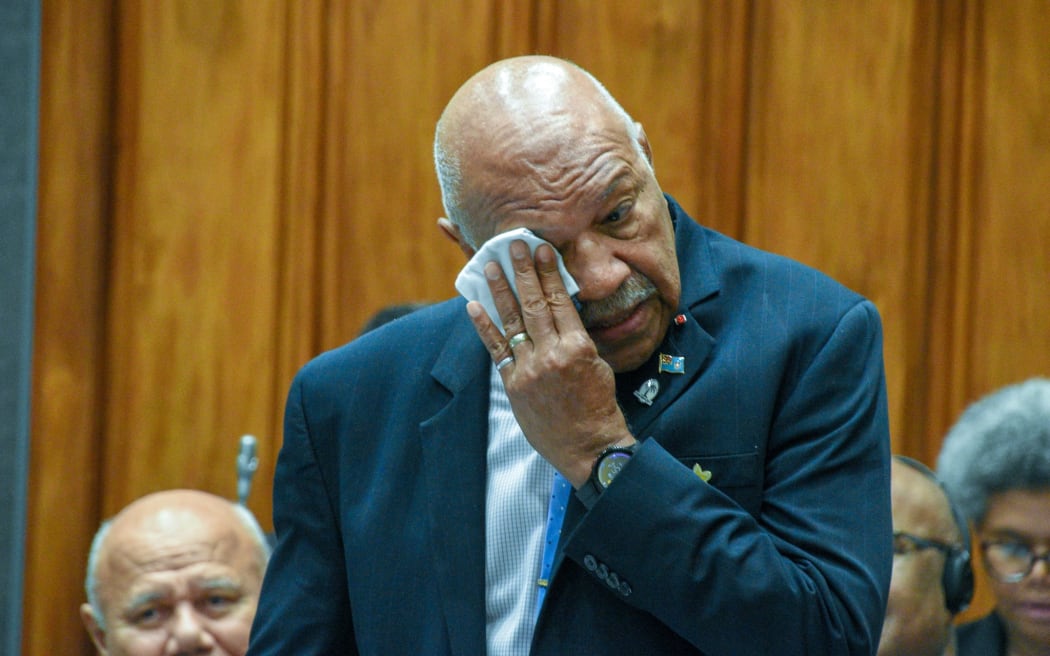
Tackle ‘deep-rooted problems’ – Naupoto FijiFirst MP and former military commander Viliame Naupoto, in a teary intervention, said “the problem we have is the divide in our society”.
“The divide along racial lines, now there’s even a bigger divide along political lines. I think the big task we have is try and narrow the divide as much as we can and keep working on it,” Naupoto said.
“When we have the Truth and Reconciliation Commission you are opening wounds of the past. If it needs to be opened, it needs to be treated so that it can heal.”
Naupoto cautioned that political leaders needed to ensure they were not creating new wounds by opening wounds of the past.
“Equality that we strive for can be dealt with policies that unite us,” he said.
“When we see that most of the things that were put in place by the government of the past it means also that the 200,000 voters that voted for us are feeling bad . . . and so our divide widens now.
“I plead that if you want and work on that utopian dream of this country that is prosperous and peaceful and stable, we have to be tough and face the deep-rooted problems that we have.”
This article is republished under a community partnership agreement with RNZ.
Opposition FijiFirst MP Viliame Naupoto . . . equality can be achieved through policies. Image: Parliament of the Republic of Fiji FB/RNZ Pacific
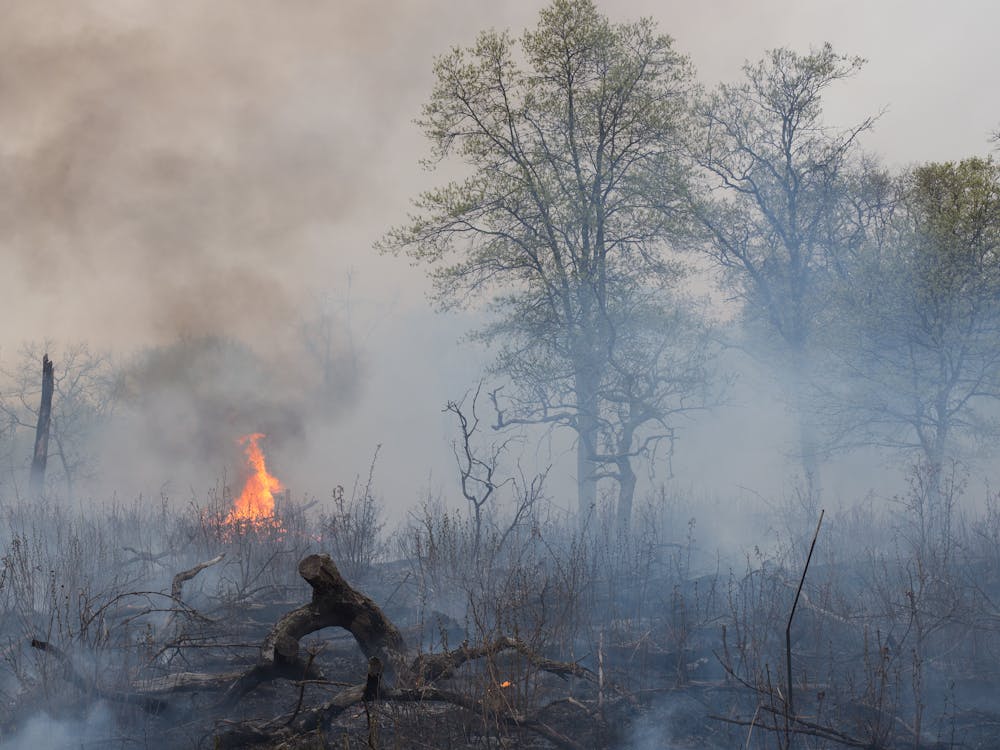
People have been using fire for millennia. It is a vital part of many ecosystems and cultures. Yet human activities in the current era, sometimes called the “Anthropocene”, are reshaping patterns of fire across the planet.
In our new research, published in the Annual Review of Environment and Resources, we used satellite data to create global maps of where and how fires are burning. We calculated about 3.98 million square kilometres of Earth’s land surface burns each year. We also examined research spanning archaeology, climatology, ecology, Indigenous knowledge and paleoecology, to better understand the causes and consequences of fires.
Our international team found strong evidence fires are burning in unexpected places, at unusual times and in rarely observed ways. These changes in fire patterns are threatening human lives and modifying ecosystems.
But the future does not have to be bleak. There are many opportunities to apply knowledge and practice of fire to benefit people and nature.
Here’s how fire patterns are changing
Exploring multiple approaches and scales enables a deeper understanding of where, when and how fires burn.
Satellite data provide evidence of changes in fire patterns at a global scale. Annual fire season length increased by 14 days from 1979 to 2020 and night fires, which indicate fires that cannot be quickly controlled, increased in intensity by 7.2% from 2003 to 2020.
The coupling of landscape fires with the atmosphere can create storms that inject smoke into the stratosphere. Cooperative Institute for Research in the Atmosphere. Used with permission from David A. Peterson.
Other changes are apparent only when we look at data from particular regions. An increase in fire size and the frequency of large fires has recently been observed in forests and woodlands of the western United States. Meanwhile fire-dependent grasslands and savannahs across Africa and Brazil have experienced reductions in fire frequency.
It’s also important to consider the timescale and type of fire when interpreting changes. In Australia, satellite records show the frequency of very large forest fires has increased over the past four decades. At longer time scales, charcoal and pollen records indicate the frequency of low-intensity fires decreased in parts of southeastern Australia following British colonisation in 1788.
Many animals and plants have evolved strategies that enable them to thrive under particular fire patterns. This means changes to fire characteristics can harm populations and ecosystems.
Some eucalypts in southern Australia resprout after fire via epicormic buds along the trunk and branches. Resprouting influences how rapidly the tree layer, important habitat for animals, regenerates. Thomas A. Fairman
Large and intense fires are reducing the available forest habitat preferred by the greater glider. But a lack of fire can be problematic too. Threatened species of native rodents can benefit from food resources and habitats that flourish shortly after fire.
There is evidence that emissions from recent fires are already modifying the atmosphere. The historically exceptional 2019–20 Australian wildfires produced record-breaking levels of aerosols over the Southern Hemisphere, as well as substantial carbon emissions.
The wildfire smoke-related health costs of the 2019–20 wildfires in Australia included an estimated 429 smoke-related premature deaths as well as 3,230 hospital admissions for cardiovascular and respiratory disorders.
Changes in fire patterns are modifying water cycles, too. In the western United States, fires are reaching higher elevations and having strong impacts on snow and water availability.
New studies are revealing how the air, land and water that support life on Earth are connected by fires. Smoke plumes from the 2019–20 Australian wildfires transported nutrients to the Southern Ocean, resulting in widespread phytoplankton blooms.
Human drivers such as climate change, land use, fire use and suppression, and transportation and extinction of species are causing shifts in fire patterns.
Increasing global temperatures and more frequent heatwaves and droughts increase the likelihood of fire by promoting hot, dry and windy conditions. A pattern of extreme fire weather outside of natural climate variation is already emerging in North America, southern Europe and the Amazon basin.
Humans modify fire regimes by changing land use for agricultural, forestry and urban purposes. Until recent decades, large fires in tropical forests were uncommon. But deforestation fires used to clear primary forest for agriculture often promotes more frequent and intense uncontrolled fires.
Humans have transported plants and animals across the globe, resulting in novel mixes of species that modify fuels and fire regimes. In many parts of the world, invasive grasses have increased flammability and fire activity.
Social and economic changes propel these drivers. Colonisation by Europeans and the displacement of Indigenous peoples and their skilful use of fire has been linked with fire changes in Australia, North America and South America.
Experimental fires help us learn about ecosystems and sustainability. This is an experimental fire in temperate savannah in Minnesota, US, at the Cedar Creek Ecosystem Science Reserve. Frank Meuschke
Using knowledge and practice of fire to achieve sustainability goals
The pace and scale of these changes represent challenges to humanity, but knowledge and practice of fire can help to achieve sustainability goals.
This includes:
good health and wellbeing, by supporting community-owned solutions and fire practices that increase social cohesion and health
sustainable cities and communities, by designing green firebreaks and mixed-use areas with low fuels, strategically located in the landscape
life on land,
by tailoring use of fire to promote and restore species and ecosystems
climate action,
by applying low-intensity fire to promote the stability of soil organic matter and increase carbon storage
reduced inequalities, by allocating resources before, during, and after wildfires to at-risk communities and residents.
As the world changes, society as a whole needs to keep learning about the interplay between people and fire.
A deep understanding of fire is essential for achieving a sustainable future – in other words, a better Anthropocene.
Luke Kelly receives funding from the Australian Research Council, Victorian Department of Energy, Environment and Climate Action, Natural Hazards Research Australia, and NSW Department of Planning and Environment.
David Bowman receives funding from the Australian Research Council, Natural Hazards Research Australia, and NSW Department of Planning and Environment.
Ella Plumanns Pouton receives funding from the Australian Research Training Program, the Victorian Department of Energy, Environment and Climate Action, and Natural Hazards Research Australia.
Grant Williamson receives funding from the Australian Research Council, Natural Hazards Research Australia, and NSW Department of Planning and Environment.
Michael-Shawn Fletcher receives funding from the Australian Research Council.
Of all the objects in the Solar System, perhaps the most spectacular are the great comets that occasionally grace our skies. If you’ve been on social media in the past few days, you’ve probably seen articles proclaiming we have such a comet in our skies right now: C/2023 P1 (Nishimura).
As I write this, comet Nishimura is swinging past on its first visit in more than 400 years. Japanese astronomer Hideo Nishimura discovered the comet on August 12. Soon after, pre-discovery images of the comet dating back to January were found, allowing astronomers to determine its path.
They quickly realised Nishimura would swing closer to the Sun than the orbit of Mercury this month. Given the comet’s brightness at the time of discovery, it could become bright enough to see with the naked eye. So, will it be a spectacular sight in our skies? Probably not.
Unfortunately, Nishimura’s path will keep it close to the Sun in the sky as observed from Earth. While it’s definitely bright enough to be visible to the naked eye in dark skies, at best it will hug the horizon just after sunset – almost lost in the Sun’s glow.
Still, astronomers across the globe are excited. Even a hard-to-spot naked-eye comet is worth observing. And as science writer and astronomer David H. Levy once said:
Comets are like cats: they have tails, and they do precisely what they want.
There’s a chance Nishimura might brighten unexpectedly. If it does, we might see something special in the couple of weeks. If not, there’s always next year – but more on that later.
Recipe for a bright comet
When they are far from the Sun, in the icy depths of space, comets are essentially dirty snowballs: lumps of ice, dust and rock left over from the Solar System’s formation.
As a comet approaches the Sun, its surface begins to heat up. The ices near the surface get hot and “sublime”, turning to gas and erupting outward from the comet’s surface. This gas carries dust and debris, shrouding the nucleus in a diaphanous cloud of gas and dust called a “coma”.
The solar wind then blows the gas and dust away from the Sun, which gives the comet its tail (or tails). The tails always point away from the Sun.
The comet we see is sunlight being reflected from the gas and dust in the coma and tails – the nucleus itself is hidden from sight. A comet’s brightness, therefore, is typically determined by three things:
the size of the nucleus: a bigger nucleus typically means a larger active area (though some comets are more active than others) and more gas and dust production
distance to the Sun: the closer the comet is to the Sun, the more active (and brighter) it will become
distance to Earth: the closer the comet is to us, the brighter it will appear.
What about Nishimura?
That brings us to comet Nishimura. It seems likely Nishimura isn’t that large – otherwise we’d have spotted it sooner – nor is it particularly close to Earth. It is, however, passing relatively close to the Sun and is expected to be very active around perihelion (its closest point to the Sun).
Were it possible to view in a dark night sky, the comet would be quite impressive. Sadly, even at its best Nishimura will be close to the Sun in the sky.
On top of that, it just so happens the comet and Earth are located at about the worst orientation for viewing: Nishimura will stay close to the Sun as it recedes from us, remaining buried in the star’s glare.
A short window to see Nishimura from Australia
Nishimura will soon peek above the western horizon after sunset, but only just. The best chance to see it from Australia comes in the week of September 20 to 27, when the comet’s head will set around one hour after the Sun. It will be farthest from the Sun in the evening sky on September 23.
As twilight ends, Nishimura will be very close to the western horizon, about to set. That means it will probably be lost in the Sun’s glare.
But remember, comets are like cats. Some comets fall apart when at their closest to the Sun, in which case they often brighten significantly. If that were to happen to Nishimura, it could become much easier to spot.
Unfortunately, the comets most likely to fragment are those visiting the inner Solar System for the first time, moving on very long-period orbits of tens or hundreds of thousands of years. Nishimura is a seasoned visitor, with an orbital period of around 430 years. It has likely swung past the Sun many times and survived, which lowers the odds of it breaking apart.
Nonetheless, while the head of the comet might be lost in the twilight, the tail might still be visible as the sky darkens. Before the comet was lost in the glare to northern hemisphere viewers, observers put its tail at around six degrees in length – and it will likely grow as the comet swings closer to the Sun.
If you’re lucky, you might spot the tail standing proud above the horizon as the sky darkens.
The next great comet
If Nishimura doesn’t turn out to be the show you hoped for, there’s a chance another comet could put on a truly spectacular show next year. Comet C/2023 A3 (Tsuchinshan-ATLAS) was discovered at the start of this year. It’s currently almost as far from the Sun as Jupiter.
Over the next 12 months it will continue to fall sunward, coming closest to the Sun in late September 2024. Tsuchinshan-ATLAS is looking promising. If it behaves as expected it could be a spectacular sight – but just remember: comets are like cats!
Jonti Horner does not work for, consult, own shares in or receive funding from any company or organisation that would benefit from this article, and has disclosed no relevant affiliations beyond their academic appointment.
Hardly a day passes without talk of “mum and dad” property investors. It’s media shorthand for a rental market dominated by small operators rather than big institutions.
But language shapes the way we think, and folksy terminology creates a false impression of Australia’s landlord class.
First, “mums and dads” conveys a 1950s, white-picket-fence version of Australia. Are no same-sex couples, singles or people without children investing in property? Plenty of parents with children rent, but we never hear them called “mum and dad tenants”.
Second, it gives the impression most landlords are average wage earners, struggling to build a modest nest egg and squeezed by high interest rates.
Yet, as I’ll explain, a majority of rental properties are owned by investors with multiple properties. And well-off investors enjoy the lion’s share of the tax benefits of policies like negative gearing.
Landlords are typically better off
The “mums and dads” rhetoric masks the reality of property ownership in Australia. Cue federal Opposition Leader Peter Dutton, defending negative gearing to support “mums and dads who save and, as part of their retirement income, put some money aside and buy a rental property”.
Or Victorian Property Council boss Cath Evans, rejecting rent control because “mum and dad investors” are struggling to get by on the income they get from tenants.
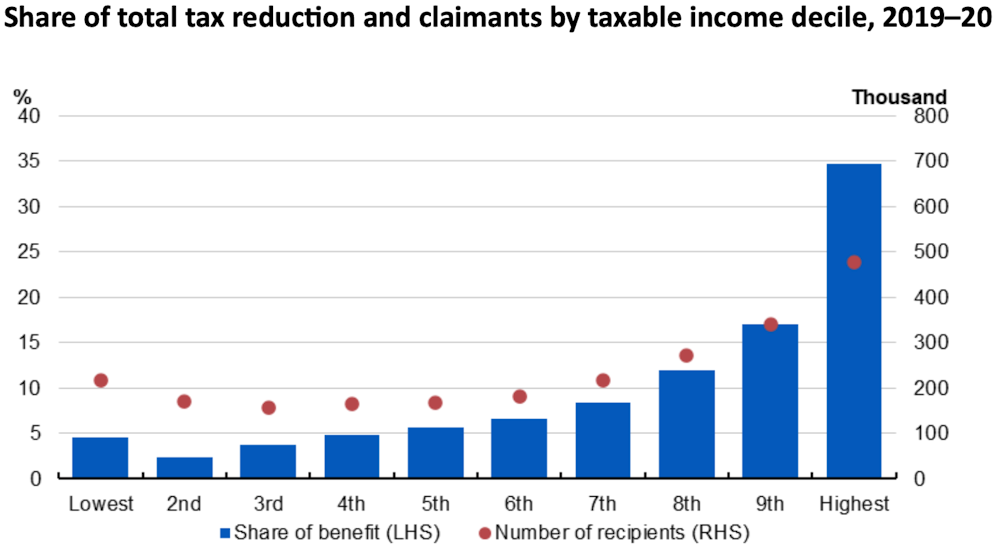
Treasury data show tax deductions for rental properties disproportionately benefit the well-off. More than a third of benefits go to about 500,000 landlords in the top 10% of income earners. About another third goes to the 20% immediately below them.
True, there are also about 200,000 landlords in the bottom 10% of income earners, but that doesn’t necessarily mean they’re poor. Treasury says this group “tend to have higher incomes”, but make “relatively large average deductions” that “substantially reduce their taxable income”.
Or as the Grattan Institute’s Danielle Wood puts it, “people who negatively gear have lower taxable incomes because they are negatively gearing”. (They may also be income-poor but asset-rich.)
High wage earners can borrow more to invest in property and have the most to gain from reducing tax through negative gearing. It’s no surprise cardiologists and politicians are more likely than school teachers and police officers to be landlords. The average federal MP owns at least two properties.
Who owns most rental properties?
Quality media outlets are not immune from the “mum and dad” language. This year it has cropped up in a Guardian explainer, an Age backgrounder and in at leasttwo Conversation articles.
The ABC recently released What broke the rental market? by data journalist Casey Briggs. It’s a thorough and engaging examination of complex issues, but it recycles the “mum and dad” language and states that “the majority of rental properties in Australia are owned by landlords with just one investment property”.
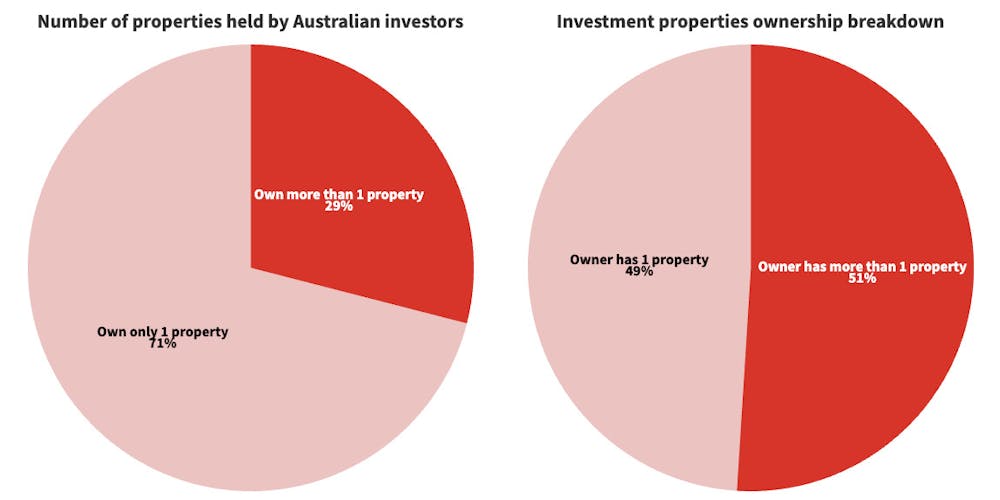
In 2021-22, about 1.6 million individuals, or about 70% of all landlords, declared a rental interest in a single property. So it’s true most investors own just one property.
But the other 30% — about 650,000 landlords — declared an interest in two or more properties. Almost 20,000 declared an interest in at least six.
If you multiply the number of landlords declaring multiple interests by the number of properties they declare, this suggests investors with multiple properties own just over half of all rental dwellings.
This is not new information. In its 2017 Financial Stability Review, the Reserve Bank noted “around half of investment properties are owned by investors with multiple properties”.
It is hard to be exact about numbers because many investors co-own properties, but these rough calculations are more likely to understate than overstate the extent of multiple property ownership. As research for the Australian Housing and Urban Research Institute AHURI has noted, individual tax statistics exclude rental properties owned by businesses or held in other legal structures such as family trusts, residential property trusts or self-managed superannuation funds.
It’s common to conflate “most investors own only one rental property” with “most rental properties are owned by landlords with just one investment” and pointing out the error might seem pedantic. But it’s important to know that tenants are at least as likely to be renting from an investor with multiple properties as from a landlord with only one.
Landlords must be held to account
These facts challenge the “mum and dad” mythology that positions landlords as beneficent family members who do people a favour by allowing them to rent their homes.
Not every property investor is rich, and some landlords are on moderate incomes. And plenty of decent landlords do right by their tenants. But there are plenty of crap landlords too, letting out properties that are mouldy, or damp, or impossible to heat or cool, with windows you can’t open or doors you can’t lock.
Letting a house is not a cottage industry. The private rental market is a multibillion-dollar business. Investors get generous taxpayer subsidies and draw on professional real estate services to manage tenancies.
Yes, the numbers of small-scale operators cause problems in the rental market. There are solid arguments for encouraging institutional investment in build-to-rent projects.
But we should avoid language that portrays landlords as folk of modest means when most are well-off. It diverts attention from debates about reforming negative gearing and the capital gains tax discount.
Landlords engage in a business activity with profound impacts on the lives of others. They should be diligent in meeting their responsibilities.
Calling them “mums and dads” lets them off the hook.
Peter Mares is a a fellow at the Centre for Policy Development, an independent policy institute. https://cpd.org.au/ He has just accepted an invitation to join an unpaid advisory committee to the Centre for Equitable Housing https://centreforequitablehousing.org.au/
Your chest tightens, like an elephant is sitting on it. Pain streaks down your arm and you break out in a cold sweat. You feel light-headed and you’re pretty sure you’re having a heart attack. So when do you call an ambulance?
You might think the answer is easy: straight away, right? It’s well known getting the right medical help early when you’re having a heart attack can be a life or death decision.
For many people from CALD (culturally and linguistically diverse) communities, however, the answer might be: hours and hours after the first symptoms strike. Our research has shown many migrants don’t seek help straight away.
Why do so many migrants wait so long to seek help or go to hospital after chest pains? And what can we do about it?
What we know so far
Our previous research, based on a study involving more than 600 patients who presented at a hospital with chest pain, looked at how long they delayed seeking medical help and how long they delayed going to hospital.
We found a median pre-hospital delay time of six hours for Sub-Saharan African migrants. This compared with an overall median pre-hospital delay time of 3.7 hours across the whole group.
Importantly, decision time to seek help takes up to 83% of pre-hospital delay in migrant patients, compared to only 48% for Australian-born patients.
In other words, the delay was caused by the patient’s decision to wait before seeking help (as opposed to, say, traffic problems or an ambulance taking too long to arrive).
The median “decision time” was:
4.5 hours for migrants from Sub-Saharan Africa
4.1 hours for migrants from the Middle East
3.9 hours for migrants from Southeast Asia
3.5 hours for migrants from Southern and Central Asia.
By contrast, the median decision time for Australians was 1.5 hours.
Why might some migrants delay seeking help for chest pains?
Our subsequent research has shown certain factors may influence how long a migrant waits to seek help after chest pains first appear. These include things such as:
their ability to speak English
the type of visa they were on
whether or not they have Australian permanent residency.
Non-English speaking migrants are more likely to wait hours before seeking help, while migrants from English-speaking backgrounds sought medical care more quickly.
People on skilled visas are much more likely to take more than an hour before deciding to go to hospital, as are people on family visas reuniting them with relatives already in Australia.
And once migrants do decide to seek medical help for chest pain, they often did not call an ambulance straight away. Rather, they often first opted to visit their family doctor or attempted to drive themselves to hospital. We found this was more common among migrants with limited English.
Those on humanitarian visas (refugees) tended to seek help sooner. This group is much more likely to have access to social supports and welfare services though special programs such as the Status Resolution Support Services or state-based refugee health services.
Migrants working in Australia on skilled visas, by contrast, may delay seeking help because they have no health insurance, are worried about their jobs or fear hefty ambulance fees or medical costs.
The video below features some of our interviewees explaining their thoughts on how they would respond if experiencing chest pains. Their faces are not shown to protect their identities; instead we used the image of a teddy bear because our research came to be known as the “Time, Ethnicity and Delay” study, or TED for short.
One migrant chef we spoke to experienced chest pain and dizziness but kept working because he was afraid he might lose his job. He worried calling an ambulance would land him with a bill he couldn’t afford to pay.
Many people on family visas, particularly older migrants with limited English, worried about how to explain chest pain in an unfamiliar language and if they would be able to understand the doctor.
They often relied financially on younger family members and wanted to avoid being a “burden” to them by seeking help for their chest pain.
What can be done?
Our long-runningresearch, which involved consultation and collaboration with stakeholders and migrant communities in Australia, has revealed some startling inequities.
Some key interventions, however, would make a big difference.
These include:
incorporating cultural and social factors into public campaigns and health promotions. This could include health promotion programs for specific cultural groups, and ensuring we have materials and outreach efforts in languages other than English
creating health-care apps in different languages to target people who feel more comfortable browsing an app for information than, say, making a phone call
improved cultural competence in health-care systems and incorporating these findings into health-care training
better education for CALD communities about how the health system works, especially soon after they arrive in Australia
greater awareness among health-care professionals of this pattern of delayed help-seeking by many migrants
targeted funding for research addressing the health inequities faced by disadvantaged populations
evaluating how access to key social security services is putting migrant lives at risk.
This final point is crucial. Newly arrived migrants may face a wait of between two and four years (depending on when they arrived) before they can fully access services such as the Commonwealth Seniors Health Card, the Low Income Health Care Card and unemployment benefits.
These long waiting periods widen the gap and worsen the health inequities in our society.
Hannah Wechkunanukul is on a committee of the Public Health Association of Australia (SA Brach), Australian Health Promotion Association (SA Brach).
Philip Dalinjong does not work for, consult, own shares in or receive funding from any company or organisation that would benefit from this article, and has disclosed no relevant affiliations beyond their academic appointment.
As humanity hurtles towards a climate catastrophe, the debate has shifted – from the science to solutions. We know we need to reduce our greenhouse gas emissions. But progress has been painfully slow.
It’s clear the world is lacking climate leadership. So what makes a great climate leader and why are we not seeing more of them?
For two years now I’ve been on a journey, a quest if you like, to find good climate leaders. This is the subject of my new documentary, Climate Changers with director Johan Gabrielsson.
Missed opportunities and wasted time
Saul Griffith is an engineer who wants to “electrify everything”. The co-founder of non-profit group Rewiring Australia decried the “dearth of political leadership” when he told us:
We haven’t had any head of state, of any major nation, positively and proactively engage on climate as an emergency, as an opportunity […] we haven’t had a Churchill or Roosevelt or John F Kennedy ‘let’s go to the moon’ that says: ‘here’s a threat, here’s an opportunity, here’s a vision for how we collectively get there’.
If we’d been on the right emissions reduction trajectory a decade ago, we’d have more time to deal with the problem. But we’ve wasted ten years.
Over that period, probably 20% of all of the carbon pollution we’ve ever put into the atmosphere has been emitted.
A lot of money was made creating those emissions, and that has only benefited a few. But of course the consequences of the emissions will stay with humanity for many, many, many generations.
Unfortunately, modern Western politics doesn’t select for great leaders. But there are a few scattered about.
One such example is Matt Kean in New South Wales. In 2020, as state energy minister and treasurer during the Liberal Berejiklian government, he managed to get the Nationals, the Liberals, Labor and the Greens all supporting the same bill, on addressing climate change through clean energy. In my opinion, that is true leadership.
As Kean told us:
What you’ve got to do if you’re going to try and solve the challenge is find those areas of common ground. […] it was about finding the big things that everyone could agree on and designing policy that brought everyone together. And I think that was the key to our success.
Climate leadership requires humility. It requires listening to your political antagonists as well as your allies.
That sort of leadership is rare in our political system. And yet you see it in Indigenous communities and in the Pacific nations where I’ve done a lot of work over the years, that sort of leadership is much more common. Because people understand they need to be consultative. And transparent.
West Papuan activist and human rights lawyer, Frederika Korain, and Solomon Island Kwaio community leader and conservationist, Chief Esau Kekeubata, are shining examples. They show individual bravery and diligence, but they’re also humble and listening.
On the subject of leadership, they share similar sentiments with Australia’s Dharawal and Yuin custodian and community leader Paul Knight.
It’s about bringing other people along with you. It’s not some strong-arm thing, like you often see at our federal level, in our politics. It’s about listening, developing a consensus. It takes time, a lot of effort, and you’ll probably never get full consensus, but we’ll get most of the way there, convincing people.
I’ve seen Chief Esau work. He says very little in the most important meetings, but when someone says something he thinks is on the right track, he’ll say, “Oh, that’s really interesting. Can you can you tell us a bit more”. He directs the conversation.
So in a species like ours, that’s what true leadership consists of. Intelligence, persistence, bravery bordering on heroism sometimes, because climate change is the enemy of everyone.
And we still allow people to become extremely rich at the expense of all of us. I think that’s what’s holding us back.
I expect those who are very wealthy, who have made their money in fossil fuels, imagine they’ll be able to retire to some gated community and live their life in luxury.
But we all depend on a strong global economy and trade, which is under threat as the climate breaks down.
The idea that you can somehow isolate yourself from the environment and the rest of society is one of the great failings of human imagination that has brought us so close to catastrophe.
Rise up
I do see individual people rising to the occasion. And the story is usually somewhat similar: people realise they could lose something very precious. We heard it time and time again in the making of this documentary.
For community campaigner Jo Dodds the trigger was the Black Summer bushfires, the near-loss of her house and the loss of her neighbours’ houses. For former US Vice President Al Gore it was having his son in critical care for 30 days, having to put aside his politics and think about what his life was really about. Those sort of moments do bring out great climate leaders. Even Kean talked about bringing his newborn son home from hospital, shrouded in bushfire smoke.
The level of public awareness is far greater now than when I came to this issue in the early 2000s.
The most important thing I can do now is inspire and enable others to be climate leaders. Because we need a diversity of voices out there. We need women. We need younger people. We need people from the Pacific Islands, and First Nations people.
This documentary is about trying to inspire and encourage emerging leaders to give us the diversity of voices we need to make a difference. It’s never too late – we can always prevent something worse from happening.
Climate Changes launches on September 17 and will screen in cinemas and at community events.
Tim Flannery is Ambassador for RegenAqua, which uses seaweed and river grass to clean up wastewater before it flows out to sea and on to the Great Barrier Reef. He consults for the not-for-profit environmental charity, Odonata.
He is Chief Councillor and Founding Member of the Climate Council, Governor at WWF-Australia and Member of the Wentworth Group of Concerned Scientists.
In the early 1990s, marine researchers in the Caribbean found something alarming. On reef after reef, corals were dying off – and seaweed was growing in their place.
Since then, this pattern has been observed on reefs around the world: as corals die, seaweed takes over.
Once seaweed gets a foothold, it’s hard for coral to compete. These large, fleshy algae can quickly come to dominate. As the oceans heat up and reefs degrade, the trend is expected to accelerate. Former coral reefs will become dominated by seaweed instead, with cascading damage to reef ecosystems.
This shift hasn’t happened widely on the Great Barrier Reef – yet. But there are worrying signs of seaweed takeover on some reefs, including those fringing Yunbenun (Magnetic Island).
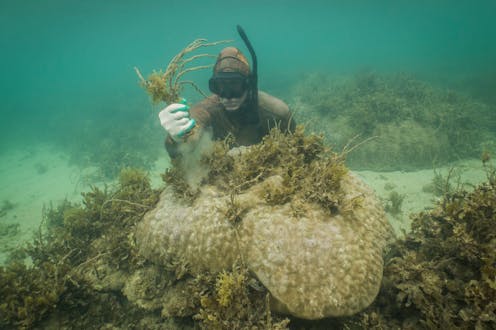
We wondered – what if you could help corals by weeding out intruding seaweed? In our new research, we found sea-weeding actually worked, giving coral time to recover.
Of course, this is a stopgap measure. It’s designed to buy time while we tackle the main threats to the world’s largest reef system – notably, climate change.
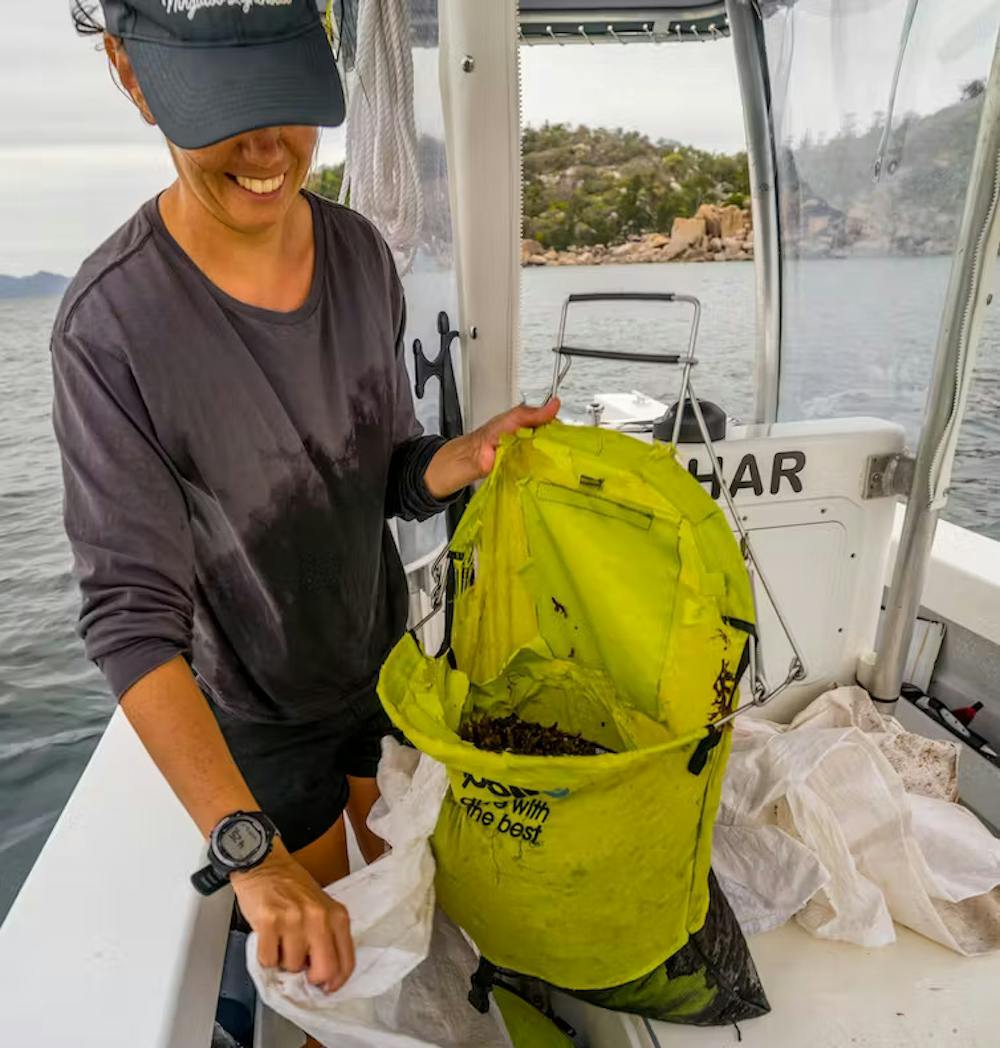
A citizen scientist bags the weeded macroalgae for weighing. Miranda Fittock, CC BY-NC-ND
How can seaweed take over?
Corals don’t like hot water, sediment or an overload of nutrients. So when there’s a mass bleaching or coral death event after a marine heatwave or cyclone, there’s empty space on the reef.
Seaweeds are similar to weeds in a garden. They can colonise quickly, grow fast and tall, soaking up sunlight and competing directly with surviving corals for light and space.
Once these tough algae establish, corals struggle to come back. Then there are feedback loops which can further prevent coral return – coral larvae are put off by chemicals emitted by seaweed. Seaweed growth takes the space where coral larvae could have settled. And the health of adult corals can be hit by algae just living nearby. It’s safe to say coral and algae are not best friends.
You might wonder why nature doesn’t even the balance. At Yunbenun, the main genus of seaweed is Sargassum, most famous for their massive blooms in the Sargasso Sea. The problem is, not many fish like the taste. When Sargassum is fully grown, it’s especially unpalatable to herbivorous fish.
Many fish will actively avoid areas with long, dense growth of seaweed for fear of predators hiding among the foliage.
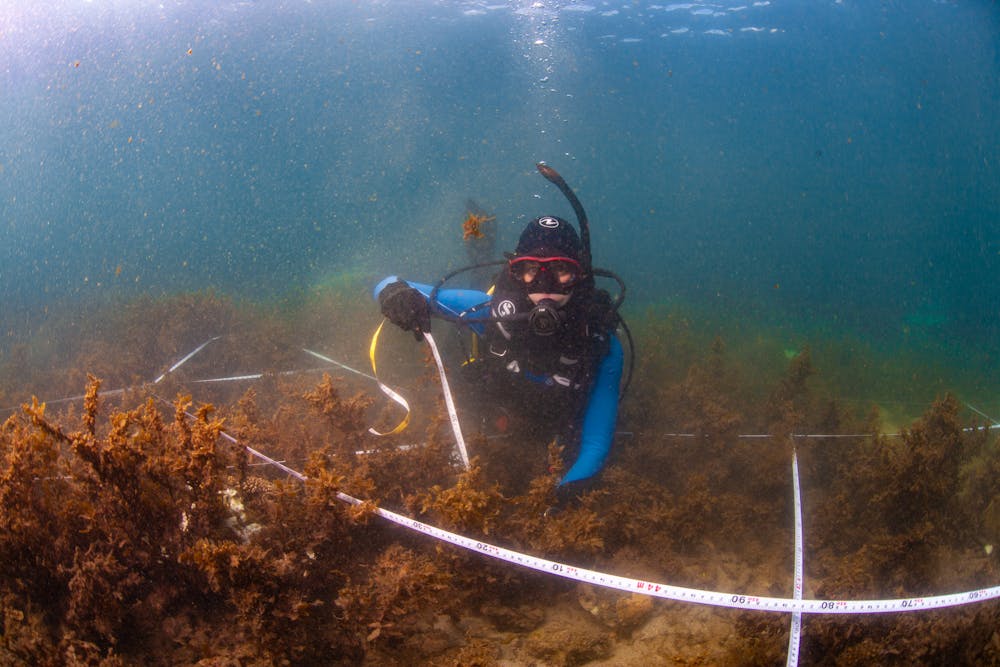
The reefs at Yunbenun (Magnetic Island) are dominated by macroalgae. Victor Huertas-Martin, CC BY-NC-ND
Weeding the sea
So if grazing fish won’t eat the problem, and urchins aren’t very abundant, it’s up to us. We set about testing sea-weeding, where you dive down and cut back stands of macroalgae. Would the corals bounce back?
The process is just like weeding a garden, but underwater. You dive down, yank fronds of seaweed off the seafloor and dispose them back on shore. It’s labour intensive, but simple. We were aided in weeding by citizen scientists through Earthwatch Institute.
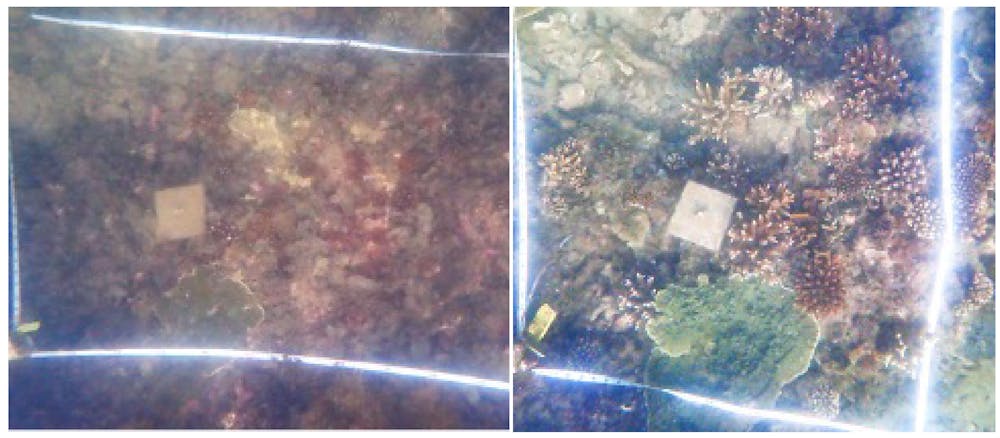
It took three years, and the removal of three tonnes of seaweed, but it worked. In the areas we’d weeded (300m², or about 1% of the seafloor at our study site) twice or three times a year, the coral had made a spectacular recovery. Corals now covered between 1.5 to six times the area they had before.
After the coral returned, seaweed has been growing back less and less. Seaweed originally covered 80% of the seafloor, but now covers less than 40%. That suggests it might need only a few years of effort to suppress the seaweed and push the coral ecosystem toward recovery.
Importantly, the diversity of coral species increased too – and that means weeding isn’t favouring any single coral species.
Left: a section of weeded reef in October 2020. Right: the same section of reef in October 2021, showing significant coral growth. Author provided, CC BY-NC-ND
We disposed of the seaweed in a local school’s organic compost heap. While not part of this project, there is promising new research showing macroalgae like Sargassum could be a carbon sink. Seaweed has many uses, ranging from bio-plastics, fertiliser or biofuels. If the economics stack up, removing mature macroalgae could provide a win-win for reef and climate health – even if it’s only small scale.
Where would this approach be most useful?
On the Great Barrier Reef, the reefs most prone to seaweed takeover are those near to shore. These are, as you’d expect, also the most accessible and the ones most often visited by tourists.
If you were going to use this technique more widely, it would make sense, therefore, to focus on nearshore reefs. They’re economically important for industries like tourism and fishing.
At present, there’s a lot of research being done on high-tech interventions such as breeding corals to tolerate hotter water, or brightening clouds. What we hope to show is the equal value of testing low-tech, low-cost methods which can achieve scale by harnessing citizen science volunteers and community programs. This has the added advantage of building public support and giving concerned citizens a clear way to help. It could be useful not only in Australia, but on island nations in the Pacific with limited resources.
By our estimates, the cost – around A$104,000 per hectare – is a fraction of other reef restoration techniques, which have a median cost of about $616,000 per hectare, ranging all the way up to $6.2 million per hectare.
This isn’t a silver bullet. We have no reef restoration or management approaches able to keep our reefs alive if we don’t tackle the big issues – hotter, more acidic seas brought about by climate change, as well as nutrient runoff and other threats.
So what role could sea-weeding have? Even if we manage to significantly cut emissions globally in the coming decades, there’s so much CO₂ already in the atmosphere that reefs will keep deteriorating.
That means there could well be a role for this approach. This low-tech but rapidly effective technique could help keep corals alive while we work for decisive action on climate change.
Hillary Smith receives funding from a partnership between Earthwatch Institute and Mitsubishi Corporation, as well as the National Geographic Society, the British Ecological Society, the Reef HQ Volunteer Association, and the Women Diver Hall of Fame. She is a 2019 National Geographic Explorer, and is affiliated with James Cook University and the University of New South Wales.
David Bourne receives funding from a partnership between Earthwatch Institute and Mitsubishi Corporation. He is affiliated with James Cook University and the Australian Institute of Marine Science.
A major plank of the federal goverment’s bid to overhaul Australian universities is ensuring more students from diverse backgrounds finish university.
So far, the Universities Accord’s interim report has identified compulsory, unpaid work placements as a significant barrier.
Students often must take time out of paid work for these placements which can take place over multi-week blocks away from home.
We previously found compulsory unpaid placements lead to financial stress for students and are unsustainable. Our new survey research provides three ways to address “placement poverty”.
Many professional courses, such as nursing, teaching, social work, psychology and the allied health professions, have significant work placement requirements.
For example, social work students need to complete 1,000 hours (nearly half a year) of full-time, unpaid work experience to graduate.
These placements are hugely important for student learning, but the time commitment means students often have to give up paid work. There can also be extra travel and clothing costs.
Our 2022 research has shown how the resulting financial hardship and stress can stop students completing their degrees. It can also prevent people even considering university study, especially those from socially disadvantaged backgrounds.
The Australian Council of Heads of Social Work Education recently commissioned research to identify solutions. This 2023 study involved a nationwide survey of almost 1,200 participants: 701 social work students, 196 educators and 294 practitioners.
It highlighted several potential ways to fix this situation.
Students in our survey reported they are regularly used as free labour to fill staff shortages in organisations that are not adequately resourced.
While placements should provide opportunities for learning (to develop new skills under supervision and within a supported environment), more than half the educators surveyed reported service providers won’t take students if they don’t already have the skills to perform the required work.
A further 43% of educators said organisations refused to host a student if they didn’t perform well during a pre-placement interview. This means organisations are routinely screening students to ensure they can perform unpaid work while on placement.
As one student told us:
While I understand we are students, we are still being expected to work, manage clients and assist in support roles (many of which are emotionally taxing and complex) so I believe being unpaid for this is unethical.
To fix this, we recommend the federal parliament changes the Fair Work Act, so vocational placements must be paid. At the moment it is legal for them to be unpaid.
The demands of work placements often mean students have to give up paid employment. Ron Lach/Pexels
2. Pay students a minimum wage
Students in our research also talked about the importance of being paid from a cost-of-living perspective.
As a mature age student with two young children, it is impossible for me to be unpaid and undertake placement.
The Universities Accord interim report has suggested changes to the Higher Education Loans Program (HELP) (such as reduced fees), but this won’t help students with the upfront costs of daily living while doing placements.
The United Kingdom offers a bursary through the National Health Service to cover students’ expenses while on placement.
Despite the importance of paying students at least a minimum wage, it is clear the organisations they work for cannot pay. These mostly non-profit organisations are already underfunded. Existing placement shortages will only worsen if organisations are expected to pay.
Universities cannot pay either. There is no country in the world where universities pay students to do placements. And while there’s a perception some universities are flush with cash, the spoils are not spread evenly. Smaller, regional institutions would be most disadvantaged.
Higher education funding has also been shrinking for decades, so universities are forced to operate like businesses. Within this context, any costs they incur for placements would likely be passed onto students. Some universities may simply ditch professional courses if they become too expensive to run.
This means the Australian government will have to pay, as an investment into vital professions, especially if we are to address workforce shortages.
Calculated at the minimum wage rate (before the recent minimum wage increase), Unions NSW estimated students should earn around A$21,000 for a placement.
This would mean the price tag for government would be in the millions (not billions) of dollars. It would also meet multiple goals of the Universities Accord. Along with improving equity, it also seeks to meet future skills needs.
An additional solution is for professional regulatory bodies to emphasise demonstrated learning outcomes, instead of an arbitrary “placement hours” approach.
During COVID, innovative strategies were trialled when many students could not complete regular face-to-face placements. As one educator told us:
[These] showed that students could achieve success in their placement and learning with less time and more flexibility.
The most popular strategies to help reduce student poverty, as ranked by our respondents, were reducing placement hours by up to 20%, increasing recognition of prior learning, and allowing students to do a placement in an existing workplace.
Currently, social work students cannot do a placement in their pre-existing role, even if the work is directly relevant.
Developing a “capability framework” (that measures acquired learning, instead of hours served) also had overwhelming support. One practitioner said:
More focus on demonstrating learning as opposed to just ‘ticking off hours’ could lead to shorter placements with a higher focus on the quality of learning.
What about learning?
Learning and working go hand in hand on placement. While current standards are often presumed to produce competent and ethical practitioners, our research shows students are being financially stretched and stressed.
We all need our professionals to be well prepared for the workplace. We also know poverty and stress do not help students concentrate or learn. Reflecting on their student experience, one practitioner told us:
For me it became just getting the hours done, rather than learning.
Students should be reasonably compensated for the work they are doing. In addition to payment, research shows that reducing hours, and introducing more flexible work-based placements and ways to measure learning, would help.
The final Universities Accord report is due in December. There is a genuine opportunity here to end placement poverty.
Christine Morley received partial funding from the Australian Council of Heads of Social Work Education (ACHSWE) to undertake this study.
Vanessa Ryan (QUT) assisted with quantitative data analysis. Professor Linda Briskman (WSU), Dr Maree Higgins, and Associate Professor Lisa Hodge (CDU) were also part of the original research team and are ongoing members of the Workforce and Placement Poverty Advocacy working group of the ACHSWE.
Source: The Conversation (Au and NZ) – By Peter C. Pugsley, Associate professor, Department of English, Creative Writing and Film, University of Adelaide
What began as a friendly pirate-based manga, Netflix’s One Piece features the eternally optimistic Monkey D. Luffy (pronounced Loofy), a young man with magical stretchy powers that gathers a crew of eccentric loners to crew his Straw Hat Pirate brigade and set out in search of the legendary One Piece pirate treasure.
The production quality of this series is excellent, from sets, costumes and make-up, it seems that every cent of its estimated US $138 million budget has been well used.
With a 95% viewer rating on Rotten Tomatoes and One Piece sitting at the top of Netflix’s global viewing stats in its second week in the top 10, it’s clear that Netflix has struck a winning adaptation formula, with a Mashable review declaring that “Netflix does the impossible”.
At first glance, One Piece could be seen as a blend of Harry Potter and the Pirates of the Caribbean, a mixture of fantasy and pirate aesthetics. One Piece’s postmodern take on the pirate genre has characters dressed in neat business suits, and contemporary t-shirts. But it is the general mix of the manga’s fun, action and drama that the series captures so well.
From Manga to Anime to Live-action
One Piece first appeared as a manga in 1997 and holds the distinction of being the world’s most published manga with over 100 compiled book volumes, with sales of over 500 million.
The manga’s initial success saw its first animated TV series produced by Toei Animation in Japan in 1999, with over 1,000 episodes now in circulation. There have been 11 feature-length animated movies, including 2022’s One Piece Film: Red, and 4 short films, all produced and initially released in Japan.
The first attempt to bring the One Piece anime to the west, stalled immediately. In 2004, an American company purchased the rights to the series, but dubbed and reedited the show to be more child friendly, resulting in a quick backlash from audiences. In 2007, the show was picked up by another company (now Crunchyroll) and packaged for DVD and broadcast in its original, uncut format.
In 2020, anime streaming service, Crunchyroll, released the anime across its platforms in Europe and the Middle-East.
While manga and anime such as Dragon Ball Z and Pokémon have long attracted a global audience, One Piece is aimed at a slightly older audience. Until now, it has not received the same kind of international attention (and marketing).
One Piece’s journey from manga, through anime to live-action has precedence across all genres in Japan, not just in children’s cartoons. From the sweet family drama of Hirokazu Kore-eda’s Palme d’Or entry, Our Little Sister (2015) to Takashi Miike’s ultra-violent Ichi the Killer (2001), Kengo Hanazawa’s zombie hit, I Am A Hero (2015) and any number of high school based films such as Akira Nagai’s After the Rain (2018), the journey from manga to live-action is often keenly awaited by Japanese audiences.
Keeping it ‘real’
The adaptation of “sacred” Japanese manga and anime series have copped more than a little criticism from audiences, well beyond the dedicated otaku (enthusiasts). If you’re not sure how passionate fans can be, here’s one spirited review of the series, that he’s thoughtfully limited to just under one hour. At one point he breathlessly exhorts “Make no mistake, I am going to spend the vast majority of this video just absolutely slobbering over this!”
When Scarlet Johansson was chosen to play the lead role in the live-action version of Ghost in the Shell (2017), the opposition mobilised accusing the producers of whitewashing the film.
But it’s not just Western casting that gets the ire of fans and critics. The live-action remake of Kiki’s Delivery Service (2014), best known for the 1989 Studio Ghibli anime, was poorly received in both Japan and the West. The remake copped a Variety review claiming that it was marred by its “charmless heroine, leaden storytelling and dime-store production values”.
Casting the crew
Perhaps one of the keys to this series immediate success is its international casting.
Luffy is played with ineffable joy by Mexico’s Inaki Godoy, who captures the wild-eyed optimism of the original manga character. Australia’s Morgan Davies plays the cabin boy Koby, bringing a delightfully androgynous innocence to the role.
Spanish-English actor, Taz Skylar is the be-suited Sanji, who joins the Straw Hats as their cook.
American actor Jeff Ward excels as Buggy the Clown, perhaps the character most responsible for the story’s appeal to older audiences. Like Pennywise in Stephen King’s It, or Heath Ledger’s Joker, Buggy’s grotesqueness will fire up the coulrophobia (fear of clowns) in even the best of us.
The surprising inclusion of just one Japanese actor in the regular cast features Mackenyu as the sword-wielding Zoro (so much of One Piece borrows from other movies, folk-tales and popular culture). Mackenyu is a Japanese teen film star, and the son of the great Sonny Chiba, martial arts and action star (in Quentin Tarantino’s Kill Bill films).
The excellent casting in One Piece tops off the series’ ability to remain breathtakingly fun. Like Ryan Gosling’s over-the-top performance in Barbie, the entire cast of One Piece look like they’re having a blast, and the enthusiasm shows in their performances.
Secret to success?
So how did Netflix do it? How did they create an adaptation that captured the excitement of both the manga and anime and doesn’t, well, suck?
This series of One Piece stays true to its characters, supported by a strong cast and a healthy budget that allows high production standards and special effects.
Many of the props, including some of the boats, were actually built, so the actors aren’t just green-screening their performances. The result is a rollicking, swashbucklingly fun pirate adventure. The Netflix executives must be feeling as chipper as Luffy.
Peter C. Pugsley does not work for, consult, own shares in or receive funding from any company or organisation that would benefit from this article, and has disclosed no relevant affiliations beyond their academic appointment.
Anthony Albanese cemented victory in the 2022 election by being mostly highly cautious and having Labor run, by and large, a tight campaign. If he loses the Voice referendum, which is looking very likely, his own overreach and the “yes” campaign’s ill-discipline will carry a good deal of blame.
Albanese will be responsible for the former, but a victim of the latter.
He could have put a more modest referendum proposition, albeit one that Indigenous leaders would have condemned as not going far enough. But he could not impose order on the “yes” campaign, because he’s only in charge of the government’s part of it.
This has arguably been the worst, and most depressing, week for the “yes” march towards the October 14 vote.
By now, the accumulation of polls has put the prospect of carrying this referendum into near-miracle territory. More than a month of campaigning remains, so it’s not over, but it would take a great deal to turn the trend to “no” around.
Beyond the blame game and the political fallout, defeat would confront Albanese with an existential personal question. Did he do the Indigenous cause serious harm by embarking – with the best of intentions – on a mission possibly doomed from the start? Did ambition overcome judgment and a sense of history?
In the event of a defeat, it will be a legitimate question, however much condemnation rains on Peter Dutton and other “no” advocates. One of the strongest (negative) arguments for voting “yes” is what we will be left with in the event of a “no” win.
Trying to pick up the pieces after a failed referendum will be extremely difficult. So far, there is no evidence the government has a fallback plan. But it needs to craft one, because a void filled with little but anger or apathy or both would leave the country in the worst of places. While polling has found people want to see improvement in Indigenous lives, on the other hand we are already seeing some resistance to Welcome to Country and the like.
Yet what would be the nature of a post-defeat plan? Legislating a form of Voice after a referendum loss would be seen as flying in the face of the result – although a non-constitutional Voice might be acceptable to many “no” voters. Anyway, Albanese has indicated he won’t go down that path.
Given he was so measured in the rest of his election pledges, it was uncharacteristic of Albanese not to be more careful on this one. Perhaps he did think, as he often says, it was a modest ask. Perhaps he overestimated his own persuasive power, or underestimated the impact of the inevitable scare campaign. Perhaps he simply ignored the compelling story of past referendums.
To maximise the referendum’s prospects, maybe it would have been better to have held it with the next election, when there would have been a less intense spotlight on it.
In the referendum campaign, Albanese is seeking to make a virtue of the fact non-government campaigners are to the fore. In theory, that should be a strong point. But this week we have seen how damage can be caused by things outside the government’s control.
Marcia Langton is one of the biggest names of her generation of Indigenous leaders. In her early 70s and with an impressive academic career, she has been a formidable, passionate advocate over decades, a take-no-prisoners fighter for Aboriginal causes, a woman who says what she thinks, and then some.
Langton was co-author, with Tom Calma, of a seminal report on a Voice under the former government, and a member of the Albanese government’s working group on the referendum.
At a weekend meeting in Western Australia, Langton let fly about the “no” campaign. “Every time the ‘no’ case raises one of their arguments, if you start pulling it apart you get down to base racism, I’m sorry to say it but that’s where it lands. Or just sheer stupidity.”
That’s what she actually said. It was wrongly reported as Langton saying “no” voters were racist, which meant she had to get out the fire hose later. Even in its accurate form, however, the comment was sure to be regarded as provocative.
It was always going to be impossible to expect the broadly based “yes” campaign speakers would carefully watch their words (although the canny Noel Pearson has indicated he’s curbed his well-known caustic tongue and sometimes inflammatory language). But loose lips (or spontaneous frankness) will likely be costly for the “yes” side.
Worse was to come when various Langton comments from the past were dug up, including a derogatory one about opposition Senator Jacinta Nampijinpa Price, the leading Indigenous woman of the “no” campaign, and her mother Bess, who was formerly in the Northern Territory parliament.
This Voice battle has become, in part, a black-on-black argument. That damages the “yes” side, by showing divisions among Indigenous leaders and undermining the proposition the Voice has overwhelming Indigenous support.
The campaign has seen the emergence of Price, aged in her early 40s and so a generation younger than Langton, as a tough, articulate and fearless political warrior. In federal parliament only since 2022, she has become the most prominent face of the “no” campaign.
Her consistent pitch has been that the Voice wouldn’t advance closing the gap and that the issue divides the country on racial lines.
Like Langton, Price gives no quarter. Appearing at the National Press Club on Thursday, she had a sledge at Langton (dating from their joint appearance there some years back), and when asked whether she believed “the history of colonisation continues to have an impact on some Indigenous Australians”, she was blunt. “No. I’ll be honest with you. No, I don’t think so,” and went on to point to positive impacts.
As spokeswoman for Indigenous Australians, Price (who is in the Nationals) made it clear she will project her own loud voice when the Coalition puts together its post-referendum policies. Asked whether she agreed with Dutton’s policy for legislated regional and local voices, she said: “There are certainly conversations taking place and […] need to be had, within our party rooms, within shadow cabinet, to determine what it might look like to amplify and support regional and remote communities. […] And I am absolutely going to be front and centre with those discussions and those determinations.”
Federal parliament rose on Thursday, to the government’s relief, and won’t sit against until after the October 14 vote. The partisan battle over the Voice in question times this week was an unedifying, uninformative free-for-all.
Early Thursday, Albanese met former AFL star Michael Long for the final leg of his marathon walk from Melbourne in support of the Voice. It was a positive and optimistic moment for the PM in what, for him, must be an increasingly disheartening campaign that is now perhaps accompanied by some soul-searching.
Michelle Grattan does not work for, consult, own shares in or receive funding from any company or organization that would benefit from this article, and has disclosed no relevant affiliations beyond their academic appointment.
Chlamydia is a major threat to koala populations across Australia. This bacterial disease infects between 20% and 90% of individuals in koala populations. It’s a major cause of the rapid decline of many wild populations, particularly in South-East Queensland and northern New South Wales.
Our group at Queensland University of Technology (QUT) has developed two vaccines to target chlamydial infections. One of these vaccines, now being trialled in collaboration with Dr Michael Pyne and his staff at Currumbin Wildlife Hospital, has recently had some outstanding results in a wild koala population on the Gold Coast. This population had been declining rapidly due to high rates of the disease.
Two years into the five-year trial, we have seen more than 25 joeys born to vaccinated females. The program involved vaccinating, collaring and releasing 10-20% of young animals each year. All joeys and mums were chlamydia-free. In addition, 11 out of 13 young males vaccinated remain negative at 12–24 months after vaccination.
Like most vaccines, however, this vaccine requires two shots, 30 days apart. This means wild animals must be held in captivity for a month, which many don’t like, or released and recaptured for the booster dose. This is both expensive and traumatic for the animals.
It was during a chat over coffee a few years ago that we first pondered the question, “Could we develop a delayed-release vaccine implant that is given at the same time as the first vaccine and releases the booster vaccine dose 30 days later?”
Chlamydia is spread by direct physical contact between koalas. Symptoms include blindness, urinary tract infections (wet bottom), infertility in females and sperm damage in males.
While antibiotics can be used to treat the eye disease, they cannot be used to treat infertility. This is because antibiotics can destroy the gut bacteria essential for koalas to digest their food, eucalypt leaves.
The vaccine is the best option and is also very safe. We detected no adverse side-effects across multiple studies. The only complication is the need for a booster shot.
So are implants a solution? Our recent research suggests the answer is yes, at least in a sheep model. We have now received a grant from the federal Saving Koalas Fund to develop this implant technology for a koala vaccine against the Chlamydia bacterium.
In our sheep trial of a first-generation implant, animals that received the primary vaccination by injection plus a booster implant developed immune T cell numbers equivalent to animals receiving two vaccinations by injection, together with slightly reduced antibody levels.
The implant (shown next to a 10-cent coin for a size comparison) is inserted into a koala when it receives its first vaccination, meaning the animal has to be captured only once. Kenneth Beagley
The implant is a polymer tube developed by the QUT team. It borrows from technology already used by the group for making polymer scaffolds to support tissue growth. The team screened a range of biodegradable polymers for ones that would degrade over just a few weeks. They also had to be flexible enough to not break prematurely when implanted beneath the skin.
Manufacturing the polymer pellets into tubes allows the booster vaccine to be filled into the tube. It’s similar in size to the human Implanon contraceptive implant.
When the koala is injected with the first dose, the implant is also inserted under the skin. This starts a process of slow degradation of the implant until the walls of the tube fail and the vaccine is released as a burst. What is left of the implant dissolves as chemicals naturally found in the body.
To scale up the implants we are working with a company in the United States to develop methods to manufacture thousands of implants at once. Our federal funding will allow us to fine-tune a second-generation implant to deliver the chlamydia vaccine to koalas. We will test it for safety in sheep and then evaluate the implant in captive-bred koalas at Currumbin Wildlife Sanctuary.
Our ultimate aim is to be able to capture a wild koala once only and test it for chlamydia. This would be done using a rapid test we have developed. The test can be done in the back of a 4WD vehicle and takes 20–30 minutes.
If the koala is chlamydia-free, we would then vaccinate with the implant and release the animal back into the wild.
Ken Beagley receives funding from the Saving Koalas fund, the ARC and owns shares in PolVax Pty Ltd
Tim Dargaville receives funding from the Saving Koalas Fund, the Australian Research Council and owns shares in PolVax Pty Ltd.
From colleagues chatting about their weekends or having intense phone conversations, to email alerts and loud tapping on keyboards, the evidence that open-plan offices take a toll on our wellbeing continues to mount. There’s a clear relationship between noise levels and physiological signs of stress such as heart rate.
This stress can also manifest in unconscious actions to reclaim control – and while some of these behaviours are therapeutic and benign, others are more toxic.
Our research
shows that office noise increases the likelihood of people wanting to reclaim personal space through territorial behaviours. This might include creating a psychological and physical “border” around their workspace using potted plants, or seeking to mark space as theirs with photos and other personal items.
This means the amount of desk clutter in your open-plan office may be a sign of noise-induced stress.
More noise is also associated with negative feelings such as frustration and anger, as well as antisocial behaviours such as social withdrawal and (to a lesser extent) disagreement with colleagues.
Measuring noise effects
Our study involved 71 participants, working in offices with varying levels of privacy in four different areas of a university.
Over ten working days, every participant kept a diary, recording their perception of noise levels and how they felt twice a day (mid-morning and mid-afternoon).
This type of research is known as a diary study. It is used by researchers in psychology, organisational behaviour and marketing to study and understand long-term changes in attitudes and behaviour.
To measure the perception of office noise, we asked participants to respond, using a seven-point scale (1 = “strongly disagree” to 7 = “strongly agree”) to statements such as “I am disrupted by telephone noises” and “I am disrupted by office machines”.
Noisy offices can provoke frustration and worker conflicts. Shutterstock
To measure their mood and behaviour, participants then rated (also on a seven-point scale) statements such as:
what is happening around me at the moment is a frustrating experience
I feel angry about what is happening around me
I feel like withdrawing from my coworkers
I want to be left alone in my workplace
I am experiencing disagreements of ideas with a coworker
We then used statistical techniques to gauge the strength of the link between noise, negative feelings and the behaviours mentioned above.
We found a moderately strong statistical link between office noise and feelings of frustration, anger and anxiety. We also found people in noisy offices are more likely to withdraw psychologically from their work, perhaps by taking longer breaks than permitted, spending work time on personal matters, or surfing the internet.
We also found a weaker link between office noise and conflict or disagreement between colleagues, on either work-related or non-work issues.
The link between office noise and territorial behaviours was more nuanced, because whereas feelings of anger or annoyance might be fleeting, it takes time and planning to add a pot plant or framed photo to your desk to stake out your territory.
In other words, your colleague talking loudly on the phone about football might annoy you, but it won’t cause you to immediately decorate your office cubicle with more photos of your pet cat.
However, we found that for every one-point increase (on the seven-point scale) in anger, frustration or anxiety suffered by our survey participants, the likelihood of them going on to display territorial behaviours at their workspace increased more than threefold.
To put it simply, we found that noisier workplaces are more likely to put workers in a bad mood, and over time these negative emotions are associated with increased territoriality.
Perhaps unsurprisingly, we also found these effects are strongest in low-privacy spaces such as open-plan offices, and less noticeable in smaller and more private settings such as a single-person office.
A psychological coping mechanism
People personalise their work spaces by adding photos (a form of territoriality) not only to claim their workspace or because they are just nice, but they deliberately decorate or modify their work spaces with these photos to reflect their identities. The opportunity to reflect their identities (that is, bringing their “whole self” to work) is thought to increase workers’ satisfaction and wellbeing and, ultimately, organisational wellbeing.
Personalisation is more important for women than men, and they personalise their space with different items. Women are more likely to display items such as photos and letters from friends and family, while men tend to personalise with things to do with sports and entertainment.
Men and women personalise their spaces differently. Shutterstock
We are emotional creatures with a need for distinctiveness, self-identity, control and belonging. This doesn’t disappear when we go to work. A sense of psychological ownership over one’s workplace and work is associated with increased job satisfaction and organisational commitment.
This helps to explain why in a “hot-desk” office, most people tend to return to the same workspace daily.
Workplaces with hard rules against personal items in open-plan offices, or hot-desking offices where workers are required to leave the space clear at the end of the day, may well be negating a simple way for their workers to cope. In the process, they may even be harming their organisational wellbeing and productivity.
The other cheap and obvious way to reduce office noise is through hybrid working, reducing the number of people in the office at a given time.
Employers pushing to have workers return to the office should balance the perceived productivity gains against the evidence that noisy offices means employees might be grumpier, more frustrated, and more likely to put up walls – both literal and metaphorical.
Oluremi (Remi) Ayoko receives funding from Australian Research Council.
Chlamydia is a major threat to koala populations across Australia. This bacterial disease infects between 20% and 90% of individuals in koala populations. It’s a major cause of the rapid decline of many wild populations, particularly in South-East Queensland and northern New South Wales.
Our group at Queensland University of Technology (QUT) has developed two vaccines to target chlamydial infections. One of these vaccines, now being trialled in collaboration with Dr Michael Pyne and his staff at Currumbin Wildlife Hospital, has recently had some outstanding results in a wild koala population on the Gold Coast. This population had been declining rapidly due to high rates of the disease.
Two years into the five-year trial, we have seen more than 25 joeys born to vaccinated females. The program involved vaccinating, collaring and releasing 10-20% of young animals each year. All joeys and mums were chlamydia-free. In addition, 11 out of 13 young males vaccinated remain negative at 12–24 months after vaccination.
Like most vaccines, however, this vaccine requires two shots, 30 days apart. This means wild animals must be held in captivity for a month, which many don’t like, or released and recaptured for the booster dose. This is both expensive and traumatic for the animals.
It was during a chat over coffee a few years ago that we first pondered the question, “Could we develop a delayed-release vaccine implant that is given at the same time as the first vaccine and releases the booster vaccine dose 30 days later?”
Chlamydia is spread by direct physical contact between koalas. Symptoms include blindness, urinary tract infections (wet bottom), infertility in females and sperm damage in males.
While antibiotics can be used to treat the eye disease, they cannot be used to treat infertility. This is because antibiotics can destroy the gut bacteria essential for koalas to digest their food, eucalypt leaves.
The vaccine is the best option and is also very safe. We detected no adverse side-effects across multiple studies. The only complication is the need for a booster shot.
So are implants a solution? Our recent research suggests the answer is yes, at least in a sheep model. We have now received a grant from the federal Saving Koalas Fund to develop this implant technology for a koala vaccine against the Chlamydia bacterium.
In our sheep trial of a first-generation implant, animals that received the primary vaccination by injection plus a booster implant developed immune T cell numbers equivalent to animals receiving two vaccinations by injection, together with slightly reduced antibody levels.
The implant (shown next to a 10-cent coin for a size comparison) is inserted into a koala when it receives its first vaccination, meaning the animal has to be captured only once. Kenneth Beagley
The implant is a polymer tube developed by the QUT team. It borrows from technology already used by the group for making polymer scaffolds to support tissue growth. The team screened a range of biodegradable polymers for ones that would degrade over just a few weeks. They also had to be flexible enough to not break prematurely when implanted beneath the skin.
Manufacturing the polymer pellets into tubes allows the booster vaccine to be filled into the tube. It’s similar in size to the human Implanon contraceptive implant.
When the koala is injected with the first dose, the implant is also inserted under the skin. This starts a process of slow degradation of the implant until the walls of the tube fail and the vaccine is released as a burst. What is left of the implant dissolves as chemicals naturally found in the body.
To scale up the implants we are working with a company in the United States to develop methods to manufacture thousands of implants at once. Our federal funding will allow us to fine-tune a second-generation implant to deliver the chlamydia vaccine to koalas. We will test it for safety in sheep and then evaluate the implant in captive-bred koalas at Currumbin Wildlife Sanctuary.
Our ultimate aim is to be able to capture a wild koala once only and test it for chlamydia. This would be done using a rapid test we have developed. The test can be done in the back of a 4WD vehicle and takes 20–30 minutes.
If the koala is chlamydia-free, we would then vaccinate with the implant and release the animal back into the wild.
Ken Beagley receives funding from the Saving Koalas fund, the ARC and owns shares in PolVax Pty Ltd
Tim Dargaville receives funding from the Saving Koalas Fund, the Australian Research Council and owns shares in PolVax Pty Ltd.
Social media is lighting up over what influencers are calling “budget Ozempic”. These are drugs normally used as laxatives and stool softeners, but people are taking them to lose weight. The demand is so high in the United States, there are reports this is contributing to shortages in pharmacies.
These laxatives are just the latest alternatives influencers are touting for the blockbuster drug Ozempic.
So, does “budget Ozempic” help you lose weight? Any weight loss is likely to be temporary and using these laxatives long term may be dangerous.
Ozempic contains the active ingredient semaglutide. It is a prescription-only drug used to treat type 2 diabetes. One side effect of taking it is significant weight loss. This has led to so many people trying to obtain the drug there have been shortages.
Instead, some people have turned to more easily accessible over-the-counter alternatives to try to lose weight. That includes berberine, which has been dubbed “nature’s own Ozempic”.
What is ‘budget Ozempic’?
“Budget Ozempic” is different to “nature’s own Ozempic”. It is the polymer polyethylene glycol 3350, or PEG 3350 for short.
Chemically, it’s similar to other polymers used as ingredients in cosmetics, drug delivery, archaeological preservative paints, soaps and even missile fuel. It’s not to be confused with ethylene glycol, which is used in antifreeze.
Medically, PEG 3350 is mainly sold in Australia through pharmacies in laxative and stool softening products. It is also used to clean out your bowels before a colonoscopy.
The products are referred to as macrogols. Brands include DulcoSoft, Movicol, OsmoLax, ClearLax and ColonLYTELY.
PEG 3350 is known as an osmotic laxative. It uses osmosis – how your body manages the balance of electrolytes in your blood serum – to soften your stools and treat constipation.
When you swallow a drink with PEG 3350 the polymer isn’t absorbed by the body. Instead, as it passes through your intestines it draws water to it, making your faeces much more watery.
Because it draws more water out of your body than you put into it from the drink, your weight goes down. That is, it just makes you dehydrated.
‘Budget Ozempic’ is really a laxative. Shutterstock
This means any weight loss is likely to be short-lived; when you next drink, your body will retain more of the water to replace what was lost. To have any significant and sustained weight loss you’d need to take a lot of PEG 3350 every day. And at most, you would only lose a few kilograms.
This is different to how Ozempic works. Ozempic is similar to a family of hormones in your body called incretins. These have a number of actions that control both blood sugar levels and weight. For example, they slow how quickly food is absorbed from the stomach and decrease appetite, both of which help with sustained weight loss.
PEG 3350 can make you dehydrated. You may feel dizzy or light-headed, have a headache and have a dry mouth, lips or eyes.
The concentration of electrolytes in your blood, such as salt, may also be too high (known as hypertonic blood serum).
Hypertonic blood serum can affect the shape of your red blood cells, making it harder for them to carry oxygen around your body. This results in symptoms that include fatigue and tiredness, and those other symptoms of being dehydrated. In extreme cases it can result in death.
The shape of your red blood cells can change, making it harder to carry oxygen around the body. Shutterstock
Incorrect levels of electrolytes can lead to other serious problems, affecting your heart and muscles. It can also lead to seizures, confusion, and coma.
It can be dangerous to take PEG 3350 if you have heart disease, if your doctor has put you on a sodium-restricted diet, or if you already have an electrolyte disorder, such as hyperkalaemia (high potassium levels).
These products are also dangerous for elderly people, those with kidney problems, and in very young children.
Common side effects include anal irritation, vomiting, diarrhoea, nausea, cramps, pain, and swelling of your abdomen. Some people can have allergic reactions.
If you use laxatives, including PEG 3350-based products, for a long period of time (over a period of weeks or months) then you may experience withdrawal symptoms if you stop taking them suddenly. These include constipation, bloating, weight gain and fluid retention.
Overall, if you’ve been struggling with weight loss, then PEG 3350-based products are not a safe and effective solution. Any weight loss you experience will be temporary and may put your health at risk. Safer and more effective solutions are available.
Eating healthily and exercising regularly are important first steps for anyone who wishes to lose weight. Otherwise, your GP or local pharmacist can help you with both lifestyle changes and medication options to help with weight loss.
Nial Wheate in the past has received funding from the ACT Cancer Council, Tenovus Scotland, Medical Research Scotland, Scottish Crucible, and the Scottish Universities Life Sciences Alliance. He is a Fellow of the Royal Australian Chemical Institute, a member of the Australasian Pharmaceutical Science Association, and a member of the Australian Institute of Company Directors. Nial is the chief scientific officer of Vaihea Skincare LLC, a director of SetDose Pty Ltd a medical device company, and a Standards Australia panel member for sunscreen agents. Nial regularly consults to industry on issues to do with medicine risk assessments, manufacturing, design, and testing.
Jessica Pace does not work for, consult, own shares in or receive funding from any company or organisation that would benefit from this article, and has disclosed no relevant affiliations beyond their academic appointment.
Source: The Conversation (Au and NZ) – By Adrian Beaumont, Election Analyst (Psephologist) at The Conversation; and Honorary Associate, School of Mathematics and Statistics, The University of Melbourne
The New Zealand general election to be held in one month, on October 14, will be the country’s tenth under the mixed member proportional system (MMP).
Voters have two votes: one for their party of choice, the other for their electorate’s member of parliament. There are 72 single-member seats, including seven seats for electors on the Māori roll.
Parties must win at least 5% of the total vote to gain seats in parliament. The threshold is waived if a party wins one of the electorate seats.
The 48 “list” seats are used to ensure proportionality, so that parties that win many single-member seats win few list seats. It is the party vote that matters most as it determines the number of seats a party is entitled to.
Election for single-member seats is by a first-past-the-post system. There can be more than 120 MPs (an “overhang”) if a party wins more single-member seats than its total entitlement given its party vote. An overhang last occurred at the 2014 election.
Coalitions and ‘kingmakers’
In current polls, National, Labour, ACT and the Greens are well clear of the 5% threshold. The Māori party (also known as Te Pāti Māori) is expected to win Māori-roll single-member seats and will qualify for parliamentary representation even if its party vote is below 5%.
In the past, the populist New Zealand First party has occasionally been the “kingmaker” and allied with both Labour and National governments. At the 2020 election, its party vote fell below the 5% threshold and it didn’t win any electorate seats, so was wiped out of parliament.
Some recent polls have New Zealand First above 5% and it’s unclear whether it will win representation after the election.
In a proportional representation system, we need to account for likely coalitions. The right coalition consists of National and ACT, while the left coalition consists of Labour, the Greens and Māori.
I am not counting New Zealand First towards either coalition as it’s unclear whether they will win representation. But the Labour Party has ruled out working with New Zealand First in coalition. No other parties are likely to win representation.
The graph below shows the right coalition’s lead or deficit over the left coalition as estimated by all New Zealand pollsters that have released at least two polls since March.
The election date is shown on the graph. I started this chart in March as it was shortly after Chris Hipkins replaced Jacinda Ardern as Labour leader and prime minister in January.
The graph has poll results and a trend line for every pollster. It is similar to a graph I have been using for Australian polls on the Indigenous Voice to Parliament referendum, but uses the midpoint of polls’ fieldwork periods, not the endpoint. This is because Morgan’s New Zealand polls are taken over a whole month.
The pollster used by Television New Zealand’s 1News changed its name from Kantar Public to Verian this year. I have used “Verian/Kantar” to designate this pollster.
From March to June, polls tended to have the left coalition ahead, but there has been a surge to the right in the past two months. The trend lines for all pollsters now have the right ahead.
The Curia poll for the Taxpayers’ Union has been the right’s best poll, while Talbot Mills has been the left’s best.
The six most recent polls show an 8.5-point lead for the right in Morgan, a 1.6-point lead in Talbot Mills, a 7.2-point lead in Curia, an 8.8-point lead in Reid Research, a 4.4-point lead in Essential and an 8-point lead in Verian/Kantar. The Talbot Mills poll looks like a left-favouring outlier.
Reversal of fortune for Labour
With the right ahead in recent polls, the only realistic hope for the left would be that New Zealand First made it past the 5% threshold, which could give Labour, the Greens, Māori and New Zealand First enough seats to deny National and ACT a combined majority.
While Labour has ruled out working with New Zealand First leader Winston Peters, Labour, the Greens and New Zealand First were in a coalition government for the 2017–2020 term. If New Zealand First were again in a kingmaker role after the election, it’s plausible Labour would change its mind and make Peters an offer.
Essential and Talbot Mills both have New Zealand First above the 5% threshold and don’t have the right coalition ahead by enough to avoid needing it to form a government.
But in the other four most recent polls, the right is ahead by enough to form a government without New Zealand First, even if it makes the threshold.
Why has there been a recent surge to the right? I believe Hipkins’ honeymoon after he replaced Ardern has worn off. There have been ministerial scandals, including the July 24 resignation of Labour MP Kiri Allan as justice minister after being charged with careless driving and refusing to accompany a police officer after a crash.
High inflation and cost-of-living stress will also be a contributor. Inflation was 1.1% in the June quarter, down slightly from 1.2% in March, and well below the peak of 2.2% in September 2022.
A loss for Labour would be a big reversal from its landslide victory at the 2020 election, in which the party won a one-party majority with 65 of the 120 seats. This was the first time since the current electoral system replaced first past the post in 1996 that a single party had won a parliamentary majority.
New Zealand’s success at keeping COVID out, as well as leadership turmoil within the National Party, likely contributed to that Labour victory. The 2023 election will not see the same pattern repeated on either the left or right.
Adrian Beaumont does not work for, consult, own shares in or receive funding from any company or organization that would benefit from this article, and has disclosed no relevant affiliations beyond their academic appointment.
Source: The Conversation (Au and NZ) – By Adrian Beaumont, Election Analyst (Psephologist) at The Conversation; and Honorary Associate, School of Mathematics and Statistics, The University of Melbourne
With exactly one month until New Zealand’s general election, all major polls are now showing a clear rightward trend since June.
With some recent polls showing New Zealand First on or above the 5% MMP threshold, the only real wildcard at this point is whether the party will be returned to parliament after October 14.
Otherwise, current polls show National, Labour, ACT and the Greens are well clear of the 5% threshold. The Māori Party/Te Pāti Māori is expected to win Māori-roll single-member seats, and will qualify for parliamentary representation even if its party vote is below 5%.
The graph below shows the right coalition’s lead or deficit over the left coalition in all New Zealand pollsters that have released at least two polls since March. The right coalition consists of National and ACT, while the left coalition consists of Labour, the Greens and Māori.
The election date is shown on the graph. I started this chart in March, shortly after Chris Hipkins replaced Jacinda Ardern as Labour leader and prime minister in January.
The graph has poll results and a trend line for every pollster. It is similar to a graph I have been using for Australian polls on the Indigenous Voice to parliament referendum, but uses the midpoint of polls’ fieldwork periods, not the endpoint. This is because Morgan’s New Zealand polls are taken over a whole month.
(The pollster used by Television New Zealand’s 1News changed its name from Kantar Public to Verian this year. I have used “Verian/Kantar” to designate this pollster.)
From March to June, polls tended to have the left coalition ahead, but there has been a surge to the right in the past two months. The trend lines for all pollsters now have the right ahead.
The Curia poll for the Taxpayers’ Union has been the right’s best poll, while Talbot Mills has been the left’s best.
The six most recent polls show an 8.5-point lead for the right in Morgan, a 1.6-point lead in Talbot Mills, a 7.2-point lead in Curia, an 8.8-point lead in Reid Research, a 4.4-point lead in Essential and an 8-point lead in Verian/Kantar.
The Talbot Mills poll looks like a left-favouring outlier.
The NZ First factor
With the right ahead in all recent polls, the only realistic hope for the left would have been that New Zealand First made it past the 5% threshold, which could give Labour, the Greens, Māori and New Zealand First enough seats to deny National and ACT a combined majority.
However, Labour’s decision to rule out working with New Zealand First leader Winston Peters makes that impossible. Peters has also ruled out ever working with Labour again.
Essential and Talbot Mills polls have New Zealand First above the 5% threshold and don’t have the right coalition ahead by enough to avoid needing it to form a government.
To complicate things further, ACT leader David Seymour has ruled out working with Peters if ACT were to be given cabinet positions in a National-led coalition.
However, in the other four most recent polls, the right is ahead by enough to form a government without New Zealand First, even if it makes the threshold.
Adrian Beaumont does not work for, consult, own shares in or receive funding from any company or organisation that would benefit from this article, and has disclosed no relevant affiliations beyond their academic appointment.
Research Checks interrogate newly published studies and how they’re reported in the media. The analysis is undertaken by one or more academics not involved with the study, and reviewed by another, to make sure it’s accurate.
Recently there’s been a trend of people wanting to feed their pets a diet that follows their own dietary preferences – which often means a meat-free diet.
Vets have long maintained that feeding cats a meat-free diet is a big no-no. But a new study published in the open-access journal PLOS ONE challenges this assumption. The researchers write in the abstract:
[…] cats fed vegan diets tended to be healthier than cats fed meat-based diets. This trend was clear and consistent. These results largely concur with previous, similar studies.
So, are vegan diets really more healthy for cats? When we start to pick apart the findings, we see the evidence is far from conclusive.
What the study involved
The authors of the study surveyed 1,369 cat owners, who fed their cats either a vegan or meat-based diet, about their cats’ health. Respondents were mostly female (91%) and represented a range of ages. Most lived in the UK, with others residing in Europe, North America or Oceania.
Most (about 65%) had themselves adopted some form of diet to reduce meat consumption – being either vegan, vegetarian, pescatarian (fish only), or reducing their meat consumption. A small portion (9%) fed their cats a vegan diet in spite of their own dietary choices.
The owners were asked about their cat’s health, including specific health conditions, medication use and how often they saw a vet. They were also asked their opinion on how healthy their cat was, and what they believed their vet would say about their cat’s health.
What did the study find?
Overall, the study found no evidence of detrimental health effects in cats fed a vegan diet. In fact, the authors suggest a vegan diet actually leads to health benefits for cats.
The researchers looked at seven indicators of illness and found non-significant reductions in all of them in cats on a vegan diet. These included reduced veterinary visits, reduced use of medications and fewer instances of owners thinking their cats were in poor health.
Non-significance means the researchers didn’t find strong enough evidence to say there was a meaningful difference between the groups – but it doesn’t mean there was no effect (especially since some of the trends were strong).
They found 15 diseases were more common in cats fed meat, while only seven diseases were more common in cats on a vegan diet. Examples of less common diseases for cats on a vegan diet included dental disease, skin disease and hormonal diseases. But again, the differences between the two diet groups were not statistically significant.
There was only one disease for which a significant statistical difference was observed: cats fed a vegan diet were slightly more likely to have kidney disease.
Putting the findings in context
Compared to similar past studies, this study included a relatively large number of cats. That said, only 127 of these cats were on a vegan diet.
Most of the health benefits reported for this group also did not reach statistical significance, which may be the result of simply not having enough animals in the study.
The authors reported a tendency towards positive effects of vegan diets. This means there was a general trend (which was sometimes strong), but doesn’t necessarily mean there is a very predictable relationship.
As a survey study, it’s not possible to confirm exactly what the cats were eating. Many of them went outside and may have hunted down meaty treats even while on a vegan diet. Some owners also fed their cats treats and essential nutrient supplements, so any beneficial effects (or a lack of harmful effects) may not be due to diet alone.
Another missing piece of information is how long the cats were kept on the diet. We might assume one year – but this isn’t specifically stated. This is important information since deficiency diseases can take time to develop.
The cats in the study may have gone out hunting for meaty treats without their owners’ knowledge. Shutterstock
Finally, any study assessing animal health will have inherent limitations if it’s designed as a survey. Pet owners usually aren’t medically trained and their “opinions” can be subjective and therefore biased.
Owners who had removed or reduced meat in their own diet were over-represented in the study. These people may already anticipate vegan diets are better for health, and this thinking could influence their responses.
It’s also worth noting the study was funded by ProVeg International – a food awareness organisation that promotes plant-based products. While this might not have impacted the validity of data, it could have influenced the stance taken when reporting on the results.
Only a handful of studies have looked at health outcomes in cats fed vegan diets. This study adds to a growing body of evidence that, contrary to long-held beliefs, it may be possible for cats to stay healthy on a vegan diet.
However, we’ll need much more research before we can conclude vegan diets are better for cat health than diets containing meat.
To obtain really strong evidence on the safety and health benefits of vegan diets, we’d need clinical trials involving a large cat population and direct measurements of health through veterinary exams and lab tests.
One challenge that isn’t really addressed in this paper is how a vegan cat diet should be safely put together. We know plant-based diets typically lack a range of nutrients cats need and which their bodies can’t make. Previousstudies have shown cats on vegan diets to have severe deficiency disorders affecting the muscles.
It may be possible for owners to provide these nutrients through supplements, but this would require an understanding of cat nutrition, or some sound advice from an animal health professional. For most of us, achieving a well-balanced diet for our felines in this way will be tricky. And let’s not forget cats are natural hunters and may well like the taste of meat!
It’s probably wise to wait before letting Felix go completely meat-free. If you feel very strongly about not feeding your cat meat, make sure to choose a commercial vegan pet diet and ask your vet about proper nutrient supplementation.
Blind peer review
This article is a fair analysis of the study. It importantly clarifies the study can’t conclude that it is safe or beneficial to feed a solely vegan diet to cats in the long term.
The details of the diets fed to these cats were very vague; cats on a predominately vegan diet may have been receiving non-vegan foods as well, which could have provided essential nutrients, such as taurine, that may have been deficient in fully vegan diets. It also gave no detail about wet versus dry diets, which is another dietary factor that can impact health.
As a feline specialist veterinarian, I know too well how good cats are at hiding signs of illness until they are very advanced; owner-reported health status simply isn’t good enough to determine a cat’s health.
For example, one concern with vegan diets is a lack of taurine, which is essential for cats. Taurine deficiency can cause retinal degeneration and cardiac disease, both of which would not be evident to owners until the conditions were very advanced. Nutrient deficiencies can take a long time to develop and the study didn’t report on long-term feeding of a solely vegan diet.
I also disagree that fewer vet visits and less medication indicate better health. The authors point out that part of the study was performed during COVID lockdowns, which we know had significant effects on veterinary visits and also on some health conditions.
To assess health impacts of vegan diets, much longer-term studies would be needed with more complete health assessments including examination of the back of the eye, blood tests and ultrasound examination.
The authors do not work for, consult, own shares in or receive funding from any company or organisation that would benefit from this article, and have disclosed no relevant affiliations beyond their academic appointment.
At the launch of the Auckland Climate Festival last month, Green Party Auckland Central MP Chlöe Swarbrick spoke about how building a community is the best way to avoid being overwhelmed by the scale of the climate emergency.
Advertising might not have been the first thing on Swarbrick’s mind. But earlier in August, New Zealand’s Commercial Communications Council had announced its own community initiative to address emissions within the advertising sector.
Labelled Ad Net Zero, it’s part of an international framework launched in the UK late in 2020. “Our ambition,” it states, “is to reduce the carbon impact of developing, producing and running advertising.”
To support the industry reducing its own emissions, Ad Net Zero is built around a five-point “action plan”, the first four points of which are to reduce emissions in different areas of the business.
But it’s the fifth point that will show whether the agencies that have signed up really mean to change: “harness advertising’s power to support consumer behaviour change”.
One would assume that includes moving consumers away from fossil fuel consumption. However, right now, this seems unlikely. Every New Zealand agency that represents a large fuel company has signed up to Ad Net Zero, and they are still creating ads for their petrol station clients.
Risk of greenwashing
Every time I jumped in my car this weekend (it’s electric before you accuse me of hypocrisy) I heard an ad for a fuel company and how many cents I could save per litre. Is this not where advertising might make the biggest difference?
Internationally, agency leaders are on the record about sustainability and how the industry is leading the way in reducing emissions. Considerably less attention is paid to the environmental impacts of the work they do for their client roster.
The risk here is that the advertising industry itself will be perceived to be indulging in the same “greenwashing” that so many consumer products and services are already accused of practising.
But the issue goes beyond just the industry. Despite having declared a climate emergency, the New Zealand government still allows the consumer incentives driven by fuel discounts. Brand extensions such as AA Smartfuel, Mobil Smiles and Z Energy Pumped all thrive off relatively cheap in-store and radio advertising targeting consumers in their cars.
Fossil fuel ad bans
There are already international precedents for ending these kinds of campaigns. In France, for example, any company promoting fossil fuel products can now be fined up to €100,000.
Greenpeace has argued the French law doesn’t go far enough. But it still provides a stark contrast with New Zealand – which continues to trade on its “100% Pure” image while allowing incentives for fuel purchases.
Two Dutch cities have taken the advertising ban even further. Amsterdam’s metro system banned the advertising of fossil-fuelled transport, including flights and non-electric cars, in 2021.
And next year Haarlem will prohibit these types of ads and all holiday flight advertising in public places. The city has also become the first in the world to ban ads for meat due to its consumption contributing to the climate crisis. (One can hear the Groundswell tractors revving at the mere thought of this happening in Aotearoa.)
Dropping fossil fuel clients would undoubtedly affect agency income and jobs. But it is also advertising’s job to find creative solutions to clients’ problems. Maybe such a move would present new opportunities for the New Zealand industry.
Climate-conscious creatives
Brands and their advertising amplify and help accelerate movements in global culture. The question now is, can advertising’s storytellers truly accelerate our emissions reduction?
Ad Net Zero is a good start. But a commitment to dropping high-emission clients is more challenging. This is where overseas initiatives such as Comms Declare and Clean Creatives come in.
These organisations, both established in 2020, aim to help individuals, agencies and clients within the industry divest themselves of fossil fuels by refusing to take on new fossil fuel contracts or work with agencies that still have them on the books.
Creatives for Climate, established by a young New Zealander in Amsterdam around the same time, shares these aims and is launching a New Zealand chapter at the Auckland Climate Festival later this month. The movement of climate-conscious creatives is here and it’s growing.
In the long term, Ad Net Zero will need to prove it stands for true change if it’s to avoid accusations of being a greenwashing campaign itself.
Matt Halliday is appearing on a panel for Creatives for Climate. He is affiliated with Creatives for Climate.
We all know that feeling when nature calls – but what’s far less understood is the psychology behind it. Why, for example, do we get the urge to pee just before getting into the shower, or when we’re swimming? What brings on those “nervous wees” right before a date?
Research suggests our brain and bladder are in constant communication with each other via a neural network called the brain-bladder axis.
This complex web of circuitry is comprised of sensory neural activity, including the sympathetic and parasympathetic nervous systems. These neural connections allow information to be sent back and forth between the brain and bladder.
The brain-bladder axis not only facilitates the act of peeing, but is also responsible for telling us we need to go in the first place.
How do we know when we need to go?
As the bladder fills with urine and expands, this activates special receptors detecting stretch in the nerve-rich lining of the bladder wall. This information is then relayed to the “periaqueductal gray” – a part of the brain in the brainstem which constantly monitors the bladder’s filling status.
The periaqueductal gray is a section of gray matter located in the midbrain section of the brainstem. Wikimedia/OpenStax, CC BY-SA
Once the bladder reaches a certain threshold (roughly 250-300ml of urine), another part of the brain called the “pontine micturition centre” is activated and signals that the bladder needs to be emptied. We, in turn, register this as that all-too-familiar feeling of fullness and pressure down below.
Beyond this, however, a range of situations can trigger or exacerbate our need to pee, by increasing the production of urine and/or stimulating reflexes in the bladder.
Peeing in the shower
If you’ve ever felt the need to pee while in the shower (no judgement here) it may be due to the sight and sound of running water.
In a 2015 study, researchers demonstrated that males with urinary difficulties found it easier to initiate peeing when listening to the sound of running water being played on a smartphone.
Symptoms of overactive bladder, including urgency (a sudden need to pee), have also been linked to a range of environmental cues involving running water, including washing your hands and taking a shower.
This is likely due to both physiology and psychology. Firstly, the sound of running water may have a relaxing physiological effect, increasing activity of the parasympathetic nervous system. This would relax the bladder muscles and prepare the bladder for emptying.
At the same time, the sound of running water may also have a conditioned psychological effect. Due to the countless times in our lives where this sound has coincided with the actual act of peeing, it may trigger an instinctive reaction in us to urinate.
This would happen in the same way Pavlov’s dog learnt, through repeated pairing, to salivate when a bell was rung.
Over our lifetimes we may become conditioned to associate peeing with running water, due to the concurrence of these events. Shutterstock
Cheeky wee in the sea
But it’s not just the sight or sound of running water that makes us want to pee. Immersion in cold water has been shown to cause a “cold shock response”, which activates the sympathetic nervous system.
This so-called “fight or flight” response drives up our blood pressure which, in turn, causes our kidneys to filter out more fluid from the bloodstream to stabilise our blood pressure, in a process called “immersion diuresis”. When this happens, our bladder fills up faster than normal, triggering the urge to pee.
Interestingly, immersion in very warm water (such as a relaxing bath) may also increase urine production. In this case, however, it’s due to activation of the parasympathetic nervous system. One study demonstrated an increase in water temperature from 40℃ to 50℃ reduced the time it took for participants to start urinating.
Similar to the effect of hearing running water, the authors of the study suggest being in warm water is calming for the body and activates the parasympathetic nervous system. This activation can result in the relaxation of the bladder and possibly the pelvic floor muscles, bringing on the urge to pee.
The nervous wee
We know stress and anxiety can cause bouts of nausea and butterflies in the tummy, but what about the bladder? Why do we feel a sudden and frequent urge to urinate at times of heightened stress, such as before a date or job interview?
When a person becomes stressed or anxious, the body goes into fight-or-flight mode through the activation of the sympathetic nervous system. This triggers a cascade of physiological changes designed to prepare the body to face a perceived threat.
As part of this response, the muscles surrounding the bladder may contract, leading to a more urgent and frequent need to pee. Also, as is the case during immersion diuresis, the increase in blood pressure associated with the stress response may stimulate the kidneys to produce more urine.
Some final thoughts
We all pee (most of us several times a day). Yet research has shown about 75% of adults know little about how this process actually works – and even less about the brain-bladdder axis and its role in urination.
Most Australians will experience urinary difficulties at some point in their lives, so if you ever have concerns about your urinary health, it’s extremely important to consult a healthcare professional.
And should you ever find yourself unable to pee, perhaps the sight or sound of running water, a relaxing bath or a nice swim will help with getting that stream to flow.
Helen O’Connell is the current president of The Urological Society of Australia and New Zealand (USANZ).
David Homewood, James Overs, and Simon Robert Knowles do not work for, consult, own shares in or receive funding from any company or organisation that would benefit from this article, and have disclosed no relevant affiliations beyond their academic appointment.
In the upcoming Voice referendum, all Australian voters must decide whether to approve the proposed law to recognise Aboriginal and Torres Strait Islander peoples through the mechanism of a Voice to Parliament and the executive government of the Commonwealth.
So what actually is the “executive government”? Here, I will answer that question, specifically in the context of the proposal that the Aboriginal and Torres Strait Islander Voice will “make representations” (that is, provide its views and advice) to it on matters relating to Aboriginal and Torres Strait Islander people.
What does ‘executive government of the Commonwealth’ mean?
There are three branches of government at the Commonwealth level in Australia: the parliament, the executive government, and the judiciary. Broadly speaking, each branch performs a different function of governance.
The parliament makes the laws. The federal parliament may only make laws that are connected to its powers, but these laws can override inconsistent state laws.
The executive develops laws and policies. Once laws are enacted, it executes or administers those laws (that is, it puts the laws into practice at a day-to- day level).
The judiciary determines disputes that arise under the laws.
Once these different functions are understood, it becomes clear why it is important the Voice should speak to both the parliament and the executive.
The Voice needs to speak to parliament as our ultimate lawmaker. It can inform parliamentarians when they debate proposed laws and consider amendments to them.
But the Voice will also need to be involved earlier in the development of proposed laws. This means these earlier and more formative steps, which the executive government undertakes, can benefit from the input of Aboriginal and Torres Strait Islander people’s views and experiences.
It’s also important the Voice be involved when policies (which might never become formal laws) are developed, as these will shape government practice and so can have a big impact on peoples’ lives. And of course, once a law is enacted, how the executive government actually applies those laws and policies will benefit from their input. As Senator Patrick Dodson has explained:
Government policies and bureaucratic actions have so often adversely affected First Peoples who have not had a say in the implementation of those policies and actions.
So, who is this ‘executive government’?
The “executive government of the Commonwealth” is not a new term. It has been used in a number of other constitutional provisions.
It’s often useful to think of the executive like a pyramid.
At the top of the pyramid sits the governor-general, representing the king, who plays a largely symbolic role. The governor-general acts on advice of the federal ministers, who sit in the next layer down. This is where the prime minister also sits.
In the next layer down are the “other officers of the executive government of the Commonwealth”. This is a much larger group including public servants working in federal government departments, advising ministers and making government decisions, as well as the front-line workers – think, for example, of the service staff at Centrelink. It will also include defence force personnel and police officers. It doesn’t include the public servants working for state and local governments.
The executive also includes people who work in a range of federal statutory entities and authorities. The majority of these are officers of the executive – such as those in the Australian Tax Office, Fair Work Australia, or the Parliamentary Budget Office. (If you are curious, you can see a flip chart of them and their nature here.)
However, some of these entities have been given their own legal “personality” by statute and are incorporated separate from the executive government. These are sometimes described as “independent” agencies. This includes bodies such as the Australian Human Rights Commission, the National Library of Australia and the Reserve Bank. This has given rise to confusion as to whether the Voice may make representations to these entities.
In practice, there is likely to be little confusion. All statutory agencies and independent office-holders are accountable to a minister and therefore have close relationships with them. This means, if that agency is making decisions relating to Aboriginal and Torres Strait Islander people, the Voice would be able to make representations to the minister, and the minister would (one would hope) bring that advice to the attention of the agency.
And, as has been stressed many times, no person or body in the executive is under any legal obligation to accept that advice.
What does it mean to say the Voice will make ‘representations’ to the executive?
Many parts of the executive already seek the views of all sorts of different people and groups before making decisions and developing policy. This will often include Aboriginal and Torres Strait Islander people and groups.
Sometimes consulting with affected groups is mandated by statute, and sometimes it isn’t. But government officials realise the huge benefit of engaging with people affected by what they do: decisions and policies improve through consultation, and people feel they have been given a fair hearing and process even if the outcome is not exactly what they were seeking. This in turn increases trust in government.
Of course, it’s important to remember that not all parts of the executive are making decisions and developing policies and laws that relate to Aboriginal and Torres Strait Islander people. But in those areas where it is, the Voice proposal builds from and improves the current position in three key respects.
First, it provides a standing national body that is representative of Aboriginal and Torres Strait Islander people. This is of huge benefit not just to these people, who will be given a say in matters that affect them, but to the vast array of executive officers, who now have the convenience of being able to access views of Aboriginal and Torres Strait Islander people through the Voice when making decisions that will affect them.
Second, it provides a guaranteed avenue for the Voice to be able to speak to all layers of the executive. This means Aboriginal and Torres Strait Islander people don’t have to wait to be consulted, but can be proactive, engaging with the executive and making representations on matters that those in the community are telling the Voice are important and pressing. This will enhance those benefits I spoke about above – improving decision-making and policy/law development, as well as improving a sense of fairness in government process and trust in government.
Third, if the Voice is established, laws will be passed to clarify the relationship between it and the executive. These laws are likely to govern matters such as exactly to whom representations will be directed in the first instance within a particular department or agency, how they will be received and considered, and their legal effect.
This will bring a welcome level of clarity – not confusion – to government decision-making, law and policy development.
Gabrielle Appleby was a pro bono constitutional consultant to the Regional Dialogues and First Nations Constitutional Convention that delivered the Uluru Statement from the Heart. She is a member of the Indigenous Law Centre (UNSW Law & Justice) and supports the work of the Uluru Dialogues.
The Royal Commission into Aged Care Quality and Safety recognised the aged care system has failed to provide culturally safe care for Aboriginal and Torres Strait Islander people as they age. It recommended major reforms, including active partnership with Aboriginal and Torres Strait Islander people.
The Australian government has also committed more funding for Aboriginal and Torres Strait Islander aged care services, with a focus on boosting the role of Aboriginal community-controlled organisations.
So what do older Aboriginal people need to age well? And how can aged care funding and systems enable that?
This was at the centre of our study, led by the Dharriwaa Elders Group in its long-term partnership with UNSW, known as Yuwaya Ngarra-li.
The study involved speaking with 22 Elders in the remote New South Wales town of Walgett about what ageing well means to them.
Aboriginal Elders play an important role as community leaders and protectors of cultural heritage. This involves passing down knowledge and stories, leadership, care-giving and safeguarding family, community and intergenerational wellbeing. Supporting this aspect of ageing well is crucial. As one Elder explained:
Talking about our stories and storylines, and telling those stories […] It’s Aboriginal culture – it’s an oral system of educating people and giving people information. It’s part and parcel of Aboriginal life […] you know your stories, you know where you come from.
For Elders who have worked away from Walgett in various careers, this means a kind of “active retirement” – returning to Country to bring back knowledge and continue a legacy for future generations.
One said:
Once you have an education, you take it back to your community.
Addressing the ongoing impacts of colonisation
Elders explained how community health and wellbeing continue to be harmed by dispossession and climate change, drought and water insecurity:
When I think about ageing and culture, I think one of the big things that is on people’s minds, especially elderly Aboriginal people, is the fact that the rivers have dried up, and how that affects culture. To me, it’s like another wave of destruction of our culture.
Many Elders described experiencing institutional racism in mainstream services, including aged care services, and identified that current systems are not designed with consideration of the wellbeing of Aboriginal people:
I think there’s always been a difference in the aged care needs of Aboriginal people. We’re in a system, an English system, and I think our care needs are different. Not that we need to be in a building with four walls and just sit there. They don’t understand the Aboriginal way because they never learn it, we learnt their way.
Elders highlighted the need to acknowledge the intergenerational trauma of being placed in institutions for Aboriginal people, especially for survivors of the Stolen Generations who were taken from their families and put in government and church-run institutions.
A holistic concept of wellbeing
For Elders, wellbeing isn’t just about individual health. It also involves social, mental, physical, cultural, spiritual, political, family and community dimensions.
They saw the Dharriwaa Elders Group Centre – a space used for daily meetings, events, cultural exhibitions and other community activities – as vital:
People tell jokes, you come in here and have a yarn about different things. Makes you feel good when you come in here and talk to people.
Another said:
I think the Elders Group is important, that we have this organisation here, we’ve got people together of the same age group, the same mindset. You see it when older people are just around young people, they aren’t exercising their minds as much because they don’t know what they’re talking about. The older person doesn’t understand, and they’re just left there wondering. So if you’ve got similar age, similar thinking, they can have a conversation.
Elders saw staying politically engaged and active in the community through Aboriginal community-controlled organisations as crucial to wellbeing.
A culturally safe model of aged care
Elders talked passionately about how culturally safe aged care means being truly cared for, not just having your needs met. They described the traditional way of caring as based on being loved, valued, respected and safe. A culturally safe model of aged care would integrate these values into practice.
Elders felt strongly that mainstream models didn’t help show what aged care should look like. One said:
They’ve had the royal commission, and the report […] They did do some investigation of ageing Aboriginal people, but how do they fully know what to look at? Come and talk to us. What I mean by this is Closing the Gap – well, there is no such thing for ageing […] Because non-Aboriginal people, we can see they’re getting a bad deal.
Many feared becoming dependent on the aged care system.
Building community capacity in aged care
Walgett is a small remote community, which presents service delivery challenges. But enabling Elders to age on and care for Country, and to stay connected to extended family, would bring many benefits and opportunities.
For example, unemployment among Aboriginal people in Walgett is high; family and community members could be trained and employed to provide in-home support and transport for Elders:
Aboriginal people know their people […] Racism is a big thing and it does rear its head in ageing. Aboriginal people understand the way a person speaks, what they might mean, as opposed to say, a non-Aboriginal person, they wouldn’t understand it. Aboriginal people are closer to the language, to the extended family. They’d be good, to be trained up in aged care.
Local community-controlled organisations are ideally placed to do this, with appropriate resourcing.
What now?
Aged care reform is underway. The Dharriwaa Elders Group and others have raised concerns about a fee-for-service aged care funding model with NDIS-like individualised entitlements.
Elders’ perspectives could guide a different kind of policy and service design reform.
The Dharriwaa Elders Group is an example of how Aboriginal community-controlled organisations provide places to gather and connect, and share knowledge and humour. They can be a hub for community leadership and advocacy. Governments could resource such organisations across Australia to support Elders to age well on Country.
A whole of system approach is required. Elders told us any policy reform must focus not just on aged care, but also on the health, housing and social sectors. This is vital as a non-medical approach to ageing well, enabling Elders to stay on Country, in their community, connected to peers.
This research is leading to possible solutions already. For example, an award-winning Masters project arising from this research drew on what Elders said they needed to design a culturally led model of housing that could be built in Walgett and other remote communities.
Ruth McCausland receives funding from the Paul Ramsay Foundation and National Health and Medical Research Council, and is on the Board of the Community Restorative Centre.
Peta MacGillivray receives funding from the Paul Ramsay Foundation and is affiliated with the Community Restorative Centre (CRC NSW) as Chair of the Board of Directors.
Sacha Kendall Jamieson receives funding from the National Health and Medical Research Council and through the Westpac Safer Children, Safer Communities grant scheme
Virginia Robinson is Secretary of the Dharriwaa Elders Group
Frogs are in trouble. While many of the world’s animal species are now at risk from habitat loss, climate change and other human pressures, frogs are particularly at risk.
That’s because they rely on fresh water – and rivers, creeks and lakes are especially vulnerable to threats and habitat loss. Freshwater creatures are going extinct faster than land or sea-based lifeforms. Frogs are at even higher risk because their life stages require pristine terrestrial and aquatic habitats – and because the lethal amphibian chytrid fungus is after them.
Frogs could use some good news. Here it is: the farm dam. These ubiquitous human-made ponds are scattered across Australia’s rural regions. Our new research has found they have become home to over two-fifths of Australia’s 240-plus surviving frog species. Better still, as we compiled more than 100,000 audio recordings made by citizen scientists, we could hear the unmistakable calls of species threatened with extinction, such as the green and golden bell frog.
Vocalisation of the growling grass frog recorded by a citizen scientist using FrogID. Matt Clancy, CC BY-NC423 KB(download)
In the recordings, we heard the welcome calls of the growling grass frog thousands of times near farm dams. Author provided, CC BY-ND
Which dams are important for frogs?
Australia has almost 1.8 million farm dams, storing 20 times the volume of Sydney Harbour. Tens of thousands more are excavated each year.
But which of these small, widely distributed ponds offer the best habitat for frogs? And which of our native frogs are able to use them?
To find out, we drew heavily on the power of citizen science. Thousands of people used the Australian Museum’s FrogID app or Melbourne Water’s Frog Census app to record calling frogs and upload the audio.
We compiled more than 100,000 recordings near 8,800 farm dam sites. When experts listened to these recordings, they identified 107 different species.
What we were most excited by was discovering species at very real risk of extinction, croaking happily in unnamed dams. These included growling grass frogs (Litoria raniformis), green and golden bell frogs (Litoria aurea), Sloane’s froglet (Crinia sloanei) and northern heath frogs (Litoria littlejohni).
Recording of Sloane’s Froglet (Crinia sloanei) by a citizen scientist using FrogID. Matt Lincoln, CC BY-NC168 KB(download)
This tells us that farm dams can provide breeding habitat for frogs that are vulnerable to extinction – not just for common species.
In the recordings, we heard the growling grass frog over 3,200 times near 315 farm dams dotted around southeast Australia. That’s an important find, given it’s one of six priority frog species in the government’s threatened species action plan.
We heard the vulnerable green and golden bell frog seven times near farm dams. Jodi Rowley/Australian Museum and UNSW, CC BY-ND
Frogs love mid-sized old dams
When we crunched the numbers, we found distinct trends in frog abundance. The dams richest in frog species were those older than 20 years, with a medium surface area around 0.1 hectares (dams get a lot bigger than this), and located in areas with high rainfall and intermediate temperatures.
That makes sense. The older the dam, the more natural it becomes. Aquatic plants have time to grow, while shrubs and plants around the dam provide shelter and calling sites for frogs.
Medium size dams provide frogs with the ideal balance between protection from drying out and reduced danger from fish and reptile predators.
We also detected more frog species in dams close to rivers, lakes or conservation sites. Leapfrogging between nearby wetlands is likely to be an important way frogs colonise farm dams.
The most frog species were found in farm dams older than 20 years, with a medium surface area (1000m² on average), and in rainfall catchments under 10 hectares. There’s even greater frog diversity near other freshwater systems or conservation areas. Author provided, CC BY-ND
Farms and frogs can happily coexist
Is there a clash between what farmers want from their dams and what frogs need? Not necessarily.
It’s certainly true that the banks of dams can, if not looked after, be trampled by livestock into mud. But when farmers fence off parts of the dam banks to protect plants, it benefits livestock health, increases water quality, cuts greenhouse gas emissions, and safeguards breeding habitats for crustaceans, birds, and amphibians, which, in Australia, means frogs.
We heard the endangered northern heath frog 22 times near farm dams. Jodi Rowley/Australian Museum and UNSW, CC BY-NC-ND
Researchers from Sustainable Farms have released guides on how to make farm dams even better oases for native wildlife by managing and revegetating farm dams to boost water quality and biodiversity.
As the federal government advances its plans for a nature repair market, it’s possible we could see a surge of interest in farm dams.
In this scenario, making farm dams more wildlife-friendly could net farmers and landholders biodiversity credits. Given the wealth of frog species in dams, this could present a cost-effective strategy.
Does this mean we should encourage more farm dams? Not necessarily. Farm dams can compete for water with natural freshwater systems and reduce habitat for species relying on ephemeral ponds or streams to breed. Any future financial incentives to re-wild farm dams must not reward the mass creation of farm dams.
As we grapple with the ongoing biodiversity crisis, it makes sense to make the most of what we have. Farm dams are everywhere. Let’s make them a haven for our frogs.
Martino Malerba receives funding from the Australian Research Council through the DECRA program (DE220100752).
Don Driscoll receives funding from Australian Pacific Science Foundation and Glenelg Catchment Management Authority to study frog conservation and management. He is affiliated with the Ecological Society of Australia and Society for Conservation Biology.
Jodi Rowley is the Lead Scientist of the Australian Museum’s citizen science project, FrogID. She has received funding from state, federal and philanthropic agencies.
Peter Macreadie receives funding from the Australian Research Council.
Nick Wright does not work for, consult, own shares in or receive funding from any company or organisation that would benefit from this article, and has disclosed no relevant affiliations beyond their academic appointment.
And it is. But not only because greenhouse gas emissions continue to rise. What we are also observing is the long-predicted water vapour feedback within the climate system.
Since the late 1800s, global average surface temperatures have increased by about 1.1℃, driven by human activities, most notably the burning of fossil fuels which adds greenhouse gases (carbon dioxide and methane) to the atmosphere.
As the atmosphere warms, it can hold more moisture in the form of water vapour, which is also a greenhouse gas. This in turn amplifies the warming caused by our emissions of other greenhouse gases.
Some people mistakenly believe water vapour is a driver of Earth’s current warming. But as I explain below, water vapour is part of Earth’s hydrological cycle and plays an important role in the natural greenhouse effect. Its rise is a consequence of the atmospheric warming caused by our emissions arising especially from burning fossil fuels.
Water vapour: the other greenhouse gas
For every degree Celsius in warming, the water-holding capacity of the atmosphere increases by about 7%. Record-high sea temperatures ensure there is more moisture (in the form of water vapour) in the atmosphere, by an estimated 5-15% compared to before the 1970s, when global temperature rise began in earnest.
Water vapour is a powerful greenhouse gas. Since the 1970s, its rise likely increased global heating by an amount comparable to that from rising carbon dioxide. We are now seeing the consequences.
In many ways, water vapour is the most important greenhouse gas as it makes Earth habitable. But human-induced climate change is primarily caused by increases in the long-lived greenhouse gases carbon dioxide, nitrous oxide, methane and chlorofluorocarbons (CFCs).
As a general rule, any molecule with three or more atoms is a greenhouse gas, owing to the way the atoms can vibrate and rotate within the molecule. A greenhouse gas absorbs and re-emits thermal (infrared) radiation and has a blanketing effect.
Clouds have a blanketing effect similar to that of greenhouse gases but they are also bright reflectors of solar radiation and act to cool the surface by day. In the current climate, for average all-sky conditions, water vapour is estimated to account for 50% of the total greenhouse effect, carbon dioxide 19%, ozone 4% and other gases 3%. Clouds make up about a quarter of the greenhouse effect.
Water vapour plays a significant role in Earth’s natural greenhouse effect, and it amplifies current, human-induced warming. Adapted from Trenberth (2022), CC BY-SA
Why is water vapour different?
The main greenhouse gases – carbon dioxide, methane, nitrous oxide and ozone – don’t condense and precipitate. Water vapour does, which means its lifetime in the atmosphere is much shorter, by orders of magnitude, compared to other greenhouse gases.
On average, water vapour only lasts nine days, while carbon dioxide stays in the atmosphere for centuries or even millennia, methane lasts for a decade or two and nitrous oxide a century. These gases serve as the backbone of atmospheric heating, and the resulting rise in temperature is what enables the observed increase in water vapour levels.
The rise in carbon dioxide doesn’t depend on weather. It comes primarily from the burning of fossil fuels. Atmospheric carbon dioxide has increased from pre-industrial levels of 280ppmv to 420ppmv (an increase of 50%) and about half of that increase has happened since 1985.
This accounts for about 75% of the anthropogenic heating from long-lived greenhouse gases. The rest of human-induced atmospheric warming mainly comes from methane and nitrous oxide, with offsets from pollution aerosols.
The extra heating from water vapour has been on a par with that from increased carbon dioxide since the 1970s.
The water vapour feedback: increased heating promotes increased evaporation and higher atmospheric temperatures, which in turn lead to higher levels of atmospheric water vapour. Author provided, CC BY-SA
Water vapour and the water cycle
Water vapour is the gaseous form of water and it exists naturally in the atmosphere. It is invisible to the naked eye, unlike clouds, which are composed of tiny water droplets or ice crystals large enough to scatter light and become visible.
The most common measure of water vapour in the atmosphere is relative humidity.
During heatwaves and warm conditions, this is what affects human comfort.
When we sweat, the evaporation of moisture from our skin has a cooling effect. But if the environment is too humid, then this no longer works and the body becomes sticky and uncomfortable.
This process is important for our planet, too, because about 70% of Earth’s surface is water, predominantly ocean. Extra heat generally goes into evaporating water. Plants also release water vapour through a process called transpiration (releasing it through tiny stomata in leaves as part of photosynthesis). The combined process is called evapotranspiration.
Water vapour is part of Earth’s hydrological cycle, Author provided, CC BY-SA
The moisture rises into the atmosphere as water vapour. Storms gather and concentrate the water vapour so that it can precipitate. As water vapour has an exponential dependence on temperature, it is highest in warm regions, such as the tropics and near the ground. Levels drop off at cold higher latitudes and altitudes.
The expansion and cooling of air as it rises creates clouds, rain and snow. This vigorous hydrological cycle means water vapour molecules only last a few days in the atmosphere.
Water is the air conditioner of the planet. It not only keeps the surface cooler (albeit at the expense of making it moister) but rain also washes a lot of pollution out of the atmosphere to everyone’s benefit.
Precipitation is vitally important. It nourishes vegetation and supports various ecosystems as long as the rate is moderate. But as the climate warms, higher moisture levels increase the potential for heavier rainfall and the risk of flooding.
Moreover, the latent energy that went into evaporation is returned to the atmosphere, adding to heating and causing air to rise, invigorating storms and making weather extremes greater and less manageable.
These changes mean that where it is not raining, drought and wildfire risk increase, but where it is raining, it pours.
Kevin Trenberth does not work for, consult, own shares in or receive funding from any company or organisation that would benefit from this article, and has disclosed no relevant affiliations beyond their academic appointment.
In an essay on Kenneth Branagh, screenwriter Scott Frank recalls meeting the future star and director of his screenplay Dead Again (1991) and wondering “why the guy would want to direct a loopy, film noir thriller like mine?”
He goes on to say “the answer became abundantly clear: Kenneth Branagh wants to do everything”.
Branagh has not shaken this compulsion. A Haunting in Venice, his 20th film as director, opens in Australia today. It is his third appearance as Agatha Christie’s Belgian sleuth Hercule Poirot; his first based on a Christie source not previously adapted for film (1969’s Hallowe’en Party); and fifth “loopy” thriller following the Poirots, Dead Again and Sleuth (2007).
It is par for the course for Branagh: dabbling across genres, putting fresh spins on well-worn material, and following in the footsteps of British acting and filmmaking luminaries.
Branagh as acting royalty
Over his first two decades in film, Branagh’s signature work was Shakespearean, beginning with his 1989 directorial debut, Henry V.
In this respect, he followed in the footsteps of Laurence Olivier, whose directorial debut was his wartime Henry V (1944), and Orson Welles, another wunderkind with Shakespearean credentials.
Olivier and Welles created three Shakespeare films apiece. Branagh has, so far, directed five: Henry V, Much Ado about Nothing (1993), Hamlet (1996), Love’s Labour’s Lost (2000) and As You Like It (2006).
He portrayed Iago in Oliver Parker’s Othello (1995), helmed In The Bleak Midwinter (1995) – the story following a semi-professional troupe staging Hamlet – and starred as the Bard himself in All is True (2018). Even Branagh’s self-aggrandising autobiography opens each chapter with lines from Shakespeare.
In addition to courting association with Shakespeare, Branagh’s choices cultivated association with his stage and screen precursors. Like Olivier, he has played both Henry V and Hamlet. Branagh even portrayed Olivier in My Week with Marilyn (2012).
In playing Poirot, Branagh followed the footsteps of British acting luminaries such as Albert Finney, Peter Ustinov and David Suchet.
He positions himself alongside luminaries, casting actors like Derek Jacobi, Paul Scofield, Judi Dench and John Gielgud in his films.
As the director of the Sir Kenneth Branagh Archive, Mark Thornton Burnett, notes, Branagh “deployed seasoned figures from the Royal Shakespeare Company to authenticate his entry into a sacrosanct arena”.
He canonised himself rather than waiting to be canonised.
It worked. Now an elder statesman, he recited Shakespeare scored to Elgar at the 2012 Olympic opening ceremony and lends gravitas to the films of Christopher Nolan.
To Branagh’s credit, he has parodied his upstart crow status, for instance in his role as Gilderoy Lockhart in the Harry Potter films.
Branagh as pop culture connoisseur
While his Shakespearean films position Branagh as a classicist, his genre-hopping around those films is eclectic. He directed thrillers Dead Again and Sleuth, the dramedy Peter’s Friends (1992) and Mary Shelley’s Frankenstein (1994).
My PhD, completed in 2009, considered Branagh’s self-fashioning through Shakespeare, little anticipating in the subsequent 13 years he would direct films as disparate as Marvel’s Thor (2011), the Tom Clancy action movie Jack Ryan: Shadow Recruit (2014), Disney’s Cinderella (2015), the intimate All is True, children’s fantasy Artemis Fowl (2020), his Poirot trilogy and autobiographical Belfast (2021).
From a cynical perspective, Branagh has made overtures to commercial filmmaking. Alternately, as Frank suggested, Branagh really does “want to do everything”.
Branagh genre-hopped even within his Shakespeare films. His dramatic entrance in shadow in Henry V evokes Darth Vader; his arrival on horseback in Much Ado about Nothing summons The Magnificent Seven (2016); the musical numbers in Love’s Labour’s Lost echo classic Hollywood musicals.
Hamlet, in particular, invites association with Hollywood epics. At 242 minutes, it was the longest commercial release since 1963’s Cleopatra, the first 70mm British production since 1970’s Ryan’s Daughter, and shot by Lawrence of Arabia’s focus-puller Alex Thomson.
The film’s palatial wintry setting recalls Doctor Zhivago, as does Julie Christie’s casting as Gertrude. Charlton Heston’s casting evokes his popular biblical epics. Placing Hamlet’s “How all occasions” soliloquy before intermission mirrors Gone with the Wind’s famous pre-intermission speech.
Branagh’s staging of Hamlet’s “To be or not to be” monologue even suggests Taxi Driver, where anti-hero Travis Bickle likewise fantasises dangerous courses of action before a mirror.
While Branagh’s Shakespearean output links him to high culture, his dabbling across genres and homages to classic films show him to be a pop culture connoisseur.
Branagh as maximalist
Branagh is a maximalist whose precursors are, in some respects, Ken Russell and Richard Lester: directors with idiosyncratic and irreverent relationships to British heritage cinema who were unafraid to take creative swings.
Like Branagh, Russell was tongue-in-cheek in grappling with the canon (D.H. Lawrence, Elgar, Mahler, Liszt, Tchaikovsky, Byron and the Shelleys), but far more subversive.
Like Branagh, Lester was an energetic, lively filmmaker who dabbled in Hollywood superhero fare (Superman II and III) and populist classic literature (his Musketeers films and Robin and Marion), but far more counter-cultural.
Joe Wright is arguably Branagh’s contemporary and successor. He too has a penchant for long tracking shots (see Atonement’s Dunkirk sequence and Henry V’s post-Agincourt march); delivers spry, earthy takes on canonical material (Pride and Prejudice); and is unafraid of genre fare (Hanna), postmodern approaches (Anna Karenina) or looking silly (Pan).
Branagh is, ultimately, an important figure who traverses mediums, roles, genres and tastes. Though varying wildly in quality – Rotten Tomato scores for his directorial features range from 8% for Artemis Fowl to 98% for Henry V – his output showcases a quite remarkable straddling of genres and production scales, seemingly hidden in plain sight.
Benjamin Kooyman does not work for, consult, own shares in or receive funding from any company or organisation that would benefit from this article, and has disclosed no relevant affiliations beyond their academic appointment.
Prime Minister James Marape has made two foreign policy gaffes in the space of a week that may come back to bite him as Papua New Guinea prepares for its 48th anniversary of independence this Saturday.
Critics have been stunned by the opening of a PNG embassy in Jerusalem in defiance of international law — when only three countries have done this other than the United States amid strong Palestinian condemnation — and days later a communique from his office appeared to have indicated he had turned his back on West Papuan self-determination aspirations.
Marape was reported to have told President Joko Widodo that PNG had no right to criticise Indonesia over human rights allegations in West Papua and reportedly admitted that he had “abstained” at the Port Vila meeting of the Melanesian Spearhead Group (MSG) last month when it had been widely expected that a pro-independence movement would be admitted as full members.
The membership was denied and the United Liberation Movement for West Papua (ULMWP) remained as observers — as they have for almost a decade, disappointing supporters across the Pacific, while Indonesia remains an associate member.
Although Marape later denied that these were actually his views and he told PNG media that the statement had been “unauthorised”, his backtracking was less than convincing.
West Papua . . . backtracking by PNG Prime Minister James Marape. Image: PNG Post-Courier
In the case of Papua New Guinea’s diplomatic relations with Israel, they were given a major and surprising upgrade with the opening of the embassy on September 5 in a high-rise building opposite Malha Mall, Israel’s largest shopping mall.
Marape was quoted by the PNG Post-Courier as saying that the Israeli government would “bankroll” the first two years of the embassy’s operation.
Diplomatic rift with Palestine
This is bound to cause a serious diplomatic rift with Palestine with much of the world supporting resolutions backing the Palestinian cause, especially as Marape also pledged support for Israel with Prime Minister Benjamin Netanyahu attending the inauguration ceremony.
Papua New Guinea has now joined Guatemala, Honduras, Kosovo and the United States as the “pariah” countries willing to open embassies in West Jerusalem. Most countries maintain embassies instead in Tel Aviv, the country’s commercial centre.
Israel regards West Jerusalem as its capital and would like to see all diplomatic missions established there. However, 138 of the 193 United Nations member countries do not recognise this.
Palestine considers East Jerusalem as its capital for a future independent state in spite of the city being occupied by Israel since being captured in the 1967 Six Day War and having been annexed in a move never recognised internationally.
As Al Jazeera reports, Israel has defiantly continued to build illegal settlements in East Jerusalem and in the Occupied West Bank.
“Many nations choose not to open their embassies in Jerusalem, but we have made a conscious choice,” Marape admitted at the embassy opening.
“For us to call ourselves Christian, paying respect to God will not be complete without recognising that Jerusalem is the universal capital of the people and the nation of Israel,” Marape said.
Law as ‘Christian state’
According to PNG news media, Marape also plans to introduce a law declaring the country a “Christian state” and this has faced some flak back home.
In an editorial, the Post-Courier said Marape had officially opened the new embassy in Jerusalem in response to PNG church groups that had lobbied for a “firmer relationship” with Israel for so long.
“When PM Marape was in Israel,” lamented the Post-Courier, “news broke out that a Christian prayer warrior back home, ‘using the name of the Lord, started performing a prayer ritual and was describing and naming people in the village who she claimed had satanic powers and were killing and causing people to get sick, have bad luck and struggle in finding education, finding jobs and doing business’.
“Upon the prayer warrior’s words, a community in Bulolo, Morobe Province, went bonkers and tortured a 39-year-old mother to her death. She was suspected of possessing satanic powers and of being a witch.
“It is hard to accept that such a barbaric killing should occur in Morobe, the stronghold of the Evangelical Lutheran Church, which has quickly condemned the killing.”
The Post-Courier warned that the country would need to wait and see how Palestine would react over the embassy.
“Australia and Britain had to withdraw their plans to set up embassies in Jerusalem, when Palestine protested, describing the move as a ‘blatant violation of international law’.
Indonesian ‘soft-diplomacy’ in Pacific
The establishment of the new embassy coincides with a high profile in recent months over the Indonesian government’s major boost in its diplomatic offensive in Oceania in an attempt to persuade Pacific countries to fall in line with Jakarta over West Papua.
Former Security, Politics and Legal Affairs Minister Wiranto – previously a former high-ranking Indonesian general with an unsavoury reputation — gained an additional budget of 60 million rupiah (US$4 million) to be used for diplomatic efforts in the South Pacific
“We are pursuing intense soft-diplomacy. I’m heading it up myself, going there, coordinating, and talking to them,” he told a working meeting with the House of Representatives (DPR) Budget Committee in September 2018.
“We’re proposing an additional budget of 60 billion rupiah.”
Wiranto was annoyed that seven out of 13 Pacific countries back independence for West Papua. He claimed at the time that this was because of “disinformation” in the Pacific and he wanted to change that.
In 2019, he was appointed to lead the nine-member Presidential Advisory Council but his Pacific strategy was followed through over the past six years.
“We’ve been forgetting, we’ve been negligent, that there are many countries [in the Pacific] which could potentially threaten our domination — Papua is part of our territory and it turns out that this is true,” said Wiranto at the time of the budget debate.
But for many critics in the region, it is the Indonesian government and its officials themselves that have been peddling disinformation and racism about Papua.
Atrocities in Timor-Leste
Wiranto has little credibility in the Pacific, or indeed globally over human rights.
According to Human Rights Watch: “The former general Wiranto was chief of Indonesia’s armed forces in 1999 when the Indonesian army and military-backed militias carried out numerous atrocities against East Timorese after they voted for independence.
“On February 24, 2003, the UN-sponsored East Timor Serious Crimes Unit filed an indictment for crimes against humanity against Wiranto and three other Indonesian generals, three colonels and the former governor of East Timor.
“The charges include[d] murder, arson, destruction of property and forced relocation.
“The charges against Wiranto are so serious that the United States has put Wiranto and others accused of crimes in East Timor on a visa watch list that could bar them from entering the country.”
Australian human rights author and West Papuan advocate Jim Aubrey condemned Wiranto’s “intense soft-diplomacy” comment.
“Yeah, right! Like the soft-diplomatic decapitation of Tarina Murib! Like the soft-diplomatic mutilation and dismemberment of the Timika Four villagers! Like Indonesian barbarity is non-existent!,” he told Asia Pacific Report, saying that Jakarta’s policy had continued since Wiranto’s declaration.
“The non-existent things in Wiranto’s chosen words are truth and justice!”
Conflicting reports on West Papua
When the PNG government released conflicting reports on Papua New Guinea’s position over West Papua last weekend it caused confusion after Marape and Widodo had met in a sideline meeting in in Jakarta during the ASEAN summit.
According to RNZ Pacific, Marape had said about allegations of human rights violations in West Papua that PNG had no moral grounds to comment on human rights issues outside of its own jurisdiction because it had its “own challenges”.
He was also reported to have told President Widodo Marape that he had abstained from supporting the West Papuan bid to join the Melanesian Spearhead Group because the West Papuan United Liberation Movement (ULMWP) “does not meet the requirements of a fully-fledged sovereign nation”.
“Indonesia’s associate membership status also as a Melanesian country to the MSG suffices, which cancels out West Papua ULM’s bid,” Marape reportedly said referring to the ULMWP.
Reacting with shock to the report, a senior PNG politician described it to Asia Pacific Report as “a complete capitulation”.
“No PNG leader has ever gone to that extent,” the politician said, saying that he was seeking clarification.
The statements also caught the attention of the ULMWP which raised its concerns with the Post-Courier.
The original James Marape “no right” report published by RNZ Pacific last on September 8. Image: RN Pacific screenshot APR
In a revised statement, Marape said that in an effort to rectify any misinformation and alleviate concerns raised within Melanesian Solidarity Group (MSG) countries, West Papua, Indonesia, and the international community, he had addressed “the inaccuracies”.
“Papua New Guinea never abstained from West Papua matters at the MSG meeting, but rather, offered solutions that affirmed Indonesian sovereignty over her territories and at the same time supported the collective MSG position to back the Pacific Islands Forum Resolution of 2019 on United Nations to assess if there are human right abuses in West Papua and Papua provinces of Indonesia.”
He also relayed a message to President Widodo that the four MSG leaders of Melanesian countries – [Fiji, Papua New Guinea, Solomon islands and Vanuatu] — had resolved to visit him at his convenience to discuss human rights.
But clarifications or not, Prime Minister Marape has left a lingering impression that Papua New Guinea’s foreign policy is for sale with chequebook diplomacy, especially when relating to both Indonesia and Israel.
The United Liberation Movement for West Papua (ULMWP) has declared it will now base itself in the Pacific region after years of partial exile.
At a conference in Port Vila late last month — coinciding with the Melanesian Spearhead Group Leaders’ Summit — UK-based Benny Wenda stood down as interim president.
Menase Tabuni is now president.
More than 50 representatives from West Papua and across the world attended the summit in Vanuatu. It was only the second summit since ULMWP was formed in 2014.
The movement has an office in Vanuatu, a representative to the EU and some senior officials based in West Papua.
Tabuni will now lead the ULMWP from within West Papua, thereby, it said, maintaining its presence and solidarity with the Papuan people on the ground.
“I am honoured to be appointed as the new ULMWP president and I will do everything I can to continue our legitimate struggle for independence, Tabuni told Jubi News.
Working ‘from within West Papua’ “We must do this from within West Papua as well as campaigning in the international community.
“I will remain in Papua with the people while continuing to fight for human rights and my own determination.”
The ULMWP have announced a new leadership structure. The new President is Menase Tabuni. Previous leaders have lived outside West Papua to campaign internationally, but Tabuni says he will be based in West Papua to continue the struggle with his people from inside. pic.twitter.com/yFgEYyhPEw
Octovianus Mote is the new vice-president, Markus Haluk its secretary, Benny Wenda its foreign affairs spokesperson, Buchtar Tabuni is chair of the Legislative Council and Apollos Sroyer as chair of the Judicial Council.
The ULMWP is the umbrella organisation representing the main pro-independence organisations in West Papua, including the West Papua National Coalition for Liberation (WPNCL), the Federal Republic of West Papua (NFRPB) and the West Papua National Parliament (PNWP).
“ULMWP also wants to clarify that there is no ‘interim government’ and ULMWP is a representative body for all Papuans,” Tabuni said.
The ULMWP, he said, continues to demand access for international media to be able to visit West Papua and report freely.
Indonesia ‘hiding’ its largest province “Indonesia cannot call itself a democratic country if Indonesia continues to hide its largest province from the world,” Tabuni said.
ULMWP also expressed its “deepest gratitude” to the Vanuatu government for hosting the MSG Summit and the ULMWP group, and also to the people of Vanuatu for their continued support.
This article is republished under a community partnership agreement with RNZ.
The West Papua delegation flying the Morning Star flag at the opening of the 7th Melanesian Arts & Culture Festival in Port Vila in July. Image: Twitter.com/@MSG Secretariat
Living in the Papua New Guinea capital of Port Moresby without a house or a source of income is a death sentence, says Raymond Green.
He highlights the struggles of sleeping in the streets, begging for his daily bread and wandering around aimlessly — living a life of quiet desperation.
His advice: Don’t ever borrow money from someone if you don’t have the means to repay them.
According to Raymond Green, he learnt this lesson the hard way when he had to sell off everything under his name to repay his debt.
“I have absolutely nothing. No house, no wife, no money, no valuables and certainly no food in my stomach as we speak,” he told the PNG Post-Courier.
“My struggles cannot be explained by words.
“Every day I have to keep on moving to survive, begging for scraps of food here and there.
Harassment and bullying “I enjoy the cold nights, but I just wish it could be more peaceful, as there are always people out there who find happiness in harassing and bullying me,” he says.
“I live in pain, agony and desperation. My past haunts me, and my regrets fill me with sorrow.
“Sometimes I wish life could give me a fresh start, but it sadly does not work that way.”
Green doesn’t mince his words when he expresses his daily struggles of being “homeless” and “poor”.
Something he explains that he could have avoided if he had taken the right path when he was younger.
“My daily living is a constant struggle for survival, and I sometimes feel like I am dead inside,” he says.
‘Ultimately have nothing’ “It’s true, being homeless is practically like being dead because you ultimately have nothing.
“All I own can be seen inside my small bag. Everything I had has been either stolen, lost or destroyed somewhere or somehow.”
He says he is waiting for a one off-payment from a certain office, by which he can then use the money for his retirement.
He says there is a high chance he may never receive this payment.
Raymond Green is one of the many who live under extreme poverty conditions, while continuously fighting to survive in Port Moresby.
Theophiles Singhis a PNG Post-Courier journalist. Republished with permission.
Northland MP Willow-Jean Prime walked into the lion’s den when she took part in an election debate in Kerikeri last night.
The traditionally blue seat is currently held by Labour — the election of 2020 was the first time it had been won by the left since 1938 — but polls suggest that won’t last much longer.
Five candidates took part in the live-streamed debate at the Homestead Tavern organised by right-wing lobby group the Taxpayers’ Union.
With a partisan audience and The Daily Blog editor/publisher Martyn “Bomber” Bradbury and libertarian Damien Grant as MCs — political commentators from opposite ends of the political spectrum — it was a rollicking, raucous ride, sometimes rude but never dull.
For Prime it was a foray into hostile territory with the Labour MP all but drowned out by shouts and jeers.
She had little chance to defend her party’s record or set out her priorities above the din.
The loudest reaction came after mention of the C word — that’s covid, of course.
Covid response ‘saved lives’ Prime defended the government’s response, saying it was one of the best in the world and had saved lives, but acknowledged some in the room did not agree with her.
The crowd at Kerikeri’s Homestead Tavern raises a toast to the upcoming election. Image: RNZ/Peter de Graaf
There were angry shouts from some in the near-capacity crowd anytime she used a word in te reo Māori, such as Aotearoa or puku [belly].
The other candidates received a warmer reception, with Matt King — the former Northland MP who quit National and set up DemocracyNZ in protest at the party’s covid policy — having the loudest supporters.
New Zealand First candidate Shane Jones continued his campaign theme of describing himself as the politician who delivered for Northland when he held the purse strings for the Provincial Growth Fund.
He also said it was time Northlanders broke their habit of electing lions, only to find they turned into lambs as soon as they took their place in Parliament.
Jones promised a “laser-like focus” on Northland’s infrastructure deficit, especially when it came to roads, rail and shipping.
Northland election debate MC Damien Grant grills candidates (from left) Shane Jones (New Zealand First), Grant McCallum (National), Willow-Jean Prime (Labour), Mark Cameron (Act) and Matt King (DemocracyNZ). Image: RNZ/Peter de Graaf
‘Squeezed middle’ National candidate Grant McCallum, a Maungaturoto farmer who won the party’s selection process to replace King, also promised a laser-like focus — but in his case it would be on costs and the “squeezed middle”.
He said middle New Zealanders had been hard hit by rising prices and interest rates.
King was initially denied a place in the debate, raising the prospect of a protest outside the venue by his supporters, with the Taxpayers’ Union saying he did not meet the criteria.
Those criteria included being a sitting MP or polling at least 5 percent in the electorate.
King was told on Monday he could join the debate after all because the weekend’s Taxpayers’ Union-Curia poll put his support in Northland at 5 percent, once undecided voters were excluded.
King promised to “fight back for farmers” against what he called a “climate change catastrophist narrative”.
ACT list MP Mark Cameron, meanwhile, just wanted less government, saying New Zealanders should be left alone to do what they did best.
Gun register dismissed He was questioned by MC Martyn Bradbury about ACT’s plans to reverse a ban on high-calibre semi-automatic weapons, which Cameron did not address — but he did say bringing in a gun register had not worked overseas and would not work in New Zealand.
Between the serious politicking there was also plenty of humour.
When New Zealand First was accused of being less interested in real issues than in culture-war talking points such as the use of public toilets by transgender women, MC Damien Grant asked — with some trepidation — how Jones defined a woman.
“Matua Shane Jones has 19 mokopuna [grandchildren],” Jones replied.
“And he has his beautiful wife sitting right in front. Bro, that’s a woman.”
The last word went to Prime, who warned the crowd a change of government would lead to cuts in basic services.
It is not clear, however, if anyone heard her above the jeers.
‘Lot at stake in election’ “There is a lot at stake in this election, and I implore you all, to ask the questions and do the research,” Prime said.
Earlier in the evening, the organisers released the results of a Taxpayers’ Union-Curia poll conducted in the Northland electorate the previous weekend.
The poll showed McCallum had 43 percent of the electorate vote, followed by Prime on 18 percent and Jones on 13 percent.
Both King and the Greens’ Reina Tuai Penney, who did not take part in the debate, had 4 percent support with Cameron trailing on 2 percent.
However, the poll had a relatively small sample size of 400 and a margin of error of almost 5 percent.
The proportion of respondents who had not made up their minds was 11 percent. If they were excluded, McCallum’s share of the vote jumped to 49 percent.
The poll showed broadly similar trends when it came to the party vote, although personal support for Jones (13 percent) was much higher than support for his party overall in Northland (3 percent).
Situation reversed The situation was reversed for Cameron who had just 2 percent support as a candidate while his party, ACT, polled 12 percent.
Cameron has, however, been campaigning for the party vote only and suggesting his supporters give their electorate votes to McCallum.
Respondents were asked what they believed was the most important issue facing Northland.
Unsurprisingly, given the state of the region’s transport network, 36 percent opted for roads, followed by the cost of living on 15 percent, health on 14 percent and law and order on 8 percent.
This article is republished under a community partnership agreement with RNZ.
For most of us, Antarctic sea ice is an abstraction – something far away we may have seen on a documentary. But the radiant white sheets of ice floating on the seas around the snowy continent are a crucial component of Earth’s climate processes.
Sea ice insulates the ocean, reflects heat, drives currents, supports ecosystems and protects ice shelves. It also has an annual seasonal cycle – some of the ice melts, then freezes again.
Every year, the cycle of freeze and melt around Antarctica has been extremely reliable. Until recently.
The seasonal expansion and contraction of Antarctic sea ice (Animation by NASA/GSFC Science Visualisation Studio)
A sudden, dramatic loss
For many years, while the Arctic lost sea ice, the Antarctic did not. Then, in the spring of 2016, Antarctic sea-ice coverage dropped dramatically. Over two years, the Antarctic lost as much sea ice as the Arctic had lost in three decades. Since then, Antarctic sea ice has been below average almost constantly.
This past Southern Hemisphere summer, Antarctic sea ice was the lowest it has ever been, with dire consequences. In late 2022 we saw the heartbreaking loss of 10,000 emperor penguin chicks, when the sea ice they lived on melted before they had grown their waterproof feathers.
On February 19 2023, Antarctic sea ice set a new record minimum of 1.77 million square kilometres, 36% below the 1979–2022 average for the summer minimum.
Since then, things have gone from bad to worse. The winter around Antarctica is cold and dark. Ever since we’ve had satellites to measure it, the surface of the ocean has reliably frozen into sea ice at about the same pace every winter, even following low sea ice summers. Except for this year.
This winter we have seen the largest negative anomaly – deviation from the norm – since reliable satellite measurements began in the late 1970s. What’s more, this record negative anomaly happened at a time of year when there has historically been very little variation from one year to the next.
Something has fundamentally changed Antarctic sea ice this year.
Two main drivers of sea ice
In our study, we used a statistical algorithm to identify three different periods in the sea-ice record. The first was a neutral sea-ice period from November 1978 to August 2007, the second a high sea-ice period from September 2007 to August 2016, and the third a low sea-ice period from September 2016 until now.
Our analysis of the relationship between sea ice and the underlying ocean suggests this current low sea-ice period may represent a new state or “regime” for Antarctic sea ice. What does that mean?
Sea ice forms a thin layer between the ocean and the atmosphere. Therefore, it is affected by both.
On timescales of days and weeks, the atmosphere is what controls sea ice – it forms when the air above is cold, and is blown around by the wind.
However, the ocean is crucial in determining how the sea ice responds to the atmosphere. The waters beneath are what influences sea ice variation and change in the long term.
Lately, sea ice seems to be responding to atmospheric drivers differently than it did in the past, suggesting an influence from the slowly varying ocean may be important.
Research published in 2019 suggested ocean warming may have played a role in the low sea ice extent observed in the 2016/17 summer.
Building on this hypothesis, our study examined the long-term variations in sea ice and ocean temperature, finding that ocean warming has pushed Antarctic sea ice into a new low-extent state.
A clear warming trend
Using data from ocean temperature measurements 100-200m below the surface, we found a clear warming trend over the period for which we have reliable observations.
Importantly, strong subsurface ocean warming began in 2015, in the same regions that lost substantial sea ice in 2016. This is a key indication the ocean was important in driving the low sea ice in 2016. Since then, the warm subsurface ocean seems to be maintaining the low sea-ice coverage.
Prior to 2016 there was no relationship between the amount of sea ice at the summertime minimum and the amount at the following wintertime maximum. Since 2016 there is a strong relationship. This change suggests something has fundamentally altered the relationship between the ocean and the sea ice.
Together, this evidence suggests the overall way of how Antarctic ice behaves in the atmosphere-ocean-sea ice system has changed.
Our results suggest that even though the record-breaking low sea ice we’ve seen this year is shocking, it is likely to be the new abnormal.
We may now be seeing the inevitable decline in Antarctic sea ice, long projected by climate models. The Antarctic region is changing rapidly. To understand these rapid shifts, we urgently need to support fieldwork in sea ice, and develop computer models that will help us to understand the changes we are already seeing, and to predict what the future will look like.
Reduced sea ice will have serious implications for Southern Ocean ecosystems and global consequences for the climate system. Dramatic changes in a seasonal cycle as reliable and critical as Antarctic sea ice underscores the urgency to reduce fossil fuel emissions.
Anthony Albanese has now confirmed he’ll be heading to China before the end of the year. He is the first Australian prime minister to visit since 2016, and it is the culmination of an improvement in China-Australia relations since the change of government.
In this podcast, we’re joined by Richard McGregor, an expert on China and senior fellow at the Lowy Institute.
McGregor says the Albanese trip will be particularly important, given the hiatus between prime ministerial visits.
We haven’t had a prime minister in China for six, seven years. We all know why that’s the case, it’s not just COVID. It’s also because Australia’s relationship with China went downhill slowly, then quickly to the point where we didn’t have any political dialogue at all for about two to three years.
Our position in South East Asia, our position in the Pacific and our alliance with the United States all are affected by the China relationship.
While the government has trodden carefully in rebuilding the relationship, McGregor acknowledges there will be risks in the trip. “There are risks, undoubtedly, we’re going up to another level in what the Chinese call a ‘reset’ [and] we studiously call ‘stabilisation’.”
The Chinese see value in stabilising relations with Australia inasmuch as it sort of turns off a very bad signal that the bilateral fight was sending to the rest of the world. Australia and China had deep divisions [and] we made a lot of noise about it.
Many countries which normally wouldn’t really take much notice of Australian foreign policy, particularly in Europe and to some extent in a different way in South East Asia, in Japan and South Korea, have all watched Australia closely for lessons about how to manage the downside of the relationship. And I think that for China, it wasn’t working for them as well for all sorts of reasons.
So the election allowed the beginning of the stabilisation and I think the Chinese are taking advantage of that.
Australia and China have been embroiled in a bitter trade dispute since former Prime Minister Scott Morrison pressed for an investigation into the origin of COVID-19 in 2020. Up to $20 billion worth of Australian exports were targeted by the Chinese government. Recently Trade Minister Don Farrell estimated that has come down to $2.5 billion. On the remaining sanctions McGregor sees a mixed picture.
On the commodities or sectors which are still affected, wine I think is running on its own track – that’s the subject of a World Trade Organisation complaint by Australia. Until we get a draft report with a resolution to that or a decision – Australia seems to expect it will be in our favour – but until we get that we’ll see no movement from China I think.
In the other areas we might get some sort of flashy opening or partial reopening of the punitive trade measures on areas like lobster, around the time Mr. Albanese is to visit. I think that’s a time honoured Chinese technique, to sort of ‘sweeten the tea before it’s drunk’ But no big change I think.
The bulk of [Australian] trade with China, which is dominated by iron ore, LNG and the like, the bulk of that was not affected. That was the fascinating thing about our trade dispute because during that period both sides tried to diversify, and both sides really failed. We still have complementary economies, we sell them stuff that they still need, and China won’t self harm.
While Albanese has flagged there are no concessions in place for the visit, McGregor says if he doesn’t make any progress regarding imprisoned Chinese-Australians Cheng Lei and Yang Hengjun, it will be “embarrassing and damaging” for his reputation:
This is where the risks of the Albanese trip comes in – Australia has constantly said that we would go to China without any preconditions and I think that’s fair enough. But if six months or so after the trip […] there’s been no movement on the two high-profile detainees Cheng Lei and Yang Hengjun, then I think that would be very embarrassing and damaging for Mr Albanese.
Chinese President Xi Jinping and Albanese have a lot of talking points to cover, and McGregor believes Chinese foreign investment in Australia and climate change will be of particular focus:
China is a big, complicated country, but it’s a clean energy superpower. 90% of solar panels in the world are manufactured in China. […] Yes, they are struggling to get their emissions down because their economy is still growing. Just one figure, the share of coal-fired power in the Chinese economy has gone down from about the mid 70’s to 50% in recent years.
Foreign investment is a point of conflict. […] I think Australia’s going to be very restrictive in the area of lithium and rare earths. And I think the Chinese will be raising that quite vociferously. I expect the Australian response at the top table will be vague, but we’ve already made it pretty clear that we’re not going to allow, potentially, a country which has been unfriendly and which we we have not a great deal of trust in investing in there and potentially dominating that industry in Australia.
Other than that, both leaders will be laying out, I think, their view of the world, their view of the region, their concerns about instability in the region and the possibility of conflict. There are all sorts of things that Mr. Albanese will have to raise.
Michelle Grattan does not work for, consult, own shares in or receive funding from any company or organization that would benefit from this article, and has disclosed no relevant affiliations beyond their academic appointment.
Qantas faces a potentially huge compensation payout to sacked workers, in a further knock to the carrier’s already diminished reputation.
On Wednesday the airline lost its bid to have the High Court overturn a ruling that it unlawfully outsourced the jobs of around 1,683 ground crew, including baggage handlers, cleaners and tug drivers.
The ruling was the culmination of a long road for the Transport Workers’ Union, and the impacted employees, whose belief that their jobs were outsourced because Qantas wanted to avoid negotiating with them over their future pay and conditions was vindicated by the High Court.
In November 2020, at the height of the pandemic, Qantas made the outsourcing decision which made the ground crews across ten airports redundant, and saved Qantas an estimated $100 million a year in operating costs.
The workers turn to the courts
The union took action in the Federal Court of Australia, arguing the decision was made to avoid bargaining with those same workers for a new enterprise agreement, and to stop them taking protected industrial action.
In July 2021, Justice Lee in the Federal Court found that Qantas could not show it had not made the workers redundant for the reasons alleged by the union. Because the right to bargain and take industrial action are workplace rights under the Fair Work Act, this meant Qantas had taken adverse action against those employees in breach of the Act.
Justice Lee’s decision was upheld by the Full Federal Court of Australia in May 2022, and on Wednesday was unanimously upheld by the High Court.
Qantas will now be required to pay compensation to the employees concerned and penalties for breaches of the Fair Work Act – with those amounts to be determined by Justice Lee in the Federal Court.
While the workers have been vindicated, the ruling does not mean employers cannot make outsourcing decisions, or that those former Qantas employees will get their jobs back. It doesn’t even mean Qantas will suffer substantial harm beyond what is likely to be a hefty bill.
As demonstrated after its 2011 worldwide lockout and shutdown, Qantas seems willing and able to absorb both financial pain and substantial damage to its reputation in pursuit of its industrial objectives.
So, what does the ruling mean?
It is important to understand that the case turned on very narrow principles of law and findings of fact.
When making a decision that affects an employee, an employer must not make that decision because the employee has workplace rights, or to prevent the employee exercising their workplace rights.
The Fair Work Act does not prevent employers making business decisions. Qantas was lawfully able to make a decision to outsource its ground handling staff. And it was entitled to base its decision on legitimate business grounds, including factors such as cost, profit and convenience.
What it was not entitled to do was to include, as a reason for the outsourcing decision, seeking to avoid engaging in collective bargaining with those employees or to avoid them exercising their right to strike.
Qantas could not prove this was not an operative or substantial part of its reasoning.
A rare win for the unions
The High Court case is significant, but not because it makes a precedent that employers cannot outsource their workforces.
It is significant because the union won. And these cases are notoriously hard to win. Because they turn on the subjective reasons of the decision maker, which can be very difficult to challenge in practice.
Furthermore, it is hard to get injunctive relief to prevent decisions taken for prohibited reasons before they can be implemented.
In the Federal Court, the union sought reinstatement of the workers impacted by Qantas’s unlawful actions.
But the egg was already scrambled – the workers had been made redundant, and the work outsourced to external providers and their employees (with less generous industrial arrangements). Third-party interests had got involved. So, the Federal Court refused the reinstatement request.
This leaves the compensation and penalties payments that Qantas now faces potentially as just a cost of doing business.
So what has come out of this ruling?
The lessons we can draw from the decision are threefold.
First, the laws that protect our workers in the exercise of their rights need to be strengthened so the victory of the Transport Workers’ Union does not stand as an anomaly.
Second, early injunctive relief in these cases should be easier to access so workers rights are preserved, and courts are not left attempting to compensate workers once the damage is done and cannot be undone.
Third, this decision won’t prevent businesses outsourcing to avoid negotiating enterprise agreements with their workers – not where they can show legitimate business reasons for their actions that do not involve any substantive prohibited reasons.
The solution to the outsourcing problem lies in multi-employer and industry-level bargaining. It shouldn’t be significantly cheaper to outsource your workers. If all employers within a sector have to pay the same rates through multi-employer or industry-level agreements, the incentive to outsource falls away.
Shae McCrystal does not work for, consult, own shares in or receive funding from any company or organization that would benefit from this article, and has disclosed no relevant affiliations beyond their academic appointment.
NASA / CSA / ESA / J. Olmsted (STScI) / Science: N. Madhusudhan (Cambridge University)
Are we alone? This question is nearly as old as humanity itself. Today, this question in astronomy focuses on finding life beyond our planet. Are we, as a species, and as a planet, alone? Or is there life somewhere else?
Usually the question inspires visions of weird, green versions of humans. However, life is more than just us: animals, fish, plants and even bacteria are all the kinds of things we seek signs of in space.
One thing about life on Earth is that it leaves traces in the chemical makeup of the atmosphere. So traces like that, which are visible from a long way away, are something we look for when we’re hunting aliens.
Scientists in the United Kingdom and the United States have just reported some very interesting chemical traces in the atmosphere of a planet called K2-18b, which is about 124 light-years from Earth. In particular, they may have detected a substance which on Earth is only produced by living things.
Meet exoplanet K2-18b
K2-18b is an interesting exoplanet – a planet that orbits another star. Discovered in 2015 by the Kepler Space Telescope’s K2 mission, it is a type of planet called a sub-Neptune. As you probably guessed, these are smaller than Neptune in our own Solar System.
The planet is about eight and a half times heavier than Earth, and orbits a type of star called a red dwarf, which is much cooler than our Sun. However, K2-18b orbits much closer to its star than Neptune does – in what we call the habitable zone. This is the area that is not too hot and not too cold, where liquid water can exist (instead of freezing to ice or boiling into steam).
Earth is what is called a rocky planet (for obvious reasons), but sub-Neptunes are gas planets, with much larger atmospheres containing lots of hydrogen and helium. Their atmosphere can also contain other elements.
Which brings us to the excitement around K2-18b.
How to fingerprint an atmosphere
The planet was first discovered by the Kepler Space Telescope, which was monitoring distant stars and hoping for planets to pass in front of them. When a planet does pass between us and a star, the star becomes momentarily dimmer – which is what tells us a planet is there.
By measuring how big the dip in brightness is, how long it takes for the planet to pass in front of the star, and how often it happens, we can work out the size and orbit of the planet. This technique is great at finding planets, but it doesn’t tell us about their atmospheres – which is a key piece of information to understand if they hold life or are habitable.
NASA’s James Webb Space Telescope – the big space telescope launched at the end of 2021 – has now observed and measured the atmosphere of this exoplanet.
The telescope did this by measuring the colour of light so finely, it can detect traces of specific atoms and molecules. This process, called spectroscopy, is like measuring the fingerprint of elements.
Each element and molecule has its own colour signature. If you can look at the colour signature, you can do a bit of detective work, and work out what elements or compounds are in the planet.
While the planet does not have its own light, astronomers waited for when K2-18b passed in front of its star, and measured the starlight as it went through the planet’s atmosphere, allowing the team to detect fingerprints of substances in the atmosphere.
Alien marine farts?
The new study found a lot of carbon dioxide and methane. This is interesting as this is like what is found on Earth, Mars, and Venus in our Solar System – rather than Neptune.
However, it also found a small amount of dimethyl sulfide. Dimethyl sulfide is an interesting molecule, made up of carbon, hydrogen, and sulfur.
On Earth, it’s generally a bit smelly. But it’s also closely linked to life.
The only process we know that creates dimethyl sulfide on our planet is life. In particular, marine life and plankton emit it in the form of flatulence.
So yes, scientists are excited by the potential idea of alien marine farts. If it is real. And linked to life.
The search continues
While on Earth, dimethyl sulfide is linked to life, on other planets it may somehow be related to geological or chemical processes.
After all, K2-18b is something like Neptune – a planet we do not really know a lot about. Just last month, researchers discovered that clouds on Neptune are strongly linked to the Sun’s 11-year cycle of activity. We have a lot to learn about planets and their atmospheres.
Also, the measurement of dimethyl sulfide is very subtle – not nearly as strong as the carbon dioxide and methane. This means more detailed measurements, to improve the strength of the signal, are required.
Other telescopes may need to join the effort. Instruments on the Very Large Telescope in Chile are able to measure the atmospheres of planets around other stars – as is a new instrument called Veloce on the Anglo Australian Telescope at Siding Spring Observatory in Australia.
And new space telescopes, like Europe’s PLATO which is under construction, will also help us get a better look at alien atmospheres.
So while the signs of dimethyl sulfide on K2-18b may not be linked to life, they are still an exciting prospect. There is plenty more to explore.
Brad E Tucker receives funding from the Australian Research Council and Australian Capital Territory Government.
The Housing Australia Future Fund, or HAFF, will finally pass the Senate this week, most likely on Thursday.
Based on a Grattan Institute proposal, the fund is expected to support the construction of 20,000 social homes and 10,000 affordable homes over the next five years.
The Bill has been stalled in the Senate for months, with the Coalition opposing it and the Greens refusing to lend their support to it until the government agreed to support a number of their own proposals for housing.
But the Greens have now agreed, in exchange for another A$1 billion for social housing, on top of the $2 billion in extra social housing funds the federal government gave to the states in June.
The biggest social housing boost in years
The fund will begin with $10 billion borrowed by the government and invested by the Future Fund, with the returns used to offer at least $500 million a year in subsidies to state governments and community housing providers in order to support the construction of social and affordable housing.
It will be the biggest single investment in social housing since the global financial crisis 15 years ago.
Social housing – in which rents are typically capped at 25-to-30% of tenants’ incomes – can make a big difference to the lives of many vulnerable Australians.
Yet Australia’s stock of social housing, currently about 430,000 dwellings, has barely grown in 20 years, despite the population growing 33%.
Social housing is expensive
What makes housing “social housing” is a big rental discount, or subsidy, given to tenants. The subsidy needed is thought to be around $15,000 per rental per year.
Once that subsidy is guaranteed to a provider such as a state government or community housing organisation it can pay the upfront costs of construction knowing that rent and subsidy combined will make the project viable.
Future funds are a way of funding it
Future funds are not unusual.
The main Future Fund was set up in 2006 to accumulate funds to pay for public sector pensions and the Board of Guardians currently manages it and five additional special-purpose funds:
the Medical Research Future Fund,
the DisabilityCare Australia Fund
the Aboriginal and Torres Strait Islander Land and Sea Future Fund
the Future Drought Fund
the Disaster Ready Fund.
The theory, in most years borne out in practice, is that such funds can earn more than the government has to pay to borrow, meaning they can be a better use of government funds than paying off debt.
A concession offered to the Greens during negotiations means the housing fund will have to spend a minimum of $500 million a year on social and affordable housing (a figure that was previously a maximum) regardless of the fund’s returns in any particular year.
The case for further delay was weak
Instead of a rent subsidy of $500 million per year drawn from a future fund, the Greens wanted a number of commitments including $5 billion per year invested directly in social and affordable housing.
The two ideas aren’t that far apart. Shutterstock
As strange as it seems, apart from the amounts involved, the two ideas weren’t that far apart.
One idea (the Greens) has the government borrowing to invest in housing, and using the growth in the value of that investment to subsidise rents.
The other idea (the government’s) has the government borrowing to invest in shares and other assets, and using the growth in the value of that investment to subsidise rents.
Under both, the government would guarantee to subsidise rents using the returns on assets it borrowed to buy.
This made the case for further delay weak.
The fund will need more than $10 billion
The government says in its first five years of operation the $10 billion HAFF will help fund the construction of 20,000 social homes and 10,000 affordable homes.
But Grattan Institute calculations suggest it will do it by committing the returns of the fund to rent subsidies for about 15 years.
This means that, as presently set up, the fund is unlikely to support the building of further social housing for a decade or so beyond the first five years.
Yet other calculations suggest Australia is set to need around 6,500 extra social housing dwellings per year just to keep pace with population growth.
This means the initial $10 billion won’t be enough – the HAFF will have to grow.
The Grattan Institute originally suggested $20 billion, which still mightn’t be enough, but it could be enough if state governments agreed to match it.
Then, with a $20 billion fund channelling subsidies of $1 billion a year into housing subsidies, plus matching funding from the states, there’s a chance we could make Australia’s social housing stock grow faster than Australia’s population for the first time in decades.
At $10 billion, the Housing Australia Future Fund is a start.
Brendan Coates does not work for, consult, own shares in or receive funding from any company or organisation that would benefit from this article, and has disclosed no relevant affiliations beyond their academic appointment.
July 2023 was the hottest month ever recorded. And now we know something even more alarming. This week, the European Space Agency announced the July heat pushed the global average temperatures 1.5℃ above the pre-industrial average.
The ominous headlines seemed to suggest we’d blown past the 2015 Paris Agreement goal of holding warming to 1.5℃ – and around a decade earlier than expected.
Is that it? Game over, we lost?
Well, like all things to do with climate change, it’s not quite that simple. The threshold was breached for a month before average temperatures dropped back. And July 2023 isn’t actually the first time this has happened either – the dubious honour goes to February 2016, where we broke the threshold for a few days.
Remind me – why is 1.5℃ so important?
In 2015, the world looked like it was finally getting somewhere with action to combat climate change. After decades of arduous debate, 195 nations adopted the Paris Agreement, a formal but non-binding agreement with a clear goal: limit global warming to 1.5℃ above pre-industrial levels to avoid the worst effects of climate change.
But there’s nothing magic about this number. Every increase worsens the impacts. So why is 1.5℃ so important?
Essentially, it was thrashed out by experts as a threshold representing heightened danger. The Paris Agreement states avoiding dangerous climate change means keeping global temperatures “well below 2℃” of warming, and so the 1.5℃ threshold was born.
What’s a dangerous level of climate change? Basically, levels of warming where the damage becomes so widespread or severe as to threaten economies, ecosystems, agriculture, and risk irreversible tipping points such as the collapse of ice sheets or ocean circulations. More importantly, this level of warming risks pushing us beyond the limits of being able to adapt.
Put simply, the 1.5℃ threshold is the best estimate of the point where we are likely to find ourselves well up the proverbial creek, without a paddle.
Is it too late to act on climate change?
So, should we all just give up?
Not yet.
The global authority on climate change, the Intergovernmental Panel on Climate Change, defines 1.5℃ as a departure from global average temperatures above the 1850 to 1900 (pre-industrial) average.
It’s true that this threshold was exceeded for the month of July 2023. But the climate is more than a single month.
Global average temperatures go up and down every year on top of the global warming trend, because climates naturally vary year-to-year.
The most recent few years have been much warmer than average, but cooler than they could have been because of consecutive La Niña events.
This year, there’s been a significant acceleration in warming, largely due to the brewing El Niño event in the Pacific. El Niño years tend to be hotter.
To iron out year-to-year differences, we typically average data over several decades. As a result, a 2021 IPCC report defines the 1.5℃ threshold as the first 20-year period when we reach 1.5℃ of global warming (based on surface air temperatures).
Recent research shows the best estimate to pass this threshold is in the early 2030s. That means, by IPCC definitions, the average global temperature between the early 2020s and early 2040s is estimated to be 1.5C.
Dangerously close to the red line
All of this means we haven’t yet failed to meet our Paris targets. But the July record shows us we are dangerously close to the line.
As the world keeps heating up, we’ll see more and more months like this July, and move closer and closer to the threshold of 1.5℃, beyond which global warming will become more and more dangerous.
Is it still possible to stay below 1.5℃? Maybe. We would need extremely aggressive cuts to emissions to have a chance. Failing that, we will likely exceed the Paris target within the next decade or so.
Let’s say that happens. Would that mean we just give up on climate action?
Hardly. 1.5℃ is bad. 1.6℃ would be worse. 2℃ would be worse still. 3℃ would be unthinkable. Every extra increment matters.
The closer we stay to the line – even if we cross it – the better.
And there’s now good evidence that even if we overshoot 1.5℃, we could still reverse it by ending emissions and soaking up excess greenhouse gas emissions. It’s like turning around an enormous container ship – it takes time to overcome the inertia. But the sooner we turn around, the better.
This includes scholarships to cover the costs of a high school teaching degree. Students will be required to work in Victorian government schools for two years after they graduate. This is expected to support about 8,000 “future teachers”.
There is a further $27 million to provide up to $50,000 in incentives for graduates to work in hard-to-staff schools, both in metropolitan and non-metropolitan areas. There is also $95.7 million to support and mentor first year teachers.
It’s an attractive package. But it’s very unlikely to address the core of the problem. That’s because access to tertiary study and incentives to relocate are not the root causes of teachers shortages, particularly in rural and remote areas.
The Victorian government hopes to encourage an extra 8,000 students into the teaching profession. Element5 Digital/Unsplash
History tells us to be cautious
History suggests free degrees will not see a surge of students applying to study teaching.
There was free university education in Australia between 1974 and 1989. Yet 1996 analysis showed the reintroduction of fees under the Hawke government was accompanied by an increase in university access, rather than a reduction in student numbers.
Greater access to tertiary education also didn’t make it easier to find teachers for hard-to-staff schools. A 2019 University of Canberra review looked at 20 years of evidence around attracting and retaining teachers in rural and remote communities, including financial incentives. It found “we are no closer to solving this perennial issue”.
International evidence is mixed. It shows financial incentives can lead to an immediate increase in enrolments for teaching courses, but this tapers off quickly once the incentive is removed (as appears to be the case here at the end of 2025).
Research also suggests cash incentives can convince some students who are open to the idea of teaching, yet undecided, to enrol. But there is little chance it will bring people into the profession who don’t already value teaching.
People with no interest in teaching are unlikely to be convinced by a free degree. Brooke Cagle/Unsplash
It’s a question of motivation
Like nursing, the motivation for pursuing a teaching career is driven by a range of factors largely unrelated to pure financial incentives.
Those who choose, and remain in, teaching beyond their first few years are typically attracted by the intellectual stimulation, social benefits of teaching and opportunity to have a positive impact on people’s lives.
Students motivated predominantly by financial incentives may well get a reality check when they encounter their first practical experience in a classroom, particularly in a hard-to-staff school.
Schools also need to be positive and safe places to work if we want to attract and keep teachers. In a December 2022 review, the Productivity Commission noted “low value” administrative tasks meant teachers were not spending enough time teaching.
There have also been repeated reports about unreasonable expectations and even abuse from parents, as well as student behavioural issues.
Unfortunately many teachers report their work is leaving them stressed and burned out – and wanting to leave the profession.
It’s good to see almost $96 million in the package to support first year teachers’ transition into the profession through “extra preparation time, mentoring and other professional support”.
This is consistent with the national plan to address teacher shortages, released by federal and state education ministers in late 2022.
But we also need ongoing measures. This includes professional and practical supports.
Adequate housing for teachers amid a housing affordability crisis remains a challenge. The impracticality of being posted to a regional school without housing is self-evident.
Community and social connections are also vital for new teachers who move to non-metropolitan areas for work.
This package is an important and welcome response to teacher shortages. But it is unlikely to fix the problem and leaves us with some questions.
The funding is only for high school teachers. Could this attract students potentially interested in primary teaching and make primary school supply issues a greater problem?
The funding is only for enrolments in 2024 and 2025 and only for government schools. What happens in two years’ time? Could the package be extended to private and Catholic schools?
A two-year package with free degrees may seem like good politics (and it makes a good headline). But we need to look at the bigger picture and examine issues such as working conditions, professional development, and the way our society supports teachers so they can keep doing the essential work they do.
Paul Kidson works in the National School of Education at the Australian Catholic University. ACU provides initial teacher education in Victoria.
In the ever-evolving realm of social media, TikTok has emerged as a dynamic platform that has reshaped how we engage with content and share our personal romantic stories. Within this vibrant ecosystem, one phenomenon has caught romance raconteurs’ attention: dating story time.
The #DatingStoryTime hashtag has transformed into a virtual stage where users narrate their dating experiences, weaving a colourful tapestry of narratives that mirror the complexities of modern romance.
To unlock the depths of the trend and its impact, I examined a series of TikTok accounts that actively employed the #DatingStoryTime hashtag. My research encompassed several crucial dimensions: the milestone that users discussed, the situational context and the audience engagement.
Milestones, context and comments
The study explored the nature of milestones discussed in the TikTok videos, which ranged from the excitement of a first date to the heartache of a breakup.
Another vital aspect was the context in which users chose to share their dating stories. Were these stories recounted during everyday activities, such as knitting, breakfast or makeup application? This sought to unveil the ordinary scenarios that users engaged in as they participated in the dating story time trend.
The study also delved into the responses generated within the TikTok community, examining the types of comments and interactions these videos attracted. Were users met with support, trolling or a blend of both?
Scrutinising the audience’s reactions provided insights into how this trend influences perceptions of dating.
Humour and horror in dating
Among the TikToks examined in the study, many showcased humorous tales from first date experiences. These stories often revolved around socially awkward behaviours, such as unwanted public displays of affection, conflict about paying the bill or other unusual behaviours.
In addition to recounting in-person encounters, users also shared quirky and entertaining dating app conversations. These interactions offered a glimpse into the early stages of modern romance in the digital age – weird and abrupt, filled with ghosting and often strange or unwarranted sexual and personal requests.
Some TikTok users opted to compile their dating experiences into aggregated summaries. For instance, several users created a lighthearted PowerPoint presentation summarising their dating adventures throughout the year 2022. The presentations included statistics on first dates, compatibility ratings and even the types of dates, ranging from movie nights to weddings.
Subverting dating norms
Overall, the study revealed a challenging of cultural norms in relation to dating. TikTok influencers within this space often subvert conventional dating norms and invite their followers to engage in discussions on difficult topics (like consent) and invite them to demonstrate support.
This is exemplified by users who share stories of boundary violations and encourage their audience to deliberate on whether such behaviour constitutes a red flag. These discussions are conducted in a humorous, ironic way. But they also cut deep and tell a powerful, validating story about modern dating.
Most TikTok users participating in dating story time recorded their videos in ordinary and intimate settings. This practice not only mimics vlogging video blogs but also fosters a sense of intimacy, friendship and community.
By sharing these experiences in familiar surroundings, TikTokers extend their digital reach to a broader audience, creating a culture of care reminiscent of real-life interactions with close friends.
The comments section on TikTok offers a unique space for further negotiation of romantic milestones, support networks and audience engagement. Users can reinforce or challenge behaviours seen in dating experiences, thereby creating or disrupting communities of care.
TikTok has also emerged as a platform for addressing issues such as sexual racism, where users share and challenge stereotypes they have encountered on first dates.
TikTok’s #DatingStoryTime has the power to normalise the idea that dating is a journey filled with potential missteps and pitfalls. It is also a space where inappropriate behaviours should be called out.
Risks and rules
TikTok’s subversion of cultural dating norms fosters a culture of exploration and encourages viewers to challenge conventional ideas of love and connection.
Similar to the characters in romantic comedies who are willing to take risks and break the rules, TikTok influencers within the dating story time space are altering perceptions of dating and relationships.
In the spirit of humour, camaraderie and cultural critique, #DatingStoryTime on TikTok has evolved into a space where romantic cultural norms are questioned, challenge, and reconstructed.
Through humour and authenticity, TikTok is reshaping the narrative of modern romance, allowing users to share their stories, build coalitions, create safe spaces and ultimately reclaim agency in the world of dating.
In a digital landscape characterised by irreverence and absurdity, TikTok’s influence on contemporary dating culture is undeniable and its impact continues to be a subject of fascination and exploration.
Lisa Portolan does not work for, consult, own shares in or receive funding from any company or organisation that would benefit from this article, and has disclosed no relevant affiliations beyond their academic appointment.
Manchester Museum has formally handed over 174 cultural heritage items to a delegation of women from the Anindilyakwa community of Groote Eylandt, an island in the Northern Territory.
Last week’s event was the result of three years of collaboration between the museum, the Anindilyakwa Land Council and the Australian Institute of Aboriginal and Torres Strait Islander Studies (AIATSIS).
The returned items included arm bands, turtle shell maps, baskets, a model canoe, spears, spear throwers and 70 Dadikwakwa-kwa (shell dolls).
The director of the Manchester Museum, Esme Ward, emphasised repatriation is:
a gain, not a loss. Once you understand that it is about building relationships, it changes everything.
Since her appointment in 2018, Ward has championed these approaches, seeing museums not just as places to care for objects and collections, but as “empathy machines” that generate ideas and foster relationships.
This focus on relationships is relatively new in museums, and remains far from universal. But if museums are to remain relevant, trusted institutions they need to move beyond traditional models of authority.
The museums of the future must become socially engaged platforms where diverse voices and perspectives come together in productive new ways.
Slow waves of change
Through the 19th and early 20th centuries, museums positioned themselves as authoritative spaces for the enlightenment of the people. Indigenous artefacts, ancestors and cultural heritage were taken, traded and studied, resulting in thousands of collections held by institutions around the world.
Aboriginal and Torres Strait Islander people were objects of curiosity and study, with no say in how their history and cultural knowledge were managed or represented.
Museums around the world – like the Manchester Museum – treated Aboriginal and Torres Strait Islander people as objects of curiosity and study. Shutterstock
Change started slowly in the 1970s. At international meetings and conferences, professionals from colonial countries emphasised the need for more engagement with communities. There were growing calls for the repatriation of ancestral remains.
The first repatriation by an Australian museum came in 1976, when the remains of celebrated palawa leader Trukanini were returned to Tasmanian Aboriginal Community members after years of lobbying.
In the years since there have been many repatriations, though there are still many more to go.
The past decade has seen an interesting shift in museum practice toward a focus on relationships.
Community involvement has gradually changed the ways First Nations cultures and histories are represented in exhibitions. There are more First Nations museum professionals working in the sector than ever before, though there remains more work to do.
While Manchester Museum has returned artefacts to other communities before, its head of exhibitions and collections, Georgina Young, saw last week’s return as unique. This return was facilitated through relationships formed when Young and her colleagues visited Groote Eylandt to meet and work with Elders and community members.
For the Anindilyakwa community, awareness of the now-repatriated dolls has already helped revitalise culture through a contemporary art program, the Dadikwakwa-kwa Project, led by women from Anindilyakwa Arts. Two of the artists were part of the Manchester delegation.
Staff and visitors to the Manchester Museum had the opportunity to hear First Nations voices and stories. The repatriation and associated public programs created a space where people could experience not just historic collections, but living Anindilyakwa culture.
Australian museums are also reconsidering how they can engage with community.
Museum Victoria’s Yulendj group (from the Kulin word for “knowledge and intelligence”) was formed during development of the museum’s First People’s exhibition, installed in 2014.
The group has helped foster strong and deep relationships between the museum, its staff and community members. Aboriginal Elder Esther Kirby (Wiradjuri/Yorta Yorta/Yitha Yitha) characterised the results as like “one of those patchwork quilts. Everybody’s got a different story and them patches all join together”.
The Australian Museum’s 2021 Unsettled exhibition responded to the 250th anniversary of Captain Cook’s arrival on the Australian mainland. First Nations curatorial team Laura McBride and Mariko Smith engaged with Aboriginal and Torres Strait Islander peoples before exhibition planning had begun.
Smith describes how they wanted to embrace the role of “curator” as a conduit for First Nations voices. The resulting exhibition gave a genuine sense the curators were holding themselves accountable to community-centred relationships.
Unsettled provided visitors with new and sometimes uncomfortable perspectives on the complex history of Australia since European invasion.
But political scientist Pierre Losson has analysed the return of cultural heritage objects from “universal museums” in North America and Europe.
He has found the return process can result in new trusted relationships. These relationships can form the basis of a model for the future: networks of related institutions and communities, rather than singular sites of preservation and display.
Thousands of First Nations objects are still held in institutions around the world. Despite the resistance of some, the hope is more museums will see these collections as opportunities for empathy and relationship-building.
For communities, reconnecting with artefacts provides new opportunities for cultural resurgence. And for the institutions involved, the relationships created provide new opportunities for public programming and exhibitions featuring diverse voices and perspectives, connecting their visitors not just with artefacts and artworks, but with living cultures.
As Ward said following the ceremony in Manchester:
We believe this is the future of museums. This is how we should be.
Mike Jones does not work for, consult, own shares in or receive funding from any company or organization that would benefit from this article, and has disclosed no relevant affiliations beyond their academic appointment.
Female genital cutting is a secretive and largely invisible practice in Pakistan.
The experiences of survivors are the only sources of information we have to understand its prevalence. There are no national statistics or governmental efforts to counter the practice or this lack of awareness. Open conversations are difficult because women’s bodies are treated as a source of shame or taboo.
My research has found we must understand female genital cutting from a Pakistani perspective and work towards bridging the knowledge gap through increased data collection and encouraging greater dialogue with survivors.
Otherwise, Pakistan risks being left behind in achieving one of the United Nations’ sustainable development goals, the elimination of female genital cutting by 2030.
BBC report on women in Pakistan who have undergone the procedure (translated into Hindi).
What is female genital cutting?
There are four types of female genital cutting, but generally speaking, it involves
the partial or total removal of the external female genitalia. This can be through pricking, scraping, stitching and burning.
A small minority of Dawoodi Bohra Muslims from the Shiite Ismaili sect practice female genital cutting in Pakistan (as well as in India).
The practice also occurs within the Dawoodi Bohra diaspora. In 2015, a mother, nurse and spiritual leader were found guilty in Australia’s first genital mutilation trial. Even though the practice is illegal in Australia, it is still carried out in secret.
Dawoodi Bohras generally practice a type of cutting called khatna, or the removal of the clitoral hood. Young girls usually undergo this practice at seven years old. This is ostensibly done to curb a woman’s sexual desire, to promote genital hygiene and to follow the Islamic sunnah, or the sayings and practices of the Prophet Muhammad.
According to World Health Organization, there are short-term and long-term health risks from the practice. These include severe pain, bleeding, infections, urination problems, obstetric fistulas, perinatal risk, trauma and other mental health problems. A study in India also reported side effects such as low sex drive, oversensitivity in the clitoral area and problems with sexual pleasure and trusting partners.
While there are members of the Dawoodi Bohra community who speak out against the practice, some also defend it as a cultural right. Most Dawoodi Bohras are secretive about it due to a fear of potential backlash, since acts of violence against minorities are common in Pakistan.
Most international efforts to eliminate female genital cutting focus on Africa. As a result, it is believed to be an African practice.
Somalia has the one of the highest prevalence rates of female genital mutilation in the world, with 99% of women aged 15-49 having been cut. Sudan also saw an increase in the practice during COVID lockdowns, despite it being criminalised in 2020.
This statistical data is available to us because African countries are able to measure its prevalence through nationally representative household surveys. Self-reporting is also used to acquire data from mothers and daughters.
Although these data collection efforts are not always reliable, the general level of awareness in some African countries gives activists and policymakers a platform to organise more targeted campaigns to bring social change.
Research shows the practice is also widespread among the Dawoodi Bohra community in India. The Indian government, however, has denied the existence of female genital cutting in the country, meaning there is no official data collection there, either.
This is not the case with female genital cutting. To curb the practice in Pakistan, it must be openly addressed and understood.
How can we do this? Through responsible data collection and consensual conversations with community members.
Dialogue should start in the Dawoodi Bohra community because change from within is more likely to be long-lasting and less contentious. Considering Pakistan’s fractious religious climate, it is important for communities to mobilise for change from within to avoid the Dawoodi Bohras being targeted in sectarian violence.
Religion and women’s bodies are sensitive topics in patriarchal societies. Pakistan’s history with women has long been marked by an urge to morally police their bodies. One discriminatory practice, the two-finger virginity testing in sexual assault cases, for example, has only recently been abolished after a concerted push from activists.
This is why an issue like female genital cutting must be discussed with contextual care and caution. This approach, supported by activists and lawmakers within the community, will be transformative in ending this practice for good.
Huda Syyed does not work for, consult, own shares in or receive funding from any company or organisation that would benefit from this article, and has disclosed no relevant affiliations beyond their academic appointment.