Page 535

Do racehorses even know they’re ‘racing’ each other? It’s unlikely

Source: The Conversation (Au and NZ) – By Cathrynne Henshall, Lecturer, School of Agricultural, Environmental and Veterinary Sciences, Charles Sturt University

When racing season arrives, everyone becomes an expert on the horses that are the stars of the spectacle.

TV personalities, professional pundits and form guides talk confidently about the favourite’s “will to win”. In close races, the equine contestants “battle it out”, demonstrating “heart”, “grit” and “determination”.

But do horses even know they are in a race, let alone have a desire to win it? Do they understand what it means when their nose is the first one to pass the post?

Based on decades of experience and everything we know about horse behaviour, I think the most plausible answer is “no”.

From the horse’s perspective

From a horse’s perspective, there are few intrinsic rewards for winning a race.

Reaching the end might mean relief from the pressure to keep galloping at high speed and hits from the jockey’s whip, but the same is true for all the horses once they pass the finishing post. If the race is close, the horse that eventually wins might even be whipped more often in the final stages than horses further back in the field.

So while being first to reach the winning post can be crucially important to the horse’s human connections, there is very little direct, intrinsic benefit to the horse that would motivate it to voluntarily gallop faster to achieve this outcome.

So does a horse even know it’s in a race? Again, the answer is likely “no”.


Read more:
10 things we do that puzzle and scare horses


Running (cantering or galloping) is a quintessential horse behaviour and horses voluntarily run together in groups when given the opportunity – even in races without jockeys. However, there are a number of reasons to think horses have not evolved a desire to “win” during a group gallop.

Horses are social animals. In the wild, to minimise their individual exposure to predators, they synchronise their movement with other horses in their group.

This synchronisation includes maintaining similar speeds to other group members (to keep the group together), being alert to the positions of their own body and their neighbours’ to avoid collisions, and adapting their speed to the terrain and environmental cues that indicate upcoming danger or obstacles. In the wild, “winning” – that is, arriving first, long before other group members – could even be a negative, exposing the “winner” to an increased risk of predation.

This collective behaviour is the opposite of what owners, trainers and punters want from horses during a race.

The horse’s preferences (and how riders override them)

Horse races depend on two horse-related factors: the horse’s innate tendency to synchronise with other horses, and its ability to be trained to ignore these tendencies in response to cues from the jockey during a race.

Trainers and jockeys also harness the preferences of individual horses. Some horses are averse to bunching up with others during the race, so jockeys let them move to the front of the field (these are “front runners”). Other horses seek the security of the group, so jockeys let them remain in the bunch until closer to the winning post (these are “come-from-behind” winners).


Read more:
The horseracing industry is ignoring what science says about whipping


Jockeys use several different interventions to override the horse’s innate tendency to synchronise. These might include:

  • directing the horses to travel much closer to the other horses (risking the sometimes fatal injuries we sometimes see at the track)

  • travelling at speeds not of the horse’s choosing (usually at far higher speeds and for longer durations, and often maintained by use of the whip)

  • preventing the horse from changing course to adapt its position relative to other horses in the field (directing its path via pressure on the mouth from the bit or taps from the whip).

During the early stages of a race, jockeys rely on horses’ innate desire to remain with the group to ensure they maintain the physical effort required to keep in touch with the front runners. This tendency may then be overruled so the horse will act independently of the group, leave it behind and come to the front to hopefully win.

No concept of being in a race

So horses most likely have no concept of being in a “race”, where the goal of their galloping is to get to a certain location on the track before any of the other horses. However, they undoubtedly know what it’s like to be in a race. That is, they learn through prior experience and training what is likely to happen and what to do during a race.

And with jockeys and trainers who understand the individual preferences of their horses to maximise their chances during the race, there will always be one horse that reaches that part of the track designated the winning post before the other horses in the group.

But as for winning horses understanding they are there to “win”? It’s far more likely it is the combination of natural ability, physical fitness and jockey skill that accounts for which horse wins, rather than any innate desire by that horse to get to the winning post before the other horses.

The Conversation

Cathrynne Henshall receives post-doctoral research funding from the Hong Kong Jockey Club Welfare Foundation

ref. Do racehorses even know they’re ‘racing’ each other? It’s unlikely – https://theconversation.com/do-racehorses-even-know-theyre-racing-each-other-its-unlikely-216641


How much protein do I need as I get older? And do I need supplements to get enough?

Source: The Conversation (Au and NZ) – By Evangeline Mantzioris, Program Director of Nutrition and Food Sciences, Accredited Practising Dietitian, University of South Australia

Shutterstock

If you are a woman around 50, you might have seen advice on social media or from influencers telling you protein requirements increase dramatically in midlife. Such recommendations suggest a 70 kilogram woman needs around 150 grams of protein each day. That’s the equivalent of 25 boiled eggs at 6 grams of protein each.

Can that be right? Firstly let’s have a look at what protein is and where you get it.

Protein is an essential macro-nutrient in our diet. It provides us with energy and is used to repair and make muscle, bones, soft tissues and hormones and enzymes. Mostly we associate animal foods (dairy, meat and eggs) as being rich in protein. Plant foods such as bread, grains and legumes provide valuable sources of protein too.

But what happens to our requirements as we get older?

Ages and stages

Protein requirements change through different life stages. This reflects changes in growth, especially from babies through to young adulthood. The estimated average requirements by age are:

  • 1.43g protein per kg of body weight at birth

  • 1.6g per kg of body weight at 6–12 months (when protein requirements are at their highest point)

  • protein needs decline from 0.92g down to 0.62g per kg of body weight from 6–18 years.

When we reach adulthood, protein requirements differ for men and women, which reflects the higher muscle mass in men compared to women:

  • 0.68g per kg of body weight for men

  • 0.6g per kg of body weight for women.

Australian recommendations for people over 70 reflect the increased need for tissue repair and muscle maintenance:

  • 0.86g per kg of bodyweight for men

  • 0.75g per kg of bodyweight for women.

For a 70kg man this is a difference of 12.6g/protein per day. For a 70kg woman this is an increase of 10.5g per day. You can add 10g of protein by consuming an extra 300ml milk, 60g cheese, 35g chicken, 140g lentils, or 3–4 slices of bread.

There is emerging evidence higher intakes for people over 70 (up to 0.94–1.3g per kg of bodyweight per day) might reduce age-related decline in muscle mass (known as sarcopenia). But this must be accompanied with increased resistance-based exercise, such as using weights or stretchy bands. As yet these have not been included in any national nutrient guidelines.

foods on table including eggs, salmon, eggs, meat, nuts, avocado
Protein can come from animal and non-animal sources.
Shutterstock


Read more:
Am I too old to build muscle? What science says about sarcopenia and building strength later in life


But what about in midlife?

So, part of a push for higher protein in midlife might be due to wanting to prevent age-related muscle loss. And it might also be part of a common desire to prevent weight gain that may come with hormonal changes.

There have been relatively few studies specifically looking at protein intake in middle-aged women. One large 2017 observational study (where researchers look for patterns in a population sample) of over 85,000 middle-aged nurses found higher intake of vegetable protein – but not animal protein or total protein – was linked to a lower incidence of early menopause.

In the same group of women another study found higher intake of vegetable protein was linked to a lower risk of frailty (meaning a lower risk of falls, disability, hospitalisation and death). Higher intake of animal protein was linked to higher risk of frailty, but total intake of protein had no impact.

Another smaller observational study of 103 postmenopausal women found higher lean muscle mass in middle-aged women with higher protein intake. Yet an intervention study (where researchers test out a specific change) showed no effect of higher protein intake on lean body mass in late post-menopasual women.

Some researchers are theorising that higher dietary protein intake, along with a reduction in kilojoules, could reduce weight gain in menopause. But this has not been tested in clinical trials.

Increasing protein intake, improves satiety (feeling full), which may be responsible for reducing body weight and maintaining muscle mass. The protein intake to improve satiety in studies has been about 1.0–1.6g per kg of bodyweight per day. However such studies have not been specific to middle-aged women, but across all ages and in both men and women.


Read more:
Running gels and protein powders can be convenient boosts for athletes – but be sure to read the label


What are we actually eating?

If we look at what the average daily intake of protein is, we can see 99% of Australians under the age of 70 meet their protein requirements from food. So most adults won’t need supplements.

Only 14% of men over 70 and 4% of women over 70 do not meet their estimated average protein requirements. This could be for many reasons, including a decline in overall health or an illness or injury which leads to reduced appetite, reduced ability to prepare foods for themselves and also the cost of animal sources of protein.

While they may benefit from increased protein from supplements, opting for a food-first approach is preferable. As well as being more familiar and delicious, it comes with other essential nutrients. For example, red meat also has iron and zinc in it, fish has omega-3 fats, and eggs have vitamin A and D, some iron and omega-3 fats and dairy has calcium.

sliced boiled eggs on a floral plate with green napkin
A person can only eat so many eggs.
Tamanna Rumee/Unsplash


Read more:
Do athletes really need protein supplements?


So what should I do?

Symptoms of protein deficiency include muscle wasting, poor wound healing,
oedema (fluid build-up) and anaemia (when blood doesn’t provide enough oxygen to cells). But the amount of protein in the average Australian diet means deficiency is rare. The Australian dietary guidelines provide information on the number of serves you need from each food group to achieve a balanced diet that will meet your nutrient requirements.

If you are concerned about your protein intake due to poor health, increased demand because of the sports you’re doing or because you are a vegan or vegetarian, talk to your GP or an accredited practising dietitian.

The Conversation

Evangeline Mantzioris is affiliated with Alliance for Research in Nutrition, Exercise and Activity (ARENA) at the University of South Australia. Evangeline Mantzioris has received funding from the National Health and Medical Research Council, and has been appointed to the National Health and Medical Research Council Dietary Guideline Expert Committee.

ref. How much protein do I need as I get older? And do I need supplements to get enough? – https://theconversation.com/how-much-protein-do-i-need-as-i-get-older-and-do-i-need-supplements-to-get-enough-215695

How Phar Lap’s skin, bones and heart became ‘holy relics’ in colonial Australia and New Zealand

Source: The Conversation (Au and NZ) – By Katie Pickles, Professor of History, University of Canterbury

When the legendary Phar Lap won the Melbourne Cup in 1930, the big chestnut horse didn’t just live up to his Thai name, which means “lightning”. He also brought together strands of colonial history and mythology that are only now properly visible.

Much worshipped in life and in death, Phar Lap has occupied a unique place in the story of Australia’s and New Zealand’s evolving national identities. The posthumous division and distribution of his corpse into “relics” – mounted hide, skeleton and heart – represented a form of what I call “new world worship”.

Old world religions were an important part of colonisation. But the early settler experience also saw the appearance of quasi-religious icons and symbols, one of which was the horse. Vital for settling, farming and policing the new land, they became more than mere beasts of burden.

Successful colonisation involved the breeding of introduced species – plants and animals, but also people. Physical strength, egalitarianism, battling against the odds and “mateship” were characteristics of the new colonial societies on both sides of the Tasman. For a while, Phar Lap embodied them all.

Breeding good colonial stock

The other thing Australia and New Zealand shared was a “cultural cringe” that expressed itself in a need to prove the new colonies could take on the world and win. National myths based on climate, soil, good pastures and practical skill took shape.

Whether it was soldiers, race horses or rugby players, the goal was to produce the best winning stock in the world. Breeding champion race horses from overseas bloodlines fitted the narrative perfectly.

By the time Phar Lap was born in Timaru in New Zealand’s South Island in 1926, horse racing was well established as an important industry throughout Australia and New Zealand. Uniquely, it brought together the business of breeding and training with socialising, entertainment and gambling.

Antipodean racing culture mimicked British rituals and traditions, but involved a wider cross-section of society. Many factors made following the horses so appealing: genetics, condition and training, track conditions, riders and of course the field, all contributed to the interest and the odds.


Read more:
Was Phar Lap killed by gangsters? New research shows which conspiracies people believe in and why


A big race meeting became a kind of “holy day”. The fun, excitement, dressing up and partying while trying one’s luck on the horses lives on today, nowhere more so than at the Melbourne Cup.

Phar Lap’s famous win by three lengths in 1930 – having survived an assassination attempt shortly beforehand – became part of the legend. Against the grim backdrop of the Great Depression, he offered escapism and even a sense of confidence that things could be better.

When he won the Agua Caliente Handicap in Mexico it thrilled Australians and New Zealanders alike. And his death two weeks later saw shock and public mourning. The attendant conspiracy theories – killed by gangsters, toxic feed, too much arsenic in his tonic – are seemingly as immortal as Phar Lap’s memory.

Horse with a big heart

Like holy relics, the horse’s hide, bones and heart were brought back from the United States and then shared between Australia and New Zealand for the faithful to witness.

Renowned New York taxidermists the Jonas brothers created the life-like mount that went to the National Museum of Victoria (later the Melbourne Museum). Phar Lap’s skeleton went to Wellington’s Dominion Museum (now Te Papa).

But it’s Phar Lap’s heart that has seen the most myth-making and mystery. Preserved and displayed at the National Institute of Anatomy in Canberra (later the Australian National Museum), it is extremely large, leading to various claims that it enabled Phar Lap’s success and that it can’t be authentic.


Read more:
The greatest ever, or will Ascot be a Lap too Phar for Black Caviar?


Nonetheless, the symbolism of a big heart can’t be denied. And while it evokes the preserved and sacred hearts of old-world saints, it suggests forms of new-world worship are evolving too. All three museums claim their Phar Lap relics are perennially popular.

Phar Lap’s skeleton and hide were temporarily reunited for a special exhibition at the Melbourne Museum to celebrate the 150th anniversary of the Melbourne Cup in 2011. But it’s ironic the remains of a horse that once united Australia and New Zealand should be so separated.

Then again, perhaps it’s a fitting metaphor after all, as the two former colonies find their separate way in the modern world, nearly a century on from Phar Lap’s brief but glorious reign.

The Conversation

Katie Pickles does not work for, consult, own shares in or receive funding from any company or organisation that would benefit from this article, and has disclosed no relevant affiliations beyond their academic appointment.

ref. How Phar Lap’s skin, bones and heart became ‘holy relics’ in colonial Australia and New Zealand – https://theconversation.com/how-phar-laps-skin-bones-and-heart-became-holy-relics-in-colonial-australia-and-new-zealand-216530

Albanese and Labor slump to worst position in Newspoll since 2022 election

Source: The Conversation (Au and NZ) – By Adrian Beaumont, Election Analyst (Psephologist) at The Conversation; and Honorary Associate, School of Mathematics and Statistics, The University of Melbourne

A national Newspoll, conducted October 30 to November 3 from a sample of 1,220 people, gave Labor a 52–48% lead over the Coalition, a two-point gain for the Coalition since the final Newspoll before the October 14 Voice referendum. This is Labor’s narrowest lead in Newspoll since the 2022 federal election.

Primary votes were 37% Coalition (up two percentage points), 35% Labor (down one), 12% Greens (steady), 6% One Nation (steady) and 10% for all others (down one).

Prime Minister Anthony Albanese’s ratings were 52% dissatisfied (up six points) and 42% satisfied (down four), for a net approval of -10, down ten points. This is easily his lowest net approval in Newspoll since becoming PM. This graph shows the continued decline in Albanese’s Newspoll ratings since late 2022.

Opposition Leader Peter Dutton’s net approval improved five points to -13. Albanese’s lead over Dutton for preferred prime minister narrowed to 46–36%, from 51–31% previously. This is also Albanese’s smallest lead since the election. Newspoll and Redbridge figures are from The Poll Bludger.

The slumping polls show how damaging the heavy defeat of the Voice referendum and continuing cost of living pressures have been to Albanese and Labor.

Redbridge national poll: Labor’s lead holds steady

The Herald Sun
reported Sunday that a Redbridge national poll, conducted October 25 to November 2 from a sample of 1,205 people, gave Labor a 53.5–46.5% lead over the Coalition, a 0.6-point gain for the Coalition since early September.

Primary votes were 35% Coalition (down one point), 34% Labor (down three), 14% Greens (up one) and 17% for all others (up three).

The Herald Sun emphasised large primary vote swings against Labor among those with lower educational attainment, but these would be based on small subsamples of the overall sample, and are thus not reliable.

Voice referendum final results

All of the votes in the October 14 referendum on an Indigenous Voice to Parliament have now been counted and the final results are in.

Nationally, “no” won the referendum by a 60.06–39.94% margin, or 20.1 points. “No” also won every state, by 8.3 percentage points in Victoria, 17.9 points in New South Wales and Tasmania, 26.5 points in Western Australia, 28.3 points in South Australia and 36.4 points in Queensland.

For the referendum to be successful, it needed a majority in at least four of the six states, as well as a national majority. The territories are counted towards the national total, but not the majority of states. The “no” vote won in the Northern Territory by 20.6 percentage points, while “yes” came out ahead in the ACT by 22.6 points.

Nationally, 34 of the 151 House of Representatives electorates
voted “yes” while 117 voted “no”. In NSW, 11 of 47 seats voted “yes”, in Victoria 13 of 39, in Queensland three of 30, in WA two of 15, in SA none of ten, in Tasmania two of five, in the ACT all three seats and in the NT none of two.

All seven seats won by “teal” independents and all four won by Greens at the 2022 election voted “yes”, as did 21 of the 78 Labor-held seats. Bradfield in NSW was the only one of 57 Coalition-held seats to vote “yes”.


Read more:
Indigenous Australians supported Voice referendum by large margins; Labor retains large Newspoll lead


ABC election analyst Antony Green has a chart showing the “yes” and “no” split by vote type. Pre-poll ordinary votes were far worse for “yes” than polling day ordinary votes, and postals were even worse. But both polling day absent votes and declaration pre-poll votes were better for the “yes” side than polling day ordinary votes.

Turnout for the referendum was 89.9%, higher than the 89.8% turnout recorded for the House at the last federal election.

How did the polls do?

The graph below shows the “yes” lead or deficit in all polls conducted this year, culminating with the final result (“no” by 20.1 points). Newspoll’s final poll was the most accurate, showing a 20-point “no” lead. YouGov’s final poll had an 18-point “no” lead, while Focaldata’s poll suggested a 22-point defeat.

Other pollsters did not perform as well, such as Morgan, whose final poll showed “no” with just a seven-point lead, and Essential, which had given “no” a six-point lead. Essential has altered its methodology since the referendum to weight results by education level.

Newspoll’s state breakdowns were also good at the state level, with the exception of WA. “No” led in the final Newspoll by 13 points in NSW, eight points in Victoria, 35 points in Queensland, 27 points in SA, 37 points in WA and 17 points in Tasmania.

The Resolve poll had “yes” ahead in Tasmania by 56–44% in its final poll, which was a large error given “no” won in the state by almost 18 points.

Newspoll was administered by YouGov until mid-July, but is now managed by Pyxis. Both the new Newspoll and YouGov performed well.

Victorian Mulgrave byelection

A byelection will occur on November 18 in the Victorian state seat of Mulgrave, previously held by former Labor Premier Daniel Andrews. At the 2022 state election, Andrews defeated independent Ian Cook after preferences by 60.8–39.2%, and the Liberals by 60.2–39.8%.

Cook is running for the seat again. He will face nine other candidates, including Labor’s Eden Foster and the Liberals’ Courtney Mann.

Argentine legislative results

I covered the Argentine legislative results from the October 22 election in my article for The Poll Bludger. The combined right-wing parties won control of the lower house in Argentina, but failed in the Senate owing to a system similar to first-past-the-post.

The Conversation

Adrian Beaumont does not work for, consult, own shares in or receive funding from any company or organisation that would benefit from this article, and has disclosed no relevant affiliations beyond their academic appointment.

ref. Albanese and Labor slump to worst position in Newspoll since 2022 election – https://theconversation.com/albanese-and-labor-slump-to-worst-position-in-newspoll-since-2022-election-216819

A new Silicon Valley manifesto reveals the bleak, dangerous philosophy driving the tech industry

Source: The Conversation (Au and NZ) – By Hallam Stevens, Professor of Interdisciplinary Studies, James Cook University

Alex Wong/Unsplash

In 1993, Marc Andreessen was an undergraduate at the University of Illinois Urbana-Champaign, where he also worked at the US-government funded National Center for Supercomputing Applications. With a colleague, the young software engineer authored the Mosaic web browser, which set the standard for cruising the information superhighway in the 1990s.

Andreessen went on to cofound Netscape Communications, making a fortune in 1999 when the company was acquired by AOL for US$4.3 billion.

Since then, through his venture capital firm Andreessen Horowitz, the outspoken billionaire has become one of the most influential wallets in Silicon Valley. His investments – in companies including Facebook, Foursquare, Github, Lyft, Oculus and Twitter – have definitively shaped tech over the past 15 years. (He once described his approach as “funding imperial, will-to-power people”.)

Because of all this, it’s worth paying attention to Andreessen’s recent “techno-optimist manifesto”. Opening with the claim that “we are being lied to”, the lengthy blog post takes in a section on “becoming technological supermen”, musings on the meaning of life, and a long list of enemies. It offers a revealing glimpse into the philosophy of Silicon Valley entrepreneurs, where more technology is the only way forward – and a warning about the kind of world they’re trying to build.

Tech utopia gone sour

Since Silicon Valley’s birth in the 1960s, its promoters have held utopian ideas about technology, from the “new communalism” of Stewart Brand to the cyber-libertarianism of Kevin Kelly and John Perry Barlow. In the 1990s, supporters of this “Californian ideology” saw the rise of the Internet as proof of the growing importance of technology (and the diminishing power of governments).

Andreessen’s essay shows what these ideals have become in 2023. The political and economic worldview beneath its ideas about technology is most visible towards the end of the manifesto, in a list of “enemies”.

Remarkably, these include “sustainability”, “trust and safety”, “tech ethics” and “social responsibility”. According to Andreessen, who describes himself as an “accelerationist”, such ideas are holding back the advance of technology and therefore human progress.

Although the manifesto purports to believe in democracy, what Andreessen really argues for is a kind of technocracy based on “economic strength (financial power), cultural strength (soft power), and military strength”.

This is a vision of dominance. By proposing to abolish concern with ethics and the environment, for example, individuals like Andreessen can have free rein to develop, promote and profit from their inventions (including those funded by taxpayers) without interference.

A very large circular building with greenery around it viewed directly from above
Bird’s eye view of Apple Park in Silicon Valley, San Francisco, California, US.
Faysal06/Shutterstock


Read more:
Silicon Valley investors want to create a new city – is ‘California Forever’ a utopian dream or just smart business?


A colonial vision

We don’t have to look too deeply into history to find parallels to this kind of worldview. Simply put, it is the worldview of colonialism: it sees both nature and other people as domains to be conquered and exploited for “growth”.

Andreessen describes his mission in explicitly colonial terms: “mapping uncharted territory, conquering dragons, and bringing home the spoils for our community”. This is a worldview in which territories must be constantly expanded (“our descendants will live in the stars”) in a perpetual war for supremacy.

Technology has played an instrumental role in colonial conquest. Anthropologist Jared Diamond’s famous “guns, germs, and steel” were all technologies vital to the European conquest of the Americas. We might add to this list ships (including slave ships), navigation instruments, telegraphs, and so on.

Even the technologies of the industrial revolution – so important to the narrative of technological progress imagined by Andreessen and his ilk – were enabled by the availability and exploitation of cheap labour and markets in the Global South.


Read more:
Colonialism was a disaster and the facts prove it


The mission of techno-optimists appears to be to pick up where the European and American empires of the 19th century left off, using technological, political and economic power to bully, coerce and bludgeon other societies into acquiescence.

For Andreessen, all this is supported, like colonialism, by a kind of social Darwinism. He sees an evolutionary war in which “smart people and smart societies outperform less smart ones on virtually every metric we can measure”.

Andreessen writes “technology doesn’t care about your ethnicity, race, religion, national origin, gender, sexuality, political views, height, weight, hair or lack thereof”. However, his talk of “America and her allies” and “our civilisation” suggests Andreessen himself cares quite a bit about these things. The West should, he implies, embrace its rightful place as the world’s technological (and civilisational) leader.

Illustration of a fictional Mars colony of round domes on a red planet with mountains in the background
Imaginary future colonies of people ‘living in the stars’ are reminiscent of a worldview where territories must constantly be expanded.
Dotted Yeti/Shutterstock

A warning

All this reveals some of what Silicon Valley entrepreneurs really think of the rest of the world, and of us (non-techno-optimists).

We should take it as a warning about the kind of world that Silicon Valley technologists want. It will be a world built with technology, yes, but also a world that values power, force and wealth over all else.

Andreessen is right about one thing: we do need technology. We are unlikely to solve many of the problems facing our planet without it.

But the stripped-down, raw, blunt version of technology – a technology without ethics, without values, and without a conscience – is not the only way. Instead, we need to support technological innovation and at the same time support democratic participation, pluralism, ethics and our natural environment.


Read more:
Is it wrong to steal from large corporations? A philosopher debates the ethics


The Conversation

Hallam Stevens has previously received funding from the Ministry for Education (Singapore) and the National Heritage Board (Singapore).

ref. A new Silicon Valley manifesto reveals the bleak, dangerous philosophy driving the tech industry – https://theconversation.com/a-new-silicon-valley-manifesto-reveals-the-bleak-dangerous-philosophy-driving-the-tech-industry-216894

Our minds handle risk strangely – and that’s partly why we delayed climate action so long

Source: The Conversation (Au and NZ) – By Jeff Rotman, Senior Lecturer in Marketing and Consumer Psychology & Co-Director of the Better Consumption Lab, Deakin University

Shutterstock

We now have a very narrow window to significantly and rapidly slash greenhouse gas emissions to avoid the most disastrous effects of climate change, with just an estimated six years left before we blow our carbon budget to stay below 1.5°C of warming.

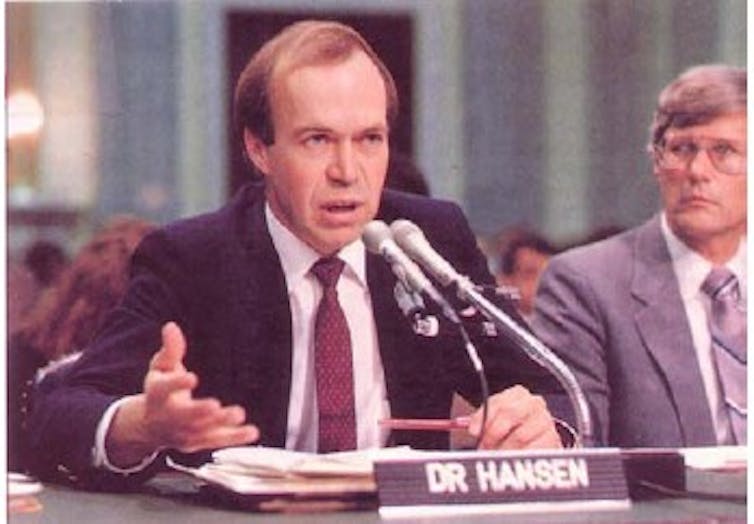
We’ve known how gases like carbon dioxide trap heat for over 100 years and alarm bells have been ringing loudly for over 35 years, when climate scientist James Hansen testified that global warming had begun.

As extreme weather and temperatures arrive, many of us wonder whether it had to get this bad before we acted. Did we need to see to believe? What role has our own psychology played in our sluggishness?

james hansen testifying before US senate
Many people first took notice of climate change after US scientist James Hansen testified about its effects.
NASA

How do we respond to threats?

From a psychology point of view, motivating us to take action on climate is a wicked problem. Many factors combine to make it harder for us to act.

The necessary policies and behaviour changes have been viewed as too hard or costly. Until recently, the consequences of doing nothing have been seen as a distant problem. Given the complexity of climate modelling, it has been difficult for scientists and policymakers to lay out what the specific environmental consequences would be from any given action or when they would manifest.

As if that’s not enough, climate change presents a collective-action problem. It would do little good for Australia to reach net-zero emissions if other countries keep emitting without change.


Read more:
Inside the mind of a sceptic: the ‘mental gymnastics’ of climate change denial


When we write about climate change, we often frame it as an ever more urgent and significant threat to our way of life. We do this thinking that showing the seriousness of the threat will galvanise others into faster action.

Unfortunately, this isn’t always the case. When we’re confronted with big risks – and the need for a painful shift from the status quo – some of us respond unexpectedly. We might find ourselves motivated to seek out evidence to undercut the reality of the threat, and use this uncertainty to justify staying on the same path.

One unfortunate aspect of this is that people motivated to avoid or deny climate risk are actually better able to do so when they have more scientific training. This background equips them better to counter-argue and rationalise the dissonance, meaning they seek out information to align with their beliefs and justify their passivity. Misinformation and doubt are particularly damaging to climate action. They let us feel OK about inaction.

This tendency to rationalise away risk was also clearly visible among people who downplayed the impact or even denied the existence of COVID-19.

Is there an antidote?

We’ve found explaining the simple and well-understood way that emissions of specific gases trap the Sun’s heat and warm the planet can be effective, because people can’t rationalise these facts away. The greenhouse effect is a well-accepted phenomenon, even by those most sceptical of global warming. After all, it’s essential to life on Earth – without these gases trapping heat, the world would be too cold for life.

a greenhouse with lettuces growing
The greenhouse effect is well known and uncontroversial.
Shutterstock

Why are we finally acting?

As climate change has moved out of the computer models and become very much a part of our present, we are seeing stronger efforts to cut emissions.

More and more of us are experiencing tangible events such as forest fires, droughts, sudden floods, rapidly intensifying hurricanes or record-breaking heatwaves. This has removed one barrier to inaction. Until now, the consequences of doing nothing seemed far off and uncertain. Now they are seen as certain and already present.

Better still, technological advancement and economies of scale in production have meant clean energy and clean transport have fallen significantly in price.

At government and individual levels, there are now measures we can take that aren’t too costly and come with immediate gains such as cutting power bills or avoiding petrol price increases. Greater political consensus in many countries is also helping challenge the inertia of the status quo. That’s another barrier to inaction evaporating.

As climate damage gets worse, we’re likely to see ever-starker warnings. Does fear motivate us? When faced with threats, we are more likely to take action, particularly if we think we can make a difference.

Yes, we now have a very narrow window to avert the worst. But we also have an increased certainty about climate change and the damage it causes, as well as greater confidence in our ability to bring about change.

For years, our own psychology slowed down efforts to make the sweeping changes necessary to quit fossil fuels. Now, at least, some of these psychological barriers are getting smaller.


Read more:
Most people already think climate change is ‘here and now’, despite what we’ve been told


The Conversation

Jeff Rotman has received funding from the Australian Energy Market Operator, Mondo Power, and iMove Australia

ref. Our minds handle risk strangely – and that’s partly why we delayed climate action so long – https://theconversation.com/our-minds-handle-risk-strangely-and-thats-partly-why-we-delayed-climate-action-so-long-213761

Winston Peters back in the driver’s seat for coalition negotiations

Source: The Conversation (Au and NZ) – By Richard Shaw, Professor of Politics, Massey University

Here go again. The final results of this year’s election have delivered two more seats to te Pati Māori, thereby increasing the size of New Zealand’s 54th Parliament to 123 seats (once the Port Waikato by-election has taken place).

The double effect of this “overhang” is to erase the narrow election night majority held by National (who have lost seats via special votes for the seventh election on the trot) and ACT, and to hand the balance of power to NZ First.

The irony that te Pati Māori’s performance forces three parties who are, at best, lukewarm on the idea of Māori seats into formal negotiations won’t be lost on anyone. The larger point, however, is that the results fundamentally change the dynamics of the process required to form the next government.

Until now, contact between National and NZ First has been framed as a means by which Chris Luxon and David Seymour shore up the narrowest of parliamentary majorities. But National and ACT cannot now get to that majority without NZ First.

Once again, as he was in 1996 and 2017, Peters is in the veto position, holding the “balance of responsibility” (as he called it in 1996, and will likely start doing so again) and central to the process of government formation.

A brief history of Winston

Given this, it is worth recalling what happened the last time Peters put National in office. The parallel discussions NZ First held with National and Labour following New Zealand’s first MMP election in 1996 took two months to complete, and Peters’ decision to go with National was made just hours before the public announcement of the coalition.

Prime Minister Jim Bolger was informed of this after Peters’ televised press conference had begun, but Helen Clark, Labour’s leader, learned of the decision at the same time the rest of the country did.

The process produced the most detailed coalition agreement New Zealand has seen. The document ran to some 50 pages and included detailed commitments in 36 policy domains, a statement of fiscal parameters for the new government’s operations and a supplementary agreement on a range of matters that were not resolved during negotiations.


Read more:
Long live the kingmaker: Winston Peters and the NZ election


Peters secured five Cabinet seats and a further four positions outside Cabinet, as well as a commitment – somewhat bizarrely – that NZ First would take three more seats at the top table in 1998. The government didn’t survive that long, but you can see why this provision angered many within National.

Peters also took on the specially created role of Treasurer, the offer of which swung his decision to go with National. In fact, the books were run by the Finance Minister, National’s Bill Birch, but the splitting of the finance portfolio gave NZ First leverage without making Peters an associate to Birch.

And the whole thing fell apart within two years. Jim Bolger was rolled by Jenny Shipley a year after the election, and the relationship between the new prime minister and her deputy rapidly deteriorated: Shipley sacked Peters and formally dissolved the coalition in August 1998.

Given this history, you imagine that Chris Luxon, Nicola Willis and the rest of National’s senior leadership will be approaching the next few weeks warily.

Where to from here?

There is much to be done, including establishing the precise shape of the government. Will it be a formal three-party coalition, or will one of the smaller parties sit outside the executive, supporting it on confidence and/or supply?.

Ministerial portfolios will also need to be distributed – members of three parties will probably be competing for a limited number of positions. This means there there are going to be some very disappointed people – who might, over the long-term, become disruptive.

Just as important will be any decisions taken regarding the arrangements for the day-to-day management of the government. These will attract less public attention, but the rules that coalition partners agree to play by are critical – and were at the centre of the collapse of the National/NZ First administration in 1998.

Negotiation likely to take time

While there is no constitutional requirement to have negotiations wrapped up by the December 21, which is the last date by which the new parliament must meet, there is a strong political incentive to do so. It will be a bad look if Luxon cannot get his administration organised by Christmas.

One thing is clear: while Peters can negotiate governing arrangements in his sleep, Seymour has little experience of what it takes to form a government and Luxon has none whatsoever. Indeed, the last time Peters sat down to hammer out a deal with the National Party, Luxon was just three years into his time at Unilever and Seymour was 13 years’ old.


Read more:
Jacinda Ardern to become NZ prime minister following coalition announcement


Adding to the intrigue – especially given the premium Peters apparently places on respect – is the animus between Peters and Seymour. Luxon’s pre-election position on talking with Peters – which might generously be characterised as tepid – will also not have gone down well at NZ First headquarters.

And while Peters has, in the past, professed disdain for the baubles of office, he might well demand his beloved Foreign Affairs, or another stint as Treasurer (to the fortunate Nicola Willis’ Minister of Finance). Or seek to deny others – Seymour, perhaps – those baubles.

No one knows what the coming days (or weeks) have in store. We are now at that point in political time when bottom lines become guidelines, and conversations that were categorically ruled out start taking place. But we should expect the unexpected when Winston Peters does eventually exercise the “balance of responsibility”.

The Conversation

Richard Shaw does not work for, consult, own shares in or receive funding from any company or organisation that would benefit from this article, and has disclosed no relevant affiliations beyond their academic appointment.

ref. Winston Peters back in the driver’s seat for coalition negotiations – https://theconversation.com/winston-peters-back-in-the-drivers-seat-for-coalition-negotiations-217045

Do you trust AI to write the news? It already is – and not without issues

Source: The Conversation (Au and NZ) – By Rob Nicholls, Associate professor of regulation and governance, UNSW Sydney

Shutterstock

Businesses are increasingly using artificial intelligence (AI) to generate media content, including news, to engage their customers. Now, we’re even seeing AI used for the “gamification” of news – that is, to create interactivity associated with news content.

For better or worse, AI is changing the nature of news media. And we’ll have to wise up if we want to protect the integrity of this institution.

How did she die?

Imagine you’re reading a tragic article about the death of a young sports coach at a prestigious Sydney school.

In a box to the right is a poll asking you to speculate about the cause of death. The poll is AI-generated. It’s designed to keep you engaged with the story, as this will make you more likely to respond to advertisements provided by the poll’s operator.

This scenario isn’t hypothetical. It was played out in The Guardian’s recent reporting on the death of Lilie James.

Under a licensing agreement, Microsoft republished The Guardian’s story on its news app and website Microsoft Start. The poll was based on the content of the article and displayed alongside it, but The Guardian had no involvement or control over it.

If the article had been about an upcoming sports fixture, a poll on the likely outcome would have been harmless. Yet this example shows how problematic it can be when AI starts to mingle with news pages, a product traditionally curated by experts.

The incident led to reasonable anger. In a letter to Microsoft president Brad Smith, Guardian Media Group chief executive Anna Bateson said it was “an inappropriate use of genAI [generative AI]”, which caused “significant reputational damage” to The Guardian and the journalist who wrote the story.

Naturally, the poll was removed. But it raises the question: why did Microsoft let it happen in the first place?

The consequence of omitting common sense

The first part of the answer is that supplementary news products such as polls and quizzes actually do engage readers, as research by the Center for Media Engagement at the University of Texas has found.

Given how cheap it is to use AI for this purpose, it seems likely news businesses (and businesses displaying others’ news) will continue to do so.

The second part of the answer is there was no “human in the loop”, or limited human involvement, in the Microsoft incident.

The major providers of large language models – the models that underpin various AI programs – have a financial and reputational incentive to make sure their programs don’t cause harm. Open AI with its GPT- models and DAll-E, Google with PaLM 2 (used in Bard), and Meta with its downloadable Llama 2 have all made significant efforts to ensure their models don’t generate harmful content.

They often do this through a process called “reinforcement learning”, where humans curate responses to questions that might lead to harm. But this doesn’t always prevent the models from producing inappropriate content.


Read more:
Ageism, sexism, classism and more: 7 examples of bias in AI-generated images


It’s likely Microsoft was relying on the low-harm aspects of its AI, rather than considering how to minimise harm that may arise through the actual use of the model. The latter requires common sense – a trait that can’t be programmed into large language models.

Thousands of AI-generated articles per week

Generative AI is becoming accessible and affordable. This makes it attractive to commercial news businesses, which have been reeling from losses of revenue. As such, we’re now seeing AI “write” news stories, saving companies from having to pay journalist salaries.

In June, News Corp executive chair Michael Miller revealed the company had a small team that produced about 3,000 articles a week using AI.

Essentially, the team of four ensures the content makes sense and doesn’t include “hallucinations”: false information made up by a model when it can’t predict a suitable response to an input.

While this news is likely to be accurate, the same tools can be used to generate potentially misleading content parading as news, and nearly indistinguishable from articles written by professional journalists.

Since April, a NewsGuard investigation has found hundreds of websites, written in several languages, that are mostly or entirely generated by AI to mimic real news sites. Some of these included harmful misinformation, such as the claim that US President Joe Biden had died.

It’s thought the sites, which were teeming with ads, were likely generated to get ad revenue.


Read more:
This week’s changes are a win for Facebook, Google and the government — but what was lost along the way?


As technology advances, so does risk

Generally, many large language models have been limited by their underlying training data. For instance, models trained on data up to 2021 will not provide accurate “news” about the world’s events in 2022.

However, this is changing, as models can now be fine-tuned to respond to particular sources. In recent months, the use of an AI framework called “retrieval augmented generation” has evolved to allow models to use very recent data.

With this method, it would certainly be possible to use licensed content from a small number of news wires to create a news website.

While this may be convenient from a business standpoint, it’s yet one more potential way that AI could push humans out of the loop in the process of news creation and dissemination.

An editorially curated news page is a valuable and well-thought-out product. Leaving AI to do this work could expose us to all kinds of misinformation and bias (especially without human oversight), or result in a lack of important localised coverage.

Cutting corners could make us all losers

Australia’s News Media Bargaining Code was designed to “level the playing field” between big tech and media businesses. Since the code came into effect, a secondary change is now flowing in from the use of generative AI.

Putting aside click-worthiness, there’s currently no comparison between the quality of news a journalist can produce and what AI can produce.

While generative AI could help augment the work of journalists, such as by helping them sort through large amounts of content, we have a lot to lose if we start to view it as a replacement.


Read more:
Dumbing down or wising up: how will generative AI change the way we think?


The Conversation

Rob Nicholls receives funding from each of Google, Meta, and the Australian Research Council.

ref. Do you trust AI to write the news? It already is – and not without issues – https://theconversation.com/do-you-trust-ai-to-write-the-news-it-already-is-and-not-without-issues-216909

How are global powers engaging with the Pacific? And who is most effective? These 5 maps provide a glimpse

Source: The Conversation (Au and NZ) – By Joanne Wallis, Professor of International Security, University of Adelaide

After years of neglect, there’s a reason why Pacific leaders now describe the Pacific Islands’ geopolitical landscape as “crowded and complex”. Many democratic powers have recently refocused their attention on the region, including Australia, the United States, New Zealand, France, the United Kingdom and Japan.

One after another, they are rolling out big-ticket initiatives to improve their reputations and relationships in the region. While some of these projects make good developmental sense – for instance, Australia’s A$4 billion infrastructure financing agency for the region (although questions are being asked about debt sustainability, given how quickly it has ramped up) – the rationale for others is less clear.

But what all these initiatives have in common is that they are being formulated with a sense of urgency – as a reaction to Chinese offers of assistance.


As the Pacific Islands Forum is holding its annual summit this week, we’ve asked experts on the Pacific to examine the great power competition in the region. How are countries like the US, Australia, China and others attempting to wield power and influence in the Pacific? And how effective has it been? This is the first story in a four-piece series.


There’s a risk to all this urgent energy: it’s difficult to know who is doing what, and where. To help meet this challenge, our Statecraftiness mapping project shows how all of these outside powers are seeking to engage with and influence the region.

Our StoryMap shows that the US, Australia and their partners do a lot in the region. Given the depth of this engagement, they should now shift their priorities from reacting to every Chinese announcement towards a more considered approach. This could better anticipate and respond to their interests and those of Pacific Island countries.

There are signs they are beginning to do this: the Partners in the Blue Pacific initiative announced in 2022 by the US, Australia and other partners may help to improve the coordination of their assistance.

Based on our analysis, we make five recommendations about how these partners could further implement proactive “statecraft” in the region.

1. Understand that all influence is relative

In 2018, a rumour of a potential Chinese military base in Vanuatu triggered a wave of concern in Western capitals. Four years later, news of a security agreement between China and Solomon Islands amplified these anxieties.


Scroll down the images to show military installation locations.


But despite all the discussion about a potential Chinese military presence in the region, what is often overlooked is the existing presence of Australian, American and French forces (although such militarisation is contested by many islanders).

Similarly, there are concerns the China-Solomon Islands agreement could pave the way for a Chinese police presence in the region. This, too, led to reactive policymaking. After China provided police training in the Solomon Islands, Australia countered by donating rifles and police vehicles, and then China donated water cannons, motorbikes and vehicles.


Scroll down the map to reveal policing assistance in the region.


But our StoryMap shows that China’s rather nascent policing activities are nowhere near as broad-reaching as the assistance provided by Australia and New Zealand.

2. Acknowledge the difference between quantity and quality

As our StoryMap below shows, Australia is the only partner state with diplomatic posts in all Pacific island countries, followed closely by New Zealand. The US, Japan, France, Taiwan, India and Indonesia also have a diplomatic presence, and others are looking to open embassies.


Scroll down the timeline to show diplomatic posts in the region.


But the number of diplomatic posts does not necessarily equate to quality or effectiveness. This is because individuals, not policies, are the most important determinants of whether a country’s “statecraft” efforts succeed.

And diplomatic presence is not always reciprocated. Niue, Tuvalu, Micronesia, Cook Islands, Palau and Kiribati do not have diplomatic missions in Australia. Instead, they have missions in cities where international institutions are, such as New York and Geneva. This reflects how Pacific countries prioritise where they place their limited number of diplomats.


Scroll down the timeline to show diplomatic visits.


High-level visits to the Pacific by foreign leaders and officials have also increased dramatically in the past 18 months. Australian Prime Minister Anthony Albanese, US Secretary of State Antony Blinken, French President Emmanuel Macron, Chinese Foreign Minister Wang Yi, British Foreign Minister James Cleverly and Indian Prime Minister Narendra Modi have all made appearances.

But, again, the quantity of diplomatic engagement does not necessarily lead to quality relationships, which are “the enduring currency of influence” in the Pacific.

Social media, for instance, has greater reach and can impact countries’ diplomatic negotiations and shape their influence outside formal meetings.

To try to understand the effectiveness of social media as a diplomatic tool, we analysed social media followings of diplomatic missions in the region. As expected, countries with close relationships tended to have high numbers of followers.


However, social media engagement does not necessarily indicate that people agree with – or even think favourably of – a country. For example, the large following of the US embassy in Papua New Guinea could be due to recent controversies involving the mission there.

Some diplomatic missions also pay for extended social media reach through boosted posts. We also found examples of automated bots commenting on posts.

3. Focus on long-term, rather than short-term, engagement

The value of long-term engagement was illustrated in the US response to the Solomon Islands-China security agreement.

Senior US officials immediately flew to Honiara, without having had a diplomatic presence there for 29 years. Sudden, overtly self-serving engagement is seldom effective.

Soft power comes in many forms, such as media broadcasts, scholarships, church networks, sports tournaments, language training and cultural exchanges. Many of these are often overlooked by analysts, who tend to focus on more quantifiable tools of “statecraft”, such as aid, loans, infrastructure projects and security assistance.


Scroll down and click on scholarship initiatives to show locations.


But this misses the long-term value of soft power initiatives. These have the potential to shape the beliefs, attitudes and opinions of communities in ways that are harder to immediately identify, but often more influential.

4. Distinguish between announcement and implementation

In 2020, news broke that China had agreed to a A$204 million deal with Papua New Guinea to establish a fishery industrial park project on Daru Island.

Concerned the facility would give China a foothold only a few kilometres from its shores, Australia quickly signed a A$30 million agreement with PNG for an “economic empowerment program” on Daru.

Since 2020, there has been no substantive progress on the Chinese project. But it’s unlikely Australia’s reaction influenced this. While the pandemic may have delayed things, the more plausible explanation is that the project was an “outlandishly ambitious” “mirage” that will “never eventuate”.

Any development initiative on Daru Island — long a neglected region — is welcome. But the speed of Australia’s reaction exemplified how the significance of such an announcement can be misinterpreted.

5. Make sure the right country gets the credit

The US, Australia and its partners frequently subcontract the delivery of their programs in the Pacific to nongovernmental organisations and private contractors. Even Australian policing and justice assistance is increasingly coordinated by private contractors.

But as some Pacific islanders have told us, with so much American and Australian assistance provided by other organisations, it’s often unclear where it comes from.

And sometimes credit goes to the wrong party. Many infrastructure projects are funded by institutions such as the Asian Development Bank. Though much of the bank’s funding comes from Australia (A$11.31 billion) and the US (US$26.9 billion), the projects themselves are often built by Chinese state-owned enterprises.

So, China receives the credit – and the reputational and relationship boosts that come with it.

More proactive statecraft can help in this regard. But whether these influence attempts succeed will be determined by Pacific countries themselves. And these countries aren’t passive: they are attempting to influence their partners in return.

The Conversation

Joanne Wallis receives funding from the Australian Research Council and the Australian Department of Defence. This activity is supported by the Australian Government through a grant by the Australian Department of Defence. The views expressed herein are those of the authors and are not necessarily those of the Australian Government or the Australian Department of Defence.

Henrietta McNeill receives funding from the Australian Department of Defence.

Michael Rose is a research associate at the University of Adelaide working on a project that is funded by the Australian Department of Defense.

Alan Tidwell does not work for, consult, own shares in or receive funding from any company or organisation that would benefit from this article, and has disclosed no relevant affiliations beyond their academic appointment.

ref. How are global powers engaging with the Pacific? And who is most effective? These 5 maps provide a glimpse – https://theconversation.com/how-are-global-powers-engaging-with-the-pacific-and-who-is-most-effective-these-5-maps-provide-a-glimpse-213768

Someone has told you they’re self-harming. Now what?

Source: The Conversation (Au and NZ) – By Penelope Hasking, Professor of Psychology, Curtin University

Shutterstock

For many people, self-harm can be a difficult behaviour to understand. It also comes with a lot of stigma.

This can make talking about it difficult as people who self-harm often anticipate negative responses and judgement.

But if someone tells you they’re self-harming, how you respond is critical to their health and wellbeing.


Read more:
It’s not only teenage girls, and it’s rarely attention-seeking: debunking the myths around self-injury


What is self-harm? Why do people do it?

The term self-harm could mean someone’s intentional damage to their body as a way of coping or an attempt to end their life. But we think these are very different behaviours.

So we prefer the term self-injury to describe the range of non-suicidal behaviours people use mostly to cope with difficult feelings (such as intense distress or anxiety) and thinking styles (for instance, self-criticism).

Self-injury is common. About one in six adolescents report having self-injured at some point in the past.

But no two people’s experiences are alike. And people self-injure for many reasons other than to cope. This includes to punish themselves or to feel something when feeling emotionally numb.

So, if someone tells you they self-injure, it is critical to avoid assuming why they do it.

Telling someone is a big step

Given its associated stigma, many people who self-injure do not tell anyone. When they disclose, it is usually to friends or family.

When disclosing to friends or family, someone values the quality of the relationship, disclosing to people they trust. They may not be seeking tangible aid (for instance, professional support). Instead, they are looking for social support, understanding, and a safe space to talk about their experiences.

Someone with more severe self-injury, or who also has suicidal thoughts or behaviours, is more likely to disclose their self-injury, perhaps as a way of accessing professional or medical support.


Read more:
It’s RUOK Day – but ‘how can I help?’ might be a better question to ask


What not to do

When someone tells you they self-injure, you may feel concerned about their safety and wellbeing. You might be upset someone you care about appears to be struggling. You might feel overwhelmed and unsure how to respond. These and other reactions are understandable and expected.

But it is important not to over-react or respond with high-intensity emotions. This can signal you are uncomfortable, which may make the person less likely to talk.

It is also not advised to ask a large number of questions (such as, what they do, when they do it) as this can seem like an interrogation.

Another common reaction is to stress the importance of stopping self-injury. Although this is usually because they care for the person and want them to be safe, a problem-solving approach may not be what people need. The person disclosing may simply want a chance to share their experience.

Many people have mixed feelings about stopping – wanting to stop self-injury, but also wanting to hold onto a trusted coping strategy.


Read more:
Why do people intentionally injure themselves?


What to do

If someone discloses they self-injure, it is important to respond supportively, with compassion, and without judgement. It is important to give the person space to share what they want in their own words, to actively listen, and to validate this is likely a difficult conversation for them.

It is also important to recognise someone may share a bit about their experience now but may not be ready to talk about everything yet. Being patient is therefore important.

Telling someone you are there to listen and support them can go a long way in letting them know they can come to you again if they need to and they are not being rushed or pressured if they are not yet ready.

Close up of a person holding another person's hand, on their knee
Disclosure may happen over several conversations.
charnsitr/Shutterstock


Read more:
Teens with at least one close friend can better cope with stress than those without


What can I say?

To support someone who discloses they self-injure, we recommend using a low key, compassionate tone that communicates you are concerned and are there to listen without judgement.

This involves acknowledging self-injury can be a difficult topic to discuss. You can say:

I recognise this isn’t an easy conversation. However, I appreciate you’re willing to share and I’d like to understand what it’s been like for you lately.

Part of this can also involve a “respectful curiosity”. This involves communicating a genuine interest in a person’s experience. You can say:

I know people self-injure for different reasons. I’m wondering if you can help me understand what self-injury does for you?

Recognise self-injury is often not something someone can just stop. This can go a long way in making the person not feel judged and therefore more likely to talk about it. You can say:

I can appreciate self-injury has been helpful to you, which I can see would make it pretty difficult to stop right now.

Finally, it is important to take care of yourself. Supporting someone who self-injures can take its toll. Be sure to take notice of how you are feeling. It is OK to tell someone you need a break right now and to find some time to look after yourself.


Read more:
Most people thinking about suicide don’t tell anyone. Here’s why and what we can do about it


What can I expect?

If a person discloses their self-injury, take the time to listen to what they are saying, and what support they need right now.

While learning someone self-injures can be challenging, you may find that not only can you support the person, it can bring you closer and strengthen your relationship.


People who self-injure and those who support them can find more information from the following resources: the book Understanding Self-Injury: A Person-Centered Approach; the Self-injury Outreach & Support website; and resources in 11 languages from the International Consortium on Self-Injury in Educational Settings. If this article has raised issues for you, or if you’re concerned about someone you know, call Lifeline on 13 11 14.

The Conversation

The authors do not work for, consult, own shares in or receive funding from any company or organisation that would benefit from this article, and have disclosed no relevant affiliations beyond their academic appointment.

ref. Someone has told you they’re self-harming. Now what? – https://theconversation.com/someone-has-told-you-theyre-self-harming-now-what-213983

Gonski for universities: what if we funded higher education like schools?

Source: The Conversation (Au and NZ) – By Peter Hurley, Director, Mitchell Institute, Victoria University

Pixabay/Pexels , CC BY-SA

The Australian Universities Accord is a major review of Australian universities.

Its proposals promise to have a huge impact on how Australia’s higher education system will function in years to come.

Education Minister Jason Clare has made equity a top priority for the accord. This means increasing opportunities for disadvantaged groups to attend university and finish their degrees.

In its interim report in July, the review panel suggested a “needs-based” funding model could be used for Australian universities, similar to what we have to determine school funding.

With a final accord report due in December, our new paper explores how this might work.


Read more:
Politics with Michelle Grattan: ANU Vice-Chancellor Brian Schmidt on the challenges universities face


What is needs-based funding?

Australia currently has a needs-based model for schools. This was introduced as part of the “Gonski” reforms a decade ago and is called the “Schooling Resources Standard”.

This involves a base amount for every primary and high school student and then six equity loadings. The loadings provide more funds to schools and students who need more support, including students with disabilities, low English language proficiency, First Nations students, students with socio-educational disadvantage, students in regional and remote areas, and small schools.

The accord review panel said a needs-based model, similar to our current school one, has

potential benefits […] for learning and teaching in universities [which] takes into takes into account the costs of different courses and the socio-economic mix of students at each institution.

As our paper notes, research evidence shows resources do matter. Many studies have shown increases in per-student funding, when properly targeted, can lead to improved or higher student outcomes.

At the moment, university funding is primarily based on a student’s field of study. There are some extra funds for equity students, about A$360 million a year, but this is not a key feature of the system’s design.

How might it apply to universities?

In our paper we explored what would happen if a model similar the Schooling Resource Standard was introduced in Australian universities.

We found a needs-based funding model, using the same parameters as the Schooling Resource Standard, would see an overall 11% increase in base funding amounts to universities for government-funded students. We estimate this would mean about an extra A$1.3 billion per year in federal government funding.

Importantly, universities with large enrolments of students from low socioeconomic backgrounds would gain the most. Under our system, James Cook University, the University of New England and CQUniversity would receive more than a 30% increase in base funding. Charles Darwin University and Charles Sturt University would gain more than 20% in base funding.

The University of Canberra, University of Melbourne and Australian National University, the University of Notre Dame and University of Sydney would stand to gain the least, with an increase of 5–6% in base funding.

This extra funding would specifically help universities counter disadvantage by meeting extra learning needs and providing extra support to help students finish their courses.

We know universities with a higher proportion of students from low socioeconomic backgrounds have poorer completion rates.

Could international student fees make university funding more equal?

A needs-based model could also help with other policy challenges.

The interim report has already suggested a levy on lucrative international student fees. The idea is universities would pay some of the fees they receive from international students into a central fund managed by the government.

As we have noted before, prestigious metropolitan universities tend to attract far more international students than other universities.

The idea of a levy has been criticised by researchers as complicated and risky.

But a needs-based model could help. International student income could be used to adjust funding to universities using a concept like the “capacity to contribute” mechanism in the school sector.

For private schools, a “capacity to contribute” score is calculated using parents’ income. This means independent schools with more advantaged students receive less funding from the government. These schools typically charge higher fees to families.

This model could be applied in higher education so universities with higher international student revenue relative to domestic student revenue receive less government funding.

Remaining questions

In our report, we find a needs-based model is promising. But significant questions remain:

  • how should equity be measured within each loading category, and what should be the relative weighting of funding for each group?

  • what should students contribute in a needs-based funding model?

  • what formula should we use for a “capacity to contribute” measure?

  • Could there be a needs-based funding model that doesn’t increase overall funding?

Our research also found needs-based funding models are very technical. Much more work is required to make sure it would be appropriate for Australia’s higher education sector.

The Universities Accord was right to identify needs-based funding as a policy direction, but it is only the first step towards a new model.


Read more:
The Universities Accord draft contains ‘spiky’ ideas, but puts a question mark over the spikiest one of all


The Conversation

The authors do not work for, consult, own shares in or receive funding from any company or organisation that would benefit from this article, and have disclosed no relevant affiliations beyond their academic appointment.

ref. Gonski for universities: what if we funded higher education like schools? – https://theconversation.com/gonski-for-universities-what-if-we-funded-higher-education-like-schools-216898

Homeowners often feel better about life than renters, but not always – whether you are mortgaged matters

Source: The Conversation (Au and NZ) – By Rachel Ong ViforJ, ARC Future Fellow & Professor of Economics, Curtin University

Homeownership has long been thought of as the great Australian dream. For individuals, it’s seen as the path to adulthood and prosperity. For the nation, it’s seen as a cornerstone of economic and social policy.

Implicit in this is the assumption that owning a home rather than renting one makes people better off.

It’s an assumption we are now able to examine using data from the government-funded Household, Income and Labour Dynamics in Australia (HILDA) survey, which for two decades has asked questions both about homeownership and satisfaction with life.

The overarching question asks

all things considered, how satisfied are you with your life? Pick a number between 0 and 10 to indicate how satisfied you are

We also looked at people’s satisfaction with their financial situation, their home and the neighbourhood in which they live.

In a study published in the journal Urban Studies, we linked those answers to home ownership and characteristics including age and income.

As expected, we found homeowners were generally more satisfied with their lives than renters. But we also find the extent to which they were more satisfied depended on whether or not they were still paying off a mortgage.

Mortgaged homeowners about as satisfied as renters

Outright home owners were 1.5 times as likely to report high overall satisfaction as renters. But home owners still paying off a mortgage were only a little more likely to feel high overall satisfaction.

Similarly, outright owners were 2.3 times as likely to report high financial satisfaction as renters – but mortgaged owners were only 1.1 times as likely.

When it comes to satisfaction with their home and neighbourhood, the differences were less extreme.

Outright home owners were 3.1 times as likely to report high satisfaction with their home as renters, while mortgaged owners were 2.8 times as likely.

Outright owners were 1.6 times as likely to report high satisfaction with their neighbourhood as renters, and mortgaged owners 1.4 times as likely.

The results also varied with age and income.


As shown in the graph above, outright owners were more likely to report high financial satisfaction than renters across almost the entire age range.

But mortgaged owners only showed a demonstrably greater financial satisfaction than renters between the ages of 25 and 50.

Beyond age 50, the existence of a mortgage debt burden appeared to cancel out any boost to financial satisfaction from homeownership. This potentially reflects the growing financial stress of making mortgage payments as retirement approaches.


By income, mortgaged owners reported experiencing more financial satisfaction compared to renters the more they earned between A$80,000 and A$240,000. Outright owners experienced more financial satisfaction than renters up to A$320,000.

Beyond these income levels, owners did not have greater financial satisfaction than renters, perhaps because high-earning renters have other sources of financial satisfaction.

How satisfied people feel beyond 60

In other respects, outright owners and mortgaged homeowners showed similar patterns, becoming more satisfied with their homes relative to renters the more they age up – until the age of 60. That’s when their satisfaction relative to renters declined, as illustrated below.

This decline might reflect the growing physical burden of maintaining an owned home as people age.


Our study has important implications. One is that age matters.

Although older people consistently express a desire to age in place, we found satisfaction among those who owned vs rented their home declined beyond age 60. This suggests better integration between housing and care is critical to support people ageing in place.

Another implication is that as low-income owners are more reliant on their homes as a source of relative financial satisfaction than high earners, they are more exposed in times of crisis. They may face the risk of being forced to sell suddenly with little time to consider the consequences.


Read more:
The housing wealth gap between older and younger Australians has widened alarmingly in the past 30 years. Here’s why


And another implication is as the relative financial satisfaction of mortgage holders disappears after the age of 50, and as more of us approach retirement with mortgages intact, more of us will either postpone retirement or become dissatisfied.

Our findings suggest the extension of mortgage debt into later life should be discouraged if the benefits of the Australian dream are to be preserved.

The Conversation

Rachel Ong ViforJ is the recipient of an Australian Research Council Future Fellowship (project FT200100422).

Hiroaki Suenaga and Ryan Brierty do not work for, consult, own shares in or receive funding from any company or organisation that would benefit from this article, and have disclosed no relevant affiliations beyond their academic appointment.

ref. Homeowners often feel better about life than renters, but not always – whether you are mortgaged matters – https://theconversation.com/homeowners-often-feel-better-about-life-than-renters-but-not-always-whether-you-are-mortgaged-matters-215147

Roald Dahl, time-bending crime, and queer pirate comedy: the best of streaming this November

Source: The Conversation (Au and NZ) – By Dennis Altman, VC Fellow, La Trobe University

October has somehow slid into November and pretty soon, the silly season will be upon us.

Before the madness hits, however, there’s still time to get some serious streaming study under your belt, so you’ll be completely up to date if anyone at an end-of-year party asks if you’ve watched anything good lately.

Here are our authors’ picks of the best of November streaming.


Read more:
Wartime hijinks, wilderness survivors and contemporary dance: what we’re streaming this October


Wes Anderson’s Roald Dahl short films

Netflix

Wes Anderson’s latest work involves four short films based on Roald Dahl stories, in some of the most literal and faithful Dahl adaptations ever put on screen.

Dahl (played by Ralph Fiennes) becomes an onscreen character and narrator. The sight of Dahl talking directly to camera in his famous writing chair is somewhat uneasy. Which Dahl will we see? The bigot? Beloved children’s author?

In truth we see neither in the character – but rather manifestations of both in the films themselves.

The Wonderful Story of Henry Sugar is the most joyous in both style and story. From the altruistic Henry Sugar things significantly go darker. The Swan is about a boy victimised to merciless bullying; The Rat Catcher involves a man who kills a rat with his teeth.

The final and most confronting is Poison. Englishman Harry Pope in British-ruled India believes he has a poisonous krait snake asleep with him in his bed. When this is proven incorrect, local physician Dr Ganderbai is subjected to Harry’s racial slurs. It is an ugly and unexpected moment provoking the doctor to leave in stunned silence.

From the first film of its vivid colours and altruistic themes to the bleak finale of Poison, it feels as if Anderson is making a statement about the difficulties regarding Dahl and his cultural legacy.

In the process he has produced some of his most challenging, complex and intriguing films to date.

– Stephen Gaunson


Read more:
Roald Dahl was a bigot and beloved children’s author. Wes Anderson shows both sides of this complicated persona


Scrublands

Stan from November 16 (Australia), NZ TV3 (New Zealand)

Sunday morning service has drawn to a close and the congregation mill around in the sunshine. Many talk glowingly of Father Swift’s charity work, while others on the perimeter of the gathering, bearded and barrel chested, glower from beneath peak caps.

Father Swift emerges from the weatherboard church in his vestments, raises an assault rifle to his shoulder and calmly shoots dead five of his flock. They are all men.

Journalist Martin Scarsden (Luke Arnold), stuck for words and shielding his own tragedy, is sent to the bush town, Riversend. He’s there to write a piece 12 months on from the mysterious random slaying by the priest.

Here, Scarsden sets about unravelling the murder mystery in search of the truth. The tale takes us from international war crime investigation to local drug manufacturing and distribution, a love child, more murders and implosion of the colonial patriarch.

Landscape is a less dominant theme in Scrublands than more recent bush town crime dramas, such as Mystery Road. Racism and colonial history is covered but is not a leading theme.

Based on the novel by Chris Hammer, the limited series (four episodes) is well worth watching. Scrublands is an Easy Tiger production co-commissioned by Stan and the 9Network, in association with VicScreen and stars Luke Arnold, Bella Heathcote and Jay Ryan.

– Heidi Norman

Orange Thrower

Australian Theatre Live, australiantheatre.live

Orange Thrower is a powerful exploration of the experience of “otherness” and what it’s like to exist on the margins.

This play, staged by Griffin Theatre Company and the National Theatre of Parramatta, is set in a fictional suburb called Paradise filled with nosy, prying neighbours.

Zadie (Gabriela Van Wyk) is a young South African woman growing up in Australia. The sudden arrival of troubled and energetic cousin Stekkie (Zindzi Okenyo) from Johannesberg disrupts Zadie’s carefully controlled world, where she attempts to walk unnoticed among the community. Despite her attempts to assimilate, Zadie’s home is being regularly pelted by oranges by some unknown vandal.

The exploration of young love, of gender, of joy and resistance makes for a visceral performance work by Kirsty Marillier – an exciting new Australian voice in theatre.

The storytelling form of Orange Thrower and the spatial realisation of the work are complex and compelling choices. As an audience member watching a digital rendering of live performance, it takes time to sit with this work and understand its nuance and intention.

The performances, especially by Van Wyk, are exceptional. Throughout the work, Marillier exploits the tensions between simplicity and its potential to obscure profound complexities and challenges.

This digital release marks the start of a staggered release of six Griffin Theatre Company productions from Australian Theatre Live, allowing an international audience to experience the magic of Australian stories from the comfort of their homes.

– Sarah Austin

Bodies

Netflix

The premise of Bodies is extraordinary. The body of a naked man, shot through the eye, is discovered in London’s East End. The same body is discovered over 160 years by four detectives, who are caught in an increasingly complex plot to destroy the world as we know it.

Bodies is based on a graphic novel by Si Spencer and the filming recalls its origins in the use of split screens and constant jumps across time periods.

Unsurprisingly the contemporary detective, Shahara Hasan (Amaka Okafor) does most to hold the story together, but over the eight episodes all four have striking, if somewhat didactic, backstories.

1890s detective, Alfred Hillinghead, is a closeted homosexual, caught between family and lover; in the 1940s Charles Whiteman is a Jew surrounded by anti-Semitic colleagues.

The scenes in 2053 are the least convincing, positing as they do a post-apocalyptic regime under the rule of Elias Mannix, whom we first encounter as a teenager who detonates the bomb which makes his future rule possible.

Bodies is melodramatic, absurd, beautifully acted and strangely compelling. The motto of the new world, Know you are loved, becomes both trite but surprisingly touching. Suspend disbelief and enjoy the ride.

– Dennis Altman

Our Flag Means Death (Season 2)

Binge (Australia), Neon (New Zealand)

The deliciously queer pirate comedy Our Flag Means Death dropped its entire second season in October.

Where parts of season one felt a bit like a convoluted gag, this season confidently balances emotional depth with hilarity and deadpan absurdity.

We ended on a breakup when dandy Stede Bonnet (Rhys Darby), the self-styled Gentleman Pirate, failed to make a rendezvous with Ed (Taika Waititi), aka Blackbeard, after they had finally declared their love.

Here, Ed descends into abject villainy and must then seek redemption, and Stede must atone for his betrayal, while also becoming, perhaps, a halfway decent pirate.

This season, filmed in and around Auckland, is much bigger in scope. The cinematography is lush and spacious. The production design is impressive. The already large ensemble cast expands further into a motley, (mostly) lovable found family; local audiences also can play “spot the Kiwi”.

Across eight episodes full of unexpected, absurd highlights – not least a dream sequence in which Rhys Darby appears as a merman – Con O’Neill offers an Emmy-worthy turn as ferocious first mate Izzy, becoming the season’s unexpected heart.

Through the crew’s various escapades, dalliances, failures, and victories, a clear theme emerges: how do you have good relationships? How do you live authentically when the structures around you are toxic?

The answer, and it’s no spoiler, is kindness.

– Erin Harrington

The Conversation

The authors do not work for, consult, own shares in or receive funding from any company or organisation that would benefit from this article, and have disclosed no relevant affiliations beyond their academic appointment.

ref. Roald Dahl, time-bending crime, and queer pirate comedy: the best of streaming this November – https://theconversation.com/roald-dahl-time-bending-crime-and-queer-pirate-comedy-the-best-of-streaming-this-november-215525

Can we eat our way through an exploding sea urchin problem?

Source: The Conversation (Au and NZ) – By John Keane, Research Fellow (Dive Fisheries), University of Tasmania

John Keane on an extensive urchin barren John Keane, CC BY-ND

Longspined sea urchins are native to temperate waters around New South Wales. But as oceans heat up, their range has expanded more than 650km, through eastern Victoria and south to Tasmania. Their numbers are exploding in the process, clear-felling kelp forests and leaving “urchin barrens” behind.

The species (Centrostephanus rodgersii) is now the single largest and most urgent threat to kelp forests along the southeastern coast of Australia’s Great Southern Reef.

What can we do? Here’s one excellent solution: eat their roe, a buttery delicacy that can fetch hundreds of dollars per kilogram. Tasmania already has a government-backed urchin fishery. When combined with a mix of other tools, as outlined in our submission to the invasive marine species Senate inquiry, harvesting urchins can put the brakes on this overabundant, range-extending marine species.

Today, the Senate handed down its findings, identifying investment in commercial harvesting as a frontline climate-ready tool to combat the urchin. It presents a win-win opportunity by maximising socioeconomic and environmental returns for kelp ecosystems, while lessening the ongoing cost of control.

Strategies for urchin control.


Read more:
The Great Southern Reef is in more trouble than the Great Barrier Reef


Dealing with urchins is urgent

Almost 200 marine species have been documented shifting range in Australian seas as climate change heats the oceans. But longspined sea urchins are the most damaging so far.

The waters along hundreds of kilometres of coastline have now warmed above a winter average of 12°C. This is the temperature at which urchin larvae can develop during spawning. The ocean is warming faster than land, heating at a rate of 4°C per century.

The Senate inquiry shows the government is listening. The inquiry and accompanying five-year plan for control methods are based on more than two decades of scientific research.

The tragedy of the barrens

Urchins chew through entire forests of kelp. Once the big kelp is gone, they switch to feeding on tiny encrusting seaweeds that can regrow rapidly and persist in the face of intensive grazing. This creates “hyper-stable” urchin barrens.

The damage is dramatic, with the local loss of hundreds of kelp-associated species ranging from valuable abalone to the iconic leafy seadragon.

Barrens in southern NSW, eastern Victoria and Tasmania can now be measured in the scale of kilometres, with whole reefs turned into underwater deserts.

They expand fast, too. In Tasmania, early sightings off the northeast in 1978 have turned into a population estimated at 20 million around the eastern coastline. Barren areas now cover 15% of Tasmanian reefs. If left unchecked, 50% of reef habitat could be lost by the 2030s, as we’ve seen in southern NSW and eastern Victoria.

diver in a kelp forest looking for sea urchins
Research divers assessing sea urchin spread off St Helens in Tasmania’s northeast.
Matt Testoni

Correcting an imbalance of nature

Rock lobsters are a natural predator of urchins. They boost kelp bed resilience and even prevent barren expansion in some areas off limits to lobster fisheries.

The Tasmanian East Coast Rock Lobster Rebuilding Strategy focuses on rebuilding stocks to help combat the urchin. However, the lobsters’ strong preference for local prey such as abalone, their negligible capacity to rehabilitate extensive barrens once urchins reach hyperabundance, and high recreational and commercial fisheries value, constrains the scale of effectiveness.

Another option is culling, where divers kill urchins underwater. The upshot is that kelp can grow back quickly, within just 18 months, if all visible urchins are culled. But it’s extremely expensive and urchins can reemerge, meaning culling needs to be ongoing.

An affordable, scalable, long-term solution?

Yes. Make it profitable. The main game here isn’t the urchins themselves but their roe, known as “uni” in Japan. Urchin roe is a delicacy, renowned for its sweet, buttery, umami flavours and bright golden colour. Premium roe returns top dollar in markets from across South East Asia, the United States and the Middle East.

If commercial fisheries are viable, we can remove vast quantities of urchins from reefs in a low-cost urchin control program over large areas.

But there are challenges here too. Extracting the roe is labour-intensive. Roe quality can vary greatly, dropping as overgrazing ensues. To date, infrastructure, access to markets, and detailed knowledge of processing techniques has been a limiting factor.

A commercial diver bags a haul of sea urchins destined for international markets
A commercial diver removes a haul of sea urchins destined for international markets.
Matt Testoni

Tasmania is showing it can be done. In 2018, the state government invested in a fledgling urchin fishery in conjunction with the abalone industry by offering harvest subsidies.

These gave urchin processors the financial certainty to invest. In a few years, annual urchin fishery yields have grown from 40 tonnes to 500 tonnes, all harvested by hand by divers.

To date, the fishery has created more than 100 jobs and boosted regional economies. It’s starting to work too. The fishery has not only slowed the expansion of urchin barrens, but allowed recovery of kelp habitats in some heavily fished areas.


Read more:
Sea urchins have invaded Tasmania and Victoria, but we can’t work out what to do with them


Expanding urchin fisheries

Tasmania’s example shows the potential of fishery-led control of overabundant, problematic species. Making the most of it means adding value, such as by expanding the international market, developing new uses for low-grade urchin roe and selling waste products. If it’s more profitable, divers will be able to travel farther from port and fish down urchin stocks.

We can also direct fishery efforts for better urchin control by offering subsidies to fish high priority areas.

Other states hit hard by urchins too, such as Victoria, could benefit from control-by-fishery.

Achieving national, widespread urchin control will require challenging coordination. We need to:

  • support dive fisheries to become the heavy lifter of urchin control
  • add extra urchin control measures on high-value reefs
  • begin restoring degraded barrens to a mosaic of urchin fisheries or kelp forests
  • boost populations of urchin predators on healthy reefs, to increase resilience in the first place.
Photo showing a healthy kelp ecosystem
Healthy kelp ecosystems are vital for abalone.
Matt Testoni

If we do this right, Australia’s control of the longspined sea urchin could be a global exemplar of climate-ready management of overabundant and range extending species, boosting rural economies and social wellbeing. As species keep moving, finding low- or zero-cost control measures will be essential to keeping ecosystems intact.

Controlling troublesome species is often seen as a major cost to government. Our work and the work of many others has shown it doesn’t have to be. Creating viable urchin fisheries turns a cost into a benefit.


Read more:
Marine species are being pushed towards the poles. From dugong to octopuses, here are 8 marine species you might spot in new places


The Conversation

John Keane receives funding from the Fisheries Research Development Corporation and the Tasmanian Government.

Scott Ling receives funding from the Australian Research Council.

ref. Can we eat our way through an exploding sea urchin problem? – https://theconversation.com/can-we-eat-our-way-through-an-exploding-sea-urchin-problem-214389

National drops 2 seats on NZ final results, and will need NZ First to form government

Source: The Conversation (Au and NZ) – By Adrian Beaumont, Election Analyst (Psephologist) at The Conversation; and Honorary Associate, School of Mathematics and Statistics, The University of Melbourne

The final results of the October 14 New Zealand election have been released.

The National Party has won a total of 48 seats (down two from the preliminary election night results), Labour has won 34 (remaining steady), the Green Party has won 15 (up one), ACT has won 11 (steady), NZ First has won eight (steady) and te Pāti Māori/the Māori party has won six seats (up two).

These results mean National will need both ACT and NZ First to secure a ruling majority.

The parliamentary overhang

Based on the preliminary results, te Pāti Māori captured four electorate seats, producing a one-seat overhang. This happens when a party wins more electorate seats than it would be entitled to with its party vote. On election night, te Pāti Māori was entitled to just three seats given its small share of the overall party vote.

But the final vote count gave te Pāti Māori two more seats after the party overturned narrow Labour leads in two Māori electorates (one by just four votes). Te Pāti Māori’s party vote also increased to 3.1%, entitling it to a fourth seat. This means there is a two-seat parliamentary overhang.

These results mean the size of parliament will be 122 seats, up from the normal 120. It will take 62 seats for a majority.

Even if National wins the November 25 by-election for Port Waikato, as is expected, National and ACT combined will have 60 of the now 123 seats, two short of a majority.

Comparison with 2020 election

This election marked a big swing from the 2020 results. National has increased its number of MPs by 15, while Labour has lost 31. The Greens gained five MPs, ACT gained one and NZ First gained eight – returning to parliament after falling below the 5% threshold in 2020. Te Pāti Māori has four additional MPs.

There was also a big shift in the party vote. National won 38.1% of the party vote (up 12.5%), Labour won 26.9% (down 23.1%), the Greens won 11.6% (up 3.7%), ACT won 8.6% (up 1.1%), NZ First won 6.1% (up 3.5%) and te Pāti Māori won 3.1% (up 1.9%).

In my previous analyses I have grouped National and ACT as right-wing parties, while Labour, the Greens and te Pāti Māori are left-wing parties. I have not counted NZ First with either bloc. It supported the Labour government in 2017, and has sided with both major parties in the past.

By this formulation, the right coalition defeated the left by 5.1% in this election, a reversal of a 25.9% win for the left in 2020.

Polls understated right

The polls ahead of the election consistently underestimated the popularity of the right-wing parties.

The first graph below shows all polls since March.

The second graph shows the polls since late August, when there was a clear trend back to the left.

The most accurate polls were the Talbot Mills poll, the Curia poll for the Taxpayers’ Union and the Verian/Kantar poll for 1 News, but all three still understated the right’s margin over the left. Morgan, Essential and Reid Research all had the left ahead in their final polls.

The Conversation

Adrian Beaumont does not work for, consult, own shares in or receive funding from any company or organization that would benefit from this article, and has disclosed no relevant affiliations beyond their academic appointment.

ref. National drops 2 seats on NZ final results, and will need NZ First to form government – https://theconversation.com/national-drops-2-seats-on-nz-final-results-and-will-need-nz-first-to-form-government-215995

Sam Bankman-Fried convicted for massive FTX fraud, in stark reminder of risks of crypto trading

Source: The Conversation (Au and NZ) – By John Hawkins, Senior Lecturer, Canberra School of Politics, Economics and Society, University of Canberra

It is not just crypto tokens that have spectacular downfalls. So can crypto personalities.

Sam Bankman-Fried founded FTX, one of the world’s largest exchanges for so-called cryptocurrencies, which collapsed last year owing billions of dollars. Now he has gone from being hailed as potentially the world’s first trillionaire to a lengthy term in prison.

After a month-long trial, a New York jury took less than five hours to find him guilty on seven counts of fraud and money laundering.

Bankman-Fried’s conviction highlights the risks of crypto markets, where people trade tokens with no fundamental value via hugely complex and poorly regulated financial machinery.

The Australian government is currently considering how to protect consumers in such markets. Treasury has commenced a consultation process. But it will not be an easy task when so much of the activity occurs overseas or in cyberspace.

FTX was not fine

Bankman-Fried chose to testify in his own defence. But he failed to convince the jury he was merely a maths nerd with a poor memory who was unaware of what his friends and colleagues were doing with the companies in which he was the largest stakeholder.

In FTX’s final days, as concerned customers started withdrawing their deposits, Bankman-Fried tweeted “FTX is fine. Assets are fine”. It appears the jury did not accept he truly believed this at the time.

The verdict is a salutary warning about the dangers of unregulated financial markets such as crypto. As the former chair of the United Kingdom’s Financial Conduct Authority put it, fraud is “a feature, not a bug” for much of the industry.

Crypto tokens such as Bitcoin have no underlying assets to give them some fundamental value. They only generate a return if the owner can sell at a higher price, to someone who expects the price to go even higher. This makes them one of the purest examples of a speculative bubble.


Read more:
Almost no one uses Bitcoin as currency, new data proves. It’s actually more like gambling


No government

One of the ironies of the crypto market is that cryptocurrency is sold as a way to avoid having to trust governments or banks, as one does with traditional currency. But in practice, crypto trading often relies on trusting individuals – some of them charlatans such as Bankman-Fried.

Punters thought they could trust FTX to mind their funds for them while they switched between speculative crypto tokens such as Bitcoin and Dogecoin. They were not investing in FTX, or even lending their money to it.


Read more:
The spectacular collapse of a $30 billion crypto exchange should come as no surprise


But instead of letting customers’ funds sit around waiting to be withdrawn, FTX transferred a lot of them to another company, Alameda Research. This was an investment fund, poorly run by Bankman-Fried and his cronies.

It is still not clear what happened to all the missing billions. Some of the money was frittered away on extravagant living. Some went to pay celebrities for advertisements and endorsements, such as the famous Super Bowl clip starring comedian Larry David. At least David can say he was warning people against “getting into crypto”.

Some of the missing cash went on large political donations. Much was lost on poor bets by Alameda which failed to hedge against the risk that the price of crypto tokens could quickly plummet.

FTX was essentially a casino. But Bankman-Fried both owned the casino and was gambling in it – and gambling with other people’s chips.

Prison looms

Bankman-Fried is still proclaiming his innocence. But he looks likely to be in prison for decades.

He will find out how long on March 28 2024. It could be more than a century if he receives the maximum penalty on all the counts on which he has been convicted. And he may yet face further charges.


Read more:
Fallen crypto king Sam Bankman-Fried was ‘perfectly positioned to make a religion of himself’


The Conversation

John Hawkins does not work for, consult, own shares in or receive funding from any company or organisation that would benefit from this article, and has disclosed no relevant affiliations beyond their academic appointment.

ref. Sam Bankman-Fried convicted for massive FTX fraud, in stark reminder of risks of crypto trading – https://theconversation.com/sam-bankman-fried-convicted-for-massive-ftx-fraud-in-stark-reminder-of-risks-of-crypto-trading-216991

The fury on show at the Qantas AGM couldn’t have come at a worse time for the airline

Source: The Conversation (Au and NZ) – By Justin Wastnage, Adjunct Industry Fellow, Griffith Institute for Tourism, Griffith University

Fielding tough questions from a furious audience is no one’s idea of fun. But as Richard Goyder and Vanessa Hudson – Qantas chairman and chief executive, respectively – dealt with angry question after angry question at the airline’s annual general meeting today, the pair knew their main audience was not those in the room. It was, in fact, the decision-makers in Canberra.

The AGM comes at a critical time for the national carrier. The federal government is considering a suite of aviation policy reforms, many of which Qantas would rather stay unreformed.

Qantas can ill afford further damage to its public image now.


Read more:
Even if Qantas is fined hundreds of millions it is likely to continue to take us for granted


Shareholder and community anger

Qantas had a good year financially, as demonstrated by its A$2.47 billion full-year profits. But consumers are less happy.

These profits have been delivered in part by rapidly rising air fares.

The Qantas board has also had to deal with anger on executive remuneration, especially around former chief executive Alan Joyce’s multimillion-dollar payout.

This rage over executive pay was on full display at today’s AGM, when 83% of shareholders voted against Qantas’ remuneration report for the 2023 financial year. Reported as “one of the biggest strikes ever recorded in corporate history”, it is a clear rejection Joyce’s payout.

Qantas has also had to manage allegations it sold tickets for flights it knew had been cancelled, on top of a suite of PR disasters around flight delays and lost luggage issues.

The aviation white paper and Qantas’s optics problem

The federal government released a new green paper on aviation policy in September and is consulting stakeholders, ahead of publishing a new white paper on aviation policy next year.

There are several contentious areas of policy Qantas would prefer to remain unchanged.

The white paper panel will no doubt also take into account public sentiment. Optics matter in politics, and so Federal Transport Minister Catherine King and her department would have been taking the pulse of today’s AGM.

The anger on show from shareholders – with Goyder facing jeers, boos and cries of “shame on you!” – can’t have helped Qantas’s optics.

Any political advisor watching would likely caution the government that now is not a good time to be seen cosying up to the airline.

The 2024 aviation white paper (itself a sequel to Anthony Albanese’s 2009 aviation white paper while he was transport minister) aims to set a new aviation policy framework out to 2050.

Unlike its predecessor, it will take into account consumer and worker rights – so the angry scenes at today’s meeting will not help Qantas in its efforts to stave off the kind of regulation being discussed in the aviation white paper.

Mandatory compensation

One policy under consideration is the idea of mandatory compensation for flight cancellations and delays.

For almost 20 years, air travellers flying from European Union airports have been able to access a guaranteed compensation scheme that is tiered according to length of delay and inconvenience.

Airlines in Europe fought the introduction of the mechanism in 2004. It’s unlikely Qantas would welcome such policies in Australia either.

Bilateral air service agreements

Another issue on the table is the negotiation of bilateral air service agreements. These agreements between nation states govern the number of flights between countries, but are seen as archaic in many other OECD countries.

In their place, “open skies” agreements allow unfettered access to foreign carriers and often deliver lower fares to consumers.

Qantas and Virgin Australia both rely on a bilateral air service agreement with the United Arab Emirates for the bulk of their international connections. This agreement still has ample expansion room, but the agreement with neighbouring Qatar is already at capacity.

The seemingly opaque way in which the application by Qatar to enlarge this quota was denied by the federal government angered many in the industry. It led to a senate committee inquiry.

Indeed, a freedom-of-information request was required to discover the decision was, in part, linked to the treatment of women strip-searched at Doha airport in 2020.

It’s likely the government will reform the way these bilateral service agreements are negotiated (at least to add greater transparency).

Goyder and Hudson wanted the focus at today’s AGM to be partly on their plan to boost non-stop international flights, all of which hinge on bilateral service agreements with European countries. So Qantas may be nervous about any proposed changes to the negotiation process that make it easier for their would-be rivals to also expand services.

Greater competition monitoring

The white paper panel is also considering greater monitoring of competition in air transport.

Airports operate as monopolies in their cities and are regulated as such. Airlines, on the other hand, operate in a competitive landscape.

But the playing field is not level for all airlines and potential entrants, not least because capacity restraints such as takeoff and landing slots can be engineered to favour incumbents. As such, Qantas would no doubt prefer no reform in these areas.

So the terrible optics of today’s Qantas AGM come at a moment when it is very keen to mould the legislative landscape of aviation in its favour. In other words, it couldn’t have come at a worse time.

As Goyder and Hudson fronted shareholders today, their promise to work harder to address customer concerns was aimed as much at Canberra as it was to the Melbourne audience.

The Conversation

Justin Wastnage was previously director of two industry groups, Aviation/Aerospace Australia and the Tourism & Transport Forum, which are both funded in part by Australian and international airlines and airports.

ref. The fury on show at the Qantas AGM couldn’t have come at a worse time for the airline – https://theconversation.com/the-fury-on-show-at-the-qantas-agm-couldnt-have-come-at-a-worse-time-for-the-airline-216983

When Oregon decriminalised drugs, overdoses went up. Will that happen in the ACT?

Source: The Conversation (Au and NZ) – By Nicole Lee, Professor at the National Drug Research Institute (Melbourne), Curtin University

Shutterstock

A new bill came into effect in the ACT at the weekend decriminalising personal possession of common illegal drugs.

The bill decriminalises the possession of small amounts of illicit drugs, including cocaine, methamphetamine, MDMA, LSD, psilocybin (magic mushrooms) and heroin for personal use.

Critics of the move say when similar laws were brought into effect in the US state of Oregon, overdose deaths went up. However, there was already an upward trend, and Oregon now has lower rates of death from overdose than most other US states.


Read more:
Drugs could soon be decriminalised in the ACT. Here’s why that would be a positive step


Remind me again, what does decriminalisation mean?

Decriminalisation isn’t legalisation. With decriminalisation, drugs are still illegal, but the criminal penalties are removed. Instead, they usually attract a fine, a bit like a speeding fine.

The ACT will be the first Australian jurisdiction to decriminalise common illegal drugs. In this model, people will be diverted from police to attend a one-off health information session where a health worker assesses their wellbeing and the need for support or intervention. They provide education and harm-reduction information and make referrals to other services if needed.

Police will still confiscate illicit drugs they find on people. Drug dealing and trafficking are still criminal offences.

This system means people who are caught with small amounts of some drugs will be diverted away from the criminal justice system. Contact with the criminal justice system is one of the biggest harms from illicit drugs.

There’s no evidence enforcement-led solutions to personal drug use reduce use or harms. But having a criminal record can have a long-term impact on getting a job or secure housing, which can then increase the likelihood of further drug use. Current punishments in many states and territories include a possible prison sentence.

Policing of drug laws, and the justice system itself, disproportionately impacts Aboriginal people and other people of colour. Young people have been described as being traumatised and dehumanised by the use of drug dogs and strip searches by police.

The change is supported by decades of research and backed by major health and human rights organisations, such as the World Health Organization, the United Nations and the Joint United Nations Programme on HIV/AIDS.


Read more:
Our drugs policies have failed. It’s time to reinvent them based on what actually works


Where else has decriminalised drugs?

We know from other jurisdictions that decriminalisation reduces harms from drugs and increases seeking help. Portugal is the most well-known case. It decriminalised all drugs more than 20 years ago and has seen significant reductions in drug deaths, crime and drug use.

But critics in Australia are concerned about the possible negative outcomes, pointing to problems in Oregon. The federal opposition unsuccessfully introduced a bill to overturn the ACT legislation.

In November 2020, Oregon passed Measure 110, which decriminalised the possession of small amounts of drugs for personal use. Instead of criminal charges, people are now given a US$100 (A$155) fine for possession, which is waived if they contact a support hotline.

After Portugal decriminalised personal drug use in 2001, there was a drop in drug-related deaths.

In the two years after Measure 110 passed, opioid overdose deaths in Oregon more than doubled.

Why did this happen in Oregon?

The purpose of decriminalisation is merely to reduce one of the biggest harms from illicit drugs: contact with the criminal justice system. It has certainly achieved that in Oregon, especially among Black Americans, who are over-represented in the criminal justice system.

In the year before Measure 110 was passed, overdose deaths in Oregon were already on the increase, up 69% on the previous year. Oregon was ranked second-highest of all US states for substance use disorders, and ranked last of 50 states for access to treatment.

Decriminalisation on its own isn’t intended to directly reduce use or overdoses. Portugal’s success in reducing use and other harms, such as overdoses, is likely more to do with the significant investment in treatment and support. And as Oregon continues the roll-out of treatment program funding, there are indications 2023 overdose death rates have come down, tracking at half the rate of the year before.

Oregon’s overdose death rate is now one of the lowest in the United States.

We know treatment is the most effective and cost-effective way to reduce use and harms. A study in California found for every $1 spent on drug treatment, the community saved $7 in other costs, primarily by reducing crime and increasing employment earnings.

Decriminalisation needs to be supported by treatment, support and evidence-based harm reduction measures, such as access to naloxone and drug checking.

Naloxone has been available for free with no prescription since July 2022 in Australia, and the Take Home Naloxone program will increase the availability of naloxone Australia-wide.

The Queensland government has given drug checking services the green light to start operating, and Canberra’s fixed-site drug checking service has been extended until December 2024. The service checked nearly 1,200 samples for their contents and provided more than 1,500 brief interventions in the first 12 months.


Read more:
We can’t eradicate drugs, but we can stop people dying from them


Will drug decriminalisation work in the ACT?

The ACT is Australia’s most progressive jurisdiction when it comes to drug laws. It removed criminal penalties from cannabis possession more than 30 years ago, and in 2019 it introduced a “home grown” model, removing all penalties for the use and possession of small amounts of homegrown cannabis for personal use.

It has the lowest rate of cannabis use in Australia. There has been no change in rates of cannabis use, drug driving offences or hospital presentations, and there has been a significant reduction in the number of Canberrans being exposed to the police and criminal justice system.

Ultimately, we won’t know the full impact of decriminalisation in the ACT until the bill has been implemented for some time. But evidence from places such as Portugal says it will increase diversion from the criminal justice system, improve access to treatment and harm reduction, and reduce stigma towards people who use drugs. To significantly reduce drug use itself, the ACT also needs to increase investment in drug treatment.

If you are worried about your own or someone else’s alcohol or other drug use, you can contact the National Alcohol and other Drug Hotline on 1800 250 015 for free, confidential advice.


Read more:
As many states weigh legalising cannabis, here’s what they can learn from the struggles of growers in Canberra


The Conversation

Nicole Lee is CEO at Hello Sunday Morning and also works as a consultant in the alcohol and other drug sector and a psychologist in private practice. She has previously been awarded funding by Australian and state governments, NHMRC and other bodies for evaluation and research into alcohol and other drug prevention and treatment.

ref. When Oregon decriminalised drugs, overdoses went up. Will that happen in the ACT? – https://theconversation.com/when-oregon-decriminalised-drugs-overdoses-went-up-will-that-happen-in-the-act-216736

Is Now and Then really a Beatles song? The fab four always used technology to create new music

Source: The Conversation (Au and NZ) – By Jadey O’Regan, Lecturer in Contemporary Music, Sydney Conservatorium of Music. Co-author of "Hooks in Popular Music" (2022), University of Sydney

Over the past few weeks, Paul McCartney has been touring Australia to play through three hours of his musical legacy – from Beatles and Wings favourites to solo material, and some unexpected deep cuts.

A particularly moving pair of songs was the bookending of McCartney’s performance of In Spite of All the Danger (the first song the band recorded as The Quarrymen) and the performance of The End – one of the last songs the Beatles recorded together.

The encore featured I’ve Got a Feeling, in which McCartney and his late bandmate John Lennon “sang” together, performing alongside footage from the rooftop performance from the Get Back documentary. Hearing McCartney’s current vocals alongside Lennon’s from the 1960s was poignant for both the crowd and McCartney.

These moments of connection over the decades between McCartney and Lennon are made stronger by the release of the new, and last, Beatles single, Now and Then.

Now and Then is one of four songs from a Lennon demo cassette provided by Yoko Ono and given to Paul McCartney in 1994, with a handwritten title: For Paul. The remaining Beatles finished Lennon’s demos for Free as a Bird and Real Love for the Anthology release in 1995.

While these songs may have lacked a little of the original magic, with John’s voice sounding more distant and thin compared with Paul’s, the scarcity of new material allowed fans to embrace the songs, warts and all. At the time, Now and Then was deemed too tricky to complete, as John’s voice was buried in the mono mix of his home-recorded piano. It sat there for 28 years.

Fast forward to 2021 and a new AI tool developed by film-maker Peter Jackson to separate audio sources on Get Back could now be used on Lennon’s old demo. John’s voice is now clear, present, and free to be flown in seamlessly over any new arrangement.

It has a natural expression, captured in that not-overthought, early-demo moment.

George’s archived acoustic guitar take was added, with Paul providing updated piano, slide guitar and bass. Ringo added his distinctive feel remotely from Los Angeles.

Giles Martin, son of George, and keeper of the production flame, contributes a suitably Beatles-esque string arrangement that taps into many of his father’s well-loved stylistic traits.

There are insistent quarter-note pulsing rises, sitar-esque bends, and a final switch from four in a bar to three, reminiscent of The End from Abbey Road.

Is this a Beatles song?

Due to the use of AI tools to finish Now and Then, and the song having been recorded without the Beatles in a room together, some may ask “is this really a Beatles song?”.

After the release of Get Back, audiences were able to experience what it felt like to be in the room with the band, watching their ideas form, seeing them joke and laugh, and also the tensions that happen with a group of creative people who have experienced a lot together.


Read more:
The Beatles: Get Back review – Peter Jackson’s TV series is a thrilling, funny (and long) treat for fans


The four Beatles in front of Big Ben
‘The fab four in a room, playing together, often seems essential to their sound.’
Shutterstock

Get Back is relevant here for many reasons.

The first film version of this footage Let it Be by director Michael Lindsay-Hogg was released briefly in 1970 with the album, and painted the last days of The Beatles as a dark, acrimonious time, and cemented Ono’s role as alleged “villain” in Beatles lore.

Jackson’s new version Get Back reframed fans’ perceptions of The Beatles’ breakup, the relationship of the surviving members, and their ongoing legacy. In the 1990s the Anthology film and albums captured a new generation of Britpop-loving Beatles fans, and the release of Get Back and Now and Then may do the same for another generation.

The fab four in a room, playing together, often seems essential to their sound. However, the Beatles were always fascinated by recording technology – from reversing tape loops in Taxman, to using Lennon’s voice through a Leslie speaker cabinet for Tomorrow Never Knows, to the musique-concrete Revolution 9, where the band cut a variety of tape loops and sounds together.

Using current music technology was always part of the band’s creativity, and with Now and Then, they are still engaging with technology to make new music, albeit in a slightly different way.

Will it be remembered as fondly as their other songs in the canon?

Perhaps – or perhaps not. But that is not the heart of this release.

John and George are gone, however, we still have Ringo and Paul with us to complete this new and final Beatles track.

Despite the time, distance and technology, Now and Then finishes a long and winding conversation that began in the early 1960s, and has now come to a thoughtful and musical end.

With time, it allows fans to reframe John’s love letter to Yoko as a message to Paul, the band, and even the fans.

Perhaps that will be its enduring value: “I know it’s true…And if I make it through, It’s all because of you”.


Read more:
Sgt Pepper’s at 50 – the greatest thing you ever heard or just another album?


The Conversation

The authors do not work for, consult, own shares in or receive funding from any company or organisation that would benefit from this article, and have disclosed no relevant affiliations beyond their academic appointment.

ref. Is Now and Then really a Beatles song? The fab four always used technology to create new music – https://theconversation.com/is-now-and-then-really-a-beatles-song-the-fab-four-always-used-technology-to-create-new-music-216981

The UN is calling the Israel-Hamas war a ‘graveyard of children’. In an adult conflict, the young are suffering most

Source: The Conversation (Au and NZ) – By Patrick O’Leary, Professor, Co-Lead of the Disrupting Violence Beacon and Director of Violence Research and Prevention Program, Griffith Criminology Institute and School of Health Sciences and Social Work, Griffith University

Too often, it’s the most vulnerable who suffer most in the throes of war.

This remains true, with children accounting for many of the deaths and casualties in the war between Israel and Hamas.

Just this week there have been two bombings of the Jabalia Refugee Camp, a densely populated area of the Gaza strip home to many families with children.

International agencies are particularly worried. The United Nations International Children’s Emergency Fund has said Gaza is turning into a “graveyard of children”.

The disproportionate effect on young people is not just resulting in devastating scenes right now. It will have long-term consequences.

A large toll on a young population

The median age of people in Gaza is just 18 years. Some 65% of the population is under 24.

To date, more than 41% of the 8,805 people killed in Gaza as of October 31 2023 are children, according to the UN.

Many people are missing, trapped under the rubble of destroyed homes. More than half of those missing are children.

Children account for more than 30% of those injured in Gaza, possibly indicating the low level of survival among children caught in the conflict.

These statistics echo previous research showing the disproportionate consequences on children in armed conflict.

But the violence against children has not been limited to Gaza.

Graphic accounts point to the killing of numerous Israeli children in the Hamas attacks on October 7.

Scores of young people were killed at a music festival.

At least 33 of the estimated 240 Israeli hostages taken by Hamas are thought to be children, including babies and infants.

In the West Bank, at least 122 Palestinians have been killed in Israeli military operations since October 7, 39 of them children. It’s unclear how many of those casualties are directly because of the conflict.

It’s an extraordinarily grim stocktake, but key to understanding the nature of the conflict.


À lire aussi :
In the Israel-Hamas war, children are the ultimate pawns – and ultimate victims


Dire situation made worse

Sadly, the suffering of children in Gaza is not new.

For decades, children in Gaza have been among the world’s most vulnerable groups, with very high rates of paediatric mental health problems, stunted growth, lead poisoning, malnutrition and post-traumatic stress disorder.

An Israeli study showed high rates of psychopathology among those exposed to trauma from military attacks.

Other research that compared the wellbeing of Israeli and Palestinian children found the latter fared significantly worse.

These conditions have worsened since Hamas took power in Gaza in 2006.

Protecting children stuck in adult wars

There are claims from both sides of breaches of international humanitarian law and violations of the Laws of War.

Regardless of these allegations, there has been a fundamental breach of the UN’s Convention on the Rights of the Child by all parties.

The convention is made up of 54 articles that aim to protect and secure children’s wellbeing, including during armed conflict.

There are specific requirements of states to protect the lives of children from violence, abuse and neglect at both civil and political levels.

Other laws also exist to protect children.

International humanitarian law is unequivocal in combatants’ legal responsibility to protect children in all situations of armed conflict.

The Geneva Conventions and the Additional Protocols cover children in the same way they cover civilians during war.

But there is extra protection for those under 18, with children considered an “object of special respect”.

This extends to children who are actively participating in the conflict.

Israel and Palestine are signatories to the UN Convention on the Rights of the Child and the Geneva Convention.

That said, an International Criminal Court investigation into ongoing conflict in the region was reopened in 2021.

The UN is also investigating allegations of war crimes on all sides from October 7 2023.

It’s part of a years-long probe that was originally opened in 2021 to investigate “all alleged violations of international humanitarian law and all alleged violations and abuses of international human rights law” in Palestine, the West Bank and Israel.


À lire aussi :
Israel-Hamas war: will the murder of peace activists mean the end of the peace movement?


Dimmed hopes for the future

Despite all the legal protections, it’s clear children are suffering.

The legal provision for special respect of children in war isn’t being adequately considered. It requires all sides to consider carefully the world they will leave behind.

But if we look to the future of the region, the outlook appears bleak.

Children have great potential to build peace.

Evidence of Palestinian children developing safety, hope and resilience is promising.

Peace work by Israeli and Palestinian children provides insight for what is referred to as Neve Shalom/Wahat Al-Salam (the Hebrew and Arabic words for Oasis of Peace).

But the surviving children of this conflict will likely emerge traumatised. They will have spent their childhoods surrounded by the extreme rhetoric of war, hate and retribution.

It’s hard to see, then, how our future leaders could overcome the odds to fight for peace and unity in the region.

Generations of adults on all sides have let these children down. They need protecting for their own sake, and for the futures of the places they call home.


À lire aussi :
Australian MPs walk a difficult line on Israel-Hamas conflict


The Conversation

Patrick O’Leary ne travaille pas, ne conseille pas, ne possède pas de parts, ne reçoit pas de fonds d’une organisation qui pourrait tirer profit de cet article, et n’a déclaré aucune autre affiliation que son organisme de recherche.

ref. The UN is calling the Israel-Hamas war a ‘graveyard of children’. In an adult conflict, the young are suffering most – https://theconversation.com/the-un-is-calling-the-israel-hamas-war-a-graveyard-of-children-in-an-adult-conflict-the-young-are-suffering-most-216633

In the 1800s, colonial settlers moved Ballarat’s Yarrowee River. The impacts are still felt today

Source: The Conversation (Au and NZ) – By David Waldron, Senior Lecturer in History, Federation University Australia

The discovery of gold in Ballarat in 1851 transformed its landscape to a staggering degree. Within days, and despite the news being initially suppressed, hundreds of men had gathered along the Yarrowee River.

They sluiced the clay and soil, turning the once pristine waters into what writer William Bramwell Withers described as

liquid, yellow as the yellowest Tiber flood, and its banks grew to be long shoals of tailings.

Over the next few weeks, the waterways of the Yarrowee River and of Gnarr Creek were diverted into water courses to support the search for gold.

The river was moved to make way for the town population boom, which was driven by a lust for gold. The end result was that the original, serpentine path of the river – originally across floodplains equipped to handle the natural ebb and flow of water and seasonal flooding – eventually came to be a much straighter line. Part of the river now runs underground through a tunnel.

Our new interactive map, Yarrowee River History: Peel to Prest (which takes its name from the two streets that serve as borders for the mapping), interrogates the long-term effects of this water diversion on community and Country.

A collaboration between Federation University, the Wadawurrung Traditional Owners Aboriginal Corporation and the city of Ballarat, our project overlays historical maps with Google Maps to illustrate how the area changed.


Read more:
Victoria’s gold rush ended in the 19th century. So why are people still finding so much gold?


‘We inherit the scars of this trauma’

In Ballarat, water is deeply significant to the culture of the area’s First Nations inhabitants, the Wadawurrung people, who stewarded these lands and waterways for millennia.

So we wanted people using our interactive map to ponder the cultural significance of these gold rush impacts to the Wadawurrung people and the environment.

For the Wadawurrung people, the watercourse now known as the Yarrowee River carries profound historical meaning.

This river bore the names Yaramlok and Narmbool, and these names were used interchangeably to reference different segments of the Yarrowee.

The river wasn’t merely a physical entity – it was a symbol of spiritual and cultural significance, the life force which flows through Country.

It supported fishing, agriculture and food gathering. It symbolised the deep and harmonious connection with dja (Country) and the precious resource of ngubitj (water).

The river diversion affected the Wadawurrung profoundly. As two of us (Shannen Mennen and Kelly Ann Blake) write on the Yarrowee River History: Peel to Prest site:

Colonisation and mining in Ballarat led to devastation and destruction of Wadawurrung dja, including the Yarrowee River. Settlement was built upon our living spaces and as a result Wadawurrung people were displaced.

The withholding of cultural rights and obligations further increased the dispossession of our people, who were unforgivingly forced to adapt to change. Still today we inherit the scars of this trauma.

Colonial settlers altered the river

in a way which excluded the knowledge Wadawurrung people had built upon for many thousands of years […] The habitat surrounding the Yarrowee was removed or altered, damaging animal, fish and insect populations.

The destruction of the waterway continues to impact our people today. However, the spirit of this land remains within us and we continue as Wadawurrung people to live alongside the Yarrowee whilst working to restore its health and vitality.

The Wadawurrung people involved in this project hope it fosters interconnectedness between the waterway, our human ancestors, creator beings and all living things.

It is also crucial in working towards reconciliation by helping people understand the devastating environmental destruction wrought by the gold rush for the First Nations people of the region and the deep connection between culture, heritage and the landscape.

Effluent, flooding and typhoid

When one looks at the sheer scale of the transformation of Ballarat and district wrought by the gold rush, the level of environmental destruction is almost beyond comprehension.

Vast forested tracts of land were felled of trees, the topsoil dug up and blown away, the earth ripped open by deep tunnelling. Imported sheep began to harden the soil (disrupting native plants) and consuming the Murrnong plants, whose roots were a staple of the Wadawurrung people.

Moving the river made the area prone to disastrous flooding as water was diverted away from floodplains. Land was polluted by effluent and chemical residue from mining. This led to multiple outbreaks of disease. As one contributor to the Ballarat Star wrote at the time:

The smell from this creek for a quarter of a mile on each side is most frightful — the bed of the creek looking and smelling like the refuse pigs’ droppings mixing with their liquid manure. Nearly one-half of the children, and even adults, have been swept off between the Gnarr Creek and the Cemetery, from typhoid fever.

This project aims to draw attention to the absolute centrality of the waterways to Australia’s history and continual sustainable environmental management.

Mapping the transformation of Australia’s waterways since colonisation is crucial to understanding the long term effects of changes we make to our environment.


Read more:
Flashers, femmes and other forgotten figures of the Eureka Stockade


The Conversation

Kelly Ann Blake works for Wadawurrung Traditional Owners Aboriginal Corporation as a Biodiversity Project Officer.

Shannen Mennen works for Wadawurrung Traditional Owners Aboriginal Corporation as a Project Officer.

David Waldron does not work for, consult, own shares in or receive funding from any company or organisation that would benefit from this article, and has disclosed no relevant affiliations beyond their academic appointment.

ref. In the 1800s, colonial settlers moved Ballarat’s Yarrowee River. The impacts are still felt today – https://theconversation.com/in-the-1800s-colonial-settlers-moved-ballarats-yarrowee-river-the-impacts-are-still-felt-today-214949

Whose job will AI replace? Here’s why a clerk in Ethiopia has more to fear than one in California

Source: The Conversation (Au and NZ) – By Niusha Shafiabady, Associate Professor in Computational Intelligence, Charles Darwin University

Artificial intelligence is changing the world – and one of the main areas it will affect in the short-to-medium term is the workforce.

AI algorithms imitate real-world systems. The more repetitive a system is, the easier it is for AI to replace it. That’s why jobs in customer service, retail and clerical roles are regularly named as being the most at risk.

That doesn’t mean other jobs won’t be affected. The latest advances in AI have shown all kinds of creative work and whitecollar professions stand to be impacted to various degrees.

However, there’s one important point that’s usually not addressed in discussions about AI’s impact on jobs. That is: where you work may be as important as what you do.

Current trends and projections suggest people in developing countries, where a higher proportion of jobs involve repetitive or manual tasks, will be the first and most affected.


À lire aussi :
The hidden cost of the AI boom: social and environmental exploitation


Privileged by geography

According to the World Economic Forum’s Future of Jobs report, emerging technologies and digitalisation are among the biggest driving factors for job displacement. The report states:

The majority of fastest declining roles are clerical or secretarial roles, with bank tellers and related clerks, postal service clerks, cashiers and ticket clerks, and data entry clerks expected to decline fastest.

Let’s take an office clerk as an example, whose responsibilities include answering phones, taking messages and scheduling appointments. We now have access to AI tools that can perform all these tasks.

They can also work non-stop, for free (or a fraction of the price), without being affected by personal problems, and without having to mentally strain to optimise their workflow. Of course they’re going to be attractive to employers!

At first glance, you might assume an office clerk living in a developed country is more likely to lose their job than their counterpart in a developing country, since the former seems more likely to implement new AI tools.

In reality, however, it’s expected more people in developing countries will lose their jobs. The success of each nation will depend on how well it can adapt to the displacement of its workforce.

In 2009, the United Nations International Telecommunication Union created the information and communication technologies (ICT) development index to benchmark and compare ICT performance within and across countries.

This index measures, among other things:

  • the level and evolution over time of information and communication technologies in different countries
  • how each country’s experience compares to others’
  • the extent to which a country can develop and use these technologies to boost its own growth and development in the context of the capabilities and skills available.

In other words, a country’s score on this index can be correlated with how well it adapts to emerging technologies such as AI.

Unsurprisingly, developed countries rank higher than the rest of the world. In 2012, the top five ranking countries were the Republic of Korea, Sweden, Iceland, Denmark and Finland. The bottom five were Eritrea, Burkina Faso, Chad, the Central African Republic and Niger.

Wealth and opportunity makes a difference

The World Bank has divided the world by income and region, showing developing countries are among the lowest earners.

Generally speaking, employing people is much easier in developing countries, due to lower wages, tighter competition and less regulation to support employees.

The World Bank estimates about 84% of the world’s working-age population lives in developing countries. Similarly, a 2008 report from the International Labour Organisation estimated 73% of all the world’s workers lived in developing countries, while only 14% lived in advanced industrial countries.

That means whatever clerical jobs aren’t taken by AI in developing countries will become more competitive than most people can handle. As World Bank senior economist Indhira Santos wrote in 2016, in reference to the digital revolution:

[…] the jobs where workers are likely to lose out are disproportionally held by the least educated and the bottom 40 percent of the income distribution. As a result, the biggest risk from the digital revolution is not massive unemployment, but widening income inequality.

These factors will result in an employer-ruled ecosystem in developing countries. These countries have both a higher occurrence of jobs that can be replaced or displaced (such as call centre jobs), and less of the money and skills needed to implement AI tools effectively.

The cost and affordability of AI programs and algorithms will also speed up this process in certain regions.

Critical thinking remains important

Experts note AI will create many employment opportunities, including jobs that don’t yet exist. It’s just that not all countries will be well-equipped to make the transition when the time comes.

The Future of Jobs report says “analytical thinking and creative thinking remain the most important skills for workers”. So if you’re worried about keeping your job in the future, it’s worth acquiring more of these skills.

Beyond that, you might stop and consider how the place you live could play a role in whether you’ll have work in the future – and if you happen to live in a wealthy, developed country, consider yourself lucky.


À lire aussi :
AI will increase inequality and raise tough questions about humanity, economists warn


The Conversation

Niusha Shafiabady ne travaille pas, ne conseille pas, ne possède pas de parts, ne reçoit pas de fonds d’une organisation qui pourrait tirer profit de cet article, et n’a déclaré aucune autre affiliation que son organisme de recherche.

ref. Whose job will AI replace? Here’s why a clerk in Ethiopia has more to fear than one in California – https://theconversation.com/whose-job-will-ai-replace-heres-why-a-clerk-in-ethiopia-has-more-to-fear-than-one-in-california-216735

The ‘drums of war’ are receding, but Anthony Albanese still faces many uncertainties on his trip to China

Source: The Conversation (Au and NZ) – By David S G Goodman, Director, China Studies Centre, Professor of Chinese Politics, University of Sydney

Fifty years ago this week, Prime Minister Gough Whitlam visited the People’s Republic of China, establishing a relationship that has become mutually beneficial in terms of economic growth and development to both China and Australia.

It was in many ways a bold step into the unknown. While the two economies are clearly complementary, their political systems are very different, as today’s prime minister, Anthony Albanese, repeatedly points out.

Prior to Labor’s election victory in 2022, the Coalition government struggled to manage the necessary ambiguity in Australia-China relations, determining that politics (and in some cases ideology) had to be more important than economics.

Albanese’s visit to Beijing, starting this weekend, should be welcomed as it signals an alternative approach to the outright hostility that characterised much of Australia-China relations after 2017.


Read more:
Ping-pong diplomacy: Australian table tennis players return to China, five decades after historic tour


From ‘drums of war’ to ‘stable relations’

In an Anzac Day 2021 message to his staff, later published to some fanfare in The Australian, the then-Home Affairs secretary, Mike Pezzullo, warned the “drums of war” were beating. It was a clear reference to Australia’s tensions with China.

Peter Dutton, the minister of defence, agreed that war with China over Taiwan “should not be discounted”. In an interview days later, he said the Australian Defence Force was “prepared for action”:

[…] protection for our borders and our waters to the north and west remains a clear priority.

Echoing the spirit of Winston Churchill’s 1954 comments at the White House that “jaw-jaw is always better than war-war”, the Albanese government has rejected this perspective of the Morrison government.

The new government’s formula is to “work towards productive and stable relations with China based on mutual benefit and respect”. Albanese and Foreign Minister Penny Wong have both emphasised that Australia will cooperate where it can and differ where it must.

Given the government’s commitment to the US alliance, this difference with its predecessor may seem little more than rhetorical. But rhetoric in international political relations can carry substantial weight. This is especially true during periods of geopolitical instability, such as the world is experiencing now.

Room for cooperation

This wider context puts necessary limits around what the government might hope to achieve – and what Australia should expect – from Albanese’s trip to Beijing.

The emergence of an explicit “strategic competition” between the US and China, and the role of Australia in that competition through AUKUS, means the days of a more open and easy-going relationship are unlikely to return soon.

But the Australia-US alliance is only one part of the Australia-China relationship, even if it has dominated headlines of late.


Read more:
View from The Hill: China-Australia relations head back to room temperature, with Albanese’s November visit


Australia and China also have differing priorities and ambitions in the Pacific. And both countries continue to have very complementary economies. These links require a more nuanced management of the relationship, and could certainly be the subject of discussion during Albanese’s visit.

Australian governments have long regarded the Pacific islands as holding great geopolitical and economic importance. Until recently, however, this has not been matched by attention to the concerns and development priorities of these nations, namely the consequences of climate change and the need for basic infrastructure.

This gap has been filled by China through its Belt and Road Initiative. When the Chinese government attempted to reach security agreements with some of the Pacific islands, the Australian government reacted with a series of official visits, additional economic assistance and the promise of initiatives to develop economic and cultural relationships.

There is certainly room for cooperation between China and Australia in this area. Despite its continued use of fossil fuels, China has developed a sizeable renewable energy industry, far greater than Australia as a proportion of energy production.

The two countries could also cooperate in the provision of development assistance to the Pacific.

Why the trade relationship matters to both sides

The bilateral trade relationship will definitely be on the table for discussion in Beijing. China is Australia’s largest trading partner, accounting for 34% of all exports and 28% of imports.

More importantly, Australia is one of few countries that has a major trade surplus with China. In 2022-23, Australia’s surplus on the trade of goods with China was around A$87 billion.


Read more:
Bring on the Year of the Rabbit: why there’s new hope and prosperity tipped for Australia-China relations


Despite the rhetoric of the Morrison government portraying China as a threat to Australia, the disappearance of this economic relationship would pose an equally significant challenge. This has only been reinforced by the collapse of talks to establish a free-trade agreement between Australia and the European Union in recent days.

For the moment, trade is one aspect of the relationship that is equally important for the Chinese leadership, despite the imbalance in the size of the two economies. While the import of Australian resources is clearly significant – and there is some evidence the tariffs China imposed proved harmful to its own economy – the reason for China’s attention on trade lies elsewhere.

The Chinese government is currently seeking to join the Comprehensive and Progressive Trans-Pacific Partnership Agreement. This is the successor free trade association to the Trans-Pacific Partnership, which then-US President Donald Trump withdrew from in 2017. To that end, China needs the support of member states, including Australia.

In a series of meetings between Australian and Chinese officials this year, which led to the first high-level dialogue between the countries since 2020, there’s been hope that a bilateral basis for renewed stability is now emerging.

Without these indications, Albanese would presumably not be visiting Beijing now. It may not be as dramatic a move as Whitlam’s visit in 1973, but inevitably there is an element of a step into the unknown.

The Conversation

David S G Goodman does not work for, consult, own shares in or receive funding from any company or organisation that would benefit from this article, and has disclosed no relevant affiliations beyond their academic appointment.

ref. The ‘drums of war’ are receding, but Anthony Albanese still faces many uncertainties on his trip to China – https://theconversation.com/the-drums-of-war-are-receding-but-anthony-albanese-still-faces-many-uncertainties-on-his-trip-to-china-216727

I was a geriatrician on Old People’s Home for Teenagers. Here’s why I joined this TV experiment

Source: The Conversation (Au and NZ) – By Stephanie Ward, Senior Research Fellow, Centre for Healthy Brain Ageing (CHeBA), UNSW Sydney

EndemolShine Australia, CC BY-ND

Many people will have heard about “intergenerational practice” via the TV.

This is the purposeful bringing together of different generations, aiming to benefit all involved. It’s the idea central to ABC TV’s Old People’s Home for Teenagers, and its predecessor Old People’s Home for 4 Year Olds. Both show the positive aspects of mixing age groups, for the older people featured, as well as the teenagers or preschoolers.

I’m a geriatrician, a doctor who specialises in the medical care of older people, one of two geriatricians who took part in this TV experiment. Here’s why I got involved.


Read more:
Curious Kids: why do people get old?


The benefits of mixing it up

The positive aspects of mixing age groups may seem intuitive. Just think of how special it can be when grandparents spend time with their grandchildren. When older and younger people are together, each can share their experiences and perspectives. Meaningful connections can develop.

Addison talking with Annalise during filming
Meaningful connections can develop, such as between teenager Addison and Annalise.
EndemolShine Australia, CC BY-ND

But in Australia today, many older people have no such opportunities. Multi-generational households are the exception, not the norm.

One quarter of people aged 65 and over living in private homes live alone. Nearly 200,000 live in retirement villages and around the same number live in residential aged care. Both of the latter, by definition, accommodate only a single generation.

Intergenerational programs overcome these barriers by creating a structured and supported forum in which two age groups can regularly connect.

These programs can involve different populations: from toddlers through to university students, from independent, active retirees through to aged care residents and hospital patients.


Read more:
A new project shows combining childcare and aged care has social and economic benefits


Programs can take several forms, for example:

The common aim is to improve wellbeing, restore purpose, and bring joy to older participants, while helping to develop social skills, confidence and empathy in young people. These programs can potentially also address ageism, by creating understanding and empathy for each generation and by challenging negative stereotypes.


Read more:
Kids dressing up as older people is harmless fun, right? No, it’s ageist, whatever Bluey says


There are challenges ahead

There are wide-ranging challenges ageing may throw at us – an increased burden of chronic disease and frailty, a decline in physical and cognitive abilities, or changes in hearing, vision and balance.

Maz with walker, taking a puppy for a walk, Ayden holds out hand to puppy
The program encouraged both young people, such as Ayden, and older people, such as Maz, to be more active.
EndemolShine Australia, CC BY-ND


Read more:
Steep physical decline with age is not inevitable – here’s how strength training can change the trajectory


Changes in occupational and social roles often also occur as we get older, for instance, as older people retire from paid work or care for a sick partner. Conversely, older people may lose their role as caregivers, after grandchildren grow up, or after the loss of a loved one.

All these ageing-related changes can lead to a loss of social connection and loneliness. Loneliness itself is bad for health. Loneliness increases risks for depression, cardiovascular disease, dementia and may even lead to a shorter life span. Reducing loneliness in older adults remains a challenge.


Read more:
‘I tell everyone I love being on my own, but I hate it’: what older Australians want you to know about loneliness


How I got involved

So when a chance to become involved in Old People’s Home for 4 Year Olds, I eagerly jumped on board. This featured an experimental intergenerational preschool. Young and old took part in a series of structured and supported activities such as playing dress-ups, going on walks and having a sports carnival.

At the time, intergenerational programs were far from mainstream, especially in Australia.

Annelise and Alix walking outside on grass, trees in background
Annelise said she was lonely at the start of the series, but formed a bond with teenager Amelie.
EndemolShine Australia, CC BY-ND

I joined the TV program with a panel of experts including a physiotherapist and psychologist.

We screened the older adults at the start of the experiment for issues such as depression, and assessed signs of physical frailty including speed of walking, muscle strength and activity levels. We then assessed them again after six weeks.

While we were cautiously hopeful, the overall improvements were better than anticipated, and some of the individual transformations were extraordinary.

For instance, three of four participants who originally screened positive for depression had scores in the normal range by the end of the program. For one woman in her 80s her score improved by eight points on a 15-point scale. Improvements in fitness levels across the group were impressive too.

Dale and Abi outside, standing on grass, trees in background
Dale was concerned about how her visual impairment affected her day-to-day life, but soon connected with Abi.
EndemolShine Australia, CC BY-ND

Since then, the series has evolved to involve differing populations: from residents of aged care facilities and retirement villages, to older adults living in the community, and from preschoolers to teenagers.

Each program has been adapted to the needs of each group involved. At times, we have focused on a particular issue, such as loneliness, depression, concerns about memory, physical frailty and falls.

But in each we have continued to see benefits for both age groups, in line with what a growing evidence base is telling us about the potential benefits of such programs.

This is perhaps even more so in the Old People’s Home for Teenagers series, with the second season currently on air. The teenage participants are articulate in describing how truly valuable it is for younger people to spend enriched time with older mentors. Their confidence increases, they take on new challenges, and new meaningful connections develop, many of which continue to enrich lives long after the cameras stop rolling.


Read more:
I think my teen is depressed. How can I get them help and what are the treatment options?


No-one is pretending such intergenerational programs are going to end loneliness for all older people, or can remove all the challenges they may face later in life. And equally, people do not need to be lonely, frail or isolated to participate.

Alongside the TV programs, there has been an upswing in community interest in intergenerational practice, from researchers to educators to aged care providers, to hospitals/health services and schools.

We need continued investment into workforce training, support for such programs to develop, and robust evaluation of each program to ensure they meet the goals of all the stakeholders involved – especially those of the participants themselves.

The “Old People’s Home” model did not invent the concept of intergenerational programs. Nor are the models of practice used in each series the only way intergenerational programs must run. But they do demonstrate what intergenerational programs could achieve.


Learn more about intergenerational programs in Australia and find one near you. If this article has raised issues for you, or if you’re concerned about someone you know, call Lifeline on 13 11 14.

The Conversation

Stephanie Ward has received some financial compensation for her time spent involved in the Old People’s Home for 4 Year Olds/ Teenagers series for the Australian Broadcasting Commission and EndemolShine Australia. She has previously been a recipient of a research training stipend for a PhD on sleep apnoea and dementia risk. She is a chief investigator on several studies that have received funding from the National Health and Medical Research Council and the Medical Research Future Fund. Stephanie Ward is also a geriatrician at the Prince of Wales Hospital, Sydney.

ref. I was a geriatrician on Old People’s Home for Teenagers. Here’s why I joined this TV experiment – https://theconversation.com/i-was-a-geriatrician-on-old-peoples-home-for-teenagers-heres-why-i-joined-this-tv-experiment-215074

Is nuclear the answer to Australia’s climate crisis?

Source: The Conversation (Au and NZ) – By Reuben Finighan, PhD candidate at the LSE and Research Fellow at the Superpower Institute, The University of Melbourne

This article is part of a series by The Conversation, Getting to Zero, examining Australia’s energy transition.


In Australia’s race to net zero emissions, nuclear power has surged back into the news. Opposition leader Peter Dutton argues nuclear is “the only feasible and proven technology” for cutting emissions. Energy Minister Chris Bowen insists Mr Dutton is promoting “the most expensive form of energy”.

Is nuclear a pragmatic and wise choice blocked by ideologues? Or is Mr Bowen right that promoting nuclear power is about as sensible as chasing “unicorns”?

For someone who has not kept up with developments in nuclear energy, its prospects may seem to hinge on safety. Yet by any hard-nosed accounting, the risks from modern nuclear plants are orders of magnitude lower than those of fossil fuels.


Leer más:
Australia’s new dawn: becoming a green superpower with a big role in cutting global emissions


Deep failures in design and operational incompetence caused the Chernobyl disaster. Nobody died at Three Mile Island or from Fukushima. Meanwhile, a Harvard-led study found more than one in six deaths globally – around 9 million a year – are attributable to polluted air from fossil combustion.

Two more mundane factors help to explain why nuclear power has halved as a share of global electricity production since the 1990s. They are time and money.

The might of Wright’s law

There are four arguments against investment in nuclear power: Olkiluoto 3, Flamanville 3, Hinkley Point C, and Vogtle. These are the four major latest-generation plants completed or near completion in Finland, the United States, the United Kingdom and France respectively.

Cost overruns at these recent plants average over 300%, with more increases to come. The cost of Vogtle, for example, soared from US$14 billion to $34 billion (A$22-53 billion), Flamanville from €3.3 billion to €19 billion (A$5-31 billion), and Hinkley Point C from £16 billion to as much as £70 billion (A$30-132 billion), including subsidies. Completion of Vogtle has been delayed by seven years, Olkiluoto by 14 years, and Flamanville by at least 12 years.


Leer más:
How to beat ‘rollout rage’: the environment-versus-climate battle dividing regional Australia


A fifth case is Virgil C, also in the US, for which US$9 billion (A$14 billion) was spent before cost overruns led the project to be abandoned. All three firms building these five plants – Westinghouse, EDF, and AREVA – went bankrupt or were nationalised. Consumers, companies and taxpayers will bear the costs for decades.

By contrast, average cost overruns for wind and solar are around zero, the lowest of all energy infrastructure.

Wright’s law states the more a technology is produced, the more its costs decline. Wind and especially solar power and lithium-ion batteries have all experienced astonishing cost declines over the last two decades.


Leer más:
Why Australia urgently needs a climate plan and a Net Zero National Cabinet Committee to implement it


For nuclear power, though, Wright’s law has been inverted. The more capacity installed, the more costs have increased. Why? This 2020 MIT study found that safety improvements accounted for around 30% of nuclear cost increases, but the lion’s share was due to persistent flaws in management, design, and supply chains.

In Australia, such costs and delays would ensure that we miss our emissions reduction targets. They would also mean spiralling electricity costs, as the grid waited for generation capacity that did not come. For fossil fuel firms and their political friends, this is the real attraction of nuclear – another decade or two of sales at inflated prices.

Comparing the cost of nuclear and renewables

Nevertheless, nuclear advocates tell us we have no choice: wind and solar power are intermittent power sources, and the cost of making them reliable is too high.

But let’s compare the cost of reliably delivering a megawatt hour of electricity to the grid from nuclear versus wind and solar. According to both the CSIRO and respected energy market analyst Lazard Ltd, nuclear power has a cost of A$220 to $350 per megawatt hour produced.


Leer más:
Beyond Juukan Gorge: how First Nations people are taking charge of clean energy projects on their land


Without subsidies or state finance, the four plants cited above generally hit or exceed the high end of this range. By contrast, Australia is already building wind and solar plants at under $45 and $35 per megawatt hour respectively. That’s a tenth of the cost of nuclear.

The CSIRO has modelled the cost of renewable energy that is firmed – meaning made reliable, mainly via batteries and other storage technologies. It found the necessary transmission lines and storage would add only $25 to $34 per megawatt hour.

In short, a reliable megawatt hour from renewables costs around a fifth of one from a nuclear plant. We could build a renewables grid large enough to meet demand twice over, and still pay less than half the cost of nuclear.

The future of nuclear: small modular reactors?

Proponents of nuclear power pin their hopes on small modular reactors (SMRs), which replace huge gigawatt-scale units with small units that offer the possibility of being produced at scale. This might allow nuclear to finally harness Wright’s law.

Yet commercial SMRs are years from deployment. The US firm NuScale, scheduled to build two plants in Idaho by 2030, has not yet broken ground, and on-paper costs have already ballooned to around A$189 per megawatt hour.


Leer más:
The original and still the best: why it’s time to renew Australia’s renewable energy policy


And SMRs are decades away from broad deployment. If early examples work well, in the 2030s there will be a round of early SMRs in the US and European countries that have existing nuclear skills and supply chains. If that goes well, we may see a serious rollout from the 2040s onwards.

In these same decades, solar, wind, and storage will still be descending the Wright’s law cost curve. Last year the Morrison government was spruiking the goal of getting solar below $15 per megawatt hour by 2030. SMRs must achieve improbable cost reductions to compete.

Finally, SMRs may be necessary and competitive in countries with poor renewable energy resources. But Australia has the richest combined solar and wind resources in the world.


Leer más:
Too hard basket: why climate change is defeating our political system


Should we lift the ban?

Given these realities, should Australia lift its ban on nuclear power? A repeal would have no practical effect on what happens in electricity markets, but it might have political effects.

A future leader might seek short-term advantage by offering enormous subsidies for nuclear plants. The true costs would arrive years after such a leader had left office. That would be tragic for Australia. With our unmatched solar and wind resources, we have the chance to deliver among the cheapest electricity in the developed world.

Mr Dutton may be right that the ban on nuclear is unnecessary. But in terms of getting to net zero as quickly and cheaply as possible, Mr Bowen has the relevant argument. To echo one assessment from the UK, nuclear for Australia would be “economically insane”.

The Conversation

Reuben Finighan is a research fellow at the Superpower Institute.

ref. Is nuclear the answer to Australia’s climate crisis? – https://theconversation.com/is-nuclear-the-answer-to-australias-climate-crisis-216891

Taming wild northern rivers could harm marine fisheries and threaten endangered sawfish

Source: The Conversation (Au and NZ) – By Éva Plagányi, Senior Principal Research Scientist, CSIRO

Google Earth Image Landsat/Copernicus, CC BY-ND

Australia’s tropical northern rivers still run wild and free. These relatively pristine areas have so far avoided extensive development. But this might not last. There are ongoing scoping studies exploring irrigating agricultural land using water from these rivers.

Our new research in the journal Nature Sustainability shows disturbing the delicate water balance upstream can have major consequences downstream, even hundreds of kilometres away.

Using our latest computer modelling, we found northern water resource development would have substantial effects on prawn, mud crab and barramundi fisheries in the Gulf of Carpentaria. These are valuable Australian marine fisheries which depend on healthy estuaries. Reducing river flows would also disturb mangrove and seagrass habitats and threaten the iconic endangered largetooth sawfish.

Freshwater flows to the sea play a crucial role, boosting the productivity of marine, estuarine and freshwater systems. These complex interactions must be carefully considered in the assessment of future development plans.

Graphic illustrating how altering river flow influences downstream estuarine and marine species and habitats
Changing the natural river flow regime has consequences for estuarine and marine species and fisheries.
James Chen in Plaganyi et al (2023) Nature Sustainability, CC BY-ND


Read more:
If we protect mangroves, we protect our fisheries, our towns and ourselves


Rivers are our lifeblood

Worldwide, few wild running rivers remain. Their future is uncertain given growing demand for water.

Climate change is putting extra pressure on rivers as temperatures rise, rainfall patterns shift and extreme events become more frequent.

Rivers are the lifeblood of ecosystems and communities. They connect land, estuaries and the sea. But assessments of river developments often focus narrowly on local effects. They ignore the fact downstream estuaries and marine systems depend on freshwater flows. Few studies have calculated the costs of upstream catchment developments to downstream estuarine and marine ecosystems and fisheries.

We must avoid the mistakes made in southern Australia where too much water has been taken out of the system for growing crops. That means carefully evaluating the design of dams or irrigation schemes, considering when, where and how much water should be taken – and the likely trade-offs.

Photo showing many common banana prawns on a trawler. This is one of several species caught by the Northern Prawn Fishery
Yields of common banana prawn vary depending on river flows from multiple catchments.
NPF Industry Pty Ltd, Australian Council of Prawn Fisheries Ltd, Austral Fisheries and Raptis Seafoods

Why should we care about northern rivers?

Australia’s remote northern rivers are one of the last strongholds for endangered species such as the largetooth sawfish. These iconic species are born in estuaries before spending their first few years of life upstream in freshwater rivers.

Flows from these rivers also sustain extensive mangrove forests and seagrass beds. Periodic floods boost the food supply for many prized marine fisheries such as prawns, barramundi and mud crabs.

The rivers also have cultural significance for Aboriginal people and represent a valuable resource, providing food and supporting livelihoods.

A photo of an endangered largetooth sawfish in shallow water
Endangered largetooth sawfish are sensitive to changes in river flows.
Rich Pillans/CSIRO


Read more:
An El Niño hit this banana prawn fishery hard. Here’s what we can learn from their experience


Using modelling to connect rivers, estuaries and oceans

We coupled CSIRO’s sophisticated river models with our specially tailored ecosystem models to represent how altering river flows may influence the downstream ecology and fishery yields.

We used catch data from fisheries to analyse how past natural changes in flow influenced catch rates. This was combined with extensive previous research on the biology and ecology of each species to model the dynamics of catchment-to-coast systems. We were particularly interested in the natural life cycles of fish and crustaceans in our unique northern wet-dry tropical rivers and estuaries. We then simulated multiple water resource development scenarios to assess and compare various impacts and ways to reduce them.

Two column charts showing risk to key populations and fisheries in the Gulf of Carpentaria from changes in freshwater flows.
We quantified risk to key populations and fisheries in the Gulf of Carpentaria from changes in freshwater flows due to various hypothetical water resource developments (WRD).
Plagányi et al. (2023) Nature Sustainability, CC BY-ND

For mud crabs, we linked river flow and other climate drivers to their life cycle and were able to show how past changes in flow could explain the past variation in crab catch, particularly for rivers in which flow was seasonally variable. We could then use this model to predict how crab catch and abundance might change in the future, depending on how much water is removed from rivers and the method of removal.

Aerial image of an estuary feeding into the Gulf of Carpentaria
Rivers connect land, estuaries and the sea. Large estuaries feed into the Gulf of Carpentaria.
Queensland Department of Agriculture and Fisheries


Read more:
As industry lines up to take water from a wild Top End river, trees tell the story of a much drier past


Integrated management from catchment to coast

Our research shows freshwater flows to the sea are crucial for environmentally and economically important species. Any plan to dam or extract freshwater from Australia’s last wild rivers should account for these effects.

Coupling scientific knowledge about marine and freshwater ecosystems with catchment development will improve infrastructure planning and flow management.

This is vital on a dry continent already challenged by climate change. Every drop counts.

The authors wish to acknowledge Annie Jarrett, Chief Executive Officer of NPF Industry Pty Ltd, which represents Northern Prawn Fishery operators, for her contribution to the research.

The Conversation

Éva Plagányi acknowledges Annie Jarrett, Chief Executive Officer of NPF Industry Pty Ltd, which represents Northern Prawn Fishery operators, for her contribution to the research.
Éva works for CSIRO and receives research funding from several sources, including the Fisheries Research and Development Corporation (FRDC) and the Australian Fisheries Management Authority (AFMA).
2018-079 Ecological modelling of the impacts of water development in the Gulf of Carpentaria with particular reference to impacts on the NPF was supported by funding from the Fisheries Research and Development Corporation on behalf of the Australian Government

Laura Blamey works for CSIRO, which receives research funding from several source, including the Fisheries Research and Development Corporation (FRDC) and the Australian Fisheries Management Authority (AFMA).

Michele Burford works for the Australian Rivers Institute, Griffith University and receives funding from several sources, including the National Environmental Science Program (NESP).

Robert Kenyon works CSIRO, an organisation that receives research funding from several sources, including the Fisheries Research and Development Corporation (FRDC) and the Australian Fisheries Management Authority (AFMA).

ref. Taming wild northern rivers could harm marine fisheries and threaten endangered sawfish – https://theconversation.com/taming-wild-northern-rivers-could-harm-marine-fisheries-and-threaten-endangered-sawfish-212690

AI chatbots are coming to your workplace but are not necessarily coming for your job

Source: The Conversation (Au and NZ) – By Kai Riemer, Professor of Information Technology and Organisation, University of Sydney

Artificial Intelligence chatbots are everywhere. They have captured the public imagination and that of countless Silicon Valley inventors and investors since the arrival of ChatGPT about a year ago.

The stunning human-like abilities of conversational AI – a form of artificial intelligence that enables computers to process and generate human language – have sparked widespread optimism about their potential to transform workplaces and increase productivity.

In what may be a world first, a UK school has appointed an AI chatbot as a “principal headteacher” to support its headmaster. While little is known about the nature of the AI behind it, the chatbot is meant to advise staff on issues such as helping pupils with ADHD and writing school policies.

But, before deploying chatbots in the workplace, it is crucial to understand what they are, how they work and how to use them responsibly.

How chatbots work

Much has been written about the astounding abilities of generative AI, and its sometimes surprising ability to get things wrong.

Unidentified hand tapping into a live chat on an iPhone
Chatbots can be extremely useful but they can also get things wrong.
Shutterstock

For example, an AI chatbot can craft a persuasive scholarly argument but, to use chatbot terminology, can “hallucinate” the list of references or get simple facts wrong. To understand why hallucinations occur it is important to understand how these chatbots work.

At their core, AI chatbots are powered by large language models (LLMs), large neural networks trained on massive datasets of text (what we lovingly call “the Internet”).

Importantly, LLMs do not store any data or knowledge in any traditional sense. Rather, when they are built (or “trained”) they encode, in large statistical structures, sophisticated content or language patterns contained in the training data.

Simply speaking, text is turned into numbers, or probabilities.


Read more:
The ChatGPT chatbot is blowing people away with its writing skills. An expert explains why it’s so impressive


When in use, LLMs no longer have access to this training data. So when we ask it a question, the response is generated from scratch, every time. Technically, everything is “hallucinated”. When AI chatbots get things right, it is because much of human knowledge is patterned and embedded in language, not because “it knows”.

By design, AI chatbots cannot produce definitive factual answers. They are probabilistic, not deterministic systems, and therefore cannot be relied on as authoritative sources of knowledge. But their ability to recognise linguistic patterns makes them excel at helping humans with tasks that involve text generation or enhancement.

Writing persuasive arguments follows certain patterned regularities, whereas factual answers cannot reliably be generated from probabilistic patterns.

The new workplace assistant

Don’t think of your AI chatbot as an omniscient artificial brain, but as a gifted graduate student assigned to be your personal work assistant.

Like an eager grad student, they work tirelessly and mostly competently on assigned tasks. However, they are also a little bit cocky. Always overconfident, they might take risky shortcuts and provide answers that sound good but lack any factual grounding.

It is wise always to verify chatbot outputs, much as you would double-check a grad student’s work.

Because of their probabilistic foundation they don’t comprehend your question with any human understanding. But in the right roles, when used appropriately, chatbots greatly augment productivity on language-related tasks.

Working with AI chatbots

The three levels of chatbot capability can be summed up using the acronym ACE – assisting, creating, exploring.

  • assisting – chatbots can assist with many writing tasks, such as summarising, analysing and refining text, or extracting key points and themes. They can express arguments in academic text in more accessible ways.

  • creating – chatbots can generate original text, turning dot points into business reports or ideas. They can mimic different genres and write in different styles. As they encode countless bodies of text from different domains, they can be told to take a perspective, impersonating business strategists, scholars, marketers or journalists, to create content useful across many professions.

  • exploring – chatbots make intriguing “discussion partners” about hypothetical ideas (“what would happen if…”). When exploring new issues, let the chatbot set you questions then get it to answer them. If you want to explore what makes a good project report, or social media post, ask the chatbot to write one and then reflect on why it wrote what it did.


Read more:
The US just issued the world’s strongest action yet on regulating AI. Here’s what to expect


The business of chatbots

What do we know about the use of AI chatbots in the workplace so far? Some initial studies point to significant productivity gains.

A pilot project at Westpac found a 46% productivity gain in software coding tasks, with no drop in quality. The experiment compared groups of developers using AI chatbots for a range of programming tasks with a control group that did not.

A study by global management company Boston Consulting Group also reported significant improvements.

In a controlled experiment, consultants used AI chatbots to problem-solve and develop new product ideas, which involved both analytical work and persuasive writing. Those who worked with the chatbot finished 12.2% more tasks, 25.1% more quickly, and at 40% higher quality, than those who didn’t.

In yet another case, an AI chatbot is reportedly being used by a US software company to help write proposals for clients. It scours thousands of internal files for relevant information to generate a suitable response, saving the company time.

These cases give glimpses into the future of AI chatbots, where companies fine-tune generative AI models with their own data or documents, using them for specialist roles such as coders, consultants or call-centre workers.

Many workers are worried AI will be used to automate their work. But given the probabilistic nature of the technology, and its inherent lack of reliability, we do not see automation as the most likely area of application.

AI chatbots might not be coming for your job after all, but they are certainly coming for your job description. AI fluency, the skill to understand and work with AI will soon become essential, similar to working with PCs.

Finally, you might ask, did we let a chatbot write this article? Of course we didn’t. Did we use one in writing it? Of course we did, much like we used a computer, and not a typewriter.


_The Conversation requires authors to disclose if they have used AI in the preparation of an article. Articles that use AI for fact-finding or idea generation will generally not be accepted.“

The Conversation

The authors do not work for, consult, own shares in or receive funding from any company or organisation that would benefit from this article, and have disclosed no relevant affiliations beyond their academic appointment.

ref. AI chatbots are coming to your workplace but are not necessarily coming for your job – https://theconversation.com/ai-chatbots-are-coming-to-your-workplace-but-are-not-necessarily-coming-for-your-job-216433

I was a ward of the state. The horrors of the Parramatta Girls’ Home were legendary

Source: The Conversation (Au and NZ) – By Jacqueline Z. Wilson, Adjunct Associate Professor in History, Australian Catholic University

Readers are advised this article discusses sexual abuse.

In the Sydney suburb of North Parramatta sits a cluster of very old buildings known as the “Parramatta Female Factory Precinct”.

Built in 1821 to house and provide productive employment for the New South Wales colony’s growing population of female convicts, it was also the site of countless horrors – many of which occurred much more recently than you might think.

The Australian government recently announced it will nominate the Parramatta Female Factory in Sydney for World Heritage listing. It is a worthy nomination; the site is deeply significant for the many wards of the state who survived institutionalisation here or in other parts of Australia.

This precinct is by no means merely a relic of the convict era. Only 15 years ago, part of the site was a women’s prison. And from 1887 to 1974, it housed the notorious Parramatta Girls’ Home.

The Parramatta Girls’ Home

The Girls’ Home was also known as Parramatta Girls’ Industrial School, Girls’ Training School, and Girls’ Training Home. Each name was very much a euphemism. Whatever you call it, it was a high-security institution. That is, a jail.

It was a place where adolescent girls who had been removed from abusive or unfit parents, found homeless, orphaned, or mandated by the courts as wards of the state could be indefinitely detained.

It was among the most infamous examples of what criminologists today call “penal welfare” – the practice of locking up children and adolescents who have committed no offence other than being poor, homeless, or simply unloved.

It was official policy to treat welfare inmates — already highly vulnerable and having committed no offence at all — like hardened criminals.

They suffered a cruel and humiliating regime of physical, psychological and sexual violence.

The most trivial infraction of the rules — or no infraction at all — attracted punishments such as forced silence, scrubbing floors (with a toothbrush), beatings, and solitary confinement in dark underground cells.

And aside from the trauma of being locked in a pitch-black dungeon, girls in solitary were routinely raped by male staff members.

So horrific was its record of abuses that the Royal Commission into Institutional Responses to Child Sexual Abuse treated it as a special case study.

The Commission heard testimony from former inmates who named former staff members as serial sex offenders. Many had since died, but others have been charged and received heavy prison sentences.

And it should be kept in mind that the Royal Commission’s terms of reference focused narrowly on sexual abuse. No prosecutions ensued for the myriad incidents of appalling, but non-sexual, emotional and physical maltreatment.

The stakeholders who so passionately advocated for the preservation and commemoration of the Parramatta Female Factory Precinct were survivors of the Girls’ Home.

In 2006 they formed a lobby group called “Parragirls”, and began campaigning for official acknowledgement of their experiences.

They called for the entire site — not just the convict-era building — to be recognised as historically significant and worthy of preservation.

It wasn’t the only institution

The Parragirls number a few hundred. They form a small subsection of the roughly half a million survivors of out-of-home “care” in the latter half of the 20th century, whom a 2003 Senate inquiry dubbed the “Forgotten Australians”.

I was a ward of the state as a teenager and spent time in various institutions as a child. As a Victorian, I was never in danger of being locked away in Parramatta, but its horrors were legendary among state wards everywhere.

We had our own institutions, many as brutal as Parramatta, to contend with and try to avoid.

Australia has not come to terms with what happened to wards of the state in the 20th century.

Many are still alive, but many lives have been ruined.

Institutions like Parramatta Girls and others investigated by various inquiries and by the Royal Commission remain relatively unknown to the general public.

For Forgotten Australians whose lives were not touched directly by Parramatta, the site nevertheless stands as an emblem of all the institutions that served Australia’s horrific “penal welfare” system.

Many of us endorse the campaign to have the entire site, not just the convict-era Female Factory, preserved and nominated for World Heritage recognition.

It has taken too long to recognise this history

World Heritage Listing defines the site as being “of outstanding universal value to humanity” and ensures it will be preserved.

If the Parramatta Female Factory Precinct makes it onto the World Heritage List, it will be only the second female convict factory site in Australia to do so, after the Cascades Female Factory in Tasmania.

Parramatta’s nomination, however, raises questions.

Older and larger than Cascades, it was the prototype of all female factories around Australia, and significantly more of it survives today than any other site. Yet it took years of campaigning to draw the government’s attention to it.

Sydney’s Hyde Park Barracks, a major convict prison for men, has been a tourist attraction for decades and has had World Heritage listing since 2010.

To overlook an even larger and equally significant site devoted to women of the same historical era is a rather glaring omission.

If this article has raised issues for you, or if you’re concerned about someone you know, call Lifeline on 13 11 14. The National Sexual Assault, Family and Domestic Violence Counselling Line – 1800 RESPECT (1800 737 732) – is available 24 hours a day, seven days a week for any Australian who has experienced, or is at risk of, family and domestic violence and/or sexual assault.

The Conversation

Jacqueline Z. Wilson receives funding from the Australian Research Council Discovery Projects: DP210101275. “Activism & Advocacy: From Deficit Models To Survivor Narratives”

ref. I was a ward of the state. The horrors of the Parramatta Girls’ Home were legendary – https://theconversation.com/i-was-a-ward-of-the-state-the-horrors-of-the-parramatta-girls-home-were-legendary-214567

Whakaari/White Island court case will change the level of accepted risk in NZ’s tourism industry

Source: The Conversation (Au and NZ) – By Freya Higgins-Desbiolles, Adjunct Senior Lecturer in Tourism Management/ Adjunct Associate Professor, University of South Australia

An Auckland court has found Whakaari Management Limited (WML) guilty of breaching workplace safety laws relating to the Whakaari/White Island eruption in 2019. This decision could have implications for anyone involved in adventure tourism in New Zealand.

When Whakaari erupted on December 9 2019 there were 47 people on the island. The eruption killed 22 of them and injured 25, some severely. The island was at alert level VAL 2 (moderate to heightened volcanic unrest) when it erupted.

As owner of the island, WML was charged with failing to adequately minimise the risks to tourists.

The court’s guilty verdict will likely result in significant changes to the NZ$26.5 billion tourism industry. So how did we get here and what is likely to change?

New Zealand’s most active volcano

The Buttle family has owned Whakaari since 1936. Brothers Peter, James and Andrew Buttle inherited the island in 2012 and own it through a family trust. The trust leased Whakaari to WML (with the Buttles as the company’s directors).

WML had licensing agreements with tour companies to run commercial walking tours.


Read more:
Why were tourists allowed on White Island?


Of the 47 people on the island when it erupted, 38 were part of a tour organised through the Royal Caribbean cruise ship Ovation of the Seas. Questions quickly arose about how aware tourists were of the risks and who might be held responsible.

WorkSafe New Zealand originally charged 13 parties under the Health and Safety at Work Act. Six eventually pleaded guilty to the charges and six, including the three Buttle brothers, had their cases dismissed.

The case against WML

WML was charged with breaching two sections of the act. The company was found guilty of one charge while the other was dismissed.

A key question in the court case was what responsibility WML bore when it licensed others to run the tour operations on the island.

WML argued it was only a landowner and not responsible for tourists’ safety. The company also claimed it had no physical presence on Whakaari or involvement in day-to-day tourism operations.

However, Judge Evangelos Thomas did not accept WML’s “passive owner” argument. The judge pointed to several factors as evidence, including:

  • its business was to generate income through the enabling of commercial
    walking tours on Whakaari
  • it entered into the licence agreements and had termination rights for breaches
  • it maintained a direct and continuing relationship with tour operators
  • it engaged with tour operators and other relevant entities, including Geological and Nuclear Sciences (GNS), civil defence and various agencies interested and involved in increasing tourist numbers to Whakaari
  • it had occasional direct engagement with WorkSafe and GNS.

The judge also noted an earlier eruption in 2016 should have had all Whakaari stakeholders on notice for sound risk assessment. This eruption occurred when Whakaari was at VAL 1 (minor volcanic unrest). Fortunately it occurred at night when there were no visitors on the island.

Judge Thomas argued this showed the volcano

could erupt at any time and without warning, with the risk of death or serious injury to tourists or tour guides who may be there at that time.

WML should have engaged experts in volcanology and health and safety to advise on risks presented by tours to Whakaari, the judge found.

Sentencing will happen in February with a maximum possible penalty of a $NZ1.5 million fine.

Adventure tourism rules have already changed

This tragedy has already impacted the adventure tourism sector of New Zealand.

In August, the workplace relations and safety minister announced government changes to the rules for adventure tourism operations. Minister Carmel Sepuloni said:

Adventure activity operators will now be required by law to communicate serious risks to customers, meaning prospective participants can be fully informed of risks before buying a ticket, in the time before the activity begins and throughout the activity, including if the risks change.

WorkSafe was also given expanded powers to suspend, cancel or refuse registrations for adventure operators who cannot provide activities safely.


Read more:
Whakaari tragedy: court case highlights just how complex it is to forecast a volcanic eruption


It is clear more rigorous risk assessments are required in New Zealand’s tourism industry. Responsibility for safety will no longer fall on tour operators alone.

All facets of the tourism supply chain, from land owners to tour operators to transport providers, will need to fulfil certain responsibilities to ensure the safety of their customers and workers. This will include careful consideration of the definition of “serious risk” and the many possible sources of risk.

Agencies such as the Meteorological Service and GNS will need to update adventure tour operators on a day-to-day basis. Natural hazards and risks such as extreme weather events, as well as volcanic and seismic risks, will need to be understood, factored into the planning of tour operations, and clearly communicated.

Reducing the risk in adventure tourism

Risk is an exciting attraction of adventure experiences for tourists in New Zealand. But public perception of risk is not the same as actual risk.

Some adventure tourism businesses offer experiences, such as bungy jumping, based on high perceived risk. But in reality these are low risk due to long-standing safety protocols.

Others, such as tours to geologically active locations, offer low perceived risk but there is the potential for periodic and unpredictable high actual risk.

Operators providing such experiences will now be obligated to shoulder greater responsibilities in ensuring such risks do not cause real harm.

All aspects of risk associated with the full spectrum of tourism businesses and tour operations, including but not limited to adventure tourism activities, will now need to be considered more carefully in Aotearoa New Zealand.

The Conversation

The authors do not work for, consult, own shares in or receive funding from any company or organisation that would benefit from this article, and have disclosed no relevant affiliations beyond their academic appointment.

ref. Whakaari/White Island court case will change the level of accepted risk in NZ’s tourism industry – https://theconversation.com/whakaari-white-island-court-case-will-change-the-level-of-accepted-risk-in-nzs-tourism-industry-216817

Grattan on Friday: Treasurer Jim Chalmers pumps up his role in energy transition

Source: The Conversation (Au and NZ) – By Michelle Grattan, Professorial Fellow, University of Canberra

Jim Chalmers – as if he doesn’t have enough on his plate – is marching into the centre of energy policy.

This is probably a good thing for the government, because the transition to renewables isn’t going as well as it needs to.

There’s a general recognition Australia is not on track to achieve the government’s commitment to have renewables deliver 82% of electricity by 2030.

Chalmers was blunt in a major speech on Thursday, declaring: “We know further action is required to meet our targets […] It’s important for me to acknowledge that without more decisive action across all levels of government, working with investors, industry and communities, the energy transition could fall short of what the country needs.”

In his address, titled “Energy, the Economy and This Defining Decade”, to the 2023 Economic and Social Outlook Conference, Chalmers said he will put work on the energy transition at the centre of the agenda of the reformed Productivity Commission, which comes under his portfolio.

He is providing the commission with a “Statement of Expectations” – the first in its quarter-century history. This will be agreed with the PC’s new head, Danielle Wood, and will be released by the time she starts on November 13.

The statement “will make clear that guiding our country towards a successful net-zero transformation will be one of the key focus areas for a revamped and renewed Productivity Commission”, which Chalmers wants to have a more influential role.

He said “more practical and relevant advice” would complement advice from bodies such as the Climate Change Authority, “to ensure we realise the economic potential presented by the net-zero transition”.

Elaborating on radio, Chalmers said the PC was the “think tank for the Australian people”. It needed to be engaged in a bigger way with the energy transformation because that was “one of the biggest challenges and opportunities that we face”.

“We want to put the energy transformation front and centre in our economic reform efforts. We see it as crucial to the future and that means it should be absolutely central to the work of the PC too,” he told the ABC.

Chalmers’ speech unabashedly stepped into the policy areas of multiple ministers. He acknowledged this himself, mentioning Chris Bowen (Climate and Energy), Ed Husic (Industry), Madeleine King (Resources), Tanya Plibersek (Environment) “and a number of others”.

Chalmers is always careful about consultation with colleagues and this was the case before his speech, which also had input from Albanese’s office.

The official line is everything is hunky-dory with the colleagues, and Chalmers has been very involved in energy policy all along, including with the government’s gas and coal price caps and the energy rebates last year. And he has worked closely with Bowen.

That said, we don’t know what some of the ministers may think privately about Chalmers’ foray, especially Bowen, who these days is quite feisty (and reportedly is willing to push back in the cabinet on occasion).

The PC does inquiries the government formally asks it to do, as well as some work it initiates. Chalmers’ determination to more actively guide its work could present its challenges for Wood, who this week delivered a major speech of her own – on tax reform.


Read more:
Grattan on Friday: Cost-of-living crisis is the dragon the government can’t slay


In one of her final addresses as the Grattan Institute’s CEO, Wood said that, despite all the obstacles, she remained optimistic tax reform could be achieved.

“I don’t think we have much choice,” she said. “A slow-burning platform is still on fire, and over the coming decade the gap between our spending needs and our tax system’s capacity to meet them without ever higher taxes on employment income will be stretched to breaking point.

“More and more, questions of sustainability and intergenerational fairness are raised about our current tax mix. Expect them to get louder and louder over the coming decade without action.”

Wood added that tax must be part of the conversation if policy objectives were to be delivered in areas including the “green transition”.

One might think Wood would want to use the PC to provide some research backing on the need for tax reform. Chalmers, however, is extremely cautious about substantial tax reform, not least because of his experience in the office of the then treasurer, Wayne Swan, when the tax push ended badly.

Leaving aside his unsuccessful 2022 bid to recalibrate the stage 3 tax cuts, Chalmers’ approach to changing the tax system is to tread lightly, with incremental changes. Wood’s observation that “history shows that reform packages can work well” might have sent a slight shudder down the treasurer’s spine.


Read more:
Politics with Michelle Grattan: Economist Chris Richardson on a likely interest rate rise and the fall in living standards


Wood (who is personally not an energy policy specialist) was the second choice for head of the PC (Chris Barrett, the initial appointee, pulled out when offered a better job). She is a leading economist and has been used to driving a wide-ranging program at Grattan. Following Chambers’ priorities while keeping the PC with a level of independence – important to its retaining credibility – will require her to strike a fine balance.

More immediately, another test of judgment and independence for another new Chalmers’ appointee, Reserve Bank governor Michele Bullock, will play out on Tuesday, when the bank considers whether interest rates should rise.

Many economists believe there should be another increase. This view was reinforced this week when the International Monetary Fund said rates should go up, to lower inflation faster. “Although inflation is gradually declining, it remains significantly above the RBA’s target,” the IMF said.

The government doesn’t want a rate rise. Chalmers repeatedly stresses he respects the bank’s independence but has also made it clear he does not think the latest inflation data necessitate an increase. He repeated on Thursday that, while inflation is likely to be more volatile at the moment, “there was nothing additional or unexpected in the September quarter CPI which materially altered Treasury’s expectations for when inflation will return to the target band”.

The dynamics of the RBA board are presently unclear, with two new appointments, both with their roots in the trade union movement.

Although there is always the possibility of differing opinions within the board, Bullock will be the one publicly in the hot seat on Tuesday afternoon.

The Conversation

Michelle Grattan does not work for, consult, own shares in or receive funding from any company or organisation that would benefit from this article, and has disclosed no relevant affiliations beyond their academic appointment.

ref. Grattan on Friday: Treasurer Jim Chalmers pumps up his role in energy transition – https://theconversation.com/grattan-on-friday-treasurer-jim-chalmers-pumps-up-his-role-in-energy-transition-216907

Is a terrorist’s win in the High Court bad for national security? Not necessarily

Source: The Conversation (Au and NZ) – By Rebecca Ananian-Welsh, Associate Professor, TC Beirne School of Law, The University of Queensland

Yesterday, Abdul Nacer Benbrika, perhaps Australia’s most notorious convicted terrorist, won in the High Court.

A six-one majority of the court struck down a ministerial power to revoke the Australian citizenship of certain terrorist offenders.

Benbrika’s citizenship had been revoked as a result of his conviction in 2008 of a range of terrorism offences, including directing the activities of a terrorist organisation for which he was sentenced to 15 years in prison.

Following the court’s decision, Benbrika remains an Australian citizen. So will he go free? And what does this mean for national security?


Read more:
Should new Australians have to pass an English test to become citizens?


Unconstitutional punishment

This was not the first time the High Court had stopped the minister for home affairs revoking the citizenship of someone involved in terrorism.

Delil Alexander was a dual citizen of Australia (by birth) and Turkey (by descent) when he entered Syria in 2013 with the terrorist organisation ISIS.

In 2021, the minister revoked Alexander’s Australian citizenship because Alexander had engaged in certain terrorist conduct which demonstrated he had “repudiated his allegiance to Australia”.

Revoking his citizenship was, the minister reasoned, in the public interest.

At that time, Alexander was in prison in Syria and could not be contacted by his family or lawyers. His sister, Berivan, challenged the citizenship-stripping law on his behalf and won the case.

In Benbrika’s case, the situation was a little different.

Unlike Alexander, Benbrika (a dual national with Algeria) had actually been convicted of terrorism offences, which gave the minister a basis on which to strip his Australian citizenship.

Yet the court’s reasons for striking down the citizenship-stripping powers were similar in the two cases.

First, the court acknowledged that loss of one’s citizenship is at least as serious as detention.

Second, the court interpreted the law as being designed to punish the person for their conduct.

Under the separation of powers, which the Constitution protects, imposing punishments for wrongdoing is generally the work of courts and should follow a criminal trial and finding of guilt.

In this case, the minister was essentially – and unconstitutionally – trying to go around the courts by punishing these individuals outside the criminal process.

What now for Benbrika?

The consequence of Alexander remaining an Australian citizen is that it remained Australia’s responsibility to, for instance, take steps to find out where he was, re-establish contact with him, and provide consular assistance.

Alexander may even need to be brought back to Australia where he would be dealt with under our own laws and justice system (it is, after all, a serious federal offence to join ISIS).

Benbrika, on the other hand, has served his sentence for terrorism offences and won his fight to maintain his Australian citizenship.

So will he walk free? Is it only a matter of time before he is radicalising more young people and inciting further hatred and violence?

Whatever lies ahead for Benbrika, it is unlikely to be any sense of freedom.


Read more:
As new Aussie citizenship rules kick in, the ‘fair go’ finally returns to trans-Tasman relations


Australia has more extensive counterterrorism law than anywhere else in the world. A recent count put the tally at almost 100 laws enacted since the 9/11 attacks in 2001.

Many of those laws tweak the usual rights given to people as they move through the criminal justice system.

This includes the option of post-sentence imprisonment – “continuing detention orders” – for those who are assessed to pose an unacceptable risk of committing national security offences.

Such an order can be made for up to three years and there are no limits on renewal.

Not only has Benbrika already been subject to those orders but, in 2021, he lodged an unsuccessful High Court challenge to those laws.

For as long as Benbrika is assessed to pose an “unacceptable risk” to the community, he will remain in prison.

But what if he satisfies a court that his release no longer poses an unacceptable risk?

Under Victorian law, Benbrika could be subject to an extended “supervision order”, which can be made for up to 15 years (with a possibility of being renewed for a further 15 years).

On top of this are federal “control orders”.

This is the kind of order imposed on David Hicks on his return from Guantanamo Bay, and on Joseph “Jihad Jack” Thomas after his acquittal for terrorism offences.

Control orders allow for an extremely wide range of restrictions and obligations to be imposed on a person if those conditions are “reasonably necessary, appropriate and adapted” to protecting the community from terrorism.

Control orders last for up to 12 months, but there are no limits on their renewal.

Under a supervision order or control order, Benbrika could be required to:

  • stay at a certain address

  • be subject to curfews (even amounting to home detention)

  • wear a tracking device

  • not use the internet, a phone or other devices

  • not contact certain people or go to certain places

  • undertake education, counselling or drug testing

  • or any number of other restrictions or obligations deemed necessary for community protection.

Breaching one of these orders is punishable by five years imprisonment.

But wouldn’t it be better to deport him?

There is a symbolic attraction to taking away the citizenship of someone who has acted in a way that shows no allegiance to – and even a violent disregard for – Australia and basic community values.

Indeed, the one judge who upheld the citizenship-stripping laws, Justice Simon Steward, did so on the basis that citizenship-stripping was not designed to punish.

Instead, he argued it was merely an acknowledgement that the person themselves had severed their ties to Australia.


Read more:
What does ‘being Australian’ mean under the Constitution?


A study looking at counterterrorism citizenship-stripping in the United Kingdom, Canada and Australia found the laws were serving this symbolic role.

But symbolism is a thin shield for national security.

When it comes to actually protecting security, the evidence shows that citizenship-stripping comes up short.

People have been stripped of their citizenship and committed terrorist acts elsewhere. Khaled Sharrouf, Australia’s most notorious foreign fighter, is one such person.

In a globalised world, people stripped of citizenship can still serve a pivotal role in recruitment and radicalisation, especially on the internet.

Kept in Australia, as an Australian, the full weight of our vast security laws can be brought to bear on Benbrika.

Stripped of his citizenship, Benbrika would have been beyond the reach of those laws, and it would be naïve to think that simply making him not-Australian would negate the risks he may present.

The Conversation

Rebecca Ananian-Welsh does not work for, consult, own shares in or receive funding from any company or organization that would benefit from this article, and has disclosed no relevant affiliations beyond their academic appointment.

ref. Is a terrorist’s win in the High Court bad for national security? Not necessarily – https://theconversation.com/is-a-terrorists-win-in-the-high-court-bad-for-national-security-not-necessarily-216896

Regulating political misinformation isn’t easy, but it’s necessary to protect democracy

Source: The Conversation (Au and NZ) – By Christopher Arnott, PhD Candidate, Griffith University

The recent open letter to the prime minister and parliamentarians broke the week-long silence from Indigenous leaders after the country rejected the proposed First Nations Voice to Parliament. The letter emphasised the damage caused by the “lies in political advertising and communication” prevalent in the recent campaign.

Many outlets have documented these lies, including RMIT CrossCheck.

The immediate consequences of these campaign messages have been profoundly damaging. There have been reports of rising racism, with Indigenous-led mental health helpline 13 YARN receiving an 108% increase of Indigenous people reporting racism, abuse and trauma – mostly in August and September, during the run-up to the October 14 referendum.

The federal government has proposed to introduce legislation to address the risks of political misinformation.

However, the Voice to Parliament is not the first time we have seen this kind of misinformation. And there are greater risks arising from political misinformation beyond politicians lying and misleading voters about their policies.

The risks of political misinformation

Societies around the world have suffered harmful consequences from political misinformation, including:

During the referendum campaign in Australia, high-profile politicians have sought to undermine the integrity of the Australian Election Commission. In August, Opposition Leader Peter Dutton claimed the commission was attempting to “skew this in favour of the Yes vote.” After the referendum result, Senator Jacinta Price also suggested the results of remote polling booths in the Northern Territory, which showed majority yes votes, were tampered with.

The commission took the unusual step of denouncing both Dutton and Price’s claims.

In June, I predicted that misinformation would increase throughout the Voice referendum campaign.

This is because political misinformation is an increasingly popular campaign tactic in general. The past three Australian federal election campaigns have been characterised by widespread false or misleading statements.

In 2016 and 2022, the Labor opposition alleged that the Turnbull government would privatise Medicare.

In 2019, the Coalition accused Labor of planning introduce a death tax.

In 2022, Labor claimed the Coalition would roll out the Cashless Debit Card to pensioners.


Read more:
No back door for 5 years: remote community’s High Court win is good news for renters everywhere


The proposed misinformation bill

Earlier this year, the Joint Standing Committee on Electoral Matters proposed laws to combat political misinformation.

The government has released an exposure draft bill, which suggests mandating digital platforms to implement measures against misinformation. This includes creating policies for identification and removal of misinformation, educating users, and collaborating with fact-checkers.

As part of the proposed bill, the Australian Communications and Media Authority (ACMA) would also enforce rules for record-keeping and reporting by digital platforms.

The draft bill defines misinformation as false content that could cause serious harm, and disinformation as intentionally deceptive misinformation.

The bill defines serious harm as any of the following:

  • hatred against a group in Australia on the basis of ethnicity, nationality, race, gender, sexual orientation, age, religion or physical or mental disability

  • disruption of public order or society in Australia

  • harm to the integrity of Australian democratic processes or of Commonwealth, state, territory or local government institutions

  • harm to the health of Australians

  • harm to the Australian environment

  • economic or financial harm to Australians, the Australian economy or a sector of the Australian economy.


Read more:
How we can avoid political misinformation in the lead-up to the Voice referendum


Not everyone wants a misinformation bill

A dissenting report from the Coalition argues there is no need for a misinformation bill. It says:

Elections and election campaigns are and should remain a marketplace of ideas. If candidates or political parties make statements or release inaccurate policy positions, it is the role of the media, civil society and other political actors to hold their statements to account.

This position ignores three crucial factors:

1) Fake news and information spreads faster than real news, and is very hard to stop once it gets going. Misinformation can be posted on social media and reach a large audience before the information can be taken down. It’s easier to ensure politicians and political actors are prevented from saying it in the first place.

2) The public is often largely unaware when information is incorrect, and don’t necessarily have the skill or engagement to verify facts for themselves.

3) Belief in misinformation continues even after correction – this is known as the continued influence effect.

Relying solely on the media, the public and rival political candidates to correct false statements is like expecting rain to extinguish a bush fire without any intervention from emergency services. While rain might sometimes help douse the flames, it’s inconsistent and unreliable. Similarly, while media and public scrutiny can occasionally correct misinformation, it’s not a guaranteed or systematic solution. Political misinformation spread online is like thousands of small fires simultaneously being lit.

These risks are exacerbated by the clear incentive for some political parties to use misinformation to their advantage. Wider distrust of politicians and institutions can fuel belief in political misinformation, and drive voting for populist parties.

If politicians seek to weaponise distrust in institutions such as the Australian Electoral Commission, they risk sowing the very seeds that can help undermine democracies and civil liberties. This could potentially trigger a vicious cycle of political candidates undermining democratic institutions for their own gain.

While it’s crucial to protect political discourse and expression, it’s equally vital to implement safeguards against the dissemination of false and misleading content. Not doing so would be the same as failing to take proactive measures such as hazard reductions, acting on climate change, and funding emergency services to shield communities from bushfires.

The Conversation

Christopher Arnott is a member of the ALP

ref. Regulating political misinformation isn’t easy, but it’s necessary to protect democracy – https://theconversation.com/regulating-political-misinformation-isnt-easy-but-its-necessary-to-protect-democracy-216537

What is eye movement desensitisation and reprocessing? And can EMDR help children recover from trauma?

Source: The Conversation (Au and NZ) – By Peta Stapleton, Associate Professor in Psychology, Bond University

Charlein Gracia/Unsplash

Childhood traumatic experiences are common. Almost one in three (32%) Australians reported being physically abused as a child, 31% experienced emotional abuse, 28.5% were victims of sexual abuse and 9% were neglected. Some 40% of Australians were exposed to domestic violence against a parent.

Untreated childhood trauma is associated with an increased risk of mental health disorders. These children are more likely to become teens and adults who binge drink, attempt suicide and self-harm.

To reduce the chance of these long-term negative effects, it’s important to understand what treatments work for trauma in children. One option is eye movement desensitisation and reprocessing, or EMDR, a therapy which aims to reduce distress and traumatic memories.

So how does EMDR work? And how strong is its evidence base?


Read more:
The consequences of childhood trauma on children’s mental health


What is EMDR?

EMDR first emerged in the late 1980s and is now recognised as a suitable approach for adults and children.

In EMDR, clients are first assisted to gain insight into what is causing their distress.

In a subsequent phase of the therapy, the client holds the traumatic memory in their mind, while moving their eyes backwards and forward, tracking the therapist’s hand.

Their eye movements are complemented by a tapping technique (tapping the knees one at a time) or an auditory tone played in each ear.

The client then focuses on a preferred positive belief to replace the trauma they have processed.


Read more:
What is EMDR therapy, and how does it help people who have experienced trauma?


How does EMDR work? The two main theories

It is suggested eye movements decrease the physical distress sensations by activating the parasympathetic nervous system, associated with a restful and calm state. Moving the eyes backwards and forward is also thought to assist with accessing earlier memories.

Another theory to explain why EMDR is effective centres on the different activities the client is doing all at once, and how this impacts working memory. By moving the eyes, holding the distressing memory front of mind, tapping on the knees and/or listening to auditory tones in each ear, it is thought the working memory is disrupted, and therefore open to being changed.

Mother conforts son
EMDR aims to change the traumatic memory.
Shutterstock

How does EMDR compare with CBT for children?

The small number of studies conducted so far suggests EMDR can help children with post-traumatic stress disorder to reduce symptoms of emotional upset, depression, anxiety and behavioural issues such as sleeping.

These outcomes are similar to trauma-focused cognitive behaviour therapy.

EMDR has also been beneficial (and as effective as other therapies) for children who experienced natural disasters.

Generally, six to 12 sessions is sufficient for EMDR treatment, compared to 12 to 15 for trauma-focused cognitive behaviour therapy.

However, EMDR cannot be used with clients unless the therapist is appropriately trained and qualified.

How does EMDR compare with other ‘exposure’ therapies?

An American Psychological Association review concluded the effectiveness of EMDR for adults and children is still inconsistent.

While EMDR appears more efficient than trauma-focused cognitive behaviour therapy, with fewer sessions required, the outcomes are equivalent to other exposure therapies (which use the same process to work through trauma) without eye movements.

Girl talks to therapist
EMDR is an alternative to trauma-focused cognitive behaviour therapy.
Shutterstock

The true mechanism of the eye movements in EMDR is still unclear. Research suggests the benefits of EMDR may come from other factors that assist with behaviour-change or reducing distress, such as the relationship between the therapist and client or the client’s motivation to change.

So overall, the research on EMDR is still mixed. Studies conducted on children with trauma and larger sample sizes are needed for more conclusive results.

What really matters in trauma therapy for kids?

If children view themselves as being responsible for the traumatic event, in order to cope they will distance themselves from ongoing trauma by disowning that bad or wounded part of themselves. This alienation of themselves helps them survive but maintains their trauma symptoms.

Shame and suppression of self can lead to behavioural outbursts or shut-down coping strategies. This leaves the child easily triggered, living in their survival brain and oscillating between their fight, flight, freeze or fawn (people-pleasing) states.


Read more:
What is ‘fawning’? How is it related to trauma and the ‘fight or flight’ response?


Helping children restore their sense of self, assisting them to learn to cope with big emotions is important and we can do that in safe relationships.

It’s also crucial to help parents understand the impact of their wellbeing on the their child’s recovery. Improving parents’ wellbeing and feelings of competence can help heal themselves and their children.

Physician and trauma expert Gabor Mate rightly said children don’t get traumatised because they are hurt. They get traumatised because they’re alone with the hurt.

The Conversation

The authors do not work for, consult, own shares in or receive funding from any company or organisation that would benefit from this article, and have disclosed no relevant affiliations beyond their academic appointment.

ref. What is eye movement desensitisation and reprocessing? And can EMDR help children recover from trauma? – https://theconversation.com/what-is-eye-movement-desensitisation-and-reprocessing-and-can-emdr-help-children-recover-from-trauma-214360

Our children are victims of road violence. We need to talk about the deadly norms of car use

Source: The Conversation (Au and NZ) – By Hulya Gilbert, Lecturer in Planning and Human Geography, La Trobe University

Shutterstock

The deaths and injuries caused by car drivers are an everyday occurrence. This road violence has become normalised. We take it for granted as the price we have to pay to use our cars.

Globally, car crashes are the world’s leading cause of death for people aged five to 25. In Australia, road deaths included 293 people in this age group in 2022, a rise from 281 in 2019 and 276 in 2018.

These deaths are stark reminders of the structural problem with a deeply entrenched, car-dominated culture. The huge numbers of deaths and injuries on our roads are a result of choosing to build our society around cars. This degree of harm does not seem to draw the same level of outrage as any other form of violence would.

As we argue in a newly published paper, these tragedies will continue unless we recognise the consequences of our ongoing misguided choices. We must act with the urgency this situation deserves.


Read more:
Despite lockdowns, 1,142 Australians, including 66 kids, died on our roads in the past year. Here’s what we need to do


Lives lost and lives blighted

These figures represent real people and real lives.

In March 2023, a truck hit two 16-year-olds who were crossing at pedestrian lights in front of their inner-city Adelaide school. Both were rushed to hospital with serious injuries.

Three months later, a four-wheel-drive hit a 38-year-old woman and her six-year-old daughter who were crossing the street next to their school in the Adelaide CBD. The woman was pinned under the car. The six-year-old was also dragged under the car and pulled out by another parent.

In September 2023, a car hit an eight-year-old boy who was playing soccer with his three-year-old brother in a suburban Melbourne laneway. He was trapped between two vehicles for about 20 minutes. He had life-threatening injuries.

Not some isolated accidents

The underlying causes of car crashes and their link to planning and transport policies continue to be ignored.

These policies have promoted car-based infrastructure and urban sprawl. Public transport and active transport such as walking and cycling have been neglected.


Read more:
Urban sprawl is ‘not a dirty word’? If the priority is to meet all kids’ needs, it should be


Children are the victims of our obsession with allowing heavy, fast-moving vehicles in our everyday spaces, including around schools.

The freedom of car drivers comes at the expense of the freedom of all others. At the same time, the environment and society bear most of the costs of this car culture.


Read more:
Japan’s Old Enough and Australia’s Bluey remind us our kids are no longer ‘free range’ – but we can remake our neighbourhoods


A form of victim-blaming

In the Adelaide inner-city crash in March, responses included pruning a tree, so it didn’t obscure a traffic light, and auditing pedestrian crossings. Red-and-white-striped wrapping was added to the traffic light poles, along with signs telling pedestrians to “stop, look and listen” before stepping on a street.

These inconsequential modifications mostly target the potential victims, which highlights our state of denial of the role of cars. It reinforces the privileged position of cars and their drivers –children are the ones who need to be disciplined and reminded to be more alert and careful around cars.

It’s essentially a form of victim blaming. Instead of reducing the source of violence, we tell everybody to be more careful around it.

Child on road flings out arms as car approaches – as seen through the windscreen
In focusing our response to road trauma on telling children to be more careful, we are essentially victim-blaming.
Shutterstock

Normalisation of crashes must stop

Neglecting the root causes of these crashes stops us taking more effective action.

We could, for instance, reduce the space allocated to cars by creating car-free or no-parking zones. We could reduce the speed limits for cars to be closer to the average speeds of walking (6 kilometres per hour — the accepted speed in most holiday parks) or cycling (15-20km/h). And we could create disincentives such as higher registration and parking fees to discourage the use of increasingly large vehicles, which multiply the collision risks for those outside them.


Read more:
Busted: 5 myths about 30km/h speed limits in Australia


Car crashes are also normalised through the way in which they are brought to public attention. We stop hearing about these crashes a few days after they occur, and we rarely hear about their long-term and far-reaching effects.

In the crash involving a woman and her six-year-old, the girl was reported to be lucky to avoid severe injuries. Similarly, it was reported the younger brother of the boy trapped between two cars escaped serious injury.

These reports do not capture the trauma of a six-year-old who heard her mother’s screams while both were forced under a moving two-tonne metal object. They overlook the impact on a three-year-old who sees his brother’s body being crushed between two cars.

These reports also rarely capture the trauma other family members and friends endure, probably for the rest of their lives. And don’t forget the severe impacts on the lives of the driver, first responders and bystanders.

The rippling impacts of these crashes remain largely hidden from the public. As does their systemic nature.

To end this violence we must rethink our priorities

We should refuse to accept that vehicles hitting children are “accidents” or unavoidable outcomes of our essential lifestyles.

We can choose to reclaim the status we give to cars in our everyday spaces. The price we pay, both social and environmental, is too high to sustain. We have plenty of better and safer travel choices, such as active and public transport.

We need to recognise that the car threatens children’s safety and their right to independently roam public spaces. This directly threatens their long-term health and wellbeing.

Car drivers’ rights are not more important than children’s rights to be safe on our streets. The interests of those who oppose measures such as reduced car parking or lower speed limits should not be more important than our children’s wellbeing. No benefit of a pro-car policy can be greater than the benefit of children’s active presence in public spaces, where they have a right to be imperfect and distracted.

As a society, a public conversation about reassessing our priorities is well overdue. Only then can we challenge the unquestioned status of the car and our tendency to take the violence that it generates for granted.

The Conversation

Marco te Brömmelstroet received funding from the Dutch organisation for academic research NWO and the European ERC. He is affiliated with the Urban Cycling Institute and works for the Lab of Thought.

Hulya Gilbert does not work for, consult, own shares in or receive funding from any company or organisation that would benefit from this article, and has disclosed no relevant affiliations beyond their academic appointment.

ref. Our children are victims of road violence. We need to talk about the deadly norms of car use – https://theconversation.com/our-children-are-victims-of-road-violence-we-need-to-talk-about-the-deadly-norms-of-car-use-214476

No back door for 5 years: remote community’s High Court win is good news for renters everywhere

Source: The Conversation (Au and NZ) – By Chris Martin, Senior Research Fellow, City Futures Research Centre, UNSW Sydney

It took seven years, but a tiny remote community in the Northern Territory had a major legal win yesterday.

People in the town of Santa Teresa, southeast of Alice Springs, won the right to compensation for the substandard housing they’re forced to live in.

For more than five years, one resident lived without a back door.

The High Court ruled their landlord, the Northern Territory government, must pay them for the “distress and disappointment” they endured as a result.

So what does this mean, not just for the Aboriginal community leading the charge, but for tenants’ rights more broadly?


Read more:
Aboriginal housing policies must be based on community needs — not what non-Indigenous people think they need


A long path to legal victory

The fight for better housing conditions in Santa Teresa has been making its way through the courts for years.

In 2016, a group of residents launched a class action against the NT government for not providing habitable homes.

Three years later, some of the residents in the action were successful in the NT Civil and Administrative Tribunal in their efforts to sue.

But the government has fought every step of the way.

It appealed to the Supreme Court, which then sided with the tenants by awarding them further compensation.

The NT government appealed that, too. The Court of Appeal found the government was in breach, but held the tenants were not entitled to all the compensation ordered.

So the tenants appealed, bringing the matter to the High Court.

In a majority ruling, the court found the government had breached the Residential Tenancies Act by not providing one of the residents with a back door.

But that part isn’t surprising. The new part is that the court decided the government was liable for compensation.

What was the case around compensation?

Here’s where some common law principles come into play.

The NT government argued that while it breached the tenancy act, it didn’t owe compensation as a result.

The devil is in the detail, namely the words “disappointment or distress”.

Those are non-economic losses. That means they didn’t directly cost the residents money.

Under common law, there’s no entitlement to compensation for most non-economic losses.

There are some exceptions, though: if the disappointment comes from being physically inconvenienced, or from being expressly promised enjoyment, compensation may be required.


Read more:
We need to design housing for Indigenous communities that can withstand the impacts of climate change


An example of this is when people sue cruise companies for being disappointed by their holiday.

In this case, the High Court has decided that those restrictive principles don’t apply to compensation for breaches of tenancy rights under residential tenancies legislation.

It found when it looked at the overall intent of the territory’s Residential Tenancy Act, including its compensation provisions, the residents were entitled to compensation.

So the Supreme Court’s previous compensation order is restored.


Read more:
Think private renting is hard? First Nations people can be excluded from the start


But two High Court judges wrote a minority judgement.

Interestingly, they agreed the tenants should be compensated, but for a different reason.

They thought a tenancy promised enjoyment, so compensation for “disappointment and distress” would be allowed by those common law principles.

What does this mean for renters nationally?

The case has been referred to as a landmark one, and in many ways it is.

A group of Aboriginal public housing tenants organised, fought for their rights, and won. They changed the law.

There are many barriers to tenants fighting for what they’re entitled to, so it’s a remarkable result.

The two leaders of the litigation died before the High Court handed down its decision. It is a memorial to them.

The High Court’s decision refers specifically to the NT’s residential tenancies legislation. It did not decide whether those restrictive common law principles about compensation are excluded from tenancy laws in other states and the ACT.

That question will have to be answered by the tribunals and courts in each other state and territory.

Given the legislation across the country are on a broadly common model, it seems likely the result would be similar, but that’s up to the courts to decide.

At any rate, the case has demonstrated that remote communities in the Northern Territory are legally entitled to safe, habitable living conditions, and the government is liable if it fails to provide them.

And tenants around Australia can take heart from the example of the Santa Teresa tenants.

The Conversation

Chris Martin receives funding from the Australian Research Council, the Australian Housing and Urban Research Institute, the Tenants’ Union of NSW and Tenants Queensland Ltd. He is affiliated with the Eastern Area Tenants Service, as a member of its management committee.

ref. No back door for 5 years: remote community’s High Court win is good news for renters everywhere – https://theconversation.com/no-back-door-for-5-years-remote-communitys-high-court-win-is-good-news-for-renters-everywhere-216821

Extreme weather is landing more Australians in hospital – and heat is the biggest culprit

Source: The Conversation (Au and NZ) – By Amy Peden, NHMRC Research Fellow, School of Population Health & co-founder UNSW Beach Safety Research Group, UNSW Sydney

Rod Long/Unsplash

Hospital admissions for injuries directly attributable to extreme weather events – such as heatwaves, bushfires and storms – have increased in Australia over the past decade.

A new report from the Australian Institute of Health and Welfare (AIHW) shows 9,119 Australians were hospitalised for injuries from extreme weather from 2012-22 and 677 people died from these injuries in the decade up to 2021.

In 2021-22, there were 754 injury hospitalisations directly related to extreme weather, compared to 576 in 2011-12.

Extreme heat is responsible for most weather-related injuries. Exposure to prolonged natural heat can result in physical conditions ranging from mild heat stroke, to organ damage and death.

As Australia heads into summer with an El Niño, it’s important understand and prepare for the health risks associated with extreme weather.


Read more:
Study finds 2 billion people will struggle to survive in a warming world – and these parts of Australia are most vulnerable


A spike every three years

Extreme weather-related hospitalisations have spiked at more than 1,000 cases every three years, with the spikes becoming progressively higher. There were:

  • 1,027 injury hospitalisations in 2013–14
  • 1,033 in 2016–17
  • 1,108 in 2019–20.

In each of these three years, extreme heat had the biggest impact on hospital admissions and deaths.

Extreme heat accounted for 7,104 injury hospitalisations (78% of all injury hospitalisations) and 293 deaths (43% of all injury deaths) in the ten year period analysed.

In 2011-12, there were 354 injury hospitalisations directly related to extreme heat. This rose to 579 by 2021-22.

El Niño and La Niña

Over the past three decades, extreme weather events have increased in frequency and severity.

In Australia, El Niño drives a period of reduced rainfall, warmer temperatures and increased bushfire danger.

La Niña, on the other hand, is associated with above average rainfall, cooler daytime temperatures and increased chance of tropical cyclones and flood events.

Although similar numbers of heatwave-related hospitalisations occurred in El Niño and La Niña years studied, the number of injuries related to bushfires was higher in El Niño years.

During the 2019–20 bushfires, in the week beginning January 5 2020, there were 1,100 more hospitalisations than the previous five-year average, an 11% increase.

Although El Niño hasn’t directly been proved as the cause for these three spikes, according to the Bureau of Meteorology, two of the three years (2016-17 and 2019-20) were El Niño summers. And the other year (2013-14) was the warmest neutral year on record at that time.

Regional differences

Exposure to excessive natural heat was the most common cause leading to injury hospitalisation for all the mainland states and territories. From 2019 to 2022, there were 2,143 hospital admissions related to extreme heat, including:

  • 717 patients from Queensland
  • 410 from Victoria
  • 348 from NSW
  • 267 from South Australia
  • 266 from Western Australia
  • 73 from the Northern Territory
  • 23 from the ACT
  • 19 from Tasmania.

AIHW National Hospital Morbidity Database, CC BY

The report also includes state and territory data on hospitalisations related to extreme cold and storms.

During the ten-year period analysed, there were 773 injury hospitalisations and 242 deaths related to extreme cold. Extreme rain or storms accounted for 348 injury hospitalisations and 77 deaths.

From 2019 to 2022, there were 191 hospitalisations related to extreme cold, with Victoria recording the highest number (51, compared to 40 in next-placed NSW). During the same period there were 111 hospitalisations related to rain and storms, with 52 occurring in NSW and 28 in Queensland.

What about for bushfires?

Over the ten-year period studied, there were 894 hospitalisations and 65 deaths related to bushfires.

Bushfire-related injury hospitalisations and deaths peaked in 2019–20, an El Niño year with 174 hospitalisations and 35 deaths. The two most common injuries that result from bushfires are smoke inhalation and burns.

During the 2019–20 bushfires, in the week beginning 5 January 2020 there were 1,100 more respiratory hospitalisations than the previous five-year average, an 11% increase.

The greatest increase in the hospitalisation rate for burns was 30% in the week beginning December 15 2019 — 0.8 per 100,000 persons (about 210 hospitalisations), compared with the previous 5-year average of 0.6 per 100,000 (an average of 155 hospitalisations).

Some people are particularly vulnerable

Anyone can be affected by extreme weather-related injuries but some population groups are more at risk than others. This includes older people, children, people with disabilities, those with pre-existing or chronic health conditions, outdoor workers, and those with greater socioeconomic disadvantage.

People in these groups may have reduced capacity to avoid or reduce the health impacts of extreme weather conditions, for example older people taking medication may be less able to regulate their body temperature. “Thermal inequity” includes people living in poor quality housing who have difficulty accessing adequate heating and cooling.


Read more:
Extreme heat is particularly hard on older adults – an aging population and climate change put ever more people at risk


For heat-related injuries between 2019–20 and 2021–22, people aged 65 and over were the most commonly admitted to hospital, followed by people aged 25–44.

Across age groups, men had higher numbers of heat related injury hospitalisations than women. This difference was most notable among those aged 25-44 and 45-64 years, where over twice as many men were hospitalised due to extreme heat as women.

We still don’t have a full picture

The AIHW data only includes injuries which were serious enough for patients to be admitted to hospital; it doesn’t include cases where patients treated in an emergency department and sent home without being admitted.

It includes injuries that were directly attributable to weather-related events but does not include injuries that were indirectly related. For example, it doesn’t include injuries from road traffic accidents that occur due to wet weather, since the primary cause of injury would be recorded as “transport”.

Improved surveillance of weather-related injuries could help the health system and the community better prepare for responding to extreme weather conditions. For example, better data aids communities in predicting what resources will be needed during periods of extreme weather.

A more complete picture of injuries during weather events could also be used to inform people of actions they can take to protect their own health. Given a predicted hot summer, this could be a matter of life or death.


Read more:
Drowning risk increases during heatwaves in unexpected ways — here’s how to stay safe this summer


This article was co-authored by Sarah Ahmed and Heather Swanston from the Injuries and System Surveillance Unit at the Australian Institute of Health and Welfare.

The Conversation

Amy Peden receives funding from the National Health and Medical Research Council, Meta Inc, Royal Life Saving Society – Australia and Surf Life Saving Australia. She provided expert review for the Australian Institute of Health and Welfare’s Extreme weather-related injuries report.

ref. Extreme weather is landing more Australians in hospital – and heat is the biggest culprit – https://theconversation.com/extreme-weather-is-landing-more-australians-in-hospital-and-heat-is-the-biggest-culprit-216440

Should people who had disability before they turned 65, be allowed to become NDIS participants after 65? We asked 5 experts

Source: The Conversation (Au and NZ) – By Lucy Beaumont, Health + Disability Editor

Shutterstock

The question of whether there should be an age limit to joining the National Disability Scheme (NDIS) has been debated since its inception a decade ago.

It is being asked again as we wait for the NDIS Review to release its final report. The report is expected to explore eligibility, sustainability and how costs should be split between the scheme and other government departments to provide an ecosystem of supports for people with disability.

Currently, once someone turns 65 they are no longer eligible to apply for NDIS support, even if they had disability before then. (NDIS support can extend beyond 65 for people who are already participants in the scheme.) Some people and groups say this is discriminatory.

So, should people who had disability before they turned 65, be allowed to become NDIS participants after 65? We asked five experts.

Four out of five said yes


Disclosure statements: Elizabeth Kendall does not work for, consult, own shares in or receive funding from any company or organisation that would benefit from this article, and has disclosed no relevant affiliations beyond their academic appointment; Helen Dickinson receives funding from the Australian Research Council, National Health and Medical Research Council and Children and Young People with Disability Australia; Henry Cutler currently sits on the Investment Effectiveness Program Academic Advisory Panel for the National Disability Insurance Agency; Kathy Boschen was formerly a senior compliance officer for the NDIS Quality and Safeguards Commission, an advisor for the NDIA Administrative Appeals Tribunal Team, and an NDIA subject matter expert on mental health access; Mark Brown is an Honorary Research Fellow at La Trobe University and a Senior Research Fellow at the Summer Foundation. He is also an NDIS participant.

The Conversation

ref. Should people who had disability before they turned 65, be allowed to become NDIS participants after 65? We asked 5 experts – https://theconversation.com/should-people-who-had-disability-before-they-turned-65-be-allowed-to-become-ndis-participants-after-65-we-asked-5-experts-216740

A monster eddy current is spinning into existence off the coast of Sydney. Will it bring a new marine heatwave?

Source: The Conversation (Au and NZ) – By Moninya Roughan, Professor in Oceanography, UNSW Sydney

Shutterstock

Right now, there’s something big spinning off the coast from Sydney – a giant rotating vortex of sea water, powerful enough to dominate the ocean currents off south-eastern Australia.

Oceanographers describe these spinning water bodies as “eddies” – but they’re not the small eddy currents you see in creeks or rivers. Ocean eddies are enormous. They’re usually hundreds of kilometres across (100–300km), up to 2km deep and can be visible from space.

It turns out these eddies drive change underwater by spawning marine heatwaves. Our new research demonstrates the link between a warm ocean eddy and a record-breaking marine heatwave which struck off Sydney from December 2021 to February 2022.

Now it’s happening again. An even bigger eddy is forming about 50km off Sydney. We have just returned from a 24-day research voyage on CSIRO’s research vessel RV Investigator to explore this monster eddy.

Our estimates suggest this 400km wide beast holds 30% more heat than normal for this part of the ocean. Its currents are spinning at 8km per hour. And the temperatures deep underwater are up to 3°C above normal. If it moves close to shore, it could trigger another coastal marine heatwave.


Read more:
Doritos, duckies and disembodied feet: how tragedy and luck reveals the ocean’s hidden highways


How can an eddy current make a heatwave?

Eddies are the ocean equivalent of storms in the atmosphere. Like weather patterns, they can be warm or cold. But ocean eddies can shape the ocean’s patterns of life.

Warm eddies are like ocean deserts with little life, while cold eddies are typically much more productive. That’s because they draw up nutrients like nitrogen and phosphorous from the deep sea, which become food for plankton.

Just as storms can in the atmosphere, ocean eddies can drive extreme “ocean weather”. That’s because warm eddies can bring in masses of warm water and keep it there for months. Sea life is often very finely attuned to temperature, so a sudden heatwave like this can heavily impact ecosystems.

It’s important to better understand how eddy currents grow, move and decay better. That’s because they can store large amounts of heat and can temporarily increase coastal sea levels.

What we do know is that warm eddies along Australia’s east coast can be fed by the East Australian Current when it becomes unstable. The current wobbles back and forth until eventually the wobbles form a coherent circle – an eddy – or adding to an existing one. It’s like a garden hose thrashing around on the grass when the flow is too great. These unstable currents can be small, on the kilometre scale, or huge.

a boat next to a whirlpool in Naruto, Japan
You might be more familiar with smaller eddy currents such as whirlpools, as in these famous examples in Naruto, Japan.
Shutterstock

Our research pinpointed the root cause of the 2021 marine heatwave off Sydney. A large warm eddy formed. But it couldn’t spiral away into deeper waters, because there were cold eddies to the north and south preventing it. That’s very similar to what can happen in the atmosphere, where a high pressure system can be held in place by other weather systems.

Now, it looks as if history is repeating.

Over the past month, an enormous eddy – fully 400km wide and 3km deep – has been spinning up just off southeastern Australia. It’s being fed by the warm East Australian Current, which brings warm water from the tropics down to more temperate waters. This eddy is bigger and warmer than most eddies in the region, especially at this time of year. It has been growing over the past month, and is pushing up against cold waters to the south. Where the two systems meet there are very strong temperature differences – up to 5°C over just 4km.


Read more:
Explainer: the RV Investigator’s role in marine science


You can get some insight into how eddy currents behave from satellites.

Our trip on the research vessel RV Investigator made it possible for us to grasp how this powerful current was behaving – in three dimensions.

We also released drifters, GPS-tracked buoys which float around the eddy centre in a massive circle. Some have been carried more than 2,000km in the last month, passing where they originally started. Others have escaped the eddy and headed east into the Pacific.

These sensors and instruments have given us vital information. Now we know the water in the eddy is flowing at a fast walking pace, around 8km per hour. And we know that while the currents within the eddy are rotating quickly, the eddy itself has remained fairly stationary off the NSW coast, growing with warm waters from further north.

We also deployed five diving Argo floats. Satellite data shows us surface temperatures in the eddy have hit 23°C, two degrees above average for a month. But Argo floats show us the temperatures are even more extreme 500m below the surface, more than 3°C above average.

What happens to eddies? Like atmospheric systems, these are effectively heat engines. They transport heat to new areas as they whirl in the ocean. While they hold heat a long time, eventually it’s lost to the atmosphere and through mixing at the edges of the current. Eventually, they disappear.

But as we head into summer, the mega eddy is unlikely to go anywhere. If it moves towards the coast, where marine life is concentrated, we will see water temperatures spike – and possibly, underwater disaster for many species.


Read more:
Doritos, duckies and disembodied feet: how tragedy and luck reveals the ocean’s hidden highways


We would like to thank the RV Investigator’s Master, Captain Andrew Roebuck, Deck Officers and crew and the CSIRO technical staff.

The Conversation

Moninya Roughan receives funding from National Collaborative Research Infrastructure Strategy (NCRIS), and the Australian Research Council. This research was supported by a grant of sea time on RV Investigator from the CSIRO Marine National Facility, which is supported by the National Collaborative Research Infrastructure Strategy (NCRIS), and an Australian Research Council Discovery Project Grant. Argo floats and satellite data are provided by Australia’s Integrated Marine Observing System (IMOS).

Amandine Schaeffer receives funding from the Australian Research Council

Shane Keating receives funding from the Australian Research Council.

Junde Li does not work for, consult, own shares in or receive funding from any company or organisation that would benefit from this article, and has disclosed no relevant affiliations beyond their academic appointment.

ref. A monster eddy current is spinning into existence off the coast of Sydney. Will it bring a new marine heatwave? – https://theconversation.com/a-monster-eddy-current-is-spinning-into-existence-off-the-coast-of-sydney-will-it-bring-a-new-marine-heatwave-216625

How do we retain teachers? Supporting them to work together could help

Source: The Conversation (Au and NZ) – By Andrew Kingsford-Smith, PhD Candidate in Educational Psychology, UNSW Sydney

Anastasia Shuraeva/ Pexels , CC BY-SA

Australia is in the grips of a teacher shortage “crisis” according to Education Minister Jason Clare.

Federal education department modelling shows there will be a high school teacher shortfall of about 4,000 by 2025. Media reports suggest shortages are already particularly bad in rural areas.

Clare says one of the ways we will fix the shortage is by “increasing the number of people who stay on teaching”.

Our new study shows increasing opportunities for teachers to work together may keep teachers in their jobs.

Our research illustrates collaboration between teachers is linked to greater job satisfaction, as well as other benefits for teachers working in rural schools.


Read more:
We won’t solve the teacher shortage until we answer these 4 questions


What does collaboration involve for teachers?

Collaboration for teachers can include sharing teaching resources, discussing approaches to different classes and students and collaborating on common standards for student assessments.

But teachers often work in relative isolation of each other, as they are confined to their classrooms and assigned class groups.

According to a 2018 OECD report, 28% of teachers around the world teach with another teacher in the same classroom at least once a month and 47% exchange teaching materials with others at least once a month.


Read more:
Will free teaching degrees fix the teacher shortage? It’s more complicated than that


Our research

Our research investigated what work factors are most relevant to teachers’ wellbeing. We also looked at whether there was a difference between teachers working in rural or metropolitan areas.

We examined two teacher wellbeing outcomes: job satisfaction and work strain. Job satisfaction represents whether teachers are happy working at their current school. Work strain measures whether teachers believe their job negatively impacts their mental and physical health.

Our study used the OECD’s Teaching and Learning International Survey. This is the largest international survey about teachers and their working conditions. We used the most recently available data from 2018. Our sample included 3,376 high school teachers working in 219 schools across Australia.

Collaboration is linked to job satisfaction

Our research showed teachers who reported more frequent collaboration with their colleagues also reported greater job satisfaction. This was true for teachers working in both rural and metropolitan schools.

This indicates working together with colleagues may help teachers to feel more satisfied with their job, no matter where they work. The results suggest the more teachers work together, the greater their job satisfaction.

Collaboration may help teachers feel connected with their colleagues and build positive relationships. It may also help teachers feel more competent and supported as part of a team.

Rural schools

Our research also found more frequent collaboration appeared to have other benefits to teachers in rural schools.

Rural teachers who had concerns about the relevance of the professional development their school provided were more likely to report their job negatively impacted their mental and physical health (in other words, they had higher work strain).

This is perhaps because teachers may find their work more difficult when they do not receive relevant professional development (new skills, approaches and ideas).

In rural schools, professional development can be harder to access because of distance and the availability of relieving teaching staff. With these existing barriers, it may be particularly detrimental to their wellbeing if professional development is then considered to be irrelevant.

A seated man with an open notebook talks to a woman who is standing holding a tablet.
Professional development can be harder to access in rural schools.
Anna Shvets/Pexels, CC BY-SA

Collaboration and professional development concerns

Interestingly, our analysis revealed the link between irrelevant professional development and work strain was not present for rural teachers who collaborated more frequently with their colleagues.

This suggests more frequent collaboration may protect against the effects of irrelevant professional development on work strain. It may be collaboration can provide teachers with informal learning opportunities that help them to do their jobs better and feel less stressed about work.


Read more:
Australian students in rural areas are not ‘behind’ their city peers because of socioeconomic status. There is something else going on


How can teachers collaborate more?

Our research suggests schools and school systems may want to encourage more collaboration, while also ensuring their staff are provided with relevant professional development. This could help teachers stay in their jobs.

To support teacher collaboration, international research says teachers need to work together in ways they find effective. This highlights the importance of listening to staff to understand their needs.

International research also suggests collaboration is most beneficial when teachers are given dedicated time at work to work together so it is built into their work hours, rather than an added extra.


Read more:
Australia’s teacher workforce has a diversity problem. Here’s how we can fix it


How do we encourage collaboration?

Two evidence-based ways teachers can collaborate are peer observations and mentoring.

These are both approaches that can happen without major disruption to classes.

Peer observations involve a group of teachers observing each other teaching and then meeting to discuss their thoughts. These peer observations are designed to be supportive and may help teachers gain a sense of professional community, boost morale and identify teaching practices that are particularly effective within their school’s context.

For teacher mentoring, teachers can be assigned a more senior or experienced member of the school to meet with and discuss their work experiences. Research shows it is important for mentors and mentees to feel as though they are both benefiting from the process. A mentee may benefit, for example, by thinking about their professional approaches in new ways, while mentors can also learn from listening to their mentee’s experiences.

In smaller and more remote schools, technology may be needed to help connect teachers with colleagues from other schools for both peer observations and mentoring.

The Conversation

Andrew Kingsford-Smith receives funding through a PhD scholarship from the University of New South Wales and the Australian Government. He also works part-time as a teacher for the NSW Department of Education. This research was conducted by Andrew in his capacity as a researcher. The views expressed in this article do not represent the views of the NSW Department of Education.

Rebecca J Collie receives funding from the NSW Department of Education.

Hoa Nguyen and Tony Loughland do not work for, consult, own shares in or receive funding from any company or organisation that would benefit from this article, and have disclosed no relevant affiliations beyond their academic appointment.

ref. How do we retain teachers? Supporting them to work together could help – https://theconversation.com/how-do-we-retain-teachers-supporting-them-to-work-together-could-help-216076