Page 536

Should people who had disability before they turned 65, be allowed to become NDIS participants after 65? We asked 5 experts

Source: The Conversation (Au and NZ) – By Lucy Beaumont, Health + Disability Editor

Shutterstock

The question of whether there should be an age limit to joining the National Disability Scheme (NDIS) has been debated since its inception a decade ago.

It is being asked again as we wait for the NDIS Review to release its final report. The report is expected to explore eligibility, sustainability and how costs should be split between the scheme and other government departments to provide an ecosystem of supports for people with disability.

Currently, once someone turns 65 they are no longer eligible to apply for NDIS support, even if they had disability before then. (NDIS support can extend beyond 65 for people who are already participants in the scheme.) Some people and groups say this is discriminatory.

So, should people who had disability before they turned 65, be allowed to become NDIS participants after 65? We asked five experts.

Four out of five said yes


Disclosure statements: Elizabeth Kendall does not work for, consult, own shares in or receive funding from any company or organisation that would benefit from this article, and has disclosed no relevant affiliations beyond their academic appointment; Helen Dickinson receives funding from the Australian Research Council, National Health and Medical Research Council and Children and Young People with Disability Australia; Henry Cutler currently sits on the Investment Effectiveness Program Academic Advisory Panel for the National Disability Insurance Agency; Kathy Boschen was formerly a senior compliance officer for the NDIS Quality and Safeguards Commission, an advisor for the NDIA Administrative Appeals Tribunal Team, and an NDIA subject matter expert on mental health access; Mark Brown is an Honorary Research Fellow at La Trobe University and a Senior Research Fellow at the Summer Foundation. He is also an NDIS participant.

The Conversation

ref. Should people who had disability before they turned 65, be allowed to become NDIS participants after 65? We asked 5 experts – https://theconversation.com/should-people-who-had-disability-before-they-turned-65-be-allowed-to-become-ndis-participants-after-65-we-asked-5-experts-216740

A monster eddy current is spinning into existence off the coast of Sydney. Will it bring a new marine heatwave?

Source: The Conversation (Au and NZ) – By Moninya Roughan, Professor in Oceanography, UNSW Sydney

Shutterstock

Right now, there’s something big spinning off the coast from Sydney – a giant rotating vortex of sea water, powerful enough to dominate the ocean currents off south-eastern Australia.

Oceanographers describe these spinning water bodies as “eddies” – but they’re not the small eddy currents you see in creeks or rivers. Ocean eddies are enormous. They’re usually hundreds of kilometres across (100–300km), up to 2km deep and can be visible from space.

It turns out these eddies drive change underwater by spawning marine heatwaves. Our new research demonstrates the link between a warm ocean eddy and a record-breaking marine heatwave which struck off Sydney from December 2021 to February 2022.

Now it’s happening again. An even bigger eddy is forming about 50km off Sydney. We have just returned from a 24-day research voyage on CSIRO’s research vessel RV Investigator to explore this monster eddy.

Our estimates suggest this 400km wide beast holds 30% more heat than normal for this part of the ocean. Its currents are spinning at 8km per hour. And the temperatures deep underwater are up to 3°C above normal. If it moves close to shore, it could trigger another coastal marine heatwave.


Read more:
Doritos, duckies and disembodied feet: how tragedy and luck reveals the ocean’s hidden highways


How can an eddy current make a heatwave?

Eddies are the ocean equivalent of storms in the atmosphere. Like weather patterns, they can be warm or cold. But ocean eddies can shape the ocean’s patterns of life.

Warm eddies are like ocean deserts with little life, while cold eddies are typically much more productive. That’s because they draw up nutrients like nitrogen and phosphorous from the deep sea, which become food for plankton.

Just as storms can in the atmosphere, ocean eddies can drive extreme “ocean weather”. That’s because warm eddies can bring in masses of warm water and keep it there for months. Sea life is often very finely attuned to temperature, so a sudden heatwave like this can heavily impact ecosystems.

It’s important to better understand how eddy currents grow, move and decay better. That’s because they can store large amounts of heat and can temporarily increase coastal sea levels.

What we do know is that warm eddies along Australia’s east coast can be fed by the East Australian Current when it becomes unstable. The current wobbles back and forth until eventually the wobbles form a coherent circle – an eddy – or adding to an existing one. It’s like a garden hose thrashing around on the grass when the flow is too great. These unstable currents can be small, on the kilometre scale, or huge.

a boat next to a whirlpool in Naruto, Japan
You might be more familiar with smaller eddy currents such as whirlpools, as in these famous examples in Naruto, Japan.
Shutterstock

Our research pinpointed the root cause of the 2021 marine heatwave off Sydney. A large warm eddy formed. But it couldn’t spiral away into deeper waters, because there were cold eddies to the north and south preventing it. That’s very similar to what can happen in the atmosphere, where a high pressure system can be held in place by other weather systems.

Now, it looks as if history is repeating.

Over the past month, an enormous eddy – fully 400km wide and 3km deep – has been spinning up just off southeastern Australia. It’s being fed by the warm East Australian Current, which brings warm water from the tropics down to more temperate waters. This eddy is bigger and warmer than most eddies in the region, especially at this time of year. It has been growing over the past month, and is pushing up against cold waters to the south. Where the two systems meet there are very strong temperature differences – up to 5°C over just 4km.


Read more:
Explainer: the RV Investigator’s role in marine science


You can get some insight into how eddy currents behave from satellites.

Our trip on the research vessel RV Investigator made it possible for us to grasp how this powerful current was behaving – in three dimensions.

We also released drifters, GPS-tracked buoys which float around the eddy centre in a massive circle. Some have been carried more than 2,000km in the last month, passing where they originally started. Others have escaped the eddy and headed east into the Pacific.

These sensors and instruments have given us vital information. Now we know the water in the eddy is flowing at a fast walking pace, around 8km per hour. And we know that while the currents within the eddy are rotating quickly, the eddy itself has remained fairly stationary off the NSW coast, growing with warm waters from further north.

We also deployed five diving Argo floats. Satellite data shows us surface temperatures in the eddy have hit 23°C, two degrees above average for a month. But Argo floats show us the temperatures are even more extreme 500m below the surface, more than 3°C above average.

What happens to eddies? Like atmospheric systems, these are effectively heat engines. They transport heat to new areas as they whirl in the ocean. While they hold heat a long time, eventually it’s lost to the atmosphere and through mixing at the edges of the current. Eventually, they disappear.

But as we head into summer, the mega eddy is unlikely to go anywhere. If it moves towards the coast, where marine life is concentrated, we will see water temperatures spike – and possibly, underwater disaster for many species.


Read more:
Doritos, duckies and disembodied feet: how tragedy and luck reveals the ocean’s hidden highways


We would like to thank the RV Investigator’s Master, Captain Andrew Roebuck, Deck Officers and crew and the CSIRO technical staff.

The Conversation

Moninya Roughan receives funding from National Collaborative Research Infrastructure Strategy (NCRIS), and the Australian Research Council. This research was supported by a grant of sea time on RV Investigator from the CSIRO Marine National Facility, which is supported by the National Collaborative Research Infrastructure Strategy (NCRIS), and an Australian Research Council Discovery Project Grant. Argo floats and satellite data are provided by Australia’s Integrated Marine Observing System (IMOS).

Amandine Schaeffer receives funding from the Australian Research Council

Shane Keating receives funding from the Australian Research Council.

Junde Li does not work for, consult, own shares in or receive funding from any company or organisation that would benefit from this article, and has disclosed no relevant affiliations beyond their academic appointment.

ref. A monster eddy current is spinning into existence off the coast of Sydney. Will it bring a new marine heatwave? – https://theconversation.com/a-monster-eddy-current-is-spinning-into-existence-off-the-coast-of-sydney-will-it-bring-a-new-marine-heatwave-216625

How do we retain teachers? Supporting them to work together could help

Source: The Conversation (Au and NZ) – By Andrew Kingsford-Smith, PhD Candidate in Educational Psychology, UNSW Sydney

Anastasia Shuraeva/ Pexels , CC BY-SA

Australia is in the grips of a teacher shortage “crisis” according to Education Minister Jason Clare.

Federal education department modelling shows there will be a high school teacher shortfall of about 4,000 by 2025. Media reports suggest shortages are already particularly bad in rural areas.

Clare says one of the ways we will fix the shortage is by “increasing the number of people who stay on teaching”.

Our new study shows increasing opportunities for teachers to work together may keep teachers in their jobs.

Our research illustrates collaboration between teachers is linked to greater job satisfaction, as well as other benefits for teachers working in rural schools.


Read more:
We won’t solve the teacher shortage until we answer these 4 questions


What does collaboration involve for teachers?

Collaboration for teachers can include sharing teaching resources, discussing approaches to different classes and students and collaborating on common standards for student assessments.

But teachers often work in relative isolation of each other, as they are confined to their classrooms and assigned class groups.

According to a 2018 OECD report, 28% of teachers around the world teach with another teacher in the same classroom at least once a month and 47% exchange teaching materials with others at least once a month.


Read more:
Will free teaching degrees fix the teacher shortage? It’s more complicated than that


Our research

Our research investigated what work factors are most relevant to teachers’ wellbeing. We also looked at whether there was a difference between teachers working in rural or metropolitan areas.

We examined two teacher wellbeing outcomes: job satisfaction and work strain. Job satisfaction represents whether teachers are happy working at their current school. Work strain measures whether teachers believe their job negatively impacts their mental and physical health.

Our study used the OECD’s Teaching and Learning International Survey. This is the largest international survey about teachers and their working conditions. We used the most recently available data from 2018. Our sample included 3,376 high school teachers working in 219 schools across Australia.

Collaboration is linked to job satisfaction

Our research showed teachers who reported more frequent collaboration with their colleagues also reported greater job satisfaction. This was true for teachers working in both rural and metropolitan schools.

This indicates working together with colleagues may help teachers to feel more satisfied with their job, no matter where they work. The results suggest the more teachers work together, the greater their job satisfaction.

Collaboration may help teachers feel connected with their colleagues and build positive relationships. It may also help teachers feel more competent and supported as part of a team.

Rural schools

Our research also found more frequent collaboration appeared to have other benefits to teachers in rural schools.

Rural teachers who had concerns about the relevance of the professional development their school provided were more likely to report their job negatively impacted their mental and physical health (in other words, they had higher work strain).

This is perhaps because teachers may find their work more difficult when they do not receive relevant professional development (new skills, approaches and ideas).

In rural schools, professional development can be harder to access because of distance and the availability of relieving teaching staff. With these existing barriers, it may be particularly detrimental to their wellbeing if professional development is then considered to be irrelevant.

A seated man with an open notebook talks to a woman who is standing holding a tablet.
Professional development can be harder to access in rural schools.
Anna Shvets/Pexels, CC BY-SA

Collaboration and professional development concerns

Interestingly, our analysis revealed the link between irrelevant professional development and work strain was not present for rural teachers who collaborated more frequently with their colleagues.

This suggests more frequent collaboration may protect against the effects of irrelevant professional development on work strain. It may be collaboration can provide teachers with informal learning opportunities that help them to do their jobs better and feel less stressed about work.


Read more:
Australian students in rural areas are not ‘behind’ their city peers because of socioeconomic status. There is something else going on


How can teachers collaborate more?

Our research suggests schools and school systems may want to encourage more collaboration, while also ensuring their staff are provided with relevant professional development. This could help teachers stay in their jobs.

To support teacher collaboration, international research says teachers need to work together in ways they find effective. This highlights the importance of listening to staff to understand their needs.

International research also suggests collaboration is most beneficial when teachers are given dedicated time at work to work together so it is built into their work hours, rather than an added extra.


Read more:
Australia’s teacher workforce has a diversity problem. Here’s how we can fix it


How do we encourage collaboration?

Two evidence-based ways teachers can collaborate are peer observations and mentoring.

These are both approaches that can happen without major disruption to classes.

Peer observations involve a group of teachers observing each other teaching and then meeting to discuss their thoughts. These peer observations are designed to be supportive and may help teachers gain a sense of professional community, boost morale and identify teaching practices that are particularly effective within their school’s context.

For teacher mentoring, teachers can be assigned a more senior or experienced member of the school to meet with and discuss their work experiences. Research shows it is important for mentors and mentees to feel as though they are both benefiting from the process. A mentee may benefit, for example, by thinking about their professional approaches in new ways, while mentors can also learn from listening to their mentee’s experiences.

In smaller and more remote schools, technology may be needed to help connect teachers with colleagues from other schools for both peer observations and mentoring.

The Conversation

Andrew Kingsford-Smith receives funding through a PhD scholarship from the University of New South Wales and the Australian Government. He also works part-time as a teacher for the NSW Department of Education. This research was conducted by Andrew in his capacity as a researcher. The views expressed in this article do not represent the views of the NSW Department of Education.

Rebecca J Collie receives funding from the NSW Department of Education.

Hoa Nguyen and Tony Loughland do not work for, consult, own shares in or receive funding from any company or organisation that would benefit from this article, and have disclosed no relevant affiliations beyond their academic appointment.

ref. How do we retain teachers? Supporting them to work together could help – https://theconversation.com/how-do-we-retain-teachers-supporting-them-to-work-together-could-help-216076

What makes an ideal main street? This is what shoppers told us

Source: The Conversation (Au and NZ) – By Louise Grimmer, Retail Scholar, University of Tasmania

Irina Grotkjaer/Unsplash

A lot of dedication and effort goes into making main streets attractive. Local governments, planners, place makers, economic development managers, trade associations and retailers work hard to design, improve and revitalise main streets. The goal is to make them attractive places to increase shopper numbers, provide pleasant places for communities, and boost local economies.

Despite the efforts that go into planning, maintaining and marketing local shopping areas, the people who use these places are often not consulted about what they actually want and need on their main street. Our research is the only-known Australian study to ask shoppers about the key elements, and shops and services, they regard as contributing to the ideal main street.

So what types of stores and services do they want?

Pharmacies are the top choice. Intriguingly, four types of stores/services that are disappearing from main streets around Australia – the post office, bank, department store and newsagent – are in the top ten (out of 45 choices in our survey).

What are the key shops and services?

We wanted to find out what consumers see as their ideal local shopping street. What kinds of shops and services matter most for them? Which other elements of local shopping places do they want?

Curiously, users are often not asked these questions. Yet their answers are essential if we are to design new towns, suburbs and regional centres, and improve existing ones, so more people want to work, shop and visit them.

We surveyed a representative sample of 655 shoppers from around Australia about their local shopping preferences.

We provided a list of 45 different stores and services. Participants were asked to rank them in order of importance from one to 45.

Overwhelmingly, participants considered the pharmacy the most important store or service for an ideal main street. Across gender, age and location, pharmacies were consistently number one.

Similarly, four types of stores and services – the post office, bank, department store and newsagent – appeared in the top ten most important, regardless of demographics.

The top ten stores and services in an ideal main street.
Louise Grimmer

What other key elements are important?

We then asked participants about the importance of different elements of main streets. We provided 21 elements and participants were asked to rate each on a Likert scale from 1, “not at all important”, to 7, “extremely important”.

Shoppers rated “cleanliness” as the most important element for their ideal shopping area. It was followed by “safety and security” and “parking”.

Aside from the “retail mix”, in most areas local councils have control over nine of the ten top elements. “Safety and security” also involves police and individual security services that centres and some stores employ.

The top ten elements of an ideal main street.
Louise Grimmer

Motivation for shopping affects choices

We also tested for shoppers’ levels of hedonic and utilitarian orientation. Hedonic shoppers really enjoy the act of shopping. They experience euphoria and pleasure and they buy so they can go shopping, rather than shopping so they can buy.

Utilitarian shoppers, on the other hand, are rational and cognitive and they view shopping as a task or chore. Buying products they need is simply a “means to an end”. They get no great satisfaction from the activity.

Hedonic shoppers are more often women. Men tend to be more utilitarian. We tend to become more utilitarian as we get older.

We were interested to find out if people’s responses to our questions were different depending on whether they were hedonic (shop for pleasure) or utlilitarian (shop for practical needs) shoppers.

For the most important store or service, hedonic and utilitarian shoppers both rated a pharmacy as number one. And they ranked similar stores and services in their top ten.

Top ten stores and services for hedonic shoppers.
Louise Grimmer

But there were some differences. Hedonic shoppers included a lifestyle/gift store and department store in their top ten. Utilitarian shoppers did not. Instead they rated the post office and the newsagent as important.

This finding makes sense. Lifestyle stores, gift shops and department stores offer the hedonic shopper the chance to browse and enjoy quality surroundings and service. The post office and newsagent allow the utilitarian shopper to complete tasks quickly and easily – no browsing required.

Top ten stores and services for utilitarian shoppers.
Louise Grimmer

Despite similarities in their top-ranked shops and services, hedonic and utilitarian shoppers’ rankings of the most important elements of local shopping areas were starkly different.

For hedonic shoppers, the complete visitor experience, including the surroundings and atmosphere, is an important aspect of their ideal shopping area. Their top ten elements reflected this. They selected a combination of tangible elements, including public art, aesthetics, greenery and lighting, to complement the more ephemeral such as events and activities, night-time economy, sustainability and history and culture.

The top ten elements for hedonic shoppers.
Louise Grimmer

Utilitarian shoppers rated elements that help make a task-oriented shopping trip easier. Wayfinding (all the ways to help people navigate a space), signage and information, walkability, retail mix, and services and amenities were important for them.

The only two elements both groups agreed should be in the top ten were lighting, and seating and tables.

The top ten elements for utilitarian shoppers.
Louise Grimmer

Making main streets the best they can be

There is an increasing understanding that retailing will not continue to be the main or sole reason people visit town centres. While still important, retail will more often complement services, attractions and “experiences” as the major factors that entice visitors.

This requires local councils, chambers of commerce and marketing organisations to perform a juggling act. They need to market shopping precincts as being attractive for shoppers while showcasing a range of services and attractions in these areas that appeal to other types of visitors.

Making shopping areas the best they can be is challenging work. Different people want different things from main streets.

Our findings provides insights for local councils, which have a primary policy responsibility for main streets, as well as developers, investors and individual store owners. This knowledge can help them better plan and improve the retail and service mix for everyone.

The Conversation

The authors do not work for, consult, own shares in or receive funding from any company or organisation that would benefit from this article, and have disclosed no relevant affiliations beyond their academic appointment.

ref. What makes an ideal main street? This is what shoppers told us – https://theconversation.com/what-makes-an-ideal-main-street-this-is-what-shoppers-told-us-214554

We built a ‘brain’ from tiny silver wires. It learns in real time, more efficiently than computer-based AI

Source: The Conversation (Au and NZ) – By Zdenka Kuncic, Professor of Physics, University of Sydney

Zhu et al. / Nature Communications

The world is infatuated with artificial intelligence (AI), and for good reason. AI systems can process vast quantities of data in a seemingly superhuman way.

However, current AI systems rely on computers running complex algorithms based on artificial neural networks. These use huge amounts of energy, and use even more energy if you are trying to work with data that changes in real time.

We are working on a completely new approach to “machine intelligence”. Instead of using artificial neural network software, we have developed a physical neural network in hardware that operates much more efficiently.

Our neural networks, made from silver nanowires, can learn on the fly to recognise handwritten numbers and memorise strings of digits. Our results are published in a new paper in Nature Communications, conducted with colleagues from the University of Sydney and the University of California, Los Angeles.

A random network of tiny wires

Using nanotechnology, we made networks of silver nanowires about one thousandth the width of a human hair. These nanowires naturally form a random network, much like the pile of sticks in a game of pick-up sticks.

The nanowires’ network structure looks a lot like the network of neurons in our brains. Our research is part of a field called neuromorphic computing, which aims to emulate the brain-like functionality of neurons and synapses in hardware.

A microscope photo showing a messy web of thin grey lines against a black background.
Each nanowire is around one thousandth the width of a human hair, and together they form a random network that behaves much like the web of neurons in our brains.
Zhu et al. / Nature Communications

Our nanowire networks display brain-like behaviours in response to electrical signals. External electrical signals cause changes in how electricity is transmitted at the points where nanowires intersect, which is similar to how biological synapses work.

There can be tens of thousands of synapse-like intersections in a typical nanowire network, which means the network can efficiently process and transmit information carried by electrical signals.

Learning and adapting in real time

In our study, we show that because nanowire networks can respond to signals that change in time, they can be used for online machine learning.

In conventional machine learning, data is fed into the system and processed in batches. In the online learning approach, we can introduce data to the system as a continuous stream in time.

With each new piece of data, the system learns and adapts in real time. It demonstrates “on the fly” learning, which we humans are good at but current AI systems are not.


À lire aussi :
Networks of silver nanowires seem to learn and remember, much like our brains


The online learning approach enabled by our nanowire network is more efficient than conventional batch-based learning in AI applications.

In batch learning, a significant amount of memory is needed to process large datasets, and the system often needs to go through the same data multiple times to learn. This not only demands high computational resources but also consumes more energy overall.

Our online approach requires less memory as data is processed continuously. Moreover, our network learns from each data sample only once, significantly reducing energy use and making the process highly efficient.

Recognising and remembering numbers

We tested the nanowire network with a benchmark image recognition task using the MNIST dataset of handwritten digits.

The greyscale pixel values in the images were converted to electrical signals and fed into the network. After each digit sample, the network learned and refined its ability to recognise the patterns, displaying real-time learning.

A grid of handwritten digits
The nanowire network learned to recognise handwritten numbers, a common benchmark for machine learning systems.
NIST / Wikimedia, CC BY-SA

Using the same learning method, we also tested the nanowire network with a memory task involving patterns of digits, much like the process of remembering a phone number. The network demonstrated an ability to remember previous digits in the pattern.

Overall, these tasks demonstrate the network’s potential for emulating brain-like learning and memory. Our work has so far only scratched the surface of what neuromorphic nanowire networks can do.

The Conversation

Zdenka Kuncic owns shares in Emergentia, Inc., and acknowledges support from the Australian-American Fulbright Commission.

Ruomin Zhu receives the PREA scholarship from the University of Sydney.

ref. We built a ‘brain’ from tiny silver wires. It learns in real time, more efficiently than computer-based AI – https://theconversation.com/we-built-a-brain-from-tiny-silver-wires-it-learns-in-real-time-more-efficiently-than-computer-based-ai-216730

Politics with Michelle Grattan: Economist Chris Richardson on a likely interest rate rise and the fall in living standards

Source: The Conversation (Au and NZ) – By Michelle Grattan, Professorial Fellow, University of Canberra

The International Monetary Fund (IMF) released a report this week calling on Australia to raise interest rates again, adding to the speculation the Reserve Bank will increase the cash rate on Tuesday.

If that happens it will be yet another blow to many household budgets, already under strain from the rises in the prices of food, fuel and power.

In this podcast, independent economist Chris Richardson joins The Conversation to discuss the expectations about a rate rise, “sticky” inflation, the fall in the standard of living, the difficulty of the government responding to the cost-of-living crisis, and a bleak prospect as we go into 2024, before we reach some light at the end of a long tunnel.

Asked whether a rate rise next week is virtually a foregone conclusion or whether there’s still some doubt, Richardson says:

Never say never on something like interest rates. But the new Reserve Bank governor did pretty clearly put a line in the sand and then almost straight away, the inflation numbers seemed to cross that line. So like most economists, I do expect Tuesday […] we’ll see a further rise in interest rates.

On the issue of living standards in Australia he says:

I’m surprised that there is not more discussion of arguably the key number in economics, our living standards – basically the amount of money that people have, disposable income. So you take out tax, you take out interest payments, you look at that per head, you put it in today’s prices – that peaked in September ‘21. It was artificially high during COVID, but it is down almost 10% since then. And that fall is rather larger than anything Australia saw in recessions in decades past.

Asked what can or should the government do about the cost of living crisis, Richardson say:

It can’t do much. When we talk about a cost-of-living crisis, we’re saying that inflation is dragging down our living standards and that that’s a problem. Now, if governments could solve that, not just Australian governments, past governments as well as the current one, other governments around the world, if they had a magic wand, they would have been waving that magic wand pretty madly. They don’t. And that’s the trick.

In current circumstances, if you give people extra money, well, of course they’ll spend it […] and that would simply push inflation up again. And indeed, if the government did enough of that it wouldn’t just push inflation up again, it could make the Reserve Bank raise rates again. In other words, a cost-of-living problem is a wicked one for governments to do something about.

The Conversation

Michelle Grattan does not work for, consult, own shares in or receive funding from any company or organization that would benefit from this article, and has disclosed no relevant affiliations beyond their academic appointment.

ref. Politics with Michelle Grattan: Economist Chris Richardson on a likely interest rate rise and the fall in living standards – https://theconversation.com/politics-with-michelle-grattan-economist-chris-richardson-on-a-likely-interest-rate-rise-and-the-fall-in-living-standards-216836

Bioprospecting the unknown: how bacterial enzymes encoded by unknown genes might help clean up pollution

Source: The Conversation (Au and NZ) – By David Ackerley, Professor of Biotechnology, Te Herenga Waka — Victoria University of Wellington

Enzymes are biological nanomachines. They make almost all of life’s chemistry happen, when and where required.

Because of their versatility and power, enzymes can be very useful for biotechnology. Taken outside of living cells, they can be used to synthesise or modify pharmaceuticals or to degrade potential pollutants.

Bacteria contain genes that encode an unfathomable range of enzymes. However, scientists have barely scratched the surface of this potential because 99% of bacteria cannot be grown in laboratory conditions, and hence are largely unstudied.

My team has addressed this by treating the entirety of bacterial DNA in soil – representing thousands of bacterial species – as “genetic software”.

In our new research we show how we can transfer this software to laboratory bacterial strains and then screen for desirable new functions and isolate the enzymes responsible.

Discovering new enzymes

For more than a century, scientists have been collecting soil samples and culturing bacteria, then finding uses for enzymes the bacteria produce. However, when sophisticated DNA-sequencing technologies were developed around the turn of the millennium, it became apparent that standard culturing methods were missing most of the bacteria present.

These technologies showed that a gram of soil, from which typically fewer than 100 different microbial species can be cultured, actually contains many thousands.

The same DNA-sequencing technologies have revealed that the hard-to-grow bacteria contain large numbers of genes whose function is entirely unknown. We are discovering that some of these mystery genes can help us address major problems.

A petri Petri-dish with a a green bacterium growing in the shape of New Zealand, surrounded by _E. coli_ bacteria containing an extra gene that encodes an enzyme to make a blue pigment.
Petri-dish ‘agar art’: green Pseudomonas aeruginosa bacteria in an ocean of E. coli containing an extra gene that encodes an enzyme to make a blue pigment.
Mark Calcott, CC BY-SA

Genes are really just passive units of information – pieces of software code within the hard drive of a living cell. But when that information is activated, the outcome is the production of proteins. Most of these are enzymes.

These enzymes then act as nanoscale catalysts for the chemistry that happens in a living cell. Here the software analogy struggles somewhat, as life is biological, not digital – which means it’s noisy and messy.

Thus, an enzyme might perform a primary job that makes an obvious contribution to a cell’s wellbeing. But it might also be capable of doing a dozen other minor things that may or may not have any obvious value.

Those minor “moonlighting” roles are very important for evolution. A function that has no importance today could turn out to be essential in the future, when an entirely new stress arises.

My team is interested in leveraging the evolutionary potential of “unknown unknown” enzymes from soil-dwelling bacteria to solve important problems. To achieve this, we are partnering with Te Herenga Waka’s Living Pā team to discover new enzymes from soil samples, collected on site with their permission.


Read more:
Electricity from thin air: an enzyme from bacteria can extract energy from hydrogen in the atmosphere


Using enzymes to tackle problems

One of the unfortunate consequences of evolution is that bacteria frequently contain enzymes that can provide low levels of protection against new antibiotics developed to fight disease. If those antibiotics are overused, or used inappropriately, the bacteria might start to promote the protective function. This is how full-on antibiotic resistance evolves.

This is a very real problem. Every year millions of people die of bacterial infections that used to be treatable, but no longer are. My team has been studying how bacterial resistance to promising new antibiotics can arise, so countermeasures can be put in place before it’s too late.


Read more:
Will we still have antibiotics in 50 years? We asked 7 global experts


But we are also interested in how unknown enzymes encoded by unknown genes might be directly useful – or evolve to be useful – for applications that protect and preserve the environment. For example, enzymes are being discovered and evolved to enable more effective recycling of plastics or remediate persistent environmental pollutants.

Our latest work represents a breakthrough in developing new methods to study the many millions of unknown genes that can be extracted from dirt samples.

Our approach starts by extracting all of the bacterial DNA present in soil and breaking it into bite-sized pieces that contain just one or two genes. We then place them in a special carrier system that allows them to be introduced into a tame laboratory bacterium called Escherichia coli.

Our innovation lies with how we access the information within the newly introduced genes, which is not immediately easy to do. By way of analogy, we all know that Android software usually won’t work on Apple operating systems. Imagine if there were not just a few incompatible operating systems, but many thousands. That’s the problem we face.

We have booted up a commonly used laboratory bacterial strain (E. coli) with new software that would usually be entirely incompatible. But we have developed a universally applicable emulator that allows E. coli to run most of the new software going into it.

We can then screen for individual E. coli bacteria that have gained new properties of interest to us – for example, degradation of target pollutants. Although the enzymes responsible for these new activities might not initially be very efficient, mimicking natural evolutionary processes within the lab environment can improve a low-grade starting activity to an industrially useful level.

Because enzymes are non-living, biodegradable and cannot in any way replicate themselves, they offer safe and controlled solutions to a vast array of problems – if we can find ones able to get the job done.

The Conversation

David Ackerley does not work for, consult, own shares in or receive funding from any company or organisation that would benefit from this article, and has disclosed no relevant affiliations beyond their academic appointment.

ref. Bioprospecting the unknown: how bacterial enzymes encoded by unknown genes might help clean up pollution – https://theconversation.com/bioprospecting-the-unknown-how-bacterial-enzymes-encoded-by-unknown-genes-might-help-clean-up-pollution-216080

New poll shows young Australians are wary of both AUKUS and the US – and want more action on climate instead

Source: The Conversation (Au and NZ) – By Ava Kalinauskas, Research Associate, University of Sydney

Prime Minister Anthony Albanese returned home from his official US visit with a belly full of sarsaparilla-braised short ribs and a string of announcements under his belt.

Amid the glitz and glamour, the spotlight during the visit was on Australia’s critical minerals sector. Albanese and US President Joe Biden unveiled a multi-billion-dollar plan to bolster Australia’s domestic minerals industry to address supply chain vulnerabilities and counter China’s market dominance.

Yet, while Albanese and Biden framed the investment as key to the future of an “innovation alliance” between the two countries, a key benefit was lost in the messaging: its utility to clean energy technologies such as electric vehicles.

Both countries stand to gain from ensuring this momentum on climate-related issues continues. But publicly framing it as such is just as essential.

In fact, as the dust settles on Albanese’s visit, this kind of cooperation on climate change is what may prove vital to guaranteeing the relevance of the Australia-US alliance for generations to come.


Read more:
As Albanese heads to Washington, what can he hope to bring home?


What our polling found

In August, the United States Studies Centre polled over 1,000 Australians on the key issues concerning Australia’s relationship with the United States. The results, published today, reveal a generational divide in how Australians see their country’s closest ally.

Young Australians hold a far less rosy view of US behaviour in Asia than older Australians. Fewer than a quarter of those aged 18–34 agree the United States plays a helpful role in the region.

This cohort are also markedly less likely to say the US alliance makes Australia safer. And only a third of those aged 18–34 think the AUKUS pact is a good idea for Australia, compared to a strong majority (62%) of those over 65 years old.


Read more:
With AUKUS, Australia has wedded itself to a risky US policy on China – and turned a deaf ear to the region


So, why does support for the so-called “unbreakable alliance” splinter among young people?

Whether obliquely or directly, initiatives like AUKUS are driven by the strategic needs of the growing competition between the US and China.

Australian officials regularly speak of deterring aggression in the region and responding alongside the US and “like-minded” partners to “coercive unilateral actions”. This is a thinly veiled swipe at Beijing’s growing assertiveness and regional ambitions.

But this China-centric alliance agenda is unlikely to resonate with young people. For them, another priority is front of mind: climate change.

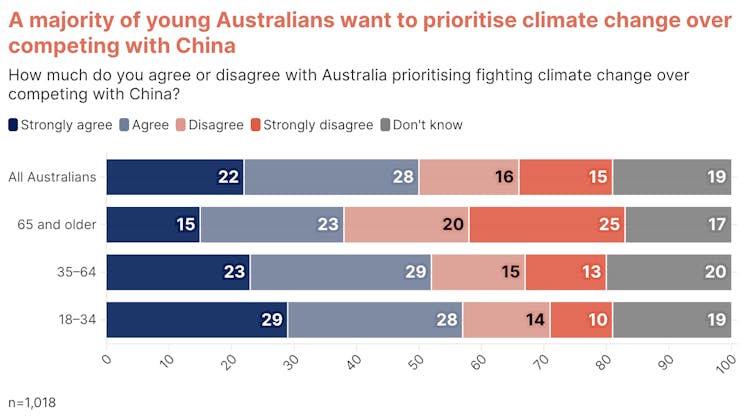
Our polling finds a majority of young Australians (57%) think their country should prioritise fighting climate change over competing with China. And compared to older Australians, those aged 18-34 are twice as likely to “strongly agree” with doing so.


United States Studies Centre/Author provided

These results are unsurprising. Young people have grown up in a time when unprecedented climatic events are the new norm and appear a much greater and more immediate threat than Beijing’s geostrategic ambitions.

According to UN Secretary General António Guterres, the world is now entering a grimly termed “era of global boiling.” We have just experienced the hottest global month on record in July. And just a few years after the costliest bushfire season in Australian history, we could be facing yet another “unprecedented” fire threat this summer.

If the Australia-US alliance is to endure, our leaders must embrace the challenge of climate change with the same urgency with which they have responded to China’s challenge to the regional order.

Keeping climate on the public agenda

There have been some steps in this direction. In May, Albanese and Biden said climate would be a critical component of the Australia-US relationship, joining decades of defence and economic cooperation as the “third pillar” of the alliance. The two leaders then agreed on a compact that pledged to bolster climate innovation and investment hand in hand.

Of course, addressing climate change also remains pragmatic from a geostrategic perspective.

Delivering on the principles of the compact – along with Australia’s joint bid to host the global climate talks known as COP31 and its recent re-joining of the UN-backed Green Climate Fund – will be vital to demonstrating our commitment to climate action, particularly with our Pacific neighbours.


Read more:
Australia and the US are firm friends on defence – now let’s turn that into world-beating climate action


With China recently marking the tenth anniversary of its Belt and Road Initiative, there is growing pressure to deliver on these climate initiatives and infrastructure in the Pacific. This is also an important opportunity to provide a distinct values-based alternative to Beijing’s infrastructure deals.

The announcements from Albanese’s state visit are among the first positive steps towards translating the compact’s lofty ambitions into concrete action. But they must not be the last.

Both Albanese and Biden would do well to ensure that climate remains firmly on the agenda. Young people’s support for the alliance depends on it.

The Conversation

The authors do not work for, consult, own shares in or receive funding from any company or organization that would benefit from this article, and have disclosed no relevant affiliations beyond their academic appointment.

ref. New poll shows young Australians are wary of both AUKUS and the US – and want more action on climate instead – https://theconversation.com/new-poll-shows-young-australians-are-wary-of-both-aukus-and-the-us-and-want-more-action-on-climate-instead-216824

Queensland’s fires are not easing at night. That’s a bad sign for the summer ahead

Source: The Conversation (Au and NZ) – By Calum Cunningham, Postdoctoral Research Fellow, University of Tasmania

This week, dozens of fires have burned across Queensland. More homes have burned in the state than during the 2019–2020 Black Summer – 57 so far this year, compared to 49.

The question many are asking is – are these fires normal? Our analysis shows these fires are weird in at least two ways.

First, many more than usual are burning through the night. This is anomalous, as nighttime usually brings lower temperatures and more moisture in the air, slowing or quelling fires. Queensland’s south-east and Western Downs regions are seeing more than five times more nighttime hotspots than average. And second, these fires are early in the season – especially the nighttime fires.

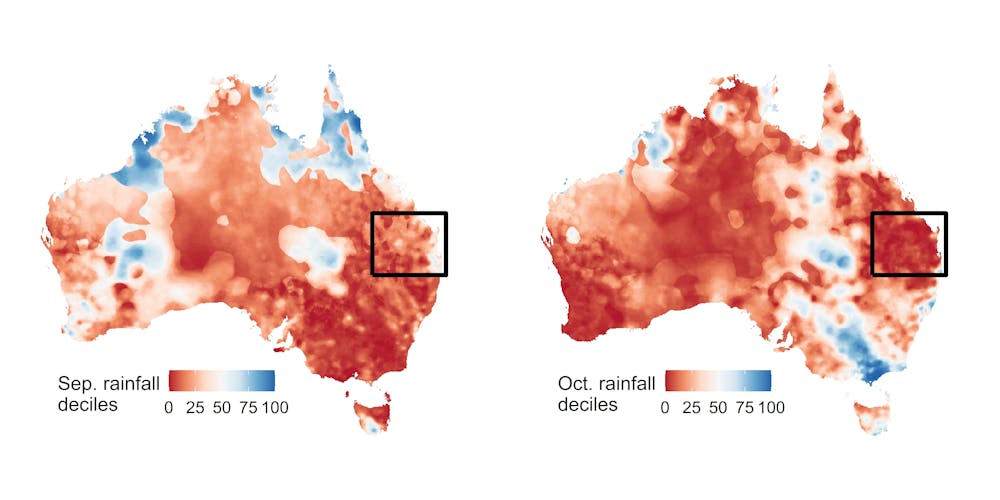
Why? Much of the east coast is now exceptionally dry. The plant regrowth from La Niña rains has dried out and is, in many places, set to burn. It’s still spring, with a long summer ahead. Where there has been rain, such as in eastern Victoria, it has sometimes coincided with intense bushfire. That gave rise to the extremely unusual situation in early October where residents grappled with fire one day and flood the next.

Put together, it suggests we may be facing a very bad fire season on the east coast and Tasmania. This is, of course, happening against the drumbeat of global warming, and the extra spike in heating this year caused by El Niño.

rainfall map of Australia Sept Oct 2023, showing red rainfall deficits almost everywhere
Rainfall across Australia this spring has been very low almost everywhere.
Bureau of Meteorology, CC BY-ND

What’s happening in Queensland?

This spring has been exceptionally dry across most of the Sunshine State. September and October rainfall in the state’s heavily populated south has been close to the lowest on record and certainly in the bottom 10% of years.

This, in turn, has made many areas ready to burn. While there are fires up and down Queensland, most house losses have been within a few hundred kilometres of Brisbane. The town of Tara and surrounding areas has been worst affected.

Made with Flourish

How do we know where the fires are? Four times a day, heat-sensing satellites pass over Australia and pinpoint hotspots, where temperatures suddenly jump compared to areas nearby, based on square kilometre tiles. These tell us where the fires are, almost in real time and let us track them as they grow.

To this region, October has brought the third highest number of daytime hotspots seen this century. But it’s the nighttime hotspots that are freakish. Five times more nighttime hotspots than average have been detected compared to previous Octobers.


Why is that so concerning? Think of it from the firefighters’ point of view. If you know that fires usually ease off at night, you can plan around this reprieve – or even get some rest. But this belief will have to change as the nighttime barrier to fire weakens around the world.

Climate change can speed up how fast droughts happen, in what’s been dubbed “flash drought”. It was not so long ago that Australia’s east coast was seemingly underwater, with record-breaking floods. Now drought is back with a vengeance.

Is south-east Queensland seeing more fire than usual? On the whole, yes. And it’s early – one of the earliest seasons since satellite records began in 2001.

So far, most of the serious fires in this area are burning not through grasslands, as is happening in Central Australia, but through open forest and woodlands.

Could we see rainforests in Queensland burn, as we did during the Black Summer? It’s possible, but less likely. But we could see some areas which burned during Black Summer along the east coast burn again, though probably not to the same severity.

There’s certainly enough fuel for some areas on the east coast burned by the 2019–20 bushfires to re-burn, such as New South Wales’ coast and the fringes of the Blue Mountains. That would have serious ecological consequences for areas still in recovery if fires returned before seedlings matured.


À lire aussi :
What is a flash drought? An earth scientist explains


Fire scientists are flying blind

For decades, we’ve known that parts of Australia – the world’s most fire prone continent – would be likely to see more intense and more damaging fires as climate change adds heat and takes away moisture in many regions.

One problem is that we and other professional fire scientists are forced to read the tea leaves from media reports to gauge what’s happening on the ground.

Data on fire progression, fuels and weather are often walled away in government agencies. Firefighters have access, but they are –  rightly – focused on the immediate crisis at hand. And insurers have their own data sets on trends in property loss but they are commercially sensitive.

Because there’s no systematic and accessible way to publicise fire data, we end up with a lot of speculation in the media about whether this is a normal or abnormal fire season.

This could be easily fixed with more investment and coordination. Data from geostationary satellites have revolutionised fire spotting, shifting from six-hourly updates to every ten minutes.

These data and historic data, could and should be made easily available to non-specialists, ideally through either the Bureau of Meteorology or a new agency.

Researchers have a role to play in developing tools to help put this flood of data to use.

If we have better public data sets, we can also more quickly shut down talking points from climate deniers, who might claim “there’s nothing new – Queensland has always burned” or use selective statistics to claim the number of dangerous forest fires on Earth is declining. We can’t adapt as a society if we’re arguing whether the fires really are happening or really are this bad.

If we don’t start to adapt to new fire regimes – and fast – we will face a very real crisis. We could soon see insurers stop offering insurance, as some have in California.


À lire aussi :
‘Australia is sleepwalking’: a bushfire scientist explains what the Hawaii tragedy means for our flammable continent


The Conversation

Calum Cunningham receives funding from the Australian Research Council.

David Bowman receives funding from the Australian Research Council, Natural Hazards Research Australia, and NSW Department of Planning and Environment.

Grant Williamson receives funding from the Australian Research Council, Natural Hazards Research Australia, and NSW Department of Planning and Environment.

ref. Queensland’s fires are not easing at night. That’s a bad sign for the summer ahead – https://theconversation.com/queenslands-fires-are-not-easing-at-night-thats-a-bad-sign-for-the-summer-ahead-216732

Using social media for your holiday ‘inspo’ can be risky and even dangerous – here’s why

Source: The Conversation (Au and NZ) – By Samuel Cornell, PhD Candidate, School of Population Health, UNSW Sydney

Figure Eight Pools in NSW. nakarin.ch7/Shutterstock

How do you choose your next travel destination? Social media platforms like Instagram and TikTok are handy tools for holiday research, full of #inspo for new and beautiful places to go.

However, behind those mesmerising selfies, highlights and reels, there’s often a stark reality that isn’t shared. Our ongoing research shows that dangers abound from social media related misadventures. These include the hidden dangers of getting to the location, as well as the ecological strains on sites that get overcrowded with tourists.

Australia, with its breathtaking natural wonders, is no stranger to the downsides of social media tourism. Many people have been injured, needed rescue or even perished when visiting trendy places.


Read more:
Trampling plants, damaging rock art, risking your life: taking selfies in nature has a cost


The illusion of safety

Influencers are in the business of presenting the best version of their experiences – not necessarily the safest. Our interviews with influencers who make content of beautiful places in nature, reveal that they see themselves as entertainers more than guides.

When it comes to the risks associated with the places they promote, they don’t view safety communication as their responsibility.

The Figure Eight Pools in New South Wales’ Royal National Park are one potent reminder of how online portrayals and reality don’t always match up. The photos showcase tranquil pools with glistening waters. But many visitors, enticed by these images, have faced the peril of sudden large waves washing over the rock shelf and even causing injuries.

Babinda Boulders, near Cairns in Queensland, is another such location. Wrapped in lush rainforests, this waterhole might seem inviting, but its tragic history of drownings speaks volumes – 21 drownings since 1965, and three since 2020.

Despite this, the pull of picturesque posts lures visitors into prohibited and dangerous areas.

Josephine Falls in Queensland has also experienced numerous incidents, all requiring resource-intensive rescues. Unfortunately, for many visitors, the warnings provided by Queensland Parks and Wildlife Service are to no avail – the lure of social media content is simply too strong.

A picturesque waterfall with a natural azure pool in front of it
Josephine Falls in Wooroonooran National Park, Queensland, can be subject to flash flooding at any time of year.
JuliaHermann/Shutterstock

A burden on local infrastructure

Aesthetically pleasing, curated tourism content sets unrealistic expectations. Visitors who want to see the “insta-famous” scenery often find themselves underprepared for the actual experiences, sometimes leading to unsafe choices.

Drone shots can be particularly misleading. While they capture expansive vistas from above, they mask the ground-level challenges and dangers.

The Balconies in the Grampians National Park in Victoria is another infamous spot for taking risky photos for Instagram. To get the photo they came for, tourists must traverse a barrier. The viral content has led ever-increasing numbers of people to these rocks for a shot – risking their lives for the same photo hundreds of others have posted.

Additionally, geotagging (attaching metadata, such as latitude and longitude coordinates, to a photo) has its merits, offering travellers directions to exact locations. However, it’s a double-edged sword.

When a location becomes popular on social media, the influx of visitors can strain local infrastructure. As Hyams Beach in NSW went viral on various platforms, the once-peaceful coastal village grappled with traffic congestion and overwhelmed local resources.

Lincoln’s Rock in the Blue Mountains in NSW, once a little-known spot, was transformed by geotagged posts into a magnet for tourists and influencers. Some would engage in risky behaviours at the cliff edge. It’s one of many lookouts that once had few footprints, and is now a popular vista with little infrastructure.

Some regional areas simply don’t have the infrastructure or capacity to handle a large influx of tourists. As social media algorithms push trending posts even further, once-secluded gems face threats of overtourism.


Read more:
Dangerous selfies aren’t just foolish. We need to treat them like the public health hazard they really are


Be a responsible tourist

While it’s easy to fall prey to the siren call of viral destinations, it’s essential to approach with caution and do proper research before you set out.

It’s important to stay aware of your surroundings, especially in natural areas, and not get tunnel vision, or “tourist gaze”.

Fortunately, in Australia, national parks provide detailed information about popular locations. They can be relied upon to give accurate information and a true representation of the area, including safety information and guides for great hikes and the best lookouts.

All states in Australia have parks agencies that provide this information online (and they’re on social media, too).

Things to keep in mind

  1. Social media is a highlight reel. Before diving into that enticing pool or hiking that mountain, do thorough research. Don’t let it be your last swim

  2. engage with locals, understand the history, the culture, and importantly, respect the environment

  3. it’s also essential to challenge the content we consume and share. By geotagging responsibly and authentically portraying experiences, we can safeguard Australia’s treasures

  4. social media is a powerful tool but needs to be wielded wisely. Australia’s natural wonders are worth more than just a fleeting snapshot; they deserve our utmost respect and care.

So, as you scroll through your feed, dreaming of your next escape, remember that every location has a story beyond its pixels. Dive deep, explore responsibly, and treasure the real over the reel.


Read more:
‘Your first emotion is panic’: rips cause many beach drownings, but we can learn from the survivors


The Conversation

Samuel Cornell receives funding from Meta Platforms, Inc. His research is also supported by a UNSW University Postgraduate Award, as well as project funding from the Royal Life Saving Society – Australia. He is affiliated with Surf Life Saving Australia and Surf Life Saving NSW.

Amy Peden receives funding from the National Health and Medical Research Council, Meta Platforms, Royal Life Saving Society – Australia and Surf Life Saving Australia. She holds an honorary affiliated with Royal Life Saving Society – Australia.

ref. Using social media for your holiday ‘inspo’ can be risky and even dangerous – here’s why – https://theconversation.com/using-social-media-for-your-holiday-inspo-can-be-risky-and-even-dangerous-heres-why-216434

Voluntary assisted dying is finally being considered in the ACT. How would it differ from state laws?

Source: The Conversation (Au and NZ) – By Ben White, Professor of End-of-Life Law and Regulation, Australian Centre for Health Law Research, Queensland University of Technology

Rich Brown/Unsplash

The first Australian Capital Territory voluntary assisted dying bill in more than 25 years was tabled in parliament yesterday.

This was possible after the Commonwealth lifted the ban on territories making laws about assisted dying in December last year. This meant the ACT and Northern Territory could join the six Australian states which have now passed voluntary assisted dying laws.

As with all parliamentary debates about voluntary assisted dying in Australia, this will be a conscience vote. But what will ACT parliamentarians be voting on?


Read more:
Voluntary assisted dying will be available to more Australians this year. Here’s what to expect in 2023


In some ways, the ACT bill reflects the Australian model:

  • detailed eligibility criteria are reviewed by two independent and trained health practitioners
  • patients need to make three requests at various points
  • there is an oversight board scrutinising cases, along with offences, to protect patients
  • health practitioners’ conscientious objection is protected.

But ACT bill has three new features:

  • no specific timeframe until death
  • nurse practitioners can be involved in assessing eligibility
  • protections for patients in institutions that object to voluntary assisted dying.

No specific timeframe until death

Reflecting the national approach, voluntary assisted would be available for adults living in the ACT with decision-making capacity who seek this choice voluntarily and without coercion. They must also be suffering intolerably.

But discussion will no doubt focus on the fact that the ACT bill does not contain an expected timeframe until death.

Australian states have normally required an expected death within six months, with an extension to 12 months for neurodegenerative conditions. Queensland has 12 months for all conditions.


Read more:
Voluntary assisted dying could soon be legal in Queensland. Here’s how its bill differs from other states


But in the ACT, the relevant criteria is silent on time to death and requires only that the condition is “advanced, progressive and expected to cause death”.

Reasons for this policy choice include that a timeframe is arbitrary, it exacerbates suffering for terminally ill patients and was not supported in public consultation.

This new feature must be seen in context. Voluntary assisted dying eligibility criteria work together so all of them must be satisfied before a person can access voluntary assisted dying.

The ACT bill requires the person’s condition be “advanced” and this is defined to include requiring that the person is in the “last stages of life”. Because this criterion must be satisfied too, just having an illness that will cause death is not enough to access the service.

Our research has shown that because eligibility criteria work together, removing the timeframe to death is unlikely to affect which conditions will allow people to access voluntary assisted dying.

Man reaches for glasses next to his bed
The ACT change is unlikely to affect which conditions will be eligible for assisted dying.
Shvets Production/Pexels

Nurse practitioners can be involved in assessing eligibility

Australian voluntary assisted dying laws have to date required that both health practitioners assessing eligibility be doctors.

The ACT bill contemplates that one practitioner could be a nurse practitioner. When introducing the bill, Minister for Human Rights Tara Cheyne said nurse practitioners must have relevant experience and at least one year’s endorsement after qualifying before they can undertake that role.

Cheyne pointed to the ACT’s small health workforce; and a key challenge of existing state voluntary assisted dying systems has been finding sufficient numbers of practitioners to assist patients.


Read more:
Voluntary assisted dying is legal in Victoria, but you may not be able to access it


Protecting patient access in objecting institutions

A third key difference is how the ACT bill deals with institutions which may object to voluntary assisted dying, such as faith-based hospitals.

There is growing evidence this is a problem in the later states to pass voluntary assisted dying laws: South Australia, Queensland and New South Wales.

Those states generally protect access for permanent residents in facilities, such as aged care residents, but offer less protection for non-permanent residents, such as a patient in a hospital.

The ACT has opted for a simpler approach that does not distinguish between permanent and non-permanent residents, giving stronger protection for the latter.

The default is that voluntary assisted dying can be accessed in facilities unless that is not reasonably practicable.

The ACT bill also regulates this more robustly by requiring institutions to develop minimum standards for how they will comply with these laws and creating offences for non-compliance.


Read more:
What happens if you want access to voluntary assisted dying but your nursing home won’t let you?


What happens next?

The bill was referred to a parliamentary committee for further consideration. This happened for Australian state voluntary assisted dying laws and provides opportunity for reflection on the bill.

Some will object to these features in the ACT bill because they are different from the Australian model. Such objections also arose when states after Victoria made decisions that their law would be different.

But it is difficult to argue the ACT should blindly follow what other states have done. There is evidence that access to voluntary assisted dying under those laws is challenging and local considerations may also mean different approaches are needed.

We anticipate robust consideration of the bill by the committee and then parliament. If passed, the usual 18-month implementation period is proposed which means ACT residents could have access by 2025.


Read more:
Territories free to make their own voluntary assisted dying laws, in landmark decision. Here’s what happens next


The Conversation

Ben White receives funding from the Australian Research Council, the National Health and Medical Research Council and Commonwealth and state governments for research and training about the law, policy and practice relating to end-of-life care. In relation to voluntary assisted dying, he (with colleagues) has been engaged by the Victorian, Western Australian and Queensland governments to design and provide the legislatively mandated training for health practitioners involved in voluntary assisted dying in those states. He (with Lindy Willmott) has also developed a model bill for voluntary assisted dying for parliaments to consider. He is a sessional member of the Queensland Civil and Administrative Tribunal, which has jurisdiction for some aspects of this state’s voluntary assisted dying legislation. Ben is a recipient of an Australian Research Council Future Fellowship (project number FT190100410: Enhancing End-of-Life Decision-Making: Optimal Regulation of Voluntary Assisted Dying) funded by the Australian government.

Lindy Willmott receives or has received funding from the Australian Research Council, the National Health and Medical Research Council and Commonwealth and state governments for research and training about the law, policy and practice relating to end-of-life care. In relation to voluntary assisted dying, she (with colleagues) has been engaged by the Victorian, Western Australian and Queensland governments to design and provide the legislatively mandated training for health practitioners involved in voluntary assisted dying in those states. She (with Ben White) has also developed a model Bill for voluntary assisted dying for parliaments to consider. Lindy Willmott is also a member of the Queensland Voluntary Assisted Dying Review Board, but writes this piece in her capacity as an academic researcher. She is a former board member of Palliative Care Australia.

ref. Voluntary assisted dying is finally being considered in the ACT. How would it differ from state laws? – https://theconversation.com/voluntary-assisted-dying-is-finally-being-considered-in-the-act-how-would-it-differ-from-state-laws-216733

‘Unreasonable, unjust, oppressive’: how a police program targeted Indigenous kids

Source: The Conversation (Au and NZ) – By Vicki Sentas, Senior Lecturer, UNSW Law, UNSW Sydney

“Unreasonable, unjust, oppressive or improperly discriminatory in its effect on children and young people.”

That’s how the Law Enforcement Conduction Commission (LECC) described a police program that aims to target likely offenders before they commit crimes.

It’s a program that allowed police to make home visits at all hours, and stop and search people in the street.

Yesterday, the commission released its damning final report after a five-year investigation.

Here’s what it found.


Read more:
‘Too much money is spent on jails and policing’: what Aboriginal communities told us about funding justice reinvestment to keep people out of prison


Report identifies unlawful practices

The program in question is the Suspect Targeted Management Plan, implemented by NSW Police.

It’s a pre-emptive policing program that selects and then targets children and adults who police predict may commit crimes in the future.

The rationale behind the policy is to deter recidivists.

Once placed on the plan, police “disrupt” people’s everyday lives, through questioning, stop and search, and home visits – sometimes at all hours and even multiple times a week or even a day.

The Law Enforcement Conduct Commission found some of this conduct to be unlawful, possibly even “serious misconduct”.

While the plan was introduced in 2000, the then secret “black list” only came to public attention in 2017 with my research (coauthored with Camilla Pandolfini), in partnership with Public Interest Advocacy Centre and the Youth Justice Coalition.

The commission agreed with our recommendation that there were grounds to investigate the police for potential agency maladministration.

The commission’s investigation, called “Operation Tepito”, has been ongoing since 2018.

Its interim 2020 report was scathing of police.

It recommended further reform of the revised management plan through new policy guidelines and training.

The commission urged police to engage with young people with “positive interactions” and reduce coercive ones.

The final report reviewed the operation of the plan for children between November 2020 and February 2022.

The commission concluded that police use of the management plan was an “agency maladministration”.

First Nations children disproportionately targeted

Of the recommendations the commission made in 2020, NSW Police failed to successfully implement any of them.

Police overwhelmingly still subjected young people to intrusive, disruptive strategies. Some of these, such as home visits and searches, were unlawful.

There was little evidence of “positive interactions”, nor of support referrals.


Read more:
The NT’s tough-on-crime approach won’t reduce youth offending. This is what we know works


First Nations young people were disproportionately targeted.

In 2022, First Nations people made up 48% of all young people on the plan.

This was an increase on the 42% reported in the 2020 interim report.

Crucially, the commission found that:

The NSW Police Force did not undertake any analysis to try to determine the reasons for this and did not take steps to reduce this over-representation.

First Nations young people are overpoliced, overcharged and overincarcerated.

If you then use the same data to decide who is “risky” and deserving of intensified police harassment, it only reinforces the cycle of criminalisation.

The Commission also found other administrative issues, including:

  • varied quality in intelligence assessments

  • unclear justifications for putting people on the plan

  • inflation of how some scores were calculated

  • poor record-keeping

  • inadequate consideration of complex needs or the alternatives to placing a young person on the Suspect Targeting Management Plan.


Read more:
Raising the age of criminal responsibility is only a first step. First Nations kids need cultural solutions


A plan at odds with Closing the Gap

The fact NSW Police didn’t implement any of the 2020 recommendations or reduce the over-representation shows the plan was never safe for First Nations young people in the first place.

Indeed, the management plan did precisely what it was designed to do: incapacitate and disrupt.

No amount of training or improvements to policy could remedy the extensive harms for First Nations young people put on the plan.

It was fundamentally a punitive surveillance approach, which made police the first responders for First Nations young people.

Aboriginal children need culturally appropriate, therapeutic, trauma-informed services run by Aboriginal community-controlled organisations.

They also need safe distance from police.

The Suspect Targeting Management Plan was always at odds with the NSW government’s commitment to divert First Nations people from the criminal justice system.

In its Closing the Gap Implementation Plan, all early interventions to support young people need to be community designed and driven.

There should also be health, housing and education support.

A community development approach

NSW Police has dropped the Suspect Targeting Management Plan for people under 18 and will soon scrap it entirely.

Police are now developing a replacement approach. Will they take the lead from communities?

The Yuwaya Ngarra-li community-led partnership in Walgett is one example of how holistic diversion programs can work.

Another is Just Reinvest in Bourke, Kempsey and Moree.

The UTS Jumbunna Institute of Indigenous Education has developed ideas around Aboriginal self-determination in youth justice that could shape guiding principles.

Police are the wrong people for providing Indigenous young people with non-coercive, therapeutic support.

Community alternatives to state policing are real and powerful.

The Conversation

Vicki Sentas does not work for, consult, own shares in or receive funding from any company or organisation that would benefit from this article, and has disclosed no relevant affiliations beyond their academic appointment.

ref. ‘Unreasonable, unjust, oppressive’: how a police program targeted Indigenous kids – https://theconversation.com/unreasonable-unjust-oppressive-how-a-police-program-targeted-indigenous-kids-216627

Labor recovers in Morgan after post-referendum slump; LNP leads in Queensland

Source: The Conversation (Au and NZ) – By Adrian Beaumont, Election Analyst (Psephologist) at The Conversation; and Honorary Associate, School of Mathematics and Statistics, The University of Melbourne

A federal Morgan poll, conducted October 22–29 from a sample of 1,375, gave Labor a 53–47 lead, a 3.5-point gain for Labor since the previous week. An earlier poll, taken in the week after the Voice referendum was heavily defeated, was the first by any pollster this term to give the Coalition a lead, by 50.5–49.5, a 4.5-point gain for the Coalition since the pre-referendum Morgan poll.

Primary votes in the earlier poll were 36% Coalition, 32% Labor, 14% Greens, 4.5% One Nation, 8.5% independents and 5% others. If preferences were distributed according to how they flowed at the 2022 federal election, Labor would have led by about 53–47. Respondent allocated preferences were very weak for Labor.

In the current poll, primary votes were 35% Coalition, 32.5% Labor, 15% Greens and 17.5% for all Others. Labor had a better flow of respondent preferences, explaining its rebound.

Greens slump in Essential poll owing to methods change

In a national Essential poll, conducted October 25–29 from a sample of 1,149, Labor led by 48–46 including undecided voters, down from a 50–45 lead in Essential’s pre-referendum poll in early October. This is Labor’s narrowest lead this term in this poll, beating the previous narrowest four-point lead in mid-September.

Primary votes were 34% Coalition (up two), 32% Labor (down one), 10% Greens (down four), 7% One Nation (up one), 3% UAP (up one), 9% for all Others (up two) and 6% undecided (up one).

Essential has been recording higher Greens votes than other pollsters, and the slump here likely reflects their adding of education level to weighting factors. Essential greatly overstated “yes” support at the Voice referendum.

In other questions, 38% said Australia was not doing enough to address climate change (down one since April), 36% said we were doing enough (up three) and 17% doing too much (up one). Since Labor’s election in May 2022, the “not doing enough” percentage has dropped from the low to mid 40s to the high 30s.

On several environmental issues, more people thought the government was not doing enough now than in June. On the most important drivers of energy price increases, 28% (up four since October 2022) blamed excessive profits by energy companies, while 19% (down one) blamed efforts to fight climate change.

By 50–33, voters supported Australia developing nuclear power plants for electricity generation (50–32 in September 2021). On the cost of energy sources, 38% thought renewable energy the most expensive, 34% that nuclear energy was most expensive and 28% fossil fuels.

By 50–43, voters did not trust the government to lead the renewable energy transition. By 57–31, they thought it unlikely Australia would reach net zero emissions by 2050.

Newspoll aggregate data from late August to mid-October

The Australian has released
the aggregate results of voting intentions and leaders’ ratings for the four Newspolls conducted in the lead-up to the October 14 Voice referendum. These polls were taken from August 28 to October 12 from an overall sample of 6,378.

Labor led nationally by 54–46, by 56–44 in New South Wales, 54–46 in Victoria, 57–43 in South Australia, 53–47 in Western Australia and 57–43 in Tasmania. Queensland was the one state with a Coalition lead, by 52–48.

The Poll Bludger said the last time Newspoll released aggregate data was from February to early April, when Newspoll was conducted by YouGov not the current Pyxis. Since the last aggregate release, Labor is up one in NSW, down four in Victoria, down two in Queensland, down four in WA and up one in SA.

By educational attainment, Labor led by 55–45 among university educated people and 53–47 among those without tertiary education or with a TAFE/technical education. This flat pattern is very different to education breakdowns for the Voice referendum, where “no” was way ahead with the latter two categories, but “yes” led with the university educated.


Read more:
Indigenous Australians supported Voice referendum by large margins; Labor retains large Newspoll lead


Queensland YouGov poll: 52–48 to LNP

The Queensland election will be held in October 2024. A YouGov poll for The Courier Mail, conducted October 4–10 from a sample of 1,013, gave the Liberal National Party a 52–48 lead, a one-point gain for the LNP since the previous YouGov Queensland poll in early April.

Primary votes were 41% LNP (up two), 33% Labor (steady), 13% Greens (steady), 8% One Nation (down two) and 5% for all Others (steady).

Leaders’ approval ratings were not asked in April, so changes are compared with a YouGov poll in early December 2022. Labor Premier Annastacia Palaszczuk’s net approval dropped 19 points to -20, with 52% dissatisfied and 32% satisfied. LNP leader David Crisafulli’s net approval improved seven points to +11.

Crisafulli led Palasczuk by 37–35 as better premier, a reversal of a 31–29 Palaszczuk lead in April.

Labor has been sliding in the Queensland polls this year, with a September Redbridge poll giving the LNP a 55–45 lead.

Labor has governed in Queensland since early 2015, but federally it is the most conservative state. It was the only state the Coalition won at the 2022 federal election, and is easily the worst state for “yes” at the Voice referendum. It may be more difficult for Labor to win Queensland state elections in the future.

UK byelections and Argentine election

I covered the two October 19 UK byelections and the October 22 Argentine presidential election for The Poll Bludger. UK Labour gained both seats that had byelections from the Conservatives on massive swings.

In Argentina, the centre-left Sergio Massa led the far-right Javier Milei by 36.7–30.0 with 23.8% for a conservative candidate. There will be a runoff between Massa and Milei on November 19.

The Conversation

Adrian Beaumont does not work for, consult, own shares in or receive funding from any company or organisation that would benefit from this article, and has disclosed no relevant affiliations beyond their academic appointment.

ref. Labor recovers in Morgan after post-referendum slump; LNP leads in Queensland – https://theconversation.com/labor-recovers-in-morgan-after-post-referendum-slump-lnp-leads-in-queensland-216164

Australian MPs walk a difficult line on Israel-Hamas conflict

Source: The Conversation (Au and NZ) – By Andy Marks, Pro Vice-Chancellor, Strategy, Government and Alliances, Western Sydney University

The failure of the Voice referendum appeared to confirm Australians broadly reject propositions they believe to be characterised by divisiveness. There are few geopolitical circumstances more polarising than the drastic flaring of conflict between Israel and Hamas militants in Gaza.

These moments resist the fast rhythm of modern political rhetoric. There is no doorstop interview, social media post or snappy campaign slogan that can convey the depth of suffering of Palestinians or Israelis. This deviation in political tempo exposes the shortcomings of fast politics, when careful, wider deliberation has historically proven more salient.


Read more:
Six former prime ministers warn against letting the Israel-Gaza conflict divide Australians


As the conflict reignited, symbolism was one of the first, and most strident, Australian political responses. The NSW government’s decision to project the image of the Israeli flag on the Sydney Opera House provoked “significant concern” among authorities, and became a focal point for a pro-Palestinian protest.

Not so long ago, the Opera House’s iconic white sails were used to promote gambling. It’s hardly a sacrosanct canvas. And, for some, it’s a contentious platform for the expression of solidarity with the suffering. And the suffering is profound, for all concerned.

Hamas’s attack on Israel, and Israel’s bombardment of Gaza, have resulted in the deaths of thousands of civilians. It is likely many more will be killed based on current strategic rationales.

Contending with the human misery of the conflict has proven politically fraught at all levels. The Australian government joined with 43 other nations, including Canada, Germany, India and the UK, in abstaining from an amendment to a United Nations resolution calling for the “protection of civilians and upholding legal and humanitarian obligations”. The political challenges appear similarly vexing domestically.

Prime Minister Anthony Albanese expressed early support for Israel, and has been “unequivocal” in condemning the Hamas attack. As the political tempo slows and the broader picture becomes more complicated, the tone can also shift.

Foreign Minister Penny Wong has since qualified that Australia’s support for Israel comes with an expectation it shows restraint. “Innocent Palestinian civilians”, she cautioned, “should not suffer because of the outrages perpetrated by Hamas”.

There has been no change in tempo from Opposition Leader Peter Dutton. As the current crisis began, he urged Israel to exercise “no restraint” in doing “what is necessary […] to protect its people, and to thwart threats it now faces”. He has not wavered as the situation has deteriorated for civilians, describing Australia’s UN vote abstention “an incredibly weak display of leadership from the prime minister”.

The Greens were scathing of the abstention for different reasons. “By failing to back a ceasefire and continuing to approve defence exports to Israel,” said Greens leader Adam Bandt, “Labor shares responsibility for the unfolding catastrophe in Gaza.”

The opportunity for a bipartisan position on the conflict in Israel and Gaza looks not only to have passed, but to have almost completely evaporated. A similar collapse in bipartisanship regarding Australia’s aid for Ukraine has occurred, but over a much longer period.

These distinct and firmly expressed political differences might suggest high levels of party unity on the stances respective leaders have adopted. But as the conflict continues, a diverse range of internal party opinions is also emerging.

National party whip Mark Coulton countered Dutton’s views, expressing concern at the “whatever it takes to take out Hamas” language being used. “I didn’t want support for Palestinians just to be dismissed as something form the left”, he said. His call to “please respect civilian life”, noting Wong’s comments on restraint, is a point around which a degree of bipartisan support is emerging.

Labor MP Ed Husic said Palestinians were being “collectively punished for Hamas’ barbarism”. His colleague, Anne Aly, backed Husic’s comments, saying it was “difficult to argue” that wasn’t the case in the face of rising civilian casualties. Other Labor MPs have since joined Husic and Aly in condemning the killing of civilians in the conflict.


Read more:
Understanding the history of the Israeli-Palestinian conflict in 5 charts


Former co-chair of the Parliamentary Friends of Palestine, Labor’s Maria Vamvakinou, reminded her House of Representatives colleagues that Albanese, former Treasurer Joe Hockey, and Deputy Leader of the Liberal Party Sussan Ley were once members of the group.

As civilian deaths mount and amid predictions the conflict may expand, political dialogue in Australia will likely evolve in tempo and tone. On current trends, those shifts might prove most pronounced at the local level.

Questioned over a local council decision in his southwestern Sydney electorate to fly a Palestinian flag, senior Labor minister Tony Burke pointed to diasporic links. “In my part of Sydney”, he observed, “people are […] getting information directly from the ground in Gaza”. His community is communicating via WhatsApp groups, and, he said, “seeing horrific images updated every hour on their phones”.

Burke warned against falling into an “immature debate” about blame and grief.
“People have a right to be able to grieve when innocent life is lost.” His stance is not new. Nor is it necessarily out of step with long-held parliamentary standards.

There is a Labor tradition – forged during a different time but in a similarly complex geopolitical crisis – that went on to substantially shape Australian politics for nearly a decade. When, in 1965, then-Prime Minister Robert Menzies committed Australian troops to the war in Vietnam, Labor leader Arthur Calwell went against the tide and opposed the deployment.

In a speech prepared by his press secretary, Graham Freudenberg, Calwell outlined the strategic case for his decision, spelling out Labor’s discord with the national interest. But his rationale went further. Like Burke, Calwell’s primary concern was civilian life. Labor, he declared, does “not believe [war] will promote the welfare of the people of Vietnam. On the contrary, we believe it will prolong and deepen the suffering.” He was right.

Only time, and the shifting tempo of politics, will determine the prescience (or otherwise) of political views on the tragic events occurring in Israel and Gaza. Who is right and who is wrong is unlikely to matter to those affected.

The Conversation

Andy Marks does not work for, consult, own shares in or receive funding from any company or organisation that would benefit from this article, and has disclosed no relevant affiliations beyond their academic appointment.

ref. Australian MPs walk a difficult line on Israel-Hamas conflict – https://theconversation.com/australian-mps-walk-a-difficult-line-on-israel-hamas-conflict-216629

Can I actually target areas to lose fat, like my belly?

Source: The Conversation (Au and NZ) – By Nick Fuller, Charles Perkins Centre Research Program Leader, University of Sydney

Shutterstock

Spend some time scrolling social media and you’re all-but-guaranteed to see an ad promising to help you with targeted fat loss. These ads promote a concept known as “spot reduction”, claiming you can burn fat in a specific body area, usually the belly, with specially designed exercises or workouts.

It’s also common to see ads touting special diets, pills and supplements that will blast fat in targeted areas. These ads – which often feature impressive before and after photos taken weeks apart – can seem believable.

Unfortunately, spot reduction is another weight-loss myth. It’s simply not possible to target the location of fat loss. Here’s why.


Read more:
Using BMI to measure your health is nonsense. Here’s why


1. Our bodies are hardwired to access and burn all our fat stores for energy

To understand why spot reduction is a myth, it’s important to understand how body fat is stored and used.

The fat stored in our bodies takes the form of triglycerides, which are a type of lipid or fat molecule we can use for energy. Around 95% of the dietary fats we consume are triglycerides, and when we eat, our bodies also convert any unused energy consumed into triglycerides.

Triglycerides are stored in special fat cells called adipocytes, and they’re released into our bloodstream and transported to adipose tissue – tissue we more commonly refer to as body fat.

This body fat is found all over our bodies, but it’s primarily stored as subcutaneous fat under our skin and as visceral fat around our internal organs.

These fat stores serve as a vital energy reserve, with our bodies mobilising to access stored triglycerides to provide energy during periods of prolonged exercise. We also draw on these reserves when we’re dieting and fasting.

Person does button up on tight jeans
The fat stores we use for energy come from everywhere on our bodies, not just the belly.
Shutterstock

However, contrary to what many spot-reduction ads would have us think, our muscles can’t directly access and burn specific fat stores when we exercise.

Instead, they use a process called lipolysis to convert triglycerides into free fatty acids and a compound called glycerol, which then travels to our muscles via our bloodstream.

As a result, the fat stores we’re using for energy when we exercise come from everywhere in our bodies – not just the areas we’re targeting for fat loss.

Research reinforces how our bodies burn fat when we exercise, confirming spot reduction is a weight-loss myth. This includes a randomised 12-week clinical trial which found no greater improvement in reducing belly fat between people who undertook an abdominal resistance program in addition to changes in diet compared to those in the diet-only group.

Further, a 2021 meta-analysis of 13 studies involving more than 1,100 participants found that localised muscle training had no effect on localised fat deposits. That is, exercising a specific part of the body did not reduce fat in that part of the body.

Studies purporting to show spot-reduction benefits have small numbers of participants with results that aren’t clinically meaningful.


Read more:
Does exercise help you lose weight?


2. Our bodies decide where we store fat and where we lose it from first

Factors outside of our control influence the areas and order in which our bodies store and lose fat, namely:

  • our genes. Just as DNA prescribes whether we’re short or tall, genetics plays a significant role in how our fat stores are managed. Research shows our genes can account for 60% of where fat is distributed. So, if your mum tends to store and lose weight from her face first, there’s a good chance you will, too

  • our gender. Our bodies, by nature, have distinct fat storage characteristics driven by our gender, including females having more fat mass than males. This is primarily because the female body is designed to hold fat reserves to support pregnancy and nursing, with women tending to lose weight from their face, calves and arms first because they impact childbearing the least, while holding onto fat stored around the hips, thighs and buttocks

  • our age. The ageing process triggers changes in muscle mass, metabolism, and hormone levels, which can impact where and how quickly fat is lost. Post-menopausal women and middle-aged men tend to store visceral fat around the midsection and find it a stubborn place to shift fat from.


Read more:
Is menopause making me put on weight? No, but it’s complicated


3. Over-the-counter pills and supplements cannot effectively target fat loss

Most advertising for these pills and dietary supplements – including products claiming to be “the best way to lose belly fat” – will also proudly claim their product’s results are backed by “clinical trials” and “scientific evidence”.

But the reality is a host of independent studies don’t support these claims.

This includes two recent studies by the University of Sydney that examined data from more than 120 placebo-controlled trials of herbal and dietary supplements. None of the supplements examined provided a clinically meaningful reduction in body weight among overweight or obese people.

Woman takes diet pill
Supplements won’t help you target ares weight-loss either.
Shutterstock

The bottom line

Spot reduction is a myth – we can’t control where our bodies lose fat. But we can achieve the results we’re seeking in specific areas by targeting overall fat loss.

While you may not lose the weight in a specific spot when exercising, all physical activity helps to burn body fat and preserve muscle mass. This will lead to a change in your body shape over time and it will also help you with long-term weight management.

This is because your metabolic rate – how much energy you burn at rest – is determined by how much muscle and fat you carry. As muscle is more metabolically active than fat (meaning it burns more energy than fat), a person with a higher muscle mass will have a faster metabolic rate than someone of the same body weight with a higher fat mass.

Successfully losing fat long term comes down to losing weight in small, manageable chunks you can sustain – periods of weight loss, followed by periods of weight maintenance, and so on, until you achieve your goal weight.

It also requires gradual changes to your lifestyle (diet, exercise and sleep) to ensure you form habits that last a lifetime.


Read more:
Is it true the faster you lose weight the quicker it comes back? Here’s what we know about slow and fast weight loss


At the Boden Group, Charles Perkins Centre, we are studying the science of obesity and running clinical trials for weight loss. You can register here to express your interest.

The Conversation

Nick Fuller works for the University of Sydney and has received external funding for projects relating to the treatment of overweight and obesity. He is the author and founder of the Interval Weight Loss program.

ref. Can I actually target areas to lose fat, like my belly? – https://theconversation.com/can-i-actually-target-areas-to-lose-fat-like-my-belly-205203

How is decaf coffee made? And is it really caffeine-free?

Source: The Conversation (Au and NZ) – By Lauren Ball, Professor of Community Health and Wellbeing, The University of Queensland

Volodymyr Proskurovskyi/Unsplash

Coffee is one of the most popular drinks in the world, and its high levels of caffeine are among the main reasons why. It’s a natural stimulant that provides an energy buzz, and we just can’t get enough.

However, some people prefer to limit their caffeine intake for health or other reasons. Decaffeinated or “decaf” coffee is widely available, and its consumption is reported to be on the rise.

Here’s what you need to know about decaf coffee: how it’s made, the flavour, the benefits – and whether it’s actually caffeine-free.


Read more:
Health Check: four reasons to have another cup of coffee


How is decaf made?

Removing caffeine while keeping a coffee bean’s aroma and flavour intact isn’t a simple task. Decaf coffee is made by stripping green, unroasted coffee beans of their caffeine content and relies on the fact that caffeine dissolves in water.

Three main methods are used for removing caffeine: chemical solvents, liquid carbon dioxide (CO₂), or plain water with special filters.

The additional steps required in all of these processing methods are why decaf coffee is often more expensive.

A close-up of a small branch with bright green berries on it
Coffee beans are not actually beans – they are the hard seeds nestled inside the fruit of the coffee plant.
Marc Babin/Unsplash

Solvent-based methods

Most decaf coffee is made using solvent-based methods as it’s the cheapest process. This method breaks down into two further types: direct and indirect.

The direct method involves steaming the coffee beans and then repeatedly soaking them in a chemical solvent (usually methylene chloride or ethyl acetate) which binds to the caffeine and extracts it from the beans.

After a pre-determined time, the caffeine has been extracted and the coffee beans are steamed once more to remove any residual chemical solvent.

The indirect method still uses a chemical solvent, but it doesn’t come into direct contact with the coffee beans. Instead, the beans are soaked in hot water, then the water is separated from the beans and treated with the chemical solvent.

The caffeine bonds to the solvent in the water and is evaporated. The caffeine-free water is then returned to the beans to reabsorb the coffee flavours and aromas.

The solvent chemicals (particularly methylene chloride) used in these processes are a source of controversy around decaf coffee. This is because methylene chloride is suggested to be mildly carcinogenic in high doses. Methylene chloride and ethyl acetate are commonly used in paint stripper, nail polish removers and degreaser.

However, both the Australian New Zealand Food Standards Code and the United States Food and Drug Administration permit the use of these solvents to process decaf. They also have strict limits on the amount of the chemicals that can still be present on the beans, and in reality practically no solvent is left behind.

Non-solvent-based methods

Non-solvent-based methods that use liquid carbon dioxide or water are becoming increasingly popular as they don’t involve chemical solvents.

In the CO₂ method, liquid carbon dioxide is pumped into a high-pressure chamber with the beans, where it binds to the caffeine and is then removed through high pressure, leaving behind decaffeinated beans.

The water method (also known as the Swiss water process) is exactly what it sounds like – it involves extracting caffeine from coffee beans using water. There are variations on this method, but the basic steps are as follows.

For an initial batch, green coffee beans are soaked in hot water, creating an extract rich in caffeine and flavour compounds (the flavourless beans are then discarded). This green coffee extract is passed through activated charcoal filters, which trap the caffeine molecules while allowing the flavours to pass through.

Once created in this way, the caffeine-free extract can be used to soak a new batch of green coffee beans – since the flavours are already saturating the extract, the only thing that will be dissolved from the beans is the caffeine.

Is caffeine fully removed from decaf?

Switching to decaf may not be as caffeine free as you think.

It is unlikely that 100% of the caffeine will be successfully stripped from the coffee beans. Just like the caffeine content of coffee can vary, some small amounts of caffeine are still present in decaf.

However, the amount is quite modest. You would need to drink more than ten cups of decaf to reach the caffeine level typically present in one cup of caffeinated coffee.

Australia does not require coffee roasters or producers to detail the process used to create their decaf coffee. However, you might find this information on some producers’ websites if they have chosen to advertise it.

Does decaf coffee taste different?

Some people say decaf tastes different. Depending on how the beans are decaffeinated, some aromatic elements may be co-extracted with the caffeine during the process.

Caffeine also contributes to the bitterness of coffee, so when the caffeine is removed, so is some of the bitterness.

A tub of partially roasted coffee beans in a pale tan colour
Caffeine contributes some of the bitterness of coffee, but there are also plenty of flavour compounds that develop in green beans as they are roasted to a rich, dark brown.
Joshua Newton/Unsplash

Do caffeinated and decaf coffee have the same health benefits?

The health benefits found for drinking decaf coffee are similar to that of caffeinated coffee, including a lower risk of type 2 diabetes, some cancers and overall mortality.
More recently, coffee has been linked with improved weight management over time.

Most of the health benefits have been shown by drinking three cups of decaf per day.

Moderation is key, and remember that the greatest health benefits will come from having a balanced diet.


Read more:
Can coffee help you avoid weight gain? Here’s what the science says


The Conversation

Lauren Ball works for The University of Queensland and receives funding from the National Health and Medical Research Council, Queensland Health and Mater Misericordia. She is a Director of Dietitians Australia, a Director of the Darling Downs and West Moreton Primary Health Network and an Associate Member of the Australian Academy of Health and Medical Sciences.

Emily Burch works for Southern Cross University.

ref. How is decaf coffee made? And is it really caffeine-free? – https://theconversation.com/how-is-decaf-coffee-made-and-is-it-really-caffeine-free-215546

Storms or sea-level rise – what really causes beach erosion?

Source: The Conversation (Au and NZ) – By Thomas Oliver, Senior lecturer, UNSW Canberra, Australian Defence Force Academy

John Hudson

Beaches are dynamic. They change from week to week and month to month. Have you ever wondered what causes these changes? Or how beaches might fare as sea levels rise and if storms increase in frequency and severity?

To help answer these questions, we studied 50 years of change at Bengello Beach, near the Moruya airport on the New South Wales south coast. This is a typical beach with moderate waves and no hard infrastructure such as sea walls or houses built over dunes. The results therefore represent natural beach change over half a century. This helps us understand the natural behaviour of beaches around the world.

We found the main driver of coastal erosion is frequent storms of moderate intensity. These storms remove sand from the beach. This sand is generally returned within a matter of months. But what about more extreme events?

In the 50 years of monitoring, offshore wave buoys recorded 21 storms where maximum waves heights exceeded ten metres. That’s roughly equivalent to the height of a three-story building. These larger events cause even greater erosion, so the beach takes longer to recover.

Big wave riding at Sydney’s Wedding Cake Island, near Coogee (7NEWS, May 2023)


Read more:
Coastal property prices and climate risks are both soaring. We must pull our heads out of the sand


The ‘biggest of the big’ storms

Some of the largest events in the record have been particularly destructive, for example the storm in June 2016 where a residential swimming pool washed onto the beach at Narrabeen-Collaroy. Or the June 2007 event when the Pasha Bulka container ship broke its mooring and washed up on Nobbys Beach in Newcastle. Both storms also caused substantial beach erosion at Bengello.

One sequence of storms stands out in the record. The successive storm events of May–June 1974 including the renowned Sygna Storm of May 1974. During these two months, more than a B-double truck full of sand was cut away at every metre strip of beach (95 cubic metres of sand per metre of beach), and the shoreline moved inland farther than the length of an Olympic swimming pool (63m).

Photo of Bengello Beach in the immediate aftermath of the May 1974 storm event, which created a vertical sand cliff in the frontal dune
Bengello Beach suffered erosion during the May 1974 storm event. Note the vertical sand cliff carved into the dunes by wave action.
Roger McLean

Astonishingly, it took five and half years for the beach to recover to its previous condition after these events. The recovery was hampered by more severe storms in 1976 and 1978, which interrupted the gradual build-up of beach sand.

A chart (line graph) showing beach volume changes at Bengello Beach from 1972 to 2022. Dips or downward trends indicate beach erosion, while positive spikes or upward trends indicate beach growth.
Beach volume changes at Bengello Beach from 1972 to 2022. Dips or downward trends indicate beach erosion, while positive spikes or upward trends indicate beach growth.
Thomas Oliver

No other storms in the record have had such a huge impact on the beach. Importantly, this is our only quantitative record of this event because it occurred before satellite imagery was available. Therefore it is not captured by tools such as CoastSat and Digital Earth Australia Coastlines, which derive shoreline positions from more than 30 years of satellite images, and have proved so powerful in understanding recent shoreline changes.

But how often do the biggest storms occur? Looking into the past, research suggests an erosion event of this magnitude has occurred at least one other time in the past 500 years.


Read more:
Millions of satellite images reveal how beaches around the Pacific vanish or replenish in El Niño and La Niña years


Can beaches survive future sea-level rise?

So how will beaches fare in a warming world where sea-level rise accelerates and coastal storms intensify?

This beach has sufficient sand to enable recovery after extreme storm events such as those experienced in the La Niña period of 1974–78. This degree of recovery is related to each beach’s so-called “sand budget”.

Recent research has even suggested extreme storms can replenish beaches with more sand from deeper waters.

Under present-day conditions this beach appears to have the capacity to fully recover. This means that it and other similar beaches with positive sand budgets can absorb certain levels of sea-level rise – but only up to a point. There will be a threshold beyond which a beach starts to retreat unless a new source of sand is supplied.

Sources of beach sand could come from deeper water offshore or from neighbouring beaches alongshore. These “credits” of sand into the beach budget may help them maintain their current position. Other NSW beaches in credit include the northern end of Seven Mile Beach near Gerroa, Nine Mile Beach north of Tuncurry and Dark Point just north of Hawks Nest. Around Australia, we can use time-series of shoreline change to estimate beach sand budgets.

Beaches in sand “defecit” are more vulnerable to sea level rise. Examples include the southern end of Stockton Beach and Old Bar in NSW and the northern end of Bribie Island in Queensland.

In a dynamic and volatile future, it is more important than ever that we maintain long-term records of beach change. This will ensure we have a critical baseline of data to test future projections. Monthly surveys at the site are continuing.


Read more:
We studied more than 1,500 coastal ecosystems – they will drown if we let the world warm above 2℃


The Conversation

Thomas Oliver receives funding from the Australian Research Council and a variety of state and local governments.

Bruce Thom and Roger McLean do not work for, consult, own shares in or receive funding from any company or organisation that would benefit from this article, and have disclosed no relevant affiliations beyond their academic appointment.

ref. Storms or sea-level rise – what really causes beach erosion? – https://theconversation.com/storms-or-sea-level-rise-what-really-causes-beach-erosion-209213

The US just issued the world’s strongest action yet on regulating AI. Here’s what to expect

Source: The Conversation (Au and NZ) – By Toby Walsh, Professor of AI, Research Group Leader, UNSW Sydney

Jim Lo Scalzo/EPA

On Monday US President Joe Biden released a wide ranging and ambitious executive order on artificial intelligence (AI) – catapulting the US to the front of conversations about regulating AI.

In doing so, the US is leap frogging over other states in the race to rule over AI. Europe previously led the way with its AI Act, which was passed by the European Parliament in June 2023, but which won’t take full effect until 2025.

The presidential executive order is a grab bag of initiatives for regulating AI – some of which are good, and others of which seem rather half-baked. It aims to address harms ranging from the immediate, such as AI-generated deepfakes, through to intermediate harms such as job losses, to longer-term harms such as the much-disputed existential threat AI may pose to humans.


Read more:
No, AI probably won’t kill us all – and there’s more to this fear campaign than meets the eye


Biden’s ambitious plan

The US Congress has been slow to pass significant regulation of big tech companies. This presidential executive order is likely both an attempt to sidestep an often deadlocked Congress, as well as to kick-start action. For example, the order calls upon Congress to pass bipartisan data privacy legislation.

Bipartisan support in the current climate? Good luck with that, Mr President.

The executive order will reportedly be implemented over the next three months to one year. It covers eight areas:

  1. safety and security standards for AI
  2. privacy protections
  3. equity and civil rights
  4. consumer rights
  5. jobs
  6. innovation and competition
  7. international leadership
  8. AI governance.

One one hand, the order covers many concerns raised by academics and the public. For example, one of its directives is to issue official guidance on how AI-generated content may be watermarked to reduce the risk from deepfakes.

It also requires companies developing AI models to prove they are safe before they can be rolled out for wider use. President Biden said:

that means companies must tell the government about the large scale AI systems are developing and share rigorous independent test results to prove they pose no national security or safety risk to the American people.

AI’s potentially disastrous use in warfare

At the same time, the order fails to address a number of pressing issues. For instance, it doesn’t directly address how to deal with killer AI robots, a vexing topic that was under discussion over the past two weeks at the General Assembly of the United Nations.

This concern shouldn’t be ignored. The Pentagon is developing swarms of low-cost autonomous drones as part of its recently announced Replicator program. Similarly, Ukraine has developed homegrown AI-powered attack drones that can identify and attack Russian forces without human intervention.

Could we end up in a world where machines decide who lives or dies? The executive order merely asks for the military to use AI ethically, but doesn’t stipulate what that means.

And what about protecting elections from AI-powered weapons of mass persuasion? A number of outlets have reported on how the recent election in Slovakia may have been influenced by deepfakes. Many experts, myself included, are also concerned about the misuse of AI in the upcoming US presidential election.

Unless strict controls are implemented, we risk living in an age where nothing you see or hear online can be trusted. If this sounds like an exaggeration, consider that the US Republican Party has already released a campaign advert which appears entirely generated by AI.

Missed opportunities

Many of the initiatives in the executive order could and should be replicated elsewhere, including Australia. We too should, as the order requires, provide guidance to landlords, government programs and government contractors on how to ensure AI algorithms aren’t being used to discriminate against individuals.

We should also, as the order requires, address algorithmic discrimination in the criminal justice system where AI is increasingly being used in high stakes settings, includes for sentencing, parole and probation, pre-trial release and detention, risk assessments, surveillance and predictive policing, to name a few.

AI has controversially been used for such applications in Australia, too, such as in the Suspect Targeting Management Plan used to monitor youths in New South Wales.

Perhaps the most controversial aspect of the executive order is that which addresses the potential harms of the most powerful so-called “frontier” AI models. Some experts believe these models – which are being developed by companies such as Open AI, Google and Anthropic – pose an existential threat to humanity.

Others, including myself, believe such concerns are overblown and might distract from more immediate harms, such as misinformation and inequity, that are already hurting society.

Biden’s order invokes extraordinary war powers (specifically the 1950 Defense Production Act introduced during the Korean war) to require companies to notify the federal government when training such frontier models. It also requires they share the results of “red-team” safety tests, wherein internal hackers use attacks to probe a software for bugs and vulnerabilities.

I would say it’s going to be difficult, and perhaps impossible, to police the development of frontier models. The above directives won’t stop companies developing such models overseas, where the US government has limited power. The open source community can also develop them in a distributed fashion – one which makes the tech world “borderless”.

The impact of the executive order will likely have the greatest impact on the government itself, and how it goes about using AI, rather than businesses.

Nevertheless, it’s a welcome piece of action. The UK Prime Minister Rishi Sunak’s AI Safety Summit, taking place over the next two days, now looks to be somewhat of a diplomatic talk fest in comparison.

It does make one envious of the presidential power to get things done.

The Conversation

Toby Walsh receives funding from the Australian Research Council via an ARC Laureate Fellowship on trustworthy AI and an ARC Linkage project also on AI.

ref. The US just issued the world’s strongest action yet on regulating AI. Here’s what to expect – https://theconversation.com/the-us-just-issued-the-worlds-strongest-action-yet-on-regulating-ai-heres-what-to-expect-216729

Think the RBA will lift rates on Melbourne Cup day? Don’t bet your house on it

Source: The Conversation (Au and NZ) – By Peter Martin, Visiting Fellow, Crawford School of Public Policy, Australian National University

Each of Australia’s big four banks is now predicting a rate rise in six days’ time on Melbourne Cup Tuesday. It would add another A$77 to the monthly cost of servicing a $500,000 mortgage and be enough to take the total extra monthly impost since rates began climbing to more than $1,000.

Why on earth would they be expecting the Reserve Bank to lift rates at a time when Australians are buying less than they were a year ago and the most trusted measure of annual inflation, the comprehensive quarterly one, is heading down?


It isn’t because the newer and more jumpy monthly measure of inflation is heading up. The Reserve Bank doesn’t yet take it particularly seriously and doesn’t include it in its forecasts.

It’s largely because of something new governor Michele Bullock said about the bank’s forecasts that appeared to back her board into a corner.

In a speech delivered last Tuesday, just one day before the inflation figures that showed the annual rate continuing to fall, she said

the board will not hesitate to raise the cash rate further if there is a material upward revision to the outlook for inflation.

And, even though inflation was falling, Wednesday’s figures showed an upward revision in the outlook.

Inflation had fallen, but not as far as the bank expected it to.

At the end of last year, the inflation rate was 7.8% – the highest in three decades. But by the June quarter this year it had slid to 6%. And on Wednesday we learnt that in the September quarter it slipped to 5.4%, which looks good, except the bank had been expecting more.


The bank’s forecasts had it hitting 4.1% by December. To get to there from 5.4% in one quarter now looks all but impossible.

On my calculations prices would need to barely climb at all in the December quarter, increasing by an usually low 0.6%. More likely is an annual increase of 1% in the quarter, taking the inflation rate of 4.5%, which would be a continued improvement but not the improvement to 4.1% the bank had forecast.

Here’s why that matters now, for the Reserve Bank’s board meeting on Melbourne Cup day.

Not all board meetings are equal. Every third month the meeting is special. In the special months of February, May, August and November the board receives a quarterly update of staff forecasts along with commentary about why previous forecasts have been missed.

The board gets that update next Tuesday.

November is always an important meeting

By saying the board “will not hesitate to raise the cash rate further” if there is a material upward revision to the outlook for inflation, Bullock appears to have committed her board to raising interest rates further.

There will be an upward revision, no doubt about it. Instead of forecasting an inflation rate of 4.1% for the year to December, the staff will forecast an inflation rate closer to 4.5%.

Luci Ellis, the new chief economist at Westpac is one of the big bank economists using precisely this logic. But she has added a big “but”.

Until October, Ellis had worked for the Reserve Bank for 32 years, for the past seven years as assistant governor, economic. She used to brief the board.

She says it is entirely possible for the bank to upgrade its inflation forecast for December, but not its forecasts for 2024 and beyond.

That way, staff could argue “there had been no material upward revision to the outlook for inflation, only to the history”.

Much of the surprise in the September quarter inflation result was due to one price – the price for “automotive fuel”.

Had that one price not jumped an astonishing 7.2% in just three months in line with a global increase in the price of oil, Bureau of Statistics calculations suggest Australia’s annual inflation rate would have been 5.1% rather than the 5.4% recorded, and sliding in line with the Reserve Bank’s forecasts.

The board might put the price of oil to one side

Ellis says bank staff could argue that the jump in the price of petrol and diesel was a one-off, that “bygones are bygones”, and the jump hasn’t materially affected the bank’s long-term forecasts.

Those forecasts are for inflation to fall to 3.3% by the end of 2024 and back to 2.9% – within the bank’s 2-3% target band – by the end of 2025.

In little-reported remarks, the governor herself has lent support to the idea.

After saying last week the board would not hesitate to raise rates further if there was a material upward revision to the outlook for inflation in the formal part of her speech Governor Bullock, elaborated on what she meant by “outlook” in an answer to a question.

She said the bank’s current forecasts had inflation coming back in to the top of its target band in 2025.

So, yes, it is a reasonable tolerance, but we don’t have a lot of tolerance for it to shift out – that’s sort of at the end of our tolerance, I think.

She was referring to the forecast for 2025. It was a shift-out in that forecast that she had little tolerance for, rather than a shift out in the forecast for 2023.

Which makes the decision to be made on Melbourne Cup Day less clear-cut than at first sight. Yes, inflation be higher in December than the bank had forecast. But if the bank’s revised forecasts have it no higher in December 2025 than they do at the moment, there might not be any particular reason to push up rates.

Financial markets bet real money on the outcome of decisions like next Tuesday’s, unlike bank economists (and people such as myself) who merely opine.

At the start of this week the prices quoted on the Australian Securities Exchange implied a 52% probability of an increase in the Reserve Bank cash rate on Tuesday and a 48% probability of no change. That’s anything but a sure thing.


Read more:
Petrol is holding up inflation – the 7 graphs that show what’s happening to prices and what it will mean for interest rates


The Conversation

Peter Martin is Economics Editor of The Conversation.

ref. Think the RBA will lift rates on Melbourne Cup day? Don’t bet your house on it – https://theconversation.com/think-the-rba-will-lift-rates-on-melbourne-cup-day-dont-bet-your-house-on-it-216716

‘Cheap police’: Four Corners shows the dangers of private policing in the NT and why First Nations people are more at risk

Source: The Conversation (Au and NZ) – By Thalia Anthony, Professor of Law, University of Technology Sydney

Screenshot ABC YouTube

Aboriginal and Torres Strait Islander readers are advised this article contains names of deceased people and mentions of discrimination and violence against First Nations people.

The most recent ABC Four Corners episode, Guarded, investigates the increase of private policing and security in the Northern Territory. It also shows scenes of First Nations people being deprived of their liberty, searched and assaulted by private security.

The prevalence of private police in the Northern Territory is on the pretence that crime has increased, although statistics from the Australian Bureau of Statistics based on public safety surveys between 2005 and 2023 and police data show mixed trends.

Despite the large scale of this kind of policing in the NT, there is a lack of legislation controlling what powers and authority private security guards actually have. There is also a lack of legislation regulating their conduct and responsible use of force and weapons.


À lire aussi :
Here’s some context missing from the Mparntwe Alice Springs ‘crime wave’ reporting


The 4 Corners program documents instances of First Nations women, men and children being moved on, manhandled and pushed to the ground for prolonged periods by private security. In one month alone, 283 people were moved on. First Nations rough sleepers were especially targeted as part of a street sweeping agenda. One First Nations man described being thrown to the ground so badly he couldn’t breathe.

The report showed in 2013, Yanyuwa and Garrwa man Mr King died from positional asphyxia after security guards pushed him to the floor face down for seven minutes, during which he screamed “I can’t breathe”. The coroner into Mr King’s death found the security guards had insufficient training to understand the risks of their work. The guards were acquitted of manslaughter in 2014.

Private policing in Australia

In 2023, the federal government and Northern Territory government announced $14.2 million in funding for additional police and private security, including ten security guards in public places in Alice Springs (Mparntwe), such as around youth centres.

Private police and security exercise enforcement roles, including apprehending, searching and detaining members of the public. In recent years across the country, the functions of private security have expanded from commercial and private spaces into patrolling public spaces, schools, transport platforms and interchanges, and on-board buses.

In the Northern Territory, private security patrols supplement the highest police-to-public ratio in the country.

This increase of private security in public spaces has not been accompanied with legislative authority to stipulate their powers. Rather, the increase of this mode of policing has transpired through government announcements and answers to questions in parliament in relation to their role.

Two security officers walk with a dog with a muzzle.
Recently, private security in the Northern Territory carry pepper spray and patrol with dogs.
Screenshot from ABC Iview.

What’s happening in the Northern Territory

In Darwin (Garramilla), community lawyers have said that racism was evident in the operations by private security guards, noting their particular surveillance of First Nations people.

In Alice Springs, private security have taken a front-line role in the management of First Nations young people. In 2019, the Northern Territory government introduced its Breaking the Cycle of Youth Crime program, which included funding nightly security patrols operated by Talice Security throughout the CBD.

Doctoral research by Lora Chapman finds that in Alice Springs, private security patrols are “stand-ins for police” and make it difficult for First Nations young people to be free from surveillance. First Nations young people could not enter the weekly youth disco, for instance, without providing their names and addresses to security officers and being scanned by metal detectors. They were then locked in the disco, where Chapman described First Nations kids feeling under siege.

Private security guards in the Northern Territory also possess restricted weapons. In Alice Springs, private security transit officers and crowd controller licence holders can carry oleoresin capsicum spray (also known as “OC” or “pepper spray”), while lacking necessary training. This weapon can cause coughing fits, breathing difficulties and fatalities.


À lire aussi :
‘We can’t go shopping without police coming’: north Queensland’s at-risk youth feel excluded and heavily surveilled


What are the risks of private policing?

There is no legal framework to restrain the power of private security guards, and the scope of their powers is completely obscure. The detail is often buried in contractual agreements or licences between private security contractors and the government.

It was shown on 4 Corners that people experiencing homelessness in Darwin submitted to the authority of security officers without being told of the scope of their powers.

When violence is inflicted by a Northern Territory security officer, the complaints procedure, at best, provides for the suspension of licences, rather than referrals to police. The 4 Corners program reported that many security officers shown in videos to be manhandling First Nations people were able to retain their licences.

In the NT, there is a private security act that seeks to regulate security services, but it only relates to the provision, review and suspension of licences, rather than the powers exercised by private security guards. When this act was first introduced to parliament, it was envisaged a legislative amendment would be required to address this. This has not yet occurred.

Police powers and authority are governed by legislation, which has been sorely tested by ongoing police assaults and deaths in police custody.

Governments need to not only better regulate policing and private security guards, they should also establish independent oversight of all policing. Governments should also consider alternatives to policing, such as Aboriginal night patrols that promote care and safety for community.

Security guards are fighting with patrons outside a nightclub.

Screenshot from ABC Iview

Profits before people

The privatisation of public order management and policing creates a law enforcement system driven by profits. Profits are a deterrent to investing in staff training, employing qualified guards and providing compliance systems. Providers in the Northern Territory, for instance, can meet the competency standards for a security officer within eight days.

Repeatedly on 4 Corners, First Nations people and security officers referred to the officers as “cheap police”. The commodification of public policing is based on cost efficiency, rather than a legislative framework and protection for the public.

The possession of weapons also opens the gates to unchecked violence. As the harms of Northern Territory policing mount, the focus should be on retracting rather than expanding the policing net.

The Conversation

Thalia Anthony receives funding from the Australian Research Council.

ref. ‘Cheap police’: Four Corners shows the dangers of private policing in the NT and why First Nations people are more at risk – https://theconversation.com/cheap-police-four-corners-shows-the-dangers-of-private-policing-in-the-nt-and-why-first-nations-people-are-more-at-risk-216442

The enduring appeal of Friends, and why so many of us feel we’ve lost a personal friend in Matthew Perry

Source: The Conversation (Au and NZ) – By Adam Gerace, Senior Lecturer and Head of Course – Positive Psychology, CQUniversity Australia

The death of Matthew Perry, best known for his role as Chandler Bing in the television series Friends, has seen an outpouring of grief from fans and the Hollywood community.

His passing at age 54 has shocked both those who admired his acting work, as well as those who followed his efforts to bring awareness to the pains of addiction.

Tributes to Perry have understandably focused on his star-making turn on the incredibly popular television sitcom. Scenes, catchphrases, and his character’s lines have been lovingly repurposed across the internet to memorialise the gifted actor.

Meanwhile, many viewers have situated their recollections of Perry and the series within the context of their own experiences.

Viewers who came of age, or were the characters’ ages during the show’s original run, have reminisced about what the work of Perry and his co-stars meant to them at formative times in their lives. Newer viewers have similarly shared how important the series has been to them – their relationship with the show often beginning long after production ended.

For many, Friends was the television equivalent of the soundtrack to their lives.

To appreciate the staying power of the series for original and newer viewers alike almost 30 years since it debuted, we need to consider what functions television viewing serves and the bonds we form with its characters.

Enduring appeal

Part of Friends’ popularity lies in its timing. The show premiered in 1994, a period when network television was still dominant. By its end a decade later, while the power of the big television networks had eroded, the series had maintained an average of more than 20 million viewers each season.

The 2004 finale brought in a record-breaking 52.5 million viewers in the United States. The series then entered repeats around the world. It hasn’t left our screens since.

The late 90s and early 2000s have sometimes been referred to as the end of monoculture. While a contested and controversial idea because of, among other concerns, who was included and excluded on our screens, monoculture meant we watched many of the same things.


Read more:
Neighbours vs Friends: we found out which beloved show fans mourned more when it ended


One of the most popular shows of its era, Friends brought people together. It was a show we watched with our families or friends, spoke about the next day with colleagues, and it provided a common connection. It allowed bonding with real friends as much as fictional ones.

Friends did not only reflect style of the time; it also frequently created it. Jennifer Aniston’s haircut, coined “The Rachel”, or Perry’s lovable smart-alecky cadence, typified with Chandler’s catchphrase of “Could I be any more…”, were endlessly imitated. I know I attempted to replicate Chandler’s sweater vests and light blue denim look. Participation provided viewers a sense of identity.

As people enter their 30s and 40s, they often gravitate towards the memories made during their formative adolescent and young adult years. So perhaps it’s no surprise Friends endures for original viewers as it represents – and was a part of – their lives at this important time.

Likeable characters

Television and other fictional media meet our needs for both pleasure and extracting meaning. We get excited, entertained and moved by television.

As part of this, we bond with fictional characters. We cannot help but empathise with them. A series like Friends with its characters and their combinations of breakups, makeups and other mishaps allowed us to safely use our empathy muscles to cheer on and sometimes commiserate with the group of six. It helped that each character was flawed but inherently likeable.

Fictional characters also allow us to experience lifestyles we might not otherwise. In the case of Friends, who didn’t want to live in a rent-controlled apartment like Monica’s, or regularly meet their supportive and funny pals for coffee at Central Perk? As a teen, I imagined such a world for myself in the not-too-distant future.

Younger generations might be more aware of how out-of-reach that lifestyle was, or find the show’s humour sometimes dated. But the idea of what the friends’ lifestyle represented – possibility, freedom, a chosen family – evidently still holds appeal.


Read more:
Can death on the screen feel the same as a ‘real’ one?


Fictional relationships, but real sadness

In forming relationships with fictional characters, we form bonds with the performers who bring them to life. The lines between character and creator become blurry, both because of the knowledge about actors’ lives celebrity culture affords us, but also because their characters seem so real. When the actors pass away, we feel real grief.

It’s important for fans of Matthew Perry to acknowledge their loss. Even though his character is fictional, and you didn’t know him personally, you can still feel sad. Watching the series may be difficult right now. With time, it will become easier.

Matthew Perry wanted his legacy to be awareness of addiction and the help he provided to people struggling with this disorder. Hopefully what will be felt now, alongside collective sadness, is an empathy for those facing addiction. That may be the power of television, and of a character named Chandler, and the actor who brought him to life, who many considered their friend.

The Conversation

Adam Gerace does not work for, consult, own shares in or receive funding from any company or organisation that would benefit from this article, and has disclosed no relevant affiliations beyond their academic appointment.

ref. The enduring appeal of Friends, and why so many of us feel we’ve lost a personal friend in Matthew Perry – https://theconversation.com/the-enduring-appeal-of-friends-and-why-so-many-of-us-feel-weve-lost-a-personal-friend-in-matthew-perry-216626

How can kids have a healthier Halloween? And what do you do with the leftover lollies?

Source: The Conversation (Au and NZ) – By Clare Dix, Research Fellow in Nutrition & Dietetics, The University of Queensland

Charles Parker/ Pexels, CC BY-SA

Halloween is a very exciting time for children and let’s face it, for many adults, too.

The costumes, decorations and of course the treats all contribute to the thrill of this spooky holiday. However, as parents and dietitians who research children’s eating, we often find ourselves grappling with the challenge of the avalanche of sugary treats.

Depending on how much your children collect on the night, the lollies can hang around for days or weeks.

Balancing our children’s enjoyment of treats with their health can be a challenging task, but there are strategies to help.


Read more:
Dressing up for Halloween? You could be in breach of copyright law, but it’s unlikely you’ll be sued


A balanced approach to sugar

The food your child eats over the whole year is more important than the foods they eat in one day or week of the year.

As part of promoting healthy eating, it’s important not to demonise sugar but teach your child it can be consumed as part of a healthy diet. This balanced approach can help children develop a healthy relationship with all foods.

Guilt and shame around eating certain foods can disrupt normal eating patterns.

A positive relationship with food means you give some thought to food selection so you get nutritious food but aren’t so wary and restrictive that you miss out on enjoyable times. Food and eating take up some of your time and attention, but keep their place as only one important area of your life.

You can encourage a healthy relationship with food by:

  • avoiding the ‘good’ vs ‘bad’ label: instead of labelling foods, focus on moderation and variety. Teach your child it’s okay to enjoy treats and fun foods occasionally and they don’t need to feel guilty about it.

  • modelling healthy habits: children learn by example, so be sure to model healthy eating habits yourself. Show them you enjoy a range of foods without guilt or shame.

A full bowl of lollies, including gummy bears
It’s OK to enjoy treats occasionally.
Graphic Wanderings/ Unsplash, CC BY-SA

How can you have a healthier Halloween?

Halloween is a time of celebration and fun. It can also be an opportunity to promote eating in a positive and balanced way. Here are some ideas:

  • have a filling meal before you head out: a full stomach means kids are less likely to fill up on lollies. Having only lollies for dinner will lead to a sugar crash and leave children hungry and cranky at bedtime

  • give your kids child-sized baskets: a smaller container can limit the number of lollies your child collects and eats. Encourage them to take only one piece from each house, promoting moderation and helping kids understand there needs to be enough left over for other children

  • keep active: incorporate physical activity into your Halloween celebration. Perhaps you have a long walk around your neighbourhood, so you get exercise while you trick or treat. Or you could have a zombie dance party when you get home. These activities can help your child shake out their sillies from the excitement of the night

  • have treats on hand that are not lollies: the Teal Pumpkin Project (led by Food Allergy Research and Education) celebrates Halloween with non-food treats and supports kids with food allergies who may not be able to have typical Halloween lollies. Instead of lollies, you could have stickers, glow sticks, pens and pencils, bubbles or small toys.


Read more:
The most horrifying part of Halloween is the useless piles of waste it creates. Why not do it differently?


What about all the leftover lollies?

Two kids dressed as ghosts with pumpkin buckets, trick or treating on a street.
You could save some Halloween lollies for Christmas celebrations.
Charles Parker/AAP, CC BY-SA

Some kids get to the end of Halloween evening and have an enormous haul of lollies they cannot possibly eat – even if they would like to try.

So it’s a good idea to have a “leftover lolly plan”.

Decide how many lollies your child can keep and what to do with the excess. As a general guide, you should stick to one-to-two fun-size treats a day for three-to-eight-year-olds and one fun-size treat a day for toddlers two-to-three years.

But on Halloween, it’s likely they will have more than this. Don’t stress too much and remember it’s only one night of the year. But please note babies under 12 months can choke on lollies and don’t need to have them.

For older children, consider donating some to food banks or sharing their haul with their peers at school or sporting clubs. You could also trade excess lollies for other rewards like toys or activities. Or parents could “buy” the lollies in exchange for more pocket money.

You could even create a homemade advent calendar with Halloween lollies leading into Christmas.

The Conversation

Clare Dix receives funding from the Australian Department of Health and Aged Care via a Public Health and Chronic Disease Grant. This grant funds the development of the ‘Grow&Go Toolbox’, an online library of evidence-based information on food and nutrition for children under five years.

Stella Boyd-Ford receives funding from the Australian Department of Health and Aged Care via a Public Health and Chronic Disease Grant. This grant funds the development of the ‘Grow&Go Toolbox’, an online library of evidence-based information on food and nutrition for children under five years.

ref. How can kids have a healthier Halloween? And what do you do with the leftover lollies? – https://theconversation.com/how-can-kids-have-a-healthier-halloween-and-what-do-you-do-with-the-leftover-lollies-216634

‘Why did he Leve Me?’ 5 things grieving children want to know about the death of a loved one

Source: The Conversation (Au and NZ) – By Lauren Breen, Professor of Psychology, Curtin University

Shutterstock

Death and grief are not easy to talk about. Talking to children about these can be harder still.

Our instinct to protect children from harsh realities means we might avoid these topics altogether.

But, as we discovered in our recently published research, bereaved children have lots of questions about death and grief.


Read more:
Passed away, kicked the bucket, pushing up daisies – the many ways we don’t talk about death


Child grief is common

Children experience grief much more commonly than most of us think. One study in Scotland found that, by the age of ten, 62% of children report having been bereaved by the death of a family member, usually a parent, sibling, grandparent or other close person.

Research in the United Kingdom finds about one in 20 teenagers will have experienced the death of their parent. By the age of 25, up to 8% of children and young people in a US study had lost a sibling.

Brother comforting younger sister near grave
Children experience grief much more commonly than most of us think.
Shutterstock


Read more:
Gone but never forgotten: how to comfort a child whose sibling has died


What we did

We analysed questions about death and grief from more than 200 children aged five to 12 years. They had experienced the death of a parent, sibling or other family member (such as an uncle or grandmother) in the past four months to five years.

Causes of death included cancer, car crashes, heart attacks, suicide, workplace accidents, substance use and childhood illnesses.

Children had submitted their questions while on a Lionheart Camp for Kids, a two-day camp to support grieving children, teenagers and families in Western Australia.


Read more:
Adults can help children cope with death by understanding how they process it


What we found

Our study, published in the Journal of Child and Family Studies, found many of the children’s questions were sophisticated.

They revealed curiosities about various biological, emotional and existential concepts, demonstrating complex and multi-faceted considerations of their loved one’s death and its impact on their lives.

Many questions reflected egocentric thinking typical of children (thinking that relates to themselves), such as thinking they caused the death.

We grouped their questions into five topics.

1. Why and how people die

What tipe of sick nesses can popol die from?
This type of question was the most common.
Journal of Child and Family Studies, CC BY-SA

The most common question was about causes and processes of death.

These questions captured children’s curiosities and concerns regarding why and how people die.

For instance, they wanted to know how and why heart attacks, cancer, suicide and substance use happen. Some children wanted to know how and when they’d die.

2. Managing grief

Why did he Leve Me?
Making sense of grief.
Journal of Child and Family Studies, CC BY-SA

These questions reflected children’s efforts to make sense of death and their subsequent social and emotional experiences.

They tried to understand their emotions and responses such as changes in sleeping patterns and physical sensations.

They also asked questions about how they could gain support from peers and teachers.


Read more:
The five stages of grief don’t come in fixed steps – everyone feels differently


3. Human intervention

How does a paste maker work
Children wanted to know about pacemakers.
Journal of Child and Family Studies, CC BY-SA

These questions were about specific technologies such as pacemakers, and treatments such as medications, involved in preventing death and helping people who are dying.

Some children wanted to know how to prevent future deaths in their family.

4. The meaning of life and death

What is the meaning of life?
Children questioned life’s purpose.
Journal of Child and Family Studies, CC BY-SA

These questions captured the children’s existential concerns about life’s purpose and why people die.

These included questions about why some people can die so young, but others live for many years.


Read more:
Curious Kids: why do people get old?


5. After death

What does it feel like to be in heaven?
Children wanted to know about the afterlife.
Journal of Child and Family Studies, CC BY-SA

The final question type included ones relating to a person once they had died.

Many questions were about after-death destinations, such as heaven, and the possibility of reincarnation.


Read more:
Friday essay: what might heaven be like?


What now?

Children are aware adults are reluctant to discuss death with them. But shielding them from details could add to their distress and worry.

Our research shows children who have experienced the death of a close person want to know how to cope with difficult emotions and need support, validation and reassurance.

They need adults around them to encourage them to ask questions, then for those adults to listen and answer. And adults should try to find opportunities to start a conversation with children, bereaved or not, about death and grief.


Shelly Skinner (Lionheart Camp for Kids and Perth Children’s Hospital) and Lisa Cuddeford (Perth Children’s Hospital) co-authored this article.


If this article raises issues for you or someone you know, call Kids Helpline on 1800 55 1800. Online resources are also available on how best to support a child experiencing death and grief.

The Conversation

Lauren Breen has received funding from Wellcome Trust, Medical Research Future Fund, Australian Research Council, Department of Health (Western Australia), Silver Chain, Royal Perth Hospital Medical Research Foundation, Canadian Institutes of Health, Star Legacy Foundation, MND Research Institute of Australia, iCare Dust Diseases Board (New South Wales), Cancer Council (Western Australia), and Healthway. She is on the board of Grief Australia and Lionheart Camp for Kids. She is the managing editor of Death Studies.

ref. ‘Why did he Leve Me?’ 5 things grieving children want to know about the death of a loved one – https://theconversation.com/why-did-he-leve-me-5-things-grieving-children-want-to-know-about-the-death-of-a-loved-one-215881

Special votes mean National and ACT will likely lose their majority

Source: The Conversation (Au and NZ) – By Adrian Beaumont, Election Analyst (Psephologist) at The Conversation; and Honorary Associate, School of Mathematics and Statistics, The University of Melbourne

This Friday at 2pm (12pm AEDT), New Zealanders will find out the final results of the October 14 election. This tally will include the estimated 567,000 special votes not reported in the preliminary results on election night.

Special votes tend to take a long time to count because they include votes cast outside a voter’s home electorate. These votes need to be posted back to the home electorate and checked against the electoral roll before they can be counted.

The decision to release the results on a predetermined day three weeks after the election, rather than providing progress updates as the count is completed, has been criticised. Rolling updates during the counting process, much like Australian state and federal electoral commissions, are preferable.

In past elections, special votes have favoured left-wing parties, costing the right one or two seats from the preliminary results.

It’s expected 2023 will follow the same pattern. If it does, this will mean the two party coalition made up of the National Party and ACT will need to expand to include NZ First.

So what are the possible combinations New Zealand could see when parliament sits next?

Special votes likely to hurt National

According to the preliminary results, National won 50 of the 121 seats in parliament, Labour 34, the Greens 14, ACT 11, NZ First eight and te Pāti Māori/the Māori party four. This gave the right-wing coalition of National and ACT 61 seats, just enough for a majority.

But the results, as they stand, point to the distinct possibility of an “overhang”. An “overhang” occurs when a party wins more single-member electorates than their party vote should entitle them to.

This year, te Pāti Māori won four of the seven Māori-roll electorates on a party vote of 2.6%. They were entitled to three seats, but kept their fourth seat with parliament expanded to 121 seats from the normal 120.


Read more:
NZ election 2023: Labour out, National in – either way, neoliberalism wins again


Some commentators believe the most likely outcome after counting of special votes is for National to lose two seats, one to Labour and one to te Pāti Māori. However, the seat gained by te Pāti Māori would entitle them to four seats, eliminating the overhang.

If this happens, National would end up with 48 seats out of 120 and ACT would stay with 11. The right wing coalition would end up with 59 seats out of 120 – not enough for a majority.

Even if National, as expected, wins the November 25 by-election in Port Waikato that was triggered by the death of an ACT candidate after early voting had begun, the right coalition would hold 60 of the 121 seats, one short of a majority. Labour, the Greens and ACT won’t contest the by-election, so National’s only significant opponent is NZ First.

In this likely scenario, National would need NZ First as well as ACT to achieve a parliamentary majority.

The close Māori seats

There are two close Māori electorate seats where Labour is leading te Pāti Māori by under 500 votes in the preliminary results. While the outcome in an electorate seat is usually unimportant for determining seat entitlements, if te Pāti Māori won one or both of the electorates where they currently trail, the overhang would be extended.

If the 2020 vote pattern holds up in both these seats, Labour will narrowly win both. However, the other Māori electorates were much more favourable to te Pāti Māori in 2023 than in 2020. Labour won six Māori seats in 2020 and te Pāti Māori one.

But in 2023, te Pāti Māori has won four electorates while Labour has won one. The other two are too close to call until the results of the special votes have been released.

It is important to note that votes cast outside a voter’s home electorate may reflect the general disposition of the electorate they are cast in. It’s therefore possible that special votes in the close Māori electorates that are cast elsewhere will be better for te Pāti Māori than expected.

A possible but unlikely scenario

There is the outside possibility of a National–ACT majority.

To achieve this, National would need to lose just one seat, and that seat would need to go to te Pāti Māori. At the same time, te Pāti Māori would need to fail in gaining another electorate. This scenario would give National and ACT a combined 60 seats out of 120, as there would be no te Pāti Māori overhang.


Read more:
What makes a good political leader – and how can we tell before voting?


National would then need to win the Port Waikato by-election, giving the right coalition parties a total of 61 of the 121 seats – enough for a majority.

This is possible but, based on previous elections, unlikely. About 20% of the overall vote comes from special votes. In 2020, National performed 22% worse in the special votes compared with those counted on the night.

So, the most likely outcome is that NZ First will be needed for a right-wing governing majority.

The Conversation

Adrian Beaumont does not work for, consult, own shares in or receive funding from any company or organisation that would benefit from this article, and has disclosed no relevant affiliations beyond their academic appointment.

ref. Special votes mean National and ACT will likely lose their majority – https://theconversation.com/special-votes-mean-national-and-act-will-likely-lose-their-majority-215994

We need a single list of all life on Earth – and most taxonomists now agree on how to start

Source: The Conversation (Au and NZ) – By Stephen Garnett, Professor of Conservation and Sustainable Livelihoods, Charles Darwin University

Sumruay Rattanataipob/Shutterstock

Species lists are one of the unseen pillars of science and society. Lists of species underpin our understanding of the natural world, threatened species management, quarantine, disease control and much else besides.

The people who describe new species and create lists of them are taxonomists. A few years ago, a headline in the journal Nature accused the taxonomic community of anarchy for not coordinating a common view of species, leading to confusion about our knowledge of life on earth.

Many in the taxonomic community took umbrage at this. Taxonomists were concerned that the ideas proposed would limit their freedom of expression and they would be tied to a bureaucracy before they could publish new species descriptions.

Taxonomists certainly argue – disputation is essential to the practice of taxonomy, as it is to science in general. Ultimately, however, a taxonomist’s life is spent trying to discern order in the extraordinarily diverse tree of life.

The results of a new survey published today in the Proceedings of the National Academies of Science, show just how much taxonomists really do like order.

Hardly a group of anarchists

The argument was about how to solve disagreements between taxonomists. Eventually, the two sides came together to produce principles on the creation of a single authoritative list of species.

This group then went to the taxonomic community to survey their views on whether a global species list is needed and how it should be run.


Read more:
How a scientific spat over how to name species turned into a big plus for nature


The newly published results show that a large majority (77%) of respondents – which included over 1,100 taxonomists and users of taxonomy across 74 countries – have expressed support for having a single list of all life on Earth.

They also agreed there should be a governance system that supports the list’s creation and maintenance. Just what that governance system would entail is not yet specified. Deciding that will be the next step in the process.

A small grey animal looking like a cross between a kangaroo and a rat
Understanding species taxonomy is crucial for their management. Knowing the taxonomy of marsupials like this bettong helps identify what needs conserving and where.
Tyrrannoid/Shutterstock

Taxonomists propose hypotheses, not facts

Why is this important? Many may not realise that when a taxonomist names a new species description, they are proposing a scientific hypothesis, not presenting an objective scientific fact.

Other taxonomists then look at the evidence provided in the description and decide whether they agree. If people making species lists judge that there is agreement about a hypothesis, the new species goes on their list.

Only after a species is listed can it be protected, studied, eradicated, ignored or whatever else governments decide is appropriate. Scientists and conservation advocates also need species to be listed before they can include them in their work. Until listed, the species remains, for all practical purposes, invisible.

However, not all lists are equally trusted. Very rarely taxonomists do go rogue. One notorious taxonomist has been blacklisted for “taxonomic vandalism”. He published all sorts of new names – some even commemorated his dog – with little justification. If accepted, his field (herpetology) would have been thrown into chaos.

The work of rogue taxonomists wastes everyone’s time and money. In one instance, poor taxonomy has even killed people – an antivenom labelled with the wrong name for a snake was distributed in Africa and Papua New Guinea with disastrous results.

Even without rogue taxonomists, there is an enormous problem with so-called synonyms – different people giving different names for the same species. Some species have tens of scientific names, not to mention misspellings.

This leaves users uncertain what name to use. Sometimes they use different names but mean the same species; sometimes the same names but mean different species. The only way to clarify this confusion is by having a working master list of species names linked to the scientific literature.

A colourful coral reef with schools of fish and a turtle swimming above it
Biodiversity is an essential feature of our planet and its ecosystems – but to understand it, we also need to understand the individual species.
Vlad61/Shutterstock

Now what?

The newly released survey shows taxonomists and users of taxonomy have achieved an agreement that good lists need good governance. Species lists need to reflect the best science, independent of outside influence. They need dispute resolution processes. And they need involvement and agreement from the taxonomic community on their contents.

Governance of science does not work unless a large majority of scientists agree with the rules, because participation is voluntary. There’s no such thing as science police.

Agreement and compliance is best achieved if scientists themselves are involved in the creation of the rules. This helps to increase buy-in among the community of peers to make sure rules are kept.

Based on the survey results, the Catalogue of Life – the group that has the most comprehensive global species list to date, and the one we’re involved in – is piloting ways of measuring the quality of the lists that make up their catalogue.

These are being trialled first with the creators of lists, everything from viruses to mammals. Then, they will be tested with the taxonomic community at large for further feedback.

Good taxonomy is far more valuable than people realise. One recent study in Australia found that, for every dollar spent on taxonomy, the economy gained A$35. The value of taxonomy globally is likely to be colossal.

But the value will be higher still if everyone the world over is able to use the same list of species.


Read more:
Scientists re-counted Australia’s extinct species, and the result is devastating


The Conversation

Stephen Garnett receives funding from the Australian Research Council for a project on taxonomic list governance and coordinates the Catalogue of Life Working Group on Taxonomic Lists.

Aaron M. Lien is a member of the Catalogue of Life Working Group on Taxonomic Lists and the Global Species List Working Group.

ref. We need a single list of all life on Earth – and most taxonomists now agree on how to start – https://theconversation.com/we-need-a-single-list-of-all-life-on-earth-and-most-taxonomists-now-agree-on-how-to-start-216006

Some people think income tax is illegal. It’s pseudolaw, and it’s damaging the legal system

Source: The Conversation (Au and NZ) – By Harry Hobbs, Associate professor, University of Technology Sydney

Judges have described it as “gibberish”, “obvious nonsense”, “largely incoherent, if not incomprehensible” and “gobbledygook”.

It involves grand claims like “Magna Carta means you do not need to pay your mortgage”, or “the introduction of decimal currency means income tax is illegal”.

It’s the strange and growing phenomenon of pseudolaw.

Pseudolaw looks a bit like law. It uses legal texts and sounds kind of like something a lawyer might say. But it does not follow normal legal rules.

So where did it come from, and why it is so worrisome?

Where did pseudolaw come from?

Pseudolaw is not new to Australia.

For almost 40 years one vexatious litigant has repeatedly argued Australian bank notes violate the Constitution.

Nevertheless, the COVID pandemic has seen a dramatic increase in pseudolaw claims and a shift in their nature.

During this period the de facto emblem of the pseudolegal Sovereign Citizen movement – the Australia Red Ensign flag – became the defining symbol of anti-government protests.

In our recent study on the phenomenon, we found pseduolaw is being influenced by the US sovereign citizen movement.


Read more:
What is the Australian merchant navy flag, the red ensign? And why do anti-government groups use it?


What’s the sovereign citizen movement?

The sovereign citizen movement emerged in the US in the 1990s out of several overlapping extremist groups.

Members are largely connected by a shared antagonism towards government and a convoluted and conspiratorial interpretation of the law.

While there are significant variations in beliefs and ideologies among members, in our study, we found they make several common arguments.

Sovereign citizens tend to believe all laws are forms of contract.

Because they did not agree to wear a mask, obtain a driver’s licence, or pay council rates (for example), they are not bound by those laws.

To many in the movement, the government is a corporation and therefore whatever laws it claims to make are illegitimate.

They also believe they can gain freedom by rejecting the corrupt authority of the state.

This leads them to tear up their birth certificates, refuse state ID like drivers’ licences, or enrolment in government programs. They see themselves as free sovereigns or natural living beings.

In confrontations with police and arguments in court they will recite phrases such as “I am a living person” or “I do not consent”, which they believe provide legal immunity.


Read more:
Who are the ‘Original Sovereigns’ who were camped out at Old Parliament House and what are their aims?


Some may write their name in capital letters or with dashes, colons, or semi-colons between letters or words to distinguish their natural self from the fictitious legal construct.

Some even create their own common law sheriffs or courts to enforce their laws.

But not only do these arguments not work in court, these beliefs are having an increasingly detrimental impact on our legal system.

Influence in courts and beyond

Our study sought to map the impact of these claims in Australian and New Zealand courts.

We found hundreds of examples, with increasing evidence that Magistrates Courts are becoming overwhelmed by them.

For example, in a Queensland case, Mr Van der Hoorn appealed his conviction for driving without a valid license, registration, or insurance.

He claimed to be “Sovereign Freeman JOHAN” who was appearing as agent on behalf of and as the “owner of the created fictions known as JOHAN HENDRICK VAN DEN HOORN and JOHN HENRY VAN DEN HOORN, being created fictions fraudulently owned and controlled by legal fictions”.

In New Zealand, Mr Niwa sought to avoid his tax liabilities by arguing the debt was owed by an entirely different person.

He explained there were two people involved, “Donald-James of the family Niwa” and “DONALD NIWA (TM)”. Mr Niwa declined to “accept the role of the defendant” and therefore argued he should not have to pay.

Neither Mr Niwa nor Mr Van der Hoorn succeeded. Neither did the hundreds of other applicants we found.

These sovereign citizen style arguments are not only appearing in courtrooms.

A close up shot of an ancient document, reading 'Magna Carta of King John, AD 1215'
Pseudolegal claims often cite the more than 800 year-old Magna Carta.
Shutterstock

One recent study found Aboriginal individuals and communities dissatisfied with Native Title processes have begun employing these arguments.

Individuals armed with a false sense of pseudolegal justice are also targeting council, and spread baseless claims about the Voice to Parliament referendum.

Why does this matter?

The rise of sovereign citizen arguments is concerning.

Pseudolaw has a tendency to transform routine and relatively simple legal issues into much more complex and harmful ones that can hurt litigants, their families, and friends, and the legal system at large.

Litigants waste time and money and forego the opportunity to obtain capable legal representation.


Read more:
No, that’s not the law: the danger of using pseudolegal arguments against COVID-19 rules


It also creates opportunities for scammers and charlatans to benefit from a lack of knowledge about law and government.

These legal arguments also represent the tip of the spear. Sovereign citizens are, occasionally, violent.

How can we respond?

The response to pseudolaw must occur at multiple levels of society.

Courts can reject abusive submissions, and law societies can make clear that some people are simply selling snake oil. But legal responses are limited.

In fact, difficult and expensive legal systems contribute to the growth of pseudolaw. Legal education is costly. Information is behind paywalls. Representation is pricey.

Pseudolaw grew in response to COVID and public health orders that threatened people’s jobs. It grows in response to and as result of unrest, dissatisfaction, and inequality.

Where law and government seems elitist and inaccessible, pseudolaw thrives.

It is free online. You can find it in community groups that provide support and encouragement. That support comes swaddled in misinformation and disinformation.

We need to take pseudolaw seriously. Making the law more accessible and improving civics education is a first step. But the solution will require social, political and economic support as well as legal responses.

The Conversation

Joe McIntyre receives funding from the Law Foundation of South Australia to examine the rise of pseudolaw in South Australia.

Harry Hobbs and Stephen Young do not work for, consult, own shares in or receive funding from any company or organisation that would benefit from this article, and have disclosed no relevant affiliations beyond their academic appointment.

ref. Some people think income tax is illegal. It’s pseudolaw, and it’s damaging the legal system – https://theconversation.com/some-people-think-income-tax-is-illegal-its-pseudolaw-and-its-damaging-the-legal-system-214847

The Beetaloo gas field is a climate bomb. How did CSIRO modelling make it look otherwise?

Source: The Conversation (Au and NZ) – By Bill Hare, Adjunct Professor, Murdoch University

Shutterstock

Even as Australia braces for a summer of projected extreme heatwaves and bushfires amid the intensifying climate crisis, the fossil gas industry is gearing up for a truly enormous new fracking project in the Northern Territory’s Beetaloo Basin.

In February, a CSIRO-backed report was published, stating Beetaloo could be developed without adding to Australia’s net emissions. In May, the Northern Territory government gave the green light to the project, citing the report as evidence emissions could be “mitigated, reduced or in some cases eliminated”.

This report is important. It was produced by CSIRO’s Gas Industry Social and Environmental Research Alliance in response to a key recommendation from the NT’s Pepper Inquiry into fracking. That recommendation? Territory and federal governments should “seek to ensure” no net increase in life-cycle greenhouse gas emissions in Australia from fracking in the NT.

How could it find a massive new fossil fuel field won’t add to emissions? Our forensic analysis of the report found it made the most optimistic assumptions about emissions at every stage, and placed far too much faith in Australia’s ability to offset emissions.

Remind me – how big is Beetaloo?

Big. The fossil fuel basin 500 kilometres south of Darwin is bigger than any current gas project on Western Australia’s North-West Shelf.

We estimate 1.2 billion tonnes of greenhouse gas emissions would be emitted over 25 years to 2050 – a figure 45% higher than in the report.

Our analysis shows annual domestic emissions from fracking in the Beetaloo and processing at Darwin’s Middle Arm industrial precinct would produce up to 49 million tonnes of carbon dioxide equivalent, 11% of Australia’s total emissions in 2021. That means a single project would produce more emissions than the entire reduction goal under Labor’s revised safeguard mechanism.

Our deep dive into the CSIRO report found its cumulative domestic emissions projections are underestimates of up to 84% in some cases. Emissions are underestimated at almost every stage, from how emissions-intensive fracked gas is to how much methane is lost to the atmosphere and how much is emitted in manufacturing LNG. We have submitted our report to the Senate Inquiry into Middle Arm.

The report also underestimates upstream emissions – emissions created by actually fracking the gas and transporting it to Darwin – by up to 110%, and emissions from turning gas into LNG at the plant by up to 89%.

A CSIRO spokesperson told The Conversation:

CSIRO scientists have delivered a robust and detailed technical analysis, confirmed through an intensive peer review process, of the greenhouse gas emissions associated with onshore gas production scenarios in the Beetaloo Sub-basin, and important information about realistic mitigation and offset options. CSIRO stands behind the quality of its research and the integrity of its peer review process.

No net increase – by the power of offsets?

Any large new fossil gas project would, of course, add more greenhouse gases to the atmosphere. So how could it represent “no net increase”?

The answer: offsets. The report recommends sequestering carbon in Australia’s soils and forests to offset the global warming caused by burning Beetaloo’s single product, gas.

As we and many other experts have demonstrated, offsets are riddled with flaws. Every tonne of fossil carbon we emit stays in the atmosphere far longer than the 100 years a land-based offset might store carbon. Around 40% of our emissions remain in the atmosphere after 100 years. Up to a quarter is still there after 1,000 years. And up to 20% is still there after 10,000 years.


Read more:
A tonne of fossil carbon isn’t the same as a tonne of new trees: why offsets can’t save us


Offsets often don’t work over the short term, because many are simply not real or not additional to what would otherwise have happened. Their problems are now well known, but not broadly accepted by Australian policymakers.

CSIRO’s report uses overly optimistic estimates of how many offsets are likely to be available. If they could be realised, the offsets required for Beetaloo would take up very large areas of land in Australia – up to 2.9 million hectares, 12 times the size of the Australian Capital Territory.

The problem with blue hydrogen

Blue hydrogen is touted as another use for Beetaloo gas. Here, hydrogen is made from fossil gas, with emissions captured and stored to reduce the climate impact of Beetaloo.

CSIRO’s report assumes fossil gas facilities can capture 90% of the carbon from the project. This is way too optimistic. To date, no commercial blue hydrogen facility in the world has achieved anything close.

Even with carbon capture and storage research shows blue hydrogen is very carbon intensive. Energy experts project that green hydrogen – made by breaking water apart with clean energy – will undercut blue hydrogen on cost by around 2030.

What about the Middle Arm LNG project?

After the gas is extracted by hydraulic fracturing, it would be transported to the Middle Arm precinct in Darwin to get ready for shipping. We analysed the total cumulative emissions, including exports. The result? 25 years of emissions from this project and its large LNG plant in Darwin would be more than three times the entire country’s emissions in 2021.

One of the companies looking to profit from Beetaloo, Tamboran Energy, has already announced plans to expand after 2030. If this gets up, it would add the equivalent of another 30–38 million cars (10–13% of Australia’s 2021 emissions). Given there are only 15 million cars in Australia, this would wipe out the benefit of making our entire light vehicle fleet electric by the mid 2030s.


Read more:
In a win for Traditional Owners, Origin is walking away from the Beetaloo Basin. But the fight against fracking is not over


The International Energy Agency has shown we have to slash demand for fossil fuels 25% by 2030 and 80% by 2050 to keep heating under 1.5°C and limit the worst effects of climate change.

If it is allowed to proceed, this single project could undo all of our efforts to cut emissions. Beetaloo and Middle Arm are a climate bomb. They will produce vast volumes of emissions which cannot be offset. The atmosphere doesn’t respond to clever accounting, overly optimistic projections and reliance on offsets – only on how many tonnes of emissions end up there.

The Conversation

Climate Analytics was commissioned to do this research by the Nurrdalinji Native Title Aboriginal Corporation. Climate Analytics is a non-profit global science and policy institute engaged around the world in driving and supporting climate action aligned to the 1.5°C warming limit.

ref. The Beetaloo gas field is a climate bomb. How did CSIRO modelling make it look otherwise? – https://theconversation.com/the-beetaloo-gas-field-is-a-climate-bomb-how-did-csiro-modelling-make-it-look-otherwise-215711

Fire-smart farming: how the crops we plant could help reduce the risk of wildfires on agricultural landscapes

Source: The Conversation (Au and NZ) – By Tim Curran, Associate Professor of Ecology, Lincoln University, New Zealand

Destructive wildfires continue to threaten lives, property and the environment throughout the world.

Around 10% of all fires globally occur on agricultural land, causing damage to crops, infrastructure and nearby native vegetation.

But what if the properties of the plants grown on agricultural land could be harnessed to help mitigate fires?

Our research tested this idea and found that many common crops and pastures are low in flammability and could be used to redesign agricultural landscapes to help suppress wildfires.

Food crops, fires and biodiversity

Globally, 38% of the land surface is used for cropping or grazing. Agricultural produce is a key commodity of many countries.

Agricultural fields are a major source of wildfire, either through the escape of fires lit deliberately for agricultural purposes (stubble burning) or through accidents (ignited from machinery use). There is a clear need to better mitigate fires in agricultural landscapes.

Agricultural landscapes are also very important for native biodiversity. Diversification of agricultural systems could not only help mitigate wildfires, but also aid food production and promote biodiversity conservation.

However, to do this, we first need to understand the flammability of different crop species.


Read more:
How invasive weeds can make wildfires hotter and more frequent


Crop and pasture species are likely to vary widely in their flammability. For instance, in Brazil, pineapple crops were much better at stopping fires than peanuts or grazing legumes. In Canada, a pasture mix of yarrow, white clover and Rocky Mountain fescue experienced less intense and slower-moving fires than those that burned through nearby grasslands.

A modelling study has even suggested that planting “edible fire buffers” of bananas might be useful to mitigate fires in California.

While these mostly field-based studies have been very useful, we still needed to compare the flammability of a wide range of crop and pasture species to identify which ones could be planted to help mitigate fire hazards. To do this, we turned to our “plant BBQ” method.

Testing plant flammability.

Testing crop flammability

Our plant BBQ, based on an Argentinian design, measures the flammability of shoots and whole plants up to 70cm in length. Results from this technique were correlated with the observations made by fire managers when attending fires.

This is an approach used widely around the world, including in New Zealand, New South Wales, Queensland, South Africa, the United States and Brazil.

For our study, we identified 47 different plant species or varieties that commonly occur on farms in New Zealand’s Canterbury region. These included many crop and pasture species grown in temperate regions around the world, such as cereal crops (wheat, oats, barley, popcorn), forage crops (beet, kale, sweetcorn, rapeseed), fruit crops (apples, olives, pears, blueberries, raspberries), grazing herbs (chicory, plantain), various pasture grasses (cocksfoot, ryegrass) and pasture legumes (clovers, lucerne), vegetables (bell pepper, snow peas, potato, onion, squash) and several wine grape varieties.


Read more:
Low flammability plants could help our homes survive bushfires


So, what did we find?

First, many species found on farms are low in flammability. Indeed, 24 (51%) of the varieties we tested did not ignite at all. These included many vegetable crops, pasture species (lucerne, clovers, some grasses) and wine grapes.

Second, there were also species with comparatively high flammability. As expected, cereal crops such as wheat and oats, which brown off late in their life cycle and retain a lot of dead material, were relatively highly flammable.

Unexpectedly, fruit crops, such as pears and two apple varieties, had the highest flammability. Raspberries had similar flammability to wheat and oats.

These results show there is large variation in the flammability of species found on farms. This suggests that planting fire-retardant crop and pasture species could be a useful tool to strategically redesign agricultural landscapes to help mitigate wildfires in an increasingly fire-prone world.

Fighting fire with food

How might we use these findings to mitigate wildfires in agricultural landscapes? First, we should recognise some caveats to our work. While our plant BBQ method likely provides good estimates of whole-plant flammability, many other variables will determine fire behaviour in the field. This includes weather and topography.

Hence, these findings should be tested using experimental burns of crops in paddocks. Modelling could help here, too. It is also important to repeat our testing in different locations, with different agricultural practices and across seasons to determine how these factors affect flammability.

With this knowledge on comparative plant flammability we can start to redesign agricultural landscapes.

This graph shows how a mixed-cropping system could be used to mitigate fire at a hypothetical farm on the Canterbury Plains
This figure shows how a mixed-cropping system could be used to mitigate fire at a hypothetical farm on the Canterbury Plains.
Author supplied, CC BY-SA

Green firebreaks comprised of low-flammability native species could be planted around the farm perimeter and around particularly important assets such as houses. Crops with higher flammability could be embedded among other paddocks planted with low-flammability crops.

Given the expanding use of the plant BBQ technique globally, we expect that such research can readily be conducted elsewhere, including in the tropics and other regions at risk of wildfires.

The Conversation

Tim Curran receives funding from the New Zealand Ministry for Business, Innovation and Employment (MBIE), Fire and Emergency New Zealand, the Hellaby Grasslands Trust, Marlborough District Council, Brian Mason Scientific and Technical Trust, and the Lincoln University Argyle Trust (for the project ‘Fighting fire with food’). Tim is the Submissions Coordinator of the New Zealand Ecological Society.

Md Azharul Alam receives funding from the Lincoln University Argyle Trust (for the project ‘Fighting fire with food’), the Hellaby Grasslands Trust, and Brian Mason Scientific and Technical Trust.

Thomas Maxwell receives funding from the Ellett Agricultural Research Trust, the Hellaby Grasslands Trust, the Brian Mason Scientific and Technical Trust, and the Lincoln University Argyle Fund (for the project ‘Fighting Fire with Food’).

Tanmayi Pagadala does not work for, consult, own shares in or receive funding from any company or organisation that would benefit from this article, and has disclosed no relevant affiliations beyond their academic appointment.

ref. Fire-smart farming: how the crops we plant could help reduce the risk of wildfires on agricultural landscapes – https://theconversation.com/fire-smart-farming-how-the-crops-we-plant-could-help-reduce-the-risk-of-wildfires-on-agricultural-landscapes-215703

The number of Australian students learning Indonesian keeps dropping. How do we fix this worrying decline?

Source: The Conversation (Au and NZ) – By Howard Manns, Senior Lecturer in Linguistics, Monash University

Karolina Grabowska/Pexels , CC BY-SA

Australia’s Year 12 students are in the middle of making important decisions about their futures. For many, this will involve choosing a university course and the subjects within that.

But if trends are anything to go by, Indonesia won’t figure in these decisions at all, despite its enormous economic, strategic and political importance to Australia.

Many politicians have spruiked the importance of learning Indonesian. But to borrow the words of former Prime Minister Paul Keating, this is “all tip and no iceberg”.

In fact, you’d have to go back to the Keating era to find a concerted government effort to understand Asia.

As Indonesia researchers, many of us got our start in that era. But since then, we’ve watched Australia’s Indonesia literacy – our knowledge of our neighbours’ language and culture – slowly die of neglect.

So, what’s happening? What does Australia get wrong? And is there anything we can do about it?

Australia’s declining Indonesia literacy

This semester, Sharyn had fewer than ten students in her introductory Indonesian course at Monash University. This course is for students without any prior knowledge on Indonesian. The intermediate Indonesian class – which includes former Year 12 students entering university – had 13 students.

This low number of enrolments isn’t a blip, it is part of a national trend.

In 1992, there were 22 Australian universities teaching Indonesian. By 2022, this number was down to 12.

There has also been a huge drop in students studying Indonesian to the end of high school. The number of Victorian high school students taking Indonesian in Year 12 has fallen from 1,061 in 2002 to 387 in 2022. In New South Wales the figure slumped from 306 to 90 over the same period.

There are some bright spots. Since 2014, young Australians have travelled to Indonesia under the New Colombo Plan. For example, this year, about 400 first-year Monash students will go to Indonesia for two weeks. However most of the trip will take place in English.


Read more:
Only 0.34% of year 12s study Indonesian. Here are 3 steps we can take towards knowing our neighbour better


What Australia gets wrong about language

A key part of the problem is previous Australian and Indonesian government campaigns to encourage Australians to learn Indonesian have missed the mark.

Our research has found campaigns that focus on the economic and strategic importance of Indonesia rarely resonate with students.

This is because these narratives are too esoteric and future-based for teenagers, who are often more swayed by youth and popular culture. For example, since 1998 more than 1,000 students per year have studied Japanese in Victorian high schools, in part driven by wider interest in Japanese pop culture.

A monolingual mindset

We also know Australia has a “monolingual mindest”. There is an attitude Australians don’t need to learn other languages. Former Prime Minister John Howard typifies this attitude, arguing English is the lingua franca – or common language – in Asia.

According to the 2018 PISA results (which compare 15-year-olds’ academic progress across countries), Australia ranked second to last among OECD countries for foreign language learning.

The study also found 64% of Australian 15-year-olds said learning a foreign language was not part of their lives, compared to an overall OECD average of 12%.

Meanwhile, China is learning Indonesian

But while Australia’s Indonesian literacy is declining, China’s Indonesian literacy is on the rise. In China, there are now 19 universities teaching Indonesian.

Indonesia’s Chinese literacy is also on the rise. There is significant anecdotal evidence Indonesians are starting to learn (once-banned) Mandarin as the Indonesian government seeks to improve ties with China.

At the same time, Indonesia has begun pushing menduniakan bahasa Indonesia or “to elevate Indonesian to a global status”. This means some Indonesians want to have their language widely spoken and understood globally, especially in Asia.

Australia will fall behind

Australians may continue to speak to a segment of Indonesian society through English. But if they do so, more and more conversations will take place without them.

It can be hard to find exact numbers on English speakers in Indonesia and how well English is spoken. There are some estimates of up to 30% – often promoted by the English tutoring and teaching industry. However, some academic sources suggest only 5% of Indonesians have “a functional command of English”.

Research also suggests English-only speakers are at a disadvantage during discussions with non-native English speakers.

In business meetings, native speakers are less likely to accommodate or understand what is happening in non-native English interactions and more likely to interrupt.

We need pelangi or rainbow thinking

Fixing this issue will need a range of approaches, or what we have been calling pelangi (rainbow) thinking.

First, we need to revisit government investment. The high point for Indonesian studies in Australia was the mid-1990s when Keating invested significant funding into Indonesian language learning. The number of Indonesian language learners in Victoria doubled from 493 in 1995 to 1,044 in 2001.

Second, some of this funding should be dedicated to more innovative and sustainable approaches to language. For example, the US government funds the STARTALK program, which provides grants for school students to study “critical need” languages, including Arabic, Chinese, Korean, Persian and Russian.

This program seeks to better understand the motivations and barriers to learning less commonly taught languages and then designing curricula to meet the needs of teachers and students.

We have previously argued a similar program could be successful and sustainable in Australia. But it needs adequate funding.

Third, Indonesian needs a proper champion. The Korean government’s Academy for Korean Studies provides significant overseas investment in research and education in Korean language and culture. The Alliance Française has 31 branches across Australia.

Indonesian has not yet made a similar, robust investment.

In the last few decades, it’s been hard to avoid government and business officials talking about the importance of Indonesia. But it’s much harder to find a well-resourced person or organisation actually doing something about it.


Read more:
Beyond boats, beef and Bali: Albanese’s unfinished business with Indonesia


The Conversation

The authors do not work for, consult, own shares in or receive funding from any company or organisation that would benefit from this article, and have disclosed no relevant affiliations beyond their academic appointment.

ref. The number of Australian students learning Indonesian keeps dropping. How do we fix this worrying decline? – https://theconversation.com/the-number-of-australian-students-learning-indonesian-keeps-dropping-how-do-we-fix-this-worrying-decline-216348

Yes, childcare is costly, but nowhere near as costly as recent reports suggest – here’s why

Source: The Conversation (Au and NZ) – By Ben Phillips, Associate Professor, Centre for Social Research and Methods, Director, Centre for Economic Policy Research (CEPR), Australian National University

Childcare in Australia is generally regarded as expensive.

And it’s true that prices charged by some centres, particularly long daycare centres, can be pretty steep, climbing to as much as A$200 per day or more in well-located parts of Sydney and Melbourne.

While those prices are indeed very high, they are not typical and don’t include the often substantial childcare subsidy that families earning up to $530,000 receive to offset those costs.

The Australian Competition and Consumer Commission’s childcare inquiry reported in September that an average family with two children in care five days a week faced out-of-pocket costs (fees minus subsidies) that amounted to 16% of its after-tax income.

This was much higher than the OECD average, which was 9%.

The ACCC calculation is based on what is called a hypothetical family, the same one used by the OECD to compare costs between nations.

That family has two children in long daycare five days a week and two adults working, each earning two-thirds of the average wage.

This month’s report of the the Women’s Economic Equality Taskforce discussed a similar hypothetical family with the same number of children in full-time care.

But, while useful to allow international comparisons using the OECD metric, in Australia that type of family is anything but typical.

Most families don’t have 2 children in care, full-time

What’s far more typical is one child in long daycare three days a week, with costs far lower than those of the OECD’s hypothetical family, and far lower than those heavily reported in the media.

Rather than examining the costs facing hypothetical families, it is possible to use the Australian National University’s PolicyMod microsimulation model to estimate costs as a share of income facing actual families.

PolicyMod uses data from the Australian Bureau of Statistics survey of income and housing which includes detailed information about childcare use. My team has updated this data using information from the department of education on childcare prices and the use of childcare by income.


Read more:
As fees keep climbing, this is why competition isn’t enough to deliver cheaper childcare


We find that after the latest increases in the childcare subsidy in July, not even one in 50 families with at least one child in long daycare faces childcare costs of 16% of their household’s after-tax income or higher. That’s right: very few.

Three in ten families with children in care face childcare costs of less than 2% of their after-tax income. Six in ten pay less than 4%.

The average cost is 4% of after-tax household income.


Made with Flourish

The average cost for all families regardless of type of care used varies by income, from 2.5% of after-tax family income for families in the bottom quarter of earners to 4.6% for families in the top quarter.

The Australian Competition and Consumer Commission’s estimate is also dated (to allow comparison with other OECD countries) and so doesn’t include the recent increases to the subsidy introduced by the Morrison government or the recent substantial increase introduced by the Albanese government in July.

The Women’s Economic Equality Taskforce’s estimates of workforce disincentives also use subsidy rates that predate the recent very significant changes that are particularly beneficial to families with multiple children in long daycare.

PolicyMod suggests that in raw dollar terms, across all families with children in daycare the median (middle) cost is about $2,400 per year. Around one fifth of childcare families spend less than $650 and one fifth spend more than $6,900.

Some families pay a lot, most of them earn a lot

A very small proportion of Australian families have very high out-of-pocket costs.

They are generally very high income families, particularly those with multiple children in long daycare and those with children attending very expensive centres for four or five days a week in inner city locations which charge fees in excess of the $13.73 per hour cap on support.

It is beyond dispute that childcare prices have increased substantially over time, but most of that increase has been worn by the taxpayer rather than families using childcare.

Our modelling suggests that for most Australian families with children in care, out-of-pocket costs are relatively contained and not quite as substantial as some may have you believe.

The Conversation

Ben Phillips does not work for, consult, own shares in or receive funding from any company or organisation that would benefit from this article, and has disclosed no relevant affiliations beyond their academic appointment.

ref. Yes, childcare is costly, but nowhere near as costly as recent reports suggest – here’s why – https://theconversation.com/yes-childcare-is-costly-but-nowhere-near-as-costly-as-recent-reports-suggest-heres-why-215259

We could see thunderstorm asthma in south-eastern Australia this season – here’s how to prepare

Source: The Conversation (Au and NZ) – By Janet Davies, Professor and Head, Allergy Research Group, Queensland University of Technology

Ruben Fino/Shutterstock

Victorians have been warned to prepare for the possibility of thunderstorm asthma again this season.

In temperate regions of Australia, thunderstorm asthma occurs when levels of grass pollen in the air are high, and when thunderstorm fronts pass over grass pollen sources. The weather conditions we see with a thunderstorm, including stormy winds and moisture, can break up pollen into particles small enough to enter the airways.

Thunderstorm asthma events have been noted all over the world, but the most severe ever reported was in Melbourne on November 21, 2016. In one night almost 3,500 people sought emergency care and ten people died.

While we don’t have reason to expect we’ll see another emergency at this scale, a longer than usual grass pollen season suggests a risk of thunderstorm asthma in southern Australia this year.

At the time of writing, on Monday October 30, west and south Gippsland was classified as being at high risk of thunderstorm asthma.

So who is at highest risk, and what’s the best way to prepare?

A changing climate

In Australia, most thunderstorm asthma events have occurred during the peak grass pollen season from the end of October through to early December.

With climate change we’re seeing significant increases in seasonal loads of airborne grass pollen. Pollen production depends partly on rainfall. Rain preceding the pollen season generally makes grasses grow more, driving up airborne grass pollen levels over the season.

Despite this El Niño year, when rainfall is typically lower, paradoxically, grass pollen levels in Canberra have been high early in the season.


Read more:
Pollen does more than make you sneeze. It can cause thunderstorm asthma, even if you’re not asthmatic


With shifts over time in the distribution of the sorts of grasses that flower in cool season (temperate) and those that flower in warmer season (subtropical), grass pollen seasons may continue to change, potentially extending the timing and magnifying exposure.

However, these patterns aren’t necessarily predictable, so we need long-term, year-round pollen monitoring to track ongoing changes in Australian grass pollen seasons.

Grass in a meadow.
Grass pollen can trigger thunderstorm asthma.
Fire-n/Shutterstock

Who is most at risk?

The main risk factor for thunderstorm asthma is hay fever, a condition usually due to grass pollen allergy. Hay fever is common, affecting as many as one in five people in Australia and causing symptoms including an itchy, runny and blocked nose and itchy eyes over the course of the pollen season.

Asthma is more common in people with hay fever and its symptoms include cough, wheeze, chest tightness and shortness of breath. Symptoms of thunderstorm asthma are the same as for other asthma attacks.

However, many people who develop thunderstorm asthma won’t have had asthma before.

That said, people with asthma and hay fever are at higher risk of thunderstorm asthma, particularly if they’re not taking asthma preventer medication regularly.

Our research indicates that people with hay fever with high levels of allergic antibodies (allergen-specific IgE) to ryegrass pollen, one of the most common temperate grasses in the southern regions of Australia, are particularly at risk of thunderstorm asthma.


Read more:
It’s not just about Melbourne: why we need a national approach to ‘thunderstorm asthma’


How to prepare

People who are affected by hay fever, asthma or both should be particularly vigilant for thunderstorm asthma warnings.

Thunderstorm asthma alerts are available from the Victorian Department of Health or the Melbourne Pollen Count and Forecast, and you can register for alerts in the Wagga Wagga region in New South Wales. Local grass pollen information is also available for Brisbane, Perth, Canberra and Sydney.

If faced with a thunderstorm asthma warning, the first thing to do if you think you may be susceptible is to stay out of the weather. Remain indoors with the doors and windows closed, particularly during the windy period that precedes the actual storm. Don’t use air conditioners that bring air in from outside.

A man sitting on a couch at home using an inhaler.
The symptoms of thunderstorm asthma are generally the same as regular asthma.
voronaman/Shutterstock

The second thing – and you don’t need to wait for a warning to do this – is to ensure you have a plan to prevent and manage symptoms. This is something you can work out during a visit with your GP.

People with asthma should have a management plan which will usually include a prescribed preventer inhaler. It’s important to take preventer medications regularly as prescribed (even if you’re feeling well) and have reliever medication available at all times.

If you have hay fever, it’s similarly important to keep it well-managed. Regular use of a nasal steroid spray can help control underlying allergy processes.

Having a plan and treatment on hand is especially important for people who suffer from both hay fever and asthma.

Knowing the steps of asthma first aid and how to manage an asthma attack is also important for patients and families. People experiencing severe symptoms such as difficulty breathing should call an ambulance or attend the nearest emergency department.


Read more:
3 ways to prepare for bushfire season if you have asthma or another lung condition


On a broader scale, we need sustained, standardised pollen monitoring, forecasting and reporting at daily and seasonal time scales across Australia to document and predict changes in airborne pollen loads.

Currently, only Victoria has a supported thunderstorm asthma warning system in place. But New South Wales has also experienced thunderstorm asthma events, and outside of temperate regions, grass pollen exposure is associated with increased asthma presentations. A thunderstorm asthma event can overwhelm health-care resources, supporting the need for widespread pollen monitoring and alerts.

The Conversation

Janet Davies receives funding from the Australian Research Council (DP210100347; LP190100216) and the Department of Health and Aging for the National Allergy Centre of Excellence, and has received grants in the last five years from the National Foundation of Medical Research Innovation, Abionic SA Switzerland, NHMRC (GNT1116107), with co-contributions from Asthma Australia and Stallergenes Greer Australia Pty Ltd, and in kind support from Australian Society for Clinical Immunology and Allergy, Asthma Australia, Bureau of Meteorology, Commonwealth Scientific and Industrial Research Organisation, Stallergenes Greer Australia Pty Ltd, and Federal Office of Meteorology and Climatology MeteoSwiss, ARC (DP190100376; DP170101630), and Queensland Chief Scientist Citizen Science Grant. QUT owns relevant patents US PTO 14/311944 and AU2008/316301 issued.

Jo Douglass has received funding from the MRFF to support research in Thunderstorm Asthma. She is employed as Director of Research at the Royal Melbourne Hospital and is Head, Department of Medicine at the University of Melbourne. In the past 5 years, she has received honoraria for educational presentations from Astra-Zeneca, GSK, Novartis & CSL. She has served on advisory boards for Sanofi-Aventis, Novartis, GSK, Astra-Zeneca, Immunosis and CSL. She has undertaken contracted or investigator-initiated research on behalf of: GSK, Novartis, Immunosis, AstraZeneca, Sanofi-Aventis, Grifols, CSL, BioCryst & Equilium. She has a personal shareholding in CSL in her superannuation. She is affiliated with the National Allergy Centre of Excellence.

Joy Lee has received funding from Centre of Research Excellence in Treatable traits, Sanofi and GSK for presenting at educational meetings and travel grants. She is affiliated with the National Allergy Centre of Excellence.

ref. We could see thunderstorm asthma in south-eastern Australia this season – here’s how to prepare – https://theconversation.com/we-could-see-thunderstorm-asthma-in-south-eastern-australia-this-season-heres-how-to-prepare-215793

View from The Hill: is the political system letting down the Australian public?

Source: The Conversation (Au and NZ) – By Michelle Grattan, Professorial Fellow, University of Canberra

This is the text of the House of Representatives Speaker’s Lecture, delivered at Parliament House on Monday, October 30

We have a distrustful and disillusioned electorate, a professionalised political system that, however, frequently alienates the sort of people we should be attracting into parliament, a public service that has been found wanting, an excessively secretive approach to information and accountability, media that are too often driven by clicks and ratings, and social media that debase political discourse more often than elevate it. All this invites the questions: is our democracy failing us and how can it do better?

Today’s voters don’t think much of the political system as it is operating, or its participants. Trust in politicians and political institutions is low. Some voters are hostile to politics and those in it; a lot are unengaged, except at elections.

Many among the young feel they’ve got the worst of the generational stick, with expensive education bills and home ownership frequently out of reach. Time-poor, cost-and-debt-burdened families are impatient with the gamesmanship that often dominates politics and the way it is reported. Older voters look back with what may be a false memory of the way things were.

The electorate is changing as the baby boomers retire and die. So are political attitudes and values. In the next two federal parliamentary terms, millennials (now aged 27-42) and generation Z (currently 11-26) combined will become the biggest voting group.

What’s happening to people’s standard of living remains central. But debate around components of that is changing, as the proportion of renters increases and pressure mounts for the big cities to become denser rather than more sprawling. Other issues have reconfigured. Mental health has risen in the hierarchy of health concerns. Gender and diversity issues have come to the fore in political debate. Against this background, new pressures are coming on our political system.

In this lecture I’ll canvass political parties, parliament, the public service, accountability, and the media. The media are not strictly OF the political system but they are certainly IN it, very centrally, as messengers and often as participants and advocates.

Trust – hard to get, easy to lose

Let me start with trust, because it is central to the rest of the system – to whether people think it’s worth being involved, their faith in governments and their decisions, in parliament and in the public service, and their confidence in what they see and read in the media.

For an individual leader, as former premier Anna Bligh was fond of quoting, “trust arrives on a tortoise and leaves on a galloping horse”. More generally, in western democracies political trust has been declining over decades, with some cycles within that. Australia reflects the international pattern.

Many factors are at work: the mood of the times, people’s circumstances and their expectations, the behaviour of political participants, and the changing nature and coverage of an all-pervasive media. Political trust is notably lower than, for example, our trust in experts, which is high. In the pandemic we saw an uptick in trust in political institutions and political leaders. In threatening times, people turned to recognised institutions and those in charge. As the pandemic subsided, so did the trust.

The 2023 Edelman Trust Barometer found, “Australia is already on a path to polarisation, driven by a series of macro forces that are weakening the country’s social fabric and creating increasing division in society. This year’s report finds that almost half of Australians (45%) say the nation is more divided today than in the past – with the rich and powerful identified as a major dividing force (72%), followed by hostile foreign governments (69%), journalists (51%) and government leaders (49%).”

Mark Evans, co-ordinator of the Democratic Audit of Australia at Charles Sturt University, sums up the trust deficit this way:

In general, Australians are great champions of democratic values but are distrusting of people in government and have limited confidence in the ability of governments of whatever form to address major public policy concerns.

We can, perhaps, place “trust”, “scepticism” and “alienation” along a continuum. For a well-functioning democracy we need people to have a fundamental belief in the system, the integrity of its component parts, and how those who operate it behave.

On the other hand, people should be sceptical enough to question the system, advocate for major or minor reforms, and call out faults or dysfunction in it. It’s a balance. If scepticism moves into total cynicism and to alienation, and that takes wide hold, a democratic polity will lurch into disaster. On the other hand, trust without the vigilance of a healthy degree of scepticism will erode the muscle of democracy.

Decline of the major parties, rise of “community candidates”

Two notable features of the 2022 election – leaving aside its central feature of a change of government – were the extremely low votes of Labor and the Coalition, and the record number of crossbenchers elected to the House of Representatives.

At that election, the Coalition and Labor between them mustered only a little over two-thirds (68.3%) of the primary vote. Sixteen crossbenchers (including four Greens) were elected (the crossbench later rose to 17 with the defection of a Nationals member).

Recent decades have seen a big decline in support for the major parties. As for the crossbenchers, while over the years there have been a few in the House, and at times they’ve been important (as during the Gillard minority government), the current batch is something new, in numbers and nature.

Six (all women) are the so-called “teals”. (Seven if you count Zali Steggall, who was already there.) Not a party, the teals can nevertheless be seen as a loose “network”. They campaigned on common issues (climate, integrity, more equality for women), and received financial backing and advice from the Climate 200 fund, founded by Simon Holmes à Court. The teals, and some of the other independents, are part of a wider phenomenon of “community candidates”.

The major parties, Labor and Liberal, struggle to appeal. Their grip on voters has loosened with the decline of the old class-based, ideological political divide. The voting pattern has realigned, with many wealthier, highly educated voters shifting to the progressive side of politics, and the Liberals pitching to the lower-income, outer suburban voters (“Howard’s battlers”, “Tony’s tradies”).

Over the decades the memberships of the big parties have fallen dramatically. Fewer people are “joiners” these days. Very few indeed, apart from aspirants for office, have time or desire to attend usually-boring party branch meetings, for little reward.

The major parties give their rank and file members little that’s meaningful: even power over preselections is often overridden in practice, and the parties are faction-ridden. Identity politics has brought a new dimension to activism, including within parties, with people joining because of a particular issue or identification, rather than the party’s broader agenda.

Today’s Labor and Liberal backbenchers are much more quiescent than a few decades ago. Labor celebrates its more diverse caucus, but that doesn’t extend to a diversity of views at caucus meetings. One might have expected a debate after the referendum result – it didn’t happen. A caucus meeting with more than two questions can be considered lively. The Coalition party room is usually also placid.

Those ordinary people who are attracted to politics (but don’t aspire to be MPs) want a feeling of agency. Today’s political activists can be mobilised by specific causes, by the prospect of being heard, by the opportunity to feel personally involved and making a difference. The use of the term “voice” by community candidate groups captures the sentiment.

These activists also often want politics to be different, to be better. In some areas, they want to make the system sit up and take notice of their electorate. If a seat is not marginal, both sides might overlook it when it comes to handouts, actual or promised.

This was a factor in the seat of Indi, held by independents since 2013. Some people enjoy getting behind an inspiring local candidate and feeling they are doing something worthwhile, which accounted for the armies of volunteers who backed teal candidates in 2022.

All this can be seen in both positive and negative terms. A big crossbench of vocal people willing to speak out on many issues refreshes the parliamentary system. On the other hand, the hollowing out of the major parties is a seriously retrograde development.

These are the “parties of government”, the routes to power for those who will become ministers and, ultimately, for prime ministers. When they, and the wider political scene, are unattractive to so many potentially good candidates, that will ultimately take a toll on the quality of government we get.

Attracting potential high flyers to their ranks is a major challenge for the big parties. It may sound elitist but these parties do need to get into parliament people who can reach the top ranks of a ministry. Yet the best candidate to win, especially in a marginal seat, increasingly can be the so-called “local champion”, who will be a good representative for their area but may go no further.

As well, given politics has become so toxic and intrusive, many talented, well-qualified people would prefer to fly high in other fields. A view confirmed by what they see of parliament on the nightly news.

Parliament: a mixed picture

It’s too easy to romanticise the past; parliament was always a bear pit. But now, thanks to televising, we see its inglorious detail. Speaker Milton Dick daily must wage a herculean battle in question time, which over the years has resisted efforts to make it more productive and civilised.

Visitors who watch this hour and a bit from the public gallery are often totally disillusioned by the spectacle. I recall a few years ago talking to a group of community leaders visiting Canberra who’d observed question time earlier in the day: they were outraged. “What can we do?” they asked. I could only suggest they contact their local MP.

In 2021 a parliamentary inquiry reported on what changes should be made. In his foreword to the report, Liberal Ross Vasta wrote:

While opinions differed on how question time could be improved, the need for improvement was conveyed clearly from every quarter. In particular, enhanced accountability, better questions and answers and a higher standard of behaviour were sought.

Any improvement has been marginal. This government, like the last, has its backbenchers fire off “Dorothy Dixers”, which can be summarised as inviting ministers to say what a good job the government is doing. While the opposition has the opportunity to ask incisive questions, in practice it is often just looking for TV grabs and, anyway, ministers seldom attempt to genuinely answer questions from the other side.

The larger crossbench has probably produced a few more questions actually seeking information (and the government is very polite to the teals). But mostly, I have to say, question time is pretty useless.

However, there is an important qualification to that damning judgement. When a minister is under pressure, question time can be potent. We saw this in recent months with Transport Minister Catherine King and Minister for Indigenous Australians Linda Burney. These encounters can be painful to watch, and not for the faint-hearted to endure. Ministers sometimes complain the attacks amount to bullying. Another interpretation is that ministers are being held publicly accountable.

There have been various attempts at promoting a so-called “kinder, gentler” parliament, including from the crossbench in the Gillard years – and we remember how that went. After one fracas this year, teal MP Kylea Tink called out the bad behaviour, including saying an opposition MP had aggressively challenged her over how she was voting in a division during a particularly unruly question time. Tink told the house: “I do not feel proud of the way my workplace was represented yesterday. And, quite frankly, I did not feel safe.”


Read more:
Word from The Hill: A wild and badly behaved parliamentary fortnight


There is one obvious obstacle in trying to improve parliamentary behaviour, particularly at question time. That is, an opposition might decide its best strategy is to cause havoc. This can be an effective tactic, but it won’t win the respect of the public.

In relation to more general behaviour in the parliamentary workplace, various inquiries and activity following the allegations from former Liberal staffer Brittany Higgins have resulted in reforms and improvements.

Some aspects of the parliament do excel, and we should not overlook that. The committee system, notably in the Senate, has grown in importance. While some committee work amounts to little more than going through the partisan motions, in other cases the efforts can be first-rate.

The Senate estimates committees, which in theory examine appropriations but in practice range much further, provide a degree of check on secretive governments, including the opportunity to question bureaucrats (who fear, even hate, these interrogations).

This year parliamentarians in various committee hearings did remarkable digging on PwC and the other consultancies; they also put strong pressure on Qantas, as well as delving into the government’s performance in rejecting the bid for Qatar Airways to be allowed more flights. Committee work gives the backbenchers involved a chance to shine. Labor’s Senator Deb O’Neill, the Greens’ Barbara Pocock, and the Nationals’ Bridget McKenzie have done notable work recently.


Read more:
Grattan on Friday: Transport Minister Catherine King struggles to find a landing strip amid Qatar turbulence


But more generally, too often backbenchers – in their parliamentary role – find themselves foot soldiers following orders, or rather, talking points. Hear one on a topic, and you’ve heard them all. Frequently that goes for ministers too, when they are speaking outside their own area.

Top-down control means all ministers receive “talking points” on everything that is or might be in the news. Given the government floods the media with ministers, and every minister is likely to be asked about anything in the day’s news, regardless of most of it being outside their portfolio, “talking points” provide their security blankets. They just have to absorb and repeat them. Hence those embarrassing TV clips of several ministers parroting the same words.

A public service that needs to get back to basic values

The Albanese government came to power promising to revitalise a public service that had lost capability and independence and was demoralised under the Morrison government. Maybe it will, though it’ll be years before we can judge. But it wasn’t just the attitude of the former government that dragged the public service down. It’s a much longer-term, complicated story.

The advisory process has become more competitive over the decades. Since the early 1970s, there’s been the rise and rise of the ministerial office, with its powerful and sometimes pesky staffers, who have special access to ministerial ears. There has also been the rise of a plethora of advocacy groups and the emergence of many specialist well-resourced think tanks.

In recent years the pitches from the consultancy firms have found extensive favour with governments anxious to outsource. Also, in a public service that has lost much of its prestige, rising talent is easily tempted into well-rewarded private sector positions, especially in those high-paying consultancies.

Back in the day, it was the Keating government that put top public servants onto contracts, making them literally and psychologically more vulnerable. Former public service commissioner Andrew Podger wrote recently that:

the contract system for secretaries, which means they are constantly under an implicit threat of losing their jobs, is contributing to excessive willingness to please.

And the modern doctrine of the need for the bureaucracy to be more “responsive” to its political masters has changed the dynamic in the relationship between ministers and their bureaucrats. Many ministers look for excessive compliance in their public service advisers. Anyway, with the news and political cycles becoming ever faster, bureaucrats inevitably get caught up in this cycle, as they service their bosses, who require instant (and often politically tailored) responses.

Many public servants are, to be blunt, meek in the face of their political masters. Those in the top jobs may have been chosen with at least half an eye to their political orientation. As their contracts come up for renewal, some may become more cautious. Others may just want to keep out of trouble, having in mind a possible later private-sector career.

This year the detail of three scandals have cast the public service in a bad light. The Robodebt royal commission’s report documented how senior bureaucrats had acted reprehensibly, variously to please ministers or their bureaucratic bosses, or because they were fearful of speaking out.

The very different revelations about how the public service has become enmeshed with the big consultancies have highlighted the extent to which the bureaucracy has been, in effect, compromised.

Partly the fault lies with government decisions to prefer outsourcing on many fronts, not just for delivery but for advice. But partly, too, the public service became complicit in a mutual back-scratching operation, with bureaucrats jumping easily to lucrative jobs in firms they had dealt with.

The emergence in the media of the texts sent by the secretary of the Home Affairs Department, Mike Pezzullo, to a Liberal insider close to then prime ministers Turnbull and Morrison, raises a very different issue. This was an extraordinary case of a departmental head dramatically inserting himself into the political process in pursuit of his own bureaucratic and policy agenda.

Some bureaucrats always play the politics behind the scenes or go out of their way to please their masters. But the indictment of bureaucrats over Robodebt is a huge wake-up call about a malaise in public service culture. The out-of-control use of consultancies, now being reined in, weakened the service’s ability to do its job. The Pezzullo affair goes to the heart of how top bureaucrats should behave.


Read more:
View from The Hill: ‘Player’ Mike Pezzullo undone by power play


A public service that lapses in terms of its capability, values, behaviour, or all three, has obvious implications for the policy process, as well as for the integrity of government. In the Audit Office’s 2022-23 annual report, the Auditor-General had some sharp words for public servants:

Upholding the ethical values of the public sector requires compliance with all relevant laws and acting in a way that is right and proper as well as technically and legally correct.

It’s a statement of the obvious. Its shock impact is that he had to write it.

Transparency and accountability – an opaque story

Governments (or perhaps it is more accurate to say, alternative governments) preach the virtues of transparency and accountability but practise the habits of information control and secrecy.

The Canberra press gallery has great physical access to the executive government because it is housed in the same building – this Parliament House – and can roam the ministerial corridors. Over the years, however, governments have found extra ways to limit and control access to government information. This ranges across a number of fronts.

When I first came to Canberra in the early 1970s, even a junior reporter could contact senior public servants and, if they came to trust you, they would talk to you on a “background” basis. This was not a matter of “leaks”, though of course there were those on occasion. I am referring here to the intricacies of policy, information that was very helpful for understanding and reporting.

Governments of both sides have closed down this access, and beefed up the PR sections of departments which are, mostly, worse than useless. The overpopulated PR section of the Defence Department is a standing joke with the media.

Freedom-of-information legislation is supposed to further accountability. But the former FOI commissioner, Leo Hardiman, who earlier this year resigned only a year into his five-year term, has recited a litany of issues with how that system operates. He detailed to a Senate committee how he confronted a lack of resources and cultural issues; in the end he decided he could not achieve the reforms necessary to make the system work properly.


Read more:
Grattan on Friday: It can be a battle to get information from the Albanese government


Former senator Rex Patrick, who in his post-parliamentary career is pursuing the cause of open government (with some private sponsorship), said in his submission to the Senate inquiry into the FOI law that a “common theme is risk aversion and timidity on the part of many FOI decision makers, especially when responding to applications for documents that may have political sensitivity”.

Patrick argued these officials are “generally not overtly political” in their work, although some do note the direction of the political wind. But, Patrick says:

many see the release of information as potentially risky – not to the national interest, but in terms of political blowback and anger from Ministers and Departmental Senior Executives. In these circumstances delay, excessive and unjustified redactions and reliance on lengthy review processes to duck shove responsibility are commonplace.

On other fronts, routinely governments baulk at giving information that might embarrass them. Examples this year have included continued secrecy, on “security” grounds, of passenger details and destination of VIP flights. The secrecy around the flights was imposed in the latter days of the Coalition government, driven in part by the police, but it flies in the face of what was done for five decades and seems to have little serious justification.

The government repeatedly refuses Senate demands for documents on a range of issues, and takes forever to provide answers (or non-answers) to Senate questions on notice.

To balance the ledger, it should be acknowledged the Auditor-General does a good (though necessarily limited) job. The National Anti-Corruption Commission has been an overdue development, though not without some secrecy issues in its operation.

The media – the clicks revolution

I never thought I would say this, but sometimes you can have too much information. Circulation was always important to newspapers, ratings to TV. But the digital age has brought the “clicks revolution”, so the popularity of individual stories can be readily and immediately measured. And that has implications for political coverage.

It means even serious media outlets will lean to the popular, while the dull and worthy (but often important) subjects struggle for readership. Even these days, a story about Scott Morrison is a no-brainer when it comes to clicks. Voters showed they’d had enough of his prime ministership, but online readers continue to lap up references to him. Reportage about trade policy? Not so much. If clicks become KPIs for judging journalists, that’s very bad.

There are some other developments in the media over recent years that affect coverage, for the worse. The traditional media have become leaner, as their business models have been compromised by the digital age, and the squeeze on journalist numbers has hit, in particular, some of the specialist reporters.

So you have fewer eyes on some crucial policy areas, especially eyes that have been on them for quite a long time. Fewer specialists adds to the trend to look at policy through a very political lens, because the stories are often written by generalist political reporters and, as well, because it’s easier to do them that way and they get more readers.

Recent decades have also seen more extensive “opinion journalism”. This has the advantage for media companies of being relatively cheap and attracting readers, viewers and listeners. The big name opinion journalists build “brands” and often become shouty and extreme in their bid to attract audiences. Other manifestations of the growth of opinion journalism include shows where journalists talk to other journalists, and the intrusion of more opinion into the way the news is reported.

Today’s media are polarised which, together with the growth of social media, contributes to a wider phenomenon of many people living in “silos” in terms of where they get their information and what information they choose to consume. Even some journalists choose to inhabit silos, avoiding certain media. Social media can be the ultimate in “siloing”; for some people, it also removes all inhibitions to behaving badly.


Read more:
Young Australians increasingly get news from social media, but many don’t understand algorithms


The downsides of polarisation and silos are obvious. Some media consumers no longer operate in a limited “common square” of information. Debate becomes more fractured, angry and extreme. Tolerance is in shorter supply.

Perhaps we should add there are small offsets to the negatives in this polarisation. Media stretching across the spectrum from left to right contributes to diversity, with one end picking up on issues the other end prefers to ignore. But I reiterate, there is a cost and I think the negatives outweigh the positives. And while polarisation has added to diversity, the concentrated ownership of Australia’s print media, which is overwhelmingly in Murdoch hands, is a serious distortion of diversity.

Research suggests the consumers don’t feel well served by the media. Trust is low. Journalists are near the bottom when people are asked to rate occupations (although that’s nothing new).

The latest Digital News Report Australia, prepared by the University of Canberra, found what consumers want (or say they want – the two are not always the same) is “positive news, watchdog journalism, and news stories that suggest solutions”.

Women’s interest in news is at a record low. News avoidance is high, driven largely by a sense of being overwhelmed by information overload and the amount of conflict and negativity in the coverage. There are messages in the data about the need to change the way politics is conducted and reported if we are to engage more people in public debate, particularly young women who are turning their backs on mainstream news.

The parliamentary press gallery has a special place in the media when we are assessing how well political participants are held to account, and thus our democracy served. We’re looking at something of a battleground – governments, and the other political players, doing their best to control messages and optics; the media trying to push through the gate. It’s a lecture in itself.

Each PM brings his or her own style and skill set to mustering the media. And their own little tricks. Just one example from Anthony Albanese’s tool box. At his news conferences, he limits journalists to a single question, so an individual can’t pursue a dodgy or evasive answer. Given various other journalists have their own priorities, there is often no follow-up. Well, you say, one question per person sounds fair. Equally, however, it is a method of control, wearing a cloak of fairness.

How well did the system serve us in the Voice referendum?

The Voice referendum this year put our democratic system through its paces, and different judgements will be made about how it performed. For many, the campaign was bruising, because of the nature of the issue. Those for whom it was difficult include some Indigenous journalists, who were subject to special pressures and in some cases, racism.

The referendum showed many people are unfamiliar with some basics of the political system, especially the Constitution. Sharp questions were raised about so-called misinformation and disinformation. The “yes” advocates complained strongly about that. Remember, this was the first referendum campaign in which we’ve had the full play of social media.

I might say that I don’t like this terminology of misinformation and disinformation, which we have taken from abroad. I would prefer to talk about, firstly, wrong or misleading information. That falls into two categories – some of it deliberately misleading, and some inadvertently so. Beyond that, there is contested information – where one side makes a claim the other rejects, but which can’t be definitely established or disproved, or at least not at the time.

In the referendum, we saw a good deal of dispute over whether some points were contested claims or mis/dis-information. The Voice campaign has given more impetus to those pushing for truth in political advertising legislation. Special Minister of State Don Farrell is looking at this, but is aware of the difficulties it presents.

Even more contentious, however, is the legislation the government already has in the public arena to crack down on “misinformation and disinformation” on the internet. The move has attracted many critics, including eminent constitutional lawyer Anne Twomey, one of the advocates for the Voice.

In the internet age, there are good reasons to try to stop the spread of misleading information. But at some point you run up against the right to free speech. And then, as we saw in the Voice debate, there is that fine line between “misleading” information and “contested” information.


Read more:
Politics with Michelle Grattan: Don Farrell’s high noon for European free trade deal, and hopes for lobster exports to China


Conclusion: a few modest suggestions

So, we come back to the question: is the political system letting the public down? The answer, I think, is yes, on many fronts, although we should acknowledge the picture is never black or white. We do have a robust democracy, a “clean” voting system, strong institutions, freedom of expression, various checks and balances, vigorous media. Our compulsory voting system, while flawed in theory by denying people the right to opt out, is a gem in practice, in pushing our politics towards a broad centre.

But from what I have canvassed, I think it’s clear the system needs renovations.

Let me suggest a few very modest ones.

  1. The main parties should allow and encourage their backbenchers to express their individual voices more, internally and in public. Labor MPs should be able to cross the floor without being automatically expelled. This would on occasion attract media headlines of “split” and “division”, but it would contribute positively to the policy process and to the regard voters had for their MPs.

The parties should also tone down the factionalism.

They should broaden their search for talent.

And, while it’s a hard balance in our adversarial system, the voters would appreciate greater signs of across-the-aisle co-operation, rather than what frequently comes across as an unremitting diet of conflict for the sake of it.

  1. Individual politicians should respond to the public’s desire for better, more courteous, behaviour. If they wouldn’t want their kids to shout insults in class, they shouldn’t shout them in the House. Perhaps – and I am only half joking – the Speaker could arrange for an annual register of those he’s had to toss out of the House for bad behaviour, so voters could check on their local MP.

  2. Public servants should go back to core values, to being more frank, fearless and robust in dealing with ministers and with each other. The Thodey inquiry notwithstanding, it’s perhaps worth discussing whether there should be a royal commission into the service – half a century after the Coombs royal commission.

  3. The freedom-of-information regime and other mechanisms for accountability should be overhauled and strengthened.

  4. Governments should trust senior public servants to speak directly to the media, to better inform the reporting of policy.

  5. Media organisations should devote more staff and resources to monitoring important policy areas, regardless of whether they attract “clicks”. They should also take note of the public’s desire for less wall-to-wall negativity. Once again, it is a matter of balance.

  6. Our schools should ensure students emerge with a basic knowledge of the democratic system, how it does and should operate, and the values on which it rests.

I want to end on a positive note, despite the criticisms and weaknesses I’ve canvassed. We do compare well to like democracies. The problems of the system call for reform, not despair.

The Conversation

Michelle Grattan does not work for, consult, own shares in or receive funding from any company or organisation that would benefit from this article, and has disclosed no relevant affiliations beyond their academic appointment.

ref. View from The Hill: is the political system letting down the Australian public? – https://theconversation.com/view-from-the-hill-is-the-political-system-letting-down-the-australian-public-215790


What is ‘fried rice syndrome’? A microbiologist explains this type of food poisoning – and how to avoid it

Source: The Conversation (Au and NZ) – By Enzo Palombo, Professor of Microbiology, Swinburne University of Technology

Elena Eryomenko/Shutterstock

A condition dubbed “fried rice syndrome” has caused some panic online in recent days, after the case of a 20-year-old who died in 2008 was resurfaced on TikTok.

“Fried rice syndrome” refers to food poisoning from a bacterium called Bacillus cereus, which becomes a risk when cooked food is left at room temperature for too long.

The 20-year-old college student died after reportedly eating spaghetti that he cooked, left out of the fridge, and then reheated and ate five days later.

Although death is rare, B. cereus can cause gastrointestinal illness if food isn’t stored properly. Here’s what to know and how to protect yourself.

What is ‘fried rice syndrome’?

Baccilus cereus is a common bacterium found all over the environment. It begins to cause problems if it gets into certain foods that are cooked and not stored properly.

Starchy foods like rice and pasta are often the culprits. But it can also affect other foods, like cooked vegetables and meat dishes.


Read more:
Gastro outbreak: how does it spread, and how can we stop it? A gastroenterologist explains


Certain bacteria can produce toxins. The longer food that should be refrigerated is stored at room temperature, the more likely it is these toxins will grow.

B. cereus is problematic because has a trick up its sleeve that other bacteria don’t have. It produces a type of cell called a spore, which is very resistant to heating. So while heating leftovers to a high temperature may kill other types of bacteria, it might not have the same effect if the food is contaminated with B. cereus.

These spores are essentially dormant, but if given the right temperature and conditions, they can grow and become active. From here, they begin to produce the toxins that make us unwell.

What are the symptoms?

The symptoms of infection with B. cereus include diarrhoea and vomiting. In fact, there are two types of B. cereus infection: one is normally associated with diarrhoea, and the other with vomiting.

Illness tends to resolve in a few days, but people who are vulnerable, such as children or those with underlying conditions, may be more likely to need medical attention.

Because the symptoms are similar to those of other gastrointestinal illnesses, and because people will often get gastro and not seek medical attention, we don’t have firm numbers for how often B. cereus occurs. But if there’s an outbreak of food poisoning (linked to an event, for example) the cause may be investigated and the data recorded.

An illustration of _Bacillus cereus_.
‘Fried rice syndrome’ is caused by the bacterium B. cereus.
Kateryna Kon/Shutterstock

We do know B. cereus is not the most common cause of gastro. Other bugs such as E. coli, Salmonella and Campylobacter are probably more common, along with viral causes of gastro, such as norovirus.

That said, it’s still worth doing what you can to protect against B. cereus.

How can people protect themselves?

Leftovers should be hot when they need to be hot, and cold when they need to be cold. It’s all about minimising the time they spend in the danger zone (at which toxins can grow). This danger zone is anything above the temperature of your fridge, and below 60°C, which is the temperature to which you should reheat your food.

After cooking a meal, if you’re going to keep some of it to eat over the following days, refrigerate the leftovers promptly. There’s no need to wait for the food to cool.

Also, if you can, break a large batch up into smaller portions. When you put something in the fridge, it takes time for the cold to penetrate the mass of the food, so smaller portions will help with this. This will also minimise the times you’re taking the food out of the fridge.


Read more:
Health Check: when should you throw away leftovers?


As a general guide, you can follow the two hour/four hour rule. So if something has been out of the fridge for up to two hours, it’s safe to put it back. If it’s been out for longer, consume it then and then throw away the leftovers. If it’s been out for longer than four hours, it starts to become a risk.

The common adage of food safety applies here: if in doubt, throw it out.

It’s also worth keeping in mind the general principles of food hygiene. Before preparing food, wash your hands. Use clean utensils, and don’t cross-contaminate cooked food with raw food.

The Conversation

Enzo Palombo does not work for, consult, own shares in or receive funding from any company or organisation that would benefit from this article, and has disclosed no relevant affiliations beyond their academic appointment.

ref. What is ‘fried rice syndrome’? A microbiologist explains this type of food poisoning – and how to avoid it – https://theconversation.com/what-is-fried-rice-syndrome-a-microbiologist-explains-this-type-of-food-poisoning-and-how-to-avoid-it-216536

Australian school students are experimenting with ‘space veggies’ in a NASA initiative

Source: The Conversation (Au and NZ) – By Kim Johnson, Senior lecturer, La Trobe University

Growing Beyond Earth

A pink glow is shining on the faces of enthusiastic students as they tend to plants in purpose-built grow boxes for space stations.

These students are the first in Australia to experience Growing Beyond Earth – a schools citizen science program from NASA and Fairchild Tropical Botanic Garden in the United States.

In Australia, Royal Botanic Gardens Victoria is working with the La Trobe Institute for Agriculture and Food, and Melbourne Archdiocese of Catholic Schools. The educational initiative ties into the Australian curriculum and gives students a unique introduction to gardening through science.

In this project, students grow plants in controlled conditions to test if they would be suitable for NASA missions, to help feed a future cadre of astronauts.

Plants evolved on Earth, so they might not grow so well in space. Before we start sending plants “off-world” to the Moon and Mars, we need to test their suitability. That way we can select the best for success.

A photo of three Catholic Regional College students posing with a plant inside a growth chamber.
Catholic Regional College students Zalaika Farrugia, Natalie Duquemin, and Hamish MacGregor with a growth chamber.
Royal Botanic Gardens Victoria


Read more:
Humans are going back to the Moon, and beyond – but how will we feed them?


Gardening on the Moon and beyond

The NASA Artemis mission aims to establish a long-term presence on the Moon and send astronauts to Mars. If all goes to plan, humans will be living and working on the Moon by 2030.

Currently, astronauts on the International Space Station rely on a pre-packaged diet that is frequently resupplied. But in the long term, space gardens providing fresh, edible plants will be essential to maintain astronaut health and wellbeing.

For Growing Beyond Earth, students build the “growth habitat” inside a box roughly the size of a large microwave fitted with LED lights and sensors.

Then they plant the seeds of a leafy green called misome, which grows reliably and quickly – both on and off-Earth.

A closeup photo of the green leafy vegetable misome growing in a bed of soil
The green leafy vegetable misome grows well on Earth and in space.
Jacqui Martin, Shutterstock

The students gain valuable experience in running their own experiments, including planting the seeds in pots and using growth media that match the NASA Vegetable Production System (Veggie).

They monitor growth and water use, making notes about plant size, colour and fitness. Students learn what plants need, how fast they can grow, what can be recycled and how much can be harvested. Also, would anyone want to eat it?

Students can extend their skills in a second experiment to test other plant types. So far, nearly 200 plants have been trialled and several new candidate plants, including pak choi, cress and kale, were found suitable.

Introducing Growing Beyond Earth (FairchildChallenge)

Supporting the curriculum and connecting to nature

Growing Beyond Earth ties into the Australian curriculum through “science as a human endeavour”. This relates to the role of science in society, including how scientific knowledge influences people’s lives and can be used to make decisions.

A growing body of evidence shows student-led, activity-based projects lead to better learning outcomes. When students are exposed to real-world content, they remember it better, earn better grades and improve their critical thinking and problem-solving skills. These students can then apply their knowledge to new situations.

Another important part of the project is the connection with plants and nature. The positive effects of nature on wellbeing came to the fore during COVID lockdowns. Studies show indoor plants helped reduce mental stress during isolation, and people chose to garden to connect with nature, release stress and address issues with food supply.

Nature has a strong influence on student learning too. Greater academic achievement and personal development comes from connection to the environment. For example, students in classrooms that have a view of nature report lower levels of stress and perform better on concentration tests compared to windowless rooms.

Better learning could also simply come from being in a good mood. Students are more interested and self-motivated during nature-based activities. This finding has very real implications for students who are normally disengaged.
Time spent with nature also has a greater influence on how we view the environment than knowledge of conservation alone. Simply knowing climate change is contributing to species loss is less likely to inspire conservation action than frequently observing environmental change during time spent outdoors.

Emotional connection with nature promotes interest in learning about sustainability and in turn, caring for natural resources.

Exploring an exciting new frontier

The influence of the Growing Beyond Earth program on student attitudes to gardens, conservation and food is still being assessed. As the program expands to more countries, it will track student achievement, career paths and leadership.

So far, surveys reveal Growing Beyond Earth students are more knowledgeable and confident about science, technology, engineering and maths (STEM) topics and related careers.

These students may go on to play crucial roles in building future crop production systems on Mars, designing space plants for food and medicines, and using nature to improve the wellbeing of people experiencing isolation.

The Conversation

Kim Johnson works for La Trobe University, conducting work on growing plants in controlled environments. She is an investigator in the Australian Research Council (ARC) Centre of Excellence in Plants for Space and collaborates on the NASA Growing Beyond Earth program with Fairchild Tropical Botanic Garden and Royal Botanic Gardens Victoria. She receives funding from ARC and Australian Government Department of Industry, Science and Resources.

ref. Australian school students are experimenting with ‘space veggies’ in a NASA initiative – https://theconversation.com/australian-school-students-are-experimenting-with-space-veggies-in-a-nasa-initiative-205569

Two questions, hundreds of scientists, no easy answers: how small differences in data analysis make huge differences in results

Source: The Conversation (Au and NZ) – By Hannah Fraser, Postdoctoral Researcher , The University of Melbourne

How do siblings affect the size of baby blue tits? It depends whom you ask. Shutterstock

Over the past 20 years or so, there has been growing concern that many results published in scientific journals can’t be reproduced.

Depending on the field of research, studies have found efforts to redo published studies lead to different results in between 23% and 89% of cases.

To understand how different researchers might arrive at different results, we asked hundreds of ecologists and evolutionary biologists to answer two questions by analysing given sets of data. They arrived at a huge range of answers.

Our study has been accepted by BMC Biology as a stage 1 registered report and is currently available as a preprint ahead of peer review for stage 2.

Why is reproducibility a problem?

The causes of problems with reproducibility are common across science. They include an over-reliance on simplistic measures of
“statistical significance” rather than nuanced evaluations, the fact journals prefer to publish “exciting” findings, and questionable research practices that make articles more exciting at the expense of transparency and increase the rate of false results in the literature.

Much of the research on reproducibility and ways it can be improved (such as “open science” initiatives) has been slow to spread between different fields of science.


Read more:
Our survey found ‘questionable research practices’ by ecologists and biologists – here’s what that means


Interest in these ideas has been growing among ecologists, but so far there has been little research evaluating replicability in ecology. One reason for this is the difficulty of disentangling environmental differences from the influence of researchers’ choices.

One way to get at the replicability of ecological research, separate from environmental effects, is to focus on what happens after the data is collected.

Birds and siblings, grass and seedlings

We were inspired by work led by Raphael Silberzahn which asked social scientists to analyse a dataset to determine whether soccer players’ skin tone predicted the number of red cards they received. The study found a wide range of results.

We emulated this approach in ecology and evolutionary biology with an open call to help us answer two research questions:

  • “To what extent is the growth of nestling blue tits (Cyanistes caeruleus) influenced by competition with siblings?”

  • “How does grass cover influence Eucalyptus spp. seedling recruitment?” (“Eucalyptus spp. seedling recruitment” means how many seedlings of trees from the genus Eucalyptus there are.)

A photo of eucalyptus seedlings outdoors
Researchers disagreed over whether grass cover encourages or discourages Eucalyptus seedlings.
Shutterstock

Two hundred and forty-six ecologists and evolutionary biologists answered our call. Some worked alone and some in teams, producing 137 written descriptions of their overall answer to the research questions (alongside numeric results). These answers varied substantially for both datasets.

Looking at the effect of grass cover on the number of Eucalyptus seedlings, we had 63 responses. Eighteen described a negative effect (more grass means fewer seedlings), 31 described no effect, six teams described a positive effect (more grass means more seedlings), and eight described a mixed effect (some analyses found positive effects and some found negative effects).

For the effect of sibling competition on blue tit growth, we had 74 responses. Sixty-four teams described a negative effect (more competition means slower growth, though only 37 of these teams thought this negative effect was conclusive), five described no effect, and five described a mixed effect.

What the results mean

Perhaps unsurprisingly, we and our coauthors had a range of views on how these results should be interpreted.

We have asked three of our coauthors to comment on what struck them most.

Peter Vesk, who was the source of the Eucalyptus data, said:

Looking at the mean of all the analyses, it makes sense. Grass has essentially a negligible effect on [the number of] eucalypt tree seedlings, compared to the distance from the nearest mother tree. But the range of estimated effects is gobsmacking. It fits with my own experience that lots of small differences in the analysis workflow can add to large variation [in results].

Simon Griffith collected the blue tit data more than 20 years ago, and it was not previously analysed due to the complexity of decisions about the right analytical pathway. He said:

This study demonstrates that there isn’t one answer from any set of data. There are a wide range of different outcomes and understanding the underlying biology needs to account for that diversity.

Meta-researcher Fiona Fidler, who studies research itself, said:

The point of these studies isn’t to scare people or to create a crisis. It is to help build our understanding of heterogeneity and what it means for the practice of science. Through metaresearch projects like this we can develop better intuitions about uncertainty and make better calibrated conclusions from our research.

What should we do about it?

In our view, the results suggest three courses of action for researchers, publishers, funders and the broader science community.

First, we should avoid treating published research as fact. A single scientific article is just one piece of evidence, existing in a broader context of limitations and biases.

The push for “novel” science means studying something that has already been investigated is discouraged, and consequently we inflate the value of individual studies. We need to take a step back and consider each article in context, rather than treating them as the final word on the matter.


Read more:
The science ‘reproducibility crisis’ – and what can be done about it


Second, we should conduct more analyses per article and report all of them. If research depends on what analytic choices are made, it makes sense to present multiple analyses to build a fuller picture of the result.

And third, each study should include a description of how the results depend on data analysis decision. Research publications tend to focus on discussing the ecological implications of their findings, but they should also talk about how different analysis choices influenced the results, and what that means for interpreting the findings.

The Conversation

Elliot Gould receives funding from an Australian Government Research Training Program Scholarship.

Hannah Fraser and Timothy H. Parker do not work for, consult, own shares in or receive funding from any company or organization that would benefit from this article, and have disclosed no relevant affiliations beyond their academic appointment.

ref. Two questions, hundreds of scientists, no easy answers: how small differences in data analysis make huge differences in results – https://theconversation.com/two-questions-hundreds-of-scientists-no-easy-answers-how-small-differences-in-data-analysis-make-huge-differences-in-results-216177

Brain tumours can bring long-term disability – but some diagnosed are being refused NDIS support

Source: The Conversation (Au and NZ) – By Kathy Boschen, Research Associate, Casual Academic, PhD Candidate, Flinders University

Shutterstock

The ABC is reporting how terminally ill patients are being left in limbo as the states and the National Disability Insurance Scheme (NDIS) argue over disability supports. The reports share the experiences of Australians with brain tumours and highlight the distress of getting a diagnosis, as well as the lack of support people can experience.

Those living with what is at once a serious illness, disability and a potentially life-limiting condition can be caught between the NDIS, the health system and palliative care. A review of the NDIS is due to be released soon, following a year of investigations into eligibility, sustainability and how costs and supports should be split between the NDIS and the states.

How can we support people better and make sure they don’t fall between the gaps?


Read more:
The NDIS promises lifelong support – but what about end-of-life support for people with disability?


Brain tumours may not be a death knell

About 1,900 Australians are diagnosed with brain tumours each year.

Around 22% of those diagnosed survive beyond five years. And some 68% of people aged 20 to 39 have at least a five-year relative survival rate after a brain cancer diagnosis.

Brain tumours and their treatments can cause substantial disability. This may include paralysis (often hemiplegia, which is when one side of the body is affected), cognitive and sensory changes, seizures and mental health conditions.

People may therefore need substantial support to communicate, travel outside of the home, socialise and interact with others, or take care of their daily needs.


Read more:
Brain tumors are cognitive parasites – how brain cancer hijacks neural circuits and causes cognitive decline


Brain tumours and the NDIS

The NDIS is meant to support people with disability up to the age of 65 and beyond if they are already participants of the scheme. But some Australians diagnosed with brain tumours say they are being denied access to the scheme. Others report having their NDIS funding cut.

People with brain tumours have had their requests for support denied. In some cases, the decisions have been overturned on appeal.

To meet the disability requirements of the NDIS Act a person must have an impairment that is likely permanent and requires lifelong support. The National Disability Insurance Agency (NDIA), which administers the scheme, uses the Applied Principles and Tables of Support to assess eligibility under the scheme or whether another government department should be responsible.

These decisions can cause considerable frustration and distress for patients, families, advocacy groups, palliative care clinicians and NDIS providers. The NDIS Operational Guidelines state:

It doesn’t matter what caused your impairment, for example if you’ve had it from birth, or acquired it from an injury, accident or health condition.

But without clear guidelines to spell out what functional supports are provided by each system, it is difficult to determine how the NDIA makes access and planning decisions.

Brain tumours are often life-limiting, but other life-limiting conditions that impact a person’s function are listed as likely to meet the disability requirements. These conditions include Patau syndrome, Leigh syndrome and Canavan disease, motor neurone disease and Parkinson’s disease.

What functional supports can health systems or palliative care provide?

Many people confuse palliative care with end-of-life care. When people are referred to palliative care or their medical practitioners adopt a palliative approach to care, they often feel it means they are at the end of their lives. Although palliative care means there will be no further curative treatment for a condition, patients may live for months or years after referral.

The kinds of support Australians receive from palliative care vary widely across the country, particularly in rural and remote areas. Services can help manage clinical symptoms of illnesses such as pain, breathlessness or fatigue. They can also provide some mental health support.

Functional supports such as personal care, domestic assistance, respite, food services or equipment, are usually only provided by palliative care services and some charities as end-of-life care.

People over 65 might be able to access functional support via the aged-care system. If a person under 65 can’t access the NDIS, they may find little or no functional support available until their final weeks of life.


Read more:
What actually is palliative care? And how is it different to end-of-life care?


A call for clarity and guidance

People with life-limiting illnesses, including those featured in the ABC reports, are calling for increased clarity and guidance. Which public health systems are responsible for helping with functional supports? How can they get the support they need to avoid admission to hospital, hospice or residential aged care?

The high costs associated with prolonged hospital stays mean the economic case for helping people to stay at home for as long as possible is strong. But these costs don’t consider the emotional toll that disjointed and chaotic processes can have on patients and families impacted by brain tumours or other life-limiting conditions.

The Conversation

Kathy Boschen was formerly a senior compliance officer for the NDIS Quality and Safeguards Commission, an advisor for the NDIA Administrative Appeals Tribunal Team, and an NDIA subject matter expert on mental heath access.

Caroline Phelan receives funding from Australian federal and state governments.

ref. Brain tumours can bring long-term disability – but some diagnosed are being refused NDIS support – https://theconversation.com/brain-tumours-can-bring-long-term-disability-but-some-diagnosed-are-being-refused-ndis-support-216534

Is Australia in the grips of a youth crime crisis? This is what the data says

Source: The Conversation (Au and NZ) – By Terry Goldsworthy, Associate Professor in Criminal Justice and Criminology, Bond University

In recent months, there has been increasing focus on crime committed by young people in Australia. Politicians are coming under more pressure to respond to these well-publicised criminal acts and the public perceptions that Australia is in the grips of a youth crime crisis.

In Queensland for instance, a group called Voice for Victims has been holding protests and recently met with Premier Annastacia Palaszczuk to push their demands for a stronger law and order response and higher assistance payments to victims.

But is youth crime actually increasing? Are we at crisis point? It depends on how we define a crisis and what the data says.

Youth offending crime data

The minimum age of criminal responsibility is ten years old in all states and territories, except the Northern Territory which recently raised the age to 12. Young people between the ages of ten and 13 can only be held criminally responsible, though, if it can be shown they knew what they were doing was seriously wrong.

In Victoria, crime statistics show that from 2014 to 2023, the rate of incidents involving youth offenders has been trending downward (despite some fluctuations).

However, from 2021-22 to 2022-23, there was a 24% increase in the rate of incidents committed by youth offenders under the age of 17, per 100,000 of population.

Likewise, data from New South Wales from 2011 to 2022 shows the rate of ten to 17 year olds being proceeded against by police has also been trending downward. This means the suspected offenders either faced court or a Youth Justice Conference, or received a caution from police.

However, from 2021 to 2022, the rate of young people being proceeded against by police increased by 7%, per 100,000 of population. The rate of those proceeding to court for more serious offences increased by 11% for the same period.

And the 2021-22 Queensland Crime Report showed a 13.7% increase in the number of children aged ten to 17 being proceeded against by police, compared to the previous year. The total number of youth offenders reached 52,742, the highest number in ten years.

Queensland premier faces questions about youth crime in a 9 News interview.

In most of the other states and territories, Australian Bureau of Statistics data shows the youth offending rates have trended downward over the past decade. From 2020-21 to 2021-22, these rates have either remained steady or decreased in most states and territories. Only the Northern Territory showed a larger increase of 13%.


It should be noted the ABS youth offender rate only counts how many unique offenders came into contact with police – each offender is only counted once, regardless of how many times they may have offended in the period. This means it does not provide an indication of overall recidivism rates by individual young people.

The ABS does, however, provide other data on recidivism. In 2021-22, the proportion of youth offenders proceeded against by police more than once increased in several localities, including Queensland (10%), Tasmania (17%), the NT (5%) and the ACT (8.5%). The other states showed only minor changes from the previous year.

Queensland courts can declare a youth offender a serious repeat offender under the Youth Justice Act. These young people are identified using a special index, which considers a young person’s offending history (including the frequency and seriousness), the time a young person has spent in custody and their age.

In 2021-22 in Queensland, nearly half of all youth offences were committed by serious repeat offenders.


Read more:
‘We can’t go shopping without police coming’: north Queensland’s at-risk youth feel excluded and heavily surveilled


Which offences are showing increases?

In Queensland, the most prevalent offences for young people in 2021-22 included theft, break and enter, and stolen vehicles.

Even though only 18% of all offenders in Queensland were under the age of 18, these youth offenders accounted for more than 50% of all break and enter, robbery and stolen vehicle offenders during the year. For stolen vehicles, the number of youth offenders almost doubled between 2012 and 2022.

In NSW, the most common offences for young people in 2022 were theft, break and enter, and stalking or harassment. Compared to 2021, young people proceeded against by police for thefts had increased by 21% and for break and enters by 55%.

And in Victoria, the most common incidents for youth offenders in 2022-23 were crimes against the person (a 29% increase compared to 2021-2022), property offences (36% increase) and public offences such as public nuisance, and disorderly and offensive conduct (29% increase).

A crisis is a matter of perception

A sense of crisis is created to some degree by not only rising crime rates, but also a sense of helplessness felt by the community and a perceived failing of the government to provide for a safe and secure community.

How the public perceives crime issues is just as important as the reality of crime trends themselves. The Commonwealth Report on Government Services provides a snapshot of perceptions of safety. In 2021-22, 89% of people felt safe at home at night, while just 32.7% felt safe on public transport and 53.8% on the street.

Last week, a survey of Queenslanders showed nearly half of respondents believed youth crime was increasing or at a crisis point. Three-quarters of respondents had taken steps to improve their home security in the last year.

In Queensland, the government is responding to these concerns with tougher measures. It has controversially proposed using police watchhouses to detain youth offenders, overriding its own Human Rights Act with a special provision only meant to be used in exceptional circumstances.


Read more:
Queensland is not only trampling the rights of children, it is setting a concerning legal precedent


The government said this was necessary because the state’s youth detention centres were full and, due to an increase in serious youth offenders, it needed to use police watchhouses to detain them to ensure the community is protected.

Youth justice advocates warn these watchhouses, however, are not suitable places for children, in part, because they could be held with adults and many of the facilities lack exercise yards, natural light and visitor facilities.

Given the recent protests in Queensland, it is reasonable to conclude there is a perception of a crisis in the community over the inability of governments to deal adequately with youth crime, specifically repeat offenders.

While action needs to be taken in the short term to address community safety concerns, all states and territories also need to address the longer-term, multi-factoral causes of youth crime, such as truancy and disengagement from school, drug usage, domestic violence in the home and poor parenting.

The Conversation

The authors do not work for, consult, own shares in or receive funding from any company or organisation that would benefit from this article, and have disclosed no relevant affiliations beyond their academic appointment.

ref. Is Australia in the grips of a youth crime crisis? This is what the data says – https://theconversation.com/is-australia-in-the-grips-of-a-youth-crime-crisis-this-is-what-the-data-says-213655