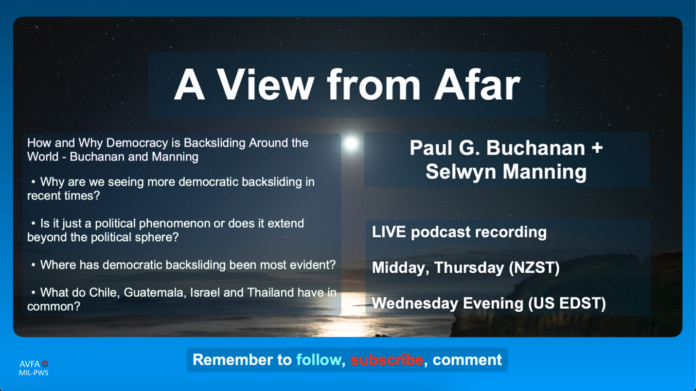
The LIVE Recording of A View from Afar podcast will begin at midday Thurs July 20, 2023 (NZST) and Wednesday July 19, 8pm (USEDST).
In this the seventh episode of A View from Afar podcast for 2023 political scientist Dr Paul Buchanan and Selwyn Manning will examine the strengths and weaknesses of democracy around the world.
In particular Paul and Selwyn will consider how and why democracy in many countries around the world is on the slide.
They will examine the causes of democratic backsliding and also test why the erosion of high democratic ideas have, in many cases, popular support.
First, Paul will give us a context, and will define democratic backsliding. He will identify the countries that are decisively eroding their own democracies of principles that were once embraced by both power elites and citizenry.
The Questions:
Why are we seeing more democratic backsliding in recent times?
Is it just a political phenomenon or does it extend beyond the political sphere?
Where has democratic backsliding been most evident?
What do Chile, Guatemala, Israel and Thailand have in common when it comes to backsliding?
What is occurring in the United States?
If a democracy “backslides,” what does it slide into?
INTERACTION WHILE LIVE:
Paul and Selwyn encourage their live audience to interact while they are live with questions and comments.
RECOGNITION: The MIL Network’s podcast A View from Afar was Nominated as a Top Defence Security Podcast by Threat.Technology – a London-based cyber security news publication. Threat.Technology placed A View from Afar at 9th in its 20 Best Defence Security Podcasts of 2021 category.
You can follow A View from Afar via our affiliate syndicators.
At last week’s NATO summit, the members issued a final statement criticising China’s coercive policies, which they said challenge the interests, security and values of the bloc.
The NATO members did, however, commit to “constructive engagement” with the rapidly rising superpower.
Beijing reacted strongly to the statement nonetheless. It accused the alliance of “smearing and lying” about China and warned against NATO’s outreach efforts in the Asia-Pacific.
Foreign Ministry spokesperson Wang Wenbin said in blunt terms:
NATO must abandon the outdated Cold War mentality and zero-sum mindset, renounce its blind faith in military might and misguided practice of seeking absolute security, halt the dangerous attempt to destabilise Europe and the Asia-Pacific and stop finding pretext for its continuous expansion.
China’s strong reaction reflects its serious concerns over the global challenges it faces. These include:
the growing networks of US-led alliances and security partnerships, such as the Quad and AUKUS, which aim to constrain if not contain China
US and European Union policies of de-risking and diversifying their supply chains to reduce their reliance on China
and more restrictive export control regulations the US has enacted on high-tech transfers or exchanges. These are meant to prevent China from gaining the ability to manufacture semiconductors and slow its progress in quantum computing and artificial intelligence.
Even as it becomes more concerned over these challenges, Beijing is hopeful these US-led networks of alliances and partnerships will remain patchwork given their diversity of interests, priorities and commitments.
China also retains significant advantages given its close economic ties with America’s allies and partners. This will influence whether the US can successfully achieve what Beijing believes is its goal of containing China.
Analysts have questioned whether Beijing is smart and patient enough to be able to apply a wedge strategy to divide the US and its allies, or if its misjudgement and hubris could cause it to become overconfident and even arrogant.
Indeed, Beijing’s wolf-warrior diplomacy and assertive policies in recent years have only served to help the US and its allies grow closer to counter these actions.
Beijing may have learned its lessons. It’s now adopting a more proactive and confident diplomacy to counter US encirclement. I’ve observed at least four tactics when it comes to this shifting foreign policy.
1) China is focusing on the region and leaning into its strengths
Beijing recognises it must focus its diplomatic energies on Asia given its importance to China’s security and economic interests.
It is deepening its economic ties with ASEAN, the 10-nation regional bloc,
while also supporting ASEAN centrality in the region’s security structures. The Southeast Asian group is wary of being drawn into a US-China conflict and forced to choose sides. It is also concerned US-led initiatives such as the Quad could diminish its role in the region.
At the same time, China has been active in promoting the ASEAN-sponsored Regional Comprehensive Economic Partnership. It believes this group offers a more inclusive and cooperative approach to regional economic cooperation. The group includes the ASEAN members, China and several US allies, such as South Korea, Japan and Australia.
Beijing is billing it as an attractive alternative to the US-sponsored Indo-Pacific Economic Framework for Prosperity. This group, which includes 14 countries in the region, last month signed an agreement on making their supply chains more resilient.
Chinese Foreign Minister Wang Yi shakes hands with his Indonesian counterpart, Retno Marsudi, at the ASEAN foreign ministers’ meeting in Jakarta last week. Tatan Syuflana/AP
2) Beijing is boosting its diplomatic efforts with Europe
Since lifting its COVID border restrictions, Beijing has welcomed world leaders, hosted business groups and promoted trade and investment opportunities in China.
Europe, in particular, has been the focus of Beijing’s recent diplomacy. Premier Li Qiang’s first major international trip since taking office was to Germany and France last month, where he emphasised economic opportunities over geopolitical differences, partnership over rivalry.
European leaders such as French President Emmanuel Macron, Spanish Prime Minister Pedro Sánchez and German Chancellor Olaf Scholz have also become regular features in Beijing.
These efforts are allowing China to deepen its economic ties with Europe. In so doing, Beijing is hoping to undermine US efforts to develop a transatlantic approach toward China, including policies of de-risking or de-coupling their economies from China.
3) China is standing with Russia – for now
Beijing is likely annoyed, if not dismayed, by the fiasco Russia’s war in Ukraine has become. However, it is determined now is not the time to desert Russian President Vladimir Putin.
From energy supplies to military technology cooperation, Russia remains a vital strategic partner for China. The last thing China wants is a decimated Russia, leaving it to face the US and its networks of alliances and security groups alone. China also would not want to deal with any potential threats from Russia, given their long shared border.
Beijing has carefully, if not convincingly, presented itself as a neutral bystander in the conflict, interested in bringing it to an end. China is also taking advantage of Russia’s precarious position by expanding and consolidating its influence in Central Asia, while remaining respectful of Russia’s traditional ties to the region.
Russian President Vladimir Putin (left) speaks to Chinese President Xi Jinping during the Shanghai Cooperation Organisation summit in Uzbekistan in 2022. Sergei Bobylev/Pool Sputnik Kremlin/AP
4) China is promoting itself as a global leader
Finally, China has become more confident and active in promoting its models of global governance in security, development and community building.
Some efforts are still in the development stages, such as its Global Security Initiative, while others are more concrete. For example, Beijing sees itself as a global mediator after its success in brokering a truce between Saudi Arabia and Iran in March.
Beijing is also continuing to promote its preferred multilateral institutions, from the Shanghai Cooperation Organisation to the BRICS group, which currently includes China, Brazil, Russia, South Africa and India. Beijing has welcomed expanding the group.
Together with its ambitious and controversial Belt and Road Initiative, Beijing believes it can offer an alternative to the US-led groupings, such as the Quad. By relying on institutions in this way, Beijing can promote its interests globally while avoiding direct confrontation with the US.
Jingdong Yuan does not work for, consult, own shares in or receive funding from any company or organisation that would benefit from this article, and has disclosed no relevant affiliations beyond their academic appointment.
Source: The Conversation (Au and NZ) – By Steve Macfarlane, Head of Clinical Services, Dementia Support Australia, & Associate Professor of Psychiatry, Monash University
Trial results of a new drug to treat Alzheimer’s disease, donanemab, shows it can slow cognitive decline by 35%. The drug has been hailed as a “turning point” in Alzheimer’s treatment.
But as usual, there’s more to the story. The study only included people with early or mild disease, not more advanced symptoms. Donanemab is not a cure for Alzheimer’s. Nor is it 100% safe.
So what did the trial actually find? And how might this drug affect the lives of people with Alzheimer’s disease?
There are more than 100 types of dementia, but Alzheimer’s disease is the most common, accounting for around 70% of cases.
The disease is caused by the accumulation of two proteins: amyloid and tau. Amyloid can accumulate for at least 20 years prior to the onset of symptoms, forming clumps in the brain.
Once symptoms have started and are progressing, tau, a marker of cell damage, also begins to accumulate.
Clinical symptoms progress, on average, over seven to ten years after diagnosis. But in Australia, there is a lag of up to three years from the point at which people first develop symptoms before a diagnosis is typically made.
What have drug treatments aimed to do?
The “amyloid hypothesis”, which suggests amyloid is the key cause of the disease, has driven Alzheimer’s research for more than 25 years.
Multiple drugs targeting amyloid have, however, failed in clinical trials over most of that period, casting doubt on the validity of amyloid as a target – until recently.
Our bodies produce antibodies in response to the presence of a foreign invader such as a bacteria or virus. Mimicking the approach taken by our immune systems, scientists have developed antibodies in the lab that recognise amyloid as such an invader.
Specifically targeting amyloid, these drugs are known as monoclonal antibodies. Donanemab is one of three monoclonal antibodies targeting amyloid that have shown various degrees of success in clinical trials in slowing decline in people with early stage disease.
OK so what did the donanemab trial find?
The manufacturer’s clinical trial included 1,736 patients with very mild memory loss due to Alzheimer’s disease, and with early clinical Alzheimer’s disease.
Half received donanemab by intravenous infusion over an 18-month study, the remainder were treated with a placebo (a “dummy” version).
The results were analysed by dividing the study population into two further groups: those with low to intermediate levels of tau; and those with high tau levels (high tau correlates with the presence of more advanced brain cell damage).
Those with low and intermediate tau declined by 35% less than those treated with placebo. About half of the treatment group cleared amyloid from their brains below the threshold used to diagnose the disease, over 12 months of treatment.
The high tau group did far less well.
People may be delaying diagnosis because they think nothing can be done. Shutterstock
Participants aged under 75 and those showing only mild cognitive impairment (rather than the full clinical picture of Alzheimer’s disease) had their progression slowed by around 50% over the same period.
Patients were assessed using both cognitive measures and measures of daily function, such as the ability to do personal and household tasks. The results translated into the treatment group showing levels of decline at 18 months that were experienced by the placebo group at 10.5 to 13.6 months, depending on the participant subgroup studied.
Important examples may be that they continue to be able to drive, pay bills, or attend activities outside of the home independently.
But both the treatment and the placebo groups declined overall. In other words, it doesn’t stop the decline, it slows it, in people with mild or early disease.
At least two patients in the trial died from complications of brain swelling caused by donanemab. Around one-quarter of the treatment group showed some degree of swelling, most of which didn’t cause symptoms.
Two patients in the study died from complications from brain swelling. Shutterstock
The cost of donanemab will be significant, at US$26,500 or around A$39,000 per year.
Donanemab has already been approved by the US Food and Drug Administration.
Eli Lilly, the drug’s manufacturer, has applied to the Therapeutic Goods Administration (TGA) for approval for use in Australia.
But TGA approval is only the first step to making the drug available here. A further assessment will determine whether the Pharmaceutical Benefits Scheme subsidises the drug to make it affordable.
It’s likely any PBS listing would restrict the drug’s use to people whose disease state mirrors that of those included in the clinical trial population – people with early symptoms, who have had PET scans showing the presence of amyloid (and low and intermediate tau).
This is not a drug for everyone with Alzheimer’s disease.
Preparing for early detection and treatment
People have tended to delay seeking assessment of their memory symptoms because “nothing can be done anyway”. GPs may have been reluctant to refer to other specialists for assessment for the same reason.
The potential for early treatment means this needs to change. We also need to develop our diagnostic and treatment infrastructure (building the necessary PET scanners and infusion centres) that will be necessary to facilitate timely diagnosis and treatment when the drug does become available locally.
Steve Macfarlane has been paid to attend a number of Australian medical advisory board meetings for Eli Lilly, the manufacturer of donanemab, most recently last year. He receives funding from a number of drug companies for conducting pharmaceutical trials. He is affiliated with the RANZCP.
Mainstream conversations about artificial intelligence (AI) have been dominated by a few key concerns, such as whether superintelligent AI will wipe us out, or whether AI will steal our jobs. But we’ve paid less attention the various other environmental and social impacts of our “consumption” of AI, which are arguably just as important.
Everything we consume has associated “externalities” – the indirect impacts of our consumption. For instance, industrial pollution is a well-known externality that has a negative impact on people and the environment.
The online services we use daily also have externalities, but there seems to be a much lower level of public awareness of these. Given the massive uptake in the use of AI, these factors mustn’t be overlooked.
Environmental impacts of AI use
In 2019, French think tank The Shift Project estimated that the use of digital technologies produces more carbon emissions than the aviation industry. And although AI is currently estimated to contribute less than 1% of total carbon emissions, the AI market size is predicted to grow ninefold by 2030.
Tools such as ChatGPT are built on advanced computational systems called large language models (LLMs). Although we access these models online, they are run and trained in physical data centres around the world that consume significant resources.
Last year, AI company Hugging Face published an estimate of the carbon footprint of its own LLM called BLOOM (a model of similar complexity to OpenAI’s GPT-3).
Accounting for the impact of raw material extraction, manufacturing, training, deployment and end-of-life disposal, the model’s development and usage resulted in the equivalent of 60 flights from New York to London.
Hugging Face also estimated GPT-3’s life cycle would result in ten times greater emissions, since the data centres powering it run on a more carbon-intensive grid. This is without considering the raw material, manufacturing and disposal impacts associated with GTP-3.
Beyond this, running AI models requires large amounts of water. Data centres use water towers to cool the on-site servers where AI models are trained and deployed. Google recently came under fire for plans to build a new data centre in drought-stricken Uruguay that would use 7.6 million litres of water each day to cool its servers, according to the nation’s Ministry of Environment (although the Minister for Industry has contested the figures). Water is also needed to generate electricity used to run data centres.
In a preprint published this year, Pengfei Li and colleagues presented a methodology for gauging the water footprint of AI models. They did this in response to a lack of transparency in how companies evaluate the water footprint associated with using and training AI.
They estimate training GPT-3 required somewhere between 210,000 and 700,000 litres of water (the equivalent of that used to produce between 300 and 1,000 cars). For a conversation with 20 to 50 questions, ChatGPT was estimated to “drink” the equivalent of a 500 millilitre bottle of water.
Social impacts of AI use
LLMs often need extensive human input during the training phase. This is typically outsourced to independent contractors who face precarious work conditions in low-income countries, leading to “digital sweatshop” criticisms.
In January, Time reported on how Kenyan workers contracted to label text data for ChatGPT’s “toxicity” detection were paid less than US$2 per hour while being exposed to explicit and traumatic content.
LLMs can also be used to generate fake news and propaganda. Left unchecked, AI has the potential to be used to manipulate public opinion, and by extension could undermine democratic processes. In a recent experiment, researchers at Stanford University found AI-generated messages were consistently persuasive to human readers on topical issues such as carbon taxes and banning assault weapons.
Not everyone will be able to adapt to the AI boom. The large-scale adoption of AI has the potential to worsen global wealth inequality. It will not only cause significant disruptions to the job market – but could particularly marginalise workers from certain backgrounds and in specific industries.
Are there solutions?
The way AI impacts us over time will depend on myriad factors. Future generative AI models could be designed to use significantly less energy, but it’s hard to say whether they will be.
When it comes to data centres, the location of the centres, the type of power generation they use, and the time of day they are used can significantly impact their overall energy and water consumption. Optimising these computing resources could result in significant reductions. Companies including Google, Hugging Face and Microsoft have championed the role their AI and cloud services can play in managing resource usage to achieve efficiency gains.
Also, as direct or indirect consumers of AI services, it’s important we’re all aware that every chatbot query and image generation results in water and energy use, and could have implications for human labour.
AI’s growing popularity might eventually trigger the development of sustainability standards and certifications. These would help users understand and compare the impacts of specific AI services, allowing them to choose those which have been certified. This would be similar to the Climate Neutral Data Centre Pact, wherein European data centre operators have agreed to make data centres climate neutral by 2030.
Governments will also play a part. The European Parliament has approved draft legislation to mitigate the risks of AI usage. And earlier this year, the US senate heard testimonies from a range of experts on how AI might be effectively regulated and its harms minimised. China has also published rules on the use of generative AI, requiring security assessments for products offering services to the public.
Ascelin Gordon is employed by RMIT University. He receives funding support from the Australian Research Council, the NSW Department of Planning and Environment, and the NSW Biodiversity Conservation Trust.
Afshin Jafari is employed by RMIT University.
Carl Higgs is employed at RMIT University and receives funding support from National Health and Medical Research Council grants.
From today readers of rnz.co.nz will see a change to the home page, and a new initiative to tell the stories of Aotearoa New Zealand’s Asian community.
RNZ.co.nz has added a lineup of four sections which focus on the growing communities of Aotearoa and are placed right at the top of the home page.
Elevated links have been added to RNZ’s existing Te Ao Māori and Pacific sections.
RNZ has also launched two new sections for Chinese and Indian New Zealanders and added them at the top of the home page as well.
The sections are part of a new initiative to speak to and report on issues in the growing Asian communities of New Zealand.
The new Indian section features original stories in English by specialist reporters.
The Chinese section has stories in the simplified Chinese script. Original stories are there as well as translations of RNZ news stories of interest to the Chinese community.
NZ On Air survey RNZ is starting with the simplified script and will then scope whether it is feasible and useful to translate using the traditional script as well.
The different approaches are a response to a NZ On Air survey which found the Indian and Chinese communities had different language needs and approaches to seeking out news.
This is one of RNZ’s first steps into daily translated news. Before the launch, RNZ put systems in place to make sure it is getting translations right. The stories are double, and triple checked.
RNZ is also asking for feedback to make sure it is getting it right on each story and will conduct regular independent audits to make sure our translations are on track. RNZ is keen for feedback.
The new Indian and Chinese sections are a result of a two-year collaboration with NZ On Air. The unit of reporters and translators is being funded for the first year through the Public Interest Journalism Fund; the second year will be funded by RNZ, with a right of renewal after that.
Stories from the Asian unit will also be made available to more than 40 media organisations across the country and the Pacific.
RNZ believes that it is vital that RNZ supplies news to many different communities within Aotearoa New Zealand.
The Asian population in New Zealand is growing fast, particularly in Auckland.
In 2018, Asian New Zealanders made up 15 percent of the New Zealand population. The two largest groups are the Chinese and Indian New Zealanders, with about 250,000 people each.
This article is republished under a community partnership agreement with RNZ.
In an implicit admission that the Commonwealth budget may not measure what really matters, Treasurer Jim Chalmers is about to release what he is calling “Measuring What Matters” – Australia’s first national wellbeing framework.
The statement was to have been released as part of this year’s May budget, and an earlier hurriedly-prepared attempt was included in Chalmers’ 2022 budget.
Chalmers’ description of it as Australia’s “first” national wellbeing framework is an acknowledgement that first wellbeing statement didn’t amount to a framework. Chalmers says he is “up for the necessary conversations” needed to improve the framework further.
The one he is about to release has benefited from more than 280 submissions and the time needed to distil everything that matters for wellbeing into five broad themes, made up of about 50 indicators the treasury will track through time.
Chalmers says the themes are the extent to which Australia is
healthy
secure
sustainable
cohesive
prosperous.
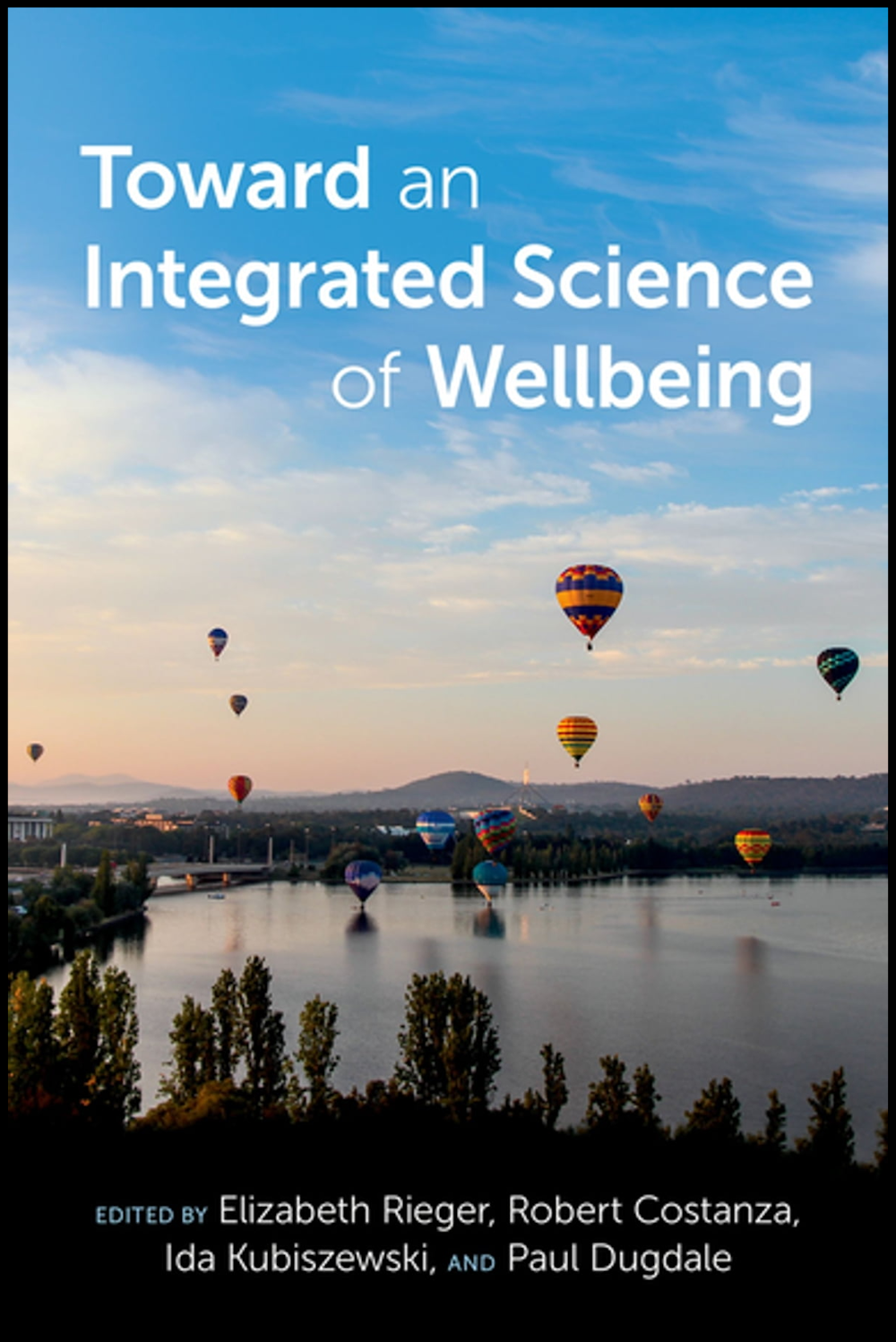
In what turned out to be a parallel process, we have been developing what we call an “integrated science of wellbeing” and have just published a book with 21 contributions on the subject through Oxford University Press.
One of us has a background in psychology, one in medicine, and two in social sciences, ecology, and economics.
Among the 45 authors who have contributed chapters are specialists in a range of topics, including ageing, architecture, biodiversity, compassion, governance, Indigenous studies, population, psychology, sustainability, and trauma.
Everything is connected
All of the authors were asked to relate their work to other aspects of wellbeing, so that each chapter considered interconnections.
Behind this was an understanding that things depend on each other – meaning that giving a score to one element of wellbeing, without examining how it impacts on other elements of wellbeing, can give us the wrong idea about how to make things better.
As an example, anger is generally regarded as deleterious to wellbeing and worth minimising. But if minimising anger meant less action on climate change, minimising it might make us worse off.
And some of the things that are incredibly important for wellbeing are hard to measure, including what happens within relationships or access to sunlight.
Related to these are the design of cities and their integration with hospital and health services. These matter for the quality of dying, as well as living.
Lying behind much of what matters is inequality – which can be worsened by a misplaced focus on GDP growth at all costs – and the natural environment, most of which is missing from standard measures of GDP.
Global work on wellbeing
At the government level, wellbeing is being espoused by the Wellbeing Economy Governments (which so far includes Scotland, New Zealand, Iceland, Wales, Finland, and Canada).
It’s also being coordinated across the hundreds of groups working on this issue by the Wellbeing Economy Alliance, funded by philanthropic foundations.
While their objectives are still being refined, they (and Chalmers’ objectives) don’t differ much from the five goals identified more than 30 years ago by pioneers in the field of ecological economics:
to stay within planetary biophysical boundaries
to meet all fundamental human needs
to create and maintain a fair distribution of resources, income, and wealth
to bring about an efficient allocation of resources that allows human development and flourishing
to create governance systems that are transparent, fair, responsive, just and accountable.
We are about to find out how well Chalmers and his department have integrated these objectives, and how well they think Australia is doing.
The authors do not work for, consult, own shares in or receive funding from any company or organization that would benefit from this article, and have disclosed no relevant affiliations beyond their academic appointment.
Source: The Conversation (Au and NZ) – By Anna Hickey-Moody, Professor of Intersectional Humanities, Maynooth, National University of Ireland, RMIT University
ABC
Anika Van Cleef (Marta Dusseldorp) is a high-powered “Toorak Mum”. She is CEO of an investment company she took over from her controlling father and now runs with her new partner, Johann (Nikolai Nikolaeff).
But Anika is betrayed by Johann and becomes the target of an attempted murder. She soon discovers Johann has hired professional thugs to murder her and her children, Otis (Imi Mbedla) and Iris (Ava Caryofyllis).
A mysterious police detective, Airini (Rachel House), appears in a convenience shop. To escape the threat, Anika and her children must make the forced (and reluctant) relocation to a remote Tasmanian town.
They find themselves in Mystery Bay, humorously characterised by a Canberra politician as a place that “nobody’s ever heard of, boasts no features, and no outsider wants to visit”.
Bay of Fires, the new drama from the ABC, is arresting, dry and fast-paced. It brings new insights to national understandings of city-country divides and explores small town isolation as a means of social control.
But perhaps most interestingly is the way it advances the genre of Australian Gothic in humorous and unexpected ways.
An Australian Gothic
Mystery Bay is a quiet and insular community, nicknamed Misery Bay by the locals.
The locals observe the strangers’ arrival with forensic attention. They are variously suspicious, hostile and strange. As we get to know the townsfolk, they open the door into a Gothic world of mystery and the supernatural.
The rural Tasmanian landscape has a dark power, but the haunting vistas pale in comparison to the layers of criminal activity and depraved lives eking out an existence in entangled community relations.
Australian Gothic began in the late 19th and early 20th centuries, combining elements of traditional European Gothic literature – characterised by horror, mystery and the supernatural – mixed with the unique Australian landscape, history and cultural identity.
The locals are variously suspicious, hostile and strange. ABC
The harsh and unforgiving Australian environment provided a fertile ground for the development of a distinctive Gothic tradition.
Vast and desolate landscapes, rugged coastlines and extreme weather conditions replaced European cathedrals and graveyards. Settlers faced isolation, death and the brutal realities of the convict system. They encountered other worlds through Indigenous Australian communities.
These experiences became a central theme in Australian Gothic literature and the sub-genre Tasmanian Gothic.
There are remarkable resonances between Bay of Fires and early examples of Australian Gothic, such as Marcus Clarke’s novel For the Term of His Natural Life (1874), which portrays the horrors of the penal colony system and the brutal treatment of convicts.
The Australian environment provided a fertile ground for a distinctive Gothic tradition. ABC
As with Clarke’s novel, Bay of Fires is set against the backdrop of the harsh Tasmanian wilderness. Both explore themes of oppression and isolation. The first moments of Anika and her children’s arrival in Tasmania clearly mark the landscape as dangerous. They hit a large kangaroo on the road to Mystery Bay and their BMW is completely written off.
Machines are no match for the wild animals of Tasmania.
The genre isn’t without levity. Joseph Furphy’s Such Is Life (1903) is a darkly humorous and ironic portrayal of rural life. Mystery Bay continues this in a dry satire of country town life. The shops won’t open for the newcomers. People are highly suspicious of them, and basic life tasks are made almost impossible by the hostile nature of local culture.
The Gothic tradition is extended in Australian literature in the works of contemporary authors such as Peter Carey, Kate Grenville and Tim Winton, and in film (Picnic at Hanging Rock, The Babadook), visual arts (Arthur Boyd, Fred Williams) and music (Nick Cave, The Church).
Bay of Fires is a continuation of this significant Australian genre.
It draws on the conventions of traditional Gothic literature in its reflections of the harsh realities and haunting beauty of the Australian environment and the mysterious – indeed treacherous – characters of the cold townspeople.
However, there is a tongue-in-cheek humour and astute commentary of social class that offers a new dimension to this established settler colonial Australian tradition. Otis (Imi Mbedla) is particularly amusing, offering ongoing critical commentary on race, class and gender.
The series captures dark and mysterious aspects of the nation’s past and present. ABC
This insightful humour is a new angle on Tasmanian Gothic’s combination of horror, mystery and the grotesque. When asked by his sister why all the townsfolk are staring at them, Otis replies: “Because she’s a Toorak wanker and we are private school dickheads”.
This wry commentary breaks up the traditional dark and atmospheric tone of Tasmanian Gothic which, when it employs humour, is usually elements of gallows humour, black comedy or irony. Bay of Fires has a much stronger emphasis on humour and a comedy that is almost slapstick.
The series captures dark and mysterious aspects of the nation’s past and present which shape our national imagination and the Australian Gothic genre, all with a larrikin wit.
New Zealand Parliament Buildings, Wellington, New Zealand.
New Zealand Politics Daily is a collation of the most prominent issues being discussed in New Zealand. It is edited by Dr Bryce Edwards of The Democracy Project.
Not so long ago, if a child was home sick from school, the main screen-based entertainment was daytime television. The options were limited to The Price is Right or reruns of Home and Away.
Fast forward to the present day and we have multiple streaming services, tablets, smartphones, and an endless reservoir of content made specifically to captivate children’s attention. Managing a child’s screen time when they’re home sick from school has taken on a whole new dimension.
For many parents, the challenge of juggling work and caring for a sick child at home inevitably leads to more TV or iPad. The digital world offers a convenient solution to keep children occupied and, to an extent, comforted.
But should being unwell automatically equate to increased or even unlimited screen time?
Illness should not automatically equal unlimited screens
We are child development researchers specialising in child-technology interaction and have spent a lot of time thinking about this question. The answer depends on several factors and understanding these elements can help parents manage their child’s screen time effectively and healthily.
The comfort and distraction derived from favourite digital activities – whether it be episodes of Bluey, video games, YouTube videos, or even chatting to friends on social media – might alleviate the discomfort of being unwell. Screen use has been linked to reducing children’s anxiety and pain levels during painful procedures in the hospital.
Still, we should also try to avoid a pattern where every minor illness is seen as a gateway to endless screen time. Over time, this could lead to a situation where children might exaggerate or even feign symptoms of illness to gain extra screen time.
This may also inadvertently teach children that digital consumption is the go-to method for coping with illness-related discomfort or boredom, which could limit their ability to develop healthier coping skills. Recent research also suggests using technology to calm young children too frequently might be linked to higher levels of emotional dysregulation (such as angry outbursts).
But a child’s age should also be considered. The Australian screen time guidelines for young children and toddlers are less than those for older children.
This means more guidance and support is needed to manage younger children’s use of screens.
But older children also need to have boundaries. Recent research suggests screen use triggers the release of dopamine – which makes you seek out or want to keep doing something – which helps explain why it can be so hard to disengage. There are also continued concerns about the mental health impacts of young people’s social media use.
For many parents, juggling work and a sick child inevitably leads to screens. Tima Miroshnichenko/ Pexels
But illnesses like mild colds or conjunctivitis may not require as much additional rest, although a reasonable amount of downtime is generally beneficial.
In both scenarios, it’s important to monitor screen time, especially before bedtime. The stimulating effects of screen light can disrupt a child’s sleep, hindering the rest and recovery process.
What are the pre-existing rules in your house?
If your house already has screen time rules for non-school days (such as extra time on weekends or holidays), these can be applied or slightly relaxed when a child is home sick.
Having a baseline – even if it is more generous – makes some screen time limits during a sick day an expected norm. Maintaining these rules can help prevent a free-for-all scenario, which could complicate matters once the child recovers and needs to readjust to their regular schedule.
On the other hand, if there are no pre-existing rules for non-school days, introducing snap strict screen time regulations when a child is unwell may not be the best approach. Doing so could add an additional layer of stress for the child, who is already not feeling sick.
Instead, during these short-term illness periods, parents may choose to be more lenient with screen time, focusing on helping their child recover. Consider sitting down with your child and creating a list of other activities or possibilities that centre on rest and recuperation. Reading, playing with their pet, puzzles, art can all features on these lists.
Also, be sure to monitor what children are doing on their screens. Consider supporting decisions that help them rest and then switch off after an agreed period. For example, it might be easier to relax while watching a favourite movie rather than continuously watching new YouTube videos that change every five minutes.
It’s also of course essential to distinguish between entertainment screen use and schoolwork that must be completed on a computer or tablet.
Lastly, in full disclosure, one of the authors was sick with a stomach virus while working on this piece. So they also watched a lot of comfort television and scrolled through Twitter. We shouldn’t expect children to be better patients than adults.
Jordy Kaufman has received funding from the Australian Department of Education and Training to research children’s use of technology for education.
Jennifer M. Zosh is consulting for Sesame Workshop and has consulted with the Lego Foundation and the Lego Group.
She has even gone viral as a fashion trend known as Barbiecore, exploding across social media with people embracing vibrant pink hues and hyper feminine aesthetics. A Barbie world is upon us.
Although some have criticised this saturation strategy, it is a very deliberate marketing ploy to revitalise and redefine a brand with a contested position and history.
As well as attracting adults who grew up with Barbie and are curious to see what’s changed, the reinvention is drawing in those younger fans swept up by the tsunami of marketing and merchandise.
Despite being one of the most trusted brands with a value of approximately $US700 million, Barbie has long attracted feminist criticism for fuelling outdated and problematic “plastic fantastic” sexist stereotypes and expectations.
The Barbie backlash
Only a few years back, Barbie was a brand in crisis. Sales plummeted across 2011 to 2015 against the cultural backdrop of a rise in body positivity and backlash against a doll that represented narrow ideals and an impossible beauty standard.
After all, at life-size Barbie represents a body shape held by less than 1 in 100,000 real people. In fact, she is so anatomically impossible that, if she were real, she would be unable to lift her head, store a full liver or intestines, or menstruate.
The backlash has also been in response to growing concerns about how she influences child development, particularly how and what children learn about gender. Barbie has been identified as a risk factor for thin-ideal internalisation and body dissatisfaction for young girls, encouraging motivation for a thinner shape that damages body image and self esteem.
And despite the multiple careers Barbie has held over the decades, research highlights that girls who play with Barbie believe they have fewer career options than boys. This speaks to the power of toys to reinforce gender stereotypes, roles and expectations, and how Barbie has imported narrow ideals of femininity, girlhood and womanhood into young girls’ lives.
Reinventing a long-established icon
In response to this backlash, Mattel launched a new range of Barbies in 2016 that were promoted as diverse, representing different body shapes, sizes, hair types and skin tones. This was not without criticism, with “curvy” Barbie still considered thin and dolls named in ways that drew attention foremost to their bodies.
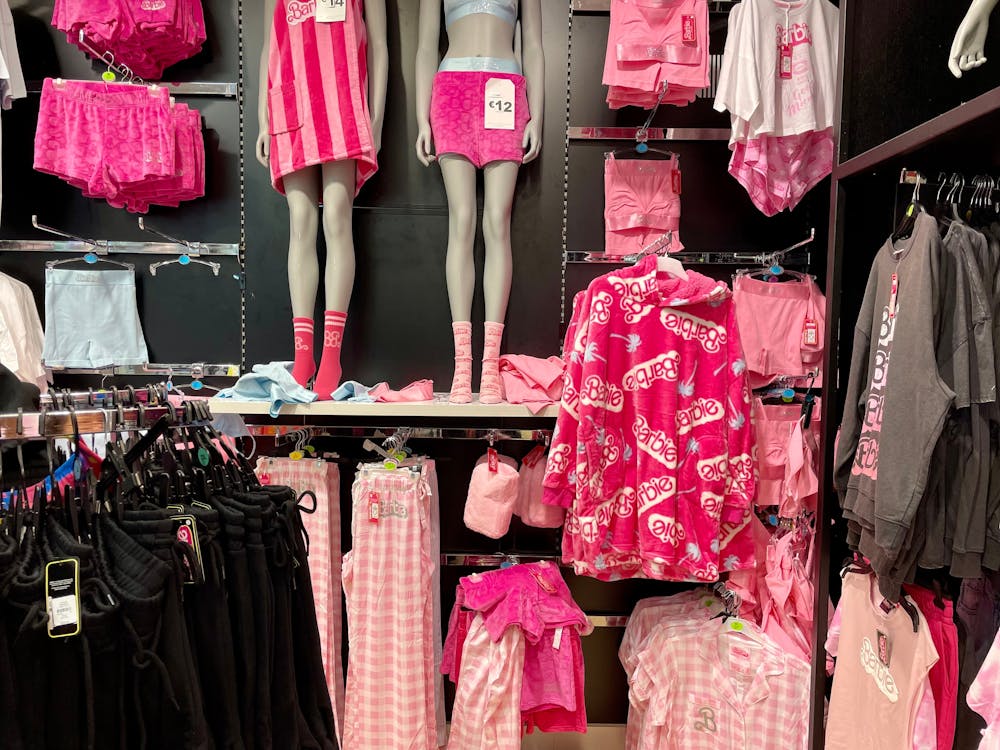
Barbie merchandise on sale at a clothing store in Ireland. Shutterstock
From a white, well-dressed, middle-class, girl-next-door with friends of a similar ilk, Barbie has since been marketed as a symbol of diversity and inclusion. To signify the extent of the transformation, Mattel’s executives gave this project the code name “Project Dawn”.
Mattel – like many other brands joining the “inclusivity revolution” – knew that diversity sells, and they needed to make their brand relevant for contemporary consumers.
Diversity initiatives included a line of female role model dolls, promoted as “introducing girls to remarkable women’s stories to show them you can be anything”.
Barbie was also given a voice in the form of Barbie Vlogs, where she expressed her views on issues including depression and the sorry reflex. A gender neutral collection called “creatable world” was added in 2019 to open up gender expression possibilities when playing with Barbies.
Such efforts were crucial to undoing missteps of the past, such as a “Teen Talk Barbie” that was programmed to say “Math class is tough!”, or the compulsory heterosexuality that Barbie has long advanced.
The latest step in Barbie’s transformation
Barbie the film is simply the next step in an evolution to make brand Barbie inclusive. And with a rumoured film budget of $100 million, the supporting marketing machine provides a critical opportunity to reset the Barbie narrative.
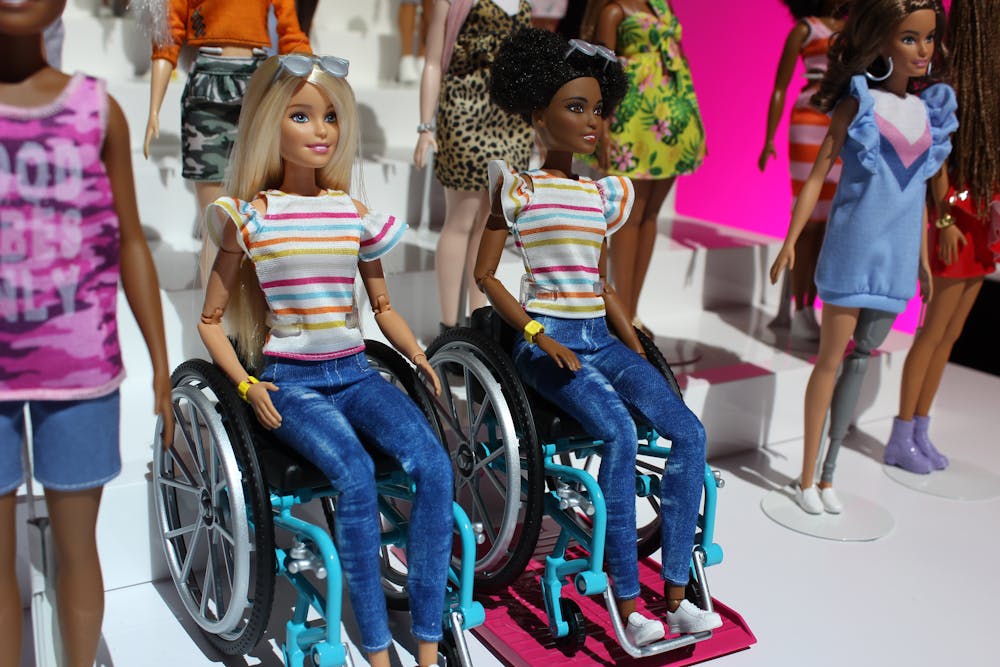
Part of the range of Barbies introduced in 2016 to promote diversity and inclusion. Shutterstock
With Greta Gerwig, acclaimed director of female-led stories such as Little Women and Lady Bird at the helm, and a diverse cast of Barbies of different races, body types, gender identities and sexual preferences, the film and its creators have sought to assure audiences of the film’s feminist leanings.
Addressing the complicated history of Barbie is crucial for audiences who grew up and played with the doll and are grappling with introducing her to the next generation of doll consumers.
Yet, Robbie Brenner, executive producer of Mattel Films, has explicitly stated that Gerwig’s Barbie is “not a feminist movie”. Indeed, the main character still represents a narrow beauty standard – tall, thin, blonde, white – with diverse characters in place to support her narrative.
Which begs the question: are these inclusion initiatives simply emblematic of diversity washing, where the language and symbolism of social justice are hijacked for corporate profit? Or do they represent a genuine effort to redress the chequered history of a brand that promotes poor body image, unrealistic ideals and rampant materialism?
What is clear is that in today’s climate where brands are increasingly rewarded for taking a stand on sociopolitical issues, brand Barbie’s attempts to reposition as inclusive have paid off: sales are now booming.
Seemingly, Barbie’s famous tagline that “anything is possible” has shown itself to be true.
Lauren Gurrieri does not work for, consult, own shares in or receive funding from any company or organisation that would benefit from this article, and has disclosed no relevant affiliations beyond their academic appointment.
Robert Oppenheimer is often placed next to Albert Einstein as the 20th century’s most famous physicist.
He will forever be the “father of the atomic bomb” after the first nuclear weapon was successfully tested on July 16, 1945 in the New Mexican desert. The event brought to his mind words from a Hindu scripture: “Now I am become Death, the destroyer of worlds”.
Robert Oppenheimer speaks those famous words.
Who was Robert Oppenheimer?
Born in 1904 in an affluent New York family, Oppenheimer graduated from Harvard majoring in chemistry in 1925.
Two years later, he completed his PhD in physics at one of the world’s leading institutions for theoretical physics, the University of Göttingen, Germany. He was 23 and enthusiastic to the point of alienating others.
Robert Oppenheimer, 1944. Wikipedia
Throughout his life, Oppenheimer would be judged either as an aloof prodigy or an anxious narcissist. Whatever his contradictions as an individual, his eccentricities did not limit his scientific achievements.
Before the outbreak of the second world war, Oppenheimer worked at the University of California, Berkeley, and the California Institute of Technology. His research concentrated on theoretical astronomy, nuclear physics and quantum field theory.
Although he confessed to being uninterested in politics, Oppenheimer openly supported socially progressive ideas. He was concerned with the emergence of antisemitism and fascism. His partner, Kitty Puening, was a left-leaning radical and their social circle included Communist Party members and activists. Later, these associations will mark him as a communist sympathiser.
As a researcher, Oppenheimer published and supervised a new generation of doctoral students. One of these was Willis Lamb, who in 1955 was awarded the Nobel Prize in physics. The Nobel Prize eluded Oppenheimer three times.
Albert Einstein and Robert Oppenheimer, c. 1950. Wikipedia
The second world war
Two years after Germany and Soviet Russia attacked Poland, the United States entered WWII. Oppenheimer was recruited to work on the infamous Manhattan Project. His ideas about chain reaction in an atomic bomb gained recognition among the US defence community. He started his work by assembling a team of experts. Some of them were his students.
Los Alamos Laboratory expanded rapidly as the project grew in complexity, with the personnel exceeding 6,000. His ability to master the large-scale workforce and channel their energy towards the needs of the project earned him respect.
He proved to be more than just an administrator by being involved in the interdisciplinary team across theoretical and experimental stages of the weapons development.
The first atomic bomb was successfully detonated at 5:29 am in the Jornada del Muerto desert. As his chief assistant, Thomas Farrell, recounted:
There came this tremendous burst of light followed shortly thereafter by the deep growling roar of the explosion.
Oppenheimer later recalled that “a few people laughed, a few people cried, most people were silent”. What he knew for sure was that the world would not be the same.
It was too late for the atomic bombs to be used against Germany in the war – the Nazis had capitulated on May 8. Instead, US President Harry Truman decided to use the bomb against Germany’s ally, Japan.
Shortly after the atomic bombs were dropped on the Japanese cities of Hiroshima and Nagasaki in August 1945, Oppenheimer confronted the US secretary of war, Henry Stimson, demanding that nuclear weapons were banned.
Similarly, when speaking with Truman, Oppenheimer talked about his feeling of having blood on his hands. Truman rejected Oppenheimer’s emotional outburst. The responsibility for the use of the atomic bombs, after all, rested with the commander in chief (himself).
Truman’s rebuttal did not prevent Oppenheimer from advocating for the establishment of controls on the nuclear arms race.
J Robert Oppenheimer and his signature cigarette. Wikipedia
Arms control
In the postwar years, Oppenheimer settled in Princeton, New Jersey, at the Institute for Advanced Study. He read widely. He collected art and furniture. He learned languages. His well-paid position enabled his pursuit of a deeper understanding of humanity though the examination of ancient scriptures. He argued for the unity of purpose between the sciences and humanities.
The Soviet Union’s first atomic bomb test in August 1949 took the US by surprise and pushed American researchers to develop a hydrogen bomb. The US government hardened its position. In 1952, Truman refused to reappoint Oppenheimer as the adviser to the Atomic Energy Commission.
After 1952, Oppenheimer’s advocacy against the first test of the hydrogen bomb resulted in the suspension of his security clearance. The investigation that followed in 1954 exposed Oppenheimer’s past communist ties and culminated in his security clearance being revoked.
McCarthyism and academic freedom
In the era of Joseph McCarthy’s witch-hunts, his fellow scientists considered Oppenheimer as a martyr of the cause of academic freedom. “In England”, commented Wernher von Braun, a former Nazi turned American pioneer of rocket technology, “Oppenheimer would have been knighted”.
After 1954, Oppenheimer did not cease to advocate for freedom in the pursuit of knowledge. He toured internationally with talks about the role of academic freedom unrestrained by political considerations. He argued that the sciences and the humanities are not separate human endeavours but interlocked and inseparable.
Oppenheimer died at the age of 62 on February 18, 1967.
Darius von Guttner Sporzynski have previously received funding from the Australian Research Council.
These days it’s necessary to have at least a basic level of English proficiency in most research contexts. But at the same time, our collective emphasis on English places a significant burden on scientists who speak a different first language.
In research published today in PLOS Biology, my colleagues and I reveal the enormity of the language barrier faced by scientists who are non-native English speakers.
English has become essential in academic life
Scientists need to know English to extract knowledge from others’ work, publish their findings, attend international conferences, and collaborate with their peers from around the world.
There’s no doubt this poses a significant challenge for non-native English speakers, who make up more than 90% of the global population.
Yet there is a shocking lack of insight into how much extra effort non-native English speakers must invest in order to survive and thrive in their fields.
Making these hurdles visible is the first step towards achieving fair participation for scientists whose first language isn’t English.
We launched the translatE project in 2019 with the aim of understanding the consequences of language barriers in science.
We surveyed 908 environmental scientists from eight countries – both native and non-native English speakers – and compared the amount of effort the individuals required to complete different scientific milestones.
Big hurdles to jump
Imagine you’re a non-native English-speaking PhD student. Based on our findings, there are several major hurdles you’ll need to overcome.
The first hurdle is reading papers: a prerequisite for scientists.
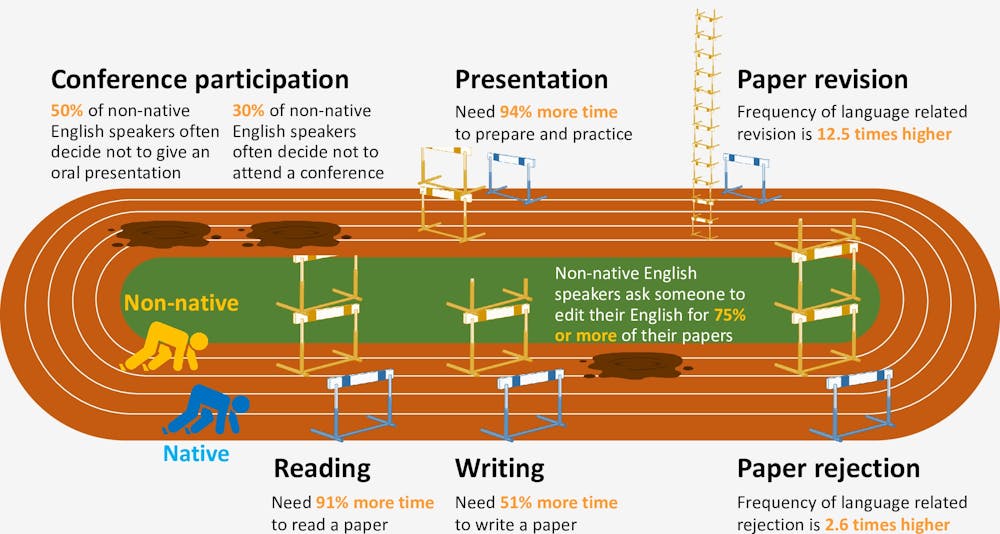
Compared to a fellow PhD student who happens to be a native English speaker, you’ll need 91% more time to read a paper in English. This equates to an additional three weeks per year for reading the same number of papers.
The next big hurdle comes when trying to publish your own paper in English.
First, you’ll need 51% more time to write the paper. Then you’ll likely need someone to proofread your text, such as a professional editor.
That is if you can afford them. In Colombia, for instance, the cost of these services can be up to half the average monthly salary of a PhD student.
The bad news doesn’t end there. On average, your papers will still be rejected 2.6 times more often by journals. If a paper isn’t rejected, you’ll be asked to revise it 12.5 times more often than your native English-speaking counterparts.
Attending international conferences is key to developing your research network. But you might hesitate to register because you “feel uncomfortable and embarrassed speaking in English”, as one of our participants told us.
If you do decide to go and give a presentation, you’ll need 94% more time to prepare for it, compared to a native-English speaker.
And to stay in academia, you’ll need to overcome all of these hurdles again and again.
Non-native English speakers (yellow) who published an English-language paper had to overcome much greater hurdles than their native English-speaking counterparts. Amano et al (2023) / PLOS Biology, Author provided
Language barriers have a widespread impact
These hurdles lead to considerable disadvantages for non-native English speakers. Our study participants expressed feeling “great stress and anxiety”. They felt “incompetent and insecure”, even as they made massive investments of time and money into their work.
We can imagine how such experiences might ultimately drive people out of scientific careers at an early stage.
One particularly unhelpful and shortsighted view is that language barriers are “their problem”. In fact, language barriers have significant consequences for scientific communities more broadly, and for science itself.
Research has shown us that diversity in science delivers innovation and impact. Scientific work conducted by non-native English speakers has been, and will be, imperative to solving global challenges such as the biodiversity crisis.
If indeed, “much research remains unpublished due to language barriers” – as one of our participants said – we could be missing out on substantial scientific contributions from a number of intelligent minds.
What the scientific community can do
Historically, the scientific community has rarely provided genuine support for non-native English speakers. Instead, the task of overcoming language barriers has been left to individuals’ own efforts.
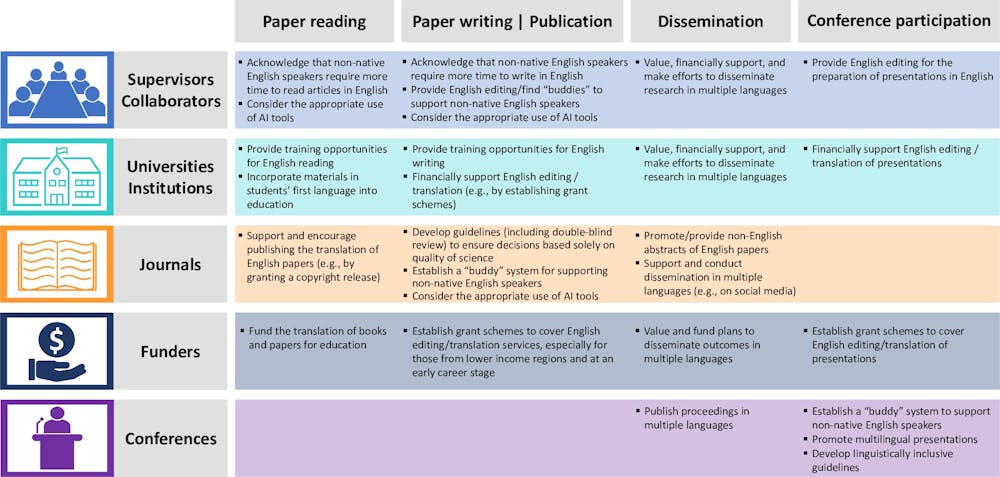
There are a number of actions individuals, institutions, journals, funders and conference organisers can take to change this.
As a first step, journals could do more to provide English editing support to academics (as Evolution has started doing) and could accept multilingual publications (as the preprint server EcoEvoRxiv does).
Conference organisers also have myriad opportunities to support non-native English-speaking participants. For example, last year’s Animal Behaviour Society conference incorporated a multilingual buddy program to improve inclusivity.
Examples of potential solutions to reducing disadvantages for non-native English speakers in each type of scientific activity. Amano et al (2023) / PLOS Biology, Author provided
Artificial intelligence (AI) may have a role to play, too. AI was widely used by our survey participants for English editing.
The British Ecological Society recently integrated an AI language editing tool into its journals’ submission system. However, some journals have bannedthe use of such tools.
We believe it’s worth exploring how the effective and ethical use of AI can help break down language barriers, especially since it can provide free or affordable editing to those who need it.
It’s time to re-frame
I wish English was my first language.
This comment by one of our participants underscores the way non-native English speakers in science are often viewed by themselves and the whole community: through a deficit lens. The focus is solely on what’s lacking.
We should, instead, view these people through an asset lens. By transferring information across language barriers, non-native English speakers provide diverse views that can’t otherwise be accessed. They have an indispensable role in contributing to humanity’s knowledge base.
The scientific community urgently needs to address language barriers so that future generations of non-native English speakers can proudly contribute to science. Only then can we all enjoy the full breadth of knowledge generated across the globe.
Early childhood has received a great deal of attention in recent weeks, as Australia has sought to understand ways to relieve the cost pressures on the National Disability Insurance Scheme (NDIS).
The NDIS independent review has released its interim report, which noted many more young children with developmental concerns were entering the scheme than was ever anticipated when it began ten years ago.
A common explanation is the lack of services available to children with developmental concerns outside of the NDIS, making the scheme the “only lifeboat in the ocean”. This is accurate, and there is near universal recognition that families need accessible options broader than just the NDIS to seek support for their child.
However, less attention has been paid to another possibility: that there are actually more children than ever before who are struggling with developmental difficulties.
Early childhood development in Australia
Early childhood is generally considered to be the period from birth to entry into primary school – typically around five years of age in Australia.
Early childhood is a critical period of rapid growth and development in a child’s life. The skills and security that children are provided in these years lay the foundations for health and wellbeing that impact their whole life.
Recent data shows signs Australian children may be experiencing developmental concerns at a greater rate than before.
The Australian Early Development Census of more than 300,000 children entering primary school found slightly fewer children were “developmentally on track” in all areas of development – down from 55.4% in 2018 to 54.8% in 2021. At a time when Australia has never been wealthier, any backward shift in child development is a cause for concern.
It is also not just the NDIS that is receiving increased referrals for child developmental concerns. Health systems in states and territories have recently experienced unprecedented demand for child development services, leading to wait lists up to two years long.
While interpreting population-wide trends is an inherently complex task, this is clear circumstantial evidence Australian children are struggling more than ever before.
Decades of research has identified ingredients that can help promote optimal child development. These “protective” factors provide a roadmap for how we can support children and families during the early years.
Society has experienced significant change over past decades, and there is evidence these environmental changes have weakened some of the protective factors that support children during early development. Parents are under pressure, and they need help.
Weakening of protective factors in early childhood
Children learn best in the early years through a combination of play, exploration and social interaction. Critically, the conditions that enable this learning are created by the relationship between the child and the community around them, primarily parents and carers.
In supporting children’s development, parents’ most valuable commodities are time, attention and energy. But these commodities are also finite – if they are spent in one place, then they must be taken away from somewhere else.
The changes we have experienced as a society over the previous decades have put particular pressure on these commodities.
These days, it can be hard to find quality time to parent and play. Unsplash, CC BY
Further impacting this is the rise of digital technology, such as smart phones. The now ubiquitous use of smartphones means that when parents are engaged with their child – for example, play, mealtimes and bedtime routines – they are also often expected (or feel compelled) to be available to friends and work colleagues.
Connectedness to community is one other protective factor for families, linking families to broader support as well as a sense of belonging. This is particularly true for families experiencing social disadvantage or who have a child with developmental disabilities. However, there is increasing evidence within Australia, as with other Western nations, that social contact between people is declining, which weakens the power of this protective factor.
In the short-term, we are unlikely to reverse trends in parental employment or digital technology use. There is also an argument that we shouldn’t seek to do so.
Work can provide families with increased financial security, and parents with a sense of purpose and belonging outside of the demands of parenting. Digital technology has also created significant benefits to the community, including social connectedness through an online environment.
However, we must also start the process of building back these protective factors for families. Parents and families are doing all they can to create safe harbours within their own home. But we must do more to help parents undertake their most important role in a more supportive ecosystem.
Part of the solution is empowering parents with the knowledge of the importance of play, exploration and social interaction in child development.
Parents want to find every way possible to support their child. Helping parents understand the key ingredients of child development, and their critical role in creating the time and space for those activities, is a vital first step towards this goal.
But we must also build systems that meet the modern demands of parenting and child development. These would include employment systems that recognise the importance of the quality of family time, not just the quantity of it. And education systems that build communities from birth, not just from age five. The restructuring of health systems to support families within communities, rather than take families out of them. Finally, economic systems that financially support parents to connect with young children, rather than financially disadvantaging those who do.
Society has changed, and unless we change too, our children will get left behind.
It made world news last week when a small lake in Canada was chosen as the “Golden Spike” – the location where the emergence of the Anthropocene is most clear. The Anthropocene is the proposed new geological epoch defined by humanity’s impact on the planet.
It took 14 years of scouring the world before the geoscientists in the Anthropocene Working Group chose Lake Crawford – the still, deep waters of which are exceptionally good at preserving history in the form of sediment layers. Core samples from the lake give us an unusually good record of geological change, including, some scientists believe, the moment we began to change everything. For this group, that date is around 1950.
But what didn’t get reported was the resignation of a key member, global ecosystem expert Professor Erle Ellis, who left the working group and published an open letter about his concerns. In short, Ellis believes pinning the start of our sizeable impact on the planet to 1950 is an error, given we’ve been changing the face of the planet for much longer.
The other working group scientists argue 1950 is well chosen, as it’s when humans started to really make their presence felt through surging populations, fossil fuel use and deforestation, amongst other things. This phenomenon has been dubbed the Great Acceleration.
The disagreement speaks to something vital to science – the ability to accommodate dissent through debate.
Canada’s Lake Crawford was chosen because it’s a rare meromictic lake, meaning different layers of water don’t intermix. That, in turn, makes it better at laying down sediment. Shutterstock
What’s the debate about?
Would the public embrace the idea that our actions are making the world almost wholly unnatural? The answer, of course, depends on the quality of the science. Since most people aren’t scientists, we rely on the scientific community to hash out debate and present the best explanations for the data.
That’s why Ellis’s departure is so interesting. His resignation letter is explosive:
It’s […] [im]possible to avoid the reality that narrowly defining the Anthropocene […] has become more than a scholarly concern. The AWG’s choice to systematically ignore overwhelming evidence of Earth’s long-term anthropogenic transformation is not just bad science, it’s bad for public understanding and action on global change.
It’s not that Ellis thinks the way we live is problem-free. The central issue, in his view, is that there’s powerful evidence of much earlier global-scale impacts caused by pre- and proto-capitalist societies.
For instance, as Earth systems experts Simon Lewis and Mark Maslin have shown, the violent Portuguese and Spanish colonisation of Central and South America indirectly lowered atmospheric carbon dioxide levels. How? By killing millions of indigenous people and destroying local empires. With the people gone, the trees regrew during the 17th century and covered the villages and cities, expanding the Amazon rainforest.
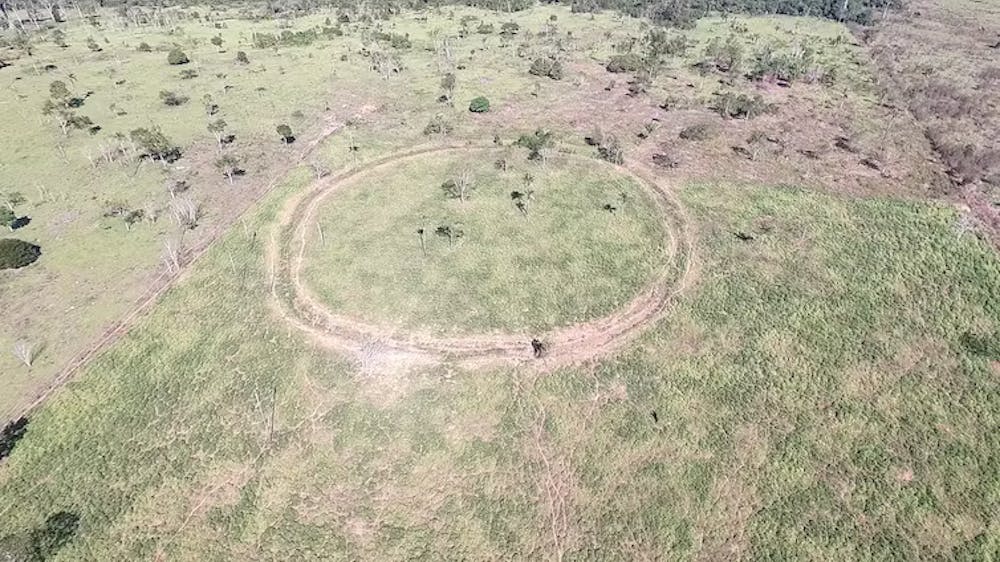
Villages and towns dotted many parts of the Amazon before colonisation. This image shows what’s left of a village. University of Exeter, CC BY
Why we should welcome honest disagreement in science
Scientists have been debating in recent years over whether the Anthropocene should be deemed an “epoch” with a specific start date, or else an historically extended “event” caused by different human practices in different places, such as early agriculture, European colonisation and the spread of European and North American capitalism worldwide.
Ellis’ resignation stems from this debate. He’s not alone – other group members and experts have also worked to refute the epoch idea.
As philosopher of science Karl Popper and others have argued, productive scientific debate can only occur if there’s space for dissent and alternative perspectives. Ellis clearly believes the Anthropocene group has gone from debate to group think, which, if true, would challenge the free exchange at the heart of science.
Longer term, a compromise may well be reached. If the Anthropocene group were to shift tack and label the start of the epoch a multi-century event (a “long Anthropocene”), we’d still benefit from having labels for periods such as our current one where the human impact ramped-up significantly.
One issue with such tensions is what happens when they hit the media. Consider Climategate, the 2009 incident in which an attacker stole emails from a key climate research centre in the United Kingdom. Bad faith actors seized on perceived issues in the emails and used them to claim anthropogenic climate change was fabricated. The scientists at the heart of the controversy were cleared of wrongdoing, but the whole affair helped seed doubt and slow our transition away from fossil fuels.
The risk here is that if the public gets only a glancing, oversimplified view of these debates, they may come to doubt the abundant proof of our impact on Earth. It falls to journalists and science communicators to convey this accurately.
As for our trust in science, the case for declaring the Anthropocene will be subject to very close scrutiny and may not be ratified by the International Commission on Stratigraphy, the body responsible for separating out deep time into specific epochs.
Stratigraphers such as Lucy Edwards have argued that an emerging epoch isn’t a fit subject for stratigraphy at all because all the evidence cannot, by definition, be in.
This unassuming rock formation in Scotland is the site of a famous geological discovery, where James Hutton first realised the boundary between two types of rock separated geological epochs. Shutterstock
What does this tension mean for the Anthropocene?
The epoch versus event debate doesn’t mean we’re off the hook in terms of our impact on the planet. It is abundantly clear we have become the first species in Earth’s long history to alter the functioning of the atmosphere, cryosphere, hydrosphere, biosphere and pedosphere (the soil layer) all at once and very quickly. Species such as cyanobacteria or blue-green algae had huge impact by adding oxygen to the atmosphere, but they did not affect all spheres with the speed and severity we have.
While we did not set out to alter the planet, its implications are profound. Humans are not only altering the climate but the entirety of the irreplaceable envelope sustaining life on the only planet known to have life. This is a complex story and we should not expect science to simplify it for political or other reasons.
Noel Castree does not work for, consult, own shares in or receive funding from any company or organisation that would benefit from this article, and has disclosed no relevant affiliations beyond their academic appointment.
Traditional harvesting sites, or mahinga kai, continue to be used throughout New Zealand to provide food and to share skills and cultural practices between families and generations.
But our new research shows that wild foods concentrate antibiotic-resistant bacteria and could put people at risk.
While water is regularly tested at recreational sites for potential pathogens, wild-harvested foods are commonly overlooked as a source of exposure to antibiotic-resistant microbes.
Wild foods are important to all cultures in Aotearoa. Both aquatic and terrestrial mahinga kai sites provide opportunities for recreation and social bonding. Entire regions may come to rely more heavily on wild foods during disasters that disrupt supply chains.
But there are no guidelines for people who harvest wild foods to inform them about the risk of antibiotic resistance. This needs to change.
Antibiotic-resistant bacteria make gastrointestinal infections from eating wild foods or contact infections acquired during harvest or food preparation more difficult, even impossible, to treat.
It occurs when bacteria become less responsive to the antibiotics used to prevent or treat bacterial infections. Over time, populations within any species of bacteria emerge with one, then two or more resistances to antibiotics, until we get potentially untreatable super strains.
This process is happening in all bacteria, pathogenic or benign, leading to super strains that are resistant to multiple antibiotics.
Because of the way antibiotic resistance genes clump together, super strains are usually super spreaders of antibiotic resistance.
Bacteria are linked together in a horizontal gene-sharing network. Genes can transfer between members of the same and different species at high frequency. So no matter in which species the resistant gene first appears, it can potentially be transferred to a pathogen.
E. coli on watercress and in mussels and cockles
In conjunction with the local hapū Te Ngāi Tūāhuriri Rūnanga and Environment Canterbury, we monitored waterways used to harvest kai (food) such as watercress. We found both rural and urban streams have high levels of Escherichia coli, a bacterium found in human or animal faeces and commonly identified in freshwater and coastal environments in Aotearoa.
E. coli is used as an indicator for infection risk in water and food. In the sites we studied, concentrations of E. coli were consistently high over many years. These bacteria can cause diseases in their own right, but what makes them a good indicator is that they co-locate in the environment with other pathogenic bacteria and are easy to grow in the laboratory.
We identified E. coli on plants (watercress) and in animals (mussels and cockles) taken for kai. In some samples, up to 20% of the E. coli were resistant to the frontline antibiotic drug ampicillin.
This means infections by one in five E. coli might fail to respond to a frequently prescribed antibiotic, leading to more suffering or medical complications.
We also detected resistance to last-resort drugs such as ciprofloxacin. Ciprofloxacin is usually prescribed to treat bacterial infections when other antibiotics have already failed. Often, the bacteria we found were resistant to drug concentrations that exceeded what could be safely given to a patient.
Bacteria concentrate in shellfish from the water they filter. Shutterstock/Mr Hendrix
Safe to touch does not equal safe to eat
Another observation we made was that mahinga kai, particularly shellfish, concentrate bacteria from the water they filter. Large cockles can filter three litres per hour and this concentrating effect was so powerful that we found antibiotic-resistant bacteria in the cockles even when we couldn’t detect them in water samples.
Bacteria extracted from cockles were “ingested” during high tide and showed us what the water was like over that time period. In contrast, water samples, such as those used to inform swimming guidelines, represent only the conditions at the time of sampling.
This is important, because rainfall and sewage overflow events transiently increase the number of bacteria in water and may not be picked up during routine monitoring.
Our calculations suggest that existing water safety guidance does not apply to the risk of contracting an antibiotic-resistant infection and could mislead those harvesting wild foods into taking greater risks.
The shellfish in our study were collected from popular sites in Waitaha/Canterbury. Local government monitors these sites and provides guidance on swimming safety. Our work shows that swimming guidance does not substitute for making decisions about whether or not to harvest wild kai.
We need improved guidelines for the safe harvesting and use of wild foods and more strenuous monitoring to protect those who rely on mahinga kai.
To maintain the benefits of harvesting wild foods, we should take a One Health approach that formalises the links between medicine and the environment. It helps to prevent the cause – rather than just the symptoms – of infectious disease and antibiotic resistance.
The problem of contaminated water doesn’t end with aquatic mahinga kai.
These same waters can be used for drinking or irrigation. The climate is warming and resulting floods gather more contamination from cities and farms into waterways.
Mahinga kai sites are not just lifeboats in time of need. They are the canary telling us that we must change our ways.
Jack Heinemann has received funding from Brian Mason Trust, Marsden Fund, and various other government, civil society, philanthropic, and industry sources.
Sophie Joy van Hamelsveld does not work for, consult, own shares in or receive funding from any company or organisation that would benefit from this article, and has disclosed no relevant affiliations beyond their academic appointment.
The Melanesian Spearhead Group (MSG) Leaders Summit proposed to be held from yesterday until July 21 has been postponed to another date, which is yet to be confirmed.
This was confirmed by Foreign Affairs Minister and Deputy Prime Minister Jotham Napat.
He said the MSG Foreign Affairs Ministers Meeting had last month proposed this date pending confirmation from each member country.
Napat said the government of Solomon Islands noted there was a clash with the sitting of Parliament and asked for the meeting to be rescheduled.
“Vanuatu’s Prime Minister [Ishmael Kalsakau] as Chair of the MSG will write to the members for them to reschedule the meeting on another date where every leaders are available to complete their issues,” he told the Vanuatu Daily Post.
“For Vanuatu, July is already full of activities. The President of France is arriving soon. We are looking at organising the meeting in August.”
Asked to confirm whether the endorsement of the United Liberation Movement for West Papua (UMLWP) as a full member of MSG was going to be on the agenda at this Leaders’ Meeting, Napat replied that this had not been discussed at the MSG Foreign Affairs Minister Meeting.
Budget only discussed He explained that the Foreign Affairs Minister Meeting discussed only the budget and its approval.
However, the application for UMLWP full membership would be discussed in a retreat by the MSG Prime Ministers before any adoption.
Vanuatu has been strongly supporting this agenda.
The Jakarta Globe reported that Foreign Affairs Minister Napat had discussed the possibility of Vanuatu opening an embassy in Indonesia with his Indonesian counterpart during his visit there last month.
He said he told his counterpart about Vanuatu’s push for West Papua to be part of MSG.
“Indonesia has been very frank about this matter. They consider West Papua as part [of Indonesia] and they told us that we [Vanuatu] are undermining their sovereignty.
“This does not stop us to keep pushing this agenda to the MSG Leaders to decide on it. It’s a sensitive issue that needs to be agreed by all leaders.
“Every decision is to be taken by consensus, it will be very difficult if some of the leaders are reluctant to support the agenda,” he said.
Indonesia has been providing scholarships for Papua New Guineans and Fijians to study abroad.
Vanuatu’s push for West Papua Asked if such assistance could jeopardise Vanuatu’s push for West Papua, Minister Napat said: “Vanuatu is a sovereign country and it must decide on its own destiny and future.
“It is the same for PNG, it has its own sovereign right.
“Somewhere we have to find what is our interest, whether we continue pursuing the idea or we decide on a different path but continue advocate.
“You cannot be shouting from outside. You have to sit at the roundtable with them and talk so that they can hear you.
“It’s an interest for Vanuatu to pursue the matter, but when it comes to MSG its a collective decision.”
Anita Roberts is a Vanuatu Daily Post reporter. Republished with permission.
Suspended Papua Governor Lukas Enembe, who is detained in Indonesia on corruption charges, was supposed to go on trial yesterday but this did not go ahead as he is gravely ill and could not attend.
Upon realising the governor’s health had deteriorated, the Corruption Eradication Commission (KPK) tried to transport him to Gatot Subroto Army Central Hospital (RSPAD) last Saturday.
However, the governor refused due to what he said was KPK’s “mishandling” of the legal case.
A member of the Governor’s legal team, Petrus Bala Pattyona, said he had been contacted by the KPK prosecutor on Sunday.
Bala Pattyona was asked by the prosecutor to convince Enembe to be taken to the hospital. Enembe had not eaten for two days, was vomiting, nauseous, and dizzy, reports Odiyaiwuu.com.
The Governor is currently in an intensive care unit — suffering from a serious life-threatening illness.
Jakarta’s ‘legal mishandling’ of Governor Governor Enembe was on trial a week ago on July 10, but public prosecutors failed to bring witnesses to the hearing.
After the trial was adjourned for another week until yesterday, he was taken to a KPK prison cell despite being seriously ill.
Prior to these two failed trial hearings, the Governor appeared in court on June 24.
However, the hearing wqs suspended after a panel of judges rejected Governor Enembe’s appeal for the charges to be waived.
Given the governor’s ill health, the judges ruled to prioritise his health and grant his request to suspend proceedings until he was medically fit to stand trial.
On June 12, an anticipated and highly publicised trial was scheduled to take place in Jakarta’s District Court. However, the trial was not held due to KPK’s mishandling of the ordeal.
To date, a total of nine attempts have been made to deliver a satisfactory closure of the Governor’s legal case since he was “kidnapped” from Papua in January 2023.
New August date set The trial is now rescheduled for early August 2023. However, there is no guarantee that this will be the last hearing over what critics describe as a tragic and disgraceful mishandling of the case concerning a respected tribal chief and Governor who is fighting for his life.
For the government of Indonesia, KPK and judges, every moment that is mismanaged, mishandled, or delayed might mean just a delay in justice, but for the Governor and his family it means life and death.
According to the governor’s family, KPK are already waiting to bring this sick man back from hospital and lock him up in a KPK prison cell again.
The Governor’s family ask how could this “cruel treatment be happening”?
Yamin Kogoya is a West Papuan academic/activist who has a Master of Applied Anthropology and Participatory Development from the Australian National University and who contributes to Asia Pacific Report. From the Lani tribe in the Papuan Highlands, he is currently living in Brisbane, Queensland, Australia.
Andrew Leigh, an assistant minister in the Albanese government, has launched a swingeing attack on the stranglehold the factional “duopoly” has on the Labor Party.
Leigh says the factions’ power is at an all-time high, which suppresses ideological debate, distorts preselections, and discourages people joining the party.
As one of two non-factional members of caucus, it is generally recognised that the promotion of Leigh, who has strong economic qualifications, has been handicapped by not being in the Left or Right.
In a speech to the Per Capita think tank’s John Cain Lunch, released before its Wednesday delivery, Leigh says he’s not arguing factions should be banned but that “not being in a faction should be as valid a choice as joining a faction”.
He says the silence about the factions and their operations “should be a clue. If a group’s practices and deals start to sound like they’ve been plucked from a John le Carre novel, these people should ask themselves whether their shenanigans befit Australia’s most important political party.”
In an excoriating critique of the way factionalism is operating at federal and state level, Leigh says today’s factions “are less likely to broker ideological debates than to try and find a way of avoiding the debate altogether”. He contrasts this with the 1990s feisty debates at NSW ALP conferences, and at national conferences, which showed Labor “was a sufficiently large tent to contain a spectrum of ideological perspectives”.
“If we stifle internal debate, we miss the chance to test our policies among ourselves,” Leigh says.
“As Assistant Minister for Competition, I can’t help but wonder if part of the problem is what we would call an increase in market concentration.” Leigh points to the collapse of the Centre Left faction, which was strong in the 1980s, and the decline of non-factional parliamentarians, producing a duopoly of Right and Left.
“And just as duopolies in the product market hurt consumers through price gouging and profiteering, so too duopoly factions may engage in behaviour that is not in the long-term interests of the party and its membership.
“When factional competition is less intense, dealmaking can replace debate. If factionalism becomes effectively compulsory, the party may become less dynamic.”
Factions can be profoundly undemocratic, Leigh says.
“In some jurisdictions, factions require their members to use a ‘show and tell’ approach to internal Labor Party elections. In the room where ballot papers are handed out, the faction sets up a second table.
“When members are given their ballot paper, they must walk over to the factional table, and hand their ballot paper to a factional official.
“That factional official then fills in their ballot paper, and gives it back to the party member to be deposited into the ballot box. This rule applies to all members of the faction, from new members to ministers. Failure to comply can mean expulsion from the faction.”
In contrast, “no Labor government would tolerate an organisation that set up a table in the corner of the polling station, asking people to volunteer to have their ballot papers filled in for them. We would see it as utterly undemocratic. Yet we tolerate it in our own internal elections.”
Criticising the way the factions carve up seats, Leigh says they are “at their worst when they serve only as competing executive recruitment agencies”.
“In most states, preselection is virtually impossible for people outside the factional system. It’s a case of Left, Right, or Out.”
He highlights the Victorian “Stability Pact” – “an agreement between the factions in which every winnable seat, every party leadership position, and every spot on every committee is divided between the Left and the Right, with a no-contest rule on the other’s possessions.
“Like the nineteenth century colonial powers meeting in Berlin to divide up Africa, the Stability Pact effectively takes away the ability of local members to have their say. Nominally, the party rules say that preselections depend equally on local member votes and the central committee. But if the factions vote together, then even a 90% local member vote can be overridden by a 95% central committee vote.”
Allocating seats to factions is “electorally reckless” because it can lead to failing to field the best person for a particular electorate, Leigh says.
He says factional dominance causes unnecessary division, with the risk of forcing new recruits to the party into an “uncomfortable choice”. Factionalism also has bad consequences in Young Labor and in university Labor clubs, with many campuses having two clubs, one for the Left and one for the Right.
“Factional dominance risks eliminating a tradition with deep roots in the Labor Party: people who simply choose to be part of the party,” Leigh says.
“Most Labor members will never seek a career in parliament or as a party official. They simply want their party to recognise that a non-factional member of the Labor Party is no less worthy than a factional member.
“On election day, these members will staff booths from dawn to dusk. They are motivated not by power, but by altruism. They joined Labor to shape a better nation. They should not be treated as second-class citizens within our party.”
Michelle Grattan does not work for, consult, own shares in or receive funding from any company or organisation that would benefit from this article, and has disclosed no relevant affiliations beyond their academic appointment.
Premier Daniel Andrews announced on Tuesday that the Victorian government has withdrawn from its commitment to host the 2026 Commonwealth Games, citing an anticipated cost blowout from an original estimate of A$2.6 billion to over $6-$7 billion.
Commonwealth Games Australia chief executive Craig Phillips described the decision as “beyond disappointing”. Phillips questions the government’s figures, saying that the cost of running the Gold Coast event in 2018 was $1.2 billion and the 2022 Birmingham Games was $1.8 billion.
The government said existing funding set aside for the games will remain invested in regional projects intended to create an event “legacy”.
Aside from the viability of the 2026 event, Victoria pulling out of hosting the event raises the broader question of whether the Commonwealth Games will survive.
How has this happened?
Victoria secured the Commonwealth Games in April 2022 with a unique multi-region model that sought to bring the event to regional Victoria.
Despite the obvious risks and costs associated with decentralising a major event away from pre-existing infrastructure in Melbourne, Andrews noted at bid submission that
Victoria is Australia’s sporting state, and, if awarded the 2026 Commonwealth Games would demonstrate to the world a new way to deliver the competition.
Andrews made clear the decision to withdraw was entirely financial, stating that the new estimated cost of potentially over $7 billion “does not represent value for money”.
When pressed at his media conference to provide accountability as to how his government’s costing could have been so grossly inaccurate, Andrews said that certain event costs were unforeseeable.
What could not be reasonably foreseen, and was not foreseen, was the costs incurred in terms of services, security, transport […] there were estimates that were made and those estimates are clearly well and truly under the actual cost.
The Commonwealth Games Federation and Commonwealth Games Australia dispute these costs estimates. They signalled the blame for any cost overruns lies with the Victorian government.
The numbers quoted to us today of $6 billion are 50% more than those advised to the Organising Committee board at its meeting in June.
Since awarding Victoria the Games, the Government has made decisions to include more sports and an additional regional hub, and changed plans for venues, all of which have added considerable expense, often against the advice of the Commonwealth Games Federation and Commonwealth Games Australia.
The implications
The decision to withdraw from hosting the event will still incur costs. This includes pre-existing costs related to staffing contracts, renting premises and marketing, as well as to-be-determined contractual break costs as negotiated with the Commonwealth Games Federation.
The financial costs of the withdrawal, however, may pale against the longer-term reputational damage done to Victoria and perhaps Australia more broadly.
This decision may also damage Andrews’ reputation. In proposing an untested regional games delivery model, it was incumbent on the government to adopt a particularly rigorous process to ensure the the event’s viability, which does not appear to have been done.
Is Victoria still Australia’s ‘sporting capital’?
Victoria has long proclaimed itself Australia’s (and even the world’s) sporting capital. The state has developed an unparalleled portfolio of major sport events since the 1980s, and become a global exemplar in executing major events in the process.
But withdrawing from the 2026 Commonwealth Games arguably represents Australia’s most prominent sporting failure of the past half-century, and is a significant reputational blow to Victoria’s sporting pre-eminence.
What’s more, in an annual global ranking of sport cities published last month, before the Commonwealth Games decision, Brisbane (15th) leapfrogged Melbourne (23rd) and Sydney (44th) to become Australia’s top ranked.
Brisbane’s success isn’t only attributable to its impending hosting of the 2032 Olympics. Its ranking also recognises that the FIFA Women’s World Cup is being played predominantly in the north-east Australian states due to stadium challenges associated with AFL-orientated Victoria.
Meanwhile, South Australia’s recent sporting successes include the hosting of AFL Gather Round, LIV Golf and recent procurement of the 2024 Super Netball final from Victoria.
Victoria’s grip on the “sports capital” title is increasingly tenuous.
The end of the Commonwealth Games?
Perhaps the most critical question is the viability not only of the 2026 Games, but also the broader Commonwealth Games movement.
Victoria’s withdrawal continues a trend of recent instability. In 2017, the South African city of Durban was stripped of 2022 hosting rights for a failure to meet key obligations around governance, venues and funding.
However, whereas the Commonwealth Games Federation had just under 2,000 days to secure a replacement host for 2022, Victoria’s withdrawal has occurred only 973 days prior to the start of the event.
The movement’s broader existence is perilous given there’s a shrinking pool of host cities. Victoria was the only formal applicant for the 2026 edition.
This is a challenge faced by large sporting events more broadly, with potential applicants increasingly wary of the significant costs.
Even the summer and winter Olympic Games have increasingly struggled to attract applicants. This resulted in the unprecedented move to simultaneously award the 2024 and 2028 summer games to Paris and Los Angeles in 2017 – normally the summer games are awarded to one city at a time.
With seemingly little global appetite to host the event, and broader cultural discussions in Australia and abroad surrounding the role of the monarchy, existential questions surround the Commonwealth Games movement.
The authors do not work for, consult, own shares in or receive funding from any company or organization that would benefit from this article, and have disclosed no relevant affiliations beyond their academic appointment.
What if Reserve Bank Governor Philip Lowe and his successor Michele Bullock were able to achieve something truly remarkable – a steady decline in inflation without further interest rate increases, and without bringing on a recession.
It’s suddenly looking possible. Inflation is now coming down so quickly worldwide there’s probably no need to push it down further.
We couldn’t have said that a week ago. Then, the US inflation rate was 4%, well down on the peak of 9.1% a year earlier, but high enough for eminent economists such as former US Treasury Secretary Larry Summers to say the US would need a mountain of unemployment to bring it down further.
Specifically, Summers said that to control inflation the US would need
five years of unemployment above 5% to contain inflation – in other words, we need two years of 7.5% unemployment, or five years of 6% unemployment, or one year of 10% unemployment
That was in late June, when US inflation had slipped from 5% to 4.9% to 4% over three months. Then, it was at least arguable that it wouldn’t fall much further without another push.
No longer. Last week, we learned that US inflation plunged yet again to 3% in June. Although other countries’ results for June aren’t out yet (ours is out next week) it’s now no longer easy to argue that progress isn’t real and continuing.
This graph of the latest monthly readings of annual inflation rates shows inflation peaked in the US, the UK, Canada and Australia late last year, and has been coming down fairly steadily since.
Summers and others in the US used to deride those who said ultra-high inflation would go away as “team transitory”. But it is now looking as if that high inflation was indeed transitory, even if the transition took longer than expected.
Driving down inflation has been one of the key forces that drove it up: energy and transport prices, which surged in the wake of Russia’s February 2022 invasion of Ukraine.
US energy prices have fallen 16.7% over the past year, led down by a 26.5% slide in the price of what Australians call petrol. That’s a saving that will push down Australia’s inflation rate and inflation rates worldwide.
Non-energy and non-food inflation fell as well, suggesting that there isn’t (yet) a psychology of expectations holding US inflation up.
Falling inflation expectations
Here, Australians expect falling inflation, if their answers to the Melbourne Insitute’s monthly expectations survey are to be believed. In June, those surveyed expected inflation of 5.2% in the year ahead, down from 6.3% a year earlier.
This makes Australians less likely than they were to bake high inflation into wage negotiations and other decisions, making it less likely inflation will remain high.
And it ought to be noted that the inflation Australians say they expect has traditionally been much more than what’s been delivered. That’s presumably because most of us notice the prices that are going up more than those that aren’t.
A soft landing, without a recession
The much quicker than expected collapse in US inflation has dramatically raised the likelihood of what’s called a “soft landing” in the US. Here in Australia, it’s what our current Reserve Bank Governor has called staying on the “narrow path” of returning inflation to target in a reasonable timeframe, without a recession.
If that happens, finance journalist Alan Kohler says Lowe and his successor Michele Bullock (who takes over in September) will be the first team at the top of the bank to get inflation down from above 7% without delivering a recession.
There was a recession when the bank tried to get inflation down below 7% in the mid-1970s, in the early 1980s, and in the early 1990s.
That we might be able to pull off yet another first ought no longer to surprise us, after all of the firsts during COVID. Enduring Australia’s (brief) 2020 recession without unemployment climbing above 7% was also a first.
The minutes of the Reserve Bank’s June board meeting released on Tuesday show it is prepared to countenance such a first.
The bank’s board members acknowledged that inflation was “now declining, albeit from a high level”, while falling commodity and shipping prices were cutting cost pressures. All this before the full effect of the bank’s 12 rate rises to date has been felt.
Remember, these are minutes of a meeting that took place before last week’s extraordinarily good news from the US. So those board members’ comments hold open the possibility of Australia keeping the bulk of its gains in employment, while getting inflation back down to controllable levels.
The fact that it has never happened before hasn’t stopped the economics team at the ANZ Bank from predicting it – no further rate rises from here on, a continuing slide in inflation, and only a modest uptrend in unemployment.
The “Goldilocks” outcome – not too hot or too cold, but just right – would be keeping in work most of the Australians who got into work when unemployment fell and getting on top of inflation. If we can manage that, we will have done future Australians an enormous service.
Things get easier when unemployment is low. We get more likely to become more productive, because we’re less resistant to change when unemployment is less of a threat. We get in a better position to help the budget, by taking less in benefits and paying more in tax. And we become more like each other – lessening inequality.
It is looking as if the Reserve Bank has the opportunity to cement low unemployment while controlling inflation. Holding off (and perhaps abandoning) future rate raises will keep it in reach.
Our next official inflation update, due out next Wednesday, will matter a lot.
Peter Martin does not work for, consult, own shares in or receive funding from any company or organisation that would benefit from this article, and has disclosed no relevant affiliations beyond their academic appointment.
The Australian Electoral Commission (AEC) has published the “yes” and “no” pamphlets for the Voice to Parliament on its website. The pamphlet will eventually be printed and must be delivered to every household around the country at least 14 days before the referendum.
Australian parliamentarians have provided their “yes” and “no” arguments for the Voice, which have been published online with no fact-checking by the AEC. Electoral Commissioner Tom Rogers has said
each case will be published in separate, unedited and unformatted documents, exactly as they have been received by the deadline.
The last “yes” and “no” pamphlets to be produced were for the 1999 referendum that asked Australians to replace the monarch as head of state with a republic system of government. With the “no” Voice pamphlet, we are seeing similar themes to the republic “no” campaign – sowing seeds of uncertainty and division in the community.
Professor of government John Higley and political scientist Ian McAllister argue the failure of the referendum in 1999 was due, in part, to the fact Australians generally had a lack of knowledge about the implications of change to our democratic institutions.
This raises the question why we are still using “yes” and “no” pamphlets. Is it time to give them up and move to a mode of communication that is not inherently subject to bias and unsupported claims?
History of the “yes” and “no” pamphlets
In 1911, two questions were posed to the Australian public at a referendum separate to a general election.
The questions were whether to extend the Commonwealth’s powers over trade and commerce and give the Commonwealth the ability to make laws in respect to powerful corporations. Both returned a resounding “no” answer.
The government at the time believed the rejection of both proposals was due to the public being misinformed and the opposition party’s distortion of the key issues.
So, the following year, the government sought to send every elector a document that explained proposed constitutional changes from the “yes” and “no” sides.
Today, the AEC is required under section 11 of the Referendum (Machinery Provisions) Act 1984, to provide each elector with a pamphlet outlining arguments in favour and against proposed constitutional changes.
The “no” pamphlet for the Voice to Parliament uses a lot of strong, emotion-invoking language and contains potential misinformation.
For instance, the pamphlet includes the recurring claim the Voice is “legally risky”, despite legal experts disproving this. There is also the repeated assertion of a lack of detail about how the Voice will work, despite this having been addressed by academics and the government.
Another claim that “a centralised Voice risks overlooking the needs of regional and remote communities” runs counter to the assertions of the “yes” campaign that the purpose of the Voice seeks to empower local voices to be heard at the national level.
The pamphlet also expresses concern the Voice will not replace institutions such as the National Indigenous Australians Agency, but will work alongside them, which the campaign thinks will be costly and add an extra level of bureaucracy to Indigenous affairs.
There is also the ongoing about the “unknown” nature of the Voice, who will be appointed to it and how representation will be ensured.
Lastly, there is a section entitled “there are better ways forward”, but it contains no examples of what these better ways could be.
“Yes” Pamphlet: “voting no means nothing will change”
The “yes” pamphlet has reiterated a lot of key points already made by the campaign. One thing it does well is provide examples of where direct Indigenous involvement in decision-making has led to improved outcomes for Indigenous people. It also provides examples of how the Voice could work in practice.
The pamphlet argues past governments have invested billions in programs that don’t work. A Voice will help governments better listen to locals, find solutions and save money in the long run.
Some key details are missing, however. Although the pamphlet states that “members of the Voice will be chosen by Aboriginal and Torres Strait Islander people in their local area and serve for a fixed period,” the specifics of how this process will work are not addressed.
The pamphlet doesn’t say anything that hasn’t already been said in the “yes” campaign to date. And although it provides a bit more detail on these key points, it actually has less content than the “no” pamphlet.
Misinformation is a growing issue for discussions around the Voice.
In the past, concerns have been raised about the referendum pamphlet as a way of communicating with voters because it is not examined for accuracy. As UNSW constitutional law expert George Williams warns,
Australians must be cautious when reading these pamphlets. In the past, they’ve often contained hyperbole and wild and exaggerated claims.
The “yes/no” pamphlets have also been characterised by some as antiquated and redundant.
Indeed, many of the points made in the Voice to Parliament cases published today do not offer any new perspectives for the public to consider. Instead, they reiterate arguments for the “yes” and “no” sides by repeating what Australians have heard for the past 12 months.
There is always going to be a level of uncertainty associated with proposed changes to the Constitution. Today, with misinformation about the Voice being circulated on social media, wouldn’t we be better off removing another way for unreliable information to be shared among the public?
Bartholomew Stanford does not work for, consult, own shares in or receive funding from any company or organisation that would benefit from this article, and has disclosed no relevant affiliations beyond their academic appointment.
The Northern Hemisphere summer has brought one extreme event after another – from heatwaves to wildfires and floods. It comes as the world likely heads into an El Niño pattern, which brings a higher chance of hot, dry weather in much of Australia.
So is the weird northern summer a portent of what Australia can expect in a few months?
The extremes in the Northern Hemisphere are linked to persistent weather patterns which allow heat to build in some places and rain to continue in others. On top of this, human-caused climate change is raising temperatures to new heights.
It’s too early to say whether Australia is in for a scorching summer. The predicted El Niño is a worry, but doesn’t guarantee the record-smashing heat we’re seeing in parts of the Northern Hemisphere.
Having said that, continued global warming will bring more record-high temperatures in Australia. So we must remain on high-alert – and ramp up reductions in greenhouse gas emissions.
Extreme weather across the world
Wild weather in the Northern Hemisphere at this time of year is to be expected. However, recent extremes are off the charts.
Major heatwaves are underway in North America, Europe, North Africa and Asia. In California’s Death Valley, temperatures on Sunday reached 53.3℃. Parts of Italy were expected to reach 45℃ on Tuesday, and later in the week could approach Europe’s hottest temperature on record: 48.8℃.
China provisionally reached 52.2℃ on Sunday, shattering the previous record for the country by more than 1.5℃.
Meanwhile, wildfires are tearing through Canada, Greece and Spain, destroying properties and forcing evacuations.
So what’s causing these simultaneous heatwaves across multiple regions? They’re all linked to high-pressure weather systems that are “blocking” or deflecting oncoming low-pressure systems (and associated clouds and rain).
These low-pressure systems have moved to other areas and caused extreme rainfall and flooding. Flooding in South Korea has left 40 people dead and destroyed critical infrastructure. Vermont, in the northeast United States, was also flooded after up to two months of rain fell in a few days.
Alarmingly, the atmospheric patterns driving the extremes in the Northern Hemisphere appear to be getting more common under climate change. On top of this, human-caused global warming is greatly increasing the chance of record-breaking extreme heat events and concurrent heatwaves across many regions.
All this begs the question of what might be coming Australia’s way this summer.
There’s one factor working in our favour: the particular atmospheric pattern bringing extremes to the Northern Hemisphere isn’t replicated in the Southern Hemisphere, because we have more ocean and less land.
However, Australia does experience its own “blocking” high pressure patterns which also bring major heatwaves and extreme rain events. Unfortunately we can’t predict these months in advance.
El Niño is a little more easily predicted. Currently, the tropical Pacific Ocean is trending towards El Niño conditions, as waters off the west coast of Ecuador and Peru continue to warm.
El Niño is part of a natural fluctuation in the Earth’s climate system which typically lasts for the best part of a year. It raises the chance of a warmer and drier spring in Australia.
Some meteorological agencies say an El Niño has already arrived. Australia’s Bureau of Meteorology is holding off on a declaration, for now. That’s because while the Pacific has fallen into an El Niño pattern, the atmosphere hasn’t yet followed.
But the bureau still puts the likelihood of an El Niño at 70%, and forecasts warmer and drier conditions across much of Australia from August to November.
Spring is predicted to be warmer than average across the continent. Bureau of Meteorology
The extreme weather in the Northern Hemisphere isn’t strongly related to the developing El Niño. But by the time Australia’s summer arrives, we’ll likely see El Niño’s effects in the weather.
What’s more, another driver of Australia’s climate, the Indian Ocean Dipole, is likely to enter a positive phase in coming months.
This phase is associated with warmer seas in the west Indian Ocean. This leads to fewer low pressure systems, on average, over southeast Australia and less atmospheric moisture over most of the continent. This would likely suppress winter and spring rainfall over much of Australia and exacerbate an El Niño’s drying effect.
Not all El Niño and positive Indian Ocean Dipole events bring warm, dry weather. And there isn’t a strong relationship between the magnitude of an El Niño and the lack of rain in Australia. But these background climate conditions raise the chance of a warmer and drier spring.
We can’t yet predict if Australia will swelter this summer. But an El Niño increases the chance of hotter and drier summer conditions, with more heatwaves and a greater frequency of weather conducive to fire spread.
Australia’s spring is likely to be drier than average, especially across the east and south. Bureau of Meteorology
Australia in a warming world
Of course, all this comes on top of human-driven global warming. In Australia, land areas have already warmed by 1.4℃ over the past century, and the cool summers common before 1980 are now far less likely.
In fact, even if global warming is limited to well below 2℃, historically hot summers in Australia will become common.
The Northern Hemisphere’s current extreme weather, and predictions of hotter summers in Australia, are all evidence of humanity’s fingerprints on Earth’s climate. This should spur urgent action to reduce greenhouse gas emissions.
Because if global warming continues, Australia is certain to be hit by more record-breaking heat events – and that is not something we want to experience.
Source: The Conversation (Au and NZ) – By Awais Piracha, Associate Professor of Urban Planning, Director Academic Programs, Geography Tourism and Urban Planning, Western Sydney University
Inner Sydney has near-zero population growth.Shutterstock
Residents of the affluent east and north of Greater Sydney have strongly resisted housing development in their suburbs. This NIMBY (Not In My Back Yard) resistance has led to urban sprawl in areas of Western Sydney with a well-documented lack of services, infrastructure and jobs.
Recent research showed affluent Sydney communities closer to the city centre are highly influential and organised in resisting development in their neighbourhoods. The result has been a socioeconomically divided city.
Ethnic segregation is a less-talked-about aspect of this divide. Most population growth in Sydney is from non-white new migrants. Dumping them all in the city’s west, when many are suited for and employed in professional jobs, is not only economically unproductive, it also leads to an ethnically segregated city.
A recent NSW Productivity Commission report shows less than 20% of new dwellings were built within 10 kilometres of the CBD between 2016 and 2021. Unmet demand is greatest in the inner city. As the chart below shows, most residential development has been in the outer suburbs, 30-40km from the city centre.
NSW Department of Planning and Environment population projections for 2021-2041 suggest the vast majority of population growth is going to be in these outer areas. The projections are based on analysis of historical trends, announced policies and local intelligence.
The map below shows inner local council areas will grow much more slowly than the outer ones. These outer areas also have much higher base populations, so their additional people and residential development are going to be large in absolute numbers.
Population growth forecasts for local government areas across Greater Sydney. Map created by authors using NSW Department of Planning population projection (2021-41), Author provided
Inner-city councils areas, such as Mosman (0.06%), Inner West (0.3%), Woollahra (0.24%) and Waverly (0.17%), are forecast to grow by much less than 1% a year. Most outer council areas are forecast to grow by at least 1-2%.
Inner-city areas also have a much higher percentage of white residents. The map below, constructed using 2021 census data for place of birth, shows this disparity.
Percentages of non-white population by local government area across Greater Sydney. Map created by authors using ABS 2021 Census data, Author provided
While place of birth is not a perfect indicator of ethnicity, it is commonly used for and serves the purposes of this sort of analysis. The map clearly shows the outer areas of Sydney have a higher proportion of non-white residents. The wealthier inner areas have a much higher concentration of white residents.
These inner areas also tend to have a higher level of NIMBYism and lower population growth projections.
As the map below shows, the concentration of the non-white population in outer areas is also increasing at a much faster rate.
Increase in percentage of non-white resident population from 2016 to 2021 for local government areas across Sydney. Map created by authors using 2016 and 2021 census data, Author provided
The national 2022 Population Statement shows Australia’s net overseas migration is estimated to be 235,000 per year until 2032-33. That’s about two-thirds of the nation’s total population growth. The report forecasts about 27% (64,000 a year) of the international migrants will settle in Greater Sydney.
Natural population increase (births minus deaths) for Greater Sydney is estimated to be around 36,000 a year. The net effect of internal migration adds up to around 33,000 people leaving Sydney. So most of the city’s population growth is going to be from international migration.
The Commonwealth’s 2021-22 Migration Program Report shows more than 80% of international migration is from non-white countries (when we consider the top ten countries of origin). Migration data from recent years also indicate this trend is likely to continue or even grow.
Based on the housing growth and immigration projections, we can conclude population growth will continue to be concentrated in outer Western Sydney, and non-white international migrants will account for most of this growth. This will intensify the concentration of the non-white population in these areas, increasing the ethnic divide between the city’s east and west.
It can be argued, then, that limiting housing options for new immigrants to the outer areas of Sydney could be considered systemic racism. System racism occurs “when racially unequal opportunities and outcomes are inbuilt or intrinsic to the operation of a society’s structures”, as one study explained. And it “can emerge with or without intention to harm and with or without awareness of its existence”.
By reducing the ethnic divide, Sydney will be better off
The NSW Productivity Commission’s recent report, “Building more homes where people want to live”, argues that the focus on growth areas in Western Sydney is coming at a high cost to both social wellbeing and government budgets. He recommends the government shift its focus to higher-density housing in the CBD and inner suburbs.
Soon after NSW elected a new Labor government in March, Premier Chris Minns stressed the need to counter NIMBYism and build such housing closer to amenities and jobs.
Areas closer to the city centre are where people most want to live. Developing more housing in these areas will make housing there more affordable. It will also reduce the environmental impacts of urban growth.
At the same time, the population in many affluent areas of Sydney has been decreasing and these areas are reported to have lost vitality. They also lack housing for their essential workers.
There is a need for further research on the relationship between ethnic segregation and our decisions on what to build and where. We need to better understand NIMBYs’ motivations for opposing all development in their areas and the systemic racism resulting from this resistance.
George Greiss is Mayor of Campbelltown City Council, Chairperson of The Parks Mayoral Forum, a non-executive director of Local Government NSW and a member of the Liberal Party.
Awais Piracha does not work for, consult, own shares in or receive funding from any company or organization that would benefit from this article, and has disclosed no relevant affiliations beyond their academic appointment.
Less than three months out from New Zealand’s 2023 election, large political donations have been making headlines. Donations to both the ACT Party and the National Party have significantly outpaced large-scale contributions to other political groups.
Should this be a cause for concern? Studies from overseas indicate those who raise the most money tend to win. And, based on our recent “Doughnation” research, donors know that too. Wealthy New Zealanders admitted to gaining access to the levers of power through political donations.
So do our current campaign finance rules do enough to protect a basic principle of democracy – that we should all be equal in the ballot box?
Its final report will be delivered to the government in November – too late to have an impact on the 2023 election.
But if we want future elections to be fairer, here’s what the report found needs to change.
How can we make future elections fairer?
The Independent Electoral Review’s interim recommendations include
replacing the current broadcasting allocation with a “fairer and more effective form of state funding” for registered parties
per-vote and base funding for registered political parties
tax credits for donations up to NZ$1,000
introducing an expanded Election Access Fund and a new fund to facilitate engagement with Māori communities.
Those changes are additional to several changes to political party finance implemented at the beginning of 2023, ahead of this year’s election.
What changed ahead of this election?
Changes included lowering the reporting threshold for large donations from $30,000 to $20,000 and new requirements around reporting donations above $1,500.
In the first six months of 2023, the main political parties have already received more than $4 million in donations over $20,000.
The National Party benefited the most from political donations, receiving $1,255,587 in large political donations, closely followed by ACT, which received $1,255,000. New Zealand First received $567,304, the Green Party received $496,260 and the Labour Party received $428,844.
These figures reflect the large donations that have to be disclosed within 10 days of receipt. We won’t know the sum total of small donations until well after the election.
How much do large donations sway elections?
Research suggests donations can help political parties win more votes, but that typically this only applies to the more established parties. And, while money matters in New Zealand, it’s not necessarily a straightforward relationship.
Recent data from the United States showed better-than-average fundraising is a strong predictor of better-than-average electoral success, concluding that “money still matters”.
Australia’s Grattan Institute found that over the past five federal elections there, the party with the biggest war chest tended to form government. And an analysis of general elections in France and the United Kingdom between 1993 and 2017 showed increased spending per voter improved candidates’ share of votes.
New Zealand’s 2017 election also illustrated a strong relationship between money and votes. National received 44.45% of the votes after a $4,579,086 fundraising haul. Labour received 36.9% of the votes and received $1,611,073 in political donations.
But the 2020 election result suggests there are limitations to the relationship between funding and votes, particularly for the two main parties. In 2020, other factors clearly contributed to the electoral outcome. For example, Labour’s handling of the COVID-19 pandemic appears to have outweighed National’s fundraising advantage.
Some voters’ voices are louder than others
Even if political donations don’t always decide elections, it is fairly well established that money buys access. Work from the Grattan Institute shows that highly regulated industries – such as mining, transport, energy and property construction – provided the highest level of donations to Australian political parties, made the greatest number of commercial lobbying contacts, and had the most meetings with senior ministers.
Access is not the same as influence, of course. It is typically difficult to make a causal connection between donations and influence, except when political scandals occur.
However, research out of the US by Martin Gilens showed that politicians’ decisions do not represent the preferences of poorer or middle-class citizens. Rather, these decisions fall in line with the interests of the wealthiest – a situation that Gilens attributed at least in part to the influence of wealthy donors.
In New Zealand, the Independent Electoral Review’s interim report acknowledged the
risks to public confidence in the electoral system if some people have more access to, or can unduly influence, parties and candidates through political financing.
In a recent opinion piece, former ACT board member Robin Grieve defended political donors as not always being motivated by self-interest, giving an example of a donor wanting to help children in the care of Oranga Tamariki.
While there may have been altruistic intent, the issue is still that the donation was made by a wealthy person to a political party with the stated objective of influencing legislation.
Is that fair? In our research exploring the motivations of wealthy donors, some agreed that it was unfair that they could donate while others could not, with one noting a
real problem with people who accumulate a lot of money supporting the systems that have allowed them to accumulate a lot of money.
Another commented that they did not think
that it is right that rich people can distort democracy.
Not everyone was concerned about this situation, with one donor telling us
the fact that some can promote their position more than others doesn’t worry me.
If acted on, the Independent Electoral Review’s recommendations for tighter donations controls and fairer funding for registered parties would help create significantly more transparency in New Zealand’s political donations system.
We believe a move away from a reliance on large individual donors would help increase public trust in the way political parties are funded. It also is likely to help level the playing field of access and potential influence in New Zealand politics.
Lisa Marriott receives funding from the Gama Foundation.
Max Rashbrooke has received funding from the Gama Foundation.
The Australian Electoral Commission has just published the “yes” and “no” pamphlets for the Indigenous Voice to Parliament referendum.
So who is the target audience for each case, what are their key messages, and how effective will they be?
I research how people and organisations use communication to effect change via, for example, entertainment or political advertising. When I look at the “yes” and “no” case pamphlets, there are aspects of each that stand out.
Battle of the pamphlets
The “yes” pamphlet leans on the value of expertise to help voters decide. We hear from a senator and elder, a school principal, a filmmaker, the co-chair of the Uluru Dialogues, a former High Court Chief Justice, a professor, three former sports professionals, and numerous members of the Order of Australia. Moreover, many are recognisable names, such as Rachel Perkins, Patrick Dodson, and Eddie Betts.
The members of parliament who wrote the “yes” case consider these experts to have more experience with Indigenous affairs than most voters, and are better informed about it. Their likeability and familiarity also helps put the point across to readers in a more compelling way.
The key strategy of the “no” pamphlet, on the other hand, is “more is better”. It outlines 10 reasons to vote “no”. This is a powerful approach because the subject lends itself to it – that is, the referendum is one a reasonable number of voters really want to think about, and many have concerns about.
In general, persuasive power increases when more reasons are provided. It seems that, according to the MPs who wrote the “no” case: “the more facts you tell, the more you sell”.
Like the “yes” case, the “no” case substitutes the real question voters are being posed with another, more straightforward one. So, voters will ask themselves if the experts possess the expertise needed to provide the advice to vote “yes”. And on the other hand, voters will ask themselves if the number of reasons provided to vote “yes” is high enough and compelling enough.
Whichever has the most rational and emotional pull for each reader will win their vote.
According to classic research, expertise is the principal attribute of credibility. Understanding a subject and knowing what you are doing – that is, competence – enhances your credibility.
This means that if voters have the feeling a person possesses information and experience that they lack, then that expert’s viewpoint can be highly persuasive. In other words, expertise can feel like authority. This is especially so when information is hard to understand.
One study illustrates this nicely. Participants were asked to give their verdict in a mock trial. The case concerned a company suspected of having exposed its workforce to carcinogenic chemicals.
One of the witnesses was an expert, Professor Thomas Fallon. In one version of the trial, he explained in clear language that the chemicals concerned did indeed cause cancer. In another, he used incomprehensible jargon to say the same thing.
In this case, where the arguments put forward were difficult to understand, it was his expertise as a professor that proved decisive. The “jurors” understood little of the actual evidence, but felt that if a professor said it was true, then it must be true.
It is hardly surprising, then, that experts are used in the “yes” case.
The case for ‘no’
Research has shown that the “more-is-better” approach to an argument is primarily useful when the quality of a choice is difficult to ascertain by other means and there is little alternative information. In other words, the authors of the “no” case assume voters do not know how to judge whether the Voice will be a good or a bad thing, and may not consider much other information than this particular pamphlet.
It will come as no surprise to learn that people are more easily persuaded that a standpoint like “the Voice will be bad” is correct if campaigners provide strong arguments for this. You can test this yourself at work by making a simple request to people queuing to use a photocopier:
Excuse me, I have five pages – may I use the photocopier?
Generally about two out of three people asked will allow you to use the copier before them. Now make the same request, but with a reason:
Excuse me, I have five pages – may I use the photocopier because I’m in a hurry?
In that case, almost everybody accedes.
At first sight, this hardly seems astounding: people are more likely to comply with a request if they have a good reason. However, the more-is-better approach is not so much about the substance of an argument as the mere fact that one or more are given. So, for example, when you ask,
Excuse me, I have five pages – may I use the photocopier because I have to make copies?
again, almost everybody complies. That is even though they have not actually received any new information; it just feels like they have.
Other research shows people are also less persuaded by a standpoint backed with three strong arguments than by one with three strong and three weak arguments to support it.
Tom van Laer does not work for, consult, own shares in or receive funding from any company or organization that would benefit from this article, and has disclosed no relevant affiliations beyond their academic appointment.
England women’s soccer captain Leah Williamson and Dutch striker Vivianne Miedema will miss the 2023 FIFA Women’s World Cup, which starts this week, due to ACL injuries.
The anterior cruciate ligament, or ACL, is a piece of tissue like a rope connecting your shin bone to your thigh bone. It’s only 3cm long and 1cm wide but is the most important stabiliser of the knee, alongside your muscles.
An ACL tear can be a complete or partial. In women’s soccer, they commonly happen during defensive pressing or tackling, or regaining balance on one leg. But more than 80% involve no contact, or indirect contact such as a bump to the shoulder.
Women are more likely to tear their ACL than men playing the same sports, with women soccer players twice as likely to tear their ACL as men.
So how can we reduce the risk of these injuries? And what happens if you injure your ACL?
In the past, factors related to women’s bodies were reported as the main reasons for the higher risk: their anatomy (wider pelvis, slope of the knee bones) or female sex hormones (oestrogen may increase the laxity or looseness of ligaments).
However research has not been able to confirm these factors. We now know the reasons for disparity are complex and multifaceted: women and girls may not develop the same movement skills and muscle function as boys and men in their younger years and across their life.
Other contributing factors include women and girls having fewer opportunities, confidence or support to participate in sports such as football, or activities such as gym training.
Surgical repair involves taking a small graft from your hamstring, quadriceps, or patellar tendon to replace your ACL.
But if you choose not to have surgery, you can live and be active without an ACL. Research has found non-elite athletes who don’t have surgery can return to the same level of sport and physical function as those who have surgery. (However, this has not been tested yet in elite athletes.)
Athletes also need to be psychologically ready to return to sport. Fears of re-injury, lack of confidence and social pressures to return are common, and may negatively affect sport performance and enjoyment.
Rehabilitation after an ACL injury will help address pain, swelling and movement restriction. Author provided
What can be done about the high rates of ACL injuries in women?
Given the high cost of ACL injuries to women athletes, the best thing we can do is to prevent them.
Injury-prevention programs that address movement patterns and muscle function through training and coaching can reduce the risk of non-contact ACL injuries in women by 67%.
Among women’s soccer players, programs with specific warm-up activities (jumping, landing, change of direction, balance) and muscle strengthening (for hip, core and leg) can reduce ACL injuries by 45%.
Players, parents, coaches, schools, and sporting organisations can freely access injury-prevention programs created for soccer (Perform Plus, FIFA11+), Australian football (Prep-to-Play), rugby (Activate), netball (Netball KNEE) and handball (Knäkontroll). The Get Set app is also great for learning about common injuries and injury-prevention exercise for 55 different Olympic sports.
ACL surgeries have increased by 43% in Australia between 2000 and 2015. In Australia, women’s knee injuries have grown by 3% (compared to 1.3% for men), with the highest growth among girls aged 5–14 years (around 10% a year).
While injury-prevention programs are effective when tested in clinical trials, their use by sporting clubs outside of research projects can be as low as 10–20%.
Sporting organisations should make their members aware of the freely available resources, and support and incentivise coaches to use them at least twice per week for 10–15 minutes, as part of team training.
Providing girls and women with equal opportunities and resources will allow them to develop physical and sport-specific skills in their younger years and throughout their life.
The authors do not work for, consult, own shares in or receive funding from any company or organisation that would benefit from this article, and have disclosed no relevant affiliations beyond their academic appointment.
In the last 15 days of the month of July, 15 murders have occurred in the northern Papua New Guinean town of Madang — once described as “beautiful” — and the community now faces a law and order crisis.
Madang Mayor Peter Masia said the Madang district authority could not do much in assisting police to actively carry out law and order action because public funds were still on hold after sitting MP Bryan Kramer had been dismissed as Madang MP.
Calling Madang the “murder capital of PNG”, Masia said there had been an increase in killings with the latest killing occurring yesterday afternoon.
Compared to the National Capital District (NCD) — Port Moresby — where killings happen every 2 to 3 days, Madang has seen killings every day for the last 15 days.
An NCD police officer confirmed that every 2 to 3 days they were responding to a report of a killing in Port Moresby.
“Yesterday a young man in his mid 20s from Angoram in East Sepik was stabbed in the chest by a street seller in broad daylight in the heart of [Madang] killing him instantly,” he said.
Madang police desperately need resources to help them tackle Law and Order challenges in the province everyday.
Police need housing, vehicles A senior policeman who wished not to be named said Madang police needed housing, vehicles and things like office stationery and manpower to boost police work in the province.
There are two police stations in Madang — one is the Jomba police station and the other is the town police station.
The officer said the estimated population ratio for one policeman to the Madang population was 1:1500 to 2000.
He said they needed more police manpower to tackle the law and order problems, especially the killings that were happening every day.
Transgogol people are now calling on the government to establish a police mobile squad base in the area to prevent more brutal murders in their area.
Transgogol community leader and spokesman Morris Bann said there was state-owned land available.
He said the type of killings in the area warranted the government to take serious steps in addressing law and order.
Call for police mobile squad “We want a police mobile squad base built . . . so that law and order is monitored closely to instill the trust and security the people require from its government,” said Bann.
Madang town resident Breed Kanjikali said the number of deaths required all Madang MPs to step in and address issues affecting the province and map out how they would assist police in combating crimes in the province.
Bundi leader Alois Pandambai said the murder toll in the province was very significant and it portrayed an image where there was dysfunction in the political leadership of the province.
He said Madang province did not seem to be functioning normally in the last seven months because of a political hussle and tussle over the position of the Provincial Administrator Frank Lau.
“While our leaders are fighting over an appointment made by the NEC [National Executive Council], we are not giving 100 percent support to police work and our own people are being killed everyday,” he said.
The 10 Nissan Patrol vehicles bought two years ago to support police work were now experiencing mechanical faults and had been grounded.
Dorothy Mark is a PNG Post-Courier reporter. Republished with permission.
Source: The Conversation (Au and NZ) – By Raquel Peel, Adjunct Senior Lecturer, University of Southern Queensland and Senior Lecturer, RMIT University
Text messages showing actor Jonah Hill asking his ex-girlfriend Sarah Brady to consider a dot point list of relationship “boundaries” have sparked an important conversation.
Two different interpretations of these texts are dominating the discussion.
Some have understood Hill’s dot points as a reasonable set of relationship expectations or “preferences” for a partner. Others see Hill’s list of relationship deal-breakers as a controlling behaviour.
So what is a relationship “boundary” and how do you have this conversation with your partner?
Boundaries are personal and influenced by one’s values. They can be emotional, physical, sexual, spiritual and cultural.
The purpose of creating, understanding and respecting boundaries is to ensure one’s mental health and well-being are protected. Used well, they can keep relationships healthy and safe.
Setting boundaries can also reinforce values and priorities important to you.
Relationship boundaries are a life skill that needs constant learning, practice and improvement. Shutterstock
Some ‘boundaries’ are controlling and go too far
That said, relationship boundaries can become unsafe for the people involved. Some cross the line into coercive control.
For instance, one might be able to justify to themselves they need to know where their partner is at all times, monitor their communications and keep tabs on their partner’s friendships because they just want to keep their partner safe.
But these are not boundaries; this is coercive control.
If your partner is describing these as their relationship boundaries, you should feel comfortable to say you are not OK with it. You should also feel comfortable explaining what boundaries you need to set for yourself and your relationship to feel safe.
In fact, research has found that even cyberstalking offenders might struggle to acknowledge how their behaviour can be perceived as intrusive by their partner. They may also have trouble understanding how it contributed to their break-up.
My research on how people can sabotage their own relationships revealed a lack of relationship skills is often a key factor in relationship issues.
The same research highlighted how people who fear their relationship is at risk can end up indulging in controlling behaviours such as partner monitoring, tracking how a partner spends their money and emotional manipulation.
In other words, people can sometimes employ unhealthy behaviours with the intention of keeping their partner but end up pushing them away.
Understanding partner and relationship expectations
We might have a vision in mind of an “ideal partner”. But it’s highly improbable one person can ever meet such high standards.
Rigid partner and relationship standards, just like unreasonable boundaries, can cause distress, hopelessness and resentment.
So healthy romantic relationships need clear communication and negotiation. Sometimes, that involves being flexible and open to hearing what the other person has to say about your proposed boundaries.
Relationship boundaries are a life skill that needs constant learning, practice and improvement.
Communicating expectations can also help people deal with common relationship fears. Shutterstock
Having a conversation about healthy relationship boundaries
Some mistakenly believe having any relationship boundaries at all is unreasonable or a form of abuse. That’s not the case.
In my research on relationship sabotage, many people spoke about how being able to clearly communicate and set relationship expectations has helped them maintain their relationships over the long term and dispel unrealistic standards.
Communicating expectations can also help people deal with common relationship fears, such as getting hurt, being rejected and feeling disrespected.
But for an important conversation about boundaries to take place, you first need the environment for an open, honest and trusting discussion.
Partners should feel they can talk freely and without fear about what they are comfortable with in a relationship. And, be able to discuss how they feel about a boundary their partner has proposed.
Clarify and discuss
If you’re having the boundary conversation with your partner, clarify what you mean by your boundary request and how it might work in practice. Examples can help. Understanding the nuances can help your partner decide if your boundary request is reasonable or unreasonable for them.
Second, negotiate which boundaries are hard and which are soft. This will involve flexibility and care, so you’re not undermining your or your partner’s, freedom, mental health and wellbeing. A hard boundary is non-negotiable and can determine the fate of the relationship. A soft boundary can be modified, as long as all parties agree.
What constitutes a healthy boundary is different for each individual and each relationship.
Regardless, it is a conversation best had in person, not by text message (which can easily be taken out of context and misunderstood). If you really must have the discussion over text, be specific and clarify.
Before setting boundaries, seek insight into what you want for yourself and your relationship and communicate with your partner openly and honestly. If you’re fearful about how they’ll react to the discussion, that’s an issue.
An open and honest approach can foster a productive collaboration that can strengthen relationship commitment.
Raquel Peel does not work for, consult, own shares in or receive funding from any company or organization that would benefit from this article, and has disclosed no relevant affiliations beyond their academic appointment.
New Zealand Parliament Buildings, Wellington, New Zealand.
New Zealand Politics Daily is a collation of the most prominent issues being discussed in New Zealand. It is edited by Dr Bryce Edwards of The Democracy Project.
French President Emmanuel Macron will make a first official visit to Papua New Guinea next Friday as part of a short Pacific trip.
AFP news agency reports that Macron’s trip will start in New Caledonia before he travels to Vanuatu and Port Moresby.
A French official told the news agency the trip was “historic” because no French president had ever visited non-French islands in the region.
President Emmanuel Macron in Noumea on an earlier visit to New Caledonia … “recommitting” France to the Pacific region. Image: Crikey
Macron will use those two stops to outline his Indo-Pacific strategy, aimed at “recommitting” France to the region, the official said.
PNG Prime Minister James Marape said he would meet one-on-one with Macron, and the itinerary for the visit also included a courtesy call on Governor-General Sir Bob Dadae and the signing of various agreements.
Marape emphasised the significance of Macron’s visit in strengthening bilateral relations between France and Papua New Guinea.
“Under my leadership, France and PNG have been actively enhancing our bilateral relationship, along with other nations,” he said on his website.
“I appreciate President Macron’s commitment, as demonstrated by his decision to visit PNG and engage in discussions on matters of mutual interest between our countries.”
Final LNG decision Macron’s visit comes on the eve of the final investment decision (FID) by French super-major TotalEnergies on the Papua LNG Project.
TotalEnergies is also involved in downstream processing of natural resources such as forests.
“In the midst of the evolving geopolitical landscape in the region, Papua New Guinea serves as ‘neutral ground,’ and I will urge France to consider PNG’s strategic position amid the changing regional dynamics,” Marape added.
“The visit of President Macron to PNG will further solidify the growing cooperation and shared goals between our two nations, particularly in the areas of forest conservation, French investments in PNG such as TotalEnergies, mobilising resources to support small Pacific Island countries and communities, and other relevant matters.”
Macron last year relaunched France’s Indo-Pacific approach in the aftermath of a bitter row over a cancelled submarine contract with Australia, casting France as a balancing power in a region dominated by the tussle between China and the United States.
This article is republished under a community partnership agreement with RNZ.
The Murray Darling Basin Plan is an historic deal between state and federal governments to save Australia’s most important river system. The A$13 billion plan, inked over a decade ago, was supposed to rein in the water extracted by farmers and communities, and make sure the environment got the water it needed.
But now, less than a year out from the plan’s deadline, it’s in a dreadful mess. Projects have not been delivered. Governments cannot agree on who gets the water, or how. All the while, water in the Murray-Darling Basin will become scarcer as climate change worsens.
The Albanese government was elected on a promise to uphold the Murray-Darling Basin Plan.
But earlier this month, Environment and Water Minister Tanya Plibersek conceded the plan is “too far behind” and needs a “course correction”.
I have studied and promoted sustainability measures in the Murray-Darling Basin for 35 years. Here, I outline the five steps needed now to ensure the health of the river system and the people who depend on it.
Water in the Murray Darling Basin will become scarcer as climate change worsens. Shutterstock
A refresher: what is the Murray-Darling Basin Plan?
The Murray-Darling Basin covers about a seventh of the Australian land mass: most of New South Wales, parts of Queensland, South Australia and Victoria, and all of the Australian Capital Territory. It includes the Murray River and Darling River/Baarka and their tributaries.
These lands and waters are the traditional lands of more than 40 Indigenous nations. Around 5% of the basin consists of floodplain forests, lakes, rivers and other wetland habitats. Vast amounts of water are extracted from the rivers to supply around three million Australians, including irrigating farms.
The Murray-Darling Basin Plan became law in 2012, under the Labor government. It is due to be fully implemented and audited by the end of June 2024.
The plan limits the amount of water extracted from the basin. It aims to both improve the condition of freshwater ecosystems and maintain the social and economic benefits of irrigated agriculture.
The water was largely to be recovered by buying back water entitlements from farmers. Some 450 billion litres would be retrieved through water efficiency projects.
The plan has twice been amended to reduce the amount of water taken from farmers. The first change, made on questionable grounds, reduced the water recovery target by 70 billion litres a year. The second reduced it by 605 billion litres, with the water to instead be recovered through 36 water-saving offset projects.
Further, the Victorian and NSW governments committed to reaching agreements with farmers to enable water for the environment to safely spill out of river channels and across privately owned floodplains, to replenish more wetlands.
Getting water into floodplain wetlands is crucial for flora and fauna. Pictured: a colleague of the author stands on a road at Tocumwal, NSW, as water inundates the River Murray floodplain. Jamie Pittock, Author provided
So how’s the plan going?
Things are not going well. As of November last year, the offset projects were likely to deliver between 290 and 415 billion litres of the 605 billion litres required. And very little water is getting to floodplains.
And of the 450 billion litres to be retrieved through water-efficiency projects, only 26 billion litres has been recovered.
It means of the 3,200 billion litres of water a year to be returned to the environment, only 2,100 billion litres was being achieved as of March this year – plus the small amount of projected water from offset projects, if it’s delivered.
At a meeting in February this year, the nation’s water ministers failed to agree on how to meet the plan’s deadline.
As governments quibble, the rivers and floodplains of the Murray-Darling suffer. In the past decade, millions of fish have perished in mass die-offs. Toxic algae has bloomed, wildife and waterbirds have declined in numbers and wetlands have dried up. These are all signs that too much water is still being taken from the system.
So how do we get the basin plan back on track? Below, I identify the top five priorities.
1. NSW must get its act together on water plans
Integral to implementing the broader basin plan are 33 “water resource plans” devised by the states. These plans bring the basin plan into legal force and detail how much water can be taken from the system and how it is divided between users such as farmers, communities and the environment.
NSW must produce 20 plans. To date, just five are in place. At least seven plans by NSW were recently withdrawn to be re-drafted.
Until they’re finalised, key measures of the basin plan cannot be implemented. The new NSW Minns government must prioritise the remaining water resource plans and have them accredited by the Commonwealth government.
2. Federal water buybacks must ramp up
The Albanese government is taking steps to improve water recovery under the plan, such as consulting stakeholders and restarting water buybacks. But it must do more.
Both NSW and Victoria will almost certainly miss the 2024 deadline for delivering all infrastructure projects they promised to offset 605 billion litres of water.
The federal government is legally obliged to – and should – purchase additional water from farmers to cover any gap. It must also acquire more than 400 billion litres of water to make up for the shortfall in water efficiency projects.
For this to occur, a Coalition-era cap must be lifted from 1,500 billion litres to enable more federal government water purchases from farmers.
The federal government must buy more water entitlements from farmers. Shutterstock
3. Abandon questionable water-saving projects
At least six water-saving projects look unlikely to meet the deadline.
They include a large project proposed by the former NSW government to reduce evaporation at Menindee Lakes, which appears doomed.
Another project at Yanco Creek in NSW has also fallen behind, and four of the nine Victorian projects have been paused.
What’s more, the ecological merit of these projects are contested – as is the scientific rigour of the proposed auditing method. These projects should be abandoned in favour of reconnecting rivers to their floodplain.
4. Reconnect rivers and floodplains
For floodplain wetlands to function, they must be regularly inundated with water. To date, just 2% of these parts of the basin are inundated each year by managed flows (or in other words, intentional water releases by authorities).
The federal government holds water for this purpose. Delivering the water requires compensation for the owners of inundated properties, as well as upgraded roads, bridges and levee banks. Managed inundation can benefit landholders, such as by reducing the impacts of natural floods. But governments must do a better job of communicating these benefits to win support.
The federal government needs NSW and Victoria to help implement their agreement for watering floodplains, but this cooperation has been extremely slow.
Rivers must be connected to floodplains. Shutterstock
5. Make information transparent
The data and modelling used to manage water in the basin is complex and is often not publicly available.
In its final report in 2019, a South Australian royal commission into the Murray-Darling Basin was highly critical of the Murray-Darling Basin Authority. The report found the authority failed to act on “the best available science” when determining how much water could be returned to the environment, and withheld modelling and other information that should have been made public.
Making such information freely available is crucial for accountability and to build public trust.
Time for tough decisions
Each key element of the basin plan has encountered trouble at the implementation stage. The five steps I’ve outlined are essential to rectifying this.
Attention must now also turn to a review of the Murray-Darling Basin Plan, which is legally required in 2026. As well as addressing the problems detailed above, it must address two big issues essentially ignored in the plan to date: the lack of Indigenous rights over water, and water losses due to global warming and other environmental change.
If the Albanese government is to uphold its election promise to deliver the plan, hard decisions – and trade-offs – will be required.
Jamie Pittock is a member of the Wentworth Group of Concerned Scientists and holds other voluntary roles with non-government environmental and natural resource management organisations. He is Chair of the ACT Natural Resource Management Advisory Committee.
At a time when governments are timid, keener to announce reviews than decisions, it’s refreshing to remember what happened 50 years ago today – on July 18 1973.
Inflation had surged to 14%. Australia’s biggest customer, the United Kingdom, had joined the European Economic Community, agreeing to buy products from it rather than Australia. And the newly formed Organisation of Arab Petroleum Exporting Countries had doubled the price of oil.
The tariffs imposed on imported goods to protect Australian manufacturers from competition were extraordinarily high. For clothing, they reached 55%; for motor vehicles, 45%.
Then, with absolutely no public indication he had been considering anything as drastic, at 7pm on Wednesday July 18, the recently elected prime minister Gough Whitlam made an announcement.
Every tariff cut by one quarter overnight
From midnight, all tariffs would be cut by 25%. As Whitlam put it: “each tariff will be reduced by one quarter of what it is now”.
If Australian businesses (and the Australian public) were caught by surprise, it was because Whitlam had planned the whole thing in secret.
He had given a six-person committee just three weeks to work out the details.
Although the committee was chaired by the head of the Tariff Board, Alf Rattigan, and included an official from Whitlam’s own department, the department of industry and the department of trade, it met in an obscure location in Canberra’s civic centre rather than in public service offices, where the project might be discovered.
Not included in the committee was a representative of the treasury, which its then deputy head John Stone said “knew nothing” about what was unfolding.
But driving the work of the committee were two academic outsiders – Fred Gruen, an economics professor at the Australian National University and adviser to Whitlam, and Brian Brogan, an economics lecturer at Monash University who was advising the trade minister, Jim Cairns.
Outsiders, not treasury insiders
As economists rather than bureaucrats, Gruen and Brogan were able to see benefits where others saw entrenched interests. Going to the tariff board and asking for extra tariffs, whenever it looked as if your prices might be undercut by imports, had become a reflex action for Australian businesses.
In the words of Gary Banks – later to become head of the successor to the tariff board, the Productivity Commission – “it was not a shameful thing for a conga line of industrialists to be seen wending its way to Canberra”.
Tariffs were good for business owners (though bad for their customers, who had to pay much higher prices and often got worse goods). Ttey were also good for government – bringing in tax revenue.
Whitlam was more interested in bringing down inflation. His announcement said increased competition would
have a salutary effect upon those who have taken advantage of shortages by unjustified price increases which have exploited the public.
Any firm seriously hurt by the extra imports could apply to a newly established tribunal for assistance, but the tribunal
should not provide relief as a matter of course – that is, simply because the question of relief had been referred to it.
So Whitlam offered “rationalisation assistance” to encourage firms to refocus their operations, and “compensation for closure” where that couldn’t be done and production had to cease.
For displaced workers, the 7pm announcement offered anyone who lost their job retraining, as well as
a weekly amount equal to his [sic] average wage in the previous six months until he obtains or is found suitable alternative employment.
Over the next seven years, manufacturing employment fell by 80,000, but few of those job losses were immediate. Fifteen months after the 25% tariff cut, fewer than 6,000 people had claimed the wage replacement offered on the night of the announcement.
When Whitlam went to the polls a year after the cut in the double dissolution election of May 1974, 122 university economists signed an open letter of support.
It said the general thrust of the government’s policy responses had been in the best interests of the nation as a whole, and added
more importantly, we seriously doubt that the previous government would have had the wisdom or the courage to undertake it. It had certainly given no indication of moving in that direction while it was in power, even though the need for such policies had become obvious.
In its later days in office, the Whitlam government was roundly criticised for its irresponsible public spending. Ironically, in its approach to tariffs in the 1970s, it had taken the first steps in a neoliberal direction that characterised western governments of the 1980s.
By acting boldly after decades of inaction, Whitlam showed what a government could do. It was a lesson his Labor successor Bob Hawke took to heart a decade later, when he floated the dollar, revamped Australia’s tax system and put in place a series of further cuts that reduced tariffs to near zero.
It’s something we see less of today.
Alex Millmow does not work for, consult, own shares in or receive funding from any company or organisation that would benefit from this article, and has disclosed no relevant affiliations beyond their academic appointment.
Lizzo has arrived in Australia for the world tour of her latest album, Special.
If you don’t know Lizzo yet, she shot to fame in 2019 with the release of her third studio album Cuz I Love You. The re-release of sleeper hit Truth Hurts launched Lizzo to number one on the charts and made her a household name. The catchy lyrics still have people around the world singing, “I just took a DNA test, turns out I’m 100% that bitch”.
About Damn Time ultimately topped the charts globally and won Lizzo the Grammy for Record of the Year.
The message of her music and the image she projects through social media promote self-love and self-empowerment, while explicitly celebrating her size.
Since her rise to stardom, Lizzo has faced constant negative criticism for representing her body in such a way. She has responded by saying, “I’m a body icon, and I’m embracing that more and more every day”.
In examining Lizzo’s career, we can identify a crucial recognfiguration of a “funny, fat friend” trope to the embodiment of a Black, fat superstar.
Thick and juicy
Those familiar with Lizzo may have heard her using the term “fat” to describe her body. She also uses descriptors such as big, thick and juicy. The word fat stands out among these descriptors since we typically employ it as a pejorative, a term intended to bring shame to the person on the other end of it.
So, why the term fat? And should you now be using it to describe bigger bodies like Lizzo’s?
Lizzo’s reclamation of the word is rooted in a queer-feminist led and disability-related activist movement: fat activism.
The fat activist movement emerged in the United States in the 1970s, and includes early figures such as Judy Freespirit and Aldebaran. It exposed the oppressive structures contributing to the marginalisation and stigmatisation of fat people. Fat studies has since emerged as an interdisciplinary field that documents and theorises the work of fat activists.
Fat activists seek to destabilise harmful assumptions of morality and willpower (or a lack thereof), as well as the punitive, shame-based “health” messages that exist around bigger bodies. They do so to push the conversation in new directions and to break down long-existing negative frameworks that inform our understanding of, and feelings towards, fatness.
The (re)positioning of the BMI scale as an antiquated and fraught system to determine “obesity” is one example. The rise of the Health at Every Size movement is another.
In adopting fat as a lead subject descriptor and as a term to self-identify, activists and scholars have argued it is a biological term and thus neutral – it’s stating a fact.
It should not, however, suggest all larger-sized people now prefer to be described as fat. There are many people who avoid the term given it’s continuing use in shaming others, including themselves.
We have the added complication that fatness, in many ways, is in the eye of the beholder: conceptions of fatness tend to be individually, socially and culturally shaped. It’s a sliding scale made even more complex by factors such as gender.
When discussing Lizzo, it is vital we acknowledge her identity as a Black, fat woman.
Sabrina Strings in her book Fearing the Black Body traces the racist legacies of fat-phobia and its emergence with the rise of global slave trades during the Enlightenment Era. Academics have also worked to situate Lizzo’s message of self-love and the consistent sexualising of her own body against a history in Western (white) society of treating Black, fat bodies as spectacle: paraded, made abject and shamed.
Lizzo’s embodiment as a self-loving and self-empowered Black, fat woman offers a radical response to such histories.
I am a Black woman, I am making music from my Black experience, for me to heal myself.
So should we say ‘fat’?
If an individual like Lizzo self-identifies as fat, an invitation emerges for us to also pick up and use the term to describe her body.
Doing so, it feels like we, too, might participate in a process of fat liberation and size acceptance. But in celebrating Lizzo’s fatness, we must not ignore the racist systems that continue to shape our beliefs on fatness, determining what is and what is not an acceptable body size and shape.
The presence of Lizzo in our lives serves to remind us that while we grapple with politics of fatness – who is fat and who we can describe as fat – we cannot remove racism and anti-Blackness from the conversation.
Jonathan (Jonno) Graffam is a dramaturg and director in the area of fat and queer performance. Recent credits include Full Cream (2023) and Cake Daddy (2018/19). He is completing a PhD in Theatre at Monash University with a project titled “Fat Dramaturgies: Queer strategies and methodologies in staging fat performance”, where he looks at examples of radical body size politics (embodied fatness) onstage. He specialises in the field of contemporary dramaturgy and popular performance. Jonno is a Tutor in Theatre at the Victorian College of the Arts, Faculty of Fine Arts and Music, The University of Melbourne.
The recent investigations into alleged war crimes committed by Australian and UK special forces in Afghanistan have raised urgent questions about the conduct of people serving in the military.
As militaries rethink their structures and the complex role they play in society, they also need to examime what types of people they should be recruiting. Who are the modern soldiers, and why do they choose to serve?
Some of these answers can be found in existing research that defence forces have conducted over the last half century. With the end of conscription in many Western nations, volunteer militaries began to commission studies looking at why people enlist. The findings were meant to make recruitment campaigns more effective.
We recently conducted a research project funded by the Australian Defence Force that examined these studies through a new lens of behavioural science.
The aim of this study went beyond just increasing recruitment numbers, though. Understanding people’s motivations for enlisting can also reveal a lot about the suitability of recruits for the military, given the new demands they face in these roles.
We found that in contrast to the usual portrayal of military recruits as Hollywood- inspired, hyper-masculine mercenary types, many people enlist because of the duty of care for others and the value they place in military service.
The role of militaries has changed in recent years. Today’s threats are frequently not active conflicts between nations, but rather ethnic strife within nations, terrorism and cyber warfare. Peacekeeping and humanitarian missions have also become more common than conventional warfare, with military forces frequently involved in disaster relief and recovery efforts.
The lines around the purpose of a military are now increasingly blurred. As a result, public sentiment and the battle for hearts and minds has become even more important, especially as technology and social media allow domestic audiences to be better informed about what happens in the field.
New model armies need new model recruits. So, what drives a person to want to voluntarily enlist?
We found the voluminous evidence can be neatly captured by two separate dimensions:
intrinsic versus extrinsic motivations
and pro-social versus self-serving motivations.
Serving for thrills and adventure
Intrinsically motivated people do things for their own sake. For example, they might like travelling for the journey itself, rather than to reach a destination.
Independent of outcomes, some recruits are motivated to serve in the military by the idea of service itself. This could include having an inherent interest in the military, learning how to use high-tech machinery and a sense of adventure.
Some people also sign up for the military out of a personal psychological need for stimulation. One military study shows volunteer soldiers have a greater tolerance for risk-taking than non-volunteers.
On the other end of this spectrum are those who are driven purely by extrinsic motives. This means doing something in the pursuit of a separate goal, such as financial compensation, or recognition earned through medals.
In Meger’s interviews with foreign fighters on both sides of the Ukraine conflict, she found they were often extrinsically driven by ideology. Serving was a way to support a desired political outcome, such as Ukraine’s self-determination.
Other British and American fighters were driven by the goal of protecting Ukraine – and the Western world generally – from what they saw as Russian President Vladimir Putin’s threat to freedom.
These people consider themselves freedom fighters, like Che Guevara, and will accept extraordinary risks and hardship. They often have military backgrounds, too.
Serving for others vs for oneself
Some soldiers are driven for a pro-social reason, as in they are serving for others. These people can be motivated by altruistic reasons, such as defending one’s country and loved ones at great risk and cost to themselves. Some serve as a way to provide better support to their families.
On the other end of the scale are those with self-interested motivations to serve. These can include personal advancement, income, training and career opportunities. Escapism is another common motive found – many serve to cope with relationship breakdown or financial or family stress.
Extrinsic motivation and self-interest are not the same. Freedom fighters, for example, fight for an extrinsic outcome (winning a war), but might do so out of consideration for others (those who win their freedom).
And intrinsic motivations are not always pro-social. Adventure seekers care about fighting rather than winning, for purely selfish reasons.
Put together, these motivations reveal four service archetypes: the volunteer, the freedom fighter, the professional and the mercenary. But the research suggests most people will have a variety of motivations and lie somewhere between the extremes.
The four archetypes of soldiers, clockwise from top right: Che Guevara, Roger Moore as Lieutenant Shawn Fynn in Wild Geese, General George S. Patton, Chinese-Australian soldier Billy Sing. Author provided
So, who is the ideal soldier?
How do these insights help the military? Defence forces have much to gain from recruiting volunteers with the right mix of intrinsic and pro-social motivations.
The psychological evidence suggests that people with intrinsic motivations lead to a better quality of service. They are motivated by discipline, technical proficiency and professionalism, meaning they are more likely to perform in line with what society expects of them.
But the evidence also suggests these motivations can be “crowded out” when excessive rewards are offered. This means providing an extrinsic incentive for something reduces the intrinsic motivation for it.
On the other spectrum, pro-socially oriented people are well-suited for humanitarian missions or in interactions with civilians caught up in conflict.
Multinational companies and organisations are already using this type of behavioural scientific research to find the best candidates for their workforce. As militaries rethink their purpose to keep up with the times, they can learn much from mulitnationals on this front.
In the postmodern military, recruiting isn’t just about filling the ranks anymore, it’s about finding the right fit for an increasingly challenging profession.
Robert Hoffmann receives funding from the Australian Defence Force.
Lena Wang receives funding from the Australian Defence Force.
Maria Beamond receives funding from the Australian Department of Defence.
MyMedicare is a new voluntary scheme that allows patients to register with their usual GP, in an attempt to improve continuity of care and health outcomes.
From October 1, the scheme will give registered patients access to longer telehealth consultations. Then, from next year, GP clinics with patients who are frequently admitted to hospital or are aged care residents will be able to access additional “blended” funding, which sits outside Medicare’s usual fee-for-service.
MyMedicare was announced in the May budget, with A$19.7 million of funding over four years, alongside a range of other health reforms, including funding for practice nurses to improve team-based care, as well as new incentives to increase bulk billing rates.
We’re still waiting on a lot of detail about how the scheme will function. But here’s what we know so far – and what it might mean for patients and GPs.
What do we know about MyMedicare?
The scheme is voluntary for GPs and patients. In addition to patients opting in, GPs will also need to sign up, and have been able to do so since the start of July. There will be a gradual roll out and it will take three years to cover all of Australia.
Though details are yet to be confirmed, from mid-2024 individual GPs will receive “capitation” payments for patients who have more than ten hospital admissions per year. These patients are likely to have complex needs and multiple conditions and, for various reasons, may not be able to access a GP as much as they should.
Though not yet confirmed, GPs are likely to receive $2,000 per patient per year, plus a $500 bonus for keeping patients out of hospital. The funding provides incentives for the GP to coordinate their care and provide the patient with access to nursing and allied health if required. It’s hoped this will stop patients going to hospital as often.
There will also be similar payments for providing regular visits to patients in residential aged care facilities.
Will MyMedicare make a difference to patients?
Let’s consider four key areas patients are concerned about:
1) Continuity of care
Research shows greater continuity of care – developing a relationship with and seeing the same provider or team for your care – improves patient outcomes and reduces costs to the health system. People who use MyMedicare to get a regular GP may see some of these benefits.
But many patients already see the same GP or visit the same practice, especially those with chronic conditions. So registration with a practice may not make much difference for this group of patients. What are the other benefits of registration?
2) Reducing hospital admissions
Avoiding hospitals can be beneficial – in hospitals, there are no home comforts, they are inconvenient for you and relatives, there is little privacy, and they can be costly. Patients with ten or more hospital admissions in a year have been targeted as they have more complex chronic conditions and may be from vulnerable populations.
Better access to a GP could prevent patients visiting the emergency department or prevent overnight hospital admissions. Research shows financial incentives for GPs to better manage chronic disease can reduce hospital admissions.
MyMedicare does not directly address many of the barriers to accessing GP services. If GPs are getting paid more and still getting fee for service payments, will MyMedicare patients be guaranteed to be bulk billed? This has not yet been mentioned, but could be an important part of the scheme to attract patients.
People with chronic disease have two to three times higher out-of-pocket costs than those who do not, and 30% of patients with chronic disease would find it difficult to pay for care if they became seriously ill.
Unfortunately MyMedicare will not directly reduce out-of-pocket costs, which may be the real reason why people use “free” emergency department care.
4) Making it clear and easy to sign up
It is also unclear how the process of registration will work for patients. Will patients be offered a choice of alternative GPs? If chosen, will GPs be obliged to take them?
At the moment, there are no public data about out-of-pocket costs and quality of care provided by different GPs, and so it will be impossible for patients to make an informed choice. Information to inform choice on a website would be useful, as is the case for specialists.
It’s also unclear if patients who chose to register will find it harder to move GPs or continue to see other GPs if they wish to. The advantages to patients of MyMedicare need to be made clear to encourage them to register and be supported to exercise informed choice if they wish.
Patient registration can mean a more secure and predictable stream of future income for some patients and also less competition (in terms of “losing” patients to other GPs) and more continuity of care.
Moving away from fee for service towards a blended payment model is widely recognised to support higher value health care.
Yet GPs are wary of moving from fee for service to capitation payment. Capitation payments are fixed, so GPs take on more financial risk if they have more complex patients who are more costly to treat and manage in terms of time and effort. Whether the $2,000, plus $500 bonus, plus normal fee for service payments are sufficient to cover the costs of treating very complex patients is unclear.
Overall, GPs will get more money, and along with the other announcements in the budget, will receive a significant investment of resources invested in primary care.
Our previous research has shown a 5% increase in earnings for GPs is predicted to reduce the total number of GPs by up to 1% (equivalent to around 310 GPs in 2021) at a time of significant GP shortages. If they get paid more, they would prefer to work less.
But this could also be offset because the increase in funding will hopefully make general practice more attractive as a career and so there will be more postgraduate doctors choosing to be a GP.
Voluntary patient registration under MyMedicare has potential to strengthen the relationship between patients and their GP, and focuses on keeping patients out of hospital and properly cared for in residential aged care. But the devil is in the detail and we will need a proper evaluation to determine the impacts on health outcomes, costs and access to health care.
Anthony Scott receives funding from the Australian Research Council, Medibank Better Health Foundation, and the Independent Hospital and Aged Care Pricing Authority.
Anthony Albanese says the Voice referendum campaign will be relatively short and has declared the yes advocates need to be stronger in putting the argument for the change.
The Prime Minister’s latest intervention comes as the yes and no cases for the pamphlet that will go to voters will be released by the Australian Electoral Commission on Tuesday, and the latest Newspoll showed support for the Voice continuing to erode.
The yes and no cases have been prepared by advocates on each side.
The formal yes case paints the Voice as an opportunity to improve the conditions of Indigenous people, while the no case puts strong emphasis on risks.
The yes case declares the proposed change to the constitution is about recognition, listening and results. “Vote Yes for unity, hope and to make a positive difference”, it says.
The no case declares the change legally risky, with unknown consequences, and divisive. “If you don’t know, vote no.”
Albanese indicated a campaign of five to six weeks would be appropriate. “You might have a bit longer than the usual [required] 33 days”, he told Sky. “I don’t think that Australians appreciate very long campaigns”. So he will not announce the referendum date at the Garma festival early next month, and on Monday stuck to his standard line that the vote will be in the final quarter of the year. The speculation has been the referendum is likely to be mid-October.
The pamphlet’s yes case says listening to Indigenous Australians “will mean better results – and better value for money”.
“No-one thinks the Voice will instantly solve everything – but we will finally have the right approach in place,” it says.
“Voting no means nothing will change. It means accepting we can’t do better,” it says. Voters should not risk “more of the same” – worse life expectancy, and worse results in education, employment and health.
“Vote yes to help close the gap.”
Voting yes means “becoming reconciled with our past and moving to a better future”. “Other countries with similar histories, like Canada and New Zealand, formally recognised their own First Peoples decades ago.”
While the yes case showcased the unifying opportunity the change presented, the no case highlighted the potential for division.
“Enshrining a Voice in the Constitution for only one group of Australians means permanently dividing our country,” the no case says.
“It creates different classes of citizenship through an unknown body that has the full force of the Constitution behind it. Many Indigenous Australians do not support this.”
The Voice opens the way for legal appeals and delays, presenting “a risk of dysfunctional government”, and “it opens the door for activists”, the no case says. “Some Voice supporters are upfront in saying this Voice will be a first step to reparations and compensation and other radical changes.”
The no case says recognition of Indigenous Australians “can be achieved without tying it to a risky, unknown and permanent Voice”.
This week’s Newspoll contained further bad news for the government. It had the no vote on 48%, compared to 41% for yes, with 11% “don’t knows”. Last month a Newspoll had support for the no side on 47%, yes on 43%, and 10% in the “don’t know” category.
The latest poll found the yes case doing particularly badly among women (38%) and those in the regions (31%).
Albanese is putting his faith in people becoming more inclined to vote yes when they focus once the campaigning intensifies.
“Most Australians, of course, will focus when the referendum is actually being held. It’s a while to go yet. What we know is that there’s been a considerable no campaign already that is out there just trying to sow doubt,” he said.
“The yes campaign needs to be stronger in putting the case, because we know that referendums in Australia have been difficult to pass – only eight out of 48. But this is a clear and simple proposition for recognition and then listening in order to achieve better outcomes for Indigenous Australians.”
Liberal MP Julian Leeser, who quit the opposition frontbench to campaign for the yes case, on Monday defended leading yes figures from attacks from no campaigners.
He said Thomas Mayo was “being made a trope for the ‘angry Aboriginal man’ who wants to tear down the country.
“The spliced videos of the no case using Thomas Mayo’s words are meant to get you angry, and get you voting against a person, even though this person is not on the ballot paper,” Leeser said.
No campaign strategists have used footage of Mayo previously threatening that politicians would be punished if they ignored an Indigenous advisory body.
Leeser defended Minister for Indigenous Australia Linda Burney from those attacking her as “privileged”.
“We are seeing deeply personal characterisations made about her that would not be made about federal ministers such as Jason Clare, Chris Bowen, or Richard Marles.
“I can’t remember the last time they were called privileged and challenged for somehow rising above their station in life.
“The reality is that Linda has not had a privileged life,” Leeser said, speaking in Wagga Wagga.
On the contrary Burney, born to a single mother and raised by an aunty and uncle in country NSW, “is a reminder of the challenges and difficulties many Indigenous Australians have to overcome every day. And she is a reminder of what can be achieved too,” he said.
Michelle Grattan does not work for, consult, own shares in or receive funding from any company or organisation that would benefit from this article, and has disclosed no relevant affiliations beyond their academic appointment.
The Brown Girl Woke initiative hopes to continue empowering Samoan youth in fighting against the culture of silence over violence.
Founder Maluseu Doris Tulifau says it is essential to support young people in finding their voice and speaking out on these issues.
Tulifau, 29, launched the non-profit feminist organisation in the US in 2014, and used the platform to share her own experience as a survivor of violence. She worked in community development and human rights in California before moving to Samoa.
“I’m a survivor of sexual abuse and when I started to tell my story in America, I was already an activist promoting Pacific Islanders in higher education,” Tulifau said.
Brown Girl Woke founder Maluseu Tulifau (left) delivers supplies to families in Samoa. Image: Wansolwara
In 2018, she began the second chapter of Brown Girl Woke initiative in Samoa where she uncovered the culture of silence and factors that fueled this.
“There are many reasons a lot of us don’t reach that pedigree because of social issues, economic background and our environment around taboo issues and not speaking out.
“I wanted to empower young women and men on these taboo issues in the community, especially on domestic violence and sexual abuse,” Tulifau said.
Suffering in silence The organisation’s humble beginnings motivated her to create an environment of refuge for girls who were suffering in silence.
“I started Brown Girl Woke as a club university for girls to be a part of a support group, with the understanding that they would find solutions, understand patriarchy and why women don’t speak up,” she explained.
Today, Brown Girl Woke is working with primary and secondary schools to educate and create awareness on a range of social issue.
“We now run after school programmes that teach literary, safety kids, climate change, stem and more. We teach about human rights and as a feminist organisation, we also teach about systems that protect gender inequality,” said Tulifau.
“We now have two Brown Girl Woke clubs — at the National University of Samoa and The University of the South Pacific.”
The performing arts has also become a safe space for Brown Girl Woke to raise awareness and provide a voice for young people.
‘Shame or blame’ “We would conduct workshops using songs, dance, spoken word poetry and skits. This is the way to tell their story and feel safe and supported, and unmasking themselves without feeling shame or blame,” she said.
Aside from supporting those affected by violence, Tulifau and her group of activists at BGW have also been helping with a range of issues such as sexual health, youth development, mental health, as well as awareness on the representation of women in Parliament.
The teams have also helped children in intensive care, funding scholarships for undergraduate students and providing monthly groceries for families in need in the country.
Tulifau acknowledged the many donations and contributions to their cause over the years.
Leitu Fereti of Samoa is a final-year journalism student at USP’s Laucala campus. She is also a reporter for Wansolwara, USP Journalism’s flagship student journalist training newspaper and online publication. Asia Pacific Report and Wansolwara collaborate.
Such a pre-commitment system will require pokie users to register for an account linked to a gaming card which will record a limit of how much they are prepared to lose daily, weekly and monthly.
Once that limit has been reached, the system will not allow further gambling.
Because all pokies in the state are linked, this limit will apply across machines and across venues.
Other proposed reforms include:
• slowing down the spin rate of new machines to a minimum of three seconds (currently 2.14 seconds)
• requiring all venues close between 4am and 10am
• reducing the “load up limit” (the amount that can be credited on a poker machine at any one time) to $100, down from the current $1,000
• the transfer of significant education, research funding, and counselling services away from the Victorian Responsible Gambling Foundation.
The government says it wants to undertake “thorough consultation with industry through an implementation working group” before the pre-commitment and reduced load up limits are introduced. This will be a red flag for many public health researchers and practitioners working in gambling harm prevention.
The power of vested interest groups
Harmful commodity industries – tobacco, alcohol, highly processed foods, and gambling – are well resourced. They have a long history of thwarting or watering down important reforms.
The gaming lobby, like the tobacco and alcohol lobbies, are well resourced to campaign against regulation. Shutterstock
For this reason, the World Health Organization urges its members to protect people from the commercial interests of tobacco. This includes rejecting partnerships with industry.
The more time they have, the more likely the gambling industry is to campaign with their considerable strength against these reforms. This worked with great effect in 2010-11 against the then Gillard government’s proposals for a similar harm prevention system.
Misinformation, disinformation and endlessly disputing the scientific evidence are all tobacco industry tactics. They delayed reform for many years.
Consulting with a harmful commodity industry on the design of a new system is like consulting with the fox over the design of the new hen house. It’s not going to produce a solution.
It is also puzzling that the government needs to consult on how to introduce precommitment. A voluntary system called YourPlay has been in place for some years, and provides all necessary functions. However, because it’s voluntary, it has very low uptake, and is potentially stigmatising.
Doing so would provide pokie users with a set of tools to manage their gambling. This will be particularly useful for those concerned about descending into the spiral of harmful gambling. It is a definite preventive intervention.
Measures being introduced locally and overseas
In Tasmania, the Liberal government surprised all by announcing last year that a pokies pre-commitment system would be introduced by 2024.
The system would apply on all machines in the state from December 2024. It would impose maximum limits of $100 per day, $500 per month and $5,000 per year. Notably, the announcement surprised the gambling industry, which had campaigned fiercely for the Liberal Party in the 2018 Tasmanian election. The system will be provided on a fee-for-service model to venue operators.
In NSW, the former Dominic Perrottet coalition went to the 2022 poll with a detailed proposal to introduce a cashless precommitment system for the state’s pokie venues. This was opposed by the gambling industry – notably the [Australian Hotels Association, and the peak body for clubs, ClubsNSW.
Former premier Dominic Perrottet went to the NSW election proposing significant gambling reforms. Shutterstock
The then ALP opposition backed the industry position, promising a trial of cashless pre-commitment, along with some minor reforms. These ban signage for VIP lounges (code for pokie rooms) and reduce the load-up limit on new machines to $500.
Closer to home, the report of the House of Representatives committee inquiring into online gambling in Australia was published recently. It urged the Australian government, among its 31 recommendations, to explore mandatory pre-commitment for online gambling. It also proposed a National Regulator to provide uniform national regulatory standards for gambling.
There’s no doubt momentum for significant reform of gambling is building in Australia. The drivers for this are to be found in the increasing awareness of the nature and extent of gambling harm. This includes the costs of money laundering and associated criminal activity which imposes great harm on the community.
In NSW, the 2022 Crime Commission report into money laundering in pokies clubs and pubs sounded a major alarm. But, more generally, a new focus on using a public health lens to view gambling harm is a major development. The industry’s favoured approach, “responsible gambling”, blames vulnerable individuals for the problem.
A public health view means the focus is on harmful products, and the way they are marketed, made accessible, and cause harm.
Getting the reforms through
If these reforms are implemented in full, they will dramatically reduce harm. What worries the gambling industry is that it will also reduce their profits, probably quite significantly. This is because their best customers are people experiencing significant harm from the use of their products.
For this reason, tackling pokie harm is an obvious step. Unfortunately, the gambling industry will not accept these changes quietly. Past experience suggests a concerted effort from industry to derail the reforms though procrastination and delay.
The Andrews government already has the wherewithal to implement these reforms quickly. If it’s genuinely committed to reducing harm, it should do so, without further delay.
the Victorian Responsible Gambling Foundation, the (former) Victorian Gambling Research Panel, and the South Australian Independent Gambling Authority (the funds for which were derived from hypothecation of gambling tax revenue to research purposes), from the Australian and New Zealand School of Government and the Foundation for Alcohol Research and Education, and from non-government organisations for research into multiple aspects of poker machine gambling, including regulatory reform, existing harm minimisation practices, and technical characteristics of gambling forms. He has received travel and co-operation grants from the Alberta Problem Gambling Research Institute, the Finnish Institute for Public Health, the Finnish Alcohol Research Foundation, the Ontario Problem Gambling Research Committee, the Turkish Red Crescent Society, and the Problem Gambling Foundation of New Zealand. He was a Chief Investigator on an Australian Research Council funded project researching mechanisms of influence on government by the tobacco, alcohol and gambling industries. He has undertaken consultancy research for local governments and non-government organisations in Australia and the UK seeking to restrict or reduce the concentration of poker machines and gambling impacts, and was a member of the Australian government’s Ministerial Expert Advisory Group on Gambling in 2010-11. He is a member of the Lancet Public Health Commission into gambling, and of the World Health Organisation expert group on gambling and gambling harm. He made a submission to and appeared before the HoR Standing Committee on Social Policy and Legal Affairs inquiry into online gambling and its impacts on those experiencing gambling harm.
Keith Rankin, trained as an economic historian, is a retired lecturer in Economics and Statistics. He lives in Auckland, New Zealand.
Analysis by Keith Rankin.
Keith Rankin, trained as an economic historian, is a retired lecturer in Economics and Statistics. He lives in Auckland, New Zealand.
Last week we heard the Labour Party leader, Prime Minister Chris Hipkins, practically rule out changes to the marginal income tax rates or the associated income thresholds. In particular, he indicated that a Hipkins-led government would not proceed with proposals to introduce a tax-free income bracket. And he ruled out new taxes on capital gains or wealth. (Refer Hipkins rules out capital gains tax, wealth tax if Labour re-electedRNZ 12 July 2023.)
Subsequently there was much criticism from the political left, who want ‘redistribution’. The redistributive proposal that was being investigated by Treasury included a new tax-band of zero percent on the first $10,000 of a person’s gross annual earnings. Such a tax cut would benefit all earners – including millionaires – so there would have needed to be a new wealth tax to provide the ‘redistributive’ and ‘affordable’ elements. (Treasury, apparently, did not consider a compensatory change to at least one of the higher tax rates to offset the new bottom rate.)
Important (though unstated) context behind the prime minister’s call is that the concept of ‘redistribution’ is anathema to the majority of politically active Aotearoans, and creates bigger income traps for those who would be touted as the main beneficiaries of redistribution.
Table 1 below summarises the present simple income tax scale, for various amounts of annual gross earnings. Table 2 adds a $10,000 tax-free income zone. (Note that ‘tax on last dollar’ is also known as the marginal tax rate. For example, each dollar earned above $48,000 and below $70,000 is taxed at 30% which may also be called ’30 cents in the dollar’.)
Table 1: New Zealand Income Tax 2023
earnings
tax on last dollar
tax due
tax
$ gross
%
$
%
1,000
10.5
105
10.5
10,000
10.5
1,050
10.5
14,000*
10.5
1,470
10.5
48,000*
17.5
7,420
15.5
70,000*
30.0
14,020
20.0
100,000
33.0
23,920
23.9
180,000*
33.0
50,320
28.0
1,000,000
39.0
370,120
37.0
* ‘threshold’ income
Table 2: Incorporating suggested zero bottom rate
earnings
tax on last dollar
tax due
tax
tax cut
$ gross
%
$
%
$
1,000
0.0
0
0.0
105
10,000*
0.0
0
0.0
1,050
14,000*
10.5
420
3.0
1,050
48,000*
17.5
6,370
13.3
1,050
70,000*
30.0
12,970
18.5
1,050
100,000
33.0
22,870
22.9
1,050
180,000*
33.0
49,270
27.4
1,050
1,000,000
39.0
369,070
36.9
1,050
* ‘threshold’ income
Tables 3 and 4 includes the zero percent bottom rate for the first $10,000 of annual gross income (as in Table 2), but with compensatory increases in income taxes on higher incomes. They show ‘tax cuts’ as change in ‘tax due’ compared to the 2023 amounts shown in Table 1.
Table 3 removes the 30% marginal tax rate, and raises the 33% rate to 33.5%. We see that, in this case, people grossing over $126,000 per year would pay slightly more tax than in 2023. The maximum tax cut – $1,050, which is just over $20 per week – occurs at annual incomes between $10,000 and $48,000; essentially for parttime and fulltime minimum wage workers.
Table 3: Adding middle-rate compensation
earnings
tax on last dollar
tax due
tax
tax cut
$ gross
%
$
%
$
1,000
0.0
0
0.0
105
10,000*
0.0
0
0.0
1,050
14,000*
10.5
420
3.0
1,050
48,000*
17.5
6,370
13.3
1,050
70,000
33.5
13,740
19.6
280
100,000
33.5
23,790
23.8
130
126,000
33.5
32,500
25.8
0
180,000*
33.5
50,590
28.1
-270
1,000,000
39.0
370,390
37.0
-270
* ‘threshold’ income
Table 4 retains the 30% and 33% marginal tax rates, but lowers the threshold for the 39% rate from $180,000 to $100,000. In this case, people grossing over $117,500 per year would pay more tax than in 2023. The maximum tax cut occurs at annual incomes between $10,000 and $100,000.
Table 4: Adding top-rate compensation
earnings
tax on last dollar
tax due
tax
tax cut
$ gross
%
$
%
$
1,000
0.0
0
0.0
105
10,000*
0.0
0
0.0
1,050
14,000*
10.5
420
3.0
1,050
48,000*
17.5
6,370
13.3
1,050
70,000*
30.0
12,970
18.5
1,050
100,000*
33.0
22,870
22.9
1,050
117,500
39.0
29,695
25.3
0
180,000
39.0
54,070
30.0
-3,750
1,000,000
39.0
373,870
37.4
-3,750
* ‘threshold’ income
Table 3 and Table 4 show affordable options which could be introduced without either introducing a wealth tax or raising the top tax rate.
Unconditional Tax Credit (UTC) options
There is another simple common-sense way of addressing the need to ease the burden only on lower income recipients, by creating an annual unconditional tax credit (UTC). This is how it works.
I present three simple versions (Tables 5 to 7), which blend with the present (Table 1) income tax scale, followed (Table 8) by a fourth version which is a universal basic income (UBI).
In these options, nobody is worse-off in terms of income tax, with the ‘tax cuts’ only falling on lower income earners and disproportionately on the lowest income earners. Note, with these tables, that a negative tax amount is fiscally equivalent to an unconditional benefit. (Here, I put ‘tax due’ and ‘tax cuts’ in quotes in the table, because if we regard the UTC as a ‘benefit’, then this becomes a combination of a new benefit outweighing a small increase in income tax. Alternatively, the UTC can be simply categorised as a negative tax.)
Note that where persons are receiving a mainline benefit – job-seeker, assisted-living, superannuation, student allowance – the UTC should be regarded as the first part of that benefit. This means that ‘beneficiaries’ keep the UTC component of their benefits when they come off those benefits. At present, in 2023, all beneficiaries may gain some wages from parttime employment without losing any of their mainline benefit. (This is true to a much greater extent for those whose mainline benefit is ‘superannuation’, which is not clawed back when private earnings are too high. For those with mainline benefits, their parttime wages are presently taxed at 17.5%.)
We should also note that the UTC should be understood as an adult benefit. (I favour defining ‘adult’ for tax purposes as being the same age as the definition used for electoral purposes. Family Tax Credits – aka ‘Working for Families’ – would be payable to parents on behalf of people classed as ‘minors’ for electoral purposes.) A person qualified to receive the UTC may be called an ‘economic citizen’.
Table 5: with annual Unconditional $980 Credit
earnings
tax on last dollar
‘tax due’
tax
‘tax cut’
$ gross
%
$
%
$
1,000
17.5
-805
910
10,000
17.5
770
7.7
280
14,000
17.5
1,470
10.5
0
48,000*
17.5
7,420
15.5
0
70,000*
30.0
14,020
20.0
0
100,000
33.0
23,920
23.9
0
180,000*
33.0
50,320
28.0
0
1,000,000
39.0
370,120
37.0
0
* ‘threshold income’
Table 6: with annual Unconditional $6,980 Credit
earnings
tax on last dollar
‘tax due’
tax
‘tax cut’
$ gross
%
$
%
$
1,000
30.0
-6,680
6,785
10,000
30.0
-3,980
-39.8
5,030
14,000
30.0
-2,780
-19.9
4,250
48,000
30.0
7,420
15.5
0
70,000*
30.0
14,020
20.0
0
100,000
33.0
23,920
23.9
0
180,000*
33.0
50,320
28.0
0
1,000,000
39.0
370,120
37.0
0
* ‘threshold’ income
Table 7: with annual Unconditional $9,080 Credit
earnings
tax on last dollar
‘tax due’
tax
‘tax cut’
$ gross
%
$
%
$
1,000
33.0
-8,750
8,855
10,000
33.0
-5,780
-57.8
6,830
14,000
33.0
-4,460
-31.9
5,930
48,000
33.0
6,760
14.1
660
70,000
33.0
14,020
20.0
0
100,000
33.0
23,920
23.9
0
180,000*
33.0
50,320
28.0
0
1,000,000
39.0
370,120
37.0
0
* ‘threshold’ income
The ‘minimal UTC’ option in Table 5 means that an adult with zero income does not pay net income tax until their income reaches $5,600. The unconditional tax credit is ‘clawed back’ when the ‘tax on last dollar’ increases, that is for incomes over $48,000. The UTC is fully clawed back at an annual income of $55,840. For incomes between $5,600 and $55,840, the UTC exactly offsets higher taxes. After the clawback, the ‘tax due’ in the table is calculated in the same way as in Tables 1 to 4. Compared to 2023, people earning less than $14,000 per year are (slightly) better off and people earning $14,000 or more are as well-off (or as poorly-off as in 2023, for ‘glass-half-empty people!).
The maximum UTC benefit would be just under $20 per week, and would raise the incomes of non-earners in non-beneficiary households. While the UTC benefit amount in the Table 5 case is trivial, nevertheless this is better than the 2023 status quo in that it provides a small new benefit to a few otherwise unrecognised people; and it is unquestionably affordable. Most importantly, any level of UTC establishes a principle; that every economic citizen of a society has a right to some form of citizen’s benefit.
The Table 6 option means that a person does not pay net income tax until their income reaches $23,267. This is close to 20 hours employment per week at the 2023 New Zealand minimum wage. Incomes would be the same as in 2023 for people earning over $48,000. (The unconditional tax credit is fully clawed back at an annual income of $220,889.)
The Table 7 option means that a person does not pay net income tax until their income reaches $27,515. This is close to 23.3 hours employment per week at the 2023 New Zealand minimum wage. Incomes would be the same as in 2023 for people earning over $70,000. (Note that $70,000 is close to the average fulltime wage or salary in Aotearoa New Zealand in 2023. The UTC is fully clawed back at an annual income of $331,333.)
The principal beneficiaries of the UTC are people in some kind of employment – or whose households depend on income from employment (including self-employment) –who earn too much to qualify for an unabated mainline benefit. (We should note, however, that the Table 6 and Table 7 options would slightly increase taxes on most people who are receiving wages and unabated mainline benefits. In the event that Table 6 or Table 7 were implemented in 2024, this problem could be ameliorated by adopting the Table 5 rates as a special option for working beneficiaries.)
If we take the dynamic benefits – increased opportunities and incentives for beneficiaries to undertake substantial parttime employment, plus decreased administration arising from fewer people seeking mainline benefits – then Table 7 becomes an affordable option; an option which facilitates a flexible work environment and facilitates contract self-employment (as in the creative sector). This UTC option removes the existing dangerous chasm between underclass beneficiaries (who find themselves trapped close to the poverty-line) and the unionised labour force.
Table 7 gives little extra to persons currently earning over $48,000 – the minimum wage for a 40-hour-a-week worker; or the living wage for a 35-hour-a-week worker. But it cushions them substantially if circumstances – including a recession – reduce their hours per week of paid work. A UTC of $9,080 protects them from the chasm of poverty and homelessness that beckons if or when the present “technical” recession begins to bite.
Universal Basic Income option
If we extend the unconditional tax credit by taxing all income at 39%, then Table 8 applies.
Table 8: with $19,880 Universal Basic Income (UBI)
earnings
tax on last dollar
‘tax due’
tax
‘tax cut’
$ gross
%
$
%
$
1,000
39.0
-19,490
19,595
10,000
39.0
-15,980
-159.8
17,030
14,000
39.0
-14,420
-103.0
15,890
48,000
39.0
-1,160
-2.4
8,580
70,000
39.0
7,420
10.6
6,600
100,000
39.0
19,120
19.1
4,800
180,000
39.0
50,320
28.0
0
1,000,000
39.0
370,120
37.0
0
$19,880 represents a generous UBI, equivalent to $382.31 weekly. We note that people already earning $180,000 or more would have no change to their after-tax incomes; the person on $180,000 would pay income tax (net of their UBI) at 28% of their gross earnings, same as under the 2023 tax scale in Table 1. Nobody is worse off. With its associated ‘flat-rate’ income tax, the UBI is not subject to any clawback; there are no tax-threshold incomes.
The UBI would almost replace all mainline benefits; for example, all mainline benefits which amount to less than $382.31 per week. The first $19,880 of all mainline benefits would now become unconditional publicly-sourced income, with only grants over and above this being regarded as income transfers. (These higher grants would apply to single superannuitants, some single-parent households – depending on the dynamics of Child Support payments from absent parents, and the contributions of step-parents – and some persons with disabilities.)
In addition, and again on grounds of affordability, Working for Families tax credits could be discontinued. The central principle here would be, like the oxygen masks on airplanes, that children would be helped through the unconditional support of their parents.
There would be substantial reductions in administrative costs with respect to the micro-management (and policy management) of beneficiaries, tertiary students, and working families. Government departments such as MSD and IRD could substantially reduce their payrolls. Many people directly or indirectly employed by the government, some presently on generous salaries, could pivot to productive self-employment, in many cases using their savings as capital.
In addition to bureaucratic savings, there would be less private-sector work to do in the areas of tax avoidance, investment planning, and corporate law. The re-incentivisation created by the removal of tax brackets would enable some in the highly-paid workforce to redeploy their undoubted talents into activities which create more societal added-value. As David Graeber (author of Bullshit Jobs) might have said, ‘more productivity, less bullshit’.
As mooted Universal Basic Incomes go, the one shown in Table 8 is on the generous side. But it meshes neatly with New Zealand’s existing taxation infrastructure. It enables a substantial reduction in the size and scope of government in New Zealand. And it progresses democracy. A fullscale democracy must confer on all its taxpayer citizens a return on the public equity which has arisen as a result of past economic growth.
Conclusion
A universal basic income as in Table 8 will be a step too far for Aotearoa New Zealand in 2024 or 2025. But a unconditional tax credit as in Table 7 also meshes neatly with New Zealand’s existing taxation infrastructure, and is not a step too far. For most of New Zealand’s labour force and all of New Zealand’s elites, Table 7 would mean no change, ‘business as usual’. Rather, it attends to the underclass rumblings below.
The agitation for a comprehensive wealth tax will not go away. Those who stand to be affected by a wealth tax or a capital gains tax should be eager to embrace Table 7 as a pre-emptive alternative means to address poverty and income traps.
If the UTC option is seen – by progressives and others – as a progressive step too far, there are always Tables 3 and 4 to consider. Table 3 in particular is clearly better than the 2023 status quo. And is unquestionably affordable.
*******
Keith Rankin (keith at rankin dot nz), trained as an economic historian, is a retired lecturer in Economics and Statistics. He lives in Auckland, New Zealand.
Review: Jailbaby, directed by Andrea James, Griffin Theatre Company
Jailbaby – a new play by Suzie Miller – takes a steely look at what happens to an 18-year-old when his life collides with a criminal justice system that is bad and getting worse.
Jailbaby follows the phenomenal success of Prima Facie, which scrutinised the law’s failure to protect female victims of sexual assault. Following its premiere at Sydney’s Griffin Theatre Company in 2019, Prima Facie had seasons in London and New York, winning best new play at the United Kingdom’s Olivier Awards.
A one-time lawyer with the Aboriginal Legal Service and Shopfront Youth Legal Centre, Miller’s plays venture into dark places few want to confront.
This new play focuses on jail rape, a crime that is understudied, under scrutinised and underreported. It takes place in an environment where seeking help or speaking up has the opposite of the intended effect.
AJ is a wide-eyed teenager (compellingly played by Anthony Yangoyan). His mother (Lucia Mastrantone) is a recovering drug addict. His violent father disappeared long ago. They live in social housing. They struggle.
AJ has a long record of troubled behaviour, mostly property crimes, which has seen him spend time in juvenile detention. At 18, AJ is highly impressionable – even gullible – and under the thumb of some older, nastier criminals.
When he needs $500 to go on a soccer trip he thinks will transform his life, he chooses the wrong way to get it.
He imagines the “massive smart TV, MacBooks, iPad” he will stuff into a blue IKEA bag “like a Christmas stocking.”
“Ka-ching!” he thinks.
Of course, it doesn’t turn out like that.
AJ is compellingly played by Anthony Yangoyan. Clare Hawley/Griffin Theatre Company
Imagined sacred space
The courtroom of the public imagination is like the last sacred space in a secular society.
It is presided over by judges beyond the reach of criticism. People readily imagine a defendant’s case will be carefully considered; that everybody has a lawyer in a sharp suit who will make eloquent pleas and ask searching questions.
In reality, the lower courts are crowded and chaotic. A duty solicitor quoted in recent research paper likened the civil courts to a “zoo”. The criminal courts are worse.
Miller’s play rips right through this veil of illusion.
Despite his age, AJ fails to get bail. He is tried remotely via prison video link. The court appears as a tiny square on a computer screen.
People readily imagine a defendant’s case will be carefully considered. In reality, the lower courts are crowded and chaotic. Clare Hawley/Griffin Theatre Company
AJ’s lawyer (Mastrantone) tries. But she is already disassociating herself from what she knows will happen. Perhaps this is just the way that lawyers cope.
AJ still thinks, by some miracle, he’ll get off with a warning. His mind is on his upcoming football training session. He doesn’t think the court will take away his big chance to change his life. But, of course, they do.
And in jail, AJ loses everything.
Incarceration in Australia
The back cover of the published script says the play pinpoints “the exact moment when it all goes so, so wrong” for AJ.
But that moment happened long before he took the jersey or the iPhone. It happened long before AJ was born, when politicians decided locking up more – and younger – people made them popular.
Australia incarcerates a greater percentage of its population than China, Guatemala or the United Kingdom. The United States leads the world in per capita incarceration, but Australia has more people incarcerated who have not been tried or sentenced.
Australian jails are brutalising. They ought to be a measure of last resort. But young people can be sent to jail simply because there are few diversionary programs in regional, remote or rural areas, or because rehabilitation programs may be full.
Lower court judgements are rarely published. On busy days, if you blink, you will miss it.
Some lawyers argue this protects the “privacy” of the accused. But when an 18-year-old like AJ is sent to adult jail, that kid has a lot more than “privacy” to worry about.
Jailbaby is a high impact theatrical work. It contains graphic descriptions of sexual assault by straight men against younger male prisoners. The level of detail written into these descriptions is risky, but this raw brutality is the play’s strength.
Like a lawyer explaining legal proceedings to a client in the courtroom, Miller tells the audience what is likely to happen to AJ at every stage. This foreknowledge is horrifying, because it makes the audience complicit in the action as it unfolds.
Three actors share 14 roles. Clare Hawley/Griffin Theatre Company
Yet, ultimately it doesn’t quite come together. One of the story strands is underdeveloped, and the middle-class characters (whose home AJ burgles) often feel like uncomfortable caricatures.
There are 14 roles shared between three actors, and perhaps this requires a level of dexterity that contributes to uneven performances.
An ominous inevitability ties the best parts of the play together. We are left with a gut-wrenching sense that, for kids like AJ, the justice system has nothing to do with justice.
Jailbaby is at Griffin Theatre Company, Sydney, until August 19.
The National Sexual Assault, Family and Domestic Violence Counselling Line – 1800 RESPECT (1800 737 732) – is available 24 hours a day, seven days a week for any Australian who has experienced, or is at risk of, family and domestic violence and/or sexual assault.
Camilla Nelson does not work for, consult, own shares in or receive funding from any company or organisation that would benefit from this article, and has disclosed no relevant affiliations beyond their academic appointment.