Some half a billion years ago, life on Earth went through a huge transformation. In what is called the Ediacaran period, after billions of years of single-celled organisms, large multicellular organisms emerged in the fossil record.
These traces of the oldest complex ecosystems have been found in only a handful of locations around the world. The fossils were made by soft-bodied creatures covered by sand, creating impressions of their squashed remains imprinted into rock.
Evidence of these creatures was first found in the Ediacara Hills, in South Australia’s Flinders Ranges. The discovery was pivotal in defining the Ediacaran period: a time in Earth’s past characterised by a specific layer of rock which symbolises a significant change in history.
What was happening elsewhere at this time? Similar-looking fossils have been found in a disused quarry in a farmer’s field at Llangynog in Wales, but until now their precise age was unknown.
How do geologists figure out the age of fossils? Understanding the age of fossils is extremely useful for correlation and understanding how biological communities evolved.
Luckily, at least for us today, an environmental catastrophe loomed in the shallow sea where these Welsh organisms lived.
Volcanic explosions threw mineral particles over the surrounding landscape and polluted the atmosphere with toxic gases.
The billowing red hot clouds created ash layers. These ash layers contain mineral grains that are isotopically datable, acting like miniature stopwatches that record the time elapsed since they crystallised in a volcano. Hence, volcanic ash acts much like a bookmark in a sequence of rocks, tracking the moment of eruption.
Volcanic eruptions produce layers of ash that can be used as ‘bookmarks’ in the geological record. CGS Graphics
A clock for rocks
A clock tick-tocks every second, but how do we measure time when each tick takes a million years? We use a mineral called zircon.
Trapped within zircon is some uranium that undergoes nuclear decay to lead over millions of years. Scientists know the rate at which this change occurs, so by analysing the composition of the crystal we can use the zircon as a geological clock.
The more precisely we measure the amount of uranium and lead, the more precise the clock. By carefully dissolving, heating and analysing zircon, we have dated the rocks in Wales to 565 million years (plus or minus 0.1%). That is a precise death certificate for the fossils.
Evidence from Ediacaran fossils implies that after four billion years of oceans containing single-celled microbes, suddenly – in geological terms at least – the seas teemed with new complex life. Ediacaran life is odd, with strange soft-bodied forms whose interaction with the environment is unclear.
Were the creatures stationary, or did they move around and eat each other? In some ways these creatures would be strangely familiar, yet in another way, bizarre.
Some appeared fern-like, others like cabbages, and yet others were similar to modern sea pens, resembling fat, old-fashioned writing quills.
Nevertheless, fossils from this time preserve the earliest evidence for large-scale multicellular organisms, including the first animals.
The rolling countryside of mid-south Wales – hidden away in these hills is evidence of ancient life. Parkerspics
A tropical paradise?
Half a billion years ago, Wales was not green and sheep covered and looked much more like a barren volcanic island. The Llangynog fossils are fascinating because they record a shallow marine ecosystem.
Aspidella, one of the weird and wonderful fossils of Llangynog, Wales. Anthony Clarke
In the shallow waters of the chain of tropical volcanic islands that’s now Wales, a creature called Aspidella terranovica felt the warmth of sunlight and the sway of the tides 565 million years ago. This fossil is rare and valuable because it shows evidence of movement.
Alongside Aspidella, other disc-like organisms are preserved; these could represent the anchor for fern-shaped filter feeders.
Hidden away in an unassuming quarry in Wales are the remnants of a diverse shallow marine ecosystem containing some of Britain’s oldest fossils, which we have proved have cousins of a similar age in Australia. This time in Earth’s history was just after a global glaciation so severe and widespread that some researchers consider the entire planet froze into a “snowball”.
The Ediacaran fossils show this thaw-out heralded evolutionary change, demonstrating a profound link between our planet’s geological processes and its biological cargo.
Following the October 7 attack by Hamas, Israeli forces have carried out sustained attacks on the Palestinian controlled territory, dividing the international community.
Last week, the South African government presented a case to the International Court of Justice. They argued the Israeli government’s attack on Gaza, and especially the actions of its forces within Gaza since early October, could amount to genocide.
Few cases that have gone before the court are as explosive and potentially significant as this one.
Here’s how the hearings unfolded and what happens now.
It is defined as acts committed with intent to destroy, either in part or in whole, a national, ethnical, racial or religious group, including:
killing members of the group
causing serious bodily or mental harm to members of the group
deliberately inflicting conditions of life calculated to bring about a groups physical destruction, in whole or in part
imposing measures to prevent births
forcibly transferring children.
The Genocide Convention is designed to not only prosecute individuals and governments who committed genocide, but to prevent it from occurring.
Therefore, the Convention states that while genocidal acts are punishable, so too are attempts and incitement to commit genocide, regardless of whether they are successful or not.
The South African case
The South African government argued that Israeli forces had killed 23,210 Palestinians. Approximately 70% were believed to be women and children.
Crucially for the court, South Africa argued Israeli forces were often aware that the bombings would cause significant civilian casualties. It said many of the Palestinians were killed in Israeli declared safe zones, mosques, hospitals, schools and refugee camps.
Beyond the death toll, South Africa argued that there were 60,000 wounded and maimed Palestinians. The separation of families through arrest and displacement has caused large scale and likely enduring harm to civilians. South Africa highlighted the displacement of 85% of Palestinians, particularly the October 13 evacuation order which displaced over one million people in 24 hours.
The South African government also alleged the Israeli attacks and the actions of its forces were preventing the humanitarian needs of the Palestinian people being met. It particularly emphasised the Israeli decision to cut off water supply to Gaza. The distribution of food, medicine and fuel were also hampered. Israeli attacks on hospitals were also highlighted.
South Africa alleged the denial of adequate humanitarian assistance, especially medical supplies and care, amounts to the imposing of measures to prevent births.
Finally, South Africa focused on speeches by Israeli political leaders and soldiers advocating for the erasure of Gaza. This included Prime Minister Benjamin Netanyahu’s reference to the biblical destruction of enemies of ancient Israel and military commanders’ reference to Palestinians as “human animals” that need to be eliminated. These were used as evidence of incitement to genocide.
If the International Court of Justice doesn’t find that Israel is committing genocidal acts, South Africa has argued the Israeli forces have demonstrated an intent to commit genocide, and that there should be an interim order made to stop it.
The Israeli response
The Israeli government rejects all of the allegations by South Africa. Israel presented its arguments on January 12.
Israel’s overall argument is that the attacks on Gaza have been directed at Hamas soldiers. It says the civilian casualties have been an unfortunate consequence of carrying out military operations in an urban environment. Accordingly, the deaths, injuries and damage are not genocidal in nature, but instead, are incidental to military action.
Israel has presented evidence that it is delivering food, water, medical supplies and fuel to Gaza, demonstrating the opposite of genocidal intent. The Israeli Defence Force also runs a Civilian Harm Mitigation Unit.
These actions, according to Israel, are “concrete measures aimed specifically at recognising the rights of the Palestinian civilians in Gaza to exist”.
Finally, Israel has argued that the quotes South Africa have argued display incitement to commit genocide have been taken out of context. According to Israel, the court has no grounds to find that there are acts of genocide taking place, or that there is genocidal intent.
At this point, the court will not decide whether Israel has committed genocide or not. Determining that will likely take several years. Instead, the court will decide whether the allegations are at the least plausible, and if so, likely order that Israel and Palestine reach an interim ceasefire, and for Israeli forces to take all necessary steps to prevent genocide.
How significant is it?
If the court rules in favour of South Africa, a major world power – supported by the US and much of the Western world – will have been found to have committed what has, historically, been the most notorious of crimes.
That said, the prospect of any ruling by the International Court of Justice having a meaningful impact on the conflict in Gaza is remote.
The UN and its legal institutions are powered solely by a belief the international community is respectful of international institutions and international law. The problem is when a powerful country does not believe a ruling by a United Nations body applies to them, little can be done to enforce it.
The case of Nicaragua vs the United States in 1986 shows this in stark detail. The US initially indicated it would respect the decision of the court, but when the court found against the US, the US simply ignored the decision. For Israel and for its most powerful supporters, a finding against it by the court would likely be something they dispute and ultimately ignore.
Where does this leave Australia?
There is, however, a possibility the ruling could influence smaller powers.
Small to middle powers that rely on international rules to further their interests may be moved to support the cause for a ceasefire more vocally.
The Australian government would find itself in a particularly awkward position.
Australia would face a decision between unequivocal support for a country it sees as a partner, or support for a court it would otherwise see as a key arbiter in the international order.
Dean Aszkielowicz has received funding from the Army Research Scheme.
Paul Taucher does not work for, consult, own shares in or receive funding from any company or organisation that would benefit from this article, and has disclosed no relevant affiliations beyond their academic appointment.
It’s that time of year when many people are getting started on their resolutions for the year ahead. Doing more physical activity is a popular and worthwhile goal.
If you’re hoping to be more active in 2024, perhaps you’ve invested in an activity tracker, or you’re considering buying one.
But what are the benefits of activity trackers? And will a basic tracker do the trick, or do you need a fancy one with lots of features? Let’s take a look.
Most people have a vague idea of how active they are, but this is inaccurate a lot of the time. Once people consciously start to keep track of how much activity they do, they often realise it’s less than what they thought, and this motivates them to be more active.
You can self-monitor without an activity tracker (just by writing down what you do), but this method is hard to keep up in the long run and it’s also a lot less accurate compared to devices that track your every move 24/7.
By tracking steps or “activity minutes” you can ascertain whether or not you are meeting the physical activity guidelines (150 minutes of moderate to vigorous physical activity per week).
It also allows you to track how you’re progressing with any personal activity goals, and view your progress over time. All this would be difficult without an activity tracker.
Research has shown the most popular brands of activity trackers are generally reliable when it comes to tracking basic measures such as steps and activity minutes.
But wait, there’s more
Many activity trackers on the market nowadays track a range of other measures which their manufacturers promote as important in monitoring health and fitness. But is this really the case? Let’s look at some of these.
Resting heart rate
This is your heart rate at rest, which is normally somewhere between 60 and 100 beats per minute. Your resting heart rate will gradually go down as you become fitter, especially if you’re doing a lot of high-intensity exercise. Your risk of dying of any cause (all-cause mortality) is much lower when you have a low resting heart rate.
So, it is useful to keep an eye on your resting heart rate. Activity trackers are pretty good at tracking it, but you can also easily measure your heart rate by monitoring your pulse and using a stopwatch.
Heart rate during exercise
Activity trackers will also measure your heart rate when you’re active. To improve fitness efficiently, professional athletes focus on having their heart rate in certain “zones” when they’re exercising – so knowing their heart rate during exercise is important.
But if you just want to be more active and healthier, without a specific training goal in mind, you can exercise at a level that feels good to you and not worry about your heart rate during activity. The most important thing is that you’re being active.
Also, a dedicated heart rate monitor with a strap around your chest will do a much better job at measuring your actual heart rate compared to an activity tracker worn around your wrist.
Maximal heart rate
This is the hardest your heart could beat when you’re active, not something you could sustain very long. Your maximal heart rate is not influenced by how much exercise you do, or your fitness level.
Your muscles need oxygen to work. The more oxygen your body can process, the harder you can work, and therefore the fitter you are.
VO₂max is the volume (V) of oxygen (O₂) we could breathe maximally (max) over a one minute interval, expressed as millilitres of oxygen per kilogram of body weight per minute (ml/kg/min). Inactive women and men would have a VO₂max lower than 30 and 40 ml/kg/min, respectively. A reasonably good VO₂max would be mid thirties and higher for women and mid forties and higher for men.
VO₂max is another measure of fitness that correlates well with all-cause mortality: the higher it is, the lower your risk of dying.
For athletes, VO₂max is usually measured in a lab on a treadmill while wearing a mask that measures oxygen consumption. Activity trackers instead look at your running speed (using a GPS chip) and your heart rate and compare these measures to values from other people.
If you can run fast with a low heart rate your tracker will assume you are relatively fit, resulting in a higher VO₂max. These estimates are not very accurate as they are based on lots of assumptions. However, the error of the measurement is reasonably consistent. This means if your VO₂max is gradually increasing, you are likely to be getting fitter.
So what’s the take-home message? Focus on how many steps you take every day or the number of activity minutes you achieve. Even a basic activity tracker will measure these factors relatively accurately. There is no real need to track other measures and pay more for an activity tracker that records them, unless you are getting really serious about exercise.
Corneel Vandelanotte receives research funding from the National Health and Medical Research Council, the Australian Research Council, the National Heart Foundation of Australia, and the Medical Research Future Fund. He also receives funding from Health and Wellbeing Queensland and Wellbeing SA for delivering the 10,000 Steps program.
A significant proportion of Australian workers – about one-fifth – would be prepared to sacrifice between 16% and 33% of their salaries for the right to work from home, which works out at A$12,000 to $24,000 of those workers’ salaries.
But a much larger proportion, more than one half, would be prepared to sacrifice nothing, being either not strongly convinced about the benefits of working from home or actively preferring to go into the workplace.
Surprisingly, our findings are consistent with those of other surveys conducted both during and before the pandemic, suggesting the widespread move to working from home during COVID hasn’t changed preferences.
Before COVID, on the day of the 2016 Australian census, only 2% to 8% of the workforce in major Australian cities worked from home.
During COVID, on the day of the 2021 census 21% worked from home. A Bureau of Statistics survey conducted amid lockdowns in late 2020 found 31% worked from home most days.
Our survey of 1,113 workers from Australia’s 17 largest urban areas was limited to those in jobs whose tasks could be done either remotely or in central locations.
What we found
We offered the workers surveyed a choice of eight job arrangements with different salary ranges calculated with reference to their current salaries, and different degrees of flexibility about working from home.
We also asked about attitudes to remote working, experience with remote working, commute patterns and age, gender, education and household size.
We found most workers – 55% – weren’t prepared to sacrifice salary for the right to work remotely. Most of these (31% of all workers) didn’t see significant benefits to working from home.
But a substantial proportion, 23.5% of all workers, while seeing benefits to their productivity and health and wellbeing from working from home, were concerned about what it would do to their organisational relationships, learning opportunities and prospects for advancement.
Interestingly, workers who had the most experience of working from home before the pandemic raised these concerns most often. Workers with the least experience of working from home pre-pandemic were the least likely to be concerned about its impact on their careers and work relationships.
This might be because before the pandemic we didn’t have great work-from-home policies and procedures to support remote workers.
Women valued the ability to work from home far more than men, on average 28% more. This indicates that women are more likely to make a trade-off between long-term career prospects and the benefits of flexible work.
In terms of age, workers in their 30s and 50s valued the ability to work from home the most while workers in their 20s valued it the least. This might be because workers in their 20s at the start of their careers are the most likely to value direct interactions with their colleagues and supervisors.
Knowledge workers value remote work the most
Middle and high-income earners in white-collar “knowledge economy” jobs were the most likely to value working from home. They were willing to forgo $12,000 to $24,000 of their annual salary to have the ability to do it some of the time.
Workers in low-wage clerical or administrative jobs in sectors such as retail and training were among the least likely to value working from home. They were also among the most concerned about its impacts on their relationships with colleagues and opportunities for learning and advancement.
Workers in small firms also placed low values on the ability to work from home, perhaps because these firms lacked the technological capacity to fully support it.
About half of the workers surveyed thought they were less productive at home. About another quarter found no impact. The final quarter found a significant improvement in both the quality and quantity of their work.
Many said that while their working from home might cut the amount they got done per hour, it didn’t cut the total amount they got done because the flexibility it offered allowed them to catch up at other times.
High and medium-wage professionals were the most optimistic about their productivity at home, and workers in low and medium-wage service jobs the least optimistic – a pattern that mirrored what they were prepared to sacrifice for the right to work at home.
How to become an employer of choice
Our findings suggest many employers of knowledge economy workers might be able to attract and retain high-quality staff by offering the ability to work from home in lieu of higher salaries.
But this will not be the answer for all employers looking to retain the best staff.
With many workers wary of what could happen to their career prospects if they stayed at home, and 55% of workers placing no value on remote work, some employers will need to find other ways to attract the best workers.
Many workers value both face-to-face relations and flexibility. Finding the right balance will become increasingly important now that COVID has shown us how many of our jobs can be done from home.
This research wass funded by the iMOVE Cooperative Research Centre, the Commonwealth Department of Infrastructure, Transport, Regional Development, Communications and the Arts, and Transport for NSW.
Akshay Vij receives funding from the Commonwealth Department of Infrastructure, Transport, Regional Development, Communications and the Arts, Transport for NSW, and the iMOVE Cooperative Research Centre.
Poor Things can be described in one word: polarising. Yorgos Lanthimos’ film follows Bella Baxter (Emma Stone), a scientist’s experiment created from a woman’s body and a child’s mind.
Yet others walked out of the Venice screening during its many sex scenes, one which depicts a father teaching his two sons the birds and the bees by letting them watch him and Bella in the act. (This scene has been re-edited for the United Kingdom release to comply with local classification requirements.)
While some critics lauded Poor Things as a feminist exploration of sexual liberation, others saw it as a male director and screenwriter’s exploitative attempt to portray female sexuality. Vulture writer Angelica Jade Bastién took the latter view, arguing the film:
is not interested in the sex lives of women as much as the ways in which a young woman’s body can be positioned and used […] I want to see what a grown woman thinks and feels about sex!
But I think it is wrong to read Poor Things as a film about grown women. Its most controversial scene involves children witnessing sex, and Bella begins the movie with a child’s brain. Poor Things is about the sexuality of girls. It accurately depicts girls’ early sexual feelings and shows us some more positive ways of understanding girlhood sexual desire.
Discovering sexuality
I have interviewed 23 Australians who were teenage girls between 1970 and 2010 about how they learned about sex, and their experiences were echoed in Poor Things.
Early in the film, Bella teaches herself to masturbate and is delighted by her discovery. Many of my interviewees had similar memories, often describing themselves as “exploring” their bodies and finding enjoyable sensations in the process.
Nicole* grew up in the 2000s and told me she did not know what she was doing when she first masturbated, but
somehow when I was pretty young […] [I] discovered that it felt good.
Interviewees, including Nicole, were normally aged between five and 10 during these experiences (which are normal and common among children).
Interviewees regularly described their early forays into masturbation as disconnected from adult sexuality. These were simply experiments with their bodies.
But this also meant my interviewees often believed nobody else masturbated. Sue, born in the 1960s, even created her own term for masturbation, because she had never heard anyone speak about it before:
It was my bobble wobble. I had no idea that it had a name.
Bella also thinks she is the first person to masturbate, and humiliates her maid by demonstrating her newfound discovery. This is the first of many incidents in which she learns “polite society” does not speak about sex, let alone perform it in public. While Bella mostly ignores these warnings, many of my interviewees were acutely aware of societal expectations about girlhood sexual desire.
In the recent past, the media depicted boys as much more sexual than girls, who were supposedly interested in romance instead. Even magazines like Dolly – which catered to girls and spoke openly about sex – assumed girls’ sexual impulses would be awakened by their boyfriends’ advances.
Bella thinks she is the first person to masturbate. Searchlight Pictures
This is clear even in well-meaning advice to girls about not being “pressured” into sex, which presupposes girls would not initiate sex themselves. Studies about Dolly and Girlfriend have also found their columnists downplayed girls’ sexual desires and insisted they were responsible for controlling boys’ sexual behaviours.
These ideas clearly influenced my interviewees. Many were deeply ashamed of masturbating by the time they were teenagers. Some were told not to masturbate by their parents. Others became fearful when their friends called masturbation disgusting. Charlotte* even read a book that said masturbating children developed excess phlegm. She concluded:
obviously you’re not meant to have fun like that […] obviously you’re not meant to do it yourself.
None of this stopped my interviewees from masturbating. It only stopped them from talking about it or thinking anyone else did it too.
Teen media did not always have a negative influence. Several interviewees told me they learned the word “masturbation” from Dolly, which portrayed it as a normal and healthy practice. “Oh, that’s what I’ve been doing”, thought Nicole when she found instructions on how to masturbate in the magazine. This discovery was reassuring; so too were discussions about masturbation with friends (though very few people were brave enough to mention it out loud).
But my interviewees still felt conversations about sexual pleasure were missing from their media and their education. Jess, born in the 1990s, told me:
[In] high school, I had a great understanding of the mechanics. But pleasure had never been part of the discussion, you know?
Perhaps Poor Things could be instructive here.
Bella does not feel embarrassed about enjoying sex, nor in talking about it. This allows her to cast aside her controlling lovers and to question the conditions at her brothel workplace. She develops a healthy relationship to her sexuality; she knows sex should be enjoyable for her, not just for men, and that she should not be coerced into it.
Bella does not feel embarrassed about enjoying sex, nor in talking about it. Searchlight Pictures
Bella Baxter may be a fairy tale character who makes her own sexual rules. But we can learn from her. We can treat girls’ masturbation as natural and normal. We can show future generations there is nothing shameful about sexuality. And we can teach girls to know not just their sexual rights, but also their sexual pleasures.
Saskia Roberts does not work for, consult, own shares in or receive funding from any company or organisation that would benefit from this article, and has disclosed no relevant affiliations beyond their academic appointment.
Keith Rankin, trained as an economic historian, is a retired lecturer in Economics and Statistics. He lives in Auckland, New Zealand.
Analysis by Keith Rankin.
Keith Rankin, trained as an economic historian, is a retired lecturer in Economics and Statistics. He lives in Auckland, New Zealand.
The International Court of Justice (ICJ) – based in The Hague, in The Netherlands – is being asked by South Africa if the 100-day (so far) slaughter by the Government of Israel in Gaza constitutes a ‘genocide’. Thus ‘genocide’ is presented as a binary concept, in a context where there is no word for a slaughter which falls just short of the lawyers’ definition.
The Israeli government is presenting a defence, though it’s a defence based on a mix of procedural technicalities and justification; not a defence based on the normal usage of the word ‘genocide’ as historians have used it. Among other things, Israel resorts to the b-word – ‘baseless’ – which is standard response language to an allegation which is true in substance but for which the alleger might not have the required standard of proof. And Israel also ‘defends’ the accusation of genocide by justifying it, even suggesting that the real perpetrators of genocide are Hamas with their deadly assault on Israeli civilians and soldiers situated outside Gaza’s border fence on October 7. Justifying an action is different to denying it.
If the ICJ proves unwilling to apply the ‘genocide’ label to the atrocious slaughter of Gazans – a group of Palestinian people fenced into a diminishing camp, and not even able to leave as refugees – then the ICJ will not have done its job if they are unable to come up with an alternative descriptor.
A sensible solution, it seems to me, is to think of genocide as an analogue concept; not a binary. And one practical way of dealing with analogues is to use the concept of ‘levels’ or of ‘degrees’. Thus a ‘murder of the first degree’ is worse than a ‘murder of the second degree’. And a ‘level five storm’ is more damaging than a ‘level four storm’.
(Indeed New Zealand faced the Covid19 pandemic a few months after a major and fatal volcanic eruption, on Whakaari White Island. An active volcano, Whakaari was on a ‘level two’ alert when the sudden eruption happened. Tourists were on the island. Earlier in 2018 it had been on a ‘level one’ alert, the lowest for an active volcano. Then Prime Minister Jacinda Ardern went on to apply that ‘level’ terminology to Covid19 public health restrictions. Thus, in April 2020, New Zealand went into a ‘level four lockdown’.)
I propose five levels of genocide. I have no qualms about calling the gas chamber Holocaust of World War II (WW2) as a level five genocide. But we should note that WW2 contained other genocides; with the murders of Jews in the fenced-in Warsaw Ghetto mainly in 1940 and 1941 as such a genocide, with people dying in the Ghetto from “mass shootings” and “starvation”. So too, was the suppression of the Warsaw Uprising in 1944; this time the victims were mainly Poles of Slavic ethnicity. The axis-of-resistance in 1944 was international, indeed – according to Wikipedia – it included the South African Air Force. I would argue that the suppression of the Warsaw Uprising was a level four genocide. Likewise, would I label the ongoing suppression of the 2023 Gaza Uprising.
While I would not object to the Gaza Uprising of 7 October 2023 being labelled a level one genocide, I would always argue that one genocide can never be an excuse for another. (And I would note that the victims of 7 October – who included Thai nationals – died in some part because they were in the wrong place at the wrong time. Hamas – the perpetrator of that Gaza Uprising – did not target Thai people because of their identity. And they targeted Israelis because they were Israeli, not because they were Jewish.)
I would be inclined to categorize the systematic killing of Bosnian Muslims (Bosniaks) in the 1990s as a level two genocide. The atrocities first committed on the Rohingya Muslims in Myanmar by the military wing of the Aung San Suu Kyi government – and, by all accounts, continued by the present military administration –might be regarded as level three genocide; at least many Rohingya were able to escape as refugees to Bangladesh. Similarly, the genocides in Darfur, in the west of Sudan. The nineteenth century slow genocide of Tasmania was arguably a ‘level four’. The 1994 genocide in Rwanda would be level three or level four.
There can be little doubt that, if there was a formal system of genocide levels, the present ‘War on Gaza’ would have to be defined as a genocide. The legal arguments would be about the level, not the word.
Nothing excuses genocidal behaviour, whatever the level. Though, in almost all cases, genocides can be understood. One genocide cannot excuse another. Somewhat more difficult to understand is the patronage of genocide, such as that perpetrated by the supposedly ‘liberal’ United States’ government. An emerging trope is that of Genocide Joe (and note these cartoons by Brazilian Carlos Latuff, relayed by Iran’s Abna24). Even more difficult to understand is the Democrat Party’s promotion of Joe Biden as their 2024 presidential candidate. And the credulous media blindspots. And the liberal descendants of the perpetrators of the Warsaw Uprising just 80 years ago; supporting, at present at governmental level, another mass slaughter.
Genocide is almost certainly much more common in history than most people realise. The problem is that most genocides remain undocumented (or under-documented) by their victims; history is largely written by the conflicts’ winners. Clearly Israel would like it to remain that way, to ‘win’ and to suppress the documentation of genocide.
To leave Gazans as the majority population in Gaza would only lead to the formation of Hamas 2.0. It seems to me that the Israeli government seeks to eradicate Hamas 2.0 by today killing the children of Gaza – those who survive will become Hamas 2.0 – as well as by killing the fighters of Hamas 1.0. (And we should note that the extreme violence in Gaza is an attention-span distraction from the less intense genocide – a slower and possibly bigger genocide – of Palestinians which is taking place on the ‘West Bank’.)
Given the absence of other technical words for lower-level genocides, we should understand ‘genocide’ as an analogue concept; a spectrum that covers a whole range of targeted mass slaughters. The definitional threshold for a ‘level one genocide’ should be quite low. Whether or not the common-sense ‘levels’ approach is adopted by the international community, my sense is that – descriptively – the War on Gaza is a higher-level genocide than the successfully prosecuted 1990s’ Bosnian genocide. I would compare the War on Gaza with the two Warsaw genocides of World War 2.
Mass slaughter is too important to be downplayed due to the self-enforced use of binary semantics. Genocide cannot be magicked away by well-remunerated lawyers and technically-minded judges.
*******
Keith Rankin (keith at rankin dot nz), trained as an economic historian, is a retired lecturer in Economics and Statistics. He lives in Auckland, New Zealand.
Last year, chair of the Australian War Memorial Kim Beazley called for First Nations “guerilla campaigns” of the Frontier Wars to be included in the Australian War Memorial. His bid was criticised by the RSL Australia’s president Major General Greg Melick.
Melick argued Indigenous casualties of the Frontier Wars could not be honoured at the War Memorial because they did not fight “in uniform”. But the Australian War Memorial already honours “ununiformed” First Nations soldiers – namely Dayak people who assisted in Borneo during World War 2.
Major General Melick’s criticism highlighted a misconception that First Nations’ warriors are not comparable to ANZAC soldiers. Many Australians do not believe First Nations people had military-style practices. Rather, they are regarded as victims of genocide.
Co-author Ray Kerkhove’s book How They Fought places First Nations’ practices within the framework of military history. This debunks the idea First Nations people lacked the structures and disciplines necessary to organise meaningful responses to the invasion.
Why recognition of First Nations’ fighting strategies matters
Australia is increasingly aware of the genocidal nature of its Frontier Wars. But as Historian Grace Karskens notes, this is often perceived as “no battles, no resistance and no survivors”.
Acknowledging massacres helps emphasise the inequalities in these conflicts. But categorising all skirmishes this way without acknowledging how First Nations people fought back, or were sometimes victorious, can indirectly imply First Nations peoples were always passive victims.
The broader implications of this narrative have impacted public education. Historians Matthew Bailey and Sean Brawley found both teachers and the wider community had difficulty accepting Australia’s frontier conflicts as “war”, because they had been presented to them as one-sided slaughter.
Thankfully, Arrernte and Kalkadoon director Rachel Perkins’ documentary series recently reinstated Aboriginal peoples’ resistance as historical reality. Even so, Australia’s collective understanding of how Aboriginal peoples fought back remains limited.
We still know quite little of the “guerrilla campaigns” Kim Beazley wants to honour. For instance, the complex inter-group negotiations across mobs.
Many other questions remain unanswered: how were warriors organised for attacks? How effective were their actions? What strategies were employed?
A small start was made in 2017 through a visiting fellowship with the Harry Gentle Resource Centre (Griffith University). This project mapped the role of Birn, Bugurnuba and other inter-tribal alliances in pushing back against the invasion of south-east Queensland.
Another breakthrough came through reconstructing First Nations’ historical perspectives of these wars. Two examples are Ambēyaŋ historian Callum Clayton-Dixon’s work in 2019: Surviving New England and (the same year) co-author Ray Kerkhove and historian Frank Uhr’s The Battle of One Tree Hill.
To amplify the work of his colleague Clayton-Dixon, Gamilaraay/ Kooma co-author Boe Skulthorpe-Spearim began presenting his own research on this topic in a podcast series called Frontier Wars. Boe’s research methods included yarns with Elders and historians.
As a Knowledge sharer, Boe’s podcasts affirmed growing evidence the Frontier Wars were more than massacres. This was a truth historians Nicholas Clements and Henry Reynolds were also unveiling in Tasmania, as was historian Stephen Gapps in collaboration with Wiradyuri people in central NSW.
It’s becoming more and more apparent that First Nations resistance was organised and efficient. Co-author Ray Kerkhove’s How They Fought identified specific structures and tactics First Nations peoples’ employed during the Frontier Wars. Kerkhove analysed over 200 written reminiscences and hundreds of settler and First Nations accounts of skirmishes across Australia.
Kerkhove’s How They Fought suggests resistance was mostly a “slow drip” of constant harassment against the colonisers – but effective in halting settlement for many years in some regions. It identifies the complex tactics First Nations groups developed for raids, sieges, pitched battles and even their attempts to take over the pastoral industry of particular regions within the Northern Territory and South Australia.
Kerkhove’s research proposes First Nations’ forces had military-style training, ranking, “policing” patrols, defensive ‘bastions’, and intelligence networks. The research highlights the frequency and scale of inter-tribal meetings and partnerships during the Frontier Wars – for instance, in Tasmania, southern Queensland and western NSW. It finds traditional weapons were effective in causing many settler fatalities. The research also finds many new weapons, fire, steel, glass, guns and horses were adopted to halt the tide of settlement.
The sophistication of First Nations warfare needs to be acknowledged
Australia needs to understand the Frontier Wars were more than a sequence of massacres. Mob fought back. They had victories. First Nations peoples quickly recognised they were dealing with an existential threat, and created widespread resistance. This history is finally being written.
Many Aboriginal and Torres Strait Islander peoples emphasise the deep pain they feel when ANZAC rolls around each year, knowing Australia still does not formally recognise or acknowledge the blood, battles, lives and land that were lost.
Often this lack of recognition stems from limited knowledge of the sophistication of First Nations’ resistance. These “ununiformed” warriors had their own insignia and protocols. They acted with great valour and genius, against incredible odds. First Nations warriors should receive the same dignity we accord our ANZAC fallen.
Boe Skulthorpe-Spearim is affiliated with Warriors of the Aboriginal Resistance (WAR), and Treaty Before Voice.
Ray Kerkhove does not work for, consult, own shares in or receive funding from any company or organisation that would benefit from this article, and has disclosed no relevant affiliations beyond their academic appointment.
The committee was led by Uncle Patrick Dodson, a Yawuru poltician who is retiring from the senate on January 26, the anniversary of Australia’s invasion.
The declaration is essentially a list of human rights Indigenous peoples have under international law. These rights are presented as articles. These include the right to self-determination and participation in decision-making in matters that affect them.
If the committee’s call to implement the declaration is accepted by the federal government, this right to participation in decision-making could be achieved in many ways. This includes non-constitutional implementation of the Uluru Statement from the Heart.
A strong majority of the standing committee including the Greens’ members supported the implementation of the declaration. The coalition members dissented on the key recommendations. DjabWurrung Gunnai Gunditjmara senator Lidia Thorpe supported the recommendation but went further to propose the declaration be enshrined in federal legislation. Thorpe’s proposal was rejected by parliament.
What is the UN Declaration for the Rights of Indigenous Peoples?
Indigenous peoples’ human rights in Australia (and elsewhere) were grossly violated by colonisation which resulted in past and ongoing injustices. The declaration recognises and lists those rights with the purpose of addressing those injustices.
A key right in the declaration is Article 4:
Indigenous peoples, in exercising their right to self-determination, have the right to autonomy or self-government in matters relating to their internal and local affairs, as well as ways and means for financing their autonomous functions.
The declaration was adopted by the United Nations General Assembly in 2007 after 20 years of negotiation by Indigenous peoples and governments around the world.
Indigenous figures in Australia played leading roles in these processes. Development of the declaration involved people such as Uncle Les Malezer, a Gubbi Gubbi and Butchulla man who was the chair of the Indigenous peoples caucus and addressed the United Nations General Assembly when the declaration was adopted.
The declaration has garnered strong support among Indigenous communities in Australia.
The Joint Standing Committee on Aboriginal and Torres Strait Islander Affairs report states applying the declaration could improve access to land rights, help combat racial discrimination and support Indigenous businesses, social services and cultural organisations.
We suggest it would also add great momentum to historic processes already underway, such as truth-telling and treaty-making in Victoria.
The main purpose of treaty-making is to give effect to Indigenous peoples’ self-determination. Implementing the declaration would support treaty-making because it would involve recognising self-determination as a right.
How the declaration could be implemented by law and/or policy
The Joint Standing Committee on Aboriginal and Torres Strait Islander Affairs’ report examined how the declaration could be implemented in Australia and whether it should be through legislation, under policy, or both.
Senator Thorpe’s private member’s bill called for the declaration to be enshrined in federal legislation. The bill would have required the federal parliament to ensure its legislation was consistent with the declaration. It would also have required the federal government to adopt an action plan for its implementation. The bill was rejected.
The majority of the standing committee decided against supporting Thorpe’s approach, preferring a more flexible process. Their report examined how Canada and New Zealand’s legal and policy-based approaches for implementing the declaration appear to have been effective. This is different to senator Thorpe’s approach which requires legislating the declaration as an absolute minimum.
The standing committee recommend instead that Indigenous peoples have a choice of approach, through negotiations with governments and others, based on their right to self-determination. Whether this would need at least the minimum standards and essential framework to be set down in legislation is an open question yet to be answered.
The Voice offered a bold vision of a constitutionally protected say for Indigenous peoples in federal law-making and administration. This would have been consistent with the right to self-determination and to participation in decision-making specified in the declaration.
It recognises not only the importance of First Nations peoples’ self-determination and participation in decision-making, but also rights to housing, health, work and freedom from discrimination and other human rights.
Implementing the declaration does not necessarily require constitutional enshrinement.
While the Voice would have given Indigenous people a powerful say in those areas, implementing the declaration could elevate that say and those areas to the level of human rights. This is greatly needed in the aftermath of a disappointing and painful referendum result.
As a barrister in the 1990s Professor Bell represented the Yawuru People including Senator Dodson and Mick Dodson in their native title case in the Federal Court of Australia.
Wayne Atkinson does not work for, consult, own shares in or receive funding from any company or organisation that would benefit from this article, and has disclosed no relevant affiliations beyond their academic appointment.
Source: The Conversation (Au and NZ) – By Adrian Beaumont, Election Analyst (Psephologist) at The Conversation; and Honorary Associate, School of Mathematics and Statistics, The University of Melbourne
The Poll Bludger reported that primary votes were 39% Coalition (steady since December), 31% Labor (steady), 14% Greens (up one) and 15% for all Others (down one). This poll was conducted January 10–11 from a sample of 1,007.
Freshwater has had better results for the Coalition than other polls, so Labor would probably have led if there was a Newspoll.
Anthony Albanese led Peter Dutton by 47–38 as preferred PM (43–39 in December). On Labor’s target to achieve 82% renewables by 2030, 51% said it would mean higher energy costs while 16% thought their bills would be reduced. On the cost of living, 81% said Labor had not done enough and 68% said they would not do enough in the next six months.
Morgan polls, Resolve likeability and Newspoll aggregate data
In my last polls article I reported that Labor led by 51–49 in the Morgan poll conducted December 4–10. In the Morgan poll conducted December 11–17 there was a 50–50 tie. In the poll conducted January 2–7 from a sample of 1,716, the Coalition led by 51–49.
Primary votes were 39% Coalition (up one since mid-December), 29% Labor (down three), 13% Greens (up 1.5), 5% One Nation (up 0.5) and 14% for all Others (steady).
Nine newspapers released likeability ratings for various politicians from the early December federal Resolve poll on December 28. The most popular politicians were Foreign Minister Penny Wong (net +14 likeability), Tasmanian independent senator Jacqui Lambie (net +10), Nationals senator Jacinta Price (net +6), ACT independent senator David Pocock (net +5) and Environment Minister Tanya Plibersek (net +2).
The most unpopular politicians were former PM Scott Morrison (net -35), ex-Greens senator Lidia Thorpe (net -29), former deputy PM Barnaby Joyce (net -27) and Pauline Hanson (net -25).
Albanese had a net -3 likeability, much better than his net approval of -11 in the same poll, while Dutton’s net likeability was -12 (-8 net approval). Greens leader Adam Bandt was at -10 net likeability while Treasurer Jim Chalmers was at net zero.
Newspoll aggregate data for its three federal polls conducted from early November to mid-December was released on December 27. The overall sample was 3,655. In the previous aggregate data, from Newspolls conducted before the October 14 Voice referendum, Labor led by 54–46. In this release, Labor’s overall lead was down to 52–48.
The Poll Bludger said Labor’s lead or deficit in the various states was close to the margins at the 2022 federal election. Labor led by 51–49 in New South Wales, 55–45 in Victoria, 54–46 in Western Australia and 55–45 in South Australia. Queensland was the only state with a Coalition lead, by 54–46.
Trump set for big win in Iowa Republican caucus
The Iowa Republican caucus is the first presidential nominating contest of 2024, and it will occur Tuesday AEDT. In the FiveThirtyEight aggregate of Iowa polls, Donald Trump has 51.3%, Nikki Haley 17.3% and Ron DeSantis 16.1%. The next contest is the New Hampshire primary on January 23, where Trump is being challenged by Haley.
I covered the Taiwan presidential election for The Poll Bludger on Saturday, in which the centre-left and pro-independence candidate won with 40.1% of the vote (first past the post was used). Three US and UK byelections that are to be held from February 13–15 were also covered.
Queensland UComms poll: 51–49 to LNP
The Queensland state election will be held in October. A UComms poll for The Courier Mail, conducted December 21–22 from a sample of 1,911, gave the Liberal National Party a 51–49 lead, from primary votes of 36.2% LNP and 34.4% Labor, with no other parties’ votes released. LNP leader David Crisafulli led new Labor premier Steven Miles by 52.2–47.8 as preferred premier.
An October YouGov Queensland poll gave the LNP a 52–48 lead, and a September to December Resolve poll implied a 50–50 tie, but Resolve has been much better for Labor federally than other polls.
Victorian Redbridge poll: Labor has large lead
A Victorian state Redbridge poll, conducted December 2–12 from a sample of 2,026, gave Labor a 55.9–44.1 lead, a 0.6-point gain for the Coalition since a September Redbridge poll. Primary votes were 37% Labor (steady), 36% Coalition (up two), 13% Greens (steady) and 14% for all Others (down two).
Voters were asked their ratings of political leaders on a five-point scale, with 3 being neither approve nor disapprove. Labor Premier Jacinta Allan was at net -6, Liberal leader John Pesutto at net -13, Nationals leader Peter Walsh at net -15 and Greens leader Samantha Ratnam at net -21.
On the main impact of protests over the Israel-Gaza war, 30% thought they had threatened the safety of Jewish and Palestinian Australians, 21% raised awareness of the conflict and 19% pressured the Australian government to call for an end.
Tasmanian YouGov poll: Lambie Network has 20%
A Tasmanian state YouGov poll, conducted December 21 to January 4 from a sample of 850, gave the Liberals 31%, Labor 27%, the Jacqui Lambie Network (JLN) 20%, the Greens 15% and independents 7%. Tasmania uses a proportional system for its lower house elections, so a two party preferred is not applicable.
If this were the election result, the JLN would hold the balance of power. By 53–26, voters thought it was time to give someone else a go over the Liberals deserving to be re-elected. A November EMRS Tasmanian poll had 39% Liberals, 29% Labor, 12% Greens and 19% for all Others with no JLN option.
Lawler replaces Fyles as NT chief minister
Eva Lawler replaced Natasha Fyles as Labor’s Northern Territory chief minister on December 21. Fyles had resigned two days prior owing to conflict of interest allegations, and Lawler was unanimously elected by Labor MPs. Fyles will continue as Member for Nightcliff, so there won’t be a byelection.
This is the second change in NT chief minister this term after Fyles replaced Michael Gunner in May 2022. The next NT election is in August, and a November Redbridge poll had Labor well behind the opposition Country Liberals.
Adrian Beaumont does not work for, consult, own shares in or receive funding from any company or organisation that would benefit from this article, and has disclosed no relevant affiliations beyond their academic appointment.
If you’ve watched cat videos on social media lately, you may have encountered the idea a cat’s coat colour tells us something about their personality.
Orange cats are supposedly “dumb”, always falling off beds or getting themselves stuck in awkward places. Tortoiseshell cats are often said to have a strong-willed attitude (sometimes referred to as “tortitude”). Black cats are “smarter”, if social media is to be believed.
The idea a cat’s personality is linked to their coat colour isn’t new. In 2012 a study of human perceptions of cats reported people generally believe ginger cats are friendly, while tortoiseshell cats are seen as aloof and intolerant.
It’s important to note this is a reflection people believe, rather than how cats are. So what does the research actually say?
Surveys on cat personality are filled out by people
Research suggests that cats, like people, have different personality types. One study proposed the “feline five” personality traits for cats: neuroticism, extraversion, dominance, impulsiveness and agreeableness.
The researchers linked “neuroticism” in cats with being anxious, insecure, fearful of people and tense. Cats low in neuroticism were associated with being stable, trusting, calm and self-assured.
Cats categorised as impulsive scored highly for being erratic, reckless and distractible, while those low in impulsivity were considered to be predictable and constrained.
You might get a sense from these studies that these are not terms cats would choose for themselves, and you’d be right.
Surveys on cat personality are filled out by people. As such, results are affected by human perspectives, projections and biases.
Indeed, a review of methods used to define personality in cats concluded studies reporting differences in personality due to coat colour were likely to be affected by owner bias.
Studies reporting differences in personality due to cat coat colour were likely to be affected by owner bias. Irina Makushina/Shutterstock
Breed personality
Instead of colour, it’s possible breed is more important when it comes to cat personality.
One study found British Shorthair cats were least likely to seek human contact, while Korat and Devon Rex cats were most likely.
Both of these studies were once again survey-based and so, again, human bias is likely affecting the results.
If it’s not coat or breed, what else is it?
Genetics is not the only factor influencing personality. The environment and how an animal is raised also has a big effect.
If kittens are not socialised with people by the age of around nine weeks, they are more likely to be anxious and shy around humans and other animals.
Whether your cat was hand-reared, purchased from a breeder or found in a box, they will likely behave differently depending on time spent with their mother.
In reality, humans tend to ascribe certain meanings to particular behavioural traits.
For instance, if a cat is fearful, they may come across as lacking intelligence because they are less likely to interact with their environment in ways we recognise as “smart”.
On the flip side, confident cats comfortable in their environment may seem “dumb”, as they act in a carefree way that registers as “stupid” to the human eye.
A cat that is bold and confident may look ‘dumb’ to humans. perezoo/Shutterstock
Don’t judge a book by its cover – or a cat by it’s colour
While funny social media videos linking personality with cat coat colour might be harmless, the biases they create can have more harmful results. For instance, black cats take longer to adopt from a shelter than cats of other colours, and so are at higher risk of being euthanised.
Black animals are more difficult to photograph, meaning they may not look as attractive in adoption photos. Some people also believe black cats symbolise bad luck, or are associated with witchcraft or evil. Stereotypes of black cats being less friendly may also stem from facial expressions on darker fur being harder to read.
Before you dismiss this as speculation, a study did confirm human bias against black cats using photos of cats of different colours.
We shouldn’t be surprised people make judgements about cats based on their coat colour. We also make judgements based on human hair colour – take the baseless “dumb blonde” and “fiery redhead” stereotypes, for example.
And just like with human stereotypes, putting our cats into arbitrary boxes isn’t useful for anyone.
Instead, it’s best to think of your cat, and any cat, as the individuals they are.
A cat can be the reason somebody gets up in the morning. Cats can also be fiercely loyal, unwavering companions, friends and family. Let’s not reduce their complex, wonderful individuality to just a colour or type.
Susan Hazel receives funding from the Waltham FoundationTM and is a member of the Dog & Cat Management Board of South Australia, RSPCA South Australia and Animal Therapies Ltd.
Julia Henning does not work for, consult, own shares in or receive funding from any company or organisation that would benefit from this article, and has disclosed no relevant affiliations beyond their academic appointment.
Gathering for their annual World Economic Forum at Davos in Switzerland this week, the world’s business and political elite will be digesting some unpleasant reading courtesy of the aid agency Oxfam International.
Oxfam’s annual report on global inequality released this morning shows the wealth of the world’s five richest billionaires has more than doubled since the start of the decade, while 60% of humanity has grown poorer.
Among the findings of the report entitled Inequality Inc are that
billionaires own US$3 trillion more than they did three years ago, meaning their wealth has grown at three times the rate of inflation
even in Australia, the wealth of billionaires has climbed 70%
five billion other people can’t afford what they could three years ago.
Progress in Africa, which seemed promising for much of this century, has stalled since COVID.
And large parts of the populations in wealthy countries, feeling left behind, have been lured by the appeal of rightwing populism – ironically, largely promoted by billionaires and their advocates.
Dreams of Davos past
This isn’t how things were supposed to turn out.
In its glory days in the 1990s, the Davos forum was the driving force promoting the idea of stakeholder capitalism in which corporations controlled by shareholders were supposed to advance the interests of everyone who had a stake in their activities: workers, consumers, communities and the environment.
Back then, as communism collapsed, everything seemed possible.
Pundits like Thomas Friedman spoke of a golden straitjacket in which universal prosperity could be achieved if only the world embraced liberal capitalism, overseen by an electronic herd of fund managers making investment decisions.
With appropriately-constrained policies, governments could ensure a rising economic tide lifted all boats.
Three decades on, that vision is looking increasingly threadbare.
From the left, there is increasing pressure for radical alternatives; from the right, there is increasing pushback against the Forum’s brand of “woke capitalism”.
Financial managers remain as powerful as ever, but in the aftermath of the global financial crisis and multiple exposures of criminalwrongdoing by their firms, there is less and less faith in their beneficence and collective wisdom.
Billionaires were not important enough to be seen as a major problem back in the early 1990s. In 1991, as communism collapsed, Forbes Magazine assessed the total wealth of the world’s five richest people as less than $US70 billion.
And the most prominent billionaires at the time were relatively appealing figures like Bill Gates and Warren Buffett.
But since then, while US prices have doubled, the wealth of the top five has climbed tenfold. And they have become less interested in the idea that others should benefit from the system that has benefited them.
A case in point is Jeff Bezos who is number three on the rich list with net wealth of US$114 billion and runs Amazon whose brutal working conditions and anti-union stance are detailed in the Oxfam report.
Another is Elon Musk, number two on the rich list with US$180 billion, who could once have been seen as merely eccentric, but his recent embrace of neo-Nazis goes further.
And, appropriately for what Oxfam calls the gilded age of division, another is the very richest man in the world, Bernard Arnault, whose family owns luxury goods brands including Louis Vuitton and Sephora.
Arnault embodies the resurgence of what Thomas Piketty has called patrimonial society.
He took over the management of his father’s business and intends to pass his business on to his sons.
All have benefited from what is sometimes called neoliberalism: the mix of ideas including privatisation, financial deregulation and tax cuts that was meant to deliver stakeholder capitalism.
What neoliberalism has given us instead is greater division – something the billionaires gathered at Davos ought to consider this week as they reminisce about forums past.
A reasonable set of fresh ideas would be that put forward by Oxfam: direct government intervention to reduce inequality including but not limited to reasserting the roles of governments as regulators and service providers abdicated on the advice of gatherings such as the one in Davos.
John Quiggin does not work for, consult, own shares in or receive funding from any company or organisation that would benefit from this article, and has disclosed no relevant affiliations beyond their academic appointment.
By Gorethy Kenneth and Miriam Zarriga in Port Moresby
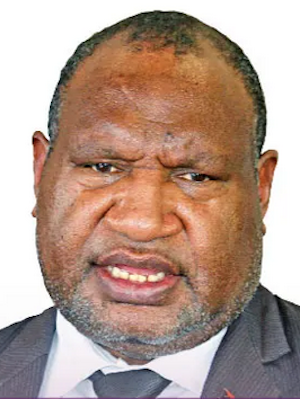
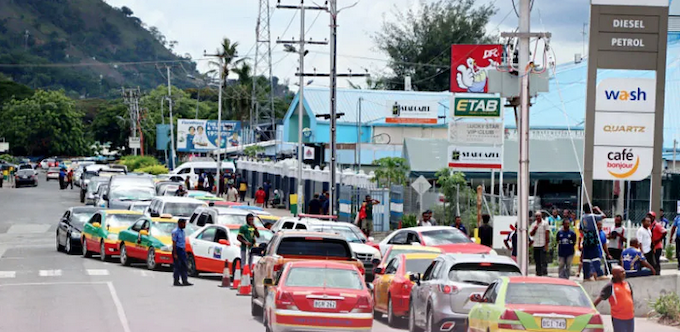
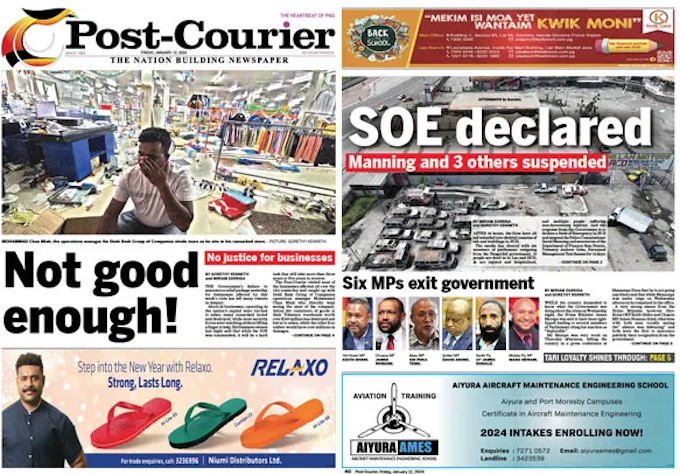
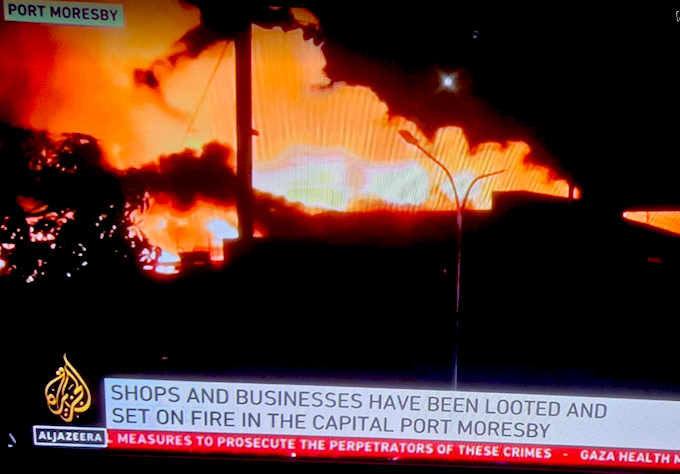
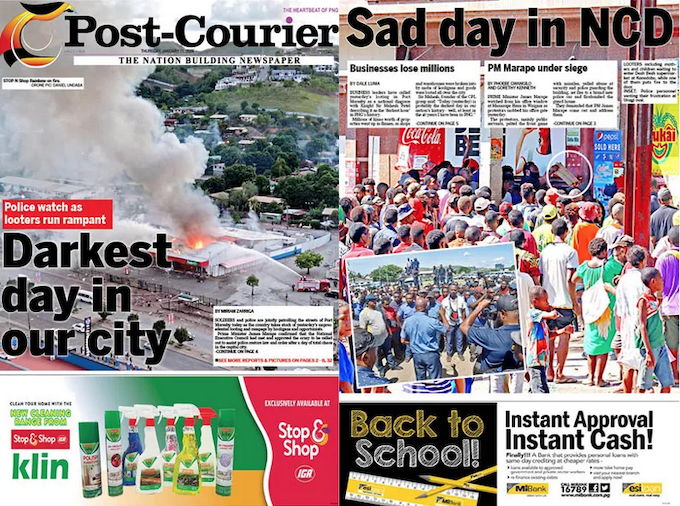
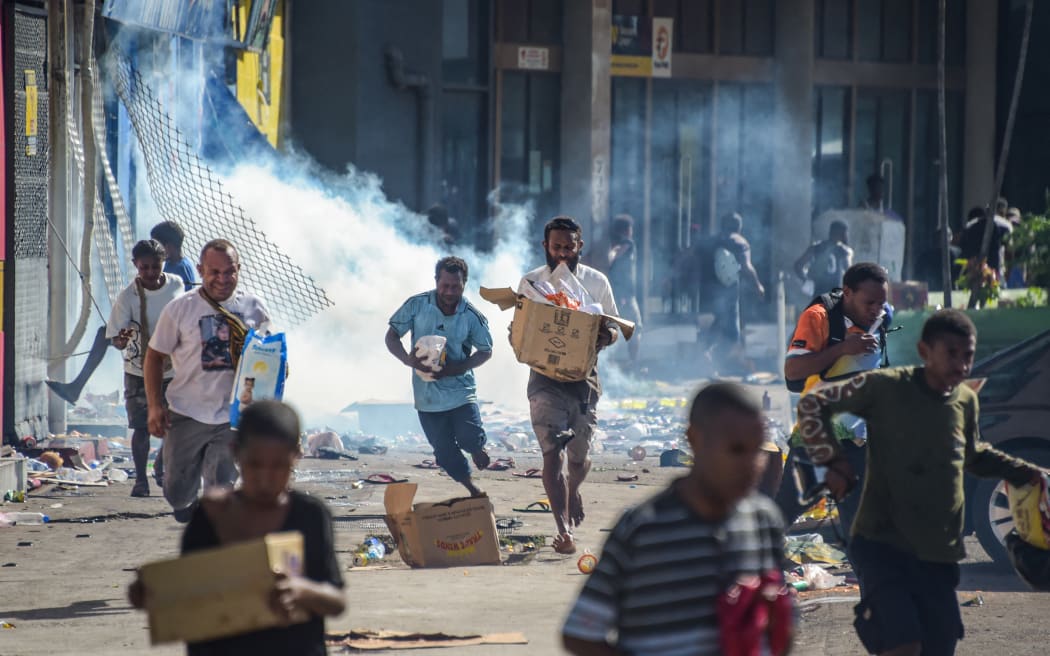
Rogue police officers have been alleged to be part of last Wednesday’s uprising of opportunists leading to looting and ransacking of more than 20 shops and loss of businesses in the capital of Port Moresby.
Prime Minister James Marape said last week’s “Black Wednesday” unrest had led the government to consider the Vagrancy Act and complete the national Census.
Marape said the 14-day State of Emergency orders included “no movement of large crowds”.
“There is no curfew and limited movement of large crowds will be stopped,” he said.
“Police will be supported by the PNG Defence Force and they will be allowed to stop anyone and check them.
“We are taking a soft approach to the SOE for the next 14 days,” Marape added.
Brian Bell Group chair Ian Clough . . . K50 million losses not covered by insurance. Image: Linked-in
Meanwhile, Brian Bell Group chair Ian Clough has made an impassioned plea to the government for assistance to rebuild its business because the company’s losses suffered in the Black Wednesday plunder were not covered by insurance, reports Claudia Tally.
He said that all businesses which suffered the “indignity of huge losses” through theft, arson and looting were not covered by insurance companies.
Brian Bell suffered losses of 50 million kina (NZ$21.5 million) million) after its warehouse in Port Moresby’s Gerehu Stage 6 was completely emptied by looters during the citywide plunder of businesses on January 10.
An emotional Clough said all businesses were not covered by insurance for civil unrest. This situation needed to be treated as a “natural disaster” where the government must step in to assist.
Gorethy Kenneth, Miriam Zarriga and Claudia Tally are PNG Post-Courier reporters. Republished with permission.
One of the key players in the restoration of peace in New Caledonia in the 1980s, Louis Le Pensec, died last week aged 87.
Le Pensec is regarded as one of the main actors in the negotiations that led to the signing of the Matignon-Oudinot Accords in 1988 which put an end to half a decade of a bloody civil war in the French Pacific territory.
He was then French Minister for Overseas Territories and was specifically tasked by French Prime Minister Michel Rocard to bring pro-France and pro-independence politicians and militants to a truce and an eventual agreement.
The first of the two agreements, the Matignon Accord, was signed between pro-French leader Jacques Lafleur and the charismatic pro-independence figure Jean-Marie Tjibaou under the auspices of Socialist PM Rocard.
Le Pensec took care of the second pact, the Oudinot Accord, signed a few weeks later in August 1988.
The set of agreements mostly enacted the return of civil peace in New Caledonia, but also paved the way for a possible self-determination future for New Caledonia.
Return to civil peace Ten years later, in 1998, the Nouméa Accord paved the way for a series of pro-autonomy measures, including the creation of three provinces and their assemblies, a Congress and a local “collegial” government.
It also prescribed a series of three referendums on New Caledonia’s self-determination, which have now taken place between 2017 and 2021.
Tributes flowing from all sides The announcement of Le Pensec’s passing was followed by emotional reactions in New Caledonia.
New Caledonia’s local government paid homage to the former minister, and the “essential role” he played in the 1980s negotiations to restore peace.
“He laid the foundation stones for a lasting peace and a pacific coexistence between our different communities,” a statement said.
“He contributed to the search for consensual solutions in order to lay the foundations of a constructive dialogue . . . He opened the way to a period of social and political stability, thus allowing New Caledonia to progress serenely towards its destiny.
“May we keep following this peaceful and brotherly path that he has left us,” New Caledonia’s government concluded.
The local government also recalled Le Pensec explaining the context of the negotiations in the 1980s and how he was given the New Caledonian mission by French PM Rocard.
“He told me: ‘Louis, now for you it’s [New] Caledonia’. I was shocked because I knew how big a challenge that was.
And then (Rocard) told me: ‘You’ll see, a Breton [person from Brittany region, Western France] like you will get along fine with the Kanaks . . . Later, I realised how true that was, how that Kanaks customs were in many ways similar to the customs of my Brittany,” he confided in 2018.
“During our meetings, we never went straight to the point, first we would talk for about two hours about non-essential things, like the weather . . . and also there was this thing we had in common, the feeling of belonging to what you can call minority people”.
“So all this facilitated a mutual confidence, I do realise how lucky I have been to live that and above all to see that sometimes political talk can silence weapons”.
Le Pensec was France’s Minister for Overseas Territories between 1988 and 1993.
Some of the reactions coming from Paris included French Defence Minister Sébastien Lecornu, who recently held the Overseas portfolio.
“Through his participation to the building of the Matignon-Oudinot Accords, [Le Pensec] allowed the opening of a path of hope and peace for New Caledonia,” he messaged on X, formerly known as Twitter.
Pro-independence politician and current chair of New Caledonia’s Congress, Roch Wamytan, paid tribute to Le Pensec’s “humanity” and capacity to listen and foster fructuous dialogue, “as opposed to his present colleagues”.
Pro-independence demonstration in the streets of Nouméa Coinciding with the ex-minister’s death announcement, in Nouméa, on Thursday, one of the components of the pro-independence umbrella FLNKS, the Union Calédonienne (UC), was demonstrating in front of the Congress to voice its opposition to what they described as the French government’s “forceful” manners in its plans to change New Caledonia’s electoral roll eligibility with a constitutional amendment.
The plan, announced after Christmas, is scheduled to set a vote in the French Congress (a special gathering of France’s two Houses, the National Assembly and the Senate) during the first quarter of 2024.
Brandishing banners denouncing the “people’s colonisation” on Thursday, protesting participants included UC members and sympathisers, but also close entities such as the USTKE trade union, as well as a UC-revived, self-styled “field action coordination cell”.
Other components of the FLNKS, such as the Kanak Liberation Party (PALIKA) and the Melanesian Progressist Union (UPM) are not taking part in those actions and have advised their members and supporters to refrain from doing so.
Since last year, the French government has been trying to bring back pro-France and pro-independence politicians to the table so that they can reflect and envisage a new agreement for New Caledonia’ s political and institutional future.
After more than 25 years of existence, the Nouméa Accord is deemed to have expired, but is now waiting for a new document to replace it.
Just before her resignation, a few days ago, then Prime minister Elisabeth Borne had given New Caledonia’s political players until 1 July 2024 to agree on a new consensus for New Caledonia.
She also announced France’s plan to “unfreeze” New Caledonia’s electoral roll (which was “frozen” under temporary restrictions for the implementation of the Nouméa Accord) so that French citizens who have resided in the territory for more than 10 years are eligible to vote for local elections.
This article is republished under a community partnership agreement with RNZ.
If you’ve ever been tricked by a visual illusion, you know the feeling of disconnect between what your eyes perceive and what is actually there. Visual illusions occur due to errors in our perception, causing us to misperceive certain characteristics of objects or scenes.
As it turns out, many non-human animals also experience these effects, including illusions of item size, brightness, colour, shape, orientation, motion or quantity. We study these illusions and the differences between animals as it can tell us how visual systems evolved.
Our latest study, published in iScience, shows that European honeybees and European wasps see illusions of quantity in a similar way to humans.
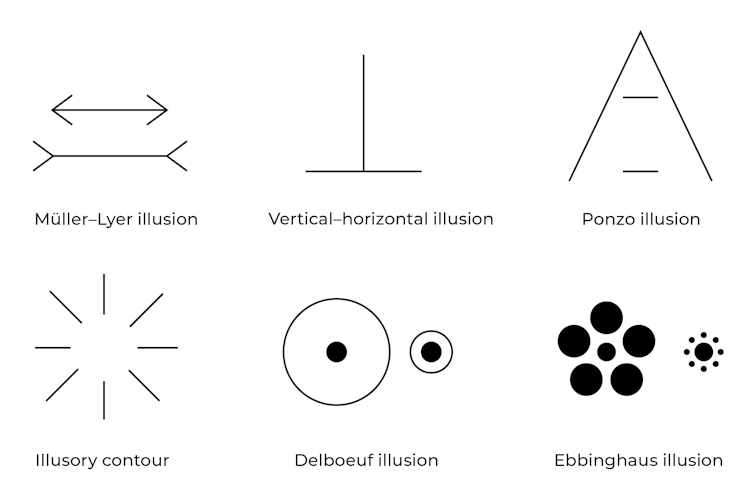
Examples of different visual illusions where the eye is tricked to perceive incorrect proportions of objects. Scarlett Howard
An illusion perceived by several species
The study of visual illusions provides interesting windows into how brains operate. Visual illusions are perceptual errors, which likely enable us to process complex natural information efficiently.
The Solitaire illusion causes a misperception of quantity based on the configuration of dots in an image. Those who perceive the illusion will overestimate the quantity of dots when they are clustered together and/or underestimate the number of dots when unclustered.
An example of the Solitaire illusion. The yellow elements generally appear more numerous on the right than the left, despite both images having an identical quantity of yellow and blue elements. Scarlett Howard
A possible evolutionary reason humans and other species may experience this misperception of quantities is it may allow us to process and compare large numbers of items more efficiently and quickly.
For quantities greater than about five, fast decisions may be more important than absolute accuracy, which would require manual, sequential counting.
Some insects, including bees and wasps, are very “motivated” to participate in behavioural experiments. European honeybees and wasps are central-place foragers: they will return to the location of a high-quality food source.
We provided freely flying bees and wasps with a reward of sugar water for participating in experiments. This allows us to train and test individually colour-marked insects throughout a day, with them returning by their own choice.
Honeybees are also known to perceive some spatial, movement and colour illusions. These past skills make them an ideal candidate to study and see if they are fooled by illusions of quantity.
Wasps are far less tested than honeybees for their behaviour and cognition, but recent studies show they are also capable of advanced learning.
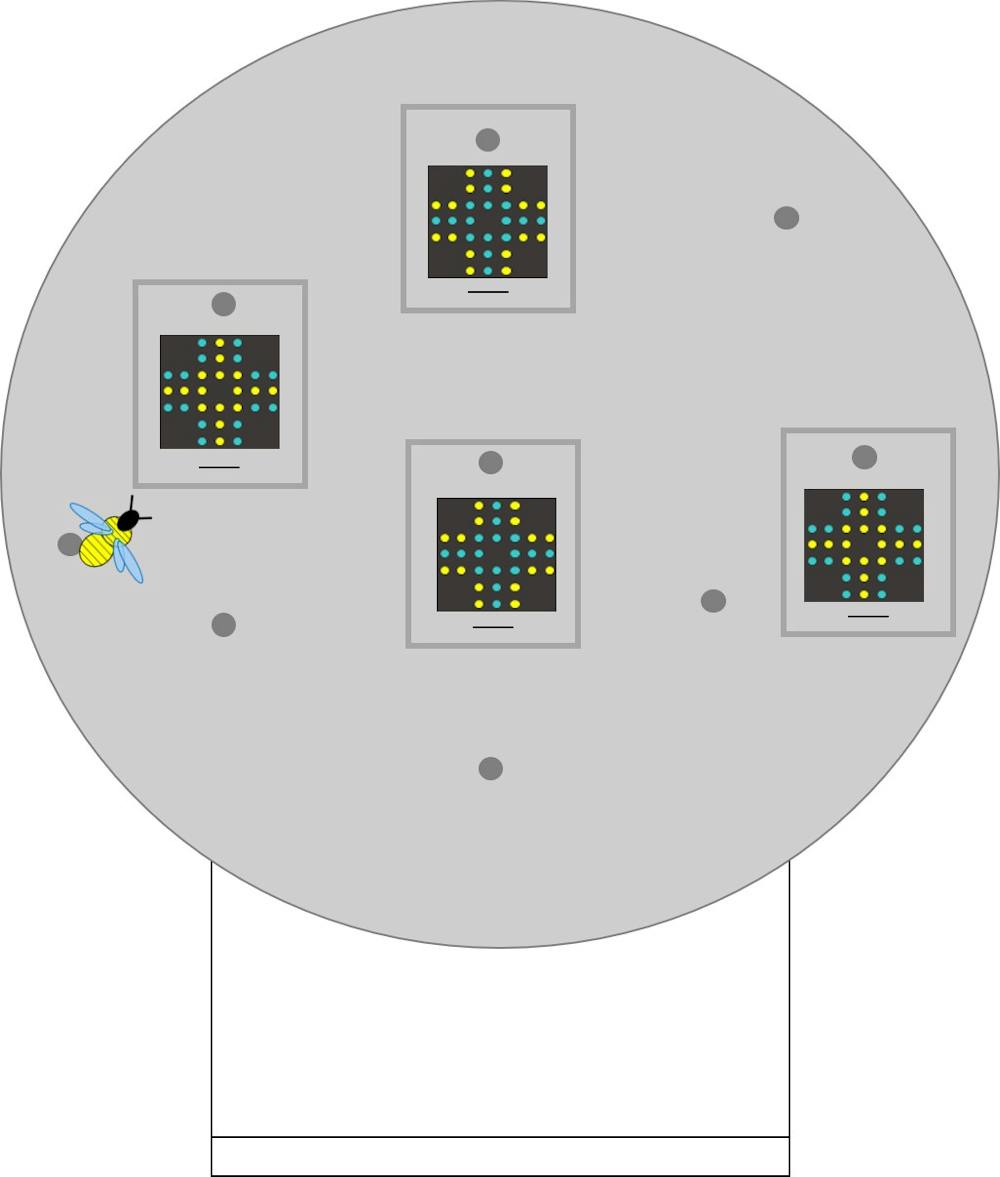
The circular rotating screen used to present stimuli to insects during training and testing. Insects were trained one at a time and rewarded with a sugar water drop for landing on the correct stimulus option during training. Scarlett Howard
Bees, wasps and the Solitaire illusion
We tested the European honeybee (Apis mellifera) and the European wasp (Vespula vulgaris) using an identical method for both species.
We presented each insect with images containing blue and yellow dots. For 70 trials, the insects were trained with a sugar reward to visit an image with a higher quantity of yellow dots versus blue.
We then presented them with the Solitaire illusion – one image with the yellow dots clustered in the middle and the blue dots unclustered, versus one image of the opposite.
The images actually contained an identical number of blue and yellow dots. So, if the insects perceived the illusion, they would choose the option with the yellow dots clustered in the centre, revealing an overestimation of the quantity of yellow dots.
We found both honeybees and wasps perceived the illusion in a similar way to humans, capuchin monkeys and guppies.
A bee and wasp in front of one of the training images. Scarlett Howard
Is there an evolutionary clue here?
We now know the perception of the Solitaire illusion occurs across a range of species including humans, non-human primates, fish and insects. There are also primates and other mammals that appear not to perceive the illusion.
This could suggest two potential evolutionary pathways of experiencing the illusion.
One is convergent evolution, where different species separately developed the ability to perceive this illusion due to the requirements of their environment.
The other pathway is that the perception occurred through conserved evolution, where a common ancestor perceived the illusion, and subsequently some species either retained or lost the illusion perception.
One important consideration is that while the Solitaire illusion is considered an illusion of quantity, it could also be perceived as an illusion of colour area, size, line length, or perimeter. More research will be needed to determine whether the illusion induces the misperception of quantity or other cues that correlate with quantity.
Scarlett Howard receives funding from the Australian Research Council, Monash University, Australian Academy of Sciences, and the Hermon Slade Foundation. She is affiliated with Triple R.
Adrian Dyer receives funding from the Alexander von Humboldt Foundation, the Air Force Office of Scientific Research and the Australian Research Council.
2024 is going to be democracy’s biggest year ever. In a remarkable milestone in human history, over four billion people – more than half of the world’s population across more than 40 countries – will go to the polls.
National elections will be held in the United States, India, Indonesia, Russia, the United Kingdom, Pakistan, Bangladesh, Taiwan, Mexico, and South Africa to name just a few. The European Union will also go to the polls. This busy calendar of elections is as extraordinary for the diversity of nations and peoples participating as it is for its huge scale.
It’s tempting to see this record as a triumph for democracy as the dominant organising principle for governing people in the modern world.
But a closer examination shows democracy is at risk on many fronts. While these challenges take different forms in different jurisdictions, some clear patterns emerge. 2024 is going to be a rugged year for democracy, but there is still cause for cautious optimism about its future.
Here’s a rundown of just some of the significant elections that will shape the world in 2024.
The most high-stakes election of 2024 will be the US general election for the president, house of representatives and senate in November. For decades America has stood as the world’s most powerful democracy and a guarantor (if a flawed one) of democratic governments the world over.
Donald Trump is the likely Republican nominee. In his previous term as President he did more than any previous chief executive to undermine democracy according to a Varieties of Democracy (V-Dem) analysis.
Now he is promising to punish his political opponents, override the independence of the Department of Justice and extend presidential power into non-political areas of government administration.
This prompted President Joe Biden to warn that “Democracy is on the ballot” in the 2024 Presidential vote.
At this stage, US voters do not seem to care too much, with Trump ahead in many key opinion polls.
India and Indonesia
The rise of democracy in India and Indonesia, the world’s second and fourth most populous nations, has been a game changer for the global advancement of human freedoms. The sheer scale of the elections in these developing nations, with a combined population of 1.7 billion, is also a miracle in modern administration.
Indian Prime Minister Narendra Modi seems almost certain to be returned for a third term in an election to be likely held between April and May.
While Indonesian Defence Minister, Prabowo Subianto, is the clear frontrunner to become the next president of the world’s largest Muslim nation in February.
In both cases, there is the risk these “strongman” leaders will win power in free and fair elections but then oversee illiberal policies that put democratic institutions under strain.
United Kingdom and Europe
The UK is likely to go to a general election in the second half of 2024. Current polling suggests it will result in the first change of government in 14 years with victory for the Labour Party led by Keir Starmer.
If that happens, it will be a reminder of democracy’s ability to enable the transfer of political power between opposing interests without widespread bloodshed – something humankind has failed at for most of history.
Other elections in Europe will be a barometer of the standing of the populist far right.
The success of anti-Islam extremist Geert Wilders in elections in the Netherlands in November means many analysts are now predicting the far right will enjoy a surge in support in European parliament elections in June, as well as national elections in Austria, Belgium, Croatia and Finland.
National elections are occurring in a dozen countries in Africa this year including Rwanda, Ghana, Tunisia, South Sudan and Algeria. But most attention will be on the mid-year election in South Africa which will be the most important since the end of apartheid in 1994.
Current polls suggest that after three decades in power the African National Congress (ANC) will not be able to garner the necessary 50% of votes needed to govern in its own right, bringing to an end 30 years of one-party rule.
Bogus elections
Special mention must be made of the 2024 elections which will not be free and will not be fair.
Russia, Rwanda and Belarus are governed by tyrannical rulers who jail opponents and run bogus elections that deliver 90% majorities or higher.
Then there is the charade elections occurring in Bangladesh, Iran and Tunisia where leaders allow the opposition to compete, but not to win.
Will democracy pass these tests?
Elections are taking place against a backdrop of spreading illiberalism around the world, the weakening of independent institutions in some of the big democracies, and a creeping disillusionment in advanced democracies, especially among younger people, about the benefits of a democratic system.
But there is also reason for cautious optimism that the long arc of history continues to steer determinedly towards a more democratic world.
Democracy remains the model that most developing nations strive for. According to Freedom House, there were 69 electoral democracies in 1990 rising to 122 by 2014. It is telling that even dictators and despots feel the need to give themselves the appearance of a democratic mandate. And surveys of citizens in advanced democracies continue to show high levels of support for the ideals of democratic government.
“Government of the people, for the people, by the people” still holds significant advantages over all the other alternatives currently being tried. But in 2024 it will be tested mightily.
Nicholas Reece does not work for, consult, own shares in or receive funding from any company or organisation that would benefit from this article, and has disclosed no relevant affiliations beyond their academic appointment.
Unlike in previous generations, you’re unlikely to discover your adolescent’s first exposure to adult sexual content from finding a scrunched-up Playboy magazine under their mattress.
With easy access to the internet and the use of tablets and mobile phones, it’s more likely to be from free, mainstream online porn. And it can be a very shocking introduction to sex.
But it’s common and has become normalised among young people. The median age for boys to first view pornography is 13, while for girls it’s 16.
OK, so your child or adolescent has watched a porn video. First, stay calm.
How much detail you go into and what’s appropriate for them to know will depend on their age and level of maturity.
Many parents let their adolescents know porn is not real – it’s a fantasy. But it’s not enough to just say, “that’s not real”. They also need to know what reality is.
Explain that porn is not what sex is like – and what’s wrong with depictions of sex in porn: everyone who’s involved should be enjoying it, not just the man.
In porn, you don’t see all the normal things that happen around sex, like discussions on how to ask about consent, or even the bloopers of sex, such as when people change positions, negotiate, and move around.
Porn is not designed to show sex the way it would be experienced as pleasurable, or show what positive relationships are meant to look like. People don’t tend to ask, “do you want to do that?” And if they do, you won’t see what happens if someone says “no”. The performers aren’t doing it in a way that feels good, but instead focus on what is deemed to “look good”.
Porn doesn’t present sex in a real way, and it can change young people’s ideas and expectations about what sex is.
How are adolescents accessing porn?
Adolescents are used to discovering things on their own using the internet and are naturally curious about sex. Their exposure to porn can come from something as simple as googling a term they’ve never heard of before, or their friends sending them a link.
They’re most likely to come across mainstream porn. With lots of flesh, quick movements and closeups, it can be very graphic and can come across as violent to someone seeing it for the first time.
This becomes how adolescents, who don’t have personal experiences of sex, or have the information they need, learn about sex. Just as they go to YouTube to learn how to cook a meal or fix the tap, they are used to watching and following.
And for something private and stigmatised like sex, there are limited good alternatives for them to learn how it really works.
There are limited alternatives to learn how sex really works. Shutterstock
When should we have ‘the talk’?
An open conversation about safety, sex, consent and relationships and gender roles is important throughout their whole life. Introduce the topic of sex gradually, depending on your child’s age. It doesn’t have to be a big sit down, to have a big talk.
It’s best to bring it up in relevant situations, particularly on seeking ongoing consent, because that applies to all aspects of life. Everyone has the right to make decisions about their own body, and it’s up to them if they want to be touched, hugged, kissed or have sex. It’s also important to reinforce that women and girls have feelings and needs, and they’re not just there to look pretty.
If they’re asking questions, then they’re old enough to talk about it. Ideally, you won’t wait for them to ask. You should be having conversations about consent, positive relationships, and sex from an early age. But it’s important to talk about it earlier rather than later, even if you don’t think they’ve watched porn.
Instead of saying “have you heard about porn?”, let them know from a young age they can trust you if they see something online that they don’t like or confuses them. Assure them you can’t believe everything you see online and you’re a safe person to go to with any questions.
Let them know it’s not their fault if they see something they don’t like, make sure they are OK and ask how it made them feel. Remind them to simply close the browser or turn off the screen if they see something that upsets them or makes them feel yuck.
Can I prevent my child accessing porn?
Your children will probably see porn at some point, but the older they are when they first see it, the better.
Unlike with adolescents where conversations are paramount, restrictions can prevent and protect young children from seeing porn. These include parental controls on devices, apps or browsers, or establishing rules about when, where and with whom they can access their phones, computers or tablets. Yes, older teenagers can probably get past them, but younger kids can’t.
Be open and honest with your kids about using internet restrictions – don’t spy on them. Let them know why you’re doing it, explaining there are bad things online you need to protect them from – it’s about building trust.
If you find your child showing unusual behaviour or acting out towards other children, or your teen shows signs of addiction (where their viewing activities interfere with their day-to-day lives), seek professional help.
The GIST is a great resource for parents and older teens about how to approach difficult topics like this. If you’re a child or adolescent and need support, you can call the Kids Help Line on 1800 55 1800.
Megan Lim receives funding from the National Health and Medical Research Council, VicHealth, Westpac Foundation, and the Office of the eSafety Commissioner.
Giving kids pocket money can be a really challenging decision for families. It raises questions about when to start it, how much to give and whether it should be tied to chores.
As a finance researcher and parent, it’s also important to view pocket money as an educational opportunity. You can use it to teach children how to make informed financial decisions, set meaningful goals and develop responsible spending habits.
Here’s how you can approach it.
When should you start?
There is no one “right age” but you could reasonably consider pocket money when children start school and begin learning to add and subtract.
This means your child will be old enough to start grasping concepts like saving and spending.
As your child grows, you can move on from basic arithmetic and tailor your discussions to what your child is learning in maths.
How much you give will depend on your family situation and finances.
A useful starting point is working out what the pocket money will be used for. Is it simply to give your child a bit of autonomy over spending (for example, buying an ice block from the canteen)?. Is it to try to save for something special? Or is it to be used for all entertainment, clothes and on-trend desires like fancy water bottles?
A long-held rule of thumb is giving $1 per week relating to your child’s age (so $5 for a five-year-old). But of course amounts tying pocket money to a child’s raw age may not work with today’s economic conditions. Three years ago, $10 bought a lot more than it does today.
Of course you will also need to consider pocket money within the context of your wider household budget. Down the track, there’s nothing wrong with talking to your child about adjusting their pocket money if your household budget needs changing.
When your child is little, giving them pocket money in cash is a good way to help them start to understand money. It’s something they can see and hold in their hands.
As they get older and the amounts get larger, direct debits will become more convenient and can teach them about handling their money online.
Since getting your hands on cash is difficult these days, when they’re young you can also give your kids pocket money electronically but give them monopoly money or a similar representative of what they have earned. You can then progress to a spreadsheet as they get older.
What about tying it to chores?
Many parents like to provide pocket money in exchange for chores as they feel it might instil a work ethic in their kids and the idea you don’t get money for nothing.
If you are tying pocket money to chores, be very clear about what will be done for what money and when chores need to be reviewed. Follow-through is important for this structure to be effective, so if they don’t do the work, they don’t get paid. You can also give them bonuses for jobs that are particularly well done.
Personally, I find this process to be more work for parents than it’s worth. I prefer the children to simply help around the house because it’s a core family value rather than tying it to finances.
If pocket money is tied to chores, make sure they actually do the chores. Kampus Production, CC BY
The bigger picture
However you structure pocket money in your family, it’s important to consider it an opportunity to learn about finances.
You might start with simple discussions around “do I have enough money to buy this packet of textas and that toy car?” or “how many weeks until I can afford that book?”. Then as your child develops, you can introduce concepts such as cash flow, interest rates and banking products.
For example, cash flow lessons can start with talking about the importance of spending less than you earn.
Teaching kids about goals
Pocket money is also a fantastic way to help kids learn how to save. Help them set a realistic goal to save up for something that matters to them. A pair of sneakers they want or a particular video game is likely to be more achievable than a new bike. This will help motivate and challenge your child, without overwhelming them.
As your child gets older, you can introduce more sophisticated notions of saving and funds.
For example, when my child started high school we talked about setting up an emergency fund. As she was going to catch buses, we worked out the fund should be $50 (based on missing the bus and needing a taxi home). This became her new “baseline” before spending on non-essential items such as food from the school canteen.
Barefoot Investor author Scott Pape recommends starting with physical buckets with “splurge” for every day little things, “save” for big goals, “give” for acts of kindness and “grow” for investing.
Once your child has their own money to spend, a trip to the shops takes on a whole new significance.
Smart shopping is not just about comparing prices or where to find the best bargains. It is also learning what is worth spending your money on and when.
You can talk to your child about what they value and their emotional responses around buying decisions. For example, “how long was it before the excitement of your new T-shirt wore off?” Or “Did you feel differently when you spent your money on going to that movie (an experience) versus that box of Lego (a tangible product)?”
There are lots of things to consider (and no perfect formula) when it comes to pocket money. But if it means you can integrate financial skills into everyday life, it’s a fantastic investment in your kids’ education.
Robyn McCormack does not work for, consult, own shares in or receive funding from any company or organization that would benefit from this article, and has disclosed no relevant affiliations beyond their academic appointment.
The earliest versions of Mickey and Minnie Mouse entered the public domain in the United States at the start of this year, 95 years since they were introduced to the public in the film Steamboat Willie.
Many characters come into the public domain on New Year’s Day (Public Domain Day) every year. For works “made for hire”, including films, copyright in the United States lasts 95 years; for other works it is the life of an author plus 70 years.
Prior to 1998, copyright for works of corporate ownership lasted 75 years, but the Sonny Bono Copyright Term Extension Act of 1998, often nicknamed the Mickey Mouse Protection Act due to the lobbying by Disney, expanded copyright protections to 95 years.
Only this first iteration of Mickey is in the public domain, but it didn’t take long for creators to seize the opportunity – limited though it might be.
Already two horror films are on the horizon, albeit with the lawyers on hand to make sure there will be no cease and desist letters!
The earlier iterations of Mickey and other characters from Steamboat Willie can be used in any adaptation.
Before this they could only be used in a transformative way under the United States’ fair use exception. Fair use in the US allows creators to transform other existing works as long as they create something new and different from them.
This feature of the US copyright system in a recent case reiterated that it would only work where works were not in competition with each other.
From January 1, this factor is irrelevant for early Mickey. As long as creators are not misleading consumers as to Disney endorsement or connection, do not use Mickey’s later likeness, and don’t use the Mickey or characters of Steamboat Willie as a trademark, they are free to go nuts.
Can I use Mickey in Australia?
Many jurisdictions have different terms for copyright, so it may be that early Mickey is still not free in some places.
In Australia, films made in Australia get 70 years of copyright protection once made public, so all Australian films made public before 1955 are now in the public domain.
Australia’s protection for cinematography works is shorter than the US, but due to a number of treaty obligations, member states give the same treatment to foreign works that they do national ones. This means the law that applies will depend on where you are sued, and if an Australian was sued in the US for their usage of early Mickey Mouse before this year you could be liable under US copyright laws.
As of 2024, if Disney sued you in Australia or the US you are likely to win but other jurisdictions may still have some protection, so it will depend on where you publish or show the work. Online, where a work can be “shown” anywhere, the suing company can not just choose any country: there must be some connection for the parties to the country they are being sued in.
Additionally, while Australia does not have a broad fair use exception to copyright, our creators could always use Mickey in a parody or satire or for review or criticism. I may even have used a likeness or two in a law exam question (exams have a special exception under the act).
With the early Mickey in the public domain, you no longer need to be satisfied that one of those categories applies. A movie, artwork or literary work that shows the early version of Mickey can be whatever you want.
The issue will then be making sure your creative work is restricted to the early Mickey. For example, when Winnie the Pooh came into the public domain in 2022 only the A.A Milne version was free to use so the horror movie made shortly after did not include the famous red t-shirt used in the Disney version.
A trademark is very different to copyright. Trademarks can last forever as long as registration is renewed, but there is no restriction on using logos and names that are trademarked as long as you are not using it as your own brand identity or mark, and not misleading or confusing consumers as to the origin of products. That means you can’t call your business “Mickey Mouse” or “Steamboat Willie” but you can use the likeness of those early characters in your marketing (as long as it’s not being used as your logo or brand recognition).
A number of fan fiction and perhaps even some more risqué adaptations using Mickey Mouse already exist online. Fan fiction will often also be a copyright infringement but the risk of being sued is slightly smaller. Companies tend to go after those who are making commercial dealings and those that they see as hurting their brand image. Even Banksy has incorporated Mickey in a work (likely being seen as a parody and as such non-infringing).
On the other hand, commercial publishers are incredibly risk averse and so if you do want to use Mickey be warned there may be an issue getting a publisher to bite. Additionally, merchandising of your creative work may be an issue depending on trademarks in different categories and where you market these. You also will only get copyright protection on original elements you add to the work.
So yes, upload and share the original movie, paint those early Mickeys, sing a song about Steamboat Willie, and enjoy the horror comedies coming out. Next year Popeye will become public domain so don’t be surprised if a slasher horror remake of him is coming soon!
Sarah Hook does not work for, consult, own shares in or receive funding from any company or organisation that would benefit from this article, and has disclosed no relevant affiliations beyond their academic appointment.
Fiji human rights activists have paid tribute in a Suva vigil this week to the more than 100 journalists — most of them Palestinian — killed in Israel’s War on Gaza.
The NGO Coalition on Human Rights (NGOCHR) staged a #ThursdaysInBlack vigil to remember the dead journalists, but only one local Fiji reporter turned up (from The Fiji Times).
The coalition had invited local journalists to attend and share their views. However, according to coalition coordinator Shamima Ali (of the Fiji Women’s Crisis Centre), Fiji media is reluctant to engage with the global crisis over the war.
“Within the media outlets, we have Zionists themselves, so there is reluctance to report (on the Gaza conflict),” she said.
In Australia and New Zealand, there is an ongoing controversy over some journalists and editors having been on junkets to Israel and then attempting to “silence” fair and balanced reporting on the war enabling a Palestinian voice.
Part of the Fiji vigil featured Australian journalist Alex McKinnon, who shared insights into his life as a reporter covering the conflict and the censorship involved in silencing the Palestinian voice.
Heavy death toll The coalition said more than 100 journalists, videographers and media workers had been killed in Gaza since the current war broke out last October 7, adding more journalists had been killed in three months of Israel’s War on Gaza than in all of World War Two (69) or the Vietnam War (63).
New investigations on U.S. and UK media bias have exposed chilling double standards by Western media when it comes to reporting on killings of Israelis compared to killings of Palestinians in Gaza. pic.twitter.com/uQ0I7cT340
The high death toll in Gaza comes despite journalists being protected under international law — making attacks on them a war crime.
The New York-based Committee to Protect Journalists says that an unprecedented number of reporters were killed in the first 10 weeks of the genocide. It currently lists 82 confirmed killed, but it is verifying additional numbers.
Gaza’s media office has documented the killing of at least at least 110 media workers since the genocide started.
Last May, the CPJ published “Deadly Pattern,” a report that found members of the Israel Defence Forces (IDF) had killed at least 20 journalists over the previous 22 years and that no one had ever been charged or held accountable for their deaths.
The Israeli government has prevented independent entry to foreign journalists seeking to cover the genocide from within the Gaza Strip.
After months of intense campaigning, the Democratic Progressive Party (DPP) emerged victorious in the 2024 Taiwan presidential election, securing an historic third consecutive term. However, the party’s dominance has gone from absolute to relative; it secured only 40% of the presidential votes, and fell short of retaining the majority of legislative seats.
Meanwhile, the Kuomintang (KMT) failed to retake the presidency as well as the majority of legislative seats. The remaining seats are held by Taiwan People’s Party (TPP).
The Taiwan People’s Party, despite occupying third place in the Legislative Yuan with eight seats, achieved a remarkable 26% in the presidential race, punching above its weight considering its limited resources and recent formation.
These results signify a shift in Taiwan’s political landscape. The long-standing two-party system appears to be transitioning into a messy three-party dynamic.
While the Democratic Progressive Party’s third consecutive presidential term may seem like a victory, cracks in the foundation of Taiwan’s political landscape are widening.
The roots of this instability stretch back to 2020, where anti-establishment sentiment simmered beneath the surface, even as the China factor dominated headlines. This time, the discontent is boiling over.
The Democratic Progressive government, once riding a wave of youthful support, now faces accusations of power abuse and, crucially, a failure to address the very issues that propelled them to power in 2016; skyrocketing housing prices, stagnant wages, and widening inequality. These woes fuelled the rise of the Taiwan People’s Party.
The Kuomintang, the other pillar of the old order, struggles to offer solutions. Their proposed subsidised interest rates risk further inflating the housing bubble, alienating the young generation they desperately need to win.
Meanwhile, the Taiwan People’s Party proposes alternatives – public
housing, rent subsidies, and even property tax hikes – aimed at making housing truly affordable.
For decades, power has swayed between the Kuomintang and Democratic Progressive Party, yet voter satisfaction with
Taiwanese democracy languishes below 50%.
This stark statistic betrays a profound representation crisis, an outcry against the established parties, often due to a perceived failure to tackle core issues.
The Taiwan People’s Party, riding this wave of disillusionment, attracts those who yearn for a political shift, focusing on domestic woes. It emerges as a beacon of hope for those who have lost faith in the two-party system.
Why did the DPP win again?
Pre-election polls painted a clear picture: more than 60% craved a change, a break from the Democratic Progressive Party’s grip on power.
But the tide of discontent splintered, dividing voters between the established Kuomintang and the rising force of the Taiwan People’s Party.
Youth flocked to the newcomer, while the Kuomintang found favour among older
demographics.
To unseat the government, a united front seemed logical. Yet, cooperation crumbled, replaced by escalating animosity between the opposition parties. This fractured landscape handed the ruling party an advantage: a divided opposition meant their own victory was practically guaranteed.
The Kuomintang, desperate to tip the scales, resorted to strategic voting, aiming to marginalise the Taiwan People’s Party.
Negative campaigns against the Taiwan People’s Party intensified after failed negotiation attempts on November 23. With Taiwan’s traditional media heavily aligned with either the Kuomintang or the government, the Taiwan People’s Party faced an uphill battle for airtime.
Instead of ceding the stage, they went digital. They launched their own YouTube channel, and their supporters spearheaded online and offline campaigns and created alternative news channels. This counteroffensive transformed the fight into a three-pronged clash.
The battle became more than just a contest between the establishment and the anti-establishment. It morphed into a clash between traditional media and
the burgeoning power of social media.
The Taiwan People’s Party’s digital insurgency challenged the long-held dominance of traditional media and carved out a space for their voices to be heard.
While the outcome of the election may be set, the digital battleground shows a new force has emerged in Taiwan’s political landscape.
The future of the cross-strait relations
On the international front, continuity seems to be the watchword.
The established relationship with the US, nurtured by President Tsai Ing-wen, is likely to continue under the guidance of Vice President Bi-khim Hsiao. Her esteemed record as former ambassador to the US inspires confidence in maintaining strong ties.
However, cross-strait relations with China face a potential storm.
With both the President and Vice President openly supporting Taiwan’s independence in the past, China perceives them as a united “independence duo”. This stance may trigger harsh responses, from further curtailing trade via terminating the free trade agreement to heightened military tensions.
The path forward requires navigating a delicate balance of upholding Taiwan’s democratic values while recognising the complex geopolitical realities. The future of Taiwan’s cross-strait relationship hinges on how well this balance is upheld. The governing Democratic Progressive Party will be judged on how they walk the tightrope.
The Taiwan People’s Party’s emergence may seem to add another layer of complexity, with its potentially divergent views on cross-strait policy. The party believes demonstrating goodwill can lower the temperature and avoid harsher measures like trade restrictions or military escalation.
Yet, unlike the Kuomintang’s focus on appeasement, the Taiwan People’s Party advocates for strengthening national defence to deter aggression and ensure peaceful coexistence with China.
Therefore, while the immediate outlook for cross-strait relations may be turbulent, the robust growth of Taiwan’s democracy offers a glimmer of hope for a future where pragmatism holds sway.
Taiwan’s election has presented a paradox: a familiar victory yet a
fundamental shift in the political landscape.
While the immediate future may be uncertain, the rise of the Taiwan People’s Party and the continued US support offer hope for a more open and responsive
democracy.
Kai-Ping Huang receives funding from National Sceince and Technology Council, Taiwan for a research proposal on negative campaigns.
For weeks Yemen’s Houthi forces have been greatly inconveniencing commercial shipping with their blockade, with reports last month saying Israel’s Eilat Port has seen an 85 percent drop in activity since the attacks began.
This entirely bloodless inconvenience was all it took for Washington to attack Yemen, the war-ravaged nation in which the US and its allies have spent recent years helping Saudi Arabia murder hundreds of thousands of people with its own maritime blockades.
Yemen has issued defiant statements in response to these attacks, saying they will not go “unanswered or unpunished”.
The U.S. can have a multi-decade long blockade on Cuba and it’s normalized.
Israel can have a decade and a half long total air, land, and sea blockade on Gaza and it’s normalized.
But Yemenis block some ships to stop a genocide and all the sudden it’s indefensible.
The Biden administration’s dramatic escalation toward yet another horrific war in the Middle East has been hotly criticised by lawmakers on both sides of the aisle, who argue that the attacks were illicit because they took place without congressional approval.
This impotent congressional whining will never go anywhere, since, as Glenn Greenwald has observed, the US Congress never actually does anything to hold presidents to account for carrying out acts of war without their approval.
But there are some worthwhile ideas going around.
After the second round of strikes, a Democratic representative from Georgia named Hank Johnson tweeted the following:
“I have what some may consider a dumb idea, but here it is: stop the bombing of Gaza, then the attacks on commercial shipping will end. Why not try that approach?”
By golly, that’s just crazy enough to work. In fact, anti-interventionists have been screaming it at the top of their lungs since the standoff with Yemen began.
All the way back in mid-October Responsible Statecraft’s Trita Parsi was already writing urgently about the need for a ceasefire in Gaza to prevent it from exploding into a wider war in the region, a position Parsi has continued pushing ever since.
“Huge Miscalculation”: Biden’s Refusal to Push for Gaza Ceasefire Could Drag U.S. into Middle East War https://t.co/eJuzswi2BJ
As we discussed previously, Israel’s US-backed assault on Gaza is threatening to bleed over into conflicts with the Houthis in Yemen, with Hezbollah in Lebanon, with Iran-aligned militias in Iraq and Syria, and even potentially with Iran itself – any of which could easily see the US and its allies committing themselves to a full-scale war.
Peace in Gaza takes these completely unnecessary gambles off the table.
And it is absolutely within Washington’s power to force a ceasefire in Gaza. Biden could end all this with one phone call, as US presidents have done in the past. As Parsi wrote for The Nation earlier this month:
“In 1982, President Ronald Reagan was ‘disgusted’ by Israeli bombardment of Lebanon. He stopped the transfer of cluster munitions to Israel and told Israeli Prime Minister Menachem Begin in a phone call that ‘this is a holocaust.’ Reagan demanded that Israel withdraw its troops from Lebanon. Begin caved. Twenty minutes after their phone call, Begin ordered a halt on attacks.
“Indeed, it is absurd to claim that Biden has no leverage, particularly given the massive amounts of arms he has shipped to Israel. In fact, Israeli officials openly admit it. ‘All of our missiles, the ammunition, the precision-guided bombs, all the airplanes and bombs, it’s all from the US,’ retired Israeli Maj. Gen. Yitzhak Brick conceded in November of last year. ‘The minute they turn off the tap, you can’t keep fighting. You have no capability.… Everyone understands that we can’t fight this war without the United States. Period.’ ”
In the end, you get peace by pursuing peace. That’s how it happens. You don’t get it by pursuing impossible imaginary ideals like the total elimination of Hamas while butchering tens of thousands of innocent Palestinians.
You don’t get it by trying to bludgeon the Middle East into passively accepting an active genocide. You get it by negotiation, de-escalation, diplomacy and detente.
The path to peace is right there. The door’s not locked. It’s not even closed. The fact that they don’t take it tells you what these imperialist bastards are really interested in.
Amnesty International is calling on Papua New Guinea authorities to protect human rights in response to the riots.
Port Moresby is in a state of emergency for 14 days with at least 16 people confirmed dead following violent unrest on Wednesday.
The violence broke out with shops and businesses being set alight after public servants went on strike over what has been described as a payroll error.
Prime Minister James Marape announced at a late night news conference on Thursday that more than 1000 defence force personnel WEre ready to step in whereever necessary.
Amnesty International Pacific researcher Kate Schuetze told RNZ Pacific firearms was often never an appropriate way to respond to protests.
“They have declared a state of emergency under the constitution which gives extraordinary powers to the authorities like the police and the military,” Schuetze said.
“What we really want to do is just remind them that protesters have human rights, that people in the streets have rights as well and ultimately, they have to work in a way to use the least lethal force possible and uphold the right to life.”
Members of the disciplined forces were among those protesting after their fortnightly pay checks were reduced by up to 300 kina (US$80).
Schuetze said the deductions for some officers amounted to half their pay packet.
“The deductions we’re talking about here are not an insignificant amount … understandably they were concerned.
“There’s questions around how much the government knew prior to the strike around this pay area and why they didn’t take steps to address it sooner.”
Amnesty International’s response . . . “It is imperative that Papua New Guinea authorities respond to this violence in a way that protects human rights and avoids further loss of life.” Image: AI screenshot APR
Schuetze said inflation was a concern for people.
“A lot of people are doing it tough in Papua New Guinea and I think it could be a sign of rising resentment and dissatisfaction with the leadership of the government, as well as livelihood factors that people feel are not being addressed.”
Marape is under increasing political pressure to step down, with six members of his coalition government resigning in the aftermath of the deadly violence.
Among them, Chauve MP James Nomane and Hiri-Koiari MP Kieth Iduhu made their resignations public via social media and blamed blamed Marape for the riots.
Schuetze said there needed to be “prompt, impartial and independent investigation” into what happened, including the causes of the riots.
“Likely there will be several colliding factors which cause this to happen.
“Any government, if this happens on their watch, if it happened in Australia, in New Zealand, we would expect there to be a full independent public inquiry.”
She said there tended to be an absence of appropriate police response to address the violent acts once they had occurred in Papua New Guinea.
“Obviously, the fact that people have died in the course of these riots is a really strong indicator that there may be human rights violations by the state.”
Schuetze said there were lots of videos uploaded to social media that showed police actively encouraging and participating in the chaos.
“If the police themselves were involved in acts of violence, there is a responsibility of the state to hold them accountable as well, as much as any other person engaged in active violence.”
‘Dysfunctional government’ Anti-corruption watchdog Transparency International PNG (TIPNG) said the frustration among police, and other public servants over tax calculations, was just the tip of the iceberg of a dysfunctional government system.
It is calling on the PNG government to engage immediately in genuine open dialogue with the police representatives to address their legitimate grievances.
The organisation’s board chair Peter Aitsi said this must be done quickly through transparent and open communication in order to resolve this crisis.
Aitsi said the public service and police were institutions of the state, and if truly independent and free of political control, should play a critical role as a check and balance to the executive government.
Open for business Meanwhile, PNG’s largest retail and wholesale organisation — the CPL Group — has re-opened for business.
In a statement on Friday, the company said its Stop & Shop outlet at Waigani Central, Town, Boroko, Airways was now open.
The City Pharmacy chain in Waigani Drive, Boroko and Vision city are also open for trading.
However, the group says those outlets in areas which “suffered devastatingly” remained closed.
It is also warned people not to use stolen pharmaceutical products, including baby formulas, off the counter and prescription medicines.
It is urging the public not to buy these products as they may be damaged and tampered with and wrong doses could be administered.
This article is republished under a community partnership agreement with RNZ.
Marwan Bishara, Al Jazeera’s senior political analyst, assesses Israeli defence submitted at the ICJ over South Africa’s genocide allegations. Image: AJ
Al Jazeera’s senior political analyst Marwan Bishara says Israel’s legal team “started off weak” but made a few strong points near the end.
Bishara said the lawyers’ efforts at the genocide hearings at the International Court of Justice (ICJ) in The Hague yesterday to deflect blame for Israel’s attacks and ignore the context of Israel’s 75-year occupation of Palestine came across as “illogical”, the Al Jazeera video clip reports.
Their claims that Israel’s forces are “trying to protect, rather than harm”, civilians were also unconvincing, he said, given the toll of the war: 23,357 Palestinians, including 9,600 children, since October 7.
However, Bishara said Israel’s lawyers did well to zero in on the jurisdiction of the ICJ — pointing out that the court must specifically prove Israel was guilty of genocidal intent, not any other violations.
“You can claim Israel has committed heinous crimes, but if they do not fall under the framework of genocide, the court has no jurisdiction,” Bishara said.
Speaking to reporters outside the ICJ in The Hague, Palestinian Foreign Ministry official Ammar Hijazi said Israel’s legal team was not “able to provide any solid arguments on the basis of fact and law”.
“What Israel has provided today are many of the already debunked lies,” he added, referring to, among others, Israeli clams that hospitals in Gaza were being used as military bases.
“Additionally, we think that what the Israeli team today has tried to provide is the exact thing that South Africa came to the court for — and that is, nothing at all justifies genocide.”
Thomas MacManus, a senior lecturer in state crime at Queen Mary University of London, said the ICJ was likely to see a “massive disconnect” between the picture Israel painted of its humanitarian concern for Gaza and “the reality on the ground where UN agencies say people are starving, lacking water, and seeing attacks on hospitals, schools, and universities.”
‘Nothing can ever justify genocide’ South Africa’s Minister of Justice Ronald Lamola told media “Self-defence is no answer to genocide”.
Here are the main points from his interaction:
“”Israel failed to disprove South Africa’s compelling case that was presented;
Israel tells the court that statements read out by senior Israeli political, military and civilian society leaders are simply rhetorical, and we shall not ascribe them any importance;
“There is no debate about what Prime Minister Netanyahu’s term ‘Amalek’ means and how it is understood by soldiers fighting on the ground and by the Israelis;
“How can you ignore Netanyahu’s statement, the statement of the defence minister and the ground forces? That is a clear implementation of policy.
“Israel chose to focus extensively on the events of October 7. South Africa has not ignored this event as Israel alleged because it has unequivocally condemned and continues to condemn October 7; and
“Self-defence is no answer to genocide. Nothing can ever justify genocide.”
Marwan Bishara comments on the Israeli ICJ defence. Video: Al Jazeera
South African lawyer Adila Hassim told judges at The Hague that “genocides are never declared in advance, but this court has the benefit of the past 13 weeks of evidence that shows incontrovertibly a pattern of conduct and related intention that justifies as a plausible claim of genocidal acts”.
“Israel deployed 6000 bombs per week . . . No one is spared. Not even newborns.
UN chiefs have described it as a graveyard for children,” she said told the court on the opening session of the two-day preliminary hearing.
“Nothing will stop the suffering except an order from this court.”
Israel’s ongoing three-month war in Gaza has killed more than 23,000 Palestinians, mostly women and children, lawyers told the court.
Most of Gaza’s population of 2.3 million has been displaced, and an Israeli blockade severely limiting food, fuel and medicine has caused a humanitarian “catastrophe”, according to the UN.
‘Genocidal in character’ South Africa submitted its case against Israel at the ICJ last month and has said Israel’s actions in Gaza are “genocidal in character because they are intended to bring about the destruction of a substantial part of the Palestinian national, racial and ethnic group”.
Tembeka Ngcukaitobi, another South African lawyer and legal scholar at the hearing, said Pretoria was not alone in drawing attention to Israel’s genocidal rhetoric.
He said that at least 15 UN special rapporteurs and 21 members of the UN working groups had warned that what was happening in Gaza reflected a genocide in the making.
Video: Middle East Eye
Ngcukaitobi added that genocidal intent was evident in the way Israel’s military was conducting attacks, including the targeting of family homes and civilian infrastructure.
“Israel’s political leaders, military commanders and persons holding official positions have systematically and in explicit terms declared their genocidal intent.”
Ngcukaitobi said the “genocidal rhetoric” had become common within the Israeli Knesset, with several MPs calling for Gaza to be “wiped out, flattened, erased and crushed”.
Israeli defence On Wednesday, Nissim Vaturi, a member of Israel’s ruling Likud party, said it was a “privilege” for his country to appear at The Hague as he doubled down on earlier remarks where he said there were “no innocent people” in Gaza.
This is the first time Israel is being tried under the United Nations’ Genocide Convention, which was drawn up after the Second World War in light of the atrocities committed against Jews and other persecuted minorities during the Holocaust.
During yesterday’s proceedings, Professor Max du Plessis, another lawyer representing South Africa, said Israel had subjected the Palestinian people to an oppressive and prolonged violation of their rights to self-determination for more than half a century.
Dr Du Plessis added that based on materials shown before the court, the acts of Israel were plausibly characterised as genocidal.
“South Africa’s obligation is motivated by the need to protect Palestinians in Gaza and their absolute rights not to be subjected to genocidal acts.”
Genocide cases, which are notoriously hard to prove, can take years to resolve, but South Africa is asking the court to speedily implement “provisional measures” and “order Israel to cease killing and causing serious mental and bodily harm to Palestinian people in Gaza”.
Three hour hearing Yesterday’s hearing consisted of three hours of detailed descriptions detailing what South Africa says is a clear example of genocide. Israel will today have three hours to respond on Friday.
The spokesperson of the Israeli Foreign Affairs, Lior Haiat, hit out at the comments made in the hearing, calling it “one of the greatest shows of hypocrisy,” and demonstrated “false and baseless claims.”
He also accused South Africa of “functioning as the legal arm of the Hamas terrorist organisation”.
As South Africa did in its 84-page legal filing ahead of the case, the country’s Minister of Justice Ronald Lamola repeated that he “unequivocally condemns Hamas” for the October 7 attack on southern Israel.
A man was airlifted to hospital last weekend after falling ten metres from a waterfall in Queensland’s
Tamborine National Park, which was closed to due to storms. And last month, a major safety operation was launched to rescue nine bushwalkers in Wollemi National Park near Sydney after one walker fell from a cliff and suffered a head injury.
These are just the latest in a string of recentincidents that underscore the potential dangers of visiting Australia’s national parks. Visitor numbers to national parks are increasing. This is partly due to the provision of roads, boardwalks and other infrastructure which have greatly improved accessibility. People can now reach locations that, in many cases, would previously have required more competence, care, and skill to get to.
It means masses of people are being funnelled into potentially dangerous locations for which they may be unprepared. This poses risks to human life and safety, and places a heavy burden on already stretched emergency services called to conduct rescues and retrieve bodies.
An urgent rethink is needed into how we invite and prepare visitors to interact responsibly with these natural environments.
Visit, but be prepared
National parks need people. Visitors to national parks are vital to maintaining community, political and financial support for their existence. And increasing visitor numbers in national parks means more people can experience the physical and mental health benefits of spending time in nature.
Australia’s national parks are generally very accessible. In some popular locations, visitors can drive right up to a site and explore it via a highly engineered boardwalk. At lookouts, visitors are often protected by barriers and warning signs.
Social media platforms such as Instagram and TikTok play a role in promoting national parks as accessible destinations. In Victoria, national parks authorities have suggested unprepared visitors are taking unnecessary risks in a bid to capture social media images, forcing emergency services to undertake dangerous rescues.
Parks authorities themselves use social media to promote access to picturesque places, but increasingly do so with safety in mind.
As visitor numbers to national parks increases, so too do the numbers of safety incidents.
In Western Australia, an average of 77 incidents per year occurred between 2011 and 2017. Most were falls or water-related, such as drowning.
And in Victoria in the five years to 2020, the State Emergency Service reportedly conducted 365 “high-angle rescues” – complex operations in high, steep locations.
Many incidents in national parks happen repeatedly at the same place. The latest incident at Cedar Creek Falls comes after a teenager drowned there in 2021. At the Babinda Boulders in Far North Queensland, 21 drownings have reportedly been recorded. This suggests current mechanisms for enhancing safety or communicating risk at known hazardous locations aren’t working.
It also stands to reason that the infrastructure we build to attract people to national parks, and to guide them and keep them safe, may be propelling them into risky situations.
So how best do we prevent deaths and injuries in national parks, while still encouraging people to venture into the outdoors?
Many people do not believe national parks are inherently dangerous places to visit. But erecting warning signs to alert them to the risks is not necessarily the answer.
One study focused on beaches in Victoria showed less than half of visitors even saw the signs. The answer is not to plaster an area with signs, either: an overabundance of safety messages can create “information overload” and means people are likely to ignore them.
However, there is research to suggest signs warning people of legal consequences or fines, rather than risks to their personal safety, may be more effective at ensuring safe behaviour.
Well-designed infrastructure in national parks can enhance the visitor experience, and protect the environment by directing people away from sensitive areas. But parks authorities should consider whether some infrastructure is encouraging people into dangerous situations, and whether certain areas should be closed off to the the public entirely.
Authorities could devise online training programs that teach people key outdoors skills, such as basic first aid and what to do if they get lost.
Finally, all this raises important questions around personal responsibility. Research conducted at four national parks in Western Australia showed many people viewed safety as a shared responsibility between visitors and parks management – but when things go wrong, place the blame on parks management. The same research showed parks visitors can be reluctant to accept the shift of responsibility back onto themselves.
Studies are needed to determine if encouraging visitors to take more responsibility for their actions would lead to fewer safety incidents – and if so, how best to get people to adopt this attitude shift.
Recent tragedies in our national parks highlight the crucial need to reevaluate visitor management strategies. National parks are a public good – and we need to make sure they stay that way.
Samuel Cornell receives funding from Meta Platforms, Inc. His research is also supported by a UNSW University Postgraduate Award, as well as project funding from the Royal Life Saving Society – Australia. He is affiliated with Surf Life Saving Australia and Surf Life Saving NSW. He is currently conducting work with Queensland National Parks and Wildlife Service in a research capacity.
Amy Peden receives funding from the National Health and Medical Research Council, Meta Platforms, Royal Life Saving Society – Australia and Surf Life Saving Australia. She holds an honorary affiliation with Royal Life Saving Society – Australia.
By Miriam Zarriga and Gorethy Kenneth in Port Moresby
Fires from the 24-hour spate of looting, rioting and mayhem in Papua New Guinea’s Port Moresby — the worst ever social unrest in the city — have all but subsided into skeletal remains of ash and buildings in National Capital District (NCD).
The smoke has cleared with six members of Parliament resigning from the Pangu Pati-led government, 10 people are dead in in Lae and NCD, 46 are wounded and hospitalised, and multiple people are suffering non-threatening injuries.
The government responded by declaring a State of Emergency in NCD and suspending Police Commissioner David Manning and secretaries of the Department of Finance Sam Penias, Treasury Andrew Oeka, Personnel Management Taies Sansan for 14 days.
Under fire Prime Minister James Marape . . . 14-day suspension of police chief and other top civil servants. Image: PNGPC
The Post-Courier understands there was disagreement on the suspension and that the SOE was not the way forward. However, National Executive Council decided on going ahead with the SOE and suspension.
According to details released by Prime Minister James Marape, cabinet deliberated yesterdy afternoon and in a decision invoking Section 226 of the Constitution a a 14-day SOE was declared in Port Moresby only.
“14 days is the limit of the SOE, any longer period would require Parliament approval,” Marape said.
Meanwhile, according to the details released by Marape, Deputy Commissioner of Police-Special Operations Donald Yamasombi is now acting Police Commissioner and Controller of the country.
“Secretaries for Treasury, Finance and Personnel Management who are suspended for 14 days, their respective deputies are now acting.”
Headlines from yesterday’s Asia Pacific Media Network coverage of the Port Moresby rioting. Image: Asia Pacific Report
Prime Minister Marape reiterated his claim that riots in Port Moresby had been organised, but declined to say they were political, instead saying his government would only be removed on floor of Parliament.
He said that Chief Secretary and others would undertake an investigation of what happened in Port Moresby.
After the rioting . . . confusion as Port Moresby waits to be back in business. Image: PNGPC
Few shops open Port Moresby was in confusion yesterday following the aftermath of the worst ever civil disorder as reality sets in leaving people with no shops open to buy food and essentials from.
While the PNG Defence Force and members of the police patrolled the city’s streets in an attempt to restore normalcy many genuine city residents were queued at the only three service stations open to refuel their vehicles in anticipation of the weekend.
A-Mart supermarket at Manu Auto Port was the only shop open within the vicinity of Taurama and Boroko suburbs where angry shoppers crowded around the shop begging for entry which was heavily guarded by PNG Defence Force soldiers.
On Wednesday, more than 20 shops were looted and 8 others burnt leaving the streets of Port Moresby covered in papers and plastics from the items that were looted by hundreds of people who took advantage of the city polices strike over their salaries.
A mother of four who wished to be anonymous was worried where she would buy food for her children over the next couple of weeks as all the shops, she knows have been either looted, burnt or are closed for security reasons.
“I went to a shop at Hanuabada and waited for three hours for it to open to buy my children’s food but unfortunately, it was not open so I came back,” she said.
The Post-Courier’s cover stories today after Wedesday’s rampage in Port Moresby. Image: PNGPC
‘How are we going to survive’ “If these issues are not resolved, how are we going to survive.
“These shops are our gardens. They are where we get our food from.”
Meanwhile, many tucker boxes and canteens in the city were open today and their prices have sky rocketed only hours after Wednesday’s wild rampage.
For example, at Konedobu a 1kg packet of rice now costs K10 (NZ $4.50) — double the price prior to the looting.
Following the disorder, many clinics were also closed to the public over safety concerns.
Miriam Zarriga, Gorethy Kenneth and Claudia Tally are PNG Post-Courier reporters. Republished with permission.
A political crisis is starting to brew in Papua New Guinea as calls are made for Prime Minster James Marape to step down in the wake of deadly riots in parts of the country.
Violence broke out with shops and businesses being set alight late yesterday, after public servants, including police and army personnel, went on strike over a pay roll issue.
At least 10 people have been confirmed dead — eight in Port Moresby and two others in the northern city of Lae. [Al Jazeera reports 15 dead while ABC Pacific says 16 have been killed].
PNG Prime Minster James Marape . . . under fire over the rioting. Image: RNZ Pacific/Kelvin Anthony/File
On Thursday morning, Marape appealed to citizens not to take to the streets and “do anything and everything they feel”.
“Ill-discipline in the police force will not be tolerated, ill-discipline in the defence will not be tolerated, you can have one moment in the sunlight but this moment won’t last forever,” he said at a news conference on Thursday.
There has been widespread anger over Marape’s handling of the dispute as the violence and looting continues.
Police and defence personnel are trying to restore order, with 180 additional police flying into Port Moresby today.
‘Complete breakdown’ Six MPs have resigned from Papua New Guinea’s government. They are Sir Puka Temu, David Arore, James Donald, Maso Hewabi, Keith Iduhu and James Nomane.
Chauve MP James Nomane and Hiri-Koiari MP Kieth Iduhu made their resignations public via social media.
Both blamed Marape for the riots in Port Moresby, and which are now spreading to other parts of the country.
Nomane and Iduhu are members of Marape’s ruling Pangu Pati, and have called on him to resign.
“Today, I have tendered my resignation from the Marape-Rosso government due to my lack in confidence in the Prime Minister’s leadership,” said Iduhu in a Facebook post.
“I join the call of my colleague MPs in asking for the Prime Minister’s resignation based on the complete breakdown of our societal values and welfare,” he added.
The Port Moresby rioting was featured on Al Jazeera world news tonight with the network reporting 15 dead. Image: AJ screenshot APR
Iduhu went on to accuse Marape of failing to address the grievances raised by Papua New Guinea’s police and military.
Core issue “The core issue surrounding the grievances raised by the disciplinary forces was completely avoidable had it not been for bureaucratic negligence, and ensuing events even after the government was made aware of the situation displayed a lack of care for the potential for the situation to spiral of control,” he said.
Nomane’s statement of resignation was much harsher. He steps down from a senior role as PNG’s Vice Minister of National Planning.
He accused Marape of failing to run the country.
Violent riots in PNG leave 16 people dead, as PM declares state of emergency for 14 days https://t.co/AzxcX2MUXP
“I, now on this 11th day of January 2024, resign from the Marape-led government. I have no confidence in the prime minister,” Nomane said.
Chauve MP James Nomane . . . “I have no confidence in the prime minister”. Image: RNZ Pacific
James Nomane, MP for Chuave District.Photo: Papua New Guinea Parliament
“Do the honourable thing and resign as the Prime Minister of Papua New Guinea. Resign for being indecisive and weak … resign for the country slipping into a Banana Republic, and for this crisis happening under your watch.
“What happened in Port Moresby yesterday was absolutely unacceptable . . . and warrants the immediate resignation of James Marape as the prime minister.
“The time has come for James Marape to stop pretending and step aside as the prime minister to put the nation’s interest ahead of his own . . . This facade must stop.”
RNZ has approached the prime minister for comment.
This article is republished under a community partnership agreement with RNZ.
Head hair comes in many colours, shapes and sizes, and hairstyles are often an expression of personal style or cultural identity.
Many different genes determine our hair texture, thickness and colour. But some people’s hair changes around the time of puberty, pregnancy or after chemotherapy.
So, what can cause hair to become curlier, thicker, thinner or grey?
Follicles that produce curly hair are asymmetrical and curved and lie at an angle to the surface of the skin. This kinks the hair as it first grows.
The asymmetry of the hair follicle also causes the keratin to bunch up on one side of the hair strand. This pulls parts of the hair strand closer together into a curl, which maintains the curl as the hair continues to grow.
Follicles that are symmetrical, round and perpendicular to the skin surface produce straight hair.
Head hairs spend most of their time in the growth phase, which can last for several years. This is why head hair can grow so long.
Let’s look at the life of a single hair strand. After the growth phase is a transitional phase of about two weeks, where the hair strand stops growing. This is followed by a resting phase where the hair remains in the follicle for a few months before it naturally falls out.
The hair follicle remains in the skin and the stems cells grow a new hair to repeat the cycle.
A drop in hormones a few months after delivery causes increased hair loss. This is due to all the hairs that remained in the resting phase during pregnancy falling out in a fairly synchronised way.
Hair can change around puberty, pregnancy or after chemotherapy
This is related to the genetics of hair shape, which is an example of incomplete dominance.
Incomplete dominance is when there is a middle version of a trait. For hair, we have curly hair and straight hair genes. But when someone has one curly hair gene and one straight hair gene, they can have wavy hair.
Hormonal changes that occur around puberty and pregnancy can affect the function of genes. This can cause the curly hair gene of someone with wavy hair to become more active. This can change their hair from wavy to curly.
Researchers have identified that activating specific genes can change hair in pigs from straight to curly.
Balding in males is due to higher levels of androgens. In particular, high dihydrotestosterone (sometimes shortened to DHT), which is produced in the body from testosterone, has a role in male pattern baldness.
Some women experience female pattern hair loss. This is caused by a combination of genetic factors plus lower levels of oestrogen and higher androgens after menopause. The hair follicles become smaller and smaller until they no longer produce hairs.
Reduced function of the cells that produce melanin (the pigment that gives our hair colour) is what causes greying.
Theresa Larkin does not work for, consult, own shares in or receive funding from any company or organisation that would benefit from this article, and has disclosed no relevant affiliations beyond their academic appointment.
Scorpions are among the most ancient of land animals. Fossils indicate they were roaming the Earth more than 400 million years ago. For perspective, the non-bird dinosaurs became extinct about 65 million years ago.
Scorpions trivialise the 100-million-year reign of the dinosaurs — they saw them come and go and are still here today. In fact, the external anatomy of scorpions has changed little, based on what we’ve seen from 400 million-year-old fossils.
While formally describing a new scorpion species from the Pilbara region of Western Australia, we discovered another species with identical external morphology (shape and structure). The only way to tell the two species apart was by looking at the morphology of the male reproductive organs.
You’d think that is a very small difference, but it’s not uncommon for telling apart species in other groups, like spiders and millipedes. But these are the first scorpion species distinguished solely by male reproductive anatomy.
Most Australians think of scorpions as exotic desert animals. But they are fairly widespread, ranging from salt lakes in central Australia to ancient rain forests in Tasmania.
Surprisingly, our estimates (based largely on unpublished DNA sequence data we have access to), indicate that less than 10% of Australia’s scorpion species have been scientifically described or named. Describing them means scientifically documenting and applying a unique scientific name to a new species while following the International Code of Zoological Nomenclature.
The scorpion genus Urodacus is endemic to mainland Australia and represents one of the largest radiations (increases in diversity) of scorpion species on the continent. Most Urodacus species live in deep spiralling burrows, enabling them to survive in arid ecosystems. In some habitats, these scorpions are a significant part of the ecosystem and comprise much of its biomass.
Despite their reclusive habits, Urodacus are popular exotic “pets” and are among the most popular invertebrates offered by online stores in Australia. There’s also a large community of scorpion enthusiasts.
Trading of scorpions is dependent on an unknown level of harvesting from natural populations. Some Urodacus species are known to live for 15–20 years, but in captivity, their longevity is usually less than a year.
With minimal knowledge about the diversity and distributions of Australian scorpions, the potential for serious impacts to their conservation is high. Traded scorpion species are often unnamed, and some may also live in very small areas.
For example, the two new species we described, Urodacus uncinus and Urodacus lunatus, are restricted to creeks and drainage lines, with a known area of as little as 50 square kilometres. Such small distributions make species particularly vulnerable to habitat loss, which is a growing threat in Australia.
Surprisingly, there is no regulation for scorpion ownership in most Australian states, although you need a permit to keep them as pets in the Northern Territory and Queensland. Collecting them from the wild is only regulated in conservation areas.
An example of the type of habitat where the newly described species were collected. Huon L Clark
The two new species we just described are large (more than 7cm long) yellow scorpions. Males of both species have a striking enlargement in the tip of their “tails”, with a swollen venom gland and a sting that is more strongly curved than in any other known species of the genus.
The task to fully document and understand the diversity of Australian scorpions is colossal. Approximately 3,000 scorpion species are known worldwide, but in Australia only 47 species are currently described and named. Based on our estimates, we think there could be at least 500 scorpion species here.
Only 13 new Australian scorpion species have been described in the last 45 years. At this rate, many are likely to become extinct before they are even named.
Further research on Australian scorpions will also reveal more of these animals’ incredible biology. One example is their curious reproduction. Scorpion mating rituals include a dance during which males of some species even sting the females as part of the courtship.
Sperm transfer occurs via what could be described as a “detachable penis”, placed on the ground by the male. During mating, part of this organ breaks off in the female reproductive tract and functions as a “mating plug” that prevents the female from remating until the babies from the last mating are born.
Burrowing scorpions give birth to live young that are gestated for up to 18 months within an organ somewhat like a uterus. After birth, mother scorpions carry their babies on their back until they disperse to live a largely solitary life.
Undiscovered secrets
These fascinating behaviours are only a small portion of scorpion natural history discovered to date and they are likely to harbour many more as yet undiscovered secrets.
Next to nothing is known about Australian scorpions, which is surprising given their diversity and ecological importance. More research on Australia’s scorpions is urgently needed to help recognise and protect threatened species and their habitats.
Expanding our knowledge about native scorpions would also help with the regulation of wild collections and allow captive breeding to further develop more responsible pet ownership as a force for conservation, rather than a risk.
Bruno Alves Buzatto currently works for Flinders University. He has previously been funded by the University of Western Australia, Macquarie University, the Australian Research Council, Australian Geographic and National Geographic. Bruno has also previously worked as a principal biologist for Bennelongia Environmental Consultants in Western Australia.
Erich S. Volschenk owns Alacran Environmental Science, an environmental consultancy business specialising in the diagnoses of terrestrial invertebrates. He has previously received funding from Australian Biological Resources Study.
From relatively humble beginnings, the Australian Open has emerged as a centrepiece in both the global tennis and Australian sporting calendar. With the 2024 tournament approaching, the event is now a centurion – it’s been 101 years since it became a designated grand slam, and 119 years since the very first edition.
While the Australian Open is now firmly known as a Melbourne event, the tournament used to rotate across Australasia until 1972. Between 1905 and 1971, it was most often hosted in Sydney (17 times), Melbourne (16), Adelaide (15), Brisbane (seven), Perth (three), and across the ditch in New Zealand (once in Christchurch, once in Hastings).
These early tournaments were a far cry from the economic enterprise of the modern grand slam; the 1909 edition, for instance, was held in the Perth Zoo.
And even after the International Lawn Tennis Federation designated the Australian Open as one of the four grand slam tournaments in 1923, it lagged behind the others for quite some time. This was mainly due to Australia’s remoteness, the inconvenient timing of the tournament in December or January, the comparatively poor facilities and the low prize money.
In fact, the tournament did not really flourish until the 1980s – well into the “open era” of professional tennis.
The growth of the Australian Open since the 1980s has occurred in parallel to the development of Melbourne as a cosmopolitan city. Australia’s deindustrialisation and financial deregulation in the early 1970s saw Sydney rise as the commercial capital of the country, while Melbourne languished.
In response, Melbourne turned to sport and culture as a form of economic salvation, moving away from manufacturing and towards tourism, leisure and spectacle.
This resulted in significant infrastructure investment, including new grandstand capacity at Flemington racecourse and the installation of lights at the Melbourne Cricket Ground. Perhaps most significant was the building of Melbourne Park as a permanent facility for the Australian Open in 1988.
Despite controversy around the necessary rezoning of public lands to create Melbourne Park, the relocation from the grass courts of Kooyong tennis club was an immediate success. Total attendance increased from 140,000 to 266,436 in the first year.
The tournament has progressed by leaps and bounds since then. The 2023 tournament broke attendance records, with 839,192 people coming through the gates.
The modern Australian Open is a major contributor to the Australian economy, as well as a mammoth operational undertaking.
The 2023 tournament featured a total of 817 players from 68 nations and was reported on by more than 800 journalists and photographers from 52 nations. Incredibly, more than 12,000 staff from Tennis Australia, Melbourne & Olympic Parks and other related agencies helped stage the tournament.
Economically, over six million people have attended the Australian Open in the past decade, contributing an estimated A$2.71 billion (US$1.76 billion) to the Victorian state economy. In 2020, the last tournament before COVID, visitors booked 574,970 hotel night stays and spent on average A$209 per day.
The inherent cultural value of the Australian Open is apparent in annual surveying of local sentiment, with 99% of Victorians agreeing in 2022 “it is important for Victoria to host the Australian Open each year”.
Strong local support is important given the Victorian government invested A$972 million (US$629 million) of taxpayer funds to redevelop Melbourne Park between 2010 and 2019 to secure the Australian Open hosting rights through 2046.
Future challenges
The length of this deal is significant, given Saudi Arabia and other nations have become increasingly aggressive in attempting to rebrand themselves as global sporting powers by making bids to host prestigious events.
Notably, it has emerged in recent weeks that Saudi Arabia is exploring an investment in professional tennis that could, at minimum, jeopardise Australian Open lead–up events that are held across the country in early January.
The tennis tour has also entered a period of talent renewal following the retirements of generational players Roger Federer, Serena Williams and soon Rafael Nadal. As a result, the tournament is having to market new, less familiar faces to an Australian public. Hence, the focus on rising stars Coco Gauff, Carlos Alcaraz and Jannik Sinner on this year’s tournament website.
Perhaps the tournament’s biggest challenge, however, will be its longer-term adaption to climate change. Players have frequently cited the Australian Open as particularly taxing due to the heat, which can at times be extreme. The first heat policy was only introduced in 1998.
In response to this growing challenge, a more extensive, research-based extreme heat policy was introduced in 2019. The new heat stress measure, which can result in the suspension of play, considers four climate factors: air temperature, radiant heat, humidity and wind speed. It also takes into account the physiological differences between the adult players, wheelchair participants and junior athletes.
Severe heat is not just a risk for athletes, but attendees. During the 2014 tournament for instance, 970 attendees were treated for heat exhaustion on a single day when the temperatures hit 42 degrees. A ball kid also fainted.
Climate change poses challenges beyond heat. The Black Summer bushfires of 2019, for instance, brought several days of smoke that caused breathing problems among some players. In 2023, the tournament was suspended twice on a single day, first due to heat and then torrential rain.
Tournament organisers have added an extra day to this year’s tournament to become a 15-day event. This will not only help mitigate any weather-induced scheduling congestion, but will also reduce the number of late-night finishes, which have drawn the ire from players and fans.
This will no doubt help the tournament deal with short-term challenges, but further adaptation may be necessary to ensure its long-term success. If history is any indication, the Australian Open has proven itself open to change.
Hunter Fujak does not work for, consult, own shares in or receive funding from any company or organisation that would benefit from this article, and has disclosed no relevant affiliations beyond their academic appointment.
Problems with focus and impulse control can be common developmental stages through which children and adolescents naturally progress. But they can also be symptoms of attention-deficit hyperactivity disorder (ADHD), a chronic condition.
ADHD is a pattern of inattention or hyperactivity and impulsivity (or both) that interferes with functioning or development, and persists into adulthood. ADHD affects around 7.6% of children aged three to 12 years and 5.6% of teens.
ADHD can significantly influence family dynamics and can affect a child’s ability to learn and interact socially. Raising children with behavioural, developmental or learning difficulties can also make parenting more challenging, with parents navigating feelings of frustration, grief and guilt.
While medication is most effective at minimising core ADHD symptoms, non-drug interventions can also reduce the daily impacts of ADHD symptoms. Parenting/family training is one such intervention. So what does it involve and is it effective?
Parenting training is widely used and can take different forms. Sometimes a psychologist works with one or both parents to give them skills specific to their family and situation. It’s sometimes a structured in-person program for groups of parents. It can also be delivered online, at parents’ own pace or in virtual classrooms.
Most parent/family training will teach parents forms of:
positive praise. Notice when your child is behaving in a desirable way and give them positive feedback. For example,“Wow, you’re playing so nicely. I really like the way you’re keeping all the blocks on the table.” Praise nurtures self esteem and their sense of self. Praise teens for starting homework without being reminded or coming home at the agreed time
effective limit-setting. Establish ground rules in a quiet moment of family time, where everyone has a say and understands the boundaries, consequences, and expectations
natural consequences, such as missing out on watching a TV show because packing up took too long. This allows the child to experience failure or loss, but empowers them with what they can focus on or improve the next time round
planned ignoring of annoying but not serious behaviours such as making faces or messy rooms. Make a decision to ignore it and breathe. Model desirable behaviours, such as looking after your possessions and fitting in with family life
positive parent-child interactions. “Connection before correction” helps a parent shape their child’s behaviour and can reduce disruptions.
Emotionally connect by, for example, establishing eye contact, using a gentle tone and getting down on their level. This attunement allows the child to be able to regulate their behaviour and better manage their emotions.
Parents aren’t to blame for their child’s symptoms; the aim of training is to teach parents skills to meet the above-average parenting needs of children with ADHD.
Take inattention, for example. If a task is boring to a child with ADHD, their brain will struggle to pay attention – even if they want to. ADHD clinical neuropsychologist Russell Barkley explains ADHD like this: the back part of the brain is where you learn, the front part is what you do, and ADHD splits them apart. You can know things but you won’t do them – it’s a performance disorder.
Having a few household rules, schedules, opportunities to problem-solve, effectively using instructions and, most importantly, expressions of love can give children positive environments that will help their mental health over time.
How effective is parent training?
The Australian evidence-based ADHD treatment guidelines reviewed the evidence and found medication treatment was more effective than non-pharmacological treatment in reducing core ADHD symptoms. But combined therapies were better than either treatment alone.
The United Kingdom’s National Institute of Clinical Excellence recommends ADHD management plans include treatments to address the child’s psychological, behavioural and educational or occupational needs.
There is evidence to support parenting training for children aged five to 17, and greater evidence for its use in children under five and families of children who also have oppositional defiant disorder or conduct disorder, who require more intensive support.
But more research is needed about the duration and form of the parent training.
The World Health Organization also recommends parenting interventions because they strengthen the parent-child relationship, assist with alternatives to violent discipline and reduce emotional problem behaviours in children.
Bond University researchers are also conducting a free, online group parenting program, which includes positive parenting skills. This will be part of a randomised control trial to develop an evidenced-based parenting intervention.
The aim with all of these programs is to better understand the child’s life and have compassionate responses to their ADHD and behavioural symptoms. So rather than just focusing on their behaviour – which is an outward expression of an inward emotion – it encourages parents to embrace their uniqueness and help them in their struggles.
How else can you support your child with ADHD?
Set boundaries and be clear about your expectations, but also be compassionate to your child and pick your battles.
Break instructions into simple tasks and allow them to choose and focus on one thing they’re struggling with at a time. Brainstorm what they need to improve, or an area that frustrates them. This will often be organisation, time management and planning. Ask how you can help and stay calm. Celebrate the small wins along the way.
Be curious and seek to understand and connect with your child. Even though your relationship may feel strained or disconnected at times, remember disagreement need not destabilise the relationship. Children express their full emotions, without restraint, among people they feel most safe with.
Finally, ensure you look after yourself, connect with other parents who can support you. Try not to place your anxiety, stress and fears onto your child. Talk to a friend or psychologist so your child feels safe and able to share anything with you and knows you will cope.
Cher McGillivray does not work for, consult, own shares in or receive funding from any company or organisation that would benefit from this article, and has disclosed no relevant affiliations beyond their academic appointment.
The world faces an increasing shortage of housing and an escalating climate emergency. These urgent global issues call for quick action and innovative solutions.
The numbers show us how stark things are. Construction activities and building operations produce more than 40% of the carbon emissions driving global warming.
At the same time, 1.6 billion people live in subpar housing. An alarming 100 million have no house at all. In both Australia and globally, the housing crisis is a pressing and unresolved issue.
Prefabricated building technology offers promising alternative solutions to this dual crisis. Prefab housing modules are made offsite in a factory. The finished components/modules can then be transported and assembled swiftly at the site of the building.
This approach could transform the housing scene. Affordable dwellings could be produced on a massive scale, while greatly reducing the environmental impacts.
This is not merely about building homes. A shift to prefab construction would be a strategic move in line with the Paris Agreement to mitigate climate change.
Prefab modular construction could be considered a greener alternative in the construction sector. By greatly reducing construction waste (which accounts for 40% of landfill) and carbon emissions, it tackles these major environmental concerns head-on. A 2022 study showed modular construction can slash carbon emissions by up to 45% compared to conventional techniques.
The controlled factory-based environment of prefab construction makes it more efficient. This includes integrated reclamation and recycling of construction waste.
This approach is highly cost-effective. It’s about being resource-savvy and reducing waste to the bare minimum.
Using standardised designs and components on a large scale also cuts the cost of incorporating energy-efficient elements such as better insulation and renewable energy. Building in this way creates structures that are effective, efficient, resilient and help us combat climate change.
Among many possible construction materials, wood or timber is among the most preferred for prefab modular buildings. Timber is renewable and an efficient carbon sink. The timber in buildings locks away the CO₂ the trees absorbed from the atmosphere when they were growing.
One creative and sustainable solution to housing shortages is to build modular, adjustable prefab dwelling units. These units are robust and can be adapted to various climates and housing needs with ease.
In a world where cities are growing fast and housing needs are pressing, prefab construction can deliver quality, affordable homes at an impressive pace. It’s an efficient solution for a budget-conscious, carbon-constrained world.
The beauty of prefab construction lies in its adaptability, making it the building industry’s chameleon.
It can look good almost anywhere, from bustling cityscapes to serene countryside. Imagine a building technique that can seamlessly transition from a cozy mountain cabin to a stylish metropolitan apartment building.
Modular homes can be enlarged, modified or even disassembled and moved as communities grow and needs change.
This approach promotes long-term resilience by being adaptable to changes in the climate and housing needs. These buildings are constructed not only for the present, but also for the high-performance requirements of the future.
A building module is lifted into position in a Berlin office block built using a modular timber construction process. Jarama/Shutterstock
A community-focused project in England: the prefab modular homes in Cambridge are more than just buildings; they are community cornerstones. As well as providing roofs over heads, the project is about creating a sense of belonging. These units, meticulously designed and sustainably built, are shaping the narrative of affordable housing.
Scandinavian eco-friendly living: Scandinavians have taken modular construction to heart. In this region, known for its design prowess and environmental stewardship, many modular homes are architectural marvels that embody sustainability. Cozy, energy-efficient homes with sleek designs prove that eco-friendly living can be both stylish and functional.
Versatile modular solutions in the Netherlands: Finch Buildings offers a kaleidoscope of sustainable housing. Here, modular construction is about flexibility and diversity, catering to a range of needs and styles. These timber modular solutions can adapt to different lifestyles and preferences. Housing can be as diverse as the people it shelters.
Singapore’s urban blueprint: the city-state is a showcase for the incredible possibilities of prefab modular construction. It’s seamlessly woven into urban planning. Imagine a city where buildings are not just structures, but pieces of a larger, sustainable puzzle. It is a model of how urban development can co-exist with environmental consciousness.
The Interlace is a 1,040-unit apartment complex in Singapore. huntergol hp/Shutterstock
So what’s stopping Australia?
Australia has been slower than many countries to adopt prefab modular construction. The challenges include:
limited government support and incentives compared to other countries
a need for more training and expertise in designing and implementing prefab modular construction
the traditional procurement process in construction is not well suited for prefab methods, so a shift in thinking and approach from construction managers and suppliers is required
the Australian regulatory environment needs to evolve to promote productivity and support modern construction methods like prefabrication
a cultural shift within the industry is also needed, so owners and developers demand more sustainable and efficient construction methods.
The situation is changing in Australia as the housing crisis has intensified. Recognition of the need for more sustainable, efficient construction methods is growing, leading to a gradual shift in government support and industry adoption.
The potential role of prefab modular construction in tackling the challenges of climate change and housing shortages cannot be overstated.
Prefab building is charming not just because it is flexible but also because the architectural features have been thoughtfully considered. Every module can be carefully crafted to complement its surroundings.
Adopting this strategy demonstrates a dedication to development that is ecologically conscious, promotes resilience and sustainability and, by meeting house needs, improves community wellbeing.
The authors do not work for, consult, own shares in or receive funding from any company or organisation that would benefit from this article, and have disclosed no relevant affiliations beyond their academic appointment.
Do you have family members or friends sick with a respiratory infection? If so, there’s a good chance it’s COVID, caused by the JN.1 variant currently circulating in Australia.
In particular, New South Wales is reportedly experiencing its highest levels of COVID infections in a year, while Victoria is said to be facing a “double wave” after a surge late last year.
But nearly four years into the pandemic, data collection is less comprehensive than it was, and of course, fewer people are testing. So what do we know about the extent of this wave? And importantly, are we adequately protected?
Tracking COVID numbers was easier in the first half of last year, when each state and territory provided a weekly update, giving us data on case notifications, hospitalisations, ICU numbers and deaths.
In the second half of the year some states and territories switched to less frequent reporting while others stopped their regular updates. As a result, different jurisdictions now report at different intervals and provide varying statistics.
While each offer different metrics, we can gather – particularly from data on hospitalisations – that both states are experiencing a wave. We’re also seeing high levels of COVID in wastewater.
Meanwhile, Northern Territory Health simply tell you to go to the Australian government’s Department of Health website for COVID data. This houses the only national COVID data collection. Unfortunately, it’s not up to date, difficult to use, and, depending on the statistic, often provides no state and territory breakdowns.
Actual case notifications are provided on a separate website, although given the lack of testing, these are likely to be highly inaccurate.
The Department of Health website does provide some other data that gives us clues as to what’s happening. For example, as of one month ago, there were 317 active outbreaks of COVID in aged care homes. This figure has been generally rising since September.
Monthly prescriptions for antivirals on the Pharmaceutical Benefits Scheme were increasing rapidly in November, but we are not given more recent data on this.
It’s also difficult to obtain information about currently circulating strains. Data expert Mike Honey provides a regularly updated snapshot for Australia based on data from GISAID (the Global Initiative on Sharing All Influenza Data) that shows JN.1 rising in prevalence and accounting for about 40% of samples two weeks ago. The proportion is presumably higher now.
What’s happening elsewhere?
Many other countries are currently going through a COVID wave, probably driven to a large extent by JN.1. These include New Zealand, Spain, Greece and the United States.
According to cardiologist and scientist Eric Topol, the US is currently experiencing its second biggest wave since the start of the pandemic, linked to JN.1.
Are vaccines still effective?
It’s expected the current COVID vaccines, which target the omicron variant XBB.1.5, are still effective at reducing hospitalisations and deaths from JN.1 (also an omicron offshoot).
The Australian Technical Advisory Group on Immunisation (ATAGI) updated their advice on booster shots in September last year. They recommended adults aged over 75 should receive an additional COVID vaccine dose in 2023 if six months had passed since their last dose.
They also suggest all adults aged 65 to 74 (plus adults of any age who are severely immunocompromised) should consider getting an updated booster. They say younger people or older adults who are not severely immunocompromised and have already had a dose in 2023 don’t need further doses.
This advice is very confusing. For example, although ATAGI does not recommend additional booster shots for younger age groups, does this mean they’re not allowed to have one?
In any case, as of December 6, only 19% of people aged 65 and over had received a booster shot in the last six months. For those aged 75 and over, this figure is 23%. Where is the messaging to these at-risk groups explaining why updating their boosters is so important?
Should we be concerned by this wave?
That depends on who we mean by “we”. For those who are vulnerable, absolutely. Mainly because so few have received an updated booster shot and very few people, including the elderly, are wearing masks.
For the majority of people, a COVID infection is unlikely to be serious. The biggest concern for younger people is the risk of long COVID, which research suggests increases with each reinfection.
It’s highly likely we will see repeated waves of infections over the next 12 months and beyond, mainly caused by waning immunity from previous infection, vaccination or both, and new subvariants.
Unless a new subvariant causes more severe disease (and at this stage, there’s no evidence JN.1 does), we should be able to manage quite well, without our hospitals becoming overwhelmed. However, we should be doing more to protect our vulnerable population. Having only one in five older people up to date with a booster and more than 300 outbreaks in aged care homes is not acceptable.
For those who are vulnerable, the usual advice applies. Make sure you’re up to date with your booster shots, wear a P2/N95 mask when out and about, and if you do get infected, take antivirals as soon as possible.
Adrian Esterman does not work for, consult, own shares in or receive funding from any company or organisation that would benefit from this article, and has disclosed no relevant affiliations beyond their academic appointment.
At least 10 people are dead and dozens injured after 24 hours of looting in Papua New Guinea, during which several buildings were torched.
Chaos broke out in Port Moresby as looters and opportunists took advantage of a protest by the country’s police and military.
People have been ordered to leave the streets of the capital after Wednesday’s violent riots, and have been warned authorities will use “live rounds”.
Looting has spread to at least four other towns, including Kavieng, reports the PNG Post-Courier.
Footage and images circulating on social media show crowds of people leaving shops with looted goods — everything from merchandise to soft drinks to freezers — as the National Capital District (NCD) descended into chaos overnight.
How the PNG Post-Courier reported today on the capital of Port Moresby’s “darkest day”. Image: PNG Post-Courier
The national daily newspaper PNG Post-Courier labelled the events the “Darkest day in our city” and NCD Governor Powes Parkop appealed to the looters to stop.
Port Moresby General Hospital say eight people have been killed, and another two have been confirmed dead by police central command in Lae, the country’s second biggest city.
‘My heart goes out’ “The cost of the ensuing looting and destruction is substantial, and my heart goes out to all the businesses in the city that have been affected,” Parkop said according reports.
People flee with merchandise as crowds leave shops with looted goods in Port Moresby. Image: Andrew Kutan/RNZ
Unverified videos have also emerged of bodies of several men allegedly shot dead who were involved in the unrest on Wednesday and children and women wailing around them in Port Moresby.
RNZ Pacific is trying to verify the footage.
Police and the PNG Defence Force reinforcements have been called from outside the capital to restore order.
Emergency service providers have been working overnight attending to high numbers of people injured in the violence at various locations.
“The ambulance service has received a large number of emergencies calls in the National Capital District relating to shooting incidents and persons injured in an explosion,” St. John Ambulance Service said on their Facebook page.
“The ambulance operations centre are prioritising high-priority emergencies only at this point.”
Stretched to limit The Papua New Guinea Fire Service has had its resources stretched to its limits as it struggled to contain fires in multiple locations.
The Port Moresby General Hospital had to close overnight while a smaller hospital at the Gerehu suburb, evacuated its patients as a nearby shop was set on fire.
Large businesses suffered big losses in just a few hours.
The City Pharmacy Limited (CPL) group, which owns one of the biggest supermarket and pharmacy chains in Port Moresby, had most its shops raided and burned overnight.
Looters also stole electronic appliances from warehouses and shops owned by the Brian Bell group of companies.
Mobile squad called in Last night, additional police from the Highlands Mobile Group (HMG) were flown in from from Lae to help restore order.
The government also issued a call out for the military to assist police.
A protest over unexplained pay deductions to salaries of police, military and correctional services staff has triggered looting in Port Moresby. Image: RNZ
The events began on Wednesday morning local time, after about 200 police and the military personnel gathered at the Ungai Oval to protest over pay deductions from their wages.
They wanted answers from authorities about the “tax” in their most recent pay period, but a government minister who addressed them could not convince them why the deductions had been made.
The tax office said the issue caused by a “glitch” in the accounting system.
What triggered the chaos In the last fortnight pay cycle, several service members saw a reduction in their pay, ranging from $100 PNG kina to $350 PNG kina (US$26-US$80).
It was not clear whether it was due to a tax, or a glitch in the system.
Many of them were told later, through a statement from the Internal Revenue Commission (IRC), and the prime minister’s office that there was a glitch in the payrolls system.
That triggered a gathering of about 200 policemen and women, military personnel and correctional services personnel in Port Moresby. They demanded an answer from the government, saying a “glitch” wasn’t a satisfactory answer.
They then moved from Unagi Oval to Parliament house, opened the gates of Parliament, and the Police Minister Peter Siamali Jr tried to address them. The security personnel then withdrew their services, and the city descended into chaos overnight.
Initially it was sporadic looting in various suburbs of Port Moresby. In the Gerehu suburb one shop was burned, and a few kilometres down to Waigani there was a shop that was burnt, and over the next three to four hours it became worse and several more shops were looted because there was no police presence there.
Policemen were there, but nothing could be done to the looters, so it has degenerated to a point where there is widespread looting.
The Finance Department and prime minister have tried to explain the so-called “glitch”, saying it was being fixed, but that has not gone down well with the service members.
The Northern Mobile Group, a mobile squad unit from out of Port Moresby which looks after one part of the region, has been flown into Port Moresby, and is expected to restore order.
The military has been called out to assist police.
This article is republished under a community partnership agreement with RNZ.
Despite so many people having air conditioning at home now, many are still unsure how to use it efficiently. And air conditioning uses a lot of energy. For example, running all the lights in an average home all day and night consumes about the same energy as one hour of air conditioning of the same space.
Many people think they can save money and energy by just blasting the air conditioning at a very low temperature, such as 17°C, for a short period of time to chill the room – before switching it off and enjoying the chilled air until another blast is needed later on. But it requires a lot of energy to get a room to a very chilly temperature.
While running it briefly and intermittently at a very cool temperature may feel thrifty, it won’t be the most energy efficient choice. Here’s what to do instead.
First, try to minimise the need for air conditioning. Look for ways to stop your house getting hot in the first place.
Heat can come in from outside through surfaces such as walls, windows, and ceilings. Hot air can creep in under doors or through open windows and vents. Appliances and people inside can also generate heat (although the heat impact of people is generally relatively small, unless there’s a large group).
To reduce some of this heat, you can:
close blinds and windows before it starts getting hot
use draft stoppers around external doors to stop hot air wafting inside
plant trees (deciduous trees will let sunlight through in winter)
install external shading, particularly on north and western aspects of your house
improving ceiling and wall insulation, window glazing and sealing (if time and budget allow)
reduce use of the oven and cooktop on very hot days (more efficient appliances, however, reduce this heating effect and save energy).
Rooftop solar systems provide a dual benefit of adding shade on the roof to stop heat coming in that way, as well as offsetting power usage.
If you’re in a double storey house, the lower level can be a few degrees cooler; it can help just to hang out downstairs on a very hot day.
Set your air conditioning to the highest level that’s comfortable
Turning our attention to the air conditioning unit itself, the most energy efficient action is to set the temperature to the highest value that’s still comfortable (26°C during the day and 22°C when sleeping is often recommended). Then, just let it run.
Modern units (that feature technology known as an “inverter”) will adjust their output efficiently to maintain the indoor temperature at the setting you’ve chosen.
Be careful, however; setting the temperature too low can result in the unit using more power than you think it’s using (based on star rating label).
Older non-inverter units will cycle on and off to maintain the temperature, and you will generally be able to hear and feel it going on and off. (The newer inverter units, by contrast, don’t tend to cycle on and off as much; they usually just stay on and continuously modulate their output).
For non-inverter units, in general, remaining on for much longer than it is off indicates the air conditioning is working very hard. This may suggest the unit is too small for the space you’re trying to cool, or that you just have a lot of heat in the house (are you cooking a roast?). It could also suggest a fault.
It’d be better to close the blinds before you start thinking about using the air conditioner. Studio Romantic/Shutterstock
Ceiling fans and servicing can help
Regardless of the type of air conditioning you have, for each 1°C the temperature is lowered, energy use increases by 5 to 10%. So it’s important not to over-cool. That’s why repeatedly blasting the air conditioning at a very low temperature over the course of the day isn’t wise.
Using ceiling fans along with air conditioning can make things feel cooler by 2-3°C due to the air movement, meaning you can set your air conditioning at a higher temperature. Fans use minimal power compared to air conditioning.
Clean the air filters regularly (your manual will explain how) and make sure air grills and vents are not blocked by furniture or, for outdoor units, by vegetation.
If parts of your outdoor units are heavily corroded or badly bent, the unit likely won’t work as well. Animals can cause damage to outdoor units but parts can often be easily replaced.
If your air conditioning doesn’t seem to work well, makes unusual sounds, or if fault codes show up on the display unit, get it serviced.
And if a cool change comes through, switch off the air conditioning and open as many windows and doors as possible to allow the breeze to flow through the house.
If you have a time-of-use electricity tariff (it’ll say on your electricity bill if you do), reducing use in the afternoon and early evening can save a lot. Energy prices can be double or more at these times.
The more stars the better; even a half star higher could more than pay for itself over the life of the unit (especially if you also use it in winter for heating).
Several state governments also have incentive schemes that can help cover the cost of upgrades or replacements.
Mark Goldsworthy works for CSIRO, which researches air conditioning as well as performing Minimum Energy Performance Standards testing of air conditioning systems for the Department of Climate Change, Energy, the Environment and Water, and providing the energy rating method used in the NatHERS residential building energy rating software. However, CSIRO is unlikely to receive any direct benefit from this article.
The pro-independence United Liberation Movement for West Papua (ULMWP) has declared a boycott of the Indonesian elections next month and has called on Papuans to “not bow down to the system or constitution of your Indonesian occupier”.
The movement’s president Benny Wenda and prime minister Edison Waromi have announced in a joint statement rejecting the republic’s national ballot scheduled for February 14 that: “West Papuans do not need Indonesia’s elections — [our] people have already voted.”
They were referring to the first ULMWP congress held within West Papua last November in which delegates directly elected their president and prime minister.
ULMWP’s president Benny Wenda (left) and prime minister Edison Waromi . . . “Do not bow down to the system or constitution” of the coloniser. Image: ULMWP
“You also have your own constitution, cabinet, Green State Vision, military wing, and government structure,” the statement said.
“We are reclaiming the sovereignty that was stolen from us in 1963.”
At the ULMWP congress, more than 5000 Papuans from the seven customary regions and representing all political formations gathered in the capital Jayapura to decide on their future.
“With this historic event we demonstrated to the world that we are ready for independence,” said the joint statement.
Necessary conditions met According to the 1933 Montevideo Convention, four necessary conditions are required for statehood — territory, government, a people, and international recognition.
“As a government-in-waiting, the ULMWP is fulfilling these requirements,” the statement said.
“Governor Lukas was killed by Indonesia because he was a firm defender of West Papuan culture and national identity.
“He rejected the colonial ‘Special Autonomy’ law, which was imposed in 2001 in a failed attempt to suppress our national ambitions.
“But the time for bowing to the will of the colonial master is over. Did West Papuan votes for Jokowi [current President Joko Widodo] stop Indonesia from stealing our resources and killing our people?
“Indonesia’s illegal rule over our mountains, forests, and sacred places must be rejected in the strongest possible terms.”
‘Respect mourning’ call The statement urged all people living in West Papua, including Indonesian transmigrants, to respect the mourning of the former governor and his legacy.
“West Papuans are a peaceful people – we have welcomed Indonesian migrants with open arms, and one day you will live among your Melanesian cousins in a free West Papua.
“But there must be no provocations of the West Papuan landowners while we are grieving [for] the governor.”
The statement also appealed to the Indonesian government seeking “your support for Palestinian sovereignty to be honoured within your own borders”.
“The preamble to the Indonesian constitution calls for colonialism to be ‘erased from the earth’. But in West Papua, as in East Timor, you are a coloniser and a génocidaire [genocidal].
“The only way to be truthful to your constitution is to allow West Papua to finally exercise its right to self-determination. A free West Papua will be a good and peaceful neighbour, and Indonesia will no longer be a human rights pariah.
Issue no longer isolated Wenda and Waromi said West Papua was no longer an isolated issue.
“We sit alongside our occupier as a member of the MSG [Melanesian Spearhead Group], and nearly half the world has now demanded that Indonesia allow a visit by the UN High Commissioner for Human Rights.
“Now is the time to consolidate our progress: support the congress resolutions and the clear threefold agenda of the ULMWP, and refuse Indonesian rule by boycotting the upcoming elections.”
The ULMWP congress in Jayapura . . . attended by 5000 delegates and supporters. Image: ULMWP
At 10am (local time) yesterday, police and military personnel gathered at Port Moresby’s Unagi Oval in protest over what they say are hefty “tax” deductions in the most recent pay period.
According to service members, the deductions over the last fortnight range between US$26 and US$80 (K100 and K300).
The police union demanded answers from the government at the gathering and by 11am, a large group proceeded to Parliament where they demanded answers from the Prime minister and members of the cabinet.
The deductions come as Papua New Guineans experienced a noticeable rise in the cost of goods and services in the last three months.
Working to resolve issue The Internal Revenue Commissioner released a statement saying that the government was working as quickly as possible to resolve the issue.
Prime Minister James Marape released a statement calling for calm while stating that the deductions were caused by a glitch in the government payroll system.
An earlier RNZ Pacific report said that Assistant Police Commissioner Anthony Wagambie addressed the protesters at Unagi Oval.
“Frustrations boiled over so they got into their vehicles and stormed Parliament . . . they opened the gates and went into Parliament,” reported Scott Waide.
“There was no real resistance to stop them . . . it was a rowdy crowd, the defence minister had attempted to speak to them outside of Parliament before they walked in.”
Police Association president Lowa Tambua demanded an answer about why there had been deductions.
‘Immediate answer’ demand “We want an immediate answer from the Minister of Police and the Prime Minister,” Tambua said.
“We we’re all caught by surprise . . . come and address my members as to why this has happened.
“Don’t hide between the Parliament House . . . come over here and address our police men and women.”
IRC commissioner-general Sam Koim said “there has been no tax increase” to their salaries.
In a short statement, Koim said: “There was a technical glitch on the Alesco payroll configurations and hence the deductions.”
This article is republished under a community partnership agreement with RNZ.
PNG police and military protesters later “stormed” the Parliament complex in Port Moresby. Image: Ale Myawii/FB/RNZ
The usually festive Christmas season in West Papua was marred by the death of beloved Papua Governor and Chief Lukas Enembe in an Indonesian military hospital on Boxing Day. The author personally witnessed the emotional village scenes of his burial and accuses the Indonesian authorities of driving him to his death through draconian treatment. Today is one year on from when Enembe was “kidnapped” by authorities from his home and most Papuans believe the former governor never received justice.
SPECIAL REPORT:By Yamin Kogoya in Jayapura
Papuans regard December as both the most sacred and toughest month of the year.
December holds great significance in West Papua for two distinct reasons. First, the date December 1 signifies a pivotal national moment for Papuans, symbolising the birth of their nationhood.
Second, on December 25, the majority of Christian Papuans celebrate the birth of Christ.
This date embodies the spirit of Christmas every year, characterised by warmth, family gatherings, and the commemoration of Jesus’ birth, which is profoundly revered among Papuans.
The festive ambiance is heightened by the overlap with the celebration of Papuan independence on December 1, creating a doubly important month for the people.
Papuans raise the Morning Star flag on December 1 every year to commemorate the birth of a new nation statehood, marked originally in 1961. The month of December is a time of celebration and hope — but it is also tragedy and betrayal, making it psychologically and emotionally the most sensitive month for Papuans.
If there were an evil force aiming to target and disrupt the heart of Papuan collective identity, December would be the ideal time for such intentions.
Papua Governor Lukas Enembe speaks to journalists after his inauguration at the State Palace in Jakarta in 2018. Image: HSanuddin/Kompas/JP
Jakarta accomplished this on 26 December 2023 — Boxing Day as it is known in the West.
Instead of offering a Christmas gift of redemption and healing to the long-suffering Papuans, who have endured torment from the Indonesian elites for more than 60 years, Jakarta tragically presented them with yet another loss — the death of their beloved leader, former Papua Governor and Chief Lukas Enembe.
Enembe died at the Indonesian military hospital in Jakarta at 10 am local time.
Chief Lukas Enembe died standing In the early hours of Tuesday, December 26, Enembe asked visiting family members to help him stand up from his hospital bed. The next thing he asked was for someone close to him to hug and embrace him.
Before taking his last breath, Enembe looked around and kissed a family member on the cheek. He died while standing and being embraced by his family.
A doctor was immediately summoned to attend Chief Enembe. Tragically, it was too late to save him. He was pronounced dead shortly after.
Since October, he had been receiving treatment at the Indonesian military hospital. He fought courageously both legally and clinically for his life after he was “kidnapped” from his home by the Indonesian Corruption Commission (KPK) and Indonesian security forces on 10 January 2023.
During his prolonged trial, he was severely ill and in and out of courtrooms and military hospitals. Some weeks after falling in KPK’s prison bathroom, he was rushed to hospital but brought straight back to his prison cell.
Court hearings were sometimes cancelled due to his severe illness, while at other times, he briefly appeared online. At times, hearings took hours due to insufficient or lack of evidence, or the complexity of the case against him.
Eventually, Chief Judge Rianto Adam Pontoh and other judges read out the verdict on 19 October 2023, in which he was sentenced to eight years in prison and fined Rp500 million (NZ$51,000) for bribery and gratification related to infrastructure projects in Papua.
One month after the ruling became legally binding, the judge also enforced an extra fine of Rp19.69 billion (NZ$2 million).
He continued to maintain his innocence until the day he died.
A floral tribute and condolences to the Enembe family from Indonesian President Joko Widodo. Image: Yamin Kogoya
Throughout the proceedings, Enembe asserted that he had never received any form of illicit payment or favour from either businessman cited in the allegations.
Enembe and his legal team emphasised that none of the testimony of the 17 witnesses called during the trial could provide evidence of their involvement in bribery or gratuities in connection with Lukas Enembe.
“During the trial, it was proven very clearly that no witness could explain that I received bribes or gratuities from Rijatono Lakka and Piton Enumbi,” Enembe said through his lawyer Pattyona during the hearing.
In addition to asking for his release, Enembe also asked the judge to unfreeze the accounts of his wife and son which had been frozen when the legal saga began. He said his wife (Yulce Wenda) and son (Astract Bona Timoramo Enembe) needed access to their funds to cover their daily expenses.
This request remains answered until today.
Enembe asked that no party criminalise him anymore. He insisted that he had never laundered money or owned a private jet, as KPK had claimed. Enembe’s lawyer also requested that his client’s honour be restored to prevent further false accusations from emerging.
As Enembe appealed the verdict for justice, he became seriously ill and was admitted to military hospital on October 23. He could nit secure the justice he sought, nor did he receive the medical care he persistently pleaded for.
Singaporean medical specialist tried to save him Within a week of being admitted to the military hospital, his health rapidly deteriorated.
Upon an emergency family request, Dr Francisco (a senior consultant nephrologist) and Dr Ang (a senior consultant cardiologist from Singapore Royalcare, heart, stroke and cancer) visited Chief Lukas on October 28.
Under his Singaporean doctors’ supervision, Enembe underwent successful dialysis the next day.
Enembe’s family requested a second visit on November 15 in carry out treatment for further dialysis and other complications..
A third visit was scheduled for next week after the doctors were due to return from their holidays. Doctors were in the process of requesting that the chief be transported to Singapore for a kidney transplant.
The doctors were shocked when they learned of the death of their patient — a unique and strong human being they had come to know over the years — when they returned from holiday.
In her tribute to the former governor, Levinia Michael, centre manager of the Singapore medical team, said:
“Mr Governor left us with a broken heart, but he is at eternal peace now. I think he was totally exhausted fighting this year battle with men on earth.”
Requests for immediate medical treatment rejected There have been numerous letters of appeal sent from the chief himself, the chief’s family, lawyers, and his medical team in Singapore to the KPK’s office, the Indonesian president, and the Indonesian human rights commission, all requesting that Enembe be treated before going on trial. They were simply ignored.
Before his criminalisation in 2022 and subsequent kidnapping in 2023, the torment of this esteemed Papuan leader had already begun, akin to a slow torture like that of a boiling frog.
He confided to those near him that Jakarta’s treatment was a consequence of his opposition to numerous West Papua policies. His staunch pro-Papuan stance, similar to other leaders before him, ultimately sealed his fate.
The real cause of the death of this Papuan leader and many others who died mysteriously in Jakarta will never be known, as Indonesian authorities are unlikely to allow an independent autopsy or investigative analysis to determine the real cause of death.
This lack of accountability and lack of justice only fuels Papuan grievances and strengthens their unwavering commitment to fight for their rights.
Emotional Papuan responses On the morning of December 28, the governor’s body arrived in Port Numbay, the capital of West Papua, or Hollandia during the Dutch era. (Indonesia later renamed the city Jayapura, meaning “city of victory”.)
As the coffin of the beloved Papuan leader and governor began to exit the airport corridor, chaos erupted. Mourning and upset Papuans attacked the Papua police chief, and the acting governor of Papua, Ridwan Rumasukun’s face was smashed with rocks.
Burning Indonesian flags during a protest at Chief Lukas Enembe’s home village of Mamit. Image: APR
Papuan tribes of the highland village of Mamit, from where Chief Eneme originates, have asked all Indonesian settlers to pack their belongings and return home. His village’s airstrip was closed and there was a threat to burn an aircraft.
Thousands marched while burning Indonesian flags and rejecting Indonesian occupation.
Jayapura and its surroundings completely changed upon his arrival. All shops, supermarkets, malls, and offices were closed. The red-and-white Indonesian flag was flown half-mast.
Condolence posters, messages, and flowers for the funerals of Lukas Enembe. Image: Yamin Kogoya
The streets, usually heavily congested with traffic emptied. There were almost no Indonesian settlers visible on the streets. Armed soldiers and policemen were visible everywhere, anticipating any possible uprising, creating an eerie atmosphere of dread and uncertainty.
Despite this, thousands of Papuans commenced their solemn journey, carrying the coffin on foot from Sentani to Koya while flying high West Papua’s Morning Star flag.
Papuan mourners said goodbye to their governor with a mixture of sorrow and pride — a deep sense of sorrow for his tragic death, but also a sense of pride for what he stood for.
Papuan mothers, fathers, and youth stood along roadsides waving, holding posters, and bidding farewell. They addressed him as “goodbye son”, “goodbye father”, “good rest chief of Papuan people”, “father of development”, “father of education”, and “most honest and loved leader of Papuan people”.
The setting mirrored Jesus’ entry into Jerusalem, greeted with palm leaves and resounding hosannas, only to face an unjust trial and execution on a Roman cross.
Tens of thousands of Papuans carry the coffin of Chief Lukas Enembe from Sentani to Koya on December 28. Image: Screenshot APR
At midnight, thousands of Papuans carried the coffin by foot to the chief’s home, and the funeral continued until the next day. About 20,000 people gathered, and not a single Indonesian settler or high Indonesian or security forces official was visible.
Hundreds of flowers, posters with condolence messages from Indonesian’s highest offices, government departments, NGOs, individual leaders, governors, regencies, ministers, and even President Joko “Jokowi” Widodo himself flooded the chief’s home — which was displayed everywhere from the streets to the walls and fences.
Finally, on the December 29, Governor and Chief Lukas Enembe was buried next to the massive museum he had built dedicated to West Papua and Russia in honour of his favourite 19th century Russian scientist, anthropologist and humanist, Nicholas Miklouho-Maclay, who sought to save Papuans from European racism and savagery in the Papua New Guinea north-eastern city of Madang in the 1870s.
Governor Chief Lukas Enembe built a museum to honour Russian scientist, anthropologist and humanist Nicholas Miklouho-Maclay. Image: Yamin Kogoya
Thousands of TikTok videos, YouTube videos, Facebook posts, and other social media outlets have been flooded with many of his courageous speeches, remarks, and other observations made during his leadership.
Papuans carry leaders’ coffins as sign of respect West Papua has had only four other Papuan leaders besides Chief Enembe who have been carried on foot by thousands of Papuans as a sign of honour and respect since Indonesian occupation began in 1963.
Governor Chief Lukas Enembe was greeted by Papuan mothers and youth with flowers as thousands carried his coffin from Sentani to Koya on December 28. The moment invoked the welcome of Jesus to Jerusalem with hosannas. Image: Screenshot APR
They were Thomas Wainggai in 1996, a prominent West Papua independence advocate; Theys Eluay (2001), killed by Indonesian special forces; Neles Tebay, a Papuan leader who actively sought a peaceful resolution of conflict in West Papua through his Catholic faith and network; and Filep Karma, a prominent West Papuan independence leader and governor.
When Papuans carry their dead leader by foot chanting, singing, dancing with a Morning Star flag, it means these leaders understood the deepest desire and prayers for Papuans people and that desire and prayer is freedom and independence to West Papua.
Chief Lukas Enembe’s uniqueness lies in the fact that he was the only Indonesian colonial governor to receive such honour and respect from Papuans. While the other four honoured were not governors, they were active participants in the independence movement in West Papua.
‘Act of revenge’ by Jakarta against a courageous Papuan leader Jakarta finally accomplished what it had set out to accomplish for decades when Enembe became a threat to Jakarta’s grip on West Papua — to engineer his death.
A direct assault on Lukas Enembe posed too much risk for Jakarta. Instead, Jakarta systematically criminalised, abducted, subjected him to legal processes, and clinically tortured him until his death on December 26.
Regardless of how vile and malicious a criminal is in Western nations, if they are injured during their illegal acts, are captured alive or half alive, police, paramedics, and ambulances immediately transport them to a hospital to be treated until they are physically and mentally capable of standing a fair trial.
This is protected under the western central legal doctrine — a person must be fit for trial.
Governor and Chief Lukas Enembe was evidently unfit for trial or imprisonment. However, the Indonesian government, using its corruption-fighting institution (KPK), detained an ailing man in prison until he died.
While Indonesians may see his death as a consequence of kidney failure, to Papuans he was tortured to death like a “boiling frog” much as Jakarta is doing to Papuans in West Papua as a whole.
In less than 20-50 years from now, indigenous Papuans will be reduced to a point where they will be unable to reclaim their land. The Papuans themselves must unite and fight for their land.
If the outside world fails to intervene, the fate of the Papuans will be like that of the original indigenous First Nation peoples of Australia, Canada, New Zealand and the United States.
A door of hope for reclaiming their land is becoming narrower and narrower as Jakarta employs every trick to divide them, control them and eliminate them.
The Indonesian government is using highly sophisticated means to exterminate Papuans without the Papuans even being aware of it. Those who are aware are being eliminated.
Chief Lukas Enembe was one of the few leaders who realised Papuans may face this bleak fate.
Yamin Kogoya is a West Papuan academic who has a Master of Applied Anthropology and Participatory Development from the Australian National University and who contributes to Asia Pacific Report. From the Lani tribe in the Papuan Highlands, he is currently living in Brisbane, Queensland, Australia.
How is anyone still talking about October 7? What Israel has done since October 7 is many times worse than what happened on that day by any conceivable metric; the only way to feel otherwise is to believe Israeli lives are worth many times more than Palestinian lives.
How is Israeli suffering still being centered over vastly less significant acts of violence three months ago while exponentially worse violence and suffering is being inflicted by Israelis right this very moment?
If your nation is attacked, and you respond to that attack by immediately murdering thousands of children with incredible savagery, then you forfeit any right to expect anyone to give a shit that your nation was attacked.
Israel responded to the Hamas attack by doing something much, much worse than anything Hamas has ever done, and in so doing completely delegitimizing itself as a state and completely validating everything the Palestinian resistance has been saying about the state of Israel since day one.
Video: Visualising Palestine.
❖
This genocide is being live-streamed. We can’t say we didn’t know. For as long as we live we’ll never be able to say we didn’t know.
Biden is everything people feared Trump would be. A genocidal monster facilitating racially motivated murder and ethnic cleansing while rapidly accelerating toward a nuclear-age world war. Nothing Trump did was as evil as what Biden has been doing. Biden is the real Trump.
❖
Israel is in a nonstop state of conflict largely because it is such an artificial creation. Most states emerge in a more organic way out of the geographical, political and cultural circumstances of the land and the people in their unique slice of spacetime. Israel emerged because some people who didn’t live anywhere near the land of Palestine got some narratives in their heads involving an ancient religion and its adherents, and dropped a newly created country on top of a civilization that already existed there which had emerged organically out of the circumstances of the region.
People came in from other nations all over the world, resurrected a dead language which had until then only remained used in religious rituals and called it their native tongue, and slapped together a 20th century nation and started LARPing that it was their native land. This caused massive shockwaves throughout the region because it didn’t happen in accordance with the organic geopolitical and cultural circumstances of the land and its people. It was an alien artificial construct from top to bottom, thrust upon a region for which it had no natural context or receptivity.
Because it was such an unnatural foreign imposition, the political circumstances of the middle east have ever since been rejecting it like a body rejecting an ill-matched organ transplant. This natural response is treated as unnatural unprovoked hostility from the people of the invading artificial construct, which invents more narratives to justify its violent actions against the inhabitants of the region.
❖
The West’s cultural obsession with World War II has made everyone dumber, because now everyone we want to fight is always Hitler and we’re always the Brave Good Guys who are fighting Hitler.
Nothing about Israel’s US-backed assault on Gaza is comparable to the Allied offensive against Nazi Germany. They’re raining military explosives onto a trapped and besieged population in a giant concentration camp with the stated goal of eliminating a small militant group who poses exactly zero existential threat to the state of Israel, in response to an attack which was 100 percent provoked by the abuses of the apartheid Israeli regime.
Comparing the Gaza assault to the war against Hitler is like comparing a mass shooting to the war against Hitler, and saying the shooter is the Allied forces. It’s a completely foam-brained talking point that’s espoused solely by idiots and warmongers.
❖
It’s not too late to get involved in opposing Israel’s assault on Gaza.
It doesn’t matter if you haven’t been talking about it until now. It doesn’t matter if you haven’t understood or paid attention to the Israel-Palestine issue before. It doesn’t matter if you’ve been supportive of Israel in the past, or if you’ve expressed opinions on this subject that you now know were misguided, or if you’ve never engaged in any kind of activism before.
If that’s the case for you, you need to understand that millions of people are on the exact same boat as you right now. Millions. The actions of the state of Israel over the last three months have caused huge numbers of people not previously aware of its depravity to open their eyes to what’s going on, do some research, and change their position.
There is absolutely nothing wrong with joining in with the opposition now. You can safely dismiss anything in you that feels self-conscious about not getting this until now, or feels like it would be inauthentic to join an activist cause after it has gained popularity. Changing your position and taking a stand now makes you more authentic, because it shows you are living a life guided by truth and compassion rather than sleepwalking through life guided by blind habit and partisan tribalism.
I guarantee you the people in Gaza would much rather have you than not have you, and losing your support over self-consciousness about joining in later than others did would be a very silly and unfortunate thing to happen.
Moreover, you would definitely not be the last to join in this cause; millions more will be joining in after you as the Israeli regime loses support around the world and everyone starts waking up to what’s happening in Gaza.
Please disregard anything in you that has been holding back from helping to facilitate that awakening in whatever small way you can, whether that might be due to shame for not getting involved sooner or due to any kind of cringe around activism and political engagement you may have had before.
This thing is so much more important than any of us, and it’s so much more important than any little feelings of self-consciousness we’d have about getting involved in ways we never would have imagined before. This matter is much too urgent for you to pay any attention to those misguided forces within you that are resistant to taking a stand here.
Take your stand. It will be welcomed, and you will be glad that you did for the rest of your life.
“The actions of the state of Israel over the last three months have caused huge numbers of people not previously aware of its depravity to open their eyes to what’s going on, do some research, and change their position.” Image: Caitlin’s Newsletter
Artist’s impression of a group of Gigantopithecus blacki in a forest in southern China.Garcia/Joannes-Boyau (Southern Cross University)
Giant creatures are usually associated with dinosaurs, woolly mammoths or mystical beasts. But if you go back though the human lineage you’ll find a very distant relative that stood three metres tall and weighed around 250 kilograms. This was Gigantopithecus blacki, the mightiest of all the primates and one of the biggest unresolved mysteries in palaeontology.
Despite surviving for nearly two million years in what is now the Guangxi Zhuang Autonomous Region of southern China, the entire species is represented in the fossil record only by a few thousand teeth and four jawbones. Nothing from the neck down.
Added to that is its mysterious disappearance from the fossil record at a time when other primates were flourishing. Where did the giants go and what brought them down?
A karst landscape panorama in southern China. Renaud Joannes-Boyau
Finding the window of extinction
Extensive exploration and excavations in hundreds of caves over a five-year period has been narrowed down into evidence from 22 caves in two regions of Guangxi: Chongzuo, near the Vietnamese border, and Bubing Basin, close to Nanning. Eleven of these caves contain evidence of G. blacki and the other eleven – of a similar age range – do not.
Our team applied several dating techniques to sediments from the caves: luminescence dating of feldspars (a common rock-forming mineral), electron spin resonance dating of quartz, and uranium series dating of stalagmites and similar deposits, as well as fossils. Altogether we ended up with a staggering 157 radiometric ages.
Excavations in Ma Feng Cave in Guangxi Zhuang Autonomous Region of southern China. Kira Westaway
We used these data sets to establish exactly when G. blacki dropped out of the fossil record, to define a “window of extinction”. This window allowed us to target a period of time to look closely at the environmental changes.
Next, we looked at eight sources of environmental and behavioural evidence, including ancient pollen grains, other animal bones and micro details in the sediments.
The closest primate relative of G. blacki is the critically endangered orangutan. Bob Brewer/Unsplash
Furthermore, we gained a wealth of information from G. blacki teeth themselves – from isotopic signatures, trace elements and the wear patterns on the surface of the teeth. This evidence can indicate diet, migration patterns, habitat preferences, diversity of food sources and stress.
This data represents the largest collection of well-dated evidence for the giant ape and for the first time is supported by well-documented environmental and behavioural changes. It reveals the rise and fall of G. blacki in comparison to its closest primate relative – the orangutans.
Stronger seasons
Surprisingly, G. blacki went extinct between 295,000 and 215,000 years ago, much more recently than previously assumed. Before this time, G. blacki flourished in a rich and diverse forest.
But between 600,000 and 300,000 years ago the environment became more variable. An increase in the strength of the seasons caused a change in the structure of the forest plant communities. By 200,000 years ago, the forests started to deteriorate.
Differences in trace elements such as barium, strontium and calcium mapped across the inside of G. blacki and orangutan teeth. At earlier sites, clear banding in both species’ teeth suggests diverse food sources and a flourishing population. Diffuse or no banding in later G. blacki suggests less diverse food sources and chronic stress. The orangutan tooth suggests a less stressed population than G. blacki at this time. Nature
Despite being a close relative of G. blacki, orangutans were able to adapt their size, behaviour and habitat preferences to accommodate to these forest changes. Their fossils display a flexible and balanced diet with very little stress during this period.
But G. blacki made the fatal mistake of relying on a less nutritious back-up food like twigs and bark when their favourite food sources such as fruit-bearing plants were unavailable. This meant the diversity of the giant apes’ food decreased and their less mobile body size compared to the more agile orangutans restricted their geographic range for foraging.
Surprisingly, G. blacki also increased in body size over this period, which further contributed to food source problems and caused immense chronic stress to the species. This stress can be seen in the trace element mapping of their teeth, providing an insight into a species on the brink of extinction.
Pollen records from caves in the region showing the change in plant communities over time. Nature
Failure to adapt
As a direct consequence, G. blacki numbers dwindled as the species was placed under increasing environmental stress.
It would seem that by having such specific food and habitat preferences, G. blacki was vulnerable to environmental and habitat changes. Its size and choice of food hampered its adaptation compared to more agile and mobile species like orangutans.
The story of G. blacki is a lesson in extinction – how some species are more equipped to survive change and others are more vulnerable. This is a lesson we must take on board with the looming threat of a sixth mass extinction event.
Trying to understand past extinctions is a good starting point to understand primate resilience. It may offer clues to the fate of other large animals, both in the past and in the future.