Page 515

A Queensland woman allegedly stole 70 wedding dresses. Here’s why the white gown is worth much more than its price tag

Source: The Conversation (Au and NZ) – By Lisa J. Hackett, Lecturer, University of New England

Shutterstock

For many the wedding gown is the most expensive item of clothing they will ever own, and it has significant emotional and social value.

The recent case of a Queensland woman allegedly scamming brides out of their wedding dresses on the pretext of dry-cleaning no doubt bought distress to their owners and, given the average price of a wedding dress today (A$2,385), 70 cases of wedding dress theft could be lucrative.

The average cost of an Australian wedding is A$36,000. Despite many Australians forgoing a religious ceremony, declaring your love in front of friends and family remains an important social ritual – and the dress is often the most important consideration.

A brief history

The modern history of the wedding dress in Australia is closely linked to Queen Victoria. Her 1840 dress became the “quintessential wedding dress”.

Victoria’s white dress featured an eight-piece bodice with a wide, open neckline with short and puffed off-the-shoulder sleeves and a pointed waistline. The neckline and sleeves were trimmed with lace and the floor-length skirt was full, with forward-facing pleats.

Oil painting of the wedding.
Queen Victoria’s gown became the ‘quintessential wedding dress’.
Wikimedia Commons


Read more:
The wedding dress: from Queen Victoria to the heights of fashion


Prior to Victoria, the wearing of white signalled the bride was poor and without a dowry. In the 16th and 17th centuries brides would often wear pale green, symbolising fertility.

From the 19th century, white wedding dresses had been worn by wealthy and royal brides, but for royal brides the dresses were often completely covered in silver and gold threads. Victoria rejected the embellishment and did not wear the red ermine robe of state, wanting to be seen as a wife rather than queen.

Most 19th century brides wore a dress they could wear again and popular colours were russet, brown, grey or lilac.

A bride
Brides used to simply wear their Sunday best to their wedding, perhaps like this bride from c1925–30.
State Library Victoria

As white gowns became increasingly popular they began to be seen as symbols of purity and innocence because of the religious association of these colours.

The association of white with innocence in the popular imagination affected the wedding gown decisions of women who were not marrying for the first time. Widows remarrying in the Victorian era didn’t wear white and didn’t wear a veil. They might wear pearl or lavender dresses trimmed with ostrich feathers.

White dresses became increasingly popular in the 20th century, like on this bride from 1955.
State Library of South Australia

Over the 20th century, white wedding dresses became increasingly popular. Brides were no longer wearing their “Sunday best”, and the tradition of buying a unique bridal gown became established. By the turn of the 21st century, historian Christyana Bambacas found wedding planning had become the reserve of the bride and the white gown had become the central artefact, positioning “the bride as star of this public ritual”.

Australian brides often have highly emotional connections to their wedding gowns. Research into discussions on online wedding forums found brides-to-be used phrases such as “my love for my dress grew” and being “in love with” their gowns. The gown represents the bride’s idealised self – even if the event is temporary.

The tradition of keeping the dress a well-kept secret stems from 18th century arranged marriages, when it was believed to be “unlucky” for the groom to see the brides, lest he pull out of the wedding. The anticipation of the reveal of Kate Middleton’s wedding dress, where even the name of the designers was kept secret, reflects this ritual.

Something old

Unlike couture or historical garments, wedding gowns are familiar. They are common to the human experience, and yet unique to each bride.

Wearing your mother’s or grandmother’s wedding gown is becoming increasingly popular. Princess Beatrice was married in a gown designed by Norman Hartnell for her grandmother, Queen Elizabeth II, in the 1960s.

With just a few adjustments, brides are able to update vintage gowns to give them a modern twist.

Two-thirds of Australian brides keep their dress, many in the hope daughters or granddaughters will wear it. This suggests that, despite the increasing number of people choosing to not get married, weddings remain an important cultural ritual.

Some women keep their dress to be buried in. Others donate their wedding dresses to be made into Angel gowns to bury stillborn babies, the dress taking on new meaning for grieving families.

The end of the big wedding

The average age of first marriage in Australia has risen from 23-years-old for men and 20-years-old for women in 1970 to around 30 today.

The current cost-of-living and housing crises has seen couples cut back on their wedding expenditure, with impacts particularly felt by wedding gown businesses at the luxury end of the market.

Regardless of rising divorce rates, and generational shift in attitudes to marriage (43% of 18-39 year olds believe it is an outdated institution), marriage is considered a one-off life event.

A bride from the 1930s.
A wedding is increasingly seen as an outdated institution.
State Library of South Australia

The wedding dress is an indulgence driven by social norms and emotions where the bride is often balancing tradition with individuality.

While films, fashion, bridal magazines and celebrity weddings continue to perpetuate the fantasy and emotion embedded in the wedding dress, the dress continues to be a poignant part of our social lives.

Of all the clothes we own, the wedding dress is the one most treasured, as a reminder of what it symbolised, its aspirations or as a family heirloom – making its loss even more distressing.


Read more:
What was the mantua? How a 17th-century gown transformed dressmaking and ushered in financial freedom for women


The Conversation

The authors do not work for, consult, own shares in or receive funding from any company or organisation that would benefit from this article, and have disclosed no relevant affiliations beyond their academic appointment.

ref. A Queensland woman allegedly stole 70 wedding dresses. Here’s why the white gown is worth much more than its price tag – https://theconversation.com/a-queensland-woman-allegedly-stole-70-wedding-dresses-heres-why-the-white-gown-is-worth-much-more-than-its-price-tag-220657

Marape tells PNG youth ‘I’m your father’ in bid to mobilise them

In the wake of last week’s riots and looting across Papua New Guinea’s cities, the government has announced plans to get the country’s youth working.

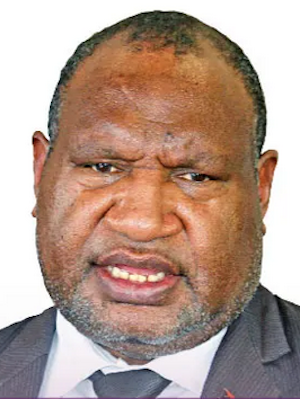
Prime Minister James Marape said efforts would be made to mobilise people aged 16 to 30, who were not in work or education.

Some of the blame for the rioting and looting has been put on out-of-work youth.

Under fire Prime Minister James Marape
Prime Minister James Marape . . . “listen to this” message to the youth. Image: PNGPC

The PNG Post-Courier quotes him saying the responsibility for doing this will be passed to provincial and district administrations, which will be expected to make use of the money from the intervention funds they receive.

“I want to appeal to every young Papua New Guinean child out there, I’m your father. As Prime Minister, I’m your father, listen to this.

‘Talk to your church’
“Go to your church somewhere, in your community, neighbourhood and you and tell them, I’m not in a class this year, or I have graduated in a college or university and have no employment,” Marape said.

“The entire 97 districts throughout the country will be asked to mobilise the youth.”
The prime minister urged the youth to make contact with their respective district education advisors and community development advisers, including district development authority chief executive officers.

He said the churches would link the youth to these district governments.

This article is republished under a community partnership agreement with RNZ.

Article by AsiaPacificReport.nz

China’s population shrinks again and could more than halve – here’s what that means

Source: The Conversation (Au and NZ) – By Xiujian Peng, Senior Research Fellow, Centre of Policy Studies, Victoria University

China’s population has shrunk for the second year in a row.

The National Bureau of Statistics reports just 9.02 million births in 2023 – only half as many as in 2017. Set alongside China’s 11.1 million deaths in 2023, up 500,000 on 2022, it means China’s population shrank 2.08 million in 2023 after falling 850,000 in 2022. That’s a loss of about 3 million in two years.

The two consecutive declines are the first since the great famine of 1959-1961, and the trend is accelerating.

Updated low-scenario projections from a research team at Shanghai Academy of Social Sciences, one of the first to predict the 2022 turndown, have China’s population shrinking from its present 1.4 billion to just 525 million by 2100.

China’s working-age population is projected to fall to just 210 million by 2100 – a mere one-fifth of its peak in 2014.

Deaths climbing as births falling

The death rate is climbing as an inevitable result of the population ageing, and also an upsurge of COVID in the first few months of 2023.

The population is ageing mainly because the birth rate is falling.

China’s total fertility rate, the average number of births per woman, was fairly flat at about 1.66 between 1991 and 2017 under China’s one-child policy. But it then fell to 1.28 in 2020, to 1.08 in 2022 and is now around 1, which is way below the level of 2.1 generally thought necessary to sustain a population.

By way of comparison, Australia and the United States have fertility rates of 1.6. In 2023 South Korea has the world’s lowest rate, 0.72.


Births plummet despite three-child policy

China abandoned its one-child policy in 2016. In 2021 the country introduced a three-child policy, backed by tax and other incentives.

But births are continuing to fall. In part this is because of an established one-child norm, in part because the one-child policy cut the number of women of child-bearing age, and in part because economic pressures are making parenthood less attractive.

China’s National Bureau of Statistics says employees of enterprises work an average of 49 hours per week, more than nine hours per day. Women graduates earn less than men and are increasingly postponing having children.


Read more:
China’s population is now inexorably shrinking, bringing forward the day the planet’s population turns down


The Year of the Dragon offers hope

One hope is that 2024 will see a bump in births, being the year of the dragon in Chinese astrology, a symbol of good fortune.

Some families may have chosen to postpone childbirth during the less auspicious year of the rabbit in 2023. At least one study has identified such an effect.

An older, more dependent population

The same research team at the Shanghai Academy of Social Sciences and the Centre for Policy Studies at Australia’s Victoria University have China’s population falling by more than one-half to around 525 million by 2100, a fall about 62 million bigger than previously forecast.

The working-age population is set to fall more sharply to 210 million.

We now expect the number of Chinese aged 65 and older to overtake the number of Chinese of traditional working age in 2077, three years earlier than previously.

By 2100 we expect every 100 Chinese of traditional working-age to have to support 137 elderly Chinese, up from just 21 at present.

Our central scenario assumes China’s fertility rate will recover, climbing slowly to 1.3. Our low scenario assumes it will decline further to 0.88 over the next decade and then gradually recover to 1.0 by 2050 before holding steady.


We have based our assumptions on observations of actual total fertility rates in China’s region and their downward trend. In 2022 these rates hit 1.26 in Japan, 1.04 in Singapore, 0.87 in Taiwan, 0.8 in Hong Kong and 0.78 in South Korea.

In none of these countries has fertility rebounded, despite government efforts. These trends point to what demographers call the “low-fertility trap” in which fertility becomes hard to lift once it falls below 1.5 or 1.4.

An earlier peak in world population

At present accounting for one-sixth of the world’s population, China’s accelerated decline will bring forward the day when the world’s population peaks.

Our updated forecast for China brings forward our forecast of when the world’s population will peak by one year to 2083, although there is much that is uncertain (including what will happen in India, now bigger than China, whose fertility rate has fallen below replacement level).

The accelerated decline in China’s population will weaken China’s economy and, through it, the world’s economy.

It will put downward pressure on Chinese consumer spending and upward pressure on wages and government spending. As the world’s second-largest economy, this weakness will present challenges to the world’s economic recovery.

The Conversation

Xiujian Peng works for Centre of Policy Studies, Victoria University in Australia.

ref. China’s population shrinks again and could more than halve – here’s what that means – https://theconversation.com/chinas-population-shrinks-again-and-could-more-than-halve-heres-what-that-means-220667

When Yemen does it it’s ‘terrorism’, when the US does it it’s ‘the rules-based order’

COMMENTARY: By Caitlin Johnstone

The Biden administration has officially re-designated Ansarallah – the dominant force in Yemen also known as the Houthis – as a Specially Designated Global Terrorist entity.

The White House claims the designation is an appropriate response to the group’s attacks on US military vessels and commercial ships in the Red Sea and the Gulf of Aden, saying those attacks “fit the textbook definition of terrorism”.

Ansarallah claims its actions “adhere to the provisions of Article 1 of the Convention on the Prevention and Punishment of the Crime of Genocide,” since it is only enforcing a blockade geared toward ceasing the ongoing Israeli destruction of Gaza.

One of the most heinous acts committed by the Trump administration was its designation of Ansarallah as a Foreign Terrorist Organisation (FTO) and as Specially Designated Global Terrorists (SDGT), both of which imposed sanctions that critics warned would plunge Yemen’s aid-dependent population into even greater levels of starvation than they were already experiencing by restricting the aid that would be allowed in.

One of the Biden administration’s only decent foreign policy decisions has been the reversal of that sadistic move, and now that reversal is being partially rolled back, though thankfully only with the SDGT listing and not the more deadly and consequential FTO designation.

In a new article for Antiwar about this latest development, Dave Decamp explains that as much as the Biden White House goes to great lengths insisting that it’s going to issue exemptions to ensure that its sanctions don’t harm the already struggling Yemeni people,

“history has shown that sanctions scare away international companies and banks from doing business with the targeted nations or entities and cause shortages of medicine, food, and other basic goods.”

DeCamp also notes that US and British airstrikes on Yemen have already forced some aid groups to suspend services to the country.

Still trying to recover
So the US empire is going to be imposing sanctions on a nation that is still trying to recover from the devastation caused by the US-backed Saudi blockade that contributed to hundreds of thousands of deaths between 2015 and 2022. All in response to the de facto government of that very same country imposing its own blockade with the goal of preventing a genocide.

That’s right: when Yemen sets up a blockade to try and stop an active genocide, that’s terrorism, but when the US empire imposes a blockade to secure its geostrategic interests in the Middle East, why that’s just the rules-based international order in action.

It just says so much about how the US empire sees itself that it can impose blockades and starvation sanctions at will upon nations like Yemen, Venezuela, Cuba, Iran, Syria and North Korea for refusing to bow to its dictates, but when Yemen imposes a blockade for infinitely more worthy and noble reasons it gets branded an act of terrorism.

The managers of the globe-spanning empire loosely centralised around Washington literally believe the world is theirs to rule as they will, and that anyone who opposes its rulings is an outlaw.

Based on power
“What this shows us is that the “rules-based international order” the US and its allies claim to uphold is not based on rules at all; it’s based on power, which is the ability to control and impose your will on other people.

The “rules” apply only to the enemies of the empire because they are not rules at all: they are narratives used to justify efforts to bend the global population to its will.

We are ruled by murderous tyrants. By nuclear-armed thugs who would rather starve civilians to protect the continuation of an active genocide than allow peace to get a word in edgewise.

Our world can never know health as long as these monsters remain in charge.

Caitlin Johnstone is an Australian independent journalist and poet. Her articles include The UN Torture Report On Assange Is An Indictment Of Our Entire Society. She publishes a website and Caitlin’s Newsletter. This article is republished with permission.

Print Friendly, PDF & Email

Article by AsiaPacificReport.nz

China’s population shrinks again and is set to more than halve – here’s what that means

Source: The Conversation (Au and NZ) – By Xiujian Peng, Senior Research Fellow, Centre of Policy Studies, Victoria University

China’s population has shrunk for the second year in a row.

The National Bureau of Statistics reports just 9.02 million births in 2023 – only half as many as in 2017. Set alongside China’s 11.1 million deaths in 2023, up 500,000 on 2022, it means China’s population shrank 2.08 million in 2023 after falling 850,000 in 2022. That’s a loss of about 3 million in two years.

The two consecutive declines are the first since the great famine of 1959-1961, and the trend is accelerating.

Updated projections from a research team at Shanghai Academy of Social Sciences, one of the first to predict the 2022 turndown, have China’s population shrinking from its present 1.4 billion to just 525 million by 2100.

China’s working-age population is projected to fall to just 210 million by 2100 – a mere one-fifth of its peak in 2014.

Deaths climbing as births falling

The death rate is climbing as an inevitable result of the population ageing, and also an upsurge of COVID in the first few months of 2023.

The population is ageing mainly because the birth rate is falling.

China’s total fertility rate, the average number of births per woman, was fairly flat at about 1.66 between 1991 and 2017 under China’s one-child policy. But it then fell to 1.28 in 2020, to 1.08 in 2022 and is now around 1, which is way below the level of 2.1 generally thought necessary to sustain a population.

By way of comparison, Australia and the United States have fertility rates of 1.6. South Korea has the world’s lowest rate, 0.72.


Births plummet despite three-child policy

China abandoned its one-child policy in 2016. In 2021 the country introduced a three-child policy, backed by tax and other incentives.

But births are continuing to fall. In part this is because of an established one-child norm, in part because the one-child policy cut the number of women of child-bearing age, and in part because economic pressures are making parenthood less attractive.

China’s National Bureau of Statistics says employees of enterprises work an average of 49 hours per week, more than nine hours per day. Women graduates earn less than men and are increasingly postponing having children.


Read more:
China’s population is now inexorably shrinking, bringing forward the day the planet’s population turns down


The Year of the Dragon offers hope

One hope is that 2024 will see a bump in births, being the year of the dragon in Chinese astrology, a symbol of good fortune.

Some families may have chosen to postpone childbirth during the less auspicious year of the rabbit in 2023. At least one study has identified such an effect.

An older, more dependent population

The same research team at the Shanghai Academy of Social Sciences and the Centre for Policy Studies at Australia’s Victoria University have China’s population falling by more than one-half to around 525 million by 2100, a fall about 62 million bigger than previously forecast.

The working-age population is set to fall more sharply to 210 million.

We now expect the number of Chinese of retirement age to overtake the number of Chinese of working age in 2077, three years earlier than previously.

By 2100 we expect every 100 Chinese of working-age to have to support 137 elderly Chinese, up from just 21 at present.

Our central scenario assumes China’s fertility rate will recover, climbing slowly to 1.3. Our low scenario assumes it will decline further to 0.88 over the next decade and then gradually recover to 1.0 by 2050 before holding steady.


We have based our assumptions on observations of actual total fertility rates in China’s region and their downward trend. In 2022 these rates hit 1.26 in Japan, 1.04 in Singapore, 0.87 in Taiwan, 0.8 in Hong Kong and 0.78 in South Korea.

In none of these countries has fertility rebounded, despite government efforts. These trends point to what demographers call the “low-fertility trap” in which fertility becomes hard to lift once it falls below 1.5 or 1.4.

An earlier peak in world population

At present accounting for one-sixth of the world’s population, China’s accelerated decline will bring forward the day when the world’s population peaks.

Our updated forecast for China brings forward our forecast of when the world’s population will peak by one year to 2083, although there is much that is uncertain (including what will happen in India, now bigger than China, whose fertility rate has fallen below replacement level).

The accelerated decline in China’s population will weaken China’s economy and, through it, the world’s economy.

It will put downward pressure on Chinese consumer spending and upward pressure on wages and government spending. As the world’s second-largest economy, this weakness will present challenges to the world’s economic recovery.

The Conversation

Xiujian Peng works for Centre of Policy Studies, Victoria University in Australia.

ref. China’s population shrinks again and is set to more than halve – here’s what that means – https://theconversation.com/chinas-population-shrinks-again-and-is-set-to-more-than-halve-heres-what-that-means-220667

What is credential stuffing and how can I protect myself? A cybersecurity researcher explains

Source: The Conversation (Au and NZ) – By David Tuffley, Senior Lecturer in Applied Ethics & CyberSecurity, Griffith University

kpatyhka/Shutterstock

Cyber-skulduggery is becoming the bane of modern life. Australia’s prime minister has called it a “scourge”, and he is correct. In 2022–23, nearly 94,000 cyber crimes were reported in Australia, up 23% on the previous year.

In the latest high-profile attack, around 15,000 customers of alcohol retailer Dan Murphy, Mexican restaurant chain Guzman y Gomez, Event Cinemas, and home shopping network TVSN had their login credentials and credit card details used fraudulently to buy goods and services in what is known as a “credential stuffing” attack.

So what is credential stuffing – and how can you reduce the risk of it happening to you?

A Dan Murphy's liquor store sign reflects golden sunlight.
Many customers of alcohol retailer Dan Murphy are among those hit by the latest round of credential stuffing cyber attacks.
ArliftAtoz2205/Shutterstock


Read more:
An expert reviews the government’s 7-year plan to boost Australia’s cyber security. Here are the key takeaways


Re-using the same login details

Credential stuffing is a type of cyber attack where hackers use stolen usernames and passwords to gain unauthorised access to other online accounts.

In other words, they steal a set of login details for one site, and try it on another site to see if it works there too.

This is possible because many people use the same username and password combination across multiple websites.

It is common for people to use the same password for multiple accounts (even though this is very risky).

Some even use the same password for all their accounts. This means if one account is compromised, hackers can potentially access many (or all) their other accounts with the same credentials.

‘Brute force’ attacks

Hackers purchase job lots of login credentials (obtained from earlier data breaches) on the “dark web”.

They then use automated tools called “bots” to perform credential stuffing attacks. These tools can also be purchased on the dark web.

Bots are programs that perform tasks on the internet much faster and more efficiently than humans can.

In what is colourfully termed a “brute force” attack, hackers use bots to test millions of username and password combinations on different websites until they find a match. It’s easier and quicker than many people realise.

It is happening more often because the barrier to entry for would-be cybercriminals has never been lower. The dark web is readily accessible and the resources needed to launch attacks are available to anyone with cryptocurrency to spend and the will to cross over to the dark side.

How can you protect yourself from credential stuffing?

The best way is to never reuse passwords across multiple sites or apps. Always use a unique and strong password for each online account.

Choose a password or pass phrase that is at least 12 characters long, is complex, and hard to guess. It should include a mix of uppercase and lowercase letters, numbers, and symbols. Don’t use pet names, birthdays or anything else that can be found on social media.

You can use a password manager to generate unique passwords for all your accounts and store them securely. These use strong encryption and are generally regarded as pretty safe.

Another way to protect yourself from credential stuffing is to enable two-factor authentication (2FA) for your online accounts.

Two-factor authentication is a security feature that requires you to enter a code or use a device in addition to your password when you log in.

This adds an extra layer of protection in case your password is stolen. You can use an app, a text message, or a hardware device (such as a little “key” you plug into a computer) to receive your two-factor authentication code.

Monitor your online accounts regularly to look for any suspicious activity. You can also check if your email or password has been exposed in a data breach by using the website Have I Been Pwned.

You may be surprised by what you see. If you do discover your login details on there, use this as a timely warning to change your passwords as soon as possible.

Have your passwords and login details been exposed in a data breach?
Tada Images/Shutterstock


Read more:
What is LockBit, the cybercrime gang hacking some of the world’s largest organisations?


Eternal vigilance

In today’s world of rising cyber crime, your best defence against credential stuffing and other forms of hacking is vigilance. Be proactive, not complacent about online security.

Use unique passwords and a password manager, enable two-factor authentication, monitor your accounts, and check breach notification sites (like Have I Been Pwned).

Remember, the recent attacks on Dan Murphy, Guzman y Gomez and others show how readily our online lives can be disrupted. Don’t let your credentials become another statistic. As you are reading this, the criminals are thinking up new ways to exploit our vulnerabilities.

By adopting good digital hygiene and effective security measures, we can take back control of our online identities.


Read more:
An AI-driven influence operation is spreading pro-China propaganda across YouTube


The Conversation

David Tuffley is affiliated with the Australian Computer Society (MACS).

ref. What is credential stuffing and how can I protect myself? A cybersecurity researcher explains – https://theconversation.com/what-is-credential-stuffing-and-how-can-i-protect-myself-a-cybersecurity-researcher-explains-221401

Reducing nicotine in tobacco would help people quit – without prohibiting cigarettes

Source: The Conversation (Au and NZ) – By Richard Edwards, Professor of Public Health, University of Otago

Supporters of the new government’s plan to repeal Aotearoa New Zealand’s smokefree legislation have claimed victory against “prohibition”.

Introduced under Jacinda Ardern’s government, the smokefree law came into effect in January 2023 and included a commitment to introduce mandated “denicotinisation” (cutting the nicotine to levels that are no longer addictive) of smoked tobacco products.

Studies estimated this measure would have greatly reduced smoking and helped prevent avoidable death and suffering.

However, opponents, notably the tobacco industry and its allies, criticised the measure as “prohibition”.

In a submission to the select committee on the smokefree legislation, Imperial Tobacco claimed

Mandating very low nicotine levels is equivalent to prohibiting the regular cigarettes currently consumed by millions of adult smokers.

In its submission, Japan Tobacco International wrote

The nicotine reduction policy is a de facto prohibition on conventional cigarettes and will have dire consequences.

But are the tobacco industry’s claims really true? And why has the current Health Minister gone from supporting denicotinisation to being set to repeal it?

Misunderstanding prohibition

When commentators label a public health measure as “prohibition”, they usually draw a comparison with alcohol prohibition in the United States in the 1920s and 1930s. A statement that “prohibition never works” typically follows.

Yet, these arguments fail on at least three grounds.

First, they imply prohibition is never justified and fail to mention other highly successful “prohibitions”, such as the elimination of asbestos, leaded paint and petrol, or chlorofluorocarbons in aerosols. Or water quality standards prohibiting hazardous drinking water or car safety requirements prohibiting unsafe cars.


Read more:
Smoke and mirrors: why claims that NZ’s smokefree policy could fuel an illicit tobacco trade don’t stack up


Second, they offer only a simplistic interpretation of the experience of the American prohibition era. Although not without its problems, it did substantially reduce alcohol consumption and have positive impacts on population health.

Third, denicotinisation of cigarettes and tobacco is very different from alcohol prohibition in the US in the 1920s. Claiming “prohibition never works” based on that single experience a century ago is vacuous and wrong. Denicotinisation applies to a different product, in a different setting, and in a different time.

More fundamentally, denicotinisation of cigarettes and tobacco is not a prohibition.

Prohibition requires that something is prohibited. So what is that something under the smokefree law?

Not cigarettes, as tobacco products would still be available to people who wish to buy and use them, but they would no longer contain sufficient nicotine to be addictive. Nor is it banning nicotine; anyone walking down a street in any town or city centre in Aotearoa will see numerous specialist vape stores and other retailers selling nicotine-containing vapes.

Harm reduction, not prohibition

So if denicotinisation is not prohibition, what is it? And is it a good idea?

Denicotinisation is a form of harm reduction. Although denicotinised cigarettes would still create harmful toxins when smoked, they would cause less overall harm because they are no longer addictive and people would stop using them.

Research found participants given denicotinised cigarettes smoked less and were more likely to quit smoking, because they found the cigarettes unrewarding and less appealing to smoke.

People who cannot stop using nicotine products completely would be encouraged to switch to less harmful products, such as vaping, which would still deliver nicotine.

Our own research showed a strong majority of people who smoke in New Zealand regret starting, wanted to quit, and have tried to quit. However, almost nine out of ten felt addicted to smoking.


Read more:
How raising tobacco taxes can save lives and cut poverty across the Asia-Pacific


Removing the nicotine from cigarettes and tobacco would liberate people from that addiction. Almost half of our study respondents anticipated that if tobacco products were denicotinised they would reduce the number of cigarettes they smoked, would stop smoking, or switch to alternative products like e-cigarettes.

For ethical reasons, there are no trials giving young people denicotinised cigarettes. However, logic suggests adolescents and youth would be less inclined to try cigarettes with minimal nicotine content, and even if they did, they would be very unlikely to become addicted and continue to smoke long-term.

Denicotinisation is therefore not, as it is often portrayed, a constraint on freedom. It would enhance freedom. It would help liberate people who smoke from the grip of cigarettes and protect future generations from the risk of lifelong addiction and the terrible health effects that so often follow.

A question of life and death

Modelling studies suggest denicotinisation would rapidly and equitably reduce smoking and smoking related disease, preventing 7570 deaths from 2020–2040 in Aotearoa, including 4260 Māori deaths.

While he was still in opposition, the current Health Minister Shane Reti acknowledged denicotinisation as a powerful measure that would do most of the “heavy lifting” to reduce smoking.

During the debates on the smokefree law, Reti strongly supported denicotinisation and submitted a Supplementary Order Paper to the Smokefree Environments and Regulated Products (Smoked Tobacco) Amendment Act, arguing it should be the first measure implemented.

Reti has since abandoned this position to support the coalition government’s repeal.

The government seems unaware of, or is ignoring, the research evidence and the very strong support for denicotinisation among the general population and among youth and young adults.

Numerous surveys from around the world, including our studies in Aotearoa, have found most people who smoke (or who have recently quit) strongly support denicotinisation.

Almost the only groups that don’t support this measure are the tobacco industry and their apologists. Formerly secret internal tobacco company files reveal the reason for their opposition. A 1959 British American Tobacco document explained

To lower nicotine too much might end up destroying the nicotine habit in a large number of consumers and prevent it ever being acquired by new smokers.

The New Zealand government should reverse its decision to repeal the smokefree legislation. Doing so will reassert themselves as ethical and principled leaders, whose evidence-based decisions will enhance individual New Zealanders’ freedom and health.

The Conversation

Richard Edwards receives research funding from the Health Research Council of New Zealand, the Cancer Society of New Zealand, the University of Queensland (Australia) and the National Institute of Health (US). His affiliations include the Society for Nicotine and Tobacco Research, the Public Health Communication Centre Briefing, Smokefree Expert Advisory Group, Health Coalition Aotearoa and the National Tobacco Control Advocacy Service Advisory Group.

Janet Hoek currently receives research funding from the Health Research Council of New Zealand, the Cancer Society of New Zealand, the University of Queensland (Australia) and the National Health and Medical Research Council (Australia). Her affiliations include the Society for Nicotine and Tobacco Research, Health Coalition Aotearoa’s Smokefree Expert Advisory Group, Aukati Tupeka Kore Group, Project Sunset (International and Oceania), the Australian Government Department of Health and Aged Care, the NZ Cancer Society Research Collaboration, and the Australasian Tobacco Issues Group.

ref. Reducing nicotine in tobacco would help people quit – without prohibiting cigarettes – https://theconversation.com/reducing-nicotine-in-tobacco-would-help-people-quit-without-prohibiting-cigarettes-221383

Australia plans to regulate ‘high-risk’ AI. Here’s how to do that successfully

Source: The Conversation (Au and NZ) – By Lisa M. Given, Professor of Information Sciences & Director, Social Change Enabling Impact Platform, RMIT University

Gorodenkoff/Shutterstock

This week, federal Minister for Industry and Science Ed Husic announced the Australian government’s response to the Safe and Responsible AI in Australia consultation.

The response addresses feedback from last year’s consultation on artificial intelligence (AI). It received more than 500 submissions, noting “excitement for the opportunities” of AI tools, but also raising concerns about potential risks and Australians’ expectations for “regulatory safeguards to prevent harms”.

Instead of enacting a single AI regulatory law like the European Union has done, the Australian government plans to focus on high-risk areas of AI implementation – ones with the greatest potential for harm. This could include examples such as discrimination in the workplace, the justice system, surveillance or self-driving cars.

The government also plans to create a temporary expert advisory group to support the development of these guardrails.


Read more:
Australians are concerned about AI. Is the federal government doing enough to mitigate risks?


How will we define ‘high-risk’ AI?

While this proportional response may be welcomed by some, focusing on high-risk areas with only a temporary advisory body raises significant questions:

  • how will high-risk areas be defined – and who makes that decision?

  • should low-risk AI applications face similar regulation, when some interventions (such as requiring watermarks for AI-generated content) could broadly combat misinformation?

  • without a permanent advisory board, how can organisations anticipate risks for new AI technologies and new applications of AI tools in the future?

Assessing “risk” in using new technologies is not new. We have many existing principles, guidelines, and regulations that can be adapted to address concerns about AI tools.

For example, many Australian sectors are already highly regulated to address safety concerns, such as vehicles and medical devices.

In all research involving people, Australian researchers must comply with national guidelines where risk assessment practices are well defined:

  • identifying the risks and who might be at risk of harm;

  • assessing the likelihood, severity and magnitude of risk;

  • considering strategies to minimise, mitigate, and/or manage risks;

  • identifying potential benefits, and who may benefit; and

  • weighing the risks and determining whether the risks are justified by potential benefits.

This risk assessment is done before research being done, with significant review and oversight by Human Research Ethics Committees. A similar approach could be used for AI risk assessment.

AI is already in our lives

One significant problem with AI regulation is that many tools are already used in Australian homes and workplaces, but without regulatory guardrails to manage risks.

A recent YouGov report found 90% of Australian workers used AI tools for daily tasks, despite serious limitations and flaws. AI tools can “hallucinate” and present fake information to users. The lack of transparency about training data raises concerns about bias and copyright infringement.

Consumers and organisations need guidance on appropriate adoption of AI tools to manage risks, but many uses are outside “high risk” areas.

Defining “high risk” settings is challenging. The concept of “risk” sits on a spectrum and is not absolute. Risk is not determined by a tool itself, or the setting where it is used. Risk arises from contextual factors that create potential for harm.

For example, while knitting needles pose little risk in everyday life, knitters are cautioned against carrying metal needles on airplanes. Airport security views these as “dangerous” tools and restricts their use in this setting to prevent harm.

To identify “high risk” settings we must understand how AI tools work. Knowing AI tools can lead to gender discrimination in hiring practices means all organisations must manage risk in recruitment. Not understanding the limitations of AI, like the American lawyer who trusted fake case law generated by ChatGPT, highlights the risk of human error in AI tool use.

Risks posed by people and organisations in using AI tools must be managed alongside risks posed by the technology itself.


Read more:
How a New York Times copyright lawsuit against OpenAI could potentially transform how AI and copyright work


Who will advise the government?

The government notes in its response that the expert advisory body on AI risks will need “diverse membership and expertise from across industry, academia, civil society and the legal profession”.

Within industry, membership should include various sectors (such as healthcare, banking, law enforcement) with representation from large organisations and small-to-medium enterprises.

Within academia, membership should include not just AI computing experts, but also social scientists with expertise in consumer and organisational behaviour. They can advise on risk analysis, ethics, and what people worry about when it comes to adopting new technology, including misinformation, trust and privacy concerns.

The government must also decide how to manage potential future AI risks. A permanent advisory body could manage risks for future technologies and for new uses of existing tools.

Such a body could also advise consumers and workplaces on AI applications at lower levels of risk, particularly where limited or no regulations are in place.

Misinformation is one key area where the limitations of AI tools are known, requiring people to have strong critical thinking and information literacy skills. For example, requiring transparency in the use of AI-generated images can ensure consumers are not misled.

Yet the government’s current focus for transparency is limited to “high-risk” settings. This is a start, but more advice – and more regulation – will be needed.

The Conversation

Lisa M. Given receives funding from the Australian Research Council and the Social Sciences and Humanities Research Council of Canada. She is a Fellow of the Academy of the Social Sciences in Australia and a past President of the Association for Information Science and Technology.

ref. Australia plans to regulate ‘high-risk’ AI. Here’s how to do that successfully – https://theconversation.com/australia-plans-to-regulate-high-risk-ai-heres-how-to-do-that-successfully-221321

Stickers and wristbands aren’t a reliable way to prevent mosquito bites. Here’s why

Source: The Conversation (Au and NZ) – By Cameron Webb, Clinical Associate Professor and Principal Hospital Scientist, University of Sydney

Meritt Thomas/Unsplash

Protecting yourself and family from mosquito bites can be challenging, especially in this hot and humid weather. Protests from young children and fears about topical insect repellents drive some to try alternatives such as wristbands, patches and stickers.

These products are sold online as well as in supermarkets, pharmacies and camping stores. They’re often marketed as providing “natural” protection from mosquitoes.

But unfortunately, they aren’t a reliable way to prevent mosquito bites. Here’s why – and what you can try instead.

Why is preventing mosquito bites important?

Mosquitoes can spread pathogens that make us sick. Japanese encephalitis and Murray Valley encephalitis viruses can have potentially fatal outcomes. While Ross River virus won’t kill you, it can cause potentially debilitating illnesses.

Health authorities recommend preventing mosquito bites by: avoiding areas and times of the day when mosquitoes are most active; covering up with long sleeved shirts, long pants, and covered shoes; and applying a topical insect repellent (a cream, lotion, or spray).


Read more:
Will Japanese encephalitis return this summer? What about other diseases mosquitoes spread?


I don’t want to put sticky and smelly repellents on my skin!

While for many people, the “sting” of a biting mosquitoes is enough to prompt a dose of repellent, others are reluctant. Some are deterred by the unpleasant feel or smell of insect repellents. Others believe topical repellents contain chemicals that are dangerous to our health.

However, many studies have shown that, when used as recommended, these products are safe to use. All products marketed as mosquito repellents in Australia must be registered by the Australian Pesticides and Veterinary Medicines Authority; a process that provides recommendations for safe use.


Read more:
Feel like you’re a mozzie magnet? It’s true – mosquitoes prefer to bite some people over others


How do topical repellents work?

While there remains some uncertainty about how the chemicals in topical insect repellents actually work, they appear to either block the sensory organs of mosquitoes that drive them to bite, or overpower the smells of our skin that helps mosquitoes find us.

Diethytolumide (DEET) is a widely recommended ingredient in topical repellents. Picaridin and oil of lemon eucalyptus are also used and have been shown to be effective and safe.

How do other products work?

“Physical” insect-repelling products, such as wristbands, coils and candles, often contain a botanically derived chemical and are often marketed as being an alternative to DEET.

However, studies have shown that devices such as candles containing citronella oil provide lower mosquito-bite prevention than topical repellents.

A laboratory study in 2011 found wristbands infused with peppermint oil failed to provide full protection from mosquito bites.

Even as topical repellent formulations applied to the skin, these botanically derived products have lower mosquito bite protection than recommended products such as those containing DEET, picaridin and oil of lemon eucalyptus.

Wristbands infused with DEET have shown mixed results but may provide some bite protection or bite reduction. DEET-based wristbands or patches are not currently available in Australia.

There is also a range of mosquito repellent coils, sticks, and other devices that release insecticides (for example, pyrethroids). These chemicals are primarily designed to kill or “knock down” mosquitoes rather than to simply keep them from biting us.

What about stickers and patches?

Although insect repellent patches and stickers have been available for many years, there has been a sudden surge in their marketing through social media. But there are very few scientific studies testing their efficacy.

Our current understanding of the way insect repellents work would suggest these small stickers and patches offer little protection from mosquito bites.

At best, they may reduce some bites in the way mosquito coils containing botanical products work. However, the passive release of chemicals from the patches and stickers is likely to be substantially lower than those from mosquito coils and other devices actively releasing chemicals.

One study in 2013 found a sticker infused with oil of lemon eucalyptus “did not provide significant protection to volunteers”.

Clothing impregnated with insecticides, such as permethrin, will assist in reducing mosquito bites but topical insect repellents are still recommended for exposed areas of skin.


Read more:
Bzzz, slap! How to treat insect bites (home remedies included)


Take care when using these products

The idea you can apply a sticker or patch to your clothing to protect you from mosquito bites may sound appealing, but these devices provide a false sense of security. There is no evidence they are an equally effective alternative to the topical repellents recommended by health authorities around the world. It only takes one bite from a mosquito to transmit the pathogens that result in serious disease.

It is also worth noting that there are some health warnings and recommendations for their use required by Australian Pesticides and Veterinary Medicines Authority. Some of these products warn against application to the skin (recommending application to clothing only) and to keep products “out of reach of children”. This is a challenge if attached to young children’s clothing.

Similar warnings are associated with most other topical and non-topical mosquito repellents. Always check the labels of these products for safe use recommendations.

Are there any other practical alternatives?

Topical insect repellents are safe and effective. Most can be used on children from 12 months of age and pose no health risks. Make sure you apply the repellent as a thin even coat on all exposed areas of skin.

But you don’t need “tropical strength” repellents for short periods of time outdoors; a range of formulations with lower concentrations of repellent will work well for shorter trips outdoors. There are some repellents that don’t smell as strong (for example, children’s formulations, odourless formulations) or formulations that may be more pleasant to use (for example, pump pack sprays).

Finally, you can always cover up. Loose-fitting long-sleeved shirts, long pants, and covered shoes will provide a physical barrier between you and mosquitoes on the hunt for your or your family’s blood this summer.

The Conversation

Cameron Webb and the Department of Medical Entomology, NSW Health Pathology, have been engaged by a wide range of insect repellent and insecticide manufacturers to provide testing of products and provide expert advice on mosquito biology. Cameron has also received funding from local, state and federal agencies to undertake research into mosquito-borne disease surveillance and management.

ref. Stickers and wristbands aren’t a reliable way to prevent mosquito bites. Here’s why – https://theconversation.com/stickers-and-wristbands-arent-a-reliable-way-to-prevent-mosquito-bites-heres-why-220284

These fierce, tiny marsupials drop dead after lengthy sex fests – and sometimes become cannibals

Source: The Conversation (Au and NZ) – By Andrew M. Baker, Associate Professor in Ecology and Environmental Science, Queensland University of Technology

If you are exploring our beautiful Australian wilderness this year, keep an eye out for animals behaving in interesting ways. You never know what you might see, as our research team discovered.

In 2023, our colleague from Sunshine Coast Council, Elliot Bowerman, took a two-night trip to New England National Park – its 1,500 metre-high mountain peaks are some of the loftiest on Australia’s mid-east coast.

On the afternoon of 17 August, Elliot trekked the path to Point Lookout. While inspecting some plants on the trail, he heard a rustle in the bushes ahead and peering more closely, saw something of interest. A small mammal had abruptly appeared, dragging the carcass of another mammal, which it then began to devour.

At first glance, this was not so strange. Mammals eat each other all the time. However, it is unusual to see small mammals during the day at such close quarters, so Elliot recorded the scene, taking a video on his mobile phone.

It was only several days later when looking over the footage that our research team realised it featured something rarely seen in the wild, the record of which is now published in the journal Australian Mammalogy.


Read more:
Meet 5 of Australia’s tiniest mammals, who tread a tightrope between life and death every night


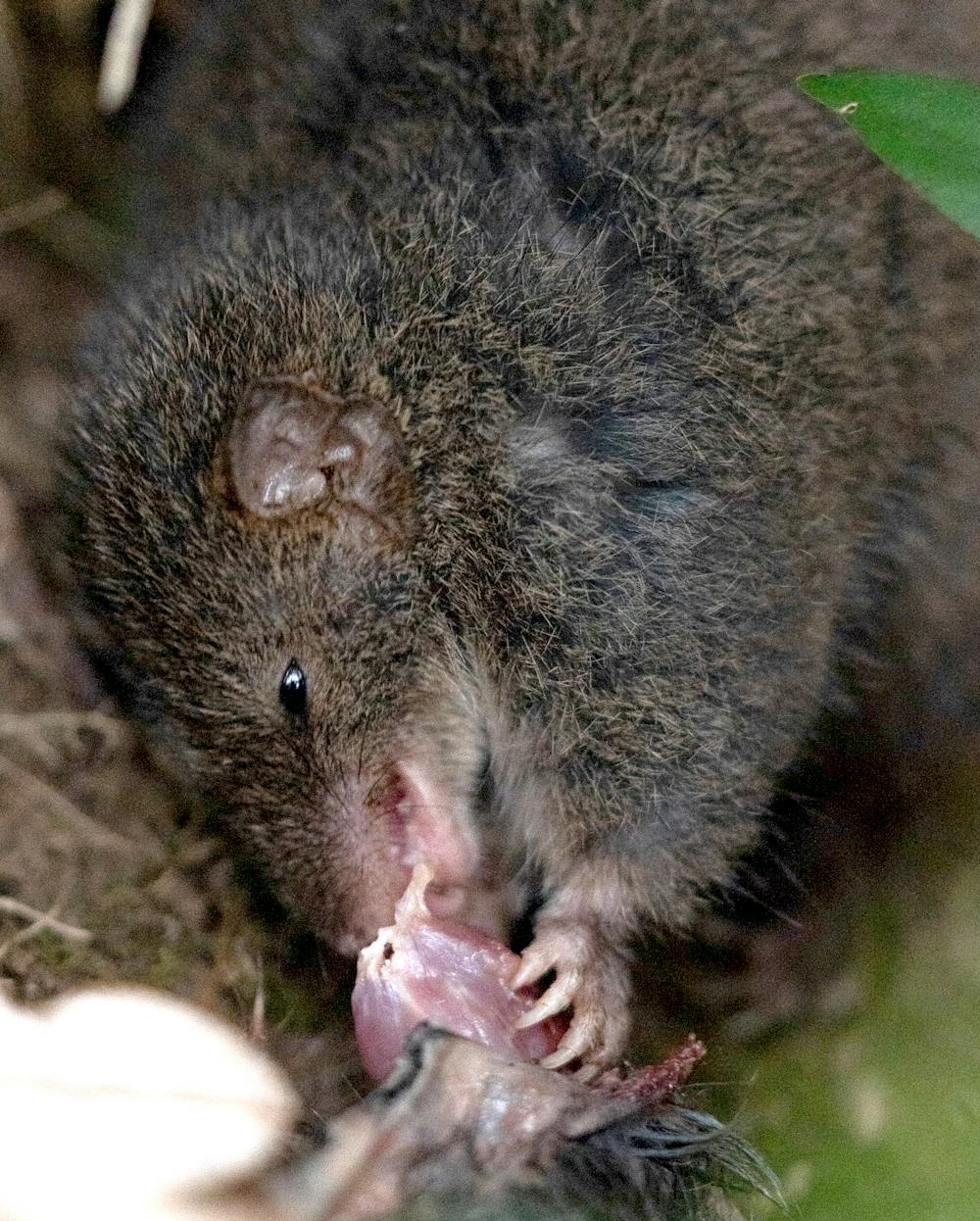
A native marsupial… cannibal

The furry critter on film was an antechinus, a native marsupial denizen of forested areas in eastern, south-western and northern Australia. Antechinuses usually eat a range of insects and spiders, occasionally taking small vertebrates such as birds, lizards, or even other mammals.

But this camera footage clearly showed a mainland dusky antechinus (Antechinus mimetes mimetes), and it was eating a dead member of its own species!

Antechinuses are perhaps best known for exhibiting semelparity, or “suicidal reproduction”. This is death after reproducing in a single breeding period. The phenomenon is known in a range of plants, invertebrates and vertebrates, but it is rare in mammals.

Each year, all antechinus males drop dead at the end of a one to three week breeding season, poisoned by their own raging hormones.

This is because the stress hormone cortisol rises during the breeding period. At the same time, surging testosterone from the super-sized testes in males causes a failure in the biological mechanism that mops up the cortisol. The flood of unbound cortisol results in systemic organ failure and the inevitable, gruesome death of every male.

A dark grey marsupial with a pointy snout tearing at pink flesh
A mainland dusky antechinus during the mating period, with fur loss visible on the shoulder, eating another antechinus.
Elliot Bowerman

Mercifully, death occurs only after the males have unloaded their precious cargo of sperm, mating with as many promiscuous females as possible in marathon, energy-sapping sessions lasting up to 14 hours. The pregnant females are then responsible for ensuring the survival of the species.

So, exactly what was happening that day at Point Lookout – why had an antechinus turned cannibal?

Cheap calories

August is the breeding period for mainland dusky antechinuses at that location. Intense mating burns calories, and at the end of winter it is cold and there isn’t as much invertebrate food about.

If there are male antechinuses dropping dead from sex-fuelled exhaustion, our thinking is that still-living male and female antechinuses are taking advantage of the cheap energy boost via a hearty feast of a fallen comrade.

After all, animal flesh provides plenty of energetic bang for the buck, particularly if its owner does not have to be pursued or overpowered before being devoured.

In many areas of Australia, two antechinus species (of the known fifteen) occur together, and usually their breeding periods are separated by only a few weeks. One can imagine a scenario where individuals may not only feed on the carcasses of their own species but consume the other species as well.

An endangered silver-headed antechinus, Antechinus argentus.
Andrew Baker

Each species may benefit from eating the dead males of the other. For the earlier-breeding species, females may be pregnant or lactating, which is a huge energy drain.

For the later-breeding species, both sexes need to pack on weight and body condition before their own breeding period commences.

Plausibly then, antechinus engage in orgiastic breeding and, when opportune, cannibalistic feeding.

So, the next time you are out and about in the bush, keep your eyes and ears peeled – you never know what secrets nature might reveal to you just around the next corner.


The author would like to acknowledge the co-authors of the paper, Elliot Bowerman from Sunshine Coast Council, and Ian Gynther from the Queensland Department of Environment, Science and Innovation.


Read more:
Torpor: a neat survival trick once thought rare in Australian animals is actually widespread


The Conversation

Andrew M. Baker receives funding from the Federal Government, State Governments, Australian Biological Resources Study and various Industry sources.

ref. These fierce, tiny marsupials drop dead after lengthy sex fests – and sometimes become cannibals – https://theconversation.com/these-fierce-tiny-marsupials-drop-dead-after-lengthy-sex-fests-and-sometimes-become-cannibals-221009

We can’t rely on the ‘dogs breakfast’ of disaster warnings to do the hard work of building community resilience

Source: The Conversation (Au and NZ) – By Brian Robert Cook, Associate Professor of Geography, The University of Melbourne

In the wake of cyclone Jasper, the new Australian Warning System has been roundly criticised. The system has been characterised as a “dog’s breakfast” and a “cock-up of massive proportions”.

For both emergency warnings, as well as for general awareness-raising around disaster preparedness, one-way communications are the default in risk management.

This reliance on communications is wishful thinking.

Whether as text messages and alerts when disasters strike, or as pamphlets and expert advice to encourage preparedness, we need to rethink how we use communications if we want more resilient communities.


Read more:
When disaster strikes, emergency responders can’t respond to every call. Communities must be helped to help themselves


Warnings reflect unreasonable expectations

As noted by Australians in the aftermath of cyclone Jasper and the Maribyrnong floods, the advice in warnings is often perceived to be incorrect, late, vague, and confusing.

Rather than an error that can be fixed with better content, this reflects unreasonable expectations.

We expect a warning to be sufficiently abstract to be useful across large regions and for many people with varying levels of exposure and capacity.

At the same time, we also expect information specific enough for stressed and possibly traumatised individuals to implement in life-threatening situations.

In response to recommendations from numerous inquiries, authorities have applied standards and terminology to ensure consistency. While this sounds reasonable, it means that future warnings will continue to be ineffective.

It is worth repeating that risks are dynamic and personal. Communications useful to a young, well-connected longtime resident will be received very differently by a middle aged, isolated, “tree change” individual who has grown up in urban areas.

That a generic warning is unable to satisfy the needs of diverse individuals, experiencing varying levels of hazard, spread over large areas, and over time is unsurprising. What is surprising is the belief that “better warnings” will.

Repeating the same mistakes

Warnings and awareness raising for disaster preparedness reflect how the risk sector relies on communications to “engage” the public. This is based on a discredited approach that assumes communications can prompt targeted, lasting behaviour change.

The development of the Australian Warning System reflects this reliance. It is a position reaffirmed in the reports, commissions, and inquiries that have followed recent Australian disasters.

For example, in the 2020 Royal Commission into National Natural Disaster Arrangements, a whole chapter is dedicated to “Emergency Information and Warnings”.


Read more:
Disastrous floods in WA – why were we not prepared?


Similarly, one focus of the ongoing inquiry into the 2022 Victorian floods is on the “adequacy and effectiveness of early warning systems”. As it was for the 2011 Comrie Review, communications go unquestioned as the primary way to engage the public.

Frustration with repeated failure is becoming evident as successive commissions and inquiries hear the echoes of past efforts. The NSW 2022 flood inquiry stands out for its blunt recognition that Australians appear to be locked in a cycle. Disasters expose systemic failings that result in recommendations that go unimplemented. The report read:

The Inquiry heard a deep sense of frustration from many flood-affected residents and community members over a lack of implementation and change over time, despite multiple previous reviews. Many were sceptical that this Inquiry would succeed in effecting significant change. Similar findings on implementation (or lack thereof) were made in the 2020 NSW Independent Bushfire Inquiry, which recommended that a central accountability mechanism be established to track implementation of the report.

But what is missed in all of these reviews is a critical examination of our tendency to default to communications.

The cost of being reactive

Part of the problem with our reliance on communications is that, in the case of warnings, by the time they arrive we are reacting to an unfolding crisis, rather than preparing for one. This raises the costs significantly.

The resulting costs of disasters, currently $38 billion annually, are expected to rise to between $73 and $94 billion annually by 2060, according to a Deloitte report. The report argued:

The Australian economy is facing $1.2 trillion in cumulative costs of natural disasters over the next 40 years even under a low emissions scenario. This shows there is the potential for large economic gains from investments to improve Australia’s resilience to natural disasters. Targeted investments in both physical (such as infrastructure) and community (such as preparedness programs) resilience measures are predicted to significantly reduce the increasing costs of natural disasters

Disaster costs are an unavoidably shared burden. Whether in the form of disaster response, relief, and recovery or in the form of investment in preparedness, public funds will inevitably be required in ever-larger amounts.

This situation results in astronomical expenditures during events and, later, “pinching pennies” for preparedness. This bias towards response and recovery over preparedness is known, made all the more frustrating because preparedness is shown to be cost-effective.

So what should happen instead?

Communications do not create community resilience, they activate it.

Our recent research shows that, rather than communications, we need to engage meaningfully with communities. This means respecting their positions and values and appreciating that resilience is a long, slow, collaborative process that requires humility, active listening, experience, reflection, and support.

Our research shows that by conducting one-on-one engagement with members of the community, we can better understand their circumstances and support their agency. This has helped people as they learn about risk. They’ve shared lessons with their neighbours and helped family members to better protect themselves. This means we’re seeing knowledge and risk mitigation circulate through communities.

This way of partnering takes time and takes work, but it opens pathways for the learning and behaviour changes that help our communities expand their resilience. While it is expensive, the predicted costs of disasters more than justify such efforts.


Read more:
Every Australian will be touched by climate change. So let’s start a national conversation about how we’ll cope


As parts of Queensland and Victoria continue to be battered by disasters, it is time to admit that communications alone do not build resilience. They play an important role, but they are only one element of what needs to be a long-term partnership.

Rather than scooping the “dog’s breakfast” back into the bowl, we need to consider the underlying causes of the mess. With resilience, Australians will be ready and able to share in the growing burden of risk management.

The Conversation

Brian Robert Cook receives funding from Melbourne Water.

Peter Kamstra does not work for, consult, own shares in or receive funding from any company or organisation that would benefit from this article, and has disclosed no relevant affiliations beyond their academic appointment.

ref. We can’t rely on the ‘dogs breakfast’ of disaster warnings to do the hard work of building community resilience – https://theconversation.com/we-cant-rely-on-the-dogs-breakfast-of-disaster-warnings-to-do-the-hard-work-of-building-community-resilience-220940

Can we cut road deaths to zero by 2050? Current trends say no. What’s going wrong?

Source: The Conversation (Au and NZ) – By Milad Haghani, Senior Lecturer of Urban Mobility, Public Safety & Disaster Risk, UNSW Sydney

Wolf Avni/Shutterstock

Last year, 1,266 Australians died from road accidents involving at least one car and a driver, passenger, pedestrian or cyclist. The economic cost of Australian road trauma exceeds A$27 billion each year. That’s 1.8% of Australia’s GDP.

Australia has committed to an ambitious target of zero road deaths by 2050, known as Vision Zero. Originating in Sweden in the late 1990s, Vision Zero is based on a simple principle: no loss of life or serious injury on roads is acceptable.

But while we were making good progress at reducing road trauma, this has stalled in recent years, with Australian road deaths rising to levels not seen in nearly a decade.

If the current trend continues, meeting the Vision Zero target by 2050 appears impossible. So what’s going wrong?

Progress and setbacks

The journey towards reducing road trauma has had both progress and setbacks. In the early 1990s, roads were claiming more than 2,000 lives in Australia each year.

Over the years, we managed to significantly reduce this number. By 2020, the annual road toll had dropped to around 1,097, almost halving the figure from three decades prior.


À lire aussi :
Are Australia’s roads becoming more dangerous? Here’s what the data says


However, recently, we’ve witnessed a worrying reversal: three consecutive years of increasing road deaths.

With more progress, it gets harder to improve

Over the years, through various safety initiatives and public awareness campaigns, we managed to significantly reduce road trauma. This includes measures such as seatbelt, helmet and child-seat laws, as well as regulations around speeding, drink-driving and phone use.


À lire aussi :
Going on a road trip this summer? 4 reasons why you might end up speeding, according to psychology


We also have safer cars and infrastructure now. Modern car features and technologies – such as auto-emergency braking, lane-keep assist, blind spot monitoring and airbags – are associated with a lower risk of road accidents and fatalities.

With the significant benefits we have gained from these measures, additional safety measures will naturally lead to smaller improvements. But the toll is actually worsening.

What role did the pandemic play?

For the first time in decades, we’ve seen a sustained increase in road deaths in Australia and other countries such as the United States.

During the pandemic, more people bought cars, perhaps to avoid public transport.

However, this alone doesn’t fully explain the rise in road deaths. With more people working from home, there has been a reduction in daily commutes. Plus, the increase in the number of vehicles has been modest relative to the rise in road deaths.

So the assumption that more people are dying because there are more cars is, at best, a partial explanation.

Risky driving behaviours

The post-pandemic data shows several indicators of declining road user behaviour and attitudes.

In New South Wales, for example, there has been a substantial increase in fines for minor speeding offences.

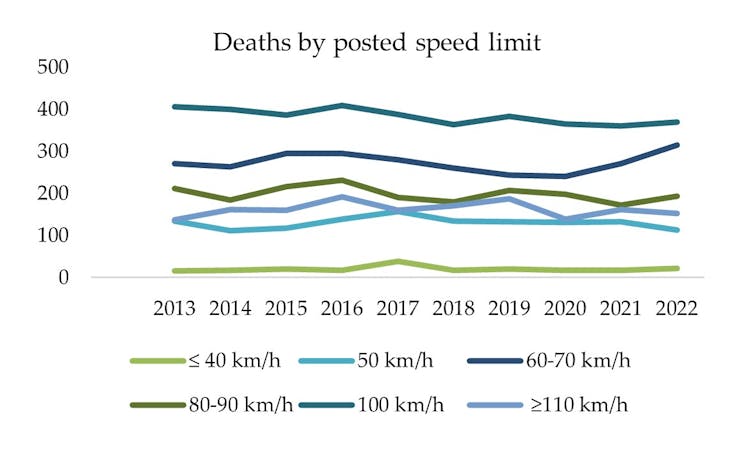
Across Australia, the number of fatal crashes in 60–70 km/h zones has been rising, from 241 associated deaths in 2020 to 315 in 2022. Speeding is likely to play a role, but it’s unclear to what extent.

This shows the number of road deaths in different speed limit areas.
Australian Road Deaths Database


À lire aussi :
How to never get a speeding fine again — and maybe save a child’s life


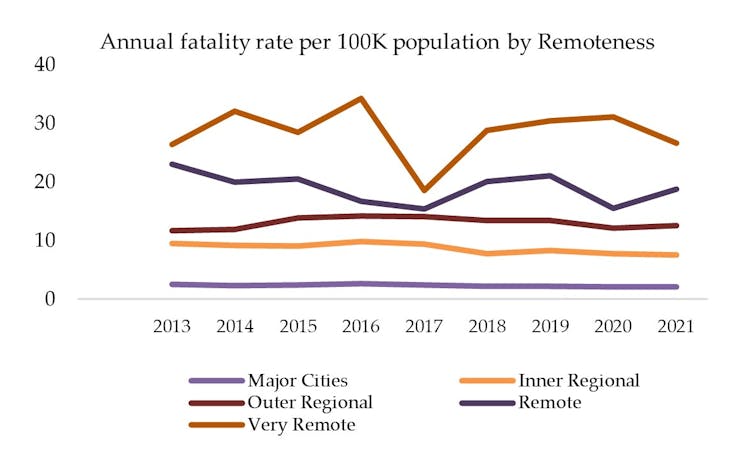
Remote and regional roads still pose a significantly higher risk of death, relative to their population. The road death risk is about six times higher in outer regional areas and nine times higher in remote areas compared to major cities.

This could be due to a number of factors: speeding, risk-taking behaviours and others such as poorer infrastructure, lower levels of enforcement, collisions with wildlife, long-trips and driver fatigue.

This shows the relative risk of death, based on the remoteness of the road.
Australian Road Deaths Database

Deadly crashes involving drivers without valid licences have also risen. In 2019, 96 deaths were reported in crashes involving operators without a valid licence. This rose to 116 in 2020 and 128 in 2021.

The number of road deaths involving a cyclist or motorcyclist not wearing a helmet was 19 in 2019, but it jumped to 28 in 2020 and 2021, a 47% increase.

The proportion of road deaths with drugs detected in the operator’s system has been rising, from 14% for drivers and 11% for motorcyclists in 2015. In 2021, these numbers rose to 17% for drivers and 28% for motorcyclists.

Another worrying trend is the increased risk of road death for the 17–25 age group. This age group is now at the highest risk of fatality on our roads, surpassing the over-75 age group.

P-plate on a rear car window
Too many young people are dying in road accidents.
Rusty Toadro/Shutterstock

Improving road safety

For the foreseeable future, human drivers will continue to be the primary operators of vehicles, and human factors remain the biggest contributor to road trauma.

When it comes to saving lives on the roads, we need to monitor attitudes to road safety. One way is through regular surveys at state and national levels, tracking scores of behavioural indicators over time. Much like political parties using ongoing polls to track the political climate, regular tracking of the community road safety climate allows us to proactively address challenges emerging from user behaviour, rather than waiting for alarming statistics.

Australia has some of the most progressive road safety policies globally. But our ambitious targets demands focusing more on user behaviour. Road safety campaigns, delivered via TV and other media, can influence road safety behaviours, with tailored campaigns targeting the specific demographics and behaviours of concern. Intensifying investment in these campaigns could be a key strategy in achieving our road safety goals.

The Conversation

Milad Haghani receives funding from the Australian Research Council (Grant No. DE210100440).

ref. Can we cut road deaths to zero by 2050? Current trends say no. What’s going wrong? – https://theconversation.com/can-we-cut-road-deaths-to-zero-by-2050-current-trends-say-no-whats-going-wrong-220289

Why electric trucks are our best bet to cut road transport emissions

Source: The Conversation (Au and NZ) – By Robin Smit, Adjunct Professor, School of Civil and Environmental Engineering, University of Technology Sydney

Shutterstock

Transport is likely the hardest economic sector to decarbonise. And road vehicles produce the most greenhouse gas emissions of the Australian transport sector – 85% of its total. Freight trucks account for only 8% of travel on our roads but 27% of transport emissions.

We analysed the life-cycle greenhouse gas emissions of Australian passenger cars and SUVs in a 2022 study. We have now looked at Australian trucks.

The 2022 study showed Australian electric cars already provided large cuts in emissions in 2019. The reduction was 30-40% compared to the overall on-road passenger vehicle fleet’s (life-cycle) emissions per kilometre in 2018. When renewables take over the electricity grid from which battery electric vehicles are charged, the cuts will be even bigger – around 75-80%.

Is it the same for Australian trucks? Our new study shows battery electric trucks are the best road transport option for getting closer to net-zero emissions. As the shift to renewables continues and batteries become more durable, these trucks are expected to deliver the largest and most certain emission cuts of 75-85% over their entire life cycle.

Hydrogen-powered (fuel cell) trucks also provide large emission cuts, but not as much as battery electric trucks. Their future performance is the most uncertain at this stage.

A blue Pepsi electric truck drives on the highway
We can expect to see increasing numbers of electric trucks on our roads.
Dllu/Wikimedia Commons, CC BY-SA


À lire aussi :
Too big, too heavy and too slow to change: road transport is way off track for net zero


What did the study look at?

We looked at the fleet-averaged life-cycle emissions of three Australian truck sizes and three technologies – diesel, hydrogen and electric – for the pre-COVID year 2019 and a future decarbonised scenario. This scenario is based on 90% renewables in the electricity grid and 90% green hydrogen (produced using renewable energy).

To fairly assess emissions performance, we must look at the whole life cycle of both the vehicle and its energy or fuel process. Life-cycle assessment considers all aspects of a vehicle’s life – manufacturing, on-road driving, maintenance and disposal – and energy or fuel production and distribution. In future work we would like to include the life-cycle emission impacts of infrastructure such as roads.

Mitsubishi Fuso eCanter electric light duty truck driving down a city street
Years of service by battery electric trucks give us more data, increasing certainty about their life-cycle emissions.
Syced/Wikimedia Commons

We also added something that is less commonly done in life-cycle assessments: a probabilistic analysis. Instead of estimating single emission values, we quantified a plausible range of emissions. These distributions provide helpful extra information.

For instance, if a distribution is wide (spanning a wide range of emission values), there is a lot of uncertainty and variability in the emissions performance. This would make the technology less robust from a climate change perspective.

A narrow distribution means there is less variability. We can be more certain the technology will perform as expected, with less risk of over-promising and under-performing.

Assessments must also reflect Australian conditions. For instance, we analysed truck odometer data and found Australian long-haul trucks drive much farther over their lifetime than European trucks.

Vehicle mileage directly affects lifecycle emissions but it also affects the number of times a battery or hydrogen fuel cell system may need to be replaced. Each replacement can significantly increase life-cycle emissions.

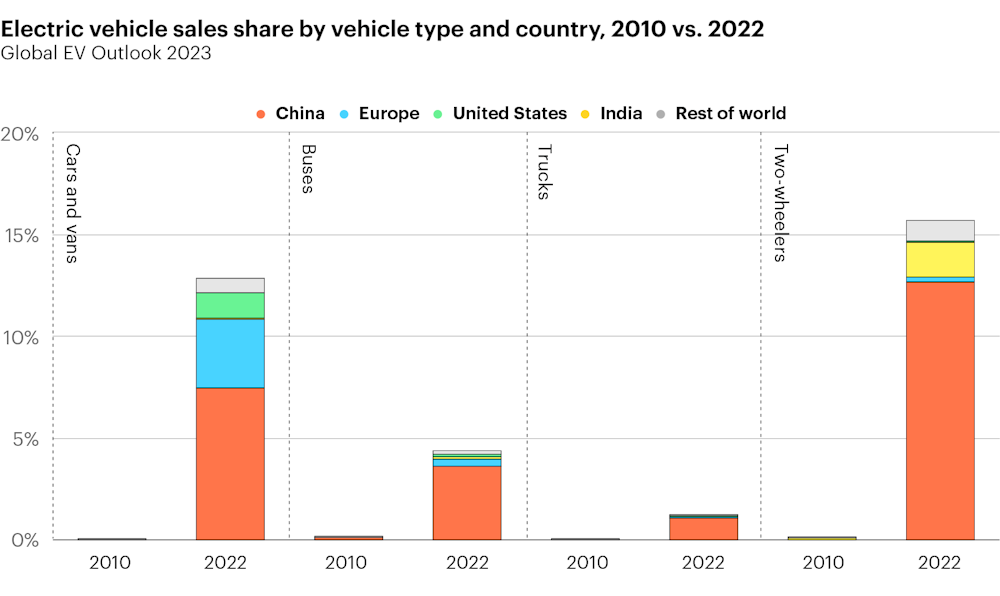
Stacked bar chart showing global sales of the various forms of road transport in 2012 and 2022
While the uptake of electric trucks has trailed other forms of road transport, their high mileage means any emission cuts add up.
International Energy Agency/Wikimedia Commons, CC BY


À lire aussi :
Why electric vehicles won’t be enough to rein in transport emissions any time soon


What did the study find?

In 2019, life-cycle emissions for electric trucks (both battery electric and hydrogen fuel cells) were higher than for diesel trucks. There were a few reasons for this.

First, the electricity grid and hydrogen production depended heavily on fossil fuel power sources at the time. High-carbon energy sources increased emissions from electric vehicles. But this is changing fast.

Another important issue is uncertainty about the durability of battery and (hydrogen) fuel cell systems in heavy use, such as for long-haul articulated trucks. The largest Australian trucks travel about 2 million kilometres on average in their lifetime. Those sorts of distances test the durability of these systems.

We currently expect battery systems to last between 400,000km and 600,000km. The average lifetime mileage of long-haul freight trucks in particular means batteries will need to be replaced.

Other options on the table could at least partly reduce this problem. We could use ageing trucks differently, such as for shorter trips. Trucks could also use shared and externally charged batteries (battery swapping).

Battery and fuel cell systems are expected to become a lot more durable in coming decades. Alongside a strong decarbonisation of Australia’s electricity generation and hydrogen production, this completely changes the picture. This can be seen when we look at the estimated plausible range in life-cycle emissions for different truck sizes and powertrain technologies in the future decarbonised scenario.


À lire aussi :
The trucking industry has begun to turn electric; cars will take longer


What does this mean for policy?

Our modelling shows battery electric trucks will provide deep emission cuts of 75-85%, on average, across the fleet in the future decarbonised scenario. Hydrogen (fuel cell) trucks will provide large cuts of 50-70%, on average.

Hydrogen trucks are expected to emit about twice the amount of life-cycle emissions per kilometre compared to battery electric trucks. The latter’s extra reduction in emissions will be vital for getting road transport closer to the net-zero target in 2050.

The life-cycle emissions of the hydrogen trucks also have the largest uncertainty of all the powertrains we assessed. This reflects a general lack of data and information for this technology.

This uncertainty is important for policymakers to consider. Hydrogen (fuel cell) trucks carry a higher risk of not achieving anticipated emission cuts.

Using the available evidence, our study suggests policies to cut Australian trucking emissions should focus on promoting battery electric trucks wherever possible.

Of course, other policy measures will be needed to achieve net zero. The options include shifting freight from road to lower-emission electric rail or ships. We could also reduce overall freight travel by, for instance, optimising logistics.


À lire aussi :
Australia’s freight used to go by train, not truck. Here’s how we can bring back rail – and cut emissions


The Conversation

Robin Smit is the Founder of and Director at Transport Energy/Emission Research (TER) and an Adjunct Professor at University of Technology Sydney.

ref. Why electric trucks are our best bet to cut road transport emissions – https://theconversation.com/why-electric-trucks-are-our-best-bet-to-cut-road-transport-emissions-219960

What are ‘good’ and ‘bad’ debts, and which should I pay off first?

Source: The Conversation (Au and NZ) – By Angel Zhong, Associate Professor of Finance, RMIT University

With the cost of living soaring and many struggling to get a pay rise, it’s not surprising people are using debt to navigate life’s financial twists and turns.

Owing money can sometimes feel challenging, but not all debts should keep you awake at night.

So which debts are good and which are bad? And in what order should you pay them off? As it all depends on your personal circumstances, all I can offer is general information and not financial advice. Ideally, you should seek guidance from an accredited financial adviser. But in the meantime, here are some ideas to consider.


À lire aussi :
Should I pay off the mortgage ASAP or top up my superannuation? 4 questions to ask yourself


What is a ‘good debt’?

Good debts can be strategic tools and help build a solid foundation for your future. They usually increase your net worth by helping you generate income or buy assets that increase in value.

With good debts, you usually get back more than what you pay for. They usually have lower interest rates and longer repayment terms. But personal finance is dynamic, and the line between good and bad debt can be nuanced. If not managed properly, even good debts can cause problems.

Some examples of “good debts” might include:

Mortgages: A mortgage allows you to buy a house, which is an asset that generally increases in value over time. You may potentially get tax advantages, such as negative gearing, through investment properties. However, it’s crucial not to overstretch yourself and turn a mortgage into a nightmare. As a rule of thumb, try avoid spending more than 30% of your income per year on your mortgage repayments.

Student loans: Education is an investment in yourself. Used well, student loans (such as HECS-HELP) can be the ticket to a higher-paying job and better career opportunities.

A woman in a hijab looks at her phone.
Review the terms and conditions of any loans carefully.
Shutterstock

What is a ‘bad debt’?

“Bad debts” undermine your financial stability and can hinder your financial progress. They usually come with high interest rates and short repayment terms, making them more challenging to pay off. They can lead to a vicious cycle of debt.

Examples of bad debts include:

Payday loans: A payday loan offers a quick fix for people in a financial tight spot. However, their steep interest rates, high fees and tight repayment terms often end up worsening a person’s financial problems. The interest and fee you may end up paying can get close to the loan amount itself.

Credit card debt: Credit cards can be like quicksand for your finances. If you don’t pay off your purchase on time, you’ll be subject to an annual interest rate of around 19.94%. For a A$3,000 credit card debt, for example, that could mean paying nearly $600 annual interest. Carrying credit card debt from month to month can lead to a seemingly never-ending debt cycle.

Personal loans: People usually take personal loans from a bank to pay for something special, such as a nice holiday or a car. They often come with higher interest rates, averaging around 10%. Spending money that you don’t have can lead to prolonged financial headaches.

Buy-now-pay-later services: Buy-now-pay-later services often provide interest-free instalment options for purchases. This can be tempting, but the account fees and late payment fees associated with buy-now-pay-later services can lead to a long-term financial hangover. The convenience and accessibility of buy-now-pay-later services can also make it easy to get further and further into debt.

So in what order should I pay off my debts?

There is no one right answer to this question, but here are three factors to consider.

Prioritise high-interest debts: Start by confronting the debts with the highest interest rates. This typically includes credit card debt and personal loans. Paying off high-interest debts first can save you money and reduce your total debt faster.

Negotiate interest rates or switch lenders: Don’t be shy. A simple call to your lender requesting a lower rate can make a significant difference. You may also take advantage of sign-on offers and refinancing your loan with a new lender. In the banking business, customers are not usually rewarded for their loyalty.

Consider different repayment strategies: Choose a debt repayment strategy that aligns with your preferences. Some people get a psychological boost from paying off smaller debts first (this is often called the “snowball method”). Others focus on high-interest debts (often known as the “avalanche method”). Find what works for you. The most important thing is to have a plan and stick to it.

An older man speaks on the phone.
Don’t be afraid to call your lender and ask for a lower interest rate.
Shutterstock

Review the terms of each debt carefully. Certain loans offer flexibility in repayment schedules, while others may impose penalties for early settlement. Take note of these conditions as you develop your repayment plan.

Debt can be a useful tool or a dangerous trap, depending on how you use it. By understanding the difference between good and bad debts, and by having a smart strategy for paying them off, you can take charge of your financial future.


À lire aussi :
Many students don’t know how to manage their money. Here are 6 ways to improve financial literacy education


The Conversation

Angel Zhong ne travaille pas, ne conseille pas, ne possède pas de parts, ne reçoit pas de fonds d’une organisation qui pourrait tirer profit de cet article, et n’a déclaré aucune autre affiliation que son organisme de recherche.

ref. What are ‘good’ and ‘bad’ debts, and which should I pay off first? – https://theconversation.com/what-are-good-and-bad-debts-and-which-should-i-pay-off-first-217779

‘A really weird energy’: Gypsy Rose Blanchard went to prison for murder – and is now a social media star

Source: The Conversation (Au and NZ) – By Edith Jennifer Hill, Associate Lecturer, Flinders University

After spending eight years in prison in the United States, Gypsy Rose Blanchard was released on parole on December 28, 2023. Three weeks later, Blanchard has 9.8 million followers on TikTok and 8.3 million followers on Instagram.

The 32-year-old pleaded guilty in 2016 to second-degree murder after conspiring to kill her mother with then-boyfriend, Nicholas Godejohn, who was sentenced to life in prison.

Gypsy Rose’s mother, Dee Dee Blanchard, was suspected by doctors of having a condition termed “factitious disorder imposed on another”. Once known as Munchausen Syndrome by proxy, the disorder involves someone imposing symptoms of severe illness on another person. Dee Dee claimed Gypsy Rose suffered from illnesses including muscular dystrophy and leukaemia, and this lead to unnecessary medical interventions given to Gypsy Rose, including use of a wheelchair and a feeding tube, unnecessary medications – leading to the removal of her teeth and salivary glands – and multiple surgeries.

The case led to a media frenzy. Many documentaries and films were made about Gypsy Rose and her mother, including the mini-series The Act (2019) and documentary Mommy Dead and Dearest (2017). There are countless podcasts released over the years detailing the case, including The Generation Why and the RedHanded Podcast.

With this fame, even before she was released from prison, many young people fully embraced Blanchard into “stan” culture, or obsessive fandoms. There were countdowns to her prison release and videos glorifying her.

After she began her social media presence, comments under her TikTok videos read “WE LOVE YOU GYPSY ROSE”, “My favourite influencer” and “QUEEN”.

The price of fame

Fan culture is complex. Fans are often dedicated to a person and invested in how that person acts. Marketing experts Alison Joubert and Jack Coffin explore how fandom is:

deeply rooted in identity and value, and fans are likely to “cancel” people who violate norms of justice and moral responsibility.

Blanchard’s jail sentence and admission of her role in her mother’s murder is at odds with the norms of moral responsibility, yet many people online are showing their support.


À lire aussi :
Celebrities can be cancelled. Fandoms are forever


Popular podcast Do We Know Them called the stan culture around Blanchard’s rise to fame “disturbing, dystopian, and strange”.

“It’s not that I don’t think she deserves support, it’s that this is a really weird energy to have around this horrible situation,” says co-host Jessi Smiles.

TikTok creator Veronica Skaia posted a video looking at Blanchard and the “influencer pipeline”, saying “we want her to perform for us”. She predicts once Blanchard gains “too much” fame and popularity online and starts receiving brand deals, people will turn on her, wanting her to be “humbled”.

Others are sharing what they hope for Blanchard and many hope she stays off social media and takes the time she needs to reacquaint herself in the world.

Authentic and curated posts

At the time of writing, Blanchard has 17 videos on her TikTok account, with over 510 million views. The first four videos are highly produced promotional videos for her forthcoming book and television special, The Prison Confessions of Gypsy Rose Blanchard.

Other videos on her page follow very common social media tropes. Blanchard has posted a get ready with me (#GRWM) video, an outfit of the day (#OOTD) and vlog-style videos showing her first days out of prison. These videos are posted with the accompanying hashtags and captions of someone who is aware of social media trends, including the consistent use of #ThePrisonConfessionsOfGypsyRoseBlanchard.

In the GRWM video, with over 35 million views, you can hear Blanchard asking someone off-screen, “How does the get ready with me work? Do they watch the whole hour video?”. The person responds no, and asks her if she has heard of Alix Earle, a TikToker famous for her GRWM videos. The person off-screen then shows Blanchard a video of Earle.

This video is uncanny. We are watching a woman who was famously infantalised by her mother for years. She has now emerged from prison, an articulate 32-year-old, who seemingly shows limited understanding of social media, despite her massive audience.

Online success, particularly for influencers and brands, hinges upon their ability to appear authentic and to be trusted. We want to know what we can expect from an influencer. A consistent authorial voice and gradually revealing information makes us feel like we are listening to a friend.

Considering Blanchard through this lens is complex. The videos on her page are a combination of highly curated media promotion and very raw vlog-style footage. It is often apparent Blanchard is a social media novice.

This contrast is uncommon for someone with such a large online following.

Questioning authenticity

Blanchard’s authenticity has previously been called into question. Many speculate about her role in the death of her mother, and how much she knew about her mother’s false health claims and the resulting fraud in accepting the charity of their community.

It is strange to see someone occupy a position of trust and influence on a social media platform after years of speculation about the truth in their life. Away from the documentaries and the mini-series for the first time, we are going to hear Blanchard’s story from the source.

In a video posted January 17, Blanchard explores “the point” of her social media presence. She explains her aim is to spread awareness about Munchausen Syndrome by proxy. She defines the illness and discusses symptoms to look out for. She ends the video with a call to action, asking her views to post in the comments what they think needs to change in the healthcare system to protect children from medical abuse.

The media stories around Blanchard have presented a curated version of her life. Her story, now being shared online, demonstrates a different level of curation. For now, the storytelling is in the hands of the subject and we get to experience the story of Gypsy Rose Blanchard through her own voice – and the lens of TikTok.


À lire aussi :
Save your outrage: online cancer fakers may be suffering a different kind of illness


The Conversation

Edith Jennifer Hill ne travaille pas, ne conseille pas, ne possède pas de parts, ne reçoit pas de fonds d’une organisation qui pourrait tirer profit de cet article, et n’a déclaré aucune autre affiliation que son organisme de recherche.

ref. ‘A really weird energy’: Gypsy Rose Blanchard went to prison for murder – and is now a social media star – https://theconversation.com/a-really-weird-energy-gypsy-rose-blanchard-went-to-prison-for-murder-and-is-now-a-social-media-star-220846

Port Moresby police chief suspended in latest fallout from PNG riots

The latest victim of last week’s rioting and looting in Papua New Guinea’s capital Port Moresby is the city’s top police commander.

National Capital District commander Assistant Commissioner Anthony Wagambie Jr has been suspended for 21 days.

Wagambie’s suspension comes after an internal investigation by the PNG police Internal Affairs Directorate.

Acting Police Commissioner Donald Yamasombi approved the suspension to “facilitate a thorough and impartial investigation”, The National newspaper reported.

“He [Wagambie] will have the opportunity to provide further information to investigators as is required during this [disciplinary] process,” he said.

“This is the first of potentially several more suspensions with the way in which some police personnel conducted themselves during the mayhem.”

The violence broke out in Port Moresby last week on Black Wednesday — January 10 — with shops and businesses set alight after public servants, including police and army personnel, went on strike over a payroll issue.

As many as 22 people died in the violence, which prompted the government to issue a state of emergency.

Last week the PNG Police Commissioner David Manning was suspended alongside the secretaries of Finance, Treasury and the Department of Personnel Management.

When announcing these suspensions last Friday, Prime Minister James Marape said: “it’s not good enough that operating agencies do not get to work properly that has caused us this stress”.

RNZ Pacific’s PNG correspondent Scott Waide said there was strong public support for Wagambie online.

Social media shutdown, warns minister
Meanwhile, PNG’s Telecommunications Minister Timothy Masiu has announced that the government could shut down social media if people misused it during the state of emergency.

Masiu, a former journalist, said there was significant evidence people had spread false information on social media sites leading to the destruction of properties in Port Moresby and around the country.

The Port Courier reports him saying people who engaged in such bogus activity would lose their social media accounts and could face arrest and charges for fomenting violence.

Masiu said discussions on social media that incited violence, destruction, that spread false information or confidential government information, would be closely monitored.

He said national security, public emergency and public safety was critical for a secure nation and a “happy and safe country”.

The government has already revealed the state of emergency rules allow draconian measures such as searches of private homes, property, vehicles and phones by government agents.

This article is republished under a community partnership agreement with RNZ.

Article by AsiaPacificReport.nz

Australians are concerned about AI. Is the federal government doing enough to mitigate risks?

Source: The Conversation (Au and NZ) – By Toby Walsh, Professor of AI, Research Group Leader, UNSW Sydney

Wes Cockx & Google DeepMind, CC BY

Today, the federal Minister for Industry and Science Ed Husic revealed an interim response from the Australian government on the safe and responsible use of artificial intelligence (AI).

The public, especially the Australian public, have real concerns about AI. And it’s appropriate that they should.

AI is a powerful technology entering our lives quickly. By 2030, it may increase the Australian economy by 40%, adding A$600 billion to our annual gross domestic product. A recent International Monetary Fund report estimates AI might also impact 40% of jobs worldwide, and 60% of jobs in developed nations like Australia.

In half of those jobs, the impacts will be positive, lifting productivity and reducing drudgery. But in the other half, the impacts may be negative, taking away work, even eliminating some jobs completely. Just as lift attendants and secretaries in typing pools had to move on and find new vocations, so might truck drivers and law clerks.

Perhaps not surprisingly then, in a recent market researcher Ipsos survey of 31 countries, Australia was the nation most nervous about AI. Some 69% of Australians, compared to just 23% of Japanese, were worried about the use of AI. And only 20% of us thought it would improve the job market.

The Australian government’s new interim response is therefore to be welcomed. It’s a somewhat delayed reply to last year’s public consultation on AI. It received over 500 submissions from business, civil society and academia. I contributed to multiple of these submissions.

What are the main points in the government’s response on AI?

Like any good plan, the government’s response has three legs.

First, there’s a plan to work with industry to develop voluntary AI Safety Standards. Second, there’s also a plan to work with industry to develop options for voluntary labelling and watermarking of AI-generated materials. And finally, the government will set up an expert advisory body to “support the development of options for mandatory AI guardrails”.

These are all good ideas. The International Organisation for Standardisation have been working on AI standards for multiple years. For example, Standards Australia just helped launch a new international standard that supports the responsible development of AI management systems.

An industry group containing Microsoft, Adobe, Nikon and Leica has developed open tools for labelling and watermarking digital content. Keep a look out for the new “Content Credentials” logo that is starting to appear on digital content.

And the New South Wales government set up an 11-member advisory committee of experts to advise it on the appropriate use of artificial intelligence back in 2021.

Person holding phone with ChatGPT logo displayed
OpenAI’s ChatGPT is one of the large language model applications that sparked concerns regarding copyright and mass production of AI-generated content.
Mojahid Mottakin/Unsplash

A little late?

It’s hard not to conclude then that the federal government’s most recent response is a little light and a little late.

Over half the world’s democracies get to vote this year. Over 4 billion people will go to the polls. And we’re set to see AI transform those elections.


Read more:
How AI could take over elections – and undermine democracy


We’ve already seen deepfakes used in recent elections in Argentina and Slovakia. The Republican party in the US have put out a campaign advert that uses entirely AI-generated imagery.

Are we prepared for a world in which everything you see or hear could be fake? And will voluntary guidelines be enough to protect the integrity of these elections? Sadly, many of the tech companies are reducing staff in this area, just at the time when they are needed the most.

The European Union has led the way in the regulation of AI – it started drafting regulation back in 2020. And we are still a year or so away before the EU AI Act comes into force. This emphasises how far behind Australia is.

A risk-based approach

Like the EU, the Australian government’s interim response proposes a risk-based approach. There are plenty of harmless uses of AI that are of little concern. For example, you likely get a lot less spam email thanks to AI filters. And there’s little regulation needed to ensure those AI filters do an appropriate job.

But there are other areas, such as the judiciary and policing, where the impact of AI could be more problematic. What if AI discriminates on who gets interviewed for a job? Or bias in facial recognition technologies result in even more Indigenous people being incorrectly incarcerated?

The interim response identifies such risks but takes few concrete steps to avoid them.

Diagram of impacts through the AI lifecycle, as summarised in the Australian government’s interim response.
Australian Government

However, the biggest risk the report fails to address is the risk of missing out. AI is a great opportunity, as great or greater than the internet.

When the United Kingdom government put out a similar report on AI risks last year, they addressed this risk by announcing another 1 billion pounds (A$1.9 billion) of investment to add to the more than 1 billion pounds of previous investment.

The Australian government has so far announced less than A$200 million. Our economy and population is around a third of the UK. Yet the investment so far has been 20 times smaller. We risk missing the boat.


Read more:
AI: the real threat may be the way that governments choose to use it


The Conversation

Toby Walsh receives funding from the Australian Research Council and Google.org on grants to build trustworthy AI.

ref. Australians are concerned about AI. Is the federal government doing enough to mitigate risks? – https://theconversation.com/australians-are-concerned-about-ai-is-the-federal-government-doing-enough-to-mitigate-risks-221300

An RSV vaccine has been approved for people over 60. But what about young children?

Source: The Conversation (Au and NZ) – By Allen Cheng, Professor of Infectious Diseases, Monash University

Ground Picture/Shutterstock

The Therapeutic Goods Administration (TGA) has approved a vaccine against respiratory syncytial virus (RSV) in Australia for the first time. The shot, called Arexvy and manufactured by GSK, will be available by prescription to adults over 60.

RSV is a contagious respiratory virus which causes an illness similar to influenza, most notably in babies and older adults.

So while it will be good to have an RSV vaccine available for older people, where is protection up to for the youngest children?


Read more:
What happens in our body when we encounter and fight off a virus like the flu, SARS-CoV-2 or RSV?


A bit about RSV

RSV was discovered in chimpanzees with respiratory illness in 1956, and was soon found to be a common cause of illness in humans.

There are two key groups of people we would like to protect from RSV: babies (up to about one year old) and people older than 60.

Babies tend to fill up hospitals during the RSV season in late spring and winter in large numbers, but severe infection requiring admission to intensive care is less common.

In babies and younger children, RSV generally causes a wheezing asthma-like illness (bronchiolitis), but can also cause pneumonia and croup.

Although there are far fewer hospital admissions among older people, they can develop severe disease and die from an infection.

A baby sitting on a bed.
Babies account for the majority of hospitalisations with RSV.
Prostock-studio/Shutterstock

RSV vaccines for older people

For older adults, there are actually several RSV vaccines in the pipeline. The recent Australian TGA approval of Arexvy is likely to be the first of several, with other vaccines from Pfizer and Moderna currently in development.

The GSK and Pfizer RSV vaccines are similar. They both contain a small component of the virus, called the pre-fusion protein, that the immune system can recognise.

Both vaccines have been shown to reduce illness from RSV by more than 80% in the first season after vaccination.


Read more:
Is there a vaccine for RSV or respiratory syncytial virus? After almost 60 years, several come at once


In older adults, side effects following Arexvy appear to be similar to other vaccines, with a sore arm and generalised aches and fatigue frequently reported.

Unlike influenza vaccines which are given each year, it is anticipated the RSV vaccine would be a one-off dose, at least at this stage.

Protecting young children from RSV

Younger babies don’t tend to respond well to some vaccines due to their immature immune system. To prevent other diseases, this can be overcome by giving multiple vaccine doses over time. But the highest risk group for RSV are those in the first few months of life.

To protect this youngest age group from the virus, there are two potential strategies available instead of vaccinating the child directly.

The first is to give a vaccine to the mother and rely on the protective antibodies passing to the infant through the placenta. This is similar to how we protect babies by vaccinating pregnant women against influenza and pertussis (whooping cough).

The second is to give antibodies directly to the baby as an injection. With both these strategies, the protection provided is only temporary as antibodies wane over time, but this is sufficient to protect infants through their highest risk period.

A pregnant woman receives a vaccination.
Women could be vaccinated during pregnancy to protect their baby in its first months of life.
Image Point Fr/Shutterstock

Abrysvo, the Pfizer RSV vaccine, has been trialled in pregnant women. In clinical trials, this vaccine has been shown to reduce illness in infants for up to six months. It has been approved in pregnant women in the United States, but is not yet approved in Australia.

An antibody product called palivizumab has been available for many years, but is only partially effective and extremely expensive, so has only been given to a small number of children at very high risk.

A newer antibody product, nirsevimab, has been shown to be effective in reducing infections and hospitalisations in infants. It was approved by the TGA in November, but it isn’t yet clear how this would be accessed in Australia.


Read more:
How common are severe side effects from COVID vaccines? And how are they detected?


What now?

RSV, like influenza, is a major cause of respiratory illness, and the development of effective vaccines represents a major advance.

While the approval of the first vaccine for older people is an important step, many details are yet to be made available, including the cost and the timing of availability. GSK has indicated its vaccine should be available soon. While the vaccine will initially only be available on private prescription (with the costs paid by the consumer), GSK has applied for it to be made free under the National Immunisation Program.

In the near future, we expect to hear further news about the other vaccines and antibodies to protect those at higher risk from RSV disease, including young children.

The Conversation

Allen Cheng receives funding from the National Health and Medical Research Council and the Australian Government. He is a member of the Australian Technical Advsory Group on Immunisation. The views expressed in this article may not reflect those of ATAGI.

ref. An RSV vaccine has been approved for people over 60. But what about young children? – https://theconversation.com/an-rsv-vaccine-has-been-approved-for-people-over-60-but-what-about-young-children-221311

How rising sea levels will affect our coastal cities and towns

Source: The Conversation (Au and NZ) – By Thomas Mortlock, Adjunct Fellow, Climate Change Research Centre, UNSW Sydney

Sea-level rise – along with increasing temperatures – is one of the clearest signals of man-made global warming. Yet exactly how rising water levels affect the coast is often misunderstood.

A new coastal hazard assessment for Victoria’s Port Phillip Bay has again thrown the spotlight on the impact of sea-level rise on coastal communities in Australia. Should we be worried? Or is the reality more nuanced?

While there are still many uncertainties, even a small change in sea level can have big impacts. We should be doing all we can to limit sea-level rise to protect our coastal cities and towns. And because sea levels will continue to rise for centuries after we cut emissions to net zero, planning decisions for coastal areas must factor this in.

Why are sea levels rising?

Global sea levels are rising for two main reasons: the oceans are getting warmer, and land-based ice sheets and glaciers are melting.

As ocean water warms, it expands. Because the ocean basins are finite (like a bathtub), this results in a rise in water levels.


Read more:
Ocean heat is off the charts – here’s what that means for humans and ecosystems around the world


Since the 1970s, thermal expansion of the oceans has accounted for roughly half of measured global sea-level rise. The other half is due to land-based ice melt from ice sheets and glaciers. Together, these make up what is known as “eustatic” sea level.

The rate of sea-level rise experienced at the coast also depends on whether the land is moving up or down. “Relative” or “isostatic” sea level is the sum of “eustatic” sea level plus local vertical land movement.

Australia is rising by about 0.3-0.4 millimetres a year due to glacial isostatic adjustment. This is the result of the land continuing to move upward following the loss of ice on land during previous glaciations. The land subsided under the weight of this ice and is now rebounding as the ice is gone. This slow rebound of the land provides a small offset to eustatic sea levels around Australia.


Read more:
Rising seas and melting glaciers: these changes are now irreversible, but we have to act to slow them down


Sea-level rise is accelerating

From 1900 to 2018, global sea levels rose by about 20cm (a long-term average of 1.7mm/yr), but almost everywhere the rate of rise is increasing. Measurements since 1993, when global satellite data became available, show the rate of global mean sea-level rise over the past decade has more than doubled to more than 4mm/yr.

Around Australia, sea levels are rising at or above this global average. Tide gauges indicate the rate of rise in northern Australia since the early 1990s is around 4–6mm/yr. Along the south-east coast of Australia, it’s about 2–4mm/yr. Rates of sea-level rise are not uniform around Australia because of local effects like ocean circulation and tidal processes.

Even if greenhouse gas emissions reached zero tomorrow, sea levels will continue to rise for several centuries because of the slow response of the ocean to warming. It’s a long-term trend that we must live with.

This is why is it important to factor in sea-level rise when we make planning decisions along the coast. Unfortunately, the rate of sea-level rise over the coming century remains highly uncertain, making it difficult to include in coastal planning.

The “likely” range of the most recent projections by the Intergovernmental Panel on Climate Change (IPCC) is a rise of between 0.4 metres and 0.8m by 2100. However, a rise of nearly 2m by 2100 and 5m by 2150 cannot be ruled out. This is due to deep uncertainty about ice-sheet processes – so much so, that in 2021 the IPCC introduced a new high-end risk scenario to describe this.


Read more:
Coastal property prices and climate risks are both soaring. We must pull our heads out of the sand


Small rises have big impacts

The impact of sea-level rise at the coast is not just a gradual increase in water lapping at the shore. An increase in tide heights (both higher high tides and higher low tides) increases the probability of coastal flooding and erosion when storms come along.

As a rule of thumb, every 10cm of sea-level rise triples the frequency of a given coastal flood. Another rule of thumb, known as the Bruun Rule, suggests a 1cm rise in sea level leads to a 1m retreat of the coastline.

While these back-of-the-envelope estimates are often significantly reduced when local conditions are accounted for, it explains why a small shift in the mean sea level can have big impacts at the coast.


Read more:
Climate explained: why coastal floods are becoming more frequent as seas rise


Storms aren’t always bad for the beach

Most of the impacts of sea-level rise around Australia’s coast will be felt in combination with storm events, such as east coast lows or tropical cyclones. A high water level plus a storm surge on top leads to a storm or “king” tide. In combination with storm waves, it can cause significant coastal erosion and flooding.

However, storms also bring sand from deeper water towards the beach. Over the long term, this process can help beaches keep pace with sea-level rise. Fortunately for eastern Australia, we have a lot of sand sitting offshore which is slowly making its way back to our beaches. Other naturally regressive coastlines, such as many in Northern Europe, are not so lucky.


Read more:
Become a beach scientist this summer and help monitor changing coastlines


All eyes on Antarctica

Sea-level rise is here to stay and gathering pace, but the rate of future increase remains uncertain. It largely depends on what happens in Antarctica over the coming decades.

This in turn depends on land and sea temperatures around the southern continent, which are directly linked to our efforts to limiting global warming to 1.5°C in line with the Paris Agreement.

With over 250 million people now living on land less than 2m above sea level, most in Asia, it is imperative we do everything we can to limit future sea-level rise.

The Conversation

Thomas Mortlock works as a senior analyst for Aon Reinsurance Solutions Australia.

ref. How rising sea levels will affect our coastal cities and towns – https://theconversation.com/how-rising-sea-levels-will-affect-our-coastal-cities-and-towns-221121

More than a pay dispute: what’s really behind the Papua New Guinea riots

Source: The Conversation (Au and NZ) – By Jonathan Ritchie, Senior Lecturer in History, Deakin University

The world has been shocked by images of wanton violence, looting and destruction on the streets of Papua New Guinea’s capital, Port Moresby, in the past week.

Prime Minister James Marape declared a state of emergency as shops were set on fire and citizens shot. At least 22 people have been killed as a result of the violence.

Several reasons have been put forward for the sudden eruption of violence. A “technical glitch” in the government’s payroll system, which cut public service pay packets was the official explanation, although this did little to quell rumours that the cut was due to a sudden tax increase.

Marape blamed political interference for spreading the rumours. The opposition blamed Marape for mismanagement. Whatever the reason, public servants, crucially including the beleaguered police force, promptly went on strike and abandoned their posts, leading to the violence and looting.

Whether Marape’s or the political opposition’s explanation is plausible is perhaps less important than trying to understand the underlying causes of such apparently spontaneous violence. We believe the roots lie in the rapid and uncontrolled growth of Port Moresby (and of other major urban centres such as Lae) that began before Papua New Guinea’s independence in 1975, when it was an Australian territory.

This growth has produced a swollen population that can quickly transform into an angry, riotous mob, especially when the instruments of civil control such as the police are withdrawn.

Now home to more than 400,000 people, Port Moresby owes its origins to the first European colonisers who settled there in the late 19th century. Prior to European contact, a total of about 2,000 Motu and Koita villagers lived in the Port Moresby area. By the end of the second world war, about 5,000 Indigenous people were there (and around 1,500 Europeans).

In the post-war years, there was a continuous and rapid increase in the Melanesian population. This was spurred primarily by increased Australian government spending and the accompanying need for labour.

By 1954, the Indigenous population of Port Moresby had expanded to 12,000. By 1966, it was 32,000. At the time of independence in 1975, the Indigenous population was 95,000.

Lack of land for housing was the main challenge for Indigenous people relocating to Port Moresby for employment. Unlike in Australia, most land in PNG has never been alienated and is customarily owned. Much of Port Moresby is still owned by its original Motu and Koita inhabitants.

The influx of internal migrants meant many people had little choice other than to squat on others’ land. As a result, during the post-war decades “temporary shanty towns, built from industrial scrap, the relics of war, packing cases and the like” grew up, as Charles Rowley wrote in the 1960s.

In the following decade, Australian economist Ross Garnaut noted that services and planning had failed to keep up with the influx.


Read more:
Where does Australia’s relationship with PNG go next? Less talk about China, more about our neighbour’s own merits


Despite repeated attempts to address this problem, it has never been satisfactorily resolved. As recently as October 2023, Port Moresby Governor Powes Parkop has pressed for squatters to be given title to their land.

In 2021, it was estimated nearly 50% of Port Moresby’s residents lived on informal settlements.

The traditional land owners, furious at what they regard as losing their land to “greed”, regularly demand the removal of the squatters. Evictions are frequent.

Further exacerbating the sense of hopelessness and precarity has been the chronic unemployment experienced by residents of the settlements, particular the young. Nearly 90% of Papua New Guineans earn less than A$10.40 per day. Faced with the day-to-day challenges of making ends meet, many see the huge gulf between rich and poor as rubbing salt into their wounds.

Luxury gated communities tucked behind high fences with private security guards are visible reminders of the wealth gap. It could be understood if the recent violence had been directed at these properties instead of at the more accessible, but perhaps less deserving, local trade stores. As is all too often the case with this kind of unrest, people will vent their rage wherever and whenever the opportunity arises.


Read more:
World leaders are flocking to Papua New Guinea. Here’s why


The crisis in Port Moresby has many causes, including the disparity in wealth, high unemployment and living conditions equal to some of the worst places in the world. We also know most of its residents are as shocked and appalled by the violence as we are.

We believe an understanding of the past will help to illuminate and explain the present, and that understanding the roots of the current crisis may help to prevent such events from happening in the future.

The Conversation

The authors do not work for, consult, own shares in or receive funding from any company or organisation that would benefit from this article, and have disclosed no relevant affiliations beyond their academic appointment.

ref. More than a pay dispute: what’s really behind the Papua New Guinea riots – https://theconversation.com/more-than-a-pay-dispute-whats-really-behind-the-papua-new-guinea-riots-221208

A new year means new fitness goals. But options for people with disability are few and far between

Source: The Conversation (Au and NZ) – By Leanne Hassett, Associate Professor in Physiotherapy, University of Sydney

Drazen Zigic/Shutterstock

Around 4.4 million Australians, or 18% of our population, live with disability. This number is likely to rise as our population ages.

Adults living with disability can experience a range of benefits from participating in community-based physical activities such as dance, Tai Chi and yoga, our recently published review found.

Yet adults with disability are less physically active than those without disability, with inclusive community-based physical activities few and far between. This puts people with disability at increased risk of further disability.

People with disability should be able to join a local club or group to participate in physical activity they enjoy, just like the rest of us. So how can we provide more physical activity options?


Read more:
Thinking of using an activity tracker to achieve your exercise goals? Here’s where it can help – and where it probably won’t


Benefits of physical activity

Our systematic review included 74 trials with 2,954 men and women living with mild-to-moderate physical and intellectual disability.

We looked at studies of Tai Chi, Qigong (which is similar to Tai Chi but more straightforward, using more repetitive movements), yoga, dance, water exercise, gym training, boxing, horse riding, Nordic walking and running. All but one of these physical activities were delivered in condition-specific groups (for example, a group for people with Parkinson’s disease).

People found benefits from participating in these recreation activities. Benefits included improvements in walking, balance and quality of life, and reductions in fatigue, depression and anxiety.

Dance was particularly beneficial for improving walking. Tai Chi, yoga, dance and water exercise were beneficial for balance. Yoga and water exercise were beneficial for fatigue and Tai Chi for depression.

Considerations for physical recreation in the community

Some people with disabilities prefer to be active with others who have similar conditions and abilities. Others prefer to be active locally with family and friends.

Travel to a disability-specific activity may increase the cost and time involved. The lack of choice puts people with a disability at a disadvantage compared to non-disabled people.

Some physical recreation activities included in the review used adjustments and extra equipment to be suitable for people with disability. These adjustments were usually only small (for example, seated options or spending a shorter time in a certain pose or position) and equipment was low cost (for chairs, exercise bands, and so on).

Most local community-based recreation groups should be able make simple adjustments to meet the needs of people living with mild to moderate disability. However this doesn’t routinely happen.


Read more:
Sport and physical activity play important roles for Aboriginal and Torres Strait Islander communities, but there are barriers to participation


In the review, few activity leaders (37%) had experience and/or training working with people with disability. This may limit the confidence of the activity leader to include a person with disability in the class. It may also limit the confidence of the person with disability to join a local class.

Access to services is a basic right

Australia is a signatory on the Convention on the Rights of Persons with Disabilities. Australia also has a Disability Discrimination Act (1992). But this seems to provide little incentive for services to take active measures to prevent disability discrimination.

The Royal Commission into Violence, Abuse, Neglect and Exploitation of People with Disability confirmed people with disability were still excluded from many areas of society because of their disability.

Woman dances in a class
People with disability often face greater costs, more travel and fewer choices for physical activity.
BearFotos/Shutterstock

The commission’s final report recommended strengthening laws to protect people with disability, prevent discrimination, and build a more inclusive society.

Momentum and expectation is growing in Australian society for better inclusion for people living with disability.

So what can we do for better physical activity inclusion?

First, more physical activity options suitable for people with disability are needed in the community. Guided by the inclusion spectrum, there should be options for both disability-specific and inclusive mainstream activities. People with disability will then be able to choose an activity that suits their needs and preference.

A handful of organisations are leading the way, often led by a person with disability or disability advocate, but more are needed.

Second, community-based physical activities need to enable the person with disability to access the setting safely and have equipment suitable to use. Community organisations can audit their service using online tools, such as AIMFREE (Accessibility Instruments Measuring Fitness and Recreation Environments), to evaluate and improve their accessibility.


Read more:
We need beach access for everyone, and that includes people with a disability


A welcoming environment can help ensure a positive experience for the person with disability. Disability Sports Australia offers a free online Accessibility Champion course for sporting clubs and recreation providers. This aims to improve staff and volunteer knowledge and confidence to welcome people with disability. All clubs and service providers should commit to completing this type of training.

Finally, we can all do better to ensure we are accepting and welcoming of people of all abilities in the community, especially in recreation or sporting activities we’re involved in. When this happens, Australia will take an important step to being a more inclusive society.

The Conversation

Leanne Hassett receives funding from the National Health and Medical Research Council of Australia and Medical Research Future Fund.

Anne Tiedemann has received funding from the National Health and Medical Research Council and the Medical Research Future Fund. She is an Executive Committee Member of the Australia and New Zealand Falls Prevention Society and the World Falls Prevention Society.

Cathie Sherrington has received funding from the National Health and Medical Research Council and the Medical Research Future Fund. She is the voluntary secretary of the Cerebral Palsy Sport and Recreation Association of NSW and she is an executive member of the Australian and NZ Falls Prevention Society.

ref. A new year means new fitness goals. But options for people with disability are few and far between – https://theconversation.com/a-new-year-means-new-fitness-goals-but-options-for-people-with-disability-are-few-and-far-between-220143

Up to 5 billion people to be hit by rainfall changes this century if CO₂ emissions are not curbed, research shows

Source: The Conversation (Au and NZ) – By Ralph Trancoso, Adjunct Associate Professor in Climate Change, The University of Queensland

Three to five billion people – or up to two-thirds of the world’s population – are set to be affected by projected rainfall changes by the end of the century unless the world rapidly ramps up emissions reduction efforts, according to new research by myself and colleagues.

To date, the effects of climate change on global rainfall has been uncertain. This has hampered our capacity to adapt to climate change and prepare for natural disasters.

Our method overcomes this uncertainty. We identified the regions where multiple climate models make similar projections about future rainfall impacts, and so reveal the global hot spots for drier and wetter conditions in future.

Our findings have deep implications for a large proportion of the world’s population – including millions of Australians.

girl in pink dress plays in muddy puddle
Up to five billion people, including millions of Australians, are set to be affected by rainfall changes by 2100 under climate change.
Shutterstock

Navigating the uncertainty of rain projections

Climate models are one of the main ways scientists understand how the climate behaved in the past and might change in future. They comprise millions of lines of computer code and use mathematical equations to represent how energy and materials move through the ocean, atmosphere and land. For future projections, climate models are driven by emissions scenarios representing various possible emissions trajectories.

Using climate models to simulate future rainfall patterns is a difficult task. Rain is influenced by complex factors, such as radiative balance (how much of the Sun’s energy is coming in versus how much is leaving), as well as climate drivers linked to specific sea surface temperature patterns, such as El Niño and La Niña. This means different climate models often produce different rainfall projections, especially at a regional level.

We wanted to investigate the extent to which climate models “agree”, or produce similar projections, about how CO₂ emissions may affect future rainfall around the globe.

There are several ways to do this. The usual method is to average out data collected over time – say, two decades. But this approach can eliminate important information and obscure vital insights into how rainfall will behave in future.

We used an innovative and more comprehensive approach based on “time-series” data, or data collected at regular intervals over time – comprising historical and future projections from 1980 to 2100. This approach accounts for continual changes over time, both in the recent past and out to the end of this century.

We analysed both the current and previous generations of climate models – 146 in all.


Read more:
Yes, a few climate models give unexpected predictions – but the technology remains a powerful tool


The global hotspots

Our analysis showed several countries facing drier conditions in future. The top five most affected were Greece, Spain, Palestine, Portugal and Morocco, where at least 85% of models projected significantly reduced annual rainfall by the end of this century, under a worst-case scenario of very high emissions.

In contrast, for Finland, North Korea, Russia, Canada and Norway, more than 90% of models agreed on a trend towards increasing annual rainfall.

The picture was similar for most parts of the highly populated nations of China and India, which are together home to more than 2.7 billion people. In those nations, 70% of models agreed on projections for increasing rainfall.

Our analysis showed some European countries, including the United Kingdom, Germany and France, were generally projected to experience less rainfall in summer and more in winter. These increases and decreases offset each other, which means no change in total rainfall, but substantial changes in seasonal distributions over the year.

Using our approach, rainfall projections remained unclear for some parts of the world. These include most of Australia, as well as central Europe, southwest Asia and parts of the African west coast and South America.

All up, the regions getting wetter or drier under global warming cover a vast proportion of the globe. Under scenarios where emissions remain intermediate (where emissions decline to about half of 2050 levels by the end of the century), 38% of the current world’s population, or three billion people, would be affected by changes in rainfall.

If we experience very high emissions instead, 66% of the world’s population – or five billion people – would be affected. Many of these regions are already experiencing the wetting and drying effects of climate change.

Regions where global models agree most on projected future wetter and drier conditions under intermediate and very high emissions. Bar charts show countries ranked by model agreement with lines displaying internal variability.
Author provided

A spotlight on Australia

Our analysis for Australia found climate models agree on a significant drying hotspot over the Indian Ocean, engulfing Australia’s southwestern and south coasts. Spring was the season with the greatest rainfall reduction over this region.

Red and blue regions show locations where drying and wetting was detected by multiple climate models
Author provided

What about at a state level? Under a very high emissions scenario, half of models indicate future drier conditions for Victoria. This is driven by changes in winter and spring rainfall. Other states and territories with agreement for a drier future winter, also under a high emissions scenario, include the Australian Capital Territory and Western Australia. The models also project a reduction in spring rainfall in Tasmania.

Some 1.9 million Australians would be affected by these drying patterns, under an intermediate emissions scenario. They comprise those in southwest WA including Perth and the Wheatbelt region. Under very high emissions, as the impacted region expands fourfold towards western Victoria, around 8 million Australians could be affected.

Australasian regions where most global models agree on future drier and wetter patterns under elevated emissions
Australasian regions where most global models agree on future drier and wetter patterns under elevated emissions. Southwestern Australia and parts of the south and east coasts may experience a drier future under very high emissions (shaded red). When moderate emissions are considered, the affected region is reduced (red contours).
Author provided

Looking ahead

As climate change accelerates, it’s essential to understand the potential changes in global rainfall and the consequences on human populations.

My colleagues and I hope our findings reduce uncertainty about how rainfall patterns will shift around the world, and help governments and communities to design effective ways to adapt.

The Conversation

Ralph Trancoso leads the Queensland Future Climate Science Program – a collaborative program between the University of Queensland and Queensland’s Department of Environment and Science undertaking applied climate science to support climate adaptation and natural disaster preparedness.

ref. Up to 5 billion people to be hit by rainfall changes this century if CO₂ emissions are not curbed, research shows – https://theconversation.com/up-to-5-billion-people-to-be-hit-by-rainfall-changes-this-century-if-co-emissions-are-not-curbed-research-shows-221004

Why two largely white and tiny states still matter so much to the US presidential election

Source: The Conversation (Au and NZ) – By Ava Kalinauskas, Research Associate, United States Studies Centre, University of Sydney

Former President Donald Trump’s commanding, and expected, victory in this week’s Iowa caucuses has confirmed his frontrunner status in the race for the 2024 Republican presidential nomination.

With his closest rivals Ron DeSantis and Nikki Haley lagging far behind, it seems the Republican primary contest is over before it has even begun.

Since the 1970s, Iowa has kicked off the US presidential election year with the first caucuses of the primary season. This changed for Democrats following the 2020 election, when the party ditched the first-in-the-nation caucuses for a mail-in vote. The results of this will be known on March 5 (often known as Super Tuesday).

Republicans, however, have stuck with the caucuses. With Republicans in 49 states still yet to cast a vote in the 2024 nominating contest, why is it that an overwhelmingly white state of 3 million continues to hold such sway over the fate of one of the world’s largest democracies?


Read more:
Donald Trump’s stroll to victory in Iowa was a foregone conclusion. This doesn’t make it any less shocking


How Iowa was put on the map

Iowa reached the top of the nominating calendar for a string of logistical reasons — some even say by accident — when the Democratic Party reformed its candidate selection procedures after the tumultuous 1968 Chicago party convention.

At first, few noticed or cared about the Iowa caucuses’ early position. But this all changed in 1976. Little-known presidential hopeful Jimmy Carter led a grassroots campaign in Iowa — and the next-in-line New Hampshire primary — to deliver unexpected early victories in the Democratic nominating contest. He seized upon these two early wins to catapult himself onto the national stage and ultimately win the White House.

Carter showed how these early testing grounds of voter support can propel candidates from obscurity to national fame. Once he put the Iowa caucuses on the map, the state sought to ensure they remained there.

Both the Democratic and Republican parties officially cemented Iowa’s first-in-nation status through state laws and party rules. Since then, the caucuses have become not just an opportunity for candidates to make their mark, but a boon for the state’s economy, raking in millions every cycle.


Read more:
The US presidential primaries are arcane, complex and unrepresentative. So why do Americans still vote this way?


An unrepresentative state

Iowa might be a big electoral prize, but the Mid-Western state itself is tiny and hardly representative of America as a whole. Iowa is more rural than the national average and among the country’s least diverse states.

The population in Iowa is about 90% white, compared to 76% nationally. Less than 4% of Iowans identify as Black or African American.

Many rightly point out that Iowa’s demographics more closely resemble the 19th-century United States than the America we know today. This is part of why the state’s outsized electoral role has come under increasing scrutiny in recent years.

In 2022, President Joe Biden and the Democratic National Committee announced they would promote South Carolina to the front of the 2024 Democratic primary contests ahead of Iowa and New Hampshire (also small and overwhelmingly white).

While Iowa was successfully moved back in the schedule, New Hampshire held onto its first-in-the-nation status, prompting Biden to take his name off this year’s primary ballot. The vote will be held on January 23.

As Iowa and New Hampshire go, so goes the nation (sometimes)

Iowa has, at best, a patchy record of predicting party nominees and presidents.

In the ten contested Democratic Iowa caucuses since 1976, the winner has gone on to secure the Democratic nomination in seven instances. The most notable exception in recent times was Biden, who finished fourth in Iowa in 2020. Of these seven successful nominees, just two — Carter and Barack Obama — would go on to become president.

The state’s Republican results are significantly more mixed. Just three winners of the eight contested caucuses since 1976 became the party’s nominee. Two of those, George W. Bush and Gerald Ford, went on to win the White House.

Almost every major party nominee since 1972 has, however, won in either Iowa or New Hampshire. The only two exceptions were Bill Clinton in 1992 and Biden in 2020.

Iowans and New Hampshirites are not clairvoyants with their fingers on the pulse of the nation. Yet their influence helps determine the presidential frontrunners, media narratives, donor contributions and campaign expenditures before millions of other Americans are able to vote. This can shape the rest of the election.

The reason for this is the structure of the US primary calendar. Because the contests are drawn out over five months, establishing early momentum is essential to carving out a path to the nomination, particularly given the exorbitant cost of running for president.

Until the structure of the US primary system changes, or another state replaces both Iowa and New Hampshire at the top of the primary calendars, the eyes of the world will continue to turn to both of these tiny states every four years.

The Conversation

The authors do not work for, consult, own shares in or receive funding from any company or organisation that would benefit from this article, and have disclosed no relevant affiliations beyond their academic appointment.

ref. Why two largely white and tiny states still matter so much to the US presidential election – https://theconversation.com/why-two-largely-white-and-tiny-states-still-matter-so-much-to-the-us-presidential-election-221306

Space travel taxes astronauts’ brains. But microbes on the menu could help in unexpected ways

Source: The Conversation (Au and NZ) – By Felice Jacka, Alfred Deakin Professor, Deakin University

studiostoks/Shutterstock

Feeding astronauts on a long mission to Mars goes well beyond ensuring they have enough nutrients and calories to survive their multi-year journey.

Providing astronauts with the right diet is also paramount in supporting their mental and cognitive health, in a way unlike previous missions.

So we need to radically rethink how we feed astronauts not only on a challenging mission to Mars, which could be on the cards in the late 2030s or early 2040s, but to prepare for possible settlement on the red planet.

That includes acknowledging the role of microbes in mental health and wellbeing, and providing astronauts with the right foods and conditions for a variety of these beneficial microbes to grow. Our research aims to do just that.

Here’s why a healthy balance of microbes is important under such challenging conditions, and how we could put microbes on the menu.


Read more:
Was going to space a good idea?


Why are missions to Mars so challenging?

Deep space missions will expose humans to immense physical and psychological challenges. These include prolonged isolation from loved ones, extreme space and resource constraints, and the difficulties of microgravity.

Disruption to astronauts’ circadian rhythms, prolonged radiation exposure and dietary changes can also lower their cognitive performance and wellbeing.

The hazardous conditions, combined with the psychological toll of potential spacecraft failures, can all contribute to mental health problems.


Read more:
How to live in space: what we’ve learned from 20 years of the International Space Station


Why is diet important for mental health?

We already know the quality of people’s diet not only influences their physical health, but also their mental and brain health.

Diet quality is consistently and independently linked to the risk of depression or anxiety. Clinical trials show improving diet quality can lead to profound improvements in depression and anxiety symptoms.

Diet also affects the size and function of a specific brain region – the hippocampus – that is crucial to learning and memory, as well as for maintaining mental health. When even young healthy adults eat “junk” foods, aspects of cognition linked to the hippocampus quickly decline.

On the other hand, research shows a diet containing more and varied plant foods and seafood (which are rich in components called long-chain omega-3 fatty acids and flavonoids) leads to better cognitive performance. This study was conducted in a closed chamber for 45 days, designed to mimic conditions in space.

Plate of salmon on bed of green salad, with lemon slices, on blue wood table
A diet rich in plant food and seafood might help your brain, but how do you turn that into space food that will go the distance?
Jacek Chabraszewski/Shutterstock

Diet can have such consequences by altering:

  • immune function
  • the size and functioning of the hippocampus
  • chemical messenger (neurotransmitter) systems
  • how our bodies respond to stress.

Diet can also influence the many ways microbes in the gut affect the brain, a link known as the microbiota gut-brain axis.


Read more:
Essays on health: microbes aren’t the enemy, they’re a big part of who we are


Not all foods make the grade

Space foods need to appeal to a diverse crew and stay nutritious for an extremely long time (likely a three- to five-year mission). They also need to be lightweight and compact enough to fit on the spacecraft.

Once on Mars, challenges include growing fresh food and culturing protein sources. Beyond providing nutrients, we also need to consider providing more recently identified factors including phytonutrients (such as polyphenols), fermentation products and microbes. These will likely be crucial to sustain health and, indeed, life on deep space missions.


Read more:
Humans are going back to the Moon, and beyond – but how will we feed them?


Why are microbes so important?

If you’ve seen the film The Martian, you’ll know microbes are a crucial aspect of growing food, and are essential for keeping humans alive and functioning.

We have co-evolved with, and are hosts to, trillions of different microbes that live on our skin and in all our niches and cavities. This includes our mouths, nose, vagina, lungs and – crucially – our gut.

Most of these microbes are bacteria. The largest number are in the gut, where they influence our digestion, metabolism, and immune, endocrine (hormone) and nervous systems.

What is the human microbiome?

The relationship between gut microbes and mental health and behaviour goes both ways. Gut microbes influence our mental health and behaviour, and these, in turn, influence our gut microbes.

Other components of our microbiomes – viruses, fungi and even parasites – and the oral and lung microbiome are also linked to mental and brain health.

Importantly, we share microbes with others, including via the exchange of air, which is highly relevant in closed-environment systems such as inside spacecrafts.

So ensuring all astronauts have the healthiest and most diverse of microbes for the whole of the mission is vital.


Read more:
Curious Kids: why do some farts smell and some don’t? And why do some farts feel hot?


How could we encourage healthy microbes?

It’s not just the food itself we have to think about. We also need to think about how we grow the food if we are to support healthy microbiomes.

Indeed, microbes play an essential role in the nutrient and phytochemical content of plants, and the microbes in soil, plants and humans are interconnected. Research published in 2023 confirms bacteria on vegetables and other plant foods find a home in the human gut, enhancing microbe diversity.

But current ways of growing foods on spacecraft don’t use natural soil. Standard “vertical farming” methods grow plants in an alternative growth medium – imagine a next-generation hydroponics system. So we may need to add an optimised microbial cocktail to these systems to enhance the health properties of the foods astronauts grow and eat.

Growing tending plants in a vertical farm
This closed chamber mimics how astronauts will grow fresh crops in space.
NASA

Fermented protein from microbes can be quickly produced in a bioreactor on board the spacecraft, even from food waste. Some types have a meat-like flavour and texture, and can provide all the amino acids humans need as well as useful byproducts from the microbes themselves.

Fermentation itself creates thousands of different bioactive molecules, including some vitamins, that have diverse beneficial effects on health, including possible benefits to mental health.

While we don’t yet know what types of fermented foods are possible in space, we could include fermented foods, such as kimchi and sauerkraut, in astronauts’ diets on Earth.

Probiotics and prebiotics as supplements may also be essential. Probiotics are live microbes that have demonstrated health benefits and prebiotics are food for these healthy microbes.


Read more:
What is kombucha and how do the health claims stack up?


Benefits on Earth too

We’re only at the start of learning how to optimise microbes to keep space crews healthy, which is crucial for long space flights and for possible settlement on other planets.

However, this research could have many other applications. We can use what we learn to help create self-sustaining and sustainable food systems on Earth to improve the environment and human health.

The Conversation

Felice N Jacka is supported by a National Health and Medical Research Council investigator grant (#1194982). She has received: (1) competitive grant/research support from the Brain and Behaviour Research Institute, the National Health and Medical Research Council, Australian Rotary Health, the Geelong Medical Research Foundation, the Ian Potter Foundation, The University of Melbourne; (2) industry support for research from Meat and Livestock Australia, Woolworths Limited, the A2 Milk Company, Be Fit Foods, Bega Cheese; (3) philanthropic support from the Fernwood Foundation, Wilson Foundation, the JTM Foundation, the Serp Hills Foundation, the Roberts Family Foundation, the Waterloo Foundation and; (4) travel support and speakers honoraria from Sanofi-Synthelabo, Janssen Cilag, Servier, Pfizer, Network Nutrition, Angelini Farmaceutica, Eli Lilly, Metagenics, and The Beauty Chef. She is on the Scientific Advisory Board of the Dauten Family Centre for Bipolar Treatment Innovation and Zoe Limited. Felice Jacka has written two books for commercial publication.

Dorit Donoviel is Executive Director, NASA-Funded Translational (moving products from lab-bench to practice) Research Institute for Space Health at Baylor College of Medicine. Dorit receives funding from NASA through Cooperative Agreement NNX16AO69A and disburses this funding to research groups and companies performing work to safeguard the health of humans in deep space.

ref. Space travel taxes astronauts’ brains. But microbes on the menu could help in unexpected ways – https://theconversation.com/space-travel-taxes-astronauts-brains-but-microbes-on-the-menu-could-help-in-unexpected-ways-216355

Dave Chappelle has built a reputation for ‘punching down’ on trans people – and now he’s targeting disabled people

Source: The Conversation (Au and NZ) – By Shane Clifton, Associate Professor of Practice, School of Health Sciences and the Centre for Disability Research and Policy, University of Sydney

Dave Chappelle’s latest Netflix special, The Dreamer, opens with a story about meeting Jim Carrey, who, at the time, was method acting and portraying comedian Andy Kaufman.

Chappelle recalls being “very disappointed” at having to pretend to be speaking to Kaufman, when he could clearly see it was Carrey. The punchline? “That’s how trans people make me feel.”

Whether or not non-transgender people find it funny, it is a joke that stabs at the fundamental insecurity of being trans. It takes the stance of biological essentialism: that people have innate and intractable traits by virtue of their biology.

Biological essentialism has been used by the anti-trans lobby to deny that trans women are women and trans men are men, and to justify sexism and racism before that.


Read more:
What is essentialism? And how does it shape attitudes to transgender people and sexual diversity?


Chappelle’s Netflix specials have become notorious for his jokes targeting the transgender community, but Chappelle has claimed his comedy is more nuanced and artistic than his critics allow.

He claims to be an equal opportunity offender, “punching down” (his words) to all minorities equally. To prove this point, in The Dreamer he takes on what he calls “handicapped jokes”.

Mirroring prejudice

While the word “handicapped” was once used to describe people with disability, it is now considered offensive. Chappelle is either unaware or just doesn’t care that the term is decades out of date.

Comedy, at its best, draws from and reveals insight into the human condition. It slips into mockery when, bereft of understanding, it does nothing more than mirror prejudice.

Chappelle’s first disability joke has the potential to be clever and insightful. He says:

there’s probably a handicap in the back right now ’cause that’s where they make them sit.

A joke about the placement of people with disability at the back of the theatre is clever as it unmasks social disadvantage. In different hands, it could be a reflection on the social model of disability.

The social model of disability says the problem of disability is not “handicapped” bodies but the social environment designed to exclude and marginalise them. For example, a wheelchair user is not disabled because they cannot walk (they have wheels for mobility), but because of a lack of access to ramps – or a theatre which insists they sit at the back of the room.

But clever turns to mockery with a visual punchline, as Chappelle twists his hand and walks like a “cripple”. It is mockery bereft of understanding.

A crass attack on paraplegic sexual function follows: “Who the fuck invites a paraplegic to an orgy?”. It’s ableism masquerading as comedy.

Ableism refers to stereotypical attitudes and behaviours that dehumanise people with disability, treating them as different, less than, incapable, foolish, laughable, excludable. In this case, Chappelle repeats the damaging and false stereotype that people with disability are asexual and unsexy.


Read more:
Ableism and disablism – how to spot them and how we can all do better


Australia’s Disability Royal Commission heard how ableism, especially as propagated in the media, drives violence, abuse, neglect and exploitation of people with disability. It noted we learn our language and attitudes from the media and popular culture, which often leads to abusive behaviour in public and online.

When comedy relies on humiliation and cruelty to earn its laughter it can have serious consequences. Rather than propagate ableism, comedy can deconstruct it, revealing the absurdity of discrimination, and questioning notions of normality, abnormality and ideas of difference.

But watching the special, it feels like disability is not Chappelle’s real target. Instead, it seems he embraces being an “equal opportunity” offender who mocks disability as a defence for his long-running transgender jokes.

The impacts of mockery

Witty transgender comedy might highlight the social issues trans people face, but Chapelle exemplifies those issues. In The Dreamer, he makes the tired joke that if he was arrested in California he’d claim in court that he identified as a woman to be sent to women’s jail so he could have sex with women.

His jokes rely on prevailing disgust about transgender bodies and increasingly politicised insistence that transgender people are not real women or men. These views shared in popular culture are coming to inform anti-trans policy in healthcare, education and the justice system.

As the majority of the general population do not know a trans person, the media has significant influence over perceptions of trans people.

Throughout four Netflix specials, Chapelle has made no effort to understand the object of his jokes or the impact of his mockery on their daily lives. While trans representation in the media is improving, trans people are still exposed to a plethora of negative depictions of their identities in the media across a range of mediums. Research shows this is significantly associated with clinical levels of depression, anxiety and psychological distress.

Near the end of The Dreamer, Chappelle paints himself as the victim of the “unjust” LGBTQI+ campaign against his comedy, which included Chappelle being physically attacked on stage at a 2022 show.

Physical violence is never justified. However it should be noted comedy which “punches down” on trans people helps to drive the negative perceptions that lead to violence against queer people that we see on social media feeds and in the daily experience of transgender people globally.

Chappelle is an influential comedian who proudly punches down. It is true he is an egalitarian bully. In The Dreamer, he laughs at disability, bisexuality and gay men. But his jokes continue to come back to one target: the transgender community. When will we say enough is enough? When will we stop laughing?


Read more:
Yes, words can harm young trans people. Here’s what we can do to help


The Conversation

The authors do not work for, consult, own shares in or receive funding from any company or organisation that would benefit from this article, and have disclosed no relevant affiliations beyond their academic appointment.

ref. Dave Chappelle has built a reputation for ‘punching down’ on trans people – and now he’s targeting disabled people – https://theconversation.com/dave-chappelle-has-built-a-reputation-for-punching-down-on-trans-people-and-now-hes-targeting-disabled-people-220774

6 questions you should be ready to answer to smash that job interview

Source: The Conversation (Au and NZ) – By Timothy Colin Bednall, Associate Professor in Management, Swinburne University of Technology

Antonio Guillem/Shutterstock

With the new year underway employers are beginning to resume normal business activities and restart their hiring process. Similarly, many school and university graduates are beginning their job search after a well-earned break.

While some employers are using increasingly sophisticated approaches to recruiting such as psychometric testing and artificial intelligence, interviews remain one of the most common selection methods.

If you have been invited to a job interview, congratulations, as it likely means you have been shortlisted for the role. However, for many people, interviews can be an unnerving process. Not only do they require candidates to think on their feet, but also to create a positive impression of themselves as a potential co-worker.

With that in mind, it always pays to prepare by anticipating what will be discussed and practising your answers. Here are six types of questions you may be asked:

1. Tell me a bit about yourself?

An interview will often start with broad questions about your background and interest in a job. These may include questions such as: “What motivated you to apply for this role?” or “Tell me about your long-term career aspirations”.

For these types of questions, a convincing answer will highlight relevant skills you can bring to the role. These professional experiences do not have to come from the same type of position. For instance, if you were applying for a customer service job, you might cite communication and problem-solving methods you used on a student team project.

Men and women sitting in line in a waiting room
Interview candidates need to present themselves as someone others would want to work with.
fizkes/Shutterstock

A convincing answer will focus on intrinsic motivation: specifically, the aspects of the job you find interesting, enjoyable or otherwise rewarding. These could involve working with people, solving tricky business problems or making a social impact. Avoid negative remarks about your current employer and sources of extrinsic motivation – such as money or benefits – unless part of a salary negotiation.


Read more:
‘Computer says no’: more employers are using AI to recruit, increasing the risk of discrimination


Your answer will also show how the role aligns with your own values. For instance, if you are applying for a teaching position, you could highlight your belief in the importance of education, as well as anything about the school you admire, such as its program of extracurricular activities.

2. How did you resolve a particular problem in the past?

Behavioural questions require candidates to provide examples of the past actions they took to manage situations. For instance: “Tell me about a time when you received a customer complaint. What actions did you take, and what was the outcome?” Their objective is to predict how candidates will behave in similar situations.

You can prepare for these questions by studying the job selection criteria and anticipating the questions the interviewer may ask.

If you do not have the relevant experience for one of the questions, you can say that you can’t recall a specific example, but you could outline how you would deal with the situation described in the question.

3. What are your weaknesses?

Interviewers will often ask about what you see as your greatest strengths and weaknesses.

The strengths part of this question enables you to highlight your knowledge and skills most relevant for the role. In general, it is a good idea to provide examples of specific accomplishments that illustrate these capabilities.

The weaknesses can be addressed by framing “weaknesses” as professional aspirations. In general, it is a good idea to focus on a capability that is non-essential for the role, in which you would like to gain experience. For instance, if you are not a confident public speaker but recognise it as a necessary for your long-term career, you could say it is a skill you would like to work on.

Woman standing in front of room addressing colleagues seated at a table
Weaknesses, such as a lack of public speaking experience, should be framed as professional aspirations.
Mentatdgt/Shutterstock

By expressing willingness to receive further training and development, you can leave a much more positive impression than simply listing your current shortcomings.

4. What are your salary expectations?

Usually, pay negotiations will occur after an offer has been made, but sometimes the topic will come up during the interview.

Before stating your expectation, it is wise to find out the salary and other benefits associated with the role. If the salary has not been listed in the job description, you should ask the employer what the budgeted salary range for the position is.


Read more:
Plants and bookcases in, living rooms and blank walls out: how your Zoom background can make you seem more competent


Ahead of the interview, do some research and find out what is typical for the role you are applying for based on your level of experience.

Be careful about disclosing your current salary; this information can provide a baseline that can make it difficult to negotiate a higher salary. If you are asked this question, you can politely decline to answer or indicate the information is between yourself and your current employer.

5. Inappropriate or illegal questions

Unfortunately, some employers may ask inappropriate or illegal questions. These may relate to relationship status, carer responsibilities, childhood planning, physical or mental health, cultural or ethnic background and union activity.

If you are asked an inappropriate question, you can politely ask the interviewer how that information would be relevant to your ability to perform the job.

Ultimately, job candidates have a right to refuse to answer such questions, and employers who ask them may open themselves to legal action through the Fair Work Commission, Fair Work Ombudsman or the Australian Human Rights Commission.

6. Do you have any questions for me?

Often, the interviewer will invite the candidate to ask their own questions. Thoughtfully selected questions can leave a positive lasting impression.

In this part of the interview, you can clarify any aspect of the role you feel unsure about, such as the working hours. It can also be good to do some research on the organisation and to ask some more specific questions about its clients, projects, or long-term plans.

Beyond the specific requirements of the role, a good topic to ask about is the team and organisational culture. You could, for example, ask what a typical day in the life of a team member would look like.


Read more:
Job hunting: why taking regular breaks is vital for your well-being and success


At the end of the interview, you should ask about the next steps including when you should expect to hear back from them.

One final thing to consider about an interview is that it is a two-way process; you are also interviewing the employer to see if the job would be a good fit for you personally and professionally. If the role, organisation or people seem unappealing after the interview process, then it is wise to look elsewhere.

The Conversation

Timothy Colin Bednall does not work for, consult, own shares in or receive funding from any company or organisation that would benefit from this article, and has disclosed no relevant affiliations beyond their academic appointment.

ref. 6 questions you should be ready to answer to smash that job interview – https://theconversation.com/6-questions-you-should-be-ready-to-answer-to-smash-that-job-interview-220848

Post-Courier: Draconian and dangerous move

EDITORIAL: By the PNG Post-Courier

Last year, the Papua New Guinea government moved in a subtle way into the Fourth Estate.

It tried to — and is still trying to — find a way to curtail and restrict your access to mainstream and social media by trying to gag media organisations.

Obviously, this was an attack on media freedom. We were not going to take it sitting down.

PNG POST-COURIER
PNG POST-COURIER

We met the government head-on to protect our country’s media freedoms, and to ensure the public — that’s you — are well informed on what is happening in our country.

Today, we report on a government endeavor, which we consider extremely dangerous and an affront to the intelligence of Papua New Guineans, which we also believe is impinging our constitutional freedoms.

The government, in introducing a State of Emergency, has gone to a dangerous level of invoking section 70 of the NICTA Act.

Section 70, according to our Prime Minister, gives absolute rights to government agents including police, soldiers and undercover agents, to enter any home and check private house and property.

Section 70 also gives these agents all the power to search your phone. This is in our view draconian and extreme.

What will become of democracy? Is this a test run for what is yet to come?

We will support any move to impose restrictions that will save lives and protect properties and ensure peace and good order.

But we do not promote laws that will instill fear, limit freedom and impinge on the rights of the common people.

No to draconian governance, no to dictatorial leadership.

While we support the State of Emergency as a deterrent to further violence, looting and acts of terror against businesses and citizens, we consider the power to search without a warrant as a direct attack on the freedoms guaranteed by the constitution to our people.

This Section 70 of the National Information and Communication Technology (NICTA) Act 2009 seems to be the same section used by government in its recent attempt to curtail the media.

While this action seems to have been sparked by the Black Wednesday looting in Port Moresby on December 10, one cannot rule out the perplexity of the first sitting of Parliament on February 13 where a Vote of No Confidence in the government is looming.

The NICTA Act allows the government to require operator licensees, such as telecommunication companies, to provide ICT services, restrict or delay certain communications, disclose the content of specified communications to the Minister, and coordinate with other government organisations if necessary.

The activation of Section 70 is likely to agitate citizens regarding privacy rights and the protection of personal information.

However, the government contends that these measures are necessary to address public emergencies and ensure public safety.

The government has yet to come clear on how this section 70 will be enforced and carried out.

Will the police and army use section 70 to conduct raids on suspected homes, communities, and people?

Will there be search warrants for these phone searches, home searches, bag searches?

What is the recourse for the public if they are caught in the crossfire of section 70?

The Prime Minister and his Minister for Internal Security must explain this clearly.

This editorial was published by the PNG Post-Courier on 16 January 2024.

Print Friendly, PDF & Email

Article by AsiaPacificReport.nz

Masiu vows 10-day shutdown of PNG’s social media after capital riots

PNG Post-Courier

Papua New Guinea’s Communications Minister Timothy Masiu has announced stringent measures to control social media in the country for the next 10 days of the State of Emergency.

The government’s threat drew a sharp rebuke from former prime minister Peter O’Neill who called the move a “sinister fear campaign against the people” and “a threat on the media freedom” of ordinary citizens.

Masiu, a former journalist before becoming a politician, warned that the government would not hesitate to shut down social media applications and sites if there was continuous abuse and misuse of social media in spreading fake news, misinformation and disinformation in the country.

He issued the warning citing significant evidence of serious abuse of social media spreading false information that led to destruction of properties in the capital Port Moresby and parts of the country in last week’s Black Wednesday resulting in deaths.

Masiu said people who engaged in such bogus activity would lose their social media accounts and they could be arrested and charged for fomenting acts of violence.

He said: “I have statutory power under the National Information and Communication Technology Act 2009 to restrict access to social media sites and applications if this continues.

“The Ministry of ICT has observed a sharp spike in the use of social media from Wednesday, January 10, 2024, and many are misinformation and disinformation and we now give 10 days effective from today for people to adhere or face a complete shutdown of social media sites and applications for the duration of the State of Emergency. ”

‘Monitoring of false information’
He said discussions on social media that incited violence, destruction, spreading of false information or confidential government information, opinions that were wrong, or sending false information would be monitored and legal action taken immediately.

Masiu said national security, public emergency and public safety was critical to a secure nation and a “happy and safe country”.

“I have instructed the agencies under my ministry to strengthen monitoring and report any abuses of social media to the police cybercrime unit to begin investigations, arrest and prosecute and also take down fake accounts and sites.”

Last Friday, when introducing the two-week State of Emergency following Black Wednesday, Prime Minister James Marape announced draconian emergency measures including searches of private homes, property, vehicle and phones by government agents.

Masiu said PNG was a civilised country and citizens must abide by rules and laws. Every citizen had a duty and obligation to ensure “we progress to be a better country”.

However, an irate O’Neill said: “It is not surprising that we see intimidating armoured personnel carriers on the streets today in Port Moresby and now threats that our freedom of speech will be removed with the potential cancellation of social media.

“The government is doing its very best to shut down our constitutional rights in a fear campaign.”

Government ‘fears people’s voices’
O’Neill continued to counter the government plan by suggesting the government now feared the people’s voices.

“It seems that the government is in fear of the voice of its own people when it should instead be listening to the struggle of the people who discuss online the bad governance practices of this government; high unemployment; budget in a mess and crippling cost of living,” he said.

“That is what people are talking about on the street, in their homes and on social media. Will they next enter our homes and monitor conversation’s between family members?

“Government should listen up and stop this nonsense of trying to control our vibrant democracy.

Get back to basics and build our country; live within our means and develop jobs and provide quality healthcare and education. Get back to old fashioned policing not intimidation.”

Opposition Leader Joseph Lelang and his deputy Douglas Tomuriesa did not respond to PNG Post-Courier questions last night.

Republished with permission.

Print Friendly, PDF & Email

Article by AsiaPacificReport.nz

Former Green MP Golriz Ghahraman faced ‘continuous death threats’

RNZ News

Former Green Party MP Golriz Ghahraman — a leading voice in Aotearoa New Zealand’s Parliament for human rights, an independent foreign policy, and justice for Occupied Palestine — was subject to “pretty much continuous” death threats and threats of violence, says party co-leader James Shaw.

She has resigned as a Green Party MP after facing shoplifting allegations.

Ghahraman said in a statement today stress relating to her work had led her to “act in ways that are completely out of character. I am not trying to excuse my actions, but I do want to explain them”.

“The mental health professional I see says my recent behaviour is consistent with recent events giving rise to extreme stress response, and relating to previously unrecognised trauma,” she said.

She said she had fallen short of the high standards expected of elected representatives, and apologised.

In a joint media conference with Green co-leader Marama Davidson, Shaw said Green MPs were expected to maintain high standards of public behaviour.

“It is clear to us that Ms Ghahraman is in a state of extreme distress. She has taken responsibility and she has apologised. We support the decision that she has made to resign.”

Party ‘deeply sorry’
The party was “deeply sorry” to see her leave under such circumstances, he said.

Shaw said that Parliament was a stressful place for anybody.

“However, Golriz herself has been subject to pretty much continuous threats of sexual violence, physical violence, death threats since the day she was elected to Parliament and so that has added a higher level of stress than is experienced by most Members of Parliament.

“And that has meant, for example there have been police investigations into those threats almost the entire time that she has been a Member of Parliament, and so obviously if you’re living with that level of threat in what is already quite a stressful situation then there are going to be consequences for that,” Shaw said.

“And so I have a lot of empathy for you know the fact that she has identified that she is in the state of extreme mental distress.

“Ultimately Golriz is taking accountability for her actions, she’s seeking medical help and she is in a state of extreme distress, that’s where we are at and we support her decision.”

Asked whether the Greens should review how they should support and select MPs, Green co-leader Marama Davidson said the party had a high quality and very robust selection process.

MPs ‘are still human’
“It is also understandable that all MPs across all political parties are still human when they come into politics.

“We will continue to support Golriz through a really distressing time that she is having at the moment and that is a Green Party responsibility also.”

Ghahraman was clearly distressed, Davidson said.

“We know that this is a decision for her to apologise and to resign from Parliament, for her well-being, for her to be able to focus and our responsibility is to make sure she has the support she has needed and to continue to give her aroha and compassion.”

Asked why the Greens did not front up to the situation earlier, Davidson said the Green Party co-leaders needed to seek clarity about the situation before making statements and Ghahraman was still overseas.

“I think people can understand how important it is to have face-to-face and in person conversations with such allegations.

“Also to allow her to have the support that she needs to be able to discuss those allegations.”

Once the co-leaders had received advice and worked out a course of action, Ghahraman returned “at the earliest possible convenience”, Davidson said.

Treatment of women of colour
Davidson said there had been conversations in recent times about the particular treatment of women and women of colour who had public profiles.

“It is incumbent on all political parties and the parliamentary system to be able to support everyone under the pressure of political profiles and the Greens certainly have always taken that seriously to make sure there are avenues for MPs feeling that stress to be able to communicate and seek help.”

Asked whether the co-leaders were aware that Ghahraman was experiencing mental distress before the allegations came to light, Shaw said it would not be appropriate to comment on the mental health condition of one of their colleagues.

“Professional support is available to all of our MPs and we do know that people do access them and we encourage people to access that professional support,” Shaw said.

Davidson said it was a sad day and she was losing a friend and colleague who she had worked with for six years.

“We are here to give aroha and hold her leadership in the portfolio work, kaupapa work that she has often been a lone voice in,” she said.

“We just have aroha and sadness for the value of her kaupapa and for her as a person and she was a part of our team.”

Green caucus support
Shaw said Ghahraman was getting a lot of support for her colleagues in the Green caucus, other Green Party members, as well as from other communities that she is well-connected to.

“And of course most importantly, she’s got professional support as well.”

Davidson said that they would continue to support Ghahraman by ensuring she continued to know “that our aroha and compassion that we are holding that as colleagues, as friends, as women in politics, and that’s really important to us”.

Shaw said Parliament had improved in terms of making support available to MPs over the last few years.

“We strongly encourage our MPs and our staff to access professional support if they feel that they need it and we will continue to do so.”

Shaw said Ghahraman was not looking for an excuse by disclosing her mental health issues and she said she wanted to take full accountability for her actions.

“She’s not looking for an excuse here, she’s trying to sort of seek a reason to explain her behaviour, not to justify it and I think that’s really really important,” Shaw said.

Shaw said pressures on MPs were discussed as a caucus including at monthly staff meetings of senior MPs and staff, at a quarterly weekend meeting, as well as working closely with parliamentary security, police and IT.

Davidson said losing Ghahraman was a big loss but the party would continue to uphold her portfolio areas, legacy and mahi.

Ghahraman was elected on the Green Party list, ranked 7th. She held 10 spokesperson portfolios, including Justice, Defence, and Foreign Affairs. She has not been charged.

Her resignation allows the next person on the list to enter Parliament — former Wellington mayor Celia Wade-Brown.

This article is republished under a community partnership agreement with RNZ.

Print Friendly, PDF & Email

Article by AsiaPacificReport.nz

China has ‘whittled down’ key Taiwan support with Nauru move, says scholar

A security studies professor says China has been applying pressure to countries to switch diplomatic ties over from Taiwan, but Beijing says its “ready to work” with the Pacific island nation “to open new chapters” in the relations between the two countries.

The Nauru government said that “in the best interests” of the country and its people, it was seeking full resumption of diplomatic relations with China.

China claims Taiwan as its own territory with no right to state-to-state ties, a position Taiwan strongly disputes.

Dr Anna Powles, an associate professor at the Massey University Centre for Defence and Security Studies, told RNZ this was not Nauru’s “first rodeo” — this was the third time they had “jumped ship”.

“China, certainly, has been on the offensive to effectively dismantle Taiwan’s diplomatic allies across the Pacific,” Dr Powles said.

“There has been increased Chinese pressure — that was certainly one of the reasons why Australia pursued their Falepili union agreement with Tuvalu last year with great speed,” she said.

Taiwan now has three Pacific allies left — Palau, Tuvalu and the Marshall Islands.

Significant drop
Dr Powles said that was a significant drop from 2019 when Solomon Islands and Kiribati had switched allegiance.

But she said the switch should not come as a major surprise. Most countries, including New Zealand, Australia, and the United States, recognised China and adhere to the one-China policy.

“Nauru is like most other Pacific Island countries, recognising China over Taiwan,” Dr Powles said.

“The challenge here though for Taiwan is for a very long period of time, the Pacific was the bulkhead of its allies, and as I mentioned, China has effectively and very successfully managed to whittle that down and dismantle that network.

“For many of those countries in the Pacific which have switched back and forth between the two, this actually hasn’t contributed in positive ways to sustainable, consistent growth and development.”

Dr Anna Powles
Dr Anna Powles of the Massey University Centre for Defence and Security Studies . . . “The challenge here . . . for Taiwan is for a very long period of time the Pacific was the bulkhead of its allies.” Image: RNZ Pacific

Unanswered questions
Dr Powles said there were still questions to be answered.

Nauru set up its intergenerational fund in 2015 with Australia, New Zealand and Taiwan as contributors.

“So the question here is, will China now be a contributor to the trust fund?”

Lai Ching-te from Taiwan’s ruling Democratic Progressive Party, or DPP, won the presidential election on Saturday as expected and will take office on May 20.

“With deep regret we announce the termination of diplomatic relations with Nauru,” Taiwan’s Foreign Affairs Ministry said on social media platform X, formerly Twitter.

“This timing is not only China’s retaliation against our democratic elections but also a direct challenge to the international order. Taiwan stands unbowed and will continue as a force for good,” it added.

China ‘ready to work’
China’s Foreign Ministry spokesperson Hua Chunying said that Beijing “China appreciates and welcomes the decision of the government of the Nauru”.

“There is but one China in the world, Taiwan is an inalienable part of China’s territory, and the government of the People’s Republic of China is the sole legal government representing the whole of China.”

She said this was affirmed in the UN General Assembly Resolution 2758 “and is the prevailing consensus among the international community”.

“China has established diplomatic relations with 182 countries on the basis of the one-China principle.

“The Nauru government’s decision of re-establishing diplomatic ties with China once again shows that the One-China principle is where global opinion trends and where the arc of history bends.

“China stands ready to work with Nauru to open new chapters of our bilateral relations on the basis of the one-China principle.”

This article is republished under a community partnership agreement with RNZ.

Article by AsiaPacificReport.nz

Donald Trump’s stroll to victory in Iowa was a foregone conclusion. This doesn’t make it any less shocking

Source: The Conversation (Au and NZ) – By Emma Shortis, Adjunct Senior Fellow, School of Global, Urban and Social Studies, RMIT University

Of course, on the day of the first nominating contest for the 2024 US presidential election, there was a storm.

In Iowa over the weekend, blizzards described as “life-threatening” by the National Weather Service brought with them temperatures well below freezing, up to 25 centimetres of snow and ferocious winds.

In these terrible conditions on Monday night, Republicans in the Hawkeye state gathered to choose their preferred candidate for president of the United States. Polls had suggested for a long time that they had already made their choice – former President Donald Trump was set to win in a landslide. The only real question was who would snatch second place.

Iowa holds a caucus vote in presidential nominating contests, as opposed to most other states, which hold primary votes. In the Iowa caucuses, registered Republican voters gather in small groups in their local diners, schools and churches, hear from candidate representatives and each other, and vote privately for their preferred candidate.

As always in US electoral politics, turnout is the main game – which explains the focus on the weather and how it might impact voters’ willingness to turn up.

Iowa was always Trump’s for the taking

Trump, who led recent polls by double digits, did not feel the pressure to mount the type of intensive campaigning that might be expected of a nominee wanting to maximise turnout and make a statement in the first nominating contest.

Why would he? Even when he was not physically present in the state – which was a lot of the time – this contest was already all about Trump. Even when the focus was ostensibly on the other candidates, what Republican voters really wanted to know was how they felt about Trump and his many felonies and constitutional breaches, and how they could have the temerity to challenge someone who has come to dominate the Republican Party to such an unprecedented extent.

As the snow closed in and the roads iced over, those leading competitors – Nikki Haley, Ron DeSantis and Vivek Ramaswamy – scrambled to reschedule and relocate their campaign events in the final days before the caucus. But they were fighting more than just the weather.

As bitter as the campaigning between these candidates has been, it has been almost entirely aimed at each other. Not one of them has been prepared to make a substantive critique of Trump and what he stands for. Each has sought to cloak themselves in at least part of his political aura. And each was battling for second place.

In the end, the winner was declared before the caucuses had even finished. Just as predicted, Trump won Iowa by an overwhelming margin, with DeSantis and Haley neck and neck for second place.

The extent of Trump’s power over the party

While the result may have been a foregone conclusion, it is still significant.

The vote shows that the majority of Republican participants in Iowa were willing to publicly declare their support for a candidate who has incited an insurrection and been charged with 91 separate felonies, threatened violent retribution against his political opponents and promised to act as a dictator on “day one” of a potential second term in office. His speeches are also steeped in overt racism that once thrived only on the political fringes.

It is no longer possible to deny this political reality. This election is not like any other that has come before. It is not business as usual.

To an extent that is almost impossible to fathom, Trump continues to dominate the Republican Party. After the Iowa caucuses, it can no longer be said that he does so in spite of the multiple felony charges he faces, his disdain for democratic processes or his overt racism. Rather, it is because of all these factors that he has maintained the loyalty of a substantial, noisy and mobilised majority of the Republican base.


Read more:
Beneath the Trump circus, American democracy faces up to a vital challenge


Some commentators hold out the forlorn hope that a Trump revival can still be averted. On current polling and performance, however, it is clear none of the other primary challengers are in a reasonable position to defeat him in the race for the nomination. Their only hope is that Trump may be tripped up by one of the multiple legal processes he is currently snared in. Though not impossible, nothing that has happened so far suggests this is likely.

But the size and extent of Trump’s victory in Iowa does not tell the whole story. Each of his challengers has defined their pitch for power largely in deference to Trump and have studiously avoided taking him on directly.

Haley, for instance, continues to pay obeisance to Trump’s accomplishments. Her recent refusal to name slavery as a fundamental cause of the US Civil War was not an act of historical ignorance. It was a signal sent to the Republican base that despite her previous positions on issues such as the Confederate flag, she is now willing to perpetuate and pander to the same racialised worldview as Trump.

DeSantis has frequently sought to position himself as the most activist anti-“woke” contender – a better Trump than Trump. Ramaswamy, meanwhile, has sought to present himself (with little success) as a sleeker, next-generation Trump.

What does Iowa portend for democracy itself?

The positioning around Iowa, and the result, consolidate dynamics that have been underway for some time. The Republican Party remains in the grip of Trump because he is the most effective avatar of a brand of racial revanchism with deep roots in the United States.


Read more:
Why ‘wokeness’ has become the latest battlefront for white conservatives in America


By mobilising against what they perceive as threats to the established social order, Trump’s conservative base has been determined to use the institutions of the American state to consolidate its positions of power. It can then impose its worldview on the entirety of the country. The overturning of Roe v Wade by the conservative-dominated Supreme Court is a good example.

This is an explicitly racialised and anti-democratic movement that intends to impose the will of the minority over the lives of the majority. Every single Republican candidate who polled in Iowa is seeking to be the standard bearer of this movement.

The primary contest still has a long way to run. If there is any lesson from US political history, it is to expect the unexpected.

But this election is not business as usual. The current trajectory is clear, and it is dangerous: dangerous for American democracy, and as a result, dangerous for the world.

This storm is only just beginning.

The Conversation

Emma Shortis is senior researcher in international and security affairs at The Australia Institute, an independent think tank.

Liam Byrne does not work for, consult, own shares in or receive funding from any company or organisation that would benefit from this article, and has disclosed no relevant affiliations beyond their academic appointment.

ref. Donald Trump’s stroll to victory in Iowa was a foregone conclusion. This doesn’t make it any less shocking – https://theconversation.com/donald-trumps-stroll-to-victory-in-iowa-was-a-foregone-conclusion-this-doesnt-make-it-any-less-shocking-221207

Donald Trump’s stroll to victory in Iowa was a foregone conclusion. This doesn’t make it less shocking

Source: The Conversation (Au and NZ) – By Emma Shortis, Adjunct Senior Fellow, School of Global, Urban and Social Studies, RMIT University

Of course, on the day of the first nominating contest for the 2024 US presidential election, there was a storm.

In Iowa over the weekend, blizzards described as “life-threatening” by the National Weather Service brought with them temperatures well below freezing, up to 25 centimetres of snow and ferocious winds.

In these terrible conditions on Monday night, Republicans in the Hawkeye state gathered to choose their preferred candidate for president of the United States. Polls had suggested for a long time that they had already made their choice – former President Donald Trump was set to win in a landslide. The only real question was who would snatch second place.

Iowa holds a caucus vote in presidential nominating contests, as opposed to most other states, which hold primary votes. In the Iowa caucuses, registered Republican voters gather in small groups in their local diners, schools and churches, hear from candidate representatives and each other, and vote privately for their preferred candidate.

As always in US electoral politics, turnout is the main game – which explains the focus on the weather and how it might impact voters’ willingness to turn up.

Iowa was always Trump’s for the taking

Trump, who led recent polls by double digits, did not feel the pressure to mount the type of intensive campaigning that might be expected of a nominee wanting to maximise turnout and make a statement in the first nominating contest.

Why would he? Even when he was not physically present in the state – which was a lot of the time – this contest was already all about Trump. Even when the focus was ostensibly on the other candidates, what Republican voters really wanted to know was how they felt about Trump and his many felonies and constitutional breaches, and how they could have the temerity to challenge someone who has come to dominate the Republican Party to such an unprecedented extent.

As the snow closed in and the roads iced over, those leading competitors – Nikki Haley, Ron DeSantis and Vivek Ramaswamy – scrambled to reschedule and relocate their campaign events in the final days before the caucus. But they were fighting more than just the weather.

As bitter as the campaigning between these candidates has been, it has been almost entirely aimed at each other. Not one of them has been prepared to make a substantive critique of Trump and what he stands for. Each has sought to cloak themselves in at least part of his political aura. And each was battling for second place.

In the end, the winner was declared before the caucuses had even finished. Just as predicted, Trump won Iowa by an overwhelming margin, with DeSantis and Haley neck and neck for second place.

The extent of Trump’s power over the party

While the result may have been a foregone conclusion, it is still significant.

The vote shows that the majority of Republican participants in Iowa were willing to publicly declare their support for a candidate who has incited an insurrection and been charged with 91 separate felonies, threatened violent retribution against his political opponents and promised to act as a dictator on “day one” of a potential second term in office. His speeches are also steeped in overt racism that once thrived only on the political fringes.

It is no longer possible to deny this political reality. This election is not like any other that has come before. It is not business as usual.

To an extent that is almost impossible to fathom, Trump continues to dominate the Republican Party. After the Iowa caucuses, it can no longer be said that he does so in spite of the multiple felony charges he faces, his disdain for democratic processes or his overt racism. Rather, it is because of all these factors that he has maintained the loyalty of a substantial, noisy and mobilised majority of the Republican base.


Read more:
Beneath the Trump circus, American democracy faces up to a vital challenge


Some commentators hold out the forlorn hope that a Trump revival can still be averted. On current polling and performance, however, it is clear none of the other primary challengers are in a reasonable position to defeat him in the race for the nomination. Their only hope is that Trump may be tripped up by one of the multiple legal processes he is currently snared in. Though not impossible, nothing that has happened so far suggests this is likely.

But the size and extent of Trump’s victory in Iowa does not tell the whole story. Each of his challengers has defined their pitch for power largely in deference to Trump and have studiously avoided taking him on directly.

Haley, for instance, continues to pay obeisance to Trump’s accomplishments. Her recent refusal to name slavery as a fundamental cause of the US Civil War was not an act of historical ignorance. It was a signal sent to the Republican base that despite her previous positions on issues such as the Confederate flag, she is now willing to perpetuate and pander to the same racialised worldview as Trump.

DeSantis has frequently sought to position himself as the most activist anti-“woke” contender – a better Trump than Trump. Ramaswamy, meanwhile, has sought to present himself (with little success) as a sleeker, next-generation Trump.

What does Iowa portend for democracy itself?

The positioning around Iowa, and the result, consolidate dynamics that have been underway for some time. The Republican Party remains in the grip of Trump because he is the most effective avatar of a brand of racial revanchism with deep roots in the United States.


Read more:
Why ‘wokeness’ has become the latest battlefront for white conservatives in America


By mobilising against what they perceive as threats to the established social order, Trump’s conservative base has been determined to use the institutions of the American state to consolidate its positions of power. It can then impose its worldview on the entirety of the country. The overturning of Roe v Wade by the conservative-dominated Supreme Court is a good example.

This is an explicitly racialised and anti-democratic movement that intends to impose the will of the minority over the lives of the majority. Every single Republican candidate who polled in Iowa is seeking to be the standard bearer of this movement.

The primary contest still has a long way to run. If there is any lesson from US political history, it is to expect the unexpected.

But this election is not business as usual. The current trajectory is clear, and it is dangerous: dangerous for American democracy, and as a result, dangerous for the world.

This storm is only just beginning.

The Conversation

Emma Shortis is senior researcher in international and security affairs at The Australia Institute, an independent think tank.

Liam Byrne does not work for, consult, own shares in or receive funding from any company or organisation that would benefit from this article, and has disclosed no relevant affiliations beyond their academic appointment.

ref. Donald Trump’s stroll to victory in Iowa was a foregone conclusion. This doesn’t make it less shocking – https://theconversation.com/donald-trumps-stroll-to-victory-in-iowa-was-a-foregone-conclusion-this-doesnt-make-it-less-shocking-221207

Our ‘food environments’ affect what we eat. Here’s how you can change yours to support healthier eating

Source: The Conversation (Au and NZ) – By Georgie Russell, Senior Lecturer, Institute for Physical Activity and Nutrition (IPAN), Deakin University

Foxys Forest Manufacture/Shutterstock

In January, many people are setting new year’s resolutions around healthy eating. Achieving these is often challenging – it can be difficult to change our eating habits. But healthy diets can enhance physical and mental health, so improving what we eat is a worthwhile goal.

One reason it’s difficult to change our eating habits relates to our “food environments”. This term describes:

The collective physical, economic, policy and sociocultural surroundings, opportunities and conditions that influence people’s food and beverage choices and nutritional status.

Our current food environments are designed in ways that often make it easier to choose unhealthy foods than healthy ones. But it’s possible to change certain aspects of our personal food environments, making eating healthier a little easier.

Unhealthy food environments

It’s not difficult to find fast-food restaurants in Australian cities. Meanwhile, there are junk foods at supermarket checkouts, service stations and sporting venues. Takeaway and packaged foods and drinks routinely come in large portion sizes and are often considered tastier than healthy options.

Our food environments also provide us with various prompts to eat unhealthy foods via the media and advertising, alongside health and nutrition claims and appealing marketing images on food packaging.

At the supermarket, unhealthy foods are often promoted through prominent displays and price discounts.

We’re also exposed to various situations in our everyday lives that can make healthy eating challenging. For example, social occasions or work functions might see large amounts of unhealthy food on offer.


Read more:
No, it’s not just a lack of control that makes Australians overweight. Here’s what’s driving our unhealthy food habits


Not everyone is affected in the same way

People differ in the degree to which their food consumption is influenced by their food environments.

This can be due to biological factors (for example, genetics and hormones), psychological characteristics (such as decision making processes or personality traits) and prior experiences with food (for example, learned associations between foods and particular situations or emotions).

People who are more susceptible will likely eat more and eat more unhealthy foods than those who are more immune to the effects of food environments and situations.

Those who are more susceptible may pay greater attention to food cues such as advertisements and cooking smells, and feel a stronger desire to eat when exposed to these cues. Meanwhile, they may pay less attention to internal cues signalling hunger and fullness. These differences are due to a combination of biological and psychological characteristics.

These people might also be more likely to experience physiological reactions to food cues including changes in heart rate and increased salivation.

Two young women sitting on a couch eating chips.
It’s common to eat junk food in front of the TV.
PR Image Factory/Shutterstock

Other situational cues can also prompt eating for some people, depending on what they’ve learned about eating. Some of us tend to eat when we’re tired or in a bad mood, having learned over time eating provides comfort in these situations.

Other people will tend to eat in situations such as in the car during the commute home from work (possibly passing multiple fast-food outlets along the way), or at certain times of day such as after dinner, or when others around them are eating, having learned associations between these situations and eating.

Being in front of a TV or other screen can also prompt people to eat, eat unhealthy foods, or eat more than intended.


Read more:
Appetite for convenience: how the surge in online food delivery could be harming our health


Making changes

While it’s not possible to change wider food environments or individual characteristics that affect susceptibility to food cues, you can try to tune into how and when you’re affected by food cues. Then you can restructure some aspects of your personal food environments, which can help if you’re working towards healthier eating goals.

Although both meals and snacks are important for overall diet quality, snacks are often unplanned, which means food environments and situations may have a greater impact on what we snack on.

Foods consumed as snacks are often sugary drinks, confectionery, chips and cakes. However, snacks can also be healthy (for example, fruits, nuts and seeds).

Try removing unhealthy foods, particularly packaged snacks, from the house, or not buying them in the first place. This means temptations are removed, which can be especially helpful for those who may be more susceptible to their food environment.

Planning social events around non-food activities can help reduce social influences on eating. For example, why not catch up with friends for a walk instead of lunch at a fast-food restaurant.

Creating certain rules and habits can reduce cues for eating. For example, not eating at your desk, in the car, or in front of the TV will, over time, lessen the effects of these situations as cues for eating.

You could also try keeping a food diary to identify what moods and emotions trigger eating. Once you’ve identified these triggers, develop a plan to help break these habits. Strategies may include doing another activity you enjoy such as going for a short walk or listening to music – anything that can help manage the mood or emotion where you would have typically reached for the fridge.

Write (and stick to) a grocery list and avoid shopping for food when hungry. Plan and prepare meals and snacks ahead of time so eating decisions are made in advance of situations where you might feel especially hungry or tired or be influenced by your food environment.

The Conversation

Rebecca Leech receives funding from the National Health and Medical Research Council (APP1175250).

Georgie Russell does not work for, consult, own shares in or receive funding from any company or organisation that would benefit from this article, and has disclosed no relevant affiliations beyond their academic appointment.

ref. Our ‘food environments’ affect what we eat. Here’s how you can change yours to support healthier eating – https://theconversation.com/our-food-environments-affect-what-we-eat-heres-how-you-can-change-yours-to-support-healthier-eating-220770

New Zealand can learn from South Africa, The Gambia and others when it comes to international accountability

Source: The Conversation (Au and NZ) – By Karen Scott, Professor in Law, University of Canterbury

In 2023 the world witnessed a sustained attack on the very foundations of the international legal order.

Russia, a permanent member of the United Nations Security Council, continued its illegal invasion in Ukraine. Israel’s response to the October terrorist attack by Hamas exceeded its legitimate right to self-defence. And Venezuela threatened force against Guyana over an oil-rich area of disputed territory.

But is it all bad news for the international legal order?

There are six ongoing international court cases initiated by states or organisations seeking to clarify the law and hold other states to account on behalf of the international community.

These cases offer smaller countries, such as New Zealand, an opportunity to have a significant role in strengthening the international legal order and ensuring a pathway towards peace.

A departure from the legal norm?

Normally, cases are brought to the International Court of Justice (ICJ) when a state’s direct interests are impacted by the actions of another state.

However, six recent court cases reflect a significant departure from this tradition and mark an important development for international justice.


Read more:
South Africa has made its genocide case against Israel in court. Here’s what both sides said and what happens next


These cases argue the international community has a collective interest in certain issues. The focus of the cases range from Israel’s actions in Gaza (brought by South Africa) through to the responsibility of states to ensure the protection of the climate system (brought by the United Nations General Assembly).

Holding states accountable for genocide

Three of the six cases seek to hold states accountable for genocide using Article IX of the 1948 Genocide Convention. Put simply, Article IX says disputes between countries can be referred to the ICJ.

In late December, South Africa asked the court to introduce provisional measures – a form of international injunction – against Israel for genocidal acts in Gaza.

These proceedings build on the precedent set by a 2019 case brought by The Gambia against Myanmar for its treatment of the Rohingya people.

In 2022, the ICJ concluded it had jurisdiction to hear The Gambia’s case on the basis that all parties to the Genocide Convention have an interest in ensuring the prevention, suppression and punishment of genocide.

According to the ICJ, The Gambia did not need to demonstrate any special interest or injury to bring the proceedings and, in effect, was entitled to hold Myanmar to account for its treatment of the Rohingya people on behalf of the international community as a whole.

South Africa has made the same argument against Israel.

In the third case, Ukraine was successful in obtaining provisional measures calling on Russia to suspend military operations in Ukraine (a call which has been reiterated in several United Nations General Assembly resolutions).

While Ukraine is directly impacted by Russia’s actions, 32 states, including New Zealand, have also intervened. These countries have argued there is an international interest in the resolution of the conflict.

In November 2023, following the example of intervention in Ukraine v. Russia, seven countries – Canada, Denmark, France, Germany, the Netherlands, the United Kingdom (jointly) and the Maldives – filed declarations of intervention in The Gambia v. Myanmar, in support of The Gambia and the international community.

States can apply for permission to intervene in proceedings where they have an interest of a legal nature that may be affected by the decision in the case (in the case of the ICJ, under Article 62 of the ICJ Statute). That said, intervening in judicial proceedings in support of the legal order or international community more generally was relatively rare until 2023.

Climate change obligations under international law

But it is not just acts of genocide that have attracted wider international legal involvement.

In 2023, three proceedings seeking advisory opinions on the legal obligations of states in respect of climate change under international law have been introduced before the ICJ, the International Tribunal for the Law of the Sea (https://www.itlos.org/en/main/cases/list-of-cases/request-for-an-advisory-opinion-submitted-by-the-commission-of-small-island-states-on-climate-change-and-international-law-request-for-advisory-opinion-submitted-to-the-tribunal/) and the Inter-American Court of Human Rights.


Read more:
Myanmar charged with genocide of Rohingya Muslims: 5 essential reads


These cases can be similarly characterised as having been brought on behalf of the international community for the international community. New Zealand has intervened in the ITLOS case.

Collectively, these six cases comprise actions taken on behalf of the international community with the overarching purpose of strengthening the international legal order.

They demonstrate faith in and support for that legal order in the face of internal and external challenges, and constitute an important counter-narrative to the prevailing view that the international legal order is no longer robust.

Instituting proceedings does not guarantee a positive outcome. But it’s worth noting that less than three years after the ICJ issued an advisory opinion condemning the United Kingdom’s continued occupation of the Chagos Archipelago, the UK is quietly negotiating with Mauritius for the return of the islands.

New Zealand’s support for the global legal order in 2024

The international legal order underpins New Zealand’s security and prosperity. New Zealand has a strong and internationally recognised track record of positive intervention in judicial proceedings in support of that order.

In 2012 New Zealand intervened in the case brought by Australia against Japan for whaling in the Antarctic. Following our contributions to cases before the ICJ and ITLOS in 2023, We are well placed to continue that intervention in future judicial proceedings.

Calls have already been made for New Zealand to intervene in South Africa v. Israel. Contributing to this case and to The Gambia v. Myanmar proceeding provides an important opportunity for New Zealand to make a proactive and substantive contribution to strengthening the international legal order.

The Conversation

Karen Scott does not work for, consult, own shares in or receive funding from any company or organisation that would benefit from this article, and has disclosed no relevant affiliations beyond their academic appointment.

ref. New Zealand can learn from South Africa, The Gambia and others when it comes to international accountability – https://theconversation.com/new-zealand-can-learn-from-south-africa-the-gambia-and-others-when-it-comes-to-international-accountability-221114

Climate change and nature loss are our biggest environmental problems – so why isn’t the market tackling them together?

Source: The Conversation (Au and NZ) – By Patrick O’Connor, Associate Professor, University of Adelaide

Shutterstock

Climate change and biodiversity loss are arguably the greatest environmental challenges the world faces. The way we use land is crucial in finding solutions to these problems. In theory, actions such as revegetation and avoiding land clearing can tackle both problems at once – for example, by simultaneously storing carbon in plants and providing habitat for animals.

Sometimes when taking these actions, however, carbon storage is prioritised at the expense of biodiversity. But that need not be the case. Our new research suggests we can act to boost the climate and nature at the same time.

We examined a financial incentive scheme in South Australia’s Mount Lofty Ranges. We found action by farmers to restore native woodlands on their properties also stored carbon in the vegetation. This carbon abatement, if converted into carbon credits, could have paid the farmers for their restoration activities. It suggests existing carbon markets can pay for biodiversity conservation.

To date, few market-based biodiversity schemes in Australia have been designed to reward farmers for delivering these twin benefits – and the same is true for carbon markets. This is a huge missed opportunity for both the climate and nature.

view of vegetation and pastoral land
The research examined woodland restoration by farmers in the Mount Lofty Ranges, pictured.
Shutterstock

Carbon markets don’t always help nature

Carbon markets encourage farmers and other land managers to help mitigate climate change, through activities such as planting trees or avoiding land clearing. These activities are rewarded with “credits” which can then be sold to buyers wanting to reduce their carbon footprint, such as a polluting company. Similar schemes are emerging for biodiversity conservation.

Efforts to tackle climate change through land-based activities are welcome. But these interventions do not always lead to good biodiversity outcomes. For example, a particular tree species planted to store carbon may not be useful to animals in the area. It may even cause problems such as spreading weeds, which can add to biodiversity decline.

In Australia, the decline of native species and ecosystems is well-documented. The decline is marked in the eastern Mount Lofty Ranges where native vegetation – mostly eucalypt forests and woodlands – has been reduced to about 10% of its former extent.

It means many animal species in the Mount Lofty Ranges are falling in numbers. They include birds such as the diamond firetail, superb fairy-wren and purple-crowned lorikeet.

Reversing this decline requires restoring and protecting the native vegetation that feeds and homes these animals. We wanted to know if carbon markets could pay for such work.

grey and red bird perches on branch
Bird species such as the diamond firetail, pictured, are declining in the Mount Lofty Ranges.
Shutterstock

What we found

We examined a payment scheme, known as BushBids, for farmers who manage the region’s degraded woodlands. It was funded by the federal government and administered by the state government.

The scheme, which began in 2006, invited private landholders to tender for ten-year contracts to undertake certain restoration activities. These included retaining fallen logs (instead of collecting them for firewood), limiting stock grazing, controlling weeds, and reducing grazing by both feral animals and overabundant native animals such as kangaroos. Such activities can lead to more carbon being stored in vegetation, debris and soils.

Monitoring showed the activities restored some components of the woodland systems – most notably the diversity of native plant species.

The activities also led to additional carbon being stored in the woodlands. Australia’s carbon market does not currently recognise this type of carbon gain.

But what if it did? We calculated how much carbon was stored by the restoration of degraded native vegetation across 12 sites. We then calculated how much of the cost of this work would have been covered by payments for that carbon storage.

We found the additional carbon stored in the woodlands could pay all, or a substantial proportion, of the price of restoring degraded native vegetation. The exact proportion covered depends on factors such as the carbon price, rainfall and rate of vegetation recovery.


Read more:
Carbon markets could protect nature and the planet, but only if the rights of those who live there are recognized too


A video explaining the authors’ findings.

Implications for Australia

Our study shows how the price of restoring native vegetation for biodiversity conservation could be covered by trading carbon credits created at the same time. This could be achieved either with separate markets, or markets that include both biodiversity and carbon.

But using markets for both nature repair and carbon storage will only work if the markets are designed well.

That means changes to Australia’s existing carbon market may be required. Research has cast doubt over the integrity of more than half the credits generated in that market. It found under one particular method – regrowing native forests to store carbon from the atmosphere – most carbon storage for which credits were issued either had not occurred, or would have occurred anyway.

Separately, the federal government has recently passed legislation to establish a biodiversity scheme known as the Nature Repair Market. For this scheme to avoid making the same mistakes as the carbon scheme, it should involve methods and standards that lead to the right kinds of biodiversity restoration in the right places.

This means focusing on which species and ecosystems need protection. For example, it should include not just those species listed as threatened with extinction, but species declining in their strongholds, and where the decline of a species would have broader impacts such as damage to agriculture.

Australian farmers have demonstrated that they can restore degraded ecosystems in a cost-effective way – and they should have better access to carbon funding to do it. Done right, this can be a huge win-win for both nature and the climate.


Read more:
‘Untenable’: even companies profiting from Australia’s carbon market say the system must change


The Conversation

Patrick O’Connor has received funding from the Australian Research Council, the South Australian, Victorian, New South Wales and Australian governments including the NSW Biodiversity Conservation Trust. He is a board director of the Nature Conservation Society of SA, a committee member of the Restoration Decade Alliance and a councillor of the Biodiversity Council..

Anthelia Bond received a postgraduate research scholarship from the School of Agriculture Food and Wine at The University of Adelaide, a supplementary scholarship from the South Australian Department for Environment and Water, and an Australia Awards Endeavour Research Fellowship. She is a board director of the Nature Conservation Society of SA, and a member of the Ecological Society of Australia, Modern Money Lab and Scientist Rebellion.

ref. Climate change and nature loss are our biggest environmental problems – so why isn’t the market tackling them together? – https://theconversation.com/climate-change-and-nature-loss-are-our-biggest-environmental-problems-so-why-isnt-the-market-tackling-them-together-219899

Netflix’s You Are What You Eat uses a twin study. Here’s why studying twins is so important for science

Source: The Conversation (Au and NZ) – By Nathan Kettlewell, Senior lecturer, Economics Department, University of Technology Sydney

Still from You Are What You Eat. Netflix

A new Netflix documentary, You Are What You Eat, showcases sets of identical twins as they adopt different diets. For eight weeks one twin follows a vegan diet while the other one follows an omnivorous diet. The experiment is compelling because, being genetically identical, the health of each twin is very similar before the trial.

I won’t spoil the ending for those who haven’t seen it, but if you prefer the drab writings of academics over the glitz and glamour of Netflix, you can read the published paper in the journal JAMA Network Open.

The documentary underscores the extraordinary contribution twin studies make to advancing our understanding of the world. But this goes well beyond comparing different diets.

British polymath Sir Francis Galton first documented the striking similarities of twins in 1875, arguing this proved “nature” was an important contributor to our dispositions and health. Since then, twins have been used extensively in research. What is it then that makes twins so special, and how do researchers harness the power of twins?

Twins as comparisons for each other

The Netflix documentary highlights one important feature of twins – they are good for making comparisons. Identical twins share nearly all of their genes, and usually grow up in the same household, meaning they experience the same parenting, schooling and so on.

The documentary is an example of a randomised controlled trial, where participants are selected at random for some intervention (like a new drug) and those not selected serve as controls (in drug trials they might get a placebo). Randomised trials are normally seen as the gold standard in evaluating what works.


Read more:
Randomised control trials: what makes them the gold standard in medical research?


We don’t actually need identical twins for such trials. In fact, relatively few trials use twins. But twins can help to ensure the treatment and control groups are as similar as possible. This is especially important when there are few participants. In the Netflix study, there were only 44. Without twins, their results would have been more uncertain.

For ethical reasons or just sheer practicality, we can’t always run randomised trials. This is where twins can help us out. Say we want to know the effect of education on earnings, or the effect of smoking on developing lung cancer.

These questions, and many more, have been tackled by comparing the differences within sets of identical twins (for example, where one twin smokes and the other doesn’t).

By focusing on differences between twins, we eliminate genetic and common family factors, and can be more confident about causality. Using twins doesn’t fully solve the problem of omitted factors, but it helps to reduce it.

Two women with blonde dreadlocks in a commercial kitchen with various food trays in front of them
Still image from You Are What You Eat.
Netflix

Twins and heritability

Galton’s fascination with twins stemmed from wanting to know why we are the way we are. Is it our genes (nature), or is it our upbringing and personal experiences (nurture)? His early observations were informal, but eventually researchers developed sophisticated methods to disentangle genes and environment.

The main approach is essentially to see whether identical twins, who are genetically the same, are more similar than fraternal twins, who on average share only 50% of the gene variants that make us unique. If the identical twins are more similar, that indicates genes matter.

For example, twin studies have shown that around 40% of individual differences in personality can be explained by genes, along with as much as 80–90% of differences in height and weight at the end of childhood.


Read more:
Curious Kids: Why do people grow to certain sizes?


Limitations and misuse of twin research

One drawback to twin studies is that twins are a select group, and findings may not always generalise to the broader population. Only about 1.4% of births in Australia are twins.

Twin heritability studies also rely on strong assumptions, like that the common family environment matters to the same extent for identical and fraternal twins. This can be overcome by focusing on identical twins reared apart, but these studies are rare.

There has also been some misunderstanding and misuse of findings from twin studies. Galton’s belief in the power of nature led him to promote eugenics, the idea of selective breeding to achieve “genetic superiority”, which had devastating consequences in the 20th century.

But our genes are not our destiny. While a certain combination of genes may raise the likelihood you’re extraverted, who we grow up to be is a complicated interplay between genes, upbringing and personal experiences. Even disorders with a genetic basis, like Alzheimer’s, are rarely certain to occur, and we can take actions to reduce our risk.

A person carrying two baby carriers with identical twin babies
Identical twins are actually quite rare.
Shutterstock

The future of twin research

Twin studies have been conducted for decades, with more than 60 twin registries operating around the world. In Australia, the largest registry is Twins Research Australia, who have around 75,000 members.

With more opportunities to link data, genome mapping, and advances in machine learning, what we can learn from twins will only increase in the future. And we can expect twins to continue to play a key role in advancing our understanding of the world for many years to come.

The Conversation

Nathan Kettlewell does not work for, consult, own shares in or receive funding from any company or organization that would benefit from this article, and has disclosed no relevant affiliations beyond their academic appointment.

ref. Netflix’s You Are What You Eat uses a twin study. Here’s why studying twins is so important for science – https://theconversation.com/netflixs-you-are-what-you-eat-uses-a-twin-study-heres-why-studying-twins-is-so-important-for-science-221012

PNG political fallout from deadly riots stirs call for vote over Marape

By Scott Waide, RNZ Pacific PNG correspondent

The political fallout from the deadly riots in Papua New Guinea continues, including calls for a vote of no confidence against Prime Minister James Marape.

Seven MPs in Marape’s government have resigned following last week’s riots in Port Moresby and Lae — dubbed “Black Wednesday” — and the current death toll has reached 22

Belden Namah, representative for Vanimo-Green, is the latest government MP to resign.

Namah is a senior MP and a former captain in the PNG Defence Force. He was involved in removing Sandline mercenaries in 1997 after similar rioting and looting. As such, his resignation is a significant blow to the Marape regime.

Last Friday, Morobe Governor Luther Wenge called for an emergency sitting of Parliament to address urgent issues including a vote of no confidence.

Marape still has the majority and may announce a possible reshuffle in the coming days.

It is expected that there will be ministries that will be reworked so that the main base of power will still be contained.

Normalcy has returned on the ground the only tension is within political circles where people were preparing for a vote of no confidence or calling for a vote of no confidence.

Property returned
After several days of intense rioting in Port Moresby, Lae and other regions of Papua New Guinea the current death toll has reached 22.

However, it is suspected that the actual death toll, as order is restored, will be higher.

Acting Police Commissioner Donald Yamasombi asked people to return stolen property.

Yamasombi told looters to leave stolen items outside their homes for the military and police to pick up, on Saturday and Sunday.

His request was met with reasonable compliance.

A couple in Lae were arrested for abusing police over social media. The couple were “made an example of” for supporting the looters.

Videos of looter protests
There were also videos of looters expressing their dissatisfaction and telling the government why they were looting.

There is a feeling that something needs to happen. There are underlying frustrations among the population like the lack of opportunity for young people and the youth problems not dealt with.

The public’s frustrations are mirrored by PNG police, concerning their poor housing, work and pay conditions. Officers are expected to go into tribal fighting zones without body armour for protection.

This article is republished under a community partnership agreement with RNZ.

Print Friendly, PDF & Email

Article by AsiaPacificReport.nz

The Fiji Times: Drug bust a chilling wake-up call for Fiji

EDITORIAL: By Fred Wesley, editor-in-chief of The Fiji Times

The revelation that police have carried out what is believed to be one of Fiji’s biggest drug busts after a surprise raid in Nadi at the weekend is a wake-up call for us all.

Acting Police Commissioner Juki Fong Chew yesterday confirmed the raid and that substantial amounts of white drugs were seized.

The tip off, he said, came from Nausori, subsequently allowing officers to conduct a raid at a warehouse in the West. It is arguably one of the biggest haul in Fiji. As investigations continue, one thing is certain.

The Fiji Times
THE FIJI TIMES

This is a national issue, and it is big. It’s a chilling wake-up call, exposing something we have been seeing glimpses of over the years. It is difficult to shrug aside the fact that the drug trade is a major challenge for us as a nation.

We have been talking about the consequences, which are far reaching, and threatening the very fabric of life as we know it.

Addiction is a major challenge we face as well and given the fact that we do not have well equipped rehabilitation centres, we are staring at a blankwall, and that places us in a rather frightening situation.

The impact of drug addiction on the family structure, on society and our country are not good at all.

The minds of tourists
The last thing we want is for our country to lose its shine on the minds of tourists because of a drug challenge. We look up to the powers that be to put in place measures that will assist in the fight against drugs, and addiction.

That is why we have been pushing for rehabilitation centres and for people to be trained to work in these facilities. In saying that, we are encouraged by this latest revelation.

There is a glimmer of hope when such events happen because they take a swipe at the illicit trade. While it is a testament to the efforts and the vigilance of the police, we are still reminded about the fact that we have a problem!

In this instance, awareness is key. Educational campaigns targeted at youth, families, and communities must dispel the myths and expose the brutal reality of drugs.

We also need to be talking, and assisting Fijians make informed choices.

We need those rehabilitation centres set up urgently, and equipped by trained professional staff.

Then there are the social challenges that range from poverty, and unemployment to consider.

This is not just a matter for the police to deal with. It’s a fight we all must participate in. It is for our future!

This editorial was published in The Fiji Times today under the title of “Drug challenge”.

Print Friendly, PDF & Email

Article by AsiaPacificReport.nz

PNG’s Gerehu became a ‘ghost town in the blink of an eye’ after riot

PNG Post-Courier

Gerehu, the sprawling suburban township to the north of Papua New Guinea’s capital Port Moresby, is now a “ghost town” for shoppers.

All major shops in the central business district in the city’s biggest suburb — Papindo, Gmart, Total Energy service station, Desh Besh Motors, Pharmacy, Supermarket and the bakery which serve a population of more than 50,000 — was set on fire by looters on last week’s “Black Wednesday” riot.

There is nothing left of the shops but debris and charred remains of buildings.

Many residents have expressed remorse that there is nothing left.

“Gerehu is now a ghost town,” said one emotional resident.

“We have nothing here anymore and the shops we grew up with are gone.

“Gone just like that at the blink of an eye.

‘I grew up here’
“I grew up here, this is my home.

“Oh my heart breaks.”

The busiest bus stop in the city was empty with no vendors in sight.

The main market was left with only a few food items and vendors.

One could guess mothers were chased out of the market as well while doing their usual marketing.

Only the thin smoke coming out from the walls and outside of the sheds was noticeable when the PNG Post-Courier visited the area at the weekend.

Gerehu General Hospital security supervisor Topo Dambe said the burning of buildings affected their area where they had received several casualties and the hospital was busy throughout the day.

“But when they set fire to the shops, the hospital staff and the lives of the people and properties were at risk and we were left to protect them and the hospital,” Dambe said.

“We had to close the gates allowing only emergencies.”

Republished with permission.

Print Friendly, PDF & Email

Article by AsiaPacificReport.nz