Page 513

2024 is a huge year for the Olympics – and it’s not just about the Paris games

Source: The Conversation (Au and NZ) – By Richard Baka, Honorary Professor, School of Kinesiology, Western University, London, Canada; Adjunct Fellow, Olympic Scholar and Co-Director of the Olympic and Paralympic Research Centre, Institute for Health and Sport, Victoria University

2024 is a leap year, and in the world of international sport it means something very exciting: it’s an Olympic year. For Australians, there is growing excitement about the 2032 games to be held in Brisbane. And between those four-yearly stints, there is also the winter Olympics to keep us entertained.

So let’s take a look at what’s coming up, and what it might mean for Australian athletes and audiences.

The 2024 Paris Olympics

A good example of the growing excitement around this year’s games is the new Australian Olympic television broadcaster, Channel 9, bombarding us with promotional commercials.

With Australia finishing sixth overall at the 2020/21 Tokyo Olympics with 46 medals, there is optimism for another top 10 finish in Paris this year.

2032 Brisbane summer Olympics

Organising a global sporting event such as the Olympics is a massive logistical exercise, so it’s no surprise the organising committee for the Brisbane games has already been set up, despite the games being more than eight years away.

There is growing reluctance for countries to take on the huge financial burden of hosting events like the Olympics. As a result, the planning for 2032 is in full swing with a goal that these games not “break the bank” with expensive facilities, staying within budget and also delivering key legacy goals well after the games finish.

However, some recent disagreement within the infrastructure planning process has led the Queensland state government to instigate a review of the master plan and what it says are the “over the top costs”. These are estimated at $2.7 billion to refurbish the ‘Gabba as the main Olympic stadium, and a new $2.5 billion Brisbane Arena.

With plenty of time to sort out this and other issues, there is confidence that Brisbane will continue the Australian tradition of being a great Olympic host.

2024 Youth Winter Olympics

Starting in 2010, the Youth Olympic Games (summer and winter) for athletes aged from 15 to 18 were added to the Olympic schedule. The fourth Youth Winter Olympics are being held in Gangwon, South Korea, from January 19 to February 1 2024. With over 70 nations, 81 events and 1,900 athletes participating, this youth-based event is growing in stature and popularity.

Australia has its largest representation ever, with a record 47 athletes competing in eight disciplines, including the first all-Australian ice hockey team. In the previous three youth games, Australia has won seven medals. We can expect more in Korea.

Interestingly, there will be significant media coverage on 9Now, Stan Sport and the AOC website as well as Australian Olympic team social channels, highlighting how this multi-sport event has grown in popularity.

100th anniversary of the first Winter Olympics

Of special Olympic significance is that January 25 marks the 100th anniversary of the Winter Olympics. The first Winter Olympics were held in Chamonix, France, in 1924. This rather modest event, held over 11 days, had 258 athletes from six participating nations competing in 16 different events in five sports.

While initially a poor cousin of the summer games, the winter edition gradually expanded and improved its profile. At the 2022 Beijing games, the numbers expanded to 2,092 athletes, seven sports, 15 disciplines, 109 events and 91 nations, including those with little or no history in winter sports.

This growth resulted for several reasons: adding in lots of new sports and events, pressure from the X Games and its appeal to a youth audience, adding sports that are television-friendly, promoting gender balance, increased corporate and sponsorship funding and, starting in 1994, putting the winter games on a new cycle of even years between the summer games.


Read more:
Everyone’s a winner with new events at the Winter Games


Australia’s Winter Olympics journey

Australia is not the first nation that springs to mind when considering the Winter Olympics due to its warm climate. We always perform extremely well at the summer games, ranking 14th with 566 medals in 2021. While we will likely never replicate this placing in the winter games, there has been significant improvement.

Australia was not represented at the 1924 Winter Olympics 100 years ago. In 1936, it participated in its first Winter Olympics in Garmisch-Partenkirchen, Germany, with just one competitor, speed skater Kenneth Kennedy.

However, after a sluggish and inconsistent history in the winter games, we won our first medal in 1994. Since then, we have won medals at every games and our world rank has risen to 25th with 19 medals.

Our winter Olympians have produced a number of exciting performances, with several athletes winning two medals. These include Alisa Camplin and Lydia Lassila in aerial skiing, Dale Begg-Smith in mogul skiing, Torah Bright in the half-pipe and Scotty James in snowboarding.


Read more:
Better late than never: Australia’s Winter Olympic medallists


By far our most famous medallist is Steven Bradbury, who won a bronze medal in team speed skating in 1994 and then our first ever gold medal in the same sport at the 2002 Salt Lake City games. He won in unconventional fashion, shooting forward from the back of the pack to win after all the leaders collided and fell.

His triumph, dubbed the “accidental gold”, became legendary and part of Olympic lore. It also entered the vernacular: “to do a Bradbury” means to win in an unusual and unexpected circumstance. Bradbury’s achievements have been recognised with an ice rink named after him at the O’Brien Icehouse in Melbourne.

To support its athletes, Australia has made investments in winter sports infrastructure and athlete development.

The Olympic Winter Institute of Australia was set up in 1998, funded by the Australian Olympic Committee and the Australian Sports Commission. It has been a major reason for our increased Olympic success. The purpose of this investment is to develop talent and increase the nation’s ability to compete in the Winter Olympics.

In addition, the media, the corporate sector and the public are now also on board the winter Olympic bandwagon.


Read more:
Advance Australia: five steps to Winter Games success


The next winter games in Milan and Cortina d’Ampezzo in 2026 represent a good chance for our best-ever medal haul.

The Conversation

Richard Baka does not work for, consult, own shares in or receive funding from any company or organization that would benefit from this article, and has disclosed no relevant affiliations beyond their academic appointment.

ref. 2024 is a huge year for the Olympics – and it’s not just about the Paris games – https://theconversation.com/2024-is-a-huge-year-for-the-olympics-and-its-not-just-about-the-paris-games-221405


Extreme heat can be risky during pregnancy. How to you look after yourself and your baby

Source: The Conversation (Au and NZ) – By Adrienne Gordon, Neonatal Staff Specialist, NHMRC Early Career Research Fellow, University of Sydney

Shutterstock

As we face the continued effects of climate change, the frequency and intensity of heatwaves is increasing. We’ve recently learnt 2023 was the hottest year on record.

Extreme heat presents a major public health threat. It can be especially dangerous for people who are socioeconomically disadvantaged, and people who have reduced physiological ability to adapt, such as older adults and those with certain medical conditions.

Pregnant people are also more vulnerable, with evidence showing exposure to extreme heat is associated with increased risks for the baby.


Read more:
Health Check: can stress during pregnancy harm my baby?


What are the risks?

Globally one stillbirth occurs every 16 seconds and 15 million babies are born preterm (before 37 complete weeks of pregnancy) every year. Complications of preterm birth are the leading cause of death and disability for children aged under five years old.

A systematic review which included studies from 27 countries showed that for every 1˚C increase in ambient (environmental) temperature, the risk for preterm birth and stillbirth increased by 5%.

The risk of stillbirth and preterm birth attributed to heat is greater in lower- and middle-income countries where women are often employed in agriculture or other manual labour positions, and their work continues until the end of their pregnancy.

Within high-income countries the risk is greater in disadvantaged populations.

Recent Australian research has also suggested a mother’s exposure to extreme temperatures may influence a baby’s birth weight.

woman drinks glass of water
Make sure you stay hydrated while pregnant.
Shutterstock


Read more:
5 expert tips on how to look after your baby in a heatwave


Pregnant people are thought to be at increased risk of heat stress due to changes in their body’s capacity to regulate temperature. These changes include:

  • increased body mass and body fat which reduces a pregnant women’s ability to dissipate heat to the environment

  • decreased ratio of surface area to body mass can make sweating less effective

  • additional energy produced from the baby increases the mother’s core body temperature.

The effects on the body and baby

When the ambient environment is hotter than the pregnant woman’s core body temperature (that is when the air temperature reaches around 38 degrees or above) blood flow is diverted to the skin to allow sweating. This can decrease blood flow to the placenta, meaning less nutrition and oxygen to the baby.

If dehydration occurs, hormonal changes can include the release of prostaglandin and oxytocin, potentially triggering labour prematurely.

Heat exposure can also release heat-shock protein (a family of proteins produced by cells secondary to stressful conditions) which can damage placental cells and placental function. This can contribute to poor fetal nutrition, leading to low birth weight.

However, actual thermo-physiological data from pregnant women during heat exposure is sparse. Our recent review showed no study has assessed thermoregulatory function in pregnant women at temperatures higher than 25˚C.

Our subsequent climate chamber study with pregnant women showed their bodies regulate temperature up to 32˚C as well as non-pregnant women.

Woman in sun hat sits with legs in swimming pool. She appears pregnant.
Dipping your feet into a cool pool can help you and your baby cool off.
Tanya Yatsenko/Shutterstock


Read more:
Don’t like drinking plain water? 10 healthy ideas for staying hydrated this summer


5 ways to beat the heat while pregnant

Evidence of the effectiveness of interventions that address acute heat exposure during pregnancy specifically are limited. Air-conditioning is exceptionally protective, however it is unaffordable for many in Australia and globally.

More evidence of the effect of extreme heat on pregnancy outcomes at a population level in both low and high income countries will help us develop ways to protect pregnant people and the community.

In the meantime, with the threat of more very hot summer days, simple strategies to beat the heat when pregnant include:

1) Drink enough water – take a water bottle with you when out and about

2) Plan your day – avoid the hottest part of the day if you can. Take a hat or umbrella with you for shade

3) Stay cool – use fans or air-conditioning if possible, close blinds and curtains, visit a cooled public environment

4) Dress down – wear lightweight, long-sleeved, light-coloured, loose-fitting clothes made from natural fibres, such as cotton or linen

5) Go to sleep on your side – at night and for daytime naps to allow the best blood flow to the baby.

These strategies need to be adapted to personal circumstances, and of course seek medical advice if you feel unwell. Signs of heat exhaustion that can lead to heat stroke if not treated early include:

  • sweating and pale, cool, damp skin
  • dizziness and weakness
  • a headache
  • nausea or vomiting
  • a rapid pulse and fast, shallow breathing
  • muscle cramps
  • fainting
  • feeling restless and anxious
  • heat rash.


Read more:
It’s extremely hot and I’m feeling weak and dizzy. Could I have heat stroke?


If you have these symptoms, find a cool place to rest, drink cool water or a rehydration drink, remove excess clothing, have a cool shower or bath, or sit for a while with your feet in cool water.

More severe symptoms indicating heatstroke include intense thirst, slurred speech, lack of coordination or confusion, and aggressive or strange behaviour. Heatstroke is a medical emergency, so call triple 0.


Read more:
Five ways to reduce the risk of stillbirth


The Conversation

Adrienne Gordon receives funding from MRFF, NHMRC and Wellcome Trust. She is affiliated with the International Stillbirth Alliance, the NHMRC Stillbirth Centre of Research Excellence, The Perinatal Society of Australia and New Zealand, The Sydney Institute for Women, Children and their Families, Womens Healthcare Australasia and RedNose Australia.

Camille Raynes-Greenow receives funding from NHMRC, Wellcome Trust, ERLA, UK.

Ollie Jay receives funding from National Health and Medical Research Council, Wellcome Trust, NSW Health, NSW Dept of Planning, Industry and Environment, and the NSW Reconstruction Authority (formerly Resilience NSW), Tennis Australia.

ref. Extreme heat can be risky during pregnancy. How to you look after yourself and your baby – https://theconversation.com/extreme-heat-can-be-risky-during-pregnancy-how-to-you-look-after-yourself-and-your-baby-217368

The Doomsday Clock is still at 90 seconds to midnight. But what does that mean?

Source: The Conversation (Au and NZ) – By Rumtin Sepasspour, Visiting Fellow, School of Regulation and Global Governance, Australian National University

Once every year, a select group of nuclear, climate and technology experts assemble to determine where to place the hands of the Doomsday Clock.

Presented by the Bulletin of the Atomic Scientists, the Doomsday Clock is a visual metaphor for humanity’s proximity to catastrophe. It measures our collective peril in minutes and seconds to midnight, and we don’t want to strike 12.

In 2023, the expert group brought the clock the closest it has ever been to midnight: 90 seconds. On January 23 2024, the Doomsday Clock was unveiled again, revealing that the hands remain in the same precarious position.

No change might bring a sigh of relief. But it also points to the continued risk of catastrophe. The question is, how close are we to catastrophe? And if so, why?

Destroyer of worlds

The invention of the atomic bomb in 1945 ushered in a new era: the first time humanity had the capability to kill itself.

Later that year, Albert Einstein, along with J. Robert Oppenheimer and other Manhattan Project scientists, established the Bulletin of the Atomic Scientists, in the hope of communicating to the public about the new nuclear age and the threat it posed.

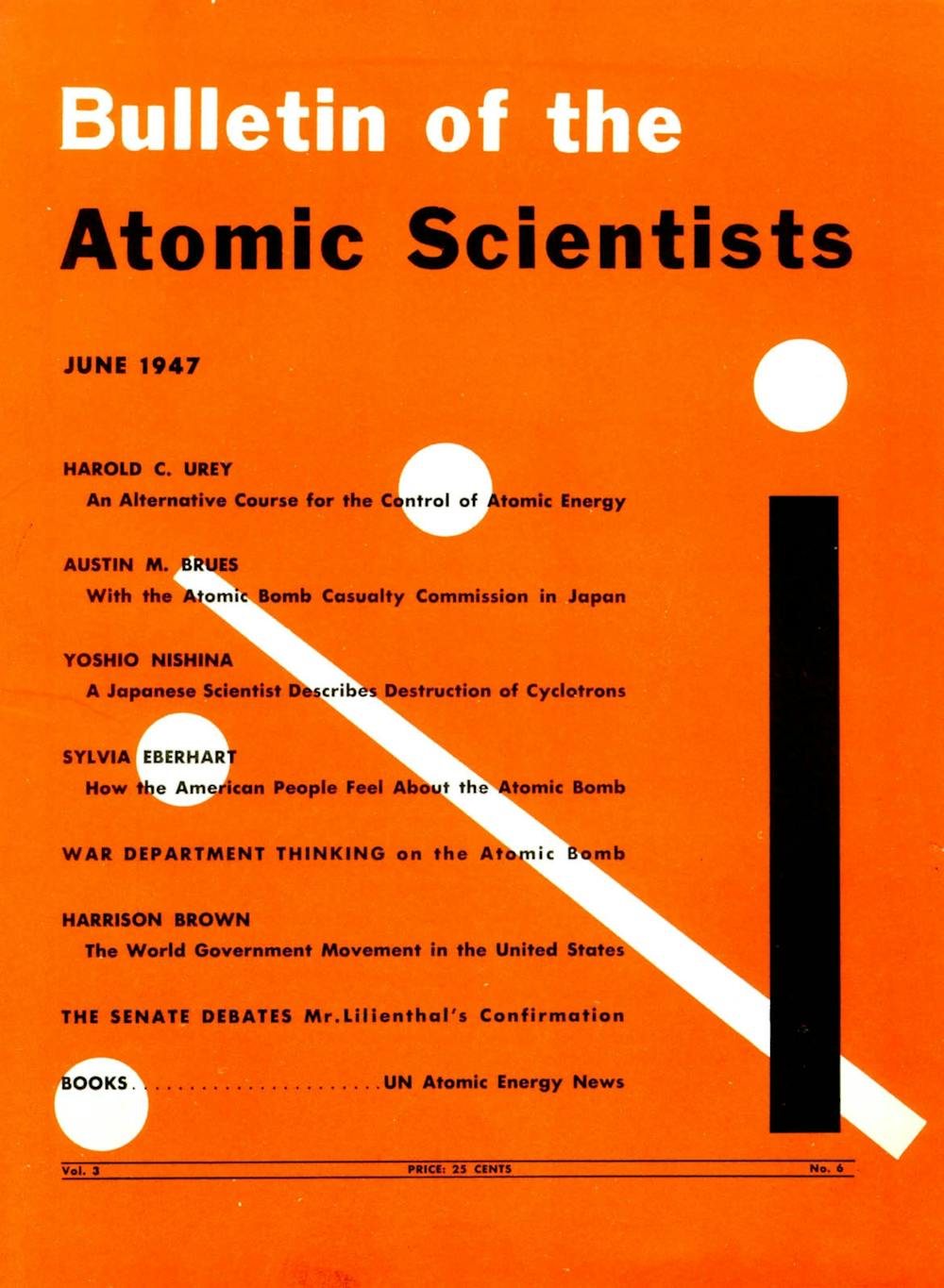
Two years on, the Bulletin, as it came to be known, published its first magazine. And on the cover: a clock, with the minute hand suspended eerily only seven minutes from midnight.

Cover of the 1947 Bulletin of the Atomic Scientists issue, featuring the Doomsday Clock at seven minutes to midnight.
Public domain/Wikimedia

The artist Martyl Langsdorf sought to communicate the sense of urgency she had felt from scientists who had worked on the bomb, including her physicist husband, Alexander. The placement was, to her, an aesthetic choice: “It seemed the right time on the page … it suited my eye.”

Thereafter, Bulletin editor Eugene Rabinowitch was the gears behind the clock’s hands until his passing in 1973, when the board of experts took over.

The clock has been moved 25 times since, particularly in response to the ebb and flow of military buildups, technological advancement and geopolitical dynamics during the Cold War.

Nuclear risk did not abate after the collapse of the Soviet Union, even as the total number of nuclear weapons shrank. And new threats have emerged that pose catastrophic risk to humanity. The latest setting of the clock attempts to gauge this level of risk.

A precarious world

In the words of Bulletin president and chief executive Rachel Bronson:

Make no mistake: resetting the Clock at 90 seconds to midnight is not an indication that the world is stable. Quite the opposite.

The Bulletin cited four key sources of risk: nuclear weapons, climate change, biological threats, and advances in artificial intelligence (AI).

Two ongoing conflicts – Russia and Ukraine, and Israel and Palestine – involve nuclear-weapon states. Longstanding bulwarks of nuclear stability, such as the New Strategic Arms Reduction Treaty between the United States and Russia, are barely functional. North Korea and Iran retain their nuclear ambitions. And China is quickly growing and modernising its nuclear arsenal.

The impacts of climate change are worsening, as the world suffers through its hottest years on record. Six of nine planetary boundaries are beyond their safe levels. And we are likely to fall short of the goal set by the Paris climate agreement – keeping temperature increase to no more than 1.5°C above pre-industrial levels. Dramatic climatic disruptions are a real possibility.

The COVID pandemic revealed the global impacts of a biological threat. Engineered pandemics, created using synthetic bioengineering (and perhaps soon aided by AI tools), could be more viral and lethal than any natural disease. Add to the challenge the continued presence of biological weapons programs around the world, and the shifting disease risk due to the effects of climate change, and biothreats will be a regular battlefront for many countries.

Finally, the Bulletin recognised the risk that comes with advances in AI. While some AI experts have raised the prospect of AI itself being an existential threat, AI is also a threat multiplier for nuclear or biological weapons. And AI could be a vulnerability multiplier. Through AI-enabled disinformation, democracies might struggle to function, especially when dealing with other catastrophic threats.

Subjective and imprecise, but does that matter?

The Doomsday Clock has its detractors. Critics argue that the setting of the clock is based on subjective judgements, not a quantitative or transparent methodology. What’s more, it is not a precise measurement. What does “90 seconds to midnight” actually mean?

With the clock now set at its highest ever level, it naturally brings into question why we face greater risk than, say, during the Cuban Missile Crisis. What would it take to get closer than 90 seconds to midnight?


Read more:
Doomsday Clock moves closer to midnight, but can we really predict the end of the world?


Fundamentally, these criticisms are accurate. And there are plenty of ways the clock could be technically improved. The Bulletin should consider them. But the critics also miss the point.

The Doomsday Clock is not a risk assessment. It’s a metaphor. It’s a symbol. It is, for lack of a better term, a vibe.

A powerful image of nebulous threats

From the very beginning, when seven minutes to midnight “suited the eye”, the Doomsday Clock was an emotional and visceral response to the nuclear moment. Which is why it has become a powerful image, drawing the eyes of the world every year.

Global catastrophic threats are nebulous and complex and overwhelming. With just four dots and two hands, the Doomsday Clock captures the sense of urgency like few images can.

There are better and more actionable ways to assess risk. A handful of countries, for example, conduct national risk assessments. These are formal and regular processes by which governments assess a range of threats to the country, prioritising them on a quantitative scale and building response plans for the highest risk vectors. More countries should conduct these assessments, and be sure to catalogue global catastrophic threats.

Or take the World Economic Forum’s annual Global Risk Report. Based on a survey of around 1,500 experts from across academia, business, government and civil society, it captures the greatest perceived threats over the following two and ten years. Following a similar method, the United Nations is currently conducting its own survey of global risk.

The Doomsday Clock does not replace efforts to understand and assess the greatest threats we face. If anything, it should inspire them.

The Conversation

Rumtin Sepasspour works for Global Shield, a non-profit advocacy organization dedicated to reducing global catastrophic risk. He has previously written for the Bulletin of Atomic Scientists.

ref. The Doomsday Clock is still at 90 seconds to midnight. But what does that mean? – https://theconversation.com/the-doomsday-clock-is-still-at-90-seconds-to-midnight-but-what-does-that-mean-221871

Australia may spend hundreds of millions of dollars on quantum computing research. Are we chasing a mirage?

Source: The Conversation (Au and NZ) – By Timothy Duignan, Lecturer, Griffith University

Dynamic Wang / Unsplash

The Australian government is going all in on quantum computing. After investing more than $100 million on “quantum technology” in 2021, it is now reportedly considering spending up to $200 million on purchasing a “quantum computer” from a US company.

Is this a sensible decision? You might think so, if you read reports from media, industry and government predicting that quantum computers will revolutionise many fields of science. Two common examples given are drastically accelerating the design of better batteries and drug discovery.

Given the scale of investment, from governments around the world and also private companies, you might think quantum computers are a sure bet to reach these amazing goals. Unfortunately, in the words of US quantum computing theorist Scott Aaronson, the reality is “much iffier”.

What’s so iffy about quantum computing?

In a recent perspective article in the Proceedings of the National Academy of Sciences, French physicist Xavier Waintal warned of weaknesses in “the quantum house of cards”. Waintal notes that “a simple task such as multiplying 3 by 5 is beyond existing quantum hardware” and that a useful quantum computer might “require an improvement by a factor of one billion” on the error rate of current devices.

Skeptical voices such as Waintal’s are growing louder as success still seems a long way off, despite huge investments of time and effort. While companies like IBM and Google are still spending on quantum computing, China’s tech giants are dumping their own quantum computing labs.

It’s possible that a chain of breakthroughs could occur over the next few years, leading to useful quantum computers. We have seen other technologies, such as traditional computing chips, make huge improvements in short amounts of time.

However, improvements in traditional computing have resulted from massive investment over many decades. Before we can decide whether such a large investment is worth it for quantum computers, we need a clear understanding of their applications.

What would quantum computers really be good for?

One application that first drew attention to the idea of quantum computers (in the 1990s) is their ability to break some kinds of encryption commonly used to store and transmit data. However, new encryption methods have since been developed that would be safe from quantum computers.

Now attention has moved to the potential ability of quantum computers to solve problems in biology and chemistry, such as drug discovery and battery design. The idea is that biology and chemistry are governed by the same laws of quantum mechanics that control the workings of quantum computers.


Read more:
Explainer: quantum computation and communication technology


This argument seems plausible, but it has some problems. One is that, although chemistry and biology do follow the laws of quantum mechanics, in many cases their behaviours are almost indistinguishable from non-quantum ones.

In fact, there is no guarantee that quantum computers will be able to outperform current computers when applied to problems in biology and chemistry.

It’s possible that once we have built a quantum computer we will be able to find ways to make it solve problems in biology and chemistry faster than a normal computer, but it’s far from guaranteed.

Can AI outdo quantum computers?

Quantum computing advocates are not alone in wanting to better simulate chemistry and biology. Many other scientists are working on this problem as well.

For example, quantum chemistry and molecular simulation are two very active research fields. These scientists are making rapid progress on solving many of the problems that supposedly justify the development of quantum computers.

Most excitingly, these fields are taking advantage of recent developments in artificial intelligence to massively improve the scale and accuracy with which they can simulate biology and chemistry. In one recent example, researchers trained an AI algorithm on a huge dataset and used it to study a large range of chemical and biological systems with impressive accuracy and speed.

Quantum alternatives

“Useful” quantum computers are still some distance away, if they ever eventuate. And even if they are built, they may not be as useful as their advocates hope.

So while it’s reasonable for our government to invest in quantum computing research, we should be realistic about what we hope to get out of it. And we shouldn’t neglect other avenues in the quest to understand chemistry and biology at the most fundamental levels.


Read more:
Australia has a National Quantum Strategy. What does that mean?


Just as a smart investment strategy is to diversity, we should do the same with our research funding, backing many different potentially exciting technologies. We should be humble about our ability to know which research directions are the most promising, as the future is incredibly hard to predict. If it wasn’t, we wouldn’t need a quantum computer in the first place.

The Conversation

Timothy Duignan receives funding from Australian Research Council.

ref. Australia may spend hundreds of millions of dollars on quantum computing research. Are we chasing a mirage? – https://theconversation.com/australia-may-spend-hundreds-of-millions-of-dollars-on-quantum-computing-research-are-we-chasing-a-mirage-218595

It’s 4 years since the first COVID case in Australia. Here’s how our pandemic experiences have changed over time

Source: The Conversation (Au and NZ) – By Deborah Lupton, SHARP Professor, Vitalities Lab, Centre for Social Research in Health and Social Policy Centre, and the ARC Centre of Excellence for Automated Decision-Making and Society, UNSW Sydney

Sebastian Reategui/Shutterstock

It might be hard to believe, but four years have now passed since the first COVID case was confirmed in Australia on January 25 2020. Five days later, the World Health Organization (WHO) declared a “public health emergency of international concern”, as the novel coronavirus (later named SARS-CoV-2) began to spread worldwide.

On March 11 the WHO would declare COVID a pandemic, while around the same time Australian federal and state governments hastily introduced measures to “stop the spread” of the virus. These included shutting Australia’s international borders, closing non-essential businesses, schools and universities, and limiting people’s movements outside their homes.

I began my project, Australians’ Experiences of COVID-19, in May 2020. This research has continued each year to date, allowing me to track how Australians’ attitudes around COVID have changed over the course of the pandemic.


Read more:
Life, death, intimacy and privilege: 4 works of COVID fiction – and what they say about us


Evolving pandemic experiences

We recruited participants from across Australia, including people living in regional cities and towns. Participants range in age from early adulthood to people in their 80s.

The first three stages of the project each involved 40 interviews with separate groups of participants (so 120 people in total). These interviews were done in May to July 2020 (stage 1), September to October 2021 (stage 2), and September 2022 (stage 3). Stage 4 was an online survey with 1,000 respondents, conducted in September 2023.

Limitations of this project include the small sample sizes for the first three stages (as is common with qualitative interview-based research). This means the findings from those phases are not generalisable, but they do provide rich insights into the experiences of the interviewees. The quantitative stage 4 survey, however, is representative of the Australian population.

The findings show that as the conditions of the pandemic and government management have changed across these years, so have Australians’ experiences.

In the early months of the pandemic, some people reported becoming confused, distressed and overwhelmed by the plethora of information sources and the fast-changing news environment. On the other hand, seeking out information provided reassurance and comfort in response to their anxiety and uncertainty about this new disease.

Australians continued to rely heavily on news reports and government announcements in the first two years of the pandemic. Regular briefings from premiers and chief health officers in particular were highly important for how they learned what was happening, as were updates in the media on case numbers, hospitalisations, deaths and progress towards vaccination targets.

Trust has eroded

Australians appear to have lost a lot of trust in COVID information sources such as news media reports, health agencies and government leaders. Early strong support of federal, state and territory governments’ pandemic management in 2020 and 2021 has given way to much lower support more recently.

My 2023 survey (this is published as a report, not peer-reviewed) found doctors were considered the most trustworthy sources of COVID information, but even they were trusted by only 60% of respondents.

After doctors, participants trusted other experts in the field (53%), Australian government health agencies (52%), global health agencies (49%), scientists (45%) and community health organisations (35%). Australian government leaders were towards the lower end of the spectrum (31%).


Read more:
COVID remains a global emergency, the World Health Organization says, but we’re at a transition point. What does this mean?


In 2021, Australians responded positively to the vaccine targets and “road maps” set by governments. These clear guidelines, and especially the promise that the initial doses would remove the need for lockdowns and border closures, were strong incentives to get vaccinated in 2021.

Unfortunately, the prospect that vaccines would control COVID was shown to be largely unfounded. While COVID vaccines were and continue to be very effective at protecting against severe disease and death, they’re less effective at stopping people becoming infected.

Once very high numbers of eligible Australians became vaccinated against the delta variant, omicron reached Australia, resulting in Australia’s first big wave of infection. This led to disillusionment about vaccines’ value for many participants.

In the 2023 survey, respondents reported a high uptake of the first three COVID shots. But when asked whether they planned to get another vaccine in the next 12 months, almost two-thirds said they did not, or they were unsure.

Enter complacency

Complacency now seems to have set in for many Australians. This can be linked to the progressive withdrawal of strong public health measures such as quarantine, mandatory isolation when infected, and testing and tracing regimens.

Meanwhile, the media, government leaders and health agencies have played less of an active public role in conveying COVID information. This has led to uncertainty about the extent to which COVID is still a risk and lack of incentive to take protective actions such as mask wearing.

In 2023, after mandates had ended, only 9% of respondents said they always wore a mask in indoor public places. Only a narrow majority of respondents even supported compulsory masking for workers in health-care facilities.

Two people wearing masks in an office.
People have become more lax with mask wearing since mandates ended.
Ground Picture/Shutterstock

The 2023 survey confirmed many Australians no longer feel at risk from COVID. Some 17% of respondents said COVID was definitely still posing a risk to Australians, while a further 42% saw COVID as somewhat of a risk. This left 28% who did not view COVID as much of a continuing risk, and 13% who thought it was not a risk at all.

COVID is still a risk

Whether or not people feel at continuing risk from COVID, the pandemic is still significantly affecting Australians. The 2023 survey found more than two-thirds of respondents (68%) reported having had at least one COVID infection to their knowledge, including 13% who had experienced three or more. Of those who’d had COVID, 40% said they experienced ongoing symptoms, or long COVID.

If the pandemic loses visibility in public forums, people have no way of knowing the risk of infection continues, and are therefore unlikely to take steps to protect themselves and others.

Updated case, hospitalisation, death and vaccination numbers should be communicated regularly, as used to be the case. To combat confusion, complacency and misinformation, all health advice should be based on the latest robust science.

Australians are operating in a vacuum of information from trusted sources. They need much better and more frequent public health campaigns and risk communication from their leaders.

The Conversation

Deborah Lupton does not work for, consult, own shares in or receive funding from any company or organisation that would benefit from this article, and has disclosed no relevant affiliations beyond their academic appointment.

ref. It’s 4 years since the first COVID case in Australia. Here’s how our pandemic experiences have changed over time – https://theconversation.com/its-4-years-since-the-first-covid-case-in-australia-heres-how-our-pandemic-experiences-have-changed-over-time-220336

How do I make sure my child’s school backpack is safe and healthy?

Source: The Conversation (Au and NZ) – By Sai Praneeth Jasti, Researcher, Deakin University

RDNE Stock Project/ Pexels , CC BY

As a new school year approaches, many families will be heading to the shops or to their school’s uniform store to buy backpacks.

While children can have firm ideas about how their school bags look – and schools have practical requirements about what students need to carry – it is vitally important bags are also safe and healthy.

What does the research evidence tell us about school bags?

Why school bags matter

Students are often not just carrying books to and from school, but technology, sports and musical equipment as well. Studies have noted problems occur when students carry bags that weigh more than 20% of their body weight.

This excessive weight can cause students to adopt a forward-leaning posture to compensate, leading to chronic back pain and other postural deformities.

But it’s not just the weight alone, how students carry their bags is also important.

Slinging the bag over one shoulder can lead to an uneven distribution of weight, causing muscle imbalances and spinal misalignment. Some studies (such as this one from Brazil and and this one from Malta) suggest this is more common in female students, who are more likely to carry their bags this way.

If school bags do not have ergonomic features, this exacerbates the problem. Poorly designed straps, lack of adequate back support and improper weight distribution within the bag itself all contribute to the strain on a student’s back and shoulders.

A 2021 study conducted in Karachi on primary school-aged students also showed heavy backpacks can lead to increased fatigue, harming the concentration of children in school.

So we need backpacks based on ergonomic principles, that cater to different body types and carrying habits.

Two high school students carrying backpacks on one shoulder walk up steps in a playground.
Students should carry backpacks on bold shoulders to avoid back pain.
Mary Taylor/ Pexels, CC BY

What should you look for in a backpack?

Here are some research-based tips for choosing a backpack for your child:

  • choose backpacks with wide, padded straps to distribute weight evenly across the shoulders, minimising the risk of strain and discomfort

  • look for other ergonomic features such as adjustable shoulder, hip and chest straps, along with back padding

  • ensure the backpack can be positioned high on the back, with the bottom aligned at waist level.

How should your children be carrying things to school?

Studies have shown education about the right way to wear a backpack can reduce pain in school students. Once you have the right bag, also make sure your child is using it correctly:

  • check the backpack’s weight is no more than 10-15% of the child’s body weight (you may need to monitor this as they take different things to and from school)

  • for heavy items such as musical instruments or sports equipment, choose alternative carrying options such as wheelie bags

  • try to ensure your child uses both shoulder straps to maintain balance and symmetrical posture (and do not carry bags on one shoulder or in one hand)

  • pack heavy items close to the body, as this helps maintain better posture by aligning the load with the body’s centre of gravity.


Read more:
Back-to-school blues are normal, so how can you tell if it’s something more serious?


Schools can also help

Schools can also help this issue, by considering what students are required to take to and from school each day.

Perhaps this means more locker space at school or digital resources, so students aren’t having to carry textbooks around.

Parents and schools can also educate students about the proper way to pack and carry their bags.


Read more:
Having ‘good’ posture doesn’t prevent back pain, and ‘bad’ posture doesn’t cause it


The Conversation

Sai Praneeth Jasti does not work for, consult, own shares in or receive funding from any company or organization that would benefit from this article, and has disclosed no relevant affiliations beyond their academic appointment.

ref. How do I make sure my child’s school backpack is safe and healthy? – https://theconversation.com/how-do-i-make-sure-my-childs-school-backpack-is-safe-and-healthy-220654

Prince Albert had nothing to do with the lyrebird bearing his name. Should our birds be named after people?

Source: The Conversation (Au and NZ) – By Felix Cehak, PhD Candidate, UNSW Sydney

Martin Pelanek/Shutterstock

Influential ornithologist John James Audubon’s historical ownership of slaves has spurred a debate about bird names in the United States. As a result, the American Ornithological Society will change not only birds’ common names referring to him, but all 152 eponymous bird names in North America, regardless of good or bad perceptions of their namesakes.

The cultural conversation has arrived in Australia where dozens of species are named after people. Some Australian scientists and birdwatchers (including one from the peak ornithological body Birdlife Australia) have proposed a review, particularly of names with colonial associations.

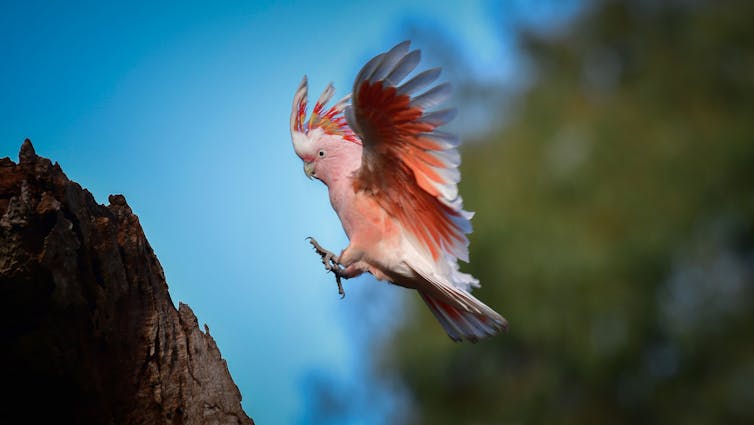
One Australian species has already been renamed. Birdlife Australia now prefers Pink Cockatoo to Major Mitchell’s Cockatoo as the common name.

Thomas Mitchell led a massacre of Aboriginal people in western New South Wales in 1836, condemned for its senselessness even at the time. Birdlife Australia provides a clear argument why the bird should not bear his name. The change has sparked a conversation in online birding communities.

The Albert’s Lyrebird, the topic of my PhD research, also bears a name with colonial overtones, though without the direct violent connotations of Mitchell. Should it, and other Australian species named after people, be renamed? I’m not sure, but I do know this reclusive rainforest bird has a fascinating and surprisingly complex etymology.

A flying Pink Cockatoo about to land on a tree stump
The case for renaming Major Mitchell’s Cockatoo the Pink Cockatoo was clear, but what about other Australian birds named after people?
sompreaw/Shutterstock


Read more:
Why dozens of North American bird species are getting new names: Every name tells a story


Why is a lyrebird named after Prince Albert?

When English ornithologist John Gould suggested the lyrebird as Australia’s bird emblem, he was recommending the Superb Lyrebird (Menura novaehollandiae) found throughout south-east Australia. Fewer people know of the Albert’s Lyrebird (Menura alberti), restricted to a tiny area on the Queensland-New South Wales border.

Portrait of Prince Albert
The Albert’s Lyrebird was named to honour the German-born prince.
Wikimedia Commons

Fewer still know the story behind its naming. The Albert’s Lyrebird bears the moniker of Prince Albert, both in its scientific (Latin) name and current common (English) name, bestowed by Gould himself.

This species was still unknown to colonial scientists when Gould’s landmark Birds of Australia was first published in 1848. This was in part due to its remote, humid forest habitat.

Under taxonomic convention – the rules for classifying species – the credit for describing the species and assigning its scientific name would normally have gone to Gould when his 1850 supplement introduced the new species. Every listing of a species provides a scientific name, the name of the person who first described it and the date they did so. So we might have expected to see the Albert’s Lyrebird listed as Menura alberti, Gould, 1850.

Instead, next to Menura alberti we see a different surname – Bonaparte. Not Napoleon, but his nephew Charles, a naturalist who referred to Gould’s description of the new species. However, Bonaparte’s reference predated Gould’s actual publication, a technicality that means Bonaparte is listed as the scientific describer.

This quirk of taxonomy has tied this bird to two names deeply associated with empires.

An Albert's Lyrebird walking through moss-covered rocks in a forest
The scientific naming of Albert’s Lyrebird in 1850 links it with the British and French empires.
Mike’s Birds/Wikimedia Commons, CC BY-SA


Read more:
Listen to the Albert’s lyrebird: the best performer you’ve never heard of


How do birds get their names?

Scientific names change only when species are reclassified. The naming is more akin to record keeping – though honouring people can be a secondary purpose. In the lyrebird’s case, Gould cited the prince’s “liberal support” and “personal virtues”.

Birdlife Australia has an English Names Committee, which deals with such changes. Prince Albert is not directly linked to historical violence in Australia, but he was Queen Victoria’s spouse during its colonisation.

If Menura alberti requires the Pink Cockatoo treatment, some other common names have been used in the past.

“Northern Lyrebird” is used in G. Matthews’ Birds of Australia. The volume is of the same name as Gould’s, by a self-funded author, who was controversial for his own taxonomic renaming.

More informally, “Small Lyrebird” has been used in relation to A.A. Leycester, the naturalist who shot the first specimen in 1844.

These are both obscure, albeit more descriptive, alternatives. “Albert’s” is much more common. Leycester himself added an even more royal connotation with “Prince Albert’s Lyrebird”, but sometimes also “Richmond River Lyrebird”.

An Albert's Lyrebird digging through forest leaf litter
The Albert’s Lyrebird has been known by several other names.
Ken Griffiths/Shutterstock


Read more:
There are over 7,000 English names for birds – here’s what they teach us about our changing relationship with nature


The bird had earlier names

As for the bird being “discovered”, naturally earlier Indigenous names survive.

The bird has recently been described as a bird of the Bunjalung language area. This is true but it is also a Yugambeh and Githabul bird. Its habitat on the Great Dividing Range might include Jagera Country too.

Archibald Meston inexplicably recorded a Kabi Kabi language name from the “head of the Mary River” – no lyrebird is known to occur this far north.

The Yugambeh Museum has provided “kalbun” for national park signage in my home town, Tamborine Mountain. One Bundjalung dictionary provides “galbuny” or “galwuny” with an outlying possibility of “wonglepong”, “kalwun” or “kulwin” in the Tweed as meanings for “lyrebird” (with no clarification between the two species). Indigenous health service Kalwun uses the name in reference to the “rainforest lyrebird” but uses an image of a Superb Lyrebird as its logo.

An Albert's Lyrebird displaying with a raised tail in the rainforest
The male Albert’s Lyrebird (above) lacks the distinctive barring on the lyre-shaped feathers of the male Superb Lyrebird (below).
Felix Cehak
A male Superb Lyrebird spreads its tail as it displays in a forest clearing

KimEdoll/Flickr, CC BY-NC-ND

The Superb Lyrebird is also found within Bundjalung Country, such as in Washpool National Park. This variance and confusion between lyrebird species and language groups is before we even consider the Githabul area to the west, a sometimes contested distinction.

The Yugambeh Museum allows for the variance by providing a different language resource for each location. You will find, for example, a different Indigenous name on the national park sign at Tamborine to the one at Lamington.

As many language groups give the bird many names (only some of which are listed here), there isn’t one obvious Indigenous option if the bird were to be renamed. Beyond these names, the cultural significance of the bird, which lives in rarely visited wet and leech-infested places, seems to have been lost.

An Albert's Lyrebird singing in the forest
The Albert’s Lyrebird can be hard to find in its dark and dense forest habitat.
Felix Cehak


Read more:
What makes a good bird name?


If a new name is needed, who decides it?

Over many hours of conversation about this species, I have found the link to Prince Albert is always known. I have rarely heard anything more about why the lyrebird bears his name. Besides his irrelevance to Australian ornithology, I cannot gauge a specific reason the Prince Albert moniker is inappropriate, unlike Thomas Mitchell.

If a change is required to a bird’s name, the decision must be made with the relevant communities. If they wish to counter a history of imperial naming by renaming, the new name should not spring from a similar desire for ownership.

It would also be wise to maintain broadness in this conversation. In the Albert’s Lyrebird case, that includes the birdwatchers, ecologists and conservationists who have contributed to our understanding of this little-known species.

We are about to see what happens in the United States. It would be wise to watch carefully what happens next.

The Conversation

Felix Cehak receives funding from UNSW in the form of a current PhD student stipend.

ref. Prince Albert had nothing to do with the lyrebird bearing his name. Should our birds be named after people? – https://theconversation.com/prince-albert-had-nothing-to-do-with-the-lyrebird-bearing-his-name-should-our-birds-be-named-after-people-217792

What’s behind Woolworths, Aldi and Kmart distancing themselves from Australia Day?

Source: The Conversation (Au and NZ) – By Amanda Spry, Senior Lecturer of Marketing, RMIT University

Kairosing/Shutterstock

Earlier this month, Woolworths announced it would no longer stock merchandise promoting Australia Day on January 26, a date surrounded by controversy.

While observed as a national public holiday for more than 90 years, a 2021 ABC social survey found 55% of Australians supported changing the date.

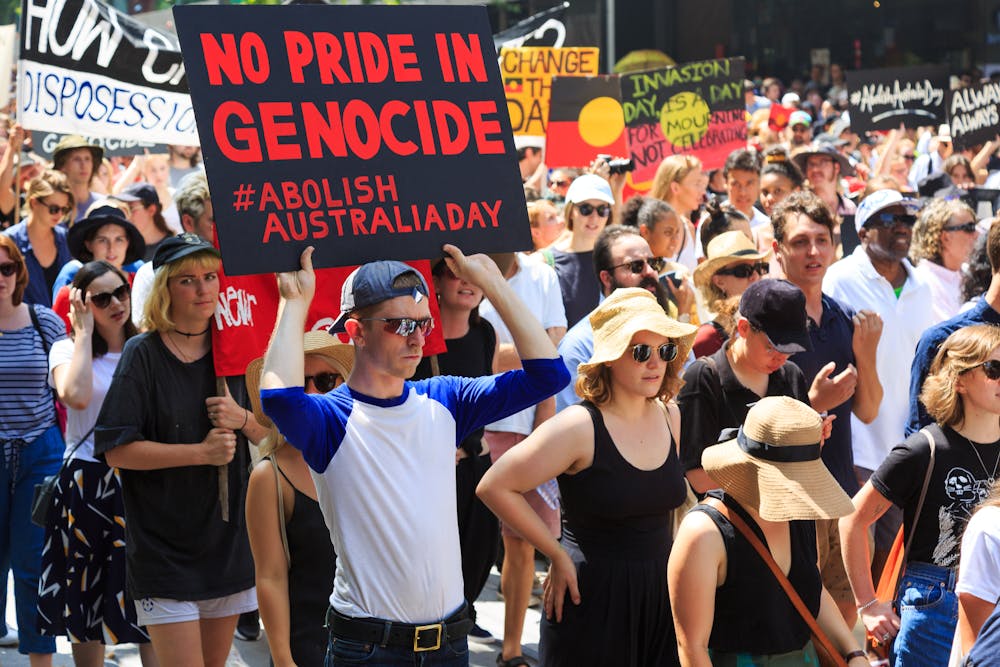
January 26 marks the beginning of the colonisation of Australia, bringing violence, theft and oppression to the First Nations peoples who had lived on the land for more than 50,000 years. It is also called Invasion Day, Survival Day or Day of Mourning.

Many workplaces including ANZ, Telstra and Woodside have encouraged the shift away from celebrating the date as Australia Day by offering employees an alternative day off.


Read more:
Why we should celebrate Australia Day on March 3 – the day we became a fully independent country


Woolworths is not the only retailer to distance itself from the date this year with Aldi announcing it will not stock Australia-themed products under its Special Buys promotion. Kmart has not sold items specific to January 26 since last year.

The message the retailers are trying to send the community

When corporations wade into sociopolitical activism, they commonly overplay social motivations and underplay expected gains to the bottom line. What is unusual about Woolworths’ position is that the company has defended this as a business decision first and foremost.

This raises questions about big retailers shying away from Australia Day merchandise for business rather than social reasons.

Why pursue a business-first, activism-second strategy? Does this appease shareholders? How does the public interpret “activism without activism” and is it authentic? Is this just a move to deflect away from exorbitant prices?

A business case for activism

Opposition leader Peter Dutton quickly labelled this as “peddling woke agendas”. But a Woolworths Group spokesperson cited a “gradual decline” in demand for Australia Day-themed products. They also acknowledged the broader discussion of January 26th’s significance to different communities.

Large group of men and women protesting against Australia Day
A 2021 survey found 21% of Australians supported changing the date.
Shutterstock/Dave Hewison Photography

A key reason to make a business case for corporate activism lies with shareholders. They typically oppose companies taking a stand on social justice issues believing businesses should “stay in their lane”.

Indeed, when Woolworths supported the Indigenous Voice to Parliament referendum, it resulted in a backlash.

Academic research indicates a brand’s activist position can harm shareholder returns. Investors view this as a misallocation of resources that threatens profit maximisation. Perceived risk of corporate activism is heightened for businesses with large market share, like Woolworths. They have more customers to lose and fewer to gain.

In this instance, Woolworths took a business-first, activism-second approach. This likely appeases shareholders because making merchandising decisions is well within Woolworths’ remit. Also, by the retailer cloaking its activism as profit maximisation, shareholders are less likely to be concerned.

As for customers, they increasingly understand the duality of a brand’s motives. If there are perceptions of sufficient social impact, self-serving motives are also deemed acceptable. Woolworths illuminated the profit-making motive while subtly bringing to light the problematic history of Australia Day.

Activism without activism?

While Woolworths led with business reasons rather than support of First Nations peoples, it was interpreted by the public as a political act, eliciting debate and grandstanding.

A company of this stature with significant marketing intelligence could have correctly predicted this reaction and made a calculated decision to take a stand on an issue at the front of the public’s mind. Yet this looks like activism without activism. Woolworths brought a sociopolitical issue to the fore but operated behind the curtain of dollars and cents.


Read more:
‘Change the date’ debates about January 26 distract from the truth telling Australia needs to do


Consumers are discerning about corporate activism, requiring companies to move beyond marketing rhetoric and demonstrate meaningful actions. Usually activism attracts criticism when brands are perceived to be woke washing – that is, misleading consumers about prosocial corporate practices. Brand activism is therefore sometimes viewed as a “fake marketing trick” because brands are not backing up their stance on social justice issues.

Woolworths by contrast has taken concrete action – not capitalising on the “Australia Day” term and imagery in its marketing and merchandise on January 26.
This move falls short of authentic brand activism.

A deflection tactic?

Australia’s fraught socioeconomic climate has put retailers in the spotlight. Currently, brands like Woolworths are facing media and political scrutiny for price gouging. In Queensland, there is a parliamentary inquiry into the discrepancy between prices paid to suppliers and those paid at the checkout. The Australian Competition and Consumer Commission and Senate are also holding inquiries.

Signs promoting Aldi and Woolworths
Is the stance against Australia Day a move to distract from the pricing inquiries?
Rob1037/Shutterstock

Aside from making room for more profitable merchandise or advancing the reconciliation agenda, is Woolworths deflecting attention from its role in these problems? Changing the conversation to something time-bound (that is, likely to die down January 27th) may be beneficial.

Research speaks to such a values-based strategy. Brands call on social initiatives to deflect from negative issues and improve future discourse about their business. In this case, directing discussion to their social responsiveness, even if secondary, enables Woolworths to divert attention away from potentially exploitative practices.

Corporate activism: an expanding and evolving strategy

Woolworths’ approach to activism warrants examination. While the company took action that ostensibly opposes the celebration of Australia Day on January 26, they communicated a profit motive fitting for the largest grocery chain in Australia by market share. They skirted full-blown corporate sociopolitical activism, an approach that was possibly more digestible for shareholders and customers (politicians less so).

However, this approach is also less authentic. Woolworths states its commitment to reconciliation through the support of the Indigenous Voice to Parliament and the Uluru Statement from the Heart. So where in this most recent decision was the marketing rhetoric that embraces and respects Indigenous Australians? This represents a lost opportunity to elevate the brand and promote the Change the Date movement.


Read more:
Welcome to May 9 – the true Australia Day


The Conversation

The authors do not work for, consult, own shares in or receive funding from any company or organization that would benefit from this article, and have disclosed no relevant affiliations beyond their academic appointment.

ref. What’s behind Woolworths, Aldi and Kmart distancing themselves from Australia Day? – https://theconversation.com/whats-behind-woolworths-aldi-and-kmart-distancing-themselves-from-australia-day-221743

Using photos to create 3D models is helping us understand – and protect – complex marine environments

Source: The Conversation (Au and NZ) – By Professor James J Bell, Professor of Marine Biology, Te Herenga Waka — Victoria University of Wellington

Measuring the impact of different events, such as marine heatwaves, on the abundance of marine organisms is not easy. Biological communities naturally change over time and between different locations.

Scientists need to untangle these natural changes from those caused by humans and come up with a new approach to do this.

Marine biologists have traditionally monitored underwater cliffs or coral reefs by estimating population sizes in just a small area of those environments.

One traditional method involves laying a tape measure on the reef and determining what was under the tape at regular intervals. Another is to take pictures of “quadrats” – squares of a known area – and working out the area covered by different organisms later.

However, these methods only provide an estimate for a very small area of the total reef, covering a limited proportion of the animals and plants present.

They also provide limited information on the three-dimensional (3D) reef complexity and structure created by reef organisms, such as corals and sponges, which are key to supporting high biodiversity.


Read more:
Loss, decay and bleaching: why sponges may be the ‘canary in the coal mine’ for impacts of marine heatwaves


Our new research shows how modern photographic methods can be used to measure coral reef habitat complexity, and the 3D nature of reefs.

This information was then used to assess the impacts of changes from coral-dominated reefs to sponge-dominated reefs on the spaces available for fish and other organisms to live.

Here’s how it works.

An art and a science

Photogrammetry – a technique where 3D information is extracted from photographs – is both an art and science. The process involves taking a large number of images of an object or area from different angles. Using specialised algorithms we can then analyse and convert these pictures into 3D digital models.

These models can be appropriately scaled to real-world dimensions, allowing accurate measurements of organisms.

While photogrammetry is not new, its application to marine science has increased in recent years. It is completely changing the way we can monitor marine environments and measure human impacts.

However, there are many other ways broader photogrammetric tools can be used, from estimating the size of whales to developing realistic simulations or virtual reality experiences for education.

Our recently published study from Indonesia used photogrammetry to estimate the potential impacts of changes from coral-dominated to sponge-dominated tropical reefs on reef structural complexity.


Read more:
The Irish lough that offers a window into the deep sea


The study compared the structural complexity of coral and sponge-dominated areas of a coral reef. By using photogrammetry, we were able to better understand the different factors that contributed to the coral’s structural complexity in a way that would not be possible from traditional 2D photographs.

This study found sponge-dominated reefs had fewer of the smallest spaces for fish and other organisms to live, whereas coral-dominated reefs had fewer larger spaces.

This information is important. The smallest spaces on coral reefs are occupied by small fish and other species that feed animals higher up the food chain. As coral reefs lose these small refuge spaces, they also lose the ability to support biodiversity.

Going bigger

While the Indonesian study examined only small sections of the reef, the use of photogrammetry for monitoring and mapping marine ecosystems is expanding rapidly.

Thanks to modern hardware and software solutions, it is now possible to rapidly create models for much larger areas. And thanks to high-resolution photography, even the smallest animals can be identified in the models.

These models are complementing the use of traditional sampling methods that only estimate the abundances of organisms in a small area of a reef. But we also have the potential to now sample entire reefs.

As models of reefs derived from photogrammetry are 3D, there are many different new sources of information that can be collected, such as accurate surface areas and volumes of organisms.

For many organisms, like sponges and corals, surface areas and volumes are more important in measuring their ecological importance than just the amount of reef they cover.

An example of the Fiordland underwater environment rendered through a game engine, and ready to be used for VR applications.

Moreover, 3D models of large areas can be oriented and scaled or geo-referenced, essentially creating all the characteristics of a typical map. This makes finding previously surveyed areas much easier.

The overall result is better characterisation of marine communities. This makes it easier to monitor and visualise changes, and the effects of different factors, such as marine heatwaves.

Finally, scaled 3D representations can be created for complex organisms, meaning growth and shape changes can be more accurately measured. This provides a greater understanding of how environmental change affects organisms.

Visualising changes in biodiversity

Virtual reality has long been used to provide access to marine environments without getting wet. This has been done largely for education, outreach and training opportunities.

But 3D models created from photogrammetry provide new and exciting opportunities to engage the public. People can now interact with the environment, experiencing new worlds and points of view, while learning and increasing their environmental consciousness.

The application of 3D models derived from underwater photogrammetry has great potential for the monitoring of marine environments and detecting the impact of humans.

These models represent a transformative shift in the way information is gathered in marine ecosystems. As technology develops further they will support more extensive marine monitoring and more effective management.

An example of a 3D model of Breaker Bay Reef in Wellington, New Zealand.

ref. Using photos to create 3D models is helping us understand – and protect – complex marine environments – https://theconversation.com/using-photos-to-create-3d-models-is-helping-us-understand-and-protect-complex-marine-environments-221111

Pacific predictions: Elections, security and regionalism top 2024 agenda

ANALYSIS: By Tess Newton Cain

As the new year gets underway, now is the time to look ahead to what will be significant in the Pacific islands region. Chances are this part of the world will continue to be a focus for the media and commentariat who will view what happens through their own lenses.

However, more now than ever, it is imperative to see the events of the Pacific in their context, with the nuance that allows for them to be more fully understood.

The Pacific will play a small part in the year in which more than half of the global population will go to the polls. We have already seen Dr Hilda Heine sworn in as the 10th President of Marshall Islands following elections late last year.

Next cab off the rank is Tuvalu, with voting to take place at the end of January. Of particular interest here is how, if at all, a change of government might affect the future of the Falepili Union with Australia that was signed in November 2023.

Perhaps most closely watched will be the elections in Solomon Islands, scheduled to take place in April. The Sogavare government is now in caretaker mode, but a date for the polls is yet to be announced.

These are the first general elections since the controversial “switch” in 2019 which saw diplomatic relations between Solomon Islands and Taiwan come to an end and China established as a leading development and security partner for Sogavare’s government.

It is hard to know how significant this switch will be for voters more than three years down the track. Sogavare can point to last year’s Pacific Games as a stellar achievement for his government and one in which the support of China was key.

Largely irrelevant outside Honiara
But this is unlikely to have much resonance for those Solomon Islanders who live outside Honiara and for whom the games were largely irrelevant.

Other Pacific island countries holding elections this year are Palau (November) and Kiribati (date to be confirmed).

In addition, Vanuatu is expected to hold its first-ever referendum on proposed constitutional changes intended to address chronic political instability.

The issue of security will continue to be vexed in 2024 in the Pacific islands region. As we have seen in recent years, narratives around climate change and those centred on “traditional” security concerns will become increasingly enmeshed.

The apparent acceptance of the significance of climate change as a security threat by partners such as the US is no doubt welcome. However, it is not enough to assuage concern among those who warn against the increased militarisation of the region.

Preliminary findings from the Rules of Engagement project led by Associate Professor Anna Powles and I show that “defence diplomacy” has become an important aspect of international engagement with Pacific island countries. We can expect this to continue throughout this year.

We need to understand better the extent to which these engagements add to feelings of security and safety in Pacific communities and how, if at all, they influence how Pacific people feel about the relationships between their countries and their international partners.

Internal security threats
As we have seen already this year, internal security threats will be front of mind in Papua New Guinea, and likely elsewhere in the region. Given the mix of cost-of-living pressures, political instability, and a febrile (social) media environment fuelled by rumour and counter-rumour, maintaining social cohesion will become increasingly challenging.

With globalisation in retreat and geopolitical competition on the rise, there is every reason to expect that the high tempo of international strategic engagement with Pacific policymakers, businesses, civil society leaders, and communities will continue throughout 2024.

While this provides numerous opportunities to secure resources for development and other initiatives, it can also create a serious burden in terms of transaction costs, particularly for small resource-constrained administrations.

Last year, the government of Solomon Islands announced that it would have a “block out” period during which senior officials are unavailable to meet with visiting delegations. This is an approach that could be beneficial for other countries to preserve valuable time for budget preparation or key policy work.

At the regional level, the Pacific Islands Forum (PIF) is still in the process of determining how best to manage the increased attention the organisation is receiving from countries that want to become dialogue partners. There are currently six applications awaiting consideration (Denmark, Ecuador, Israel, Portugal, Saudi Arabia and Ukraine).

Last year at the PIF Leaders Meeting it was made clear that the ongoing review of regional architecture includes a refreshed framework for engagement with dialogue partners — one that is led and driven by Pacific priorities.

In conclusion, 2024 holds both challenges and opportunities for the Pacific islands region. With elections, security concerns, and regionalism on the agenda, policymakers, businesses, civil society leaders, and communities must work together to tackle these issues.

Tess Newton Cain is the project lead for the Pacific Hub at the Griffith Asia Institute and is an associate of the Development Policy Centre. The author’s Pacific Predictions have been produced annually since 2012. Republished under a Creative Commons licence.

Print Friendly, PDF & Email

Article by AsiaPacificReport.nz

Albanese tax plan will give average earner $1500 tax cut – more than double Morrison’s Stage 3

Source: The Conversation (Au and NZ) – By Michelle Grattan, Professorial Fellow, University of Canberra

A person on the average annual wage of $73,000 will get a tax cut of more than $1500 a year under Labor’s revamped tax policy – more than double the cut they’d have received under the Coalition’s legislated stage 3 plan.

In the government’s dramatic recalibration of stage 3, the proposed tax cut for those earning more than $200,000 will be slashed in half, from around $9000 to more than $4500.

At the other end of the income scale, all taxpayers will get a cut, rather than just those earning more than $45,000 as under the legislated stage 3.

Taxpayers earning less than $150,000 will get larger tax cuts under the government’s proposed plan compared with the Morrison one, while those earning more than $150,000 will get smaller cuts.

Amid political attacks over his broken promise – Anthony Albanese had repeatedly committed to delivering stage 3 as legislated by the Coalition – the Prime Minister will tell the National Press Club on Thursday, “When economic circumstances change, the right thing to do is change your economic policy. That’s what we are doing.”

Treasurer Jim Chalmers told the ABC on Wednesday night: “The many will benefit from this, rather than the few”.


The policy switch was endorsed at a brief caucus meeting late Wednesday.

“Our plan will more than double the benefit for Australians on the average income,” Albanese says in his Press Club speech, extracts of which were released ahead of delivery. .

“And it will look after low income earners and part-time workers as well.

“So someone working at Australia’s largest employer, Woolworths, earning $40,000 will now get a tax cut of over $650.

“Under Scott Morrison’s plan, they would have got nothing.”

Under the changes, the lowest rate of tax is reduced from 19 cents to 16 cents in the dollar. This will mean people will pay less tax on the first $45,000 they earn.

“This is a significant boost for the take-home pay of Australians on modest incomes and people working part-time,” Albanese says.

“An early educator, or an aged care worker or a cleaner earning $50,000, will receive a tax cut worth $929 a year”.

He says these tax cuts will help parents returning to work, especially women with young children. Business would also be assisted, by the boost in workforce participation.


Albanese says that with the focus “fairly and squarely […] on middle Australia”, the second tax rate, reducing from 32.5% to 30%, will now apply up to $135,000.

The government is retaining the 37% rate, which is scrapped in the Morrison stage 3 model, and that will now apply from $135,000 instead of $120,000 as at present. The top 45% rate will start from $190,000, up from the present $180,000 but down from the $200,000 legislated for stage 3.


Albanese says under the new plan a full-time worker earning $100,000 will get a cut of more than $2100 – “over $800 more for middle income earners because of our changes.”

For a family on he average household income – about $130,000 – with one partner earning $80,000 and the other $50,000, their combined tax cut will be more than $2600. This is $1600 more than under stage 3.

Albanese quotes Treasury as saying the government’s change is “broadly revenue neutral, will not add to inflationary pressures and will support labour supply”.

The proposed new rates will start from July 1, when stage 3 was due to begin. The changes will have to be legislated but the government has enough support from the crossbench in the Senate to be confident of passage.

Labor is rolling out an advertising campaign to sell the changes.


Albanese says in his speech: “This is the right decision for the right reasons – and we’ve made it the right way. It is the best way forward – because it is the best way to help Australians struggling with their cost of living without putting pressure on inflation.”

Chalmers on Thursday will release a Treasury analysis to back up the government’s case. The plan “will be better for middle Australia, better for cost-of-living pressures, better for women and workforce participation, better for nurses and teachers and truckies,” he said. The Treasury analysis would show the plan would be better for the economy, he added.

Shadow treasurer Angus Taylor said the Coalition was “absolutely locked down on supporting the stage 3 tax cut”. He called the government’s changes the “mother of all broken promises”.


Read more:
View from The Hill: Why should we still be surprised when a PM doesn’t keep his word?


The Conversation

Michelle Grattan does not work for, consult, own shares in or receive funding from any company or organisation that would benefit from this article, and has disclosed no relevant affiliations beyond their academic appointment.

ref. Albanese tax plan will give average earner $1500 tax cut – more than double Morrison’s Stage 3 – https://theconversation.com/albanese-tax-plan-will-give-average-earner-1500-tax-cut-more-than-double-morrisons-stage-3-221875

Luxon warned over ‘meddling’ on Te Tiriti – ‘Māori will not sit idly by’

RNZ News

New Zealand Prime Minister Christopher Luxon has been warned that Māori will not sit by without a fight if the government attempts to meddle with te Tiriti o Waitangi.

As politicians of all stripes have flocked to Rātana near Whanganui, it was a rare chance for Māori to address politicians directly on the pae — something that holds extra weight this year, because the annual celebrations come so soon after last weekend’s national hui.

Among those in attendance were Labour and Green MPs, Prime Minister Luxon, Deputy Prime Minister Winston Peters, and Fisheries Minister Shane Jones, while Te Pāti Māori were welcomed on Tuesday. ACT did not have a representative there.

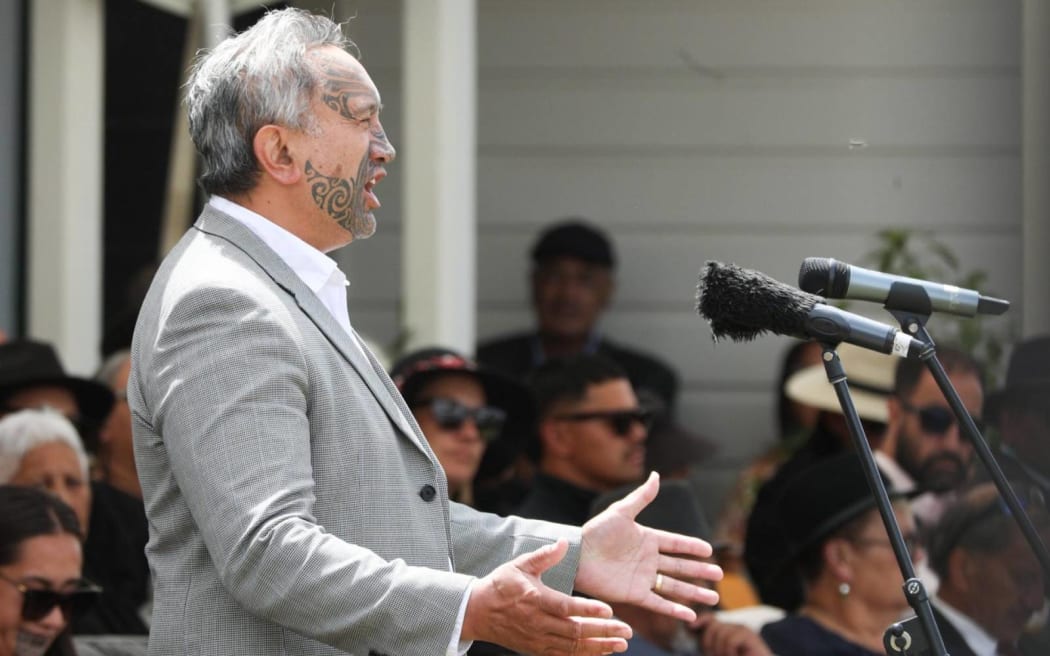
Rāhui Papa, a representative of the Kiingitanga and Waikato-Tainui, said they were watching the rhetoric coming out of the Beehive very closely.

“Quite frankly, te iwi Māori — and the hui at Turangawaewae confirmed, the hui here at Rātana has confirmed — that if there is any measure of meddling with Te Tiriti o Waitangi, Māori will not sit idly by.

“The message is: The Tiriti o Waitangi is sacrosanct in the view of te ao Māori. We truly believe that the only treaty in town is the one that was written in the indigenous language.”

Rāhui Papa at Rātana Pā, January 2024.
Rāhui Papa at Rātana Pā . . . “The Tiriti o Waitangi is sacrosanct in the view of te ao Māori.” Image: Angus Dreaver/RNZ

Amid a climate of concern over the Treaty Principles legislation, Luxon is calling for calm over a bill he himself has said feels divisive.

Government ‘will honour the Treaty’
“The government has no plans and never has had plans to amend or revise the Treaty, or the Treaty settlements that we have all worked so hard together to achieve.

“The government will honour the Treaty.”

His speech to the Rātana faithful largely a speech to all Māori — and focusing on his favourite word: outcomes.

“Ours will be a government with goals for better healthcare, better school achievement, and less welfare dependency.

“When I talk about wanting better outcomes, I’m not talking about giving out hand-outs to close the gaps. I want to improve the opportunities so that people who are prepared to get to work and work hard, can make the most of their opportunities and get ahead.”

Kamaka Manuel at Rātana Pā.
Kamaka Manuel at Rātana Pā . . . “What we do see is the first part of the word ‘outcomes’ – or like ‘Māori out’.” Image: Angus Dreaver/RNZ

Ratana representative Kamaka Manuel told the government that promise of better outcomes was hard to believe.

“What we do see is the first part of the word ‘outcomes’ — or like ‘Māori out’ — and we’re left with the last part: ‘how come’.”

Māori outcomes ‘gone backwards’
He once again reiterated his claim that outcomes for Māori had gone backwards under Labour, and that National had “no intention and no commitment” to take ACT’s Treaty Principles Bill beyond a first reading.

There may be no commitment or intention at this point to do so, but Luxon has repeatedly refused to categorically rule out further support for it.

“It’s consistent with our coalition agreements, we have said and I don’t know how to be any clearer about it, there is no commitment to support it beyond the first reading.”

He was asked by reporters if he would say National would clearly say they would not support it further, but Luxon again said there was “no intention, no commitment”.

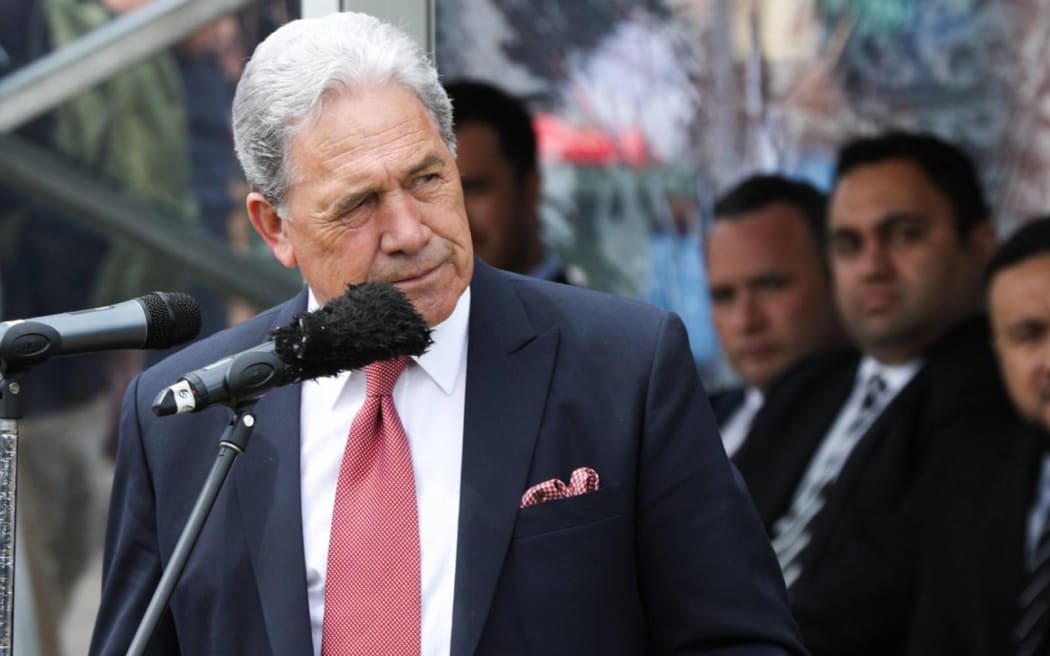
Winston Peters at Rātana Pā.
Deputy PM Winston Peters at Rātana Pā . . . lashing out at Labour to pockets of heckling. Image: Angus Dreaver/RNZ

For a day full of politicians, Rātana is not supposed to be overtly political.

Deputy Prime Minister Peters acknowledged that — but still gave a political speech anyway — lashing out at Labour to pockets of heckling.

“These people will promise you a bridge where there is no river . . . I want to ask you this question: what’s their record?.”

impromptu standup
In an impromptu standup with reporters, NZ First’s Shane Jones said a review of the Waitangi Tribunal would need to address whether its powers should remain intact.

“An institution that’s been around for 50 years should not expect to continue on uncritically for another set of decades without being reviewed.”

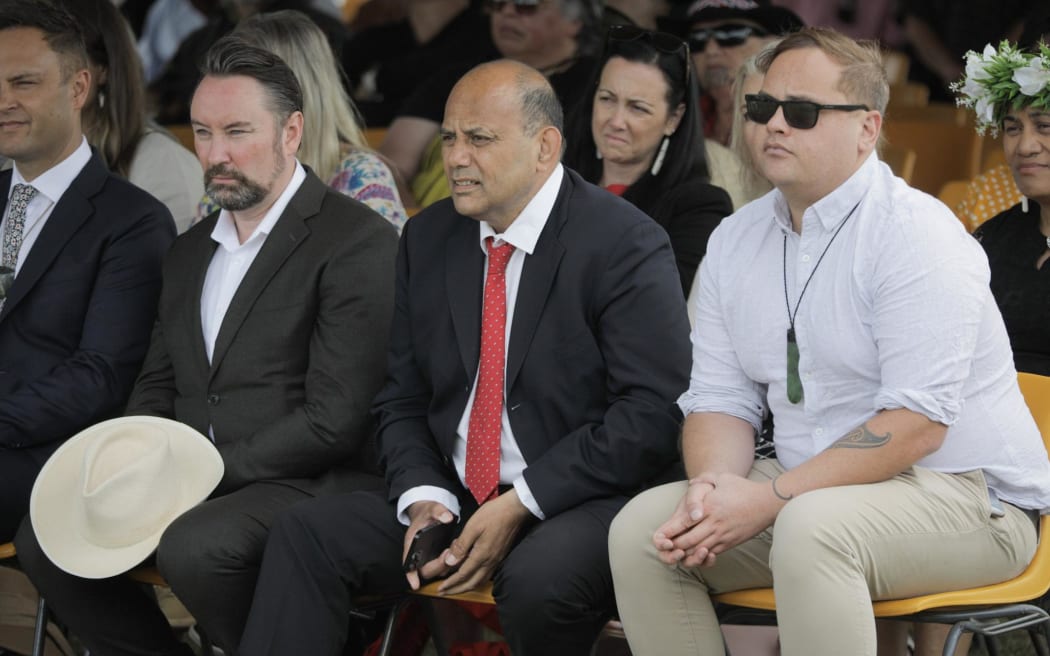
Labour's Reuben Davidson (left) and Willie Jackson (centre) at Rātana Pā on 24 January.
Labour’s Reuben Davidson (left) and Willie Jackson (centre) at Rātana Pā . . . . Photo: RNZ / Angus Dreaver

Spurred on by speeches from the morehu, Labour’s Willie Jackson said it had made the opposition parties more united than ever.

“What they were saying the whaikōrero was that there was one enemy . . . and the enemy was the government, and so they wanted us to all . . . to come together as a group — Greens, Pāti Māori, Labour.”

Labour leader Chris Hipkins, in his first public appearance of the year, spent all of a minute talking about Labour’s deep connection to Rātana — and then went on the attack.

“The role of us as political leaders is to light that path forward, it’s not to exploit the fear that comes from uncertainty.”

Hipkins said the current government’s approach was emboldening racism, which he later clarified related to things like the Treaty Principles Bill.

Policies ‘enable racism’
“I don’t think those are things that a responsible government should do.

“The policies of this current government encourage, foster, and enable racism in New Zealand and we should call that out for what it is.”

This time last year, Hipkins was speaking as prime minister. He now admitted — from the benefit of hindsight — the last government didn’t get it all right.

“One of the things that we didn’t get right was that making sure we were bringing non-Māori New Zealanders along with us on that journey.”

There was a notable absentee — the ACT Party, whose Treaty Principles Bill National has agreed to support to Select Committee, but no further.

“We know there could have been some trepidation like last week at Turangawaewae where we only had a couple from the three-headed taniwha government that we have in New Zealand today,” Rāhui Papa said.

Carmel Sepuloni, Marama Davidson and Chris Hipkins at the Rātana celebrations, January 2024.
Carmel Sepuloni (Labour), Marama Davidson (Greens) and Labour opposition leader Chris Hipkins at the Rātana celebrations: “The role of us as political leaders is to light that path forward, it’s not to exploit the fear.” Image: Angus Dreaver/RNZ

‘Dishonour’ to Māori world
Greens’ co-leader Marama Davidson told reporters that ACT’s no-show at Rātana was a display of “absolute ignorance” and a dishonour to the Māori world.

“It dismisses the mana and the importance of Ratana, of Wiremu Pōtiki Ratana, and te ao Māori and their political voice.”

But David Seymour was brushing off the criticism.

“There was a time when they didn’t manage to invite me and now they seem to be complaining that they’ve invited me but I haven’t come. I guess one day the stars will align.”

Seymour has never attended Rātana festivities, describing it as a “religious event”, but he will be attending Waitangi next month.

This article is republished under a community partnership agreement with RNZ.

Print Friendly, PDF & Email

Article by AsiaPacificReport.nz

New ABC chair must restore reputation for independence, says MEAA

Pacific Media Watch

The incoming chair of the ABC, Kim Williams, must immediately move to restore the reputation of Australia’s national broadcaster by addressing concerns about the impact of external pressures on editorial decision making, says the media union.

The Media, Entertainment & Arts Alliance, the union representing journalists at the ABC, today called on Williams to work with unions to support staff who were under attack, reaffirm the commitment to cultural diversity in the workplace, and uphold the standards of reporting without fear or favour that the public expected of the ABC.

MEAA welcomed the appointment of Williams, a former chief executive of News Corp Australia, noting that he had decades of media experience including senior management positions at the ABC, commercial broadcast media and arts administration in the past, and that he had been recommended by an independent nomination panel.

The acting chief executive of MEAA, Adam Portelli, said the new chair would take office at a critical time for the ABC’s future following a staff vote of no confidence in managing director David Anderson earlier this week over the handling of a crisis over pressure from pro-Israeli lobbyists in the war on Gaza.

“On Monday, union members overwhelmingly said they had lost confidence in David Anderson because of his failure to address very real concerns about the way the ABC deals with external pressure and supports journalists from First Nations and culturally diverse backgrounds when they are under attack,” he said.

“Public trust in the ABC as an organisation that will always pursue frank and fearless journalism has been damaged, and management under Mr Anderson has not demonstrated it is taking these concerns seriously.

Buttrose ‘completely out of touch’
“Following yesterday’s board meeting, the current chair, Ita Buttrose, revealed she is completely out of touch with the concerns felt in newsrooms across Australia,” Portelli said.

“Dozens of staff have told us their first hand experiences of feeling unsupported by management when under external attack and the negative impact this is having on their ability to do their jobs and on the reputation and integrity of the ABC. But Ms Buttrose failed to acknowledge these concerns.

“ABC journalists have put forward five very reasonable suggestions to restore the confidence of staff in the managing director but at this stage, Mr Anderson has not committed to an urgent meeting as they requested.”

Portelli said MEAA was optimistic that Williams would bring a more collaborative approach to dealing with issues of cultural safety and editorial integrity than had been witnessed under Buttrose.

“He must understand that nothing less than the reputation of the ABC is at stake here,” Portelli said.

Print Friendly, PDF & Email

Article by AsiaPacificReport.nz

Travellers with disability often face discrimination. What should change and how to complain

Source: The Conversation (Au and NZ) – By Kelsey Chapman, Research Fellow Dignity Project, Griffith University

Shutterstock/Halfpoint

Australia’s former disability discrimination commissioner, Graeme Innes, has settled his dispute with Adelaide Airport. His complaint to the Human Rights Commission was lodged after being denied access to a body scanner with his assistance dog in May 2022.

Unfortunately, Innes’ experience will resonate widely with Australia’s 4.4 million people with disability.

“People with disability know how challenging air travel can be, and that experience needs to be more inclusive,” said Innes, who was disability discrimination commissioner for nine years and is on the board of the National Disability Insurance Agency.

Experiences like Innes’ have been widely reported and have happened to prominent Australians with disability. The everyday experience of air travel is likely even more shocking. Change is happening, but it is moving slowly.


Read more:
What does a building need to call itself ‘accessible’ – and is that enough?


Airport and airline ableism

The Human Rights Commission received more than 100 disability discrimination complaints against airlines in the six years to 2022, including the period in which COVID restrictions saw air travel severely limited.

Issues included:

  • assistance animal refusals
  • inaccessible facilities
  • inaccessible ticketing arrangements for people with vision impairments
  • taxis and rideshare providers not turning up, long delays or
    refusing passengers with disability aids and/or assistance animals.

These issues highlight a system underpinned by unchallenged ableism – discrimination that favours people without disability.

Freedom of movement

An important right under the United Nations Convention on the Rights of Persons with Disabilities is freedom of movement. This right seeks to enable all people to be included in society in ways they self-determine.

Ableism in air travel is a fundamental denial of independence and freedom of movement. Discrimination can be even more blatant and offensive. People have been removed from flights or denied boarding because there are limits on the number of wheelchair users who can access an aircraft or because they require additional support to access facilities.

People with disability report the removal of, or damage to, personal mobility equipment, and lack of suitable equipment. In the most severe cases, people have been injured during travel or left stranded in dangerous circumstances.

Inconsistency can fuel ableism

Inconsistent policies and practices significantly impact travellers with disability. This is made worse by the fact that individual airlines and airports are encouraged by government to develop their own Disability Access Facilitation Plans.

So, it is not surprising when news reports highlight instances of assistance dogs being denied travel domestically and internationally, even when they’ve previously been approved by other airlines.

Lack of consistency, negative attitudes, stereotypes and prejudices in the air travel industry have resulted in reportedly aggressive eviction of passengers with disability from exit rows. Others report being told to “catheterise” (to insert a tube through the urethra to the bladder) to avoid needing toilet facilities on an overseas flight. Many people with disability experience situations like Innes’ where they are subjected to alternative, sometimes undignified, processes.

Ongoing experiences of ableism not only deny people with disability their rights to travel but can also damage their dignity. Anticipation of discrimination can increase anxiety and stress for travellers with disability or prevent them travelling altogether.


Read more:
Here’s why we need a disability rights act – not just a disability discrimination one


Slow reform

These stories and many others point to the need for urgent reform.

Stories shared by more than 60 participants in a special Disability Royal Commission session prompted its chair to write directly to the CEOs of Australian airlines and airports, urging them to work on solutions.
The review and modernisation of the 2002 Disability Standards for Accessible Public Transport along with the upcoming release of the Australian government’s Aviation White Paper could be key mechanisms to address systemic discrimination. But only if key recommendations from disability organisations and advocacy centres are adopted. They include:

  1. specific standards for air travel co-designed with people with disability and representative organisations. Universal design aims to make products and environments usable by all people, without adaptation. It can play an important role in overcoming the systemic barriers in infrastructure and service design to create more seamless and inclusive transport and air travel experiences

  2. reportable and enforceable standards and independent oversight, such as funding the Human Rights Commission to oversee compliance.


Read more:
A new year means new fitness goals. But options for people with disability are few and far between


Complaints are just one route

The exclusion of people with disability from seamless airline travel is a violation of their fundamental right to freedom of movement.

Decades of travel horror stories in the media, continuing legislative reviews and national enquiries should bring change. Everyone should be able to make journeys with dignity and autonomy. People with disability deserve the same travel privileges as non-disabled Australians.

Governments and the aviation industry will need to collaborate to implement comprehensive accessibility measures, ranging from wheelchair-friendly facilities to trained staff capable of providing appropriate assistance. Embracing inclusivity in air travel not only aligns with the principles of equity but also contributes to a society that celebrates diversity.

For now, there are a number of ways to raise complaints, including with the individual airline or with the Human Rights Commission. Raising complaints with the Human Rights Commission can be completed by anyone who experiences discrimination. Legal support and advice may also be sought from some state-based legal aid organisations.

While complaints are one mechanism for change, more proactive methods for change include the disability royal commission’s recommendation for the design and implementation of a Disability Rights Act, which would see human rights enshrined in legislation and facilitate barrier-free travel.


Read more:
‘I want to get bogged at a beach in my wheelchair and know people will help’. Micheline Lee on the way forward for the NDIS


The Conversation

Kelsey Chapman receives research funding from the Queensland Government. She is a member of the Metro South Health Disability Community Advisory Committee and Health Translation Queensland.

Elizabeth Kendall receives funding from Australian Research Council, Motor Accident Insurance Commission, National Health and Medical Research Council and Medical Research Futures Fund.

Lisa Stafford receives funding from Australian Research Council and MRRF. She is affiliated with Transport Australia society (member), Planning Institute of Australia (member) and Disability Leadership Institute (member). This article is mine and my colleagues views only, and is not representing any of these organisations.

ref. Travellers with disability often face discrimination. What should change and how to complain – https://theconversation.com/travellers-with-disability-often-face-discrimination-what-should-change-and-how-to-complain-221740

View from The Hill: Why should we still be surprised when a PM doesn’t keep his word?

Source: The Conversation (Au and NZ) – By Michelle Grattan, Professorial Fellow, University of Canberra

All prime ministers break promises. But there are some whose breaches go into the history books – and Anthony Albanese has just joined that group.

Tony Abbott famously pledged no cuts to health, education or the ABC. That took out (unneeded) insurance before the 2013 election.

Julia Gillard said she wouldn’t introduce a carbon tax. A reassurance for a tough contest in 2010.

Who can forget John Howard’s insistence there would “never ever” be a GST. It was calming, but deceptive, in the run up to the 1996 poll.

Paul Keating’s L.A.W. tax cuts showed even promises enshrined in law can be flaky.

That’s the story of the stage 3 tax cuts. Labor reluctantly supported the Coalition legislation for them. Albanese pledged unequivocally to retain them if he won office. It was all part of the small target strategy.

Soon after the election, Treasurer Jim Chalmers tried to recalibrate stage 3. Albanese said no. He felt his integrity was on the line. He has kept reiterating ever since that the government’s policy on stage 3 hadn’t changed.

Regardless of his personal views, Chalmers has been defending those cuts and saying there are other ways to help people with the cost of living, despite the urging from economists and some interest groups for them to be reshaped.


Read more:
Why Australian workers’ true cost of living has climbed far faster than we’ve been told


Now, virtually overnight, the policy has changed, under the weight of both the cost-of-living crisis and, importantly, the shadow of a byelection in the Melbourne seat of Dunkley, held by Labor on a margin of about 6%.

The government will pare back the cuts for the high income earners and use the funds to increase the benefit for lower and middle income earners, including giving relief to those earning less than $45,000 who would have received nothing otherwise.

A special caucus meeting was called to be briefed late Wednesday, followed by drinks (stiff for a few no doubt) at The Lodge. Albanese will argue his full case at the National Press Club on Thursday. The changes will have to be legislated but the Senate numbers are there.

There are always reasons, or wriggle room, to be found when explaining broken promises. The Abbott government argued it was just cutting future projections for health and education spending. Some in Labor maintained Gillard’s carbon price scheme was not really a “tax”.

Albanese can insist circumstances have changed, that middle Australians are hurting (as they were, incidentally, last year when stage 3 was still sacrosanct).

He said on Wednesday: “There are pressures of cost of living that, according to Treasury analysis and according to common sense, have most impacted low- and middle-income earners.

“Since 2019, there has been a pandemic, there has been a recession, there has been global inflation, there has been not one war, but two wars that have had an impact.

“But I’ll be very clear in accepting responsibility for policies put forward by my government. That’s what I do.”

Commentators will say that stage 3 is unfair and bad policy, and it’s more important to get the policy right than stick to your word.

How will the public react? Some voters will say: we need the help, never mind the promise thing, politicians are like that. Others will be losers by virtue of the changes, or will think worse of the prime minister for going back on his word.

How those two camps fall out in net terms is impossible to judge at this point.

RedBridge’s Kos Samaras, judging the likely implications, maintained in a Wednesday post, “Breaking a promise to assist people with the affordability crisis is unlikely to have any significant political repercussions for the federal Labor government.

“Only a small percentage, approximately 3.4%, of Australians earn over $180,000 annually, which is primarily found in Teal, Greens, and inner urban Labor-held constituencies. Despite having high earning potential, these voters are not typically swayed by financial incentives when casting their ballots. Instead, they tend to have a broader perspective and prioritise other concerns.”

Breaking a significant economic promise does carry wider implications for a government – for instance in how the business community and investors regard its word on a range of other undertakings.

For Albanese there is a deeper question: will this broken promise damage people’s view of his integrity in the longer term? Their broken promises undoubtedly harmed Abbott and Gillard (although neither survived long enough to be judged at a subsequent election).

Certainly whatever Albanese promises in 2025, for a second term, will need to have several grains of salt added.

Last year, Albanese made much of keeping his pledge to Indigenous Australians to run a referendum on the Voice. That could have ended in triumph but turned into disaster.

This year he is trashing what was also a central promise. The stakes are high, the outcome uncertain.

Albanese’s action will reinforce people’s existing low trust in the word of the political class. Actually, the surprise in this story is that we can still be surprised when a prime minister breaks his word. How often do we forget the history? Cynical as it sounds, perhaps the real surprise is that it took this long for Albanese to do so.

The Conversation

Michelle Grattan does not work for, consult, own shares in or receive funding from any company or organisation that would benefit from this article, and has disclosed no relevant affiliations beyond their academic appointment.

ref. View from The Hill: Why should we still be surprised when a PM doesn’t keep his word? – https://theconversation.com/view-from-the-hill-why-should-we-still-be-surprised-when-a-pm-doesnt-keep-his-word-221860

As new ABC chair, one of Kim Williams’ challenges will be to stiffen the organisation’s spine

Source: The Conversation (Au and NZ) – By Denis Muller, Senior Research Fellow, Centre for Advancing Journalism, The University of Melbourne

Kim Williams takes over as chair of the ABC at a moment when its preparedness to protect its journalists and the organisation’s editorial independence from external attack is under serious question.

It was the issue that came to define the tenure of the outgoing chair, Ita Buttrose. She proved at crucial moments to be a strong defender of the ABC’s independence against sustained attacks on it by the government of Scott Morrison, who appointed her to the job as a “captain’s pick”.

Unlike Buttrose, Williams comes to the job at least as a result of due process. The government chose him from a shortlist of three prepared by an independent panel, the system set up by the Gillard government but routinely ignored by its Liberal-National successors.


Read more:
Kim Williams to be new ABC chair, described by Albanese as ‘a true renaissance man’


Williams’ history indicates he brings to the job a formidable intellect, a broad understanding of the media industry and a temperament that might be cautiously described as mercurial.

He also brings some baggage. In December 2011, he was appointed CEO of Rupert Murdoch’s News Limited, which was later rebadged News Corporation Australia.

After a turbulent 20 months, during which he tried to restructure the newspapers to make them more suited to the digital age and bring about complementary cultural change, he fell victim to the brutal internal politics of News Corp, where he was resented by the editors as an outsider, and resigned.

Although he was an outsider in the newspaper business, he was no stranger to the media industry more broadly. In his ten years as CEO of Foxtel between 2001 and 2011, he was credited with bringing the company back from its deathbed.

While he spent 18 years working for Murdoch – indulging the routine attacks News Corporation makes on the ABC – writing him off as a “Murdoch man” would not do justice to the breadth he brings to the position.

He is a classically trained musician and composer, a former general manager of Musica Viva, head of the Sydney Opera House Trust and CEO of the Australian Film Commission.

Here he ran into veteran broadcaster Phillip Adams, who has described him as “a maker and a destroyer”. “Even as a success, there is something tragic about him.”

At the same time, Adams recognised Williams’ intellectual ability and they formed a formidable alliance at the commission. Adams is one of the ABC’s most treasured broadcasters, having presented Late Night Live on Radio National for 33 years.

Williams also has executive experience at the ABC. In 1991 he was appointed to lead the ABC’s pay-television initiative, Australian Information Media (AIM). But suddenly, in the midst of negotiations with Foxtel over its becoming a carrier for AIM’s content, Williams announced he was resigning from AIM to become CEO of Murdoch’s Fox Studios.


Read more:
Antoinette Lattouf sacking shows how the ABC has been damaged by successive Coalition governments


Adams likened this to a rat leaving a sinking ship. An ABC board member at the time, Rod Cameron, described it as a disgrace.

Although described as charming, Williams is also reputed to have a ferocious temper. A former News Corp executive is reported as saying:

He internalises to the point where you think his whole head is going to explode. The pressure he brings himself under, let alone the target, is truly terrifying.

Williams has also been widely criticised for lacking not just social skills but political skills. He made many enemies at News Corp but more importantly, in the context of his ABC appointment, his ability to get policy changes through the political process has been questioned.

The media analyst Margaret Simons has noted that while at Foxtel he failed to persuade governments of either side to liberalise the anti-siphoning laws, under which certain major sporting events may not be shown on pay TV until they have been shown on free to air. Getting more of these high-profile events for Foxtel was a key part of the business strategy to build the network.

She reports he also failed to advance media deregulation at the time the Gillard government commissioned the Convergence Review, which was about reviewing media policy in the light of digital technology.

This background suggests Williams’ tenure as chair of the ABC could be a mixture of dazzling successes and disastrous failures.

It may also be turbulent. The internal politics of the ABC are every bit as febrile as those of News Corp. Political adroitness will be essential not only in navigating those but in effectively representing the corporation in Canberra and fending off the depredations of politicians on both sides.

Williams has made an encouraging start by saying in an ABC interview that he will treat staff concerns seriously.

But the ultimate test is whether he will be able to stiffen the corporation’s spine when it comes to defending its journalists and their journalism from external attack.

The Conversation

Denis Muller does not work for, consult, own shares in or receive funding from any company or organization that would benefit from this article, and has disclosed no relevant affiliations beyond their academic appointment.

ref. As new ABC chair, one of Kim Williams’ challenges will be to stiffen the organisation’s spine – https://theconversation.com/as-new-abc-chair-one-of-kim-williams-challenges-will-be-to-stiffen-the-organisations-spine-221847

Photojournalist Motaz Azaiza evacuates from Gaza – ‘thank you . . . you’ll return to a free Palestine’

Pacific Media Watch

Palestinian photojournalist Motaz Azaiza, who has been documenting the impact of the war in the Gaza Strip, has left the enclave for Qatar and gave his first interview there with the Doha-based Al Jazeera global news channel.

Azaiza announced on Instagram yesterday that he was leaving the besieged enclave before boarding a Qatari military airplane at Egypt’s El Arish International Airport.

However, it was unclear how he was able to leave Gaza or why he had evacuated, reports Al Jazeera.

“This is the last time you will see me with this heavy, stinky [press] vest. I decided to evacuate today. … Hopefully soon I’ll jump back and help to build Gaza again,” Azaiza said in a video.

The 24-year-old Palestinian captured the attention of millions globally — including in the South Pacific — as he filmed himself in a press vest and helmet to document conditions during Israel’s war, which has killed more than 25,000 people in Gaza.

“Motaz Azaiza – A 24-year-old man from Gaza, in 108 days, did what CNN, Fox, the BBC, and all their ‘journalism’ predecessors refused to do for 75 years.

“Humanise a people!”

– Khaled Beydoun

Israel launched its offensive after Hamas attacked Israel on October 7, killing 1,139 people and taking more than 200 people captive.

Azaiza’s coverage often took the form of raw, unfiltered videos about injured children or families crushed under rubble in the aftermath of Israeli air strikes.

He said he has had to “evacuate for a lot of reasons you all know some of it but not all of it”.

In his post, he was seen on a video about to board a grey plane emblazoned with the words “Qatar Emiri Air Force”.

“First video outside Gaza,” he said in one clip, revealing that it was his first time on a aircraft. “Heading to Qatar.”

He also shared a video of the inside of the plane as it landed in Doha.


Palestinian photojournalist Motaz Azaiza leaves Gaza after his “heroic” humanitarian reporting . . . “we are all Palestinian.” Video: Al Jazeera

Since the start of the war, the photojournalist has amassed millions of followers across multiple platforms.

His Instagram following has grown from about 27,500 to 18.25 million in the more than 108 days since October 7, according to an assessment of social media analytics by Al Jazeera.

His Facebook account grew from a similar starting point to nearly 500,000 followers. He now has one million followers on X, formerly known as Twitter.

As well as his social media posts, Azaiza has produced content for the United Nations Relief and Works Agency for Palestine Refugees (UNWRA).

Social media users thanked Azaiza for his coverage of the war, many saluting him as a hero.

“Thank you for everything you have done, you have moved mountains, what you have done in the last 100 days people can’t do in their whole lifetime. You were a pivotal voice in showing the world the Israeli atrocities in Gaza. Wishing you well and safety,” one user said on X.

Another, Khaled Beydoun, wrote on Instagram, “Motaz Azaiza – A 24-year-old man from Gaza, in 108 days, did what CNN, Fox, the BBC, and all their ‘journalism’ predecessors refused to do for 75 years.

“Humanise a people!”

“I’m so glad you had the opportunity to get out, God willing, YOU WILL RETURN TO A FREE PALESTINE,” wrote another.

“We love you so deeply,” American musician Kehlani wrote, adding, “Thank you for your humanity.”

“Frame that vest. It’s the armor of one of history’s greatest heroes,” comedian Sammy Obeid said.

Pacific Media Watch sourced from Al Jazeera.

Print Friendly, PDF & Email

Article by AsiaPacificReport.nz

As another cyclone heads for Queensland, we must be ready for the new threat: torrential rain and floods

Source: The Conversation (Au and NZ) – By Jonathan Nott, Professor of Physical Geography, James Cook University

Shutterstock

We’ve long known cyclones are heat engines, fuelled by hot water. They also pump heat from the hot tropics into cooler areas. But they’re starting to behave differently. As the world heats up, the atmosphere can hold more moisture. When cyclones form, they can transfer significantly more water from oceans to land.

We saw this in December. Most of the damage done by Cyclone Jasper when it hit far north Queensland wasn’t from the intense winds. It was when the Category 2 storm stalled over Cape York, dumping huge amounts of rain – over 2 metres in some areas – and triggering devastating floods.

It’s likely to happen again this week, as a slow-moving tropical low heads for northern Queensland, carrying huge volumes of water and threatening new floods. Authorities are warning people to prepare – not just on the coast but well inland.

The storm – likely to be named Cyclone Kirrily – will be the second to make landfall this season.

map of queensland
Rain from Cyclone Kirrily is likely to stretch well inland. This map shows the rainfall forecast for Friday January 26th.
Bureau of Meteorology, CC BY-ND

Cyclone Kirrily: Prepare for floods as well as winds

The tropical storm has taken a long time to intensify and is moving very slowly. While it hasn’t yet reached cyclone status, it is expected to make landfall as a Category 2 storm.

What it is carrying, though, is water – enough to dump up to a metre of rain in some places, and a long way into central and western Queensland.

If you live in northern Australia, you’ll know about being prepared for cyclones. When a warning arrives, people pack away or tie down loose objects, trim tree branches and fill up the bathtub in case water supplies are disrupted.

But often, we’re focused just on the damaging winds – when water can often do more damage.

If you live close to the sea, the storm surge – flooding from the sea – is often underestimated as a threat.

But the new major threat is terrestrial flooding. We are already starting to see significantly more rainfall linked to cyclones. Warmer air holds more moisture, and the world is steadily heating up.

This summer, sea surface temperatures have been unusually high off the east coast, all the way from Cape York down to Tasmania. Normally, in El Niño, we would expect lower sea surface temperatures and higher air temperatures. But this El Niño isn’t behaving as we’d normally expect. That’s one reason the east coast has had so much summer rain.

Normally, 75% of Australia’s cyclones hit the northwest of Western Australia, due to the high sea surface temperatures and the way the coast is oriented. But this year, the northwest region is sweltering in heatwaves – but no cyclones have yet made landfall.


Read more:
North Queensland’s record-breaking floods are a frightening portent of what’s to come under climate change


The future has fewer cyclones, but more intense

Climate change is expected to change tropical cyclone patterns. The overall number is expected to decrease, but their intensity will likely increase, bringing stronger wind and heavier rain.

My colleagues and I have found the change is already happening. The low levels of storm activity on the mid west and northeast coasts of Australia are unprecedented over the past 550 to 1,500 years.

More intense tropical cyclones are expected because higher sea-surface temperatures will make the atmosphere more warm and moist. Cyclones thrive in such conditions.

But the general frequency of tropical cyclones is expected to reduce under climate change in most ocean basins, including the Indian Ocean.

Tropical cyclones usually form when there’s a large difference between temperatures at Earth’s surface and the upper atmosphere. As the climate warms, this temperature difference is likely to narrow.

As the heat in the oceans intensifies, cyclones will be able to form further down the east coast. Cyclones have hit Brisbane and even northern New South Wales in the past. These tropical storms form over warm water – between 26.5 and 30°C. The water along Kirrily’s track is at the higher end – around 30°C. Warm water produces warm, moist air, which is the energy-dense feedstock of cyclones.

What should we do to prepare?

In states such as Queensland, emergency response is a finely honed art. We’re excellent at dealing with the emergency when it’s happening and the immediate aftermath.

But we’ve still got a long way to go in mitigation. Houses are still being built in the path of flooding rivers or where they can be hit by storm surge.


Read more:
Anatomy of monster storm: how Cyclone Ilsa is shaping up to devastate the WA coast


The Conversation

Jonathan Nott does not work for, consult, own shares in or receive funding from any company or organisation that would benefit from this article, and has disclosed no relevant affiliations beyond their academic appointment.

ref. As another cyclone heads for Queensland, we must be ready for the new threat: torrential rain and floods – https://theconversation.com/as-another-cyclone-heads-for-queensland-we-must-be-ready-for-the-new-threat-torrential-rain-and-floods-221737

The government has announced the scope of its sexual violence inquiry. Here’s what it gets right (and what it doesn’t)

Source: The Conversation (Au and NZ) – By Rachel Loney-Howes, Senior Lecturer in Criminology, University of Wollongong

This week, the government announced the start of its promised inquiry into justice responses to sexual violence.

The terms of reference were developed from national discussions last year. Federal, state and territory ministers took part, as well as victim-survivors and advocates. For many with experience and expertise in the area, the challenges highlighted were nothing new.

There has been a significant amount of time and energy poured into sexual violence law and policy reform in Australia since the 1970s, highlighting the persistent barriers faced by victim-survivors in seeking criminal justice responses to sexual violence and harm.

It is, therefore, pleasing to see the Australian Law Reform Commission finally listening. However, we are cautious about what impact reforms like this will realistically have, given previous attempts have been routinely undermined in practice.


Read more:
Does Australia need dedicated sexual assault courts?


What do the terms of reference get right?

As much as they sound highly procedural, terms of reference are important because they determine what can and cannot be investigated.

Two important features are a step in the right direction. One is the inclusion of a lived-experience Expert Advisory Group. The second is the explicit mention of a trauma-informed approach to victim-survivor and stakeholder engagement through counselling services to those who participate in the consultation process.

The inclusion of a such a group is now a staple of many law reform inquiries and government departments (like the Victim Survivors’ Advisory Council in Victoria) to collaborate on policy. While this is welcome, there are important things for the Australian Law Reform Commission to consider.

Firstly, there are significant personal and psychological risks for victim-survivors who may contribute. The commission will need to ensure they’re supported.

Secondly, it is unclear how people will be selected to form the group. The commission needs to ensure the group is representative of diverse experiences and backgrounds.

Thirdly, power imbalances between survivors and the government can undermine victim-survivors’ contributions to reform efforts. The commission needs to consider how those with experience will be adequately listened to.

An important feature of the terms of reference is the focus on reforming the broader criminal legal system, not just laws. While more than 90% of victim-survivors never report to police, for those who do, we need to minimise the likelihood of the system being encountered as a “second rape”.

The commission’s focus on practices such as education for criminal justice personnel, access to a legal representative, and reforms to procedures and laws of evidence therefore has the potential to improve survivors’ experiences of the system.


Read more:
‘Male soldiers can’t help themselves’ is among many rape myths that need debunking


However, international research indicates these measures may have limited impact or unintended outcomes in practice. Such initiatives would require close monitoring if introduced.

Likewise, having uniform legislative definitions of sexual violence across jurisdictions could help to ensure access to (formal) justice is not contingent on where you happen to live. However, getting harmony across states could prove challenging.

It is also positive to see the commission adopt what’s called an intersectional framework. This approach recognises particular groups may be disproportionately impacted by sexual violence, and face unique or additional barriers to engaging with the criminal legal system. The needs of some groups, such as older women, are currently poorly responded to and require urgent attention.

What are the limits of the inquiry?

Many communities mentioned in the terms of reference are often unwilling or unable to engage with the formal legal system. It is unclear how the Australian Law Reform Commission intends to meaningfully engage with marginalised communities and ensure that these groups’ needs and perspectives are included.

For instance, an explicit role for Aboriginal and Torres Strait Islander victim-survivors and advocates is missing from the terms of reference outside of the consultation phase. A specific First Nations advisory group could boost engagement with the commission’s process so their perspectives could be better captured.

A courtroom with the scales of justice in the wood of the judge's bench
The criminal justice system’s ability to deal with sexual violence cases is the subject of a new inquiry.
Shutterstock

The terms also limit the scope for alternative justice to be explored. A law reform inquiry inherently centres the criminal legal system as the main way sexual violence is dealt with. However, we know victim-survivors have a diverse range of justice needs, some of which are difficult to meet in the traditional system. Some forms of sexual violence, such as public sexual harassment, are challenging to respond to using the law.

Some scholars and activists advocate for a shift away from the criminal legal system. They argue the system is fundamentally harmful. We know, for example, sexual violence occurs within the system through practices like strip searching. It’s also perpetrated by criminal justice actors including police officers.

In addition, the terms of reference don’t include examining the persistent disbelief of victim-survivors by some within the criminal legal system.

Watch this space…

There is also the larger question about how the recommendations of the inquiry will be resourced and implemented in practice. While the commission appears to take a holistic approach, it remains to be seen whether this will have any bearing on future reforms to legislation, policy and practice.

The recent Victorian Law Reform Commission inquiry on sexual offences also included a focus on innovative justice responses. So far, more innovative recommendations have been sidelined by the government in favour of legislative reform.

Recent Australian inquiries have called for alternatives to criminal legal responses for Indigenous women’s safety. Despite a strong evidence base for community-controlled, restorative solutions, there has been little action on these recommendations to date.


Read more:
A royal commission won’t help the abuse of Aboriginal kids. Indigenous-led solutions will


While the outcomes of the inquiry are outside the immediate control of the commission, it does raise concerns about the merits of continuing to tinker with a broken system. Despite many decades of law reform in jurisdictions such as Victoria, reporting rates remain low and attrition rates remain high.

Given the limits of criminal legal reform, we need to think bigger and more boldly. The inquiry is a good start, but for a comprehensive solution, we will need to be willing to question the role of a criminal justice system that has so far failed victim-survivors.

The Conversation

Rachel Loney-Howes receives funding from the Commonwealth Government Attorney-General’s Department, the Victorian Government, and, previously, the Australian Institute of Criminology for research on alternative reporting options for survivors of sexual violence.

Bianca Fileborn receives funding from the Australian Research Council to undertake research on justice responses to sexual violence.

ref. The government has announced the scope of its sexual violence inquiry. Here’s what it gets right (and what it doesn’t) – https://theconversation.com/the-government-has-announced-the-scope-of-its-sexual-violence-inquiry-heres-what-it-gets-right-and-what-it-doesnt-221733

Some Australian Open matches run extremely late. How would that impact player sleep and recovery?

Source: The Conversation (Au and NZ) – By Nicholas Saner, Post-doctoral researcher in sleep science, Victoria University

For many Australians, January is synonymous with late nights spent watching the Australian Open tennis tournament. These night matches are a great spectacle, and many players consider the prime time slot on centre court as a privilege and reward for their hard work.

An early highlight of this year’s tournament was the men’s third seed Daniil Medvedev playing out a five-set thriller against unseeded Emil Ruusuvuori, with the match finishing at nearly 4am. Less than 48 hours later, Medvedev followed this up by winning his next round match.

In Medvedev’s post-match interview, he discussed recovery and preparation strategies after the previous late-night finish. This included ice baths, medical treatment and physio work before finally going to bed at around 7am, managing to get five hours of sleep.

Similarly, the first round match for women’s number two seed, Aryna Sabalenka, didn’t start until almost midnight.

As sleep scientists, we know limited and disrupted sleep opportunities can impact the body. So what do these late nights and lack of sleep mean for players’ recovery and performance?

Why a lack of sleep is bad for your muscles

The function of sleep is still not well understood, despite us spending close to a third of our life asleep. While we do know that sleeping less than six hours a night is linked to the increased risk of several chronic diseases, there is still much to investigate.

Several recent studies we’ve worked on have demonstrated the importance of sleep for optimal muscle function. For example, one night of sleep deprivation (pulling an “all-nighter”) or repeated nights of short sleep actually impair the muscles’ ability to make new proteins, which is essential for repair and recovery.

Furthermore, other recent research suggests that a period of sleep loss (five nights, with four hours of sleep each night) can reduce mitochondrial function within your muscles. Mitochondria are known as the “powerhouses of the cell” and are responsible for producing the energy needed to exercise – and win a tennis match.

Therefore, the lack of sleep tennis players experience after such late-night finishes may well impact their recovery and subsequent performance.

Sleep loss directly affects athletic performance

It is well accepted that sleep loss negatively impacts cognitive function and decision making. While the data is not definitive, there are also several studies that show sleep loss impacts athletic performance.

A recent study in healthy young women accustomed to resistance exercise found that when they performed their weights session after several nights of restricted sleep, the quality and volume of their performance was reduced. The effort it took to complete the session increased, too.

Losing sleep is also detrimental to anaerobic power and skill execution – both of which are critical for Australian Open hopefuls. One study found a decline in tennis serving accuracy with only five hours of sleep, while another found a decline in maximal power output.

Exercise can help you sleep – but it depends

It is a widely held belief that exercise improves sleep. However, falling asleep shortly after completing an adrenaline-fuelled, high-intensity tennis match is not always easy.

Indeed, a recent study investigated the impact of high-intensity exercise on sleep quality. When the high-intensity exercise was performed in the early afternoon, deep sleep was improved. But when participants exercised shortly before bed, their sleep quality diminished.

However, this effect also depended on whether the person was a morning lark or evening owl (scientists call this a chronotype). The sleep quality of evening types was unaffected by exercise in the evening.

When it comes to tennis stars, a late-night finish can also affect their circadian rhythm. By the time Medvedev or Sabalenka would have got to bed, their natural, tightly regulated internal clock would have been readying them to wake up. Such a misalignment between the body’s circadian rhythm and the body’s drive for sleep tend to result in disrupted, insufficient sleep.


Read more:
Jetlag hits differently depending on your travel direction. Here are 6 tips to get over it


Can players prepare to handle late-night matches?

Some players have voiced their concerns regarding late-night matches. But other players suggest it’s just part of the game. So what can a player do to prepare for the sleep disruption?

Professional athletes have a number of strategies available. For example, napping has myriad benefits for both cognitive function and physical performance.

A popular supplement, caffeine, has consistently been shown to improve physical performance and alertness. While endurance exercise has shown the largest performance benefits from caffeine, small to moderate improvements have been shown in muscle strength, sprinting, jumping and throwing performance.

However, caffeine can be detrimental to subsequent sleep. While athletes preparing for late matches might have an evening caffeine hit, the average Australian should avoid drinking coffee after 3pm.

Increasing sleep duration in the week leading up to late-night matches can also help. Studies have shown that sleep extension increases tennis serving and basketball free throw accuracy almost 10%. Increasing sleep duration could really be the difference between hitting a winner or an unforced error.

It remains to be seen if athletes like Medvedev and Sabalenka will overcome their disrupted sleep and prevail at this year’s Australian Open. But there’s certainly an advantage to having a good night’s shut eye.

The Conversation

Nicholas Saner receives funding from the Victorian Medical Research Acceleration Fund.

Olivia Knowles does not work for, consult, own shares in or receive funding from any company or organisation that would benefit from this article, and has disclosed no relevant affiliations beyond their academic appointment.

ref. Some Australian Open matches run extremely late. How would that impact player sleep and recovery? – https://theconversation.com/some-australian-open-matches-run-extremely-late-how-would-that-impact-player-sleep-and-recovery-221591

Mosquitoes can spread the flesh-eating Buruli ulcer. Here’s how you can protect yourself

Source: The Conversation (Au and NZ) – By Cameron Webb, Clinical Associate Professor and Principal Hospital Scientist, University of Sydney

A/Prof Cameron Webb (NSW Health Pathology)

Each year, more and more Victorians become sick with a flesh-eating bacteria known as Buruli ulcer. Last year, 363 people presented with the infection, the highest number since 2004.

But it has been unclear exactly how it spreads, until now. New research shows mosquitoes are infected from biting possums that carry the bacteria. Mozzies spread it to humans through their bite.

What is Buruli ulcer?

Buruli ulcer, also known as Bairnsdale ulcer, is a skin infection caused by the bacterium Mycobacterium ulcerans.

It starts off like a small mosquito bite and over many months, slowly develops into an ulcer, with extensive destruction of the underlying tissue.

While often painless initially, the infection can become very serious. If left untreated, the ulcer can continue to enlarge. This is where it gets its “flesh-eating” name.

Thankfully, it’s treatable. A six to eight week course of specific antibiotics is an effective treatment, sometimes supported with surgery to remove the infected tissue.

Where can you catch it?

The World Health Organization considers Buruli ulcer a neglected tropical skin disease. Cases have been reported across 33 countries, primarily in west and central Africa.

However, since the early 2000s, Buruli ulcer has also been increasingly recorded in coastal Victoria, including suburbs around Melbourne and Geelong.

Scientists have long known Australian native possums were partly responsible for its spread, and suspected mosquitoes also played a role in the increase in cases. New research confirms this.

Our efforts to ‘beat Buruli’

Confirming the role of insects in outbreaks of an infectious disease is achieved by building up corroborating, independent evidence.

In this new research, published in Nature Microbiology, the team (including co-authors Tim Stinear, Stacey Lynch and Peter Mee) conducted extensive surveys across a 350 km² area of Victoria.

We collected mosquitoes and analysed the specimens to determine whether they were carrying the pathogen, and links to infected possums and people. It was like contact tracing for mosquitoes.

Dead mosquito specimen in museum collection
Aedes notoscriptus was the mosquito identified as carrying the bacteria that caused Buruli ulcer.
Cameron Webb (NSW Health Pathology)

Molecular testing of the mosquito specimens showed that of the two most abundant mosquito species, only Aedes notoscriptus (a widespread species commonly known as the Australian backyard mosquito) was positive for Mycobacterium ulcerans.

We then used genomic tests to show the bacteria found on these mosquitoes matched the bacteria in possum poo and humans with Buruli ulcer.

We further analysed mosquito specimens that contained blood to show Aedes notoscriptus was feeding on both possums and humans.

To then link everything together, geospatial analysis revealed the areas where human Buruli ulcer cases occur overlap with areas where both mosquitoes and possums that harbour Mycobacterium ulcerans are active.

Stop its spread by stopping mozzies breeding

The mosquito in this study primarily responsible for the bacteria’s spread is Aedes notoscriptus, a mosquito that lays its eggs around water in containers in backyard habitats.

Controlling “backyard” mosquitoes is a critical part of reducing the risk of many global mosquito-borne disease, especially dengue and now Buruli ulcer.


Read more:
It’s warming up and mozzies are coming. Here’s how to mosquito-proof your backyard


You can reduce places where water collects after rainfall, such as potted plant saucers, blocked gutters and drains, unscreened rainwater tanks, and a wide range of plastic buckets and other containers. These should all be either emptied at least weekly or, better yet, thrown away or placed under cover.

A watering can sitting in garden and filled with water
Mosquitoes can lay eggs in a wide range of water-filled items in the backyard.
Cameron Webb (NSW Health Pathology)

There is a role for insecticides too. While residual insecticides applied to surfaces around the house and garden will reduce mosquito populations, they can also impact other, beneficial, insects. Judicious use of such sprays is recommended. But there are ecological safe insecticides that can be applied to water-filled containers (such as ornamental ponds, fountains, stormwater pits and so on).

Recent research also indicates new mosquito-control approaches that use mosquitoes themselves to spread insecticides may soon be available.


Read more:
Stickers and wristbands aren’t a reliable way to prevent mosquito bites. Here’s why


How to protect yourself from bites

The first line of defence will remain personal protection measures against mosquito bites.

Covering up with loose fitted long sleeved shirts, long pants, and covered shoes will provide physical protection from mosquitoes.

Applying topical insect repellent to all exposed areas of skin has been proven to provide safe and effective protection from mosquito bites. Repellents should include diethytolumide (DEET), picaridin or oil of lemon eucalyptus.

While the rise in Buruli ulcer is a significant health concern, so too are many other mosquito-borne diseases. The steps to avoid mosquito bites and exposure to Mycobacteriam ulcerans will also protect against viruses such as Ross River, Barmah Forest, Japanese encephalitis, and Murray Valley encephalitis.


Read more:
How can the bite of a backyard mozzie in Australia make you sick?


The Conversation

Cameron Webb and the Department of Medical Entomology, NSW Health Pathology, have been engaged by a wide range of insect repellent and insecticide manufacturers to provide testing of products and provide expert advice on mosquito biology. Cameron has also received funding from local, state and federal agencies to undertake research into mosquito-borne disease surveillance and management.

Peter Mee receives funding from the National Health and Medical Research Council.

Stacey Lynch receives funding from the National Health and Medical Research Council of Australia. The work on this subject was undertaken while employed in a former role at Agriculture Victoria.

Tim Stinear receives funding from the National Health and Medical Research Council of Australia.

ref. Mosquitoes can spread the flesh-eating Buruli ulcer. Here’s how you can protect yourself – https://theconversation.com/mosquitoes-can-spread-the-flesh-eating-buruli-ulcer-heres-how-you-can-protect-yourself-221738

Why are Apple, Amazon, Google and Meta facing antitrust lawsuits and huge fines? And will it protect consumers?

Source: The Conversation (Au and NZ) – By Zena Assaad, Senior Lecturer, School of Engineering, Australian National University

Following a lengthy investigation, the United States Justice Department is set to file a lawsuit against Apple for potentially breaching antitrust laws.

The department alleges Apple is using hardware and software limitations that make it harder for rival companies to compete with iPhones and iPads.

If the filing goes ahead, it will mean each of the “big four” tech companies – Amazon, Meta, Google and Apple – will have been sued by the US federal government within the past five years for monopolistic business practices.

As the digital market continues to grow, many countries including the European Union, Japan, the United Kingdom, the US, China, South Korea, India and Australia have all either introduced, or plan to introduce, competition legislation specific to tech firms.

But what are antitrust laws? And how are the tech giants breaching them?

What are antitrust laws?

Antitrust laws originated with the US Sherman Antitrust Act of 1890. This law banned business arrangements which restrained trade, and prohibited attempts to monopolise.

Over time, the Sherman Antitrust Act evolved into what are today’s antitrust laws, adopted in countries all over the world.

Antitrust laws are enforced at domestic levels and allegations of breaches of these laws pertain to domestic markets. These laws – also known as competition laws – prohibit business practices that promote unfair monopolies, stifle competition and reinforce dominance or power.

In recent years, technology products – whether apps or physical products like phones and computers – have been under an enormous amount of scrutiny. Calls for regulating the development and use of technology have a dominant focus on artificial intelligence.

Meanwhile, the business practices of tech giants are garnering less public attention. So it’s noteworthy that the antitrust lawsuits filed against the big four focus on the companies, not just their products.

The allegation is these companies are concentrating the market and therefore charging higher markups for their goods and services, while having less incentive to innovate in ways that benefit consumers.

How are tech giants breaching antitrust laws?

Of the big four, Apple is not the first to be accused of breaching antitrust laws.

In the past decade, the European Union has fined Google a total of €8.25 billion (A$13.6 billion) for three separate breaches of EU’s antitrust laws.

These related to misuse of Google Shopping to disadvantage competitors in 2017, unfair dominance of the Android operating system market in 2018, and abusive practices in online advertising in 2019. The advertising business accounts for 80% of Google’s income.

While Google and its parent company Alphabet did enact some changes to their practices following these EU rulings, to date Google has not paid these fines and continues to appeal them in various instances.

In 2020, the US Justice Department also filed an antitrust lawsuit against Google for monopolising multiple digital advertising technology products.

The ongoing lawsuit claims Google monopolised the “ad tech stack” – the key technologies publishers and advertisers use to sell and buy ads. It is alleged Google neutralised or eliminated ad tech competitors through acquisitions, which forced publishers and advertisers to use its products.


Read more:
The US is taking on Google in a huge antitrust case. It could change the face of online search


In 2021, the US Federal Trade Commission and more than 40 US states sued Meta, claiming the tech company eliminated competition by buying up its rivals.

The two biggest purchases under scrutiny are Instagram, which was purchased for US$1 billion in 2013, and WhatsApp, which was purchased for US$19 billion in 2015. The lawsuit alleges these purchases eliminated competition which had the potential to challenge Meta’s dominance.

In 2023, the US Federal Trade Commission and 17 state attorneys general sued Amazon, claiming the tech company used anticompetitive and unfair strategies to maintain a position of dominance in the market.

The US lawsuits against Google, Meta and Amazon are ongoing, with no decisions handed down as yet.

What is Australia doing to protect consumers?

The Australian federal government has also been investigating global tech giants. Since 2021, the government has investigated legislative methods for protecting Australian consumers.

One example is the Australian Competition and Consumer Commission (ACCC) news media bargaining code. The code requires digital platforms operating in Australia to compensate domestic news publishers for the use of their content.


Read more:
How 2021 was the year governments really started to wise up against big tech


Despite these advancements, Chandni Gupta, Deputy CEO and Digital Policy Director at the Consumer Policy Research Centre, points out:

There are gaps in both Australia’s privacy laws and the consumer law, which can leave Australians with far fewer protections online than consumers in the US and other countries.

The ACCC released its second Digital Platform Services Inquiry interim report in 2021. The report’s findings indicate Google’s Play Store and Apple’s App Store have significant market power in the distribution of mobile apps in Australia, and measures are needed to address this. Examples of measures the ACCC proposed include increasing transparency and providing greater choice of default apps for consumers.

In 2023, ACCC chair Gina Cass-Gottlieb publicly addressed the dangers of the big four. The commissioner referred to the tech giants as “serial acquirers” and raised concerns about their measures for extending and protecting their market power.

Antitrust laws exist to maintain fair competition among businesses. Breaches of these laws mean companies are influencing the market to the detriment of other, usually smaller companies.

If governments are successful in holding tech giants to account, this could drastically redefine the tech market, making way for more equitable competition and more ethical business practices.

The Conversation

Zena Assaad does not work for, consult, own shares in or receive funding from any company or organisation that would benefit from this article, and has disclosed no relevant affiliations beyond their academic appointment.

ref. Why are Apple, Amazon, Google and Meta facing antitrust lawsuits and huge fines? And will it protect consumers? – https://theconversation.com/why-are-apple-amazon-google-and-meta-facing-antitrust-lawsuits-and-huge-fines-and-will-it-protect-consumers-221501

Why we should celebrate Australia Day on March 3 – the day we became a fully independent country

Source: The Conversation (Au and NZ) – By Benjamin T. Jones, Senior Lecturer in History, CQUniversity Australia

Every year, there are debates over the appropriateness of January 26 for a national holiday.

Australia Day has been celebrated on different dates since its inception as a fundraiser for the war effort in 1915. The choice of January 26, the day in 1788 when the British flag was raised in New South Wales, attracted significant protest from First Nations, especially at the sesquicentenary in 1938 and bicentenary in 1988.

In recent years, January 26 has become a date that divides Australians. More than 80 local councils have chosen not to have it as a day of celebration, and Triple J stopped using the date to hold its Hottest 100 competition in 2018. This year, Woolworths’ commercial decision not to stock Australia Day merchandise was met with calls to protest the supermarket giant.

If the purpose of Australia Day is to unite Australians and celebrate our achievements as a nation, then would our Independence Day – March 3 1986 – be a better choice?


Read more:
Australia Day wasn’t always January 26, but it was always an issue


Wasn’t Australia independent before the 1980s?

You might be thinking, hang on, surely Australia was already independent in the 1980s?

To give a typical historian’s answer, yes, but it’s more complex than that.

In 1901, Australia federated and became a nation, but not an independent one. Its initial status was a Dominion of the British empire, self-governing but with its foreign affairs dictated from Westminster.

The Imperial Conference of 1923 gave majority-white Dominions such as Australia control over foreign affairs, while the 1926 Balfour Declaration asserted that Dominions were “autonomous Communities within the British Empire, equal in status”.

The passage of the 1931 Statute of Westminster confirmed that the Dominions were not subordinate to Britain. While this might seem like the independence moment, Australia saw no need for the change and did not ratify it until 1942.

Queen Elizabeth II signing paper at a desk while a man in a suit stands over and watches
Then-Prime Minister Bob Hawke and Queen Elizabeth II signed the Australia Acts in 1986.
National Archives of Australia, CC BY

The second world war convinced the Australian government it needed its own diplomats and embassies in foreign nations. Then, in the 1960s, Britain’s attempts to join the European common market and its decision to remove its military from South-East Asia (known as East of Suez) prompted Australia to show greater independence in its trade and security policies.

Even if the Commonwealth government was independent from 1931 (or 1942, technically), colonial anomalies remained and would not be addressed until 1986.


Read more:
Welcome to May 9 – the true Australia Day


Wait, so Australia wasn’t fully independent?

When the Hawke government took office in 1983, the state governments retained their colonial constitutions and were still answerable to the British government.

Further, those unhappy with a ruling in their state supreme court could challenge it in Britain’s Privy Council. These colonial hangovers were not harmless relics, but had real consequences.

While protocol dictates that the monarch must accept the prime minister’s advice when appointing the governor general, at state level, British ministers felt free to reject the advice of premiers.

This was seen in 1975 when Queensland premier Joh Bjelke-Petersen had his attempts to extend the term of governor Sir Colin Hannah blocked.

Similarly, the Privy Council continued to hear cases from Australia. In 1984, 14 appeals from Australia were received, with a further ten in 1985. One of these was instigated by West Indies cricket captain Clive Lloyd, who was awarded damages after an article in The Age implied his team deliberately lost a match. The NSW Court of Appeal overturned the verdict but Lloyd successfully challenged the decision in the Privy Council, undermining the power of the state legal system.

The Australia Acts are twin legislation passed in the UK and Australian parliaments (hence Acts not Act), matched by consenting legislation from each state parliament.

A black and white gazette article from 1986 from Bob Hawke
A special edition of the Commonwealth Gazette was published when the Australia Acts had been finalised.
Office of Parliamentary Counsel (OPC)/National Library of Australia, CC BY

They were the result of years of complex negotiations but were aided by political goodwill from both major parties and the UK government. The Australia Acts ended all remaining powers of the UK parliament over Australian states and confirmed that the High Court of Australia is the final court of appeal.

Australian independence did not come as a result of a dramatic struggle or revolutionary war. Instead, it was a gradual evolution. Queen Elizabeth II commented that “surely no two independent countries could bring to an end their constitutional relationship in a more civilised way” (though, we would continue to share the same head of state).

Despite the significance of the occasion, the passage of the Australia Acts had only limited public interest. The various developments were noted in newspapers in Australia and Britain but usually in the back pages.

For example, when the British legislation passed the House of Lords in December 1985, The Age informed its readers that “the sun sets today on the shreds of colonial bondage” on page 24, next to the daily crossword and a cartoon.

When the Acts came into effect on March 3 1986, the Australian media presented it as a mundane piece of constitutional upkeep, which perhaps explains why the date is not well known today.

A better choice for Australia Day?

Australia does not have a single independence moment. It has no equivalent to the War of Independence in the United States or the storming of the Bastille in France.

Nevertheless, as legal expert Anne Twomey has concluded, it is indisputable that full legal independence was achieved through the Australia Acts.

While historians have been more opaque, Deborah Gare argues convincingly that despite the increased freedoms after 1931, a nation can hardly be called independent without sovereignty over its own judiciary.

January 26 is engulfed in a culture war. It does not satisfy those who want it to be a day of contemplation or those who want it to be a day of united celebration.


Read more:
‘Change the date’ debates about January 26 distract from the truth telling Australia needs to do


For all the commentary, however, few Australians really care what day it is held. Most simply want an opportunity to take a day off work and celebrate the achievements of the country, individually and collectively.

January 26 will always be a significant historical date, but its meaning is contested. By contrast, few would dispute that Australia achieving its full legal independence was a positive development, worthy of celebration.

There is no requirement that Australia Day be celebrated on a historically significant date. The last Friday in January is sometimes suggested to ensure a long weekend.

But for those who do want history to guide the national celebrations, the Australia Acts provide an uncontroversial alternative.

The Conversation

Benjamin T. Jones does not work for, consult, own shares in or receive funding from any company or organisation that would benefit from this article, and has disclosed no relevant affiliations beyond their academic appointment.

ref. Why we should celebrate Australia Day on March 3 – the day we became a fully independent country – https://theconversation.com/why-we-should-celebrate-australia-day-on-march-3-the-day-we-became-a-fully-independent-country-221015

Waitangi 2024: how the Treaty strengthens democracy and provides a check on unbridled power

Source: The Conversation (Au and NZ) – By Dominic O’Sullivan, Adjunct Professor, Faculty of Health and Environmental Sciences, Auckland University of Technology, and Professor of Political Science, Charles Sturt University

The ACT Party’s election promise of a referendum to redefine and enshrine the “principles” of the Treaty of Waitangi is likely to dominate debate at this year’s Rātana and Waitangi Day events.

ACT’s coalition agreement with the National Party commits the government to supporting a Treaty Principles Bill for select committee consideration. The bill may not make it into law, but the idea is raising considerable alarm.

Leaked draft advice to Cabinet from the Ministry of Justice says the principles should be defined in legislation because “their importance requires there be certainty and clarity about their meaning”. The advice also says ACT’s proposal will:

change the nature of the principles from reflecting a relationship akin to a partnership between the Crown and Māori to reflecting the relationship the Crown has was with all citizens of New Zealand. This is not supported by either the spirit of the Treaty or the text of the Treaty.

Setting aside arguments that the notion of “partnership” diminishes self-determination, the 10,000 people attending a meeting last weekend called by King Tūheitia were motivated by the prospect of the Treaty being diminished.

Do we need Treaty principles?

The Treaty principles were developed and elaborated by parliaments, courts and the Waitangi Tribunal over more than 50 years to guide policy implementation and mediate tensions between the Māori and English texts of the document.

The Māori text, which more than 500 rangatira (chiefs) signed, conferred the right to establish government on the British Crown. The English text conferred absolute sovereignty; 39 rangatira signed this text after having it explained in Māori, a language that has no concept of sovereignty as a political and legal authority to be given away.

Because the English text wasn’t widely signed, there is a view that it holds no influential standing, and that perhaps there isn’t a tension to mediate. Former chief justice Sian Elias has said “it can’t be disputed that the Treaty is actually the Māori text”.

On Saturday, Tūheitia said: “There’s no principles, the Treaty is written, that’s it.” This view is supported by arguments that the principles are reductionist and take attention away from the substance of Te Tiriti’s articles: the Crown may establish government; Māori may retain authority over their own affairs and enjoy citizenship of the state in ways that reflect equal tikanga (cultural values).


Read more:
Why redefining the Treaty principles would undermine real political equality in NZ


Democratic or undemocratic?

The ACT Party says this is undemocratic because it gives Māori a privileged voice in public decision making. Of the previous government, ACT has said:

Labour is trying to make New Zealand an unequal society on purpose. It believes there are two types of New Zealanders. Tangata Whenua, who are here by right, and Tangata Tiriti who are lucky to be here.

Liberal democracy was not the form of government Britain established in 1840. There’s even an argument that state government doesn’t concern Māori. The Crown exercises government only over “its people” – settlers and their descendants. Māori political authority is found in tino rangatiratanga and through shared decision making on matters of common interest.

Tino rangatiratanga has been defined as “the exercise of ultimate and paramount power and authority”. In practice, like all power, this is relative and relational to the power of others, and constrained by circumstances beyond human control.

But the power of others has to be fair and reasonable, and rangatiratanga requires freedom from arbitrary interference by the state. That way, authority and responsibility may be exercised, and independence upheld, in relation to Māori people’s own affairs and resources.

Assertions of rangatiratanga

Social integration – especially through intermarriage, economic interdependence and economies of scale – makes a rigid “them and us” binary an unlikely path to a better life for anybody.

However, rangatiratanga might be found in Tūheitia’s advice about the best form of protest against rewriting the Treaty principles to diminish the Treaty itself:

Be who we are, live our values, speak our reo (language), care for our mokopuna (children), our awa (rivers), our maunga (mountains), just be Māori. Māori all day, every day.


Read more:
The kīngitanga movement: 160 years of Māori monarchy


As the government introduces measures to reduce the use of te reo Māori in public life, repeal child care and protection legislation that promotes Māori leadership and responsibility, and repeal water management legislation that ensures Māori participation, Tuheitia’s words are all assertions of rangatiratanga.

Those government policies sit alongside the proposed Treaty Principles Bill to diminish Māori opportunities to be Māori in public life. For the ACT Party, this is necessary to protect democratic equality.

In effect, the proposed bill says that to be equal, Māori people can’t contribute to public decisions with reference to their own culture. As anthropologist Anne Salmond has written, this means the state cannot admit there are “reasonable people who reason differently”.


Read more:
Putting te Tiriti at the centre of Aotearoa New Zealand’s public policy can strengthen democracy – here’s how


Liberal democracy and freedom

Equality through sameness is a false equality that liberal democracy is well-equipped to contest. Liberal democracy did not emerge to suppress difference. It is concerned with much more than counting votes to see who wins on election day.

Liberal democracy is a political system intended to manage fair and reasonable differences in an orderly way. This means it doesn’t concentrate power in one place. It’s not a select few exercising sovereignty as the absolute and indivisible power to tell everybody else what to do.

This is because one of its ultimate purposes is to protect people’s freedom – the freedom to be Māori as much as the freedom to be Pakeha. If we want it to, democracy may help all and not just some of us to protect our freedom through our different ways of reasoning.


Read more:
Three parties, two deals, one government: the stress points within New Zealand’s ‘coalition of many colours’


Freedom is protected by checks and balances on power. Parliament checks the powers of government. Citizens, including Māori citizens with equality of tikanga, check the powers of parliament.

One of the ways this happens is through the distribution of power from the centre – to local governments, school boards and non-governmental providers of public services. This includes Māori health providers whose work was intended to be supported by the Māori Health Authority, which the government also intends to disestablish.

The rights of hapu (kinship groups), as the political communities whose representatives signed Te Tiriti, mean that rangatiratanga, too, checks and balances the concentration of power in the hands of a few.

Checking and balancing the powers of government requires the contribution of all and not just some citizens. When they do so in their own ways, and according to their own modes of reasoning, citizens contribute to democratic contest – not as a divisive activity, but to protect the common good from the accumulation of power for some people’s use in the domination of others.

Te Tiriti supports this democratic process.

The Conversation

Dominic O’Sullivan does not work for, consult, own shares in or receive funding from any company or organisation that would benefit from this article, and has disclosed no relevant affiliations beyond their academic appointment.

ref. Waitangi 2024: how the Treaty strengthens democracy and provides a check on unbridled power – https://theconversation.com/waitangi-2024-how-the-treaty-strengthens-democracy-and-provides-a-check-on-unbridled-power-221723

For the new vape laws to succeed, these 3 things need to happen – or users may look to the illicit market

Source: The Conversation (Au and NZ) – By Wayne Hall, Emeritus Professor, The National Centre for Youth Substance Use Research, The University of Queensland

Ernst Gunther Krause/Unsplash

This year, the Australian government will progressively ban the retail sale of all e-cigarettes, known as vapes. Vapers will only be allowed to use nicotine vapes that comply with Therapeutic Goods Administration (TGA) product requirements – and only to help them quit or manage their nicotine dependence, if prescribed by a doctor and dispensed by a pharmacy.

This will be accompanied by increased funding for law enforcement to prevent illegal importation of vapes, a public education campaign about the risks of vaping, and greater efforts to encourage smokers to only obtain their vapes on prescription.

But for the scheme to be successful, three things need to happen: vaping products that vapers will use need to be available, GPs need to be willing to write prescriptions, and pharmacies need to be able to meet the demand. None of these are guaranteed.

Failure to do so could see some people continue to use the illicit market for vapes, or to switch to traditional cigarettes.


Read more:
From today, new regulations make it harder to access vapes. Here’s what’s changing


The previous vape policy failed

The new policy tightens the enforcement of a retail sales ban on vapes containing nicotine first introduced in 2011. This only allowed smokers to use nicotine vapes if they had been approved for smoking cessation (quitting) by the TGA and were prescribed by a doctor to help them quit smoking.

The TGA’s expectation was that nicotine vapes would eventually be produced that would be approved for prescription. When no vapes had been approved by 2021, the TGA reclassified nicotine to allow doctors to prescribe unapproved nicotine vapes.

But these policies didn’t meet their objectives. Fewer than 10% of vapers obtained a prescription.

The TGA’s impact assessment of the 2021 policy shows it failed to prevent vaping among Australian youth or give smokers legal access to vapes. This was in large part because vape retailers illegally sold nicotine vapes as nicotine-free products (which were not banned) and sold colourful, flavoured disposable vapes that appealed to young people.

Colourful vapes in a shop
Retailers illegally sold nicotine vapes as ‘nicotine-free’ products.
e Liquids UK/Unsplash

By the end of 2023, an estimated 1.3 million Australian adults were using vapes containing nicotine. The largest uptake was among young adults aged 18 to 24 and there was a worrying uptake among young people aged 14 to 17. More than 90% of vapes were obtained illegally from retail vape stores and via internet sales.

What are the new rules, and what are their aims?

From January 1, the importation of disposable vapes is banned.

From March, there will be a complete ban on the import of non-therapeutic vape products. Importers of therapeutic vapes will need a licence and permit from the government’s Office of Drug Control to import them.

The government will later set product standards that limit flavours, reduce permissible nicotine concentrations and require pharmaceutical packaging of therapeutic vapes.


Read more:
My teen is addicted to vaping. How can I help them quit and manage their withdrawal symptoms?


The policy aims to reduce adolescent vaping by 2026 while allowing adult smokers to use vapes for quitting and managing nicotine dependence, by making them easier to access.

But there are major challenges in achieving these goals.

1. Enough therapeutic products

The TGA will need to ensure there are enough products that meet their product standards and that vapers will use.

It’s unclear how vape producers will be encouraged to notify the TGA that their device meets standards and whether vapers will be interested in using them.

However, vapes exist with specified nicotine levels that could be plain-packaged, if required.

2. Doctors will need to prescribe them

The new regulations allow any medical or nurse practitioner to prescribe nicotine vapes for smoking cessation and to manage nicotine addiction.

Given the existing low uptake of vape prescribing and strong discouragement from the Australian Medical Association and medical colleges, more medical practitioners will need to be persuaded to prescribe vapes.

Doctor writes prescription
Uptake of vape prescribing has been low.
Stephen Barnes/Shutterstock

GP guidelines for quitting recommend prescribing nicotine gum and patches, and vapes only if these products are unsuccessful. However, a Cochrane review of clinical trials found vapes were more effective for smoking cessation than nicotine gum and patches.

3. Pharmacies need to dispense them

There must be enough pharmacies prepared to dispense vapes. Pharmacy organisations are cautiously supportive of the new regulations but it’s unclear how many pharmacies will provide vapes. This may depend, in part, on demand for these products.

Risks of the illicit market

All of these challenges need to be met in two years. Failure to achieve these aims will sustain the illicit market for vapes.

Vapers who are unconcerned about the possibility of arrest for possessing vapes without a prescription (a criminal offence in most states) may continue to use the illicit market.

Australian Border Force officials have conceded they will not be able to prevent the illicit importation of vaping devices.


Read more:
TikTok promotes vaping as a fun, safe and socially accepted pastime – and omits the harms


There is also a risk some vapers will switch to cigarettes which, while expensive, are readily available. Vapes are not without harm, but toxicological analyses conclude they are less harmful than conventional cigarettes.

What if the vape regulations fail?

If the vape laws aren’t successful, regulators must find another way to meet the policy’s goals of minimising youth vaping and reducing the size of the illicit vaping market.

One way would be to allow the sale of approved vapes to adult smokers under much tighter regulations than apply to cigarettes. This could mean banning disposable vapes and restricting sales of other vapes to licensed tobacconists on the condition that they will lose their licence if they sell to youth. This could be enforced by requiring the installation of CCTV in stores, as occurs in US cannabis retail outlets.

This alternative model could include many of the other regulations proposed: only allowing approved vaping devices, plain packaging, flavour restrictions and no advertising. But this model wouldn’t require a doctor’s prescription or restrict dispensing to pharmacies.

The Conversation

Wayne Hall has been a paid advisor to the Therapeutic Goods Administration on the safety and effectiveness of medical cannabis (2017-2019) and was a member of Australian Advisory Council on Medicinal Uses of Cannabis, Commonwealth Department of Health, February 2017-2021. He has advised the World Health Organization on the health effects of cannabis, 2019-2023. He has not received any funding from the alcohol, pharmaceutical, tobacco or e-cigarette industries. His past research on tobacco related topics was funded by the National Health and Medical Research Council. The opinions expressed in this article are those of the author and do not necessarily reflect the view of the organisation where he works or its funders.

ref. For the new vape laws to succeed, these 3 things need to happen – or users may look to the illicit market – https://theconversation.com/for-the-new-vape-laws-to-succeed-these-3-things-need-to-happen-or-users-may-look-to-the-illicit-market-221412

Did the BOM get it wrong on the hot, dry summer? No – predicting chaotic systems is probability, not certainty

Source: The Conversation (Au and NZ) – By Christian Jakob, Director, ARC Centre of Excellence for the Weather of the 21st Century, Monash University

Shutterstock

What happened to the scorching El Niño summer we were bracing for? Why has the east coast of Australia been drenched while the north and west gets the heat?

For beachgoers, a wrong weather forecast is annoying. For farmers, it can be very expensive. And for northern Queensland residents surprised by flooding after Cyclone Jasper, it can be devastating. Small wonder there’s been plenty of criticism levelled at the Bureau of Meteorology and other forecasting agencies this summer.

The criticism is understandable. But is it fair? No. The reason is that weather forecasting is inherently not about certainty but probability. Our atmosphere and oceans do not behave in simple, easily predictable ways. They are non-linear, chaotic systems. That means we can only predict large weather features such as highs and lows or bands of storms with relative certainty and even then only for a few days in advance.

We want certainty – but we have to settle for probability

Let’s say you check your weather app and see your location has a 60% chance of rain at midday. What does this actually mean?

It means if this forecast was issued 100 times, you should get wet 60 times and stay dry 40 times.

To forecast rainfall for a whole season ahead, meteorologists generally calculate the chance of exceeding average conditions, rather than stating that we will have a dry or wet summer with certainty.

So if we predict a 25% chance of above-average rain during an El Niño summer, we would expect that one out of every four times we make this prediction, we would observe higher rainfall than the average.

So how then do we know if we are making good forecasts? Given that a 60% chance of rain can mean wet or dry, albeit with different odds, we certainly won’t be able to judge the forecast quality based on a single event. Instead, we assess many forecasts of 60% rain made in the past to see if the 60 to 40 split of wet and dry eventuated. If it did for this and all other possible probabilities, the forecasts work well.

storms entering sydney
Big weather events such as bands of storms are easier to predict with some certainty. But other weather is much harder.
Shutterstock

This isn’t what we’d like. Many of us find probabilistic forecasts confusing. Intuitively, we would prefer to simplify them into absolute statements.

Take a picnic you have planned for tomorrow. If you read the statement “there will be thunderstorms at noon tomorrow at Picnic Spot,” you will feel confident it’s best to cancel the event. But the statement “there’s a 60% chance of thunderstorms at noon tomorrow at Picnic Spot” is far more accurate. The first gives false certainty, by vastly oversimplifying what we really know.

Let’s not forget, there is a 40% chance it will stay dry, which the first statement completely ignores. And if it does stay dry, how will your friends react to the cancelled picnic? How much risk are you willing to take?


Read more:
Curious Kids: how do people know what the weather will be?


When we criticise weather forecasts for their inaccuracy, we are usually being unfair. You can’t actually say a weather forecast was wrong if you experienced rain when the forecast was for a high chance of being dry. It’s simply not possible to tell from a single day or even a season how well our forecasts are working because of the nature of how our atmosphere and oceans behave. We’ve known about this for 60 years.

That is why the Bureau of Meteorology’s seasonal forecasts come in likelihoods, such as the rainfall outlook for October to December issued on September 28th. It predicted that “October to December rainfall was likely (60 to 80% chance) to be below median for much of Australia excluding most of central and northwestern WA and south-west Tasmania.” Note that the forecast had a 20-40% chance for the wetter than usual conditions which some parts of Australia ended up experiencing.

But beware: We can’t declare the success or failure of a likelihood forecast from a single season. What the likelihood gives us is the ability to make better decisions based on the best information we have.

Less than certain but far better than nothing

Given these constraints, how can we best use probabilistic forecasts in making decisions?

Here, weather and climate forecasting alone cannot provide the answers. The use and value of a particular forecast strongly depend on what decisions need to be made, our values, and what economic circumstances decisions are made in.

A very simple example is to assess how much it would cost to protect ourselves against, say, a flood, and the loss we would incur if we did not protect ourselves and then the event happened.

If the cost of protection is very low and the loss very large, the answer is simple: protect yourself all the time. High protection costs and low losses imply we should never protect ourselves. Both statements can be made without bringing in the forecast probability. But in the middle, it gets tricky. How much should you spend on a highly damaging event with a low probability of occurring?

Deterministic weather forecasts giving certainty are only possible for a week or two, and only for the large features of the weather. This means longer term forecasts and those for intense weather systems such as thunderstorms or tropical cyclones will only ever be possible by assessing how likely different outcomes are, and giving us a probability.

It’s fine to complain about the weather. But we can’t complain about the forecasting based on a single event. We want to know what’s coming our way, but the weather doesn’t work like that. We owe it to society to provide and use the best information we have to protect and save property and lives. There is too much at stake to keep it simple.


Read more:
Extreme weather is outpacing even the worst-case scenarios of our forecasting models


The Conversation

Christian Jakob receives funding from the Australian Research Council.

ref. Did the BOM get it wrong on the hot, dry summer? No – predicting chaotic systems is probability, not certainty – https://theconversation.com/did-the-bom-get-it-wrong-on-the-hot-dry-summer-no-predicting-chaotic-systems-is-probability-not-certainty-221496

How to watch dance

Source: The Conversation (Au and NZ) – By Yvette Grant, PhD (Dance) Candidate and Dance History Tutor, The University of Melbourne

Watching dance is watching an extraordinary and fleeting artistic creation that uses an instrument we all have: the human body. The dancing body communicates a unique sense of being human as it speaks to us through its bones, its muscles, its skin, its cells.

But have you ever been to a dance performance and wondered what it was all about? Or wanted to go see some dance, but been unsure of where to start?

For the uninitiated, dance can be difficult because, like music, it uses a non-verbal language. These basics can open the door to enjoying the beauty and complexity of this physical art.


Read more:
I’m going to a classical music concert for the first time. What should I know?


1. Know the code

There are so many kinds of dance, and all have different ways of communicating – different codes.

For example, in ballet the body is vertical and straight and the legs and arms move around that erect centre. The emphasis is on lightness.

In contrast, in contemporary dance, the body contracts and bends and the movement is grounded and close to the floor.

And these are only two of the Western forms of dance. Every culture has their own dance form, and these all have their own codes.

Some performances are a blend of codes. For example, Bangarra Dance Theatre has created a style which blends traditional Indigenous Australian dance with Western contemporary dance and ballet.

Knowing the code means you know the building blocks, the rules, the frame for the performance. You have a benchmark for what to expect.

2. Do your research

If you’re going to see a ballet, there might be a story and you’ll be expected to know the story before you see the ballet – unlike plays where the excitement is the story being revealed on stage. Ballet companies will often publish this story on their website, or you can look up the work on Wikipedia.

But much like conceptual art (imagine a painting with a small red splodge in the corner of a green background – what does it mean?), the ideas behind a lot of dance performances are not immediately obvious. They may be quite abstract.

In this case, reading what the choreographer says about the work before you see it, and knowing a bit about their other works, gives you a context and a way to make meaning of what you see. You can find interviews with choreographers in various online publications, on company websites, or look them up on YouTube.

3. It’s all about the movement

Story or no story, dance is ultimately about a body moving through space. The pleasure in watching dance comes in engaging with the patterns, the movement vocabulary and phrasing, and the energetic quality of the dancers.

You can appreciate the pattern a body makes moving high or low, traversing the whole stage or staying in one place. With more than one body on stage, you notice the patterns the group make much like noticing the changing configurations of a flock of birds.

Movement vocabulary is the collection of “body words”, or steps, that are repeated and form dance phrases. These can be unique to a performance or a choreographer. The way the vocabulary is arranged in terms of structure, space and timing creates the dance.

The energetic quality of the dancers – think soft, light and flowing versus powerful, attacking and weighty – can change the emotion of the dance and your interpretation.

4. There are no right and wrong answers

A dance performance is not a murder mystery. In watching dance, you are not trying to unlock a singular meaning.

Instead, you are engaging with and appreciating all the factors listed here as well as the other arts on display including the sound, the designs, the lighting and the costumes. You may find a different meaning or different elements to appreciate to other people.

The performance in this video from Chunky Move clearly has characters suggesting a narrative, but it is left up to the audience to interpret the action for themselves. The main meaning comes through the concept being explored which is depth of field.

5. Know the etiquette

Like most shows and exhibitions these days, what you wear is up to you. Even in state theatres and opera houses, some will wear ball gowns, others jeans.

In a traditional theatre setting, once seated, you are expected to watch the whole performance. Some dance performances might be in galleries and for these you can wander around and leave when you’re ready.

Applause is a bit tricky. Sometimes you can applaud during the performance, and sometimes not. Even seasoned dance watchers sometimes get it wrong. So, until you get the hang of it, just follow along. At the end of the performance, there may be multiple curtain calls or bows, especially if there is a large cast, and the audience is expected to continue applauding as long as the bowing continues. You can leave once the lights come up.

If you feel very enthusiastic about the performance, you may stand and applaud. If most of the audience does this, it’s called a standing ovation. But it also doesn’t matter if you are the only one standing.


Read more:
Let’s dance! How dance classes can lift your mood and help boost your social life


The Conversation

Yvette Grant does not work for, consult, own shares in or receive funding from any company or organisation that would benefit from this article, and has disclosed no relevant affiliations beyond their academic appointment.

ref. How to watch dance – https://theconversation.com/how-to-watch-dance-212877

Why Australian workers’ true cost of living has climbed far faster than we’ve been told

Source: The Conversation (Au and NZ) – By Peter Martin, Visiting Fellow, Crawford School of Public Policy, Australian National University

Shutterstock

Why is Prime Minister Anthony Albanese suddenly so keen to deliver extra cost-of-living relief – keen enough to summon Labor members of parliament to Canberra for a briefing on Wednesday, followed by a National Press Club address on Thursday?

One immediate reason is he is keen to make sure Labor wins the upcoming byelection in the outer-Melbourne electorate of Dunkley on March 2.

But the cost of living wouldn’t matter much for Dunkley – and it wouldn’t matter much for the rest of us – unless it was really biting.

And despite what the treasurer himself has been trying to tell us, it is biting.

Treasurer Jim Chalmers has been pointing out that in the June quarter and the September quarter (the three months to June and to September) real wages grew for the first time in years. By that he means that the wages index compiled by the Bureau of Statistics began growing faster than the consumer price index.

It’s better than growing more slowly, but it tells us next to nothing about what’s happening to buying power. Here’s why.

Why CPI understates today’s living costs

Way back in the late 1990s, more than a quarter of a century ago, the consumer price index (CPI) used to actually reflect the cost of living. It included all of the big costs incurred by households, including – importantly – mortgage interest payments. At the time, mortgages accounted for an average of $5 of every $100 each wage earner spent.

Then in September 1998, in response to representations from the Reserve Bank and the Treasury, the bureau changed the way it calculated the index. It excluded mortgage and other interest payments, in a decision it acknowledged would make the index worse at measuring living costs.

It still carries the warning on its website, saying the consumer price index is

not the conceptually ideal measure for assessing the changes in the purchasing power of the disposable incomes of households.

The index actually does a pretty good job of measuring changes in living costs at times when mortgage rates aren’t much changing. But at times when they are tumbling, it’ll overestimate living costs. And when mortgage rates are soaring – as they have been lately – it will way understate what’s happening to living costs.

We know by how much. For years, the bureau has also published a separate set of measures it pointedly calls “living cost indexes”. These do include mortgage and other interest charges, and for households headed by employees (for whom the buying power of wages matters) they are substantial.

Living costs are up 9%, rather than 5.4%

While the consumer price index (the one quoted by the treasurer) increased 5.4% in the year to September, the living cost index for households headed by wage earners climbed 9%.

For these working households, the price of food climbed 4.8% in the year to September, the price of electricity 14.5% and the price of mortgage interest charges 68%.

It’s the increases in mortgage rates that have made the increases in the other prices hurt so much.

The overall increase in prices faced by wage-earners – 9% – is way above the typical wage increase of 4%.

Bill Mitchell of the University of Newcastle points out that on this measure, the correct one, the buying power of wages has been falling for two and a half years. He says it puts the treasurer’s comments in a wholly different light.

Why we should distrust the CPI

Working Australians are right to distrust the consumer price index, which is something the Australian Council of Social Service warned the bureau about when it made the change.

Each month, the Melbourne Institute asks Australians whether their family finances have deteriorated over the previous year. Usually, about one-third of those surveyed say they have.

But for more than a year now, around 50% of those surveyed have been saying their finances have got worse. That’s a peak not seen since the global financial crisis, and one that has lasted longer.


Asked about family finances over the next 12 months, more than 30% say they’ll worsen further. It’s usually 20%.


Looked at from today’s perspective, the arguments put forward in 1997 for weakening the consumer price index as a measure of living costs are unimpressive.

Back then, the Treasury noted that many welfare recipients didn’t have mortgages and that a consumer price index that excluded them would better reflect their living costs.

The Reserve Bank argued interest rates were “conceptually
different from other prices”. In any event, it wanted them excluded because it found it hard to use higher interest rates to bring down inflation if those higher rates pushed the measure of inflation up.

The change attracted little attention at the time, because mortgage rates weren’t moving much. By the time they did, the change had been bedded down.

But here’s some good news

For most of the time since the change, mortgage rates have either increased gradually or been cut, meaning the difference between what the consumer price index has been telling us and what’s been happening to us hasn’t been too stark. It’s been stark lately because interest rates have been rising quickly.

The good news – and there is good news – is that financial markets expect rates to begin falling this year, with the next move down.

Inflation as measured by the consumer price index (inflation excluding mortgage rates) is already falling.


We get the next official update on the consumer price index next week (and the update for the lesser-known living cost indexes a week after that).

It makes now a particularly good time to announce measures to address the cost-of-living crisis. We need them because we really are in something of a crisis. Things are a lot worse than the official index suggests.

And there’s a chance that soon they’ll begin to get better, allowing the prime minister to claim a win.

The Conversation

Peter Martin is economics editor of The Conversation AU.

ref. Why Australian workers’ true cost of living has climbed far faster than we’ve been told – https://theconversation.com/why-australian-workers-true-cost-of-living-has-climbed-far-faster-than-weve-been-told-221590

Former Pacific minister ‘lights fire of spirit’ supporting Māori at unity hui

By Ruci Farrell of Pacific Media Network

Pacific peoples joined with tangata whenua at the weekend, calling on the Aotearoa New Zealand government to uphold indigenous principles and language.

Twelve thousand people attended the unity hui at Tuurangawaewae Marae on Saturday, called by the Kiingitanga to discuss what is being seen as anti-Māori actions by the new coalition government.

Former Minister for Pacific Peoples Aupito William Sio was a panel speaker, saying it was “an absolute privilege to support and participate in this vital work”.

“It is right for Maori to lead this conversation and not politicians, as the political timeline is short-term while Maori perspectives are long-term and intergenerational.”

Aupito said these conversations were not just limited to Māori peoples, but needed to be held within strong leadership structures.

“This is the right time to have a conversation on nationhood and identity, and using indigenous knowledge and cultural intelligence and frameworks is better than using Pakeha frameworks that have often been the source of pain, harm and colonisation.”

Aupito was also asked to light one of the fires representing the mauri, or spirit of the words shared — the wind then carrying the message across the country.

‘Privilege to light fire’
“It was a privilege to be asked to light a fire as a symbol of Pacific people’s support and for the spirit of the event to now spread among the Pacific communities throughout Aotearoa New Zealand.”

In his speech, Kiingi Tuheitia Pootatau said the political message had been heard around the world.

“We’ve sent a strong message, and that message has been heard around the world . . .  our time is now, kotahitanga (unity) is the way.”

Auckland union organiser Teisa Unga said Pacific communities needed to look back on the shared history with New Zealand to understand shared ties with tangata whenua.

“We’ve grown up, and because we haven’t been taught our history, we actually don’t know the road map of where we are right now and we have this sense of amnesia.

“We need to look back and actually remember who we are, where we come from, and then that’ll start igniting a fire that we need to take it back to the culture and Te Tiriti, remembering that that was there first.”

Tongan community leader Pakilau Manase Lua said it was disappointing that Prime Minister Christopher Luxon was not there to hear the concerns of Māori iwi.

‘Unfortunate that PM’s not here’
“It’s unfortunate that he’s not here — in saying that, we’ve got Waitangi coming up, and what was said here probably will be repeated at Waitangi.

“The atmosphere here was still a little bit charged, with some quite heavy topics that are being discussed, but it’s been amazing.”

Mana Moana programme director Dr Karlo Mila said she was impressed by the clear intentions laid out by different cross sections of iwi.

“What was quite amazing for me, was to see different hapu and iwi come forth with really, really clear resolutions about what they wanted to put forward so that they could get some kind of unity around it, there was a lot of coherency in their messages.

“It felt like a real moment in history for all the provocations that are coming from the new government.”

This week, Prime Minister Christopher Luxon will aim to reassure Māori leaders about the coalition government’s actions at the annual Ratana gathering, where both he and Deputy Prime Minister Winston Peters are expected to speak.

Republished with permission.

The Hui-ā-Iwi at Tūrangawaewae marae
The Hui-ā-Iwi at Tūrangawaewae marae . . . a strong message that has been heard around the world. Image: RNZ
Print Friendly, PDF & Email

Article by AsiaPacificReport.nz

NZ foreign policy critics warn over ‘inflaming’ Red Sea crisis, call for Gaza ceasefire

Asia Pacific Report

A group of foreign policy critics alarmed at the Aotearoa New Zealand government’s “undemocratic decision” to step up support for US-led strikes against Yemen have warned against “inflaming” the Red Sea maritime crisis.

They have urgently called for an immediate and permanent ceasefire in Gaza as they say the Israeli war that has killed more than 25,000 Palestinians is the root cause of the crisis.

The foreign policy group, Te Kuaka, said in a statement that the government’s decision to deploy a six-member NZ Defence Force team to the Middle East was “deeply alarming”.

The government announcement came this afternoon at a post-Cabinet media conference.

Group co-director Dr Arama Rata said: “New Zealand’s involvement in the Red Sea will just inflame regional instability and cause more civilian deaths without addressing the root cause of the Houthi actions, which is ending the genocide in Gaza.”

Dr Rata said it was deeply alarming that this decision was made without a Parliamentary mandate, particularly given the incredibly high stakes of the crisis.

“There has been no explicit authorisation of military action in self defence against Yemen by the UN Security Council either,” she said.

‘Frightening precedent’
“This sets a frightening precedent for how foreign policy decisions are made.

“There are huge risks to not just the Middle East, but New Zealand directly, when we take the side of the US and the UK, nations that have a long history of oppressive intervention in the Global South.”

Co-director Dr Marco de Jong said: “We know that public opinion and a Parliamentary mandate would have swayed any foreign policy decisions in the direction of calling for an immediate and permanent ceasefire in Gaza.

“Public polls and weekly protests for Palestine, since October 7, have shown this to be the case.”

Thousands took to Queen Street in the heart of Auckland for the 15th consecutive week to protest over the war and to call for a ceasefire and an end to genocide. One of the Palestinian speakers addressing the crowd reminded them millions of citizen protesters were demonstrating all over the world.

The protesters condemned Prime Minister Christopher Luxon and Foreign Affairs Minister Winston Peters for failing to call for an immediate and permanent ceasefire in Gaza.

At today’s, post-cabinet media conference Luxon claimed the Houthi attacks were hurting New Zealand exporters.

Global trade
“Nearly 15 percent of global trade goes through the Red Sea, and the Houthi attacks are driving costs higher for New Zealanders and causing delays to shipments,” Luxon said.

However, Dr de Jong said: “By pre-empting these criticisms [such as by critics and protesters] in its own announcement, the government is wrongly suggesting that our intervention in the Middle East will not be viewed in the context of genocide in Gaza and highlighting NZ’s previous involvement in US-led misadventures — which have been similarly deadly and destructive.”

Dr Rata added: “We need to have an honest reflection about our positioning alongside the US and the UK.

“Instead of colluding with these colonial powers, we should be standing with countries like Brazil and South Africa, which are challenging old colonial regimes, and represent the majority of the international community.”

Print Friendly, PDF & Email

Article by AsiaPacificReport.nz

As Morrison quits parliament, his ‘legacy’ has little to recommend it

Source: The Conversation (Au and NZ) – By Frank Bongiorno, Professor of History, ANU College of Arts and Social Sciences, Australian National University

The recent months have been kind to Peter Dutton and the Coalition. Scott Morrison’s announcement that he will leave parliament at the end of February is the latest instalment of the federal opposition’s good run.

When the Coalition lost the 2022 election, Morrison was, according to the Australian Election Study, the least popular major party leader at any election since the survey began in 1987. Since that time, it has been revealed that he secretly took five ministries for reasons he has never been able to explain with any plausibility. He was also a deeply unimpressive witness before the Robodebt royal commission, a scandal he played a large role in making.


Read more:
View from The Hill: The Bell report on Morrison’s multi-ministries provides a bad character reference


The reasons for his unpopularity even before those post-election revelations were clear enough. He was seen to have failed in the Black Summer bushfires of 2019-20. The image of Morrison holidaying in Hawaii while the country burned became the image of Morrison the politician, rivalled only by his carrying a lump of coal into parliament and the spectacle of his ukulele playing on national television.

On gender, he was embarrassing. It would be hard to invent a politician more poorly equipped to deal with the problem of sexual assault, an issue that took political centre stage in the wake of historic claims against his attorney-general, Christian Porter, and former Liberal staffer Brittany Higgins’ allegations against a colleague. His repeated fumbling suggested a man out of tune with the times.

Part of Morrison’s problem was that like so many political leaders, he seems to have come to believe in his own artifice. The “Scomo” image – the rugby league-loving daggy dad from the Shire – was pure performance. Morrison was really a rugby union man from affluent Bronte who had enjoyed a string of highly-paid jobs since his twenties.

His error was to believe Australians had voted him back into office because they bought this image. The result was that we had to endure more – curries, cubby-houses, flamboyant displays of barracking, and tedious cosplay in a bewildering variety of workplaces.

One suspects that most of us spotted the fakery a mile off. People voted for him – not overwhelmingly, but enough to get him over the line once – because they didn’t like Bill Shorten, and because they believed Labor was coming after their utes, weekends, jobs, negative gearing and franking credits.

When faced with something more benign three years later, they abandoned him in droves, turning to Labor, Independents, the Greens – anyone but Morrison and his similarly unpopular deputy, Barnaby Joyce.


Read more:
Did Australia just make a move to the left?


Morrison’s defenders are already pointing to a “legacy”. We will hear much about AUKUS. But the Morrison legacy there was a poisonous relationship with France – whose president publicly accused Morrison of lying – and a big splashy announcement lacking basic detail made alongside a United States president who could not recall his name. AUKUS was designed to wedge the Labor Party. The Biden administration wanted him to take Anthony Albanese into his confidence. Morrison predictably declined to do that. There was political hay to be made.

With Morrison, politics invariably trumped policy. He does, however, deserve credit for the government’s handling of the pandemic in 2020. Australia was probably fortunate it had a Coalition government, because any Labor administration that had come up with JobKeeper and JobSeeker would likely have been subjected to relentless hostility by the media and Coalition opposition.

Of course, Morrison never dropped politics: favoured groups of Australians – men in high-vis and corporates – were treated well, while anyone regarded as in the camp of the enemy was less fortunate. His instincts were often bad, but tempered by an understanding of how bad they had proved during the bushfires, by the expert advice of officials, by the obstruction of premiers and chief ministers and, above all, by a desire not to be seen as responsible for a very high pile of dead bodies.

It was obvious the pathway through vaccination and out of danger was meant to lead to an early election and Morrison’s return – an outcome widely regarded by Australia’s political pundits as inevitable until the summer of 2020-21. His government’s muddling of the vaccination program, a new round of lockdowns in 2021, and the failure even to arrange enough test kits put paid to any prospect of an early resort to the polls and, in retrospect, can be seen to have sealed his fate.

Morrison’s Pentecostal religion gained a good deal of attention at the time he contested and won the 2019 election, but had less prominence thereafter. A recording of him addressing a conference of co-religionists that did the rounds served as a reminder that it was both odd and American. Morrison was itching to introduce US-style conservative religiosity into the everyday discourse of Australian politics but had sufficiently well-honed political instincts to understand he should not go there.

The poverty of his political language owed something to this prohibition. Take out the religious material, and Morrison had only slogans that tired those he had acclaimed as “quiet Australians”. After a while, the import of that phrase also became clear enough. Morrison’s ideal citizenry was one that left politics to professionals such as Morrison.

In the end, future historians will probably scratch their heads over why Morrison took the plunge from being a not-very-successful tourism executive to a not-very-successful prime minister. He was also for a time state director of the New South Wales Liberal Party, and his political career took its tone and colour from these earlier roles. He was always campaigning, always looking for the rhetorical trick, political stunt and clever phrase (Remember “negative globalism” and “can-do capitalism”?) that would gain him advantage. He launched his prime ministership in 2018 with a crackdown against criminals who were said to have placed pins in strawberries.

Sean Kelly, easily the most perceptive Morrison watcher, called his book on Morrison The Game and was astute in doing so: that was precisely how Morrison treated politics. It was just a game to be played and won.

He has been unable to hide his pride in besting Shorten in 2019, but seems otherwise uninterested in what he leaves behind him, including the wreckage of the Liberal Party, the public service and parliamentary government – which received its worst battering since November 1975 at the hands of Morrison’s secret dealing with the governor-general.

And for that, we have all paid a price. Politics might look like a game if on your way up you’ve coasted from one bubble to another, one executive job to another, one ministry to another, one political ally to another, one policy to another, one suburb to another, one football code to another. But it’s no game if you are being pursued by Centrelink for a debt you don’t actually owe. It’s no game if your home has just burned down in a bushfire. And it’s no game if you can no longer sell your barley, wine or lobster to China because the government thought it a good idea to go front-running on a grand international enquiry into COVID-19.

On the day of the 2022 election, Morrison tried another stunt – a public announcement that the government had intercepted a Sri Lankan asylum-seeker boat. The news was then texted to mobile phones for the benefit of undecided voters. It was the political equivalent of a minor Bond villain’s last, desperate throw of the dice.

It did the Coalition no good. But it was a reminder of what Morrison had never ceased to be: the marketing man who believed that, in the end, he had the punters’ measure.

The Conversation

Frank Bongiorno does not work for, consult, own shares in or receive funding from any company or organisation that would benefit from this article, and has disclosed no relevant affiliations beyond their academic appointment.

ref. As Morrison quits parliament, his ‘legacy’ has little to recommend it – https://theconversation.com/as-morrison-quits-parliament-his-legacy-has-little-to-recommend-it-221746

How long does immunity last after a COVID infection?

Source: The Conversation (Au and NZ) – By Lara Herrero, Research Leader in Virology and Infectious Disease, Griffith University

Kazantseva Olga/Shutterstock

Nearly four years into the pandemic, Australia, like many other countries, is still seeing large numbers of COVID cases. Some 860,221 infections were recorded around the country in 2023, while 30,283 cases have already been reported in 2024.

This is likely to be a significant underestimate, with fewer people testing and reporting than earlier in the pandemic. But the signs suggest parts of Australia are experiencing yet another COVID surge.

While some lucky people claim to have never had COVID, many are facing our second, third or even fourth infection, often despite having been vaccinated. You might be wondering, how long does immunity last after a previous infection or vaccination?

Let’s take a look at what the evidence shows.

B cells and T cells

To answer this question, we need to understand a bit about how immunity to SARS-CoV-2 (the virus that causes COVID) works.

After being infected or vaccinated, the immune system develops specific antibodies that can neutralise SARS-CoV-2. B cells remember the virus for a period of time. In addition, the immune system produces memory T cells that can kill the virus, and remain in the blood for some months after the clearance of the infection or a vaccination.

A 2021 study found 98% of people had antibodies against SARS-CoV-2’s spike protein (a protein on the surface of the virus that allows it to attach to our cells) one month after symptom onset. Six to eight months afterwards, 90% of participants still had these neutralising antibodies in their blood.

This means the immune system should have recognised and neutralised the same SARS-CoV-2 variant if challenged within six to eight months (if an infection occurred, it should have resulted in mild to no symptoms).


Read more:
What happens in our body when we encounter and fight off a virus like the flu, SARS-CoV-2 or RSV?


But what about when the virus mutates?

As we know, SARS-CoV-2 has mutated over time, leading to the emergence of new variants such as alpha, beta, delta and omicron. Each of these variants carries mutations that are new to the immune system, even if the person has been previously infected with an earlier variant.

A new variant likely won’t be perfectly recognised – or even recognised at all – by the already activated memory T or B cells from a previous SARS-CoV-2 infection. This could explain why people can be so readily reinfected with COVID.

A close up of a person performing a RAT.
COVID reinfections are common.
Ink Drop/Shutterstock

A recent review of studies published up to the end of September 2022 looked at the protection conferred by previous SARS-CoV-2 infections.

The authors found a previous infection provided protective immunity against reinfection with the ancestral, alpha, beta and delta variants of 85.2% at four weeks. Protection against reinfection with these variants remained high (78.6%) at 40 weeks, or just over nine months, after the previous infection. This protection decreased to 55.5% at 80 weeks (18 months), but the authors noted there was a lack of data at this time point.

Notably, an earlier infection provided only 36.1% protection against a reinfection with omicron BA.1 at 40 weeks. Omicron has been described as an immune escape variant.

A prior infection showed a high level of protection against severe disease (above 88%) up to 40 weeks regardless of the variant a person was reinfected with.


Read more:
There are still good reasons to avoid catching COVID again – for one, your risk of long COVID goes up each time


What about immunity after vaccination?

So far almost 70 million COVID vaccines have been administered to more than 22 million people in Australia. Scientists estimated COVID vaccines prevented around 14.4 million deaths in 185 countries in the first year after they became available.

But we know COVID vaccine effectiveness wanes over time. A 2023 review found the original vaccines were 79.6% and 49.7% effective at protecting against symptomatic delta infection at one and nine months after vaccination respectively. They were 60.4% and 13.3% effective against symptomatic omicron at the same time points.

This is where booster doses come into the picture. They’re important to keep the immune system ready to fight off the virus, particularly for those who are more vulnerable to the effects of a COVID infection.

Plus, regular booster doses can provide immunity against different variants. COVID vaccines are constantly being reviewed and updated to ensure optimal protection against current circulating strains, with the latest shot available designed to target the omicron variant XBB 1.5. This is similar to how we approach seasonal flu vaccines.

A woman coughing at her desk.
COVID immunity wanes over time – both from infection and vaccination.
Diego Cervo/Shutterstock

A recent study showed a COVID vaccination provides longer protection against reinfection than natural protection alone. The median time from infection to reinfection in non-vaccinated people was only six months, compared with 14 months in people who had received one, two or three doses of vaccine after their first infection. This is called hybrid immunity, and other research has similarly found it provides better protection than natural infection alone.

It also seems timing is important, as receiving a vaccine too soon after an infection (less than six months) appears to be less effective than getting vaccinated later.

What now?

Everyone’s immune system is slightly unique, and SARS-CoV-2 continues to mutate, so knowing exactly how long COVID immunity lasts is complicated.

Evidence suggests immunity following infection should generally last six months in healthy adults, and can be prolonged with vaccination. But there are exceptions, and all of this assumes the virus has not mutated so much that it “escapes” our immune response.

While many people feel the COVID pandemic is over, it’s important we don’t forget the lessons we have learned. Practices such as wearing a mask and staying home when unwell can reduce the spread of many viruses, not only COVID.

Vaccination is not mandatory, but for older adults eligible for a booster under the current guidelines, it’s a very good idea.

The Conversation

Lara Herrero receives funding from NHMRC.

Wesley Freppel does not work for, consult, own shares in or receive funding from any company or organisation that would benefit from this article, and has disclosed no relevant affiliations beyond their academic appointment.

ref. How long does immunity last after a COVID infection? – https://theconversation.com/how-long-does-immunity-last-after-a-covid-infection-221398

Australia risks falling behind allies on research security. Will it take a spy scandal in our universities to catch up?

Source: The Conversation (Au and NZ) – By Brendan Walker-Munro, Senior Research Fellow, The University of Queensland

Jon Callow / Unsplash

Late last year, a PhD student named Yuekang Li was refused a study visa to enter Canada. Why? Canada’s Federal Court was concerned he could be “targeted and coerced into providing information that would be detrimental to Canada”.

Li wasn’t the only one. Earlier this month, Iranian computer engineering student Reza Jahantigh was denied a visa to study his PhD in Canada, because of his previous service in the Iranian military. Some observers have called the decisions “deeply unhelpful”, and said they risked the prospects of future international students coming to Canada.

Despite such criticisms, Canada is at the forefront of an international charge for stricter “research security” – the idea of protecting certain university courses and research programs from espionage, foreign interference and technology theft.

While countries including the United States, the United Kingdom and the Netherlands are moving swiftly to make their research more secure, Australia lags behind. And our need for research security is only set to grow.

Rules around the world

In the US, applicants for federal funding must comply with strict guidelines on disclosing both local and foreign partners. Canada has banned research collaborations with foreign entities connected with Chinese, Russian or Iranian military or intelligence agencies.

The UK even funds specific university research into how they secure their work. The Netherlands, a world leader with its own brand of “knowledge security”, has even proposed a controversial law to security-screen every foreign researcher, irrespective of their home country.

What is Australia doing?

In Australia, research security is a contentious topic. We don’t recognise the term, we don’t really talk about it, and it doesn’t appear in parliamentary press releases. But there are real threats to our universities.

A parliamentary inquiry in 2022 heard stories of coercion, suppression and foreign interference on almost every Australian campus. Two years on, almost none of the inquiry’s recommendations have been completely adopted.


Read more:
Teaching Chinese politics in Australia: polarised views leave academics between a rock and a hard place


Last year, my colleagues and I found Australia has more than 3,000 research agreements with China, some of which might pose significant security risks. Only a few months ago, the Five Eyes – composed of the intelligence agencies of the US, UK, Canada, New Zealand and Australia – called China an “unprecedented threat” to innovative research around the world.

We should be worried. Under the AUKUS agreement, Australia is about to receive some of the most closely guarded military secrets in the world courtesy of the US – nuclear-powered submarines.

After that, we will be sharing breakthroughs in military technologies such as robotics, hypersonic missiles and quantum computers. The government has even allocated thousands of new university positions to support AUKUS.

Some action, but not enough

But what Australia hasn’t done is take a really good look at what needs to be done to keep those secrets safe.

We aren’t completely defenceless. ASIO has published a booklet called Collaborate with Care, which gives researchers tips on how to ensure their research isn’t compromised. And one of Australia’s biggest funding bodies, the Australian Research Council, recently published its Countering Foreign Interference Framework.

But the steps outlined in those publications are all voluntary, and pale in comparison with our international allies. So, what will it take for Australia to reconsider its position on research security?

Does Australia need a scandal?

Put simply, Australia seems to need a proper research security scandal in one of its universities.

The US has a long history of research security scandals. One of the worst was the alleged theft of “military grade meta-materials” by Chinese entrepreneur and one-time graduate student Ruopeng Liu from Duke University in 2009.


Read more:
The Thousand Talents Plan is part of China’s long quest to become the global scientific leader


In 2018, Hao Zhang – a professor at China’s Tianjin University – was arrested (and later convicted) for stealing semiconductor technology from US businesses. And in 2021, Harvard professor Charles Lieber – once considered a frontrunner for the Nobel Prize in Chemistry – was convicted of fraud for lying about payments he received to be a “strategic scientist” for foreign universities.

Canada too has had its scandals. In 2021, doctors Xiangguo Qiu and Keding Cheng were fired by Canada’s National Microbiology Lab and lost their security clearances for allegedly sharing virus samples with the Wuhan Institute of Virology. And in 2023, Norwegian officials arrested a Russian intelligence agent named Mikhail Mikushin, who had posed for years as a Canadian university academic.

Close calls

In Australia, we’ve come close. Just two years ago, the ASIO Director-General Mike Burgess told the Five Eyes his agency had expelled a visiting professor who had been given “money and a shopping list of intelligence requirements” by Chinese intelligence. Then, last year, ASIO warned that foreign intelligence agents have been told to “aggressively seek” and steal AUKUS secrets from Australia.


Read more:
China’s quest for techno-military supremacy


So perhaps we should act now, before we get a scandal to spur us into action.

We could be having open, honest and frank discussions between universities and our intelligence services. We could be crafting a robust research security policy hand-in-hand between academia and government. We could be looking at what works around the world, analysing it, critiquing it, and seeing if it works here.

Otherwise, Australia stands to lose the very secrets we have just been entrusted to keep.

The Conversation

Brendan Walker-Munro does not work for, consult, own shares in or receive funding from any company or organisation that would benefit from this article, and has disclosed no relevant affiliations beyond their academic appointment.

ref. Australia risks falling behind allies on research security. Will it take a spy scandal in our universities to catch up? – https://theconversation.com/australia-risks-falling-behind-allies-on-research-security-will-it-take-a-spy-scandal-in-our-universities-to-catch-up-221602

The cost of school uniforms is a burden on families – is it time for the government to step in?

Source: The Conversation (Au and NZ) – By Johanna Reidy, Lecturer, Department of Public Health, University of Otago

As if on cue, parents across New Zealand are starting to raise concerns about the price of compulsory school uniforms ahead of the start of the new school year. The cost of new uniforms can range from around NZ$80 to over $1,200 for a single student.

This is a big upfront investment, followed by the ongoing costs to replace worn-out or small items.

Yes, school uniforms are an investment in clothing that lasts for multiple years and can be cheaper in the long run than ordinary clothing. But it’s hard to apply this investment mindset during a cost-of-living crisis.

Our ongoing research examines uniforms and equity in New Zealand and includes interviews with school leaders and students across three schools.

Irrespective of a school’s equity index rating (formerly decile), the school leaders we interviewed said uniform cost was raising concerns.

Our survey of students in one school in a higher socioeconomic area found nearly 20% of the 630 respondents worried about whether their parents could afford their uniform. Across three surveyed schools, most staff knew students who weren’t able to afford some items.

Staff in our survey reported balancing the benefits of having a “uniform” body of students against creating a barrier to education through high garment costs.

So what can be done to ensure students experience the benefits of school uniforms without added pressure on struggling families? Turns out, there are international examples that can guide us.

Costs and community expectations

Debates are never just about the uniform itself. Politics, power, class and tradition can influence decisions about compulsory garments.

Evidence shows any well-designed uniform can help students settle and remove classroom distractions. Students are physically comfortable, active, feel like they fit in and are be ready to learn.

But there is a persistent belief that a formal blazer and tie is somehow better than a simple uniform, even though there is no evidence the type of school uniform directly influences academic achievement.

Who decides a school’s uniform?

In New Zealand, school boards determine uniform garments and rules.

From an ethical standpoint, boards should ensure that school uniforms don’t create an undue cost barrier to education.

Obviously boards cannot control the cost of raw materials from which uniforms are made. But they can control adherence to Commerce Commission guidelines on school uniform and supplies, and their school’s list of compulsory school uniform items.


Read more:
School uniforms – a blessing or a curse?


New school uniforms are usually purchased from specialist suppliers, directly or via the school. In New Zealand there exists a broad choice of suppliers, from large corporates to small family businesses.

But maintaining real and competitive choice depends on competition in and for the market. And it is here where schools can have a real influence on price by adhering to the Commission’s guidelines.

This includes conducting a regular review of the schools’ uniforms and having a mix of suppliers – ideally avoiding problems of sole-supplier or “evergreen” arrangements.

Taking a proactive stance

Relying on best practice and guidelines is not enough to ensure everyone can afford and access school uniforms. The rules don’t appear to be proactively monitored and rely on complaints from the public.

Instead, it’s time for the government to intervene more to improve access to uniforms and education.

To ensure the supply process is as fair as possible, the government could follow international examples and introduce legislation on best practice.


Read more:
Social media has made school children more fashion conscious than ever – and parents are footing the bill


The United Kingdom’s Education (Guidance about Costs of School Uniforms) Act 2021 outlines what schools must consider in their uniform policies and supplier arrangements.

Under this legislation, most uniform items should be available from any shop, not just specific retailers.

While not a silver bullet, such legislation creates a hook for authorities to check and monitor school uniform cost and policy. The law also gives the government a baseline understanding of uniform cost and composition in the UK.

Supporting NZ families with uniform costs

There are several steps the New Zealand government could take when it comes to school uniforms, including making subsidies for uniform costs more accessible and less bureaucratic. The government could legislate state funding of school uniforms for high-need students.

Currently low-income families have to take out what are essentially loans from Work and Income New Zealand. This then places pressure on these families to survive on less income while paying the loans back.

The government could also establish a national uniform bulk buyer – similar to the national drug-buying agency PHARMAC. But while this would be a pragmatic approach to the issue of school uniform cost, it may not be widely supported.


Read more:
School dress ‘debate’ is a nonsense: just have a range of options, and let students choose


That said, what governments decide to do depends on who bends the ear of power. Everyone with a stake in this issue – students, schools, teachers, charities and communities – needs to contact their local politicians to ensure they are aware of the issue and the possible solutions.

At the school level, boards should have a detailed uniform policy that supports human rights and reflects school values. But this policy needs to be transparent and adaptable, with a detailed review process.

Schools also need to periodically check their uniform still serves student and community needs, including number and cost of compulsory items (for example, whether blazers are necessary and whether all items have to be monogrammed), or whether the school decides to fund uniforms to meet student need.

Regardless of the approach, let’s address school uniform cost head on so we can optimise investment in students’ education.


This research is funded by a University of Otago Research Grant. Lucy Telfar Barnard and Michaela Pettie are associate investigators on the project.


The Conversation

Johanna Reidy does not work for, consult, own shares in or receive funding from any company or organisation that would benefit from this article, and has disclosed no relevant affiliations beyond their academic appointment.

ref. The cost of school uniforms is a burden on families – is it time for the government to step in? – https://theconversation.com/the-cost-of-school-uniforms-is-a-burden-on-families-is-it-time-for-the-government-to-step-in-221213

PNG Prime Minister Marape confident his coalition will stay intact

RNZ Pacific

Papua New Guinea’s prime minister says he is confident he can retain power in the wake of the recent riots.

Prime Minister James Marape claims he has the direct support of more than 50 MPs from his own party as well as coalition partners in the 111-seat Parliament.

The Black Wednesday riot claimed the lives of more than 20 people and the Chamber of Commerce is estimating the cost to businesses at more than one billion kina mark (NZ$ 440 million).

But despite the departure of several back benchers from the government’s ranks, Marape has been seen busy working to strengthen his coalition support and placate the public.

RNZ Pacific PNG correspondent Scott Waide said the deadly riots could not have come at a worse time for Marape, with the protection of new governments in PNG against leadership challenges coming to an end next month.

“A lot of people feel that he’s being supported, with the government ranks there’s not enough people talking about his removal. That’s the general sentiment that many people have expressed,” Waide said.

“He’s articulated a figure between 51 and 54. He’s basically satisfying coalition members so the defence minister has been changed, he’s tried to appease the public by removing Ian Ling-Stuckey as treasury minister and taken over.

“The United Resource Party that belongs to William Duma has been given a few portfolios, so a lot of political movement to shore up the numbers to satisfying the coalition partners and appease the public.”

Significant losses
The Port Moresby Chamber of Commerce said losses reported by business after the unrest two weeks ago now stands at 1.27 billion kina.

Chamber president Ian Tarutia said this figure could increase.

The National newspaper reports that the business group has compared the impact of the rioting and looting to a natural disaster and they want the government to respond with that in mind.

They have already sought an immediate capital injection of up to one billion kina.

Marape has promised a relief package for businesses, which would include a loan scheme, tax holiday and start-up capital.

This article is republished under a community partnership agreement with RNZ.

Print Friendly, PDF & Email

Article by AsiaPacificReport.nz

ABC staff ‘have lost confidence’ in boss in defending public trust in Israel row

Pacific Media Watch

Union members at the Australian public broadcaster ABC have today passed a vote of no confidence in managing director David Anderson for failing to defend the integrity of the ABC and its staff from outside attacks, reports the national media union.

The vote was passed overwhelmingly at a national online meeting attended by more than 200 members of the Media, Entertainment & Arts Alliance (MEAA), the union said in a statement.

Union members have called on Anderson to take immediate action to win back the confidence of staff following a series of incidents which have damaged the reputation of the ABC as a trusted and independent source of news.

The vote of ABC union staff rebuked Anderson, with one of the broadcaster’s most senior journalists, global affairs editor John Lyons, reported in The Sydney Morning Herald and The Age as saying he was “embarrassed” by his employer, which he said had “shown pro-Israel bias” and was failing to protect staff against complaints.

This followed revelations of a series of emails by the so-called Lawyers for Israel lobby group alleged to be influential in the sacking of Lebanese Australian journalist Antoinette Lattouf for her criticism on social media of the Israeli genocidal war on Gaza that has killed 25,000 people so far, mostly women and children.

Staff have put management on notice that if it does not begin to address the current crisis by next Monday, January 29, staff will consider further action.

The acting chief executive of MEAA, Adam Portelli, said staff had felt unsupported by the ABC’s senior management when they have been criticised or attacked from outside.

Message ‘clear and simple’
“The message from staff today is clear and simple: David Anderson must demonstrate that he will take the necessary steps to win back the confidence of staff and the trust of the Australian public,” he said.

“This is the result of a consistent pattern of behaviour by management when the ABC is under attack of buckling to outside pressure and leaving staff high and dry.

“Public trust in the ABC is being undermined. The organisation’s reputation for frank and fearless journalism is being damaged by management’s repeated lack of support for its staff when they are under attack from outside.

“Journalists at the ABC — particularly First Nations people, and people from culturally diverse backgrounds — increasingly don’t feel safe at work; and the progress that has been made in diversifying the ABC has gone backwards.

“Management needs to act quickly to win that confidence back by putting the integrity of the ABC’s journalism above the impact of pressure from politicians, unaccountable lobby groups and big business.”

The full motion passed by MEAA members at today’s meeting reads as follows:

MEAA members at the ABC have lost confidence in our managing director David Anderson. Our leaders have consistently failed to protect our ABC’s independence or protect staff when they are attacked. They have consistently refused to work collaboratively with staff to uphold the standards that the Australian public need and expect of their ABC.

Winning staff and public confidence back will require senior management:

  • Backing journalism without fear or favour;
  • Working collaboratively with unions to build a culturally informed process for supporting staff who face criticism and attack;
  • Take urgent action on the lack of security and inequality that journalists of colour face;
  • Working with unions to develop a clearer and fairer social media policy; and
  • Upholding a transparent complaints process, in which journalists who are subject to complaints are informed and supported.

A further resolution passed unanimously by the meeting read:

MEAA members at the ABC will not continue to accept the failure of management to protect our colleagues and the public. If management does not work with us to urgently fix the ongoing crisis, ABC staff will take further action to take a stand for a safe, independent ABC.

Print Friendly, PDF & Email

Article by AsiaPacificReport.nz

I analysed more than 10,000 Reddit posts on supermarket pricing. 5 key themes emerged

Source: The Conversation (Au and NZ) – By Kanika Meshram, Lecturer in Marketing, The University of Melbourne

Koshiro K/Shutterstock

A Senate inquiry into supermarket pricing, announced last year, is currently taking public submissions and will report its findings in May.

The Albanese government, meanwhile, has appointed former Labor cabinet minister Craig Emerson to review the Food and Grocery Code of Conduct.

Coles has said it’s “always exploring ways to reduce prices,” while Woolworths says it is “working to deliver relief” from high prices. Supply chain costs, inflation, construction costs and energy prices have all contributed to high prices, the major supermarkets say.

But let’s forget the media commentary, the politician sound bytes and the supermarket public messaging for a moment. What are ordinary Australians saying about supermarket pricing?

To find out more, I analysed 10,025 comments made on Reddit using Python programming software. Reddit is a network of online communities where like-minded people can discuss topics of mutual interest. The comments were drawn from the Reddit groups r/australian and r/australia and r/AustralianPolitics.

My research, which is yet to be peer-reviewed, revealed five key themes dominated these discussions.

A Woolworths sign is displayed above a shop entrance.
Woolworths says it is ‘working to deliver relief’ from high prices.
haireena/Shutterstock


Read more:
Amid allegations of price gouging, it’s time for big supermarkets to come clean on how they price their products


1. ‘ColesWorth’: the two brands knitted together

These Redditors often used a particular portmanteau in their discussion: “ColesWorth”.

This term, which seems to imply many see no real difference between the two retailers, negatively knits together two brands. It was also interesting to note how often Redditors used the word “they” to refer – fairly indiscriminately – to Coles and Woolworths.

This suggests a real public image problem for Coles and Woolworths, as the actions of one chain come to influence how the other is perceived.

One illustrative Reddit comment said:

We need to make sure ColesWorth aren’t hurting our citizens.

A Coles sign is displayed above a shop.
The actions of one chain can easily influence how the other is perceived.
haireena/Shutterstock

2. ‘Duopoly’ concerns

Many Redditors expressed concern about what they saw as a duopoly, a term that showed up frequently.

One commenter, for instance, said:

Who could’ve guessed in Australia we’ve allowed our newspapers to be run by a monopoly, our banks by a Big Four effectively acting like a monopoly, and our supermarkets becoming a duopoly.

On the Senate inquiry, another said:

This is good news. This brand duo will certainly feel the heat of more scrutiny, possibly curbing their monopoly in the short term.

A different Redditor opined:

Coles and Woolworths’ duopoly should split up, but I doubt that Labor would have the guts, and the LNP (Liberal National Party) wouldn’t do it, so things will return to normal soon enough.

3. Perturbed by profits

Coles and Woolworths made net profits in 2022-23 of A$1.1 billion and A$1.62 billion, respectively.

Many Redditors expressed concern about supermarket profits. One commenter wrote:

They can charge higher and higher prices for basic necessities, and there’s nothing we can do about it except pay up or starve.

Another said:

Big business changes when its customers revolt; in a profit-focused world it’s boycott or accept.

A screenshot shows Reddit.
Reddit is a network of online communities where like-minded people can discuss topics of mutual interest.
chrisdorney/Shutterstock

4. The Aldi alternative

Supermarket chain Aldi, which markets itself as a cheaper alternative to Coles and Woolworths, was frequently mentioned by these Redditors.

One said:

Coles and Woolworths keep hiking prices for years, but thankfully we have at least Aldi to keep them in check.

A different Redditor said:

Woolies prices floored me […] for everyday food items. Ended up going to Aldi instead.

Another wrote:

We have greengrocers, butchers and fishmongers for fresh stuff. Aldi or IGA for tinned and dry goods. The best part is if you do this, the price drops for you straight away, and, in theory, for everyone else in time.

This suggests the stiff competition Woolworths and Coles already face from Aldi (and other alternatives) is not going away any time soon.

5. Calls for government action

Many commenters sought government intervention, while others were sceptical it would ever happen or would help.

Some linked the Senate inquiry to similar past investigations in banking, aged care and health, dismissing them as “a waste of taxpayers’ money” that would bring no tangible outcomes.

One commenter wrote:

Corporations wield more influence than voters over the major parties, and so will continue to get their way as long as this remains.

Some called for “full federalisation” of supermarkets, the breakup of “monopolies” and even for the arrest of high-level management at Coles and Woolworths.

Many of these proposals seem unlikely but such comments show the depth of consumer anger about supermarket pricing.

Australian prime minister Anthony Albanese addresses media at a press conference.
Many commenters have called for government intervention on the issue of pricing.
Wirestock Creators/Shutterstock

Why do online conversations about brands matter?

Clearly, social media doesn’t include everyone in Australia and while the Reddit community is large it isn’t a representative sample of broader Australian society. An element of selection bias is at play.

However, the anger on display in these forums does indicate Coles and Woolworths face difficult brand risks. The advent of the “ColesWorth” phenomenon must be particularly worrying for the two brands, which may now struggle not to be tarred with the same brush even if they make radical changes to differentiate themselves from their competitors.

The comments I analysed show the supermarket pricing story is not just a media beat-up. People are talking about the issue, suggesting a shift to supporting local or cheaper businesses and calling for government action on pricing.


Read more:
As Australian supermarkets are blamed over food costs, French grocer Carrefour targets Pepsi for ‘unacceptable’ price rises


The Conversation

Kanika Meshram does not work for, consult, own shares in or receive funding from any company or organization that would benefit from this article, and has disclosed no relevant affiliations beyond their academic appointment.

ref. I analysed more than 10,000 Reddit posts on supermarket pricing. 5 key themes emerged – https://theconversation.com/i-analysed-more-than-10-000-reddit-posts-on-supermarket-pricing-5-key-themes-emerged-221119

How Australia’s huge superannuation funds can do much more to fight climate change, with a little help

Source: The Conversation (Au and NZ) – By Arjuna Dibley, Head of Sustainable Finance Hub, The University of Melbourne

Few of us pay much attention to our superannuation. Under the Superannuation Guarantee, employers pay at least 11% of salaries into their employees’ super funds without workers having to do anything.

These accumulating automatic payments have turned the Australian super fund industry into one of the world’s largest, and the fastest-growing. Worth $A3.5 trillion, our superfunds sit alongside funds from Canada, Japan, Netherlands, Switzerland, the United Kingdom and United States to make up 92% of total global pension assets.

But none of these funds are investing enough in the net zero transition. Institutional investors, of which super funds are a vital part, provided less than 1% of all direct private climate change finance globally in 2021/2022– a contribution of around $US6 billion. This is far from the trillions needed every year to finance renewable energy projects, cleaner industrial processes, and replacing fossil fuels in transport, among other initiatives.

At the same time, many Australian funds continue to invest in carbon-producing companies, such as oil and gas, even when they claim to be making “green” investments.

This article outlines reforms the federal government could undertake to encourage super funds to tackle the climate crisis. This would help align the super system with its original purpose: to provide a better standard of living for the millions of us who will retire on a climate-damaged planet.

The Albanese government’s sustainable finance plan

Treasurer Jim Chalmers is aware of the unmet potential of super funds. Treasury’s Sustainable Finance Strategy, released in November, outlines measures underway or in development to enable more sustainable investment. The Australian Sustainable Finance Taxonomy, for example, helps investors and regulators to identify whether an investment is “green”.


Read more:
Making money green: Australia takes its first steps towards a net zero finance strategy


Last month Chalmers held an “Investor Roundtable” that brought together heads of superannuation funds and others to discuss how to scale up investment in climate change.

Funds expressed their intent to make more investments aligned with net zero. Studies consistently show most large Australian funds have pledged to support net zero and established investment targets. Yet they say several regulatory roadblocks hinder them from turning their commitments into action.

The government has said it will make reforms on one roadblock – the funds’ performance-testing framework.

Why super funds rarely invest in clean energy

Because superannuation funds are required by law to invest retirement savings for the best return for their members, they give preference to investments that offer the best financial returns with the lowest level of risk.

Funds see companies that are developing and deploying new technologies or operating in areas of significant public policy change as higher risk. That’s a big reason why new green technologies struggle to attract institutional capital compared to those based on fossil fuels.


Read more:
As Australia’s net zero transition threatens to stall, rooftop solar could help provide the power we need


Super funds consistently note in annual surveys that the lack of green investment opportunities with the right risk-adjusted return profile is a huge barrier to exapanding climate-aligned investment. And recent legislative changes have made the situation worse.

Under the Your Super Your Future scheme, announced in the 2020-21 Budget, the financial regulator for super funds evaluates funds each year by comparing their performance over an eight-year time period against one of 11 “benchmark” investment portfolios.

This process aims to weed out underachieving funds and to protect members from losing money. Funds that are found to underperform must disclose the fact to their members, and persistent failures cannot accept new member funds. This tough sanction has led funds to “hug the benchmark”, meaning they pursue investment strategies to beat the performance test and their peers.

The result, as studies show, is that funds are discouraged from pursuing climate-related investments. The test encourages funds to invest in companies or projects that deliver returns over time frames that are too short for most climate-related investments to achieve returns.


Read more:
Australian homes can be made climate-ready, reducing bills and emissions – a new report shows how


Treasury has announced it will extend the performance test period to ten years, and adjust it “to ensure that funds are not unintentionally discouraged from investing in certain assets”. These are encouraging first steps but they are not enough.

Letting ordinary fund members invest in a greener planet

Melbourne Climate Futures’ research has uncovered further regulatory barriers that are stalling investment. One relates to the way individual members choose investments.

Since its establishment by the Keating government in 1992, the Superannuation Guarantee has given individuals some choice over how they handle their superannuation. While many are placed into a fund with a default investment option when they begin work, they are able to choose different investment approaches.

Some of these focus on a theme, such as sustainability, and some offer different levels of risk exposure. Encouraging individuals to direct more of their super to green companies and projects could be a powerful tool to enable more climate investment.


Read more:
Why Australia urgently needs a climate plan and a Net Zero National Cabinet Committee to implement it


Surveys show more than half of Australians support greater climate action. While many people would not support their super fund making climate investments that hurt their returns, at least some members would. Yet the rigid nature of the best-financial-interest duty, combined with the performance test, prevents funds from offering members the option to put the climate first.

This needs to change. The government could amend the best-financial-interest duty so individuals can instruct their funds to invest their money in projects that reduce long-term and systemic financial risks such as climate change. A tax break or a matching contribution from government could also encourage individuals to choose sustainable investment options.

Climate change poses a grave risk to the health, wellbeing and finances of all Australians, including retirees. Federal policy reform is urgently needed to unlock more superannuation for green investment, harness the power and preferences of individual members and help reduce future climate impacts.


Read more:
Too hard basket: why climate change is defeating our political system


The Conversation

Arjuna Dibley is a Fellow at the Centre for Policy Development, a Board Member at CarbonPlan and Environmental Justice Australia. He is part of a research team at the University of Melbourne that receives funding from the Australian Research Council to study institutional investors and climate investing.

ref. How Australia’s huge superannuation funds can do much more to fight climate change, with a little help – https://theconversation.com/how-australias-huge-superannuation-funds-can-do-much-more-to-fight-climate-change-with-a-little-help-221018

‘Dear media friends’ – China interferes in Honiara media over Taiwan, reveals In-depth Solomons

By Ronald Toito’ona and Charley Piringi in Honiara

China’s interference and moves to control the media in the Solomon Islands have been exposed in leaked emails In-depth Solomons has obtained.

On Monday last week [15 January 2024], Huangbi Lin, a diplomat working at the Chinese Embassy in Honiara, called the owner of Island Sun newspaper, Lloyd Loji, and expressed the embassy’s “concern” in a viewpoint article that the paper published on page 6 of the day’s issue.

The article, which appeared earlier in an ABC publication, was about Taiwan’s newly-elected president William Lai Ching-te, and what his victory means to China and the West.

Lin’s phone call and his embassy’s concern was revealed in an email Loji wrote to the editorial staff of Island Sun, which In-depth Solomons has cited. Loji wrote:

“I had received a call this morning from Lin (Chinese Embassy) raising their concern on the ABC publication on today’s issue, page 6.

“Yesterday, he had sent us a few articles regarding China’s stance on the elections taking place in Taiwan which he wanted us to publish.

“Ministry of Foreign Affairs (Solomon Islands) made a press release (as attached) reaffirming Solomon Island’s position with regards to the Taiwan elections (recognition of one China principle).

“Let us align ourselves according to the position in which our country stands.

“Be mindful of our publication since China is also a supporter of Island Sun.

“Please collaborate on this matter and (be) cautious of the news that we publish especially with regards to Taiwan’s election.”

Loji has not responded to questions In-depth Solomons sent to him for comments.

The day before on Sunday, Lin sent an email to owners and editors of Solomons Islands’ major news outlets, asking for their cooperation in their reporting of the Taiwanese election outcome. His email said:

“Dear media friends.

“As the result of the election in the Taiwan region of the People’s Republic of China being revealed, a few media reports are trying to cover it from incorrect perspectives.

“The Embassy of the People’s Republic of China would like to remind that both inappropriate titles on newly-elected Taiwan leaders and incorrect name on the Taiwan region are against the one-China policy and the spirit of UN resolution 2758.”

In the same email, he also sent two articles from the State Council Taiwan Affairs Office and the Ministry of Foreign Affairs of China on the results of the Taiwan elections.

He requested that the articles be published in the next day’s papers.

None of the two articles appeared in the Island Sun the next day, but the paper eventually published them on Tuesday.

The Solomon Star featured both articles, along with a government statement issued at the behest of the Chinese Embassy, on its front page.

Lin failed to respond to questions In-depth Solomons sent to him for comments.

Taiwan has been Solomons Islands’ diplomatic ally until 2019 when Prime Minister Manasseh Sogavare ditched Taiwan for China.

In the last two years, China has provided both financial support and thousands of dollars’ worth of office and media equipment to the Island Sun and Solomon Star.

China’s reported manipulation of news outlets around the Pacific has been a topic of discussion in recent years. The communist nation is one of the worst countries in the world for media freedom. It ranks 177 on the Reporters Without Borders World Press Freedom Index.

Responding to the incident, the Media Association of Solomon Islands (MASI) has urged China to respect the independence of the media.

“This incident is regrettable,” MASI President Georgina Kekea told In-depth Solomons.

“Any attempts to control or manipulate the media compromise the public’s right to information,” Kekea added.

“Despite the one-China Policy, China must respect the rights of Solomon Islanders in their own country.

“The situation shows the big difference between the values of the Solomon Islands and China. Respect goes both ways.

“Chinese representatives working in Solomon Islands must remember that Solomon Islands is a democratic country with values different to that of their own country and no foreign policy should ever dictate what people can and cannot do in their own country.”

Kekea further added that it was disheartening to hear interference by diplomatic partners in the day-to-day operations of an independent newsroom.

She said in a democratic country like Solomon Islands, it was crucial that the autonomy of newsrooms remained intact, and free from any external government influence on editorial decisions.

Kekea also urged Solomon Islands newsroom leaders to be vigilant and not allow outsiders to dictate their news content.

“There are significant long-term consequences if we allow outsiders to dictate our decisions.

“Solomon Islands is a democratic country, with the media serving as the fourth pillar of democracy.

“It is crucial not to permit external influences in directing our course of action.”

Kekea also highlighted the financial struggles news organisations in Solomon Islands face and the financial assistance they’ve received from external donors.

She pointed out that this sort of challenge arose when news organisations lacked the financial capacity to look after themselves.

“The concern is not exclusive to China but extends to all external support.

“It is essential to acknowledge and appreciate the funding support received but there should be limits.

“We must enable the media to fulfil its role independently. Gratitude for funding support should not translate into allowing external entities to exploit us for their own agenda or geopolitical struggles.

“Media is susceptible to the influence of major powers. Thus, we must try as much as possible to not get ourselves into a position that we cannot get out of.

“It is important to keep our independence. We must try as much as possible to be self-reliant. To work hard and not rely solely on external partners for funding support.

“If we are not careful, we might lose our freedom.”

Republished by arrangement with In-Depth Solomons.

Print Friendly, PDF & Email

Article by AsiaPacificReport.nz