Page 512

Who we care about is limited – but our research shows how humans can expand their ‘moral circle’

Source: The Conversation (Au and NZ) – By James Kirby, Associate Professor in Psychology, The University of Queensland

Bignai/Shutterstock

A cost-of-living crisis, the ongoing impact of COVID, climate change, and numerous global conflicts and refugee crises. When it feels like so many people are doing it tough, how do we decide where to direct our compassion?

In a world that seems increasingly fractured, we wanted to find out if people can bridge the divide between “us” and “them” – to grow their feelings of wanting to help others, who would be typically beyond their “moral circle”.

We discovered that a surprisingly short period of compassion training can expand how much someone cares about people far beyond their immediate circle.

Measuring who matters most to us

Not all moral connections are equal. If the person suffering is our child, our partner, our friend, we are quick to help. But when faced with the suffering of a complete stranger, or someone on the other side of the planet, our motivation to help is likely reduced.

Taking this further, what if the person suffering was actually someone we disliked, or even someone who may have caused harm to others? Would we care then?

Philosophers such as Peter Singer have developed the popular term “moral circle” to refer to those we consider worthy of our concern and those we do not. Typically we prioritise the moral needs of our family and ingroup (the social group we belong to) first, and we care much less about those different or distant to us.


Read more:
How we decide who and what we care about – and whether robots stand a chance


Researchers have found we order groups in this fairly predictable way: family/friends, ingroup, revered, stigmatised, outgroup, animals (high sentience), environment, animals (low sentience), plants, and villains.

Research also shows Australia is not particularly high in terms of moral expansiveness – the size of one’s moral circle. In a 2022 study, Australia ranked 32nd on a moral expansiveness scale (MES), with countries like Canada, France and China ranking much higher.
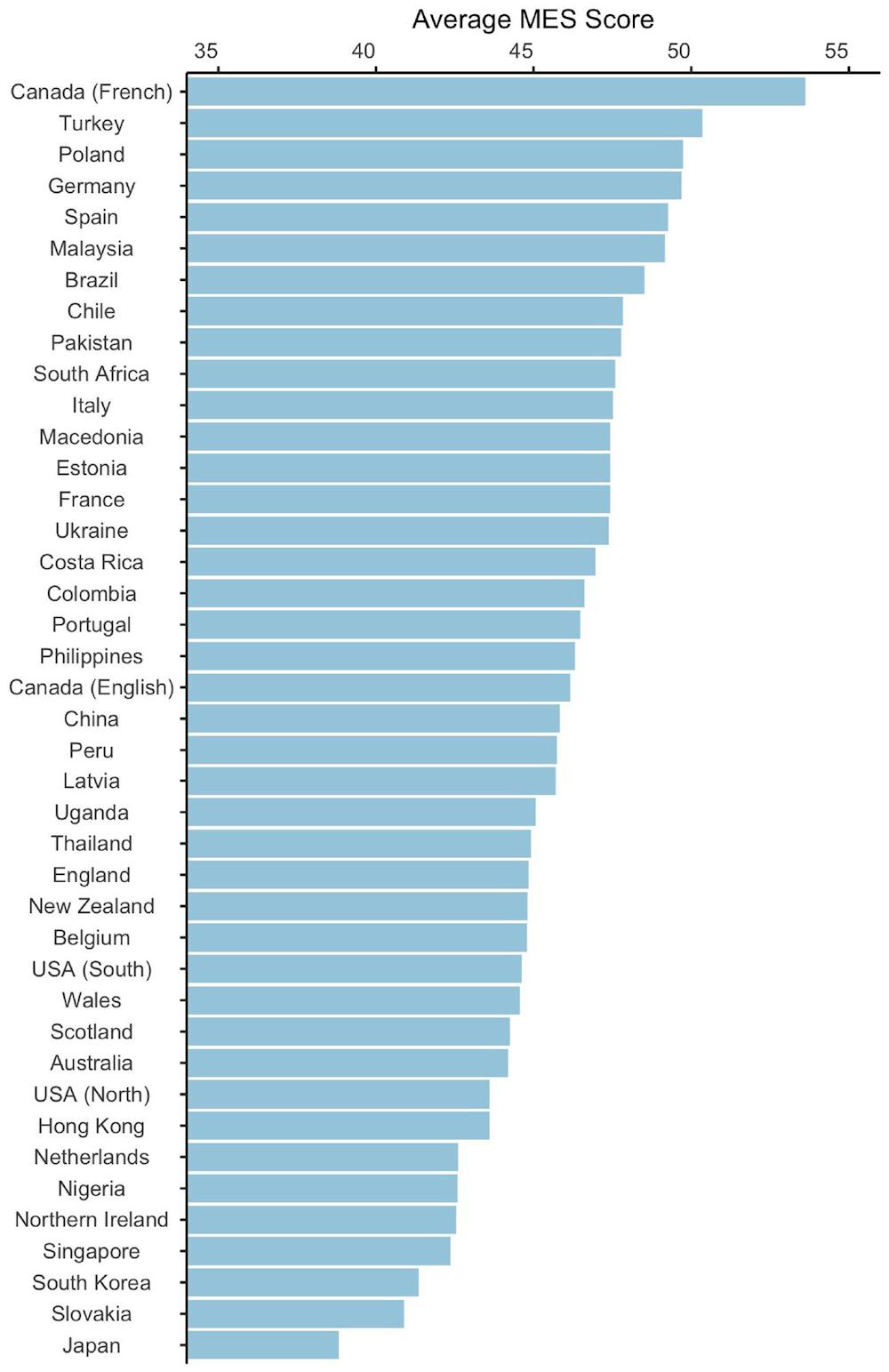
Average moral expansiveness scale (MES) scores per country. Higher numbers indicate greater moral expansiveness.
Kirkland et al. (2022)

But are our moral boundaries fixed, or can we move up the moral expansiveness ladder? The question of whether our moral concern for others is stable or zero sum (that is, “my concern for someone comes at the expense of another”) is an empirical one.

Can we expand our moral circles?

When thinking about ways to grow our moral circle, things like empathy and mindfulness may come to mind. But our work shows that compassion is stronger than both at predicting the size of one’s moral circle.

Our work also shows that compassion predicts our willingness to help those we dislike. And other research shows compassion training increases feelings of closeness toward a disliked person.

Building on this, our latest research found that a brief compassion training intervention can increase our moral expansiveness.

In this study, 102 participants were randomly assigned to complete a brief two-hour seminar on compassion training, or to a control group who didn’t attend a seminar.

In the seminar, we focused on defining compassion. The message was: things like anger, anxiety and sadness are normal human emotions, but we have a responsibility to learn and practice how to work with these feelings in helpful and supportive ways.

A man in tshirt and jeans sitting on the forest floor listening to earphones
Participants in the moral expansiveness study spent two weeks listening to audio exercises.
Aleksandr Pobeda/Shutterstock

Participants then had two weeks to continue to practice what we did in the intervention by listening to guided audio exercises, which were a combination of compassionate breathing and imagery exercises, as well as meditations.

Compassion meditations typically follow a set structure. We begin by expressing compassion to a target – someone we like – but then expand out to other targets, such as strangers or disliked others, to other sentient beings like animals, and to elements of the natural environment, such as coral reefs or forests.

We found that two weeks after the program, participants who had completed compassion training has greater moral expansiveness towards family and revered groups in society (for example, charity workers).

At the three month follow-up, these outcomes improved further. Moral concern for others had increased across the board, including towards outgroup members (such as political opponents), stigmatised members of society, animals, plants, the environment – and even towards supposed “villains” in our society (for example, convicted criminals).

This shows compassion and moral expansiveness are closely connected. We don’t know for sure, but the improved results at the three month mark may have been due to continuing the audio exercises, or perhaps due to a “sleeper effect” – it takes time for people to shift their moral view.

A hopeful future?

The year 2024 is full of big choices, with 4 billion people eligible to vote on who should lead their country.

Election years often spiral into divisions of “us” and “them”, with “we” the public having to choose between the people and policies we hope will improve our world.

Compassion might offer one way to ensure we don’t fall into the trap of turning against one another. We can all recognise the right for people and sentient creatures to live a life free of suffering.

And if compassion helps guide us in our decisions and actions, and even expand our moral sensibilities, we may be better placed to tackle some of the big challenges we are facing – and ensure those who are suffering most don’t get left behind.


Read more:
‘Do-gooders’, conservatives and reluctant recyclers: how personal morals can be harnessed for climate action


The Conversation

James Kirby receives funding from the Mind & Life Institute and is a board member of the Global Compassion Coalition.

Charlie Crimston does not work for, consult, own shares in or receive funding from any company or organisation that would benefit from this article, and has disclosed no relevant affiliations beyond their academic appointment.

ref. Who we care about is limited – but our research shows how humans can expand their ‘moral circle’ – https://theconversation.com/who-we-care-about-is-limited-but-our-research-shows-how-humans-can-expand-their-moral-circle-221605

Stage 3 stacks up: the rejigged tax cuts help fight bracket creep and boost middle and upper-middle households

Source: The Conversation (Au and NZ) – By Ben Phillips, Associate Professor, Centre for Social Research and Methods, Director, Centre for Economic Policy Research (CEPR), Australian National University

Shutterstock

The winners and losers from the Albanese government’s rejig of this year’s Stage 3 tax cuts have already been well documented.

From July 1 every taxpayer will get a tax cut. Most, the 11 million taxpayers earning up to A$146,486, will also pay less tax than they would have under the earlier version of Stage 3, some getting a tax cut twice as big.

A much smaller number, 1.8 million, will get a smaller tax cut than they would have under the original scheme, although their cuts will still be big. The highest earners will get cuts of $4,529 instead of $9,075.

But many of us live in households where income is shared and many households don’t pay tax because the people in them don’t earn enough or are on benefits.

The Australian National University’s PolicyMod model is able to work out the impacts at the household level, including the impact on households in which members are on benefits or don’t earn enough to pay tax.

More winners than losers in every broad income group

We’ve divided Australian households into five equal-size groups ranked by income, from lowest to lower-middle to middle to upper-middle to high.

Our modelling finds that, just as is the case for individuals, many more households will be better off with the changes to Stage 3 than would have been? better off with Stage 3 as it was, although the difference isn’t as extreme.

Overall, 58% of households will be better off with the reworked Stage 3 than they would have under the original and 11% will be worse off.

Importantly, there remain 31% who will be neither better off nor worse off, because they don’t pay personal income tax.


But it is different for different types of households.

In the lowest-earning fifth of households, far more are better off (13.5%) than worse off (0.2%) with the overwhelming bulk neither better nor worse off (86.3%).


In the highest-earning fifth of households, while more than half are better off (54.4%), a very substantial proportion are worse off (42.3%).

Very few (only 3.1%) are neither better nor worse off.


But high-earning households go backwards on average

In dollar terms, the top-earning fifth of households loses money while every group gains. That’s because although there are more winners than losers among the highest-earning fifth of households, the losers lose more money.

The biggest dollar gains go to middle and upper-middle income households with middle-income households ahead, on average, by $988 per year and upper-middle income households by $1,102. The highest-income households are worse off by an average of $837 per year.

As a percentage of income, middle-income households gain the most with a 1% increase in disposable income. Lowest income households gain very little, while the highest-income households go backwards by 0.3%.


The rejig does a better job of fighting bracket creep

And we’ve found something else.

The original version of the Stage 3 tax cuts was advertised as a measure to overcome bracket creep, which is what happens when a greater proportion of taxpayers’ income gets pushed into higher tax brackets as incomes climb.

We have found it wouldn’t have done it for most of the income groups, leaving all but the highest-earning group paying more tax after the change in mid-2024 than it used to in 2018.

The rejigged version of Stage 3 should compensate for bracket creep better, leaving the top two groups paying less than they did in 2018 and compensating the bottom three better than the original Stage 3.


Not too much should be made of the increase in tax rates in the lowest income group between 2018 ad 2024 because some of it reflects stronger income growth.

We find that overall, the redesigned Stage 3 does a better job of offsetting bracket creep than the original. It is also better targeted to middle and upper-middle income households.

Having said that, the average benefit in dollar terms isn’t big. At about $1,000 per year for middle and upper-middle income households and costing the budget about what the original Stage 3 tax cuts would have cost, its inflationary impact compared to the original looks modest.


Read more:
The 2 main arguments against redesigning the Stage 3 tax cuts are wrong: here’s why


The Conversation

Ben Phillips does not work for, consult, own shares in or receive funding from any company or organisation that would benefit from this article, and has disclosed no relevant affiliations beyond their academic appointment.

ref. Stage 3 stacks up: the rejigged tax cuts help fight bracket creep and boost middle and upper-middle households – https://theconversation.com/stage-3-stacks-up-the-rejigged-tax-cuts-help-fight-bracket-creep-and-boost-middle-and-upper-middle-households-221851

Sediment runoff from the land is killing NZ’s seas – it’s time to take action

Source: The Conversation (Au and NZ) – By Abigail M Smith, Professor of Marine Science, University of Otago

The fishers at Separation Point, between Golden Bay and Tasman Bay in New Zealand’s northwest South Island, used to be cautious. Something they called “hard coral” would tear their nets. If you dived down about 30 metres, you could see why: extensive reefs.

These reefs were constructed by bryozoans, tiny polyp-like creatures that cooperate to build large, branching colonies. They are similar to corals but live in deeper and cooler water.

The reefs at Separation Point were gorgeous and biodiverse. They provided shelter for small animals such as oysters and young fish. In 1980, the world’s first bryozoan-based fishing exclusion area was created to protect them: 146 square kilometres of seafloor was closed to most fishing, from the coastline to a depth of about 50 metres.

It went well at first. A 1983 study from the National Institute of Water and Atmospheric Research (NIWA) of just one reef found 37 species of bryozoans and another 39 invertebrate species, plus numerous fish. In 2008, a study comparing fished and unfished areas off Separation Point found more biodiversity where fishing had been limited.

Alas, subsequent developments have not been so kind. Land clearance for agriculture and forestry since human occupation has resulted in a ten-fold increase in sediment runoff in the area.

Thick beds of mud and silt have built up, destroying and burying the reefs. A survey of the same area in 2021 found flat mud deposits, with the occasional small, dead bryozoan sticking up. No fish remained in this marine ghost town.

Part of a bigger picture

These days it’s hard to escape news that the ocean is in trouble. Warming waters cause heatwaves that bleach corals. Fish and sharks appear where they never used to. Plastic is everywhere, including the stomachs of dolphins and penguins. Overfishing is causing populations to crash.

Meanwhile, sea levels are rising, dredging and mining are destroying ecosystems, while underwater engine noise and artificial light are changing how animals behave. Even the fundamental chemistry of seawater is changing as CO₂ dissolves in it. UNESCO’s Ocean Literacy Portal reads like an obituary.


Read more:
Plastic pollution in some NZ lakes is comparable to northern hemisphere lakes in highly populated areas, global study finds


But there’s another problem often left off that grim list: sediment runoff. When people remove trees, build roads and overstock paddocks, sand, mud and silt flow into the sea.

The resulting damage to coastal ecosystems gets little press, despite being described by the US National Oceanic and Atmospheric Administration as the greatest single source of pollution in the world’s waterways and coasts.

The first objective of the New Zealand Coastal Policy Statement in 2010 was to maintain and restore marine water quality. But that’s far from what we have today.

Dark waters, turbid with silt, affect marine life. We are increasingly aware of the changes in seaweed cover around New Zealand, from damage to kelp canopies to changes in phytoplankton. Seaweeds need light and clear waters.

Bryozoans, barnacles, oysters, cockles and scallops are suffering too. They literally starve to death by collecting dirt particles rather than food. Their delicate feeding tentacles are damaged or clogged, while their neighbours (such as pāua) are smothered or buried.


Read more:
NZ’s vital kelp forests are in peril from ocean warming – threatening the important species that rely on them


New Zealand’s disproportionate problem

Sediment runoff is most likely in wet places with high and regular rainfall, prone to being disturbed by storms and earthquakes, and with steep slopes, young rocks and soils. Agricultural land is a particularly strong source of sediment to waterways. Sound like somewhere you know?

Aotearoa New Zealand is eroding into the sea right under our feet. Over 200 million tonnes of sediment are transported by rivers to the sea each year, making fine sediment the most important and widespread water contaminant in this country.

Despite covering only 0.2% of global land area, the Ministry for the Environment reported in 2018 that New Zealand contributes 1.7% of the sediment to the world’s oceans.

Removal of forest and well-rooted plants, overgrazing and construction all result in sediment washing into the sea. Excavating old soils containing now-outlawed pollutants such as DDT, tin or lead exacerbates the problem.

Under the Resource Management Act, regional councils have the authority to prevent discharge of contaminants into water, and the responsibility to manage catchments to minimise sediment getting to the sea. Murky coastal waters suggest they’re not coping with this task.

Action and policy needed

We can make a difference. Planting and avoiding runoff are the most obvious solutions. Roots hold soil better than anything humans have invented. Usefully, they also direct water deep into the ground and remove carbon from the atmosphere.

The usual advice is to plant forests near the tops of catchments, where the ground is steepest and most vulnerable. Projects such as the government’s One Billion Trees Programme are promising, but the key is to leave those trees alone, or find ways to harvest them that minimise runoff.


Read more:
New Zealand’s maritime territory is 15 times its landmass – here’s why we need a ministry for the ocean


The Building Research Association of New Zealand recommends managing construction projects to avoid runoff, including using settling ponds and channels to retain dirty water, or chemical “flocculants” to make fine sediments bind together into a glob and sink. Every project should include the post-completion planting needed to retain soil.

Individuals and households can plant gardens and trees to avoid bare spots. They can limit the use of concrete and other impervious surfaces or choose permeable concrete. They can capture rain from their roof in a rain barrel instead of using storm water drains.

The Māori concept of “ki uta ki tai” recognises the connection between the land and sea, and should inform more robust and holistic environmental management policy, from the mountaintops to the deep ocean.

Regional councils use these words, but we need to see real action. Working together, we can keep soil on land where it belongs, and the ocean clean and clear.

The Conversation

Abigail M Smith does not work for, consult, own shares in or receive funding from any company or organisation that would benefit from this article, and has disclosed no relevant affiliations beyond their academic appointment.

ref. Sediment runoff from the land is killing NZ’s seas – it’s time to take action – https://theconversation.com/sediment-runoff-from-the-land-is-killing-nzs-seas-its-time-to-take-action-221966

Former Labor minister Greg Combet to succeed Peter Costello as chair of the Future Fund

Source: The Conversation (Au and NZ) – By Michelle Grattan, Professorial Fellow, University of Canberra

Former Labor minister Greg Combet is to be the new chair of the Future Fund, replacing Peter Costello.

Combet, a member of parliament in 2007-2013, served in the industry and climate change and energy efficiency portfolios and in the Labor cabinet. Before entering parliament he was ACTU secretary.

The Future Fund is the country’s sovereign wealth fund, established by the Coalition government in 2006 to strengthen Australia’s financial position. It is Australia’s largest financial asset. At the end of last year it had $272 billion in assets under management.

It is responsible for a number of other sovereign wealth funds including the Medical Research Future Fund, the Aboriginal and Torres Strait Islander Land and Sea Future Fund, the Future Drought Fund, the Disaster Ready Fund, the DisabilityCare Australia Fund and the Housing Australia Future Fund.

Costello, who as treasurer set up the fund, served two terms as chair, and was on its board before that.

Last year Albanese government appointed Combet as chair of a Net Zero Economy Agency, a position he will soon quit before taking the fund chairmanship mid-year. His term is for five years.

Since leaving parliament Combet has been prominent in the superannuation industry. In 2018 he became chair of Industry Super Australia.

Announcing the appointment, Treasurer Jim Chalmers said Combet had “a distinguished career and extensive experience in investment and superannuation, government and the climate and energy transformation”.

He said Combet had served as Chair of IFM Investors, a Trustee of AustralianSuper and Superannuation Trust of Australia. He had broad experience as a non-executive director in the financial sector.

“He is the perfect appointment to take the Future Fund into the future,” Chalmers said

Mary Reemst becomes acting chair of the Future Fund until Combet takes over.

Chalmers also announced Nicola Wakefield Evans and Rosemary Vilgan as part-time members of the Fund’s board for five-year terms.

He said Wakefield Evans had extensive experience in capital markets, corporate finance, the energy sector and corporate law. She was a partner for more than 20 years at King & Wood Mallesons and served with the Clean Energy Finance Corporation.

Vilgan had a background in investment and a range of board experience; she is currently the Chair of Commonwealth Bank Officers Superannuation Corporation .

“These two new member appointments will increase the representation of women on the Future Fund and continue the government’s strong track record of appointing women to senior roles in Australia’s most important economic and financial institutions,” Chalmers said.

“The appointments will help refresh and renew the Fund and help maintain the high level of skills and experience on the Board.”

The Conversation

Michelle Grattan does not work for, consult, own shares in or receive funding from any company or organisation that would benefit from this article, and has disclosed no relevant affiliations beyond their academic appointment.

ref. Former Labor minister Greg Combet to succeed Peter Costello as chair of the Future Fund – https://theconversation.com/former-labor-minister-greg-combet-to-succeed-peter-costello-as-chair-of-the-future-fund-222138

Freedom of information laws are key to exposing AI wrongdoing. The current system isn’t up to the task

Source: The Conversation (Au and NZ) – By Maria O’Sullivan, Associate Professor of Law, Deakin Law School, Deakin University

Shutterstock

There’s been much discussion about how artificial intelligence (AI) will affect every part of our society, from school assignments to the music industry.

But while policymakers continue to debate how best to regulate AI, there’s a question that’s received little attention: how ready are our freedom of information laws to deal with new technology?

Freedom of information laws are important because they help keep governments accountable and transparent. Without them, key wrongdoings can remain secret.

As technology continues to evolve rapidly, it’s time for a fundamental rethink of Australia’s freedom of information regime to make it fit for purpose for 2024 and beyond.


Read more:
Australia plans to regulate ‘high-risk’ AI. Here’s how to do that successfully


Transparency laws key in automation issues

You may be wondering what freedom of information (FOI) laws have to do with AI and automation. A good example of how the two work together is the recent Horizon scandal in the United Kingdom.

This scandal occurred when a computer accounting system called Horizon incorrectly identified shortfalls in the finances of post offices across the UK. The UK Post Office authority prosecuted 700 post office masters as a result of the system’s findings. Some went to prison for fraud and theft, and many others were financially ruined.

It has been described as “possibly the largest miscarriage of justice in UK history”.

Importantly, campaigners in the UK made extensive use of FOI to obtain information about the system. For instance, a request by leading campaigner led to the disclosure of a Post Office document that used offensive and racist terms to categorise sub-postmasters under investigation.

Another FOI request found that government authorities were told of possible problems with the system back in May 2013.

This debacle should serve as a reminder to Australia of the implications of using AI and automation in government systems.

It should also cause us to question whether our laws are fit to deal with the particular challenges of technology, especially as Australia’s transparency laws are more restrictive than those in the UK. There is no absolute exemption for cabinet documents in the UK.


Read more:
Frank and far-reaching: Senate report recommends shake-up of the way freedom of information is handled


Reform desperately needed

Regulation of AI in Australia has been in the news recently due to the release of the government’s interim response to the responsible AI consultation.

While this is an important initiative, comparatively little attention has been given to the need to update some of our key transparency mechanisms.

For instance, the government has refused to implement an important recommendation from the 2023 Robodebt Royal Commission report. This recommended that the cabinet exemption (the provision that allows cabinet documents to be exempt from disclosure) in the Freedom of Information Act be repealed.

Despite saying it “accepts or accepts in principle all 56 recommendations” of the report, the government didn’t formally accept the freedom of information recommendation. In its response, it said this was due to the need to protect cabinet confidentiality, collective responsibility and the giving of “frank and fearless advice from Ministers and senior public servants”.

The royal commission report also noted that affected people and advocacy groups faced significant difficulties in obtaining information about the operation of the Robodebt scheme, including via the Freedom of Information Act. These findings are significant because the over-classification of government information was one reason Robodebt was allowed to continue with impunity for so long.

What needs to happen now?

The increasing use of automation and AI in government requires greater openness with the public. To achieve a balance between transparency and cabinet confidentiality, our paper recommends the following changes:

  • the cabinet exemption to be supplemented with a legislated public interest test and appeal to the Information Commissioner, as in the UK

  • narrowing the scope of documents covered by cabinet confidentiality

  • reduction of the disclosure timeframe from 30 years to ten years, in line with several Australian states.

But we are also calling for a much larger review and modernisation of the Freedom of Information Act.


Read more:
Australians are concerned about AI. Is the federal government doing enough to mitigate risks?


The laws were passed in 1982, when hard copy documents were the norm and government online processes were in their infancy. Although it has been subject to some minor amendments since then, it has not yet been subject to a major overhaul to recognise the enormous technological advances that have occurred.

As we and others previously argued in a 2020 paper on technology and the law, future reforms should include expanding the scope of the Act to allow for greater openness and reducing the exemptions for trade secrets (to allow for disclosure of the commercial information used for automated technologies). We have also suggested that governmental agencies should be obliged to be more proactive in disclosing the details of the automated technologies they have used. This will assist in making our FOI regime fit for purpose – in 2024 and beyond.

The Conversation

The authors do not work for, consult, own shares in or receive funding from any company or organisation that would benefit from this article, and have disclosed no relevant affiliations beyond their academic appointment.

ref. Freedom of information laws are key to exposing AI wrongdoing. The current system isn’t up to the task – https://theconversation.com/freedom-of-information-laws-are-key-to-exposing-ai-wrongdoing-the-current-system-isnt-up-to-the-task-221404

World’s ‘smallest university’, but Tuvalu campus has big local impact

By Kalinga Seneviratne

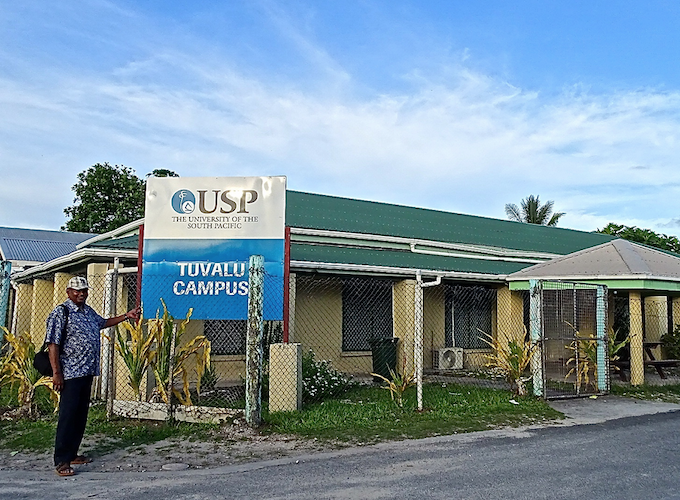
The University of the South Pacific’s (USP) Tuvalu Campus, located in the capital Funafuti, is perhaps the smallest university in the world, but it offers a distinctive service.

The nation of Tuvalu comprises nine small atoll islands which have a combined population of just 11,400. The Tuvalu Campus itself is restricted to one small building with three classrooms, a conference room, a couple of office spaces and several mobile teaching and learning units.

Regardless of the size of the campus, USP Tuvalu’s campus director Dr Olikoni Tanaki from Tonga is positive about the university’s role and contribution.

In a message on its website, he argues it is the people that “make this campus distinctive and we continuously strive to explore better ways to provide the best services to our communities, and that sustains our distinctiveness”.

In an interview in Funafuti, Isikeli Naqaya, a student-learning specialist at USP Tuvalu, said: “Every semester, the university caters to about 330 students who come from all nine islands.”

He added that some students were based in outer islands and study online, while the majority were based in Funafuti.

The campus was first established as an extension centre in the early 1980s. It is referred to as USP Tuvalu because of the multi-campus nature of USP.

USP is a single university with 11 branch campuses across the Pacific.

It is one of two regional universities in the world — the other is in the Caribbean — and is owned by 12 Pacific Island countries, with Tuvalu being one of them.

USP’s main campus is located in Suva, Fiji, and is known in the region as Laucala Campus, which is also the university’s administrative centre.

The author, Kalinga Seneviratne
The author, Kalinga Seneviratne, at the Tuvalu campus of The University of the South Pacific. Image: KS/APR

Catering to local needs
Tuvalu Campus is basically a regional centre of USP which helps to deliver courses that are designed at the Laucala Campus.

Local students can take certificate, diploma or degree courses of USP via the Tuvalu Campus but they need to register through the central administration at Laucala. USP Tuvalu also offers short courses and workshops catering to local needs.

“The majority of our students do the online mode, particularly those who are involved in degree courses,” Naqaya said. “A majority of those doing face-to-face [courses] are those who do foundation programmes”.

The foundation programmes include the compulsory module, English language skills for tertiary studies, that is taught in-person by Naqaya.

He explains that there are three delivery methods on campus: if there is a tutor available on campus to deliver the programme, it’s face to face. If there is no tutor, it is usually a blended mode or purely online.

Many of the in-person courses are short courses offered as adult education programmes to improve the skills levels needed for the local economy.

“We have just completed one on business communication with our Department of Fisheries here in Tuvalu. It went on for two weeks. These programmes are very popular here.

“Different government ministries and even non-governmental organisations come to us for this type of programme,” said Naqaya. “We have also delivered a course in the small seafood business.”

Fisheries staff
Most of the students for the small business course were staff of the Tuvalu Fisheries Department. USP Tuvalu advertised the course and staff interested in it sent in their applications which went to Laucala campus for selection.

The certificates for the graduates of the short courses are issued by USP in Fiji.

Because it is a branch campus, for USP Tuvalu to deliver a programme, it has to undergo a process. First, the Fiji campus consults with their Tuvalu counterparts to see whether they have a suitable person to deliver the course.

If there is one, Tuvalu receives the course material from Suva and the course is delivered in Tuvalu.

“If we don’t have the specialised staff, like [for a subject such as] cybercrime, for example, we would have someone to come over and deliver it. We first advertise it locally and if there is someone qualified here to do it, they will come and deliver it,” said Naqaya.

“Many of the small courses I have been delivering.”

School leadership programme
On November 27, USP Tuvalu officially launched the Graduate Certificate of School Leadership (GCSL) programme in Tuvalu, marking a crucial step towards empowering the country’s school leaders.

This is a collaborative effort between the USP’s Institute of Education (IoE), the Tuvalu Ministry of Education, Youth, and Sports, and the Tuvalu Learning Project. The GCSL programme was developed in response to a request from Tuvalu, and emphasises the collaborative effort required for success.

IoE director Dr Seu’ula Johansson-Fua, delivering the opening remarks at the launch of the GCSL programme, described it as an uncommon instance of a member country seeking university-designed programmes, and highlighted the institution’s commitment to tailoring education to meet the specific needs of member countries.

The guest of honour for the launch ceremony, Director of the Tuvalu Ministry of Education, Youth and Sports Neaki Letia, highlighted the necessity of the GCSL programme and acknowledged the challenges faced by school leaders in the absence of proper leadership and management training.

“In your role as school leaders we demand reports, we demand . . . attainments. At one point in time, we sit around the table and ask each other, ‘Have we provided proper training for the tools that we ask them to provide?’ and the answer is ‘No, we have not’,” he said.

“So, this is why we requested USP, especially the Institute of Education, for support — to help us contribute ideas and instil knowledge to be a leader,” he explained.

Local research capacity
Another role of USP Tuvalu is to develop local research capacity, especially in local knowledge to tackle climatic change.

Vasa Saitala, a Tuvaluan, was the community research officer at USP Tuvalu until recently. She told University World News that a campus like Tuvalu is important to unite communities as some Tuvaluans have never been to school.

“There are changes due to climate change and through consultations with communities they would . . .  learn of what’s happening around us,” she said. “We have to do the studies about traditional knowledge and peoples’ awareness of climatic change, etcetera.”

Saitala has conducted a research project on gathering traditional knowledge about local indicators for different seasons and has developed a curriculum for community training on how to use this knowledge to protect against cyclones, droughts and so on. She has also been involved in a regional project of USP that gathers information about community understandings of climatic change issues.

“USP Laucala outsources the research to us. We do the research here and send the reports to Laucala,” she said.

“For short-term fisheries training and also gender issues, people from USP Fiji come here and work with us.”

Kalinga Seneviratne is a journalist, radio broadcaster, television documentary maker, media and international communications analyst. During 2023, he was a journalism programme consultant with The University of the South Pacific. This article was first published by University World News and is republished with permission.

Print Friendly, PDF & Email

Article by AsiaPacificReport.nz

Amnesty chief calls UNRWA funding cuts ‘heartless’, ‘sickening’

António Guterres, United Nations secretary general.

Asia Pacific Report

Agnes Callamard, the secretary general of Amnesty International, has called the funding cuts to the UN’s Palestinian humanitarian relief agency a “heartless decision” by some of the world’s richest countries “to punish the most vulnerable population on earth because of the alleged crimes of 12 people”.

In a post on X, formerly Twitter, she added: “Right after the ICJ [International Court of Justice] ruling finding risk of genocide. Sickening.”

While nine Western nations, including the US, rushed to suspend UNRWA’s funding after allegations that members from the agency participated in the October 7 attack, the same countries have failed to formally revise their ties to Israel despite mounting reports of genocidal abuse by Israeli forces.

The Director-General of the World Health Organisation, Dr Tedros Adhanom Ghebreyesus, said that “cutting off funding” to UNRWA at what he called a “critical moment” would only “hurt the people of Gaza who desperately need support”.

The Palestinian Ministry of Foreign Affairs highlighted the plight of some 1.9 million displaced Palestinians in Gaza with the main UN agency delivering humanitarian aid losing its major financial backing.

“Scenes of forcibly displaced people are a disgrace to humanity,” it said in a statement.

“Over half a million Palestinians in Khan Younis were instructed by the occupying forces to evacuate their homes, including hospitals and health centres, in a cruel expansion and deepening of forced displacement from southern regions.”

UNRWA employs about 30,000 people and provides humanitarian aid, education, health and social services to 5.9 eligible Palestinian refugees living in Gaza, the occupied West Bank, Jordan, Lebanon and Syria.

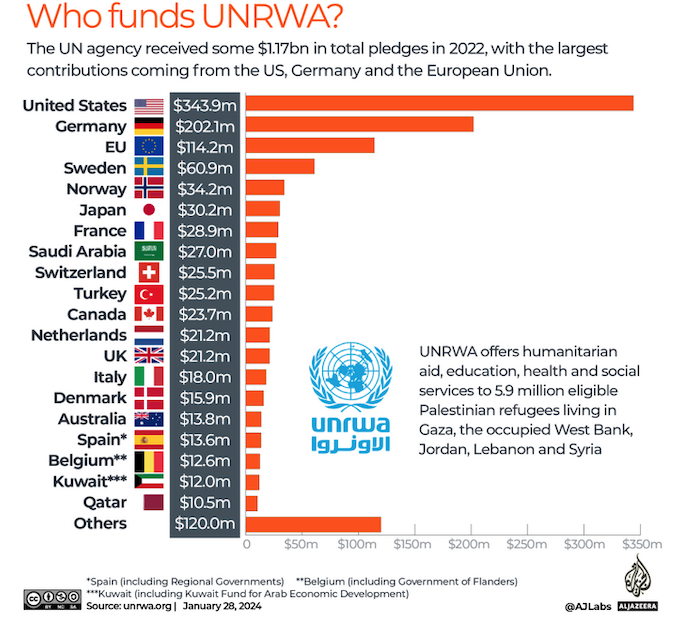
The UNRWA donors funding breakdown
The UNRWA donors funding breakdown in 2022. Graphic: Al Jazeera

The UN agency received almost US$1.2 billion in pledged in 2020, with the US being the biggest donor providing $343.9 million. The fifth-largest donor, Norway, provided $34.2 million and is continuing is funding in spite of the action by the US and its allies.

Hani Mahmoud, reporting for Al Jazeera from Rafah, southern Gaza, said the entire city of Khan Younis continued to be pounded by Israeli bombardment.

“Thousands of people have been ordered to evacuate and are going through security checkpoints with facial recognition technology,” he said.

“Women and children are separated from the men. A large number of people have been detained and dehumanised during the process.

Video showed people “trying to flee the horror” on different routes away from the bombing they were targeted by tank and artillery shells and small-arms fire, and also Israeli attack drones that hovered low over the city.

There were reports of many people killed.

“Intense fighting is now taking place in the southeastern part of Khan Younis at the edges of Rafah city,” he said.

Meanwhile, a “Return to Gaza Conference” in Jerusalem — attended by Israeli cabinet ministers and members of the parliamentary Knesset — has laid out a plan for the re-establishment of 15 Israeli settlements and the addition of six new ones, on where recently destroyed Palestinian communities stood.

An Israeli humanitarian lawyer, Itay Epshtain, said the fact that Israeli officials would convene a high level meeting to plan what he called an act of aggression — the acquisition of occupied territory and its colonisation — was an early indication of intent to breach the provisional measures ordered by the International Court of Justice last Friday.

Print Friendly, PDF & Email

Article by AsiaPacificReport.nz

Images shape cities, but who decides which ones survive? It’s a matter of visual justice

Source: The Conversation (Au and NZ) – By Sabina Andron, Postdoctoral Research Fellow in Cities and Urbanism, The University of Melbourne

Sabina Andron

In the early hours, poster installers head out with buckets of wheat paste and gig advertisements, refreshing the thousands of square metres of street poster sites in Melbourne. Graffiti writers and artists also take to the walls with their pieces. Municipal surface cleaners soon follow with chemicals and pressure washers.

Our city buildings are covered with posters, signs, art and graffiti. Their creators’ tools are images: profitable, seductive, confronting, removed.

Yet we rarely think about their collective role in articulating social values. While their creators’ values might differ, their ambition is the same: a higher stake in shaping the image and values of the city.

Our research draws together municipal agendas with a critical history of how public images are produced and regulated in cities. The aim is to develop ways to deal with images in more responsive and creative ways. How can we better manage them to support social justice, diversity and belonging in cities?


Read more:
COVID-19 murals express hope and help envision urban futures


An Aboriginal flag draped the length of a building frontage
The creators of urban images, such as this Aboriginal flag running the length of a building, have a say in shaping the city’s image and values.
Sabina Andron

Images are instruments of urban governance

Managing urban images is a priority for municipal governments across the world. Melbourne, the source of the images in this article, is no exception.

Urban branding, graffiti removal, mural art and graphic heritage are just some of the ways in which the city is governed through images. They contribute to how we read urban environments and can create a strong sense of place, identity and character.


Read more:
Vietnam’s disappearing vintage signs are pop culture remnants of a bygone era


A collection of official place name and street signs and headwear of people doing official roles
A display of name plaques and street signage from the City of Melbourne Art and Heritage Collection. Graphic objects such as these continue to shape the city’s identity.
Sabina Andron

At the same time, individual actions in creating images form a collective visual discourse. Displaying political placards in street-facing windows, writing graffiti on public walls or painting over unwanted tagging are all visual contributions to the city’s image and character.

While we may not agree on which of these approaches should take precedence, images play a significant role in how we all encounter, navigate and experience urban spaces. They form an urban aesthetic that is continuously calibrated by state and private actors.

Tagging on the concrete wall of a bridge over a creek is painted over
People who paint over tagging are making their own visual contribution.
Sabina Andron


Read more:
Transgress to impress: why do people tag buildings – and are there any solutions?


We value some images above others

On a small sticker on a street pole, the globally recognised ACAB signifies resistance against structural violence and police brutality, enhanced by a feminist message of body positivity.
Sabina Andron

The more successful instances of urban visual infrastructure are often innocuous. As the saying goes, great design is invisible. But it can also be informal, unregulated or even illegal.

A visit to the recently opened City of Melbourne Art and Heritage Collection reveals how unplanned images such as stickers, stencils or protest signs deserve attention alongside their standardised counterparts such as traffic signs, wayfinding signs, and memorial plaques. Yet our understanding of their cultural value remains partial and biased.

For example, more than 100 public murals are listed in the Victorian Heritage Register. Also listed are a handful of building signs that many Melbournians will know: the Skipping Girl, Pelaco and Nylex signs in Richmond, and the Whelan the Wrecker sign in Brunswick.


Read more:
How DC Mayor Bowser used graffiti to protect public space


A mural of many human body outlines on a wall
This 1984 mural by New York artist Keith Haring is on the Victorian Heritage Register. A sign has been erected (below) to explain its significance.
Sabina Andron

Sabina Andron

However, graffiti is nowhere to be found in the upper echelons of our value scales for urban images. Neither are street posters, stickers or other mundane images that shape and enliven our public spaces.

Recent research on the governance of graffiti and street art, alongside our interviews with local authorities and graffiti removal companies, indicate the following:

  • public image policies often value visual order above aesthetic and expressive diversity

  • the protection of private property is prioritised over the imaginative use of public surfaces as a shared, common resource

  • we enforce these values by privileging certain voices over others in the expression of public life and urban experience.

Young people collectively painted this wall in the City of Yarra. Visibility in cities can be empowering and increase a sense of belonging.
Sabina Andron


Read more:
Getting to the (street) art of a year like no other


All public images are culturally significant

Could we apply heritage principles of cultural significance to the names and messages scribbled next to our local tram stop in the same way as we do to murals or ghost signs? And could we develop more nuanced value protocols for public images in the face of increased social division?

Images in public space reflect and represent divergent social values. As a result, they force us to confront our individual and societal biases.

A poster pasted on a wall is covered in handwritten comments
Urban walls are public forums. This poster depicts four women of different skin colours, with the Torres Strait Islander and Aboriginal flags and the message ‘Decolonise sex work’. The transgender flag is a later addition, along with the hand-written comments.
Sabina Andron

Cities are never unanimous, harmonious congregations, and neither are their public images. They are also bastions of resistance, radical politics and competing claims to urban rights. Protest signs, graffiti tags and political posters and stickers are social infrastructure.

As urban dwellers, our right to the city includes the ability to edit our urban environments and contribute directly to urban visual culture. Healthy urban environments grow at the intersection of all these image types, in their places of tension and disagreement – what we refer to as urban visual justice.

A commercial Lipton Tea sign painted on a wall above 2 official signs about restrictions, with stickers put over them, flanked by large advertising posters
A faded mural advertisement (ghost sign), municipal signs covered in stickers, framed street posters and faded graffiti tags occupy shared surfaces, demonstrating visual justice through the presence of multiple voices.
Sabina Andron

On your next journey through the city, stop to appreciate the variety of images it shows you. Which values do they capture and promote? What is visible and what is not? And where do you fit in?

A research and policy framework for urban visual justice can lead to greater belonging, representation and justice in urban experience. It improves visibility and voice for communities in public space. If we pay enough attention, images can teach us everything we need to know about cities.

The Conversation

The authors do not work for, consult, own shares in or receive funding from any company or organisation that would benefit from this article, and have disclosed no relevant affiliations beyond their academic appointment.

ref. Images shape cities, but who decides which ones survive? It’s a matter of visual justice – https://theconversation.com/images-shape-cities-but-who-decides-which-ones-survive-its-a-matter-of-visual-justice-216003

Banksias are iconic Australian plants, but their ancestors actually came from North Africa

Source: The Conversation (Au and NZ) – By Byron Lamont, Distinguished Professor Emeritus in Plant Ecology, Curtin University

Sandie Peters/Unsplash

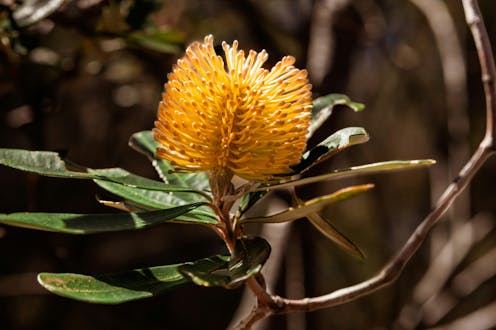
Few plants conjure up the Australian bush better than banksias, whose beautiful flowers are irresistible to honeyeater birds, small marsupials and nature lovers.

But our research, published in Perspectives in Plant Ecology, Evolution and Systematics, shows that the ancestors of banksias actually migrated here from North Africa.

From early fossil pollen studies, we already knew that the protea family (Proteaceae), which includes banksias, grevilleas, waratahs and macadamias in Australia, originated in northwest Africa 130 million years ago.

Our task was to track their migration to Australia, where they became the unique symbols of the Australian bush that we admire today. To give credit where it’s due, we need to know where our natural heritage originated. So, how did this iconic group of plants get here?

Looking at the entire family

Our study relied on two approaches. We used a DNA assessment of the entire protea family to create an evolutionary tree. Then we inserted key fossil pollen records of a known age into the tree, to serve as a “molecular clock”. This helped us work out the time of origin of all genera in this family.

An orange-pink flower resembling a bottle brush
Banksia hookeriana, the most important species used in the wildflower trade in Western Australia and now widely planted. This is the most studied of all members of the protea family.
Byron Lamont

We then searched the literature for records of ancient sedimentary deposits that contain fossil pollen with affinities to banksias in Africa, South America, Antarctica (which was covered in forest until 40 million years ago) and Australia.

This was made possible by the fact the hard walls of pollen grains allow them to be preserved for millions of years. Also, the pollen grains of plants in the protea family are quite distinctive from those of other families. We then compared the dates and locations of the fossil pollen against our family tree.

This showed that by 120 million years ago, the ancestors of banksias had begun crossing into northeast South America. The two continents remained joined at their tips until 100 million years ago.

The plants then migrated down the east side of South America – first reaching the Scotia Isthmus about 110 million years ago – and crossed onto the Antarctic Peninsula.


Read more:
The coastal banksia has its roots in ancient Gondwana


Two routes into Australia

Here, the ancestors separated into two groups. One, the soft-leaved group, followed a cool-temperate rainforest pathway (dark for up to four months of the year) along the south side of Antarctica. They entered Australia via Tasmania from 105 million years ago.

The rainforest elements continued up the east coast, with some eventually reaching New Guinea; others entered New Caledonian rainforests directly from southern Antarctica. This route remained open until 45 million years ago, when Australia and Antarctica finally separated.

The other, hard-leaved group followed an open, fire-prone woodland pathway along the warmer, sunnier northern side of Antarctica. They entered Australia via the southwest tip that remained attached to Antarctica until about 70 million years ago.

The two points of entry were separated by a huge inland sea that occupied the Great Australian Bight during that period.

Migratory pathway taken by the ancestors of banksias beginning 132 million years ago in north Africa. Note how the ancestors split into two groups on entering Antarctica from South America, banksia itself entering via southwest Australia and the rainforest species via Tasmania.
Modified from Lamont et al. (2024) Perspectives in Plant Ecology Evolution and Systematics

A proliferation of banksias

Since banksia itself appears to have arisen 100 million years ago, the genus either evolved in northeast Antarctica or at the extreme corner of southwestern Australia. From there, they spread to the rest of Australia over the next 50 million years.

Banksias now consist of around 200 species, 90% of which are endemic to southwestern Australia. Ancestors of the bulk of the hard-leaved genera, such as grevilleas, hakeas, macadamias and waratahs, also entered Australia via the southwestern tip. They then migrated east along the margins of the Nullarbor Plain – thickly vegetated back then – to southeast Australia.

Until the results of our new study, it was believed the protea family arose in Australia and spread from here to Africa, South America, New Caledonia and Asia. Almost all migration would have needed to be over the oceans, as it was thought to have happened after the breakup of the Gondwanan supercontinent.

In fact, the journey was entirely overland as it occurred when Gondwana was largely intact, except for the early departure of Greater India.

Banksia shrubland 300km north of Perth, Western Australia. Three species of banksia, about 1.5 metres tall, are present in this image as well as several other members of the protea family, such as Adenanthos and Xylomelum.
Byron Lamont

Plants out of Africa

Anthropologists are keen to point to the “out of Africa” hypothesis for the origin and migratory history of humans. It now appears such a hypothesis is equally applicable to some important groups of plants.

This is the first time the southwest corner of Australia has been recognised as a major migratory route for the protea family.

We now need to take seriously the Antarctic–southwest Australian link as a likely major entry route for many other hard-leaved plant groups into Australia. They could have originated in Antarctica and South America, and possibly even Africa.

This north Antarctic pathway might well also apply to eucalypts, whose oldest records are for southern South America, as well as currently endemic animals and microbes.

The Conversation

Byron Lamont receives funding from the Australian Research Council

Lynne Milne is a member of the Australian and New Zealand Forensic Society and the American Association of Stratigraphic Palynologists. She is currently the Treasurer of the Royal Societies of Australia.

Tianhua He received funding from the Australian Research Council.

Richard Cowling does not work for, consult, own shares in or receive funding from any company or organisation that would benefit from this article, and has disclosed no relevant affiliations beyond their academic appointment.

ref. Banksias are iconic Australian plants, but their ancestors actually came from North Africa – https://theconversation.com/banksias-are-iconic-australian-plants-but-their-ancestors-actually-came-from-north-africa-221589

Israel-Palestinian conflict: is the two-state solution now dead?

Israel continues its annihilation of Gaza despite ICJ finding a prima facie case of genocide exists.

Source: The Conversation (Au and NZ) – By Ian Parmeter, Research Scholar, Centre for Arab and Islamic Studies, Australian National University

The growing rift between the Biden administration and the Netanyahu government over Israel’s war in Gaza is now in the open, with public disagreement between them on the viability of a two-state solution to the conflict.

US President Joe Biden literally embraced Prime Minister Benjamin Netanyahu within days of Hamas’ horrific attack in southern Israel on October 7, and the US has steadfastly protected Israel’s interests in the UN Security Council.

But tensions have mounted as the civilian death toll from Israel’s massive retaliation in Gaza has climbed to more than 25,000 – 70% of whom are women and children.

To put that in context, more non-combatants have been killed in less than four months in Gaza than in nearly two years of war in Ukraine, where the civilian death toll only recently exceeded 10,000.

Biden warned in December that Israel was losing international support over its “indiscriminate bombing” of Gaza. The administration has also made clear through background media briefings its concern that Netanyahu has no postwar plan for Gaza’s governance.

And following the preliminary order issued by the International Court of Justice in the genocide case against Israel this past weekend, White House commentary made clear the court’s orders aligned with US policy. Specifically, the court said Israel must take all possible steps to minimise civilian harm and increase the flow of humanitarian assistance to Gaza.

With criticism of Israel mounting on the global stage, the Biden administration has inserted the United States’ long-standing support for a two-state solution to the Israeli-Palestinian conflict.

In response, Netanyahu has thrown down the gauntlet – flatly rejecting the creation of a separate Palestinian state. He posted on X: “I will not compromise on full Israeli security control over the entire area in the west of Jordan – and this is contrary to a Palestinian state”.

Butting heads with US presidents

This rift between the two leaders should not be a surprise. Netanyahu is Israel’s longest-serving prime minister and has the self-belief that goes with 16 years in office.

This is not the first time he has butted heads with a US president. In particular, he had a poisonous relationship with Barack Obama, notably visiting Washington to address a joint sitting of Congress in 2015 without bothering to call on the president – an extraordinary breach of protocol.

Despite the fact the Oslo Accords of 1993 and 1995, signed by former Israeli Prime Minister Yitzhak Rabin and Palestinian leader Yasser Arafat, laid down a pathway to the creation of a Palestinian state, Netanyahu has never hidden his opposition to the concept.

In a recently published profile of Netanyahu in the New Yorker, David Remnick describes how the Israeli leader made a speech in 2009 in which he “conveyed a wary and highly conditional openness to a Palestinian state”. The conditions included:

  • Palestinian recognition of Israel as a Jewish state

  • no return of Palestinian refugees outside Israel

  • the demilitarisation of a future Palestinian state

  • and Jerusalem remaining the united capital of Israel.

None of these was likely to be acceptable to Palestinians.

Remnick comments the speech was a tactical move, with a larger goal in mind. He quotes the reaction of then-US ambassador to Israel, Martin Indyk:

We met a day or two after the speech. [Netanyahu] was all puffed up, and he said to me, ‘All right, I said it, now can we get back to dealing with Iran?‘

Is Biden or Netanyahu right?

This leads to the current – and more important – question: who is right about the future viability of a two-state solution, Biden or Netanyahu?

Putting aside questions of equity and morality, analysis of the evidence suggests the answer is Netanyahu.

The simple fact is the number of Israeli settlers in the occupied West Bank (including East Jerusalem) – now about 700,000, who live alongside three million Palestinians – means there is not much space left for a Palestinian state.

That gap is narrowing, with population growth higher among settlers than Palestinians. Ultra-Orthodox Jews, who comprise one-third of the settlers, have a fertility rate in Israel of 6.5 live births per woman. The current fertility rate among Palestinians is around 3.8 births per woman. If this trend continues, by mid-century, the Israeli-Palestinian population in the West Bank could be equal.

The only way space could be made for another state would be if the government were to dismantle the settlements and direct the settlers to live within the borders that existed before Israel seized the West Bank in the 1967 Six-Day War.


Read more:
Since the Gaza war began, violence against Palestinians has also surged in the West Bank – and gone virtually unnoticed


Despite the fact the settlements are illegal under international law – they violate the Fourth Geneva Convention – no Israeli government is likely to try to remove them for fear of violent domestic consequences. Some in Netanyahu’s government are already talking about Israel annexing the West Bank, in the way it annexed East Jerusalem in 1980.

Talk of land swaps usually ends with potential offers of land for Palestinians in the barely habitable Negev desert. The major Jewish settlement blocks in the West Bank, by contrast, are in prime real estate.

Then there is the question of Gaza, which is barely large enough to accommodate its current population of 2.3 million. With unemployment there at nearly 50%, it is a breeding ground for radicalism, as the Hamas attack in October demonstrated.

Most Israelis agree with Netanyahu

The other factor is that Netanyahu’s rejection of a Palestinian state reflects the current views of most Israelis.

Polling by the Pew Research Center in March and April 2023 – well before the Hamas attack – showed only 35% of Israelis (including both Jewish and Arab respondents) thought “a way could be found for Israel and an independent Palestinian state to coexist peacefully”. That was down nine percentage points from 2017 and 15 points from 2013.

Among Jewish Israelis, those who agreed with the statement dropped from 46% in 2013 to 32% last year. The decline was even sharper among Arab Israelis, who had been more optimistic in 2013, with 74% thinking peaceful coexistence was possible. By 2023, the proportion was just 41%.


Read more:
Israel’s new government doesn’t give Palestinians much hope. It could be time for a radical approach


The extent to which Netanyahu, in office throughout this period, might have influenced these declines is difficult to measure. But considering the current level of hatred and distrust between Israelis and Palestinians, it’s difficult to envisage any potential replacement for Netanyahu taking a different line on a Palestinian state.

That reality is reinforced by the Orthodox Jewish demographics noted above. Orthodox Jews tend to vote for conservative religious parties, which means growing numbers of Orthodox voters favour the formation of right-wing governments (given Israel’s strict proportional representation voting system). Netanyahu currently leads an extremist right-wing government, and it’s unlikely to be the last.

That means talk of a two-state solution by Western governments is simply kicking the can down the road. It’s not going to happen. Israelis respect the US and value the materiel and diplomatic support provided by US presidential administrations, but they won’t be ordered about by them.

And there could be a change in leadership in the US this year, too. The leading Republican candidate, Donald Trump, had a reputation as the most pro-Israel US leader since Harry Truman when he was in office. So, if Trump wins the election and Netanyahu is still in office next year, there will be little head-butting at all.

The Conversation

Ian Parmeter does not work for, consult, own shares in or receive funding from any company or organisation that would benefit from this article, and has disclosed no relevant affiliations beyond their academic appointment.

ref. Israel-Palestinian conflict: is the two-state solution now dead? – https://theconversation.com/israel-palestinian-conflict-is-the-two-state-solution-now-dead-221967

Medicare turns 40: since 1984 our health needs have changed but the system hasn’t. 3 reforms to update it

Source: The Conversation (Au and NZ) – By Stephen Duckett, Honorary Enterprise Professor, School of Population and Global Health, and Department of General Practice, The University of Melbourne

Ali Goldstein/Unsplash

Forty years ago, Medicare as we know it today was born. It was the reincarnation of the Whitlam government’s Medibank, introduced in 1975 but dismantled in stages by the Fraser Liberal government.

Medibank was developed in the 1960s by health economists Dick Scotton and John Deeble, when disease prevalence was different and the politics of reform were diabolical.

But the nation has changed since 1984, and so have our health needs. Medicare is now struggling to ensure the access to health care for millions of Australians we were once promised.

Let’s look at how we got here – and three radical changes we need to keep the Medicare promise into the future: making it cheaper to see a GP; paying less for blood and imaging tests; and covering dental care.


Read more:
If you live in a bulk-billing ‘desert’ it’s hard to see a doctor for free. Here’s how to fix this


Free hospital care, but you might pay to see a GP

One of my first jobs in the health system, in the days before Medicare and Medibank, was acting in charge of revenue collection for three public hospitals. A small subset of people could get free, albeit stigmatised, care.

We had bad debts, because some people couldn’t afford to pay their hospital bills and I was allowed by policy to recommend that some be written off. But for others I had to seek court authorisation to seize their wages to pay off their hospital debt.

Medibank changed that. Now all Australians can get public hospital care without any financial barrier.

Doctor draws blood from patient
Before Medicare and Medibank, patients often faced hospital care debts.
National Cancer Institute/Unsplash

But the financial barriers to seeing a GP or a private specialist (out of hospital) have remained. Doctors continue to charge what they like, with Medicare often only covering a portion of their fees. This has left many patients facing significant out-of-pocket payments.

When Medicare was designed, medical care was provided mostly by solo medical practitioners working in practices they owned. It was a one-to-one professional relationship, with the patient paying the practitioner for each service.

Over time, general practice evolved into group practices organised as partnerships. Next, they consolidated and corporatised. A handful of corporates now provide all private pathology (which tests blood and other tissues) and radiology (which provides imaging services) and a large proportion of GP care.

Corporates have not made the same inroads into most other specialties. But since the 1980s, states have reduced public hospital outpatient services. So patients are now more reliant on private medical specialists for care referred by their GP.

Much has changed, but cost of living pressures remain

Health-care needs have changed. As we live longer, we live with more diseases, many of which are chronic. The care required increasingly involves many different health providers and includes non-medical specialties such as podiatry, physiotherapy and psychology.

When Medicare was introduced, university education was offered for only a few of these professions. But their training has evolved and so too what they can do. This is particularly the case for nursing. It has evolved from an apprenticeship model to a profession with its own specialties. A subset – nurse practitioners – have the authority to diagnose and prescribe medication.

Broader technology trends have also had an impact on health care, as with all other sectors. Virtual care and telehealth proved their worth during the early years of the COVID pandemic, just as generative AI is beginning to show its promise now.


Read more:
AI can help detect breast cancer. But we don’t yet know if it can improve survival rates


Medicare was first and foremost about efficiently removing financial barriers to access. It was introduced as part of an agreement with the Labor movement about reducing costs of living and, in particular, ensuring people could attend a doctor without having to worry about how they would pay for the visit.

However, about 1.2 million Australians deferred or missed out on seeing a GP because of cost in the 2022-23 financial year. Lower-income Australians have higher rates of missing out on care.

Medical fees aren’t regulated and so consumers face a lottery – not knowing whether a fee will be charged and having no control over that decision. Only about 52% of all Australians were always bulk-billed in 2022-23, down from 66% a year earlier.

So how can we get Medicare back on track towards its goal of universal health care for all Australians? Here are three radical reforms we should prioritise.

1. Make GP care affordable for all

Rebates are currently subject to political whim. The Liberal government (in office from 2013 to 2022) froze rebates, leading to increases in average out-of-pocket payments and reduced bulk-billing.

The first step in reducing costs as a barrier to GP care should be introduction of independent fee-setting.

Canadian Medicare – which was the model for Australia’s system – mostly has no out-of-pocket payments. Fees are set by negotiations, not politicians’ whims, and this is enshrined in legislation.

With independent fee-setting in place, a new scheme of “participating providers” should be introduced. Under such a scheme, practices would bulk-bill everyone, and participate in agreed quality-improvement programs.


Read more:
What if Medicare was restricted to GPs who bulk billed? This kind of reform is possible


If fees are set independently and fairly, extra billing over and above the fee is unjustifiable. Non-participating practices would not be eligible for Medicare benefits.

It’s anticipated the vast majority of practices would agree to participate. In Canada, the participation rate is roughly 100%, and bulk billing in Australia is still over 75%.

Participating practices should also be eligible for additional grants to employ other health professionals to provide a more comprehensive range of services – such as physiotherapists and psychologists – to meet the contemporary needs of a population with increasing chronic illness.

If successful, these changes would mean all Australians can access a GP and other primary care services without any out-of-pocket costs.

2. Deal with diagnostics

Blood vials
The cost of processing tests varies.
Testalize.me/Unsplash

Despite the evolution of ownership and market structures, pathology and radiology services are still reimbursed by fees for each service (with complex rules about rebates when multiple tests are performed simultaneously).

But while both industries are expensive to set up and buy or lease equipment, the cost of processing an additional test or image is low and sometimes close to zero. This means Medicare pays pathology and radiology providers much more than the tests or images cost.

Both industries are also ripe for further technological change, with the quality of generative AI rapidly improving, and costs likely to further reduce.


Read more:
Blood money: pathology cuts can reduce spending without compromising health


The uncapped fee-for-service model for pathology and radiology needs to be replaced by one in which the benefits of technological change are shared between shareholders and taxpayers, rather than all accruing to the former.

This could be done by replacing fee-for-service payments with a payment model used in the corporate world. Private and public providers could be invited to tender to provide these services in certain areas, with conditions around geographic access, quality and no out-of-pocket payments for consumers.

The same model could also apply to other technology-intensive types of health care, such as radiotherapy for cancer.

These changes might be cost-neutral for government, and save consumers the $24 they currently pay out of pocket on every pathology test that is not currently bulk-billed and $122 on each non-bulk-billed diagnostic imaging test.

3. Cover dental care too

Boy undergoes dental treatment
Dental care is largely unaffordable.
Lafayett Zapata Montero/Unsplash

A major omission from Medicare from the start, and a source of continuing inequity, is oral health care. More than two million Australians missed out on oral health care because of cost in 2022-23.

A new scheme to slowly expand universal protection against the costs of oral health care should be phased in over the next decade. This would eventually mean all preventive and basic dental care would be available for everyone, with no out-of-pocket payments.

This would require a parallel expansion of the oral health workforce (dentists and oral health therapists) and development of new payment models based on a participating practice model rather than simply introducing another unregulated schedule of oral health fees paid via Medicare.

Innovation needs to be built into the Australian health system. However, the foundations for innovation must be based on Medicare’s founding principles of addressing financial barriers to provide universal and equitable health care to all Australians.


Read more:
Expensive dental care worsens inequality. Is it time for a Medicare-style ‘Denticare’ scheme?


The Conversation

Stephen Duckett, like all Australians, benefits from Medicare.

ref. Medicare turns 40: since 1984 our health needs have changed but the system hasn’t. 3 reforms to update it – https://theconversation.com/medicare-turns-40-since-1984-our-health-needs-have-changed-but-the-system-hasnt-3-reforms-to-update-it-217264

Do we want a wind farm outside our window? What Australians think about the net zero transition

Source: The Conversation (Au and NZ) – By Lucy Richardson, Post Doctoral Research Fellow, Monash Climate Change Communication Research Hub, Monash University

Bill Mead, Unsplash, CC BY

A paradox lies at the heart of Australian public opinion about climate change. While there is clear general support for substantial government action to achieve net zero emissions by 2050, there is also strong concern about the local impacts of new renewable energy infrastructure.

The rise of protest groups in regional Australia objecting to the installation of wind farms and transmission lines, in particular, presents a serious challenge to the Albanese government in communicating the importance of the net zero transition to the public.

In principle it seems that Australians strongly support this transition. In a poll for the Australia Institute’s Climate of the Nation report last year, two in three respondents went as far as to say our country should be a world leader in climate action.

Similarly, a 2020 Monash University study found eight out of ten Australians think the shift to renewable energy is inevitable, and two-thirds think we should be exporting renewable energy.

Studies also show strong support for renewable energy production through solar farms, with 90% of Australians prepared to live within ten kilometres of one, according to a 2021 CSIRO study. And a Guardian Essential poll from October last year found about 70% of respondents supported solar farms and 60% supported both offshore and onshore wind farms.

Local opposition to the net zero transition

But at the same time the installation of these same wind farms has attracted strong local protests, especially in NSW and Victoria. There has also been significant community pushback to the Australian Energy Market Operator’s plan to install 10,000 kilometres of overground transmission lines, which are key to carrying renewable energy to the electricity grid. Only 35% of respondents in the Guardian Essential poll supported them.


Read more:
Australian homes can be made climate-ready, reducing bills and emissions – a new report shows how


In an equally serious challenge for the net zero transition, 70% of respondents felt renewable energy should not be developed “at the expense of local communities”.

In a bid to address these concerns, the Australian Energy Market Commission has drafted new community engagement rules to ensure communities are involved early in the process of designing the routes of transmission lines.

The changes seek to ensure all stakeholders get information about a project in a clear and timely fashion (including advice on how they can best play a role) and have opportunities to be regularly involved throughout the planning of projects.

NH: Would be good to have some analysis here from the authors on overcoming the problem and whether the AEMC action is enough

A more nuanced look at public opinion

There might be an even bigger issue that helps to explain the tension between apparent general support for acting to arrest global warming and local opposition to specific renewable energy projects. Segmentation studies, first undertaken in 2008 by researchers at Yale and George Mason Universities in the United States, and replicated in many countries, including Australia, are valuable for explaining this apparent paradox.


Read more:
From laggard to leader? Why Australia must phase out fossil fuel exports, starting now


These studies break down views on climate change into segments of the population with different levels of concern. The original research divided American popular opinion into six groups: Alarmed, Concerned, Cautious, Disengaged, Doubtful and Dismissive.

The spectrum ranges from those most worried about climate change and who tend to take the most action, both in their personal lives and politically, to those who either don’t accept climate change is happening, or feel it isn’t something we need to address.

A range of segmentation studies conducted in 2011, 2016, 2020 and 2022 by researchers from both Australia and the US show Australians have become more worried over time. The Alarmed segment more than doubled between 2011 and 2022.

However, the studies show different segments of the population have different views of when we need to act to arrest climate change.

For example, the 2022 Climate Compass report highlights that people in the Concerned segment — the largest group, comprising one in four Australians — feel climate change is a serious problem but that its impacts will be most felt by future generations. These Australians see cost of living as a much more urgent problem.

While the polling data do not show whether many protesters against renewable energy projects belong to the Concerned segment of the population, it remains essential to explore communication strategies that might move the large numbers of Australians who identify as Concerned into the Alarmed camp. One way to do this might be on the nightly TV news.

Looking more closely at the weather

From flooding to heat, many Australian extreme weather records have been broken in recent years. Some people feel that is part and parcel of living in Australia, and remain unaware of the connection between climate change and the increasing frequency and intensity of extreme weather. And it can be difficult to translate complex climate phenomena into terms the public can easily understand.


Read more:
How to beat ‘rollout rage’: the environment-versus-climate battle dividing regional Australia


Yet while the research is not conclusive, there is good evidence that floods, fires and heat waves increase popular concern about global warming by exposing the connection between extreme weather and climate change. Research from our centre argues that weather presenters can play a greater role in making this connection clearer. Australians see weather presenters, along with climate scientists, farmers and fire fighters, as the most trusted sources of information about climate change.

Looking ahead

Whether or not we fully understand the ways climate change is impacting our society, most Australians realise it’s only going to get worse unless we do something about it. We’ve now moved into the implementation phase of the net zero transition, but many doubt that we’ll achieve it in time. The Guardian Essential poll showed just 31% of respondents felt it was “very” or “quite” likely Australia would achieve its net zero target.

Therefore, it is crucial that we ramp up action towards transforming our energy sector, but it’s equally important that communities be part of deciding how this is achieved. In doing so, we can improve public support, and bring net zero within reach.

The Conversation

Lucy Richardson has received funding from the Lord Mayor’s Charitable Foundation for research on community attitudes to renewable energy.

Ella Healy does not work for, consult, own shares in or receive funding from any company or organisation that would benefit from this article, and has disclosed no relevant affiliations beyond their academic appointment.

ref. Do we want a wind farm outside our window? What Australians think about the net zero transition – https://theconversation.com/do-we-want-a-wind-farm-outside-our-window-what-australians-think-about-the-net-zero-transition-214712

After a lifetime studying superannuation, here are 5 things I wish I knew earlier

Source: The Conversation (Au and NZ) – By Susan Thorp, Professor of Finance, University of Sydney

Shutterstock

Amassing the wealth needed to support retirement by regular saving is a monumental test of personal planning and discipline. Fortunately for most Australian workers, the superannuation system can help.

Superannuation uses the carrot of tax incentives, and the sticks of compulsion and limited access, to make us save for retirement.

There are benefits to paying timely attention to your super early in your working life to get the most from this publicly mandated form of financial self-discipline.

I’ve been researching and thinking about superannuation for most of my career. Here’s what I wish I knew at the beginning of my working life.


Read more:
Women and low-income earners miss out in a superannuation system most Australians think is unfair


1. Check you’re actually getting paid super

First, make sure you are getting your dues.

If you are working, your employer must contribute 11% of your earnings into your superannuation account. By July 2025 the rate will increase to 12%.

This mandatory payment (the “superannuation guarantee”) may look like yet another tax but it is an important part of your earnings (would you take an 11% pay cut?).

It is worth checking on, and worth reporting if it is not being paid.

The Australian Tax Office estimates there is a gap between the superannuation employers should pay and what they do pay of around 5% (or $A3.3 billion) every year.

Failing to pay is more common among the accommodation, food service and construction industries, as well as small businesses.

Don’t take your payslip at face value; cross-check your super account balance and the annual statement from your fund.

A woman checks a computer and a piece of paper closely.
Cross-check your super account balance and the annual statement from your fund.
Shutterstock

2. Have just one super account

Don’t make personal donations to the finance sector by having more than one superannuation account.

Two super accounts mean you are donating unnecessary administration fees, possibly redundant insurance premiums and suffering two times the confusion to manage your accounts.

The superannuation sector does not need your charity. If you have more than one super account, please consolidate them into just one today. You can do that relatively easily.

3. Be patient, and appreciate the power of compound interest

If you’re young now, retirement may feel a very distant problem not worth worrying about until later. But in a few decades you’re probably going to appreciate the way superannuation works.

As a person closing in on retirement, I admit I had no idea in my 20s how much my future, and the futures of those close to me, would depend on my superannuation savings.

Now I get it! Research shows the strict rules preventing us from withdrawing superannuation earlier are definitely costly to some people in preventing them from spending on things they really need. For many, however, it stops them spending on things that, in retrospect, they would rate as less important.

But each dollar we contribute in our 30s is worth around three times the dollars we contribute in our 50s. This is because of the advantages of time and compound interest (which is where you earn interest not just on the money initially invested, but on the interest as well; it’s where you earn “interest on your interest”).

For some, adding extra “voluntary” savings can build up retirement savings as a buffer against the periods of unemployment, disability or carer’s leave that most of us experience at some stage.

4. Count your blessings

If you are building superannuation savings, try to remember you’re among the lucky ones.

The benefits of super aren’t available to those who can’t work much (or at all). They face a more precarious reliance on public safety nets, like the Age Pension.

So aim to maintain your earning capacity, and pay particular attention to staying employable if you take breaks from work.

What’s more, superannuation savings are invested by (usually) skilled professionals at rates of return hard for individual investors to achieve outside the system.

Many larger superannuation funds offer members types of investments – such as infrastructure projects and commodities – that retail investors can’t access.

The Australian Prudential Regulation Authority (APRA) also checks on large funds’ investment strategies and performance.

A woman holds her baby while walking in the park.
Pay attention to staying employable if you take breaks from work.
Shutterstock

5. Tough decisions lie ahead

The really hard work is ahead of you. The saving or “accumulation” phase of superannuation is mainly automatic for most workers. Even a series of non-decisions (defaults) will usually achieve a satisfactory outcome. A little intelligent activity will do even better.

However, at retirement we face the challenge of making that accumulated wealth cover our needs and wants over an uncertain number of remaining years. We also face variable returns on investments, a likely need for aged care and, in many cases, declining cognitive capacity.

It’s helpful to frame your early thinking about superannuation as a means to support these critical decades of consumption in later life.

At any age, when we review our financial management and think about what we wish we had known in the past, we should be realistic. Careful and conscientious people still make mistakes, procrastinate and suffer from bad luck. So if your super isn’t where you had hoped it would be by now, don’t beat yourself up about it.


Read more:
Age pension cost to ease by 2060s but super tax breaks to swell: Intergenerational report


The Conversation

Susan Thorp is a member of UniSuper. She receives and has received research funding from the Australian Research Council, the Australian Securities and Investments Commission, the TIAA Institute (USA), and UniSuper and Cbus Superannuation funds via ARC Linkage Grants. Thorp was previously Professor of Finance and Superannuation at UTS, a position that was partly funded by Sydney Financial Forum (Colonial First State Global Asset Management), the NSW Government, the Association of Superannuation Funds of Australia (ASFA), the Industry Superannuation Network (ISN), and the Paul Woolley Centre for the Study of Capital Market Dysfunctionality, UTS. She is an Associate Investigator for the ARC Centre of Excellence in Population Ageing Research (CEPAR), a member of the OECD-International Network on Financial Education Research Committee, the Steering Committee of the Melbourne-Mercer Global Pensions Index, the Australian Securities and Investments Commission (ASIC) Consultative Committee, the Board of New College (UNSW) and the Research Committee of Super Consumers Australia, a not-for-profit advocacy organisation for Australian pension plan participants.

ref. After a lifetime studying superannuation, here are 5 things I wish I knew earlier – https://theconversation.com/after-a-lifetime-studying-superannuation-here-are-5-things-i-wish-i-knew-earlier-217922

More than religion: why some of Israel’s staunchest support comes from the Pacific Islands

Source: The Conversation (Au and NZ) – By Fraser Macdonald, Senior Lecturer in Anthropology, University of Waikato

One of the most perplexing yet poorly understood aspects of the international diplomatic response to the ongoing Gaza conflict has been the overwhelmingly pro-Israel orientation of Pacific Island states.

During the voting on two United Nations resolutions (October 27th and December 12th) calling on Israel to reduce the death and suffering of Palestinian civilians, many Pacific countries voted either against the resolution or abstained.

Why would these small island countries, on the other side of the world and with no direct links to Israel, choose to either oppose or not support this essential humanitarian gesture?

Explanations of this anomaly have rightly placed emphasis upon the intensely Christian character of Pacific societies.

Adherence rates in most Pacific countries sit above 90%. Across the region, Israel and Judaism are exalted as the sacred foundations of their faith. Governments drawn from these societies duplicate these views, which are then borne out in international forums such as the UN.

Such an analysis is not wrong, but it might be obscuring other factors that contribute to staunch support for Israel. If the breadth and strength of Christian faith was the basis for supporting Israel, why then did other fervently Christian nations such as Brazil or Nigeria support the resolutions?

The role of kinship in the Pacific Islands

There is one hugely important characteristic of the region’s culture that has been overlooked: kinship.

Kinship is fundamentally about a sense of togetherness. It may be created either biologically, through processes like parenthood, inheritance and so forth, or culturally, through marriage or adoption. Ultimately what it refers to is how and why people are related to each other.

The centrality of family, relatedness, blood and descent for Pacific society cannot be overstated. Kinship is the machinery of the region’s societies, the gears, levers and pulleys by which all communities function.


Read more:
Just 1.7% of people in PNG are vaccinated against COVID. Why is resistance so fierce?


Of crucial importance in this respect is that kinship and family dictate and regulate access to all manner of material benefits, from marriage through to the benefits of economic development projects. If you can convincingly argue that your ancestors dwelt in or were even physically a part of a given territory, then you establish access to the relevant benefits.

Kinship is not simply a matter of who is related to who and who came from where. It is something thoroughly pragmatic and instrumental, a social charter for who gets what. As such, it follows that these structures warp and bend to fit novel scenarios.

Linking kinship and geopolitics

How can this Pacific cultural strategy help us understand the region’s geopolitical leanings?

First, we need to return to the basics of the Christian faith. It is not an overstatement to say that the ultimate goal of all Christians is to enter heaven.

A second crucial point is that the Bible explicitly mentions in several places that the Jews are God’s chosen people, and that they enjoy this privileged status by virtue of their genealogical descent from the ancient Israelites.


Read more:
New Zealand can learn from South Africa, The Gambia and others when it comes to international accountability


Such an arrangement makes perfect sense for Pacific peoples, whose entire ways of life are built on gaining benefits through family and kinship.

It should come as little surprise, then, that a common strategy adopted across the region in order to close the distance between themselves and the chosen people of God has been to accommodate them within local kinship networks. It is an ancient technique now applied on a fully global scale.

Just as various Pacific communities produce ancestral narratives that describe claims to different types of wealth, so too have they created family stories that position them squarely within the sphere of Christian sacredness.

Belief and diplomacy

In a variety of ways, people have woven Jewish people, their sacred geography, and the state of Israel, into their own kinship networks.

This may occur directly, as communities assert membership of the ten lost tribes of Israel. Various passages in the Bible describe the expulsion and resettlement of ancient groups by the then dominant Assyrian kingdom.

Jewish and Christian theologians later deduced that these exiled groups were still out in the world somewhere and had given rise to a range of populations. This theory became popular across the Euro-American Christian world in the 20th century.

It appears that this idea eventually found its way into the Pacific, especially Melanesia, where local people now advance the claim they have descended from these dispersed tribes, a strategy designed to ensure their salvation.


Read more:
Spirit of resistance: why Destiny Church and other New Zealand Pentecostalists oppose lockdowns and vaccination


The kinship connection may also occur indirectly, through expressions of spiritual affinities with Jewish people. In any case, it is in a truly Pacific manner that kinship networks have opened and then closed around those things they wish to extract value from.

Since the politicians of the Pacific are drawn from populations that created familial intimacy with Israel and the Jewish people, it is inevitable these biases unfold in their diplomatic decision making.

It is worth noting, too, that recent promises of substantial aid money from the United States – Israel’s strongest ally – have likely strengthened this attitude.

But it is not clear whether this stance is permanent. We will have to wait and see whether religion continues to trump ethical considerations, as wider international support for Israel slowly erodes in the face of the disaster taking place.

The Conversation

Fraser Macdonald does not work for, consult, own shares in or receive funding from any company or organisation that would benefit from this article, and has disclosed no relevant affiliations beyond their academic appointment.

ref. More than religion: why some of Israel’s staunchest support comes from the Pacific Islands – https://theconversation.com/more-than-religion-why-some-of-israels-staunchest-support-comes-from-the-pacific-islands-221212

Palestinian agency condemns funding cuts as ‘ collective punishment’

Asia Pacific Report

Former New Zealand prime minister Helen Clark has joined a chorus of global development and political figures defending the United Nations “lifeline” for more than two million Palestinians in the besieged Gaza Strip enclave.

Declaring New Zealand should stick to its three-year funding agreement with the UN relief agency for Palestinians (UNRWA), Clark joined the pleas by the agency chief executive Philippe Lazzarini — who condemned the US action to suspend funding as “collective punishment” — and Secretary-General António Guterres.

New Zealand is due to fund the agency $1 million this year.

Protesters at an Auckland solidarity rally for Palestine demanding an immediate unconditional ceasefire also condemned the countries suspending UNRWA funding amid reports of serious flooding of Gaza refugee camps.

Other political leaders to voice concerns as eight countries joined the US in announcing they were suspending their funding for UNRWA include Scotland’s First Minister Humza Yousaf and former leader of the UK Labour Party Jeremy Corbyn.

Two countries — Ireland and Norway — declared they they would continue funding the agency and Lazzarini said: “It is shocking to see a suspension of funds to the agency in reaction to allegations against a small group of staff.”

Cuts one day after ICJ ruling
The cuts to funding were announced by the US a day after the International Court of Justice (ICJ) had ordered Israel to take steps to prevent genocidal acts and to punish those who committed such acts in its war on Gaza, and to immediately facilitate aid to the victims of the war.

Israel had alleged that about a dozen of the agency’s 13,000 employees had been involved in the deadly Hamas raid on southern Israel on October 7.

The eight other countries that have joined the US in suspending funding are Australia, Britain, Canada, Germany, Italy, the Netherlands, Switzerland and Finland.

“Serious as allegations around a tiny percentage of now former UNRWA staff may be, this isn’t the time to suspend funding to UN’s largest relief and development agency in Gaza,” said Clark, who is also the former head of the UN Development Programme (UNDP), in a post on social media.

Secretary-General Guterres said in a statement that the UN had taken “swift actions” following the “serious allegations” against UNRWA staff members, terminating most of the suspects and activating an investigation.

A watermelon banner at the Auckland rally today
A watermelon banner at the Auckland rally today . . . a symbol of justice for the Palestinian people. Image: David Robie/APR

“Of the 12 people implicated, nine were immediately identified and terminated by the Commissioner General of UNRWA Philippe Lazzarini, one is confirmed dead, and the identity of the two others is being clarified,” he said.

“Any UN employee involved in acts of terror will be held accountable, including through criminal prosecution.

‘Ready to cooperate’
“The secretariat is ready to cooperate with a competent authority able to prosecute the individuals in line with the secretariat’s normal procedures for such cooperation.

“Meanwhile, 2 million civilians in Gaza depend on critical aid from UNRWA for daily survival, but UNRWA’s current funding will not allow it to meet all requirements to support them in February.”

Francesca Albanese, the UN special rapporteur on the occupied Palestinian territories, said that states cutting funding to UNRWA could be “violating their obligations under the Genocide Convention”.

“The day after the International Court of Justice (ICJ) concluded that Israel is plausibly committing genocide in Gaza, some states decided to defund UNRWA,” Albanese said in a post on social media.

Albanese also described the decision taken by several UNWRA donors as “collectively punishing millions of Palestinians at the most critical time”.

Noting the irony, lawyer and social media content producer Rosy Pirani said in a post on Instagram: “The US stopped funding UNHRA over an unverified claim that some of its employees may have been involved in 10/7, but continues to fund Israel despite actual evidence [before the ICJ] that it is committing genocide.”

Meanwhile, the largest hospital in besieged Khan Younis city remained crippled and faced collapse as Israel’s offensive continued nearby. Doctors described it as a “dangerous situation”.

Footage showed people in the crowded facility being treated on blood-smeared floors as frantic loved ones shouted and jostled. Cats scavenged on a mound of medical waste.

Green Party co-leader Marama Davidson at the Auckland rally today
Green Party co-leader Marama Davidson at the Auckland rally today . . . she vowed that her party would challenge the government over its Yemen action without parliamentary debate. Image: David Robie/APR
The stunning carved waharoa (entranceway) in Auckland's Aotea Square today
The stunning carved waharoa (entranceway) in Auckland’s Aotea Square today . . . Green Party co-leader Marama Davidson paid tribute to artist, journalist and activist Selwyn Muru (Te Aupōuri), who died last week, as the creator of this archway. Image: David Robie/APR
A group of Jews Against Genocide protesters at the Auckland rally today
A group of Jews Against Genocide protesters at the Auckland rally today . . . among the growing numbers of Jewish protesters who are declaring “not in our name” about Israel’s war on Gaza. Image: David Robie/APR
Print Friendly, PDF & Email

Article by AsiaPacificReport.nz

Macron defends Indo-Pacific stance – now ‘consolidated’ in Oceania

By Patrick Decloitre, RNZ Pacific French Pacific desk correspondent

French President Emmanuel Macron has defended his Indo-Pacific vision during the traditional New Year’s good wishes ceremony to the French Armed Forces in Paris.

Macron said tensions in the Indo-Pacific zone were a matter for concern because France was an integral part of the Indo-Pacific — both in the Indian and the Pacific oceans.

He recalled the French version of the Indo-Pacific had been masterminded in 2018 and had since been developed in partnership with such key allies as India, Australia, Japan and the United Arab Emirates.

“But we have also consolidated it and, may I say entrenched it, in our own (overseas) territories,” he said, citing New Caledonia as an example of French army presence to defend France’s sovereignty and “the capacity for our air force to deploy (from mainland France) to Oceania within 48 hours”.

He also praised the recent South Pacific Defence Ministers’ Meeting held in Nouméa last month when “France was the inviting power”.

He said Paris was able to strike “strategic partnerships” with neighbouring armed forces.

“The year 2024 will see us maintain without fail the protection of our overseas territories,” he told the troops.

This article is republished under a community partnership agreement with RNZ.

Print Friendly, PDF & Email

Article by AsiaPacificReport.nz

UN’s top court puts Israel on notice over its war in Gaza. Here’s what its judgement could mean

Source: The Conversation (Au and NZ) – By Donald Rothwell, Professor of International Law, Australian National University

The International Court of Justice (ICJ) in The Hague has issued an unprecedented set of preliminary orders in the case brought against Israel by South Africa alleging it is committing genocide in its war against Hamas in Gaza.

By a 15–to–two majority, the orders place constraints on Israel’s military operations in Gaza and require Israel to report back by February 26 on steps it is taking to fulfil these orders.

However, the ICJ did not accept South Africa’s request that Israel immediately suspend its military operations in Gaza. Rather, the court modified the South African request, which if upheld would have denied Israel’s inherent right of self-defence.

Israel can therefore continue to defend itself against ongoing Hamas attacks in Gaza. However, Israel must now conduct its military operations consistently with the ICJ’s orders.

The orders are final and binding and not subject to appeal. But the ICJ lacks enforcement capacity, which ultimately rests with the UN Security Council.

The ICJ orders make clear there is no conclusive finding at this stage as to whether acts of genocide have occurred. That will be determined at the “merits” phase of the case, which may take up to four to five years to be completed.

While Hamas and its conduct was not before the court, direct reference was made to the group’s assault on southern Israel on October 7 and the fate of the remaining hostages taken that day. The ICJ observed that it “is gravely concerned about the fate of the hostages […] and calls for their immediate and unconditional release”.

Background to the case

South Africa brought the case to the court on December 29, alleging Israel’s military operations in Gaza in response to the October 7 Hamas attacks amounted to acts of genocide.

Although South Africa is not involved in the Israel-Hamas conflict, it claimed it had standing to bring the case as a party to the Genocide Convention.

The case has proceeded swiftly. Preliminary hearings were held in early January and South Africa expedited the case by seeking “provisional measures” against Israel. These are a form of interim orders the ICJ can urgently issue where there is a risk of irreparable harm occurring.


Read more:
South Africa has made its genocide case against Israel in court. Here’s what both sides said and what happens next


South Africa did not need to conclusively prove Israel was engaging in genocide. All South Africa needed to demonstrate was that there was a plausible case Israel was acting with genocidal intent in Gaza and engaging in genocidal conduct.

As to evidence of of this genocidal intent, the ICJ made express reference to public statements between October 9 and 13 of Israeli public officials such as Defence Minister Yoav Gallant, President Isaac Herzog and Energy and Infrastructure Minister Israel Ketz. For example, the judgement quotes Gallant as saying to Israeli troops on the Gaza border in early October:

You saw what we are fighting against. We are fighting human animals. This is the ISIS of Gaza. This is what we are fighting against […] Gaza won’t return to what it was before. There will be no Hamas. We will eliminate everything. If it doesn’t take one day, it will take a week, it will take weeks or even months, we will reach all places.

With respect to genocidal conduct, the court noted the deaths of 25,700 Palestinians and more than 63,000 injuries since the war began, while also observing these figures could not be independently verified.

The court also stated that the “civilian population in the Gaza Strip remains extremely vulnerable” and the “catastrophic humanitarian situation in the Gaza Strip is at serious risk of deteriorating further before the Court renders its final judgment”.

What the court’s orders will mean

The court ordered Israel (including its military) to immediately comply with six provisional measures, ensuring it takes all measures to prevent acts of genocide against Palestinians in Gaza.

This extends to killing Palestinians, causing serious bodily or mental harm to civilians and imposing measures to prevent births. Israel is also to take immediate measures to allow for the provision of humanitarian assistance to address the adverse conditions faced by Palestinians in Gaza.

Of the 17 judges sitting on this case, an overwhelming majority (15 of them) voted to endorse these orders. Its president, Judge Donoghue, is from the United States. Other judges are from Australia, Brazil, China, India, Japan and Russia. Special ad hoc judges from Israel and South Africa were also appointed to the court for this case.

While the ICJ’s interim judgement demonstrated the strength of the South African case at this preliminary stage, it will not resolve the Israel-Hamas conflict. For example, the court’s orders do not interfere with Israel’s right of self-defence.

Nevertheless, the judgement will impact how Israel conducts its military operations. Much greater emphasis will now need to be given to the principle of distinction between targeting combatants and civilians, and additional measures of precaution will need to be taken to avoid civilian casualties. Humanitarian aid will also need to flow to Gaza.

In addition, Israel’s supporters and allies such as Australia, Canada, the United Kingdom and the United States will now be expected to respond to the court’s ruling. How they recalibrate their public statements supporting Israel – and their diplomatic and private exchanges with Israeli political leaders – may prove pivotal to Israel scaling back aspects of its military operations.

Israel has been placed on notice by the ICJ. A plausible case has been made out that Israel has engaged in genocidal conduct in Gaza. It will take many years before a final judgement is reached, but this judgement will influence how the international community and court of public opinion ultimately view Israel’s conduct in Gaza and its pursuit for justice following the October 7 Hamas attacks.

The Conversation

Donald Rothwell receives funding from Australian Research Council

ref. UN’s top court puts Israel on notice over its war in Gaza. Here’s what its judgement could mean – https://theconversation.com/uns-top-court-puts-israel-on-notice-over-its-war-in-gaza-heres-what-its-judgement-could-mean-221985

Waitangi 2024: how NZ’s Tiriti strengthens democracy and checks unbridled power

ANALYSIS: By Dominic O’Sullivan, Charles Sturt University

The ACT Party’s election promise of a referendum for Aotearoa New Zealand to redefine and enshrine the “principles” of the Te Tiriti o Waitangi (Treaty of Waitangi) is likely to dominate debate at this year’s Rātana and Waitangi Day events.

ACT’s coalition agreement with the National Party commits the government to supporting a Treaty Principles Bill for select committee consideration. The bill may not make it into law, but the idea is raising considerable alarm.

Leaked draft advice to Cabinet from the Ministry of Justice says the principles should be defined in legislation because “their importance requires there be certainty and clarity about their meaning”. The advice also says ACT’s proposal will:

change the nature of the principles from reflecting a relationship akin to a partnership between the Crown and Māori to reflecting the relationship the Crown has with all citizens of New Zealand. This is not supported by either the spirit of the Treaty or the text of the Treaty.

Setting aside arguments that the notion of “partnership” diminishes self-determination, the 10,000 people attending a hui at Tūrangawaewae marae near Hamilton last weekend called by King Tūheitia were motivated by the prospect of the Treaty being diminished.

Do we need Treaty principles?
The Treaty principles were developed and elaborated by parliaments, courts and the Waitangi Tribunal over more than 50 years to guide policy implementation and mediate tensions between the Māori and English texts of the document.

The Māori text, which more than 500 rangatira (chiefs) signed, conferred the right to establish government on the British Crown. The English text conferred absolute sovereignty; 39 rangatira signed this text after having it explained in Māori, a language that has no concept of sovereignty as a political and legal authority to be given away.

Because the English text wasn’t widely signed, there is a view that it holds no influential standing, and that perhaps there isn’t a tension to mediate. Former chief justice Sian Elias has said: “It can’t be disputed that the Treaty is actually the Māori text”.

On Saturday, Tūheitia said: “There’s no principles, the Treaty is written, that’s it.”

This view is supported by arguments that the principles are reductionist and take attention away from the substance of Te Tiriti’s articles: the Crown may establish government; Māori may retain authority over their own affairs and enjoy citizenship of the state in ways that reflect equal tikanga (cultural values).

Democratic or undemocratic?
The ACT Party says this is undemocratic because it gives Māori a privileged voice in public decision making. Of the previous government, ACT has said:

Labour is trying to make New Zealand an unequal society on purpose. It believes there are two types of New Zealanders. Tangata Whenua, who are here by right, and Tangata Tiriti who are lucky to be here.

Liberal democracy was not the form of government Britain established in 1840. There’s even an argument that state government doesn’t concern Māori. The Crown exercises government only over “its people” – settlers and their descendants. Māori political authority is found in tino rangatiratanga and through shared decision making on matters of common interest.

Tino rangatiratanga has been defined as “the exercise of ultimate and paramount power and authority”. In practice, like all power, this is relative and relational to the power of others, and constrained by circumstances beyond human control.

But the power of others has to be fair and reasonable, and rangatiratanga requires freedom from arbitrary interference by the state. That way, authority and responsibility may be exercised, and independence upheld, in relation to Māori people’s own affairs and resources.

Assertions of rangatiratanga
Social integration — especially through intermarriage, economic interdependence and economies of scale — makes a rigid “them and us” binary an unlikely path to a better life for anybody.

However, rangatiratanga might be found in Tūheitia’s advice about the best form of protest against rewriting the Treaty principles to diminish the Treaty itself:

Be who we are, live our values, speak our reo (language), care for our mokopuna (children), our awa (rivers), our maunga (mountains), just be Māori. Māori all day, every day.

As the government introduces measures to reduce the use of te reo Māori in public life, repeal child care and protection legislation that promotes Māori leadership and responsibility, and repeal water management legislation that ensures Māori participation, Tūheitia’s words are all assertions of rangatiratanga.

Those government policies sit alongside the proposed Treaty Principles Bill to diminish Māori opportunities to be Māori in public life. For the ACT Party, this is necessary to protect democratic equality.

In effect, the proposed bill says that to be equal, Māori people can’t contribute to public decisions with reference to their own culture. As anthropologist Dr Anne Salmond has written, this means the state cannot admit there are “reasonable people who reason differently”.

Liberal democracy and freedom
Equality through sameness is a false equality that liberal democracy is well-equipped to contest. Liberal democracy did not emerge to suppress difference.

It is concerned with much more than counting votes to see who wins on election day.

Liberal democracy is a political system intended to manage fair and reasonable differences in an orderly way. This means it doesn’t concentrate power in one place. It’s not a select few exercising sovereignty as the absolute and indivisible power to tell everybody else what to do.

This is because one of its ultimate purposes is to protect people’s freedom — the freedom to be Māori as much as the freedom to be Pakeha. If we want it to, democracy may help all and not just some of us to protect our freedom through our different ways of reasoning.

Freedom is protected by checks and balances on power. Parliament checks the powers of government. Citizens, including Māori citizens with equality of tikanga, check the powers of Parliament.

One of the ways this happens is through the distribution of power from the centre — to local governments, school boards and non-governmental providers of public services. This includes Māori health providers whose work was intended to be supported by the Māori Health Authority, which the government also intends to disestablish.

The rights of hapū (kinship groups), as the political communities whose representatives signed Te Tiriti, mean that rangatiratanga, too, checks and balances the concentration of power in the hands of a few.

Checking and balancing the powers of government requires the contribution of all and not just some citizens. When they do so in their own ways, and according to their own modes of reasoning, citizens contribute to democratic contest — not as a divisive activity, but to protect the common good from the accumulation of power for some people’s use in the domination of others.

Te Tiriti supports this democratic process.The Conversation

Dr Dominic O’Sullivan is adjunct professor, Faculty of Health and Environmental Sciences, Auckland University of Technology, and professor of political science, Charles Sturt University. This article is republished from The Conversation under a Creative Commons licence. Read the original article.

Print Friendly, PDF & Email

Article by AsiaPacificReport.nz

PNG’s police chief David Manning reinstated after Black Wednesday riots

RNZ Pacific

Papua New Guinea’s Police Commissioner David Manning has been reinstated after being stood down following riots and looting on January 10.

That rioting — branded as Black Wednesday — was sparked by a police protest after unannounced deductions from their wages, which the government blamed on a glitch.

The protest led to a riot causing the deaths of more than 20 people, widespread looting and hundreds of millions of dollars of damage to businesses.

Reinstated Police Commissioner David Manning
Reinstated Police Commissioner David Manning . . . commission of inquiry pledged to study the police force. Image: Andrew Kutan/RNZ Pacific

Amnesty International called on authorities to protect human rights in response to the riots.

The 14-day state of emergency following the violence has now ended.

The National newspaper reported Prime Minister James Marape announced Manning’s reinstatement, and that of Taies Sansan as the Department of Personnel Management Secretary, after administrative preliminary investigations concluded.

However, Treasury Secretary Andrew Oake and Finance Secretary Samuel Penias remained suspended “due to their failure to update the salary system, which led to the events of Jan 10”, Marape said.

Marape also said Deputy Police Commissioner Dr Philip Mina was being suspended.

A commission of inquiry will be appointed to look into the police force.

“The commission of inquiry will be headed by a judge from the Supreme Court and National Court, and will be concluded as soon as possible, to look into the structure, the operation, and their ethics of conduct,” Marape said.

“The country deserves to have a police force that is effective and efficient. We will leave no stone unturned as we recover, reboot and restore.”

Print Friendly, PDF & Email

Article by AsiaPacificReport.nz

The first flowers evolved before bees – so how did they become so dazzling?

Source: The Conversation (Au and NZ) – By Adrian Dyer, Associate Professor, Department of Physiology, Monash University

Nature Uninterrupted Photography/Unsplash

Colourful flowers, and the insects and birds that fly among their dazzling displays, are a joy of nature. But how did early relationships between flower colour and animal pollinators emerge?

In a study published in Proceedings of the Royal Society, we have unravelled this mystery by analysing the visual environments in which the ancestors of today’s bees foraged from flowers.

We measured and analysed the light reflected from today’s flowers, as well as the rocks, soil, sticks, bark and leaves that form their natural backgrounds.

From this data we built computer simulations that recreate the ancient visual environment when the first flowers emerged.

Insect colour vision came before flowers

Today, bees are prolific pollinators of flowering plants, including food crops. Bees use colour vision based on ultraviolet, blue and green sensitive photoreceptors (light-sensing cells) to detect and discriminate the most rewarding flowers. In comparison, most humans perceive colour using blue, green and red sensitive photoreceptors.

When the first flowers evolved during the Mesozoic era, between 252 million and 66 million years ago, the ancestors of bees had to orientate themselves, maintain stable flight, avoid collisions, and find food among natural backgrounds. We suspect their visual systems may have been influenced by evolution to efficiently operate in that environment.

By the time the first flowering plants appeared, bees’ ancestors had already evolved colour vision – and we know it has stuck around throughout the evolutionary history of bees.

So, while bees weren’t initially around, their ancestors were. Flower colours likely evolved the vivid colours we see today to suit this ancient visual system. At the same time, the first bees emerged as the most efficient pollinators.

What colour were flower backgrounds on the ancient Earth?

Australia is an ideal place to collect data on natural background materials that early insects would have seen, as it is a geologically ancient continent.

We collected background samples from across Australia and measured their reflective properties using a tool called a spectrophotometer.

We used this data to create a database of materials that would have been present in the visual environment of flying insects more than 100 million years ago – when the first flowers appeared.

Flower colour evolved in response to bee colour vision

For our collection of natural backgrounds, insect and bird pollinated flowers, we calculated marker points – rapid changes in the intensity of light reflected from a surface, within a small wavelength band.

These marker points identify the key visual features of coloured surfaces, and we can use them for statistical testing of the evolutionary process.


Read more:
Explainer: what is the electromagnetic spectrum?


We then wrote computer simulations to generate possible flower backgrounds. By analysing their marker points, we tested the visibility of today’s flowers against the simulated backgrounds.

Interestingly, we showed that the distribution of marker points on petals from plants pollinated by bees clearly indicates these flowers are “salient” – that is, they stand out as stronger signals from natural backgrounds.

This finding matches with previous studies suggesting that in the Northern Hemisphere and Australia, flowering plants evolved colour signals to facilitate colour perception by bees.

The very first flowers were likely a dull greenish-yellow colour and initially pollinated by flies. However, as the first bees – with their tuned vision systems – started pollinating flowers, the flowers likely evolved new colours to match the bees’ visual capabilities.

The process of natural selection seems to have driven flower colours to stand out from their backgrounds in the eyes of pollinators.

Birds were involved, too

Birds became established as flower visitors millions of years after insect pollination evolved. Bird vision uses four types of colour photoreceptors, and they can see long-wavelength red colours that bees cannot easily process against natural backgrounds.

Our analysis confirmed that bird-pollinated flowers evolved marker points towards longer wavelengths than bee-pollinated flowers. Our new discovery also showed that these flowers systematically differ from natural backgrounds.

As Earth’s climate changes, it is important to consider what might happen to ecosystems and our food production systems in a world without bees. It is vital that we understand how pollination and plant reproduction may be altered.

Our research shows that bees are a major driver of floral evolution. Unless we protect these insects and their habitat, we will lose fundamental and beautiful aspects of life we all enjoy and need.


Read more:
Bees can do so much more than you think – from dancing to being little art critics


The Conversation

Adrian Dyer receives funding from the Alexander von Humboldt Foundation, the Air Force Office of Scientific Research and the Australian Research Council.

Alan Dorin receives or has received funding and/or support from the Australian Research Council, Microsoft, National Geographic Society, AgriFutures Australia, Costa Group, Australian Blueberry Grower’s Association, Sunny Ridge Berries.

Mani Shrestha worked under the German Federal Ministry of Education (BMBF) funded project, Professor Anke Jentsch, Disturbance Ecology Lab, University of Bayreuth, Germany and also wok in the Department of Life Science, National Taiwan University, Taipei, Taiwan

Jair Garcia does not work for, consult, own shares in or receive funding from any company or organisation that would benefit from this article, and has disclosed no relevant affiliations beyond their academic appointment.

ref. The first flowers evolved before bees – so how did they become so dazzling? – https://theconversation.com/the-first-flowers-evolved-before-bees-so-how-did-they-become-so-dazzling-221218

What do I need to know before investing in ETFs and what are the risks?

Source: The Conversation (Au and NZ) – By Angelique Nadia Sweetman McInnes, Academic in Financial Planning, CQUniversity Australia

Exchange-traded funds (ETFs) are tradeable units that have different types of investments all bundled by a professional fund manager into a single investment. In the “bundle” you might have shares, bonds, property investment and other types of investments.

That means people who hold ETFs are investing in a diverse collection of assets across various sectors, markets, companies and regions. With a single ETF you can own a piece of multiple companies or bonds.

They are issued by financial services companies, such as Blackrock, Vanguard, and State Street, and managed by professional fund managers. You can buy and sell units in an ETF fund through a stockbroker; many people use an online broker such as CommSec, CMC Markets, eToro or others.

ETFs can be traded on the Australian Securities Exchange (ASX), or another exchange. The market price of an ETF, which is disclosed daily, will typically follow other benchmarks in the market such as the ASX200 or the S&P500.

ETFs have grown very popular over the last two decades, especially among younger investors. But what are the potential benefits and risks of ETFs?


Read more:
What is an ETF? And why is it driving Bitcoin back to record high prices?


What are the potential benefits?

In traditional shares investing, you might research one company and if you believe it will do better, you buy shares in it in the hope its share price rises.

With ETFs, you buy a “bundle” (a number of units) of shares and other securities, that is put together and managed by a professional fund manager. If the market goes up, the value of the ETF should too.

This means investing in ETFs can allow you to spread your risk across a lot of different regions and different markets (such as shares, bonds, property, companies and so on). You aren’t putting all your eggs in one basket. And you can let a professional fund manager worry about selecting the various investments and managing them. You don’t need to be an expert on one particular company or industry.

ETFs also offer flexibility to respond to market trends. They are usually easier to sell quickly than many other types of investments, such as property. This offers freedom to adjust your investment portfolio often and as you like.

Many ETFs that distribute dividends allow the investor to reinvest these dividends automatically to benefit from compound growth over time.

ETFs can also be cost-effective, because the administration is handled by the exchange (such as the ASX).

What are the risks?

Like any investment, ETFs carry risk.

A lot depends on the type of ETF and underlying assets in the “bundle”.

If you aren’t careful, you can end up buying a higher-risk ETF without realising it. So it pays to know what types of investments and in what proportions are in your “bundle” (which is known as your asset allocation).

Asset allocation should be aligned with your risk tolerance. Investors have different tolerances for risk depending on their age, financial goals, investment time horizon, preferences and personal comfort with market volatility. Knowing your risk tolerance helps you manage your emotional reactions during market downturns.

A retiree with a likely low tolerance to taking risks might choose an asset allocation that exposes them to low-risk assets. Someone saving for retirement might have more riskier share investments as they aim to grow their nest egg.

Just like shares, ETFs are subject to market fluctuations. If the market experiences a downturn, then the value of the ETF may decline too (depending on what’s in your ETF). Much of the risk depends on what type of assets the ETFs hold.

And in times of market stress, ETFs may not be as easy as they normally are to convert into cash.

Some financial products bought and sold every day on the market include debts or derivatives (futures and options investments). If your ETFs contain in the “bundle” some debts or derivatives, there is always the risk the party on the other side of a financial transaction may default on their debt obligations.

Growth in Australian exchange-traded funds under the management of a professional ETF manager has been robust in recent years. Market capitalisation stood at A$145.83 billion in October 2023, up 13.55% since October 2022.

But before you dive in, remember that ETFs come with their own risks.

Carefully research and select ETFs that are aligned with your investment goals, preferences, time horizon and risk tolerance or see a professional for advice.


Read more:
FinTok and ‘finfluencers’ are on the rise: 3 tips to assess if their advice has value


The Conversation

Angelique Nadia Sweetman McInnes has received funding from the Accounting and Finance Association of Australia and New Zealand, Central Queensland University. She is a member of Accounting and Finance Association of Australia and New Zealand, the Financial Advice Association of Australia, the Society for Trusts and Estate Planning, the Financial Planning Academic Forum, Cooperative Research Australia, the Association of Computing Machinery, the Health Informatics Knowledge Management Steering Committee, and the Australasian Society for Computers in Learning in Tertiary Education.

ref. What do I need to know before investing in ETFs and what are the risks? – https://theconversation.com/what-do-i-need-to-know-before-investing-in-etfs-and-what-are-the-risks-218114

Support for Australia Day celebration on January 26 drops: new research

Source: The Conversation (Au and NZ) – By David Lowe, Chair in Contemporary History, Deakin University

The decision by several major retailers to stop stocking Australia Day merchandise has become the latest flashpoint in an ongoing debate over whether the nation should be celebrated on January 26.

In response to this decision, Opposition Leader Peter Dutton has called for a boycott of Woolworths and criticised those who oppose Australia Day as “woke CEOs” and “whingers”. But what do the Australian public actually think about January 26?

In 2021, we conducted a study that showed while 60% of Australians continued to support the celebration of Australia Day on January 26, these figures were significantly lower among younger Australians. We predicted support for the day would continue to decline.

We tested this prediction as part of the latest wave of the Deakin Contemporary History survey, undertaken 20 months after our initial survey. In June 2023, we polled a representative, random sample of more than 3,500 Australians.

Given that other, smaller polls, less representative of the Australian population, grab media attention on this question, it is important to note that, as with our earlier survey, data were carefully gathered to represent a cross-section of Australian society. Participants from all Australian states and territories were randomly selected and data were weighted to ensure they reflected the broader Australian adult population. In short, it is the biggest and best data set we have.

In November 2021, we posed the same proposition: we should not celebrate Australia Day on January 26. We also asked other questions about respondents’ attitudes to Australian and world history.

We thought Australians might change their opinions within a 20-month period, given this question was a dynamic one shaped partly by factors such as the looming Voice referendum and public reporting of the destruction of Indigenous heritage.


Read more:
60% of Australians want to keep Australia Day on January 26, but those under 35 disagree


Our findings supported this thinking. In 2021, 60% of those surveyed stated they strongly disagreed or disagreed with the statement. In 2023, 56% of those surveyed strongly disagreed or disagreed with the statement.

The one other survey undertaken in the same manner as ours was in 2019, when 70% of Australians favoured retaining January 26 as Australia Day. The shift in support from 70% in 2019 to 56% in 2023 is very pronounced.


Read more:
New research reveals our complex attitudes to Australia Day


We can conclude that while a small majority of Australians continue to support the celebration of Australia Day on January 26, support for this position is declining.

When we break down the responses by age, it is clear there are significant differences between cohorts on this question. In both surveys, the majority of respondents under 35 agreed we should not celebrate Australia Day on January 26. In 2021, 53% of those under 35 did not want to celebrate on 26 January. In 2023, this figure rose to 57%.

However, agreement that we should not celebrate Australia Day on January 26 increased in every age group. The most significant shift occurred in the 35-54 age group, where agreement with the statement increased from 35% to 42%. Given the short time between surveys, this is a statistically significant shift in public opinion.

Notably, while younger Australians might be leading the push for change, there is a shift towards change in all age groups.

Of course, agreement with this statement may reflect a variety of attitudes to Australia Day. Within the broader debates around January 26, there are those who believe the nation should be celebrated on a different day (represented by the slogan “Change the Date”) and those who believe it is not appropriate to celebrate the nation on any day (reflected in the slogan “Change the Date, We Still Won’t Celebrate”).

Our survey provides evidence that many of those who oppose celebrations on the 26 January are not opposed to national pride or celebration. When we asked respondents whether history should celebrate the nation’s past, 74% of respondents agreed. This suggests a strong desire among many Australians to promote a positive view of Australia.

As with the Australia Day question, however, there were significant differences between the age groups. While 65% of those aged 18-34 answered that history should celebrate the nation, this view increased by age, with 84% of those over 75 agreeing.

These surveys suggest that at this time, only a small – and declining – majority of Australians still support the celebration of Australia Day on January 26. Certainly, it is already inaccurate to argue that this is only the province of the “elite”, the “entitled” or the “woke”.

Further, given that the majority of those under 35 already support changing or abolishing the date, it is highly likely that within the next five to ten years a majority of Australians will hold this view.

There might not be clarity on what we celebrate and when we do it, but the momentum shift away from January 26 is clear. Younger Australians may be leading the push for change but – contrary to what some suggest – there is also a broader and growing discomfort around this much-debated date.

The Conversation

David Lowe receives funding from the Australian Research Council and the Australian Department of Veterans’ Affairs.

Andrew Singleton receives funding from the Australian Research Council.

Joanna Cruickshank receives funding from the Australian Research Council.

ref. Support for Australia Day celebration on January 26 drops: new research – https://theconversation.com/support-for-australia-day-celebration-on-january-26-drops-new-research-221612

Community-controlled schools create better education outcomes for First Nations students

Source: The Conversation (Au and NZ) – By Samara Hand, PhD Candidate, UNSW Sydney

In Australia, more than a dozen independent, community-controlled First Nations schools were set up in the 1970s and ‘80s. These schools, some still in operation, offered culturally and linguistically relevant education to First Nations students reflecting Indigenous ways of knowing, being and doing.

Our research projects have explored self-determination in Indigenous community-controlled schools in Australia. We found First Nations-led schools can support self-determination and improve education outcomes for Indigenous young people.

This is also the lesson of a new children’s book In My Blood It Runs by Arrernte and Garuwa man Dujuan Hoosan. The new book shares Dujuan’s experience of navigating an educational system not designed for him, and the benefits of First Nations-controlled education.


Read more:
Albanese is promising ‘truth-telling’ in our Australian education system. Here’s what needs to happen


First Nations controlled schools

Our research found many First Nations-led schools were set up in the 1970s and 1980s, as communities began to fight for appropriate education. This emerged after a long history of insufficient government-mandated education, forced exclusion from school, or forced attendance at missionary and reserve schools.

These included the community-controlled Yipirinya School in Mparntwe. The school was set up by families in the town camps and their European allies. The school developed curriculum in Arrernte, Pitjantjatjara, Western Arrarnte (also known as Western Aranda), Lurijta and Warlpiri, as well as in English and Aboriginal English. Classes were initially taught in the town camps.

Others included the Black Community School in Townsville. The school was set up by Torres Strait Islander land rights campaigners Eddie “Kioki” Mabo, Bonita Mabo and Woiworrung and Yorta Yorta author and activist Burnum Burnum. Another example is the Northland College for Koori kids in Richmond.

The Hughes Report, published in 1988, became the basis of Aboriginal and Torres Strait Islander policy for the next decade. It recognised First Nations-controlled schools as an important step in overcoming a long history of educational exclusion. The report called for self-determination in education, the training of First Nations teachers, and developing suitable curricula that embedded Indigenous languages and knowledges.

Bilingual and multilingual schooling began from community-led initatives in First Nations communities. They demonstrated how schools controlled by local communities provide safe and sustaining places for First Nations young people. It was around this time the numbers of First Nations people participating in education increased most dramatically. Aboriginal and Torres Strait Islander enrolments in universities increased by 50% in the 1980s, and primary school enrolments increased by 40% in the 1990s.

However, policy began to shift away from this focus in the late 1990s and onwards. Education debates began to emphasise attendance as the key issue, and measuring English-only literacy and numeracy data as a way to gauge the success of education.


Read more:
‘Unreasonable, unjust, oppressive’: how a police program targeted Indigenous kids


Recent developments

Released last year, Dujuan’s story In My Blood it Runs, coauthored with his grandmothers Margaret Anderson and Carol Turner, illustrates how Indigenous children balance their existence in two distinct worlds.

After many years of struggling at school, Dujuan left Mparntwe (Alice Springs) to attend an Indigenous-led Garuwa homeland school on his father’s country in Borroloola, about 1,200km north of Mparntwe. Here, he was able to learn on Country, from Aboriginal teachers, in a nourishing and rewarding environment. He became excited to attend school and his learning journey took off.

First Nations-led non-profit organisation Children’s Ground recently released a report responding to ongoing policy failures in First Nations education. This includes the dismantling of bilingual education.

The report calls for a First Nations-controlled education system and the establishment of an independent governing body to oversee it. The recommendations in the report align with the United Nations Declaration on the Rights of Indigenous Peoples. This includes a key focus on self-determination in education.

In particular, Article 14 of the Declaration recognises the right of Indigenous peoples to establish and control their own educational systems. This would ensure education is culturally and linguistically relevant to Indigenous peoples.

And the recent release of a report from the Joint Standing Committee on Aboriginal and Torres Strait Islander Affairs into whether Australia should implement the UN declaration has renewed attention on self-determination.

Similar discussions have been had in Canada for many years. Recent treaties have included provisions to transfer control of education of First Nations students to First Nations groups. Graduation rates have been positively impacted for groups who have obtained authority over education. When First Nations group Mi’kmaq from northeastern Canada initially took control of their education system in 1998 only 30% of their students were graduating from secondary school. According to the most recent annual report, 83% are now graduating.

Where to from here?

We can look to successful examples in Australia, such as Yipirinya School in Mparntwe, the Black Community School, and recent education reforms in Canada, as important lessons on how to support First Nations-controlled education in line with the UN Declaration on the Rights of Indigenous Peoples.

We can also look to Dujuan’s story. His book is a call to action to reform education, juvenile justice, child welfare and racist practices.

Dujuan’s story invites us to imagine how we can make school work for First Nations children.

The Conversation

Samara is a co-founder and director at the National Indigenous Youth Education Coalition who partnered with the In My Blood it Runs production team to launch the Learn Our Truth campaign.

Archie Thomas has provided research material to the National Indigenous Youth Education Coalition (NIYEC) and the In My Blood it Runs production team. Archie is a member of the National Tertiary Education Union.

ref. Community-controlled schools create better education outcomes for First Nations students – https://theconversation.com/community-controlled-schools-create-better-education-outcomes-for-first-nations-students-218594

The emergence of JN.1 is an evolutionary ‘step change’ in the COVID pandemic. Why is this significant?

Source: The Conversation (Au and NZ) – By Suman Majumdar, Associate Professor and Chief Health Officer – COVID and Health Emergencies, Burnet Institute

Lightspring/Shutterstock

Since it was detected in August 2023, the JN.1 variant of COVID has spread widely. It has become dominant in Australia and around the world, driving the biggest COVID wave seen in many jurisdictions for at least the past year.

The World Health Organization (WHO) classified JN.1 as a “variant of interest” in December 2023 and in January strongly stated COVID was a continuing global health threat causing “far too much” preventable disease with worrying potential for long-term health consequences.

JN.1 is significant. First as a pathogen – it’s a surprisingly new-look version of SARS-CoV-2 (the virus that causes COVID) and is rapidly displacing other circulating strains (omicron XBB).

It’s also significant because of what it says about COVID’s evolution. Normally, SARS-CoV-2 variants look quite similar to what was there before, accumulating just a few mutations at a time that give the virus a meaningful advantage over its parent.

However, occasionally, as was the case when omicron (B.1.1.529) arose two years ago, variants emerge seemingly out of the blue that have markedly different characteristics to what was there before. This has significant implications for disease and transmission.

Until now, it wasn’t clear this “step-change” evolution would happen again, especially given the ongoing success of the steadily evolving omicron variants.

JN.1 is so distinct and causing such a wave of new infections that many are wondering whether the WHO will recognise JN.1 as the next variant of concern with its own Greek letter. In any case, with JN.1 we’ve entered a new phase of the pandemic.

Where did JN.1 come from?

The JN.1 (or BA.2.86.1.1) story begins with the emergence of its parent lineage BA.2.86 around mid 2023, which originated from a much earlier (2022) omicron sub-variant BA.2.

Chronic infections that may linger unresolved for months (if not years, in some people) likely play a role in the emergence of these step-change variants.

In chronically infected people, the virus silently tests and eventually retains many mutations that help it avoid immunity and survive in that person. For BA.2.86, this resulted in more than 30 mutations of the spike protein (a protein on the surface of SARS-CoV-2 that allows it to attach to our cells).


Read more:
COVID is surging in Australia – and only 1 in 5 older adults are up to date with their boosters


The sheer volume of infections occurring globally sets the scene for major viral evolution. SARS-CoV-2 continues to have a very high rate of mutation. Accordingly, JN.1 itself is already mutating and evolving quickly.

How is JN.1 different to other variants?

BA.2.86 and now JN.1 are behaving in a manner that looks unique in laboratory studies in two ways.

The first relates to how the virus evades immunity. JN.1 has inherited more than 30 mutations in its spike protein. It also acquired a new mutation, L455S, which further decreases the ability of antibodies (one part of the immune system’s protective response) to bind to the virus and prevent infection.

The second involves changes to the way JN.1 enters and replicates in our cells. Without delving in to the molecular details, recent high-profile lab-based research from the United States and Europe observed BA.2.86 to enter cells from the lung in a similar way to pre-omicron variants like delta. However, in contrast, preliminary work by Australia’s Kirby Institute using different techniques finds replication characteristics that are aligned better with omicron lineages.

Further research to resolve these different cell entry findings is important because it has implications for where the virus may prefer to replicate in the body, which could affect disease severity and transmission.

Whatever the case, these findings show JN.1 (and SARS-CoV-2 in general) can not only navigate its way around our immune system, but is finding new ways to infect cells and transmit effectively. We need to further study how this plays out in people and how it affects clinical outcomes.

Is JN.1 more severe?

A woman in a supermarket wearing a mask.
JN.1 has some characteristics which distinguish it from other variants.
Elizaveta Galitckaia/Shutterstock

The step-change evolution of BA.2.86, combined with the immune-evading features in JN.1, has given the virus a global growth advantage well beyond the XBB.1-based lineages we faced in 2023.

Despite these features, evidence suggests our adaptive immune system could still recognise and respond to BA.286 and JN.1 effectively. Updated monovalent vaccines, tests and treatments remain effective against JN.1.

There are two elements to “severity”: first if it is more “intrinsically” severe (worse illness with an infection in the absence of any immunity) and second if the virus has greater transmission, causing greater illness and deaths, simply because it infects more people. The latter is certainly the case with JN.1.


Read more:
How long does immunity last after a COVID infection?


What next?

We simply don’t know if this virus is on an evolutionary track to becoming the “next common cold” or not, nor have any idea of what that timeframe might be. While examining the trajectories of four historic coronaviruses could give us a glimpse of where we may be heading, this should be considered as just one possible path. The emergence of JN.1 underlines that we are experiencing a continuing epidemic with COVID and that looks like the way forward for the foreseeable future.

We are now in a new pandemic phase: post-emergency. Yet COVID remains the major infectious disease causing harm globally, from both acute infections and long COVID. At a societal and an individual level we need to re-think the risks of accepting wave after wave of infection.

Altogether, this underscores the importance of comprehensive strategies to reduce COVID transmission and impacts, with the least imposition (such as clean indoor air interventions).

People are advised to continue to take active steps to protect themselves and those around them.

For better pandemic preparedness for emerging threats and an improved response to the current one it is crucial we continue global surveillance. The low representation of low- and middle- income countries is a concerning blind-spot. Intensified research is also crucial.

The Conversation

Suman Majumdar, through the Burnet Institute receives grant funding from the Australian Government via the National Health & Medical Research Council of Australia, the Medical Research Future Fund and DFAT’s Centre for Health Security.

Brendan Crabb and the Institute he leads receives research grant funding from the National Health & Medical Research Council of Australia, the Medical Research Future Fund, DFAT’s Centre for Health Security and other Australian federal and Victorian State Government bodies. He is the Chair of The Australian Global Health Alliance and the Pacific Friends of Global Health, both in an honorary capacity. And he serves on the Board of the Telethon Kids Institute, on advisory committees of mRNA Victoria, the Sanger Institute (UK), the Institute for Health Transformation (at Deakin University), The Brain Cancer Centre (Australia), the WHO Malaria Vaccine Advisory Committee; MALVAC, and is a member of OzSAGE and The John Snow Project, all honorary positions.

Stuart Turville receives funding from NHMRC through an Ideas Grant and MRFF grant related to SARS CoV-2 immunology.

Emma Pakula does not work for, consult, own shares in or receive funding from any company or organisation that would benefit from this article, and has disclosed no relevant affiliations beyond their academic appointment.

ref. The emergence of JN.1 is an evolutionary ‘step change’ in the COVID pandemic. Why is this significant? – https://theconversation.com/the-emergence-of-jn-1-is-an-evolutionary-step-change-in-the-covid-pandemic-why-is-this-significant-220285

Flying foxes pollinate forests and spread seeds. Here’s how we can make peace with our noisy neighbours

Source: The Conversation (Au and NZ) – By Noel D. Preece, Adjunct Asssociate Professor, James Cook University

Tolga Bat Hospital, CC BY-ND

Flying foxes. Megabats. Fruit bats. Whatever name you choose, these fox-faced creatures are remarkable. Our four species help pollinate eucalyptus trees in eastern Australia, spread the seeds of rainforest trees, and make our summer skies spectacular. They’re some of the largest bats in the world.

The endangered spectacled flying fox (Pteropus conspicillatus), for instance, evolved alongside northern Queensland’s tropical rainforests in the Wet Tropics. They carry rainforest fruits further than any other species – even cassowaries –  and fly up to 100 kilometres a night. Many trees produce fresh pollen and lots of nectar at night to attract our only nocturnal pollinators.

Sadly, flying foxes can evoke fear and loathing. Elsewhere in the Asia-Pacific, six species of flying fox link text have already gone extinct, due to hunting and other human pressure. If Australia’s species go extinct, some of our trees may well go with them.

But as my research shows, we can learn to live alongside these gentle creatures of the night. Here’s how.

Why are flying foxes feared?

Flying foxes are considered a “conflict species”, alongside crocodiles, dingoes, snakes and sharks. That is, our fear of these species can push us to take lethal action against them.

Bats can be an easy target. Consider this headline: “23 bat attacks as warning issued”, which ran in the Cairns Post in October. The story was exaggerated – bats weren’t deliberately attacking people. They were being handled and got spooked. But headlines like this are common.

Our perceptions shape reality. That means it takes some work to overcome ancient fear, even if irrational, such as blood-sucking vampire bats. But there are other concerns: fear of disease or annoyance at bat poo splattering clothes on the line or falling into swimming pools. Then there’s the noise of a thousand squabbling flying foxes in a roost.

In the 1930s, Sir Francis Ratcliffe was contracted by the Commonwealth government to sort out “the problem” of flying foxes – essentially, culling them. This response is, sadly, common. For the past century, we have seen these large bats as pests. We drive them off or kill them en masse.

Electric wires were used to kill many spectacled flying foxes to prevent them eating lychees in the 1990s, until it became illegal. In one infamous case, 18,000 were killed at an orchard south of Cairns. This killing led to a court victory, making it illegal to electrocute flying foxes.

Even now, killing of some species can be permitted under Queensland law, though all culls will become illegal from 2026.


Read more:
Not in my backyard? How to live alongside flying-foxes in urban Australia


The spectacled flying fox is not doing well. The population fell sharply from around 320,000 in 2004 to only 78,000 in 2018. Another 23,000 animals died in Cairns in 2018 during an extreme heat event linked to global warming.

Scientists know how to help the species recover by protecting their camps and food resources, and improving the survival rates of babies.

Unfortunately, there is constant pressure from their human neighbours to “do something” about flying foxes in backyards and parks. This push-back makes it harder for us to help the species recover. Even now, some politicians want them eliminated.

spectacled flying foxes in tree
Spectacled flying foxes gather in noisy social roosts – but their presence is often feared or found annoying.
Cre8 design/Shutterstock

So what can we do?

For many years, authorities attempted to move flying fox camps away from, say, a suburb out to other areas. But dispersal techniques rarely work, cost a lot of money, and usually just move the problem to other backyards.

We now know there are better ways of reducing conflicts between humans and these megabats. One way is to trim back trees near the camps, removing overhanging branches so the bats do not roost over backyards.

If these actions don’t solve the issue, planting shrubs or erecting barrier fences as buffers between flying fox roosts and residents can help.

Lastly, if buffers don’t work, councils or wildlife authorities may attempt to move the camps.

In some areas, state governments and councils provide subsidies to cover swimming pools, pressure-clean paths, and cover crops with nets – which are still cheaper than trying to move the bats away from camps. These types of actions can go a long way towards changing public attitudes.

grey headed flying fox drinking from pond
Showing people how remarkable these creatures are can help tackle scepticism.
Frank Martins/Shutterstock

Of bats and disease

Stories about the value of flying foxes to all of us and our natural environment can help. American conservation scientist Anne Toomey has observed how important it is for scientists to use narratives to help protect species.

Let’s take disease. This crops up a lot. Flying foxes, like other bats, have remarkable immune systems. They can live perfectly happily with viruses which would lay us out for weeks – or worse.

This is a fact. But we often attach a narrative to it – namely, that bats are dangerous. We don’t attach the same narrative to cats, even though these beloved pets often carry toxoplasmosis, a protozoan parasite which can cause disease.

If you are not an experienced bat handler or carer, the story should be this: don’t touch bats you find. Instead, contact bat and wildlife carers such as the Wildlife Rescue Service or, if you’re in Far North Queensland, places like the Tolga Bat Hospital.

Fear of bats intensified 12 years ago, when the Hendra virus infected and killed several vets treating horses with the virus. While bats can carry the virus, they cannot transmit it directly to humans. And better still, we now have a vaccine preventing Hendra virus in horses.

Avoiding other pathogens such as Australian bat lyssavirus is easy – people who have to handle bats get vaccinated against lyssavirus. Wearing protective equipment such as gloves also prevents transmission of diseases.

If we know more about the importance of these majestic night-fliers – and if we find better ways of reducing human-wildlife conflicts – we can still save these creatures. After all, their biggest threat is us.


Read more:
Our laws failed these endangered flying-foxes at every turn. On Saturday, Cairns council will put another nail in the coffin


The Conversation

Noel D. Preece is lead scientist for the national recovery team for the endangered spectacled flying fox, and a non-executive director of Terrain NRM Ltd. He is also a director of a specialist environmental consulting firm, Biome5 Pty Ltd.

ref. Flying foxes pollinate forests and spread seeds. Here’s how we can make peace with our noisy neighbours – https://theconversation.com/flying-foxes-pollinate-forests-and-spread-seeds-heres-how-we-can-make-peace-with-our-noisy-neighbours-215811

The botanical imperialism of weeds and crops: how alien plant species on the First Fleet changed Australia

Source: The Conversation (Au and NZ) – By Garritt C. Van Dyk, Lecturer in History, University of Newcastle

Dixson Library, State Library of New South Wales

Locally grown produce fills Australian shops, but almost all of these species were imported, as native as cane toads. Icons of Australian agriculture, like the Big Banana and Big Pineapple, proudly display the regions’ crops, but these are newcomers to the continent.

British ships carrying plants and seeds from around the world arrived in Botany Bay on January 20 1788. This story is overshadowed by convict ships and Royal Navy vessels, but the cargo on board also had a lasting impact. Colonists, convicts and Indigenous Australians were all affected when new species transformed the landscape.

British colonists introduced plants as foreign as the people who carried them. Some of these plants, ranging from bananas to wheat, were food sources, promoting self-sufficiency. Others were attempts to expand the British Empire. Could the new territory be exploited as a tropical plantation?

Botanical imperialism

In the parliamentary debate over destinations for convict transportation, Sir Joseph Banks and James Matra, both members of James Cook’s 1770 expedition, spruiked the potential of the new colony as an extension of the empire.

Matra claimed the colony was “fitted for production” of “sugar-cane, tea, coffee, silk, cotton, indigo and tobacco”.

Sir Joseph Banks.
Victorian Collections

Banks claimed Botany Bay was an “advantageous” site, with fertile soil – and virtually no inhabitants.

Two plants carried by the First Fleet stand out as examples of botanical imperialism: prickly pear cactus (Opuntia) and sugarcane. Banks, as head of the Royal Society of London, selected these species as experiments to compete with European trade rivals.

His goal was to break a Spanish monopoly in producing fabric dye and to expand British cultivation of sugar outside the West Indies.


Read more:
From Captain Cook to the First Fleet: how Botany Bay was chosen over Africa as a new British penal colony


The secret of the colour scarlet

Prickly pear cactus was imported because it is the preferred food of the cochineal insect. Dried cochineal were crushed to make a vibrant, colourfast scarlet dye for textiles. Discovered in the New World by Spanish colonists, cochineal replaced kermes, another insect that had provided red dye since antiquity.

Black and White Photo
Man standing in an invasive prickly pear forest in Queensland, 1935.
Queensland State Archives

Cochineal dye was ten times stronger than kermes or vegetable dyes. From cardinals’ capes to British officers’ red coats, cochineal was a product for elite consumers signifying power, wealth and prestige.

Black and white photo, looks like a haystack
2,200,000 eggs of cactus moth, collected to combat the invasive prickly pear in 1928.
State Library of Queensland

New Spain, based in Mexico, had a monopoly on cochineal. Banks wanted to break the stranglehold on the scarlet dye by establishing production in New South Wales. Plants infested with the precious insects were imported from Brazil in 1788.

The project soon failed when the cochineal died, but the cacti survived. Colonists used cacti as natural fences and drought-resistant animal fodder. Without insects to feed on them the plants spread, uncontrolled, to cover more than 60 million acres of eastern Australia by the 1920s. Poison, crushing and fire failed to stop the cactus.

In 1926, a moth species from Argentina was introduced to eradicate the plants, but Opuntia cacti remain an environmental hazard. Trade in the plants, classified as weeds of national significance, is banned in most states.


Read more:
Exposing Australia’s online trade in pest plants – we’ve found thousands of illegal advertisements


The first sugar grown in Australia

Sugarcane was imported from the Cape Colony, now South Africa. Before sugar was planted in Queensland, or even Port Macquarie, in the 19th century, sugar was grown in a small garden plot in Sydney and as an experimental crop on Norfolk Island in 1788.

Illustration of a house on Sydney Harbour
Sugarcane was first grown in garden plots in Sydney.
Mitchell Library, State Library of New South Wales

The Royal Navy targeted Norfolk Island as a source of flax and timber, but it also served as an agricultural laboratory, testing tropical crops like sugar and coffee for Banks.

Philip Gidley King, lieutenant-governor of Norfolk Island, reported in his correspondence with Banks in 1790 that his four canes had multiplied into more than 100 plants. Within a few years he sent samples of sugar, rum and molasses to Sydney. By 1798, the cane was declared “prolific” and Norfolk Island was in “a state of cultivation equal to the West Indies”.

Black and white photo
South Sea Islander workers standing in a sugarcane field in Queensland.
State Library of Queensland

This favourable comparison with the West Indies ignores the use of convict labour in producing sugar, and foreshadows the advent of “blackbirding”, a euphemism for the abduction or coercion of Melanesian workers. Blackbirding was introduced in Queensland canefields in 1863 as penal transportation ended and cheap convict labour became unavailable.

Once essential to the sugar industry, in 1901 Pacific Islanders in Australia were deemed undesirable, competing unfairly with white workers. As part of the White Australia Policy, many were deported under the Pacific Island Labourers Act 1901.


Read more:
From the Caribbean to Queensland: re-examining Australia’s ‘blackbirding’ past and its roots in the global slave trade


The fruits of empire

Reconsidering the impact of alien plant species on Australia gives us additional insight into the process of colonisation.

Transplanting species from around the world to create a new environment was a major endeavour in the 18th century, and a manifestation of imperial power and control.

Indigenous connections with Country were disrupted when foreign botanical landscapes displaced native species. The roots of these early imperial projects are deeply embedded in Australian culture and history, with an enduring legacy.

The Conversation

Garritt C. Van Dyk does not work for, consult, own shares in or receive funding from any company or organisation that would benefit from this article, and has disclosed no relevant affiliations beyond their academic appointment.

ref. The botanical imperialism of weeds and crops: how alien plant species on the First Fleet changed Australia – https://theconversation.com/the-botanical-imperialism-of-weeds-and-crops-how-alien-plant-species-on-the-first-fleet-changed-australia-220653

Grattan on Friday: Tax debate tricky for Dutton, despite issue of Albanese breaking his word

Source: The Conversation (Au and NZ) – By Michelle Grattan, Professorial Fellow, University of Canberra

The Labor government’s replacement of the Stage 3 tax cuts with its own new package has turned the March 2 Dunkley byelection into a referendum on tax.

And that could become more difficult for the opposition than for Labor, despite Peter Dutton being handed the ammunition of Anthony Albanese breaking his much-repeated promise to deliver the Morrison government’s (already legislated) version.

The vast majority of taxpayers in Dunkley – 87% – will be better off under the government’s tax cuts than they would have been under the Coalition’s Stage 3. This is a strong campaign line for Labor.

That’s the first problem for Dutton. But then, there is the question of the opposition’s response.

The government will move quickly to legislate its package, which is due to start July 1. Does the Coalition vote against that legislation? It wouldn’t be a good look.

And what does it say it would do in the longer term? On Wednesday Deputy Liberal leader Sussan Ley suggested the Coalition would roll back the Labor policy. She later claimed she was verballed – she wasn’t – and retreated from her position. (Ley, who is always anxious to be out in the media, is a loose cannon for the Liberals, often making statements and claims that are counter-productive.)

The opposition presumably will have to reassure voters in Dunkley that it would keep the new tax cuts, which will soon be in people’s pockets.

But what does it say about those taxpayers who will be disadvantaged by the changes, compared to Stage 3? It would be hugely expensive to promise to look after them as well.

The opposition’s most viable position would be to say it would not undo the government’s package, while leaving for later whatever further tax policy it would take to the 2025 election.

Dutton said on Thursday he wanted to look at the detail of the government’s package before announcing the Coalition’s position, while maintaining “the Liberal Party is the party of lower taxes”.

He said Albanese wanted to “try and wedge the Coalition” in Dunkley with its tax package. If Dutton’s not careful, that’s what could happen.

Given the byelection and the fact the parliamentary year starts the week after next, the opposition doesn’t have a lot of time to settle its position. Dutton is pushing hard on the Albanese-is-a-liar line, but how much mileage there is in this for the byelection is uncertain.

Amid all the political noise, what voters take in is limited and selective. Labor is reckoning on the prospect of the tax relief having more cut-through than the row about the PM’s honesty. Some Dunkley voters could think less of Albanese for breaking his word while endorsing his new position because it leaves them better off.

Nevertheless Albanese knows a blow to his integrity is damaging. Selling his tax package at the National Press Club on Thursday, he was cautious with language. The term “broken promise” is ugly. Rather, he’d prefer to say the government has changed its position – given altered economic circumstances and for the greater good.

The opposition argues that people will mark down the tax relief because it is months away, when they need more cost-of-living help now. The government is aware it has to stay on the issue. Albanese on Thursday announced an Australian Competition and Consumer Commission inquiry into supermarket prices. Among other things the inquiry will examine “the difference between the price paid at the farm gate and the prices people pay at the check-out”.

The government asked Treasury around Christmas for advice on cost-of-living relief. With the tax model in hand, it acted quickly this week: the policy went to the expenditure review committee on Monday, then on Tuesday to cabinet, followed by the full ministry, and to caucus on Wednesday.

According to Albanese, decisions were unanimous all through this process. Most caucus members will be positive, given the number of beneficiaries in their seats. At Wednesday’s meeting, there was some questioning about how to sell the message and avoid “them and us” warfare. But those MPs with concerns about the reaction of wealthier workers in their electorates are likely to stay quiet.

The government is using to the hilt the authority of the Treasury to back its case for its recalibrated package, releasing a Treasury paper outlining the department’s advice. The paper argues the new model has broad benefits.

“A redesign of the Stage 3 tax cuts presents other opportunities, including enhancing the participation benefits of the tax cuts, especially for women, and distributing the future impact of bracket creep more evenly. This can be achieved with the same budgetary cost as the Stage 3 tax cuts, ” the paper says.

“The redesign of the Stage 3 tax cuts outlined in this document is estimated to provide cost-of-living relief to 13.6 million taxpayers. This option is broadly revenue neutral, will not add to inflationary pressures and will support labour supply.”

Treasury maintains, for a combination of reasons, that there won’t be an inflationary impact despite acknowledging the redesign “shifts some of the tax cuts to those on lower incomes, who tend to spend more of their additional income than high-income households”, to whom the original model was skewed.

Some economists argue the government’s changes could be inflationary, although likely only marginally.

Despite the broken promise issue, some in Labor believe the tax policy has given the government back the political initiative, after it was on the back foot late last year following the referendum defeat and amid poor polls.

For his part, Dutton is hyping the rhetoric. “I think [Albanese] should call an election and put the changed position to the Australian people and let them be a judge of his character,” he declared on Thursday.

We have that election, in microcosm and in the heart of middle Australia, on March 2. The stakes are high for Albanese, but Dutton is raising them for himself.

The Conversation

Michelle Grattan does not work for, consult, own shares in or receive funding from any company or organisation that would benefit from this article, and has disclosed no relevant affiliations beyond their academic appointment.

ref. Grattan on Friday: Tax debate tricky for Dutton, despite issue of Albanese breaking his word – https://theconversation.com/grattan-on-friday-tax-debate-tricky-for-dutton-despite-issue-of-albanese-breaking-his-word-221982

Melanoma treatment pioneers joint Australians Of The Year

Source: The Conversation (Au and NZ) – By Michelle Grattan, Professorial Fellow, University of Canberra

Pioneers in melanoma treatment, professors Georgina Long and Richard Scolyer, are the joint 2024 Australians of the Year.

The Sydney-based professors are the co-directors of Melanoma Institute Australia, and their partnership is credited with saving thousands of lives.

Their work on immunotherapy, which activates the patient’s own immune system to fight the cancer, advanced melanoma from a fatal disease to one that is curable.

Around 18,000 Australians are diagnosed with melanoma each year, with the cancer killing 1,300 people a year. However the chance of death from melanoma has declined rapidly over the past decade.

Scolyer, 57, was diagnosed last year with incurable, stage four brain cancer. He made himself a guinea pig for high-risk treatment for brain cancer and, using the team’s melanoma breakthroughs, became the world’s first brain cancer patient to have combination immunotherapy before surgery.

Scolyer has now exceeded the median time for recurrence. “Still no recurrence of my supposedly incurable #glioblastoma!,” he wrote this week on his Facebook page, My Uncertain Path, where he publicly documents his cancer journey. “Median time to recurrence for all patients is 6 months; I’m now out to 8 months!”

Sculler told ABC’s Australian Story program, “Brain cancer doctors were so worried this would kill me quicker or result in terrible side effects. But so far so good.”

He said for him the medical decision was “not a hard decision to make when you’re faced with certain death. I’m more than happy to be the guinea pig to do this.”

Long told the program, “We’ve taken everything, absolutely every bit of knowledge … that we’ve pioneered in melanoma and we’ve thrown it at Richard’s tumour.”

The pair hope the lessons they’ve learnt from Scolyer’s treatment journey can inform future treatments for melanoma. Their goal is to eventually see the melanoma death toll fall to zero and to impact other cancers as well.

Long and Scolyer have also highlighted the need to design better clinical trials and ensure patient have greater access, as well as embedding more research into clinical care.

The 2024 Senior Australian of the Year, Yalmay Yunupiŋu, is a teacher, linguist and community leader from Yirrkala, Northern Territory.

Young Australian of the Year is Emma Mckeon, described as “the most successful Australian Olympian of all time”. At the 2020 Summer Olympics, she became the first female swimmer and 2nd woman in history to win seven medals in a single Olympics.

The Local Hero of the Year, David Elliott, is the co-founder of the Australian Age of Dinosaurs Museum in Queensland. His discovery of a dinosaur fossil while mustering sheep in 1999 led to the revival of Australia’s palaeontology field and “the creation of a palaeo-tourism industry that put outback Queensland on the map.”

The Conversation

Michelle Grattan ne travaille pas, ne conseille pas, ne possède pas de parts, ne reçoit pas de fonds d’une organisation qui pourrait tirer profit de cet article, et n’a déclaré aucune autre affiliation que son organisme de recherche.

ref. Melanoma treatment pioneers joint Australians Of The Year – https://theconversation.com/melanoma-treatment-pioneers-joint-australians-of-the-year-221981

Long term plan needed for underlying PNG problems, says academic

By Don Wiseman, RNZ Pacific senior journalist

Academic Andrew Anton Mako says the Papua New Guinea’s systemic dysfunction was plain to see in the rioting and looting throughout the country’s main cities two weeks ago.

That rioting was sparked by a protest by police after unannounced deductions from their wages.

It led to a riot causing the deaths of more than 20 people, widespread looting and hundreds of millions of dollars damage to businesses.

Andrew Anton Mako of ANU
Andrew Anton Mako of ANU . . . “the government and the policymakers really need to take a comprehensive approach.” Image: DevPolicy Blog

The government, which declared a two-week long state of emergency, put the wage deductions down to a glitch in the system.

Mako, who is a visiting lecturer and project coordinator for the ANU-UPNG Partnership with the Australian National University’s Development Policy Centre, said that the rioting would not have happened if the system was working properly.

“That information could have been transmitted through the system so that not only the police officers, but other public servants would have been assured that there was a glitch in the system, and then they would return the money in the next pay,” he said.

Symptom of major problems
“I think that information could have been made available to the officers quickly and the protests should not have happened.”

He said it was not an isolated event but a symptom of major problems facing the country.

“The government and the policymakers really need to take a comprehensive approach in addressing that,” Mako said.

He said that in the administration there were entire areas where little development or reform had happened in a generation.

The last attempt to look at the government machinery was more than 20 years, under Sir Mekere Morauta, but since then “there hasn’t been any sort of reforms to improve governance, improve public safety, efficiency, and all that.”

Mako believes if the work of Sir Mekere had been continued the country would not be facing the problems it is at the moment.

What reforms are needed
Mako said the government needs to know it faces major issues that cannot be resolved quickly — they will need to think in terms of years before reforms can be bedded in.

“It’s not going to be easy, they have to really work on it for a number of years. They will have to come up with a reform agenda work on it for the next four or five years.”

Up to now, Mako said, politicians have just dealt with the symptoms, rather than addressing the underlying issues, such as unemployment.

He sees the high crime rate as being closely linked to the lack of work opportunities, along with high inflation and the failure of wages to keep pace.

“The focus has to be on the sectors that create jobs. So over the last few years, over the last decade or so, a lot of focus has really been on the resources sector, the mineral, petroleum and gas sector.

“Those sectors are really called enclave sectors and they have really limited linkage with the broader sectors of the economy,” Mako said.

“So the mineral sectors do not create a lot of jobs. A lot of the jobs [there] are done by either machines or highly skilled workers. So it is the sectors like agriculture, like fisheries, like tourism, forestry, those are the sectors really, really create jobs.”

Mako added the government should be focussing on investing in, and developing policies, in these traditional sectors, enabling many of the unemployed, especially the young, to find work.

This article is republished under a community partnership agreement with RNZ.

Print Friendly, PDF & Email

Article by AsiaPacificReport.nz

Yes, it’s getting more humid in summer. Here’s why

Source: The Conversation (Au and NZ) – By Steven Sherwood, Professor of Atmospheric Sciences, Climate Change Research Centre, UNSW Sydney

Has Sydney felt more like Cairns lately? You’re not imagining it – millions of Australians up and down the east coast have sweltered through exceptionally high humidity in recent weeks.

It’s due to normal weather patterns combined with a boost from global warming. Right now, the temperature of the sea surface is 1–3°C above normal for this time of year up and down the east coast. It’s particularly hot around the Queensland-New South Wales border and Tasmania’s east coast.

When we have high ocean temperatures, we get more water evaporating. This is taken up by the air, which can hold more moisture when the air is hotter. This moist air is then carried to us by winds, and the sweating begins.

Where does humidity come from?

Humidity is just gaseous water held in the air after evaporating from liquid water or ice. It is called a vapour because it condenses into rain — the more humid, the more likely rain is.

Higher humidity makes us feel hotter in warm weather, and slows the drying of laundry on a clothesline or of plants in the garden.

How do we measure it? Two common ways are the “dew point” and “relative humidity”.

At any given air temperature, there’s a limit to how much vapour the air will retain. Any vapour above this limit will just condense out. But the limit roughly doubles with every 10°C of warming; the dew point is the temperature where the vapour would hit the limit. The less vapour there is in the air, the colder the dew point.

Relative humidity is the ratio of how much vapour the air has compared to the maximum it would retain.

If you’re in Tasmania and see that relative humidity is at 100%, you might be confused. But this measure essentially tracks how “full” the air is. At 100% relative humidity, the dew point matches the actual temperature and no more vapour can be added. If the dew point is 10°C below the actual temperature, relative humidity is about 50%.

How do we measure it? The dew point can be measured directly using a chilled mirror and a laser to detect condensation. More often it’s calculated from measurements of relative humidity and temperature.

Relative humidity determines whether material exposed to the air will moisten or dry out. That’s why relative-humidity sensors use cheap water-absorbing materials (early ones used a strand of human hair!).

condensation on mirror
Water condenses out of the air when the temperature falls below the dew point.
Shutterstock

What does a changing climate mean for humidity?

The world’s higher ocean temperatures are unambiguously attributable to global warming, largely from the greenhouse gases we have added by burning fossil fuels. To date, more than 90% of all the extra heat thereby trapped has gone into the oceans.

The amount of water vapour over the oceans has increased by roughly 5% since the industrial era began, in lockstep with global warming.

Global warming will continue until we stop it. That means the atmosphere will keep getting more humid.

If the world manages to keep global warming below 2°C, we should avoid the worst health outcomes from more humidity. But even then, we would expect up to another 5% increase in peak water vapour.


Read more:
Two trillion tonnes of greenhouse gases, 25 billion nukes of heat: are we pushing Earth out of the Goldilocks zone?


Right now, we are seeing higher-than-normal temperatures in most of our surrounding oceans, with only a few exceptions. The areas hit hardest by rising humidity are mostly those that are already humid, like Queensland and the Northern Territory.

Although peak dew points are rising, you may be confused to hear average relative humidity is actually falling over land. That’s because the land is warming so fast the average dew points aren’t quite keeping up with temperature, lowering the ratio.

That means, alas, that Australia faces a double whammy: increasing water stress and bushfire risk as well as sweatier summers.


Read more:
Fire regimes around Australia shifted abruptly 20 years ago – and falling humidity is why


Humidity can be very dangerous

Our natural cooling system in hot weather is evaporation of sweat. Sweat forms on your skin, and the air evaporates it, taking the heat with it.

But this only works to a point. When the dew point is higher, our self-cooling methods get less and less effective. How important this is depends on how hot you feel. On a moderate but muggy day, you might feel fine until you need to climb four flights of stairs and end up sweaty and exhausted. On a hotter but less muggy day you’d feel the heat at the outset, but would more easily handle the stairs.

The Bureau of Meteorology uses something called “apparent temperature” to capture the combined effect of temperature and humidity, although this assumes you’re not exerting yourself.

How you feel with more exertion can be captured by other measures, such as the “wet bulb globe temperature” now being used at sporting events such as the Australian Open.

The Bureau has recently begun providing humidity and apparent temperature forecasts as a beta product, which is great for activity planning.

This type of information will become more important as the heat builds. As humidity increases during peak humid heat episodes, it makes heat stress worse and moves us toward our body’s physical limits.

Recent research has shown the combination of humidity and heat could make parts of the planet unlivable if Paris Agreement targets are not met, beginning in India and spreading elsewhere in the tropics – including the Top End of Australia.

We need to prepare now for increasing heat, while doing everything we can to stop the routine burning of fossil fuels as soon as possible to maintain a margin of safety for humanity.


Read more:
How 2023’s record heat worsened droughts, floods and bushfires around the world


The Conversation

Steven Sherwood receives funding from the Australian Research Council

ref. Yes, it’s getting more humid in summer. Here’s why – https://theconversation.com/yes-its-getting-more-humid-in-summer-heres-why-221748

The more you know: people with better understanding of Australia’s colonial history more likely to support moving Australia Day

Source: The Conversation (Au and NZ) – By Olivia Evans, Indigenous Research Fellow, Australian National University

There have been calls to change the date of Australia Day/Invasion Day since as far back as 1938.

January 26 marks the day in 1788 when the First Fleet landed in Australia to establish the colony of New South Wales. This is a day of mourning for most Aboriginal people and is seen by many as an inappropriate and offensive day to celebrate as a nation.

This year’s debate around the date has added context of the recent Voice to Parliament referendum. The failure of the Voice referendum demonstrated the reluctance of many Australians to support Aboriginal and Torres Strait Islander peoples’ aspirations for social and political change.

Changing the date of Australia Day and the proposed Voice to Parliament have both been calls for Australia to acknowledge Australia’s history and the enduring legacy of colonisation.

Many explanations have been offered for the resounding No vote from non-Indigenous people in the referendum. Our new research to be published later this year, suggests community ignorance and apathy towards Aboriginal and Torres Strait Islander issues may lie at the core of the No vote. This could also drive reluctance to change the date of Australia Day.


Read more:
‘Change the date’ debates about January 26 distract from the truth telling Australia needs to do


Our research findings

Following the Voice to Parliament referendum, our team of Indigenous and non-Indigenous researchers conducted a survey with a representative sample of around 2,500 non-Indigenous Australians. This survey addressed how they felt about issues including changing the date of Australia Day, displaying Aboriginal and Torres Strait Islander flags in official and public places, and Acknowledgement of Country and Welcome to Country ceremonies.

More than two-thirds (68.6%) of No voters were opposed to changing the date of Australia Day (compared with only 21.6% of Yes voters). No voters were more likely to support the removal of Aboriginal and Torres Strait Islander flags and were less supportive of Welcome to and Acknowledgement of Country ceremonies.

Our survey also explored how people’s views on the lasting impacts of colonisation and their knowledge of Australian history, particularly regarding Aboriginal and Torres Strait Islander people, shape their support of these issues.

In an initial survey two weeks before the Voice vote, we asked our representative sample of non-Indigenous Australians about their views on a range of issues and perspectives relating to Aboriginal and Torres Strait Islander peoples. We also gave them a short quiz on their knowledge of Aboriginal and Torres Strait Islander history. This included questions about Australia’s colonial history (such as self-determination policies, native title, and the 1967 referendum).

We found that on average Australians fared poorly on our quiz – with almost three-quarters (72.9%) of our sample failing to correctly answer more than half of our multiple-choice questions correctly.

Interestingly, there was a clear pattern whereby Yes voters had a better knowledge of colonial history.

Knowledge is a large factor in attitudes towards First Nations people

Our research found the more historical knowledge people have, the more strongly they support changing the date of Australia Day, implementing the rest of the Uluru Statement from the Heart, and rejecting calls to remove Aboriginal and Torres Strait Islander flags or to ban Acknowledgement of and Welcome to Country.

People who knew more of the nation’s history also tended to agree that colonisation has an ongoing impact on Aboriginal and Torres Strait Islander people, and that reparations are needed to address these impacts. Research has also shown people who participate in Invasion Day rallies to protest Australia Day are more likely to acknowledge the ongoing impact of colonisation.

These results suggest knowledge of Australia’s history influenced how people voted in the Voice referendum, and people’s support for changing the date of Australia Day.

Research in the United States has shown that ignorance of racial oppression throughout history is linked to present-day denial of racism. Our research suggests a similar pattern may be evident here in Australia.

So what now?

The Uluru Statement from the Heart calls for a Makarrata Commission to begin the process of Truth Telling about Australia’s history at a national level. Our findings highlight how the establishment of formal truth telling will be vital to the process of education, reconciliation and healing in Australia.

It’s widely acknowledged that school curricula often fall short in addressing historical narratives and experiences of Aboriginal and Torres Strait Islander peoples. Many students graduate with a limited understanding of the ongoing impacts of colonisation on Indigenous communities. Efforts to incorporate Indigenous knowledge in education curricula are continuing. However progress is often slow and politically fraught.

Ignorance of the past is not only a product of failed school curricula though, as suggested in historian Henry Reynolds’ old question “why weren’t we told?”. The history is now more available than ever, so there is no excuse for Australians to remain unaware of the past.

Public support to change the date has been steadily growing. Some changes in national celebrations have happened at the local government level. The City of Fremantle was the first in the country not to celebrate Australia Day, and in 2024 is instead focusing on a year-long program of Truth Telling.

Some public institutions have made similar changes, such as radio station Triple J moving its annual Hottest 100 to the fourth weekend of January each year instead of January 26. Federal and state governments, though, have shown little appetite for change.

As Australians come together to protest or celebrate Australia Day this year, it will be a clear reminder that we remain divided over how to commemorate the past.

This country’s colonial history needs to be understood and acknowledged by all Australians if we are to move forward together as a nation.

The authors acknowledge their fellow research team members Michael Platow and Aseel Sahib for their invaluable contributions.

The Conversation

Olivia Evans receives funding from Australian Research Council.

Iain Walker has received funding from the Australian Research Council and the Medical Research Future Fund.

Kate Reynolds receives funding from the Australian Research Council and ACT Government.

Tegan Cruwys receives research funding from the National Health and Medical Research Council and the Australian Research Council

Hema Preya Selvanathan does not work for, consult, own shares in or receive funding from any company or organisation that would benefit from this article, and has disclosed no relevant affiliations beyond their academic appointment.

ref. The more you know: people with better understanding of Australia’s colonial history more likely to support moving Australia Day – https://theconversation.com/the-more-you-know-people-with-better-understanding-of-australias-colonial-history-more-likely-to-support-moving-australia-day-220288

The 2 main arguments against redesigning the Stage 3 tax cuts are wrong: here’s why

Source: The Conversation (Au and NZ) – By Steven Hamilton, Visiting Fellow, Tax and Transfer Policy Institute, Crawford School of Public Policy, Australian National University

Wes Mountain/The Conversation, CC BY-ND

As debate over the Stage 3 tax cuts has raged, I’ve encountered two common defences of the package as it was, before Anthony Albanese rejigged it.

First, that this is merely the third stage of a program of tax cuts, coming after the earlier two stages that went to low and middle earners.

Former treasurer Peter Costello made that argument this week, saying Stage 3 was

part of a package, and stage one and two have already been delivered – one and two were the parts of the tax cuts directed at low and middle-income earners, and this is the final part.

I, too, have made a version of this point in the past. But it turns out to be completely wrong.

To see why it’s wrong, it’s necessary to go back six years to the 2018-19 budget, when Scott Morrison as treasurer and Malcolm Turnbull as prime minister first announced the three stages, and the 2019-20 budget when Scott Morrison as prime minister and Josh Frydenberg as treasurer refined them.

Doing so reveals some crucial facts. The first is that Stage 1, the so-called low- and middle-income tax offset, was to be merely temporary and would disappear once the other stages were in place.


Read more:
Why do I suddenly owe tax this year? It could be because the Low and Middle Income Tax offset is gone, forever


Stage 2, which took place over a number of years, raised the threshold at which the 19% rate kicks in from A$37,000 to $45,000; raised the threshold at which the 37% rate kicks in from $87,000 to $120,000; and increased a separate so-called low-income tax offset from $445 to $700.

Stage 3, the one scheduled for July 1, consisted of: lowering the 32.5% rate to 30%; eliminating the 37% tax bracket entirely; and raising the threshold at which the 45% rate kicks in from $180,000 to $200,000.

Stage 2 wasn’t progressive, stage 1 didn’t last

How should we assess the fairness of the first two stages? Economists describe a tax system as “progressive” if the share of income paid in tax rises with income.

We then describe a change to a tax system as progressive if it delivers a proportionally greater cut to lower-income recipients, increasing the progressivity of the system.

It works the other way for a regressive tax cut. And we call a change that doesn’t alter the progressivity of a tax system “flat”, meaning it gives the same proportion of income in relief to all taxpayers.

In the below figure, I’ve taken the original Stage 2 and Stage 3 together and plotted the total tax cut as a share of each taxable income, and then done the same thing for Stage 2 and Albanese’s rejigged Stage 3 taken together.

The results are revealing.


Below is the same graph, but for Stage 2 only.

It shows that Stage 2 did not, as Costello and others have claimed, go mostly to low and middle earners. Rather, it went to everyone earning more than $37,000 per year as a roughly equal proportion of their income.

In other words, it was roughly flat. It didn’t alter the progressivity of the tax system much at all.


The original Stage 3 was extremely regressive, as can be seen in the first graph. When combined with Stage 2 it gave the biggest benefits as a share of income to Australians earning $200,000. It gave much less as a share of income to Australians earning $87,000 or less.

The main reason it’s so regressive is the elimination of the 37% tax bracket, which by itself delivers a tax cut of more than $4,000 a year to every person earning more than $180,000 per year.


Read more:
Albanese tax plan will give average earner $1500 tax cut – more than double Morrison’s Stage 3


As it happens, the government’s redesigned package, while not regressive, isn’t particularly progressive. My first graph shows that when combined with Stage 2, it’s broadly flat, which is how it ought to be if the government wanted to leave the progressivity of the tax system unchanged.

It is certainly not a Robin Hood package. It doesn’t take from the rich and give to the poor (except by taking tax cuts high earners thought they were going to get).

Bracket creep doesn’t only hurt high earners

The second common defence of Stage 3 is a vague reference to “bracket creep”, suggesting that if the top threshold had been indexed to inflation since it was last lifted in 2008, it would be more than $250,000 today.

Well, bracket creep (not a helpful term in my view) applies to every taxpayer. And it happens whether or not we move into a higher bracket. That’s because as income climbs, a greater chunk of it gets taxed at at the highest applicable bracket.

There are many ways of addressing bracket creep. The most obvious is to index the thresholds (including the tax-free threshold) so they climb over time in line with incomes.

Yes, it is technically true that had the top threshold been lifted in line with incomes since 2008, it would now exceed $250,000 per year. Yet, relative to the average wage, the top tax bracket doesn’t cut in at a historically low rate. You can see that in the figure below.

2008 turns out to have been a high point for where the top rate cut in. It has fallen since, but it is still nowhere near as low as it was in the decade before the peak.


That doesn’t mean the top threshold isn’t low by international standards or that it wouldn’t be a good idea to raise it.

It’s just that even 16 years of bracket creep hasn’t pushed the top threshold to a historic low. It would probably take another 16 years of bracket creep to do that, and in any event, Albanese’s decision to lift the top threshold from $180,000 to $190,000 will push that time-frame out.

So there you have it: the two most common economic criticisms of the Stage 3 redesign are wrong. Make of it what you will, but it might give you some ammunition to use against your argumentative uncle at the next family barbecue.

The Conversation

Steven Hamilton does not work for, consult, own shares in or receive funding from any company or organisation that would benefit from this article, and has disclosed no relevant affiliations beyond their academic appointment.

ref. The 2 main arguments against redesigning the Stage 3 tax cuts are wrong: here’s why – https://theconversation.com/the-2-main-arguments-against-redesigning-the-stage-3-tax-cuts-are-wrong-heres-why-221975

Wenda calls on Euro politicians to sign Brussels Declaration on West Papua

Asia Pacific Report

A leading West Papuan advocate has welcomed this week’s launch of the Brussels Declaration in the European Parliament, calling on MPs to sign it.

“The Declaration is an important document, echoing the existing calls for a UN High Commissioner for Human Rights visit to West Papua made by the Pacific Islands Forum (PIF), the Organisation of African, Caribbean, and Pacific States (OACPS), and the Melanesian Spearhead Group (MSG),” said United Liberation Movement for West Papua (ULMWP) president Benny Wenda.

“I ask all parliamentarians who support human rights, accountability, and international scrutiny to sign it.”

The Brussels Declaration, organised by the International Parliamentarians for West Papua (IPWP), has also launched a new phase in the campaign for a UN visit.

European parliamentarian Carles Puigdemont, formerly president of the state of Catalonia that broke away illegally from Spain in 2017 and an ex-journalist and editor, said during the meeting that the EU should immediately halt its trade negotiations with Indonesia until Jakarta obeyed the “will of the international community” and granted the UN access.

“Six years have now passed since the initial invite to the High Commissioner was made — six years in which thousands of West Papuans have been killed and over 100,000 displaced,” said Wenda.

“Indonesia has repeatedly demonstrated that words of condemnation are not enough. Without real pressure, they will continue to act with total impunity in West Papua.”

‘Unified call’
Wenda said the call to halt European trade negotiations with Indonesia was not just being made by himself, NGOs, or individual nations.

“it is a unified call by nearly half the world, including the European Commission, for international investigation in occupied West Papua,” he said.

“If Indonesia continues to withhold access, they will merely be proving right all the academics, lawyers, and activists who have accused them of committing genocide in West Papua.

“If there is nothing to hide, why all the secrecy?”

Since 2001, the EU has spent millions of euros funding Indonesian rule in West Papua through the controversial colonial “Special Autonomy” law.

“This money is supposedly earmarked for the advancement of ‘democracy, civil society, [and the] peace process’,” Wenda said.

“Given that West Papua has instead suffered 20 years of colonialism, repression, and police and military violence, we must question where these funds have gone.

‘Occupied land’
“West Papua is occupied land. We have never exercised our right to self-determination, which was cruelly taken from us in 1963.

“States and international bodies, including the EU, should not invest in West Papua until this fundamental right has been realised. Companies and corporations who trade with Indonesia over our land are directly funding our genocide.”

Wenda added “we cannot allow Indonesia any hiding place on this issue — West Papua cannot wait any longer”.

Print Friendly, PDF & Email

Article by AsiaPacificReport.nz

The US is getting embroiled in yet another Middle East conflict. It should increase pressure on Israel instead

Source: The Conversation (Au and NZ) – By Ben Rich, Senior Lecturer in History and International Relations, Curtin University

The United States is once again enmeshing itself in a rapidly escalating and unpredictable conflict in the Middle East with no clear off ramps.

On numerous occasions in the past two weeks, the US and UK (in a lesser role) have struck Yemeni Houthi militants who have been targeting shipping in the Red Sea and Gulf of Aden in protest at Israeli actions in the current Gaza war.

Made with Flourish

The Houthis, also known as Ansar Allah (or “supporters of God”), are a militia group that has been at war with the Saudis and the central Yemeni government for most of the last decade. The group emerged in the 1990s from the indigenous Zaydi Shi’a sect of northern Yemen, motivated by grievances about their community’s second-class status in Yemeni society.

They gained particular prominence in the wake of the Arab Spring, which weakened the already-fragile Yemeni state and provided them with an opportunity to seize the majority of the country before the Saudi-led intervention in 2015 attempted to push them back.


Read more:
Why US strikes will only embolden the Houthis, not stop their attacks on ships in the Red Sea


In recent months, the Houthis have positioned themselves as an external champion for the besieged Palestinian population, declaring:

We will continue to prevent Israeli ships or those heading to the occupied Palestinian ports until the aggression and siege on Gaza stops.

It is clear the Houthis’ broader goal is to create uncertainty and risk in global trade. Disrupting business as usual in this way ensures the ongoing war is felt globally, making it impossible for the major players to ignore or downplay, as has been the case in the past.

The depressing history of genocides, massacres and episodes of ethnic cleansing shows us that human rights violations on their own rarely motivate serious collective action. However, hit the international community where it hurts – in the wallet – and it is far more likely to pay attention and seek a negotiated resolution.

In essence, through economic warfare, the Houthis are seeking to elevate a moral crisis to a level that can’t be ignored.

Why the US is intervening

At a tactical level, the US reprisals against the Houthis are predictable and make sense. As the pre-eminent global naval power and guarantor of freedom of navigation, the US has long sought to ensure the free flow of oceanic trade.

Indeed, it has gained much experience protecting shipping in the region against a variety of state and non-state threats during times of international crisis and instability over the years.

As such, the US sees itself as obligated to respond against Houthi militancy threatening global shipping. To do anything else would be seen as abdicating its fundamental function in the liberal economic order, creating even further risk and uncertainty and threatening economic prosperity.

But as much as the US would like portray itself as an impartial force for stability in its response to the Houthi attacks, its overt commitment to effectively unlimited, no-strings-attached support for Israel’s war in Gaza has only emboldened the Israeli Defence Forces in their actions.

Such support goes far beyond running diplomatic cover for Israel in the United Nations. According to a Bloomberg News report, the Pentagon is actively restocking the munitions Israel is using against Palestinians in the war.

Given the Houthis’ stated aims, one cannot separate Gaza from the Red Sea. The latter cannot be truly addressed without resolving the former, and a major component of resolving the war requires far stronger US pressure on Israel.


Read more:
Where do Israel and Hamas get their weapons?


Why US pressure on Israel would have more impact

In this regard, US claims it is powerless to rein in Israel seem far from convincing when one examines the power dynamics between the two countries.

As a middle power in the wider US-centric liberal international order, Israel certainly exercises more autonomy and agency than a simple client state.

At the same time, however, history has shown us assertive US presidents are more than capable of reining in the excesses of Tel Aviv in short order.

What is lacking at this moment is not influence, but willpower, especially on the part of the current president, Joe Biden. Biden has a demonstrated history of exceptional support for Israel beyond that of his own party. This includes in his former role as vice president under Barack Obama.

For their part, the Houthis are battle-hardened by nearly a decade of war with the Saudis. They have made something of an art of withstanding precision strikes using US-made munitions and guided by US-supplied intelligence.

As such, it is unlikely the current US strikes will halt the Houthis’ attacks on shipping vessels. The Houthis are also highly likely to continue to evolve their own tactics to account for US weapon superiority. Given this, they have significant incentive to escalate their attacks in defiance of US actions.


Read more:
Why US strikes will only embolden the Houthis, not stop their attacks on ships in the Red Sea


The Gaza war has already claimed the lives of more than 25,000 Palestinians – primarily civilians. The bombing has been more destructive in its first 100 days than the razing of the Syrian city of Aleppo by the Assad regime from 2012–16, according to experts in mapping wartime damage.

As the conflict continues unabated and outrage continues to grow, it is likely the Houthis or other militant actors or even states will ramp up efforts to intervene, especially through unconventional methods.

In such a context, the US and UK strikes against the Houthis increasingly risk producing unintended consequences and spiralling out of control towards an even more complex and broader regional crisis.

The Conversation

Ben Rich receives funding from the US State Department for work around preventing violent extremism available at https://www.curtincern.com/educational-resources

ref. The US is getting embroiled in yet another Middle East conflict. It should increase pressure on Israel instead – https://theconversation.com/the-us-is-getting-embroiled-in-yet-another-middle-east-conflict-it-should-increase-pressure-on-israel-instead-221222

2024 is a huge year for the Olympics – and it’s not just about the Paris games

Source: The Conversation (Au and NZ) – By Richard Baka, Honorary Professor, School of Kinesiology, Western University, London, Canada; Adjunct Fellow, Olympic Scholar and Co-Director of the Olympic and Paralympic Research Centre, Institute for Health and Sport, Victoria University

2024 is a leap year, and in the world of international sport it means something very exciting: it’s an Olympic year. For Australians, there is growing excitement about the 2032 games to be held in Brisbane. And between those four-yearly stints, there is also the winter Olympics to keep us entertained.

So let’s take a look at what’s coming up, and what it might mean for Australian athletes and audiences.

The 2024 Paris Olympics

A good example of the growing excitement around this year’s games is the new Australian Olympic television broadcaster, Channel 9, bombarding us with promotional commercials.

With Australia finishing sixth overall at the 2020/21 Tokyo Olympics with 46 medals, there is optimism for another top 10 finish in Paris this year.

2032 Brisbane summer Olympics

Organising a global sporting event such as the Olympics is a massive logistical exercise, so it’s no surprise the organising committee for the Brisbane games has already been set up, despite the games being more than eight years away.

There is growing reluctance for countries to take on the huge financial burden of hosting events like the Olympics. As a result, the planning for 2032 is in full swing with a goal that these games not “break the bank” with expensive facilities, staying within budget and also delivering key legacy goals well after the games finish.

However, some recent disagreement within the infrastructure planning process has led the Queensland state government to instigate a review of the master plan and what it says are the “over the top costs”. These are estimated at $2.7 billion to refurbish the ‘Gabba as the main Olympic stadium, and a new $2.5 billion Brisbane Arena.

With plenty of time to sort out this and other issues, there is confidence that Brisbane will continue the Australian tradition of being a great Olympic host.

2024 Youth Winter Olympics

Starting in 2010, the Youth Olympic Games (summer and winter) for athletes aged from 15 to 18 were added to the Olympic schedule. The fourth Youth Winter Olympics are being held in Gangwon, South Korea, from January 19 to February 1 2024. With over 70 nations, 81 events and 1,900 athletes participating, this youth-based event is growing in stature and popularity.

Australia has its largest representation ever, with a record 47 athletes competing in eight disciplines, including the first all-Australian ice hockey team. In the previous three youth games, Australia has won seven medals. We can expect more in Korea.

Interestingly, there will be significant media coverage on 9Now, Stan Sport and the AOC website as well as Australian Olympic team social channels, highlighting how this multi-sport event has grown in popularity.

100th anniversary of the first Winter Olympics

Of special Olympic significance is that January 25 marks the 100th anniversary of the Winter Olympics. The first Winter Olympics were held in Chamonix, France, in 1924. This rather modest event, held over 11 days, had 258 athletes from six participating nations competing in 16 different events in five sports.

While initially a poor cousin of the summer games, the winter edition gradually expanded and improved its profile. At the 2022 Beijing games, the numbers expanded to 2,092 athletes, seven sports, 15 disciplines, 109 events and 91 nations, including those with little or no history in winter sports.

This growth resulted for several reasons: adding in lots of new sports and events, pressure from the X Games and its appeal to a youth audience, adding sports that are television-friendly, promoting gender balance, increased corporate and sponsorship funding and, starting in 1994, putting the winter games on a new cycle of even years between the summer games.


Read more:
Everyone’s a winner with new events at the Winter Games


Australia’s Winter Olympics journey

Australia is not the first nation that springs to mind when considering the Winter Olympics due to its warm climate. We always perform extremely well at the summer games, ranking 14th with 566 medals in 2021. While we will likely never replicate this placing in the winter games, there has been significant improvement.

Australia was not represented at the 1924 Winter Olympics 100 years ago. In 1936, it participated in its first Winter Olympics in Garmisch-Partenkirchen, Germany, with just one competitor, speed skater Kenneth Kennedy.

However, after a sluggish and inconsistent history in the winter games, we won our first medal in 1994. Since then, we have won medals at every games and our world rank has risen to 25th with 19 medals.

Our winter Olympians have produced a number of exciting performances, with several athletes winning two medals. These include Alisa Camplin and Lydia Lassila in aerial skiing, Dale Begg-Smith in mogul skiing, Torah Bright in the half-pipe and Scotty James in snowboarding.


Read more:
Better late than never: Australia’s Winter Olympic medallists


By far our most famous medallist is Steven Bradbury, who won a bronze medal in team speed skating in 1994 and then our first ever gold medal in the same sport at the 2002 Salt Lake City games. He won in unconventional fashion, shooting forward from the back of the pack to win after all the leaders collided and fell.

His triumph, dubbed the “accidental gold”, became legendary and part of Olympic lore. It also entered the vernacular: “to do a Bradbury” means to win in an unusual and unexpected circumstance. Bradbury’s achievements have been recognised with an ice rink named after him at the O’Brien Icehouse in Melbourne.

To support its athletes, Australia has made investments in winter sports infrastructure and athlete development.

The Olympic Winter Institute of Australia was set up in 1998, funded by the Australian Olympic Committee and the Australian Sports Commission. It has been a major reason for our increased Olympic success. The purpose of this investment is to develop talent and increase the nation’s ability to compete in the Winter Olympics.

In addition, the media, the corporate sector and the public are now also on board the winter Olympic bandwagon.


Read more:
Advance Australia: five steps to Winter Games success


The next winter games in Milan and Cortina d’Ampezzo in 2026 represent a good chance for our best-ever medal haul.

The Conversation

Richard Baka does not work for, consult, own shares in or receive funding from any company or organization that would benefit from this article, and has disclosed no relevant affiliations beyond their academic appointment.

ref. 2024 is a huge year for the Olympics – and it’s not just about the Paris games – https://theconversation.com/2024-is-a-huge-year-for-the-olympics-and-its-not-just-about-the-paris-games-221405

Extreme heat can be risky during pregnancy. How to you look after yourself and your baby

Source: The Conversation (Au and NZ) – By Adrienne Gordon, Neonatal Staff Specialist, NHMRC Early Career Research Fellow, University of Sydney

Shutterstock

As we face the continued effects of climate change, the frequency and intensity of heatwaves is increasing. We’ve recently learnt 2023 was the hottest year on record.

Extreme heat presents a major public health threat. It can be especially dangerous for people who are socioeconomically disadvantaged, and people who have reduced physiological ability to adapt, such as older adults and those with certain medical conditions.

Pregnant people are also more vulnerable, with evidence showing exposure to extreme heat is associated with increased risks for the baby.


Read more:
Health Check: can stress during pregnancy harm my baby?


What are the risks?

Globally one stillbirth occurs every 16 seconds and 15 million babies are born preterm (before 37 complete weeks of pregnancy) every year. Complications of preterm birth are the leading cause of death and disability for children aged under five years old.

A systematic review which included studies from 27 countries showed that for every 1˚C increase in ambient (environmental) temperature, the risk for preterm birth and stillbirth increased by 5%.

The risk of stillbirth and preterm birth attributed to heat is greater in lower- and middle-income countries where women are often employed in agriculture or other manual labour positions, and their work continues until the end of their pregnancy.

Within high-income countries the risk is greater in disadvantaged populations.

Recent Australian research has also suggested a mother’s exposure to extreme temperatures may influence a baby’s birth weight.

woman drinks glass of water
Make sure you stay hydrated while pregnant.
Shutterstock


Read more:
5 expert tips on how to look after your baby in a heatwave


Pregnant people are thought to be at increased risk of heat stress due to changes in their body’s capacity to regulate temperature. These changes include:

  • increased body mass and body fat which reduces a pregnant women’s ability to dissipate heat to the environment

  • decreased ratio of surface area to body mass can make sweating less effective

  • additional energy produced from the baby increases the mother’s core body temperature.

The effects on the body and baby

When the ambient environment is hotter than the pregnant woman’s core body temperature (that is when the air temperature reaches around 38 degrees or above) blood flow is diverted to the skin to allow sweating. This can decrease blood flow to the placenta, meaning less nutrition and oxygen to the baby.

If dehydration occurs, hormonal changes can include the release of prostaglandin and oxytocin, potentially triggering labour prematurely.

Heat exposure can also release heat-shock protein (a family of proteins produced by cells secondary to stressful conditions) which can damage placental cells and placental function. This can contribute to poor fetal nutrition, leading to low birth weight.

However, actual thermo-physiological data from pregnant women during heat exposure is sparse. Our recent review showed no study has assessed thermoregulatory function in pregnant women at temperatures higher than 25˚C.

Our subsequent climate chamber study with pregnant women showed their bodies regulate temperature up to 32˚C as well as non-pregnant women.

Woman in sun hat sits with legs in swimming pool. She appears pregnant.
Dipping your feet into a cool pool can help you and your baby cool off.
Tanya Yatsenko/Shutterstock


Read more:
Don’t like drinking plain water? 10 healthy ideas for staying hydrated this summer


5 ways to beat the heat while pregnant

Evidence of the effectiveness of interventions that address acute heat exposure during pregnancy specifically are limited. Air-conditioning is exceptionally protective, however it is unaffordable for many in Australia and globally.

More evidence of the effect of extreme heat on pregnancy outcomes at a population level in both low and high income countries will help us develop ways to protect pregnant people and the community.

In the meantime, with the threat of more very hot summer days, simple strategies to beat the heat when pregnant include:

1) Drink enough water – take a water bottle with you when out and about

2) Plan your day – avoid the hottest part of the day if you can. Take a hat or umbrella with you for shade

3) Stay cool – use fans or air-conditioning if possible, close blinds and curtains, visit a cooled public environment

4) Dress down – wear lightweight, long-sleeved, light-coloured, loose-fitting clothes made from natural fibres, such as cotton or linen

5) Go to sleep on your side – at night and for daytime naps to allow the best blood flow to the baby.

These strategies need to be adapted to personal circumstances, and of course seek medical advice if you feel unwell. Signs of heat exhaustion that can lead to heat stroke if not treated early include:

  • sweating and pale, cool, damp skin
  • dizziness and weakness
  • a headache
  • nausea or vomiting
  • a rapid pulse and fast, shallow breathing
  • muscle cramps
  • fainting
  • feeling restless and anxious
  • heat rash.


Read more:
It’s extremely hot and I’m feeling weak and dizzy. Could I have heat stroke?


If you have these symptoms, find a cool place to rest, drink cool water or a rehydration drink, remove excess clothing, have a cool shower or bath, or sit for a while with your feet in cool water.

More severe symptoms indicating heatstroke include intense thirst, slurred speech, lack of coordination or confusion, and aggressive or strange behaviour. Heatstroke is a medical emergency, so call triple 0.


Read more:
Five ways to reduce the risk of stillbirth


The Conversation

Adrienne Gordon receives funding from MRFF, NHMRC and Wellcome Trust. She is affiliated with the International Stillbirth Alliance, the NHMRC Stillbirth Centre of Research Excellence, The Perinatal Society of Australia and New Zealand, The Sydney Institute for Women, Children and their Families, Womens Healthcare Australasia and RedNose Australia.

Camille Raynes-Greenow receives funding from NHMRC, Wellcome Trust, ERLA, UK.

Ollie Jay receives funding from National Health and Medical Research Council, Wellcome Trust, NSW Health, NSW Dept of Planning, Industry and Environment, and the NSW Reconstruction Authority (formerly Resilience NSW), Tennis Australia.

ref. Extreme heat can be risky during pregnancy. How to you look after yourself and your baby – https://theconversation.com/extreme-heat-can-be-risky-during-pregnancy-how-to-you-look-after-yourself-and-your-baby-217368

The Doomsday Clock is still at 90 seconds to midnight. But what does that mean?

Source: The Conversation (Au and NZ) – By Rumtin Sepasspour, Visiting Fellow, School of Regulation and Global Governance, Australian National University

Once every year, a select group of nuclear, climate and technology experts assemble to determine where to place the hands of the Doomsday Clock.

Presented by the Bulletin of the Atomic Scientists, the Doomsday Clock is a visual metaphor for humanity’s proximity to catastrophe. It measures our collective peril in minutes and seconds to midnight, and we don’t want to strike 12.

In 2023, the expert group brought the clock the closest it has ever been to midnight: 90 seconds. On January 23 2024, the Doomsday Clock was unveiled again, revealing that the hands remain in the same precarious position.

No change might bring a sigh of relief. But it also points to the continued risk of catastrophe. The question is, how close are we to catastrophe? And if so, why?

Destroyer of worlds

The invention of the atomic bomb in 1945 ushered in a new era: the first time humanity had the capability to kill itself.

Later that year, Albert Einstein, along with J. Robert Oppenheimer and other Manhattan Project scientists, established the Bulletin of the Atomic Scientists, in the hope of communicating to the public about the new nuclear age and the threat it posed.

Two years on, the Bulletin, as it came to be known, published its first magazine. And on the cover: a clock, with the minute hand suspended eerily only seven minutes from midnight.

Cover of the 1947 Bulletin of the Atomic Scientists issue, featuring the Doomsday Clock at seven minutes to midnight.
Public domain/Wikimedia

The artist Martyl Langsdorf sought to communicate the sense of urgency she had felt from scientists who had worked on the bomb, including her physicist husband, Alexander. The placement was, to her, an aesthetic choice: “It seemed the right time on the page … it suited my eye.”

Thereafter, Bulletin editor Eugene Rabinowitch was the gears behind the clock’s hands until his passing in 1973, when the board of experts took over.

The clock has been moved 25 times since, particularly in response to the ebb and flow of military buildups, technological advancement and geopolitical dynamics during the Cold War.

Nuclear risk did not abate after the collapse of the Soviet Union, even as the total number of nuclear weapons shrank. And new threats have emerged that pose catastrophic risk to humanity. The latest setting of the clock attempts to gauge this level of risk.

A precarious world

In the words of Bulletin president and chief executive Rachel Bronson:

Make no mistake: resetting the Clock at 90 seconds to midnight is not an indication that the world is stable. Quite the opposite.

The Bulletin cited four key sources of risk: nuclear weapons, climate change, biological threats, and advances in artificial intelligence (AI).

Two ongoing conflicts – Russia and Ukraine, and Israel and Palestine – involve nuclear-weapon states. Longstanding bulwarks of nuclear stability, such as the New Strategic Arms Reduction Treaty between the United States and Russia, are barely functional. North Korea and Iran retain their nuclear ambitions. And China is quickly growing and modernising its nuclear arsenal.

The impacts of climate change are worsening, as the world suffers through its hottest years on record. Six of nine planetary boundaries are beyond their safe levels. And we are likely to fall short of the goal set by the Paris climate agreement – keeping temperature increase to no more than 1.5°C above pre-industrial levels. Dramatic climatic disruptions are a real possibility.

The COVID pandemic revealed the global impacts of a biological threat. Engineered pandemics, created using synthetic bioengineering (and perhaps soon aided by AI tools), could be more viral and lethal than any natural disease. Add to the challenge the continued presence of biological weapons programs around the world, and the shifting disease risk due to the effects of climate change, and biothreats will be a regular battlefront for many countries.

Finally, the Bulletin recognised the risk that comes with advances in AI. While some AI experts have raised the prospect of AI itself being an existential threat, AI is also a threat multiplier for nuclear or biological weapons. And AI could be a vulnerability multiplier. Through AI-enabled disinformation, democracies might struggle to function, especially when dealing with other catastrophic threats.

Subjective and imprecise, but does that matter?

The Doomsday Clock has its detractors. Critics argue that the setting of the clock is based on subjective judgements, not a quantitative or transparent methodology. What’s more, it is not a precise measurement. What does “90 seconds to midnight” actually mean?

With the clock now set at its highest ever level, it naturally brings into question why we face greater risk than, say, during the Cuban Missile Crisis. What would it take to get closer than 90 seconds to midnight?


Read more:
Doomsday Clock moves closer to midnight, but can we really predict the end of the world?


Fundamentally, these criticisms are accurate. And there are plenty of ways the clock could be technically improved. The Bulletin should consider them. But the critics also miss the point.

The Doomsday Clock is not a risk assessment. It’s a metaphor. It’s a symbol. It is, for lack of a better term, a vibe.

A powerful image of nebulous threats

From the very beginning, when seven minutes to midnight “suited the eye”, the Doomsday Clock was an emotional and visceral response to the nuclear moment. Which is why it has become a powerful image, drawing the eyes of the world every year.

Global catastrophic threats are nebulous and complex and overwhelming. With just four dots and two hands, the Doomsday Clock captures the sense of urgency like few images can.

There are better and more actionable ways to assess risk. A handful of countries, for example, conduct national risk assessments. These are formal and regular processes by which governments assess a range of threats to the country, prioritising them on a quantitative scale and building response plans for the highest risk vectors. More countries should conduct these assessments, and be sure to catalogue global catastrophic threats.

Or take the World Economic Forum’s annual Global Risk Report. Based on a survey of around 1,500 experts from across academia, business, government and civil society, it captures the greatest perceived threats over the following two and ten years. Following a similar method, the United Nations is currently conducting its own survey of global risk.

The Doomsday Clock does not replace efforts to understand and assess the greatest threats we face. If anything, it should inspire them.

The Conversation

Rumtin Sepasspour works for Global Shield, a non-profit advocacy organization dedicated to reducing global catastrophic risk. He has previously written for the Bulletin of Atomic Scientists.

ref. The Doomsday Clock is still at 90 seconds to midnight. But what does that mean? – https://theconversation.com/the-doomsday-clock-is-still-at-90-seconds-to-midnight-but-what-does-that-mean-221871

Australia may spend hundreds of millions of dollars on quantum computing research. Are we chasing a mirage?

Source: The Conversation (Au and NZ) – By Timothy Duignan, Lecturer, Griffith University

Dynamic Wang / Unsplash

The Australian government is going all in on quantum computing. After investing more than $100 million on “quantum technology” in 2021, it is now reportedly considering spending up to $200 million on purchasing a “quantum computer” from a US company.

Is this a sensible decision? You might think so, if you read reports from media, industry and government predicting that quantum computers will revolutionise many fields of science. Two common examples given are drastically accelerating the design of better batteries and drug discovery.

Given the scale of investment, from governments around the world and also private companies, you might think quantum computers are a sure bet to reach these amazing goals. Unfortunately, in the words of US quantum computing theorist Scott Aaronson, the reality is “much iffier”.

What’s so iffy about quantum computing?

In a recent perspective article in the Proceedings of the National Academy of Sciences, French physicist Xavier Waintal warned of weaknesses in “the quantum house of cards”. Waintal notes that “a simple task such as multiplying 3 by 5 is beyond existing quantum hardware” and that a useful quantum computer might “require an improvement by a factor of one billion” on the error rate of current devices.

Skeptical voices such as Waintal’s are growing louder as success still seems a long way off, despite huge investments of time and effort. While companies like IBM and Google are still spending on quantum computing, China’s tech giants are dumping their own quantum computing labs.

It’s possible that a chain of breakthroughs could occur over the next few years, leading to useful quantum computers. We have seen other technologies, such as traditional computing chips, make huge improvements in short amounts of time.

However, improvements in traditional computing have resulted from massive investment over many decades. Before we can decide whether such a large investment is worth it for quantum computers, we need a clear understanding of their applications.

What would quantum computers really be good for?

One application that first drew attention to the idea of quantum computers (in the 1990s) is their ability to break some kinds of encryption commonly used to store and transmit data. However, new encryption methods have since been developed that would be safe from quantum computers.

Now attention has moved to the potential ability of quantum computers to solve problems in biology and chemistry, such as drug discovery and battery design. The idea is that biology and chemistry are governed by the same laws of quantum mechanics that control the workings of quantum computers.


Read more:
Explainer: quantum computation and communication technology


This argument seems plausible, but it has some problems. One is that, although chemistry and biology do follow the laws of quantum mechanics, in many cases their behaviours are almost indistinguishable from non-quantum ones.

In fact, there is no guarantee that quantum computers will be able to outperform current computers when applied to problems in biology and chemistry.

It’s possible that once we have built a quantum computer we will be able to find ways to make it solve problems in biology and chemistry faster than a normal computer, but it’s far from guaranteed.

Can AI outdo quantum computers?

Quantum computing advocates are not alone in wanting to better simulate chemistry and biology. Many other scientists are working on this problem as well.

For example, quantum chemistry and molecular simulation are two very active research fields. These scientists are making rapid progress on solving many of the problems that supposedly justify the development of quantum computers.

Most excitingly, these fields are taking advantage of recent developments in artificial intelligence to massively improve the scale and accuracy with which they can simulate biology and chemistry. In one recent example, researchers trained an AI algorithm on a huge dataset and used it to study a large range of chemical and biological systems with impressive accuracy and speed.

Quantum alternatives

“Useful” quantum computers are still some distance away, if they ever eventuate. And even if they are built, they may not be as useful as their advocates hope.

So while it’s reasonable for our government to invest in quantum computing research, we should be realistic about what we hope to get out of it. And we shouldn’t neglect other avenues in the quest to understand chemistry and biology at the most fundamental levels.


Read more:
Australia has a National Quantum Strategy. What does that mean?


Just as a smart investment strategy is to diversity, we should do the same with our research funding, backing many different potentially exciting technologies. We should be humble about our ability to know which research directions are the most promising, as the future is incredibly hard to predict. If it wasn’t, we wouldn’t need a quantum computer in the first place.

The Conversation

Timothy Duignan receives funding from Australian Research Council.

ref. Australia may spend hundreds of millions of dollars on quantum computing research. Are we chasing a mirage? – https://theconversation.com/australia-may-spend-hundreds-of-millions-of-dollars-on-quantum-computing-research-are-we-chasing-a-mirage-218595

It’s 4 years since the first COVID case in Australia. Here’s how our pandemic experiences have changed over time

Source: The Conversation (Au and NZ) – By Deborah Lupton, SHARP Professor, Vitalities Lab, Centre for Social Research in Health and Social Policy Centre, and the ARC Centre of Excellence for Automated Decision-Making and Society, UNSW Sydney

Sebastian Reategui/Shutterstock

It might be hard to believe, but four years have now passed since the first COVID case was confirmed in Australia on January 25 2020. Five days later, the World Health Organization (WHO) declared a “public health emergency of international concern”, as the novel coronavirus (later named SARS-CoV-2) began to spread worldwide.

On March 11 the WHO would declare COVID a pandemic, while around the same time Australian federal and state governments hastily introduced measures to “stop the spread” of the virus. These included shutting Australia’s international borders, closing non-essential businesses, schools and universities, and limiting people’s movements outside their homes.

I began my project, Australians’ Experiences of COVID-19, in May 2020. This research has continued each year to date, allowing me to track how Australians’ attitudes around COVID have changed over the course of the pandemic.


Read more:
Life, death, intimacy and privilege: 4 works of COVID fiction – and what they say about us


Evolving pandemic experiences

We recruited participants from across Australia, including people living in regional cities and towns. Participants range in age from early adulthood to people in their 80s.

The first three stages of the project each involved 40 interviews with separate groups of participants (so 120 people in total). These interviews were done in May to July 2020 (stage 1), September to October 2021 (stage 2), and September 2022 (stage 3). Stage 4 was an online survey with 1,000 respondents, conducted in September 2023.

Limitations of this project include the small sample sizes for the first three stages (as is common with qualitative interview-based research). This means the findings from those phases are not generalisable, but they do provide rich insights into the experiences of the interviewees. The quantitative stage 4 survey, however, is representative of the Australian population.

The findings show that as the conditions of the pandemic and government management have changed across these years, so have Australians’ experiences.

In the early months of the pandemic, some people reported becoming confused, distressed and overwhelmed by the plethora of information sources and the fast-changing news environment. On the other hand, seeking out information provided reassurance and comfort in response to their anxiety and uncertainty about this new disease.

Australians continued to rely heavily on news reports and government announcements in the first two years of the pandemic. Regular briefings from premiers and chief health officers in particular were highly important for how they learned what was happening, as were updates in the media on case numbers, hospitalisations, deaths and progress towards vaccination targets.

Trust has eroded

Australians appear to have lost a lot of trust in COVID information sources such as news media reports, health agencies and government leaders. Early strong support of federal, state and territory governments’ pandemic management in 2020 and 2021 has given way to much lower support more recently.

My 2023 survey (this is published as a report, not peer-reviewed) found doctors were considered the most trustworthy sources of COVID information, but even they were trusted by only 60% of respondents.

After doctors, participants trusted other experts in the field (53%), Australian government health agencies (52%), global health agencies (49%), scientists (45%) and community health organisations (35%). Australian government leaders were towards the lower end of the spectrum (31%).


Read more:
COVID remains a global emergency, the World Health Organization says, but we’re at a transition point. What does this mean?


In 2021, Australians responded positively to the vaccine targets and “road maps” set by governments. These clear guidelines, and especially the promise that the initial doses would remove the need for lockdowns and border closures, were strong incentives to get vaccinated in 2021.

Unfortunately, the prospect that vaccines would control COVID was shown to be largely unfounded. While COVID vaccines were and continue to be very effective at protecting against severe disease and death, they’re less effective at stopping people becoming infected.

Once very high numbers of eligible Australians became vaccinated against the delta variant, omicron reached Australia, resulting in Australia’s first big wave of infection. This led to disillusionment about vaccines’ value for many participants.

In the 2023 survey, respondents reported a high uptake of the first three COVID shots. But when asked whether they planned to get another vaccine in the next 12 months, almost two-thirds said they did not, or they were unsure.

Enter complacency

Complacency now seems to have set in for many Australians. This can be linked to the progressive withdrawal of strong public health measures such as quarantine, mandatory isolation when infected, and testing and tracing regimens.

Meanwhile, the media, government leaders and health agencies have played less of an active public role in conveying COVID information. This has led to uncertainty about the extent to which COVID is still a risk and lack of incentive to take protective actions such as mask wearing.

In 2023, after mandates had ended, only 9% of respondents said they always wore a mask in indoor public places. Only a narrow majority of respondents even supported compulsory masking for workers in health-care facilities.

Two people wearing masks in an office.
People have become more lax with mask wearing since mandates ended.
Ground Picture/Shutterstock

The 2023 survey confirmed many Australians no longer feel at risk from COVID. Some 17% of respondents said COVID was definitely still posing a risk to Australians, while a further 42% saw COVID as somewhat of a risk. This left 28% who did not view COVID as much of a continuing risk, and 13% who thought it was not a risk at all.

COVID is still a risk

Whether or not people feel at continuing risk from COVID, the pandemic is still significantly affecting Australians. The 2023 survey found more than two-thirds of respondents (68%) reported having had at least one COVID infection to their knowledge, including 13% who had experienced three or more. Of those who’d had COVID, 40% said they experienced ongoing symptoms, or long COVID.

If the pandemic loses visibility in public forums, people have no way of knowing the risk of infection continues, and are therefore unlikely to take steps to protect themselves and others.

Updated case, hospitalisation, death and vaccination numbers should be communicated regularly, as used to be the case. To combat confusion, complacency and misinformation, all health advice should be based on the latest robust science.

Australians are operating in a vacuum of information from trusted sources. They need much better and more frequent public health campaigns and risk communication from their leaders.

The Conversation

Deborah Lupton does not work for, consult, own shares in or receive funding from any company or organisation that would benefit from this article, and has disclosed no relevant affiliations beyond their academic appointment.

ref. It’s 4 years since the first COVID case in Australia. Here’s how our pandemic experiences have changed over time – https://theconversation.com/its-4-years-since-the-first-covid-case-in-australia-heres-how-our-pandemic-experiences-have-changed-over-time-220336