The Victorian government has announced an inquiry into women’s pain. Given women are disproportionately affected by pain, such a thorough investigation is long overdue.
The inquiry, the first of its kind in Australia and the first we’re aware of internationally, is expected to take a year. It aims to improve care and services for Victorian girls and women experiencing pain in the future.
These statistics are seen across the lifespan, with higher rates of chronic pain being reported in females as young as two years old. This discrepancy increases with age, with 28% of Australian women aged over 85 experiencing chronic pain compared to 18% of men.
Women also experience pain differently to men. There is some evidence to suggest that when diagnosed with the same condition, women are more likely to report higher pain scores than men.
Similarly, there is some evidence to suggest women are also more likely to report higher pain scores during experimental trials where the same painful pressure stimulus is applied to both women and men.
Women in pain are viewed and treated differently to men. Women are more likely to be told their pain is psychological and dismissed as not being real or “all in their head”.
Hollywood actor Selma Blair recently shared her experience of having her symptoms repeatedly dismissed by doctors and put down to “menstrual issues”, before being diagnosed with multiple sclerosis in 2018.
It’s an experience familiar to many women in Australia, where medical misogyny still runs deep. Our research has repeatedly shown Australian women with pelvic pain are similarly dismissed, leading to lengthy diagnostic delays and serious impacts on their quality of life.
Misogyny exists in research too
Historically, misogyny has also run deep in medical research, including pain research. Women have been viewed as smaller bodied men with different reproductive functions. As a result, most pre-clinical pain research has used male rodents as the default research subject. Some researchers say the menstrual cycle in female rodents adds additional variability and therefore uncertainty to experiments. And while variability due to the menstrual cycle may be true, it may be no greater than male-specific sources of variability (such as within-cage aggression and dominance) that can also influence research findings.
The exclusion of female subjects in pre-clinical studies has hindered our understanding of sex differences in pain and of response to treatment. Only recently have we begun to understand various genetic, neurochemical, and neuroimmune factors contribute to sex differences in pain prevalence and sensitivity. And sex differences exist in pain processing itself. For instance, in the spinal cord, male and female rodents process potentially painful stimuli through entirely different immune cells.
These differences have relevance for how pain should be treated in women, yet many of the existing pharmacological treatments for pain, including opioids, are largely or solely based upon research completed on male rodents.
So, women are disproportionately affected by pain in terms of how common it is and sensitivity, but also in how their pain is viewed, treated, and even researched. Women continue to be excluded, dismissed, and receive sub-optimal care, and the recently announced inquiry aims to improve this.
What will the inquiry involve?
Consumers, health-care professionals and health-care organisations will be invited to share their experiences of treatment services for women’s pain in Victoria as part of the year-long inquiry. These experiences will be used to describe the current service delivery system available to Victorian women with pain, and to plan more appropriate services to be delivered in the future.
Inquiry submissions are now open until March 12 2024. If you are a Victorian woman living with pain, or provide care to Victorian women with pain, we encourage you to submit.
The state has an excellent track record of improving women’s health in many areas, including heart, sexual, and reproductive health, but clearly, we have a way to go with women’s pain. We wait with bated breath to see the results of this much-needed investigation, and encourage other states and territories to take note of the findings.
Jane Chalmers receives funding from The Hospital Research Foundation.
Amelia Mardon does not work for, consult, own shares in or receive funding from any company or organisation that would benefit from this article, and has disclosed no relevant affiliations beyond their academic appointment.
Associate Health Minister Casey Costello recently said she was concerned about the financial burden on people who smoke. She has requested advice on freezing the Consumers Price Index (CPI) adjustment applied annually to tobacco products, according to a leaked Ministry of Health document.
But is this really the best option to reduce the cost of smoking?
Costello’s proposal attracted considerable criticism, not least because the rising price of tobacco is well established as the most effective tool currently used to reduce tobacco use.
There is strong evidence, both international and from within New Zealand, that demonstrates changes in consumer behaviour as a result of the tax increases –reducing uptake, cutting down consumption and increasing quit attempts, with spikes in quit attempts around January each year in New Zealand.
The minister is right to be concerned about people who smoke and the enormous drain smoking imposes on their health, wellbeing and finances. But freezing the excise tax on tobacco products won’t ease those costs.
If the minister is serious about reducing the financial and other costs of smoking, here are three tips that will help her achieve her goal.
Leave the CPI adjustment alone
For people who smoke a pack a day, freezing the CPI adjustment means they will save around NZ$12 a week or $730 a year.
But if those people quit smoking, they would save $35-$50 a day, or around $13,000 to $15,000 each year. The most important thing that will ease the financial cost for people who smoke is to help them stop smoking – freezing the tobacco excise tax will actually make quitting less likely.
Examine what makes it so hard to quit
We know most people who smoke regret having started and want to quit. Our study of more than a thousand people who smoke found 74% regret having started, 84% would like to stop smoking, and 81% have tried to stop smoking.
Given this very strong desire not to smoke, what’s preventing people from realising their goal? The answer is simple: addiction. Nearly 90% of people who smoke said they are somewhat or very addicted to smoking.
Research shows people who smoke very low-nicotine cigarettes cannot smoke enough to get a satisfying dose of nicotine, so they lose interest in smoking and smoke fewer cigarettes.
A recent review found low-nicotine cigarettes increased the likelihood of smoking cessation among all population groups. This includes people with psychiatric comorbidities or low socioeconomic status – the group Minister Costello is particularly keen to assist. It will also minimise the likelihood of young people starting smoking.
Aotearoa New Zealand is ready to implement denicotinisation (reducing the levels of nicotine in tobacco products). A modelling study predicted this move would bring profound, rapid and equitable reductions in smoking prevalence. However, the new government has announced plans to repeal the smokefree law that mandated denicotinisation.
Use tax revenue for community support
Because smoking is a social practice, many people may find quitting support helpful, even when only low-nicotine cigarettes are available.
Minister Costello has an opportunity to use the tax revenue generated by tobacco sales to support smoking cessation. For example, allocating funds generated by tobacco sales would enable her to increase funding for services that support people who smoke to quit.
Additional targeted support could be particularly helpful to groups that bear a disproportionate portion of the harms caused by smoking.
Community support has a crucial role to play, as people with local knowledge understand the needs of fellow community members and can respond with tailored advice.
The minister doesn’t have to reinvent the wheel or replace the current evidence-based approach. Several measures that would minimise the enormous burden smoking imposes on thousands of people are ready for implementation – starting with the Smokefree Aotearoa 2025 Action Plan.
The government should also abandon its plans to repeal New Zealand’s smokefree legislation. The measures this law introduces could profoundly reduce the many costs smoking imposes on those who do it. Furthermore, it would benefit the very people whose plight troubles the minister.
Janet Hoek currently receives research funding from the Health Research Council of New Zealand, the Cancer Society of New Zealand, the University of Queensland (Australia) and the National Health and Medical Research Council (Australia). Her affiliations include the Society for Nicotine and Tobacco Research, Health Coalition Aotearoa’s Smokefree Expert Advisory Group, Aukati Tupeka Kore Group, Project Sunset (International and Oceania), the Australian Government Department of Health and Aged Care, the NZ Cancer Society Research Collaboration, and the Australasian Tobacco Issues Group.
Andrew Waa receives funding from the Health Research Coincil of New Zealand. He is a member of the Health Coalition Aotearoa and a member of Te Ropu Tupeka Kore.
Richard Edwards receives research funding from the Health Research Council of New Zealand, the Cancer Society of New Zealand, the University of Queensland (Australia) and the National Institute of Health (US). His affiliations include the Society for Nicotine and Tobacco Research, the Public Health Communication Centre Briefing, Smokefree Expert Advisory Group, Health Coalition Aotearoa and the National Tobacco Control Advocacy Service Advisory Group.
Dune Part Two is eagerly awaited, even if all the best actors were killed off in part one.Courtesy Warner Bros. Pictures
Last year was the worst for Hollywood cinema in my memory. The few excellent films such as May December and The Equalizer 3 couldn’t combat the Barbies, Napoleons and Saltburns. It means 2024, bolstered by a slew of films being released post-strike, cannot but look up.
Currently Mean Girls – a musical reimagining of the stage musical based on the excellent 2004 film – is leading the year’s box office (it looks about as enthralling as an old sock), but Self Reliance, The Beekeeper and sci-fi space thriller I.S.S. are in cinemas now and may be worth a look.
Though 2024 once again proffers a mind-numbing number of sequels, along with the now commonplace attempts to capitalise on old properties by “freshening up” material, thankfully there seem to be fewer superhero films than usual on the cards.
Denis Villeneuve is no David Lynch, but Dune Part One was an impressively immersive, stately epic, engagingly cinematic spectacle. It was overblown and pretentious, but commanded attention. Dune Part Two is eagerly awaited, even if all the best actors were killed off in part one.
Guy Ritchie has a knack for making films that just work, regardless of how often they recycle the same schtick (the gangster comedy and the serious existential thriller). Though it boasts perhaps the worst title of the year, we’ll see if, in The Ministry of Ungentlemanly Warfare, Ritchie is once again able to infuse incredibly hackneyed material with his signature restless energy.
Other big budget genre films include the Matthew Vaughan-directed hitman caper Argylle; Imaginary, a new Blumhouse horror film about a coercive teddy bear directed by Jeff Wadlow; and Ballerina, an action movie starring the exceptional Ana de Armas as an assassin.
Civil War, the new film from Alex Garland, has a compelling premise – in a dystopian future, journalists travel across a war-torn United States – but Garland is sure to murder it with his Statue of Liberty-sized heavy hand.
Luca Guadagnino, one of the great auteurs of the 21st century, brings us Challengers, the film I am most anticipating. While it doesn’t exactly sound thrilling – a romantic drama set in the world of tennis – his approach to multiple genres has been inventive and idiosyncratic, stylish without suffocating the resonances of the performers and medium.
Another excellent film-maker, though his works are almost diametrically opposed to Guadagnino in affect and tone, Eli Roth’s version of the video game Borderlands (starring Cate Blanchett) promises to be a cinematic sci-fi romp.
As usual, there’s a bunch of American “indie” films coming out. Some may be worth checking out – such as Scrambled, a comedy about a broke, single woman who decides to freeze her eggs, and Lisa Frankenstein, a Diablo Cody-penned horror comedy about a teenage goth who reanimates a handsome corpse from the Victorian era.
The new estranged father-daughter drama Bleeding Love looks genuinely moving, starring father/daughter duo Ewan and Clara McGregor. Richard Linklater’s Hit Man, a wacky action comedy, seems like a departure from his usual stomping ground, but Linklater’s films usually display enough of a reverence for cinema that it should at least be mildly arresting.
More minor genre films include Lights Out, about an ex-soldier turned underground fighter pitted against corrupt cops (!), an absurd premise suggesting a potentially immensely satisfying film; Spaceman, a sci-fi film pairing Adam Sandler and Carey Mulligan (a combination of such little sense it might make for some interesting onscreen weirdness); and Sleeping Dogs, a mystery starring Russell Crowe about an ex-detective with Alzheimer’s forced to come out of retirement to solve an old case – a dynamite premise for a thriller.
How they will turn a feature film out of the exceptional kids book of 1955 Harold and the Purple Crayon is anyone’s guess, but I am looking forward to seeing what they do. Arthur the King, a dog adventure film starring Mark Wahlberg, looks like a sweet-natured adventure yarn.
Kevin Costner returns to directing with the western epic, Horizon: An American Saga, his first film as a director since 2003’s Open Range. Costner has acted and directed in some good (if easily lampoonable) films in his career, and this one boasts an excellent supporting cast, including Jena Malone and Michael Rooker, so may be worth the effort.
Sequels, sequels, sequels!
There’s nothing wrong with a sequel in principle. Sometimes it’s delightful to return to the same scenes and characters. But many sequels are pumped out with little aesthetic merit.
Do we really need another Saw? 2024 says yes with Saw XI, in a franchise that churns out sequels as efficiently as one of Jigsaw’s horrific torture machines.
Sequels that may warrant splurging on a popcorn and choc-top include Kingdom of the Planet of the Apes, following War for the Planet of the Apes, a standout film of 2017. Bad Boys for Life of 2020 rejuvenated the series and, on the back of this, I am keen for the wittily named Bad Boys 4.
The other major sequel sure to print money is Joker: Folie a Deux, a musical sequel to Joker. Why is this a musical? So it can co-star Lady Gaga? Joaquin Phoenix returns as the gauntly hilarious title character, and it’s directed again by Todd Phillips. The producers must have been so impressed by Phoenix’s dancing throughout the first they decided to give him more opportunities.
If, like me, you loathed the smarmy tone of the first two Deadpools, and think Ryan Reynolds has about as much screen presence as a brick wall, you are unlikely to race out to see Deadpool 3. But if you’re a fan, then the prospect will surely thrill you.
There’s a new Alien film, Kung Fu Panda 4, a new Godzilla vs. Kong, Despicable Me 4, a new A Quiet Place, a new Lord of the Rings, a new Lion King, Sonic the Hedgehog 3, a new Inside Out and a new Mad Max.
Smile 2 is the sequel to one of the more genuinely disquieting horror schlockers of recent years, and Damien Leone’s Terrifier 3 will probably prove popular in the ghoulishly violent horror series featuring one of the most compelling boogeymen since Freddy Kruger.
By far the two weirdest sequels to be released are Beetlejuice 2 and Gladiator 2. If Napoleon provided irrefutable proof Ridley Scott is past his prime, turning an epic story into what felt like a tedious telemovie (or an overlong Saturday Night Live sketch), then it would be hard to argue the uncalled for Gladiator 2 holds much promise. In any case, it will probably make truckloads of money – everyone who saw Gladiator will go and see it – and I’m just a snooty critic.
Tim Burton’s Beetlejuice similarly hardly cried out for a sequel. The original starred Geena Davis and Alec Baldwin at the top of their game, and Michael Keaton at his scene-stealing best, and cemented Burton’s reputation as Hollywood’s master of wacky and whimsical fairy tales. But there’s nothing in the narrative that suggests the need for the return to these characters – they should have been allowed to lie dead in the graveyard.
Nostalgia trip
Beetlejuice 2, of course, continues the Hollywood push to capitalise on old property by appealing to new generations while retaining original fans.
The same can be said of Beverly Hills Cop: Axel F, the fourth in the series starring Eddie Murphy as Axel Foley, and the first since the underwhelming third film of 1994. Ghostbusters: Frozen Empire is coming out in 2024, yet another new Ghostbusters film (apparently two in the 1980s weren’t enough).
The minor TV show from the 1980s, The Fall Guy, has been turned into a feature film starring Ryan Gosling and Emily Blunt – it looks like it could be fun. The Transformers series is returning to its roots with Transformers One, an animated film that won’t have the distinction of being Orson Welles’ final screen credit. There’s a new Karate Kid film, and Twisters, a stand-alone sequel to the 1996 blockbuster hit Twister.
Perhaps the strangest “reboot” is a remake of the bone-crunching cult masterpiece of the 1980s, Rowdy Herrington’s Road House, with Jake Gyllenhaal starring in a role definitive of Patrick Swayze’s career. Directed by Doug Liman, who has a flair for visually arresting sequences, it might work, but why on earth such an acterly-actor as Gyllenhaal would take on this role is anyone’s guess. A joke? A dare? In memoriam for his relationship with Swayze during the shooting of Donnie Darko?
Nostalgia for the 1990s perhaps explains why several new romcoms are coming out, most of which look pretty low rent – Beautiful Wedding, Players, Upgraded, Musica, The Idea of You and Project Artemis, starring Scarlet Johansson and Channing Tatum, a return to the genre that defined the period.
A prequel to one of the horror masterpieces of the 1970s, The Omen, The First Omen looks like it’ll be about as necessary as the World Book encyclopaedia in 2024. Ricky Stanicky boasts an awful name, typical of a Peter Farrelly comedy. There’s a third film in the Strangers slasher film series, The Strangers: Chapter One, directed by Renny Harlin (who has fallen far from his glory days when he was directing films such as Die Hard 2 and Cliffhanger).
For a similar reason, it might be interesting to watch Peter Five Eight – notable because it stars Kevin Spacey, who only a handful of years ago was one of the biggest actors in Hollywood and is now struggling to get roles in this kind of tripe.
We don’t need a (super)hero
After the glut of the last decade and a half, few superhero films are being released (the SAG strike may have something to do with it).
Madame Web, following the Spiderman-adjacent heroine, looks like much other pretentious superhero nonsense, but it does star two strong actors – the appealingly low-key Sydney Sweeney and the mesmerising Dakota Johnson. Kraven the Hunter looks like it might be worth watching, and, if you’re a fan of the Venom films (I am), then Venom 3 is one to look out for.
If you’re feeling subversive, it may be worth checking out The People’s Joker, which, following its premiere at Toronto, had its screenings cancelled because of problems with copyright – understandable for a film pitting a transgender Joker against a fascist Batman.
Other notable non-superhero films include M. Night Shyamalan’s Trap; Wolfs, a new thriller starring George Clooney and Brad Pitt; and the Barry Levinson gangster film Alto Knights starring Robert De Niro playing dual roles as competing mob bosses (what else is there for De Niro to do?), floating around Hollywood since the 1970s.
If you’re a fan of low-budget cinema, you can look forward to Mea Culpa, the new Tyler Perry legal thriller starring Kelly Rowland.
I’m intrigued by the ludicrous and delightful sounding Red One, a Christmas action film starring The Rock, keen to see new vampire film Abigail, and Leigh Whannell’s Wolf Man, following from his classic monster movie The Invisible Man. People who love music biopics (not me) might be interested in Back to Black, about Amy Winehouse, and the imaginatively named Bob Marley: One Love.
Lots of people are excited by the prospect of Robert Eggers making a new version of Nosferatu – so much so it’s set to be released on Christmas Day. Given his previous films, I am quietly confident Eggers will drain any potential joy – and terror – from the material.
There are a lot of Hollywood movies coming out, some of which might be worth watching. Luckily for cinephiles, there are certain to be plenty of non-Hollywood films on our screens in 2024.
Ari Mattes does not work for, consult, own shares in or receive funding from any company or organisation that would benefit from this article, and has disclosed no relevant affiliations beyond their academic appointment.
Several democratic, progressive and socialist organisations in Indonesia and in the Melanesian region of West Papua have come together in solidarity with Palestine and formed an alliance called the People’s Movement for Palestinian Independence (GERAK Palestine).
In a statement released by GERAK Palestine, the group declared full support for the Palestinian people to resist oppression and for their right to the return to their land, reports Arah Juang.
GERAK Palestine has also demanded an end to all aggression and an end to Israel’s war on Gaza that has killed more than 26,000 people so far — mainly women and children — and attacks on the West Bank with the arrest and imprisonment of Palestinian people.
The movement also wants the Indonesian government to cut all indirect diplomatic, economic and political ties with Israel and Zionist entities. It has also called for a “secular, democratic, just and independent Palestine”.
The alliance has held many actions in several Indonesian cities, but only gave details on those in November in its statement.
On Sunday, November 19, in Bojonegoro, East Java, the Socialist Youth League (LPS) joined GERAK Palestine to organise a campaign in solidarity with the Palestinian people.
A stall was opened in front of the Bojonegoro regency government offices on Car Free Day and leaflets and stickers were distributed with banners being displayed demanding “One State and an Independent Palestine”.
Papuan students In the South Sulawesi provincial capital of Makassar, the Student Struggle Center for National Liberation (PPMPN), the Indonesian Student Union (SMI), the Papua Student Alliance (AMP) and other organisations joined GERAK Palestine to hold an action with political speeches and poetry readings.
Earlier on November 16, the alliance held actions in the form of public discussions and a consolidation.
In Balikpapan, East Kalimantan, the Communal League joined with GERAK Palestine in a social media campaign and setup information stall providing readings on Palestine. The activists also handed out leaflets and issued a statement.
On Monday, November 13, in Jayapura, Papua, several different organisations joined GERAK Palestine to hold a consolidation and discussion on Palestine at the Green Papua Secretariat.
Following this, on November 15, alliance activists held a discussion around the theme “Update on the Palestinian Situation, Against Imperialism”.
On November 17, activists held a second more detailed discussion on the same theme and heading off for an action.
On Sunday, November 19, a free speech forum was held in the afternoon at the Sinak Student Dormitory featuring political speeches, songs of struggle and poems.
Police crackdown In Sorong, South-West Papua, on November 21, several organisations joined an action with GERAK Palestine to launch an action. A police crackdown also claimed that the action was not in the context of solidarity with Palestine but was part of a pro-independence action for the Free Papua Movement (OPM).
In the Central Java city of Yogyakarta, several different organisations joined GERAK Palestine to hold a demonstration demanding full independence for Palestine. The action began with a long-march from the Abu Bakar Ali parking area through the Malioboro shopping district to the zero kilometre point in front of the Central Post Office.
The protesters carried posters and held speeches condemning Israel’s brutal actions in Palestine.
In Ternate, North Maluku, several organisations and students groups from a number of different campuses joined GERAK Palestine to hold a solidarity action and support Palestinian independence.
In Semarang, Central Java, activists from the Semarang XR Youth Resistance and IDPAL joined together to demand Palestinian independence during an action at the Semarang Water Fountain.
In Jakarta, a Palestine solidarity action was attended by around 100 people from different organisations. The police however prevented protesters from displaying banners and posters as symbols of solidarity.
At the end of the rally, the protesters read out a statement in solidarity with Palestine and demanded that the Indonesian government cut all diplomatic, economic and political ties with Israel.
On November 21 the Bali Committee of the Democratic National Student Secretariat (SDMN) and the Women’s Studio (Sanggar Puan) held online and offline discussions under the theme “Palestinian Genocide and the Feminist Response” focusing on the history of settler-colonialism carried out by Israel, the international politics surrounding the War on Gaza, the genocide committed by Israel against Palestine and gender-based violence in war and conflict.
New Zealand has fallen slightly in the latest Corruption Perception Index – which measures the least corrupt countries in the world. New Zealand has gone from number two in the world, to number three. The annual index is produced each year by the global anti-corruption NGO, Transparency International. The country’s score out-of-100 has also dropped, from 87 to 85 (in which, zero is considered highly corrupt and 100 is very clean).
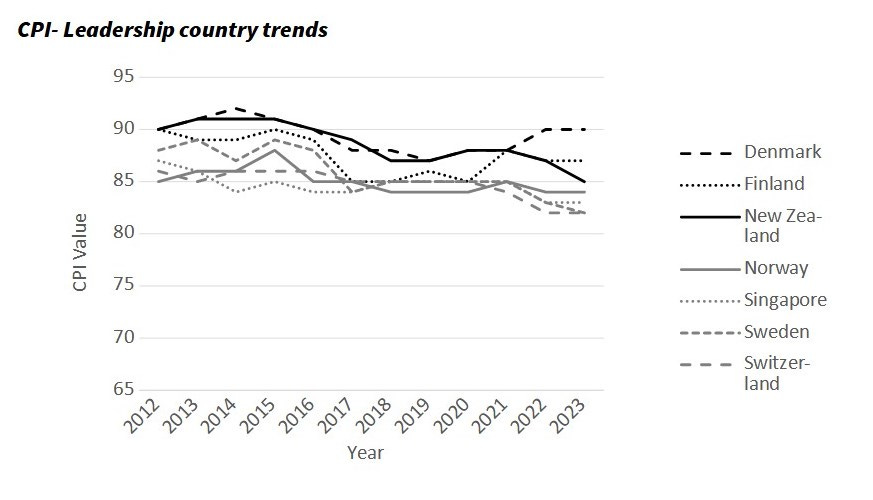
While hardly a dramatic drop, it should still be something of a wake-up call, because if you look at the trajectory over a longer period, the 2024 drop is part of a steady downward trend, especially since 2020. See the trendline below – NZ is the dark line:
Transparency International – CPI Country Trends.
Politicians may feel vindicated by our ranking as one of the least corrupt countries, but they should not be complacent. Anyone who follows politics in New Zealand closely will be well aware that there are all sorts of integrity deficits in our political system. These range from a laxness about ethical standards amongst Cabinet ministers, through to the willingness of politicians to get close to financial donors, and lobbyists coming in and out the revolving door of the Beehive.Business leaders are particularly sensitive to the growing potential for corruption in New Zealand, and it was the changing perceptions of this group that has led to the latest drop in New Zealand’s integrity score. The global “Executive Opinion Survey” is a component of generating the Corruption Perception Index (CPI). New Zealand business leaders have responded to the 2023 survey indicating that they have, according to Transparency International, reduced “confidence in government integrity systems” in this country.
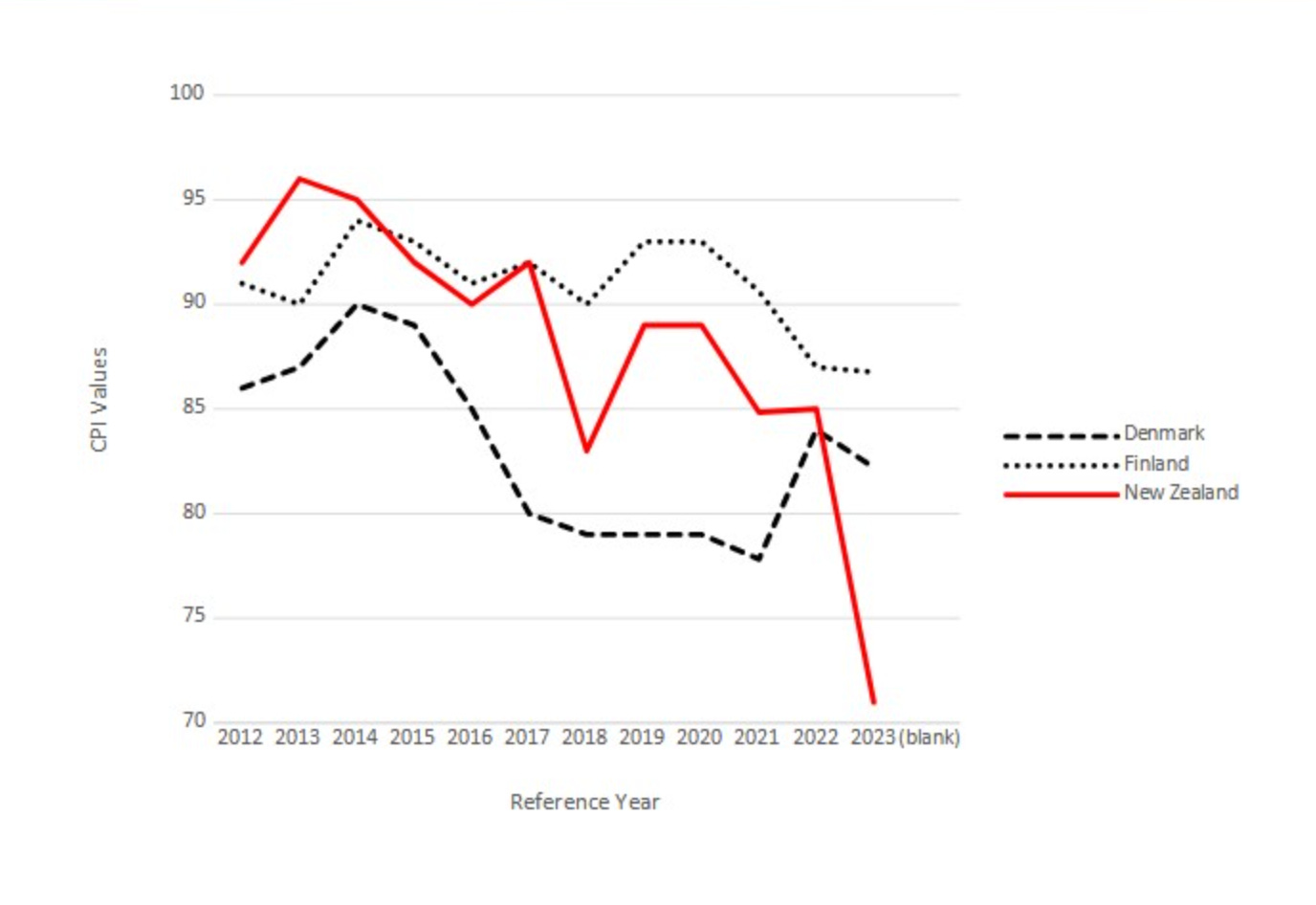
The survey asked business leaders: “how common it was for businesses to make undocumented extra payments or bribes connected with trade, public utilities, tax payments or awarding of public contracts. It also asked how common it was for public funds to be diverted to companies, individuals or groups due to corruption.”
The graph below, with the red line representing New Zealand, shows the resulting dramatic decline in the perception by business leaders that this country has low corruption:
Transparency International – CPI Values.
Arguably, such problems became much worse during the last Labour Government. But now these democratic problems – which can lead to corruption, cronyism, and a dysfunctional society – are at the office door of new prime minister Christopher Luxon. He needs to decide whether to continue as a “business as usual” leader, allowing sloppy behaviour and low ethical standards in government, or else stamp out creeping corruption and generally raise the standards in politics.
The Integrity problems of the last government
The last government was probably one of the least democratic and transparent for a long time. It had continued integrity problems, many of which contributed significantly to Labour’s demise in 2023.
It’s worth restating some of these. In just their last year in power, Labour lost three Cabinet ministers over their low standards of ethical behaviour. Michael Wood failed to resolve a conflict of interest pertaining to owning transport company shares while serving as Transport Minister, despite repeatedly assuring officials he would do so. Stuart Nash broke numerous ethical standards and had to finally go when he was found to have shared confidential Cabinet discussions with Labour financial donors. Kiri Allan was also sloppy on political donations, transgressed Cabinet rules several times, and then departed as Minister of Justice when she was arrested by the Police after a drink driving crash.
These controversial breaches were a key part of Labour’s popular decline. They made the Government look sleazy and lacking in adequate ethics. Although other issues contributed to Labour’s loss of nearly half its electoral support – such as the lack of delivery over the six years – it is clear that once the scandals involving Nash, Wood and Allan occurred, the party was electoral toast.
Other ethical lapses tarnished Labour’s reputation over its six years in power. One is particularly worth mentioning – it’s the billions of dollars that they spent on infrastructure and Covid era economy-saving efforts that have recently been criticized by the Auditor General. In a report that didn’t get enough media coverage in the lead-up to Christmas, the Auditor General published his findings into an investigation of spending since 2020, which was damning of the lack of process in the Beehive when it decided how to quickly spend $15bn on new projects.
There was a lack of records kept by ministers about how they decided on many of the projects, and a lack of concern for conflicts of interest according to the Auditor General. This means that the public still doesn’t know where a lot of the money went, nor whether it was good value for money. Massive projects were announced and launched without proper process, and often against the advice of officials.
The damning assessment suggested something was rotten in the Beehive political process. As the Auditor General John Ryan states in the report, “In a country that prides itself on the integrity of its public sector, this is something we should all be concerned about.”
This all occurred despite claims that the Labour Government would be the most transparent in history. Good intentions are clearly not enough. The problem is that each subsequent government in livable memory has been worse than the one before them. And yet each new government seems to get into office after campaigning from Opposition about the lack of transparency and integrity of incumbents. Certainly, in 2023 National, Act and NZ First leveraged Labour’s integrity shortcomings to help them win office.
Luxon should declare war on corruption, cronyism and low standards
If past patterns are any guide, then the new administration might be expected to rest on its laurels, be overly complacent, and eventually turn out to be worse than even the Labour was in terms of integrity issues. Creeping corruption and declining transparency can be expected to carry on.
It doesn’t have to be this way. Prime Minister Luxon could instead declare a war on corruption, cronyism, and low standards. And he could genuinely start dealing to lobbyists and vested interests, and spurn any advances from the financial donors that helped the three conservative parties get into power.
This month, the leader of the British Labour Party, Keir Starmer, has declared something similar – a promised “crackdown on cronyism” when he gets into government, which is likely to be this year when a general election is held. Labour is 18 points ahead of the Conservatives in the polls.
Starmer gave an agenda-setting speech for the year that highlighted the need to clean up politics, including on his own side: “I say to all my fellow politicians – Labour and Tory – to change Britain, we must change ourselves. We need to clean up politics. No more VIP fast lanes. No more kickbacks for colleagues. No more revolving doors between government and the companies they regulate. I will restore standards in public life with a total crackdown on cronyism. I’ve put expense cheat politicians in jail before and I didn’t care if they were Labour or Tory. And I grew up working class, so spare me the self-serving excuses, they just won’t wash. This ends now. Nobody will be above the law in a Britain I lead.”
Now that Luxon embarks on leading his new government, could he make a similar speech, tailored for the New Zealand Parliament?
More than just speeches, New Zealand politics also needs to be cleaned up with real changes to rules and laws. Starmer’s Labour Party is proposing some tough laws on lobbying, with the Guardian reporting that they want to shut the “revolving door” for top politicians by banning “ministers from taking lobbying, advisory or portfolio-related jobs for at least five years after they leave government.” And there will be consequences rather than just a telling-off: “Former government ministers will be fined or have their pensions docked if they breach tough new rules on lobbying”.
As well as fines for rule breakers from the political class, British Labour says it will set up a new integrity and ethics commission to monitor “ministers moving to the private sector, to judge if their new posts involved any potential conflict of interest”.
Luxon could also look to Australia where the new Labor Government is reforming public-sector whistle-blower protections and has recently established the National Anti-Corruption Commission in response to an increase in politician and public service scandals.
Standards of Beehive behaviour
The last government had more than its fair share of integrity scandals. And all too often the Prime Minister – Jacinda Ardern, and then Chris Hipkins – appeared weak in dealing with errant ministers, often allowing them second and third chances, which they usually then abused. Luxon shouldn’t make the same mistake – he should be clear from the outset that when ministers violate the rules and standards they’ll be out. And then he needs to enforce these high standards.
Signs are encouraging because Luxon chose not to give a ministerial role to MP Barbara Kuriger. In October 2022 the National MP was implicated in a conflict of interest scandal. While serving as the party’s Agriculture spokesperson, Kuriger pursued complaints against Ministry for Primary Industries staff who had brought animal mistreatment charges against her husband and son. Much of the correspondence came from her Parliamentary email address or used National Party letterhead. Kuriger was stripped of her Agriculture portfolio by Luxon.
Despite the demotion, Luxon has allowed Kuriger to continue in the National caucus. As PM he is going to have to be much tougher than that. More integrity scandals will inevitably afflict ministers as well as backbench MPs in his administration. He will be judged harshly, and his government tarnished if he’s too soft on such violations.
And if National is anything like Labour, we will see government department contracts being given to the families of Cabinet ministers. So, Luxon would be advised to warn his ministers not to get tangled in such family contracts that could look like nepotism or cronyism.
Expect more focus on MP and ministerial financial interests
All around the world, there is now greater scrutiny of politicians and any personal linkages they have with vested interests that might colour the decision-making process. The most significant trend is to look closely at what politicians own – especially any commercial companies.
Luxon would be wise to run a very tight ship in this regard. Too often in New Zealand, Cabinet Office protocols and the Registrar of Pecuniary Interests are seen as just a bureaucratic box-ticking exercise without any real enforcement or scrutiny. That’s all changed now – and conflicts of interest, sloppiness, and irregularities will be much more closely scrutinised by media and political opponents than ever before.
The Minister of Commerce and Consumer Affairs, Andrew Bayly, will be dealing with the potential regulation of some major companies and sectors. Bayly himself will need to be squeaky clean in terms of any conflicts of interest. He successfully pursued former Labour minister Michael Wood over his Auckland Airport shares, but then late last year Bayly was found to have failed to declare a conflict of his own to Parliament: he owned about $92,000 in shares of a company that contracts to government agencies. Bayly claimed because the shares were in his family trust, disclosure wasn’t required. But the rules don’t back him up about this, and Registrar of Pecuniary Interests, Sir Maarten Wevers, indicated that such ownership should indeed be declared.
Subsequently, the now-Commerce Minister has expressed unhappiness about the idea of disclosure for ministers. He told Newsroom last year that his preferred way of dealing with conflicts of interest over companies he owns would be to simply disclose this in Cabinet meetings.
There are plenty of other new ministers who have owned companies that might produce conflicts of interest if not handled properly – for example, Health Minister Shane Reti has his own medical consulting company, the Minister of Māori Development Tama Potaka has been a director in various Māori investment and farming businesses, the Minister for Courts and Associate Minister of Justice (Firearms), Nicole McKee has been involved in consultancy Firearms Safety Specialists NZ Ltd, and senior ministers Winston Peters and Shane Jones are owners and directors of business consultancy firms. These and all other ministers will need to ensure divestment or other appropriate resolution of potential conflicts of interest in their portfolios have been addressed.
Lobbying – a test case for Luxon
There are many areas of reform that the new government could progress to prove that they are on the side of increased integrity. Fixing the Official Information Act would be a good start, but it seems unlikely that any government will ever do this. For example, the last government continually made promises to improve the OIA but never got close to delivering. Furthermore, the politicisation and operating ethics of the public service desperately need to be addressed, but we are only likely to see spending cuts.
Instead, it’s the issue of corporate lobbying that democrats might have some hope for progress on. This issue has exploded onto the political agenda both globally and locally. Hence even though the last government was conflicted by links to lobbyists, last year the then prime minister Chris Hipkins instructed the Ministry of Justice to start a project reforming the sector. This was the best thing that the Labour Government did in terms of integrity issues.
Commendably, National also got on board this reform process – with Nicola Willis being reported last year as promising her government “would impose a 12-month stand down period for former ministers and introduce a compulsory register of lobbyists, rather than a voluntary code of conduct.” She also promised to introduce “a transparent, publicly accountable register of who’s doing the lobbying and who they’re lobbying for”.
However, Max Rashbrooke reports this week that the Health Coalition Aotearoa, which he is working for, received a letter from Justice Minister Paul Goldsmith saying that officials were now only working on a “voluntary” code of conduct for lobbyists. In terms of the Ministry of Justice’s project on lobbying reform, Goldsmith stated it was just “one of many priorities the Government must consider, and specifically in the Justice portfolio where it has a heavy work programme”. Rashbrooke warns: “Such language often presages abandonment”.
The conservative parties in government have made much of the fact that the country is broken and needs to be put back on track, and surely, they’re right. But in fixing the huge problems in New Zealand, you also need to fix the integrity problems in the political system, which are often the very source of these other problems occurring. Much of what goes wrong in this country begins in the Beehive, and if Luxon isn’t willing to raise the standards there, then there can’t be much hope of improvement elsewhere. The question the Prime Minister needs to answer is: “If we don’t fix the politics in the country, how are we going to fix the country?”
*******
Dr Bryce Edwards is the Political Analyst in Residence at Victoria University of Wellington. He is the director of the Democracy Project (https://democracyproject.nz)
Source: The Conversation (Au and NZ) – By John Hawkins, Senior Lecturer, Canberra School of Politics, Economics and Society, University of Canberra
Inflation has fallen for the fourth successive quarter.
Australia’s annual inflation rate fell to 4.1% in the December quarter 2023, down from 7.8% in the December quarter 2022.
The new rate is the lowest in two years and the closest in two years to the Reserve Bank’s target band of 2–3%.
The decline in inflation exceeded market expectations. Even the Reserve Bank was expecting an inflation rate of 4.5% in the year to December.
This quarterly result is consistent with the more experimental and volatile monthly measure which also shows annual inflation trending down from a high of 8.4% in the year to December 2022 to just 3.4% in the year to December 2023.
The fresh low is within spitting distance of the Reserve Bank’s target.
Price falls for clothing, household appliances, furniture, and fruit and vegetables have helped bring down inflation recently.
The government has helped by providing subsidies and rebates and other measures that have lowered or slowed the prices of electricity, rent, pharmaceuticals and childcare.
But making the task harder has been sharp rises in insurance charges (up 16.2% during 2023 following natural disasters) and tobacco prices (up 10% in part because of legislated increases in the tobacco excise).
Even after the government assistance, electricity prices still rose by 6.9%.
With vacancy rates low, and immigration adding to demand, home rents paid continue to rise. They climbed 7.3% over 2023, a figure that was moderated by an increase in the maximum rate of Commonwealth Rent Assistance.
Bureau of Statistics analysis suggests that without the increase in rent assistance, rents paid would have climbed 8.9%
Even underlying inflation is sliding
To get a better idea of what would be happening to overall prices were it not for some unusual and outsized moves, the bureau calculates what it calls a trimmed mean measure of underlying inflation.
This excludes the 15% of prices that climbed the most during each quarter and the 15% that climbed the least or fell. Watched closely by the Reserve Bank, it also shows inflation falling, down to 4.2%.
Australia gets a US inflation rate
Inflation also fell during 2023 in other Western nations including the United States, Canada and the United Kingdom.
Australian inflation took a bit longer to fall. Australia’s Reserve Bank, anxious to preserve as much employment as possible, was less aggressive with its interest rate increases.
Nevertheless, Australia’s inflation rate of 4.3% now matches the rates in the US and Canada.
Haircut inflation, dentistry inflation coming down
A pattern observed across all of these countries is that inflation in the price of goods has come down faster than inflation in the price of services.
Inflation in service prices, driven largely by wages, was slower to climb, but when it did climb took longer to fall, encouraging Reserve Bank Governor Michele Bullock to identify the prices charged by hairdressers and dentists, as well as restaurants as those that were climbing strongly.
Inflation in the price of services turns out to have been coming down sharply at the time the governor made those comments, falling from 5.8% in the year to September to 4.6% in the year to December.
Inflation in the price of dental services fell from 4.9% to 4%, inflation in the price of hairdressing services fell from 6.7% to 6.4%, and inflation in the price of restaurant meals fell from 6.1% to 4.6%
What will matter now is the ‘last mile’
Some forecasters have suggested that despite the rapid fall in inflation, the “last mile” back to the inflation target may take longer.
The International Monetary Fund doesn’t expect inflation to get back to the 2–3% range until early 2026. The Reserve Bank expects it in late 2025.
Mitigating against an early return to target might be the rejigging of the Stage 3 tax cuts to direct more to those on lower incomes who are more likely to spend them, although the treasury and private forecasters expect this effect to be minor.
Accelerating an early return to target is likely to be retail electricity prices which are set to fall in the year ahead driven by what the Australian Energy Market Operator says was a 24% fall in wholesale prices during 2022 driven by a record uptake in renewable generation.
Also contributing to an early return to target is likely to be a fall in inflationary expectations, evident in the Melbourne Institute’s expectations survey and
a decline in the number of Australians searching for the word “inflation” on Google.
Steady ahead for interest rates
As recently as November, the Reserve Bank forecast an inflation rate of 4.5% for the year to December, and it said after its December board meeting things were developing “broadly in line with expectations”.
It is now clear that wasn’t the case, and that services inflation in particular was falling faster than it thought.
This means it is most unlikely to raise interest rates when it holds its first meeting for the year on Monday and Tuesday, and unlikely to increase them again.
But any cut is likely to be some way off. An awful lot will depend on inflation from here on.
Many of us wish we could get a better night’s sleep. Wouldn’t it be great if it was as easy as a mocktail before bed?
That’s what the latest viral trend might have us believe. The “Sleepy Girl Mocktail” is a mix of tart cherry juice, powdered magnesium supplement and soda water. TikTok videos featuring the concoction have garnered hundreds of thousands of views. But, what does the science say? Do these ingredients actually help us sleep?
There is research to show including tart cherry juice in your diet improves overall sleep. Clinical trials show tart cherry juice increases sleep quality and quantity, as well as a lessening insomnia symptoms (compared to a placebo). This could be due to the presence of melatonin, a sleep-promoting hormone, in cherries.
Tart cherry varieties such as Jerte Valley or Montmorency have the highest concentration of melatonin (approximately 0.135 micrograms of melatonin per 100g of cherry juice). Over the counter melatonin supplements can range from 0.5 milligram to over 100 milligrams, with research suggesting those beginning to take melatonin start with a dose of 0.5–2 milligrams to see an improvement in sleep.
Melatonin naturally occurs in our bodies. Our body clock promotes the release of melatonin in the evening to help us sleep, specifically in the two hours before our natural bedtime.
If we want to increase our melatonin intake with external sources, such as cherries, then we should be timing our intake with our natural increase in melatonin. Supplementing melatonin too close to bed will mean we may not get the sleep-promoting benefits in time to get off to sleep easily. Taking melatonin too late may even harm our long-term sleep health by sending the message to our body clock to delay the release of melatonin until later in the evening.
We do know magnesium plays a vital role in energy production and bone development, making it an important daily nutrient for our diets. Foods rich in magnesium include wheat cereal or bread, almonds, cashews, pumpkin seeds, spinach, artichokes, green beans, soy milk and dark chocolate.
Bubbly water
Soda water serves as the base of the drink, rather than a pathway to better sleep. And bubbly water may make the mix more palatable. It is important to keep in mind that drinking fluids close to bedtime can be disruptive to our sleep as it might lead to waking during the night to urinate.
Overall, there is evidence to support trying out the Sleepy Girl Mocktail to see if it improves sleep, however there are some key things to remember:
timing: to get the benefits of this drink, avoid having it too close to bed. Aim to have it two hours before your usual bedtime and avoid fluids after this time
consistency: no drink is going to be an immediate cure for poor sleep. However, this recipe could help promote sleep if used strategically (at the right time) and consistently as part of a balanced diet. It may also introduce a calming evening routine that helps your brain relax and signals it’s time for bed
maximum magnesium: be mindful of the amount of magnesium you are consuming. While there are many health benefits to magnesium, the recommended daily maximum amounts are 420mg for adult males and 320mg for adult females. Exceeding the maximum can lead to low blood pressure, respiratory distress, stomach problems, muscle weakness and mood problems
sugar: in some of the TikTok recipes sugar (as flavoured sodas, syrups or lollies) is added to the drink. While this may help hide the taste of the tart cherry juice, the consumption of sugar too close to bed may make it more difficult to get to sleep. And sugar in the evening raises blood sugar levels at a time when our body is not primed to be processing sugar. Long term, this can increase our risk of diabetes
sleep environment: follow good sleep hygiene practices including keeping a consistent bedtime and wake time, a wind-down routine before bed, avoiding electronic device use like phones or laptops in bed, and avoiding bright light in the evening. Bright light works to suppress our melatonin levels in the evening and make us more alert.
Other common evening beverages include herbal tisanes or teas, hot chocolate, or warm milk.
Milk can be especially beneficial for sleep, as it contains the amino acid tryptophan, which can promote melatonin production. Again, it is important to also consider the timing of these drinks and to avoid any caffeine in tea and too much chocolate too close to bedtime, as this can make us more alert rather than sleepy.
Getting enough sleep is crucial to our health and wellbeing. If you have tried multiple strategies to improve your sleep and things are not getting better, it may be time to seek professional advice, such as from a GP.
Charlotte Gupta does not work for, consult, own shares in or receive funding from any company or organisation that would benefit from this article, and has disclosed no relevant affiliations beyond their academic appointment.
Source: The Conversation (Au and NZ) – By Jaya Dantas, Deputy Chair, Academic Board; Dean International, Faculty of Health Sciences and Professor of International Health, Curtin University
In recent weeks a series of measles alerts have been issued around Australia, including in New South Wales, Victoria and Queensland, after the identification of a small number of cases in travellers returning from overseas.
Meanwhile, places such as the United States and the United Kingdom have been contending with larger measles outbreaks.
In fact, the World Health Organization reported a 45-fold increase in measles cases in Europe last year, with 42,200 cases recorded in 2023 compared to 941 in 2022.
In South Asia, India and Pakistan have also recently reported outbreaks.
So what’s the risk of a larger outbreak in Australia? Fortunately it’s likely to be quite low – but ensuring we continue to have high rates of vaccination coverage is crucial.
Remind me – what is measles?
Measles is a highly infectious viral disease. It spreads through tiny droplets when an infected person coughs or sneezes. Measles is so contagious that if one infected person comes into contact with ten unvaccinated people, they can infect nine of them.
It can take around ten to 12 days for symptoms to appear after a person has been exposed to the virus. Although measles is characterised by a rash, symptoms are generally cold-like to begin with, including a fever, runny nose, fatigue, and sore or red eyes. The rash, which is not itchy, emerges two or three days later and spreads from the face down the body.
Sometimes measles can lead to secondary infections such as an ear infection, diarrhoea or pneumonia. In rare cases measles can cause encephalitis (inflammation of the brain).
In severe cases measles can lead to hospitalisation and death. We saw this in 2019 in the Pacific Island nation of Samoa. Out of 5,667 infections in a four-month period, 81 died, mostly young children.
Vaccination works
Vaccination is the most effective strategy to protect against measles. Two doses of the MMR vaccine (given to children at 12 months and 18 months in Australia) provide protection against measles, mumps and rubella.
Babies under one year have natural protection from their mums that wears off gradually. Infants six to 11 months can be vaccinated if they will be travelling internationally, but will still need to take a further two doses.
Once vaccinated, the chance of getting measles is very low and you are considered protected for life.
However, about one in 100 people who are vaccinated may still contract measles if they’re exposed to the virus. Although it’s not entirely clear why this happens, the infection in a vaccinated person is generally mild.
Vaccination rates are faltering
Globally, there has been a drop in childhood vaccinations over the course of the COVID pandemic. This is likely due to a range of factors including declining trust in vaccines, misinformation and disruptions to access.
In Europe, the proportion of children who received a first dose of the MMR vaccine dropped from 96% in 2019 to 93% in 2022, and from 93% to 91% for the second dose. This is important because about 95% vaccination coverage is needed to achieve herd immunity against measles. Under this scenario, those who are not vaccinated will be protected because the virus won’t spread.
In the UK, health authorities have expressed alarm at the number of children who have not been vaccinated, with reports up to almost half of children in parts of London have not received both shots.
As of September 2023, the Australian government reported immunisation rates across all childhood vaccinations of 93.26% for one-year-olds, 91.22% for two-year-olds, and 94.04% for five-year-olds. There are slight disparities between different states and territories and among some population groups.
Boosting vaccination coverage
While we appear to be quite close to the herd immunity threshold for measles and not in immediate danger of an outbreak, we still need to be vigilant.
Australia has an excellent outbreak surveillance in place in all states for infectious diseases including measles. But outbreaks are occurring globally, and are liable to take hold when people are unvaccinated or under-vaccinated. So we need to be alert in all states, increase surveillance at international transit points, and continue to increase immunisation coverage, especially among young children. Educating parents and the wider community about the importance of MMR vaccines is key.
It’s never too late to be vaccinated against measles if you missed out as a child, or are unsure if you’ve had two doses. As a single infected traveller can cause an outbreak, vaccination is particularly important if you travel frequently. If you’re unsure of your vaccination status, you can ask your GP or check your own or your children’s record through the Australian Immunisation Register.
If you suspect you or someone in your family is infected it’s important to stay isolated and contact your doctor. They will confirm the infection by referring you for a blood test and possibly a RT-PCR test.
The Australian department of health in collaboration with the Australian Academy of Science has developed a set of useful resources on measles which can assist travellers, the general public and health professionals.
Jaya Dantas is Professor of International Health in the Curtin School of Population Health and leads a program of research in refugee and migrant health. She is currently lead CI on grants funded by Healthway and Lotterwest and CI on a DISER grant. Jaya is the International Health SIG Convenor of the Public Health Association of Australia, has been appointed to the Committee of Women in Global Health, Australia and is on the Editorial Advisory Group of the Medical Journal of Australia. She has lived experience of infectious disease in India and Africa.
A new trend taking over TikTok is targeting vulnerable young men. The “looksmaxxing” phenomenon – to maximise one’s looks – is aimed at young men and boys who want to change their appearance to become more attractive and gain social acceptance.
Unhappy with their appearance, teenage boys and young men scrolling the app are directed to chat rooms where they’re instructed to upload photos in exchange for advice.
It begins with “softmaxxing”. This includes basic hygiene such as teeth brushing and whitening, removal of face and body hair, and “mewing” (tongue exercises that supposedly help tone facial muscles).
This progresses to “hardmaxxing”, which is to improve one’s appearance by any means necessary. More extreme measures include:
steroid use
hair transplants and plastic surgery
using pumps for penis stretching
removing ribs for a sculpted waist
“bone-smashing”, which involves using hammers to break bones in the face to look more masculine
“starvemaxxing”, which encourages extreme dieting and eating disorders
“whitemaxxing”, which involves using creams to present as more White
and “edgemaxxing”, which is described as “withholding climaxing in order to boost testosterone to improve appearance”.
Looksmaxxing may appear harmless, encouraging self-care, exercise and healthy eating. But at its core it has ties to violence, suicide and incels (involuntary celibates) – men who blame women for their struggles with establishing romantic or sexual relationships.
A click away from the incel rabbit hole
Looksmaxxing videos on TikTok have amassed many millions of views.
They pull young boys and men into a dark subculture of incels. Incel and extremist content is suggested to users on multiple platforms including TikTok Instagram and Youtube.
Within minutes, TikTok users may be bombarded with videos that promote suicide and gendered hate speech. One 2021 research report found young YouTube users will sometimes be suggested incel-related videos by YouTube’s algorithm within just five hops when starting from a non incel-related video.
‘Hunter’ versus ‘prey’ eyes
Male model Jordan Barrett has become an envied idol for men and boys following the looksmaxxing trend.
Many looksmaxxers believe having his “hunter eyes” with a positive canthal tilt (the canthal is the angle between the inner and outer corner of the eye), along with pursed lips and hollow cheeks, translates to a dominating stare women can’t possibly resist.
On anonymous incel forums, young men are trained to calculate their “sexual market value”. If they’re deemed below average, they’re bullied, accused of being “bitches who are feminine, weak and submissive, too ugly to live” and told to take their own lives.
The Bateman effect
At the apex of the incel beauty tower is the character Patrick Bateman from the 2000 satire-thriller American Psycho. Bateman is known by incels as a superior “sigma” male: a lone wolf and capitalist hustler who attracts money-hungry women.
In fact, he is shallow, manipulative, misogynistic and extremely violent. This sociopathic ideal resonates with many incels. Other characters idolised by incels include Tyler Durden from Fight Club and Joaquin Phoenix’s Joker.
Incels who feel they are misunderstood and demoralised by women also look to self-proclaimed powerful male influencers with perceived “social status”, such as Andrew Tate, for solace. Alongside messages about fitness, financial gain and self-improvement, Tate is openly misogynistic and suggests it’s socially acceptable to indulge in violent desires against women.
Bateman and incel ideology influenced self-proclaimed incel and mass shooter Elliot Rodger. In 2014, Rodger carried out a deadly mass shooting and stabbing spree in Isla Vista, California, killing six people. He blamed women for his celibacy and wanted to seek revenge by killing them.
Many misogynist incels now hail him as a hero. Some men use his initials claiming they want to “go ER” or “be a hERo”, implying they’re ready to commit mass murder.
A 2023 report from the Australia Strategic Policy Centre highlights concerning incel content online. One user says “women should be stripped of their rights because they still have primitive minds that need to be tamed”. Another says “I might start a political movement. ‘BRING BACK RAPE’ […] ‘WANNA STOP BEING INCEL, TIME TO START RAPING’.”
Researchers point to a link between trends such as looksmaxxing and the broader cultural pressures young people face. They’re growing up in an increasingly precarious world with war, post-pandemic anxiety, environmental degradation, unaffordable living and unstable employment. This is juxtaposed with neoliberal hyper-individualism, hypersexuality and consumer capitalism.
Where young people feel like they can’t control their environment, they may turn to trends such as looksmaxxing as something they can control.
In recent years, former members of the manosphere have started producing their own counter-forums that challenge the beliefs they once held.
Studies highlight young men and boys are beginning to recognise misogynistic ideology and restrictive performances of masculinity. These studies also argue these forums can offer alternative perspectives, with information that emphasises the importance of healthy socialising, consent and respectful relationships.
In the age of TikTok algorithms, schools and communities must do more to educate on masculinity, what it means to be a “man” and the dangers of incel culture, extremism, gendered hate speech and sexual violence.
Celebrities and influencers also have a role to play. Actors such as Mark Ruffalo and Ryan Gosling have helped foster positive ideas about what it means to be a man. Real, positive change can come from instilling the belief that collectively we can create a more equal and empathetic world.
Jamilla Rosdahl does not work for, consult, own shares in or receive funding from any company or organisation that would benefit from this article, and has disclosed no relevant affiliations beyond their academic appointment.
Koalas are one of the world’s most beloved animal species. They serve as symbols for everything from bushfire destruction to Australian tourism to caramel chocolate bars. These tree-dwelling marsupials get far more attention than many other endangered native species. But Australians haven’t always felt this way about our seemingly cuddly teddy-bear lookalikes. Far from it.
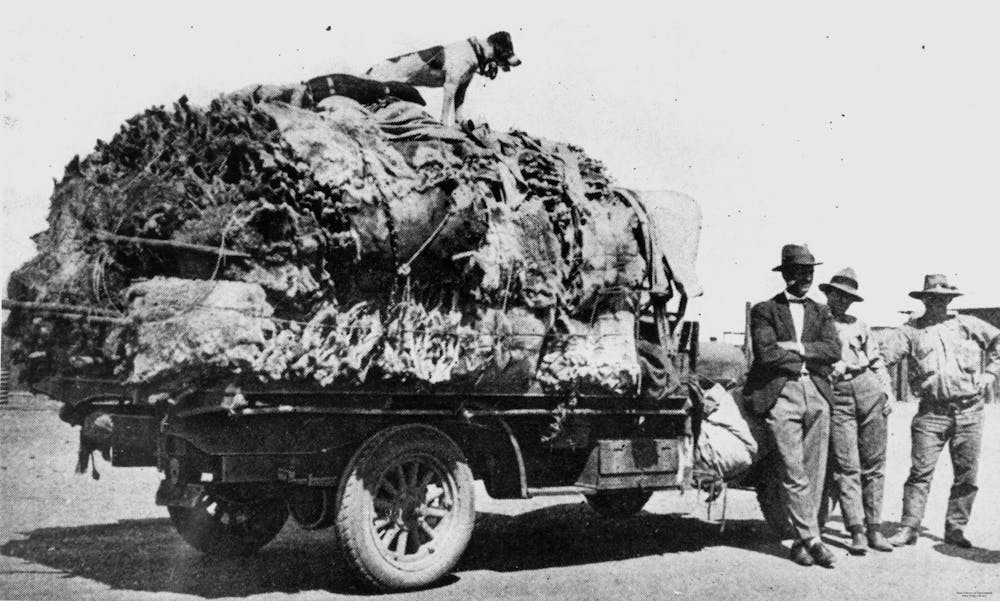
Almost a century ago, Queensland announced open season on koalas. Over the next month, well over 600,000 koalas were shot, trapped or poisoned in what has been dubbed “Black August”.
These numbers seem shocking. That figure is about the same as the total number of koalas alive today, using the most generous estimate. Today, the koala is endangered in New South Wales, Queensland and the Australian Capital Territory.
Why did it happen? Back then, koalas were far more plentiful in Queensland. And there was an established tradition of killing Australian marsupials for their pelts, which could be sold on the lucrative international fur market. At least a million koala pelts were sold in the previous 1919 open season.
As attachment to native wildlife has grown and the koala’s numbers have dwindled, we have come to think very differently about this creature.
Even in 1927, the koala kill was a gamble. Other koala-inhabited states had stopped licensed koala kills, alarmed by plummeting numbers caused by the fur trade, deforestation, bushfire, and disease. As early as the 1880s, worried locals shipped koalas to French Island near Melbourne as an insurance policy against fire and disease. Today, as historian Danielle Clode has written, koalas in South Australia and Victoria are largely descended from these island refugees.
So why did Queensland launch its kill? The economy was not doing well, and the Labor government hoped the open season would tackle high unemployment rates, raise revenue and win votes. Warm, waterproof koala fur was prized in Europe and the United States, where it was put to use in coats, gloves and even sleeping bags.
But the open season came as a shock to many. Scientists knew koala populations were already plummeting at the beginning of the twentieth century. And among the public, affection was growing for the koala.
The backlash was swift – and intense. Brisbane’s Anglican Archbishop Gerald Sharp called for protest, and a remarkable range of organisations responded, from city and shire councils to religious groups, women’s organisations, universities, scientific bodies, returned soldiers and children’s scouts groups.
The Brisbane Courier newspaper ran a “Spare the Bear” campaign, publishing hundreds of protests from indignant readers. Angry constituents deluged the acting premier, William Forgan Smith, with letters. Some deplored the cruelty of hunters who left baby koalas attempting to suckle from their dead, skinless mothers. Others focused their anger on the government. One caustic letter writer suggested an “open season for Cabinet Ministers” might be more appropriate.
Critics were united in their disgust at the mass killing of such a “lovable, non-destructive and quite unique little native animal” which posed no threat to human interests. Koala trappers had their masculinity questioned – no “true Bushman” would kill a defenceless animal.
We should be sceptical about one letter writer’s claim that “99% of Queenslanders” opposed the killings. But opposition was powerful and widespread.
The government tried to blame the furious response on out-of-touch city dwellers who did not live in Queensland. In fact, locals dominated the protests. At the time, many rural families kept koalas as beloved pets, which made the thought of killing them even more outrageous.
The backlash against the koala cull was fast – and intense. Garnet Agnew, The Queenslander, September 22nd 1927/State Library of Queensland, CC BY-ND
A question of national identity
When British colonists first came to Australia, many found the native animals freakish and backward. One unimpressed naturalist called koalas “torpid and senseless” and doubted their place in “God’s plan”.
But by the early 1900s, koalas, emus and kangaroos were becoming national symbols. They seemed to represent Australia’s new status as a federated nation, and helped settlers feel connected to the land. There was also a growing awareness that native species needed protection from environmental threats.
Books such as Norman Lindsay’s Magic Pudding (1918) encouraged readers to care for native animals. In 1925, James Barrett published a book begging for the “right use of our flora and fauna” and stressing their endangered state. He titled it Save Australia.
Perhaps because of their baby-like features, koalas were often depicted by authors and illustrators as good-natured and childlike friends. (In reality, they can be quite grumpy and their screams at night startle many campers). This might explain why fewer people protested to protect possums, the furs of which were also sought during open seasons.
The 1927 koala open season would be Australia’s last. After the backlash, the koala was finally afforded lasting protection in Queensland. The acting premier promised to restock areas stripped of native animals. Even so, the government lost the election it had been trying to salvage.
Hundreds of thousands of koalas were killed before the government reversed course. Newspapers reported an estimated 600,000 koalas died due to the “massacre”, but this doesn’t account for koalas whose skins were not sold to dealers or young koalas killed with their parents or who starved without them. The total is likely close to 800,000.
The movement against koala-killing was perhaps the first organised conservationist campaign in Australia. It fostered the creation of wildlife societies, campaigns for national parks and nature studies for school students.
You can see the evidence even today. Sydney man Noel Burnett was so appalled by the killing that he opened his own sanctuary, Koala Park, which is still operating.
And whenever news breaks about koala deaths in blue gum plantations, we respond with outrage.
New threats, old choices
Today, koalas are safe from hunters. They’re so well known we use them as cuddly diplomats, similar to China’s panda diplomacy. But they face new threats – increasingly severe bushfires, disease, and habitat destruction.
Even as we have grown to love koalas, we have not yet been able to save them. It is now entirely possible these beloved national symbols could be facing a preventable extinction.
Ruby Ekkel does not work for, consult, own shares in or receive funding from any company or organisation that would benefit from this article, and has disclosed no relevant affiliations beyond their academic appointment.
China’s football dreams have again suffered a huge blow, with the men’s national team exiting the 2024 Asian Cup in the group stage without scoring a goal.
It’s just the latest embarrassment on the international stage for a team that last qualified for the World Cup more than 20 years ago.
After China’s top leader Xi Jinping declared a decade ago that he wanted the country to become a football superpower, billions of dollars were spent to lure top talent from abroad to China’s domestic football league and to build schools and football fields around the country.
How did the Chinese men’s football team reach this dismal state, and where does it go from here?
Economic short-termism leads to mismanagement and corruption
In response to former leader Deng Xiaoping’s famous 1992 “Southern Tour”, which reinvigorated the country’s economic reform agenda, the Chinese Football Association (CFA) decided to detach from the National Sports Committee and embrace market forces.
Before that, Chinese football operated under the so-called “whole nation system”, relying on the government to allocate resources to teams, including athlete training and funding. Although player salaries weren’t high, the system helped produce the the so-called “golden generation” of Chinese football stars and made China a major contender in Asia.
The establishment of the Chinese Professional Football League in 1994 led local football associations and teams to break away from the central government administration and source their own funding.
This, in turn, ignited the passions of Chinese football fans, who rallied behind local clubs. Football players became celebrities overnight. For instance, among fans of the team Sichuan Quanxing, a saying about two players became popular: “Girls should aspire to marry a hero like Wei Qun and aim to raise a son who follows in the footsteps of Yao Xia.” (嫁人要嫁魏大侠,生儿要生小姚夏).
A Chinese football crowd in Sichuan province in the late 1990s. Ye Xue
Generous investments and sponsorships led to a significant increase in players’ incomes. By 1998, top-division players were earning a minimum annual income of 100,000 yuan (A$18,000), a staggering 20 times more than the average citizen. Some star players earned more than 1 million yuan (A$180,000).
Amid this flourishing environment, from 1996 to 2000, the number of registered youth football players in China surged beyond 600,000. Chinese fans believed the dynamic domestic football scene would propel their national team to greater heights internationally.
However, beneath the surface, the relationship between capital and clubs was unhealthy, as the teams became heavily reliant on funding from parent companies. This laid the groundwork for the eventual downfall of Chinese professional football.
The focus on short-term gains led to much mismanagement and corruption. By the early 2000s, the Super League faced issues such as match-fixing, biased refereeing, waning public interest and a constant reshuffling of club ownership. This pushed some clubs to the brink of dissolution and left players grappling with unemployment.
The aftermath was swift – registered youth football players in China reportedly dropped to a mere 180,000 in 2005 and reached just 7,000 by 2010.
Political opportunism foils another reform attempt
After the Evergrande Group, a massive real estate company, took over the Guangzhou Football Club in 2010, numerous companies entered the football market and spent lavishly on internationally renowned players.
This renewed enthusiasm was believed to be fuelled by the eagerness of local governments and businesses to align with Xi’s personal interest in the sport and his aspirations for the advancement of Chinese football.
In 2015, a key agenda-setting commission in the Communist Party sanctioned a central reform plan to boost the development of football in China. This approval underscored the belief that the “Chinese dream” of achieving the great rejuvenation of the nation was closely tied to the development of football.
This new government attention on football encouraged financial investment (again) to revitalise the Chinese football industry, resulting in a significant surge in salaries and benefits for players.
In 2018, the average annual income for men’s football players reached more than US$1 million per year (A$1.5 million), exceeding the average wage in China by more than 160 times.
While the professional league’s revival didn’t immediately elevate the men’s national team’s performance, it improved the perception of the sport among parents. In 2016, the number of registered youth players under the CFA surged to more than 40,000. The organisation set a target of reaching one million young players by 2020.
However, this prosperity, rooted in political opportunism, proved to be delicate and unsustainable. The economic downturn in China, the introduction of transfer cap, the COVID pandemic and the CFA’s decision to remove corporate references from club names significantly subdued investors’ enthusiasm for football.
Consequently, the Chinese professional league once again faces intractable obstacles. Since 2020, professional clubs have been disbanding annually as investors have withdrawn their funding. The former CFA chairman, Chen Xuyuan, has been charged with bribery, while former national team coach Li Tie has admitted to paying bribes and match-fixing.
All of this will only further undermine the public’s confidence in Chinese football. Parents are again questioning whether to encourage their children to play the sport. There are many signs that youth participation has declined sharply over the past three years.
Chinese football authorities should know now what doesn’t work. The marketisation of football and rampant financial investment driven by political opportunism didn’t work. Flooding the league with foreign stars didn’t work, either.
Perhaps it’s time for the state to take a more prominent role again, possibly even revisiting the “whole-nation system”. Transforming football into a stable and visible career pathway could, at the very least, inspire more Chinese youth to actively engage in the sport.
And this, in turn, could one day create a winning men’s national team, as well.
The authors do not work for, consult, own shares in or receive funding from any company or organisation that would benefit from this article, and have disclosed no relevant affiliations beyond their academic appointment.
Young workers under 18 years of age occupy a unique and poorly understood position in Australia’s labour market.
They contribute to crucial industries and the economy, but are uniquely vulnerable. Compared to adults, child workers experience high rates of workplace injuries, bullying and sexual harassment, wage theft and unpredictable hours.
In Victoria alone, franchises currently face hundreds of criminal charges over alleged breaches of child employment laws, including shift lengths, break times and employing children after 9pm.
Protective regulations are insufficient and highly inconsistent across states and territories. Compounding this, few resources are directed to agencies responsible for monitoring the safety and quality of children’s work.
Different types of children’s work
In industrialised countries such as Australia, we use the term “children’s work” rather than “child labour”, which refers to work outside international legal frameworks that is harmful to physical or mental health.
Positive workplace experiences can help develop young people’s identities, career aspirations, financial skills and sense of responsibility.
The most visible child workers are employed in cafes, retail stores and fast-food outlets as apprentices or trainees.
Children also often do paid, informal jobs such as babysitting, dog walking or lawn mowing or work in family businesses such as farms and family-owned restaurants. This work is largely unmonitored, and in many states, is exempt from child employment legislation.
Another emerging form of work is content creation, where children and adolescents with large social media followings earn money by posting sponsored content, or feature on a parent-controlled platform.
The work of “kidfluencers” is not protected under Australian law, and there is no oversight of working hours or of content created, despite potential online harassment, abuse and body-shaming.
Children’s participation in elite sport can also be considered work because training can be extreme and young athletes may be subject to commercial contracts similar to professional athletes. There are currently no Australian or international legal provisions related to the duration and intensity of training regimes.
Finally, children can be self-employed. A child can acquire an ABN on their own behalf from the age of 13. However, a lack of negotiating experience may make them vulnerable to coercion into unfair contracts with brands and talent agencies.
Patterns of work undertaken by children
It is unclear how many children are employed in Australia at any given time.
The Australian Bureau of Statistics (ABS) collects data on employed people aged 15 and over but only reports occupation by the aggregated category of 15-24 years. The last ABS survey on employed children aged 5-14 years was completed almost two decades ago in 2006.
Other Australian surveys estimate labour force status only for people aged 18 to 64, or place limited focus on child employment. Indeed, the International Labour Organisation has lamented the lack of data on child employment in industrialised countries.
What is clear however, is most young Australians do not transition from education or training to work, but instead, combine part-time work and study, often for many years before reaching adulthood and working full-time.
Research suggests children are more likely to work if they are girls and from English-speaking backgrounds and from higher socioeconomic groups.
This may be explained by the gendered and classed preferences of the service industry which includes positions in fashion, retail and cafes where deferential, well-presented and engaging young employees are preferred.
Although there are some regulations restricting work in hazardous jobs, child workers in cafés and restaurants may still be expected to use dangerous equipment such as knives, hot ovens or deep fryers. Even when young people are aware of their health and safety rights, their capacity to redress violations may be limited.
Children want to work to gain skills and experience, enjoy social contact and earn money for discretionary spending. However, an estimated 10% work out of financial necessity, making vital contributions to low-income households.
However, while Australia’s Fair Work Act contains clauses such as ensuring minimum wages for junior employees, it has an express exemption for children under 18, allowing states and territories to self-regulate.
Other laws relevant to children’s work prevent children being employed during school hours or restrict hazardous work such as scaffolding or crane and forklift operation. There are also restrictions on very young children participating in some forms of public entertainment and measures deterring underpayments.
What changes are needed?
Currently, Australian regulation and policies governing work for minors are not fit for purpose, a problem compounded by children’s limited knowledge of relevant rights and obligations.
There is an urgent need to develop new protections and where possible, make the current patchwork of Australian laws relevant to children’s work more uniform. Particular attention should be given to minimum starting ages, participation in risky occupations, working hours relating to age or schooling, and requirements for employers such as working with children checks.
Government and non-government agencies also have a role to protect young workers by setting responsive guidelines, codes and industry standards and implementing strategies to respond to problems.
There is no doubt children in some parts of the world are subjected to dangerous and exploitative practices that would rarely be seen in Australia.
However, our current understanding of the diversity and quality of work experiences of children and adolescents in Australia and other industrialised countries is severely limited by longstanding data deficits. Addressing this problem can establish a platform from which Australia can call on all nations to end hazardous child labour.
The significance and urgency of reforming policy and practice is amplified by profound changes impacting the world of work in which young people participate including the deregulation of trading hours, growth in franchises and work that is increasingly managed via automated technologies.
Child and adolescent labour is integral to the economy, yet their work experiences are complex. Comprehensive reforms will help safeguard the current generation of young workers and ensure a future where their dignity, rights and well-being are respected and protected.
Paula McDonald receives funding from the Australian Research Council.
Call them pet peeves, call them petty grievances, one thing is certain – complaining about everyday irritations feels cathartic. It’s also the premise of American comedy podcast I’ve Had It.
Hosts Jennifer Welch and Angie “Pumps” Sullivan state, tongue in cheek, that their goal is to compartmentalise complaining and be nicer in their day-to-day life. Their complaints range from pedestrian (cordless vacuums, people who clap when a plane lands, long Instagram captions) to political (the state of the education system). Eyebrow-raising complaints include, simply, “pregnant people”.
Since launching in late 2022, I’ve Had It has topped Apple’s podcast charts, become viral on both TikTok and X several times, and has led the hosts to guest-star on programs such as The Today Show. This podcast’s popularity across platforms signals a cultural shift from “toxic positivity” to indulgent pettiness – but a shift away from positivity into fully embracing complaints is not without risk.
Toxic positivity and emotional influencers
As community-minded creatures who want deeply to belong we often mirror others, including on social media, where we adopt phrasing, tone and expressions of emotion.
In the past few years, social media has had a focus on hyper-positivity (think cheery emojis and motivational quotes plastered over sunsets). Some put this “good vibes only” trend down to the pandemic and a desire to avoid painful feelings when ruminating on difficult realities.
However, attempting to convey constant happiness is not only difficult but impossible. Research suggests prescriptive positivity can make us react poorly to unfavourable emotions and is a “goal that backfires” when people view themselves as a failure for feeling unhappy, struggle to handle their feelings, or actively avoid processing them.
The I’ve Had It hosts are in a new wave of content creators we can consider “emotional influencers”, in this case contributing to a new media landscape where complaining is not only embraced but encouraged.
This community aspect of complaining suits podcasting, which fosters intimacy through sharing deeply personal stories “directly into our ear” and “chosen just for you”.
Listening to hosts who feel like our friends, who are friends themselves, having a chat and sharing laughter can make us feel socially fulfilled in a similar way to a video chat or virtual message with a real-life friend.
In I’ve Had It, the hosts and their guests share personal complaints and unfiltered stories in a curated approach for bond-forming. We know, for example, that Jennifer’s husband Josh (a regular guest) has struggled with addiction and that Jennifer has “had it” with family week at his rehab centre. We also know Pumps once tried to relieve constipation with a teaspoon.
Executive producer Kiley has become a regular feature, laughing at the hosts’ antics and acting as an audience surrogate. Fans are involved in the show via voice messages, reviews and as guests themselves.
These elements combine to provide a sense there is potential to become “real life” friends with Jennifer and Pumps: the promotional tagline for their live shows is “make your parasocial friendship real”.
While complaining brings people together, it can also push us apart through ostracisation or rejection. Although the goal of I’ve Had It is to compartmentalise pettiness, this may be easier for the hosts than the listeners.
Jennifer and Pumps are two undeniably affluent, well-connected women who have leveraged their privilege to build a platform about complaining. They also amp-up their on-air personas, with Jennifer admitting, “I’m not as cold-hearted as I play on the podcast”.
Just like prescriptive positivity can become “toxic” when it comes at the expense of other emotions, an overemphasis on grievances can breed negativity, or lead to passsive-aggressive and indirect communication styles.
Some commenters are critical of Jennifer and Pumps’ promotion of negativity. The hosts see this as fodder. They read critical reviews, double-down on complaints and laugh together, cleverly disarming the criticism.
Jennifer and Pumps are even more eager to mock those who take issue with their political views. In response to a reviewer accusation that they’re “both a couple of leftist idiots” the pair laugh. Jennifer states, “I could not agree more […] I say thank you, we are leftist, we are idiots”.
Ultimately, I’ve Had It concedes there is a kind of “idiocy” to pettiness, but there is joy and charm too.
Research suggests happy people can be complainers, as long as they have a good grasp of mindfulness and know when to stop.
If you, admittedly like me, enjoy a good bout of complaining now and again, but want to keep your emotions balanced and your relationships intact, there are a few things the experts recommend. It is important to differentiate when you need to enact “expressive complaining” to blow off steam or when you should complain “instrumentally” with a goal in mind. Talk about how something makes you feel, so others can emphasise with you. And ask your loved ones’ permission to complain before revving up a rant.
What about those who aren’t keen on complaining at all? Well, as far as the hosts and fans of I’ve Had It are concerned, you need not tune in. And, if you do decide to leave a comment decrying their pettiness, be warned it will make for some great content in the next episode.
Marina Deller does not work for, consult, own shares in or receive funding from any company or organisation that would benefit from this article, and has disclosed no relevant affiliations beyond their academic appointment.
Source: The Conversation (Au and NZ) – By Julia Powles, Associate Professor of Law and Technology; Director, UWA Tech & Policy Lab, Law School, The University of Western Australia
Parking, and the enormous amount of space we cede to it, is undergoing two revolutions. The first is the rise of parking apps. The second is a reckoning with whether we really need so much parking, and what else we could do with all that space.
In the middle of both revolutions sit drivers. Apps like EasyPark, CellOPark and PayStay promise efficiency through pay-as-you-go parking, adjusted to the minute and location via a smartphone app.
Drivers avoid the fuss of meters and overpaid or overrun tickets, and parking operators get easy-to-monitor databases. Meanwhile, app providers take a handsome per-session fee in the order of 5–12%, depending on the provider.
Councils and campuses have been sold the trick, festooning parking signs with QR codes, “parking is changing” declarations, and discreet signals of outsourced responsibility.
But who is behind these apps? Are we getting a good bargain? And what does it mean for us and our cities?
Rise of the parking apps
Parking apps have been around since the 2000s, with the Australian market picking up strongly in the last five years. Three of the most common apps are EasyPark, CellOPark and PayStay. In New South Wales, there is also a government-backed app, Park’nPay.
EasyPark is a Scandinavian export, now owned by private equity firm Vitruvian Partners. Tactically, EasyPark Australia’s spread through a city can feel like a stack of dominoes. In Perth, the app popped up in a string of outer councils before closing in on the prized centres of Stirling and Perth.
EasyPark is one of several parking app providers in Australia. The Conversation
Encircled by EasyPark’s magenta signs, the service’s most recent adoptee is the University of Western Australia (the author’s home institution). Their competitor CellOPark didn’t get a look in, despite operating in the state for over a decade, including just down the road at Curtin University.
Australian-headquartered CellOPark services over 75% of Australian universities offering a parking app. Its service fee is 6% to EasyPark’s 11.5%, and it integrates directly with university authentication systems.
Terms of the bargain
App providers deserve payment as much as the next business. But parking apps strike deals that go beyond convenience, so we need to assess them fully and transparently.
There are several key considerations. The first – parking apps generate honeypots of detailed information on people and their movements. This presents new privacy costs and risks, as experienced by EasyPark’s European customers when home addresses, phone numbers, emails, scrambled passwords and partial financial information were stolen in a December 2023 hack. (The company claims no parking data was accessed in the breach.)
Those wanting to offer parking apps must determine precisely what data the apps collect, where it goes and what is done with it. They should conduct thorough risk assessments on potential data misuse. Preferably apps should maintain customer and location information encrypted and on-device, reducing the risk of improper third-party access.
Second, we need proper “value for money” assessments to address how parking apps cut into public revenue without significantly reducing costs (parking inspectors still patrol, and digital meters still need maintenance). Councils and campuses must publicly justify the trade-off – money paid to app providers reduces budgets for building public amenities or supporting core business.
In sum, there should be complete, public assessment of the financial, privacy, access and inclusion implications of adopting parking apps. To prevent underhanded dealing, councils and campuses should also enable open competition between apps, as Mosman Council has done in Sydney.
Parking is primal and paradoxical
Beyond data privacy and revenue implications, there is a more fundamental matter. Parking apps have a vested interest in an abundance of parking, it’s their core business.
But one of the most significant economic and environmental revolutions underway in cities is a radical reassessment of what we’ve sacrificed in pursuit of parking.
If we want long-term thinking about how to rescue and reimagine cities, we need to think beyond the apps.
Every driver feels they deserve “rockstar” parking, ideally right at their destination, secure and free – and they’re aggrieved if they can’t have it. Behind the wheel, we assume a universal impatience, intolerance and entitlement. It simmers above the unspoken anxiety of not being able to park.
A quiet street tightly lined with parked cars, like this one in Footscray, Melbourne, is a common sight in many Australian suburbs. doublelee/Shutterstock
Since the 1950s, cities have been defined by their valiant efforts to cater to these base instincts.
We have paved them with carparks, relinquishing wetlands, parklands and foreshores. We have foregone housing and public amenities, all to ensure optimal storage of high-emissions private property.
Superficially, better managing the supply of parking presents a perfect union with parking apps. Real-time management is just the kind of technocratic petri dish where apps love to breed.
Yet scratch the surface and you’ll find the apps are locking in the status quo. They further subordinate people and places to the primacy of parking.
The great paradox is that while parking is both objectively abundant and an exorbitant tax on everyone, no driver is satisfied. So we build more parking, and download more apps, and our cities become less liveable.
Julia Powles’ research centre, the UWA Tech & Policy Lab, receives support from nationally competitive research grants. She was not involved in her employer’s engagement of EasyPark as the University’s parking provider.
Democracy faces challenges around the globe in 2024: at least 64 countries will ask their citizens to elect a government this year.
One of the most keenly observed will be the United Kingdom general election, likely to be held in November. The British Labour party has not won an election since 2010, and has lost the last four elections. At the last election in 2019, it was beaten handsomely.
The 2019 result saw the Conservatives win 365 seats of the 650 seats in the House of Commons, while Labour limped in with 202 seats. At that point, Boris Johnson was an immensely popular political leader, single-handedly delivering the Conservatives a historic win.
Famously, Johnson broke down part of Labour’s “red wall” seats – historically safe Labour seats in parts of Northern England. With Johnson’s emphatic win, and Brexit “done”, one writer predicted a further “decade of conservative dominance”.
Yet, the decade of conservative dominance did not arrive, and on current reading the Conservatives look destined for opposition. The most recent poll confirms Labour’s long-standing 20-point lead over the Conservatives (45%-25%). Since the Brexit Referendum, there has been unprecedented volatility in British politics – not dissimilar to the leadership churn in Australia.
Since the 2016 referendum, the Conservatives have chewed through five different leaders from David Cameron to Rishi Sunak. Each successive leader has been ensnared in a range of crises, from Theresa May’s record common defeats over Brexit, Johnson’s handling of COVID, Sunak’s problems with inflation, and of course, the blitzkrieg politics of shock and incompetence of Liz Truss. The Conservative party has fragmented and factionalised, with the hardline right pushing to veto key policies.
The volatility has led to wider governing instability. Since 2019, there have been five home secretaries, and a remarkable six chancellors (the role of federal treasurer in Australia). This turmoil takes an incalculable toll on effective government, as policy settings continuously change, and the public service are left reeling in the aftermath. For the Johnson government in particular, personal loyalty and factional support trumped appointing competent ministers.
The case of Priti Patel is instructive. She was forced to resign as minister for international development in the May government in 2017 after it emerged she had not been candid about unofficial meetings with Israeli ministers, businesspeople and a lobbyist.
Despite breaching the Ministerial Code of Conduct for allegations of bullying staff, she later became home secretary in Johnson’s government.
The political in-fighting and instability in the Conservative party fuelled volatility, which in turn has lead to voter disaffection. Suella Braverman is the other striking example, initially appointed home secretary under Truss, she also breached the ministerial code by sharing an official document from her personal email address. Sunak later appointed her home secretary, in part to appease the hard right of the party. However, in office, she proved to be a political liability, and was dismissed by Sunak.
The turbulence has been highly damaging for Sunak. Any political leader needs clean air to reset the agenda, but his government has been mired. He aimed to shape his agenda around five key priorities. One year on, one report card suggests he had only achieved one of these goals, and the critical ones (especially on immigration) are “off track”.
Immigration is the political battlefield the Conservatives will hope will help them, along with an improving economy, to help them retain office. The resonances here with Australian politics are all too familiar, and Sunak will be hoping for a repeat of the Liberals’ emphatic “dark victory” at the 2004 election. However, Sunak is widely seen as out of touch with the wider public – his and his wife’s vast wealth has been the subject of much commentary.
This year’s election, then, looks increasingly like one Conservatives will lose – but it remains to be seen how well Keir Starmer’s Labour can win it. For some time, Labour has held a solid 20-point lead over the Tories in the polls, yet to take office, Starmer will need a record 12.7% swing. Starmer’s team will take inspiration from Anthony Albanese’s 2022 win in Australia, a solid election result off the back of a crumbling centre-right government, but hardly an emphatic victory. The lesson there is that you need to win seats, not necessarily the vote share.
The dilemma for Starmer is that he was elected leader in 2020 promising to fulfil much of Jeremy Corbyn’s agenda. However, since that time, he has been seeking to recalibrate and reduce the range of his policy agenda.
Much of his energy has also been used to diminish the influence of the Corbyn-ite left in the party. While there is much long-term ambition in his five “missions”, some are light on detail, and others rely on luck.
Long-term Labour politician and scholar Jon Cruddas’ lament is that Starmer’s vision is detached from Labour’s history. Labour looks set to take office, but it could be off the back of a large scale disaffection from the wider public, with voter turnout likely to decrease for the third election running.
Rob Manwaring does not work for, consult, own shares in or receive funding from any company or organisation that would benefit from this article, and has disclosed no relevant affiliations beyond their academic appointment.
It’s a shock when we realise our parents aren’t managing well at home.
Perhaps the house and garden are looking more chaotic, and Mum or Dad are relying more on snacks than nutritious meals. Maybe their grooming or hygiene has declined markedly, they are socially isolated or not doing the things they used to enjoy. They may be losing weight, have had a fall, aren’t managing their medications correctly, and are at risk of getting scammed.
You’re worried and you want them to be safe and healthy. You’ve tried to talk to them about aged care but been met with swift refusal and an indignant declaration “I don’t need help – everything is fine!” Now what?
Getting help and support at home can help keep Mum or Dad well and comfortable without them needing to move.
Consider drawing up a roster of family and friends visiting to help with shopping, cleaning and outings. You can also use home aged care services – or a combination of both.
Government subsidised home care services provide from one to 13 hours of care a week. You can get more help if you are a veteran or are able to pay privately. You can take advantage of things like rehabilitation, fall risk-reduction programs, personal alarms, stove automatic switch-offs and other technology aimed at increasing safety.
Getting Mum or Dad to accept paid help can be tricky. Many families often have multiple conversations around aged care before a decision is made.
Ideally, the older person feels supported rather than attacked during these conversations.
Some families have a meeting, so everyone is coming together to help. In other families, certain family members or friends might be better placed to have these conversations – perhaps the daughter with the health background, or the auntie or GP who Mum trusts more to provide good advice.
Mum or Dad’s main emotional support person should try to maintain their relationship. It’s OK to get someone else (like the GP, the hospital or an adult child) to play “bad cop”, while a different person (such as the older person’s spouse, or a different adult child) plays “good cop”.
3. Understand the options when help at home isn’t enough
If you have maximised home support and it’s not enough, or if the hospital won’t discharge Mum or Dad without extensive supports, then you may be considering a nursing home (also known as residential aged care in Australia).
Every person has a legal right to choose where we live (unless they have lost capacity to make that decision).
This means families can’t put Mum or Dad into residential aged care against their will. Every person also has the right to choose to take risks. People can choose to continue to live at home, even if it means they might not get help immediately if they fall, or eat poorly. We should respect Mum or Dad’s decisions, even if we disagree with them. Researchers call this “dignity of risk”.
It’s important to understand Mum or Dad’s point of view. Listen to them. Try to figure out what they are feeling, and what they are worried might happen (which might not be rational).
Try to understand what’s really important to their quality of life. Is it the dog, having privacy in their safe space, seeing grandchildren and friends, or something else?
Older people are often understandably concerned about losing independence, losing control, and having strangers in their personal space.
Sometimes families prioritise physical health over psychological wellbeing. But we need to consider both when considering nursing home admission.
Research suggests going into a nursing home temporarily increases loneliness, risk of depression and anxiety, and sense of losing control.
Mum and Dad should be involved in the decision-making process about where they live, and when they might move.
Some families start looking “just in case” as it often takes some time to find the right nursing home and there can be a wait.
After you have your top two or three choices, take Mum or Dad to visit them. If this is not possible, take pictures of the rooms, the public areas in the nursing home, the menu and the activities schedule.
We should give Mum or Dad information about their options and risks so they can make informed (and hopefully better) decisions.
For instance, if they visit a nursing home and the manager says they can go on outings whenever they want, this might dispel a belief they are “locked up”.
Having one or two weeks “respite” in a home may let them try it out before making the big decision about staying permanently. And if they find the place unacceptable, they can try another nursing home instead.
You might need to have multiple conversations about aged care. CGN089/Shutterstock
4. Understand the options if a parent has lost capacity to make decisions
If Mum or Dad have lost capacity to choose where they live, family may be able to make that decision in their best interests.
If it’s not clear whether a person has capacity to make a particular decision, a medical practitioner can assess for that capacity.
Mum or Dad may have appointed an enduring guardian to make decisions about their health and lifestyle decisions when they are not able to.
An enduring guardian can make the decision that the person should live in residential aged care, if the person no longer has the capacity to make that decision themselves.
If Mum or Dad didn’t appoint an enduring guardian, and have lost capacity, then a court or tribunal can appoint that person a private guardian (usually a family member, close friend or unpaid carer).
If no such person is available to act as private guardian, a public official may be appointed as public guardian.
Deal with your own feelings
Families often feel guilt and grief during the decision-making and transition process.
Families need to act in the best interest of Mum or Dad, but also balance other caring responsibilities, financial priorities and their own wellbeing.
Lee-Fay Low has received funding from aged care providers HammondCare, and The Whiddon Group, and collaborated with HammondCare, The Whiddon Group, BaptistCare, Catholic Heatlhcare, Scalabrini Aged Care, Montefiore Aged Care, Chinese Association of Social Services, Multicultural Care, Australian Nursing Home Foundation, Summitcare and Silverchain.
She has also received funding from the NHMRC, MRFF, Dementia Australia, NSW and federal governments.
How long does it take to build a solar or wind farm? It’s a simple question with wide implications. To reach our ambitious 82% renewable energy target by 2030, we have to build many new projects – and start them soon.
In 2022, renewables hit a new high of 36% of Australia’s total electricity production, double that of 2017. That’s good – but there’s a long way to go.
Hitting the national target will require building about 40 wind turbines (7 megawatts) every month, and 22,000 solar panels (500 watt) every day.
At the start of the year, climate minister Chris Bowen called on all levels of Australian government to speed up planning decisions for renewable energy projects.
Reaching our target depends on one little-researched factor: completion time.
Solar and wind projects are built much faster than large fossil-energy plants. But the pre-construction approval process can be complex and slow projects down. In new research, my colleague and I found completion times have fallen significantly in recent years. But we need to go even faster to achieve the 2030 target.
How long does it take to complete renewable energy projects?
Very few studies have explored renewable energy lead times across a group of renewable projects in Australia or elsewhere. We investigated completion times for 170 onshore wind and solar projects completed in Australia between 2000 and 2023.
Using a data set we built, we found welcome news: Australian renewable projects are being built significantly faster.
Taking an onshore wind farm from idea to reality now takes about 53 months. This is substantially faster than wind farms started before 2016, which took more than 88 months. Obtaining pre-construction approvals and planning took up most of that time.
Solar projects now take about 41 months. It used to be double that, at up to 83 months before 2011.
Overall, there has been a decrease in solar lead times. Due to recent regulatory changes, the time taken for the construction and final stages has increased from 18 months to 21 months.
What does it take to build a solar or wind farm?
We break project lead times down into three stages:
1. Pre-construction – the developer designs the project and seeks approvals
2. Building and connecting – the time between starting construction and connecting to the grid to supply energy for the first time
3. Getting commissioned – this final stage involves obtaining a performance standard from the Australian Energy Market Operator. Essentially, a new renewable plant has to be able to perform as expected and pass a series of tests. In our study, this stage starts at the time of first generation and finishes when a site generates at least 80% of its total capacity.
Why can lead times differ?
Passing through all three stages can be smooth – or fraught. While build times are improving, some projects can get stuck in development for years, making it seem harder than it is.
Delays can come from seeking approvals from multiple authorities and difficulties in accessing and connecting to the grid.
As lead times are rarely tracked across a large number of projects, outliers can skew how long we expect things take to complete. These outliers can get a lot of publicity.
Even when lead times are monitored and compared, the raw data isn’t made public. A renewable energy pipeline database should be public and provide historical examples for comparison. It could learn from the Australia and New Zealand Infrastructure Pipeline and should track and compare lead times.
It wasn’t a single policy or process change that drove these faster build times. But the improvements in lead times were driven by faster pre-construction planning and approval stages.
We found clear evidence some states are faster than others. South Australia – Australia’s top renewable state – had notably lower pre-construction lead times for both wind and solar, likely due to streamlined approvals. We found some evidence of fast approvals for solar in Victoria.
Changes in project ownership occurred often (38% of projects) but this had little impact on how long they took to complete.
One issue that has increased lead times in Australia was a 2017 change to how renewables are tested, introduced as a response to the South Australia statewide blackout of 2016. One aspect of this – the controversial “do no harm” system strength assessment – has since been removed.
These changes added an average of three months of delay for projects commencing construction after 2017.
We can go faster still
Even though Australian renewable lead times have shortened significantly since 2010, we should do more. After all, there are now only 71 months until 2030, when Australia’s renewables targets must be met.
Government approvals could be sped up if renewable developers can clearly see the steps to follow and deal with one central agency. All authorities involved should have maximum response times for key stages of the approval process.
Suitable projects located close to existing projects could also be assessed as expansions and not new developments. This would notably streamline the process. Authorities are already allowing developers to do this when approving grid-scale batteries to be installed near solar farms.
Why do we need this data?
If you’re a renewable energy developer, it’s vitally important to know how long it normally takes to get a project up and running. It’s also a key piece of data for investors and policymakers.
That’s why we have provided clear detail of our data collection technique so it can be used by researchers, consultants, and government employees. Our data set is also available for download.
Is it still possible to hit 82% renewable energy by 2030? Yes – but based on our lead-time estimates, only if most projects start their planning phase in the next couple of years.
Thomas Longden receives funding from James Martin Institute for Public Policy. He is the Secretary of the NSW branch of the Economic Society of Australia and a Visiting Fellow at the Institute for Climate, Energy & Disaster Solutions (ICEDS), Australian National University (ANU).
Along with making moaning noises, students might play pornographic audio in class. These behaviours can make students and adults feel uncomfortable, embarrassed, intimidated or humiliated. But it might not always be immediately obvious how it has affected those involved.
For teachers and parents, it can be hard to know what to do.
How often do teens harass other teens in Australia?
Recent findings from the Australian Child Maltreatment Study found adolescents make up a substantial proportion of perpetrators of child sexual abuse and this has increased over time.
Our soon-to-be-published results (as part of the child maltreatment study) suggest rates of peer sexual harassment are also on the rise. Although the maltreatment study did not specifically measure “moaning”, it paints a picture of how common issues like peer harassment and harmful sexual behaviour are in Australia.
This kind of behaviour can sometimes be dismissed as a “joke”. But normal sexual behaviour in children and adolescents only includes behaviours that involve shared decision making and are consensual, mutual, reciprocal and enjoyable.
Sexual behaviours may become problematic when they are developmentally unusual or socially unexpected. Behaviour may be considered normal in some contexts but not others.
Sexual behaviours where there are imbalances of power, a lack of informed consent, use of force or coercion, or even violence, can be considered harmful or abusive.
Moaning at other students or teachers may be either problematic or harmful, depending on the context and circumstances.
Specifically, moaning can be considered a form of sexual harassment, which the Australian Human Rights Commission describes as:
“any unwanted or unwelcome sexual behaviour” that makes someone “feel offended, humiliated or intimidated”.
How do I manage my own reactions?
As a teacher or parent you might experience a range of reactions to observing or hearing about a child moaning at their peers. Some may feel overwhelmed and distressed, while others may brush it off as “no big deal” or kids “not really knowing what they are doing”.
It is important to not overlook these behaviours. Equally, don’t normalise them with comments like “boys will be boys”. Remain calm and try not to demonise children.
So, take a big breath before you react.
If children are making sexual noises at school, do not dismiss it as ‘no big deal’. Katerina Holmes/Pexels, CC BY
What can I do?
Research shows most children and adolescents who engage in offensive, harmful or abusive sexual behaviours, will not go on to be adult sex offenders. With the right support and balanced responses we can prevent it from happening or escalating to more serious behaviours.
Regardless of if you are supporting a child or adolescent who is engaging in or experienced these behaviours, it is important for teachers and parents to:
1. take it seriously: children and adolescents benefit from adults holding them accountable for their actions while also meeting them with care and support. By finding this balance, we safeguard both the child or adolescent engaging in the behaviour, as well as those who are affected
2. understand the problem: these behaviours might happen for a range of reasons. It could be due to a lack of understanding, exposure to pornography, a desire to be accepted by peers, or experiences of abuse and adversity. Each child might need a different response
3. seek support: don’t try and deal with this on your own. Parents can ask their school counsellor or wellbeing unit for help. They can also look at wider resources around young people and sexual behaviour. If teachers are dealing with this in their classrooms, they can seek supervision and guidance from other colleagues. They should also be aware of their obligations to report to police and child protection in cases of child abuse and neglect. Training can also be helpful to learn how to cope with these kinds of behaviours
5. get specialist help: you can also contact an organisation providing specific services for children or adolescents experiencing or displaying sexualised behaviours. Bravehearts in Queensland has national information and a support line. There are also specialised sexual assault services in each state or territory
5. talk to your kids about healthy relationships:research shows comprehensive sex education works to prevent harm to children by teaching healthy relationships. This includes helping them to understand boundaries, the importance of informed consent and addressing “boys will be boys” attitudes
6. prioritise self-care: dealing with these issues can be incredibly confronting and even triggering. Look after yourself. This will help you respond calmly using the support of experts to help children and young people stop offensive, harmful or abusive sexual behaviours. This helps keep everyone safe.
Daryl Higgins receives funding from the Australian Research Council, the National Health and Medical Research Council and a range of government departments, agencies, and service providers, including Bravehearts. He is a Chief Investigator on the Australian Child Maltreatment Study.
Gabrielle works with the Australian Child Maltreatment Study (ACMS) team as part of her PhD Candidature. She has also previously worked for Bravehearts in various roles, including for the Turning Corners program, which provides support to young people who have displayed harmful sexual behaviours.
The coalition government’s approach to Te Tiriti o Waitangi (Treaty of Waitangi) will inevitably set the scene for Waitangi Day next week, with the ACT Party’s Treaty Principles Bill already generating protest and ill will.
But ACT’s initiative, even if ill-conceived, could still open up a widened debate that is long overdue.
The current Treaty “principles” were devised by the Waitangi Tribunal and the courts, and are based on interpretations of both English and Māori texts. ACT’s draft bill would rewrite the principles according to the English text only – or, at best, on a shallow reading of the Māori.
On the other far side of the debate, Māori “decolonialists” would simply abandon the principles, and advocate a return to their interpretation of the Māori text of Te Tiriti.
The decolonialists are correct on two key points: the Māori text is the original text and has the standing in international law; and the principles derived from both texts are problematic.
However, the decolonialists say Māori did not cede sovereignty in Te Tiriti, only the right for the Crown to govern non-Māori. They then revert back to a poorly defined Treaty principle in calling for an “equal partnership” that would constitutionally entrench a Māori parliament deep in the political process.
I argue against such a major constitutional change. If Māori did not explicitly cede sovereignty in 1840, neither did they fully retain it. Sovereignty is already being shared.
Because te Tiriti was between the Crown and iwi and hapū, demands for their greater self-determination can and are being addressed within our current constitution.
Complete government forever
Like ACT’s bill, the decolonial interpretation of Te Tiriti is both shallow and partial. It relies on a narrow legalistic interpretation of the concept of sovereignty, albeit one that is shared by Crown Law and much of the legal establishment.
The alleged lack of cession of sovereignty has been widely recognised by historians and legal experts for many years. Yet the late Hugh Kawharu’s authoritative translation of the key text of Te Tiriti says:
The chiefs […] give absolutely to the Queen of England for ever the complete government over their land.
To a commonsense reader, “complete government for ever” might seem to mean “sovereignty”. However, as Kawhuru pointed out, at the time Māori had no experience or cultural understanding of the concept.
Nonetheless, “complete government” was not without meaning to Māori. Many had knowledge of the government of New South Wales, and some had even visited Britain. Māori accepted the Crown would govern settlers under British law.
Māori also accepted the Crown would “protect” them. In Kawhuru’s translation, that protection was for “the unqualified exercise of their chieftainship over their lands, villages, and treasures”, and over “all ordinary people of New Zealand”, who would have “the same rights and duties of citizenship as the people of England”.
Kawharu also noted that “chieftainship” was based on limited authority and is best understood as “trusteeship”. By implication, then, chieftainship did not mean sovereignty. This idea was simply not in the Māori conceptual toolbox at the time.
An Indigenous people had agreed that an immigrant people could come to their land and be governed, not by Indigenous authorities, but by an immigrant government.
The Indigenous people also agreed that the immigrant government had a duty of protection over them: not just over the authority of their chiefs, but also over the “ordinary people”.
Such protection would require action to prevent tribal warfare and end slavery. It stretches credibility to interpret these agreements as meaning Māori signatories of Te Tiriti retained “absolute sovereignty”.
Why is interpretation of Te Tiriti so subject to debate? One answer is that we are confused by misunderstanding of the concept of “sovereignty”.
It is a word and idea with big connotations. Traditionally it was drawn from the power of monarchies, the authority of which was said to be derived from God. The Crown was held by a single person.
In Māori terms it has been retrospectively interpreted as “mana”, another concept with big emotional resonance. In 2013, when arguing the Ngāpui claim at the Waitangi Tribunal, Crown Law defined sovereignty as meaning “absolute and undivided power to make law”.
But this legal interpretation is incomplete. Making law is but one part of sovereignty, and not necessarily the most important one.
Secular understanding of the concept of sovereignty emerged after disastrous civil wars in England and France, and devastating wars throughout Europe.
In England, a king was executed and a republic temporarily established. There was much fear, uncertainty and insecurity. Secular sovereignty is rooted in a belief in the need for a government that can preserve peace and order and thus protect its citizens.
That government must also be able to defend its borders and protect against foreign incursion. There can be little doubt Māori ceded those protective aspects of sovereignty to the Crown in 1840.
However, in Article Two of Te Tiriti, Māori retained the continuation of chiefly authority over their peoples.
A fragment of Te Tiriti signed at Waitangi in 1840. Wikimedia Commons
Sovereignty of the people
Some legal historians now argue that at the time of the signing of Te Tiriti in 1840, the British Colonial Office understood British sovereignty to be consistent with a pluralistic recognition of persisting Indigenous political and legal authorities. In other words, sovereignty could be shared.
But an abstract, absolute and undivided legal understanding of sovereignty was soon imposed, and Te Tiriti ignored.
Yet during the 20th century the tide turned. Changes in the meaning of sovereignty under democratic government have recovered its pluralist interpretation. Meanwhile, governments’ protective powers have also grown. They have acquired responsibilities to protect people’s health and welfare in ways few would have anticipated in 1840.
Lawyers continue to describe parliament as sovereign or “supreme” and to speak of “the Crown” as a legal entity. In political terms, the Crown is a useful fiction that sums up a much more complex set of phenomena. It is a symbol of sovereignty, not its reality.
In a democracy, sovereignty is sourced in “the people”. Like everyone else, Māori vote in elections and elect MPs and are therefore part of the Crown: the sovereign people.
The authority of “the people” is transferred to representatives who make decisions for them. Those representatives transfer authority to a cabinet and prime minister. Further authority is transferred into the public service – and beyond it.
The key to understanding sovereignty is simply this: there is no one consistent “particular place” where decisions with the force of sovereignty are always made.
Between elections, parliament may be supreme in terms of lawmaking, but parliament is subject to election every three years. In a democracy the people are the source of sovereignty but delegate its power to others. And the extent of popular sovereignty may be limited in particular ways by constitutions or treaties – like Te Tiriti o Waitangi.
Sovereignty is effective where, at any one place or time, a binding decision is made within an entire system of government. Sovereignty cannot be divided, because such division would inevitably result in conflict that would often fail to be resolved.
However, sovereignty can be passed around and shared. Sovereignty is not only found in a prime minister’s office or in cabinet. Sovereignty is found in many places, at different times: or at the same time in many places, when multiple choices are being made by different actors about various different things.
So long as those choices are recognised as decisive at that time, and on that matter, there is no paralysis or divided authority. Although, of course, they may be challenged later by other arms of government, such as in the courts.
Sovereignty is found in the legislation passed by parliament, but also in the way the courts interpret that legislation. It is found in the decisions made by the police to prosecute or not prosecute, and in the ways the police choose to use their powers, because the police are not subject to direct ministerial control.
It is found in the policy and administrative decisions made throughout the machinery of government within the framework of legislation, and in non-governmental organisations that have been delegated to run government programmes.
It is found where any private individual or organisation can use powers made effective by legislation and delegations of authority, such as the ability of a private company to issue a parking fine.
Sovereignty lies behind the ways in which individuals and groups can claim ownership and control of resources, as it is “the Crown” that recognises and protects property rights.
Some claim that elections based on popular sovereignty and majority rule ignore the rights of minorities. But others argue that in a representative democracy minority rule is a bigger problem than majority rule.
Majority votes in elections are modified and constrained by deliberation in parliament, including public submissions that can bring minority concerns to the table, as well as the influential lobbying of special interests.
The interpretation and application of law may be challenged in the courts, where interpretations of Te Tiriti o Waitangi may also be brought to bear.
The institutions of government in Aotearoa New Zealand have evolved since 1840 and in the process have been fundamentally transformed. Because we do not have a formal constitution, our institutions have adapted to changing needs and demands.
If we can more clearly accept, define and clarify its constraints on popular sovereignty, Te Tiriti’s promise that Māori iwi and hapū should govern themselves as much as is possible can be addressed under our existing constitution, and can be accommodated within its liberal democratic principles.
Jack Vowles does not work for, consult, own shares in or receive funding from any company or organisation that would benefit from this article, and has disclosed no relevant affiliations beyond their academic appointment.
Speaking after today’s announcement, co-leader Marama Davidson refused to guarantee she too would not step down before the election but said she would stay on for at least the next 12 months.
Numbering 15 MPs, the team is its largest ever but also largely inexperienced. Among the mix in the co-leadership possibilities is the party’s first MP with a Pasifika whakapapa — Teanau Tuiono.
“It has been the privilege of my lifetime to serve as New Zealand’s Climate Change Minister for the last six years and as Green Party co-leader for nearly nine,” Shaw said in a statement.
“I’m very proud of what the Green Party has achieved over the last eight years.”
He said he would remain in Parliament to support his Members Bill, which would insert a new clause into the Bill of Rights Act stating that everyone has a right to a clean, healthy and sustainable environment.
The bill was introduced to Parliament in December and is yet to have its first reading.
He said the Greens had become party of government, with ministers, for the first time and had made political history by increasing its support at the end of each of our two terms — “a feat no other government support partner had achieved”.
Following Shaw’s exit from Parliament, two-thirds will be fresh-faced first-timers and just Davidson and Julie Anne Genter will have any experience of sitting in opposition.
So who are some potential contenders for the leadership?
Top Green Party leadership contenders . . . Chlöe Swarbrick (from left), Teanau Tuiono and Julie Anne Genter. Images: RNZ/Angus Dreaver, Samuel Rillstone, VNP/Johnny Blades
Chlöe Swarbrick (Auckland Central MP): Ranked third on the party list, the Auckland Central MP appears to be the popular choice.
After losing the mayoral race in 2016, she joined the Green Party.
Winning the Auckland Central seat in 2020 and becoming the country’s youngest MP in 42 years, she has proven her popularity from early on.
She is the first Green MP ever to hold on to a seat for more than one term after winning again in the 2023 elections.
Swarbrick denied leadership ambitions in 2022, when more than 25 percent of delegates at the party’s annual general meeting voted to reopen Shaw’s position.
Still, she commands the highest profile of all Green MPs, regularly registering in preferred prime minister polls ahead of the party’s co-leaders.
If selected for the co-leadership, the 29-year-old would also become the youngest to co-lead the party.
Teanau Tuiono (List MP): Teanau Tuiono (Ngāpuhi and Ngāi Takoto) moved to the fifth ranking on the party’s list after Jan Logie and Eugenie Sage retired in the 2023 elections.
As the party’s candidate Palmerston North, he became a list Member of Parliament — the party’s first MP with Pasifika whakapapa – in the 2020 general elections. And again was re-elected as a list MP in 2023.
Last year, his Restoring Citizenship Removed By Citizenship (Western Samoa) Act 1982 Bill was introduced in Parliament. The bill would restore the right to New Zealand citizenship for people from Western Samoa who were born between 1924 and 1949 — a right promised to them and found owed them by New Zealand’s then highest court.
In December, Tuiono was appointed as the third assistant speaker — the first Green Party MP to become a member on the speaker team.
He recently expressed concern over the lack of Pasifika voices in the government.
Julie Anne Genter (Rongotai MP): The MP for Rongotai currently stands in the fourth rank on the list. Since 2011, she has been elected to each Parliament while on the party’s list.
In 2017, Genter put her name forward for the Mount Albert byelection, but she came in second after Jacinda Ardern.
Genter served as the minister for women, associate minister for health and associate minister for transport from 2017 to 2020.
The Ombudsman twice investigated a letter she sent to then Transport Minister Phil Twyford during pre-consultation on the Let’s Get Wellington Moving indicative package draft Cabinet paper.
National had accused her of convincing Twyford to push back construction of a second Mount Victoria tunnel for at least a decade.
After the next transport minister released the letter in full, Genter said she stood by her comments and that the contents clearly reflected the Green party’s position.
Rules and voting Nominations will open on 31 January and close on 14 February.
Members will attend local meetings and vote, with a new co-leader to be announced on March 10.
Each branch is entitled to a certain number of votes proportionate to the number of members who live in that electorate.
The party’s rules were changed in 2022, removing the requirement for a male co-leader. Instead, members voted to mandate one female leader and one leader of any gender. One leader must also be Māori.
As Davidson meets both the female and Māori criteria, the vacancy can be filled by any Green member, in or out of Parliament.
Green Party co-leaders Marama Davidson and James Shaw . . . . political history in Aotearoa New Zealand. Image: Niva Chittock/RNZ News
Successfully tackling corruption is more than catching greedy public servants and politicians, miscreants and manipulators. It involves government at the highest level advancing a culture of integrity and setting up institutions that celebrate and facilitate good governance – in addition to catching the bad guys.
The latest Corruption Perceptions Index – an annual survey from Transparency International that tracks how corrupt governments are perceived to be – shows Australia still has a way to go on this front.
Denmark, Finland, New Zealand, Norway and Singapore came out on top in the latest survey of 180 countries, while South Sudan, Venezuela, Syria and Somalia were at the bottom.
Australia came in at 14th place with a score of 75 out of 100, which is the same score as last year. Zero is considered highly corrupt, while 100 is very clean.
In 2012, Australia had ranked an impressive seventh in the world with a score of 85. By 2021, however, we had fallen to 18th with a score of 73.
The election of the Albanese government with its commitment to establish a National Anti-Corruption Commission brought a boost to our anti-corruption reputation last year, vaulting us back up to 13th position. But we’ve levelled off in this year’s report.
While Australia is still ranked ahead of countries like Japan, Iceland, the UK, France and the US, it appears those who assess our anti-corruption efforts are still waiting to ensure we are truly turning the corner.
The anti-corruption commission is just the first step
The Corruption Perceptions Index is not a measure of corruption, but is a perceptions index. It is globally used and respected. Using rigorous methodology, the index compiles independent assessments of a country’s efforts to prevent and control corruption by business leaders and experts. It then scores and ranks countries.
Twenty-five years ago, when I was director of the Australian Institute of Criminology, I was berated by a senior official who said, “You have been director of the AIC for five years and crime is still a serious problem in our community. What a hopeless performance. You have failed miserably!”
Turning around a long-term trend is not something that occurs overnight, and of course, there are many factors that contribute to a country’s corruption score.
The National Anti-Corruption Commission, for example, is not the magic bullet that alone will restore Australia’s good standing on the global stage. Its establishment sends a signal that the government is serious about stamping out corruption, but it will take time to see results.
While it’s important to investigate these allegations of wrongdoing, the National Anti-Corruption Commission cannot stop every bad policy or practice. The real challenge is how to make sure those in government do the right thing – not because they are told to, but because they want to, and see it as a mark of ethical and responsive government.
Promoting integrity is bigger than the National Anti-Corruption Commission. It is part of the job of every political and public service leader and manager, and it trickles down to the lowest levels of government. This is where the Australian Public Service Commission can be effective – it has taken on board the challenge of creating a framework to better promote integrity within government.
Some sectors are more prone to corruption than others, such as those that engage in significant procurements, extend discretionary benefits to clients, or issue licences and permits. A mapping exercise could better identify these sectors, along with the associated red flags and risks.
We also need to look at the bigger picture beyond government services. I wrote last year about a blueprint for action emanating from a research team led by A J Brown, an anti-corruption and whistleblowing expert.
The Australian Electoral Commission was listed in the latest Australian Public Service Commission survey as the nation’s most trusted public service. However, there is more the commission should be able to do if the government makes the appropriate policy decisions on election reform.
If trust in the electoral system is eroded, then our democracy is in real trouble and integrity will fly out of the window.
Three areas need attention:
1) We need limits on campaign financing and better regulation of political donations. It is essential for our government’s integrity that a campaign donation is a donation, not a transaction.
2) Donations need to be disclosed in real time. We need to know who is cosying up to the parties as it happens, not months later.
3) We need stronger regulations to monitor truth in political advertising, in particular on social media.
Ranking 14th on the latest Corruption Perceptions Index is pretty good, but it should absolutely not be a reason to be complacent. Australia can do better.
Adam Graycar has received funding from the Australian Research Council. He is a member of Transparency International.
The Victorian government has confirmed duck and quail hunting will continue in the state, albeit with changes which would purportedly ensure the practice “remains safe, sustainable and responsible”.
I, along with my Elder Anthony McKnight, made a submission to the inquiry. To us as Yuin men, Yumburra (black duck) – one of the species being hunted – is a culturally significant species and our tribal totem. Yumburra is Country, we are Country. Harm to Yumburra is harm to us.
Our submission argued against recreational hunting of native birds based on concerns for the ongoing health of duck populations and questions over the ethics of the sport. We acknowledge that not all Traditional Custodians share the same position, but this is ours.
Yumburra the black duck is a Yuin tribal totem. Lyn Harwood
Duck hunting has long been contentious in Victoria. The issue emerges every autumn when the responsible minister is set to announce the details of the shooting season. Each year the same groups come out to wade through the muddy water and thrash out the same bloody arguments.
Advocates of the sport argue it brings money into regional communities and that it has become a tradition (albeit one with a short history in the context of this old land).
But the fact remains that waterfowl populations are in long-term decline. The inquiry heard that habitat destruction is the major contributor to this trend but that hunting was likely to be a small contributing factor.
Duck hunting also causes avoidable injuries to birds. The inquiry heard non-lethal wounding rates of ducks could be as high 6-40%, or 15,700 to 105,000 based on the 2022 season.
I cannot accept such high rates of injury to a significant totem. I hunt for feral deer, species that cause great damage to Country, but I only shoot when I’m confident of a humane kill. And I fish, but I only take fish when I’m comfortable that crayfish and abalone numbers are strong on the reefs where I have swum all of my life.
Legislative Council Select Committee Chair Ryan Batchelor talks about the report’s findings and recommendations.
In allowing duck hunting to continue, the Victorian government is ignoring the main recommendation of the committee.
The government says it will accept the other seven recommendations “in full or in principle”, by changing the rules from 2025. This includes:
making education and training for hunters mandatory
improving compliance and toughening penalties
reducing the risk of wounding
increasing recognition of Traditional Owners’ knowledge of hunting and land management.
In theory this addresses many of the problems. But in practice these measures will be resource-intensive and challenging to implement effectively. Education and compliance activities will need to be well funded and staffed. And hunting-related harm to individual ducks and populations can only be reduced, when it could have been eliminated.
Finally, these measures fail to address the issues that have been driving waterbird populations down over decades.
A disturbing pattern of behaviour
The Victorian government has form in ignoring evidence of the declining health of our environment.
That inquiry found threatened native species are suffering severe declines and are not being holistically protected. It also recommended the Victorian government consider revoking the “unprotection order” that allows dingoes, a threatened native species, to be killed over vast areas of Victorian private and public land.
Three weeks afterward as part of the Independent Expert Panel reviewing the Wildlife Act, I submitted our report to the state government. The government commissioned the review because it was concerned about limitations of the laws following two high-profile cases, including the deliberate mass killing of wedge-tailed eagles, a species acknowledged by many Indigenous Victorians as the Creator.
In the two years since we submitted our report, the Victorian government has not responded nor released our report publicly.
In September last year, the Barengi Gadjin Land Council called for an end to indiscriminate killing of dingoes, a species Indigenous Australians consider kin. Just weeks later, the Victorian government extended the unprotection order for dingoes.
In October 2022 the Victorian Auditor General’s Office released a report titled Protecting Victoria’s Biodiversity. It highlighted flaws in the state environment department’s threatened species protection and the data that informed decision-making.
That report also noted the department received less than half of the funding it requested to meet its own targets. What’s more, the most recent state budget decreased spending on the environment.
So where does this get us? Late last year the Victorian State of the Environment report was quietly tabled in parliament. Among the grim findings were that biodiversity continues to decline. Most biodiversity indicators assessed had deteriorated since 2018. These declines included “waterbird species in the Murray–Darling Basin” and “distribution and abundance of waterbirds in the Murray–Darling Basin”.
Demand more from the Victorian government
The Victorian government’s support for recreational duck hunting is just one in a litany of failures to respond adequately to environment decline and to support the views of Indigenous Victorians.
The world is achingly beautiful, but that beauty is fading. It’s not fading in a faraway place, it’s happening on your doorstep, within your sphere of influence.
We, as Victorians, must accept our responsibility to care for this place that sustains us both physically and spiritually. We must demand that governments acknowledge the environment is being devastated and prioritise policies to reverse the trend. We cannot abdicate this responsibility to Country any longer.
Keith Rankin, trained as an economic historian, is a retired lecturer in Economics and Statistics. He lives in Auckland, New Zealand.
Analysis by Keith Rankin.
Keith Rankin, trained as an economic historian, is a retired lecturer in Economics and Statistics. He lives in Auckland, New Zealand.
Peter Turchin, author of End Times, has spent many years researching cliodynamics. His works in the 2000s include Secular Cycles (2009) and War and Peace and War (2007). A central concept in communicating his research is that of asabiyya, a word gifted to us from the renowned North African philosopher and polymath Ibn Khaldun (1332-1406).
Asabiyya very loosely translates as ‘social capital’, especially in the context of Robert Putnam’s seminal book Bowling Alone (2000). More completely, asabiyya is a concept of collective cohesiveness, which can be used to explain why some national (and often sectarian) groups prevail against the odds in inter-‘national’ conflicts. Turchin’s research context is that of the agrarian empires whose rises and falls represent much of the drama of pre-industrial history; though it is a concept that can be carried over into modern times. Turchin, as a Russian-born American, is able to infuse his writing with many of the great historical dramas which are little-known to anglo-biased readers.
Asabiyya should never be confused with virtue. It represents a kind of collective spirit through which individuals are willing to die for a collective cause. Turchin’s hypothesis is that geopolitical success requires unusually high levels of asabiyya, at least in the earlier stages of empire-building. And he finds that, at least in pre-industrial history, asabiyya is generated on the frontiers; on the meta-ethnicfrontiers where very different cultures meet and collide. Additionally, long-running historical empires display consistent centuries-long patterns of rising and falling asabiyya; patterns which Turchin calls ‘secular cycles’.
On meta-ethnic frontiers, the cultural divide is as much – maybe more – linked to culture (especially religion) than to ethnicity or race. Asabiyya typically develops on both sides of such a frontier, and will be displayed by both attackers and defenders in escalating frontier conflicts. When an offensive (as opposed to defensive; but often also ‘offensive’ in the sense of being brutal) collective prevails, it moves into the non-frontier regions (with lower asabiyya; with more internal division and more inequality) of its meta-ethic adversary. Military life becomes easier for the attacking force, unless those internal divisions in the defending ‘nation’ can be resolved quickly.
The best-known exemplar, at least to western readers, is the rise and fall (and rise and fall, and rise and fall) of the Roman empire (using ’empire’ in a more general sense of regional hegemony rather than the more formal political concept of ‘Empire’). Indeed the disconcerting divisive cracks opening up in our western empire today seem to be leading to a renewed interest in the dynamics of the Roman Empire. Other examples of asabiyya familiar to English-speaking military history buffs will be the Scottish rebuffing of England in the 14th century (think Robert Bruce at Bannockburn), and the English military success in France in the first two-thirds of the Hundred Years War (think the Battle of Agincourt in 1415).
In more recent times, epic struggles include the Napoleonic Wars, the United States Civil War, and the wars of German expansion of the twentieth century. These struggles were epic precisely because both sides had high levels of asabiyya, although asabiyya fluctuations on each side contributed to the many reversals of fortune. Overall, at least in the latter two conflicts, the losers (the Confederacy, and the German military) lost despite having (for the most part of each struggle) higher asabiyya. For the victors of these struggles, asabiyya was lower, but high enough.
The biggest eroders of ‘national’ (using the term loosely, and generally) asabiyya are internal division; especially elitism (and the inequality it provokes) and cultural division. An excellent 1970s’ book which raised these issues of corroding social capital – a book ahead of its time – was The Social Limits to Growth (1976) by Fred Hirsch.
Asabiyya is a concept which can help us to make predictions about the future of the world in (and beyond) the second quarter of the twenty-first century. Too many of the predictions we make (and make policy on) are simple extrapolations; projections which cannot incorporate ‘out-of-left-field’ events, black swans or even grey rhinos. Yet we all know that the next 25 years will include a multiplicity of these.
In War and Peace and War, Peter Turchin notes the low levels of Asabiyya in Palestine in the wake of the dissolution of the Ottoman Empire (after WW1). And we note the much higher levels of asabiyya amongst the Jewish settlers in Palestine from the 1920s; the eventual result being a revolutionary war of terror; a foundational war which brought about the end of the British Mandate and the creation of the nation state of Israel.
We also note now that asabiyya has declined substantially in the west, and is declining in Israel too. And, as Turchin noted even in 2007, asabiyya has become much more potent in Palestine than it was from the 1920s to 1940s. Indeed we see that Palestinians in the West Bank and especially Gaza are facing an existential crisis from the offensive behaviour of their occupying meta-ethnic foe; and that they are not shrinking from it. Palestinians are documenting their own existential struggle – not clamouring at the Philadelphi Corridor to leave as refugees – and will do so to the last man or woman, or until they prevail. I wouldn’t bet against them.
(We may note that the victims of genocide in Rwanda in 1994 prevailed with minimal outside help – except from Rwandan expatriates – and have created one of the most modern nation states in Africa. Asabiyya must surely be a factor in this remarkable but underappreciated outcome.)
Secular Cycles
On the matter of secular cycles, these long cycles work as follows in Peter Turchin’s model. Expansion and/or economic development take place when inequality and division is low, when a nation or sovereign territory has low inequality and a sense of common purpose (thanks in part to a diminished elite); that is when asabiyya is high. The second stage of each cycle is characterised by the creation and expansion of new elites, in the wake of a resurgence of more familiar elites; the struggle between elites and non-elites. The third and final stage is the contraction of elite-space, the struggle for supremacy in a context of economic decline; in this stage of the cycle, non-elites quietly rebuild.
In a ‘typical empire’, the cycle can be expected to repeat perhaps twice; asabiyya reestablishes with the absolute fall of some of the elites and the relative fall of those elites which survive, and a new consolidation and growth phase takes place. During the final set of phases, asabiyya builds up outside the empire which has prevailed for centuries.
We can clearly see that asabiyya was high in the post-war western world, for a mixture of reasons; especially: the need for construction of institutions and infrastructure, the acceptance of decolonisation, and the rivalry of the Cold War (including the ‘space race’). Asabiyya took a substantial hit from the 1960s but especially in the 1980s, with the Vietnam War, the neoliberal coup, the untimely reawakening of the Cold War from the late 1970s, the dissolution of the ‘Communist’ enemy (the so-called ‘end of history’) around 1990, and the primacy of global finance.
One interpretation is that the modern world, at least since the 17th century, has been characterised by an Anglo/American empire. (Before that was a ‘Mediterranean empire’, which had three cycles with different overlapping loci: a Byzantine period, an Islamic period, and a Catholic period culminating in the Spanish and Portuguese global empires.) The first dissolution stage of the Anglo/American empire took place in the years from 1776 to 1848; an ‘age of revolutions’. The second dissolution stage took place in the 1930s and 1940s. The third cycle is proving shorter; the expansionary phase from 1948 until 1974, the elitification phase from 1975 (but not until 1985 in Aotearoa New Zealand, with Rob Muldoon holding back the tide) and what could be the beginnings of a dissolution phase – possibly a final dissolution phase (a black swansong, if you will) – from the 2020s.
*******
Keith Rankin (keith at rankin dot nz), trained as an economic historian, is a retired lecturer in Economics and Statistics. He lives in Auckland, New Zealand.
Former New Zealand prime minister Helen Clark, who led the UN Development Programme which oversees UNRWA, told RNZ Morning Report today it was the biggest platform for getting humanitarian aid into Gaza for a populations that is 85 percent displaced.
People are on the verge on starvation and going without medical supplies, she said.
“If you’re going to defund and destroy this platform, then the misery and suffering of the people under bombardment can only increase and you can only have more deaths.”
Clark said it was “most regrettable that countries have acted in this precipitous way to defund the organisation on the basis of allegations”.
Al Jazeera reports that top Palestinian officials and Hamas have criticised the decision by nearly a dozen Western countries led by the US to suspend funding UNRWA — the UN relief agency for Palestinians — and called for an immediate reversal of the move, which entails “great” risk.
Ireland and Norway have confirmed continued support for UNRWA, saying the agency does crucial work to help Palestinians displaced and in desperate need of assistance in Gaza.
The Norwegian aid agency said the people of Gaza would “starve in the streets” without UNRWA humanitarian assistance.
Hamas’ media office said in a post on Telegram: “We ask the UN and the international organisations to not cave into the threats and blackmail” from Israel.
Defunding ‘not right decision’ Former PM Clark did not deny the allegations made were serious, but said defunding the agency without knowing the outcome of the investigation was not the right decision, RNZ reports.
“I led an organisation that had tens of thousands of people on contracts at any one time. Could I say, hand on heart, people never did anything wrong? No I couldn’t. But what I could say was that any allegations would be fully investigated and results made publicly known,” she said.
UNRWA funding cuts — why Israel is trying to destroy the UN Palestinian aid agency. Video: Al Jazeera
“That’s exactly what the head of UNRWA has said, it’s what the Secretary-General’s saying, that process is underway, but this is not a time to be just cutting off the funding because a small minority of UNRWA staff face allegations.”
Luxon suggested Clark’s plea would not affect New Zealand’s response.
“I appreciate that, but we’re the government, and they’re serious allegations, they need to be understood and investigated and when the foreign minister [Winston Peters] says that he’s done that and he’s happy for us to contribute and continue to contribute, we’ll do that.”
Clark said people could starve to death or die because they did not receive the medication they needed in the meantime.
If major donor countries like the United States and Germany continued to withhold funding, UNRWA would go down and there was no alternative, she said.
Clark did not believe there was any coincidence in the allegations being made known at the same time as the International Court of Justice’s ruling on the situation in Gaza.
According to the BBC, the court ordered Israel to do everything in its power to refrain from killing and injuring Palestinians and do more to “prevent and punish” public incitement to genocide. Tel Aviv must report back to the court on its actions within a month.
Clark said the timing of the UNRWA allegations was an attempt to deflect the significant rulings made of the court and dismiss them.
Israel had provided the agency with information alleging a dozen staff were involved in the October 7 attack by Hamas fighters in southern Israel, which left about 1300 dead and about 250 taken as hostages.
More than 26,000 people — mostly women and children — have been killed in Gaza since Israel launched a major military operation in response, according to the enclave’s Health Ministry.
This article is republished under a community partnership agreement with RNZ.
The provisional measures issued by International Court of Justice (ICJ) in South Africa’s case against Israel under the Genocide Convention was, on balance, a victory for Israel.
While South Africa’s application was not thrown out, and the ICJ accepted it could rule on what is happening in Gaza, there was no provisional order for an immediate ceasefire.
This leaves New Zealand’s options less clear than in the case of Russia and Ukraine. In that instance, the ICJ urged that “the Russian Federation shall immediately suspend the military operations that it commenced” when it invaded.
Russia simply ignored the court, of course. But New Zealand will now have to take stock of what the ICJ has ordered in the case of Gaza.
This goes beyond the Genocide Convention. While the court found some of the assertions by South Africa were “plausible”, at this point it did not find that genocide was occurring. However, the ICJ was clearly disturbed by some of the rhetoric that has emerged from Israel during the conflict, which is also a humanitarian disaster.
It has ordered that Israel must carefully abide by the Genocide Convention, control its military, and “prevent and punish the direct and public incitement to commit genocide in relation to members of the Palestinian group in the Gaza Strip”.
Significantly, Israel must report back to the court on what measures it has taken in a month’s time. So, even though the full case will now proceed in a process that could take years, the ICJ is watching matters closely. If Israel is not respecting the court’s provisional measures, the matter may quickly escalate.
Push for humanitarian aid
New Zealand will need to watch these next steps closely. The previous government focused on the “good faith” application of the Genocide Convention rules when it joined the proceedings in the Russia-Ukraine case.
As New Zealand highlighted then, the Genocide Convention was originally adopted with a dual purpose: to safeguard the very existence of human communities, and to confirm and endorse the most elementary principles of morality.
There is scope to expand New Zealand’s thinking on this further if it joins the next stage of the ICJ process over Gaza. This would need to focus not only on explicit acts of genocide, but also on the preconditions and context surrounding this most horrendous of all crimes, and the importance of a precautionary approach.
New Zealand also needs to focus on the ICJ’s ruling that “the State of Israel shall take immediate and effective measures to enable the provision of urgently needed basic services and humanitarian assistance to address the adverse conditions of life faced by Palestinians in the Gaza Strip”.
This is a direct reflection of recent demands by the UN Security Council: the parties to the conflict must allow safe and unhindered delivery of humanitarian assistance, at scale, directly to the civilian population of Gaza.
The importance of supporting such humanitarian assistance has been a standard New Zealand demand since this latest conflict began. How the government reconciles support for this principle at the same time as pausing funding for the UN Relief and Works Agency for Palestine Refugees (UNRWA) presents an awkward conundrum, however.
Uphold international law
The ICJ went one step further than ruling on the Genocide Convention by emphasising that “all parties to the conflict in the Gaza Strip are bound by international humanitarian law”.
This includes the court’s “grave concern about the fate of the hostages abducted during the attack in Israel on 7 October 2023 and held since then by Hamas and other armed groups”, and its call for their “immediate and unconditional release”.
This is where New Zealand can provide the most support. One of the shortcomings of South Africa’s case was that it focused on the most significant issue of all – genocide – but risked eclipsing dozens or hundreds of other possible violations of international humanitarian law.
Taking hostages, murder, sexual violence, restricting humanitarian assistance, attacking hospitals, schools and places of worship, and collective punishment of civilians are all crimes. As such they are regulated by the 1949 Geneva Convention on the Protection of Civilians in Times of War.
Furthermore, the ICJ has already ruled that Israel is bound by these treaty obligations within its occupied territories on the West Bank. The next step at the ICJ should be to focus on the applicability and accountability required by all sides in the conflict under the Geneva Conventions.
Just as individuals should be held accountable for war crimes and crimes against humanity at the International Criminal Court, states should be held accountable under international humanitarian law at the ICJ, as much as they are for allegations of genocide.
If New Zealand wants to help bring justice to this terrible conflict, these are the main areas where it should now plan to contribute.
Alexander Gillespie does not work for, consult, own shares in or receive funding from any company or organisation that would benefit from this article, and has disclosed no relevant affiliations beyond their academic appointment.
Source: The Conversation (Au and NZ) – By Diana Piantedosi, Honorary Research Fellow (Deakin University), PhD Candidate (La Trobe University), La Trobe University
The review of the National Disability Insurance Scheme (NDIS) released last month included welcome recommendations to better support First Nations people, understand culturally diverse concepts of disability and care, and advocacy for LGBTIQ+ people. The review acknowledges women with disability face barriers to access support and efforts to understand their experiences need to be accelerated.
As part of review feedback, key disability organisations said a gender strategy was needed.
More than one-third of women with disability are likely to experience intimate partner violence compared to 21% of women without disability, 15% of men with disability and 7% of men without disability.
The NDIS review places a strong emphasis on “safeguarding” participants and to this end, makes the controversial recommendation to use only registered providers (which some participants say will limit their choice and control). But when it comes to addressing violence and abuse disproportionately experienced by women with disability, the review doesn’t go much further than referencing the previously released disability royal commission recommendations.
Only three out of the 222 disability royal commission recommendations explicitly focus on women. These include the banning of non-therapeutic sterilisation (preventing some women with disability from getting pregnant), plans to develop action plans and adopting nationally consistent disability-inclusive definitions of family and domestic violence.
Women are highly successful advocates for their children. Indeed, women’s advocacy for others has contributed to similar rates of access approval between male and female children up to the age of 14.
Older applicants are encouraged and more likely to advocate for themselves. From age 15, the likelihood of NDIS access is gendered. Male access requests are approved at far higher rates than females and applicants gendered “other”. This gap further widens with age.
To stop reproducing medical bias
NDIS assessments rely on evidence from health-care professionals, which means the NDIS likely reproduces the gender biases of the medical system.
Many chronic conditions experienced predominantly by women can have fluctuating symptoms. The reviews’ attention to the episodic nature of psychosocial disability (when mental illness is severe and disabling) is welcome, but episodic disability needs to be addressed more broadly.
The NDIS review recommends doing away with lists of conditions that make people likely to be eligible for support. Instead the focus will be on functional impact. It’s unclear how effective removing such lists will be towards addressing gender inequity.
Women are more likely to care for people with disability, especially when they’re younger. Shutterstock
The fresh NDIS review echoes previous reviews that found gaps and ambiguity between the NDIS and health systems. New agreements with states announced prior to the review similarly lack attention to gender, so there is no assurance women trying to access support outside the NDIS won’t continue to face the same barriers.
The review reports some 36,500 participants have entered the scheme after initially being found ineligible. The cycle of applying and re-applying is a heavy administrative and emotional burden, disproportionately shouldered by women. Meanwhile, adults with chronic conditions make up over half those who didn’t meet NDIS access requirements. These decisions are likely to have disproportionately impacted women, but again, a gendered breakdown hasn’t been given.
Collecting more detailed data about participants “disaggregated by gender and sexuality” is listed in the review’s recommendations. Many people may be surprised to learn this is not happening already. If the government doesn’t urgently address the NDIS’ gender bias, women will continue to be left behind.
Diana Piantedosi works for Women with Disabilities Victoria (WDV) and is also a member of the Victorian Disability Advisory Council (VDAC), Victorian NDIS Community Advisory Council (VCAC) and DFFH’s LGBTIQA+ Disability Inclusion Expert Advisory Group.
Lena Molnar works for Women with Disabilities Victoria (WDV).
Maya Panisset and Raelene Wilding do not work for, consult, own shares in or receive funding from any company or organisation that would benefit from this article, and have disclosed no relevant affiliations beyond their academic appointment.
Apple Vision Pro is a mixed-reality headset – which the company hopes is a “revolutionary spatial computer that transforms how people work, collaborate, connect, relive memories, and enjoy entertainment” – that begins shipping to the public (in the United States) later this week.
Critics have doubted the appeal of the face-worn computer, which “seamlessly blends digital content with the physical world”, but Apple has pre-sold as many as 180,000 of the US$3,500 gizmos.
What does Apple think people will do with these pricey peripherals? While uses will evolve, Apple is focusing attention on watching TV and movies, editing and reliving “memories”, and – perhaps most importantly for the product’s success – having its customers not look like total weirdos.
Apple hopes the new device will redefine personal computing, like the iPhone did 16 years ago, and Macintosh did 40 years ago. But if it succeeds, it will also redefine concerns about privacy, as it captures enormous amounts of data about users and their environments, creating an unprecedented kind of “biospatial surveillance”.
Spatial computing
Apple is careful about its brand and how it packages and describes its products. In an extensive set of rules for developers, the company insists the new headset is not to be referred to as a “headset”. What’s more, the Apple Vision Pro does not do “augmented reality (AR), virtual reality (VR), extended reality (XR), or mixed reality (MR)” – it is a gateway to “spatial computing”.
Spatial computing, as sketched out in the 2003 PhD thesis of US software engineer Simon Greenwold, is: “human interaction with a machine in which the machine retains and manipulates referents to real objects and spaces”. In other words, the computer can interact with things in the user’s physical surroundings in real time to provide new types of experiences.
The Vision Pro comes with an app that lets users get up close and personal with dinosaurs. Apple
The Vision Pro has big shoes to fill for new user experiences. The iPhone’s initial “killer apps” were clear: the internet in your pocket (including portable access to Google Maps), all your music on a touch screen, and “visual voicemail”.
Sixteen years later, all three of these seem unremarkable. Apple has sold billions of iPhones, and some 80% of humans now use a smartphone. Their success has all but killed off earlier tools like paper maps and music CDs (and the ubiquity of text, image and video messaging has largely done away with voicemail itself).
Killer apps
We don’t yet know what the killer apps of spatial computing might be – if any – but here is where Apple is pointing our attention.
The second is an attempt to solve the social problem of walking around with a weird headset covering half your face. An external screen on the goggles shows a constantly updated representation of your eyes to offer important social cues about your gaze to those around you. Admittedly, this looks weird. But Apple hopes it is less weird and more useful than trying to interact with humans wearing blank aluminium ski goggles.
Reliving ‘memories’ with the Apple Vision Pro. Apple
The third is the ability to capture and and relive “memories”: recording and playback of 3D visual and audio from real events. Reviewers have found it striking:
this was stuff from my own life, my own memories. I was playing back experiences I had already lived.
Apple has patented tools to select, store, and annotate digital “memories”. These memories are files, and potentially products, to be shared in “spatial videos” recorded on the latest iPhones.
Biospatial surveillance
There is already a large infrastructure devoted to helping tech companies track our behaviour in order to sell us things. Recent research found Facebook, for example, receives data from an average of around 2,300 companies on each individual user.
Spatial computing offers a step change to this tracking. In order to function, spatial computing records and uses vast amounts of intimate data about our bodies and surroundings.
One study on headset design noted no fewer than 64 different streams of biometric and physiological data, from eye tracking and pupil response to subtle changes in the body’s electromagnetic field.
Your face tomorrow
This is not “consumer” data like the brand of toothpaste you buy. It is more akin to medical data.
Apple suggests it won’t share this type of data with anyone, and Apple has proven better than most companies on privacy. But biospatial surveillance puts more of ourselves in use for spatial computing, in ways that are expanding.
It starts simply enough in the pre-order process, where you need to scan your facial features with your iPhone (to ensure a snug fit). But that’s not the end of it.
Apple’s patent about memories is also about how to “guide and direct a user with attention, memory, and cognition” through feedback loops that monitor “facial recognition, eye tracking, user mood detection, user emotion detection, voice detection, etc. [from a] bio-sensor for tracking biometric characteristics, such as health and activity metrics […] and other health-related information”.
Social questions
Biospatial surveillance is also the key to Apple’s attempt to solve the social problems created by wearing a headset in public. The external screen showing a simulated approximation of the user’s gaze relies on constant measurement of the user’s expression and eye movement with multiple sensors.
An external screen shows a representation of the user’s eyes. Apple
Your face is constantly mapped so others can see it – or rather see Apple’s vision of it. Likewise, as passersby come into range of the Apple Vision Pro’s sensors, Apple’s vision of them is automagically rendered into your experience, whether they like it or not.
Apple’s new vision of us – and those that surround us – shows how the requirements and benefits of spatial computing will pose new privacy concerns and social questions. The extensive biospatial surveillance that captures intimate biometric and environmental data redefines what personal data and social interactions are possible for exploitation.
Luke Heemsbergen does not work for, consult, own shares in or receive funding from any company or organisation that would benefit from this article, and has disclosed no relevant affiliations beyond their academic appointment.
Three years since a military coup ousted Myanmar’s democratically elected government on February 1, 2021, a brutal civil war has left the country devastated.
In December, a United Nations report on Myanmar’s humanitarian needs said the country “stands at the precipice [of] a deepening humanitarian crisis”, with a third of the population (around 18 million people) estimated to be in dire need.
Aung San Suu Kyi, whose elected government was toppled by the coup, is currently serving a 27-year sentence on trumped-up charges that include breaching COVID public safety regulations, illegally importing walkie talkies, inappropriately hiring a helicopter, violating the official secrets act and electoral fraud. She has appealed the convictions.
Despite this bleak picture, there is some optimism in the opposition camp that the civil war may be shifting in their favour, thanks to recent battlefield successes against the military. The junta’s forces look stretched and vulnerable.
Nevertheless, there will be no quick victory. The junta still controls the levers of government, the main cities and most larger towns.
Democratic governments from around the world might shorten the conflict by supplying the opposition forces and more progressive ethnic armed groups with aid and military support. But little has been forthcoming so far.
Sadly, regardless of whether opposition forces make further military gains in 2024, the heavy consequences of this bloody conflict for Myanmar’s 55 million people will continue to be felt for years to come.
Economic conditions have deteriorated sharply since the coup. Myanmar struggled during the first year of the COVID pandemic, but unlike other countries, it has yet to see a recovery. The economy is estimated to be 30% smaller than it would have been without COVID and the coup, while real gross domestic product per capita is about 13% below 2019 levels.
Many other parts of society have been transformed for the worse by three years of jolting political violence. Educational institutions, health care providers, civil society organisations, news and other media outlets, and technology companies have all faced incredible challenges. Many limp along, a pale facsimile of the vibrant and outward-looking teams that did such impressive work before the coup.
Many foreign investors, understandably, have headed for the exits. Myanmar is now a disaster for anybody wanting to adhere to robust environmental, social and governance requirements. Some foreign companies remain, such as Japan’s Suzuki, South Korean bedding manufacturer Pan-Pacific, as well as various banking and energy conglomerates from Singapore and Thailand.
These keep people employed and families fed. But many companies do business with the junta and their taxes help fund the military. There is also no enthusiasm for fresh investment.
In day-to-day life, Myanmar’s people are poorer and more vulnerable than before, with less access to education and health services and fewer chances to improve their economic circumstances. Many young people have abandoned their studies and careers to fight against the military, or are plotting their routes to escape. Thailand and other neighbours continue to reluctantly absorb large migrant flows.
For those who choose to fight, life is perilous. Enemies of the regime are hunted mercilessly by police and security forces tasked with protecting the top generals.
What gains have been made by the opposition forces?
While the military and opposition have been in a stalemate for most of the last three years, there have been rapid developments on the battlefield in recent months, with the junta experiencing catastrophic losses.
In October, opposition forces known as the Three Brotherhood Alliance conducted Operation 1027, capturing two border towns in northern Shan state and overrunning hundreds of military posts and bases.
The offensive was accompanied by attacks on military forces in eastern Myanmar by ethnic Karenni and Karen resistance forces. And in the central Sagaing region, the People’s Defence Force, the armed wing of the exiled opposition National Unity Government, captured a key town.
Then, in mid-November, the powerful Arakan Army, part of the Three Brotherhood Alliance, broke a year-long ceasefire with the military in western Rakhine state. They seized border guard posts and attacked regime forces in four major townships, resulting in tens of thousands of displaced villagers.
In January, the group claimed control of the key western town of Paletwa near the border of India and Bangladesh.
Myanmar’s military has an overwhelming advantage in the air. It has used its jet fighters and helicopter gunships to indiscriminately bomb civilians and insurgents alike. But as the war in Ukraine has also shown, inexpensive drone technology is starting to win battles for the opposition forces, as well.
The insurgent Chin National Army, whose main area of operations is next to Rakhine state, has been using drones to attack military forces buried in the Chin Hills. This has helped them seize at least two towns in the border regions.
The opposition forces in Myanmar claim to have deployed about 25,000 unmanned aerial vehicles, or “drop-bombs”, on the battlefield since the start of Operation 1027.
A China-brokered ceasefire announced in mid-January between the military and the Three Brotherhood Alliance in Shan state only highlighted the success of Operation 1027 and the difficulties facing the military.
However, it is unlikely to last and will probably be used by both sides to consolidate their forces in the border regions.
While China remains the key international player in the civil war, it is also losing some of its authority. The rise of new military forces unconnected to China, such as the democratic People’s Defence Forces, have further fractured an already complex battlefield that is becoming increasingly difficult to influence.
What will 2024 bring?
The big question this year is whether the region’s most influential body, ASEAN, will move to support Myanmar’s democratic forces more fully.
Thus far, ASEAN has taken a cautious approach. But it may find that keeping the coup makers in charge serves to delay the rebuilding of a shattered society and could further destabilise the region. The crisis in Myanmar also raises challenging questions about ASEAN’s coherence at a time when many members are seeking to balance their strategic relations with both China and the US.
With elections looming in Indonesia, a new government in Thailand, and increasing dissatisfaction with Myanmar’s status quo in Singapore, Malaysia and the Philippines, there is a chance the victories for the anti-coup forces on the battlefield could lead to more proactive Southeast Asian diplomacy.
Rapid improvements in the use of drones and other battlefield technologies may also shift the strategic judgements of Western governments, who might see a low-cost path to success for the opposition. But as with the the conflict in Ukraine, US funding for Myanmar has been delayed due to gridlock in Washington.
The generals are also vulnerable to ongoing legal pressure. There is a case before the International Court of Justice accusing the Myanmar military of genocide in its treatment of the Rohingya, which received international support in November.
The junta leaders may eventually seek some kind of political compromise, particularly if there are fractures within the military. It’s not clear, however, if the democratic leaders and ethnic armed forces will again tolerate the political involvement of those who, three years ago, launched such a misguided and devastating coup.
Nicholas Farrelly has previously received funding from the Australian Research Council for Myanmar-focussed work. He is on the board of the Australia-ASEAN Council, which is an Australian government body, and also a Director of NAATI, Australia’s government-owned accreditation authority for translators and interpreters. These are his personal views.
Adam Simpson does not work for, consult, own shares in or receive funding from any company or organisation that would benefit from this article, and has disclosed no relevant affiliations beyond their academic appointment.
One in three Australian adults has high blood pressure (hypertension). Excess salt (sodium) increases the risk of high blood pressure so everyone with hypertension is advised to reduce salt in their diet.
But despite decades of strong recommendations we have failed to get Australians to cut their intake. It’s hard for people to change the way they cook, season their food differently, pick low-salt foods off the supermarket shelves and accept a less salty taste.
Now there is a simple and effective solution: potassium-enriched salt. It can be used just like regular salt and most people don’t notice any important difference in taste.
Switching to potassium-enriched salt is feasible in a way that cutting salt intake is not. Our new research concludes clinical guidelines for hypertension should give patients clear recommendations to switch.
Potassium-enriched salts replace some of the sodium chloride that makes up regular salt with potassium chloride. They’re also called low-sodium salt, potassium salt, heart salt, mineral salt, or sodium-reduced salt.
Potassium chloride looks the same as sodium chloride and tastes very similar.
Potassium-enriched salt works to lower blood pressure not only because it reduces sodium intake but also because it increases potassium intake. Insufficient potassium, which mostly comes from fruit and vegetables, is another big cause of high blood pressure.
What is the evidence?
We have strong evidence from a randomised trial of 20,995 people that switching to potassium-enriched salt lowers blood pressure and reduces the risks of stroke, heart attacks and early death. The participants had a history of stroke or were 60 years of age or older and had high blood pressure.
Too much salt increases the risk of high blood pressure. Nicola Barts/Pexels
An overview of 21 other studies suggests much of the world’s population could benefit from potassium-enriched salt.
The World Health Organisation’s 2023 global report on hypertension highlighted potassium-enriched salt as an “affordable strategy” to reduce blood pressure and prevent cardiovascular events such as strokes.
What should clinical guidelines say?
We teamed up with researchers from the United States, Australia, Japan, South Africa and India to review 32 clinical guidelines for managing high blood pressure across the world. Our findings are published today in the American Heart Association’s journal, Hypertension.
We found current guidelines don’t give clear and consistent advice on using potassium-enriched salt.
While many guidelines recommend increasing dietary potassium intake, and all refer to reducing sodium intake, only two guidelines – the Chinese and European – recommend using potassium-enriched salt.
To help guidelines reflect the latest evidence, we suggested specific wording which could be adopted in Australia and around the world:
Recommended wording for guidance about the use of potassium-enriched salt in clinical management guidelines.
Why do so few people use it?
Most people are unaware of how much salt they eat or the health issues it can cause. Few people know a simple switch to potassium-enriched salt can help lower blood pressure and reduce the risk of a stroke and heart disease.
Limited availability is another challenge. Several Australian retailers stock potassium-enriched salt but there is usually only one brand available, and it is often on the bottom shelf or in a special food aisle.
Potassium-enriched salts also cost more than regular salt, though it’s still low cost compared to most other foods, and not as expensive as many fancy salts now available.
A 2021 review found potassium-enriched salts were marketed in only 47 countries and those were mostly high-income countries. Prices ranged from the same as regular salt to almost 15 times greater.
Even though generally more expensive, potassium-enriched salt has the potential to be highly cost effective for disease prevention.
Preventing harm
A frequently raised concern about using potassium-enriched salt is the risk of high blood potassium levels (hyperkalemia) in the approximately 2% of the population with serious kidney disease.
People with serious kidney disease are already advised to avoid regular salt and to avoid foods high in potassium.
No harm from potassium-enriched salt has been recorded in any trial done to date, but all studies were done in a clinical setting with specific guidance for people with kidney disease.
Our current priority is to get people being managed for hypertension to use potassium-enriched salt because health-care providers can advise against its use in people at risk of hyperkalemia.
In some countries, potassium-enriched salt is recommended to the entire community because the potential benefits are so large. A modelling study showed almost half a million strokes and heart attacks would be averted every year in China if the population switched to potassium-enriched salt.
What will happen next?
In 2022, the health minister launched the National Hypertension Taskforce, which aims to improve blood pressure control rates from 32% to 70% by 2030 in Australia.
Potassium-enriched salt can play a key role in achieving this. We are working with the taskforce to update Australian hypertension management guidelines, and to promote the new guidelines to health professionals.
In parallel, we need potassium-enriched salt to be more accessible. We are engaging stakeholders to increase the availability of these products nationwide.
The world has already changed its salt supply once: from regular salt to iodised salt. Iodisation efforts began in the 1920s and took the best part of 100 years to achieve traction. Salt iodisation is a key public health achievement of the last century preventing goitre (a condition where your thyroid gland grows larger) and enhancing educational outcomes for millions of the poorest children in the world, as iodine is essential for normal growth and brain development.
The next switch to iodised and potassium-enriched salt offers at least the same potential for global health gains. But we need to make it happen in a fraction of the time.
Alta Schutte receives funding from the National Health and Medical Research Council of Australia, the Medical Research Future Fund, and NSW Health. She is Company Secretary of the Australian Cardiovascular Alliance, Board Member of Hypertension Australia, and Co-Chair of the National Hypertension Taskforce of Australia.
Bruce Neal receives salary support from the National Health and Medical Research Council of Australia, The George Institute for Global and Imperial College London. He receives research funding from multiple other national and international agencies but from none that represent a conflict of interest with this work.
Xiaoyue Xu (Luna) does not work for, consult, own shares in or receive funding from any company or organisation that would benefit from this article, and has disclosed no relevant affiliations beyond their academic appointment.
Many Australians who work outdoors – especially farmers and graziers – attempt to kill every snake they encounter, especially those thought to be venomous. In fact, research in one part of rural Australia found 38% of respondents tried to kill snakes wherever possible.
This attitude is misguided and dangerous. Despite their fearsome reputation, venomous Australian snakes pose little risk to human health. And snakes are hugely beneficial on farms by consuming pests such as rodents.
New research by myself and colleagues estimated the magnitude of that benefit. We found adult eastern brown snakes can collectively remove thousands of mice per square kilometre of farmland each year, which substantially increases farm productivity.
Our study suggests the benefits of snake populations on agricultural land far outweigh the potential costs, and farmers should tolerate rather than kill them.
A persecuted serpent
Brown snakes are the most common deadly snake species found in disturbed agricultural habitats in the southern half of Australia.
The snakes are fast-moving and active during the day. Brown snakes are generally persecuted in rural areas because the danger of fatal snake bites is seen to outweigh their benefits as pest controllers.
It’s true that brown snakes are the most commoncause of fatal snake bite in Australia. But the bites are rarely fatal. Statistics show snakes of any species kill fewer than three people per year in Australia, on average.
Around 3,000 snake bite cases are reported annually – a high proportion of which occur when a snake retaliates to being attacked by a person.
Australian snakes, including brown snakes, generally retreat rather than attack, even when provoked. Eastern brown snakes, in particular, tend to dwell in places where they are unlikely to be encountered by people.
The most obvious benefit of maintaining brown snake populations is to reduce rodent numbers. Introduced species of rats and mice are a major cost to Australian agriculture. In extreme cases, mice can destroy most or all of a crop.
We wanted to calculate the number of rodents removed from Australian farmland by brown snakes.
First, we drew on work I had done in the 1980s, which involved dissecting museum specimens to find out what proportion of brown snake diets consisted of rodents.
We then estimated the number of prey consumed each year by brown snakes. This was based on the feeding rates of captive snakes, data from commercially farmed pythons in farms in Thailand and Vietnam, and studies on a species of North American snake which is similar to brown snakes.
To estimate the abundance of brown snakes on farms, we consulted previous research on brown snake abundance, and rates of capture from fieldwork involving red-bellied black snakes. We also obtained data from the Atlas of Living Australia, an online compendium of information about the continent’s plants and animals.
Based on the combined data, we found a square kilometre of farmland can contain 100 adult eastern brown snakes, even where rates of encounters between people and those snakes are low. If each adult brown snake consumes around 100 wild mice each year – which is likely an underestimate – together this must equate to about 1,000 mice per square kilometre. Each mouse removed by a brown snake may eat several kilograms of grain crops over its life.
Give snakes a chance
Agricultural productivity gains are not the only benefits of tolerating brown snakes on farmland.
It would also allow a reduction in the use of chemical methods for rodent control, which can be expensive and ineffective. The chemicals can also threaten the health of humans, livestock, scavenging wildlife and pets.
Tolerating brown snakes might also reduce the incidence of snake bite. Most snake bites are inflicted when people are trying to catch or kill the reptile.
What’s more, one study suggests snakes that are long-term residents of an area are less agitated by close encounters with people and know the location of nearby safe havens, and so pose relatively little threat. Culling snakes may create an influx of new animals unfamiliar with the location and not used to humans.
Eastern brown snakes tend to dwell where they won’t encounter people. Shutterstock
The obvious rebuttal is that killing snakes reduces the incidence of future snake bite, by reducing overall snake numbers. However, data suggests this is not necessarily the case. For example, one study in Indonesia showed reticulated pythons remained abundant despite millions of individuals being removed over decades.
Maintaining viable populations of snakes has an ecological benefit. Removing high-level predators destabilises food webs and disrupts the way ecosystems function.
Finally, conserving snakes has merit in its own right. Many species of snakes are in decline, including in Australia, and should be protected.
Our findings suggest the need for a more balanced view of the costs and benefits of snakes, including brown snakes. Tolerating them may bring benefits that outweigh the already low chance of life-threatening snake bite.
The author would like to acknowledge the contribution of Peter Mirtschin, Nathan Dunstan and Jeff Abraham to the research underpinning this article.
Are you worried about how much time your child spends playing video games? Do they “hibernate” for hours in their room, talking what seems like gibberish to their friends?
Fresh air and life away from gaming are undeniably important. But it may help to know our research shows many English teachers are thinking seriously about how gaming applies in their classrooms – even if there are divided opinions about how to approach it.
While many gamers are over 18, we know video games are very important to young people’s culture and identity. In 2023, Bond University surveyed 1,219 Australian households on behalf of the Interactive Games and Entertainment Association. It found 93% of 5-14 year-olds and 91% of 15-24 year-olds surveyed in Australia play video games.
More than fifteen years of research has also shown video games can also have educational benefits. This includes developing problem solving and literacy skills, creativity, team work and developing a critical understanding of their place in the world.
From an English teachers’ perspective, many video games have complex narrative scripts and plots and clear character development. They also typically require players to interpret cultural contexts and apply them. For example, games like The Legend of Zelda (first released in 1986 with multiple spin-offs) contain back-stories and plot-lines that are ripe for analysis.
However, these sorts of games (or texts) are still not valued in English curricula. Greater value is placed on studying favourite classics such as Shakespeare, John Steinbeck, Ernest Hemingway and other print-based literature.
Video games such as The Legend of Zelda contain complex plots and characters. Deeanna Arts/ Peels, CC BY
To better understand how teachers value digital games in their classrooms and how they use them, we surveyed 201 high school English teachers around Australia. They came from all school sectors. More than 60% of those surveyed had been teaching for at least ten years.
Our research found:
58.6% of teachers surveyed believed digital games are a “legitimate text type”. This means they thought they can be taught in English programs alongside other texts such as plays, books and poetry. A further 27.4% were unsure and 14% of respondents said digital games were not legitimate texts
85% had not used digital games as a main or “focus” text for classroom study, with 74% having no plans to do so in the future
teachers with less experience were more likely to think they could use video games as a text for classroom study. For example, teachers who had used digital games with their students were 260% more likely to have 15 years or less experience
of those not using digital games as a focus or supplementary text, 23% reported limited knowledge of, and time to explore, how to use them in the classroom
80% of teachers had not received professional development on how to use digital games but 60% had independently read articles, books, or chapters about them.
The term “multimodal” appears more than 300 times in the Australian English curriculum. Multimodal means a text contains two or more modes, such as written or spoken text, video images and audio.
While digital games are indeed multimodal texts, the curriculum does not overtly name digital games (or video games) as an example of a multimodal text.
Perhaps unsurprisingly, only 30% of our respondents felt digital games were mentioned in the curriculum.
Teachers in their own words
In open-ended questions, teachers revealed strong and in some cases, polarised views about video games in their classrooms. Those who were positive, emphasised their ability to engage students. As one teacher told us:
I think digital games are the future of education […] a medium all students are familiar with, engage in, and enjoy. Students do not read books ‘en masse’ anymore, yet we as English teachers insist on dragging them kicking and screaming through texts they detest, whilst penalising them for playing the digital games they love.
Teachers also spoke of the rich, complex nature of some games. For example, they valued the way digital games have “multiple plot lines”, “connectivity between segments”, and “immerse students in worlds” as “active rather than passive” users of a text.
But some teachers also said video games hampered students’ creativity:
I am so over this stupid fixation. Digital games stymie imaginative writing and actually ‘flatten’ affect in the student’s ‘voice’. It comes to define their idea of writing and they regurgitate silly game stories that lack any emotional or creative flair.
They also expressed strong concerns they were were not good for students (echoing similar, ongoing concerns in news media), with one stating:
I really hate video games and I do not think they are healthy for kids […].
Teachers in the study variously described computer games as the ‘future’ and a ‘stupid fixation’. Syed Ali/ Unsplash, CC BY
What does this mean?
Our research shows digital games remain a contentious issue among English teachers. This suggests there needs to be clearer curriculum guidelines about their use in the classroom (rather than general references to “multimodal” texts).
It also suggests teachers need more professional development around video games, including their potential benefits as well as how to use them effectively and for critical understanding in their English programs. This will require practical resources and research-based examples.
We need students to be able to think critically when engaging with all types of texts. Especially those that feature so prominently in their lives.
Laura Scholes has received funding from The Australian Research Council, Catholic Education, Qld, The Department of Education, Qld, and the Young and Well Cooperative Research Centre.
Amanda Gutierrez, Kathy Mills, and Luke Rowe do not work for, consult, own shares in or receive funding from any company or organisation that would benefit from this article, and have disclosed no relevant affiliations beyond their academic appointment.
Australia has an acute shortage of housing. Renters across the country face steep rents rises and record-low vacancy rates.
At the same time, net overseas migration has surged to a record high of 518,100 in the past financial year as international students, working holiday-makers, and sponsored workers returned to Australia after our international borders reopened and fewer migrants departed.
The trouble is, very few migrants arriving in Australia come with the skills to build the extra homes we need.
Migrants are back but lack home building expertise
Migrants are less likely to work in construction than in most other industries. About 32% of Australian workers were foreign born, but only about 24% of workers in building and construction were born overseas.
And very few recent migrants work in construction. Migrants who arrived in Australia less than five years ago account for just 2.8% of the construction workforce, but account for 4.4% of all workers in Australia.
Most migrants who work in construction in Australia have been here for a long time. The largest migrant groups in construction are permanent skilled migrants (including their spouses and children), followed by New Zealand citizens (who can remain in Australia indefinitely on a temporary visa) and permanent family visa-holders (many of whom arrived in Australia long ago as the spouses of Australian citizens).
But among those migrant groups where we’re now seeing the biggest rebound in numbers – international students, international graduates and working holiday makers – relatively few work in construction. And just 0.5% of all construction workers are on a temporary skilled visa.
Changing this situation won’t be easy. After all, Australia rightly wants to attract highly skilled migrants who will make the biggest long-term contribution to the country.
That means selecting highly skilled migrants – mostly tertiary-trained professionals. However, the construction workforce is one of Australia’s least educated. Just 22% of Australia’s construction workforce hold a diploma-level qualification or higher – the least of any industry.
What the government should do
But there are steps the federal government can take to make Australia more attractive to skilled trades workers who can help build the homes we desperately need.
First, the government should make it easier for employers to sponsor skilled trades workers to get a visa.
It should abolish labour-market testing and reduce sponsorship fees for the new “Core Skills” temporary sponsored visa stream – for skilled workers earning between A$70,000 and A$135,000 a year – to encourage more skilled trades workers to migrate to Australia.
The introduction of labour-market testing and extra fees like the Skilling Australians Fund Levy are big reasons why the number of visas granted to temporary sponsored workers in construction has fallen from more than 9,000 in 2011-12 to just 4,021 in 2022-23.
The government should also extend its new streamlined, high-wage “Specialist Skills Pathway” sponsored visa stream to skilled trades workers.
That pathway will be offered to workers who earn at least $135,000 a year. Visas will be approved in a median time of just seven days. Yet skilled trades workers earning more than $135,000 won’t qualify for the new streamlined pathway.
Second, the government should streamline the skills and occupational licensing process for skilled trades workers.
Currently, overseas qualified tradespeople must have their skills assessed separately to qualify for a skilled visa and to be granted a licence by a state or territory to practise their trade once in Australia.
The recent Parkinson Migration Review showed how that process can cost more than $9,000 for some skilled trades and take up to 18 months.
The Albanese government should work with states and territories to better align these processes. And it should pursue greater mutual recognition of qualifications and licences with other countries for skilled trades, as recommended recently by the Productivity Commission.
Migration offers big benefits to Australia. But we’d benefit even more if it provided more of the skilled workers we need to help fix the housing shortage.
Grattan Institute began with contributions to its endowment of $15 million from each of the Federal and Victorian Governments, $4 million from BHP Billiton, and $1 million from NAB. In order to safeguard its independence, Grattan Institute’s board controls this endowment. The funds are invested and contribute to funding Grattan Institute’s activities. Grattan Institute also receives funding from corporates, foundations, and individuals to support its general activities, as disclosed on its website. We would also like to thank the Scanlon Foundation for its generous support of our migration research.
Trent Wiltshire does not work for, consult, own shares in or receive funding from any company or organisation that would benefit from this article, and has disclosed no relevant affiliations beyond their academic appointment.
Music streaming can alter what was once a private activity into something more seemingly public.
Around 2016, streaming became the dominant way people engaged with recordings of music. Users engage in a constant process of renting music, by perpetually paying to use these services or by providing access to user data. Streaming services operate simultaneously in two types of markets: the circulation of music for users; and the exploitation of users’ data and attention.
With this sharing, music streaming has altered the social experience of listening to music. Now, anyone with an account could potentially be listening in and seeing what music we choose to spend our time with.
So how does “Spotify snooping” and streaming music more generally change the way we listen to music?
The ubiquity of music
To understand the changing nature of music listening, I interviewed 49 users of streaming services about how they listen to music.
One key finding is these services render music more ubiquitous across everyday life.
As one interviewee explains, streaming:
has made it easier for me to have it as a part of a soundtrack to my life, a part of what I do. Because it’s just so integrated. With technology it just allows things to be so simplified for us that we can just access music at a click of the finger. I think that therefore music is much easier for me to have it kind of flowing through.
Music streaming technologies seek to shape how users engage with music through algorithmic features, such as platform-curated playlists. Users are required to navigate features that decide, filter and select what to expose listeners to.
As one participant’s describes:
I almost feel like stuck in a rut… I’m like, ‘I actually do really want to find something new.’ And I’ll go out and find that. But even though it’s not Spotify’s fault, I kind of feel a little [trapped] in the world that I’ve set up for myself by listening to certain types of things. I guess the algorithm promotes what you’ve already been listening to and only gives you often slight variations on what that is because it doesn’t want to freak you out. And I guess that’s its job. It can be a little limiting sometimes.
Because streaming services also act as social media platforms, your listening habits can potentially be viewed by outsiders, the users I spoke to talked of a need to navigate music streaming carefully.
One interviewee spoke of the “social pressure” to curate what he is listening to:
I’m also slightly conscious of how much I’m listening to something and, you know, like it’s not … is it embarrassing, but is it? Am I listening to it too much? Should I be listening to more varied music because I want to seem, I don’t know, like should I listen to more varied music? And so that kind of plays around in the back of my head as I’m choosing music as well.
How do our listening habits change when anyone else could be listening in? Melanie Pongratz/Unsplash
As one participant suggests:
sometimes you listen to things in a personal context, you know, I guess if the music you’re listening to is reflective of how you’re feeling, you don’t necessarily want to reflect how you’re feeling or communicate how you’re feeling with other people. Yeah, and if that’s being broadcast, it’s a little bit off, isn’t it? Awkward, you know.
This knowledge of how streaming services trace and allow others to follow users comes to frame the experience of using the service itself.
Another interviewee described once privately listening to songs on their iPod:
it was sort of a bit anonymous as well. I like that you could just sort of you know … I could just be in bed, for example, with the headphones in listening and it wasn’t sort of necessarily recorded online. And I suppose I have to admit there’s a part of me that feels a little bit resentful that you can’t just sort of download things the way you could in the past and have it […] [to] listen indefinitely.
While streaming undoubtedly commands a significant way we now engage with music, some interviewees also indicate it has changed their relationship with music:
I guess having ownership over music feels different to having, you know, like a subscription. I feel less passionate about streaming services […] I think I just feel more passive with Spotify I guess, like, less active. Because every time I try to be active I just get frustrated at not being able to find what I want […] Like, there was just so much more effort involved in music before whereas I think when something becomes less – less effortful perhaps it becomes less special, you know.
Physical formats like vinyl can feel more tangible and so more special. Joss Broward/Unsplash
These experiences could also partly explain the resurgence in physical formats such as vinyl and even cassette.
Streaming technologies not only change how we access music recordings but also are associated with changes in the social experience of listening to music.
Streaming allows people to incorporate music ubiquitously and musically inflect everyday life in increasingly varied ways. But it can also transform private acts of listening into public ones to be viewed with risk if not managed carefully.
Michael James Walsh does not work for, consult, own shares in or receive funding from any company or organisation that would benefit from this article, and has disclosed no relevant affiliations beyond their academic appointment.
A New Zealander working for the UN refugee agency for Palestinians says having countries pull funding is devastating.
Speaking from Geneva, Hector Sharp told RNZ Midday Report UNRWA was the only organisation with the ability to deliver the kind of aid needed in Gaza.
“We’ve been doing this for 75 years, so we’re quite good at it,” he said.
“In Gaza, we have nearly two million people of the 2.3 million residents completely dependent on UNRWA for their daily shelter, food, and survival.”
Sharp said what was happening now in Gaza was a man-made famine.
“This loss of funding comes at a time where UNRWA is a lifeline for millions of people,” he said.
Sharp said they were urging the countries that had cut funding to reverse those decisions.
He said the allegations of staff from UNRWA being involved in the October 7 attacks came as a shock.
“United Nations employees must remain neutral, independent, and impartial,” he said.
UNRWA is ‘humanitarian’ “UNRWA is a humanitarian agency — we don’t have a police force, we don’t have an intelligence service or a criminal justice capacity, so we have no authority to monitor what our staff do outside their work.
“But, we also don’t work in a vacuum, our staff are drawn from a population which is under ongoing occupation and we are aware of the neutrality risks that this poses,” Sharp said.
New Zealand’s Ministry of Foreign Affairs and Trade said it would review its contribution for the UNRWA, which is under fire after 12 of its staff allegedly took part in the Hamas attack on Israel on October 7.
The ministry said in a statement that this country had been providing UNRWA with $1 million a year in funding.
“As we always do prior to releasing funds, we will assess the situation again prior to that payment being made,” the statement said.
At least nine countries, including top donors the US and Germany, had paused funding after allegations by Israel about 12 staff who had since been dismissed.
This article is republished under a community partnership agreement with RNZ.
About 500 protesters marched through the heart of Auckland’s tourist suburb of Devonport today to the Royal New Zealand Navy base, accusing the government of backing genocide in the Middle East.
Demanding a “ceasefire now” in Israel’s genocidal war on Gaza that has killed almost 27,000 Palestinians — mostly women and children — so far, the protesters called on the New Zealand government to scrap its support for the US-led Red Sea maritime security operation against Yemen’s Houthis.
Speakers contrasted New Zealand’s “proud independent foreign policy” and nuclear-free years under former Labour prime ministers Norman Kirk and David Lange with the “gutless” approach of current Prime Minister Christopher Luxon.
Among many placards condemning the New Zealand government’s stance, one read: “We need a leader not a follower — grow some balls Luxon”. Others declared “It is shameful for NZ troops to aid genocide”, “Hands off Yemen” and “Blood on your hands”.
Led by the foreign affairs activist group Te Kūaka NZA and Palestinian Youth Aotearoa, the march was organised in reaction to Luxon’s announcement last week that New Zealand would deploy six NZ Defence Force officers to the Middle East in support of the US-led attacks on Yemen.
“We are appalled our government is dragging New Zealand into a new war in the Middle East instead of supporting diplomatic efforts to achieve a ceasefire in Gaza,” Te Kūaka spokesperson Dr Arama Rata said.
Police guard at the entrance to Auckland’s Devonport Naval Base today. Image: David Robie/APR
‘Unpopular, dangerous move’ “This is an unpopular, undemocratic, and dangerous move, taken without a parliamentary mandate, or authorisation from the United Nations Security Council, which could further inflame regional tensions.”
Palestine Solidarity Network Aotearoa (PSNA) secretary Neil Scott branded the New Zealand stance as preferring “trade over humanity!”
A child carrying a “blood on your hands” placard today protesting over the childrens’ deaths in the Gaza Strip. Image: David Robie/APR
He said that in South Africa’s case before the International Court of Justice (ICJ) the ruling indicated “plausible genocide” by Israel in its war on Gaza and that state was now on trial with an order to comply with six emergency measures and report back to The Hague within one month.
“This is something that has been obvious to all of us for months based on Israel’s actions on the ground in Gaza and Israeli politicians’ stated intent,” Scott said.
“Yet [our] government refuses to call for an immediate humanitarian ceasefire. It refuses to take any action to oppose that genocide.”
Referring to the Houthis (as Ansarallah are known in the West) and their blockade of the Red Sea, Scott said: “Ships and containers heading to Israel — no other ships to be impacted.
“They [Houthis] state that they are carrying out an obligation to oppose genocide under Article 1 of the Genocide Convention. They will end their blockade when Israel ends the genocide.
The lines are drawn . . . the “ceasefire now” and “hands off Yemen” protest at Devonport Naval Base today. Image: David Robie/APR
‘Oppose Israeli genocide’ “This is something every country in the world is meant to do. Oppose Israeli genocide — that includes Aotearoa.
“So what does Prime Minister Luxon, Minister of Foreign Affairs [Winston] Peters and Minister of Defence [Judith] Collins do? They decide to send our sailors to the Red Sea to defend ships — getting our Navy to be complicit in defending Israeli genocide.”
His comments were greeted with loud cries of “Shame”.
Scott declared that the protesters were calling on the government to “acknowledge New Zealand’s obligations” under Article 1 of the Genocide Convention; expel the Israeli ambassador until the genocide ends, and to “immediately rescind the order to send our sailors” to join the US forces “defending Israeli genocide”.
The protesters also called on New Zealand’s Defence Force chief Air Marshal Kevin Short and Navy chief Rear Admiral David Proctor to stand by the legal obligations of the Genocide Convention to oppose Israeli genocide.
Pointing to the HMNZS Philomel base as Navy officers and a police guard looked on, Green Party MP Steve Abel referenced New Zealand’s “proud episode 50 years ago” when the late Prime Minister Norman Kirk dispatched the frigate HMNZS Otago (and later the Canterbury) to Moruroa atoll in 1973 to protest against French nuclear tests.
He also highlighted Prime Minister David Lange’s championing of nuclear-free New Zealand and the nuclear-free Pacific Rarotonga Treaty “a decade later” in the 1980s.
Abel called for a return to the “courageous” independent foreign policies that New Zealanders had fought for in the past.
Today’s Devonport naval base protest followed a series of demonstrations and a social gathering in Cornwall Park over the holiday weekend in the wake of the “first step” success against impunity by South Africa’s legal team at The Hague last Friday. Other solidarity protests have taken place at some 17 locations across New Zealand.
Rallying cries near the entrance to the Devonport Naval Base today. Image: David Robie/APR“Grow some balls Luxon” placard in the protest today at the Devonport Naval Base. Image: David Robie/APRGreen Party MP Steve Abel . . . contrasted the Luxon government’s weak stance over the Middle East with the “proud” days of the Royal NZ Navy in protesting against French nuclear testing.
Most things you eat grew in soil or ate plants growing in soil. We don’t think much about it, but soil is essential to life.
During the last Ice Age, much of the northern hemisphere was covered in glaciers. As they moved, glaciers eroded away the top layer of rock and left a fresh layer of rock, ready to weather into soil.
But Australia didn’t have this renewal of soil from grinding ice – or from volcanoes, which dredge up minerals vital to plant life from deep below. As a result, our soils are famously very poor – heavily weathered, old, and short on nutrients. This is one reason why we have so much land devoted to grazing animals (crops need more nutrients than grass does), a heavy reliance on fertilisers and a detailed knowledge of fertile soils where they exist.
Researchers are working on ways of improving Australian soils to make agriculture more sustainable and less reliant on fertilisers. Here are some examples.
Good soil is hard to come by. Shutterstock
From farm to food
You might wonder what the problem is. Aren’t we growing and exporting more food than ever? Farm productivity and incomes are at record highs and many farmers are adopting more efficient practices informed by research to help manage their soil amid new risks such as shifting rainfall and flash droughts.
But many of our soils are fundamentally vulnerable because they function in old and weathered landscapes. To keep the food coming, farmers have had to resort to clearing more land and increasing fertilisers, pesticides and herbicides. That works short term. But there are increasing concerns this intensive approach ends up making soil worse – more eroded, more saline and more acidic. All three of these are worsened by our changing climate.
Soil scientists have long worked on ways to get more out of our soils. The Green Revolution of the 1960s led to huge increases in yield – but required huge increases in application of fertilisers and other chemicals.
In Australia, farmers will likely have to rely on fertiliser for the foreseeable future as a way to correct soils which are naturally short on nutrients.
What we can do is learn to apply fertiliser only when it’s needed. That’s good for farmers – fertiliser is expensive – and good for the health of soil and nearby waterways.
In southwest Western Australia, for example, soil scientists are working to understand how best to dose the soil with nitrogen, potassium and phosphorus – and how much to use.
In another project, scientists are working with farmers and land managers to sample and test their soil and interpret the data together. The goal is to pare back fertiliser use, which improves water quality in nearby waterways and estuaries, as unused fertiliser runs off and can trigger algal blooms.
Precision application of fertiliser is one method. But there are many other innovative soil projects across Australia.
For instance, fungi do vital work in cycling soil nutrients. And mycorrhizal fungi go one step further and live in symbiotic relationships with plants. What if we could use these fungi as a kind of living biofertiliser for grain crops? Scientists are exploring the potential for one such species, the ridge-stemmed bolete (Austroboletus occidentalis), to play this role.
It’s alive!
Researchers recently estimated soil contains about three-fifths of all species on the planet, including bacteria, fungi, viruses, nematodes, mites, worms and insects.
Soil is, in short, teeming with life. Some underground lifeforms are pests to farmers, chewing on the roots of crops. But many others are beneficial.
If we improve our understanding and measurement of soil microorganisms, we could use them to speed up recovery of degraded landscapes, such as former mine sites or unproductive farmland.
Our understanding of how things living in soil impact environments and respond to change is rapidly growing, but we are still scratching the surface. For example, more than 90% of the estimated 5 million species of fungi are currently unknown.
Digging deeper
Australia has the world’s third highest loss of soil carbon over the last 250 years, caused largely by very high rates of land clearing. We risk releasing even more soil carbon in the future, as climate change is expected to worsen erosion and bushfire intensity.
One response by the government has been to create a market for soil carbon credits, the first of which went on sale last year. The market-based approach has been widely criticised. Soil experts have called for the credit system to be much more robust to ensure it actually works.
Research into the problems facing our soil is important, but we’ll need government and industry backing to better coordinate the response.
That’s why last year’s action plan has been broadly welcomed, despite being 18 months overdue. The joint federal-state plan indicates governments at both levels recognise the danger to our soil. Framed around securing soil as a “national asset”, the plan envisages standardising soil data collection and sharing, accelerating uptake of best-practice soil management, among other things.
Will it stop the damage done to our lifegiving soils? That remains to be seen.
Ryan Borrett is part of SoilsWest and collaborates on projects that receive funding from Murdoch University, the Western Australian Department of Primary Industries and Regional Development, and the Grains Research and Development Corporation.
From pickles and french fries to oranges and ice cream, women and other people who are pregnant report craving a range of foods while they’re expecting.
A food craving is a strong urge to eat a specific food. The intense desire to eat is not necessarily related to hunger and can be difficult to ignore or resist. Think: “I must have this now!”.
Food cravings during pregnancy are common, with studies reporting anywhere between 50% and 90% of pregnant women experience a food craving at least once during their pregnancy. Most women who experience food cravings will do so in their second trimester (from week 13 to 27), and the cravings may also be most intense at this time.
Let’s delve into the science of food cravings and what it means for the health of mum and bub.
What are some typical cravings, and why do they happen?
There’s an old wives’ tale which implies food cravings can predict the sex of the baby, with sweet foods being associated with a girl, and savoury foods indicating a boy.
This isn’t backed by science. In reality, food cravings during pregnancy are highly individual, though they typically include carbohydrate-dense and protein-dense foods. Commonly reported cravings include biscuits, bananas, nuts, pickles, ice cream and potatoes.
We don’t know exactly why pregnant women experience food cravings, but there are a few possible reasons.
1. Changes in nutritional needs
Growing a baby takes a lot of work, and unsurprisingly, increases womens’ requirements for energy and specific nutrients such as iron, folic acid, magnesium and calcium. In addition, a woman’s blood volume increases significantly during pregnancy, meaning a greater demand for water and electrolytes (in particular sodium and potassium).
Some studies suggest women experiencing nutrient deficiencies are more likely to have food cravings. This might mean women crave foods high in energy and specific nutrients based on their needs.
However, this link is not consistently seen, and many women experience food cravings without being deficient in any nutrients.
Hormonal changes that occur throughout pregnancy may change how hungry women feel. A specific hormone called neuropeptide Y has been shown to increase during pregnancy and is associated with increased hunger.
Also, many women report foods and drinks taste different during pregnancy. Most commonly, women report an increased taste of bitter flavours such as those in vegetables or coffee, and a heightened sense of sweetness from fruits.
Changes in how foods taste combined with increased feelings of hunger may create food cravings, particularly for sweet foods such as fruits. However, studies have not been able to consistently link hormone levels in blood with reported taste changes, suggesting hormones may not be solely responsible for food cravings.
Pregnant women in different parts of the world report different food cravings. For example, the most commonly reported food cravings among pregnant women in Nigeria is fruits and vegetables. Rice is the most common craving among all women in Japan, while in the United States, women seem to crave chocolate the most. These differences may be due to what foods are available, and what foods are familiar.
Popular commentary around pregnancy food cravings, and even the notion of “eating for two”, imply a biological need for pregnant women to indulge their food cravings. These sentiments make eating different, strange, or large amounts of food more socially acceptable.
Also, food cravings may normalise eating foods which may be less healthy, such as chocolates or cake. Normalising a food choice that may usually be considered a special treat can then lead to increased urges for and consumption of those foods during pregnancy.
Some women can struggle with food cravings they know are not healthy, but cannot resist. This can lead to shame and negative relationships with food during pregnancy.
People may think food cravings lead to excess weight gain in pregnancy, which can be related to poor health outcomes for mothers. But studies to date have shown that while women who experience food cravings in pregnancy have a slightly higher energy intake than those who don’t, there’s no consistent link between food cravings and diet quality, changes in body weight or size, or development of pregnancy complications such as gestational diabetes.
Some people have also suspected food cravings in pregnancy might influence the baby while it’s growing. However, studies haven’t found a link between the mother’s food cravings during pregnancy, the size of baby at birth, the baby’s taste preferences, or behaviours of developing children.
Overall, it seems food cravings have little to modest impact on the health of mothers or their babies.
While all women should feel comfortable to eat foods they desire, moderation is still key. Resolving sweet food cravings with nutritious options such as fruits, dairy and wholegrains may be beneficial, as well as limiting less healthy cravings such as chocolates, lollies and chips.
Particular cravings, such soil or ice, can indicate underlying health conditions that warrant treatment.
If you or a loved one is concerned about food cravings or any aspect of food intake during pregnancy, make an appointment with an accredited dietitian.
Lauren Ball works for The University of Queensland and receives funding from the National Health and Medical Research Council, Queensland Health and Mater Misericordia. She is a Director of Dietitians Australia, a Director of the Darling Downs and West Moreton Primary Health Network and an Associate Member of the Australian Academy of Health and Medical Sciences.
Katelyn Barnes is an accredited dietitian and is employed by ACT Health Directorate, University of Queensland, and the Australian National University. Katelyn is a volunteer, elected executive member of the Australasian Association for Academic Primary Care.
A cost-of-living crisis, the ongoing impact of COVID, climate change, and numerous global conflicts and refugee crises. When it feels like so many people are doing it tough, how do we decide where to direct our compassion?
In a world that seems increasingly fractured, we wanted to find out if people can bridge the divide between “us” and “them” – to grow their feelings of wanting to help others, who would be typically beyond their “moral circle”.
We discovered that a surprisingly short period of compassion training can expand how much someone cares about people far beyond their immediate circle.
Measuring who matters most to us
Not all moral connections are equal. If the person suffering is our child, our partner, our friend, we are quick to help. But when faced with the suffering of a complete stranger, or someone on the other side of the planet, our motivation to help is likely reduced.
Taking this further, what if the person suffering was actually someone we disliked, or even someone who may have caused harm to others? Would we care then?
Philosophers such as Peter Singer have developed the popular term “moral circle” to refer to those we consider worthy of our concern and those we do not. Typically we prioritise the moral needs of our family and ingroup (the social group we belong to) first, and we care much less about those different or distant to us.
Researchers have found we order groups in this fairly predictable way: family/friends, ingroup, revered, stigmatised, outgroup, animals (high sentience), environment, animals (low sentience), plants, and villains.
Research also shows Australia is not particularly high in terms of moral expansiveness – the size of one’s moral circle. In a 2022 study, Australia ranked 32nd on a moral expansiveness scale (MES), with countries like Canada, France and China ranking much higher.
Average moral expansiveness scale (MES) scores per country. Higher numbers indicate greater moral expansiveness. Kirkland et al. (2022)
But are our moral boundaries fixed, or can we move up the moral expansiveness ladder? The question of whether our moral concern for others is stable or zero sum (that is, “my concern for someone comes at the expense of another”) is an empirical one.
Can we expand our moral circles?
When thinking about ways to grow our moral circle, things like empathy and mindfulness may come to mind. But our work shows that compassion is stronger than both at predicting the size of one’s moral circle.
In this study, 102 participants were randomly assigned to complete a brief two-hour seminar on compassion training, or to a control group who didn’t attend a seminar.
In the seminar, we focused on defining compassion. The message was: things like anger, anxiety and sadness are normal human emotions, but we have a responsibility to learn and practice how to work with these feelings in helpful and supportive ways.
Participants in the moral expansiveness study spent two weeks listening to audio exercises. Aleksandr Pobeda/Shutterstock
Participants then had two weeks to continue to practice what we did in the intervention by listening to guided audio exercises, which were a combination of compassionate breathing and imagery exercises, as well as meditations.
Compassion meditations typically follow a set structure. We begin by expressing compassion to a target – someone we like – but then expand out to other targets, such as strangers or disliked others, to other sentient beings like animals, and to elements of the natural environment, such as coral reefs or forests.
We found that two weeks after the program, participants who had completed compassion training has greater moral expansiveness towards family and revered groups in society (for example, charity workers).
At the three month follow-up, these outcomes improved further. Moral concern for others had increased across the board, including towards outgroup members (such as political opponents), stigmatised members of society, animals, plants, the environment – and even towards supposed “villains” in our society (for example, convicted criminals).
This shows compassion and moral expansiveness are closely connected. We don’t know for sure, but the improved results at the three month mark may have been due to continuing the audio exercises, or perhaps due to a “sleeper effect” – it takes time for people to shift their moral view.
Election years often spiral into divisions of “us” and “them”, with “we” the public having to choose between the people and policies we hope will improve our world.
Compassion might offer one way to ensure we don’t fall into the trap of turning against one another. We can all recognise the right for people and sentient creatures to live a life free of suffering.
And if compassion helps guide us in our decisions and actions, and even expand our moral sensibilities, we may be better placed to tackle some of the big challenges we are facing – and ensure those who are suffering most don’t get left behind.
James Kirby receives funding from the Mind & Life Institute and is a board member of the Global Compassion Coalition.
Charlie Crimston does not work for, consult, own shares in or receive funding from any company or organisation that would benefit from this article, and has disclosed no relevant affiliations beyond their academic appointment.
Source: The Conversation (Au and NZ) – By Ben Phillips, Associate Professor, Centre for Social Research and Methods, Director, Centre for Economic Policy Research (CEPR), Australian National University
Shutterstock
The winners and losers from the Albanese government’s rejig of this year’s Stage 3 tax cuts have already been well documented.
From July 1 every taxpayer will get a tax cut. Most, the 11 million taxpayers earning up to A$146,486, will also pay less tax than they would have under the earlier version of Stage 3, some getting a tax cut twice as big.
A much smaller number, 1.8 million, will get a smaller tax cut than they would have under the original scheme, although their cuts will still be big. The highest earners will get cuts of $4,529 instead of $9,075.
But many of us live in households where income is shared and many households don’t pay tax because the people in them don’t earn enough or are on benefits.
The Australian National University’s PolicyMod model is able to work out the impacts at the household level, including the impact on households in which members are on benefits or don’t earn enough to pay tax.
More winners than losers in every broad income group
We’ve divided Australian households into five equal-size groups ranked by income, from lowest to lower-middle to middle to upper-middle to high.
Our modelling finds that, just as is the case for individuals, many more households will be better off with the changes to Stage 3 than would have been? better off with Stage 3 as it was, although the difference isn’t as extreme.
Overall, 58% of households will be better off with the reworked Stage 3 than they would have under the original and 11% will be worse off.
Importantly, there remain 31% who will be neither better off nor worse off, because they don’t pay personal income tax.
But it is different for different types of households.
In the lowest-earning fifth of households, far more are better off (13.5%) than worse off (0.2%) with the overwhelming bulk neither better nor worse off (86.3%).
In the highest-earning fifth of households, while more than half are better off (54.4%), a very substantial proportion are worse off (42.3%).
Very few (only 3.1%) are neither better nor worse off.
But high-earning households go backwards on average
In dollar terms, the top-earning fifth of households loses money while every group gains. That’s because although there are more winners than losers among the highest-earning fifth of households, the losers lose more money.
The biggest dollar gains go to middle and upper-middle income households with middle-income households ahead, on average, by $988 per year and upper-middle income households by $1,102. The highest-income households are worse off by an average of $837 per year.
As a percentage of income, middle-income households gain the most with a 1% increase in disposable income. Lowest income households gain very little, while the highest-income households go backwards by 0.3%.
The rejig does a better job of fighting bracket creep
And we’ve found something else.
The original version of the Stage 3 tax cuts was advertised as a measure to overcome bracket creep, which is what happens when a greater proportion of taxpayers’ income gets pushed into higher tax brackets as incomes climb.
We have found it wouldn’t have done it for most of the income groups, leaving all but the highest-earning group paying more tax after the change in mid-2024 than it used to in 2018.
The rejigged version of Stage 3 should compensate for bracket creep better, leaving the top two groups paying less than they did in 2018 and compensating the bottom three better than the original Stage 3.
Not too much should be made of the increase in tax rates in the lowest income group between 2018 ad 2024 because some of it reflects stronger income growth.
We find that overall, the redesigned Stage 3 does a better job of offsetting bracket creep than the original. It is also better targeted to middle and upper-middle income households.
Having said that, the average benefit in dollar terms isn’t big. At about $1,000 per year for middle and upper-middle income households and costing the budget about what the original Stage 3 tax cuts would have cost, its inflationary impact compared to the original looks modest.
Ben Phillips does not work for, consult, own shares in or receive funding from any company or organisation that would benefit from this article, and has disclosed no relevant affiliations beyond their academic appointment.
The fishers at Separation Point, between Golden Bay and Tasman Bay in New Zealand’s northwest South Island, used to be cautious. Something they called “hard coral” would tear their nets. If you dived down about 30 metres, you could see why: extensive reefs.
These reefs were constructed by bryozoans, tiny polyp-like creatures that cooperate to build large, branching colonies. They are similar to corals but live in deeper and cooler water.
The reefs at Separation Point were gorgeous and biodiverse. They provided shelter for small animals such as oysters and young fish. In 1980, the world’s first bryozoan-based fishing exclusion area was created to protect them: 146 square kilometres of seafloor was closed to most fishing, from the coastline to a depth of about 50 metres.
It went well at first. A 1983 study from the National Institute of Water and Atmospheric Research (NIWA) of just one reef found 37 species of bryozoans and another 39 invertebrate species, plus numerous fish. In 2008, a study comparing fished and unfished areas off Separation Point found more biodiversity where fishing had been limited.
Alas, subsequent developments have not been so kind. Land clearance for agriculture and forestry since human occupation has resulted in a ten-fold increase in sediment runoff in the area.
Thick beds of mud and silt have built up, destroying and burying the reefs. A survey of the same area in 2021 found flat mud deposits, with the occasional small, dead bryozoan sticking up. No fish remained in this marine ghost town.
Part of a bigger picture
These days it’s hard to escape news that the ocean is in trouble. Warming waters cause heatwaves that bleach corals. Fish and sharks appear where they never used to. Plastic is everywhere, including the stomachs of dolphins and penguins. Overfishing is causing populations to crash.
Meanwhile, sea levels are rising, dredging and mining are destroying ecosystems, while underwater engine noise and artificial light are changing how animals behave. Even the fundamental chemistry of seawater is changing as CO₂ dissolves in it. UNESCO’s Ocean Literacy Portal reads like an obituary.
But there’s another problem often left off that grim list: sediment runoff. When people remove trees, build roads and overstock paddocks, sand, mud and silt flow into the sea.
The resulting damage to coastal ecosystems gets little press, despite being described by the US National Oceanic and Atmospheric Administration as the greatest single source of pollution in the world’s waterways and coasts.
The first objective of the New Zealand Coastal Policy Statement in 2010 was to maintain and restore marine water quality. But that’s far from what we have today.
Dark waters, turbid with silt, affect marine life. We are increasingly aware of the changes in seaweed cover around New Zealand, from damage to kelp canopies to changes in phytoplankton. Seaweeds need light and clear waters.
Bryozoans, barnacles, oysters, cockles and scallops are suffering too. They literally starve to death by collecting dirt particles rather than food. Their delicate feeding tentacles are damaged or clogged, while their neighbours (such as pāua) are smothered or buried.
Sediment runoff is most likely in wet places with high and regular rainfall, prone to being disturbed by storms and earthquakes, and with steep slopes, young rocks and soils. Agricultural land is a particularly strong source of sediment to waterways. Sound like somewhere you know?
Aotearoa New Zealand is eroding into the sea right under our feet. Over 200 million tonnes of sediment are transported by rivers to the sea each year, making fine sediment the most important and widespread water contaminant in this country.
Despite covering only 0.2% of global land area, the Ministry for the Environment reported in 2018 that New Zealand contributes 1.7% of the sediment to the world’s oceans.
Removal of forest and well-rooted plants, overgrazing and construction all result in sediment washing into the sea. Excavating old soils containing now-outlawed pollutants such as DDT, tin or lead exacerbates the problem.
Under the Resource Management Act, regional councils have the authority to prevent discharge of contaminants into water, and the responsibility to manage catchments to minimise sediment getting to the sea. Murky coastal waters suggest they’re not coping with this task.
Action and policy needed
We can make a difference. Planting and avoiding runoff are the most obvious solutions. Roots hold soil better than anything humans have invented. Usefully, they also direct water deep into the ground and remove carbon from the atmosphere.
The usual advice is to plant forests near the tops of catchments, where the ground is steepest and most vulnerable. Projects such as the government’s One Billion Trees Programme are promising, but the key is to leave those trees alone, or find ways to harvest them that minimise runoff.
The Building Research Association of New Zealand recommends managing construction projects to avoid runoff, including using settling ponds and channels to retain dirty water, or chemical “flocculants” to make fine sediments bind together into a glob and sink. Every project should include the post-completion planting needed to retain soil.
Individuals and households can plant gardens and trees to avoid bare spots. They can limit the use of concrete and other impervious surfaces or choose permeable concrete. They can capture rain from their roof in a rain barrel instead of using storm water drains.
The Māori concept of “ki uta ki tai” recognises the connection between the land and sea, and should inform more robust and holistic environmental management policy, from the mountaintops to the deep ocean.
Regional councils use these words, but we need to see real action. Working together, we can keep soil on land where it belongs, and the ocean clean and clear.
Abigail M Smith does not work for, consult, own shares in or receive funding from any company or organisation that would benefit from this article, and has disclosed no relevant affiliations beyond their academic appointment.