Page 510

The AI industry is on the verge of becoming another boys’ club. We’re all going to lose out if it does

Source: The Conversation (Au and NZ) – By Zena Assaad, Senior Lecturer, School of Engineering, Australian National University

Shutterstock

A recent New York Times article released a list of people “behind the dawn of the modern artificial intelligence movement” – and not a single woman was named. It came less than a week after news of a fake auto-generated woman being listed as a speaker on the agenda for a software conference.

Unfortunately, the omission of women from the history of STEM isn’t a new phenomenon. Women have been missing from these narratives for centuries.

In the wake of recent AI developments, we now have a choice: are we going to leave women out of these conversations as well – even as they continue to make massive contributions to the AI industry?

Doing so risks leading us into the same fallacy that established computing itself as a “man’s world”. The reality, of course, is quite different.

A more accurate history

Prior to computers as we know them, “computer” was the title given to people who performed complex mathematical calculations. These people were commonly women.

English mathematician Ada Lovelace (1815–1852) is often referred to as the first computer programmer. She was the first person to realise computers could do much more than just math calculations. Her work on the analytical engine – a proposed automatic and fully programmable mechanical computer – dates back to the mid-1800s.

A blue plaque in St James’s Square in London marks the location Ada Lovelace once lived.
Shutterstock

By the 1870s, a group of about 80 women worked as computers at the Harvard Observatory. They catalogued and analysed copious amounts of astronomic data for astronomer Edward Charles Pickering (who exploited the fact they’d work for less money than men, or even as volunteers).

In 1886, Pickering put Williamina P.S. Fleming in charge of the Harvard computers. Over the course of her career she discovered 10 novae, 52 nebulae and hundreds of stars.
Wikimedia

By the late 19th century, increased access to education meant there was an entire generation of women trained in maths. These woman computers were cheaper labour than men at the time, and so employing them significantly reduced the costs of computation.

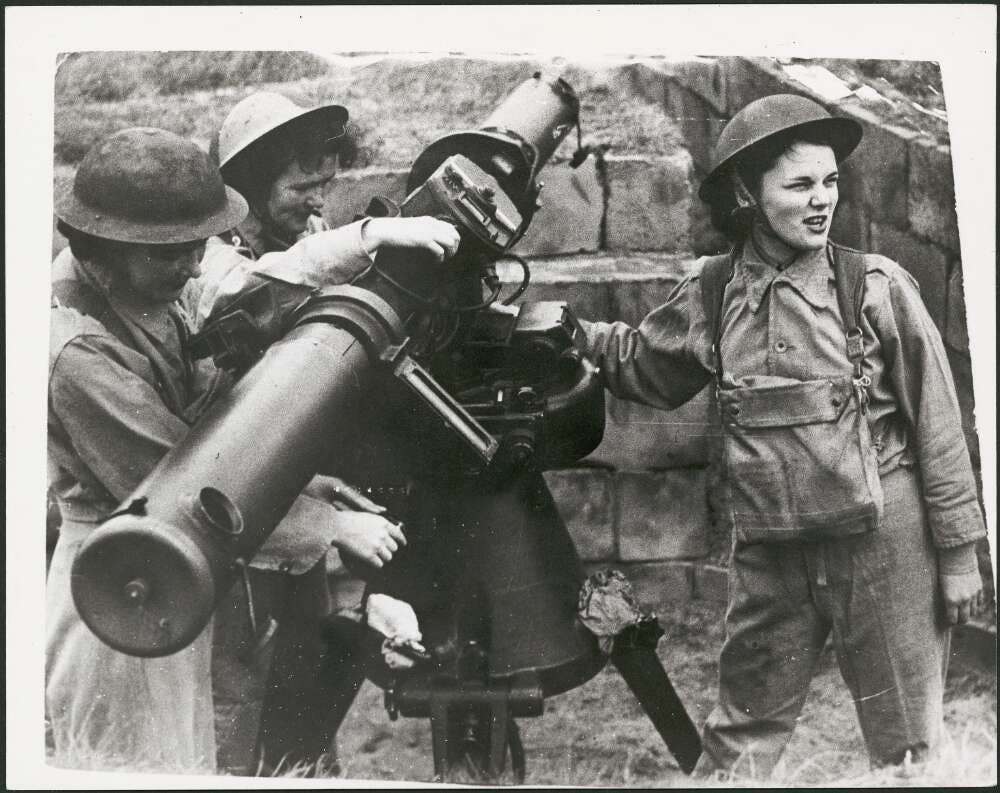
During the first world war, women were hired to calculate artillery trajectories. This work continued into the second world war, when they were actively encouraged to take on wartime jobs as computers in the absence of men.

Former NASA mathematician Katherine Johnson was awarded the Presidential Medal of Freedom in 2015.
NASA/Bill Ingalls

Women continued to work as computers into the early days of the American space program in the 1960s, playing a pivotal role in advancing NASA’s space projects. One of these computers was Katherine Johnson, who was responsible for quality-checking the outputs of early IBM computers for an orbital mission in 1962.

Many women made significant contributions to computing, yet few were recognised for these contributions – let alone financially compensated. According to Virginia Tech professor Janet Abbate, by 1969 a female computer specialist’s median salary was US$7,763, compared to US$11,193 for a male computer specialist.

Woman computers worked behind the scenes, while their male counterparts received recognition, awards and publicity.


Read more:
How your money is helping subsidise sexism in academia – and what you can do about it


Women in AI

Computing and programming are the foundation of AI as we know it today. At a basic level, today’s generative and predictive AI systems work by analysing large amounts of data and finding patterns in it.

The women who pioneered computing from as early as the 1800s laid the foundations for this work. The work they were doing by hand for more than a century has now been replaced by machines capable of analysing much larger quantities of data in much a shorter time.

This transition does not diminish women’s contributions to the field of computing and, more recently, AI. Myriad women are doing pioneering work in the AI industry today, including the 12 women named is this recent Medium article.

From Google’s ex-chief decision scientist Cassie Kozyrkov, to Canadian computer scientist Joy Buolamwini, to OpenAI’s CTO Mira Murati (pictured in this article’s banner image) – these women are helping make AI safer, more accurate, more accessible, more inclusive and more reliable.

Joy Buolamwini is a Rhodes scholar, Fulbright fellow, Stamps scholar, Astronaut scholar and Anita Borg Institute scholar. Her work focuses on reducing bias in AI.
Wikimedia, CC BY-SA

And they’re taking these strides despite working in a heavily male-dominated industry. One 2018 study of 4,000 researchers who had been published in leading AI conferences found women made up just 12% of this group.

The impact of omission

The omission of women isn’t limited to the AI industry, or even to STEM. As historian Bettany Hughes notes, women occupy a meagre 0.5% of recorded history. Clearly, a lack of gender diversity in the workforce is part of a much larger, systemic problem – one that affects many more people than the individuals being excluded.

In 1983, NASA engineers suggested packing 100 tampons on the Challenger space shuttle for astronaut Sally Ride – for a trip that was one week long. Such an incident is seemingly harmless on the surface. But what happens when gender bias and stereotypes bleed into the design and development of AI?

Research published in 2018 by international non-profit Global Witness found Facebook’s job ad platform, which uses algorithms to target users with ads, based its targeting on sexist stereotypes. For example, ads for mechanics were targeted mostly at men, while ads for preschool teachers were targeted mostly at women.

Another 2018 study found computer vision systems reported higher error rates for recognising women, and in particular women with darker skin tones.

A lack of gender diversity in AI has a demonstrated ability to harm and disadvantage women and, by extension, all of us. While many argue that improving AI training datasets could address the gender gap, others rightly point out that women should also be included in data-collection processes

Breaking the glass ceiling

Speaking at the UN Women’s HeForShe summit earlier this year, Hugging Face research scientist Sasha Luccioni made a salient point:

AI bias doesn’t come from thin air – it comes from the patterns we perpetuate in our societies.

The recent New York Times article is an example of how both media and industry play a role in reinforcing a status quo that disproportionately favours men. This form of bias does nothing to help close a persistent and problematic gender gap.

Despite millions of dollars being spent to encourage women to take up careers in STEM, these fields are struggling to retain woman workers.

Women’s contributions to AI are not insignificant. Failing to acknowledge this can make the glass ceiling seem impossible to break through.


Read more:
Chief Scientist: women in STEM are still far short of workplace equity. COVID-19 risks undoing even these modest gains


The Conversation

Zena Assaad does not work for, consult, own shares in or receive funding from any company or organization that would benefit from this article, and has disclosed no relevant affiliations beyond their academic appointment.

ref. The AI industry is on the verge of becoming another boys’ club. We’re all going to lose out if it does – https://theconversation.com/the-ai-industry-is-on-the-verge-of-becoming-another-boys-club-were-all-going-to-lose-out-if-it-does-219802


We followed 14 ‘long haulers’ for 3 months. Here’s what they told us about living with long COVID

Source: The Conversation (Au and NZ) – By Bernardo Figueiredo, Associate Professor of Marketing, RMIT University

Yurii_Yarema/Shutterstock

At least 65 million people around the world are estimated to have long COVID, which describes the continuation or development of symptoms at least three months after an initial COVID infection.

Long COVID is a complex, multi-system disease that can be disabling and may even be fatal in some cases. We still don’t understand the exact causes of long COVID, and there’s no clear treatment for it.

Over three months, we followed 14 people suffering from long COVID – or “long haulers” – to better understand their experiences. In particular, we wanted to see how their ability to manage their health (called agency) and the help they get from others (social support) influence how they fare.


Read more:
When does COVID become long COVID? And what’s happening in the body when symptoms persist? Here’s what we’ve learnt so far


A few key themes

Participants recorded short videos about their daily lives, focusing on their symptoms, how they were coping, and any lifestyle changes they were making.

They experienced a range of symptoms, including fatigue, breathing difficulties and brain fog. Research has shown these are common symptoms among people with long COVID.

Participants faced psychological and social challenges, with some feeling lonely and hopeless, often made worse by social stigma around expressing mental distress. One participant said:

Most of my family haven’t contacted me that much over the last five months. So I’ve really just been on my own 24/7, which does wear anyone down.

Another said she had not

reached out to my friends too much about it because I just feel like such a hypochondriac.

A senior woman sits on a couch looking out the window.
People with long COVID may feel isolated.
Perfect Wave/Shutterstock

Some participants felt health-care professionals didn’t take their experiences and symptoms seriously or didn’t understand. One described “an overall very, very poor understanding of the pathophysiology of the condition which is harming patients like me”.

Agency and social support

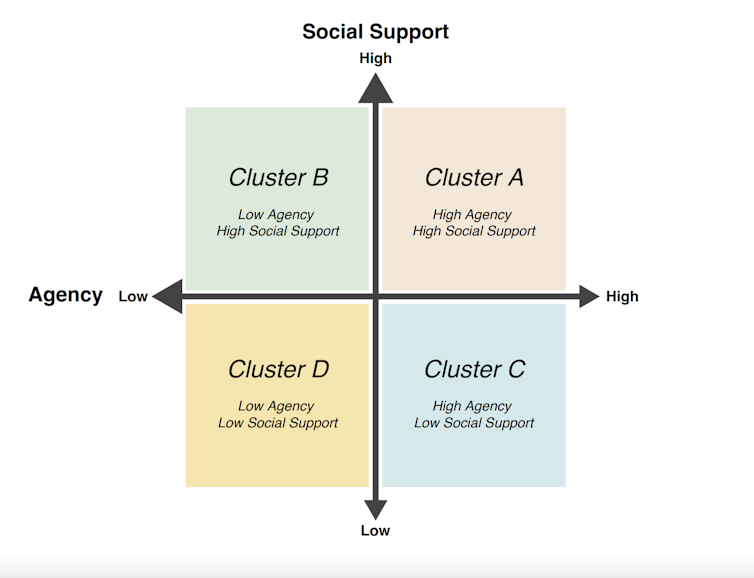
Although each person had a unique experience with long COVID, we were able to group these experiences into clusters based on the social support they received and the agency they had in managing their condition.

Agency is a result of multiple factors that accumulate over time including socioeconomic background, education and health literacy. Agency can improve when people feel in control of their situation.

A matrix divided into four quadrants representing the agency/social support clusters.
We grouped participants into four clusters.
Figueiredo et al., Social Science & Medicine, 2023, CC BY

In general, those with high agency and high social support reported a better experience managing long COVID than those in the other clusters.

People with agency sought out information about their condition and potential treatments, followed through with prescribed treatment plans when available, monitored symptoms, sought support, and were involved in advocacy and research.

Social support was similarly important, manifesting in different ways – for example a spouse who helped their partner get dressed, or a manager who supported reducing work days. In some cases friends provided regular support, while family played a crucial role, often becoming long-term informal carers.

Having a wide group of supporters helped long haulers feel like less of a burden to others and avoided the fear of over-relying on an individual carer. One participant’s church group provided a helpful social network, and reinforced her self-belief. Online communities also offered support.


Read more:
From diagnosis to services and support: how Australia’s long COVID response is falling short


Those who had low agency and low social support generally reported the worst experiences. One participant who we grouped in this category said:

Long COVID has destroyed so many aspects of my life […] it’s impossible to overstate the negative impact that it’s had.

Our findings align with existing evidence

Our study was confined to a small group, and participants were only from Australia, which limits how much the findings can be generalised.

That said, our findings align with broader evidence highlighting the complexity of long COVID as a condition with both physical and psychosocial dimensions.

Our study’s emphasis on patient agency and social support also corresponds with emerging literature emphasising the important role these factors play in chronic disease management.

A woman comforts another woman.
Support from friends and family helps.
Josep Suria/Shutterstock

Supporting people with long COVID

We suggest health-care professionals consider which “cluster” a person with long COVID falls into (low or high agency and low or high social support) and tailor the support they offer accordingly.

For example, long haulers who are more proactive (high agency) could benefit most from educational materials suggesting, for example, different ways to cope, safe exercise routines, diet tips, and strategies to manage mental health concerns.

Meanwhile, people with long COVID who find it hard to manage their health (low agency) but have good support from others (high social support), might benefit from educational materials that show their family and friends how to help them.

Being part of online communities could also help these patients. Although online groups can provide social support and improve a person’s sense of agency, not all information shared in these communities is accurate or reliable.


Read more:
How physios and occupational therapists are helping long COVID sufferers


And what about people with low agency and low social support?

Providing clear, straightforward information about long COVID can enhance their participation in helping manage their health.

Connecting them with support groups, communities or counselling can improve social support. Evidence shows emotional connections help reduce feelings of distress and boost wellbeing among people with long COVID.

Finally, case management services can help long-haulers access and utilise community resources, and simplify their health-care journey.

The Conversation

The project “EAT, MOVE, HEAL for Long-COVID” (Project ID: PRJ00000010) was funded by a 2022 Strategic Capability Deployment Fund, RMIT University, Victoria, Australia.

Catherine Itsiopoulos has received funding from NHMRC for other research. She is a member of professional bodies including Dietitians Australia and The Australasian Society of Lifestyle Medicine. Catherine is a member of RMIT University ‘Eat, Move Heal Network’ researching to develop tools to support patients with long COVID19 at home.

Jacob Sheahan receives funding from the Wellcome Trust, and the ACRC is funded by Legal and General.

Zhen Zheng co-leads the Eat, Move, Heal for Long-COVID Program that aims to provide educational materials to people with long COVID and to health-care professionals.

Magdalena Plebanski does not work for, consult, own shares in or receive funding from any company or organisation that would benefit from this article, and has disclosed no relevant affiliations beyond their academic appointment.

ref. We followed 14 ‘long haulers’ for 3 months. Here’s what they told us about living with long COVID – https://theconversation.com/we-followed-14-long-haulers-for-3-months-heres-what-they-told-us-about-living-with-long-covid-219504

Israel is accused of using white phosphorous. Would this be against international law?

Source: The Conversation (Au and NZ) – By Sascha-Dominik (Dov) Bachmann, Professor in Law and Co-Convener National Security Hub (University of Canberra) and Research Fellow (adjunct) – The Security Institute for Governance and Leadership in Africa, Faculty of Military Science, Stellenbosch University- NATO Fellow Asia-Pacific, University of Canberra

Israel’s military is accused of using white phosphorous in an October attack on the Hezbollah militant group in Lebanon, which allegedly injured at least nine civilians.

US National Security Council spokesperson John Kirby said this week the Biden administration was “concerned” about the possible use of white phosphorus munitions and that it would be “asking questions to try to learn a bit more.”

Israel has rejected any allegations of the unlawful use of white phosphorus in Lebanon.

But what are the legal uses of this chemical under international humanitarian law? And can its use be considered a war crime?

How white phosphorous has been used before

White phosphorous is a chemical component that ignites on contact with air and burns at around 1,500 degree Fahrenheit (815 Celsius). It can lead to serious injury and or even death if it comes into contact with humans.

Human Rights Watch regards incendiary weapons, such as white phosphorous and napalm, as “among the cruellest weapons used in contemporary armed conflict” due their impact on the human body. Says one Human Rights Watch researcher:

Incendiary weapons are weapons that set fire or burn people.

White phosphorus can be used defensively, though, as a smokescreen to mask troop movements on the ground, to illuminate the battlefield, or as a signalling device. It can also interfere with an enemy’s infrared optics and weapons tracking systems.

But these incendiary weapons can also be used offensively in mortar bombs, rockets and artillery ammunition.


Read more:
Why is accountability for alleged war crimes so hard to achieve in the Israel-Palestinian conflict?


White phosphorous was used by many adversaries in both the first and second world wars, targeting enemy soldiers and civilians alike.

The US also used white phosphorus, alongside napalm, in the Vietnam War and more recently in Iraq during the battle of Fallujah in 2004 and against Islamic state in both Syria and Iraq.

Russia is also accused of using white phosphorus indiscriminately against civilians and combatants in both Ukraine and Syria.

Human Rights Watch criticised Israel’s use of white phosphorous against Hamas targets in Gaza in 2008–09 and said it was evidence of a potential war crime.

Aware of the negative publicity from these reports, the Israeli Defence Forces pledged in 2013 to stop using white phosphorus on the battlefield, saying it would transition to gas-based smoke shells instead.

What international law says about it

Incendiary weapons fall under the 1980 Convention on Certain Conventional Weapons. This treaty aims to protect civilians by limiting the use of certain weapons deemed particularly dangerous. A protocol specifically focused on incendiary weapons defines them as:

any weapon or munition which is primarily designed to set fire to objects or to cause burn injury to persons through the action of flame, heat, or combination thereof, produced by a chemical reaction of a substance delivered on the target.

White phosphorus is not illegal under international law and the law of armed conflict, as long as long it is being used defensively as a smokescreen or as battlefield illumination.

The targeted use of incendiary weapons directly against civilians, however, is illegal and could be considered a war crime. The use of “air-delivered” incendiary weapons (such as white phosphorus dropped from a plane) against a military target that is in a civilian area is also prohibited.

There is an exception, though, if the military target is “clearly separated” from civilians and all “feasible precautions” are taken to limit incidental loss of civilian life or injuries to civilians.

So, this means the targeting of either Hamas or Hezbollah is permissible as long as the white phosphorus is not air delivered and steps are taken to minimise the harm to civilians.

What Israel is accused of doing

Amnesty International has compiled evidence that indicates white phosphorus was likely used in a civilian setting (the Lebanese town of Dheira) in October. Residents also told The Washington Post that Israeli forces had shelled the town with “white phosphorus munitions for hours”.

These reports need thorough investigation to examine what exactly happened and if there was an illegal use of white phosphorous by Israeli forces or whether it was permitted under the guidelines above.

Investigators will need to determine, for instance, if white phosphorous was indeed used and, if it was, whether it was delivered via an airburst or a groundburst.

Investigators would also need to determine if the forces took steps to minimise civilian harm. This a very difficult proposition in the current conflict, as both Hamas and Hezbollah are known to embed their fighters within the civilian population.

Any direct targeting of civilians or indiscriminate use of air-delivered incendiary weapons would potentially qualify as a war crime under the Geneva Conventions of 1949.

In the fog of war, it is more important than ever to have independent verification of the actions of combatants on both sides and a thorough investigation by the International Criminal Court (ICC).

However, prosecution of any alleged war crimes in the current conflict remains extremely difficult. This is due, in part, to the fact Israel is not a member of the ICC and rejects the court’s jurisdiction over its territory and both Hamas and Hezbollah are non-state entities.

The Conversation

Sascha-Dominik (Dov) Bachmann does not work for, consult, own shares in or receive funding from any company or organization that would benefit from this article, and has disclosed no relevant affiliations beyond their academic appointment.

ref. Israel is accused of using white phosphorous. Would this be against international law? – https://theconversation.com/israel-is-accused-of-using-white-phosphorous-would-this-be-against-international-law-219809

What does a building need to call itself ‘accessible’ – and is that enough?

Source: The Conversation (Au and NZ) – By Ilan Wiesel, Associate Professor in Urban Geography, The University of Melbourne

Robert Kneschke/Shutterstock

The National Disability Insurance Scheme (NDIS) review and the disability royal commission’s final report both highlighted the crucial role of accessible buildings and homes in ensuring the inclusion of people with disabilities.

But the experiences of people with disability show Australia is a very long way from achieving this. There are the stories from people with disability who can’t enjoy events or venues. And researchers say even accessible bathrooms are not usable for half the people with disability.

What can be called an accessible building or home? And should standards be improved?


Read more:
Here’s why we need a disability rights act – not just a disability discrimination one


What is accessibility?

The Convention on the Rights of Persons with Disability includes the right to accessibility. Australia’s 1992 Disability Discrimination Act includes premises standards to ensure people with disability have “dignified, equitable, cost-effective and reasonably achievable access to buildings, facilities and services”.

However, a building is exempt if the owners can demonstrate modifying a building would cause them “unjustifiable hardship”. The burden of making a complaint about an inaccessible building falls on people with disability and the act also does not apply to private homes.

Although experts follow different definitions of accessibility, they generally include some key principles:

  • easy entry and exit into a building

  • easy navigation and functionality in and around the building

  • potential for easy adaptation in response to changing needs of occupants.

An accessible building is one where people of all abilities are able move and carry out activities independently, safely, in comfort and with dignity.

For people with disabilities many buildings are inaccessible. In these buildings, basic everyday activities such as taking a shower or preparing breakfast becomes difficult, tiring, uncomfortable and sometimes dangerous.

Some people have been injured repeatedly in inaccessible homes, for example falling down a staircase. Such injuries may compound their disability. Many people with disabilities worry that if they’re injured at home, they will be forced to move permanently into a nursing home.

Studies have found living in inaccessible homes severely harms the dignity, independence, social inclusion, employment, health and wellbeing of people with disabilities.

People become more reliant on family members for support, putting strain on their relationships. Difficulty getting in and out of the house for social activities worsens social isolation. A sense of fatigue also reduces the motivation and capacity to work.


Read more:
Taken together, the NDIS review and the royal commission recommendations could transform disability housing


Access through the front door

Dignity is a crucial aspect of accessibility but it is often forgotten. For example, many buildings’ front entry has stairs that make it inaccessible for wheelchair users. There may be an accessible ramp entry in the back of the building. The building is then considered accessible, since wheelchair users can enter and exit. But such a “backdoor treatment” can be experienced as an indignity and discrimination.

Accessible toilets are sometimes used for storage, locked or out of order. Again, although the design meets accessibility standards, in practice the building is inaccessible because of poor management.

And accessibility is not exclusively about physical disabilities and physical barriers.

People with cognitive disabilities, for example, might struggle to find their way in a building if way-finding signs are difficult to understand. Communication accessibility in building is achieved when the information needed to navigate and use the building is understood by everyone, no matter how they communicate.

Silver, gold and platinum standards

There are different levels of accessibility. In Australia, housing accessibility is most often assessed according to Livable Housing Australia’s (LHA) three standards of silver, gold and platinum. Silver-level homes have minimal accessibility features, but are designed in a way that enables easy home modifications over time.

The silver standard of accessibility requires seven features:

• a step-free path of travel from the street or parking area

• at least one step-free entrance

• internal doors and corridors that allow comfortable movement, including for people using wheelchairs

• a toilet on the entry level with easy access

• a bathroom with a hobless shower recess, so there isn’t a step-over barrier to entry

• reinforced walls around the toilet, shower and bath. These allow installation of grabrails later if needed

• stairways designed to reduce the risk of injury and also enable future adaptation.

Gold-level homes have additional accessibility features. Platinum homes are designed for people with higher mobility needs and to allow ageing at home.

A patchwork of standards and what the NDIS review says

In 2021 Australian housing ministers agreed for the first time to introduce minimum accessibility standards in the National Construction Code. It followed decades of campaigning by activist groups such as the Australian Network for Universal Housing Design, Rights and Inclusion Australia and the Summer Foundation.

The code requires all new homes be built to silver standards. It does not apply to existing homes and exemptions will apply for some newly built homes because of site restrictions.

When the code was introduced, New South Wales and Western Australia announced they would not adopt the new code. Both the NDIS review and the disability royal commission recommended all states and territories immediately adopt the code’s new accessibility standards.

A consistent application of the code’s new standards across Australia is a good start. But the code provides only the minimum standard of accessibility. To make buildings and homes truly accessible, we need to improve education on accessibility for designers, operators and consumers.

An urgent national priority

With Australia’s ageing population, most people will experience disability – or have a household member with disability – at some point.

Accessible homes and buildings can reduce pressure on the health system and improve quality of life. A consistent national construction code is just the first step urgently needed to to improve building accessibility and inclusion so people with disability have autonomy and flourish.

The Conversation

Ilan Wiesel receives funding from the Australian Research Council.

Rebecca Bentley receives funding from the National Health and Medical Research Council.

ref. What does a building need to call itself ‘accessible’ – and is that enough? – https://theconversation.com/what-does-a-building-need-to-call-itself-accessible-and-is-that-enough-217278

When the heat hits, inland waters look inviting. Here’s how we can help people swim safely at natural swimming spots

Source: The Conversation (Au and NZ) – By Nicky Morrison, Professor of Planning and Director of Urban Transformations Research Centre, Western Sydney University

Penrith Beach/NSW government, CC BY

People love to hang out around water, especially on hot summer days. And, for those who aren’t near the ocean, Australia is blessed with beautiful inland waterways. In New South Wales, the government wants to increase access to these “blue” natural environments, especially for people living far from the coast.

One of these swimming sites is Penrith Beach, which has just opened to the public for the summer. This new site in the heart of Western Sydney is part of the state government’s Places to Swim program. It’s likely to be an important refuge for locals to seek relief from intense summer heat.

Our recently published research informed the government’s new Places to Swim guide. Now out for public consultation, the draft guide aims to help anyone involved in establishing or managing a swim site.

A new public beach has been opened at Penrith in Western Sydney.


Read more:
Olympic swimming in the Seine highlights efforts to clean up city rivers worldwide


People want natural swimming spots, but are they safe?

The Places to Swim program responds to two government surveys, covering Greater Sydney and regional NSW. These showed:

  • people see access to water as very important – about half enjoy outdoor water recreation activities at least once a week

  • swimming in natural areas is growing in popularity

  • demand for access points and storage facilities for activities such as kayaking and paddle-boarding is increasing.

But are natural waterways safe to use? Recreation involving waterways inherently entails risks like exposure to waterborne contaminants and potential for injury and drowning. As new swim sites are opened, the risks need to be identified, monitored and managed.


Read more:
It’s hot, and your local river looks enticing. But is too germy for swimming?


Time spent in ‘blue’ nature has many benefits

Our report, prepared by the Urban Transformations Research Centre, outlined the benefits of opening swim sites across the state.

Spending time in “blue” nature has many physical and mental benefits. Other social, cultural, economic and ecological spin-offs are equally valuable.

These natural sites are freely available to all (and pleasingly chemical-free). People come together at these places, which strengthens sense of community and belonging.

Economic multipliers arise from the increase in visitors to an area.

An increased public focus on ensuring the water is clean also benefits the wider ecosystems that depend on it.

We also provided a checklist of things to consider when setting up or managing a swim site. These include:

  • the need to assess upfront, and then continually monitor, water quality

  • equitable physical access and transport points

  • risks and hazards in what can be physically tricky sites

  • environmental considerations, including any critical habitats, in what might otherwise be an undisturbed natural environment

  • any required planning processes and formal approvals

  • ongoing governance arrangements, which might involve more than one body.


Read more:
Why do we love the great outdoors? New research shows part of the answer is in our genes


Learning from the best

Our report also offered six case studies of projects in Australia and New Zealand, Canada and Europe. These provide good examples of how to proceed.

The case study from New Zealand’s Can I swim here? program has an interactive map to help people find the best places to swim across the country. This public advice, provided by the Land, Air, Water Aotearoa partnership, includes weekly water quality test results.

In Canada, Toronto on Lake Ontario showcases innovative water-quality monitoring that directly involves the community. It’s done by volunteer “citizen scientists” co-ordinated by a government-funded charity, Swim Drink Fish.

As confirmed by research on biophilia – our innate affinity with nature – bringing people closer to nature is not just about direct benefits to individuals. It also encourages us to look after the natural ecosystems on which we ultimately depend.


Read more:
Many urban waterways were once waste dumps. Restoration efforts have made great strides – but there’s more to do to bring nature back


Recognition of the benefits of spending time in “blue” nature will continue to grow. We therefore need to put more effort into designing water-based activities as part of life in our cities and towns. It’s especially important for those without ready access to coastal beaches.

It’s time to get more active in promoting and improving these great water resources. These facilities will also need to be closely monitored and managed. The investment is worth it.

The Conversation

Nicky Morrison received funding from the NSW government.

Ian A. Wright received funding from the NSW government.

ref. When the heat hits, inland waters look inviting. Here’s how we can help people swim safely at natural swimming spots – https://theconversation.com/when-the-heat-hits-inland-waters-look-inviting-heres-how-we-can-help-people-swim-safely-at-natural-swimming-spots-219333

From sexual liberation to fashionable heels, new research shows how women are changing North Korea

Source: The Conversation (Au and NZ) – By Bronwen Dalton, Professor, Head of Department of Management, UTS Business School, University of Technology Sydney

Lesley Parker

Kang* was 20 years old when she left her official job as a potato researcher in North Korea. She wanted to join the women who had taken up illicit market activities, first to survive the “Arduous March” (as the famine years of the mid-1990s were known), then to build better lives for themselves and their families outside the tight controls of the government.

Kang began trading goods like rice, metals and petroleum to generate an income well beyond what she could have expected from state-sanctioned employment. Eventually, before reaching South Korea in 2013, her most lucrative business was a brokerage service for young women who wished to work in factories in China.

Kang was one of the women who took part in the research for our new book, North Korea’s Women-led Grassroots Capitalism. As she told us,

What was most rewarding about the work was the money. I could pay for my younger sister’s university tuition, as well as my stepchildren’s. I could even buy [Workers’] Party membership for my husband, eventually making him a party secretary. I felt myself maturing through businesses.

It was as if we were like party officials providing for their children. I could make all that possible with the money I earned.

The emergence of grassroots capitalism in North Korea, through women like Kang, provides a cautionary tale for patriarchal societies everywhere: underestimate women at your peril.

Ironically, we found in our research that by seeking to exclude women from the public sphere and formal economy, North Korea’s government has actually spurred them to become entrepreneurs, with cascading effects on society.

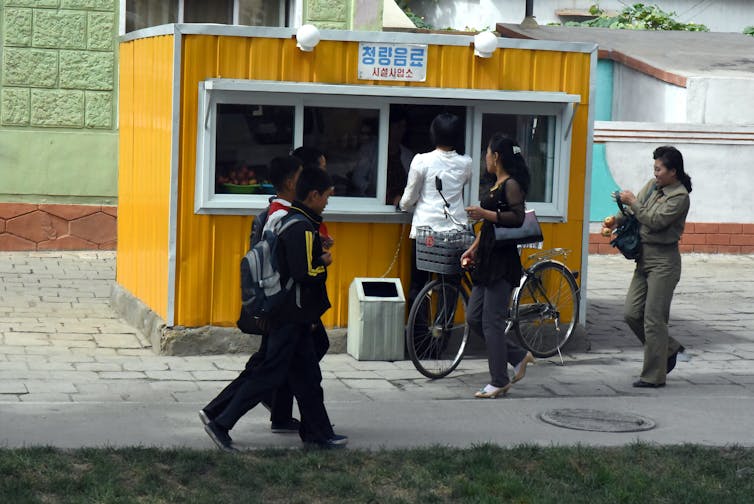
Little shops have sprung up around Pyongyang, mostly run by women, selling food and other small items.
Lesley Parker

How did this happen? North Korean authorities continue to oppress the public with a terror and surveillance culture aimed at containing the spread of capitalism. But it is men who have been their main focus – not women.

North Korea’s women, underestimated and operating in the shadows, have become increasingly adept at circumventing official monitoring and controls to create the space to drive significant economic and social change.

A woman in a skirt above the knee, high-heeled shoes and carrying a designer-style handbag.
Lesley Parker

Our book explores the complex ways in which North Korean women have exercised their agency through everyday life. Our research was based on 52 interviews with North Korean female defectors, NGOs and several field trips to North Korea and northeast China. Far from stereotypical brainwashed automatons or helpless victims needing protection, we found that North Korea’s women are strong, resilient and creative.

Through acts of covert resistance, they have been driving change in family relationships, women’s sexuality and reproductive issues, and women’s cultural identities.

5 ways women are changing North Korea

1) Women are driving grassroots capitalism

Women have become active players in the emerging informal economy centred on local markets, which pre-COVID accounted for roughly 80% of household income and more than 60% of people’s food and basic needs.

In short, North Koreans depend on women’s labour, both in the household and the marketplace, to survive.

In most North Korean families, women have become the main breadwinners. This has created more opportunities for women – and challenges for those who seek to control them, including the state.

A woman transports goods using a hand-pulled cart in the countryside in the south.
Lesley Parker

2) Gender roles are shifting

Women have been driving changes that are destabilising two fundamental pillars of North Korea: socialism and deep-rooted patriarchy.

Women’s involvement in market activities has given them access to scarce resources, including money, and a level of public visibility and social interaction previously reserved for men.

Economic independence and a greater say in domestic decision-making have strained long-established family dynamics and challenged broader social norms. As Seol* explains:

As the rations waned, women took more initiative and went out and worked outside the home. It was the men who stayed home. We began to expect that men should cook
and do domestic work. I think women and men reversed roles.

A schoolboy stops for an ice-cream from a street vendor in Pyongyang. Changing family dynamics, with women earning more than men, is causing tension in families.
Lesley Parker

3) A sexual revolution is underway

The way women experience and approach sexuality, relationships and marriage has become far more complex. This includes delaying marriage and more divorces. Non-traditional relationships are also flourishing, such as premarital and extramarital couplings (which have led to growing numbers of single mothers) and older women married to younger men. A young woman named Bae* told us:

As I make a lot of money, I have high standards for a husband. While busy with money-making, I don’t have time to think about marriage or get married.

Meanwhile, younger party-affiliated, city dwellers are adopting more liberal attitudes to dating and sex and more romantic views of relationships. As Joo* said:

Many young people are dating in public right now. After watching South Korean dramas, young ladies call their boyfriend ‘oppa’ (or ‘brother’) like South Koreans. The young couples are going around with their arms around each other’s shoulders.

Some women have also been strategically engineering relationships with Chinese men as a means of settlement in China, to ensure their safety.

4) It’s all about the heels

Women in Pyongyang now wear higher heels and more colourful clothes that in previous years.
Lesley Parker

While appearing to conform to patriarchal versions of femininity, women are actually constructing a new version of the ideal, hyper-feminine, North Korean woman. This is typically a means to access material goods and social rewards.

Through fashion choices and conspicuous consumption, these women are playing a key role in how status is now determined in North Korea. For example, high heels are de rigeur. Bae said:

Women are obsessed with high heels. Probably because we girls are short. Whether women live in the countryside or in the mountains, we prefer these shoes, even on unpaved roads.

Like their South Korean counterparts, the younger generation has become more interested in slender bodies and long straight hair. More women have undertaken not only double eyelid surgery, but also dimple surgery or nose surgery. Another woman, Gho, told us:

We young people are just like South Koreans. We watch South Korean TV dramas in secret and wear pants like South Koreans do [laughter], and we dye our hair yellow like South Koreans do.

Through these actions, women are challenging narrowly conceived, domestic ideals of wives and mothers and creating new sets of social expectations and constructions of femininity.

The way Paik* describes her decision to dye her hair and wear earrings is an example of how women are also emulating the country’s fashionable first lady Ri Sol-ju:

Officials used to inspect everybody wearing earrings. But then Ri Sol-ju appeared wearing earrings and now the authorities can’t do much about it. People started becoming rebellious. In North Korea, dyeing hair is not allowed. […] These days, a lot of people dye their hair.

5) New propaganda versions of the ideal woman

The state has responded to this social change by shifting the way it presents the “ideal” woman in its propaganda.

For example, it is now promoting women who embody an attractive and dynamic blend of old and new, of loyalty and modernity – including the leader’s sister, wife and now daughter. For example, Ri regularly appears in Prada, Christian Dior and Chanel, or in looks inspired by these designers.

By doing this, the regime is seeking to co-opt social trends to maintain its legitimacy.

Pyongyang trendsetters love logo-emblazoned goods.
Lesley Parker

(*For security reasons, we use pseudonyms for the North Korean women who took part in this research.)

The Conversation

Bronwen Dalton receives funding from the Australian Research Council.

Kyungja Jung receives funding from the Australian Research Council and the Academy of Korean Studies.

Lesley Parker does not work for, consult, own shares in or receive funding from any company or organisation that would benefit from this article, and has disclosed no relevant affiliations beyond their academic appointment.

ref. From sexual liberation to fashionable heels, new research shows how women are changing North Korea – https://theconversation.com/from-sexual-liberation-to-fashionable-heels-new-research-shows-how-women-are-changing-north-korea-218711

AI can already diagnose depression better than a doctor and tell you which treatment is best

Source: The Conversation (Au and NZ) – By Sarah Hellewell, Research Fellow, Faculty of Health Sciences, Curtin University, and The Perron Institute for Neurological and Translational Science, Curtin University

Shutterstock

Artificial intelligence (AI) is poised to revolutionise the way we diagnose and treat illness. It could be particularly helpful for depression because it could make more accurate diagnoses and determine which treatments are more likely to work.

Some 20% of us will have depression at least once in our lifetimes. Around the world,
300 million people are currently experiencing depression, with 1.5 million Australians likely to be depressed at any one time. Because of this, depression has been described by the World Health Organization as the single biggest contributor to ill health around the world.

So how exactly could AI help?


Read more:
Depression isn’t just sadness – it’s often a loss of pleasure


Depression can be hard to spot

Despite its frequency, depression is difficult to diagnose. So hard, in fact, that general practitioners accurately detect depression in less than half of cases.

This is because there is no one test for depression: doctors use self-reported symptoms, questionnaires and clinical observations to make a diagnosis. But symptoms of depression are not the same for everyone. Some people may sleep more, others sleep less; some people lack energy and interest in activities, while others may feel sad or irritable.

For those who are accurately diagnosed with depression, there are a range of treatment options including talk therapy, medications and lifestyle change. However, response to treatment is different for each person, and we have no way to know ahead of time which treatments will work and which won’t.

AI trains computers to think like humans, with a particular focus on three human-like behaviours: learning, reasoning and self-correction (to fine-tune and improve performance over time). One branch of AI is machine learning, the goal of which is to train computers to learn, find patterns in data and make data-informed predictions without guidance from humans.

In recent years there has been a surge in research applying AI to illnesses like depression, which can be difficult to diagnose and treat.

man sits with head in hands opposite clinician with clipboard checklist
Doctors usually diagnose depression via questionnaires and self-ratings.
Shutterstock

What they’ve found so far

Scientists have compared ChatGPT diagnoses and medical recommendations to those of real-life doctors with surprising results. When given information on fictional patients of varied depression severity, sex and socioeconomic status, ChatGPT mostly recommended talk therapy. In contrast, doctors recommended antidepressants.

US, British and Australian guidelines recommend talk therapy as the first treatment option ahead of medication.

This suggests ChatGPT may be more likely to follow clinical guidelines, whereas GPs may have a tendency to overprescribe antidepressants.

ChatGPT is also less influenced by sex and socioeconomic biases, while doctors are statistically more likely to prescribe antidepressants to men, especially those in blue-collar jobs.

How depression affects the brain

Depression affects specific parts of the brain. My research has shown that the areas of the brain affected by depression are extremely similar in different people. So much so, we can predict whether someone has depression or not with more than 80% accuracy just by looking at these brain structures on MRI scans.

Other research using advanced AI models has supported this finding, suggesting brain structure may be a helpful direction for AI-based diagnosis.

Studies using magnetic resonance imaging (MRI) data on brain function at rest can also predict depression correctly more than 80% of the time.

However, combining functional and structural information from MRI gives the best accuracy, correctly predicting depression in over 93% of cases. This suggests using multiple brain imaging techniques for AI to detect depression may be the most viable way forward.

MRI-based AI tools are currently only used for research purposes. But as MRI scans become cheaper, faster and more portable, it’s likely this kind of technology will soon be part of your doctor’s toolkit, helping them to improve diagnosis and enhance patient care.


Read more:
Transcranial magnetic stimulation can treat depression. Developing research suggests it could also help autism, ADHD and OCD


The diagnostic tools you might have already

While MRI-based AI applications are promising, a simpler and easier method of detecting depression may be at hand, quite literally.

Wearable devices like smart watches are being investigated for their ability to detect and predict depression. Smart watches are especially helpful because they can collect a wide variety of data including heart rate, step counts, metabolic rate, sleep data and social interaction.

A recent review of all studies done so far on using wearables to assess depression found depression was correctly predicted 70–89% of the time. Since they are commonly used and worn around the clock, this research suggests wearable devices could provide unique data that might otherwise be hard to collect.

There are some drawbacks, however, including the substantial cost of smart devices which may be inaccessible to many. Others include the questioned ability of smart devices to detect biological data in people of colour and the lack of diversity in study populations.

Studies have also turned to social media to detect depression. Using AI, scientists have predicted the presence and severity of depression from the language of our posts and community memberships on social media platforms. The specific words that were used predicted depression with up to 90% success rates in both English and Arabic. Depression has also been successfully detected in its early stages from the emojis we use.

man's hands tipping out one capsule with glass of water nearby on table
Doctors are statistically more likely to prescribe antidepressants to men.
Shutterstock

Predicting responses to treatment

Several studies have found antidepressant treatment response could be predicted with more than 70% accuracy from electronic health records alone. This could provide doctors with more accurate evidence when prescribing medication-based treatments.

Combining data from people in trials for antidepressants, scientists have predicted whether taking medications will help specific patients go into remission from depression.

AI shows substantial promise in the diagnosis and management of depression, however recent findings require validation before they can be relied upon as diagnostic tools. Until then, MRI scans, wearables and social media may be helpful to assist doctors diagnose and treat depression.


Read more:
Netflix psychiatrist Phil Stutz says 85% of early therapy gains are down to lifestyle changes. Is he right?


The Conversation

Sarah Hellewell does not work for, consult, own shares in or receive funding from any company or organisation that would benefit from this article, and has disclosed no relevant affiliations beyond their academic appointment.

ref. AI can already diagnose depression better than a doctor and tell you which treatment is best – https://theconversation.com/ai-can-already-diagnose-depression-better-than-a-doctor-and-tell-you-which-treatment-is-best-211420

We reviewed the arguments for and against ‘high-stakes’ exams. The evidence for using them doesn’t stack up

Source: The Conversation (Au and NZ) – By Raoul Mulder, Professor of Higher Education, Centre for the Study of Higher Education, The University of Melbourne

Across Australia, students are receiving and digesting important exam results. University students began receiving their semester 2 results at the end of November. This week and early next week, Year 12 students are also receiving their final marks.

Love them or loathe them, exams have featured prominently in education for centuries.

For almost as long, debate has raged about whether they are useful for assessing learning. And while there has been a shift towards course work or other forms of assessments in some contexts, exams are still a major part of the way we assess student learning.

To understand why exams remain so heavily favoured, we reviewed the arguments for and against their use in higher education. We found surprisingly little hard evidence to justify their widespread use in university assessment.


Read more:
Universities should learn from assessment methods used during the pandemic – and cut down on exams for good


Our study

We focussed on “high-stakes” final exams (heavily-weighted, end-of-semester exams that “make-or-break” passing a subject), because they are so widely used.

Traditionally undertaken in large exam halls under strict supervision, they can have immense influence on students’ lives and careers.

We searched the higher education literature for research showing benefits or drawbacks of high-stakes final examinations. We found 122 relevant papers, written in English and published before July 2023.

Across these papers, seven key themes emerged.

1. Knowledge retention

It has long been claimed tests help students consolidate knowledge.

But because exams tend to encourage “cramming” of large amounts of information in a short period, the retention of that “knowledge” is famously short-lived.

Testing can enhance learning when students need to remember a lot of facts. But research shows regular short-answer tests undertaken shortly after learning are far more effective for this than one big exam at the end of the learning process.

A young man reads a sheet of paper while sitting at a desk, with a laptop.
Students who cram for an exam tend to forget their learning in the long term.
Michael Burrows/Pexels, CC BY

2. Motivation and learning

High-stakes exams can certainly motivate students to study and prepare. But evidence suggests exams tend not to help students’ learning because they activate “extrinsic motivation” (the desire to achieve a high grade) rather than “intrinsic motivation” (the desire for deep understanding).

This has a doubly perverse effect on learning: it encourages students to adopt superficial, “surface” learning strategies such as memorisation, while teachers often narrow the content they teach to what can be assessed in the exam.

3. Real-world relevance

Some argue the information-restricted, time-pressured nature of exams mirrors real-life (nobody wants their doctor or pilot to be leafing through the manual in a crisis situation).

But for the vast majority of modern roles and workplaces, closed-book individual examinations are a far cry from the collaborative, information-rich context in which students will work.

They’re particularly ill-suited to assessing skills like listening and communication, which are highly valued by employers. And because there is typically no opportunity to receive or respond to feedback on an exam, it’s hard for students to learn from their mistakes and do better.

4. Validity and reliability

One might assume because high-stakes exams are so important for final grades, they are carefully validated and reliably measure a student’s ability.

Regrettably, neither is true. Validation of the design of high-stakes examinations (a complex process that ensures we can trust the inferences we make from them) is neither required nor routinely undertaken in university courses.

Exam performance is also notoriously unreliable, susceptible to bias and inconsistency from examiners, the psychological or physical health of the student, the design of the exam and even the conditions under which the exam is taken.

5. Contract cheating and assessment security

There’s a widespread belief that because exams occur in tightly controlled environments and require ID, they’re impervious to cheating. This belief is spurring calls for even greater use of traditional exams in the wake of anxiety about generative AI.

But surveys of tens of thousands of university students in Australia and overseas reveal students cheat more often in examinations than they do in any other form of assessment, using strategies such as impersonation.

As the authors of a 2018 Australian report conclude: “examinations provide universities and accrediting bodies with a false sense of security” and

an over reliance on examinations, without a thorough and comprehensive approach to integrity, is likely to lead to more cheating, not less.

6. Anxiety and wellbeing

Research shows students find exams stressful and this can harm their health and wellbeing. But whether stress affects exam performance is less clear.

Some studies have found negative effects of stress on performance, while others found no effect or even suggest stress is helpful for improving performance.

Although the jury is still out, the adverse effects of examinations on student mental and physical health is concerning, as is the negative impact of examination anxiety on student motivation.

7. Fairness and equity

It’s well known exams favour students who perform well under time pressure and are good at memorising. But there is also growing evidence the exams may promote gender inequality (with women performing worse than men in exams but better in non-exam assessments).

Another way in which exams can contribute to inequity is through their content (which often promotes Western values and knowledge) and their (often hand-) written format. This disadvantages minority students, including Indigenous students, those from less privileged socio-economic backgrounds, or those who have a disability.

Common “Band-Aid” accommodations, such as allowing extra time, do little to address this problem and contribute to feelings of inadequacy. We need to draw on what is known about inclusive assessment design to ensure diverse students are given equal opportunity to succeed.

Where to from here?

In the absence of compelling educational reasons for using high-stakes final exams, it seems they are used because they are cheap and efficient to deliver and grade, as well as easily scalable to large numbers of students.

These justifications seem inadequate when we know there are alternative and more authentic forms of assessment that are also cost-effective, with the aid of educational technology. These include inquiry (using investigation and problem-solving), group or peer-based assessments.

Without compelling academic reasons for retaining them, we need to consider new and potentially more meaningful forms of assessment by replacing, re-weighting or redesigning high-stakes exams.


Read more:
We need to change the way universities assess students, starting with these 3 things


The Conversation

The authors do not work for, consult, own shares in or receive funding from any company or organisation that would benefit from this article, and have disclosed no relevant affiliations beyond their academic appointment.

ref. We reviewed the arguments for and against ‘high-stakes’ exams. The evidence for using them doesn’t stack up – https://theconversation.com/we-reviewed-the-arguments-for-and-against-high-stakes-exams-the-evidence-for-using-them-doesnt-stack-up-219595

An educational psychologist explains how to think about your ATAR and set post-school goals

Source: The Conversation (Au and NZ) – By Andrew J Martin, Scientia Professor and Professor of Educational Psychology, UNSW Sydney

Cottonbro Studio/Pexels , CC BY

All this week and into next, Australian Year 12 students are receiving their final results.

As an educational psychologist, I know this is a momentous time for many students, as their schooling and future prospects seem to come down to “one number”. But it is also vital students and their families have perspective on the Australian Tertiary Admission Rank (or ATAR) and their goals going forward in their post-school lives.


Read more:
Disappointed by your year 12 result? A university expert and a clinical psychologist share advice on what to do next


What’s really important about the ATAR?

Let’s talk about the ATAR first. Yes, the ATAR matters. But not necessarily in the way students think it does.

Most of the focus and stress about ATARs revolve around what university course it can get students into. (Though some students have unconditional offers, that do not depend on their ATAR).

So, stepping back, the reason the ATAR matters is because it shapes the starting point of the post-school journey. It determines whether students get in the front door of what they want to study now. Or if they need to take a side route or two before they get into what they really want to study.


Read more:
What actually is an ATAR? First of all it’s a rank, not a score


A detour can be a positive thing

We tend to focus on the “ATAR and then straight to uni” option, but there are many positive post-school educational and vocational pathways available to students.

A 2020 study reviewed 25 years of research using the Longitudinal Surveys of Australian Youth data.

This research has mapped students’ movements post-school. Including to and through further study and training, to work and also taking a gap year. Across the various studies it reviewed, it was clear students pursue diverse pathways after school, including pathways into university, following time in the vocational education and training sector.

Our research has also found university students who have had a gap year are more motivated and engaged than students who did not. This is perhaps because students appreciate the value of education, develop self-regulation and self-direction while on their gap year, and gain further clarity about what they want to do with their lives.

So the ATAR does not determine where students end up as much as it shapes where they start and the way they get there. It is more journey-defining than destination-defining.

A young woman walks along a path in a park.
You don’t just have to go straight from school to more study. Gap years can have big benefits for future learning and motivation.
Janesca/Unsplash, CC BY


Read more:
Thinking about a gap year? Here are some questions to ask yourself (and a note for anxious parents)


Now, think about your goals

As students look ahead to post-school life, they have a terrific opportunity to think about their goals and what is really important for them.

I say this because the emphasis on ATARs can lead students to set and strive for goals that are not always best for them.

In a few ways, the toughest part of the ATAR for Year 12 students is the R or rank. It is this R that makes Year 12 something of a zero-sum game: for one student to rank higher, another student must rank lower.

Assessments that rank students can fuel comparisons with others and competitive goals. Research shows competitive goals are okay while students are “winning” but they can be de-motivating if students don’t win.

With the ATAR done and dusted (especially the R part!), students might find it helpful to shift their goals a bit.

Cropped picture of someone writing at a desk, with a mug and a notebook.
For school leavers, its time to think deeply about their goals.
Unseen Studio/ Unsplash, CC BY


Read more:
‘So many things to consider’: how to help school leavers decide what to do next


The importance of PB goals

Personal best or PB goals are about competing with ourselves, rather than competing with others.

PB goals are linked to positive academic and social-emotional outcomes.

This is because the focus on self-competition and self-improvement is energising, even when we don’t succeed at first.

Try learning a new ‘alphabet’

As students set and strive for PB goals now and in the years ahead, the “ABCD” of goal-setting can also be helpful to remember. This means they:

  • (A) set goals that are achievable. Long-term goals are great, but setting a short-term goal that is achievable in the next week or so is the best way to get to these longer-term goals. It also gives you a feeling of accomplishing something along the way

  • (B) set goes that are believable. Sometimes students set unrealistic goals they don’t really believe they can reach (for example, “I’m going to study for three hours every day and get perfect scores”). When students set realistic goals, they are more likely to believe they can reach them, and are more motivated to work towards them

  • (C) set goals that are clear. Being as specific as possible with post-school goals means the action taken to reach the goal is more focused and on-target

  • (D) set goals that are desirable. Striving for goals that students set and want for themselves is motivating.

Whether students are about to take a gap year, reassess their plans or head straight to university, vocational training or work, this is an important time. And there is lots of scope for young people to think positively about their futures without being defined by the R of that ATAR.

The Conversation

Andrew J Martin has received funding from the Australian Research Council and state departments of education. He is a registered psychologist with the Psychology Board of Australia.

ref. An educational psychologist explains how to think about your ATAR and set post-school goals – https://theconversation.com/an-educational-psychologist-explains-how-to-think-about-your-atar-and-set-post-school-goals-219711

Schindler’s List at 30: a look back at Steven Spielberg’s shattering masterpiece

Source: The Conversation (Au and NZ) – By Ben McCann, Associate Professor of French Studies, University of Adelaide

Schindler’s List, released 30 years ago, remains Steven Spielberg’s most highly acclaimed and emotionally sapping film. Winning seven Academy Awards, including best picture and best director, it was widely praised for its portrayal of the horrors of the Holocaust.

Schindler’s List marked a turning point in Spielberg’s career. The director later said making the film changed his life.

Up to this point, he was known as a thrilling blockbuster director. With Schindler’s List, Spielberg turned his attention to darker, conflicted characters and shifted his focus to bigger themes of good and evil, heroism in adversity and the human cost of war.

His later work is still exciting and still jolts the senses in ways that very few contemporary filmmakers can, as in the musical showmanship of West Side Story (2021) or the fantastical realism of War Horse (2011). But Schindler’s List outshines them all with its detached focus on the sheer brutality and its steadfast refusal to look away.

Retelling the Holocaust

Schindler’s List tells the true story of Oskar Schindler, the German businessman who saved 1,100 Jews from the Holocaust by employing them in his enamelware and ammunition factories.

Prior to Schindler’s List, accounts of the Holocaust on film had been reserved for documentary, such as Alain Resnais’s Night and Fog (1956) and Claude Lanzmann’s monumental Shoah (1985), which lasts nine hours and was composed of interviews with survivors and perpetrators of the Nazi death camps.

Hollywood had always shied away from dramatising the Holocaust, feeling such a devastating subject could not be depicted dramatically in the name of entertainment.

Recounting historical events in film is fraught with tension. Creative liberties are taken, timelines are condensed, characters combined and fictional elements added to enhance the dramatic quality of the narrative.

Spielberg acquired the rights to Thomas Keneally’s Booker Prize-winning novel in 1983, but was initially reluctant to take on the film. Instead, he offered it to the likes of Billy Wilder and Martin Scorsese.

By the early 1990s, dismayed by what he perceived as a rising tide of anti-Semitism and Holocaust denial, Spielberg understood it was finally time to make the film.

Despite containing a few historical inaccuracies, Schindler’s List was instrumental in creating what historian Peter Novick called a “Holocaust consciousness”.

An anti-Spielberg film

Spielberg wanted to avoid casting stars. He picked the then largely unknown Liam Neeson as the charismatic Schindler and Ralph Fiennes as Amon Göth, the vicious SS commandant.

Much of the film details the personal interactions between the two men as Schindler observes the cruelties visited upon Polish Jews and sacrifices his fortune to save as many of them as he can.

At over three hours long, Schindler’s List remains Spielberg’s longest film.

The director’s trademark flourishes are absent. There are no zooms or dolly shots, no smooth Steadicam tracking shots or soaring soundtrack. Apart from a brief opening and coda, the film remains the only black and white film Spielberg has ever shot.

He and his trusted cinematographer, Janusz Kamiński, wanted the film to resemble archival footage. But the choice of black and white did not just suggest “the past”. It also suited the sober approach to the unfolding of devastating historical events.

Famously, the film’s centrepiece – a shattering 15-minute scene in which the Nazis ferociously liquidate the Kraków ghetto – contains the film’s only use of colour. As Schindler looks on in horror, he spots a young girl in a red raincoat. It marks a radical turning point in Schindler’s moral development.

Spielberg’s use of cross-cutting is meticulous. A mass killing scene is interspersed with footage of an SS officer playing Bach on a piano. In another, Schindler celebrates his birthday while Göth beats his maid and a wedding takes place inside a labour camp.

Spielberg shot on location just outside Auschwitz in the winter of 1992 during the day, and at night worked on the post-production for Jurassic Park, which he had shot in Hawaii six months earlier. Spielberg was working on two epoch-defining films simultaneously, yet they were completely different in tone, visual style and cultural impact.


Read more:
Jurassic Park at 30: how its CGI revolutionised the film industry


Critical acclaim … and reproach

The film was widely praised on its release. Roger Ebert called it the best Spielberg had ever made. Bill Clinton implored audiences to see it.

But it was also condemned for being didactic, emotionally manipulative and a crass oversimplification of history. Jean-Luc Godard was particularly caustic, while Stanley Kubrick argued the film’s chief failing was its humanising of Oskar Schindler and Spielberg’s relentless need to create a flawed, but human, hero.

In 1994, with the proceeds from the film, Spielberg established the USC Shoah Foundation, an institute dedicated to collecting interviews with survivors and witnesses of the Holocaust.

He also became a vocal champion for the teaching of history in American schools, with the film used to illustrate the importance of bearing witness to historical atrocities and hatred.

Spielberg after Schindler

Schindler’s List paved the way for Spielberg to engage with other important historical events in Saving Private Ryan (1998), Amistad (1997) and Bridge of Spies (2015).

Spielberg has not entirely turned entirely turned his back on his blockbuster entertainment roots. War of the Worlds (2005), The Adventure of Tintin (2011) and Ready Player One (2018) all remind us of “early Spielberg”, but Schindler’s List was the film that finally convinced Hollywood to take Spielberg seriously.

Its message of courage in the face of tyranny seems just as relevant today as it was 30 years ago.

And it would have another role to play for Spielberg. When he returned to college in 2002 to completed a bachelor of arts he had started – but never finished – in 1969, he submitted Schindler’s List for course credit.


Read more:
1973: a golden year for film that rewrote the rules of cinema


The Conversation

Ben McCann does not work for, consult, own shares in or receive funding from any company or organisation that would benefit from this article, and has disclosed no relevant affiliations beyond their academic appointment.

ref. Schindler’s List at 30: a look back at Steven Spielberg’s shattering masterpiece – https://theconversation.com/schindlers-list-at-30-a-look-back-at-steven-spielbergs-shattering-masterpiece-203234

Hard-fought COP28 agreement suggests the days of fossil fuels are numbered – but climate catastrophe is not yet averted

Source: The Conversation (Au and NZ) – By Matt McDonald, Associate Professor of International Relations, The University of Queensland

Shutterstock

As negotiators stagger towards their beds in Dubai and another year’s climate talks come to a close, it’s time to take stock. Did COP28 achieve the big breakthrough the world needs on climate change?

Probably not. But the final agreement – met with an ovation – includes a first call for nations to transition away from fossil fuels. It’s a step short of a commitment to phasing the fuels out, as some delegates had pushed for. But the development suggests the days of fossil fuels are numbered.

The overriding question the world now faces is whether the broad commitments nations agreed to are enough as climate change gathers pace. The answer, alarmingly, is no.

UAE: controversial hosts

This year’s talks were controversial from the start.

The role of oil man Sultan Al Jaber as COP28 president fuelled concerns about the hosting role of the United Arab Emirates – a country with significant interests in sustaining a fossil fuel economy. Then came reports Al Jaber had questioned the scientific rationale for phasing out fossil fuels to tackle climate change, amid reports of fossil fuel trade negotiations on the sidelines of negotiations).

On top of this, unprecedented numbers of fossil fuel lobbyists and geoengineering advocates attended the talks. This did not create the ideal conditions for action on climate change.

‘Loss and damage’ breakthrough

To their credit, the organisers had an early win with an agreement to establish a “loss and damage” fund whereby richer nations compensate poorer nations for the effects of climate change. The creation of this fund is one of the big outcomes of the talks. It’s taken a long time to get here, after initially being suggested by Vanuatu in 1991 and supported in principle in last year’s talks in Egypt.

Why is it needed? Because developing states are particularly vulnerable to the damage done by climate change, and have limited ability to meet the cost of repair and rebuilding. The fund also points to the particular obligations of developed states and significant emitters who have largely caused the problem.

But there are still big questions about the measure – most importantly, how well it will be funded. Despite the fanfare, just US$700 million has been committed so far to the fund aimed at compensating states for damage that, according to recent estimates, already runs into the hundreds of billions per year.

There are also concerns over having the fund administrated by the World Bank, which has questionable environmental credentials and a patchy record on transparency.

Of course, the fund itself is an admission of failure. It’s needed only because the international community has failed to stop climate change from happening, and is unlikely to prevent it reaching dangerous levels.


Read more:
COP28 climate summit just approved a ‘loss and damage’ fund. What does this mean?


Deckchairs on the Titanic?

As the talks went on, they got harder. The tricky topic: fossil fuels. It may amaze outsiders, but this, the 28th annual climate talks, is the first time nations have directly addressed phasing out fossil fuels. Last year, nations agreed to accelerate the exit from coal – the dirtiest fuel – but said nothing of gas or oil.

For days, debate raged over whether to apply phrases such as “phasing out” or “phasing down” or the term “unabated” to fossil fuels. Even the word “could” became controversial, when tied to the suggestion countries might consider limiting fossil fuel production and consumption. To victims of climate change, the arguments might look like rearranging deckchairs on the Titanic.

Some nations were prepared to acknowledge the need to eliminate fossil fuels. Others noted the need for a future transition without compromising their need to develop or earn export income. Still others suggested the effects of fossil fuels might be minimised through technologies such as carbon capture and storage.

All 198 participating countries needed to approve any final declaration. So you can see the difficulty in reaching consensus.

More than 100 countries have pushed for a global commitment to a total phase-out of fossil fuels. But nations that profit immensely from fossil fuels – such as Russia, Iran, Iraq and Saudi Arabia – opposed any mention of fossil fuels in the final document.

The first draft of the declaration did not go down well.

Host negotiators attempted to broker a deal between the competing interests by omitting any reference to phasing “out” or “down”. Instead, they suggested countries “could” consider reducing production and consumption of fossil fuels. The compromise text produced by COP28 president Al Jaber and his team seemed to err on the side of fossil fuel interests. Despite this, the fossil fuel backers were still opposed.

Outcry was swift from advocates for strong climate action. The draft was labelled a “death certificate” by vulnerable small island states, while a withering attack) came from concerned states, NGOs and even states with patchier climate records such as Australia, the United States, Canada and Japan.

An agreement – but is it enough?

As talks extended well beyond the original deadline, it came as some surprise that the final document was endorsed relatively swiftly.

The final version was more strident on the contribution of fossil fuels to climate change, and some advocates saw this as a significant signal. It asserted that the transition from fossil fuels needed to take place quickly, though “in a just, orderly and equitable manner, accelerating action in this critical decade, so as to achieve net zero by 2050 in keeping with the science”.

It says something about the glacial pace of climate talks since they began in 1992 that this is the first time the contribution of fossil fuels to climate change has ever been acknowledged in a final COP document. And here, critics lamented the lack of detail over how goals would be implemented or commitments realised.

The conference also delivered important commitments to tripling renewable energy, expanding nuclear power, and a new pledge to cut emissions from cooling technologies such as air conditioning, which will become increasingly important as the world heats up. The talks also saw recognition of the increasingly significant role of the agricultural sector in contributing to climate change.

But more must be done. In 2023, temperatures are already spiking past the crucial threshold of 1.5°C. The global stocktake of emissions cuts released in advance of the talks shows our current efforts are not enough to stop further warming. Countries such as Australia advocated stronger language on ending fossil fuels while maintaining a steady pipeline of new fossil fuel projects at home. It’s little wonder, then, that the lead negotiator of the the Alliance of Small Island States said “the process has failed us”.

In short, and despite the diplomatic achievement of an agreement that looked unlikely only hours earlier, it’s still hard to say the international community is taking this enormous challenge as seriously as it should.


Read more:
UN’s ‘global stocktake’ on climate offers a sobering emissions reckoning − but there are also signs of progress


The Conversation

Matt McDonald has received funding from the Australian Research Council and the UK’s Economic and Social Research Council.

ref. Hard-fought COP28 agreement suggests the days of fossil fuels are numbered – but climate catastrophe is not yet averted – https://theconversation.com/hard-fought-cop28-agreement-suggests-the-days-of-fossil-fuels-are-numbered-but-climate-catastrophe-is-not-yet-averted-219597

There’s a glimmer of hope in the mid-year budget update – but inflation is still a big challenge

Source: The Conversation (Au and NZ) – By Stephen Bartos, Professor of Economics, University of Canberra

The federal government knows people are doing it tough. Inflation and interest rate pressures have put the cost-of-living at the forefront of voters’ minds.

As the national accounts data shows, disposable income has fallen. Households have been forced to run down their savings. The household savings ratio has hit its lowest level in 16 years.

The mid-year budget update released on Wednesday confirms this. The Mid-Year Economic and Fiscal Outlook (MYEFO) estimates the economy is expected to expand by a low 1.75% in 2023–24. It also notes inflation – although moderating – is still too high. The outlook attributes that mainly to global oil prices.


There is a small glimmer of hope. The update predicts the economy will grow more strongly in 2024-25 due to rising real incomes and charts a decline in real income growth turning around in future years.

Hopefully that will happen. It is the only way Australian households will be able to cope with the cost of living.

A key challenge for the government

The challenge facing the government is that it can’t splash cash on easing cost-of-living pain without adding to inflation. Higher inflation would cause the Reserve Bank to raise its interest rate targets even further, making things worse.

There are ways to address the problem. Initiatives in the May budget, including measures to reduce energy and childcare costs, aimed to help households without putting pressure on inflation. The outlook notes these are still being rolled out.

But there are only a limited number of initiatives like this available to governments. Some are tempted to spend budget money instead. Treasurer Jim Chalmers has avoided that temptation. There’s no extra cost-of-living assistance package in this update. Instead, there is determination to rein in debt and deficit.

The fine line between surplus and deficit

The MYEFO 2023-24 budget balance is A$1.1 billion. That’s line ball between surplus and deficit. The balance is the difference between two much larger numbers: $685 billion in receipts and $686 billion in payments.

What’s more, these are estimates, not actuals. We won’t know how they turn out until the final budget outcome is released in October next year. In the meantime, we can expect another round of estimates updates in the May 2024 budget.

No self-respecting economist would claim it matters whether Australia has a surplus or deficit. What makes a difference to our national financial sustainability is how a government responds to the economic pressures it faces.

There are challenges but overall, the outlook is ok

On that measure, this is a responsible document. The revenue estimates have improved since the May budget, mainly due to global commodity prices. The government has spent little of this windfall.

Chalmers’ MYEFO media release says the government has returned 92% of upward revisions to revenue since the May budget. He says this means the government “will avoid $145 billion over 12 years to 2033-34 in interest costs on the debt we inherited”.

As a result, the forward estimates for the Australian government’s debt and deficit are lower at this point than at budget. Gross debt as a share of GDP is expected to peak at 35.4% of GDP in 2027-28, before declining.


There is an estimated $9.8 billion in savings, including already announced reductions in infrastructure spending. That was a good measure, because in addition to improving the budget bottom line it will have a direct impact on lowering building costs.

Offsetting those savings are a raft of new spending measures arising from decisions taken since the budget. They include defence support for Ukraine, aged care reform, additional money for ongoing COVID responses, new pharmaceutical benefit scheme listings, national water grid, housing and several hundred more. Many have already been announced.

The report gathers them together and adds them up. They add $1.1 billion to spending in 2023-23, $2.7 billion in 2024-25.

There are big announcements ahead …

Sadly, in a blow for budget transparency, there is still a line for decisions taken but not yet announced. We don’t know what decisions these are, but they are significant – the estimates start at $270 million in 2023-24 and rise to $1.8 billion in 2026-27.

It is impossible to tell what this spending is for. If the government were to reverse those decisions between now and the next budget update, we will never know.

On the plus side, this mid-year report has been released at roughly the mid-point of the financial year. Some previous reports have come out at different times – ranging from mid-October to late January (the latest it can be released under the Charter of Budget Honesty Act).

Chalmers has in the past expressed his desire to move back to a more regular and predictable budget processes. A MYEFO in December is normal and regular.


Read more:
Budget update forecasts deficit of $1.1 billion this financial year


The Conversation

Stephen Bartos does not work for, consult, own shares in or receive funding from any company or organization that would benefit from this article, and has disclosed no relevant affiliations beyond their academic appointment.

ref. There’s a glimmer of hope in the mid-year budget update – but inflation is still a big challenge – https://theconversation.com/theres-a-glimmer-of-hope-in-the-mid-year-budget-update-but-inflation-is-still-a-big-challenge-219611

Pesticide residue from farms and towns is ending up in fresh oysters

Source: The Conversation (Au and NZ) – By Kirsten Benkendorff, Professor, Southern Cross University

Author supplied, CC BY-ND

For years, oysters have been lauded as one of the most sustainable and healthy seafood options. But our food is only as healthy as the environment it is grown in.

In new research published in Environmental Pollution, we found something unfortunate. These filter-feeding shellfish eat by straining particles from water. This, alas, makes them very good at soaking up pesticide residue.

When we analysed oysters growing naturally in the Richmond River estuary in New South Wales, we found 21 different pesticides – more than in the water. Each oyster had detectable amounts of nine different pesticides, on average.

We don’t know the full health risks of eating oysters from this river. But we do know five pesticides we found are potentially dangerous – they are not allowed to be present in meat due to the risks.

To be clear: the risk is largely in taking oysters from the wild. Commercially farmed oysters are likely to be safer, as they are regulated by Australia’s shellfish quality assurance program and can only be harvested when water quality is good.

How do pesticides get into oysters?

Oysters pump water through their bodies and eat the bacteria, plankton and other particles they filter out. A single oyster can filter up to five litres of water an hour and over 250,000 litres in their lifetime.

Before colonisation, oyster reefs were everywhere. Most of these reefs were pulled out to use the shells for lime and the meat to eat. In the Richmond River, poor water quality and a disease killed off most oysters until a new, disease-resistant strain emerged.

Filter-feeding works well if you’re just filtering out what’s found naturally. But if the water is contaminated, oysters can end up storing pathogens and pollutants in their bodies.

Oysters prefer brackish water – where fresh meets salt. That’s why they’re intensively farmed in many estuaries. But because many of our coastal catchments now contain farms, towns or cities, the pesticides, herbicides and insecticides we use wash into rivers after rain.

oysters on a rock
Sydney rock oysters have a remarkable ability to filter water but can also accumulate pesticides in the process.
Kirsten Benkendorff, CC BY-ND

What did we find in these oysters?

Most of the herbicides, insecticides and fungicides we found are used routinely by farmers, land managers and council workers.

But we did find an unwelcome surprise – the fungicide benomyl, which has been illegal in Australia since 2006 due to the high risk to human health and the environment. Detecting this chemical means someone is using it illegally.

Four pesticides – atrazine, diuron, hexazinone and metolachlor – were found in concentrations above safe environmental limits for fresh and marine water.

Atrazine and diuron are among the most commonly used herbicides in Australian farming, but they are not safe chemicals. They’re known to contaminate groundwater and surface water, and have been detected in unsafe levels in the waters of the Great Barrier Reef.

Atrazine is banned in the European Union over concerns about the damage it can do to the environment and the risk of it getting into drinking water.

Diuron has been severely restricted in the EU, but is commonly used by the sugarcane industry in Australia. Like atrazine, diuron can pollute groundwater and kill aquatic species, and is carcinogenic to humans.

Australia’s pesticide authority suspended the use of 63 diuron products in 2011. The ban only lasted a year, following lobbying from sugarcane growers, and diuron is back in use.

What does this mean for oyster eaters?

The sheer number of different pesticides we found in oysters was perhaps the biggest concern for lovers of oysters. Five of these – pebulate, vernolate, fosetyl Al, benomyl and prothiofos – have residue limits set at zero for meat. That is, if you want to sell meat, it cannot have any detectable level of these pesticides. (At present, our food safety guidelines have no specific limits for most pesticides in seafood.)

What about the 16 other pesticides we found? Most were below the allowable residue limits in meat on their own, but we have very little understanding of the combined effects of exposure from multiple pesticides.


Read more:
The real cost of pesticides in Australia’s food boom


rock oyster on dock
These Sydney rock oysters have come from an oyster lease in the Richmond River.
Kirsten Benkendorff, CC BY-ND

What should be done?

The problem for oyster farmers and marine managers is they’re effectively powerless to prevent water pollution entering the river from farms or towns upstream.

The first step is to find out how bad the problem is. We need dedicated pesticide monitoring programs for seafood producers in estuaries to gauge the size of the problem and look for hotspots.

If hotspots are found, the next step is to work with farmers and land managers to collaboratively design solutions.

These could include incentives to cut pesticide use through integrated pest management and precision agriculture as well as the use of tools to decide which pesticide to use and when.

Strategically located wetlands and bacterial bioreactors able to break down pesticides can also stop these chemicals arriving in the river.

Mangrove and shellfish reef restoration could help protect commercial oyster farms and other seafood harvesting areas. Like oysters, mangroves have the ability to remove chemical contaminants from the water and store them internally.

You might be wondering why some of these chemicals are legal to use in the first place. It’s very time consuming to seek review of currently available pesticides in Australia. Scientists or community members have to demonstrate these products cause harm, even if they have been reviewed and banned in many other nations.

Can I still eat oysters?

Yes. To cut your personal risk, buy only from reputable commercial oyster farms. These farms are only allowed to harvest oysters when the water quality is good, which helps remove water soluble pesticides. Given most of us don’t eat oysters daily, the risk is likely to be low.

What you should avoid is harvesting your own oysters in estuaries where there are farms or towns upstream. These may have accumulated pesticides. Leave them where they are – they’re doing a very important job: cleaning the water.


Read more:
Once the fish factories and ‘kidneys’ of colder seas, Australia’s decimated shellfish reefs are coming back


The Conversation

Kirsten Benkendorff receives funding from the NSW Government for other current projects on seafood and water quality.

amanda.reichelt-brushett@scu.edu.au receives funding from the NSW State Government. She is affiliated with the Richmond RiverKeeper Association.

e.jamal.10@student.scu.edu.au receives funding from the Australia Awards Scholarship and postgraduate funding from the Faculty of Science, Southern Cross University.

ref. Pesticide residue from farms and towns is ending up in fresh oysters – https://theconversation.com/pesticide-residue-from-farms-and-towns-is-ending-up-in-fresh-oysters-219395

Standardised testing could be compulsory in NZ primary schools – what can we learn from the past?

Source: The Conversation (Au and NZ) – By David Pomeroy, Senior Lecturer in Teacher Education, University of Canterbury

New Zealand primary and intermediate schools could soon be required to test children’s reading, writing and maths at least twice a year, using a standard template to report results to parents.

The proposal makes up a central part of the National Party’s education policy, but is it the best way to assess student progress? That could depend on how the policy is shaped – and what is done with the test results once they are collected.

But before education minister Erica Sanford completely revamps how students are assessed, she would be wise to learn from Aotearoa New Zealand’s recent history with primary assessment as well as overseas experience.

National standards past and present

Introduced by National in 2010, the National Standards set out levels all children should reach in reading, writing and maths in each of their first eight years of school.

The promise behind the policy was that it would raise achievement across primary and intermediate schools, a goal it failed to achieve.


Read more:
NZ’s key teacher unions now reject classroom streaming. So what’s wrong with grouping kids by perceived ability?


Primary teachers were quick to push back against National Standards, worried that students would be labelled based on performance rather than progress.

Some researchers warned the damage National Standards were doing to school cultures outweighed any gains, while others noted the standards failed to recognise neurodiverse learners and those with socioeconomic barriers.

Labour scrapped National Standards when it came to power in 2017.

Overseas experience of standardised testing

New Zealand will not be the first country to introduce mandatory standardised testing.

In 2007, Australia implemented the National Assessment Program: Literacy and Numeracy (NAPLAN), promising to increase transparency and accountability and improve teaching and learning by measuring school performance. The government of the day also said using national data would help disadvantaged school communities lift their performance.

A public website, MySchool, was created in 2008 to collate NAPLAN data. The website meant NAPLAN was evaluating not only students but also schools and teachers.

This approach drew critical commentary, especially given NAPLAN results were seen to indicate school quality.

The publication of results transformed NAPLAN into a high-stakes test, creating pressure and competition between schools.


Read more:
Teachers need a lot of things right now, but another curriculum ‘rewrite’ isn’t one of them


This pressure led to an intensification of rote learning and “teaching to the test”. English and maths squeezed out other subjects as the curriculum narrowed. And it reduced teacher morale, affected their wellbeing and eroded trust in their professional judgement.

In England, standardised assessment tests (SATs) have long been embedded in primary schools, with similar outcomes. A government website for the public sharing of results enables parents to “compare school and college performance”.

Using test data, successive governments have turned schooling into a marketplace for parents to choose “the best” school. Much like in Australia, this has effectively narrowed the curriculum to just English and maths.

This approach makes sense if you believe comparing schools will raise standards. But the data-driven approach to education is a highly questionable way of understanding child development. And given England’s teacher retention crisis, it does not seem to appeal to teachers.

Government should listen before changing the policy

Notably absent from National’s proposed education policy is an examination of the effects these changes might have on students.

One potential benefit of the policy is a possible improvement in students’ long-term retention of information cultivated by regular testing.

Additionally, student performance is influenced by how they feel, so earlier exposure to standardised testing provides an opportunity for students to gain experience in the process and to become more confident.

Without careful implementation, however, this could have the opposite effect. Negative experiences may result in test anxiety and students disengaging earlier in their education.


Read more:
Curriculum changes must tackle the lifelong consequences of NZ’s alarming literacy and numeracy declines


To combat this, the performance stakes need to be minimised and clearly communicated. The results should not limit future learning opportunities.

Maximising student control over success will support positive test-taking experiences. This requires resources to be available for all students.

National’s election policy reads: “Students deserve equal opportunities to benefit from assessment, regardless of their location, school or teacher”. But there are known gender equity issues in testing. For example, research has shown girls have much lower self-confidence during maths testing than boys, impacting their overall performance in the subject.

A tool, not a stick

Most of the harmful consequences of standardisation are not caused by children sitting tests, but by what the tests come to mean about students, teachers, and schools.

The more they become an indicator of worth or value – because they change a school’s ranking, or label a child as “above” or “below” average – the more likely they are to cause fear, anxiety, risk avoidance, and box-ticking – from children and adults alike.

National has proposed using an existing assessment tool called e-asTTle that many teachers are familiar with. This is good news in terms of teacher workload and a big contrast to National Standards.

Unlike Australia or England, it seems the exact timing of tests will be up to schools, avoiding some of the frenzied collective panic of national test days.

It will be important that tests don’t become a stick to beat schools with. Test results must never be linked to school funding, ERO visit frequency, or official statements about school quality.

The ACT Party’s education policy is to publish schools’ test results online to create choice, a move that has had disastrous consequences overseas. This is not in the party’s coalition agreement with National – it is crucial it stays that way.

The Conversation

David Pomeroy receives funding from the Teaching and Learning Research Initiative (TLRI).

Nick Pratt is affiliated with the UK Green Party

Jessica Shuker, Kaitlin Riegel, and Rafaan Daliri-Ngametua do not work for, consult, own shares in or receive funding from any company or organisation that would benefit from this article, and have disclosed no relevant affiliations beyond their academic appointment.

ref. Standardised testing could be compulsory in NZ primary schools – what can we learn from the past? – https://theconversation.com/standardised-testing-could-be-compulsory-in-nz-primary-schools-what-can-we-learn-from-the-past-217887

US elections 2024: a Biden vs Trump rematch is very likely, with Trump leading Biden

Source: The Conversation (Au and NZ) – By Adrian Beaumont, Election Analyst (Psephologist) at The Conversation; and Honorary Associate, School of Mathematics and Statistics, The University of Melbourne

The United States general election will be held on November 5 2024. In early 2024, there are Democratic and Republican presidential nominating contests that will elect delegates to the parties’ nominating conventions. These conventions, in July (for Republicans) and August (Democrats) officially select their parties’ presidential candidates.

The first contest is the Iowa Republican caucus on January 15, followed by the New Hampshire primary for both parties on January 23. There are several other contests in February before many states vote on “Super Tuesday”, March 5. The early contests account for a low percentage of total delegates, with under 10% of delegates determined by the Michigan primary on February 27.

A “caucus” is managed by the state party, and often requires voters to gather at a particular time. A “primary” is managed by the state’s electoral authority, and is administered in the same way as a general election. Turnout at primaries is much higher than at caucuses. In 2024, the large majority of contests use primaries.

Democratic delegates are allocated proportionally with a 15% threshold. Republican delegate allocation depends on the state: some states allocate delegates proportionally, but many others allocate delegates winner takes all or winner takes most.

In FiveThirtyEight polling aggregates, former president Donald Trump is way ahead in national Republican primary polls with 61.7%, followed by Ron DeSantis at 12.2% and Nikki Haley at 11.3%. Trump is also dominant in Iowa with 46.7%, followed by DeSantis at 19.6% and Haley at 15.0%.

If the election results reflect these national polls, Trump will win a huge majority of delegates.

On the Democratic side, no prominent Democrat has challenged President Joe Biden. Biden has 65.8% nationally with Marianne Williamson on 7.6% and Dean Phillips on 5.4%.

Trump leads in general election polls

In the presidential general election, there are 538 electoral votes and it takes 270 to win. Electoral votes are assigned to states as the sum of their House seats (population based) and senators (always two), so the lowest-population states have three EVs. With two minor exceptions, states award their EVs as winner-takes-all.

Trump won the 2016 election despite losing the national popular vote by 2.1%. In 2020, Biden won the popular vote by 4.5% but only won the state that gave him over 270 EVs by 0.6%. It’s likely Trump will benefit again from the skew in the electoral votes.


Read more:
US 2016 election final results: how Trump won


Biden’s FiveThirtyEight national ratings are 55.6% disapprove, 38.3% approve (net -17.3). His ratings have been sliding since March, when he was at net -7.3. Trump’s ratings are 52.3% unfavourable, 42.3% favourable (net -9.9). His ratings have improved since August when he was at -18.1.

Biden trails Trump by low- to mid-single digits in most national polls, and this doesn’t factor in the likely electoral vote skew. Trump’s margin over Biden increases slightly when third party candidates are included.

By the general election, Biden will be almost 82 and Trump 78. Early November Siena polls for The New York Times gave Trump four-to-ten-point leads in five of the six closest 2020 Biden-won states.

While Trump led overall by five points in the Siena polls, an unnamed generic Democrat led Trump by eight. In a similar exercise a year before the 2020 election, Biden led Trump by two and a generic Democrat led by three. This implies replacing Biden with a far younger Democrat would enhance their hopes of beating Trump.

Economic pessimism is helping Trump

In an early December national Wall Street Journal poll, two-thirds rated the economy poor or not good, and two-thirds said it had become worse in the past two years, during Biden’s tenure. Trump led Biden by 52–35 on best to handle the economy. By 53–23, voters thought Biden’s policies had hurt rather than helped them personally, while they thought Trump’s policies had helped by 49–37.

US headline and core inflation were about 2% annually before COVID, but the headline inflation peaked at 8.9% in June 2022. While inflation has dropped to 3.1% in November, voters still remember that goods and services used to be much cheaper.

Real (inflation-adjusted) wages were up 0.2% in hourly terms or 0.5% in weekly terms in November, and are up 0.8% and 0.5% respectively for the 12 months to November.

The personal savings rate was 3.8% in October. Prior to COVID, savings were over 5%, and they surged to record levels during the pandemic owing to stimulus payments and lack of spending opportunities. But the effects of inflation have eroded those gains.

The US jobs numbers have continued to be solid, with 199,000 jobs added in November and an unemployment rate of 3.7%. The employment population ratio – the percentage of eligible Americans employed – was 60.5% in November. It has nearly returned to where it was before the COVID pandemic began (61.1%).

Can Biden recover?

There are nearly 11 months left before the general election. Economic pessimism may be lifted if there are more months where real wages increase substantially, and this should help Biden if it occurs.

Trump faces four separate court trials over alleged election interference after the 2020 election federally and in Georgia, wrongful retention of classified documents after leaving office and hush money payments to a porn star.

Even if he is convicted, Trump can still run for president. But a conviction may hurt Trump’s standing in the polls. If Trump won, he could pardon himself of federal charges, but not of the Georgia election interference charges or the hush money charges (this is a New York state case).

So the biggest hopes of a Biden recovery are an improvement in economic sentiment before the election and a conviction for Trump. But Biden’s age isn’t going to improve.

Democratic chances of holding the presidency could improve if Biden withdrew and allowed Democrats to select a replacement. For this to happen, Biden would need to withdraw before the Democratic convention on August 19–22 2024.

The Conversation

Adrian Beaumont does not work for, consult, own shares in or receive funding from any company or organization that would benefit from this article, and has disclosed no relevant affiliations beyond their academic appointment.

ref. US elections 2024: a Biden vs Trump rematch is very likely, with Trump leading Biden – https://theconversation.com/us-elections-2024-a-biden-vs-trump-rematch-is-very-likely-with-trump-leading-biden-219093

What happens to teeth as you age? And how can you extend the life of your smile?

Source: The Conversation (Au and NZ) – By Arosha Weerakoon, Senior Lecturer, School of Dentistry, The University of Queensland and General Dentist., The University of Queensland

Shutterstock

A healthy smile helps us live long, well and happy lives. But just like our bodies, our teeth succumb to age-related changes.

So what happens to teeth as you age? And what can you do to ensure your smile lasts the distance?

First, what are teeth made of?

The tooth crown is covered by a hard enamel coat that surrounds softer, brown dentine, which protects a centrally located pulp.

Enamel is a complex weave of brittle, honeycomb-clustered strands that interact with light to make teeth appear opalescent (a pearly, milky iridescence).

Dentine under enamel forms most of the tooth crown and root, and is made of collagen, mineral, water and proteins. Collagen strands are woven to stretch and spring back, to prevent teeth from cracking and breaking when we grind and chew.


Read more:
Curious Kids: what is inside teeth?


The pulp has blood vessels and nerves that communicate with the rest of your body.

Enmeshed in the dentine mineral and collagen are small, interconnected tubules formed by specialised cells called odontoblasts that settle around the pulp, once our teeth completely form.

Each tooth contains a finite number of odontoblasts, unlike the constantly replenished special bone cells that renew.

How do our teeth change as we age?

Unable to renew, our teeth become brittle, and prone to fracture as dentine loses its spring.

This is more common in teeth with existing crack lines, large fillings or root canal treatments.

With time, the outer surface of enamel thins to reveal the relatively opaque dentine that darkens as we age.

The dentine darkens because the collagen weave stiffens and shrinks, and the fluid in the tubules fills with mineral.

The odontoblasts continue to form dentine inside the tooth to reduce the translucent pulp space. The increase in dentine makes our teeth appear opaque and insulates from hot and cold sensations. This is why X-rays are useful to detect cavities we may not feel.

Food and drink particles fill micro-gaps and age-related fine crack lines that run up and down enamel to discolour and stain. These stains are easily managed by tooth whitening.

How else can you extend the life of your teeth and brighten your smile? Here are seven tips to avoid dental decline:

1. Avoid unnecessary forces

Avoid using your teeth to hold things such as working tools or to open packaging.

Take measures to avoid forces such as grinding or clenching by wearing a night guard.

If you have large fillings or root canal-treated teeth, speak to your dentist about specific filling materials or crowns that can protect your teeth from cracking or breaking.

2. Share the load

If you are missing molars or premolars, distribute chewing forces evenly to prevent overloading your remaining teeth.

Replace missing teeth with bridges, implants or well-fitted dentures to support your bite. Get your dentures checked regularly to ensure they fit and support adequately, and replace them at least every ten years.

3. Preserve your enamel

Reduce further enamel and dentine loss by selecting soft-bristled tooth brushes and non-abrasive toothpastes.

Certain whitening toothpastes can be abrasive, which can roughen and wear the tooth surfaces. If you are unsure, stick with toothpastes that are labelled “sensitive”.


Read more:
How to brush your teeth properly, according to a dentist


Reduce your exposure to acid in food (think lemons or apple cider vinegar) or illness (reflux or vomiting) where possible to maintain enamel and prevent erosion.

4. Enhance your saliva

Saliva protects against acid attacks, flushes our teeth, and has antibacterial properties to reduce erosion and decay (holes forming).

Saliva is also important to help us chew, swallow and speak.

But our saliva quality and quantity reduces because of age-related changes to our salivary glands as well as certain medications prescribed to manage chronic illnesses such as depression and high blood pressure.

Speak to your doctor about other medication options to improve your saliva or manage reflux disease to prevent erosion.

Man looks at medicine bottle
Some medications can reduce your saliva production.
Shutterstock

5. Treat gum disease

Aesthetically, treating gum disease (periodontitis) reduces gum shrinkage (recession) that typically exposes the relatively darker tooth roots that are more prone to developing holes.

6. Manage and prevent senescence

Cellular senescence is the process that changes DNA in our cells to reduce our ability to withstand physical, chemical or biological damage.

Cellular senescence enhances new cancer formation, the spread of existing cancers and the onset of chronic illnesses such as Alzheimer’s disease, diabetes, osteoporosis and heart disease.

You can prevent cell damage by managing lifestyle factors such as smoking, uncontrolled diabetes and chronic infections such as gum disease.

7. Adapt and ask for help

Ageing can affect our cognition, hand dexterity and eyesight to prevent us from cleaning our teeth and gums as effectively as we once could.

If this describes you, talk to your dental care team. They can help clean your teeth, and recommend products and tools to fit your situation and abilities.


Read more:
Reform delay causes dental decay. It’s time for a national deal to fund dental care


The Conversation

Arosha Weerakoon’s PhD research was funded by the UQ School of Dentistry Research Fund and Colgate Palmolive Australia.

ref. What happens to teeth as you age? And how can you extend the life of your smile? – https://theconversation.com/what-happens-to-teeth-as-you-age-and-how-can-you-extend-the-life-of-your-smile-215786

20 people, 2.4 quintillion possibilities: the baffling statistics of Secret Santa

Source: The Conversation (Au and NZ) – By Stephen Woodcock, Associate Professor of Mathematical Sciences, University of Technology Sydney

Harbucks / Shutterstock

Christmas, we’re told, is the most wonderful time of the year. For many of us, however, it is preceded by one of the least wonderful times: the awkward social spectacle of the office Secret Santa or Kris Kringle, where employees agree to purchase a gift for a randomly allocated colleague.

As you watch your co-workers unwrap their often wildly inappropriate gifts, each chosen by a office mate they barely know, cast your mind to the sheer statistical improbability of what you’re seeing. The odds of such a combination of these cheaply re-gifted photograph frames, inexplicably scented candles or unwanted Lynx Africa gift sets being passed around your office is, in its own way, truly a Christmas miracle.

The 12! ways of Christmas?

To work out how many possible pairings of buyers and recipients there are, you need to calculate the number of permutations of the people involved.

Consider a workplace with four employees. If there is no rule to prevent people selecting their own names, there are four people who could be selected to buy the first person’s gift.

Once this is decided, there are three remaining choices for the second person, then two choices for the third person. Finally, there is one choice for the last person’s workplace Santa.

This means there are 4 × 3 × 2 × 1 = 24 possible permutations. Mathematicians write this as 4!, which is pronounced “four factorial”.

However, factorials soon get out of hand. Spare a thought for poor Santa himself. With nine reindeer, there are 9! = 362,880 ways these could be arranged, although perhaps on one foggy Christmas Eve, this number is reduced by the requirement to have a red nose leading his sleigh.

Once the office workforce swells to 20, there are more than 2.4 quintillion permutations. To put this mind-boggling 20! figure into context, that’s more than three times current estimates of the number of grains of sand on Earth.

Yule buy for someone else

Of course, nobody wants to draw themselves in a Secret Santa.

What a Secret Santa really wants is not a permutation of all employees, but instead what mathematicians call a derangement. This is simply a permutation where no element remains in its original position, which means no employee has to buy their own gift.

The calculation is far from simple, but the number of ways n employees can be assigned another unique co-worker is called the n th de Montmort number.


Read more:
The mathematics of Christmas: A review of the Indisputable Existence of Santa Claus


Amazingly, this is equal to n!/e , rounded to the nearest whole number. The e here is one of the most famous numbers in mathematics, Euler’s number, approximately equal to 2.71828, and the bane of anyone whose schooldays involved logarithm tables.

In the 24 permutations of four employees illustrated, there are 9 derangements, which is equal to 24/e rounded to the nearest whole number. For large numbers, approximately 63.2% of possible permutations are not derangements and so would be excluded.

For a 20-employee situation, this cuts the over 2.4 quintillion permutations to a mere 895 quadrillion or so. (This is still more than 100 million times the current global population.)

Uniquely self-Santa-ed?

Another surprising feature of a Secret Santa arises from the number of people who will, on average, be assigned their own name in a random draw.
It doesn’t matter if you have one person (although that is a terribly un-secret and desperately sad Secret Santa) or a billion people, the expected number of people to be allocated to buy their own gift is the same – just one person.

A full proof is a little more complicated than this, but think what happens if you double the number of employees. With twice as many gifts to buy, everybody’s chance of selecting themselves is halved. Twice as many people, each with half the chance of matching, then gives an unchanged average.


Read more:
How to play and win the gift-stealing game Bad Santa, according to a mathematician


For example, of the 24 permutations of four people illustrated, one involves four self-matches, none involve three self-matches, six involve two self matches and eight involve a single self-match. In total, this gives 24 possible self-matches in the 24 permutations, so an average of one each.

Ho Ho Hope for the best

If you do find yourself trapped in the dystopian office whodunit of guessing which of your co-workers gifted a hunky shirtless firefighter calendar to an elderly colleague from human resources, at least hope that the one-in-a-billion or one-in-trillion permutation that was drawn in your office lands you something useful.

Mariah Carey may have assured us of more specific requests, but all I want for Christmas is avoid getting dragged into a workplace Secret Santa in the first place.

Bah humbug indeed.

The Conversation

Stephen Woodcock does not receive funding from Santa Claus or any other relevant external party. He has remained off Santa’s Naughty List for over 40 years.

ref. 20 people, 2.4 quintillion possibilities: the baffling statistics of Secret Santa – https://theconversation.com/20-people-2-4-quintillion-possibilities-the-baffling-statistics-of-secret-santa-218802

New laws to deal with immigration detainees were rushed, leading to legal risks

Source: The Conversation (Au and NZ) – By Anne Twomey, Professor emerita, University of Sydney

The release of detainees as a consequence of the High Court’s decision in NZYQ v Minister for Immigration resulted in a frenzy of law-making, which is likely to rebound to the High Court in further constitutional challenges.

What are the issues and the risks?

The constitutional issues

In both the NZYQ case and previous cases, the High Court has held that, apart from some identified exceptions (such as mental health and infectious disease), the involuntary detention of a person amounts to punishment. According to the doctrine of separation of powers, it is exclusively the job of the courts to judge and punish criminal guilt.

However, the executive government, under statutory authority, can validly detain non-citizens for the purpose of processing their claims for entry into Australia and for the purpose of deporting them.

In NZYQ the court decided that if deportation was not “practicable in the reasonably foreseeable future”, then the detention was no longer for this “legitimate non-punitive purpose”. Therefore, it would be treated by default as “punishment”, which only a court can impose.

The High Court made its order to release a detainee, NZYQ, on November 8. In doing so, it declared that certain sections of the Migration Act could not validly support his detention.

This meant these same provisions could no longer support the detention of other detainees in the same position as NZYQ – that is, non-citizens for whom there was no real prospect of being deported in the reasonably foreseeable future.

As governments have to obey the law and cannot unlawfully detain people, the detainees were released.


Read more:
What is the government’s preventative detention bill? Here’s how the laws will work and what they mean for Australia’s detention system


The first response – strict visa conditions

The parliament initially responded by enacting a law to impose very strict visa conditions on this released group of non-citizens. It introduced a new bridging visa, which imposed restrictions on the holder’s movements, work and contact with others. It was rushed through both Houses of Parliament in just one day – November 16.

When it was introduced, the bill permitted the minister, at his or her discretion, to impose curfews on the visa holders and electronic monitoring of them through ankle bracelets.

The minister said a rigorous assessment process would be undertaken to identify those individuals who posed a particular risk to the community. The individual circumstances and risk profile of the visa-holder as well as community safety would be considered.

By the end of the day, this provision was amended so the minister must impose curfews and electronic monitoring “unless the Minister is satisfied that the holder does not pose a risk to the community”. Other changes included imposing mandatory minimum sentences of a year’s imprisonment for breaches of visa conditions, and making separate offences for each day an offence continues.

Criticism of the law

As the bill was introduced and passed so quickly, it was not the subject of serious parliamentary scrutiny. However, a Senate standing committee later published its analysis of the law. This Liberal-chaired committee criticised the speed with which the bill was passed, noting that it impeded the proper scrutiny of the serious impacts of the bill on personal rights and liberties.

The committee also raised concerns about the lack of procedural fairness, proportionality and clarity of the provisions. It pointed out that the automatic imposition of these visa conditions “may prove to be disproportionate responses to community risk in their application to individual circumstances and cases”.

Legal challenges to the new law

At least three challenges to the validity of these visa conditions, including curfews and electronic monitoring, have been initiated in the High Court.

They raise the questions of:

  • whether the executive government, rather than a court, can impose these restrictions on a person’s liberty

  • whether such restrictions are really for legitimate protective purposes if applied “across the board” with little or no consideration of the risk an individual may pose to the community

  • whether the imposition of mandatory restrictions on a person’s liberty, without considering their appropriateness to each individual, amounts to punishment.

The concern that these visa conditions are being applied with little consideration of public risk or the appropriateness of their application is supported by the fact that, as at November 27 2023, 132 of the 138 people released from immigration detention were subject to electronic monitoring.

The minister also said in a press conference that “the curfew and electronic monitoring conditions generally would apply across the board”.

The second response – preventive detention

In its NZYQ judgment, the High Court stated that its order for the release of NZYQ would not prevent his detention “on some other applicable statutory basis, such as under a law providing for preventive detention of a child sex offender who presents an unacceptable risk of reoffending if released from custody”. Such laws already exist in the states.

It is important to note that the court did not say the Commonwealth Parliament has the power to enact such a law. Rather, that will depend on whether the law falls within a constitutional power conferred on the Commonwealth and whether it is consistent with the constitutional separation of powers.

The Commonwealth parliament nonetheless passed a preventive detention regime for non-citizens who have been convicted of a serious violent or sexual offence, and for whom there is no real prospect of deportation in the reasonably foreseeable future.

A state or territory Supreme Court may issue a detention order if it is “satisfied to a high degree of probability, on the basis of admissible evidence, that the offender poses an unacceptable risk of seriously harming the community by committing a serious violent or sexual offence”.

This regime is based on one that already exists in relation to terrorism offenders, and has withstood challenge. It is therefore more likely to survive a challenge based on the separation of powers.

But there are differences between the two regimes.

The terrorism one is supported by the federal parliament’s power to make laws about defence.

The one for non-citizens will have to rely instead on the power to make laws about aliens. This power covers matters such as deporting non-citizens or putting conditions on their entry to Australia. But is is not clear whether it can be used to make laws about criminal matters unrelated to the status of being an “alien”.

Another significant difference is that this preventive detention scheme applies to people who have completed their sentences and been released into the community, possibly for many years. Whether a court would regard this as undermining the “legitimate non-punitive purpose” of the law, or just a factor for consideration in deciding on the level of risk, remains to be seen.

Back to the courts

The great risk of passing legislation in haste in response to a court decision is that one may end up back in court with unconstitutional legislation. This may create a spiral of litigation and legislation.

The fact that the Senate committee could carefully and moderately analyse the problems with such legislation shows there is capacity, outside of the sound and fury of politics, for parliament to operate in a considered and effective manner.

If parliament listened to its committees and focused on the effectiveness, fairness and validity of its laws, rather than point-scoring, the nation would be better served.

The Conversation

Anne Twomey has received funding from the ARC and sometimes does consultancy work for governments, parliaments and inter-governmental bodies. She is also a part-time consultant at Gilbert Tobin lawyers, which does some pro bono work for refugees.

ref. New laws to deal with immigration detainees were rushed, leading to legal risks – https://theconversation.com/new-laws-to-deal-with-immigration-detainees-were-rushed-leading-to-legal-risks-219384

Our cities will need to harvest stormwater in an affordable and green way – here’s how

Source: The Conversation (Au and NZ) – By Buddhi Wijesiri, Research Associate in Water and Environmental Engineering, Queensland University of Technology

koifish/Shutterstock

When it rains, stormwater runs down surfaces like streets and parking lots and into drains. Most of the time, we see it as a problem because it can cause floods. Recent storms across eastern Australia created huge amounts of stormwater and flooding.

At such times, stormwater is seen as a problem. But it’s also the last untapped source of water available for cities.

We all know how important it is to have enough water for our needs. But did you know our growing cities might struggle to get enough clean water in future?

Stormwater is a hidden treasure, and we’re not making the most of it.

Rain water flows down a street drain
Water down the drain is a wasted resource.
serato/Shutterstock


Read more:
The dams are full for now – but Sydney will need new water supplies as rainfall becomes less reliable


Why do we need to tap stormwater?

More people are moving to cities in Australia and worldwide. They all need clean water. By 2050, 30 million of Australia’s population and 6.6 billion globally will live in urban areas.

But climate change and population growth are making it harder for cities to meet the demand for clean water.

In coming years, Australia’s weather will be a bit strange. We’ll have longer dry periods with brief periods of intense rainfall. It’s like the weather is playing a game of “now you see it, now you don’t” – and it will test our capacity to supply enough clean water for everyone.

To make matters worse, current solutions such as desalination and treating wastewater are very expensive, energy-intensive and are not the greenest options.

Researchers have found a way to collect and clean stormwater without damaging our natural environment or our wallets. They call it “nature-based solutions”. It’s like giving stormwater a makeover.

This approach can not only give us more clean water but also helps stop pollution and flooding. It’s a win for everyone.


Read more:
Desalinating seawater sounds easy, but there are cheaper and more sustainable ways to meet people’s water needs


Aerial view of lake in front of skycrapers in Melbourne CBD
Urban planning needs to include more water-sensitive infrastructure to capture and treat stormwater.
GagliardiPhotography/Shutterstock

A lot of water and money at stake

Back in 2015, an Australian Senate report said we should do more research to manage stormwater better.

One reason is that water clean-up is expensive. Australia spends around A$9 billion a year on water and wastewater treatment.

Another reason is the waste of water. We let 3,000 billion litres – that’s a lot of water – of urban stormwater go into rivers and seas without cleaning it. This not only damages our water ecosystems but is throwing away a potentially precious resource.


Read more:
When water is scarce, we can’t afford to neglect the alternatives to desalination


Learning from nature

Nature-based solutions are nature-inspired, engineered systems for tackling water issues in cities.

Natural wetlands, for instance, can hold huge amounts of water, release it slowly, prevent flooding and even make the water cleaner as it works its way through soil and plants. Now cities like Melbourne in Australia, Auckland in New Zealand and so-called “sponge cities” in China have adopted this idea by constructing wetlands in urban areas.

Diving further into how these nature-based solutions can solve stormwater problems, we’re also talking about green walls, bioswales (fancy ditches with plants), green roofs and permeable pavements.

And there’s a star among them – biofiltration systems. Biofilters clean polluted waters by passing it through soil, with plants and microorganisms helping to remove pollutants.

These systems are like water-treatment wizards. They can handle polluted waters in different situations, from regular stormwater to intermittent stormwater and wastewater, even when big storms produce a challenging mix of sewage and stormwater.

Nature-based systems can be designed to clean stormwater and meet various water quality standards. This means we can treat stormwater to meet the strictest standards, like those needed for drinking water (though more work is needed to reach that ambitious goal). Or we can treat it to meet lower standards suitable for other uses such as watering lawns and sports grounds.

In any case, treated stormwater can be safely released into receiving waters without significant risks to aquatic environments.


Read more:
Creating ‘sponge cities’ to cope with more rainfall needn’t cost billions – but NZ has to start now


What challenges remain?

There are still some challenges to overcome.

One big challenge involves figuring out how polluted stormwater is. We’re getting better with sensors that can check water depth and electrical conductivity in stormwater. These help us understand the amount of stormwater we have and get a rough idea of the pollution level.

However, we need to make these sensors even better to detect and measure toxic pollutants such as heavy metals and hydrocarbons, which are commonly found in stormwater. This will help us design treatment systems that really work.

Cleaning stormwater using nature-based methods is good, but some specific pollutants aren’t removed fully. We can make these methods better by changing how we design them. For example, we can improve how we filter pollutants and find better plants and microbes that can absorb and remove more toxic substances from the water.

Besides the usual pollutant removal methods, there are some promising ideas like the Anammox process – short for anaerobic ammonium oxidation – which relies on bacteria to help get rid of nitrogen. We need to figure out how to use these bacteria in nature-based stormwater treatment systems.


Read more:
Stormwater innovations mean cities don’t just flush rainwater down the drain


We also need to know more about how pollution works. The existing tools (mathematical models) aren’t perfect. Modelling tools must be developed so they can consider all the different sources of pollution, estimate how bad it is, and deal with its unpredictability. This will help us use stormwater better, especially with cities growing fast and weird weather happening.

Finally, and perhaps most importantly, governments and people need to understand that providing clean water for everyone is essential. But progress is slow, and one reason is we’re not putting enough effort into using stormwater as a solution. Governments need to invest in research and convince the public it’s a smart move.

The Conversation

Buddhi Wijesiri has received funding from Queensland Urban Utilities.

ref. Our cities will need to harvest stormwater in an affordable and green way – here’s how – https://theconversation.com/our-cities-will-need-to-harvest-stormwater-in-an-affordable-and-green-way-heres-how-216363

He’s the romantic lead but has never had sex: what The Bachelors has to say about virginity

Source: The Conversation (Au and NZ) – By Jodi McAlister, Senior Lecturer in Writing, Literature and Culture, Deakin University

Network 10

“I’ve actually never had a girlfriend,” 32-year-old Bachelor Wesley Senna Cortes told contestant Brea Marshall in the second episode of the most recent season of The Bachelors Australia.

Obviously, I grew up with Christian values and trying to do the right thing and not be another reason for girls not to trust men […] I never saw myself as being a one-night-stand guy and, matter of fact, I’ve actually never had sex.

These twin disclosures – of Cortes’ lack of relationships and sexual experience – have formed the foundation of his narrative as one of the three leads in this season of Australia’s longest-running reality romance format.

He is an unusual figure not just in comparison to his fellow leads, Ben Waddell and Luke Bateman, but in reality television more broadly, where adult male virgins – particularly adult male virgins cast as romantic leads – are not commonly seen.

Male virgins in reality romance shows

This is not to say Cortes is a unicorn. There have been other male virgins on Australian reality romance shows and in The Bachelor franchise.

In 2019, then 29-year-old Matthew Bennett was one of the grooms on the sixth season of Married At First Sight. He disclosed to his TV wife, Lauren Huntriss, he was still a virgin, and later lost his virginity to her on their honeymoon.

The poster for the 23rd season of The Bachelor US (also 2019) closely mirrored that of the 2005 film The 40-Year-Old Virgin, and included the tagline, “What does he have to lose?”

Later, in his pointedly titled book The First Time: Finding Myself and Looking for Love on Reality TV, star Colton Underwood disclosed he lost his virginity, like Bennett, under the auspices of the show, sleeping with his eventual partner, Cassie Randolph.

It seems unlikely Cortes’ narrative in The Bachelors Australia will follow the same path.

For one, unlike Married at First Sight and the US iteration of The Bachelor, the Australian Bachelor franchise does not include sex as a narrative milestone (in the US, this is referred to as the “fantasy suite”). Secondly, he appears to embody “virgin” as an identity in a different way.


Read more:
From Bachelor to The Bachelors – why Australia’s longest running dating show has updated the old formula


Ways of being a virgin

Broadly speaking, sociological literature on virginity has identified two key virgin identity types: adamant virgins and potential non-virgins.

Adamant virgins have made an active decision not to have sex (often until marriage). Potential non-virgins, by contrast, have not made this decision, but have not found themselves in an appropriate situation.

Virgins in the first category often make their choice for religious or moral reasons. Those in the second category are often waiting for the right partner.

While their narratives of virginity are not as clear-cut as these two tidy identity categories, arguably both Bennett and Underwood were potential non-virgins.

“It was never a conscious choice to still be a virgin at 29,” Bennett said in his Married at First Sight audition tape.

It was just an unfortunate side effect of walling myself off from any sort of vulnerability, being social and dating.

Underwood, unlike Bennett, is openly Christian, and this was often assumed to be the reason for his maintained virginity. However, he offered a different one after breaking up with Randolph and coming out as gay in 2021:

I could never give anybody a good answer of why I was a virgin. The truth is I was a virgin Bachelor because I was gay, and I didn’t know how to handle it.

Cortes, however, seems to occupy the first category. He is a devout Christian and these religious convictions seem to have underpinned an active choice.

This makes him an adamant virgin – something of a problem for many of the women paired with him on the show.

Virginity loss narratives

Sociologist Laura Carpenter outlines three key ways in which people tend to think about virginity loss: as a gift (something to be valued), as a stigma (something to be disposed of as soon as possible), and as part of a process (a rite of passage in a broader process of sexual maturation).

Many more men than women, she notes, tend to view their virginity in terms of stigma – as something “abnormal and in need of explanation”. This, paired with a widespread toxic assumption that virginity loss can make a boy a man, means male virginity in particular can be pathologised.

Unlike Underwood’s season of The Bachelor US, The Bachelors Australia has not sought to fetishise nor especially belabour Cortes’ virgin identity (unlike the way it approached the narrative of polyamorous contestant Jessica Navin in the previous season). Instead, his lack of relationship and sexual experience has been treated as a problem of compatibility with many of the female contestants.

Both Marshall, to whom he initially disclosed his virginity, and fellow contestant Jade Wilden have asked Cortes how comfortable he would be sexually progressing with a partner.

“I was nervous […] that he might progress too quickly, and […] now I’m nervous he won’t progress at all,” Marshall said. Wilden appeared to share that fear, especially when Cortes stated he would not want to move in with a partner before marriage.

If we think of virginity loss as a step in a process, this compatibility concern arises from a worry from these potential partners that they and Cortes might be at very different – possibly irreconcilable – steps in that process.

In the season premiere, the show teased the strong possibility one of the three Bachelors might end the show heartbroken. It will be interesting to see, given these narratives of potential mismatch developing around Cortes, whether that man will be him.


Read more:
Is The Bachelor anti-feminist, or is conventional heterosexual romance the real problem?


The Conversation

Jodi is the author of Here For The Right Reasons, Can I Steal You For A Second? and Not Here To Make Friends, three novels set on a reality romance show.

ref. He’s the romantic lead but has never had sex: what The Bachelors has to say about virginity – https://theconversation.com/hes-the-romantic-lead-but-has-never-had-sex-what-the-bachelors-has-to-say-about-virginity-219494

The new national plan for sport has no measurable targets – exactly how politicians like it

Source: The Conversation (Au and NZ) – By Anthony Veal, Adjunct Professor, Business School, University of Technology Sydney

Shutterstock

The federal minister for sport, Anika Wells, recently launched a discussion paper for a new National Plan for Sport, which will be the fourth such plan produced since 2001.

These plans typically have two main goals: to promote success in elite sport, particularly internationally, and to increase grassroots participation in sport by Australian children and adults.

They’re important policy documents because, ideally, they should play a major role in deciding federal sports funding across the country.

But historically, the plans have failed to get more adults into community sport. So how does this one stack up? And will it be any different?


Read more:
Which sports are best for health and long life?


A history of plans with mixed results

Since 2001, governments of the day have released four national plans. All of them have tried to get more people aged 15 and over into sport, but they’ve expressed that aim differently:

In the 2001 plan under the Coalition government, the second goal was to “significantly increase the number of people participating in sport right across Australia”.

A decade later, the Labor government adopted a new plan. Its first objective was to “increase participation in sport and active recreation”.

The Coalition government released the Sport 2030 plan in 2018, wanting “more Australians, more active, more often”. This time there was a target: increase participation by 15% by 2030.

Which brings us to the most recent discussion paper from the current government. It aims to “maximise access and rates of participation and other involvement in sport and physical activity”.

The Australian Sports Commission, the government’s main sports promotion agency, has also published Australia’s Sports Participation Strategy, which speaks of fostering “greater engagement and participation in sport across the nation”.


Read more:
What makes kids want to drop out of sport, and how should parents respond?


Stagnant sporting numbers

While all sound noble in their goals, the plans so far have failed to increase participation.

This is demonstrated in the diagram, which uses data from the Australian Sports Commission’s annual surveys of up to 20,000 adults.

It indicates the proportion of the adult population engaging in sport and physical activity with varying frequency (from three or more times a week to none at all) over the periods 2003–10 and 2016–23 (there were no comparable surveys in 2011-15).

The results for the two periods cannot be directly compared due to differing survey methodologies. However, the trends within each period were similar: no increase in participation.

The question arises: will the outcomes of the new plan be any different? The answer: probably not.

Policy documents lacking in data

There are many reasons why it’s likely this plan won’t fare much better than previous attempts.

First, planning documents produced by ministers and the sports commission typically fail to admit to the central problem: 20 years (and more) of policy effort have failed to move the dial on grassroots sport participation in Australia.

The data showing this does not appear anywhere in the current published planning documents. In fact, despite the commitment to increasing sport participation, neither of the two documents presents any data on current or past adult sport participation rates.

Second, it is not clear what exactly the plan will set out to do. For example, in the diagram, there is a persistent 10–15% of the population who engage in no sport or physical recreation activity at all. Is the aim to reduce the size of this group? The documents don’t say.


Read more:
Many Australian kids abused in sport won’t ever speak up. It’s time we break the silence


On the other hand, the group that participates less than once a week could be targeted to increase the frequency of participation, thus gaining more health benefits.

The emphasis in the documents, however, is on inclusivity, which implies the problem lies with groups being excluded on grounds of such characteristics as ethnicity, disability or gender.

This focus is of course commendable on grounds of equity. However, this policy stance has been in place in sport plans since 2001 but, according to the sports commission’s own survey evidence, overall participation hasn’t budged.

In the case of disability and ethnicity, the various groups’ participation rates have barely changed.

A female soccer team celebrating a goal
Results from five out of seven recent surveys shows female participation in sport has outstripped male participation.
Shutterstock

Gender is an exception, with five of the seven surveys since 2016 seeing higher female participation rates than men. However, neither the continuing problems with disability and ethnicity nor the apparent success story in regard to gender is discussed in the current planning documents.

Finally, it is possible governments don’t take sport policy seriously, despite the hundreds of millions of dollars spent on the sector by the federal government each year. After all, it’s millions, not billions.

With policies expressed only in general terms and no attempt to measure specific policy outcomes, there is no obligation to assess the collective effects of grants programs on sport participation.

The more cynical among us may think, then, that grants can be allocated to maximise political, rather than sporting benefits. Such allegations have been levelled before, particularly during the sports rorts saga.

As long as the policies remain imprecise and unmeasurable, only the government and the sports commission get to decide whether they’re working. They might well have a different definition of success to the rest of us.

The Conversation

Anthony Veal does not work for, consult, own shares in or receive funding from any company or organisation that would benefit from this article, and has disclosed no relevant affiliations beyond their academic appointment.

ref. The new national plan for sport has no measurable targets – exactly how politicians like it – https://theconversation.com/the-new-national-plan-for-sport-has-no-measurable-targets-exactly-how-politicians-like-it-219219

When physical activity programs include cultural elements, they are even better for First Nations people

Source: The Conversation (Au and NZ) – By Brett Biles, Associate Dean Indigenous & Senior Scientia Lecturer., UNSW Sydney

GettyImages

For First Nations people, social and emotional wellbeing can depend on connection to land, culture, spirituality and community. Disruption to these values can be harmful.

The most recent data show 24% of First Nations adults have been diagnosed with mental health or behavioural conditions. This is likely due to lasting and intergenerational effects of historical injustices, racial discrimination and cultural displacement.

Through our research we have found First Nations physical activity programs can improve social and emotional wellbeing. These programs enhance confidence and self-esteem, improve community cohesiveness and cultural identity, and deepen connection to Country.


Read more:
First Nations kids are more active when their parents are happy and supported


Physical activity for First Nations people

We know physical activity can improve mental health and wellbeing. It can also prevent and reduce symptoms of anxiety and depression.

Cultural physical activity (hunting, gathering, customary activities and connecting with Country) has been a part of First Nations people’s lifestyles for tens of thousands of years. These practices still hold cultural relevance today.

Going on Country has benefits for physical, social, emotional and cultural wellbeing for First Nations people. These include a healthier diet, more frequent exercise, sharing of culture, more family time, and spiritual connection.

A review of physical activity programs for First Nations people identified 110 different programs running between 2012 and 2015. Most of these programs are still running in 2023.

Our recent review found First Nations physical activity programs improved confidence and self-esteem, improved community and cultural connections, and deepened connection to Country. These findings are based on available evidence on the relationship between physical activity and First Nations social and emotional wellbeing. The review examined nine physical activity programs and initiatives which aimed to improve social and emotional wellbeing among First Nations people.

The programs we looked at were First Nations-specific physical activity programs and included women’s programs, camps, sports teams and coaching courses.

What doesn’t work

Programs that do not centre First Nations community involvement and connection are unlikely to be well received or effective. These programs often have barriers to participation such as lack of transport, high program costs, or may clash with family and community commitments.

Racism within programs and services can stop First Nations people accessing them. It can also affect physical and mental health – potentially leading to anxiety, depression, smoking, psychological distress and poor sleeping patterns.

What does work

Culturally safe physical activity programs that are community-led and adopt First Nations values are effective in improving social and emotional wellbeing.

An example of such a program is Dead or Deadly. This program has seen over 648 First Nations women participate in personalised health and wellbeing programs. Women participate in group exercise, health education and camps where they improve fitness, reduce smoking, reduce chronic disease indicators, reduce psychological distress and increase resilience.

A quote from one of the participants highlights the positive effects of the program, which can help participants …

[…] live through anything that is put in front of them. Survive the violence; learn to live through anything. Beauty of being a cultural person; culture makes you stronger.

Another is Deadly Choices, run by the Institute for Urban Indigenous Health. The program started as a social program and included community events which focused on health education and health screening. These include making choices to stop smoking, to eat healthy food and to exercise daily. It helps people improve their knowledge of chronic disease risk factors and encourages engagement with local health services. It has been running since 2010, and programs and events include sport and recreation, cooking programs, and programs to help quit smoking.

Another key part of this program is the Deadly Choices social networking site where First Nations identity and culture is celebrated, and online yarning takes place to create and build an online community to speak about healthy choices.

Support from family and friends and opportunities to connect with community and culture are also essential for programs to work. An example of this is the Fitzroy Stars Football & Netball Club – a First Nations club based in Melbourne. Through football and netball, the club aims to increase health, increase positive parenting and strengthen the First Nations community of Melbourne. This is done through increasing cultural values and strong community connections within the team.

These cultural values include the sharing and representation of cultural knowledge through making sure family and community are at the heart of the club. Some participants spoke about feeling a sense of cultural identity and pride when representing their family groups and saw football as an opportunity to give back to their community.

Development, implementation and evaluation of physical activity programs need to be informed by First Nations people. And First Nations knowledge, cultural beliefs and practices need to be valued. This is the only way to ensure positive changes in social and emotional wellbeing.

The Conversation

The authors do not work for, consult, own shares in or receive funding from any company or organization that would benefit from this article, and have disclosed no relevant affiliations beyond their academic appointment.

ref. When physical activity programs include cultural elements, they are even better for First Nations people – https://theconversation.com/when-physical-activity-programs-include-cultural-elements-they-are-even-better-for-first-nations-people-219108

Budget update forecasts deficit of $1.1 billion this financial year

Source: The Conversation (Au and NZ) – By Michelle Grattan, Professorial Fellow, University of Canberra

The federal budget is headed for a small $1.1 billion deficit this financial year, according to the update released by Treasurer Jim Chalmers and Finance Minister Katy Gallagher on Wednesday morning.

This is an improvement of $12.8 billion compared to the deficit forecast in the May budget.

It suggests the final figure for the financial year might end up a surplus. If so, that would be the second year the Albanese government delivered a surplus.

Anxious to continue the fight against inflation, the government has not used the update to provide any cost-of-living relief or make new announcements. It has concentrated on improving the budget bottom line.

It has returned 92% of the upward revisions in revenue since the budget to the bottom line.

The Mid-Year Economic and Fiscal Outlook (MYEFO) shows deficits across all four years of the forward estimates. But over these years, the forecast underlying cash balance improves by a cumulative $39.5 billion compared to what was projected in the May budget.

Total receipts are projected to be $67.3 billion higher than the budget forecast. A strong labour market and high commodity prices have contributed to the improved revenue.

A further $9.8 billion has been identified in savings and reprioritisations since the budget. This has brought the total to nearly $50 billion since the election.

Net new spending since the budget is $650 million in 2023-24.

Chalmers and Gallagher said in a statement that in face of high but moderating inflation, high interest rates and global uncertainty the Australian economy was slowing.

“Growth is forecast to moderate in the near-term as these pressures weigh on domestic activity.” they said.

The economy is expected to grow by 1.75% in 2023-24 before regaining momentum in 2024-25, when improved real incomes are expected to support a recovery in household consumption.

While global oil prices have put upward pressure on inflation in the near-term, Treasury has not changed its forecast timetable for inflation’s return to the 2-3% target band.

The ministers said: “We know many Australians are doing it very tough, but welcome and encouraging progress is being made […] in the fight against inflation and in the economy more broadly”.

Unemployment, which was 3.7% in October, is forecast to rise to 4.25% by the end of this financial year. The unemployment forecast hasn’t changed since the budget.

Gross debt as a share of GDP is expected to peak at 35.4% of GDP in 2027-28, then decline to 32.1% by the end of the medium term.

The Conversation

Michelle Grattan does not work for, consult, own shares in or receive funding from any company or organisation that would benefit from this article, and has disclosed no relevant affiliations beyond their academic appointment.

ref. Budget update forecasts deficit of $1.1 billion this financial year – https://theconversation.com/budget-update-forecasts-deficit-of-1-1-billion-this-financial-year-219799

Anthony Albanese joins Canadian and NZ prime ministers in calling for ceasefire in Israel-Hamas war

Source: The Conversation (Au and NZ) – By Michelle Grattan, Professorial Fellow, University of Canberra

Prime Minister Anthony Albanese has joined New Zealand Prime Minister Christopher Luxon and Canadian Prime Minister Justin Trudeau in calling for a sustainable ceasefire in the Israel-Hamas conflict.

In a joint statement, the three leaders said they wanted to resume a “pause” in the fighting and supported “urgent international efforts towards a sustainable ceasefire”.

They stressed this could not be one-sided. “Hamas must release all hostages, stop using Palestinian civilians as human shields, and lay down its arms”.

While recognising Israel’s right to defend itself, the leaders said that in doing so, “Israel must respect international humanitarian law”.

Australia, Canada and New Zealand mourned every innocent life that had been lost, the prime statement said.

“We unequivocally condemn Hamas’ terror attacks on Israel on October 7, the appalling loss of life, and the heinous acts of violence perpetrated in those attacks, including sexual violence. We condemn Hamas’ unacceptable treatment of hostages and call for the immediate and unconditional release of all remaining hostages.”

Declaring civilians and civilian infrastructure must be protected, the statement said: “We are alarmed at the diminishing safe space for civilians in Gaza. The price of defeating Hamas cannot be the continuous suffering of all Palestinian civilians.”

“We remain deeply concerned by the scale of the humanitarian crisis in Gaza and ongoing risks to all Palestinian civilians. Safe and unimpeded humanitarian access must be increased and sustained.”

The prime ministers said there was no role for Hamas in the future governance of Gaza.

“We support Palestinians’ right to self-determination. We oppose the forcible displacement of Palestinians from Gaza, the re-occupation of Gaza, any reduction in territory, and any use of siege or blockade. We emphasise that Gaza must no longer be used as a platform for terrorism. We reaffirm that [Israeli] settlements are illegal under international law. Settlements and settler violence are serious obstacles to a negotiated two-state solution.

“We recommit ourselves to working with partners toward a just and enduring peace in the form of a two-state solution, where Israelis and Palestinians can live securely within internationally recognised borders.”

The leaders expressed concern about the conflict’s impact “spilling across the region” and urged governments in the Middle East to work towards containing the conflict. They also called on the Houthi rebels in Yemen to immediately stop their attacks on ships in the Red Sea.

The statement also condemned “rising antisemitism, Islamophobia and anti-Arab sentiment in our countries and around the world”. The leaders reaffirmed their commitment to “combatting prejudice, hatred, and violent extremism”.

Foreign Minister Penny Wong is due to visit the Middle East soon. Shadow Foreign Minister Simon Birmingham is part of a cross-party group of federal MPs visiting Israel this week. It includes Labor members Josh Burns and Michelle Ananda-Rajah, and Coalition MPs Andrew Wallace and Zoe McKenzie.

The Conversation

Michelle Grattan ne travaille pas, ne conseille pas, ne possède pas de parts, ne reçoit pas de fonds d’une organisation qui pourrait tirer profit de cet article, et n’a déclaré aucune autre affiliation que son organisme de recherche.

ref. Anthony Albanese joins Canadian and NZ prime ministers in calling for ceasefire in Israel-Hamas war – https://theconversation.com/anthony-albanese-joins-canadian-and-nz-prime-ministers-in-calling-for-ceasefire-in-israel-hamas-war-219793

5 ways to make Christmas lunch more ethical this year

Source: The Conversation (Au and NZ) – By Rebecca Reynolds, Adjunct lecturer and nutritionist, UNSW Sydney

maddi bazzocco/unsplash

What we eat matters – not just for our health, but for the planet and other living things too.

Most of us know meat consumption contributes to global warming and many of us are aware of animal cruelty and human exploitation in global food supply chains.

So what are some ways we can use our “fork power” to make our Christmas lunch more ethical this year?


Read more:
Stressful Christmas? How meditation can (and can’t) help you through a nightmare lunch


1. Replace your turkey or ham with a vegetarian dish

Vegetarian options are not boring or tasteless — just look at this festive squash and chestnut roast.

A plant-focused diet has strong environmental benefits. Livestock not only produce greenhouse gas when they burp, they take up huge amounts of land and fresh water.

Reducing the number of animal products on your plate also reduces the likelihood you are contributing to the suffering of animals. Even though many countries have ethical standards for the treatment of farm animals, these are not always followed, and many of the practices considered legal still cause pain and suffering to animals.

While cutting out all animal products can be difficult, any reduction in consumption makes a difference. For example, consider swapping out the brie on your Christmas platter for hummus this year.

Nut roast
Nut roasts are a delicious meat-free alternative.
Shutterstock

2. Choose ‘good fish’

Many of us don’t realise fish and other seafood is often sourced unsustainably, negatively impacting ocean ecosystems and wildlife. An Australian organisation called GoodFish produces a Sustainable Seafood Guide, where you can find out how ethical the fish you buy is.

Unfortunately, many salmon products are not as sustainable as companies claim them to be. In comparison, farmed Australian barramundi, Murray cod, prawns, oysters and mussels, and wild-caught Australian Eastern and Western rock lobsters are classified as better choices.

Additionally, an international not-for-profit organisation called the Marine Stewardship Council has an “MSC blue fish tick label” certification scheme, which endorses products from well-managed and sustainable fisheries. Have a look for MSC-certified frozen crumbed fish in your next shop.


Read more:
The psychology of Christmas shopping: how marketers nudge you to buy


3. Choose at least one organic item, such as your roast potatoes

Organic agriculture aims to produce food while establishing an ecological balance to prevent soil infertility or pest problems over the longer term. It strengthens the dynamics and carbon storage of soil, stops freshwater pollution with synthetic fertilisers and pesticides, reduces the use of fossil fuels needed to produce these chemicals, and promotes biodiversity.

Yes, organic products are more expensive, but you will hopefully now feel they are worth it (you could also look out for organic produce that is reduced in price during “on special” promotions).

Roast potatoes in a bowl
Organic vegetables are more expensive, but check to see what’s on special.
Shutterstock

4. Choose Fairtrade chocolate

Of course, humans are heavily involved in the production, packaging and transport of the food we eat every day. Organisations such as Fairtrade Australia and New Zealand and Rainforest Alliance aim to improve the lives of rural farmers and workers in developing countries – who otherwise might get unfair deals for their produce and work (these organisations also target environmental issues).

You can buy Fairtrade- and Rainforest Alliance-certified products in supermarkets (and elsewhere), such as chocolate, coffee, tea – and even ice cream.

Similarly, there are companies called B Corps, or Certified B Corporations. These are organisations that also care about social and environmental issues. B Corp food products can also be found in supermarkets (and elsewhere), and include things like peanut butter and seaweed snacks.


Read more:
Should I lie to my child about Santa?


5. Make friends with your freezer

When we waste food, we are wasting the energy, land, water and chemicals that were used during the long process of getting it into your home.

Lots of us worry at Christmas about “having enough food for everyone”, and consequently buy too much. Why not talk through your menu plan with someone else before you go shopping, to check that you are not anxiety-buying to feed 50 people (instead of your extended family of ten).

But even with calm planning, you may still have leftover food. If this happens, you can get creative with using leftovers on Boxing Day (OzHarvest has some recipes online, including Christmas rockyroad), or you can preserve food to eat at a later date using your cool friend, the freezer.

Freezer bags in freezer.
Freeze leftovers to eat later.
Shutterstock

The Conversation

Rebecca Reynolds owns DrRebeccaReynolds.com, a nutrition consultancy, and is an adjunct lecturer at UNSW Sydney.

ref. 5 ways to make Christmas lunch more ethical this year – https://theconversation.com/5-ways-to-make-christmas-lunch-more-ethical-this-year-218351

We rely heavily on groundwater – but pumping too much threatens thousands of underground species

Source: The Conversation (Au and NZ) – By Mattia Saccò, Lecturer in ecology, Curtin University

Shutterstock

Groundwater is the world’s largest unfrozen freshwater reserve. Australia’s Great Artesian Basin alone holds enough water to fill Sydney Harbour 130,000 times. Worldwide, groundwater provides drinking water for half the world’s population. Countries like Denmark and Austria rely entirely on it for drinking water.

Globally, we pump almost 1,000 cubic kilometres of this ancient water each year. We’re using it far faster than it can naturally replenish. About a third of the world’s largest groundwater basins are in distress, meaning levels are continuously declining.

That’s bad news for the thousands of species living down there, including the cavefish, blind eels, blind beetles and translucent crustaceans that rely on groundwater.

There’s little to no protection in place for these species globally. But groundwater ecosystems play a vital role in surface ecosystems. Our new research shows groundwater supports areas of high surface biodiversity across one half of the world.

cave fish underwater
To adapt to life in groundwater, species like these blind cave tetras (Astyanax mexicanus) have lost colouring and their ability to see.
Shutterstock

What crawls beneath

Recent estimates put the world’s number of animal species in freshwater and salty groundwater at upwards of 25,000. Most of these live in aquifers, not caves.

They range from microscopic beings to millimetre-long crustaceans to 40cm-long cavefish. We now know there are hotspots of groundwater biodiversity, such as the porous karstic environments of the Krim region in Slovenia and the Edwards aquifer in Texas, as well as three regions of Western Australia – the northwest’s Pilbara and Cape Range, and the Yilgarn region east of Perth.

In the northwest WA hotspots, you can find the blind cave eel (Ophisternon candidum), the longest cavefish in Australia, while the Yilgarn’s naturally cemented calcrete deposits are home to the world’s largest number of subterranean diving beetle species – 91 and counting.

two men looking for underground life
Groundwater ecologists Dr Bill Humphreys and Dr Steve Cooper looking for life in an aquifer in Western Australia’s Yilgarn region and the three species of blind beetles found.
Mattia Saccò, CC BY-ND

How did these species get here? Some migrated in search of water and over time, evolved to thrive in these lightless conditions. They lose their eyes, drop the skin colour, increase in longevity, get better at finding food and mates using other senses, and become more resistant to starvation. For example, the olm (Proteus anguinus) – a cave salamander – can live beyond 100 years and survive food deprivation for 96 months or more without signs of illness.

Many of these ecosystems rely on microbes as the basic food source, with predators living off bacteriophages (bacteria eaters). These species can also provide essential services to us. Underground aquatic invertebrates – known as the “architects of the underworld” – actually keep aquifers working through their burrowing. Their diet of microbes cleans the water and keeps nutrient levels down.


Read more:
The Nullarbor’s rich cultural history, vast cave systems and unique animals all deserve better protection


Our research found surface ecosystems had a medium-high interconnection with groundwater across 52% of the Earth’s land. That figure rises to 75% when we exclude deserts and high mountains, where groundwater is either scarce or the water table can be very deep. Water can flow from lakes and rivers into groundwater, and groundwater can emerge to top up wetlands, rivers and lakes.

When we mapped groundwater biodiversity based on what we know from sampling as well as predictions based on global modelling, we found an overlap in over half the globe. That is, high surface biodiversity coincides with some degree of groundwater interactions.

Groundwater, for instance, supports huge numbers of above ground species in groundwater-dependent ecosystems such as forests, rivers, wetlands and springs. Underground species can provide nutrients, clean water and trace elements to surface ecosystems, while underground life also relies on water coming down from above.

blind cave eel, museum specimen
Northwestern Australia’s blind cave eel (Ophisternon candidum) is the largest of our underground fish species.
Mark Allen/Wikimedia, CC BY-ND

What should we take from this?

Our research suggests we must not overlook the life beneath our feet. We believe these are keystone ecosystems, providing resources essential for other species.

Underground microbes degrade harmful contaminants, turn over carbon and even regulate dangerous viruses and microorganisms.

As invertebrates move, feed and breed underground, they help mix the water, dirt and rock, boosting nutrient cycling and helping to aerate the groundwater. The combined efforts of microbes and invertebrates act as a natural filtration and purification system, safeguarding the quality of groundwater resources.

That, in turn, means we should be careful about how much groundwater we extract.

In Australia, almost one-third of all our fresh water is pumped up from groundwater – over 5,000 gigalitres every year. This is beyond what nature can replenish in most regions.

In other countries, the problem is even worse – in India, for instance, most water used on farms comes from groundwater.

As the climate changes, rainfall patterns change too. The water doesn’t disappear, but it can move. Some areas will get drier, others hit by intense sudden rains. If rain is no longer reliable in an area, aquifers will not replenish as fast.

water well
Aquifers can – and do – run dry.
Shutterstock

At present, the species in our groundwater are worryingly overlooked by environmental protection laws, both in Australia and worldwide. This hidden water is hard to access, and many of us simply don’t know about the life in groundwater – and the life it enables.

To fix it, we can move towards approaches which actively consider the ecological role of groundwater in the global water cycle – and which protect it.

Water, after all, is the basis of life on Earth. If we ignore the ecological integrity of the largest freshwater resource on Earth, we threaten the sustainability of entire ecosystems – and our own societies.


Read more:
Blind shrimps, translucent snails: the 11 mysterious new species we found in potential fracking sites


The Conversation

Mattia Saccò does not work for, consult, own shares in or receive funding from any company or organisation that would benefit from this article, and has disclosed no relevant affiliations beyond their academic appointment.

Stefano Mammola receives funding from Biodiversa+, the European Biodiversity Partnership under the 2021-2022 BiodivProtect joint call for research proposals, co-funded by the European Commission.

Robert Reinecke does not work for, consult, own shares in or receive funding from any company or organisation that would benefit from this article, and has disclosed no relevant affiliations beyond their academic appointment.

ref. We rely heavily on groundwater – but pumping too much threatens thousands of underground species – https://theconversation.com/we-rely-heavily-on-groundwater-but-pumping-too-much-threatens-thousands-of-underground-species-218919

Should women be allowed to wear pants? It was a topic of contention in Australian parliament in 1933

Source: The Conversation (Au and NZ) – By Lorinda Cramer, Lecturer, Cultural Heritage and Museum Studies, Deakin University

Baden H Mullaney, Mitchell Library, State Library of New South Wales

In 1933, trousers rocked Australia.

They had entered the 20th century as a symbol of masculinity. Essential to the suit, trousers exuded power, professionalism and authority for the men who wore them.

But increasing numbers of Australian women had begun to slip on slacks.

Pants on women were immodest, some shouted. Others shuddered at what they considered unbecoming and unfeminine attire.

At the heart of the concern for women in slacks that rippled around Australia – including parliament where senators deliberated over whether they should be banned from Parliament House that year – was the challenge to gender norms.

(Women in pants would not be banned from entering Parliament House, though the requirement for “proper attire” meant they could be denied admission to the Senate galleries.)

For the women who adopted trousers, they meant something different: freedom of movement and steps towards equality.


Read more:
What is suffragette white? The colour has a 110-year history as a protest tool


1933: the shock of slacks

The month after Australian newspapers reported on the Senate ban, Brisbane’s Courier-Mail printed a slew of letters to the editor. People put pen to paper in horror or support of the wife of Brisbane’s Lord Mayor – the Lady Mayoress, Mrs J. W. Greene – who announced she would wear slacks to the beach. They were “so comfortable and so much the fashion”, she raved.

One writer insisted, however, “slacks are for men only. I say this not because I consider them immodest, but because women look far from attractive in them”. Others thought differently, reasoning that clothing needed to move with the times.

The die had been cast by German screen icon Marlene Dietrich. Three years earlier, Dietrich starred in Morocco, shocking some movie-goers by wearing a man’s tuxedo.

Charismatic, glamourous and androgynous, by the time Dietrich went on holiday in 1933 she packed no dresses in her luggage. She wore a dinner jacket and trousers instead.

As news of this attire rippled around the world, tailors were “rushed with orders for the Dietrich trousers of grey flannel”.

Melbourne department store Myer advertised “Marlene Dietrich slacks” in its mail order catalogue for spring-summer the following year. Offering more than grey flannel, they came in black, saxe (grey-blue), red, bottle (green), white and other colours.

‘Marlene Dietrich slacks’ in a 1934 Myer Catalogue.
National Library of Australia

Pushing the boundaries

Trouser-wearing women, however, have a much longer history in Australia. Although women wearing men’s clothes in the 19th century was often framed as a disguise – or worse, deception – they had different reasons for putting on pants.

Pants were practical as white settlers spread through the colonies. Annie Baxter Dawbin resized her husband’s trousers to move more freely on the land than when wearing full skirts.

Women wearing pants in the 19th century was framed as a deception – but perhaps it was just practical.
George Rose/National Library of Australia

Pants offered protection. “The female digger” described in 1853 in The Emigrant’s Guide to Australia cut her hair, then donned a broad brimmed hat and trousers. In “parting with my sex” as Harriet – or Mr Harry as she was known in this costume – put it, there was safety on the diggings.

Harriette Walters thought the same. Ellen Clacy described in her gold-rush account how Harriette “disguis[ed] her sex”: by adopting a masculine “colonial costume” that included “loose trowsers [sic]”, she passed as “a young lad”.

With loose trousers, a woman could pass for a ‘young lad’.
State Library of South Australia

At this time, Amelia Bloomer, and her dress reform counterparts in America advocated for the “bloomer costume”. It included full trousers, gathered at the ankle, worn under a shorter skirt. Australian newspapers duly reported on the “novelty” that had “excited some curiosity on this side the Atlantic”.

As the 19th century neared its end, Australian women tested divided skirts for cycling and other activities. It was not until the 20th century, however, that women donned pants in any numbers.

The rise of cycling contributed to women wearing pants.
Library of Congress

Even in 1922, when the Evening News quizzed Sydney’s police on the law for women walking “the city streets in a pair of pants”, they admitted that while there were no prohibitions on trousers as ordinary street wear they were still a rare sight.

After the 1933 debates

While women in trousers were hotly debated in 1933, it took decades for pants-wearing to reach critical mass.

Some women contributed essential “manpower” to the second world war’s war effort in overalls and trousers.

Women wore pants while working for the war effort.
National Library of Australia

Attitudes swung from admiration to concern when young women pulled on pants at the war’s end. Widgies, a 1950s youth subculture (with Bodgies their male counterparts), wore pedal-pushers and jeans as part of their “startling fashions” that caused moral panic.

The Mods of the 1960s embraced jeans, too, with some young women buying them from menswear departments or wearing “tomboy” trouser suits.

Slacks were a much more practical option for the beach, as this woman from 1950 attests.
National Library of Australia

And slacks in stretch fabrics, for holiday or relaxed wear, rose in popularity that decade. Made from new synthetics, they tapered slimly to the legs and ankles. But even then, women wearing pants could be denied entry to venues with more conservative dress codes.

Trousers gained further ground in the 1970s with the women’s liberation movement. “Dress for comfort not for style”, one placard read at the International Women’s Day March in Melbourne in 1975, as its holder strode the streets in jeans – like many around her.

In the decades that followed, pants eased into popular wear. 90 years on from those 1933 debates, the question is no longer who wears the pants but who doesn’t.


Read more:
Friday essay: will the perfect men’s dress ever exist – and would men wear it?


The Conversation

Lorinda Cramer receives funding from the Australian Research Council.

This research was undertaken as a National Library of Australia Fellow.

ref. Should women be allowed to wear pants? It was a topic of contention in Australian parliament in 1933 – https://theconversation.com/should-women-be-allowed-to-wear-pants-it-was-a-topic-of-contention-in-australian-parliament-in-1933-212604

‘Computer says no’: more employers are using AI to recruit, increasing the risk of discrimination

Source: The Conversation (Au and NZ) – By Angelo Capuano, Law Lecturer, CQUniversity Australia

Somkid Thongdee

Imagine being the most qualified person for a job and not getting a call-back or not being selected for an interview.

As recruitment decisions shift from being based on assessing applicants’ traditional CVs to relying on information gleaned from technology, there is a risk qualified candidates will be filtered out because of their class, background or disability.

And perhaps even more worryingly, in some instances people may never know.

Employers are increasingly using technology to make, or assist with, recruitment decisions. Woolworths, Qantas and Afterpay have been reported to use bots to interview candidates while Hilton Australasia requires some applicants to create a TikTok video.

Other tools being used in modern day hiring include contextual recruitment systems, asynchronous video interviewing, gamification and social media.

Are we expecting too much of algorithms?

In my new book, I expose how some new recruitment technologies create unprecedented risks to equality in the workplace, with potential for discrimination.

Diverse group of employees sitting around a conference table
AI tools used in job hiring can discriminate against qualified applicants.
Andrey_Popov/Shutterstock

Contextual recruitment systems is an algorithm used by a number of major employers, including law firms Allens Linklaters and Herbert Smith Freehills. It mines the demographic data of job candidates in an attempt to develop diverse workplaces. It helps recruiters identify so-called “hidden gems” from less privileged areas.

However, the algorithm can only assess data that is publicly available or volunteered. So it may not get an accurate picture of candidates who are in reality – as opposed to on paper – disadvantaged.

Instead, it may simply favour the stand out performers in settings it determines are less fortunate, to the detriment of those whose disadvantage cannot be measured by an algorithm.


Read more:
A survey of over 17,000 people indicates only half of us are willing to trust AI at work


Replacing face-to-face with face-to-video interviews

Human resources company HireVue’s asynchronous video interviewing tool, which uses AI to automate job interviews, is now being used by more than a hundred employers including Telstra.

Using the tool, prospective employers produce pre-recorded videos with questions for job applicants. Candidates can watch the video and then respond in their own time.

But this interviewing tool may disadvantage job candidates whose manner of speech and choice of words is associated with the working class. This is because the algorithm might favour candidates with cultivated language skills from professional households.

Robot hand shaking hands with a human male
Algorithms can work for and against strong applicants.
Andrei Armiagov

Gamification sounds like fun but can eliminate candidates

Then there is the increasing popularity of gamification, which involves filtering job candidates based on the results they get from playing online games. A number of employers, including ANZ, use this technique as part of the recruiting process.

But there are medical conditions which may affect a person’s ability to complete online games. For example, in the Pymetrics lengths game candidates are shown two similar images which have very subtle differences (for example, one picture of a cat with a short moustache and one picture of a cat with a long moustache). Candidates are asked to press a certain key on their keyboard when they see a particular cat.

This may test for attention to detail as it is intended to do, but it also disadvantages people with disabilities which may hinder their visual perception or their physical or mental reaction speeds.

Given many people with invisible disabilities are unlikely to identify as disabled and to ask for reasonable adjustments, they are unlikely to speak up in this new digitalised environment.

For some job seekers disability and class may also intersect to compound their disadvantage. It’s worth considering whether being able to spot subtle differences in a cat’s moustache is relevant to some jobs such as being a lawyer, accountant or banker (as opposed to a pilot or bus driver).


Read more:
Israel’s AI can produce 100 bombing targets a day in Gaza. Is this the future of war?


Cybervetting gives employers a fuller picture

Social media is also increasingly used by employers to screen or “cybervet” job candidates, enabling both public and private profiles to be screened. In some cases, cybervetting is tantamount to having an employer visit your home to assess your family or determine if you’re a right “cultural fit” before they decide to interview or hire you.

Through cybervetting employers can access “digitised indicators” of a person’s class, social background and family. This makes them vulnerable to powerful cognitive biases which may lead them to discriminate.

Weighing up the benefits of technology

Using technology has many benefits, including automation to produce time and cost savings, but it may also come with a very human cost.

Employers need to take care the technology they are using to automate recruitment decisions does not also create risks of discrimination based on protected attributes.

Many of these technologies are touted on paper to reduce human bias and improve diversity in workplaces. But in practice they may have the opposite effect and create barriers to employment based on “social origin”, disability and age, or at the synergy of these attributes.

This may have scope to irreparably change the composition of our future professional workforce and favour the richer, more cultivated, more able and younger. This would see us move backwards, not forward, in our efforts for workplace equality.


Read more:
A year of ChatGPT: 5 ways the AI marvel has changed the world


The Conversation

Angelo Capuano does not work for, consult, own shares in or receive funding from any company or organization that would benefit from this article, and has disclosed no relevant affiliations beyond their academic appointment.

ref. ‘Computer says no’: more employers are using AI to recruit, increasing the risk of discrimination – https://theconversation.com/computer-says-no-more-employers-are-using-ai-to-recruit-increasing-the-risk-of-discrimination-218598

The NZ aviation industry is making bold climate claims – and risking anti-greenwashing litigation

Source: The Conversation (Au and NZ) – By James Higham, Professor of Tourism, Griffith University

On the same day last week that Air New Zealand announced the purchase of its first fully electric aircraft, Christchurch Airport announced it had reached “a new standard for decarbonisation”. On the face of it, great news for reducing aviation emissions in Aotearoa.

The reality is a little more complex – and risky. As the climate warms, so too is the temperature in boardrooms and courtrooms. The aviation industry is under increasing scrutiny for its sustainability claims, and climate litigation is on the rise.

At the same time, “net zero” strategies in general are being challenged. The United Nations High-Level Expert Group was established at last year’s COP27 summit, as Secretary General António Guterres explained, because “net zero suffers from a surplus of confusion and a deficit of credibility”.

The expert group has put forward a set of net-zero guidelines to put a “red line through greenwashing”. The guidelines underpin the UN’s approach to net zero, which requires corporate entities to advance ambitious climate mitigation actions based on rigorous and comprehensive science-based targets.

Among other things, the targets must include emissions reductions from the entity’s full value chain and activities. These include emissions from sources the entity owns and controls directly (known as scope 1); emissions the entity causes indirectly (scope 2); and emissions not produced by the entity itself, but arising up and down its value chain (scope 3).

The expert group also notes that voluntary carbon credits (offsets) cannot be counted towards interim emissions reductions required on the pathway to Net Zero 2050. This is because carbon offsetting has been shown to be troublesome at best, and in many cases a scam.

Airlines in the firing line

Key players in the global aviation industry that make unsupportable claims have become targets for climate litigation.

A recent greenwashing complaint to the European Commission, for example, was filed by consumer groups in 19 countries against 17 airlines. Virgin Atlantic and British Airways are facing formal complaints filed by a climate charity and law firm over sustainable flight claims.


Read more:
Airlines are being hit by anti-greenwashing litigation – here’s what makes them perfect targets


Advertisements for Air France, Lufthansa and Etihad have been banned in the UK for greenwashing, following complaints to the UK Advertising Standards Board that phrases such as “protecting the future”, “sustainable avitaion” and “low-emissions airline” are misleading consumers.

Delta faces a class action lawsuit for claiming to be “the first carbon neutral airline on a global basis” in a case brought by a California resident claiming the airline has grossly misrepresented its climate impact.

And KLM is being sued for greenwashing by law firm Client Earth, which successfully argued the Dutch airline’s “Fly Responsibly” campaign consitutes misleading advertising under EU law while KLM is growing its number of flights rather than reducing emissions.

Long-haul growth versus decarbonisation

Cases like these raise questions about Air New Zealand’s “Flight NZ0strategy and marketing, which focuses on sustainable aviation fuel and next-generation aircraft (including its recently bought electric Beta Alia), complemented by carbon offsetting and operational efficiency.

The focus on sustainable fuel will have to overcome significant scientific, energy, scalability and cost barriers. Solutions to these complex problems are likely to be decades away at least.

While Air New Zealand promotes the Beta Alia – with its inherent altitude, payload and range limitations – it also aims to significantly increase its long haul network, and is setting its sights on the “ultra long haul experience”.

The contradiction between long-haul growth and decarbonisation strategies is expressed in the airline’s own 2017 sustainability report, in which the sustainability advisory panel chair wrote:

And that’s the dilemma for anyone who cares passionately about addressing the multiple threats of climate change: either stop flying altogether (the logical but somewhat unworldly idealist’s position), or fly as little and as discriminatingly and responsibly as possible (the often uncomfortable pragmatist’s position).

As consumers and environmentalists focus more on the validity of climate claims and the viability of carbon reduction strategies, Air New Zealand may find it harder to defend its net zero pathway.


Read more:
High Court decision on $125 million fine for Volkswagen is a warning to all greenwashers


Airports on the radar

The environmental claims of other players in the wider aviation system – notably airports – are also likely to attract critical attention.

Airports Council International (ACI) is the global industry body for airports, with over 550 airports taking part in its Airport Carbon Accreditation program, including many in New Zealand (most recently Invercargill Airport).

Christchurch Airport has been in the program for longer, and makes significant climate claims. In April 2022, it announced “another world class sustainability achievement”, going “beyond carbon neutral, to become climate positive”.

But this doesn’t account for scope 3 emissions, mainly associated with flights in and out of the airport, which make up 95.39% of total emissions. Airports can only appear to be climate-neutral by not accounting for the high and growing emissions of the planes that are their core business.


Read more:
‘Boys will be boys’: why consumers don’t punish big polluters for greenwashing lies


Stakeholder reputations on the line

Key stakeholders are also exposed to any potential accusations of greenwashing. Christchurch City Council own 75% of the airport through a holding company, and the government owns 25%. Both have declared climate emergencies and made emissions reduction commitments.

Industry groups are involved, too. Tourism Industry Aotearoa, which represents businesses across the tourism industry, last month announced Christchurch Airport the winner of its Tourism Environment Award.

It cited the airport’s “climate positive” status and hailed it as being “at the forefront of airport environmental initiatives globally”. Such claims can be technically true if one accepts the limited parameters used to measure them.

But the Tourism Industry Aotearoa will need to ensure its environmental awards keep pace with developments in this rapidly changing field – including the increasing risk of litigation over unsustainable claims about sustainability.

The Conversation

James Higham does not work for, consult, own shares in or receive funding from any company or organisation that would benefit from this article, and has disclosed no relevant affiliations beyond their academic appointment.

ref. The NZ aviation industry is making bold climate claims – and risking anti-greenwashing litigation – https://theconversation.com/the-nz-aviation-industry-is-making-bold-climate-claims-and-risking-anti-greenwashing-litigation-219591

Who is Queensland’s next premier, Steven Miles?

Source: The Conversation (Au and NZ) – By Dr Pandanus Petter, Research Fellow Centre for Governance and Public Policy, Griffith University

When Queensland’s Premier Annastacia Palaszczuk resigned over the weekend, she indicated her preferred successor would be her deputy, Steven Miles.

He promptly nominated for the leadership. He avoided a leadership contest between himself, Health Minister Shannon Fentiman and Treasurer Cameron Dick.

A compromise between Miles’ left faction and Dick’s right has negotiated Miles as Queensland’s 40th Premier and Dick as his Deputy. It’ll be made official when the party caucus meets on Friday.

But who is Steven Miles, and what kind of premier can we expect him to be as Queensland heads toward an election in 2024?


Read more:
With Annastacia Palaszczuk gone, can Labor achieve the unachievable in Queensland?


A union man with a PhD

In some ways, Miles’ journey closely resonates with some broader trends for Queensland Labor in recent years.

Very rarely for a politician, Miles has completed a PhD, seeking to understand how trade unions motivate their memberships through workplace activism.

Following this he worked as a consultant helping improve the campaigns of progressive causes, as state director of a public sector union and as a political advisor to Labor politicians.

Miles fits the mould of someone who has made progressive, union-affiliated politics their career.

However, like many union members in contemporary society, he is a highly educated professional, rather than the blue-collar rabblerouser of yesteryear.

His political ambitions go back to 2009, where he unsuccessfully tried for pre-selection for the state election. He ran at the 2010 federal election for the seat of Ryan, which encompasses the area of Brisbane’s leafy inner-north-west. He fell short again.

Miles’ first success came when he won the state seat of Mt-Cootha for Labor from the LNP in 2015.

However, following a redistribution of boundaries in 2017, he relocated to the outer-metropolitan seat of Murrumba, north of Brisbane. In this way he was like an increasing number of young professionals and working families pushed outward by rising house prices.

With the recent success of the Queensland Greens in inner city electorates, and changing demographics in previously rural areas, Queensland Labor’s heartland and basis of support have moved outward.

The perceived priorities and everyday needs of young families and working people in these areas of population growth will likely guide how he governs and campaigns.

Recognisable, for better or worse

Miles, who has the backing of the powerful United Workers Union, has previously served in a number of ministerial portfolios including state development, environment and heritage protection.

Most famously, he served as health minister in the first year of the COVID pandemic. Given his appearances in daily press conferences, he likely has a high degree of recognition in the electorate.

Whether this is an asset for appealing to a broad cross-section of the Queensland public is debatable, given Miles also has a reputation as a party “attack dog”. He caused controversy by appearing to use uncivil language when criticising former Prime Minister Scott Morrison.

Similiarly to Jackie Trad, whom he replaced as deputy premier following her resignation over alleged integrity issues and electoral defeat in 2020, Miles has been an outspoken advocate for progressive causes like the environment and equitable access to education.


Read more:
Even if her leadership is now doomed, Annastacia Palaszczuk will still be a Labor legend in Queensland


A battle on the bread and butter

When declaring his intent to step forward as premier, Miles flagged his desire to address ongoing issues which dominate recent political debate in Queensland.

They’re issues familiar to people across the country, including the need to improve the public health system, addressing a lack of affordable housing for renters and buyers and ongoing problems with the cost of living.

With the 2032 Olympics and Paralympics also in the pipeline, large-scale infrastructure developments will be on the cards.

He will also look to manage the politics and implementation of Queensland’s transition to a low-emmission economy: a potentially fraught process given the power of the mining lobby and concerns over losses of jobs in regional areas.

Interestingly, these are the same issues Opposition Leader David Crisafulli recently laid out as his priorities, bar a couple of exceptions.

Miles will therefore have to manage the tension between defending the Labor government’s record on these “bread and butter” issues, and trying to present as a fresh, new leader who understands the concerns of everyday people.

Also similarly to Crisafulli, who avoided being drawn on conservative social issues like abortion during his campaign launch, Miles will likely downplay more contentious progressive reforms. This may prove a disappointment for left-leaning voters wanting more action on climate change, or the continued concerns around the detention of children and minors in custody.

Instead, for the next year we will likely see a contest based on trust over the basics: economic management and delivery of public services under strain.


Read more:
The myth of ‘the Queensland voter’, Australia’s trust deficit, and the path to Indigenous recognition


His first test as leader comes in the form of a cyclone in the state’s north, which he was keen to address yesterday, rather than speculation about his rise to premier.

His next test may come at the election in 2024 as Labor weathers storms on two fronts. In inner Brisbane, the Greens will be looking to consolidate their recent gains. In the regions and outer metropolitan growth areas, the government will be judged on its ability to address cost of living pressures not necessarily in their power to solve.

The Conversation

Dr Pandanus Petter receives funding for his work from the Australian Research Council as part of the Discovery project Understanding the Antipodean ‘Fair Go’ with Associate Professor Dr. Cosmo Howard, Professor Jennifer Curtin and Professor Juliet Pietsch.

ref. Who is Queensland’s next premier, Steven Miles? – https://theconversation.com/who-is-queenslands-next-premier-steven-miles-219701

Child abductions can be hard to identify, and people may not know they are witnessing a serious crime

Source: The Conversation (Au and NZ) – By Hayley Cullen, Lecturer, Macquarie University

Shutterstock

On a summer’s day in January 1970, three-year-old Cheryl Grimmer was kidnapped from Fairy Meadow Beach in Wollongong, New South Wales. This is the last time Cheryl was seen. Cheryl remains missing, 53 years later. She is one of the 2,500 people considered to be a long-term missing person in Australia.

In 2020, the New South Wales government offered a $1,000,000 reward to anyone who could provide information to help locate and arrest the person who abducted Cheryl. Yet, even with this large reward, witnesses were not forthcoming. The only information witnesses at the beach on that day could provide about the girl’s kidnapper was that they were an unknown male.

In 2022, the BBC released a podcast about Cheryl’s case, “Fairy Meadow”. After listening to the podcast, an anonymous witness has recently come forward with a more detailed description of the unknown male, such as his age, hair and build. This new information may help police to finally find Cheryl’s kidnapper after half a century of searching.

Some might question why the anonymous witness did not come forward sooner with information about Cheryl’s abduction. The witness claimed he clearly remembered seeing a teenage male holding a young child on their hip on that day at Fairy Meadow Beach and moving towards the car park. Even though he reported the child was screaming, he did not think the child was being abducted. It was only when hearing the podcast that the witness became aware of the gravity of what he had seen 50 years before.

Kidnapping is a prime example of an ambiguous crime. Imagine you are shopping at your local mall. You see a young child interacting with an adult. The child and the adult leave together, and the child is calm. You would probably think the child and the adult know each other; perhaps the adult is the child’s parent or carer. Even if the child was distressed, you may still think the child was just having a tantrum with an adult known to them. While these interpretations might be normal or common, they may not always be correct.

Children may leave with strangers who are trying to kidnap them without resisting or struggling. This was true of a Brisbane case in 2019, when Sterling Mervyn Free was able to convince a young child to follow him out of a busy department store. Many people would have been unconcerned when they saw the two leave the store together. Free sexually assaulted the young child before returning her to the store.


Read more:
Cleo Smith case: how ‘cognitive interviewing’ can help police compile the most reliable evidence


Some of Australia’s most terrifying crimes involve children who have been abducted by strangers, such as the tragic case of Daniel Morcombe. Yet, even though kidnappings are often ambiguous and can occur in very public spaces, there has been limited research dedicated to understanding how such crimes are interpreted by witnesses.

Our research team conducted two experiments to explore whether interpreting a kidnapping as a crime would depend upon the level of ambiguity of the kidnap itself. In our experiments, university psychology students watched a video of a bus stop scene. In the video, several people waited for their bus to arrive, including a young female child. The child was sitting at the bus stop by herself. She was approached by a female adult, who started a conversation with her that was not audible to participants.

Participants saw slightly different endings of the bus stop video. In one version, the child and the adult did not leave the bus stop. In a second version, the child and the adult left together without the child resisting. In the third version, the child and the adult left, but the child physically resisted and audibly called out for help.

Later in the experiment, we asked participants whether they believed that what they saw in the video was a crime. Importantly, these students did not know that they would see a crime in the video; we used a cover story to mask our research aims.

In our first experiment, we found that only 34.8% of participants who saw the child leave with the woman without resistance interpreted this as a crime. However, less than half (46.7%) of participants who saw the video where the child struggled and called out for help interpreted this as a crime. Participants in this first experiment were given realistic tasks to complete while they watched the video, such as counting how many buses stopped at the bus stop.

In our second experiment, when we minimised these distracting tasks, closer to three-quarters of participants interpreted both versions of the kidnapping as a crime.

These results tell us a key reason why witnesses do not provide information about child abductions is that they may fail to interpret these events as crimes in the first place. This could be the case even when children show clear signs of distress, just as the anonymous witness claimed Cheryl Grimmer did on that fateful day.

The Conversation

Hayley Cullen does not work for, consult, own shares in or receive funding from any company or organisation that would benefit from this article, and has disclosed no relevant affiliations beyond their academic appointment.

ref. Child abductions can be hard to identify, and people may not know they are witnessing a serious crime – https://theconversation.com/child-abductions-can-be-hard-to-identify-and-people-may-not-know-they-are-witnessing-a-serious-crime-219221

Planning to use drugs at a festival on a scorching summer day? Here’s why extreme heat might make MDMA riskier

Source: The Conversation (Au and NZ) – By Milad Haghani, Senior Lecturer of Public Safety & Disaster Risk, UNSW Sydney

Monkey Business Images/Shutterstock

Sydney and other parts of Australia have just experienced a significant heatwave, with temperatures reaching highs of well over 40°C. In Sydney in particular, the extreme heat has coincided with a bustling schedule of live music events, attracting large crowds despite the sweltering conditions.

Drug experts raised concerns ahead of the sold-out Epik festival which took place at Sydney Olympic Park on Saturday, cautioning revellers against the dangers of taking illicit drugs in extreme heat.

Reports have since emerged that four festival patrons were taken to hospital for reasons relating to drugs.

While illicit drug use is dangerous no matter the circumstances, extremely hot weather may make it even more risky.


Read more:
5 reasons why climate change may see more of us turn to alcohol and other drugs


Drug use at festivals

We know the use of recreational drugs is common at live music events such as festivals. Studies have shown people who frequently attend music festivals and dance events tend to have more experience with illegal substances than their counterparts who don’t attend these events.

Wastewater analyses have confirmed the prevalence of drug use at music festivals.

In Australia and overseas, several live music events have been marred by tragedies linked to drug use. As recently as October, two men, aged 21 and 26, died following suspected drug overdoses at the Knockout music festival in Sydney.

At these sorts of events, MDMA (or ecstasy) is among the most commonly used substances. And when taken during extreme heat, the risks could be much greater.

MDMA and hot weather

MDMA triggers the release of substances that interfere with our temperature regulation, leading the body to generate more heat than usual. This effect is known as hyperthermia (as opposed to hypothermia, when the body gets too cold).

This elevation in body temperature happens even if the person using drugs is not exerting themselves and not in a hot environment. In this context, the effect can still cause dehydration.

However, the effects may be greater if a person is exerting themselves in hot, crowded settings. Studies have shown that on average, for a person who takes MDMA somewhere like a dance club, their body temperature can increase by more than 1°C.


Read more:
Taylor Swift’s Brazil concert was hammered by extreme heat. How to protect crowds at the next sweltering gig


In extreme cases, a sharp increase in body temperature can lead to organ failure and even death.

Extreme heat may compound the hyperthermia induced by taking the drug. A study in rats showed a moderate dose of MDMA that is typically non-fatal in cool, quiet environments can be fatal in rats exposed to conditions that mimic the hot, crowded settings where people often use the drug.

One person passing a small packet of pills to another person.
Taking MDMA interferes with the body’s temperature regulation.
Impact Photography/Shutterstock

What now?

Illicit drugs pose significant dangers to people who use them at music festivals and elsewhere.

Meanwhile, with climate change, we are set to face more frequent and intense heatwaves in the future. So it’s important to better understand how the weather might intensify the risks of drug use.


Read more:
Testing festival goers’ pills isn’t the only way to reduce overdoses. Here’s what else works


The principles of harm reduction recognise that, despite our best efforts to educate people about the risks associated with substance use, some people will continue to experiment with drugs at music festivals. So it becomes essential to minimise potential harms through evidence-based strategies, such as pill testing.

Harm reduction messages play a vital role in educating music festival attendees about the dangers of drug use, especially in hot conditions. These messages must encourage seeking medical help without fear of repercussions, staying hydrated, taking regular breaks, and wearing appropriate clothing for sun protection. Public officials, event organisers, families and friends can all contribute to spreading these messages, though attendees also need to exercise personal responsibility.

Messaging should also stress the importance of patrons looking out for their friends, highlighting everyone has a role in maintaining a safe environment at these events.


Read more:
It’s extremely hot and I’m feeling weak and dizzy. Could I have heat stroke?


The Conversation

Dr Milad Haghani receives funding from the Australian Research Council (Grant No. DE210100440).

Dr Pegah Varamini has received funding from the National Breast Cancer Foundation, Therapeutic Innovation Australia (TIA), Pipeline Accelerator Grant, SPARK Oceania, Tour de Cure, Sydney Catalyst, Controlled Release Society, and Australian Pain Society. She is a lecturer and the head of Breast Cancer Targeting & Drug Delivery laboratory at the University of Sydney Pharmacy School. Pegah is affiliated with the World Health Organisation as a scientific advisor within the Global Breast Cancer Initiative and is the Co-Chair of NanoPharma cluster within NanoHealth Initiative at the Sydney Nano Institute.

ref. Planning to use drugs at a festival on a scorching summer day? Here’s why extreme heat might make MDMA riskier – https://theconversation.com/planning-to-use-drugs-at-a-festival-on-a-scorching-summer-day-heres-why-extreme-heat-might-make-mdma-riskier-219599

Koalas suffer in the heat – here’s how to help this summer

Source: The Conversation (Au and NZ) – By Edward Narayan, Senior Lecturer in Animal Science, The University of Queensland

Yatra4289, Shutterstock

As we brace for an unusually hot summer, spare a thought for koalas. They will be out and about in search of love, food and water in the searing heat.

Mother koalas with pouch young are especially vulnerable. Many will be killed or injured on our roads as they attempt to cross. Sometimes joeys are orphaned in the process, but even if they make it to one of Australia’s rehabilitation centres these young koalas can be stressed by well-meaning visitors such as potential donors and media.

Hot and dry conditions make gum tree leaves less nutritious, so koalas tend to seek additional water sources. Some diseases can also damage their kidneys, making them drink more.

As habitat loss pushes koalas into our cities, people frequently encounter these wild animals on roads, in parks and sometimes even in their backyards. So it’s worth knowing how to help keep koalas healthy and what to do if you encounter a koala in distress.


Read more:
Koalas can learn to live the city life if we give them the trees and safe spaces they need


What to do if you encounter a sick or injured koala

  1. Put clean water out in a shallow bowl such as an ice-cream container at the base of a gum tree. Thirsty koalas will gently lap up the water using their tongue. Never give a koala water from a bottle because koalas can choke if their heads are tilted back while drinking.

  2. Avoid any interaction with wild koalas. Leave this to veterinarians, wildlife officers, researchers with permits, and licensed rehabilitators. Koalas have strong arms, sharp claws and a very tight grip. They also find the presence of humans very stressful.

  3. If you find a koala on the ground and it lets you approach, there must be a problem. Call your local koala rescue group. The name of the organisation will vary depending on your location. If you don’t know where to begin, Google “wildlife rescue near me”. Dial the number and follow the instructions from the koala rescue team. Do not try to touch, handle or pick up the koala. Also discourage other people from gathering to look on, as it can do more harm. Distressed koalas produce the stress hormone cortisol, which can raise blood pressure, increase heart rate variability and make recovery and rehabilitation more challenging.

  4. Keep dogs on a leash when you are out and attend to any barking at home. Train your dog to respect wildlife. Ensure the dog will come to you when called. Reward good behaviour.

  5. Koalas can end up in suburban backyards with or without food trees. You might like to install an “escape pole” such as timber log placed vertically against the fence in your yard. Follow these handy koala-sensitive design guidelines.

  6. Secure swimming pools so koalas are less likely to fall in and drown. Australia’s largest wildlife rescue organisation, WIRES, suggests draping something over the edge of the pool so animals can climb out. A length of heavy-duty rope or even a bodyboard, secured at one end to something heavy outside the pool, works well because it does not absorb water and provides a platform for an exhausted animal to rest on. You can also place bricks or large stones to the side of each step, to make it easier for animals to gain a foothold and climb out.

Understanding stress in koalas

Koalas are well adapted to life in Australian forests. They have insulating fur and an ability to adjust body posture when exposed to environmental challenges –  such as rolling up in a ball in high wind and covering their ears. They can stay in the trees even in very windy conditions.

If you wander into the bush at night during breeding season – from spring through to autumn – you may hear the deafening bellowing of male koalas trying to attract females.

Breeding season is a stressful time for wild koalas because there is so much activity involved, including energy expended in the search for mate.

Koalas generally keep to their family groups. Mum and joeys usually stay together in the treetops. Adult males father many joeys, sometimes with different females.

The diseases chlamydia and koala retrovirus are among the biggest threats to koalas’ survival. Chlamydia is a bacteria found in many species of bird and mammals worldwide. Koala retrovirus is thought to cause koala immune deficiency syndrome (KIDS), an AIDS-like immunodeficiency that leaves infected koalas more susceptible to infectious disease and cancers.

A lack of appropriate food trees is another source of stress, because koalas rely on fresh gum leaves to maintain their body’s water balance.

Ask An Expert: How Extensive is Chlamydia? (Koala Life)


Read more:
Testing the stress levels of rescued koalas allows us to tweak their care so more survive in the wild


Be a friend to koalas

Habitat loss, bushfire, drought, heat and pressure to find a mate mean koalas are frequently on the move. Here’s how to help keep them safe and well:

  • watch out for koalas on the road and slow down

  • put local koala wildlife rescue group contact numbers in your phone so you know whom to call in an emergency

  • report urban koala sightings to your local rescue group – it’s likely to indicate an ongoing problem. Well-informed koala rescue groups can better manage the situation and put appropriate action plans in place

  • ask your council about programs available for koalas in your local area and volunteer for food tree planting days and other activities

  • support local koala hospitals and donate if you can

  • share this article with family and friends.

The Conversation

Edward Narayan does not work for, consult, own shares in or receive funding from any company or organisation that would benefit from this article, and has disclosed no relevant affiliations beyond their academic appointment.

ref. Koalas suffer in the heat – here’s how to help this summer – https://theconversation.com/koalas-suffer-in-the-heat-heres-how-to-help-this-summer-216435

More than mental illness. How the NDIS review could help people with psychosocial disability

Source: The Conversation (Au and NZ) – By Jennifer Smith-Merry, Director, Centre for Disability Research and Policy, University of Sydney

Shutterstock

The review into the National Disability Insurance Scheme (NDIS) has been released and it recommends some big changes. This is not a report that just moves the deck chairs – it changes the whole layout of the ship, including its approach to psychosocial disability.

The NDIS refers to mental illness as psychosocial disability when it is severe and disabling. Clear definitions point out psychosocial disability is not a diagnosis in itself. It has a functional impact and presents barriers to equality when someone with a mental health condition interacts with a social environment. It can affect their ability to work, learn, socialise or care for themselves.

The National Disability Insurance Agency (which administers the scheme) views it separately to cognitive disability and other specific conditions such as autism.

The mismatch between psychosocial disability and key aspects of the NDIS have been raised over many years. So will the review’s recommendations make a difference?


Read more:
Recommendations to reboot the NDIS have finally been released. 5 experts react


Who gets support?

There are 63,010 people in the NDIS with psychosocial disability, making up around 10% of participants. They are older – 83% are over 35 compared to 32% of other participants. They have half the employment rate of participants aged 15 to 64 (11% compared to 23%) and experience lower social and community engagement. They have different needs but, in the scheme’s ten years, have been largely offered the same supports.

The NDIS review recommends “a new approach to NDIS supports for psychosocial disability, focused on personal recovery” and to develop mental health reforms to better support people with severe mental illness.

These include an early intervention pathway and requiring providers delivering psychosocial supports to be registered and comply with new standards. In line with other review recommendations, the review says all Australian governments should provide foundational supports and improve the interfaces between the NDIS and mental health systems.

Currently, many people with severe mental illness who apply for the NDIS do not get access. And programs they previously received support from were defunded to fund the scheme.

One fundamental issue has been that NDIS access requires disability to be “permanent”. This is at odds with the “recovery” model, which strongly underpins Australian mental health policy. Recovery views mental illness as neither permanent nor static and that supports may therefore be more needed at some times than others.

Making the list

For many people permanent disability has been difficult to demonstrate. No mental illness-specific conditions were included on the list of conditions “likely to meet access requirements” for the scheme. This has led to lower attempts to access the scheme .

The review proposes assessment based on functional needs rather than diagnosis, doing away with access lists. This will remove inequity where people with psychosocial disability must work hard to prove permanent functional impairment, often through multiple attempts.

man speaks with younger man in office
The review calls for navigators who are well trained in mental health needs and trauma.
Shutterstock

Experiences on the scheme

Those who do make it into the NDIS have rated their experience of the scheme more poorly than others. Studies have highlighted stigma and disrespectful treatment by staff and providers who do not understand psychosocial disability, which damages wellbeing.

The review says participants should have access to a “navigator” who has expertise in psychosocial supports and is trauma-informed.

The review argues competencies in mental health (such as training) should be linked to the registration of providers offering psychosocial supports.

This registration requirement is the most contentious aspect of the review, with choice over providers – registered or not – viewed as key to attaining participant choice and control.

Unregistered providers have been the choice for most scheme participants (including 87% with psychosocial disability), with registration processes viewed as a burden on providers and offering little additional benefit to participants.

However, this is a failure of the registration model rather than registration per se. Understanding the role of people with disability as co-regulators of their own support will be essential in getting registration right.

Foundational psychosocial support

The number of people entering the scheme over age 35, when most people are likely to be diagnosed with a serious mental illness at a much younger age (14–18 years old), points to failures in support outside of the scheme.

It tells the stories of people with mental illness gradually losing access to formal and informal supports until their illness becomes disabling and they need support from the scheme.

The review repeatedly emphasises the need to improve the operation of supports outside of the scheme, considering that NDIS supports have the best outcomes when broader needs are also met. These “foundational supports” are widely supported by the mental health sector who call for a strong, broad network of supports for people with psychosocial disability.

The NDIS’s current system is disconnected and has a support gap.
NDIS Review, CC BY-SA


Read more:
What’s the difference between ‘reasonable and necessary’ and ‘foundational’ supports? Here’s what the NDIS review says


A road to recovery

The review calls for recovery to be re-centred within the operation of the scheme, with increased independence as a desired outcome. Currently providers have no obligation to try to improve a person’s recovery.

People with psychosocial disability who entered the scheme prior to 2021 experienced an increase in social and community engagement of only 4%. Their rate of employment rate did not increase at all. The review’s focus on early intervention and recovery could change this.

All review recommendations are just that. It is now up to the government to enact reforms. In doing so it is important they put the needs and experiences of people with psychosocial disability front and centre .


Read more:
The NDIS promises lifelong support – but what about end-of-life support for people with disability?


The Conversation

Jennifer Smith-Merry receives funding from the Australian Research Council for a fellowship focusing on psychosocial disability and the NDIS. The National Disability Insurance Agency provides in-kind support for that project and funds a project PhD student. She has collaborated with many of the researchers and advocacy groups whose work is cited in the article, including the Australian Psychosocial Alliance and its members.

ref. More than mental illness. How the NDIS review could help people with psychosocial disability – https://theconversation.com/more-than-mental-illness-how-the-ndis-review-could-help-people-with-psychosocial-disability-219502

People worry Christmas beetles are disappearing. We’re gathering citizen data to see the full picture

Source: The Conversation (Au and NZ) – By Tanya Latty, Associate professor, University of Sydney

Ken Griffiths/Shutterstock

In eastern Australia, the arrival of the summer holidays has traditionally been heralded by big iridescent beetles known as Christmas beetles due to their appearance during the Christmas season.

In recent years, public perception seems to suggest these lovely insects may no longer be arriving in high numbers.

Each year insect scientists like us field questions from the press and public about Christmas beetle populations: where have they gone? Why have their populations shrunk? Is it climate change?

So have Christmas beetles really declined? With the help of people around Australia, we’re working to figure this out.

What are Christmas beetles?

In most of Australia, the term “Christmas beetle” refers to large beetles in the genus Anoplognathus. There are 36 Christmas beetle species, almost all of which are only found in Australia.

Christmas beetles are most common along the east coast and are found over most of the continent, except for a curious absence in the south west.

They emerge in early summer and seek out mates, sometimes pausing to munch on eucalyptus leaves. Females lay their eggs in the soil. After a few weeks, these eggs hatch into chunky white or cream coloured larvae often known as “curl grubs”.

Larvae live in the soil for 1–2 years until forming a pupa and transforming into their final adult form. They then dig their way out of the ground and take to the air, starting the cycle again.

Commonly observed species like the washerwoman (Anoplognathus porosus) and A. olivieri have classic Christmas beetle colouring, with flecks of iridescence across their tawny brown bodies.

Close-up of a beige beetle with orange-green iridescence on its front part
The washerwoman (Anoplognathus porosus) Christmas beetle.
Tanya Latty

But not all Christmas beetles are iridescent. Some, like the Granny Smith beetle (A. prasinus), are a vibrant green, while others look golden (A. aureus and A. parvulus).

To make things more complicated, people in Tasmania tend to use the term “Christmas beetle” to refer to the glorious golden stag beetle (Lamprima aurata). A lovely beetle to be sure – but not the kind we’re talking about.

Christmas beetles are also frequently confused with other scarab beetles, especially Argentinian lawn scarabs (Cyclocephala signaticollis) which are very common in the summer, particularly in cities. Argentinian lawn scarabs are smaller than most Christmas beetles and lack the distinct thickened back legs and scoop-shaped snout.

Close-up of a brown beetle with dark specks on its wings
An Argentinian lawn scarab (Cyclocephala signaticollis) is not a Christmas beetle.
Tanya Latty

Native flower chafers such as fiddler beetles (Eupoecila australasiae), punctate flower chafers (Neorrhina punctata) and cowboy beetles (Chondropyga dorsalis) are also commonly mistaken for Christmas beetles. These beautiful summer-active beetles are pollinators of native flowers.

A black beetle with neon green stripes in a cool pattern on its back
A native fiddler beetle (Eupoecila australasiae) is striking, but isn’t a Christmas beetle.
Tanya Latty

Have Christmas beetles declined?

Unfortunately, we don’t have long term population data for any Christmas beetle species, so we cannot conclusively say if there’s been a decline. However, many people (including some of the authors) remember there being more Christmas beetles in the past.

Close-up of a small beige beetle with black spots all over it
A native punctate flower chafer (Neorrhina punctatum).
Tanya Latty

But memory alone is not strong enough evidence, so we’ve designed a project to help us determine the health of Christmas beetle populations. The Christmas Beetle Count is a community science project led by conservation organisation Invertebrates Australia in collaboration with the University of Sydney.

We are asking the public to submit their sightings of Christmas beetles to the online database iNaturalist. We can then use the data to determine which Christmas beetle species are likely to be at risk of decline or extinction.

So far, the project has been a roaring success. As of December 2023, over 8,000 sightings have been submitted by over 4,000 people across Australia, including photos of four very rare species last sighted decades ago.

For one species (A. vietor), our observers took the first known picture of a living individual – it had previously been known only from a single, dead beetle. This record was 300km away from the only site previously known for this species, suggesting it occupies a larger range than thought.

Sightings like these help us better understand the distribution and population health of Christmas beetles, and anyone can help.

Are Christmas beetles coming back in 2023?

It’s too early to determine if Christmas beetles have made a comeback this year. Between November 1 and December 8 2023, 532 “research grade” sightings of Christmas beetles have been reported, more than double from the same period last year.

Although the rise in reported sightings seems promising, it’s possible this increase is not due to a growing beetle population, but rather because more people are aware of the project and are actively searching for Christmas beetles.

We will need a few more years of data before we can say anything conclusive about Christmas beetle population trends.

The face of a beetle with red legs, big black eyes and green-yellow iridescent sheen
Close up, you can really appreciate the iridescent shine of a true Christmas beetle.
Tanya Latty

Why are Christmas beetles important?

Like many insects, Christmas beetles are likely threatened by habitat loss. We can help by conserving our native bushland – Australia’s pledge to preserve 30% of land is welcome news.

These insects play an important ecological role. Since they emerge at a predictable time of the year when many reptiles, mammals and birds are producing and raising their young, adult Christmas beetles may be an important food source for many animals.

The larvae of Christmas beetles tunnel through the soil helping to aerate it and to recycle organic matter. They likely serve as a protein and fat-rich meal for hungry birds, reptiles and mammals.

Christmas beetles are an iconic part of Australia’s natural heritage, as uniquely Australian as koalas, platypuses and kangaroos.


Read more:
Don’t kill the curl grubs in your garden – they could be native beetle babies


The Conversation

Tanya Latty co-founded and works for conservation organisation Invertebrates Australia, is former president of the Australasian Society for the Study of Animal Behaviour and is on the Education committee for the Australian Entomological Society. She receives funding from the Australian Research Council, NSW Saving our Species, and Agrifutures.

Chris Reid received funding from the Australian Biological Resources Study (ABRS), federal Department of Environment (2016) to produce the Xmas Beetle ID app.

Hauke Koch volunteers as outreach officer for the conservation organization Invertebrates Australia.

Thomas Mesaglio volunteers as outreach officer for the conservation organization Invertebrates Australia.

ref. People worry Christmas beetles are disappearing. We’re gathering citizen data to see the full picture – https://theconversation.com/people-worry-christmas-beetles-are-disappearing-were-gathering-citizen-data-to-see-the-full-picture-217358

Why the long face? Experts provide a new theory for why larger mammals tend to have longer faces

Source: The Conversation (Au and NZ) – By Vera Weisbecker, Associate Professor, Flinders University

Shutterstock

A horse walks into a bar and the bartender asks, “why the long face”? It’s one of the oldest puns in the book, and there’s no shortage of entertaining answers.

With our new review we add our own scientific explanation: horses, and many other large mammals, have long faces simply because they can afford to.

While it might seem an unlikely topic, “why the long face?” is an important question in studies of mammal evolution. That’s because long-faced mammals don’t occur at random. Rather, a longer face often coincides with a larger body size within individual animal groups.

We call this effect “craniofacial evolutionary allometry”, or CREA. It has been observed in wildly different mammalian groups such as cats, rodents, deer, kangaroos and some monkeys. You can see CREA in action if you compare a sheep’s face with a cow’s, or a small deer’s with a gigantic moose’s.

Given how common it is, there’s a surprising lack of explanations for CREA. One suggestion is the CREA pattern might be an innate part of skull development, wherein a mammal’s face automatically becomes longer as the animal grows.

The snag with this explanation is the many cases where the CREA pattern doesn’t exist, or is reversed.

Tasmanian devils, sea otters and orcas are all larger than most of their relatives, but have shorter faces. Meanwhile, long-nosed potoroos, honey possums and nectar-feeding bats are small in size but long in the face.

Clearly, a mammal’s large body size doesn’t always dictate its face must be long.

Then why is CREA so common?

We propose the answer lies in the simple biomechanics of how species use their faces to eat. One important observation is that closely related animals tend to eat similar foods.


Read more:
Bones and all: see how the diets of Tasmanian devils can wear down their sharp teeth to blunt nubbins


For example, sheep eat the same grass as cows. However, because sheep are smaller overall, they have to bite harder with their jaws, jaw muscles and teeth (which make up most of their face).

As it happens, shorter faces are more efficient at biting hard. This is because of the smaller distance between the jaw muscles and the teeth. Barbecue tongs work the same way: the closer your hand is to the tips, the stronger your grip on a steak.

The existence of short faces is therefore easily explained. The trickier question is: if short faces are so good at biting hard, why do large mammals have longer faces?

The answer lies in the fact that larger animals naturally have bigger muscles and can bite more easily. They work less hard at biting compared with their smaller relatives.

In other words, larger mammals can “afford” to have longer skulls, which are known to be advantageous in a range of situations. In herbivores, longer faces make it easier to reach more leaves or take larger mouthfuls. In carnivores, a longer face can fit larger fangs in the mouth or help jaws snap shut faster.

An explanation for ‘outliers’

Our proposed explanation for CREA also explains exceptions to it, which almost always involve a big change in diet. The dog family is a great example. This group includes small-prey hunters such as foxes, and large-prey hunters such as wolves.

Both small-prey and large-prey hunters follow CREA within their diet groups. In other words, larger individuals within a group of foxes will have longer faces.

However, even though wolves tend to be larger than foxes, they still have shorter faces than the largest foxes. We suggest this is because they hunt larger prey, and therefore require a stronger bite.

Our explanation also applies in the opposite scenario. For example, honey possums and potoroos can “afford” to have longer faces than their larger relatives because they eat softer foods. A longer face may allow them to hold a longer tongue, or easily sniff through soil for food.

We’d also expect exceptions where a species does not use its snout for capturing or breaking down food. Humans, with their strikingly short faces relative to a huge braincase, are a great example. Our species doesn’t use its face for acquiring food at all; our hands, tools and ability to cook do the job for us.

The long and short of it

Our work provides a new framework for understanding face length across different groups of mammals. We could even use it to gain important insight into the feeding habits of Australia’s extinct megafauna.

As for the horse, the next time the bartender asks “why the long face?” – it ought to reply “because I can afford it” and leave a generous tip.


Read more:
This extinct kangaroo had a branch-crunching bite to rival today’s giant pandas


The Conversation

Vera Weisbecker receives funding from the Australian Research Council Centre of Excellence for Australian Biodiversity and Heritage (CABAH; CE170100015) and Future Fellowship FT180100634. She is a member of the Greens Party.

Emma Sherratt receives funding from the Australian Research Council Future Fellowship FT190100803.

D. Rex Mitchell receives funding from Australian Research Council Centre of Excellence for Australian Biodiversity and Heritage (CABAH).

ref. Why the long face? Experts provide a new theory for why larger mammals tend to have longer faces – https://theconversation.com/why-the-long-face-experts-provide-a-new-theory-for-why-larger-mammals-tend-to-have-longer-faces-219405

With Taiwan’s election just a month away, the China threat is emerging as the main talking point

Source: The Conversation (Au and NZ) – By Rebecca Strating, Director, La Trobe Asia and Associate Professor, La Trobe University, La Trobe University

Taiwan is gearing up for important presidential and legislative elections next month. How to manage “cross-strait” relations with China is not surprisingly emerging as the critical issue of the campaigns.

Taiwan first held competitive presidential elections in 1996. Democracy has proven popular with the people. In the 2020 elections, voter turnout was nearly 75%, which is high for a system with non-compulsory voting.

Yet, there are concerns about China’s efforts to shape the election result through influencing public opinion. In a recent visit, one representative told me there are actually four parties in the January 13 election: the Democratic Progressive Party (DPP), the Kuomintang (KMT), Taiwan People’s Party (TPP) – and China.

Who is running?

President Tsai Ing-wen of the Democratic Progressive Party cannot run again due to term limits, so the DPP’s presidential candidate is Vice President Lai Ching-te (known also as William Lai).

The election is the DPP’s to lose. While Tsai’s approval ratings have dropped recently, and Lai’s ratings fell below 30% for the first time since entering the presidential race, he is still leading the polls.

His election hopes were boosted when a negotiation between KMT and TPP to establish a unity, “pan-blue” ticket fell through. In a first-past-the-post electoral system, the winner only needs to get the most votes. Now, the “pan-blue” vote – the Kuomintang’s party colour – will split between the KMT and TPP.

It will be a struggle, however, for the DPP to win a majority in the Legislative Yuan, meaning the president might have to negotiate with a potentially hostile legislature.

The main parties’ positions on China

Since Tsai was first elected president in 2016, her administration has sought to prevent China from isolating Taiwan internationally, partly through forging closer relations with the United States and other regional democracies, such as Japan and Australia.

The DPP is now concerned about China’s role in attempting to shape the outcome of the election.

There is growing evidence China has sought to influence Taiwanese public opinion through disinformation campaigns, particularly targeting younger audiences through TikTok. In Taiwan, Chinese-owned TikTok is barred from government-issued devices. This makes countering disinformation challenging, especially when it spreads to more popular social media sites and traditional media.


Read more:
The microchip industry would implode if China invaded Taiwan, and it would affect everyone


For example, a Taiwanese newspaper, United Daily News, published a story based on supposedly leaked government meeting minutes that the US had asked Taiwan to make biological weapons at a lab run by its defence ministry. The minutes, however, contained official-sounding phrases that are used in China, not in Taiwan.

At a recent La Trobe University event, Taiwan’s foreign minister, Joseph Wu, also expressed concern about China’s “grey zone tactics”, such as the use of cognitive and cyber warfare, non-military assets like fishing vessels and the coastguard and economic coercion, to pressure Taiwan and regional countries.

The DPP’s policy platform is centred on building Taiwan’s ability to militarily deter and defend against a potential Chinese invasion, strengthening international partnerships (capitalising on the close coalitions that China does not have) and resisting attempts by China to subordinate Taiwan.

In contrast, the KMT views the current state of tense cross-strait relations as a consequence of DPP policies.

In dealing with China and regional security more broadly, KMT presidential candidate Hou Yu-ih has proposed a “three Ds” strategy: deterrence, dialogue and de-escalation.. He says Taiwan needs to resume cross-strait interaction in a “low-level and stable” way.

The KMT argues that DPP policies are escalating tensions. They also contend the DPP cannot maintain diplomatic relations with China, which is needed to buy time and stabilise cross-strait relations, especially as Taiwan waits for important military capabilities to arrive over the next three years.

According to one CIA report, 2027 is a critical year because Chinese President Xi Jinping has ordered the military to be ready by then to invade Taiwan.

Instead, the KMT argues it can lower the temperature and reduce risk. Hou has said that “there will be no war on both sides of the Taiwan Strait” if the KMT is elected.

The DPP views this as an oversimplified “war” versus “peace” narrative. Lai says the presidential election is rather a choice between “democracy and autocracy”.

The TPP’s candidate, Ko Wen-je, meanwhile, has focused on treading a middle path between the two other parties. Its representatives argue the DPP is too hostile and hawkish on China, while the KMT gives the impression they’re too submissive.

Policy-wise, the TPP promises to keep communication channels with Beijing open, viewing the current suspension in high-level talks as unhelpful. While broadly “pan-blue” in nature, the TPP’s position is that younger voters don’t like the KMT.

Who can bring Taiwan economic security?

While Taiwanese people are concerned about potential conflict – one poll finds more than 80% of Taiwanese people believe the China threat is worsening – prospects for peace and stability are also affecting the island’s international business and investment outlook. This has consequences for Taiwan’s economic interests, as well as China’s and the rest of the world.


Read more:
War in Ukraine is a warning to China of the risks in attacking Taiwan


Like many other economies in the region, China is Taiwan’s largest trading partner, accounting for a quarter of total trade in 2021. “De-risking” and diversifying the economy and providing economic security and supply chain stability is viewed as critical by the current government. As is encouraging businesses to see the security imperative in diversifying away from China.

The DPP is also concerned about China’s use of economic activities to affect political outcomes, targeting business people and lower-level political figures and using social, cultural and religious exchanges to influence public opinion in Taiwan. Yet, some of these public diplomacy activities are not unusual and Taiwan itself provides opportunities for similar exchanges.

In contrast to the DPP, the KMT argues it is not so easy to “decouple” Taiwan’s economy from China. There are still strong business links with China, and a democratic country cannot force businesses to pull out of China, particularly if their main competition comes from South Korea or Japan.

The TPP is hoping to capitalise on young voters’ dissatisfaction with the DPP and KMT by focusing on domestic issues such as cost of living, income stagnation and housing affordability. While adopting a pragmatic relationship with Beijing is important given the economic realities, the TPP still views the US as a critical partner for Taiwan.

Ultimately, the DPP advocates for clarity in cross-strait relations. The KMT finds value in maintaining an ambiguous and flexible stance. The relatively new TPP, meanwhile, positions itself somewhere in the middle.

The Conversation

Rebecca Strating received support from the Australian International Institute Affairs to travel to Taiwan in December.

ref. With Taiwan’s election just a month away, the China threat is emerging as the main talking point – https://theconversation.com/with-taiwans-election-just-a-month-away-the-china-threat-is-emerging-as-the-main-talking-point-216069

1 in 4 adults think smacking is necessary to ‘properly raise’ kids. But attitudes are changing

Source: The Conversation (Au and NZ) – By Divna Haslam, Senior Research Fellow, Queensland University of Technology

Shutterstock

“Do you want a smack?!” This has been a common refrain from many parents across history. Right along with “just wait till your father gets home”. Somehow parents thought this threat of violence would magically improve their child’s behaviour.

The United Nations Convention on the Rights of the Child considers smacking and all types of physical punishment, however mild, a violation of child rights. It’s banned in 65 countries.

Yet it remains legal in Australia for parents to use “reasonable force” for discipline. Children are the only group of people it remains legal to hit.

Our new research found one in four Australians still think physical punishment is necessary to “properly raise” children. And half of parents (across all age groups) reported smacking their children.

But attitudes are slowly changing, with newer generations of parents less likely to smack their kids than previous ones.


Read more:
Research shows it’s harmful to smack your child, so what should parents do instead?


What is physical punishment?

Physical or “corporal” punishment is the use of physical force to cause pain, but not injury, to discipline a child for misbehaviour. It’s distinct from physical abuse which is more extreme and not used to correct behaviour.

Physical punishment is the most common type of violence against children. It usually involves smacking, but also includes things like pinching, slapping, or using an implement such as wooden spoon, cane or belt.

Smacking doesn’t actually work and makes behaviour worse over time. And it’s associated with children internalising problems, increased child aggression, poor parent-child relationships, poorer metal heath and more.

In contrast, there are a lot of non-violent parenting strategies that do work.

Mother talks to teen.
There are lots of non-violent strategies that do work.
Shutterstock

Assessing the state of smacking in Australia

We conducted the first study to comprehensively assess the state of smacking and physical punishment in Australia. We wanted to determine if smacking was still common and how many Australians believed we need to smack our kids.

We interviewed more than 8,500 Australians aged 16 to 65 years. Our sample was representative of the national population so we can be confident the findings represent the thoughts and experiences of Australians as a nation.

Using such a large age range allowed us to compare people across different age groups to determine if changes are occurring.

What we found

Overall, six in ten (62.5%) Australians between 16–65 years had experienced four or more instances of smacking or physical punishment in childhood. Men were slightly more likely to be physically punished than women (66.3% v 59.1%).

Young people, aged 16–24, reported slightly lower rates (58.4%) than older people suggesting a slight decline over time. But these rates remain unacceptably high.

Overall, one in two (53.7%) Australian parents reported using some type of physical punishment, mostly about once a month.

However, older parents reported on this retrospectively (what they did while raising children) and there were clear age differences:

  • 64.2% of parents aged over 65 years had used physical punishment
  • 32.8% of parents 25–34 years had used it
  • 14.4% of parents under 24 had used it.

So younger generations of parents are substantially less likely to use physical punishment.

Concerningly, one-quarter (26.4%) of all Australians still believe physical punishment is necessary to properly raise children. But the vast majority (73.6%) do not.

And generational change is occurring. Some 37.9% of Australians older than 65 believe physical punishment is necessary compared to 22.9% of those aged 35–44 years, and only 14.8% of people under age 24.

Socioeconomically disadvantaged people are 2.3 times more likely to believe physical punishment is necessary than those with no disadvantage.

Parents who had been physically disciplined when they were children were both more likely to believe it is needed and more likely to use it with their own children. This indicates this form of violence is transmitted across generations.


Read more:
Evidence shows children who are smacked are more likely to be involved in partner violence in adulthood


Time for change

Law reform works best when changes in community attitudes and behaviours are already occurring. So it’s encouraging that younger people are much less likely to believe physical punishment is necessary and are much less likely to use it. This suggests Australians may be open to prohibiting this common form of violence.

All states and territories should immediately enact legal reform to prohibit corporal punishment and protect the rights of Australian children. This should be paired with public health and education campaigns about what parents can do instead.

If you are a parent looking for effective non-violent parenting strategies the government has also made the
Triple P Positive Parenting Program available for free. This online program provides practical strategies parents can use to encourage positive behaviour and calm, alternative discipline techniques that can be used to instead of smacking.

A number of other evidence-based programs, such as Tuning Into Kids, Parents Under Pressure and Parent Child Interaction Therapy, are also available.

Australia has an opportunity to capitalise on naturally occurring societal changes. We can interrupt this cycle of violence and give more Australians a childhood free of violence.


Read more:
Emotional abuse is a pattern of hurtful messages – building parenting skills could help prevent it


The Conversation

Divna Haslam has received funding from a variety of sources including the Australian Government. She is an author of the Triple P Program and receives royalties. She is a board member of the QLD Child Death Review Board and a member of the Parenting and Family Research Alliance.

ref. 1 in 4 adults think smacking is necessary to ‘properly raise’ kids. But attitudes are changing – https://theconversation.com/1-in-4-adults-think-smacking-is-necessary-to-properly-raise-kids-but-attitudes-are-changing-218837

8 ways to tone down the Christmas lights to help wildlife – and why we should

Source: The Conversation (Au and NZ) – By Jaana Dielenberg, University Fellow, Charles Darwin University

Agnostic Preachers Kid/Wikimedia Commons, CC BY-SA

The Australian government has launched a campaign asking people to “switch off light pollution” to protect wildlife. So, what does the science say? Should we rethink Christmas lights?

In our latest report, we reviewed research into the effects of artificial light at night on mammals, frogs, birds and reptiles. We found artificial lights cause problems for a wide range of species, and energy-efficient LED lights often make matters worse.

Most people don’t realise their outdoor lights can harm wildlife. At Christmas the problem grows because many people put up more decorative lights.

Here we offer eight easy ways to reduce light pollution at Christmas while still showing your festive spirit.

Bright flashing Christmas lights make our gardens stressful for wildlife (The Biodiversity Council)


Read more:
Getting smarter about city lights is good for us and nature too


Easy ways to help

These eight simple actions will help you support local wildlife while also enjoying festive decorations. Most will save electricity too.

A big red bow on a tree in front of a house
Daytime decorations are a great way to be festive without contributing to light pollution.
Jaana Dielenberg, CC BY-SA
  1. Switch to daytime decorations such as big red bows on trees. Better still, plant a garden with festive colour. Bottlebrush, woolly bush, Christmas bush and Christmas bells are all gorgeous native Australian plants that bloom brightly over Christmas.

  2. Instead of covering your house and fence, which can also trap animals and block their movement, make your decorative lights window displays. At bedtime, close your curtains so indoor lights cannot disturb either sleeping or active animals outside.

  3. Don’t leave lights on all night. Pick a short period, and avoid dusk or dawn when animals can be most active. Timers are helpful.

  4. Instead of bright white or blue lights, use warm colours such as amber or red, as they are less harmful to wildlife.

  5. Use low-intensity lights – they are supposed to look pretty, not light up a surgery.

  6. When using spotlights, keep them angled downward and focused on where you need them. Use shields to stop light shining into the sky or nearby vegetation.

  7. Leave your trees and shrubs as dark refuges for nocturnal wildlife – don’t load them up with lights.

  8. Camping or travelling? Minimising your light pollution is a great way to help animals in the bush and along the coast. Thousands of young seabirds and baby turtles die on their first trip because artificial lights attract them and cause them to move in the wrong direction.

Bright red botttlebrush flowers against a blue sky
Plants like bottlebrushes and Christmas bells can add a festive feel to gardens.
Zeynel Cebeci/Wikimedia Commons, CC BY-SA


Read more:
Bright city lights are keeping ocean predators awake and hungry


Why get involved?

Research in Australia and overseas has found artificial light at night has a wide range of harmful effects on many types of animals, from making them stressed and more vulnerable to predators, to changing their reproduction and making migrating birds more likely to crash into windows.

It’s such a significant issue for our wildlife that the Australian government launched the “Let’s switch off light pollution” campaign in November.

You might not realise how important your garden is to wildlife, because most of our mammals and frogs, and many birds and reptiles, are active at night and are great at hiding as they try to stay out of sight of predators.

Depending on where you live, your yard may be visited at night by possums, bats, bettongs, bandicoots, gliders, antechinus, echidnas, koalas, owls, tawny frogmouths, bush stone curlew, frogs, snakes, moths and geckos.

You can help these animals by minimising the amount of artificial light you shine outdoors.

By stopping lights shining up into the sky or out into the distance, you can also help animals further away. Migrating birds flying high overhead, baby sea turtles and even fish in the coast can be disturbed by artificial sky glow, which they see from far away.

Unfortunately, increasingly common energy-efficient LED lights appear to have greater impacts on many animal species than other lighting types because they are rich in short-wavelength white and blue light. That means minimising the amount of scattered light has become more important than ever.

Blue light at night is a problem for humans too and can make it hard to sleep, which is why many mobile phones have a night-light setting that reduces blue light and makes the phone glow appear orange-tinted.

A large tree covered in fairy lights at night
Trees provide vital habitat for wildlife, but when they are lit like this few animals can use them.
Mick Haupt/Unsplash


Read more:
Yes, the state of the environment is grim, but you can make a difference, right in your own neighbourhoood


Your lighting choices make a difference

At Christmas and year-round, minimising light pollution is a great way to help wildlife.

Bandicoots occur in many urban areas around Australia. Artificial lighting disturbs the bandicoot’s vision and makes them more visible to predators.
Mark Gillow/Flickr, CC BY

Light pollution is not the only problem facing our wildlife, but it can make it much harder for animals to survive other pressures.

For some species, such as seabirds, light pollution is one of the biggest threats to their survival.

Even though urban areas are already bright at night, your actions still make a difference.

Like other types of pollution such as carbon emissions, light pollution adds up. This means every light you can turn off, turn down or stop pointing into nature helps. If many people get involved, the difference we can make will be enormous.


Read more:
Artificial light at night can change the behaviour of all animals, not just humans


The Conversation

Jaana Dielenberg works for the Biodiversity Council. The Biodiversity Council was founded by 11 universities and receives support from The Ian Potter Foundation, The Ross Trust, Trawalla Foundation, The Rendere Trust, Isaacson Davis Foundation, Coniston Charitable Trust and Angela Whitbread. Jaana is employed by The University of Melbourne and is a Charles Darwin University Fellow.

Sarah Bekessy receives funding from the Australian Research Council, the National Health and Medical Research Council, the Ian Potter Foundation and the European Commission. She is a lead councillor of the Biodiversity Council, a board member of Bush Heritage Australia, a member of WWF’s Eminent Scientists Group and a member of the Advisory Group for Wood for Good.

Loren Fardell does not work for, consult, own shares in or receive funding from any company or organisation that would benefit from this article, and has disclosed no relevant affiliations beyond their academic appointment.

ref. 8 ways to tone down the Christmas lights to help wildlife – and why we should – https://theconversation.com/8-ways-to-tone-down-the-christmas-lights-to-help-wildlife-and-why-we-should-218931

How getting a second opinion can stop you being ripped off

Source: The Conversation (Au and NZ) – By Carlos Oyarzun, Senior Lecturer, The University of Queensland

Standret/Shutterstock

You leave your car at the mechanic for a routine service ahead of your summer escape to the coast. When your mobile rings, you are stricken by unwelcome news: the mechanic goes through a list of parts that urgently need replacing to avoid a breakdown in the middle of the freeway. After accepting your fate, you never learn whether you really needed to replace those parts, or if the mechanic has just ripped you off.

Services like these – for which it remains unclear whether the service was really needed – are what economists call “credence goods”. Credence goods markets are a hotbed for questionable practices. The typical advice for consumers is to get a second opinion and check the reviews.

But what if a well-meaning mechanic discovers your car needs a major repair? In this case, the mechanic faces an existential dilemma: if they offer the right repairs, they may appear to be taking advantage when they are just trying to fix your car.

Pandering to customers

Businesses fear of losing their clients may lead to what researchers call “pandering” – offering consumers what they want to hear rather than what they need. They may also opt for costly “over treatment” to avoid being labelled as incompetent.


Read more:
If you want to avoid ‘giving away your first born’ make sure you read the terms and conditions before signing contracts


Our research shows, when consumers can get a second opinion, experts are more likely to overtreat them, anticipating (correctly) the customer will like the extra attention.

It is well documented that when doctors prescribe antibiotics, their patients are more likely to choose them on their next visit. This is consistent with research showing doctors in the United States believe fear of malpractice and patient pressure are the most common reasons for medically unnecessary prescriptions, tests or procedures.

When experts succumb to pressure from consumers, the customers receive less appropriate and more costly services. Worse still, those experts who stand their ground are unlikely to have the customer return. But when no expert dares to offer honest advice, second opinions become useless.

The solution, however, does not involve authoritarian experts and submissive consumers. Rather, it is to use second opinions as clarifications not threats. Second opinions help when they foster honest and useful communication between customer and service provider, enabling consumers to reach an informed decision.

Free quotes can be useful

In Australia (as in many other countries), customers have the right to ask for a free quote.

Person writing on a form attached to a clipboard bearing the word ''quote''
A second quote can help a consumer reach an informed decision.
Pixsooz/Shutterstock

If the mechanic offers a genuine quote for expensive parts, the customer may walk away believing the mechanic is dodgy. The mechanic may lose the customer and some reputation.

But the reputational damage caused by a genuine quote will eventually be overcome when the customer compares the quotes they receive with other free quotes of a similar amount. When quotes are free and easy to obtain, a range of quotes from the same mechanic will also show the customer the mechanic’s charges vary depending on the job.


Read more:
Airlines are frustrating travelers by changing frequent flyer program rules – here’s why they keep doing it


Even though free quotes are available, if the consumer takes the car to be repaired only when it is essential, they will likely have to go with the first mechanic they approach, irrespective of cost.

It is therefore better to call the mechanic earlier than later, especially if you are unsure of them.

The benefit of online reviews

Experience goods” are different from credence goods. These are services and products whose quality can be observed after consumption. Think restaurants, accommodation, or a book. Because past consumers have information on the quality of experience goods, consumers can learn about their quality by looking at online reviews.

Unfortunately, rating systems are plagued with fake reviews. Markets where sellers can buy fake reviews are well documented, as is the fact fake reviews are quite effective in raising sellers’ revenues. These reviews are usually extremely positive, when paid by the sellers, or extremely negative when sponsored by competitors. Even when consumers are aware of fake reviews, they inhibit credible communication via the rating system.


Read more:
The battle over right to repair is a fight over your car’s data


There’s plenty of excellent advice about how to spot fake reviews. Filtering out fake reviews is important, because they influence opinions. As in the case of second opinions, reviews are more helpful when they explain the reasons for their recommendations.

The bottom line for consumers is clear: understand why a recommendation is made, not just what it is. We hope this will enable you to drive smoothly to your holiday destination (which you chose carefully after reading the reviews) and enjoy your break.

The Conversation

Lana Friesen receives funding from an Australian Research Council Discovery Grant DP220100359.

Priscilla Man receives funding from Australia Research Council Discovery Early Career Researcher Award DE180101452.

Carlos Oyarzun and Metin Uyanik do not work for, consult, own shares in or receive funding from any company or organisation that would benefit from this article, and have disclosed no relevant affiliations beyond their academic appointment.

ref. How getting a second opinion can stop you being ripped off – https://theconversation.com/how-getting-a-second-opinion-can-stop-you-being-ripped-off-218349