The Albanese government will tackle “shrinkflation” in supermarkets and potentially other parts of the retail sector.
This is where the product’s size is reduced but the price stays the same, or the price is cut by less than the reduction in size. The practice has become increasingly common.
The government will strengthen the Unit Pricing Code so people can make better comparisons.
It will also bring in “substantial” (but unspecified) penalties for supermarkets that breach the code.
Consumer group CHOICE has identified Easter products, breakfast cereals, chips and cleaning products among items that have recently been “shrinkflated”.
Home-brand cereals from Coles and Woolworths have suffered shrinkflation. CHOICE
“Unit pricing helps consumers spot good value for money while being able to see the price of products by their volume, weight or per unit, so they aren’t tricked by unchanged packaging hiding less product,” the government said in a statement.
The Australian Competition and Consumer Commission’s interim supermarket report, released last week, found nearly nine in ten consumers always or often used unit pricing when deciding on products.
The government said it will consult on improvements to the code such as
better readability and visibility of unit pricing
addressing inconsistent use of units of measure across supermarkets
whether to expand the scope of retailers covered
requiring more specific prominence and legibility
improving the use of unit pricing in cross-retailer price comparisons
The ACCC will be given funds for a consumer awareness campaign showing people how they can get the best deals.
The move follows a promise on Tuesday to provide the Commission with an extra $30 million to help it undertake more investigations and take more legal action against supermarkets and other retailers.
The government also promised to work with state and territory governments to wind back planning and zoning restrictions that made it hard for new supermarkets to set up shop.
The interim report of the commission’s year-long supermarkets inquiry, released last week, identified land use restrictions, zoning laws and planning regulations as challenges for aspiring operators attempting to compete with the major chains.
On Monday last week, the ACCC launched legal action against Coles and Woolworths alleging they had breached consumer law by misleading consumers through their “Prices Dropped” and “Down Down” promotions.
In the statement, Prime Minister Albanese said: “Tackling shrinkflation through stronger unit pricing and new penalties is part of our plan to get a better deal for Australians”.
Michelle Grattan does not work for, consult, own shares in or receive funding from any company or organisation that would benefit from this article, and has disclosed no relevant affiliations beyond their academic appointment.
Homelessness is a rare issue in American politics that does not cut neatly along party or ideological lines. It can be hard to predict who will support or oppose measures to expand affordable housing and services for people without homes.
The Supreme Court’s 2024 ruling in Grants Pass v. Johnson allows cities to penalize individuals for sleeping in public spaces even when no shelter is available. It overturned the 9th U.S. Circuit Court of Appeals’ previous decision that anti-camping ordinances violated the Eighth Amendment’s prohibition against cruel and unusual punishment.
California is home to half the nation’s homeless population, but not all officials there welcomed the Grants Pass ruling.
I am a researcher specializing in homelessness, and signed an amicus brief submitted by 57 social scientists in the Grants Pass case, supporting plaintiffs who sued on behalf of homeless people living in the Oregon city of Grants Pass. In my view, the outcome of the court’s ruling is both predictable and deeply troubling. Many U.S. cities now are moving aggressively to clear homeless encampments, often without providing sufficient shelter or support to the people they are displacing.
Cities take action
In California, Gov. Gavin Newsom signed an executive order in July that exemplifies this shift by calling for cities to “humanely remove encampments from public spaces.” This approach, which prioritizes clearing visible homelessness over addressing a systemic lack of housing options, often leads to forced displacement that makes people without housing more likely to be arrested and experience increased instability and trauma.
Newsom’s order opened the door for more punitive actions across the state. The San Joaquin County Board of Supervisors is considering revisions to a local camping ordinance that would ban sleeping in a tent, sleeping bag or vehicle for over 60 minutes, and would forbid people from sleeping within 300 feet of a public location where they had slept in the past 24 hours.
The city of Fresno recently banned public camping at any time and in any location, regardless of whether shelter is available. The new law bans sleeping or camping at any entrance to public or private property along a public sidewalk.
It also prohibits sitting, lying down, sleeping or camping on “sensitive use” properties, including schools, child care facilities, parks, libraries, government buildings, warming or cooling centers and existing homeless shelters. Violations are punishable by up to a year in jail, a fine of up to $1,000, or both.
Other jurisdictions are following California’s lead. Grand Rapids, Michigan, has enacted new laws to criminalize activities associated with homelessness, such as loitering and storing unattended personal property. In Illinois, a government lobbying association drafted a model camping ban that enforces fines for initial violations and stricter penalties, including possible jail time, for repeat offenses. Several Illinois cities have adopted the ordinance.
Ironically, Grants Pass has not been able to clear its homeless encampments because of a law Oregon enacted in 2021. This measure allows local governments to enact restrictions on sleeping on public property, such as time, place and manner, as long as they are “objectively reasonable.” It requires communities to consider local ordinances in the context of available shelter services and public space.
This approach, which strikes a balance between public concerns and the needs of people who are homeless, prevents the kind of punitive measures that the Supreme Court ruling now permits elsewhere.
The Housing First approach
Many Americans are frustrated by the homelessness crisis. In their view, cities have made little progress on this issue despite substantial investments.
However, research overwhelmingly shows that criminalizing homelessness perpetuates the problem. It creates a cycle of arrest, incarceration and release, without addressing root causes, such as economic inequality, inadequate mental health and addiction services and a lack of affordable housing. People without housing are at risk of early death from violent injuries, substance abuse or preventable diseases.
This approach recognizes stable housing as a basic human right and a foundation for addressing other challenges that people without homes often face. By meeting their immediate need for housing, it helps people recover from the stress of being homeless and leads to better long-term results. Research shows that Housing First programs are more effective and cost-efficient than requiring treatment for issues such as addiction as a condition for housing.
In 2024, the federal government awarded US$3.16 billion to communities nationwide through the Department of Housing and Urban Development’s Continuum of Care program, the largest investment toward ending homelessness in U.S. history.
Making a serious and lasting dent in this problem will require scaling up proven solutions, such as rental assistance and access to affordable rental housing. A study published by HUD in 2016 found that giving homeless families permanent housing subsidies, such as housing choice vouchers, was the most effective way to ensure long-term housing stability.
Housing choice vouchers cover most of a family’s rent costs, leaving families to pay about 30% of their income on housing, with no time limit as long as participants follow program rules. The HUD study found that compared with other short-term programs, this approach improved participants’ mental health, stabilized families, supported child development and reduced the likelihood of participants becoming homeless again.
Homeless encampments raise legitimate public concerns about health and safety, including the welfare of people living in the camps. But clearing them and banning public camping won’t solve homelessness. As I see it, providing permanent housing subsidies, expanding access to affordable housing and implementing Housing First approaches, paired with supportive services, is a more effective and humane approach.
Deyanira Nevárez Martínez receives funding from the National Science Foundation, the Institute for Research on Poverty at the University of Wisconsin-Madison, the JPB Foundation, and the Latino Policy and Politics Institute at UCLA. She signed an amicus brief submitted by 57 social scientists on behalf of the plaintiffs in City of Grants Pass v. Johnson.
Source: The Conversation (Au and NZ) – By Shahram Akbarzadeh, Convenor, Middle East Studies Forum (MESF), and Deputy Director (International), Alfred Deakin Institute for Citizenship and Globalisation, Deakin University
With Iran’s firing of some 180 ballistic missiles at Israel overnight, the Middle East is again on the brink of what would be a costly, ruinous regional war. Israel and its ally, the United States, shot down most of the missiles.
Israeli Prime Minister Benjamin Netanyahu immediately vowed to retaliate for the attack. He called it a “big mistake” that Iran will “pay for”.
The strike marked a dramatic shift in Iran’s calculations following weeks of escalating Israeli attacks on the leaders of its proxy groups, Hamas and Hezbollah, and their forces in both Gaza and Lebanon.
Iran has traditionally outsourced its fighting to Hezbollah and Hamas. It has been very much concerned about getting dragged into direct confrontation with Israel because of the ramifications for the ruling regime – namely the possible internal dissent and chaos that any war with Israel might generate.
When Hamas political leader Ismail Haniyeh was killed in Tehran in late July, Iran’s leaders said they would respond appropriately. They basically left it to Hezbollah to do that.
And as Israel intensified its military campaign against Hezbollah in Lebanon in recent weeks, another Iranian proxy group, the Houthi rebels in Yemen, claimed to have retaliated by launching missiles and drones at Israeli cities and US destroyers in the Red Sea. Israel responded with airstrikes on Yemen.
In this context, from the Iranian point of view, it looked like Iran was just sitting on the fence and not performing its leadership role in challenging Israel. So, to a large extent, Iran had to exert its role as the leader of the so-called “axis of resistance” and get into the fight.
Fighting Israel is very much a pillar of state identity in Iran. The Iranian political establishment is set up on the principle of challenging the United States and freeing Palestinian lands occupied by Israel. Those things are ingrained in the Iranian state identity. So, if Iran doesn’t act on this principle, there’s a serious risk of undermining its own identity.
A delicate balancing act
Yet there are clearly serious risks to this type of direct attack by Iran.
Domestically, the Iranian political regime is suffering from a serious crisis of legitimacy. There have been numerous popular uprisings in Iran in recent years. These include the massive “Women, Life, Freedom” movement that erupted following the death of Mahsa Amini in police custody for allegedly not properly wearing her hijab.
There is also a major dissenting view in Iran that challenges the regime’s anti-US and anti-Israel state identity and its commitment to perpetual conflict with both countries.
So, the authorities in Iran have been concerned that direct confrontation with Israel and the US would unleash these internal dissenting voices and seriously threaten the regime’s survival. It’s this existential threat that has stopped Iran from acting on its principles.
In addition, Iran has a new president, Masoud Pezeshkian, who belongs to the reformist camp and has an agenda of improving Iran’s relations with the West. He has been talking about reviving the Iran nuclear deal with the international community, sending signals that Iran is prepared to talk with the Americans.
But the problem is the regional dynamics have completely changed since that deal was negotiated with the Obama administration in 2015. Iran has been a pariah state in recent years – and even more so since the conflict between Israel and Hamas began a year ago.
Since then, no Western country would deem it appropriate or politically expedient to engage in nuclear talks with Iran, with the aim of alleviating international sanctions on the regime. Not at a time when Iran is openly calling for the destruction of Israel, supporting Hezbollah and Hamas in their attacks on Israel, and now engaging in confrontations with Israel itself.
So the timing is awful for Pezeshkian’s agenda of repairing the damage to Iran’s global standing.
Ultimately, though, it’s not the president who calls the shots in Iran – it is Supreme Leader Ayatollah Ali Khamenei and the Supreme National Security Council who consider matters of war and peace and decide on the course of action. The supreme leader is also the head of state and appoints the head of the Islamic Revolutionary Guard Corps (IRGC).
The IRGC generals have been advocating for more serious and resolute action against Israel ever since the war in Gaza started. And it looks like the supreme leader has finally listened to this advice.
So, the regime has been maintaining a delicate balance of these factors:
preserving Iran’s state identity and what it stands for in the region, and the need to manage internal dissent and ensure its survival.
In normal circumstances, it was easy for Iran to maintain this balance. It could manage its internal opponents through brutal force or appeasement and advocate an aggressive foreign policy in the region.
Now, the scales have tipped. From the Iranian perspective, Israel has been so brazen in its actions against its proxies, it just didn’t look right for Iran to continue sitting on the fence, not taking action.
As such, it has become more important for Iran to emphasise its anti-American, anti-Israel state identity and perhaps deal with an acceptable level of risk coming from a rise in internal dissent.
Where things go from here
With its attack on Israel, Iran is also prepared for another risk – direct retaliation from Israel and all-out war breaking out.
The conflict in the region is really going according to Netanyahu’s playbook. He has been advocating for hitting Iran and for the United States to target Iran. Now, Israel has the justification to retaliate against Iran and also drag the United States into the conflict.
Unfortunately, Iran is also now prepared to see the entire Persian Gulf get embroiled in the conflict because any retaliation by Israel and perhaps the United States would make US assets in the Persian Gulf, such as navy ships and commercial vessels, vulnerable to attacks by Iran or its allies. And that could have major implications for trade and security in the region.
This is the way things are heading. Iran would know that hitting Israel would invite Israeli retaliation and that this retaliation would likely happen with US backing. It seems Iran is prepared to bear the costs of this.
Shahram Akbarzadeh has received funding from the Australian Research Council. He is affiliated with the Middle East Council on Global Affairs (Doha).
Almost one year ago to the day, I wrote how an isolated conflict between Israel and Hamas would likely not cause a sustained increase in oil prices.
This was because neither Gaza nor Israel produces much oil. But this time, it’s different.
What’s changed
Iran is a major player in the global market for crude oil. The latest data from the US Energy Information Administration lists Iran as the ninth largest oil producer, accounting for about 4% of world oil production last year.
While this may sound like a small share, research has shown events like Iran’s nationalisation of the BP-owned Anglo-Iranian Oil Company in the early 1950s, the Iranian revolution in the late 1970s, and Iran-Iraq war of the early 1980s, all caused crude oil price to rise.
The extent to which Israel responds to the latest escalation could therefore have a genuine impact on oil prices in coming days.
A complex world
Of course, the difficulty in assessing any situation is such events do not happen in a vacuum.
Middle East tensions could reduce global oil supply causing prices to increase. Nick Beer/Shutterstock
Still, the current tensions can only add to the already tightening oil market following Libya’s recent shutdown of the El-Feel oil field in August this year.
Last week, the Reserve Bank of Australia said inflation is still above target, and returning to target is their number one priority, despite a highly uncertain economic outlook.
There’s no doubt these events only add to the uncertainty of that outlook, and any oil price surge can only add to the current cost of living crisis faced by Australians.
Let’s be clear. While Australia does not import any crude oil from Iran, we are heavily reliant on our trading partners for the resource. According to the most recent data from the Department of Climate Change, Energy, the Environment and Water, about two thirds of our oil supply currently comes from South Korea, Singapore, Malaysia, and India.
This reliance on foreign oil makes us especially exposed to rising oil prices.
The main channel through which higher oil prices could impact inflation is fuel prices. It is well understood that higher oil prices are associated with higher fuel prices.
Research by the Australia Institute, found Australia currently imports about 91% of fuel consumption. The transportation sector accounts more than three quarters of total fuel consumption, with road transport making up more than half of that number.
However, the silver lining is research suggests the likely flow on effects of oil prices on inflation in Australia is relatively smaller than some might expect.
To give a rough number, the research suggests a sustained increase in the oil price by 10% would translate into Australia’s inflation rate being about 0.6 percentage points higher.
This means the Reserve Bank will also be closely monitoring the oil price over the next few weeks ahead of next month’s cash rate meeting.
Jamie Cross does not work for, consult, own shares in or receive funding from any company or organisation that would benefit from this article, and has disclosed no relevant affiliations beyond their academic appointment.
Just like vice presidents themselves, in US politics, debates don’t really matter until they do. The most recent debate (and likely the last of the 2024 election cycle) between aspiring vice presidents Senator JD Vance and Governor Tim Walz isn’t likely to matter much at all.
Hosted by CBS, the vice presidential debate took place under much the same rules as the first and only debate between presidential candidates Kamala Harris and Donald Trump. There was no audience and very little fact-checking. The only real difference was that the microphones weren’t muted when a candidate wasn’t speaking – a setup that only really got away from the two moderators once.
A shallow, optics-focused analysis would suggest that the format favoured Vance; that he successfully projected an image of himself as a sensible, commonsense candidate. But Walz also performed entirely adequately, reinforcing his steady, nice-guy image.
There was, in the end, no clear winner. But there was a lot of substance.
America, and a world, in crisis
CBS moderators opened the debate by noting the many intersecting crises facing the US and the rest of the world. Specifically listing the dangerously escalating situation in the Middle East, Hurricane Helene and a labour strike, the moderators focused first on Iran.
In a bizarre choice, rather than asking how each candidate would aim to deescalate or even build peace in the region, the candidates were asked whether or not they would support an Israeli “preemptive strike” on Iran.
Walz, perhaps caught off guard by the specificity of the question, got off to a shaky start, but recovered well enough. Vance, on steadier ground, outlined his ticket’s firm support for Israel.
That neither candidate took issue with the casual suggestion of a “preemptive strike” says a great deal about US global leadership today.
Unlike in the previous presidential debate, the unfolding crisis caused by Hurricane Helene elevated the issue of climate change to the second question. While both candidates touted policies of strengthening fossil fuel production and use at home, Vance’s answer hinted at the underlying radicalism of his politics.
Noting the tragic loss of life in states such as North Carolina, Vance was careful to distinguish victims of the hurricane as “innocent”. He promised, quite specifically, that a future Trump administration would support “citizens” affected by climate change fuelled disasters such as Helene.
These coded references to race and immigration were carefully designed to reinforce Trump and Vance’s conspiratorial narratives about an America under siege, facing an “invasion” of “illegal aliens”.
Vance is accomplished at sanitising Trump’s rhetoric, and made a considerable effort to project a sense of reasonableness. Walz’s weakness – along with the broader Democratic policy platform – is that he attempts to walk a line between conceding to the right on issues of immigration while simultaneously attempting not to alienate the diverse base of support for the Democratic party. It remains to be seen if anyone will be convinced.
Unsurprisingly, Walz was stronger on issues that favour the Democrats, including health care and reproductive rights. Vance was careful not to be drawn on the question of a national abortion ban, a policy favoured by much of Trump’s conservative support base. He spoke instead of his support for a “minimum national standard” (in effect, if not in language, the same thing).
The standout moment came towards the end. Just as in that very first debate between President Joe Biden and Trump a political lifetime ago, the moderators did not ask about the integrity of US democracy until quite a long way into the 90-minute run time.
Asked by his opponent about Trump’s refusal to concede the 2020 election, Vance refused to engage, saying he was instead “focused on the future”. That future, as Walz noted, involves entirely credible threats to US democracy continuing to come from Vance’s running mate.
Quiet conspiracy
Unlike that running mate, Vance largely steered away from spouting conspiracy theories about stolen elections – or any of the far-right’s other favoured issues – directly. In his final statement, though, he highlighted what allows them to thrive.
Apparently attempting to moderate Trump’s nightmarish rhetoric of “American carnage”, Vance leaned into a familiar exceptionalism, focusing at the end on the beauty and the wonder of America. He is proud, he said, to live “in the most incredible country in the world. But…”
It is in the space after that “but” that conspiracy thrives. If the US is indeed the best country in the world, how can there be a “but”? If it cannot be that the US might not be the best country in the world, then the answer can only be that its success is being undermined by a conspiracy against it.
In New York tonight, Walz did not do enough to fill that space. Vance sought to quietly expand it.
That neither of them conclusively succeeded likely won’t matter to the final outcome. Still, the space after the “but…” hangs over us all.
Emma Shortis is Senior Researcher in International and Security Affairs at The Australia Institute, an independent think tank.
Fourteen years ago, the older drug cousin of semaglutide (Ozempic and Wegovy) came onto the market. The drug, liraglutide, is sold under the brand names Victoza and Saxenda.
Patents for Victoza and Saxenda have now expried. So other drug companies are working to develop “generic” versions. These are likely be a fraction of current cost, which is around A$400 a month.
So how does liraglutide compare with semaglutide?
How do these drugs work?
Liraglutide was not originally developed as a weight-loss treatment. Like semaglutide (Ozempic), it originally treated type 2 diabetes.
The class of drugs liraglutide and semaglutide belong to are known as GLP-1 mimetics, meaning they mimic the natural hormone GLP-1. This hormone is released from your small intestines in response to food and acts in several ways to improve the way your body handles glucose (sugar).
How do they stop hunger?
Liraglutide acts in several regions of the unconscious part of your brain, specifically the hypothalamus, which controls metabolism, and parts of the brain stem responsible for communicating your body’s nutrient status to the hypothalamus.
Its actions here appear to reduce hunger in two different ways. First, it helps you to feel full earlier, making smaller meals more satisfying. Second, it alters your “motivational salience” towards food, meaning it reduces the amount of food you seek out.
Liraglutide’s original formulation, designed to treat type 2 diabetes, was marketed as Victoza. Its ability to cause weight loss was evident soon after it entered the market.
Shortly after, a stronger formulation, called Saxenda, was released, which was intended for weight loss in people with obesity.
How much weight can you lose with liraglutide?
People respond differently and will lose different amounts of weight. But here, we’ll note the average weight loss users can expect. Some will lose more (sometimes much more), others will lose less, and a small proportion won’t respond.
The first GLP-1 mimicking drug was exenatide (Bayetta). It’s still available for treating type 2 diabetes, but there are currently no generics. Exenatide does provide some weight loss, but this is quite modest, typically around 3-5% of body weight.
For liraglutide, those using the drug to treat obesity will use the stronger one (Saxenda), which typically gives about 10% weight loss.
Semaglutide, with the stronger formulation called Wegovy, typically results in 15% weight loss.
The newest GLP-1 mimicking drug on the market, tirzepatide (Mounjaro for type 2 diabetes and Zepbound for weight loss), results in weight loss of around 25% of body weight.
What happens when you stop taking them?
Despite the effectiveness of these medications in helping with weight loss, they do not appear to change people’s weight set-point.
What is the dose and how often do you need to take it?
Liraglutide (Victoza) for type 2 diabetes is exactly the same drug as Saxenda for weight loss, but Saxenda is a higher dose.
Although the target for each formulation is the same (the GLP-1 receptor), for glucose control in type 2 diabetes, liraglutide has to (mainly) reach the pancreas.
But to achieve weight loss, it has to reach parts of the brain. This means crossing the blood-brain barrier – and not all of it makes it, meaning more has to be taken.
All the current formulations of GLP-1 mimicking drug are injectables. This won’t change when liraglutide generics hit the market.
However, they differ in how frequently they need to be injected. Liraglutide is a once-daily injection, whereas semaglutide and tirzepatide are once-weekly. (That makes semaglutide and tirzepatide much more attractive, but we won’t see semaglutide as a generic until 2033.)
What are the side effects?
Because all these medicines have the same target in the body, they mostly have the same side effects.
The most common are a range of gastrointestinal upsets including nausea, vomiting, bloating, constipation and diarrhoea. These occur, in part, because these medications slow the movement of food out of the stomach, but are generally managed by increasing the dose slowly.
Recent clinical data suggests the slowing in emptying of the stomach can be problematic for some people, and may increase the risk of of food entering the lungs during operations, so it is important to let your doctor know if you are taking any of these drugs.
During clinical trials, there were some reports of thyroid disease and pancreatitis (inflammation of the pancreas). However, it is not clear that these can be attributed to GLP-1 mimicking drugs.
In animals, GLP-1 mimicking drugs drugs have been found to negatively alter the growth of the embryo. There is currently no controlled clinical trial data on their use during pregnancy, but based on animal data, these medicines should not be used during pregnancy.
Who can use them?
The GLP-1 mimicking drugs for weight loss (Wegovy, Saxenda, Zepbound/Mounjaro) are approved for use by people with obesity and are meant to only be used in conjunction with diet and exercise.
These drugs must be prescribed by a doctor and for obesity are not covered by the Pharmaceutical Benefits Scheme, which is one of the reasons why they are expensive. But in time, generic versions of liraglutide are likely to be more affordable.
Sebastian Furness receives funding from the National Health and Medical Research Council and Australian Research Council.
Source: The Conversation (Au and NZ) – By Dennis B. Desmond, Lecturer, Cyberintelligence and Cybercrime Investigations, University of the Sunshine Coast
In April, US lawmakers urged President Joe Biden to ban Chinese-built electric vehicles (EVs), labelling them an “existential threat to the American auto industry”. The proposed ban arose from concerns that Chinese car makers have an unfair advantage due to government financial support.
Following a months-long investigation into digital connections that could enable Chinese spying and sabotage, in recent weeks the Biden administration proposed new rules to ban Chinese-made vehicles. The threats they cite stem from built-in internet connectivity for software updates and various remote controls.
Is the US justified in aiming to ban Chinese-made cars over national security issues, and should Australia follow suit? Remote access and data transmission are an integral part of Chinese cars, but the same is true of modern cars made in most countries.
However, Australia’s relationship with Beijing has been rocky at times. Therefore, it’s vital to understand what data is being sent to China and how any vehicles sold in Australia are vulnerable to remote access and control.
Convencience as a double-edged sword
Many car makers offer remote services, including control over vehicle functions. These features are convenient, but also raise concerns about control, privacy and security.
Modern cars are like computers on wheels. They collect data about the car and the driver which can be accessed remotely or during servicing. Computerised control systems and monitoring (also known as telematics) have become widespread.
Regardless of whether the car is electric or petrol-fuelled, the concern is who has access to all that data, and how. If it’s not sent over the internet, but simply downloaded and analysed at the local garage, that’s arguably less concerning.
OnStar, a subsidiary of General Motors launched in 1996, pioneered vehicle telematics and remote connectivity. US law enforcement and intelligence agencies have previously used OnStar’s services to track vehicles, listen to in-car conversations, and even to slow down vehicles during pursuits.
It’s now common for car makers to deliver updates, new features and performance improvements remotely. Volkswagen’s connected service app includes remote start, door lock, vehicle status checks, roadside assistance, vehicle health reports and service scheduling.
Haval and GWM, two Chinese car manufacturers, also offer connected services for their electric and petrol vehicles in Australia. In some GWM cars, “T-Box” telematics hardware allows the car to connect to the internet. If activated through the manufacturer’s app, GWM ConnectServices collects temperature, battery status, estimated range, mileage, tyre pressure and location. It can also remotely control locks, headlights and other features.
Privacy concerns over internet-connected cars have been widely reported before. But the latest commentary goes beyond this, implying national security risks. Due to so much connectivity, it’s possible for hackers or even nation-states to attack connected vehicles.
Last week, Coalition member Barnaby Joyce expressed concerns China could weaponise remote access to its EVs for “malevolent purposes”. This worry stems from the fact that in Australia, more than 80% of EVs sold are manufactured in China (this includes Tesla models).
Between reality and science fiction
Security experts have raised concerns about China being able to collect driver geolocation and behavioural data, especially in military settings. In the US, car-based espionage concerns have prompted investigations into foreign-made car hardware and software.
To find out whether Chinese cars have actually been used in espionage, governments will need to engage in further scrutiny. This should include increased counterintelligence measures.
Another concern is the remote disabling of vehicles. It is possible to remotely disable a car. Ford filed a patent for remote disabling of services in 2023. Some GWM models currently have built-in alarms and immobilisers that disable a car if unauthorised use is detected.
Moreover, some car manufacturers offer post-theft tracking services, allowing for remote immobilisation. A car equipped with these features could theoretically be hacked by a malicious actor.
This unverified incident hints that a foreign entity could target vehicles over which they have control. However, the possibility of China disabling cars during a trade dispute, cyber conflict or conventional war seems like something out of dystopian fiction.
Who has access to the data?
Ultimately, the worry that nation-states can use highly invasive bits of tech in our cars for spying is not entirely unwarranted.
When you buy a modern car with built-in computers and connected services, you agree that car use data and personal information can be shared with garages and manufacturers. But when we purchase an item, we expect to own it and have full control over its use.
If you’re worried about privacy, take charge. Your best recourse is to know what information your car is collecting, with whom the manufacturer is sharing that information, and where and how that information is being stored and used.
Dennis B. Desmond does not work for, consult, own shares in or receive funding from any company or organisation that would benefit from this article, and has disclosed no relevant affiliations beyond their academic appointment.
Disney+ will add their latest Australian original to their catalogue today. The brief seems to have been to “amp up the Australianness” – and boy is it a cacophony.
Last Days of the Space Age is a vibrant, lush look at an incredible moment in Australia’s recent history. It’s promising to see Disney finally pour some money into a series with high production values and a focus on Australian voices, but the execution itself leaves much to be desired.
A delayed promise
The November 2019 launch of Disney+ in Australia was loud. In the weeks leading to its arrival, Disney ran an elaborate public transport ad campaign and hosted numerous pop-up events around the country.
The week of the launch, it hijacked entire prime time ad spots on local commercial broadcasters, with a revolving directory of its seemingly never-ending library. Ash Barty and Rove McManus featured heavily in this early marketing.
Since then, Disney+ has proved extremely popular. It recently surpassed Prime Video as the second most-used subscription streaming platform in Australia (after Netflix), with 28% of adults using the service in the first half of 2023.
However, much as we saw with Netflix, Disney’s early promises to produce Australian content didn’t immediately come to fruition – and it took nearly three years to announce a slate of local content commissions and acquisitions.
It has now released a couple of documentaries (Matildas: The World At Our Feet and Shipwreck Hunters Australia). Two scripted series – The Clearing (a thriller about a female-led cult) and The Artful Dodger (an Oliver Twist sequel set in 1850s Australia) – also came out last year, but arguably flew under the radar.
Everything, everywhere, all at once
Last Days of the Space Age is set in Perth in 1979. It follows three families and multiple generations grappling with the oddest confluence of true events: a strike at the local power company, the arrival of Miss Universe pageant contestants from around the world, and a crashing US space station, Skylab.
Fictional characters live through true events that took place in Western Australia, 1979. Joel Pratley/Disney+
It’s an incredible and exciting premise. But perhaps there were some concerns there wasn’t enough going on already?
Why else are we also taken along on a feminist surfing odyssey reminiscent of Puberty Blues, a Vietnamese refugee’s quest to find her lost son in Malaysia, and one character’s journey coming to terms with their participation in the UK government’s atomic bomb testing 20 years earlier?
Last Days features deaths, defections and deb balls – all in eight short episodes. As a result, we get but a glimpse of Eileen Wilberforce (Deborah Mailman) battling to be accepted by her horrendous neighbours. And I’m left desperate to know more about Svetlana’s (Ines English) and Yvgeny’s (Jacek Koman) backstory in the Soviet Union.
Unfortunately, by including as many plot points as possible, the fantastical events experienced in Western Australia 45 years ago struggle to breathe.
That said, the upside is that, unlike Disney+’s previous local productions, the show feels like it is first and foremost meant for Australian viewers.
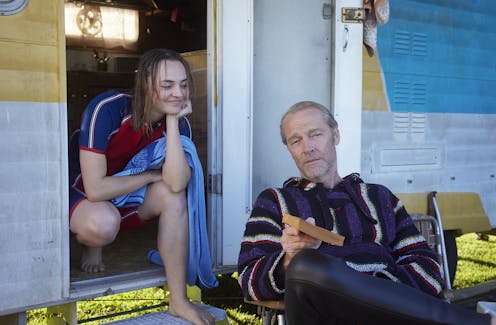
Linh Dan Pham plays the role of Vietnamese refugee Sandy Bui. Joel Pratley/Disney+
A brilliant cast from home and away
The show’s cast is enormous and terrific. Disney does that now seemingly necessary thing where it fronts a show with established and recognisable international talent. It has thrown Game of Thrones’ Iain Glen and the incredible Linh-Dan Pham from The Beat That My Heart Skipped (2005) into the show’s mix to appeal to viewers around the world.
But it has also lured Aussie exports Jesse Spencer and Radha Mitchell home. Thomas Weatherall is captivating and moves well beyond his performance in Heartbreak High, while the sisterly dynamic between newcomers Emily Grant and Mackenzie Mazur rings true. All the while, Mailman is perhaps the best thing about the show.
Emily Grant and Mackenzie Mazur play sisters Mia and Tilly. Joel Pratley/Disney+
The series sounds comforting to the Australian ear, refusing to convert or explain references for international audiences. The writing team, which worked on Picnic at Hanging Rock, The Heights and Hungry Ghosts, have created a world that is both familiar and full of humour.
Given the particular 1979 events on which the show is centred, it’s unlikely we’ll see a second season of Last Days.
So what does this mean for future Disney+ commissions in Australia then? Disney has been tightlipped about what it’s going to invest in next.
It will be interesting to see whether the reception of Last Days of the Space Age inspires more local storytelling. If the series crash-lands (sorry, I had to), it might be bad news for more distinctly Australian commissions from the streamer.
The series seems to have been made first and foremost for Australian audiences. Joel Pratley/Disney+
Alexa Scarlata does not work for, consult, own shares in or receive funding from any company or organisation that would benefit from this article, and has disclosed no relevant affiliations beyond their academic appointment.
I am writing this because no one at the ABC — whose producers invited me onto their coronation coverage as a guest — has uttered one word of public support. Not one ABC executive has publicly refuted the lies written or spoken about me. I don’t hold any individual responsible; this is an institutional failure.
These words, written by Stan Grant, who at the time was one of the ABC’s most high-profile First Nations journalists, catalysed the ABC into commissioning a review that has now revealed systemic racism across the national broadcaster.
The review was conducted by the Indigenous law firm Terri Janke and Company. Its report, Listen Loudly, Act Strongly, sets out failures of culture, management and senior leadership.
Failures of culture were demonstrated by the prevalence of overt and covert racism.
A First Nations staff member was asked: “How much of you is Aboriginal? Don’t worry. You don’t look it.”
Another staff member said:
whenever you raised [racism] with someone, you’d have to be so careful because if they got upset, you were the one who would get in trouble, you know, cause you’d be going out and upsetting the nice White people. And [they would say]: ‘Don’t say that. That’s not what we meant. You’ve got it all wrong. You’re so sensitive. You’ve overreacted.‘
Failures of management abounded, especially in middle management, where some were good at handling issues concerning race but most were not.
One staff member said:
there is an overall sense that managers are just not up for the job.
Senior leadership was likewise of uneven quality, although when a staff member circumvented middle management and went right to the top, the experience was positive:
I went to see David [managing director Anderson]. He was great. He listened. It was difficult for him.
The more common experience was reflected in this observation:
As an organisation, they don’t understand they have a structural issue. If the Managing Director says at Senate Estimates that there isn’t a problem, then middle management wouldn’t think there is an issue. And we all feel like we are being gaslighted.
Laundry list of issues
These responses represent a small cross-section of the data in the report, derived from the testimony of 99 current staff and 21 former staff, 80 women and 30 men.
Most gave their accounts in personal interviews, while others used group forums or provided written submissions. Many said they came forward because they cared about the ABC.
The preponderance of women indicates there is an especially acute issue concerning what is called intersectionality, meaning the intersection of two attributes, in this case race and gender, that tend to arouse discrimination. The report finds the most severe accounts of racism and racial discrimination described to the review team were directed towards women of colour.
The report canvasses not just the day-to-day interactions reflected in the comments above, but also:
gaps in the management structure
shortcomings in human resource management
the incapacity of the ABC to respond effectively to external attacks on its journalists
narrowness in recruitment
inequitable career progression
inadequate complaints-handling processes
inequities in pay
poor training of managers.
A test of character
There are 15 recommendations covering all these problems and the ABC has issued a statement saying it has adopted all of them in principle. In some cases it has gone further and begun implementing them already.
It has appointed a new Director, First Nations Strategy to the senior leadership team, engaged the former Race Discrimination Commissioner Chin Tan as a change agent and engaged the prominent First Nations academic, Jackie Huggins, as Elder-in-Residence to provide advice and support.
These are among a long list of actions put out by the ABC alongside the release of the report.
There are new committees, staff consolidations, reallocations of management reporting lines and the like, but the real test is still to come: the test of courage and character that the ABC has failed so conspicuously, not just in the Grant case but in others, including the ongoing matter of Antoinette Lattouf.
Both she and Grant were victims of sustained external attacks. Recommendation four of the report addresses the ABC’s demonstrated incapacity to cope with these. It says a centralised team should be set up to which staff can turn when attacked by external media organisations or individuals.
The ABC’s response to this is confined to a general statement about improving its systems and processes. Considering it was a sustained external attack, led by News Corporation, on Stan Grant that led to his resignation and the setting up of the review, it is a singularly vague and lame response.
The pressures of diversity
An especially insightful part of the report articulates the complex challenges facing journalists from First Nations or cultural and linguistically diverse (CALD) backgrounds.
One such challenge is referred to as “cultural load”. This means these journalists are not only expected to do their own stories like everyone else, but to provide contacts and cultural advice to other journalists who have come to rely on them for this kind of support rather than develop their own contacts and cultural understandings.
Another is that stories with a cultural dimension raise presumptive suspicions by managers that journalists from diverse backgrounds will not be able to cover stories about their communities impartially.
At the same time, there was a lack of recognition among managers of the burden of community expectations these journalists carried when reporting on matters involving their cultural background.
One journalist summarised it like this:
we can’t go to our managers to actually talk about this because I’m worried that if I do say something, I’m going to be scrapped off this story or I’m going to be labelled as biased. And they also don’t know at the end of the day that when we go home and we are in proximity with those communities, we also bear the brunt of their anger and frustration. There’s a lot of backlash and assumptions about what we can do in our capacity.
This is an acute dilemma for managers and staff, but it seems clear that whatever editorial policies are in place to resolve it are inadequate. The ABC’s action list has nothing to say about this.
Altogether it is a lacerating document and it demonstrates to a sobering degree how closely the ABC’s conduct reflects the overt and covert racism in the wider Australian community.
Denis Muller does not work for, consult, own shares in or receive funding from any company or organisation that would benefit from this article, and has disclosed no relevant affiliations beyond their academic appointment.
Source: The Conversation (Au and NZ) – By Antje Fiedler, Senior Lecturer, Management and International Business, University of Auckland, Waipapa Taumata Rau
Continuous economic pressure is causing significant stress and burnout among small business owners, while confidence continues to decline.
Data from the Ministry of Business, Innovation and Employment show company liquidations are up 40% in the first eight months of 2024 compared to 2023. Construction, retail and hospitality have been hit hard due to rising costs and declining spending.
The economic climate has been compared with the aftermath of the 2008 global financial crisis (GFC). But this time, the pain for small and medium-sized businesses could end up being worse.
New Zealand in the 2008 crisis
The GFC, rooted in excessive risk taking in credit markets in the United States, Ireland and elsewhere, was one of the most severe economic shocks in the postwar era.
At the same time, China had a growth spurt and developed an appetite for New Zealand’s agricultural exports. Trade between the two countries nearly tripled between 2007 and 2016.
These conditions placed our per-capita gross domestic product performance among the best in the OECD. In the current crisis, we are among the worst.
Holding the belt tight
This time is different. New Zealand is trying to save its way out of economic trouble. High inflation, and subsequently higher interest rates, have forced many New Zealanders to tighten their belts.
According to one survey, Australian and New Zealand consumers have reduced their spending at small and medium-sized businesses by 60% – the highest among all polled regions.
While all small businesses are facing the same storm, they are not in the same boat.
Some, such as technology companies, or those in specific locations, such as construction firms in Southland, have continued to experience demand. There have also been consumption shifts from city centres to suburbs, malls and online.
For others, however, the cost-of-living crunch has forced their customers to repair rather than replace, have a take-out meal instead of eating in a restaurant, and to hunt for online deals, ditch the gym or do more DIY.
In fact, credit bureau Centrix showed that 461,000 New Zealand consumers are now behind on repayments. Consumer cost-saving measures have hit many retailers and small service businesses alike.
International visitors, who tend to spend in these categories, are also still below pre-COVID levels. Customer spending is tight.
Small business are in a “cost of doing business” crisis. Costs have increased rapidly. Wages, materials, rent and the cost of capital have gone up. Compliance costs and lack of infrastructure further stretch business budgets.
But passing on the increase to customers is often impossible, given the reduction in shrinking discretionary spending power. In short, reduced spending power and rising costs mean, for many small firms, the candle is burning at both ends.
Too costly to close
The severity of the situation is unlikely to be fully represented in business closure statistics. Small businesses are doing everything to hang on. People are working longer hours and cutting back on the money they take out of the business to manage cash flow.
Exiting is also difficult in a tight labour market – in part because there are fewer positions available to the rising number of job seekers.
Instead, small businesses do everything to extend the runway to avoid legal liquidation. They tend to close quietly if they run out of options.
But rising interest rates have increased exposure. And with falling house values, small businesses have fewer opportunities to tap into the family home for additional funding.
These processes worked in the opposite direction during the 2008 crisis, where initially shrinking demand was met with a declining cost of borrowing. Bluntly put, gas was added to the tank.
Interest rates to the rescue?
There is hope. The recent drop in interest rates has lifted the economic mood, with business confidence reaching a ten-year high in September.
Global drops in interest rates mean Willis’ predicted lift has begun – but the outcome is not guaranteed.
Consumers have been pessimistic about the New Zealand economy for more than two years, which is a stark contrast to the GFC, where their confidence rebounded quickly.
Demand from China, a key market for New Zealand, is facing its own economic challenges.
The government narrative shapes conditions for the economy. Yes, we need to “face the books”, but this needs to be balanced with encouraging small businesses and innovation.
Like other small economies, New Zealand needs a sustained commitment to infrastructure and exporting, and investment in science and innovation to support the small business sector.
The government needs to provide small businesses with the confidence to flourish – and to prevent the long squeeze from the economic downturn.
Antje Fiedler is a Director of The Small Enterprise Association of Australia and New Zealand (SEAANZ).
Benjamin Fath does not work for, consult, own shares in or receive funding from any company or organisation that would benefit from this article, and has disclosed no relevant affiliations beyond their academic appointment.
You know we’ve reached peak interest in artificial intelligence (AI) when Oprah Winfrey hosts a television special about it. AI is truly everywhere. And we will all have a relationship with it – whether using it, building it, governing it or even befriending it.
But what exactly is AI? While most people won’t need to know exactly how it works under the hood, we will all need to understand what it can do. In our conversations with global leaders across business, government and the arts, one thing stood out – you can’t fake it anymore. AI fluency that is.
AI isn’t just about chatbots. To help understand what it is about, we’ve developed a framework which explains the broad broad range of capabilities it offers. We call this the “capabilities stack”.
We see AI systems as having seven basic kinds of capability, each building on the ones below it in the stack. From least complex to most, these are: recognition, classification, prediction, recommendation, automation, generation and interaction.
Recognition
At its core, the kind of AI we are seeing in consumer products today identifies patterns. Unlike traditional coding, where developers explicitly program how a system works, AI “learns” these patterns from vast datasets, enabling it to perform tasks. This “learning” is essentially just advanced mathematics that turns patterns into complex probabilistic models – encoded in so-called artificial neural networks.
Once learned, patterns can be recognised – such as your face, when you open your phone, or when you clear customs at the airport.
Pattern recognition is all around us – whether it’s license plate recognition when you park your car at the mall, or when the police scan your registration. It’s used in manufacturing for quality control to detect defective parts, in health care to identify cancer in MRI scans, or to identify potholes by using buses equipped with cameras that monitor the roads in Sydney.
The AI capabilities stack is a framework for understanding how AI is used. Sandra Peter & Kai Remer, CC BY-NC-ND
Classification
Once an AI system can recognise patterns, we can train it to detect subtle variations and categorise them. This is how your photo app neatly organises albums by family members, or how apps identify and label different kinds of skin lesions. AI classification is also at work behind the scenes when phone companies and banks identify spam and fraud calls.
In New Zealand, non-profit organisation Te Hiku developed an AI language model to classify thousands of hours of recordings to help revitalise Te Reo Māori, the local indigenous language.
Prediction
When AI is trained on past data, it can be used to predict future outcomes. For example, airlines use AI to predict the estimated arrival times of incoming flights and to assign gates on time so you don’t end up waiting on the tarmac.
Once we predict, we can make recommendations for what to do next.
If you went to Taylor Swift’s Eras tour concert at Sydney’s Accor stadium, you were kept safe thanks to AI recommendations. A system funded by the New South Wales government used data from multiple sources to analyse the movement and mood of the 80,000 strong crowd, providing real-time recommendations to ensure everyone’s safety.
AI-based recommendations are everywhere. Social media, streaming platforms, delivery services and shopping apps all use past behaviour patterns to present you with their “for you” pages. Even pig farms use pig facial recognition and tracking to alert farmers to any issues and recommend particular interventions.
Automation
It’s a small step from prediction and recommendation to full automation.
In Germany, large wind turbines use AI to keep the lesser spotted eagle safe. An AI algorithm detects approaching birds and automatically slows down the turbines allowing them to pass unharmed.
Closer to home, Melbourne Water uses AI to autonomously regulate its pump control system to reduce energy costs by around 20% per year. In Western Sydney, local buses on key routes are AI-enabled: if a bus is running late, the system predicts its arrival at the next intersection and automatically green-lights its journey.
Generation
Once we can encode complex patterns into neural networks, we can also use these patterns to generate new, similar ones. This works with all kinds of data – images, text, audio and video.
Image generation is now built into many new phones. Don’t like the look on someone’s face? Change into a smile. Want a boat on that lake? Just add it in. And it doesn’t stop there.
Tools such as Runway let you manipulate videos or create new ones with just a text prompt. ElevenLabs allows you to generate synthetic voices or digitise existing ones from short recordings. These can be used to narrate audiobooks, but also carry risks such as deepfake impersonation.
And we haven’t even mentioned large language models such as ChatGPT, which are transforming how we work with text and how we develop computer code. Research by McKinsey found that these models can cut the time required for complex coding tasks by up to 50%.
Interaction
Finally, generative AI also makes it possible to mimic human-like interactions.
Soon, virtual assistants, companions and digital humans will be everywhere. They will attend your Zoom meeting to take notes and schedule follow-up meetings.
Interactive AI assistants, such as IBM’s AskHR bot, will answer your HR questions. And when you get home, your AI friend app will entertain you, while digital humans on social media are ready to sell you anything, any time. And with voice mode activated, even ChatGPT gets in on the inter-action.
Amid the excitement around generative AI, it is important to remember that AI is more than chatbots. It impacts many things beyond the flashy conversational tools – often in ways that quietly improve everyday processes.
The authors do not work for, consult, own shares in or receive funding from any company or organisation that would benefit from this article, and have disclosed no relevant affiliations beyond their academic appointment.
In a race against time, scientists are exploring new ways to restore natural systems. Alongside traditional methods such as planting trees, reducing pollution and reintroducing native species, a surprising new tool is emerging: sound. Ecologists can harness sound to bring life back to degraded ecosystems.
On land and at sea, natural soundscapes are being replicated to stimulate growth, reproduction and even communication among species. Sound is already being used to restore oyster beds and coral reefs.
In our new research, we found beneficial plant microbes are also receptive to sound. We used high-frequency white noise to stimulate a fungus that promotes plant growth. The noise is a bit like the sound emitted in between channels of an old-fashioned radio.
This adds a new dimension to restoration projects. Imagine using tailored soundscapes to restore wetlands, forests or grasslands, simply by artificially amplifying the sonic cues that attract wildlife, stimulate growth and rebuild relationships between species. We see a bright future for this “biodiversity jukebox”, with tracks for every ecosystem.
Sound as an ecological tool
In healthy ecosystems, everything from animal calls to water trickling underground creates a sonic landscape or “soundscape” that ultimately supports biodiversity.
Conversely, the soundscapes in degraded ecosystems are often diminished or altered. This can change the way species behave and ecosystems function.
Marine biologists were among the first to explore sound as a tool for restoring Australia’s southern oyster reefs. Intact oyster reefs provide habitat for many species and prevent shoreline erosion. But pollution, overharvesting and dredging almost wiped them out more than a century ago.
It turns out playing sounds of healthy reefs, namely snapping shrimp, underwater encourages baby oysters to settle and grow. These sounds mimic the natural environment of thriving oyster beds.
The results have been impressive. Oyster populations show signs of recovery in areas where soundscapes have been artificially restored.
Similarly, fish support healthy coral reefs by grazing on algae that can otherwise smother corals. Playing the sounds of healthy coral reefs can attract young fish to degraded reefs. This helps kickstart reef recovery.
The power of sound in plant microbiology
Building on these successes, we ventured into new territory. In our new research we used sound to stimulate the growth of soil microbes.
These microbes play an essential role in plant health. Some promote nutrient uptake in plants, others protect against disease. But these communities of microorganisms can be diminished and disrupted in degraded soils, hampering plant growth and ecosystem recovery.
We wanted to find out whether specific sounds could encourage the growth of these beneficial microbes. We ran a series of experiments, to test the effect of sound on the growth and reproduction rate of a particular fungus known to stimulate plant growth and protect against diseases.
We grew the fungus in the laboratory in 40 Petri dishes and subjected half of them to treatment with sound. We played a sound recording similar to the high-frequency buzz of white noise for 30 minutes a day over five days. Then we compared the amount of fungal growth and the number of spores between the two groups.
In technical terms, the frequency was 8 kHz and level was 80 dB, which is quite loud, like the sound of a busy city street or vacuum cleaner, almost loud enough to damage hearing.
We used a monotonous sound for experimental reasons, because it is easy to control. But a more natural or diverse soundscape may be even better. We plan to do more research on this in the near future.
We found sound stimulated the fungi, increasing the growth rate by more than seven times and the production of spores by more than four times compared to the control (no sound).
Why sound works
Why does sound have such a powerful effect on ecosystems? The answer lies in the way organisms interact with their environment.
Sound travels almost five times faster in water than in air, making it an efficient means of communication for marine life such as oysters, fish and whales.
We already know sound influences the activity of microbes. We think it stimulates special receptors on the membranes of the microbes. These receptors might trigger a response in the cells, such as switching genes responsible for growth on or off.
Is sound the future of restoration?
Microbes support plant life, help maintain soil structure, hold water and store carbon. By stimulating beneficial microbes with sound, we may be able to improve large-scale restoration projects. This approach may also support regenerative agriculture, where farming works with nature rather than against it.
Our next steps include refining the sound patterns that are most effective in different ecosystems. We then need to scale up our research to test different sounds in diverse environments. We envisage creating a “biodiversity jukebox” of beneficial sounds to enhance ecosystem health.
It’s clear what we hear – and don’t hear – profoundly influences the environment. So we’re also interested in noise cancellation. By this, we mean barriers to protect ecosystems from potentially undesirable noises. For instance, we’re asking questions such as: do traffic and industrial noises harm the ecosystem?
As ecosystems face increasing pressure from climate change, biodiversity loss and habitat destruction, sound can become a powerful tool for restoration.
While the science is still in its infancy, it has huge potential.
Ultimately, sound-based restoration might offer a low-impact and cost-effective approach to help ecosystems recover. The future of restoration could be as much about what we hear as what we see.
Jake M Robinson is affiliated with the United Nations Framework Convention on Climate Change think tank Resilience Frontiers. He receives funding from the National Environmental Science Program for the Restoration by Design project.
Martin Breed receives funding from the Australian Research Council, National Environmental Science Program Resilient Landscapes Hub, Cooperative Research Centre for Transformations in Mining Economies (CRC TiME), Australian Academy of Science, and the New Zealand Ministry of Business, Innovation & Employment.
Source: The Conversation (Au and NZ) – By Vincent Hurley, Lecturer in Criminology. Police and policing. Dept of Security Studies & Criminology, Macquarie University
But is that true? What’s the history of knife crime in Australia? And how does knife crime here compare with other countries, such as the United Kingdom and Canada?
There have been several high-profile stabbing incidents in Australia in recent years.
Other crimes in which knives are commonly used, such as attempted murders and armed robberies, have fallen since 2004.
However, knives were the most common weapon used in homicides in Australia from 2010 to 2023.
So even though official police statistics show knife crime is not getting worse across Australia, the fact knives have been used in some high-profile murder cases could partly explain the growing concerns.
What sort of knives are being used?
As there are different types of firearms, so too are there different types of knives.
Knives are also known by police as bladed or sharp implements, a term that also includes axes, tomahawks, machetes, “zombie knives”, bayonets, swords and even syringes.
Comparisons with the UK and Canada
Unlike in Australia, knife crime in both the UK and Canada has been rising.
Second, crime in England and Wales generally increased from roughly 4 million offences in 2012 to 6.65 million in 2023–24.
Corresponding with these two factors was the removal of approximately 20,000 police officers between 2011 and 2019, although this trend has been reversed somewhat in recent years.
Finally, and unsurprisingly, the strict gun laws in the UK ensures guns are rarely used in homicides compared with knives.
Despite the increase in knife deaths in Canada, its parliament has not introduced specific legislation around knife crime, unlike in the UK.
However, police numbers in Canada have remained stable in the past ten years.
One possible explanation for the increase in knife crime in Canada is a combination of a lack of specific knife legislation and stagnant policing numbers – the police may be unable to keep pace or focus on knife crime, unlike in the UK.
Knife crime isn’t new
In 1669, King Louis XIV of France saw the connection between pointed domestic knives on his dining table and violence. He was so concerned that he passed a law demanding the tips of all table and street knives be ground smooth.
A century ago in Australia, knife crime came to public attention with a hybrid slang term called “Razorhurst”, when those living in the Sydney suburb of Darlinghurst demanded politicians deal with violent crime. Criminal gangs in the 1920s were regularly using cutthroat razors to slash the faces of their victims.
What reinforced the popularity of cutthroat razors, as opposed to guns, was introduction of the NSW 1927 Pistol Licensing Act.
This legislation was introduced to specifically discourage men who had become familiar using firearms in the first world war from using guns after returning home to Australia.
This law only led to the entrenched use of cutthroat razors, morphing into the use of knives instead of firearms.
How laws have changed in recent decades
In modern times in Australia, knife laws changed significantly after the stabbing murder of NSW police officer David Carty in 1997.
Some of these changes included the banning of “credit card knives” and knives disguised as non-weapons, while it became illegal to sell knives to people under 18. It also became illegal to carry a pocket knife in public unless it was for a specific, lawful purpose.
The death of Jack Beasley in Queensland in 2019 resulted in the “Jack’s Law” legislation. And in the past year, most Australian state and territory governments have introduced new laws to address and prevent knife crime.
There have also been calls to allow police widespread use of electronic, handheld metal detectors to check if anyone is carrying a knife, as has happened recently in NSW.
The reality of knife crimes in Australia
So if knife crime has not risen as sharply as it has in places like UK or Canada, what gives the impression that Australia is suffering an epidemic of knife crime?
The recent string of high-profile incidents has generated widespread public concern, which in turn has prompted calls by politicians to get tough on knife crime. This can be an easy political win.
Given every kitchen and garage in Australia possess more than one knife or bladed implement, the reality of removing these is not an option.
But the fear of knife crime is greater than the reality of us becoming victims to it.
The authors do not work for, consult, own shares in or receive funding from any company or organisation that would benefit from this article, and have disclosed no relevant affiliations beyond their academic appointment.
For instance, GPT-4 scored higher than 90% of the United States bar exam test takers. These successes led to concerns AI systems might also breeze through university-level assessments. However, my recent study paints a different picture, showing it isn’t quite the academic powerhouse some might think it is.
My study
To explore generative AI’s academic abilities, I looked at how it performed on an undergraduate criminal law final exam at the University of Wollongong – one of the core subjects students need to pass in their degrees. There were 225 students doing the exam.
The exam was for three hours and had two sections. The first asked students to evaluate a case study about criminal offences – and the likelihood of a successful prosecution. The second included a short essay and a set of short-answer questions.
The test questions evaluated a mix of skills, including legal knowledge, critical thinking and the ability to construct persuasive arguments.
Students were not allowed to use AI for their responses. And did the assessment in a supervised environment.
I used different AI models to create ten distinct answers to the exam questions.
Five papers were generated by just pasting the exam question into the AI tool without any prompts. For the other five, I gave detailed prompts and relevant legal content to see if that would improve the outcome.
I hand wrote the AI-generated answers in official exam booklets and used fake student names and numbers. These AI-generated answers were mixed with actual student exam answers and anonymously given to five tutors for grading.
Importantly, when marking, the tutors did not know AI had generated ten of the exam answers.
We handwrote the AI answers so markers would think they were done by students. Kate Aedon/Shutterstock
How did the AI papers perform?
When the tutors were interviewed after marking, none of them suspected any answers were AI-generated.
This shows the potential for AI to mimic student responses and educators’ inability to spot such papers.
But on the whole, the AI papers were not impressive.
While the AI did well in the essay-style question, it struggled with complex questions that required in-depth legal analysis.
This means even though AI can mimic human writing style, it lacks the nuanced understanding needed for complex legal reasoning.
The students’ exam average was 66%.
The AI papers that had no prompting, on average, only beat 4.3% of students. Two barely passed (the pass mark is 50%) and three failed.
In terms of the papers where prompts were used, on average, they beat 39.9% of students. Three of these papers weren’t impressive and received 50%, 51.7% and 60%, but two did quite well. One scored 73.3% and the other scored 78%.
These findings have important implications for both education and professional standards.
Despite the hype, generative AI isn’t close to replacing humans in intellectually demanding tasks such as this law exam.
My study suggests AI should be viewed more like a tool, and when used properly, it can enhance human capabilities.
So schools and universities should concentrate on developing students’ skills to collaborate with AI and analyse its outputs critically, rather than relying on the tools’ ability to simply spit out answers.
Further, to make collaboration between AI and students possible, we may have to rethink some of the traditional notions we have about education and assessment.
For example, we might consider when a student prompts, verifies and edits an AI-generated work, that is their original contribution and should still be viewed as a valuable part of learning.
Armin Alimardani has a short-term, part-time contract with OpenAI as a consultant. The organisation had no input into the study set up or outcomes and did not fund the research. The views expressed in this article are the author’s own.
Thirteen years ago at the tax summit called to discuss the Henry Tax Review, David Koch stopped discussion of negative gearing dead in its tracks.
Better known by many as “Kochie”, he was the long-running host of Channel Seven’s Sunrise, TV’s favourite “daggy dad”, a finance journalist and a community representative at the summit.
Property manager Eddie Kutner had just finished putting the case for negative gearing. He argued allowing landlords who lost money to deduct the losses from their other income to cut tax was “a responsible part of providing accommodation”.
Negative gearing on an unproductive asset? Does it just go on for time immemorial, or is it time to actually put some limits on it – to say, okay for the first five years, but if it’s not producing an income after that, why are you there?
The fiction at the heart of negative gearing
Koch had zeroed in on the fiction at the heart of negative gearing: that the landlord had bought and rented out a property to earn income, but had failed, perhaps temporarily or perhaps for a very long time. As a result, they needed to be compensated for losses incurred in the pursuit of an income.
It’s an argument we’ve grown used to hearing in Australia. Overseas? Forget it.
In both those countries, landlords are allowed to lose money – no crime in that. But they are not allowed to offset those losses against their wages to pay less tax (although they are able to offset them against income from other investments).
In Canada, landlords can try it on. But the bar is higher: there, they need to be able to demonstrate an “intention to make a profit” – something that would be beyond many Australian negative gearers.
Back at the 2011 tax summit, Koch went on: “It’s done purely for the attraction of letting the taxman pay half, I’m not saying get rid of it altogether, but there’s got to be a limit”.
No one returned to the topic. The summit moved on. And here we are 13 years later, still having the same argument.
13 billion reasons for change
Negative gearing has become so common – in Australia, one in six taxpayers are landlords and 40% of them negatively gear – that we no longer think of it as weird.
But the treasury is examining it. Since Jim Chalmers became treasurer in 2022, it has been including it in its annual list of anomalies known as tax expenditures. Chalmers says he has sought its advice about it, which he says is “not especially unusual, especially when it comes to contentious issues”.
Axing negative gearing would bring in an extra A$7.7 billion next financial year according to calculations by the Parliamentary Budget Office.
If the government also abolished the 50% discount on the capital gains tax that makes negative gearing attractive, it would save a further $5.9 billion dollars.
The total, $13.6 billion, would be enough to fund substantial extra tax cuts for all of us – about half as big as the Stage 3 tax cuts that began in July.
But that’s not the only argument for winding back access to negative gearing – and perhaps not even the strongest.
More landlords means fewer owner-occupiers
For most of the post-war years, right through to the 2001 census, about 70% of Australian households lived in a home they owned. They didn’t rent, and many who did could expect to own their home as they moved through life.
In 1999, the headline rate of capital gains tax was halved. In the 25 years since then, home ownership has fallen to 66%. It has fallen on the watch of John Howard, Kevin Rudd, Julia Gillard, Tony Abbott, Malcolm Turnbull, Scott Morrison and now Anthony Albanese.
It has happened because more homes are owned by landlords. The maths are unarguable.
The bigger the share that is owned by landlords, the smaller the share that is owned by occupiers.
My calculations suggest that if homeownership bounced back to 70%, where it was in 2001, an extra 430,000 homes – 4% of Australia’s 10.8 million households – would now be owned by the people who live in them.
Modelling finds limits would build back home ownership
Would limiting access to negative gearing and capital gains tax concessions help more of us own our homes? Two sets of economics modelling suggest it could.
Modelling of the changes Labor took to the 2019 election by Deloitte Access Economics for the Property Council found that, over time, they would increase the share of owner-occupiers by 2.5 percentage points. At the moment, that would mean an extra 270,000 homes owned by the people who live in them.
Modelling by the New South Wales Treasury found Labor’s 2019 plan would increase the share 4.7 percentage points (which would mean 507,000 more owner-occupied homes).
What options does the government have now?
Of course, there are all sorts of things the treasury could suggest to Jim Chalmers that would fall short of the plans Labor took to the 2019 election – but which would still help.
Koch suggested one option: “there’s got to be a limit”.
The Albanese government – or a future government, should Albanese choose to do nothing like his predecessors – could limit the number of homes each investor is able to negatively gear.
That limit could be set at one investment property (most investors negatively gear only one). Or it could be a more generous two: nine out of ten negatively gear only one or two. Only a minority – 31,000 – own four or more.
Alternatively, Australia could limit the dollar amount negative gearers are able to deduct from their pay for tax purposes, perhaps stopping at $20,000. Not only are high earners more likely to negatively gear than low earners, they are also likely to deduct more, because they borrow more and are in higher tax brackets.
Or we could phase it out over five years, as suggested by the Grattan Institute.
Or we could protect existing arrangements (as Shorten promised to in 2019) and continue to allow negative gearing for investors who build new homes rather than buy existing ones.
Or do nothing. Both former prime minister Scott Morrison and former treasurer Joe Hockey said they were unhappy with the way negative gearing worked, yet did nothing while in office. They kicked the can down the road.
Albanese and Chalmers are in charge now. What will they do next?
As we dive into October, here are some captivating new films and series to help fill your evenings on the couch.
This month’s streaming picks from our experts feature plenty of strong women characters – from Nicole Kidman’s role as a fearsome matriarch in The Perfect Couple, to empowered young women battling it out in a K-pop reality show contest. Meanwhile, Marvel’s latest offering Agatha All Along brings a fresh feminist-queer twist to the Marvel universe.
Whether you’re in the mood for romance, documentary or murder mysteries, we’ve got something for you.
Last Days of The Space Age
Disney+
Disney+‘s new drama Last Days of the Space Age is set in Perth in 1979 – and could be considered the streaming service’s first real foray into Australiana.
The series follows three families through a series of true events, including a power company strike, the arrival of a bunch of Miss Universe contestants from around the world and the crash of the US space station Skylab. Amid this chaos, it also touches on the denial of local Indigenous history, a Vietnamese refugee’s search for her lost son, a feminist surfing adventure – and more.
By trying to juggle so many plot points in eight episodes, the series overwhelms itself and at times can feel underdeveloped. Nonetheless, its focus on Australian audiences and stories gives it a refreshing authenticity.
The cast is stellar, featuring local talent such as Jesse Spencer, Deborah Mailman and Radha Mitchell, alongside international names including Iain Glen and Linh-Dan Pham. Newcomers Emily Grant and Mackenzie Mazur also shine in their roles.
As Disney’s first truly Australian-centric show, Last Days of the Space Age is a promising step for local storytelling. Let’s just hope it’s not the last of the streaming service’s major local commissions.
–Alexa Scarlata
Emily in Paris, season four
Netflix
Season four of Emily in Paris continues the frothy delightfulness of previous seasons, complete with absurd fashion moments, sharp dialogue and easily resolved PR catastrophes. This show is the televisual equivalent of fairy floss in the best way: nutritionally empty, yet sweetly satisfying.
The almost hermetically sealed, aspirational world of Emily’s Paris remains untouched by pandemics, Olympic scandals or economic realities. Instead, we bounce from the titular French capital to the snowy slopes of Megève, to Roma – all rendered in the dreamy romance of a technicolor fantasy. Although she is now fully ensconced in Parisian life, Emily (Lily Collins) carries the show with spunk and a wide-eyed American optimism.
“Hot chef” Gabriel (Lucas Bravo) still has zero personality, but that doesn’t matter as he is surrounded by charismatic and charming characters in the bonkers Luc (Bruno Gouery) and witty Mindy (Ashley Park), both of whom are standouts this season. Sylvie Grateau (Philippine Leroy-Beaulieu) continues to inspire us all, thanks to her derision of Emily’s American ways and iconic style.
Do not attempt to make sense of the timeline, geography or economics of Emily in Paris. Just open your mind and heart to its goofy, spectacular pleasures.
– Jessica Ford
Pop Star Academy: KATSEYE
Netflix
Netflix’s Pop Star Academy: KATSEYE is about 20 aspiring young women who are finalists in a global competition, launched by entertainment industry heavyweights HYBE and Geffen Records, to find the next big K-pop group.
While I’m not a huge fan of the K-pop music genre, this docuseries has all the hallmarks of a streaming success. It takes talented contestants from all over the world, pits them against one another, and packages the outcome in a glossy and highly bingeable format.
There’s a fine line between empowerment and exploitation explored in the series. The girls are trained relentlessly and judged on categories such as “star power” and their general attitude. Non-compliance is seen as unacceptable.
At times I worried about the show’s potential to negatively influence young viewers – and especially young trend-conscious girls. That said, director Nadia Hallgren (who is known for her sensitive work documenting women of colour) does well to show that the participants’ quest is far from glamorous.
I appreciated the intimate access into the lives of these girls, who often have no fallback if their efforts in the merciless industry don’t pay off. There are some fascinating moments where you see the stars in their eyes begin to dim as they’re taken to breaking point. This prompts some to take matters into their own hands – showing a true fighting spirit.
– Phoebe Hart
The Perfect Couple
Netflix
Based around a lavish wedding due to take place in a multimillion-dollar beach house on the Nantucket coastline, The Perfect Couple is a glossy “whodunnit” featuring the uber-wealthy getting up to no good.
Just hours before the ceremony, the body of maid of honour party-girl Merritt Monaco (Meghann Fahy) washes up dead. With secrets lurking at every plot twist, everyone’s a suspect.
In a narrative device reminiscent of Big Little Lies, scandalous revelations are gleefully delivered during a series of police interviews. Detective Nikki Henry (Donna Lynne Champlin) listens with equal parts revulsion and fascination, a fitting stand-in for us viewers.
While the whole cast appear to be enjoying themselves immensely, Nicole Kidman is the undeniable star of the show. Recent roles have seen Kidman become synonymous with the glamorous, albeit fragile, housewife. The icy matriarch Greer Garrison Winbury – equally revered and feared – is a welcome deviation that Kidman performs with relish.
The Perfect Couple arguably doesn’t offer the same depth of social critique as similar predecessor shows such as Big Little Lies or The White Lotus. Nonetheless, its fast pace and slick execution render it tremendously fun and binge-worthy viewing.
– Rachel Williamson
KillJoy
Stan
At 16, Kathryn Joy applied for a passport. To do this, they had to obtain the death certificate for their mother, Carolyn. After growing up in a house in which their father had killed their mother, Kathryn learned exactly how their mother had died: “gunshot wound to the head”.
The bare brutality of this information shocked them into looking anew at their father, escaping from small town to big city, spiralling into trauma-induced mental anguish, and embarking on a journey of self-discovery through tracing their family’s violent history.
Eight years of this journey are documented in the new Australian documentary Killjoy.
The narrative is held together by two investigative processes: finding out about how Carolyn had lived, as well as died; and understanding how to travel through, and with, pain and vulnerability to a place of fullness and purpose.
The film takes us with Kathryn as they trace their own history, irrevocably intertwined with that of their mother. The result is a unique journey into the inner turmoil, development, hopes and passions of a beautiful sensitive mind struggling to understand themselves against an ongoing backdrop of gender violence and political activism.
With episode three having just dropped, Kathryn Hanh is back as Agatha Harkness in the much-anticipated Agatha All Along – a follow up to the critically acclaimed Marvel series WandaVision.
Following her battle with Wanda (Elizabeth Olson), Agatha is stuck in Eastview without her powers. Episode one opens with Agatha trapped in a parody of Mare of Easttown, with Hahn hamming up the mannerisms of Kate Winslet’s performance alongside Aubrey Plaza. She’s soon woken up, however, by a mysterious teen played by Heartbreaker’s Joe Locke. To regain her strength, she must transport herself to the Witches’ Road and survive the journey. But she can’t do this without forming a coven with other witches.
With a coven played by the star-studded ensemble of Debra Jo Rupp, Ali Ahn, Sasheer Zamata and Patti LuPone, Agatha dares to walk the Witches’ Road. Along the journey, each witch will be faced with a trial in which they must succeed or face certain death. Adding to the tension is the mystery around the teen’s identity and the potential former romance between Hanh and Plaza’s characters.
Showrunner Jac Schaeffer, who also created WandaVision, has imbued Agatha All Along with the same humour and pop culture awareness. The show is reminiscent of the 1990s obsession with witchcraft and supernatural power, such as Buffy, the Vampire Slayer, Charmed and Practical Magic. It’s refreshing to have a Marvel entry that is genuinely feminist and queer.
– Stuart Richards
Sharon Crozier-De Rosa receives funding from the Australian Research Council.
Alexa Scarlata, Jessica Ford, Phoebe Hart, Rachel Williamson, and Stuart Richards do not work for, consult, own shares in or receive funding from any company or organisation that would benefit from this article, and have disclosed no relevant affiliations beyond their academic appointment.
In the outer reaches of our Solar System, 5.7 billion kilometres from the Sun, lies the dwarf planet Pluto. Smaller than Australia, it is an icy world of mountains, glaciers and craters where the average temperature is –232°C.
Five moons orbit Pluto – Styx, Nix, Kerberos, Hydra and Charon. Of these, Charon is the largest. Unlike most other planetary systems, it exists in a “binary system” with its parent body, meaning they both orbit a point in space between the two.
Much mystery still surrounds Pluto and its moons. But in new research published in Nature Communications today, a team led by astronomer Silvia Protopapa from the Southwest Research Institute in the United States announced they’ve found carbon dioxide and hydrogen peroxide on Charon’s surface.
The findings, based on data from NASA’s James Webb Space Telescope, offer vital clues about how our favourite not-planet/planet system was formed.
Charon is kind of like Pluto’s smaller twin. It is just over 1,200 kilometres wide – about half the size of Pluto, which makes it the largest known satellite relative to its parent body in our Solar System. Pluto itself is already small when compared to our Moon, with Pluto being about two-thirds the size and one-sixth the mass of Earth’s satellite. Charon’s mass is about one-eigth that of Pluto’s.
Charon and Pluto have an unusual orbit. While Charon goes around Pluto, Pluto also spins around a central point. They act almost like a double dwarf planet. This is unlike the Moon and Earth, where the Moon goes around us, and we don’t really change our position.
This is one reason why Pluto is no longer considered a planet, but is now labelled a dwarf planet. Its orbit with Charon means Pluto has not cleared its orbit, or has become the gravitational boss. This is the criteria Pluto failed in the planetary checklist.
In 2015, NASA’s New Horizons became the first spacecraft to explore Pluto and its moons up close after a nine-year journey from Earth. It showed Charon is composed of a variety of chemicals.
It is a very cold moon, rich in water ice. But it also contains ammonia and a wide variety of carbon-based compounds. Charon is also believed to have cryovolcanoes – areas that erupt ice instead of magma like on volcanoes on Earth.
Charon’s composition is different to Pluto’s and that of other objects beyond Neptune, which are dominated by nitrogen and methane ice.
The new detection of carbon dioxide and hydrogen peroxide on Charon can give valuable insight into how various processes interact on these trans-Neptunian objects.
Carbon dioxide is always a key molecule to understand – it tells us a lot about the history of an object.
In the case of Charon, it is believed the carbon dioxide comes from below the icy surface and has been exposed through asteroids and other objects hitting the moon and creating craters which reveal the fresh underground surface.
James Webb Space Telescope does it again
Scientists were able to detect carbon dioxide on Charon thanks to observations from the groundbreaking James Webb Space Telescope. Launched in 2021, this space telescope has a large mirror, six-and-a-half metres wide, which makes it very powerful and sensitive.
It can “see” in the infrared – colours of light our eyes and most telescopes on Earth can’t detect. The infrared is a key type of light for finding various molecules present on other objects – from planets to stars, galaxies and more.
To find these compounds, the telescope uses a technique called spectroscopy. The colours of light are broken up into individual colours, like breaking up white light into a rainbow. Each element or molecule has its own colour signature, like a fingerprint.
These new observations of Charon showed the signatures of carbon dioxide and hydrogen peroxide, along with the other previously known water ice.
NASA’s James Webb Space Telescope helped scientists study Charon. NASA/Chris Gunn
Vital clues to an ancient mystery
The formation of Charon is a scientific mystery. One of the leading theories is that it formed in a similar way to our Moon. According to this theory, some 4.5 billion years ago, a large object in the Kuiper Belt – the area where Pluto and Charon live – collided with Pluto and part of it broke off and formed into Charon.
It also could be that Pluto and Charon were two objects that collided, and then got stuck orbiting around each other.
Understanding the composition of Charon helps advance our understanding of how it formed. In this sense, the discovery of carbon dioxide and hydrogen peroxide represents an important step forward. Importantly, this can also give clues not only about Charon, but other objects out near Pluto.
More insights into Charon will help us understand this distant part of our Solar System – and the strange worlds that lie there.
Brad E Tucker does not work for, consult, own shares in or receive funding from any company or organisation that would benefit from this article, and has disclosed no relevant affiliations beyond their academic appointment.
Source: The Conversation (Au and NZ) – By Susan J. Méndez, Senior Research Fellow, Melbourne Institute of Applied Economic and Social Research, The University of Melbourne
Fees for medical specialists are going up faster than Medicare rebates, leading to a bigger gap for patients to pay.
Recent data from the Australian Institute of Health and Welfare shows that in the first quarter of this year, Medicare rebates covered just over half (52%) of the total fees. This is down from 72% two decades ago, and the lowest proportion on record.
Doctors can charge what they like, while the government determines the Medicare rebate. The difference between the two, or the gap, is what impacts patients. For GPs, the government provides an incentive for doctors to bulk bill, but there’s no such incentive for other specialists.
Doctors blame large gap payments on rebates being too low, and they’re partly right. After adjusting for inflation and increasing demand, the average dollar amount one person receives in Medicare rebates annually dropped from A$349 to $341 over the past decade.
But this is only a part of the problem. When many people can’t afford hundreds (if not thousands) of dollars for essential specialist care, we need to look at why fees are so high.
How do specialists set their fees?
Although general practice is technically a speciality, when we talk about medical specialists in this article, we’re talking about non-GP specialists. These might include paediatricians, oncologists, psychiatrists and dermatologists, among many others.
In determining fees, specialists consider a combination of patient-level, doctor-level and system-level factors.
Patient characteristics, such as the complexity of the patient’s medical condition, may increase the price. This is because more complex patients may require more time and resources.
Specialists, based on their experience, perceived skill level, or ethical considerations, may charge more or less. For example, some specialists report they offer discounts to certain groups, such as children or pensioners.
System-level factors including the cost of running a practice (such as employing staff) and practice location also play a role.
Problems arise when prices vary considerably, as this often signals limited competition or excessive market power. This holds true for medical services, where patients have little control over prices and rely heavily on their doctors’ recommendations.
In recent research, my colleagues and I found fees varied significantly between specialists in the same field. In some cases the most expensive specialist charged more than double what the cheapest one did.
Doctor characteristics influence fee-setting
My colleagues and I recently analysed millions of private hospital claims from 2012 to 2019 in Australia. We found the wide variation in fees was largely due to differences between individual doctors, rather than factors such as patient complexity or the differences we’d expect to see between specialties.
Up to 65% of the variance in total fees and 72% in out-of-pocket payments could be attributed to differences between doctors in the same field.
To understand what doctor-level factors drive high fees, we looked at data from a representative survey of specialists. We found older specialists have lower fees and higher rates of bulk billing. Practice owners tended to charge higher fees.
We also found doctors’ personalities affect how much they charge and how often they bulk bill patients. Doctors who scored more highly on the personality trait of agreeableness were more likely to bulk bill patients, while those who scored more highly on neuroticism tended to charge higher fees.
What we couldn’t show is any evidence fees were associated with competition.
Effects on patients
This is not a competitive market. On the contrary, it has high entry restrictions (long training requirements) and a limited supply of specialists, particularly in rural and remote areas. Meanwhile, patients’ access is controlled by the need for referrals which expire, generally after a year.
Patients are often unable to shop around or make informed decisions about their care due to a lack of information about the true cost and quality of services.
For private hospital services, the fee structure is complicated by the fact that several providers (for example, surgeon, anaesthetist, assistant surgeon) bill separately, making it difficult for patients to know the total cost upfront.
Despite efforts to introduce price transparency in recent years, such as through the government’s Medical Costs Finder website, the system remains far from clear. Reporting is voluntary and the evidence is mixed on whether these tools effectively reduce prices or increase competition.
All of this contributes to high and unpredictable out-of-pocket costs, which can lead to financial strain for patients. About 10.5% of Australians reported cost was a reason for delaying or avoiding a specialist visit in 2022–23.
This raises important questions about equity and the sustainability of Australia’s universal health-care system, which is built on the principle of equitable access to care for all citizens.
Patients can take steps to minimise their costs by proactively seeking information. This includes asking your GP for a range of options when you’re referred to a specialist. Note the referral from your GP can be used for any other doctor in the same specialty.
Similarly, ask the specialist’s receptionist what the fee and rebate will be before making an appointment, or for a detailed quote before going to hospital. Shop around if it’s too high.
But responsibility doesn’t only lie with patients. For example, the government could seek to address this issue by increasing investment in public hospital outpatient care, which could boost competition for specialists. It could also publish the range of fees compared to the rebate for all Medicare-billed consultations, rather than relying on voluntary reporting by doctors.
Price transparency alone is not enough. Patients also need quality information and better guidance to navigate the health-care system. So continued investment in improving health literacy and care coordination is important.
If things don’t change, the financial burden on patients is likely to continue growing, undermining both individual health outcomes and the broader goals of equitable health-care access.
Susan J. Méndez has previously received funding from the Medibank Better Health Foundation.
Two of the dominant players in New Zealand’s supermarket sector – Foodstuffs North Island and Foodstuffs South Island – have failed in their quest to officially join forces.
In a decision announced yesterday, the Commerce Commission declined to green-light the merger between the two cooperatives. The watchdog said it was not satisfied the move wouldn’t result in reducing competition in the New Zealand grocery sector.
But it needs to go further.
Instead of adjudicating on a merger, the commission should be given the power to break up the two Foodstuffs entities themselves. Local competitors, such as the Warehouse or others, should also be encouraged to ensure shoppers get the best deals.
Foodstuffs North Island and Foodstuffs South Island argued the levels of competition in the supermarket sector would not decrease with the merger.
The two entities admitted to already sharing information and not meaningfully competing against each other in the same regions. This is set to continue with the failure of their application to merge.
Multiple submissions to the Commerce Commission, such as those from academics Tim Hazeldine and Robert Hamlin, claimed Foodstuffs’ unwillingness to compete with each other demonstrated a worrying precedent in New Zealand.
The Grocery Action Group also claimed the two Foodstuffs’ entities breached consumer trust because one is an actual cooperative (Foodstuffs South Island), while 93% of Foodstuffs North Island’s shares are owned by four people who do not own physical stores.
This is an issue, as they continue to claim they are both owner-operated cooperatives, when only Foodstuffs South Island legally is.
Further submissions by industry bodies representing suppliers and Consumer NZ included concerns a merger would reduce competition.
But New Zealanders have less choice of where to do their grocery shop compared with other developed nations. The sector is dominated by the Foodstuffs entities – which include Pak’nSave, New World and Four Square – and Australian-based Woolworths (which also owns Fresh Choice).
In New Zealand there is one supermarket for every 12,871 people, while in Germany there is one for every 3,009, and one for every 5,563 in Ireland, a similar-sized island nation. New Zealand supermarkets generate the highest annual revenue per store among developed markets at US$27.9 million, versus $19.56m in the United States, $7.7m in Germany and $17.02m in Ireland.
Foodstuffs North Island’s current market share is just over 40%. Merging with Foodstuffs South Island would have increased the single entity’s national market share to 55%.
It found there was no meaningful competition in the sector and more competition was needed. It further highlighted that profit margins had increased since the 2022 market study.
Challenging mergers
New Zealand is not the only country where regulators are pushing back against supermarket mergers.
In August, the US Federal Trade Commission brought an emergency injunction blocking the merger between supermarket giants Albertsons and Kroger.
The court case, which is yet to be decided, included revelations of price gouging by Kroger. Albertsons is Kroger’s primary price competitor, meaning absorbing them would remove competition and the need to compete on price.
The Albertsons-Kroger merger would substantially lessen competition and trigger price increases.
In the United Kingdom, the Competition and Markets Authority blocked a 2019 merger between Asda and Sainsbury’s. At the time, the authority said shoppers would be worse off if the two supermarkets, with a combined market share of 31%, merged.
Time to break up the sector further
As we see in foreign markets, the push for market power to return higher profits is likely to continue. But when those businesses provide basic necessities, such as food, more competition is required, not less.
The proposed merger process has provided greater insight into the structure of Foodstuffs North Island and Foodstuffs South Island – including where the two organisations already work together.
As argued in some of the submissions to the Commerce Commission, the next logical step would be to separate Pak’nSave from the other Foodstuffs brands and encourage nationwide competition. If broken up, the new companies should be renamed to create separation from the current brands.
The Commerce Commission’s decision on the proposed Foodstuffs merger reinforces concerns about competition in New Zealand’s supermarket sector, as does the report from the Grocery Commission and the earlier grocery sector study.
If competition creates better prices for consumers, then splitting up New Zealand’s concentrated supermarket sector is the logical next step.
Lisa Asher made four submissions against the merger to the Commerce Commission in her capacity as an academic.
Drew Franklin does not work for, consult, own shares in or receive funding from any company or organisation that would benefit from this article, and has disclosed no relevant affiliations beyond their academic appointment.
Source: The Conversation (Au and NZ) – By Dr Rico Merkert, Professor in Transport and Supply Chain Management and Deputy Director, Institute of Transport and Logistics Studies (ITLS), University of Sydney Business School, University of Sydney
Qatar Airways has announced plans to buy a 25% minority stake in Virgin Australia from its owner, US private equity firm Bain Capital.
The two airlines have already had a strong relationship as “codeshare partners” since 2022. Codesharing is where airlines agree to sell seats on each other’s flights. This new announcement, however, is a big step up.
All of this will, of course, be subject to approval from both Australia’s Foreign Investment Review Board and the Australian Competition and Consumer Commission (ACCC). But there could be a range of winners if it goes ahead.
Perhaps most importantly for Australian travellers, the move means Virgin Australia will be able to compete as it once did on long-haul international routes.
This is because a proposed “wet lease” agreement – in which one airline provides full aircraft, crew and relevant services to another – could see Virgin Australia start operating its own flights from Brisbane, Melbourne, Perth and Sydney to Doha as early as mid-2025.
It’s also a win for Bain Capital, which had been trying to offload some of its stake in the airline after acquiring it in crisis in 2020.
So with the prospect of a renewed international foothold for Virgin Australia, could we soon see more competition – and real consumer benefits – on the “Kangaroo Route” between Australia and Europe?
Clearer skies for Qatar?
As you might remember, Qatar Airways’ previous attempts to expand in Australia haven’t always gone smoothly.
Today’s announcement comes little more than a year after Transport Minister Catherine King controversially blocked a request by Qatar to double the number of flights its state-owned airline Qatar Airways was allowed to fly into major Australian airports.
Given the intense public backlash to this decision, it’s possible a renewed application by Qatar would have been more successful. A large expansion of flights by Turkish Airlines was later quietly approved.
But this new deal may diminish the need to try again. By wet-leasing wide-body aircraft so Virgin Australia can operate its “own” long-haul routes to Doha (connecting into Europe), Qatar will effectively bypass the need to get government approval for the additional flights.
Back in 2023, my calculations suggested Qatar’s application to expand should have been approved. Capacity on the Kangaroo Route was only back to 70% of pre-COVID levels. That meant the major players operating flights – including the Qantas–Emirates alliance – could charge significantly more than before the pandemic.
Using the latest flight schedule data, we can show that the capacity between Australia and the Middle East is still 17% below what it was before the pandemic. If Virgin Australia’s proposed long-haul re-entry goes ahead, we could see much more capacity on these routes, and a formidable challenger to the Emirates–Qantas arrangement.
It’s easy to see why Virgin and Qatar might be excited. The deal will extend Virgin Australia’s reach – and that of its frequent flyers – into Europe and other destinations via Doha. But this goes both ways, and could also mean more demand on its domestic network.
Similarly, the additional flights into Doha will feed Qatar Airways’ network, an airline that seems to be going from strength to strength.
Despite historical troubles at Doha’s main airport, Qatar Airways is now one of the world’s largest airlines. It has once again been ranked as the world’s best airline by the independent air transport rating organisation Skytrax.
Both airlines were also keen to point out benefits of the partnership they said would go beyond additional services and increasing competition in the Australian market.
These include the potential to work together towards various sustainability initiatives and on developing Western Sydney’s aviation ecosystem, providing exciting new opportunities for employment and training.
Not yet a done deal
However, they’re still a long way from the finishing line. Whether this deal will actually materialise remains to be seen.
It is worth noting this is not the first time Virgin Australia has been part-owned by an airline in the Middle East. Before Virgin Australia’s collapse into administration in April 2020, Etihad held a 21% equity stake.
Further, it remains to be seen what aircraft Virgin Australia will actually get access to and how the service will be perceived. Qatar Airways is guaranteed a transaction win through the wet-lease, without taking on the brand and profit risks of operating these services.
How much concern this will stir at Qantas also remains to be seen, but one thing is clear. Project Sunrise – Qantas’ plan to bypass the Middle Eastern hubs and connect Australia directly with Europe – could soon become much more important.
Emirates is unlikely to emerge as the winner of this move, now set to face increased competition not only on services connecting Australia with the Middle East, but also across its broader network through Dubai.
Qatar Airways acquiring a stake in Virgin Australia will also create interesting dynamics within the Oneworld Alliance, in which both Qantas and Qatar Airways are key partners. There are certainly interesting times ahead.
Dr Rico Merkert receives funding from the ARC and various industry partners. He loves to work with and for airlines, including Qantas and Virgin Australia.
In May 1970, about 70,000 people occupied the Melbourne CBD for the moratorium protest against the Vietnam war.
The Age newspaper reported:
There were Viet Cong flags – carried mainly by members of the Monash Labor Club, who chanted ‘Ho, Ho, Ho Chi Minh …’. ‘Join us, join us’, the marchers shouted to shoppers and the pavement bystanders.
Labor left-winger Jim Cairns (who went on to be deputy prime minister) led the march. The then Victorian Liberal premier Henry Bolte was dismissive, contesting the numbers and saying “they were all of the one ilk”.
In Canberra during those heady days, at the Australian National University Jack Waterford, a student (and later Canberra Times editor) held a Viet Cong flag behind attorney-general Tom Hughes. Hughes grabbed Waterford, wrestling him down.
Those Viet Cong flags were being carried when our Australian soldiers were fighting the Viet Cong, in a war in which more than 500 Australians died.
The context of the present row over demonstrators carrying the Hezbollah flag is a war in which Australia has no direct involvement, although the local Jewish and pro-Palestinian communities have indirect stakes (and often relatives in the Middle East) and the strongest of views.
This week’s political battle over symbols carried at the weekend demonstrations – not just the Hezbollah flags but also the pictures of its former leader, Hassan Nasrallah, killed by an Israeli strike – is feeding into the mainstream pre-election debate.
It risks further weakening our already badly strained social cohesion.
The Viet Cong flag, on display at a demonstration in front of parliament house, 1970. National Museum of Australia
Opposition leader Peter Dutton is exploiting the latest developments to further fuel his law-and-order campaign.
Dutton wants to see immediately enforced the recently passed law making it an offence to display a Nazi symbol or the symbol of a listed terrorist organisation such as Hezbollah.
If this law isn’t strong enough, he wants it strengthened.
“The laws already exist, and if the laws are inadequate then the Australian Federal Police Commissioner should advise the minister and the parliament should deal with it as a matter of urgency,” he told a news conference on Tuesday.
“We would support the government in any changes that are required to stop the glorification of a terrorist organisation.”
Dutton’s behaviour at the Tuesday press conference, in turning on an ABC reporter who (quite politely) asked what he saw as a provocative question, was reprehensible.
It’s one thing if he wants to criticise the ABC, or challenge a reporter, but this came across as bullying.
The government, meanwhile, seems fearful of not appearing tough enough in dealing with the flag-wavers.
Immigration Minister Tony Burke has declared he stands ready to cancel visas, but admits he expects most of the protesters wouldn’t be on visas anyway.
Caught in the middle of this is the Australian Federal Police.
It explained on Monday: “The mere public display of a prohibited symbol on its own does not meet the threshold of a Commonwealth offence.
“The Criminal Code sets out very specific elements that must be met in order to charge an individual with a prohibited symbol offence.”
For the offence to be made out, one of the following must apply:
a reasonable person considers the public display involves the dissemination of ideas based on racial superiority or hatred or could incite others to offend, insult, humiliate or intimidate;
a reasonable person considers the public display involves advocacy of hatred of a group of persons distinguished by race, religion or nationality or a member of the targeted group, and constitutes incitement of another person or group to offend, insult, humiliate, intimidate or use force or violence;
the conduct is likely to offend, insult, humiliate or intimidate a reasonable person who is a member of a group distinguished by race, colour, sex, language, religion, political or other opinion or national or social origin.
Burke, normally a smooth political operator, sounded flummoxed on Tuesday when pressed on how the new law on symbols would apply.
He told the ABC Radio National’s breakfast program: “I understand later in the program you’ve got the Australian Federal Police on, and they’ll be able to give you more up-to-date [information]”.
Told the program had already spoken to the police, he said he couldn’t speak about what the police had said because he hadn’t heard that interview.
One measured voice from the Coalition
The most measured political voice in this week’s hyped-up debate is coming not from Labor left-wingers or Liberal moderates but from a conservative Queensland Nationals senator, Matt Canavan.
Canavan is, incidentally, at odds with his leader David Littleproud, who said, “You can’t have people walking the streets showing those symbols about an organisation that is a terrorist organisation, that would actually kill us, kill every one of us.”
Canavan says the support “in small pockets” for terrorist groups is worrying, but he does not “believe a police crackdown on this type of extreme behaviour works”.
He told The Conversation he had doubts at the time about the new law, which the opposition supported. It was a kneejerk reaction to a protest at which Nazi symbols were seen, he said.
“We’re not going to suppress the idea by banning the symbol.”
The threat of “locking people up for flying a flag is a halfway measure. It won’t defeat extremism – rather it risks spreading it”.
“We don’t actually have a stake in this fight, yet we seem to be reacting to this conflict in a way we haven’t reacted when Australians were actually fighting.”
Canavan fears such action won’t do anything other than “fire up the issue”.
He also sees it as a distraction from dealing with the real problem of the incitement to violence that we’ve seen from some hate preachers and in some demonstrations.
As we move to the anniversary of the start of this war, the October 7 Hamas atrocities against Israelis, local tensions and demonstrations will ramp up and likely become more inflamed.
This makes it particularly important that politicians retain a clear distinction between what is passionate (if shocking) protest and what is incitement. The line can be blurred but in a free society it needs to be carefully sought and respected.
Michelle Grattan does not work for, consult, own shares in or receive funding from any company or organisation that would benefit from this article, and has disclosed no relevant affiliations beyond their academic appointment.
At the same time, people in some parts of the world lack the material goods to meet their basic needs, while many people in wealthier societies have more than enough to live comfortably.
That’s where the concept of “sufficiency” can help. It’s a policy approach that avoids demand for energy, materials, land and water, and ensures wellbeing for all humans, while staying within planetary boundaries.
What does this mean in practice? Workplaces closer to homes, public transport systems that everyone can access and afford, and reducing cars on the road. Sharing building spaces. Providing enough housing, goods, clothing and food to meet our needs, but not exceed them.
Sufficiency involves, among other things, reducing cars on the road. Shutterstock
What is ‘sufficiency’?
Sufficiency is a whole-of-government approach that aims to create the structural change needed for societies to consume less overall. It also seeks to ensure wellbeing for all people, not just the affluent.
It requires reassessing our needs and the ways they can be met. It requires policies with firm targets and supporting infrastructure, to foster change in individuals and businesses.
Sufficiency is not the same as efficiency, which is about producing more of a good or service with less energy, time or materials – often achieved through technological innovation.
Unlike sufficiency, efficiency does not avoid or reduce overall demand to a point where humanity is operating within Earth’s limits. Nor does it explicitly focus on reducing inequality.
Most governments around the world are yet to adopt sufficiency as a defining policy feature. But progress is being made.
A concept gaining momentum
In 2022, a major report by the Intergovernmental Panel on Climate Change highlighted the need for sufficiency measures in the built environment sector, to contain global warming to 1.5°C.
It said up to 61% of global building emissions could be mitigated by 2050 if a range of measures were implemented, including “[s]ufficiency policies that avoid the demand for energy and materials”.
And in March this year, 83 organisations in Europe released a manifesto urging the European Union to make sufficiency central to its agenda.
I co-founded the Paris-based World Sufficiency Lab, which researches and promotes the sufficiency concept. Here, I outline how sufficiency policies could be applied in Australia in three key areas.
The IPCC says sufficiency policies avoid the demand for energy and materials. Shutterstock
In response, the federal government’s Seamless scheme has proposed a levy of 4 cents per item applied to clothing importers and Australian manufacturers. The money would be spent on measures to reduce clothing waste.
The scheme falls far short of measures in some other jurisdictions.
The EU’s much stronger textile strategy, for example, aims to ensure that, by 2030, all clothes for sale are long-lived and recyclable. It would also make producers responsible for a product over its entire life, including when it becomes waste.
This strategy is moving closer towards a sufficiency approach, and the goal of reducing the overall production and purchase of clothes.
2. Food
Each year, Australians waste around 7.6 million tonnes of food, equal to around 312 kilograms per person.
But these policies are not strong enough to tackle the scale of the problem. A German study last year found limiting global warming to 1.5°C requires limiting the carbon footprint of our diets by 84% by 2050.
A sufficiency approach would go further to tackle over-consumption – perhaps even through direct government intervention.
For example, in 2020, China brought in anti-food waste laws. Under the measures, restaurants can charge an extra fee to customers leaving excessive uneaten food. Restaurants that consistently waste large quantities of food may also be fined.
Australians waste around 7.6 million tonnes of food a year. Shutterstock
A sufficiency policy in transport would aim to bring about structural change. For example, it would shift thinking away from the traditional assumption that mobility equates to wellbeing.
It would embrace digital alternatives to travel, such as online meetings. It would also ensure urban planning that locates people and places closer together – and provides good public transport infrastructure.
As the European sufficiency manifesto has outlined, governments should also tackle aviation emissions by, for example, prohibiting air travel where there is a train alternative and introducing a frequent flyer levy.
In line with the sufficiency concept, efforts to reduce transport emissions must prioritise affordable, accessible transport systems for the disadvantaged and vulnerable.
Making sufficiency mainstream
Sufficiency is about more than saving the planet. It can tackle global inequality, improve our wellbeing and reduce the cost of living.
But many countries, including Australia, are yet to include sufficiency as a mainstream policy lever.
This must change. Time is running out to address many of Earth’s most pressing problems. But creating societies with sufficiency at their core means getting governments on board.
The author gratefully acknowledges Brooke Ferguson for her substantial contribution to this article.
David Angus Ness receives funding from Australian-French Association for Research and Innovation Inc. He co-founded the NFP World Sufficiency Lab, Paris.
Source: The Conversation (Au and NZ) – By Roger Patulny, Professor, Academy of Geography, Sociology and International Studies, Hong Kong Baptist University
These findings raise concerns over the causes and impacts of men’s loneliness and isolation.
A deep dive into loneliness
I recently analysed more than 50 indicators from a decade of data collected by the Australian Social Attitudes Survey, from 2011–12, 2015–16, 2017–18, and 2022–23.
My statistical models produced results for (self-identified) men and women, after controlling for the impacts of age, employment and partner status.
I confirmed that Australian men are more likely to be socially and emotionally disconnected than women. I also found some reasons why this might be the case.
I found men appear to focus their emotional energies primarily on their nuclear families and partners. Consequently, they over-rely on their female partners for intimate support and develop more distant, limited and transactional relationships with other people – and other men.
Men are more emotionally disconnected
The data show men continue to lack emotional support on a range of indicators. This puts them at greater risk of health impacts and potentially encourages more toxic attitudes towards women.
A significantly greater proportion of men than women reported:
receiving no support from their closest friend
receiving fun/practical advice over emotional support from close friends
having less contact with a close friend
not having anyone for emotional support
not feeling “very close” to their closest friend
not feeling “love” as their most commonly experienced emotion in the last week.
Men have more distant, transactional relationships
Why are men in this situation?
Masculinity roles are clearly influential.
Traditional masculinity encourages men to appear capable, controlled and independent, avoid displays of “vulnerable” emotions or male-to-male affection (like hugging, touch or crying), and embrace the hetero-normative ideal of male provision and leadership.
My data show men tend to develop looser, transactional ties with more distant people. This may reduce the quality of the connection and its potential to reduce loneliness.
I have found men are more likely than women to:
think it is OK to befriend someone just because they’ll make a “useful” contact
feel obligated to repay favours immediately (foregoing longer-term connections)
be kind to others because they “value doing the right thing”, rather than because they empathically connect with or care about the person
give and receive kindness from strangers (rather than more familiar people)
seek help with household jobs from more distant family or friends
seek practical support (money, advice) from private and commercial sources (rather than friends or family)
not seek help from family or friends for emotional, sickness or care issues.
This means many men retain an individualist masculine desire to remain emotionally aloof.
Appearing in control but becoming dependent?
So where do men turn for intimate, emotional connection?
Most often, their families.
Prior studies show partnered men are less lonely than single men. My data show men revere the nuclear family institution and the core supportive role of women and female partners.
Men are more likely than women to:
believe having children increases their social standing
believe family is more important than friends
rely on family over friends for support
have mixed-gender friendships (in contrast to womens’ predominately female friendships)
see their (predominantly female) partner as their closest friend
emotionally support their (predominantly female) partner ahead of supporting others.
However, the masculine desire to be a “good nuclear family man” can both support and impede men’s social connection.
Partnered men might feel less lonely but that doesn’t mean they give or gain sufficient emotional support from their nuclear families.
My data show men are less likely than women to:
plan or organise social and family activities
have at least weekly contact with non-nuclear family or friends
emotionally support their friends, family or children ahead of their partners
have their partner support them ahead of others (women were more likely to support their children first).
This raises several issues.
If men cling to the notion that their primary role is to provide for and support their (female) partner – while she in turn emotionally supports everyone else – they risk becoming personally isolated through diminished networks and outmoded expectations.
In this context, men who believe they should earn more than their partners are lonelier than other men.
It also risks pushing the burden of maintaining social and emotional connections onto women and partners, and men becoming socially and emotionally dependent on them.
And it can “bake in” hetero-normative family-to-family interactions (organised by female partners) as the most “legitimate” form of socialising for men.
support initiatives such as Movember Men in Mind that encourage men to seek help, and improve their emotional expression and support skills
encourage partnered, heterosexual men to broaden and diversify their intimate networks beyond the nuclear family bubble, and be more inclusive of single men, single fathers, and LGBTQIA+ people. Men’s Table initiatives could be of great value here
encourage the development of more online safe spaces to form intimate bonds while avoiding toxic online masculine spaces.
Roger Patulny receives research funding support from Hong Kong Baptist University, HK-SAR.
Source: The Conversation (Au and NZ) – By Amin Saikal, Emeritus professor of Middle Eastern and Central Asian Studies, Australian National University
Following a massive bombardment of Lebanon, Israel has begun a land invasion of its northern neighbour. Troops have entered southern Lebanon in a bid to push Hezbollah back beyond the Litani River, 29 kilometres from the Israeli border. The stated goal is to facilitate the return of some 60,000 displaced Israelis to their homes in northern Israel.
By killing Hezbollah leader Hasan Nasrallah and several of his commanders over the weekend, Israel has already struck a serious blow to the group.
This has boosted Israeli Prime Minister Benjamin Netanyahu’s profile, despite a majority of Israelis wanting to see his departure.
Israel is now set to repeat its Gaza operations in Lebanon, with a view to reordering the Middle East in its own interests. But has it bitten off more than it can chew?
Unsuccessful track record
Israel has been here before.
It invaded Lebanon as far as the capital Beirut in 1982, in an attempt to eliminate the Palestine Liberation Organisation. It was trying to extinguish the Palestinian resistance to Israel’s occupation of the West Bank, Gaza and East Jerusalem that had existed since the 1967 Israeli–Arab War.
1982 was also the year Hezbollah was formed with the help of the recently established Islamic government in Iran.
Israel empowered its Lebanese Christian allies to massacre hundreds of Palestinians in Sabra and Shatila refugee camps in Beirut. It also forced the Palestinian Liberation Organisation to shift its headquarters from Beirut to Tunisia.
Israel then carved out a security zone to the north of its border, but faced stiff resistance from Hezbollah. As Israeli casualties mounted, the then prime minister Ehud Barak made a unilateral withdrawal in 2000.
The pullout amplified Hezbollah’s popularity and strength as a formidable political and paramilitary force against Israel and its allies.
Israel invaded Lebanon in 2006 in a bid to wipe out Hezbollah. It failed to achieve its objective. After 34 days of bloody fighting and substantial costs for both sides, it accepted a United Nations Security Council resolution for a ceasefire, with Hezbollah emerging triumphant.
Defiant warfare
Netanyahu feels confident of success this time. He also has the backing of his extremist ministers, especially those of national security, finance and defence. He depends on their support for his domestic political survival.
Israel has more firepower than ever before. It has displayed it in the Gaza war while revenging Hamas’s killing of more than 1,000 Israelis and abducting some 240 Israeli and foreign nationals on October 7.
In scorched-earth operations, the Israel Defense Forces have flattened swathes of the Gaza Strip and killed more than 40,000 of its civilians – 35% of them were children – with two million more having been repeatedly displaced.
In this, the Netanyahu leadership has ignored the norms of warfare, international humanitarian law, a UN Security Council resolution for a ceasefire, and the International Court of Justice’s warning against genocidal actions.
Further, he has brazenly deflected widespread global condemnation of Israeli actions.
Buttressing his defiant stance has been the United States’ “iron-clad” military, financial and economic support of Israel. Washington has just approved a further US$8.7 billion (about A$12.5 billion) aid package in support of Israel’s Lebanon campaign.
Netanyahu has had no compelling reason even to be amiable to Washington’s calls for restraint or ceasefire.
Will this time be different?
Netanyahu’s confidence is reinforced still further by Israel’s nuclear capability. Although undeclared, Israel reportedly possesses many nuclear weapons for regional deterrence and military supremacy in the region.
Netanyahu and his supporters have claimed their use of disproportionate force to be legitimate in self-defence against what it calls the terrorist tentacles (Hamas, Islamic Jihad and Hezbollah) of the Iranian octopus. With the US and several of its Western and regional Arab allies having shared his posture, Israel is now focused once more on the unfinished business of uprooting Hezbollah.
Hezbollah forms a key element of Iran’s “axis of resistance” against Israel and the US. Netanyahu knows destroying the group would mean the breakup of Iran’s national and regional security system. He is not averse to risking a direct confrontation with Iran, while remaining assured of full US support in such an event.
Tehran cannot be expected to abandon Hezbollah, but it also has other domestic and foreign policy priorities. Newly elected Iranian president Masoud Pezeshkian has assumed power with promises to reduce theocratic political and social restrictions and improve living conditions for most Iranians.
Pezeshkian is also committed to improving Iran’s regional and international relations, including reopening negotiations with the West (particularly the US) regarding Iran’s nuclear program, so as to end US-led sanctions.
Pezeshkian appears to have the backing of the powerful Supreme Leader Ayatollah Ali Khamenei, who has shown a willingness to be pragmatic when needed. His foreign minister Abbas Araghchi has stated that Hezbollah is capable of defending itself.
For now, Tehran’s approach is to let Israel be trapped in Lebanon, as on previous occasions.
Hezbollah is not Hamas: it is damaged but still quite well armed and strategically placed. The group will be able to wage an endless resistance to Israeli occupation. This could come at high human and material costs for the Jewish state that could also prevent many Israelis from returning home to northern Israel.
At this stage, it is important to remember two points.
One is that after a year-long pernicious campaign, Israel still has not completely succeeded in extinguishing Hamas’s resistance. The job of taking on Hezbollah in a ground war could prove to be much harder and more hazardous.
The other is that, like Netanyahu, former US president George W. Bush sought to reorder the Middle East according to US geopolitical preferences. He intervened in Afghanistan and Iraq under the guise of a war on terrorism and promoting democracy.
But America’s actions further destabilised the region.
Since World War II, the application of brute force has rarely served as a viable substitute for diplomacy in managing world problems.
Amin Saikal does not work for, consult, own shares in or receive funding from any company or organisation that would benefit from this article, and has disclosed no relevant affiliations beyond their academic appointment.
Born between 1997 and 2013, 58% of this consumer cohort seek to buy products that are sourced sustainably. Australian Gen Zs say they are willing to pay more for brands that have a positive impact on society.
Yet, at the same time, we have witnessed the meteoric rise of ultra-fast fashion from online, direct-to-consumer retailers such as Shein, Temu and Boohoo. Shein alone generated US$32.5 billion (A$48.3 billion) in revenue in 2024 – a 43% increase from 2022.
There are complexities surrounding Gen Z’s shopping habits and how these often fail to align with their values.
On one hand, they covet a brand-new clothing item that is markedly more affordable when purchased from an ultra-fast fashion brand. On the other hand, they are aware of the environmental harms.
What explains this cognitive dissonance?
Caring about the environment …
Different from their predecessors, Gen Z has grown up with climate change as an urgent issue. Being chronically online means these concerns are not limited to their local environment.
Recent research revealed a pattern of stronger emotions of fear, guilt and outrage about the impacts of climate change among younger people, compared with older groups. These emotions could well be a driver of their activism and engagement with climate change.
They expect companies – those they buy from and work for – to prioritise sustainability in their business practices.
However, Gen Z crave more engaging ways to receive sustainability-related content. This is a worthy consideration for key players in the fashion industry.
… vs the temptation of fast fashion
Gen Z consumers are plugged into social media trends that appear with every scroll and swipe on TikTok and Instagram. Social media have spiked cultural trends that accelerate fast fashion.
Influencers promote “reps” (slang for replicas) and “dupes” (duplicates): cheaper, imitation versions of high-end fashion items. This is a way to democratise luxury by normalising “superfake” products and making luxury more accessible to a broader audience.
Social media tactics such as “hauls” and get-ready-with-me (“GRWM”) videos entice Gen Zs to get stuck on the treadmill of overconsumption. The idea is for content creators to show off massive amounts of new, trendy clothing. This in turn fuels the desire for consumers to continuously buy what they are seeing online – in bulk.
Fast fashion giants such as Zara and H&M have based their business models on translating what is on catwalks into cheap clothing, produced in mass quantities. Now, ultra-fast fashion brands such as Shein speed up the production cycle, the trend churn and consequently the volume.
Having seven trending items, over two high-quality outfits, makes more sense to Gen Z consumers in the digital age.
The cost-of-living crisis plays a part too. A recent survey of Australian Gen Zs revealed at least 77% are experiencing money concerns.
The biggest demographic to pull back on spending due to economic stress are 18–26-year-olds. Young people typically earn the lowest wages and enjoy less job security. These financial constraints are challenging to Gen Zs seeking to consume more sustainably.
Fast fashion becomes a cheap option for them to stay trendy without breaking the bank.
The ‘attitude–behaviour gap’
Gen Z are Shein shoppers, haul lovers, micro-trend followers, and repeat outfit shamers. This stands starkly against their eco-conscious values.
While this seems hypocritical, it is what is referred to as the attitude–behaviour gap – the incongruence between what people say and what they actually do. This is a phenomenon noted across multiple generations.
Even ethically minded consumers do not always walk their talk. But we can’t expect individual consumers to be entirely responsible for things like the carbon footprint of fast fashion, or the exploitation of workers in factories.
Being bombarded with persuasive tactics from brands and influencers, the ease of access to new items at the click of a button, and the allure of affordable pricing amid a cost-of-living crisis makes it very difficult for even the most committed Gen Z consumer to buy ethically.
The fashion industry is one of the biggest dangers to the environment in terms of its carbon and raw material footprint, and truckloads of clothing ending up in landfills.
While most young people know and respect Greta Thunberg’s environmental mission, she is not the one they are watching on TikTok or liking on Instagram.
It is time to re-engage with social media content creators in different ways that educate consumers, promote responsible behaviour and advocate for changed regulations and business practices. This might include tried-and-true tactics such as influencer endorsements and haul videos that are refocused on more sustainable options – like online second-hand retailers.
The emergence of “underconsumption core” on TikTok in recent months, as well as “deinfluencing”, where influencers call on their followers to buy less, is promising.
While sustainable clothing has a “bad rap” for being expensive, fast fashion brands are trying to adapt by offering options such as H&M Conscious. Any fashion offering must be convenient, accessible and trendy to capture Gen Z’s attention and wallet.
The authors do not work for, consult, own shares in or receive funding from any company or organisation that would benefit from this article, and have disclosed no relevant affiliations beyond their academic appointment.
Governments around the world are battling to regulate big tech companies. As the world becomes more interconnected, people are increasingly aware of the vast, often negative, influence these companies play in our lives.
More generally, many corporations extend their power over their employees to their non-work lives.
Josh Bornstein is a lawyer specialising in employment and labour relations law. His new book, titled Working for the Brand: how corporations are destroying free speech, examines the problematic reach of the corporate hand into the private sphere.
He joined the podcast to talk about his book and more.
On big tech companies, Bornstein highlights the kind of damage these companies can cause:
These rampaging large monopolies, out of control monopolies, who as well as changing our culture in many ways have visited many harms, in the form of harm to democracy as well as brutalising culture inciting violence. They are not properly regulated, and we’re seeing the state now trying to wrestle with the problems they are causing. Whether they can be reined in is a question I pose in the book, because they are so enormous.
Bornstein demonstrates how easily companies can silence their employees:
When we go to work, are we engaging in an exchange of labour for income or are we unwittingly forfeiting our right to participate in democracy? Let’s take media companies. [They] are, they tell us, designed to fulfil an important democratic function, which is to hold the powerful to account and to present the truth. There is a disturbing tendency, particularly in commercial media, to impose NDAs on employees not just after they’ve had a terrible sexual harassment dispute but at the point that they sign an employment contract.
There is a real tension between saying we’re in favour of demonstrating the truth and holding the powerful to account while silencing our staff.
But, he says, he’s encouraged by the work of some government leaders:
I’ve heard recently the South Australian Premier talk about imposing a duty of care on big tech towards consumers, and I think that would be a game changer because a duty of care would require big tech companies to prevent harm and a failure to comply with that obligation would result in lawsuits and significant loss of revenue. That sort of approach, a multifaceted approach, which just doesn’t require one regulator playing Whac-A-Mole. But multifaceted regulation, I think is critical when the companies are so powerful.
Bornstein laments the corporatisation of universities but notes their lack of total power, which he sees in other areas:
Universities have been corporatised. It’s well known now. They’ve become large commercial juggernauts headed up by vice-chancellors on commercial CEO salaries, $1.8 million, which is an extraordinary salary for someone working in a not-for-profit institution. They’re a not-for-profit institution, but in many ways now ape corporate profit-seeking entities, and they’ve brought in directors and managers that now apply the usual corporate imperatives, including corporate brand management.
They do try and suppress the academic freedom and speech rights of employees. But it’s an area where they’re not always successful, and that distinguishes them from the rest of the labour market.
Michelle Grattan does not work for, consult, own shares in or receive funding from any company or organisation that would benefit from this article, and has disclosed no relevant affiliations beyond their academic appointment.
Source: The Conversation (Au and NZ) – By Tessa Copp, NHMRC Emerging Leader Research Fellow in Reproductive Health, School of Public Health, University of Sydney
As many as 50 million people now have a record of their menstrual cycle on their personal devices.
But how much should we rely on our period tracker for reliable and accurate information about menstruation and fertility?
Some apps are free, and some make you pay. All are part of a booming industry known as “femtech”. But evidence about the apps’ accuracy and quality suggest they don’t always help us better understand our bodies.
Here’s what period-tracking apps can – and can’t – tell you about your cycle.
How do period trackers work?
Period trackers ask users to enter a large amount of personal data, including period dates, sexual activity, mood, symptoms (such as bloating or cramps), and energy levels. Based on this self-reported data, the apps use algorithms to make predictions.
These include when your period will arrive, how long it will last, the day you’ll ovulate and your “fertile window”, usually about 3–7 days per cycle when conception is more likely.
Some apps rely entirely on the length of the menstrual cycle to make their predictions (known as calendar-based apps).
Others also use biometric data, such as daily body temperature, cervical mucous consistency or hormone levels in the urine. These bodily changes directly relate to ovulation, and can therefore increase the accuracy of ovulation predictions.
Some apps make predictions based solely on the length of previous periods. SeventyFour/Shutterstock
But many apps don’t include this data in their algorithms, even if they record it. And many apps aren’t transparent about how they formulate predictions, and whether they are applicable to most users.
Challenging the 28-day cycle norm
The textbook menstrual cycle has been understood as 28 days, with ovulation occurring at day 14, or 14 days before the next period.
But research since the 1960s has shown the length of menstrual cycles can vary between individuals and from cycle to cycle. Now, recently published data from period tracking apps reveals just how varied they can be.
Collaborations between researchers and app companies mean we have access to millions of cycles from hundreds of thousands of people.
These studies have shown only 13–16% of women have a 28-day cycle, and only 13% ovulate on day 14. There is also considerable variation month to month. For example, one study showed cycle length varied for more than half of women by five or more days.
These findings call into question our definition of a “normal” menstrual cycle. Despite this, many calendar-based apps still predict ovulation as 14 days before the estimated period start date, meaning they may be inaccurate for most people.
Should I trust app predictions to prevent pregnancy?
Some people use period app predictions for fertility planning, either to increase their chances of conception or as a contraceptive tool.
Although data examining apps’ ability to prevent pregnancy is limited, existing studies have found a fail rate of 7.2–8.3%. This rate of unintended pregnancy is similar to that of condoms with typical use.
However, studies often excluded participants if their cycle length varied somewhere between three and seven days. This means their effectiveness for preventing pregnancy is less certain for many people whose cycle varies.
The reliability of these findings also depends on how consistently users logged their data, which is hard to verify. Many of these studies were also funded and authored by the companies that own the app studied, so results should be interpreted with caution.
Do period trackers help women learn about their bodies?
As our research has shown, apps often market themselves as empowering users, enhancing self-knowledge and control. Many claim to fill the gap in women’s health research.
But one recent study found people who use period-tracking apps are no more likely to have basic knowledge of their cycles than those who don’t use them. Another study found apps improve knowledge, but only slightly.
If the app’s prediction is wrong, users may doubt their own body rather than the app’s accuracy. Women have reported feeling stressed and anxious when the dates don’t match up.
The quality of information on these apps can also be highly variable. Evidence-based information can help destigmatise and normalise common symptoms such as vaginal discharge. But when good information is available, it is often locked behind a pay wall or very generic.
Some apps may also endorse non-scientific beliefs, such as cycle syncing (planning workouts and diets based on menstrual cycle phases), seed cycling (eating different combinations of seeds in an attempt to balance hormones) and astrology.
So should I use a period tracker to monitor my cycle?
Period trackers are a profitable industry, collecting personal information on a global scale. The companies behind these apps are not bound by medical legislation, but instead by the rules of the app store that hosts them.
Provided you enter dates correctly, apps can give you an instant record of your menstrual cycles. This can be very helpful for a number of reasons, such as discussing your menstrual history with a doctor, estimating your due date if pregnant or helping inform a diagnosis of menopause.
Predictions can also be useful as an idea of when your period may arrive. But be aware they could be wrong. And given the mounting evidence showing just how much menstrual cycle length can vary, don’t trust your app to tell you if your cycle is not normal.
While major irregularities can be cause for concern, irregular cycles are common and don’t always indicate an issue. If you are concerned, it’s best to speak to your doctor.
Tessa Copp receives fellowship funding from the National Health and Medical Research Council (NHMRC).
Emmalee Ford works for Family Planning Australia, a non-government reproductive and sexual health organisation.
Artificial intelligence (AI) has begun to permeate many facets of the human experience. AI is not just a tool for analysing data – it’s transforming the way we communicate, work and live. From ChatGP through to AI video generators, the lines between technology and parts of our lives have become increasingly blurred.
But do these technological advances mean AI can identify our feelings online?
In our new research we examined whether AI could detect human emotions in posts on X (formerly Twitter).
Our research focused on how emotions expressed in use posts about certain non-profit organisations can influence actions such as the decision to make donations to them at a later point.
Using emotions to drive a response
Traditionally, researchers have relied on sentiment analysis, which categorises messages as positive, negative or neutral. While this method is simple and intuitive, it has limitations.
Human emotions are far more nuanced. For example, anger and disappointment are both negative emotions, but they can provoke very different reactions. Angry customers may react much more strongly than disappointed ones in a business context.
To address these limitations, we applied an AI model that could detect specific emotions – such as joy, anger, sadness and disgust – expressed in tweets.
Our research found emotions expressed on X could serve as a representation of the public’s general sentiments about specific non-profit organisations. These feelings had a direct impact on donation behaviour.
Detecting emotions
We used the “transformer transfer learning” model to detect emotions in text. Pre-trained on massive datasets by companies such as Google and Facebook, transformers are highly sophisticated AI algorithms that excel at understanding natural language (languages that have developed naturally as opposed to computer languages or code).
We fine-tuned the model on a combination of four self-reported emotion datasets (over 3.6 million sentences) and seven other datasets (over 60,000 sentences). This allowed us to map out a wide range of emotions expressed online.
For example, the model would detect joy as the dominant emotion when reading a X post such as,
Starting our mornings in schools is the best! All smiles at #purpose #kids.
Conversely, the model would pick up on sadness in a tweet saying,
I feel I have lost part of myself. I lost Mum over a month ago, Dad 13 years ago. I’m lost and scared.
The model achieved an impressive 84% accuracy in detecting emotions from text, a noteworthy accomplishment in the field of AI.
We then looked at tweets about two New Zealand-based organisations – the Fred Hollows Foundation and the University of Auckland. We found tweets expressing sadness were more likely to drive donations to the Fred Hollows Foundation, while anger was linked to an increase in donations to the University of Auckland.
Ethical questions as AI evolves
Identifying specific emotions has significant implications for sectors such as marketing, education and health care.
Being able to identify people’s emotional responses in specific contexts online can support decision makers in responding to their individual customers or their broader market. Each specific emotion being expressed in social media posts online requires a different reaction from a company or organisation.
Our research demonstrated that different emotions lead to different outcomes when it comes to donations.
Knowing sadness in marketing messages can increase donations to non-profit organisations allows for more effective, emotionally resonant campaigns. Anger can motivate people to act in response to perceived injustice.
While the transformer transfer learning model excels at detecting emotions in text, the next major breakthrough will come from integrating it with other data sources, such as voice tone or facial expressions, to create a more complete emotional profile.
Imagine an AI that not only understands what you’re writing but also how you’re feeling. Clearly, such advances come with ethical challenges.
If AI can read our emotions, how do we ensure this capability is used responsibly? How do we protect privacy? These are crucial questions that must be addressed as the technology continues to evolve.
The authors do not work for, consult, own shares in or receive funding from any company or organisation that would benefit from this article, and have disclosed no relevant affiliations beyond their academic appointment.
She takes over a government utterly dominated by the ruling Morena party. Despite being barely a decade old, Morena has exploited pervasive public disillusionment with the more established parties. It has a majority in both chambers of the national congress and will hold 24 of 32 state governorships.
Morena has always been closely associated with its founder, the outgoing president, Andrés Manuel López Obrador, and his personalised, populist approach to politics.
Presidents are strictly limited to a single six-year term by the Mexican constitution. López Obrador says he will now retire to his ranch, far removed from the halls of power in Mexico City. However, some observers expect he will continue to wield power within Morena, the power behind Sheinbaum’s throne.
While López Obrador built a winning political machine closely tied to his own charisma, it is unclear whether it is built to last. His policies ensured his popularity, but often did so in ways that might weaken governments in the future.
Sheinbaum thus begins her term in an extremely powerful position. At the same time, her power is often called into question, assumed to be not really her own. And she faces the difficult task of tackling some of the most intractable issues in the country, which her predecessor either skirted or exacerbated.
Organised crime and disorganised policy
One of the most pressing issues has dogged Mexican leaders for years: the high rates of homicides and other violent crimes.
Mexico’s violence is often attributed to organised crime groups, but the situation is far more complicated. The violence is fuelled by a variety of factors. This includes collusion between officials and criminal groups, as well as the heavy-handed police and military responses to crime.
Since President Felipe Calderón declared an ineffectual war on narcotrafficking in 2006–08, every leader has taken their own approach to this issue. López Obrador came to office promising abrazos no balazos (hugs not slugs), aiming to address the underlying causes of crime through social programs. He even declared the war over in 2019. In practice, though, anti-crime measures continued.
Homicide rates remained high throughout his term, while extortion of businesses by criminal groups increased by 60%, partly because of perceived government permissiveness towards less violent crime.
In this year’s election, the main candidates and parties appeared to be largely out of new ideas. Insecurity remains an urgent problem, but there were few real plans for better managing it.
Sheinbaum campaigned on the relative safety of Mexico City during her tenure as mayor, but the capital is a very different place to other parts of the country. Some wealthy cities are able to purchase a degree of safety through investments in police and private security (and perhaps tolerating extralegal security measures), but this doesn’t offer a paradigm for the whole country.
Organised crime and the war on narcotrafficking still dominate the headlines, but this masks other alarming patterns of violence.
On October 1, Sheinbaum becomes the supreme commander of the armed forces in Mexico. However, she assumes command of a military with more autonomy and power than at any other point in recent history.
For some time, activists and scholars have been sounding the alarm about the dangers of increased militarisation in Mexico – that is, the takeover of civilian roles by the military.
With the war on narcotrafficking in 2006, the military took on civilian roles related to security, such as policing. López Obrador expanded this range of roles tremendously, using the military to build major infrastructure projects.
López Obrador also awarded substantial concessions to the military. Having constructed several train lines as part of the Mayan Train megaproject in southeastern Mexico, for example, military businesses will now take over the management of the transport system, as well as connected airports, hotels and other tourism facilities.
Other militaries in Latin America have extensive economic portfolios, but these are usually seen as a relic of the authoritarian past. Once a government affords such public roles and economic autonomy to the military, it is very hard to claim them back.
This increased participation of the military in various aspects of public life raises troubling questions about transparency and justice.
For example, the military has provided little access to information on the Mayan Train project, such as environmental impact statements. When I conducted interviews, locals reported being pressured and intimidated by the military over the expropriation of land for infrastructure projects.
Sheinbaum’s biggest challenges
Observers note that Sheinbaum rarely deviates from supporting López Obrador and his policies. This is sometimes taken as a sign of weakness, with Sheinbaum cast as a kind of dutiful daughter to the patriarch of Morena.
However, this risks oversimplifying – in a heavily gendered way – the political context in which Sheinbaum has risen to power. She has little to gain by distancing herself from her powerful predecessor before she has even taken office. (Adopting his regional accent, though, is another story).
The question of how Sheinbaum steps out from the shadow of López Obrador is an important one. But this has less to do with whether he goes quietly into retirement and more to do with the difficulties he leaves behind.
Presidential terms in Mexico are long (six years). Historically, this has afforded new presidents time to distance themselves from their predecessors (who often play a role in lifting them up) to develop their own agendas.
Sheinbaum’s real challenge will be to develop policies that meaningfully tackle violence and insecurity, while managing a military with more autonomy and a shifting portfolio of interests.
Many other issues are also clamouring for attention. Sheinbaum would do well to start repairing some of the relationships that López Obrador damaged, such as between the president and the press, academia, Indigenous communities and the country’s irrepressible feminist movements.
Philip Johnson does not work for, consult, own shares in or receive funding from any company or organisation that would benefit from this article, and has disclosed no relevant affiliations beyond their academic appointment.
On October 1, Jimmy Carter, the United States’ 39th president, turns 100.
Carter’s longevity is notable. In 2024, centenarians make up just 0.003% of the US population, and 78% of them are women.
Carter is the first US president to reach the landmark age and the longest-living former US president by some margin. His 77-year marriage to Rosalynn Carter, who died last year, was also longer than most presidents’ lives.
It has now been almost 44 years since Carter lost office, easily defeated by a Republican, Ronald Reagan, who first promised to “make America great again”.
As a one-term president, a fate that Joe Biden will also share, Carter does not rank highly in polls of great presidents. One former speechwriter, perhaps harshly, even labelled it the “passionless presidency”.
But presidents are defined by more than their presidency – a lesson that may comfort Biden as he heads into enforced retirement. As Carter turns 100, it’s an apt time to reflect on a unique life after the oval office: one with relevance to key global issues of our time.
A tough presidency
As president from 1976 to 1980, Carter struggled to deal with congress, a sign of his political inexperience.
His presidency was marked by stagflation: a toxic mix of high inflation, stagnant growth and persistent unemployment.
His poll numbers were low and his social reform efforts fell short.
Tensions in the Middle East further eroded his support. The 1979 Iranian Revolution led to sharp increases in energy costs and the infamous hostage crisis. The Soviet invasion of Afghanistan contributed to the atmosphere of chaos in Carter’s final year in office.
Carter’s defeat in a landslide in 1980 was humiliating. A post-political life in obscurity might have been expected.
The opposite occurred. Carter’s long post-presidency arguably achieved more than his presidency, which became bogged down in economic malaise and foreign policy reversals.
Success overseas
As president, Carter’s greatest achievements came in his efforts to implement a human rights-based foreign policy. He continually put his own political wellbeing on the line to pressure US allies to improve their human rights records, as well as returning the Panama Canal from US control.
Arguably his greatest achievement was the Camp David peace accords, which established “normal and friendly relations” between Israel and Egypt after 31 years of warfare and hostility. Historian Richard Perlstein described Carter’s efforts:
he knew just when to risk a scathing remark and when to say nothing at all; when to horse-trade and when to hold fast, ever reassessing the balance between the visionary and the pragmatic.
Once free from the pressures of being president, Carter’s skills in foreign affairs flourished, working assiduously for human rights and peace, especially in the Middle East.
In 2002, he won the Nobel Peace Prize for his “decades of untiring efforts” to find peaceful solutions to international conflict. Carter is one of only four US presidents to win the prize and the only one to win it after leaving office.
Recently, the Carter Center in Atlanta, another of his legacies, called for a ceasefire in Gaza and noted that Carter would be on the plane to try and secure one if his health permitted it.
Today, Carter’s Middle Eastern efforts – while certainly not perfect, given the intractability of the challenges – stand the test of time and remain especially relevant.
Ahead of the curve
Post-White House, the Carters (they were very much a partnership) were ahead of their time on many issues.
Building on important environmental work as president, Carter installed the first solar panels at the White House and saved millions of acres in Alaska from development. This was long before climate change was widely recognised.
For more than 40 years, Carter was also a stalwart of Habitat for Humanity, a charity that builds free houses for needy working families. In the early 1980s, he gave the group “national visibility”, an outcome that helped it expand internationally. This was well before housing affordability became a major political issue.
Carter also strove to remove the stigma associated with mental illness, again long before such efforts were common.
A former peanut farmer from Georgia, Carter’s post-presidency is distinctive in other ways.
Most former presidents retire to live in luxury in Washington DC, New York or on private estates in the country. Carter, however, went back to Plains, Georgia, the small town (population 776) where he and Rosalynn had grown up.
Carter has decreed that upon his death, the “modest” ranch house that he built there in 1961 will be gifted to the US National Park Service. The planned museum will showcase the house’s ordinariness; it is a typical example of the brick homes built by millions of Americans after World War II.
The Carters lived in the same house in Plains, Georgia since it was built in 1961. The Library of Congress
Strong Christians, the Carters lived for decades among the citizens of Plains, going to church and mingling with the community. When Rosalynn died in 2023, the funeral was held at the local Baptist church, not in Washington DC. The entire town turned out to watch the procession. Presidents, first ladies, governors and senators were in the congregation, but only pastors, family and friends spoke.
Carter’s survival is also notable. He has been in “end-of-life” hospice care at home for almost two years. In the US, the average stay in such care is 70 days.
Carter’s family have publicised his condition partly to break taboos about death and provide support for the millions around the world whose loved ones are in hospice care. Although frail, the former president has no underlying conditions and his family report that he is looking forward to voting for Kamala Harris on November 5.
A man who lived the first 40 years of his life in a racially segregated southern state, with most adult black people unable even to vote, has witnessed tremendous social change.
Carter may not have been the best politician, but there is a fundamental decency about him that stands as an important legacy. Even his opponents could agree on that.
According to James Fallow, a former aide who wrote an important account of the Carter administration, the 39th president had admirable personal qualities. Fallow described Carter as “disciplined, funny, enormously intelligent and deeply spiritual”.
At a time of fake news and record low levels of trust in politicians, this “politician with principles” is worth remembering.
Timothy Minchin receives funding from the Australian Research Council.
Christopher Simmonds does not work for, consult, own shares in or receive funding from any company or organisation that would benefit from this article, and has disclosed no relevant affiliations beyond their academic appointment.
The rise of artificial intelligence (AI) has triggered concern about potentially detrimental effects on humans. However, the technology also has the potential to harm animals.
An important policy reform now underway in Australia offers an opportunity to address this. The federal government has committed A$5 million to renewing the lapsed Australian Animal Welfare Strategy. Consultation has begun, and the final strategy is expected in 2027.
While AI is not an explicit focus of the review, it should be.
Australians care about animals. The strategy could help ensure decision-makers protect animals from AI’s harms in our homes, on farms and in the wild.
Will AI harms to animals go unchecked?
Computers are now so developed they can perform some complex tasks as well as, or better than, humans. In other words, they have developed a degree of “artificial intelligence”.
Now, Australia has a chance to protect animals from AI.
Australia’s previous Animal Welfare Strategy expired in 2014. It’s now being revived, and aims to provide a national approach to animal welfare.
So far, documents released as part of the review suggest AI is not being considered under the strategy. That is a serious omission, for reasons we outline below.
Powerful and pervasive technology in use
Much AI use benefits animals, such as in veterinary medicine. For example, it may soon help your vet read X-rays of your animal companion.
AI is being developed to detect pain in cats and dogs. This might help if the technology is accurate, but could cause harm if it’s inaccurate by either over-reporting pain or failing to detect discomfort.
AI may also allow humans to decipher animal communication and better understand animals’ point of view, such as interpreting whale song.
It has also been used to discover which trees and artificial structures are best for birds.
But when it comes to animals, research suggests AI may also be used to harm them.
AI is known to produce racial, gender and other biases in relation to humans. It can also produce biased information and opinions about animals.
For example, AI chatbots may perpetuate negative attitudes about animals in their training data – perhaps suggesting their purpose is to be hunted or eaten.
There are plans to use AI to distinguish cats from native species and then kill the cats. Yet, AI image recognition tools have not been sufficiently trained to accurately identify many wild species. They are biased towards North American species, because that is where the bulk of the data and training comes from.
Algorithms using AI tend to promote more salacious content, so they are likely to also recommend animal cruelty videos on various platforms. For example, YouTube contains content involving horrific animal abuse.
Some AI technologies are used in harmful animal experiments. Elon Musk’s brain implant company Neuralink, for instance, was accused of rushing experiments that harmed and killed monkeys.
Researchers warn AI could estrange humans from animals and cause us to care less about them. Imagine AI farms almost entirely run by smart systems that “look after” the animals. This would reduce opportunities for humans to notice and respond to animal needs.
The unexpected impact of AI on animals with author Professor Peter Singer.
Existing regulatory frameworks are inadequate
Australia’s animal welfare laws are already flawed and fail to address existing harms. They allow some animals to be confined to very small spaces, such as chickens in battery cages or pigs in sow stalls and farrowing crates. Painful procedures (such as mulesing, tail docking and beak trimming) can be legally performed without pain relief.
Only widespread community outrage forces governments to end the most controversial practices, such as the export of live sheep by sea.
This has implications for the development and use of artificial intelligence. Reform is needed to ensure AI does not amplify these existing animal harms, or contribute to new ones.
Internationally, some governments are responding to the need for reform.
The United Kingdom’s online safety laws now require social media platforms to proactively monitor and remove illegal animal cruelty content from their platforms. In Brazil, Meta (the owner of Facebook and WhatsApp) was recently fined for not taking down posts that had been tagged as illegal wildlife trading.
The EU’s new AI Act also takes a small step towards recognising how the technology affects the environment we share with other animals.
Among other aims, the law encourages the AI industry to track and minimise the carbon and other environmental impact of AI systems. This would benefit animal as well as human health.
The current refresh of the Australian Animal Welfare Strategy, jointly led by federal, state and territory governments, gives us a chance to respond to the AI threat. It should be updated to consider how AI affects animal interests.
Lev Bromberg has previously received a Commonwealth Government Research Training Program Scholarship. He is affiliated with the Australasian Animal Law Teachers and Researchers Association and the Animal Welfare Lawyers group.
Christine Parker receives funding from the Australian Research Council (ARC) for the ARC Centre of Excellence for Automated Decision-Making and Society.
Simon Coghlan does not work for, consult, own shares in or receive funding from any company or organisation that would benefit from this article, and has disclosed no relevant affiliations beyond their academic appointment.
Mount Everest (also known as Chomolungma or Sagarmāthā) is famously the highest mountain in the Himalayas and indeed on Earth. But why?
At 8,849 metres above sea level, Everest is around 250m taller than the other great peaks of the Himalayas. It is also growing by about 2mm each year – roughly twice as fast as it has been growing on average over the long term.
In a new paper published in Nature Geoscience, a team of Chinese and English scientists say Everest’s anomalous height and growth have been influenced by the Arun River, which flows through the Himalayas. They argue that the river’s course changed around 90,000 years ago, eroding away rock that was weighing Everest down – and the mountain has bounced up in response, by somewhere between 15 and 50m.
The authors make a case for the river’s contribution, but they acknowledge the “fundamental cause” of the peak’s size is the tectonic processes that create mountains. To understand what’s going on, we need to understand the forces that made the Himalayas in the first place, and the movements that let them grow so high.
The Tibetan blob
In the 19th century, British surveyors showed that the southern boundary of the Himalayan mountains accurately describes an arc that aligns precisely with a small circle on Earth. This is pretty amazing.
The only rational way it can be explained is if we have the Eurasian tectonic plate to the north, the Indian plate to the south, and in between a viscous mass (Tibet) spreading southwards as it slowly collapses under the force of gravity.
Deep down, the Tibetan plateau must be like hot syrup, with a cold crust at the higher levels displaying faults and earthquakes as it is pushed around by the slow northerly advance of the Indian tectonic plate. The exact nature and depth of this hot syrup is a matter of some debate, with geologists comparing it variously to creme brûlée and a jelly sandwich.
Overall, the collision of India and Eurasia is marked by a “megathrust fault”, where the Indian plate is gradually sliding under the Eurasian plate. The whole megathrust doesn’t move at the same time. In general, it lurches forward bit by bit in a series of “thrust earthquakes”.
Where the spreading mass of Tibet makes contact with India, we see a narrow band of these thrust earthquakes. It is what happens in that narrow band that ultimately determines the elevation of the world’s highest mountain.
A map of earthquakes in the Himalayan region. Red lines are ‘thrust’ quakes caused by India advancing into Tibet. Lister & Forster (2009) / Lithos
How mountains rise (and fall)
Why is the Tibetan Plateau, to Everest’s north, so flat, whereas mountains abound next to this narrow band of quakes, where the collapsing mass couples with the advancing Indian subcontinent?
Imagine a mountain as a pile of rubble on a thin plastic table. There is no inherent strength in the tabletop, so it sags downwards and the pile of rubble sinks. Much like an iceberg, only a part of the mass sticks up.
Νow imagine a thicker strong plate at the edge of the table. Here the pile of rubble is supported by the flexural strength of the plate, so it can rise much higher above the surface. So here mountains can be far higher. This is what happens where one tectonic plate slides over another, as the downgoing plate creates a stronger region.
Is the Arun River (foreground) responsible for the anomalous height of Mount Everest (background)? Jiaqi Sun and Jingen Dai
Naturally there is a balance. When the movement of tectonic plates causes earthquakes, the mountain tops can shatter and giant avalanches will move the fallen rock into the adjacent river systems.
The fall of this rubble may reduce the mountains’ absolute height, and also its relative height compared to neighbouring valleys – though this will depend on how efficiently rivers move the debris downstream.
In turn, when this rocky mass is moved away downstream, the upstream areas will be somewhat lighter. In our plastic table model, we might expect the table surface would bow down less and rubble peak rise a smidgen higher.
This is what the new research argues, but fundamentally it is earthquakes that push mountains higher. When the megathrust ruptures, where the tectonic plates meet, up the mountains go – though how far up they go depends on the strength of the supporting rock beneath.
What’s special about Everest?
The crucial question (as indeed the authors recognise) is why does Everest stand out?
The boundary between collapsing Tibet and advancing India is defined by a giant megathrust fault. Some parts of this fault have not broken for a very long time, perhaps several centuries or more. It is likely that a lot of strain has accumulated in these areas, and when they finally break, the result will be catastrophic.
However, the part of the megathrust beneath Everest appears to break routinely, perhaps once or twice per century. The last big earthquake there partly involved an existing rupture.
With each break, it is likely that Everest grows a little higher. Hence it’s no wonder that Everest is able to maintain its superiority in comparison to peaks in quieter parts of the megathrust.
As the new research suggests, rogue rivers may well play a role in Everest’s size – but the bulk of the mountain’s greater height still seems likely due to the pattern of quakes along the Himalayan fault.
The difficulty for the scientists involved is how to separate the individual contributions to height from different factors. One is erosional rebound, as the new research suggests, but there are also tectonic processes such as movement on the Main Central Thrust, or slow creep on the South Tibetan Detachment Fault beneath which Earth’s highest mountain has been exhumed.
Source: The Conversation (Au and NZ) – By Coral Gartner, Director, NHMRC Centre of Research Excellence on Achieving the Tobacco Endgame, The University of Queensland
From today, October 1, new changes to Australian laws around vaping products should make it easier for adults to get low-dose nicotine vapes as a tool to quit smoking.
Pharmacists will be able to supply vapes containing up to 2% nicotine without a prescription following a patient consultation.
People aged under 18 will still need a prescription to access vapes, while anyone seeking a vape containing a higher dose of nicotine will similarly still need a prescription.
So how did we get here? And are these changes going to make it easier for people to access nicotine vapes to help them quit smoking?
A series of changes to vape laws
Evidence suggests vapes containing nicotine can help people quit smoking, and may be more effective than other nicotine replacement therapies. For people who haven’t been successful with other methods, using vapes to quit smoking may be a reasonable option to try.
Vaping is certainly not without risks. However, vapes emit far lower levels of harmful chemicals compared to cigarettes, so the health risks of vaping are likely much less than those of smoking.
Since 2012, Australians have needed a prescription to access vapes that contain nicotine, while nicotine-free vapes were allowed to be sold under the same conditions as tobacco products in most of Australia.
However, many vapes that were sold under the guise of being nicotine-free contained undeclared nicotine. Few Australians obtained a prescription, even when using vapes to quit smoking.
Spurred by reports of a rapid increase in vaping among young people, health minister Mark Butler commenced a series of changes to federal laws with the goal of stamping out recreational vaping.
These reforms commenced in 2024 with a complete ban on the importation of disposable vaping products from January 1. From March 1, general retailers such as tobacconists were permitted to run down their existing stock of vapes, but could not legally restock. Individuals were also no longer allowed to import vapes for personal use, even if they had a prescription.
On July 1, further changes banned general retail sales of vapes regardless of their nicotine content. Only pharmacies could supply vapes on prescription for therapeutic purposes.
From July 1 there were also changes to the types of vapes pharmacies can supply – all flavoured vapes other than tobacco, mint or menthol flavour were banned. The idea is these vaping products will be less attractive to young people.
As of today, changes to federal laws allow pharmacists to supply low-dose nicotine vapes without a prescription.
There may be some barriers
The changes beginning today are intended to balance access to vapes for adults for therapeutic use with the need to protect young people from taking up vaping by maintaining health practitioner oversight of supply. Removing the prescription requirement for some patients should also free up GP time and reduce costs.
People with a high nicotine dependence, such as those who smoke heavily, may need a higher dose of nicotine to effectively manage the withdrawal symptoms when quitting smoking. The 2% limit for over-the-counter supply matches concentration limits imposed in some other countries, such as the United Kingdom.
Another benefit of the change is that it fits the government’s intention of not penalising individuals for using vapes. Unauthorised possession of a prescription-only medicine is a serious offence that can potentially attract large fines and jail terms in some jurisdictions. There were concerns about whether this was the most appropriate classification for vapes when cigarettes remain widely available without similar restrictions and penalties.
Some people no longer need to see their GP for a nicotine vape prescription. fizkes/Shutterstock
However, patients seeking to buy vapes directly from a pharmacy may still encounter some barriers. Many pharmacists have not welcomed the removal of the prescription requirement for several reasons.
First, the amendment to remove the prescription requirement was announced without a formal public consultation process and with a very short time frame to implementation (about three months).
While pharmacists have been supplying vapes on prescription for some time, the primary responsibility has been with the prescribing doctor. Some pharmacists have expressed concern about whether their professional indemnity insurance will cover supply without a prescription, because vapes are not approved as medicines. Others may object to supplying vapes because they see it as like selling cigarettes.
There are also practical issues for some pharmacies, such as having enough staff and a private space to provide appropriate counselling. Under the new laws, a pharmacist must consult with the patient to confirm a vape is clinically appropriate before supplying it, and get their consent to be supplied a product that’s not an approved medicine.
Given these concerns, some pharmacies may decide to continue only supplying vapes to adults with a prescription. Others may also choose not to stock vapes.
There may also be differences in access around the country because states and territories can impose further restrictions. For example, the Tasmanian parliament is considering a bill that, if passed, will retain the current restrictions for supply of vapes in Tasmania (a prescription needed for adults and no supply allowed for under 18s).
Meanwhile, Western Australia has announced it will also retain the current prescription requirement. Other states may follow too.
Nicotine vapes are one of several options
Vapes are one of a range of smoking cessation products available over-the-counter in pharmacies, including nicotine patches, mouth sprays, gums and lozenges.
From today, a new option called cytisine, a non-nicotine smoking cessation medicine, may also be available without a prescription in some pharmacies.
So people seeking support to quit smoking should talk to their pharmacist or Quitline about the full range of options available to find the best one for them.
Coral Gartner receives funding from Australian Research Council and the National Health and Medical Research Council. She is a member of the Society for Research on Nicotine and Tobacco and the Public Health Association of Australia.
Have you ever asked your child how school was today, only to be told it was “boring”?
It’s a conversation sadly all-too-familiar to a lot of parents. Many are left wondering why and what they can do to help.
It’s important to understand why your child may be feeling bored at school. Here are some possibilities to consider.
Not every aspect of school is engaging
Boredom at school isn’t uncommon. Remember, a child’s learning journey is jagged, not linear. Their learning may progress quickly during some periods, and less so at other times. Sometimes they will be bored.
Our own research, which involved surveying 412 students in Year 10 about their emotions, revealed boredom was the most commonly reported emotion among participants.
As we argued in our paper, it’s possible there’s a need for some teachers to develop more stimulating lesson plans, and work more with students to find ways to motivate and engage them. Collecting feedback and working with their students to minimise classroom boredom could help some teachers.
Young people are growing up in an era where – thanks to technology – boredom in spare time is rare. This can be quite challenging for teachers, who generally want to encourage their students to reflect, ponder and contemplate.
But research has found closer student-teacher relationships, creating safe and supportive classrooms, and linking learning to real-world contexts relevant to students can often mitigate negative emotions like boredom.
The greater the control the student has over their learning – and the better they see the value of it – the more motivated they’re likely to be.
But lesson content is only part of the picture.
If your child is routinely bored in class, could that signal a deeper issue? Sajee Rod/Shutterstock
Is your child bored some or all of the time?
If your child is feeling bored in just one class, or one subject, then it could be the lesson content.
But if your child is consistently complaining that all classes and all school is boring – and you’ve noticed their grades are declining – there may be more to consider, such as:
the possibility of an underlying learning difficulty, such as dyslexia (which relates to reading) or dyscalculia (which relates to maths and numbers)
the possibility of hearing or vision impairment
the possibility your child is “gifted”, meaning they learn much faster than their peers.
If you suspect any of these, talk to your GP, and to your child’s teacher.
So it’s worth considering if there are friendship issues happening in the playground, or if there is something else going on emotionally for your child.
These stressors can occupy your child’s thoughts in the classroom, taking attention away from learning.
By helping children to understand and articulate their emotions, we can provide them the tools to manage these experiences more effectively.
Some schools offer programs that help children identify their emotions and learn social, emotional and behavioural regulation skills.
Children with good social emotional skills are likely to do better on a range of interpersonal and academic outcomes, which can also benefit parents, teachers and the school in general.
So what should parents do?
Talk openly with your child. Ask more specific questions about their day, instead of just “how was school?”. Instead, you can try questions like:
what was the most interesting thing you learned at school today?
can you tell me about something you enjoyed doing at school today?
was there anything that made you feel frustrated or bored today?
what do you wish you could change about your day?
who did you play with today?
if you were the teacher for the day, what would you do differently?
what feedback did you receive from your teacher on your work today?
Find out what they mean when they say they’re bored at school, and when they feel bored.
Consider having them assessed for possible learning difficulties, and their eyes and ears checked.
Find out if there any problems with friends, or possible anxieties lurking below the surface.
If your child is particularly high achieving academically, discuss this with the school. Your child may be eligible for further assessment and extension support.
Find ways to relate what your child is learning in school to their own lives and interests.
Consider how you can strengthen your child’s relationship with their teacher, and talk to the teacher, too. They might be able to make simple adjustments to support your child’s motivation and engagement.
Amanda Bourgeois has received an APA scholarship (now referred to as Australian government Research Training Program Scholarship) as well as a top up scholarship from the SLRC (Science of Learning Research Centre), This was an Australian Research Council (ARC) Special Research Initiative (SRI) Grant: ARC-SRI Science of Learning Research Centre (project number SR120300015).
Annemaree Carroll does not work for, consult, own shares in or receive funding from any company or organisation that would benefit from this article, and has disclosed no relevant affiliations beyond their academic appointment.
Since the end of his three-term New York City mayoralty in 2013, Michael Bloomberg hasn’t shied away from public attention. Presidential ambitions and global climate policy advocacy have kept him busy.
But what is shaping up to be one of the most ambitious projects of the 82-year-old billionaire’s public life is not happening on the highly visible stages of national and international politics. It is unfolding in the stereotypically humdrum halls of city government.
In the process, Bloomberg has created for himself a historically unique and highly influential quasi-public position.
As a kind of “world’s mayor”, he promotes a burnished version of his self-styled image while New York City mayor: eking out efficiency and effectiveness gains within city government through assiduous managerial control and better use of evidence.
But Bloomberg’s inroads into global local government also raise important questions about the reliability of philanthropy over the long term – and its democratic legitimacy.
A ‘perfect match’?
Bloomberg has described partnerships between philanthropists and government as a “perfect match”. “Philanthropists,” he notes, “have resources that governments need for innovation, and governments have powers that philanthropists need for solving problems.”
City governments are especially short of resources. Most face growing demands but diminishing financial capacity. They often contend with indifferent or actively hostile state and national governments, as well as the slow progress of international agreements.
Without the necessary resources and capabilities, they struggle to address a range of problems felt intensely at the local scale, from unaffordable housing to climate change.
Enter the “government innovation program” from Bloomberg Philanthropies, a pro-bono system of capacity-building initiatives for city governments. It has been growing for over a decade, tentatively at first, and concentrating initially on the United States.
Since 2017, more than 275 mayors and 400 city officials, mainly American, have attended year-long intensive training by the Bloomberg-funded City Leadership Initiative at Harvard University. Last year, one-third of American cities were reportedly led by a participant in the program.
But the “Bloomberg world” – as one of several city officials we interviewed described it – has expanded and diversified over time. It is now one of the most influential global players in urban policy dialogue and practice.
Power couple: US President Joe Biden and Michael Bloomberg at the Bloomberg Global Business Forum, September 24, in New York City. Getty Images
Soft power
Bloomberg Philanthropies’ “Mayors Challenge” competition was initially specific to the US, Europe, Latin America and the Caribbean.
But in 2021 it began to expand globally, receiving entries from 631 cities in 99 countries. Fifteen winning cities, including Wellington, were each awarded US$1 million (NZ$1.57 million) and substantial technical support.
The organisation has established around 40 “innovation teams” within city governments. And its certification system for data-driven decision making has become something city leaders now strive toward. There are over 60 “certified cities” in the US, with plans to expand abroad.
Bloomberg-funded initiatives are now announced with such consistency it would be hard for a city government practitioner to avoid them.
In just one month recently, 20 mayors signed a public declaration of their adherence to data-driven decision making, as part of their induction into the second round of the Bloomberg Philanthropies’ City Data Alliance.
Ten cities won US$1 million each to implement sustainable transport projects; 60 city leaders attended a workshop run by the Bloomberg Harvard City Leadership Initiative on making “procurement an engine of innovation”; and the tenth Bloomberg CityLab summit was announced for Washington DC.
There have been examples of philanthropic foundations using their financial heft as a form of hard power to push city governments around – Detroit’s post-bankruptcy “Grand Bargain”, for example, or New Orleans’ post-hurricane rebuild.
But Bloomberg Philanthropies favours a soft-power model. It gauges and anticipates the needs of city governments, and supports them as they align toward shared goals and methods. They “gently steer”, according to one city government official we interviewed.
Democratic legitimacy
The difference between pushing and steering is evident in Bloomberg Philanthropies’ tendency to avoid advocating for particular policy solutions. Any perception of political interference could dampen cities’ willingness to partner.
Instead, the organisation’s expanding reach and growing indispensability rest on providing know-how: offering access to technical assistance, funding and networks to implement “best process”, informed by better data.
In this sense, its role is one of “meta-governor” – adjudicating, promoting and embedding the practices of good governance.
But while Bloomberg’s philanthropy seems welcomed by city governments, it raises important political issues. Philanthropic funding can be appealing because it comes with fewer strings attached. However, it also comes without democratic accountability. And there are risks in relying on funding streams subject to the whims of billionaires.
As ever, the big question about philanthropy is not whether it is useful to those receiving it, but rather should it even exist? Faced with a forbidding fiscal outlook and mounting policy challenges, it’s a question city governments might not have the luxury of asking.
This article is based on the authors’ forthcoming paper in the International Journal of Urban and Regional Research.
Tom Baker receives funding from the Australian Research Council.
Laura Goh receives funding from the Australian Research Council..
Pauline McGuirk receives funding from the Australian Research Council.
Sophia Maalsen receives funding from the Australian Research Council.
Alistair Sisson does not work for, consult, own shares in or receive funding from any company or organisation that would benefit from this article, and has disclosed no relevant affiliations beyond their academic appointment.
Directed by Akira Kurosawa and starring Toshiro Mifune and Takashi Shimura, 1954’s Seven Samurai (七人の侍, Shichinin no Samurai), is a technical and creative watershed of the action genre and world cinema.
Set in 16th-century feudal Japan, Seven Samurai follows a beleaguered village that hires seven warriors to defend against marauding bandits. It culminates in one of the greatest and most lengthy action sequences ever put to screen.
Beyond just the magnificence of the film itself – which has undergone an extensive restoration and will have a cinema re-release this month – is Kurosawas’s meticulous approach to the production.
Meticulous production
Before Seven Samurai, Kurosawa had risen to international prominence through his film Rashomon (羅生門) (1950), winning the prestigious Golden Lion at the 1951 Venice Film Festival.
Following its success he became more ambitious with his film choices.
Next came an adaptation of Fyodor Dostoevsky’s 1869 novel The Idiot (白痴) (1951), and Ikiru (生きる) (1952), a loose adaptation of Leo Tolstoy’s 1886 novella The Death of Ivan Ilyich.
For Seven Samurai, his following film, he went to new lengths with his preparation.
For every speaking character, Kuroswara wrote an individual dossier including specific details about clothes, foods, family history and other personal details. Directors such as Michael Mann and Quentin Tarantino have since incorporated this approach to their own productions, citing Kurosawa as their influence.
For every speaking character, Kuroswara wrote an individual dossier on their background. Madman Entertainment
Part of the film’s appeal is how Kurosawa brings a breadth of vision to the past without dismissing deeper aspects of the farming community he depicts. Within this samurai epic are memorable and poignant moments of comedy, domestic drama and tragedy among the training of the farmers into effective samurai swordsmen.
Kurosawa’s idea for the story was pulled from historical annals, and the film was preceded by a lengthy period of historical research.
He had wanted to make a samurai epic for several years, but was unable to find material he felt would sustain a feature film. Producer Sôjirô Motoki discovered samurai in the “Warring States” period of Japan would volunteer to stand guard at peasant villages in exchange for food and lodging.
Kurosawa liked the idea and felt having local farmers trained as samurai to fight for their own land spoke profoundly to postwar Japan.
A new approach to filmmkaing
In Australia, Seven Samurai initially played at the 1956 Melbourne International Film Festival and wowed audiences in ways it has continued to wow new audiences throughout the past 70 years.
One enthusiastic Kurosawa fan was Australian director George Miller. There had always been a lot of Seven Samurai in the Mad Max movies. Compare the sparse dialogue, the restless camera movements, the invasive close-ups and natural sounds overlapped with the baroque soundtrack.
The Mad Max films were inspired by Seven Samurai. Madman Entertainment
Mad Max: Fury Road is a more straightforward rethinking of Seven Samurai with the plot itself sharing a clear overlap of villagers required to learn the skills to fight off lawless rogues for their land.
This was the first film in which Kurosawa used multiple cameras, so he could shoot from different angles and directions without stopping the actors every time he wanted a different shot. Kurosawa would subsequently use a multiple-camera setup on every one of his following films.
Longer lenses (most notably the telephoto lens) were used in an unprecedented way with the camera photographing great detail, such as facial expressions and horses’ hooves through the teeming rain and mud splatter.
The epic action sequence to conclude the film is simply masterful. No film since has matched its cinematic physicality on a kinetic level. In Seven Samurai, Kurosawa demonstrated a new style of fight choreography that has never been surpassed.
Seven Samurai demonstrated a new style of fight choreography that has never been surpassed. Madman Entertainment
Refusing to shoot the peasant village at Toho Studios, Kurosawa had a complete set constructed at Tagata on the Izu Peninsula, Shizuoka.
Because of the wet and sludge of the milieu, death is never glamorised or decorative. When they die, they die in the cold mud.
Focus on the individual
The great appeal of the film and why it arrived as a revelation was how Kurosawa presented an action film based on individuals rather than bureaucratic or political ambitions.
It is also worth considering how the film positions itself within postwar Japan as characters reassert themselves and their community without the support of the army.
Ultimately, this is a story about people in power helping those less fortunate. The final moments of the film reinstates this by demonstrating the survival of the farmers and farming community over lionising the individual heroes. People in power have a duty to help those less fortunate.
“The farmers have won. Not us,” the leader of the samurai group, Kambei Shimada (島田勘兵衛) (Takashi Shimura), declares to end the film.
It is hard to think of an action film that resonates so poignantly on an emotional and visceral level with audiences as Seven Samurai, even 70 years later. Its significance and legacy remain unparalleled.
Stephen Gaunson does not work for, consult, own shares in or receive funding from any company or organisation that would benefit from this article, and has disclosed no relevant affiliations beyond their academic appointment.
If the provincial government continues with this agenda, the weight of evidence in planning research points to long-term decreases in the quality of life for Ontario residents. Here’s why.
Issues with car-oriented planning
First, new highways bring more cars and eventually result in the same or even worse gridlock. They also contribute to air pollution and climate change. Therefore, to accommodate new growth, governments need to consider alternative modes of transport.
Second, car-oriented development inherently produces more urban sprawl, making it difficult to accommodate walking, cycling and public transit that are known to have important environmental and health benefits.
When more highways are built, there is usually a desire to separate residential subdivisions from traffic, resulting in more dispersed amenities that are difficult to reach without a car. That can be expensive. Given the rising cost of living, it is not unreasonable to expect that car ownership will become increasingly costly for more people.
This means that not only could Ontario residents face more urban sprawl, but many people will also find it difficult, and time-intensive, to get to where they need to go.
This is not an anti-car argument. There will still be many cars in the future and some of it will be from new growth, but progressive planning policies would help create alternatives.
North America’s car-centred planning
Ford’s emphasis on cars is reminiscent of another time, coincidentally often called the Fordist period by urban researchers — so named after the mass production of Ford automobile plants that became a symbol of the economy and suburban expansion of the times.
At its height between the 1950s and ’70s, original Fordist urban planning focused on the automobile, separating land designated for workplaces, retail stores and homes, and developing large scale subdivisions at the suburban fringe. North America’s heavy car reliance is an artefact of this development model.
Planning decisions have long-term consequences.
In part arising from the social activism of the 1960s, planning began to place more focus on environmental issues. In the ’70s and ’80s, this pertained to the protection of environmentally significant areas; the Niagara Escarpment plan was one important achievement of this movement.
In the 1990s, it became clear, however, that environmental protection would eventually be challenged, and fail, unless development itself was going to use less land and become more co-ordinated.
This was the height of the smart growth movement that emphasized the need for greenbelts to constrain suburban sprawl, and concentrate development into higher density neighbourhoods and more walkable growth centres connected by public transit.
Building better
Public health, the environment and growing pressures on municipal finances are all important reasons to build communities that are more walkable, bikeable and transit-oriented.
However, the Ontario government’s recent announcements do not clearly indicate how prioritizing cars would address health, environmental and municipal fiscal issues.
Connecting communities with better rail service, for example, and putting some restrictions on automobile traffic would be an investment made in preparation for a future where gas prices are expected to rise. Furthermore, there will likely be mounting pressures to reduce greenhouse gas emissions as governments face the rising costs of natural disasters and a changing climate.
The Ontario government’s approach to infrastructure development hearkens back in time when urban planning did not incorporate urban planning ideas around environmental protection and smart growth. It’s also an approach without sufficient investments in critical community infrastructure, such as affordable housing.
Hallmarks of the original Fordist period were investments in community centres, schools, transit infrastructure as a social service, and yes, affordable housing. Although the governments at the times focused on car-reliant urban development, there was still significant investment in social infrastructure.
That is not the case today. Governments are pushing for the kinds of policies used in the past that are the very reason why citizens are so reliant on cars today — but without the social infrastructure that was arguably a redeeming feature of original Fordist urban planning.
The Ontario government’s approach is not consistent with the current evidence on best practice planning. Car use and low-density sprawl will continue and perhaps even accelerate because new and proposed policies make it attractive to do so.
The future would likely be more congested, more polluted, and we would see more loss of agricultural and environmentally significant lands. Ontario’s policies of more auto dependence are heading in the wrong direction, and would reduce the quality of life of Ontario residents in the future.
Markus Moos receives funding from the Social Sciences and Humanities Research Council of Canada.
The Albanese government, in a fresh strike against the supermarkets, has announced it will work with the states to reform regulations to help boost competition by opening more sites for new stores.
The government also is providing about $30 million to the Australian Competition and Consumer Commission to assist it to undertake more investigations and enforcement in the supermarket and retail sectors.
This follows the ACCC’s launch of legal action against Coles and Woolworths for alleged dodgy discounting practices.
Prime Minister Anthony Albanese and Treasurer Jim Chalmers said in a statement present planning and zoning restrictions, including on land use, “are acting as a barrier to competition by inhibiting business entry expansion”.
“They potentially allow land banking, preventing competition and pushing up prices in our local communities.”
The government said it was “taking decisive action to help consumers get fairer prices” from supermarkets.
“Misconduct in the supermarket and retail sector is unfair, unacceptable and makes cost-of-living pressures worse for Australians.”
The government stressed its latest measures followed a series of actions it has taken. Last week it released its mandatory food and grocery code for consultation. It has also banned unfair contract terms and increased penalties for breaches of competition and consumer law, and is reforming the merger provisions.
Land banking, planning regulations used to stifle competition
The interim report of the Australian Competition and Consumer Commission’s year-long supermarkets inquiry released on Friday identified land use restrictions, zoning laws and planning regulations as challenges for aspiring operators attempting to compete with the major chains.
The Commission said it had also received submissions relating to “land banking” which it defined as a supermarket purchasing land without an intention to develop it (or to develop it in a timely manner) in order to stop competitors establishing supermarkets on it.
Information provided to the Commission suggested Woolworths had interests in 110 sites intended for future supermarket use and Coles had interests in 42.
The Commission had not yet formed conclusions about whether land banking was occurring.
It said Coles and Woolworths had also acquired entire shopping centres, including those where competitors operated.
Michelle Grattan does not work for, consult, own shares in or receive funding from any company or organisation that would benefit from this article, and has disclosed no relevant affiliations beyond their academic appointment.
The Albanese government has indicated it will examine the visa status of protesters waving Hezbollah flags at pro-Palestine demonstrations in Sydney and Melbourne over the weekend.
Home Affairs Minister Tony Burke said on Monday the government was asking authorities in the two states to “check the visa status of anyone who comes to their attention”.
“I won’t hesitate to cancel the visas of visitors to our country who are spreading hate,” Burke said.
In public comments at the start of Monday’s cabinet meeting, Prime Minister Anthony Albanese said: “We’ve seen worrying signs over the weekend. We do not want people to bring radical ideologies and conflict here. Our multiculturalism and social cohesion cannot be taken for granted.”
Opposition spokesman James Paterson said those with Hezbollah flags who are on visas should have them cancelled and they should be deported.
“It’s a breach of the Commonwealth Criminal Code,” Paterson said. “In December last year, the parliament voted unanimously to amend the Commonwealth Criminal Code to make it an offence to display either a Nazi logo or symbol or the symbol of a listed terrorist organisation, and that includes Hezbollah.”
The Australian Federal Police late Monday said it was expecting at least six “reports of crime” from Victoria Police allegedly involving prohibited symbols and chants, that were being investigated by the AFP for potentially breaching the Counter-Terrorism legislation.
“The mere public display of a prohibited symbol on its own does not meet the threshold of a Commonwealth offence,” the AFP said.
“The Criminal Code set outs very specific elements that must be met in order to charge an individual with a prohibited symbol offence.
“The prohibited symbol must be displayed in circumstance where the conduct involves: spreading ideas based on racial superiority or hatred; inciting others to offend or intimidate a person; advocating hatred of a person; advocating inciting others to offend, intimidating or using force or violence against a person or group based upon their race, religion or nationality; or is likely to offend, insult or intimidate people because of a defining characteristic.”
Meanwhile, the government has appointed Aftab Malik, a New South Wales public servant who has worked on promoting social cohesion and countering extremism, as its special envoy to combat Islamophobia.
The announcement comes following a long search, and well after the appointment of a special envoy to combat antisemitism, Jillian Segal.
Albanese and Burke said in a statement Malik, who was born in in Britain to Pakistani parents, is “recognised as a global expert on Muslim affairs by the UN Alliance of Civilisations”.
He has served as the senior advisor to the Abu Dhabi Forum for Promoting Peace, and as a board advisor to the British Council’s “Our Shared Future” project, headquartered in Washington DC.
Albanese and Burke said the appointment was part of the government’s strategy “to ensure all Australians feel safe and included”.
Malik will engage with members of the Muslim community, experts on religious discrimination and all levels of government, in combatting Islamophobia. He is appointed for three years and will report to both Albanese and Burke.
Malik said antisemitism and Islamophobia were “not mutually exclusive – where there is one, you will most likely find the other”.
The appointment was immediately criticised by the Australian Palestine Advocacy Network (APAN).
APAN said these envoys “which single out particular experience of racism for special government investment and attention, failed to address the increasingly frequent and severe forms of racism experienced by Palestinians – not all of whom are Muslims – First Nations peoples and other marginalised communities”.
“APAN calls on the federal government to dissolve both special envoy roles and instead engage in evidence-based, systemic anti-racism efforts that support the entire Australian community in eliminating racism and bigotry.”
Michelle Grattan does not work for, consult, own shares in or receive funding from any company or organisation that would benefit from this article, and has disclosed no relevant affiliations beyond their academic appointment.
Source: The Conversation (Au and NZ) – By Milton Speer, Visiting Fellow, School of Mathematical and Physical Sciences, University of Technology Sydney
Water flows in mainland Australia’s most important river system, the Murray-Darling Basin, have been declining for the past 50 years. The trend has largely been blamed on water extraction, but our new research shows another factor is also at play.
We investigated why the Darling River, in the northern part of the basin, has experienced devastating periods of low flow, or no flow, since the 1990s. We found it was due to a decrease in rainfall in late autumn, caused by climate change.
The research reveals how climate change is already affecting river flows in the basin, even before water is extracted for farm irrigation and other human uses.
Less rain will fall in the Darling River catchment as climate change worsens. This fact must be central to decisions about how much water can be taken from this vital natural system.
The Darling River runs from the town of Bourke in northwest New South Wales, south to the Murray River in Victoria. Together, the two rivers form the Murray-Darling river system.
The Indigenous name for the Darling River is the Baaka. For at least 30,000 years the river has been an Indigenous water resource. On the river near Wilcannia, remnants of fish traps and weirs built by Indigenous people can still be found today.
The Darling River was a major transport route from the late 19th to the early 20th century.
In recent decades, the agriculture industry has extracted substantial quantities of water from the Darling’s upstream tributaries, to irrigate crops and replenish farm dams. Water has also been extracted from Menindee Lakes, downstream in the Darling, to benefit the environment and supply the regional city of Broken Hill.
A river in trouble
Natural weather variability means water levels in the Darling River have always been irregular, even before climate change began to be felt.
In recent years, however, water flows have become even more irregular. This has caused myriad environmental problems.
Compounding the droughts, smaller flows that once replenished the system have now greatly reduced. Our research sought to determine why.
What we found
We examined rainfall and water flows in the Darling River from 1972 until July 2024. This includes from the 1990s – a period when global warming accelerated.
We found a striking lack of short rainfall periods in April and May in the Darling River from the 1990s. The reduced rainfall led to long periods of very low, or no flow, in the river.
Since the 1990s under climate change, shifts in atmospheric circulation have generated fewer rain-producing systems. This has led to less rain in inland southeast Australia in autumn.
The river system particularly needs rainfall in the late autumn months, to replenish rivers after summer.
The periods of little rain were often followed by extreme floods. This is a problem because the rain fell on dry soils and soaked in, rather than running into the river. This reduced the amount of water available for the environment and human uses.
In addition to the fall in autumn rainfall, we found the number of extreme annual rainfall totals for all seasons has also fallen since the 1990s.
We also examined monthly river heights at Bourke, Wilcannia and Menindee. We found periods of both high and low water levels before the mid-1990s. But the low water levels at all three locations from 2000 onwards were the lowest in the period.
Ensuring water for all
Australia is the driest inhabited continent on Earth. Ensuring steady water supplies for human use has always been challenging.
Falls in Darling River water levels in recent decades have largely been attributed to water extraction for farm dams, irrigation and town use.
But as our research shows, the lack of rainfall in the river catchment – as a result of climate change – is also significant. The problem will worsen as climate change accelerates.
This creates a huge policy challenge. As others have noted, the Murray-Darling Basin Plan does not properly address climate change when determining how much water can be taken by towns and farmers.
Both the environment and people will benefit from ensuring the rivers of the basin maintain healthy flows into the future. As our research indicates, this will require decision-makers to consider and adapt to climate change.
The authors do not work for, consult, own shares in or receive funding from any company or organisation that would benefit from this article, and have disclosed no relevant affiliations beyond their academic appointment.