Page 412

From cauldrons to cardigans – the lurking prejudices behind the name ‘Granny’

Source: The Conversation (Au and NZ) – By Kate Burridge, Professor of Linguistics, Monash University

Shutterstock

“Honestly, I can’t wait to have grandkids and spoil them — but I don’t want to be called ‘Granny’” (overheard on the No. 96 tram in Melbourne)

“I love it. It’s not the word that needs to change, it’s our culture” (Deborah, proud granny)

What’s wrong with “granny”?

From its debut in the early 1600s, “granny” has been more than an affectionate term for grandma — and a cursory glance at its history tells a depressingly familiar story.

First, the instability and decline of words associated with women. “Granny” joins a long list of words, particularly for older women, that that have acquired negative meanings — spinsters were originally spinners; sluts were untidy people; slags and shrews were rogues; scolds were poets; bimbos were men, and so on. Many started life referring to men, but quickly narrowed to female application — and with this sexual specification came further decline.

Right from the start, grannies were also people engaged in trivial (often self-serving) chatter; in other words, grannies were gossips, tell-tales and nosy parkers. In the 1700s, more negative meanings piled on — grannies became fussy, indecisive or unenterprising persons, and in many places stupid as well.

The online crowdsourced Urban Dictionary now has a flourishing of additional disparaging senses for “granny” that have yet to make it into more mainstream collections.

In sport, grannies refer to those who perform poorly, or they’re a kind of dead leg injury (which leaves you “hobbling around like an old granny for the rest of the day”).

“Don’t be a granny”!

Tellingly, the negative uses of granny have never been restricted to women — one 19th-century dictionary defines “granny” as “a simpleton: used of both sexes”. It’s another telling asymmetry in our lexicon. Terms for women are insulting when used of men (“Dad, don’t be such a granny”), but terms designating men when used of women have little or no affront. If you were to call a women a grampa or an old man, there’s really no abuse — it just seems odd.

‘Granny’, like so many terms used specifically for women, quickly also became a term of abuse.
Shutterstock

Unflattering “granny” compounds are plentiful in English: a “granny knot” is one that’s inexpertly tied, while “granny gear” is an extremely low first gear. New ones are arriving all the time: “granny weed” is low-quality marijuana that is old or dried out; “granny shot” is said of a basketballer with little skill; “granny mode” in video games is a slower speed than normal, “granny pants” (like other “granny-like” items) are naff “old lady” styles (in the fashion world, the phrase ‘not your granny’s’ describes edgy or trendy clothes — not fashion choices made or worn by grandmothers). The Oxford English Dictionary gives 29 “granny” compounds, but provides not a single compound with “grandpa”, “grampa” or “gramps”.

These terms for one’s grandfather have also been remarkably stable over time. This dictionary gives a single definition: “One’s grandfather. Also used as a familiar form of address to one’s grandfather or to an elderly man”. Even Urban Dictionary, not known for its politeness, has little in the way of slangy senses for “grandpa” or “gramps” — the closest are playful entries referring to older men or grandfathers. You might compare “codger” or “geezer” — sure, they’re not exactly flattering, but they don’t pack anywhere near same punch as do “crone”, “hag”, “battle-axe”, “old bat”, “old bag” and so on.

Granny goodness and greedy granny

Current films, comics and games reveal another way words for women evolve. To set the scene, consider the fate of “witch”, now a slur for older women. Originally, witches could be male sorcerers, but when used of women they became something very nasty — witches were females who had dealings with the devil. Our jokey image of witches these days can’t capture the potency of this word in early times, but it has never completely shed its connotations of evil. We still retain abusive epithets like “(old) witch” and also expressions like “witches’ cauldron” to describe sinister situations. And now here’s granny in the very same cauldron.

Granny Goodness is one of the most well-known evil grannies in entertainment. Known for her cruelty and manipulation, this super villain hides under a façade of grandmotherly affection. Granny is a survival video game where the main antagonist, Granny, is a hideously sadistic serial killer who locks people in her house and taunts them for days before brutally killing them.

Then there’s Granny Rags, a mad, decrepit old woman whose vulnerable and destitute appearance conceals a very dark nature underneath. Of course, there are sometimes dark older male figures too, but they’re not explicitly grandfathers (for example, Emperor Palpatine in Star Wars or Dr Wily, an older, mad scientist who creates robotic menaces to achieve world domination). And they’re not in the same league as those decrepit, old, malicious women — the “witches” of pop culture.

And now there’s the Greedy Granny toy for the little ones. The aim is to steal from this grasping grandma and get away with it.

Words make worlds

Words are declarations of social attitudes and belief systems. Through the way we speak, the words we use and our interactions, the language reveals and reinforces psychological and social roles — status, power dynamics and relationships. Here is some context for grannies:

• older women are the lowest income earning family group

• 34% of single older women live in poverty

• 60% of older women leave paid work with no super and women with super have 28% less than men

• 60% of older women rely entirely on the old age pension

• 40% increase in homelessness for older women

• older women are more likely to experience workplace discrimination

• 23% of women aged 60 years+ have experienced intimate partner violence.

Don a granny cardy

Negative senses of expressions have a saliency that will dominate and eventually expel other senses. This transformation has a name: Gresham’s Law of Semantic Change (“bad meanings drive out good”).

So what can be done to help drag “granny” out of this semantic abyss?

Many older women are giving themselves the term and doing this playfully or as a way to reclaim power (for example the Pasta Grannies and the Granny Grommets). Reframing expressions in this way may not neutralise them, but it can make us more aware of the lurking prejudices.

And why not slip into a cardigan? September 22 marks the world’s first Cardigan Pride Festival. Australians around the country will don cardigans in a call to combat the inequalities older women face — and to show they’ve got older women’s backs (and shoulders) covered.

The authors do not work for, consult, own shares in or receive funding from any company or organisation that would benefit from this article, and have disclosed no relevant affiliations beyond their academic appointment.

ref. From cauldrons to cardigans – the lurking prejudices behind the name ‘Granny’ – https://theconversation.com/from-cauldrons-to-cardigans-the-lurking-prejudices-behind-the-name-granny-238200


More than half of people who use party drugs take ADHD medicines without a prescription, new research shows

Source: The Conversation (Au and NZ) – By Rachel Sutherland, Research Fellow, National Drug and Alcohol Research Centre, UNSW Sydney

Alex Green/Pexels

Each year, the National Drug and Alcohol Research Centre at UNSW Sydney surveys hundreds of people who regularly use drugs in Australia to understand trends in substance use around the country.

Today, we’ve released the 2024 report, which canvassed 740 people from Australian capital cities who regularly use ecstasy or other illicit stimulants.

While the focus of this research is largely on illegal drugs and markets, we also monitor trends in the use of pharmaceutical stimulants, such as ADHD drugs, without a prescription.

This year, 54% of the people we spoke to had used pharmaceutical stimulants in the previous six months when it was not prescribed to them. This was the highest percentage we’ve seen since we started asking people about this type of drug use in 2007.

What are pharmaceutical stimulants?

Pharmaceutical stimulants include the drug methylphenidate (brand names Concerta and Ritalin), as well as dexamphetamine and lisdexamfetamine (Vyvanse).

These medicines are commonly prescribed to treat attention deficit hyperactivity disorder (ADHD) and narcolepsy, a chronic neurological disorder that causes excessive sleepiness and sudden bouts of sleep during the day.

These medications work in different ways depending on the type. But they treat ADHD by increasing the levels of important chemicals (neurotransmitters) in the brain, including dopamine and noradrenaline.

However, as with many pharmaceutical substances, people also use these stimulants when they’re not prescribed them. There are a range of reasons someone might choose to use these medicines without a prescription.

Studies of university students have shown these substances are often used to increase alertness, concentration and memory. Studies among broader populations have shown they may also be used to experiment, or to get high.

Worldwide, including in Australia, there have been notable increases in the prescribing of ADHD medications in recent years, likely due to increasing identification and diagnosis of ADHD. As prescriptions increase, there is increased potential for these substances to be diverted to illicit drug markets.

A young man working on a laptop in a library.
Some people might seek pharmaceutical stimulants to increase alertness and concentration.
Ground Picture/Shutterstock

What we found

Non-prescribed use of pharmaceutical stimulants has tripled since monitoring began, from 17% of those surveyed in 2007 to 54% in 2024. It has been similarly high in recent years (52% in 2022 and 47% in 2023).

Frequency of use has remained relatively low. Respondents have typically reported using non-prescribed pharmaceutical stimulants monthly or less frequently.

In this survey, participants most commonly reported using dexamphetamine, followed by methylphenidate and lisdexamfetamine. Most (79%) reported it was “easy” or “very easy” to obtain these substances, similar to 2022 and 2023.

Of course, given our research looks at people who regularly use drugs, the use of pharmaceutical stimulants without a prescription doesn’t reflect use in the general population.

In the 2022–23 National Drug Strategy Household Survey, a general population survey of Australians aged 14 years and older, 2.1% of the population (equating to roughly 400,000 people) reported having used pharmaceutical stimulants for non‑medical purposes in the previous year. This was similar to the percentage of people reporting ecstasy use.

What are the risks?

Pharmaceutical stimulants are considered to have a relatively safe toxicity profile. However, as with all stimulants, these substances increase activity of the sympathetic nervous system, which controls various functions in the body during times of stress. This in turn increases heart rate, blood pressure and breathing rate.

These changes can cause acute cardiac events (such as arrhythmias, or irregular heartbeat) and, with repeated use of high doses, chronic changes in the heart’s functioning.

Recent Australian studies have documented an increase in poisonings involving these substances, although a notable proportion of these appear to be intentional poisoning. Of poisonings that only involved pharmaceutical stimulants, the drugs were mostly taken orally, with a median dose more than ten times a typical prescribed dose. The most common symptoms were hypertension (high blood pressure), tachycardia (increased heart rate) and agitation.

In our survey, those who had used pharmaceutical stimulants most commonly swallowed them in tablet form and generally took a dose slightly higher than what’s typically prescribed.

However, about one in four reported snorting as a route of administration. This can result in physical harms such as damage to the sinuses, and can heighten potential risks from the drug because it may take effect more quickly in the body.

A hand holds a bag of white powder.
Snorting pharmaceutical stimulants can be more dangerous.
DedMityay/Shutterstock

Some pharmaceutical stimulants are “long-acting”, released into the body over a day. So there may also be a risk of premature re-dosing if people unknowingly use these formulations more than once a day. That is, if people don’t experience the desired effects within the expected time frame, they may take another dose, which can increase the risk of adverse effects.

Finally, non-prescribed pharmaceutical stimulants may have adverse effects when taken alongside other drugs. This can include a “masking effect” (for example, the stimulant may mask the signs of alcohol intoxication).

So what should we do?

Pharmaceutical stimulants are an important medicine to treat ADHD and narcolepsy, and when used as prescribed are relatively safe. However, there are additional risks when people use these substances without a prescription.

Harm reduction campaigns highlighting these risks, including differences across formulations, may be useful. Continual monitoring, alongside more in-depth investigation of associated harms, is also crucial.

You can access free and confidential advice about alcohol and other drugs by calling the National Alcohol and Other Drug Hotline on 1800 250 015.

The Conversation

Over the past five years, Rachel Sutherland has received research funding from the Australian Government Department of Health and Aged Care, National Health and Medical Research Council (NHMRC), ACT Health, Alcohol and Drug Foundation, ACON and the National Centre for Clinical Research on Emerging Drugs. She is currently supported by an NHMRC Emerging Leadership Fellowship. These organisations had no role in the study design, analysis and reporting.

In the past five years, Amy Peacock has received research funding from the Australian Government Department of Health and Aged Care, National Health and Medical Research Council, New South Wales Ministry of Health, Queensland Health, ACT Health, Australian Drug Foundation, Western Australian Mental Health Commission, ACON, University of New South Wales, and the National Centre for Clinical Research on Emerging Drugs. She is currently supported by a NHMRC Emerging Leadership Fellowship.

She has previously received untied educational grants from Seqirus and Mundipharma for post-marketing surveillance of pharmaceutical opioids. Funding ceased over three years ago. These organisations had no role in study design, analysis and reporting, and funding support was for work unrelated to this project.

Caroline Salom receives funding from the National Drug and Alcohol Research Centre, University of New South Wales Sydney, Australia, which is supported by funding from the Australian Government under the Drug and Alcohol Program, from the Australian Government Department of Health and Aged Care, and the Queensland Government Departments of Health, Justice & Attorney General and the Queensland Police Service. These government agencies had no role in the conduct of these studies.

Jodie Grigg is supported by funding from the Australian Government Department of Health and Aged Care through its core grant to the National Drug Research Institute under the Drug and Alcohol Program. Her doctoral research was funded by a scholarship from the Australian Government Department of Health and Aged Care.

In the past five years, Raimondo Bruno has received funding from the Australian Government Department of Health and Aged Care, the National Health and Medicial Research Council, Queensland Health, ACT Health and the National Centre for Clinical Research in Emerging Drugs. He has previously received untied educational grants from Indivior and Mundipharma for post-marketing surveillance of pharmaceutical opioids. Funding ceased over five years ago. These organisations had no role in study design, analysis and reporting, and funding support was for work unrelated to this project.

ref. More than half of people who use party drugs take ADHD medicines without a prescription, new research shows – https://theconversation.com/more-than-half-of-people-who-use-party-drugs-take-adhd-medicines-without-a-prescription-new-research-shows-239187

Scientists reviewed 7,000 studies on microplastics. Their alarming conclusion puts humanity on notice

Source: The Conversation (Au and NZ) – By Karen Raubenheimer, Senior Lecturer, University of Wollongong

Shutterstock

It’s been 20 years since a paper in the journal Science showed the environmental accumulation of tiny plastic fragments and fibres. It named the particles “microplastics”.

The paper opened an entire research field. Since then, more than 7,000 published studies have shown the prevalence of microplastics in the environment, in wildlife and in the human body.

So what have we learned? In a paper released today, an international group of experts, including myself, summarise the current state of knowledge.

In short, microplastics are widespread, accumulating in the remotest parts of our planet. There is evidence of their toxic effects at every level of biological organisation, from tiny insects at the bottom of the food chain to apex predators.

Microplastics are pervasive in food and drink and have been detected throughout the human body. Evidence of their harmful effects is emerging.

The scientific evidence is now more than sufficient: collective global action is urgently needed to tackle microplastics – and the problem has never been more pressing.

Microplastic pollution is the result of human actions and decisions. We created the problem – and now we must create the solution.

microplastic and debris on large sheet
shutterstock.
Shutterstock

Tiny particles, huge problem

Microplastics are generally accepted as plastic particles 5mm or less in one dimension.

Some microplastics are intentionally added to products, such as microbeads in facial soaps.

Others are produced unintentionally when bigger plastic items break down – for example, fibres released when you wash a polyester fleece jacket.

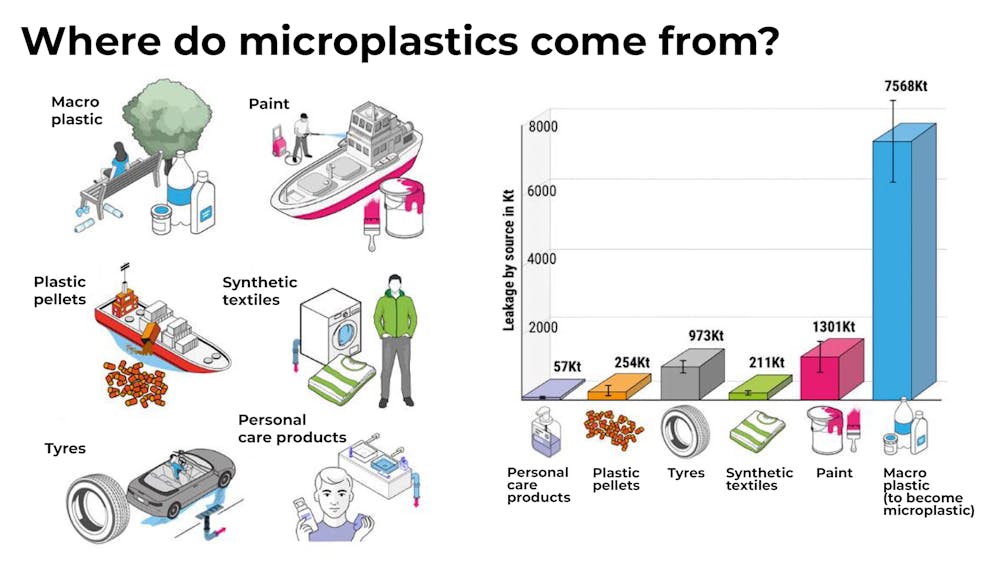
Studies have identified some of the main sources of microplastics as:

  • cosmetic cleansers
  • synthetic textiles
  • vehicle tyres
  • plastic-coated fertilisers
  • plastic film used as mulch in agriculture
  • fishing rope and netting
  • “crumb rubber infill” used in artificial turf
  • plastics recycling.

Science hasn’t yet determined the rate at which larger plastics break down into microplastics. They are also still researching how quickly microplastics become “nanoplastics” – even smaller particles invisible to the eye.

A graphic of where microplastics come from, including paint, textiles, personal care products and tyres

Measuring the microplastic scourge

It’s difficult to assess the volume of microplastics in the air, soil and water. But researchers have attempted it.

For example, a 2020 study estimated between 0.8 and three million tonnes of microplastics enter Earth’s oceans in a year.

And a recent report suggests leakage into the environment on land could be three to ten times greater than that to oceans. If correct, it means between ten and 40 million tonnes in total.

The news gets worse. By 2040, microplastic releases to the environment could more than double. Even if humans stopped the flow of microplastics into the environment, the breakdown of bigger plastics would continue.

Microplastics have been detected in more than 1,300 animal species, including fish, mammals, birds and insects.

Some animals mistake the particles for food and ingest it, leading to harm such as blocked intestines. Animals are also harmed when the plastics inside them release the chemicals they contain – or those hitch-hiking on them.

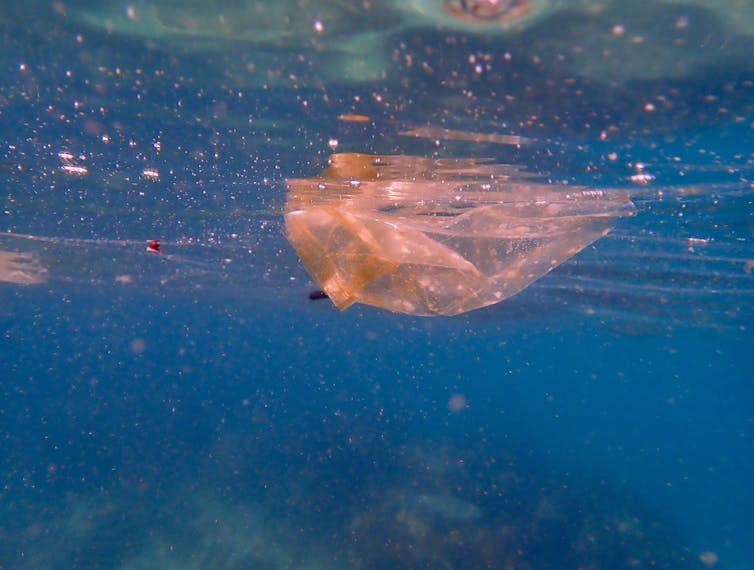
plastic bag and fragments in water
Microplastics in the environment could more than double by 2040.
Shutterstock

Invaders in our bodies

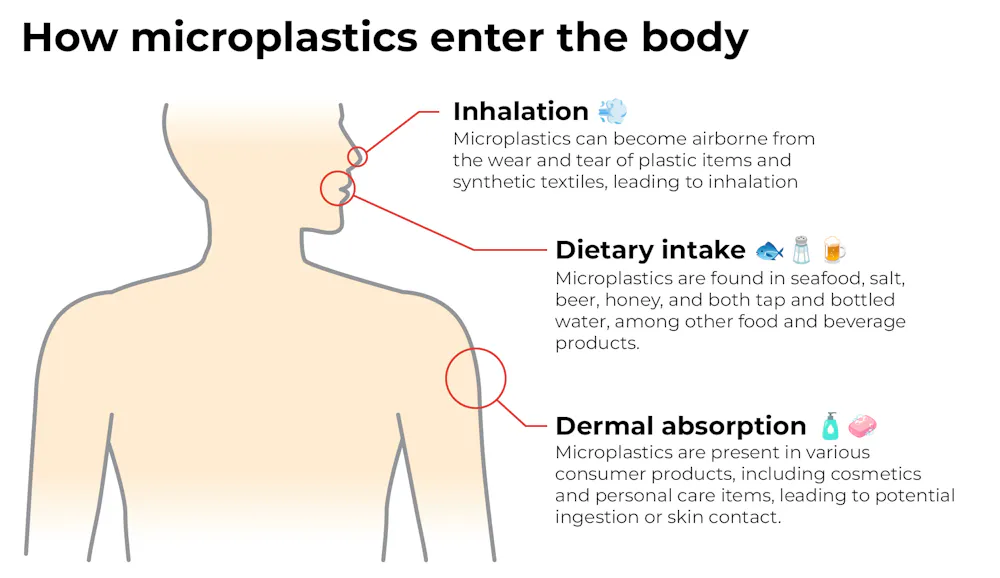
Microplastics have been identified in the water we drink, the air we breathe and the food we eat – including seafood, table salt, honey, sugar, beer and tea.

Sometimes the contamination occurs in the environment. Other times it’s the result of food processing, packaging and handling.

More data is needed on microplastics in human foods such as land-animal products, cereals, grains, fruits, vegetables, beverages, spices, and oils and fats.

The concentrations of microplastics in foods vary widely – which means exposure levels in humans around the world also varies. However, some estimates, such as humans ingesting a credit card’s worth of plastic every week, are gross overstatements.

As equipment has advanced, scientists have identified smaller particles. They’ve found microplastics in our lungs, livers, kidneys, blood and reproductive organs. Microplastics have crossed protective barriers into our brains and hearts.

While we eliminate some microplastics through urine, faeces and our lungs, many persist in our bodies for a long time.

Graphic of a body showing where microplastics get in, with red markers pointing to locations

So what effect does this have on the health of humans and other organisms? Over the years, scientists have changed the way they measure this.

They initially used high doses of microplastics in laboratory tests. Now they use a more realistic dose that better represents what we and other creatures are actually exposed to.

And the nature of microplastics differ. For example, they contain different chemicals and interact differently with liquids or sunlight. And species of organisms, including humans, themselves vary between individuals.

This complicates scientists’ ability to conclusively link microplastics exposure with effects.

In regards to humans, progress is being made. In coming years, expect greater clarity about effects on our bodies such as:

  • inflammation
  • oxidative stress (an imbalance of free radicals and antioxidants that damages cells)
  • immune responses
  • genotoxicity – damage to the genetic information in a cell that causes mutations, which can lead to cancer.

What can we do?

Public concern about microplastics is growing. This is compounded by our likely long-term exposure, given microplastics are almost impossible to remove from the environment.

Some countries have implemented laws regulating microplastics. But this is insufficient to address the challenge. That’s where a new legally binding agreement, the UN’s Global Plastics Treaty, offers an important opportunity. The fifth round of negotiations begins in November.

The treaty aims to reduce global production of plastics. But the deal must also include measures to reduce microplastics specifically.

Ultimately, plastics must be redesigned to prevent microplastics being released. And individuals and communities must be brought on board, to drive support for government policies.

After 20 years of microplastics research, there is more work to be done. But we have more than enough evidence to act now.

The Conversation

Karen Raubenheimer does not work for, consult, own shares in or receive funding from any company or organisation that would benefit from this article, and has disclosed no relevant affiliations beyond their academic appointment.

ref. Scientists reviewed 7,000 studies on microplastics. Their alarming conclusion puts humanity on notice – https://theconversation.com/scientists-reviewed-7-000-studies-on-microplastics-their-alarming-conclusion-puts-humanity-on-notice-239105

Endure – or peter out? Here’s what Northern Rivers organisers and Stop Adani can teach us about building climate groups

Source: The Conversation (Au and NZ) – By Amanda Tattersall, Associate Professor in Urban Geography and Host of ChangeMakers Podcast, University of Sydney

mantisdesign/Shutterstock

Over the last decade, several groups in Australia have successfully mobilised against fossil fuel interests. But which ones have gone the distance?

The urgent global threat of climate change might suggest groups running large-scale campaigns are the ones likely achieve lasting change. But my research suggests groups focused on local efforts are often more successful.

I’ve studied coalitions and campaigns, the climate movement and people-power globally. I’ve found groups with strong local roots can evolve and endure better than larger, more dispersed groups.

The trajectory of two major environmental groups in Australia demonstrate the point.

The first is focused around the Northern Rivers in New South Wales. There, the threat of gas extraction in the 2010s prompted the community to start organising through the national anti-gas group Lock the Gate. When floods struck the region in 2017 and 2022, many organisers shifted focus to form a new, successful alliance.

The second is the Stop Adani group. Organising began around 2010 after plans for the giant Adani coal mine in central Queensland were announced. The group successfully reduced the size of the proposed mine, but energy behind the movement dwindled.

Examining the way these groups organised and operated – and how long they lasted – offers lessons for others.

Northern Rivers

The Northern Rivers region has attracted environmentally-minded people from the 1960s peace movement onward. This activist history was almost certainly not considered by gas companies when they began planning large-scale fracking operations.

Locals began meeting under the banner “Lock the Gate”. In 2014, they launched the Bentley Blockade camp-in on land earmarked for gas extraction. The campaign worked and the Northern Rivers remains gasfield-free.

When unprecedented floods hit in 2017 and 2022, locals involved in Lock the Gate shifted focus. They formed the Northern Rivers Community Resilience Alliance to work on mutual aid and ongoing resilience.

Stop Adani

In 2010, the multinational Adani Group announced plans for the Carmichael coal mine in Queensland’s Galilee Basin. Climate groups around the country were outraged.

People began campaigning against the mine, initially locally focused on the coal port. By 2017 the campaign became national under the banner Stop Adani.

By 2017, Stop Adani had built a national strategy coordinating more than 100 community groups across many cities and regions. The movement used public pressure to slow progress. It reduced but did not stop the mine, which began exporting coal in late 2021.

Who was in these groups?

To tackle the gasfield threat, Northern Rivers residents doorknocked neighbours and local councils voted to declare their region gasfield free. Lock the Gate organisers deliberately set out to make their group as representative as possible.

Disagreements were inevitable. Farmers worried about the effect of gasfields on groundwater while environmentalists focused on the climate. But their relationships in the same place helped maintain unity. This broad base also meant opponents couldn’t write them off as “angry greenies”. As organiser Annie Kia has said, the movement “maximised self-organisation”.

By contrast, my analysis and interviews have shown Stop Adani involved local groups mostly comprised of white, middle class, well-educated urban women from the east coast. This made it easier to find agreement. But individual groups were smaller and less diverse than the Northern Rivers group.

Who designed the strategy?

Northern Rivers organisers tapped experienced campaigners to create the strategy. This helped overcome tensions within the broad coalition and arguably drove more creativity.

The Stop Adani strategy was done nationally. Community groups were invited to plan coordinated local actions. The led to effective public pressure on banks financing the mine, and other organisations.

But national-local separation comes at a cost, as my research has found. Local groups tasked with carrying out a national plan and had less ability to build their own plans.

Framing matters

Both groups focused on stopping fossil fuel extraction, but their framing differed.

Northern Rivers residents were motivated by a range of concerns, from avoiding damage to water tables to tackling climate change. To harness these motivations, the group framed their demand positively – fighting for a gasfield-free Northern Rivers region.

Stop Adani was built on a simple negative: stop the mine. This drove urgency and led to high levels of participation. But it also prompted a backlash, such as tense stand-offs between Central Queensland residents and a convoy organised by Bob Brown against the mine in 2019.

The stark framing created a challenge in negotiating with government. But success is not always black or white. State and federal governments slashed the size of the mine to just one-sixth the size of the original plans.

The negative framing also made it hard to retain participants. When years of protests failed to stop the mine, mass participation fell away.

But Stop Adani didn’t give up. In recent years, Traditional Owners have kept up the pressure on the mine’s financial and political backers.

What does success look like?

Stop Adani and Northern Rivers had very similar goals: stop the mine, stop the gasfields. By this metric, both groups were largely successful.

But Northern Rivers organisers also focused on building a broad movement beyond the usual environmentally-minded people. That’s why the group is still going strong, even after gas plans were defeated.

This is a remarkable community asset. When much of Lismore went underwater in 2022, state and federal help was slow. So community groups sprang into action, pooling resources and cooperating during the immediate emergency and the long clean-up.

Other communities now look to the Northern Rivers as a model of ground-up disaster recovery.

Their success should give us hope. As the climate warps, groups with strong community roots are well-placed to lead the response to the changing demands of the climate crisis.

The Conversation

Amanda Tattersall receives funding from Lord Mayor’s Charitable Trust and the Sunrise Project.

ref. Endure – or peter out? Here’s what Northern Rivers organisers and Stop Adani can teach us about building climate groups – https://theconversation.com/endure-or-peter-out-heres-what-northern-rivers-organisers-and-stop-adani-can-teach-us-about-building-climate-groups-235774

‘I don’t believe I would have gotten into university’: how early entry schemes help Year 12 students experiencing disadvantage

Source: The Conversation (Au and NZ) – By Sally Patfield, Lecturer, Teachers and Teaching Research Centre, School of Education, University of Newcastle

Matej Kastelic/Shutterstock

During September, many Australian universities start making early offers to Year 12 students for a place next year. This is ahead of the main rounds of offers, due in January.

These early entry schemes have been around for many years. But offers soared during COVID, with more than 40,000 school-leavers estimated to have received an early offer in 2021 and again in 2022.

These numbers saw early entry schemes slammed for lacking the “transparency” of the Australian Tertiary Admission Rank (ATAR), being an aggressive recruitment strategy by universities, and encouraging students to “slacken off” in their final exams.

In February, federal Education Minister Jason Clare announced early offers could not be issued before September. He said a national approach to early entry should be developed in time for 2027 enrolments, based on a recommendations from the Universities Accord review.

Despite these criticisms, there has been no comprehensive research into early entry schemes. But my new study shows they can be a significant help to students from disadvantaged backgrounds hoping to go to university.


Read more:
Universities Accord: early university offers won’t be made until later in Year 12. Is this a good idea?


What are early entry schemes?

In Australia, most domestic students gain admission to an undergraduate degree via an ATAR. This is calculated to reflect a Year 12 student’s rank against other students in their state, taking into account their overall subject results.

Increasingly, young people are gaining access to university through early entry. These programs target Year 12 students who can receive an offer to study at university based on criteria other than (or in addition to) their ATAR.

Admission criteria differ across universities, but often include one or more Year 11 results, a recommendation from the student’s school, a personal statement demonstrating skills such as collaboration, resilience, or empathy, and extracurricular achievements.

Offers are released before students get their ATAR – and in many cases, before final exams, which generally begin in October. However, students still need to complete Year 12 and sometimes still need to meet a minimum ATAR.

A young woman wears a backpack and holds notebooks outside a building.
Early entry schemes look at more than a student’s ATAR and can include letters of recommendation and Year 11 results.
Krakenimages.com/Shutterstock


Read more:
We can predict final school marks in year 11 – it’s time to replace stressful exams with more meaningful education


My research

In 2023, I interviewed 24 current university students who had gained admission via early entry. I also interviewed a small number of their parents/carers to shed light on the broader impacts of early entry on families.

I focused on students from regional and remote locations, students who were the first in their family to go to uni, Indigenous Australians, and people with a disability, as they are most disadvantaged in mainstream schooling and in their access to higher education.

Some researchers have suggested early entry schemes favour students with personal or socioeconomic advantages due to parent and principal advocacy in recommendation letters and better access to career guidance.

But I found these schemes can benefit students most in need.

Early entry can help address disadvantage

Many of the students I spoke to experienced complex home lives, physical and/or mental ill-health, and multiple forms of disadvantage. As a result, university had often felt out of reach.

This meant an early offer was a huge boost to a student’s confidence. As Paris* told me:

I don’t believe I would have gotten into university if it wasn’t for the early entry. I didn’t think university was an option for me, ever, because of the town that I grew up in, my family’s low economic status and especially going through homelessness in Year 11 and 12 and then COVID on top of that – everything just kept piling on. So, going through this early entry scheme 100% gave me the confidence to be able to pursue [my] career and be able to do life in general.

Securing an early place at university also gave families more time to plan for this significant life event. As Angela, a parent, said:

It helped ease the pressure and the stress of trying to work out […] accommodation up there. And then organise finances and things like that because I’m a single parent […] I had to get loans to help [my daughter], to help her do what she wants to do in life.

A young man sits at a desk, with a lamp and computer. He looks out the window.
Students in the study said an early place at university gave them more confidence.
Alena Ozerova/Shutterstock

Early entry can reduce stress

Students who experienced stress, anxiety, physical and/or mental ill-health in Year 12 felt early entry helped them manage their wellbeing as they moved from school to university. As Deirdre, a student, told me:

I applied in Year 12 for early entry before I sat my [final exams]. I had a lot of personal factors that year. I struggle with nine chronic illnesses at the current moment. It was more like six in Year 12. Early entry really just gave me an opportunity to not have to fret over the HSC [Higher School Certificate] if I was sick. It gave me a really healthy and positive pathway into university.

Students don’t ‘slacken off’

Media reports have suggested early entry students stop trying in their final exams if they know they have already got a university place. But this wasn’t the case among those interviewed.

Students wanted to demonstrate their offer was warranted. As Gavran said:

I really wanted [my HSC] to reflect how well I could do to show that I deserved the early entry offer.

Broader notions of success

Ultimately, students valued the way early entry schemes could broaden how their capabilities were assessed.

They said it allowed their potential to shine through, accepting them based on who they are as a person rather than what they can achieve in an exam. As Alicia said:

Early entry ultimately accepts a student for more than just that number and for more than just the culmination of 13 years of schooling. It accepts a person, a young adult, for more than just one incredibly stressful point in life.

Where to next?

My research also found schools don’t always give senior students clear information about different pathways to university and focus on the ATAR route instead.

So students need to be given information about the full range of ways to get to university. Schools must be supported to stay on top of all the available options in an increasingly complex admissions landscape.

As we move towards a national approach to early entry, we need to consider the perspectives of students and their families who have not traditionally gone to university.

This is important if we want to support students from diverse backgrounds to go to uni – and move beyond the narrow portrayal of early entry schemes in the media.


*names have been changed.

The Conversation

Sally Patfield currently receives funding from the Paul Ramsay Foundation, the Australian government, and the Australian Centre for Student Equity and Success.

ref. ‘I don’t believe I would have gotten into university’: how early entry schemes help Year 12 students experiencing disadvantage – https://theconversation.com/i-dont-believe-i-would-have-gotten-into-university-how-early-entry-schemes-help-year-12-students-experiencing-disadvantage-238679

As the Quad meets again, is it all optics and no substance?

Source: The Conversation (Au and NZ) – By Nick Bisley, Dean of Humanities and Social Sciences and Professor of International Relations at La Trobe University., La Trobe University

This weekend, the four leaders of the Quad will once again convene, this time in US President Joe Biden’s hometown of Wilmington, Delaware. The summit will double as a send-off for two of the leaders – it will be one of Kishida Fumio’s last acts as Japan’s prime minister, while Biden will end his term four months after the gathering.

The Quad is an ambitious undertaking. As the four explained in the lengthy first leaders’ communique, it exists to promote “the free, open, rules-based order, rooted in international law and undaunted by coercion, to bolster security and prosperity in the Indo-Pacific and beyond”.

Described by policy wonks as a “minilateral” to distinguish it from the broader ranging multilateral regional institutions such as ASEAN and APEC, it brings together a small group of self-styled “like-minded” nations to advance a shared set of ambitions for the world’s most populous region.

First established in 2007, the Quad brought together the four partners to discuss shared security concerns prompted by China’s growing power. Its first version was driven primarily by Washington and Japan, with both Australia and New Delhi somewhat reluctant participants. The grouping was essentially abandoned by its members in 2008. They saw little benefit in such explicitly anti-China coordination at a time when the PRC’s foreign policy remained cautious.

The Quad was brought back to life in 2017. The four now share a bleak assessment of Asia’s geopolitical circumstances. Xi Jinping’s China has an ambitious and assertive foreign policy that has unsettled the region and has prompted the four to dust off the Quad structure.

The first formal gathering was at the sidelines of the 2017 East Asia Summit. It then held a series of senior officials’ meetings in 2018 and at the foreign minister-level in 2019 on the sidelines of the UN General Assembly. Subsequent ministerial meetings were held in 2020 in Tokyo and online at the start of 2021.

Biden hosted the first leaders’ level meeting in 2021. There the group committed to an annual event to ensure sustained political momentum for a grouping that the four now see as critical to their interests in the region.

In its early days, the Quad focused on military cooperation to advance shared military concerns. But in relatively short order, it moved away from that security focus and now has developed a broad remit. The grouping has established work programs relating to climate change, public health, vaccination, high technology, infrastructure, educational exchange, maritime domain awareness, humanitarian and disaster relief and even space.

While never explicitly stated, the Quad is all about managing a collective response to China’s rise. The four are concerned by the military dimensions of Beijing’s growing prosperity, but also by the larger risks to the region’s operating system that this ambitious authoritarian power represents. While military matters prompted the Quad’s establishment, the latter concerns are now the focus of discussions.

Oddly, Economic matters are not part of the equation at present. This is a notable shortcoming, given the ways in which China uses geo-economics to advance its interests.

The Quad has been back on the international stage for over half a decade. It has moved swiftly through the gears to become a “leaders-led” grouping, with the attendant media attention, and a dramatically widened its policy remit. In spite of impressive sounding declarations and a long list of work priorities, the reality is the grouping has not achieved a great deal in terms of concrete collaboration.

As an exercise in diplomatic signalling it has been notable, and in international affairs symbols matter, but only up to a point. Achieving practical cooperation has been limited, as has its impact on the regional strategic balance.

Although the grouping is plainly a priority, the countries still are not especially well equipped to work as a foursome. This is a function of basic experience as well as bureaucratic capacity constraints. Over time, and with investment, we may expect things to improve, but it is notable that this has not been forthcoming to date.

If the Quad members want their collaboration to, in the words of a recent ministerial statement “deliver concrete benefits and serve as a force for good”, then the grouping needs to get on with the business of actual policy collaboration.

The other major challenge lies in ensuring the alignment of interests between the four countries in the future. They all share concerns about China’s growing influence, but beyond that there are some major challenges in keeping the group aligned. This is most obvious in relation to Russia, where India’s approach to Moscow is at odds with the other three. And the diverging approaches to their economies also make cooperating on that front extremely difficult.

When the leaders gather in Delaware, expect lots of bromides about the departing American and Japanese leaders as well as an even more extensive set of plans on which to work. There will be oblique references to the China challenge and high-minded rhetoric aplenty. But until the Quad actually starts to act, its ability to have an influence beyond optics will be limited.

The Conversation

Nick Bisley has receive funding from the Commonwealth government to support research into Asia’s security and regional institutions.

ref. As the Quad meets again, is it all optics and no substance? – https://theconversation.com/as-the-quad-meets-again-is-it-all-optics-and-no-substance-205679

French police shoot dead two Kanaks in New Caledonian ‘assassinations’

By Stefan Armbruster and Harry Pearl of BenarNews

French police have shot and killed two men in New Caledonia, stoking tensions with pro-independence groups days ahead of a public holiday marking France’s annexation of the Pacific archipelago.

The pro-independence FLNKS (Kanak and Socialist National Liberation Front) decried the deaths yesterday as “barbaric and humiliating methods” used by French police resulting in a “summary execution” and called for an independent investigation.

The shootings bring the number of deaths in the Pacific territory to 13 since unrest began in May over French government changes to a voting law that indigenous Kanak people feared would compromise their push for independence.

The men were killed in a confrontation between French gendarmerie and Kanak protesters in the tribal village of Saint Louis, a heartland of the independence movement near the capital Nouméa.

Public Prosecutor Yves Dupas said in a media statement the police operation using armoured vehicles was to arrest suspects for attempted murder of officers and for armed robbery on the Saint Louis road, with “nearly 300 shots noted in recent months.”

“The two deceased persons were the subject of a search warrant, among a total of 13 persons implicated, sought and located in the Saint Louis tribe,” Dupas said, adding they had failed to respond to summonses.

Dupas ordered two investigations, one over the attempted murders of police officers and the second into “death without the intention of causing it relating to the use of weapons by the GIGN gendarmerie (elite police tactical unit) and the consequent death of the two persons sought”.

Push back ‘peaceful solution’
Union Calédonienne (UC) secretary-general Dominique Fochi said yesterday the actions of French security forces “only worsen the situation on the ground and push back the prospect of a peaceful solution.”

Pro-independence Union Calédonienne secretary-general Dominique Fochi addresses the media yesterday. Image: Andre Kaapo Ihnim/Radio Djiido

“The FLNKS denounces the barbaric and humiliating methods used by the police, who did not hesitate to carry out a summary execution of one of the young people in question,” Fochi read from a FLNKS statement at a press conference.

An FLNKS media statement on the state killings . . . calls for investigation. Image: APR screenshot

“We demand an immediate de-escalation of military interventions in the south of our country, particularly in Saint Louis, where militarisation and pressure continue on the population, which can only lead to more human drama.”

The statement called for an immediate “independent and impartial investigation to shed light on the circumstances of these assassinations in order to establish responsibilities”.

Prosecutor Dupas said police came under fire from up to five people during the operation in Saint Louis and responded with two shots.

“The first shot from the policeman hit a man, aged 30, positioned as a lone sniper, who was wounded in the right flank. The second shot hit a 29-year-old man in the chest,” Dupas said, adding three rifles and ammunition had been seized.

One of the men died at the scene, while the other escaped and later died after arriving at a local hospital.

Deaths raise Citizenship Day tensions
The deaths are likely to raise tensions ahead of Citizenship Day on Tuesday, which will mark the 171st anniversary of France’s takeover of New Caledonia.

For many Kanaks, the anniversary is a reminder of France’s brutal colonisation of the archipelago that is located roughly halfway between Australia and Fiji.

Paris has beefed up security ahead of Citizenship Day, with High Commissioner Louis Le Franc saying nearly 7000 French soldiers, police and gendarmes are now in New Caledonia.

“I have requested reinforcements, which have been granted,” he told local station Radio Rythme Bleu last week.

“This has never been seen before, even during the toughest times of the events in 1984 and 1988 — we have never had this,” he said, referring to a Kanak revolt in the 1980s that only ended with the promise of an independence referendum.

Authorities have also imposed a strict curfew from 6 pm to 6 am between September 21-24, restricted alcohol sales, the transport of fuel and possession of firearms.

Kanaks make up about 40 percent of New Caledonia’s 270,000 people but are marginalised in their own land — they have lower incomes and poorer health outcomes than Europeans who make up a third of the population and occupy most positions of power in the territory.

UN decolonisation process
New Caledonia voted by modest majorities to remain part of France in referendums held in 2018 and 2020 under a UN-mandated decolonisation process. Three votes were part of the Noumea Accord to increase Kanaks’ political power following deadly violence in the 1980s.

A contentious final referendum in 2021 was overwhelmingly in favour of continuing with the status quo.

However, supporters of independence have rejected its legitimacy due to very low turnout — it was boycotted by the independence movement — and because it was held during a serious phase of the covid-19 pandemic, which restricted campaigning.

Earlier this year, the president of Union Calédonienne proposed Septemnber 24 as the date by which sovereignty should be declared from France. The party later revised the date to 2025, but the comments underscored how self-determination is firmly in the minds of local independence leaders.

The unrest that erupted in May was the worst outbreak of violence in decades and has left the New Caledonian economy on the brink of collapse, with damages estimated to be at least 1.2 billion euros (US $1.3 billion).

Some 35,000 people are out of a job.

Copyright ©2015-2024, BenarNews. Republished with the permission of BenarNews.

Article by AsiaPacificReport.nz

Grattan on Friday: US rate cut puts pressure on RBA – and things could get heated

Source: The Conversation (Au and NZ) – By Michelle Grattan, Professorial Fellow, University of Canberra

Reserve Bank Governor Michele Bullock might need her flak jacket when she fronts the media next Tuesday after the bank’s two-day board meeting.

This week’s United States Federal Reserve interest rate cut of a hefty half a percentage point (defying most more modest predictions) will put a lot of public pressure on the RBA, which is expected to hold Australia’s official rate at 4.35%.

Bullock (who must surely abandon musings about a rate hike) can argue Australia’s situation is different – that inflation remains too high and unless that’s dealt with, we’ll all end up worse off.

Also, US rates are still above ours, and it has healthy productivity growth, unlike Australia. Moreover, economists say the sheer size of the US cut is sending mixed messages, boosting confidence because rates are being cut, but harming confidence because they are a sign that the outlook is weak.

Thursday’s strong Australian employment numbers again showed the paradox of a buoyant labour market in an economy that’s barely breathing.

Regardless of the debate about rates among the experts, the big US move will certainly make the RBA’s stance harder to explain to families having trouble paying their mortgages costs and living expenses.

Bullock recently acknowledged the position of those really badly off in an analysis inevitably carrying the cold edge of financial reality.

“For owner-occupiers with variable-rate loans […] we estimate that around 5% are in a particularly challenging situation,” she said.

“Although this group is fairly small overall, those in it have had to make quite painful adjustments to avoid falling behind on their mortgage repayments. This includes things like cutting back on their spending to the more essential items, trading down to lower quality goods and services, dipping into their savings or working extra hours. Some may ultimately make the difficult decision to sell their homes.

“A really important point to note here, is that lower income borrowers are over-represented in the group of people who are really struggling,” she said.

The person faced with selling their home doesn’t take comfort from being in a small minority.

Whether or not the Reserve Bank’s expected Tuesday stance not to reduce rates is correct policy, it could face even more criticism on Wednesday, when the monthly inflation figures come out.

Westpac, in its regular CPI preview, expects these to show inflation falling 0.2% in August, to be at 2.7% annually. That would put the annual rate within the 2-3% band, where the RBA wants it. Moderating inflation in August was the effect of the budget’s energy cost rebate.

The monthly CPI figures are less reliable than the quarterly ones. But if the August numbers are good, many voters are likely to be angered by the bank having sat on its hands.

That’s especially when they recall Treasurer Jim Chalmers’ observation about high interest rates “smashing” the economy. Reports of differences between the bank and the government will likely be back in the news.

Chalmers, meanwhile, is highlighting Friday’s start of the budget’s increase in rent assistance, as well as the latest indexation increases in various payments kicking in. He’s seeking to frame the economic debate as between Labor’s cost-of-living cushions and the opposition’s search for cuts in government spending.

Peter Dutton’s strategy of holding back until closer to the election most details of what a Coalition government would do has tactical advantages and drawbacks. Put out the measures and they are open to attack, or theft, by the government. Keep them under wraps and they’re even more vulnerable to scare campaigns.

The government has two scares already on the go: that the Liberals would rip away the bag of workers’ rights the Albanese government has introduced, and that they would take a knife to spending in essential areas.

Labor jumped on opposition finance spokeswoman Jane Hume saying on the ABC at the weekend: “The government has spent an additional $315 billion since coming to government that the Coalition would not have committed to and didn’t commit to back at the last election”.

The government is making a giant meal of this, regardless of Hume insisting “we will not be cutting essential services”.

Albanese told a Thursday news conference: “The Coalition are promising $315 billion of cuts. They see the indexing of aged pensions, they see the increased support for child care and aged care, they see the increased investment in social housing, they see the increased investment in a Future Made in Australia, including the National Reconstruction Fund – they see all that as being waste”.

Chalmers documented all the indexation increases that are in the $315 billion.

The Liberals will have to spell out their proposed cuts ahead of the election. But past experience tells us whatever a party says beforehand, the later reality is often different. This goes for both sides of politics.

The government is presently under more pressure than at any point in its term. The prime minister is not popular. Time is running out with many initiatives still undelivered. The government is hugely frustrated that the Senate, which earlier gave it an easy run, is blocking bills, on housing in particular, thanks to an unholy alliance of Coalition and Greens (the government hasn’t quite got to the point
of invoking Paul Keating’s description of the Senate as “unrepresentative swill”).

The conventional wisdom, on the basis of the polls, is Labor appears headed for minority government. A Freshwater poll this week had the Coalition leading Labor on a two-party basis 52-48%, which if translated to an election would give the Coalition a chance of forming minority government.

The polling is primarily reflecting an adverse judgement on the government. To the extent it can keep that as the lens, the Coalition maximises its chances of taking a lot of skin off Labor. Labor, for its part, needs to swing the battle from a referendum on it to a choice – between a government, however flawed, that people know, and an alternative that would be something of a leap in the dark.

The Conversation

Michelle Grattan does not work for, consult, own shares in or receive funding from any company or organisation that would benefit from this article, and has disclosed no relevant affiliations beyond their academic appointment.

ref. Grattan on Friday: US rate cut puts pressure on RBA – and things could get heated – https://theconversation.com/grattan-on-friday-us-rate-cut-puts-pressure-on-rba-and-things-could-get-heated-239386

Tupperware has filed for bankruptcy – is multi-level marketing in trouble?

Source: The Conversation (Au and NZ) – By Andrew Hughes, Lecturer in Marketing, Research School of Management, Australian National University

ArtZiq_TRG/Shutterstock

Tupperware is one of the few iconic brands with which nearly every Australian has come into contact at some stage.

Some, like me, will have grown up watching their mums host “Tupperware parties” for their friends on the weekend. Others used the unmistakably colourful containers to carry their lunches to work or produce microwave meals of marvel.

So what could have gone so badly wrong that the company has now filed for bankruptcy in the United States?

Tupperware is one of the world’s most famous proponents of a business model called “multi-level marketing”. But its model came under serious new pressures in the digital age.

The company’s own chief restructuring officer perhaps summed it up best, writing in a bankruptcy court filing:

Nearly everyone now knows what Tupperware is, but fewer people know where to find it.

So what exactly is multi-level marketing? And what lessons could the demise of Tupperware hold for the sector more broadly?

What is multi-level marketing?

As a traditional multi-level marketing business, you don’t put your wares up for sale on supermarket or department store shelves.

Instead, you recruit salespeople who sell your products to individuals, earning commission on how much they sell rather than a salary.

But that’s typically not they only way they can earn money. There are also financial incentives for recruiting new salespeople, which can move them up the ranks at the company. Hence the term multi-level marketing, or MLM.

Women gather around a table with Tupperware products
Tupperware quickly became famous for its sales ‘parties’.
Tupperware Corporation, Public Domain, via Wikimedia Commons

This method of marketing had several advantages when it emerged.

The people at the lowest level could see the incentives received by those above them, helping keep both engagement and attitudes towards the brand high. Many MLM brands still host massive award events, celebrating their biggest and best earners.

For customers, it was a thrill to be invited to a party, to feel part of the inner circle of someone’s friends. You could hang out, socialise, and perhaps drop some money on helping a friend out.

For the brand, this meant a ready-made customer base and network for product distribution.

An MLM brand could also avoid some of the larger overheads, such as rent and wages, that can cripple a traditional retail model when times become tough. Sounds perfect, right?


Read more:
Thinking of joining a multi-level marketing scheme or MLM as your side hustle? Read this first


A business model under pressure

Recently, a range of macroeconomic and cultural factors have slowly eroded the sales and profitability of some of the biggest players in the MLM sector.

Tupperware’s troubles have been brewing for years. The company had not seen an increase in sales since the third quarter of 2021, and in 2023 it had to urgently restructure its debt to keep itself solvent.

Before the bankruptcy announcement, shares in the company (listed on the New York Stock Exchange) had already fallen by about 75% in 2024 alone.

Back in August, another large MLM, perfume and cosmetics giant Avon, also filed for bankruptcy. While a “deluge” of lawsuits was the acute cause, Avon’s model of direct selling had also been under pressure for years.

Tupperware lids
Tupperware briefly experimented with retail sales.
Oleksiichik/Shutterstock

What happened?

Times, people and culture all change. Many of the early MLMs like Tupperware and Avon established themselves and thrived most in an era that’s now long gone.

Far fewer women were in full-time work, so were at home. The success stories provided hope and networking in what was in reality a tough and lonely time of bringing up children in suburban Australia in the mid- to late 20th century.

Rates of full-time employment for women have surged since then, meaning many of these brands have also had to adjust their strategy.

Avon acknowledged this in late 2023, when it announced a plan to open its first ever physical stores in the UK. The company had faced consistently declining sales over the past decade.

The then chief executive Angela Cretu said:

Women stayed at home in the past, but now they are going out to work and we have to follow them wherever they spend their time and make the service as convenient as possible.

Failure to reposition the brand

Culture has changed, too. Asking your friends around to make your life better, at their expense, now might not seem like a party for anyone but the person receiving the money.

Tupperware may have been the safe container for your lunch, but it was also your mum’s brand. It had a retro feel, but not necessarily a cool factor.

It may also have been a victim of its own success. The warranty program to replace lids free of charge – for a product whose lids are easily lost or broken – was one of the most consumer-friendly marketing programs I’ve ever heard of.

But as a marketing strategy amid floundering sales, it meant many people didn’t need to buy a new container, and therefore didn’t need to consider the brand’s newer offerings.

A flood of cheaper offerings from competitors, incredibly similar in design, have also been a drag on the brand.

In 2022, after decades of direct selling, Tupperware made a radical change and put its products on shelves in Target in the US. That may have been too little, too late.

New ‘side hustles’ in the digital age

Tupperware, like many MLMs, was not suited to the digital changes we’ve seen in the last decade. At the same time, a new generation of “side hustles” have emerged and thrived – but importantly, online.

In contrast with the MLM model, platforms such as Amazon or Etsy here allow someone to have their own virtual store, potentially giving them higher earnings at an earlier stage.

They may still have levels, but are more similar to franchises than part of a tier-based system. We are now more likely to hear words such as “affiliate”, “collaborator” and “partner” to describe people in online marketplaces.

Amazon seller page seen on a phone screen
Digital platforms like Amazon now offer a whole host of new ‘side hustles’.
Tada Images/Shutterstock

Yet many of the traditional MLMs remain. The strong brand connection they have with some of us is the envy of the modern marketer. Some will make this leap to the generations coming through. Some won’t.

Why? Adaptation and knowing the market. Good marketing boils down to knowing your people well. Who they really are and what culture influences them.

At any rate, Tupperware will probably always hold a special place in the hearts of many. Or at least their cupboards.

The Conversation

Andrew Hughes does not work for, consult, own shares in or receive funding from any company or organisation that would benefit from this article, and has disclosed no relevant affiliations beyond their academic appointment.

ref. Tupperware has filed for bankruptcy – is multi-level marketing in trouble? – https://theconversation.com/tupperware-has-filed-for-bankruptcy-is-multi-level-marketing-in-trouble-239387

Caitlin Johnstone: On human rights, ‘friendly’ war crimes and Western hypocrisy

Report by Dr David Robie – Café Pacific.

COMMENTARY: By Caitlin Johnstone

The death toll has risen to 12 from Israel’s terror attack in Lebanon on Tuesday which detonated explosive materials hidden in thousands of pagers.

Another 20 people were then killed in another attack the following day with a second wave of explosions, this time using walkie talkies and home solar energy systems.

The total death toll now sits at 32. Two children and four healthcare workers are among the dead. Thousands have been wounded.

As you would expect, Western empire managers are getting really squirmy about this.

White House spokesman John Kirby adamantly refused to answer any questions involving Israel’s responsibility for the attacks during a press conference on Wednesday, despite Israel being widely reported as the responsible party, with outlets like The New York Times citing US officials as their source.

“I’m not gonna speak to the details of these incidents,” Kirby said repeatedly when questioned about Israel’s role and what the US response will be.

It goes without saying that if a government like Russia, China or Iran were even suspected of being responsible for similar attacks, Kirby and his fellow podium people would be not just naming the suspected aggressor but fervently denouncing the attack as an act of terrorism.

Leaked memo
And it is here worth reminding readers that in 2017, a leaked State Department memo explained in plain language that it is standing US policy to overlook the abuses of US allies while denouncing the abuses of US enemies in order to undermine enemies and show other countries the perks of being aligned with the United States.

The memo showed neoconservative empire manager Brian Hook teaching a previously uninitiated Secretary of State Rex Tillerson that for the US government, “human rights” are only a weapon to be used for keeping other nations in line.

In a remarkable look into the cynical nature of imperial narrative management, Hook told Tillerson that it is US policy to overlook human rights abuses committed by nations aligned with US interests while exploiting and weaponising them against nations who aren’t.

“In the case of US allies such as Egypt, Saudi Arabia, and the Philippines, the Administration is fully justified in emphasising good relations for a variety of important reasons, including counter-terrorism, and in honestly facing up to the difficult tradeoffs with regard to human rights,” Hook explained in the memo.

“One useful guideline for a realistic and successful foreign policy is that allies should be treated differently — and better — than adversaries,” Hook wrote.

“We do not look to bolster America’s adversaries overseas; we look to pressure, compete with, and outmaneuver them. For this reason, we should consider human rights as an important issue in regard to US relations with China, Russia, North Korea, and Iran.

“And this is not only because of moral concern for practices inside those countries. It is also because pressing those regimes on human rights is one way to impose costs, apply counter-pressure, and regain the initiative from them strategically.”

Highlight the discrepancies
“It’s tedious going “If Group X did this Western politicians and pundits would condemn it but because Group Y did it they’re fine with it” over and over again, but it’s important to highlight these discrepancies because they show how we’re being deceived.

Westerners are indoctrinated from birth into believing they live in a society that is basically good with governments that, while imperfect, are still far superior to the tyrants and corrupt autocrats of the global south.

In reality the Western power structure centralised around the United States is the single most murderous and tyrannical force on earth by an extremely massive margin, but that obvious fact is always omitted from the indoctrination curriculum.

By pointing out the glaring discrepancies between the way the Western political-media class responds to things like Israel turning electronic devices into thousands of bombs placed throughout civilian populations and the way they respond when other groups detonate explosives among civilians, you’re helping to punch holes in the veil of indoctrination they have cast over our collective understanding of the world.

The more you recognise that you only see your society as good and others as bad because of the way world events are framed by Western news media and politicians, the closer you get to having your “Are we the baddies?” epiphany.

Hypocrisy and contradiction are not great moral evils in and of themselves, but they often run cover for great moral evils. The fact that we are trained to think about the world by people who facilitate great evils perpetrated by their own side when they’d condemn identical evils committed by their enemies shows that they do not stand against evil, and are deeply evil themselves.

Recognising the problems in our world is the first step to solving them. That’s what the propagandists and empire managers work to prevent us from doing, and that’s what we try to do by pointing out the glaring plot holes and inconsistencies in their narratives over and over again.

Mock their denunciations
The correct thing to do when Western leaders talk about human rights or denounce abuses by enemy governments is to mock them and dismiss them. They’re not saying anything true about their actual values and beliefs; if they were there wouldn’t be so much hypocrisy in the way they denounce governments they don’t like for offences they ignore and make excuses for in governments they do like.

They’re never saying what they’re saying to stop human rights abuses or make the world a better place, they’re only saying what they’re saying to undermine their enemies so that the Western empire can rule the world and be the only one administering abuse.

And the same is true of the mainstream Western press. You’ll see them completely ignore the abuses of US-aligned governments while showing immense interest in alleged abuses by empire-targeted groups, often on very flimsy evidence.

Mock them and dismiss them when they act like they care about human rights abuses. They don’t care. They just want to make sure the abusive power structure they conduct propaganda for is the one in charge.

Caitlin Johnstone is an Australian independent journalist and poet. Her articles include The UN Torture Report On Assange Is An Indictment Of Our Entire Society. She publishes a website and Caitlin’s Newsletter. This article is republished with permission.

This article was first published on Café Pacific.

Unemployment of 4.2% is a sign of RBA success, but it might not last. Here’s why

Source: The Conversation (Au and NZ) – By Jeff Borland, Professor of Economics, The University of Melbourne

Today’s news that an extra 47,500 Australians found work in August while the unemployment rate held steady at 4.2% is a sign of success for both the government and Reserve Bank.

It’s a sign of success in dealing with the difficult task of bringing inflation down without too much economic damage.

Then Reserve Bank Governor Philip Lowe, in a speech shortly before he handed over the reins to Michelle Bullock, said that success in this task would require navigating a narrow path.

To keep to the narrow path would mean

  • inflation returns to the target band within a reasonable timeframe

  • the economy continues to grow

  • we hold on to as many of the gains in the labour market as we can.

Well, so far we’ve stayed on the narrow path – and that is a considerable achievement.

The main reason we’ve been able to stay on the path, up until now, is good decision-making by both the government in its handling of spending and taxation (so-called fiscal policy) and the Reserve Bank in its handling of interest rates (monetary policy).

This might seem a wild claim to make, and it is certainly contrary to the sorts of claims that are generally made.

But here are three key facts about policies and economic outcomes in Australia compared to the United States, United Kingdom and Canada that back it up.

Australia was less aggressive in raising rates

The first fact is that policymakers in Australia have been less aggressive in using interest rate increases to constrain activity in order to bring down inflation.

Australia started raising interest rates when inflation reached about the same level as the other countries, but increased them by much less, by 4.25 percentage points, compared for example to 5.25 points in the United States.


The second fact is that Australia’s more gentle approach to tightening does not seem to have led to an outsize increase in inflation after the tightening began.


Nor does it appear to have slowed the subsequent decrease in inflation.

The rate of inflation has fallen an average of 0.7 of a percentage point per quarter from its peak in Australia, 0.7 in Canada, 0.8 in the United States and 1.0 percentage point in the United Kingdom.

Australia’s approach kept unemployment low

The third fact is that, largely as a result, Australia has done better in preventing the rate of unemployment from climbing.

Australia’s unemployment rate has increased only 0.6 of a percentage point since interest rates were first hiked, whereas unemployment has risen 0.8 of a percentage point in the United States and 1.6 percentage points in Canada.


This achievement is made even more impressive by the fact many more Australians are making themselves available to work.

Australia’s so-called participation rate has climbed 0.7 percentage points since unemployment began rising, compared to 0.3 points in the United States and a fall of 0.2 points in the United Kingdom.

Of course it would have been better had unemployment not increased at all.

But the large rise in inflation in 2022 required a response. Deciding to head it off by increasing interest rates at the cost of some jobs was a reasonable call to make at the time.

Whether that is still the case is a different matter. Inflation has now fallen back below 4%. And when the inflation rate for the year to August is released next week, it may well be closer again to the Reserve Bank’s target band.

Our jobs market is weaker than it seems

Although the unemployment rate has so far only climbed from 3.5% to 4.2%, there are reasons to worry it will soon climb higher.

The average number of hours worked per month has climbed 24 million over the past year, an increase of 1.3%.

But much of this has been the result of an extraordinary boost in immigration boosting population growth.

In the year before COVID hit, the population grew by an average of just over 20,000 per month. Over the year to August, it grew 50,000 per month. This can’t be expected to continue, and the government’s proposed cap on international students is one of the measures that will slow it down.

Many new jobs are government-funded

As well, many of the extra hours worked are in largely government-funded jobs, in the industries the Bureau of Statistics calls education and training, health care and social assistance, and public administration and safety.

The number of people employed in childcare increased by 53,000 over the past two years and residential aged care by 47,000. In the “other social assistance” category (which includes disability care) employment has increased by 83,000.

Like high immigration, this can’t be expected to go on forever.

This graph shows the portion of the monthly change in hours worked that is accounted for by education, health care, social assistance, and public administration and safety jobs.

In recent months, they have accounted for more than 40% of the extra hours worked.


As the boost in largely government-funded jobs fades and the immigration rate slows, Australia’s labour market is likely to start to look worse.

Now is the time to start worrying about it. Jobs need again to come to the fore in setting monetary policy.

Not to do that risks undoing the good work so far, and pushing us off the narrow path, with a much larger labour market downturn than is desirable or necessary.

Jeff Borland has received funding from the Australian Research Council.

ref. Unemployment of 4.2% is a sign of RBA success, but it might not last. Here’s why – https://theconversation.com/unemployment-of-4-2-is-a-sign-of-rba-success-but-it-might-not-last-heres-why-238326

Yes, you do need to clean your tongue. Here’s how and why

Source: The Conversation (Au and NZ) – By Dileep Sharma, Professor and Head of Discipline – Oral Health, University of Newcastle

luisrsphoto/Shutterstock

Has your doctor asked you to stick out your tongue and say “aaah”? While the GP assesses your throat, they’re also checking out your tongue, which can reveal a lot about your health.

The doctor will look for any changes in the tongue’s surface or how it moves. This can indicate issues in the mouth itself, as well as the state of your overall health and immunity.

But there’s no need to wait for a trip to the doctor. Cleaning your tongue twice a day can help you check how your tongue looks and feels – and improve your breath.

What does a healthy tongue look like?

Our tongue plays a crucial role in eating, talking and other vital functions. It is not a single muscle but rather a muscular organ, made up of eight muscle pairs that help it move.

The surface of the tongue is covered by tiny bumps that can be seen and felt, called papillae, giving it a rough surface.

These are sometimes mistaken for taste buds – they’re not. Of your 200,000-300,000 papillae, only a small fraction contain taste buds. Adults have up to 10,000 taste buds and they are invisible to the naked eye, concentrated mainly on the tip, sides and back of the tongue.

A healthy tongue is pink although the shade may vary from person to person, ranging from dark to light pink.

A small amount of white coating can be normal. But significant changes or discolouration may indicate a disease or other issues.

How should I clean my tongue?

Cleaning your tongue only takes around 10-15 seconds, but it’s is a good way to check in with your health and can easily be incorporated into your teeth brushing routine.

Build-up can occur if you stop brushing or scraping your tongue even for a few days.
Anthony Shkraba/Pexels

You can clean your tongue by gently scrubbing it with a regular toothbrush. This dislodges any food debris and helps prevent microbes building up on its rough textured surface.

Or you can use a special tongue scraper. These curved instruments are made of metal or plastic, and can be used alone or accompanied by scrubbing with your toothbrush.

Your co-workers will thank you as well – cleaning your tongue can help combat stinky breath. Tongue scrapers are particularly effective at removing the bacteria that commonly causes bad breath, hidden in the tongue’s surface.

What’s that stuff on my tongue?

So, you’re checking your tongue during your twice-daily clean, and you notice something different. Noting these signs is the first step. If you observe any changes and they worry you, you should talk to your GP.

Here’s what your tongue might be telling you.

White coating

Developing a white coating on the tongue’s surface is one of the most common changes in healthy people. This can happen if you stop brushing or scraping the tongue, even for a few days.

In this case, food debris and microbes have accumulated and caused plaque. Gentle scrubbing or scraping will remove this coating. Removing microbes reduces the risk of chronic infections, which can be transferred to other organs and cause serious illnesses.

Scrubbing or scraping your tongue only takes around ten seconds and can be done while brushing your teeth.
Ketut Subiyanto/Pexels

Yellow coating

This may indicate oral thrush, a fungal infection that leaves a raw surface when scrubbed.

Oral thrush is common in elderly people who take multiple medications or have diabetes. It can also affect children and young adults after an illness, due to the temporary suppression of the immune system or antibiotic use.

If you have oral thrush, a doctor will usually prescribe a course of anti-fungal medication for at least a month.

Black coating

Smoking or consuming a lot of strong-coloured food and drink – such as tea and coffee, or dishes with tumeric – can cause a furry appearance. This is known as a black hairy tongue. It’s not hair, but an overgrowth of bacteria which may indicate poor oral hygiene.

Smoking can add to poor oral hygiene and make the tongue look black.
Sophon Nawit/Shutterstock

Pink patches

Pink patches surrounded by a white border can make your tongue look like a map – this is called “geographic tongue”. It’s not known what causes this condition, which usually doesn’t require treatment.

Pain and inflammation

A red, sore tongue can indicate a range of issues, including:

Dryness

Many medications can cause dry mouth, also called xerostomia. These include antidepressants, anti-psychotics, muscle relaxants, pain killers, antihistamines and diuretics. If your mouth is very dry, it may hurt.

What about cancer?

White or red patches on the tongue that can’t be scraped off, are long-standing or growing need to checked out by a dental professional as soon as possible, as do painless ulcers. These are at a higher risk of turning into cancer, compared to other parts of the mouth.

Oral cancers have low survival rates due to delayed detection – and they are on the rise. So checking your tongue for changes in colour, texture, sore spots or ulcers is critical.

Dileep Sharma received funding for research from Australian Dental Research Foundation, NSW Dental council, Central Coast Local Health District, International Association for Dental, Oral, and Craniofacial Research and Tropical Australian Academic Health Centre.

ref. Yes, you do need to clean your tongue. Here’s how and why – https://theconversation.com/yes-you-do-need-to-clean-your-tongue-heres-how-and-why-237130

I think my child is having panic attacks. What should we do?

Source: The Conversation (Au and NZ) – By Gemma Sicouri, Senior Postdoctoral Research Fellow and Clinical Psychologist, Black Dog Institute, UNSW Sydney

Allan Mas/Pexels

In the movie Inside Out 2, 13-year-old Riley, who has recently started puberty, has a panic attack during a hockey game timeout.

Anxiety (the emotion responsible for the panic attack) becomes completely frenzied and there is a sense Riley is losing control. After a while, Anxiety calms down and Riley’s panic attack subsides.

The movie does a great job of conveying the experience of having a panic attack. But panic attacks (and anxiety) don’t just arise in teenagers – younger children can also have them.

Being aware of what to look out for and how to respond to anxiety or panic is important to help you and your child better manage these scary symptoms.

What does a panic attack look like in a child?

Teen closes her eyes
It can feel like something terrible is happening.
Rivelino/Pexels

A panic attack is a sudden, intense feeling of fear or discomfort associated with four or more of the following:

  • feeling very hot or cold
  • racing heart
  • shortness of breath
  • tightness in the throat or chest
  • sweating
  • tingling sensations
  • light-headedness.

Panic attacks in children can last from a few minutes to 30 minutes.

Some children describe a panic attack as feeling like they are trapped or in danger, that something terrible is happening to them, they are losing control of their body, having a heart attack, or even dying.

Often, a child is unaware their symptoms are related to anxiety. This experience can be very scary for children and others around them who don’t know what is happening.

How common are panic attacks and at what age might they start?

There is a common myth that panic attacks only occur in teenagers or adults, but research shows this is not the case.

Although less frequent than in teenagers, panic attacks also occur in children. Studies indicate around 3–5% of children experience panic attacks.

They can begin at any age, although they typically first occur in children and adolescents between the ages of five and 18.

What causes a panic attack?

For some children, panic attacks can happen unexpectedly and without cause. These are known as “uncued” panic attacks.

For other children, panic attacks may be cued. This means they occur in specific situations that are anxiety-provoking, such as separating from a caregiver or doing a speech in class.

Cued panic attacks tend to be more common in children than uncued panic attacks.

Sometimes a panic attack can occur when a child’s physical symptoms (from feeling anxious) become the centre of their attention. For example, if a child notices a physical symptom (such as shortness of breath) and becomes worried about it, this can make them feel anxious, leading to more anxiety or a panic attack.

If children realise their physical symptoms are signs of anxiety and not a serious physical health problem, they might learn to not give too much attention to these symptoms and stop a vicious cycle occurring.

What can parents do in the moment to support their child?

If your child is breathing very quickly or hyperventilating, try to remain calm and encourage them to breathe normally.

Tell your child these feelings are temporary and not dangerous. Focusing your child’s attention on their rapid breathing or other symptoms can sometimes make things worse.

Try to help your child focus on something else, using the 3-3-3 rule: “Tell me three things you can hear, three things you can see, and three things you can touch”. Ask them to say these out loud.

Mother calms her son
During an attack, try the 3-3-3 rule.
Kindel Media/Pexels

If your child complains about bodily symptoms – but is not experiencing a full-blown panic attack – try to understand and acknowledge the symptoms they are experiencing.

Once you are satisfied their symptoms are not a physical health problem, tell them it will be okay and then move on to something else. This will help to shift their attention to something else and stop the anxiety and symptoms from escalating.

What about afterwards?

When your child’s panic attack is over, you can teach them about panic attacks. Explain that panic attacks are common and aren’t dangerous, even though they can feel scary and uncomfortable, and are a temporary sensation.

An effective strategy for panic attacks is a technique from cognitive behavioural therapy called “exposure”, which encourages children to face their fears. For panic attacks, this could be facing certain situations or objects that trigger the panic attack, or exposure to the actual physical symptoms.

Exposure is typically done with the support of a therapist, but increasingly there are programs available which support parents to deliver exposure-based treatment with their child.

Does having a panic attack mean my child has an anxiety disorder?

If your child has a panic attack, it does not mean they have an anxiety disorder. Panic attacks can occur in all children with or without anxiety disorders or mental health conditions.

However, panic attacks often occur in children with anxiety disorders or other mental disorders, such as depression or post-traumatic stress disorder.

Panic disorder is a particular type of anxiety disorder in which panic attacks are a core feature. Panic disorder is not common in children, and occurs in less than 1% pre-adolescent children. It typically emerges in adolescence or adulthood.

If your child is having panic attacks often and unexpectedly, has persistent worry (for at least a month) about additional panic attacks, or avoids situations that may trigger panic attacks, it may indicate they have panic disorder.

If your child is having panic attacks in response to specific situations or fears, such as separating from a caregiver, and their fears are interfering in everyday life, it may indicate an anxiety disorder.

Where can I look for help?

If you are concerned your child has an anxiety disorder, speak to your GP or a psychologist about it.

You don’t need a GP referral to see a psychologist, but a GP can create a mental health treatment plan which allows you to claim a Medicare rebate for up to ten sessions.

There are also a range of online resources.

The Conversation

Gemma Sicouri receives funding from Australian Rotary Health.

Jennie Hudson works for the Black Dog Institute and receives or has received funding from the National Health and Medical Research, the Australian Research Council, Welcome Trust, Australian Rotary Health, Beyond Blue, the Johnston Foundation and the AMP Foundation.

Annabel Songco and Chloe Lim do not work for, consult, own shares in or receive funding from any company or organisation that would benefit from this article, and have disclosed no relevant affiliations beyond their academic appointment.

ref. I think my child is having panic attacks. What should we do? – https://theconversation.com/i-think-my-child-is-having-panic-attacks-what-should-we-do-237761

Donald Trump insists a ‘strongman’ leader will help America. My new book explains why he’s wrong

Source: The Conversation (Au and NZ) – By William Partlett, Associate professor of public law, The University of Melbourne

It is well known former US President Donald Trump admires the power strongman leaders wield.

What is less well known are the problematic long-term constitutional consequences of this kind of strongman governance.

My new book reveals these consequences. It shows today’s strongmen rely on what I call the “constitutional dark arts”. This is a belief the constitutional centralisation of power in a leader is a better way to secure democracy, sovereignty and economic development.

Strongmen like Vladimir Putin in Russia, Viktor Orban in Hungary and Recep Tayyip Erdogan in Turkey do not disband democratic institutions such as courts, political parties, legislatures and elections. Instead, they co-opt them and use them to legitimise their centralised leadership.

Why the Russian Constitution Matters.
Bloomsbury Publishing, FAL

My book shows this centralised constitutional system is unlikely to achieve democracy, sovereignty or economic development. Instead, it is more likely to foster a cycle of personalised, corrupt governance that is democratically unaccountable. It is also unable to protect sovereignty or economic wellbeing over the long term.

This is important for understanding the long-term, systemic threat Trump poses to America’s constitutional system of governance, should he be re-elected.

Trump and the constitutional dark arts

Trump is not only a clear advocate of centralised power, he is a devoted practitioner of the constitutional dark arts.

While president in 2019, for instance, he famously claimed Article 2 of the Constitution, which specifies the powers of the presidency, gave him the “right to do whatever I want”.

In response to charges he faces for allegedly attempting to overturn the results of the 2020 presidential election, Trump also argued presidents should enjoy “absolute immunity” for their actions.

Now running for re-election, Trump and his team plan to expand the power of the presidency over previously independent government agencies, such as the Department of Justice and the FBI.

Trump has justified this centralisation of power as being more democratic. He has repeatedly claimed a constitutionally empowered president is necessary to allow him to be the people’s “voice” in a system that is “rigged” against ordinary citizens. And he has labelled attempts to hold him legally accountable for his actions as “a threat to democracy”.

Trump has also argued centralised presidential power is necessary for securing economic development. For instance, he frequently argues he alone can fix the American economy. Recently, he has even argued presidents should have the power to direct the Federal Reserve in its decisions.

Finally, Trump argues only centralised presidential control can restore American sovereignty by stopping what he has depicted as a flood of immigrants “poisoning the blood of our country”.

Most notably, if elected, he has promised to act as “dictator” on day one of his presidency and issue an order closing the border.

Consequences of highly centralised power

My book shows the seductiveness of the claims of the constitutional dark arts, particularly in places where trust in government is eroding.

For instance, in Russia, Putin has persuaded a disillusioned Russian public centralising power in the office of the president is the best way to secure Russian sovereignty, economic development and democracy.

Over time, however, Russia shows how the centralisation of power has a corrosive logic, only creating more problems of governance. This kind of system is undemocratic, with leading opposition members jailed or killed. It is also weak and dysfunctional.

The centralised capture of institutions degrades their ability to operate effectively. Moreover, it allows a president to use public power and funds for personal gain, undermining sovereignty and economic development. For instance, Putin uses his control over Russia’s electoral commission to disqualify candidates who challenge his personal power.

Finally, it undermines the effectiveness of centralised decision-making, as reliable information is no longer passed upwards.

To take just one example, Putin’s decision to launch a full-scale invasion of Ukraine in 2022 was grounded on flawed intelligence suggesting Kyiv would fall in three days.

Identifying this dysfunctionality is critical to countering strongman governance. Russian opposition figure Alexei Navalny and his team have always been particularly good at this kind of messaging.

The threat this messaging poses to the Putin regime ultimately led to Navalny’s death and the exiling of his political team.

Lessons for American voters

This experience carries important lessons for American voters as they consider their choice in the upcoming election. The constitutional centralisation of power that Trump and his supporters propose will only further erode American democracy and threaten the key pillars of America’s economic prosperity.

A highly personalised foreign policy that discounts advice from the State Department or long-standing US allies could also weaken American sovereignty.

For instance, Trump’s insistence he would implement a hasty “deal” to end the war in Ukraine would show that America is an unreliable ally and embolden Russia and China to potentially take aggressive actions.

We have seen some of these corrosive consequences when Trump was president from 2017–21. This time, however, it appears he and his supporters are more committed than ever to the dangerous logic of the constitutional dark arts.

Moreover, trust in government in the United States has never been lower than it is now, furthering support for Trump’s brand of centralised, personalised governance.

This presidentialisation of the American constitutional system is not inevitable. Countering it requires pointing to its dysfunctionality and inability to address the real problems the American political system is facing.

The Conversation

William Partlett does not work for, consult, own shares in or receive funding from any company or organisation that would benefit from this article, and has disclosed no relevant affiliations beyond their academic appointment.

ref. Donald Trump insists a ‘strongman’ leader will help America. My new book explains why he’s wrong – https://theconversation.com/donald-trump-insists-a-strongman-leader-will-help-america-my-new-book-explains-why-hes-wrong-238693

‘Side job, self-employed, high-paid’: behind the AI slop flooding TikTok and Facebook

Source: The Conversation (Au and NZ) – By Jiaru Tang, PhD student, Digital Media Research Centre, Queensland University of Technology

TikTok / The Conversation

TikTok, Facebook and other social media platforms are being flooded with uncanny and bizarre content generated with artificial intelligence (AI), from fake videos of the US government capturing vampires to images of shrimp Jesus.

Given its outlandish nature and tenuous relationship with reality, you might think this so-called “AI slop” would quickly disappear. However, it shows no sign of abating.

In fact, our research suggests this kind of low-quality AI-generated content is becoming a lucrative venture for the people who make it, the platforms that host it, and even a growing industry of middlemen teaching others how to get in on the AI gold rush.

When generative AI meets profiteers and platforms

The short explanation for the prevalence of these baffling videos and images is that savvy creators on social media platforms have worked out how to use generative AI tools to earn a quick buck.

But the full story is more complex. Platforms have created incentive programs for content that goes viral, and a whole ecosystem of content creators has arisen using generative AI to exploit these programs.

Much of the conversation around generative AI tools focuses on how they enable ordinary people to “create”. Many earlier digital technologies have also made it easier to participate in creative activities, such as how smartphones made photography ubiquitous.

But generative AI takes this a step further, as it can generate tailored images or videos from a simple text prompt. It makes content creation more accessible – and also opens the floodgates to mass production on social media.

To take just one example: if you search “pet dance motorcycle” on TikTok, you will find hundreds of AI-generated videos of animals doing the “motorbike dance”, all animated using the same AI template. Some accounts post dozens of videos like this every day.

Creators and platforms are making money

You may wonder why such repetitive, unimaginative content can go viral on TikTok. The answer lies in the platform’s own advice to aspiring creators: if you want your videos to be promoted, you should “continuously share fresh and diverse content” that “doesn’t require a big production budget”.

You may also wonder why some platforms don’t ban AI accounts for polluting the platform’s content stream. Other platforms such as Spotify and YouTube, which police intellectual property rights more aggressively than TikTok, invest considerable resources to identify and remove AI-generated content.

TikTok’s community guidelines do ban “inaccurate, misleading, or false content that may cause significant harm”, but AI-generated content – at least for now – does not qualify as causing “significant harm”.

Instead, this kind of content has become important for platforms. Many of those “pet dance motorcycle” videos, for example, have been viewed tens of millions of times. As long as users are scrolling through videos, they are getting exposed to the ads that are the platforms’ primary source of income.

Inside the AI ‘gold rush’

There is also a growing industry of people teaching others how to make money using cheap AI content.

Take Xiaonan, a social media entrepreneur we interviewed who runs six different TikTok accounts, each with more than 100,000 followers. As he revealed in a live-streaming tutorial with more than 1,000 viewers, Xiaonan earned more than US$5,500 from TikTok in July alone.

Xiaonan also hosts an exclusive chatting group where, for a fee, he reveals his most effective AI prompts, video headlines and hashtags tailored for different platforms including YouTube and Instagram. Xiaonan also reveals tricks for standing out in the platforms’ recommendation game and avoiding platform regulations.

Xiaonan says he established his “AI side job” after being laid off by an internet company. He now works with two partners selling classes and tutorials on making AI-generated videos and other types of spam for profit.

Creators posting AI content may not be the kind of people we expect. As Xiaonan told us, many of the people taking his AI tutorial – entitled “Side job, self-employed, high-paid” – are housewives, unemployed people and college students.

“Some of us also do Uber driving or street vending,” one creator told us. AI-generated content has become the latest trend for earning side income.

The rise of AI has coincided with global unemployment trends and the growth of the gig economy in the post-pandemic era.

Making AI-generated content is more pleasant work than driving passengers or delivering food, according to a creator who is also a stay-at-home mother. It’s easy to learn, almost zero cost, and can be done any time at home with just a phone.

As Xiaonan says, his method is to use AI to “earn from productivity gap” – that is, by producing far more content than people who don’t use AI .

The global AI-generated content factory

Our observations indicate many of these creators are from non-Western countries, such as India, Vietnam and China.

As one Chinese social media influencer told us:

China’s short video market is nearing saturation, which means you need to seek data traffic [viewers] on overseas platforms.

For these entrepreneurs, AI is the secret sauce not only for creating viral content but also for circulating already-viral videos across different countries and platforms.

An effective strategy mentioned by one creator is a kind of platform arbitrage involving popular videos from Douyin, the counterpart of TikTok in mainland China.

A creator will take one of these videos, add AI-generated translation, and post the result on TikTok. Despite clunky AI dubbing and error-riddled subtitles, many of these videos garner hundreds of thousands or even millions of views.

Creators often mute the original video and add AI-generated narration, translating the content into various languages, including French, Spanish, Portuguese, Indonesian and Swedish. These creators often manage several or even dozens of accounts, targeting viewers in different countries in a strategy known as an “account matrix”.

This is only the beginning

We are only at the dawn of mainstream AI-generated content culture. We will soon face a situation in which content is effectively infinite, but human attention is still limited.

For platforms, the challenge will be balancing the engagement these AI-driven trends bring with the need to maintain trust and authenticity.

Social media platforms will soon respond. But before that, AI-generated content will continue to grow wildly – at least for a while.

The Conversation

Patrik Wikström receives funding from the Australian Research Council.

Jiaru Tang does not work for, consult, own shares in or receive funding from any company or organisation that would benefit from this article, and has disclosed no relevant affiliations beyond their academic appointment.

ref. ‘Side job, self-employed, high-paid’: behind the AI slop flooding TikTok and Facebook – https://theconversation.com/side-job-self-employed-high-paid-behind-the-ai-slop-flooding-tiktok-and-facebook-237638

Victorian households are poorly prepared for longer, more frequent heatwaves – here’s what needs to change

Source: The Conversation (Au and NZ) – By Sarah Robertson, Research Fellow, Centre for Urban Research, RMIT University

M-Production, Shutterstock

Heatwaves in Australia are expected to become hotter, longer and more frequent under climate change. They can seriously affect our health and wellbeing, and even kill people.

But how well-prepared are Australian households for life in a hotter world? Our new research explored this question in Victoria.

We examined how households cope with, adapt to and endure summers and heatwaves. We found they overwhelmingly considered summer heat a temporary disruption – something to just get through. This is consistent with the approach taken by authorities, which generally treat heatwaves as isolated emergencies.

This needs to change. Governments, emergency services and households must move beyond short-term coping strategies. A more sophisticated, long-term approach to managing heatwaves is needed.

Household experiences of heat

We wanted to better understand the experience of Victorians at home across the year. To do this, we interviewed members of 74 households in the Latrobe Valley (30) and Melbourne (44) between 2019 and 2021. We also walked with people through their homes.

We asked about the household’s experience of summer at home and how they coped with the heat. We paid particular attention to people’s everyday routines and the passage of heat through the home.

Questions covered the comfort of the home in summer, the different spaces householders used throughout the year, and the changes they had made (or would like to make) to the home to make it more comfortable.

Participants were also asked about how manageable they found their energy and other bills. Finally, participants were asked to reflect on their longer-term housing aspirations.

What we found

Many households prepared their home and themselves for a heatwave and the disruption it would cause, by shutting blinds or curtains and turning on fans or air conditioners. Those who could, planned to leave the home and visit a friend or other cool space such as the local pool, shopping centre or cinema.

Then they waited for the heatwave to pass, and experienced relief once a cool change arrived, opening doors or windows to let the cool breeze through.

Many households considered heatwaves as short-term but manageable disruptions to their daily, weekly or seasonal routines.

But for some, summer heat was an extended disruption to their lives, for which they had limited capacity to adapt and respond.

These households had fewer ways to manage heat at home, or improve the home’s resilience to heat.

For example, renters turned to unreliable portable air-conditioners, which failed to manage extreme conditions. Melbourne renter Nanci said:

We bought the portable [air conditioner], which ended up breaking down after 33 degrees, so we put it on [until it] blows hot air out.

Other low-income households were hesitant to use or install air conditioners, given the consequences for their energy bills.

Vulnerable households with young children or people with chronic health conditions found it difficult to function and manage those in their care.

In the Latrobe Valley, Sam is a single parent in social housing, who struggles with health problems in the heat. Every year Sam buys a new portable air conditioner to get through summer, as they never seem to last more than one season. Sam said:

The doctor wants to write a letter to the housing [provider because I] get sick all the time and end up in hospital because of the heat … When it’s really hot, I get really sick … My [kid’s] worse … I get phone calls from daycare all the time … so I have to race down and get them to the hospital.

Young woman suffering from heat sitting at home on the floor in front of a fan
Households overwhelmingly considered summer heat a temporary disruption they just had to get through.
Olezzo, Shutterstock

Rethinking summer heat at home

During a heatwave, authorities encourage people to stay cool and look out for vulnerable groups such as children and the elderly. While important, this is a short-term approach.

Relatively little attention is paid to longer-term concerns. As a society, we must acknowledge the increasing frequency and intensity of heatwaves, and start protecting people in their homes.

Many Australian homes are poorly prepared for hotter, longer summers, with most built before the introduction of minimum energy performance standards. This puts our health at risk. It also creates new environmental burdens.

Relying only on air-conditioning to cool homes, rather than improving their thermal performance, will increase electricity demand and make it harder to reduce emissions. For households worried about the cost of living, an air conditioner might be considered too expensive to run or install.

Renters are often worst affected during heatwaves and cold winters. We welcome proposed minimum energy efficiency standards for rental homes in Victoria. Only the ACT and Victoria are proposing to mandate ceiling insulation for rental properties so far. Other states should follow suit.

Australia recently improved energy-efficiency standards for new homes. Now we need a mandatory disclosure system for property energy efficiency, across both new and existing homes, including both owner-occupied and rental properties.

Authorities should also improve public spaces to cope with hotter summers and more extreme weather. This includes creating and maintaining trees and green space in cities to combat the effects of “urban heat islands”.

Trees, plants and light-coloured external surfaces such as cool roofs can also help reduce heat in and around the home.

Without action, more households will be stuck in unhealthy, unsustainable and downright dangerous situations when a heatwave hits. Governments must take a broader, more holistic approach to manage the risks.

The Conversation

Sarah Robertson received funding for this research from the Australian Research Council Linkage Projects grant scheme, the Victorian State Government, and the Fuel Poverty Research Network’s Energy Poverty in Early Career grant program.

Gordon Walker has received funding from the Australian Research Council Linkage Projects grant scheme.

Ralph Horne has received funding from the Australian Research Council and the Victorian State Government for research related to this article.

ref. Victorian households are poorly prepared for longer, more frequent heatwaves – here’s what needs to change – https://theconversation.com/victorian-households-are-poorly-prepared-for-longer-more-frequent-heatwaves-heres-what-needs-to-change-237758

Clones in the classroom: why universities must be wary of embracing AI-driven teaching tools

Source: The Conversation (Au and NZ) – By Collin Bjork, Senior Lecturer, Te Kunenga ki Pūrehuroa – Massey University

Getty Images

The university sector in Aotearoa New Zealand is at a tipping point due to chronic underfunding, shifting enrolments and increasing costs from inflation. In response, the government has established two working groups to assess the health of the sector and provide recommendations for the future.

Meanwhile, universities find themselves increasingly beholden to the education technology (EdTech) industry, which claims to improve student learning by selling hardware and software – often built with artificial intelligence (AI).

Most universities already pay for services from EdTech companies such as Turnitin, Grammarly, CampusTalk and Studiosity, all of which use AI in their products.

But critics say this trust in EdTech is misplaced and amounts to what technology writer Evgeny Morozoc calls technological solutionism – “the idea that given the right code, algorithms and robots, technology can solve all of mankind’s problems”.

Intellectual property and profit

To better understand how EdTech providers work, consider the plagiarism-detection company Turnitin, used by 20,000 institutions in 185 countries.

Student essays are intellectual property (IP). According to university policy, students and universities have a shared licence over any IP written by students.

But when teachers require students to upload their essays to Turnitin, students must grant the company a “non-exclusive, royalty-free, perpetual, worldwide, irrevocable licence” to use their IP.

Turnitin adds those essays to its massive database, which it uses to build its plagiarism detection tool. The tool – built with student IP – is then sold back to universities so educators can police student writing in the name of academic integrity.

After 20 years of growth with this business model, Turnitin was bought in 2019 by Advance Publications for US$1.75 billion. On Twitter (now X), higher education researcher Jesse Stommel asked: “How much of that $1.75B do you think is going to the students who have fed their database for years? I have a pretty good guess: zero billion.”

By claiming ownership over student IP, Turnitin also profits from Indigenous students’ ideas. But this threatens Indigenous data sovereignty – that data produced by or about Indigenous communities should be governed by those communities.

AI teaching clones

EdTech organisations such Prifina, Khanmigo and Cogniti are now developing new AI teaching clones. These “AI twins” are trained on educators’ own course materials and can interact with students around the clock.

For overworked teachers, an AI clone might seem appealing. In one promotional video, a lecturer praises the clone for helping him teach biochemistry to more than 800 students.

Of course, another way to improve the teaching of such a large course is to hire more teachers. The Tertiary Education Union will surely emphasise this point in its collective bargaining with universities this year.

But it’s not surprising universities are looking for cheaper options, given the sector has endured long-term government underfunding.

Here’s the catch, though: we don’t yet know the full cost of AI agents in education. They may be free or cheap now, but it takes a lot of computing power to create and engage with a customised AI agent – almost certainly more power than teachers and students have on their personal computers.

For that reason, organisations that develop AI agents rely on access to high-performance servers provided by the likes of Microsoft and Amazon Web Services. After sufficient market penetration, though, these multinational companies will want a return on their investment. Will AI agents still be cheaper than teachers then?

Energy-intensive investment

We also don’t know how much energy it takes to build and operate hundreds of AI clones for tens of thousands of students. But we do know Microsoft recently retracted its goal of being carbon-negative by 2030 due to AI’s increasing demand for “energy-hungry data centres”.

Many New Zealand universities also aim to be carbon-neutral by 2030. Will they too have to renege on their green commitments? Or will outsourcing AI to EdTech companies allow them offload responsibility?

Historically, it has been difficult for teaching institutions to untangle themselves from EdTech investments. This is despite research showing “85% of EdTech tools are poor fits or poorly implemented”.

If AI is “pushing the world toward an energy crisis” is it worth the financial and environmental cost to create AI agents for educators?

Product or public good?

Without sufficient government funding, EdTech products look appealing to universities. But tertiary stakeholders must question whether EdTech “solutions” really contribute to a university education.

If a university education is primarily viewed as a product in a global marketplace, then EdTech tools might add monetary value.

But if a university education is viewed as a public good that contributes to the improvement of society, then EdTech tools might be less valuable.

Now is the time for a broader conversation about the cost and value of a university education, and the role of EdTech within it.

The Conversation

Collin Bjork is a senior lecturer at Massey University, where he is currently the recipient of a Marsden fund research grant. The views expressed here are his own.

ref. Clones in the classroom: why universities must be wary of embracing AI-driven teaching tools – https://theconversation.com/clones-in-the-classroom-why-universities-must-be-wary-of-embracing-ai-driven-teaching-tools-238977

Australians are flocking to play futsal, a sport that helped launch many elite soccer careers

Source: The Conversation (Au and NZ) – By Fabio Serpiello, Professor and Director of Sport Strategy, CQUniversity Australia

Dziurek/Shutterstock

It’s the next global sporting event on a busy 2024 calendar – the 10th FIFA Futsal World Cup is underway in Uzbekistan.

While the indoor soccer variant might be on your radar as a fun kids’ sport, or a high-energy weeknight hobby, proponents like Football Australia say the FIFA-governed game is actually one of the world’s fastest-growing sports.

Here’s a few reasons why it’s gaining players and fans – and might even be breeding our next Socceroo or Matilda.

What is futsal?

Futsal is a relatively modern sport. It was invented in Uruguay in the early 1930s with the name deriving from the Spanish words fútbol (football) and sala (hall) – indicating the sport is played indoors.

With two teams of five players (one goalkeeper and four outfield players), a game is two halves of 20 minutes of effective playing time (the clock stops every time the ball is out of play).

The fast pace is heightened by rolling player substitutions and no throw-ins or offside – key features of traditional soccer.

It is estimated that 12 million players are registered worldwide in official competitions and many more involved in amateur/social leagues.

It is growing healthily in Australia, too. In 2023, participation grew to 64,000, up 11% on 2022. This followed huge growth pre-pandemic – in 2019, the jump was 36% up on the previous year.

These statistics would place futsal in the top three activities by growth from 2022 to 2023 (note: futsal participation data is extracted from a different survey compared to the government’s official participation dataset).

The world at their feet

The pinnacle of the sport is the FIFA Futsal World Cup, with 24 nations competing.

The men’s World Cup commenced in 1989 in the Netherlands, while the inaugural women’s World Cup will be contested in 2025.

The Australian men’s national team, the Futsalroos, took part in the inaugural men’s World Cup, with six more appearances since but they have not qualified for the 2024 competition.

Interestingly, France, one of the world’s top soccer countries, is participating for the first time at the 2024 Futsal World Cup.

Futsal has also been part of the Olympic conversation for many years.

Advocates say the sport has all the necessary characteristics for inclusion in the summer Olympics program – excitement, grassroots popularity and growth potential.

While the Olympic sports roster is already crowded – 30 sports across 42 disciplines at Paris – a positive step forward was futsal joining the 2018 Youth Olympic Games in Buenos Aires and scheduled for the Dakar 2026 event.

The Olympics have, in recent years, experimented with new sports and sport variants like 3×3 basketball (2020), which gives a template for futsal to be considered for the games without impacting the soccer competition.

A powerful breeding ground

Futsal is also emerging as a powerful developmental step for outdoor soccer.

Many world-class soccer players have credited futsal for their skill development.

Brazilian household names Ronaldo, Ronaldinho and Neymar Jr, Portuguese star Cristiano Ronaldo, and former Barcelona midfielders Xavi and Iniesta have all attributed their exceptional ball control and passing skills to playing futsal as kids.

Christiano Ronaldo said:

During my childhood in Portugal, all we played was futsal. The small playing area helped me improve my close control, and whenever I played futsal I felt free.

In Australia, Matildas forward Mary Fowler started in futsal as child in Cairns (where the indoor game can avoid weather extremes), while recently retired Socceroo and Celtic midfielder Tom Rogic also represented Australia in futsal.

How futsal skills are linked to soccer

Research supports the anecdotal evidence for futsal’s development potential.

My colleagues and I investigated whether the characteristics of the futsal ball (less bounce) and the gameplay (more touches for competitors), makes it easier for players to control the ball. This, in turn, may enhance other technical skills (like passing) and tactical awareness.

We tested whether the difference in ball characteristics could explain differences in passing skill.

In our study, 24 adult novices were asked to perform the same passing skill either with a futsal or soccer ball over three sessions, and we assessed their accuracy as well as their gaze behaviour (how the eyes track objects and space).

Those who practised with a futsal ball showed more improvement with their passing performance and had larger changes in their gaze behaviour.

Applying the same idea to elite young soccer and futsal players during a standardised 6 v 6 game, we again found futsal players had higher scanning behaviour while receiving and controlling, while soccer players mainly scanned the environment when not in ball possession.

But can skills transfer from futsal to soccer?

In another study, we asked elite young futsal and soccer players to perform separate tasks – one similar to futsal, and the other similar to soccer.

The results showed the futsal group improved their passing accuracy from the futsal-like to the soccer-like task; they were also more accurate than soccer players.

The soccer group’s passing accuracy remained stable across the two tasks.

Your new favourite niche sport?

Futsal offers physical intensity, can be played on any indoor surface and in any weather conditions and those features can facilitate faster skill development than many traditional sports.

No wonder its popularity is on the rise.

If that’s what you’re looking for, maybe the Futsal World Cup can add some inspiration.

The Conversation

Fabio Serpiello has received funding in the past for to futsal-related research projects (FIFA Joao Havelange Scholarship 2011; UEFA Research Grant 2017)

ref. Australians are flocking to play futsal, a sport that helped launch many elite soccer careers – https://theconversation.com/australians-are-flocking-to-play-futsal-a-sport-that-helped-launch-many-elite-soccer-careers-238434

E-scooter riders flouting rules, blocking footpaths and causing accidents? We need to use smart solutions (and bust the myths)

Source: The Conversation (Au and NZ) – By Richard Buning, Senior Lecturer in Tourism, UQ Business School, The University of Queensland

Recent decisions by several Australian and New Zealand cities to discontinue shared e‑scooter services have again thrust misperceptions and moral panic into the limelight.

Some city councils have terminated contracts with one operator of shared e‑scooters over allegations relating to exceeding caps on numbers. Other councils have cited public concerns about footpath riding, accidents, reckless use and parking to explain their decisions.

There have been calls for tougher policing of e-scooters. However, recent research and innovations in the industry offer better, more cost-effective solutions that will ease the pressure on police resources.

These solutions include using readily available technology, including geo-fencing and speed-limiters, and educating riders. Our research has found many of them simply don’t know the rules that apply to e-scooters in their city or state.

Police enforcement is limited

People who see e-scooter riders behaving dangerously often ask what the police are doing about it. In response, police sometimes launch “blitzes” against riding behaviours, such as not wearing helmets. These efforts are focused on locations where e-scooter use is common or is considered a problem.

Yet the overall extent of enforcement is limited. Riders realise the chance of being caught is low. The Centre for Accident Research and Road Safety – Queensland (CARRS-Q) has estimated, for example, that only one fine was issued for every 300 unhelmeted rides on shared e-scooters in Brisbane in late 2022 and early 2023.

In Queensland, enforcement focuses on the “fatal five” – driver distraction, drink driving, speeding, fatigue and unrestrained behaviours. Despite public concern about the safety of e‑scooters, many larger road and community safety issues are already stretching police resources.

This points to the need for other solutions to manage e‑scooters and reduce the demands on police.

State governments and police are responding to public pressure to ‘crack down’ on e‑scooter riders.

Many riders don’t know the rules

CARRS-Q research found e‑scooter riders (and people who don’t ride them) often don’t know the road rules. For example, less than half (45%) of the Queensland e‑scooter riders surveyed in 2020 knew the speed limit for riding on the road was 25km/h. When Canberra riders were asked in 2022-23, only 51% knew the correct speed limit.

People typically follow road rules when road infrastructure forces them to, known as self-explaining roads. One example is a physically separated bike way that keeps cars and bikes apart.

In Queensland, e‑scooters are allowed to ride in bike lanes, but only on roads with a 50km/h speed limit or lower. But when scooter riders see a bike lane, many assume it’s a safe place to scoot regardless of the car speed limit.

Regulations are a confusing mess

Road rules for e‑scooters vary greatly across the country, as the table below shows. Public information is unregulated, putting the onus on users themselves to look up local road rules on state transport websites.

A table of state and territory e-scooter rules around Australia

CC BY

While states are responsible for road rules, the federal government oversees import standards. People can buy private e‑scooters online and at retailers such as Bunnings, JB Hi-Fi, Amazon and local scooter shops. These shops are not legally required to educate buyers on where they can ride and how fast they can ride.

Providers of public shared e‑scooters are not much better at informing users of the road rules. The scooter apps often simply encourage users to wear a helmet, a requirement that’s easily ignored.

This message is typically paired with a generic statement to “obey local road rules”. Often there’s a link that takes riders to an external state transport agency website. But with use timers and usage fees having already started ticking away, many riders skip through the rules.

A warning sign in a shop about the rules governing use of the e-scooters it's selling
A sign next to the e-scooters at JB Hi-Fi largely leaves it to riders to find out about the rules.
Richard Buning

Technology and infrastructure offer safer solutions

There’s also a lot to say about what operators and others can do to manage public e‑scooter use, especially parking. Geo-fencing technology paired with dedicated parking hubs in cities can almost eliminate “scooter litter”. In Melbourne, where provider contracts have been terminated, scooters were allowed to park almost anywhere.

Globally, e-mobility parking hubs have become the industry standard. There are many new companies offering diverse parking solutions. One such model allows public e‑scooters to be parked only on private property such as hotel and local business premises.

Public and private e-scooters are different beasts

The public and the media rarely distinguish between individually owned, private e‑scooters and shared public e-scooters. In fact, the two classes of riders are different people on different vehicles, often riding for different purposes.

CARRS-Q surveys have shown private e‑scooter riders are generally older and more likely to be travelling to work or study than riders of public e‑scooters. Private e‑scooter riders more often break the speed limit but are more likely to wear helmets.

The latest models of public e‑scooters include numerous safety features that cheaper private models don’t have. These include front suspension, larger wheels, a wider foot platform, better steering and braking, and speed-limiters.


Read more:
As cities axe shared e-scooters, the many more personally owned ones are in a blind spot


Most people see value in e-scooters

In a comprehensive study for Brisbane City Council in 2023, we randomly intercepted residents and tourists on the street. We found 83% of users and 42% of non-users believed e‑scooters greatly improve the city experience.

Even among non-users, 65% of them still viewed shared e‑scooters and e‑bikes as a public resource. Only a minority (35%) saw them as a nuisance. Research around the world has produced similar findings.

Studies have also show negative perceptions are connected to stereotypes of who scooter riders are. It’s a form of what is known as negativity bias. In other words, people more strongly remember and report negative incidents.

The stories of the many residents and visitors who happily use e‑scooters as an affordable and car-free way to get to work, explore a city or patronise a local business rarely make it into the media.


Read more:
We asked Melburnians about shared e-scooters. Their responses point to alternatives to the city council’s ban


The Conversation

Richard Buning receives funding from the Queensland Department of Transport and Main Roads and Brisbane City Council. He is a board director with Bicycle Queendland.

Narelle Haworth receives funding from Queensland University of Technology, the Queensland Motor Accident Insurance Commission, the Queensland Department of Transport and Main Roads and the Australia Research Council.

Scott N. Lieske receives funding from the Queensland Department of Transport and Main Roads and the Australia Research Council.

ref. E-scooter riders flouting rules, blocking footpaths and causing accidents? We need to use smart solutions (and bust the myths) – https://theconversation.com/e-scooter-riders-flouting-rules-blocking-footpaths-and-causing-accidents-we-need-to-use-smart-solutions-and-bust-the-myths-237757

Astronomers just detected the biggest black hole jets ever seen – and named them Porphyrion

Source: The Conversation (Au and NZ) – By Luke Barnes, Lecturer in Physics, Western Sydney University

An artist’s illustration of Porphyrion. E. Wernquist / D. Nelson (IllustrisTNG Collaboration) / M. Oei

The largest known black hole jets, 23 million light years across, have been discovered in the distant universe. This pair of particle beams launched by a supermassive black hole is over a hundred times larger than our galaxy, the Milky Way.

In 2022, we announced the discovery of one of the largest black hole jets in the night sky, launched from a (relatively) nearby galaxy called NGC2663. Using CSIRO’s Australian Square Kilometre Array Pathfinder (ASKAP) in Western Australia, we confirmed that NGC2663’s jet is one of the largest in the sky. In other words, it appears to be the largest when viewed from Earth.

The new jet, announced in the journal Nature, has been dubbed “Porphyrion” (a giant in Greek mythology) by its discoverers at the California Institute of Technology in the United States. It dwarfs NGC2663’s jet in actual size and is over 20 times larger – a true colossus.

Porphyrion can tell us more about the great ecosystem of matter flowing inside and outside of galaxies. But this jet also has us scratching our heads: how can something 23 million light years across be almost perfectly straight?

Seeing invisible light

Porphyrion was discovered by astronomers using the International LOFAR Telescope, a network of radio sensors centred in the Netherlands, and stretching from Sweden to Bulgaria, and from Ireland to Latvia. Radio telescopes like ASKAP and LOFAR can see light that is invisible to our eyes: radio waves.

What launches the jet in the first place? At the centre of the jet, researchers see a galaxy, and at the centre of the galaxy, they find evidence of a supermassive black hole.

As matter is pulled towards the black hole, various fates await. Some matter is eaten entirely. Some orbits around the black hole, forming a disk. And some of it becomes twisted and tangled in intense magnetic fields, until it is released into two opposing jets, blasting at almost the speed of light.

We’ve seen black hole jets before, even ones that stretch many millions of light years. What’s striking about Porphyrion is that it looks almost perfectly straight. There are plenty of curvy, angled jets out there, including one seen by ASKAP that was dubbed “The Dancing Ghosts”.

Puzzlingly straight

Many processes can add a kink to a jet: an obstacle such as a dense cloud, a change in the orientation of the black hole, strong magnetic fields, intergalactic “wind” as the host galaxy falls into a larger cosmic structure.

Porphyrion, by contrast, seems to have been happily powering its way through the cosmos for about 2 billion years, unperturbed.

This is puzzling for two reasons. First, it isn’t from around here. Its light has travelled for about 7 billion years to arrive on Earth. We’re seeing Porphyrion as it was about 6 billion years after the Big Bang.

As with all astronomical objects, we’re seeing it in the past, when the universe was more dense (remember: the universe is expanding). But a busy environment is the enemy of a straight jet.

This picture taken by LOFAR shows Porphyrion, with the galaxy hosting the supermassive black hole in the centre. The largest blob-like structure near the centre is a separate smaller jet system. The relative size of our Milky Way galaxy is indicated in the lower-right corner.
LOFAR Collaboration / Martijn Oei (Caltech)

Second, a jet that maintains consistent power for 2 billion years requires a steady stream of food. But that implies a rich local environment, full of goodies (interstellar gas) ready to eat. This presents a paradox, because – again – a busy environment is the enemy of a straight jet.

As the researchers conclude, “how jets can retain such long-lived coherence is unknown at present”. Maybe Porphyrion got lucky, threading its jet through a quiet alley of intergalactic space.

Maybe there’s something about this jet that helps it maintain its focus. We don’t know. But we can think of ways to find out. Observers will explore the environment of this jet with further observations across the spectrum.

Radio astronomers are using telescopes like ASKAP and LOFAR to find more jets, so we can distinguish the typical from the flukey. Meanwhile, astrophysicists are using supercomputer simulations of jets to figure out what launches them, what can bend them, and under what conditions.

Objects like Porphyrion aren’t mere cosmic oddities. They are integral to the ecosystem of matter that shapes our cosmic environment. Intergalactic matter feeds into galaxies, galaxies make stars, some galaxies even make black holes, black holes create a jet, the jet affects the intergalactic matter, and around we go.

We’re slowly untangling the clues to our place in the cosmos.

Luke Barnes does not work for, consult, own shares in or receive funding from any company or organisation that would benefit from this article, and has disclosed no relevant affiliations beyond their academic appointment.

ref. Astronomers just detected the biggest black hole jets ever seen – and named them Porphyrion – https://theconversation.com/astronomers-just-detected-the-biggest-black-hole-jets-ever-seen-and-named-them-porphyrion-239297

The genes tell a story: new research offers much-needed certainty for autistic New Zealanders

Source: The Conversation (Au and NZ) – By Jessie Jacobsen, Senior Lecturer, School of Biological Sciences and Centre for Brain Research, University of Auckland, Waipapa Taumata Rau

A global rise in autism diagnoses is putting the spotlight on this relatively common neurodevelopmental difference. A recent study identified autism in 1.3% of four- to five-year-olds in Aotearoa New Zealand. This matches estimates overseas of 1% to 2% of eight-year-olds.

In our new research, we looked at how genetic testing could support how people in New Zealand are diagnosed.

Genetic screening of 201 autistic individuals, as well as 101 non-autistic family members, found almost 13% of autistic participants had a clearly identified genetic variant. An additional 16% had a DNA change that likely explained their autism.

Importantly, our analysis was successful in identifying autism-linked genetic variants for autistic New Zealanders regardless of neurological differences and other diagnoses such as ADHD. Many of these individuals were adults who grew up before autism was widely recognised.

Diagnosing autism

Autism affects cognitive, sensory and social processing. It can change the way people see the world and interact with others.

Autistic individuals may experience challenges with social communication and interaction. They may also have intense interests and a strong need for routines and predictability. These patterns of behaviour typically appear from childhood.

The challenge with diagnosing autism is that it often occurs along with other neurodevelopmental conditions or mental health challenges such as intellectual disability, ADHD, depression and anxiety.

An autism diagnosis typically involves meeting with an expert such as a developmental paediatrician or clinical psychologist. After diagnosis, some forms of genetic testing may be offered.

But there is interest in identifying the ever-growing genetic variations underlying autism to provide precise genetic answers for families.

For some, having a precise genetic answer marks the end of a long search for an accurate diagnosis. For others it has provided personalised clinical management for co-occurring conditions.

Having an accurate genetic answer can help people find community support. This personalised care can support an individual’s wide range of skills, interests and personalities.

A recent study from Canada found using genetic testing for the diagnosis of neurodevelopmental conditions can reduce time to diagnosis by more than half.

This has important implications for publicly-funded healthcare in Aotearoa New Zealand. But it also gives individuals and their families a chance to access support sooner and develop a tailored pathway of care for all aspects of their health needs.

Identifying the genetic variants

Our research participants ranged in age from two to 81, with a reported autism diagnosis. The majority were older children (six to 12 years). The participants had a wide range of neurological differences, reflecting the diversity of autistic individuals in New Zealand.

After collecting their DNA, we used a flexible genome-wide approach to screen the progressively expanding list of causative genes in autism.

Where we found variants in the DNA, we filtered them through key criteria: how often they appear in the population, the predicted consequence of the variant on protein function, and what role the gene has in neurodevelopment.

The variants were categorised as either “causal”, “likely causal” or a “candidate” (based on American College of Medical Genetics and Genomics guidelines and international databases such as the Simons Foundation Autism Research Initiative gene database).

Of our 201 research participants, 12.9% had a genetic variant identified as “causal”. A further 15.9% had variants defined as “likely causal”. An additional 13.9% had “candidate” variants, which require further evidence to establish their role in autism.

A “causal” or “likely causal” variant was more likely to be discovered in participants who also exhibited global developmental delay (when they are significantly delayed in two or more areas of development) or intellectual disability than those who did not.

Importantly, our genetic approach is successful for autistic individuals regardless of neurological differences.

Offering clarity

Our research demonstrates that comprehensive genome-wide genetic testing can provide precise genetic answers for individuals and their families, marking the end of a long search for an accurate diagnosis.

The genome-wide approach can enable expanded testing to newly discovered genes so participants can benefit without the need for repeated testing.

In addition to reducing costs in an already strained medical sector, genetic testing can offer clarity, and tailor customised support for autistic individuals and their families.

As one family explained:

A diagnosis is something we’ve never had and this has made it possible for us to understand so much more about why our daughter is like she is. It has been a big relief and helped us understand that issues we were aware of, such as hyper-mobility, are actually features of [the genetic variant] 2q37. It has enabled us to get further tests done for things specific to [this variant] such as potential heart defects and kidney conditions […] we are very grateful that this research has led to the diagnosis of [our daughter’s] condition.

The Conversation

Jessie Jacobsen has received funding from the Minds for Minds Charitable Trust, Cure Kids and A Better Start: E Tipu e Rea National Science Challenge, the IHC Foundation, Oakley Mental Health Research Foundation, The Neurological Foundation of New Zealand and a Rutherford Discovery Fellowship administered by the Royal Society Te Apārangi of New Zealand.

Suzanne Musgrave receives funding from the University of Auckland Doctoral Scholarship.

ref. The genes tell a story: new research offers much-needed certainty for autistic New Zealanders – https://theconversation.com/the-genes-tell-a-story-new-research-offers-much-needed-certainty-for-autistic-new-zealanders-239287

Instagram has announced it will be removing beauty filters – but the damage is done

Source: The Conversation (Au and NZ) – By Lauren A. Miller, PhD Student in AR filters and digital beauty cultures on social media, Swinburne University of Technology

Roman Samborskyi/Shutterstock

Meta has announced third-party augmented reality (AR) filters will no longer be available on its apps as of January 2025. This means more than two million user-made filters offered across WhatsApp, Facebook and, most notably, Instagram will disappear.

Filters have become a mainstay feature on Instagram. The most viral of these – which often involve beautifying the user’s appearance – are created by users themselves via the Meta Spark Studio.

But the use of beautifying AR filters has long been connected to worsened mental health and body image problems in young women.

In theory, the removal of the vast majority of Instagram filters should signal a turning point for unrealistic beauty standards. However, the removal comes far too late, and the move is more likely to instead push filter use underground.

Much like the newly announced teen accounts for Instagram, retracting and altering technologies years after the use has been encouraged offers little more than a band-aid approach.

Filters are popular – so why remove them?

Meta rarely volunteers information about technologies and business practises beyond what is absolutely necessary. This case is no different. Meta has previously demonstrated it is unmotivated by user harm, even when its own leaked internal research indicates the use of Instagram and filters contributes to worse mental health for young women.

So, why wait until now to remove a popular (but controversial) technology?

Officially, Meta states it intends to “prioritise investments in other company priorities”.

Most likely, AR filters are yet another casualty of the artificial intelligence (AI) boom. In April, Meta pledged to invest between US$35–40 billion in the technology, and is pulling AR technology in-house.

Filters will not be going away altogether on Instagram. First-party filters created by Meta will continue to be available. The offering of filters available on Instagram’s official account (140 at present) is insignificant compared to the library of millions of filters created by third-parties.

Instagram’s official filters also offer less diverse types of AR experiences, and its account does not feature any beautifying filters.

The end of beauty filters? Not quite

Meta removed filters once before in 2019, though the ban only applied to “surgery” filters and was reversed at Mark Zuckerburg’s request after a fleeting implementation.

Informally named for their ability to mimic the effects of cosmetic surgery, surgery filters are the most popular type of Instagram filter.

They are also the most controversial, with users seeking surgery and
tweakments” to mimic their filtered image. In my research, I found when analysing the design of the beautifying Instagram filters, 87% of the filters sampled shrank the user’s nose and 90% made the user’s lips larger.

We know the use of filters can have a poor impact on the mental health of young women.
Firdaus ER/Shutterstock

The removal of third party filters will see these types of sophisticated and realistic beautifying filters gone from Meta platforms.

However, this is hardly cause for celebration. When analysing the media coverage of the first filter ban, we found users were upset with surgery filters being removed and intended to find ways to access them regardless.

Now, after having access to AR filters on Instagram for seven years, users are even more habituated to their presence. They also have many more alternatives to access a version of the technology inside another app. This is of concern for a few reasons.

Watermarking and photo literacy

When posting with a filter on Instagram, a watermark that links to the filter and its creator appears on the image.

This watermark is important to assist users in determining whether someone’s appearance is altered or not. Some users get around the watermarking by downloading their filtered photo, and re-uploading it so their filtered appearance is more difficult to detect.

By removing popular beauty filters from Instagram, this “covert” practice will become the default way for users to post with these filters on the platform.

Forcing users into covert filter use adds another thorn to the already prickly case of visual literacy.

Young women and girls feel inadequate compared to edited and filtered images online (including their own).

Some newer TikTok filters, such as the viral “Bold Glamour” filter, use AI technology (AI-AR) which merges the user’s face with the beauty filter, trained on a database of “ideal” images.

By contrast, standard AR filters overlay a set design (akin to a mask) and contort the user’s features to match. The result of these new AI-AR filters is a hyper-realistic, and yet totally unachievable beauty standard.

The removal of beauty filters on Instagram will not stop their use. Instead, it will drive users to other platforms to access filters. Like Bold Glamour, these filters will be more sophisticated and harder to detect when they are re-posted cross platform, without the benefit of having the watermark indicator.

Only 34% of Australian adults feel confident in their media literacy skills.
Dikushin Dmitry/Shutterstock

Only 34% of Australian adults feel confident in their media literacy skills. Those with less developed digital visual literacies increasingly find it difficult to ascertain the difference between edited and unedited images. Add to this the rapid increase in generative AI images, and we are entering unprecedented territory.

While the removal of beautifying filters at a more pivotal time may have been meaningful, the genie is out of the bottle. By Instagram removing its already hugely popular beautifying filters now (and the watermarking that goes along with it), the problems associated with filter use on Instagram will not go away, but simply become harder to manage.

Lauren A. Miller does not work for, consult, own shares in or receive funding from any company or organisation that would benefit from this article, and has disclosed no relevant affiliations beyond their academic appointment.

ref. Instagram has announced it will be removing beauty filters – but the damage is done – https://theconversation.com/instagram-has-announced-it-will-be-removing-beauty-filters-but-the-damage-is-done-238582

Even the heaviest particles experience the usual quantum weirdness, new experiment shows

Source: The Conversation (Au and NZ) – By Bruce Yabsley, Associate Professor of Physics, University of Sydney

The ATLAS detector under construction. CERN

One of the most surprising predictions of physics is entanglement, a phenomenon where objects can be some distance apart but still linked together. The best-known examples of entanglement involve tiny chunks of light (photons), and low energies.

At the Large Hadron Collider in Geneva, the world’s largest particle accelerator, an experiment called ATLAS has just found entanglement in pairs of top quarks: the heaviest particles known to science.

The results are described in a new paper from my colleagues and me in the ATLAS collaboration, published today in Nature.

What is entanglement?

In everyday life, we think of objects as being either “separate” or “connected”. Two balls a kilometre apart are separate. Two balls joined by a piece of string are connected.

When two objects are “entangled”, there is no physical connection between them – but they are not truly separate either. You can make a measurement of the first object, and that is enough to know what the second object is doing, even before you look at it.

The two objects form a single system, even though there is nothing connecting them together. This has been shown to work with photons on opposite sides of a city.

The idea will be familiar to fans of the recent streaming series 3 Body Problem, based on Liu Cixin’s sci-fi novels. In the show, aliens have sent a tiny supercomputer to Earth, to mess with our technology and to allow them to communicate with us. Because this tiny object is entangled with a twin on the alien homeworld, the aliens can communicate with it and control it – even though it is four light-years away.

That part of the story is science fiction: entanglement doesn’t really allow you to send signals faster than light. (It seems like entanglement should allow you to do this, but according to quantum physics this isn’t possible. So far, all of our experiments are consistent with that prediction.)

But entanglement itself is real. It was first demonstrated for photons in the 1980s, in what was then a cutting-edge experiment.

Today you can buy a box from a commercial provider that will spit out entangled pairs of photons. Entanglement is one of the properties described by quantum physics, and is one of the properties that scientists and engineers are trying to exploit to create new technologies, such as quantum computing.

Since the 1980s, entanglement has also been seen with atoms, with some subatomic particles, and even with tiny objects undergoing very, very slight vibrations. These examples are all at low energies.

The new development from Geneva is that entanglement has been seen in pairs of particles called top quarks, where there are vast amounts of energy in a very small space.

So what are quarks?

Matter is made of molecules; molecules are made of atoms; and an atom is made of light particles called electrons orbiting a heavy nucleus in the centre, like the Sun in the centre of the solar system. We already knew this from experiments by about 1911.

We then learned that the nucleus is made up of protons and neutrons, and by the 1970s we discovered that protons and neutrons are made up of even smaller particles called quarks.

There are six types of quark in total: the “up” and “down” quarks that make up protons and neutrons, and then four heavier ones. The fifth quark, the “beauty” or “bottom” quark, is about four-and-a-half times heavier than a proton, and when we found it we thought it was very heavy. But the sixth and final quark, the “top”, is a monster: slightly heavier than a tungsten atom, and 184 times the mass of a proton.

No one knows why the top quark is so massive. The top quark is an object of intense study at the Large Hadron Collider, for exactly this reason. (In Sydney, where I am based, most of our work on the ATLAS experiment is focused on the top quark.)

We think the very large mass may be a clue. Maybe the top quark is so massive because the top quark feels new forces, beyond the four we already know about. Or maybe it has some other connection to “new physics”.

We know that the laws of physics, as we currently understand them, are incomplete. Studying the way the top quark behaves may show us the way to something new.

So does entanglement mean that top quarks are special?

Probably not. Quantum physics says that entanglement is common, and that all sorts of things can be entangled.

But entanglement is also fragile. Many quantum physics experiments are done at ultra-cold temperatures, to avoid “bumping” the system and disturbing it. And so, up to now, entanglement has been demonstrated in systems where scientists can set up the right conditions to make the measurements.

For technical reasons, the top quark’s very large mass makes it a good laboratory for studying entanglement. (The new ATLAS measurement would not have been possible for the other five types of quark.)

But top quark pairs won’t be the basis of a convenient new technology: you can’t pick up the Large Hadron Collider and carry it around. Nevertheless, top quarks do provide a new kind of tool to conduct experiments with, and entanglement is interesting in itself, so we’ll keep looking to see what else we find.

The Conversation

Bruce Yabsley works for the School of Physics at the University of Sydney, and receives funding from the Australian Research Council. He is a member of the ATLAS Collaboration at CERN, in Geneva, Switzerland; and the Belle II Collaboration at KEK in Tsukuba, Japan.

ref. Even the heaviest particles experience the usual quantum weirdness, new experiment shows – https://theconversation.com/even-the-heaviest-particles-experience-the-usual-quantum-weirdness-new-experiment-shows-239138

How we think about ‘obesity’ and body weight is changing. Here’s why

Source: The Conversation (Au and NZ) – By Evangeline Gardiner, PhD Candidate in Public Health, The University of Queensland

World Obesity Federation

From doctors’ offices to family gatherings, larger-bodied people report being bombarded with unsolicited advice about their eating and exercise habits. The underlying message? They “just need to lose weight” to fix almost any health problem.

Society’s focus on weight has shaped how most Australians view health and body weight, often pushing them towards unhealthy thoughts and behaviours in the pursuit of an “ideal” body shape.

However, the way society thinks about ob*sity and body weight is changing, with science backing the shift.


*Historical reflections on the word “obesity” reveal its offensive origins, with advocates suggesting the term ob*sity should be used with an asterisk to acknowledge this. To show our respect, we will adopt this language here.


Policymakers and health researchers are increasingly recognising the harms of stigmatising language and attitudes towards larger-bodied people.

Let’s unpack how the thinking on ob*sity has shifted over time and what this means for public health and health care in Australia.

From personal responsibility to a complex, chronic disease

Until recent years, managing body weight was predominantly considered a personal responsibility. Ob*sity was considered a result of a poor diet and a lack of physical activity, underpinned by personal and moral failure.

This narrative was reflected in public health policies that used language such as “war on ob*sity” and “ob*sity epidemic”. Such language was shown to reinforce negative stereotypes of larger-bodied people as “lazy” and lacking willpower.

These stereotypes give way to weight stigma and discrimination, which is still prevalent today. Health professionals such as dietitians report that weight stigma (from other people and internally from within themselves) is a prevalent and ongoing challenge they manage in their career.

This narrative of personal responsibility has shifted in recent years to recognise the wider determinants of health. Research has identified a range of psychological, social, biological and systemic factors contributing to increasing rates of ob*sity, such as socioeconomic status, genetics, medications and environment.

As a result, public health experts consider it no longer appropriate to use language referring to ob*sity as a problem of “lifestyle”.

Professionals across medicine, psychology and dietetics also responded by updating their language standards to person-first language (for example, “person living with ob*sity”), acknowledging the shift away from framing ob*sity as a personal failure.

In 2014, the United States American Medical Association classified ob*sity as a chronic disease, against advice from its Committee on Science and Public Health. The decision sparked widespread discontent and discussion, with claims it causes unnecessary discrimination and pathologises normal changes to human bodies over time.

The debate continues here in Australia, yet no classification has been made.

Weight-centric and weight-inclusive narratives

Recent policy documents in Australia, such as the National Ob*sity Strategy 2022–2032, acknowledge a broader view of ob*sity. But policy and practice in Australia remains predominantly weight-centric. They encourage weight loss as a health goal and recommend intentionally avoiding weight gain.

Weight-centric approaches to health have been criticised for lacking long-term evidence (beyond five years) to support their effectiveness and for producing unintended consequences.

Rather than promoting health, weight-centric approaches can cause harm, such as increased weight stigma and weight cycling (repeatedly losing and regaining weight). Both weight stigma and weight cycling have been linked with negative long-term physical and mental health outcomes.

Weight-inclusive approaches to health are gaining popularity as an alternative approach that supports people in eating well and moving regularly, regardless of any desire to lose weight. This approach aims to improve access to health care and has been shown to enhance overall physical and mental health.

Approaches like Health at Every Size and intuitive eating are key examples of promoting health and wellbeing without focusing on weight.

Weight-inclusive approaches have faced criticism, however, with concerns that these approaches lack empirical evidence and may not be appropriate for people who want support for weight management.

Where does this leave us?

While our thinking about ob*sity continues to change, it is essential to listen to larger-bodied people and ensure their access to health care is equitable, safe and affirming.

Advocates such as Size Inclusive Health Australia recommend efforts to reduce weight stigma and discrimination so that health is inclusive of all body shapes and sizes.

Guidance and recommendations exist for addressing weight stigma and adopting weight-inclusive approaches to health, such as the Size Inclusive Health Promotion Guidelines and the Eating Disorder Safe Principles.

Policy, research and practice should continue to synthesise and understand the evidence surrounding weight-inclusive approaches, in line with the shifting narratives of weight and health. This will support the design, implementation and evaluation for weight-inclusive initiatives in Australia.

The Conversation

Evangeline Gardiner is a PhD candidate at the University of Queensland, exploring weight-inclusive approaches to public health. She is a member of Size Inclusive Health Australia (SIHA) and works at the National Eating Disorders Collaboration (NEDC). Evangeline identifies as a larger-bodied person, drawing on her lived and professional experience to advocate for a health system that supports the health and wellbeing of individuals of all sizes.

Amy Kirkegaard receives funding from Queensland Health. She is a member of Dietitians Australia.

Breanna Lepre is an Assistant Director (Executive) at the NNEdPro Global Institute for Food, Nutrition and Health and is a member of Dietitians Australia.

Lauren Ball receives funding from the National Health and Medical Research Council, Queensland Health and Mater Misericordia. She is a Director of Dietitians Australia, a Director of the Darling Downs and West Moreton Primary Health Network and an Associate Member of the Australian Academy of Health and Medical Sciences.

Mark Robinson works for the Institute for Social Science Research at the University of Queensland. He receives or has received funding from Health and Wellbeing Queensland, the Queensland government Department of Health, and the Australian government Department of Health and Aged Care. Mark contributed to the development of ‘Making Healthy Happen 2032: A strategy for preventing obesity in Queensland’ and is an Associate Editor of the Health Promotion Journal of Australia.

ref. How we think about ‘obesity’ and body weight is changing. Here’s why – https://theconversation.com/how-we-think-about-obesity-and-body-weight-is-changing-heres-why-238206

A looming crisis means New Zealand must rethink how it pays for aged care

Source: The Conversation (Au and NZ) – By Claire Dale, Research Fellow, the Pensions and Intergenerational Equity (PIE) research hub, University of Auckland, Waipapa Taumata Rau

The recent submissions to parliament’s Health Select Committee makes one thing clear: a crisis looms for the aged care sector in New Zealand.

This crisis centres on the funding and staffing of residential aged care (ARC) and in-home care and support services.

But to address the problem, the government doesn’t have to look far. Australia has changed how the sector is funded, calling on wealthier members of society to pay a fairer share of the costs.

New Zealanders in aged care

Last year, an estimated 32,000 people were in residential aged care. A means-tested government-funded residential care subsidy pays for most of the cost of care for those who qualify – around 63% of ARC residents.

The eligibility threshold for the ARC subsidy is total assets of NZ$284,636 or less for a couple aged 65 or older. New Zealand superannuation, the universal age pension, pays the remainder and provides a modest weekly spending allowance.

Those whose assets exceed the threshold pay for their own care, increasingly in “care suites”. These beds, only available to those who can afford the cost, reduce what is available for subsidised residents, raising equity issues.

In 2022/23 Health NZ contributed $1.352 billion to ARC providers. Residents’ fees contributed a further $1.1 billion.

During the same period, around 80,000 people aged over 65 years, with a community services card or suffering from a long term condition, accessed home support services (at a cost of $2 billion). These services included personal care, cooking, cleaning and respite care and were not income or asset tested.

Reviewing aged care

In July 2023, Health NZ launched a review of funding and service models for aged care services.

The purpose of the review is to provide recommendations that will ensure equity of access and outcomes for older people across New Zealand, while balancing the need for a cost-effective system.

Phase One of the review was completed in late December 2023. The report identified five key issues and no surprises:

  • aged residential care and home and community support services are under-funded
  • the funding models used to distribute funding to the sector are not fit for purpose
  • there are material ethnic inequities in accessing aged care services
  • the aged care sector continues to face significant workforce pressures
  • issues with aged care are exacerbated in regional and rural New Zealand.

Phase Two is to develop recommendations for service and funding models that will result in a more integrated care model, efficient use of resources, and fit-for-purpose regulatory and funding regimes.

Despite the government’s demand for $1.4 billion in savings from Health NZ, Seniors Minister Casey Costello says the government is not intending spending cuts in aged care.

A recent survey found that 56% of respondents’ ARC facilities made a net loss in the 2022/23 financial year.

Inadequate funding has caused some retirement village providers to scale down the number of ARC beds in their care facilities. Many smaller providers have closed beds, or closed their doors for good.

Further, due to the acute shortage of registered nurses in 2023, over 1,000 beds were closed permanently and 1,200 closed temporarily. Unsurprisingly, Health NZ estimates a shortage of 12,000 residential care beds within eight years.

Yet underfunding of the sector is clearly a false economy. The cost of hospital-level care in ARC facilities is less than a quarter of bed-day cost in a public hospital medical ward.

As Aged Care Commissioner Carolyn Cooper states in a recent report:

Critically, there is a lack of dedicated strategy and planning for the health needs of an ageing population.

A shared crisis

The crisis in aged care is not limited to New Zealand.

The Australian government has just completed a review of the sector and adopted the aged care taskforce’s 23 recommendations.

One major change is requiring wealthier people to contribute more to the overall costs instead of relying on taxpayers subsidies.

The urgency of this change is driven by the reality that over half of all aged care homes in Australia are not financially viable. Providers need sufficient revenue to cover the costs of the services they deliver. Every facility that closes reduces the availability of residential care for older people.

The Australian government will continue to pay 100% of clinical care services, while more means-testing arrangements for everyday living and non-clinical care costs will ensure those who have the assets are self-funding their care.

Taxpayer funding will ensure those without assets still have access to the care they need.

These changes will improve the financial viability of care providers, and will also improve intergenerational equity by reducing the taxpayers’ burden.

An impossible burden

New Zealand could learn from the Australian example. Stats NZ projects the proportion of people aged 65+ will reach 20% of the population by 2028. In four years, there could be 30 people aged 65+ years for every 100 people aged 15–64 years.

Older people are high users of health services, and the bulk of aged care and support is currently taxpayer-funded. Without a change in the funding model, an increasingly impossible burden will be placed on working-age citizens.

The sector review needs to ensure wealthier users of aged care services contribute appropriately. Intergenerational equity needs to be considered in any redesign of the provision of aged care.

The Conversation

Claire Dale does not work for, consult, own shares in or receive funding from any company or organisation that would benefit from this article, and has disclosed no relevant affiliations beyond their academic appointment.

ref. A looming crisis means New Zealand must rethink how it pays for aged care – https://theconversation.com/a-looming-crisis-means-new-zealand-must-rethink-how-it-pays-for-aged-care-239299

Climate change threatens Australian tourism more than is widely believed. Here’s why

Source: The Conversation (Au and NZ) – By Freya Higgins-Desbiolles, Adjunct professor and adjunct senior lecturer in tourism management, University of South Australia

idiz/Shutterstock

Right now, Australia is one of the top five tourist destinations in the world, a distinction the World Economic Forum says it shares with only the United States, France, Spain and Japan.

So important is tourism to Australia’s economy that the best estimates are it employs 655,000 people, 12 times as many as Australia’s coal industry.

And most of them are employed in regional locations, where jobs are scarce.

This month a report by the Zurich insurance group and the economic consultancy Mandala found half of Australia’s top 178 tourism assets were at risk from foreseeable climate change.

There are reasons to believe its findings underplay what we are facing.

All major airports, all national parks at risk

The Zurich-Mandala report examines the impact of a 2⁰C increase in global temperatures on only eight so-called “climate perils”: wind, flood, heat, storm, drought, bushfire, hail and rain.

It found that more than half of Australia’s top tourism assets faced a “significant risk from multiple perils” over the next 25 years, including all of Australia’s major airports.

Scheduling disruptions and the closure of airports in extreme weather conditions were set to have major impacts on the transport of goods, the transport of tourists and accessibility for emergency services.

All of Australia’s vineyards, national parks, scenic roads and railways
were at risk.

Queensland had the highest number of sites facing significant risk (79%) followed by Western Australia (69%) and the Northern Territory (63%).

The report uses the impact of the 2019-20 black summer bushfires to estimate that 176,000 jobs might be at risk nationwide from predictable climate change, most of them outside of Australia’s capital cities.

Multiple and interacting threats

Here is why I am fearful that the report underplays the threat Australia’s tourism industry is facing.

There are many more threats to tourism from climate change than wind, flood, heat, storm, drought, bushfire, hail and rain.

One is the threat to biodiversity. Iconic animals and habitats are an important part of Australia’s brand.

Three billion animals were killed or displaced in the black summer bushfires.

The deaths caused loss and grief that risk indexes are incapable of capturing, but that nonetheless might make tourism less attractive.

And biodiversity helps in another way by protecting against bushfires, meaning that as species vanish, other risks to tourism climb in ways that aren’t captured in the assumptions used to evaluate risk.

Threats unexamined

What makes holiday locations unattractive is hard to measure, but is fed by extreme weather events.

Although temporary, the smoke and heat from the 2019-20 bushfires made parts of Sydney, Melbourne and Canberra almost unlivable for a while, damaging the reputations of Australian capital cities in a way that is probably ongoing.

Another curious omission, especially curious given that the report was prepared by an insurance company, is the damage extreme weather events do to the insurability of tourism assets.

Brisbane skyline
Brisbane’s 2032 Olympics might be less of an advertisement than thought.
Monkeystock/Shutterstock

The report is also silent on the effort to reduce carbon emissions on Australia’s desirability as an international destination.

For many tourists, air travel is the only way to get to Australia and it is likely to become more expensive and also less attractive as tourists try to reduce their carbon footprints.

Australia might increasingly become an Australian rather than an international destination.

Our biggest upcoming international promotion, the 2032 Brisbane Olympic Games, might lose a good deal of its shine, with Queensland tourism assets at the greatest risk from climate change, and those risks set to climb over time.

The higher the temperature the bigger the threats

Zurich and the Mandala consultancy are to be commended for identifying 178 top tourism assets and examining eight types of risk they face.

Their finding that just over half of them face serious threats from those risks is likely to be an underestimate because it excludes other risks and fails to examine the way in which some risks can intensify others.

And they will be an underestimate if global temperatures climb by more than 2⁰C.

The report says if global temperatures climb to 3⁰C above pre-industrial levels, 80% of the Australian sites it examined will face serious threats.

Australia could attempt to limit the increase in global temperatures by taking up the opportunity to co-host the 2026 UN climate talks with Pacific nations.

It would give us a shot at making a difference and drawing attention to our present status as one of the world’s top tourism destinations.


Read more:
It’s a big deal if Australia and the Pacific are chosen to host UN climate talks. Here’s why


The Conversation

Freya Higgins-Desbiolles does not work for, consult, own shares in or receive funding from any company or organisation that would benefit from this article, and has disclosed no relevant affiliations beyond their academic appointment.

ref. Climate change threatens Australian tourism more than is widely believed. Here’s why – https://theconversation.com/climate-change-threatens-australian-tourism-more-than-is-widely-believed-heres-why-238768

France boosts Pacific security forces as symbolic ‘September 24’ date looms

By Patrick Decloitre, RNZ Pacific correspondent French Pacific desk

Fears of potential unrest on New Caledonia’s symbolic September 24 date have prompted stronger restrictions in New Caledonia and the deployment of large numbers of French security personnel.

The date originally marked what France termed the “taking of possession” of New Caledonia in 1853.

Since 2004, what the pro-independence Kanak movement has been calling for years “a day of mourning”, was consensually renamed “Citizenship Day” by the local government in a move to foster a sense of inclusiveness and common destiny.

But since violent and deadly riots erupted four months ago, on May 13, the date has been mentioned several times by the pro-independence movement’s Union Calédonienne (UC) party.

Since the riots emerged, UC leader Daniel Goa publicly claimed he intended to use the date to declare unilaterally the French Pacific archipelago’s independence.

While the overall situation of New Caledonia has been slowly returning to some kind of normalcy and despite some pockets of resistance and roadblocks, including in the Greater Nouméa area, the French High commission on Friday announced a package of restrictions, combining the current curfew (10pm to 5am) with new measures.

‘I am being prudent’
High Commissioner Louis Le Franc told local media: “There is considerable force to ensure that law and order will prevail . . .  I am being prudent.

“I have asked for reinforcements and I have got them”, he told local anti-independence radio RRB on Friday.

He said it is more than what was ever sent to New Caledonia during the hardest moments of 1984-1988 when the territory was in a state of insurrection.

Le Franc detailed that the security contingent deployed would comprise “almost 7000” personnel, including mobile gendarmes, police (to “protect sensitive areas”) and military.

General Nicolas Mathéos, who heads the French gendarmes in New Caledonia, also stressed he was determined.

Speaking on Monday to local TV Caledonia, he said the reinforcements came as the French) state “has put in every necessary means to ensure this 24 September and the days before that take place in a climate of serenity”.

“New Caledonia now needs serenity. It needs to rebuild. It needs to believe in its future after this violent crisis,” he said.

Numbers ‘in control’
“We will be in numbers to hold the territory, to control it, including on the roads, so that this day is a day of peace.

“Because no one wants to go through again the nightmare of May.”

The general said reinforcements had already arrived.

“For the gendarmerie, this is almost 40 units mobilised.

“Public order will be maintained, on September 24, before September 24 and after  September 24.”

General Nicolas Mathéos, head of French gendarmes in New Caledonia, speaking to TV Caledonia on September 16. Image: TV Caledonia screenshot

The curfew itself, which had been gradually relaxed over the past few weeks, is now returning to a stricter 6pm-6am duration for the whole of New Caledonia, specifically concerning the September 21-24 period (a long weekend).

Additional measures include a ban on all public meetings within Nouméa and its outskirts.

Firearms, alcohol banned
Possession, transportation and sale of firearms, ammunition and alcohol also remain prohibited until September 24.

Fuel distribution and transportation is subject to restrictions, the French High Commission said in a release on Friday.

High Commissioner Louis Le Franc told local media that the measures were taken due to the current circumstances and the appearance of some posts seen on social media which “call on public order disturbances on 24 September 2024”.

“Under those circumstances, a ban on circulation…is a measure that can efficiently prevent disruption of public order,” he said.

The restrictions, however, do not apply to persons who can provide evidence that they need to move within the prohibited hours for professional, medical emergency, domestic or international air and sea travel reasons.

Meanwhile, a bipartisan delegation from New Caledonia is scheduled to travel to Paris next week to meet high officials, including the presidents of both Houses of Parliament, French media has reported.

New Caledonia’s delegation is scheduled to travel from September 23 to October 4.

This article is republished under a community partnership agreement with RNZ.

Article by AsiaPacificReport.nz

West Papuan fighters who kidnapped Kiwi pilot propose terms of release

RNZ Pacific

Pro-independence fighters in the Indonesian-ruled West Papua region have proposed the terms of release for the New Zealand pilot taken hostage almost 18 months ago.

The armed faction of the West Papua National Liberation Army (TPNPB) kidnapped Phillip Merhtens, a 38-year-old pilot working for the Indonesian internal feeder airline Susi Air, in February last year after he landed a small commercial plane in a remote, mountainous area.

The group has tried to use Mehrtens to broker independence from Indonesia.

It is now asking the New Zealand government, including the police and army, to escort the pilot and for local and international journalists to be involved in the release process.

Both Foreign Affairs and the minister’s office say they are aware of the proposed plan.

In a statement, they say their focus remains on securing a peaceful resolution and the pilot’s safe release.

“We continue to work closely with all parties to achieve this and will not be discussing the details publicly.”

This article is republished under a community partnership agreement with RNZ.

The Guardian reports that Indonesian human rights advocate Andreas Harsono, who covers the country for Human Rights Watch, said the proposal was “realistic”, despite Indonesia’s ongoing restriction on reporters and human rights monitors in the region.

“The top priority should be to release this man who has a wife and kids,” The Guardian quoted Harsono as saying.

Article by AsiaPacificReport.nz

How do ecosystems collapse? Our study shows evolution plays a role – and can delay a disaster

Source: The Conversation (Au and NZ) – By Christopher Blake, PhD Student, Monash University

Piyaset/Shutterstock

Dying coral reefs, rainforests transforming into savannas, grasslands turning into deserts – these are ecosystem “tipping points”, boundary lines we’re desperate not to cross.

In dynamic systems filled with life, these critical thresholds aren’t set in stone. Since organisms can evolve, the tipping points within these ecosystems might evolve too.

Most of us think of evolution as a glacial process, too slow to witness in a single lifetime. But evolution, especially in the microbial world, can happen very quickly. Consider antibiotic-resistant bacteria that emerge within years, or the COVID-causing virus evolving new variants in mere months. When the conditions are just right, evolution can go into overdrive — although that’s usually not good for us.

Our latest research, published today in Nature Ecology and Evolution, reveals the first experimental evidence that tipping point behaviour can indeed evolve, and evolve quickly. This raises an exciting prospect: could understanding the evolution of tipping points help us steer ecosystems away from collapse?

Equilibria, diversity and exclusion

Tipping points are critical thresholds where a small change in environmental conditions can lead to a dramatic and often irreversible shift in an ecosystem’s state. But what exactly does this mean?

An ecological community is a network of interacting species – plants, animals and microorganisms – that live in the same area and are interconnected through various relationships like predation, competition and symbiosis.

A healthy ecological community has a balanced mix of species that perform essential roles. They contribute to services like pollination, nutrient cycling, water purification and climate regulation.

When an ecosystem is pushed toward a tipping point due to stressors like climate change, habitat destruction or pollution, this balance is disrupted.

Crossing these thresholds often leads to less diverse communities that fail to perform essential functions. This results in species extinctions and a loss of vital ecosystem services.

Take coral reefs, for example. Corals have a symbiotic relationship with microscopic algae called zooxanthellae. Rising ocean temperatures push the ecosystem toward a tipping point: a critical thermal threshold beyond which corals expel the algae in a process known as coral bleaching.

If the stressful conditions persist, the ecosystem shifts from a vibrant, biodiverse reef to a barren underwater landscape. This can lead to the collapse of the entire reef ecosystem and the loss of marine life that relies on it.

So, we know tipping points are crucial for us to understand. But observing and mapping tipping point behaviour in these complex systems is extraordinarily difficult.

To explore how evolution might influence tipping points, we turned to the microscopic world.

Coral reefs can reach a tipping point where small environmental changes trigger a dramatic shift from vibrant, diverse ecosystems to bleached, depleted ones.
Michael J. McDonald/Wikimedia Commons

Evolution in real time

Bacteria reproduce at astonishing speeds, allowing us to witness evolution as it happens. Over just 400 days, we guided a model microbial community of E. coli through 4,000 generations. This would be equivalent to about 100,000 years for humans.

One of the unique perks of working with microbes is our ability to freeze them, like biological snapshots in time. This means we can store the original “ancestral” community, and later revive it to compare with its evolved descendants.

By exposing both the ancestral and evolved communities to a range of environmental stresses, we could observe when they remained stable and when they collapsed.

We discovered that evolution can cut both ways.

As species co-evolved to become better adapted to benign conditions, they became more sensitive to stress. This had no impact until we exposed the community to adverse environmental conditions. This triggered unexpected destabilisation, bringing the tipping point closer, and causing collapse sooner than anticipated.

On the flip side, when we specifically evolved the community to withstand environmental stress, the species adapted in ways that allowed them to coexist under much harsher conditions. This effectively delayed the tipping point.

A new model

To illustrate these ecological changes, we developed a mathematical model that can allow for tipping points.

By tweaking key factors like competition levels, stress resistance and species growth rates, we could simulate how different evolutionary changes affect an entire ecosystem’s trajectory.

If we want to forecast the stability of ecosystems, having a way to include evolution is a significant step.

On the one hand, our results indicate that “directed evolution” – with humans helping species adapt to environmental changes – could bolster ecosystem resilience and prevent collapse.

On the other hand, our research warns us evolution isn’t always a saviour. For example, evolutionary changes that increase the dependence, or impact, of one species on another species may speed up destabilisation, making tipping points arrive sooner than we’d like.

As we grapple with unprecedented environmental challenges, understanding evolution’s role in ecosystem stability becomes more critical than ever. Just as evolution can help harmful bacteria outsmart our antibiotics, it can also shift the tipping points of entire ecosystems, for better or worse.

The Conversation

Michael J. McDonald receives funding from the Australian Research Council.

Christopher Blake does not work for, consult, own shares in or receive funding from any company or organisation that would benefit from this article, and has disclosed no relevant affiliations beyond their academic appointment.

ref. How do ecosystems collapse? Our study shows evolution plays a role – and can delay a disaster – https://theconversation.com/how-do-ecosystems-collapse-our-study-shows-evolution-plays-a-role-and-can-delay-a-disaster-239000

Politics with Michelle Grattan: Adam Bandt on why the Greens are playing hardball on housing

Source: The Conversation (Au and NZ) – By Michelle Grattan, Professorial Fellow, University of Canberra

The government has found many of its key measures stuck in a legislative quagmire, with both Greens and Coalition playing hardball with Labor’s plans.

This week the government’s housing legislation has stalled in the Senate. The Greens are pitching for radically expanded initiatives such as scrapping negative gearing and support for controlling rent rises.

Greens leader Adam Bandt joins us to talk about the immediate impasse as well as his party’s broad agenda including its demands if Labor fell into minority at the election.

On why the Greens are holding up the government’s housing bills, Bandt says:

Labor has refused to put any offers on the table. At the moment, Labor’s just tinkering around the edges of a fundamentally broken system, offering bandaid answers that won’t fix the housing and rental crisis. We know what is driving the housing and rental crisis. It’s unlimited rent increases that are pushing people to the brink.

Let’s use this parliament to seriously tackle the housing and rental crisis. When the previous housing legislation came for the Housing Australia Future Fund we pushed the government and got $3 billion of extra money to go to new public and community housing – and we’re pushing the government again to say stop tinkering around the edges.

Asked the Greens’ solution to the labour shortage that’s inhibiting how many houses can be built, Bandt advocates much increased government investment:

Let’s train people through big government investment in the construction of public housing like governments used to do.

This is something that we need to get on with. And I guess if the government’s saying that there’s going to be a labour shortage, then that’s the government admitting that they’re never going to be able to build homes in the future. We need a different approach. And if the government needs to invest in that need, including in training, then the government should.

On the government’s proposed ban on children joining social media sites, Bandt argues such a course would be counterproductive:

We understand the concern, and I’ve got two primary school-aged kids, and this is something that I think many parents are having to navigate. […] A ban based on age might close the door – if it works – to some people getting onto social media. But it doesn’t change what happens when you open the door and get onto social media itself. We would much rather set an approach that says let’s change the rules by which these tech giants operate. Let’s regulate what happens on social media much better so it’s a safer place.

The experts are lining up to say [it’s] much better to change what happens online rather than ban people from it until they reach a certain age, because then they’re going to have to navigate it when they get there. And if the surf is rough […] you teach children how to swim and so that they can look after themselves and you do it in a staged and managed way.

On Gaza, Bandt argues the government should be taking more action against Israel and defends the Greens’ presence at the recent demonstration outside a defence expo in Melbourne,

Australia could be putting pressure on the extremist Netanyahu government to comply with international law, at a bare minimum. Australia is party to these conventions like the Convention Against Genocide and the way that this international law works is that when one party sees another one committing a war crime, they’re obliged to take action.

Australia could put sanctions on the members of the war cabinet and Australia could join in recognising Palestine. Australia could join some of these cases around the world like other countries are doing.

I support [Senator David Shoebridge] addressing those peaceful protests that were taking place. Victoria Police said that the protests were predominantly peaceful. [… ]A number of civil liberties groups have said that the police reaction and that the policing that was seen there not only demands an independent inquiry, but was more forceful than they have seen before. Of course, we do not support that violence happening anywhere, whether it’s at a protest or whether it’s somewhere else.

If Labor falls into minority at the election, what would the Greens want in order to give a guarantee on supply and confidence?

We want the big corporations to pay their fair share of tax and use that money to ensure that everyone in this country has what they need to live a good life, by doing things like getting dental into Medicare, funding a rent freeze and rent caps across the country, wiping student debt and making childcare free.

One in three big corporations in this country pays no tax at all, and when a nurse pays more tax than a multinational, something is seriously wrong. We will be pushing the next government to make the big corporations pay their fair share of tax.

The Conversation

Michelle Grattan does not work for, consult, own shares in or receive funding from any company or organisation that would benefit from this article, and has disclosed no relevant affiliations beyond their academic appointment.

ref. Politics with Michelle Grattan: Adam Bandt on why the Greens are playing hardball on housing – https://theconversation.com/politics-with-michelle-grattan-adam-bandt-on-why-the-greens-are-playing-hardball-on-housing-239304

Digital health research can be positive for Indigenous people. But our study found it needs to follow these principles

Source: The Conversation (Au and NZ) – By Andrew Goodman, Postdoctoral Fellow in Indigenous Health, CSIRO

Digital technologies are transforming health care for all Australians, and this includes Aboriginal and Torres Strait Islander peoples. Electronic health interventions (eHealth) can involve features such as telehealth, instant messaging and mobile apps that support health care.

But testing what kinds of eHealth work for Indigenous people – and what don’t – relies on good quality research. And so far there hasn’t been strong, overarching guidance on what culturally safe eHealth looks like for Indigenous people.

We reviewed 39 studies about eHealth interventions for Indigenous people. We wanted to identify what made eHealth interventions effective, beneficial and culturally safe for the Aboriginal and Torres Strait Islander communities involved.

Here’s what we found.

Who does eHealth research benefit?

Aboriginal and Torres Strait Islander peoples are the most researched human beings in the world, according to the National Health and Medical Research Council.

But much of this research has not directly benefited them. This has created a sense of scepticism about research among some Indigenous people.

Researchers who want to explore the role of digital innovations in Aboriginal and Torres Strait Islander health care need to consider whether it is beneficial for those Indigenous communities – not just the science community.

Studies have shown positive outcomes for Aboriginal and Torres Strait Islander peoples using eHealth for a range of issues. They include mental health challenges, support for new fathers and upskilling health care staff.

But research has so far focused on evaluating individual studies or specific modes of delivery, such mobile health. The eHealth studies our new research examined involved a range of interventions including telehealth and mobile diagnostic tools.

We aimed to identify what characteristics underpin effective eHealth interventions. We also assessed the “cultural quality” of eHealth research involving Indigenous people. That means how well a study has integrated Indigenous ways of knowing, doing and being.

To do this we used an Aboriginal and Torres Strait Islander framework, established in 2018. It asks 14 questions, including whether the research conducted was a priority of the community, and whether local community-controlled organisations or local Elders were consulted and engaged.

Here are the principles we found that underpin good digital health research for Indigenous people.

Building trust is crucial

Trust helps researchers establish credibility while allowing participants to have confidence in the research.

Trust may depend on a number of factors, including the community’s past experiences of research, whether researchers follow cultural protocols, and their institutions’ track record working with Indigenous people.

Aboriginal Community Controlled Health Organisations – or ACCHOs – play a crucial role creating strong and trust-based partnerships.

Building trust might look like:

  • using devices people are already familiar with
  • engaging people in eHealth services at an ACCHO or another culturally safe setting
  • using eHealth to complement existing health care and workers
  • respecting the diversity of individuals and their communities
  • acknowledging technology is not always relevant and has its limitations.

Relevance to people and place

What languages do participants speak? What are the local protocols?

Aboriginal and Torres Strait Islander people are not one homogenous group. Place plays a vital role in Indigenous knowledge systems.

We found eHealth research is successful when it responds to the specific needs, customs and cultures of the local community, rather than coming in with a cookie-cutter approach.

Digital health services also need to consider how they engage Indigenous people according to diverse factors such as gender, age and literacy. Information about health should be evidence-based but presented in a way that best engages and informs the target audience, without judgement.

Highlight cultural values

Indigenous people also need to see themselves and their values reflected in the services meant for them.

Visual and audio elements can be particularly effective, when they’re designed by – and represent – Indigenous people. This might mean using authentic Indigenous art and flag colours, as well as characters that reflect the appearance and voices of Aboriginal and Torres Strait Islander people.

Audiovisual formats are good for engagement, but characters should reflect Aboriginal and Torres Strait Islander people and genders.

We also found interactive features like chat, messaging and game-like elements are more likely to engage First Nations people in a culturally safe way.

Authentic Indigenous leadership in research

Indigenous people should not only be involved in eHealth research, they should be leading it.

We found when studies had two or more Indigenous authors, they rated much more highly for cultural quality. This means they reflected Aboriginal and Torres Strait Islander ways of knowing, doing and being.

The result is ethical and mutually beneficial research: positive outcomes for both the researchers and the community involved.

Our study shows genuine co-design with Aboriginal and Torres Strait Islander communities must be foundational in eHealth research, not an after-thought. Australia’s First Scientists must be engaged at the first hour, not the eleventh hour.

The Conversation

Georgina Chelberg received funding from CSIRO as a PhD Candidate and paid consultancy work in her current role.

Andrew Goodman and Ray Mahoney do not work for, consult, own shares in or receive funding from any company or organisation that would benefit from this article, and have disclosed no relevant affiliations beyond their academic appointment.

ref. Digital health research can be positive for Indigenous people. But our study found it needs to follow these principles – https://theconversation.com/digital-health-research-can-be-positive-for-indigenous-people-but-our-study-found-it-needs-to-follow-these-principles-238871

What’s the difference between a psychopath and a sociopath? Less than you might think

Source: The Conversation (Au and NZ) – By Bruce Watt, Associate Professor in Psychology, Bond University

Benoit Daoust/Shutterstock

Articles about badly behaved people and how to spot them are common. You don’t have to Google or scroll too much to find headlines such as 7 signs your boss is a psychopath or How to avoid the sociopath next door.

You’ll often see the terms psychopath and sociopath used somewhat interchangeably. That applies to perhaps the most famous badly behaved fictional character of all – Hannibal Lecter, the cannibal serial killer from The Silence of the Lambs.

In the book on which the movie is based, Lecter is described as a “pure sociopath”. But in the movie, he’s described as a “pure psychopath”. Psychiatrists have diagnosed him with something else entirely.

So what’s the difference between a psychopath and a sociopath? As we’ll see, these terms have been used at different times in history,
and relate to some overlapping concepts.

What’s a psychopath?

Psychopathy has been mentioned in the psychiatric literature since the 1800s. But the latest edition of the Diagnostic Statistical Manual of Mental Disorders (known colloquially as the DSM) doesn’t list it as a recognised clinical disorder.

Since the 1950s, labels have changed and terms such as “sociopathic personality disturbance” have been replaced with antisocial personality disorder, which is what we have today.

The Silence of the Lambs movie poster
Was Hannibal Lecter from The Silence of the Lambs a psychopath, a sociopath or something else entirely?
Ralf Liebhold/Shutterstock

Someone with antisocial personality disorder has a persistent disregard for the rights of others. This includes breaking the law, repeated lying, impulsive behaviour, getting into fights, disregarding safety, irresponsible behaviours, and indifference to the consequences of their actions.

To add to the confusion, the section in the DSM on antisocial personality disorder mentions psychopathy (and sociopathy) traits. In other words, according to the DSM the traits are part of antisocial personality disorder but are not mental disorders themselves.

US psychiatrist Hervey Cleckley provided the first formal description of psychopathy traits in his 1941 book The Mask of Sanity. He based his description on his clinical observations of nine male patients in a psychiatric hospital. He identified several key characteristics, including superficial charm, unreliability and a lack of remorse or shame.

Canadian psychologist Professor Robert Hare refined these characteristics by emphasising interpersonal, emotional and lifestyle characteristics, in addition to the antisocial behaviours listed in the DSM.

When we draw together all these strands of evidence, we can say a psychopath manipulates others, shows superficial charm, is grandiose and is persistently deceptive. Emotional traits include a lack of emotion and empathy, indifference to the suffering of others, and not accepting responsibility for how their behaviour impacts others.

Finally, a psychopath is easily bored, sponges off others, lacks goals, and is persistently irresponsible in their actions.

So how about a sociopath?

The term sociopath first appeared in the 1930s, and was attributed to US psychologist George Partridge. He emphasised the societal consequences of behaviour that habitually violates the rights of others.

Academics and clinicians often used the terms sociopath and psychopath interchangeably. But some preferred the term sociopath because they said the public sometimes confused the word psychopath with psychosis.

“Sociopathic personality disturbance” was the term used in the first edition of the DSM in 1952. This aligned with the prevailing views at the time that antisocial behaviours were largely the product of the social environment, and that behaviours were only judged as deviant if they broke social, legal, and/or cultural rules.

Some of these early descriptions of sociopathy are more aligned with what we now call antisocial personality disorder. Others relate to emotional characteristics similar to Cleckley’s 1941 definition of a psychopath.

In short, different people had different ideas about sociopathy and, even today, sociopathy is less-well defined than psychopathy. So there is no single definition of sociopathy we can give you, even today. But in general, its antisocial behaviours can be similar to ones we see with psychopathy.

Over the decades, the term sociopathy fell out of favour. From the late 60s, psychiatrists used the term antisocial personality disorder instead.

Born or made?

Both “sociopathy” (what we now call antisocial personality disorder) and psychopathy have been associated with a wide range of developmental, biological and psychological causes.

For example, people with psychopathic traits have certain brain differences especially in regions associated with emotions, inhibition of behaviour and problem solving. They also appear to have differences associated with their nervous system, including a reduced heart rate.

However, sociopathy and its antisocial behaviours are a product of someone’s social environment, and tends to run in families. These behaviours has been associated with physical abuse and parental conflict.

What are the consequences?

Despite their fictional portrayals – such as Hannibal Lecter in Silence of the Lambs or Villanelle in the TV series Killing Evenot all people with psychopathy or sociopathy traits are serial killers or are physically violent.

But psychopathy predicts a wide range of harmful behaviours. In the criminal justice system, psychopathy is strongly linked with re-offending, particularly of a violent nature.

In the general population, psychopathy is associated with drug dependence, homelessness, and other personality disorders. Some research even showed psychopathy predicted failure to follow COVID restrictions.

But sociopathy is less established as a key risk factor in identifying people at heightened risk of harm to others. And sociopathy is not a reliable indicator of future antisocial behaviour.

In a nutshell

Neither psychopathy nor sociopathy are classed as mental disorders in formal psychiatric diagnostic manuals. They are both personality traits that relate to antisocial behaviours and are associated with certain interpersonal, emotional and lifestyle characteristics.

Psychopathy is thought to have genetic, biological and psychological bases that places someone at greater risk of violating other people’s rights. But sociopathy is less clearly defined and its antisocial behaviours are the product of someone’s social environment.

Of the two, psychopathy has the greatest use in identifying someone who is most likely to cause damage to others.

The Conversation

The authors do not work for, consult, own shares in or receive funding from any company or organisation that would benefit from this article, and have disclosed no relevant affiliations beyond their academic appointment.

ref. What’s the difference between a psychopath and a sociopath? Less than you might think – https://theconversation.com/whats-the-difference-between-a-psychopath-and-a-sociopath-less-than-you-might-think-226714

Australia desperately needs a strong federal environmental protection agency. Our chances aren’t looking good

Source: The Conversation (Au and NZ) – By Justine Bell-James, Associate Professor in Environment and Property Law, TC Beirne School of Law, The University of Queensland

Enrico Della Pietra/Shutterstock

When Labor came to power federally after almost a decade in opposition, Environment Minister Tanya Plibersek pledged to turn around Australia’s worsening environmental woes, from extinctions to land clearing to climate change.

While the government has made progress on climate action, protecting biodiversity hasn’t got out of the starting blocks.

In the latest example of inaction, proposed laws to create an independent environmental regulator, Environmental Protection Australia, appear stalled in the Senate. Labor needs the backing of the Coalition or the Greens to push the reform through. At the time of writing, no deals looked likely.

This is a real problem. A stream of audits and reviews have shown Australia’s environmental laws are not fit for purpose. Change is possible – but hard. Keeping the status quo is far easier, no matter how dysfunctional it is.

bulldozer dirt new suburb
Development proposals assessed under the EPBC Act are nearly always approved.
Deek/Shutterstock

Pushback in and out of parliament

The latest impasse stems from efforts to overhaul Australia’s ageing and feeble national environment laws, the Environment Protection and Biodiversity Conservation (EPBC) Act.

The failings of the law are no secret. In 2020, an independent review by Graeme Samuel delivered blunt findings: the laws were simply not protecting nature.

Labor drafted stronger laws, but developers and miners quickly pushed back.

So Labor changed tack. It pivoted to a staged reform process – with the full-scale revamp delayed indefinitely.

This week, Labor attempted to pass at least some change – a bill to create an independent environmental regulator, Environmental Protection Australia. But it ran into major roadblocks.

Mining companies such as Gina Rinehart’s Hancock Prospecting and Rio Tinto pushed for the regulator to be stripped of its powers in a private letter to Prime Minister Anthony Albanese.

And Coalition and Greens senators delivered stinging critiques, arguing variously that the regulator would be too strong or too weak.

Crossbenchers and the Greens say to win their support, Labor must end native forest logging nationally and require consideration of climate damage when assessing projects such as new coal mines for approvals.


How did we get into this mess?

In 2000, the Environment Protection and Biodiversity Conservation Act came into force, superseding a patchwork of previous laws.

The laws focused on threatened species and ecosystems but did not mention damage done by climate change.

Almost a quarter of a century later, we still have the same set of laws, described as ineffective or little enforced in audits and reviews.

Every year since the act came into force, Austalia’s threatened species populations have actually fallen 2-3%.

When development, agriculture and infrastructure projects do get assessed under these laws, about 99% are approved.

Experts have found the laws permit ongoing destruction of critical habitat for threatened species.

Why? While the environment minister of the day is required to consider environmental impacts of a proposal, they can essentially rule any way they like – even if it goes against the opinion of independent environmental experts, or their own bureaucrats.

Why is change so hard?

The 2020 Samuel review recommended new “national environmental standards” be enforced. These would mean explicitly defining what outcomes for nature we are aiming for, and making sure a development proposal met that standard.

For example, one proposed standard would disallow “unacceptable or unsustainable impacts” on matters of national environmental significance. These matters include internationally important wetlands and nationally threatened species. Other standards include preservation of Australia’s natural world heritage sites, such as the Great Barrier Reef.

In late 2022, Plibersek released Labor’s official response in the form of the Nature Positive Plan.

The plan seemed promising. It recognised the dire state of Australia’s species and ecosystems and labelled the current laws “ineffective”. It promised national environmental standards.

Plibersek vowed to consult on further changes. This led to a proposal to replace the EPBC Act with stronger laws, and create a new regulator – Environment Protection Australia.

As initiailly proposed, this independent agency would have power to make development decisions and ensure compliance. It would only grant approval to a project if it was consistent with national environmental standards. The minister could still step in, but had to give public reasons for doing so, and take advice from the regulator.

However, major lobby groups opposed the proposed overhaul of the laws.

In response, Plibersek changed tactics. She announced environmental reform would be in three stages.

The first was the Nature Repair Market, which passed Parliament late last year. The second stage involved the laws now before the Senate: creating Environment Protection Australia in a weaker form (without the restrictions on discretion in the initial proposal) and a data and monitoring agency, Environment Information Australia.

If passed, these bills would create a protection agency – but one which could only enforce the same weak approval laws and be subject to the same broad discretion for the decision-maker. For the agency to have teeth, the government would need to pass stage three, which would reduce discretion, introduce stronger environment laws and create legally binding National Environmental Standards.

Unfortunately, Labor has now deferred these indefinitely.

Stalled at stage two

The government is clearly struggling to pass its stage two reforms.

Conservationists are increasingly worried by the delays, while Western Australia’s mining companies have come out strongly against the EPA.

This is a problem for Labor. Western Australia was instrumental in the party’s election win in 2022 and it needs to shore up seats in the mining-heavy state ahead of the next federal election.

Meanwhile, Opposition Leader Peter Dutton has pledged to be the mining sector’s best friend if elected, by cutting “green tape”, fast tracking resource projects and defunding the Environmental Defenders Office.

And the Greens are showing little sign of compromise on their demands.

All this is bad news for our threatened species and sick ecosystems. We know what needs to be done. But our government is showing worrying signs of letting industry and developers control their environmental agenda.

The Conversation

Justine Bell-James receives funding from the Australian Research Council and the National Environmental Science Program. She is a Director of the National Environmental Law Association, and attended the EPBC Act stakeholder consultation sessions in her capacity as Director. Her opinions in this article are her own.

ref. Australia desperately needs a strong federal environmental protection agency. Our chances aren’t looking good – https://theconversation.com/australia-desperately-needs-a-strong-federal-environmental-protection-agency-our-chances-arent-looking-good-239099

The Productivity Commission wants all Australian kids to get 3 days a week of childcare – but it won’t be until 2036

Source: The Conversation (Au and NZ) – By Melissa Tham, Research fellow at the Mitchell Institute, Victoria University

The federal government has released a highly anticipated report into Australia’s childcare system. The report, by the Productivity Commission, says addressing affordability should be a priority. It recommends fully subsidised childcare for families earning under A$80,000 from 2026.

The report, which was commissioned by the government, was completed at the end of June.

It sets out crucial steps to achieve a “universal” childcare system in Australia. This is where all families with children under five can get three days a week of high-quality early education and care. The Productivity Commission says this should be up and running by 2036.


Read more:
Productivity Commission charts the costly path to universal early childhood education


What’s in the report?

The final report has 56 recommendations to “remove barriers” to access early childhood education and care. This includes centre-based care (such as long daycare), preschools, family day care and outside school hours care (often called before and after school care).

Key recommendations include:

  • raising the maximum rate of the childcare subsidy from 90% to 100% of the hourly rate cap for families on incomes up to $80,000. The Productivity Commission recommends this is implemented in 2026 to make childcare more affordable for about 30% of all families with children aged 0–12 years.

  • for families with multiple children under five earning under $140,000, it recommends raising subsidies to 100%, up from the current 95%.

  • the proposed changes to the subsidy would not only mean more affordable childcare for low-income families. All families earning under $580,000 per year would receive a higher subsidy rate, “making nearly all [early childhood education and care] users better off”. This follows a boost to childcare subsidies in 2023.

The activity test should go

Significantly, the report recommends removing the much-criticised activity test from next year. This requires parents to be working or studying at least eight hours a fortnight to receive child care subsidies.

The Productivity Commission says removing it would see more children from low income families in early education and care.

What else is in the report?

Recognising care needs do not stop when children start school, the Productivity Commission wants to see state governments make sure there is outside school hours care for children aged five to 12 in all public schools.

It also recognises remote and very remote areas face extra challenges. Some sparsely populated areas are “thin markets” – they do not have enough demand to support the provision of services. The Productivity Commission recommends targeted funding to help.

The report also highlights how supporting early childhood educators is key to quality care and good outcomes for all children. It calls for accelerated qualifications and consistent registration requirements. This follows a recent 15% pay rise for chronically low paid early childhood educators.

Equity is key to proposed reforms

The report focuses on how to achieve greater equity in early childhood education and care – a key part of the federal government’s Early Years Strategy.

Australia currently has as market-driven model for childcare provision. Our research shows this approach tends to see providers located in more affluent areas, where they can charge families more per hour.

Importantly, the Productivity Commission recognises the need for increased funding for remote and very remote areas. Our research shows although the supply of childcare places in Australia has increased over the past two years, the distribution of these places is not equitable. Families in remote areas are more likely to miss out.

Another proposed change is to enable access to child care subsidy for “wrap-around care” in dedicated preschools by 2025. This could see services provide more flexibility, such as more hours and different types of care (such as preschool or kinder learning for some of the day and then daycare around that). If implemented, it should mean greater support for working families.

Will it be enough?

As some commentators – such as independent federal MP Zoe Daniel – have been quick to point out, some changes are still a long way off. Daniel says the “timeline isn’t nearly ambitious enough”.

However, it will not necessarily be quick to provide universal access to childcare. While families need more places and cheaper costs right now, the report explains it will require “long-term commitment and investment”. It also says:

Sequencing reforms will be critical to avoid crowding out children and families experiencing disadvantage.

The Productivity Commission says overall, these measures would increase childcare subsidy costs by 37%, to $17.4 billion a year. While this is a significant amount, it is in line with other governments around the world, such as England and France, who are also increasing the amount they spend on the early years.

What next?

The government says it will consider this report alongside a separate report by the Australian Competition and Consumer Commission (ACCC), finalised last year. This report looked at pricing across the sector.

As federal Education Minister Jason Clare told an early childhood conference on Wednesday,

We are closely looking at this report, along with the ACCC’s recent report and I want your feedback.

With another federal election on the horizon, we can reasonably expect the government’s response to form part of its re-election plans.

The Conversation

Melissa Tham works for the Mitchell Institute at Victoria University that receives funding from Minderoo’s Thrive by Five initiative to undertake research into early childhood education and care.

ref. The Productivity Commission wants all Australian kids to get 3 days a week of childcare – but it won’t be until 2036 – https://theconversation.com/the-productivity-commission-wants-all-australian-kids-to-get-3-days-a-week-of-childcare-but-it-wont-be-until-2036-239293

New teen accounts on Instagram are a welcome step, but real ‘peace of mind’ requires more

Source: The Conversation (Au and NZ) – By Tama Leaver, Professor of Internet Studies, Curtin University

As Australia and other countries debate the merits of banning kids under 14 from social media, Meta has announced a significant “reimagining” of teenagers’ experience of Instagram.

These new “Teen Accounts” will be set to private by default, have the maximum content and messaging restrictions possible, pause notifications at night, and add new ways for teens to indicate their content preferences.

Importantly, for kids under the age of 16, changing these default settings will now require parental permission.

The move, touted as giving “peace of mind” for parents, is a welcome step – but parents and guardians should use it to talk to their kids about online spaces.

What’s different about Teen Accounts?

Teen Accounts are a combination of new features and a repackaging of a number of tools that have already been in place, but haven’t had the visibility or uptake Meta would have preferred.

Bringing these incremental changes together under the umbrella of Teen Accounts should make these changes more visible to teens and caregivers.

Among the the main features:

  • under-18s will have accounts set to private by default, and under-16s will only be able to change that setting with parental permission

  • teens will only be able to receive messages from people they are already following or are connected to

  • content restrictions and the blocking of offensive words in comments and messages will be set to the maximum setting possible

  • notifications from Instagram will be turned off between 10pm and 7am

  • teens will be reminded to leave Instagram after 60 minutes of use on any given day.

Some of these tools are more useful than others. A reminder to leave Instagram after 60 minutes that teens can just click past sets a fairly low bar in terms of time management.

But default account settings matter. They can really shape a user’s experience of a platform. Teens having private accounts by default, with protections around content and messaging set to their strongest settings, will significantly shape their time on Instagram.

Stopping under-16s from changing these settings without parental or guardian consent is the biggest change, and really does differentiate the teen experience of Instagram from the adult one.

Most of these changes focus on safety and age-appropriate experiences. But it is a positive step for Meta to also include new ways for teens to indicate the content they actually prefer, instead of just relying on algorithms to infer these preferences.

Do parents and guardians have to do anything?

In promoting Teen Accounts, head of Instagram Adam Mosseri emphasised the change is aimed at giving parents “peace of mind”. It doesn’t require explicit intervention from parents for these changes to occur.

“I’m a dad, and this is a significant change to Instagram and one that I’m personally very proud of,” noted Mosseri. This is part of a longer-term strategy of positioning Mosseri as a prominent parental voice to increase his perceived credibility in this domain.

Parents or guardians will need to use their own accounts for “supervision” if they want to know what teens are doing on Instagram, or have access to more granular controls. These include setting personalised time limits, seeing an overview of a teen’s activity, or allowing any of the default settings to change.

The real opportunity for parents here is to take these changes as a chance to discuss with their children how they’re using Instagram and other social media platforms.

No matter what safety measures are in place, it’s vital for parents to build and maintain a sense of openness and trust so young people can turn to them with questions, and share difficulties and challenges they encounter online.

Meta has said the shift to Teen Accounts will reduce the level of inappropriate content teens might encounter, but that can never be absolute.

These changes minimise the risks, but don’t remove them. Ensuring young people have someone to turn to if they see, hear, or experience something that’s inappropriate or makes them uncomfortable will always be incredibly important. That’s real peace of mind.

Can’t teens still lie about their age?

Initially, Teen Accounts will apply to new teens who sign up. The changes will also roll out for existing teen users whose birth date Instagram already has on file.

Over time, Mosseri and Antigone Davis, Meta’s global head of safety, have both said Instagram is rolling out new tools that will identify teenagers using Instagram even if they didn’t enter an accurate birth date. These tools are not active yet, but are supposed to be coming next year.

This is a welcome change if it proves accurate. However, the effectiveness of inferring or estimating age is yet to be proven.

The bigger picture

Teen Accounts are launching in Australia, Canada, the United Kingdom and the United States this week, taking up to 60 days to reach all users in those countries. Users in the rest of the world are scheduled to get Teen Accounts in January 2025.

For a long time, Instagram hasn’t done enough to look after the interests of younger users. Child rights advocates have mostly endorsed Teen Accounts as a significant positive change in young people’s experiences and safety on Instagram.

Yet it remains to be seen whether Meta has done enough to address the push in Australia and elsewhere to ban young people (whether under-14s or under-16s, depending on the proposal) from all social media.

Teen Accounts are clearly a meaningful step in the right direction, but it’s worth remembering it took Instagram 14 years to get to this point. That’s too long.

Ultimately, these changes should serve as a prompt for any platform open to kids or teens to ensure they provide age-appropriate experiences. Young users can gain a lot from being online, but we must minimise the risks.

In the meantime, if these changes open the door for parents and guardians to talk to young people about their experiences online, that’s a win.

Tama Leaver receives funding from the Australian Research Council. He is a Chief Investigator in the ARC Centre of Excellence for the Digital Child (CE200100022). He co-authored the book Instagram: Visual Social Media Cultures (Polity, 2020) with Tim Highfield and Crystal Abidin.

ref. New teen accounts on Instagram are a welcome step, but real ‘peace of mind’ requires more – https://theconversation.com/new-teen-accounts-on-instagram-are-a-welcome-step-but-real-peace-of-mind-requires-more-239290

Will the exploding pager attack be the spark that ignites an Israel-Hezbollah war?

Source: The Conversation (Au and NZ) – By Amin Saikal, Emeritus professor of Middle Eastern and Central Asian Studies, Australian National University

The alleged Israeli attack on members of Hezbollah via their pagers is another ominous development propelling the Middle East towards a full-scale regional war. It leaves Hezbollah with little option but to retaliate with the full support of the Iran-led “axis of resistance”.

The sophistication and impact of targeting the pagers is unprecedented. The attack resulted in at least 11 deaths, including some of Hezbollah’s fighters, and up to 3,000 people wounded.

The main aim of the attack, which US officials have reportedly said was carried out by Israel, was intended to disrupt Hezbollah’s means of communication and its command and control system in Lebanon.

Since Hezbollah has reduced the use of mobile phones by its forces because Israel can easily detect and target them, pagers have increasingly become the preferred messaging device within the group.

The attack may have also been designed to cause panic within the group and among the Lebanese public, many of whom do not support Hezbollah, given the political divisions in the country.

Since Hamas’ October 7 attacks on southern Israel, the Israeli leadership under Prime Minister Benjamin Netanyahu has repeatedly said it is determined to remove the threat of Hezbollah, which has operated in solidarity with Hamas.

Hours before the pager attack, Netanyahu’s government clarified that Israel’s war goals would expand to include a return of the tens of thousands of residents to their homes in northern Israel, which they have fled due to constant rocket fire from Hezbollah. Israel’s defence minister, Yoav Gallant, said the only way to do this was through military action.

The simultaneous pager explosions on Tuesday, then, may be a prelude to an all-out Israeli offensive against Hezbollah.

The consequences of war with Hezbollah

Hezbollah has already declared it will retaliate. What form this will take remains to be seen. The group has a massive military capability to not only to pound northern Israel with drones and missiles, but also attack other parts of the Jewish state, including heavily populated cities such as Tel Aviv.

Hezbollah showed this capability in its 2006 war with Israel. The war lasted 34 days, during which 165 Israelis were killed (121 IDF soldiers and 44 civilians) and Israel’s economy and tourist industry were markedly damaged. Hezbollah and Lebanese losses were far greater, with at least 1,100 deaths. However, the Israel Defence Forces (IDF) failed to destroy or incapacitate the group.

Any successful retaliatory attack on Israel’s cities could result in serious civilian casualties, giving Israel a further pretext to pursue its long-held aim of destroying Hezbollah and punishing its main backer, the Islamic Republic of Iran.

In a wider conflict, the United States is committed to defending Israel, while Iran would support Hezbollah in whatever way necessary. If Israeli and US leaders think Iran will continue to refrain from any action that could propel it into war with Israel and the US, they are mistaken.

Hezbollah is a central piece in the regime’s national and regional security paradigm. Tehran has invested heavily in the group, along with other regional affiliates – Iraqi militias, the Yemeni Houthis and the Syrian regime of Bashar al-Assad, in particular. The aim of this “axis of resistance” has been to build a strong deterrent against Israel and the US.


Read more:
Does Israel really want to open a two-front war by attacking Hezbollah in Lebanon?


Ever since its foundation 45 years ago, the Iranian regime has viewed Israel and its main backer, the US, as an existential threat, just as Israel has regarded Iran in the same way. For this, the regime has reoriented its foreign relations towards America’s major adversaries, especially Russia and China. Russo-Iranian military cooperation has grown so strong, in fact, that Moscow will have little hesitation in backing Iran and its affiliates in any war.

Tehran is fully cognisant of Israel’s nuclear prowess. To guard against it, Iran has developed its own nuclear program to the threshold level of developing a weapon. Iranian leaders may have also gained Russia’s assurances it would help defend Iran should Israel resort to the use of its nuclear weapons.

Meanwhile, it is important to remember that after nearly a year of demolishing Gaza and devastating its inhabitants, Israel has not been able to wipe out Hamas.

Its own actions speak to this. It has constantly forced Gazans to relocate so IDF soldiers can operate in areas they had previously declared to be cleared of fighters.

The task of defeating Hezbollah and its backers would be a far greater objective to achieve. It carries the serious risk of a war that all parties have been saying that they do not want, yet all are preparing for.

The pager attack is just the latest in a string of operations that keeps imperilling any chances of a permanent Gaza ceasefire that could stabilise the region and contribute to the causes of peace rather than war.

The Conversation

Amin Saikal does not work for, consult, own shares in or receive funding from any company or organisation that would benefit from this article, and has disclosed no relevant affiliations beyond their academic appointment.

ref. Will the exploding pager attack be the spark that ignites an Israel-Hezbollah war? – https://theconversation.com/will-the-exploding-pager-attack-be-the-spark-that-ignites-an-israel-hezbollah-war-239302

Productivity Commission charts the costly path to universal early childhood education

Source: The Conversation (Au and NZ) – By Michelle Grattan, Professorial Fellow, University of Canberra

Big increases in government spending on child care have been recommended by the Productivity Commission, that would see families earning up to A$80,000 fully subsidised under the Child Care Subsidy (CCS).

This would cover about 30% of families with children aged up to 12 years.

The Higher Child Care Subsidy (HCCS) rate should rise to 100% for families with multiple children aged five and under in early childhood education and incomes up to $140,000, the commission recommends.

It says a taper rate should apply to the subsidies, reducing the rate of subsidy by one percentage point for every $5,000 increase in income.

It also recommends the activity test should be scrapped, declaring young children’s education “should not depend on their parents’ activity”.

The commission released its final report, titled A path to universal early childhood education and care, on Wednesday. The government will respond later. Labor is expected to make further improvements to the system part of its pitch for a second term.

Almost all families using the system “are expected to benefit” from its recommended changes, the commission says.

“Half of families would be eligible for CCS of 90% or more; nearly 80% would be eligible for CCS rates of over 75%.

“Attendance at ECEC [early childhood education and care] is expected to rise by 10%, with most of the increase coming from children from low and middle income families.”

The reforms would increase CCS costs by 37%, to about $17.4 billion annually.

The commission says all families with children aged up to five should be able to have access to at least 30 hours or three days a week of early childhood education for 48 weeks annually.

At present nearly half of one-year-olds attend some form of care, and about 90% of four-year-olds are enrolled in early education. About one in seven children aged five to 12 attend out-of-school-hours care.

The commission says the expansion of early education has boosted workforce participation. In 2023 three in four mothers with children aged up to four were in paid jobs.

But in parts of the country services are scarce, the commission says, and for some families, care may not be affordable or inclusive.

“Children experiencing disadvantage and vulnerability, while most likely to benefit from ECEC, are less likely to attend,” the commission says.

It urges reform be sequenced and a national agreement be concluded between federal, state and territory governments on their roles and responsibilities.

The commission says the path to universal access “will require long-term commitment and investment”.

Governments should work towards expanding access by 2030 for the disadvantaged, particularly in remote, regional and rural areas.

By 2036 all children should have access to at least 30 hours of weekly care.

The commission says as a result of its proposed reforms more children would be developmentally on track when they start school, and labour force participation by parents would be expected to increase.

Education Minister Jason Clare said the government’s already introduced changes had made early childhood education and care more affordable for more than one million families. It had also announced a 15% pay rise for workers and capped fees.

“The report makes clear that more needs to be done to make sure children from poor families , who would benefit the most from high quality early education, are not missing out,” he said.

Crossbencher Zoe Daniel welcomed the report but said, “the timeline isn’t nearly ambitious enough.

“As a critical first step towards a universal system, all children should have access to a minimum of three days of ECEC that is free or at a low set fee like $10 a day.

“This should be a legislated entitlement. Without it being legislated, the cost to parents will continue to skyrocket due to there being no limit on the out-of-pocket fees that providers can charge and too many children and families will continue to miss out on quality ECEC.

“Waiting until 2036 is too long.”

Gradual implementation of ECEC reform

The Conversation

Michelle Grattan does not work for, consult, own shares in or receive funding from any company or organisation that would benefit from this article, and has disclosed no relevant affiliations beyond their academic appointment.

ref. Productivity Commission charts the costly path to universal early childhood education – https://theconversation.com/productivity-commission-charts-the-costly-path-to-universal-early-childhood-education-239301

Gareth Evans condemns Labor timidity, tells leadership to ‘recover mojo’

Source: The Conversation (Au and NZ) – By Michelle Grattan, Professorial Fellow, University of Canberra

A former senior member of the Hawke and Keating governments, Gareth Evans, has accused the Albanese government of political timidity, condemning its instinct to “move into cautious, defensive, wedge-avoiding mode”.

In a speech on Wednesday, Evans said the government had enough first-rate ministerial talent “to be a great reforming government in the Hawke-Keating tradition”, spending political capital rather then hording it indefinitely while its value eroded.

But, he said, the government had gone into a defensive mode on issues such as gambling advertising, electoral funding, census questions, the Makarrata commission and any constitutional reform, including for a republic.

“Perhaps most disconcertingly of all, given the security and sovereignty stakes involved” was AUKUS, said Evans, who has been among a number of Labor critics of the agreement, including Paul Keating.

“The government reward for all this has not been an increase but a decline in its popularity,” Evans said.

He acknowledges other factors had contributed to the government’s present situation, including concerns about the cost of living and housing availability, which would be difficult for the most competent government.

“But one can’t avoid the impression that more and more people are asking, what exactly is this Labor government for?

“It’s time for the party leadership to recover its mojo and tell them – a prosperous, secure and above all more decent society, of the kind that only a Labor government can deliver.”

Evans was foreign minister in the Hawke and Keating governments and held various other porfolios; he is also former chancellor of the Australian National University. He was delivering the 2024 Barry Jones Oration. His speech, titled Looking on the Bright Side: the risks – and rewards – of political optimism, exhorted the need to maintain “a spirit of optimism about the art of possible”.

“If we want to change for the better it is crucial we maintain hope.” he said.

“Whether we be in governments or parliaments or intergovernmental organisations, in academia or think-tanks, or in the media, or in NGOs, or with influential social responsibility roles in the private sector, or just plain ordinary citizens with a passion for decency, we have to go on believing that what we do can and will make a difference.”

The Conversation

Michelle Grattan does not work for, consult, own shares in or receive funding from any company or organisation that would benefit from this article, and has disclosed no relevant affiliations beyond their academic appointment.

ref. Gareth Evans condemns Labor timidity, tells leadership to ‘recover mojo’ – https://theconversation.com/gareth-evans-condemns-labor-timidity-tells-leadership-to-recover-mojo-239209

Flying to a footy final? Watch your wallet. Here’s why airfares soar

Source: The Conversation (Au and NZ) – By Doug Drury, Professor/Head of Aviation, CQUniversity Australia

ymgerman/Shutterstock

Planning a flight to an AFL final is like trying to decide when and how to hop on an amusement park ride that hasn’t stopped.

You don’t know where you need to be until the very last minute, and by then, it seems everyone else wants to be there too.

This annual dilemma is now in sharp focus, with preliminary finals coming up this weekend. Sydney will face Port Adelaide at the Sydney Cricket Ground on Friday night, then Geelong will take on Brisbane in Melbourne on Saturday.

Getting to these locations on the right dates can be no mean feat, and some fans have already been stung by surging prices. For those who tried to book over the weekend, prices to fly from Adelaide to Sydney in time for Friday’s game reportedly ranged from $597 to an eye-watering $1,723.

Australia’s airline duopoly is already under intense scrutiny. According to government data released this week, domestic airfares have risen by more than 10% since Rex shut down its capital city services.

So how exactly do airlines price their fares today, and then again once the teams are decided? Why are they allowed to charge so much?

How are airfares priced?

Airfares are set through a process called revenue management. Airlines use mathematical modelling to help determine what we as consumers are willing to pay.

Airlines plan out their entire year based on what services they predict will be needed at certain times – such as travel for school breaks, winter skiing, or summers in Hawaii.

In economics, this is known as seasonal supply and demand. Airlines have the supply, planes, and we as consumers provide the demand.

The cost of flights to cities hosting footy finals might seem outrageous. But these games are one-off events that happen at the same time each year.

Using historical data, airlines have determined that enough people are willing to pay these fares to justify charging them.

Two types of traveller

Airlines base their pricing strategies on the assumption that we as travellers fall into two groups: elastic and inelastic. Here, elasticity simply describes how sensitive demand is to a change in price.

Vacationers with a flexible calendar are an example of elastic travellers, who are able to change their flight dates to get the lowest airfare.

Inelastic travellers, on the other hand, include business travellers who need to be somewhere specific on a particular date, and aren’t paying fares out of their own pocket.

Airlines factor in both of these groups to determine demand-based pricing.

Footy finals create huge amounts of inelastic demand, allowing airlines to push up their prices.

Businesswoman walking with suitcase near airport terminal
Business travellers are often less sensitive by changes in the cost of airfares.
Gustavo Fring/Pexels

Does the price actually reflect the value?

Transactional utility is a theory based upon the assumption that the price we pay for a product or service should reflect the value we receive. In this case – how much fans are willing to pay to be there to watch the game live.

But individually, this depends on who you barrack for, as well as whether you have the disposable income to pay a premium for the experience. Last year, some airfares to the grand final soared above the $2,000 mark.

So how are the airlines able to set these prices? Are they not regulated by the government? It all comes back to what we as consumers are collectively willing to pay for a diminished supply during high demand. The government does not regulate airfares on that level.

Airlines will not want to sell discounted seats if they know enough of us are willing to pay. They might run more flights, but that doesn’t necessarily mean airfares will come down.

Our decision to buy a seat is based on the perception of its fairness. Getting into the final is costly enough – does the price charged to fly there also seem fair?

Airlines know the psychology of fairness is what will fill the seat. So they will continue to test our perception of fairness on last minute purchases.

Less competition makes it worse

These types of pricing strategies are not unique to Australia. Airlines all around the globe understand the passion associated with championship sporting events and position themselves to take advantage of such moments.

But we also know that here, airlines are pricing what they can in part due to very low competition, only worsened by the recent demise of Bonza and Rex.


Read more:
What just happened to Bonza? Why new budget airlines always struggle in Australia


We can voice our displeasure about this situation with the Australian Competition and Consumer Commission, but in the short term, many of us simply continue to pay the airfares.

This is because the other methods of travel either don’t exist, such as high speed rail, or aren’t reasonable, such as driving for multiple days.

Remember, airlines see this as an opportunity to increase their bottom line as part of their revenue management system.

So what should you do if your team makes the grand final? Sell your car or house? Take out a second mortgage?

What if you book now while it’s still relatively cheap and your team doesn’t make the final? Well, there is plenty to do in Melbourne in September!

I, for one, will be watching from the comfort of my lounge room.

The Conversation

Doug Drury does not work for, consult, own shares in or receive funding from any company or organisation that would benefit from this article, and has disclosed no relevant affiliations beyond their academic appointment.

ref. Flying to a footy final? Watch your wallet. Here’s why airfares soar – https://theconversation.com/flying-to-a-footy-final-watch-your-wallet-heres-why-airfares-soar-239104

Runt is a gentle, beautifully shot, and warmly humorous small town Australian story

Source: The Conversation (Au and NZ) – By John McAloon, Senior Lecturer, Graduate School of Health, University of Technology Sydney

Court McAllister/STUDIOCANAL

When young Annie Shearer (Lilly LaTorre) meets a stray dog named Runt (Squid) the two become inseparable.

They live in the dry Western Australian town of Upson Downs where rain hasn’t fallen in over a year. All the water in the district has been stolen upriver and stored in a dam constructed by Earl Robert-Barren (Jack Thompson) on his property, and he has made it his business to buy up every property in the district as they go broke from drought.

Every property, that is, except the Shearer’s.

Directed by John Sheedy and adapted from the book of the same name by Craig Silvey, Runt is a gentle, beautifully shot, and warmly humorous small town Australian story that will appeal to older children and young adolescents – and engage any unsuspecting parents they manage to convince to take them along in the process.

Understanding who you are

Runt is a David and Goliath tale. In their quest to save the farm – and prevail in the struggle that ensues – we travel across the world, where Annie and Runt qualify to compete in the Agility Course Championship at the prestigious Krumpets Dog Show in London.

Under the mentorship of Bernadette Box (Deborah Mailman), a once renowned show dog trainer, and funded by the generosity of the district, their efforts in London could see the farm saved.

Along the way, we see right pitted against wrong, watch evil confronted and, ultimately, see Annie developing an understanding of who she is and what she stands for.

A dog, a girl with a flashlight, and inventor plans.
Annie comes from a long line of inventors – and their inventions could save the farm.
Court McAllister/STUDIOCANAL

Annie comes from a long line of inventors on her father’s side. Her grandfather – now passed away, and dearly missed by her grandmother Dolly Shearer (Genevieve Lemon) – was a prolific inventor with journals that detailed numerous contraptions.

One in particular, a rainmaker, becomes central as Annie follows her grandfather’s drawings to build the contraption save the family farm from drought.

Annie’s father, Bryan (Jai Courtney), is something of an inventor too. His talents lie in botany.

Creative talents extend also to Annie’s mother Susie Shearer (Celeste Barber) as a seamstress and clothes designer. Her culinary skills are particularly well known throughout the district.

There are some limitations

Despite its appeal, the film is not without its limitations.

It opens with an encounter between Runt, the local butcher shop owner, and a string of sausages.

This encounter is worthy of Lynley Dodd’s Hairy McCleary from Donaldson’s Dairy, however, the opening scenes feel underplayed and the opportunity to establish key characters feels rushed.

This is particularly true of the introduction between Annie and Runt, and also in the early appearance of Constable Duncan Bayleaf (Joel Jackson), whose character fails to develop.

School children anxiously gather around a television.
Annie and Runt go to London for a dog show – and they’re cheered on by their friends at home.
Court McAllister/STUDIOCANAL

There is obvious advantage in driving a narrative intended for younger viewers by dialogue. But the opportunity to develop these relationships in visual and emotional terms is engaged only to a limited extent. This is unfortunate, as these early scenes are fundamental in establishing the story.

At times the film may engage in concepts that are unfamiliar to its child audiences. One character speaks of being “defiled” after a dog urinates on him. The dating app Dolly uses ends with an all too brief allusion to attraction between her and Bernadette. Concepts such as these may be beyond the comprehension of some younger viewers.

A story about compassion

There are some beautiful cinematic moments in Runt. The placement of Dolly Shearer’s small solo caravan under a lonesome tree on the Shearer’s property functions beautifully as a metaphor for her life, now alone, following the death of her beloved husband.

Similarly, several men comically manoeuvre a blanket to catch Annie’s brother Max Shearer (Jack La Torre), following his parachuted jump from atop the chopping pole at the district fair. This scene reflects on one of the central themes of the book and the film: the tenuous nature of identity and the risks that present themselves in the process of working out who we are and what we stand for.

Annie and Runt practice for the agility course.
This is a story about compassion for one’s self and for others.
Court McAllister/STUDIOCANAL

A few limitations notwithstanding, the film is a success because, ultimately, its central themes prevail. While a story of David and Goliath proportions, it is not one in which David necessarily prevails against Goliath. This is part of its charm.

This is a story about compassion for one’s self and for others, in spite of – or perhaps because of – our quirks. It explores and justifies “kind lies”. It presents the strength of “humble pie”, and values relationships, family and the things “we have under this roof”.

It is a story about a girl who fixes things, and learns that she can’t fix everything. And it’s a story of a dog who finds love – despite its unlikely yet understandable idiosyncrasies.

Runt is in cinemas from tomorrow.

The Conversation

John McAloon does not work for, consult, own shares in or receive funding from any company or organisation that would benefit from this article, and has disclosed no relevant affiliations beyond their academic appointment.

ref. Runt is a gentle, beautifully shot, and warmly humorous small town Australian story – https://theconversation.com/runt-is-a-gentle-beautifully-shot-and-warmly-humorous-small-town-australian-story-239182