Page 411

From waste to power: how floating solar panels on wastewater ponds could help solve NZ’s electricity security crisis

Source: The Conversation (Au and NZ) – By Faith Jeremiah, Lecturer in Business Management (Entrepreneurship and Innovation), Lincoln University, New Zealand

Getty Images

Wastewater ponds may seem an unlikely place to look for solutions to New Zealand’s electricity security crisis. But their underutilised surfaces could help tackle two problems at once – high power prices and algal growth.

Floating solar panels on wastewater ponds offer a multifaceted answer. They generate renewable energy, improve water quality in the treatment ponds and reduce costs.

Leading this approach is the 2020 installation of New Zealand’s first floating solar array at the Rosedale wastewater treatment plant in Auckland. This project demonstrates how New Zealand could double the country’s power supply without requiring additional land. It serves as a test for future deployments on other reservoirs and dams.

The project comprises 2,700 solar panels and 4,000 floating pontoons. It covers one hectare of the treatment pond, making excellent use of a marginal land asset in a dense urban environment.

The floating solar array generates 1,040 kilowatts of electricity and reduces 145 tonnes of carbon dioxide annually. It also saves NZ$4.5 million in electricity costs per year. The electricity it generates, alongside biogas co-generation, meets 25% of the plant’s energy needs.
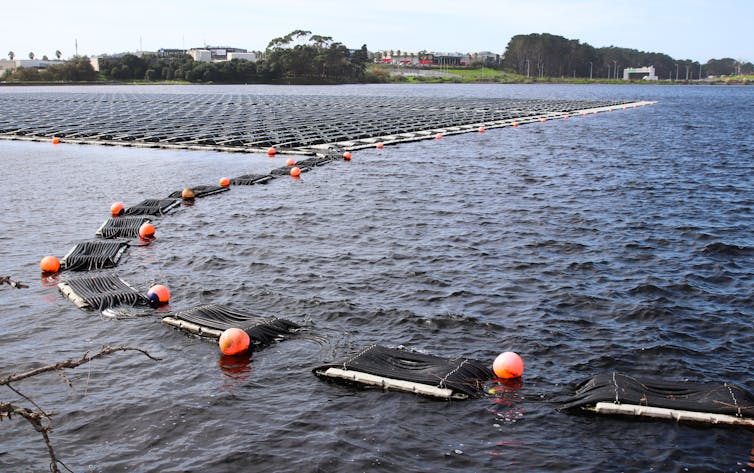
New Zealand’s first floating solar panel array on a treatment pond at the Rosedale wastewater treatment plant.
The floating solar panel array, together with biogas generation, meets a quarter of the Rosedale wastewater treatment plant’s energy needs.
Lynn Grieveson/Getty Images

The project represents the first use of floating solar and the first megawatt-sized solar project in the country. As energy prices soar and environmental pressures mount, it is time to start exploring innovative solutions with the resources we already have.

Wastewater ponds provide underused surface

New Zealand is currently grappling with an electricity crisis, marked by increasing demand, aging infrastructure and a challenging transition to renewable energy sources.

The country relies heavily on hydroelectric power. This makes it particularly vulnerable during periods of low water levels in hydro lakes, especially in winter. This in turn leads to frequent supply shortfalls and, combined with diminishing gas supplies, to rising electricity prices.

As New Zealand intensifies its efforts to integrate more renewable energy, we need innovative solutions to stabilise the grid and meet growing energy demands.

One underutilised resource lies in wastewater treatment ponds. New Zealand has more than 200 wastewater ponds, chosen for their simplicity and low operational costs. They remain the most common form of wastewater treatment because they are robust, require low energy, cope with high water and waste loads and provide buffer storage to avoid applying agricultural effluent to wet soils.

However, because of the high surface area and nutrient-rich environment, algal growth is one of the biggest issues with waste stabilisation ponds. This is exacerbated on days with high sunshine levels and warmer water temperatures. It complicates the treatment process and necessitates costly chemical interventions.

An opportunity for New Zealand

My background is in entrepreneurship and innovation and the idea of floating solar panels on New Zealand’s expansive wastewater ponds represents an untapped opportunity.

Apart from generating power and preventing algal growth, the solar panels provide shade that keeps the water cooler and reduces evaporation. This is critical for maintaining effective wastewater treatment.

Utility-scale solar panels are now recognised as the cheapest form of energy, with rapidly declining costs over the past five years.

While relatively new to New Zealand, floating solar panels have shown significant advantages in other parts of the world. New Zealand may be held back by a misconception that solar panels work best in hot and sunny climates. In fact, solar panels harness the sun’s energy – not its temperature – making New Zealand’s cooler climate an ideal environment for efficient solar energy generation.

Given New Zealand uses more energy per capita than 17 of our 30 OECD peers, floating solar panels on wastewater ponds could set an example for how we tackle energy and environmental challenges.

By turning underutilised spaces into power-generating assets, we not only address immediate needs but also pave the way for a more sustainable, resilient future.

The Conversation

Faith Jeremiah does not work for, consult, own shares in or receive funding from any company or organisation that would benefit from this article, and has disclosed no relevant affiliations beyond their academic appointment.

ref. From waste to power: how floating solar panels on wastewater ponds could help solve NZ’s electricity security crisis – https://theconversation.com/from-waste-to-power-how-floating-solar-panels-on-wastewater-ponds-could-help-solve-nzs-electricity-security-crisis-237455


The internet can be toxic. But there are also online oases where mutual care flourishes

Source: The Conversation (Au and NZ) – By George Buchanan, Deputy Dean, School of Computing Technologies, RMIT University

Chun photographer/Shutterstock

This piece is part of a series on the great internet letdown. Read the rest of the series.


The internet can be a toxic place. Disinformation, hate speech and trolling are not just abundant – they are encouraged by the economy of clicks which governs many online platforms. There are no good clicks, no bad clicks, only clicks. By that metric, mutual hostility is great, because it results in lots of clicks.

But this is only one side of the web.

As I have discovered in my research there are also lesser-known places on the internet where mutual care flourishes.

These online oases are built, carefully tended, and fiercely protected by dedicated people who usually share a niche interest. Members connect and share information with each other that can often be life-changing, helping them overcome personal barriers both great and small.

Informal networks

“Informal networks” are social connections that allow people to share information around a common interest or need.

In the past, a version of this would be village gossip. In times of urgency, this grapevine of social connections ensured people could respond without waiting for the next newspaper – or attend to matters the newspaper would not even cover.

Today, while geographically bounded informal networks are dissolving, they are forming online.

For example, people who have relatively rare chronic conditions can find others on Facebook or in online forums who can provide information on lived experience, tips on how to get quality medical care or ideas for how to continue with a sport.

These networks often exist in a dual world, both online and in person.

Many people find each other and create informal networks on Facebook and in online forums.
BlurryMe/Shutterstock

Finding the right people

Diabetes is an increasingly common condition, and it makes everyday life more complex and challenging.

In my own research, I discovered a group of keen runners with diabetes who were initially strangers but became connected through chance social encounters. They bonded over a shared challenge: how to find the right diet and manage blood sugar levels so they could keep running.

One runner explained that “finding the right people saved the life I loved, maybe even my life”. This network includes a dietitian and a sports scientist, and provides information and guidance that would never appear in a book.

Local and family history is another topic around which online informal networks form.

Often, specific knowledge is key, as one member of an online local history group explained:

when I was trying to get access to the [local archive] I found it really difficult to get the archivist to be helpful […] I got guidance [via an online group] on how to get on her right side, so I could get what I was after.

Again, this isn’t the sort of knowledge that is going to be published. But it is vital for those pursuing it out of interest.

The opposite of division

These informal networks present a stark contrast to the divisive pattern found in some parts of the web. Too-frequent posting and divisive or offensive attitudes are quickly going to get you expelled.

Those who run the Facebook groups and online forums I research are usually volunteers. The main source of information is other members, so there is an inherent need to be a good citizen. As one person explained:

I want the community to work, but I have no time or patience for people who are being disruptive.

Status comes from being friendly, constructive and informative, and there is an expectation of reciprocal behaviour. Many groups, such as the runners with diabetes, encounter each other in real life and are located in a set geographical area.

People researching local and family histories often connect through online informal networks.
NATALIA61/Shutterstock

Discussions often occur across time, spanning in-person chats over coffee, chance encounters at an event, online one-to-one messaging and forum posts. The network spans different social and technological contexts.

The value of these online informal networks is getting knowledge of real experience, and often the emotional support needed to put that experience into practice.

While commercial online platforms value conflict, as it produces enraged engagement and higher advertising revenue, the currencies of these networks are empathy and insight.

A new model

However, the pressures of the world outside the online oasis still exist. Most groups need occasional policing. For example, moderators of a diabetic discussion forum have continually had to expel people touting “snake oil” solutions.

More often, though, anti-social behaviour results in participants being ignored and left on their own. A rogue post will more likely result in a telling off from other posters than the moderator needing to step in. Everyone is involved in both creating and defending the value of the informal network.

Unlike many parts of the internet, online informal networks don’t care about clicks: they survive on real-world benefit. They dissolve when they no longer deliver the benefits people want or need.

Instead of just thinking about clicks, the companies controlling major online platforms could help improve the internet by learning from what is valued in informal networks.

George Buchanan does not work for, consult, own shares in or receive funding from any company or organisation that would benefit from this article, and has disclosed no relevant affiliations beyond their academic appointment.

ref. The internet can be toxic. But there are also online oases where mutual care flourishes – https://theconversation.com/the-internet-can-be-toxic-but-there-are-also-online-oases-where-mutual-care-flourishes-237769

Scientists discover heat-tolerant corals hidden in plain sight. Could it help protect the Great Barrier Reef?

Source: The Conversation (Au and NZ) – By Melissa Naugle, PhD Candidate in Coral Ecology, Southern Cross University

Wikimedia, CC BY

Just as individual humans handle stress differently, so do corals. Even coral colonies of the same species, growing side by side, vary in their tolerance to pressures such as heatwaves.

In research published today, we discovered surprising new evidence of variable heat tolerance in corals. As the world’s oceans warm, these differences are important.

Earlier this year, the world’s fourth global mass bleaching event was declared. The Great Barrier Reef has suffered five mass bleachings since 2016 – most recently this past summer. The declarations followed the world’s warmest year on record.

To keep the world’s coral reefs healthy and functioning, global carbon emissions must be dramatically curbed to reduce the rate of ocean warming. As humanity works towards that goal, interventions may buy time for corals to survive in their warming environments.

What we did

The heat tolerance of corals can be measured by analysing their responses to elevated water temperatures. Our research involved measuring the bleaching thresholds of more than 500 colonies of the tabular coral, Acropora hyacinthus.

Acropora hyacinthus is a common coral that forms “tables” of tiny branchlets. This species is both ecologically important and highly vulnerable to heat waves, making it a prime candidate for conservation.

The characteristic colour of coral is provided by algae living inside its tissue. The algae also provide most of the coral’s nutrition. When water temperatures get too high for too long, the coral expels the algae, causing it to bleach and starve.

While at sea, we visited 17 reefs to scuba dive and search for Acropora hyacinthus. We then brought samples of these corals on board a research vessel to conduct experiments.

Our specially designed portable experiment system contained 12 tanks set to four different temperatures. Coral fragments were placed in each tank and subjected to short-term heat stress at different temperatures.

Afterwards, we measured the amount of pigment left in the coral fragments, which directly aligns with the amount of algae left in the coral’s cells.

We then determined each coral’s bleaching thresholds – in other words, the temperature at which the coral’s pigmentation drops to 50% of its healthy level. This allowed us to understand how much variation exists and where the most heat-tolerant colonies live.

So what did we find? Under our experiments, the amount of pigment retained under high temperatures varied from 3% to 95%. This means at high temperatures, some coral colonies completely bleached while others seemed barely affected.

Of the 17 reefs we studied, 12 contained colonies with bleaching thresholds in the top 25%. This means heat-tolerant corals could be found at most of the reefs we sampled.

Nature versus nurture

Corals handle stress differently for two reasons: nature and nurture.

Each coral has a unique “nature” or genetic makeup that can affect its heat tolerance. Our results suggest corals found across the entire Great Barrier Reef may hold unique genetic resources that are important for recovery and adaptation.

However, aspects of the marine environment may nurture, or hinder, a coral’s heat stress response. These include water temperatures, nutrient conditions, and the symbiotic algae living inside coral tissue.

We found corals living in warmer regions, such as the northern Great Barrier Reef, can handle higher water temperatures. However, because the water is so warm in these areas, the corals are already pushed close to their temperature limits.

Corals in the southern Great Barrier Reef cannot handle temperatures as high as their northern neighbours. Our findings suggest these corals can tolerate more warming above their local temperatures than corals to the north.

These tolerance patterns may affect which corals survive marine heatwaves.

Giving our reefs a future

Our findings have potentially important implications for the ability of corals to adapt to warmer seas under climate change.

The results may also inform reef restoration and conservation efforts. For example, heat-tolerant parent corals could be selectively bred to produce offspring better suited to warmer waters.

The success of such programs depends on the extent to which a coral’s genetic makeup controls its tolerance to heat. So, the next step in this research is investigating these genetic differences.

Selective breeding trials are already underway, using the most heat-tolerant corals identified in this study.

When it comes to protecting our coral reefs, reducing greenhouse gas emissions is imperative. However, interventions such as selective breeding may be useful supplements to give coral reefs the best future possible.

Melissa Naugle receives funding from the Reef Restoration and Adaptation Program, funded by the partnership between the Australian government’s Reef Trust and the Great Barrier Reef Foundation.

Emily Howells receives funding from the Reef Restoration and Adaptation Program, funded by the partnership between the Australian government’s Reef Trust and the Great Barrier Reef Foundation.

Line Bay works for the Australian Institute of Marine Science, a publicly funded research organisation that receives funding from the Australian government, state government departments, foundations and private industry. She receives funding from the Reef Restoration and Adaptation Program, a partnership between the Australian Governments Reef Trust and the Great Barrier Reef Foundation, Revive and Restore, the Paul G Allen Family Foundation and BHP.

ref. Scientists discover heat-tolerant corals hidden in plain sight. Could it help protect the Great Barrier Reef? – https://theconversation.com/scientists-discover-heat-tolerant-corals-hidden-in-plain-sight-could-it-help-protect-the-great-barrier-reef-231823

Politicians know defamation laws can silence women, but they won’t do anything about it

Source: The Conversation (Au and NZ) – By Sarah Ailwood, Senior Lecturer, School of Law, University of Wollongong

Shutterstock

This piece is the second in a series on Australia’s defamation laws. You can read the first article here.


Over recent years, forces like the #MeToo movement have shone a light on how Australia’s defamation laws play out for women. These laws influence whether and how women speak about their experiences of violence and harassment.

Multiple high-profile cases have highlighted the gender dynamics at play. Both Geoffrey Rush’s successful defamation claim against the Daily Telegraph in 2018 and Bruce Lehrmann’s ongoing litigation against Network Ten and Lisa Wilkinson attracted much media attention. This included commentary about how defamation can silence women.

But these laws don’t only affect women speaking out publicly and through the media. They also affect women seeking to report sexual violence to the police and sexual harassment in the workplace.

Defamation law is weaponised against women in a variety of settings across the country. Our politicians have acknowledged this, but there’s been little appetite for fixing it.

The difficulty of truth

To bring a defamation claim under Australian law, a plaintiff must prove a number of things. But one thing the plaintiff does not have to prove is that the publication is false.

Many defendants rely on the “truth defence”, which requires them to prove the substantial truth of the publication. If it’s successful, that wins them the case.

But with allegations of sexual violence, establishing the truth is notoriously difficult. That’s even with a lower standard of proof (the balance of probabilities) than in criminal courts (beyond reasonable doubt).

Look no further than in Lehrmann’s case against Ten. The quality and quantity of the evidence brought by the defence, including extensive audio-visual recordings and the testimony of multiple third parties, shows what’s needed to meet this very high standard.

This means it is relatively easy for an alleged perpetrator to bring a defamation claim against a person who reports sexual violence or harassment, and relatively difficult for a victim-survivor to defend the claim.

Discouraging coming forward

The weaponisation of defamation law by perpetrators against women reporting sexual violence and harassment is well documented.

In the Respect@Work Report, the Australian Human Rights Commission heard evidence that women reporting workplace sexual harassment were being threatened with and sued for defamation. The report found Australia’s defamation laws “discourage sexual harassment victims from making a complaint”.

Recent research has revealed that threatening or commencing defamation proceedings is a widely used tactic by alleged perpetrators to silence victim-survivors and pressure them to withdraw complaints.


Read more:
Non-disclosure agreements are commonplace in sexual harassment cases, but they’re being misused to silence people


The destructive effects of defamation litigation for victim-survivors are evident in a 2022 Queensland case called Sherman vs Lamb.

A victim-survivor of coercive control in a relationship that had recently ended reported the violence to a police officer. She was then successfully sued for defamation by the perpetrator at trial.

The judge also found the victim-survivor’s report was malicious. He found “police have no interest in or a duty to receive gossip or adverse commentary”.

Both of these findings were overturned on appeal, but by then, the costs of the defamation litigation had forced the victim-survivor to declare bankruptcy.

Reluctance to change

The impact of perpetrators weaponising defamation law is both individual and structural.

On an individual level, it targets victim-survivors reporting and complaining of sexual harassment and violence.

Structurally, it contributes to a culture of fear of speaking out, contributing to the ongoing silencing of violence against women.

Yet the Standing Council of Attorneys-General (the federal attorney-general and those from every state and territory) has chosen not to act to protect women reporting sexual violence and harassment from defamation claims in the workplace.

The council did agree that absolute privilege should be extended to reporting to police. Absolute privilege means a person can’t be help liable for defamation, like in parliament.

So far, attorneys-general in Victoria, New South Wales and the ACT have brought in legal protections for women reporting violence to police. That’s a good thing, though other state and territories are yet to follow.

But it obscures the group’s refusal to extend those protections to the workplace, where much of this abuse occurs.

In its review of defamation laws, the council considered how these laws affect workplace sexual harassment. In particular, it considered whether absolute privilege should apply to sexual harassment and violence in particular contexts, like work.

The council found victim-survivors and witnesses of sexual violence, sexual harassment and other forms of unlawful personal conduct are being threatened with and sued for defamation. It found this causes victim-survivors to withdraw reports and complaints, and that it deters them from making reports and complaints in the first place.

A key advantage of extending absolute privilege is that many defamation claim would likely be summarily dismissed without the need for a costly and lengthy trial, which is usually required. This would likely reduce the weaponisation of defamation law by perpetrators.

The council decided not to do this in workplaces. It blamed a division of stakeholder opinion within the consultation process. It also said there weren’t enough protections for alleged perpetrators, like penalties for false reporting.

Reinforcing myths

The rationale appears to be that employers implementing Respect@Work and eliminating sexual harassment from their workplaces will also eliminate the need to report it, in turn removing the threat presented by defamation law.

But the council’s decision also reinforces how important the idea of reputation is within Australian defamation law.

Protecting the reputation of alleged perpetrators of violence is of greater value to Australia’s attorneys-general than protecting the speech of victim-survivors of sexual violence and harassment.

It also reinforces myths about workplace sexual harassment: that men are at significant risk from women making false reports, and that sexual harassment is an individual, interpersonal problem rather than a structural issue that should be addressed by law reform.

Australian women remain at risk of being threatened with or sued for defamation for reporting sexual harassment and violence in the workplace.

This is yet another instance of a law reform process failing to listen and act in response to violence against women. Our chief legal officers have acknowledged the weaponisation of defamation law to silence women in the workplace and refused to do anything to prevent it.

The Conversation

Sarah Ailwood does not work for, consult, own shares in or receive funding from any company or organisation that would benefit from this article, and has disclosed no relevant affiliations beyond their academic appointment.

ref. Politicians know defamation laws can silence women, but they won’t do anything about it – https://theconversation.com/politicians-know-defamation-laws-can-silence-women-but-they-wont-do-anything-about-it-238079

In the rare event of a vaccine injury, Australians should be compensated

Source: The Conversation (Au and NZ) – By Nicholas Wood, Professor, The Children’s Hospital at Westmead Clinical School, University of Sydney

PeopleImages.com – Yuri A/Shutterstock

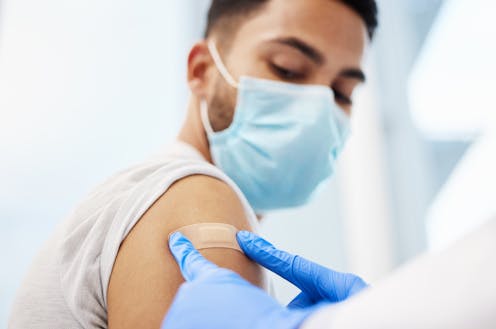
Vaccination is one of the most effective methods to protect individuals and the broader public from disease. Vaccines are typically given to healthy people to prevent disease, so the bar for safety is set high.

People benefit from vaccination at an individual level because they’re protected from disease. But for some vaccines, strong community uptake leads to “herd immunity”. This means people who are unable to be vaccinated can be protected by the “herd”.

As with any prescribed medicine, vaccines can cause side effects. In the rare case that COVID vaccines did cause a specified serious injury (the scheme listed certain conditions that a person could claim for), Australians have been able to claim compensation. But this ends at the end of this month.

From then, Australians won’t be able to access no-fault compensation for any vaccine injury – from COVID or any others.

Why compensate people for vaccine injuries?

Fortunately, serious vaccine injuries are rare. Most are not a result of error in vaccine design, manufacturing or delivery, but are a product of a small but inherent risk.

As a result, people who suffer serious vaccine injuries cannot get compensation through legal mechanisms. This is because they can’t demonstrate the injury was caused through negligence.

Vaccine injury compensation schemes compensate people who have a serious vaccine injury following administration of properly manufactured vaccines.

The COVID vaccine claims scheme

In 2021, in recognition of the rare risk of a serious vaccine injury, and in support of the roll out of the COVID vaccine program, the Australian government introduced a COVID vaccine claims scheme.

The aim was to provide a simple, streamlined process to compensate people who suffered a moderate to severe vaccine injury, without the need for complex legal proceedings. It was limited to TGA-approved COVID vaccines, and to specific reactions.

The Australian government has said the scheme will close this month and claims need to be lodged before September 30 2024.

Following its closure, Australia will not have a vaccine injury compensation scheme.

Australia is lagging internationally

Australia lags behind 25 other countries including the United States, United Kingdom and New Zealand which have comprehensive no-fault vaccine injury compensation schemes. These cover both COVID and non-COVID vaccines.

The schemes are based on the ethical principle of “reciprocal justice”. This acknowledges that people acting to benefit not just themselves but also the community (for the benefit of the “herd”) should be compensated by the same community if it has resulted in harm.

An older couple talks to their GP
The US, UK and New Zealand all have vaccine injury compensation schemes.
Monkey Business Images/Shutterstock

So what happens in Australia now?

In Australia, people with non-COVID vaccine injuries or COVID vaccine injuries not covered by the current claims scheme must bear the costs associated with their injury by themselves or access publicly funded health care. They will not receive any compensation for their injury and suffering.

Australia’s National Disability Insurance Scheme (NDIS) provides funding support to access therapies for people with a permanent and significant disability. However, it does not cover temporary vaccine-related injuries.

Participants with vaccine injuries as a result of taking part in a clinical vaccine trial are compensated. This typically includes income-replacement, personal assistance expenses and reimbursement of expenses resulting from the incident, including medical expenses.

In Australia, we also have strong compulsion for people to receive routine vaccines through legislative requirements such as No Jab No Pay (which requires children to be immunised to receive some government payments) and, in some states, No Jab No Play (which requires children be fully immunised to attend childcare).

Countries such as ours that mandate vaccination without providing no-fault injury compensation schemes for rare vaccine injury could be abrogating the social contract by not protecting the individual and community.

It’s time to set up an Australian scheme

The Australian immunisation system is among the most comprehensive in the world. Our government-funded national immunisation program provides free vaccines for infants, children and adults for at least 15 diseases.

We also have a whole-of-life immunisation register and comprehensive vaccine safety surveillance system.

Nurse draws up vaccine vial
Australia’s immunisation program provides vaccines for at least 15 different diseases.
sergey kolesnikov/Shutterstock

A recent Senate committee recommended:

the Australian government consider the design and compensation arrangements of a no-fault compensation scheme for Commonwealth-funded vaccines in response to a future pandemic event.

Vaccines are designed to be very safe and effective. But the “insurance policy” of an injury compensation scheme, if designed and communicated appropriately, should build trust and give confidence to health workers and the general public to support our national vaccine program. This is particularly important given the reductions in uptake of routine vaccines.

How should it work?

A no-fault vaccine injury compensation scheme could be funded via a vaccine levy system, as is done in the US, where an excise tax is imposed on each dose of vaccine.

An effective vaccine injury compensation scheme needs to be:

  • accessible, with low legal and financial barriers
  • transparent, with clear decision-making processes, compensation frameworks and funding responsibilities
  • timely, with short, clear timeframes for decision-making
  • fair, with people compensated adequately for the harm they’ve suffered.

Legislation to introduce and allocate funds to support an Australian injury compensation scheme for all vaccines is overdue. The draft National Immunisation Strategy 2025–2030 hinted at the opportunity to explore the feasibility of a no fault compensation scheme for all vaccines the Australian government funds, without committing to such a program.

An Australian vaccine injury scheme, covering all national immunisation program vaccines, not just pandemic use vaccines, should be seen as a crucial component of our public health system and a social responsibility commitment to all Australians.

The Conversation

Nicholas Wood previously received funding from the NHMRC for a Career Development Fellowship and is a Churchill Fellow.

Sophie Wen receives funding from Queensland Government for an Advancing Clinical Research Fellowship and is a Mary McConnel career boost program recipient from Children’s Hospital Foundation. Sophie Wen is an investigator for several industry-sponsored clinical vaccine trials but does not receive any direct funding.

Tim Ford does not work for, consult, own shares in or receive funding from any company or organisation that would benefit from this article, and has disclosed no relevant affiliations beyond their academic appointment.

ref. In the rare event of a vaccine injury, Australians should be compensated – https://theconversation.com/in-the-rare-event-of-a-vaccine-injury-australians-should-be-compensated-232396

The power of nostalgia: why it’s healthy for you to keep returning to your favourite TV series

Source: The Conversation (Au and NZ) – By Anjum Naweed, Professor of Human Factors, CQUniversity Australia

Janet Julie Vanatko/Shutterstock

How often do you find yourself hitting “play” on an old favourite, reliving the same TV episodes you’ve seen before – or even know by heart?

I’m a chronic re-watcher. Episodes of sitcoms like Blackadder (1983–89), Brooklyn Nine-Nine (2013–21), Doc Martin (2004–22) and The Office US (2005–13) – a literal lifetime of TV favourites – are usually dependable in times of stress.

But recently, ahead of an exceptionally challenging deadline, I found myself switching up my viewing. Instead of the escapist comedy I normally return to, I switched to Breaking Bad (2008–13), a nail-biting thriller with a complex reverse hero narrative – and immediately felt at ease.

What do our re-viewing choices tell us about ourselves? And is it OK that we keep returning to old favourites?

Fictional stories, real relationships

Although one-sided, the relationships we form with characters in our favourite TV shows can feel very real. They can increase a sense of belonging, reduce loneliness – and keep pulling us back in.

When we rewatch, we feel sadness, wistful joy and longing, all at the same time. We call the sum of these contradictions nostalgia.

Originally coined in the 17th century to describe Swiss soldiers impaired by homesickness, psychologists now understand nostalgic reflection as a shield against anxiety and threat, promoting a sense of wellbeing.

We all rely on fiction to transport us from our own lives and realities. Nostalgia viewing extends the experience, taking us somewhere we already know and love.

Bingeing nostalgia

The COVID-19 pandemic triggered a wave of nostalgia viewing.

In the United States, audience analyst Nielsen found the most streamed show of 2020 was the American version of The Office, seven years after it ended its television run. A Radio Times survey found 64% of respondents said they had rewatched a TV series during lockdown, with 43% watching nostalgic shows.

We were suddenly thrown into an unfamiliar situation and in a perpetual state of unease. We had more time on our hands, but also wanted to feel safe. Tuning into familiar content on television offered an escape – a sanctuary from the realities of futures unknown.

Revisiting connections with TV characters gave us a sense of control. We knew what lay in their futures, and the calm and predictability of their arcs balanced the uncertainty in ours.

Nostalgia as a plot point

Nostalgia has been in the DNA of television since some of the earliest programming decisions.

Every December, broadcasters scramble to screen one of the many versions of A Christmas Carol, Charles Dickens’ much-retold and family-friendly ghost story, which also features nostalgia as a plot device.

First screened on live TV in New York City in 1944, on the still-new technology, the broadcast continued a 100-year-old tradition of the classic appearing on stage and cinema screens.

Settling in around the telly for A Christmas Carol connects us to the holiday period and a heartwarming metamorphosis. Ebeneezer Scrooge revisits long-lost versions of himself and turns from villain to hero and our old friend in a single night.

For viewers, revisiting this character at the same time every year can also reconnect us with our past selves and create a predictable pattern, even in the frenzy of the silly season.

Real-world (re)connection

The neuroscience of nostalgic experiences is clear. Nostalgia arises when current sensory data – like what you watch on TV – matches past emotions and experiences.

It triggers a release of dopamine, a reward-system neurotransmitter involved in emotion and motivation. Encountering nostalgia is like autoloading and hitting play on past positive experiences, elevating desire and regulating mood.

So, nostalgia draws on experiences encoded in memory. The TV shows we choose to rewatch reflect our values, our tastes, and the phases of life we have gone through.

Perhaps this is a reason why reboots of our favourite shows sometimes fall flat, and ultimately set fans up for disappointment.

I still remember the crushing disillusion I felt while watching the reboot of Knight Rider (2008–09). I immediately turned to social media to find a community around my nostalgic setback

Stronger through stress

Going back to my challenging deadline, what was it about the nostalgic experience of watching Breaking Bad that made it different?

Breaking Bad evokes a particular phase in my life. I binged the first three seasons when writing up my PhD thesis. Walter White’s rise and fall journey towards redemption is enmeshed in the nostalgia of a difficult time I made it through.

The predictability of Walter White’s arc on second viewing was an unlikely haven. It’s escalating high-stakes drama mirrored my rising stress, while connecting me to who I was when I first enjoyed the show.

The result? “Dread mode” switched off – even as my anti-heroes marched again to their dire cinematic comeuppance. Reality, past and present, could be worse.

The Conversation

Anjum Naweed does not work for, consult, own shares in or receive funding from any company or organisation that would benefit from this article, and has disclosed no relevant affiliations beyond their academic appointment.

ref. The power of nostalgia: why it’s healthy for you to keep returning to your favourite TV series – https://theconversation.com/the-power-of-nostalgia-why-its-healthy-for-you-to-keep-returning-to-your-favourite-tv-series-237753

Beyond the ivory tower: universities need to prioritise the entrepreneurial mindset, not just new ideas

Source: The Conversation (Au and NZ) – By Rod McNaughton, Professor of Entrepreneurship, University of Auckland, Waipapa Taumata Rau

As universities consider their future in the 21st century, many are embracing the concept of “innovation” in their strategic plans.

According to Harvard Business School, innovation is “a product, service, business model or strategy that’s both novel and useful”.

By focusing on innovation, universities are attempting to position themselves as drivers of progress – as institutions that generate knowledge and apply it to solve the world’s most pressing problems.

But here’s the catch: fewer universities embrace “entrepreneurship” similarly, despite it being the critical bridge between innovation and real-world impact.

Innovation vs entrepreneurship

It’s easy to see why universities are more comfortable with innovation.

Labs, research centres and academic programs encourage pushing the envelope in a relatively risk-free setting.

Original research is one of the requirements of completing a doctorate. This means universities feel like hubs of cutting-edge thinking, even if the innovations never leave the confines of the campus.

However, entrepreneurship requires something different. Those with an idea also have to understand how to navigate the messy realities of bringing it to fruition.

Entrepreneurship demands the skills to manage people and resources, assess viability, identify pathways to adoption, and understand the environment while being comfortable with uncertainty and resilient in the face of failure and change.

Fostering an entrepreneur mindset in academics

Understanding the distinction between innovation and entrepreneurship is critical. Innovation often begins by assuming no constraints and imagining a world of possibility.

But entrepreneurship assumes resources are scarce and that success depends on overcoming obstacles and working with what’s available. While innovation can happen in isolation, entrepreneurship needs community, collaboration, feedback and constant adaptation.

Entrepreneurial skills are valuable for students at all levels and any discipline. But the entrepreneurial process can be especially helpful for researchers and PhD students who have spent years developing an idea but not a way to get it into the real world.

Bridging the gap

Globally, there is a growing gap between the number of doctoral graduates and academic jobs.

Programs such as the ones run by the University of Auckland Business School’s Centre for Innovation and Entrepreneurship (CIE) (which I am involved in), are teaching how to identify opportunities and navigate resource constraints through mentoring, workshops and hands-on projects.

While some find opportunities to commercialise their research, others pursue policy changes or social ventures.

One good illustration of this is Kate Riegle van West’s doctoral research. Riegle van West examined the benefits of poi for the health of older adults. Supported by CIE’s programs, she launched SpinPoi, a social venture dedicated to working with poi to improve health and well being.

Since its founding, CIE has helped start more than 279 ventures and provides entrepreneurial experiences to more than 7,500 students and staff across the university each year.

Similar programs exist at other universities, but much more needs to be done to scale up the development of entrepreneurial skills within universities.

Overcoming resistance

Universities have been slow to prioritise developing an entrepreneurial mindset among students and staff.

Innovation without entrepreneurship is like building a bridge halfway. You may have a brilliant idea, but it is unlikely to make a meaningful impact without the skills to bring it to reality. Entrepreneurship transforms creative ideas into valuable, tangible outcomes.

But there are challenges. “Innovation” is more palatable to some academics, especially those who equate entrepreneurship with commercialism. To overcome this, it’s crucial to recognise that entrepreneurial skills are valuable across most endeavours.

Skills like opportunity recognition, resource allocation, and risk management are critical for starting businesses. But they are also highly valued within existing organisations and for leading teams and driving change in any sector.

Staff and students may not immediately see the relevance of entrepreneurship to their discipline or career aspirations, thinking entrepreneurship is only for those in business or the sciences.

Yet there is a growing need for entrepreneurial skills to bridge the gap between academic expertise and application from students in all disciplines.

At the doctoral level, developing these skills can help ensure research has wider impact, and create opportunities for these researchers once they graduate.

It’s not that innovation isn’t useful – it’s essential.

Many industries and organisations rely on innovation to improve efficiency, create new products, and solve complex problems. In some professional contexts, an innovation mindset may be more relevant than an entrepreneurial one.

But to truly contribute to solving societal problems and prepare their students to make a difference, universities must do more than foster innovation. They must prioritise and develop an entrepreneurial mindset and competencies among students and staff, enabling them to execute, adapt and create lasting impact.

The Conversation

Rod McNaughton does not work for, consult, own shares in or receive funding from any company or organisation that would benefit from this article, and has disclosed no relevant affiliations beyond their academic appointment.

ref. Beyond the ivory tower: universities need to prioritise the entrepreneurial mindset, not just new ideas – https://theconversation.com/beyond-the-ivory-tower-universities-need-to-prioritise-the-entrepreneurial-mindset-not-just-new-ideas-239377

More Australians are using their superannuation for medical procedures. But that might put their financial health at risk

Source: The Conversation (Au and NZ) – By Neera Bhatia, Associate Professor in Law, Deakin University

fizkes/Shutterstock

A record number of Australians are accessing their superannuation early on compassionate grounds, mainly to fund their own medical procedures – or those of a family member.

Some 150,000 Australians have used the scheme in the last five years. Nearly 40,000 people had applications approved in 2022-23, compared to just under 30,000 in 2018-19 – an increase of 47%.

Some people think this flexible use of funds is a good way to ensure people can fund their own medical needs. But more transparency and better oversight is needed.

What are compassionate grounds?

Since July 2018, the Australian Tax Office has administered the early release of superannuation – meaning before retirement – under certain circumstances, including compassionate grounds.

Compassionate grounds for you or your dependant (such as child or spouse) are:

  • medical treatment or transport
  • modifying your home or vehicle to accommodate special needs for a severe disability
  • palliative care for a terminal illness
  • death, funeral or burial expenses
  • preventing foreclosure or forced sale of your home.

The medical treatment must be for a life-threatening illness or injury, or to alleviate acute or chronic pain, or acute or chronic mental illness.

The treatment cannot be “readily available” through the public system. Cosmetic procedures are excluded.

You also have to prove you cannot afford to pay part or all of the expenses without accessing your super, for example, by spending your savings, selling assets or getting a loan.

People who can access other funding for the expense, such as via the National Disability Insurance Scheme, are ineligible.

Why are people using this scheme more?

The ATO has not explained what is driving the surge. General cost-of-living pressures may play a role. People may have fewer savings to draw on for medical procedures.

But the treatments most commonly being accessed using superannuation – fertility treatments, weight loss surgeries and dental care – point to other systemic issues.

There have long been issues with IVF and dental care not being readily available or funded in the public health system.

Weight loss surgeries (including bariatric surgery) can help combat potentially life-threatening conditions such as heart disease. Recent research suggests there has been an overall drop in the number of Australians having bariatric surgeries since 2016. But of those, 95% are performed through the private system.

A dentist in a white coat inspects a boy's mouth.
Australians are increasingly turning to their super to fund dental care, which is not covered by Medicare.
Pixabay/Pexels

While early access to super can provide individuals access to critical treatment, there are issues with how compassionate grounds are defined and regulated.

Lack of clarity

As my co-author and I have shown, the vague wording of the Superannuation Industry regulations leaves them worryingly open to interpretation.

For example, the meaning of “mental disturbance” is not defined.

You may not meet the criteria of having an acute or life-threatening illness, or acute or chronic pain. But if you can show a certain condition causes you acute mental disturbance, you may qualify to release your superannuation early.

People accessing their superannuation for IVF use this criterion, for example, by arguing they need to access funds to continue treatment and alleviate the acute mental distress caused by ongoing infertility issues.

Two registered medical practitioners are each required to submit a report demonstrating the treatment is needed, and one must be a specialist in the field in which the treatment is required. However, the regulations do not specify clearly that the specialist should have relevant qualifications.

In the IVF example, this means the specialist opinion can be provided by a fertility doctor rather than a mental health expert – and that person may stand to profit if they later also provide treatment.

A closed-loop system

Conflict of interest is another major issue.

There is nothing in the regulations to stop a medical practitioner – such as a dentist – being involved in all steps and then financially benefiting. They could encourage a patient to access superannuation for a treatment, write the specialist report and then also receive payment for the treatment.

Some clinics promote accessing superannuation as an option to pay for expensive treatments.

This raises important questions about the independence of the process, as well as professional ethics.

Medical practitioners making recommendations for early release of superannuation should be doing so on genuinely compassionate grounds. But the potential for exploitation remains an ethical concern, when a practitioner can financially benefit from recommending early access to nest egg funds.

Transparency around potential conflicts of interest are impossible to ensure without proper oversight.

What is needed?

1. Mandatory financial counselling

The ATO has warned accessing super early is not “free money”, with a spokesperson urging people to get financial advice. But the law should go a step further and make this compulsory. That way people making decisions during an emotionally charged moment can understand any future implications.

2. Tightening of the criteria

Greater clarity in the legislation – such as defining “mental disturbance” – would help prevent loopholes being exploited.

3. Better oversight

Less health-care industry involvement would promote greater transparency and independence. An independent body of medical practitioners could assess applications rather than practitioners who could financially benefit if applications are approved. This would help alleviate perceived and actual conflicts of interest.

Accessing superannuation early may be the only option for some people to start a family or access other life-changing medical care. But they should be able to make this decision in a fully informed way, safeguarded from exploitation and aware of the implications for their future.

The Conversation

Neera Bhatia receives funding from The UK Arts and Humanities Research Council for an unrelated project.

ref. More Australians are using their superannuation for medical procedures. But that might put their financial health at risk – https://theconversation.com/more-australians-are-using-their-superannuation-for-medical-procedures-but-that-might-put-their-financial-health-at-risk-239588

View from The Hill: The Greens’ demands on the RBA make for bad economic policy. Is it also crazy politics?

Source: The Conversation (Au and NZ) – By Michelle Grattan, Professorial Fellow, University of Canberra

When the Greens tell Labor they’re ready to negotiate, what they usually mean is they’re preparing to make populist demands that can’t or shouldn’t be met.

So it is with their “ask” on the Reserve Bank legislation.

Treasurer Jim Chalmers wants to split the Reserve Bank board into two, one to run monetary policy and the other to administer the bank.

He got close to agreement with the Liberals, but then they saw an advantage in walking away. The Greens jumped in to fill the void, demanding an interest rate cut in exchange for their support.

“Both the Treasurer and the RBA Governor have said the reforms are important. Now they know what they have to do to get them done – provide some much needed relief to mortgage holders,” the minor party’s treasury spokesman Nick McKim said on social media on Monday.

“We are unashamedly using our political power to fight for mortgage holders who are getting smashed by high interest rates.

“The power exists for the Treasurer to bring down interest rates. Time to stop the pretence that the RBA is independent.

“Time for Jim Chalmers to end his ritual ashen-faced handwringing, end the pretence there’s nothing he can do, and intervene to bring down interest rates,” McKim said.

“We are deliberately bringing the RBA into the centre of the political debate where it belongs. The RBA board are unelected technocrats, not high priests who are beyond criticism. Every decision they make is political.”

When it comes to the Greens, the government gives as good as it gets.

“The Greens are out of control,” Finance Minister Katy Gallagher told the ABC on Monday. “It’s crazy what they’re saying to us,” adding, rather primly, that it was “a bit unseemly” for McKim to be “issuing ultimatums”.

Leave aside the unseemly – that’s a common political trait. What about the crazy?

What the Greens are demanding is bad economic policy. Whether it is crazy politics remains to be seen.

From time to time the Reserve Bank comes under sharp criticism, from experts and from the public.

Chalmers and McKim agree on one thing – the “smashing” power of high interest rates.

But the bank’s essentially independent status is a bulwark against monetary policy becoming the creature of short-term politics, as McKim would have it.

(The bank isn’t totally independent. Section 11 of the RBA Act gives the treasurer the power to overrule it, with statements from both the treasurer and bank tabled in parliament. The section has never been invoked.)

What the Greens are proposing, having the treasurer use his power to overrule the bank board to get his way on legislation, is irresponsible.

It’s also illogical. The whole point of the proposed dual boards is to strengthen the bank’s expertise as the independent setter of monetary policy. But McKim wants, in essence, to scrap that independence.

The stand on the Reserve Bank is typical of the Greens policy positions more generally. They’re presently holding up the government’s housing legislation in the Senate, making demands they know the government won’t meet, such as controls on rents.

When challenged, the Greens point out that after playing hardball on earlier housing legislation, they won extra funding.

They’re probably hoping the government will decide to buy them off this time with some more housing money. Notably, they have delayed the latest bills rather than vote them down. To do this they’ve teamed up with the Coalition – expediency overcomes ideology with these bedfellows.

Monday’s announcement that the Australian Competition and Consumer Commission has launched legal action against Coles and Woolworths over their allegedly misleading behaviour on product discounts feeds right into the Greens’ (and the Coalition’s) policy for the power to break up the big supermarkets.

The government reacted on Monday by releasing an exposure draft of its mandatory food and grocery code of conduct, which has been in the pipeline for some time. A government inquiry by former Labor minister Craig Emerson argued against divestiture powers but it’s easy to understand how cash-strapped families struggling with grocery bills could see that as appealing.

In general, is wild economics savvy politics? We won’t know until after the election.

The Greens were on a roll in 2022. They ended up with four lower house members, up from the one (leader Adam Bandt) they had before. The extra seats, all in Queensland, were won from both Labor (one) and the Liberals (two).

They also came out of the election with a record dozen senators (now 11, after Lidia Thorpe’s defection).

In the hunt for more lower house seats, the Greens would hope to pick up votes from those on the left who see Labor as too conservative, people financially hurting who are attracted to populist solutions, and young voters turned off the major parties.

Given its present radicalism, one wonders whether the Greens will hold the two Brisbane seats they won from the Liberals.

It’s difficult to chart the likely trajectory of the Greens, given their small share of the vote, and the heavier concentration of their support in particular areas. But Labor is certainly afraid of them. With the government on the back foot, it knows the potential attraction of easy-sounding solutions.

The Greens hope there will be a minority Labor government after the election, and that they would be in a position to twist that government’s arm on multiple issues.

The risk for them, however, is that if they overreach now, some of their potential but still undecided voters might become wary about how they would behave if their power was much enhanced.

Michelle Grattan does not work for, consult, own shares in or receive funding from any company or organisation that would benefit from this article, and has disclosed no relevant affiliations beyond their academic appointment.

ref. View from The Hill: The Greens’ demands on the RBA make for bad economic policy. Is it also crazy politics? – https://theconversation.com/view-from-the-hill-the-greens-demands-on-the-rba-make-for-bad-economic-policy-is-it-also-crazy-politics-239595

Offering end of life support as part of home care is important – but may face some challenges

Source: The Conversation (Au and NZ) – By Jennifer Tieman, Matthew Flinders Professor and Director of the Research Centre for Palliative Care, Death and Dying, Flinders University

Andrew Angelov/Shutterstock

Earlier this month, the government announced major changes to aged care in Australia, including a A$4.3 billion investment in home care.

Alongside a shake up of home care packages, the Support at Home program will include an important addition – an end of life pathway for older Australians.

This pathway will allow access to a higher level of in-home aged care services to help Australians stay at home as they come to the end of their life. Specifically, it will provide an extra A$25,000 for palliative support when a person has three months or less left to live.

This is a positive change. But there may be some challenges to implementing it.

Why is this important?

Older people have made clear their preference to remain in their homes as they age. For most people, home is where they would like to be during their last months of life. The space is personal, familiar and comforting.

However, data from the Australian Bureau of Statistics shows most people who die between the ages of 65 and 84 die in hospital, while most people aged 85 and older die in residential aged care.

This apparent gap may reflect a lack of appropriate services. Both palliative care services and GPs have an important role in providing medical care to people living at home with a terminal illness. However, being able to die at home relies on the availability of ongoing support including hands-on care and assistance with daily living.

Family members and friends often provide this support, but this is not always possible. Even when it is, carers may lack confidence and skills to provide the necessary care, and may not have enough support for and respite from their carer role.

The palliative care funding offered within Support at Home should help an older person to remain at home and die at home, if that is their preference.

Unless someone dies suddenly, care needs are likely to increase at the end of a person’s life. Supports at home may involve help with showering and toileting, assessing and addressing symptoms, developing care plans, managing medications, wound dressing, domestic tasks, preparing meals, and communicating with the person’s family.

Occupational therapists and physiotherapists can assist with equipment requirements and suggest home modifications.

End of life supports may also involve clarifying goals of care, contacting services such as pharmacists for medications or equipment, liaising with organisations about financial matters, respite care or funeral planning, as well as acknowledging grief and offering spiritual care.

But we don’t know yet exactly what services the $25,000 will go towards.

What do we know about the scheme so far?

The Support at Home program, including the end of life pathway, is scheduled to start from July 1 2025.

We know the funding is linked to a prognosis of three months or less to live, which will be determined by a doctor.

Further information has indicated that an older person can be referred to a high-priority assessment to access the end of life pathway. We don’t know yet what this means, however they don’t need to be an existing Support at Home participant to be eligible.

The pathway will allow 16 weeks to use the funds, possibly to provide some leeway around the three-month timeline.

Although more details are coming to light, there are still some things which remain unclear.

Home care providers will be looking for details on what can be covered by this funding and how they will work alongside primary care providers and health-care services.

Older people and their families will want to know the processes to apply for this funding and how long applications will take to be reviewed.

Everyone will want to know what happens if the person doesn’t die within three months.

A senior man in bed. A woman holds his hand.
We’re awaiting certain details on what this new pathway will involve.
Ground Picture/Shutterstock

Some challenges

Ready availability of appropriate supports and services will be crucial for older people accessing this pathway. Home care providers will therefore need to assess how an end of life pathway fits into their operational activities and how they can build the necessary skills and capacity.

Demand for nurses with palliative care skills and allied health professionals is likely to increase. Providing end of life care can be especially taxing so strategies will be needed to prevent staff burnout and encourage self-care.

How pathways are implemented in rural and remote areas and in different cultural and community groups will need to be monitored to ensure all older people benefit.

Effective coordination and communication between home care, primary care and specialist palliative providers care will be key. Digital health systems that connect the sectors could be helpful. Family engagement will also be very important.

Escalation pathways and referral pathways should be established to enable appropriate responses to emergencies, unexpected deterioration, and family distress.

Finally, accurately determining when someone will die can be difficult. Knowing when the last three months of life starts may not be easy, particularly where frailty, cognitive issues and multiple health concerns may be present.

This might mean some people are not seen as being ready for this pathway. Others may not be willing to accept this prognosis. An older person may also be expected to live with a terminal illness for many months or years. Their palliative care needs would not be met under this pathway.

Despite these challenges, the announcement of an end of life pathway within the home care program is timely and welcome. As a population we are living longer and dying older. More details will help us be better prepared to implement this scheme.

The Conversation

Jennifer Tieman receives grant funding from Department of Health and Aged Care and from SA Health. She is affiliated with Palliative Care SA, Palliative Care Australia and the Australian Institute for Digital Health.

ref. Offering end of life support as part of home care is important – but may face some challenges – https://theconversation.com/offering-end-of-life-support-as-part-of-home-care-is-important-but-may-face-some-challenges-239296

Earth is getting a tiny new mini-moon. It won’t be the first (or the last)

Source: The Conversation (Au and NZ) – By Laura Nicole Driessen, Postdoctoral researcher in radio astronomy, University of Sydney

The minimoon 2020 CD3 orbited Earth between 2018 and 2020. International Gemini Observatory/NOIRLab/NSF/AURA/G. Fedorets, CC BY

Earth is going to have its very own mini-moon from September 29 until November 25. The regular Moon’s new, temporary friend is 2024 PT₅, an asteroid captured from the Arjuna asteroid group (called the “Arjunas”).

Our new mini-moon is approximately 10 metres in diameter and will be captured by Earth’s gravity for 57 days. It’s small and faint, so it won’t be visible by the eye or with small telescopes, but will be visible to larger telescopes.

What is a mini-moon?

NASA defines “moons” as “naturally formed bodies that orbit planets”. Intuitively, we think of moons as big rocks that stick around for a while, like our very own Moon.

Astronomers have defined mini-moons as asteroids or comets that are gravitationally captured by a planet for a temporary amount of time. Small mini-moons are very common, but ones big enough to spot are more rare.

2024 PT₅ is only the fifth ever detected mini-moon captured by Earth.

Orbiting or just flying by?

A mini-moon is a “temporarily captured orbiter” if it completes at least one full orbit of the Earth before returning to its usual orbit around the Sun.

If a mini-moon is captured by Earth’s gravity but doesn’t make it around for a full orbit, it’s a “temporarily captured flyby” instead.

Two of Earth’s mini-moons were “temporarily captured orbiters”, while the other three (including 2024 PT₅) fall into the “temporarily captured flybys” category.

Where do mini-moons come from?

Mini-moons are asteroids from the large population of near-Earth objects (or NEOs) that are temporarily grabbed from their orbit around the Sun.

Near-Earth objects are defined as natural physical objects floating in space, such as asteroids (space rocks) or comets (dirty space snowballs made of rock and ice), that are orbiting the Sun and approach to within 1.3 times Earth’s distance from the Sun at some point in their orbit.

Because these objects are around the same distance from the Sun as the Earth, they can sometimes be captured by Earth’s gravity.

2024 PT₅ and and a previous mini-moon called 2022 NX₁ were both captured from a group of asteroids orbiting the Sun at a similar distance from Earth, called the Arjunas. Arjuna is one of the main characters of the Hindu epic, Mahābhārata.

The first mini-moon – and a fake one

The first known mini-moon was called 1991 VG. It arrived in late 1991 and left in early 1992, and like 2024 PT₅ it was around 10 metres in diameter.

An image of the sky where stars appear as short streaks. One bright star appears as a large blob. Faint dots that track across the sky are marked with green arrows. These dots are the asteroid as it moves across the sky.
The mini-moon 1991 VG (marked with green lines). This image was made by combining seven images from the European Southern Observatory (ESO) Very Large Telescope (VLT). All images were taken on May 30 2017. The images were taken by tracking the asteroid position, so background stars appear as streaks.
Hainaut/Micheli/Koschny via Wikipedia, CC BY

In 2002, amateur astronomer Bill Yeung found what he thought was a second mini-moon: J002E3.

However, on closer inspection the object displayed a spectrum of light suggesting it was coated in white paint containing titanium oxide. Then, a study of how the object’s brightness changed over time found its shape resembled something like the upper stage of a rocket.

Astronomers now believe J002E3 is the third stage of the Apollo Saturn V rocket (S-IVB) instead of a natural mini-moon.

A gif of the sky where there are a few stars that are stationary. One small dot (J002E3) is moving across the image.
Images of the false mini-moon J002E3 taken by amateur Bill Yeung on September 3 2002.
Bill Yeung / Bob Denny via Wikipedia, CC BY

More discoveries – with a note of caution

The plot twist of J002E3 made astronomers a bit more cautious. When another mini-moon (2006 RH₁₂₀) was spotted on September 14 2006, it was first classified as artificial. However, after more observations it turned out to be a natural mini-moon about 2–7 metres in diameter. 2006 RH₁₂₀ stuck around from July 2006 until July 2007.

An animation showing the Earth as a stationary blue dot with the Moon tracing a close-to-circular orbit around it. 2006 RH120 traces a looping path around the Earth and Moon.
Animation of 2006 RH120’s orbit around Earth. The animation runs from April 1 2006 until November 1 2007. Earth is shown in blue, the Moon is shown in yellow and 2006 RH120 is shown in magenta.
Phoenix7777/Wikipedia, CC BY

The next mini-moon, 2020 CD₃, was gravitationally captured by Earth for more than two years, making it the longest-captured mini-moon observed to date. It escaped Earth’s orbit in May of 2020. This mini-moon was around 1–2 metres in diameter.

Amateur astronomers Grzegorz  Duszanowicz and Jordi  Camarasa discovered 2022 NX₁ using the Moonbase South Observatory in Namibia. Similar to 2006 RH₁₂₀, it was initially thought to be an artificial object from a past space mission.

It was later determined to originate from the Arjunas, just like 2024 PT₅. While it was discovered in 2022, it was temporarily captured by Earth’s gravity in January 1981 and June 2022. It’ll be captured again in December 2051.

2022 NX₁ was later found to be a natural mini-moon 5–15 metres in diameter.

Will we find more mini-moons?

Modelling suggests that, at any given time, Earth has at least one captured mini-moon less than 1 metre in diameter.

Even though astronomers think we always have a mini-moon, these bodies are challenging to detect. This is because they’re small and faint. They are usually found by projects specifically looking for asteroids near Earth.

2024 PT₅ was discovered using the Asteroid Terrestrial-impact Last Alert System (ATLAS), which is an ongoing project specifically designed to search for asteroids. 2006 RH₁₂₀ and 2020 CD₃ were discovered using the ongoing Catalina Sky Survey (CSS) for Near Earth Asteroids. 1991 VG was discovered by the SPACEWATCH group using the Spacewatch Telescope.

These projects will continue to search for asteroids, including mini-moons. We can also look forward to new discoveries and investigations when the Vera C. Rubin Observatory’s Legacy Survey of Space and Time (LSST) starts observing in the next couple of years.

This enormous project will take images of the entire sky every few days for a period of ten years. First light of the Vera C. Rubin observatory is expected in mid-2025.

The Conversation

Laura Nicole Driessen is a brand ambassador for the Rise & Shine Education Orbit Centre of Imagination.

ref. Earth is getting a tiny new mini-moon. It won’t be the first (or the last) – https://theconversation.com/earth-is-getting-a-tiny-new-mini-moon-it-wont-be-the-first-or-the-last-239507

Woolworths and Coles sued by ACCC for allegedly misleading shoppers over the price of more than 500 products

Source: The Conversation (Au and NZ) – By Jeannie Marie Paterson, Professor of Law, The University of Melbourne

At a time most people are trying to cut their weekly grocery bills, Australia’s supermarket giants have been hit with legal action for allegedly misleading shoppers over the price of hundreds of products.

The Australian Competition and Consumer Commission (ACCC) on Monday announced it was launching separate actions in the Federal Court against the largest and second-largest grocery chains, Woolworths and Coles.

The ACCC alleges the two have systematically misled consumers over price discounts on hundreds of everyday products. The ACCC chair, Gina Cass-Gottlieb, said the alleged wrongdoing involved the sales of “tens of millions” of products, reaping “significant” extra revenue for the businesses.

Woolworths’ list of 266 items included Arnott’s Tim Tams, Dolmio sauces, Doritos salsa, Friskies cat food, Kellogg’s cereal and Stayfree pads, while the 245 products allegedly targeted by Coles included Arnott’s Shapes biscuits, Band-Aids, Bega cheese, Cadbury chocolates and Libra tampons.


These were not one-off pricing errors. The ACCC alleges the misleading conduct took place over 20 months as part of the Woolworths “Prices Dropped” and the Coles “Down, Down” promotional campaigns.

How shoppers were allegedly misled

The ACCC alleges on repeated occasions the supermarkets’ strategy was to temporarily raise the price of goods before applying the so-called discount.

The approach meant that although the boldly placed, coloured discount tickets showed a reduction from the previous “regular” price of the products, the discounted price was still higher than the price before the temporary price rise.

The ACCC gave the example of how consumers were allegedly misled over savings on a 370-gram family pack of Oreo original biscuits.

From at least January 1 2021 until November 27 2022, Woolworths offered the Oreos for sale at a regular price of $3.50 on a pre-existing “Prices Dropped” promotion. Then, on November 28 2022, the price was increased to $5.00 for 22 days.

On December 20 2022, the product was placed on a “Prices Dropped” promotion with the tickets showing a “Prices Dropped” price of $4.50 and a “was” price of $5.00. The “Prices Dropped” price of $4.50 was in fact 29% higher than the product’s previous regular price of $3.50.


What is the legal claim?

The ACCC does not regulate prices. Instead, it acts on breaches of the Competition and Consumer Act 2010, including making false or misleading claims about the prices of goods and services.

While it was true that Woolworths and Coles reduced the shelf price of the products, the ACCC alleges they didn’t reveal that the starting price had recently been increased. It is this conduct of promoting a discount from a recently inflated price that the ACCC says would mislead consumers.

The ACCC’s argument is the “ordinary and reasonable” consumer expects a discount to be genuine, not coming off a recently inflated price. The net effect of that strategy is just an increased price.

Other cases

This is not the first time the ACCC has pursued such a claim. In 2020, the commission successfully went after online retailer Kogan for engaging in a similar strategy.

Kogan ran an online promotion advertising to consumers that they could use the code TAXTIME to reduce prices by 10% at the checkout. The court found the ads conveyed false or misleading representations because Kogan had increased the prices of more than 600 of its products immediately before the promotion by at least 10% per cent.

A similar strategy of offering discounts that were not genuinely delivered has also been raised against insurer IAG. The Australian Securities and Investments Commission (ASIC) alleges IAG did not deliver promised loyalty discounts to customers because their premiums were increased before the discount was applied by more than the amount of the discount.

IAG is now facing action for civil penalties from the regulator (ASIC) and a class action by affected customers.

Potential penalties Woolies and Coles might face

The ACCC is seeking fines (civil penalties) which could be significant. In the Kogan case, the Federal Court awarded penalties of $350,000.

But since November 2022, potential penalties have risen. These increases are designed to ensure companies do not treat the possibility of being penalised as a cost of doing business that is outweighed (and disregarded) by the benefits that might come from contraventions of the law.

These new penalty amounts work on a sliding scale: they start at $50 million but can go up to potentially 30% of a company’s turnover during the period of the contravening conduct.

This amount is per contravention. This means, if the ACCC’s allegations of misleading conduct are established, each time the supermarkets misled consumers, they would technically be liable to pay the full penalty amount.

That said, in such a case, a court would likely take a more holistic approach in setting the penalty, taking several matters into account including: the extent of the conduct, its impact on consumers, the gain to the business and whether the conduct was deliberate.

Fittingly, the ACCC is also asking the supermarkets to make a contribution to charities that provide food to people in need.

Notably, in May Qantas agreed with the ACCC to pay a penalty of $100 million, subject to court approval and in addition to compensating customers, for misleading conduct in selling tickets for flights it had already cancelled.

The Conversation

Jeannie Marie Paterson receives funding from the Australian Research Council and DFAT.

ref. Woolworths and Coles sued by ACCC for allegedly misleading shoppers over the price of more than 500 products – https://theconversation.com/woolworths-and-coles-sued-by-accc-for-allegedly-misleading-shoppers-over-the-price-of-more-than-500-products-239585

Am I The Asshole? How judging other people’s dirty laundry became the internet’s favourite pastime

Source: The Conversation (Au and NZ) – By Melanie Myers, Sessional Academic, Creative and Professional Writing, The University of Queensland

Shutterstock

You don’t have to be an avid Reddit user to know about r/AITA, or Am I the Asshole? This subreddit’s digital afterlife reaches endlessly across the vast plains of social media – particularly on Facebook, where spin-off pages abound. There are dedicated AITA podcasts, X accounts and copycat columns – even a YouTube series.

The original forum serves up neatly packaged snippets of other people’s personal dramas. Narcissistic exploits and gobsmacking tales of entitlement dominate the space, alongside run-of-the-mill social quandaries.

While other subreddits have accumulated larger followings than AITA’s 20 million or so members, it remains one of the most popular and prolific. What makes it such a fertile content mine?

From social gaffes to workplace spats

The subreddit has become a place where thousands of users crowd-source “moral clarity” on all manner of grievances.

It describes itself as “a catharsis for the frustrated moral philosopher in all of us” and “a place to finally find out if you were wrong in an argument that’s been bothering you”.

The instructions encourage contributors to post about “any non-violent conflict” they’ve experienced. “Give us both sides of the story”, the blurb continues, “to find out if you’re right, or you’re the asshole”.

Readers vote with the acronyms NTA/NAH (not the asshole/not an asshole), YTA (you’re the asshole) or ESH (everyone sucks here) and explain how they came to their decision.

AITA posts and responses will often amass thousands of votes within hours.
Reddit

Why do we love the drama?

When VICE’s Amelia Tate surveyed AITA readers in 2019, they reported a range of motivations for engaging with the content:

Some readers turn to the sub to genuinely ask for advice, others prefer to offer their opinions, while still more tend to lurk silently, judging posts from afar.

One data-scraping exercise revealed most AITA scenarios centre on relational obligations and uncertainty about what we owe others.

In other words, the forum taps into our enduring concern with what it means to be “good” or “right”. For active participants, “being right on the internet” is an addictive pursuit indeed.

But even for the casual reader, AITA serves up boundless material to ponder during lunch breaks, or to litigate with friends and family.

One reader has described it as the “Jerry Springer for the digital age”. Another calls it a proxy to “eviscerate, trash, shame, and hate people”. Others again are drawn to the forum for a sense of connection.

Beyond these innately human foibles, though, one blogger has observed how “almost all of these posts are a short story in themselves.”

A winning storytelling formula

Most AITA posts follow a recognisable formula. This reliable recipe has served not just the forum, but the internet as a whole, by producing digestible dilemmas for the masses to adjudicate.

Each post must begin with the shortened form “AITA” or “WITBA” (would I be the asshole), followed by a question that encapsulates their situation. Savvy posters will pose their questions in a way that creates a hook for readers, much like the opening sentence of a gripping novel.

The parties involved are usually introduced by a relational title with age and gender in parentheses. (For example, “I (23F) have been married to my husband (24M) for three years”.)

The parties involved are usually introduced by a relational title (such as ‘best friend’ or ‘fiancé’), with age and gender in parenthesis.
Reddit

The OPs (original posters) can respond to comments by offering clarification or more information. They may also post an update on their dilemma, subject to moderator approval, to satisfy curious readers keen to know the outcome.

Shaped through these formal rules and informal conventions, AITA has evolved into a collaborative form of first-person storytelling uniquely suited to online consumption.

The content’s structure delivers drama in a familiar format that’s simple to repackage via social media, where clicks are currency and attention is fleeting. It also invites the reader, via its offer of moral arbitration, to play a central role in how the “narrative” develops and resolves.

Cogs in the content-churning machine

The AITA phenomenon speaks to a broader trend in digital media where user-generated content becomes the raw material for a vast ecosystem of derivative works and discussion.

As a content mill that churns out close to a thousand posts a day, the subreddit ensures a steady stream of fresh material for other sites to trawl. And the more that other platforms repurpose this content, the more exposure the subreddit gets.

Political theorist Jodi Dean has described ecosystems like AITA as examples of “communicative capitalism”, where communication itself becomes a commodity or source of profit. Within this system, user-generated content – such as AITA posts and replies – dissolves the line between producers and consumers.

As a rich and vast source of capital, AITA begs closer inspection. If the value of a story is measured largely in quantitative terms (such as the number of upvotes, comments or shares it generates), does this flatten complex ideas and encourage users to chase engagement, rather than meaningful exchange?

As we remain attuned to the self-perpetuating nature of digital storytelling, we’re sure to find fascinating – but perhaps uncomfortable – truths about the way human concerns are now reconfigured as cogs in the insatiable digital content machine.

The authors do not work for, consult, own shares in or receive funding from any company or organisation that would benefit from this article, and have disclosed no relevant affiliations beyond their academic appointment.

ref. Am I The Asshole? How judging other people’s dirty laundry became the internet’s favourite pastime – https://theconversation.com/am-i-the-asshole-how-judging-other-peoples-dirty-laundry-became-the-internets-favourite-pastime-234475

Harris’ post-debate gains sustained in US polls, but Republicans likely to gain Senate control

Source: The Conversation (Au and NZ) – By Adrian Beaumont, Election Analyst (Psephologist) at The Conversation; and Honorary Associate, School of Mathematics and Statistics, The University of Melbourne

The United States presidential election will be held on November 5. In analyst Nate Silver’s aggregate of national polls, Democrat Kamala Harris leads Republican Donald Trump by 49.2–46.2. In my previous US politics article last Wednesday, Harris led Trump by 48.9–46.0.

Joe Biden’s final position before his withdrawal as Democratic candidate on July 21 was a national poll deficit against Trump of 45.2–41.2.

It’s been nearly two weeks since the September 10 debate between Harris and Trump. In my previous article I was sceptical that Harris’ post-debate gains would be sustained, but they have been.

The US president isn’t elected by the national popular vote, but by the Electoral College, in which each state receives electoral votes equal to its federal House seats (population based) and senators (always two). Almost all states award their electoral votes as winner takes all, and it takes 270 electoral votes to win (out of 538 total).

The Electoral College is biased to Trump relative to the national popular vote, with Harris needing at least a two-point popular vote win in Silver’s model to be the Electoral College favourite.

Harris’ Electoral College win probability fell to a low of 35% on September 9 in Silver’s model, but she has surged back to favouritism with a 54% win probability, up from 43.5% last Wednesday. Silver’s model is now in better agreement with the FiveThirtyEight model, which gives Harris a 62% win probability.

Pennsylvania is the most important swing state with 19 electoral votes, and Harris now leads there by 1.5 points, gaining 1.4 points since last week. Harris also has narrow leads in Michigan, Wisconsin and Nevada. If Harris wins all states she currently leads in, she wins the Electoral College by 276–262.

Since my previous US article on Wednesday, Harris has continued to get good national polls and better polls from Pennsylvania and Michigan (15 electoral votes). This explains why she is again the favourite in Silver’s model after Trump had been the favourite from late August until last Thursday.

In North Carolina, Trump leads by just 0.1 point, but there’s been a scandal about Republican gubernatorial candidate Mark Robinson that broke Thursday, and there haven’t yet been North Carolina polls taken since this scandal. This scandal may hurt Trump in North Carolina, which has 16 electoral votes.

Favourability ratings and economic news

Harris now has a barely positive net favourability in the national FiveThirtyEight aggregate, at +0.3, with 46.9% favourable and 46.6% unfavourable. After large early gains, her ratings have improved slowly in the last month. Trump’s net favourability is -10.1, with 52.8% unfavourable and 42.7% favourable; his ratings are barely changed in the last month.

Trump’s running mate JD Vance is unpopular with a -10.8 net favourable rating, while Harris’ running mate Tim Walz has a +3.8 net favourable, making him the most popular of the four. Biden remains unpopular with a -15.3 net approval. It’s best for Harris if Biden stays out of the headlines.

In economic news, the US Federal Reserve cut interest rates by 0.5 points last Wednesday, the first time they have been reduced since 2020. Rates had risen from nearly zero to over 5% from 2022 to 2023.

Silver’s economic index that averages six indicators is currently at +0.10. Many on the left despise the stock market, but its recent performance is offsetting worse data in other indicators.

Republicans likely to gain Senate control

Elections for the House of Representatives and Senate will be held concurrently with the presidential election on November 5. Single-member districts are used to elect the 435 House members, with states apportioned House seats on a population basis.

House terms are only two years, so the last election of the House was at the November 2022 midterm elections, when Republicans won the House by 222 seats to 213 for Democrats on a national popular vote share of 50.0–47.3.

The FiveThirtyEight aggregate of polls of the national House popular vote has Democrats ahead by 46.7–44.5. If Harris wins, Democrats have a good chance to regain control of the House.

There are two senators for each of the 50 states. Senators have six-year terms, with one-third up for election every two years. Including independents who caucus with them, Democrats currently control the 100-member Senate by a 51–49 margin.

This year Democrats and aligned independents will be defending 23 of the 33 regular Senate seats up for election (there will also be a byelection in the safely Republican Nebraska). Trump won West Virginia, Montana and Ohio easily in both 2016 and 2020, and Democrats are defending seats in all three states.

With the retirement of former Democratic Senator (now independent) Joe Manchin, West Virginia is certain to be a Republican gain at this election, and the Republicans are also well ahead in Montana. If no other seats change hands, gaining West Virginia and Montana will give Republicans a 51–49 Senate majority.

Democrats are just ahead in Ohio and have larger leads in Senate races in the presidential swing states of Arizona, Wisconsin, Nevada, Michigan and Pennsylvania (all Democratic held). They have outside chances of gaining seats in Florida and Texas.

Even if Harris wins, Republicans are likely to gain at least a 51–49 Senate majority. The two senators per state rule advantages Republicans as they dominate low-population, rural states.

If Democrats lose the Senate, even if Harris wins the presidency, Republicans would have a veto over Harris’ legislation, and her cabinet and judicial appointments. That means no left-wing judge would be appointed to the Supreme Court if a vacancy occurred.

The Conversation

Adrian Beaumont does not work for, consult, own shares in or receive funding from any company or organisation that would benefit from this article, and has disclosed no relevant affiliations beyond their academic appointment.

ref. Harris’ post-debate gains sustained in US polls, but Republicans likely to gain Senate control – https://theconversation.com/harris-post-debate-gains-sustained-in-us-polls-but-republicans-likely-to-gain-senate-control-239385

The pressing case for a new emergency visa to help people fleeing Gaza and other conflicts

Source: The Conversation (Au and NZ) – By Jane McAdam, Scientia Professor and ARC Laureate Fellow, Kaldor Centre for International Refugee Law, UNSW Sydney

Recent conflicts in Afghanistan, Ukraine, Sudan and Gaza have displaced large numbers of people. In each case, Australia’s humanitarian response has been different. Some people have been able to acquire a visa and travel to Australia relatively easily; others have been stuck.

Once here, wildly varying visa entitlements mean some people have access to work rights, health care and other services; others are barely surviving.

In a new policy brief, we argue the Australian government should create a new emergency visa for humanitarian crises.

We believe the government needs a more streamlined, equitable, predictable and effective response to assist people facing a real risk of persecution, extreme danger or other serious harm.

An ad hoc approach to emergencies

To date, Australia has used at least 25 different types of visas to respond to humanitarian emergencies. This has resulted in varying outcomes for those affected, as well as significant distress for diaspora communities in Australia concerned for the safety and welfare of loved ones stuck abroad.

While the use of different visas has provided the government with flexibility, it has led to ad hoc and inconsistent approaches. It has also added to challenges and inefficiencies within the visa processing system.

For instance, no special humanitarian visa has been announced for people fleeing conflicts in Gaza or Sudan, though Tony Burke, the new minister for Home Affairs, has indicated he is looking at ways to allow Palestinians to stay here longer.

Large numbers of Palestinians have been refused visitor visas due to security concerns and, arguably, the politicisation of humanitarian assistance.

In any case, visitor visas are far from an ideal response in such cases. They are intended for a short, temporary period and do not give people access to any government services or social supports.

What’s wrong with other existing visas?

One of the problems with existing visas is that even those designed for emergencies can be too slow to provide urgent protection. In addition, they typically help only a small number of individuals in immediate danger.

Many visas are issued on a wholly discretionary basis. People must be invited to apply for them, and they cannot transition to a more permanent visa unless the minister permits them to do so.

In some cases, special visa arrangements have been created for particular groups of people, such as Kosovar refugees in the late 1990s. By contrast, no special humanitarian visa regime has been created for people fleeing conflicts in Gaza or Sudan.

The visa situation does not need to be this complicated. Yes, it can be reassuring for people to know there is more than one way to find safety in Australia. However, a preferable option would be to have an emergency visa that enables people to reach Australia lawfully and quickly, with a clear pathway to a long-term solution.

What should an emergency visa look like?

An emergency visa should enable people at risk to travel to Australia quickly and safely. Eligibility should be determined on the basis of sound and defensible principles, and guided by good practices from other countries and our own history.

For example, the government could identify eligible classes of people in need of humanitarian emergency visas. Relatives and diaspora communities in Australia could assist in identifying those with connections to Australia (such as family members, past residents and people with links to Australian companies or organisations).

This recommendation aligns with past practices of designating a particular cohort of people for protection. For instance, Australia’s former special assistance visa category (in use from 1991–2000) provided resettlement opportunities to categories of people with connections to Australia. This included those from the former Yugoslavia and Soviet Union, East Timor, Lebanon, Sudan, Myanmar, Vietnam, Sri Lanka and Cambodia, as well as Ahmadi Muslims.

An emergency visa should provide for an initial stay of 12 months. While this is shorter than some comparative visas, it would provide some certainty for people and allow for a reassessment of the circumstances in their country of origin after a year. At this point, they could either return voluntarily. Or, if it’s not safe to do so, they could be granted a pathway to permanent residence in Australia.

Emergency visas should also provide immediate access to services (including Medicare and Centrelink), as well as work and study rights, language and cultural support, and assistance with accommodation. Access to work and study rights would enable visa holders to support themselves and alleviate the demands on relatives, community organisations, social service agencies and the government.

Furthermore, anyone who is in Australia when a humanitarian emergency occurs in their home country should be granted an automatic visa extension or a bridging visa with the same conditions. This should not adversely affect their ability to apply for a different visa, including a protection visa.

Why a more predictable system is important

Establishing this kind of system would enable refugees fleeing conflict to rebuild their lives in Australia relatively quickly.

It would likely encourage people to take steps to get their qualifications recognised and seek jobs commensurate with their skills – benefiting both themselves and the Australian community.

It would also provide them with both legal and psychological security by removing the uncertainty and precarity of being stuck in a prolonged temporary status. Our research has shown this is detrimental to people’s mental health and wellbeing.

Australia has an opportunity to take a bold, dynamic and forward-looking approach that would show real leadership in responding to humanitarian emergencies in a timely, well-considered and compassionate manner.

The Conversation

Jane McAdam receives funding from the Australian Research Council. She is a member of the expert sub-committee of the Ministerial Advisory Council on Skilled Migration.

Regina Jefferies does not work for, consult, own shares in or receive funding from any company or organisation that would benefit from this article, and has disclosed no relevant affiliations beyond their academic appointment.

ref. The pressing case for a new emergency visa to help people fleeing Gaza and other conflicts – https://theconversation.com/the-pressing-case-for-a-new-emergency-visa-to-help-people-fleeing-gaza-and-other-conflicts-238877

The United Nations has a plan to govern AI – but has it bought the industry’s hype?

Source: The Conversation (Au and NZ) – By Zena Assaad, Senior Lecturer, School of Engineering, Australian National University

saiko3p/Shutterstock

The United Nations Secretary-General’s Advisory Board on Artificial Intelligence (AI) has released its final report on governing AI for humanity.

The report presents a blueprint for addressing AI-related risks while still enabling the potential of this technology. It also includes a call to action for all governments and stakeholders to work together in governing AI to foster development and protection of all human rights.

On the surface, this report seems to be a positive step forward for AI, encouraging developments while also mitigating potential harms.

However, the finer details of the report expose a number of concerns.

Reminiscent of the IPCC

The UN advisory board on AI was first convened on October 26, 2023. The purpose of this committee is to advance recommendations for the international governance of AI. It says this approach is needed to ensure the benefits of AI, such as opening new areas of scientific inquiry, are evenly distributed, while the risks of this technology, such as mass surveillance and the spread of misinformation, are mitigated.

The advisory board consists of 39 members from a diversity of regions and professional sectors. Among them are industry representatives from Microsoft, Mozilla, Sony, Collinear AI and OpenAI.

The committee is reminiscent of the UN’s Intergovernmental Panel on Climate Change (IPCC) which aims to provide key input into international climate change negotiations.

The inclusion of prominent industry representatives in the advisory board on AI is a point of difference from the IPCC. This may have advantages, such as a more informed understanding of AI technologies. But it may also have disadvantages, such as biased viewpoints in favour of commercial interests.

The recent release of the final report on governing AI for humanity provides a vital insight into what we can likely expect from this committee.

What’s in the report?

The final report on governing AI for humanity follows an interim report released in December 2023. It proposes seven recommendations for addressing gaps in current AI governance arrangements.

These include the creation of an independent international scientific panel on AI, the creation of an AI standards exchange and the creation of a global AI data framework. The report also ends with a call to action for all governments and relevant stakeholders to collectively govern AI.

What’s disconcerting about the report are the imbalanced and at times contradictory claims made throughout.

For example, the report rightly advocates for governance measures to address the impact of AI on concentrated power and wealth, geopolitical and geoeconomic implications.

However, it also claims that:

no one currently understands all of AI’s inner workings enough to fully control its outputs or predict its evolution.

This claim is not factually correct on many accounts. It is true that there are some “black box” systems – those in which the input is known, but the computational process for generating outputs is not. But AI systems more generally are well understood on a technical level.

AI reflects a spectrum of capabilities. This spectrum ranges from generative AI systems such as ChatGPT, through to deep learning systems such as facial recognition. The assumption that all these systems embody the same level of impenetrable complexity is not accurate.

The inclusion of this claim calls into question the advantages of including industry representatives in the advisory board, as they should be bringing a more informed understanding of AI technologies.

The other issue this claim raises is the notion of AI evolving of its own accord. What has been interesting about the rise of AI over recent years is the accompanying narratives which falsely position AI as a system of agency.

This inaccurate narrative shifts perceived liability and responsibility away from those who design and develop these systems, providing a creative scapegoat for industry.

Despite the subtle undertone of powerlessness in the face of AI technologies and the imbalanced claims made throughout, the report does positively progress the discourse in some ways.

A small step forward

Overall, the report and its call to action are a positive step forward because they emphasise that AI can be governed and regulated, despite contradictory claims throughout the report which imply otherwise.

The inclusion of the term “hallucinations” is a salient example of these contradictions.

The term itself was popularised by OpenAI’s chief executive Sam Altman when he used the term to reframe nonsensical outputs as part of the “magic” of AI. Hallucinations is not a technically accepted term – it’s a creative marketing agenda. Pushing for governance of AI while simultaneously endorsing a term which implies a technology that cannot be governed is not constructive.

What the report lacks is consistency in how AI is perceived and understood.

It also lacks application specificity – a common limitation among many AI initiatives. A global approach to AI governance will only work if it is able to capture the nuances of application and domain specificity.

The report is one step forward in the right direction. However, it will need refinement and amendments to ensure it encourages developments while mitigating the many harms of AI.

The Conversation

Zena Assaad does not work for, consult, own shares in or receive funding from any company or organisation that would benefit from this article, and has disclosed no relevant affiliations beyond their academic appointment.

ref. The United Nations has a plan to govern AI – but has it bought the industry’s hype? – https://theconversation.com/the-united-nations-has-a-plan-to-govern-ai-but-has-it-bought-the-industrys-hype-239494

Move over Olympians, Australia’s wildlife are incredible athletes

Source: The Conversation (Au and NZ) – By Euan Ritchie, Professor in Wildlife Ecology and Conservation, School of Life & Environmental Sciences, Deakin University

Now that the Paris Olympics and Paralympics have disappeared from our screens, let’s get back to watching animal videos.

But seriously, have you ever paused to think about the athletic abilities of Australian wildlife?

In my research as an ecologist, I’m constantly amazed by the strength, speed and resilience of our native animals. Their prowess is testament to the wonders of evolution, and the necessity of species having to adapt to challenging and changing environments in order to survive.

Let’s take a closer look at some of our best competitors and how might they fare, against humans and overseas entrants. On your marks, get set… swim, hop, dig, dance, glide!

Swimming

Australians are renowned for being strong swimmers. But what is the fastest swimmer in the animal kingdom?

On this there is much debate. Some suggest it’s the Indo Pacific sailfish, clocking in at about 30km/hr. That’s impressive, but much slower than oft-cited (but inaccurate) claims it can travel at more than 100km/hr.

For perspective, the fastest human to swim the 50 metres freestyle is American Caeleb Dressel, completing this in a time of 20.16 seconds. That’s roughly 9km/h – faster than many people jog, but still no match for a sailfish.

As in humans, swimming speed in fishes tends to increase with body length. Larger species that challenge sailfish for the fastest swimmer title include blue or black marlin. Shorter, torpedo-like bluefin tuna are also in contention. All are found in Australian waters, though not exclusively.

While American swimmer Michael Phelps put in an impressive showing against a simulated great white shark, no human would beat much faster sailfish, marlin and tuna.

Sprinting, long and high jump

Aussie icons, red kangaroos can reach speeds of around 60-70km/hr. But they are no match for cheetahs, which can move at more than 120km/hr.

Long jump is surely the kangaroo’s main event. Red kangaroos can jump a staggering 13 metres or more. Amazingly, this might not be enough to clinch gold. Snow leopards can jump more than 15 metres.

Kangaroos can clear heights of up to 3m, so would perform well in the high jump. But they’d finish behind bottlenose dolphins, which can jump over 7m in the air, just for kicks.

Scaled for body size, though, both species would be embarrassed by a tiny insect known as a froghopper. It jumps to heights of more than 140 times its body length.

Kangaroos sure can jump, but they’re not the greatest of all in the animal kingdom.

Battles of strength

African elephants can lift more than 1,000kg and weaver ants more than 100 times their own body weight.

But relative to size, a truly impressive champion is Australia’s horned dung beetle. At just a centimetre long, these diminutive powerhouses can pull more than 1,100 times their own body weight, roughly equating to an average man lifting two fully-loaded 18-wheeler trucks.

And yet, horned dung beetles might still only claim silver. Another invertebrate Aussie, the tiny tropical moss mite, is perhaps the world’s strongest animal. It can pull more than 1,180 times its weight.

Bigger does not always equal stronger.

Packing the fastest, deadliest punch

In terms of combat sports, bigger is not always better.

Peacock mantis shrimps – invertebrates found in Australian marine waters and elsewhere – have the swiftest and most powerful punch in the lightweight crustacean division.

They kill prey by punching them with strong, club-like appendages. They deliver blows at up to 23m per sec, akin to the speed and force of a .22 calibre bullet being fired.

So powerful is the punch, it vaporises water and creates a super-hot shockwave that breaks up and incapacitates its prey.

Nature’s deadliest punch?

Tantalising contests

What about a digging contest? Eastern barred bandicoots can shift 4.8 tonnes of soil a year. How would that stack up against marsupial moles, which can disappear almost instantly into desert sands? Or the expert excavations of wombats and aardvarks that can dig more than half a metre in 15 seconds?

In terms of free-diving and flying, there’s really no contest. Cuvier’s beaked whale can dive nearly 3000m and peregrine falcons can reach over 320 km/hr. These animals are found across the globe, however – not just in Australia.

Australia’s largest gliding marsupial, the greater glider, can sail up to 100m between trees. But gliding gold would surely go to the giant flying squirrel, which can glide up to 450m.

I’d love to see a shooting contest between Australia’s archer fish and Madagascar’s panther chameleon. But finding the right arena for both aquatic and land-based sharpshooters would be tricky.

Raygun’s kangaroo hop is now legendary, but a breaking (break dancing) contest between a peacock spider, spanish dancer (a type of nudibranch) and a magnificent riflebird might genuinely break the internet.

Step aside, Raygun, peacock spiders are taking the floor.

Appreciating wildlife athletes

So who would win a global contest for the best wildlife athlete overall?

If the competition was on land and focused on running, jumping, strength and climbing, it’s hard to go past the overall abilities of a Bengal tiger.

Many amazing wildlife athletes are threatened with extinction. Others are gone forever.

They include the incredible oolacunta – also known as the desert rat kangaroo. It’s powers of endurance in the desert are the stuff of folklore. As legendary Australian mammalogist Hedley Herbert Finlayson wrote in 1931:

Its speed for such an atom, was wonderful, and its endurance amazing … when we finally got it, it had taken the starch out of three mounts and run us 12 miles; all under such adverse conditions of heat and rough going, as to make it almost incredible that so small a frame should be capable of such an immense output of energy.

Let’s celebrate wildlife and their athletic abilities and ensure they have a secure future.

The Conversation

Euan Ritchie receives funding from the Australian Research Council and the Department of Energy, Environment, and Climate Action. Euan is a Councillor within the Biodiversity Council, a member of the Ecological Society of Australia and the Australian Mammal Society, and President of the Australian Mammal Society.

ref. Move over Olympians, Australia’s wildlife are incredible athletes – https://theconversation.com/move-over-olympians-australias-wildlife-are-incredible-athletes-238303

Dogma or data? Why sentencing reforms in NZ will annoy judges and clog the courts

Source: The Conversation (Au and NZ) – By Kris Gledhill, Professor of Law, Auckland University of Technology

Getty Images

The Luxon government surely has little sense of irony.

Shortly after introducing the Parliament Bill, designed to reinforce the fundamental constitutional principle of the separation of powers, it has introduced the Sentencing Reform (Amendment) Bill, which seeks to constrain the judicial arm of the state.

Its purpose is to put more people into prison for longer. In its Regulatory Impact Statement, the Ministry of Justice estimates 1,350 people will be added to the current prison population. The ministry is also clear that most of the changes are unnecessary and rest on inadequate consultation, particularly with Māori.

The main change the bill makes is to cap reductions in a prison sentence for mitigating factors at “40% of the sentence”, unless that would be “manifestly unjust”.

Mitigating factors

To understand why this is a problem, we need to start with how the Sentencing Act 2002 works. First, the seriousness of an offence provides a starting point. Since the maximum sentence is for the worst example of the offence, the facts can be put on a scale.

Secondly, the judge considers aggravating factors, such as repeat offending, malicious motivations or the victim’s vulnerability. The new bill specifies various additional aggravating factors, but the ministry notes these are already taken into account.

Finally, the judge looks at mitigating factors, such as youth, intellectual disability or mental illness, remorse and positive steps to remedy the cause of offending.

One important available reduction is for a guilty plea. The bill will cap this at 25% – the Supreme Court already decided this several years ago.

Sentence reductions based on these factors will regularly exceed the overall 40% cap proposed in the new bill. For example, impulsive offending by a young adult with ADHD who was in state care because of family abuse, and who pleads guilty early, would likely mean a considerable sentence reduction.

Similarly, offending by someone who both admits it, shows remorse and assists the police would qualify for considerable reductions.


Read more:
A last minute amendment to NZ’s gang legislation risks making a bad law worse


‘Moral and fiscal failure’

The New Zealand judiciary is not soft by world standards. Its rate of incarceration – currently 181 per 100,000 people – places the country 90th out of 223 jurisdictions.

This is well above Australia, England, Wales and Scotland, and double the rates in Northern Ireland, the Republic of Ireland and Canada. As Māori have long made up more than 50% of the prison population, their incarceration rate is at US levels. Do we really want to make this worse?

When former Finance Minister Bill English observed New Zealand’s high prison population represented a “moral and fiscal failure”, he asked the chief science advisor to collate the evidence.

The resulting 2018 report, Using Evidence to Build a Better Justice System, concluded the prison population had grown because of “dogma not data”.

Prisoners are seven times more likely than the general population to have a mental health or substance abuse problem. Ninety percent have a history of mental health or addiction, with 60% still affected. Up to 70% have significant literacy problems.

The sentencing reform proposals rest on the notion people should take more personal responsibility. But they overlook the reality of most of the people in the system having a reduced capacity to do that. This looks more like dogma than data.

And since prisons train people in criminal ways and provide gangs with recruits, but do not deal with underlying causes of criminal behaviour, it is dogma that risks creating more victims.

Increased prisoner numbers: Paremoremo Maximum Security Prison, Auckland.
Getty Images

A stressed justice system

On top of this, the criminal justice system is creaking, without enough judges or courtrooms. Complainants, defendants and witnesses already wait too long for trials.

Reductions in sentences for guilty pleas and other mitigating features are essential to preventing this from getting worse. Some of these factors only come to light at the sentencing hearing when pre-sentence reports (often including medical reports) are provided.

Also, the final preparation for a trial often leads the prosecution to accept a plea to a less serious offence. And the time waiting for a trial often means a defendant will have served all or much of their sentence already.

If a judge feels obliged to impose a higher sentence because of the new amendments, lawyers will have to advise defendants accordingly. Inevitably, more will decide to take their chances in a trial rather than plead guilty.

That means more complainants will have to give evidence, some defendants will be acquitted, and the criminal justice system will creak more.

Judges and rules

Judges will have to confront some dissonance in the law. The Sentencing Act requires judges to impose the “least restrictive” sentence. But a sentence that is longer than appropriate doesn’t meet that requirement.

A longer-than-necessary prison sentence is arguably arbitrary detention. But the New Zealand Bill of Rights Act requires judges to interpret other statutes to avoid breaching rights if possible, including the right not to be detained arbitrarily.

In addition, a fair trial should aim to secure the right sentence for the individual defendant.

Judges do not sign up to breach people’s rights. Nor do they like it when the executive branch of government uses its parliamentary majority to overstep the separation of powers. Quite properly, they will do what they can to secure individualised justice.

They might, for example, set a sentence at the low end of the available range to achieve the same outcome while appearing to abide by the new 40% cap. Or they might just decide a rehabilitative sentence, invariably non-custodial, is the better outcome.

Judges spend all their time dealing with rules. You can expect them to be creative in finding ways around restrictions that should not be imposed on them.

Kris Gledhill is currently working on a project relating to sentencing that is funded by the Borrin Foundation. He is also a member of the Executive Committee of the Criminal Bar Association, which represents prosecution and defence lawyers. The views stated in this article are his own.

ref. Dogma or data? Why sentencing reforms in NZ will annoy judges and clog the courts – https://theconversation.com/dogma-or-data-why-sentencing-reforms-in-nz-will-annoy-judges-and-clog-the-courts-239303

Federal Newspoll still tied but Albanese’s ratings up; Queensland Newspoll has big LNP lead

Source: The Conversation (Au and NZ) – By Adrian Beaumont, Election Analyst (Psephologist) at The Conversation; and Honorary Associate, School of Mathematics and Statistics, The University of Melbourne

A national Newspoll, conducted September 16–20 from a sample of 1,249, had a 50–50 tie for the third consecutive time. Since the last Newspoll three weeks ago, primary votes were 38% Coalition (steady), 31% Labor (down one), 13% Greens (up one), 6% One Nation (down one) and 12% for all Others (up one).

Anthony Albanese’s net approval improved five points to -8, with 51% dissatisfied and 43% satisfied. Peter Dutton’s net approval was down two points to -15. Albanese led Dutton as better PM by 46–37 (45–37 previously).

The graph below shows Albanese’s net approval in Newspoll this term. It has plus signs for the Newspoll results and a smoothed line has been fitted. After dropping to -13 net three weeks ago, Albanese’s ratings have rebounded to where they’ve been for most of this year, poor but not dreadful.

Other recent federal polls have not been as good for Albanese and Labor as Newspoll. Albanese’s net approval was at -22 in YouGov and -15 in Freshwater, and Labor trailed by 52–48 in Freshwater, one of their worst results from any pollster this term. Freshwater leans a little to the Coalition relative to other polls.

Asked what aspect of cost of living worried them most, 40% selected housing, 25% groceries, 18% energy and 11% insurance.

Queensland Newspoll has thumping lead for LNP

The Queensland state election will be held on October 26. A Newspoll, conducted September 12–18 from a sample of 1,047, gave the Liberal National Party (LNP) a 55–45 lead, a one-point gain for the LNP since the last Queensland Newspoll in March. Primary votes were 42% LNP (steady), 30% Labor (steady), 12% Greens (down one), 8% One Nation (steady) and 8% for all Others (up one).

Labor Premier Steven Miles’ net approval was up one point to -10, with 51% dissatisfied and 41% satisfied. LNP leader David Crisafulli’s net approval dropped two points to +12. Crisafulli had a 46–39 lead as better premier (43–37 in March).

Asked whether Labor deserved to be re-elected, 57% said it was time to give someone else a go (down one since March), while 29% said they deserved to be re-elected (up three). By 53–47, voters were confident that the Crisafulli LNP is ready to govern.

Labor will be a little relieved that this poll was not worse. A YouGov poll in July and a Wolf + Smith poll in August had both given the LNP a 57–43 lead. Nearly ten years after they gained power in Queensland following the January 2015 election, Labor appears doomed.

Further federal polls: YouGov poll tied

A national YouGov poll, conducted September 13–19 from a sample of 1,619, had a 50–50 tie, unchanged from the previous YouGov poll in late August. Primary votes were 39% Coalition (up two), 30% Labor (down two), 14% Greens (up one), 7% One Nation (down one) and 10% for all Others (steady).

In the previous YouGov poll, Labor was unlucky not to lead given the primary votes. In this poll, Labor is lucky not to trail.

Albanese’s net approval slumped 11 points to -22, with 58% dissatisfied and 36% satisfied. Dutton’s net approval was down five points to -10. Albanese led as preferred PM by 42–39 (43–38 in August).

Freshwater has one of Coalition’s best results this term

A national Freshwater poll for The Financial Review, conducted September 13–14 from a sample of 1,057, gave the Coalition a 52–48 lead, a one-point gain for the Coalition since the August Freshwater poll. This is one of the best results for the Coalition from any pollster this term. Primary votes were 42% Coalition (up one), 30% Labor (down two), 13% Greens (up one) and 15% for all Others.

Albanese’s net approval was down five points to -15, with 49% unfavourable and 34% favourable. Dutton’s net approval was down one point to -4. Albanese led Dutton as preferred PM by an unchanged 45–41.

Asked to give their top three issues, 74% selected cost of living as a top issue, and the Coalition increased its lead over Labor on cost of living from seven points in August to 14. The Coalition also had a 16-point lead on economic management (13 in August).

Morgan poll: Labor has narrow lead

A national Morgan poll, conducted September 9–15 from a sample of 1,634, gave Labor a 50.5–49.5 lead, a 0.5-point gain for the Coalition since the September 2–8 Morgan poll.

Primary votes were 37.5% Coalition (up one), 30.5% Labor (up 0.5), 12.5% Greens (down two), 5.5% One Nation (down 0.5), 10% independents (up 0.5) and 4% others (up 0.5).

The headline figure uses respondent preferences. By 2022 election preferences, Labor led by an unchanged 52–48.

Redbridge and Accent Research MRP poll tied at 50–50

A national Redbridge and Accent Research multi-level regression with post-stratification (MRP) poll, conducted July 10 to August 27 from a sample of 5,976, had a 50–50 tie, a two-point gain for the Coalition since the last MRP poll between February and May. Primary votes were 38% Coalition (up two), 32% Labor (steady), 12% Greens (down one) and 19% for all Others (steady).

MRP polls use modelling to estimate the number of seats that would be won by each party. The August MRP poll had a point estimate of 69 Labor seats out of 150, 68 Coalition, three Greens and ten others. In the May poll, Labor had 77 seats out of 151, the Coalition 60, the Greens three and others 11.

The August poll had no chance either major party would win a majority (76 seats), but Labor had a 75% chance of winning the most seats. These probabilities reflect the poll’s data, and are not predictions for the election, due by May 2025.

Adrian Beaumont does not work for, consult, own shares in or receive funding from any company or organisation that would benefit from this article, and has disclosed no relevant affiliations beyond their academic appointment.

ref. Federal Newspoll still tied but Albanese’s ratings up; Queensland Newspoll has big LNP lead – https://theconversation.com/federal-newspoll-still-tied-but-albaneses-ratings-up-queensland-newspoll-has-big-lnp-lead-238790

How did they get my data? I uncovered the hidden web of networks behind telemarketers

Source: The Conversation (Au and NZ) – By Priya Dev, Lecturer & Academic Data Science, Digital Assets & Distributed Ledgers, Australian National University

Kokhan O/Shutterstock

Last year, I started getting a lot of unsolicited phone calls, mainly from people trying to sell me things. This came as a surprise because, as a data scientist, I am very careful about what personal information I let out into the world. So I set out to discover what had happened.

My investigation took several months. It eventually led me to the labyrinthine world of data brokers.

In today’s digital age, where personal data is a new kind of gold, these companies wield significant power, creating networks where our personal information is shared between brokers and telemarketers as easily as TikTok videos. Their businesses profit from the data they collect, and many of the calls they enable come from scammers.

This comes at an enormous cost: in 2023, Australians lost $2.7 billion to scams. This highlights the urgent need for stronger privacy protections to limit how our personal data is collected and shared.

In an attempt to address this need, the Australian government this month introduced long-overdue privacy reforms. But these reforms are still inadequate for the many privacy issues affecting people today, including targeting by data brokers and telemarketers.

Investigating the hidden web

One of the mechanisms designed to protect us from unwanted calls is the Do Not Call Register.

Managed by the Australian Communications and Media Authority, the registry holds more than 12 million phone numbers, including mine. The registry is supposed to block unsolicited calls. But last year, despite being on the list, I began to receive dozens of unwanted calls – on average, about three per day.

Curious, I started tracing the origins of these calls. What I uncovered was a network of hidden connections between data brokers, telemarketers and large organisations – including a major political party. It became clear that simply being on the Do Not Call Register wasn’t enough to protect my privacy.

I started by asking the callers what data they held, and how they had obtained mine. I requested details about the companies they represented, including their websites and Australian Business Numbers (ABNs) – the unique identifiers for Australian businesses.

Most callers hung up the moment I started asking questions, until one day I spoke with a man named Paul, who worked in the real estate sector – an industry worth more than $10 trillion as of 2024. The high-value real-estate market makes our personal data especially valuable to businesses operating within the industry.

Digging deeper

The unique thing about Paul was that he knew my real name, whereas other telemarketers only had access to the pseudonyms I’d used to protect my identity online. Paul explained he had licensed my data from the real estate giant CoreLogic Australia.

This discovery pushed me to dig deeper. After a lot of back and forth, I finally obtained my data from CoreLogic. The amount of information was small, but surprisingly accurate – especially considering the steps I’d taken to hide my identity. It made me wonder where they got it from, as only organisations such as utility companies, banks or the government would hold that type of information.

CoreLogic told me in an email that:

CoreLogic gets data from a variety of sources … most of the information we collect comes from public records, which we license from government departments and agencies. We may also collect personal information from third parties such as through real estate agents, tenancy and strata mangers, financial institutions and marketing database providers.

This was a troubling discovery, because the institutions on which we depend for essentials such as public services, housing and finance – and from which we can’t hide our identities – may be selling our personal information to data brokers, who then pass it along to telemarketers.

What’s even more alarming is that the data is shared unmasked, meaning personal details such as our names, genders and phone numbers are fully visible. Once this information is out in the open, it becomes almost impossible to control how it’s recorded or shared.

It’s also nearly impossible to stop it being passed to overseas telemarketers, who aren’t bound by Australian privacy laws.

CoreLogic company logo displayed on a smart phone.
Real estate giant CoreLogic says most of the personal data it collects comes from public records.
IgorGolovniov/Shutterstock

Solving the mystery

My investigation didn’t end there.

Eventually, CoreLogic revealed it had purchased my data from Australian data broker firm Smrtr in August 2023. This coincided with the surge in unsolicited calls.

Through Smrtr I learned they had purchased my data in 2016 from another data broker, EightDragons Digital. Smrtr also admitted to selling my data to various companies – all without my consent.

Determined to investigate the origin of my online data trail, I contacted EightDragons Digital, which calls itself “a leading global consumer data agency”. It collects personal data for big brands including Energy Australia, Vodafone, NRMA, Nissan, Johnnie Walker, American Express, The Good Guys, and even the Australian Labor Party.

The company claimed it collected my data in a 2014 marketing campaign, and likely passed it to at least 50 other companies. However, it had no records to verify the marketing campaign or prove that I had given consent.

A small step only

CoreLogic defended its practices as legal, saying it’s too difficult to verify consent or anonymise personal data.

However, with modern technology, it’s actually possible to track where data comes from, check consent, and share insights without exposing personal details such as names and phone numbers.

The government’s recent privacy reforms are a small step in the right direction. But until data brokers are required to obtain explicit consent before trading personal information, they fall far short of being a giant leap forward.

The Conversation

Priya Dev does not work for, consult, own shares in or receive funding from any company or organisation that would benefit from this article, and has disclosed no relevant affiliations beyond their academic appointment.

ref. How did they get my data? I uncovered the hidden web of networks behind telemarketers – https://theconversation.com/how-did-they-get-my-data-i-uncovered-the-hidden-web-of-networks-behind-telemarketers-238991

With all these defamation lawsuits, what ever happened to free speech?

Source: The Conversation (Au and NZ) – By Brendan Clift, Lecturer in Law, The University of Melbourne

Shutterstock

It seems like the dust barely settles from the latest high-profile defamation stoush before the next set of litigants straps on the gloves and steps into the ring.

Many of these cases raise eyebrows — and questions. Was that story about him? Does anyone remember that tweet? Wasn’t it just harmless banter? Didn’t she respond to that allegation? What if it’s all true? Isn’t that free speech? How much did you say this will cost?!

Defamation law continues to loom large over public conversations, despite recent law reforms aimed at remedying Australia’s unwanted reputation as the “defamation capital of the world”.

At the heart of defamation law lies a tension between protecting reputation and maintaining freedom of speech. The more robustly defamation law protects reputation, the more it constrains speech.

Free speech is valued in Australian law, politics and society, notwithstanding our lack of an explicit constitutional speech right. So why does our defamation law facilitate seven-figure lawsuits over communicative slights that, at times, seem disproportionately minor?

What shapes these laws?

Defamation law is old — very old — with roots in English law half a millennium ago. For several hundred years it existed in parallel with publishing monopolies, political and moral censorship, and fears that loose talk could stoke public disorder.

In other words, our defamation law substantially predates modern conceptions of civil and political rights. Some of its features, like strict rather than fault-based liability (the plaintiff need not prove anything about the defendant’s intentions or degree of care), retain the flavour of less liberal times.

A black and white sketch of a 1700s courtroom
Libel laws in the western world, as seen here in the US in the 1730s, are very old.
Library of Congress

Still, defamation has developed over the years and adapted with transplantation to other legal systems.

The defamation laws of different places are influenced by factors such as community values, prevailing views on the value of speech, the nature and democratic credentials of the political system, and the role of law and the constitution in regulating citizens and the state.

For example, the United States is culturally and historically predisposed to liberty and suspicion of government. The freedom to discuss and debate public affairs is seen as essential to its democratic system. The First Amendment to the US Constitution is the world’s most famous free speech law.

Accordingly, US courts have limited defamation on matters of public concern to deliberate or reckless lies, while opinions on any newsworthy topic are immune from suit. This is because US democracy requires the “marketplace of ideas” to be minimally constrained and largely self-regulating.

On the other hand, less democratic states have kept their defamation laws strict, to suppress political dissent and silence critical media.

A case in point is Singapore, which, under founding father Lee Kwan Yew and his perpetually-in-power People’s Action Party, has weaponised defamation law against political opposition and the press.


Read more:
With more lawsuits potentially looming, should politicians be allowed to sue for defamation?


That is not to say that less defamation law is automatically better than more. The interest in maintaining a (deserved) good reputation is legitimate. And speech anarchism can allow low-value and harmful speech to flourish.

The High Court of Australia has shied away from US-style speech liberalism for fear it could facilitate speech that is harmful to the integrity of political discourse: a prescient position given recent US history. The English courts have done similarly, influenced by distrust of the tabloid press.

But when reputation and speech fall out of balance, defamation law risks infringing both democratic values and fundamental rights.

Legal balancing acts

Around the turn of the millennium, English defamation law reached a crossroads. Its relative stasis had turned the United Kingdom into a “libel tourism” hotspot, and the UK was falling behind on the speech protections mandated by the European Convention on Human Rights.

So the UK courts moved to better protect publishers by creating a new defence for responsible publication in the public interest. That was followed in 2013 by a new Defamation Act to further simplify, clarify and rebalance defamation law.

Australia, lacking the same constitutional or convention impetus, has been slow to follow suit. The states agreed to harmonise their disparate defamation laws only in 2005, and it was 2021 before they found the appetite to improve them.

By then, Australia had taken over the UK’s mantle as the preferred destination for defamation plaintiffs.

Australia’s 2021 reforms included a new defence for publication of public-interest material, which generated some excitement but hasn’t substantially liberated the media from defamation threats. It amounts to tinkering around the edges of law, which remains conservative at its core.

Today, from a practical standpoint, the biggest problem with defamation may be its cost.

Legal advice and correspondence are expensive, settlements more so, and the cost of litigation can be eye-watering. It’s one problem if you can’t afford to assert your legal rights; it’s quite another to be slapped with an unexpected complaint. Defamation disputes can easily bankrupt individuals and exhaust media budgets.


Read more:
Why defamation suits in Australia are so ubiquitous — and difficult to defend for media organisations


Legal consequences can act as an incentive for better journalism, but they also chill public-interest reporting. Even a journalist assured of their facts will find proving them in court to be a different matter. And a win does not guarantee full recovery of costs, let alone time and stress.

The debate over defamation law reform is ongoing. The central question remains how best to balance the interest in reputation with the benefits of free speech. The answers depend on what we really value, and what our commitment to liberal democracy really requires.

The Conversation

Brendan Clift does not work for, consult, own shares in or receive funding from any company or organisation that would benefit from this article, and has disclosed no relevant affiliations beyond their academic appointment.

ref. With all these defamation lawsuits, what ever happened to free speech? – https://theconversation.com/with-all-these-defamation-lawsuits-what-ever-happened-to-free-speech-238312

Do footy’s best and fairest awards achieve what they claim?

Source: The Conversation (Au and NZ) – By Hunter Fujak, Senior Lecturer in Sport Management, Deakin University

Football’s awards season kicks off this week, with the AFL’s Brownlow Medal awarded on Monday evening and the NRL’s Dally M awarded on October 2.

Both medals aim to crown their league’s best regular season player.

Historical voting patterns, however, question whether they achieve this objective, or rather award the most influential key position player from the season’s most successful teams.

How to assess a fairest and best player?

A curiosity of the Australian sport landscape is that all four major football codes use a different panel of judges in award voting.

The AFL’s Brownlow Medal is voted on by umpires, while the NRL’s Dally M is determined by a pool of media pundits and ex-players.

Rugby Australia’s John Eales Medal is voted on by players, and the A-League’s Johnny Warren Medal is judged by a four-body panel that consists of a technical football expert, football media representative, former player and match officials.

Each one of these structures produces unique biases and criticisms.

The Brownlow: the midfielder’s medal

The Brownlow was devised as an award for the fairest and best player of the AFL competition, reflecting the often understated importance of fair play that umpires are uniquely positioned to judge.

The Brownlow’s voting system has long been a topic of interest for fans, pundits and academics alike.

While Lachie Neale’s surprise victory in 2023 generated renewed controversy, the Brownlow has long been criticised as a midfielders award.

Melbourne’s Herald, in 1938, stated:

Under the present method, men playing on the full-forward or full-back lines have little chance of winning the award usually being won by men most constantly in the play who are able to stand out in comparatively weak sides.

This observation around weak sides reflected that from 1931 to 1938, the Brownlow went on an eight-season run of being won by a player not from a finals team.

Indeed, among the first 49 Brownlow winners from 1924 to 1969, only 31% came from finalists.

Since 1970, 72% of winners have come from a finals team (noting the finals system has changed over time).

One consistent long-term trend has been the dominance of midfielders.

Among the 27 Brownlows awarded this millennium, only Adam Goodes (a two-time winner) would not be considered primarily a midfielder.

This positional dominance is not unique to AFL.

Soccer’s most pre-eminent global award, the Ballon d’Or, has been awarded 66 times, of which a defender has been the recipient only four times and a goalkeeper once.

The Dally M suffers from a similar concentration.

The Dally M: the media medal

The Dally M has been awarded since 1979, becoming rugby league’s premier individual honour in 1998 with the formation of the NRL.

In 45 years of voting, the winner has come from a non-finalist team on only six occasions (13%).

The award is also won near exclusively by the “spine” positions of fullback, five-eighth, halfback and hooker, which account for 91% of medallists.

The Dally M uses a pool of media pundits and ex-players for voting on each match, creating the potential for obvious conflicts of interests.

During seasons 2019 and 2020 for instance, 12 of the Brisbane Broncos’ 44 matches were judged by ex-Broncos players. On four of these instances, former player Darren Lockyer was the judge, despite being an active non-executive director of the Brisbane Broncos organisation.

Voting in nearly 22% of matches in these two seasons was performed by judges who played or coached for one of the participating teams.

NRL Chairman Peter V’Landys initiated a review of the Dally M following a surprise winner in 2020 (Jack Wighton), claiming the voting system disadvantaged players from winning teams.

Whilst this supposition disregarded that 88% of all 2020 Dally M points were awarded to players from the winning team, voting was modified for the 2023 season.

This revised system introduced an additional judge to produce two independent voters per match, and in a widely criticised move, veiled these judges with anonymity.

This new system has revealed just how little experts agree when trying to assess subjective performance.

In the opening five rounds of 2023, the two judges picked the same player of the match in less than half (48%) of fixtures.

In a third of matches (31%), one judge’s best on ground did not poll any points with the other judge.

In one instance, the two judges chose six completely different players in their respective 3-2-1 votes (round five, 2023, Bulldogs v Cowboys).


Player and coach awards: The true best and fairest?

Although the Brownlow and Dally M dominate the public limelight, team accolades are typically held in high standing within sport clubs, as internal recognition is often more highly valued than external status within high performance cultures.

Such player and coach awards, typically forming part of season-end club events, can be argued as more accurate assessments of player performance.

This is because the voters – teammates and/or coaches – best understand the roles and expectations of each player within the team’s overarching game plan.

For this reason, in the AFL, there is often wide discrepancies between a team’s distribution of Brownlow votes and a club’s internal award votes.

In 2023, for instance, six of 18 AFL clubs crowned a best and fairest who was different from their highest Brownlow vote-getter.

The most notable of this was Brisbane, where key defender Harris Andrews won the club’s best and fairest, despite finishing 44th in Brownlow voting.

Defender Harry Sheezel similarly won North Melbourne’s best and fairest despite finishing fifth from his team in the Brownlow count.

Is there a perfect solution?

Recent shock winners in both codes saw media organisations perform “forensic analysis” of voting patterns.

In the AFL, former Collingwood president and media personality Eddie McGuire proposed a “panel of elders” while the NRL’s V’Landys proposed rating every player for every match, to determine their respective awards.

Such scrutiny has undoubtedly been fuelled by the datafication of sport and its athletes, which has seen player performance statistics enter the sporting mainstream.

Is it notable then that the AFL reaffirmed their existing policy in early 2024 to preclude umpires from accessing player statistics in casting their votes.

Indeed statistics may not offer the perfect solution some believe.

Any statistical assessment of player performance remains underpinned by human judgement as to the importance of each metric, whilst missing the qualitative nuance that surrounds key match plays and moments.

Ultimately then, there may not be a perfect method to determine a league’s best and fairest player and, arguably, it is this human judgement dimension which makes these awards so engaging as a public spectacle.

The Conversation

The authors do not work for, consult, own shares in or receive funding from any company or organisation that would benefit from this article, and have disclosed no relevant affiliations beyond their academic appointment.

ref. Do footy’s best and fairest awards achieve what they claim? – https://theconversation.com/do-footys-best-and-fairest-awards-achieve-what-they-claim-237978

Basic service provider or mini democracy? Why NZ needs to decide what it wants from local government

Source: The Conversation (Au and NZ) – By Jeffrey McNeill, Honorary Research Associate, School of People, Environment and Planning, Te Kunenga ki Pūrehuroa – Massey University

Prime Minister Christopher Luxon’s recent challenge to local government “to rein in the fantasies and to get back to delivering the basics brilliantly” was unsurprising, given his government’s focus on fiscal restraint.

It was in keeping with his announcement that councils’ legislative purpose of delivering their communities’ economic, social, environmental and cultural wellbeing are to be removed from the Local Government Act.

Local government responded with the usual indignation and suggested solutions. There were complaints about inadequate funding mechanisms, questions about whether libraries are basic services. The whole spat likely flew under the radar of the wider public.

Yet the problems facing local government are very real and will not just go away by kicking costly decisions down the road. Rather, they are symptomatic of fundamental choices facing the sector.

Foundational issues

The problems go back to the late 1980s when our current local government system was designed.

Led by then local government minister Michael Bassett, the reforms were the first in over 100 years. More than 850 city, borough and county councils, catchment boards, united councils and local boards were amalgamated to form 86 in 1989 and now 78 regional, city and district councils we have today.

But Bassett still considered local government reform incomplete because of the failure to address water provision.

But I would argue the real unfinished business was the failure to resolve the purpose of local government in the first place. Only when that is agreed can we address local government’s functions, form and funding.

Until then, the shape and function of local government will remain a political football.

According to section 10(1)(a) of the Local Government Act 2002, the purpose of local government is “to enable democratic local decision-making and action by, and on behalf of, communities”.

But the second subsection describing its purpose, (s.10(1)(b)) has changed with the various governments. In 2002, under Helen Clark’s Labour-led government, the purpose of local government was:

to promote the social, economic, environmental, and cultural well-being of communities in the present and for the future.

John Key’s National-led government in 2012 replaced that purpose with a remit

to meet the current and future needs of communities for good-quality local infrastructure, local public services, and performance of regulatory functions in a way that is most cost-effective for households and businesses.

The previous Labour government reintroduced the wellbeing purpose. Luxon is set to remove it.

Function, form and funding

Should local government be a true local government with comprehensive and wide powers, or simply a property-services organisation, providing little more than street-lighting, roading, water and sewerage?

The two very different conceptions of local government determine its functions, form and funding.

These differing views reflect the disparate Anglophone and European concepts of local government. National aligns with the Anglophone model, with its limited local government functions under a strong central government. Labour leans towards the European model, with devolved wide-ranging functions.

The distinction between the two models was made very clear to me while working as part of an international team researching local government responses to the COVID-19 pandemic.

My Italian colleague, for example, reported how his country’s local governments were vitally involved in their cities’ day to day management during the crisis.

Mayors and councils were making daily decisions and announcements about their hospitals’ resourcing, whether to close the schools and training institutes, increase social welfare provision and housing, and so on.

On the flipside, New Zealand local government was largely sidelined to address humanitarian services such as ensuring people had access to food and accommodation.

Instead, councils searched for local “shovel-ready” infrastructure projects to access central government funds in order to reduce unemployment and stimulate local economies. The public focused on national daily press announcements from the prime minister and director-general of health.

No appetite strong local government

For all that, the distinction between Labour and National conceptions of local government may not be as great as recent history suggests.

Both want a strong centre and weak local government. Our councils have largely reinforced this reality. Some have sought to extend their scope of activities, others have clearly defined themselves as property services agencies.

Most have largely refrained from the excesses the prime minister appears to be concerned about, partly to avoid being caught out by changes in central government, but also because most council expenditure is already committed to infrastructure.

But does it have to be this way?

The Labour-led government’s 2021 Future for Local Government review envisaged local government using partnerships with hapū and iwi to promote the four key wellbeings as key to any reform. This is at odds with the present government’s priorities and views on governing with Māori – a big reason why the reports now collect dust.

The review was also very constrained in considering local government functions. Rather, it seemingly took existing functions as its starting point to focus instead on local governance.

Writing about our local government nearly 70 years ago, public servant and academic R.J. Polaschek imagined what would have been if New Zealand had been colonised by Denmark instead of Great Britain. In this hypothetical scenario he saw strong independent local government based on communities with wide-ranging functions.

It still could be, but tinkering at the edges is not going to solve its problems. Our local government project remains unfinished business. It will take political courage and vision to complete the task. One that remains a fantasy, and we are all the losers.

The Conversation

Jeffrey McNeill does not work for, consult, own shares in or receive funding from any company or organisation that would benefit from this article, and has disclosed no relevant affiliations beyond their academic appointment.

ref. Basic service provider or mini democracy? Why NZ needs to decide what it wants from local government – https://theconversation.com/basic-service-provider-or-mini-democracy-why-nz-needs-to-decide-what-it-wants-from-local-government-238862

Why isn’t dental included in Medicare? It’s time to change this – here’s how

Source: The Conversation (Au and NZ) – By Peter Breadon, Program Director, Health and Aged Care, Grattan Institute

Engin Akyurt/Unsplash

When the forerunner of Medicare was established in the 1970s, dental care was left out. Australians are still suffering the consequences half a century later.

Patients pay much more of the cost of dental care than they do for other kinds of care.

More Australians delay or skip dental care because of cost than their peers in most wealthy countries.

And as our dental health gets worse, fees keep on rising.

For decades, a litany of reports and inquiries have called for universal dental coverage to solve these problems.

Now, with the Greens proposing it and Labor backbenchers supporting it, could it finally be time to put the mouth into Medicare?

What’s stopping us?

The Australian Dental Association says the idea is too ambitious and too costly, pointing out it would need many more dental workers. They say the government should start small, focusing on the most vulnerable populations, initially seniors.

Starting small is sensible, but finishing small would be a mistake.

Dental costs aren’t just a problem for the most vulnerable, or the elderly. More than two million Australians avoid dental care because of the cost.

More than four in ten adults usually wait more than a year before seeing a dental professional.

Bringing dental into Medicare will require many thousands of new dental workers. But it will be possible if the scheme is phased in over ten years.

The real reason dental hasn’t been added to Medicare is it would cost billions of dollars. The federal government doesn’t have that kind of money lying around.

Australia has a structural budget problem. Government spending is growing faster than revenue, because we are a relatively low-tax country with high service expectations.

The growing cost of health care is a major contributor, with hospitals and medical benefits among the top six fastest-growing major payments.

The structural gap is only likely to grow without major policy changes.

So, can we afford health care for all? We can. But we should do it with smart choices on dental care, and tough choices to raise revenue and reduce spending elsewhere.

Smart choices about a new dental scheme

The first step is to avoid repeating the mistakes of Medicare.

Medicare payments to private businesses haven’t attracted them to a lot of the communities that need them the most. Many rural and disadvantaged areas are bulk-billing deserts with too few GPs.

The poorest areas have more than twice the psychological distress of the wealthiest areas, but they get about half the Medicare-funded mental health services.

As a result, government money isn’t going where it will make the biggest difference.

There are about 80,000 hospital visits each year for dental problems that could have been avoided with dental care. If there is too little care in disadvantaged and rural communities, where oral health is worst, that number will remain high.

That’s why a significant share of new investment should be quarantined for public dental services, with those services targeted to areas where people are missing out on care.

Another problem with Medicare is its payments often have little relationship to the cost of care, or the impact that care has on the patient’s health.

To tamp down costs, Medicare funding for dental care should exclude cosmetic treatments and orthodontics. It should be based on efficient workforce models where dental assistants and therapists use all their skills – you might not always need to see a dentist.

Dental therapist educates patient
Sometimes you might see a dental therapist instead.
Gustavo Fring/Pexels

The funding model should take account of a patient’s needs, reward giving them ongoing care, and have a cap on spending per patient.

Oral health should be measured and recorded, to make sure patients and taxpayers are getting results.

Tough choices to balance the budget

Those steps would slash the cost of The Greens’ plan, which is hard to estimate but might reach more than $20 billion a year once it’s phased in. Instead, the cost would fall to roughly $7 billion a year.

That would be a good investment. But if you’re worried about where the money will come from, there are good ways to pay for it.

Many reforms could reduce government health budgets without harming patients.

There is waste in government funding of pathology tests and less cost-effective medicines.

In some hospitals, there are excessive costs and potentially harmful low-value care.

Over the longer-term, investments in prevention can reduce demand for health care. A tax on sugary drinks, for example, would improve health while raising hundreds of millions of dollars a year.

Measures like this would help the government pay for more dental care. But demand for health care will keep growing as the population ages, and as expensive new treatments arrive.

This means a broader strategy is needed to meet the three goals of balancing the budget, keeping up with growing health-care demand, and bringing dental into Medicare.

Dentist works on patient
Adding dental to Medicare would mean some tradeoffs.
Lafayett Zapata Montero/Unsplash

There are no easy solutions, but there are many options to reduce spending and boost revenue without hurting economic growth.

Choosing Australia’s infrastructure and defence megaprojects more wisely could save several billion dollars each year.

Undoing Western Australia’s special GST funding deal – described by economist Saul Eslake as “the worst Australian public policy decision of the 21st Century thus far” – would save another $5 billion a year.

Reducing income tax breaks and tax minimisation opportunities – including by reining in superannuation tax concessions, reducing the capital gains tax discount, limiting negative gearing, and setting a minimum tax on trust distributions – could raise more than $20 billion a year.

Major tax reform like this offers economic benefits while creating space for better services such as universal dental coverage.

No one likes spending cuts and tax hikes, but they will be needed sooner or later regardless. Dental coverage might be just the sweetener taxpayers need to accept it.

The Conversation

Grattan Institute, has been supported in its work by government, corporates, and philanthropic gifts.

A full list of supporting organisations is published at www.grattan.edu.au.

ref. Why isn’t dental included in Medicare? It’s time to change this – here’s how – https://theconversation.com/why-isnt-dental-included-in-medicare-its-time-to-change-this-heres-how-239086

Why are the violins the biggest section in the orchestra?

Source: The Conversation (Au and NZ) – By Laura Case, Lecturer in Musicology, Sydney Conservatorium of Music, University of Sydney

Manuel Nägeli/Unsplash, FAL

As the largest section of the orchestra, sitting front and centre of the stage performing memorable melodies, it’s easy for violinists to steal the limelight. Ask any violinist why there are so many in an orchestra, and we’ll often reply, tongue-in-cheek: “obviously it’s because we’re the best”.

The real answer is a bit more complex, and combines reasons both logistical and historical.

How we got the modern orchestra

During the Baroque period between around 1600 and 1750, the composition of the orchestra was not standardised, and often used instruments based on availability. Monteverdi’s opera L’Orfeo, which premiered in 1607, is one of the earliest examples of a composer specifying the desired instrumentation.

The size of the orchestra also varied. Johann Sebastian Bach wrote for and worked with ensembles of up to 18 players in Germany. At Palazzo Pamphili in Rome, Corelli directed ensembles of 50–80 musicians – and, on one notable occasion to celebrate the coronation of Pope Innocent XII, an ensemble of 150 string players.

The modern-day violin was also developed around this time, and eventually replaced the instruments of the viol family. The violin has remained a staple member of the orchestra ever since.

Four women play instruments in the Baroque period.
Philippe Mercier, 1689 or 1691–1760, Franco-German, active in Britain (from 1716), The Sense of Hearing, 1744 to 1747, Oil on canvas.
Yale Center for British Art, Paul Mellon Collection, B1974.3.19.

Music of this period was created on a smaller scale than much of the repertoire we hear today, and often placed a strong focus on string instruments. As the orchestra became more standardised, members of the woodwind family appeared, including the oboe, bassoon, recorder and transverse flute.

During the classical period from around 1730 to 1820, orchestral performances moved from the royal courts into the public domain, and their size continued to grow. Instruments were organised into sections, and bowed strings formed the majority.

Composers began to use a wider range of instruments and techniques. Beethoven wrote parts for the early double bassoon, piccolo flute, trombone (which was largely confined to church music beforehand), and individual double bass parts (where previously they had often doubled the cello part).

Marco Ricci, 1676–1729, Italian, active in Britain (1708–10; 1711–16), Rehearsal of an opera, ca. 1709, Oil on canvas.
Yale Center for British Art, Paul Mellon Collection, B1981.25.523.

During the romantic period of the 19th century, composer Hector Berlioz, author of a Treatise on Instrumentation and Modern Orchestration (1841), further developed the symphony orchestra by adding instruments such as the tuba, cor anglais and bass clarinet.

By the end of the 19th century, many orchestras reached the size and proportions we recognise today, with works that require more than 100 musicians, such as Wagner’s Ring Cycle.

What’s size got to do with it?

As increasing numbers of performers and instruments became standard in orchestral repertoire, ensembles became louder, and more string players were needed to balance the sound. The violin is a comparatively quiet instrument, and a solo player cannot be heard over the power of the brass.

Having violinists at the front of the stage also helps the sound reach the audience’s ears without competing to be heard over the louder instruments.

The typical layout of the orchestra has not always been standard. First violinists (who often carry the melody) and second violinists (who typically play a supportive role) used to sit opposite each other on stage.

US conductor Leopold Stokowski rearranged the position of the first and second violinists during the 1920s so they sat next to each other on the left of the stage. This change meant the voices of each string section were arranged from high to low across the stage.

This change was widely adopted and has become a standard setup for the modern orchestra.

Stokowski is known for experimenting with the layout of the orchestra. He once placed the entire woodwind section at the front of the orchestra ahead of the strings, receiving widespread criticism from the audience and musicians. The board of the Philadelphia Orchestra allegedly said the winds “weren’t busy enough to put on a good show”.

Sound, texture and timbre

String players do not need to worry about lung capacity or breaking for air. As such, violinists can perform long melodic passages with fast finger work, and our bows allow for seemingly endless sustain. Melodies written for strings are innumerable, and often memorable.

Having several violinists play together creates a specific sound and texture that is distinct from a solo string player and the other sections of the orchestra. Not only is the sound of every violin slightly different, the rate of each string’s vibration and the movement of each player’s bow varies. The result is a rich and full texture that creates a lush effect.

Today, symphony orchestras are expected to perform an incredibly diverse range of repertoire from classical to romantic, film scores to newly commissioned works. Determining the number of violinists who will appear in any given piece is a question of balance that will change depending on the repertoire.

A Mozart symphony might require fewer than ten wind or brass players, who would be drowned out by a full string section. However, a Mahler symphony requires more than 30 non-string players – meaning far more string players are needed to balance out this sound.

Room for experimentation

Notable exceptions to the orchestra’s standard setup include Charles Ives’ 1908 The Unanswered Question for string orchestra, solo trumpet and wind quartet spread around the room; Stockhausen’s 1958 Gruppen, pour trois orchestres, in which three separate orchestras perform in a horseshoe shape around the audience; and Pierre Boulz’s 1981 Répons featuring 24 performers on a stage surrounded by the audience, who are in turn surrounded by six soloists.

Despite experimentation, the placement and number of instruments in an orchestra has remained relatively standard since the 19th century.

Many aspects of the traditional orchestra’s setup make sense. However, many of the orchestra’s habits come down to tradition and perhaps unconscious alignment with “just the way things are done”.

The Conversation

Laura Case does not work for, consult, own shares in or receive funding from any company or organisation that would benefit from this article, and has disclosed no relevant affiliations beyond their academic appointment.

ref. Why are the violins the biggest section in the orchestra? – https://theconversation.com/why-are-the-violins-the-biggest-section-in-the-orchestra-236596

‘Breakthrough discovery’: Indigenous Rangers in outback WA find up to 50 night parrots – one of Australia’s most elusive birds

Source: The Conversation (Au and NZ) – By Rachel Paltridge, Adjunct Senior Research Fellow, ecology, The University of Western Australia

In arid inland Australia lives one of Australia’s rarest birds: the night parrot. Missing for more than a century, a live population was rediscovered in 2013. But the species remains elusive.

Until recently, Australia’s known night parrot population numbered in the tens of birds, scattered across desert in Queensland and Western Australia.

But our research team – consisting of Indigenous rangers and scientists – has made a breakthrough discovery. We’ve detected the largest known night parrot population in the world: perhaps as many as 50, living in WA’s Great Sandy Desert, on land managed by the Ngururrpa people. Our results are published today.

Urgent action is needed to protect these vulnerable populations and ensure the night parrot doesn’t go missing a second time, perhaps for good.

night parrot illustration
The night parrot lives in arid inland Australia. Pictured: an 1890 illustration by Elizabeth Gould.
Wikimedia, CC BY

A highly mysterious species

The night parrot was once found throughout Australia’s arid inland, but its numbers plummeted in the late 19th century.

The bird was not definitely recorded for more than 100 years, until a dead bird was found near Boulia in western Queensland in 1990. Another dead bird was found in Diamantina National Park, also in western Queensland, in 2006.

In 2013 a small population was found by naturalist John Young in south-western Queensland. That area is now a wildlife reserve.

Night parrots are notoriously difficult to detect. They build tunnels in dense spinifex and hide there by day, emerging at night to forage. They are known only from populations in remote south-west Queensland and central and northern Western Australia. The species is critically endangered.

In Western Australia, Indigenous cultural knowledge about the species includes stories about how difficult the bird is to find. There are also whispered stories of mothers telling children the night parrot’s call was the sound of an evil spirit, and warning them not to stray from camp.

A short video explaining the night parrot project.

What we did

The Ngururrpa Indigenous Protected Area is in the Great Sandy Desert. It comprises vast areas of sandplains and dunefields, and smaller areas of floodplain and spinifex which are key night parrot habitats.

three people standing around a square device on pole
The researchers recorded night parrots using ‘songmeters’.
Ngururrpa Rangers/Facebook

Ngururrpa Rangers worked with scientists to learn how to use sound recorders to search for night parrots. We then searched for the birds on Country between 2018 and 2023.

We combined the rangers’ detailed knowledge of habitats, water and seed resources with geology maps, satellite imagery and fire history data. From this we selected 31 potential roosting areas, then deployed sound recorders called “songmeters” at those sites.

We wanted to detect the night parrots’ distinctive calls which consist of whistles, croaks and bell-like sounds.

The acoustic data we gathered was then analysed to extract any bird calls in the night parrot’s frequency range. Potential detections were verified using a reference library of known night parrot calls.

Our results

We detected night parrot calls at 17 of 31 sites. Of these, ten were roost sites, where night parrot calls were detected in the hour after sunset and the hour before sunrise.

Individual night parrots are thought to have unique calls. We analysed how many different calls we could hear, and how loud they were (which can tell us when birds are calling from different locations). From this we built a picture of the identity and number of individuals regularly occupying a site.

We extrapolated this across the 58 patches of potential night parrot habitat on the Ngururrpa Indigenous Protected Area. We concluded up to 20 roosting areas may be occupied by night parrots.

Based on the numbers at roosting sites where we recorded calls, we estimate 40–50 night parrots could be present in the Ngururrpa Indigenous Protected Area.


Fire and predators pose grave threats

Once we found the night parrot populations, we wanted to know what threats they faced.

We used camera-traps to identify predators and also collected their scats (poos) to analyse their diets.

Indigenous woman holds feather
Ngururrpa Ranger Kathryn Njamme with a night parrot feather.
Ngururrpa IPA

Dingoes were the predator detected most frequently in night parrot roosting habitat. Our cameras captured them ten times more often than feral cats. And we found dingoes regularly eat feral cats at night parrot sites.

Based on information from other areas, we suspect cats are a key predator of night parrots. Dingoes could be important in suppressing cat numbers and helping the parrots survive. So, attempts to limit predators in night parrot habitat should not harm dingoes.

We also analysed 40 years of satellite imagery to assess the threat of fire to night parrots’ roosting habitat. Based on the vegetation types and flammability of surrounding landscapes, we found bushfires sparked by lightning are a much bigger threat to night parrots in the Great Sandy Desert than in Queensland.

Strategic aerial and ground burning, to reduce fuel loads, already occurs in the Ngururrpa Indigenous Protected Area. As our knowledge of night parrots improves, these programs can become more targeted to protect key night parrot areas.

people stand in spinifex-dotted landscape
Ngururrpa Rangers using ‘Felixer’ devices to selectively control cats in night parrot habitat.
Ngururrpa IPA

Keeping night parrots alive

A long-term monitoring program for night parrots on Ngururrpa Country should be established to help better understand and protect this vitally important population.

And the remote, wild nature of the landscape should be retained. This means minimising disturbance from people and vehicles, and continuing to exclude livestock and weeds.

Clifford Sunfly has articulated how the rangers want to help protect night parrots into the future:

We would like to spend more time on Country to find where [night parrots] are and understand what they are doing.

We want those scientists to come and help us catch some night parrots and tag them. We also need more snake-cams (inspection cameras) too and more songmeters. And a kit for collecting scats for DNA.

One day we would love to have our own research facility for doing our night parrot surveys. It would be our dream to have our own research base on Ngururrpa.

The Conversation

Rachel Paltridge receives funding from the National Environmental Science Program’s Resilient Landscapes Hub, and the Indigenous Desert Alliance.

Clifford Sunfly is a Ngururrpa Ranger. The ranger program receives funding from the WA government’s Aboriginal Ranger Program and the State NRM Program.

Nicholas Leseberg receives funding from the Australian and Queensland Governments. He works for Bush Heritage Australia, and as a consultant on night parrots for many projects.

ref. ‘Breakthrough discovery’: Indigenous Rangers in outback WA find up to 50 night parrots – one of Australia’s most elusive birds – https://theconversation.com/breakthrough-discovery-indigenous-rangers-in-outback-wa-find-up-to-50-night-parrots-one-of-australias-most-elusive-birds-239449

Gentrification isn’t inevitable − it can hinge on how residents view their neighborhood

Source: The Conversation (Au and NZ) – By Elizabeth Korver-Glenn, Assistant Professor of Sociology, University of North Carolina at Chapel Hill

Families on bikes at a July Fourth parade in Houston’s Northside neighborhood. Jimmy Castillo, CC BY-ND

Gentrification has become a familiar story in cities across the United States. The story line typically goes this way: Middle- and upper-income people start moving into a lower-income or poor neighborhood. Housing prices rise in response, and longtime residents and businesses are driven out.

As the U.S. population becomes increasingly urban, gentrification can seem inevitable. However, scholars have found that it’s actually pretty rare.

For example, a study by the nonprofit National Community Reinvestment Coalition that examined neighborhood change from 2000 through 2013 found that most low- and moderate-income neighborhoods across the United States did not gentrify during that period. Just seven cities – New York, Los Angeles, Washington, Philadelphia, Baltimore, San Diego and Chicago – accounted for almost half of all neighborhood gentrification nationwide.

Why is gentrification less common than many people fear? In our book, “A Good Reputation: How Residents Fight for an American Barrio,” we argue that conflicts over neighborhood reputation are an important factor.

We examined disputes among residents of Northside, a predominantly Latino neighborhood, or barrio, in Houston, over how their neighborhood was perceived. We found that those who thought outsiders stigmatized the barrio, or who stigmatized it themselves, avoided engaging with the neighborhood, its institutions and its residents. This group supported measures that would facilitate gentrification, such as monitoring local bars to file nuisance complaints.

By contrast, those who perceived the barrio as a welcome, desirable space worked to cultivate the neighborhood’s institutions and connect its people, pushing back against attempts to gentrify the area.

Gentrification centers on economic and demographic changes in historically underinvested communities.

Gentrification isn’t linear or automatic

Common understandings of gentrification and urban development often frame these urban processes as natural, linear and even inevitable for low-income neighborhoods. The argument goes that once you see a new Starbucks, or a light rail station in the case of Northside, gentrification is sure to follow.

Based on our research, however, we argue that when politicians, developers and even residents themselves attempt to develop or redevelop marginalized urban neighborhoods, they spur neighborhood conflicts that, in turn, can greatly influence the redevelopment process.

Northside is one such neighborhood. Located just north of downtown Houston, it has been majority Latino for more than 60 years. It has also been a high-poverty area, with 23% to 38% of its residents living beneath the federal poverty line over this time period.

About one-third of its residents are foreign-born, many of them originating from Mexico or Central America. But most Latino Northsiders are second-, third- or later-generation Mexican Americans or Latino Americans.

The neighborhood consists mainly of single-family homes on small, densely packed urban lots. Some streets have sidewalks and covered drainage systems, while others have open ditches and lack sidewalks. Although the METRO red line train travels along the barrio’s western border and a few busy thoroughfares crisscross the neighborhood, much of the area has a small-town, quiet, residential feel.

Northside students move into their renovated and expanded high school in 2021.

Conflicting approaches

As we describe in our book, we found two widespread and conflicting views of Northside among its residents. Interestingly, these views did not easily map onto individual characteristics, such as racial identity or class. People would sometimes change their viewpoints depending on the conflict in question.

One group wanted to cleanse the barrio of what its members saw as negative features, transform the area and prepare the way for gentrification to occur. The other group was intent on celebrating the barrio as it already was and on preserving its character and supporting its residents.

Residents who wanted to remake Northside often believed that it had too many features that they felt were associated with Black or low-income people, such as public housing, cantinas or bars, and services for people without homes. For example, one woman we spoke with cited neighborhood cantinas and housing shelters as evidence that Northside was dangerous.

These Northsiders wanted to purge and clean the neighborhood to improve what they perceived as its marred image. They sought to remove facilities, such as a Salvation Army shelter, which they believed attracted undesirable people; called for increased police presence in the neighborhood; and avoided local places such as parks and grocery stores, often driving to other neighborhoods instead.

They also attempted to curate what they viewed as respectable behavior, through steps such as installing video cameras and calling on residents to report neighbors whom they believed were dumping trash or failing to neuter and spay their pets.

In contrast, other residents believed that their neighborhood was a welcoming and desirable place. They were proud of its parks, churches, public schools and Mexican restaurants, and they spoke of pivotal moments in Northside’s past to argue for its desirability in the present. One such event was an uprising at Moody Park in 1978 that spurred reforms in the Houston police department and capital improvements to the park.

These residents hosted parties, exercised at local parks and volunteered with public schools and Catholic parishes. Many regularly participated in neighborhood development and nonprofit meetings, and they objected when other speakers cast Northside as a stigmatized place and its residents as the cause of barrio ills.

They also defended Northside against what they saw as threats to its quality of life. As one example, residents sued the owners of White Oak Music Hall, a 5-acre, three-stage concert venue that opened in 2016 on the western edge of the neighborhood. Plaintiffs argued that loud music was interrupting their children’s sleep and decreasing their property values. They won important concessions in a 2018 settlement, including caps on the number of outdoor concerts, installation of sound-monitoring equipment and limits on the number and duration of concerts on school nights.

A different kind of gentrification story

Ultimately, we found that Northside did not gentrify because the conflict between these disparate views of the neighborhood blocked or slowed large-scale redevelopment. Some residents’ attempts to protect and preserve the barrio interrupted developers’ plans – for example, by using Houston’s Code of Ordinances to block the subdivision of existing lots. Other actions, such as the lawsuit against White Oak Music Hall, checked developers’ influence in the area.

Although residents’ efforts to prevent redevelopment did not constitute a full-blown, organized social movement, people who valued Northside as it was successfully challenged the idea that it was a dangerous and unattractive place that needed to be remade, and they worked to preserve the place they called home.

Other researchers have examined similar struggles in cities including Boston, Los Angeles and Chicago. We think that paying attention to these conflicts in cities of all sizes can provide a deeper understanding of why gentrification succeeds – or, more commonly, why it fails.

The Conversation

The authors do not work for, consult, own shares in or receive funding from any company or organization that would benefit from this article, and have disclosed no relevant affiliations beyond their academic appointment.

ref. Gentrification isn’t inevitable − it can hinge on how residents view their neighborhood – https://theconversation.com/gentrification-isnt-inevitable-it-can-hinge-on-how-residents-view-their-neighborhood-232565

Discrimination faced by indigenous Papuans ‘isn’t something new’, says disturbing new rights report

By Caleb Fotheringham, RNZ Pacific journalist

Racism, torture and arbitrary arrests are some examples of discrimination indigenous Papuans have dealt with over the last 60 years from Indonesia, according to a new report by Human Rights Watch.

The report, If It’s Not Racism, What Is It? Discrimination and other abuses against Papuans in Indonesia, said the Indonesian government denies Papuans basic rights, like education and adequate health care.

Human Rights Watch researcher Andreas Harsono said Papuan people had been beaten, kidnapped and sexually abused for more than six decades.

“I have heard about this day to day racism since I had my first Papuan friend when I was in my 20s in my college, it means that over the last 40 years, that kind of story keeps on going on today,” Harsono said.

“Regarding torture again this is not something new.”

The report said infant mortality rates in West Papua in some instances are close to 12 times higher than in Jakarta.

Papuan children denied education
Papuan children are denied adequate education because the government has failed to recruit teachers, in some instance’s soldiers have stepped into the positions “and mostly teach children about Indonesian nationalism”.

It said Papuan students find it difficult to find accommodation with landlords unwilling to rent to them while others were ostracised because of their racial identity.

In March, a video emerged of soldiers torturing Definus Kogoya in custody. He along with Alianus Murib and Warinus Kogoya were arrested in February for allegedly trying to burn down a medical clinic in Gome, Highland Papua province.

According to the Indonesian army, Warinus Kogoya died after allegedly “jumping off” a military vehicle.

President-elect Prabowo Subianto’s takes government next month.

Harsono said the report was launched yesterday because of this.

“We want this new [Indonesian] government to understand the problem and to think about new policies, new approaches, including to answer historical injustice, social injustice, economic injustice.”

Subianto’s poor human rights record
Harsono said Subianto has a poor human rights record but he hopes people close to him will flag the report.

He said current President Joko Widodo had made promises while he was in power to allow foreign journalists into West Papua and release political prisoners, but this did not materialise.

When he came to power the number of political prisoners was around 100 and now it’s about 200, Harsono said.

He said few people inside Indonesia were aware of the discrimination West Papuan people face, with most only knowing West Papua only for its natural beauty.

This article is republished under a community partnership agreement with RNZ.

Article by AsiaPacificReport.nz

Many people in the Pacific lack access to adequate toilets – and climate change makes things worse

Source: The Conversation (Au and NZ) – By Benny Zuse Rousso, Research Fellow, International Water Centre, Griffith University

Pvince73/Shutterstock

The Pacific Islands may evoke images of sprawling coastlines and picturesque scenery. But while this part of the world might look like paradise, many local residents are grappling with a serious public health issue.

Across Pacific nations, almost half a million people are living in informal urban settlements with a lack of proper sanitation, which can include difficult access to working toilets.

This affects health, wellbeing, education and livelihoods, especially for women, children, older people, and people with disabilities.

Our new study, published in the Nature journal NPJ Clean Water, examined the state of sanitation in several informal urban settlements in two Pacific countries – Fiji and Vanuatu. Our findings show this is an issue which needs urgent attention.

Research on the ground

We partnered with researchers from the University of the South Pacific to survey households and inspect sanitation infrastructure. Our team examined 393 households in nine informal urban settlements in the capital cities of Fiji (Suva) and Vanuatu (Port Vila).

These settlements develop when people settle on unoccupied land that has not been planned for housing, generally due to a lack of affordable housing options. Informal urban settlements often lack access to essential services and infrastructure such as sewerage systems, power, sealed roads and rubbish collection.

We identified that although piped water is available, most households (from 56% to 100% of the households in each settlement) still rely on unsafe sanitation to manage human waste. Many use poorly built dry pits – for example, a pedestal above a hole in the ground – or cesspits. In these toilets, there’s no plumbing and no running water is used to flush. All are onsite (in the house or adjacent to it), meaning the waste, treated or untreated, stays in the settlement.

Our team inspected sanitation infrastructure in nearly 400 households in Vanuatu (pictured) and Fiji.
Benny Zuse Rousso

On top of everyday challenges, we found one in every three households loses access to functioning toilets during heavy rain, cyclones, or floods. Dry pit systems face four to eight times higher odds of damage during climate events than water-based systems in the same settlements.

We also found safe waste management, particularly from septic tanks and pits, poses significant challenges for residents. Even when toilets are available and working well, there is often no safe and sustainable way to manage the waste that builds up in pits and tanks.

In many cases, the sludge is dumped either on open spaces in the settlement, into local rivers, or seeps into the ground. This can pollute water sources and create serious environmental and public health risks.

Further, we found cyclones and heavy rains damage sanitation systems, causing waste to overflow and contaminate water supplies.

Vulnerable communities

Waste management poses significant challenges.
Benny Zuse Rousso

Melanesian countries, including Vanuatu and Fiji, are particularly susceptible to severe climate hazards, making it crucial that sanitation infrastructure in informal urban settlements can withstand these environmental threats.

Poor sanitation in these areas leads to the spread of diseases such as diarrhoea, intestinal worms and trachoma. Studies show that improving water and sanitation systems significantly reduces the chances of childhood deaths and deaths from diarrhoea specifically.

Estimates from the World Health Organization and UNICEF indicate that less than 3% of urban populations in Fiji and Vanuatu use unimproved or unsafe sanitation – that is, sanitation that does not safely contain, treat and dispose of human waste.

That figure contrasts sharply with our finding that most households in informal urban settlements rely on unsafe sanitation. This highlights the need for improved monitoring strategies which distinguish informal settlements from formally planned areas.

How can we address this problem?

Toilets alone won’t solve the problem. Communities need a comprehensive approach that addresses sanitation management at every stage. This will involve creating a complete service chain that ensures reliable waste removal, treatment, and disposal, and which is resilient to disasters.

This means enhancing local expertise, supporting local service providers, ensuring systems are well maintained, and fostering community ownership of these systems to guarantee long-term sustainability.

We found most households in informal urban settlements rely on unsafe sanitation.
Benny Zuse Rousso

In informal settlements, providing these services is much more challenging than in formal urban areas, largely because of insecure land ownership and limited access to adequate infrastructure, which adds complexity for service providers.

However, with a significant portion of the Pacific urban populations living in informal settlements, finding effective ways to safely manage sanitation in these communities is essential.

The sixth sustainable development goal aims to provide clean water and sanitation for all. Solving the sanitation crisis in the Pacific Islands is about protecting health, restoring dignity, supporting livelihoods, and building resilience at the level of households and communities, who are at the frontline of an increasingly uncertain future.

Benny Zuse Rousso receives funding from Water for Women fund, Department of Foreign Affairs and Trade, Australia.

Regina Souter receives funding from Water for Women fund, Department of Foreign Affairs and Trade, Australia.

ref. Many people in the Pacific lack access to adequate toilets – and climate change makes things worse – https://theconversation.com/many-people-in-the-pacific-lack-access-to-adequate-toilets-and-climate-change-makes-things-worse-238416

Is life getting better for China’s tech billionaires?

Source: The Conversation (Au and NZ) – By Wenting He, PhD candidate of International Relations, Australian National University

The skyline in Shenzhen, the city that is home to many of China’s largest tech companies. asharkyu/Shutterstock

According to the latest Bloomberg Billionaires Index, Pony Ma, co-founder of Tencent Holdings, is once again China’s richest person, now with a net worth of more than A$65 billion, placing him 27th globally.

Close behind him in the rankings are bottled water tycoon Zhong Shanshan, and Zhang Yiming, the main co-founder of tech giant ByteDance, which owns TikTok.

Only a few years ago, China’s ruling Communist Party launched a crackdown on billionaires and other business leaders. Some were publicly jailed. Others simply disappeared from public view.

Ma’s resurgence might seem like a positive signal of a more permissive market environment. But as we watch China’s private sector grow, we should remember it follows China’s unique playbook.

The ascent of Tencent

Ma’s wealth primarily comes from his stake in Tencent, which he co-founded in 1998 with its headquarters in Shenzhen. As China’s economy grew, Tencent became a world-leading internet and technology company.

Tencent is well-known for QQ and WeChat, which quickly became two of the most popular instant messaging apps in China and connect more than a billion people.

Tencent is also the largest video game vendor in China, with popular games such as “Honour of Kings” and “League of Legends”.

Last month, Tencent released “Black Myth: Wukong”, China’s first-ever “AAA” video game. AAA is a globally recognised gaming industry buzzword that refers to major, high-budget, standalone productions.

The much-hyped game surpassed 10 million sales across platforms within three days of its release, becoming one of China’s most successful games of all time.

The game itself draws on a 16th century Chinese novel called “Journey to the West” and features various Chinese landscapes. Its popularity aligns with Beijing’s ongoing efforts to boost China’s international cultural appeal.

China’s state-owned media outlet Xinhua highly praised the game for “telling Chinese stories with world-class quality” and offering a new way for global players to understand Chinese culture.

Ma’s fortunes reflect his company’s

This official appraisal means a lot. In previous years, Tencent has had a challenging time coping with Beijing’s strict gaming regulations.

In August 2021, China’s video game regulator announced policies to limit online gamers under the age of 18 to only one hour of play on Fridays, weekends and holidays. This was a major blow to China’s gaming industry, including Tencent.

In December 2023, Beijing introduced more legislation aimed at further capping the amount of money and time that could be spent on video games. The announcement resulted in a 12.4% drop in Tencent’s share price. But the company still promised to strictly implement any new regulatory requirements.


Read more:
Chinese game Black Myth: Wukong tops Steam charts. What does it signify for the rest of the gaming world?


A cautionary tale

In China, complying with state regulations is important. Another Chinese tech billionaire, Jack Ma, faced the consequences of publicly challenging them.

In 2020, Jack Ma was poised to launch what was set to be the world’s largest initial public offering (IPO), raising about A$50 billion for his financial technology giant, Ant Group.

However, after he gave a speech in Shanghai harshly criticising Chinese financial regulators for outdated rules and excessive intervention, regulators halted the Ant Group IPO.

Citing concerns that Ant Group’s e-finance products encouraged unrestrained borrowing and investment, China ultimately suspended the IPO in late 2020.

Over the following years, Ant and its affiliate company Alibaba were slapped with billions in fines for alleged breaches of financial regulations.

Getting on the front foot

This phase marked a much stricter regulatory posture from China. The tech tycoons had to adapt to a new reality.

In 2021, Pony Ma publicly stressed the importance of tightly regulating internet businesses, including his own. He also proactively volunteered to meet with antitrust authorities.

Tencent downsized by divesting stakes in various sectors, and the government demanded a restructuring of its financial business.

The party remains the ultimate authority

China’s economy is a “socialist market economy”. That is, China’s government thinks of the market as a useful tool to achieve socialist objectives.

That doesn’t mean the private sector doesn’t play a huge role, but the government has long been cautious about the emerging market power of oligarchs as a potential threat to the party’s authorities.

Over past decades of reform and opening up, Beijing has been committed to unleashing market forces, encouraging private sector development and modernising its financial institutions. The precondition is that the state should maintain the ultimate authority to regulate and mobilise market resources.

However, its economy has been stubbornly sluggish post-COVID. The clampdown on the private sector has undermined the confidence of many investors and entrepreneurs, which is crucial for restoring China’s economic vitality.

Last year, Beijing introduced a 31-point action plan in response, aiming to make the private economy “bigger, better and stronger”. Hours after its release, Pony Ma publicly praised the government’s move as “encouraging and inspiring”.

Could spring now be coming for China’s private sector? Perhaps, but only on China’s terms.

Remember, market development is always a means for the state to achieve its own ends. This will never be a story of the market growing while the state steps back.


Read more:
Understanding risks for Australia of China’s slowing economy is Chalmers’ top priority at upcoming Beijing talks


The Conversation

Wenting He does not work for, consult, own shares in or receive funding from any company or organisation that would benefit from this article, and has disclosed no relevant affiliations beyond their academic appointment.

ref. Is life getting better for China’s tech billionaires? – https://theconversation.com/is-life-getting-better-for-chinas-tech-billionaires-239382

Fiji 2000 coup leader George Speight granted presidential pardon

RNZ Pacific

The man behind the 2000 coup in Fiji, George Speight, and the head of the mutineers, former soldier Shane Stevens, have been granted presidential pardons.

In a statement yesterday, the Fiji Correction Service said the pair were among seven prisoners who has been granted pardons by the President, Ratu Wiliame Katonivere, after recommendations by the Mercy Commission.

“These pardons were formally granted on 18 September 2024. As a result, the named individuals have been officially discharged from custody today, Thursday, 19 September 2024,” the statement said.

“The Fiji Correction Service and the government remain committed to the principles of justice, rehabilitation, and the rule of law, and the Mercy Commission plays a vital role in ensuring that petitions for clemency are considered carefully, with due regard to the circumstances of each case.”

Speight was serving a life sentence for the charge of treason while Stevens was serving a life sentence for the charge of mutiny.

Also released are Sekina Vosavakatini, Nioni Tagici, James Sanjesh Goundar, Adi Livini Radininausori and John Miller.

Speight sought pardon
In June 2023, Speight had applied for a presidential pardon under a mercy clause, raising the possibility of his release from prison after serving more than 20 years of a lifetime sentence.

Speight’s 2000 coup was the only civilian to raise an armed group to overthrow the government.

In 2002, Prime Minister Sitiveni Rabuka — who started the coup culture in Fiji with two coups in 1987 — had stated a pardon for Speight would be a catastrophe and could pave the way for more coups.

This article is republished under a community partnership agreement with RNZ.

Article by AsiaPacificReport.nz

Are sports stars who are caught using illegal drugs unfairly vilified?

Source: The Conversation (Au and NZ) – By Jack Wilson, Postdoctoral Research Fellow at the Matilda Centre for Research in Mental Health and Substance Use, University of Sydney

JFontan/Shutterstock

With the Paris Olympics and Paralympics wrapped up, and leading Australian sports codes coming to an end of their 2024 seasons, many athletes will be celebrating well-earned wins and commiserating losses.

While this is a joyous occasion for most, some are likely to find themselves in a scandal involving illicit drugs.

Many readers will recall the damning headlines during the Paris Olympics when Australian hockey player Tom Craig was arrested (and released without charge) for allegedly buying cocaine.

As the former Olympic silver medallist was swarmed by media, Craig apologised, before being sent home without Olympic privileges and later suspended from playing for the national team for 12 months.

Less than a week later, National Rugby League (NRL) star Latrell Mitchell similarly found himself in hot water when a photo of him with white powder was leaked online.

Mitchell claimed he had made “poor decisions” and has now been fined $40,000 and suspended for one game for bringing the game into disrepute.

Drugs in sport

When it comes to athletes and drugs, we typically think of steroids.

These performance-enhancing drugs are prohibited for use among athletes according to Sports Integrity Australia and the World Anti-Doping Agency (WADA).

For a drug to be on the prohibited list it must meet two of the three following conditions: 1) it has the potential to enhance performance 2) it has the potential to risk athlete’s health and 3) it violates the spirit of the sport.

It isn’t surprising drugs that give athletes a competitive edge are banned.

Interestingly, illicit drugs like cocaine and MDMA (ecstasy) are also on the WADA prohibited list, despite no convincing evidence to suggest they can improve athletic performance.


Read more:
Why cocaine is considered performance-enhancing for athletes, and why it matters when the athlete took it


Risk-takers and sensation-seekers

Australia is a sport-loving nation. Many of us celebrate our athletes’ risk-taking and aggression.

So why are we surprised when these same behaviours, risk-taking and aggression, can sometimes lead to drug use?

After decades of research, it is now increasingly clear that risk-taking, aggression and sensation seeking – personality characteristics that help build a great athlete – are also linked with increased drug and alcohol use.

This association is even stronger among men under the age of 25.

There are a wide range of reasons for why people, including athletes, use drugs.

Not only are drugs often used to cope with the emotional pressure that can be extreme in professional sport but also as a way of managing the pain associated with physical injuries.

Often referred to as the “self-medication hypothesis”, some people use drugs and alcohol to manage their mental health. But it has actually been shown to often intensify mental health symptoms.

This also appears to be the case for managing physical health.

For instance, chronic pain is the leading reason for why people seek medicinal cannabis in Australia.

Despite this, there is limited evidence that cannabis and other illicit drugs are effective long-term in reducing pain.

Overall, whether it is due to their personality, emotional pressure or physical health, our sports stars are vulnerable to using drugs.

Social influences

The World Anti-Doping Code specifically defines “the spirit of sport” as the ethical pursuit of human excellence through the dedicated perfection of each athlete’s natural talents.

This is a high bar. It is no surprise then that we as a community are seemingly outraged when an athlete is “caught” not meeting these high expectations.

Perhaps we need to better disentangle perfection in sport from perfection in character.

Many believe these athletes are role models who should be setting a good example for young people.

It is true that social influence plays an important role in drug use among young people, but this doesn’t mean those who we look up to are at fault.

Instead, we need to have better conversations with young people about drug use.

Most importantly, this conversation needs to be evidence-based without personal criticism or judgement.

What can be done?

Stigmatising drug use can cause psychological distress, making the situation even worse.

To ensure a trustworthy relationship, we need to share facts with young people.

In 2021-2022, almost half of all Australians over the age of 14 reported illicit drug use, most of whom would have not experienced any health problems because of their use.

While the safest way to avoid harms from drugs is not to use, the “say no to drugs” message does not work. In some cases, this strategy can even be harmful, particularly for those who use drugs and are denied support or treatment.

Everyone deserves resources that can help them manage their drug use and well-being without judgement.

It is crucial we equip young people with skills and strategies to not only avoid drugs but to make evidence-informed choices and minimise the risk of any harms if they do choose to use.

Why shouldn’t similar compassion and support be shown towards our athletes?

Practical, evidence-based resources and further support can be found at Positive Choices or the National Alcohol and Other Drug hotline: 1800 250 015.

The Conversation

Jack Wilson has received Government funding from the National Health and Medical Research Council (NHMRC)

Emily Stockings receives grant funding from The National Health and Medical Research Council (NHMRC) and The Medical Research Future Fund (MRFF).

Steph Kershaw receives funding from the Australian Government Department of Health and Aged Care

ref. Are sports stars who are caught using illegal drugs unfairly vilified? – https://theconversation.com/are-sports-stars-who-are-caught-using-illegal-drugs-unfairly-vilified-238323

Afghan women have been robbed of health care, education and now their voices. But they won’t remain silent

Source: The Conversation (Au and NZ) – By Susan Hutchinson, PhD Candidate, International Relations, Australian National University

Last month, the Taliban passed a new “vice and virtue” law, making it illegal for women to speak in public. Under the law, women can also be punished if they are heard singing or reading aloud from within their homes.

It was approved by the Taliban’s supreme leader, Mullah Hibatullah Akhundzada, and will be enforced by the Ministry for Promoting Virtue and Preventing Vice.

Ahead of an international conference on the future of Afghanistan in Doha, Qatar, earlier this year, the United Nations’ mission head for Afghanistan, Roza Otunbayeva, said it would “take time” for the Taliban to accept women. The Taliban specifically mandated no women attend the conference, which the UN agreed to.

But as gender experts have been saying for years, Taliban leaders have not – and will not – change. Three years after they regained control of Afghanistan, the Taliban’s efforts to publicly erase women from Afghan society have reached a new low.

Gender apartheid

The Taliban’s burgeoning body of laws and practices restricting the rights of women and girls is a clear case of gender apartheid. Gender apartheid is defined as a regime of systematic gender-based oppression and domination.

Because there is no conventional legal framework in place in Afghanistan, the country is ruled by an increasingly tightly woven patchwork of decrees, policies and systematised practices, some written, others verbal.

Since returning to power in 2021, the Taliban has enacted more than 100 edicts, orders and directives restricting the rights of women and girls. These apply in a range of jurisdictions – nationally, provincially and in specific districts.

The most significant of these edicts prevent women and girls from attending school beyond grade six, working in many organisations, and travelling a certain distance to seek health care.

Restricting girls’ education

The ban on education for Afghan girls has had a dire effect on their wellbeing. Modelling from UN Women shows this has correlated with a 25% increase in child marriage and 45% increase in early childbirth. The loss of hope for young women has been profound.

Civil society groups in Afghanistan and around the world have clapped back at the Taliban’s ban on girl’s education with the hashtag “Let Afghan Girls Learn”.

Myriad small organisations are also running underground schools to continue girls’ education. Sometimes these schools operate under the guise of embroidery classes, or something else the Taliban finds acceptable.

But the ongoing lack of funding to women-led organisations has been a serious barrier to these kinds of programs, despite the fact they are primarily Afghan-led.

A range of internationally certified online programs have also been established, providing important educational and employment opportunities for smaller numbers of Afghan women and girls.

But these online options remain limited, and not just by funding. Data shows only 6% of Afghan women have internet access, and the Taliban is making it increasingly difficult for Afghans to access SIM cards for mobile phones.

Hurting women and children’s health

Women’s health has also suffered due to the brain drain of highly-skilled workers fleeing the country and the sharp reduction in international technical and financial assistance to Afghanistan’s public health system.

Human Rights Watch reports “women and girls have been disproportionately affected by the healthcare crisis” in the country, particularly because of the Taliban’s abuses of women’s rights.

For example, restrictions on women’s movement has meant that maternal and infant mortality rates have skyrocketed in recent years as women are prevented from reaching health facilities.

Data published in the British Medical Journal shows that eight in ten women in urban areas have reported symptoms of depression and/or anxiety living under the Taliban.

Fighting against the silence

Over the past year, the Taliban have also increasingly targeted women’s human rights defenders. Activists have been “disappeared”, arbitrarily detained, and egregiously abused in prison.

The Guardian recently published evidence of a woman being raped in prison.

In my own work, I’ve documented a pattern of Talibs using sexual torture against imprisoned women’s human rights defenders in a bid to shame them out of their activism and isolate them from familial and community support.

Yet, Afghan women continue to push back against the draconian authorities ruling the country.

In response to the latest “vice and virtue” law, for example, women all over the country have taken to social media posting videos of themselves singing and reciting poetry to show they cannot be silenced.

Some recite the Quran. Many wear traditional Afghan dress, while others wear the Taliban’s required burka. But they sing to prove they exist. To show they are Afghan, and that they are not impure, regardless of what the Talibs say.

Activists are also continuing to push for the international recognition of gender apartheid as a crime against humanity, and the International Criminal Court continues its investigations into alleged crimes against humanity perpetrated by the Taliban.

But Afghan women cannot be left alone in their struggle. The international community must follow through on its commitments to protect Afghan women’s rights defenders. It must also maintain long-term support, including through funding pathways, for women-led organisations helping women in Afghanistan.

The Conversation

Susan Hutchinson is the executive director of Azadi-e Zan, a non-government organisation working to help Afghan women. This is a volunteer role. She also sits on the board of the Zam Zam Foundation and is a member of the Australian Civil Society Coalition for Women, Peace and Security.

ref. Afghan women have been robbed of health care, education and now their voices. But they won’t remain silent – https://theconversation.com/afghan-women-have-been-robbed-of-health-care-education-and-now-their-voices-but-they-wont-remain-silent-238435

What is ‘dynamic pricing’ for concert tickets? It can cost you hundreds of dollars while you queue

Source: The Conversation (Au and NZ) – By Ben Green, Research Fellow, Centre for Social and Cultural Research, Griffith University

When tickets for Green Day’s 2025 Australian tour went on sale, fans joined a queue – a ritual that has been practised for decades on footpaths, on phones, and now online.

But as Green Day fans reached the purchase point, the price varied. For some, a seated ticket rose as high as A$500.

A week earlier, tickets to the Oasis reunion tour in the United Kingdom – arguably the hottest ticket in the world – rose by hundreds of pounds while on sale.

Ticketmaster calls this “In Demand” pricing. It’s an instance of what is more broadly known as dynamic pricing.

What is dynamic pricing?

Dynamic pricing is well established in tourism and air travel. In these markets, supply is fixed – the number of hotel rooms and plane seats – but demand has peaks and troughs. Prices are adjusted to maximise profit and to shape consumer behaviour.

However, there are significant differences when it comes to music concert tickets.

Consumers see accommodation and transport prices up front, before committing to a “queue”. When it comes to the current practice for live music dynamic pricing, costs aren’t seen until they reach the front of the queue. There, consumers are presented with two numbers: a price and a timer counting down.

And unlike accommodation and transport services, each concert by a major touring artist (let alone Oasis) is a much more limited commodity.

How much is a ticket?

In 1964, Australians paid up to $3.70 ($63 in today’s terms) to see the world’s hottest act, The Beatles.

The relative price of concert tickets has changed with the economic and cultural role of live music.

For decades, concerts were primarily a way to promote record sales, with physical albums being the main source of revenue. Since the digital de-valuing of recorded music, live performance has become increasingly essential for the industry.

So ticket prices have risen, and with them the drive for everyone involved to get their cut.

Even better than a cut is control.

The live music market

Will dynamic pricing be accepted or rejected by the market? This question assumes a competitive marketplace. In today’s live music sector, competition is on the wane.

Australia’s live music market is dominated by three key players, two of which are owned by foreign multinationals, with Live Nation Entertainment (which owns Ticketmaster, Moshtix, and majority-shares in many Australian festivals and venues) dominating much of the market for international touring acts.

Despite the crisis in local and grassroots live music, Live Nation Entertainment has reported record revenues for the last two years.

Live Nation’s subsidiary Ticketmaster says dynamic pricing enables “artists and other people involved in staging live events to price tickets closer to their true market value”.

The promoter of Green Day’s tour is Live Nation, which manages artists, owns Ticketmaster and also controls some of the venues, and has similar interests in the Oasis tour – extending even to security. In the case of Green Day, Live Nation controls most of the supply chain.

In such a concentrated market, the test for a new pricing model is less about what consumers will choose, than what they can tolerate. Is this “true market value”, or an abuse of market power?

Could the government intervene?

Ticketmaster’s dynamic pricing is under investigation by fair trading authorities in Europe and the UK. The United States government is suing Live Nation-Ticketmaster for misuse of monopoly power.

Australian authorities are yet to announce any equivalent actions.

Justifications for market intervention are to sustain an industry – because of its economic or social value – and to extend equitable access to important goods and services. Utilities, insurance, health, and education fall into this category.

But what about culture?

Shared group experiences are becoming increasingly rare in our atomised, algorithm-driven world. Concerts contribute to social cohesion and build communities that otherwise would have less opportunities to meet.

If such experiences become prohibitively expensive, many will be excluded from one of the sweetest fruits of the social contract. Rather than “market value”, this would essentially amount to a failure of policy.

Stadium concerts have been on the rise in Australia for years even as other events have struggled, with the live music sector becoming more top-heavy as it consolidates around major events; a relatively recent phenomenon.

The use of dynamic pricing for Green Day tickets imports a new twist into the Australian music market, and fans are understandably upset.

The decision reflects a band that has moved a long way from their DIY origins playing all-ages communes and squats in the East Bay area, and a music industry that looks nothing like the early 1990s, when a band like Green Day could work their way up the “toilet circuit” to become a major label smash hit.

Will dynamic pricing stick – or will it force attention to the structural issues in our live music sector? With today’s news that Dua Lipa tickets will also be subject to the practice, it seems that we may be stuck with it. For now.

The Conversation

Ben Green receives research funding from the Australian Research Council and the Australasian Performing Right Association.

Sam Whiting receives funding from RMIT University, Creative Australia, and the Australasian Performing Right Association.

ref. What is ‘dynamic pricing’ for concert tickets? It can cost you hundreds of dollars while you queue – https://theconversation.com/what-is-dynamic-pricing-for-concert-tickets-it-can-cost-you-hundreds-of-dollars-while-you-queue-239320

India is in the midst of an electric vehicle revolution – and Australia should tap in

Source: The Conversation (Au and NZ) – By David T. Hill, Emeritus Professor of Southeast Asian Studies, Indo-Pacific Research Centre, Murdoch University

David T. Hill

You don’t have to be in India long to appreciate just how dramatic its electric vehicle revolution is. Whether it’s electric two-wheelers or trucks, buses or bicycles, they are hard to miss.

The Indian government’s financial incentives include waiving registration fees on electric vehicles. Allocated distinctive green numberplates under the national registration system, these vehicles stand out from the rest.

India’s cumulative sales of electric vehicles (of all types, including cars, buses, two-wheelers and three-wheelers) exceeded 4.1 million by March 2024. About 1.7 million were sold in the year to March alone. That was an 80% increase in a year.

Australians import about 80% of our electric vehicles from China. But we largely ignore India and the potential it offers us. It would be prudent to engage with India more and avoid over-reliance on China.

An electric vehicle with green numberplates and a petrol-fuelled vehicle with yellow plates on an Indian road
Green numberplates distinguish electric vehicles from other vehicles in India.
David T. Hill

A fast-growing and increasingly diverse market

Indian industrial giant Tata has a roughly two-thirds share of the market for electric passenger vehicles. It produces four models, each with multiple versions, targeting different market segments. These range from the Tiago (selling for about A$16,125) to the Nexon (A$27,400).

A Tata Punch electric vehicle on display
Tata’s Punch is one of four electric models from India’s leading car maker.
David T. Hill

Emerging from Delhi’s international airport, a visitor is greeted by dozens of vehicles from the four-year-old electric taxi start‑up BluSmart, a local ride-hail rival to Uber. This year, it announced plans to expand its current fleet of 6,000 vehicles to 10,000.

BluSmart is already South Asia’s largest all-electric ride-hailing service. In its first international foray, BluSmart has just launched in the United Arab Emerates.

All-electric vans, belonging to delivery companies such as DHL, cut and weave through the dense city traffic.

An electric delivery van on a street in India
Electric delivery vans are an increasingly common sight.
David T. Hill

Big blue electric buses in cities like Delhi and the IT hub of Bengaluru (formerly Bangalore) brandish their pollution-free status. Airport apron passenger buses in Bengaluru are also electric.

With Tesla absent from India, the luxury market remains small – under 3,000 units in 2023. A Volvo C40 Recharge starts at around A$112,000 – way beyond the budget of most of India’s people. Yet the swing away to electric vehicles is more pronounced in this segment than in the lower and mid-income brackets.

There’s something electric for everyone

Those on lower incomes have many other options. In the laid-back coastal tourist haven of Goa, I spied the green numberplate on the back of a family’s electric motor scooter when it silently passed me as I strolled through the historic quarter.

Local electric scooter manufacturer Fleeto sells an entry-level model, with a lead-acid battery, for about A$1,130. With a range of 50‑60km, a charging time of 6‑7 hours and a top speed of 45km/h, it won’t suit everyone.

But in a densely packed city like Kolkata, where many commuters could only dream of maintaining 45m/h in the daily traffic snarls, Fleeto sees a market. A lithium-battery model, with a range of 100‑120km, would add about 50% to the entry-level price.

Fleeto is just one of more than a dozen manufacturers of electric two-wheelers in India. Their sales grew by about 28% in the last financial year to around 780,000 units.

A man transports a large cardboard parcel on an electric motorbike
More than three-quarters of a million electric two-wheelers were sold in India last financial year.
David T. Hill

Hero, with about 46% share of India’s motorcycle market, offers a variety of scooters. The Vida V1 Pro sells for about A$2,660 and has a seven-inch full-colour touchscreen, over-the-air software updates, a top speed of 80km/h and a 165km range. A huge national network of Hero dealers give it considerable appeal.

Alternatively, for less than A$1 an hour, people can hire an electric scooter from firms like Dabadigo using a phone app. Their low speeds (up to 25km/h) and range of 60km are not a disincentive in densely crowded Kolkata.

A red trishaw that has been converted to electric power
Old trishaws are being replaced by electric three-wheelers.
David T. Hill

In central Old Delhi, even the battered three-wheelers that in recent decades replaced human-drawn rickshaws now have to be powered by battery, not petrol, if they want to operate in certain zones. The number of electric three-wheelers grew by 55% in the last financial year.

India is an incredibly responsive and innovative market. A start-up funded by Hero recently launched a unique combination vehicle. The Surge S32 is a two-wheel scooter that converts into a three-wheeler cargo vehicle. It’s aimed at consumers who want both an economical personal scooter and a cargo vehicle that transports goods for a small business.

There are e-bicycles, too, from lighter bikes that are mainly pedal-powered to more scooter-style. The Motovolt Urbn sells for around A$900. It has pedals and a removable lithium-ion battery, with a range of up to 105km on a four-hour charge and a top speed of 25km/h.

A man rides a hired electric scooter on an Indian street
Electric scooters can be hired for less than A$1 an hour.
David T. Hill

What’s driving these changes – and where do we fit in?

India has huge pollution problems and urgently needs to shift to clean power.

Every day, Delhi locals check the deteriorating air quality index like Australians check the weather report. This January Delhi’s average index was 354. Anything above 200 is considered hazardous. By comparison, the index in Australian cities like Sydney, Melbourne and Brisbane generally averages around 30.

In all market sectors, India is both a maker and a consumer of electric vehicles. It’s set to play a major role in the global electric vehicle market. Yet, like China, India has a huge domestic market. It has little need to export – unless a lucrative market presents itself, as Australia did for China.

Australia now needs to avoid over-reliance on China and attendant strategic risks. The onus is on Australia to engage with Indian producers, across all types of vehicles.

The Conversation

David T. Hill does not work for, consult, own shares in or receive funding from any company or organisation that would benefit from this article, and has disclosed no relevant affiliations beyond their academic appointment.

ref. India is in the midst of an electric vehicle revolution – and Australia should tap in – https://theconversation.com/india-is-in-the-midst-of-an-electric-vehicle-revolution-and-australia-should-tap-in-234557

Why is pain so exhausting?

Source: The Conversation (Au and NZ) – By Michael Henry, Physiotherapist and PhD candidate, Body in Mind Research Group, University of South Australia

simona pilolla 2/Shutterstock

One of the most common feelings associated with persisting pain is fatigue and this fatigue can become overwhelming. People with chronic pain can report being drained of energy and motivation to engage with others or the world around them.

In fact, a study from the United Kingdom on people with long-term health conditions found pain and fatigue are the two biggest barriers to an active and meaningful life.

But why is long-term pain so exhausting? One clue is the nature of pain and its powerful effect on our thoughts and behaviours.

Short-term pain can protect you

Modern ways of thinking about pain emphasise its protective effect – the way it grabs your attention and compels you to change your behaviour to keep a body part safe.

Try this. Slowly pinch your skin. As you increase the pressure, you’ll notice the feeling changes until, at some point, it becomes painful. It is the pain that stops you squeezing harder, right? In this way, pain protects us.

When we are injured, tissue damage or inflammation makes our pain system become more sensitive. This pain stops us from mechanically loading the damaged tissue while it heals. For instance, the pain of a broken leg or a cut under our foot means we avoid walking on it.

The concept that “pain protects us and promotes healing” is one of the most important things people who were in chronic pain tell us they learned that helped them recover.

But long-term pain can overprotect you

In the short term, pain does a terrific job of protecting us and the longer our pain system is active, the more protective it becomes.

But persistent pain can overprotect us and prevent recovery. People in pain have called this “pain system hypersensitivity”. Think of this as your pain system being on red alert. And this is where exhaustion comes in.

When pain becomes a daily experience, triggered or amplified by a widening range of activities, contexts and cues, it becomes a constant drain on one’s resources. Going about life with pain requires substantial and constant effort, and this makes us fatigued.

About 80% of us are lucky enough to not know what it is like to have pain, day in day out, for months or years. But take a moment to imagine what it would be like.

Imagine having to concentrate hard, to muster energy and use distraction techniques, just to go about your everyday tasks, let alone to complete work, caring or other duties.

Whenever you are in pain, you are faced with a choice of whether, and how, to act on it. Constantly making this choice requires thought, effort and strategy.

Mentioning your pain, or explaining its impact on each moment, task or activity, is also tiring and difficult to get across when no-one else can see or feel your pain. For those who do listen, it can become tedious, draining or worrying.

Concentrating hard, mustering energy and using distraction techniques can make everyday life exhausting.
PRPicturesProduction/Shutterstock

No wonder pain is exhausting

In chronic pain, it’s not just the pain system on red alert. Increased inflammation throughout the body (the immune system on red alert), disrupted output of the hormone cortisol (the endocrine system on red alert), and stiff and guarded movements (the motor system on red alert) also go hand in hand with chronic pain.

Each of these adds to fatigue and exhaustion. So learning how to manage and resolve chronic pain often includes learning how to best manage the over-activation of these systems.

Loss of sleep is also a factor in both fatigue and pain. Pain causes disruptions to sleep, and loss of sleep contributes to pain.

In other words, chronic pain is seldom “just” pain. No wonder being in long-term pain can become all-consuming and exhausting.

What actually works?

People with chronic pain are stigmatised, dismissed and misunderstood, which can lead to them not getting the care they need. Ongoing pain may prevent people working, limit their socialising and impact their relationships. This can lead to a descending spiral of social, personal and economic disadvantage.

So we need better access to evidence-based care, with high-quality education for people with chronic pain.

There is good news here though. Modern care for chronic pain, which is grounded in first gaining a modern understanding of the underlying biology of chronic pain, helps.

The key seems to be recognising, and accepting, that a hypersensitive pain system is a key player in chronic pain. This makes a quick fix highly unlikely but a program of gradual change – perhaps over months or even years – promising.

Understanding how pain works, how persisting pain becomes overprotective, how our brains and bodies adapt to training, and then learning new skills and strategies to gradually retrain both brain and body, offers scientifically based hope; there’s strong supportive evidence from clinical trials.

Every bit of support helps

The best treatments we have for chronic pain take effort, patience, persistence, courage and often a good coach. All that is a pretty overwhelming proposition for someone already exhausted.

So, if you are in the 80% of the population without chronic pain, spare a thought for what’s required and support your colleague, friend, partner, child or parent as they take on the journey.


More information about chronic pain is available from Pain Revolution.

Michael Henry has received funding from the Australian government in the form of RTPd fee offset and stipend scholarships.

Lorimer Moseley has received support from: Reality Health, IPAR, ConnectHealth UK, Institutes of Health California, AIA Australia, Workers’ Compensation Boards and professional sporting organisations in Australia, Europe, South and North America. Professional and scientific bodies have reimbursed him for travel costs related to presentation of research on pain and pain education at scientific conferences/symposia. He has received speaker fees for lectures on pain, pain education and rehabilitation. He receives royalties for books on pain and pain education. He is non-paid CEO of the non-profit Pain Revolution and an unpaid Director of Australian Pain Solutions Research Alliance.

ref. Why is pain so exhausting? – https://theconversation.com/why-is-pain-so-exhausting-238417

OpenAI’s data hunger raises privacy concerns

Source: The Conversation (Au and NZ) – By Uri Gal, Professor in Business Information Systems, University of Sydney

Last month, OpenAI came out against a yet-to-be enacted Californian law that aims to set basic safety standards for developers of large artificial intelligence (AI) models. This was a change of posture for the company, whose chief executive Sam Altman has previously spoken in support of AI regulation.

The former nonprofit organisation, which shot to prominence in 2022 with the release of ChatGPT, is now valued at up to US$150 billion. It remains at the forefront of AI development, with the release last week of a new “reasoning” model designed to tackle more complex tasks.

The company has made several moves in recent months suggesting a growing appetite for data acquisition. This isn’t just the text or images used for training current generative AI tools, but may also include intimate data related to online behaviour, personal interactions and health.

There is no evidence OpenAI plans to bring these different streams of data together, but doing so would offer strong commercial benefits. Even the possibility of access to such wide-ranging information raises significant questions about privacy and the ethical implications of centralised data control.

Media deals

This year, OpenAI has signed multiple partnerships with media companies including Time magazine, the Financial Times, Axel Springer, Le Monde, Prisa Media, and most recently Condé Nast, owner of the likes of Vogue, The New Yorker, Vanity Fair and Wired.

The partnerships grant OpenAI access to large amounts of content. OpenAI’s products may also be used to analyse user behaviour and interaction metrics such as reading habits, preferences, and engagement patterns across platforms.

If OpenAI gained access to this data, the company could gain a comprehensive understanding of how users engage with various types of content, which could be used for in-depth user profiling and tracking.

Video, biometrics and health

OpenAI has also invested in a webcam startup called Opal. The aim is to enhance the cameras with advanced AI capabilities.

Video footage collected by AI-powered webcams could translate to more sensitive biometric data, such as facial expressions and inferred psychological states.

In July, OpenAI and Thrive Global launched Thrive AI Health. The company says it will use AI to “hyper-personalise and scale behaviour change” in health.

While Thrive AI Health says it will have “robust privacy and security guardrails”, it is unclear what these will look like.

Previous AI health projects have involved extensive sharing of personal data, such as a partnership between Microsoft and Providence Health in the United States and another between Google DeepMind and the Royal Free London NHS Foundation Trust in the United Kingdom. In the latter case, DeepMind faced legal action for its use of private health data.

Sam Altman’s eyeball-scanning side project

Altman also has investments in other data-hungry ventures, most notably a controversial cryptocurrency project called WorldCoin (which he cofounded). WorldCoin aims to create a global financial network and identification system using biometric identification, specifically iris scans.

The company claims it has already scanned the eyeballs of more than 6.5 million people across almost 40 countries. Meanwhile, more than a dozen jurisdictions have either suspended its operations or scrutinised its data processing.

Bavarian authorities are currently deliberating on whether Worldcoin complies with European data privacy regulations. A negative ruling could see the company barred from operating in Europe.

The main concerns being investigated include the collection and storage of sensitive biometric data.

Why does this matter?

Existing AI models such as OpenAI’s flagship GPT-4o have largely been trained on publicly available data from the internet. However, future models will need more data – and it’s getting harder to come by.

Last year, the company said it wanted AI models “to deeply understand all subject matters, industries, cultures, and languages”, which would require “as broad a training dataset as possible”.

In this context, OpenAI’s pursuit of media partnerships, investments in biometric and health data collection technologies, and the CEO’s links to controversial projects such as Worldcoin, begin to paint a concerning picture.

By gaining access to vast amounts of user data, OpenAI is positioning itself to build the next wave of AI models – but privacy may be a casualty.

The risks are multifaceted. Large collections of personal data are vulnerable to breaches and misuse, such as the Medisecure data breach in which almost half of Australians had their personal and medical data stolen.

The potential for large-scale data consolidation also raises concerns about profiling and surveillance. Again, there is no evidence that OpenAI currently plans to engage in such practices.

However, OpenAI’s privacy policies have been less than perfect in the past. Tech companies more broadly also have a long history of questionable data practices.

It is not difficult to imagine a scenario in which centralised control over many kinds of data would let OpenAI exert significant influence over people, in both personal and public domains.

Will safety take a back seat?

OpenAI’s recent history does little to assuage safety and privacy concerns. In November 2023, Altman was temporarily ousted as chief executive, reportedly due to internal conflicts over the company’s strategic direction.

Altman has been a strong advocate for the rapid commercialisation and deployment of AI technologies. He has reportedly often prioritised growth and market penetration over safety measures.

Altman’s removal from the role was brief, followed by a swift reinstatement and a significant shakeup of OpenAI’s board. This suggests the company’s leadership now endorses his aggressive approach to AI deployment, despite potential risks.

Against this backdrop, the implications of OpenAI’s recent opposition to the California bill extend beyond a single policy disagreement. The anti-regulation stance suggests a troubling trend.


OpenAI did not respond to The Conversation’s request for comment before deadline.

The Conversation

Uri Gal does not work for, consult, own shares in or receive funding from any company or organisation that would benefit from this article, and has disclosed no relevant affiliations beyond their academic appointment.

ref. OpenAI’s data hunger raises privacy concerns – https://theconversation.com/openais-data-hunger-raises-privacy-concerns-237448

Ads from Hell: how a pizza brand’s marketing reveals NZ’s shifting religious attitudes

Source: The Conversation (Au and NZ) – By Dan Fastnedge, Lecturer in Advertising and Brand Creativity, Auckland University of Technology

Getty Images

Controversial advertising holds a mirror up to society. It can unite us in laughter or outrage, spark debates that shape our beliefs – and sometimes expose our political differences.

But where do lines of acceptability or offensiveness get drawn? Earlier this year the New Zealand Advertising Standards Authority (ASA) announced the most complained about ads ever.

Categories ranged from political advocacy to household products. And the most complained about spot belonged to Hell Pizza’s “Lust condom” mailers. The brand’s “Hell Crossed Buns” billboard came in third.

This is not surprising, given the brand is often in the headlines for its provocative campaigns. Controversy is clearly part of the marketing strategy.

But while multiple complaints might suggest widespread public criticism, our research wanted to test the changing relationship between religious belief and advertising standards: what offends New Zealanders, what pushes the boundaries, and when does an ad cross the line of “acceptable” controversy?

Religious offence vs artistic freedom

Of the 79 ASA rulings between 2005 and 2021 regarding Hell Pizza, only six were upheld in full, and two were partially upheld. This suggests that while Hell’s ads generate strong public reactions, the majority of its advertising follows established guidelines.

About 40% of the rulings responded to complaints containing religious objections, but no complaints were upheld on religious grounds.

The complainants often identified as Christian, or said they were commenting on behalf of a religious audience. They described Hell’s ads variously as “nothing short of emotional and spiritual abuse”, “grossly offensive”, “sickening”, “distasteful”, “discriminatory and insensitive” and “blasphemous”.

The ASA acknowledged Hell’s ads would naturally weave religious puns and references into their narrative, as humour is part of the company’s branding. But it ruled these “align within the boundaries of acceptable humour and satire in a tolerant society”.

Hell crossed buns: called ‘offensive’ and ‘blasphemous’ but complaints not upheld.

The “Hell Crossed Buns” billboards racked up 178 complaints. The inclusion of a pentagram was described as “extremely offensive”, with the use of a Satanic symbol combined with the ad copy called “blasphemous” – particularly in the lead up to Easter.

The ASA responded that it was “a satirical play on commonly recognised religious imagery, which helped it stay within the bounds of artistic freedom”. The complaints were not upheld.

Hell Pizza’s 2014 Easter-themed billboard covered in rabbit skin (promoting its “rabbit pizza”) also received complaints for being disrespectful to religious groups and vegans.

While acknowledging the billboard might upset children, the ASA said it was “unlikely to cause serious and widespread offence to most people”, as rabbits are considered a pest and the skins were sourced from a local meat processor. The complaints were not upheld.

Rabbit pizza: ‘unlikely to cause serious and widespread offence’.

Crossing the line

The ASA has upheld complaints about eight Hell Pizza ads between 2005 and 2021, primarily those focused on profanity, graphic violence, racism or sexual themes, rather than religion.

The “most hated New Zealand campaign in history” was Hell’s “Lust” campaign from 2006, when the company delivered condoms to 170,000 homes to promote their Lust pizza.

The outrage mainly centered around the potential for children to be exposed to the unsolicited delivery of a condom. The ASA said that despite the message of safe sex having some merit, the campaign was “likely to offend a number of communities”. The complaints were upheld.

But while religion has been the main focus of the complaints against Hell’s ads, those that were upheld were not because of religious factors.

‘Lust’ condom promotion: ‘likely to offend a number of communities’.

In fact, it was the “religious identity” of the pizza franchise that was often cited by the ASA as the reason why the controversial ads weren’t breaching advertising standards. That is, people should expect Hell Pizza campaigns to be dark, edgy and shocking.

Although the brand frequently walks the line between provocative humour and possible offence, the ASA rulings indicate a shift towards supporting artistic freedom – even when religious themes are involved, and especially for brands with a strong, established identity.

Shifting trends and boundaries

This shift reflects changes in New Zealand society: a decline in people self-identifying as Christian, an increasing number self-identifying as agnostic or not religious, and those who do identify as religious belonging to a more diverse range of faiths.

Hell Pizza has successfully tapped into this cultural trend by pushing boundaries that previously might have sparked even more outrage.

Pushing boundaries: how will social issue humour play in a polarised world?

The brand has also mastered the art of grabbing attention and media coverage that would have been impossible with only traditional paid-advertising techniques.

By inciting public debate, generating complaints and making headlines, it has built a brand identity that thrives on the backlash, using it to fuel further visibility and discussion.

How the strategy works when applied to social issues in an increasingly polarised world remains to be seen. But Hell’s recent “Go to Hell Greta” billboards in Stockholm, as well as its blood-based “to-meat-o sauce” and “AfterLife Pay” offerings, suggest the company will continue to push boundaries.

How religious complaints compare to ones concerned with other social issues, and what this tells us about changing moral and ethical attitudes, will be the focus of our next research project.

The Conversation

The authors do not work for, consult, own shares in or receive funding from any company or organisation that would benefit from this article, and have disclosed no relevant affiliations beyond their academic appointment.

ref. Ads from Hell: how a pizza brand’s marketing reveals NZ’s shifting religious attitudes – https://theconversation.com/ads-from-hell-how-a-pizza-brands-marketing-reveals-nzs-shifting-religious-attitudes-238984