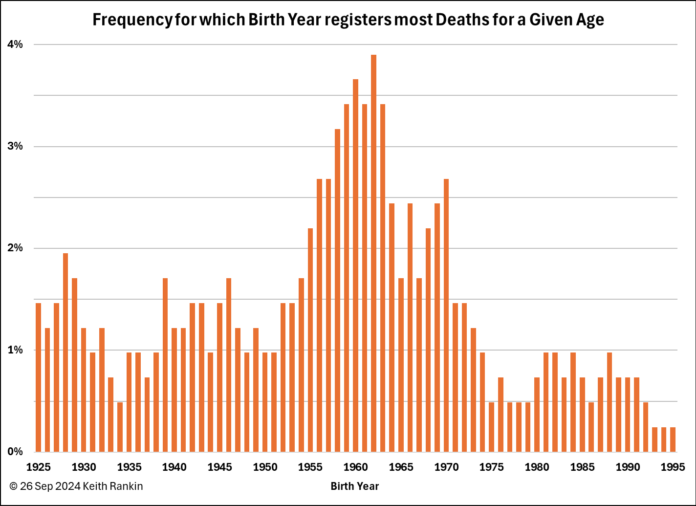
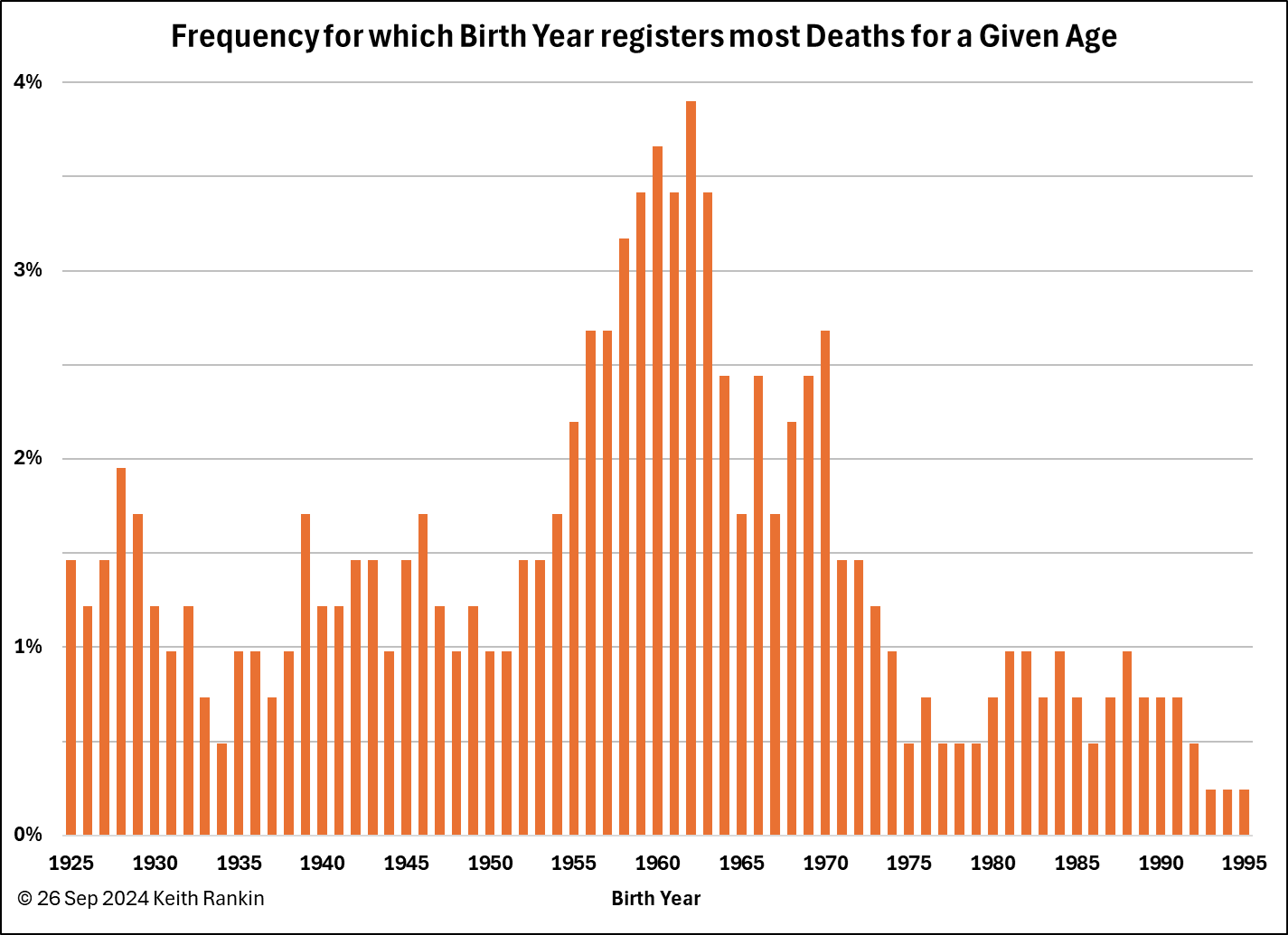
This chart essentially shows the stresses that New Zealand’s public health system can expect to face. I have analysed the death data by age, covering all deaths from July 1998 to June 2024. For those years (using June years) I have looked at every age of death from 16 to 99 and every birth year from 1900 to 2022, and counted deaths by birth-year.
For death-age 95, the most frequent birth year was 1928. As we would expect, most deaths at these high ages occurred in 2022 or 2023, thanks to Covid19. Thus, birth years in the 1920s feature in the chart.
Birth years in the early 1930s don’t feature so much because of the low birth numbers in those years. With fewer people born in say 1933, then 1933 will not often feature as the most frequent birth year for any given age.
Birth years around 1950 do not feature. This is both because the classic baby boomer generation is a healthy generation, and also because there were not as many births in the decade after World War Two as there were in the following two decades. So, while classic baby boomers will place an increasing burden on the public health system, the biggest burdens will come from those born between 1955 and 1975. (Also, classic baby boomers have high levels of private health insurance; this will be less affordable for subsequent generations as they age.)
Birth years from 1955 to 1964 feature most strongly, mainly because births in New Zealand peaked in those years. This birth cohort will place massive pressure on New Zealand’s public health system. People dying since 1998 between age 37 and age 67 are most likely to have been born in the years either side of 1960.
The cohort born 1966 to 1974 will also place huge pressures on Te Whatu Ora (Health New Zealand), in part because there are likely to be very many new Aotearoans in this birth cohort. By and large, immigrants are healthier than the New Zealand born population, because their health is considered before New Zealand residency can be granted.
The late 1970s represents a ‘baby-bust’ generation, like the early 1930s. Hence these ‘Gen-Y’ people don’t feature in this chart. The frequencies for the late 1980s’ and early 1990s’ birth years reflect the ‘baby blip’ which began in 1987. Also, these birth years relate to death of young people, which, being less frequent, can also be a bit more random.
People born in 1939 turn 85 this year. From 1938, birth numbers generally increased each year until the early 1960s. The impact of an aging population on New Zealand’s public healthcare system is certainly beginning. This impact will escalate each year for at least the next 25 years. People born in 1961 will turn 85 in 2046.
By contrast, we have been lulled into complacency because the unusually small early-1930s’ birth cohort placed a substantially below-average pressure on public healthcare.
We note that death numbers are a proxy for the demand for high-intensity healthcare. People born after 1955 are already making considerable demands on Aotearoa New Zealand’s health care.
*******
Keith Rankin (keith at rankin dot nz), trained as an economic historian, is a retired lecturer in Economics and Statistics. He lives in Auckland, New Zealand.
Even by these standards, the latest proclamation from OpenAI chief executive Sam Altman, published on his personal website this week, seems remarkably hyperbolic. We are on the verge of “The Intelligence Age”, he declares, powered by a “superintelligence” that may just be a “few thousand days” away. The new era will bring “astounding triumphs”, including “fixing the climate, establishing a space colony, and the discovery of all of physics”.
However, even setting aside these motivations, it’s worth taking a look at some of the assumptions behind Altman’s predictions. On closer inspection, they reveal a lot about the worldview of AI’s biggest cheerleaders – and the blind spots in their thinking.
Steam engines for thought?
Altman grounds his marvellous predictions in a two-paragraph history of humanity:
People have become dramatically more capable over time; we can already accomplish things now that our predecessors would have believed impossible.
This is a story of unmitigated progress heading in a single direction, driven by human intelligence. The cumulative discoveries and inventions of science and technology – Altman reveals – have led us to the computer chip and, inexorably, to artificial intelligence which will take us the rest of the way to the future. This view owes much to the futuristic visions of the singularitarian movement.
Such a story is seductively simple. If human intelligence has driven us to ever-greater heights, it is hard not to conclude that better, faster, artificial intelligence will drive progress even farther and higher.
This is an old dream. In the 1820s, when Charles Babbage saw steam engines revolutionising human physical labour in England’s industrial revolution, he began to imagine constructing similar machines for automating mental labour. Babbage’s “analytical engine” was never built, but the notion that humanity’s ultimate achievement would entail mechanising thought itself has persisted.
According to Altman, we’re now (almost) at that mountaintop.
Deep learning worked – but for what?
The reason we are so close to the glorious future is simple, Altman says: “deep learning worked”.
Deep learning is a particular kind of machine learning that involves artificial neural networks, loosely inspired by biological nervous systems. It has certainly been surprisingly successful in a few domains: deep learning is behind models that have proven adept at stringing words together in more or less coherent ways, at generating pretty pictures and videos, and even contributing to the solutions of some scientific problems.
So the contributions of deep learning are not trivial. They are likely to have significant social and economic impacts (both positive and negative).
But deep learning “works” only for a limited set of problems. Altman knows this:
humanity discovered an algorithm that could really, truly learn any distribution of data (or really the underlying “rules” that produce any distribution of data).
That’s what deep learning does – that’s how it “works”. That’s important, and it’s a technique that can be applied to various domains, but it’s far from the only problem that exists.
What is interesting here is the fact that Altman thinks “rules from data” will go so far towards solving all humanity’s problems.
There is an adage that a person holding a hammer is likely to see everything as a nail. Altman is now holding a big and very expensive hammer.
Deep learning may be “working” but only because Altman and others are starting to reimagine (and build) a world composed of distributions of data. There’s a danger here that AI is starting to limit, rather than expand, the kinds of problem-solving we are doing.
What is barely visible in Altman’s celebration of AI are the expanding resources needed also for deep learning to “work”. We can acknowledge the great gains and remarkable achievements of modern medicine, transportation and communication (to name a few) without pretending these have not come at a significant cost.
They have come at a cost both to some humans – for whom the gains of global north have meant diminishing returns – and to animals, plants and ecosystems, ruthlessly exploited and destroyed by the extractive might of capitalism plus technology.
Although Altman and his booster friends might dismiss such views as nitpicking, the question of costs goes right to the heart of predictions and concerns about the future of AI.
Altman is certainly aware that AI is facing limits, noting “there are still a lot of details we have to figure out”. One of these is the rapidly expanding energy costs of training AI models.
Microsoft recently announced a US$30 billion fund to build AI data centres and generators to power them. The veteran tech giant, which has invested more than US$10 billion in OpenAI, has also signed a deal with owners of the Three Mile Island nuclear power plant (infamous for its 1979 meltdown) to supply power for AI. The frantic spending suggests there may be a hint of desperation in the air.
Magic or just magical thinking?
Given the magnitude of such challenges, even if we accept Altman’s rosy view of human progress up to now, we might have to acknowledge that the past may not be a reliable guide to the future. Resources are finite. Limits are reached. Exponential growth can end.
What’s most revealing about Altman’s post is not his rash predictions. Rather, what emerges is his sense of untrammelled optimism in science and progress.
This makes it hard to imagine that Altman or OpenAI takes seriously the “downsides” of technology. With so much to gain, why worry about a few niggling problems? When AI seems so close to triumph, why pause to think?
What is emerging around AI is less an “age of intelligence” and more an “age of inflation” – inflating resource consumption, inflating company valuations and, most of all, inflating the promises of AI.
It’s certainly true that some of us do things now that would have seemed magic a century and a half ago. That doesn’t mean all the changes between then and now have been for the better.
AI has remarkable potential in many domains, but imagining it holds the key to solving all of humanity’s problems – that’s magical thinking too.
Hallam Stevens has previously received funding from the Ministry of Education (Singapore), the National Heritage Board (Singapore), the National Science Foundation (USA) and the Wenner-Gren Foundation.
Source: The Conversation (Au and NZ) – By Anthony Scott, Professor of Health Economics and Director, Centre for Health Economics, Monash Business School, Monash University
A battle between private hospitals and private health insurers is playing out in public.
At its heart is how much health insurers pay hospitals for their services, and whether that’s enough for private hospitals to remain viable.
Concerns over the viability of the private health system have caught the attention of the federal government, which has launched a review into private hospitals that has yet to be made public.
But are private hospitals really in trouble? And if so, is more public funding the answer?
Private hospitals vs private health insurers
Many private hospital operators have reported significant pressures since the start of the COVID pandemic, including staff shortages.
Inflationary pressures have increased the costs of supplies and equipment, pushing up the costs of providing hospital care.
Now, private hospitals have publicised their difficult contract negotiations with private health insurers in an attempt to gain support and help their case.
Healthscope, which runs 38 for-profit private hospitals in Australia, has been threatening to end agreements with private health insurers.
St Vincent’s, which operates ten not-for-profit private hospitals, announced it would end its contract with nib (one of Australia’s largest for-profit health insurers) but then reached an agreement.
UnitingCare Queensland, which operates four private hospitals, announced it would end its contract with the Australian Health Service Alliance, which represents more than 20 small and medium non-profit private health insurers. Since then, the two parties have also kissed and made up.
Why should we care?
There are three reasons why viability of the private health sector affects us all, regardless of whether we have private health insurance or use private hospitals.
1. Taxpayers subsidise the private health system
Australian taxpayers subsidised private health insurance premiums by A$6.3 billion
(in premium rebates) in 2021–22. Much of this makes its way to private hospitals. Medicare also subsidised fees for medical services delivered for private patients in private and public hospitals to the tune of $3.81 billion in 2023–24.
But when the going gets tough, the private health sector (both hospitals and health insurers) turns to the government for more handouts.
So we should be concerned about the value we currently get from our public investment into the private health system, and if more public investment is warranted.
2. Public hospitals may be affected if private hospitals close
Calls for greater government support for private health have long argued that a larger private hospital sector would help reduce pressures on the public system.
Indeed, this was the justification for a series of incentives introduced from the late 1990s to support private health insurance in Australia.
However, the extent of this is hotly debated. Recent evidence shows higher private health insurance coverage leads to only very small falls in waiting times in public hospitals.
While it is possible the closure of a few private hospitals might lead some patients to seek care in public hospitals, this shift might not be that large and will not increase waiting times too much.
3. Fewer private beds, but is that a bad thing?
If unviable private hospitals close or merge, we’d expect to see fewer
private hospital beds overall.
Fewer private hospital beds is not necessarily bad news. Mergers of small private day hospitals, in particular, might make them more efficient and lead to lower costs, which in turn lowers health insurance premiums.
We might also need fewer private beds. This is due to policies that try to shift health care out of hospitals into the community or the use of hospital-in-the-home schemes (where patients receive hospital-type care at home with the support of visiting health staff and/or telehealth). The private health insurers are supporting both.
If a few small private hospitals close, this reflects the market adjusting to less demand for hospital care. Some of the closures have been for maternity wards but with falling birth rates, this also seems like an appropriate market adjustment.
Any objective data about what is happening in the private hospital sector is scarce. This is mainly because the Australian Bureau of Statistics has stopped a compulsory survey of all private hospitals. The latest data we have is from 2016–17.
Health insurers are the largest payer of private hospitals and hence wield a considerable amount of negotiating power. In 2016–17, almost 80% of private hospitals’ income came from private health insurers. Health insurers have also increasingly become “active” purchasers of health care – not just passively paying insurance claims, but wanting to strike a good deal with private hospitals for their members to keep premiums (and costs) down, and profits high.
Reports of hospitals closing ignore hospitals that are opening at the same time. But since 2016–17 there are no publicly reported data on the total number of private hospitals in Australia or changes over time.
The latest figures we have show about half of all hospitals in Australia are private, and of these 62% are for-profit with the rest run by not-for-profit organisations (such as St Vincent’s).
The main for-profit providers are Ramsay Health Care and Healthscope. Both have operations overseas and were in trouble before the COVID pandemic.
Fast-forward to 2024 and the recent issues with contract negotiations suggests the financial situation of for-profit private hospitals might not have improved. So this could reflect a long-term issue with the sustainability of the private hospital sector.
What are the options?
The private health system already receives large public subsidies. So the crux of the current debate is whether the government should intervene again to prop up the private sector. Here are some options:
do nothing and let this stoush play out Closure and mergers of private hospitals might be good if smaller hospitals and wards are no longer needed and patients have other alternatives
introduce more regulation Negotiations between small groups of private hospitals and very large dominant private health insurers may not be efficient. If the insurers have significant market power they can force small groups of private hospitals into submission. Some private hospital groups may be negotiating with many different health insurers at the same time, which can be costly. Regulation of exactly how these negotiations happen could make the process more efficient and create a more level playing field
change how private hospitals are paid Public hospitals are essentially paid the same national price for each procedure they provide. This provides incentives for efficiency as the price is fixed and so if their costs are below the price, they can make a surplus. Private hospitals could also be funded this way, which could remove much of the costs of contract negotiations with private hospitals. Instead, private hospitals would be free to focus on other issues such as the number and quality of procedures, and providing high-value health care.
How do we help private hospitals become more efficient? Regulating prices and contract negotiations are a start. Kitreel/Shutterstock
What next?
Revisiting the regulation of prices and contract negotiations between private hospitals and private health insurers could potentially help the private hospital sector to be more efficient.
Private health insurers are rightly trying to encourage such efficiencies but the tools they have to do this through contract negotiations are quite blunt.
As we wait for the results of the review into the private hospital sector, value for money for taxpayers is paramount. We are all subsidising the private hospital sector.
Anthony Scott has previously received funding from the Medibank Better Health Foundation.
Terence C. Cheng does not work for, consult, own shares in or receive funding from any company or organisation that would benefit from this article, and has disclosed no relevant affiliations beyond their academic appointment
Have you noticed certain words and phrases popping up everywhere lately?
Phrases such as “delve into” and “navigate the landscape” seem to feature in everything from social media posts to news articles and academic publications. They may sound fancy, but their overuse can make a text feel monotonous and repetitive.
This trend may be linked to the increasing use of generative artificial intelligence (AI) tools such as ChatGPT and other large language models (LLMs). These tools are designed to make writing easier by offering suggestions based on patterns in the text they were trained on.
However, these patterns can lead to the overuse of certain stylistic words and phrases, resulting in works that don’t closely resemble genuine human writing.
The rise of stylistic language
Generative AI tools are trained on vast amounts of text from various sources. As such, they tend to favour the most common words and phrases in their outputs.
And although most of the research has looked specifically at academic writing, the stylistic language trend has appeared in various other forms of writing, including student essays and school applications. As one application editor told Forbes, “tapestry” is a particularly common offending term in cases where AI was used to write a draft:
I no longer believe there’s a way to innocently use the word ‘tapestry’ in an essay; if the word ‘tapestry’ appears, it was generated by ChatGPT.
Why it’s a problem
The overuse of certain words and phrases leads to writing losing its personal touch. It becomes harder to distinguish between individual voices and perspectives and everything takes on a robotic undertone.
Also, words such as “revolutionise” or “intriguing” – while they might seem like they’re giving you a more polished product – can actually make writing harder to understand.
Stylish and/or flowery language doesn’t communicate ideas as effectively as clear and straightforward language. Beyond this, one study found simple and precise words not only enhance comprehension, but also make the writer appear more intelligent.
Lastly, the overuse of stylistic words can make writing boring. Writing should be engaging and varied; relying on a few buzzwords will lead to readers tuning out.
There’s currently no research that can give us an exact list of the most common stylistic words used by ChatGPT; this would require an exhaustive analysis of every output ever generated. That said, here’s what ChatGPT itself presented when asked the question.
Possible solutions
So how can we fix this? Here are some ideas:
1. Be aware of repetition
If you’re using a tool such as ChatGPT, pay attention to how often certain words or phrases come up. If you notice the same terms appearing again and again, try switching them out for simpler and/or more original language. Instead of saying “delve into” you could just say “explore”, or “look at it closely”.
2. Ask for clear language
Much of what you get out of ChatGPT will come down to the specific prompt you give it. If you don’t want complex language, try asking it to “write clearly, without using complex words”.
3. Edit your work
ChatGPT can be a helpful starting point for writing many different types of text, but editing its outputs remains important. By reviewing and changing certain words and phrases, you can still add your own voice to the output.
Being creative with synonyms is one way to do this. You could use a thesaurus, or think more carefully about what you’re trying to communicate in your text – and how you might do this in a new way.
4. Customise AI settings
Many AI tools such as ChatGPT, Microsoft Copilot and Claude allow you to adjust the writing style through settings or tailored prompts. For example, you can prioritise clarity and simplicity, or create an exclusion list to avoid certain words.
By being more mindful of how we use generative AI and making an effort to write with clarity and originality, we can avoid falling into the AI style trap.
In the end, writing should be about expressing your ideas in your own way. While ChatGPT can help, it’s up to each of us to make sure we’re saying what we really want to – and not what an AI tool tells us to.
Ritesh Chugh does not work for, consult, own shares in or receive funding from any company or organisation that would benefit from this article, and has disclosed no relevant affiliations beyond their academic appointment.
Have you ever thought of an ankle sprain as a brain injury? Most people probably wouldn’t.
However, we are starting to understand how the brain is constantly adapting, known as plasticity.
Even though the damage of an ankle sprain happens at the ankle, there may also be some changes going on in the brain to how it well it senses pain or movement.
One of our doctoral students, Ashley Marchant, has shown something similar happens when we change how much weight (or load) we put on the muscles of the lower limb. The closer the load is to normal earth gravity, the more accurate our movement sense is; the lower the muscle load, the less accurate we get.
This work means we need to rethink how the brain controls and responds to movement.
One of the big issues in the treatment and prevention of sport injuries is that even when the sports medicine team feels an athlete is ready to return, the risk of a future injury remains twice to eight times higher than if they’d never had an injury.
This means sports medicos have been missing something.
Our work at the University of Canberra and the Australian Institute of Sport has targeted sensory input in an attempt to solve this puzzle. The goal has been to assess the ability of the sensory reception, or perception, aspect of movement control.
Over 20 years, scientists have developed tools to allow us to determine the quality of the sensory input to the brain, which forms the basis of how well we can perceive movement. Gauging this input could be useful for everyone from astronauts to athletes and older people at risk of falls.
We can now measure how well a person gets information from three critical input systems:
the vestibular system (inner ear balance organs)
the visual system (pupil responses to changes in light intensity)
the position sense system in the lower limbs (predominantly from sensors in the muscles and skin of the ankle and foot).
This information allows us to build a picture of how well a person’s brain is gathering movement information. It also indicates which of the three systems might benefit from additional rehabilitation or training.
Lessons from space
You may have seen videos of astronauts, such as on the International Space Station, moving around using only their arms, with their legs hanging behind them.
The crew of the International Space Station have some fun with ‘synchronised space swimming’ in 2021.
The brain rapidly deactivates the connections it normally uses for controlling movement. This is OK while the astronaut is in space but as soon as they need to stand or walk on the earth or moon surface, they are at greater risk of falls and injury.
Similar brain changes might be occurring for athletes due to changes in movement patterns after injury.
For example, developing a limp after a leg injury means the brain is receiving very different movement information from that leg’s movement patterns. With plasticity, this may mean the movement control pattern doesn’t return to an optimum pre-injury status.
As mentioned previously, a history of injury is the best predictor of future injury.
This suggests something changes in the athlete’s movement control processes after injury – most likely in the brain – which extends beyond the time when the injured tissue has healed.
Measures of how well an athlete perceives movement are associated with how well they go on to perform in a range of sports. So sensory awareness could also be a way to identify athletic talent early.
In older people and in the context of preventing falls, poor scores on the same sensory input perception measures can predict later falls.
This might be due to reduced physical activity in some older people. This “use it or lose it” idea might show how brain connections for movement perception and control can degrade over time.
Precise health care
New technologies to track sensory ability are part of a new direction in health care described as precision health.
Precision health uses technologies and artificial intelligence to consider the range of factors (such as their genetic make-up) that affect a person’s health and provide treatments designed specifically for them.
Applying a precision health approach in the area of movement control could allow much more targeted rehabilitation for athletes, training for astronauts and earlier falls prevention for older people.
Gordon Waddington owns shares in Prism Neuro Pty Ltd a perceptual neuroscience ability measurement company. He receives funding from the Medical Research Futures Fund, Australian Research Council, NSW Institute of Sport, Queensland Academy of Sport and the Australian Institute of Sport.
Jeremy Witchalls receives funding from the NSW Institute of Sport and the Australian Institute of Sport.
Our new research details the history of raupō (bulrush) from the time before people arrived in Aotearoa. It shows this resilient, opportunistic plant – and taonga species – can play an important role restoring wetlands and freshwater quality.
An unexpected finding was that the decline of freshwater quality in many lakes did not really kick in until the mid-20th century with intensification of agriculture. Until then, lake water quality indicators generally showed these ecosystems remained healthy. The prolific expansion of raupō after Aotearoa was first settled may have helped.
Thriving on material washed from disturbed catchments, raupō acted as an ecological buffer, intercepting nutrients and sediments, and reducing potentially harmful effects on freshwater ecosystems.
From the mid-20th century, as water quality began to deteriorate, raupō populations – and any buffering effects – were generally in decline as wetlands and lake shallows were drained for grazing land and better access to water supply.
Lessons from this plant’s past can be put to good use today as we strive to bring back the mauri (life force) of our freshwater systems.
Survival strategies for hard times
Before settlement, when dense forest covered most of the country, raupō was surviving on the fringes. As a wetland plant, it likes its roots submerged, but needs light to grow.
Its preferred niche is the shallow margins of lakes, ponds and streams or nutrient-rich swamps. Before people, these places were much less common. Forests typically grew right up to the water’s edge and extended across some swamps.
Under these conditions, raupō evolved strategies for survival: aerated roots to cope with water logging; tiny, abundant seeds that spread far and wide on the wind; rhizomes (underground stems) that extend from the mother plant and store carbohydrates to keep the plant alive in lean times.
Raupō has several attributes that allow it to grow on disturbed land. 1. large, resilient structures; 2. small, wind-dispersed seeds; 3. long-lived seed bank; 4. flowers produce abundant pollen; 5. aerated roots; 6. rhizomes store energy over winter; 7. rhizomes anchor in substrate, trapping sediment; 8. aggressive clonal propagation; 9. floating rhizome mats. Author provided, CC BY-SA
Raupō can even build floating root mats, from sediment trapped by its rhizomes, that extend out across open water and even detach from the shoreline to become mobile raupō islands.
With these survival strategies, raupō could wait for better times which, in Aotearoa’s dynamic environment, duly arrived.
Episodic agents of disruption – storms, floods, earthquakes, landslides, volcanic ashfall – created opportunities. Local forest damage allowed light to penetrate to ground level, and slips and floods brought nutrient-rich sediment from soils.
Raupō would seize these opportunities to expand. But they were typically short-lived as the inevitable process of forest succession returned the environment to stability – and raupō back to a state of patient hibernation.
Hitting the jackpot
Then people arrived, with fire and hungry mouths to feed. This time, the disturbances persisted. Forest clearances endured, sediments rich in nutrients flooded wetlands and lakes, and raupō, supremely equipped for just this scenario, spread across swamps and lake shores as wildfires spread on land.
Our tūpuna (ancestors) observed this behaviour, as well as what was happening around raupō. Insects and birds were feeding and nesting. Freshwater fish, crays, shellfish and eel spawned among its fertile beds.
This new-found abundance also offered a range of resource opportunities. Raupō’s flax-like leaves were woven into mats, rope and string. Leaves and stems were used like thatch to cloak the roofs and walls of whare.
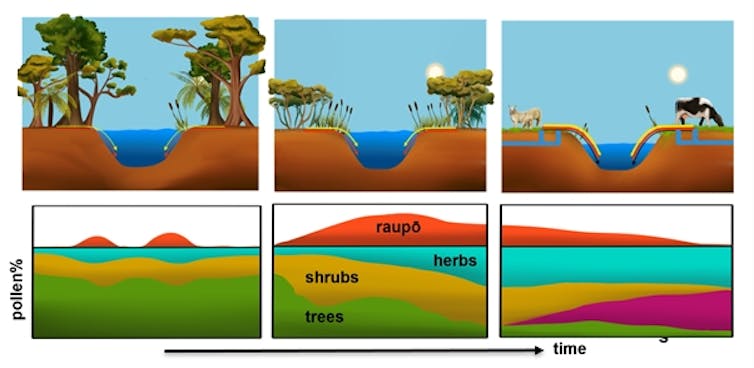
This graphic shows how raupō responded to environmental changes during the past millennium (upper panels), informed by pollen analysis of lake sediments (lower panels). Author provided, CC BY-SA
Traditional poi were often made from raupō leaves. Some iwi, particularly in the south, used the stems to build lightweight boats for navigating rivers and lakes. Flower stalks, shoots and young leaves were eaten, and the rhizomes and roots, when cooked, provided edible carbohydrates. The most cherished raupō kai, however, were cakes baked using the copious raupō pollen.
Unsurprisingly, for many iwi raupō remains a taonga species today, treasured for this array of resources and for its ecological and even spiritual roles in maintaining the mauri of freshwater habitats, upon which so much depends.
For some iwi, raupō are seen as kaitiaki (guardians) watching over a lake or wetland, and signalling its health. In these ways, raupō also connects us with other Indigenous communities. Although raupō is native to this country, the same species is found in Australia and parts of East Asia, while relatives in the genus Typha (Greek for marsh) occur naturally on all continents, except Antarctica.
Similar practices occurred wherever raupō and its relatives are found.
This connection between cultural and ecological roles is one of the fascinating findings from our research. We describe raupō as a “human-associated species”, not just because of its taonga status, but because its fate seems so closely linked to people.
More work needs to be done, but history tells us raupō has an important role in restoring the health of our freshwater ecosystems. Not only can it soak up nutrients and contaminants, but as both a native and taonga species it can assist remediation solutions that are ecologically and culturally supportive and sustainable.
This research was funded by the New Zealand Ministry of Business, Innovation and Employment research programmes – Our lakes’ health; past, present, future (C05X1707) and Our lakes, Our future (CAWX2305).
Last month, Republican presidential candidate Donald Trump delivered a one-hour address on the danger of illegal immigration to the United States. His stage was the US-Mexico border in Arizona and the set piece of his performance was the border wall.
The message was simple: with their border policy, Democrats have “unleashed a deadly plague of migrant crime”. Trump has ratcheted up the tensions on immigration further since then, repeating wild conspiracy theories about Haitian immigrants eating pets and, more recently, claiming migrants are “attacking villages and cities all throughout the Midwest”.
What the US needs, Trump has repeatedly stressed, is a closed border, a walled border.
A long history of wall-building advocacy
The US-Mexico border wall, which is currently around 700 miles in length in various stretches, has loomed large in American politics in recent decades, especially since the 2016 US presidential campaign. Yet, current stories about the wall mostly overlook its history.
Most importantly, the media ignore the long-standing appeal of the wall as a tool of spatial and cultural division in the making of the US-Mexico border.
In my forthcoming book, I trace the origin of the border wall to the early 1900s, when the US Immigration Service and other federal agencies called for the construction of barriers at the border.
Congress answered their appeal by adopting an act in 1935 that authorised the secretary of state to construct and maintain fences between the US and Mexico. For decades following its adoption, US officials stood before Congress almost yearly, asking for funding for the construction of border fences.
This trend culminated in the 1940s with two parallel projects: the Western Land Boundary Fence Project (576 miles or 926 kilometres of fencing from El Paso, Texas, to the west) and the Rio Grande Border Fence Project (415 miles or 668 kilometres of fencing along the Mexico-Texas border).
Neither one of these projects was ever fully realised. But if they had been built, they would have surpassed the length of the current border wall.
Immigration, disease and crime
What is telling when looking at the history is how similar the arguments supporting such fences in the early 1900s were to those deployed today. Immigration, disease and crime have been recurring justifications for the wall, both then and now.
Indeed, there is an uncanny likeness to Trump’s rhetoric surrounding the US-Mexico border — including during his August speech in Arizona — and the narratives justifying a border wall in the mid-20th century.
High on the list of justifications was the need to deter “juvenile delinquents”, “thieves”, “beggars”, undocumented workers, narcotic smugglers, “wetbacks” (a derogatory term for Mexicans), and Mexican nationals seeking medical care in the US at public expense.
These arguments appeared regularly in government reports and during congressional hearings from the 1930s to the late 1950s.
A 1934 report by the Immigration Services on the feasibility of a short border fence between El Paso and Ciudad Juárez, for example, said it would stifle illegal immigration that took employment opportunities from American workers, while lowering wages in the borderland area.
Reminiscent of recent analogies between the borderland and a “war zone”, the report noted that sending agents to patrol the border without proper equipment was pointless. It was akin to:
put[ting] a body of troops in the field in an enemy’s theatre of operation without artillery, observation planes, trucks, ammunition and other weapons.
The fence was “the correct solution to the problem.”
At times, the fear of the undocumented merged with the fear of contagion. A foot and mouth disease outbreak in Mexico in 1946, for example, provided additional rhetorical support for the wall. As Texas Senator Tom Connally said when the Committee on Foreign Relations considered the issue:
It has been a dream of the Department of State for many years to have this fence, not because of the hoof and mouth disease, but for immigration and customs and smuggling and all of that sort of thing.
Senator Tom Connally in 1938. Harris & Ewing photographs, via Wikimedia Commons
Persistent racial faultlines
The 1935 act has long been forgotten. In fact, by the end of the 1950s, only a few hundred miles of fencing had actually been built.
These earlier walling plans failed for a range of reasons, including opposition by Texan landowners and industries relying on illegal Mexican labour. Perhaps most importantly, there were serious reservations back then about the efficiency of fences in curbing immigration.
Yet, these doubts have not weighed in to the same extent in contemporary debates about the border wall. This underscores the performative role of the wall in today’s politics.
In fact, close to 700 hundred miles (1,126 kilometres) of fencing has been built under the Secure Fence Act of 2006. This includes large portions of the wall built under the presidency of Barack Obama and, to a lesser extent, Trump’s.
What has filtered through, however, is the racialised narrative that paints Mexicans nationals in a disparaging way.
This rhetoric relied on generalisations and stereotypes on themes such as criminality, licentiousness and disease. It transformed Mexico into a threat to be curtailed and became a frame of reference that has permeated politics for decades – and is now a defining issue in the upcoming presidential election.
Marie-Eve Loiselle does not work for, consult, own shares in or receive funding from any company or organisation that would benefit from this article, and has disclosed no relevant affiliations beyond their academic appointment.
Source: The Conversation (Au and NZ) – By Jeff Bleich, Professorial fellow, Jeff Bleich Centre for Democracy and Disruptive Technologies, Flinders University
In countries with compulsory voting, such as Australia and many in Latin America, the system usually ensures an overwhelming majority of voters cast their ballots election after election.
In the United States, it’s a very different story. Two-thirds of eligible voters turned out to vote in the 2020 presidential election – the highest rate since 1900. Turnout in presidential elections before 2020 tended to hover between 50% and 65%.
Often, it’s the voters choosing to stay home on the couch who effectively decide an election’s outcome.
Under the United States’ unusual Electoral College presidential voting system, the candidate who wins the most votes nationally does not necessarily win the election. Twice in the past 25 years, Democrats have won the popular vote in the presidential race and still lost the election. That includes Donald Trump’s win over Hillary Clinton in 2016.
As such, victory depends on getting more voters “off the couch” in key battleground states where the decisive Electoral College votes are up for grabs. In those states, it doesn’t matter what percentage of people show up to vote, or how much a candidate wins by, it is winner take all.
A voter who doesn’t vote, therefore, actually makes an active choice — they remove a vote from the candidate they would have likely chosen, and so give an important advantage to the person they would not have voted for.
The “couch” is effectively where Americans go to vote against their self-interest.
Who is more incentivised to vote?
As this year’s presidential election between Trump and Kamala Harris approaches, we ask a simple question: whose “couch” will decide one of the most consequential elections in living memory?
Recent research demonstrates that partisanship is an important driver of voter choice in presidential elections.
The fact that the US is deeply divided is not news to most, but current survey data show how evenly split along partisan lines it actually is. With about 30% of Americans identifying as a Republican and 30% identifying as a Democrat, there is virtually no difference in the total number of voters who support each major party.
The remaining 40% of Americans identify as “independent” – that is, not loyal to either major political party. Almost seven decades of research on the American voter shows, however, that independents heavily “lean” towards one party or the other, with about half leaning Republican and the other half leaning Democrat.
One possible insight into which group has greater incentive to vote is polling on people’s dissatisfaction with their party’s candidate.
According to the most recent Gallup Poll data, 9% of Republicans currently have an unfavourable opinion of Trump. In contrast, only 5% of Democrats have an unfavourable opinion of Harris.
Partisan voters who are dissatisfied with their party candidate have a massive incentive to “stay on the couch” and refrain from voting. They don’t really want to vote for “the other team”, but they can’t stand their own team anymore either.
For example, Republican women in the suburbs, veterans and traditional Republicans have started to abandon Trump over his stances on reproductive rights and national security, and his temperament. The Trump campaign clearly knows this. At a rally in New York a few days ago, he told attendees to “get your fat ass out of the couch” to go vote for him.
Should these disaffected Republican and Republican-leaning voters stay home on November 5, Harris may well have a decisive edge over Trump.
When the couch wins, America loses
In 2016, Trump defied the polls and traditional voter turn-out trends by convincing some disaffected, working-class Democrats to stay on the couch, vote for an unelectable third party candidate or, in some cases, vote for him.
Could this happen again? Or will Democrats be able to reverse this phenomenon by getting exhausted Republicans suffering Trump fatigue to stay home, while motivating everyone from Taylor Swift fans to “never Trumpers” to veterans of foreign wars to get out to vote.
Recent trends suggest overall turnout will be comparatively high, in line with the past three federal US elections.
Democrats have traditionally benefited from higher voter turn-out, but it is not as clear this is still the case in 2024. Recent research shows higher turnout rates seem to have favoured the Republican Party since 2016.
Yet both parties still have significant numbers of people who don’t vote. According to the Pew Research Center, 46% of Republicans and Republican-leaning independents didn’t vote in the past three elections (2018, 2020 and 2022), compared to the 41% of Democrats and Democratic-leaning independents.
So again, who sits on the couch matters. Inevitably, many of those who stay home will get precisely what they don’t want. When the couch wins, America loses.
Jeff Bleich is a former US ambassador to Australia and a member of the National Security Leaders for America, a group of 700 former generals, admirals, service secretaries, ambassadors, and other national security professionals, that has endorsed Kamala Harris in the presidential election. He was also special counsel to President Barack Obama and served as chair of the Fulbright Foreign Scholarship Board under President Donald Trump and as a member of President Joe Biden’s (non-partisan) National Security Education Board.
Rodrigo Praino receives funding from the Australian Research Council, the Australian Government Department of Defence, and SmartSat CRC.
In January 2023, a new comet was discovered. Comets are found regularly, but astronomers quickly realised this one, called C/2023 A3 (Tsuchinshan-ATLAS), had the potential to be quite bright.
Some hyperbolic reports have suggested it might be the “comet of the century”, but any astronomer will tell you the brightness of comets is notoriously hard to predict. As I explained last year, we’d have to wait until it arrived to be sure how bright it would become.
Now, the time has come. Comet C/2023 A3 is currently visible with the naked eye in the morning sky in Australia and Aotearoa New Zealand, with its best yet to come in the next few weeks. And it does look promising. It’s unlikely to be the comet of the decade (never mind the comet of the century), but it will almost certainly become the best comet of the year.
So where, and when, should you look to get your best views of this celestial visitor?
A show in the morning, before sunrise
At the moment, comet C/2023 A3 (Tsuchinshan-ATLAS) is a morning object, rising around an hour and a half before sunrise. It is visible to the naked eye, but not yet spectacular. However, with binoculars you can easily see the comet’s dusty tail pointing away from the Sun.
The comet will remain at about the same altitude in the morning sky until around September 30. It will then get closer to the horizon on each consecutive morning until it’s lost in the glare of the approaching dawn by October 6 or 7.
If you want to spot the comet in the morning sky, look east. The sliders below will help you orient yourself and choose the best time to look, depending on your latitude.
During this period, the comet should slowly brighten. It reaches its closest approach to the Sun (perihelion) on September 27, when it will be 58 million kilometres from our star.
As it swings around the Sun, it will continue to approach Earth, and so should continue to brighten. The best show in the morning sky will likely be during the last couple of days of September and the first few days in October, before the comet is lost to view.
This could cause a spectacular brightening of the comet, thanks to “forward scattering” caused by its dust. Imagine looking towards a bright light source through a cloud of dust grains. The grains nearest to the light source will scatter light from the source back towards you.
As the comet swings between Earth and the Sun, it will be perfectly placed for this forward scattering process to occur. If the comet is particularly dusty, this could cause its apparent brightness to increase by up to 100 times.
If it does, there’s a small chance the comet could briefly become visible in the daylight sky on October 9 and 10.
However, it will be very close to the Sun in the sky, and incredibly hard to spot. Only the most experienced observers may be able to detect the comet at this time, and it requires a special technique. Do not try to stare at the Sun to see it.
The best show could be after October 12
After swinging between Earth and the Sun, the comet will appear in the evening sky. It will rapidly climb in the western sky, and should be a bright, naked-eye object for a few days from October 12. The sliders below will give you a sense of where to look.
For the first few days of this period, the comet will still benefit from the forward scattering of sunlight, but this will decrease as it moves away.
What about the tail?
The positioning of the comet, Earth and the Sun in the Solar System means the comet’s tail will be streaming outwards, past our planet. This means it could grow to prodigious lengths in the night sky.
The bulk of that tail will likely be too dim to see easily with the naked eye, but it could be a fantastic spectacle for photographers. Expect to see a wealth of comet images flooding the internet around the middle of October.
As the days pass and the comet climbs higher, it will fade quite rapidly. It will likely become too faint to see with the naked eye, even for seasoned and experienced observers, before the end of October.
At that point, the show will be over. Comet C/2023 A3 (Tsuchinshan-ATLAS) will continue to flee the inner Solar System, moving into the icy depths of space, never to return.
But remember the classic saying – comets are like cats. They have tails and will often surprise us. For now, comet C/2023 A3 is behaving itself. It’s brightening predictably, and putting on a good show.
But comets that approach this closely to the Sun often fragment. This is impossible to predict, and far from guaranteed. If the comet did break up, it could become even more spectacular because of all the dust and gas it would release.
The opposite could still happen, too. The comet could fail to brighten as much as we expect, although that seems unlikely at this stage.
Whatever happens, we’re in for a fascinating few weeks of comet watching. Hopefully, a real spectacle awaits us.
Jonti Horner does not work for, consult, own shares in or receive funding from any company or organisation that would benefit from this article, and has disclosed no relevant affiliations beyond their academic appointment.
Source: The Conversation (Au and NZ) – By Jeff Bleich, Professorial fellow, Jeff Bleich Centre for Democracy and Disruptive Technologies, Flinders University
In countries with compulsory voting, such as Australia and many in Latin America, the system usually ensures an overwhelming majority of voters cast their ballots election after election.
In the United States, it’s a very different story. Two-thirds of eligible voters turned out to vote in the 2020 presidential election – the highest rate since 1900. Turnout in presidential elections before 2020 tended to hover between 50% and 65%.
Often, it’s the voters choosing to stay home on the couch who effectively decide an election’s outcome.
Under the United States’ unusual Electoral College presidential voting system, the candidate who wins the most votes nationally does not necessarily win the election. Twice in the past 25 years, Democrats have won the popular vote in the presidential race and still lost the election. That includes Donald Trump’s win over Hillary Clinton in 2016.
As such, victory depends on getting more voters “off the couch” in key battleground states where the decisive Electoral College votes are up for grabs. In those states, it doesn’t matter what percentage of people show up to vote, or how much a candidate wins by, it is winner take all.
A voter who doesn’t vote, therefore, actually makes an active choice — they remove a vote from the candidate they would have likely chosen, and so give an important advantage to the person they would not have voted for.
The “couch” is effectively where Americans go to vote against their self-interest.
Who is more incentivised to vote?
As this year’s presidential election between Trump and Kamala Harris approaches, we ask a simple question: whose “couch” will decide one of the most consequential elections in living memory?
Recent research demonstrates that partisanship is an important driver of voter choice in presidential elections.
The fact that the US is deeply divided is not news to most, but current survey data show how evenly split along partisan lines it actually is. With about 30% of Americans identifying as a Republican and 30% identifying as a Democrat, there is virtually no difference in the total number of voters who support each major party.
The remaining 40% of Americans identify as “independent” – that is, not loyal to either major political party. Almost seven decades of research on the American voter shows, however, that independents heavily “lean” towards one party or the other, with about half leaning Republican and the other half leaning Democrat.
One possible insight into which group has greater incentive to vote is polling on people’s dissatisfaction with their party’s candidate.
According to the most recent Gallup Poll data, 9% of Republicans currently have an unfavourable opinion of Trump. In contrast, only 5% of Democrats have an unfavourable opinion of Harris.
Partisan voters who are dissatisfied with their party candidate have a massive incentive to “stay on the couch” and refrain from voting. They don’t really want to vote for “the other team”, but they can’t stand their own team anymore either.
For example, Republican women in the suburbs, veterans and traditional Republicans have started to abandon Trump over his stances on reproductive rights and national security, and his temperament. The Trump campaign clearly knows this. At a rally in New York a few days ago, he told attendees to “get your fat ass out of the couch” to go vote for him.
Should these disaffected Republican and Republican-leaning voters stay home on November 5, Harris may well have a decisive edge over Trump.
When the couch wins, America loses
In 2016, Trump defied the polls and traditional voter turn-out trends by convincing some disaffected, working-class Democrats to stay on the couch, vote for an unelectable third party candidate or, in some cases, vote for him.
Could this happen again? Or will Democrats be able to reverse this phenomenon by getting exhausted Republicans suffering Trump fatigue to stay home, while motivating everyone from Taylor Swift fans to “never Trumpers” to veterans of foreign wars to get out to vote.
Recent trends suggest overall turnout will be comparatively high, in line with the past three federal US elections.
Democrats have traditionally benefited from higher voter turn-out, but it is not as clear this is still the case in 2024. Recent research shows higher turnout rates seem to have favoured the Republican Party since 2016.
Yet both parties still have significant numbers of people who don’t vote. According to the Pew Research Center, 46% of Republicans and Republican-leaning independents didn’t vote in the past three elections (2018, 2020 and 2022), compared to the 41% of Democrats and Democratic-leaning independents.
So again, who sits on the couch matters. Inevitably, many of those who stay home will get precisely what they don’t want. When the couch wins, America loses.
Jeff Bleich is a former US ambassador to Australia and a member of the National Security Leaders for America, a group of 700 former generals, admirals, service secretaries, ambassadors, and other national security professionals, that has endorsed Kamala Harris in the presidential election. He was also special counsel to President Barack Obama and served as chair of the Fulbright Foreign Scholarship Board under President Donald Trump and as a member of President Joe Biden’s (non-partisan) National Security Education Board.
Rodrigo Praino receives funding from the Australian Research Council, the Australian Government Department of Defence, and SmartSat CRC.
Pandemics – the global spread of infectious diseases – seem to be making a comeback. In the Middle Ages we had the Black Death (plague), and after the first world war we had the Spanish flu. Tens of millions of people died from these diseases.
Then science began to get the upper hand, with vaccination eradicating smallpox, and polio nearly so. Antibiotics became available to treat bacterial infections, and more recently antivirals as well.
But in recent years and decades pandemics seem to be returning. In the 1980s we had HIV/AIDS, then several flu pandemics, SARS, and now COVID (no, COVID isn’t over).
So why is this happening, and is there anything we can do to avert future pandemics?
Unbalanced ecosystems
Healthy, stable ecosystems provide services that keep us healthy, such as supplying food and clean water, producing oxygen, and making green spaces available for our recreation and wellbeing.
Another key service ecosystems provide is disease regulation. When nature is in balance – with predators controlling herbivore populations, and herbivores controlling plant growth – it’s more difficult for pathogens to emerge in a way that causes pandemics.
For example, climate change affects the number and distribution of plants and animals. Mosquitoes that carry diseases can move from the tropics into what used to be temperate climates as the planet warms, and may infect more people in the months that are normally disease free.
We’ve studied the relationship between weather and dengue fever transmission in China, and our findings support the same conclusion reached by many other studies: climate change is likely to put more people at risk of dengue.
Biodiversity loss can have similar effects by disrupting food chains. When ranchers cleared forests in South America for their cattle to graze in the first half of the 20th century, tiny forest-dwelling, blood-feeding vampire bats suddenly had a smörgåsbord of large sedentary animals to feed on.
While vampire bats had previously been kept in check by the limited availability of food and the presence of predators in the balanced forest ecosystem, numbers of this species exploded in South America.
These bats carry the rabies virus, which causes lethal brain infections in people who are bitten. Although the number of deaths from bat-borne rabies has now fallen dramatically due to vaccination programs in South America, rabies caused by bites from other animals still poses a global threat.
As urban and agricultural development impinges on natural ecosystems, there are increasing opportunities for humans and domestic animals to become infected with pathogens that would normally only be seen in wildlife – particularly when people hunt and eat animals from the wild.
The HIV virus, for example, first entered human populations from apes that were slaughtered for food in Africa, and then spread globally through travel and trade.
Meanwhile, bats are thought to be the original reservoir for the virus that caused the COVID pandemic, which has killed more than 7 million people to date.
Climate change can affect the distribution of animals which carry disease, such as mosquitoes. Kwangmoozaa/Shutterstock
Ultimately, until we effectively address the unsustainable impact we are having on our planet, pandemics will continue to occur.
Targeting the ultimate causes
Factors such as climate change, biodiversity loss and other global challenges are the ultimate (high level) cause of pandemics. Meanwhile, increased contact between humans, domestic animals and wildlife is the proximate (immediate) cause.
In the case of HIV, while direct contact with the infected blood of apes was the proximate cause, the apes were only being slaughtered because large numbers of very poor people were hungry – an ultimate cause.
The distinction between ultimate causes and proximate causes is important, because we often deal only with proximate causes. For example, people may smoke because of stress or social pressure (ultimate causes of getting lung cancer), but it’s the toxins in the smoke that cause cancer (proximate cause).
Generally, health services are only concerned with stopping people from smoking – and with treating the illness that results – not with removing the drivers that lead them to smoke in the first place.
Similarly, we address pandemics with lockdowns, mask wearing, social distancing and vaccinations – all measures which seek to stop the spread of the virus. But we pay less attention to addressing the ultimate causes of pandemics – until perhaps very recently.
Often we treat the proximate causes of illness, but not the ultimate causes. Basil MK/Pexels
A planetary health approach
There’s a growing awareness of the importance of adopting a “planetary health” approach to improve human health. This concept is based on the understanding that human health and human civilisation depend on flourishing natural systems, and the wise stewardship of those natural systems.
With this approach, ultimate drivers like climate change and biodiversity loss would be prioritised in preventing future pandemics, at the same time as working with experts from many different disciplines to deal with the proximate causes, thereby reducing the risk overall.
The planetary health approach has the benefit of improving both the health of the environment and human health concurrently. We are heartened by the increased uptake of teaching planetary health concepts across the environmental sciences, humanities and health sciences in many universities.
As climate change, biodiversity loss, population displacements, travel and trade continue to increase the risk of disease outbreaks, it’s vital that the planetary stewards of the future have a better understanding of how to tackle the ultimate causes that drive pandemics.
This article is the first in a series on the next pandemic.
Olga Anikeeva receives funding from Green Adelaide.
Jessica Stanhope receives funding from the Ecological Health Network and Green Adelaide. She is affiliated with the Environmental Physiotherapy Association.
Peng Bi receives funding from the Australian Research Council, National Health and Medical Research Council, National Climate Change Adaptation Research Facility, AusAID,
Philip Weinstein receives funding from competitive external granting bodies. He is affiliated with Nature Foundation, Australian Entomological Society, and the South Australian Museum.
The electricity workforce will need to double in five years to achieve Australia’s 2030 renewable energy target, our new report finds. More than 80% of these jobs will be in renewables. Jobs in energy storage alone will overtake domestic coal and gas jobs (not including the coal and gas export sector) in the next couple of years.
The Australian Energy Market Operator (AEMO) updates its Integrated System Plan every two years. It’s a blueprint for the energy transition from coal to renewable energy. The plan lays out scenarios for how the electricity system might change to help put in place all the elements needed to make the transition happen.
AEMO and the RACE for 2030 co-operative research centre commissioned the Institute for Sustainable Futures to undertake modelling on the workforce needed for this transition. The “step change” scenario in the Integrated System Plan is broadly aligned with the 2030 renewables target. Under this scenario, we found the electricity workforce would need to grow from 33,000 to peak at 66,000 by 2029.
Rooftop solar and batteries together are projected to account for over 40% of these jobs. Wind farms will employ around one-third and solar farms just under 10%. Jobs would also treble in transmission line construction to connect renewables in regional areas to cities and other states in the next few years.
Job projections in the National Electricity Market under the ‘step change’ scenario that aligns with the 2030 renewables target. Author provided
Job growth would surge in a ‘renewable energy superpower’
In the “green energy export” scenario, Australia becomes a “renewable energy superpower”. The country uses renewable energy to export green hydrogen and power heavy industry. In this scenario, the electricity workforce would almost treble to 96,000 by the late 2020s.
By 2033, after construction peaks, more than half of electricity sector jobs will be in operations and maintenance. This applies to both the step change and green energy export scenarios.
A significant employment downturn is projected during the 2030s. But in the green energy export scenario jobs then climb steeply again to a peak of 120,000. This projection reflects AEMO’s expectations of when green export growth will occur.
New South Wales is projected to have the most renewable energy jobs in the 2020s. However, Queensland would become the largest state for renewable jobs (especially in wind farms) in the green energy export scenario.
Projected total job numbers by scenario. Author provided
What are the other possibilities?
“Progressive change” is another scenario in the Integrated System Plan. For this scenario, we modelled slower growth in renewable energy. It reflects constraints on the economy and supply chains (including labour and minerals) for renewables.
In an “enhanced manufacturing” scenario, local renewable energy manufacturing increases. Our modelling found it could create a peak of 5,000 extra jobs.
Importantly, these projections don’t include upstream jobs in supply chains for the sector (for example, increased mining to supply the resources that renewables need) or electrification of homes.
Creating this many jobs is very challenging
Our modelling shows the workforce needs to grow very rapidly to make Australia’s energy transition happen. Unfortunately, the challenges of building this workforce are daunting. They include:
there’s a shortage of almost all key occupations in demand for the electricity sector – electricians, engineers, construction managers – according to Australia’s Skills Priority List
“extraordinary growth” forecast by Infrastructure Australia in other major infrastructure projects, such as transport, which will compete for many of the same skilled workers
under AEMO’s scenarios, employment will be subject to boom-bust cycles, which increases the risk of skill shortages and damaging impacts, such as housing shortages, in regional areas
Australia has relied heavily on skilled migrants – and will look to do so again – but many parts of the world are chasing the same workers.
Labour and skills shortages are already translating into project delays, raising concerns that clean energy solutions will be unable to keep pace with demand to meet net zero targets.
What can be done to avoid skill shortages?
Some action has been taken to increase the workforce. The federal government, for instance, is subsidising apprentices under the New Energy Apprenticeship program.
But action isn’t happening at the scale and pace required.
What else can be done?
Firstly, Jobs Skills Australia and Powering Skills Organisation (which oversees energy skills training) have outlined ways to increase the system’s capacity to train more skilled workers. This includes creating better pathways into renewable energy for students, especially in recognised Renewable Energy Zones.
Secondly, Jobs Skills Australia has noted the need for renewable energy businesses to increase their intakes of apprentices. It recommends expanding the Australian Skills Guarantee to include generation and transmission projects.
The guarantee has set mandatory targets for apprentices or trainees to complete 10% of labour hours on Commonwealth-funded major construction and information technology projects (A$10 million plus). It could also be applied to major government funding programs for renewable energy and transmission. These include:
the Capacity Investment Scheme, a government tender program to support a large volume of new renewables and storage projects
grants from the Australian Renewable Energy Agency and the Clean Energy Finance Corporation.
Thirdly, government tenders could moderate the peaks and troughs in employment by limiting the maximum and minimum volumes built each year.
Fourthly, including more women and First Nations Australians can increase labour supply and workforce diversity. Only one-in-two First Nations Australians are employed compared to around two in three in the wider population. Yet they account for around one-in-ten people in some major Renewable Energy Zones.
Government pre-employment programs, working with industry and First Nations groups, could also increase the supply of workers. These could have a dramatic social impact too.
It’s a challenging problem whichever way you look at it. We need rapid change to build renewable energy capacity before coal plants retire and to tackle climate change. But that depends on growing the workforce amid skill shortages.
There’s a range of ways to increase the supply of workers and improve local outcomes. But we are running out of time. Urgent action is needed.
The Institute for Sustainable Futures, University of Technology Sydney received funding from the Australian Energy Market Operator and the RACE for 2030 CRC for the report upon which this article is based
The Institute for Sustainable Futures, University of Technology Sydney received funding from the Australian Energy Market Operator and the RACE for 2030 CRC for the report upon which this article is based.
Negative gearing and capital gains tax are back on the national agenda as Australians deal with a housing crisis and politicians look for ways to tackle the issue and win voters’ support at the upcoming election.
The Labor government confirmed this week the tax concessions were being reviewed. Meanwhile, the government is struggling to pass its Help to Buy housing assistance legislation through the Senate.
The Help to Buy legislation is aimed at helping first home buyers on low and middle incomes purchase their first home. The government would contribute up to 40% of the home purchase price and require only a 2% deposit from buyer. Buyers could eventually buy back the government’s equity share.
But the legislation has stalled with the Greens wanting more including rent caps and pulling back negative gearing while the Coalition says the government “shouldn’t be in the business of co-owning people’s homes”.
The review, revealed yesterday, could reportedly include a cap on the number of properties a person could negatively gear. The changes would not affect anyone who is currently negatively geared.
Negative gearing lets taxpayers claim deductions on their tax for the expenses relating to owning an investment property. They can save on tax as the property potentially rises in value. They can also be eligible for a reduced capital gains tax when they sell the property.
But any changes to negative gearing and capital gains tax policies could face further opposition – depending on how they are implemented. The crucial issue is whether the changes free up enough housing stock and make it more affordable for buyers and renters.
Younger households, aged between 25 and 34 years, are hardest hit, having 34% of household income spent on mortgage costs in 2022–23.
About 67% of households in Australia are home owners, and the remainder renters. While the proportion of owners with a mortgage has increased since 1994, so too has the proportion of private renters.
While there have been calls for changes to negative gearing policy to cap the number of investment properties at six, this would impact about only 20,000 individual property investors.
Changes to capital gains tax
Suggestions to increase capital gains tax (CGT) need to be considered carefully, given that:
• there is no solid evidence to show that increasing CGT will increase housing supply and in fact, it may have the opposite effect by limiting rental housing available
• any change to CGT legislation also impacts other investments (such as shares), as the CGT discount also applies to other capital gains
• multiple investment properties are often held within self-managed superannuation funds (SMSFs) which are subject to different CGT rules and also benefit from superannuation tax concessions
• the rapid increase in housing prices over recent years is likely to result in very large amounts of CGT being paid on investment properties, even with the current 50% CGT discount.
Other ways to improve affordability and availability
Policy discussions around housing affordability and availability invariably lead to suggestions to change how negative gearing and capital gains tax operate. However, taxation policy is not the only solution available.
Another suggestion put forward is to allow first home buyers to use their superannuation for deposits.
Regardless of one’s position on accessing superannuation for something other than retirement, this suggestion is not viable for low to middle income earners. These households are unlikely to have substantial superannuation balances. Also, they don’t have the earning capacity to service a mortgage for the outstanding amount.
There is currently a push to use self-managed super funds SMSFs to enable home ownership. This would effectively allow individuals to become tenants in homes owned by their super funds.
However, the complexities of superannuation law mean this could cause big problems for people whose relationships break down.
Considering the generational wealth that currently exists in property, the government could consider making it easier for parents or grandparents to gift (or sell) property to their children or grandchildren, in certain circumstances.
This area has not yet been sufficiently explored.
What needs to change
The real issue of housing affordability is multifaceted, and any change needs to be done as part of a broader policy.
It is likely that on its own, changes to negative gearing and/or capital gains tax will not achieve the intended outcome to make housing more accessible and affordable for Australians who want to buy a home.
While the debate around the best way to achieve housing affordability and accessibility continues, and while there are statistics that tell us about the current housing crisis, one crucial thing that is missing is the voice of the very people that any new housing policy should be designed to assist.
More consultation is needed with younger age groups and low to middle income earners who are struggling with high rent and unable to purchase their own home.
Australia desperately needs bold new innovative housing policies that do not rely solely on the taxation system but that consider a raft of measures that meet the housing needs of everyday Australians.
Michelle Cull is co-founder of the Western Sydney University Tax Clinic which has received funding from the Australian Taxation Office as part of the National Tax Clinic Program. Michelle Cull is a member of CPA Australia and the Financial Advice Association Australia. Michelle is also an academic member of UniSuper’s Consultative Committee and volunteers as Chair of the Macarthur Advisory Council for the Salvation Army Australia.
Source: The Conversation (Au and NZ) – By Stephen Blumenfeld, Director, Centre for Labour, Employment and Work, Te Herenga Waka — Victoria University of Wellington
But Luxon’s edict neglects a broader transformation in work culture.
Work from home (WFH) arrangements have grown considerably over the past decade, propelled by an increase in dual-income households and rapid technological advancements.
The COVID pandemic acted as a catalyst for further change, proving that many jobs could successfully be performed remotely.
Our upcoming article in the New Zealand Journal of Employment Relations addresses the pros and cons of remote work. We highlight how a hybrid model – mixing days in the office with days working from home – can improve wellbeing, engagement and productivity.
We found embracing a hybrid approach may lead to better outcomes as society shifts with technology and employment expectations. And, despite the prime minister’s demands on public service workers, it may be too late to go back.
Embracing flexibility
Under current rules, employees can request flexible working arrangements. Employers must provide valid reasons if they decline the request.
According to a 2023 survey from Human Resources New Zealand, 40% of HR professionals noted productivity gains as a critical advantage of WFH arrangements.
And some professional organisations have embraced work from home or hybrid work arrangements.
The New Zealand Law Association, for example, has emphasised the significant benefits of flexible work for their members, including increased employee engagement, productivity, and overall wellbeing.
A report from Te Kawa Mataaho Public Service Commission noted the public service’s success in delivering quality services during the pandemic while working remotely.
The commission’s current guidance on hybrid work arrangements supports flexibility that allows working from home to focus and working together when necessary.
Does WFH reduce efficiency?
Luxon argues forcing workers back to the office will promote efficiency. But there is little evidence suggesting New Zealand’s productivity has significantly declined with WFH or hybrid arrangements.
Instead, we found office-only arrangements risked introducing new inefficiencies for the government. These included new layers of permissions and reporting on arrangements that have already been agreed to.
The assumption that office work suits everyone is also contradicted by experiences during and after COVID.
During the first year of the pandemic, many workers felt the void of casual interactions that once sparked creativity. They also struggled with isolation. This was especially pronounced for caregivers, often women, who had to juggle professional duties with increased childcare responsibilities.
Despite this, a University of Otago survey conducted during the pandemic noted 67% of participants preferred a hybrid work model.
Many expressed optimism regarding remote work’s continuation, with significant portions reporting stable or increased productivity, although some struggled with home distractions.
And our research found taking a hybrid approach to work – with one or more days at home – reduced the risks from professional and social isolation and improved collaboration.
Opportunities to work at home some of the time also allowed time for focused work, reduced commuting time and improved wellbeing.
Boosting productivity from home
Luxon’s assertion that working from home is “not an entitlement” aligns with traditional views on work. These include the belief that time at a desk is a measurement of productivity, rather than measuring the outcomes from work.
However, a growing body of evidence indicates remote work can elevate both productivity and employee satisfaction.
Eliminating daily commutes allows employees to redirect time toward focused work, positively impacting job satisfaction and mental wellbeing.
Moreover, remote work fosters inclusivity, enabling organisations to source talent from a broader geographic area, which in turn enhances diversity and innovation.
A report from McKinsey & Company found businesses adopting flexible work arrangements are better positioned to navigate future uncertainties, sustaining or even boosting productivity.
However, it also highlighted challenges. Some 40% of respondents said they were facing longer work hours, which can lead to burnout. Addressing these issues is essential to maintaining employee wellbeing.
The future of work
Instead of enforcing strict office attendance, leaders should adapt to the changing work landscape.
Promoting flexible arrangements can foster a more productive and engaged workforce, ultimately benefiting New Zealand’s public service in today’s dynamic environment.
Balancing both office and remote work presents the most promising path forward.
Joanne Crawford receives funding from the Health Research Council and the NZ Industrial Relations Foundation Trust.
Roya Gorjifard receives funding from the Victoria University of Wellington for Doctoral Research.
Chris Peace and Stephen Blumenfeld do not work for, consult, own shares in or receive funding from any company or organisation that would benefit from this article, and have disclosed no relevant affiliations beyond their academic appointment.
That’s the age-old question at the heart of Ryan Murphy and Ian Brennan’s new Netflix release, Monsters: The Lyle and Erik Menéndez Story. The show focuses on the 1989 murders of José and Kitty Menéndez by their sons Erik and Lyle.
The prosecution convinced a jury the two brothers were cold-blooded killers, driven by the desire to access their parents’ wealth. The brothers, meanwhile, claim to be victims of physical, emotional and sexual abuse at the hands of their parents – and say the killings were therefore self-defence.
What’s the truth? Perhaps both.
Javier Bardem and Chloë Sevigny play the roles of the parents, José and Kitty. Netflix
Creating the image of a ‘monster’
The case details are well known. In fact, I have taught this case to my own criminology students as an example of the victim-offender overlap, as clearly these brothers existed in a very dysfunctional family.
On August 20 1989, brothers Lyle (then 21) and Erik (then 18) shot and killed their parents in their Beverly Hills mansion. They faced two trials. The first one in 1993 saw the brothers tried separately and ended in two hung juries and subsequent mistrials.
In the second trial, which began in 1995, the pair were tried together. In 1996 they were found guilty of first-degree murder and conspiracy to commit murder, and sentenced to life in prison without the possibility of parole.
Interestingly, the prosecution raised new objections to the admission of a large amount of defence evidence in the second trial, so the judge consequently excluded much of the evidence of abuse.
This essentially dismantled the brothers’ entire defence, which was predicated on the fact they killed their parents out of fear, after they threatened to expose their father for serious and protracted physical, sexual and emotional abuse.
In their second trial, Erik and Lyle were found guilty of murdering their parents and sentenced to life without parole. Netflix
The Netflix series has created significant controversy. It documents a version of events leading up to the murders, including detailed histories of both Lyle’s and Erik’s sexual abuse, as well as the crimes themselves and subsequent trials.
In the series, the brothers are portrayed in a homoerotic and incestuous way. For context, back in 1995 Lyle testified that he sexually offended against Erik, but this was against the background of the alleged sexual abuse from their father.
Monsters, on the other hand, shows the brothers having an incestuous relationship as adults. The brothers deny this and there’s little evidence to support it.
While the pair is sometimes painted in a sympathetic light, at other times the viewer is led to question whether greed was their true motive.
Erik Menéndez has slammed the series, saying it walks back on decades of understanding of the devastating impacts sexual abuse has on male victims.
I have to agree.
The brothers didn’t just kill their parents and call it a day. These murders were incredibly brutal. As a criminologist, it looked to me like they were trying to obliterate their parents.
José was shot in the back of the head, execution-style, while Kitty was shot a total of ten times, including one shot directly to her face. Such crimes are generally not motivated by money; they tend to be driven by something much deeper.
After their parents’ deaths, the Menéndez brothers appeared to be spending their inheritance extravagantly – a point that later contributed to the prosecutor’s case against them. Netflix
Murder porn at its worst
This case can be seen through the ghoulish eyes of “murder porn”. The first trial, which was televised in 1993, went viral on TikTok in 2021, engaging a new generation of fans.
Watching the footage from the 1990s, some of us will remember the legions of screaming girls who welcomed the handsome brothers to court. It was more like a scene from a boyband concert than a brutal double-murder trial.
Whether you believe the brothers are cold-blooded and opportunistic killers, or victims of serious child abuse, will influence your take on the ongoing interest in the case and the portrayal in Monsters.
Ari Graynor plays Leslie Abramson, the lawyer who represented Erik in both trials. Netflix
Monsters isn’t the first example of Ryan Murphy and Ian Brennan cheapening real tragedies by turning them into voyeuristic and fictionalised television.
The first instalment of the same series focused on Jeffrey Dahmer, a serial killer and sex offender who killed 17 men and boys between 1978 and 1991. Dahmer also engaged in necrophilia and cannibalism, so his brutal crimes were rich fodder for Netflix.
Dahmer’s victims were openly critical, saying the retelling of the offender’s story diminished their loved ones’ suffering and revictimised them by opening old wounds.
Regardless, Dahmer achieved critical acclaim with 13 nominations at the 2023 Emmy Awards, no doubt spurring the creators’ enthusiasm to further develop the franchise.
The way forward
The path to ethical true crime depiction lies in establishing facts and veering away from embellishing or glorifying the criminal or their crimes.
Ideally, true crime should be victim focused and should achieve a purpose beyond entertainment. We have a lot to learn from criminal history, but these stories should be told in educational ways that respect and honour victims’ lives.
While the real Menéndez family was dysfunctional, their portrayal in Monsters can only be considered sensational. Netflix
We each have a responsibility to consume ethically produced true crime. Whether it’s TV series, films, podcasts or books, we vote for what we want through our engagement. My maxim is to choose content that reflects how I would want my story told, were I to ever become the focus of a true crime production.
If you’re curious to hear more about the Menéndez brothers’ story, a new Netflix documentary called The Menéndez Brothers is set for release on October 7. Both Erik and Lyle have contributed to it through phone interviews conducted from prison – and they say there’s much that hasn’t been told.
Xanthe Mallett does not work for, consult, own shares in or receive funding from any company or organisation that would benefit from this article, and has disclosed no relevant affiliations beyond their academic appointment.
Keith Rankin, trained as an economic historian, is a retired lecturer in Economics and Statistics. He lives in Auckland, New Zealand.
Analysis by Keith Rankin.
Keith Rankin, trained as an economic historian, is a retired lecturer in Economics and Statistics. He lives in Auckland, New Zealand.
Esteemed Israeli intellectual Shlomo Sand published The Invention of the Jewish People in 2008 with a new edition in 2020. He sees the popular concept of peoples – popular in the late 19th century (when we were obsessed with ‘race’) and again in the last decade or so when we have renewed that obsession with race (calling it ‘ethnicity’) – as quite problematic. Cultures and languages are real of course; but we prefer to imagine ‘peoples’ in terms of shared ancestry. Thus, the Jewish People are commonly seen as the biblical descendants of Isaac, son of Abraham; with special reference to the classical Kingdom of David (Judea and classical Israel) that existed in the Levant about 3000 years ago.
There is a real problem, in that the Jewish People are commonly considered to be both an ethnicity and a religious faith. We don’t conflate these two identity markers with respect to other ‘peoples’. Simon Schama – a renowned New York based Jewish historian – introduces his television series The Story of the Jews by showing clearly that Judaism is a faith only, and not an ethnicity. Shlomo Sand notes, in his introduction to the 2020 edition, that most of the Jewish population in the year Zero CE (when Jesus Christ was a young child) were comparatively recent converts, and that the people who have lived continuously in the Levant – eg the Palestinians – will have more biblical Israeli ancestry than have the modern Jewish population.
I would like to infuse this discussion with some simple ancestral numeracy.
3,000 years ago represents about 120 generations, taking us back to our 118-times-great-grandparents. If we go back that many generations, then all people alive and dead today have precisely 1,329,227,995,784,915,872,903,807,060,280,344,576 places in our family tree for that generation; approximately a billion octillion places.
The global population in 1,000 BCE is believed to be about 50 million. That means, on average, each living person in that year features 2.66 octillion (let’s say 3 octillion) times on each of our family trees. Now of course some ancient people will feature more than others. Each Palestinian today probably features each ancient Israeli about 150 octillion times in their family tree (assuming an ancient Israeli population of less than one million). Whereas, based on Shlomo Sand’s research, each person who identifies as a Jew probably has each ancient Israeli only 15 octillion times in their 118-times-gg-parent family tree slots. Modern Palestinians are almost certainly about ten times more infused with the blood of the sons and daughters of Isaac than are the present soldiers of the Israel Defence Force (and of the ‘freedom fighters’ of Haganah and Irgun who preceded today’s IDF).
So, what are these people fighting each other over? Land. Liberal-democracy is based on the sanctity of private property, including land. Many people identifying as Israelis are living on land dubiously acquired from people identifying as Palestinian; with the descendants of the previous occupants of those lands living (and dying) today in ‘refugee camps’ in Gaza, Judea, Samaria, and Lebanon.
Why cannot these Levantine people just settle with each other, create a post-apartheid liberal secular state in which all races and religions are constitutionally equal, and compensate the descendants of the dispossessed for the loss of their land? And not further dispossess Palestinians of their land.
The time for ‘peoples’ pushing narratives about ‘other peoples’ being ‘human animals’ is truly well past; there never was a time that such narratives were appropriate. Almost more shameful is the way that too many influential people in the ‘liberal democratic west’ buy into these grotesque Israeli narratives, and don’t register concern at the suppression of narratives counter to the ‘Israel-says’ version of the news.
*******
Keith Rankin (keith at rankin dot nz), trained as an economic historian, is a retired lecturer in Economics and Statistics. He lives in Auckland, New Zealand.
For many Australians, the COVID-19 pandemic has become a fading memory as the world has moved away from lockdowns and masks. However, its lasting impacts, including persistent inflation, remain.
Academic economists Steven Hamilton and Richard Holden, in their just-published book, Australia’s Pandemic Exceptionalism, examine how Australia fared in handling the COVID crisis in its economic and health policies.
We’re joined on the podcast by Holden to talk about the book and also Australia’s economic outlook, during what has been a big week for economic news.
On COVID, Hamilton and Holden found a mixed picture: Australia scored highly in its economic response but fell down on its vaccine procurement and provision of RATs.
I think Treasury gave excellent advice to the Treasurer [Josh Frydenberg] and he not only […] took that advice but was able to sell it to a sometimes sceptical cabinet. […] So I think it was good advice and strong leadership on the economic front. On the health front, I think the advice was really quite poor at times. I mean we make quite a point of Scott Morrison’s use of the phrase when it comes to vaccines “It’s not a race” when clearly it was a race. It was a race against the virus. It was a race to get vaccinated. It was a race to be able to reopen our economy.
On the RBA and inflation, Holden agrees with this week’s decision to hold rates but believes they should have risen earlier at least once more:
I have argued […] that late last year or early this year, the Reserve Bank should have raised rates at least one more time to get us closer to what happened in peer jurisdictions overseas, to try and beat inflation faster. The Reserve Bank has taken a different approach. They want to have interest rates peak, maybe a full percentage point lower than in places like the US, and they’re willing to tolerate inflation for longer.
At least they’re not caving into political pressure from people like Jim Chalmers and Wayne Swan to precipitously cut interest rates and I give the governor, Michele Bullock, great credit for standing firm on that, including in her press conference remarks [on Tuesday].
On when interest rates will start moving down, Holden gives a grim assessment:
My view is the most likely case is very late in 2025, somewhere about 12 months from today. Again, it’s going to depend on the inflation numbers and I’d like nothing more [than] for us to be well inside the target band and for interest rates to be able to be moderated.
I think it’s a real shame that we took a different strategy in Australia to what peer jurisdictions overseas did, which was raise rates more aggressively, take our medicine, have tamed inflation and now be cutting rates. That’s the story in the US and several other jurisdictions.
Holden warns against RBA Governor Michele Bullock making predictions of future rate moves:
Governor Bullock, I think, is at risk of repeating, albeit a milder version of, the mistake that Philip Lowe made in providing forward guidance. Now it’s not as dramatic as saying interest rates are not going to rise until 2024, which was sort of three years of forward guidance or thereabouts. Governor Bullock has fallen into, I think, a little bit of a trap by saying over six weeks ago that she and her colleagues on the board didn’t think that interest rates would be cut this calendar year.
I don’t really understand what the virtue of her doing that was. I think that was probably, in hindsight, something that she may regret. [Although] I don’t think it will do any real damage because I think it’s a prediction that’s incredibly likely to come true.
On the government potentially making changes to negative gearing, Holden outlines why it could be a good idea:
Getting rid of negative gearing would put potential owner-occupiers on a level playing field with investors at an auction. I think it’ll be very good news for people trying to move from the rental market into being owner-occupiers; I think it’ll be good news for the classic Australian dream. To be fair about it, the existence of negative gearing is something that puts downward pressure on rents. So negative gearing, in a funny way, is good for renters who are always going to rent but bad for renters who want to buy. So there are pros and cons.
It was a good idea eight or nine years ago. I think it’s still a good idea today and I think it’s interesting that the government seems to be at least floating the test balloon.
Michelle Grattan does not work for, consult, own shares in or receive funding from any company or organisation that would benefit from this article, and has disclosed no relevant affiliations beyond their academic appointment.
In a bid to bolster membership, diversity and revenue, the club has introduced additional membership categories for women. These memberships form part of a dedicated campaign to get more women on the greens, following a member and board supported strategic plan to grow women’s membership from 18% to 30% by 2027.
Despite the club’s commitment to gender representation, its status as a signatory to The Royal & Ancient Golf Club of St Andrews (R&A)’s Women in Golf Charter and recognition as a 2023 Visionary of the Year by Golf Australia for its “whole-club approach to gender equity”, support among some members remains wanting.
A stunt that made waves
Controversy erupted at 13th Beach after its new women’s memberships were launched.
One male member, wearing a blonde wig and skirt, was captured approaching club staff to inquire about the new women’s membership options, remarking:
I’m identifying as a female now and I’m just about to inquire about the new membership deal.
The male member, and two others who filmed and shared the footage, were temporarily suspended from the club.
A key element to the controversy is the discounted membership compared to male golfers.
[The club] openly discriminates against males […] it is both fair and just for female members to pay the same subs as their male counterparts, as equality is a fundamental principle that we should uphold.
However, this statement conveniently denies the sport’s current and past issues with gender, race and class.
Historical and current barriers
Globally year-on-year, the growth of male golf participation outnumbers women, with women making up 23% of adult registered golfers worldwide.
Despite this rise, access issues and barriers to full participation for women and girls run deep.
A lack of visibility of female golfers can reinforce stereotypes of golf as a men’s game, while women can struggle with amenities and equipment designed for men.
Traditionally in Australia, women and girls have been restricted to “associate” or “lady” memberships – which often have lower status and fewer benefits.
Course access can also be problematic, with Saturdays often reserved for male players.
At many Australian clubs, Tuesdays are often referred to as “ladies day” which assumes women don’t have work or other commitments.
A poster on the Reddit forum, r/WomenGolf, has queried the different options for men and women’s golfers. Reddit
Being scrutinised and surveilled on the greens by male golfers is reported by women as a barrier – feelings of hyper-visibility, being mocked for their play and their bodies frequently undermines women’s enjoyment.
At the professional level, while the women’s game is increasing in prize money, media coverage and sponsorship, there is still significant room for change.
For female professional golfers, research also highlights a male-dominated and “sexist environment”.
Inclusivity is good for everyone
In a bid to increase participation among more diverse groups, Golf Australia is inspiring people to “go play and enjoy golf in their own way”.
As part of its “own way campaign,” programs have been designed for seniors, women and disabled players.
Recognising how differences such as race and culture shape golf participation, more community-facing programs are targeting improved diversity.
Including women’s voices in decision making is key to realising meaningful change – research clearly finds boards with diversity of thought and representation perform better.
Beyond the important inclusivity debates, there are clear commercial reasons to enable women’s participation.
Very recent industry research states there are an estimated 36.9 million latent women golfers around the world, and this group may be worth up to US$35 billion (A$51 billion) to the golf industry should they take up the sport more permanently.
Golf has a lucrative opportunity.
Valuing and enabling diversity in all areas should fill the coffers and genuinely position golf as a sport for all.
The authors do not work for, consult, own shares in or receive funding from any company or organisation that would benefit from this article, and have disclosed no relevant affiliations beyond their academic appointment.
A closely watched measure of Australian inflation dived in the month of August, plunging from 3.5% in July to just 2.7%.
The dip below 3% puts the monthly measure of annual inflation back within the Reserve Bank’s target band of 2-3% for the first time since August 2021.
The longer-running quarterly measure of annual inflation is also likely to be back within the 2-3% band when the September-quarter figure is released next month.
The dramatically lower inflation rate puts Australia in the same league as the United States, whose inflation rate is 2.5%, and the United Kingdom, whose inflation rate is 2.2%.
The US and the UK have inflation targets of 2%, meaning their inflation rates are still somewhat above target. Australia’s monthly measure of inflation is on target, close to the middle of the band.
Electricity prices down 17.9%
Inflation has been trending down since late 2022, as shown on the graphs, but the sharp drops in the past two months are largely due to electricity rebates offered by the federal and state governments.
The rebates will be applied automatically to electricity bills in this and each of the next three quarters. A staged rollout means they hit bills in only Queensland and Western Australia in July and hit other states in August.
The Bureau of Statistics says these rebates took 6.4% off the average national power price in July and a further 14.6% off in August.
Household electricity prices were down 17.9% over the year to August. The Bureau of Statistics describes this as the largest annual fall on record.
Also helping bring down inflation were lower petrol prices and cheaper public transport, aided by Brisbane’s pre-election six-month trial of 50 cent fares.
The jump in the monthly measure to 4% in May, which had excited some commentators, now looks like a misleading blip.
A takeaway is to be cautious in interpreting the less-comprehensive monthly indicator, as is the Reserve Bank, which puts it in small print at the top of its website under the quarterly index, which it headlines in big print.
For what it’s worth, I am expecting the quarterly index to show annual inflation of 2.8% in the year to September, down from 3.8% for the June quarter.
Governor Bullock isn’t impressed
Reserve Bank Governor Michele Bullock says that at the moment she is paying more attention to the “underlying” rate of inflation, which looks through temporary measures such as subsidies.
But the Reserve Bank’s preferred measure of underlying inflation, the so-called trimmed mean, also fell in August, to 3.4%, down from 3.8% in July.
Reserve Bank set its target of 2-3% inflation in the early 1990s without a lot of science. It was about where inflation was, close to the targets adopted by other countries, and was a range rather than a specific number in order to give the authorities some flexibility.
But it happens to be a sensible target, as last year’s independent review of the Reserve Bank confirmed.
The bank wants to target an inflation rate low enough to not be noticed much and to not much distort decisions.
Evidence from Google searches suggests that when inflation is around the 2-3% range, people don’t much notice it, but when it climbs up to 4% or 5%, they notice it a lot and search for the word a lot.
Although zero is (literally) a round number, zero inflation would be too low a target. It would mean deflation (prices falling) as often as not to balance out the prices that were climbing. Deflation is associated with recessions and poor economic performance.
An inflation rate of 2-3% also allows some real wages to fall (because they can increase by less than the inflation rate), which can be useful in encouraging workers out of declining industries into ones that are expanding.
In particularly bad times, the Reserve Bank might want to push interest rates down below the inflation rate. This is hard to do if the inflation rate is zero.
In theory, there is a case for increasing Australia’s inflation target to about where inflation is at the moment, but if that happened, Australia’s inflation target and future inflation targets would have less credibility.
And in any event, we are moving quickly back towards the target, and on Wednesday’s measure have already hit it.
This week the New South Wales government announced it would introduce legislation that ensures renters are offered convenient, fee-free options to pay their rent.
The announcement is just one of many state and territory reforms that aim to address issues arising from the use of rental technology platforms.
In recent years these platforms and the landlords who use them have come under fire for intruding on renters’ privacy and charging additional fees. While practices such as “rent bidding” have already been outlawed around Australia, governments are now starting to turn their attention to other harmful practices facilitated by new technologies.
Action on these issues is long overdue, and there’s much more that needs to be done to ensure rental technology platforms actually benefit consumers.
An expanding industry
A wide range of digital technology platforms are used to facilitate the use, trading, operation and management of real estate assets. A well-known example is AirBnb, a technology platform that facilitates short-term rentals by connecting hosts with guests.
The property technology industry in Australia is rapidly expanding. In 2023, there were more than 478 products, start-ups and established companies ranging from marketing tools to data analytics platforms. This was up from 188 in 2019.
A portion of these companies make services typically designed to be used by renters, real estate agents or landlords.
A major selling point of rental technology platforms is that they promise to streamline a range of processes. To renters, these technologies are billed as quick, easy and effective ways to submit property applications, request maintenance or pay rent.
People who struggle to access or use technologies may also find these platforms difficult to use. This makes it harder for them to access an essential service.
Some 41% of renters report feeling pressured to use a third-party rental technology platform to apply for a property. And 29% say they have opted not to apply for particular rentals because they do not trust rental technology platforms. This suggests that the use of these technologies may sometimes deter, rather than attract, applicants.
Additional fees
Over 30% of Australians rent their homes, a figure that continues to grow as people find themselves priced out of home ownership. Rising rents and the overall increase in the cost of living have put many renters under substantial financial pressure.
With this in mind, it’s concerning that some renters have found themselves with little choice but to use rental technology platforms that charge fees to process rental payments.
For example, renters using a popular platform called Alio are typically charged between 0.25% to 1.50% to make automated rental payments, depending on the method of payment they use. A rough estimate shows that a household paying the median weekly rent (A$627 per week) on a fortnightly basis might see themselves paying between $81.51 and $489.06 in additional fees each year.
As required by law, Alio does offer a fee-free option to pay rent. But this option is highly inconvenient: it requires renters to enter their bank details anew every month.
The fee-free options offered by some other rental technology platforms are equally inconvenient. They include paying rent in cash at the local post office.
For renters who have been asked to use a rental payment platform, this may mean spending additional time and effort every time they pay their rent to avoid paying additional fees.
The NSW government already requires lessors to offer fee-free ways to pay rent (similar protections are legislated in other states and territories). However, the key element of this week’s announcement is a commitment to making sure these fee-free methods are actually convenient. This should hopefully close the legislative loophole that is enabling these rental technologies to unfairly profit at renters’ expense.
While the draft legislation is yet to be seen, these reforms might see renters reverting to tried and tested payment methods such as bank transfers and bypassing rental technology payment platforms altogether.
Effective enforcement
Introducing laws that ensure renters have access to convenient, fee-free ways to make rental payments is a no-brainer. The next step is ensuring these laws are enforced effectively.
To achieve this, the regulator must be well resourced to carry out compliance and enforcement activities that ensure lessors and rental technology businesses comply with these protections.
Beyond these reforms, there is more work to be done to ensure renters are effectively protected from a range of harms that are created or exacerbated by rental technology platforms.
The key challenge for governments and regulators is to keep up with technological developments so they can identify and address issues as they arise.
Linda Przhedetsky is a Board Member at the NSW Tenants’ Union, and is a member of the NSW Fair Trading’s Industry Reference Group on Protecting Renter Information. She receives funding from the Australian Housing and Urban Research Institute.
Source: The Conversation (Au and NZ) – By Henry Maher, Lecturer in Politics, Department of Government and International Relations, University of Sydney
Negotiations over reforms to the Reserve Bank of Australia this week took an unprecedented turn when the Greens demanded the government use its reserve powers to immediately cut interest rates.
Labor had initially hoped to pass the reforms with the support of the Coalition. However, after a year of negotiations, they decided against it. Labor’s attempts to salvage the reforms by negotiating with the Greens now seem doomed to failure.
The Greens’ proposal that the government immediately cut interest rates might sound attractive, especially to the millions of mortgage holders struggling to service loans amid a cost-of-living crisis.
Yet government taking direct control of setting interest rates would run contrary to both long-standing historical trends and international financial norms, including the independence of the central bank.
Where did this independence come from?
The idea of central bank independence has a long history.
The classical political economist David Riccardo warned as early as 1824 that:
government could not be safely entrusted with the power of issuing paper money; that it would most certainly abuse it.
Even the authoritarian French emperor Napoleon Bonaparte claimed in creating the Banque de France that:
I want the bank to be more in the hands of the government but not too much.
However, for most of the 20th century, the commonsense view was that monetary policy was an important tool for government management of the economy. According to the Keynesian worldview of the time, it would be absurd for governments to give up such an important economic lever as control over interest rates.
Even Napoleon Bonaparte thought some degree of separation between the central bank and the government was a good idea. Shutterstock
The prevailing wisdom began to change following the stagflation crisis of the 1970s. Stagflation is the term for high inflation at the same time as high unemployment.
Neoclassical economists such as Milton Friedman argued that only repeated and long-term increases to interest rates could end the stagflation crisis.
However, Friedman suggested governments could not be trusted to maintain high interest rates because they would also cause unemployment. Accordingly, an independent central bank was needed. It would be insulated from partisan political control and could do what was necessary to stabilise the economy.
What about in Australia?
In Australia, central bank independence emerged slowly and informally.
The Reserve Bank of Australia was separated from the Commonwealth Bank and started independent operations in 1960. It set up its headquarters in Sydney to increase its autonomy from politicians in Canberra.
The RBA gained de facto independence from the government following financial deregulation under the Hawke government in the early 1980s. Subsequent declarations from federal treasurers Peter Costello and Wayne Swan affirmed the government’s recognition of RBA independence.
The government still maintains the power to overrule the RBA on interest rates, but this “emergency power” has never been exercised.
Why independence matters
Though central bank independence is generally associated with lower inflation, the historical performance of independent central banks is not without blemish.
For example, unemployment rates in Australia were historically lower prior to RBA independence. This reflects the willingness of the RBA to use higher unemployment as an inflation-busting mechanism.
Independent central banks were also partly responsible for the outbreak of the global financial crisis in 2007. Many commentators have suggested the then US Federal Reserve Governor Alan Greenspan’s decision to hold interest rates at artificial lows was responsible for the US sub-prime housing bubble. That eventually unravelled into a global recession.
However, the Greens’ attempt to use an interest rate cut as a negotiating chip ironically reinforces the importance of central bank independence. Were governments to take direct control of setting interest rates, we might expect monetary policy to be influenced by short-term electoral concerns, rather than the long-term health of the economy.
Creating a precedent that interest rates could be cut to suit the government of the day would also have long-term inflationary effects.
Further, it would likely continue to drive up house prices. This would exacerbate the housing crisis.
In contrast, the initial reforms proposed by Labor look to strike a balance. They recognise the competing political interests involved in the development of monetary policy while avoiding partisan interference in the day-to-day running of the RBA.
Though the Coalition has raised concerns about Labor using the reforms to stack the RBA board, both the governor and board are already appointed by the government of the day, acting on the advice of the RBA.
Finding a workable compromise that improves the bank while preserving political independence should be possible.
If the alternative is the complete abrogation of central bank independence, the Coalition would do well to return to the negotiating table.
Henry Maher does not work for, consult, own shares in or receive funding from any company or organisation that would benefit from this article, and has disclosed no relevant affiliations beyond their academic appointment.
Fun, sex, Renoir and a reckoning might be a succinct way to introduce the new play by David Williamson, The Puzzle. As Williamson noted to me in the foyer, “life would be pretty boring without sex”. However, he writes, in the production program that this comes with a proviso that licentiousness without any moral grounding can lead to human beings inadvertently “upending their lives”.
In other words: be grateful for what you’re got.
Just last month New Wave Australian playwright Jack Hibberd passed away. Hibberd, in writing one of his best-known works, Dimboola (that Williamson directed for the Pram Factory in 1973), spoke of needing to find a human ritual by putting two competing families together in his rural comedy.
Williamson, of the same generation of playwrights, similarly has pointed out “the essence of drama – [is] you put people in a room that should never be in a room together and things happen”.
While Hibberd found this in a country wedding, Williamson has found it, in this instance, in a holiday cruise that appeals as a “lifestyle” change.
Post-COVID has seen an increase in holiday cruises. Though there are comparatively small offerings of adult only cruises euphemistically titled “lifestyle cruises” (or, to be blunter, swingers cruises), they are subject to increasing demand from both young and old.
A lively production
The play’s title is taken from the large Renoir jigsaw puzzle found in the games room of a cruise ship that brings together those wanting to shake up their monotonous lives.
Of course, this becomes a metaphor for how the middle-aged negotiate themes of sexual boredom, polygamy and parenthood. With shades of Williamson’s earlier satirical get-together Don’s Party (1971), the ensemble expertly navigate the promises that “swinging” might do to enliven their character’s sex lives, trapped as they are in close proximity to each other.
This is a lively production with uniformly good performances. Matt Byrne/STCSA
This is a lively production with uniformly good performances. Erik Thomson plays Drew, the father trying to improve his relationship with his daughter and provides a solid anchor for the promiscuousness that occurs around him. Ahunim Abebe brings rhythmic physicality to his daughter Cassie as she shocks the father with her own sexual adventures.
The two would-be swinging couples bring verve and vivacity to their performances. Chris Asimos delights as Brian who flips from depression to reinforced post coital vitality. Anna Lindner brings a refreshing groove as she sashays around the cruise ship as Brian’s wife, Michele.
Williamson has found the drama in a holiday cruise that appeals as a ‘lifestyle’ change. Matt Byrne/STCSA
Ansuya Nathan’s Mandy provides a moral counterpoint as her character struggles with the concept of swinging, while her onstage partner Craig, played by Nathan O’Keefe, provides both earnestness and excellent comic timing. At one point during the night O’Keefe toasts his glass too hard and loses his slice of lemon on the floor – which he promptly sucks on to the great amusement of the audience. Clearly an accident, but perhaps worth keeping.
Steady chuckles
Shannon Rush directs with panache, providing some excellent moments of physical vignettes interlaced with the increasing sexual frisson, accompanied by brisk and sharp lighting from Mark Shelton. This in turn is ably supported by the 70s-style guitar soundtrack from composer Andrew Howard and sound designer Patrick Pages-Oliver.
Williamson alludes to the garish décor found aboard cruise ships and Ailsa Paterson’s design doesn’t disappoint. She makes spectacular use of colour and proportion that beckons with promises of a new adventure.
The multi-layered set features tables and chairs with retro 70s/80s feel. The backdrop is a stylised view of the horizon changing with time passing – this is in the form of the Renoir style of brush stroke, neatly linking it to the jigsaw we see being slowly completed.
Williamson alludes to the garish décor of cruise ships, and Paterson’s design doesn’t disappoint. Matt Byrne/STCSA
The play draws steady chuckles and the occasional guffaw as Williamson builds the expectations of the passengers. In the second half, naturalism gives way to farce as the characters experience both comic and life changing reversals. This comes with the moral reckoning of the unintended consequences intercouple sex may bring.
Williamson’s capacity to introduce ideas and return to them in new ways in the dialogue demonstrates his expert craft in constructing witty and challenging dialogue.
This grand old man of Australian theatre shows his continual insight and capacity to satirise the middle-class.
Kudos should also go to outgoing artistic director Mitchell Butel who had the foresight to see the potential in the finished script submitted by Williamson, followed by further development between playwright and company to bring the play to the stage.
The playwright, actors and director gain much from being able to work together over a period of time.
Like the new wave of the 1970s, artists don’t grow in isolation but blossom within a supportive community. In this instance a community Butel has fostered, evident in another fine offering.
The Puzzle is at the State Theatre Company South Australia, Adelaide, until October 12.
Russell Fewster co-ordinates the 2nd year course: State Theatre Masterclass in the Performing Arts Major at the University of South Australia. This is a collaboration between the State Theatre of SA and the University of South Australia.
Source: The Conversation (Au and NZ) – By Kate O’Reilly, Director International (Programs & Engagement) | Lecturer School of Nursing and Midwifery, Western Sydney University
The first recommendation is to establish a comprehensive evidence base to better understand the experiences of under-served groups, including LGBTQIA+ people and women with disability.
Gaps in knowledge of menopause can be significant barriers to diagnosis and treatment. More than 85% of people with distressing menopause symptoms do not receive appropriate care. These barriers can be compounded for people, women and those presumed female at birth who have a disability and/or are LGBTQIA+.
Here’s what we know so far about how people from diverse groups experience menopause and the health-care gaps they face.
Remind me, what is menopause?
Generally menopause is experienced across three phases.
Perimenopause (meaning around menopause) starts when hormones, particularly oestrogen, fluctuate.
Menopauseoccurs when a person has their final menstrual period. These stop because the person’s ovaries no longer release eggs. This definition reflects the different ways menopause can occur (natural menopause, premature ovarian insufficiency, surgery or cancer treatment).
Post-menopause is the stage after menopause marking the end of the reproductive stage.
We experience it differently
Everyone’s experience of menopause is different. People living with disability can experience unique symptoms and challenges.
Autistic people, for example, may describe the experience of menopause as turbulent or catastrophic. Symptoms for this group include intensified sensory stimuli and increased difficulty with:
executive functioning (planning, concentrating and multitasking)
recognising or regulating emotions and internal body cues
[O]ur society doesn’t talk about, address, understand women our age (menopausal onset) in general very well. And so when you have the added dimension of autism […] there’s no resource […] to tell me how to handle that. And there’s no room in society for it either […] we don’t talk about menopause, let alone autistic menopause.
For some trans and gender diverse people, menopause can be positive and affirming. For others, the distress can be profound. As one research participant explained:
Personally I was fine (gender-identity-wise) with experiencing periods and pregnancy/childbirth, but I have found menopause much more conceptually difficult. I think in large part because the social narrative is so much about ‘menopausal women’ and also often denigratory or shame-laden.
Barriers to menopause diagnosis and care
LGBTQIA+ people and people with a disability can face assumptions about their gender, sexuality or anatomy which interfere with the care they require.
When people have had prior negative experiences of health care, and have experienced stigmatisation and pathologising of their disability, intersex variations, diverse gender or their sexuality, they may delay accessing care for menopause. Such a delay can result in poorer physical and mental health outcomes.
People with disability can experience earlier menopause with more profound symptoms. And as Women with Disabilities Australia highlighted, when there are pre-existing health concerns, impairments, or other support needs, as is the case with disability, menopause symptom management can be particularly complex.
Women living with a disability in Australia are far less likely to access health care due to stigma and lack of specialist care. They are not always screened for or routinely asked about their reproductive or menopausal health experiences.
Lack of clinician education and provider bias can result in a tendency to either ignore menopausal symptoms or attribute them to mental health concerns. This can lead to misdiagnosis, inappropriate treatment or a complete denial of care for cisgender women and people who live with disability, and LGBTQIA+ folk.
The absence of inclusive, accurate language in health promotion information that does not recognise the diversity of experiences of menopause for people who identify as LGBTQIA+ or live with disability can make them more vulnerable to misinformation and contribute to increased health-care disparities.
What can we do about it?
Policy responses to reducing health-care disparities must be led by those with lived experience, and focus on:
Inclusive and accurate language
Language around menopause should reflect the diverse populations who experience it. Terms such as women and those presumed female at birth can be used to acknowledge trans and gender diverse folk, however all identities should be listed where possible.
Education
Undergraduate and postgraduate university and clinical education on menopause and perimenopause is lacking and should include the lived experience of menopause among diverse groups. This may reduce provider bias and prevent assumptions that could result in missed care and poor health outcomes.
At the individual level, content on menopause should be included in sexual health education programs in schools. This education should reflect the diverse experiences of menopause and use age-appropriate language.
Affirming and specific care
Welcoming clinical environments for LGBTQIA+ people who may have had prior negative experiences can ease past concerns. Peer-led credentialed online support networks can provide alternative and complementary safe spaces to seek care.
For people living with disability specific information for support workers and family carers can help facilitate ongoing affirming care.
The authors do not work for, consult, own shares in or receive funding from any company or organisation that would benefit from this article, and have disclosed no relevant affiliations beyond their academic appointment.
A new study published in Nature Ecology & Evolution lifts the veil on what happens when octopuses and fish hunt together. As it turns out, this cross-species relationship is more complex than anyone expected.
Animals of the same species often cooperate – work together to reach some kind of goal. But it’s relatively rare to find cooperation between individuals from different species.
A classic example you’ll be familiar with is the close relationship between dogs and humans, whether in the context of herding sheep or hunting. In these situations, the dog and the human work together to achieve a goal.
That’s mammals. But underwater species also sometimes cooperate. A nice example is the joint hunting behaviour of moray eels and grouper. The grouper approaches the moray and signals that it wishes to hunt. The eel responds in kind, and off they go.
During these hunting forays, the grouper uses signals to indicate where prey may be hidden in the coral matrix. It’s a synergy made in heaven: the eel can scare the prey fish from hiding places among the coral, while the grouper patrols over the top. There is literally no place for prey to hide.
For the eels and grouper, the chances of catching their dinner are greatly improved when hunting together compared to hunting on their own.
Who’s in charge here?
While researchers have described these behaviours before, one question remains unanswered. Who, exactly, is in charge of these cross-species interactions?
Who decides what they are going to do, where and when? Are the different players “democratic”, in that they come to some form of compromise, or does one species take the lead and the other simply follows (that is, they are “despotic”)?
In an international collaboration, biologist Eduardo Sampaio and colleagues have investigated cross-species interactions between the usually solitary day octopus (Octopus cyanea) and several fish species, such as goatfish and groupers.
A day octopus hunting with a blacktip grouper and a gold-saddle goatfish. Eduardo Sampaio and Simon Gingins
The fish and the octopus share a common goal – to increase their hunting efficiency. The traditional view of octopus-fish hunting groups assumed that the octopus is the producer, and the fish simply follow along and opportunistically pick up the scraps.
With its long, flexible arms, the octopus explores all the nooks and crannies of the hunting ground, flushing out prey the fish can then take advantage of. In this scenario, the octopus would be solely in charge of decisions and the fish just follow (that is, it’s an exploitative, despotic relationship).
However, when researchers took a closer look, it appeared perhaps this relationship is not as simplistic as previously believed. But without fine-scale analysis providing hard evidence, it is difficult to work out the precise details of how this cooperation works.
A day octopus hunting with a blue goatfish, while a blacktip grouper waits. Eduardo Sampaio and Simon Gingins
What did the new study find?
Using sophisticated behavioural analyses of 3D videos captured from 120 hours of diving, Sampaio and team found that each partner in the interaction plays a specific role. There was, in fact, no true leader – they are democratic.
The fish were responsible for exploring the environment and deciding where to move, while the octopus would decide if and when to move. Interestingly, controlled experiments showed the octopuses were guided by social information provided by the fishes.
When partnered with blue goatfish, the octopus foraging tactics where more focused and efficient. When partnered with blacktip groupers, they were less so. So, the nature of the hunting relationship varied depending on who’s involved.
The researchers concluded that, overall, success rates for capturing prey were higher for the octopus when foraging with fishy partners.
The details revealed by this study suggest this relationship is far more sophisticated than other cross-species hunting associations examined to date.
Despite the huge evolutionary gap between these animals (the equivalent of about 550 million years), both fish and octopus show clear signs of social competence and advanced cognition.
Culum Brown does not work for, consult, own shares in or receive funding from any company or organisation that would benefit from this article, and has disclosed no relevant affiliations beyond their academic appointment.
Today, children’s lifelong academic and occupational success depends on becoming literate.
Learning to read in English is devilishly difficult. Many words that sound the same are spelled differently (team and teem, for example) and the same group of letters can be pronounced differently (dough versus through).
Most reading scientists and teachers agree direct instruction in letter-sound relationships (phonics) is necessary for children to become readers. Skilled reading also involves comprehending the meaning of words.
But because reading is difficult and requires practice, children must also want to put in the time and effort needed to become a fluent reader.
This motivation to read begins much earlier than the first day of school.
Reading instruction needs to connect with the ingrained human love of oral stories if it is to turn into a love of reading.
Growing a love of books
Children’s love of the sounds, melodies and emotions in stories is innate and has existed throughout human history. Hunter-gatherer tribes with a higher per capita rate of storytellers were more likely to thrive.
In my book, I drew on findings from Growing Up in New Zealand, Aotearoa’s largest longitudinal study of child health and wellbeing. I also included the latest data from Origins of Language and Memory of New Zealand children – the longest-running study in the world of children’s story development.
My findings highlight the critical role that families play in turning a love of oral stories into a love of books.
To successfully share a picture book with a baby, the adult needs to follow the infant’s gaze and react to what is on the page, then wait to let the baby take a turn – whether through a coo, a look or a smack of the book.
At this tender age, the goal is to establish a book-sharing routine and enjoy back-and-forth “stories” rather than to get through a whole book.
In the toddler years, stories begin to flow more fluidly. Toddlers who have experienced stories from books and conversations will initiate stories readily with an adult, either by talking about a recent event or by bringing their favourite book to read together.
If these conversations are responsive, both types of stories strengthen children’s language, literacy, and social and emotional development.
In the preschool years, children with consistent book-sharing and reminiscing routines will acquire advanced skills including abstract vocabulary, print concepts, awareness of the sounds of words and understanding of characters’ emotions and actions. They are also able to link stories from books to their own lives.
Even children with this solid foundation may find it challenging to learn to read in the first year of school.
The goal is to help them “crack the code” (mapping sounds to letters) as quickly as possible. Only then will a child be able to integrate their knowledge and love of stories with the sounds of words on a page.
For this leap to happen, a child must want to read on their own. Children with a rich story bank will be able to push past the difficulty of decoding to reading for understanding and enjoyment.
Phonics is a necessary step in the lifelong timescale of literacy development. Yet, according to reading expert Sebastian Suggate, early reading instruction with a child who doesn’t love stories or books is like sowing seeds on parched earth.
For children to become successful readers, we need to enrich the soil by instilling a love of stories and books in the first five years of life and beyond — long after the phonics work is finished.
Elaine Reese has received funding from the Marsden Fund of the Royal Society of New Zealand.
To avoid being caught, murderers often attempt to hide bodies using various methods. This can include shallow or deep burials, submersion in water, encasing in concrete or even disposing of remains in rubbish bins and suitcases.
Finding the body is a key part of any murder investigation, as it helps to identify, prosecute and charge the killer. Unfortunately, the task can be immensely difficult.
To help tackle the problem of locating hidden graves, we have trialled two innovative techniques for searching underground: ground-penetrating radar and electrical resistivity tomography, or ERT. Our results are now published in the journal Remote Sensing.
Borrowing tools from geology
The tools we used are known as geophysical methods because they measure the physical properties of materials in the soil under the surface.
The use of geophysical techniques for peering under Earth’s surface is not new – engineers, geologists and archaeologists have used the tools we tested for decades.
But geophysical techniques are not typically used for forensic investigations because directly finding a body with these methods is very difficult.
However, both of the tools we tested can help to locate a grave indirectly – by looking at the differences between the disturbed soil of the grave and the undisturbed soil around it. When the techniques encounter disturbed soil and/or the presence of body fluids, the resulting data will show as an anomaly – something different to the areas surrounding it.
To figure out whether the identified anomaly is a grave, researchers can then consider the size, shape and depth of the anomaly to make sure it correlates with a human body.
Tori Berezowski using a ground penetrating radar to survey the ‘hidden’ graves. Author provided
Pigs at the ‘body farm’
At the Australian Facility for Taphonomic Experimental Research (AFTER), Australia’s only “body farm” – a facility that uses donated bodies for forensic research – we buried five pigs in various configurations to mimic clandestine graves.
This included two single graves (a “shallow” grave of just half a metre, and a “deep” grave of almost two metres) and a mass grave with three pigs at one metre deep. We used pigs as they are a good body analogue in terms of size and mass to humans.
We surveyed the graves with ground-penetrating radar and ERT before and directly after burial, and then one, eight, 14, and 20 months later.
In forensic research, pig cadavers are a suitable proxy for human bodies, as they have a similar size and mass. Author provided
Our findings revealed that geophysical imaging of hidden graves can work, but with varying results. This depended on the size, depth and age of the burial, and the amount of rainfall before the survey.
The grave containing the three pig cadavers was the easiest to observe due to its larger size and volume. This indicates geophysical techniques may be particularly useful in humanitarian investigations that involve searching for mass graves.
A shallow single grave was the next most observable. This is also an encouraging finding because most graves of hidden victims are only around half a metre deep. For both techniques, the two-metre-deep single grave was the most difficult to image.
Although both tools could detect some graves on some occasions, neither located all of the graves during the entire length of our survey. This was likely due to a combination of factors, including the soil type at the site and unprecedented weather conditions during the research period – La Niña flooded the research site multiple times.
To do this, we compared the ground-penetrating radar and the ERT responses of the pig burials to those of human burials (all part of existing research projects at AFTER). We found no obvious differences between the two.
This is a very important result, because it means we can further test these tools in Australia and worldwide without being constrained by highly limited access to human donors.
Similar studies have been done in the United Kingdom, the United States and South America. However, ours is the first systematic, multi-technique, geophysical survey of covert graves in an Australian environment. The only other similar Australian study was in 2004, however, it only used ground-penetrating radar and didn’t check back on the graves at multiple time points.
Our results clearly demonstrate that geophysical methods can be effective for locating unmarked graves under some circumstances, but don’t always work. To try and work out why, we will continue our research using the latest geophysical instruments and monitoring the moisture conditions inside the graves.
Ultimately, we believe using these tools can increase the chances of locating missing and murdered victims. Then, we can finally provide answers to their families and loved ones, and increase the chances of prosecuting their killers.
The team would like to thank Justin Ellis, Gabriel C Rau, Dilan Seckiner, and Isabella Crebert for their contributions to this research. Additionally, we would like to thank AFTER for the space to conduct the research and to Soren Blau and Jon Sterenberg for allowing us to scan your graves.
Victoria Berezowski receives funding from the Social Sciences and Humanities Research Council of Canada. This work was also funded by a Vice Chancellor Higher Degree by Research PhD Training Scholarship from the University of Newcastle.
Ian Moffat receives funding from the Australian Research Council, the Australian Nuclear Science and Technology Organisation and Flinders University.
Xanthe Mallett has received funding from the Australian Research Council.
Source: The Conversation (Au and NZ) – By Desireé LaGrappe, PhD Candidate & Coordinator, Reducing Gender-based Violence Network | NHMRC and Fulbright grantee, La Trobe University
Around the world, reproductive rights and justice are issues of political debate and on the electoral ballot. But for some, the greatest threat to their reproductive autonomy is being wielded by those closest to them.
Early analysis showed one in 20 reported experiencing controlling behaviours over contraception, pregnancy and abortion.
So what makes these controlling behaviours different from other forms of abuse? And how can we find out more?
What is it?
Reproductive coercion and abuse is mostly perpetrated against women, girls and LGBTQIA+ people, usually by a partner, parent or in-law.
Someone might do this by trying to coerce or force the other person to become pregnant or have an abortion. This can look like:
relentlessly pressuring the person to have a baby when they don’t want to
refusing to let them use birth control, or withholding or destroying it
harassing or stalking them to find out if they had an abortion.
The recent rapid review for government on approaches to prevent gender-based violence does not mention the words “reproductive coercion and abuse”. But it has been clearly identified in several domestic and family violence-related deaths in Australia.
These controlling behaviours intersect with domestic, family and sexual violence. However, reproductive coercion is unique, because it weaponises someone’s reproductive capacity in order to control them.
Partners can be coerced into going through with a pregnancy against their wishes. Tapao/Shutterstock
What we don’t know
The Australian Study of Health and Relationships is only undertaken every ten years and the latest survey is the first to estimate how common controlling another person’s reproductive rights might be on a national scale. The results of the survey provide essential data for sexual and reproductive health policies and programs across Australia.
However, there are no data for comparison yet to look for trends over time.
The reported one-in-20 prevalence is likely an underestimation. This is because we know people tend to under-report abuse and might not recognise or process what’s happening to them at the time, a typical trauma response.
And subtle emotional manipulation or pressure can be difficult to capture in broad population surveys.
Any measure should be developed with people with lived experience and designed so communities like First Nations Australians, LGBTQIA+ people, people living with disability, migrants and refugees, and young people are properly represented. Too often they are not included in co-design processes or their experiences are made invisible by data gaps.
Our La Trobe and University of Melbourne team is developing a new rigorous measure to better capture the complex behaviours missed by other measures. It’s intended to compare reproductive coercion and abuse prevalence across different countries and strengthen how we measure the effect of future interventions.
Once developed, testing will start in maternal and child health settings. This is because the risk of abuse is heightened around childbirth and nurses and midwives are well positioned to safely identify and support patients.
Additional steps will be needed to determine what questions are best for health-care workers to ask to identify at-risk patients and respond – without putting them in more danger.
Coercion is happening within a global context – a fight for reproductive rights. Benjamin Clapp/Shutterstock
Where to from here? And where to get help
Reproductive coercion and abuse needs to have a larger focus in the current national discussion on gender-based violence and prevention.
A 2023 Senate inquiry into universal access to reproductive health care called for more research into reproductive coercion and abuse to inform guidelines and training for health-care workers. This will require better measurement of the full extent and patterns of the problem. We hope policy makers appropriately resource these areas critical to ending gender-based violence.
Desireé LaGrappe is a PhD candidate of La Trobe University and the SPHERE CRE. She is employed casually by La Trobe and receives funding for this research from the NHMRC and previously from the US Dept. of State Bureau of Education and Cultural Affairs. She is affiliated with the SPHERE Coalition, Family Planning Australia, the Nursing Network on Violence Against Women International, Sigma, and the Australian Fulbright Alumni Association.
Angela Taft received funding from NHMRC as a CI on the SPHERE Centre for Research Excellence (CRE) on Sexual and Reproductive Health and the Safer Families CRE. She is affiliated with the SPHERE Coalition and PHAA.
Kristina Edvardsson receives funding from the NHMRC as an investigator on the SPHERE CRE.
Laura Tarzia receives funding from the National Health and Medical Research Council (NHMRC) and is an investigator on the SPHERE CRE. She is collaborating with the ASHR team on their research into reproductive coercion and abuse. She is affiliated with the Safer Families Centre and the Royal Women’s Hospital.
Leesa Hooker receives funding from the National Health and Medical Research Council and the Department of Social Services. She is affiliated with the SPHERE CRE and the Safer Families Centre.
In Australia and most countries, everyone is innocent until proven guilty. Because of this, keeping someone in detention before trial comes with serious legal, practical and human-rights consequences, not just for the person accused but also for their family and for society.
That’s why most people accused of a crime are usually released on bail.
Bail is essentially a written promise where a person is released, on the agreement they return to court on a set date. It can also be granted to those who have been found or pleaded guilty while they wait for sentencing.
Bail allows the accused to keep their job, maintain their home, and support their family, while eliminating the costs of imprisonment.
However, bail comes with conditions that the person must follow, including curfews, regular check-ins, restrictions on whom they can talk to or where they can go, drug or alcohol testing, and staying at a specific address.
These conditions may seem easy to understand and follow, but breaches of orders were the third most common offence in Australian courts in 2022 and 2023. They made up 10% of adult court appearances, using valuable time and resources.
There’s a widespread belief that people on bail who breach their conditions commit more crimes – sometimes violent ones – that put others at risk and threaten public safety. This has fuelled demands for stricter bail laws or to stop granting bail altogether.
Many also think that when someone breaches their bail conditions, it’s because they’re deliberately defying or ignoring the rules. With this in mind, we wanted to look deeper.
We spoke to 230 police detainees about what led to their bail breaches. The results were surprising: very few (just 11%) breached by committing new offences.
Instead, most explained their breaches happened because of things beyond their control.
Homelessness
A fixed residential address is a fundamental condition for getting bail.
However, many of our participants shared that becoming homeless or returning to homelessness was common for them. Some said they left the address they provided because of family tensions:
I’m meant to stay at my sister’s house under my bail conditions, it’s for my curfew […] she kicked me out because we had an argument. Now I’ve breached my conditions and have nowhere to go.
It’s well known that chronic homelessness makes it tough to comply with bail conditions, and we found the same. A detainee told us:
It was an honest mistake and a mix-up of the days.
Another said:
I was homeless at the time I was meant to go to court and dealing with a lot.
A third person told us:
I’m homeless and I’ve got bigger issues than going to court. I’m living in a tent in the park at the moment with no job.
The mental stress meant people focused on meeting basic needs such as food and shelter, which took priority over following bail conditions.
Family responsibilities
Participants also shared their personal responsibilities of caring for sick children, parents or other dependants. This often prevented them from attending court or reporting. One person told us:
I’m my nan’s carer […] I needed to look after her and my brother wasn’t there. I couldn’t go to court or make it. I’m the one who washes her and does everything for her […]
Family commitments clashing with reporting requirements led to feelings that the system was stacked against them and they had few options but to breach.
Work commitments
Employment often interfered with reporting on time and attending court.
I have to report Monday, Wednesday and Friday but I’m a truck driver. I have no problems with coming in to report, but I couldn’t make it because I was working. When I went in to report, they arrested me […]
Keeping a job is crucial for financial and housing stability. Having a stable job also deepens community connections to reduce the chances of getting involved in criminal activity.
Procedural barriers
When these kinds of everyday issues derailed compliance, many said they had tried to let the court, police or their lawyer know, either before or right after they missed reporting in or a court date but were faced with an inflexible system.
For some, even when they did manage to get through, they were told that by not reporting or attending court they had already breached their bail and a warrant would be issued for their arrest. A study participant told us:
I told them (the police) that I’d been kicked out (of the nominated accommodation) and wasn’t there and they locked me up here. I’ve got an extra charge now because I breached bail and probably won’t get let back out tomorrow. It wasn’t in my control. I was meant to be doing my medical to start work on the mines too tomorrow, so I won’t be working there now.
We recommend considering of the complexities of bailees’ lives when setting bail. More flexible reporting conditions for when “life happens” will reduce charge pile ups and pressures on the criminal justice.
Natalie Gately received funding from Western Australian Office of Crime Statistics and Research for this project.
Suzanne Rock received funding from Western Australian Office of Crime Statistics and Research for this project.
Source: The Conversation (Au and NZ) – By Sungshin (Luna) Bae, PhD student, Gender Equality Policy Special Public Officer at the Supreme Prosecutors’ Office in South Korea, Monash University
It’s difficult to talk about artificial intelligence without talking about deepfake porn – a harmful AI byproduct that has been used to target everyone from Taylor Swift to Australian school girls.
But a recent report from startup Security Heroes found that out of 95,820 deepfake porn videos analysed from different sources, 53% featured South Korean singers and actresses – suggesting this group is disproportionately targeted.
So, what’s behind South Korea’s deepfake problem? And what can be done about it?
Teenagers and minors among victims
Deepfakes are digitally manipulated photos, video or audio files that convincingly depict someone saying or doing things they never did. Among South Korean teenagers, creating deepfakes has become so common that some even view it as a prank. And they don’t just target celebrities.
On Telegram, group chats have been made for the specific purpose of engaging in image-based sexual abuse of women, including middle-school and high-school students, teachers and family members. Women who have their pictures on social media platforms such as KakaoTalk, Instagram and Facebook are also frequently targeted.
The perpetrators use AI bots to generate the fake imagery, which is then sold and/or indiscriminately disseminated, along with victims’ social media accounts, phone numbers and KakaoTalk usernames. One Telegram group attracted some 220,000 members, according to a Guardian report.
A lack of awareness
Despite gender-based violence causing significant harm to victims in South Korea, there remains a lack of awareness on the issue.
South Korea has experienced rapid technological growth in recent decades. It ranks first in the world in smartphone ownership and is cited as having the highest internet connectivity. Many jobs, including those in restaurants, manufacturing and public transport, are being rapidly replaced by robots and AI.
But as Human Rights Watch points out, the country’s progress in gender equality and other human rights measures has not kept pace with digital advancement. And research has shown that technological progress can actually exacerbate issued of gender-based violence.
Since 2019, digital sex crimes against children and adolescents in South Korea have been a huge issue – particularly due to the “Nth Room” case. This case involved hundreds of young victims (many of whom were minors) and around 260,000 participants engaged in sharing exploitative and coercive intimate content.
The case triggered widespread outrage and calls for stronger protection. It even led to the establishment of stronger conditions in the Act on Special Cases Concerning the Punishment of Sexual Crimes 2020. But despite this, the Supreme Prosecutors’ Office said only 28% of the total 17,495 digital sex offenders caught in 2021 were indicted — highlighting the ongoing challenges in effectively addressing digital sex crimes.
In 2020, the Ministry of Justice’s Digital Sexual Crimes Task Force proposed about 60 legal provisions, which have still not been accepted. The team was disbanded shortly after the inauguration of President Yoon Suk Yeol’s government in 2022.
During the 2022 presidential race, Yoon said “there is no structural gender discrimination” in South Korea and pledged to abolish the Ministry of Gender Equality and Family, the main ministry responsible for preventing gender-based violence. This post has remained vacant since February of this year.
Can technology also be the solution?
But AI isn’t always harmful – and South Korea provides proof of this too. In 2022, a digital sex crime support centre run by the Seoul metropolitan government developed a tool that can automatically track, monitor and delete deepfake images and videos around the clock.
The technology – which won the 2024 UN Public Administration Prize – has helped reduce the time taken to find deepfakes from an average of two hours to three minutes. But while such attempts can help reduce further harm from deepfakes, they are unlikely to be an exhaustive solutions, as effects on victims can be persistent.
For meaningful change, the government needs to hold service providers such as social media platforms and messaging apps accountable for ensuring user safety.
Unified efforts
On August 30, the South Korean government announced plans to push for legislation to criminalise the possession, purchase and viewing of deepfakes in South Korea.
However, investigations and trials may continue to fall short until deepfakes in South Korea are recognised as a harmful form of gender-based violence. A multifaceted approach will be needed to address the deepfake problem, including stronger laws, reform and education.
South Korean authorities must also help to enhance public awareness of gender-based violence, and focus not only on supporting victims, but on developing proactive policies and educational programs to prevent violence in the first place.
Sungshin (Luna) Bae does not work for, consult, own shares in or receive funding from any company or organisation that would benefit from this article, and has disclosed no relevant affiliations beyond their academic appointment.
Extinct volcanoes are hard to study – we never see them erupt. Using a unique experimental technique, we were able to recreate a certain type of extinct volcano in a lab, learning more about the magma these volcanoes produce.
We found that some rare magma types are surprisingly efficient at concentrating rare earth elements. This is a group of metals with crucial applications in several high-tech industries, such as magnets for electric vehicles and wind turbines.
Demand for rare earths is soaring as society moves away from fossil fuels and electrifies energy production and transport. Despite the name, rare earths aren’t particularly rare. The biggest challenge is finding rocks in which these metals are concentrated enough to be economically viable to extract.
Our new research, published in the journal Geochemical Perspectives Letters, shows certain extinct volcanoes are a great place to look.
Iron-rich magma in extinct volcanoes
There is an enigmatic type of magma that contains unusually large amounts of iron. It is so rare, no eruptions featuring this type of magma have happened in recorded history.
Instead, it is only known from extinct volcanoes that were active many millions of years ago.
The most famous example of such a volcano is El Laco in Chile. Another notable example is Kiruna in Sweden, mined for iron ore for many decades. Last year, its operating company LKAB announced Kiruna as the largest rare earths resource in Europe.
The discovery at Kiruna made us (and many others) wonder why there would be a rare earth resource at a volcanic iron mine. We already know of many other rock types containing rare earths, and none of them are like Kiruna and other extinct iron-rich volcanoes.
Was this just a geological serendipity, or is there something inherent to iron-rich magmas that make them rare-earth rich, too? After all, many of those iron-rich extinct volcanoes are known, but no one ever bothered to check whether they have a rare earth resource in them.
Additionally, iron-rich rocks are often easy to find because of their strong magnetic signal, despite their rarity. Should they be added to the target list of rare earth explorers?
Recreating volcanism in a bottle
To test this hypothesis, we used a machine called a piston cylinder. We put synthetic material akin to volcanic rocks and magmas into small capsules or “bottles” made of noble metals such as platinum. We then pressurised them to depths equivalent to 15 kilometres deep in Earth’s crust and heated them up to 1,100°C, melting them into a liquid.
At these extreme conditions, we found the iron-rich magma exists as bubbles inside a more common magma type known from virtually all modern active volcanoes. The iron-rich magma absorbs rare earths from the surrounding liquid.
These iron-rich bubbles will have a different density and viscosity, and will separate from their iron-poor environment, similar to how water and oil mixed together will eventually separate into distinct layers.
Iron-rich magmas absorb the rare earths so efficiently, their rare earth contents are almost 200 times greater than the regular magmas around them.
This means the discovery at Kiruna wasn’t an accident. It’s something we can expect from most, if not all, iron-rich volcanoes.
An experimental platinum capsule (4 mm in length) containing round bubbles of iron-rich and iron-poor magma. The capsule also contains abundant iron oxide crystals in light grey and blue, similar to the material making the iron ore in active mines. Shengchao Yan
Why do we need more rare earth deposits?
Production of rare earth elements is concentrated in just a handful of countries – mostly China, along with the United States, Myanmar and Australia.
Rare earths are therefore classified as “critical minerals”: they have important uses, but suffer from a supply chain risk due to geopolitical factors.
As demand for rare earths has surged, this has led to substantial investment in research and exploration for additional deposits. The more deposits are known, the better industry can pick deposits that will yield rare earths at the lowest financial, environmental and societal cost.
Extinct iron-rich volcanoes are often mined for iron ore. Our results indicate existing mines at such locations can potentially be modified to produce rare earths as well.
This would be a positive outcome – an existing mining operation can gain additional value. In some cases, mine waste can be reprocessed to extract these critical metals. This would mean new mines for rare earth elements may not even be required, preventing unnecessary disruption of natural environments.
Michael Anenburg receives funding from the Australian Research Council for an Industry Fellowship co-funded by BHP Olympic Dam.
Ever found yourself unable to resist checking out a social media notification? Or sending a random picture just to keep a Snapchat “streak” going? Or simply getting stuck staring at YouTube because it auto-played yet another cute cat video?
If so, you’re far from alone. And if we adults can’t resist such digital temptations, how can we expect children to do any better?
Many digital environments are not designed with the best interest of users in mind – and this is especially true of games, apps and platforms commonly used by kids and teens.
Designers use persuasive design techniques to make users spend more time on apps or platforms, so they can make more money selling ads. Below, we explain some of the most common design tricks used in popular games, social media and apps.
Decision-making made easy 🔀
Social media and streaming platforms strive to provide “seamless” user experiences. This makes it easy to stay engaged without needing to click anything very often, which also minimises any obvious opportunities where we might disengage.
These seamless experiences include things such as auto-play when streaming videos, or “infinite scrolling” on social media. When algorithms present us with a steady flow of content, shaped by what we have liked or engaged with in the past, we must put in extra effort to stop watching. Unsurprisingly, we often decide to stay put.
Rewards and dopamine hits 🧠
Another way to keep children engaged is by using rewards, such as stars, diamonds, stickers, badges or other “points” in children’s apps. “Likes” on social media are no different.
Rewards trigger the release of a chemical in our brains – dopamine – which not only makes us feel good but also leaves us wanting more.
Rewards can be used to promote good behaviour, but not always. In some children’s apps, rewards are doubled if users watch advertisements.
Loot boxes and ‘gambling’ 💰
Variable rewards have been found to be especially effective. When you do not know when you will get a certain reward or desired item, you are more likely to keep going.
In games, variable rewards can often be found (or purchased) in the form of “loot boxes”. Loot boxes might be chests, treasures, or stacks of cards containing a random reward. Because of the unpredictable reward, some researchers have described loot boxes as akin to gambling, even though the games do not always involve real money.
Sometimes in-game currency (fake game money) can be bought with real money and used to “gamble” for rare characters and special items. This is very tempting for young people.
In one of our (as yet unpublished) studies, a 12-year-old student admitted to spending several hundred dollars to obtain a desired character in the popular game Genshin Impact.
The lure of streaks 🔥
Another problematic way of using rewards in design is negative reinforcement. For instance, when you are at risk of a negative outcome (like losing something good), you feel compelled to continue a particular behaviour.
“Streaks” work like this. If you do not do the same task for several days in a row, you will not get the extra rewards promised. Language learning app DuoLingo uses streaks, but so does Snapchat, a popular social media app. Research has shown a correlation between Snapchat streaks and problematic smartphone use among teens.
Streaks can also make money for apps directly. If you miss a day and lose your streak, you can often pay to restore it.
Loss of reputation 👎
Reputation is important on social media. Think of the number of Facebook friends you have, or the number of likes your post receives.
Sometimes designers build on our fear of losing our reputation. For instance, they can do this by adding a leaderboard that ranks users based on their score.
While you may have heard of the use of leaderboards in games, they are also common in popular educational apps such as Kahoot! or Education Perfect. Leaderboards introduce an element of competition that many students enjoy.
However, for some this competition has negative consequences – especially for those languishing low in the ranks.
Similarly, Snapchat has a SnapScore where reputational loss is still at play. You do not want a lower score than your friends! This makes you want to keep using the app.
Exploiting feelings of connection 🥰
Another tool in the designers’ bag of tricks is capitalising on the emotional ties or connections users form with influencers or celebrities on social media, or favourite media characters (such as Elmo or Peppa pig) for younger children.
While these connections can foster a sense of belonging, they can also be exploited for commercial gain, such as when influencers promote commercial products, or characters urge in-app purchases.
What can parents do? 🤷
Persuasive design isn’t inherently bad. Users want apps and games to be engaging, like we do for movies or TV shows. However, some design “tricks” simply serve commercial interests, often at the expense of users’ wellbeing.
It is not all bleak, though. Here are a few steps parents can take to help kids stay on top of the apps:
have early and ongoing discussions with children about ideas such as the underlying commercial intent of what they are engaging with
model good digital choices of not giving in to persuasive design, such as by avoiding digital distractions yourself
For the moment, the responsibility for managing children’s interactions with the digital realm falls largely on individuals and families.
Some governments are beginning to take action, but measures such as blanket age-based bans on social media or other platforms will only shield children temporarily. A better approach for governments and regulators would be to focus on safety by design: the idea that the safety and rights of users should be the starting point of any app, product or service, rather than an afterthought.
The authors do not work for, consult, own shares in or receive funding from any company or organisation that would benefit from this article, and have disclosed no relevant affiliations beyond their academic appointment.
Oil and gas wells are dotted off Australia’s shores. They involve huge steel structures fixed firmly to the sea floor, and thousands of kilometres of pipelines.
Most of Australia’s offshore oil and gas projects will be decommissioned in the next 30 years – some in the next decade. An estimated 5.7 million tonnes of material will need to be removed – the equivalent of 110 Sydney harbour bridges.
Australia desperately needs the skills and equipment to conduct these complex decommissioning operations. The Albanese government says a high-capacity decommissioning facility is required by the early 2030s. At present, no such facilities exist.
We hope the nation welcomes the opportunity to build a new multi-billion dollar demolition and recycling industry, with skilled jobs for workers. Rather than letting companies abandon structures for so-called “artificial reefs”.
What would a decommissioning industry look like?
Australia has two main offshore oil and gas producing areas: the North West Shelf in Western Australia and the Bass Strait off Gippsland, Victoria.
WA and the Northern Territory have 35 platforms, 11 floating facilities and 6,076km of pipelines offshore. Victoria has 22 platforms and 2,089km of pipelines. Altogether, more than a thousand wells will need to be plugged and abandoned.
Many of these facilities have already reached the end of their lives, or soon will. Less demand for fossil fuels in the future means we don’t need to refurbish or extend them. The only other option is to decommission them.
Federal law requires the complete removal of offshore oil and gas infrastructure and plugging of wells, unless companies can come up with a better option.
About 60% of the material requiring removal is steel, which could be recycled. A further 25% is concrete. The remainder includes plastics, hazardous metals and naturally occurring radioactive materials.
But decommissioning is expensive, complex and time consuming, and the weak regulations are poorly enforced. Companies often present proposals that fail to meet community expectations.
The Australasian Centre for Corporate Responsibility argues “further regulation is needed to ensure greater transparency, disclosure, and public consultation on decommissioning”.
The industry would reclaim the materials and transport them to dismantling yards, for safe sorting and recycling. It would create highly skilled jobs, many of which overlap with skills needed for building offshore wind farms. These include:
electricians and mechanical fitters
specialist engineering roles
various management and contract management roles
health, safety and environmental specialists
specialist offshore operators, including for cranes and drilling activities.
Currently only a few countries such as Norway and Turkiye have such dedicated decommissioning industries. Some also accept materials from oil and gas fields further afield. Scottish oil and gas rigs, for example, were controversially transported to Turkiye for dismantling and recycling in 2022-23.
Plenty of work to be done
In Gippsland, there may be ways to decommission not just offshore oil and gas, but also coal-fired power stations in the Latrobe Valley, which are scheduled to close in coming years.
Some 30,000 tonnes of steel and 65,000m³ of asbestos was removed when Hazelwood Power Station was demolished. A further 100,000 tonnes of steel and 100,000 tonnes of concrete was recycled.
Much recycling work was done on site. This provided more than 1.1 million hours of work employment badly needed in a region that had lost one of its largest employers.
The WA state government allocated $5 million to a local decommissioning industry in its 2022-23 budget. This funds the Centre of Decommissioning Australia’s research, including a study investigating how to develop a dismantling hub in WA.
Unfortunately, Victoria has not shown similar interest. This is despite decommissioning work by Esso in Bass Strait raising ongoing community concerns. They relate to the marine environment, human safety – for fishing, beach and tourism activities – and the loss of other potential industry and job opportunities.
Whether to remove oil and gas structures or leave them in place is hotly debated. Some people argue the structures should be left to serve as artificial reefs. Others say the material is dangerous and potentially toxic.
Given the immense size and number of oil and gas platforms around the world, a lot of material could be left to decay in the oceans with unknown consequences.
Gas in the Bass Strait is running out but what will happen to the offshore rigs? | 7.30.
Challenges and opportunities
Renewable energy promises to create jobs and revitalise many fossil-fuel dependent regions. Setting up a decommissioning industry in the oil and gas regions of WA and Victoria would provide further opportunities during the transition.
Ideally, the decommissioning process would deliver positive social and environmental benefits, not just cost savings. But that requires managing decommissioning as part of policies aimed at supporting workers and communities to adjust to a low carbon economy.
The Future Made in Australia policy, for instance, could consider including support for a decommissioning industry.
Regulations for decommissioning of oil and gas infrastructure must be strengthened. Environmental groups and unions are increasingly campaigning for these changes. Australia’s oil and gas companies are powerful and will likely resist further regulation.
Abandoning oil and gas infrastructure on the ocean floor would result in lost opportunities for regions, communities and workers. It would also set a precedent for the dumping of yet more industrial waste into the ocean.
We must get decommissioning right. Otherwise, it may prove another environmental harm imposed on the planet by the oil and gas industry.
The authors do not work for, consult, own shares in or receive funding from any company or organisation that would benefit from this article, and have disclosed no relevant affiliations beyond their academic appointment.
Opposition leader Peter Dutton has revealed the Coalition’s nuclear energy plan relies on many of Australia’s coal-fired power stations running for at least another 12 years – far beyond the time frame officials expect the ageing facilities to last.
It seems increasingly clear the Coalition’s nuclear policy would prolong Australia’s reliance on coal, at a time when the world is rapidly moving to cleaner sources of power.
Coal: old and tired
The Coalition wants to build nuclear reactors on the sites of closed coal plants. It says the first reactors could come online by the mid-2030s. However, independent analysis shows the earliest they could be built is the 2040s.
Now it appears the Coalition’s plan involves relying on coal to provide electricity while nuclear reactors are being built. On Monday, Dutton suggested coal-fired electricity would be available into the 2030s and ‘40s.
But this is an overly optimistic reading of coal’s trajectory. The Australian Energy Market Operator says 90% of coal-fired power in the National Electricity Market will close by 2035.
All this suggests the Coalition plans to extend the life of existing coal plants. But this is likely to cost money. Australia’s coal-fired power stations are old and unreliable – that’s why their owners want to shut them down. To keep plants open means potentially operating them at a loss, while having to invest in repairs and upgrades.
This is why coal plant owners sought, and received, payments from state governments to delay exits when the renewables rollout began falling behind schedule.
So who would wear the cost of delaying coal’s retirement? It might be energy consumers if state governments decide to recoup the costs via electricity bills. Or it could be taxpayers, through higher taxes, reduced services or increased government borrowing. In other words, we will all have to pay, just from different parts of our personal budgets.
Labor’s energy plan also relies on continued use of coal. Dutton pointed to moves by the New South Wales and Victorian governments to extend the life of coal assets in those states. For example, the NSW Labor government struck a deal with Origin to keep the Eraring coal station open for an extra two years, to 2027.
However, this is a temporary measure to keep the electricity system reliable because the renewables build is behind schedule. It is not a defining feature of the plan.
Eraring was given a two year extension.
New transmission is essential under either plan
Dutton claims Labor’s renewable energy transition will require a massive upgrade to transmission infrastructure. The transmission network largely involves high-voltage lines and towers, and transformers.
He claims the Coalition can circumvent this cost by building nuclear power plants on seven sites of old coal-fired power stations, and thus use existing transmission infrastructure.
Labor’s shift to renewable energy does require new transmission infrastructure, to get electricity from far-flung wind and solar farms to towns and cities. It’s also true that building nuclear power stations at the site of former coal plants would, in theory, make use of existing transmission lines, although the owners of some of these sites have firmly declined the opportunity.
But even if the Coalition’s nuclear plan became a reality, new transmission infrastructure would be needed.
Australia’s electricity demand is set to surge in coming decades as we move to electrify our homes, transport and heavy industry. This will require upgrades to transmission infrastructure, because it will have to carry more electricity. Many areas of the network are already at capacity.
So in reality, both Labor’s and the Coalition’s policies are likely to require substantial spending on transmission.
Gas is not an easy answer
Both Labor and the Coalition acknowledge a big role for gas in their respective plans.
Climate Change and Energy Minister Chris Bowen says gas, along with storage, is needed to help back up to the grid, when solar and wind farms are not producing electricity.
Dutton spoke of plans “to ramp up domestic gas production” in the short term, “to get power prices down and restore stability to our grid” – presumably until nuclear comes online.
But the issue isn’t a lack of gas. It’s that the gas is in the wrong places. There’s a gas shortage because southern reserves are declining and all the gas production is in the north of the continent.
An increased role for gas means getting someone to pay for new infrastructure, such as pipelines or LNG terminals. That will make for expensive gas, and expensive gas means expensive electricity.
Many unanswered questions
It’s now three months since the Coalition released its nuclear strategy. Detail was thin then – and Monday’s speech shed little light.
Many unanswered questions remain – chief among them, costings of the nuclear plan, and how much of that will be born by government. CSIRO says a nuclear reactor would cost at least A$8.6 billion.
We also don’t know how the Coalition would acquire the sites, or get around nuclear bans in Queensland, NSW and Victoria.
We still don’t know how the Coalition plans to keep the lights on in the coming decade, as coal exits.
And crucially, we don’t know what it will cost households and businesses. It is unlikely to be cheap.
Alison Reeve does not work for, consult, own shares in or receive funding from any company or organisation that would benefit from this article. Since 2008, Grattan Institute has been supported in its work by government, corporations, and philanthropic gifts. A full list of supporters is published at www.grattan.edu.au.
The government’s recently announced plan to end New Zealand’s effective ban on the use of gene technologies outside the laboratory has reignited debate about this historically contested topic.
While the government aims to pass legislation and introduce a gene tech regulator before 2026, opposition parties want broad conversations with New Zealanders to gauge their opinions.
As our research shows, such conversations are complex. They must include a diverse range of people because discussions about gene technology bring strong reactions based on people’s values and beliefs.
We found this to be especially pointed when talking about the use of these technologies in conservation, environmental protection and food.
But participants valued the opportunity to have open conversations and to discuss potential scenarios when provided with clear and accessible information. Our research gives insights into what safe and responsible environmental genetic innovation means for New Zealanders.
Genetic innovation isn’t only a technology issue
Our research was conducted over 18 months before the government’s announcement and supported by the now defunded Biological Heritage National Science Challenge. It was carried out in two streams. The Māori Biodiversity Network Te Tira Whakamātaki engaged with Māori thought leaders, while social scientists engaged with the wider public and interest groups.
Both streams used processes that enabled participants to deliberate in groups about specific environmental contexts where genetic tools could be applied. We considered a range of technologies, from gene editing to gene silencing, and a range of possible uses.
The research used potential scenarios to give context to public deliberations. Author provided, CC BY-SA
Many participants saw the potential of gene technologies. However, deliberations did not result in simple yes or no responses, nor was people’s decision-making primarily focused on the technologies. Instead, it was careful, considered, contextual and connected to personal values.
Public participants were presented with scenarios that included chromosomal changes (reducing wilding pines and eradicating rats) and scenarios using gene silencing that does not alter chromosomal DNA (management of the plant pathogen myrtle rust and the bee parasite varroa mite). But they did not simply favour the latter. Instead, the scenario context was a significant driver in the deliberations.
The use of gene silencing to control the varroa mite raised considerable concerns about human health because of the connection to honey production and food consumption. Genetic engineering for myrtle rust was greeted more favourably due to a dislike of the fungicides used currently.
When presented with a scenario to make kūmara more resistant to insects, Māori participants strongly opposed any modification. They were cautiously more supportive of gene technologies used on invasive rather than native species, but only with strong regulation.
Participants in the public stream were generally more supportive of gene technologies to manage plants compared with animals. But people’s decisions were affected by their acceptance of the problem.
While rats were perceived as a significant ecological threat, this was not always the case for wilding pines. Some people thought of them as an economic opportunity or environmental benefit to offset carbon emissions.
Gene technologies could be used to control wilding pines, but some see them as an opportunity to offset emissions. Flickr/Jon Sullivan, CC BY-SA
For Māori, whakapapa (genealogy) and tikanga (customs) formed the core of any discussion about genetic technologies. The potential for unforeseen consequences required tikanga-based processes to guide discussions, although this did not necessarily guarantee acceptance of use.
Māori participants preferred processes rooted in local tikanga that have successfully guided decision making for generations. Such processes needed significant resourcing into education about tools and the inclusion of Te Tiriti o Waitangi in any regulations proposed by the Crown.
High levels of caution
Participants in both streams openly discussed inherent risks and unknowns of gene technologies. Public participants saw the technologies’ potential to address the challenges of current environmental management, such as animal welfare concerns around toxins used in predator control.
However, they sought high levels of regulation and oversight, especially where there are significant unknowns and ethical concerns. In all contexts, people sought more and continuous research, particularly in contained environments, to monitor and evaluate the impacts of genetic technology.
The further away and more uncertain the technology was, the more regulation mattered. Participants sought considerable controls, regulation and governance throughout the entire cycle of development. Many public participants also wanted Māori representation at all levels of governance.
Who do people trust?
Among public participants, there was widespread trust in the methods of science. But when it came to institutions and specific scientists, trust became more nuanced. In communities where trust was low, complex science became contested science.
A survey undertaken by Te Tira Whakamātaki found Māori trusted scientists the most to provide information about genetic tools, followed closely by iwi leaders or authorities. Elected officials and the media were trusted the least.
Public participants expressed concern about the influence of commercial interests on science innovation and the governance of technologies. There was widespread concern over who might own and control the technologies.
People sought more information about gene technologies to come to an informed view. They wanted science organisations engaging in genetic research to be more visible and transparent.
Scientists and policymakers need to understand that this request for more information is not about educating the community towards a pre-determined outcome. It is about undertaking innovation responsibly. This means allowing the broader community to have a say in decision making and a responsible approach to innovation as technologies are developed.
Our research demonstrates that discussions about the liberalisation of rules governing genetic technology in New Zealand are complex. However, they need not be marked by conflict, if people’s views and values are genuinely considered.
The authors received funding for this work from the now defunded Biological Heritage National Science Challenge.
Who’d want to be Reserve Bank Governor Michele Bullock? On Tuesday she had to do the almost impossible: defend a decision not to cut interest rates at a time when they were being cut in just about every other major industrial nation.
On Thursday the US Federal Reserve joined the Bank of England, the Bank of Canada, the Reserve Bank of New Zealand and central banks in China, Sweden and the European Union in what its officials expect to be a series of cuts, kicking off with a double-header: a cut of 0.50 percentage points instead of the usual 0.25.
In her press conference after Tuesday’s board meeting Governor Bullock said disinflation was “further advanced” in those countries than it was in Australia.
Australian interest rates were “restrictive” (high enough to hurt) but were working “broadly as anticipated”.
While household spending was weaker than had been expected, it would be
some time yet before inflation is sustainably in the target range.
But the problem with what she said, both after the meeting and in her statement, is inflation is probably already within the target range.
Credibility gap
The Reserve Bank’s target is 2-3%. Inflation hasn’t been there since it surged in 2021 as much of the world came out of lockdowns.
On Wednesday, the day after Bullock’s announcement, the Bureau of Statistics will release the monthly consumer price index for August. It’s expected to be the first to show inflation back between 2% and 3%.
Westpac is expecting an annual rate of 2.7%, comfortably back within the target band. When the more-comprehensive quarterly measure is released next month, Westpac is expecting 2.9%.
If inflation is 2.7%, how can it be too high?
Bullock squares her view that inflation is not yet moving sustainably towards the target with the reality that it is probably already there by saying she expects it to “pop back up again” when the temporary effect of electricity bill rebates wears off.
The Commonwealth government announced $3.5 billion worth of rebates in the May budget. They will be applied automatically to electricity bills for each of the next four quarters, and topped by several of the states. In Queensland, they amount to $1,300 per household.
A staged rollout means the rebates hit bills in only Queensland and West Australia in July and will hit other states in August. The Bureau of Statistics says they took 6.4% off the average national power price in July and Westpac expects them to take off a further 15% in August.
A permanent 10% increase in the maximum rate of Commonwealth rent assistance delivered last week will put further downward pressure on inflation.
It’s easy to see why Bullock thinks the temporary measures should be disregarded.
The RBA says what matters is underlying inflation
Bullock is directing attention to the Reserve Bank’s preferred measure of underlying inflation, a measure that excludes sharp movements and gives a better idea of where typical prices are heading.
At 3.9% for the year to the June quarter, she says that measure is still too high. But it has been falling for each of the past six quarters and is on track to fall to 3.5% in the September quarter. By my way of thinking, that shows inflation is moving “sustainably towards the target range” in the way she says she wants.
As in the US and the UK and New Zealand and all the other countries with which we compare ourselves, inflation doesn’t need to be actually back to the target before the authorities ease off on high interest rates. If they waited that long they would overshoot and push inflation too low.
But headline inflation matters in its own right
In any event, a low headline inflation rate is important in its own right, however it is achieved. It’s the rate the Reserve Bank prints at the top of its website, the rate that’s published in the media and the rate that people experience.
If inflation is actually low, however that is brought about, shoppers become less tolerant of price rises (something the Reserve Bank says is happening) and less keen to demand high wage rises (something that is also happening).
They also become less keen to rush out and buy things before their price goes up, something that can perpetuate high inflation.
Right now we are doing everything but rushing out to push up prices.
A briefing note prepared by the Australian Council of Social Service ahead of Tuesday’s Reserve Bank board meeting says real household disposable income per capita has fallen by almost 8% since inflation and interest rates began climbing, far more than in the US, the UK, Germany and Canada.
Bullock is about to get more chances to cut
There’s a chance the tax cuts that began in July will give spending a bit of a boost but much of whatever extra spending there is will be on imports, and the steadily climbing Australian dollar is making them cheaper by the day.
The Australian dollar hit a new high for the year of 68.5 US cents on Tuesday on the back of a widening differential between US and Australian interest rates as the US cuts rates.
Governor Bullock gets two more opportunities to cut rates this year, at the board meeting on Melbourne Cup Tuesday November 5 shortly after news of very low inflation in the September quarter, and on December 9 shortly after news of economic growth likely to show income per person going further backwards.
Source: The Conversation (Au and NZ) – By Hannah Dahlen, Professor of Midwifery, Associate Dean Research and HDR, Midwifery Discipline Leader, Western Sydney University
A new study from Canada has found women who agree to carry and birth babies in surrogacy arrangements face a higher risk of complications than other pregnant women.
These women were at two to three times the risk of health problems such as postpartum haemorrhages and pre-eclampsia. They were also more likely to give birth prematurely.
With an increasing number of people in Australia and elsewhere having children via surrogacy arrangements, what can we make of these findings?
First, what is surrogacy?
Surrogacy is a situation where a woman becomes pregnant and gives birth to a baby (or babies) for another person or a couple in a planned arrangement.
The first is where the pregnant woman is the full biological mother, with the child conceived using her own egg (sometimes called “traditional” or “genetic” surrogacy).
The second is where the pregnant woman is not the genetic mother and the child is conceived using the egg of a different woman (called “gestational surrogacy”).
Gestational surrogacy involves the transfer of an embryo or embryos into the uterus of a woman who has agreed to carry and birth the child using in vitro fertilisation (IVF). Gestational surrogacy is now the most common form of surrogacy arrangement in Australia.
The new study looked at gestational surrogacy specifically.
What the researchers did
The study, published in the journal Annals of Internal Medicine, was retrospective. This means it used existing data that is gathered routinely on people using health services.
It included 863,017 women who had a single baby between April 2012 and March 2021 (multiple births were excluded).
The researchers compared outcomes for women and babies where the pregnancy was achieved naturally, those who got pregnant using IVF, and those who were pregnant in a gestational surrogacy arrangement where the woman had no genetic link to the baby.
Most babies were conceived naturally, 16,087 were IVF pregnancies, and 806 women were pregnant in gestational surrogacy arrangements.
The researchers found pregnant women in gestational surrogacy arrangements had a rate of severe maternal complications of 7.8%, more than three times the rate of those who became pregnant naturally (2.3%) and almost twice the rate among those who got pregnant through IVF (4.3%).
These risks included postpartum haemorrhage (losing excessive amounts of blood following the birth), severe pre-eclampsia (high blood pressure associated with pregnancy) and serious postpartum infection (sepsis). There was also a higher risk of the baby being born preterm (before 37 weeks) in gestational surrogacy situations.
The researchers attempted to take into account differences between the three groups like age, weight, health problems and socioeconomic status, which can all influence the risk of complications for pregnant women and their babies. Despite this, they still saw these concerning results.
Why might the risk be higher?
Previous research looking at outcomes with gestational surrogacy has had mixed results. But it is thought the reason risks could be greater for the woman and baby in gestational surrogacy arrangements may be because the baby is genetically unrelated to the woman.
Pregnancy has a strong impact on the immune system. During pregnancy, women’s immune systems are altered so they do not reject the growing baby.
An imbalanced or overactive immune response can contribute to pregnancy complications including preterm birth and pre-eclampsia. Having a baby with different genetic material may affect a woman’s immune response during pregnancy, and increase the risk of complications in this way.
Some limitations
Only women having a single baby were included in the study, so we don’t know the outcomes where a multiple pregnancy was involved. However, multiple birth is common in surrogacy, and there are increased risks associated with multiple births for women and babies.
Also, the study includes a relatively small number of women pregnant in a gestational surrogacy arrangement (806), meaning there’s an increased risk for statistical error and limited ability to detect rare outcomes.
People may use a surrogate to have a baby for a range of reasons. Lopolo/Shutterstock
Ethical questions
An increasing number of Australians are having children via surrogacy arrangements. This is due to a combination of factors including a decline in adoption, women delaying motherhood, and increased social acceptability of male same-sex parenting.
Australia only allows altruistic surrogacy, where the woman who agrees to have the baby for others is not paid.
However, some other countries allow women to be paid to become pregnant for others (commercial surrogacy). Concern regarding the exploitation of women via commercial surrogacy is such that Queensland, New South Wales and the Australian Capital Territory have made it illegal for residents to travel overseas to engage in commercial surrogacy.
Even so, most Australia children born as a result of surrogacy arrangements are born through overseas commercial surrogacy.
Despite some limitations, this research indicates increased risks for women becoming pregnant in gestational surrogacy arrangements, and the babies they carry. It seems important the potentially elevated risks should be made clear to women considering carrying and birthing a baby for someone else, and to the prospective parents.
The authors do not work for, consult, own shares in or receive funding from any company or organisation that would benefit from this article, and have disclosed no relevant affiliations beyond their academic appointment.
As the violence between Israel and Hezbollah has escalated dramatically in recent days, civilians have paid a heavy price.
Hundreds of people in southern Lebanon have been killed and more than 1,600 wounded in Israeli airstrikes.
Hezbollah, meanwhile, has fired hundreds of rockets and other munitions into Israel.
More than 160,000 people have been displaced on either side of the border from the fighting, which many fear may be close to tipping into a full-scale war.
One senior analyst for the International Crisis Group said there’s been a “very worrying shift” on both sides in recent days in terms of a willingness to cause civilian casualties.
In such a chaotic environment, just what exactly are both sides obligated to do under the law to prevent civilian casualties?
What are both sides obligated to do as a baseline?
The law of armed conflict is very straightforward on this question – they must only target military objectives and military personnel. They must not target civilians.
And even when launching attacks against legitimate military objectives, all parties to an armed conflict are under an obligation to, as much as possible, minimise the risk of collateral, civilian damage.
If it becomes clear at any point in the planning or the execution of an attack that there is going to be disproportionate civilian damage, then the attack should be called off or appropriate warnings should be given.
Warnings are complicated, though. There is no strict obligation to warn civilians in the law of conflict. Rather, there is a requirement to warn civilians if the circumstances permit.
So, for instance, if it’s necessary to immediately attack a specific location because it’s the only opportunity you would have to target an insurgent leader or legitimate high-value target, there’s no obligation to give prior warning.
The other complication is that while the Israeli Defence Forces have been historically quite good about providing warnings through email blasts and leaflet drops, there are still physical constraints in places like Gaza and southern Lebanon. They are densely populated and quite geographically confined.
So the degree to which people can actually physically flee when they’ve been given a warning is debatable. How effective can a warning be if there’s nowhere for them to go?
Distinguishing between civilian and military targets
All parties in a conflict are bound by the same obligation, which is to distinguish between civilians and the military.
That said, the law of armed conflict does allow for some collateral damage – which is defined as unavoidable incidental civilian casualties. The parties to a conflict need to take this into account in a proportionality assessment.
This places obligations on parties to a conflict to perhaps choose a different time or method of warfare to make the attacks more specific.
There are some aerial drone attacks and missile attacks that can be highly discriminate. For example, there are missiles that can be timed to only detonate inside a particular apartment, so that only the residents in that apartment are injured or killed. It does not bring down the entire building.
Where you start coming into problems are bombardments of entire buildings in order to target one really high-value individual – does this justify a much higher number of civilian casualties?
There is an element of the IDF using this justification because Hamas and Hezbollah are non-state groups and don’t engage in regular tactics.
Is Hezbollah bound by the same rules?
Hezbollah is absolutely bound by the same rules as states. Nearly all the rules of the law of armed conflict are customary. This means everyone is bound by the law, even if they haven’t been a signatory to a treaty like the Geneva Convention.
This means, for example, that Hezbollah must prevent casualties among Lebanese citizens, as well as Israelis. Under the law, Hezbollah does not only have to distinguish between civilians and the military in their active attacks. They also can’t attempt to immunise their military assets by placing them in dense civilian areas.
And they need to do their utmost to remove civilians from areas where there are going to be military attacks.
Again, part of the complication is these are very enclosed spaces. So the question becomes exactly how far away do civilians need to be?
This is not just specific to Gaza, Lebanon or Israel – it’s a question for most places that have densely built-out areas. Urban warfare is one of the really difficult areas for the law at the moment.
Where to from here?
The tactics being used by Hamas and Hezbollah are nothing new. There’s always been a fairly consistent disregard for the law and brutality in a lot of their activities.
But if it can be proven the pager and walkie-talkie attacks on Hezbollah were carried out by the IDF, that’s a new level of brutality for Israel, because that’s an absolute violation of the protocol on booby traps and landmines. Israel is a party to that protocol.
The laws always get broken in times of armed conflict. But this has been quite unprecedented.
For legal and political reasons, there is value in actually acquitting yourself in a conflict with restraint. Parties to a conflict are still operating on the basis that eventually normal international relations have to resume. And it’s far better to have those international relations resume without the other side believing you capable of barbarism.
Emily Crawford receives funding from the Nautilus Foundation.
Have you ever noticed changes in your eating habits when you are sad, bored or anxious?
Many people report eating either more, or less, as a way of helping them to cope when they experience difficult emotions.
Although this is a very normal response, it can take the pleasure out of eating, and can become distressing and bring about other feelings of shame and self-criticism.
Adding to the complexity of it all, we live in a world where diet culture is unavoidable, and our relationship to eating, food and body image can become complicated and confusing.
Emotional eating is common
“Emotional eating” refers to the eating behaviours (typically eating more) that occur in response to difficult emotions.
Research shows around 20% of people regularly engage in emotional eating, with a higher prevalence among adolescents and women. In a study of more than 1,500 adolescents, 34% engaged in emotional eating while sad and 40% did so while anxious.
Foods consumed are often fast-foods and other energy-dense, nutrient-poor convenience foods.
But other factors might also contribute to the likelihood of emotional eating. The physiological effects of stress and strong emotions, for example, can influence hormones such as cortisol, insulin and glucose, which can also increase appetite.
First, know that fluctuations in eating are normal. However, if you find that the way you eat in response to difficult emotions is not working for you, there are a few things you can do.
Then, you can start to think about how you handle your emotions and hunger cues.
Expand your emotional awareness
Often we label emotions as good or bad, and this can result in fear, avoidance, and unhelpful coping strategies such as emotional eating.
But it’s also important to differentiate the exact emotion. This might be feeling isolated, powerless or victimised, rather than something as broad as sad.
By noticing what the emotion is, we can bring curiosity to what it means, how we feel in our minds and bodies, and how we think and behave in response.
Tap into your feelings of hunger and fullness
Developing an intuitive way of eating is another helpful strategy to promote healthy eating behaviours.
Intuitive eating means recognising, understanding and responding to internal signals of hunger and fullness. This might mean tuning in to and acknowledging physical hunger cues, responding by eating food that is nourishing and enjoyable, and identifying sensations of fullness.
Intuitive eating encourages flexibility and thinking about the pleasure we get from food and eating. This style of eating also allows us to enjoy eating out with friends, and sample local delicacies when travelling.
It can also reduce the psychological distress from feeling out of control with your eating habits and the associated negative body image.
Try to be flexible in thinking about the pleasure of food and eating with friends. La Famiglia/Shutterstock
When is it time to seek help?
For some people, the thoughts and behaviours relating to food, eating and body image can negatively impact their life.
Having the support of friends and family, accessing online resources and, in some instances, seeing a trained professional, can be very helpful.
There are many therapeutic interventions that work to improve aspects associated with emotional eating. These will depend on your situation, needs, stage of life and other factors, such as whether you are neurodivergent.
The best approach is to engage with someone who can bring compassion and understanding to your personal situation, and work with you collaboratively. This work might include:
unpacking some of the patterns that could be underlying these emotions, thoughts and behaviours
helping you to discover your emotions
supporting you to process other experiences, such as trauma exposure
developing a more flexible and intuitive way of eating.
One of the dangers that can occur in response to emotional eating is the temptation to diet, which can lead to disordered eating, and eating disorder behaviours. Indicators of a potential eating disorder can include:
recent rapid weight loss
preoccupation with weight and shape (which is usually in contrast to other people’s perceptions)
eating large amounts of food within a short space of time (two hours or less) and feeling a sense of loss of control
eating in secret
compensating for food eaten (with vomiting, exercise or laxatives).
If this article has raised issues for you, or if you’re concerned about someone you know, call Lifeline on 13 11 14, or the Butterfly Foundation on 1800 ED HOPE
(1800 33 4673).
Inge Gnatt does not work for, consult, own shares in or receive funding from any company or organisation that would benefit from this article, and has disclosed no relevant affiliations beyond their academic appointment.
This piece is the final of a three part series on Australia’s defamation laws. You can read the other pieces here and here.
Defamation laws exist to strike a balance between press freedom and the protection of people’s reputations from wrongful harm. In Australia, this balance has always been loaded against press freedom.
This is due partly to the way the defamation laws have been framed and partly by the way the courts have interpreted them.
Courts examine matters of journalism in the same way they examine matters of law: forensically, with strict rules and high standards of evidence and proof.
While we rightly expect ethical and honest reporting from our media, even the best can prove insufficient under the piercing gaze of defamation law. And in a time when media companies are more cash-strapped than ever, this has a chilling effect on the stories that get told and press freedom more broadly.
Ethics vs the law
Until 2006, each Australian jurisdiction had its own defamation laws. This created a nightmare of complexity for publishers, especially of newspapers and broadcasts that crossed state boundaries, which meant all the main media organisations.
They had to take into account the risks posed by litigation in the jurisdiction least favourable to press freedom.
For many decades, that was New South Wales. It was one of the states where truth alone was not a sufficient defence; there also had to be a public interest in the material. In some other jurisdictions this was called public benefit.
This was a major burden on press freedom and it was removed by the introduction of uniform defamation laws in 2006.
Since then, it has been enough for publishers to prove the substantial truth of the meanings conveyed in an article in order for the defence of truth to succeed.
It may sound straightforward, but proving substantial truth requires producing admissible evidence strong enough to satisfy the civil standard of proof: on the balance of probabilities. That usually means having documents and witnesses who are willing to be identified.
If, as is often the case, the article has drawn on evidence from a confidential source, the publisher is unable to put that source in the witness box because to do so would breach the media’s fundamental ethical obligation to protect the identity of confidential sources.
So unless the source is prepared in advance to be identified should the matter come to court, a story relying significantly on that person’s testimony may not see the light of day unless some other defence is available.
In 2021, those defences were expanded, although quite how significant that expansion turns out to be remains to be seen.
What appears on paper to be the most significant change was the introduction of a general public interest defence. This says that if publication of a story is in the public interest, and the publisher has a reasonable belief that it is, then publication can be defended on that ground.
There has been only one major test of that new defence, and it went against the media.
That case showed “reasonable belief” depended on the journalism being sound. In this case, the court found that the defendant, which was the ABC, had relied on shaky testimony that had not been sufficiently verified and had not given the subject of the story a fair opportunity to respond.
At odds with practicalities
This brings us to the question of how the courts interpret the law.
One of the big disappointments in this respect has been the way the courts have interpreted what, at the time, was hoped to be a significant addition to Australia’s threadbare free-speech jurisprudence.
In a case brought against the ABC by a late prime minister of New Zealand, David Lange, the High Court established the principle that freedom of speech on matters of government and politics trumped a person’s case for protection for their reputation.
If a person wanted to sue for defamation, they had to do so in a way that did not burden freedom of speech on matters of government and politics.
However, the High Court attached a test of reasonableness to this freedom. In several ways, it’s similar to the “reasonable belief” test in the new public interest defence.
Unfortunately, successive courts have applied the Lange reasonableness test in ways that are so strict they require journalists to meet standards demanding more powers of investigation than they possess or to exceed the usual journalistic standards of verification. Journalists can’t subpoena documents or compel people to speak to them.
The result is that this defence has become more or less a dead letter for journalistic purposes.
Is a story worth the cost?
Those accused of defamation can also defend it by saying it was comment or honest opinion. The first requirement of this defence is that the material be a comment and not a statement of fact.
But courts have interpreted this in different ways.
This uncertainty was illustrated by a famous case that became known as “Leo the Lobster”. A restaurant and restaurateur in Sydney successfully sued the Sydney Morning Herald over a review of a lobster dinner written by one Leo Schofield.
Schofield, who was a colourful writer, said the lobster had been overcooked:
the carbonized claws contained only a kind of white powder which might have been albino walrus.
Despite the amusing language, the court interpreted that as a literal factual description, not a statement of opinion.
Courts have a limited sense of humour, which makes satirical writing a chancy business, since the sharper the satire, the closer it is to literal truth.
Cartoons, which are satirical by definition, have more leeway but are not immune to defamation suits.
Then there’s the costs of defamation, particularly for media outlets. They’ve become exorbitant.
It has been estimated that the costs involved in the case brought by Ben Roberts-Smith against The Sydney Morning Herald, The Age and The Canberra Times amounted to about $25 million. The newspapers won, although the matter has gone to appeal.
But even if the verdict is upheld, experience shows it is unlikely they will recoup anything like their full costs.
At a time when all major news media organisations are under acute financial pressure because of the inroads the internet has made on their revenue, there is a strong temptation not to risk publishing material the public has a right to know because of the financial impact an action for defamation would have.
Denis Muller does not work for, consult, own shares in or receive funding from any company or organisation that would benefit from this article, and has disclosed no relevant affiliations beyond their academic appointment.
Have you ever noticed changes in your eating habits when you are sad, bored or anxious?
Many people report eating either more, or less, as a way of helping them to cope when they experience difficult emotions.
Although this is a very normal response, it can take the pleasure out of eating, and can become distressing and bring about other feelings of shame and self-criticism.
Adding to the complexity of it all, we live in a world where diet culture is unavoidable, and our relationship to eating, food and body image can become complicated and confusing.
Emotional eating is common
“Emotional eating” refers to the eating behaviours (typically eating more) that occur in response to difficult emotions.
Research shows around 20% of people regularly engage in emotional eating, with a higher prevalence among adolescents and women. In a study of more than 1,500 adolescents, 34% engaged in emotional eating while sad and 40% did so while anxious.
Foods consumed are often fast-foods and other energy-dense, nutrient-poor convenience foods.
But other factors might also contribute to the likelihood of emotional eating. The physiological effects of stress and strong emotions, for example, can influence hormones such as cortisol, insulin and glucose, which can also increase appetite.
First, know that fluctuations in eating are normal. However, if you find that the way you eat in response to difficult emotions is not working for you, there are a few things you can do.
Then, you can start to think about how you handle your emotions and hunger cues.
Expand your emotional awareness
Often we label emotions as good or bad, and this can result in fear, avoidance, and unhelpful coping strategies such as emotional eating.
But it’s also important to differentiate the exact emotion. This might be feeling isolated, powerless or victimised, rather than something as broad as sad.
By noticing what the emotion is, we can bring curiosity to what it means, how we feel in our minds and bodies, and how we think and behave in response.
Tap into your feelings of hunger and fullness
Developing an intuitive way of eating is another helpful strategy to promote healthy eating behaviours.
Intuitive eating means recognising, understanding and responding to internal signals of hunger and fullness. This might mean tuning in to and acknowledging physical hunger cues, responding by eating food that is nourishing and enjoyable, and identifying sensations of fullness.
Intuitive eating encourages flexibility and thinking about the pleasure we get from food and eating. This style of eating also allows us to enjoy eating out with friends, and sample local delicacies when travelling.
It can also reduce the psychological distress from feeling out of control with your eating habits and the associated negative body image.
Try to be flexible in thinking about the pleasure of food and eating with friends. La Famiglia/Shutterstock
When is it time to seek help?
For some people, the thoughts and behaviours relating to food, eating and body image can negatively impact their life.
Having the support of friends and family, accessing online resources and, in some instances, seeing a trained professional, can be very helpful.
There are many therapeutic interventions that work to improve aspects associated with emotional eating. These will depend on your situation, needs, stage of life and other factors, such as whether you are neurodivergent.
The best approach is to engage with someone who can bring compassion and understanding to your personal situation, and work with you collaboratively. This work might include:
unpacking some of the patterns that could be underlying these emotions, thoughts and behaviours
helping you to discover your emotions
supporting you to process other experiences, such as trauma exposure
developing a more flexible and intuitive way of eating.
One of the dangers that can occur in response to emotional eating is the temptation to diet, which can lead to disordered eating, and eating disorder behaviours. Indicators of a potential eating disorder can include:
recent rapid weight loss
preoccupation with weight and shape (which is usually in contrast to other people’s perceptions)
eating large amounts of food within a short space of time (two hours or less) and feeling a sense of loss of control
eating in secret
compensating for food eaten (with vomiting, exercise or laxatives).
If this article has raised issues for you, or if you’re concerned about someone you know, call Lifeline on 13 11 14, or the Butterfly Foundation on 1800 ED HOPE
(1800 33 4673).
Inge Gnatt does not work for, consult, own shares in or receive funding from any company or organisation that would benefit from this article, and has disclosed no relevant affiliations beyond their academic appointment.