Page 341

‘Dead weight comes to mind’ when thinking about Gazan parents and genocide

World Media Freedom Day reflections of a protester

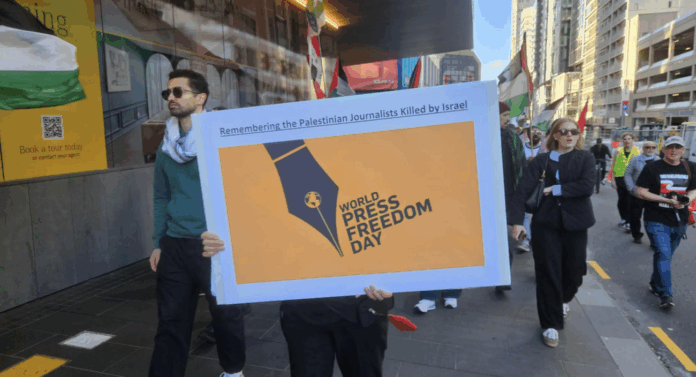
Yesterday, World Media Freedom Day, we marched to Television New Zealand in Tāmaki Makaurau Auckland to deliver a letter asking them to do better.

Their coverage [of Palestine] has been biased at its best, silent at its worst.

I truly believe that if our media outlets reported fairly, factually and consistently on the reality in Gaza and in all of Palestine that tens of thousands of peoples lives would have been saved and the [Israeli] occupation would have ended already.

Instead, I open my Instagram to a new massacre, a new lifeless child.

I often wonder how we get locked into jobs where we leave our values at the door to keep our own life how (I hope) we wish all lives to be. How we all collectively agree to turn away, to accept absolute substandard and often horrific conditions for others in exchange for our own comforts.

Yesterday I carried my son for half of this [1km] march. He’s too big to be carried but I also know I ask a lot from him to join me in this fight so I meet him in the middle as I can.

Near the end of the march he fell asleep and the saying “dead weight” came to mind as his body became heavier and more difficult to carry.

I thought about the endless images I’ve seen of parents in Gaza carrying their lifeless child and I thought how lucky I am, that my child will wake up.

How small of an effort it is to carry him a few blocks in the hopes that something might change, that one parent might be spared that terrible feeling — dead weight.

Republished from an Instagram post by a Philippine Solidarity Network Aotearoa supporter.

Article by AsiaPacificReport.nz

Independents will not help form government – but they will be vital in holding it to account

Source: The Conversation (Au and NZ) – By Joshua Black, Visitor, School of History, Australian National University

When the newspapers delivered their standard election-eve editorials, there were few surprises. Former Fairfax papers and smaller outlets offered qualified support for Labor, while the News Corp papers unashamedly championed the Coalition. In Adelaide, The Advertiser ran a curious line recommending a majority government of whatever persuasion, “lest our futures be in the hands of the mad Greens, self-serving teals or the independent rabble.”

How must those editors feel this morning? On the one hand, they got the majority government they wished for, and then some. The 2025 election will be mythologised in Labor circles for decades to come.

On the other hand, the “independent rabble” defied the expectations of some, and the best efforts of others, holding their seats and making gains in Sydney and Canberra, and potentially Melbourne and Perth as well. New crossbenchers will certainly be welcomed into the 48th parliament. And with the Coalition reeling from an historic defeat, they may all play a critical role in policy the debates to come.

Weathering the storm

The election campaign put all of the incumbent independent MPs through their paces. Coalition candidates and some of their outspoken media allies applied enormous personal pressure, with accusations of weakness on the issue of antisemitism and piercing questions from conservative news outlets about the transparency of some independent MPs’ donations.

Vast sums of money were also involved. In the Perth-side seat of Curtin, for example, independent MP Kate Chaney’s supporters and the Liberal Party allegedly spent $1 million each on their respective campaigns.

In the end, incumbent independents benefited from the historic pattern in federal politics: that a good independent is a tough proposition to beat. At election time, successful independent MPs benefit from the advantages of incumbency, the ability to point to specific policy or project victories arising from greater political competition for the seat, and the flexibility to adapt more quickly to changing voter attitudes, unencumbered by any party machinery.

Zali Steggall in Warringah and Helen Haines in Indi enjoyed their third successive wins, Rebekah Sharkie in Mayo a fourth general election win (she won a competitive byelection in 2018), Andrew Wilkie in Hobart a sixth victory on the trot, and north Queensland’s Bob Katter yet another term after 50 years of parliamentary service.

At the time of writing, all of the independents who won their seats in 2022 appear to have been returned. (The exception was Kylie Tink, whose electorate was abolished last year.) The closest count is in Goldstein, where incumbent Zoe Daniel narrowly leads her Liberal predecessor Tim Wilson. Other incumbents, such as Sophie Scamps in Mackellar, Allegra Spender in Wentworth, Monique Ryan in Kooyong and Kate Chaney in Curtin, have enjoyed distinctive swings toward them. In the formerly safe Labor seat of Fowler, where the party hoped to win, independent MP Dai Le enjoyed a handsome primary vote swing of around 6% in her favour.

Changing hands

The picture has been more mixed for the rest of the crossbench and other minor parties. The Greens seem set to lose two of their Brisbane seats, but a close race in the formerly safe Labor seat of Wills in Victoria may yet provide a win. Another record spendathon from Clive Palmer will see the Trumpet of Patriots win zero seats. One Nation may keep Queensland senator Malcolm Roberts in his place, but there do not appear to be any other gains for Pauline Hanson’s team.

Coalition defectors fared poorly, too. Monash MP, independent and former Liberal Russell Broadbent, appears to have secured just 10% of the primary vote, placing him behind both major parties and the community independent candidate.

In the Perth seat of Moore, Liberal defector Ian Goodenough has fallen behind Labor, Liberal and the Greens, with preferences flowing mainly to Labor candidate Tom French. Right-wing LNP defector Gerard Rennick appears unlikely to win his contest for a Queensland senate seat. In the regional NSW seat of Calare, ex-National MP Andrew Gee appears the only one able to buck the trend, coming second on primary votes and benefiting from a stronger flow of preferences than his National Party opponent.

New crossbench faces?

A series of close contests may yet result in extra independent members of parliament. Despite a bitter campaign, community independent Nicolette Boele appears likely to win in the north Sydney seat of Bradfield. In the Victorian seat of Flinders, independent Ben Smith has enjoyed a 5.4% swing toward him, and away from Liberal MP Zoe McKenzie, though preferences have not yet been published in that seat. In Fremantle, where the Australian Electoral Commission is yet to report any preference flows, independent candidate Kate Hulett may still be in with a shot to beat Labor’s Josh Wilson. The competitive result follows an impressive campaign from Hulett at the state election earlier this year.

After five weeks of vicious debates about the public service and Canberra, voters in the ACT sent clear messages to both major parties. Voices for Bean candidate Jessie Price appears to have taken one of the three ACT electorates from Labor, and independent Senator David Pocock enjoyed an easy victory. Labor received less than a third of the primary vote in that Senate race, and barely one in seven ACT residents voted Liberal.

Not burning down the house

Despite that qualification, Labor’s victory is historic by several measures. It is one of only four occasions over the past 30 years where its primary vote actually grew at a federal election. It looks to have won a lower house majority comparable with that of the Howard government’s final term, and maybe even with the Coalition’s 2013 victory (when it won 90 seats, more than double the figure it is likely to have won this time). The two-party preferred vote shows Albanese securing the kind of victory that made John Curtin a Labor hero in 1943.

So what role does that leave for independents in the 48th parliament?

Returning crossbenchers will regard their impressive primary votes as confirmation their voters want them to keep doing politics differently. The Liberal and National parties, on the other hand, will be consumed for much of the parliamentary term with introspection and institutional reckoning. Given how unhelpful their studied unity over the past term ultimately proved, it may be there’s more infighting within the Coalition during the next parliament.

Does it matter that the crossbenchers will not hold the balance of power in the lower house? Not necessarily. In the event of a serious policy misstep from the Albanese government during this term, the crossbenchers may prove to be the more influential voices of opposition in the lower house.

Sometimes a solo voice speaks with powerful volume. In 2001 the rural independent for Calare, Peter Andren, proved to be a singularly powerful voice against the Howard government’s draconian offshore detention program for asylum seekers arriving in Australia by boat. Andren defied the national trends (and the local opinion polls) and was returned with an increased primary vote, and again in 2004. When he died, some said his opposition to the Howard government showed “more guts and decency” than “all the other Coalition and ALP candidates combined”.

Several of the current independents have earned themselves a national profile and are trusted advocates on issues such as public integrity and accountability, climate and energy policy and even foreign and security affairs. There will certainly be few MPs left on the opposition benches who can speak with compelling authority on some of these issues. In the face of an emboldened Labor government, their opposition to contentious legislation may sometimes have outsized influence.

In pragmatic political terms, it is arguably in the Labor Party’s interests to negotiate, and to be seen to negotiate, with the crossbench. The independents in formerly safe Liberal seats are some of the biggest obstacles in any future Liberal pathway back into office.

Newly-elected Labor MPs may also depend on preferences from community independent candidates next time they go to the polls. The Menzies government owed part of its longevity in the late 1950s and 1960s to its ability to win the preferences of the Democratic Labor Party, an anti-communist breakaway party from Labor.

Independents are nothing like the DLP, and many run open tickets instead of strictly recommending preferences on their how to vote cards. But in some seats, including the leader of the opposition’s seat of Dickson, independent and Greens voters’ preferences will have proven crucial for Labor’s success.

‘Every day is minority government in the Senate’

The other crucial reason independents still have a role to play is the Senate. Pocock recently remarked that “every day is minority government in the Senate”. Albanese’s victory, no matter how impressive, does not extend to a majority in the red chamber.

The last time a party won a majority in the Senate was in 2004. Before that, it was 1977. No matter how large a lower-house majority, negotiation and compromise are simply unavoidable for laws to get passed in the federal parliament.

The Greens will continue to exercise their crucial balance of power role in the Senate. So too will Pocock and, assuming she is re-elected as the sixth senator for Tasmania, Jacqui Lambie. During the 47th parliament, Pocock and Lambie often proved decisive in shaping, amending and sometimes postponing legislation they felt needed improvement.

Both will bring a range of priorities to the 48th parliament. They may also collaborate more routinely with lower house crossbench colleagues to make those critical votes in the senate count for everything that they are worth. That would be a good thing. After all, both chambers really do matter in our parliamentary system.

The Conversation

Joshua Black is a Postdoctoral Research Fellow at The Australia Institute.

ref. Independents will not help form government – but they will be vital in holding it to account – https://theconversation.com/independents-will-not-help-form-government-but-they-will-be-vital-in-holding-it-to-account-255517

State of the states: 6 experts on how the election unfolded across the country

Source: The Conversation (Au and NZ) – By David Clune, Honorary Associate, Government and International Relations, University of Sydney

While counting continues nationally, the federal election result is definitive: a pro-Labor landslide and an opposition leader voted out.

But beyond the headline results, how did Australians in the key seats in each state vote, and how did it shape the outcome?

Here, six experts break down what happened in New South Wales, Queensland, South Australia, Tasmania, Victoria and Western Australia.

New South Wales

Swing to Labor: 3.4%

David Clune, honorary associate, government and international relations, University of Sydney

The election results showed, in NSW as with the rest of Australia, a stronger than predicted swing to the government, returning it with a solid majority.

Not only did Labor hold all its NSW marginals, many with increased margins, but it appears to have gained from the Liberals the seats of Banks and Hughes in suburban Sydney. Labor’s Jerome Laxale has retained Bennelong which was notionally Liberal after the redistribution.

The Liberals appear likely to lose Bradfield to Teal Nicolette Boele and former National Andrew Gee seems likely to retain Calare in the central west as an independent.

The three sitting Teals were all easily re-elected and right wing independent Dai Le held Fowler.

At the time of writing, Labor has won 28 seats in NSW to the Coalition’s 12, a gain of three, with four independents so far and the probability of two more.

The ALP two-party preferred vote in NSW was 54.8%, a swing towards it of 3.4%.

Labor’s primary vote was 35.0% to the Coalition’s 31.8%, a swing against the latter of 4.7%.

Albanese staged a Houdini-like escape from what seemed to be, in 2024, a steady decline in his prospects. Although only an average campaigner in 2022, he ran an almost flawless campaign three years later. The prime minister had a consistent, resonant message about Labor’s record, appealing policies for the future, and projected an image of stability in government.

Given the bite of the cost of living, particularly in Western Sydney, the government should have been vulnerable. Instead, Albanese transformed this into a strength by persuading voters he was best placed to deal with the crisis.

Queensland

Swing to Labor: 3.9%

Paul Williams, associate professor of politics and journalism, Griffith University

I long argued Queensland would be inconsequential as to who would win the keys to The Lodge at this election.

I was partly right. If Labor, as projected, wins 93 of the 150 House of Representatives seats, the six Queensland Labor appears to have seized from the Liberal-National Party (LNP) are but a small fraction of the government’s national haul. Even with no Labor gains in Queensland, Albanese could still have governed with a comfortable majority.

But I was also partly wrong. The fact there were primary swings of up to five percentage points away from the LNP across Queensland (even in very safe seats like Maranoa), and the fact Labor appears to have captured two seats (Brisbane and Griffith) from the Greens, suggests the state has behaved very differently from expectations and, for the first time in more than a decade, become one of real consequence.

Labor now looks to hold 13 of the state’s 30 seats, the LNP 15, the Greens one, and Bob Katter returned in Kennedy for the KAP. Few would be surprised that Pauline Hanson’s One Nation (PHON) and Clive Palmer’s Trumpet of Patriots failed to win any House seats, although PHON’s Malcolm Roberts is likely to be returned to the Senate.

Nor is it unexpected that Dickson, held by the LNP by a tiny 1.7% margin, should have been in play this election. But that fact Dickson was lost by an opposition leader – the first such occurrence at federal level – is astonishing.

So, too, are the LNP losses in the outer-suburban “battler” seats of Forde and Petrie (held by the LNP since 2010 and 2013 respectively) that embraced former Liberal PM Scott Morrison, even when he was at his nadir.

The additional reality of an LNP losing such contrasting seats as Leichhardt in far north Queensland and Bonner in middle Brisbane suburbia now points to a deep existential crisis for conservatives even in their Queensland heartland.

In the Northern Territory, Labor’s Marion Scrymgour has retained the seat of Lingiari and strengthened her position, with a 6.6% swing in her favour.

So, what happened? How did Queensland, like the rest of Australia, defy electoral gravity? Was it that angry Queenslanders, stinging from a cost-of-living crisis, had already vented their wrath on a state Labor government six months ago? Or did the state finally warm to an Albanese it now concluded was a more competent economic manager? Or did Queensland, like every other state, reject a hard-right Peter Dutton – offering little in meaningful policy amid a ramshackle campaign – as out of touch with a moderate, centrist Australia?

After defeats at local and state elections in 2024, Labor is back in Queensland.

South Australia

Swing to Labor: 5.1%

Rob Manwaring, associate professor of politics and public policy, Flinders University

On first glance, South Australia did not seem to be at the centre of the Albanese government’s landslide win. Of the ten electoral seats in the state, only one changed hands – the seat of Sturt which Labor’s Claire Clutterham won from the Liberals’ James Stevens. Yet, this was a massive win for Labor, with a 57–43 two-party preferred vote.

This is a seismic result and exemplifies all of the Coalition’s electoral problems. Sturt was a classic Liberal blue ribbon seat which the Liberals had held since 1972. The Teal candidate in Sturt, Dr Verity Cooper, might well be disappointed not to have scored a higher primary vote than her 7.2%.

Elsewhere, Labor handsomely improved its position in the hitherto marginal seat of Boothby. A 8% swing to Louise Miller-Frost saw the Liberals’ Nicolle Flint easily routed.

To confirm the Liberal misery in the state, the Centre Alliance’s Rebekha Sharkie consolidated her place in Mayo. The scale of Labor’s performance also brought into scrutiny the Liberal regional seat of Grey, where long-standing member Rowan Ramsay retired. The Liberals will retain it despite a swing against them.

Overall, this is now a solidly Labor state, and the party holds a remarkable seven of the ten seats. Those with long memories, will know seats like Kingston and Adelaide, traditionally bellweather, are now solidly safe Labor seats.

The Liberals’ loss of Sturt confirms the party now has only two seats in the state, and no representation at all in the major cities around the country. It might well be a long road back for the centre-right.

Tasmania

Swing to Labor: 8.1%

Robert Hortle, deputy director of the Tasmanian Policy Exchange, University of Tasmania

If the Liberal Party’s ranks were thinned out on the mainland, in Tasmania they have been clear-felled. The state elected four Labor candidates out of five, and notably, all women.

In Braddon, Labor’s Anne Urquhart overturned the 8.3% margin enjoyed by retiring Liberal MP Gavin Pearce. It looks like the swing to Labor will be around 15%, with Urquhart’s pro-salmon farming and pro-jobs position resonating in the traditionally conservative electorate.

A swing of around 10% to Labor in Bass was more than enough for first-time candidate Jess Teesdale to defeat Liberal MP Bridget Archer. Labor’s messaging that “a vote for Archer is a vote for Dutton” successfully neutralised Archer’s personal popularity in the electorate and reputation for standing up to her party.

Lyons was Tasmania’s most marginal seat after the 2022 election. That’s no longer the case, with Rebeca White, former state Labor leader, securing a swing of around 10%. White’s popularity as a state MP transferred smoothly to the federal level – Labor’s primary vote in the seat looks to have jumped by more than 14%.

So why was the swing to Labor in these Tasmanian seats so much greater than on the mainland? Astute candidate selection played a role – in particular, White and Urquhart were well-known in their communities.

It is also possible the ongoing travails of the state Liberal government played a part. Northern Tasmanians are strongly opposed to the controversial AFL stadium in Hobart, and the ongoing Spirit of Tasmania ferry fiasco has involved prominent mismanagement of port upgrades in Devonport in the state’s north-west. State politics isn’t usually considered to have a big impact on federal elections, but these issues may have been high profile – and long running – enough to make a difference.

The southern seat of Franklin was a focal point for a lot of drama during the campaign. In the end, Julie Collins, Tasmania’s only cabinet minister, received a bit of a scare. She slightly increased her primary vote, but the ABC currently projects her overall margin will be cut in half. Anti-salmon farming independent Peter George achieved the second highest primary vote, but wasn’t close enough to Collins for preferences to get him over the line.

As expected, independent Andrew Wilkie won the Hobart seat of Clark for a sixth time, with a margin of just over 20%. He increased his primary vote, but it looks like Labor will shave a tiny amount off his margin.

Victoria

Swing to Labor: 1.8%

Zareh Ghazarian, senior lecturer in politics, school of social sciences, Monash University

The Liberal Party’s fortunes in Victoria went from bad in 2022 to much worse in 2025.

The ALP’s primary vote increased by about 1% while the Liberal Party’s primary vote fell by about 2.5%. While the percentages are smaller than in other states, this performance had a significant affect on the representation of the parties in Victoria.

The Liberal Party lost Deakin in the eastern suburbs of Melbourne. Held by Michael Sukkar since 2013, the seat has been marginal for several elections. The primary vote swing against the Liberal Party was 4.2%. In a two-party preferred outcome, Deakin now appears to be a relatively safe seat for Labor.

The Liberal Party primary vote also went backwards in Kooyong which was held by independent Monique Ryan. High profile Liberal candidate Amelia Hamer could not reclaim the seat which had previously been held by then-Treasurer Josh Frydenberg.

Goldstein, the other inner metropolitan seat won by an independent at the last election, looks to be a closer contest with the Liberal Party’s Tim Wilson experiencing a rise in the primary vote but it may not be enough to defeat incumbent Zoe Daniel.

Compounding the problems for the Liberal Party was that it could not make any inroads in other key seats across the eastern suburbs in Melbourne. This was where the party needed to win seats if it was to be competitive in forming government. In Aston, the seat the party lost at a byelection in 2023, the Liberal Party’s primary vote fell by 5%. The party’s primary vote also went back in Chisholm and McEwen.

In short, this was a disastrous result for the Liberal Party in the state of Victoria.

Western Australia

Swing to Labor: 1.2%

Narelle Miragliotta, associate professor in politics, Murdoch University

WA didn’t disappoint for Labor. Although the two-party swing was more muted than in other parts of the country, it came off the back of a more much stronger electoral position entering this contest. On a two-party preferred basis, Labor gained 56.2% of the vote.

Labor has retained the nine lower house seats it won in 2022, and it has also managed to make decent, even if not spectacular, gains in the party’s share of the primary vote in Tangney (+4.9%), Hasluck (+5.93), Swan (+3.5%), and Perth (+4.7%).

One of the unexpected wins for Labor was the former Liberal held seat of Moore. Labor won the seat on the back of +0.9% increase in the party’s primary vote. Assisting Labor’s electoral fortunes was a former Liberal incumbent who ran as an independent, and whose vote accounts for much of the -10.4% swing against the Liberal candidate.

But it wasn’t all good news for Labor, going backwards on primary votes in Fremantle (-4.48%) Brand (-5.96%) and Pearce (-0.01%).

The Liberals’ performance affirms just how much trouble the party in the West. The Liberals recorded a swing of -5.66% in their primary vote, winning only 28.5% of the first preference vote.

In addition to the loss of Moore, the party failed to win back the once-prized seat of Curtin, despite a heavy investment of resources into the contest. The Liberals also have a fight to retain the seat of Forrest, where is registered a -13.4% swing in its primary vote. The Liberals are, however, expected to win it.

There were very few bright spots for the Liberals. The Liberals did achieve an increase in their two-party preferred vote in O’Connor (+6.3%) and Canning (+3.8%). And at last check, the Liberals are still in the hunt for the new seat of Bullwinkel.

In the senate, the swing against the Liberals on primary votes was even more pronounced (-7.36%) although the party are on track to elect two senators. The Greens senate primary vote held up, enjoying a very slight increase (+0.74%) and comfortably returning a senator. Although recording a -0.04% swing, Labor has two senators confirmed and the possibility of the election of a third.

The Conversation

Paul Williams is a research associate with the T.J. Ryan Foundation.

David Clune, Narelle Miragliotta, Rob Manwaring, Robert Hortle, and Zareh Ghazarian do not work for, consult, own shares in or receive funding from any company or organisation that would benefit from this article, and have disclosed no relevant affiliations beyond their academic appointment.

ref. State of the states: 6 experts on how the election unfolded across the country – https://theconversation.com/state-of-the-states-6-experts-on-how-the-election-unfolded-across-the-country-255508


ER Report: A Roundup of Significant Articles on EveningReport.nz for May 4, 2025

ER Report: Here is a summary of significant articles published on EveningReport.nz on May 4, 2025.

Too many journalists remain silent over the Gaza genocide, a threat to our media credibility
Report by Dr David Robie – Café Pacific. – By David Robie on World Press Freedom Day 2025 I ask you now: Do not stop speaking about Gaza. Do not let the world look away. Keep fighting, keep telling our stories – until Palestine is free. These are not my words, although I believe and

Labor makes Senate gains, and left-wing parties will hold a Senate majority
Source: The Conversation (Au and NZ) – By Adrian Beaumont, Election Analyst (Psephologist) at The Conversation; and Honorary Associate, School of Mathematics and Statistics, The University of Melbourne On Saturday, Labor won a thumping victory in the House of Representatives, and this has carried over to the Senate results. Only 35% of enrolled voters have

Rabuka salutes Fiji media but warns against taking freedom for granted
By Anish Chand in Suva Fiji Prime Minister Sitiveni Rabuka has paid tribute to all those working the media industry in his message to mark World Press Freedom Day. He said in his May 3 message thanks to democracy his coalition government had removed the “dark days of oppression and suppressions”. “Today as we join

Albanese increases majority and Dutton loses seat in stunning election landslide
Source: The Conversation (Au and NZ) – By Michelle Grattan, Professorial Fellow, University of Canberra The Albanese government has been re-elected with a substantially increased majority, and Opposition Leader Peter Dutton has lost his seat, in a crushing defeat of the Coalition. As of late Saturday night, there was a two-party swing to Labor of

Labor wins election in landslide: full results
Source: The Conversation (Au and NZ) – By Digital Storytelling Team, The Conversation The Conversation, CC BY-SA Digital Storytelling Team does not work for, consult, own shares in or receive funding from any company or organisation that would benefit from this article, and has disclosed no relevant affiliations beyond their academic appointment. – ref. Labor

Labor wins surprise landslide, returned with a thumping majority
Source: The Conversation (Au and NZ) – By Adrian Beaumont, Election Analyst (Psephologist) at The Conversation; and Honorary Associate, School of Mathematics and Statistics, The University of Melbourne With 52% of enrolled voters counted, The Poll Bludger has Labor ahead in 92 of the 150 House of Representatives seats, the Coalition in 43, the Greens

Labor routs the Coalition as voters reject Dutton’s undercooked offering
Source: The Conversation (Au and NZ) – By Michelle Grattan, Professorial Fellow, University of Canberra In a dramatic parallel, what happened in Canada at the beginning of this week has now been replicated in Australia at the end of the week. An opposition that a few months ago had looked just possibly on track to

Dutton and the Coalition did not do the work, and misread the Australian mood
Source: The Conversation (Au and NZ) – By Mark Kenny, Professor, Australian Studies Institute, Australian National University The former federal director of the Liberal Party, Brian Loughnane, used to tell media companies that their practice of commissioning expensive opinion polls right through a parliamentary term was a waste of money. Election 2025 seemed to vindicate

Labor wins with a superior campaign and weak opposition – now it’s time to make the second term really matter
Source: The Conversation (Au and NZ) – By Chris Wallace, Professor, School of Politics Economics & Society, Faculty of Business Government & Law, University of Canberra Superior campaigning by the Labor machine, a lift in the personal performance of Prime Minister Anthony Albanese, and a woeful campaign by Opposition Leader Peter Dutton have seen Labor

Albanese’s government might not thrill, but it has shown unity and competence – and that’s no mean feat
Source: The Conversation (Au and NZ) – By Frank Bongiorno, Professor of History, ANU College of Arts and Social Sciences, Australian National University The Coalition’s election campaign of 2025 has a strong claim to be considered among the worst since federation. I know of none more shambolic. Barely a day passed without some new misstep

Palestine protesters march on TVNZ, accuse broadcaster of bias on Gaza
Asia Pacific Report About 1000 pro-Palestinian protesters marked World Press Freedom Day — May 3 — today by marching on the public broadcaster Television New Zealand in Auckland, accusing it of 18 months of “biased coverage” on the genocidal Israeli war against Gaza. They delivered a letter to the management board of TVNZ from Palestine

Too many journalists remain silent over the Gaza genocide, a threat to our media credibility

Report by Dr David Robie – Café Pacific.By David Robie on World Press Freedom Day 2025

I ask you now: Do not stop speaking about Gaza.

Do not let the world look away.

Keep fighting, keep telling our stories – until Palestine is free.

These are not my words, although I believe and support them absolutely. They are the words of Palestinian journalist Hossam Shabat in his final message left behind when he was killed by an Israeli air strike on March 24.

His message is a poignant one today, especially today which is May 3 — World Press Freedom Day.

It is a message that I have been carrying in my heart since even earlier, since the assassination of another Palestinian journalist, the famous Shireen Abu Akleh, who was murdered by Israeli sharpshooters six days after Media Freedom Day in 2022 while reporting in Jenin refugee camp in the West Bank.

It was her blatant killing in plain view on live video with impunity that signalled how the rogue state Israel was flaunting all international laws and accountability with contempt. And it was a hint of how it would it conduct itself in this disaster.

According to the United Nations Human Rights Office in the Occupied Palestinian Territory (OHCHR), since October 2023, Israeli occupation forces have killed 211 Palestinian journalists, including 28 women reporters reporting on Gaza. At least 47 journalists have been killed while on duty, and at least 49 media people are languishing in Israeli detention or hidden in prisons, mostly without charge.

Why? To silence the journalists.

To silence their storytelling, as Hossam Shabat indicated in his final message.

And for more than 18 months Israel has refused access to Gaza by international journalists.

Why? To kill the truth. To stop the world’s media from exposing the Israeli lies and their controlled narrative.

But it hasn’t worked. The Zionists are losing control of the narrative — and they know it. As Amnesty International called it this week, the mass atrocity is a “livestreamed genocide” thanks due to the courage and dedication of the Gazan reporters and citizen journalists.

A year ago — on this very day — the Gazan journalists were honoured with the UNESCO Guillermo Cano Prize in Santiago, Chile, in recognition of their “unique suffering and fearless reporting”.

The protest march to Television New Zealand headquarters. Image: Asia Pacific Report

Who would have thought this grotesque war, this obscene war would still be causing such terrible suffering more than year later?

And we can’t even really call it a war at all because it is continuous massacres carried out by one of the most advanced and powerful military machines in the world, supplied and aided by the United States, on one side, with a relatively tiny resistance force armed with small arms on the other.

Gaza is a “killing field – and civilians are in an endless death loop”, as the UN Secretary General, António Guterres, said the other day. Horrendous!

And since the Cano award for the Gazan journalists, a further 111 media workers have been killed by Israel.

Gazan journalist Hossam Shabat’s final message . . . he was killed by the Israeli military last month. Image: APR screenshot

In the latest survey by Reporters Without Borders 2025 World Press Freedom Index released yesterday, global zones have been flagged where press freedom is “entirely absent and practising journalism is particularly dangerous”.

“This is the case in Palestine, where the Israeli army has been annihilating journalism for more than 18 months, killing more than 200 media professionals — including at least 43 murdered while working — and imposing a blackout on the besieged strip.”

Just a couple of weeks ago, a group of French and international journalists staged a “die-in” in Paris. They lay down on the steps of the Opera-Bastille as a street theatre representation of the unprecedented scale of the killing of journalists.

It was organised by Reporters Without Borders, and secretary-general Thibaut Bruttin said:

“The difficulty of making the cause of Palestinian journalists heard is proof that the insidious poison of the Israel armed forces has sometimes even penetrated our own narrative.

“I have never seen a war in which, when a journalist is killed, you are told that they were really a terrorist.”

Bruttin also reflected: “I think it must be said that solidarity is a form of strength. It is a source of strength, I hope, for Palestinian journalists to whom we send these images and to whom we express our solidarity through words and action.

“And I also think that is an appeal to the media profession, and it’s true that this demonstration is happening late, perhaps too late. It must be recognised.

“In the 10 years that I have been working at Reporters Without Borders, this is the first time that I have been asked if the journalist was really a journalist when they were killed. This had never happened. Never.

“And I think we must salute all those who have been marching and all those professionals who have come and who say: ‘Yes, we must continue to report what is happening but we must also protest and do more. Journalists are being targeted. And they are also being defamed after their deaths.’”

In January 2024, I wrote an article for Declassified Australia headlined: “Silencing the messenger: Israel kills journalists, while the West merely censors them.”

I declared then that reporting Israel’s war on Gaza had become the greatest credibility challenge for journalists and media of our times.

Dr David Robie and Del Abcede speaking at Auckland’s “Palestine Corner” rally on World Press Freedom Day. Image: Bruce King

“Covering the conflict has opened divisions among media groups about fairness and balance that have become the most bitter since the climate change and covid pandemic debates when media ‘deniers’ and ‘bothsideism’ threatened to undermine the science.”

It shocks me that so many journalists have remained silent. They should also be on the streets like us and reporting the truth. To me, the deafening silence is a betrayal of the 50 years of truth to power journalism that I have grown up with.

Silence is complicity.

Finally, I would like to quote from PSNA’s co-chair John Minto in the letter that we are taking today to Television New Zealand appealing for an independent review of 1News reporting on Palestine/Israel.

Minto says: “Over the past 18 months of industrial scale killing of Palestinians by the Israeli military in Gaza we have been regularly appalled at the blatantly-biased reporting on the Middle East by Television New Zealand.

“TVNZ’s reporting has been relentlessly and virulently pro-Israel . . .

“The damage to human rights, justice and freedom in the Middle East by Western media such as TVNZ is incalculable.”

I endorse and support these comments and call a halt to Israel deliberately targeting of Palestinian journalists. Let the truth be told, as Hossam told us, over and over again and prevent this blatant Western attempt to “normalise” genocide.

Dr David Robie is editor of Asia Pacific Report and convenor of Pacific Media Watch. He gave this address at the World Press Freedom Day rally in “Palestine Corner” in Tāmaki Makaurau Auckland’s Te Komititanga Square on 3 May 2025.

The Television New Zealand protest on World Press Freedom Day – “Remembering the journalists killed by Israel”. Image: APR

This article was first published on Café Pacific.

Labor makes Senate gains, and left-wing parties will hold a Senate majority

Source: The Conversation (Au and NZ) – By Adrian Beaumont, Election Analyst (Psephologist) at The Conversation; and Honorary Associate, School of Mathematics and Statistics, The University of Melbourne

On Saturday, Labor won a thumping victory in the House of Representatives, and this has carried over to the Senate results.

Only 35% of enrolled voters have been counted in the Senate so far, compared with 71% in the House. It’s likely that the current Senate count is biased to Labor, so Labor is likely to drop back in some states as more votes are counted.

There are 76 senators, who have six-year terms, with about half up for election at every House election. Each state has 12 senators, with six up for election, and the territories have two senators each, who are all up for election.

Senators are elected by proportional representation with preferences. A quota in a state is one-seventh of the vote, or 14.3%. In the territories, it’s one-third or 33.3%. I had a Senate preview on April 16.

Comments on each state are below. I disagree with the ABC’s view that Labor is “likely” to win a third New South Wales seat. Putting this seat into the doubtful column reduces Labor to an overall 27 senators with the Greens on 11, so the two main left-wing parties would hold a minimum 38 of the 76 seats in the new Senate.

This would represent a two-seat gain for Labor (one in Queensland, one in South Australia). Labor has reasonable chances to gain further Senate seats.

If Labor and the Greens combined hold the minimum 38 seats after the election, Labor will only need one more vote to pass legislation supported by the Greens but opposed by right-wing parties. Independent David Pocock, former Green Lidia Thorpe and former Labor senator Fatima Payman will be good options.

In NSW, Labor has 2.6 quotas, the Coalition 1.9, the Greens 0.9 and One Nation 0.4. Labor would win three seats on current primaries, but the Senate swing to them is much greater than in the House, so they will drop back.

In Victoria, Labor has 2.4 quotas, the Coalition 1.9, the Greens 1.0, One Nation 0.3 and Legalise Cannabis 0.3. Labor is likely to drop back, with the final seat likely a three-way contest between Labor, One Nation and Legalise Cannabis.

In Queensland, Labor has 2.1 quotas, the Liberal National Party 1.8, the Greens 0.9, One Nation 0.5 and former LNP senator Gerard Rennick 0.35. One Nation is the favourite to win the sixth seat.

In Western Australia, Labor has 2.4 quotas, the Liberals 1.7, the Greens 1.1, One Nation 0.4, Legalise Cannabis 0.3 and the Nationals 0.3. Labor would be the favourite to win the sixth seat on current counting, as the Liberals would absorb right-wing preferences that would otherwise help One Nation.

In SA, Labor has 2.6 quotas, the Liberals 1.8, the Greens 1.0 and One Nation 0.4. Labor won the House vote in SA by 58.4–41.6, so the Senate result looks plausible. Labor and the Greens are likely to win four of SA’s six Senate seats.

In Tasmania, Labor has 2.4 quotas, the Liberals 1.5, the Greens 1.2, Jacqui Lambie 0.5, One Nation 0.4 and Legalise Cannabis 0.3. It’s difficult to determine which parties are the favourites to win the last two seats.

In the ACT (two senators), Pocock has been easily re-elected with 1.3 quotas, and Labor will win the second seat. In the Northern Territory, Labor and the Country Liberals will win one seat each.

Doubtful House seats, and the Greens’ and teals’ performance

There are many seats where the electoral commission selected the incorrect final two candidates on election night and now needs to redo this count. Labor could lose Bean, Fremantle or Calwell to independents. Labor could also lose Bullwinkel or Bendigo to the Coalition.

The Greens have lost Brisbane and Griffith to Labor. They lost Brisbane after falling to third behind Labor and the LNP and Griffith because the LNP fell to third and their preferences will help Labor. Labor is narrowly ahead against the Greens in Wills.

In Greens leader Adam Bandt’s Melbourne, there was a substantial primary vote swing to Labor and against Bandt, and the electoral commission needs to redo the preference count between Bandt and Labor.

Teal independents in Kooyong, Goldstein and Curtin are likely to retain their seats, but they didn’t gain substantial swings that usually occur when an independent elected at the last election recontests. It’s possible they’ve become too associated with the left in their seats. Fortunately for them, the left won a thumping victory at this election.

Adrian Beaumont does not work for, consult, own shares in or receive funding from any company or organisation that would benefit from this article, and has disclosed no relevant affiliations beyond their academic appointment.

ref. Labor makes Senate gains, and left-wing parties will hold a Senate majority – https://theconversation.com/labor-makes-senate-gains-and-left-wing-parties-will-hold-a-senate-majority-255848

Rabuka salutes Fiji media but warns against taking freedom for granted

By Anish Chand in Suva

Fiji Prime Minister Sitiveni Rabuka has paid tribute to all those working the media industry in his message to mark World Press Freedom Day.

He said in his May 3 message thanks to democracy his coalition government had removed the “dark days of oppression and suppressions”.

“Today as we join the rest of the international community in celebrating World Press Freedom Day, let us recommit ourselves to the values and ideals of our fundamental human rights freedom of expression and the freedom of the press,” said Rabuka, a former coup leader.

“With our recent history, let as not take this freedom for granted.”

Rabuka also remembered the late Sitiveni Moce who died in 2015.

RNZ Pacific reports Moce was left paralysed and bedridden in 2007 after being assaulted by soldiers shortly after the 2006 military coup.

“Today is also an opportune time to remember those in the media fraternity that made the ultimate sacrifice.”

‘Brave photographer’
“In particular, I pay tribute to my ‘Yaca’ (namesake), the late Sitiveni Moce who died in 2015.

“This brave newspaper photographer was set upon by a mob in Parliament House in 2000, and again by some members of the disciplined forces in 2007 for simply carrying out his job which was to capture history in still photographs.

“His death is a sombre reminder of the fickleness of life, and how we must never ever take our freedoms for granted.”

Republished from The Fiji Times with permission.

Article by AsiaPacificReport.nz

Albanese increases majority and Dutton loses seat in stunning election landslide

Source: The Conversation (Au and NZ) – By Michelle Grattan, Professorial Fellow, University of Canberra

The Albanese government has been re-elected with a substantially increased majority, and Opposition Leader Peter Dutton has lost his seat, in a crushing defeat of the Coalition.

As of late Saturday night, there was a two-party swing to Labor of about 3.4%, with two-party vote of 55.5%-44.5%

It was sitting on about 86 seats (up from 78), and in the hunt for more. The Coalition, which went into the election with 57 seats, has won 41, and may pick up one or two more.

The Labor primary vote was 34.7%, up 2.1%; the Coalition primary vote was 31.1%, down 4.6%.

Among the Liberal losses is frontbencher Michael Sukkar in his Victorian seat of Deakin. Shadow foreign minister David Coleman is likely to lose his Sydney seat of Banks. Outspoken Liberal backbencher Bridget Archer has lost her Tasmanian seat of Bass.

It was all over by 8.30PM, as it became increasingly clear a big swing to Labor was underway.

A trumphant and emotional Anthony Albanese told a jubilant Labor crowd: “Australians have chosen a majority Labor government”.

“Today the Australian people have voted for Australian values. For fairness, aspiration and opportunity for all. For the strength to show courage in adversity and kindness to those in need.

“And Australians have voted for a future that holds true to these values, a future built on everything that brings us together as Australians and everything that sets our nation apart from the world.

“Australians have chosen to face global challenges the Australian way, looking after each other while building for the future.

“I make this solemn pledge. We will not forget that we will never take it for granted, repaying your trust will drive a government each and every day of the next three years.”

Albanese, who has used a Medicare card as a prop through the campaign, produced it once again. “We will be a government that helps every Australian who relies on Medicare.”

According to the ABC, seats changing hands from the Liberals to Labor are Banks and Hughes in NSW; Forde, Bonner, Dickson, Petrie, Leichhardt in Queensland; Deakin in Victoria; Braddon and Bass in Tasmania; Sturt in South Australia, and Moore in Western Australia.

It was a bad night for the Greens. They are likely to lose two of their three Queensland seats, Griffith, held by high profile MP Max Chandler-Mather, and Brisbane held by Stephen Bates.

The Greens’ expected losses occurred despite roughly holding its primary vote, which is 12.5%, up 0.2%. Their leader Adam Bandt is in trouble in his seat of Melbourne.

Dutton said in his concession speech he had called Albanese and congratulated him. “I said to the prime minister that his mum would be incredibly proud of his achievement tonight, and he should be very proud of what he’s achieved.”

Dutton said he had also spoken to Ali France, the Labor candidate who has beaten him in Dickson. “She lost her son Henry, which is a tragic circumstance that no parent should ever go through. And equally I said to Ali that her son Henry would be incredibly proud of her tonight and that she’ll do a good Local member for Dixon.”

He expressed his sorrow for the Liberal MPs and candidates who had lost.

All the teals have held their seats. The teal candidate in Bradfield, Nicolette Boele, is ahead of her Liberal opponent. The teal Jessie Price is also ahead in the ACT Labor seat of Bean.

Queensland LNP Senator James McGrath said it was a brutal night for Peter Dutton and the Coalition. “We have got to make sure we take stock of why we lost this election and have a serious review into those reasons.”

As the Liberals prepare to review their disastrous loss and choose a new leader, their Senate leader Michaelia Cash is backing fellow West Australian Andrew Hastie. “I think Andrew Hastie is an outstanding member … I’m a very good friend of his. Andrew’s always been seen as leadership material.”

The Conversation

Michelle Grattan does not work for, consult, own shares in or receive funding from any company or organisation that would benefit from this article, and has disclosed no relevant affiliations beyond their academic appointment.

ref. Albanese increases majority and Dutton loses seat in stunning election landslide – https://theconversation.com/albanese-increases-majority-and-dutton-loses-seat-in-stunning-election-landslide-255616

Labor wins election in landslide: full results

Source: The Conversation (Au and NZ) – By Digital Storytelling Team, The Conversation

The Conversation, CC BY-SA

Digital Storytelling Team does not work for, consult, own shares in or receive funding from any company or organisation that would benefit from this article, and has disclosed no relevant affiliations beyond their academic appointment.

ref. Labor wins election in landslide: full results – https://theconversation.com/labor-wins-election-in-landslide-full-results-251905

Labor wins surprise landslide, returned with a thumping majority

Source: The Conversation (Au and NZ) – By Adrian Beaumont, Election Analyst (Psephologist) at The Conversation; and Honorary Associate, School of Mathematics and Statistics, The University of Melbourne

With 52% of enrolled voters counted, The Poll Bludger has Labor ahead in 92 of the 150 House of Representatives seats, the Coalition in 43, the Greens in two, independents in 11 and others in two. In called seats, Labor is on 76 (already a majority), the Coalition 32, independents six and others two.

Labor has gained ten seats and the Coalition has lost ten, including Peter Dutton’s Dickson to Labor. It’s amazing that Labor has held the Victorian seat of Aston, which they had gained from the Coalition during Labor’s honeymoon period.

The Poll Bludger gives Labor a projected national two-party preferred vote of 54.5–45.5, a 2.4% swing to Labor since the 2022 election. Current primary votes are 34.7% Labor (up 2.3%), 30.5% Coalition (down 3.9%), 12.8% Greens (up 0.3%), 6.2% One Nation (up 1.3%), 2.0% Trumpet of Patriots (new), 8.1% independents (up 4.5%) and 5.8% others (up 0.6%).

I believe this election result was mostly because Dutton became too close to One Nation and Donald Trump for the Australian people to tolerate. Dutton would have done better to have stuck to the cost-of-living issue and avoided culture wars.

With the addition of the YouGov poll below, Albanese finished the campaign at a net -4.2 using an average of five polls in the final week that asked for leaders’ ratings. Dutton finished at -20.8.

The Canadian election on Monday and now Australia’s election demonstrate the left’s ability to win elections. Many thought Trump’s election would herald an era of right-wing dominance, but both Canada’s Conservatives and Australia’s Coalition lost what had looked like wins two months ago. Both leaders also lost their seats.

Before the 2022 Australian election, I wrote that Australia and Canada could be strong for the left owing to big cities that make up a large share of the population in both countries. The right’s gains in the last decade have been biggest in regional areas.

The polls understated Labor at this election, with none of the ten polls by different pollsters conducted in the final week putting Labor’s two party share above 53%. The Morgan poll that was conducted April 14–20 gave Labor a 55.5–44.5 lead, but Morgan’s final two polls retreated back to a 53–47 Labor lead.

The Ipsos poll below that gave Labor just a 51–49 lead and the Freshwater poll that gave Labor a 51.5–48.5 lead were particularly poor. I will give a full assessment of the polling when the results are nearly complete.

This is the poll graph I’ve been publishing with the provisional Labor two-party win by 54.5–45.5 marked.

More final polls

The polls below were not released in time for Friday night’s final poll wrap.

The final national YouGov non-MRP poll, conducted April 24 to May 1 from a sample of 3,000, gave Labor a 52.2–47.8 lead, a 1.3-point gain for the Coalition since the April 17–22 YouGov poll.

Primary votes were 31.4% Coalition (up 0.4), 31.1% Labor (down 2.4), 14.6% Greens (up 0.6), 8.5% One Nation (down two), 2.5% Trumpet of Patriots (up 0.5), 6.7% independents (up 1.7) and 5.2% others (up 1.2). By 2022 election flows, Labor would lead by 54.2–45.8.

Anthony Albanese’s net approval was up one point to -6, with 49% dissatisfied and 43% satisfied. Peter Dutton’s net approval slumped six points to a record low in YouGov of -24. Albanese led Dutton as better PM by 51–34 (50–35 previously).

A national Ipsos poll for The Daily Mail was released Friday without fieldwork dates provided, but the sample was 2,574. Labor led by 51–49 from primary votes of 33% Coalition, 28% Labor, 12% Greens, 8% One Nation, 2% Trumpet of Patriots, 12% for all Others and 5% undecided.

Ipsos has conducted Australian polling before, but this was its only voting intentions poll this term. Its previous two polls for The Daily Mail had only asked about the leaders’ ratings.

The final wave of the tracking poll of 20 marginal seats by Redbridge and Accent Research for the News Corp tabloids gave Labor a 53–47 lead across these seats, a 1.5-point gain for the Coalition since the previous week.

Primary votes were 34% Coalition (steady), 33% Labor (down two), 12% Greens (down two), 6% One Nation (down one) and 15% for all Others (up five). These seats voted for Labor by 51–49 at the 2022 election, so this poll has a 2% swing to Labor across these seats.

Labor won nationally in 2022 by 52.1–47.9, so this poll implies about a 54–46 Labor national margin.

Adrian Beaumont does not work for, consult, own shares in or receive funding from any company or organisation that would benefit from this article, and has disclosed no relevant affiliations beyond their academic appointment.

ref. Labor wins surprise landslide, returned with a thumping majority – https://theconversation.com/labor-wins-surprise-landslide-returned-with-a-thumping-majority-255518

Labor routs the Coalition as voters reject Dutton’s undercooked offering

Source: The Conversation (Au and NZ) – By Michelle Grattan, Professorial Fellow, University of Canberra

In a dramatic parallel, what happened in Canada at the beginning of this week has now been replicated in Australia at the end of the week.

An opposition that a few months ago had looked just possibly on track to dislodge the government, or at least run it close, has bombed spectacularly. Opposition Leader Peter Dutton has lost his Queensland seat of Dickson, as did the Conservative leader Pierre Poilievre in Canada.

Far from being forced into minority government, as most observers had been expecting, Labor has increased its majority, with a substantial swing towards it.

Its strong victory reflects not just the the voters’ judgement that the Coalition was not ready to govern. It was worse than that. People just didn’t rate the Coalition or its offerings.

Multiple factors played into this debacle for the Coalition.

A first-term government historically gets a chance of a second term.

The Trump factor overshadowed this election. It made people feel it was best to stick with the status quo. People also were very suspicious of Dutton, whom they saw (despite disclaimers) as being too like the hardline US president.

After the last election, Dutton was declared by many to be unelectable, and that proved absolutely to be the case, despite what turned out to be a misleading impression when the polls were so bad for Labor.

Even if they’d had a very good campaign, the Coalition would probably not have had a serious chance of winning this election.

But its campaign was woeful. The nuclear policy was a drag and a distraction. Holding back policy until late was a bad call. When the policies came, they were often thin and badly prepared. The ambitious defence policy had no detail. The gas reservation scheme had belated modelling.

The forced backflip on working from home, and the late decision to offer a tax offset, were other examples of disaster in the campaign.

Dutton must wear the main share of the blame. He kept strategy and tactics close to his chest.

But the performance of the opposition frontbench, with a few exceptions, has been woeful. Shadow Treasurer Angus Taylor and finance spokeswoman Jane Hume have been no match for their Labor counterparts Jim Chalmers and Katy Gallagher.

Prime Minister Anthony Albanese and Labor ran a very disciplined campaign. Albanese himself performed much better than he did in 2022.

Labor was helped by an interest rate cut in February and the prospect of another to come later this month.

Albanese transformed himself, or was transformed, from last year to this year.

The cost of living presented a huge hurdle for Labor, but the government was able to point to relief it had given on energy bills, tax and much else. The Coalition had opposed several of Labor’s measures and was left trying to play catch-up at the end.

The Liberal Party now has an enormous task to rebuild. The “target the suburbs” strategy has failed. At the same time, the old inner-city Liberal heartland is deeply teal territory.

Hume said, in an unfortunately colourful comment, on Friday, “You do not read the entrails until you have gutted the chicken”.

The chicken has now been gutted. There will be a much more bitter post mortem than in 2022. The leadership choices are less than optimal for the party: Angus Taylor? Andrew Hastie? Sussan Ley?

An interesting thought: if Josh Frydenberg had held his seat in 2022, and led the Liberal party to this election, would be result have been better? One thing is clear: Frydenberg took the right decision in not recontesting Kooyong, which teal Monique Ryan has held.

Anyway, who would want to lead the Liberals at this moment?

Michelle Grattan does not work for, consult, own shares in or receive funding from any company or organisation that would benefit from this article, and has disclosed no relevant affiliations beyond their academic appointment.

ref. Labor routs the Coalition as voters reject Dutton’s undercooked offering – https://theconversation.com/labor-routs-the-coalition-as-voters-reject-duttons-undercooked-offering-255617

Dutton and the Coalition did not do the work, and misread the Australian mood

Source: The Conversation (Au and NZ) – By Mark Kenny, Professor, Australian Studies Institute, Australian National University

The former federal director of the Liberal Party, Brian Loughnane, used to tell media companies that their practice of commissioning expensive opinion polls right through a parliamentary term was a waste of money.

Election 2025 seemed to vindicate his charge. For example, polls conducted within sight of the election – since about February this year – returned markedly different results from those that had been breathlessly reported through 2024.

A rigorous strategist, Loughnane had reasoned that the central polling task of establishing “who you would vote for were an election held this Saturday” prompts a meaningful answer only when an election is actually about to occur. Midway through a term, voters simply see the question as a hypothetical exercise limited to assessing the incumbent government’s performance.

Come the campaign, though, considerations shift to stereo. Inexorably, voters’ attention expands to include the would-be government: the opposition. What are its solutions? Is it really ready for office? And perhaps most crucially, who is its leader, this person insisting on becoming prime minister?

This electoral reckoning – a turning point from the abstract to the applied – is where Peter Dutton’s three-year strategy started to come unstitched.

The conservative Queenslander had risen in the polls through 2024, buoyed by his surprisingly effective dismantling of the Voice in the 2023. He had been lifted further by the Albanese government’s handling the cost-of-living crisis. Dutton’s team was uncommonly unified, his focus laser-like on Labor’s shortcomings.

As 2025 approached, Dutton looked to be in a strong position, drawing encouragement from the success of populist right-wing parties across the democratic world. These victories suggested Dutton had a winning formula – a pitch consistent with the populist-nationalist zeitgeist.

The biggest of these international success stories, the barnstorming election of US President Donald Trump in November 2024, lifted right-wing spirits into the stratosphere.

Trump’s defiant return was a frontal repudiation of liberal elites and their priorities around climate change, procedural governance, feminism and other identity-based politics.

To Dutton, this new, brash and disruptive electoral mood felt propitious. He faced a uncharismatic opponent, widely perceived as weak, during a cost-of-living crunch. Voters were angry at the government. The opposition leader had the wind at his back. He told his colleagues he would win. Albanese was “weak, woke, and sending you broke”.

More explicitly, he praised Trump as “shrewd” and a “big thinker”, and when tariffs were placed on Australian imports to the US, Dutton hinted he would have secured exemptions because of his ideological like-mindedness with the president.

Actions followed.

Within days of Trump’s headline-grabbing appointment of Elon Musk to lead a department of government efficiency, Dutton followed suit, promoting the Indigenous hero of the anti-Voice campaign, Senator Jacinta Nampijinpa-Price, to his shadow cabinet in charge of government efficiency.

He would go on to announce a consciously Trumpian-sounding plan to slash Australia’s public service jobs by 41,000, and another policy to end work-from-home arrangements. The latter proved so disastrous he was forced into an embarrassing backdown on it.

Fuelling his growing ebullience, Dutton unwisely favoured soft-ball interviews with conservative backers on Sky News and talkback radio. Where orthodox media interviews might have sharpened his communication skills and also alerted him to holes or excesses in his suite of policies, Dutton received pats on the back and encouragement to go harder.

This meant he came away even more convinced that the times were suiting him, and that the prize of unseating a first-term government for the first time since the Great Depression was within reach.

By the time the pace lifted and the scrutiny intensified as the election campaign neared, the weaknesses in Dutton’s campaign were structural and impossible to hide.

Trump had trashed the global trading system. He insulted America’s closest and most dutiful friends, Australia included.

Polls showed that Australians saw Trump as a threat. Dutton had backed the wrong horse.

A preoccupation with attacking the Albanese government rather than undertaking the detailed policy development work needed for government – replete with potentially difficult internal disputes both within the Liberal Party and within the Coalition – had left Dutton with a thin offering to voters.

And an unwillingness to brook these searching introspections also left Dutton with an overly compliant and unimpressive frontbench.

In policy terms, this thinness led to election commitments that had not been adequately stress-tested. Some would draw fire and be abandoned while others would be announced and then de-emphasised, effectively back-officed for the campaign.

On personnel, most shadow ministers were kept out of the national campaign spotlight. This was either because they were consumed with their own electoral survival, were considered by Dutton’s office to be incompetent, or simply because there was insufficient policy meat to defend within their allotted area of responsibility.

This meant an ever-greater “presidential” focus on Dutton, even as he became a net drag on the Coalition vote. The Liberal Party’s polling must have identified his low standing, yet still the campaign remained unusually focused around him as leader. A stark measure of how crazy-brave this was came on election night when Dutton lost his seat (Dickson). Albanese had made a point of going straight to Dickson as his first move on day one of the campaign, and returned there at the end.

When policy promises were announced, they tended to be late in the campaign, swamped by other events, or lost in public holiday periods (Easter and Anzac Day).

The late-to-very-late release of policy fuelled criticism that Team Dutton was not confident of its own programs and wanted to attract as little attention as possible.

Thus a major $21 billion increase in defence spending came with scant detail in the penultimate week, sandwiched between public holidays and after early voting had already begun. It attracted little sustained attention.

An otherwise attention-grabbing proposal to legalise the sale of vaping products outside of pharmacies to better regulate its harm and derive billions in revenue, lobbed on Thursday afternoon of the final week. Millions of Australians had already voted. It suggested even Dutton was sheepish about its virtues.

While a public service work-from-home ban was abandoned mid-campaign amid a backlash, public service job cuts, a policy that initially had been regarded as a positive was softened to apply only to Canberra, to exempt front-line service jobs, and to be achieved only through attrition rather than sackings. Its cost savings were thrown into doubt.

It became such a liability that even the Liberals’ ACT Senate candidate campaigned against it, putting him in the invidious position of effectively saying, “vote Liberal to give Canberrans better protection from the Liberals”.

Dutton’s formal campaign was untidy and inept, but it was led by a man intent on bending the electorate to his will rather than building a broader constituency for his party’s worldview.

In the end, the campaign asked to do too much after a wasted three years in which hard policy development was shirked, and tough decisions to strengthen an underperforming frontbench were avoided.

Mark Kenny does not work for, consult, own shares in or receive funding from any company or organisation that would benefit from this article, and has disclosed no relevant affiliations beyond their academic appointment.

ref. Dutton and the Coalition did not do the work, and misread the Australian mood – https://theconversation.com/dutton-and-the-coalition-did-not-do-the-work-and-misread-the-australian-mood-255515

Labor wins with a superior campaign and weak opposition – now it’s time to make the second term really matter

Source: The Conversation (Au and NZ) – By Chris Wallace, Professor, School of Politics Economics & Society, Faculty of Business Government & Law, University of Canberra

Superior campaigning by the Labor machine, a lift in the personal performance of Prime Minister Anthony Albanese, and a woeful campaign by Opposition Leader Peter Dutton have seen Labor re-elected for a second term.

Albanese will go down as one of the luckiest Labor leaders in Australian political history. He faced two deeply unpopular and somewhat odd Coalition leaders – Scott Morrison in 2022 and Dutton in 2025 – and edged out both to first win, and now retain, power. Dutton even lost his seat.

Albanese was lucky, too, that the distress and dysfunction evident in the United States in the first 100 days of the Trump administration made voters reluctant to risk a version of that under the Trumpesque Dutton in Australia.

His luck was compounded by the Liberal team’s shocking underperformance, along with that of Dutton personally. Policy reversals, ineffective advertising and an overall lack of focus blighted their campaign from the outset.

In contrast, Labor National Secretary Paul Erickson and key party figures combined to ensure the government got the jump on the Coalition before the election was imminent. This included getting Albanese onto the hustings early in the new year, making policy announcements that demonstrated a commitment to build Australia’s future.

Albanese himself shook off the torpor evident since the failed Voice referendum campaign and presented a more energetic and congenial face to Australians than the awkward and floundering Dutton.

For the first time in many elections, Labor produced memorable, cut-through advertising with its “He cuts. You pay.” ad, designed to persuade voters they would be worse off under the Coalition.

The swing to Labor was a big turnaround in the fortunes of a party that only months ago looked at risk of struggling to achieve even minority government. As in last month’s Canadian election, the long shadow of Donald Trump helped secure victory for an incumbent government against a Trumpesque opposition.

Dutton flip-flopped under pressure between masking his usual right-wing approach and reverting to type with hardline positions of limited appeal to swinging voters. The more Australians saw of him during the campaign, the worse his net approval rating became.

The Coalition’s election postmortem is likely to hinge on the mystery of why, given the scores of interest rate rises since the previous election and misery experienced by so many Australians as a result, it did not simply hammer the cost of living as its return ticket to power.

It should also dwell on the lesson that a leader and policies that please local oligarchs and right-wing media echo chambers make winning the centre ground needed for election victory in Australia hard.

That one-third of Australians gave an independent or minor party candidate their first preference vote should be the focus of serious contemplation by the major parties, even by Labor in victory.

The crossbench will remain sizeable in the 150-member House of Representatives, though without the balance of power eagerly sought by the teal and orange independents. The Senate will continue to be a challenge for the government to get its bills through.

One clear message is that voters aren’t impressed by the leaders the major parties are offering.

Albanese campaigned well, and got better as the election went on. However, like Dutton, he remained in net negative approval territory. In the final Newspoll of the campaign, published on election day, Albanese and Dutton had –10% and –27% net approval ratings, respectively. Both leaders were a drag on their party’s vote.

Labor’s low primary, but emphatic two party-preferred vote signals Australians want it in office but expect more than tinkering around the edges. The Albanese government will be expected to come up with structural solutions that meet contemporary Australians’ real needs in this second term.

With his re-election as prime minister, Albanese can be confident and secure in his governing style, giving talented frontbenchers more scope to develop the deeper policy solutions Australians seek.

That increased security will also enable him to drop the petty persecution of rivals that gives voters an insight into the lesser side of the sunny personality he publicly presents.

Whether he does either of those things will remain to be seen.

Labor MPs will also have to play their role properly in this term of government.

Slavish quiescence to an all-powerful prime minister produces paltry results. Caucus needs to get elbows up with the re-elected Albanese and make sure he doesn’t clock off between elections like he appeared to at times last time around.

Chris Wallace has received funding from the Australian Research Council.

ref. Labor wins with a superior campaign and weak opposition – now it’s time to make the second term really matter – https://theconversation.com/labor-wins-with-a-superior-campaign-and-weak-opposition-now-its-time-to-make-the-second-term-really-matter-255516

Albanese’s government might not thrill, but it has shown unity and competence – and that’s no mean feat

Source: The Conversation (Au and NZ) – By Frank Bongiorno, Professor of History, ANU College of Arts and Social Sciences, Australian National University

The Coalition’s election campaign of 2025 has a strong claim to be considered among the worst since federation. I know of none more shambolic. Barely a day passed without some new misstep or about-face, some embarrassing revelation about a candidate, some new policy condemned by experts as half-baked, uncosted or worse. Three years of waiting for Labor and Anthony Albanese to fall over instead of doing serious policy work came home to roost, and the chicken concerned was very ugly.

The campaign more generally was nothing to write home about. From the preoccupations of the major players, if you didn’t already know, you’d hardly have guessed that the wider world was in the midst of its greatest convulsions since the second world war, as the United States retreated from its longstanding global role into protectionism and isolationism, abandoning and bullying old friends and allies, helping rivals and enemies, upending international trade, and dismantling democracy and the rule of law.

The government assured voters it had everything in hand, adopting a small-target re-election strategy, to pair with its similar 2022 approach. Albanese invariably looked solid and prime ministerial. There was no fumbling the figures on the level of unemployment or the Reserve Bank cash rate this time.

Like the Coalition, Labor threw itself enthusiastically into a spendathon. It did not take major policy reform into the campaign. We live in the shadow of the two elections that saw parties with policy ambition suffer humiliating defeat: the Coalition in 1993 and Labor in 2019. That made the Coalition’s policy of building nuclear power plants foolhardy rather than brave.

Trump’s shadow followed Peter Dutton everywhere, making a small-target strategy unviable for the Coalition. On Trump, Dutton sometimes sounded a bit like Saint Peter thrice denying he knew Jesus Christ, but he reverted to type as the campaign wore on by playing up favoured culture war topics of the moment, such as winding back Indigenous Welcomes to Country.

But the Liberals’ biggest mistake – the one on which all others would be built – occurred three years ago, on May 30 2022.

Dutton, unopposed as the Liberal Party’s new leader, told his first press conference that his policies would be aimed at the “forgotten people” of the suburbs. It was a pitch so hackneyed as to be barely worth attention. But it was also a strange thing to say given the reality of the situation his party then faced – and still faces today.

Hackneyed, because Dutton’s promise recalled the Liberal Party’s talismanic foundational document, Robert Menzies’ “The Forgotten People”, broadcast 80 years before to the very month. But strange because the Coalition had been in office for nine years. If there were indeed “forgotten people” in the nation’s suburbs, the Coalition had surely enjoyed ample opportunity to remember them.

It was strange for another reason, too: the Liberal Party had just been devastated by the loss of its traditional urban heartland, Menzies’ old seat of Kooyong among the casualties. The residents of these electorates – most of them not far from city centres – may well have felt “forgotten”, but not in the sense Dutton imagined. They felt their values and interests were not reflected in the modern Liberal Party.

It is worth revisiting what Dutton said on that occasion, because it seems to have guided his whole pitch as opposition leader ever since:

I’m not giving up on any seat, but I do want to send a very clear message to those in the suburbs, particularly those in seats where there has been a swing against the Labor Party on their primary vote, in many parts of the country.

The emphasis here was not really on winning back teal seats. They received just a grudging nod of acknowledgement. For Dutton, it was all about going out into the suburbs and winning seats held by Labor. And true to form, teal seats received very little of his campaign attention during the 2025 campaign.

This was a foolish strategy of avoidance for which Dutton and the Liberal Party have now paid a heavy price. The Coalition’s journey took it into support for nuclear power, blaming housing shortages on immigration, and opposing a First Nations Voice to Parliament – the latter an issue the Coalition even desperately sought to revive against Labor during the campaign.

The Voice referendum nurtured the illusion that the six in ten “no” voters were ripe for Coalition picking. Wiser heads might have noticed Labor continued to rule for eight years after the Hawke government was humiliated at a 1988 referendum, and Menzies was prime minister for 15 years following his Communist Party referendum defeat.

Wiser heads might also have noticed that the Coalition’s only path back to power demanded it address its losses in the more affluent metropolitan seats won by Independents, Labor and the Greens. Short of huge and unlikely advances in the outer suburbs and regional cities and towns, the Liberals need to win metropolitan seats with high proportions of well-off, well-educated, socially progressive and younger voters to be competitive for majority government.

Still, that was a hard ask in three years. It nonetheless left a chance of minority Coalition government, which many pundits believed a distinct possibility for much of 2024 and early 2025.

But where were the Coalition’s votes on the floor of the House going to come from, if not from teal and teal-like independents? The Greens? Hardly. It would have made a great deal of sense to pitch policies that might help to win over community independents and their supporters.

Instead, the Coalition alienated them, such as by joining with Labor to produce an ineffectual National Anti-Corruption Commission and new electoral finance laws opposed by the teals.

The Liberals and Nationals made little effort to attract women voters – indeed, policies such as opposing working from home alienated them – and they wandered off on their nuclear frolic. Dutton flirted with Trumpish policies on reducing immigration and public service cuts, before retreating on the latter but in such a confused manner as to leave voters without a clue what his intentions actually were.


Read more:
When ‘equal’ does not mean ‘the same’: Liberals still do not understand their women problem


And as the Liberals’ election campaign unravelled, its friends in the right-wing media continued to campaign relentlessly against the teals. There was no method to this madness, unless it was shoring up the Coalition against possible depredations on its dwindling voting base from parties further to the right.

It is not that Labor was invincible. Its majority was the narrowest of any first-term government since 1913. It was under pressure in normally friendly Victoria. It lost momentum through the Voice referendum. Interest rates intensified mortgage stress. People complained they could afford a visit to neither the supermarket nor the doctor’s surgery. There was growing unease about immigration levels, and continuing frustration at the lack of housing.

The contest for government, however, is still largely a two-horse race and each of the major party leaders is the main bearer of their side’s colours. Dutton and the Liberals failed to do the hard yakka on policy, ideology, image or strategy.

Dutton himself continued to worry many voters as a risky proposition or worse. The few weeks of the election campaign itself seemed more consequential than most in living memory because it so amply demonstrated his lack of fitness for prime ministerial leadership.

For Labor, the Rudd and Gillard years remain the central reference in modern political history, formative of their understanding of what not to do in government if you want to be treated respectfully by voters.

In contrast, in the past three years, Labor established an image of unity and competence. We should not underestimate this achievement. It amounted to a significant rebuilding of the Labor brand.

“You campaign in poetry, you govern in prose,” New York governor Mario Cuomo was fond of saying. Labor has defied him: it campaigns and governs in prose.

But perhaps that’s what those fabled punters want: not a Trump-inspired disruptor, nor a radical visionary, but the kind of bloke you’d trust with your tax return.

The times ahead will call for more.

Frank Bongiorno does not work for, consult, own shares in or receive funding from any company or organisation that would benefit from this article, and has disclosed no relevant affiliations beyond their academic appointment.

ref. Albanese’s government might not thrill, but it has shown unity and competence – and that’s no mean feat – https://theconversation.com/albaneses-government-might-not-thrill-but-it-has-shown-unity-and-competence-and-thats-no-mean-feat-254570

Palestine protesters march on TVNZ, accuse broadcaster of bias on Gaza

Asia Pacific Report

About 1000 pro-Palestinian protesters marked World Press Freedom Day — May 3 — today by marching on the public broadcaster Television New Zealand in Auckland, accusing it of 18 months of “biased coverage” on the genocidal Israeli war against Gaza.

They delivered a letter to the management board of TVNZ from Palestine Solidarity Network (PSNA) co-chair John Minto declaring: “The damage [done] to human rights, justice and freedom in the Middle East by Western media such as TVNZ is incalculable.”

The protesters marched on the television headquarters near Sky Tower about 4pm after an hour-long rally in the heart of the city at a precinct dubbed “Palestine Square” in the Britomart transport hub’s Te Komititanga Square.

Several opposition politicians spoke at the rally, calling for a ceasefire in the brutal war on Gaza that has killed more than 62,000 Palestinians with no sign of a let-up.

Labour Party’s disarmament and arms control spokesperson Phil Twyford was among the speakers that included Green Party co-leader Marama Davidson and Ricardo Menéndez March.

All three spoke strongly in support of Greens co-leader Chlöe Swarbrick’s Member’s Bill to sanction Israel for its unlawful presence in the Occupied Palestinian Territory.

Davidson said the opposition parties were united behind the bill and all they needed were six MPs in the coalition government to “follow their conscience” to support it.

Appeals for pressure
They appealed to the protesters to put pressure on their local MPs to support the humanitarian initiative.

Protesters outside the Television New Zealand headquarters in Auckland today. Image: Asia Pacific Report

In The Hague this week, the International Court of Justice (ICJ) heard evidence from more than 40 countries and global organisations condemning Israel over its actions in deliberately starving the more than 2 million Palestinians by blockading the besieged enclave for more than the past two months.

Only the United States and Hungary spoke in support of Israel.

A senior diplomat from Qatar, a leading mediator country in the war, told the ICJ that Israel was conducting a “genocidal war against the Palestinian people” and weaponising humanitarian aid.

Mutlaq al-Qahtani, Qatari Ambassador to The Netherlands, also said there were “new trails of tears in the West Bank mirroring Gaza’s fate”.


Israel executing ‘genocidal war’ against Gaza, Qatar tells ICJ.    Video: Al Jazeera

Among the speakers in the Auckland rally, one of about 30 similar protests for Palestine across New Zealand this weekend, was coordinator Roger Fowler of the Auckland-based Kia Ora Gaza humanitarian aid organisation, who denounced the overnight drone attack on the Gaza-bound Freedom Flotilla aid ship Conscience in international waters after leaving Malta.

The ship was crippled by the suspected Israel attack, endangering the lives of some 30 human rights activists on board. Fowler said: “That’s 2000 km away from Israel, that’s how desperate they are now to stop the Freedom Flotilla.”

A protester placard declaring “TVNZ, you’re biased reporting is shameful. Where is your integrity?” Image: Asia Pacific Report

He reminded protesters that Marama Davidson and retired trade unionist Mike Treen had been on previous aid protest voyages in past years trying to break the Israeli blockade, but there was no New Zealander on board in the current mission.

Media ‘credibility challenge’
Journalist and Pacific Media Watch convenor Dr David Robie spoke about World Media Freedom Day. He paid a tribute to the sacrifices of 211 Palestinian journalists killed by Israel — many of them targeted — saying Israel’s war on Gaza had become the “greatest credibility challenge for journalists and media of our times”.

Many protesters carried placards declaring slogans such as “TVNZ your biased reporting is shameful. Where is your integrity?”, “Journalists are not targets” and “Caring for the children of Palestine is what it’s about.”

After marching about 1km between Te Komititanga Square and the TVNZ headquarters, the protesters gathered outside the entrance chanting for fairness and balance in the reporting.

“TVNZ lies. For the past 18 months they have been nothing but complicit,” said one Palestinian speaker to a chorus of: “Shame!”

He said: “Every time TVNZ lies, a little boy in Gaza dies.”

Another Palestinian speaker, Nadine, said: “Every time the media lies, a little girl in Gaza dies.”

The Palestine Solidarity Network Aotearoa (PSNA) letter to Television New Zealand’s board. Image: Asia Pacific Report

Deputation delivers TVNZ letter
A deputation from the protesters delivered the letter from PSNA’s John Minto addressed to the TVNZ board chair Alastair Carruthers but found the main foyer main entrance closed so the message was left.

Minto’s two-page letter calling for an independent review of TVNZ’s reporting on Palestine and Israel said in part:

“Over the past 18 months of industrial scale killing of Palestinians by the Israeli military in Gaza we have been regularly appalled at the blatantly-biased reporting on the Middle East by Television New Zealand.

“TVNZ’s reporting has been relentlessly and virulently pro-Israel. TVNZ has centred Israeli narratives, Israeli explanations, Israeli justifications and Israeli propaganda points on a daily basis while Palestinian viewpoints are all but absent.

“When they are presented they are given rudimentary coverage at best. More often than not Palestinians are presented as the incoherent victims of Israeli brutality rather than as an occupied people fighting for liberation in a situation described by the International Court of Justice as a “plausible genocide”.

“This pattern of systemic bias and unbalanced reporting is not revealed by TVNZ’s complaints system which focuses on individual stories rather than ingrained patterns of pro-Israel bias.

“Every complaint we have made to TVNZ has, with one minor exception, been rejected by your corporation with the typical refrain that it’s not possible to cover every aspect of an issue in a single story but that over time the balance is made up.

“Our issue is that the bias continues throughout TVNZ’s reporting on a story-by-story, day-by-day basis — the balance is never achieved. The reporting goes ahead just the way the pro-Israel lobby is happy with.”

The rest of the letter detailed many examples of the alleged systematic bias, such as failing to describe Gaza, West Bank and East Jerusalem and as “Occupied” territory as they are designated under international law, and failing to state the illegality of Israel’s military occupation.

Minto concluded by stating: “It is prolonging Israel’s illegal occupation, its apartheid policies, its ethnic cleansing and theft of Palestinian land. TVNZ is part of the problem – a key part of the problem.”

The letter called for an independent investigation.

Palestinian protesters at TVNZ headquarters while demonstrating against the public broadcaster’s coverage of the Israeli war against Gaza on World Press Freedom Day. Image: Asia Pacific Report

Article by AsiaPacificReport.nz

ER Report: A Roundup of Significant Articles on EveningReport.nz for May 3, 2025

ER Report: Here is a summary of significant articles published on EveningReport.nz on May 3, 2025.

‘Super antibodies’ for snake toxins: how a dangerous DIY experiment helped scientists make a new antivenom
Source: The Conversation (Au and NZ) – By Christina N. Zdenek, Associate Researcher, The University of Queensland Scientists in the United States have created a new snake antivenom using the blood of a man who deliberately built up immunity to snakebites by injecting himself with many different kinds of venom more than 800 times over

Human rights group calls for probe into attack on Freedom Flotilla ship
Asia Pacific Report A human rights agency has called for an investigation into the drone attacks on the Gaza Freedom Flotilla aid ship Conscience with Israel suspected of being responsible. The Euro-Med Human Rights Monitor said in a statement that the deliberate targeting of a civilian aid ship in international waters was a “flagrant violation”

RSF condemns Israeli targeting of Gaza journalists – then slandering them in death
Pacific Media Watch After a year and a half of war, nearly 200 Palestinian journalists have been killed by the Israeli army — including at least 43 slain on the job. Reporters Without Borders (RSF) has brought multiple complaints before the International Criminal Court (ICC) and continues to tirelessly support Gazan journalists, working to halt

Final polls give Labor a clear lead before the election
Source: The Conversation (Au and NZ) – By Adrian Beaumont, Election Analyst (Psephologist) at The Conversation; and Honorary Associate, School of Mathematics and Statistics, The University of Melbourne With those who haven’t already cast a pre-poll vote ready to hit the polling places tomorrow, a final batch of polls give Labor a firm lead. The

Culture wars and costings: election special podcast with Michelle Grattan and Amanda Dunn
Source: The Conversation (Au and NZ) – By Michelle Grattan, Professorial Fellow, University of Canberra As we roll into the dying hours of the election campaign, the polls are suggesting a Labor win, although it is not yet clear if it will be in minority or majority. Chief Political Correspondent Michelle Grattan and Politics Editor

Keith Rankin Analysis – The Great World War 1914-1945: Germany, Russia, Ukraine
Analysis by Keith Rankin. On Anzac Day we remembered World War One and World War Two, or at least the peripheral little bits of those imperial wars that New Zealand was involved in. There was and is little context given to how New Zealand got involved with such far-away wars which need never have become

What is iNaturalist? The citizen science app playing an unlikely role in Erin Patterson’s mushroom murder trial
Source: The Conversation (Au and NZ) – By Caitlyn Forster, Associate Lecturer, School of Life and Environmental Sciences, University of Sydney Death cap mushrooms (_Amanita phalloides_) Jolanda Aalbers/Shutterstock The world has been gripped by the case of Australian woman Erin Patterson, who was charged with the murder of three people after allegedly serving them a

Fake news and the election campaign – how worried should voters be?
Source: The Conversation (Au and NZ) – By Andrea Carson, 2024 Oxford University visiting research fellow RIJS; Professor of Political Communication., La Trobe University shutterstock JRdes/Shutterstock The spread of electoral misinformation and disinformation is undermining democracies around the world. The World Economic Forum has identified the proliferation of false content as the leading short-term global

The MMR vaccine doesn’t contain ‘aborted fetus debris’, as RFK Jr has claimed. Here’s the science
Source: The Conversation (Au and NZ) – By Hassan Vally, Associate Professor, Epidemiology, Deakin University Robert F. Kennedy Jr, the United States’ top public health official, recently claimed some religious groups avoid the measles, mumps and rubella (MMR) vaccine because it contains “aborted fetus debris” and “DNA particles”. The US is facing its worst measles

Scientists surprised to discover mayflies and shrimp making their bodies out of ancient gas
Source: The Conversation (Au and NZ) – By Paul McInerney, Senior Research Scientist in Ecosystem Ecology, CSIRO The native shrimp _Paratya australiensis_ was among the species found to incorporate carbon from natural gas into their bodies in the Condamine River. Chris Van Wyk/Flickr, CC BY-NC-ND What’s the currency for all life on Earth? Carbon. Every

Archibald Packing Room Prize goes to Abdul Abdullah for Jason Phu portrait, among broader set of bold and deeply personal works
Source: The Conversation (Au and NZ) – By Joanna Mendelssohn, Honorary Senior Fellow, School of Culture and Communication. Editor in Chief, Design and Art of Australia Online, The University of Melbourne Winner Packing Room Prize 2025, Abdul Abdullah ‘No mountain high enough’, oil on linen, 162.4 x 136.7cm © the artist, image © Art Gallery

New Zealand condemned for failing to make ICJ humanitarian case over Gaza genocide
Asia Pacific Report The advocacy group Palestine Solidarity Network Aotearoa has condemned the New Zealand government fpr failing to make a humanitarian submission to the International Court of Justice (ICJ) hearings at The Hague this week into Israel blocking vital supplies entering Gaza. The ICJ’s ongoing investigation into Israeli genocide in the besieged enclave is

The Liberals’ women problem may seem intractable, but here’s what they could learn from the Teals
Source: The Conversation (Au and NZ) – By Phoebe Hayman, PhD Candidate and Casual Academic in Politics, La Trobe University The impression of the Liberal Party as out of touch with women persists in this year’s election. The party’s “women problem” was brought into sharp focus by the backlash to its now-abandoned policy to stop

This NZ law aims to give people with criminal convictions a ‘clean slate’. It’s not working
Source: The Conversation (Au and NZ) – By Alexander Plum, Senior Research Fellow, Auckland University of Technology Andrey_Popov/Shutterstock If you own a business, would you be willing to hire a person who has been convicted for a crime? Give them a chance when a background check shows they have a criminal record? The answers matter

ER Report: A Roundup of Significant Articles on EveningReport.nz for May 2, 2025
ER Report: Here is a summary of significant articles published on EveningReport.nz on May 2, 2025.

‘Super antibodies’ for snake toxins: how a dangerous DIY experiment helped scientists make a new antivenom

Source: The Conversation (Au and NZ) – By Christina N. Zdenek, Associate Researcher, The University of Queensland

Scientists in the United States have created a new snake antivenom using the blood of a man who deliberately built up immunity to snakebites by injecting himself with many different kinds of venom more than 800 times over 18 years.

The researchers showed “super antibodies” from the man’s blood prevented toxic damage from neurotoxins found in the venoms of 19 different snake species, including mambas and cobras.

The new study may represent a welcome advance in antivenom production. Most current techniques are more than a century old and involve injecting venom into horses and other animals, then harvesting antibodies from their blood.

Even so, new treatments are only part of the challenge of addressing the huge global problem of snakebites, which kill and maim hundreds of thousands of people around the world each year.

How was this new antivenom made?

Tim Friede describes himself as an “autodidact herpetologist and venom expert”. He deliberately immunised himself with increasing doses of a number of snake venoms over an 18-year period, in a risky practice known as “mithridatism” that we don’t recommend. Some issues include: Friede nearly died several times, and immunity can drop in weeks.

Scientists took a small sample of Friede’s blood and isolated the antibodies his immune system had developed to counteract the venoms. Next, they determined which of the antibodies were broadly effective against two important types of neurotoxins found in the venoms of elapid snakes, a family of species including cobras, mambas, and taipans.

The next step was to sequence the DNA from Friede’s b-cells (a type of immune cell) that produced those two antibodies, then insert the genes responsible into a kind of virus called a bacteriophage. Then, using the modified bacteriophage and human cells as mini factories, the researchers produced lots of the antibodies to use in their work.

How is antivenom usually made?

Antivenom is currently the only specific treatment available for snakebites. It is usually produced by first collecting venom (which is dangerous), then “hyper-immunising” a domesticated animal (such as a horse) by routinely injecting it with small but increasing doses of that venom.

A woman holding a coastal taipan on a beaker that has some venom at the bottom. A man stands behind the woman, helping hold the snake in place.
Christina Zdenek and Chris Hay extracting venom from a coastal taipan (Oxyuranus scutellatus).
Russell Shakespeare

The horse’s blood is extracted and its antibodies purified. The antibodies can then be injected into a snakebite victim, where they stick to toxins. This prevents the toxins from binding to targets in the body, and it also flags them for elimination by the immune system.

Traditional antivenoms have their problems. They can cause a severe allergic response known as an anaphylactic reaction (up to 50% of the time, in some countries). They may also have limited effectiveness due to differences in venom composition in snakes from different regions, or at different stages of the snake’s life.

Broad-spectrum or “polyvalent” antivenoms are made by injecting horses with mixtures of venom from different species or different populations of snakes. However, the elevated antibody content per dose can increase the risk of adverse reactions.

Another challenge with mixed antivenoms is that some toxins that produce a strong immune response can suppress the production of antibodies against other equally dangerous toxins.

Why has it taken so long to improve antivenom production?

Antivenom production is not presently a very profitable business. The expenses are huge, there is limited economy of scale, the effectiveness of antivenoms can be geographically specific, and the products have a short shelf-life and may have strict refrigeration requirements.

Snakebite is also a disease of poverty. The people most affected are those least able to afford treatment.

In Australia, the government has been supporting onshore antivenom production since 2020.

A woman is holding a case of 2mL tubes with dried venom inside, and this box is one of dozens within a rack of a freezer.
Christina Zdenek retrieves snake venoms from a freezer for antivenom tests in the lab.
Russell Shakespeare

How else can we treat snakebite?

In the past decade, more precise, ethical, and potentially cost-effective methods of producing snakebite therapeutics have emerged. These include monoclonal antibodies produced in the lab, as well as more conventional drugs.

For example, varespladib is one drug that has progressed to phase II clinical trials. It works extremely well against a major component found in many snake venoms worldwide.

Hybrid products containing “designer antibodies” and inhibitors like varespladib may be the future of snakebite treatment.

The new “universal elapid antivenom” is in many ways an improvement on traditional antivenoms. However, there are still several deadly toxins present in elapid snake venoms it does not address, such as the coagulotoxin (blood-attacking) prothrombinase found in the venom of eastern brown snakes and taipans.

Why do we need antivenom?

Many people around the world live with the daily threat of being bitten by a venomous snake. Farmers, graziers, children walking barefoot to school, and many rural and remote workers in tropical and subtropical region, are at risk.

The World Health Organisation deems snakebite a neglected tropical disease. It kills one person roughly every four minutes. As many as 2.7 million people are bitten annually, resulting in up to 138,000 deaths and around 400,000 people permanently maimed.

An eastern brown snake _(Pseudonaja textilis)_ on a lawn in the foreground, with a child in the background playing on a playground.
An eastern brown snake (Pseudonaja textilis) passes through a suburban backyard in eastern Australia.
Chris Hay

Will this new medicine reduce snakebite deaths?

When it comes to reducing the number of people who die from snakebite, novel snakebite treatments are undoubtedly important. However, developing new drugs is the relatively easy part of the problem.

A drug is only as good as your capacity to deliver it when and where it’s needed. For snakebites, time is short and locations may be remote.

10 glass vials containing liquid, lined up in a horizontal row. All vials are different Australian antivenoms, such as for Red-back Spider, Taipans, and Sea Snakes.
Several antivenoms available in Australia.
Christina N. Zdenek

Far more attention and resources need to be devoted to all aspects of health infrastructure in the tropics, including the availability and distribution of life-saving medicines.

Prevention is also critical. Reducing the number of snakebites will reduce the burden on health infrastructure by saving lives and limbs.

To achieve this, we need far more resources devoted to research on snake behaviour, snake ecology, human–snake interactions, and public education about snakes. Snakebite is the result of an ecological encounter between two organisms, and we know disappointingly little about the circumstances in which it occurs.

The Conversation

Christina N. Zdenek co-owns and works for the Australian Reptile Academy, a Queensland-based company that provides venomous-snake identification and handling courses for industry and the public.

Timothy N.W. Jackson is co-head of the Australian Venom Research Unit, which has previously received funding from the National Health and Medical Research Council, Department of Health, and Department of Foreign Affairs and Trade.

ref. ‘Super antibodies’ for snake toxins: how a dangerous DIY experiment helped scientists make a new antivenom – https://theconversation.com/super-antibodies-for-snake-toxins-how-a-dangerous-diy-experiment-helped-scientists-make-a-new-antivenom-255611

Human rights group calls for probe into attack on Freedom Flotilla ship

Asia Pacific Report

A human rights agency has called for an investigation into the drone attacks on the Gaza Freedom Flotilla aid ship Conscience with Israel suspected of being responsible.

The Euro-Med Human Rights Monitor said in a statement that the deliberate targeting of a civilian aid ship in international waters was a “flagrant violation” of the United Nations Charter, the Law of the Sea, and the Rome Statute, which prohibits the targeting of humanitarian objects.

It added: “This attack falls within a recurring and documented pattern of force being used to prevent ships from reaching the Gaza Strip, even before they approach its shores.”

The monitor is calling for an “independent and transparent investigation under Maltese jurisdiction, with the participation of the United Nations”.

It is also demanding “guarantees for safe sea passage for humanitarian aid bound for Gaza”.

“Any failure to act today will only encourage further attacks on humanitarian missions and deepen the catastrophe unfolding in Gaza,” said the monitor.

A spokesperson for the Gaza Freedom Flotilla said the group blamed Israel or one of its allies for the attack, adding it currently did not have proof of this claim.

Israeli TV confirms attack
However, Israel’s channel 12 television reported that Israeli forces were responsible for the attack.

The Freedom Flotilla Coalition (FFC) is a grassroots people-to-people solidarity movement composed of campaigns and initiatives from different parts of the world, working together to end the illegal Israeli blockade of Gaza.

The organisation said its goals included:

  • breaking Israel’s more than 17-year illegal and inhumane blockade of the Gaza Strip;
  • educating people around the world about the blockade of Gaza;
  • condemning and publicising the complicity of other governments and global actors in enabling the blockade; and
  • responding to the cry from Palestinians and Palestinian organisations in Gaza for solidarity to break the blockade.

The MV Conscience — with about 30 human rights and aid activists on board — came under direct attack in international waters off the coast of Malta at 00:23 local time.

The Maltese government said everyone on the ship was safe following the attack. Although several New Zealanders have been on board past flotilla ships, none were on board this time.

In May 2010, Israeli security forces attacked six vessels in a Freedom Flotilla mission carrying aid aid bound for Gaza.

Nine of the flotilla passengers were killed during the raid, with 30 wounded — one of whom later died of his wounds.

Article by AsiaPacificReport.nz

RSF condemns Israeli targeting of Gaza journalists – then slandering them in death

Pacific Media Watch

After a year and a half of war, nearly 200 Palestinian journalists have been killed by the Israeli army — including at least 43 slain on the job.

Reporters Without Borders (RSF) has brought multiple complaints before the International Criminal Court (ICC) and continues to tirelessly support Gazan journalists, working to halt the extraordinary bloodshed and the media blackout imposed on the strip.

Now, RSF has launched a petition in World Press Freedom Day week demanding an end to the ongoing massacres and calling for the besieged enclave to be opened to foreign media.

“Journalists are being targeted and then slandered after their deaths,” RSF director-general Thibaut Bruttin said during a recent RSF demonstration in Paris in solidarity with Gazan journalists.

“I have never before seen a war in which, when a journalist is killed, you are told they are really a ‘terrorist’.”

The journalists gathered together with the main organisations defending French media workers and press freedom on April 16 in front of the steps of the Opéra-Bastille to condemn the news blackout and the fate of Palestinian journalists.

The slaughter of journalists is one of the largest media massacres this century being carried out as part of the Israeli genocide in Gaza.

RSF said there was “every reason to believe that the Israeli army is seeking to establish a total silence about what is happening in Gaza”.

This was being done by preventing the international press from entering the territory freely and by targeting those who, on the ground, continue to bear witness despite the risks.


Mobilisation of journalists in Paris, France, in solidarity with their Gazan colleagues.  Video: RSF

Last year, Palestinian journalists covering Gaza were named as laureates of the 2024 UNESCO/Guillermo Cano World Press Freedom Prize, following the recommendation of an International Jury of media professionals.

Republished in collaboration with Reporters Without Borders.

Article by AsiaPacificReport.nz

Final polls give Labor a clear lead before the election

Source: The Conversation (Au and NZ) – By Adrian Beaumont, Election Analyst (Psephologist) at The Conversation; and Honorary Associate, School of Mathematics and Statistics, The University of Melbourne

With those who haven’t already cast a pre-poll vote ready to hit the polling places tomorrow, a final batch of polls give Labor a firm lead.

The final Newspoll gave Labor a 52.5–47.5 lead, a Freshwater poll gave Labor a 51.5–48.5 lead, a DemosAU poll gave Labor a 52–48 lead and a Morgan poll gave Labor a 53–47 lead. Vote counting at the election is also covered.

The final Newspoll, conducted Monday to Thursday from a sample of 1,270, gave Labor a 52.5–47.5 lead, a 0.5-point gain for Labor since the April 21–24 Newspoll. Primary votes were 34% Coalition (down one), 33% Labor (down one), 13% Greens (up two), 8% One Nation (steady) and 12% for all Others (steady).

Applying 2022 election preference flows to these primary votes would give Labor about a 53–47 lead. Newspoll is giving the Coalition a greater share of One Nation preferences than in 2022.

Here is the final poll graph. Labor is clearly ahead and will win Saturday’s election unless polls are overstating them by as much as they did in the 2019 election.

Anthony Albanese’s net approval in Newspoll was down one point to -10, with 52% dissatisfied and 42% satisfied. Peter Dutton’s net approval slumped a further four points to a new record low of -28. Albanese led Dutton as better PM by an unchanged 51–35.

Since the early March Newspoll (the last one before the election campaign began), Dutton has lost 14 points on net approval, while Albanese has gained two points.

Here is the graph of Albanese’s net approval in Newspoll this term. The plus signs are the Newspoll data points and a trend line has been fitted.

A simple average of the four polls this week that have asked for leaders’ ratings (Newspoll, Freshwater, Essential and Resolve) has Albanese at net -3.8 approval and Dutton at net -20.

By 57–43, voters thought they would be better off in the next three years under an Albanese Labor government than a Dutton Coalition government.

Labor takes 51.5–48.5 lead in final Freshwater poll

A national Freshwater poll for The Financial Review, conducted Tuesday to Thursday from a sample of 2,055 (double the normal sample size), gave Labor a 51.5–48.5 lead by respondent preferences, a 1.3-point gain for Labor since the April 14–16 Freshwater poll.

Primary votes were 37% Coalition (down two), 33% Labor (up one), 12% Greens (steady) and 18% for all Others (up one). One Nation were broken out for the first time and had 8%. By 2022 election flows, Labor would lead by about 51–49.

Freshwater has been the most pro-Coalition of regular Australian pollsters, and its last poll had a near tie when other polls had Labor well ahead.

Albanese’s net approval was up seven points to -3, with 44% unfavourable and 41% favourable. Dutton’s net approval was down five points to -16. Albanese led Dutton as preferred PM by 49–39 (46–41 previously).

Labor gained a point on cost of living and economic management to reduce the Coalition’s lead to one point and five points on these issues respectively.

The Coalition led by 55–45 with the 42% who had already voted (25% early and 17% by postal ballot). Labor led by 52–41 with those yet to vote with 7% undecided.

Two DemosAU final week polls

The two national DemosAU polls listed here were taken over a concurrent fieldwork period. The previous DemosAU poll, conducted April 22–23, had given Labor a 52–48 lead from primary votes of 31% Coalition, 29% Labor, 14% Greens, 9% One Nation, 7% independents and 10% others.

A national DemosAU poll
, conducted April 27–30 from a large sample of 4,100, gave Labor a 52–48 lead, from primary votes of 33% Coalition, 31% Labor, 12% Greens, 9% One Nation, 2% Trumpet of Patriots, 7% independents and 6% others. State and other breakdowns are provided in the report.

Albanese led Dutton by 46–34 as preferred PM. Party breakdowns of this question had Albanese leading by 71–10 with Greens voters, 57–20 with independent voters and 36–27 with other voters. Dutton only led by 43–21 with One Nation voters and 37–30 with Trumpet of Patriots voters. These breakdowns don’t imply a Coalition surge on preference flows.

A second national DemosAU poll for The Gazette, conducted April 27–29 from a sample of 1,974, gave Labor a 51–49 lead, Primary votes were 32% Coalition, 29% Labor, 12% Greens, 9% One Nation, 7% independents and 11% others.

Labor retains 53–47 lead in final Morgan poll

The final national Morgan poll, conducted Monday to Friday from a sample of 1,368, gave Labor a 53–47 lead, unchanged from the April 21–27 Morgan poll.

Primary votes were 34.5% Coalition (steady), 33% Labor (down one), 13.5% Greens (up 0.5), 6.5% One Nation (down one), 2% Trumpet of Patriots (up 0.5), 3% teal independents (up one) and 7.5% for all Others (steady). By 2022 election flows, Labor led by an unchanged 54–46.

More from the Spectre poll

I’ve received the full Spectre poll that I wrote about on Thursday. Labor’s net favourability was net zero, the Liberals were at net -2, Albanese was net -6, Dutton was net -13, Pauline Hanson was net -8 and Greens leader Adam Bandt was net -12.

The most unpopular people in this poll were US President Donald Trump at net -47 and Elon Musk at net -45.

Vote counting for the election

Polls close at 6pm AEST Saturday in the eastern states, which have 122 of the 150 House of Representatives seats. Polls close at 6:30pm AEST in South Australia and the Northern Territory (12 combined seats), and in Western Australia at 8pm AEST (16 seats).

By 8pm AEST, I expect the large majority of votes cast on election day to be counted in the eastern states. But pre-poll votes and returned postal votes already account for 40% of enrolled voters, and the biggest day of pre-polling (Friday) is still to be added.

In many seats, we will need to wait until the pre-poll votes are counted before a result can be called. It’s unlikely the election will be called until a large proportion of the pre-poll votes have been counted. This is likely to take until late at night AEST.

Not all seats will be called on election night. In some seats, the electoral commission will have selected the incorrect candidates for its final two candidate count, and will need to re-do this count with the correct candidates.

Other seats will be close between the final two, and we will need to wait for late postals and absent votes to decide the winner. If postmarked by election day, postals have up to May 16 to arrive (13 days after the election).

I wrote about the Senate election on April 16. It will usually be clear on election night who has won the top four or five seats out of six in a state. But to resolve the final seats, all votes need to be data entered into a computer system, then a button is pressed to electronically distribute preferences. This is likely to take about four weeks after the election.

UK byelection and local elections

I covered Thursday’s United Kingdom parliamentary byelection and local government elections for The Poll Bludger. The far-right Reform gained the safe Labour Runcorn and Helsby seat, winning by just six votes. They are making massive gains from both the Conservatives and Labour in the local elections.

In final results from Monday’s Canadian election, the centre-left Liberals won 169 of the 343 seats, three short of the 172 needed for a majority. The Conservatives won 144 seats, the separatist left-wing Quebec Bloc (BQ) 22, the left-wing New Democratic Party (NDP) seven and the Greens one. Vote shares were 43.7% Liberals, 41.3% Conservatives, 6.3% BQ, 6.3% NDP and 1.3% Greens.

The Conversation

Adrian Beaumont does not work for, consult, own shares in or receive funding from any company or organisation that would benefit from this article, and has disclosed no relevant affiliations beyond their academic appointment.

ref. Final polls give Labor a clear lead before the election – https://theconversation.com/final-polls-give-labor-a-clear-lead-before-the-election-255724

Culture wars and costings: election special podcast with Michelle Grattan and Amanda Dunn

Source: The Conversation (Au and NZ) – By Michelle Grattan, Professorial Fellow, University of Canberra

As we roll into the dying hours of the election campaign, the polls are suggesting a Labor win, although it is not yet clear if it will be in minority or majority. Chief Political Correspondent Michelle Grattan and Politics Editor Amanda Dunn discuss why the Coalition has focussed on culture wars issues this week, plus the parties’ policies finally costed after millions of Australians have already voted.

Michelle Grattan does not work for, consult, own shares in or receive funding from any company or organisation that would benefit from this article, and has disclosed no relevant affiliations beyond their academic appointment.

ref. Culture wars and costings: election special podcast with Michelle Grattan and Amanda Dunn – https://theconversation.com/culture-wars-and-costings-election-special-podcast-with-michelle-grattan-and-amanda-dunn-255774

What is iNaturalist? The citizen science app playing an unlikely role in Erin Patterson’s mushroom murder trial

Source: The Conversation (Au and NZ) – By Caitlyn Forster, Associate Lecturer, School of Life and Environmental Sciences, University of Sydney

Death cap mushrooms (_Amanita phalloides_) Jolanda Aalbers/Shutterstock

The world has been gripped by the case of Australian woman Erin Patterson, who was charged with the murder of three people after allegedly serving them a lunch of beef wellington containing poisonous death cap mushrooms (Amanita phalloides).

A new element of the sensational story emerged in court this week, when prosecutors reportedly alleged Patterson used iNaturalist to locate and visit places where death cap mushrooms were known to grow.

So what exactly is iNaturalist? And how is this 17-year-old citizen science project being used to better understand our world?

More than 240 million observations worldwide

iNaturalist is an app that allows users to take photos of plants, fungi, animals and any piece of nature. The photos are uploaded, and identified using a combination of crowd-sourcing and artificial intelligence.

When a user uploads an image, they can also choose to make the location public, so others can see where it was found. iNaturalist’s database holds more than 240 million observations wordlwide. More than 10.6 million of these are in Australia.

All of this data is extremely important for scientists to understand the ecology of different species. iNaturalist has played a key role in the discovery of new species as well as sightings of species that have previously not been seen for decades.

iNaturalist might turn out to be an important part of Patterson’s trial, but how else can our observations be used?

Finding the unusual

Real people usually collect images for iNaturalist as part of their everyday life, rather than systematically as part of their job. That means there are patterns to the data that is collected.

Observations tend to be recorded on weekends and in good weather, and to involve life forms people find strange, unusual or interesting.

For example, at the time of writing, iNaturalist had recorded 1,382 sightings of domestic cats in Australia, compared with 29,660 koalas. But cataloguing the rare and wonderful can be useful.

Picture of a yellow flower beside a map with pins where the flower has been found.
When a user uploads an image to iNaturalist, they can also choose to make the location public, so others can see where it was found.
iNaturalist

iNaturalist can be used to track invasive species

One key use of iNaturalist is understanding the native range of plants and animals.

Australia invests a lot of resources in preventing species from entering the country. But we still see incursions frequently. Observant citizen scientists can be really important for finding species outside their native range. In Australia, if observations of biosecurity threats are made, alerts are automatically sent to biosecurity teams for further investigations.

In the same vein, species commonly found in the pet trade can be quickly observed and captured to prevent the spread of invasive species.

A roadside sign with a picture of a red ant.
iNaturalist can be used to track invasive species.
ChameleonsEye/Shutterstock

But how safe are the observations?

In 2011, iNaturalist added more features to protect geoprivacy – which allows locations of observations to be obscured. Rare and exciting pets, and collectable insects could be found by looking at location data on iNaturalist.

There is previous evidence this has occurred. Nowadays, species of concern for poaching automatically have their locations obscured, preventing them from being illegally poached or collected. This can also be helpful to prevent people crowding popular endangered animals when they have been sighted.

Typically, anything listed as endangered will automatically have an obscured location on iNaturalist.

Observations on iNaturalist can be helpful for forensics

Observing nature, and taking photos of plants and animals in their native environment, can give us a much better understanding of where they naturally live and grow.

Aside from being fantastic for conservation reasons, this has potential use for forensic investigation of crimes. The use of insects, animals and plants in forensic cases is well established. For example the Sarcosaprophagous Beetle is used in Australia to help understand the time since death when bodies are found.

This sort of science is underpinned by an understanding of where insects naturally live, their lifespans and the sort of environments they thrive in, which are all features iNaturalist can help with.

Should I worry about my location data on iNaturalist?

Observing nature has huge benefits to understanding our natural world. But these observations do collect a lot of personal data in terms of where and when the observation occurred.

Although iNaturalist doesn’t sell users’ information, and users can obscure their precise location, the pictures a person shares can still contain enough information to figure out where they are.

This could be used for forensic intelligence to locate plants and animals of interest, and to place people with them at the time the photo was taken.

If you’re lucky enough to see a rare or threatened species, consider taking a photo that has little background information that can give away the precise details of the locations, particularly when observing immobile organisms like such as plants and fungi.

A person using their phone to take a photo of mushrooms in the woods.
iNaturalist has played a key role in the discovery of new species.
kodartcha/Shutterstock

iNaturalist is a fantastic resource for observing nature. More data points to understand where plants, animals, and mushrooms can be found is vital for understanding their ecology, and potentially conserving species.

It also has huge ramifications for biosecurity, forensics, and even understanding movements that may have occurred during an alleged crime. So it’s really worth getting out in nature and taking photos of interesting things you see!

The Conversation

Melissa Humphries receives funding from the MRFF, NIH, USDoD and DSTG.

Caitlyn Forster does not work for, consult, own shares in or receive funding from any company or organisation that would benefit from this article, and has disclosed no relevant affiliations beyond their academic appointment.

ref. What is iNaturalist? The citizen science app playing an unlikely role in Erin Patterson’s mushroom murder trial – https://theconversation.com/what-is-inaturalist-the-citizen-science-app-playing-an-unlikely-role-in-erin-pattersons-mushroom-murder-trial-255714

Fake news and the election campaign – how worried should voters be?

Source: The Conversation (Au and NZ) – By Andrea Carson, 2024 Oxford University visiting research fellow RIJS; Professor of Political Communication., La Trobe University

shutterstock JRdes/Shutterstock

The spread of electoral misinformation and disinformation is undermining democracies around the world.

The World Economic Forum has identified the proliferation of false content as the leading short-term global risk in 2025 for a second consecutive year. Misleading information poses a bigger threat to global GDP, population and natural resources than even climate change or armed conflict.

Here in Australia, is the federal election facing the same threat from misinformation and disinformation? And how concerned should we be?

Fake information is real

Our latest study on public trust shows Australians are encountering electoral misinformation and are worried about it.

We surveyed more than 7,000 people during March and April when the election campaign was heating up. At least two-thirds of respondents said they had already encountered false or misleading election information.

Whether deliberate (disinformation) or unintentional (misinformation), we found Australians were exposed to different types of election falsehoods involving:

  • issues and candidates

  • election procedures

  • election integrity, such as alleged rigged outcomes and unsupported attacks on the Australian Electoral Commission (AEC).

Consistent with other Australian and international misinformation studies, people are clearly anxious about being misled. An overwhelming majority of respondents (94%) viewed political misinformation as a problem; more than half regarded it as a “big” or “very big problem”.

An array of falsehoods

Our team, based across four universities, examined the types of electoral misinformation and disinformation Australians reported seeing. Almost two-thirds, 63.1%, encountered falsehoods about issues or candidates, such as misleading claims about parties’ policy proposals.

Thirty-nine percent reported misinformation/disinformation about voting procedures, such as when and how to vote. A similar share, 38.4%, identified fake content about election integrity, including false claims that elections are rigged or that the Australian Electoral Commission is colluding with political parties.

A significant number of people, 20-30%, were also unsure whether they had encountered misleading content. This uncertainty is concerning in itself. Being unable to judge the accuracy of information can undermine the formation of informed opinion.

It also aligns with other research showing many Australians feel they have limited ability to verify information online.

The most prominent examples of misinformation/disinformation related to major election issues, such as:

  • Medicare
  • nuclear energy
  • housing
  • cost of living
  • climate

The most common names that people associated with misleading information were:

  • Donald Trump
  • Clive Palmer
  • Labor Party
  • Liberal Party
  • Facebook

Deeper analysis is needed to understand the context of these self-reported claims of misinformation and disinformation during the campaign. However, we do know that those exposed to false content identified it in both mainstream daily news and social media sources.

Should we be alarmed?

Research across the fields of psychology, communication and political science shows exposure is not the same as impact. Yet, misinformation and disinformation can influence attitudes and behaviour among vulnerable groups.

Our own work on the 2023 Voice referendum showed disinformation targeting the Australian Electoral Commission had a small but noticeable effect on public trust, even though trust remained high overall.

In another global study, we found online disinformation can distort perceptions of election fairness.

These findings underscore the need to counter falsehoods. Electoral authorities and political leaders must work to protect democratic trust and prevent the kind of election denialism that led to the January 6 Capitol insurrection in the United States.

Of course, people might not always accurately judge how much misinformation or disinformation they’ve seen. This is a common challenge in studies like ours. But even if their perceptions don’t match reality, simply feeling exposed to false or misleading information is linked to greater political cynicism.

Fighting falsehoods

Encouragingly, most Australians recognise the problem and want action. In our survey, 89% said it’s important to know how to spot it, while 83% agreed the practice makes it harder for others to separate fact from fiction. But only 69% felt false information affected them personally.

Many feel especially vulnerable about false claims about candidates and election issues (see Figure 1). Such falsehoods are currently unregulated at the federal level in Australia. But the AEC ranks among the world’s most innovative electoral authorities in countering disinformation, even without “truth in advertising” laws.

In another, yet unpublished study, we found the AEC is a global role model with its multi-pronged strategy to counter misleading information. Its tools include a public disinformation register, media partnerships, and the “Stop and Consider” campaign, which provides clear, accurate information to help voters think critically before sharing content.

Our own study revealed other encouraging signs. Individuals who are more satisfied with Australian democracy perceive disinformation as less of an existential threat than those who are already dissatisfied. This suggests a positive attitude towards democracy helps protect democratic institutions.

This provides a strong rationale for non-profits such as the Susan McKinnon Foundation to promote the value of democratic governance. The Scanlon Foundation, is also making an important contribution with its recent Voices of Australia podcast series, “Truth, Trust and Politics”.

Whoever wins the election, our study shows one thing is clear – fighting electoral misinformation and disinformation is in everyone’s democratic interest.

The Conversation

Andrea Carson receives funding from the Australian Research Council for this project led by AJ Brown at Griffith University: DP230101777 — Mapping & Harnessing Public Mistrust: Constitutional Values Survey 2023-27.

Max Grömping receives funding from the Australian Research Council for this project led by AJ Brown at Griffith University: DP230101777 — Mapping & Harnessing Public Mistrust: Constitutional Values Survey 2023-27.

ref. Fake news and the election campaign – how worried should voters be? – https://theconversation.com/fake-news-and-the-election-campaign-how-worried-should-voters-be-255514

The MMR vaccine doesn’t contain ‘aborted fetus debris’, as RFK Jr has claimed. Here’s the science

Source: The Conversation (Au and NZ) – By Hassan Vally, Associate Professor, Epidemiology, Deakin University

Robert F. Kennedy Jr, the United States’ top public health official, recently claimed some religious groups avoid the measles, mumps and rubella (MMR) vaccine because it contains “aborted fetus debris” and “DNA particles”.

The US is facing its worst measles outbreaks in years with nearly 900 cases across the country and active outbreaks in several states.

At the same time, Kennedy, secretary of the Department of Health and Human Services, continues to erode trust in vaccines.

So what can we make of his latest claims?

There’s no fetal debris in the MMR vaccine

Kennedy said “aborted fetus debris” in MMR vaccines is the reason many religious people refuse vaccination. He referred specifically to the Mennonites in Texas, a deeply religious community, who have been among the hardest hit by the current measles outbreaks.

Many vaccines work by using a small amount of an attenuated (weakened) form of a virus, or in the case of the MMR vaccine, attenuated forms of the viruses that cause measles, mumps and rubella. This gives the immune system a safe opportunity to learn how to recognise and respond to these viruses.

As a result, if a person is later exposed to the actual infection, their immune system can react swiftly and effectively, preventing serious illness.

Kennedy’s claim about fetal debris specifically refers to the rubella component of the MMR vaccine. The rubella virus is generally grown in a human cell line known as WI-38, which was originally derived from lung tissue of a single elective abortion in the 1960s. This cell line has been used for decades, and no new fetal tissue has been used since.

Certain vaccines for other diseases, such as chickenpox, hepatitis A and rabies, have also been made by growing the viruses in fetal cells.

These cells are used not because of their origin, but because they provide a stable, safe and reliable environment for growing the attenuated virus. They serve only as a growth medium for the virus and they are not part of the final product.

You might think of the cells as virus-producing factories. Once the virus is grown, it’s extracted and purified as part of a rigorous process to meet strict safety and quality standards. What remains in the final vaccine is the virus itself and stabilising agents, but not human cells, nor fetal tissue.

So claims about “fetal debris” in the vaccine are false.

It’s also worth noting the world’s major religions permit the use of vaccines developed from cells originally derived from fetal tissue when there are no alternative products available.

Are there fragments of DNA in the MMR vaccine?

Kennedy claimed the Mennonites’ reluctance to vaccinate stems from “religious objections” to what he described as “a lot of aborted fetus debris and DNA particles” in the MMR vaccine.

The latter claim, about the vaccine containing DNA particles, is technically true. Trace amounts of DNA fragments from the human cell lines used to produce the rubella component of the MMR vaccine may remain even after purification.

However, with this claim, there’s an implication these fragments pose a health risk. This is false.

Any DNA that may be present in this vaccine exists in extremely small amounts, is highly fragmented and degraded, and is biologically inert – that is, it cannot cause harm.

Even if, hypothetically, intact DNA were present in the vaccine (which it’s not), it would not have the capacity to cause harm. One common (but unfounded) concern is that foreign DNA could integrate with a person’s own DNA, and alter their genome.

Introducing DNA into human cells in a way that leads to integration is very difficult. Even when scientists are deliberately trying to do this, for example, in gene therapy, it requires precise tools, special viral delivery systems and controlled conditions.

It’s also important to remember our bodies are exposed to foreign DNA constantly, through food, bacteria and even our own microbiome. Our immune system routinely digests and disposes of this material without incorporating it into our genome.

This question has been extensively studied over decades. Multiple health authorities, including Australia’s Therapeutic Goods Administration, have addressed the misinformation regarding perceived harm from residual DNA in vaccines.

Ultimately, the idea that fragmented DNA in a vaccine could cause genetic harm is false.

The bottom line

Despite what Kennedy would have you believe, there’s no fetal debris in the MMR vaccine, and the trace amounts of DNA fragments that may remain pose no health risk.

What the evidence does show, however, is that vaccines like the MMR vaccine offer excellent protection against deadly and preventable diseases, and have saved millions of lives around the world.

The Conversation

Hassan Vally does not work for, consult, own shares in or receive funding from any company or organisation that would benefit from this article, and has disclosed no relevant affiliations beyond their academic appointment.

ref. The MMR vaccine doesn’t contain ‘aborted fetus debris’, as RFK Jr has claimed. Here’s the science – https://theconversation.com/the-mmr-vaccine-doesnt-contain-aborted-fetus-debris-as-rfk-jr-has-claimed-heres-the-science-255718

Scientists surprised to discover mayflies and shrimp making their bodies out of ancient gas

Source: The Conversation (Au and NZ) – By Paul McInerney, Senior Research Scientist in Ecosystem Ecology, CSIRO

The native shrimp _Paratya australiensis_ was among the species found to incorporate carbon from natural gas into their bodies in the Condamine River. Chris Van Wyk/Flickr, CC BY-NC-ND

What’s the currency for all life on Earth? Carbon. Every living thing needs a source of carbon to grow and reproduce. In the form of organic molecules, carbon contains chemical energy that is transferred between organisms when one eats the other.

Plants carry out photosynthesis, using energy from sunlight to convert carbon dioxide and water into sugar and oxygen. Animals get carbon by consuming organic matter in their diet – herbivores from plants, carnivores from eating other animals. They use this carbon for energy and to produce the molecules their bodies need, with some carbon dioxide released by breathing.

But there are other, stranger ways of getting carbon. In our new research, we found something very surprising. River animals were feeding on methane-eating bacteria, which in turn were consuming fossil fuel as food.

Usually, the carbon used as food by river creatures is new in the sense it has been recently converted from gas (carbon dioxide) to solid carbon through photosynthesising algae or trees along the bank. But in a few rivers, such as the Condamine River in Queensland, there’s another source: ancient natural gas bubbling up from underground, which is eaten by microorganisms. Insects such as mayflies have taken to this methane-based carbon with gusto.

How does a river usually get its carbon?

The way photosynthesised carbon moves from a plant to an animal and then another animal can be described as a food web. Food webs show the many different feeding relationships between organisms, and show how species depend on each other for sustenance in an intricate balance.

In a river food web, carbon usually comes from one of two sources: plants growing and photosynthesising in the river (such as algae), or when organic matter such as leaves are washed in by rain or blown in by wind.

Rivers that are well connected to their floodplains often get plenty of carbon from leaf litter from trees which dissolves in water or is eaten directly by animals. Algae in rivers provide a high-quality source of carbon for animals because they can contain high concentrations of omega-3 fatty acids essential for growth and reproduction.
The primary source of carbon for river animals varies depending on prevailing conditions and the individual river.

The carbon of the Condamine

Some microorganisms called archaea naturally produce small amounts of methane in oxygen-depleted sediments of rivers.

But we wanted to look at the Condamine to see whether much larger volumes of methane could be used as food.

After it forms deep underground, natural gas can slowly escape through cracks in the earth. If a river bed is directly above, this methane-rich gas will seep into the river.

That’s what happens in Queensland’s Condamine River. The river rises on Mount Superbus, inland from Brisbane, and flows inland until it meets the Darling River.

In some parts of the river, methane bubbles up constantly through the water column from a natural gas reservoir that formed since the Late Pleistocene.

In these stretches of river, dissolved methane concentrations are extremely high: up to 350 times greater than trace concentrations upriver, away from the methane seep.

We wanted to see whether methanotrophic bacteria consuming methane from natural gas were being eaten by river animals, and whether we could trace the carbon signature through the food web.

To find out, we analysed the carbon in the bodies of river animals such as zooplankton, insects, shrimp, prawns and fish, and compared it to the different sources of carbon that could make up their food.

The results were clear: animals within reach of the natural gas seeping from underground had a distinct carbon signature showing they were eating food derived from the natural gas. In fact, for insects such as mayflies, methane-based food made up more than half (55%) of their diet.

Over time, this methane-derived food moved up the food web, showing up in prawns and even fish. Here too, it contributed a significant portion of their carbon.

natural gas seep in river, bubbles.
Natural gas bubbles up through the water column to the surface of the Condamine in some stretches.
Gavin Rees, CC BY-NC-ND

We found this methane–derived carbon moved through multiple levels of the local food web. It made up almost a fifth (19%) of the carbon in shrimp and 28% of the carbon in carnivorous fish.

For river shrimp and prawns, leaves washed into the river were still important sources of carbon. For mayflies, algae was still an important source of food.

But our work shows that natural gas seeps can be a major, even dominant, source of energy for the entire food web. This is very surprising. It shows an unexpected connection between Earth’s geology and living creatures in a river.

Why does this matter?

Until now, researchers have focused on river and land plants as the main way a river gets its carbon. Our research has uncovered a surprisingly significant way some rivers get their carbon – methane.

In deep sea research, this pathway is better understood. Methane-eating bacteria can form the basis of entire ecosystems which have sprung up around deep sea hydrothermal vents of hot water.

But until now, we have overlooked the role methane-eating bacteria can play in rivers. With this knowledge, we can better track the flows of carbon in rivers so we can gauge ecosystem productivity and see how a food web is functioning.

The Conversation

Paul McInerney receives funding from the Commonwealth Environmental Water Holder.

ref. Scientists surprised to discover mayflies and shrimp making their bodies out of ancient gas – https://theconversation.com/scientists-surprised-to-discover-mayflies-and-shrimp-making-their-bodies-out-of-ancient-gas-253334

Archibald Packing Room Prize goes to Abdul Abdullah for Jason Phu portrait, among broader set of bold and deeply personal works

Source: The Conversation (Au and NZ) – By Joanna Mendelssohn, Honorary Senior Fellow, School of Culture and Communication. Editor in Chief, Design and Art of Australia Online, The University of Melbourne

Winner Packing Room Prize 2025, Abdul Abdullah ‘No mountain high enough’, oil on linen, 162.4 x 136.7cm © the artist, image © Art Gallery of New South Wales, Jenni Carter

More than 50 years ago, when I was a junior curatorial assistant at the Art Gallery of NSW, I had the daunting experience of hanging the annual Archibald, Wynne and Sulman prizes.

At the time the professional staff held the exhibitions in such disregard, they complained about the news media’s interest in this mediocrity while ignoring more worthy events.

Attitudes changed in the 1980s with the late director Edmund Capon, who recognised popularity was an asset – not a disadvantage.

Capon raised the prize money with sponsorships and started charging the public to see the winners. His strategy proved so successful that the Archibald, Wynne and Sulman exhibitions are now a significant source of revenue for the gallery.

This year, the highly experienced Beatrice Gralton, Senior Curator of Contemporary Australian Art, has curated the exhibitions with support from a crew of more than 40 colleagues.

Packing Room Prize goes to Abdul Abdullah

In the 1970s, the media was refused access to the exhibitions until just before the winner was announced. Now it is actively courted with a public viewing of the works that survive the rigorous culling process.

This takes place a week before the final judging, when the Packing Room Prize is announced. The changing status of this prize is also evidenced by changing personnel. Those who did the physical work of packing and loading artworks in the past were not expected to know much about art – and often gave the prize to paintings that would otherwise not be hung.

In 2025, the specialist installation crew that handles the portraits in the packing room are most likely to be professional artists themselves – a reminder that most artists need another gig to stay afloat.

This year’s Packing Room Prize winner is Abdul Abdullah’s portrait of fellow artist Jason Phu, No mountain high enough. There is a glorious irony in this, as Abdullah has long been a critic of the self-important art establishment.

Winner Packing Room Prize 2025, Abdul Abdullah ‘No mountain high enough’, oil on linen, 162.4 x 136.7cm © the artist, image © Art Gallery of New South Wales, Jenni Carter.

His work is a riff on the heroic paintings of 19th century landscapes, except for the flock of twittering birds that surround the head of the solitary rider, a bit like a halo.

His subject, fellow artist Phu, has to be seen as a serious contender for the main prize, which will be announced on May 9. Phu’s portrait of actor Hugo Weaving – older hugo from the future fighting hugo from right now in a swamp and all the frogs and insects and fish and flowers now look on – has both the humour and energy that has long characterised his work.

Archibald Prize 2025 finalist, Jason Phu ‘older hugo from the future fighting hugo from right now in a swamp and all the frogs and insects and fish and flowers now look on’, synthetic polymer paint on canvas, 183.2 x 152.5cm © the artist, image © Art Gallery of New South Wales, Jenni Carter.

But there are many serious contenders for this year’s prize. Kurdish refugee Mostafa Azimitabar first exhibited in the Archibald in 2022, with a self-portrait painted in coffee, with a toothbrush. Art became his refuge during the many years he spent incarcerated as an asylum seeker.

He still uses a toothbrush, but has used paint for his wonderfully fierce painting of a taut Grace Tame, appropriately named The definition of hope.

Archibald Prize 2025 finalist, Mostafa Azimitabar ‘The definition of hope’, oil on linen, 198.5 x 137.3cm © the artist, image © Art Gallery of New South Wales, Jenni Carter.

Then there’s Kaylene Whiskey’s delightful self-portrait From comic to canvas, which manages to include images of her heroines, Dolly Parton and Tina Turner.

Archibald Prize 2025 finalist, Kaylene Whiskey ‘From comic to canvas’, synthetic polymer paint and book pages on plywood, 79.8 x 114.3cm © the artist, image © Art Gallery of New South Wales, Jenni Carter. Sitter, Kaylene Whiskey.

Not all works are so strident, however. Lucila Zentner’s Wendy in the gallery, is a subdued portrait of fellow artist Wendy Sharpe, placing her in the context of her art, almost as a decoration.

Archibald Prize 2025 finalist, Lucila Zentner ‘Wendy in the gallery’, oil on canvas, 60.3 x 50.5cm © the artist, image © Art Gallery of New South Wales, Jenni Carter.

A suite of diverse storytelling

As is spelt out in J.F. Archibald’s will, the judges of the Archibald Prize must be the trustees of the gallery, and no one else may interfere in their decision.

However, for decades after a spectacular court case resulting from the 1943 Archibald, the trustees were so nervous of litigation that the final judging was administered by the NSW electoral office. In a court case in 1944, plaintiffs claimed the trustees’ 1943 decision was a breach of trust as the winning painting wasn’t a portrait. And one trustee claimed he had accidentally voted for the winner, thinking he was voting against it.

Today, all decisions are made in-house. Court cases have been fought over whether entries were paintings (or not), painted from life (or not), selected by the trustees (or not). In 1990 Sidney Nolan had to withdraw his entry after it was pointed out he could not be described as a “resident in Australasia for 12 months preceding the date of entry”.

But once the entry conditions are met, the curator has a free hand. This year, Gralton has hung all three exhibitions on the premise they are “about stories and storytelling”.

There is the joyous extravagance of Meagan Pelham’s Magic Nikki and Charlie fancy pants party … Djaaaaaaaay, the stark analysis of Chris O’Doherty’s Self-portrait with nose tube, and the wildly painterly approach of Loribelle Spirovski’s Finger painting of William Barton.

Archibald Prize 2025 finalist, Loribelle Spirovski ‘Finger painting of William Barton’, oil on canvas, 182.6 x 137cm © the artist, image © Art Gallery of New South Wales, Jenni Carter.

In the Sulman prize exhibition – awarded for best subject painting, genre painting or mural project – the once academic modernist Mitch Cairns has gone full conceptual with his stark Narrow cast (studio mural). It looks like something straight out of the 1970s Art & Language movement.

But my money is on Thom Roberts’ Mrs Picture Book and the three bears, a painting as a book, in three canvases.

Sulman Prize 2025 finalist, Thom Roberts ‘Mrs Picture Book and the three bears’, triptych: synthetic polymer paint on canvas, 120 x 106.5 x 13cm © the artist, image © Art Gallery of New South Wales, Diana Panuccio.

The Wynne prize is for both Australian landscapes and sculptures. This year there are many three-dimensional works, ranging from the elaborate Billy Bain to the almost agonised restraint of Heather B. Swann.

Lucy Culliton’s Cliff Hole, Bottom Bullock, hangs alongside Betty Muffler’s Ngangkaṟi Ngura – healing Country – both paintings of Country.

Wynne Prize 2025 finalist, Betty Muffler ‘Ngangkaṟi Ngura – healing Country’, synthetic polymer paint on linen, 197.3 x 243.5cm © the artist, image © Art Gallery of New South Wales, Diana Panuccio.

Then there is Mehwish Iqbal’s beautiful, delicate Zameen muqaddas (sacred earth), a pen and ink contrast of fine botanical drawing and delicate wash, all on handmade paper.

Wynne Prize 2025 finalist, Mehwish Iqbal ‘Zameen muqaddas (sacred earth)’, watercolour and ink on handmade paper, 18 parts: 30 x 30cm each; 152 x 120cm overall © the artist, image © Art Gallery of New South Wales, Diana Panuccio.

While artist Elizabeth Pulie has already judged the Sulman prize, the judging for the Archibald and Wynne will be finalised early morning on May 9. This year’s result is anyone’s guess.

The Conversation

Joanna Mendelssohn has in the past received funding from the ARC.

ref. Archibald Packing Room Prize goes to Abdul Abdullah for Jason Phu portrait, among broader set of bold and deeply personal works – https://theconversation.com/archibald-packing-room-prize-goes-to-abdul-abdullah-for-jason-phu-portrait-among-broader-set-of-bold-and-deeply-personal-works-253747

New Zealand condemned for failing to make ICJ humanitarian case over Gaza genocide

Asia Pacific Report

The advocacy group Palestine Solidarity Network Aotearoa has condemned the New Zealand government fpr failing to make a humanitarian submission to the International Court of Justice (ICJ) hearings at The Hague this week into Israel blocking vital supplies entering Gaza.

The ICJ’s ongoing investigation into Israeli genocide in the besieged enclave is now considering the illegality of Israel cutting off all food, water, fuel, medicine and other essential aid entering Gaza since early March.

Forty three countries and organisations have been submitting this week — including the small Pacific country Vanuatu (pop. 328,000) — but New Zealand is not on the list for making a submission.

Only Israel’s main backer, United States, and Hungary have argued in support of Tel Aviv while other nations have been highly critical.

“If even small countries, such as Vanuatu, can commit their meagre resources to go to make a case to the ICJ, then surely our government can at the very least do the same,” said PSNA national co-chair Maher Nazzal.

He said in a statement that the New Zealand government had gone “completely silent” on Israeli atrocities in Gaza.

“A year ago, the Prime Minister and Foreign Minister were making statements about how Israel must comply with international law,” Nazzal said

NZ ‘avoided blaming Israel’
“They carefully avoided blaming Israel for doing anything wrong, but they issued strong warnings, such as telling Israel that it should not attack the city of Rafah.

“Israel then bombed Rafah flat. The New Zealand response was to go completely silent.

Nazzal said Israeli ministers were quite open about driving Palestinians out of Gaza, so Israel could build Israeli settlements there.

PSNA co-chair Maher Nazzal  . . . New Zealand response on Gaza is to “go completely silent”. Image: Asia Pacific Report

“And they are just as open about using starvation as a weapon,” he added.

“Our government says and does nothing. Prime Minister Christopher Luxon had nothing to say about Gaza when he met British Prime Minister Keir Stamer in London earlier in the month.

“Yet Israel is perpetuating the holocaust of the 21st century under the noses of both Prime Ministers.”

Nazzal said that it was “deeply disappointing” that a nation which had so proudly invoked its history of standing against apartheid and of championing nuclear disarmament, yet chose to “not even appear on the sidelines” of the ICJ’s legal considerations.


ICJ examines Israel’s obligations in Occupied Palestine.  Video: Middle East Eye

“New Zealand cannot claim to stand for a rules-based international order while selectively avoiding the rules when it comes to Palestine,” Nazzal said.

“We want the New Zealand government to urgently explain to the public its absence from the ICJ hearings.

“We need it to commit to participating in all future international legal processes to uphold Palestinian rights, and fulfil its ICJ obligations to impose sanctions on Israel to force its withdrawal from the Palestinian Occupied Territory.”

Article by AsiaPacificReport.nz

The Liberals’ women problem may seem intractable, but here’s what they could learn from the Teals

Source: The Conversation (Au and NZ) – By Phoebe Hayman, PhD Candidate and Casual Academic in Politics, La Trobe University

The impression of the Liberal Party as out of touch with women persists in this year’s election.

The party’s “women problem” was brought into sharp focus by the backlash to its now-abandoned policy to stop public servants working from home.

Then there was a candidate claiming women should be removed from the military, and misogynistic social media posts from a Liberal campaign manager. These recurring issues suggest there are larger problems that have not been dealt with.

Until the party does so, Liberal claims of broad representation remain in doubt. It also makes the party more vulnerable to independent insurgencies, making its path to majority government unclear.

My new research shows how a key Liberal weakness became an independent success for “Teal” candidates. The results provide key lessons for the Liberals on how the Teal campaigns that won against them in the previous election recruited women to their movement.


Read more:
When ‘equal’ does not mean ‘the same’: Liberals still do not understand their women problem


An intractable problem

The Liberal Party has long had a lack of female representation in its ranks.

Although only 29% of federal Liberal MPs are women, the party has been reluctant to adopt gender quotas.

It’s instead adopted a gender parity by 2025 target, which will almost certainly not be met. Recent research has shown women still make up only one in three Liberal candidates and are less likely to run in safe seats.

A review of gender within the Liberal Party in 2020 found women made up 34.8% of Young Liberals and only 23.4% of branch presidents or similar leaders. Despite targets, these numbers have remained sticky.

Recruiting more women to take up positions throughout the organisation is vital. Without this, parties have a smaller pool of prospective women candidates and are less likely to preselect women.

My study

As part of my recently published study, I conducted 55 interviews in 2022 with volunteers, campaigners and candidates to examine how Teal campaigns recruited.

This study found women’s social and professional networks are vital for recruitment, for everyone from boots-on-the-ground volunteers to candidates.

Recruiting through personal networks is more effective than other means often used, such as individuals signing themselves up alone. Interviewees gave examples of recruiting their friends and family members into independent campaigns, like the woman who designed the graphics for a campaign because she was an old schoolmate of the candidate.

People’s social networks are often full of people who are similar to them. Among the independents, the women who volunteered were often skilled professionals, who recruited other professional women.

This recruitment developed organically through friendships and colleagues. Interviewees gave examples, such as a volunteer who:

[…] invited eight or ten of her own friends, who she knew were pretty well onside, but asked them to bring friends to that gathering, which ended up being 50 or so people.

Many independent volunteers had also been active in local community organisations. As one interviewee put it:

it’s women who get things done. It’s always the women who are organising barbecues and whatever needs to be done at school and whatever community organisation there is, whether it’s a community garden or a football club. It always seems to be women who just quietly go about the work.

There is a long literature exploring who is a “joiner” and why that supports this approach. Women involved in other causes and organisations – political or not – are more likely to participate and be effective.

Recruiting from civic organisations is not unique to independents. The Liberal Party effectively engaged with the Women’s Leagues in its formative years. Doing so again would likely provide volunteers who are well-known and connected in their communities, enthusiastic and full of expertise the campaigns could draw on.

Women seeing potential in other women

As the independent campaigns developed, they required supporters with specialist skills, such as website development. To find these people quickly, campaign leaders recruited trusted friends and professional contacts instead of advertising externally.

This meant women were recruited directly to the higher levels of the campaign, making up the majority of leaders across the movement.

In turn, these leaders shaped the candidate-selection processes, searching for “the candidate from central casting”, as one interviewee described Allegra Spender. Most saw a professional woman as the ideal candidate in 2022.

Women are more likely to believe women candidates are electable, shaping who gets preselected to run as a candidate.

Within the Liberal Party, women campaigned for more female candidates last year. To succeed in these factional battles, more women must hold leadership positions.

The continued lack of progress on gender parity suggests the Liberal Party needs to do more to actively engage with the women who are already members of the party and engage with leaders across civic and political organisations that already exist within the community. Members may be their most important resource in achieving parliamentary gender parity.

However, achieving this means first having women in the room. Independent interviewees viewed parties as masculine and hierarchical organisations.

Dealing with this perception will be no easy feat, but must be the first step in any attempt to bring women back to the Liberal Party.

The Conversation

Phoebe Hayman receives funding from an Australian Government Research Training Program (RTP) Scholarship.

ref. The Liberals’ women problem may seem intractable, but here’s what they could learn from the Teals – https://theconversation.com/the-liberals-women-problem-may-seem-intractable-but-heres-what-they-could-learn-from-the-teals-254058

This NZ law aims to give people with criminal convictions a ‘clean slate’. It’s not working

Source: The Conversation (Au and NZ) – By Alexander Plum, Senior Research Fellow, Auckland University of Technology

Andrey_Popov/Shutterstock

If you own a business, would you be willing to hire a person who has been convicted for a crime? Give them a chance when a background check shows they have a criminal record?

The answers matter for both individuals and communities. For people who have paid their debt to society, rejoining it can hinge on getting a second chance without being judged on their past.

It is not something they can really hide. Employers often conduct criminal background checks as part of the hiring process. People with criminal records face high levels of stigmatisation, making it harder to reenter their communities and make money legally.

The thorny question of what to do with people with convictions when it comes to employment has been considered by policymakers and justice campaigners around the world.

In the United States, more than 27 states have introduced “Ban the Box” legislation. While each law is unique, by and large they have eliminated the requirement to provide criminal background information in job applications.

And a number of countries, including New Zealand, have implemented clean slate initiatives which help conceal criminal records for people who meet certain criteria.

Our new research looks at whether New Zealand’s clean slate scheme increases the job prospects for eligible people.

The clean slate reform was introduced as the Criminal Records Act in 2004. People who were previously convicted of minor offences can now have their criminal records automatically concealed if they can maintain a conviction-free record for seven years after their last sentence.

The regulation excludes people who were involved in a serious offence (such as sexual misconduct) or who received a particularly punitive sentence (such as incarceration or an indefinite disqualification from driving).

backlit closeup of lady justice statue
The Criminal Records Act allows eligible people with a conviction to wipe their slate clean seven years after their last sentencing.
Shutterstock

Clean slate and the labour market

Our research started with the Integrated Data Infrastructure (IDI), hosted by Statistics New Zealand (StatsNZ). This is a repository of records provided by different public and private agencies, including court charge data from the Ministry of Justice and tax records from Inland Revenue.

StatsNZ uses specific characteristics of individuals (such as name and birth date) to identify them across the different datasets. This enables researchers to track the same individual’s data footprint across different administrative records.

We used court charges data on all men convicted between 1992 and 2003 who had fulfilled the clean slate eligibility criteria. We then linked this pool of people with their Inland Revenue records to measure their employment and earnings.

To identify the labour market impact of the clean slate policy, we compared the employment and earnings of those who completed their seven-year rehabilitation period (the treatment group) with individuals who become eligible some time later (control group).

Limited benefits of clean slate scheme

Our analysis found the clean slate scheme has no relevant impact on the likelihood of eligible individuals finding work. This could result from the length of time required between sentencing and being eligible for a clean slate. Seven years could simply be too long.

But the clean slate scheme did create at least a 2% increase in eligible workers’ monthly wages and salaries – equivalent to a NZ$100 hike for an individual with an average monthly salary of $5,000.

The increase in monthly earnings appears to be greater for workers with a stronger commitment to working and for those who remain with one company for longer periods.

Global patterns

The labour market effects of concealing past convictions have also been explored in the US. Recent research looked at a policy enacted in Maryland, New Jersey, Pennsylvania and Bexar County, Texas. Mirroring our own results, the authors do not find any relevant impact on gaining employment.

Our findings indicate the concealment of past convictions through New Zealand’s clean slate scheme might happen too late to make a huge difference. But there are changes that can be made to improve work outcomes for people who have completed their sentences.

This could include following the example of countries such as Finland, where access to criminal histories is much more restricted. In Finland, the background check has to be directly relevant to the job requirements. For example, the law allows checks for someone applying to work in the financial sector who was convicted of fraud.

There would also be benefits from looking at the eligibility criteria for New Zealand’s clean slate scheme.

Currently, it only applies to people who committed a minor offence. But policymakers should consider whether it makes sense to expand the policy to people who committed more serious crimes but managed to turn their life around. Making this change would allow people to reap the benefits of working without stigma.

All that said, the government’s current “tough on crime” stance makes change unlikely, with a focus on the cost of crime rather than what happens after punishment has been completed.

The Conversation

Kabir Dasgupta is affiliated with the Federal Reserve Board. The opinions expressed in this article does not reflect the views of the the Federal Reserve Board or the Federal Reserve System.

Alexander Plum does not work for, consult, own shares in or receive funding from any company or organisation that would benefit from this article, and has disclosed no relevant affiliations beyond their academic appointment.

ref. This NZ law aims to give people with criminal convictions a ‘clean slate’. It’s not working – https://theconversation.com/this-nz-law-aims-to-give-people-with-criminal-convictions-a-clean-slate-its-not-working-254687

ER Report: A Roundup of Significant Articles on EveningReport.nz for May 2, 2025

ER Report: Here is a summary of significant articles published on EveningReport.nz on May 2, 2025.

Unexpected humour and reflections on a complex past: my top 5 films from the 2025 German Film Festival
Source: The Conversation (Au and NZ) – By Claudia Sandberg, Senior Lecturer, Technology in Culture and Society, The University of Melbourne Foreign audiences often associate German cinema with tragedy, trauma and death. Certainly, major historical events such as the second world war and the Fall of the Berlin Wall — cornerstones of German film —

Explainer: what mental health support do refugees and asylum seekers get in Australia?
Source: The Conversation (Au and NZ) – By Philippa Specker, Postdoctoral Research Fellow at the Refugee Trauma and Recovery Program, School of Psychology, UNSW Sydney PeopleImages.com – Yuri A/Shutterstock When Australia signed the United Nations 1951 Refugee Convention, it committed to providing protection to people who have fled war, persecution and human rights violations. Refugees

Dark money: Labor and Liberal join forces in attacks on Teals and Greens for Australian election
Teals and Greens are under political attack from a new pro-fossil fuel, pro-Israel astroturfing group, adding to the onslaught by far-right lobbyists Advance Australia for Australian federal election tomorrow — World Press Freedom Day. Wendy Bacon and Yaakov Aharon investigate. SPECIAL REPORT: By Wendy Bacon and Yaakov Aharon On February 12 this year, former prime

How the US ‘war on woke’ and women risks weakening its own military capability
Source: The Conversation (Au and NZ) – By Bethan Greener, Associate Professor of Politics, Te Kunenga ki Pūrehuroa – Massey University US Defense Secretary Pete Hegseth during a visit with Michigan Air National Guard troops, April 29. Getty Images With US Secretary of Defense Pete Hegseth’s “proud” cancellation this week of the military’s Women, Peace

What are the symptoms of measles? How long does the vaccine last? Experts answer 6 key questions
Source: The Conversation (Au and NZ) – By Phoebe Williams, Paediatrician & Infectious Diseases Physician; Senior Lecturer & NHMRC Fellow, Faculty of Medicine, University of Sydney fotohay/Shutterstock So far in 2025 (as of May 1), 70 cases of measles have been notified in Australia, with all states and territories except Tasmania and the Australian Capital

Logging devastated Victoria’s native forests – and new research shows 20% has failed to grow back
Source: The Conversation (Au and NZ) – By Maldwyn John Evans, Senior Research Fellow, Fenner School of Environment and Society, Australian National University Old growth mountain ash forest in the Maroondah water supply catchment, Victoria. Chris Taylor Following the end of native logging in Victoria on January 1 2024, the state’s majestic forests might be

Schools today also teach social and emotional skills. Why is this important? And what’s involved?
Source: The Conversation (Au and NZ) – By Kristin R. Laurens, Professor, School of Psychology and Counselling, Queensland University of Technology DGLImages/Shutterstock The school curriculum has changed a lot from when many parents and grandparents were at school. Alongside new approaches to learning maths and increasing attention on technology, there is a compulsory focus on

As Dutton champions nuclear power, Indigenous artists recall the profound loss of land and life that came from it
Source: The Conversation (Au and NZ) – By Josephine Goldman, Sessional Academic, School of Languages and Cultures, Discipline of French and Francophone Studies, University of Sydney Opposition Leader Peter Dutton’s promise to power Australia with nuclear energy has been described by experts as a costly “mirage” that risks postponing the clean energy transition. Beyond this,

Grattan on Friday: Key markers on the bumpy road to this election
Source: The Conversation (Au and NZ) – By Michelle Grattan, Professorial Fellow, University of Canberra When we look back, we can see the road to election day has had a multitude of signposts, flashing red lights, twists, turns and potholes. Some came before the formal campaign; others in the final countdown days; some have been

NZ doctors defend nationwide strike action over recruitment
By Ruth Hill, RNZ News reporter Striking senior New Zealand doctors have hit back at the Health Minister’s attack on their union for “forcing” patients to wait longer for surgery and appointments, due to their 24-hour industrial action. Respiratory and sleep physician Dr Andrew Davies, who was on the picketline outside Wellington Regional Hospital, said

Gallery: Doctors, health workers challenge NZ government over national crisis
Asia Pacific Report Thousands of senior hospital doctors and specialists walked off the job today for an unprecedented 24-hour strike in protest over stalled contract negotiations and thousands of other health workers protested across Aotearoa New Zealand against the coalition government’s cutbacks to the public health service Te Whatu Ora. In spite of the disruptive

The Coalition’s costings show some savings, but a larger deficit than Labor in the first two years
Source: The Conversation (Au and NZ) – By Stephen Bartos, Professor of Economics, University of Canberra The Coalition’s policy costings have been released, just two days ahead of the federal election. The costings show the Coalition would run up a larger budget deficit than Labor in the first two years of government, but make a

Tourism to the US is tanking. Flight Centre is facing a $100m hit as a result
Source: The Conversation (Au and NZ) – By Anita Manfreda, Senior Lecturer in Tourism, Torrens University Australia Doubletree Studio/Shutterstock Flight Centre, one of the world’s largest travel agencies, has warned it could lose more than A$100 million in earnings this year, citing weakening demand for travel to the United States. In a statement to the

The rise of right-wing Christian populism and its powerful impact on Australian politics
Source: The Conversation (Au and NZ) – By Elenie Poulos, Adjunct Fellow, Macquarie University As Australians cast pre-poll votes in record numbers, it is not only political parties and candidates who are trying to influence votes. Australian Christian Right (ACR) groups have produced “scorecards” that rate party policies according to so-called Christian values. And they

Election quiz: have you been paying attention?
Source: The Conversation (Au and NZ) – By Digital Storytelling Team, The Conversation We’re at the tail end of five weeks of intense campaigning for the federal election. The major and minor parties, as well as independents, have thrown a slew of policies at the Australian people, most of which we’ve catalogued in our Policy

Major YouGov poll has Labor easily winning a majority of seats in election
Source: The Conversation (Au and NZ) – By Adrian Beaumont, Election Analyst (Psephologist) at The Conversation; and Honorary Associate, School of Mathematics and Statistics, The University of Melbourne A YouGov MRP poll has Labor clearly winning a majority of seats in the federal election – 84 of the 150 seats in the House of Representatives.

Which medications are commonly prescribed for autistic people and why?
Source: The Conversation (Au and NZ) – By Hiran Thabrew, Senior Lecturer in Child Psychiatry and Paediatrics, University of Auckland, Waipapa Taumata Rau Arlette Lopez/Shutterstock Autism is a neurodevelopmental condition. Someone may have social and communication differences, sensory issues and/or restricted, repetitive patterns of behaviour or interests. There has been increased awareness and an expanded

How do candidates skirt Chinese social media bans on political content? They use influencers
Source: The Conversation (Au and NZ) – By Fan Yang, Research fellow at Melbourne Law School, the University of Melbourne and the ARC Centre of Excellence for Automated Decision-Making and Society., The University of Melbourne This election, social media has been a major battleground as candidates try to reach younger voters. As Gen Z and

Who would win in a fight between 100 men and 1 gorilla? An evolutionary expert weighs in
Source: The Conversation (Au and NZ) – By Renaud Joannes-Boyau, Professor in Geochronology and Geochemistry, Southern Cross University Hung Hung Chih/Shutterstock The internet’s latest absurd obsession is: who would win in a no-rules fight between 100 average human men and one adult male gorilla? This hypothetical and strange question has taken over Reddit, TikTok, YouTube

The global costs of the US-China tariff war are mounting. And the worst may be yet to come
Source: The Conversation (Au and NZ) – By Kai He, Professor of International Relations, Griffith University The United States and China remain in a standoff in their tariff war. Neither side appears willing to budge. After US President Donald Trump imposed massive 145% tariffs on Chinese imports in early April, China retaliated with its own

Unexpected humour and reflections on a complex past: my top 5 films from the 2025 German Film Festival

Source: The Conversation (Au and NZ) – By Claudia Sandberg, Senior Lecturer, Technology in Culture and Society, The University of Melbourne

Foreign audiences often associate German cinema with tragedy, trauma and death. Certainly, major historical events such as the second world war and the Fall of the Berlin Wall — cornerstones of German film — are present in this year’s selection at the 2025 German Film Festival.

Alongside these themes is a variety of contemporary topics, innovative fictional formats and strong documentary work. The increased presence of women in directing and producing roles also brings female experiences sharply into focus.

Here are my highlights from this year’s programme.

Riefenstahl (2024)

Leni Riefenstahl (1902–2003), Hitler’s favourite filmmaker, has been a subject of controversy for decades – explored in documentaries such as The Wonderful Horrible Life of Leni Riefenstahl (1993).

Now, with access to new material from Riefenstahls’ private archive, director Andres Veiel and journalist Sandra Maischberger cast a fresh eye over this complex figure.

Using extensive visual materials, they trace Riefenstahl’s journey from dancer to actress, to filmmaker and photographer – capturing everything from her pioneering cinematic techniques to her entanglement with political power and personal vanity. And they are not afraid to confront uncomfortable aspects of her past.

Her claim to have endured an unwanted romantic pursuit by Nazi minister of propaganda Joseph Goebbels (first made in her 1987 memoir) appears in new light as an older Riefenstahl faces questioning from aggressive TV interviewers. She unflinchingly and fiercely maintains her version of events.

Is Leni Riefenstahl a creative genius, a political victim, or an ignorant perpetrator? This film invites audiences to grapple with this old question anew — and perhaps come to their own conclusion.

Montages depict Riefenstahl’s life from youth to old age, culminating in an image of an elderly lady who, even late in life, manipulates camera angles and lighting to ensure a more flattering appearance.

Two to One (2024)

Some German films such as Balloon (2018) or The Last Execution (2022) have a tendency to explore East Germans as either victims of oppression, or complicit with the regime of the German Democratic Republic.

But there are also films that rebel against such simplification – such as Beauty and Decay (2019), Dear Thomas (2021) and Someday We’ll Tell Each Other Everything (2023) – to powerfully present the many dimensions of former East Germany and its people.

Among them is Two to One, a thoughtful picture by director Nadja Brunckhorst, which fluctuates between thriller, comedy and melodrama. Based on a true story, this film remembers the delirious time between the Fall of the Berlin Wall and Reunification.

It is July 1990, and just days after the deadline for exchanging East German marks to more valued West German marks at the exchange rate of 2:1. This halved the life savings of many East Germans.

We follow a Hausgemeinschaft (community of renters) who discover millions of East German mark bills in an underground bunker. They cleverly use the more privileged members of their old and new worlds – sleek Western sales representatives and former East German diplomats – to transform the worthless bills into West mark and buy goods for everyone.

Two to One stars Ronald Zehrfeld (also in the festival opener Long Story Short), Sandra Hueller and Peter Kurth in top form.

Dying (2024)

As a contender in the 2024 Berlin Film Festival (where it won best screenplay), and winner of the 2024 German Film Award, Dying comes highly recommended.

Versatile German actor Lars Eidinger is cast as Tom, a youth orchestra conductor trying to pull off his best friend’s composition “Dying”. Not only does the performance never please the composer, his private world is also a mess.

Tom is raising someone else’s child. His father (Hans-Uwe Bauer) suffers dementia. His sister Ellen (Lilith Stangenberg) can’t keep up with the expectations of their estranged parents. And his mother’s (Corinna Harfouch) thinly veiled contempt for her own son is visible in a breathtaking scene involving the seemingly innocent ritual of coffee and cake.

But despite its weighty subject matter, humour appears in the most unexpected places.

There is Ellen’s affair with her boss, a dentist, who ends up drunk in a bar — where she pulls one of his teeth. There is also the quietly absurd scene of her ageing parents trying to drive home from the supermarket: one nearly blind, the other unable to remember where they live.

A film that uses absurdity and tenderness to break through emotional tension with surprising charm, Dying is a must see.

I Want It All (2025)

Singer and actress Hildegard Knef would have turned 100 this year.

Knef was one of the most prominent and daring post-WWII West German female artists. Driven from a young age to become successful, she began her career in the 1946 rubble film, The Murderers Are Among Us.

In her 2025 documentary I Want It All, director Luzia Schmidt captures Knef in rehearsals, at home, in the recording studio and through press photos. The film is a vivid portrait of an unapologetic woman constantly under scrutiny, as the German public seemed entitled to access every corner of her life.

Knef comes across as sharp but self-aware. The artist discusses her stage fright and the art of holding an audience’s attention. Her candid remarks about undergoing plastic surgery, as a female artist navigating the ruthless entertainment industry, remain just as relevant today.

Arguably the greatest assets of the film are the reflective comments from Knef’s daughter, Tinta, who speaks with empathy and kindness about her mother’s ambition and vulnerabilities.

I Want It All is a treat for anyone who is familiar with Knef, and for those who want to know more about this grand dame of German culture.

Cicadas (2025)

An idyllic countryside in summer: a paradise retreat for some, and a prison for others.

Isabell is the daughter of an architect, who is paralysed by a stroke. His beautifully designed house is in disrepair and no one can pay for it, but Isabell can’t get him to sell it. Meanwhile, Isabell’s marriage to her needy French husband Philippe is strained by a shared trauma.

Anja, a single mum to young Greta, navigates a fragile existence. In a region with weak infrastructure, she moves between low-paying jobs, barely making ends meet.

When the two women meet, their bond forms cautiously. Both are shaped by differences in class, age and life experience, yet there is a connection that bridges these divides.

Carried by compelling performances by Saskia Rosenthal and Nina Hoss (the latter of whom had worked with director Ina Weisse in The Audition (2019)), Cicadas is a quiet drama about vulnerability and loss of control that evolves in the open landscapes of the Brandenburg region.

Claudia Sandberg does not work for, consult, own shares in or receive funding from any company or organisation that would benefit from this article, and has disclosed no relevant affiliations beyond their academic appointment.

ref. Unexpected humour and reflections on a complex past: my top 5 films from the 2025 German Film Festival – https://theconversation.com/unexpected-humour-and-reflections-on-a-complex-past-my-top-5-films-from-the-2025-german-film-festival-254788

Explainer: what mental health support do refugees and asylum seekers get in Australia?

Source: The Conversation (Au and NZ) – By Philippa Specker, Postdoctoral Research Fellow at the Refugee Trauma and Recovery Program, School of Psychology, UNSW Sydney

PeopleImages.com – Yuri A/Shutterstock

When Australia signed the United Nations 1951 Refugee Convention, it committed to providing protection to people who have fled war, persecution and human rights violations.

Refugees have often experienced severe traumatic events. This can include war, torture, kidnapping and witnessing the murder of loved ones.

Understandably, refugees are more likely than the general population to experience mental health problems. About 27% of adult refugees suffer from post-traumatic stress disorder (PTSD) and 30% from depression. Only 5.6% of Australians experience PTSD and 6.4% experience depression.

Australia has a humanitarian and legal responsibility to support the mental health of refugees and asylum seekers so they can recover and thrive.

Mental health problems are highly treatable when people have access to effective treatment. Addressing key barriers to accessing mental health services is in everyone’s best interest.

So, what mental health support is available for refugees when they arrive in Australia?

Different pathways

Much depends on how the person came to Australia and through which scheme they applied to be recognised as a refugee.

First, there are people who apply for and are granted refugee status by the United Nations High Commissioner for Refugees (UNHCR) or Australia’s humanitarian program before arriving in Australia.

These people, often termed “humanitarian entrants”, represent the largest cohort of Australia’s refugees.

They are provided with permanent visas and join the government-run Humanitarian Settlement Program upon their arrival.

Humanitarian Settlement Program caseworkers can refer these people to internal or external mental health support services.

Importantly, people under Australia’s humanitarian program can also access vital services such as:

  • Medicare
  • Centrelink
  • English-language classes.

They also have the right to work and study. This helps promote recovery, adjustment and wellbeing.

Washing hangs on a line in a UNHCR refugee camp.
Some people apply for and are granted refugee status by the United Nations High Commissioner for Refugees before arriving in Australia.
John Wreford/Shutterstock

Second, there are people who sought asylum via alternate pathways.

This often means they arrived in Australia without a valid visa. Or, they may have held a non-refugee visa and subsequently applied for refugee status after arriving in Australia.

These people, termed “asylum seekers”, are in a much more precarious situation.

They face lengthy visa processing times, the possibility of being held in detention, and a greater likelihood of being granted only temporary visas.

Many people in this situation are restricted from accessing government-run settlement support, such as the Humanitarian Settlement Program and Centrelink.

This is a problem, because research shows people seeking asylum or holding temporary visas in Australia are especially likely to be experiencing mental health problems.

A range of services

That said, Australia has a range of mental health support services available to all refugees and asylum seekers.

This includes the Forum of Australian Services for Survivors of Torture and Trauma (FASSTT), a network of rehabilitation centres in every state and territory.

These specialised services provide holistic support including:

  • psychological and counselling sessions
  • community capacity building programs (such as work readiness and community garden initiatives), and
  • advocacy.

Organisations such as Settlement Services International, Australian Red Cross, AMES and Beyond Blue also provide refugee-specific mental health supports and resources.

And some community-run social programs, such as Football United, focus on increasing social inclusion, which can help boost mental health.

A woman sitting on a couch curls her hands into a fist.
Refugees have often experienced severe traumatic events.
PeopleImages.com – Yuri A/Shutterstock

Barriers to access

Demand for specialised mental health services is high. That can mean long waiting times for all Australians, including refugees and asylum seekers.

Research has identified a number of barriers that especially affect refugees and asylum seekers. These include:

  • stigma around mental health problems and help-seeking
  • lack of knowledge on mental health
  • language and cultural barriers, and
  • logistical barriers (such as cost and travel distance).

Finally, some refugees (particularly asylum seekers or people with temporary visas) may not be as aware of mental health services as humanitarian entrants. The latter group are often connected with such services while part of the Humanitarian Settlement Program.

This puts the onus on such individuals to independently research what services are available and refer themselves.

That’s a tough ask for people also busy finding housing, learning English, enrolling children in school, and progressing their visa applications.

Why does this matter?

Refugees represent a significant portion of our society. By the end of this year, Australia will have welcomed 1 million refugees since the end of World War II.

International law dictates that survivors of torture and other forms of persecution under Australia’s protection have access to effective rehabilitation services.

More broadly, the psychological cost of trauma can make it harder for some refugees to adapt to life in Australia. PTSD and depression can be chronic conditions. Without effective treatment, mental health challenges can persist for decades.

Helping refugees recover from the psychological effects of trauma and displacement also promotes the prosperity of the wider community. That’s because refugees enrich Australian society by establishing local businesses, working, facilitating new trade links, volunteering and contributing to the community.

When refugees thrive, we all do.

The Conversation

Philippa Specker receives funding from an MQ: Transforming Mental Health Postdoctoral Scholarship (MPSIP15). She is an associate of the Human Rights Institute, UNSW.

Angela Nickerson receives funding from the Australian Research Council and the National Health and Medical Research Council.

Belinda Liddell receives funding from the Australian Research Council and National Health and Medical Research Council.

ref. Explainer: what mental health support do refugees and asylum seekers get in Australia? – https://theconversation.com/explainer-what-mental-health-support-do-refugees-and-asylum-seekers-get-in-australia-255427

Dark money: Labor and Liberal join forces in attacks on Teals and Greens for Australian election

Teals and Greens are under political attack from a new pro-fossil fuel, pro-Israel astroturfing group, adding to the onslaught by far-right lobbyists Advance Australia for Australian federal election tomorrow — World Press Freedom Day. Wendy Bacon and Yaakov Aharon investigate.

SPECIAL REPORT: By Wendy Bacon and Yaakov Aharon

On February 12 this year, former prime minister Scott Morrison’s principal private secretary Yaron Finkelstein, and former Labor NSW Treasurer Eric Roozendaal, met in the plush 50 Bridge St offices in the heart of Sydney’s CBD.

The powerbrokers were there to discuss election strategies for the astroturfing campaign group Better Australia 2025 Inc.

Finkelstein now runs his own discreet advisory firm Society Advisory, while also a director of the Liberal Party’s primary think-tank Menzies Research Centre. Previously, he worked as head of global campaigns for the conservative lobby firm Crosby Textor (CT), before working for Morrison and as Special Counsel to former NSW Premier Dominic Perrottet.

Roozendaal earned a reputation as a top fundraiser during his term as general secretary of NSW Labor and a later stint for the Yuhu property developer. He is now a co-convenor of Labor Friends of Israel.

The two strategists have previously served together on the executive of the NSW Jewish Board of Deputies, where Finkelstein was vice-president (2010-2019) and Roozendaal was later the chair of public affairs (2019-2020).

Better for whom?
Better Australia chairperson Sophie Calland, a software engineer and active member of the Alexandria Branch of the Labor party attended the meeting. She is a director of Better Australia and carries formal responsibility for electoral campaigns (and partner of Israel agitator Ofir Birenbaum).

Also present at the meeting was Better Australia 2025 member Alex Polson, a former staffer to retiring Senator Simon Birmingham and CEO of firm DBK Advisory. Other members present included another director, Charline Samuell, and her husband, psychiatrist Dr Doron Samuell.

Last week, Dr Samuell attracted negative publicity when Liberal campaigners in the electorate of Reid leaked Whatsapp messages where he insisted on referring to Greens as Nazis. “Nazis at Chiswick wharf,” Samuell wrote, alongside a photograph of two Greens volunteers.

The Better Australia group already have experience as astroturfers. Their “Put The Greens Last” campaign was previously directed by Calland and Polson under the entity Better Council Inc. in the NSW Local government elections in September 2024.

The Greens lost three councillors in Sydney’s East but maintained five seats on the Inner West Council.

But the group had developed bigger electoral plans. They also registered the name Better NSW in mid-2024. By the time the group met for the first time this year on January 8, their plans to play a role in the Federal election were already well advanced.

They voted to change the name Better NSW Inc. to Better Australia 2025 Inc.

Calland and Birenbaum
Group member Ofir Birenbaum joined the January meeting to discuss “potential campaign fundraising materials” and a “pool of national volunteers”. Birenbaum is Calland’s husband and member of the Rosebery Branch of the Labor Party.

But by the time the group met with Finkelstein and Roozendaal in February, Birenbaum was missing. The day before the meeting, Birenbaum’s role in the #UndercoverJew stunt at Cairo Takeaway cafe was sprung.

This incident focused attention on Birenbaum’s track record as an agitator at Pro-Palestine events and as a “close friend” of the extreme-right Australian Jewish Association. The former Instagram influencer has since closed his social media accounts and disappeared from public view.

The minutes of the February meeting lodged with NSW Fair Trading mention a “discussion of potential campaign management candidates; an in-depth presentation and discussion of strategy; a review and amendments of draft campaign fundraising materials”. All of this suggests that consultants had been hired and work was well underway.

The group also voted to change Better Council’s business address and register a national association with ASIC so they could legally campaign at a national level.

On March 4, Calland registered Better Australia as a “significant third party” with the Australian Electoral Commission. This is required for organisations that expect their campaign to cost more than $250,000.

Three weeks later, Prime Minister Albanese called the election, and Better Australia’s federal campaign was off to the races.

Labor or Liberal, it doesn’t matter…
According to its website, Better Australia’s stated goals are non-partisan: they want a majority government, “regardless of which major party is in office”.

“In Australia, past minority governments have seen stalled reforms, frequent leadership changes, and uncertainty that paralysed effective governance.”

No evidence has been provided by either Better Australia’s website or campaigning materials for these statements. In fact, in its short lifetime, the Gillard Labor minority government passed legislation at a record pace.

Instead, it is all about creating fear.  A stream of campaigning videos, posts, flyers and placards carrying simple messages tapping into fear, insecurity, distrust and disappointment have appeared on social media and the streets of Sydney in recent weeks.

Wentworth independent Allegra Spender wasted no time posting her own video telling voters she was unfazed, and for her electorate to make their own voting choices rather than fall for a crude scare campaign.

Spender is accused of supporting anti-Israel terrorism by voting to reinstate funding for the United Nations aid agency UNRWA. Better Australia warns that billionaires and dark money fund the Teal campaign, alleging average voters will lose their money if Teals are reelected.

It doesn’t matter that most Teal MPs have policies in favour of increasing accountability in government or that no information is provided about who is backing Better Australia.

Anti-Green, too
The anti-Greens angle of Better Australia’s campaign sends a broad message to all electorates to “Put the Greens Last”. It aims to starve the Greens of preferences. The campaign message is simple: the Greens are “antisemitic, support terrorism, and have abandoned their environmental roots”.

It does not matter that calls unite the peaceful Palestine protests for a ceasefire, or that the Greens have never stopped campaigning for the environment and against new fossil fuel projects.

Better Australia promotes itself as a grassroots organisation. In February, Sophie Calland told The Guardian that “Better Australia is led by a broad coalition of Australians who believe that political representation should be based on integrity and action, not extremist or elite activism”.

It has very few members and its operations are marked by secrecy, and voters will have to wait a full year before the AEC registry of political donations reveals Better Australia’s backers.

It fits into a patchwork of organisations aiming to influence voters towards a framework of right-wing values, including

“support for the Israel Defence Force, fossil fuel industries, nationalism and anti-immigration and anti-transgender issues.”

Advance Australia (not so fair)
Advance is the lead organisation in this space. It campaigns in its own right and also supports other organisations, including Minority Impact Coalition, Queensland Jewish Collective and J-United.

Advance claims to have raised $5 million to smash the Greens and a supporter base of more than 245,000. It has received donations up to $500,000 from the Victorian Liberal Party’s holding company, Cormack Foundation.

In Melbourne, ex-Labor member for Macnamara, Michael Danby, directs and authorises “Macnamara Voters Against Extremism”, which pushes voters to preference either Liberals or Labor first, and the Greens last. Danby has spoken alongside Birenbaum at Together With Israel rallies.

Together With Israel: Michael Danby (from left), activist Ofir Birenbaum, unionist Michael Easson OAM, and Rabbi Ben Elton. Image: Together With Israel Facebook group/MWM

The message of Better Australia — and Better Council before it — mostly aligns with Advance. These campaigns target women aged 35 to 49, who Advance claims are twice as likely to vote for the Greens as men of the same age.

The scare campaign targets female voters with its fear-mongering and Greens MPS, including Australia’s first Muslim Senator Mehreen Faruqi, and independent female MPS with its loathing.

Meanwhile, Advance is funded by mining billionaires and advocates against renewable energy.

Labor standing by in silence
Better Australia is different from Advance, which is targeting Labor because it is an alliance of Zionist Labor and LIberal interests. Calland’s campaign may be effectively contributing to the election of a Dutton government. In the face of what would appear to be betrayal, the NSW Labor Party simply stands by.

The NSW Labor Rules Book (Section A.7c) states that a member may be suspended for “disloyal or unworthy conduct [or] action or conduct contrary to the principles and solidarity of the Party.”

Following MWM’s February exposé of Birenbaum, we sent questions to NSW Labor Head Office, and MPs Tanya Plibersek and Ron Hoenig, without reply. Hoenig is a member of the Parliamentary Friends of Israel and has attended Alexandria Branch meetings with Calland.

MWM asked Plibersek to comment on Birenbaum’s membership of her own Rosebery Branch, and on Birenbaum’s covert filming of Luc Velez, the Greens candidate in Plibersek’s seat of Sydney. Birenbaum shared the video and generated homophobic commentary, but we received no answers to any of our questions.

According to MWM sources, Calland’s involvement in Better Australia and Better Council before that is well known in Inner Sydney Labor circles. Last Tuesday night, she attended an Alexandria Branch meeting that discussed the Federal election. She also attended a meeting of Plibersek’s campaign.

No one raised or asked questions about Calland’s activities. MWM is not aware if NSW Labor has received complaints from any of its members alleging that Calland or Birenbaum has breached the party’s rules.

After all, when top Liberal and Labor strategists walk into a corporate boardroom, there is much to agree on.

It begins with a national campaign to keep the major parties in and independents and Greens out.

  • MWM has sent questions to Calland, Finkelstein, and Roozendaal, regarding funding and the alliance between Liberal and Labor powerbrokers but we have yet to receive any replies.

Wendy Bacon is an investigative journalist who was professor of journalism at UTS. She has worked for Fairfax, Channel Nine and SBS and has published in The Guardian, New Matilda, City Hub and Overland. She has a long history in promoting independent and alternative journalism. She is not a member of any political party but is a Greens supporter and long-term supporter of peaceful BDS strategies.

Yaakov Aharon is a Jewish-Australian living in Wollongong. He enjoys long walks on Wollongong Beach, unimpeded by Port Kembla smoke fumes and AUKUS submarines. This article was first published by Michael West Media and is republished with permission of the authors.

Article by AsiaPacificReport.nz

How the US ‘war on woke’ and women risks weakening its own military capability

Source: The Conversation (Au and NZ) – By Bethan Greener, Associate Professor of Politics, Te Kunenga ki Pūrehuroa – Massey University

US Defense Secretary Pete Hegseth during a visit with Michigan Air National Guard troops, April 29. Getty Images

With US Secretary of Defense Pete Hegseth’s “proud” cancellation this week of the military’s Women, Peace and Security (WPS) program, the “war on woke” has found its latest frontier – war itself.

Stemming from a United Nations Security Council resolution in 2000, the WPS initiative aimed to increase the participation of women in public institutions, including in the security sector and in peace-making roles.

The WPS agenda aims to better understand how women, men, boys and girls experience war, peace and security differently. It increases operational effectiveness and supports the underlying goal of gender equality, described by the UN as the “number one predictor of peace”.

In the military context, it emphasises the need to increase the participation of women and to better protect non-combatant women in war, particularly from the prevalence of conflict-related sexual violence.

The decision to end the program as part of a wider war on diversity, equity and inclusion seems to assume national security and military power are incompatible with the promotion of racial and gender equality.

In other words, it assumes certain types of people aren’t really cut out to be “warfighters”. And it asserts that anything other than basic skill (such as weapons handling) undermines readiness and ability in warfare.

History and the available evidence suggest both ideas are wrong.

The archetypal warrior envisaged by Hegseth and others is one who relies on very traditional concepts of what constitutes a warrior and who that might be: not female, definitely not transgender, ideally also not gay.

Recent bans on transgender personnel in the US military, the removal of mandatory mental resilience training, and the
disappearance” from US museums and memorials of the records of the military contribution of women and minorities, reinforce these ideas.

The ideal soldier, according to the new doctrine, is straight, white, physically fit, stoic and male. Yet people of all stripes have served their countries ably and with honour.

Hard-won progress in retreat

Military service is allocated a privileged kind of status in society, despite (or perhaps because of) the ultimate sacrifice it can entail. That status has long been the preserve of men, often of a particular class or ethnicity.

But women and minorities around the world have fought for the right to enter the military, often as part of broader campaigns for greater equality within society in general.

But there remains resistance to these “interlopers”. No matter their individual capabilities, women are painted as too physically weak, as a threat to combat unit cohesion, or a liability because of their particular health needs.

Women, in particular, are often perceived as being too emotional or lacking authority for military command. Minorities are seen as requiring distracting rules about cultural sensitivity, presenting language challenges, or are stereotyped as not cut out for leadership.

But problem solving – a key military requirement – is best tackled with a range of views and approaches. Research from the business world shows diverse teams are more successful, including delivering higher financial returns.

At a more granular level, we also know that minority groups have often outperformed other military units, as exemplified by the extraordinary feats of the New Zealand Māori Pioneer Battalion in World War I and the 28th Māori Battalion in World War II.

Women, too, have proved themselves many times over, most recently in the wars in Iraq and Afghanistan. As well as matching the skills of their male counterparts, they also had different, useful approaches to roles such as intelligence gathering in conflict zones.

US Marines on a military exercise – but history shows us there’s more than one type of successful soldier.
Getty Images

The ‘woke warrior’

The competence of military personnel is not determined by sex, gender, sexuality or ethnicity. Rather, competence is determined by a combination of learned skills, training, education, physical ability, mental agility, resilience, experience, interpersonal skills and leadership qualities.

Any suggestion that military units are best served by being made up of only heterosexual men with “alpha” tendencies is undermined by the evidence. In fact, a monocultural, hypermasculine military may increase the potential for harrassment, bullying or worse.

Modern military roles also involve a much wider range of skills than the traditional and stereotypically male infantry tasks of digging, walking with a pack, firing guns and killing an enemy.

In modern warfare, personnel may also need to engage in “hearts and minds” counterinsurgency, or in “grey zone” tactics, where specialisations in intelligence, cyber or drone piloting are more highly prized. Militaries are also much more likely to be deployed to non-warfighting roles, such as humanitarian aid and disaster relief.

This isn’t to say “controlled aggression” and other traditionally alpha-male attributes don’t have their place. But national military strategies increasingly stress the need to train ethical and compassionate soldiers to successfully carry out government objectives.

The evolution of war requires the evolution of the military forces that fight them. The cancellation of the Women, Peace and Security program in the US threatens to put a stop to this process, at least in that country.

Despite Pete Hegseth’s claim to be increasing “warfighting” capability, then, there is a real chance the move will decrease operational effectiveness, situational awareness and problem solving in conflict situations.

Far from being peripheral, the Women, Peace and Security program is central to the future of all military activity, and to developing conceptions of war, peace and security. Hegseth’s “proud moment” looks less like winning a “war on woke” and more like a retreat from an understanding of the value a diverse military has created.

Bethan Greener does not work for, consult, own shares in or receive funding from any company or organisation that would benefit from this article, and has disclosed no relevant affiliations beyond their academic appointment.

ref. How the US ‘war on woke’ and women risks weakening its own military capability – https://theconversation.com/how-the-us-war-on-woke-and-women-risks-weakening-its-own-military-capability-255710

What are the symptoms of measles? How long does the vaccine last? Experts answer 6 key questions

Source: The Conversation (Au and NZ) – By Phoebe Williams, Paediatrician & Infectious Diseases Physician; Senior Lecturer & NHMRC Fellow, Faculty of Medicine, University of Sydney

fotohay/Shutterstock

So far in 2025 (as of May 1), 70 cases of measles have been notified in Australia, with all states and territories except Tasmania and the Australian Capital Territory having recorded at least one case. Most infections have occurred in New South Wales, Victoria and Western Australia.

We’ve already surpassed the total number of cases recorded in all of 2023 (26 cases) and 2024 (57 cases).

Measles outbreaks are currently occurring in every region of the world. Most Australian cases are diagnosed in travellers returning from overseas, including popular holiday destinations in Southeast Asia.

But although Australia eliminated local transmission of measles in 2014, recently we’ve seen measles infections once again in Australians who haven’t been overseas. In other words, the virus has been transmitted in the community.

So with measles health alerts and news reports popping up often, what do you need to know about measles? We’ve collated a list of commonly Googled questions about the virus and the vaccine.

1. What is measles?

Measles is one of the most contagious diseases known to affect humans. In fact, every person with measles can infect 12 to 18 others who are not immune. The measles virus can survive in the air for two hours, so people can inhale the virus even after an infected person has left the room.

Measles predominantly affects children and those with weaker immune systems. Up to four in ten people with measles will need to go to hospital, and up to three in 1,000 people who get measles will die.

In 2023, there were more than 100,000 deaths from measles around the world.


Read more:
Travelling overseas? You could be at risk of measles. Here’s how to ensure you’re protected


2. What are the symptoms of measles?

The signs and symptoms of measles usually start 7–14 days after exposure to the virus, and include rash, fever, a runny nose, cough and conjunctivitis. The rash usually starts on the face or neck, and spreads over three days to eventually reach the hands and feet. On darker skin, the rash may be harder to see.

Complications from measles are common, and include ear infections, encephalitis (swelling of the brain), blindness and breathing problems or pneumonia. These complications are more likely in children.

Pregnant women are also at greater risk of serious complications, and measles can also cause preterm labour and stillbirth.

Even in people who recover from measles, a rare (and often fatal) brain condition can occur many years later, called subacute sclerosing panencephalitis.

Children are most vulnerable to measles.
Jacob Lund/Shutterstock

3. What’s the difference between measles and chickenpox?

Measles and chickenpox are caused by different viruses, although both commonly affect children, and vaccines can prevent both diseases. Chickenpox is caused by the varicella zoster virus, which is also transmitted through the air, and can cause fever, rash and rare (yet serious) complications.

The chickenpox rash is different to the rash seen in measles. It often starts on the chest or back, appearing first as separate red bumps that evolve into fluid-filled blisters, called vesicles. Chickenpox can also appear later in life as shingles.

4. Can you get measles twice?

The simple answer is no. If you contract measles, you should have lifelong immunity afterwards.

In Australia, people born before 1966 would have most likely been infected with measles, because the vaccine wasn’t available to them as children. They are therefore protected from future infection.

Measles infection however can reduce the immune system’s ability to recognise infections it has previously encountered, leaving people vulnerable to many of the infections to which they previously had immunity. Vaccination can protect against this.

5. What is the measles vaccine, and at what age do you get it?

The measles vaccine contains a live but weakened version of the measles virus. In Australia, measles vaccinations are given as part of a combination vaccine that contains the measles virus alongside the mumps and rubella viruses (the MMR vaccine), and the chickenpox virus (MMRV).

Under the national immunisation program, children in Australia receive measles vaccines at 12 months (MMR) and 18 months of age (MMRV). In other countries, the age of vaccination may vary – but at least two doses are always needed for optimal immunity.

In Australia, children are vaccinated against measles at 12 and 18 months.
Zhuravlev Andrey/Shutterstock

Measles vaccines can be given earlier than 12 months, from as early as six months, to protect infants who may be at higher risk of exposure to the virus (such as those travelling overseas). Infants who receive an early dose of the measles vaccine still receive the usual two recommended doses at 12 and 18 months old.

Australians born between 1966 and 1994 (those aged roughly 20–60) are considered to be at greater risk of measles, as the second dose was only recommended from November 1992. Australia is seeing breakthrough measles infections in this age group.

An additional measles vaccine can be given to these adults at any time. It’s safe to get an extra dose even if you have been vaccinated before. If you are unsure if you need one, talk to your GP who may check your measles immunity (or immunisation record, if applicable) before vaccinating.

However, as the measles vaccine is a live vaccine, it’s not safe to give to people with weakened immune systems (due to certain medical conditions) or pregnant women. It’s therefore important that healthy, eligible people receive the measles vaccine to protect themselves and our vulnerable population.

6. How long does a measles vaccine last?

The measles vaccine is one of the most effective vaccines we have. After two doses, about 99% of people will be protected against measles for life.

And the measles vaccine not only protects you from disease. It also stops you from transmitting the virus to others.

Phoebe Williams receives research funding focused on reducing antimicrobial resistance and neonatal sepsis from the National Health and Medical Research Council and the Gates Foundation.

Archana Koirala is the chair of the Vaccination Special Interest Group and a committee member of the Australian and New Zealand paediatric infectious diseases network with Australasian Society of Infectious Diseases. Her vaccine and seroprevalence research has been funded by the Australian Government Department of Health and Aged Care and NSW Health.

ref. What are the symptoms of measles? How long does the vaccine last? Experts answer 6 key questions – https://theconversation.com/what-are-the-symptoms-of-measles-how-long-does-the-vaccine-last-experts-answer-6-key-questions-255496

Logging devastated Victoria’s native forests – and new research shows 20% has failed to grow back

Source: The Conversation (Au and NZ) – By Maldwyn John Evans, Senior Research Fellow, Fenner School of Environment and Society, Australian National University

Old growth mountain ash forest in the Maroondah water supply catchment, Victoria. Chris Taylor

Following the end of native logging in Victoria on January 1 2024, the state’s majestic forests might be expected to regenerate and recover naturally. But our new research shows that’s not always the case.

We quantified the extent of regeneration following logging in the eucalypt forests of southeastern Australia between 1980 and 2019. This included nearly 42,000 hectares of logged mountain ash forest in Victoria’s Central Highlands.

We analysed satellite data, logging records, on-ground surveys and drone photography, and discovered that nearly 20% of logged areas failed to regenerate. This represents more than 8,000 hectares of forest lost. All that remains in these areas are grassy clearings, dense shrublands or bare soils.

We also found the rate of regeneration failure has increased over the past decade. While failure was rare in the 1980s, it became much more common over time – affecting more than 80% of logged sites by 2019.

These regeneration failures weren’t random. They were found mostly in close proximity to each other, on areas with steep slopes, relatively low elevation, and where the area of clear-felled forest was long and narrow.

Our research shows more needs to be done to restore Victoria’s forest after logging.

Failed regeneration in the Upper Thomson water supply catchment.
Chris Taylor/Lachie McBurnie

Restoring majestic forests and their vital services

Victoria is home to some of the most spectacular forests on the planet. They include extensive stands of mountain ash, the tallest flowering plant on Earth, which can grow to almost 100 metres in height. Alpine ash, another giant, can grow up to 60m tall.

These forests have great cultural significance to Indigenous people and support many recreational and tourism activities.

Healthy forest ecosystems also deliver clean water and carbon storage services. In fact, mountain ash forests contain more carbon per hectare than most other forests around the world.

But Victoria’s forests have long been logged for timber and pulp. The main method of logging – clearfelling – scars the landscape, leaving large areas devoid of trees if natural tree regeneration fails.

Mountain ash is especially vulnerable

Our research revealed 19.2% of areas logged between 1980 and 2019 in our study area (8,030ha out of 41,819ha cut) failed to regenerate naturally.

We also found strong evidence of a significant increase in the extent of failed regeneration over 40 years, increasing from less than two hectares per cutblock in 1980 (about 7.5%) to more than nine hectares per cutblock in 2019 (about 85%), on average.

We found regeneration failure was more likely in mountain ash forests compared with other forest types.

This adds to the case for listing the mountain ash forests of the Central Highlands of Victoria as a threatened ecological community.

The presence of non-eucalypt categories of vegetation indicates large areas of regeneration failure in forest near Mt Matlock, in the Central Highlands of Victoria.
Chris Taylor

A responsibility to restore

Under Victoria’s Code of Forest Practice for Timber Production, logged native forests must be properly regenerated within two to three years of harvest.

That’s because it is nearly impossible for the native forest to regenerate after three years without human intervention. The young trees face too much competition from grass and shrubs.

These degraded areas no longer hold the value they once did and they cannot provide the same level of ecosystem services such as carbon storage, water purification, or habitat for wildlife.

With no current government restoration plan, these landscapes will remain degraded indefinitely. The Victorian government retains legal responsibility to restore these degraded forests, but currently lacks any large-scale restoration strategy, making action urgently required.

Photographs of vegetation categories on logged sites: Eucalyptus regeneration near Toolangi (A), grass-dominated area near Mt Matlock (B), shrubby vegetation at Ballantynes Saddle (C), Daviesia vegetation near Mt Matlock (D), Acacia near Mt Baw Baw (E), and bare earth near Mt Matlock (F).
Chris Taylor

A way forward: using green bonds to fund regeneration

Our research shows the regeneration of forests after logging is not guaranteed. Nature often needs a helping hand. But we need to find ways to fund these projects.

Globally, governments have used “green bonds” to lower the cost of borrowing tied explicitly to measurable environmental results.

Victoria already has green bonds “to finance new and existing projects that offer climate change and environmental benefits”. But funds are typically used to finance investments in transport, renewable energy, water and low carbon buildings.

As part of a coalition of researchers, environmental organisations, and finance sector partners we proposed a A$224 million green bond for forest regeneration. This proposal was put to the Victorian government via the Treasury Corporation of Victoria.

Green bond funding would help leverage co-investment from the Commonwealth government and philanthropic partners to improve monitoring and biodiversity outcomes in native forests.

As part of the proposed green bond, areas of logged forest where natural regeneration has failed would be restored.

Other investments under the green bond could include creating tourism ventures (and associated jobs), controlling feral animals such as deer, and biodiversity recovery – creating habitat for endangered species such as the southern greater glider and Leadbeater’s possum, for example.

The $224 million required for the ten years of the green bond — or around $22.4 million per year — is less than the substantial losses Victoria incurred on its investment in VicForests over the past decade.

Our research suggests leaving nature to its own devices would mean losing a fifth of the forests logged over the past 40 years. Bringing the trees back has multiple benefits and would be well worth the investment.

Maldwyn John Evans receives funding from the Australian Government.

David Lindenmayer receives funding from The Australian Government, the Australian Research Council and the Victorian Government. He is a Councillor with the Biodiversity Council and a Member of Birdlife Australia.

Chris Taylor does not work for, consult, own shares in or receive funding from any company or organisation that would benefit from this article, and has disclosed no relevant affiliations beyond their academic appointment.

ref. Logging devastated Victoria’s native forests – and new research shows 20% has failed to grow back – https://theconversation.com/logging-devastated-victorias-native-forests-and-new-research-shows-20-has-failed-to-grow-back-254465

Schools today also teach social and emotional skills. Why is this important? And what’s involved?

Source: The Conversation (Au and NZ) – By Kristin R. Laurens, Professor, School of Psychology and Counselling, Queensland University of Technology

DGLImages/Shutterstock

The school curriculum has changed a lot from when many parents and grandparents were at school.

Alongside new approaches to learning maths and increasing attention on technology, there is a compulsory focus on social and emotional skills.

Children start developing these skills by watching and observing others as babies. But they also need to be taught about them more actively – think about parents telling kids to say “thank you” or making sure they take turns when playing with friends.

How do schools teach social and emotional skills? And why is it important? Our new research shows how these lessons can improve students’ wellbeing and lead to better academic results.

What do schools teach about social and emotional skills?

As the Productivity Commission noted in 2023, schools should support students’ social and emotional wellbeing to help them “cope with the various stresses of life”. It also found strong social and emotional skills support students’ ability to engage and learn at school.

Since 2010, social and emotional skills have been a compulsory part of the Australian Curriculum. This involves four key strands for students from the first year of school to Year 10:

  1. self-awareness: understanding your strengths and limitations and having confidence you can achieve goals

  2. self-management: identifying and managing your emotions, thoughts and behaviours in different situations. This includes managing stress and controlling impulses

  3. social awareness: understanding other perspectives, empathising with others from different backgrounds and cultures and understanding social expectations for behaviour

  4. relationship skills: forming and maintaining healthy relationships, communicating and cooperating. This also includes responsible decision-making and understanding morals and consequences.

How are these skills taught?

Teaching these skills can be done in two ways.

The first is by incorporating them into core academic subjects. For example, an English teacher might ask students to discuss the emotions, behaviours and relationships of characters in a novel. Teachers should also model the skills in their interactions with students.

To do this effectively, teachers need specific knowledge of how to teach these skills. Busy schools may not prioritise this professional development for teachers because, unlike academic knowledge, these skills are not assessed.

The second approach is to use a structured program designed to develop these skills. These programs can particularly help teachers with less training in social and emotional teaching.

However, we know these programs are not always available or implemented adequately in schools. For example, in 2015 we surveyed 600 public, Catholic and independent NSW primary schools. Fewer than two-thirds (60%) taught social and emotional skills using formal programs. And of the programs used, one in three (34%) had either never been tested or showed no positive effects on students’ social-emotional skills.

Why is this important?

But research tells us formal programs can work. Our 2025 study looked at the social and emotional skills of 18,600 Year 6 students in NSW government and non-government primary schools. We also used data from their school leaders about the types of social and emotional skills programs they used – or did not use.

We found students who received structured, evidence-based programs (on average, over three to four years) had better social and emotional skills on our self-report survey than those who did not.

Students who received these programs had social and emotional skills that were 7-10 percentile points better than those who did not. That is, in a group of 100 students, they ranked 7-10 places higher.

But it showed there was only a benefit if programs were evidence-based – this means they had been formally tested to check they could be taught effectively by teachers in the classroom.

Social and emotional skills include being able to identify your emotions and cooperating with others.
DGLImages/Shutterstock

There are academic benefits as well

In another 2025 study, we followed students as they went to high school. We wanted to see how their social and emotional skills in primary school related to their later academic achievement.

We linked our survey data on NSW Year 6 students’ self-awareness and self-management skills with their NAPLAN reading and numeracy scores in Year 7. We could do this for almost 24,000 students who participated in our survey and in NAPLAN.

We found increases in these skills were linked to increases in NAPLAN scores. Standard gains ranged between 8–20 percentile points.

This fits with other research which shows students with strong self-awareness and self-management are more confident about achieving academic goals and more engaged and focused on their learning. This in turn helps them engage and persevere with challenges, so they achieve more academic learning.

What now?

Our research shows how programs teaching social and emotional skills can give young people fundamental skills to navigate learning and life beyond school. But implementation is patchy and not always based on evidence. School today involves more than reading, maths and facts. This means all schools need resources and access to effective programs to teach social and emotional skills.

Kristin R. Laurens received funding for this research from the Australian Research Council and the National Health and Medical Research Council of Australia.

Emma Carpendale received an Australian Government Research Training Program Stipend scholarship and a Queensland University of Technology Faculty of Health Excellence Top-Up scholarship.

ref. Schools today also teach social and emotional skills. Why is this important? And what’s involved? – https://theconversation.com/schools-today-also-teach-social-and-emotional-skills-why-is-this-important-and-whats-involved-253342

As Dutton champions nuclear power, Indigenous artists recall the profound loss of land and life that came from it

Source: The Conversation (Au and NZ) – By Josephine Goldman, Sessional Academic, School of Languages and Cultures, Discipline of French and Francophone Studies, University of Sydney

Opposition Leader Peter Dutton’s promise to power Australia with nuclear energy has been described by experts as a costlymirage” that risks postponing the clean energy transition.

Beyond this, however, the Coalition’s nuclear policy has, for many First Nations peoples, raised the spectre of the last time the atomic industry came to Australia.

Indigenous peoples across Oceania share memories of violent histories of nuclear bomb testing, uranium mining and waste dumping – all of which disproportionately affected them and/or their ancestors.

Two sides of the same coin

While it may be tempting to separate them, the links between military and civilian nuclear industries – that is, between nuclear weapons and nuclear energy plants – are well established. According to a 2021 paper by energy economists Lars Sorge and Anne Neumann: “In part, the global civilian nuclear industry was established to legitimatise the development of nuclear weapons.”

The causative links between military and civilian uses of nuclear power flow in both directions.

As Sorge and Neumann write, many technologies and skills developed for use in nuclear bombs and submarines end up being used in nuclear power generation. Another expert analysis suggests countries that receive peaceful nuclear assistance, in the form of nuclear technology, materials or skills, are more likely to initiate nuclear weapons programs.

Since the first atomic bombing of Hiroshima in 1945, Indigenous peoples across the Pacific have been singing, writing and talking about nuclear colonialism. Some were told the sacrifice of their lands and lifeways was “for the good of mankind”.

Today, they continue to use their bodies and voices to push back against the promise of a benevolent nuclear future – a vision that has often been used justify their and their ancestors’ suffering and displacement.

Black mist and brittle landscapes

In 2023, Bangarra Dance Company produced Yuldea. This performance centres on the Yooldil Kapi, a permanent desert waterhole.

For millennia, this water source sustained the Aṉangu and Nunga peoples and a multitude of other plant and animal life across the Great Victorian Desert and far-west South Australia.

In 1933, Yuldea became the site of the Ooldea Mission. Then, in 1953, when the British began testing nuclear bombs at nearby Emu Field (1953) and Maralinga (1956–57), the local Aṉangu Pila Nguru were displaced from their land to the mission.

Directed by Wirangu and Mirning woman Frances Rings, Yuldea tells the story of this Country in four acts: act one, Supernova; act two, Kapi (Water); act three, Empire; and act four, Ooldea Spirit.

The impacts of nuclear testing are directly confronted in a section titled Black Mist (in act three, Empire). Dancers’ bodies twist and spasm as a black mist falls from the sky, representing the fog of radioactive particles that resulted from weapons testing. In reality, this fog could cause lifelong injuries when inhaled or ingested, including blindness.

But Yuldea is more than just a story of destruction. By exploring Aṉangu and Nunga relationships with Country before and after nuclear testing, it affirms their enduring presence in the region. This is captured in the opening prose:

We are memory.
Glimpsed through shimmering light on water.
A story place where black oaks stand watch.
Carved into trees and painted on rocks.
North – South – East – West.
A brittle landscape of life and loss.

To acknowledge is to remember

The podcast Nu/clear Stories (2023-), created by Mā’ohi (Tahitian) women Mililani Ganivet and Marie-Hélène Villierme, uses storytelling to grapple with the consequences of colonial nuclear testing.

Ganivet and Villierme address the memories of French nuclear testing on the islands of Moruroa and Fangataufa in Mā’ohi Nui (French Polynesia) from 1963 to 1996.

Rather than using a linear understanding of time, which keeps the past in the past and idealises a future of “progress”, Nu/clear Stories draws on Indigenous philosophies of cyclical or spiral time to insist that by turning to the past, we can understand how history shapes the present and future.

As Ganivet says when introducing the first episode, Silences and Questions:

We are part of a long genealogy of people who found the courage to speak before us. […] To acknowledge them here is to remember that without them we would not be able to speak today. And so today, we stand on their shoulders, with the face firmly turned towards the past, but with our eyes gazing deep into the future.

Protest march against French nuclear testing in the Pacific, Willis Street, Wellington. Evening post (Newspaper. 1865-2002) :Photographic negatives and prints of the Evening Post newspaper.
Ref: 1/4-020364-F. Alexander Turnbull Library, Wellington, New Zealand. /records/22809366, CC BY-NC

Stories in the Tomb

In her 2018 poem video Anointed, Part III of the series Dome, Marshall Islander woman Kathy Jetn̄il-Kijiner pays homage to Runit Island. This island in the Enewetak Atoll was transformed into a dumping site for waste from US nuclear bomb tests between 1946 and 1958.

A huge concrete dome was built on Runit Island in the 1970s to cover about 85,000 cubic metres of radioactive waste. The island became known as “the Tomb” to the Enewetak people – a tomb that still leaks nuclear radiation into the ocean today.

Nuclear bombs were exploded above ground and underwater on the Bikini and Enewetak Atolls. A huge concrete dome on Runit Island, built to contain nuclear waste, has given the island the nickname ‘the Tomb’.
Wikimedia

However, like the creators behind Yuldea and Nu/clear Stories, Jetn̄il-Kijiner refuses to remember Runit Island as only a nuclear graveyard. Instead, she approaches it like a long-lost family member or ancestor who she hopes will be full of stories.

Jetn̄il-Kijiner speaks to the island through her poem, drawing a devastating contrast between what it once was and what it is now:

You were a whole island, once. You were breadfruit trees heavy with green globes of fruit whispering promises of massive canoes. Crabs dusted with white sand scuttled through pandanus roots. Beneath looming coconut trees beds of ripe watermelon slept still, swollen with juice. And you were protected by powerful irooj, chiefs birthed from women who could swim pregnant for miles beneath a full moon.

Then you became testing ground. Nine nuclear weapons consumed you, one by one by one, engulfed in an inferno of blazing heat. You became crater, an empty belly. Plutonium ground into a concrete slurry filled your hollow cavern. You became tomb. You became concrete shell. You became solidified history, immoveable, unforgettable.

While Jetn̄il-Kijiner describes herself as “a crater empty of stories”, she continues to find stories in the Tomb: namely, the legend of Letao, the son of a turtle goddess who turned himself into fire and, in the hands of a small boy, nearly burned a village to the ground.

Juxtaposing this fire with the US’s nuclear bombs, she ends her poem with “questions, hard as concrete”:

Who gave them this power?
Who anointed them with the power to burn?

The link between past and future

In their book Living in a nuclear world: From Fukushima to Hiroshima (2022), Bernadette Bensaude-Vincent and others explore how “nuclear actors” frame nuclear technology as “indispensable”, “mundane” and “safe” by neatly severing nuclear energy from nuclear history.

This framing helps nuclear actors avoid answering concrete questions. It also helps to hides the colonial history of nuclear technologies – histories which leak into the present. But not everyone accepts this framing.

Indigenous artists remind us the nuclear past must be front-of-mind as we look to shape the future.

During her PhD thesis – funded by the Australian Government Research Training Program – Josephine worked on photographic works by Marie-Hélène Villierme. She has also interviewed Villierme in the past, and worked with her collaboratively on a book chapter on her work (published in Francophone Oceania Today (2024)).

ref. As Dutton champions nuclear power, Indigenous artists recall the profound loss of land and life that came from it – https://theconversation.com/as-dutton-champions-nuclear-power-indigenous-artists-recall-the-profound-loss-of-land-and-life-that-came-from-it-249371

Grattan on Friday: Key markers on the bumpy road to this election

Source: The Conversation (Au and NZ) – By Michelle Grattan, Professorial Fellow, University of Canberra

When we look back, we can see the road to election day has had a multitude of signposts, flashing red lights, twists, turns and potholes. Some came before the formal campaign; others in the final countdown days; some have been major, others symbolic.

The importance of certain markers has been obvious in the moment; the significance of others became clear in retrospect. Here is a recap of a few of those that have shaped this campaign and its battle for votes.

1. Anthony Albanese’s January 6 $7.2 billion announcement to upgrade the Bruce Highway

Why start here? Because this was the prime minister jumping out of the blocks at the start of January, with multiple announcements over the summer. Albanese laid down policy groundwork in these weeks, giving voters time to absorb the initiatives.

In contrast, Peter Dutton, although he had a “soft” launch on January 12, was running slowly, believing voters weren’t yet paying attention.

2. Donald Trump’s inauguration

January 21 unleashed a tsunami; its waves would wash over the coming months, and profoundly affect the election. At first, the Coalition thought – wrongly – that the election of Trump would favour it, but Labor became the beneficiary. Many Australians (including Dutton) were appalled at the way Trump and Vice President JD Vance treated Ukraine President Volodymyr Zelensky. Later, Trump’s tariffs hit Australia (although not as hard as many countries).

Dutton argued he’d be better able than Albanese to handle the capricious president, but it became a spurious debate. Labor painted Dutton as Trump-lite and some of his decisions played into its hands, notably appointing in late January Senator Jacinta Nampijinpa Price to a Musk-like role to pursue efficiencies in government. She later made the comparison even more obvious by saying the Coalition would “make Australia great again”.

But the central factor was this: suddenly, the world had become more uncertain and many voters would think it wasn’t the time to change.

3. The Reserve Bank’s cut in interest rates on February 18

The amount was modest, 25 basis points, but the psychology was the thing. The cut reinforced Treasurer Jim Chalmers’ argument that the worst was over and the outlook was positive. In the campaign’s final week, just at the right time for the government, inflation figures pointed to another expected cut in May.

4. Cyclone Alfred’s March 7 election delay

Albanese appeared set to call an April 12 poll, when the approaching winds blew the plan off course. The prime minister was able to put himself at the middle of the response to the cyclone, projecting himself as a national leader as distinct from a partisan one; he appeared with Queensland LNP Premier David Crisafulli, and at the Canberra National Situation Room.

The election delay meant Labor had to bring down the March 25 budget. Many in the government had wanted to avoid a budget, because of its deficits into the distance. But the budget became a useful frame for the start of the formal campaign, with Albanese going to Government House at the end of budget week.

5. Dutton’s budget reply

The opposition leader’s reply contained his proposal to cut petrol excise but did not include tax cuts. The opposition had already voted against the government’s budget tax cut package, and committed to repealing it.

The excise move was popular – Dutton would visit countless service stations over coming weeks – but the government was able to say a Coalition government would raise taxes.

At his campaign launch subsequently, Dutton promised a $1,200 tax offset, despite earlier flagging he would not be able to announce any income tax relief during the campaign. The tax offset was an attempt to rectify what had been the mistake of thinking that the Coalition – traditionally committed to lower taxes – could go to the election on the wrong side of the tax argument.

6. Dutton’s April 7 backtrack on working from home

The opposition policy to get public servants back into the office all week was a disaster-in-the-making from the start. Workers in the private sector would, rightly, see it as sending a signal to non-government employers.

Women hated the policy, and it would further alienate the female vote. Dutton had to ditch the idea and apologise. Finance spokeswoman Jane Hume didn’t help the retreat by saying it was a good policy that hadn’t found its appropriate time.

7. News on April 15 that the Russians wanted to base planes in Papua

The story appeared on the respected military site Janes, and Dutton rushed to pick it up, but went off half-cocked, declaring wrongly that the Indonesian president Prabowo Subianto had announced the Russian request. It was symptomatic of Dutton being under-prepared. He had to make another apology.

8. Neo-Nazis heckle during the Welcome to Country at the Melbourne Shrine of Remembrance Anzac Day Dawn Service

This led to Dutton launching into “culture wars” in the final days of the campaign. In criticising the disruption, he at first said, “We have a proud Indigenous heritage in this country and we should be proud to celebrate it as part of today”.

Subsequently he said most veterans didn’t want the Welcome to Country as part of the Anzac Day ceremonies, although it was a matter for the organisers. In general, he believed Welcome to Country ceremonies were used too frequently.

Dutton segued the controversy back to criticism of the Voice, and seized on confusing remarks by Foreign Minister Penny Wong to claim Labor was still committed to bringing in a Voice, something Albanese flatly denied.

9. The price of eggs

In the last of the four debates neither leader could specify the cost of a dozen eggs. Dutton was way out ($4.20); Albanese rather closer (“$7, if you can find them.”. It was a small moment but sent the message that even in a cost-of-living election, the leaders do live in bubbles.

10. Dutton comments on Thursday

Almost at the road’s end, the opposition leader appealed to voters to overlook a flawed campaign. “This election really is a referendum not about the election campaign but about the last three years.”

Asked if there was anything he could have done differently, he said “we should have called out Labor’s lies earlier on”.

It was as though he was speaking to a postmortem, while praying for a miracle.

Michelle Grattan does not work for, consult, own shares in or receive funding from any company or organisation that would benefit from this article, and has disclosed no relevant affiliations beyond their academic appointment.

ref. Grattan on Friday: Key markers on the bumpy road to this election – https://theconversation.com/grattan-on-friday-key-markers-on-the-bumpy-road-to-this-election-255613