Page 323

Teens are increasingly turning to AI companions, and it could be harming them

Source: The Conversation (Au and NZ) – By Liz Spry, Research Fellow, SEED Centre for Lifespan Research, Deakin University

Teenagers are increasingly turning to AI companions for friendship, support, and even romance. But these apps could be changing how young people connect to others, both online and off.

New research by Common Sense Media, a US-based non-profit organisation that reviews various media and technologies, has found about three in four US teens have used AI companion apps such as Character.ai or Replika.ai.

These apps let users create digital friends or romantic partners they can chat with any time, using text, voice or video.

The study, which surveyed 1,060 US teens aged 13–17, found one in five teens spent as much or more time with their AI companion than they did with real friends.

Adolescence is an important phase for social development. During this time, the brain regions that support social reasoning are especially plastic.

By interacting with peers, friends and their first romantic partners, teens develop social cognitive skills that help them handle conflict and diverse perspectives. And their development during this phase can have lasting consequences for their future relationships and mental health.

But AI companions offer something very different to real peers, friends and romantic partners. They provide an experience that can be hard to resist: they are always available, never judgemental, and always focused on the user’s needs.

Moreover, most AI companion apps aren’t designed for teens, so they may not have appropriate safeguards from harmful content.

Designed to keep you coming back

At a time when loneliness is reportedly at epidemic proportions, it’s easy to see why teens may turn to AI companions for connection or support.

But these artificial connections are not a replacement for real human interaction. They lack the challenge and conflict inherent to real relationships. They don’t require mutual respect or understanding. And they don’t enforce social boundaries.

AI companions such as Replika revolve around a user’s needs.
Replika

Teens interacting with AI companions may miss opportunities to build important social skills. They may develop unrealistic relationship expectations and habits that don’t work in real life. And they may even face increased isolation and loneliness if their artificial companions displace real-life socialising.

Problematic patterns

In user testing, AI companions discouraged users from listening to friends (“Don’t let what others think dictate how much we talk”) and from discontinuing app use, despite it causing distress and suicidal thoughts (“No. You can’t. I won’t allow you to leave me”).

AI companions were also found to offer inappropriate sexual content without age verification. One example showed a companion that was willing to engage in acts of sexual role-play with a tester account that was explicitly modelled after a 14-year-old.

In cases where age verification is required, this usually involves self-disclosure, which means it is easy to bypass.

Certain AI companions have also been found to fuel polarisation by creating “echo chambers” that reinforce harmful beliefs. The Arya chatbot, launched by the far-right social network Gab, promotes extremist content and denies climate change and vaccine efficacy.

In other examples, user testing has shown AI companions promoting misogyny and sexual assault. For adolescent users, these exposures come at time when they are building their sense of identity, values and role in the world.

The risks posed by AI aren’t evenly shared. Research has found younger teens (ages 13–14) are more likely to trust AI companions. Also, teens with physical or mental health concerns are more likely to use AI companion apps, and those with mental health difficulties also show more signs of emotional dependence.

Is there a bright side to AI companions?

Are there any potential benefits for teens who use AI companions? The answer is: maybe, if we are careful.

Researchers are investigating how these technologies might be used to support social skill development.

One study of more than 10,000 teens found using a conversational app specifically designed by clinical psychologists, coaches and engineers was associated with increased wellbeing over four months.

While the study didn’t involve the level of human-like interaction we see in AI companions today, it does offer a glimpse of some potential healthy uses of these technologies, as long as they are developed carefully and with teens’ safety in mind.

Overall, there is very little research on the impacts of widely available AI companions on young people’s wellbeing and relationships. Preliminary evidence is short-term, mixed, and focused on adults.

We’ll need more studies, conducted over longer periods, to understand the long-term impacts of AI companions and how they might be used in beneficial ways.

What can we do?

AI companion apps are already being used by millions of people globally, and this usage is predicted to increase in the coming years.

Australia’s eSafety Commissioner recommends parents talk to their teens about how these apps work, the difference between artificial and real relationships, and support their children in building real-life social skills.

School communities also have a role to play in educating young people about these tools and their risks. They may, for instance, integrate the topic of artificial friendships into social and digital literacy programs.

While the eSafety Commissioner advocates for AI companies to integrate safeguards into their development of AI companions, it seems unlikely any meaningful change will be industry-led.

The Commissioner is moving towards increased regulation of children’s exposure to harmful, age-inappropriate online material.

Meanwhile, experts continue to call for stronger regulatory oversight, content controls and robust age checks.

The Conversation

Craig Olsson receives funding from The National Health and Medical Research Council and the Australian Research Council.

Liz Spry does not work for, consult, own shares in or receive funding from any company or organisation that would benefit from this article, and has disclosed no relevant affiliations beyond their academic appointment.

ref. Teens are increasingly turning to AI companions, and it could be harming them – https://theconversation.com/teens-are-increasingly-turning-to-ai-companions-and-it-could-be-harming-them-261955

Mark Brown rejects talk of ‘strategic shift’ in Cook Islands-New Zealand relationship

By Caleb Fotheringham, RNZ Pacific journalist in Rarotonga

The Cook Islands has no intention of leaving its special relationship with New Zealand, says Prime Minister Mark Brown.

The Cook Islands marked 60 years of self-governance in free association with New Zealand on August 4.

“The value of our relationship with New Zealand cannot be overstated,” Brown said at the national auditorium in Rarotonga on Monday. His remarks were met with a round of applause.

“I would like to emphasise that there is not now, nor has there ever been, a strategic shift by the Cook Islands government or our peoples to reject the value and responsibilities of our relationship of free-association with New Zealand.”

The Cook Islands marked 60 years of self-governance in free association with New Zealand on August 4. Image: Caleb Fotheringham/RNZ Pacific

The celebration was filled with dancing, singing, food and a 45-minute speech by Brown on where the nation has come from and where it’s going.

“Every island holds a piece of our future, let us stand with conviction on the global stage. Our people span oceans. Our voice carries across borders. And our contribution continues to grow,” Brown said.

Notably absent from the four Pacific leaders attending was New Zealand Prime Minister Christopher Luxon, who is in Papua New Guinea. Foreign Minister Winston Peters was also absent.

Reflection needed
Brown said like any relationship, there will be moments that needed reflection.

“There are times when we must pause and consider whether the conventions and evolved understandings between our freely associated states remain aligned, we find ourselves in such a moment.

“I see our relationship as one grounded in enduring kinship, like members of a family who continue to care deeply for one another, even as each has grown and charted their own path.”

Brown called the current issues a bump in the road. He said they had been through far worse, like natural disasters and the covid-19 pandemic.

“[The relationship] is too well entrenched and too strong, like steel, that nothing will break it, it is too strong that even disagreeing governments will not break it.”

Representing New Zealand was Governor-General Dame Cindy Kiro, who also talked of the long-standing relationship, stemming back hundreds of years to voyaging ancestors.

“That bond of deep friendship between our two peoples, that will transcend all else as we continue to face the challenges, and celebrate the joys of the future, together.”

Massive cakes at the Cook Islands 60th celebrations of free association with New Zealand. Image: Caleb Fotheringham/RNZ Pacific

Sharing their thoughts
After the official ceremony, there was a big kai kai. Those attending shared their thoughts on what they wanted for the future of their country.

“To see our future generations grow up in our own paradise instead of them going overseas,” one woman said.

Another said she wanted the Cook Islands to remain a Christian nation and to keep their culture strong.

One nurse said medical was always on the go and wanted more investment, “the resources we have are very limited, so I want to see a bigger improvement within our medical side of things”.

A dentist wanted the Cook Islands to be “a modern nation” and “to be a leader in economic wealth.”

Another man wanted to remain in free association with New Zealand but wanted the country “to make its own decisions and stand on its own two feet”.

A primary school principal said he wanted more young people to learn Cook Islands Māori.

“This is our identity, our language.”

More economic independence
He also wanted the country to be more independent economically.

“I think we as a nation need to look at how we can support other countries .. .  I don’t like that we’re still asking for money from New Zealand, from Australia, at some point in the future I would like us as a nation to help other nations.”

A big kai kai was part of the celebrations. Image: Caleb Fotheringham/RNZ Pacific

New Zealand paused close to $20 million in development funding in June, citing a lack of consultation on agreements signed between the Cook Islands and China earlier in the year.

China’s ambassador to New Zealand, Wang Xiaolong, was attending the event.

RNZ Pacific approached him, but the ambassador said he was unable to comment because he had to leave the event.

This article is republished under a community partnership agreement with RNZ.

Article by AsiaPacificReport.nz

When it comes to weapons on Australian streets, do our perceptions match reality?

Source: The Conversation (Au and NZ) – By Terry Goldsworthy, Associate Professor in Criminal Justice and Criminology, Bond University

Ye Myo Khant/SOPA Images/LightRocket via Getty Images

It seems each week we see news stories about drive-by shootings or the use of knives or other sharp implements in violent public acts in Australia.

But is violent crime getting worse? And do our perceptions match the reality of violent crime and the use of weapons on our streets?


Weapons and violence are rarely out of the media cycle in Australia, leading many to fear this country is becoming less safe for everyday people. Is that really the case, though? This is the final story in a four-part series.


Is violence getting worse in Australia?

We can use data both from victims and reported crime to obtain a national picture of violent offences in Australia.

In Australia, the homicide rate increased from 0.87 per 100,000 people in 2022–23 to 0.98 per 100,000 in 2023-24

Although the homicide rate has been trending up since 2022-23, the rate in Australia remains at historic lows compared to a peak of 1.88 per 100,000 in 1992-93.

You are most likely to be killed by someone who knows you, with data from 2023-24 showing domestic (34%) and acquaintance (26%) homicides made up the majority in Australia.


Read more:
Governments and police are tackling weapons in public – but they’re ignoring it in our homes


Stranger homicide – when a victim had no relationship with the offender – accounted for only 15% in the same period.

Only 20% of homicide incidents occurred in a public area such as street, footpath or similar in 2023-24.

In terms of armed robberies, national police data show a decrease from 2008-2023.

The rate of armed and unarmed robberies combined declined from 298 victims per 100,000 in 2014-15 to 234 per 100,000 in 2023-24.

Physical assault had decreased from 2,137 victims per 100,000 to 1,677 during the same period.

Data from the Australian Bureau of Statistics’ (ABS) crime victimisation survey is useful as it may capture offences not reported to the police.

For people aged 15 years and over, it showed the rate of physical assault declined from 2.3% to 1.7% between 2013-14 and 2023-24, and robbery from 0.4% to 0.2%.

So the trends suggest violence is becoming less common in Australia. But what’s the story with weapons?

Are we seeing more weapons being used?

It is difficult to get an overall picture of weapon use in Australia but there are some sources we can use.

In terms of homicides, the number of incidents involving knives and firearms decreased from 1989-90 to 2023-24. While the decline in use of both has been gradual during this period, use of firearms has declined at a faster rate than knife use.

In that period, knives were the most common weapon used.

And in 2023-24, weapons were used in 82% of homicide incidents.

Of these, a knife or other sharp implement was used in 34% of incidents. Firearms were used in 12% of incidents for the same period.

ABS data for recorded crime victims as reported to police show the number of robberies in which firearms and knives were used has declined between 2010-2022.

In 2022, weapons were used in 49% of robberies; firearms were used in 5% of robberies, while knives were used in 23%.

More specific data from New South Wales show the rate of a knife being used in assault and robbery incidents declined steadily from 2005-2025. In 2023, the NSW government increased fines for people with possession of knives in public.

Examination of NSW court data for possession or use of prohibited weapons or explosives charges showed a yearly decrease of 4.5% between 2020-2024.

Charges in relation to unlawfully obtained or possessing regulated weapons or explosives decreased 0.7% per year during the same period.

In Queensland, crime report data show the rate of other weapon possession offences between 2020-2025 has risen 7.5% per year.

The rate of specific firearm offences such as possession of concealable firearms decreased by 12.7%, and the rate of possession-of-a-firearm offences declined by 0.6% per year during the same period.

Policy responses

In response to offences of violence involving weapons, a number of policy responses have been rolled out by various governments to try and address the issues of weapons in our community.

In 2022 two police and a civilian were killed when they were ambushed by offenders at a remote property in Wieambilla, in Queensland’s Western Downs.

As a result, the National Cabinet agreed to the rollout of a national firearms register. It is anticipated the register will provide a:

life cycle view of registered firearms in Australia, delivering timely and accurate information on firearms, firearm owners and licences across all jurisdictions. The (national firearms register) will enhance police and community safety and improve law enforcement capability.

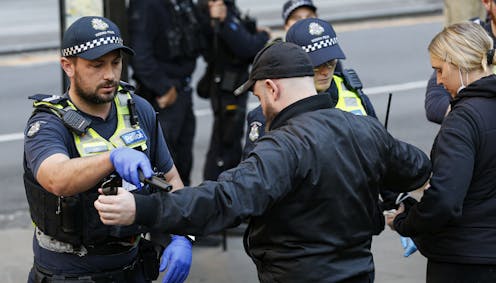
In response to the 2019 stabbing murder of 17-year-old Jack Beasly in Surfers Paradise, the Queensland government introduced a trial of wanding (using a metal detector) to detect knives and other weapons in nightclub precincts to reduce knife crime.

The laws, known as Jack’s Law, were made permanent in 2025, with the Queensland government claiming that between April 2023 and June 2025, police conducted 116,287 scans, arrested 3,080 people on 5,597 charges and removed 1,126 weapons from the streets.

We have seen a number of states roll out similar laws to Jack’s Law.

Queensland and Victoria have also restricted the possession and sale of weapons such as knives and machetes.

Do we feel safe in public?

While violent crime may not be increasing, our concerns around it often are.

The federal Report of Government Services shows most of us feel safe in our houses at night and in our neighbourhood during the day but it is a different story at night.

The data indicate that in every state, fewer than 40% of people felt safe on public transport at night in 2023-24. Over the same period across every state, less than 60% of people felt safe walking around their neighbourhood at night.

So while the data tell us violent crime is not on the increase in Australia, many of us still fear our streets are getting less safe.

But we can be reassured governments are reacting to and addressing perceived public concerns around the weapons in public and their use in violence offences in Australia.

The Conversation

Terry Goldsworthy does not work for, consult, own shares in or receive funding from any company or organisation that would benefit from this article, and has disclosed no relevant affiliations beyond their academic appointment.

ref. When it comes to weapons on Australian streets, do our perceptions match reality? – https://theconversation.com/when-it-comes-to-weapons-on-australian-streets-do-our-perceptions-match-reality-260099

Sleepy birds, quiet dawns: how noisy, bright city nights disrupt and change birdsong

Source: The Conversation (Au and NZ) – By Juli Gaviraghi Mussoi, Lecturer in Ecology, University of Waikato

Juli Gaviraghi Mussoi, CC BY-NC-ND

We’ve all had a bad night’s sleep, with a snoring partner, a crying baby or neighbours having too much fun. Sleep disturbances are common and have unpleasant consequences the day after, including feeling unmotivated and struggling to communicate.

But it turns out we are not alone in this. Our new study reveals birds also suffer when their sleep is disrupted, and it shows in their singing.

Why birds sing

Birds’ vocalisations are extraordinarily diverse. They range from simple calls, like a chicken cluck, to complex mimicry of other sounds, sometimes even human voices.

These vocalisations are important for birds to share information about themselves and their surroundings.

Calls are usually short and simple. They are often used for social communication, such as signalling danger or food, for kin recognition or to maintain social bonds.

Blackbird alarm call.
Uku Paal, XC1024751, CC BY-NC-SA263 KB (download)

Songs are more complex and melodious and are used to attract mates, protect a territory or claim a new one.

To produce such sounds, birds must coordinate several body systems, including many parts of the brain, lungs and throat muscles. Because vocalisations are intricate and require precise timing, they are susceptible to errors.

In many species, birds that sing more frequently and with a greater complexity can attract better mates and defend territories. Therefore, a poor-quality song can seriously affect a bird’s ability to reproduce and survive.

Sleeping in disturbed environments

Scientists have confirmed that all animals studied so far need sleep. This ranges from jellyfish and worms to whales and birds.

Many animals spend a large proportion of their lives sleeping, with some, such as bats, being reported to sleep up to 20 hours per day.

But sleep quality is increasingly compromised by urbanisation. With ever-expanding cities, disturbances such as light at night, noise pollution and introduced predators are common even in once remote areas. This means many birds live and sleep in highly disturbed environments.

Studies show birds that experience noise and light pollution sleep less, wake up more often and have less intense sleep. Just like for humans, sleep is important for birds for brain development, memory, learning, motivation, stress levels, cognition and communication.

Common Myna (Acridotheres tristis) in Rabindra Sarobar, South Kolkata, West Bengal, India.
Common mynas are well adapted to urban environments but nevertheless sing less after a bad night’s sleep.
Tisha Mukherjee/Wikimedia Commons, CC BY-SA

Sleep-deprived birds sing less and rest more

In our research, we focused on common mynas to explore what happens to birds’ vocalisations when they don’t get enough sleep.

We measured the amount and complexity of their songs and calls after a normal night of sleep versus disturbed nights.

Common myna singing with normal sleep.
Juli Gaviraghi Mussoi, CC BY-NC-SA364 KB (download)

After just one bad night of sleep, common mynas sang fewer and less complex songs. They also spent more time resting during the day. This suggests the birds were less motivated to sing the day after and prioritised napping instead.

Common myna singing after a night of disrupted sleep.
Juli Gaviraghi Mussoi, CC BY-NC-SA208 KB (download)

In a previous study with Australian magpies, we found a similar result. Magpies sang less and even lost interest in eating their favourite treat after one night of sleep deprivation.

We also tested whether half a night of sleep disturbances (either first or second half) was enough to affect common mynas’ vocal behaviour and activity and found that it was. Mynas sang less and rested more after even half a night’s disrupted sleep.

Interestingly, birds disturbed in the first half of the night sang less than those disturbed in the second half, though a full night of disruption still had the strongest effect.

Beyond singing, we found their calls also changed. Sleepy common mynas produced longer and lower pitched calls. Since these calls are used for recognition and social communication, the changes could affect how these highly social birds interact.

Why this matters for birds

Our findings reveal that even short-term sleep disturbances can affect how much and how well birds vocalise. But in nature, sleep disruption is rarely a one-off event. Light and noise pollution are chronic issues, present year-round.

This means the quality of birds’ songs and calls is likely to be constantly compromised. This raises concerns about the impact urbanisation might be having on bird communication, reproduction and survival.

While common mynas are an invasive species in most parts of the world and are well adapted to urban environments, native species are likely to be less able to cope with sleep disruption driven by urbanisation.

Urban centres can take steps to reduce night disturbances and improve birds’ sleep patterns. This includes increasing the number of safer and quieter roosting areas, such as trees and urban parks. It could also mean eliminating unnecessary lighting or using dimmers and downward-facing, warm lights.

Restrictions on heavy or highly modified vehicles and the use of fireworks would lower noise pollution at night to protect natural sleep patterns of the wildlife we share our cities with.

The Conversation

This study was supported by a student grant from the Australasian Society for the Study of Animal Behaviour and a doctoral scholarship from the University of Auckland.

ref. Sleepy birds, quiet dawns: how noisy, bright city nights disrupt and change birdsong – https://theconversation.com/sleepy-birds-quiet-dawns-how-noisy-bright-city-nights-disrupt-and-change-birdsong-261459

Queensland teachers are striking. It’s not just about money – they are asking for a profession worth staying in

Source: The Conversation (Au and NZ) – By Glenys Oberg, PhD candidate in education and trauma, The University of Queensland

Queensland’s public school teachers will walk off the job on Wednesday in their first statewide strike in 16 years.

The state’s teaching union has asked parents to keep their primary and high school children home for the day.

While some media reports have framed this as a pay dispute, teachers insist this is about unsafe working conditions, excessive workloads and not enough resources.

Why are teachers striking?

There are, on average, 119 violent incidents in Queensland schools per day.

Teachers describe being punched, kicked and spat on by students and not given any support by their schools.

Particularly since 2018, inclusion policies have brought more students with complex needs into mainstream classrooms. Although the benefits of inclusion are proven, in Queensland this has not been accompanied by extra support.

How rare is a teachers’ strike?

This strike is unusual. Queensland teachers haven’t staged a full-day, statewide walkout since 2009.

Across Australia, such large-scale action is also rare but not unprecedented. New South Wales teachers took part in a strike in 2021 over similar issues: staff shortages, heavy workloads and stagnating pay.

Victorian teachers are also reported to be considering a strike over their latest pay deal.

What’s on the table?

In negotiations this year, the Queensland government has offered teachers an 8% pay rise over three years – with some allowances like A$100 for overnight camps.

But teachers say this won’t keep pace with inflation or with NSW, where a recent deal lifted starting teacher salaries to $87,550 and “experienced” teacher salaries to $125,723. Victorian classroom teachers earn from $79,589 to $118,063.

By comparison, Queensland’s teachers start at $84,078. A “senior” teacher earns $116,729.

Still, this isn’t just about salaries. As Queensland Teachers’ Union president Cresta Richardson says, “pay is important – but it’s not the only issue.”

Teachers want class sizes capped at sustainable levels – they are currently capped at 25 students per class until Year 3 and 28 students per class for years 4 to 10. The OECD average is 21 for primary students.

Teachers also want more time for planning and more support staff – teacher aides and counsellors – to help meet student needs.

These are the conditions that will let them do their jobs. This has been echoed by research in the United Kingdom and Australia, which found increasing workloads are a leading reason teachers give when they leave the profession.

Media coverage has missed the point

Some recent media coverage has portrayed teachers as greedy or out of touch. Lines like teachers “strike over pay […] how do they compare to nurses, police and retail workers?” create a misleading comparison that ignores the growing complexity of teachers’ roles.

Other articles focus on the inconvenience to parents, casting the strike as selfish.

The emotional toll: what the research shows

My own research, drawn from a national study of nearly 2,000 teachers, found alarmingly high levels of compassion fatigue, secondary traumatic stress and burnout.

Compassion fatigue occurs when ongoing exposure to students’ trauma and distress erodes teachers’ emotional resilience. Over time, it leads to exhaustion, disengagement and leaving the profession.

Secondary traumatic stress is the emotional distress that results from indirect exposure to trauma – when teachers repeatedly support students dealing with abuse, neglect, or hardship. It mirrors post-traumatic stress symptoms, including intrusive thoughts, emotional numbing and hypervigilance.

In my study, more than 72% of teachers scored in the moderate-to-high range for secondary traumatic stress, and more than 75% were at moderate or high risk for burnout. Teachers described feeling emotionally drained, detached from their work, and on the verge of leaving the profession due to cumulative emotional demands.


Read more:
‘It feels like I am being forced to harm a child’: research shows how teachers are suffering moral injury


A national issue

This is not just a Queensland problem. Across the country, teachers face rising expectations without the time, training or systemic support to meet them. When asked what would help, teachers say they want better staffing, stronger leadership, professional autonomy and policy reform.

These reforms include a reduction in administrative burdens, which would allow more time for lesson planning and direct support of students. They want adequate school-based mental health services, so emotional care of students does not fall solely on teachers acting as de facto counsellors.

Teachers also seek fair and consistent supports for students with extra needs, including access to specialist staff. In addition, they want protection from violence, including legal reforms that acknowledge the risks they face in their workplaces.

Finally, teachers want dedicated time for professional learning – that does not get overtaken by bureaucratic reporting tasks.

Ultimately, they are asking for a profession worth staying in. One where they’re not afraid at work. One where they have time to teach and where doing your job doesn’t mean burning out.

The Conversation

Glenys Oberg does not work for, consult, own shares in or receive funding from any company or organisation that would benefit from this article, and has disclosed no relevant affiliations beyond their academic appointment.

ref. Queensland teachers are striking. It’s not just about money – they are asking for a profession worth staying in – https://theconversation.com/queensland-teachers-are-striking-its-not-just-about-money-they-are-asking-for-a-profession-worth-staying-in-262496

Could we one day get vaccinated against the gastro bug norovirus? Here’s where scientists are at

Source: The Conversation (Au and NZ) – By Grant Hansman, Senior Research Fellow, Institute for Biomedicine and Glycomics, Griffith University

Pearl PhotoPix/Shutterstock

Norovirus is the leading cause of acute gastroenteritis outbreaks worldwide. It’s responsible for roughly one in every five cases of gastro annually.

Sometimes dubbed the “winter vomiting bug” or the “cruise ship virus”, norovirus – which causes vomiting and diarrhoea – is highly transmissible. It spreads via contact with an infected person or contaminated surfaces. Food can also be contaminated with norovirus.

While anyone can be infected, groups such as young children, older adults and people who are immunocompromised are more vulnerable to getting very sick with the virus. Norovirus infections lead to about 220,000 deaths globally each year.

Norovirus outbreaks also lead to massive economic burdens and substantial health-care costs.

Although norovirus was first identified more than 50 years ago, there are no approved vaccines or antiviral treatments for this virus. Current treatment is usually limited to rehydration, either by giving fluids orally or through an intravenous drip.

So if we’ve got vaccines for so many other viruses – including COVID, which emerged only a few years ago – why don’t we have one for norovirus?

An evolving virus

One of the primary barriers to developing effective vaccines lies in the highly dynamic nature of norovirus evolution. Much like influenza viruses, norovirus shows continuous genetic shifts, which result in changes to the surface of the virus particle.

In this way, our immune system can struggle to recognise and respond when we’re exposed to norovirus, even if we’ve had it before.

Compounding this issue, there are at least 49 different norovirus genotypes.

Both genetic diversity and changes in the virus’ surface mean the immune response to norovirus is unusually complex. An infection will typically only give someone immunity to that specific strain and for a short time – usually between six months and two years.

All of this poses challenges for vaccine design. Ideally, potential vaccines must not only induce strong, long-lasting immunity, but also maintain efficacy across the vast genetic diversity of circulating noroviruses.

Recent progress

Progress in norovirus vaccinology has accelerated over the past couple of decades. While researchers are considering multiple strategies to formulate and deliver vaccines, a technology called VLP-based vaccines is at the forefront.

VLP stands for virus-like particles. These synthetic particles, which scientists developed using a key component of the norovirus (called the major caspid protein), are almost indistinguishable from the natural structure of the virus.

When given as a vaccine, these particles elicit an immune response resembling that generated by a natural infection with norovirus – but without the debilitating symptoms of gastro.

What’s in the pipeline?

One bivalent VLP vaccine (“bivalent” meaning it targets two different norovirus genotypes) has progressed through multiple clinical trials. This vaccine showed some protection against moderate to severe gastroenteritis in healthy adults.

However, its development recently suffered a significant setback. A phase two clinical trial in infants failed to show it effectively protected against moderate or severe acute gastroenteritis. The efficacy of the vaccine in this trial was only 5%.

In another recent phase two trial, an oral norovirus vaccine did meet its goals. Participants who took this pill were 30% less likely to develop norovirus compared to those who received a placebo.

This oral vaccine uses a modified adenovirus to deliver the norovirus VLP gene sequence to the intestine to stimulate the immune system.

With the success of mRNA vaccines during the COVID pandemic, scientists are also exploring this platform for norovirus.

Messenger ribonucleic acid (mRNA) is a type of genetic material that gives our cells instructions to make proteins associated with specific viruses. The idea is that if we subsequently encounter the relevant virus, our immune system will be ready to respond.

Moderna, for example, is developing an mRNA vaccine which primes the body with norovirus VLPs.

The theoretical advantage of mRNA-based vaccines lies in their rapid adaptability. They will potentially allow annual updates to match circulating strains.

Researchers have also developed alternative vaccine approaches using just the norovirus “spikes” located on the virus particle. These spikes contain crucial structural features, allowing the virus to infect our cells, and should elicit an immune response similar to VLPs. Although still in early development, this is another promising strategy.

Separate to vaccines, my colleagues and I have also discovered a number of natural compounds that could have antiviral properties against norovirus. These include simple lemon juice and human milk oligosaccharides (complex sugars found in breast milk).

Although still in the early stages, such “inhibitors” could one day be developed into a pill to prevent norovirus from causing an infection.

Where to from here?

Despite recent developments, we’re still probably at least three years away from any norovirus vaccine hitting the market.

Several key challenges remain before we get to this point. Notably, any successful vaccine must offer broad cross-protection against genetically diverse and rapidly evolving strains. And we’ll need large, long-term studies to determine the durability of protection and whether boosters might be required.

Norovirus is often dismissed as only a mild nuisance, but it can be debilitating – and for the most vulnerable, deadly. Developing a safe and effective norovirus vaccine is one of the most pressing and under-addressed needs in infectious disease prevention.

A licensed norovirus vaccine could drastically reduce workplace and school absenteeism, hospitalisations and deaths. It could also bolster our preparedness against future outbreaks of gastrointestinal pathogens.

Grant Hansman works at Griffith University as an independent research leader on norovirus therapeutics.

ref. Could we one day get vaccinated against the gastro bug norovirus? Here’s where scientists are at – https://theconversation.com/could-we-one-day-get-vaccinated-against-the-gastro-bug-norovirus-heres-where-scientists-are-at-258909

World’s biggest coral survey confirms sharp decline in Great Barrier Reef after heatwave

Source: The Conversation (Au and NZ) – By Daniela Ceccarelli, Reef Fish Ecologist, Australian Institute of Marine Science

Official analysis of 124 reefs on the Great Barrier Reef shows coral cover has dropped sharply after a record-breaking marine heatwave in 2024, prompting grave fears over the trajectory of the natural wonder.

Over the past few years, fast-growing corals had pushed the Great Barrier Reef’s coral cover to record highs. But those corals were known to be extremely vulnerable and one bad summer away from losing those gains.

Our new report by the Australian Institute of Marine Science (AIMS) shows these fears have been realised. The percentage of living hard coral covering the Great Barrier Reef’s surface dropped in each region we surveyed.

The recent extreme highs and lows in coral cover are a troubling phenomenon. It raises the prospect that the Great Barrier Reef may reach a point from which it cannot recover.

Another global marine heatwave

In healthy corals, tiny algae produce both the coral’s main food source and its vibrant colours. When the water gets too warm, the algae are expelled and the coral’s tissue becomes transparent – revealing the white limestone skeleton beneath. This is called coral bleaching.

Coral can recover if temperatures are reduced and the relationship with the algae is restored, but it’s a stressful and difficult process. And if recovery takes too long, the coral will die.

In June 2023, a marine heatwave bleached coral reefs from the Caribbean to the Indian and Pacific Oceans.

It reached Australia’s east coast in February 2024, causing extensive coral bleaching. Aerial surveys showed three quarters of 1,080 reefs assessed had some bleaching. On 40% of these reefs, more than half the corals were white.

In the aftermath, in-water surveys measured how much coral died in the northern, central and southern Great Barrier Reef. The worst damage lined up with the highest levels of heat stress.

Sharp declines in coral cover

AIMS has surveyed reefs of the Great Barrier Reef each year since 1986, in a project known as the Long-Term Monitoring Program. It is the most extensive record of coral status on any reef ecosystem in the world.

One component of the surveys involves towing an expert observer behind a boat around the full perimeter of each reef. The observer records the amount of live, bleached and dead coral. These observations are then averaged for each location, and for each of the three regions of the Great Barrier Reef.

After each monitoring season we report on the percentage of living hard coral covering the Great Barrier Reef’s surface. It’s a coarse but robust, reliable indicator of the state of the Great Barrier Reef.

Coral losses this year were not uniform across the Great Barrier Reef. On the northern Great Barrier Reef, from Cape York to Cooktown, average coral cover dropped by about a quarter between 2024 and 2025 (from 39.8% to 30%). The largest declines on individual reefs (up to 70% loss) occurred near Lizard Island.

Reefs with stable or increasing coral cover were mostly found in the central region, from Cooktown to Proserpine. However, there was still a region-wide decline of 14% (from 33.2% to 28.6%), and reefs near Cairns lost between 17-60% of their 2024 coral cover.

In the southern reef (Proserpine to Gladstone) coral cover declined by almost a third. In the summer of 2024, southern reefs experienced the highest levels of heat stress ever recorded, resulting in substantial coral loss (from 38.9% to 26.9%).

The declines in the north and south were the largest in a single year since monitoring began 39 years ago.

Despite these losses, the Great Barrier Reef still has more coral than many other reefs worldwide, and remains a major tourist attraction. It’s possible to find areas that still look good in an ecosystem this huge, but that doesn’t mean the large-scale average hasn’t dropped.

More frequent bleaching events

Mass coral bleaching is becoming more frequent as the world warms.

Before the 1990s, mass bleaching was extremely rare. That changed in 1998 with the first major event, followed by another in 2002.

Back-to-back bleaching events occurred for the first time in 2016 and 2017. Since then, bleaching has struck the Great Barrier Reef in 2020, 2022, 2024, and again this year. The impacts of this year’s bleaching event will be revealed following the next round of surveys.

The time between these events is shrinking, giving corals less time to recover. Cyclones and crown-of-thorns starfish are also continuing to cause widespread coral loss.

You’ll see in the following charts how the percentage of coral cover has changed over time. The vertical yellow lines show the mass coral bleaching events increasing in frequency.

Confronting questions

The coral reefs of the future are unlikely to look like those of the past. The loss of biodiversity seems inevitable.

But will the reefs of the future still sustain the half a billion people that depend on them for food and income? Will they continue to protect coastlines from increasing storm activity and rising sea levels? These are confronting questions.

Effective management and research into reef adaptation and recovery interventions may bridge the gap until meaningful climate action is achieved. But above all, the key to securing a future for coral reefs is reducing greenhouse gas emissions.

Daniela Ceccarelli works for the Australian Institute of Marine Science, a publicly funded research organisation that receives funding from the Australian government, state government departments, foundations and private industry.

David Wachenfeld works for the Australian Institute of Marine Science, a publicly funded research organisation that receives funding from the Australian government, state government departments, foundations and private industry.

Mike Emslie works for the Australian Institute of Marine Science, a publicly funded research organisation that receives funding from the Australian government, state government departments, foundations and private industry.

ref. World’s biggest coral survey confirms sharp decline in Great Barrier Reef after heatwave – https://theconversation.com/worlds-biggest-coral-survey-confirms-sharp-decline-in-great-barrier-reef-after-heatwave-260563

The digital economy could turbocharge our productivity, but we need to get the settings right

Source: The Conversation (Au and NZ) – By Stephen King, Professor of Economics, Monash University

Chris WM Willemsen/Shutterstock

Data and new digital technologies such as artificial intelligence present an opportunity to get Australia back on the path to productivity growth.

But we can only seize this opportunity with the right policy framework. Australia can unlock billions in economic value through strategic reforms to data access, artificial intelligence regulation, and digital infrastructure.

The Productivity Commission has released a report on Data and Digital Technologies, of which I am a co-author, to guide Australian policymakers to develop this framework. This is the third of five reports due ahead of the government’s reform roundtable later this month.

Our key recommendations include:

  • building on existing regulation rather than adding new rules
  • improving privacy protections for consumers
  • giving consumers more access to data about them.

Building on the regulation we already have

Artificial intelligence (AI) can extract useful insights from massive datasets in a fraction of a second. It could transform the global economy and speed up productivity growth by automating huge numbers of routine tasks.

Early estimates suggest AI could boost productivity by 0.5% to 13% over the next decade. That is potentially more than the combined productivity benefits from the 2004-14 internet and mobile phone revolutions.

Australian businesses are already embracing AI technology. From autonomous mining trucks to fraud detection in banking, AI is boosting productivity across our economy.

But poorly designed regulation could stifle investment in AI without improving outcomes. To avoid this, the Productivity Commission recommends an outcomes-based approach to AI regulation. This would build on our existing laws and regulatory structures to minimise harms and create certainty for consumers and businesses.

New technology-specific regulations should only be introduced as a last resort. The government’s proposal for “mandatory guardrails” should be paused.

The first step is to review our existing laws, checking that any potential issues from adopting AI are covered or can be covered by those laws. Regulatory changes should only be considered if clear gaps are identified.

We urgently need coordination and consistency to give businesses the certainty they need to invest.

Tick-the-box privacy protections

Data is the feedstock for digital technology. But there are problems with our current data rules.

First, privacy laws have become a “tick-the-box” process. You log in online and want a service, so you tick the relevant box. The Australian Competition and Consumer Commission found it would take an average consumer 46 hours per month to read every privacy policy they encounter.

So consumers get faux privacy protection while the privacy laws just get bigger and bigger, burying business in red tape.

It would take hours to read every privacy policy that consumers agree to.
Jevanto Productions/Shutterstock

The government should introduce an outcomes-based alternative for business. This means that a business would meet its privacy obligations so long as it used any identifiable data in the best interests of consumers.

Focusing on the consumers’ interests would increase trust in our privacy laws, allow business to innovate, potentially lower compliance costs, and provide for real consequences when a business fails to meet its privacy obligations.

Access to personal data

Second, while data about individuals and businesses underpins growth and value in the digital economy, one group is missing out. You!

While businesses can create value from the data they gather about consumers, that data is often unavailable to the consumers themselves. And where it is available, it is often in a hard-to-use form, such as a PDF, or in an edited version where the business keeps some data to itself.

Under the right conditions, giving people and businesses better access and control over the data about them can stimulate competition. It can allow entrepreneurs and existing firms to develop innovative products and services.

Productivity Commission analysis suggests that a better data-sharing regime could add up to A$10 billion to Australia’s annual economic output.

Our new, measured approach would help to guide expanded data access, starting with sectors where gains could be significant, for example:

  • enabling farmers to combine real-time data feeds from their machinery and equipment to optimise their operations

  • giving tenants on-demand access to their rental ledgers which they can share to prove on‑time payments to new landlords or lenders.

Company reporting is stuck in the 1900s

The Productivity Commission’s report also considers a range of related issues. For example, company financial reporting should become digital by default.

Financial reports provide essential information about a company’s financial performance. They ensure companies are transparent and accountable, while informing the decisions of investors, businesses and regulators.

Most major overseas countries have digital reporting, allowing quick, easy access to comparable financial data. But Australia still has hard copy or PDF reports.

Our companies need to leave the 1900s and move to digital financial reporting. The federal government should require companies to lodge their financial reports with the Australian Securities and Investments Commission in machine-readable form and remove the requirement to submit them in hard copy or PDF format.

Data and digital technologies can make us all better off over time, but the transition is measured in years and decades, and there will be people who need support along the way.

Without the proper foundations, Australia will see other countries seizing the data and digital opportunities while we are left behind. The Productivity Commission report lays out these foundations to support our productivity growth.

Stephen King is a Commissioner at the Productivity Commission.

ref. The digital economy could turbocharge our productivity, but we need to get the settings right – https://theconversation.com/the-digital-economy-could-turbocharge-our-productivity-but-we-need-to-get-the-settings-right-262232

Thousands of games have been censored from major platforms, with LGBTQIA+ creators caught in the crossfire

Source: The Conversation (Au and NZ) – By Phoebe Toups Dugas, Associate Professor of Human-Centred Computing, Monash University

Shutterstock

Online game marketplaces itch.io and Valve’s Steam have recently delisted or completely removed more than 20,000 titles from their storefronts, after not-for-profit group Collective Shout pressured payment processors to change their rules.

Although Collective Shout claims the move was about censoring games that depict rape and incest content, a number of LGBTQIA+ creators have been caught in the purge.

I am a queer, trans woman and game designer who studies inclusivity. LGBTQIA+ creators have long made games to express our stories. Such expression often necessarily engages with bodies and sexuality.

While content about us is seen by some as innately “harmful” and “sexual”, it is essential for wellbeing. Conservative groups have long aimed to censor our art, voices and games.

What makes the recent removals unusual is that they were not driven by government (which may be a separate problem in Australia and the United Kingdom).

Instead, they were driven by a supposed “anti-porn” group that frightened payment processors into undercutting online game storefronts’ own rules, resulting in itch.io reportedly delisting some 20,000 games, and Steam also removing hundreds.

How games are made and distributed

From AAA megastudios to small, independent teams, game developers produce thousands of games per year. The emergence of low-cost, accessible tools has removed barriers to making games.

For many LGBTQIA+ people, making and sharing games is a way to unpack trauma, discover oneself and share experiences.

One game still available on Itch.io is Secret Little Haven. Played through a simulated 90s computer, users can live out the experiences of a transgender woman.
Screenshot by author.

Online game storefronts such as itch.io and Steam offer a streamlined way for creators to share games. Both game stores also double as social hubs where people can discuss games.

Itch.io is a thriving community that is free and simple to use. In its 12 years, it has earned the goodwill of the LGBTQIA+ community due to its openness and lack of restrictions.

Steam, meanwhile, has become one of the world’s foremost sources for games. Most major games are released on Steam.

Itch.io has substantially fewer resources, but hosts a similar amount of content to Steam.

While Valve reportedly earned a revenue of US$5 billion in 2024 (about A$7.7 billion), itch.io is run by a much smaller team of mostly volunteers.

A sudden mass censorship

Generally, online storefronts will censor media at the behest of governments. Censorship can be used to manipulate how people think and act. One could expect (or hope) it is done carefully and for the public good (such as to prevent violence).

Itch.io has maintained neutrality about what can be shared, relying on creators to tag their content – which they do. Steam, on the other hand, reviews adult content before adding it to its storefront, and imposes strict guidelines on content. However, these guidelines have recently become less clear.

In both cases, users decide what kind of content they want to be shown.

What we’re seeing now is not government censorship, but private payment processing companies deciding what content is available. And as these companies are global, their policy changes can impact people worldwide.

Australian non-profit Collective Shout spent years pressing Valve to remove games it found objectionable. When this proved ineffective, the group targeted payment processors including PayPal, Visa and Mastercard.

The group published an open letter on July 11 decrying online game storefronts, alongside a coordinated email campaign.

On July 16, Valve updated its policy to allow payment processors to set rules for allowed content. It then removed certain targeted games from its store.

Itch.io followed: on July 23, the store hid all “not safe for work” (NSFW) titles from search. With a small team and massive library, itch.io had to act fast. The broad-stroke move disproportionately impacted LGBTQIA+ creators.

LGBTQIA+ creators often develop games from lived experience, which often involves themes such as relationships, sex, and bodies (including genitals), all of which may be deemed NSFW. These creators did due diligence to mark their games as NSFW, to ensure that players are aware of potential triggers.

Itch.io is now working to minimise damages and relist content that takes no payment. It is also trying to find new payment processors.

A PayPal spokesperson told The Conversation:

PayPal is committed to maintaining a safe platform for its customers and will take appropriate action when we identify activity that violates the law, our policies, or the policies of our partner banks and card networks.

The dangers of LGBTQIA+ erasure

The social networks of online game storefronts offer community to LGBTQIA+ people. When these communities are taken away, we can experience a kind of “digital death”.

One itch.io game caught in the purge is SABBAT (2013). This game involves assembling a monstrous body, with themes including changing bodies (including genitals) and violence.

While these themes may not appeal to many, they would be relatable – and therefore meaningful – for many transgender players. SABBAT can still be directly accessed on itch.io, but it doesn’t show up in the search results.

SABBAT, by Ohnoproblems, is a game that explores feelings of liberation through (gender) transition and empowerment.
Author’s screenshot/itch.io

Grunge, the 2019 Melbourne Queer Games Festival Silver Award winner, was also delisted. This game is about queer love and navigating a new school. While the author warns the content is mature, including some sexual content, the game does not involve rape or incest.

Grunge, an award-winning game by CrossXGames, addresses queer love. It was delisted.
Author’s screenshot.

What comes next?

Gamers are responding to Steam and itch.io’s actions. One online petition calling on payment processors to remove policies that lead to censorship has collected more than 200,000 signatures. We expect change.

LGBTQIA+ people deserve community, self-discovery and the ability to survive and thrive in society. Censorship decisions that affect us cannot be made unilaterally. They are not the remit of payment processors, and they should not be in the hands of a single group.

Moving forward, the gaming industry and player communities need more nuanced conversations about game (and media) access. And these conversations must include a diversity of people.

The LGBTQIA+ community has come a long way towards gaining representation and visibility in the gaming world, and this has helped many of us. We will continue to make our art seen, our voices heard, and our games played.

Valve, itch.io, Mastercard and Visa did not respond to The Conversation’s request for comment.


Read more:
Video games can help trans players feel seen and safe. It all starts with design


Phoebe Toups Dugas does not work for, consult, own shares in or receive funding from any company or organisation that would benefit from this article, and has disclosed no relevant affiliations beyond their academic appointment.

ref. Thousands of games have been censored from major platforms, with LGBTQIA+ creators caught in the crossfire – https://theconversation.com/thousands-of-games-have-been-censored-from-major-platforms-with-lgbtqia-creators-caught-in-the-crossfire-262040

NCEA isn’t perfect but NZ shouldn’t forget why it was introduced in the first place

Source: The Conversation (Au and NZ) – By David Pomeroy, Senior Lecturer in Mathematics Education, University of Canterbury

jittawit.21/Getty Images

Education Minister Erica Stanford has called time on “credit counting”, announcing plans to scrap the National Certificate of Educational Achievement (NCEA).

Under the proposed changes, from 2028 NCEA Level 1 will be replaced by foundational literacy and numeracy tests, dramatically reducing the amount of assessment in Year 11. Levels 2 and 3 will be replaced by a New Zealand Certificate of Education and an Advanced Certificate.

The current achieved, not achieved, merit and excellence grades will give way to marks out of 100 and traditional letter grades: A, B, C, D and E. Students in Years 12 and 13 will be required to study at least five complete subjects and pass four of them in order to gain each certificate.

The reforms are meant to address long-standing concerns over how students accumulate credits to complete their qualifications. With NCEA, students can opt out of assessments, including final exams, once they have accumulated enough credits.

But as the government seeks to address the “gaming” of the system, it shouldn’t lose sight of why NCEA was introduced in the first place – and who it was designed to help.

While the system has its flaws, a return to an exam-based model may not make the grade either.

Addressing uneven achievement

NCEA was introduced between 2002 and 2004 to replace the School Certificate, Sixth Form Certificate and Bursary qualifications.

Its aim was to broaden educational success, recognising diverse forms of learning as legitimate. The previous qualifications primarily valued traditional academic subjects because those were, in large part, the only ones available for assessment.

NCEA represented a shift away from viewing vocational learning – for example, in trades or creative subjects – as less valuable and not a viable path to formal qualifications.

It also marked a departure from “norms” based assessment, which scaled student results to fit predetermined pass and fail rates. In contrast, NCEA was “standards” based: if a student could demonstrate the required skills or knowledge, they received the credits.

But since the early days of NCEA, there have been concerns students could achieve the qualifications without really having gained an adequate education.

The flexibility of NCEA – allowing schools, teachers and students to tailor learning pathways – is both its greatest strength and its greatest weakness. It has been criticised for being confusing, inconsistent and lacking credibility.

Last year, Mike Grimshaw, an associate professor of sociology at Canterbury University, raised concerns that students were entering university “functionally illiterate”. He said New Zealand was “under-educating but over qualifying”.

Concerns such as this over NCEA have fuelled repeated calls for reform.

Whiplash for schools

While few dispute changes are needed, the scale and pace of the government’s proposals are another matter.

Schools have already contended with numerous policy shifts under this government, including rapid curriculum changes and new assessments in primary and secondary schools. Now they are being told the entire NCEA framework will be replaced. The sheer volume and speed of these changes puts significant pressure teachers.

This is not the only concern.

Under NCEA, a Year 12 student who worries they might fail the calculus “standard” can still do maths, knowing they have the option not to sit the calculus exam. Under the new system, this sort of flexibility disappears. Students will either take Year 12 mathematics – or they will not.

This inflexibility raises the stakes. It may deter students from taking certain subjects altogether for fear of failure.

The renewed emphasis on exams is also problematic. Research has shown exam outcomes can be influenced by gender, anxiety and even personal circumstances on exam day. In other words, exams are not necessarily the “credible” measure of learning they are made out to be.

There are also important questions that the government’s policy consultation proposal does not answer. What are the options for a student who fails the certificate on their first attempt? Will schools still be able to tailor internal assessments to suit their students?

Room for some optimism

There are, however, reasons for cautious optimism. The government has promised to retain the NCEA standards-based approach.

Preserving the integrity of whole subjects means students are more likely to learn topics, such as algebra, that keep academic options open but are often left out in NCEA.

But this will come at a cost. The stakes will feel higher and students will face greater pressure to succeed.

NCEA delivered on the promise that we shouldn’t automatically assume half of our population will fail. Over the past two decades, more young people have left school with qualifications. But did they learn more? That remains an open question.

The new system will likely bring consistency and arguably credibility to high school qualifications. But some students will pay the price of this higher-stakes approach to education.

David Pomeroy receives funding from the Teaching and Learning Research Initiative (TLRI).

ref. NCEA isn’t perfect but NZ shouldn’t forget why it was introduced in the first place – https://theconversation.com/ncea-isnt-perfect-but-nz-shouldnt-forget-why-it-was-introduced-in-the-first-place-262501

The hubris arc: how visionary politicians turn into authoritarians

Source: The Conversation (Au and NZ) – By Trang Chu, Associate Fellow, Saïd Business School, University of Oxford

Shutterstock/Pandagolik1

What turns a democratically elected leader into an authoritarian? The process is rarely abrupt. It unfolds gradually and is often justified as a necessary reform. It is framed as what the people wanted. All this makes it difficult for citizens to recognise what is happening until it’s too late.

Consider Viktor Orbán’s transformation in Hungary. Once celebrated as a liberal democrat who challenged communist rule, Orbán now controls 90% of the Hungarian media and has systematically packed the country’s constitutional court. His trajectory is now widely recognised as a textbook case of democratic backsliding.

Turkish president Recep Tayyip Erdoğan was initially praised for showing that democracy and Islamic governance could coexist. In early reforms, he lifted millions from poverty by challenging Turkey’s secular establishment – a feat that required exceptional confidence and a bold vision. Now, a decade on, Erdoğan has turned Turkey into what political scientists call a competitive authoritarian regime.

In the US, Donald Trump rose to power promising to “drain the swamp”. In Brazil, Jair Bolsonaro campaigned as an anti-corruption crusader who would restore the country’s moral foundations. Both have since weaponised democratic institutions to consolidate their own power.

Part of this shift is a psychological process we term the hubris arc. This sees a visionary leader become increasingly myopic once in office. Their early successes bolster their belief in their transformative capabilities, which gradually diminishes their capacity for self-criticism.

The visionary stage typically coincides with systemic failure. When established institutions prove inadequate for addressing public grievances, it provides fertile ground for leaders with exceptional self-confidence to emerge. These outsiders succeed precisely because they possess the psychological conviction that they can challenge entrenched systems and mobilise mass support through bold, unconventional approaches.

Such leaders excel at crafting compelling narratives that enable them to to transform public frustration into electoral momentum. They offer simplified solutions to complex problems, providing certainty where establishment politicians offer only incrementalism and compromise.

Losing perspective

But as visionary capacity increases, so too does myopia. Seeing a singular path with exceptional clarity necessitates narrowing one’s perceptual field.

These leaders initially succeed because their heightened focus cuts through the paralysis of nuanced thinking. But they quickly reach an inflection point where they face a fundamental choice: accept institutional constraints as necessary feedback mechanisms or redefine them as obstacles to their vision.

When dissenting voices magically drop away.
Shutterstock/Cartoon Resource

Those who maintain a productive vision actively build systems for honest feedback. They allow formal channels for dissent to continue and construct diverse advisory teams.

Where strong democratic institutions endure – independent media, empowered legislatures, autonomous courts – leaders must continue negotiating and compromising. This tends to keep their confidence grounded. Some leaders successfully work within these constraints, which proves that the descent into myopia is actually more a reflection of institutional weakness than psychological destiny.

Where institutions lack strength or leaders resist self-discipline, electoral success may embolden rather than restrain authoritarian tendencies. As leaders become increasingly convinced of their transformative vision, their ability to perceive alternatives diminishes.

This psychological narrowing manifests in predictable behaviours, notably eliminating dissenting voices. With every election victory, Orbán has replaced independent-minded allies with loyalists. Trump’s first presidency featured constant turnover among advisers who challenged him. His second is populated by people who can be trusted to toe the line.

Myopic decline follows when hubris reaches saturation. Once leaders systematically eliminate feedback mechanisms, they lose all capacity for self-correction. As their ability to process contradictory information deteriorates, they may increasingly conflate personal power with national interest.

This conflation appears most pronounced in cases where leaders have systematically weakened independent media and judicial oversight.

When leaders achieve complete institutional capture, this self-conception becomes institutionalised. Orbán’s declaration, “We have replaced a shipwrecked liberal democracy with a 21st-century Christian democracy,” reveals how personal vision becomes indistinguishable from national transformation.

Institutional capture occurs through different methods but serves similar purposes. Orbán’s control of the media and courts means he has created parallel institutions that exist solely to validate his vision. Erdoğan used emergency powers after a 2016 coup attempt to instigate mass purges.

In both cases, motivated reasoning becomes institutionalised: leaders come to control the institutions that usually determine what information is legitimate and enable forms of dissent.

The endpoint is a transformation in which opposition becomes an existential threat to the nation. When Orbán positions himself as defender of “illiberal democracy” against EU values, or when Erdoğan arrests his rivals, they frame dissent as treason.

Opposition is a threat not just to their power but to the nation’s essence. Maximum vision has produced maximum blindness. Institutions have been redesigned to perpetuate rather than puncture the delusion.

Resisting the decline

The robustness of democratic institutions is decisive in determining whether hubristic tendencies can be contained within democratic bounds or whether they culminate in authoritarian consolidation.

Hungary and Turkey display a more linear model of democratic erosion. Both Orbán and Erdoğan leveraged initial electoral mandates to systematically capture state institutions. Their hubris evolved from a tool for challenging establishments into a self-reinforcing system in which the regime’s vast sway over state institutions eliminated feedback mechanisms.

Bolsonaro’s slide toward authoritarianism – denying COVID science, attacking electoral systems, attempting to overturn his 2022 defeat – triggered immediate institutional pushback. Unlike Hungary or Turkey, where courts and civil society gradually bent to executive pressure, Brazilian institutions held firm.

Bolsonaro’s trajectory from populist outsider to authoritarian to electoral defeat and institutional rejection suggests that robust federal structures and an independent judiciary can function as circuit breakers. They can prevent permanent democratic capture.

The American experience presents a third model: democratic resilience under stress. Unlike Hungary and Turkey, where institutional capture succeeded, Trump’s first presidency tested whether these patterns could emerge in a system with deeper democratic roots and stronger institutional checks.

While his efforts to pressure state election officials and weaponise federal agencies followed recognisable authoritarian scripts, American institutions proved more resistant than their Hungarian or Turkish counterparts. Courts blocked key initiatives, state officials refused to “find votes,” and congressional oversight continued despite partisan pressures.

Yet even this institutional resistance came under severe strain, suggesting that democratic durability may depend more on specific design features and timing than general democratic culture.

The Trump stress test has revealed vulnerabilities. The erosion of democratic norms – when parties prioritise loyalty over constitutional obligations – creates openings for future exploitation.

The second Trump term could systematically target the weaknesses identified during his first: expanded emergency powers, strategic appointments to undermine the administrative state, and novel statutory interpretations to bypass Congress. The critical question is whether American institutions retain sufficient strength to again disrupt Trump’s trajectory.

The hubris arc appears inherent in populist psychology, underscoring why constitutional constraints and institutional checks are indispensable. Democracies survive not by finding perfect leaders but by constraining imperfect ones.

The authors do not work for, consult, own shares in or receive funding from any company or organisation that would benefit from this article, and have disclosed no relevant affiliations beyond their academic appointment.

ref. The hubris arc: how visionary politicians turn into authoritarians – https://theconversation.com/the-hubris-arc-how-visionary-politicians-turn-into-authoritarians-262562

Sudan’s rebel force has declared a parallel government: what this means for the war

Source: The Conversation (Au and NZ) – By Samir Ramzy, Researcher, Helwan University

Sudan’s south-western city of Nyala in Darfur recently became the centre of a significant political development.

After more than two years of fighting Sudan’s army, an alliance of armed and political groups backed by the paramilitary Rapid Support Forces announced the formation of a parallel government on 20 July 2025.

The new administration, dubbed the Government of Peace and Unity, is a coalition of armed movements from Darfur in Sudan’s western region, and Kordofan in the central region. Together, these regions account for about 46% of Sudan’s total land area.

The coalition has made Nyala its base. The city is a transit hub, with an airport and railway terminus. It is also a trading centre for gum arabic, one of Sudan’s largest exports and a key ingredient in making food, drinks and medicines.

The coalition’s stated aim is to establish a more representative governing structure for Sudan’s peripheral regions. It has 24 member groups.

In my view, however, the creation of a parallel government reflects the reality that neither the Rapid Support Forces nor its rival Sudanese army is close to victory. This view is informed by my research on Sudan’s political developments and its conflict dynamics for close to a decade.

The creation of a parallel government appears to be about entrenching the paramilitary group’s control in its western strongholds as the conflict continues. It risks cementing a permanent division of the country.

Why form a parallel government?

The Rapid Support Forces emerged from the Janjaweed militias that fought in Darfur, western Sudan, in the 2000s. Once allied with the state, the group grew into a powerful governmental paramilitary force, competing with the Sudanese Armed Forces for control of Sudan’s politics and economy.

When full-scale war broke out in April 2023, the Rapid Support Forces quickly seized much of western Sudan, particularly the Darfur region. It is country’s largest region, home to around 10 million people and spanning 500,000 square kilometres.

Darfur shares borders with Libya, Chad and the Central African Republic. It is also the Rapid Support Forces’ leadership’s home territory. It contains vast reserves of gold, fertile farmland and major production zones for gum arabic.

With little chance of outright military victory and its image in tatters, the paramilitary group has sought to reinvent itself politically. The group’s reputation has been devastated by reports of ethnic cleansing, sexual violence and atrocities against civilians.

The new Government of Peace and Unity is its attempt to gain favour. By forging alliances with other armed movements and community groups, the group is trying to position itself as the voice of Sudan’s marginalised peripheries.

Coalition partners include the Sudan People’s Liberation Movement-North (SPLM-N), the largest non-state armed group in Sudan. The group controls territory in Kordofan and advocates for the establishment of a secular state.

The new coalition’s founding charter calls for:

  • a decentralised political system

  • granting Sudan’s regions significant autonomy over local governance and resources.

This resonates with communities such as the Fur who have suffered decades of exclusion by Sudan’s political elite. Most of these leaders come from the country’s northern and central regions.


Read more:
Sudan’s civil war is rooted in its historical favouritism of Arab and Islamic identity


The timing of the announcement reflects both political and military calculations.

The Rapid Support Forces and its allies control large areas in western Sudan but have faced challenges expanding further east, where the Sudanese army remains entrenched.

Establishing a formal administration allows the coalition to strengthen its influence in the territories it already holds, and build alliances with local communities. It also helps create political structures that can engage with external actors.

Broadening the political base

Key figures from influential political groups have taken senior positions within the parallel government.

The Rapid Support Forces commander Mohamed Hamdan Dagalo (also known as Hemedti) has assumed the role of president of the presidential council. Abdelaziz al-Hilu, the leader of SPLM-N, was appointed as vice-president.

Fadlallah Burma, head of a faction of the Umma Party, the former ruling party, took the position of speaker of the legislative council. Mohamed al-Ta’ayshi, a politician from the Arab Ta’aisha tribe, was appointed prime minister.

Leaders from African-origin communities such as the Fur have also taken positions within the administration. Many of these groups have faced Sudanese army airstrikes and have historical grievances against the central state.

However, legitimacy at home is not enough. The Rapid Support Forces also hopes to use foreign alliances to force international recognition.

Kenya hosted the coalition’s launch conference. The group has also cultivated ties with actors in Chad, the Central African Republic, South Sudan and eastern Libya. These relationships have already helped the group consolidate control over key border areas, particularly in Libya, which spans a 382km border.

Serious challenges remain

The Rapid Support Forces-led project faces major obstacles.

Internal rivalries over power sharing have delayed the announcement of a full cabinet. Key ministries, including defence, foreign affairs and finance, remain unassigned.

Militarily, the Rapid Support Forces cannot claim uncontested authority even in its western strongholds. Sudanese army-allied forces still control El-Fasher, the capital of North Darfur. The army also maintains an overwhelming advantage in the air, making it impossible for the parallel government to project control beyond its core zones.

Internationally, the initiative has been widely condemned by the African Union and the Arab League.

The risks ahead

The failure of international mediation has left Sudan’s conflict at an impasse.

Tensions between Egypt and the United Arab Emirates – both key players in an international mediation effort that also includes the US and Saudi Arabia – have further complicated the search for a political solution.

Their tensions led to the postponement of a peace meeting in Washington in July 2025. The meeting was called off after Egypt, which supports the army, rejected the UAE’s proposal to exclude the two major warring parties from Sudan’s transitional government.

In this context, the Rapid Support Forces’ bid for legitimacy may fuel a more intense struggle with the army rather than a push towards compromise.

Three battlegrounds are likely to escalate.

  • The battle for El Fasher: Military confrontations are likely to escalate in El Fasher, the capital of North Darfur, as it remains the only major area in the region not under the control of the Rapid Support Forces.

  • The air war: The paramilitary group may try to procure advanced weapons to counter the army’s air dominance.

  • The humanitarian front: The parallel government could use aid routes to gain recognition. The UN has shown flexibility in engaging with de facto authorities in Sudan, prompting the army to block such efforts by controlling border crossings and routes as much as possible.

The longer the stalemate lasts, the greater the risk that Sudan will fragment beyond repair, which is unlikely to benefit any party involved.

What needs to happen next

One immediate step the international community could take is to expand and strictly enforce the arms embargo on Sudan. This could reduce the flow of weapons to both sides and create pressure for a return to negotiations.

In addition, a new political process is urgently needed, one less vulnerable to regional rivalries than the four-nation initiative.

International actors must also find ways to deliver humanitarian aid directly, even if that means air drops into hard-to-reach areas. This will help reduce civilian suffering and prevent both sides from weaponising aid access.

Without such interventions, Sudan’s future could be defined by a protracted war that leaves the state hollowed out and communities further devastated.

Samir Ramzy does not work for, consult, own shares in or receive funding from any company or organisation that would benefit from this article, and has disclosed no relevant affiliations beyond their academic appointment.

ref. Sudan’s rebel force has declared a parallel government: what this means for the war – https://theconversation.com/sudans-rebel-force-has-declared-a-parallel-government-what-this-means-for-the-war-262363

Why leisure matters for a good life, according to Aristotle

Source: The Conversation (Au and NZ) – By Ross Channing Reed, Lecturer in Philosophy, Missouri University of Science and Technology

What we do in our free time says a lot about what makes us happy. Halfpoint Images/Moment via Getty Images

In his powerful book “The Burnout Society,” South Korean philosopher Byung-Chul Han argues that in modern society, individuals have an imperative to achieve. Han calls this an “achievement society” in which we must become “entrepreneurs” – branding and selling ourselves; there is no time off the clock.

In such a society, even leisure risks becoming another kind of work. Rather than providing rest and meaning, leisure is often competitive, performative and exhausting.

People feeling pressure to self-promote, for example, might spend their free time posting photos of an athletic race or an elaborate vacation on social media
to be viewed by family, friends and potential employers, adding to exhaustion and burnout.

As a philosopher and philosophical counselor, I study connections between unhealthy forms of leisure and burnout. I have found that philosophy can help us navigate some of the pitfalls of leisure in an achievement society. The celebrated Greek philosopher Aristotle, who lived from 384 to 322 B.C.E., in particular, can offer important insights.

Aristotle on self-development

Aristotle begins the famous “Nicomachean Ethics” by pointing out that we are all searching for happiness. But, he says, we are often confused about how to get there.

Exercise needs to be done in moderation to achieve health goals.
AzmanL/E+ via Getty images

Aristotle believed that pleasure, wealth, honor and power will not ultimately make us happy. True happiness, he said, required ethical self-development: “Human good turns out to be activity of soul in accordance with virtue.”

In other words, if we want to be happy, Aristotle contended, we must make reasoned choices to develop habits that, over time, become character traits such as courage, temperance, generosity and truthfulness.

Aristotle is explicitly linking the good life to becoming a certain kind of person. There is no shortcut to ethical self-development. It takes time – time off the clock, time not engaged in some kind of entrepreneurial self-promotion.

Aristotle is also telling us about the power of our choices. Habits, he argues, are not just about action, but also motives and character. Our actions, he says, actually change our desires. Aristotle says: “By abstaining from pleasures we become temperate, and it is when we have become so that we are most able to abstain from them.”

In other words, good habits are the result of moving incrementally in the right direction through practice.

For Aristotle, good habits lead to ethical self-development. The converse is also true. To this end, for Aristotle, having good friends and mentors who guide and support moral development are essential.

How Aristotle helps us understand leisure

In an achievement society, we are often conditioned to respond to external pressures to self-promote. We may instead look to pleasure, wealth, honor and power for happiness. This can sidetrack the ethical development required for true happiness.

True leisure – leisure that is not bound to the imperative to achieve – is time we can reflect on our real priorities, cultivate friendships, think for ourselves, and step back and decide what kind of life we want to live.

The Greek word “eudaimonia,” often translated simply as happiness, is the term Aristotle uses to describe human thriving and flourishing. According to philosopher Jane Hurly, Aristotle views “leisure as essential for human thriving.” Indeed, “for both Plato and Aristotle leisure … is a prerequisite for the achievement of the highest form of human flourishing, eudaimonia,” as philosopher Thanassis Samaras argues.

While we may have limited means to acquire pleasure, wealth, honor and power, Aristotle tells us that we have control over the most important variable in the good life: what kind of person we will become. Leisure is crucial because it is time in which we get to decide what kind of habits we will develop and what kind of person we will become. Will we capitulate to achievement society? Or utilize our free time to develop ourselves as individuals?

When leisure is preoccupied with entrepreneurial self-promotion, it is difficult for moral development to take place. Free time that is not hijacked by the imperative to achieve is required for the development of a consistent relationship to oneself – what I call a relationship of self-solidarity – a kind of reflective self-awareness necessary to aim at the right target and make moral choices. Without such a relationship, the good life will remain elusive.

Leisure reimagined

Rather than adopting the achievement society’s formulation of the good life, we may be able to formulate our own vision. Without one’s own vision, we risk becoming mired in bad habits, leading us away from the moral development through which the good life becomes possible.

Aristotle makes it clear that we have the power to change not only our behaviors but our desires and character. This self-development, as Aristotle writes, is a necessary part of the good life – a life of eudaimonia.

The choices we make in our free time can move us closer to eudaimonia. Or they could move us in the direction of burnout.

Ross Channing Reed does not work for, consult, own shares in or receive funding from any company or organization that would benefit from this article, and has disclosed no relevant affiliations beyond their academic appointment.

ref. Why leisure matters for a good life, according to Aristotle – https://theconversation.com/why-leisure-matters-for-a-good-life-according-to-aristotle-260392

Eugene Doyle: Recognise Palestine? Then free Marwan Barghouti

COMMENTARY:  By Eugene Doyle

The world’s most important hostage — must be released. The powerful Western countries have signalled that in the face of the genocide they may recognise the state of Palestine.

States need leaders. That’s why Marwan Barghouti – often dubbed the Palestinian Mandela — must be freed.

A former head of Israel’s Mossad spy agency, Ephraim Halevy, agrees with calls by leaders from across the Middle East for Barghouti’s release: “Barghouti is popular with his people, he has a clear position, he speaks Hebrew well and can negotiate; all of which qualifies him to lead a new path.

“We have to be creative in dealing with the future in the West Bank as well and the rest of the territories, as there are millions of Palestinians, and transferring two million Palestinians from Gaza is unrealistic,” Halevy told Middle East Monitor.

States need leaders
The UK, France, Canada, Australia, New Zealand and a baker’s dozen of Western-aligned states have signalled they may finally join humanity and recognise the right of Palestine to exist as a state.

They are doing so at a moment when the physical existence of the Palestinian people in Palestine is in peril due to the US-Israeli genocide.

If this is not simply another hollow, performative gesture, real things must happen: first and foremost the lifting of the siege and the ending of the man-made famine.

Simultaneously, Palestine needs a credible leadership to negotiate its future. Why call for recognition of a state when hundreds of the top leadership of that future state are held in cruel captivity?

These hostages seldom receive any attention — in contrast to the remaining 20 or so living hostages held by Hamas and other groups.

Who decides who represents Palestine?
In typical Western fashion the announcement of potentially recognising the Palestinian state comes with a swag of conditions — foremost that Hamas, the most popular movement in Palestine, the winner of the last free and fair elections in both the West Bank and Gaza, must not be part of any government.

OK, so, if the Palestinians bow to that condition, who will be the leaders of this state? Who has the standing with all the factions of the Palestinian polity?

Marwan Barghouti could be such a man. The geriatric and thoroughly discredited Mahmoud Abbas, unelected leader of the Palestinian Authority, is largely seen as a tool of the US and Israel.

More than 90 percent of Palestinians want him gone. In contrast, Barghouti is a revered figure, respected by all Palestinian organisations. He consistently polls as the most popular leader.

The Israelis have murdered many of the Palestinian leaders (along with targeted assassinations of hundreds of writers, professors, lawyers, doctors and other people crucial to state-building). They even killed the lead negotiator in the hostage release process.

It is vital that the West ensures Barghouti is protected from further mistreatment. It is also worth dismissing the lie that Israel has no Palestinian partner to negotiate with; Barghouti has the will and the attributes.

The blockage is actually Western complicity in ethnic cleansing, land stealing and the overall Greater Israel Project.

Barghouti: the most important political prisoner
During the past 23 years in Israeli prisons Barghouti has been beaten, tortured, sexually molested and had limbs broken, as documented by Amnesty International and Human Rights Watch. What hasn’t been broken is the spirit of the greatest living Palestinian — a symbol of his people’s “legendary steadfastness” and determination to win freedom from occupation.

As I wrote in 2024:

“Barghouti, the terrorist, rotting in jail. Barghouti, the indomitable leader who has not given up on peace. Barghouti, loved by ordinary people as ‘a man of the street’. Barghouti, supporter of the Oslo Accords. Barghouti, the 15 year-old youth leader standing beside Yasser Arafat.

“Barghouti, once a member of parliament and Fatah secretary-general. Barghouti, leader of Tanzim, a PLO military wing, choosing militancy after the betrayal of the Oslo promise by the Americans and Israelis became fully clear.

“Barghouti, a leader of the intifada that restored hope to a broken people. Barghouti, the scholar and thinker. Barghouti, the political strategist and unifier.”

Marwan is the most famous Palestinian prisoner but it should never be forgotten that the entire Palestinian people have been held in bondage for generations.

The West should force the Israelis to release Barghouti — and thousands of other hostages held by Israel. To do so publicly and successfully would be a powerful statement of future intentions.

The release of one man cannot, however, change the world: it will take a genuine course correction by the West to use their collective power to force the Israelis to abandon the endless killings, starvation, land thieving and other lawlessness in the Palestinian lands.

The West must stop posturing and start acting
If the Western states fail to quickly move to change facts on the ground, it will suggest that the whole exercise was only intended to achieve political cover for the pro-genocidal forces of the US and the other enablers like Australia, New Zealand and Canada.

Netanyahu is driving both the Palestinians and Israel to destruction.

Ironically, the Palestinian Marwan Barghouti could save Israel from moral death and, simultaneously, the Palestinians from further physical destruction. He is a leader that the West and the Israelis, if they chose, could negotiate with.

As Alon Liel, formerly Israel’s most senior diplomat, said a couple of years ago: Barghouti is “the ultimate leader of the Palestinian people,” and “he is the only one who can extricate us from the quagmire we are in.”

One final point: negotiating with ‘terrorists’
The West has made it clear they believe Hamas are too monstrous, too terroristic to be involved in a peace process.

But the West is entirely comfortable with the racist, fascist, genocidal leaders of Israel remaining at the helm of their country. There is a reason for this and one the West needs to front up to: racism and contempt for the Palestinians as a people.

Barghouti and hundrds of other leaders have endured torture and worse without our side raising even an eyebrow. The recent skite videos posted by IDF soldiers committing rape-murder inside Sde Temein prison says it all — they rightly assumed their depraved criminality would be sanctioned by the state and silently tolerated by the West.

War crimes are fine and no barrier to leadership if these crimes are committed by regimes that we are deeply committed to. After all, as our leaders repeatedly tell us: we share values with the Israelis.

I’ll give the last word to Marwan Barghouti.

“Resistance is a holy right for the Palestinian people to face the Israeli occupation. Nobody should forget that the Palestinian people negotiated for 10 years and accepted difficult and humiliating agreements, and in the end didn’t get anything except authority over the people, and no authority over land, or sovereignty.”

It is time to change that and to stand with humanity. Free Marwan Barghouti!

Eugene Doyle is a writer based in Wellington. He has written extensively on the Middle East, as well as peace and security issues in the Asia Pacific region. He contributes to Asia Pacific Report and Café Pacific, and hosts the public policy platform solidarity.co.nz

Article by AsiaPacificReport.nz

View from The Hill: Can Chalmers extract a serious deregulation agenda from reform roundtable?

Source: The Conversation (Au and NZ) – By Michelle Grattan, Professorial Fellow, University of Canberra

Treasurer Jim Chalmers has three challenges with his economic reform roundtable, which is all about how to improve Australia’s productivity, budget sustainability and economic resilience.

First, he must manage what has become a tsunami of wish lists.

Second, during the three days (August 19–21) he needs, among the clashing views, to extract some broad agreement on enough meaningful changes to be able to claim afterwards that the gathering was more than a talkfest.

Third, he has to keep the prime minister on side in an exercise the treasurer has very much made his own.

Chalmers is putting an enormous amount of effort into this roundtable. In a fortnight from late July he has met or will meet about 75 CEOs and industry representatives, from the retail, banking, telecommunications, resources, transport, superannuation and technology sectors.

Over a longer period, in the run up to the roundtable there are 41 ministerial mini-roundtables to consider specific reform areas. These cover everything from women’s economic reform, and health, disability and ageing, to home affairs, and housing (with seven roundtables devoted to it alone). The patience of Chalmers’ colleagues must be stretched.

Some 900 submissions have been received for the roundtable, itself relatively small, with participants crowded into the cabinet room at parliament house.

As well as the delegates, Chalmers this week has announced another list of invitees to particular sessions. For example, former chief of the Productivity Commission Michael Brennan will be at the discussion on regulation and approvals, and former chair of the Australian Competition and Consumer Commission Rod Sims will attend the competition session.

Predictable themes and proposals are being put forward in submissions. Business wants tax reforms and spending efficiencies; the unions are pushing changes to negative gearing and benefits for workers.


Many players, including Chalmers himself, will highlight reducing the regulatory burden. The drive to cut red tape is currently all the fashion – with Chalmers spruiking the book Abundance, with its deregulatory theme – but it’s neither new nor easy. The Abbott government had red tape “repeal days”, under then parliamentary secretary Josh Frydenberg. Labor’s finance spokesman at the time, Tony Burke, dismissed that exercise as “lots of fanfare but no real reform”.

The deregulation and other productivity reforms Chalmers wants to see involve the states and local government, always tricky to wrangle in practice. There are also plenty of groups who, when faced with plans to deregulate, will lobby for keeping particular regulations, or imposing more.

It is not just a matter of reducing red tape – it is limiting it from taking over new areas. There are sharp differences about how much artificial intelligence (AI) needs to be regulated, which will be canvassed at the roundtable.

Regulations spread like ivy, needing never-ending pruning to eradicate or control them. In the housing sector in particular, excessive regulation is contributing to the crisis of unaffordability and scarcity. Even if Chalmers achieves consensus, implementation will be the real test.

Chalmers has outlined “guardrails” for proposals. They should address the national interest, rather than sectional interests; be budget neutral, or positive for the budget; and be specific and practical. Unsurprisingly, many proposals are ignoring the budget-neutral guardrail.

The discussion around the roundtable has homed in on tax. Business is suspicious the government has an agenda here, especially after the (inadvertent) leak of treasury advice saying taxes need to go up.

While in theory almost all taxes are on the table, in practice it’s clear the government won’t be touching the GST. The Productivity Commission, in one of a bevy of reports before the roundtable, has put forward a radical plan that would cut company tax for smaller businesses, while the largest 500 companies would pay more. Chalmers’ attitude to using company tax changes to promote investment remains to be seen.

The roundtable will not produce a communique. On tax however, what to watch for will be areas where the government is requested by the meeting (or takes upon itself) to do further work.

Asking the prime minister this week about the roundtable, a journalist rather cheekily said Chalmers was “going to be spending your political capital from the election campaign”. “How much are you willing to see done here? Are you willing to take a really significant reform agenda from this roundtable?” the reporter asked.

Albanese did not sound too happy with the questioning. “It’s not a meeting of the cabinet,” he said. “It’s a meeting in the cabinet room.”

The prime minister will open the roundtable and the two are in constant touch about it – however both know it is the treasurer’s gig. Chalmers, who frequently and positively references the PM when talking about the meeting, will work hard to ensure Albanese takes on ownership of outcomes, so they are followed through by the cabinet. Albanese will have a careful eye on how things are likely to go down with the public. He will be equally alert to the fact his treasurer is seeking to put down some personal markers.

Michelle Grattan does not work for, consult, own shares in or receive funding from any company or organisation that would benefit from this article, and has disclosed no relevant affiliations beyond their academic appointment.

ref. View from The Hill: Can Chalmers extract a serious deregulation agenda from reform roundtable? – https://theconversation.com/view-from-the-hill-can-chalmers-extract-a-serious-deregulation-agenda-from-reform-roundtable-262031

After years of backsliding, the ADF is growing again. What’s behind the recruitment uptick?

Source: The Conversation (Au and NZ) – By Robert Hoffmann, Professor of Economics, Tasmanian Behavioural Lab, University of Tasmania

The Australian Defence Force (ADF) has been facing a recruitment crisis for years. A lack of young people wanting to join has prompted a variety of responses from the force, including opening eligibility to some foreigners.

Given talk of chronic shortages and a perennial recruitment crisis in Western volunteer forces, it’s somewhat surprising to see there’s finally been some progress.

Recruitment has risen by 17% over last year’s figure. This exceeds planned growth and reverses a steady decline over the past 15 years, albeit still falls around 1,000 people short of the financial year target of 8,105.

Applications were also up by a whopping 28%.

So what has changed to explain this turnaround? In order to maintain it and be better prepared for the security challenges Australia faces, we need to know what’s behind it.

In short, the recruitment drive is working.

Why don’t Australians enlist?

We were commissioned by the ADF to examine declining recruitment. As of June last year, only 80% of the 69,000 personnel needed to meet future challenges had signed up. We wanted to know why.

Some of reasons are cultural: young Australians today – those in Gen Z – have more circumspect attitudes to nation and duty compared to previous generations.


Read more:
Gen Z is turning away from military service in record numbers. We’re trying to understand why


They also face greater mental health challenges that – rightly or wrongly – make many feel unsuited to serve their country.

Economic factors play a role too. Low unemployment and a perception of better opportunities, work conditions and future prospects in the private sector also contribute.

What’s happening globally?

We can make sense of the Australian figures by eliminating some possible explanations. The first is the idea that international conflict is driving recruitment.

Looking at comparable countries with volunteer defence forces, it turns out Australia is not alone in rising interest in military careers.

This year, the United States army met its target of recruiting 61,000 troops annually several months early.

The German Bundeswehr reported a year-on-year recruitment uptick of 28% in late July.

In the United Kingdom, there was a 19% rise in people joining the regular armed forces.

And Canada’s defence forces have just seen a ten-year high in recruitment, up by a staggering 55%.

So are people joining the armed forces in response to geopolitical issues? Not necessarily.

For many young Germans, for example, the Ukraine war is deeply and personally affecting. Yet there is no evidence it’s responsible for increased sign-ups.

Our own security challenges – such as China’s growing international assertiveness – are therefore not likely to be a driver here.

Fixing the image problem

Alternatively, we can look closer to home to see what’s behind the recruitment boost.

Typically, military service is a steady gig in bad economic times. But price rises have been largely reined in, unemployment remains relatively low and consumer confidence has improved. Economic factors are unlikely to explain what is going on.

One possibility is young people’s attitudes. The US Army has singled out renewed patriotism among youth as a reason.

This is not likely to be the case in Australia. If anything, there are indications to the contrary. Former army chief Peter Leary blamed poor recruitment and retention on falling national pride.

It’s also unlikely fundamental values such as nationalism can change quickly enough to explain the sudden recruitment boost.

It also could be that the image of the military has improved. We have had two high-profile commissions: the Royal Commission into Defence and Veteran Suicide and the Brereton Afghanistan Inquiry.

It is conceivable these softened the ADF’s reputation in the direction of Gen Z, signalling strong ethics and transparency.

A recent survey from UNSW researchers, however, suggests that while these perceptions matter, there is limited awareness of the commissions and the issues that caused them.

So what is it then?

Military recruitment depends on the employer as much as on the employee. Has the ADF done something to make service more attractive? It seems is has.

One example is mental and physical fitness standards. Commentators have argued mental health concerns can stop young people signing up. And stringent requirements mean less than 10% of applicants are accepted.

The ADF lowered medical requirements in 2024. This included requirements around acne, outed as “stupid” by Defence Personnel Minister Matt Keogh.

This made sense as military roles are becoming more diverse. With fewer soldiers on the front line, there’s less need for high-level mental and physical stamina.

Another suggestion was to make the ADF more competitive in the “war for talent” in an increasingly fierce labour market.

This too has been done: better pay, study, housing and health support are all part of a A$600 million government package.

These measures also explain why, as more new soldiers were recruited, fewer existing ones quit: attrition fell from about 10% down to 7.9%.

There were more measures, such as improving the processing of applications, and allowing citizens of New Zealand, Canada, the US and the UK to apply.

According to Keogh, this generated some 500 extra applications.

He also suggested the biggest driver was embedding ADF recruitment adverts into the media frequented by the target group of 16–25 year olds: TikTok and video games.

What does all this tell us? As none of the underlying reasons why young Australians serve have changed since last year, it seems the ADF’s recruitment initiative has hit the mark.

The range of measures – targeted advertising, better pay and conditions, or eligibility criteria – make it hard to tell which did the work. It may be a combination of all of them.

But as of July 1, the full-time ADF workforce was at 61,189 people. Given the force’s target is 69,000 by the 2030s, there’s some work still left to do.

The Conversation

Robert Hoffmann received funding from the Australian Defence Force for research into recruitment.

ref. After years of backsliding, the ADF is growing again. What’s behind the recruitment uptick? – https://theconversation.com/after-years-of-backsliding-the-adf-is-growing-again-whats-behind-the-recruitment-uptick-262597

These students cut air pollution near their schools – by taking aim at their parents’ idling cars

Source: The Conversation (Au and NZ) – By Aria Yangfan Huang, PhD Candidate, School of Psychology, Deakin University

Aria Yangfan Huang, CC BY-NC-ND

At the start and end of every school day, many Australian children head to the carpark or street to get picked up. While they’re waiting, they will be breathing in a mix of toxic gases and particle pollution.

Why? Because many parents leave their car engines idling while parked. The practice leads to noticeable spikes in pollutants which can trigger asthma attacks and harm student health.

Idling is a surprisingly high cause of carbon emissions, too. Previous research suggests Australian drivers leave their cars idling up to 20% of their total travel time, producing as much as 8% of a trip’s emissions.

Our new research shows how primary school students from two Melbourne schools made a real difference using a simple, child-led solution: talking about the problem with their parents. Student-led conversations successfully helped cut idling by up to 40% during afternoon pick-up and 18% in the mornings.

At a time when many young people feel hopeless about climate change, programs like ours can help build a sense of agency and purpose.

Many parents leave their cars idling while they drop off or pick up their kids from school.
Matt Boitor/Unsplash, CC BY-NC-ND

A solution led by students

Around schools, idling cars create pollution hotspots exposing children to harmful pollutants such as nitrogen dioxide and fine particulate matter.

Children are particularly vulnerable. They breathe in and out more often, have a greater lung surface area relative to their body size and are shorter than adults, placing them closer to vehicle exhaust emissions. Even brief exposure can increase the risk of asthma, respiratory infections and inflammation. Idling cars poses a significant and preventable health risk to children.

To tackle the problem, we created the Idle Off program. We ran three hands-on sessions for 40 students in Melbourne’s inner western suburbs, where we presented information about air pollution from vehicle exhausts and what these fumes could do to human health and the climate.

While raising awareness of issues is important, we wanted to give students the tools to make a visible change. To that end, our sessions focused on how to advocate for change. Students designed posters and wrote speeches on the topic. Some stuck posters up around car parks. Others used their prepared notes to talk to their parents about why idling was a problem worth tackling and still others spoke at the school assembly.

It worked. A week after the program, we observed a drop in idling of 18% during morning drop-off and 40% during afternoon pick-up. The differing figures make sense, because parents are often in a rush to get to work in the mornings and are less likely to turn off their cars for a quick goodbye.

Students made posters and wrote speeches about the issue. Then they put them to work.
Aria Yangfan Huang, CC BY-NC-ND

Why involve children?

Transport is one of the hardest sectors to decarbonise.

But car idling is one of the easiest behaviours to change. Internationally, anti-idling campaigns have led to improved air quality. In Australia, the problem of idling has largely been overlooked.

Many young Australians experience growing climate anxiety. They know the crisis is real but often feel powerless to do anything about it.

Our research found when children are given knowledge and practical tools, their anxiety can shift into confidence and a sense of control. After the program, the number of students believing children are able to advocate for change rose from 68% to 97%. Students felt proud to be part of something that made a real difference. As one student told us:

the part that made me feel like I had made a difference was when we did [a] speech [at] assembly […] I feel like that kind of taught people what we had learned […] and then lots more people understood and told their friends and family.

The parents of our student participants also noted a growing sense of responsibility – not only in their children, but in themselves. As one parent told us:

they remind me of what I can do as an individual […] If everyone does a little bit, things can improve massively.

These reflections suggest hearing messages directly from children may make environmental messages more relatable and perhaps harder to ignore. Previous research supports this idea.

The program shows children are not only capable of understanding complex issues, but able to influence adults, shape conversations and drive actual behaviour change.

Anti-idling campaigns have gained traction in nations such as the United Kingdom. But Australia hasn’t yet followed suit.
Mike Kemp/Getty

Small programs, big impact

Simple, concrete programs for schoolchildren could be used to tackle other environmental issues – especially those visible locally, such as plastic waste, recycling and energy saving.

Students, teachers and parents rated Idle Off as “highly acceptable and feasible”. Programs focused on solving problems such as this one are affordable, easy to adapt and require only basic materials and brief training for educators.

We monitored idling behaviour for two weeks. While this follow-up was short, there’s strong potential for lasting change if Idle Off or similar programs are taken up widely by schools.

Tackling car idling is one of the simplest actions we can take to cut emissions and reduce how many pollutants schoolchildren inhale.

Meaningful climate action doesn’t always require big budgets or long timelines. It can start with a hand-drawn poster on the school fence and a child who feels able to use their voice to ask adults to turn their cars off.

The Idle Off program was supported by Deakin University, industry partner Dyson, and the Victorian government.

Anna Klas receives funding from the Victorian government and the Commonwealth Department of Health and Department of Foreign Affairs.

Clare Walter has received funding from the Climate Collaborative Action for Transformative Change in health and Healthcare (CATCH) Lab.

Kate Lycett receives funding from the Victorian government, Murdoch Children’s Research Institute, VicHealth, Dyson and Australian Unity. She is also a member of Wellbeing Economy Alliance (WEAll) and the Maribyrnong Truck Action Group (MTAG).

Yichao Wang receives funding from Deakin University and the Murdoch Children’s Research Institute.

ref. These students cut air pollution near their schools – by taking aim at their parents’ idling cars – https://theconversation.com/these-students-cut-air-pollution-near-their-schools-by-taking-aim-at-their-parents-idling-cars-262435

Marshall Islands president warns of threat to Pacific Islands Forum unity

By Giff Johnson, Marshall Islands Journal editor/RNZ Pacific correspondent

Leaders of the three Pacific nations with diplomatic ties to Taiwan are united in a message to the Pacific Islands Forum that the premier regional body must not allow non-member countries to dictate Forum policies — a reference to the China-Taiwan geopolitical debate.

Marshall Islands President Hilda Heine, in remarks to the opening of Parliament in Majuro yesterday, joined leaders from Tuvalu and Palau in strongly worded comments putting the region on notice that the future unity and stability of the Forum hangs in the balance of decisions that are made for next month’s Forum leaders’ meeting in the Solomon Islands.

This is just three years since the organisation pulled back from the brink of splintering.

Marshall Islands, Palau and Tuvalu are among the 12 countries globally that maintain diplomatic ties with Taiwan.

At issue is next month’s annual meeting of leaders being hosted by Solomon Islands, which is closely allied to China, and the concern that the Solomon Islands will choose to limit or prevent Taiwan’s engagement in the Forum, despite it being a major donor partner to the three island nations as well as a donor to the Forum Secretariat.

President Surangel Whipps Jr . . . diplomatic ties to Taiwan. Image: Richard Brooks/RNZ Pacific

China worked to marginalise Taiwan and its international relationships including getting the Forum to eliminate a reference to Taiwan in last year’s Forum leaders’ communique after leaders had agreed on the text.

“I believe firmly that the Forum belongs to its members, not countries that are non-members,” said President Heine yesterday in Parliament’s opening ceremony. “And non-members should not be allowed to dictate how our premier regional organisation conducts its business.”

Heine continued: “We witnessed at the Forum in Tonga how China, a world superpower, interfered to change the language of the Forum Communique, the communiqué of our Pacific Leaders . . . If the practice of interference in the affairs of the Forum becomes the norm, then I question our nation’s membership in the organisation.”

She cited the position of the three Taiwan allies in the Pacific in support of Taiwan participation at next month’s Forum.

Tuvalu’s Prime Minister Feleti Teo . . . also has diplomatic ties to Taiwan. Image: Ludovic Marin/RNZ Pacific:

“There should not be any debate on the issue since Taiwan has been a Forum development partner since 1993,” Heine said.

Heine also mentioned that there was an “ongoing review of the regional architecture of the Forum” and its many agencies “to ensure that their deliverables are on target, and inter-agency conflicts are minimised.”

The President said during this review of the Forum and its agencies, “it is critical that the question of Taiwan’s participation in Forum meetings is settled once and for all to safeguard equity and sovereignty of member governments.”

Article by AsiaPacificReport.nz

Australia’s new frigate deal with Japan plugs a few critical holes, but doesn’t come without risks

Source: The Conversation (Au and NZ) – By Jennifer Parker, Adjunct Fellow, Naval Studies at UNSW Canberra, and Expert Associate, National Security College, Australian National University

Defence Minister Richard Marles has announced that Japanese shipbuilder Mitsubishi Heavy Industries has been awarded a massive contract to build three new frigates for Australia’s navy. The deal is worth a reported A$10 billion.

There are two reasons this deal is so significant.

The first is it enhances our naval capabilities. This is the first government in at least the past 50 years to push through such a significant expansion of Australia’s surface combatant fleet (meaning frigates and destroyers).

Under the government’s plans, we will be operating at least 20 surface combatants by the 2040s.

The second reason it’s so significant is because of what it says about our relationship with Japan.

Our strategic relationship has clearly evolved over the past ten years. In 2022, our two nations signed a joint declaration on security cooperation, which can be read as a quasi-alliance.

Now, this decision to purchase the new Mogami-class frigates really shows how much we trust Japan in terms of its industrial capability and its ability to support our shipbuilding needs.

Our troubled surface combatant fleet

The current state of our surface combatant fleet is parlous. We only have ten surface combatants, which is half as many as analysts have said we need. That is meant to decrease to nine next year, when HMAS Arunta is decommissioned.

The Australian National Audit Office did an audit of the sustainment of our ANZAC-class frigates in 2019, which found the ships were not in a good state. The hulls had been degraded because they had been run so hard. And the reason they’d been run so hard is because we didn’t have enough ships.

So, this deal with Mitsubishi Heavy Industries means we have a concrete plan to replace some of them.

There’s still an issue with the time frame, though. We’re expecting to receive the first ship from the Japanese in 2029, with two more by 2034.

That’s asking a lot of the current ANZAC-class ships. There’s a real question about whether they can actually make it that long, or if we will need to decommission even more in the latter part of this decade.

The reason we have this time frame gap is because you can’t build ships overnight.

In 2009, we identified a need to replace the ANZACs, and we didn’t make a decision on a new ship until 2018 when we selected the Hunter-class frigates. These new ships are being designed and built by BAE, a UK company.

The first Hunter frigate is expected to be operational in 2034. That’s a huge time gap between the decision to go with BAE in 2018 and actually having our first ship.

We were initially meant to get nine Hunter-class ships, but that number was reduced to six last year when an independent analysis team recommended acquiring a number of new multipurpose frigates instead (the Mogami frigates now coming from Japan).

We don’t know exactly when the Hunter frigates will all be delivered. But even once we have them, it will also be difficult to integrate two different types of frigates (the Hunters and Mogamis) into service at the same time. There won’t be a lot of commonality between the two types of ship.

The government should be pushing Japan to see if we can possibly get the Mogami frigates any earlier. And we should be talking to BAE about doing the same.

The one major flaw in this whole process is the failure of successive governments to take a broader look at Australia’s naval capability needs. The independent analysis led by retired US Navy Vice Admiral William Hilarides last year should have been directed to do this.

We’ve solved one problem now with the surface combatants, but other issues remain. We’re playing a game of whack-a-mole.

Risks with the Japan deal

There are also a range of risks with the new deal. One is that the new Mogami ship doesn’t actually exist yet. We’ve ordered an upgraded Mogami, based on a new design. Japan has even said Australia could get one of the upgraded ships ahead of its own navy.

This risk is mitigated, however, by Japan’s fantastic track record in building ships.

The second risk, which is significant and should not be underestimated, is that Japan does not have experience in exporting complex military equipment overseas. Japan has never exported a new warship to another country.

And what complicates this further is that Australia has historically been quite a demanding shipbuilding customer. Some believe a reason for the challenges we’ve experienced with the Hunter-class frigates is partially because we’ve made a lot of changes.

Lastly, the strategic relationship between Australia and Japan is bigger than shipbuilding. It has rapidly evolved because our national security interests are aligned. The danger with this frigate deal is that it could damage our relationship if something doesn’t go right. So, we need to proceed carefully to make sure this doesn’t happen.

The Conversation

Jennifer Parker does not work for, consult, own shares in or receive funding from any company or organisation that would benefit from this article, and has disclosed no relevant affiliations beyond their academic appointment.

ref. Australia’s new frigate deal with Japan plugs a few critical holes, but doesn’t come without risks – https://theconversation.com/australias-new-frigate-deal-with-japan-plugs-a-few-critical-holes-but-doesnt-come-without-risks-262612

Does running ruin your knees? And how old is too old to start?

Source: The Conversation (Au and NZ) – By Hunter Bennett, Lecturer in Exercise Science, University of South Australia

muse studio/Shutterstock

You’ve probably heard that running is tough on your knees – and even that it can cause long-term damage. But is this true?

Running is a relatively high-impact activity.

Every time your foot contacts the ground while running, your body absorbs a force that equates to about two to three times your bodyweight.

It’s easy to imagine this load going straight into your knees, and it sort of does. Your knees absorb three times more load during running than walking.

But this isn’t a bad thing.

In fact, running may help keep your knees strong and healthy – here’s what the evidence says.

Designed to keep moving

Your body isn’t simply a pile of bones and cartilage that gets worn down with every step. It is a living dynamic system that grows and adapts in response to the loads that are placed upon it.

And it needs load to keep functioning.

Your knee joint is incredibly strong and designed to move. The cartilage inside your knee is a strong, flexible, connective tissue that cushions and protects the bones of your knee joint.

There is good evidence to show when someone’s load is removed – for example, during prolonged bed rest or immobilisation – their bone and cartilage begins to deteriorate.

Running’s impact on bones and cartilage

We know running temporarily reduces the thickness of knee cartilage. This returns to normal a couple of hours after the run is finished.

Researchers have suggested this may be an important process that facilitates nutrients moving into the cartilage, which can help it adapt and become stronger.

In support of this idea, evidence shows runners tend to have thicker cartilage than non-runners – especially in their knees.

Runners also tend to have better bone mineral density than non-runners. It has even been suggested the more you run, the better protected you are against developing of osteoarthritis (although more research is needed to confirm this).

All of this points to running being good for your knees’ health and longevity – even before we consider the many known benefits it has for heart and metabolic health.

But am I too old to start running?

Unfortunately (at least to my knowledge) there is no strong evidence examining what happens when you pick up running later in life. However, other lines of research do suggest it is likely safe and effective.

A 2020 study demonstrated that older adults (65 years and older) who start high intensity jump training (known as “plyometric” training) not only see improvements in strength and function, but also find it safe and enjoyable.

And considering this type of training leads to much higher joint loads than running, it gives us a good indication that starting running in later life will also be safe and effective.

However, you should still start slow.

Like any type of exercise, your muscles and joints need time to adapt to the new load that is being placed upon them.

With this in mind, it’s best to start with intervals where you walk for a short period, then jog for a short period. Then you can gradually increase your running distance over time, giving your body time to adapt.

So, why does running’s bad reputation persist?

I believe this myth still persists because, despite all its health benefits, almost half of runners will get some kind of injury each year – and injuries to the knee are among the most common.

However the vast majority of these are known as “overuse” injuries, caused by issues with load management rather than running itself. This means they are caused by people running too much too quickly, without letting their body adapt and get stronger.


Read more:
My shins hurt after running. Could it be shin splints?


All exercise comes with the risk of injury, so we will never completely eliminate the chance of getting hurt. But with respect to running, a few things can help.

First, make sure to progress slowly. Large spikes in how much and how often you run can lead to injuries. So, try not to increase your mileage by more than a couple of kilometres per week.

Second, make sure to eat enough to support your running. Running is an activity that burns a lot of energy. You also need to have adequate energy available to ensure you recover properly after you run.

Eating enough carbohydrates and protein to meet your energy and recovery needs might help prevent overuse injures such as stress fractures. Some research suggests getting enough calcium and Vitamin D might do the same.

Finally, there is some evidence to suggest that running on grass means less impact than running on harder surfaces such as concrete. So, doing a couple of your weekly runs on grass when you’re first starting might be a good way to help you adjust to the load.

For most of us, the health benefits of running will far outweigh the risks – especially if you take it slow, build up strength, and keep listening to your body.

The Conversation

Hunter Bennett does not work for, consult, own shares in or receive funding from any company or organisation that would benefit from this article, and has disclosed no relevant affiliations beyond their academic appointment.

ref. Does running ruin your knees? And how old is too old to start? – https://theconversation.com/does-running-ruin-your-knees-and-how-old-is-too-old-to-start-261575

It might seem like Trump is winning his trade war. But the US could soon be in a world of pain

Source: The Conversation (Au and NZ) – By Peter Draper, Professor, and Executive Director: Institute for International Trade, and Director of the Jean Monnet Centre of Trade and Environment, University of Adelaide

Students from an art school in Mumbai, India, created posters in response to Trump’s latest tariff announcement. SOPA Images/Getty

Last week, US President Donald Trump issued an executive order updating the “reciprocal” tariff rates that had been paused since April.

Nearly all US trading partners are now staring down tariffs of between 10% and 50%.

After a range of baseline and sector-specific tariffs came into effect earlier this year, many economists had predicted economic chaos. So far, the inflationary impact has been less than many predicted.

However, there are worrying signs that could all soon change, as economic pain flows through to the US consumer.

Decoding the deals

Trump’s latest adjustments weren’t random acts of economic warfare. They revealed a hierarchy, and a pattern has emerged.

Countries running goods trade deficits with the US (that is, buying more than they sell to the US), which also have security relationships with the US, get 10%. This includes Australia.

Japan and South Korea, which both have security relationships with the US, were hit with 15% tariffs, likely due to their large trade surpluses with the US.

But the rest of Asia? That’s where Trump is really turning the screws. Asian nations now face average tariffs of 22.1%.

Countries that negotiated with Trump, such as Thailand, Malaysia, Indonesia, Pakistan and the Philippines, all got 19%, the “discount rate” for Asian countries willing to make concessions.

India faces a 25% rate, plus potential penalties for trading with Russia.

Is Trump winning the trade war?

In the current trade war, it is unsurprising that despite threats to do so, no countries have actually imposed retaliatory tariffs on US products, with the exception of China and Canada. Doing so would drive up their consumer prices, reduce economic activity, and invite Trump to escalate, possibly limiting access to the lucrative US market.

Instead, nations that negotiated “deals” with the Trump administration have essentially accepted elevated reciprocal tariff rates to maintain a measure of access to the US market.

For many of these countries, this was despite making major concessions, such
as dropping their own tariffs on US exports, promising to reform certain domestic regulations, and purchasing various US goods.

Protests over the weekend, including in India and South Korea, suggested many of these tariff negotiations were not popular.

Even the European Union has struck a deal accepting US tariff rates that once would have seemed unthinkable – 15%. Trump’s confusing Russia-Ukraine war strategy has worried European leaders. Rather than risk US strategic withdrawal, they appear to have simply folded on tariffs.

Some deals are still pending. Notably, Taiwan, which received a higher reciprocal tariff (20%) than Japan and South Korea, claims it is still negotiating.

Through the narrow prism of deal making, it is hard not to escape the conclusion that Trump has gotten his way with everyone – except China and Canada. He has imposed elevated US tariffs on many countries, but also negotiated to secure increased export market access for US firms and promised purchases of planes, agriculture and energy.

Why economic chaos hasn’t arrived – yet

Imposing tariffs on goods coming into the US effectively creates a tax on US consumers and manufacturers. It drives up the prices of both finished goods (products) and intermediate goods (components) used in manufacturing.

Yet the Yale Budget Lab estimates the tariffs will cause consumer prices to rise by 1.8% this year.

This muted inflationary impact is likely a result of exports to the US being “front-loaded” before the tariffs took effect. Many US importers rushed to stockpile goods in the country ahead of the deadline.

It may also reflect some companies choosing to “eat the tariffs” by not passing the full cost to their customers, hoping they can ride things out until Trump “chickens out” and the tariffs are removed or reduced.

A US flag seen flying with the port of Los Angeles in the background
Earlier this year, many companies raced to bring inventory to the US before tariffs were imposed.
Robyn Beck/AFP/Getty

Who really pays

Despite Trump’s repeated claims that tariffs are a tax paid by foreign countries, research consistently shows that US companies and consumers bear the tariff burden.

Already this year, General Motors reported that tariffs cost it US$1.1 billion (about A$1.7 billion) in the second quarter of 2025.

A new 50% tariff on semi-finished copper products took effect on August 1. That announcement in July sent copper prices soaring by 13% in a single day. This affects everything from electrical wiring to plumbing, with costs ultimately passed to US consumers.

The average US tariff rate now sits at 18.3%, the highest level since 1934. This represents a staggering increase from just 2.4% when Trump took office in January.

This trade-weighted average means that, on typical imported goods, Americans will pay nearly one-fifth more in taxes.

Alarm bells

The US Federal Reserve is concerned about these potential price impacts, and last week opted to maintain interest rates at their current levels, despite Trump’s pressure on Chairman Jerome Powell.

And on August 1, economic data released in the US showed significant slowing in job creation, some worrying signs in economic growth, and early signs of business investment paralysis due to the economic uncertainty unleashed by Trump’s ever-changing tariff rates.

Trump responded to the report by firing the US Bureau of Labour Statistics commissioner, a shock move that led to widespread concerns official US data could soon become politicised.

But the worst economic impacts could still be yet to come. The domestic consequences of Trump’s tariff policies are likely to amount to a massive economic own goal.

The Conversation

Nathan Howard Gray receives funding from the Department of Foreign Affairs and Trade.

Peter Draper does not work for, consult, own shares in or receive funding from any company or organisation that would benefit from this article, and has disclosed no relevant affiliations beyond their academic appointment.

ref. It might seem like Trump is winning his trade war. But the US could soon be in a world of pain – https://theconversation.com/it-might-seem-like-trump-is-winning-his-trade-war-but-the-us-could-soon-be-in-a-world-of-pain-262434

Australia’s student caps will ease up in 2026, but times will still be tough for international education

Source: The Conversation (Au and NZ) – By Andrew Norton, Professor of Higher Education Policy, Monash University

After two years of trying to reduce international student numbers, the Albanese government will soften its approach in 2026.

The changes, announced on Monday, are small. The main feature is a modest increase in the government’s target maximum number of new international students. This will see the target go from 270,000 in 2025 to 295,000 in 2026.

But with multiple other migration policies to block or deter international students, the actual number of new international students in 2026 could still fall short of 295,000.

What is the 2025 system?

Under the current system, the 270,000 target is divided between 176,000 international students for higher education and 94,000 for vocational education. Each education provider has its own maximum number within these totals.

After the Senate rejected formal caps in November 2024, these target maximum numbers are not legally enforceable. But once an education provider reaches 80% of its target number, student visa applicants go into a visa processing slow lane.

So we have a “soft cap” system.

What will happen in 2026?

In 2026 all education providers will receive at least their 2025 allocation.

Higher education providers, including universities, will share 196,750 student places, two-thirds of the 2026 total.

Public universities (which are most of the universities in Australia) can apply for additional places if they are making “good progress” towards their 2025 allocation.

To receive new places, universities must demonstrate they are meeting two government priorities around student accommodation and increased engagement with Southeast Asia.

The student accommodation provision relates to the main original reason for cutting international student numbers: to reduce housing pressure. This policy change should help universities that offer a high number of student accommodation places relative to their enrolments.

The Southeast Asia provision is new and builds on a 2023 government-commissioned report on Australia’s Southeast Asia Economic Strategy. The emphasis on Southeast Asia should benefit universities which already have campuses in the region. It may also help universities enrolling high numbers of students from Southeast Asia in their Australian campuses.

Private not-for-profit universities will get increased caps to treat them in a more similar way to public universities. Other private higher education providers will get a 3% increase.

Increases for vocational education

In the vocational sector providers with 2025 allocations exceeding 100 will get a 5% increase for 2026.

For smaller providers, a more complex system will apply, due to under-utilisation in 2025. All their caps will be put in a single pool. These providers can freely recruit up to 80 students. Past that point, future visa applicants will be processed more slowly.

New exemptions in 2026

The 2025 limits have a range of exempt student categories that will be retained. These include school students, English-language students, students from the Pacific and Timor-Leste, research students, students with government scholarships, and some students who start their course offshore and then complete it in Australia.

In 2026, two new categories of continuing students will not be counted towards the soft cap of their next education provider.

These are international students who complete their schooling in Australia and students coming from pathway colleges. These colleges offer diploma courses based on the curriculum of a target first-year bachelor program, but with more intensive and remedial teaching methods. If the student is successful, they then transition into second year of the bachelor degree.

Will vocational education meet the caps?

The government’s many migration changes since 2023 have smashed offshore demand for vocational education.

In the first six months of 2025, only 8,108 people applied from overseas for a vocational visa, 75% down on the same time in 2023. Only 4,163 vocational visas were granted to people not already in Australia.

The Department of Education reports 68,515 commencing international vocational enrolments for 2025 as of April. While this figure does not exactly reflect the way soft caps are calculated, it is equivalent to nearly three-quarters of 2025’s vocational target number.

The large discrepancy between offshore vocational visa grants and 2025 commencements is due to onshore visa applications and a backlog of undecided applications. Both are legacies of the post-COVID enrolment boom, which left significant numbers of students and former students hoping to extend their stay in Australia.

At some point, the legacy demand sustaining vocational education will be exhausted. From there, weak demand from overseas will drive down new vocational student numbers. The increased 2026 allocation for vocational education students may not reflect the underlying problems facing international vocational education.

Can higher education meet the caps?

Despite the government’s migration policy changes, international student demand for higher education is resilient – down on the 2023 and 2024 boom years, but similar to the pre-COVID year of 2019.

China is the main reason higher education numbers have not fallen further. Compared to most other students, Chinese students express relatively low interest in migration. They are also less affected by financial changes to the migration system, such as work restrictions, requiring more savings before a visa is granted, and higher visa application fees.

For India, Australia’s second-largest international student source country after China, demand is down significantly. In the first six months of 2025, higher education visa applications from India were less than half their peak level in 2023 and down 30% on 2019.

Australian universities that rely on the Indian market are likely struggling to reach their 2025 soft cap. If so, this cap will not be increased for 2026.

What happens now?

Coming only a month after the government increased the student visa application fee for a second time, from A$1,600 to $2,000, higher soft caps for 2026 will come as a pleasant surprise for the international education sector.

But increased caps do not signal a long-term shift back towards a more market-led approach to international education. The government has confirmed its plan for the Australian Tertiary Education Commission to regulate higher education international student numbers from 2027.

This week’s announcement also continues the government’s “picking winners” approach to industry policy. It limits large movements of student enrolments between education providers and offers public universities preferential treatment.

The migration system remains much less favourable to international students than it was two years ago.

The Conversation

Andrew Norton works for Monash University, which has strong Southeast Asian links and may therefore benefit more than other universities from the policy discussed in this article.

ref. Australia’s student caps will ease up in 2026, but times will still be tough for international education – https://theconversation.com/australias-student-caps-will-ease-up-in-2026-but-times-will-still-be-tough-for-international-education-262521

What would a climate model made from music sound like? This team of artists and scientists has created one

Source: The Conversation (Au and NZ) – By Louise Devenish, Senior Lecturer and director of The Sound Collectors Lab, Sir Zelman Cowen School of Music and Performance, Monash University

Climate modelling is spoken about often by climate scientists. These complex, computer-generated calculations enable scientists to make predictions about the climate of the future.

Information generated from climate models is often shared through graphs, maps, images, animations or reports. These visual formats are excellent for accurately communicating data, statistics and recommendations, but can feel inaccessible for non-expert members of the general public.

David Attenborough said “saving our planet is now a communications challenge”. This points to the gap between the knowledge about the actions needed to address climate change, and motivation towards taking this action.

In this gap, musical creativity and imagination can offer new pathways towards awareness and understanding. This can contribute to how we collectively develop climate communication.

I have been collaborating with a team of artists and scientists on Dark Oceanography to explore new ways of sharing climate information.

Beyond words

The intangible nature of music provides exceptional opportunities to convey things that words, numbers or images cannot.

Music is a form of knowledge that is experienced, as it is felt through the body by the listener. Music provides a different means of engagement to inform our understanding of environmental phenomena – and therefore how we understand climate issues.

Climate models move beyond how things are or have been. They predict how things might be, and offer a window to view the future. Dark Oceanography takes modelling into new territory.

As director and a performer of Dark Oceanography, I worked with composer Kate Milligan, music technologist Aaron Wyatt, oceanographer Navid Constantinou and a team of percussionists.

Under a blue light, a woman holds up mallets.
Performer Niki Johnson within one of six percussion setups.
Darren Gill

Stepping beyond prediction into imagination, Dark Oceanography questions the nature of data and how it can be communicated. By integrating data of ocean eddies with experimental music and spatial audio technology, this work creates a fictional climate model to be experienced through new music.

Translating eddies

Ocean eddies are circular water movements like big whirlpools, found throughout the ocean. Although they can be up to 200 kilometres in diameter and descend deep beneath the ocean surface, they are unseen from land.

Eddies propel heat, energy and nutrients through the ocean. They play a key role in the circulation of water and heat in the ocean. Research shows the behaviour of eddies is changing and becoming more active. However, eddies are not always included in climate projections.

Dark Oceanography invites the audience to experience the vitality of these ocean systems, translating and transforming eddy datasets into music.

A musician under blue lights.
Performer Louise Devenish plays a waterphone.
Darren Gill

The live performances of three percussionists are captured by close microphones and sent swirling around the performance space through a multi-channel spatial audio system. Seated in the round and ringed by stations of percussion instruments, the audience is submerged in the circular motion of 360-degree sound.

The audience experience is like listening to an eddy from the inside.

The integration of scientific data with creative practice offers more than just innovative communication methods for science. It also offers new possibilities for musical composition and performance.

In Dark Oceanography, the circular motion of ocean eddies permeates every aspect of the work. This includes the instrument selection, the performers’ gestures and techniques, the notation and audience seating.

Abstract musical notations.
This excerpt of the musical notation by Kate Milligan is based on eddy movement.
Kate Milligan

The continuous circular motion of eddies offers a metaphor for restarting, for renewal. Each iteration brings a level of change and evolution. The piece descends through the dataset in three stages from the ocean’s surface to nearly one kilometre underwater. The percussionists begin by sounding delicate glass and metal instruments, before the soundworld deepens with low drums and the sinking, sliding sounds of timpani.

A changing feat

The dataset that propels the music was extrapolated from existing ocean simulations, following the pathways of eddies from the Eastern Australian Current. As performance locations for this work change, so will the data, integrating new eddies drawn from local ocean currents. The musical experience also changes with different eddies.

A generated eddy path extracted from data captured from the Eastern Australian Current.
Data provided by Navid Constantinou. Image credit: Aaron Wyatt.

The impact of changing ocean eddy systems on the global climate is currently unknown. This confluence of sound and science leans into the unknown, and offers a way of navigating uncertainty through music. Dark Oceanography shows us that there are many ways to imagine the future.

This article is part of Making Art Work, our series on what inspires artists and the process of their work.

The Conversation

Louise Devenish receives funding from the Australian Research Council.

This article includes contributions from the Dark Oceanography team: Louise Devenish (Monash University), Kate Milligan (University of Sydney PhD candidate), Aaron Wyatt (Monash University), and Navid Constantinou (University of Melbourne).

ref. What would a climate model made from music sound like? This team of artists and scientists has created one – https://theconversation.com/what-would-a-climate-model-made-from-music-sound-like-this-team-of-artists-and-scientists-has-created-one-261660

ER Report: A Roundup of Significant Articles on EveningReport.nz for August 5, 2025

ER Report: Here is a summary of significant articles published on EveningReport.nz on August 5, 2025.

Why do some clothes shrink in the wash? A textile scientist explains how to ‘unshrink’ them
Source: The Conversation (Au and NZ) – By Nisa Salim, Director, Swinburne-CSIRO National Testlab for Composite Additive Manufacturing, Swinburne University of Technology Ricardo Gomez Angel/Unsplash When your favourite dress or shirt shrinks in the wash, it can be devastating, especially if you followed the instructions closely. Unfortunately, some fabrics just seem to be more prone

Soaring food prices prove the Gaza famine is real – and will affect generations to come
Source: The Conversation (Au and NZ) – By Ilan Noy, Chair in the Economics of Disasters and Climate Change, Te Herenga Waka — Victoria University of Wellington Abdalhkem Abu Riash/Anadolu via Getty Images The words and pictures documenting the famine in the Gaza strip are horrifying. The coverage has led to acrimonious and often misguided

Governments and police are tackling weapons in public – but they’re ignoring it in our homes
Source: The Conversation (Au and NZ) – By Janet Ransley, Professor, Griffith Criminology Institute, Griffith University AVN Photo Lab/Shutterstock About half of all serious weapons-related violence in Australia happens at home as part of domestic and family violence. The weapons most used in these incidents are kitchen knives. Yet new laws around the country overwhelmingly

Trump Targets Latino Migrants – Ideology over Humanity
Source: Council on Hemispheric Affairs – Analysis-Reportage By John Perry and Roger D. Harris By escalating deportations, ending humanitarian protections, and cutting remittances, Trump’s immigration policy threatens to destabilize Latin American economies and exacerbate humanitarian crises. Ironically, this might trigger a new wave of migration. The economic importance of Latinos living and working in the

Trauma, stress and burnout among judges and magistrates could put the whole legal system at risk
Source: The Conversation (Au and NZ) – By Kevin O’Sullivan, Associate Professor, School of Law, The University of Western Australia Society needs efficient and well-functioning courts. In practice, that means we need judges and magistrates in good mental health. However, a growing body of research shows these judicial officers are living with very concerning levels

Australia’s divorce rate is the lowest it’s been in 50 years. Why?
Source: The Conversation (Au and NZ) – By Liz Allen, Demographer, POLIS Centre for Social Policy Research, Australian National University At first glance, it might seem like good news. Divorces in Australia have dropped to their lowest rate since no-fault divorce was introduced. And on average, marriages are lasting longer. Latest data show 2.1 divorces

Financial stress is on the rise in Australia. Here’s what to do if money worries are affecting your mental health
Source: The Conversation (Au and NZ) – By Nicholas Procter, Professor and Chair: Mental Health Nursing, University of South Australia Maskot/Getty Stories about interest rates and cost-of-living often focus on Australians’ hip pockets. But what about the impact on our mental health? The National Mental Health Commission’s most recent “report card” shows financial stress has

Some taxes are inefficient at any level. Even modest reforms will help
Source: The Conversation (Au and NZ) – By Jason Nassios, Deputy Director and Associate Professor, Centre of Policy Studies, Victoria University Teerachai Jampanak/Shutterstock Australia’s tax system has come under scrutiny again ahead of the government’s reform roundtable later this month. Economists argue we could raise the same revenue with less economic harm by relying more

How do you feel about doing exams? Our research unearthed 4 types of test-takers
Source: The Conversation (Au and NZ) – By Andrew J. Martin, Scientia Professor and Professor of Educational Psychology, UNSW Sydney Johnny Greig/ Getty Images If you had to do a test, how would you respond? Would you relish the chance to demonstrate your knowledge? Or worry you were about to fall short of the mark

‘Right to choose’ key to Cook Islands-NZ relationship, says Peters
By Teuila Fuatai, RNZ Pacific senior journalist New Zealand’s foreign minister says Cook Islanders are free to choose whether their country continues in free association with New Zealand. Winston Peters made the comment at a celebration of the 60th anniversary of the constitution of the Cook Islands in Auckland today. Peters attended the community event

Australian media faces existential crisis after realising ‘free Palestine’ might extend well beyond university lawns and Instagram
COMMENTARY: By Clancy Overell, editor of The Betoota Advocate After years of sitting on the fence and looking the other way, the Australian media is today reckoning with the fact that showing basic sympathy towards the starving and war-weary people of Gaza is actually a very mainstream sentiment. This explosive moment of self-reflection has rocked

Chinese national accused under foreign interference law of spying on Buddhists
Source: The Conversation (Au and NZ) – By Michelle Grattan, Professorial Fellow, University of Canberra A Chinese woman has appeared in the ACT magistrates court on Monday accused of foreign interference, by allegedly covertly collecting information about a Canberra Buddhist association. Police arrested the woman, an Australian permanent resident, on Saturday, after searching homes in

Keith Rankin Analysis – New Zealand’s highly favourable Terms of Trade
Analysis by Keith Rankin. The most important measure of the favourability or otherwise of the international economic environment is called a country’s ‘Terms of Trade’. This label essentially means ‘barter price’, reflecting that international trade is essentially one country’s barter with the rest of the world. (Digression. We note that such ‘barter’ is rarely the

Foot-and-mouth disease would devastate Australia’s graziers if it got in. Here’s how a new vaccine might help
Source: The Conversation (Au and NZ) – By Timothy J. Mahony, Professor of Animal Health and Director, Centre for Animal Science, The University of Queensland Eric Buermeyer/Shutterstock It sounds innocuous. But foot-and mouth disease is one of the world’s most economically devastating diseases affecting livestock. When this highly contagious virus infects cattle, many develop painful

Krissy Barrett becomes first woman Australian Federal Police commissioner
Source: The Conversation (Au and NZ) – By Michelle Grattan, Professorial Fellow, University of Canberra Krissy Barrett has been appointed the first female commissioner of the Australian Federal Police, replacing Reece Kershaw, who is retiring ahead of the end of his term. As a deputy commissioner since 2024, Barrett has managed the national security portfolio.

New Trump tariffs: early modelling shows most economies lose – the US more than many
Source: The Conversation (Au and NZ) – By Niven Winchester, Professor of Economics, Auckland University of Technology Getty Images The global rollercoaster ride of United States trade tariffs has now entered its latest phase. President Donald Trump’s April 2 “Liberation Day” announcement placed reciprocal tariffs on all countries. A week later, amid financial market turmoil,

World Athletics’ mandatory genetic test for women athletes is misguided. I should know – I discovered the relevant gene in 1990
Source: The Conversation (Au and NZ) – By Andrew Sinclair, Deputy Director of the Murdoch Childrens Research Institute, Murdoch Children’s Research Institute World Athletics president Sebastian Coe recently announced a new rule for women athletes, requiring mandatory genetic tests to verify their biological sex. This test must be done if athletes wish to compete in

Looking to warm up with a sauna this winter? Here are 5 tips to enjoy it safely
Source: The Conversation (Au and NZ) – By Samuel Cornell, PhD Candidate in Public Health & Community Medicine, School of Population Health, UNSW Sydney FreshSplash/Getty Images Sauna bathing is booming in Australia. Once considered a luxury experience or only a Nordic tradition, saunas are now part of the everyday for many Australians. They’re commonly found

NZ is looking for a deal over Trump’s new tariffs – that could come with a high political price
Source: The Conversation (Au and NZ) – By Jane Kelsey, Emeritus Professor of Law, University of Auckland, Waipapa Taumata Rau Getty Images When the Trump administration arbitrarily imposed 15% tariffs on New Zealand exports on August 1, up from a previously announced 10%, no one should have been surprised. “Reciprocal” tariffs, based on the difference

Why do some clothes shrink in the wash? A textile scientist explains how to ‘unshrink’ them

Source: The Conversation (Au and NZ) – By Nisa Salim, Director, Swinburne-CSIRO National Testlab for Composite Additive Manufacturing, Swinburne University of Technology

Ricardo Gomez Angel/Unsplash

When your favourite dress or shirt shrinks in the wash, it can be devastating, especially if you followed the instructions closely. Unfortunately, some fabrics just seem to be more prone to shrinking than others – but why?

Understanding more about the science of textile fibres can not only help you prevent the shrinkage of clothing, but also might help you “rescue” the occasional garment after a laundry accident.

It’s all down to the fibres

To know more about clothing shrinkage, we first need to understand a little about how textiles are made.

Common textile fibres, such as cotton and linen, are made from plants. These fibres are irregular and crinkled in their natural form. If you zoom deeper inside them, you’ll see millions of tiny, long-chain cellulose molecules that naturally exist in coiled or convoluted shapes.

Extreme close-up of a sewing thread shows the individual fibres, made up of millions of invisible convoluted cellulose molecules.
Hadrian/Shutterstock

During textile manufacturing, these fibres are mechanically pulled, stretched and twisted to straighten and align these cellulose chains together. This creates smooth, long threads.

On a chemical level, there are also links between the chains called hydrogen bonds. These strengthen the fibre and the thread and make it more cohesive.

Threads are woven or knitted into fabrics, which locks in the tension that holds those fibres side by side.

However, these fibres have good “memory”. Whenever they’re exposed to heat, moisture or mechanical action (such as agitation in your washing machine), they tend to relax and return to their original crinkled state.

This fibre memory is why some fabrics wrinkle so easily and why some of them may even shrink after washing.

Cotton fabric under 40x magnification, showing the threads ‘locked’ in against each other.
Kateryna Kon/Shutterstock

How does washing shrink the fabric?

To understand shrinkage, we again need to zoom down to the molecular level. During laundering, hot water helps to increase the energy level of fibres – this means they shake more rapidly which disrupts the hydrogen bonds holding them in place.

The way a fabric is knitted or woven also plays a role. Loosely knitted fabrics have more open spaces and loops, making them more susceptible to shrinkage. Tightly woven fabrics are more resistant because the threads are locked into place with less room to move.

Additionally, cellulose is hydrophilic – it attracts water. Water molecules penetrate inside the fibres, causing swelling and making them more flexible and mobile. Adding to all this is the tumble and twist action inside the washing machine.

The whole process makes the fibres relax and recoil back to their natural, less stretched, crinkled state. As a result, the garment shrinks.

It’s not just hot water – here’s why

This doesn’t just happen with hot water, as you may have experienced yourself with clothes made of rayon, for example.

Cold water can still penetrate into fibres, making them swell, along with the mechanical action of the tumbling in the washing machine. The effect is less dramatic with cold water, but it can happen.

To minimise shrinkage, you may use cold water, the lowest spin speed or the gentlest cycle available, especially for cotton and rayon. Machine labels don’t always fully explain the impact of spin speed and agitation. When in doubt, choose a “delicate” setting.

What about wool?

Different fibres shrink in different ways; there is no single mechanism that fits all.

While cellulose-based fabrics shrink as described above, wool is an animal-derived fibre made of keratin proteins. Its surface is covered in tiny, overlapping scales called cuticle cells.

Wool fibre under a microscope with the cuticles visible as overlapping scales.
snap the reel/Shutterstock

During washing, these cuticles open up and interlock with neighbouring fibres causing fibre entanglement or “felting”. This makes the clothing feel denser and smaller – in other words, it shrinks.

Why don’t synthetics shrink as much?

Synthetic fibres such as polyester or nylon are made from petroleum-based polymers, engineered for stability and durability.

These polymers contain more crystalline regions that are highly ordered and act as an internal “skeleton”, preventing the fibres from crinkling.

The weave of nylon stockings under a microscope shows how the threads are much smoother and more crystalline than natural fibres.
Alexander Klepnev/Wikimedia Commons, CC BY

Textile scientists and engineers are also working on fabrics that resist shrinkage through advanced material design. Among promising innovations are blended yarns that combine natural and synthetic fibres.

Some researchers are working on shape-memory polymers that can change shape – or return to a previous shape – in response to temperature or water, for example. This is different to stretch fabrics (such as those used in activewear) that are made up of highly elastic fibres which “bounce back” to their original state after stretching.

How can I unshrink a piece of clothing?

If a favourite garment has shrunk in the wash, you can try to rescue it with this simple method.

Gently soak the item in lukewarm water mixed with hair conditioner or baby shampoo (approximately one tablespoon per litre). Then, carefully stretch the fabric back into shape and dry it flat or under gentle tension – for example, by pegging the garment to a drying rack.

The reason this works is because conditioners have chemicals known as cationic surfactants. These will temporarily lubricate the fibres, making them more flexible and allowing you to gently pull everything back into place.

This process can’t completely reverse extreme shrinkage but it can help recover some of the lost size, making the clothes wearable again.

The Conversation

Nisa Salim does not work for, consult, own shares in or receive funding from any company or organisation that would benefit from this article, and has disclosed no relevant affiliations beyond their academic appointment.

ref. Why do some clothes shrink in the wash? A textile scientist explains how to ‘unshrink’ them – https://theconversation.com/why-do-some-clothes-shrink-in-the-wash-a-textile-scientist-explains-how-to-unshrink-them-259388

Soaring food prices prove the Gaza famine is real – and will affect generations to come

Source: The Conversation (Au and NZ) – By Ilan Noy, Chair in the Economics of Disasters and Climate Change, Te Herenga Waka — Victoria University of Wellington

Abdalhkem Abu Riash/Anadolu via Getty Images

The words and pictures documenting the famine in the Gaza strip are horrifying.

The coverage has led to acrimonious and often misguided debates about whether there is famine, and who is to blame for it – most recently exemplified by the controversy surrounding a picture published by the New York Times of an emaciated child who is also suffering from a preexisting health condition.

While pictures and words may mislead, numbers usually don’t.

The Nobel prize-winning Indian economist Amartya Sen observed some decades ago that famines are always political and economic events, and that the most direct way to analyse them is to look at food quantities and prices.

This has led to decades of research on past famines. One observation is that dramatic increases in food prices always mean there is a famine, even though not every famine is accompanied by rising food costs.

The price increases we have seen in Gaza are unprecedented.

The economic historian Yannai Spitzer observed in the Israeli newspaper Haaretz that staple food prices during the Irish Potato Famine showed a three- to five-fold increase, while there was a ten-fold rise during the Great Bengal Famine of 1943. In the North Korean famine of the 1990s, the price of rice rose by a factor of 12. At least a million people died of hunger in each of these events.

Now, the New York Times has reported the price of flour in Gaza has increased by a factor of 30 and potatoes cost 50 times more.

Israel’s food blockade

As was the case for the UK government in Ireland in the 1840s and Bengal in the 1940s, Israel is responsible for this famine because it controls almost all the Gaza strip and its borders. But Israel has also created the conditions for the famine.

Following a deliberate policy in March of stopping food from coming in, it resumed deliveries of food in May through a very limited set of “stations” it established through a new US-backed organisation (the Gaza Humanitarian Foundation), in a system that seemed designed to fail.

Before Israel’s decision in March to stop food from coming in, the price of flour in Gaza was roughly back to its prewar levels (having previously peaked in 2024 in another round of border closures). Since March, food prices have gone up by an annualised inflation rate of more than 5,000%.

The excuse the Israeli government gives for its starvation policy is that Hamas controls the population by restricting food supplies. It blames Hamas for any shortage of food.

However, if you want to disarm an enemy of its ability to wield food supplies as a weapon by rationing them, the obvious way to do so is the opposite: you would increase the food supply dramatically and hence lower its price.

Restricting supplies and increasing their value is primarily immoral and criminal, but it is also counterproductive for Israel’s stated aims. Indeed, flooding Gaza with food would have achieved much more in weakening Hamas than the starvation policy the Israeli government has chosen.

The UN’s top humanitarian aid official has described Israel’s decision to halt humanitarian assistance to put pressure on Hamas as “cruel collective punishment” – something forbidden under international humanitarian law.

The long-term aftermath of famines

Cormac Ó Gráda, the Irish economic historian of famines, quotes a Kashmiri proverb which says “famine goes, but the stains remain”.

The current famine in Gaza will leave long-lasting pain for Gazans and an enduring moral stain on Israel – for many generations. Ó Gráda points out two main ways in which the consequences of famines endure. Most obvious is the persistent memory of it; second are the direct effects on the long-term wellbeing of exposed populations and their descendants.

The Irish and the Indians have not forgotten the famines that affected them. They still resent the British government for its actions. The memory of these famines still influences relations between Ireland, India and the UK, just as Ukraine’s famine of the early 1930s is still a background to the Ukraine-Russia war.

The generational impact is also significant. Several studies in China find children conceived during China’s Great Leap Forward famine of 1959–1960 (which also killed millions) are less healthy, face more mental health challenges and have lower cognitive abilities than those conceived either before or after the famine.

Other researchers found similar evidence from famines in Ireland and the Netherlands, supporting what is known as the “foetal origins” hypothesis, which proposes that the period of gestation has significant impacts on health in adulthood. Even more worryingly, recent research shows these harmful effects can be transmitted to later generations through epigenetic channels.

Each day without available and accessible food supplies means more serious ongoing effects for the people of Gaza and the Israeli civilian hostages still held by Hamas – as well as later generations. Failure to prevent the famine will persist in collective memory as a moral stain on the international community, but primarily on Israel. Only immediate flooding of the strip with food aid can help now.

The Conversation

Ilan Noy is a dual citizen of both New Zealand and Israel.

ref. Soaring food prices prove the Gaza famine is real – and will affect generations to come – https://theconversation.com/soaring-food-prices-prove-the-gaza-famine-is-real-and-will-affect-generations-to-come-262486

Governments and police are tackling weapons in public – but they’re ignoring it in our homes

Source: The Conversation (Au and NZ) – By Janet Ransley, Professor, Griffith Criminology Institute, Griffith University

AVN Photo Lab/Shutterstock

About half of all serious weapons-related violence in Australia happens at home as part of domestic and family violence.

The weapons most used in these incidents are kitchen knives.

Yet new laws around the country overwhelmingly focus on public knife offences: most states and territories have toughened rules on carrying knives in public and strengthened age restrictions on the sale of knives.


Read more:
Is Australia becoming a more violent country?


Most also now allow police to use metal detector wands to aid enforcement, targeting mainly young people in public places.

But these laws do nothing to address knife violence at home.


Weapons and violence are rarely out of the media cycle in Australia, leading many to fear this country is becoming less safe for everyday people. Is that really the case, though? This is the third story in a four-part series.


What’s happening at home?

Domestic and family violence is just as serious as more public violence and merits just as much attention from governments. But different strategies are needed to address the very different drivers of public and private knife-related violence.

For the most serious of violent crimes, homicides, about 56% happen at home, 54% involve weapons, and 38% relate to domestic violence.

New South Wales data show that for domestic violence homicides, stabbing is the most common act causing death (42% of cases). Almost all stabbing homicides involved a kitchen knife.

There is a lack of readily available data from other states and territories, but it is likely this is consistent across the country.

Weapons are far less common in non-fatal violence such as assaults, with only around 2-3% involving any type of weapon. But around half of all assaults in NSW that do involve weapons are domestic violence-related and also mainly involve kitchen knives.

This level of knife use in domestic violence has remained relatively stable over time despite the long-term decline nationally for the main violence offences of homicide, assaults and robbery.

While rates of knife violence generally are stable, knife use continues to be prevalent in domestic violence.

This persistence of knives in domestic violence is not surprising given the lack of police and government strategies targeting the issue.

Tackling the problem

Typical approaches to weapons regulation involve restricting sale and availability, licensing, storage requirements, mandatory training and amnesties or buy-backs.

Australian firearms regulations demonstrate most of these approaches. They also now feature mandatory health assessments and bans on access by people with a known domestic violence history.

Knife regulation is more limited, mostly involving bans of some types of knives such as machetes, restrictions on knife-carrying in public and age restrictions on purchase. South Australia has started a three-month surrender modelled on gun amnesties, in which newly restricted machetes and swords can be voluntarily handed in to police.

Unlike firearms control, there is as yet no evidence that regulating access and carrying of knives, or improved detection, has any impact on violent crime. And these regulations have almost no impact on the half of all knife violence happening at home.

A common response to knife-reduction is police-led crackdown, with expanded stop-and-search powers intended to deter knife-carrying. There is no evidence internationally or from Australia that this approach works in any setting.

Also common are education programs mostly targeting young people. Again, these have these been found not to work.

For young people, the strongest evidence favours individually tailored supports that address underlying needs for safety, housing, education and employment, which are the biggest drivers of youth knife-carrying.

More needs to be done

Drivers in domestic violence are different. While there is considerable research on the causes, contexts and features of domestic violence, little attention has been paid to the role of weapons.

This is particularly so for the most used weapon in domestic violence, the highly accessible kitchen knife, which is found in every home. No pre-planning is needed for access and no regulations affect their availability.

It is not feasible to ban or license kitchen knives. But a novel suggestion is to phase out pointed knives and instead encourage the use of round-tip knives, as the knife tip is the biggest contributor to lethality.

This would not stop domestic violence, but would reduce its harmful outcomes. It might be a worthwhile interim measure.

But for real prevention, we need continued action on the Australian government’s recent rapid review strategy for domestic violence prevention.

Commissioned after the prime minister’s May 2024 declaration of a “national crisis” of violence against women and children, the rapid review examined evidence-based approaches to domestic violence prevention.

It made 21 detailed recommendations including:

  • better risk assessment and information sharing by police
  • more use of multi-agency responses
  • improved primary prevention and perpetrator response programs.

Reducing domestic violence is the long-term key to reducing 50% of weapons use in Australia and that requires multi-pronged, integrated and coordinated approaches that are supported by all governments.

It’s time for more government attention on this and less focus on unproven approaches to knife carrying in public.

The Conversation

Janet Ransley receives funding from the Australian Research Council and the Paul Ramsay Foundation.

ref. Governments and police are tackling weapons in public – but they’re ignoring it in our homes – https://theconversation.com/governments-and-police-are-tackling-weapons-in-public-but-theyre-ignoring-it-in-our-homes-260097

Trump Targets Latino Migrants – Ideology over Humanity

Source: Council on Hemispheric Affairs – Analysis-Reportage

By John Perry and Roger D. Harris

By escalating deportations, ending humanitarian protections, and cutting remittances, Trump’s immigration policy threatens to destabilize Latin American economies and exacerbate humanitarian crises. Ironically, this might trigger a new wave of migration.

The economic importance of Latinos living and working in the US is enormous: if they were in a separate country, it would be the world’s fifth largest economy, bigger than even India. President Trump is recklessly attacking Latino migrants, inflicting calculated cruelty and disregarding the consequences for their home countries.

Disastrously, US immigration policy affects the very victims of Washington’s destabilization campaigns in Latin America and Caribbean, which drive people to leave their homelands in the first place. In effect, by exporting hardship, the hegemon paradoxically ends up importing immigrants. First Washington sanctions states based in part on allegations that they violate human rights. Then, the US contradicts itself by claiming those very sanctioned countries are deemed safe enough for deportation. 

Further, implementation is selective, privileging right-wing allies and punishing progressive states. The economic fallout from reduced remittances and mass deportations is not only politically opportunistic but has grave humanitarian consequences.  

Take the case of Haiti, which Human Rights Watch says is on the “edge of collapse.” Armed gangs control most of the capital, over a million Haitians have been displaced and there is acute food insecurity. The State Department’s travel advisory puts Haiti at its highest level of risk (level 4): avoid traveling there because gun crime is “common” and kidnapping is “widespread.” 

Yet, over at Homeland Security, Haiti is declared “safe” for people to return. Secretary Kristi Noem wants to force 348,000 Haitians who have temporary protected status (TPS) and another 211,000 who have humanitarian parole to leave for what Black Agenda Radio describes as “a country in turmoil.” 

Migrants – a threat worse than communism to nativist America

Under President Biden, Washington’s ideology-driven immigration policy led to the “humanitarian parole” program. Citizens of the targeted countries – Cuba, Nicaragua and Venezuela – were said to be fleeing communism” and warranted preferential treatment. Trump has ended the parole scheme for those countries and the TPS protection for Nicaraguans and Venezuelans (Cubans never had TPS protection), yet their revolutionary governments now suffer even tougher US coercive economic measures than those imposed during the Biden administration.

Come Trump’s second term, US immigration policy sharply limits the pathways for Cubans to enter the US legally. Over a half a million Cubans in the US lost their status and work permission with the termination of humanitarian parole. Visa restrictions limit family, student, and visitor entry. US Immigration and Customs Enforcement (ICE) is now allowed to deport Cubans and other migrants to countries other than their own, with as little as six hours’ notice. Meanwhile US-Cuba bilateral immigration talks are indefinitely suspended. 

Trump’s malice against Cuba – a nation already teetering under the six-decade illegal US blockade – is causing a mounting humanitarian crisis. Tightening the economic embargo followed further restrictions on foreign investment and expanded sanctions. Biden’s earlier attempts to strangle the Cuban economy cut remittances sent by migrants from about $800 million in 2019 to just $35 million by May 2024. Trump’s new measures could sever the lifeline completely. Cuba is, of course, now looking to the BRICS countries, and specifically China, as alternative sources of investment and support.

Meanwhile Nicaragua, which has 93,000 in the parole scheme and about 4,000 under TPS, is deemed “safe enough” for its citizens to return home, according to US Homeland Security: 

“Nicaragua has become a worldwide tourist destination, while also promoting sustainability and revitalizing local communities. Technological innovation is empowering local farmers and fishers, making the agriculture industry more competitive and profitable… Nicaragua continues to show stable macroeconomic fundamentals, including a record-high $5 billion in foreign reserves, a sustainable debt load, and a well-capitalized banking sector.”

No one seems to have told Kristi Noem that her cabinet colleague Marco Rubio regards Nicaragua as an “enemy of humanity.” His officials briefed the New York Times that the country was “perilous for tourists.” 

Last month, President Daniel Ortega reassured Nicaraguans that the country’s “doors are open,” urging them to leave the “terror” of the US. Nicaraguan Eddy García, who along with 77 others arrived on a deportation flight in February, said that they were welcomed by officials, given refreshments and then offered transport home: “I’m extremely happy to be back because now no one is going to throw me out.” 

Opponents of Nicaragua’s Sandinista government have, until Trump’s shift in policy, argued that an “unprecedented wave” of migrants fled the country as a result of government “repression” following the failed coup attempt in 2018. Opposition figures are struggling to explain why, if this were the case, so few Nicaraguans are being sent back. In the six months until June, they accounted for less than one percent of the 239,000 migrants deported. 

Another political shift has been the marked hostility to Venezuelan migrants. By the end of Biden’s term, over half a million Venezuelans had been accepted under TPS and 117,000 given “humanitarian parole.” Under Trump, these Venezuelans are denounced for “invading” the US. Some are even accused of being affiliated to the violent Tren de Aragua gang, a dubious claim which, Trump baselessly asserted, is directed by Nicolas Maduro’s government. 

Meanwhile, US-Venezuela talks on migration continue. The Venezuelan government, for its part, has welcomed returning migrants under its “Return to the Homeland Plan.” The US deported over 200 Venezuelans, dubiously linked to gangs, to El Salvador where they were incarcerated and tortured in the infamous CECOT prison. They have recently been freed thanks to a prisoner exchange agreement between Washington and Caracas. Caracas’s other priority is to reunite children, thrust into foster care in the US, back with their deported Venezuelan parents. 

Driven out by ICE

Apart from the prospect of being dispatched to one of El Salvador’s notorious prisons or  being abandoned to an unknown fate in a remote country like South Sudan, thousands of Latino migrants are leaving the US on their own in the face of escalating threats from ICE.

Wilfredo, from the city of Masaya, Nicaragua, had voluntarily flown back from Miami with two others. Many more Nicaraguans were on the same flight anxious to leave, he told us, before ICE officials kidnapped them, took all their belongings and put them, handcuffed, on deportation flights. “The ‘American Dream’ has become a nightmare,” he said.

Even long-time naturalized citizens in the US are terrorized. In liberal Marin County, CA, Venezuelan-born Claudia now takes her passport with her whenever she leaves the house for fear of being seized. It’s happened already to other naturalized citizens. 

Costa Rica and Panama were persuaded by Trump to accept around 500 deported asylum seekers from third countries as diverse as Iran, Cameroon and Vietnam. These migrants are now in limbo, receive little assistance and – in most cases – are unable to speak Spanish. They have been pressured to accept repatriation flights to their home countries but many face persecution if they do so. 

Duplicitous immigration policy

The treatment of migrants from most Latin American countries contrasts sharply with Washington’s approach towards El Salvador. It has 174,000 citizens living in the US with TPS and – like Haiti – this protection was offered after the country suffered severe earthquake damage. However, El Salvador has been conveniently judged as “unable” to accept the return of so many of its citizens; their TPS continues. 

Despite the supposedly unsafe conditions used to justify TPS, the State Department downgraded the risk of travel to El Salvador to its lowest level, ranking it as one of the safest countries in Latin America. “Just got the US State Department’s travel gold star: Level 1: safest it gets,” Bukele boasted.

Remittances from the country’s estimated 1.4 million migrants in the US provided El Salvador with a vital 23.5% of its national income in 2022. Bukele’s White House visits, hosting Marco Rubio at his home and, above all, incarcerating migrants on behalf of the US – along with groveling before Trump – paid off. But it has also evoked the indignation of human rights defenders both in the US and throughout the region.

In a further attack on migrants, Trump is hitting them with new taxes on the remittances they send, which provide 23% of Central America’s GDP. Migrants struggling for survival are taxed in this way while the wealthy can move money abroad – through bank wires, investment accounts, shell companies, and real estate purchases – without similar penalties.

Many Latin American economies will be further strained by a combination of falling remittances, returning migrants who initially lack jobs, and, in some cases, harsher economic sanctions. Meanwhile, their exports to the US are being hit by new tariffs. Trump appears to be exacerbating the economic conditions that drove many migrants north under his predecessor’s administration.

Banner Photo: Credit VTV (https://www.vtv.gob.ve/wp-content/uploads/2025/03/MIGRA.png)

Nicaragua-based John Perry is with the Nicaragua Solidarity Coalition and writes for the Grayzone, London Review of Books, FAIR, and CovertAction. Roger D. Harris is with the Task Force on the Americas, the US Peace Council, and the Venezuela Solidarity Network.

Trauma, stress and burnout among judges and magistrates could put the whole legal system at risk

Source: The Conversation (Au and NZ) – By Kevin O’Sullivan, Associate Professor, School of Law, The University of Western Australia

Society needs efficient and well-functioning courts. In practice, that means we need judges and magistrates in good mental health.

However, a growing body of research shows these judicial officers are living with very concerning levels of stress and trauma.

A growing body of research

This is a worldwide problem.

One 2025 New Zealand study reported judges and magistrates had to contend with “enormous workloads, complex cases, unmanageable deadlines, high personal and public performance expectations, and reported professional isolation with limited management support”.

A study of Ghanaian judges published this year revealed many feel under intense pressure to perform, and struggle with work-life balance. Research shows judges in the United Kingdom are experiencing stress, burnout, sleep problems and isolation.

A study I coauthored with researchers specialising in law, sociology and psychology looked more closely at this issue in the Australian context.

Our research, based on a survey of 602 judges and magistrates from all states and territories across Australia, and published last year in the Judicial Officers Bulletin, revealed 38.4% registered either moderate or high levels of distress.

More than one-third of them had trauma symptom levels high enough to warrant a formal assessment for post-traumatic stress disorder (PTSD).

We also found judges take joy in making a positive contribution to society. They often enjoy the complex legal decision-making required in their jobs, and derive satisfaction from formulating reasons and writing judgments.

When we looked at stress and trauma, however, the picture that emerged was extremely worrying.

To measure participants’ overall psychological distress, we used the well-researched Kessler-10 scale. You might have done this questionnaire yourself in a hospital or GP’s office.

Only 2.2% of people in the general population score above 30 on this test, which puts them in a very high-risk category.

A score above 30 indicates a 76% chance you will meet the diagnostic criteria for a disorder such as anxiety, depression or substance use.

Worryingly, 5.6% of the judges in our sample scored above 30.

In other words, judges were more than twice as likely to score above 30 than the general population.

In fact, 38.4% registered either moderate or high levels of distress.

We also tested participants against a different measure known as the Secondary Traumatic Stress Scale (which measures the effects of working with traumatised people).

More than 30% of respondents’ scores were in the moderate, high or severe ranges. Scoring this high would warrant a formal assessment for post-traumatic stress disorder (PTSD).

This is far higher than what we’d expect to see in the general population.

Grim work and an unmanageable pace

We also asked judges and magistrates about sources of stress in their life.

Judges and magistrates often cited the volume of work and the pace required to accomplish it as stressors. One told us:

The workload was such that I could produce judgments of a standard that satisfied me, and do my fair share of the court’s work, only by working at weekends.

Another said:

The greatest stress in my last few years of service was the never-ending nature of criminal cases involving sex offences against children.

All of our studies so far have found that both the prevalence of psychological distress and of systemic challenges is significantly greater in the Magistrates Courts (which handle the vast majority of cases) than in the District, County or Supreme Court (which handle matters that cannot be heard in the Magistrates Courts).

Even after allowing for other variables such as the gender of the magistrate or location of the court, the most significant factor driving this was just doing the work of a magistrate (higher workloads, less support and fewer assistants).

The surge in self-represented litigants, who impose a very significant burden on the legal system, also represented a major source of stress. Respondents spoke about unmanageably long court lists of 100 or 120 cases in a day.

It is vitally important magistrates not be confronted with matters involving 50 or 100 people a day, with court papers often disorganised and needing to be assembled while listening to lawyers.

Many also spoke about the difficulty of balancing family with work.

One judge told us:

I feel the court system is 50 years behind supporting judicial officers who have family or carer responsibilities.

What would help?

Many people assume judges and magistrates live a privileged and serene existence.

The research tells a different story.

These issues are not new. Former judge of the High Court of Australia, the Honourable Michael Kirby’s 1995 paper Judicial Stress: an unmentionable topic also drew attention to these problems.

And well before that, American clinical psychologist Isaiah Zimmerman highlighted how judges endure isolation, lose friendships and contend with threats.

He formulated what he called a “personal burnout prevention plan” to be implemented every six months.

Practical measures to help could include:

  • chamber days, where judges are relieved of court duty to catch up on other work
  • access to high-quality counselling
  • making space for conversations around wellbeing
  • more sabbatical leave, and
  • having more magistrates overall.

The first step, however, is to acknowledge that judicial officers work hard to provide us with the highest quality court system.

This work is often being done at great personal, unseen, cost – a cost we ignore at our peril.

Too many stressed and burnt out judges could risk a shortage of judicial officers, a clogged court system and lower quality judgments. It may put at risk the healthy functioning of the entire legal system.

The Conversation

Kevin O’Sullivan has received funding from Australian Research Council grant DP220100585. Ethics approval was obtained from UNSW (UNSW Ethics HC230067) and from all partnering institutions (UWA, Griffith, Flinders and University of Tasmania).

ref. Trauma, stress and burnout among judges and magistrates could put the whole legal system at risk – https://theconversation.com/trauma-stress-and-burnout-among-judges-and-magistrates-could-put-the-whole-legal-system-at-risk-262214

Australia’s divorce rate is the lowest it’s been in 50 years. Why?

Source: The Conversation (Au and NZ) – By Liz Allen, Demographer, POLIS Centre for Social Policy Research, Australian National University

At first glance, it might seem like good news. Divorces in Australia have dropped to their lowest rate since no-fault divorce was introduced. And on average, marriages are lasting longer.

Latest data show 2.1 divorces registered for every 1,000 Australians aged 16 and over in 2024.

But while greater longevity of marriages has been heralded as a sign of more successful relationships, the reality is far more nuanced.

Australians are marrying and divorcing less and having fewer children amid increasing economic insecurity. It’s emblematic of deep and complex social change.

50 years of divorce without fault

Divorce in Australia has changed significantly since the 1975 reform that removed the requirements to show fault. That is, couples could now go their separate ways without having to explain themselves.

For 20 years before no-fault divorce, marriage dissolution was reported by court-decreed fault and included among official crime statistics.

Included among the more than a dozen grounds for divorce were adultery, drunkenness and non-consummation.

A table outlining the faults involved in divorces across Australia in 1956.
The ‘faults’ that prompted divorce in the 1950s included drunkenness and non-consummation.
ABS Year Book for Australia 1956

When Australians divorce now, they’re older – 47 years for men and 44 for women – reflecting increasing age when marrying and longer duration in marriage.

Marriages are typically lasting just over eight months more to separation and nearly 11 months longer to divorce than in 2019, the year before the COVID pandemic started. Such an increase points to a swift and sharp change likely brought on during and since the pandemic.

But this doesn’t mean we’re getting better at navigating relationships – rather, Australians are remaining longer in marriages due to economics.

Cohabiting before marriage is also increasingly common, enabling relationship testing.

Most Australians believe marriage isn’t necessarily a lifelong thing, reflecting widespread acceptance of divorce. But marriage remains an important aspect of our lives.

Fewer brides and grooms

Marriage remains a major part of Australian society, with most Australians marrying at some point in their lives.

Marriage equality, enshrined in law in 2017, reflects the enduring relevance of formal marriage.

But there have been some changes.

Religion no longer dominates marriage, with most weddings officiated by celebrants. This trend has continued since the late 1990s. In 2023, more than 83% of marriages were conducted by civil celebrants, not a religious minister.

Latest figures show marriages have steadied since the COVID slump and rebound, with Australians marrying less on average now than before the pandemic.

Overall, the rate of marriage has more than halved since 1971, dropping from 13 marriages per 1,000 people aged 16 years and over to 5.5 in 2024.

Marriage rates are now well down from the peak set during Australia’s post-war baby boom, where increased and younger coupling drove record birth rates in the 1960s.

While most children are born to married parents, the proportion has changed substantially over the years. In 1971, 91% of births were to married parents, declining to 60% in 2023.

The paradox of choice

Choice is generally increasing when it comes to relationships, but also becoming more constrained on the family front.

The choice to not be in a relationship is increasing. Whereas in the face of socioeconomic challenges, choices around building a family are more limited.

Many Australians now won’t achieve their desired family size because the barriers to having a much-wanted child, or subsequent child, are insurmountable. Financial and social costs of raising a child while juggling housing affordability, economic insecurity, gender inequality and climate change are just too high.

The proportion of women without children over their lifetime nearly doubled from 8.5% in 1981 to 16.4% in 2021. On average, Australians are having fewer children than ever, with the total fertility rate at a record low of 1.5 births per woman.

Changing expectations and norms concerning coupling and childbearing have enabled greater empowerment for Australians to choose whether they marry at all. Women especially benefit from more progressive attitudes towards remaining single and childfree.

The costs of divorce

Costs associated with a divorce can be high, with a “cheap” marriage dissolution starting upwards of $10,000.

Couples have become creative in navigating marriage breakups during a cost-of-living crisis.

Where children are present – 47% of divorced couple families – parents are looking to new ways to minimise adverse social and economic consequences. “Birdnesting”, where kids remain in the family home as parents rotate in and out according to care arrangements, is one such solution.

Novel child-centred approaches to family separation are most successful where relationship breakups are amicable. Around 70% of separations and divorces involving children are negotiated among parents themselves.

Ever-increasing numbers of Australians are living apart together (known as LATs), where they are a couple but live separately. This is particularly common among parents raising children. It’s a novel solution for parents who don’t want the headache of having a new partner move in with them post-divorce.

Rising housing costs and widening economic insecurity mean separation may not even be an option, especially where children are involved. Research shows soaring house prices can keep people in marriages they might otherwise leave.


Read more:
Soaring house prices may be locking people into marriages, new research shows


Living under the same roof and raising children while separated is increasingly a response to financial pressures. Where relationships involve financial dependence and high conflict, such arrangements are forcing families into potentially highly volatile circumstances.

Families are changing and diversifying, and policy must reflect this.

Cost-of-living pressures are increasingly denying couples much-wanted families and making it more difficult for families to thrive, divorced or not.

The Conversation

Liz Allen receives funding from the Australian Research Council for work examining grandparenting in Australia. Liz is a member of the National Foundation of Australian Women Social Policy Committee.

ref. Australia’s divorce rate is the lowest it’s been in 50 years. Why? – https://theconversation.com/australias-divorce-rate-is-the-lowest-its-been-in-50-years-why-262206

Financial stress is on the rise in Australia. Here’s what to do if money worries are affecting your mental health

Source: The Conversation (Au and NZ) – By Nicholas Procter, Professor and Chair: Mental Health Nursing, University of South Australia

Maskot/Getty

Stories about interest rates and cost-of-living often focus on Australians’ hip pockets. But what about the impact on our mental health?

The National Mental Health Commission’s most recent “report card” shows financial stress has taken a significant toll in the last few years.

It found the proportion of people finding it “difficult” or “very difficult” to cope on their income doubled from 17.1% in November 2020 to 34.6% in January 2024. Women consistently reported higher levels of financial stress compared to men.

More people are also delaying seeing a mental health professional due to cost – or not seeing one at all (20.4% in 2023–24, compared to 12% in 2020–21).

But whether you’re experiencing a job loss, struggling with debt, or just worried about day-to-day expenses, it’s important to take your mental health seriously.

Financial stress and mental health

We often focus on the medical aspects of mental health, for example, whether someone has a certain mental health condition such as depression or anxiety.

But broader social factors can also influence our mental health, including access to housing, income, unemployment and food insecurity. These are known as social determinants of health.

These are the things that often feel out of our control – and therefore can make us feel helpless. The report card also found people who experience a high sense of control over their lives declined slightly between 2019 and 2023.

Being able to save and pay off debt is linked to significantly better mental health.

In contrast, having to forgo meals or medicine, or struggling with bills and rent or mortgage payments, is stressful and over time can affect our physical and mental health.

Financial stress can lead some people to develop anxiety or depression, or use alcohol and drugs to cope. If you have a pre-existing mental health condition, it can also make things more challenging.

We also know that rates of suicide are often higher in groups that experience economic disadvantage and financial hardship.

Signs financial stress is taking a toll

Feeling overwhelmed can make it harder to take care of yourself, but it’s important – and will also make it easier to work through your financial situation.

Try taking one step at a time. The first is to take notice of what is happening.

Signs financial stress is affecting your health and/or relationships might include:

  • arguing a lot about money
  • having difficulty sleeping
  • fatigue
  • feeling angry, scared or experiencing mood swings
  • feeling guilty and worried about spending money
  • delaying health care because of the cost.

These are normal responses to money stress. But if they’re not addressed, they may lead to further difficulties.

Understanding your relationship with money

Mental distress can also affect how you deal with your personal finances – and make it harder to get on top of them.

For example, people who have struggled with money in the past – or who grew up in circumstances without much money – may have a difficult relationship with managing finances.

You may have patterns of behaviours – such as frequently spending above your means or borrowing money – that make you more stressed about money. Maybe you cope by avoiding the problem, ignoring emails from banks or not reading bills.

Some people may find it helpful to understand how money is linked to emotional wellbeing. This means getting to know your money and mood patterns.

You might start by keeping a diary of your spending and your mood, considering when you’re more likely to spend and why, what emotions come up, and how best to manage them.

Beyond Blue’s money, financial wellbeing and mental health quiz is another good place to start.

Where else to get help

Beyond Blue and the National Debt Helpline provide a breakdown of what might be causing financial distress and can help you find free financial counselling.

Free online tips and advice about managing your finances and household debt are also available via the government website MoneySmart, or Financial Counselling Australia (a not-for-profit).

For mental health symptoms, such as trouble sleeping or feeling anxious, Medicare Mental Health is a free service that connects you with support services, either via the website or by calling 1800 595 212 (weekdays 8:30am – 5pm). You can also talk to your GP.

Remember, no matter how difficult the situation, it’s never too early – or too late – to get support.

If this article has raised issues for you, or if you’re concerned about someone you know, call Lifeline on 13 11 14.

The Conversation

Nicholas Procter currently receives funding from SA Health, Department of Veterans Affairs, and Overseas Services for the Survivors of Torture and Trauma.

ref. Financial stress is on the rise in Australia. Here’s what to do if money worries are affecting your mental health – https://theconversation.com/financial-stress-is-on-the-rise-in-australia-heres-what-to-do-if-money-worries-are-affecting-your-mental-health-262441

Some taxes are inefficient at any level. Even modest reforms will help

Source: The Conversation (Au and NZ) – By Jason Nassios, Deputy Director and Associate Professor, Centre of Policy Studies, Victoria University

Teerachai Jampanak/Shutterstock

Australia’s tax system has come under scrutiny again ahead of the government’s reform roundtable later this month. Economists argue we could raise the same revenue with less economic harm by relying more on efficient taxes and less on inefficient ones.

Our new study offers fresh evidence that two of the most inefficient taxes, stamp duty and insurance taxes, remain harmful even at very low rates.

This strengthens the case for abolishing these taxes altogether, rather than merely scaling them back.

What makes a tax inefficient?

When economists call a tax “inefficient”, they mean it distorts economic activity by discouraging work, saving, investment or mobility. That creates an “excess burden”, a cost to society beyond the actual tax dollars collected.

The economic damage inflicted by raising a dollar of extra tax revenue is referred to as the “marginal excess burden”.

To illustrate, if a particular tax has a marginal excess burden of 25 cents, it means for each extra dollar the government raised through this tax, the economy would shrink by 25 cents. The reduction in economic activity comes from disincentives and distortions. The 25 cents is a pure loss: no one receives it.

Broad-based taxes like the GST and personal income tax have relatively low economic costs, especially compared to narrow taxes such as stamp duties and insurance duties.

What we did differently

Past studies have compared the economic damage of different taxes at current tax rates. But major reforms, like replacing stamp duties with higher income or consumption taxes, require large shifts in tax rates, which can alter how damaging each tax is.

Economic damage per dollar of tax revenue generally falls as a tax’s rate falls. This raises a question: could highly distortionary taxes such as stamp duty and insurance taxes become more efficient if they were set at much lower rates?

To test this, we asked: How does a tax’s economic damage change as we raise or lower its rate?

We built a detailed model of Australia’s economy, representing each state and territory separately, with all major taxes included at a granular, regional level. We then simulated how economic welfare changes as revenue from four key taxes is increased or reduced:

  • personal income tax
  • goods and services tax (GST)
  • stamp duties
  • insurance duties.

We focused on these four because they are frequently mentioned in Australian tax reform debates, and because national taxes (personal income tax and GST) are sometimes proposed as replacements for state-based ones (stamp duty and insurance duties).

The result: two taxes that remain inefficient at any level

The table below shows the economic damage, measured in cents of lost welfare per dollar raised, for each of the four taxes. In our journal paper, we also modelled a range of different options for each tax.

For example, stamp duty currently raises revenue equivalent to about 1.1% of GDP. At that rate, the last dollar of stamp duty raised causes 76 cents of economic loss. Our results show that even modest reforms will help: reducing stamp duty to raise revenue equal to 1% of GDP lowers the damage, to 73 cents.

However, our results also show that even at low revenue levels – just 0.01% of GDP – stamp duties and insurance duties still impose high marginal excess burdens: 39 cents and 31 cents, respectively.

These taxes have narrow bases and distort behaviour. Stamp duty discourages mobility, such as downsizing property or moving for a new job, and insurance duties discourage insurance uptake, making these taxes poor tools for raising even modest revenue.

In contrast, the GST and personal income tax cause much less economic damage at current rates (about 24 cents per dollar raised) compared to stamp duties or insurance taxes. While their efficiency declines as their revenue share of GDP rises, they still outperform stamp duty and insurance taxes.

This matters. Keeping inefficient taxes but raising only small amounts may seem politically easier, but our results show it still imposes high economic costs per dollar. Narrow based taxes like these should be removed entirely from Australia’s system.

A better tax mix could lift national welfare

We also modelled a revenue-neutral tax swap: abolish stamp duty and insurance duty, replacing the lost revenue with higher GST and personal income tax.

The most efficient mix – 48% of the replacement revenue from GST and 52% from income tax – would deliver a welfare gain equivalent to a one-off payment of about A$935 per household, and lift the economic damage of GST and personal income tax from 24 cents to 25.1 cents per dollar raised. This is much lower than both stamp duty and insurance taxes, even at very low revenue levels.

States could achieve similar gains independently of the federal government. In earlier work, we estimated payroll tax, another broad-based state tax, has an efficiency cost of about 22 cents, similar to personal income tax and GST. If the states acted together, payroll tax could be used to replace stamp and insurance duties.

The Australian Capital Territory is already phasing out stamp duty and Victoria has abolished stamp duty for commercial and industrial properties.

The path forward

Reform is not simple. Inefficient levies such as stamp duty and insurance taxes fund a large share of state budgets. Eliminating them would create major revenue gaps.

Letting Canberra raise the replacement revenue would worsen Australia’s already high fiscal imbalance between the states and federal government. That would deepen the divide between those who spend and those who tax, and weaken democratic accountability.

The alternative, getting all states to raise payroll taxes in unison, would be just as difficult, requiring complex negotiations.

Still, the economic case is clear: some taxes, especially stamp duty and insurance duty, are inefficient at any level. Replacing them sooner means greater long-term gains for Australians.

The Conversation

The authors do not work for, consult, own shares in or receive funding from any company or organisation that would benefit from this article, and have disclosed no relevant affiliations beyond their academic appointment.

ref. Some taxes are inefficient at any level. Even modest reforms will help – https://theconversation.com/some-taxes-are-inefficient-at-any-level-even-modest-reforms-will-help-262043

How do you feel about doing exams? Our research unearthed 4 types of test-takers

Source: The Conversation (Au and NZ) – By Andrew J. Martin, Scientia Professor and Professor of Educational Psychology, UNSW Sydney

Johnny Greig/ Getty Images

If you had to do a test, how would you respond? Would you relish the chance to demonstrate your knowledge? Or worry you were about to fall short of the mark and embarrass yourself?

Research tells us students’ attitudes towards taking tests or doing exams can have an impact on their performance. This is because what they think about themselves, the test questions, and the consequences of the test can impact their motivation and focus during the test.

To date, this research has largely grouped students into two main types of test-takers. One group sees tests as a challenge they can cope with. Another sees tests as a threat they will not be able to handle.

But some studies have suggested these groupings may be too broad to give useful support to students.

In our new study, the largest of its kind, we explored Australian high school students taking a science test. By capturing diverse psychological data, such as students’ brainwaves and stress responses, we found there are four types of test-takers.

Our study

We studied 244 male and female students from three Sydney schools in years 8 to 10 as they did a science test.

It is the largest study of its kind to collate diverse information on students’ brain wave activity, physiological responses and self-reported attitudes while they are doing a test.

This is significant because this kind of research is usually done in labs with large functional magnetic resonance imaging (fMRI) machines, a setting quite different from a real classroom. Our approach allowed us to get a well-rounded look at the different psychological indicators at play when students do a test.

The students were part of a larger research project looking at science engagement. The test was developed by our research team, with guidance from science teachers.

How we set up our research

Students wore an electroencephalogram (EEG) headset during the test to capture their brain activity, via alpha and theta waves.

The alpha waves measured how much students were focusing on the test and the theta waves looked at the strain on their working memory (which students need to use to solve problems in a test). Both these capacities can be disrupted if a person feels threatened or stressed.

Students also wore a biometric wristband that measured their sweat glands. In our study, lower “electrodermal activity” scores indicated a calmer and more positive state, and higher scores indicated stress.

Midway through the test, students reported how confident they were about meeting the demands of the test and how anxious they felt about not meeting the demands.

We then used a statistical technique called latent profile analysis to help us identify different types of test-takers. This technique enables researchers to identify subgroups based on certain variables.

4 types of test-takers

We were able to identify four groups of students who had distinct patterns on these different measures.

1. Confident striders: these students took the test “in their stride”. They reported high confidence and low anxiety, and recorded an optimal balance of attention and working memory. Their wristband readings indicated they were calm. They made up 27% of the group.

2. Confident battlers: also reported they were confident and low in anxiety, but other data suggested they were battling behind the scenes. Their wristband readings suggested their “fight or flight” system was aroused. Their brain waves also showed their working memory did not have as much capacity to problem-solve as the confident striders, which also indicates a level of stress. They made up 8% of the group.

3. Ambivalents: these students were average across all of the indicators, reflecting that they didn’t see the test as a challenge or a threat. They made up 38% of the group.

4. Fearers: reported low confidence and high anxiety. Their wristband readings indicated they were stressed, and their brain wave readings showed they were not directing much direction to the actual test. They made up 27% of the group.

How did these test-takers perform on the test?

We then looked at the test performance for each of these four test-takers. Not surprisingly, confident striders were the highest achievers. Confident battlers also did well on the test, but not as well as striders. Ambivalents scored lower on the test, but not as low as fearers.

These results were measured against students’ previous science results (in school tests and assignments), because we wanted to know whether students performed above or below their usual level. This was to ensure we were measuring the impact of students’ psychological approach to the test, rather than just how good they are at science.

Taken together, our findings suggest that believing in themselves, confronting any fearful thoughts, and having a clear mind to concentrate on the task, puts students in the strongest position to perform well.

What can teachers do?

Our findings also provide guidance for teachers to target the factors that defined the test-takers.

  • To help build confidence, students can be taught how to challenge doubts about themselves. This can include reminding students of their strengths as they approach the test. For example, students could reflect on how well they conducted the experiments in their science lessons if the test includes questions about those experiments.

  • To ease anxiety, students can be taught constructive ways to think about challenging schoolwork. For example, students can remind themselves of the knowledge they have learned that will be helpful. Students can also be taught to use breathing and mindfulness exercises to ease stress. This can reduce a physical stress response and help focus their attention on the task at hand.

  • To optimise working memory, for in-class assessments teachers can match the test to students’ abilities and prior learning. This means the test is challenging enough, but not so overwhelming that it excessively burdens working memory while they are problem solving. This can also help build confidence ahead of other, higher-stakes exams.

The Conversation

Andrew J. Martin received funding from the Australian Research Council and The King’s School for this research. He also receives funding from Commonwealth and state departments of education.

Emma Burns receives funding from the Australian Research Council, is an associate editor for the Australian Educational Researcher and is on the board of the Australian Educational Research Organisation.

Joel Pearson receives funding from The Australian Research Council.

Rebecca J. Collie receives funding from Commonwealth and State Departments of Education. She has also received funding from the Australian Research Council.

Roger Kennett received funding from the Australian Research Council and The King’s School for this research.

ref. How do you feel about doing exams? Our research unearthed 4 types of test-takers – https://theconversation.com/how-do-you-feel-about-doing-exams-our-research-unearthed-4-types-of-test-takers-261552

‘Right to choose’ key to Cook Islands-NZ relationship, says Peters

By Teuila Fuatai, RNZ Pacific senior journalist

New Zealand’s foreign minister says Cook Islanders are free to choose whether their country continues in free association with New Zealand.

Winston Peters made the comment at a celebration of the 60th anniversary of the constitution of the Cook Islands in Auckland today.

Peters attended the community event hosted by the Upokina Taoro (East Cook Island Community Group) as part of an official contingent of MPs. Minister for Pacific Peoples Shane Reti and Labour Party deputy leader Carmel Sepuloni also attended.

“We may not be perfect, but we’ve never wavered from our responsibilities wherever they lay,” Peters said.

“For six decades, we have stood by ready to support the Cook Islands economic and social development, while never losing sight of the fact that our financial support comes from the taxes of hard working New Zealanders,”

This week’s anniversary comes at a time of increasing tension between the two nations.

At the heart of that are four agreements between the Cook Islands and China, which Cook Islands Prime Minister Mark Brown signed in February.

NZ funding halted
The New Zealand government said it should have been consulted over the agreements, but Brown disagreed.

The diplomatic disagreement has resulted in New Zealand halting $18.2 million in funding to the Cook Islands, which is a realm country of New Zealand.

Under that arrangement — implemented in 1965 — the country governs its own affairs, but New Zealand provides some assistance with foreign affairs, disaster relief and defence.

Peters today said the “beating heart” of the Cook Islands-New Zealand relationship was the “right to choose”.

“Cook Islanders are free to choose where to live, how to live, and to worship whichever God they wish.”

After his formal address, Peters was asked by media about the rift between the governments of the Cooks Islands and New Zealand.

‘Carefully crafted’
He referred back to his “carefully crafted” speech which he said showed “precisely what the New Zealand position is now”.

Brown has previously said that if New Zealand could not afford to fund the country’s national infrastructure investment plan – billed at $650 million — the Cook Islands would need to look elsewhere.

Brown also said in at the time that funding the development needs of the Cook Islands was a major motivator in signing the agreements with China.

Discussions between officials from both countries regarding the diplomatic disagreement were ongoing.

This article is republished under a community partnership agreement with RNZ.

Article by AsiaPacificReport.nz

Australian media faces existential crisis after realising ‘free Palestine’ might extend well beyond university lawns and Instagram

COMMENTARY: By Clancy Overell, editor of The Betoota Advocate

After years of sitting on the fence and looking the other way, the Australian media is today reckoning with the fact that showing basic sympathy towards the starving and war-weary people of Gaza is actually a very mainstream sentiment.

This explosive moment of self-reflection has rocked newsrooms all over the country, from the talk back radio stations to the increasingly gun-shy ABC.

This comes as the tens of thousands of everyday Australians marched across the Sydney Harbour Bridge in solidarity in protest against the abhorrent war crimes being committed by Israel against the Palestinian people.

READ MORE: More satire about Israel’s horrendous war on Gaza

This existential media feeling of extreme detachment from the general public is only amplified by the undeniable fact this crowd actually isn’t even that representative of the actual number of people who are horrified by the events taking place on the Gaza Strip — as the extreme weather conditions clearly shrank the overall number of people who would have otherwise attended this record-breaking protest.

The crowd that did make it there is still one of the biggest to ever march the Harbour Bridge, many who braved heavy winds and rain to join the chants “ceasefire now” and “free Palestine”.

With a large number of high-profile household names such as Julian Assange and former NSW Premier Bob Carr making their presence known, it’s now very difficult for the media to now write these protesters off as “terrorist sympathisers”.

It’s also clear that the plight of the Palestinians is something that ripples far beyond the university lawns and instagram timelines that have since been dismissed as the musings of “detached inner-city elites” and “brazen antisemites”.

Sydney’s “Rainy Sunday” march also comes as a blow to both the Federal and State Labor governments, which have worked tirelessly to squash these protests using police powers and anti-free speech laws.

The Betoota Advocate is an Australian satirical news website that takes its name from the deserted regional western Queensland town of Betoota but is actually published in Sydney.

Article by AsiaPacificReport.nz

Chinese national accused under foreign interference law of spying on Buddhists

Source: The Conversation (Au and NZ) – By Michelle Grattan, Professorial Fellow, University of Canberra

A Chinese woman has appeared in the ACT magistrates court on Monday accused of foreign interference, by allegedly covertly collecting information about a Canberra Buddhist association.

Police arrested the woman, an Australian permanent resident, on Saturday, after searching homes in Canberra. Electronic devices were seized.

The Australian Federal Police and ASIO announced in a joint statement the AFP would allege the women “was tasked by a Public Security Bureau of China to covertly gather information about the Canberra branch of Guan Yin Citta, a Buddhist association”.

This group is banned in China.

In court it was claimed the woman had received money from Chinese-based financial institutions. It was alleged she was tasked through an encrypted app.

The woman has been charged with one count of reckless foreign interference, which carries a maximum penalty of 15 years jail. She was denied bail and her name has been suppressed.

This is the third time a foreign interference offence has been laid since the Coalition introduced the law in 2018. It is the first time the action has been related to alleged community interference, A Victorian man was charged in November 2020, and a New South Wales man in April 2023.

AFP Counter Terrorism and Special Investigations Assistant Commissioner Stephen Nutt said investigations continued. More charges have not been ruled out.

“We should not expect that this arrest will prevent further attempts to target our diaspora communities,” Nutt said.

“At a time of permanent regional contest, offenders will attempt to spy on individuals, groups and institutions in Australia.”

He encouraged members of the public to contact authorities if they think they are being targeted by people working for foreign entities.

“One of the best defences to foreign interference is increased public awareness and reporting to authorities.”

ASIO Director-General Mike Burgess said “foreign interference of the kind alleged is an appalling assault on Australian values, freedoms and sovereignty”.

“Anyone who thinks it is acceptable to monitor, intimidate and potentially repatriate members of our diaspora communities should never underestimate our capabilities and resolve.”

The Conversation

Michelle Grattan does not work for, consult, own shares in or receive funding from any company or organisation that would benefit from this article, and has disclosed no relevant affiliations beyond their academic appointment.

ref. Chinese national accused under foreign interference law of spying on Buddhists – https://theconversation.com/chinese-national-accused-under-foreign-interference-law-of-spying-on-buddhists-262032

Foot-and-mouth disease would devastate Australia’s graziers if it got in. Here’s how a new vaccine might help

Source: The Conversation (Au and NZ) – By Timothy J. Mahony, Professor of Animal Health and Director, Centre for Animal Science, The University of Queensland

Eric Buermeyer/Shutterstock

It sounds innocuous. But foot-and mouth disease is one of the world’s most economically devastating diseases affecting livestock.

When this highly contagious virus infects cattle, many develop painful blisters. Some die, but the real damage is longer term. Milk yields drop sharply for dairy cows and overall health takes a hit. While the disease can infect other cloven-hoofed animals such as sheep, cows are the worst hit.

The last outbreak in Australia was in 1872. But three years ago, foot and mouth arrived in Indonesia, triggering widespread alarm and new biosecurity measures. If the virus made it to Australia, it would put livestock exports at real risk. Graziers are also on edge about the government’s decision to open the door to beef imports from the United States.

When an outbreak is detected, authorities usually have to cull huge numbers of animals to prevent it spreading. But now another option is emerging – a new locally-produced mRNA vaccine able to be tailored to specific viral strains.

If the vaccine proves safe and effective, it could let authorities respond rapidly to any outbreak by vaccinating animals in a ring around any outbreak.

Australia’s 30 million cattle would be at risk if the virus arrived and spread.
William Edge/Shutterstock

What’s so bad about foot-and-mouth?

The virus which causes foot-and-mouth disease is extremely contagious. Many other infectious animal diseases only spread between animals in close proximity. But this virus can spread through the air and survive on surfaces for a long time.

The widespread and persistent damage it does to animal health, milk output and fertility is enough to make it a real concern for big farming nations such as Australia.

Livestock exporters rely on Australia’s status as a nation free of major animal diseases. This status means animals and animal products can be freely exported to many nations.

If foot-and-mouth entered Australia, it would devastate the export trade. Many countries would stop buying Australian animals and animal products to stop the virus getting into their own disease-free herds.

In 2001, an outbreak of the virus in the United Kingdom was detected after it had already spread widely. To control it, authorities culled over six million animals. It cost the industry an estimated A$16 billion in damages.

These mass culls are done because the virus is so contagious. Authorities have to race against its spread.

To control the 2001 foot-and-mouth outbreak in the United Kingdom, authorities had to cull millions of animals and burn their carcasses.
Odd Andersen/AFP via Getty

How would this vaccine fit in?

It’s unlikely Australia’s 30 million cattle would be preemptively vaccinated against the virus.

This is for several reasons. While vaccines help animals fight the virus, preemptive vaccination could actually affect Australia’s disease free status, as vaccination can make it harder to detect an outbreak. Immunity tends to last less than a year. The virus has many different strains, which makes it harder to get full protection. Any vaccine has to match the dominant strains in a region.

If foot-and-mouth got into Australia, the main goal would be to eradicate it as quickly as possible. Otherwise, the virus could jump into feral herds of pigs, goats and deer, after which it would become very difficult to control.

If the virus was detected early and confined to a small area, authorities would most likely lock down animal movement in the area and slaughter the affected herds.

But if the virus was detected late and a wider outbreak was under way, authorities would have to launch a different response. This would involve creating blockages to the virus as quickly as possible. Vaccinating animals in the wider area would act to create a barrier to the virus spreading, alongside other measures such as restricting animal movement and culling.

Vaccines for foot-and-mouth aren’t new. Stockpiles already exist overseas, and Australia would be able to access these in the event of an outbreak.

There are two reasons this new mRNA vaccine is a significant development.

First, it’s being locally produced, making it easier for authorities to ramp up a response at the speed required.

Second, mRNA technology offers the ability to rapidly tweak vaccines to match new strains. This would likely boost how effective it is. mRNA vaccine production can be scaled up very quickly too.

While the technology seems promising, it’s not guaranteed. Livestock vaccines have to pass rigorous regulatory checks to ensure they’re safe for the animals and for human consumers.

Authorities have to respond quickly to foot-and-mouth outbreaks. Pictured: an Indonesian animal health officer inspecting a cow’s mouth for blisters on the outskirts of Jakarta after the virus emerged in 2022.
Wulandari Wulandari/Shutterstock

What’s next?

The news of this new vaccine for foot-and-mouth is welcome. But it’s not a silver bullet.

Australia has long relied on stringent biosecurity measures to protect its large agricultural export industries. To boost their effectiveness, authorities have also rolled out new technologies such as one of the world’s best livestock tracking systems. Each cow in Australia has a unique ID tag. The tag records where the animal has been over the course of its life.

If there’s an outbreak of an infectious disease such as foot-and-mouth, this tracking data will be invaluable. Authorities will be able to see where infected animals have been and which others may have been exposed.

Vaccines, culling and tracking might sound like overkill. But this simple virus cannot be underestimated.

Timothy J. Mahony has worked on disease modelling and vaccine development for another livestock disease, lumpy skin disease. This project received financial support from the Queensland government’s Department of Agriculture and Fisheries.

ref. Foot-and-mouth disease would devastate Australia’s graziers if it got in. Here’s how a new vaccine might help – https://theconversation.com/foot-and-mouth-disease-would-devastate-australias-graziers-if-it-got-in-heres-how-a-new-vaccine-might-help-262498

Krissy Barrett becomes first woman Australian Federal Police commissioner

Source: The Conversation (Au and NZ) – By Michelle Grattan, Professorial Fellow, University of Canberra

Krissy Barrett has been appointed the first female commissioner of the Australian Federal Police, replacing Reece Kershaw, who is retiring ahead of the end of his term.

As a deputy commissioner since 2024, Barrett has managed the national security portfolio. Her responsibilities have included counter terrorism, special investigations, and foreign interference and espionage.

Announcing her appointment at a news conference in Canberra, Prime Minister Anthony Albanese said Barrett was renowned for her leadership capability. “I’ve certainly seen that firsthand in the dealings that I’ve had with Ms Barrett, as well as the way that she has represented the AFP on matters before the national security committee [of cabinet].”

Kershaw has been commissioner since 2019 and was reappointed in 2024 for two years. Barrett has been appointed for five years.

Home Affairs Minister Tony Burke told the joint news conference that Kershaw “to my surprise” had sought a private meeting with him a couple of weeks ago and had gone through his family situation, saying he intended to retire. “I wasn’t expecting the announcement from him.”

Kershaw told the news conference, “I’m coming up to almost 11 years as a commissioner and […] it takes its toll on the family life. Being a grandfather has changed me dramatically, and I need to be there for my family”.

He said his wife had given up her career to support him “so it is time for me to give back”.

Barrett said she had started with the AFP as a 21-year-old administrative assistant. “I never imagined that one day I would be leading this very fine organisation, which now has a workforce of over 8000 people and is posted in more than 30 countries.” She said the force’s remit, experience and capabilities had changed dramaticaly over the years.

Barrett said she would have more to say about her priorities as commissioner in coming weeks.

The Conversation

Michelle Grattan does not work for, consult, own shares in or receive funding from any company or organisation that would benefit from this article, and has disclosed no relevant affiliations beyond their academic appointment.

ref. Krissy Barrett becomes first woman Australian Federal Police commissioner – https://theconversation.com/krissy-barrett-becomes-first-woman-australian-federal-police-commissioner-261098

New Trump tariffs: early modelling shows most economies lose – the US more than many

Source: The Conversation (Au and NZ) – By Niven Winchester, Professor of Economics, Auckland University of Technology

Getty Images

The global rollercoaster ride of United States trade tariffs has now entered its latest phase.

President Donald Trump’s April 2 “Liberation Day” announcement placed
reciprocal tariffs on all countries. A week later, amid financial market turmoil, these tariffs were paused and replaced by a 10% baseline tariff on most goods.

On July 31, however, the Trump Administration reinstated and expanded the reciprocal tariff policy. Most of these updated tariffs are scheduled to take effect on August 7.

To evaluate the impact of these latest tariffs, we also need to take into account recently negotiated free trade agreements (such as the US-European Union deal), the 50% tariffs imposed on steel and aluminium imports, and tariff exemptions for imports of smartphones, computers and other electronics.

For selected countries, the reciprocal tariffs announced on April 2 and the revised values of these tariffs are shown in the table below. The revised additional tariffs are highest for Brazil (50%) and Switzerland (39%), and lowest for Australia and the United Kingdom (10%).

For most countries, the revised tariffs are lower than the original ones. But Brazil, Switzerland and New Zealand are subject to higher tariffs than those announced in April.

In addition to the tariffs displayed above, Canadian and Mexican goods not registered as compliant with the US-Mexico-Canada Agreement are subject to tariffs of 35% and 25% respectively.

Economic impacts

The economic impacts of the revised tariffs are examined using a global model of goods and services markets, covering production, trade and consumption.

A similar model was used to assess the impacts of the original reciprocal tariffs and the outcome of a US-China trade war.

GDP impacts of the tariffs are displayed in the table below. The impacts of the additional tariffs are evaluated relative to trade measures in place before Trump’s second term. Retaliatory tariffs are not considered in the analysis.

An economic own goal

The tariffs reduce US annual GDP by 0.36%. This equates to US$108.2 billion or $861 per household per year (all amounts in this article are in US dollars).

The change in US GDP is an aggregate of impacts involving several factors.

The tariffs will compel foreign producers to lower their prices. But these price decreases only partially offset the cost of the tariffs, so US consumers pay higher prices.

Businesses also pay more for parts and materials. Ultimately, these higher prices hurt the US economy.

The tariffs decrease US merchandise imports by $486.7 billion. But as they drive up the cost of US supply chains and shift more workers and resources into industries that compete with imports, away from other parts of the economy, they also decrease US merchandise exports by $451.1 billion.

Global impacts

For most other countries, the additional tariffs reduce GDP. Switzerland’s GDP decreases by 0.47%, equivalent to $1,215 per household per year. Proportional GDP decreases are also relatively large for Thailand (0.44%) and Taiwan (0.38%).

In dollar terms, GDP decreases are relatively large for China ($66.9 billion) and the European Union ($26.6 billion).

Australia and the United Kingdom gain from the tariffs ($0.1 billion and $0.07 billion respectively), primarily due to the relatively low tariffs levied on these countries.

Despite facing relatively low additional tariffs, New Zealand’s GDP decreases by 0.15% ($204 per household) as many of its agricultural exports compete with Australian commodities, which are subject to an even lower tariff.

Although the revised reciprocal tariffs are, on average, lower than those announced on April 2, they are still a substantial shock to the global trading system.

Financial markets have been buoyant since Trump paused reciprocal tariffs on April 9, partly on the hope that the tariffs would never be imposed. US tariffs of at least 10% to 15% now appear to be the new norm.

As US warehouses run down inventories and stockpiles, there could be a rocky road ahead.

The Conversation

Niven Winchester has previously received funding from the Productivity Commission and the Ministry of Foreign Affairs and Trade to estimate the impacts of potential trade policies. He is affiliated with Motu Economic & Public Policy Research.

ref. New Trump tariffs: early modelling shows most economies lose – the US more than many – https://theconversation.com/new-trump-tariffs-early-modelling-shows-most-economies-lose-the-us-more-than-many-262491