Chris Penk and Penny Simmonds have been promoted to Cabinet, as the prime minister reshuffles his ministerial lineup.
The reshuffle also sees first-term MPs Cameron Brewer and Mike Butterick made ministers outside Cabinet.
The changes were necessitated by the upcoming retirement of Judith Collins, as well as Dr Shane Reti’s decision to stand down at the election.
Collins’ defence, space, and GCSB and NZSIS portfolios have been given to Penk, Paul Goldsmith takes on responsibility for the public service and digitising government, and Chris Bishop picks up the Attorney-General role.
Bishop’s position as Leader of the House has been given to Louise Upston.
Penny Simmonds is returning to Cabinet after an earlier demotion.RNZ / Angus Dreaver
Simmonds takes up Reti’s science, innovation, and technology portfolio, and his universities role has been disestablished to make Simmonds the minister for tertiary education.
She had previously been minister for vocational education, as well as environment. The latter has been given to Nicola Grigg, who remains outside Cabinet.
Brewer, who has been chairing Parliament’s Finance and Expenditure Committee (a weighty role which often leads to a ministerial promotion) has been made minister of commerce and consumer affairs and minister for small business and manufacturing, while Butterick will become minister for Land Information.
Other changes include Simeon Brown picking up the energy portfolio from Simon Watts, who in turn takes over Brown’s minister for Auckland role.
Chris Penk becomes the new Minister of Defence.RNZ / Nathan McKinnon
Prime minister Christopher Luxon said the past few weeks had underline how important energy security was, and so was giving the role to a “senior” minister.
Luxon acknowledged Collins and Reti’s departures.
“New Zealand is better for Judith and Shane deciding to enter public service and I am grateful to count them both as friends. On behalf of the government and the National Party, I wish them all the best for their futures outside Parliament.”
The changes come into effect on Tuesday, 7 April.
Luxon had not reshuffled his lineup since January 2025, other than to promote Scott Simpson to a role outside Cabinet following Andrew Bayly’s resignation.
The reshuffle applies to National Party ministers only, meaning ACT’s Brooke van Velden will continue in her portfolios despite her decision to retire from Parliament at the election.
Sign up for Ngā Pitopito Kōrero, a daily newsletter curated by our editors and delivered straight to your inbox every weekday.
– Published by EveningReport.nz and AsiaPacificReport.nz, see: MIL OSI in partnership with Radio New Zealand
White Ferns captain Melie Kerr walks from the field after their win.Marty Melville
Melie Kerr rates her unbeaten 179, that helped her the White Ferns to the highest successful run chase in women’s ODI history, as the greatest innings of her career.
Chasing 347 to win Wednesday’s second one-dayer against South Africa at the Basin Reserve, the New Zealand captain hit a six and 23 fours as the hosts reached the victory target with two wickets and two balls to spare to level the three-match series 1-1.
It was the second-highest score of Kerr’s ODI career behind her 232 not out against Ireland in 2018, but she said her most recent knock was the most satisfying.
“It’s number one,” Kerr said.
“To get a big hundred like that in a big chase against a quality side is definitely number one.”
White Ferns captain Melie Kerr salutes the crowd.Marty Melville
Kerr said with such a large total to chase down, she tried not to overthink things.
“I was really calm out there and just was so focused on simplifying it to each over and where we needed to be to get the job done.”
The White Ferns needed 11 runs off the final over to win and Kerr hit a four off the first ball to put New Zealand in the drivers seat. The hosts were left needing one run off the final three balls to win and Kerr duly smacked a boundary to seal victory and finish on 179 not out from 139 balls.
Kerr said she struggled to contain her excitement after taking her side past the victory target.
“I thought because I was pretty calm that I wouldn’t show too much emotion. But when I did hit the winning runs, I was actually pretty fizzed,” Kerr said.
“I guess it shows how much it means to me. I’m a pretty relaxed character with celebrations and all that stuff. But that was special. And to make the series go 1-1 as well, it was an important game. There are important points, and it means a lot.”
Kerr’s last 79 runs came off 49 balls and she combined with half century maker Izzy Gaze for a partnership of 120 in 82 balls for the fifth wicket.
White Ferns captain Melie Kerr plays a shot.Marty Melville
Kerr said recent results among other teams helped her believe the White Ferns could pull off the highest successful run chase in women’s ODI history.
“Through the 50-over World Cup, seeing the likes of Jemimah Rodrigues and her run chase against Australia, and I think the final, [Laura] Woolvardt got a 150, and there were teams chasing big scores over there. And even though it wasn’t us doing it, I guess again seeing that helps you believe that we’re capable of doing it too.
“I think when I got to hundred, I looked at how many more runs [were] left to win and thought if I get another 80 runs here, and I think I looked at the balls, I thought if I get about 80 off 40 here, then we’ll get the rest of the runs through everyone else, and I can try to finish 180 not out.
“And that was kind of my thought process in terms of what I needed to do individually. At times you’ve got to take risks, but also at times your partner’s got to take risks, and that’s where Izzy was outstanding.
“There wasn’t run-rate pressure through that middle phase of the game as she was flying. I thought she was amazing. The way she took on the game and just played, it allowed us, I guess, to be where we were at the back end of that game even when she got out.”
The third and deciding game is on Saturday in Wellington and Kerr said the White Ferns are determined to finish their home summer with a one-day series win.
Sign up for Ngā Pitopito Kōrero, a daily newsletter curated by our editors and delivered straight to your inbox every weekday.
– Published by EveningReport.nz and AsiaPacificReport.nz, see: MIL OSI in partnership with Radio New Zealand
The police are now seeking the public’s help for information.RNZ / Nate McKinnon
A 19-year-old man is before the courts on two indecent assault charges following an attack on people jogging in the Hutt Valley.
The police are now seeking the public’s help for information and believe there may have been other offending.
Detective senior sergeant Steve Williamson said the first incident occurred shortly before 12pm on Friday, 6 February on Daly Street, and the second incident on Friday, 27 March on the Hutt River Trail near Ava.
“The victims in these incidents were jogging before the reported incidents, and we would like to speak with anyone who may have seen any suspicious behaviour around these areas.
“We would also like to hear from anyone who may have been victim to related offending in the Hutt River Trail and Central Lower Hutt areas,” Williamson said.
He said he understood it could be be incredibly difficult and at times distressing to talk about these matters, but reassured potential victims would be taken seriously.
Sign up for Ngā Pitopito Kōrero, a daily newsletter curated by our editors and delivered straight to your inbox every weekday.
– Published by EveningReport.nz and AsiaPacificReport.nz, see: MIL OSI in partnership with Radio New Zealand
In a research report released Thursday they said the cost of living will be 50 percent higher than it might normally have been, with a direct hit from the rise in fuel costs and indirect increases in the price of other goods and services.
“Overall, the recovery in household consumption we had pencilled in for 2026 now looks to be a 2027 story,” ASB chief economist Nick Tuffley said.
He said there was much uncertainty because of the conflict.
“Our central assumption is that the conflict lasts for three months, and that the price impacts last another three months.”
It expected not just a drop in spending but also a change in spending habits.
“Typically, during times of financial pressure, households prioritise essential purchases such as groceries, food and beverages, and pharmaceuticals, while reducing spending in other areas.
“This shift in spending patterns is expected to partially offset the overall increase in household expenses.”
The report’s base assumption was that the conflict would last three months to about mid-year, with the biggest impact on spending would be over the next six months before the start of a rebound in the final three months of the year.
Iran has threatened to sink tankers transiting through the Strait of Hormuz.AFP PHOTO /NASA/HANDOUT
Bigger hit to broader economy
The weaker domestic demand was also expected to affect other parts of the economy.
“Given that the conflict in the Middle East is also likely to impact economic growth, we see downside risks to household consumption via both the wealth and labour market channels as well,” Tuffley said.
That would also mean a brake on house prices and job creation.
The report said the lift in living costs and its effect on consumer spending was a double edged sword for the Reserve Bank.
“The resultant weakness in domestic demand should help keep a lid on inflation, but it also makes the [Reserve Bank’s] job harder, as weaker growth and rising prices are pulling in opposite directions.”
It was still holding to a forecast of a 25 basis point rise in the official cash rate in December to 2.5 percent, but was watching the risk that the RBNZ may have to raise sooner and more aggressively because of medium-term inflation pressures.
As a scholar who researches U.S. forever wars, I believe the answer is simple: Trump, like other U.S. presidents before him, has fallen into what I call the trap of asymmetric resolve. In short, this occurs when a stronger power with less determination to fight starts a military conflict with a far weaker state that has near boundless determination to prevail. Victory for the strong becomes tough, even close to impossible.
When it comes to Iran, the Islamic Republic wants – and needs – victory more than the United States. Unlike the U.S., the Iranian government’s very existence is on the line. And that gives Tehran many more incentives – and in many cases very effective countermeasures – through which to fight on.
The trap of asymmetric resolve
Typically, in asymmetric wars the stronger side does not face the same potential for regime death as the weaker side. In short, it has less on the line. And this can lead to lesser resolve, making it hard to sustain the costs of war required to defeat the weaker, more determined rival.
Such dynamics have played out in conflicts dating back to at least the sixth century B.C., when a massive Persian army under Darius I was checked by a much smaller, determined Scythian military, leading in the end to a humiliating Persian retreat.
For the U.S. in the modern era, wars of asymmetric resolve have likewise not been kind.
Many other great powers have fallen into this same trap – and at times in the same countries. Despite far fewer casualties than the Afghan resistance, the mighty Soviet Union suffered a humiliating defeat in its nine-year war in Afghanistan during the 1980s. The same happened to the French in Vietnam and Algeria after World War II.
Asymmetric resolve in the Iran war
A similar asymmetry is now playing out in Iran.
Unlike 2025’s 12-day war that largely targeted Iranian military installations, including its nuclear sites, Trump and the Israelis are now directly threatening the survival of the Iranian government. Killing the supreme leader, a slew of other powerful figures, and encouraging a popular uprising made this crystal clear.
Tehran is responding as it said it would were its survival to be at stake. Prior to the current war, Iran warned it would retaliate against Israel, Arab Gulf nations and U.S. bases across the region, as well as largely close the Straight of Hormuz to commercial traffic.
In short, it is going all-in to cause as much pain as it can to the U.S. and its interests.
Iran has suffered the disproportionate number of loses in the current war, both in terms of human casualties and depleted weaponry. As of mid-March, there have been upward of 5,000 Iranian military casualties and more than 1,500 Iranian civilian deaths, compared to 13 dead U.S. service members.
Yet, Tehran isn’t backing down, saying on March 10, “We will determine when the war ends.”
This conflicts with how Iran was being presented to the American public prior to the war. Secretary of State Marco Rubio said in January that “Iran is probably weaker than it’s ever been.” It has no ballistic missiles capable of hitting the U.S. homeland, a decimated nuclear program and fewer allies than ever across the Middle East.
With Iran proving resilient, American public opinion on the war has been definitively negative. This aspect of war resolve can be especially challenging for democracies, where a disgruntled public can vote leaders out of power.
Fading or low U.S. public support for war was likewise a primary driver in past U.S. asymmetric quagmires.
Indeed, the Iran war is more unpopular than just about any other U.S. war since World War II, with polling consistently finding around 60%of Americans in opposition.
For Iran, as a nondemocracy there are far less reliable figures to compare this to on its side. Before the war, the government faced a major public crisis with widespread protests, but for many reasons – including its brutal crackdown and a potential “rally around the flag” effect – Iranian public opinion has proved far less salient.
The Trump administration is attempting to mitigate the impact that asymmetrical resolve has by saying the length and scope of the operation will remain limited.
To reassure the public and calm financial markets, Trump keeps promising a short war and delaying bigger strikes to give space for negotiations that he, not the Iranians, says are ongoing.
History suggests that once faced with a smaller military power showing greater resolve, the larger power has two trajectories. It can succumb to the hubris of power and escalate, such as was the case in Vietnam, Iraq and Afghanistan. Or it can wind down the conflict in an attempt to save face.
Often in the past, leaders of a stronger side opt for the first option of escalation. They just can’t escape thinking that a little more force here or there wins the conflict. President Barack Obama wrongly thought a surge of 30,000 additional U.S. troops into Afghanistan would bring the Taliban to their knees.
Despite signs that he wants out of the Iran war, Trump could still fall to the hubris of power. More U.S. troops are on the way to the Gulf, and B-52 bombers have been flying over Iran for the first time.
As Korea, Vietnam, Iraq and Afghanistan show, following hubris into escalation against a determined foe like Iran will probably come at great cost to the U.S.
The other option – that of winding down the war – is still available to Trump.
And Trump has gone down this route before. He signed a deal in 2020 with the Taliban to end the war in Afghanistan rather than surge more troops in. And just last year, Trump declared victory and walked away from an air war in Yemen when he realized ground forces would be required to overcome the resolve of the Houthis.
The U.S. president could try the same with Iran – saying the job is done then walking away, or entering real, sustained negotiations to end the war. Either way, he’ll need to give something up, such as unfettered access through Hormuz or sanctions relief.
Trump likely won’t like that. But polling suggests Americans will take it. After all, who wants another Vietnam?
An author and freelance journalist has admitted to using AI to help him write a book review for the New York Times.
Alex Preston’s review of Jean-Baptiste Andrea’s novel Watching Over Her, published by the New York Times in January 2026, draws phrases and full paragraphs from Christobel Kent’s Guardian review. The “error” was brought to light by a reader, who alerted the New York Times to the similarities.
Preston told the Guardian he is “hugely embarassed” and “made a huge mistake”.
Alex Preston has admitted to using AI to help write a book review.Hachette
The Times promptly dropped Preston, calling his “reliance on A.I. and his use of unattributed work by another writer” a “clear violation of the Times’s standards”. An editor’s note now precedes the review online, advising readers of the issue and providing a link to the Guardian review.
Preston’s apology to the Guardian raises more questions than it resolves. The portion quoted online seems to speak more to the issue of unattributed work than his use of AI. It reads: “I made a serious mistake in using an AI tool on a draft review I had written, and I failed to identify and remove overlapping language from another review that the AI dropped in.” This implies that if he had removed the “overlapping” language, the issue would have been avoided.
As a literary critic and scholar, I believe the deeper question isn’t whether or not critics should do more to hide their use of AI – but the ethics of using it at all.
Why AI can’t do criticism
The role of the critic isn’t to summarise or repackage art, but to actively participate in a conversation about it. “Good criticism thrives in the complexity of its environment,” writes critic Jane Howard, who is also The Conversation’s Arts + Culture editor. “Each review sits in conversation with every other review of a piece of art, with every other review the critic has written.”
In other words, the critic is in conversation with both the artist and the audience. The critic’s emotional and intellectual engagement with art – and their translation and communication of meaning – is intrinsic to their role as mediator. That role is deeply human.
Perhaps information can be outsourced, but emotional engagement can’t. Nor can an individual perspective, filtered through one human’s reading, viewing, listening and experiences.
Shy Girl was cancelled due to AI accusations against its author.
Last month, author Mia Ballard was accused of using AI to write her horror novel, Shy Girl. It was withdrawn from publication in the UK and cancelled from scheduled publication in the US, after “readers on platforms such as Goodreads and Reddit had questioned whether sections of the text bore hallmarks of AI-generated prose”, according to the Guardian.
In 2023, German artist Boris Eldagsen sparked controversy when he revealed that his prize-winning photograph The Electrician was AI generated. In 2025, Tilly Norwood, the first fully AI-generated “actress” ignited debate around whether so-called synthetic actors were a tool for creative expression, or a threat to human creators.
In 2025, writers were “horrified” to discover that their work had been pirated by Meta to train AI systems.
If the question that underlies these examples is “what is the role of art”, this latest debacle adds “and what is the responsibility of the critic”?
Breaking a pact
Art criticism in Australia is what Howard describes as a “niche within a niche”. The sector is unbearably small, so most critics have an additional day job and are in close professional and personal proximity to the artists whose work they review.
Some critics of the critics, such as writer Gideon Haigh, have suggested this has led to a culture of what literary academic Emmett Stinson called “too-nice” criticism.
But I would argue generosity is fundamental to public-facing criticism – and that the critic reviewing in the public sphere has a responsibility to writers and readers.
The writer might safely assume that when we’re publishing a review that surmises their book’s successes and failings against its ambition, we have, at the very least, taken the time to read and carefully consider their work, and our own response to it.
This unspoken pact is broken when the writer begins to use AI – particularly when a professional reviewer like Preston seems to outsource his assessment to it.
Such fiascos point to a disturbing future where readers’ opportunities to build community and develop empathy through engagement with literature is outsourced entirely to AI.
Australian literature academic Julieanne Lamond has said “when we write reviews we have to do it ‘naked’ – as individual readers, with a public to judge our judgements”. In other words, we sit at the middle of a pact between the writer of a book and their potential readers.
Criticism can be literature
Done well, criticism is literature. As Australian author, playwright and critic Leslie Rees argued in 1946, good literary criticism is a “real and creative service to literature”.
Watching Over Her is at the centre of a controversy over the use of AI in writing a New York Times book review.
Popular criticism, written for the general public and published as journalism, might sit on a different playing field from scholarly criticism. But its obligation to readers – to convey real and honest opinions about books and bring readers into a conversation about literature – is no less significant. There is a shared obligation to be honest, and surely this honesty extends to a transparency about AI use.
French professor and essayist Phillipe Lejeune, best known for his work on autobiography, used the term the “autobiographical pact” to describe the relationship between the writer of a memoir and the reader. That is, the reader accepts what the memoirist says as truth, based on the writer’s acknowledgements of their own biases and subjectivity.
We might transfer a similar pact to the reviewer and their reader. Should the reader not be able to trust that the review they’re reading is the critic’s own?
Hannah Bowman, a literary agent from Liza Dawson Associates, recently described mistrust as the book industry’s greatest peril: “it’s essential for all parties in the publishing process to have transparency and clarity in conversations about how AI tools are being used by any party, especially in the creative process”.
In failing to disclose his use of AI, Preston has not only embarrassed himself, but broken the trust of his readers.
The bill amends the Sale and Supply of Alcohol Act to allow premises that are already open on Good Friday, Easter Sunday, Anzac Day morning, and Christmas Day to sell alcohol under normal licence conditions.
Bottle shops will still have to stay closed, and supermarket alcohol restrictions remain. The bill passed 66 votes to 56.
Two Mile Bay Sailing Club owner Torben Landl told Morning Report it was a fantastic result for the hospitality sector.
“It’s been pretty tough times out there and this is exactly what we need.”
He said Easter was a big weekend for hospitality and it would be great to be able to trade normally and capitalise on the long weekend.
He said the rules could be “problematic”.
“So a customer will turn up on Good Friday, they’ll order a couple of drinks, alcoholic drinks, and then our team will have to explain the liquor licence laws and […]usually that doesn’t go down very well with the majority of customers.”
He said workers were copping the brunt of it and the law change would make the rules less complicated.
Labour MP Kieran McAnulty, who put forward the bill, said it would also clear up the guesswork for hospitality staff in deciding what was a “substantial” meal to serve before someone could purchase alcohol, by removing the requirement entirely.
“What is even more ridiculous is that actually they’re not required to eat the meal. They’re only required to purchase it, and it can sit there while they drink, and it could also be argued that they can go and buy another substantial meal in order to keep drinking. That doesn’t make sense. This bill clears that up,” he said.
The ACT party voted as a bloc in support, while all New Zealand First and Green MPs opposed the bill.
MP Kahurangi Carter said the Greens had a long history of fighting for alcohol harm reduction laws, and believed the entire Sale and Supply of Alcohol Act needed to be overhauled.
New Zealand First MP David Wilson said he valued using those holidays for remembrance and reflection.
McAnulty told RNZ before the third reading, he was hopeful it could get Royal Assent on Thursday, so it could be law before the long weekend.
– Published by EveningReport.nz and AsiaPacificReport.nz, see: MIL OSI in partnership with Radio New Zealand
New Zealand will resume about $29.8 million in annual funding to the Cook Islands as the two countries sign a defence and security declaration.
Signed by New Zealand Foreign Minister Winston Peters and Cook Islands Prime Minister Mark Brown, the declaration comes more than a year after Brown formally signed a strategic deal with China.
New Zealand had not been informed of the details or consulted ahead of time, despite the Cook Islands as a realm country being expected to do so on constitutional matters, defence and security.
Brown has maintained that expectation did not extend to the China deal, and that the deal did not include defence matters.
However, it did include cooperation with China on ocean infrastructure and transport.
This new declaration aims to clear up any ambiguity, setting out a shared understanding of the nature of both countries’ relationship regarding defence and security of the Cook Islands.
While the China deal remains in place, the New Zealand side believes the declaration will prevent similar deals being conducted without the details being communicated to New Zealand in future.
“This declaration resolves this former ambiguity and provide clarity to both governments so that we can move forward focused on the future, not the past,” Peters said at the signing.
Both sides have also been discussing over the past 18 months what the Cook Islands can cooperate with China on – and what it can’t.
Peters said it was vital the Cook Islands and New Zealand be “clear with one another and third parties, about the nature of our special relationship and our responsibilities to one another in the defence and security domains”.
The declaration includes clauses about a “deepened cooperation” between the two countries, and while it sets out that the Cook Islands has control over it internal affairs and can pursue its own foreign policy and diplomatic relationships, those are subject to the constitutional limits of free association – the model the two countries have operated under for six decades.
It says New Zealand is “committed to remaining the primary defence and security partner”, and both partners acknowledge that means timely, transparent and good-faith engagement on defence and security affecting either partner – with subclauses laying out the specifics in finer detail.
New Zealand’s Defence Force will have continued access to Cook Islands territory, and will uplift defence engagement.
Peters confirmed New Zealand’s financial support – about $29.8m annually, which has been on pause for two financial years as a result of the disputes – would be restored following the signing.
Winston Peters and Cook Islands PM Mark Brown pictured together on April 1.Supplied / John Tulloch
He said it had been a difficult decision to pause the funding.
“Now that we have come to a mutually satisfactory understanding of the underpinnings of our partnership, we are pleased to normalise all aspects of our relationship, including New Zealand’s financial support.
“Throughout the past two years, New Zealand has never wavered from our steadfast commitment to the Cook Islands people and their strong attachment to the free association relationship.
“We are pleased to now have a shared certainty about the contours of that relationship and we are grateful to Prime Minister Brown and his government for the constructive way they approached the negotiation of this declaration.”
That meeting was Brown’s first substantive discussion with either Peters or New Zealand Prime Minister Christopher Luxon since late 2024, although diplomatic discussions have continued between officials.
After Peters’ arrival in Avarua, Rarotonga, yesterday evening he and Brown met this morning to conclude the final details of the agreement.
Cook Islands and New Zealand relations were also strained from October 2024 after Brown proposed a separate passport for Cook Islanders.
Brown confirmed the following February – and just weeks before Brown signed the China deal – the passport idea was off the table after “New Zealand bared its teeth”.
On April 1 2026, NASA is sending astronauts back around the Moon. And Australia will play a critical role in helping them get there.
Four astronauts will launch from Florida, bound for the Moon aboard the Orion spacecraft. Similar to the 1968 Apollo 8 spaceflight, the Artemis II mission will orbit the Moon without landing, to test the spacecraft and the systems that support it. It paves the way for the next Artemis missions, with an eventual crewed Moon landing slated for early 2028.
Today’s mission will also mark the first time a Black astronaut, a female astronaut and a non-American (a Canadian) will travel to the Moon system.
Throughout the journey, ground stations in Australia will track the spacecraft and maintain communications. This vital support not only underscores Australia’s space strengths, but also encourages us to consider Australia’s own direction in space.
Indeed, Australia hosted more tracking stations than any other country outside the United States, a contribution memorably celebrated in the 2001 film The Dish.
While much celebrated, even after 60 years there’s still much to learn about Australia’s role in putting the first person on the Moon. Much of the archival record of Australian tracking stations during the Apollo era remains inaccessible in Department of Defence storage, rather than having been transferred to the National Archives.
Australia’s contribution to NASA’s space efforts continued past the Apollo program through the Canberra Deep Space Communications Complex at Tidbinbilla, now managed by CSIRO.
This station has operated continuously since the 1970s as part of NASA’s Deep Space Network, which consists of three stations in the ACT, Spain and California. Combined, these stations have supported all NASA’s deep space exploration missions.
Through it, Australia has played a role in well-known missions such as the Voyager exploration of the outer Solar System and the more recent New Horizons mission to Pluto.
How Australia is helping Artemis
Today, Australia’s role as host to tracking stations makes it vital for all communications with the Artemis II mission.
Mission controllers in Houston, Texas talk to the astronauts; data about the spacecraft (telemetry) and science data are returned to Earth in huge quantities; and video is beamed back to millions.
Two networks enable this communication. First, the Near Space Network handles communication with the spacecraft during launch and low Earth orbit.
Second, the Deep Space Network takes over when the spacecraft is in high Earth orbit and for the voyage to and from the Moon.
At the Canberra station, huge dishes between 34 and 64 metres across are capable of transmitting and receiving the huge quantities of data from Orion. These dishes are particularly important given the ten day mission is expected be the farthest crewed mission from Earth in history.
Even when the Moon and Artemis II are on the other side of Earth relative to Canberra, the system’s global integration means Australian staff remotely operate other facilities when staff there are asleep, or vice versa.
In preparation for this mission, Australian staff at the tracking station outside Canberra have been training for years. Significant upgrades were also completed before the 2022 uncrewed mission, Artemis I.
Further afield, Australians are also involved in developing new methods of communication with far-flung spacecraft. During this mission, the Australian National University will also assist in the mission’s objectives. Scientists will test laser communications with the spacecraft from the Mount Stromlo Observatory outside Canberra.
Australia’s contribution to Artemis II comes at a moment of sustained public interest in space. The prominence of figures such as astronaut Katherine Bennell-Pegg, recently awarded Australian of the Year, has ensured space activity remains in the national spotlight.
The Australian Space Agency has sought to grow Australia’s space efforts in a variety of ways, including through the Artemis Accords. Signed by Australia in 2020, this US-led agreement establishes shared principles for civil space exploration that will return the US and partners to the Moon.
Part of Australia’s contribution will be the development of an A$42 million lunar rover, named Roo-ver. This will launch on a future NASA mission.
All this shows Australia has been gradually moving upward in space for a long time. Where the space efforts go from here will depend on a range of factors, including government policy and the capabilities of local industry and research institutions.
Public opinion is vital, given the cost of space exploration. A recent public opinion survey shows Australians are supportive of space activities, if unsure about the country’s direction.
As the four NASA astronauts travel around the Moon, Australia is also presented with an opportunity to talk about its own important role in space, and the future direction the country might take.
Source: The Conversation (Au and NZ) – By Lyndall Bryant, Senior lecturer, QUT Centre for Justice, School of Econmics and Finance, Queensland University of Technology
For Australia’s building industry, higher fuel costs since the start of the Middle East war have been just the start of the pain.
Countless construction products are made with petroleum-based products. From bitumen for our roads to plastic pipes, prices are rising, with some supplies already facing delays.
This shock hits an industry still recovering from COVID, while also trying to meet surging demand for new homes and major infrastructure across Australia.
Whether you’re in the market for a new home, or you’re a builder, here’s how the Middle East war could impact your project – and its cost.
Price rises and tighter supplies
Builders need diesel to run heavy machinery and deliver materials to site. Diesel prices have been rising even faster than petrol since the war disrupted global supply routes.
Other price rises affecting building products announced since the Middle East war began include:
Most of Australia’s bitumen for sealing roads – from new subdivisions to highways – is imported from Asia and made from crude oil products from the Middle East.
Last month, industry body the Australian Flexible Pavements Association warned road authorities “bitumen prices are anticipated to rise by more than 50% […] and there is a real risk of stock depletion and stock outs in the near term”.
Last week, the Urban Development Institute of Australia’s Queensland branch shared a members-only alert about “new and rapidly escalating challenges with materials shortages”. This includes longer delays for concrete pipes, needed to connect water to new housing estates.
Now, with plastic pipes also becoming more expensive and harder to source because of the global oil crisis, the institute says:
Industry is now experiencing shortages in concrete pipes and [plastic] pipes with no viable alternatives. This is severely compromising the industry’s ability to provide housing at the rate needed to address the current housing crisis.
The result is price escalation at every stage of the supply chain, including for Australian-made products.
History offers little comfort: house construction prices soared more than 40% between 2020 and 2024. While price increases have slowed since, prices remain elevated from pre-COVID levels.
Current conditions echo the COVID period, when sudden and unpredictable cost spikes put intense pressure on construction businesses’ viability.
Home builders working under fixed price contracts can only absorb so much cost pressure before they go bust.
Even before this Middle East war, construction already had more insolvencies than any other industry – more than doubling since COVID.
Despite huge demand for new housing, the 2024-25 financial year saw a record 3,490 construction firms enter insolvency – meaning they couldn’t pay their debts as they fell due.
When builders collapse, the contagion spreads quickly: tradies lose jobs, subcontractors go under, projects stall and consumers face financial and emotional devastation.
For the tradies and subcontractors caught in the middle, the fallout can be overwhelming. Male construction workers are nearly twice as likely to take their own lives as other employed Australian men of the same age.
Small builders face the toughest conditions
Our 2025 report looked into the root causes behind the high rate of builders going bust.
We found that as of 2024, two-thirds (63%) of building company collapses were concentrated among small builders with fewer than five full-time employees. Typically, they’re operating on thin margins, with unsecured debt and limited financial buffers. These conditions leave even experienced directors vulnerable when supply chains are disrupted and costs surge.
But large builders aren’t exempt. During COVID, large home builder Porter Davis collapsed, leaving 1,700 homes unfinished in Victoria and Queensland. Even Australia’s largest home builder, Metricon, teetered on the brink before recovering.
If this oil crisis lingers, more builders are likely to go bust, slowing down housing supply.
Looking ahead
To support the industry, Queensland and New South Wales have both announced a 12-month deferral to the adoption of the National Construction Code 2025, due to start on May 1 this year. At a difficult time, this gives builders more time to adjust to pending changes. It’s unclear if other states will follow.
Longer term, our research recommended a number of reforms, from setting up low-cost independent resolution services to help builders avoid financial disputes with banks or customers, through to strengthening business training for tradies.
For builders, the priority is to be proactive. Spend time identifying high risk areas, looking for lower risk work and keeping financial records current to avoid trading when insolvent.
Stay in close contact with clients, subcontractors, suppliers and – if necessary – your bank about short-term overdraft support. Don’t wait until it’s too late to seek help.
For home buyers, open communication with your builder is essential.
If legitimate cost pressures arise under a fixed price contract, negotiating a fair adjustment may be the best outcome. Working with your builder to negotiate a mutually beneficial solution might cost you more. But that may still be preferable to a builder gone broke and a half-built home.
If you’ve spent much time on TikTok recently, you may have noticed a strange new type of AI brain rot taking over: fruit dramas.
These AI-generated short dramas feature odd-looking anthropomorphic fruit characters engaging in a range of ethically problematic behaviours. Many storylines, for instance, are based around affairs, racist attitudes, and the sexual assault of women characters.
At face value, the videos come across as so bizarre and grotesque they can be hard to take seriously. That is until you realise they’re amassing hundreds of millions of views. One account called ai.cinema021, which has launched a parody series called Fruit Love Island, has more than 3 million followers.
This content is, at best, a water-guzzling affront to the art of animation and, at worst, actively helping to normalise racism and misogyny. So why does it have so many fans?
Tapping into the brain’s reward system
These videos exploit core features of human psychology. Combined with addictive platform features (such as infinite scroll), the result is an endless stream of content that keeps us engaged – even if the message is immoral, or simply ridiculous.
Short-form video feeds such as TikTok and Instagram reels operate on similar principles to those used in gambling systems. The human brain is highly sensitive to novelty and unpredictability, both of which are linked to dopamine signalling in reward learning.
When rewards are delivered unpredictably, behaviour becomes more persistent. This pattern, known as “variable reinforcement”, has long been shown to sustain repeated actions, even when rewards are inconsistent.
AI slop videos offer rapid visual novelty and unexpected emotional turns. You don’t know whether the next one will be absurd, funny, tragic, or strangely compelling.
The videos also compress big emotional experiences. A single clip may move from betrayal, to sadness, to revenge, to humour in seconds. This creates emotional volatility, which increases arousal and sustains attention.
Research shows emotionally charged content, especially when it is negative or surprising, is more likely than neutral material to get our attention.
The pull of things that feel ‘kinda wrong’
Many viewers describe a sense that these videos feel “off”. The characters are expressive, but often not fully coherent. The narratives resemble human drama, but lack internal logic.
This relates to the idea of the uncanny valley, where near-human representations produce discomfort. Importantly, these videos rarely become disturbing enough to trigger avoidance. Instead they sit in a middle zone. They are strange enough to provoke curiosity, but not uncomfortable enough to make you stop watching.
This creates cognitive tension. According to cognitive dissonance theory, people are motivated to resolve such inconsistencies. And the way to resolve tension in this case is to keep watching, in search of closure. The mind keeps asking: what is this and where is it going?
We’re also more likely to ignore the unethical messaging because of the format. The characters are highly synthetic. This makes the scenarios feel fictional – even when they reflect real social behaviours.
Research on moral disengagement shows people are more likely to relax ethical judgement when the harm appears abstract or indirect. Fruit videos with themes of betrayal, humiliation or assault can be consumed without the discomfort that would arise if real people were involved.
Influence through many minor interactions
Much like AI slop, social media algorithms don’t prioritise meaning or quality. They prioritise content that captures our attention.
Recommendation systems are driven by metrics such as “watch time”, “completion rate” and “interaction”. High engagement leads to greater visibility, which encourages the production of more similar content, creating a feedback loop.
From an AI governance perspective, these videos highlight an often overlooked risk. That is: generative systems don’t just produce content; they can gradually shape our behaviours – often without us realising. This aligns with broader concerns in AI ethics about behavioural influence and manipulative design working on a large scale.
Reclaiming your time and attention
Avoiding social media entirely is not realistic for many people. But small changes can reduce the pull of AI-generated brain rot.
One approach is to introduce a pause before scrolling to the next video. Even a brief interruption will weaken the reward loop in your brain, and make it easier to put your phone down. When you notice yourself thinking “this feels pointless” or “this is strange”, that’s the best time to stop. In some cases a digital detox might be helpful.
You can also retrain your algorithm. Quickly skip or select “not interested” on videos you don’t want to see – and replace passive scrolling with intentional viewing by seeking out specific content.
Finally, create friction. This might involve disabling automatic playback, or limiting your access to a feed, by disabling the app notification, or removing the app from your home screen.
AI fruit videos may seem trivial and absurd, but they reveal something important about the digital environment. As generative systems scale up, they will only get better at capturing and directing our attention. Understanding the psychology behind this is the first step to resisting it.
Methamphetamine – more commonly known as meth, crystal or ice – is a highly addictive, stimulant drug.
An estimated 7.4 million people in the world are dependent on it or “addicted” to it. They face multiple health risks including paranoia, feeling suicidal, heart problems, strokes, injuries from accidents, and a higher risk of early death.
Now, a cheap, safe and readily available medicine that has been used to treat depression for years is showing promise. Our trial of mirtazapine, just published in JAMA Psychiatry, shows people who take it cut back their meth use.
Few other options
Australia has one of the highest number of people dependent on meth per capita worldwide.
As there are no medications approved for meth dependence anywhere in the world, we have few treatment options.
Currently available treatment options include counselling, detox or withdrawal and long-stay residential rehabilitation. However, access can be difficult and treatment dropout rates are high. Most people who go to rehab relapse.
More sophisticated treatments offered within the community such as contingency management, which involves setting targets and rewards for meeting them, are more effective but aren’t widely available.
Even though there are no approved medications for methamphetamine use, doctors sometimes prescribe existing medications that have shown promise in clinical trials.
Medications that are prescribed off label include prescription stimulants (methylphenidate, lisdexamfetamine, modafinil), the anti-smoking treatment bupropion, the opioid-blocking drug naltrexone (including in combination with bupropion) and antidepressants.
However, these drugs may not work and may cause unnecessary side effects or safety risks.
How about mirtazapine?
Studies in recent years suggest the antidepressant mirtazapine may provide some hope.
Two studies were conducted in the United States in an outpatient research clinic in San Francisco, California. Both trials found mirtazapine reduced meth use.
These initial trials were conducted a research clinic with a small group of patients (60 and 120 respectively) who were monitored closely. Patients were at risk of HIV: men and transgender women who had sex with men. Women and people with people with depression were excluded.
So our Australian team wanted to know if mirtazapine would have the same benefit if it was used by doctors in community clinics to treat a larger and more diverse group of patients.
What we did and what we found
The Tina Trial recruited a larger and more diverse sample of 339 people dependent on meth from six outpatient clinics in Australia.
At the start of the trial, participants had used meth an average of 22 days out of the previous 28.
Half were randomly assigned to either take home mirtazapine (a 30 milligram tablet daily), or a placebo, for 12 weeks. The researchers then tracked days when participants used meth across the 12-week period.
People who received mirtazapine reduced their meth use by more than people who received the placebo (an average reduction of seven out of 28 days compared with 4.8).
So the comparative advantage of mirtazapine was modest: 2.2 days in use out of 28 days.
This benefit was apparent regardless of whether people had depression at the start of the study.
Although this reduction is small, in the absence of any alternative medication this is an important step forward.
Our research team believes mirtazapine has a direct effect on meth dependence, distinct from its ability to reduce depression.
This implies mirtazapine is acting directly on brain systems involved in drug reward, and might restore function to pathways that long-term meth use can disrupt.
Our study found no unexpected safety issues when using mirtazapine to treat meth dependence. The most common side effects were drowsiness and weight gain.
This isn’t a ‘cure’
Mirtazapine is not an instant “cure” for meth dependence. But in the absence of any approved medications for methamphetamine use worldwide, it is a critical first step in providing a medications to reduce harms from methamphetamine.
Mirtazapine is cheap, safe and readily available. Many doctors are familiar with its use to treat depression.
It is a take-home medication, making it convenient for people to use. So there is no need for daily clinic visits or close medical monitoring.
It is also “off patent”, meaning there are inexpensive generic versions.
In order for mirtazapine to be routinely prescribed for meth dependence outside a clinical trial, regulators would need to approve it for this purpose. This requires research evidence, like that provided by the Tina Trial.
In the meantime, doctors can prescribe mirtazapine off label. Guidelines on the off label prescribing of medications are available from the Royal Australian New Zealand College of Psychiatrists.
Further information on the Tina Trial is available here.
If you have concerns about your own or someone else’s drug or alcohol use, call the National Alcohol and Other Drug Hotline on 1800 250 015. This 24/7 hotline provides free and confidential information and support.
Source: The Conversation (Au and NZ) – By Adam Hartland, Adjunct Associate Professor in Freshwater Biogeochemistry, Lincoln University, New Zealand
The Waikato is New Zealand’s longest river, central to the identity and practices of Waikato River iwi and a source of drinking water for nearly half of the country’s population.
It is also becoming a case study in what happens when very different environmental pressures hit the same system faster than authorities can respond.
A recent RNZ investigation documented worsening toxic algal blooms in hydro lakes in the upper Waikato. Communities around Lake Ohakuri describe water so green it resembles the “Incredible Hulk”, dogs becoming violently ill and mats of toxic slime covering the surface.
These conditions are a long way from Te Ture Whaimana o te Awa o Waikato, the legislated vision for a river safe for swimming and gathering food.
Harmful algal blooms are becoming worse in hydro lakes in the upper Waikato.Adam Hartland, CC BY-NC-SA
The reporting captured genuine community frustration and institutional fragmentation. But to turn concern into effective action, we need to understand why blooms keep forming where they do.
Otherwise, interventions risk missing the mark. The Waikato cannot afford misdirected effort.
Whether decades of fluid extraction have altered the rate of influx of CO₂ and iron remains untested, but the proximity to geothermal fields is striking.
Tracking downstream effects
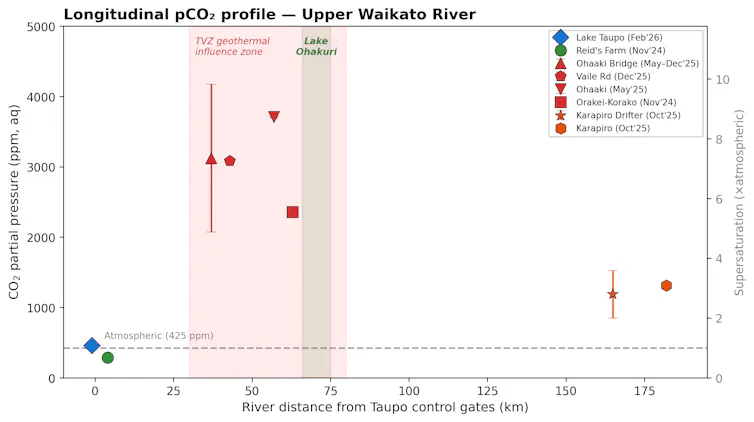
Until now, no one has measured how much of the geothermal CO₂ actually dissolves in the river or how far downstream it travels.
During our recent field campaign, we deployed a mobile sensor along the upper Waikato and a technique known as stable isotope analysis to fingerprint the carbon and start filling this gap.
A radio-controlled jet boat equipped with sensors maps dissolved carbon dioxide in the Waikato River.Brian Moorhead, CC BY-SA
The results are stark.
Carbon dioxide concentrations in the geothermal zone reach ten times the background level and the isotopic signature confirms the source as volcanic, not biological.
Huge quantities of dissolved CO₂ escape into the atmosphere as the river passes through the hydro lake chain. The water does not return to background levels even by the time it reaches Lake Karāpiro more than a hundred kilometres away.
That lingering excess CO₂ could be feeding algal growth well beyond the volcanic zone.
Carbon dioxide levels in the upper Waikato River geothermal zone reach up to ten times the levels seen in Lake Taupo.Adam Hartland, CC BY-SA
The gold clam factor
The geothermal zone is not the only pressure point. The invasive gold clam (Corbicula fluminea) has rapidly colonised the Waikato since its detection in 2023.
The clams have now been confirmed as far upstream as Lake Maraetai, directly downstream of Ohakuri.
Our research, currently under review, shows the clams are stripping roughly 14 tonnes of calcium carbonate from the river every day, disrupting the water chemistry treatment plants rely on and releasing arsenic in forms that could slip through conventional treatment processes.
Invasive gold clams collected near the Maraetai boat ramp.Michelle Melchior, CC BY-NC-SA
As the clams breathe, they pump carbon dioxide into the water and consume oxygen, tipping the river’s balance away from a system driven by plant-like photosynthesis (which produces oxygen) and toward one dominated by respiration (which releases CO₂).
Multiple pressures, compounding risk
A profiling buoy measuring oxygen in Lake Karāpiro’s water column.Adam Hartland, CC BY-SA
The clams, spreading upstream into the geothermal reaches, add a second source of CO₂ through their breathing, while depleting oxygen and stripping calcium.
What this double pressure will mean for algal blooms – when they form, how long they last and how severe they become – as clam populations continue to expand, is an open and urgent question.
Current monitoring cannot answer it. Toxic algae are sampled monthly at four hydro lakes, with results taking days to return. This is not a criticism of any single agency; national monitoring protocols now predate the compound pressures the river faces.
The gap between knowing and acting
The local community called for ultrasonic algae-killing buoys, webcams and flushing the lakes. This reflects an understandable desire for visible action, but without understanding the underlying drivers of blooms at these specific locations, we risk treating symptoms rather than causes.
Two million people drink water from the Waikato. Thousands swim in it, fish from it and gather mahinga kai (traditional food gathering) along its length. Iwi have obligations to it that stretch across generations.
The science is telling us, in real-time sensor data, that the system is moving toward thresholds we do not want to cross. The monitoring and governance architecture we have inherited was not designed for the compound pressures now acting on the river.
The question is whether we can build the governance and data-led operational protocols to match the pace of change, before the next bloom or near miss becomes the event we failed to prevent.
In 1967, catastrophic bushfires in Tasmania killed dozens of people – and very nearly destroyed Hobart.
A year later, W.D. Jackson, Professor of Botany at the University of Tasmania, published a short but very influential article on why the fires were so bad. He suggested that after Tasmania’s wet eucalypt forests were burned by severe bushfires, there would be a high-risk period during their regrowth when they are at risk of severely burning again.
This, Jackson theorised, was because regrowing saplings form a very dense canopy, with little distance between living leaves and the leaf litter and understorey plants able to ignite canopy fires. If a second fire sweeps through, he predicted the forests could be replaced with more fire-tolerant scrub.
Was Jackson correct? Is regrowth truly more flammable? It’s very difficult to prove regrowth burns more intensely and accelerates bushfire spread, as it’s not practical to undertake neat, perfectly controlled experiments involving severe bushfires.
But sometimes, scientists get lucky. We took advantage of a natural experiment in 2019, when a severe bushfire burned through a research site spanning old growth wet Tasmanian forests and logged areas of regrowth, giving us access to data before and after the fires.
In our new research, we show Jackson was right. Regrowth does indeed burn more intensely than mature forests.
Fires in early 2019 created the conditions for a natural experiment to test if regrowing forests burn more readily.Rob Blakers/AAP
Why does this matter?
Jackson’s theory has resonated with generations of fire ecologists and fire managers in Australia and internationally, due to how it focuses on the interplay between the age of forests and the risk of bushfires.
Worldwide, vast areas of regrowth forest are recovering from clear-fell forestry and wildfires. In Tasmania alone, remote sensing data suggests a fifth of all tall wet forests are in a regrowth stage younger than 40 years old.
After an old forest is clear-felled, it is regenerated using fire to remove logging debris and then sown with seeds native to the area. This puts it in Jackson’s 30-year danger zone, which begins about 20 years after a fire, when eucalypts begin bearing gumnuts. It ends about 50 years after the fire, when trees are tall enough and moist dense understoreys have developed to lower the risk of devastating fires able to kill mature trees.
If regrowing forests make it through centuries without more fires, they could potentially become temperate rainforests, whose deeply shaded, moist understoreys put them at very low risk of fire.
If another severe fire starts before forests reach this safer period, experts have suggested the flammable regrowth could threaten entire landscapes by making fires more intense.
Some experts suggested forests regrowing from logging were a key factor in the huge area burned during the notorious 2019–20 fire season, though others have disputed this.
This is why Jackson’s theory still matters, almost 60 years after he proposed it.
Hard to test
Testing this theory has long proved difficult.
Forest ecologists have instead typically relied on indirect approaches, such as analysing how severe the fire was using satellite data, or estimating likely fire behaviour based on field measurements of the amount of fuel and how much moisture was present.
These inferential approaches can be scientifically fraught, as they are vulnerable to many assumptions that are hard to test or control for.
A previous attempt to resolve this question by experts, including the renowned Tasmanian ecologist J.B. Kirkpatrick had to be withdrawn due to technical issues. In retracting the paper, the authors noted their results had proven “highly sensitive” to variation in a small number of sites.
A natural experiment
In 2019, a lightning strike ignited a fire in Tasmania’s southwest forests. Known as the Riveaux Road fire, it burned through an area of regrowing forest used for research.
This offered a rare chance of a natural experiment. We had pre-fire data on fuel loads, canopy structure and microclimates (areas where local conditions make climate different from surrounding areas) in both mature forests and adjacent areas logged around 40 years earlier.
After the fire passed, we collected more data so we could compare the fire damage (measured by damage to tree canopy) and the effects on the microclimates in both regrowth and mature, unlogged forests.
This natural experiment was conclusive. The areas of post-logging regrowth burned more severely, due to their hotter, drier microclimates and the fact their canopies were closer to the ground.
The fire burned more intensely in regrowth areas.David Bowman, Author provided (no reuse)
Interestingly, we found fires in the regrowth didn’t cause the fires to spread further. This was because the damp understorey of the surrounding mature forests could contain the fires.
That’s not to say this would always be the case. The 2019 fire took place in moderate fire weather conditions, meaning it wasn’t especially hot, dry or windy. If severe fire weather was present, this dampening effect would likely have been overwhelmed.
Proving Jackson’s theory isn’t good news for forests.
Climate change means fire weather will arrive more often and be more extreme. Combined with the large areas of forest regrowth, this means we will have to be ready for more fires.
In North American conifer forests, thinning out regrowth and burning off leaf litter and other fuel have proven effective in reducing the risks of fire-prone regrowth. Eucalypts have fundamentally different fire ecologies, so we can’t directly apply that research to Australia. Local research is limited, meaning we don’t know yet if this will work here.
Recent research has shown commercial thinning of regrowth in Tasmania doesn’t reduce the risk of fire, because bark, limbs and smashed trunks left after logging act as fuel.
This means we urgently need to find an effective way to reduce the risk of fires in regrowth in wet eucalypt forests in Tasmania and elsewhere in Australia.
Since the lethal fires of 1967, many Tasmanian communities – including large areas of Hobart – are now surrounded by forests still in the dangerous period of regrowth after logging or fires.
People using other peoples’ ideas, words and creations without acknowledgement is a widespread problem. Plagiarism occurs everywhere from restaurant menus to political speeches and music.
Within academia, plagiarism is seen as a serious breach of integrity for scholars and students.
It’s easy to find media articles claiming plagiarism is increasing among university students. These claims have intensified with the rise of generative AI – which can quickly produce large amounts of text that students can copy and paste into their assignments.
But while AI certainly poses a range of challenges for academic integrity, is plagiarism increasing as much as we think it is?
My team’s new research, which has tracked students at one university over 20 years, suggests it may even be falling.
What are we comparing?
Precise rates of plagiarism can be difficult to determine. Pre-AI, many claims about increasing plagiarism among students came from cherry picking results of different surveys from different student groups. So they were not comparing apples with apples.
Since AI, we have have a lot of anecdotal reporting of cheating. But we do not have a lot of robust evidence of whether cheating has increased over time.
In a new journal article, my colleagues and I have used a rare longitudinal study of plagiarism to overcome this problem.
My research
Every five years since 2004, our study carried out the same survey on plagiarism with students at Western Sydney University (WSU). This means we have been able to track the same phenomena in the same environment over time.
In our survey students are presented with scenarios representing different forms of plagiarism. For example, a student copying text from a book without citing the book. Students were asked whether the behaviour is plagiarism, to test their understanding of it, and how often, if ever, they have done a similar thing. In 2024, we also also asked students if they used text generated by AI in their university work, without acknowledging it.
We conducted an anonymous survey of mostly undergraduate students, studying in a range of disciplines. The survey started in 2004 on paper and has been fully online since 2014.
The survey was done in the second half of the academic year to ensure students had the opportunity to both learn about and engage in plagiarism.
In 2024, as well as WSU, we included students from five other Australian universities for additional comparison. This gave us sample of more than 2,100 students in total for the latest round.
Plagiarism isn’t increasing
Over 20 years, the survey has found the percentage of students who engage in any form of plagiarism at least once has fallen every five years, from more than 80% in 2004 to 57% in 2024.
This decline corresponds with various measures, such as the use of text-matching software, which can help detect plagiarism. There has also been more training in referencing and citation rules – this reduces unintentional plagiarism.
AI is not turning all students into plagiarists
Although 14% of students in 2024 indicated they had copied from AI without acknowledgement, most of them also engaged in at least one other form of plagiarism. For example, copying from another student’s assignment.
Copying from AI was the sole form of plagiarism for only 2% of students.
Most students don’t plagiarise accidentally
Combining students’ answers to whether they understand plagiarism and whether they engaged in it showed most did so knowingly. For example when it came to verbatim copying from AI, 88% of WSU students who engaged in this knew it was plagiarism.
Interestingly, most plagiarism was accidental 20 years ago when education about academic integrity was less thorough. However, the recent results show students have a better understanding of plagiarism and still do it anyway.
AI detectors don’t stop copying
In the survey, two universities used AI detectors (which aim to assess whether a piece of written work has used AI, with mixed results and four did not.
Rates of plagiarism from AI were similar between the universities with and without detectors.
What does this mean?
Our survey largely looked at only one Australian university. But despite this limitation, we can interpret the results in optimistic and pessimistic ways.
Optimistically, plagiarism has fallen over 20 years. This suggests measures to detect plagiarism and teach students about proper referencing can help.
On top of this, AI has not turned all students into plagiarists – at least not yet. What our study suggests is students who have plagiarised in some other way may now plagiarise from AI as well.
Pessimistically, over half of all students still plagiarise at some time in their university studies. And, because these surveys rely on self-reports, it is likely these figures represent the minimum number of students who plagiarise. Even when surveys, like ours, are anonymous and online, students may still be hesitant to admit to breaking rules.
This means educating students and policing academic conduct remains an ongoing battle.
The Cook Islands is a realm country, sharing currency and passport rights with New Zealand, and is expected to consult New Zealand on constitutional matters.
New Zealand has paused about $29.8 million in annual funding to the Cook Islands for two financial years, saying resumption was contingent on trust being rebuilt.
Foreign Minister Winston Peters and Cook Islands PM Mark Brown pictured together on 1 April.Supplied / John Tulloch
Sign up for Ngā Pitopito Kōrero, a daily newsletter curated by our editors and delivered straight to your inbox every weekday.
– Published by EveningReport.nz and AsiaPacificReport.nz, see: MIL OSI in partnership with Radio New Zealand
While vapes may cause cancer – as a recent Australian review of evidence concluded – they remain a far less dangerous vice than traditional cigarettes, a local anti-smoking lobby group says.
Researchers from the University of New South Wales (UNSW) looked at eight years of prior research between 2017 and 2025 – including human and animal studies, case reports and chemical analyses.
Lead author Bernard Stewart said it provided “by far the strongest evidence” vapes – like cigarettes – could cause lung and oral cancer. He said it could no longer be considered “safer than smoking”, urging a wider crackdown on black market products and more public awareness of the dangers.
But Ben Youdan, director of Action on Smoking and Health (ASH), worries the findings will promote the view that vaping is just as bad for you as smoking.
“There’s no question it does carry risk, and I think it doesn’t change the message that it’s much, much less harmful than smoking, but not completely risk-free, and that if you smoke, vaping is a very effective way to stop smoking and will substantially reduce your risk. None of that changes at all,” he told Morning Report on Thursday.
“But I think what the issue with this particular review is that it sort of makes a sweeping statement that ‘we found these things in vaping that may cause cancer’, but it doesn’t tell us anything about the levels that they are, whether they’re actually cancer-causing levels or what the dose exposure might be.”
For example, he said, the review noted some vapes will expose users to nicotine – but only about 2 percent of what a smoker would get, a “massive risk reduction” and not a cancer risk on its own.
The fear was studies like this – and the way they have been reported – will deter smokers from using vapes as a gateway to quitting altogether.
“We have really, really high quality evidence, much of which comes from New Zealand studies that vapes are very effective in helping people stop smoking. But we also have an increasing body of evidence that people believe vaping is as, if not more harmful than smoking, which is far from the truth.
“So there’s a real concern that when we have some quite alarmist studies that don’t face scrutiny like this coming out, that we might either encourage people to switch back to smoking or even to put them off using vaping as a stop-smoking act.”
Ben Youdan of ASH said there was no evidence that vapes were leading Kiwi youth towards smoking.123rf
The researchers noted there was still no epidemiological link between using vapes and cancer, but proving cigarettes caused cancer took a century, and vapes had only been around for two decades.
The KiwiSaver contribution rate lifted to 3.5 percent this week.RNZ / Quin Tauetau
Just under 5700 people have had their KiwiSaver contribution rates reduced, meaning they will not be paying the new default rate of 3.5 percent.
For pay processed on or after April 1, the default contribution rate has lifted from 3 percent to 3.5 percent, as part of a staged process to lift both to 4 percent in 2028.
Contribution rates increased unless people were already paying a higher level, or they had applied to Inland Revenue for a temporary reduction in their contribution rate, which their employer could then match.
Inland Revenue said, as of Tuesday, 5696 people had their contribution rate reduced, and this number could still grow.
Dean Anderson, founder of Kōura, said it was less than a quarter of 1 percent of the active KiwiSaver members.
“I’m not sure how many Kiwis were actually fully aware of the changes that were coming. I think the real awareness will kick in when the next payslip arrives and people notice a slightly smaller deposit in their bank accounts.
“This may catch out those on total remuneration contracts or anyone managing a strict budget based on their usual cash in hand. I encourage everyone to pay close attention to their payslips over the next month to ensure their employer has applied these changes correctly.”
Rupert Carlyon, founder of Kōura, said he was not surprised at the number.
Rupert Carlyon is the founder of Kōura. (File photo)Supplied
“I don’t think people realise what is happening or how they can get out of the change.
“We have sent out four different emails saying that this is coming – but haven’t had any feedback at all or questions on it which is really surprising.
“I wonder whether employers have been communicating with their employees, it is at this level that more probably needs to be done rather than through the KiwiSaver providers.”
The government earlier estimated a working parent, with a starting income of $60,000 at 25, two children, who took one year of parental leave and who withdrew all their savings at 30 to buy a home, would end up with just over $500,000 in their account at 65 with the new contribution rates, compared to just under $400,000 previously.
A high-income earner would get 28 percent more and a low-income earner 21 percent.
Jessica McLean, chief operating officer at PaySauce, said employers had been confused about how the change was happening.
“What we have seen is a huge influx of support volume over the last couple of days about things like ‘the new rate is applying already but it shouldn’t, it’s from the first of April’ but you’re paying it on the first of April so it applies, it doesn’t matter that you’re paying them for time in March it’s based on a payday…. Then they want to change the payday to March and we have to say no then your employees will end up with a tax bill because you’re going to ram another period into the financial year. They’re in a big flap about it.”
She said it was hard for employers who were paying total remuneration packages.
This means they set aside an amount to pay staff and both the employer and employee contribution comes from that.
“If the KiwiSaver rate goes up the money has got to come from somewhere. Either the employer’s got to cover it or it’s coming out of the employee’s net pay.”
She said some employers were willing to absorb the cost to ensure their employer did not have to cover the whole increase.
Some employers had also asked whether they could negotiate a temporary rate reduction on employee’s behalf, she said. “It’s got to be employee-led… but I think there’s this narrative that small employers are always trying to pay people the least they possible can and I don’t think that’s true. I think most of them are fine with the change.”
Foreign Minister Winston Peters.RNZ / Mark Papalii
New Zealand has joined Australia, France, Germany, Italy and the United Kingdom in expressing “deep concern” about an Israeli bill expanding the death penalty for Palestinians.
Winston Peters posted on social media on Wednesday night, indicating New Zealand had joined the other nations, and emphasising the country’s opposition “for decades” to the death penalty “in all circumstances”.
It comes as the Green Party tried on Wednesday to move a motion in Parliament on the issue, but failed to get the support of all parties.
The ACT party told RNZ it did not support the motion being put without notice, and noted the Minister of Foreign Affairs was responsible for expressing New Zealand’s position on international issues.
The bill stipulated that residents in the West Bank who killed an Israeli “with the intent to negate the existence of the State of Israel” would be sentenced to death.
The Foreign Ministers of Australia, France, Germany, Italy and the United Kingdom released a joint statementexpressing their “deep concern” about the bill, saying it would “significantly expand the possibilities to impose the death penalty in Israel”.
“We are particularly worried about the de facto discriminatory character of the bill. The adoption of this bill would risk undermining Israel’s commitments with regards to democratic principles.
“The death penalty is an inhumane and degrading form of punishment without any deterring effect. This is why we oppose the death penalty, whatever the circumstances around the world. The rejection of the death penalty is a fundamental value that unites us.”
The statement also urged the Israeli decision makers to “abandon these plans”.
The Green party wanted to highlight the issue in parliament, and sought support from across the House to move a motion without notice.
Co-leader Chlöe Swarbrick told reporters on Wednesday afternoon convention stipulated motions without notice needed prior agreement from all parties.
“This stops spurious motions going up and clogging the time of our parliament.”
The motion read that the “New Zealand House of Representatives expresses deep concern about Israel’s new legislation which extends the use of the death penalty against Palestinians living under unlawful occupation; shares the concerns of Australia, the United Kingdom, France, Germany, and Italy about the “de facto discriminatory character’ of the legislation; and calls on the Israeli Government to reverse this legislation”.
Labour and Te Pāti Māori both told RNZ they supported the motion.
Labour leader Chris Hipkins said his party would firmly support a motion in the House to condemn Israel’s use of the death penalty against Palestianians.
“It clearly discriminates against Palestinians – a point underscored by the fact that the law does not apply to Israeli extremists who commit similar crimes. There are major issues with the process including that it removes the right to an appeal. By condemning Israel, we would stand alongside the United Nations, EU and the UK.”
Te Pāti Māori told RNZ it supported the motion, and queried why other parties had not.
“This law further embeds discrimination into Israel’s justice system by allowing Palestinians to be sentenced to death while others are not subject to the same punishment for similar acts,” a spokesperson for the party said.
“It sits within the context of the ongoing genocide against the Palestinian people, and the backdrop of Israel and the United States’ illegal invasion of Iran and Lebanon.”
National and New Zealand First did not respond to queries but the ACT party told RNZ it did not support the motion being put without notice.
A spokesperson for the party said it noted the Minister of Foreign Affairs was responsible for expressing New Zealand’s position on international issues, and “ACT supports that approach over symbolic motions in the House”.
“If the House passed a motion every time a country passed a law of concern, we would spend more time talking about other countries’ legislation than our own.
“All MPs have the right to put a motion on notice under Standing Orders.”
In response, Swarbrick said it was “deeply disappointing” and acknowledged the point was “symbolism”.
“I can point to many different examples when the ACT Party, for example, has put forward very similar motions, evidently for the very purpose of that same symbolism, which in turn means something on the international stage.
“It felt particularly pertinent for our country to take a stand against the perpetuation of abuse of human rights with the Israeli parliament passing the ability to effectively murder, to slaughter Palestinian hostages and prisoners.”
She said a motion on notice did not have the status of being read out in Parliament and having the backing of every single parliamentary party.
Sign up for Ngā Pitopito Kōrero, a daily newsletter curated by our editors and delivered straight to your inbox every weekday.
– Published by EveningReport.nz and AsiaPacificReport.nz, see: MIL OSI in partnership with Radio New Zealand
An armed man sent a manifesto to schools, the police and the government promising to “kill everyone” (file photo).RNZ
An armed man sent a manifesto to schools, the police and the government promising to “kill everyone” and become the country’s “most deadly mass shooter”, police allege.
The man – who has never had a firearms licence – is accused of possessing a pump action shotgun with more than 350 shotgun cartridges, “suspected components of an improvised explosive device” and Nazi literature, it can now be revealed.
The 20-year-old faces an array of charges including two representative charges of threatening to kill, three charges of threatening to destroy property and four representative charges of unlawful possession of firearm/explosive.
He had also been charged with three representative charges of possessing an objectionable publication – including the Christchurch terrorist’s manifesto and video – and two charges of failing to carry out obligations to computer search.
Do you know more? Email sam.sherwood@rnz.co.nz
The man, who has pleaded not guilty to the charges and has name suppression, is set to go on trial in July. RNZ has been granted access to a court document that details the police allegations against him.
The document accused him of sending a manifesto to various addresses at 1.40am on 12 March last year.
The recipients included Waiuku College, Rutherford College, Pukekohe Police Station, Te Atatu Police Station and Parliament.
The closed front office at Waiuku College following the threat.RNZ / Calvin Samuel
Police said the email was titled “This is my manifesto” and stated that another person was the author. It made several claims, including that the author had been “subject to constant bullying and harassment”.
“I have finished making weapons, body armour and suicide vest that will be needed for what I will do to get revenge on bullies.”
The author said they had finished 3D printing and assembling a Rogue 9 submachine gun and had about 200-300 armour piercing bullets, some 3D printed Glock magazines, a pistol and about 100 bullets.
Police alleged the email said the submachine gun and pistol had been tested and the author knew “they will work for ‘what I am going to do tomorrow morning’”.
“I have body armour so that I will not die in a shootout with police,” the manifesto was alleged to say.
According to the police the email author claimed to also be in possession of Molotov cocktails and ingredients for explosives. The manifesto also said explosives had been sent in various packages to Waiuku College, Rutherford College, Pukekohe Police Station, Te Atatu Police Station and the Beehive.
“The rest of the … explosive was in the suicide vest that I will detonate even if defeated in a gun fight and kill everyone around me.
“I will go to Rutherford College or Waiuku College early and … become New Zealand’s most deadly mass shooter.”
It also promised “a big tragedy” if there were not enough police at the school, and threatened to set schools on fire and take hostages.
“The only way out of this is for a plane to be provided to me and safe passage out of New Zealand.”
The manifesto said explosives had been sent in various packages to Waiuku College, Rutherford College, Pukekohe Police Station, Te Atatu Police Station and the Beehive.RNZ / Calvin Samuel
Later that morning, police said they received an online form submission to a Police Service Improvement webform link, detailing the manifesto that had been sent.
As a result, Waiuku College put the school into lockdown for several hours, before staff and students were sent home.
Rutherford College restricted access to the property and had armed police posted at the school for the duration of the day.
Police said they spoke with a person who had been named as the author of the manifesto. They denied being the author and instead identified the defendant as a possible suspect.
Rutherford College restricted access to the property and had armed police posted at the school for the duration of the day.Rutherford College
On 13 March, police raided two properties associated with the defendant.
At one of the properties, police said they found a 12-gauge pump action shotgun under his bed, as well as 359 shotgun cartridges.
They said they also found a 3D printer, a machete in sheath, blueprints showing the assembly components of an AR15 rifle and Nazi literature.
The court document said “suspected components of an improvised explosive device” were also seized from the property. This included electrical chipboards, timers and household chemicals.
While searching the other property, police said they seized a phone, an iPad, two laptops, a USB drive, a desktop computer, 134 spent shotgun shells and a large knife.
When asked for the passcodes for the iPad and one of the phones, the defendant allegedly provided incorrect passcodes.
“When suggested that he was providing the wrong passcodes, the defendant claimed not to remember the passcodes,” the court document said.
Police analysed the defendant’s devices and said they found several objectionable materials, including a copy of Brenton Tarrant’s manifesto, a video of the Christchurch mosque attacks and a copy of a manifesto written by Ryan Palmeter, who killed three people in Jacksonville, Florida, in 2023.
There were also two copies of “an instructional book on how to make explosives, weapons, drugs and other dangerous or illegal activity” and videos of the Russian Moscow ISIS concert hall terror attack and the Buffalo, New York, mass shooting.
When spoken to by police, the defendant denied being involved in any of the alleged offending.
Sign up for Ngā Pitopito Kōrero, a daily newsletter curated by our editors and delivered straight to your inbox every weekday.
– Published by EveningReport.nz and AsiaPacificReport.nz, see: MIL OSI in partnership with Radio New Zealand
A former Navy ship commander faced an earlier complaint of unwanted touching before she was acquitted at a court martial of inviting a junior officer to kiss her on the cheek.
Bronwyn Heslop was the commander of HMNZS Canterbury when she was alleged to have encouraged a junior officer to kiss her by tapping her own cheek in a bar, during a deployment in Fiji in March 2023.
She was found not guilty of doing an act to prejudice service discipline at a court martial in February.
The earlier complaint of touching – revealed in documents released by the New Zealand Defence Force (NZDF) to RNZ under the Official Information Act – alleged that Commander Heslop “placed her hands on a member of the NZDF’s neck and shoulders without their consent and made comments that made them feel uncomfortable”.
Military police found there was not enough evidence to lay a charge, but the complaint did result in “administrative action” taken by command.
The NZDF said a command investigation followed the two complaints against Commander Heslop in 2024, to determine whether there was a “pattern of behaviour” inconsistent with the NZDF’s core values. It concluded with administrative actions, which can range from counselling to warnings.
Commander Heslop’s lawyer Matthew Hague said she denies any wrongdoing in relation to all the allegations.
Heslop became the first female officer to be in charge of a Royal New Zealand Navy vessel, when she took command of HMNZS Moa in 1998.
She became the ship commander of HMNZS Canterbury in April 2022, and the NZDF said she had reached the natural end of that tenure by September 2025.
She is now in a shore-based role in Military Maritime Operation Orders.
Survivor: ‘They hung her out to dry’
A survivor of sexual assault said Commander Heslop was hung out to dry while more serious sexual allegations against men in the military were dealt with behind closed doors.
Karina Andrews had her statutory name suppression lifted to speak out about the sexual abuse by her father, former Air Force Sergeant Robert Roper, which started when she was six years old.
As a child, she was interviewed by members of the Royal New Zealand Airforce in the same room as her abuser.
Andrews, who was involved in the early stages of NZDF’s Operation Respect when it was launched in 2016, said things haven’t improved as much as they should have, and that the “old boys’ club” where men in the military looked after their own was still “alive and kicking”.
Andrews said the alleged behaviour in both complaints against Commander Heslop were not fitting for a ship commander.
However, she said the alleged behaviour did not warrant a court martial, and she felts the military was prosecuting the less serious cases to show they were still doing something about the culture.
“Pretty pissed off that they would use that to say ‘hey, we’re doing something with Operation Respect’, they hung her out to dry, because they needed a win,” she said.
Andrews said if similar allegations were made against a male, it would not have resulted in a court martial.
“I know that there have been some women that have been rail-roaded into making a closed disclosure, because the military can deal with that, and nine times out of ten it is because it’s a high ranking staff member that has performed a sexual assault, that’s still the old boys looking after their own, and that hasn’t changed,” she said.
Andrews said she had spoken directly to two female NZDF staff who complained of sexual assault by male staff in the past two years, who had their complaints dealt with internally.
RNZ asked the NZDF about the allegations of its treatment of the two women, but the NZDF has not responded directly.
It said the sex of the accused person was not a factor in their decision to lay a charge in Commander Heslop’s case.
It also added that members of NZDF are free to report concerns to other independent agencies, such as the police.
Meanwhile, the Auditor General’s survey of more than 6000 defence personnel found that 78 people (1.3 percent of respondents) experienced unwanted sexual activity in the 12 months to March 2023.
It found junior uniformed women were particularly affected, with 7.2 percent of them among respondents reporting unwanted sexual activity, and 24.6 percent reporting some form of inappropriate sexual behaviour.
Andrews said she felt that the unwanted sexual behaviour was under-reported, based on her wide contacts in the military and people who had come to her for advice on how to proceed on a complaint.
NZDF said it had made significant progress with Operation Respect, since the review in 2020.
A refreshed Operation Respect strategy with a 20-year outlook was released in June 2024, it said.
NZDF: Charge needed to be laid in alleged kissing incident
The NZDF said there was a well-founded allegation of an offence under the Armed Forces Discipline Act (AFDA) regarding the alleged kissing incident, and that they were legally required to lay a charge.
It said the charge first went to summary trial, and Commander Heslop later was given the right to elect court martial – which she chose to do.
Commander Heslop’s lawyer Matthew Hague said her decision to select court martial was a necessary step to access her basic right to a fair legal process.
“A summary trial lacks the protections afforded to all other New Zealanders, such as the right to legal representation and a trial presided over by an independent Judge,” he said.
Following Commander Heslop’s electing court martial, a decision still needed to be made by the director of military prosecutions to proceed the case to court martial.
NZDF said allegations referred to the director of military prosecutions must satisfy both the evidential and public interest tests.
“If an accused at summary trial elects trial by court martial, this will normally weigh in favour of laying the charge or charges before the court martial, provided the evidential test is met,” it said.
“As the evidential test was deemed met in this case, the charges proceed to court martial,” said the NZDF.
Law professor: discretion needed in Armed Forces Discipline Act for lower level allegations
Retired Auckland University law professor Bill Hodge sat on court martial panels for sexual assault cases when he served in the US Army.
He said he was perplexed as to why Commander Heslop’s case ended up in front of a court martial.
“I wondered why it is at that level, that’s the most senior level, it’s a lot of valuable time of valuable experienced people, and it looked like they should not be spending their time on this type of case,” he said.
He said the allegations were at a relatively low level, and based on his knowledge of military courts, the allegation of soliciting a kiss on the cheek wouldn’t even have reached the level of a summary court.
Hodge however said he understands how a ship commander can be held to a higher standard.
Hodge said there needs to be more discretion in the Armed Forces Discipline Act, where even if a charge is well founded, there could be the option of selecting a form of punishment akin to “company level punishment” – such as training, warning and counselling.
Sign up for Ngā Pitopito Kōrero, a daily newsletter curated by our editors and delivered straight to your inbox every weekday.
– Published by EveningReport.nz and AsiaPacificReport.nz, see: MIL OSI in partnership with Radio New Zealand
Wellington’s new Dorothy Spotswood Charity Hospital has found a home in a building on upper Cuba Street.RNZ / Samuel Rillstone
Wellington’s new Dorothy Spotswood Charity Hospital has found a home in a building on upper Cuba Street in the central city.
The Dorothy Spotswood Charity Hospital, for which the fit-out was being funded by Wellington philanthropist couple Dame Dorothy Spotswood and Sir Mark Dunajtschik, would provide surgical day services on a referral basis, mostly through GPs, for people who did not meet the criteria or faced long wait times to be seen in the public system and could not afford private treatment.
The property at 275 Cuba Street was recently purchased by local investor Mike McCombie, and the charity hospital board signed the lease just this week, with the hospital itself set to occupy its ground floor.
Hospital trust chair Dr Graham Sharpe said finding a suitable premises had been a five-year mission.
Hospital trust chair Dr Graham Sharpe.RNZ / Samuel Rillstone
Of the three buildings they had scoped, two had turned out to be unsuitable, and the land under the third had been sold mid-process, Sharpe said, throwing their plans into disarray.
Finding a building with ample ceiling height, and which could draw the electricity required for all the medical equipment, had also been tricky.
The Cuba Street site had location on its side, near the public hospital and the main highway, which would make life easier for staff coming in from the Hutt – as would the more than 40 carparks underneath.
The fitout was set to cost $10-13 million, and running costs would be around $1.5m a year, Sharpe said.
It would be funded entirely by charitable donations, he said, and a number of philanthropic groups had already expressed an interest.
“We’ve had some very generous support from professionals, such as architects, planners and builders, many of whom have offered their services free or at a significantly reduced rate because they share our vision.”
Vito Lo Iacono, the hospital’s chief executive, explained they were leasing 900 square-metres of the 1100-square-metre floorplan, with other tenants able to lease the other floors.
Vito Lo Iacono, the hospital’s chief executive.RNZ / Samuel Rillstone
The building was undergoing earthquake strengthening – set to finish in June this year – and in years to come, the hospital could consider expanding outwards and upwards within it, he said.
Right now, the space was cold and dark, the ceiling a jumble of dangling extractor tubes and wiring above a dusty concrete floor.
But Sharpe said it would soon be transformed into a reception and staff areas, two operating theatres, a recovery area catering for up to six patients, and consulting rooms.
It would only be performing day surgeries, no overnight stays, and would not be taking any patients under 18.
Right now, the space was cold and dark, the ceiling a jumble of dangling extractor tubes and wiring above a dusty concrete floor.RNZ / Samuel Rillstone
The concept was based on the success of the Canterbury Charity Hospital, and a similar one in Southland, with medical professionals offering their services for free around their paid schedules across the public and private sectors.
“Last time we checked, we had 42 specialist surgeons and anaesthetists willing to work for us for free,” Sharpe said.
The aim was to open next February, starting with one operating theatre for the first six months until systems were in place, Sharpe said.
At first, they would take on procedures like endoscopies and colonoscopies, before moving into eye surgery like cataracts.
The sorts of things he expected they would be doing long term were surgeries for hernias, varicose veins and cataracts.
“These sort of day-case, relatively straightforward, quick things are the very things that get dropped when there’s a problem at the hospital. Emergencies come in, or there’s illness in the staff … these sort of things just fall off the list,” Sharpe said.
“They’re not life-saving, but they are life-affirming and life-changing.”
Dame Dorothy Spotswood (L) and Sir Mark Dunajtschik.Supplied
General surgeon Dr James Tietjens, a member of the hospital’s board and among those doctors planning to volunteer their time, said he and other doctors were seeing increasing unmet need in the system.
“This is a way to try and give access to certain populations that can’t access secondary care, or even primary care at times,” he said.
“People that may meet a hospital waitlist, or meet the criteria and aren’t being seen in a timely manner, or are declined. But there’s also a large proportion of people who aren’t able to access GP care, or GPs aren’t able to get their patients into hospital.”
He expected to see a number of people with hernias and other minor surgeries through the door.
Signing the lease and locking in a location was “a big step”, he said.
“We’re very grateful for all the support we’ve had to date.”
Wellington mayor Andrew Little said signing the lease was “a fantastic step forward for the hospital and I’m delighted to see this progress”.
“Dame Dorothy and Sir Mark have been incredibly generous in their support of health in the Wellington region. Wellingtonians will be hugely grateful to Dame Dorothy and Sir Mark for backing this valuable contribution for the health of our people.
“Initiatives like this take extraordinary efforts, I commend everyone who has played a part in this great outcome.”
Sign up for Ngā Pitopito Kōrero, a daily newsletter curated by our editors and delivered straight to your inbox every weekday.
– Published by EveningReport.nz and AsiaPacificReport.nz, see: MIL OSI in partnership with Radio New Zealand
The government has corrected a figure after being called out for overstating improvements in school attendance.
A member of the public complained to RNZ that two National Party advertisements claimed 150,000 more children attended school regularly in term four last year than at the same time in 2022.
They said Education Ministry roll figures indicated that was an over-statement.
When RNZ examined the figures it found the change between 2022 and 2025 was about 135,000 students – 15,000 short of the number claimed by the government.
But there were also a lot more children at school in the final term of 2025 than in the same term in 2022, and even if the rate of regular attendance had remained unchanged the number of regular attenders would have increased by about 65,000 students.
That meant only about 70,000 students could be attributed to improvements in attendance.
The National Party told RNZ it sourced its figures from an announcement by Associate Education Minister David Seymour in January.
That announcement said the number of regular attenders improved by “about 150,000” children between term four 2022 and term four 2025.
RNZ asked the National Party if it would correct the ad and received a response from Seymour’s office saying the figure “was based on an error” and had been corrected.
There was keen interest in attendance figures.
Regular attendance, measured as children attending more than 90 percent of the time, reached all-time lows in 2022 with schools blaming the effect of covid lockdowns in previous years and on a particularly bad run of winter illnesses.
In term four of 2022 there were 329,499 regular attenders and in term four 2025 there were 464,498, an increase of 134,999.
But there were more students overall in 2025 than in 2022 – just 676,384 in the final term of 2022 and 810,652 in the same term of 2025.
If the rate of regular attendance in term four last year was the same as in 2022 (48.7 percent), there would have been 394,788 regular attenders, an increase of 65,288 due solely to the overall increase in the number of students.
That meant only 69,710 of the increase in the number of regular attenders could be attributed to the rate of regular attendance improving to 57.3 percent.
Sign up for Ngā Pitopito Kōrero, a daily newsletter curated by our editors and delivered straight to your inbox every weekday.
– Published by EveningReport.nz and AsiaPacificReport.nz, see: MIL OSI in partnership with Radio New Zealand
You might be wondering why someone with the name Helaman Hatcher is in a story about Catholicism. Helaman is a name from the Book of Mormon, a sacred text for the Church of Jesus Christ of Latter-day Saints.
So, here’s the story:
Hatcher, 21, was born into a Mormon family in the UK. When he was five and moved to Christchurch, his mother left the church and became an atheist. His father kept a soft spot for religion, identifying as agnostic. Essentially, Hatcher was raised without religion.
Young Catholic men at a Fit for the Kingdom event in Christchurch. Health and fitness is a bonding element for some new converts.
Fit for the Kingdom
“Honestly, I don’t think I would have been able to tell you the difference between, like, Catholics or other Christian denominations.”
He came of age during a chaotic period for young men, where some felt vilified by culture shifts such #Metoo, the anti-harassment movement that started in 2017. A few found representation in online influencers like Andrew Tate, who beckoned lost young men into the often misogynistic world of the manosphere, where wealth and ripped bodies are antidotes to a perceived female takeover. But Hatcher found those ideals were lacking. Instead, he gravitated towards media personalities like Michael Knowles, a US conservative commentator who is open about his Catholic faith. What Hatcher admired in Knowles, he also saw in the few Catholic friends he had.
Hatcher craved an anchor for life that he wasn’t finding in secularism or online or anywhere else. After nine months spent pondering faith in the Order of Christian Initiation of Adults, the Catholic Church’s pathway for adult converts, he decided to formally join the church. At Easter in 2024, he was baptised with a priest pouring water on his head.
“Having converted to Catholicism, I would say there is a bit more intentionality with the way I live rather than a passive get through life level of thinking.”
He also appreciates the contemplative silence during mass, another remedy to the bombardment of the online world that is native to Gen Z.
Andrew Tate, left, and his brother, Tristan, in December 2023. They were arrested in Romania in 2024 over UK sex offence charges.
DANIEL MIHAILESCU / AFP
Hatcher’s 2024 confirmation into the Catholic Church came at the beginning of what some are calling a “quiet revival” in Christchurch, growth that isn’t reflected in New Zealand’s population-wide data. The growth that local church leaders say is happening reflects a global trend of Western young people re-examining Christianity, especially the Catholic Church, which experienced years of decline following the sexual abuse scandal that rocked the institution from 2002 onwards and the new atheist movement of the same decade.
Year on year in Christchurch, it was typical to see only a handful of new converts, if any, according to Phil Bell, a senior leader in Christchurch’s Catholic Cathedral Parish. Mostly women with greying hair filled the pews on Sundays. However, last year, there were about 70 new converts, who skewed mostly young and mostly male. This Easter, Bell anticipates about 100 new converts, with another substantial group already on track for confirmation next Easter.
“We’ve been praying for this for a long time.”
Josh Duymel and his wife on their wedding day. They attend regular Catholic mass together.
Curate Weddings
Josh Duymel is another answer to prayer. The 26-year-old software designer will be confirmed this Easter after a 12-month deliberation process.
“It feels like Christmas, because it is very special. It is religious, and I’m getting a treat. I’m getting a present, a gift,” he says of his new-found salvation.
Before he met his lapsed Catholic girlfriend and now wife in 2023, Duymel had no prior Catholic or religious connection. He described himself as a womaniser in pursuit of worldly riches with a seemingly dark spiritual presence following him. He was unsatisfied and looking for role models after his own father left when he was six.
“You know, I don’t want Andrew Tate or a Bugatti [the fast, luxury car preferred by Tate]. I don’t want to be some internet influencer.
“I want to live a good life, and I want to have a lovely family.”
He finally found that mentor in Dean Mischewski, a devoted Catholic in Christchurch, a father of nine and grandfather to four who competes in the New Zealand Masters sport competitions. Pursuing fitness and health has become a bonding element for some young Catholics in Christchurch.
In Mischewski’s family, Duymel saw the intergenerational impact of genuine faith. Now, Duymel’s 15-year-old brother is on his own post-manosphere journey towards a Christian faith, he says.
Michael Grimshaw, an associate professor of sociology who studies culture and religion, has been tracking Gen Z’s return to religion globally and locally. He sees increasing numbers of believers as part of a wider swing back towards a masculine-focused society and traditional gender roles, a shift that has been led by some women as well (think trad wives and mothers replacing careers with family life following Covid).
“There are those who are just looking for something to ground themselves in, that’s got tradition, that’s got ritual,” says Grimshaw, noting that orthodoxy, another ritualistic take on Christianity, is experiencing growth.
But not everyone is a believer in the Catholic revival. Geoff Troughton, associate professor of religion at Victoria University of Wellington, has heard anecdotal stories of more people with no prior religious connections turning to churches. Yet, data from the 2023 census and the 2024-2025 New Zealand Attitudes and Values Study, as well as the Catholic Church’s Auckland parish, all point to declining numbers, according to Troughton.
Brendan Malone, Christchurch Catholic and podcaster who speaks on faith and culture.
supplied
Brendan Malone, a Christchurch Catholic and podcaster who speaks on faith and culture, argues the new convert figures are too fresh to show up in population data.
“…the quiet revival is about people coming to an active participation in the faith, rather than merely having Catholic as an identity of sorts.”
Malone, who is also a travelling speaker, encounters young men all around New Zealand who are on the road to confirmation. It’s something he wasn’t seeing even two years ago. While millennials – including Malone for several years – were more likely to flock to the loud, flashing evangelical churches, Gen Z are curious about tradition and stability, he says.
“People were looking for, ‘Okay, well, where’s the deep tradition? Where’s the source of this thing? If you’re going to go to the real thing, where is it to be found?’
“And so I think they went looking for perhaps those denominations that actually had a very long, like in the case of Catholicism, 2000-year history, [and] Orthodox almost as long.”
And what about that modern Achilles heel of the Catholic Church – the global sexual abuse scandal and institution-wide cover-up? In New Zealand, 14 percent of Catholic clergy who worked under a bishop and eight percent of male congregational members, including priests and brothers, have been accused of abuse since 1950.
It’s something that Hatcher considered as he worked his way towards his 2024 Catholic confirmation. The enormity of the scandal didn’t sink the church, another indication of enduring stability anchored in 2000 years of history. Hatcher found that today’s Catholic Church is “owning” its stained history. The 2024 report from the Royal Commission of Inquiry into Abuse in Care in New Zealand was spoken about at mass with priests urging parishioners to read it.
“They are very much doing what they can to try and make up for what [happened] and avoid that ever happening again.”
– Published by EveningReport.nz and AsiaPacificReport.nz, see: MIL OSI in partnership with Radio New Zealand
It has released its latest data, which shows property values lifted 0.2 percent in March, after the same rise in February.
The median value in March was $802,599, 1.3 percent lower than a year earlier and just over 17 percent down on early 2022.
In the month, both Hamilton and Wellington were down 0.1 percent while Auckland and Tauranga were flat. Auckland’s affordability had improved in recent years as more supply had come on to the market, prices had dropped and incomes had increased.
Christchurch was up 0.6 percent and Dunedin 0.7 percent. Cotality said areas that were benefiting from a positive agricultural sector were seeing stronger growth.
Wellington remained one of the weaker parts of the country, with all of its regions down over the past 12 months and all still more than 20 percent below their peak.
Chief property economist Kelvin Davidson said two months of increases in a row could signal a change in direction for the housing market, but the Iran conflict threw a layer of uncertainty over everything.
He said he had been expecting prices to rise 5 percent this year but that was not as likely any more.
“The chances that things are even weaker get greater and greater the longer this goes on.
“At the moment you’d certainly have to be pegging that back a bit. I see some of the banks are now talking about possibly small falls in average house prices this year and that wouldn’t necessarily surprise me either … we had a relatively modest house price forecast up to 5 percent – you could easily imagine that being down at zero or even slightly negative. That’s despite the fact that mortgage rates are relatively low at the moment.”
He said the factor that was missing for house prices to turn around was confidence.
“There were signs that was starting to come through but now that’s hard to imagine. Your confidence would probably be going the other way, potentially the economy’s going the other way too and potentially mortgage rates are going up. All of those things that might have been falling into place for the housing market are now starting to go back in the other direction again.”
He said while some sellers might not be pleased, it was still good news for buyers provided they felt secure in their jobs.
“In a nutshell, both the economy and housing market still face a testing period ahead.”
Davidson said he did not expect “knee jerk” official cash rate rises but the Reserve Bank was on high alert.
“Global uncertainty stemming from the Iran conflict and concerns about wider inflationary pressure have already seen interest rates rise in world money markets, and that’s flowed through to mortgage rate lifts at some NZ banks.
“Many households will be watching that very closely and recent data shows there’s recently been a strong shift by borrowers towards fixing longer.
“That will give some sense of security to individuals, but for the wider housing market the risks of higher inflation, rising interest rates, and/or a softening economy both point to headwinds,” Davidson said.
“Indeed, our modelled forecast for property sales to rise from around 90,000 last year to 100,000 this year is starting to look a stretch. In the end, though, everything is a watching brief at the moment when it comes to the economy and housing market.”
He said households might not want to list their homes for sale in an uncertain environment.
Employers might be being encouraged to let people work from home if they are struggling with fuel costs, but not everyone hopes they heed the message.
As fuel costs have risen in recent weeks, unions have called on organisations such as banks to be more flexible with staff wanting to skip the commute.
Retail NZ chief executive Carolyn Young said that should be done carefully.
“This is an economic issue, not a health issue. The work from home edict [during Covid] came about because there were concerns that ongoing engagement and connection with people could cause harm to people’s lives.
“We’re not in that situation, this is quite a different situation. The economic situation would be worse if people don’t come into towns and cities across the country. If people stop coming into town they stop buying. Eighty-five percent of sales are done in person, in store, people in town. They’re walking past shop windows, they’re seeing items they might need.”
But Brad Olsen, chief executive at Infometrics, said consumer confidence more generally was likely to be more of a concern for retailers than whether people were working from home.
When people were at home, their spending tended to drift more to food-related items, he said. The pattern of spending could be affected, but the total amount would not be.
“I don’t think it’s a full and complete view that people only spend when they’re working in town and don’t spend otherwise.”
Brad Olsen, chief executive at Infometrics.RNZ / Samuel Rillstone
But he said the wider economic environment had more potential to dent total spending. “The wider impact of having to spend more on fuel, people are more worried about the economy, that will drive overall spending down. If we see spending activity drop it won’t be because people are working from home, it will be because people are paying more for fuel and worried about their financial lives.”
Westpac chief economist Kelly Eckhold said it would make it harder for CBD retail. “But past experience suggested that there were flows of business to suburban shops and cafes when WFH was more prominent. I would expect the same dynamics again.”
‘Big hit coming through on households’ disposable income’
BNZ chief economist Mike Jones said it would add to all the other headwinds on spending at the moment.
“Chief among them is the big hit coming through on households’ disposable income from the fuel cost spike. Cuts are being made to discretionary spending already. But there’s also a potentially weaker labour market and reduced job security to contend with, broader cost of living pressures, and reduced tourism spending. It’s shaping up as a big hit and consumers are feeling it, as we saw from last week’s slump in consumer confidence.”
But Young said going back to isolating at home would not be a solution to an economic crisis.
“That creates another beast in itself and it multiplies the impact of the inflationary measures if we get to a place where people stop coming into town and they stop buying a coffee and they stop going into the stores to buy things. More businesses will close, which creates greater, you know, demise for the New Zealand economy.”
She said she had seen some positive economic data in the early months of this year and had been hoping that 2026 would be a time of recovery.
“Then of course in March we’ve been hit by this and it feels like another blow and we just can’t seem to get a break.”
Jacquie Kidd (Ngāpuhi), a former nurse who has spent more than two decades researching Māori health inequities, is now facing her own terminal cancer diagnosis.
The AUT professor of Māori health began experiencing symptoms in 2022 that she knew needed to be examined, but she was 58 – not the “magical age” of 60, when free screening begins.
“I organised a private consult with a GP, who I bullied outright, because he was saying, ‘No, you won’t get one, you won’t get one’,” she says, adding he was eventually convinced when she told him she had health insurance.
Ahead of the final Super Rugby game at Addington, contractors have reflected on round-the-clock efforts to get the temporary stadium ready for the 2012 Super Rugby competition.
The critical infrastructure assignment was called for after the devastating February 2011 earthquake caused irreparable damage to Lancaster Park.
RNZ / Nate McKinnon
Aotea Electric contracts manager Tim Kennedy said it was a “pretty intense” project.
“Most guys were doing 90-hour weeks, which puts strain on people and families and what not. I know Paul O’Connor from Hawkins did 66 days straight without a day off, and that was pretty common for most of the people that were working [at Addington],” he said.
“Everyone made a point of saying from the start, like, if you don’t think we can deliver this by the date that we need to have the Crusaders here, you know, we’ll find something else for you to do. Because if we didn’t have 100 percent commitment from everyone here, it’s just never going to happen.”
The stadium was built on the old Rugby League Park site which had also sustained earthquake damage.
The hectic schedule forced project managers to be nimble with materials.
The floodlight towers were previously in place at Dunedin’s Carisbrook before it was demolished.
“When we needed lights up here, Carisbrook was being decommissioned,” Kennedy said.
“So they grabbed them from down there, cut the poles up, altered them a wee bit and brought them up.”
Aotea Electric contracts manager Tim Kennedy.RNZ / Nate McKinnon
Chattels from the old Lancaster Park were also recycled for the new stadium, which was originally known as AMI Stadium.
Kennedy said the project was a significant touchstone for him personally.
“There will never be another job like this, unless there’s a natural disaster,” he said.
“Anyone that’s worked on this job talks about it all the time as the shining light in their careers, because to do what we did for a community that was broken, in that amount of time, and for the impact that it had at that time, it’s really, really special.”
In the hours before the first post-earthquake Super Rugby game in Christchurch in March 2012, there were nerves about how the venue’s power system would cope.
The potential problems feared would never materialise.
In the ensuing years the stadium had been home to rugby, football, rugby league, and outdoor concerts.
It had also undergone multiple naming rights changes – AMI Stadium, Orangetheory Stadium and finally Apollo Projects Stadium.
Crusaders players react to the win at the final whistle in the Super Rugby Pacific final.Peter Meecham/www.photosport.nz
Venues Ōtautahi assets and facilities manager Toni Jones said he recalled the reaction of dozens of contractors before kick-off in the Crusaders-Cheetahs game on 24 March 2012.
“The Crusader horsemen went round the park and I turned round, I was standing with about 30 contractors and there were tears of joy down their faces. They were emotionally tired, but it was a phenomenal thing.
“This has been home now for 14 years. It’s not a temporary venue by any means.
“We’ve invested a lot of blood, sweat and tears and some big bucks in here to make it a permanent home.”
The venue was not perfect.
Even some of the Crusaders management staff could attest to this.
Hardy supporters often braved freezing nights at games during the middle of the year.
But on the plus-side for staunch red-and-black supporters, the cold dewy conditions regularly proved to be awkward for teams not acclimatised.
It was a graveyard for visiting teams, with the Crusaders forging an imposing 86 percent winning record across their 14 year tenancy.
The side won all 19 of their playoff matches at the venue, including victory in four finals.
Despite this dominance, Crusaders logistics manager John “Foxy” Miles admitted he was looking forward to warmer conditions
“It’s home, but it’s not your ideal home,” he said.
“The fact it was built in a hundred days is really great and really impressive. And it served a purpose for us over all those years, which was a lot longer than we all thought.
“But to be honest I won’t miss going there.”
RNZ / Nate McKinnon
Friday night’s swansong would also mark 150 Super Rugby games for Crusaders and All Blacks hooker Codie Taylor.
The veteran said on Wednesday, the ground held many special memories for him, including his All Blacks test debut in 2015.
“It’s the only stadium I’ve known that I’ve called home, from my debut right through to this point. It’s a special place, it’s very unique, but it’s special to us as a community down here in Christchurch.
“It’s been a long time coming and it’s been an awesome journey.”
The Wellington Phoenix’s A-League clash with Western Sydney on 18 April will be the final event at the stadium.
The Christchurch City Council is yet to decide on future plans for the site.
Sign up for Ngā Pitopito Kōrero, a daily newsletter curated by our editors and delivered straight to your inbox every weekday.
– Published by EveningReport.nz and AsiaPacificReport.nz, see: MIL OSI in partnership with Radio New Zealand
David Tamihere’s convictions for murdering Swedish tourists Heidi Paakkonen and Sven Urban Höglin have been quashed in a “remarkable decision” by the Supreme Court.NZ Herald / Jason Oxenham
David Tamihere’s murder convictions have been quashed, after nearly four decades, re-opening wounds and calling into question whether justice has actually been served
It took a jailhouse lawyer and a justice campaigner to break open a 36-year-old case and push for another day in court for David Tamihere, exposing a system that doesn’t like to think it’s made a mistake.
That’s investigative journalist Mike White’s take on the news this week that David Tamihere’s convictions for murdering Swedish tourists Heidi Paakkonen and Sven Urban Höglin have been quashed in a “remarkable decision” by the Supreme Court.
“It’s not too often that you get one of the most controversial cases in New Zealand’s history turned on its head,” says White, a senior writer for The Post and Sunday Star-Times who has written extensively about the case.
The five Supreme Court judges in a “very strong”, unanimous decision directed a retrial should be heard. The Crown prosecutor now has to decide whether to proceed with a retrial.
“It’s basically saying the Court of Appeal, our second most powerful and second most senior court in New Zealand got it really wrong,” says White.
In 2024, the Court of Appeal found there had been a miscarriage of justice but declined to quash his convictions.
White says the Supreme Court has made it clear that it is not saying that Tamihere is innocent, it is simply saying that his trial was fundamentally unfair and that the new case that has been brought by the Crown with a new scenario about the location of the Swedish couple has not been tested by a jury.
“That’s a fundamental right that David Tamihere has.
“So they [the Supreme Court Judges] are saying that Tamihere might be found guilty but to do that you need a new trial.”
White says this week’s decision is the right one in the interests of justice because so much of the evidence has been knocked out or refigured. But it also means the families of the victims have to relive the terrible events.
In today’s podcast, White sets out what happened in 1989 when Paakkonen and Höglin were reported missing on the Coromandel Peninsula, the arrest of Tamihere, his conviction and sentence.
Over the years, White has interviewed Tamihere – who has always insisted he is innocent – and spoken to people in Sweden closely connected to the case. This week it is once again front page news in Sweden and White’s story on Saturday will give that perspective.
“We think this is a New Zealand case, but this is still a very important case in Sweden which a lot of people remember and the country over there is still fascinated with.”
White details how in 2023 he broke the story about the involvement of the late property developer, Sir Bob Jones. Tamihere was in prison for less than a year when the lead investigator in Operation Stockholm, Detective Inspector John Hughes, met Sir Bob at a function. The two knew each other through their mutual interest in boxing.
“John Hughes came up to him allegedly. John Hughes had had a bit to drink and Bob Jones said that he started poking him in the chest and said, ‘I got Tamihere. We stitched him up, but he was guilty.”
Sir Bob was “absolutely adamant” that it had happened and wrote an affidavit for Tamihere’s lawyers explaining it, says White.
He says the case attracted a lot of attention, partly because it reflected badly on New Zealand.
“Here were two innocent travellers who’d come to New Zealand to enjoy what it offers and had disappeared and been murdered. All of a sudden it has sullied New Zealand’s reputation somewhat,” he says.
But there was much more to it.
“The police case against Tamihere had a lot of questions about it from the start and many more arose after Urban Höglin’s body was found, and they’ve continued.
“Everyone is trying to get to the bottom of it. It’s a whodunit in its most basic form. Like a lot of these cases, [the question is] have we got the right person and has justice been served?
“I think therefore it’s natural that journalists have continued to look at this and there have been some remarkably fine pieces of journalism written about the David Tamihere case including by Donna Chisholm, the legendary journalist, in North and South magazine.”
White says it’s not the first time a conviction has been overturned by journalists or others outside the system, like the jailhouse lawyer Arthur Taylor, private investigator Tim McKinnel and lawyer Nick Chisnall.
“What does it say? It says it’s a system that doesn’t like to contemplate that it’s made a mistake and it’s left to other people, not the authorities, not the police, not the Crown to push for the right questions to be asked and for another day in court for these people, leading to wrongful convictions being exposed,” White tells The Detail.
“This week’s decision is another example of how slowly and painfully the system works when it sometimes might have got it wrong.”
Check out how to listen to and follow The Detailhere.
You can also stay up-to-date by liking us onFacebookor following us onTwitter.
– Published by EveningReport.nz and AsiaPacificReport.nz, see: MIL OSI in partnership with Radio New Zealand
Salespeople were finding they had to “slow people down” in some cases, a dealer says. (File photo)
Electric vehicle “fomo” (fear of missing out) has helped drive sales to their highest level in more than two years as the fuel crisis bites, an EV dealer says.
Waka Kotahi data shows monthly registrations of full battery EVs last month jumped nearly four-fold from recent levels, from an average of 800 a month in the last two years, to 3100.
Registrations of plug-in hybrid vehicles almost tripled, from a monthly average of 540 to nearly 1600 in March.
Tesla, Nissan, BYD and Dongfeng dominated the full EV category, accounting for 60 percent of new registrations.
The last time sales in either category were that high was just before the Clean Car Discount was axed at the start of 2024.
EV specialist dealership GVI had experienced a “frantic month”.
“Fomo is probably what we’ve seen,” owner Hayden Johnston said.
“It’s gone from, ‘I’ve been researching these models and I’d like to drive them, and what do you think of them?’ … to, ‘What EVs have you got? Ok, we’ll buy it.’”
The last week was especially busy, he said.
“Stock on the ground is just so limited. We’ve sold everything we had on the ground, we sold the boat [load] that arrived end of last week, and now we’re selling into stock that’s on its way, hasn’t even got to New Zealand yet.”
The complexities of shipping used EVs, which were considered a hazardous good, meant those cars would not even arrive in New Zealand until May or later, Johnston said.
“We’re limited to the carriers who will take used EVs, and at the moment there’s only one shipping company that will take them.”
Even then, it came down to the individual boat owner as to whether or not they would load used EVs.
“So, for example, our April sailing is a non-EV sailing.”
GVI had been specialising in electric vehicles for 12 years and had good sources of used EVs from Japan, but the sudden surge of interest meant other dealers were now also trying to source them, he said.
“Everyone else is playing in our sandpit, I guess, so that’s created a little bit of a problem.”
Salespeople were finding they had to “slow people down” in some cases, Johnston said.
“We don’t just let people drive out the gate in an EV, because we know from experience that an EV doesn’t work for everybody.”
However, he said many of the negative preconceptions about EVs were false.
“The biggest anti-EV propaganda lie out there is that the batteries will just die, or only last eight years.”
He had just traded in a 2013 Nissan Leaf that still had good range and would last another six or seven years, and newer cars had significantly better battery technology.
“Ten-year-old Teslas have still got a late-80s, 90 percent battery health.”
Even the replacement cost of a battery was similar to replacing the transmission of an internal combustion engine, he said.
“These vehicles will be part of our fleet for as long as any petrol and diesel vehicle.”
Sign up for Ngā Pitopito Kōrero, a daily newsletter curated by our editors and delivered straight to your inbox every weekday.
– Published by EveningReport.nz and AsiaPacificReport.nz, see: MIL OSI in partnership with Radio New Zealand
Vocational Education Minister Penny Simmonds.RNZ / Angus Dreaver
The government has committed millions of dollars in extra spending to support polytechnic courses in Northland and on the South Island’s West Coast for the next five years.
Figures provided by Vocational Education Minister Penny Simmonds showed how the government would address concerns about the financial viability of polytechnic provision in both regions.
She said the Open Polytechnic would receive $2 million next year for its take-over of Tai Poutini, and a further $1m a year from 2028-31 to support its operations on the coast.
“This funding is intended to offset the high costs of delivery in a region with low learner demand and to ensure that essential workforce training remains available on the West Coast,” Simmonds said.
“As a condition of this funding, the Open Polytechnic must retain physical operations in the region.”
Simmonds said the polytechnic would also receive $3.1m this year and at least $2m next year from the Strategically Important Provision Fund for maintaining courses in areas where they were needed but might not be viable.
NorthTec would also receive money from the same fund – $3.6m this year, $2.75m in 2027 and a further $1.3 million per year from 2028-2031.
“While NorthTec has faced viability challenges in the past, significant progress has been made over the last year to strengthen its financial position and establish a pathway to sustainability,” Simmonds said.
She said the institute would receive $4.7m in ring-fenced reserves it had when it became part of Te Pūkenga, a further $4.5m for property consolidation, and “in-principle investment” of $34.7m for a new tertiary hub in central Whangārei, subject to a business case.
Sign up for Ngā Pitopito Kōrero, a daily newsletter curated by our editors and delivered straight to your inbox every weekday.
– Published by EveningReport.nz and AsiaPacificReport.nz, see: MIL OSI in partnership with Radio New Zealand
Some stores will be forced to close on certain days over Easter weekend.RNZ/Nick Monro
It’s that time of year again – but before you unwrap the chocolate bunnies, be sure you’re aware of what Easter weekend holiday closures and shop hours will be.
What will be open?
Good Friday is a public holiday, and so is Easter Monday.
However, the trading restrictions that mean many stories will close are only in effect on Good Friday and Easter Sunday.
The government requires retail stores to close for three-and-a-half days a year – Good Friday, Easter Sunday, Christmas Day and Anzac Day morning until 1pm.
Dairies, service stations and cafes are allowed to open under certain conditions.
However, to complicate things, local councils can also make some exceptions.
tourist resorts such as Taupō and Queenstown on Easter Sunday only
places where the local council has said shops can open on Easter Sunday only
certain kinds of shops (limited to “small grocery shops”, service stations, takeaways, bars, cafes, duty-free stores, “shops providing services” (and not selling things), real estate agencies, pharmacies, garden centres (only on Easter Sunday), public transport terminals, souvenir shops and exhibitions “devoted entirely or primarily to agriculture, art, industry and science”).
Everyone else has to keep the doors shut on Good Friday and Easter Sunday, including department stores and supermarkets.
Which means that if you’re going shopping on Thursday, you might face a horde of shoppers desperately stocking up for the prospect of a day or two without the shops open. Be prepared.
So the shops are open on Easter Monday?
Yes – although they can choose to close if they want, so check first. Supermarkets and such should generally be open though, if you need to stock up on your chocolate.
Wait, so why isn’t Easter Saturday a holiday? How come Monday is the public holiday and not Easter Sunday?
We don’t make the rules.
Will there be surcharges?
Shop owners typically cite increased wage costs for employees who work on public holidays.
Some places may add a surcharge over Easter weekend, but there are strict guidelines from the Commerce Commission about how much and when.
They’ve got to clearly disclose the surcharge in advance, not hidden behind the counter or on a note put back in the employee toilets.
Businesses can’t mislead about why they’re doing a surcharge – the Commerce Commission notes that “For example, a business must not claim it is applying a surcharge on Easter Sunday because it is a public holiday. This would be inaccurate because the only public holidays over the Easter weekend are Good Friday and Easter Monday.”
If a surcharge feels misleading, you can report it to the Commerce Commission.
What if you have to work?
You usually can only be required to work public holidays if it is stated in your employment agreement and the public holiday is on a day you will normally work.
There have been restrictions about buying alcohol over Easter, but that is likely to change a little this year.
A member’s bill from Labour MP Kieran McAnulty that passed its third reading Wednesday would amend the Sale and Supply of Alcohol Act to allow premises that are already open on Good Friday, Easter Sunday, Anzac Day morning and Christmas Day to sell alcohol under normal licence conditions.
It is possible it may receive royal assent on Thursday, in time for Good Friday. However, the bill would not change rules around bottle shops or supermarket alcohol sales.
A KiwiRail freight train (file photo).Katy Gosset/RNZ
An investigation into a near miss after a train driver ran through multiple stop signals while using his mobile phone has exposed a nationwide issue, accident investigators say.
A report released Thursday into the 2024 incident at Kereone, near Morrinsville, on the East Coast Main Trunk line found the freight train avoided collliding with another vehicle by three and a half minutes.
The Transport Accident Investigation Commission (TAIC) has called on KiwiRail to implement engineering controls that would stop trains automatically if they run red stop signals.
It said controls were already in place in some parts of the country, but had not been adopted nationwide.
The rate of Signal Passed At Danger (SPAD) incidents – where stop signals were not obeyed – across KiwiRail’s network had risen to 3.2 SPADs per million kilometres in 2025, compared to KiwiRail’s own benchmark of 1 SPAD per million kilometres, TAIC’s report said.
Records showed the rate had nearly tripled from 1.2 per million in 2020.
The commission called for stronger action from KiwiRail, the New Zealand Transport Agency (NZTA) and the Ministry of Transport to address the high rate of SPADs.
TAIC’s chief investigator of accidents Louise Cooke said while there was evidence to suggest the driver was distracted by their mobile phone, the report was about a lot more than just distraction.
“It’s about distraction meeting a system when there’s just no safety backstop.”
Rules and procedures alone were not enough to prevent accidents, she said.
“People will make mistakes – that’s human nature – so the system must stop those mistakes before they turn into an accident.”
The near miss happened after the freight train, hauling 39 wagons, left Ruakura in Hamilton shortly after 11am, on its way to Tauranga.
Around 15 mins later, a hi-rail vehicle – a vehicle fitted wth retractable wheels that can travel on both road and rail – applying grease to railway lines, entered the tracks, travelling from Waharoa to Kereone.
At about 11.40am, the hi-rail arrived at Kereone station, entered the crossing loop – a section of double track allowing trains travelling in opposite directions to pass each other – as arranged with train control.
The approaching freight train drove past a stop signal, entering Kereone station’s main line, narrowly avoided a collision with the hi-rail truck, then passed a second stop signal, entering the next section of track without authorisation from train control, who eventually raised the locomotive engineer on the radio and had him stop the train, more than two kilometres past the initial stop signal.
After stopping, the driver said he had seen “normal clear signals”, but testing found the signals were working correctly, there was nothing blocking the view, no mechanical issues, equipment faults, power outages or issues with the VHF radio system.
The commission concluded it was “virtually certain” the system was working correctly and the signals were red when the train passed, but the engineer had incorrectly interpreted them to be at ‘proceed’ instead of ‘caution to stop’ and ‘stop’.
The locomotive engineer had been employed by KiwiRail since August 2022. They completed their certification in May 2024, and passed a routine safety test in July 2024, a month before the incident.
The investigation found the engineer had sent and recieved text messages – breaking KiwiRail rules – moments after two radio conversations between the hi-rail driver and train control, and was tooting his horn at a passerby while adjusting his speed during a third radio conversation as he passed another signal.
TAIC said administrative controls were inherently vulnerable to human error or rule breaking.
Complex systems like rail transport needed engineering controls – controls built into the design of the system, like technologies that could automatically slow or stop trains that went through stop signals – the report stated.
KiwiRail’s risk controls were largely administrative, and those areas that did have engineering controls were still reliant on human performance, TAIC said.
Engineering safety systems, such as the European Train Control System (ETCS), Train Stop Protections and geofenced track limits, which monitored speeds, relayed information and automatically stopped or slowed trains operated in some parts of the country, but were not in place across KiwiRail’s network.
Nor were there engineering controls installed on KiwiRail’s hi-rail or track maintenance vehicles.
The commission recommended KiwiRail install engineering safety controls across its network.
Kiwirail chief operations officer Duncan Roy said it was considering TAIC’s recommendation.
“We are always looking at ways to increase safety in our operations and we have a well-established programme of work underway to mitigate SPAD incidents.”
The commission also recommended NZTA increased its monitoring of KiwiRail’s high SPAD ratio.
NZTA told the commission it was already undertaking routine monitoring and that Kiwirail’s SPAD performance was “under ongoing review at NZTA’s highest levels”, which meant the recommendation was not necessary.
But Cooke said the Ministry of Transport accepted the recommendation to ensure NZTA was fulfilling its safety oversight role.
“The Ministry of Transport, in their response, say they do have safety concerns around NZTA’s performance to ensure the safety of the system,” Cooke said.
The ministry told TAIC the Minister of Transport had sought the NZTA board’s assurance in writing that it had adequate transparency and oversight of the agency’s rail safety regulatory functions.
It said the ministry would conduct a rail safety a reviewlooking at whether the regulatory system had kept pace with changing contexts, whether it was achieving intended outcomes and whether those outcomes were still fit for purpose, along with recommendations for change.
The ministry said the review had been been prompted by “several safety concerns” and performance matters raised by the Minister of Transport, TAIC, the rail safety regulator and the industry, including the frequency of SPAD incidents, and “unanswered questions about whether the current system and delivery of functions represent value for money”.
TAIC had no powers to enforce recommendations, Cooke said.
KiwiRail told the commission a SPAD mitigation programme focused on Auckland metro rail was underway and would be rolled out to its wider network, as well as a project to look at engineering solutions for hi-rail vehicles.
TAIC was concened the roll out was not happening fast enough, Cooke said.
“There are many engineering controls that could be put in place now to prevent a situation where a driver makes a mistake and it turns into an accident.”
It was frustrating to have to repeat the same recommendations found in earlier incidents, especially when the consequences were so great, she said.
At the time, the subsequent TAIC report called for a common engineering solution to be put in place across KiwiRail services, Auckland One Rail and track contractors.
Auckland One Rail – which was contracted to operate Auckland’s commuter train services on behalf of Auckland Transport – had European Train Control System technology fitted on its trains and infrastructure, and had a far lower SPAD ratio, the commission found.
In February 2025, Auckland Transport chair Richard Leggat wrote to KiwiRail expressing serious concerns about SPAD incidents on the metro rail retwork, warning of the potential for “catastrophic incidents” and multiple fatalities.
The frequency of SPAD incidents involving Kiwirail’s trains required “urgent intervention”, and Leggat called on KiwiRail to accelerate its project to implement ETCS.
AT understood Kiwirail’s SPAD frequency rate on the Auckland network topped 10 per million kilometres between February 2024 and February 2025, compared to international levels of less than one to two events per million kilometres, the letter said.
Sign up for Ngā Pitopito Kōrero, a daily newsletter curated by our editors and delivered straight to your inbox every weekday.
– Published by EveningReport.nz and AsiaPacificReport.nz, see: MIL OSI in partnership with Radio New Zealand
An armed man sent a manifesto to schools, the police and the government promising to “kill everyone” (file photo).RNZ
An armed man sent a manifesto to schools, the police and the government promising to “kill everyone” and become the country’s “most deadly mass shooter”, police allege.
The man – who has never had a firearms licence – is accused of possessing a pump action shotgun with more than 350 shotgun cartridges, “suspected components of an improvised explosive device” and Nazi literature, it can now be revealed.
The 20-year-old faces an array of charges including two representative charges of threatening to kill, three charges of threatening to destroy property and four representative charges of unlawful possession of firearm/explosive.
He had also been charged with three representative charges of possessing an objectionable publication – including the Christchurch terrorist’s manifesto and video – and two charges of failing to carry out obligations to computer search.
Do you know more? Email sam.sherwood@rnz.co.nz
The man, who has pleaded not guilty to the charges and has name suppression, is set to go on trial in July. RNZ has been granted access to a court document that details the police allegations against him.
The document accused him of sending a manifesto to various addresses at 1.40am on 12 March last year.
The recipients included Waiuku College, Rutherford College, Pukekohe Police Station, Te Atatu Police Station and Parliament.
The closed front office at Waiuku College following the threat.RNZ / Calvin Samuel
Police said the email was titled “This is my manifesto” and stated that another person was the author. It made several claims, including that the author had been “subject to constant bullying and harassment”.
“I have finished making weapons, body armour and suicide vest that will be needed for what I will do to get revenge on bullies.”
He said he had finished 3D printing and assembling a Rogue 9 submachine gun and had about 200-300 armour piercing bullets, some 3D printed Glock magazines, a pistol and about 100 bullets.
Police alleged the email said the submachine gun and pistol had been tested and the author knew “they will work for ‘what I am going to do tomorrow morning’”.
“I have body armour so that I will not die in a shootout with police,” the manifesto was alleged to say.
According to the police the email author claimed to also be in possession of Molotov cocktails and ingredients for explosives. The manifesto also said explosives had been sent in various packages to Waiuku College, Rutherford College, Pukekohe Police Station, Te Atatu Police Station and the Beehive.
“The rest of the … explosive was in the suicide vest that I will detonate even if defeated in a gun fight and kill everyone around me.
“I will go to Rutherford College or Waiuku College early and … become New Zealand’s most deadly mass shooter.”
It also promised “a big tragedy” if there were not enough police at the school, and threatened to set schools on fire and take hostages.
“The only way out of this is for a plane to be provided to me and safe passage out of New Zealand.”
The manifesto said explosives had been sent in various packages to Waiuku College, Rutherford College, Pukekohe Police Station, Te Atatu Police Station and the Beehive.RNZ / Calvin Samuel
Later that morning, police said they received an online form submission to a Police Service Improvement webform link, detailing the manifesto that had been sent.
As a result, Waiuku College put the school into lockdown for several hours, before staff and students were sent home.
Rutherford College restricted access to the property and had armed police posted at the school for the duration of the day.
Police said they spoke with a person who had been named as the author of the manifesto. They denied being the author and instead identified the defendant as a possible suspect.
Rutherford College restricted access to the property and had armed police posted at the school for the duration of the day.Rutherford College
On 13 March, police raided two properties associated with the defendant.
At one of the properties, police said they found a 12-gauge pump action shotgun under his bed, as well as 359 shotgun cartridges.
They said they also found a 3D printer, a machete in sheath, blueprints showing the assembly components of an AR15 rifle and Nazi literature.
The court document said “suspected components of an improvised explosive device” were also seized from the property. This included electrical chipboards, timers and household chemicals.
While searching the other property, police said they seized a phone, an iPad, two laptops, a USB drive, a desktop computer, 134 spent shotgun shells and a large knife.
When asked for the passcodes for the iPad and one of the phones, the defendant allegedly provided incorrect passcodes.
“When suggested that he was providing the wrong passcodes, the defendant claimed not to remember the passcodes,” the court document said.
Police analysed the defendant’s devices and said they found several objectionable materials, including a copy of Brenton Tarrant’s manifesto, a video of the Christchurch mosque attacks and a copy of a manifesto written by Ryan Palmeter, who killed three people in Jacksonville, Florida, in 2023.
There were also two copies of “an instructional book on how to make explosives, weapons, drugs and other dangerous or illegal activity” and videos of the Russian Moscow ISIS concert hall terror attack and the Buffalo, New York, mass shooting.
When spoken to by police, the defendant denied being involved in any of the alleged offending.
Sign up for Ngā Pitopito Kōrero, a daily newsletter curated by our editors and delivered straight to your inbox every weekday.
– Published by EveningReport.nz and AsiaPacificReport.nz, see: MIL OSI in partnership with Radio New Zealand
Source: The Conversation (Au and NZ) – By Christina Bouchard, professeure à temps partiel I Part-time professor, L’Université d’Ottawa/University of Ottawa
Several housing developments are currently underway in Montréal incorporating community‑scale features, including walkable streets, lively commercial corridors, galleries and public spaces.
While building on infill sites already located in the heart of established cities offers many advantages, densification projects can also present complex challenges during implementation.
Drawing on my experiences working as an urban planner and teaching governance at the University of Ottawa, let’s examine emerging trends in urban development projects.
Building a neighbourhood
Several development projects currently underway in Montréal include multiple buildings as well as community facilities like parks, gardens, patios, terraces, playgrounds and sports or cultural centers.
So when did the practice of building several structures at once, together with shared community amenities, first begin? The goal of urban planning has always been to organize space, both public and private. But the balance between how these spaces are managed has been conceived in different ways, and has taken on different characteristics over time.
In North America, the commercial development of housing subdivisions expanded significantly after the Second World War. A new transportation technology came to the fore: the automobile.
The proliferation of very low‑density housing developments from those years onward was a direct consequence of the widespread availability of cars. New York’s Levittown neighborhood is frequently cited as a key example of suburban development patterns and of the rise of housing construction as an assembly‑line process..
Suburban development, made possible by the rise of the automobile, has been widespread.(Unsplash)
Suburban life was uniform and standardized, matching the mass-market approach to post-war housing. Homes were built the same for everyone, not customized for individual owners. Despite this sameness, people liked them, making them profitable and keeping developers focused on these types of houses for decades.
North American governments also encouraged developers to build suburbs by strictly enforcing zoning rules that separated housing from commercial areas and social spaces. The distances between these areas, and even to employment centres, often necessitated car ownership to get around.
By the late 1970s, critics were already pointing out the weaknesses of communities overly dependent on the automobile. Their concerns included sedentary lifestyles, social fragmentation, reduced community interaction, loss of farmland and various economic and environmental costs.
Current trends toward mixed‑use zoning and walkability can be traced back to the ‘80s, when North American urban planners began organizing the New Urbanism movement. Some of the movement’s principles:
The belief that good design creates strong communities.
Promoting mixed‑use development and placing particular emphasis on high‑quality urban design.
An appreciation for the compact urban form of pre‑automobile cities (as opposed to low‑density sprawl).
Support for transit‑oriented urban design.
A preference for mid‑rise buildings (associated with pre‑industrial urbanism) over skyscrapers (associated with modernist planning).
Valuing and enhancing urban heritage.
Promoting the redevelopment of historic urban neighbourhoods, particularly those affected by deindustrialization or poverty.
Supporting more participatory design practices that involve a range of stakeholders.
Many municipal governments are reconsidering and rolling back the regressive zoning policies they once enforced. The consensus has shifted so much that the federal government has even offered direct funding to municipalities as an incentive to adopt policies that support greater urban density.
These fundamental questions about mixed‑use development are accompanied by important design details that help make cities pleasant and human‑scaled.
Modernist developments of the “Tower on the Park” type have often included lawns with pedestrian paths. But these pedestrian facilities tended to regard walking primarily as a recreational activity alongside green space.
In contrast, today’s urban densification projects are more socially oriented, making it possible to walk or bike to shops, community centres, schools and other everyday destinations. New developments place community spaces close to commercial amenities like grocery stores and make them more accessible for people who want to walk, cycle or use public transit.
A typical example of the ‘Tower on the Park’ style, the Penn South housing co-operative (1962) in Manhattan features numerous towers surrounded by a strip of landscaped grounds so that the buildings don’t face the street directly.(Wikimedia)
Addressing gaps in established urban areas
The infrastructure costs associated with urban sprawl have also encouraged municipalities to recognize the development potential of unused or underused land within their cities. But planning and developing these kinds of sites can be more complex than building on peripheral greenfield land, precisely because they are located within existing urban areas.
Montréal’s Molson site, for example, benefits from historic buildings, but it’s challenging to rethink a place that previously served industrial purposes.
Urban redevelopment can entail significant costs, such as the time and resources required to remediate industrial contamination, carry out archeological assessments or consult with affected stakeholders. Redeveloping urban land parcels may also involve more complex governance arrangements, depending on former ownership and the relevant land‑use rights.
Although these infill sites are close to existing road networks, public transit, and other infrastructure, the costs of connecting them to these systems remain.
For example, in the case of the Namur‑Hippodrome project in Montréal, developers have been reluctant to build the roads, sewers and other infrastructure needed to serve the site, preferring that this work be carried out by government.
This situation reminds us that, ultimately, developers are for‑profit companies that weigh the costs and benefits of projects in terms of their own expenditures rather than broader social objectives.
A more diverse urban form
For several years, cities have aimed to create more diverse and appealing urban spaces, featuring varied building heights, destinations and housing types. A thoughtful mix of public and private spaces encourages community interaction and provides natural “eyes on the street,” enhancing the sense of safety. Montreal’s new developments are designed to be vibrant, lively and community-focused.
The creation of social spaces aims to encourage positive social interactions and prevent feelings of anonymity or disconnection during the regular course of daily activities.
Building within already developed areas can be complex. The 10-year consultation and planning process for the Namur-Hippodrome project in Montréal is one example, but there are others.
The numerous urban densification projects currently underway in Montréal indicate a growing recognition that suburban development models lacked diversity.
Today’s projects aim to place new housing near vibrant cultural and commercial corridors. While elements of the 15-minute neighborhood concept — such as mixed-use zoning that encourages walking and transit — aren’t new, stakeholders seen to be embracing New Urbanism principles in planning, design and construction. It’s clear there’s been a shift in thinking about what makes a neighbourhood desirable.
A man in his 90s tried to transfer US$12,000 via an international money transfer service to his son’s overseas bank account, but one wrong number saw him lose it all.3dart/123RF
In one case dealt with by Financial Services Complaints Ltd (FSCL), a man aged in his 90s tried to transfer US$12,000 via an international money transfer service to his son’s overseas bank account.
When the money did not arrive, the man realised he had entered the wrong routing number for the payment and had used the number for the money transfer service’s intermediary bank rather than his son’s bank.
The account number itself was correct.
The money transfer service asked for a “recipient bank statement” which could not be provided because the son had not received the money.
It was not until 10 working days after the man reported the error that the money transfer service attempted to recall the funds, FSCL said.
The service said that gave an opportunity for money sent to incorrect account details to bounce back and be returned without a recall being needed.
The overseas bank did not respond to the recall request.
The man’s son repeatedly tried to contact it but was told it could only provide information to the money transfer service.
When the service tried again to recall the money, the bank did not respond.
At that point, the man complained to FSCL, which reviewed the complaint and found the money service’s terms and conditions stated customers must provide correct payment details.
“If incorrect details are provided, the money transfer service is not responsible for money sent to the wrong recipient, and is only required to make reasonable efforts to recover the funds.”
FSCL agreed the service should have tried to recall the money earlier.
“The lack of response from the overseas recipient bank was not within their control.”
It said the service should pay the man $1000 for non-financial loss.
FSCL ombudsman Susan Taylor.FSCL
FSCL ombudsman Susan Taylor said she had another case in recent days in which a person was transferring money to a travel payment card and got the last two numbers the wrong way around.
That sent the money to another customer’s account.
“The other customer was based in Australia, and unfortunately he didn’t notice for two days that the money hadn’t appeared on his card account.
“By that time, by the time his own bank tried to recall the money, the person in Australia had withdrawn all the money and neither the bank nor the money transfer service were able to get it back.
“It was $100,000, so it was a huge loss. We just try to give the message all the time, it’s tragic when you see these cases, and it often is simple human error where even if you’re in a hurry, just slow down and check, double check, triple check that you’ve got all of those numbers right before you press the send button.”
She said in the first case, the money went to an American bank. “A person from New Zealand trying to deal with a massive overseas bank … who knows whether the money is sitting in an account there – the chance of the customer being able to get any traction with a large overseas bank is extremely low.”
Taylor said if people noticed something was wrong, they should get in touch with their bank or money transfer service as soon as possible. “There is a very limited window of time that the bank or money transfer service can act to recall the money. It’s important that you act really quickly.”
Science Minister Shane Reti.RNZ / Samuel Rillstone
The government is reallocating $122 million of existing spending on science, innovation and technology to focus more investment in emerging and advanced technologies, such as quantum technology, robotics and genomics.
Science Minister Shane Reti said the policy change would help New Zealand take the lead in niche areas where it could be as globally competitive as other small advanced economies, such as Singapore and Ireland.
“Now is the moment … to seed that thinking. To seed those new things,” Dr Reti said, speaking off the cuff to about 100 scientists, investors and innovators attending a Sprout Agritech summit in Auckland.
“Because otherwise what will happen, amongst other things, officials will lock in things … things really hard to undo.
“Fly, be bold. I’m giving you a simplified structure to do exactly that.
“You can be out there and go right to the edge, right to the envelope, and using emerging technologies.”
The shift would see funding going to sectors which had not received funding in the past, including defence and space, while others would get more funding, such as infrastrucuture and industrial production.
There would be a reweighting in funding allocations, to put more more money into mission-led work (60 percent rather than 45 percent) and less into investigator-led work (40 percent rather than 55 percent).
The $122m of funding (about 15 percent of the total $839m available) would be allocated to support the four thematic pillars as follows:
Primary industry and bioeconomy
Technology for prosperity
Environmental sustainability
Healthy people and a thriving society
Reti said the type of innovation that falls under the four pillars was the use of robotics in the agri-tech sector.
“The example of robotic automation was a kiwifruit grower in Kerikeri who’s using drone technology to image his kiwifruit and make decisions about it. That’s cool. That will give us a competitive advantage,” he said.
Sign up for Ngā Pitopito Kōrero, a daily newsletter curated by our editors and delivered straight to your inbox every weekday.
– Published by EveningReport.nz and AsiaPacificReport.nz, see: MIL OSI in partnership with Radio New Zealand
Thousands took to the streets of the capital Nouméa on Tuesday — hours ahead of a scheduled French Parliament debate in the National Assembly in Paris to discuss the French Pacific territory’s political future.
An estimated 2500 came in support of local Association Un Coeur, une Voix (UCUV–One Heart, One Voice) to oppose the prospect of the next local elections (to elect New Caledonia’s three provinces) being held under the current “frozen” electoral roll, which excludes people who have not resided in New Caledonia before 1998 or their direct descendents.
During a one-hour peaceful march in downtown Nouméa, the participants were brandishing tricolour blue-white-red flags and other placards denouncing what they described as “second-class citizens” treatment and their perceived condition of self-styled “victims of history”.
The march was designed to send a clear message to French MPs ahead of debates on New Caledonia later this week.
“I’m sorry for using harsh words, but it’s like we’re being robbed [of our rights],” UCUV president Raphaël Romano told local Radio Rythme Bleu.
“And now we have those MPs who are going to decide for us. They’re going to use New Caledonia for their own national political gains . . . and make a mess”.
“If [MPs] can’t find an agreement, then they should let New Caledonians choose.
“It’s a shame for democracy, it happens nowhere else in the world”, Romano told local media.
His movement is strongly supported by several prominent pro-France parties, including Le Rassemblement and Les Loyalistes.
He said the situation affected all ethnic communities in New Caledonia.
“Those who can’t vote are men and women from all walks of life, all ethnic groups who live together in peace, every day,” he said.
“It’s hard enough to try and recover from the May 2024 riots, where people have lost their businesses and their job.”
The 2024 riots caused 14 deaths and more than 2 billion euros (almost NZ$4 billion) in material damage.
They were also initially triggered by peaceful protests against a plan to have the French constitution modified, especially regarding the electoral restrictions.
The protests turned violent and out of control in Nouméa on the very day debates started in Paris.
The “freeze” was enforced in 2009, as part of the Nouméa Accord, signed in 1998.
Originally designed as a temporary measure, the restriction currently excludes up to 40,000 people, many of them born in New Caledonia.
Christian Téin, president of the Kanak and Socialist National Liberation Front (FLNKS) . . . opposed to the draft Bougival-Élysée-Oudinot (BEO) pact. Image: LNC
‘Counter demonstrations’ Meanwhile, pro-independence movements have called for other “counter-demonstrations” outside of Nouméa.
One gathering took place on Tuesday, including in the outer Loyalty Islands of Lifou, while another demonstration is scheduled on Wednesday, in Koné (North of the main island, Grande Terre).
The voting restriction measure was originally included in the 1998 Nouméa Accord as a measure to prevent any erosion of New Caledonia’s indigenous Kanak population’s voice.
The proposed text derives from talks held between New Caledonia political stakeholders and the French government.
This was on two occasions: in the small city of Bougival in July 2025 and later in January 2026 in Paris, at the French Presidential Élysée Palace and the French Ministry of Overseas Territories, Rue Oudinot.
Hence the name of Bougival-Élysée-Oudinot (BEO) for a text and an expanded project.
But the BEO text, in August 2025, was unequivocally opposed by the FLNKS (Kanak and Socialist National Liberation Front), the main component of the pro-independence movement.
Other participating parties — pro-France and pro-independence (two pro-independence members of FLNKS have since split to create their own “UNI” [Union Nationale pour l’Indépendance]) — have since maintained their commitment to the BEO process, including their legislative adaptation (in the form of a Constitutional Amendment and an “organic Law, which would de facto become New Caledonia’s constitution).
The project also envisions the creation of a “State of New Caledonia”, with a correlated “New Caledonia nationality” available to people who are already French citizens.
The FLNKS later explained it saw these, as well as a planned process of transfer of more powers from Paris to Nouméa, as just a “lure” of independence.
Reacting to the UCUV march, FLNKS said the “freeze” was ruled constitutional by France’s Constitutional Council in September 2025 and could only be changed if a “consensual” agreement was found.
But FLNKS considers the BEO-derived text “is not a logical continuation of the Nouméa Accord”.
The BEO-derived Bill, if adopted, could eventually replace the Nouméa Accord.
But it is now still undergoing legislative process.
The French Senate endorsed it on February 24, with a comfortable right-wing majority.
But this week, the same text is to be debated in the Lower House of Parliament, the National Assembly, which has been divided since the July 2024 French national snap election following President Macron’s decision to dissolve Parliament.
Current predictions are that since there is no clear majority within the Lower House, the Bill, which comes in the form of a Constitutional Amendment (with the capacity to replace the Nouméa Accord) is likely to be rejected.
The opposition to the current right-wing group comes from the left (far-left La France Insoumise -LFI-, the Socialists (who say the Bill is “heavy with threats and dangers”), the Communists, the Greens) and Marine Le Pen’s far-right Rassemblement National (RN).
Last week, the Constitutional Bill came before the National Assembly’s Law Committee and suffered an initial rejection.
Parliamentary debates in the National Assembly are scheduled to begin on Wednesday (1 April 2026, Paris time) and could last for the next three days.
‘Barrage’ of three thousand amendments Some opposition parties, especially the democratic and republican left (GDR, Gauche démocrate et républicaine, to which the pro-independence New Caledonian Kanak MP Emmanuel Tjibaou belongs) have already filed on the agenda a “prior rejection motion” to withdraw the Bill.
Some of those expressed strong reservations because the process and ensuing Bill was opposed by FLNKS and that, therefore, there was no unanimity.
Meanwhile, since last week, in a previously used barrage tactic, LFI has also filed over 3000 amendments.
Restrictions still apply under Nouméa Accord — French Constitutional Council UCUV has been fighting for years to defend their rights, in front of what they term a “denial of democracy”.
Last year, they took their case to the French Constitutional Council, which ruled that in the present situation, the electoral roll “freeze” for local elections was part of the Nouméa Accord which was part of the French Constitution.
UCUV president Raphaël Romano said they now have no other option but to take their case before the European Court of Human Rights, even though they admit their hopes are “very weak”.
He said the deadline was 4 April 2026.
If the Constitutional Bill is rejected by Parliament, a new proposed calendar for implementation will automatically become obsolete.
And local provincial elections that have already been delayed three times since May 2024 will have to be held not later than 28 June 2026, instead of the proposed December this year.
If the BEO-derived text is rejected, then the Nouméa Accord applies again and the planned provincial elections will have to be held under the restricted — “frozen” — electoral roll system.
“The provincial elections will not be held under a frozen electoral roll. It’s just not possible”, Romano said.
Deadlock, imbroglio: what now? Other possible alternative scenarios could include re-submitting a new, revised Bill, dedicated to the electoral roll, or organising a “consultation”, a de facto referendum with eligible New Caledonians.
Under the French parliamentary principle of the “shuttle”, the text could be sent back to the Senate.
Under the BEO text, people eligible for voting at local provincial elections can either be born in New Caledonia or having resided there for an uninterrupted 15 years (for the first five years of enforcement, then the minimum residence period would be reduced to 10 uninterrupted years).
From the French government’s point of view, an agreement on New Caledonia’s institutional future is the only solution to bring back stability and economic “visibility” for local and foreign investors.
“Everything is on the table to get things moving”, French Prime Minister Sébastien Lecornu told French media last week.
Overseas Minister Naïma Moutchou is still advocating for the benefits a parliamentary approval would bring to New Caledonia in terms of a “framework” for economic recovery.
France has earmarked some 2 billion euros in a “refoundation” pact, structured to put the economy, social services and the crucial nickel mining industry back on track, provided necessary reforms are carried out.
“Let’s give a chance to this process, because in New Caledonia, the alternative to an open political process is never quiet: it’s uncertainty and, over there, it always ends up weakening civil peace,” she told Parliament last week.
This article is republished under a community partnership agreement with RNZ.
Prime Minister Anthony Albanese on Thursday will announce interest-free loans for businesses hit by the fuel crisis, in a speech also promising the crisis won’t divert the government from economic reform in the budget.
The loans will help truckies, freight companies and fuel and fertiliser producers. This comes after cuts in excise and the Heavy Vehicle Road User Charge and moves to assist small business were also announced this week.
Albanese, addressing the National Press Club in a speech released in part ahead of delivery, will say the May 12 budget will be “our government’s most important budget to date and it will be our most ambitious. It has to be.”
His message will go some way to reassuring those who fear the prime minister might want to scale back reform ambitions of treasurer Jim Chalmers for the budget, given the crisis and accommpanying uncertainty.
But Albanese says: “economic reform that drives growth, boosts productivity, tackles inflation and lifts living standards is always necessary.
“And in times of uncertainty such as this, it is urgent.”
The Labor government was investing in economic resilience well before this crisis, he says.
“For our government, international uncertainty is not an excuse to delay, or hold back reform – it is the reason we must press ahead.
“Because we will not generate the same prosperity or create the same opportunities, if we continue to rely on an economic model designed in a different time and built for a more predictable world.
“Nor can we go back to those days.”
“Anyone who pretends that the solution to housing or jobs or wages or health is to somehow to recreate the 1950s or 60s, or whatever time they imagine everything was hunky dory, is simply not being fair dinkum.
“Australia will not find our future security in the past. Or by copying approaches from overseas.
“We have to invest in it, build it and create it for ourselves.”
Albanese says while planning for a more resilient Australia, “our number one priority remains helping people with the cost of living”. That balance would be struck in the budget.
The interest-free loans will be provided under the government’s $1 billion Economic Resilience Program.
“No government can promise to eliminate the pressures this crisis will impose. But we can be a buffer against the worst of it,” Albanese says.
“Providing this stability and security amidst uncertainty does not mean standing still while the world changes around us.
“It means anticipating and creating change, true to Australian values and in Australia’s interests.
“Because if people feel like the economy is not working for them, if they’re putting in the effort but not seeing the reward, if planning for the future feels like a luxury, then government cannot provide stability, just by keeping things as they are.”