OPINION: Vanuatu Daily Digest has raised the issue of negligible public awareness of Radio Vanuatu (VBTC) planned developments with a Chinese company over extending television to all islands.
Such an extra dimension to media services of the state within Vanuatu should only be carried out with the approval of the population as a whole. Yet there has been no public debate on television availability at all hours – no forum of any kind.
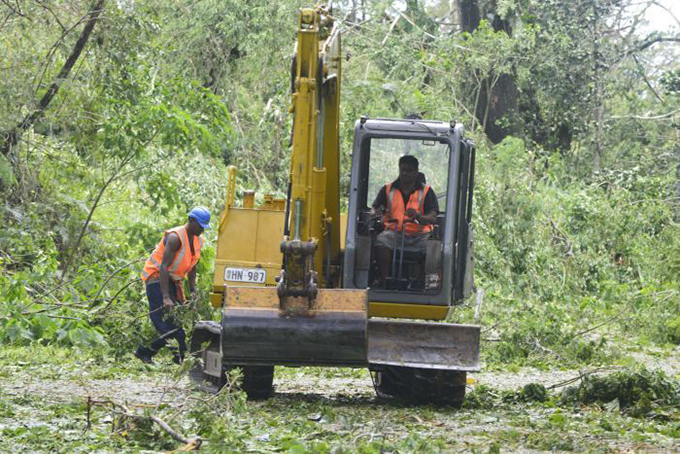
And meanwhile the public complaint concerning Radio Vanuatu reception continued during Cyclone Pam and last week with the passage of Cyclone Winston when warnings could only be heard on South Pentecost through FM107 or seen on tiny mobile telephone screens.
People should not have to climb hills and trees to have reception of such warnings when they have been available on the household radio for over 40 years, managed by ni-Vanuatu transmission engineers, sometimes supported by foreign aid, but without the need to bring Chinese companies into the formula.
Vanuatu Daily Digest learned of the Pentecost island cyclone Winston warning problem only on Thursday night. Radio reception of the national service remains a difficulty on West Coast Santo and in the Banks and Torres where they hear their warnings from the Solomons.
The problems in VBTC are further highlighted by a post of long serving broadcaster Antoine Malsungai on Facebook on Thursday.
The VBTC claims to be taking action against certain staff for various offences and yet the staff union is bringing a case against VBTC Board and management – a case which still has to be heard. Malsungai also raised the matter of the Chinese company involvement in the corporation.
The whole matter surely needs the interest of the newly formed government.
A media project which has been given negligible public awareness is the VBTC arrangement with a private Chinese company to provide television to all the islands of Vanuatu.
The VanuaMadia [sic] Digital TV Network is reported created for this purpose by Vila Times. VT 500 million worth of equipment is said to be going to arrive, the first shipment this [last] weekend.
There has been no public discussion on the merits and disadvantages to communities and cultures of such a scheme.
Accounting at VBTC has been the subject of complaint by the Auditor-General and it is to be hoped that appropriate expertise has been sought to evaluate such a project at a time when food and water are being shipped to islands suffering the ravages of El Niño.
An early opinion of the Salwai government would be appreciated by everyone.
Eight-month-old Waseroma Rasavou survived 14 hours in an esky cooler as the savage tropical storm battered a remote Fiji village in one of the latest survival stories to emerge.
As last week’s severe tropical cyclone Winston damaged 19 properties at Nasaisaivua in Kubulau, Bua – including two church buildings and a hall – Waseroma lay sleeping soundly and safe in the esky.
The baby was covered with only a T-shirt and the esky lid above his head, keeping him away from the rain and strong winds.
When his dad, Waisake Bukaroro, saw the house shaking, he told his wife Mereani Mailekutu to take the two older children to the village hall while he prepared the esky.
At 4.25pm, Bukaroro said he put the baby into the esky, closed it and ran towards the village hall to join the other villagers who were taking shelter there.
But when they were about five metres away from the hall, the structure dropped before them and the other villagers ran out.
In this instance, he panicked with fright, caught in a dilemma to choose between saving his baby first or run towards the damaged hall to rescue his wife and other two children.
Bukaroro said it was a difficult moment but the love for his son forced him to take shelter in a roofless bathroom — about 20m away from the destroyed hall.
He said when they got to the bathroom, which was big enough for four people, the villagers were all crammed into the only safe haven at that time.
He carried the esky through the overcrowded room and stood among the villagers carrying the cooler until daybreak on Sunday.
Throughout the night, he kept opening the esky lid to see if his son was breathing.
He added his baby did not cry but slept under heavy rain and strong wind conditions.
661 schools opening today Meanwhile, Newswire Fiji reports the Fiji government was asking schools around the nation to be understanding of the challenges being faced by students as 516 primary schools and 145 secondary schools around the country opened its gates for classes today.
Residents severely affected by Winston in the north-west of the main island of Viti Levu have received needed relief supplies during a three-day tour of the region by the Attorney-General, Aiyaz Sayed-Khaiyum.
Local businesses CJ Patel donated 5000 food packs valued at $232,000 and Punja and Sons another 5000 valued at $129,000 to assist the relief effort. R.C Manubhai has donated kitchen utensils to the value of $15,000 and mattresses and roofing supplies worth another $20,000.
The AG along with Minister Rosy Akbar and Minister Parveen Kumar distributed a large portion of the donated food packs from CJ Patel and Punja and Sons.
The AG’s tour took in cyclone-ravaged areas of Raviravi, Karavi and Yalalevu, (Ba) on Friday, Korobuya, Nabutini, Busabusa and Veisaru (Ba) and Korovou (Tavua) on Saturday, and Nadhari, and Navia (Ba) on Sunday.
It was the first time many of those affected by Cyclone Winston had received any form of assistance. The residents expressed their gratitude to the AG and the two ministers.
One of the suspects directly involved in the bombing attacks in the Thamrin Boulevard business district in the heart of central Jakarta early last month is a still a fugitive, says Indonesia’s police chief.
“We have caught 16 people for being directly involved in the bombing but one still remains at large,” the chief, General Badrodin Haiti, said at Police Headquarters.
He said the police were now investigating two convicts for their possible involvement in the bombing attacks on January 14.
So, in all, the total number of alleged perpetrators who were directly involved in the case has reached 19, he said.
General Badrodin said these 19 people were part of five different groups and three of the groups are led by Hendro Fernando, Helmi and Romli.
He did not mention the names of the leaders of the other two groups.
“Several groups were involved and they certainly had different plans. This poses a problem that may threaten security,” he said.
The bombing on Thamrin Boulevard claimed eight lives, including four bombers and four civilians, including a foreigner – a Canadian.
It was believed the target of the attack was foreigners.
More assistance from New Zealand is expected to arrive in the country today.
This was confirmed by a representative of New Zealand to the United Nations, speaking at a briefing on “The humanitarian situation in Fiji caused by cyclone Winston” organised by the Office for the Coordination of Humanitarian Affairs (OCHA). The unnamed spokesperson said:
New Zealand currently has 67 defense force personnel on the ground in Fiji with 72 more arriving on a naval vessel on Sunday, along with an engineering company of 180 personnel.
To date, New Zealand has committed more than $3.2m to the response, including immediate relief supplies and construction materials and also technical teams to help Fijian authorities assess the extent of the damage and plan a response as well as medical, engineering and water production teams to support the government of Fiji’s response.
New Zealand joins with others here today to offer our very sincere condolences to the people and government of Fiji for the terrible loss of life and economic, social and environmental devastation at the hands of Tropical Cyclone Winston.
We are very thankful for the preparedness and leadership of the Fijian Government who ensured the consequences of Cyclone Winston was less severe to what it could otherwise have been.
New Zealand’s Minister of Foreign Affairs Murray McCully is also expected to be in Fiji tomorrow to offer his condolences in person and show support to the people and government of Fiji.
Heartbreaking but an inspiration Fijivillage.com reported that Prime Minister Voreqe Bainimarama said while it had been heartbreaking to witness the devastation left behind by “monster” cyclone Winston, it had also been a great inspiration for him to see the Fijian spirit alive and well.
Bainimarama said in the face of such adversity where family members had been lost or injured and many houses destroyed, he had been greeted with smiles around the country.
He said he was determined that the government would do everything it could and as quickly as possible to help those affected by Winston “get back on their feet”.
He added that the government was doing everything humanely possible to deliver water, food and shelter to everyone in affected areas.
Rakiraki town, in one of the worst cyclone Winston-ravaged areas in Fiji’s northwestern Viti Levu island, is expected to be fully operational by next week.
The Town Council has been working non-stop to clear debris in the central business district.
The town suffered major damage after its market was blown away and flood waters brought big logs and trees onto the main street.
A number of large trees in the town also fell, blocking streets.
While there is still no electricity supply in Rakiraki, shops that have generators have opened for business already.
Businesses in Rakiraki are asking government for tax incentives in order for them to survive.
George Shiu Raj, a prominent businessman in Rakiraki, said:
“They are very sad at the moment just because we are THE biggest taxpayers and my request to the government is that they give us a tax breaks and incentives for three years so that we can build up.”
By Junior Ukaha and Pisai Gumar in Lae and Michael Guba in Port Moresby
Eleven prison inmates in Papua New Guinea have been shot dead and 17 wounded and recaptured following a mass breakout from Buimo prison in the second city of Lae.
Lae Metropolitan Superintendent Anthony Wagambie Junior said the exact number of inmates who broke out of the prison after overcoming warders would be determined after a proper head count by prison officers.
“It is confirmed that 11 prisoners have been shot and killed and 17 wounded and recaptured,” Wagambie said.
“Police will await for CS [Correctional Sevice] to confirm the number and identities of the escapees before we try to locate them.”
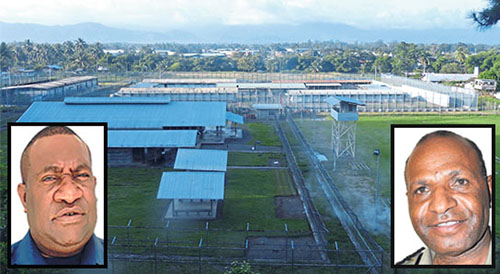
Buimo Jail near Lae … Insets: Lae Metropolitan Superintendent Anthony Wagambie Junior (left) and Acting Correctional Service Commissioner Bernard Nepo. Image: The National
Some reports put the number of escapees at 50, but The National newspaper cited a source saying the number was more than 90.
Acting Correctional Service Commissioner Bernard Nepo said that although he was yet to receive a full report from jail commander Chief Superintendent Joe Jako, “there were a number of reported deaths and injuries”.
“The situation in Lae is sketchy at the moment. Inmates and prison officers have been injured but it is still unclear as to how many,” he said.
‘Big number’ Wagambie said “a very big number of prisoners” broke out around 2pm on Thursday, with most of them being remanded in custody to await their court cases.
Wagambie said it was likely that the inmates attacked the prison officers on duty, one of whom had already received treatment at the Angau hospital.
“I was alerted by the jail commander [Chief Superintendent Joe Jako] and police were called to assist CS officers pursuing the prisoners on foot. Police units cordoned off the escape routes,” Wagambie said.
“Police will wait for CS to confirm the number and the identities of the escapees before we try to locate them,” Wagambie said.
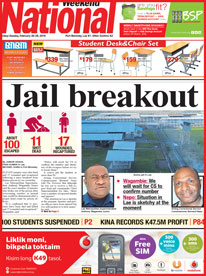
Yesterday’s edition of the National in Papua New Guinea. Image: The National
He said police were expecting an increase in criminal activities in Lae.
“I am warning the general public to be cautious on their movements and take necessary precautions. I am anticipating a rise in criminal activities in the city with the large number of escapees on the run,” he said.
“I am also warning people not to harbour these escapees [because] if they are caught, they will be arrested and charged.”
Jail commander administration Superintendent Judy Tara said she would not comment on the escape.
Dr Alex Peawi from the Angau Memorial Hospital accident and emergency department said that at around 6.30pm an injured prison officer had been admitted with injuries to his shoulder.
Buimo Jail near Lae … up to 90 escapees. Image: Loop PNG
Fiji’s Minister for National Disaster Management, Colonel Inia Seruiratu, has lashed out at political parties that are trying to politicise the issue of relief assistance.
At a media briefing yesterday, Seruiratu said:
It’s quite disappointing that the issue of distribution of rations or food or the other relief assistance has been politiciSed and this is not the time to politiciSe issues. We are aware that political parties are saying that certain ethnic groups are being marginaliSed or ignored, that is not so. And I wish to assure all Fijians that we’ll provide for them when we have the opportunity to come to you.
Meanwhile, the HMAS Canberra yesterday left the Port of Brisbane for Fiji to assist in the humanitarian assistance mission, transporting disaster relief supplies, equipment and personnel, including engineers and medical professionals.
The crew is expected to be in Fiji for at least a month.
Colonel Seruiratu said the government was expecting HMAS Canberra to reach Fiji by next Tuesday.
“We also received one of the aeroplanes from the French government in New Caledonia and one of the Casa planes is here with us. Today we have deployed the Casa aircraft to Vanua Levu, particularly to address the needs between Savusavu and Taveuni and there is future tasking for the same plane again in that area.”
Colonel Inia Seruiratu during a press conference yesterday. Image: Peni Shute / Newswire Fiji
Colonel Seruiratu said another plane had arrived yesterday and it would transport a water treatment plant to the people of Taveuni.
“By today we will be also receiving the second Casa plane and, of course, the priority for that plane will be in the Northern Division as well. Tomorrow the first task [that] will be allocated to that plane is to take a water treatment plant to assist in the water situation that the people in Taveuni are going through.”
The French military aircraft arrived in Fiji for humanitarian support with three tonnes of aid from the French Red Cross.
It was in Taveuni today for the first of many relief supply drops.
Newswire Fiji also reported that Colonel Seruiratu confirmed that 62,461 people were currently in evacuation centres around the country and the death toll remained at 42.
Vanuatu’s Opposition has suggested to the Head of State, President Baldwin Lonsdale, that any decision to free 14 former MPs jailed for bribery should be done in proportion to everything that concerns fairness and the country’s custom of forgiveness, reconciliation and rehabilitation.
“That way in the eyes of the people and the public they can see that there is fairness proportional to things that happened,” Opposition Leader Ishmael Kalsakau said this when a high level delegation from the Opposition made a courtesy call on the president.
“You may be aware of different feelings about some of our leaders who have gone to jail for wrongs done against our nation. We recognise your role in times like these for those affected by these sorts of situations in our nation,” Kalsalkau said.
“We have not come to tell you how you will do your job i. We are here to let you know that we recognise that there is a possibility and a potential that you can play a role in this situation.
“We understand that on the government side in their 100-day plan they state under their MOA agreement that pardoning should take place.
“But that is theirs for which they will approach you on. But we are here to say that yes, under our custom for us to move forward, we reconcile, forget difference, but everything must be in proportion.
“That is one issue we want to raise in passing by way of this courtesy call to you.”
Kalsakau said the Opposition recognised the crucial role the President played as anchor to the nation through his leadership during the political and leadership crisis of last year leading to the snap election.
He informed the president that his Opposition group had members from different political groups, but that they felt the pain of the people of the nation brought about by divisions. Hence they had decided to move together as one.
“Anyone who wants to discuss any issue for the benefit of one of us, it has to be for the benefit of all of us,” he said.
“We want to let you know that our theme that we want to move forward with is ‘forgotten people, forgotten places’.
“During our calls to the Australian and New Zealand high commissioners this week, it was a big emphasis. And we were informed by them that they want claims from Torba to come quickly so they can assist the province, and its forgotten places where ships go once in three weeks.
“All the time in the past, Members of Parliament who find themselves in Opposition, run to get into government.
“But our focus is that on forgotten people, forgotten place, we can consolidate the Office of the Opposition in such a way that members of Parliament irrespective of which side of the house they find themselves, if in the Opposition should not feel neglected.
Jonas Cullwick, a former general manager of VBTC, is now a senior journalist with the Daily Post.
Vanuatu’s Opposition has expressed sadness with the government and the people of Fiji, and people of Vanuatu and students living in Fiji over the devastation and loss of life from the category 5 tropical cyclone Winston last weekend.
A statement issued by Opposition Leader Ishmael Kalsakau said his Office was extremely disappointed to see that after severe tropical cyclone Winston hit Fiji where many ni-Vanuatu students are studying in schools and universities and the people of Fiji were facing hardship, the Vanuatu government had not yet produced assistance plans.
“Vanuatu must be reminded that we went through a similar tragedy and Fiji assisted us in a huge way and sent its technical people to come and assist us,” the statement read.
“The Office of the Opposition wants to tell the government that we must tell ourselves that it is enough of planning in a reactionary manner and to start adopting proactive measures so we are ready to tackle problems before they overcome us.
“The problem of being reactionary has led us to become victims in a big way in natural disasters such as cyclone Pam.
“When we receive a forecast for rain tomorrow, we must be ready with the umbrella today,” the statement continues.
It says the government made a reserve of around 1.3 billion vatu (about NZ$17 million) last year, which showed the prudent management of the previous government. But this must allow the country to be more active and prepared for natural disasters that may affect us, our friends and our families.”
‘No idleness’ With the predictions of tropical cyclone Winston, the technical people of Vanuatu should already have already “sat down and put together a package” for government to apply in a situation like this and to reassure ni-Vanuatu people who live in Fiji and the Fiji government, the statement said.
“It is not possible [in] this day and age for the performance of any government of the day to show idleness on the part of government on issues that affect the lives of the people.”
The Opposition urged the government to reflect and regenerate the country’s response time on issues such as these when information received showed they would happen so that the government can plan to tackle them it in a way that minimise their effects and show the people the government was ready and capable of looking after the welfare of all.
“The time for reaction should have been [last weekend]. Even just a word of support would already [have been] a huge gesture,” said Kalsakau.
“The Office of the Opposition would like to take this opportunity to share its sadness with the government and the people of Fiji over the tragedy they are facing and thank God Almighty for looking after our people in Fiji.”
The death toll from the cyclone in Fiji has reached 44 this week, according to reports from Fiji.
The Daily Post tried to contact government leaders but could not reach any.
As aid has started to flow to parts of Fiji left devastated by severe tropical cyclone Winston, the Fiji Times chief editor says that this country once used to coping with fierce storms has been left vulnerable.
In his reflective series of editorials, Fred Wesley wrote that it was encouraging to see the international community rallying in support but “the real cost to our nation” was not yet known.
Fijians had been “prepared” for the cyclone but the sheer scale of the disaster was “overwhelming”.
“Thousands [of Fijians] had made a beeline for stores to stock up on food and water, and batteries for torches and radio sets. They fixed their homes,” Wesley wrote.
“Some had been proactive and converged on evacuation centres to sit out the cyclone.
“But clearly no one was prepared for the raw power and strength of Winston. The devastation caused by this massive system was overwhelming.”
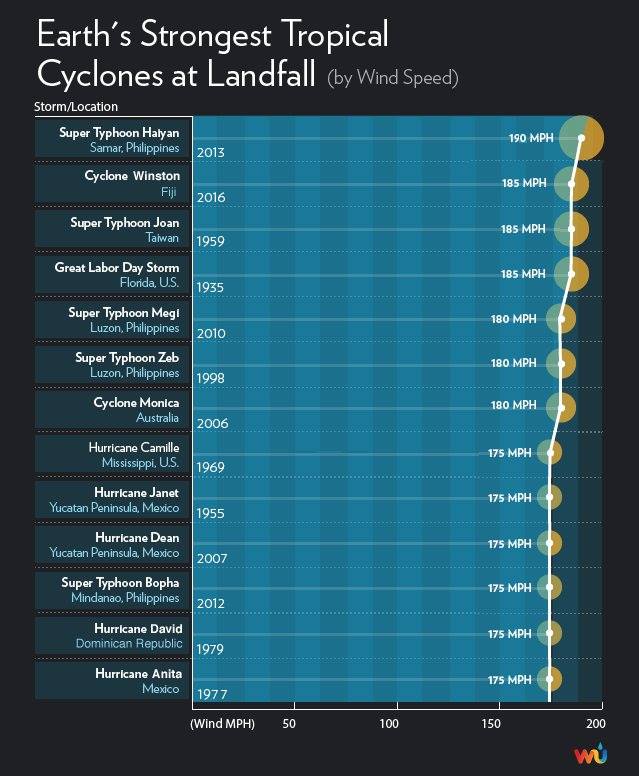
International support FIVE days after the most destructive cyclone to hit land in the southern hemisphere struck us, rehabilitation assistance is slowly getting to affected people around the country.
For some, there is relief as the state assistance machinery reaches them. For some others, it is probably not fast enough as food and water supplies start to dwindle.
The process of prioritising areas to target first has been made difficult by the fact that quite a large number of people and areas were badly affected by Severe Tropical Cyclone Winston on Saturday. Add to that the rising death toll and injury list. There can be no doubts about the fact that people were prepared for a cyclone.
Thousands had made a beeline for stores to stock up on food and water, and batteries for torches and radio sets. They fixed their homes. Some had been proactive and converged on evacuation centres to sit out the cyclone.
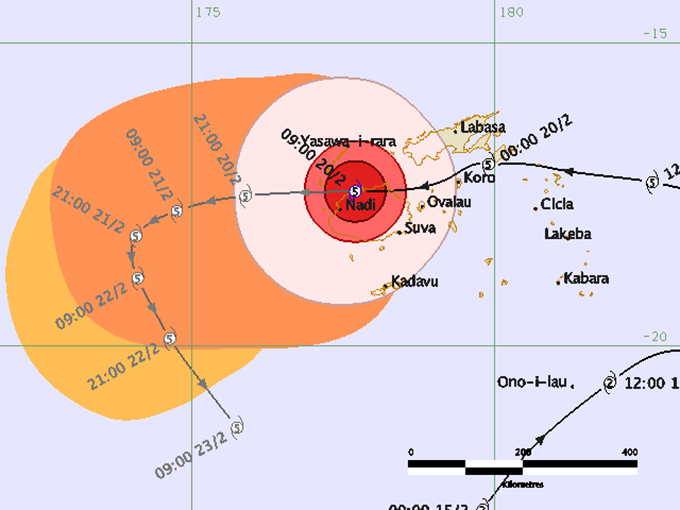
But clearly no one was prepared for the raw power and strength of Winston. The devastation caused by this massive system was overwhelming. No one was prepared for Winston’s average winds of up to 220km an hour and momentary gusts of up to 315km an hour close to its centre.
That was terrifying strength that turned Winston into a fully-fledged Category 5 mega-storm.
As it swept over Lau, and took a path straight through Lomaiviti, many Fijians battened down for the night, anticipating “just another” cyclone.
Because we are a country prone to such natural disasters, perhaps that has ingrained in us a sense of acceptance of our fate, and of cyclones in general.
That has now changed in the wake of Winston.
As the eye moved over Lomaiviti, the entire country for a moment was enveloped by this massive system that brought with it rain, very strong winds, flash floods and giant waves.
Winston left behind a nation that is now vulnerable. Fijians may be resilient. However, the devastation left behind by Winston is shocking and the recovery process will run into millions of dollars.
The real cost to our nation is yet to be known.
We may even guess the length of our recovery period.
As much as we may insist on being strong to get back on our feet, in such times, the assistance of our friends will be welcomed.
It is encouraging to see the international community rallying in support, to back the recovery process.
They are aiding state efforts by providing supplies, manpower and humanitarian assistance. Because the cyclone left many Fijians without adequate food, water or shelter and cut-off from essential medical services, there will be some urgency to provide these.
The Indian Government, Australia, the US, the People’s Republic of China, France, New Zealand, Japan, French Polynesia, Tonga, Nauru, and the Asian Development Bank have made pledges in support of the State efforts.
In this, our time of great need, it is good to know that the international community is prepared to come to our assistance. This great show of support and concern is appreciated and will aid in our recovery process.
The onus now is on the powers that be to put in place measures to get needed assistance immediately to every affected Fijian around the country.
One of 44 people who perished in Fiji from severe tropical cyclone Winston was a 72-year-old woman, Selai Waqa, from Nauouo village on Ovalau island.
She saved her favorite church dress plus a pocket Bible in her last moments.
Her younger brother recalled the last moments he spent with her before she died after the church collapsed on top of her last Saturday evening as reports came in of mounting international aid pledges to cyclone-ravaged Fiji topping F$15 million.
“‘What happened was when we started getting warnings from the radio, we had our last lunch together and she cooked sausages and after that people came in and told us if they could move into the church,” said Inoke Ravuetaki, Selai’s younger brother
Selai’s only son is a soldier serving in Afghanistan as a Fiji peacekeeper under the United Nations.
Not far from where Selai was laid to rest, her sister-in-law Susan Ravuetaki was struggling to her feet.
Buried in rubble Susan was buried with Selai under the rubble of the church for almost two hours and she thought she wouldn’t survive.
” I thought we were going to die, that nobody could come and get us because the wind was just too strong. I was watching the people all inside the lali house and when I looked up it looked like the telegraph pole was going to fall.
“Then I saw them all run and I heard Selai crying out for help. I said to Selai, ‘Just lie down because nobody can come and get us now because the wind is just too strong for us’,” said Susan Ravuetaki.
Villagers of Nauouo fled from the first evacuation center which was the church hall before it was destroyed.
They then moved the community hall which later fell before they found shelter at the church and it was not long before it collapsed.
Selai only saved two items from her home before she was moved to the evacuation centre.
” When she came to church for shelter she had a little bag and in that bag we saw on Saturday night when she died was her Bible and her church dress so she came to church ready,” said Inoke Ravuetaki, Selai’s younger brother.
Selai was buried on Sunday morning without a burial order from police.
The village headman, Mataiasi Dakuitoga, said it was a priority for the woman to be laid to rest and he was even willing to go to prison for his actions.
Only one house was spared by Winston in this village.
They may have lost a loved one but for now they will have to be strong.
120,000 children affected The United Nations Children’s Emergency Fund estimates that up to 120,000 children across Fiji may be the worst affected by the cyclone.
Its estimate comes as the full picture of the worst cyclone ever to hit Fiji becomes more apparent.
The Fiji Times reported UNICEF Pacific representative Karen Allen said children were often the most vulnerable during emergencies and UNICEF continues to support the Fijian government’s efforts in addressing the needs of children.
The organisation has already started its relief work in the affected areas and its officials are also out in the field. Damage estimated at $1 billion The estimated cost of damage sustained around the country by Winston is about F$1 billion, the Attorney-General and Minister for Finance, Aiyaz Sayed-Khaiyum, announced at a press conference.
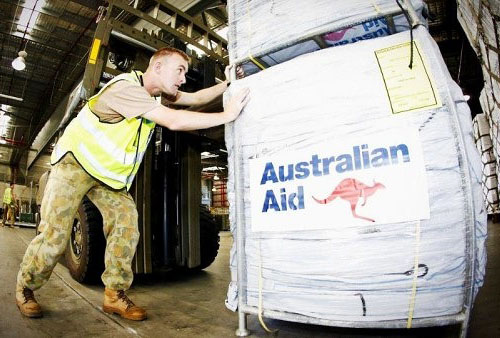
Australian aid being delivered to Fiji yesterday. Image: Newswire
According to Sayed-Khaiyum, this was not an “official” figure, however the estimation was derived from inspections of damage around the country.
The Indian government has pledged more than F$2.1 million as a cash grant to the Fijian government for relief efforts and recovery activities, along with medicine, food, tents and transportation helicopter to deliver relief materials.
The Australian government has provided F$7.7 million in humanitarian aid-in-kind. The Australian government has also provided four helicopters for aerial surveying and the transportation of relief supplies, along with two aircraft for aerial surveying.
New Zealand government has provided F$$424,000 in humanitarian aid-in-kind along with four military helicopters, medical supplies, and medical teams.
The HMS Canterbury has also departed for Fiji to provide 40 military personnel to help deliver relief assistance.
Journalist Veronica Hatutasi will launch her new book on the Bougainville crisis, Behind the Blockade, today in Port Moresby.
Based in Port Moresby, she has worked for a long time as senior reporter for Word Publishing’s Wantok newspaper.
The book starts in Toniva, just south of Kieta, as the conflict builds and follows Hatutasi’s story from there back to Monoitu in the Siwai District of south Bougainville.
Here Veronica stayed with her family until late 1992 when, in August of that year, she was able to get herself and her family to Port Moresby.
The book focuses on her personal experiences in the village as the crisis played out and then, from 1993, on her role as a journalist covering the Bougainville story from Port Moresby.
Hatutasi gained many insights into the conflict and how it affected the Bougainville people from repeated trips back to the island over the years and her book covers the restoration, reconstruction, reconciliation and peace processes.
Behind the Blockade will be launched at the Grand Papua Hotel.
The book is entirely Hatutasi’s initiative.
I worked with her through the late 1990s when I was based at Aitape after the tsunami, then for a few more years when based in Madang.
The book is 233 pages long and published by Word Publishing (ISBN 978 9980 89 024 5). It is available from Veronica Hatutasi and you can email her here for further information.
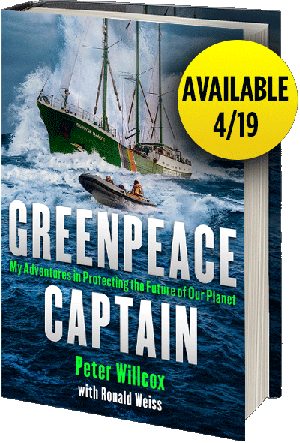
On September 18, 2013, two Greenpeace International activists were arrested during a peaceful protest in the Russian Arctic. A week later, the entire 30-member crew of their ship was in a Russian jail awaiting trial on charges of hooliganism and piracy. The story of the Arctic 30, as they came to be known, was one heard around the world, and one that Peter Willcox — skipper of the original Rainbow Warrior which was bombed by French secret agents in Auckland Harbour in 1985 — writes about in his new book Greenpeace Captain. Read an exclusive excerpt here.
Maggy had been watching a live Greenpeace feed in our home in Maine, anxiously awaiting the moment when my head would pop out from behind the huge prison door. Just before I walked out, the video feed was lost and she missed the big moment. She didn’t know I was out until I called her from the car to tell her I was drinking Alexander’s brandy.
While I was relieved to be out of jail, during the car ride from Kresty Prison to the hotel my joy was tempered by worrying about the reception I would receive there from the Arctic 30 who had been released before me. Would they blame me for their incarceration?
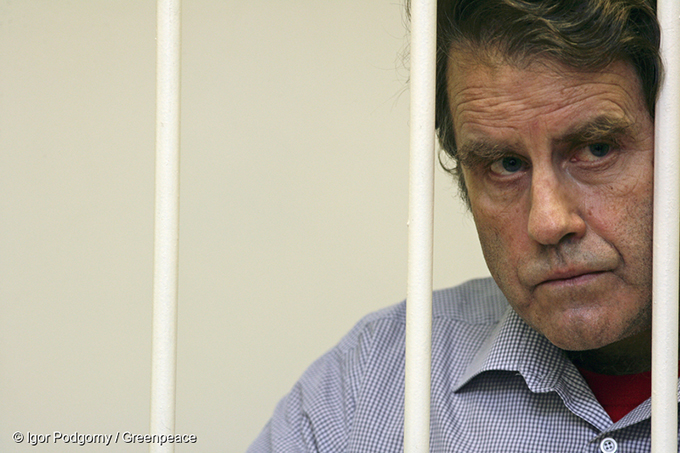
Peter looks on from his cell during hearings in St Petersburg, Russia. Image: Igor Podgorni
I had certainly made decisions that contributed to our arrest and the arrest of the ship, but then again, not one of us had anticipated the muscular response from the Russians. As I exited the car and walked into the lobby of the hotel, my concern grew. Would they vent their anger at me, or would I just get the cold shoulder?
The first people I saw were my shipmates Sini, Camila Speziale, and Alexandra “Alex” Harris. They saw me in the same instant and immediately moved toward me with their arms raised. I realized the three were all opening their arms to me. Seconds later we were in a group hug. Their shoulders were anything but cold. It was the best I had felt in a very long time.
The hotel had been selected by the police so they could keep an eye on us while we were out on bail. We assumed the hotel was bugged, and there was an undercover cop in a van parked across the street from the hotel.
While we wanted to give him the finger, we would flash him the peace sign instead. That probably pissed him off even more. Having him there was their way of keeping us under pressure. The peace sign was our way of saying, “We don’t give a shit.”
Although we were out on bail, we were still under indictment and not allowed to leave the city. It was kind of like being in purgatory, but after being in prison it was still a major improvement in living arrangements. I was able to see my wife, my daughters, Skype with friends, and — of course — be interviewed by newspapers, websites, and TV and radio broadcasters all over the world.
At this same time, Putin was preparing a mass amnesty bill. Officially, the amnesty bill was to commemorate the 20th anniversary of the Russian constitution. The reality was the bill was an attempt to polish up Russia’s record on human rights just weeks before the start of their Winter Olympics. Our lawyers were hoping that the Arctic 30 would be included in the bill, but no one knew for sure who was included or not. The more publicity we got, the better the chance we’d make it into the bill, so we focused on that.
In prison we had been cut off from the outside world. We were pretty much in the dark (literally, in some cases) and just trying to keep our spirits up.
There were a few TVs in prison, but since the government controls the media we didn’t see any news covering the efforts to put pressure on Putin to release us. We got some reports via our lawyers, Greenpeace, letters and, eventually, phone calls with loved ones, but that was just the tip of the iceberg.
Every written word we received in the prison was read by the Russians and translated into Russian before we got them. Everything we received had typed notes with Russian translations that were taped or stapled to the originals, including the ‘Free the Arctic 30’ greeting cards made by eight-year-old children in Africa. I still have a stack of them with all of the Russian translations.
Peter Willcox, writing with Ronald Weiss in the forthcoming book “Greenpeace Captain”
Now that we were on the outside, it was just becoming apparent to me (and to the rest of the Arctic 30) just how much publicity we were getting. It’s an amazing feeling to realize that hundreds of “Free the Arctic 30” protests demanding your release have taken place in dozens of countries around the world. Words can’t describe it, so I won’t try. The bottom line is that the international reaction makes me believe that what Greenpeace is doing is deeply appreciated and important.
Thousands of people had protested in front of numerous Russian embassies. Letters from statesmen, world leaders, religious leaders, celebrities, actors, and media figures from every corner of the globe joined in the effort to release us. It’s an impressive list, and it’s not just the length of the list that’s amazing, it’s the breadth of it: twelve Nobel Prize winners. Paul McCartney. The Pope. Madonna. (It’s not too often that the Pope and Madonna are in agreement on anything!) Angela Merkel, François Hollande, and David Cameron. Desmond Tutu. Even the VP of Iran, Dr Masonmeh Ehtekar (she’s also the head of Iran’s EPA) supported us. The list goes on and on.
One protest letter that was especially important to me was written to Putin by Pete Seeger, the family friend, folksinger, and my boss on the Clearwater so many years before. It was Pete who put me on the path I was still following years later. Pete passed away at age 94 just a few weeks after I got back to Maine, so I never saw him again.
When you’re in prison you have a lot of free time on your hands. Often you find yourself thinking about happier times and places and people that you miss. A lot of those times were with Pete, singing and sailing and saving the river.
It was hard on Maggy to have me imprisoned in a hostile country, particularly since it happened such a short time after we were married. And a good chunk of that time I had been at sea on other actions. For her part, she always put up a brave front, and never stopped fighting for our release.
She helped organise rallies from Maine to Connecticut, wrote letters and editorials, and urged governors and senators to write Putin. Maggy was a real emotional anchor for me during this stormy period of false dawns and dark threats. She’s an amazing woman and I’m lucky to have finally landed her.
All of us in Saint Petersburg (the Arctic 30, family, friends, lawyers, diplomats, and supporters) were holding our breath until the amnesty bill was passed. When it passed, it released close to 25,000 prisoners — some petty criminals, some political prisoners, all kinds of people — but not us. The bill did not include “hooligans” — our “category of criminal.” It was, yet again, another shock and disappointment.
Still, there was some hope. A few days later, the Duma (the Russian legislature) passed an amendment to the bill that included those charged with hooliganism — that meant us, and Pussy Riot, among others. We were greatly relieved, of course.
We were close to home free. (“Home” and “free,” two words that will always mean a little more to me now.) Still, we had to wait for the inevitable paperwork to get processed, getting our passports back etc.
Who knew how long that was going to take? It looked like “I’ll be Home for Christmas” wasn’t on the cards, but we were hoping to be back in time for New Year’s Eve.
There is a video called “Thank You” that Greenpeace put together after we were released. It shows highlights of the protests all around the world, and then we — the Arctic 30 — thank all of the people who took action to secure our release. (You can watch it yourself.)
I think I speak for all of us when I say that if it were not for all of their support, we might still be languishing in a Russian prison somewhere.
About 100 hundred homes in Korovou village in Tavua have been damaged.
There have been no deaths in the community, but the peoople have pleaded for help.
The affected people are now trying to rebuild their lives.
“My kids went to their aunts house and I was alone in the house during the cyclone, the roof got blown off I was still inside the house the second roof went off then I went outside and I ran to my sisters house. For the time being we’re still at my sisters house,” — Maikeli Vueti, resident Korovou Village, Tavua
Fiji’s coastal district of Nakorotubu, Ra, which includes more than 10 villages and a population of more than 5000 was completely flattened by severe tropical cyclone Winston.
Describing the situation in the province as “ugly”, Commissioner Western Manasa Tagicakibau said initial assessments indicated all homes were destroyed.
“Initial reports state that all homes were blown away,” he said.
Ra, one of 14 provinces of Fiji, northern area of the largest island, Viti Levu, has 91 evacuation centres, the highest in the division. The Yasawa islands are just off the northern coast.
The Emergency Operations Centre in the west has not been able to collate data on the number of evacuation centres and evacuees in maritime zones.
As a result, the Emergency Operations Centre (EOC) in the Western Division has redirected all manpower and resources to the Ra province.
He said the EOC had established communication with heads in Nakorotubu and a team was sent to the province to assess damage.
Brienfings ‘not good’ “The briefings were not good,” he said.
“Ra is an ugly situation and even the EOC team were victims of TC Winston.”
Forty one villages in the province have yet to report their status to the Ra provincial administrator’s operation team in Rakiraki.
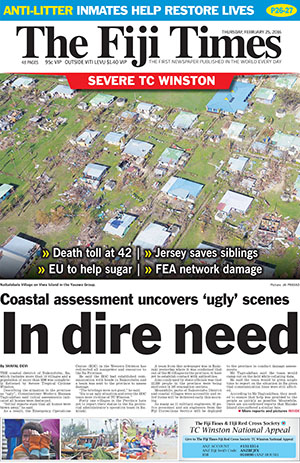
Today’s Fiji Times front page.
A team from the Fiji Times was in Rakiraki yesterday where it was confirmed that out of the 93 villages in the province, 41 have yet to establish contact with authorities.
Also confirmed by state officials was that 12,339 people in the province were being sheltered in 107 evacuation centres.
Meanwhile, parts of Nakorotubu District and coastal villages were accessible and relief items will be delivered today.
Up 11 military engineers, 10 police personnel and six engineers from the Fiji Corrections Service will be deployed to the province to conduct damage assessments.
Camp out Tagicakibau said the team would camp out on the field while collating data.
He said the team would be given ample time to report on the situation in Ra given that communication lines were still affected.
According to Tagicakibau, they needed to ensure that help was provided to the people as quickly as possible. Meanwhile, there are unconfirmed reports that Malake Island also suffered a similar fate.
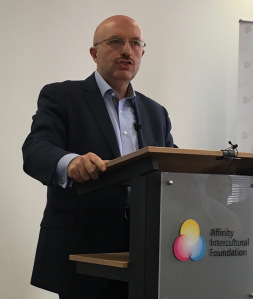
Moderate Muslims were losing the media war with ISIS, according to leading Turkish journalist, Kerim Balci.
”Authentic” Muslims were losing to “radical so called Muslims” because of the obvious symbiosis between journalists and terrorists.
“Ten thousand Muslims may be doing good things but it’s not reported,” he said. “One Muslim makes something bad and its headlines!
“The voice of extremism is always multiplied through world media!” Even Muslim media were guilty of this.
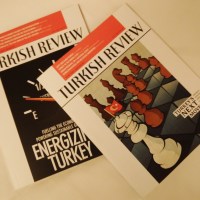
Turkish Review … a Zaman Media Group publication.
Kerim Balci is editor of the Turkish Review, a bimonthly journal published by Zaman Media Group.
Balci studied physics and political science and international relations in the Bosporus University of Turkey. He has an MA from the Hebrew University of Jerusalem, the city where he served as the representative of Zaman Turkish Daily for eight years. Balci is currently a linguistic philosophy PhD candidate at Durham University. He was in Sydney at the invitation of the Affinity Intercultural Foundation.
Balci said social media could have been an alternative where “authentic” Muslims could promote peaceful Islam.
“Unfortunately, ISIS uses social media much better than us. The videos that are produced by ISIS for Youtube are much better than even the movies produced for the market in many Muslim countries”.
Mainstream conflict Mainstream Muslim media could also find themselves in conflict with their own governments.
In Turkey, journalists had revealed the government had been engaged in secret negotiations with the Kurdistan Workers’ Party (PKK), regarded by the state and in the West as a terrorist organisation.
Kerim Balci — “a paradoxical situation where you are stuck between the national interest and journalistic ethics.” Image: Online Journalism
“There is the paradoxical situation where you are stuck between the national interest and journalistic ethics”.
Turkish newspapers published the story. The government was “quite angry” and two journalists were jailed, accused of treason.
“It’s not the duty of journalists to keep those things secret,” Balci said.
Meanwhile, some [radical] religious Muslim media branded any journalists who identified terrorist groups, as “infidels” .
“In fact one of them is sitting in front of you, ” he said with a grin. “I wrote an article calling Hamas terrorists,” Baldi said. ”And a [radical] religious paper called me an infidel!
‘More harm’ “As a religious person, I believe the terrorists are hijacking my religion and doing more harm to religious Muslims than they are doing harm to the West”.
ISIS had killed many more Muslims than Westerners.
“As a journalist, I have a duty to inform the public. But there is also an inescapable duty to educate the public about our religion.”
In this “post modern era” many people got their information on religion from newspapers.
“Those of us who cover religious conflicts are actually setting the tone for the people. We have to realise that what we say may be perceived by our readers as if we are the preachers in the mosque.”
An Armenian journalist was killed in Turkey by a “religiously motivated” nationalist young man, as a result of what he had read in a religious newspaper, Balci said.
Terrorism was too often defined as what your enemy was doing. In a mirror image of the more belligerent Western newspapers, many Muslim publications called Western actions “terrorism” while being reluctant to apply the term to Muslim atrocities.
“Suicide bombings are never OK, no matter who does it,” Balci said.
“We journalists need to be sincere, frank and consistent about the language we are using,” he said. “Language is never innocent. We have to understand it won’t stay in the newspaper. It will influence people!”
The article was first published on Professor Alan Knight’s blog Online Journalism and is republished here with the author’s permission.
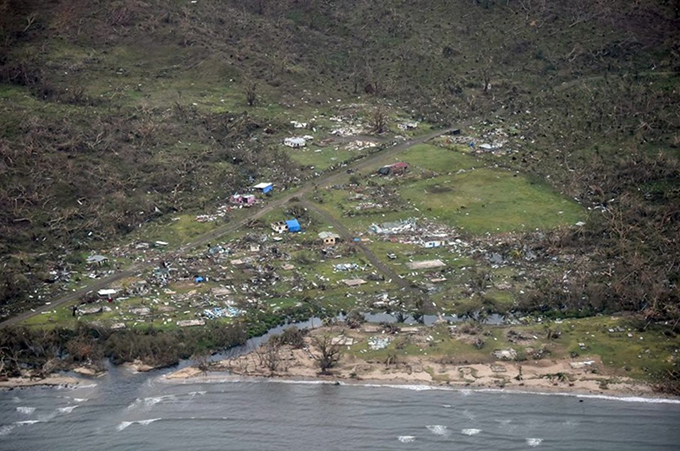
When help finally arrived on Koro Island and the media flew in to bear witness, the scenes were of total devastation.
The sign pointing to Sinuvaca village is still, there but the village itself has vanished. Torn apart by the category 5 severe tropical cyclone.
Fiji Times editor-in-chief Fred Wesley writes in his third editorial in his Cyclone Winston series: “When problems disappear” …
You only have to look at pictures from the island of Koro to understand and appreciate the strength of what was the strongest cyclone to ever hit Fiji.
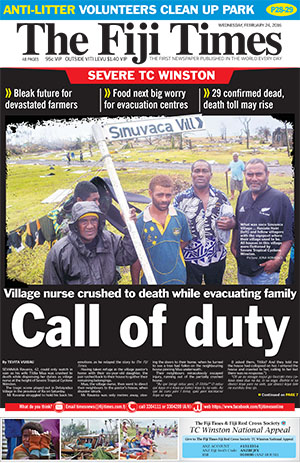
Today’s front page of The Fiji Times … the agony of Koro and the vanished village. Image: PMC
Fiji Times photographer Jona Konataci flew to Koro early yesterday morning and returned with pictures that told a story of pain and helplessness. His pictures brought to life the predicament of the people of Koro and spoke of the vulnerability of human beings in the face of mother-nature.
Against a system that was powerful and massive, the people of Koro could only hold on to hope, and pray for an end to the frightening fury of Severe Tropical Cyclone Winston.
It rained on Saturday. That wasn’t the problem though. The rain came in with the cold. But the people of Koro were not prepared for a massive system such as Severe TC Winston.
Cut a path Packed with average winds of up to 220kmh and momentary gusts of up to 315kmh an hour close to its centre, Severe TC Winston, now a fully-fledged Category 5 mega-storm, swept over Lau, and moved west to cut a path through Lomaiviti.
Koro Island was right in the way. It met the cyclone head on. It was a nightmare. It was terrifying.
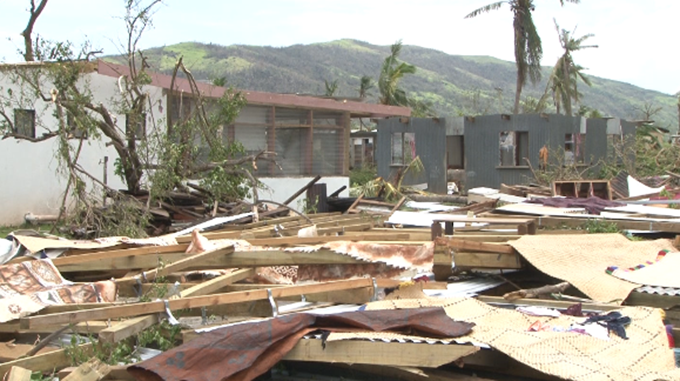
Roofs were torn off by the ferocious winds. Homes were blown away and concrete structures looked like they had been pounded by a tank. Nothing, it appeared could withstand the fury and the immense power of Severe TC Winston.
Death stared at the people of Koro.
Of the total number of homes destroyed around the country, 315 alone were on Koro. The pictures you will see in today’s edition tell a story of destruction. However, there is a touch of hope lurking somewhere there.
Like many other Fijians, the people of Koro are resilient.
As Konataci shot his pictures at the devastated village of Sinuvaca, children posed beside their destroyed school library, standing beside shelves that surprisingly still held neat rows of books.
Out towards one end of the village, a group of men held on to the signpost that pointed out their village.
It read “Sinuvaca Vill”, shortened for “village”.
The only difference was that it now pointed towards a village that was no longer there, flattened by Severe TC Winston.
Playfully pushing Out on the waterfront, children playfully pushed each other to be seen in a picture taken by Konataci.
Rather instinctively, they gave the victory sign. They smiled for the camera. Severe TC Winston was gone. They were back to being village children.
As the state machinery shifts a gear to attend to their plight this week, they are beacons of hope for us all.
Innocent, playful and friendly, they can still manage smiles in the face of great adversity. For a few minutes, all the troubles in their little world disappeared.
The harsh reality though is that they need urgent assistance as do thousands of others in affected areas around the country.
We can only hope you will keep them in your thoughts today.
Gradually it is sinking in with the people of Fiji how “powerful and ruthless” severe tropical cyclone Winston has really been with entire villages being flattened, schools destroyed and the death toll mounting.
The Fiji Times, the country’s oldest and most influential daily newspaper, has published for the second day running tributes to the courage of many Fijians in cyclone-stricken areas.
“It is difficult to shrug off the massive impact Winston has left in its wake, financially, physically and emotionally,” wrote editor-in-chief Fred Wesley. “As we start picking up the pieces, tales of heroism are slowly coming out as well. Such moments in time, for some unknown reason, bring out heroes.
“They are men and women who will shrug off any thoughts about their own safety to ensure their fellow human beings are safe.”
Under the heading, “Danger lurks,” Wesley wrote:
As damage assessment teams send in their reports from around the country, it is becoming increasingly clear that Severe Tropical Cyclone Winston was powerful and ruthless.
By yesterday, the national death toll in the wake of the Category 5 cyclone sat at 21. [PMW editor: Tonight this figure stood at 29.] Twelve of them died in the Western Division.
As state emergency teams head out to troubled spots around the country, there is hope that this is the final figure.
Early assessments, however, are not positive at all.
In many areas, entire villages have been affected by the powerful winds brought by Winston.
Homes were missing their roofs yesterday, some blown off their foundation and some torn to shreds by the angry winds.
The National Disaster Management Office has confirmed that 8438 evacuees are billeted in more than 50 evacuation centres in the four divisions.
As our report on Page 3 reveals, there are nine evacuation centres in the Eastern Division with 121 evacuees; 20 centres in the Central Division housing 1177 evacuees and 22 centres up North with 1260 occupants.
For the Western Division, there are a total of 5880 evacuees. As government officials headed for cyclone-stricken areas, Prime Minister Voreqe Bainimarama has urged them to respond promptly to the needs of those affected.
Director NDMO Akapusi Tuifagalele revealed that preliminary costs of damage to schools in the Western Division alone stands at $2.2 million. The true impact of Winston is slowly, but surely, coming to the fore.
It is difficult to shrug off the massive impact Winston has left in its wake, financially, physically and emotionally. As we start picking up the pieces, tales of heroism are slowly coming out as well. Such moments in time, for some unknown reason, bring out heroes.
They are men and women who will shrug off any thoughts about their own safety to ensure their fellow human beings are safe.
Many may never be known. And some such as Atunaisa Raralevu (No.3) made the ultimate sacrifice.
The 24-year-old farmer wasn’t famous at all. He was loved by his family though.
At the height of Winston’s fury, this young farmer tried to save 15 people trapped in a house.
He did what many probably wouldn’t have done.
He had already carried a woman, her three children and another girl to the safest house in the village.
He will be remembered by those he touched that night. His reassurance and bravery in the face of overwhelming danger will mean a lot to those who survived.
This is just one of the many tales of courage that embraced the terrifying night when Winston wreaked havoc on Fiji.
Now more than ever, our country needs us to unite in our rehabilitation efforts.
We must ensure we remember Winston. This powerful system should serve as a constant reminder of the dangers that we live with.
The parade provided a positive face to LGBTI people, but glossed over many inequalities, and much brutal discrimination that still impacts on LGBTI (lesbian, gay, bisexual transgender, intersexed) people.
See RNZ’s September 2015 report on continuing discrimination.
No Pride in Prisons protested against police inclusion in the parade, because of the harassment and brutal discrimination of LGBTI people by the police and prison system.
My video of the parade and protest
Pride parades, once called Gay Pride, arose out of protests against brutal oppression and discrimination of gay men. In 1969, gay men at the Stonewall Inn in New York, retaliated against police harassment.
Riots and demonstrations followed. Gay liberation gathered steam throughout the 1970s and 80s. Gay Pride marches were protest marches on which LGBTI people bravely outed themselves in public, at a time when they risked discrimination at school, at work, in housing, on the streets, and all walks of life.
In Auckland Hero Parade was an annual event from 1992 to 2001. It’s demise was due to funding and debt problems. In 2012, National Party MP Nikki Kaye began working towards a new Pride Parade, with the support of the PM, John Key. The rationale for the parade focused on social and economic benefits, with the boost to tourism and the economy being foregrounded.
The latest Pride Parade seems to be doing OK with funding. A lot of this is probably due to the sliding-scale of fees from participants in the parade. [See the entry requirements] Commercial enterprises pay the highest fees (minimum of $5,000). The only requirements are that they do not have a record of discriminating against queer people, and that they express support of the Rainbow community. They are in fact, commercial sponsors that benefit from the brand association with Pride. It is likely they are focussed on attracting business from the better off LGBTI people.
Rainbow community groups or individuals pay a minimum of $200, and charities, government or political groups pay $500 (base fee).
This commercialisation and corporatisation of the parade, while promoting positive images of queer people, tends to marginalise the less powerful LGBTI people: those on the precarious edge of social and economic life. Continuing harassment, brutalisation, discrimination, and negative social impacts, are played down.
No Pride in Prisons focus on some of the most marginalised and voiceless of LGBTI people: those who are on the receiving end of violence and brutal treatment by police and prison staff. Consequently they object to police being able to march in the parade, albeit to represent lesbian and gay police.
The police participation straddles a fault-line in the Pride entrants’ requirements. They are there to represent LGBTI people positively, while the police force as a whole has a patchy record of treating queer people badly.
Minister of Police Judith Collins turned up to support the police and march in the parade with them. Again, this sits uncomfortably with the Pride parade requirements. Collins did vote for the marriage equality bill.
But her record generally is not that supportive of the Rainbow community. She is on record as positively supporting Cameron Slater and his WhaleOil blog, while not being in any way critical of the blog’s record of the use and condoning of homophobic language and verbal abuse.
At Pride 2016, the Labour Party celebrated the fact that it was Labour MP Fran Wilde’s 1986 Bill that resulted in the legalisation of gay male sex (it had never been illegal for lesbian sex). The Labour Party celebrated this in Pride 2016.
No Pride for Prisons organised a march from Karangahape to Ponsonby Road, which anyone could going, free of cost. Some of the protesters got onto the street, which resulted in the parade being delayed. This protest got a lot of attention from people with cameras, including the press. Meanwhile, many in the crowd expressed their disapproval of the protesters, cheering the arrival of the police.
Some of the parade motorcyclists tried to make noise to drown out the protesters. The protesters chanted “We won’t be silenced”
A woman explained to me why she joined the protest:
“So last year I came to watch the Pride Parade with my mates. I was so upset because it was the ANZ, the BNZ and all the banks, and then it was the army, and then it was corrections, and then it was the police. And I just felt like the whole thing had been over-taken. And whereas, you know, 20 years ago, it used to be the whole community marching down the road. Now it’s become a spectacle for people who watch from the sidelines.”The banks, various businesses, the army and corrections were all in the parade this year.
The protesters chanted:
“Army of the rich, enemy of the poor”
“It’s not your parade”; “Shame, shame, shame”; “Whose got the power- We’ve got the power – What kind of power? – People power”.
There were some small signs of protest in the parade. Surfers had a placard on their float that said: “No Way TPPA”. Many carried the current NZ flag, indicating their preference in the upcoming referendum. I saw no alternative candidate flags.
The main focus of mainstream news reports of the 2016 Auckland Pride parade, was on the protest. They like drama and conflict.
Gains were celebrated in Pride 2016. No pride for Prisons carried on the tradition of the original Gay Pride protests, representing those still suffering discrimination.]]>
By Benny Mawel in Jayapura and Ryan Dagur in Jakarta
Indonesian police are seeking to question a Catholic priest over possible treason charges for leading a prayer service attended by members of an alleged Papuan separatist group.
Father John Djonga was summoned by police to appear at the station in Wamena on February 19. However, the priest refused to appear, saying that police also needed to contact his superiors at the Jayapura Diocese and that he needed to retain counsel before agreeing to meet with investigators.
Father Djonga led a prayer service on February 15 to inaugurate the office building of the Papuan Customary Council, where a banner of the separatist United Liberation Movement for West Papua was unveiled.
“I came to the programme as a priest on behalf of the Catholic Church. I just led the service,” he said.
“The council fights for the Papuan people so that they can be free from poverty. It also fights against human rights violations and for other social issues. I prayed for this during the service.”
Father Djonga … asked for a second police letter “for the diocese”. Image: ETAN
Father Djonga, a noted human rights activist in the province, said he told police to send him a second letter in which diocesan officials also were notified “as I serve the diocese”.
He faces up to four months in prison by declining to answer the initial summons.
Diocese response Father Yulianus Bidau Mote, chairman of the diocese’s Commission for the Laity, said Father Djonga’s presence at the ceremony was as a priest representing the diocese, therefore police needed to contact the diocese before summoning one of its priests for questioning.
“Don’t just send a letter. As an institution, the local police must be able to provide the diocese with notification,” he said.
Police said they wanted to interview Father Djonga as a possible witness to an act of treason; it was unclear if the priest was a suspect himself.
According to Papua police chief Inspector-General Paulus Waterpauw, police had questioned three witnesses so far.
Meanwhile, the Sydney chapter of the Australia West Papua Association (AWPA) has written to Foreign Minister Julie Bishop concerning the intimidation of West Papuan representatives from the United Liberation Movement for West Papua (ULMWP) and other activists who attended the opening of an office in the town of Wamena in the Papuan Highlands on the February 15.
The Coordinating Political, Legal and Security Affairs Minister, Luhut Pandjaitan has also told the ULMWP to leave the country as it could pose a threat to the country’s territorial integrity.
The Jayawijaya Resort police have questioned a number of activists who attended the opening. The security forces are trying to tarnish the ULMWP representatives as “separatists”, which raise grave concerns for their security as human rights defenders, and peaceful activists are regularly arrested because of accusations that they are so-called separatists.
Father Djonga faces possible treason charges because he led a prayer service on that day to inaugurate the office building of the Papuan Customary Council, where a banner of the ULMWP was unveiled.
Joe Collins of AWPA said, “We are urging the Foreign Minister to raise concerns about the threats by the security forces to representatives of the ULMWP with the Indonesian government,” said Joe Collins of AWPA.
“We also urge the Foreign Minister to encourage the Indonesian government to respond favourably to the request by the Pacific Island Forum (PIF) leaders to allow a PIF fact-finding mission to investigate the human rights situation in the territory.
[caption id="attachment_4808" align="alignleft" width="150"] Dr Bryce Edwards.[/caption]
Is New Zealand witnessing an unacceptable increase in physical assaults on politicians? Or do we need to understand why some people are driven to such tactics?
The recent increase in projectiles thrown at politicians is creating some debate and concern about the current nature of political protest, and where the line should be drawn for those interacting with public figures. What is robust and legitimate civil disobedience for some, is for others simply “political violence”.
Recently there has been a noticeable escalation in physical altercations with political figures, as well as increasingly robust protest. John Key has been at the centre of this, with threats to his safety and ability to speak at Waitangi, through to glitter bombing at the Big Gay Out, and other reports of him being booed at public events. MP electorate offices have also recently been badly vandalised. But it was the sex toy thrown at Steven Joyce, and now the mud thrown at Gerry Brownlee that has prompted many to ask if things are getting out of control.
The potential for further escalation is covered in an interesting blog post by Geoffrey Miller that looks at a worst-case scenario in which New Zealand goes down the path experienced by Sweden, a country with many similarities to our own – see: New Zealand’s increasingly dangerous level of political vitriol.
Miller points to the assassinations of Prime Minister Olof Palme in 1986 and of foreign minister Anna Lindh in 2003, saying “We should keep Sweden’s experiences in mind when reflecting in the increasingly dangerous level of political vitriol that New Zealand has seen in recent months.” He suggests that political protests are “desperately” needed in New Zealand, but that “hurling objects at MPs is not peaceful. So far, the incidents have been harmless. But what if the next time a minister is attacked, it is with a bullet? Impossible? That’s what Sweden thought.”
Newstalk ZB’s Tim Fookes makes a similar point today: “You might well say, it’s all a form of light-hearted protest and that no one was hurt but the question remains – what if it was something more serious thrown at these politicians?” – see: NZ Security Too Lax. He argues “This craze to throw things at politicians is a worry.”
State security increase likely
Many commentators have said that the recent incidents highlight New Zealand’s relatively low level of state security for politicians. This was the humorous – yet serious – point made by comedian and current affairs commentator John Oliver in his must-view coverage of Steven Joyce’s dildo incident – see the 5-minute video John Oliver: New Zealand – Steven Joyce to go down in history as “Dildo Baggins”. Oliver says: “If you threw something at a politician in this country, you’d be dead before the dildo hit the ground.”
So will we see increased security for politicians? Security expert and former police negotiator and detective Lance Burdett told Paul Henry “There will be some kickback, I think, from this event” – see the five-minute interview More security for MPs could be coming.
See also Rosanna Price’s Concern over public access to MPs after throwing incidents. Burdett says that New Zealand’s security arrangements are very low key, and copy-cat actions might now occur: “We see something like that and it gives us an idea…it often happens during protests, one person or two people will run off somewhere and the others will go ‘yeah yeah that’s what I’ll do’.”
Reduced public access to politicians
If public access to politicians is reduced, then the health of New Zealand politics will decline according argues Tracy Watkins, who says increased security will make politicians more divorced from the public: “anyone can talk to them. It’s almost seen as a right of being a Kiwi. And it’s also what helps keep our politicians real” – see: Politicians are people too.
Watkins disputes that throwing objects is humorous: “Funny? Not really. It’s nasty, it could eventually get dangerous and no matter what your politics no politician deserves to be hated so much it’s okay to throw stuff at them. They’re not cartoon characters, they are real people. Heckle them, ear bash them, vote against them. But in every day life it’s not normal to biff something at people just because we disagree with them. “
Inhumane treatment of politicians is condemned by Barry Soper, who says: Gerry Brownlee didn’t deserve to have muck thrown at him. No politician does. Similarly, Rachel Smalley defends the right of politicians to enjoy safety, and also questions the intentions of protesters who throw objects: “All it did was give those responsible their 15 seconds of fame and perhaps if they’re honest, that was all they were seeking anyway” – see: Our politicians should be free to move around. She says “The diplomatic protection squad must be having a few crisis meetings right now.”
Physical interactions or intimidation of politicians is not a legitimate part of democracy according to last week’s Listener editorial, Give peace a chance. It argues “They are an intrusion on the rights of others. They are also a sad admission that gestures of inarticulate rage are too often preferred over the skills of reasoned debate. It matters not whether any serious harm is done in such incidents. In a civilised, liberal democracy, people engaging in politics are entitled to expect that basic rights, such as freedom of speech and movement, will be respected.”
A similar argument was made by the Dominion Post when the Prime Minister pulled out of his travel to Waitangi. Its editorial says that Maori opposition to the Government should protest rather than seek to undemocratically censor the PM – see: Trying to silence the prime minister is an anti-democratic act.
And in terms of the Steven Joyce incident, Frances Cook argues that while she has “no problem” with protesting, this was simply “an attempt to humiliate” – see: Dildo no substitute for reasoned debate.
But the protest did get the tick of approval of veteran protester John Minto, who said, “Congratulations also to Josie Butler whose simple protest (tossing a dildo at Economic Development Minister Stephen Joyce as symbolic of the government “raping our sovereignty”) carried the anti-TPPA message to a wider audience. I know it was not to everyone’s taste – no pun intended – but nonetheless it will be remembered widely with its dramatic, incisive message” – see:Sovereignty under attack.
Unsurprisingly, there seems to be a consensus against hitting politicians amongst parliamentarians themselves. Newstalk ZB reported that Labour leader Andrew Little condemned the attack on Brownlee: “I don’t think it’s ever acceptable to throw a sludgy mix over anybody, but this was a commemorative occasion and it isn’t the time to take up whatever the issue was that the person was protesting about” – see: Arrest after foul smelling muck tipped over Gerry Brownlee. See also Simon Wong’s Little: Objects shouldn’t be thrown at politicians.
Some on the political left have condemned the latest action – see The Standard: Going too far. And on the right, David Farrar says that such actions are generally counterproductive: “What they don’t get, and probably will never get, is that the average person is simply repulsed by such behaviour and, if anything, increases public support for the target of their nastiness” – see: Average NZers repulsed by nasty protests.
Similarly, see the Southland Times editorial, Protesting well takes more skill than this, which says, “New Zealanders, as a group, don’t tend to like shrill, or violent protest. Nor do they tend to be impressed by disruptive actions, much as the might consider these legitimate.”
Of course this might all mean that the National Government benefits from the recent attacks. After the Waitangi Day controversies, Tracy Watkins referred back to another projectile incident, when Don Brash was hit by mud at Waitangi: “Former National MP John Carter was caught on camera gleefully pronouncing that that the TV images would be ‘worth at least 3 points’ in the polls, and joking that he had told someone to ‘go down and say thank you to that young National Party supporter’ – that is, the mud-slinger” – see: Politics the reason Key will go to Waitangi but his security detail won’t thank him.
Dissenting views on hitting politicians
But are the above views rather prissy and overly favourable to those with power? Christchurch blogger Steven Cowan seems to think so, and he reacts to what he calls “the self appointed arbiters of what is and isn’t appropriate behaviour”, putting forward a case in favour of what he calls “acts of non violent civil disobedience” against political leaders who have, in his view, let down or damaged society – see: Gunking Gerry Brownlee.
Cowan complains that the “commentariat” are being inconsistent in their outrage: “It’s pity that none of this outrage has been exhibited over Gerry Brownlee’s behaviour over the past five years. This is the man, who through his actions – or lack of action – has inflicted great hardship and misery on thousands of people in Christchurch.”
Former Green MP Sue Bradford is no stranger to threats to her safety. But she is sympathetic to the actions against Gerry Brownlee, saying they are “understandable” in a three-minute interview with Mike Hosking – listen here: Sue Bradford, Don Brash: Muddy protests.
Bradford lays out her position: “There’s a lot of people in this country right now who fell very dispossessed and not represented in the Parliament. And that kind of anger and frustration and trying to make political points can be often be expressed in ways that Dr Brash would not consider acceptable…. It depends on the situation – does it make sense? Is the message clear? Are you actually trying to achieve something useful for people or for the earth around us? Not doing it pointlessly or stupidly. But yes I think it is a legitimate part of the range of things you can do when you are trying to make a point.”
And are the politicians themselves to blame for citizens being driven to extremes? This is the point made by Lynn Prentice, the editor of The Standard: “But politicians always have had to deal with the consequences of their policies of lack thereof. From ministers of education fleeing confrontations with students in the 1990s to John Key shying away from it at Waitangi, it is part of politics… Things like that poor bugger in Christchurch or Joyce being sex toyed or the guy with the 1080 are usually a direct response to poor or manufactured consultation. Politicians trying to shove things like the TPPA or mining or roads or mass selling of housing like Glen Eden or simply being incompetent at their tasks like Gerry Brownlee will anger individuals and have done so forever” – see his comments on the blog post by Pete George: Dangerous level of political vitriol.
So do “the means justify the ends?” asks Stacey Knott, a former a New Zealand journalist now working in Ghana – see: Power of protest needs to be exercised. She says “Friends here were shocked that citizens throw things at their MPs, and astonished they can get away with it”.
TPP protests under attack
Criticisms have been made of other protests lately – especially the anti-TPP protests in Auckland. Heather du Plessis-Allan complained that protestors were ignorant and inarticulate in her column, infuriating protest. She also suggested their tactics would backfire.
Paul Buchanan had some similar points to make in his blog post, Too Clever. On the TPP protests, he said, “Unfortunately, it has activists who seemingly are more interested in establishing and maintaining their street credentials as ‘radicals’ or ‘militants’ than using protest and civil disobedience as an effective counter-hegemonic tool.”
And Karl du Fresne argued “When idealism morphs into acts of violence, protesters relinquish any right to be heard” – see: The arrogance of the self-righteous. He also thought Josie Butler’s protest would be counterproductive: “No doubt she will have become an overnight hero of the Left, who are too absorbed in their own sanctimonious bubble to realise that offensive protest gestures ultimately boost support for the National government and play into the hands of the law-and-order lobby.”
Finally, some of the increased political aggression is occurring online at the moment, and John Key’s son, Max, has responded to some of his own online harassment by reading out the offensive messages in this George FM two-minute video: Social Meanies: Max Key reads out your most ruthless messages.
Today’s edition of NewsRoom_Digest features 3 resourceful link of the day and the politics pulse from Wednesday 24th February. It is best viewed on a desktop screen.NEWSROOM_MONITOR
Noteworthy stories in the current news cycle include: Awaroa Beach staying in New Zealander’s hands forever thanks to a successful crowd-funding campaign that raised $2,278,171.09 to buy the seven-hectare privately-held property in Abel Tasman National Park, New Zealand sending the navy vessel ‘Canterbury’ to support cyclone relief and recovery efforts in Fiji , and the Auckland Council debating its proposals for zoning and high-density housing in the city.
POLITICS PULSEMedia releases issued from Parliament by political parties today included:Government: Teacher confidence a good sign;New biosecurity video for international visitors launched;New tool to improve tourism data use; Return to market for AoG Air Travel contract;Minister opens new $9.8m maternity unit; MNZS Canterbury to assist with Fiji relief efforts;Government Congratulates Successful Beach Campaign;More road safety measures for key tourist routes
ACT Party: Auckland Councillors must engage with public on rezoning
Greens: Asset sales cost hits $1 billion; Record bank profitability nothing to celebrate;Pressure building on Govt to include rentals WoF in RTA Bill;Green Party Won’t Give Up On The Waikato River
Labour: Awaroa a victory for our grandchildren; Sub-contractors pay price for home builder collapse; Education key priority for Pasifika in Future of Work; Dutton improves detainees’ rights after protest
New Zealand First: Speech- Agcarm Conference; Cooperation The Key To Bee Industry Success;1080 Replacement Needed; Govt Caving In To Iwi Group
LINKS OF THE DAYBIOSECURITY VIDEO: A new in-flight biosecurity video aimed at arriving international passengers has been launched today.The Officer Goodboy inflight video is available to all international airlines arriving in New Zealand. It can be viewed on YouTube – https://www.youtube.com/watch?v=1zZv9O7Y60kTEACHERS SURVEY: New research showing the overwhelming majority of teachers believe in their ability to make a difference for kids. The research is from the Teaching and learning International Survey (TALIS) which asked teachers from 34 countries about their schools and their work. In New Zealand, more than 2,800 Year 7-10 teachers and principals took part. The New Zealand TALIS analysis, can be found at:https://www.educationcounts.govt.nz/publications/series/insights-for-teachers/insights-for-teachers-year-7-10-teachers-self-efficacy-and-job-satisfactionTOURISM DATA USE: A new online one-stop-shop for tourism data will help businesses and regions take advantage of unprecedented growth in the industry. The New Zealand Tourism Dashboard brings together a range of tourism datasets produced by the Ministry of Business, Innovation and Employment and Statistics New Zealand. The New Zealand Tourism Dashboard can be viewed here: http://www.mbie.govt.nz/info-services/sectors-industries/tourism/tourism-research-data/the-new-zealand-tourism-dashboard
And that’s our sampling of “news you can use” for Wednesday 24th February .
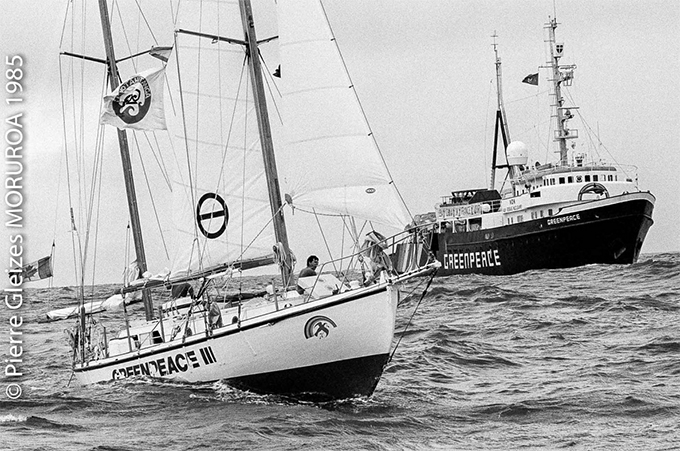
Compensation for the victims of three decades of French nuclear tests in the South Pacific was a focus of President François Hollande’s visit to French Polynesia this week, his first stop on a tour of Oceania and Latin America.
Hollande‘s first move was to lay a wreath at the grave of Pouvanaa a Oopa, the campaigner for Tahitian independence considered the founder of Tahiti’s modern political culture.
But the focus of the visit was very much on the victims of 193 nuclear tests carried out by France between 1966 and 1996 on the atolls Moruroa and Fangataufa.
The French president acknowledged on Monday in Pape’ete that the nuclear tests conducted in French Polynesia had affected the environment and the health of the islands.
“I recognise that the nuclear tests conducted between 1966 and 1996 in French Polynesia had an environmental impact, and caused health consequences,” he said.
Hollande said he wanted to “turn the page” on nuclear tests, while hailing Polynesia’s crucial role in developing France’s nuclear capabilities.
Without its overseas territories, “France would not now have nuclear weapons and the power of dissuasion”, he said, using the French expression for nuclear deterrence.
Process review Hollande also announced a review of the application process for compensating the victims of the tests. Only about 20 people have received compensation for the spread of cancers allegedly linked to the tests from among some 1000 plaintiffs.
France’s “nuclear debt” owed to Polynesia, dubbed the “Chirac Billion” (in francs, now worth about NZ$25 million), is an annual payment to the islands that has been reduced year after year, and which Polynesians want to be made permanent.
Hollande’s arrival in the Wallis and Futuna islands marked the first time a French president had visited Wallis since Valéry Giscard d’Estaing in 1979 and the first-ever visit to Futuna.
The far-flung Pacific islands are among many French Overseas Departments and Territories scattered around the world, vestiges of France’s colonial empire that today still boast an aggregate coastlines, or Exclusive Economic Zones, second only to those of the United States.
Hollande was due to fly to Peru, followed by Argentina and Uruguay later in the week – where he is set to promote scientific, cultural and university ties.
Although he is travelling with a delegation of business leaders from top French firms such as Carrefour and Thales, no major economic deals are expected to be signed on the trip.
Protesters rallied outside the Australian Embassy in the Timor-Leste capital of Dili yesterday, demanding Canberra come to the table “in good faith” to end a long-running dispute over major oil and gasfields in the Timor Sea.
Hundreds of protesters, including students, activists and former resistance fighters, gathered peacefully outside the diplomatic mission to urge Australia to “respect East Timor sovereignty”, said rally organiser Juvinal Dias.
“We are asking Australia to negotiate the maritime boundary based on good faith,” Dias said.
The Movimentu Counter Okupasaun Tasi Timor – Mkott (Movement Against the Occupation of Timor Sea) is calling for “respect” by Australia over the border according to sea international maritime law.
Ties between the neighbours have soured since Timor-Leste took Australia to the International Court of Justice to settle a dispute over the maritime boundaries governing lucrative undersea oil and gas reserves.
The half-island nation, which has a sluggish economy heavily dependent on oil and gas, wants a treaty which was signed in 2006 and set the maritime borders to be torn up. It claims Australia spied on ministers to gain commercial advantage.
The protesters want permanent maritime boundaries drawn up along the “median line” between Australia and East Timor, Dias said.
He urged Australia to abandon its “invalid” claim in the Timor Sea and promised further rallies if it refused to negotiate.
The 2006 treaty was signed between Canberra and Dili, four years after East Timor won independence following years of brutal Indonesian occupation.
In Australia, the Timor Sea Justice Campaign is planning a similar demonstration in Canberra next month — on March 24.
Auckland’s Fiji community have mobilised together to action disaster relief efforts for their families back home in the Fiji Islands.
Community members assembled in Mangere last night fuelled with emotion and desperate to send help back home.
Those affected in Fiji have requested donations of imperishable foods, water, blankets, fishing rods and tools that can be used to help the rebuilding process.
The Fijian Community Association of Auckland and the Auckland Mayoral Committee confirmed two shipping containers would be made available soon so those wanting to contribute to relief efforts can donate.
Two main drop-off points:
West Auckland’s Church Limited and South Auckland’s City Impact Church.
More details will be released by the FCCA later today.
Fiji community members in a Q and A session about the Winston cyclone disaster at a public meeting in Mangere last night. Image: TJ AumuaThe president of the Fiji Community Association of Auckand, Naca Nabuuobuno, says the meeting was about providing “clean communication” on how the community in New Zealand would like to provide effective disaster relief to Fiji. Image: TJ Aumua/PMCPart of the crowd at the Fiji community meeting in Mangere last night. Image: TJ Aumua/PMC
February 20, 2016, will be a date every single villager on Koro Island in Fiji will never forget.
As the first outsiders to visit since tropical cyclone Winston wreaked havoc over the weekend, cameraman Jese Tuisinu and I were met with heart-wrenching stories of terror and survival.
Pictured is just one of several devastated villages on the island of Koro.
Here 163 people crawled to safety after strong winds and rain wreaked havoc.
Whatever was spared by the strong winds, only to be washed away later by the huge waves crashing on shore.
“We have been used to strong winds when a cyclone warning is issued. This time we did not take it seriously because we have never experienced this kind of weather before,” says Mosese Kikau Daulakeba of Sinuvaca village.
“We did not take it seriously. So when the weather deteriorated we began run around looking for a safe place.”
‘Swimming in the village’ Salala Nadakeke says: “We were swimming in the village. Corrugated iron flying over us while we were trying to swim to safety. We carried our children and grandchildren. The current was too strong.
“I managed to climb up a until I started to lose grip and float around. I then managed to grab a coconut tree which swung me a few times then I managed to secure myself onto the tree.
“Then I managed to grip onto a .. which kept me above water.”
While most children survived – here two lives were lost that fateful day – a 78-year-old grandmother and an infant.
“The father of the child was carrying him, first rush of high current, the second, the third current he did not realise he had lost hold of his child. He realised that his child was dying by his hand,” Daulakeba explains.
Methodist lay preacher Meli Savu Buliti has been living in the village of Sinuvaca for the last four years.
After 40 years, the church underwent renovations last year – now it’s gone.
Shelter in the church “Many of the villagers looked for shelter in the church because they did not expect the tidal waves. They were only expecting strong winds. The elderly and the weak found temporary shelter in my home – my house at the foot of the hill which the villagers found shelter in,” says Buliti.
“At about 3pm to 4pm the tide began to rise then we began crawling uphill. We tried to safer ground in the school. we then carried the weak, the children and then they crawled up the hill because the current was too strong.”
“When strong winds began more than a hundred houses were destroyed – only one still stands. We then took shelter in a double storey but its roof had been blown off in the wind. We then took shelter at the bottom of the house,” says Amenio Timoci of Namacu village.
“At about 11 o’clock in the morning we began feel very strong winds, the tidal waves came at about 1pm. The wind destroyed all the houses in its path, those concrete houses that remained standing no longer had roofs. It was the strongest winds I’ve experienced,” Timoci says.
“When the tidal waves began to come in, the winds were already causing havoc, we then began to move before the tidal waves reached us. We moved to higher ground,” says Masilina Cabe of Nadakeke, Sinuvaca.
According to news reports, “monster” Cyclone Winston, which hit over the weekend, brought winds of more than 325 kmh, torrential rain, and waves of up to 12m high.
A month-long state of disaster has been declared, while Oxfam in the Pacific regional director Raijeli Nicole said communication blackspots were making it very hard to assess damage and determine the scale of the response required.
The impact can be seen in the videos on the Storify file of the monster cyclone with the Pacific Media Centre.
An aerial picture showing the flattened village of Tavua on Viti Levu island. Image: RNZ Defence Force
Twenty-nine people have been confirmed dead so far, but as Nicole noted: “Given the intensity of the storm and the images we have seen so far, there are strong concerns that the death toll won’t stop climbing today and that hundreds of people will have seen their homes and livelihoods completely destroyed.”
Tropical Cyclone Winston’s path of devastation across Fiji from Tonga. Image: Newswire Fiji
More than a few experts were quick to link Cyclone Winston to human-caused global warming, saying the extreme weather event was “more painful evidence” of climate change.
Its low-lying coral atolls make the frontline nation “especially vulnerable to sea level rise,” Weather Underground meteorologists Jeff Masters and Bob Henson noted on Friday:
Storm surge from Winston is of particular concern for Fiji, where sea level rise and coastal erosion have already begun to displace people. The nation includes more than 300 islands; some are volcanic in origin, while many of the smaller islands are low-lying coral atolls especially vulnerable to sea level rise.
The nation has already assisted one small village, Vunidogolo, in moving to a new location as part of its climate change adaptation programme. More than 30 other Fijian villages have been identified as vulnerable.
Although it represents only a tiny share of the world’s fossil fuel emissions, Fiji is doing its part to reduce them.
Fiji has pledged to boost the renewable share of its electricity generation from around 60 percent in 2013 to near 100 percent by 2030. Together with energy efficiency improvements, this will reduce Fiji’s carbon dioxide emissions from fossil fuels in 2030 by roughly 30 percent compared to a business-as-usual approach.
Slate staff writer Eric Holthaus pointed out this inherent irony over the weekend. “Fiji is responsible for just 0.04 percent of global greenhouse gas emissions,” he wrote, “and the confluence of this week’s events there highlights the brutal injustice posed by a warming world.”
Source: Professor Jane KelseyAn expert, peer reviewed, paper on the implications of the Trans-Pacific Partnership Agreement (TPPA) for local government was released today. The paper was co-authored by former city councillor and chair of Watercare Services, Tony Holman QSO, former Member of Parliament and Auckland city councillor Richard Northey ONZM, and Professor Jane Kelsey from the University of Auckland, and was peer reviewed by Dean Knight, senior lecturer in law at Victoria University of Wellington and an expert in local government law.
The 36-page paper covers: the exposure of local government, international experiences of local government, special protections for TPPA investors, Investor-State Dispute Settlement (ISDS), public private partnerships (PPPs), privatised water, services and investment liberalisation, Council Controlled Organisation (CCO) contracts, public procurement, tangata whenua and te Tiriti o Waitangi, economic development, sustainability, decision making processes and exceptions.
‘Many people have probably not considered how the TPPA might affect local government’, said co-author Tony Holman. ‘Unfortunately the impact may be considerable and the bigger the local authority, the greater the effects will be’.
‘A reality check shows that every local authority will have to comply with complex rules and restrictions across many chapters, in the same way that central government has to. Overseas experience shows they also face potential interventions from overseas corporates, including through costly investor-state disputes, for doing what their constituents expect of them.’
For Richard Northey, ‘what matters for those of us with years of experience in local government is the reduction in autonomous and locally appropriate decision making by local government. This is particularly restrictive on those Councils and communities that want to take an appropriate locally active role, to the extent they can, in community social and economic development and reform’.
‘There are already real legal restrictions on this, with a real risk of greater restrictions if the TPPA were in force. This could result from a series of projected reviews, especially to the application of government procurement and state-owned enterprises chapters to local councils’.
The paper shows the municipal activities that have the greatest potential to be affected are: policy making and planning decisions; bylaws and regulations governing permitted activities; technical standards, such as property development, construction, advertising, zoning and environmental quality; activities relating to finance; public procurement contracts, including public private partnerships (PPPs); utilities; and resource management rules and decisions.
There are also implications for regional economic development. The paper notes that the ‘TPPA erodes the flexibility that local authorities need to promote economic development in their communities, and is not a sound basis for a progressive and sustainable 21st century economy that addresses climate change, social inequalities, environmental degradation ad other challenges.’
This is the sixth in a series of expert peer-reviewed posted onTPPlegal.wordpress.com and supported by a grant from the New Zealand Law Foundation.[1]
–]]>
Today’s edition of NewsRoom_Digest features 1 resourceful link of the day and the politics pulse from Tuesday 23rd February. It is best viewed on a desktop screen.
NEWSROOM_MONITOR
Noteworthy stories in the current news cycle include: relief supplies starting to arrive in Fiji as the country begins the massive task of cleaning up after Cyclone Winston (at least 29 people have been killed); United Future leader Peter Dunne calling for a review of the Clean Slate Act, saying too many people are being burdened with decades-old convictions for minor offences; and perhaps tens of thousands of New Zealanders being eligible for a Resident Return Visa (RRV) – a faster and cheaper way of getting Australian citizenship that is not pegged to work skills or earning at least $NZ57,000 a year.
POLITICS PULSE
Media releases issued from Parliament by political parties today
included:
Government: Government Provides Extra Support For Buller; Good progress under Bay of Plenty Housing Accords; Processed timber a big winner under TPP;Hawke’s Bay mental health inpatient unit opens;First phase of Land Access Reforms to speed up UFB rollout; Good progress on quarterly health targets;Out of Gate helping more prisoners to be crime-free; Student achievement continuing to rise; NZ joins $200 million science investment fund
Labour: ECan legislation an affront to democracy
NZ National Party: McCully will not contest East Coast Bays in 2017
United Future Party: Time to Review Clean Slate Act
LINKS OF THE DAY
PHARMAC SEEKING NEW MEMBERS: PHARMAC is seeking nominations for two Māori members of its Consumer Advisory Committee (CAC).Information about the vacancies and how to apply are available on the PHARMAC website: https://www.pharmac.govt.nz/news/vacancy-2016-02-05-cac-maori-members/.
And that’s our sampling of “news you can use” for Tuesday 23rd 20th February.
–]]>
The Prime Minister has set up a disaster relief fund in response to the devastation caused by Severe Tropical Cyclone Winston.
The Department of Information issued a statement to say monies received in the newly established bank accounts would be used to directly benefit Fijians who have been left homeless, without adequate food, water and essential services. Emphasis would be placed on those in rural and maritime communities.
Severe Tropical Cyclone Winston, the most devastating storm on record in the Southern Hemisphere had destroyed homes, livelihoods and living many without telecommunications and medical services.
The statement said the government was working hard to coordinate rescue and recovery efforts but said there was a great need for additional resources.
Donations can be made through the bank accounts below and all fees including those for overseas transactions have been waived.
International and local donations can be made to:
Bank: Australia New Zealand Banking Corporation Account Number: 12628523 Account Name: Prime Minister’s National Disaster Relief and Rehabilitation: Cyclone Winston Swift Code: ANZ BFJFX BSB: 010 890
Local donations can be made to:
Bank: Westpac Banking Corporation Account Number: 9806094927 Account Name: Prime Minister’s National Disaster Relief and Rehabilitation: Cyclone Winston
Bank: Bank of the South Pacific Account Number: 80399804 Account Name: Prime Minister’s National Disaster Relief and Rehabilitation: Cyclone Winston
Bank: Home Finance Corporation Bank Account Number: 17822 s10 Account Name: Prime Minister’s National Disaster Relief and Rehabilitation: Cyclone Winston
Vanuatu’s record on women’s rights will be scrutinised by a United Nations committee in Geneva from tomorrow.
The committee will review the country’s progress in implementing the Convention on the Elimination of All Forms of Discrimination Against Women, which it has ratified.
Vanuatu faces significant challenges meeting its commitments, being near the bottom of world rankings for measures including access to justice, equality in marriage and equal pay for equal work.
The committee will also review Vanuatu’s progress in addressing violence against women, sexual violence, sexual harassment as a specific criminal offence, and the low numbers of women in public life.
All Fijian Atunaisa Raralevu (No.3) hoped to do was to be able to save 15 people trapped in a house at the height of severe tropical cyclone Winston at Naseibitu Village in Tailevu, Viti Levu.
The 24-year-old farmer had already carried a woman, her three children and another girl to the safest house in the village.
Around 7pm his efforts to try and assist in the evacuation proved fatal, when the then 8m by 5m corrugated iron house that provided shelter for the 15 tilted and buried him.
“He had just returned from the farm and had already saved the woman, her three children and another girl and came to me for a hammer to try and save another 15 who were in that house – that was the last time I saw him,” said his uncle Atunaisa Raralevu (No.2).
He said by the time all 15 had run for cover, his namesake was nowhere to be seen.
It was after strong winds carried the house downhill, that they found his lifeless body lying on the ground with blood gushing out from his nose, ears and eyes and mud filled his mouth.
“He was carried to a nearby house, but all efforts to try and revive him proved futile.
Swam flooded road “He lay there the whole night and during the day [Sunday], some men from the village swam across the flooded road to call police.
“Police arrived and confirmed the death and when we tried to take him to the Korovou mortuary, police said that was impossible because the power was off.”
Raralevu said they informed their Talatala [spiritual leader], who then conducted a sermon and on Sunday, his namesake was laid to rest.
“What hurts us the most is that he was a very good young man,” he said.
“He always listened to us and carried all church and vanua obligations without any complaining.”
Villagers said it was just unfortunate that he was not accorded a perfect hero’s funeral.
Indonesia’s Environmental Affairs and Forestry Minister Siti Nurbaya says her ministry’s team has found some 370 to 500 “hotspots” of forest fires in the West Papuan province of Papua earlier this year.
“It is a matter of worry since there was no hotspot in Papua last year, and this year the number is already around 370 to 500,” Nurbaya said.
The fires were not being caused by any act of corporations but resulting due to the indigenous people’s lifestyle habits, she said.
Forestry Minister Siti Nurbaya … hotspots caused by indigenous people’s lifestyle habits, not corporations. Image: Antara
Her ministry and the newly set up Peatland Restoration Agency (BGR) continue to coordinate to curb forest fires in Papua, which is one of seven Indonesian provinces being closely monitored.
The ministry sent a team to Papua in January and found local people burning old grass in order to prepare the ground to grow fresh grass for cattle.
Besides, fires were also lit up on purpose along the banks of rivers and lakes to catch fish.
The central and local governments need to inform the communities regarding certain traditional slash and burn methods that are allowed, the minister said.
“It should be firmly ensured that there must be no fire in peatland area, and that it is allowed in other areas with clear restrictions,” she said.
She said use of fire in hunting must be avoided because it could spark a bigger fire.
Fiji’s Acting Police Commissioner, Brigadier-General Sitiveni Qiliho, has warned parents and guardians to make sensible decisions about the movements of their children in the wake of cyclone Winston.
Brig-Gen Qiliho said police continued to receive calls and information on people, especially children, frequenting regular swimming spots around the country.
He advised people to refrain from water activities, as there was still much damage around the country.
“The safety of people is always our paramount concern and our advice will continue to be given,” he said.
Brig-Gen Qiliho’s comments come after reports of a drowning of a 10-year-old boy of Vuci in Nausori yesterday morning.
The death toll from severe tropical cyclone Winston in Fiji has reached 21 and disaster officials fear this will rise as communications is restored to remote villages.
More than 8000 homeless Fiji people were taking shelter in 50 evacuation centres around the country.
During a media briefing in Suva yesterday, the National Disaster Management Office said there were 20 confirmed deaths.
However, at a later briefing, NDMO director Akapusi Tuifagalele confirmed there had been another death, taking the toll to 21 so far.
The death toll from the monster cyclone is expected to rise still further, reports Dreu Vukailagi for The Fiji Times.
Officials said 8438 people were forced to flee their homes to take shelter in government-designated centres during the height of cyclone.
NDMO’s Tuifagalele said there were nine evacuation centres in the Eastern Division with 121 evacuees, 20 centres in the Central Division housing 1177 evacuees and 22 centres in the Northern Division with 1260 occupants.
In the Western Division, 5880 people from 1032 families are in evacuation centre, reports Losalini Rasoqosoqo.
Flattened homes in Rakiraki, Viti Levu. Image: Fiji One News
Rakiraki badly hit Fiji One News reports that Rakiraki, on north-west Viti Levu, suffered one of its worst ever cyclones.
Getting through and rebuilding their community is the toughest test yet for the province’s people.
Rakiraki village is home to more than 200 families.
For the elderly who have lived in this village for the past 90 years, TS Winston is the strongest they have experienced.
“I have experienced many cyclones but this is the strongest I have come across,” said 90-year-old Ana Vulavono.
“We did not expect the cyclone to be this strong,” said 73-year-old Malili Bete.
Rakiraki village was affected by strong winds for five hours and this was first cyclone experienced by the younger generation.
100 homes lose roofs In the village, more than 100 homes are without roof tops and walls.
“Like the cyclone in 1972, we went through the same experience on Saturday night,” said 76-year-old Sikeli Naitura
Even at Namu-i-mada village, the situation was dire.
The elders are coming together to assess the full brunt of cyclone Winston.
“This is the worst ever cyclone to hit this village,” said Emosi Naituna.
Na-viti-levu village is also badly affected.
For these people, they were doing all they could before the government assistance would arrive.
A bulldozer clearing trees off a road near Suva. Image: Joe Yaya
New Zealand will send another Defence Force flight to Fiji and provide an extra $1.8 million in funding, said Foreign Minister Murray McCully.
The new funding, announced yesterday, would bring the total contribution to relief efforts following cyclone Winston to more than $2 million.
The category 5 cyclone made landfall on Saturday, with wind gusts of up to 325kmh and average winds of 230kmh.
How New Zealanders can help New Zealanders can help efforts on the ground by donating to Red Cross’ Pacific Disaster Fund, which ensures New Zealand Red Cross can respond quickly when a cyclone hits. Donate online at: www.redcross.org.nz
Analysis by Keith Rankin
A Universal Basic Income in New Zealand?Concept
[caption id="attachment_1450" align="alignleft" width="150"] Keith Rankin.[/caption]
A Universal Basic Income represents, at its core, two things: an unconditional publicly-sourced income payable to all adult tax-residents of a country; and an integration of income taxes and welfare benefits. It makes little economic sense to talk of separate income tax and welfare benefit systems. There is but one tax-benefit system. A benefit is a negative tax, and a tax exemption is a benefit.
Universal Basic Income (UBI) represents a direct application of the principle of horizontal equity (treating equals equally), which means a single rate of income tax, and a universal publicly-sourced income that amounts to a ‘public equity dividend’.
A universal payment should have no ‘claw-back’. UBI is not a scheme to redistribute income from rich to poor, nor from poor to rich. A benefit for the poor funded by higher marginal tax rates on the rich is not a UBI. Rather, a universal basic income is a central component of an equitable mechanism of ‘distribution’, not ‘redistribution’.
A universal basic income is not a ‘living-wage’; it is a return on capital, not on labour. It may or may not be enough for an individual to survive on without a private source of income. To be a UBI, it does not have to be ‘adequate’ in any sense of that word. It simply must be an unconditional publicly-sourced payment that is more than zero.
The presence of a UBI does not require that there be no needs-based transfer payments. Transfers derive from the principle of vertical equity – treating people facing different circumstances differently – and complement payments based on horizontal public equity.
Public equity follows from our public property right, just as private equity follows from our private property rights. Our equity in our houses is a part of our individual wealth. Our equity in our businesses is a part of our individual wealth. Our equity in our public domain is likewise a part of each individual’s wealth. An entitlement to draw a monetary income from public equity is no different from an entitlement to receive dividends from shares (equities) we own, or to receive rent from houses we own.
At Present
New Zealand presently has a near-UBI called New Zealand Superannuation. Every New Zealander aged over 65 who meets residency requirements receives $218 net of income tax as an entitlement. (This is the ‘married’ rate of ‘superannuation’, reduced by the present top marginal tax rate of 33%. Superannuation’s genesis was in 1940, with, initially, a simple $20 per annum payment to all New Zealand residents aged over 65.) The only essential difference between New Zealand Superannuation and a universal basic income is the higher age qualification. A UBI is a right of all adults.
New Zealand also has a near-UBI, an unconditional annual tax benefit (ie benefit paid through the graduations of the income-tax scale) of $9,080 ($175 per week) payable in full to all individual tax-residents with an annual income in excess of $70,000. (If you gross $70,000 or more, just deduct 33% and add $9,080 to determine your disposable income.) The only thing that stops this benefit from fulfilling the criteria of a UBI is that many individuals earning less than $70,000 (‘before tax’) receive less than $9,080 in publicly-sourced income. (The first instance in New Zealand of such a tax-benefit is 1893, the first year of income-tax receipts and exemptions.)
So New Zealand has two distinct near-UBI benefits, long in place. Indeed persons aged over 65 with at least $70,000 of privately sourced income before tax, receive both UBI-like payments, as of right. Just as universal superannuation was introduced in 1940 as a way of reducing the cost of social security – relative to the alternatives then on offer – so a rationalisation of our two present UBI-like payments can also save public funds, while also addressing the sustainability issues around New Zealand Superannuation. For example, a New Zealander aged over 65 might be eligible for the $175 weekly basic income, plus at least another $125. That $125 per week would become ‘universal superannuation 2.0’.
Prospect
What is the prospect for a more formalised UBI in New Zealand? Universal principles play an important role in New Zealand’s social welfare history, and New Zealand has at present an income tax scale that can easily morph into a basic income flat tax arrangement. So there are no technical difficulties.
Indeed, in the 1973 Budget, another near-UBI was introduced by Bill Rowling, called a ‘personal tax rebate’. It lasted only four years, a victim of inflation and changed priorities. What is most significant about this is that it was barely commented on at the time – eg in the post-Budget debates, and in the media. It was neither opposed by National, nor seen by anyone as radical. Designed by Treasury in response to Rowling’s demanding specification; it was seen more as a technical adjustment to the income tax scale than a radical change. If Bill English was to introduce a change on a similar scale into his 2016 or 2017 Budget, likewise it could easily be presented as a common-sense rationalisation of what we already have.
Having said that, if Labour choose to make Universal Basic Income a flagship policy for 2017, it might fly and capture the public imagination. Or it might flop in the face of poorly-informed media criticism, and from National Party sources claiming to be worried about its cost and the notion that a UBI might underwrite a work-free lifestyle. I sense, however, that the mainstream media has the opened the door on the concept. Further, after eight years of one government, the media in New Zealand tends to reflect (if not lead) a growing sentiment that nine years is enough for any government, and, in that political window, becomes more open to alternative perspectives.
In 1938, the First Labour Government wanted both a comprehensive and a universal social security system. Once they did the arithmetic, they realised they couldn’t have both all at once, as they had (more or less) promised. They squared the circle by delivering a comprehensive means-tested system, but with a small universal superannuation thrown in. The programme – piloted by Michael Joseph Savage – caught the public imagination, and Labour road to subsequent election victory with 56% of the popular vote. If the universal superannuation, with its timetable to grow a little each year from 1940, had not been included, Labour’s flagship political programme might have clunked. More than anything else New Zealand voters hated means-testing, the humiliating conditionality associated with charity-based depression welfare.
Welfare systems in New Zealand have once again become very conditional and bureaucratic. UBI puts the rights of the people ahead of bureaucratic control, and is affordable at a reasonable level so long as the income tax rate is in the mid-thirties.
New Zealanders own their own public equity. They deserve something in return.
———————-]]>
Walk down almost any street in Indonesia and you are bound to find street vendors, selling everything from fried tofu to a fresh new haircut.
Known as “kaki lima”, or five legs, food vendors are a vital part of the Indonesian economy, feeding the city’s workers, and even becoming a point of pride.
They have even been admired for their resilience, following the global financial crisis, and their calmness in the face of last month’s Jakarta terror attacks.
However kaki lima vendors are often evicted from busy precincts such as Jakarta’s old city, or Kota Tua, with authorities claiming they are unhygienic eyesores that clog the streets.
So when Dr Rizal Muslimin, an architecture lecturer at the University of Sydney, needed a practical project for his students he was drawn to the street vendors in Bandung, Indonesia’s third largest city, where he first attended university.
The students were tasked with developing a sustainable street vendor shelter for Jakarta vendors.
The Bandung project students were tasked with developing a sustainable street vendor shelter for Jakarta vendors.
Dr Muslimin and his counterpart at the Bandung Institute of Technology, Professor Aswin Indraprahasta, came up with an exchange programme where architecture students would spend a week in Sydney designing shelters for street vendors, and another week in Bandung building and testing them.
Real-life experience They wanted to challenge their students to use design to address a social issue and also give them rare real-life experience.
A group of six students from Sydney and eight from Bandung took part in the exchange during the last two weeks of January.
They split into groups of three, each with a different brief to design shelter structures that could replace the existing ramshackle designs. The designs were to be not only attractive, but functional and user-friendly. They also had to take into account cost and local materials, with most using bamboo.
Australian student Matthew Naivasha said they created structures that could adapt from serving food in the day to clothes stalls in the evening.
Architecture students Fauzan Alfi A, Stephanie Cheung, Laras Winarso and Matthew Hunter with a prototype of their street vendor shelter to be used in Indonesian cities. Image: Michael Neilson
The designs could fold up or incorporate street lamps or poles.
“The vendors felt touched. The government doesn’t like them, doesn’t think they look nice, and so for the Aussies to come and to try and make it a better place, they really appreciated that,” says Arum Larasati, a student at the Bandung Institute of Technology.
The project aligns neatly with Bandung’s “Creative City” concept, promoted by Mayor Ridwan Kamil, which harnesses Bandung’s creative community to make the city more vibrant and liveable.
Dr Muslimin believes the shelters could also be used in markets in Australia.
“The needs of stallholders in Australia’s own community markets are not dissimilar to the Indonesians. They both need something that that is easy to transport and set up and pull down in a short space of time,” says Dr Muslimin.
A prototype of the new street vendor shelter in situ. Image: Michael Neilson
[caption id="attachment_4808" align="alignleft" width="150"] Dr Bryce Edwards.[/caption]
Is the National Government harming New Zealand’s corruption-free status? Recent reports and controversies suggest that the Government has some transparency and accountability problems.
New Zealand’s reputation for low levels of corruption was hurt last month when the annual Transparency International Corruption Perception Index was published. New Zealand fell from 2 to 4 in the global rankings. I covered this news with my own interpretation of it in my column New Zealand tumbles down the political corruption table.
There was much comment on the report, with various attempts to explain New Zealand’s descent, as well as some challenges to the report and the explanations. But since the publication of the report there have been further stories and controversies that contribute to the idea that New Zealand has a less than perfect anti-corruption environment. These have mostly revolved around the Government’s reputation for how it handles information, how it conducts its business deals, and how government agencies operate.
Open or closed government?
The most recent challenge to the Government’s reputation for openness comes via the publication of a rather scathing independent report on its progress towards increased transparency, as part of it’s membership of the Open Government Partnership – see yesterday’s RNZ report, Govt pays lip-service to transparency, says report.
The New Zealand Government is effectively being told off for not meeting the obligations it has committed itself to in improving public sector and government transparency. I’m quoted in the above article as saying that the new report is “a black mark” against New Zealand, and that transparency is crucial to democracy because it allows the public to see how decisions are made and prevents corruption.
For the full story on the Government’s actions (and inaction) see the full PDF report: Progress Report: New Zealand 2014-2015. The author of the report, Wellington lawyer and academic Steven Price, has put together an excellent summary of it on his blogsite – see: Open Government Partnership report.
In this, Price also outlines the process by which he came up with his evaluation and explains why the “report is not flattering for the government”. It appears that the Government has not taken the exercise seriously, and is largely complacent about New Zealand’s reputation for integrity. Price also puts forward five suggestions for what the Government could focus on to improve transparency and openness in government and public life.
We now know that Rachel Glucina – as well as Cameron Slater – is one of a select group who were given access to the Prime Minister’s mobile phone number. On Friday the public learnt the details of the text Glucina sent to Key during the Ponytailgate controversy: “Just interviewed the waitress. Piece of work! Massive political agenda”.
The revelation is of importance, particularly because the Government had fought to keep the text secret – see the Herald’s Ponytail-gate text to PM revealed.
Fisher discusses the availability of the PM’s mobile phone number, and how John Key keeps changing it. Fisher, himself has had the last three numbers for Key, two of which he obtained via the Teapot Tapes incident and the Rawshark hack of Cameron Slater’s computer, but says unfortunately he’s not one of the chosen journalists, bloggers, or public relations practitioners who receives an update when Key gets a new number.
But the more substantial point that Fisher makes is that the Government doesn’t seem to understand either the Official Information Act or the Public Records Act, otherwise Key wouldn’t have had trouble releasing Glucina’s text: “Whether it be text messages or a folded note slipped from one palm to another, it’s still communications with the Prime Minister. This has been publicly accessible “official information” for more than three decades. It’s bizarre there should have been consideration of keeping it secret at all. New Zealand should never be a country in which it is considered okay for media and its most senior (or any) politician to carry out secret discussions without any public oversight. The content of the message is telling – it suggests an obeisance which shouldn’t exist between politicians and media and certainly never in secret. But put this latest finding in the context of other recent findings. It is my opinion it raises questions about the advice the Prime Minister is getting on important democratic principles.”
Could it be that the Government was protecting a journalist’s privacy and confidentiality? This is examined in Claire Trevett’s Text decision ‘should make all journalists careful’. In this, it is made clear that not all text messages to the PM should now be public property, and it depends on the individual circumstances.
The integrity of government agencies
A number of recent stories about various government agencies and contractors acting without integrity, or being involved in fraud, should be of concern to the public.
The Office of the Privacy Commissioner has just released the first details of its Transparency Project, in which the agency is attempting to find out how much government agencies are obtaining personal details of citizens by making official requests to private companies such as banks, airlines, and internet providers. This was sparked by the scandal over the Police obtaining the private banking details of Nicky Hager – as covered late last year in my column, Libertarians against dirty politics.
You can see the official first PDF report here: Transparency Reporting Trial. This is covered very well by Nicholas Jones in his article: Government made 12,000 privacy requests to just 10 companies. The ten companies that took part in the three-month trial registered 11,799 requests for information from government agencies, including the Police, of which only 449 were declined.
Potential conflicts of interests continue to plague some agencies and Simon Collins reports on concerns about recent grants made by the Whanau Ora programme – see: Family ties queried in $1.3m grant.
The Defence Force was told off last week by the Auditor General for awarding a contract to a company owned and operated by one of its own air force flight sergeants – see Isaac Davison’s New Zealand Defence Force broke conflict of interest rules.
Often such fraud is detected and brought to attention by whistle-blowers in the sector, but it’s not clear that the Protected Disclosures Act 2000 is really robust enough to make the process work properly – see John Gerritsen’s No protection for whistle blowers, committee told.
This is expertly discussed by No Right Turn in the post, The TEC and whistleblower protections. He concludes “if whistleblowers exposing fraud in the tertiary education sector are being persecuted, it suggests that existing protections are not strong enough. In Australia it is a criminal offence to retaliate against a whistleblower. That seems like a really good idea.”
No Right Turn continues to pursue the cause against government agencies charging for Official Information Act requests. He’s carried out a survey of every public service department to see how often requests are incurring charges – see: OIA charging: Who charges for OIA requests?
Unsurprisingly, many of the agencies were very poor in collecting or communicating the information – two agencies (Corrections and Environment) never even replied. But of the information available, he finds: “Out of 7,991 OIA requests made to 26 responding agencies, at least 30 attracted charges, a rate of about 0.4%.”
The Government’s refusal to release information under the OIA about the resignation of MP Mike Sabin has been ruled as correct – see Felix Marwick’s Ombudsman sides with govt over Sabin disclosures. He says: “Newstalk ZB has taken the issue to the Ombudsmen, but Chief Ombudsman Peter Boshier has ruled disclosure of details would prejudice maintenance of the law. He’s declined to give full reasons for his ruling, saying they would likely prejudice those interests as well.”
This hasn’t pleased No Right Turn, who says: “Sabin’s resignation raises very real questions of accountability that the public deserves answers on. We can’t get them now, for obvious reasons. But hopefully we’ll be able to get them in the future, and hold the Prime Minister to account if he has displayed poor judgement” – see: Mike Sabin and the OIA.
The various watchdog agencies that try to keep government departments honest are currently receiving a fair bit of evaluation. The Independent Police Conduct Authority (IPCA) has recently spoken out about its underfunding, which appears to be causing it to abandon some investigations, or pass those functions back to the Police – see Sam Sachdeva’s Police watchdog IPCA skips investigations due to financial pressures. See also No Right Turn’s Another starving watchdog.
The State Services Commissioner Iain Rennie has announced that he’s stepping down, which has led the Dominion Post to call for a stronger replacement – see the editorial: Wanted: a robust and brave leader.
A leading candidate might well be the current Auditor-General Lyn Provost, who is in her final year in that position – see the very good profile of her by Nikki MacDonald: Auditor-General Lyn Provost on cop culture, rough mornings and policing power. Of particular interest is the revelation of the increase in complaints made to her agency: “281 requests for inquiries in the 2014/15 year, compared with 181 the previous year. Of those, 119 related to central government – almost double the usual total.”
Saudi sheep deal
Lyn Provost is soon to give her report on the Government’s controversial Saudi sheep deal. Meanwhile opposition parties are ramping up their criticisms. Last week in a select committee, David Shearer labelled the deal “corruption”, and James Shaw said it was “a straight-out bribe” by the Government – see Jo Moir’s Government accused of ‘corruption’ over the Saudi sheep deal. Also of note, “MFAT chief executive Brook Barrington stepped in to exercise legal privilege and refused to answer any further questions on the possible court action.”
But the upcoming Auditor General report has the potential to hurt Murray McCully’s reputation, or even cost him his job, and for Gordon Campbell that would be a case of “history repeating itself” – see: On bribing the Saudis. Campbell explains: “In 1998, a third term National government was one year away from being turfed out of office, and Murray McCully – the prime architect of the Saudi deal – was at the centre of a scandal involving ‘hush money’ payouts to Tourism Board members. These payouts were later deemed ‘unlawful’ by the Auditor General. McCully resigned as Tourism Minister in April 1999 in the wake of that finding.”
Nick Smith is another minister under fire for alleged misuse of taxpayer resources. Last week Smith was accused by Labour’s Kris Faafoi of taking ministerial staffers to National Party fundraising functions at the taxpayers’ expense – see Vernon Small’s Taxpayer paid for Nick Smith’s press secretary at National Party dinner.
But has the whole debate been overcooked? That’s the argument of National Party columnist Liam Hehir – see: Calls of New Zealand being corrupt nothing but a beat-up. He admits the Government needs to be concerned about declining public confidence in integrity, but says “Questioning whether New Zealand is becoming a ‘corrupt country’ is beyond ridiculous.”
Similarly, Justice Minister Amy Adams was defensive about New Zealand’s fall under National’s watch, saying “This is a survey that is not terribly clear in its methodology. It’s had quite a lot of criticism. It’s actually, surprisingly enough for Transparency International, not terribly transparent” – see the two-minute TVNZ item and article by Katie Bradford: Govt stands firm on Saudi business despite corruption ranking.
Finally, for some humour on the Government’s release of Rachel Glucina’s text , see the parody of other secret texts to John Key by “GCSB Intercepts”: The lost texts: PM v Glucina.
Declaration: Bryce Edwards is a Board Director of Transparency International New Zealand but the analysis here is his personal opinion.
Fiji Times editor-in-chief Fred Wesley today praised the people of Fiji for their resilience and courage after severe tropical cyclone Winston punished the country in a “blaze of fury and power” at the weekend.
He described the sudden power the savage storm unleashed on the country as “shocking … frightening”.
Wesley said the daily newspaper had sent out teams of journalists across the country yesterday, leaving at dawn on their mission, to bring back stories and pictures of “five hours of horror” during the category 5 cyclone. Here is his Fiji Times editorial:
Severe Tropical Cyclone Winston went past us in a blaze of fury and power. Winston left behind a trail of destruction that the State is still assessing and people are still coming to terms with.
The official line is that five people have died in the wake of Winston’s severe beating of many parts of Fiji.
The power Winston unleashed on the country was shocking. We are yet to truly know the extent of its destructive sweep through Fiji.
Picking up strength after Tonga, Winston developed into a massive Category 5 system that was frightening.
It was unpredictable. At first the projected path curved through the Lau Group and pointed to the southwest of Viti Levu. It was expected to pass pretty close to the capital city.
Winston had other ideas. Picking up power, Winston moved straight to the West, cutting through Lau, Lomaiviti, and brushed over Ra before curving down south again. In its wake, it left flattened houses, uprooted trees, roof-less homes, flooding, frightened people, and death.
Scenes of destruction met first responders.
Today we try to bring you a picture of the destruction caused by Winston.
In the face of the horror are tales of heroics intertwined with sadness, frustration, and hope.
We sent teams around the country yesterday. They left at the break of dawn and travelled through scenes of devastation and sadness.
Five hours of horror They returned with pictures and reports of the five hours of horror many Fijians faced on Saturday night.
It was the strongest cyclone Fiji has faced in recorded history. Many relived their night of terror. They spoke of the sense of frustration and helplessness they faced in their own homes. Perhaps it is apt that we shower all those who are working to bring back normality to the lives of thousands of affected people around the country with acknowledgment.
Everyone from the disaster management teams, relief suppliers, NGOs, various charitable bodies, volunteers and the security forces deserve acknowledgment. As the State machinery picks up pace in disaster relief work, perhaps we all should see Winston as a reminder of the power of nature.
We live in a country prone to cyclones and the wrath of mother-nature. Faced with scenarios they came across yesterday, first responders would have been inspired though by the resilience of the people.
And this is something special about Fijians.
We are resilient. To be greeted with smiles, and offered what little they had in the face of the devastation, would have moved even the toughest man and woman.
As we go about our daily chores today, perhaps it would be appreciated if we gave those less fortunate than us some thought as they try to get back on their feet.