Page 1225

Philippines president’s ‘hit man’ allegations spur renewed calls for killings probe

]]>

Report by David Robie. This article was first published on Café Pacific

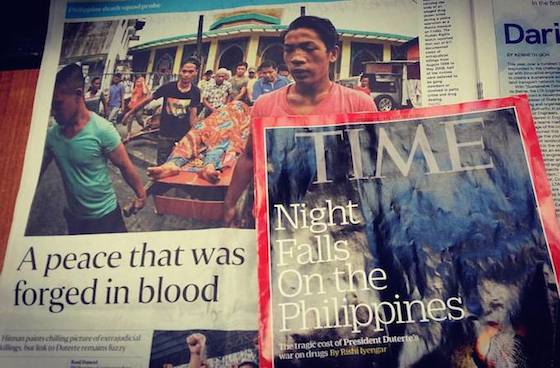
Time magazine and Singapore Sunday Times reports on Philippines ‘killing fields’. Image: David Robie

By DAVID ROBIE

MOUNTING calls for the Philippines president to be investigated over the allegations of human rights violations deepened over the weekend with revelations by a confessed hit man that at least 1000 extrajudicial killings had been ordered when the president was mayor of the southern city of Davao. 

Fresh reports featuring the allegations were included in a cover story in the latest Time magazine, the Singapore Sunday Times and a new inquiry by the Philippine Center for Investigative Journalism into the so-called “Davao Death Squad”.

It is only 80 days since President Rodrigo Duterte was sworn into office, and the PCIJ reports that he now “commands an armed contingent that is a hundred times bigger than it was in Davao, and his ‘enemy’ a thousand times more numerous”.

More than 3000 people have reportedly been killed so far in the so-called Project Tokhang – or “Double barrel” –  war on drugs. The president has also called for a six-month extension on his policy, claiming that the drugs business is largely “operated by people in government”.

Time magazine branded its report the “killing season” in the Philippines with a subheading of “Inside President Rodrigo Duterte’s war on drugs”.

The Sunday Times correspondent in Manila, Raul Dancel, reported on some of the victims of the Davao killings, including a 62-year-old mother who lost four of her sons to the assassins.

‘Forged in blood’
The report was headlined “A peace that was forged in blood”.

Self-confessed hit man Edgar Matobato, now 57, told a Philippines Senate inquiry last week that he and other members of the so-called Davao Death Squad had killed some 1000 people in Davao City on the island of Mindanao on the orders of Duterte between 1998 and 2013.

Duterte was mayor of Davao for two decades and now his daughter Sara is the mayor there.

The PCIJ reported in its inquiry that Duterte’s deputies have denied Matobato’s allegations, with Justice Secretary Vitaliano Aguirre II branding these claims as “old lies”. However, the president himself has not responded so far although he has made no secret in the past about his links with the death squads while denying direct responsibility.

The president’s chief legal counsel, Salvador Panelo, reportedly said he saw no reason for the President to respond to a “perjured witness”, adding that the Senate session was “not a hearing on extrajudicial killing, it was a case of extrajudicial lying”.

He said: “No amount of black propaganda, no amount of sinister ploy or plan will stop the President from his relentless campaign against the drug menace and terrorism.”

In one television programme during the presidential election campaign, he declared: “I am the death squad? True. That’s true.” But he later shrugged this off as merely “teasing”.

Davao killings
As PCIJ says, “there is no denying that Duterte’s reign in Davao City had been marked by numerous extrajudicial killings, with Davao media attributing at least 150 deaths there from 1995 to 2001 alone to the DDS [Davao Death Squad] and then Mayor Duterte’s war against drugs”.

According to PCIJ’s research via police and judicial records, the president’s “expanded war” has resulted in a death toll that is “10 times higher within a much shorter period; an average of 38 persons killed a day, or over 3200 in the last 80 days”.

The presidential “hit man” allegations in the Philippines national press. Photo: David Robie
 Matobato’s testimony before the Senate inquiry named Senator Leila de Lima as being on the target list while she had been chair of the Philippines’ Commission on Human Rights. (De Lima herself is also at the centre of allegations in a separate Congress inquiry opening this week).

Matobato said he and others in the death squad had been waiting to ambush De Lima in 2009 but she had not ventured into the undisclosed hilly area to inspect a suspected mass grave site where they planned to open fire.

The former hit man alleged before the Senate inquiry that he and others in the liquidation squad took orders from Duterte and killed about 1000 suspected criminals and opponents of the mayor and the Duterte.

Matobato admitted that he had personally carried out at least 50 of the abductions and killings, including an attack on a suspected kidnapper who was hogtied and fed alive to a crocodile.

“Our job was to kill criminals like drug pushers, rapists, snatchers. That’s what we did. We killed people almost every day,” Matobato said.

Journalist assassinated
In one of the most serious claims, the former hit man also alleged that Duterte had had Davao broadcast journalist Jun Pala, a vocal critic of the president when he was Davao mayor, killed.

Responding to the testimony, one of the most influential national dailies, Philippine Daily Inquirer, declared in an editorial that the serious allegations ought to be thoroughly investigated but with “caution and scepticism”.

Until then, noted the newspaper, the president enjoyed the presumption of innocence, “as he must”.

“But herein lies the eternal paradox of our times: the demand for fairness and due process is quickly made when it applies to the powers that be; there is no question, of course, that they deserve it,” said the editorial.

“Those killed so far in the war on drugs – the padyak drivers, the petty pushers in fraying flip-flops, the denizens of dark alleys yelling surrender – did not have the luxury of being afforded the same.

“And here Philippine society is today, in an ever-deepening rabbit hole of national cognitive dissonance.”

The PCIJ has revealed that Duterte has not signed, and the Office of the President has not released, any executive order to define his role and accountability for the war on drugs

A police Project Double Barrel “kill list” in the small Bicol
town of Vizons. Such a quiet town apparently has no statistics.
Photo: David Robie

‘I will protect you’
But the President has publicly declared to policemen that they are acting under his presidential protection: “I will protect you. I will not allow one policeman or one military to go to jail.”

According to the PCIJ, as at September 18 the latest national Philippine police report cited:

  • Killed in police operations – 1140
  • Killings by unidentified gunmen “under investigation” – 1391
  • Drug pusher suspects arrested – 17,428
  • “Surrendered” – 714,803 (661,737 alleged drug users and 53,066 alleged drug pushers)
  • Houses “visited” – 1,041,429
The PCIJ said: “Whichever is the correct PNP count, these numbers best the casualty tally during the 14 years of martial law under the late strongman Ferdinand Marcos; from 1972 to January 1981, Amnesty International had recorded a total of 3240 persons killed, 34,000 tortured, and 70,000 imprisoned in the Philippines.”

Human Rights Watch and other groups have called for a full United Nations inquiry into the Philippines extrajudicial killings following the detailed testimony from former hit man Matobato.

But calls within the Philippines for impeachment by the powerful Liberal Party were dealt a blow when Vice-President Leni Robredo (who belongs to the party) declared that she hoped no impeachment process would take place, adding it was destined to fail through lack of numbers in Congress.

Despite political differences, she said, it was the duty of every citizen to support the elected President.

]]>

Tony Alexander’s Weekly Economic Overview 9 September 2016

]]>

Economic Analysis by Tony Alexander. [caption id="attachment_11232" align="alignleft" width="150"]BNZ Chief Economist, Tony Alexander. BNZ Chief Economist, Tony Alexander.[/caption] This week we note that adopting a pessimistic attitude following the GFC has left many people far worse off than if they had simply admitted the uncertainty and tossed a coin to decide what to do. The NZD has risen close to US 75 cents as more people acknowledge the good state of the NZ economy which we expect official data to confirm for the June quarter next week. Download document pdf 350kb Keep Calm and Carry On I wonder how many people are still sitting out there, holding off from buying a house, hiring staff, or undertaking capital expenditure because they expect the economy to fall into a hole in the ground because of * the collapse in the dairy payout, * the US Presidential election campaign, * Brexit * high house prices in Auckland * money printing in many countries * terrorism * peak oil * unrest in the Middle East, and so on. As humans we are hard wired to pay more attention to things which may turn out bad than things which may turn out good. The media know that and feed us stories which attract our attention and get coverage for the advertisers who pay them. Capitalism hand in hand with generally left-wing reporters exploiting human weakness. As K says in the first Men in Black movie “There’s always an Arquillian battle cruiser, or a Corillian death ray, or an intergalactic plague that is about to wipe out all life on this miserable planet…” There is always something sitting out there which can cause significant economic disruption so you are always presented with an excuse for sitting on your hands and doing nothing. Plenty of people have done that since the global financial crisis and while that was the logical thing to do in 2008 and for much of 2009, ignorance of the fundamentals driving our economy and housing market in particular has seen many people choose to sit out a period of good growth and capital appreciation. If you have avoided buying shares then you have missed a 120% rise in the NZX50 over the past five years. If you have despaired of New Zealand’s prospects and switched your assets into foreign currencies from late-2009 then you’ll have lost about 14% on a trade weighted index basis. If you have held off buying a house waiting for one of those silly forecasts of 40% price falls to come true then you are massively out of money and perhaps out in the wops when you finally make your purchase. Were these gains and the good performance of the NZ economy predictable? No. None of us predicted the extent of money printing. None of us predicted how low interest rates would go and that they would still be falling now. Hardly anyone picked this strength in the NZ dollar. I’ll claim not picking a house price collapse and advising people to buy rather than sit on their hands in the housing market since mid-2009. But I can make no claim to remotely coming close to predicting the extent to which prices have risen. The point is this. Predictability of many things had collapsed post-GFC. But that is no reason for blindly assuming the worst, growing potatoes and building a bunker. When you don’t know what is going to happen its a 50:50 call as to whether good stuff or bad stuff will come along. So why assume only the bad? Because, as noted, we are hard-wired to do exactly that. Plus, because we feel losses three to four times more intensively than gains psychologically-speaking, we give strong preference to lose avoidance rather than making gains. Consider people running to catch a bus. Are they running so they can be on the bus? Usually not. They are running to avoid the situation of just missing the bus and feeling stupid because of the loss they have suffered. If you have no idea when a bus on a regular schedule arrives at all, there is no reason for any particular speed of walking. So as you listen to the news people telling us about the woe surrounding us and how we should feel bad about it whilst anticipating even more woe down the track remember this. Buying into dystopic scenarios guarantees failure. Having at least some hope that the worst will not happen gives you a chance to thrive. Nothing ventured, nothing gained. “After all, tomorrow is another day.” Housing This week Quotable Value NZ released data showing that the average Auckland sales price has averaged just above $1 million for the past three months. Someone wondered if the $1 million average would become a psychological barrier. What a silly comment. There is no single house which you could say is the representative commodity in the Auckland housing market and which is repriced daily or more frequently as happens with say gold, oil, or the NZ dollar. A psychological barrier or resistance point in technical analysis terms is only relevant when talking about a single completely homogeneous product which is traded by a very large number of people and that is not the case in the housing market. There will not be a single auction where the bidders hold back because the price has got to $990,000 and they don’t think a rise above $1 million can be justified. Houses are already trading above that level and have been doing so for many years in the cases of high specification properties. The average price measure is an artificial construction, it is not the market price for a uniform product like gold. So you can kick any thought of the one million dollar mark representing a barrier to the current market’s movements firmly into touch – along with yet again the same analysis-poor comments from those who have been predicting falling prices and smugly warning buyers they have been paying too much for years now. Just in case you have forgotten what we have been writing here for the past eight years, here are the fundamentals for the Auckland housing market. DEMAND EXCEEDS SUPPLY AT CURRENT PRICES. Too simple. More comprehensively… -Population growth is strong. -Interest rates are low and falling. -A large cohort of people are approaching retirement and seeking assets to help fund the retirement which officials for three decades have been brainwashing them into believing will be miserably wretched affairs of shredded blankets and collapsing health unless they save and build a large investment portfolio. -There is an existing shortage which keeps growing. -Supply is being constrained by literally dozens of factors. A few include shortages of builders, electricians, plasterers, surveyors, inspectors, plumbers, concrete slabs, sections, infrastructure and so on. -Finance to allow developments is being reined in by banks having to meet tougher lending standards post-GFC. -Building standards and therefore costs keep rising. The natural pressure is for prices to keep rising. Given that the Reserve Bank continues to express concern about banks being exposed to a shock which might cause prices to fall (insert the foot and mouth scenario here because nothing else bar Mt Rangitoto going up or China invading is going to do it), there will be more lending restrictions introduced. They can next year quickly raise the 40% investor deposit requirement to 50%, then 75% if deemed necessary. But at some stage, again probably early next year, they will introduce a strong regime of controlling credit supply by restricting how much banks can lend to multiples of household incomes. 3.5 times as in Ireland, or 4.5 times as in the UK, or something probably higher to start with. Remember, this environment of influencing bank lending risk by controlling how much they can lend (credit supply) is a reversal of the approach from the mid-1980s of controlling such risk by influencing credit demand by changing borrowers’ interest rates. And also remember this. The Reserve Bank has no goal regarding housing affordability, homelessness, or buying by the young. They don’t even in fact explicitly aim to rein in the pace of price rises. Their aim is simply to make sure that if prices fall sharply for whatever reason the banking system will remain fully functioning. The way things are going, in 2018 we will probably reach a point where there are so many credit supply controls in place bank mortgage portfolios will be exceedingly robust. But supply constraints will not have changed and demand will simply have been delayed and not killed forever in most instances by the RB’s actions. Therefore prices will continue to rise and the Reserve Bank will be quite happy. Note however our view that a plateauing seems likely before mid-2018 on the basis of a lot of price fatigue, higher supply levels, lower net immigration, and the RB measures. But sustained falls? Again, that would take foot and mouth. NZ Dollar US economic data following the interest rate rise last December have continued to be less strong than expected and yet again market expectations for the timing of another rate rise have been pushed out. This time the culprits have been weak numbers on employment growth and the services sector. A rise this year is fairly unlikely and this pattern of disappointment in growth has already been seen elsewhere following rate rises post-GFC. Locations include New Zealand, Australia, Sweden and the ECB where rate rises on the basis of good growth have been more than completely reversed in every case. We noted late last year that the risk is following the US rate rise expectations eventually turn to expecting that increase to be unwound. We are not there yet and the Federal Reserve will be extremely reluctant to do that. With rate rise expectations pulling back again the USD has weakened and the NZD now trades near US 74.5 cents from 72.6 cents last week on its way to the 75 cents we have postulated. Once we get there look for forecasts of 80 cents being regained on top of the growing talk about the NZD exceeding parity against the Aussie dollar. Why so much confidence in a rising NZD? It not only goes hand in hand with a strongly performing economy growing at above a 3% pace, but because dairy prices continue to surprise on the upside. The latest Global Dairy Trade auction produced another 7.8% rise in average prices which now sit 30% above their lows of mid-July and down 57% from the April 2013 peak. Prices have been boosted by supply falling in NZ and elsewhere and we suspect a bit of a scramble from buyers because this turnaround in prices has been far greater than anyone was expecting. It pays to remember that no-one has displayed an ability to accurately forecast dairy prices a season ahead so it would be unwise to blindly extrapolate the recent price gains into further gains this year. We will simply have to take price movements as they come and hope the trend away from so many cows polluting our water continues. If I Were A Borrower What Would I Do? Nothing new.

The Weekly Overview is written by Tony Alexander, Chief Economist at the Bank of New Zealand. The views expressed are my own and do not purport to represent the views of the BNZ. To receive the Weekly Overview each Thursday night please sign up at www.tonyalexander.co.nz To change your address or unsubscribe please click the link at the bottom of your email. Tony.alexander@bnz.co.nz
]]>

Across the Ditch: NZ Dollar Climbs More + Icy Blast Hits NZ + McCahon Record Sale for NZ

Across the Ditch: Australian radio FiveAA.com.au’s Peter Godfrey and EveningReport.nz’s Selwyn Manning deliver their weekly bulltin Across the Ditch. This week they discuss how the Kiwi dollar continues to climb against all its major trading partners + A southerly icy blast has hit most of New Zealand bringing snow flurries over much of the South Island and also the North Island’s Central Plateau region, closing roads and uprooting trees. Also, a Colin McCahon painting sold this week for a record price in New Zealand. First up: Weather comparison Headlines roundup ITEM ONE: Kiwi Dollar Continues Its Climb NZ Dollar continues to climb against major trading partners, including against the soaring Aussie dollar. If South Australians are planning a skiing holiday this month in Queenstown, the snow will be good but the Kiwi dollar will not give you much of a cash injection. ITEM TWO: Freezing Winter Blast Hits All NZ Islands The last big icy breath of winter is sweeping over both main islands bringing snow to most of the South Island and down to 500 meters above sea level in the North Island. The wind-chill factor is causing concerns for farmers as the polar blast threatens livestock including thousands of new-born lambs. And this coming season’s horticulture and viticulture sectors could be hit if this weather system is backed by blistering frosts. ITEM THREE: Colin McCahon Painting Sells For Record $1,350,000.00 A painting by Kiwi artist, the late Colin McCahon, sold Wednesday night for $1,350,000. That’s a record for the most expensive painting ever sold at auction in New Zealand. The painting is known as The Canoe Tainui and was being auctioned on behalf of the estate of Tim and Sherrah Francis. The late Tim Francis, who was a former NZ permanent representative to the United Nations and ambassador to the USA. According to the NZ Herald, Tim Francis once wrote about the moment he first spotted the painting: “It was stunning, lyrical, subtle, glowing … You know, up to that point, I had been – apprehensive I think is the word – about Pakeha taking Maori objects, symbols, even history, and making it into something of their own. But this was not like that. The words, the names, were handled reverently. The whole feel of the painting was one of honouring Maori, acclaiming Maori culture … here is a profoundly expressive celebration of Maori identity, Maori nationality.” See also: NZHerald.co.nz. By the way, the painting was bought in 1969 for $550.00. Across the Ditch broadcasts live each week on FiveAA.com.au and webcasts on EveningReport.nz, LiveNews.co.nz and ForeignAffairs.co.nz.]]>

Across the Ditch: New Zealand Crime Rates Worsen + AllBlacks Wallabies Rivalry Turns Septic

Across the Ditch: Australian radio FiveAA.com.au’s Peter Godfrey and EveningReport.nz’s Selwyn Manning deliver their weekly bulletin Across the Ditch. This week, New Zealand’s crime statistics are out and show a marked deterioration, increases in burglaries and robberies. Also, the Trans-Tasman rivalry between the All Blacks and the Wallabies has turned septic. First up: Weather comparison and the Headlines Roundup. ITEM ONE: New Zealand Crime Rate Worsens: After a winter of record homelessness and hiking house prices, New Zealand’s burglary rate has also increased. Across the nation, Statistics New Zealand reported yesterday burglaries increased by 11.9% in the twelve months to July. And the negative trend has been deteriorating for some time. The latest statistics show burglaries up 29% over a two year period with robberies are up 44% and assaults have increased by 10%. The New Zealand Police Association puts this down to fewer police officers. Its president, Greg O’Connor, said yesterday “While many offence types can fluctuate, burglary figures tend to be a very good litmus test of how much criminal activity is taking place in the community.” He added: “What is clear is that the public are now becoming concerned that the crime situation is deteriorating, an inevitability after many years of under-investment. “We are now seeing political parties, including the government, accepting there is a need to increase police numbers. But it cannot wait for an election – this government must find the money now to increase police numbers across the board so that community concerns about crime can be addressed.” Labour leader Andrew Little said: ““John Key has broken his own 2008 election promise to have one police officer for every 500 people. There is now one police officer to every 526 people. “Police are desperately under-resourced and have been told there will be no staffing increases until 2020. “It’s unsurprising the regions are experiencing massive crime hikes with Rotorua burglaries up 66%, and up 100% in the Hutt Valley.” The National-led Government’s Minister of Police Judith ‘Crusher’ Collins said the Government would have more police recruits soon so that the Police could attend all burglary complaints. ITEM TWO – All Blacks Wallabies Rivalry Turns Septic: The All Blacks and Wallabies Trans-Tasman rivalry has become rather septic since last Saturday’s Bledisloe Cup test in Wellington. The All Blacks beat the Wallabies 29-9, following a first test win of 42-9. During the second test in Wellington, the Wallabies played a hard up-front and physical game, receiving a number of controversial penalties and a yellow card. It led to accusations that the referee was biased in favour of the All Blacks. There was also an alleged eye gauging by an All Black player on a Wallaby. At one point, a Wallaby pulled the boot off an All Black and through it off the field. The tension spilled over into the aftergame period with the Wallaby coach accusing the All Black couch of having met with the referee before the game and without his Wallaby counterpart present. The allegation was denied. Former Wallaby great Peter FitzSimons said on Radio New Zealand this week, that the allegations of referee bias were ridiculous and the debate should be focused on improving basic skills that in his day were drummed into players at club level. It seems fortunate that the third test between Australia and New Zealand is scheduled to be played in over a month’s time. Across the Ditch broadcasts live each week on FiveAA.com.au and webcasts on EveningReport.nz, LiveNews.co.nz, and ForeignAffairs.co.nz.]]>

Keith Rankin’s Chart for this Month: Immigration

]]>

Headline: Chart for this Month: Immigration Analysis: by Keith Rankin [caption id="attachment_11162" align="aligncenter" width="979"]Net Migration chart: Not what we hear. Net Migration chart: Not what we hear.[/caption] We hear constantly about record levels of immigration into New Zealand, and claims that this immigration drives the increasingly overpriced Auckland housing market. There are many statistics about people arriving in and departing from New Zealand; interestingly filed under tourism rather than in the economic categories. Yet one important statistic appears not to be collected: arrivals and departures for New Zealand passport holders. And, by subtraction, arrivals and departures for non-New Zealand passport holders. I have taken the latest quarterly A-Z Information Release for ‘International Travel and Migration’. That source indicates, for the year to June 2016, that New Zealand has a substantial net immigration of “New Zealand resident travellers”. This category is defined, for arrivals, as “New Zealand residents arriving in New Zealand after an absence of less than 12 months”. And, for departures, as “New Zealand residents departing New Zealand for an absence of less than 12 months”. Net inflows of ‘all others combined’ was about 4,000 for the year, and has been negative from 2011 to 2015. While this is all very baffling, we must remember that a substantial proportion of New Zealand residents are not New Zealand passport holders. Further, how long people stay for – and go away for – often differs from their stated intention. What seems likely is that the key dynamic is that of more New Zealanders returning after being away for less time than they expected to be away for, combined with more foreign‑resident New Zealand ‘permanent residents’ (only some of which will be using New Zealand passports) coming to New Zealand expecting not to be in New Zealand for more than a year, but actually staying longer. There is a large floating population of global citizens with residential rights in New Zealand. This decade, relatively more of those floaters have spent more of their time in New Zealand. New Zealand has no reliable intercensal data on domestic immigration. So what of Auckland’s allegedly high net rate of immigration? First, one of the biggest drivers of net migration is a reduction of people migrating to (mainly) Australia from provincial New Zealand. That suggests that provincial New Zealand – not Auckland – is a major ‘beneficiary’ of net immigration. This would likely be true also for returning New Zealanders; largely provincial New Zealanders disillusioned with the places they had been living in, and not largely drawn to the supposed Auckland magnet and therefore not driving Auckland house prices up inexorably. We also hear plenty of anecdotal stories about Aucklanders selling up and moving ‘down country’, and people (such as teachers) from provincial New Zealand resisting coming to Auckland, largely on account of housing costs and commuting inconveniences. This morning there was a Radio New Zealand report about overcrowding in Auckland schools, written as if it was a reflection of Auckland’s burgeoning population. But the schools mentioned were both in Manurewa. Within the Auckland ‘Super-City’ there is net migration from the increasingly underoccupied leafy isthmus suburbs, towards in the likes of overcrowded Manurewa where rents are still a little lower. We have no evidence that hordes of foreigners and returning cashed-up New Zealanders are descending on Auckland as their future place of permanent residence. Rather the anecdotal evidence suggests that net migration gains are disproportionately affecting non-Auckland New Zealand; a significant contrast with previous decades. We should discuss immigration issues with the aid of more facts and fewer assumptions.]]>