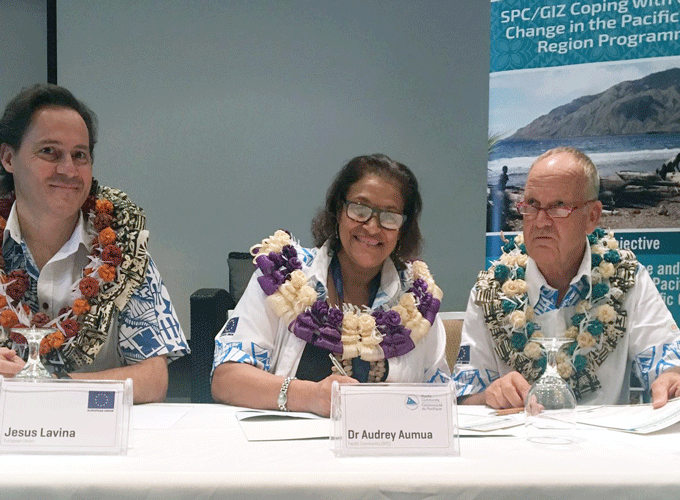
The signing of the agreement this week between the Pacific Community and representatives from EU Pacific and German Federal Enterprise for International Cooperation. The signing took place in Suva during Pacific Resilience Week (October 19-27)
Five early warning sirens to protect Fijians in the case of a natural disaster are set to be established in Suva by 2018.
The newly proposed sites for the warning sirens are: Police Mobile Unit at 8 miles to cover low lying areas of Laqere, Nepani and Nadawa; Vatuwaqa FINTEL area to cover Vatuwaqa to Laucala Beach; Ganilau House or Civic Towers to cover the middle of Suva city; Pacific Theological College to cover the Nasese area; and the Walu Bay area to Ports Authority.
These additional sirens will complete the systems already installed at the University of the South Pacific which covers Suva Point to My Suva Picnic Park and the other in Lami town.
SPC Deputy Director-General, Dr Audrey Aumua, said other employers around the proposed areas that have sirens will be connected so they can be activated in coordination.
‘Technical support’
She said it is critical that scientific and technical support is offered to the people of the Pacific who are vulnerable to climate change hazards and disasters.
“These sirens will help increase Fiji’s capacity to address all hazards and provide increased protection for the people of Fiji,” she told Asia Pacific Report.
Dr Aumua said other warning systems in the Pacific region have not been proposed but could be developed if countries require support for it in the future.
From 1986 until the beginning of 2016, Statistics New Zealand, through the Household Labour Force Survey, collected data on people “not in the labour force, by main activity”.
These data considerably understate these “main activities”, because many people whose main activity is neither employment nor unemployment are nevertheless counted as being in the labour force; employment or job-seeking are secondary activities for them.
This month’s chart shows persons aged over 15 classed as having zero attachment to the labour force, and whose main activity is neither education, caring for children, nor retirement. It shows, at least since the mid-1980s, that between six and seven percent of the working-age population are unaccounted for. In 2016, that’s 235,000 people; considerably more than those officially counted as unemployed.
A few of these invisibles will be people caring for other adults. A new dataset for those “not in the labour force, by main activity”, with data only for early 2016, shows 24,000 such people caring for adults, leaving 211,000 unaccounted for.
The new dataset removes the category of ‘retirement’, so most of the 470,000 people classed in the new data as in “free‑time activities” or in “own care due to sickness/injury/disability” are people who would probably be over-65 and in retirement. The new dataset renders completely invisible those aged 25 to 64 without attributable main activities.
There is little interest in collecting statistics about people who do not fit convenient statistical categories. Policymakers generally do not see the invisibles as a problem; they do not see them at all. Except, that is, they have started taking an interest in NEETs, defined as people aged 15-24 who are not in employment, education or training. It’s a pity that these NEET statistics are restricted – for no obvious reason – to persons under 25. These are the ‘naughty’ young people, who supposedly reflect failures of the education system. Thus, there may be a political agenda to generate awareness only of the young invisibles.
There’s no obvious trend in the three decades of data shown here. The main point is that there are so many people whose lives do not fit the roles we expect them to fit. There has been too little interest in those who are defined only by what they do not do.
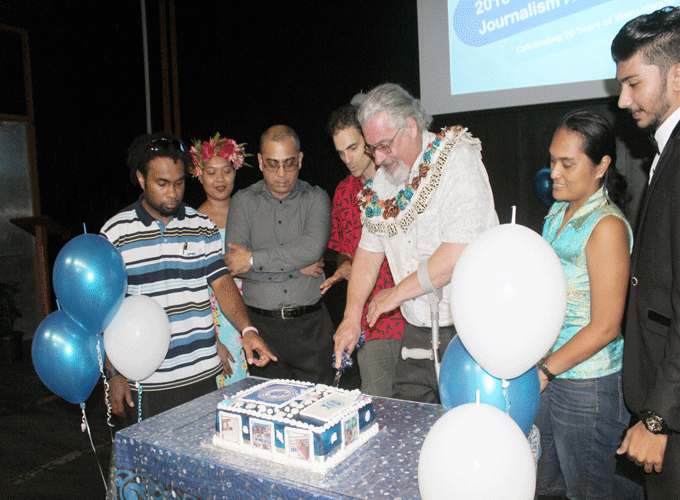
Cake cutting ceremony at the 2016 USP Journalism Programme awards which, also celebrated Wansolwara’s 20-year anniversary. USP journalism teaching assistant Eliki Drugunalevu (far left), Wansolwara student editor Chrisnrita Aumanu, head of USP journalism Dr Shailendra Singh, USP journalism tutor Dr Olivier Jutel with founding Wansolwara editor Professor Philip Cass, Wansolwara supervising editor-in-chief Irene Manueli and award recipient Sonal Singh. Image: USP
The University of the South Pacific hosted its annual journalism awards this month, honouring some of the top students who report for the journalism programmes multi-award winning student newspaper.
Eleven students of USP’s Journalism Programme were presented with media awards.The ceremony was held in the AusAid theatre in Laucala Bay, Suva. Image: Fiji Times
Wansolwara, USP’s training newspaper, was also commemorated for its 20th year of publishing.
Journalism student Chrisnrita Aumanu received the award of Best Wansolwara Editor, sponsored by Fiji publication Business Melanesia.
She told Asia Pacific Report that she enjoyed her role as student editor this year and was humbled to receive the award.
‘Challenging times’
“There would be challenging times, for example, running out of stories to put on the pages and looming deadlines. But at the end of the day when the challenges are dealt with, and with the great help from our tutors, it’s a great feeling.”
She said one of the successes for 2016 was this years first edition of the newspaper, when student journalists dedicated two-pages of the publication to TC Winston, the biggest cyclone ever to hit the Fiji islands.
Aumanu said being an editor has pushed her out of her comfort zone. Originally from the Solomon Islands, she hopes to bring her experience home to give back to her country.
She also acknowledged the team of student reporters and photographers who worked tirelessly on the newspaper this year.
‘Wansolwara’
“Wansolwara is a great news outlet, as it is a great platform for student journalists to put on paper what they have been taught in classrooms. Moreover, Wansolwara moulds budding journalists like us to write better stories each and every time with a sense of pride when we see our bylines.”
Another big winner of the night was former Wansolwara student editor, Sonal Singh, who won the Fiji Sun Tanoa Bowl Best Graduating Student Award.
‘Biggest success’
He told Asia Pacific Report, the award is his biggest success this year.
“Since 2014, when I first came to know about the awards, it became one of my goals to win the best graduating student award. I could say that my consistency brought me closer to this.”
“This awards means that I am on the right track.”
Singh said the biggest challenges for the year have been managing his role as the president of the USP Journalism Students Association (JSA), as well as a six-week attachment, and his commitment to Wansolwara.
“However through the understanding and help from family, friends and my lecturers, I was able to overcome my obstacles.”
‘Revived’
Singh, together with fellow journalism students have also successfully “revived” USP’s JSA by raising enough funds to improve the facilities in their newsroom.
Asia Pacific Report asked Singh what advice he would give to other aspiring Pacific journalists: “My advice would be that if you have the will and courage to stand and speak for what is right to improve our society, then become a journalist. It’s more exciting and satisfying than you think.”
Chief guest
The chief guest at the awards night was former USP lecturer Dr Philip Cass who founded Wansolwara in 1996 and now teaches at UNITEC in Auckland.
Founding Wansolwara editor, Professor Philip Cass, also presented at the 2016 World Journalism Education Congress in Auckland. Image: PMC
“Wansolwara has gotten more ambitious, covering issues from across the Pacific region,” Cass said in a statement featured in the Fiji Times.
“I think over the years, Wansolwara has become a lot better and has certainly won a lot of awards. This certainly has reflected the hard work done by my successors and all the staff who have worked on it over the years.
“This is a very special moment for me to think that it has survived this long and has prospered this much. I was very touched and I am very grateful for this invitation.”
Wansolwara is now the longest surviving student publication in the Pacific region and continues to cover serious news on a quarterly basis.
USP journalism coordinator Dr Shailendra Singh said the awards have been an important event in university’s journalism calendar, since it was introduced by the Pacific Media Centre’s Professor David Robie.
‘Well supported’
“The awards are well supported by the news media industry in Fiji who sponsor the prizes,” Dr Singh said.
“News media industry representatives attend the function and present the prizes in person, which is a boost for the future journalists of the region.”
Dr Singh said the need for well-trained journalists had increased with the onset of social media and citizen journalism, especially in the face of the ongoing development problems faced by the region.
‘Young journalists’
“It is very important to encourage potential young journalists by recognising, incentivising and rewarding good examples of journalism,” said Dr Singh.
“The awards have become an important occasion in the USP journalism calendar over the years, given USP’s critical role in nurturing the future journalists to meet the needs of the region.”
The USP Journalism Programme has produced more than 200 graduates. Many are now working in various media roles throughout the Pacific and beyond.
Fiji Broadcasting Corporation’s news bulletin featuring interviews with the awardees at USP’s Journalism Awards 2016. Video: FBC
The University of the South Pacific hosted its annual journalism awards this month, honouring some of the top students who report for the journalism programmes multi-award winning student newspaper.
Eleven students of USP’s Journalism Programme were presented with media awards.The ceremony was held in the AusAid theatre in Laucala Bay, Suva. Image: Fiji Times
Wansolwara, USP’s training newspaper, was also commemorated for its 20th year of publishing.
Journalism student Chrisnrita Aumanu received the award of Best Wansolwara Editor, sponsored by Fiji publication Business Melanesia.
She told Asia Pacific Report that she enjoyed her role as student editor this year and was humbled to receive the award.
‘Challenging times’
“There would be challenging times, for example, running out of stories to put on the pages and looming deadlines. But at the end of the day when the challenges are dealt with, and with the great help from our tutors, it’s a great feeling.”
She said one of the successes for 2016 was this years first edition of the newspaper, when student journalists dedicated two-pages of the publication to TC Winston, the biggest cyclone ever to hit the Fiji islands.
Aumanu said being an editor has pushed her out of her comfort zone. Originally from the Solomon Islands, she hopes to bring her experience home to give back to her country.
She also acknowledged the team of student reporters and photographers who worked tirelessly on the newspaper this year.
‘Wansolwara’
“Wansolwara is a great news outlet, as it is a great platform for student journalists to put on paper what they have been taught in classrooms. Moreover, Wansolwara moulds budding journalists like us to write better stories each and every time with a sense of pride when we see our bylines.”
Another big winner of the night was former Wansolwara student editor, Sonal Singh, who won the Fiji Sun Tanoa Bowl Best Graduating Student Award.
‘Biggest success’
He told Asia Pacific Report, the award is his biggest success this year.
“Since 2014, when I first came to know about the awards, it became one of my goals to win the best graduating student award. I could say that my consistency brought me closer to this.”
“This awards means that I am on the right track.”
Singh said the biggest challenges for the year have been managing his role as the president of the USP Journalism Students Association (JSA), as well as a six-week attachment, and his commitment to Wansolwara.
“However through the understanding and help from family, friends and my lecturers, I was able to overcome my obstacles.”
‘Revived’
Singh, together with fellow journalism students have also successfully “revived” USP’s JSA by raising enough funds to improve the facilities in their newsroom.
Asia Pacific Report asked Singh what advice he would give to other aspiring Pacific journalists: “My advice would be that if you have the will and courage to stand and speak for what is right to improve our society, then become a journalist. It’s more exciting and satisfying than you think.”
Chief guest
The chief guest at the awards night was former USP lecturer Dr Philip Cass who founded Wansolwara in 1996 and now teaches at UNITEC in Auckland.
Founding Wansolwara editor, Professor Philip Cass, also presented at the 2016 World Journalism Education Congress in Auckland. Image: PMC
“Wansolwara has gotten more ambitious, covering issues from across the Pacific region,” Cass said in a statement featured in the Fiji Times.
“I think over the years, Wansolwara has become a lot better and has certainly won a lot of awards. This certainly has reflected the hard work done by my successors and all the staff who have worked on it over the years.
“This is a very special moment for me to think that it has survived this long and has prospered this much. I was very touched and I am very grateful for this invitation.”
Wansolwara is now the longest surviving student publication in the Pacific region and continues to cover serious news on a quarterly basis.
USP journalism coordinator Dr Shailendra Singh said the awards have been an important event in university’s journalism calendar, since it was introduced by the Pacific Media Centre’s Professor David Robie.
‘Well supported’
“The awards are well supported by the news media industry in Fiji who sponsor the prizes,” Dr Singh said.
USP Journalism staff: Dr Olivier Jutel (from left), head of USP journalism Dr Shailendra Singh, journalism teaching assistant Eliki Drugunalevu and Wansolwara supervising editor-in-chief, Irene Manueli with a former USP journalism student Emmanuel Mar. Image: USP
“News media industry representatives attend the function and present the prizes in person, which is a boost for the future journalists of the region.”
Dr Singh said the need for well-trained journalists had increased with the onset of social media and citizen journalism, especially in the face of the ongoing development problems faced by the region.
‘Young journalists’
“It is very important to encourage potential young journalists by recognising, incentivising and rewarding good examples of journalism,” said Dr Singh.
“Towards this end, the awards have become an important occasion in the USP journalism calendar over the years, given USP’s critical role in nurturing the future journalists to meet the needs of the region.”
The USP Journalism Programme has produced more than 200 graduates. Many are now working in various media roles throughout the Pacific and beyond.
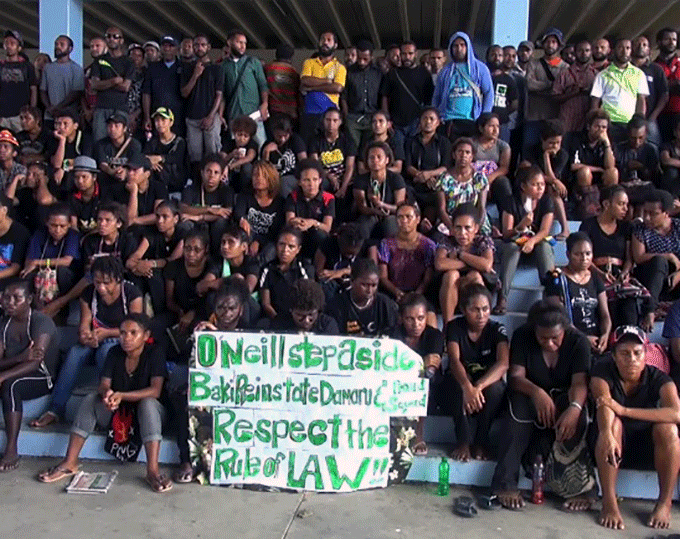
It has been a traumatising year for UPNG students. An escalated series of events occurred after students boycotted classes in May. They were petitioning for Prime Minister Peter O’Neill to step down while police investigated corruption charges against him. Image: EMTV News
Students from the University of Papua New Guinea (UPNG) claim they are unable to concentrate and have withdrawn from their studies.
Loop PNG reported around 100 first-year students have withdrawn following the string of distressing events for UPNG students this year, including the shooting of students by police in June.
In an interview with Loop PNG, UPNG’s acting vice-chancellor, Dr Nicholas Mann, said he could not confirm the figures.
‘Life is like that’
“Life is like that. People go through certain traumas and difficulties and when they cannot concentrate, they take time off to recuperate.”
“Students were given the opportunity to resume learning. Those who are strong and can muster the challenge have come in and continued.”
It has been a traumatising year for UPNG students after an escalated series of events occurred after students boycotted classes in May. They were petitioning for Prime Minister Peter O’Neill to step down while police investigated corruption charges against him. Image: EMTV News
Students from the University of Papua New Guinea (UPNG) claim they are unable to concentrate and have withdrawn from their studies.
Loop PNG reported around 100 first-year students have withdrawn following the string of distressing events for UPNG students this year, including the shooting of students by police in June.
In an interview with Loop PNG, UPNG’s acting vice-chancellor, Dr Nicholas Mann, said he could not confirm the figures.
‘Life is like that’
“Life is like that. People go through certain traumas and difficulties and when they cannot concentrate, they take time off to recuperate.”
“Students were given the opportunity to resume learning. Those who are strong and can muster the challenge have come in and continued.”
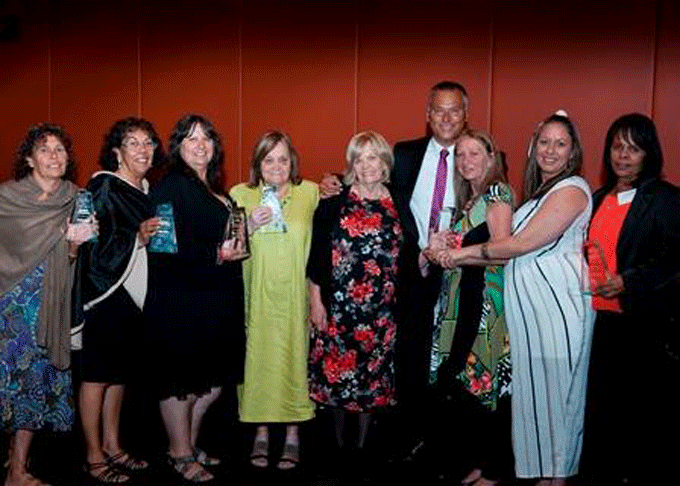
Grandmothers Against Removals: the winners of the 2016 Aboriginal Justice Award at Parliament House in Sydney. The group were against eight other finalists. Image: Law and Justice Foundation of New South Wales
By Dr Camille Nakhid and TJ Aumua
A group of indigenous mothers and grandmothers who actively campaign to stop the forced removal of aboriginal children from their families have been recognised with a justice award.
Laura Lyons, a member of GMAR Sydney, told Asia Pacific Report earlier this year of the forced and unjustified removal of her children and the abuse they faced in a residential care facility.
‘Proud moment’
She said the award was a “proud moment” for the group and believed their ancestors were present to witness it.
‘On our way to the awards we saw a rainbow,’ Lyons explained.
“It was actually Bianca (Lyons daughter) who looked up in the sky and said, ‘mum there’s the rainbow’. I said to her, ‘that’s our ancestors with us’ and i knew we were going to win the award.”
‘Ongoing’
Lyons said her case with the Department of Children Services (DoCS) is ongoing and GMAR continue to be busy travelling to other communities to assist and support families.
GMAR have set up a GoFundMe page to raise money for transport costs to visit other families who need their help.
A new online research platform will allow Pacific research to be more accessible around the country and the world.
At the launch of Tuwhera: Director of learning and research services (AUT) Shari Hearne (left) with Pacific Media Watch contributing editor TJ Aumua and the Pacific Media Centre’s Advisory Board chair Camille Nakhid (far right). Image: PMC
Tuwhera was launched this week at the Auckland University of Technology (AUT). The platform allows journal editors to have their work freely published online and available to the public.
The Pacific Journalism Review was launched on the research site, making information about the Pacific more accessible to international staff and students.
The Pacific Journalism Review is published by the Pacific Media Centre. Globally, it is the only journal that publishes expert media research about the Pacific region.
New Zealand journalist Barbara Dreaver was given special permission earlier this year to land in Fiji for just one hour to change planes for a reporting trip to Kiribati. Image: TVNZ
By TJ Aumua in Auckland
TVNZ’s Pacific Correspondent Barbara Dreaver says she is ‘thrilled’ to be able to report in Fiji again, after being blacklisted from the country for eight-years.
She told Asia Pacific Report that it is a “promising move” by the Fiji government and said an open and free media is a corner stone of democracy.
This comes after the announcement made by the Fiji government this week, that it had lifted the ban on foreign journalists reporting in the country as long as they have been accredited in the usual manner by the Department of Information.
Fiji Prime Minister Frank Bainimarama is currently in New Zealand on his first state visit to the country.
Across the Ditch: Australian radio FiveAA.com.au’s Peter Godfrey and EveningReport.nz’s Selwyn Manning deliver their weekly bulletin Across the Ditch.
This week: Weather + Headlines
IN-DEPTH: Peter and Selwyn take an in-depth look at how over 40% of homes tested for meth contamination tested positive.
SPORT: Also, the All Blacks take on Australia’s Wallabies rugby team at Eden Park in Auckland. The Wallabies haven’t beaten the All Blacks at Eden Park since 1986, but this weekend Australia will be wanting to break that curse and also shatter the All Blacks’ hopes of extending their world record winning streak of 17 international tests.
Across the Ditch broadcasts live weekly on Australia’s FiveAA.com.au and webcasts on EveningReport.nzLiveNews.co.nz and ForeignAffairs.co.nz.]]>
An unprecedented legal case has been filed this week against the Norwegian government for allowing oil companies including state-owned Statoil to drill for new oil in the Arctic.
The legal case was filed by Nature and Youth, the largest environmentalist youth organisation in Norway and Greenpeace Nordic. Both agencies argue that Norway is violating the Paris Agreement and the people’s constitutional right to a healthy and safe environment for future generations.
The case comes only days after Statoil pulled the plug on its New Zealand operations in Northland, and just before a visit by Norway’s indigenous Sámi parliment, who are meeting with iwi around the country to discuss Statoil’s presence here.
‘Stiff resistance’
The Sámi visit follows a Māori delegation to Norway last year, who met with Sámi people and attended the annual Statoil shareholders meeting to put the owners on notice that their investment in Aotearoa would be met by stiff resistance.
Greenpeace New Zealand climate campaigner and lawyer, Kate Simcock, said the case could have implications around the world.
“With the success of the Urgenda climate case against the Dutch Government, and now this, we’re seeing that it’s possible for ordinary people and smart legal tactics to hold governments to account on their plans to tackle climate change.”
Opposition MP Mikaele Leawere is calling on an immediate inquiry into USP’s decision. Image: FijiOne
Fiji’s opposition is calling on the University of the South Pacific’s vice-chancellor to step down, after USP’s decision to de-register students who have outstanding fees.
Opposition MP Mika Leawere expressed his concern with the decision which comes just before students sit their final exams.
“Taxpayers of Fiji contribute towards Fiji being the biggest financial member state contributor of the University and this draconian policy lacks any humanity or wisdom given that Fiji and many students are still recovering from the devastation of TC Winston.
“While we accept that the University is an institution of higher education and is not a charitable organisation, surely an institution of academics can empathise with their students who are already stressed with exam preparations and now are further burdened with an inhumane policy that dashes all their hard work for the semester at the 11th hour.”
‘Unanimous decision’
In an interview with Fiji Broadcasting Corporation acting vice-chancellor, Professor Richard Coll, said the decision to de-register students who have not paid all fees in full was a unanimous decision by the USP Senate.
Coll said student’s debts are now very high and accumulating every year, and the University sees it critical that this is addressed.
FBC reported students have until Friday this week to pay outstanding fees.
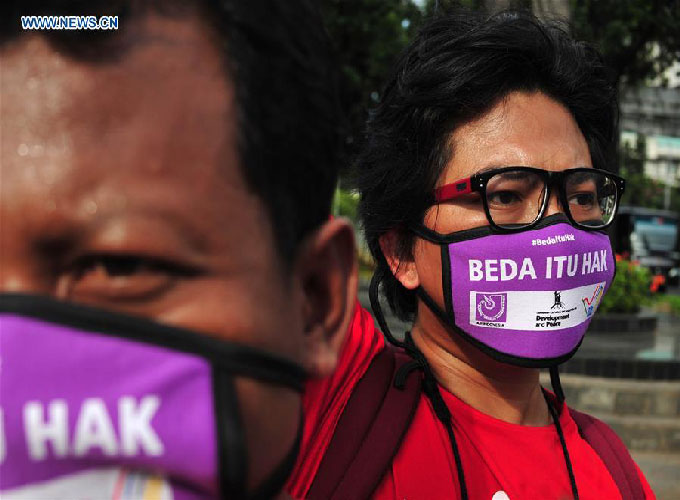
Indonesian journalists in Jakarta wore masks on World Press Freedom Day on May 3, 2016, in protest of the ongoing media violations. Image: News.CN
Experts from Southeast Asian nations have identified key challenges facing media in their region. They propose three fundamental areas of action for civil society, governments and the media.
The expert 19-member group included researchers, media professionals and human rights defenders forming the Association of Southeast Asian Nations (ASEAN), namely Cambodia, Indonesia, Laos, Malaysia, Myanmar, Philippines, Thailand and Vietnam. Representatives from Timor Leste and Mongolia were also present.
‘Jakarta conclusions’
DW Akademie, an organisation that supports the development of international media, reported the experts agreed on a three-step action plan called the “Jakarta Conclusions” which is aimed to enhance the situation for media in Southeast Asia.
The plan will require the collective efforts of civil society, media organisations and governments.
Jakarta Conclusions Action Plan:
Take steps to develop a special regional mechanism to improve the media environment based on existing international and regional models.
Create a process to engage the large global Internet intermediaries to address issues of access, accountability, sustainability, and the impact these companies have on media and society.
Promote programs to expand media and information literacy at a sufficient scale to have impact at the societal level
1. Develop a regional mechanism for Southeast Asia
DW Akademie’s report stated that Southeast Asia does not have a special rapporteur for freedom of expression – whereas Latin America, Africa and Europe have active and independent representatives who advocate for information, expression and media rights.
Experts expressed that the ASEAN Intergovernmental Commission on Human Rights has not pushed for this issue.
Therefore representatives from civil society organisations suggested establishing an informal mechanism in the absence of government support.
But others advocated to continue to push for an official mechanism, pointing out that Southeast Asia could learn from the Arab world which is currently seeking to establish a freedom of expression special rapporteur.
2. Engage the large global Internet intermediaries
DW Akademie reported companies such as Google and Facebook take a large share of online advertising revenue in Southeast Asia but do little to counter the spread of online hate speech, propaganda and disinformation.
Therefore experts suggested encouraging these platforms to develop a pricing system which differentiates between general information and quality journalism.
Maria Ressa, the former CNN lead investigative reporter in Asia said members need to work collectively.
“We need to come together and confront these and other companies with the situation in our region.”
3. Promote programs to expand media and information literacy
The growing importance of media users emphasised the importance of media and information literacy.
Hugo Maria Fernades of the Press Council of Timor Leste said such programs should enable the population to “actively and consciously” use media.
Fiji prime minister Frank Bainimarama is expected to visit New Zealand from October 19-23, 2016. Image: Pacific Scoop
New Zealand journalist Michael Field of Fairfax has said the announcement by the Fiji government to lift its ban on foreign journalists in the country is a “curious” move.
He told NewstalkZB that he has still not been properly advised.
“It’s all part of an interesting game that he [Bainimarama] is playing, because I have not been advised.”
“It’s a curious thing to do and it should be noted that the domestic media in Fiji is still governed by military decrees so I don’t know what it all means.”
TVNZ’s Barbara Dreaver has also been blacklisted from Fiji since 2008.
She has previously expressed in Asia Pacific Report that journalists should not be banned in any democratic country.
“The people of Fiji deserve to have their stories told no matter who they are or who they vote for.”
Usual manner
The Fiji government is said to have lifted the ban on foreign journalists reporting in the country as long as they have been accredited in the usual manner by the Department of Information.
The Fiji Times reported the announcement was made by prime minister Frank Bainimarama earlier this week who said the ban on foreign journalists was established because he believed they were not objective in their reporting.
“The government originally instituted these bans because it believed that some journalists had crossed the line from journalism to political advocacy and had inserted themselves into the domestic political debate.
“But the government reminds foreign journalists of their universal obligation to report events fairly and in a balanced manner.”
The film made its debut at the New Zealand International Film Festival in 2015. Video: JourneymanVOD
By TJ Aumua in Auckland
Co-producer Christina Milligan (left) with Peace Foundation board member Tom Ang and other co-producer Roger Grant (far right). Film director Kim Webby is currently in Vanuatu opening the documentary at another film festival. Image: Ngā Aho Whakaari
Filmmakers of the New Zealand documentary Price of Peace were honoured this week with the producers receiving an award for their contribution to “peace and aroha”.
Director Kim Webby with co-producers Christina Milligan and Roger Grant were recipients of the Te Pou Tatau Pounamu NZ Peace Foundation Award at the Ngā Aho Whakaari (Māori in Screen Production) 20th Anniversary.
Milligan told the Pacific Media Centre that they were honoured to be recognised by their peers and the film community.
She added the film has achieved more success than they had hoped for, reaching mainstream and indigenous audiences around the world.
Tūhoe activist
The film provides exclusive access to the word of Tūhoe activist Wairere Tame Iti and the trial of the Urewera Four’ in which Iti and three others were accused of plotting terrorist activities in 2007.
International screenings
International screenings of the film continue this week, with the documentary being featured in the Margaret Mead Film Festival at the American Museum of Natural History in New York.
The Pacific Islands Forum continues to push urgency towards limiting global warming to 1.5 degrees, putting pressure on the negotiated well below 2 degrees goal of the Paris Agreement.
The chair of the PIF and President of the Federated States of Micronesia, Peter Christian, said limiting the temperature goal is critical to safeguard the wellbeing and existence of people in the Pacific.
“This is something the Forum is pushing very hard for because together the current, intended nationally determined contributions still fall considerably short of even reaching the ‘well below 2 degrees’ goal that was agreed to in Paris.”
‘Rapid response’
However, Christian praised the political will of the countries that prioritised their ratification of the Paris Agreement last week. This has enabled the Agreement to come into force from November 4, 2016.
“The Pacific called for a rapid response from the world to address the issues stemming from climate change, and we are very happy to see these first important steps being completed.
“While there is still a lot of work to be done, to see the global community rise to this challenge in this way gives us great hope.”
Next steps
President Christian said that from here the next steps were to ensure that the first meeting of the Parties to the Paris Agreement and the 22nd Conference of the Parties (COP22) in Marrakech in November, produces increased commitment for climate change action and resilience.
Across the Ditch: Australian radio FiveAA.com.au’s Peter Godfrey and EveningReport.nz’s Selwyn Manning deliver their weekly bulletin Across the Ditch. This week Peter and Selwyn go deep on the euthanasia debate. New Zealand politicians are hearing verbal submissions on the pros and cons of euthanasia. But should we be cautious about letting politicians legislate on this very very very important issue?
FIRST UP
Weather comparison
Currency comparison
Headlines roundup
ITEM ONE:Euthanasia – The NZ Parliament has begun hearing submissions on euthanasia, largely from people wishing to give a verbal rationale on whether politicians ought to consider making euthanasia legal in New Zealand.
Political parties in New Zealand are warming to the idea of getting a bill before the house that would make it legal for people in New Zealand to receive assistance with ending their lives.
For background, here is a link to an editorial I wrote on euthanasia.
I have written editorials against euthanasia, basing my argument on investigative reporting I did in the 1990s when the then National led Government brought in (through stealth) exclusion criteria affecting those seeking life saving treatments like dialysis.
The back then, doctors treating people suffering end stage renal failure were presented with criteria that excluded their patients from accessing renal dialysis treatment if they were blind, had a history of mental illness, intellectual disability, displayed antisocial behaviour, had a criminal conviction, were over 65 years of age.
The government’s move to stop people getting this life saving treatment was largely fiscally motivated. The criteria was supposed to remain secret. I discovered the Minister had authorised it and had the government’s health finding authority present the criteria to doctors as an ethical framework through which they could ascertain what categories of people would be prevented from accessing dialysis.
The reportage caused a political furore. Urgent Parliamentary debates followed… In the end the then Minister of Health Jenny Shipley (later prime minister) was forced to ditch the exclusion criteria policy and disestablish the Core Health Services Committee that she set up to drive such policies.
At that time, the National Government was able to legally exclude people on this basis as it had passed a law that excluded government entities from having to work within the ‘constraints’ of the human rights act.
Leaked official documents I obtained back then revealed how the Health Minister was about to roll out exclusion criteria for coronary care, oncology care, basically all areas of health care where it was considered a heavy fiscal burden on the State.
On euthanasia… My argument is, that based on the experiences of reporting the exclusion criteria issue in the 1990s, my concern today is: euthanasia laws, while well meaning, could be used by future governments as a means of addressing fiscal pressures and a way to reduce the State’s continuing care cost-burdens.
If the politicians really want to debate the merits of euthanasia, I say, first, let them answer this: As the baby boomer generation ages, at what point does the fiscal burden on the State become politically unsustainable?
Here in New Zealand it does appear that point is getting closer.
ITEM TWOSport – While Australia’s Wallabies played themselves back toward respectability last weekend beating Argentina’s Pumas 31 – 21… Spare a thought for the poor ole Springboks. The All Blacks beat them in Durban 57 -15!
The win notched up a rugby world record with the All Blacks having now won 17 international tests without any losses.
Even the POMEs are saying this is the best international team ever to play the game, and Aussie rugby great Marc Ella says the Kiwis can’t be beaten when Australia turns out for a hiding at Auckland’s Eden Park on Saturday October 22.
To lay it on thick, Australia hasn’t beaten New Zealand at rugby at Eden Park since 1983. That’s 33 years! Can you guys do it? Well, let’s wait and see.
Don’t worry though, the Cricket season will soon be upon us :)]]>
A major solar energy project in Manu’a, American Samoa, will bring the island nation a step closer to having one hundred percent renewable energy.
American Samoa Power Authority’s renewable energy project manager, Mike Langier, discussed the Manu’a projects at the American Samoa Economic Development Authority Board.
He said at the moment gallons of diesel is shipped to American Samoa for power.
“On average we are shipping around 55 to 60 barrels of diesel over to those islands a week.
‘It is not the cleanest method’, he said.
“When we reduce our diesel consumption to almost zero, at least for the generators, it will be pretty amazing.”
The biggest project is based in Ta’u and would supply 1.4 megawatts of power.
The system consists of solar photovaltaic panels which converts sunlight directly into electricity. It will also include six-hours of battery storage, three back up generators and provide for 100 percent of Ta’u’s power supply.
On Ofu, a smaller size solar project is being built. It will provide 80 percent of power for Ofu and Olosega.
Secrecy has returned to Trans Pacific Partnership negotiations with doubt that the current agreement will survive the United States presidential elections. And this week, it has emerged that some of the TPP membership nations will meet in Geneva in early December to nut out what can be salvaged prior to the inauguration of the newly elected US president.
[caption id="attachment_6181" align="alignleft" width="150"] Professor Jane Kelsey.[/caption]
According to New Zealand-based University of Auckland law expert and opponent of the TPP deal, Professor Jane Kelsey “while attention focuses on the fate of the Trans-Pacific Partnership Agreement (TPPA) many of its key elements have been flipped across to the equally secretive negotiations in Geneva for the Trade in Services Agreement (TiSA)”.
“Some parts of TiSA go even further,” according to professor Kelsey.
Trade Ministers from the 23 negotiating parties, including the US, EU, Japan, Australia and New Zealand, plan to meet in Geneva on 5-6 December when they hope to wind up a deal that has remained largely under the radar.
‘I was in Geneva last month and met with a number of government delegations. They confirmed that TiSA is intended as a “21st century” deal for transnational corporations. The new focus is on e-services, which will benefit the digital behemoths like Google, Amazon and Uber’, Professor Kelsey said.
‘Their goal, as with TPPA, is to put handcuffs on future governments’ right to regulate. Perhaps the most frightening would pre-empt governments from regulating so-called “new services”, including as yet unknown new technologies.’
‘Equally worrying, given this country’s litany of failed deregulation, privatisation and free market experiments in services, is the idea that treatment of foreign firms should never be less liberal than now (‘standstill’) and any future liberalisation should be locked in automatically (“ratchet).’
As with the TPPA information on TiSA relies largely on a steady stream of leaks posted on Wikileaks and more recently by Greenpeace on energy services.
‘Trade Minister Todd McClay made much of his plan to be much more open about future negotiations, but he has retreated further down the rabbit hole’, according to Professor Kelsey.
The EU, Norway, Switzerland and some others have published what they are offering the other countries, as was done in earlier WTO negotiations on services – including by New Zealand.
McClay has refused to do the same, citing the need to protect future negotiations. Professor Kelsey described that as ‘spurious nonsense designed to prevent in-depth scrutiny of what New Zealand is up to before we are presented with another done deal.’
‘TiSA could have more direct impacts on New Zealand’s future policy space than the TPPA. We know, for example, New Zealand has been pushing hard to get other countries to lock open their doors to private education providers. I assume they are promising to do the same. The non-discrimination rule may see proposed legislation to guarantee public subsidies to private providers, including foreign education firms, locked in without the possibility of change.’
Professor Kelsey will give a media briefing on TiSA and latest developments on the TPPA in the US and other countries on Wednesday October 12, at 10.30, Level 14, Bowen House, 70/84 Lambton Quay.
An online petition to drop the defamation case against two East Timorese journalist’s is calling for urgent international support, stating that the prosecution of the journalists is an attack on press freedom and right to information.
Former Timor Post journalists, Oki Raimundos and Lourenco Martina Vicente are being charged with “slanderous denunciation” by the Timor Leste government and face up to three years’ imprisonment.
“We are urgently calling on Timor Leste’s Prime Minister, Rui Maria de Araújo, and his government to drop all charges against Oki Raimundos and Lourenco Vicente immediately.”
Factual error
The case against the journalists is based on a published report from 10 November 2015, which contained a factual error on a government tendering process.
The outlet apologised, published a correction and right of reply from the prime minister’s office in relation to the story. Despite this, the government has persisted with the prosecution.
Timor Leste’s media law was previously criticised for being “repressive” and “draconian” when it was passed in 2014.
West Papua will be granted full membership of the Melanesian Spearhead Group (MSG) in December, 2016.
The Vanuatu Daily Post reported that the announcement was made by the chairman of the MSG and prime minister of the Solomon Islands, Manasseh Sogavare, while he met with the chairman of Vanuatu Free West Papua Association, Pastor Allan Nafuki and prominent West Papua prominent leaders Jacob Rumbiak, Benny Wenda and Andy Ayamiseba in Port Vila last week.
‘overdue smile’
The Daily Post stated: “The Chairman of VFWPA said he smiled a long overdue smile and breathed a sigh of relief saying, ‘Now I can go to my home island of Erromango and have a peaceful sleep with my grandchildren, with no disturbance whatsoever.’”
At the 71st Session of the United Nations General Assembly, this year in September, Pacific Islands leaders from the Marshall Islands, Nauru, Palau, Solomon Islands, Tonga, Tuvalu and Vanuatu supported West Papua’s right to self determination. They also called on the UN to investigate the country’s ongoing human rights abuses.
It was the first time several Pacific Island leaders spoke collectively about West Papua on a global platform.
During the time of the Assembly a new report which detailed the human rights violations in West Papua and explained why full MSG membership is an essential step for peace was published online. The research aimed to convince Pacific leaders on providing full membership of the MSG to the ULMWP.
‘incredible solidarity’
Over the weekend the ULMWP released a statement thanking the island nations for their support.
“On behalf of the people of West Papua, the United Liberation Movement for West Papua (ULMWP) would like to express its deepest and sincerest thanks and encouragement to you all for your incredible solidarity and support for our people, at the 71st Session of the United Nations General Assembly.”
“It brings tears to our eyes and joy to our hearts to witness such strong Pacific Island solidarity for our people who have suffered the most sever human rights violations for over 50 years.”
Fijian language week celebrations over the weekend addressed the revival of the language for future generations in New Zealand. But the past was not forgotten. The community acknowledged their ancestors and the precious gifts they have left for the community today. TJ Aumua reports.
It was a weekend filled with Fijian culture and tradition as the community gathered at the Auckland Museum this week to open celebrations for Fijian language week.
On Saturday morning Fijian leaders from all around the country came together for the first time to address issues that are affecting the community living in New Zealand.
With the community’s population growing fast in Auckland, the leaders were concerned that approximately seven percent of New Zealand-born Fijians cannot speak the language.
The President of the Fiji Community Association of Auckland (FCAA), Naca Yalimaiwai, said it is important for Fijian youth to grow-up surrounded by their language so they can identify with their culture and who they are.
“It’s important to maintain that reputation of who we are when we come away from Fiji,” he said.
In the afternoon, the community turned out in big numbers for the launch of the Fijian collection at the museum.
‘Fijian treasures’
The collection of ancient Fijian artefacts was officially named: ‘Nai Yau Vakaviti: Na Ka Marequiti’ which translates into: ‘Our Fijian Treasures: That are treasured’.
The community said a special blessing for the items, acknowledging the culture, tradition and skill of their ancestors.
The exhibition is a part of the Pacific Collection Access Project at the Auckland Museum. It has, for the very time, allowed communities to view an extensive look into the Pacific collections they store.
The collection will continuing viewing until July 2017.
Across the Ditch: Australian radio FiveAA.com.au’s Peter Godfrey and EveningReport.nz’s Selwyn Manning deliver their weekly bulletin Across the Ditch. This week Peter and Selwyn discuss how former New Zealand prime minister Helen Clark’s bid has ended for the UN secretary general position. Also, a BIG storm looms for NZ, and also All Black Aaron Smith has been sent back to New Zealand after a scandal emerged.
FIRST UP:Weather comparisonCurrency comparisonHeadlines roundupITEM ONE:
Former New Zealand Prime Minister Helen Clark’s bid for the United Nations secretary general job has concluded after the UN security council’s permanent five members exercised their votes over night. It is believed the USA, Russia, and France gave Clark the red card.
Helen Clark has congratulated winner Portugal’s former prime minister and former head of the UN’s refugee body, Antonio Guterres.
Guterres came through the security council members vote with a green-light, meaning he was well ahead of all other contenders.
ITEM TWO:Weather – New Zealand Civil Defence has issued a weather warning for Thursday and Friday, forecasting gales, lighting, flooding, and possible tornadoes threatening the North Island and upper South Island.
The storm is approaching only days after the country had a good drenching from the storm that hit South Australia so hard last week, knocking out your power.
By the time it crossed the ditch, the sting in the storm had eased, but the ground in NZ is still saturated, and with another significant storm looming, the expectation is that flooding and slips will occur.
ITEM THREE:Sport – With Aussie’s Wallabies off to Argentina to play the Pumas this weekend, the All Blacks head to Durban to take on the Springboks on their home soil. And, key All Black halfback Aaron Smith is heading home from South Africa after information emerged that he and his girlfriend entered a disabled persons public toilet at Christchurch Airport. The All Black senior management spoke to Smith and instructed that he be sent home before the All Blacks V Springbok game scheduled for this Sunday.]]>
Scientists in Samoa have issued a dire warning about the fate of the national bird, which features on the country’s bank notes and coins.
Acccording to ABC News the manumea has been on the brink of extinction for several years.
Conservationist Gianluca Serra is leading a team employed by the Samoan government to stop the bird from disappearing.
He told Mandie Sami of ABC News the situation was desperate.
“There are probably only a few dozens birds left in Samoa,” he said.
Serra said the manumea is a species of pigeon and is special because it is only found in Samoa and is the last surviving relative of the extinct dodo bird.
He said hunting was a major issue.
“We realize that they are being hunted by mistake because apparently people don’t like the manumea’s meat but they kill the manumea while they are targeting another pigeon they like.”
Serra added forest logging and invasive species like rats and cats also put the survival of the bird in danger.
‘Pretty depressing’
“You know our job as conservationists is pretty depressing,” he said. “Every year the planet is losing hundreds if not thousands of species.
“There is not enough awareness and interest by governments and people.
“Public opinion is so interested about cats and dogs but they don’t know that there is wildlife out there and they need help, so it’s really hard. There’s no money there, only few people are interested in it.”
Serra and his team are working with local villages to establish protected areas and controls around hunting.
Prime Minister John Key said he has extended an invitation to Fiji prime minister Voreqe Bainimarama on a state visit to New Zealand.
Key told NZ-based Radio Tarana that Bainimarama is welcomed and hopes he accepts the offer.
“Well as I understand he is coming down here – so obviously he’ll be welcomed. We were there earlier in the year . There are always certain things to discuss between Fiji and New Zealand – so if he wants to accept the offer that we have put forward then he will be most welcomed.”
If Bainimarama accepts up the invite, it will be his first state visit to New Zealand.
Editorial by Selwyn Manning – Be Aware and Beware of What You Demand – A Case Against State-Backed Euthanasia
Proposition: Do Governments legislate in our interest?
Selwyn Manning, editor of EveningReport.nz.
In my editorial titled: Be Aware and Beware of What You Demand – A Case Against State-Backed Euthanasia, I reflect back to the mid-1990s to an investigation I wrote that exposed how the government was to enforce exclusion criteria designed to prevent people from accessing life-saving but expensive treatments. If you were blind, intellectually disabled, had a history of mental illness, anti-social behaviour, a criminal conviction – you would be excluded from having renal dialysis. The experience of reporting this confirmed my resolve against state-backed-euthanasia. Here’s why…
Back in the mid 1990s Jenny Shipley (then Minister of Health in the Bolger National Government) established a governmental body called the Core Health Services Committee (CHSC) which was chaired by former broadcaster Sharon Crosbie.
The CHSC was known to exist, but no one paid much attention to it, and also getting information out of it was problematic as it would cite commercial confidentiality as a reason for withholding information. So a lot of its work went under the radar.
Back then, National had created a commercial model that replaced health boards with Regional Funding Authorities (RHAs) and hospitals became Crown Health Enterprises. It wasn’t until 2000, that the new Helen Clark-led Labour-Alliance Government disestablished the RHAs and CHEs and reestablished publicly elected health boards, and, hospitals became public hospitals once again.
In 1994-95 Jenny Shipley was Minister of Health. She later became the first woman prime minister of New Zealand (unelected). Helen Clark became the first woman elected by popular vote to become prime minister of New Zealand.
But back in the early to mid-1990s the Core Health Services Committee was accountable directly to the Minister of Health, Jenny Shipley, and was tasked with creating health funding frameworks, protocols, criteria that the then RHAs would rely upon when deciding what health services the government would pay Crown Health Enterprises (CHEs) for – when providing health ‘services’ to ‘clients’ (patients).
The Core Health Services Committee was tasked to evaluate a way of reducing the cost-burden on the Government for health services and come up with a set of criteria that CHEs and doctors would have to abide by when deciding which ‘clients’ (patients) would get treatment and, importantly, who would not.
A Decision was made to Exclude Patients from Life-Saving Treatment
In August 1994, I became aware that the Core Health Services Committee had been evaluating the most costly procedures, including renal dialysis treatment for people with end-stage renal failure. I was told by sources that the CHSC had drafted a document that included a framework for how expensive treatments would be handled, and that the Minister of Health had approved the plan.
Generally, there are two types of criteria:
inclusion – (meaning patients that met certain criteria would be eligible for treatment)
exclusion – (meaning those that could be labeled as possessing or exhibiting specific criteria would exclude then from being offered treatment.
In August 1994, I was leaked documents that displayed how the Minister had approved the CHSC protocols that used exclusion criteria and that the protocols had been presented to doctors and the exclusion criteria enforced.
The Exclusion Criteria
What this meant was people who presented with end stage renal failure, and who required dialysis to stay alive, would be excluded from getting this life-saving treatment if they were deemed:
to be blind
to have an intellectual disability
had a history of mental illness
exhibited or expressed anti-social behaviour
had a history of imprisonment
had an unrelated health condition that may cause complications
were over the age of 65-years…
The set of exclusion criteria continued on.
Without a public debate having ensured, CHE doctors were required to administer the changes and CHEs were required to report back to the RHAs with details on how the exclusion criteria was being applied.
Up until then, doctors and clinicians had decided on whether a patient would get dialysis treatment – the assessment was based on what health benefits a patient could expect, and were not required to consider exclusion criteria that were determined by the State.
The doctors silently rebelled and, as a journalist, as I mentioned above, I was leaked the CHSC protocols and exclusion criteria documents.
I sought a legal view from the Human Rights Commission, whose legal team suggested the criteria would be illegal under the act should it be brought into force by any other body excluding a government entity.
At that time, the Government had passed a human rights act but had excluded government entities (at that time) from having to act within that law.
Once We Published a Furore was Ignited
The day the investigation was published, a political furore ensued. The article was tabled in Parliament (in those days a news article could be tabled before The House) and Labour’s then health spokesperson, Lianne Dalziel, raised it during Parliament’s question time (Question number 7 if I remember right). And, once question time concluded, the issue was the focus of an urgent debate.
Former Prime Minister of New Zealand, David Lange.
“Look at this thing in south Auckland. There was an extraordinary defence by the Minister—the determining factor is one’s condition. I have to tell members that those key ethical principles are not determined by one’s condition, and they are not determined by one’s state; they are determined by one’s status.”
David Lange continued: insisting that the criterial that the Minister of Health had approved and defended was akin to the State standing on the dialysis pipe to prevent the flow of this life-saving treatment from reaching the patient.
He continued: “If one is intellectually handicapped, the drip goes off. If one is intellectually handicapped, one does not get what is called end-stage renal treatment, and that means one dies. They (the Government) are very good at euphemisms—“modernisation”. The word “euthanasia” does not come into it; it is “determination of end-stage renal treatment”.”
And Lange summarised: “Let us come back to the crude reality of it. Value judgments are being made about people’s lives, and those value judgments will be affected by whether they are people of influence, standing, or status. If they are psychiatrically disturbed or if they are intellectually disabled, the tap is turned off; they stand on the air pipe, and they talk about it in terms of core ethical commitments. I absolutely repudiate that.”
The Government Responded
The Minister Jenny Shipley replied: “The core health services committee has made some valuable recommendations about the areas on which attention should be focused. The core services committee has actually begun to assist this country to grapple with some of the most difficult ethical issues that are before us.”
She continued: “I am fascinated that some members of the Opposition are dismissive of our actually having the courage to address ethical questions in the field of medicine. It is true that every country in the world is in a similar position to us. There are issues that we know have to be spoken about, and what happens?
“In Parliament today Opposition members could not resist the temptation of picking up a piece of information, which they know is a gerrymandered interpretation of the core services committee discussion document, and politicising it. People in need of renal failure treatment actually do need to be able to be assessed and treated on a clinical basis. The core services committee raises some extremely important questions that allow clinical judgments to be made,” Jenny Shipley said.
Then, Exclusion Criteria Was Then Abandoned
Through the next month I followed up with articles revealing how the Core Health Services Committee and the Minister had agreed upon exclusion criteria for other life-saving treatments including coronary care and oncology care health services. The impact, should it have been fully rolled out, would have been considerable.
Within a month or two, the Core Health Services Committee criteria had been withdrawn from use, and the CHSC itself was later disestablished – doctors were again able to decide who should and should not get treatment based on a patient’s benefit and outcome.
From then on, when I would contact the Minister of Health’s office for comment on issues, I would be referred to as Goebbels (which I ignored apart from noting the irony).
The Government’s Retaliation
South Auckland man, James Mckeown.
Shortly after around March 1995, the Minister of Health Shipley stood staunch arguing that a south Auckland man who became the human face of her policy called James McKeown ought not receive dialysis treatment.
Shipley went on TVNZ’s Holmes Show arguing why the man ought to be left to die from his condition.
She identified clinical reasons for her argument. South Auckland Health’s then CEO, Dr Lester Levy, returned from holiday to stand between the minister and his hospital’s patient – Levy ordered that James receive dialysis.
In Parliament (ref. http://www.vdig.net/hansard/content.jsp?id=45370) , Lianne Dalziel asked: “Has the Minister received any advice on whether the statements made on television were a breach of patient confidentiality, and does she intend to resign should they be a breach of the Privacy Act?”
The Minister Jenny Shipley replied: “As I have said, this matter is before the Privacy Commissioner now. The issue of whether Mr McKeown, by disclosing a significant amount of his personal circumstance but not the complete story, forwent his right to privilege in the first place is an important matter that the Privacy Commissioner will rule on during the consideration of the three complaints that are before him.”
It was a clear case of the State’s Minister insisting and commanding her view over an ill and humble man from Otara.
The Privacy Commissioner did indeed issue a ruling. Shipley was found to have breached James McKeown’ privacy and was forced to make an apology. She did so.
A year later I revisited James and asked how his extended life had been: “It’s great he said, I enjoy my days, I have a flutter on the races, I’m happy.” A year and a half after Shipley had argued that his treatment ought to stop, James slipped away feeling that his doctors at least valued his life.
Prologue: The whole experience confirmed my resolve that we as a country’s peoples should never allow the State (irrespective of what party is in power) to interfere, nor legislate, against a born human being’s moral right to life and ethical right to access life-saving treatments.
The cast of Vanuatu film, Tanna, travelled to Hollywood this month to attend the movies official release in Los Angeles as well as New York City.
EyeWitness news interviewed the cast members when they visited ABC7 broadcasting studio in LA.
Cast member Lingai Kowia told the EyeWitness reporter that he is glad “my world has been shown to you in the film, so you can learn what is good from my world.”
Some of the ‘Tanna’ cast in New York City. The film was the first acting experience for many of the cast members. Image: Tanna Movie
Global success
As the first movie to ever be filmed in Vanuatu, Tanna, has continued to receive global success.
It has been picked by Screen Australia as its official entry for best foreign language film at the 2017 Oscars and was voted best direction and best feature film at the Australian Directors Guild Awards.
In August the film was dubbed a “hit” when it was screened at the Venice Film Festival where it was also voted best film and best cinematographer.
The movie will be released in Canada in October at the Vancouver International Film Festival and Edmonton International Film Festival.
The plot follows a young girl, Wawa, who falls in love with the chief’s grandson but is unknowingly betrothed to another as part of a peace deal between two tribes.
It based on a true story in 1984 that led to custom changes on arranged marriage.
A Papuan activist has escaped an attempted abduction by men who claimed to police officers at his his home in Sorong, West Papua.
Agustinus Aud, the spokesperson of the Sorong West Papuan National Committee (KNPB) has stated that around 3am on September 24, at least 10 men dressed in plain clothing surrounded his house.
Activist Agustinus Aud has raised concern and spoken out against the many human rights violations committed by the security forces in Papua. Image: ABC
The men whose faces were covered in scarves banged on the windows and doors of Aud’s home and shouted orders for him to come out.
When the men had smashed his window, Aud saw that two of the men were armed with rifles and refused to come out.
He managed to make a phone call to his friends asking them to immediately come to his house.
Aud thought he would be abducted and later killed by the men, as happened to Martinus Yohame, another KNPB Sorong member, in August 2014.
At 4am, six of Aud’s friends arrived at his house and saw that there were at least 10 men with guns and rifles with a minibus and three motorcycles. As soon as they arrived, the men left.
In the last few months, Aud had organised many press conferences and peaceful demonstrations to support the United Liberation Movement for West Papua (ULMWP) to be accepted as a full member of Melanesian Spearhead Group (MSG)
Amnesty International has stated the attempt to abduct Aud highlights the unsafe environment faced by political activists in the Indonesian province of Papua and the ongoing impunity for human rights violations by security forces.
The NGO has launched an urgent appeal for action to ensure Agustinus Aud’s safety.
The current account of the balance of payments is a measure of a country’s level of financial imbalance. For the world as a whole, the current account balance is always zero. A current account deficit in a particular country is neither bad nor good; it’s simply a measure of that country’s spending in excess of its income.
New Zealand has had current account deficits (green line) every year since 1974. It means that it has had financial account surpluses (red line; strictly ‘financial/capital account’ surpluses) every year since 1974.
By definition, for any country the current+financial+capital account balances must add to zero at all times. (The capital account is usually very small compared to the others – excepting times of large international insurance payouts, such as after the Christchurch earthquakes that began in 2010.) Essentially the current and financial accounts are mirror images.
The unstated assumption of most economic and financial analysts is that the current account balance is ‘autonomous’, meaning it is determined by our spending and earning behaviour, and that the financial account is accommodating, meaning that we resolve spending excesses through a mix of foreign borrowing and foreign asset sales (this mix is the ‘financial account’); and that if we did not have spending excesses then we would neither need to borrow from foreigners, nor sell assets to them. Through this understanding, an inability to finance an autonomous deficit would result in a depreciation of the New Zealand dollar (exchange rate).
The orthodox story is nonsense. Since 1985, current account deficits have accompanied significant appreciations of the New Zealand exchange rate. The principal driver of these data has been the financial account. Much more foreign finance has flowed into New Zealand than our much maligned spending habits would justify. The result has been a general pattern of currency appreciation, and accommodation through the current account.
For the most part – at least since financial liberalisation in 1985 – the current account deficits (spending excesses, if you will) have been induced by currency appreciations; appreciations which themselves resulted mainly from foreigners’ attraction to New Zealand as an ‘investment’ destination.
In the 1970s the orthodox story held. When export prices were very high in 1972 and 1973 then New Zealand ran current account surpluses. When import prices were very high from 1974 then New Zealand ran current account deficits. Deficits increased in the early 1980s when New Zealand Inc. actively borrowed in order to fund large-scale investment projects (‘Think Big’) designed to reduce imports in the long-run.
From 1985 – especially in the mid-1980s, mid-1990s, mid-2000s, and mid 2010s – foreign money flowing into New Zealand appreciated the currency as it flowed into assets’ markets. This appreciation (a ‘price signal’) induced import-led consumption; shown in the chart as the larger swings of the current account balance. The cause of the foreign financial inflows was a mix of savings’ gluts (the foreign push factor) and needlessly high interest rate settings in New Zealand (the domestic pull factor).
In the most recent years, the ‘unresolved’ data represents the largely unmeasured financial inflow that mirrors the measured current account deficits. The numbers are lower than a decade earlier mainly because of lower interest rates reducing the debt-servicing component of the current account balance. To counter any complacency about this, however, the indebtedness to the rest of the world implicit in these data becomes more problematic in a coming world of deflation and recession.
If every country tried – with the determination of those in Europe and Asia – to run current account surpluses (with the green line above the zero line and the red line below the zero line), then the capitalist world economy would quickly collapse. A systemic failure. We remind ourselves that every current account surplus in one country must be offset by a deficit in another, by definition, no matter how hard all try to run surpluses. It’s the Anglo and Latin and African countries that presently keep the world economy afloat, by being willing (if not happy) to run current account deficits.
Across the Ditch: Australian radio FiveAA’s Peter Godfrey and New Zealand’s EveningReport editor Selwyn Manning deliver their weekly news bulletin Across the Ditch.
This week Peter and Selwyn discuss South Australia’s power outage and recall how Auckland was without power for five weeks way back in 1998.
Also was the weather and a headlines roundup.
PLUS AUCKLAND MAYORAL ELECTIONS TURN OUTRAGEOUS:
Kiwis get to vote for their preferred mayoral candidates and councillors over the next week as the local government campaigning nears its end.
In Auckland, the expectation is former Minister of Foreign Affairs, of Trade, of Justice, of Defence, of Housing… … Phil Goff will poll well, with National’s preferred candidate Vic Crohn nipping at his heals.
The Auckland campaign has also had its storage and bizarre moments especially this week while some of the lower polling candidates gathered to debate policy at Auckland University students’ association bar, Shadows. One candidate objected to the presence of another who had recently pulled out of the race. Next thing the audience knew, pushing and shouting erupted.
It took the sane and persuasive talents of 23 year old candidate Chloe Swarbrick to intervene and cool the older heads down. She said she wasn’t worried about her own safety – which makes sense as she is quite an achiever in martial arts.Her policies are impressive too and she looks likely to be the favourite with younger voters and quite probably a political force in the future.
Across the Ditch broadcasts live on Australia’s FiveAA.com.au and webcasts on EveningReport.nz and LiveNews.co.nz and ForeignAffairs.co.nz.]]>
The Parliamentary Emoluments Committee (PEC) has recommended allowance increases for overseas travels for government ministers, the Speaker, the leader of the Opposition and all Fiji MPs.
In a report tabled by the committee chairman Brij Lal after getting submissions from Fiji political parties: FijiFirst, SODELPA and NFP, the committee recommends that the Fiji prime minister’s overseas travel allowance be set at UNDP subsistence allowance plus 250% plus $600 per day.
The prime minister’s current overseas travel allowance is set at UNDP subsistence allowance plus 50% plus $300 per day.
The committee has also recommended that cabinet ministers overseas travel allowance be set at UNDP subsistence allowance plus 200% plus $500 per day.
Their allowances currently stand at UNDP subsistence allowance plus 50% plus $250 per day.
A new report detailing the human rights abuses in West Papua has been published this week. The research aims to convince Pacific leaders on providing full membership of the Melanesian Spearhead Group (MSG) to the United Liberation Movement for West Papua (ULMWP).
It covers the period between January 2014, when a delegation of MSG Foreign Ministers’ visited the territory, and July, 15, 2016, the day after MSG Special Leaders meet in Honiara and decided to defer a decision on the ULMWP’s application for full membership.
The findings of the report depict a detailed picture of the human rights violations against the people of West Papua carried out largely, but not exclusively, by the Indonesian Police.
It summaries the conflict, mindful that many in the Pacific and the world are still not aware of the human rights issues surrounding West Papua.
An abstract from the report:
“Human rights violations in West Papua, particularly denial of the West Papuans freedom of expression, has dramatically increased since the formation of the ULMWP in Vanuatu on the 6th of December 2014. The ULMWP and their supporters in particular are being targeted by the Indonesian state.
“In 2014, prior to the formation of the West Papuan umbrella group, 105 people were arrested for nonviolent political activity. In 2015, 710 people were arrested for unarmed political activity in support of West Papuans right to self-determination.
“According to data provided by the Papuan Coalition for Human Rights and the Legal Aid Institute in Jakarta, by July 2016, 4,198 West Papuans were arrested, an increase of more than 4000% since the MSG foreign minister mission in 2014. Disturbingly, that data is only for the first half of 2016.
“All of these arrests 8 were for nonviolent actions – handing out leaflets, public oration, displaying banners, and participating in public demonstrations – calling for the ULMWP to be granted full membership of the Melanesian Spearhead Group. Most of those arrested were young people, of high school or university age. Even primary school aged students as young as 11 years old were also arrested by the police for participating in nonviolent action.”
The Human Rights Commission hosted a discussion on the importance of the United Nations Declaration on the rights of Indigenous Peoples (UNDRIP) as part of a Indigenous Rights Information Series. The panel discussed the process of adopting the UNDRIP in New Zealand, how it affects indigenous peoples in the country and suggestions for implementation. Video: Human Rights Commission
By TJ Aumua in Auckland
Former Māori party co-leader Sir Pita Sharples described te reo Māori as being on “life support” at a Human Rights Commission forum this month.
He said he would lead an initiative of revitalising the Māori language and would hope to encourage the Government in supporting the notion, as a fundamental right in the United Nations Declaration of Indigenous Peoples (UNDRIP).
“I am determined this year to lead a charge with the Declaration and with the Treaty of Waitangi and for Government to be meaningfully supportive of the growth of te reo Māori in New Zealand.”
‘forbidden’
Sharples talked about his parents who, in the past, were forbidden to talk te reo Māori in New Zealand.
As a result “our language was killed in one generation”.
He told the Pacific Media Centre an environment that would support the learning of the language and its use in everyday conversation needs to be established in New Zealand.
“When our kids go to the mall, they talk Māori the whole time. But the world around them doesn’t support what they are doing.”
Sharples also emphasised that New Zealand media have to be trained in Māori pronunciation in order to foster an environment that encourages and respects te reo.
Indigenous law
Expert member on the UN Permanent Forum of Indigenous Issues, Valmaine Toki recommended mandatory indigenous law studies in New Zealand as part of implementing legal understanding of the UNDRIP.
She also said constitutional recognition of the Declaration in New Zealand is key to reflecting indigenous rights.
The Balitanghaliinterview with Propfessor Crispin Maslog. Image: GMA News
Communications professor Crispin C. Maslog has made a series of warnings about “Martial Law amnesia” in the Philippines in newspaper columns and now in a television programme, Balitanghali.
His latest criticisms in the programme titled “Deklarasyon ng Martial Law” (Declaration of Martial Law) are of the period 1972 to 1981 when many human rights violations were carried out after dictator Ferdinand Marcos declared Martial Law on 21 September 1972.
Some critics draw parallels with the presidency of Rodrigo Duterte, less than three months into a six-year term of office.
Balitanghali is the daily noontime newscast of GMA News TV anchored by Raffy Tima and Connie Sison.
Dr Maslog is a former journalist with Agence France-Presse and communication professor at Silliman University and University of the Philippines Los Baños.
He writes widely on media issues and contributes columns to Asia Pacific Report.
The interview is bilingual in Tagalog and English.
A new visa waiver has been established between the European Union and the Federated States of Micronesia which aims to boost tourism and invigorate business between the two countries.
The short-stay visa allows EU citizens travelling to the territory of the Federated States of Micronesia, and citizens of the Federated States of Micronesia travelling to the EU, to stay for a total of 90-days in any 180-day period.
The short-stay visa was signed between the European Union and the Federated States of Micronesia earlier this week and is already in effect.
In order to benefit from visa-free travel, citizens from the EU and the Federated States of Micronesia must be in possession of a valid ordinary, diplomatic, service/official or special passport.
The Federated States of Micronesia joins Kiribati, Palau, the Republic of Marshall Islands, Samoa, Tonga,Tuvalu and Vanuatu for the visa-free travel to the EU.
Ireland and the United Kingdom are not included in the agreement.
Across the Ditch: Australian radio FiveAA.com.au’s Peter Godfrey and EveningReport.nz’s Selwyn Manning deliver their weekly bulletin, Across the Ditch.
This week: Weather comparison; NZ headlines;
In depth: New Zealand’s Prime Minister has just concluded charing the United Nations Security Council and delivering a speech to the UN General Assembly.
Sport: The All Black coach Steve Hansen wants the winner of the Six Nations Rugby champs in the Northern Hemisphere to play the winner of the Southern Hemisphere’s Rugby Championship competition. He says if that became an annual event it would certainly inject zest into the game at an international level.
Across the Ditch broadcasts live weekly on Australia radio’s FiveAA.com.au and webcasts on EveningReport.nz and LiveNews.co.nz and ForeignAffairs.co.nz.]]>
“Moving on without justice being served is not moving on—it’s giving up.”
This was the reminder of University of the Philippines professor and anti-Martial Law advocate Professor Crispin Maslog to University of Santo Tomas journalism students and faculty in a public forum held in Metro Manila at the weekend.
Dr Maslog, a former publisher of a weekly newspaper in Dumaguete that was closed down due to Martial Law between 1972 and 1981, urged millennials to open their eyes to the damages to the mass media the Marcos era had brought, even though they were not yet born at the time it happened.
“People without the knowledge of their past history, origin, and culture [are] like [trees] without roots,” Dr Maslog said, quoting Jamaican political leader and journalist Marcus Garvey.
“The mass media became very critical and Marcos clamped down on the mass media with his military forces,” he said.
“There were the years of protest, social unrest…The youth were taking to this stage to rally against corruption, that’s an old issue.”
Protesters and journalists were beaten and students were tortured, went missing, or found dead, Maslog added, citing Ricardo Manapat’s book on Martial Law.
The chairman of the Manila-based Asian Media Information and Communication Center also slammed the government for its poor education system and the mass media for misleading stories about Martial Law that caused ignorance of the people on the issue.
“It is not the students’ fault. It should be the government and the mass media that should be blamed for misleading information,” Dr Maslog said.
Likewise, Pacific Media Center director Professor David Robie emphasized truth as the core of journalism.
“Journalism is really about truth, any experience of truth, and establishing that truth,” Dr Robie said.
He was speaking about a digital strategy on human rights for journalists and cited the PMC’s own Asia Pacific Report of successful examples of independent campus based media.
Dr Robie added that it was important for journalists to achieve independence in their job of disseminating stories, noting that fact verification through multiple crosschecking and research is a fundamental part of a journalist’s job.
The forum titled Asia-Pacific Journalism for Filipinos Lessons by Seasoned Journalists and Journalism Educators was organised by the Faculty of Arts and Letters Department of Communication and Media Studies in partnership with the Journalism Graduate School, Research Center for Culture, Education and Social Issues-Research Interest Group on Communication.
Dr Robie also ran a workshop on Asia-Pacific reporting.
Maria Eden T. Dino reports for The Flame, official student publication of the University of Santo Tomas’ Faculty of Arts and Letters Department of Communication and Media Studies.
To mark the 44th anniversary of Martial Law in the Philippines today and to call to mind the atrocities it had inflicted on its victims, thousands of youth and students from across the country have joined street protests as part of the “Youth Action Day for Education, Peace, and Human Rights”.
In a news release, militant youth group Anakbayan said that thousands of university students walked out of their classes to join the protest actions.
Students from various universities in Metro Manila, Baguio City, Pampanga, Laguna, Cebu, Iloilo, Tacloban, Cagayan de Oro, Davao, and other major regional centers walk out of their classes to press their demands for free education, peace talks, and respect for human rights.
“We are here in the streets to urge President Rodrigo Duterte to bring his promised ‘change’ to the education sector by taking decisive actions against tuition hikes,” Anakbayan national chairperson Vencer Crisostomo said.
Among Metro Manila campuses that held walkouts were the Polytechnic University of the Philippines (PUP) main campus in Sta. Mesa, UP Diliman, UP Manila, as well as several private schools in the University Belt in Manila.
The protest action included a caravan, with the assembly point at the University of Santo Tomas area, which was set to proceed to historic Mendiola Bridge near the Malacañan Palace.
Anakbayan condemned the Marcos dictatorship not only for its corruption and human rights violations but also for initiating the deregulation of the education sector resulting in a 5,000-7,000 percent hike in tuition from P700-P2,600 (up to NZ$75) a semester in 1982 to P40,000-80,000 (NZ$1145 – $2290) this year.
“We understand some groups would mark the anniversary through public assembly,” Presidential Communications Secretary Martin Andanar said in a statement.
“The President encourages various activities to commemorate the occasion as long as they are peaceful and no public inconvenience or destruction of properties may ensue,” he added.
Pacific Media Centre’s Dr David Robie talking about a “digital media strategy and human rights” at the University of Santo Tomas, Manila, at the weekend. Image: The Flame/UST
Andanar, meanwhile, reminded that September 21 was a regular working day.
At the University of Santo Tomas at the weekend, veteran communications professor Crispin Maslog gave a compelling presentation on “Martial law for the millenials”, showing some highlights of the injustices and atrocities under the dictator Ferdinand Marcos under Martial Law between 1972 and 1981.
He noted that of more than 400 people present, mostly student journalists and faculty, only half a dozen had been alive at the time of Martial Law.
Visiting professor David Robie, director of New Zealand’s Pacific Media Centre, also gave a lecture on a “digital publishing strategy for human rights” featuring Asia Pacific Report.
A ghastly tale of horror and intrigue looms for Wellington and Christchurch theatre-goers as New Zealand Opera sharpens its knives before its Auckland consumers – but beware, this story of Sweeney Todd may compel you to think.
Sweeney Todd is one awful story. And the tale is retold so well by this rendition of Stephen Sondheim’s musical horror, that at times you can almost smell it, how rotten Victorian London was. But is its power to compel dread found in the mirror this story presents?
Introduction to Sweeney:
Teddy Tahu Rhodes as Sweeney Todd, NZ Opera, Civic Theatre, Auckland, New Zealand, Thursday, September 15, 2016. Photo: David Rowland / One-Image.com
Many of you will be familiar with the story: how Sweeney Todd was once happy and married to a delightful and true wife, how the couple were blessed by a loved and loving daughter, how a corrupt judge coveted their world, how his class and power was a privilege of his time, how the ugliness of obsession became compulsion, how he convicted Sweeney on a trumped up charge, sentenced him to life as a prisoner of mother England to be served within the penal colony of Australia, and then when the beauty within the Todd family turned vulnerable the judge set out to devour all of that which was left of Sweeney Todd’s world.
Some fifteen years later, Sweeney Todd escapes, returns to England and seeks revenge against those who destroyed what he loved. In a way it’s a brilliant story, the ghastly deeds committed by Sweeney and Mrs Lovett mask the true monster of class and inequality, the abandonment of meritocracy, the privileged’s indifference and consequential loathing for those cast below it.
Indeed, Sondheim’s story transports us to an earlier time to when Victorian England was rotten to the core. Such tales, when performed well, transport us not only to another time, but conjure up the opportunity to compare their lot to ours. Often, we are delighted to realise how far we have come culturally. But then, as all forms of good art do, especially when performed as superbly as New Zealand Opera is renowned, we find ourselves challenged by our own Contemporarianism.
Antoinette Halloran and Teddy Tahu Rhodes in Sweeney Todd, NZ Opera, Civic Theatre, Auckland, New Zealand, Thursday, September 15, 2016. Photo: David Rowland / One-Image.com
Prelude To Sweeney – Masterclass:On preparing to attend this opera, I chose to wear tidy but casual pants. I donned a nice shirt rather than white shirt-black tie attire, and the jacket was almost unworn but was perhaps more suited to the cool weather outside than the Civic’s special magic.
Perhaps, in hindsight, I should confess, it was a little test. Some opera-goers are notorious for being a tad snobby, and Sweeney Todd was too rich to resist.
Were Auckland’s elite happy that New Zealand Opera was performing this Sondheim ‘musical’ only to risk broadening the audience demographic?
We had chosen not to enter via the Civic’s red carpet, but rather through the right-hand side entrance.
We made for the booking office and were greeted wonderfully as always by New Zealand Opera’s staff.
With tickets in hand and having been presented with a fabulously produced and written programme, we sought not to mingle but made for the theatre’s stalls.
The ushers were delightful in guiding us to our row, then our seats. We settled in, relaxed, gazed upward and about as we always do when inside the marvelous Civic theatre.
We politely stood up, as is the custom, to let others squeeze passed as allocated seats were sought.
Then, a dreadful moment presented as one very finely suited man of considerable height and an air of boardroom elegance squeezed passed to loom above us.
Before realising we were perhaps considered casts of a lesser God, the man paused time to insist, in his patiently expressed but obviously refined vowels, that we were sitting in his seats! “Are you sure,” I replied intoning a suggestion rather than question. “Positive,” he retorted.
As I traversed my mind to consider the scale of probabilities, he beat me to it and snapped: “Show me your tickets!”
I reached for my pocket electing to annoy by deploying the Union tactic of a ‘go slow’.
But once the evidence was presented I am sad to report that on inspection, it was proven that the ‘person’ who was to become the focus of my societal-comparative-analysis was indeed correct.
We had been ushered to the wrong row, the wrong seats, and I had failed to check the bloody tickets.
Needless to say dejection set in before ejection was sought and shamefully it became our lot to squeeze passed the polite-and-the-tolerant and search out our seats with haste before the Civic’s magical shooting star heralded our journey back to acceptability to another time and place. And transported we were.
The Resurrection and the Performance:
Cast of Sweeney Todd, NZ Opera, Civic Theatre, Auckland, New Zealand, Thursday, September 15, 2016. Photo: David Rowland / One-Image.com
Within seconds of the superb Auckland Philharmonia’s conductor Benjamin Northey instructing his organist to bellow out a most agonising sequence of chords, two things came to mind: Vincent Price, and, how as children, one of my brothers and I used to nick the keys to the church next door, sit on the organ stool, pump the treadle while depressing the lowest note that old Gherty could muster.
There rumbling out a diabolical racket, we would smart with devilish grin knowing our mother wouldn’t be too far away to save the community from the horror story score we had conducted.
From the first note, I had one foot in Sweeney Todd present and the other in a past which seems too long ago. Director Stuart Maunder AM has achieved something special here. He has ensured his cast performs to their strengths. And it works.
Teddy Tahu Rhodes, with respect to you, from the moment you appeared as a demon among the light you became our Sweeney Todd.
Rhodes’ voice… people if you want to hear what a real baritone sounds like then you have to see and hear this guy perform this role.
He makes Caiaphas in JC Superstar sound like a genteel grandfather.
When Rhodes speaks as Sweeney, all before him become captors with a compulsion to listen. And thank you for that, as Sweeney’s message is powerful. In performance, voice has many elements where the unspoken whispers to the inner you.
Could it be that Sweeney Todd compels us to consider what kind of character in truth we have become?
It is true that Rhodes channels a horror that lurks within Sweeney, and within this character there is time and space to pause, to consider, to realise cause and effect.
Rhodes’ strength plants Sweeney Todd’s feet firmly on the ground, which choreographs well opposite soprano Antoinette Halloran who is cast as his offsider Mrs Lovett. Halloran is the yang of his yin (or considering the characters, is it the other way around).
In any case, Halloran is a master of comic timing and centre-stage presence. And she has to be to make this production of Sweeney Todd work.
It is simply due to a well-learned and earned talent that by degrees she allows her audience to sense that perhaps Mrs Lovett’s beguiling charm is but a cloak that conceals a duality – an oscillation between hope and construct, an intention caught between love and greed that morphs into a ghastly heart.
Helen Medlyn as the Beggar Woman in Sweeney Todd, NZ Opera, Civic Theatre, Auckland, New Zealand, Thursday, September 15, 2016. Photo: David Rowland / One-Image.com
The story has its diversions. The plight of the young potential lovers, Johanna and Anthony Hope (performed superbly by Amelia Berry and James Benjamin Rodgers) is vital so as to accentuate a corruption manifest in the evil Judge Turpin (Phillip Rhodes), the horribly sycophantic Beadle Bamford (Andrew Glover), the tragedy that becomes Tobias Ragg (performed by the marvelous Joel Granger), and the hilarity of arch-crook Pirelli (performed by Robert Tucker).
Another special mention: it pays to pay attention to the Beggar Woman (so wonderfully performed by Helen Medlyn) for she holds the key to a very clever flick of the knife.
Once again production designer Roger Kirk has created a marvelous set that anchors, transforms and transports, and yes that summary includes that dreadful barber’s chair.
Prologue to Sweeney: On exiting the Civic, my man was there standing centre-stage upon the red carpet. He had chosen not to exit but rather juxtapositioned his back to the entrance (perhaps a barrier to the hordes outside).
Again he towered above all others and sought to chat, to mingle, and again we squeezed passed with thought. The freshness of pre-equinox air greeted us, the vibe on the street was joyous. Theatre-goers were well pleased with Sweeney Todd.
Lovers lined up to share ice-creams near a shop where Royal Dalton was once sold.
On the south-side of Queen Street I felt delighted to realise the decrepit Kerridge Odeon buildings had been demolished before noticing a man to my left of prime working age and inclination sat on a blanket holding a cardboard sign that read: “Can you help me please.”
He, like some of the characters in Sweeney Todd, clearly slept rough. But his story was reality not fiction while in truth he shared a commonality as a consequence of indifference, class and inequality.
Another rested his back against a Queen Street shop wall, perhaps to take timeout from begging. And my partner said to me (or to herself): “I must always remember to bring along some cash.”
We headed for the Civic Car-park, where at the Town Hall entrance, there exposed to wind and rain, another man lay wrapped up in a blanket and prepared snuggle down to sleep off the cold.
We got in our car, exited the car-park, accelerated up Greys Avenue, turned left into Pitt Street, and worked our way passed a young man who lay amid the traffic flowing passed the corner of Karangahape Road.
Help was at hand, a group of people had placed him in the recovery position, held his hand and awaited an ambulance’s arrival.
Then, Kingsland-bound, we drove passed where Dick Smith’s used to be, and noticed a slight teenager dressed in the lightest of summertime cloth preparing to earn herself a living for the night, and I thought of how on one-late-Friday-night, at the age of thirteen years four months, Aaron Williams and I shared a half dozen bottles of beer beneath the Southmall railway bridge in Manurewa and waited for the last train to pass.
I thought then of how we didn’t realise we had our lifetimes ahead of us. And it took some four days before I could write this review. Bravo New Zealand Opera, and thank you all especially Stephen Sondheim for Sweeney Todd – for while he became the protagonist for a terrible horror (yes his actions were chosen by the monster of whom he had become) Sweeney was merely a mask to disguise what a society and culture had created.
What: New Zealand Opera.
Performance: Sweeney Todd – the demon barber of Fleet Street.
Auckland dates: September 17, 18, 21, Friday 23, and Saturday 24.
Wellington dates: September 30, October 1, 2, 4, and 5.
Christchurch: October 12, 13, 14, 15 (two performances). To discover more and purchase tickets, see: NZOpera.com.
Amelia Berry and James Benjamin Rodgers in Sweeney Todd, NZ Opera, Civic Theatre, Auckland, New Zealand, Thursday, September 15, 2016. Photo: David Rowland / One-Image.com
Earlier this month, six Fijians were questioned and later detained by the Fiji police at Suva’s Central Police Station.
Three were leaders of prominent political parties and the group included two former prime ministers, a party member, an NGO leader, and a trade unionist.
They were detained after taking part in a panel discussion hosted by a Suva-based NGO to discuss views critical of Fiji’s 2013 Constitution. Three days before the arrests, Fiji had observed a public holiday to celebrate the constitution, of which the President Major-General Jioji Konrote said: ‘The 2013 constitution was the first in our history to establish the principle that every Fijian is equal, whoever they are, wherever they come from or whatever their religious or political beliefs’.
More on Fiji’s recent constitutional history can be found here and here.
The arrests are part of a government crackdown on political opponents. The relationship between the government and its critics is continuing down a path of tension and insecurity that is characteristic of Fiji’s political landscape. The reasons cited for the recent arrests include events held without permits, ‘oppositional public utterance’, and threats to national security. These responses demonstrate what the watching public already knows: the nation’s laws are prone to political subjectivity; they are as stretchable as they are substantive. This is the form of democracy that Fijians, and especially young Fijians, have grown up with. Those opposed to ‘post-coup Fiji’ do not fare well under laws that quell dissenting views. The clear message for critics is tread carefully or walk to the police station.
In an interesting historical twist, one of those arrested was Sitiveni Rabuka, instigator of Fiji’s first coup, now on the receiving end of what he was notorious for in 1987. Here was the person that introduced Fijians to the politics of impunity, being detained on a calm Suva Saturday.
These arrests (and the precise consequences are are still unclear, as we wait for decisions from the Office of the Director of Public Prosecutions) increase the strain on Fiji’s fragile political environment. They are the latest in a long line of events that illustrates Fiji’s brand of democracy is frequently opposed to liberal principles in seeking to restrict freedom of thought and behaviour.
Previously, Prime Minister Voreqe Bainimarama had stated that dedication to basic human rights is the foundation of democracy. No democracy can survive if the rights of each person are not sacred, if the state fails to protect – or even works to undermine – the individual’s ability to think and believe and worship as he or she chooses’.
Today, such rhetoric, that speaks of rights protected under a constitution proclaiming a true and genuine democracy, rings hollow. This is evident when citizen assembly and critical speech requires a police permit, lest it be suspected of threatening national security. Even if those arrested are not charged in this instance, the fact that freedom of assembly and speech is viewed as a threat indicates a lack of protection for human rights in Fiji.
It feeds into previous actions that have undermined the rights and protections of citizens, creating insecurity and a real threat to the genuine democracy that Fiji aspires to. When citizens are portrayed as wrong-doers, they question themselves, rather than the leaders and authorities.
But the questioning of leaders should be viewed positively, as a way to improve Fiji’s leadership, not undermine it. A confident government would recognise and be capable of accommodating political commentary without the need for police interference.
As the detained, held for two days, went through the motions of police interrogation their concerned families watched on. Members of the general public also gathered around the police station in Suva.
A group of young, tech-savvy and injustice-weary Fijians, grew in numbers before the arrested were released on Sunday evening, sparking political curiosity. Crackdowns on political dissent in Fiji are not new but more young Fijians are now armed with smartphones. In this information age of scrolling newsfeeds and viral hashtags, politically active young Fijians tweeted #FijiCrackdown and live-streamed their political views across leadership barriers and international boundaries.
The deteriorating relationship between Fiji’s leading political actors is increasing youth interest in political options for Fiji (for more on the growing usage of digital technologies as an alternative form of expression see here).
The apathy that old actors claim of young Fijians towards politics is misplaced. Often it is founded on older players’ inability to post a tweet, or to summon the powers of a hashtag.
As young people shared updates, videos and tags from outside the police station, they engaged a larger audience of concerned Fijians both in Fiji and abroad. This motivated a number of them to gather and maintain focus on the concerns of the unfolding detainment.
In Fiji social media is creating an alternative space for freedom of expression and assembly, similar to that seen in some other restrictive democracies. Young Fijians are at the forefront of political development. They know the best hope for real democracy is literally in their hands. Virtual mobilisation gathers people, as well as opinions and attention. Fijians need to harness this growing mode of expression before legislative creativity restricts another citizen space in the name of national ‘insecurity’.