Page 1213

Bryce Edwards on Labour’s demographically challenging party list

]]>

Dr Bryce Edwards.[/caption]

Analysis by Dr Bryce Edwards – Labour’s demographically challenging party list

Challenging demographic requirements in Labour played a part in causing this week’s difficulties with its party’s list. 

Creating and announcing Labour’s party list for the 2017 election was clearly a challenging affair. Part of this difficulty was due to the very strong desire and, in fact, requirement that the party improve the demographic diversity of its caucus make up. The party has struggled in the past to elect enough women – currently only 39 per cent of Labour’s caucus – as well as ethnic minorities to Parliament (as have other parties). 

But the party list creation has also been challenging due to other factors, with various incumbents and new candidates being promised high list places. As debated earlier in the year, renegade Maori politician and broadcaster, Willie Jackson was strategically recruited from the Maori Party, in a deft move to attempt to stymie the looming alliance between the Maori and Mana parties, which had looked likely to be a major challenge to Labour’s hold on the Maori seats. 

Labour’s new talent on show

For the clearest roundup of who’s benefitted or been disadvantaged by the manovering and various agendas in Labour, see Jo Moir’s Winners and losers: Who is up and who is down on the Labour Party list? She says the winners are: Priyanca Radhakrishnan, Jan Tinetti, Raymond Huo, and Willow-Jean Prime. The losers are deemed to be Trevor Mallard and Greg O’Connor, while Willie Jackson is categorised as an “inbetweener”.

Despite much controversy and internal party drama about its release, there’s actually been plenty of positive commentary about the list. For example, yesterday’s Dominion Post editorial declares it “a relatively strong list” – see: Botched announcement masks a reasonable list. The newspaper comments that “it’s been clear for several election cycles that Labour’s rump caucus has too many MPs who are past it. This list helps some of them to move on, and puts a bunch of new faces into winnable positions”.

Leftwing blogger No Right Turn makes some similar points: “The most obvious feature is the generational shift within Labour – the old guard time servers are out, retired or shoved down, while MPs elected at the end of the Clark years are firmly in charge. There’s also a greater emphasis on new blood rather than incumbent protection, which should help overcome the stale feeling of the party” – see: Labour’s list

Patrick Gower points out that the Jackson controversy was allowed to overshadow what should have been a story about the great new talent in the party: “It is unfortunate because it should be about the rise of newcomer Willow-Jean Prime. Rather than Willie’s falling star, the story should be about Willow-Jean’s rising one. This should have been a story about how Willow-Jean Prime was an outstanding new candidate with a high list spot. She is a lawyer, young mother, a Far North district councillor. She does it all – and has got it all. She is Maori, likeable, she fights for the North, is battle-hardened after the Northland by-election – and most importantly, she’s real” – see: Labour’s list is about Willow-Jean Prime, not ‘sooky-bubba’ Willie Jackson.

The likely demographics of the next Labour caucus

There’s been plenty of congratulations for Labour’s presentation of a more demographically representative party list. But what will the next caucus actually look like? 

The most interesting analysis comes in David Farrar’s Labour’s likely demographics. Any such analysis has to be based on a prediction of what sort of party vote figure Labour will get, and in this case Farrar bases his “on an assumption of them having 35 MPs, being 27 electorate and eight list, representing 29% party vote.”

In terms of gender, Farrar suggests Labour MPs will be 54 percent male (compared to 48 percent of the adult population), and only 46 percent female (compared to 52 percent of society). Farrar comments: “So once again Labour has ignored their requirement to have gender equality. Only at 35% party vote do they get equal number of women and men in caucus.”

In terms of ethnicity, the following categories are likely: European 49% (69%), Maori 31% (13%), Pasifika 14% (6%), and Asian 6% (12%). Farrar comments: “A huge over-representation of Maori and Pasifika in their caucus and under-representation of Europeans and Asians (compared to population).”

For an alternative analysis, see Simon Wilson’s It’s not just about Willie: sizing up the Labour Party list. He illustrates what the party list will mean in practice under different party vote results. 

Perhaps the most interesting point he makes is that under numerous party vote scenarios, the party will have failed to produce the required 50:50 gender ratio in its caucus. For example, if Labour gets 35 percent of the vote, its caucus is likely to have “a male-female ratio of 23:19”, and if the party gets only 30 percent of the vote, the ratio is likely to favour men, 19:17.

So, has the party actually adhered to its own constitutional rules? It needs to ensure 50 percent of the caucus are women. And if it hasn’t, then could legal action be taken? This is entirely unlikely according to public law expert Andrew Geddis – see his blog post, Why Matthew Hooton is wrong – again

And in terms of Labour’s improving Asian representation, there might still be cause for unrest. Yes, there are high list spots for Priyanca Radhakrishnan and Raymond Huo, but according to Richard Harman, “the next Asian candidate on the list after them is Philippino Romy Udanga in position 46. There are another six Asian candidates below him, but they are unlikely to make Parliament” – see: Dodging Labour’s Indian mutiny.

Harman reports that “there appears to be trouble within its ethnic base in Auckland”, especially with the withdrawal from the list of former candidate Sunny Kaushal, who explains he withdrew because of “ongoing hostilities and bullying from some of the Party Membership and Hierarchy that I have been subject to”. See also, Harman’s Mallard bottom MP on Labour list.

Demographic wars in Labour

The controversy over Willie Jackson’s list placing has come about because of the difficulty Andrew Little has had in delivering on his promise that his new recruit would secure a top ten list position. Although Little, as leader, was central to the list ordering process, it seems that he was outmanoeuvred in his attempts to get Jackson a more winnable position. 

Getting Jackson a higher position was made more difficult because of the new rule in the Labour Party constitution that requires the caucus to be at least 50 percent female. Sam Sachdeva explains: “A further wrinkle is the party’s requirement for gender balance: rule 8.47 of its constitution states the ranking committee must ensure that at least half of its MPs are women, taking into account likely electorate results. Based on current polling, Labour could win 36 seats. However, if it retains the 27 electorates it currently holds (15 of which have male candidates, and 12 female) that leaves space for only nine list MPs – at least six of which would have to be women to ensure gender parity. That is in part responsible for the predicament Jackson finds himself in” – see: Labour list delay reveals cracks in unity

Little’s promise of a high list place for Jackson was necessary to lure Jackson away from what was seen by many as a sure win for him in Tamaki Makaurau for the Maori Party. And it is significant that Little was not able to deliver on the promise. 

As Audrey Young writes, this was a blow to Little’s leadership and authority: “It was not unreasonable of Little to have made the public promise to Jackson. Having lured him away in February from a high-paying broadcasting job and a likely candidacy with the Maori Party, a public statement by Little was a signal to the party that this was his call. It wasn’t a decision made by Little because of the calibre of the candidate. It was a perfectly legitimate ‘Captain’s Call’ made by Little for legitimate strategic reasons in the wider interests of the party” – see: Labour leader deserves more respect from his party executive

Young says that Labour’s party hierarchy – the list committee and New Zealand Council – “blocked Little’s bid to make good on his pledge, and that “Little deserves more respect from the party’s New Zealand Council.”

According to Chris Trotter, the agenda of gender equality was simply stronger than Little strategic maneuvering with Jackson: “Willie failed to grasp I think, and maybe even Andrew did too, just how firm Labour is – in terms of the party organisation – in ensuring gender equality” – see Newstalk ZB’s Willie Jackson’s list placement down to gender equality – analyst.

Some voters might be put off by the apparent reduced emphasise on meritocracy in the creation of the party list. And for arguments about this, watch Mike Hosking’s Labour’s list another bungle

But for a defence of Labour’s mechanism to ensure gender diversity in its caucus, Simon Wilson says: “No, it’s not a ‘man ban’. Men are obviously not banned. It’s gender balancing to reflect the party’s desire to overcome unconscious and historical biases, and if you’re worried about that ask yourself if there’s a better way of getting roughly equal numbers of men and women in Parliament. Yes, it does frustrate the ambitions of some male candidates and their supporters. But it will also delight some women candidates and their supporters. And is there anyone who wants to argue our Parliament will be worse off for having more women in it? Didn’t think so” – see: It’s not just about Willie: sizing up the Labour Party list.

And for an even more strongly-worded case for Labour’s diverse demographic project, see Gordon Campbell’s On the kerfuffle over Willie Jackson’s list ranking. He paints a picture of any opposition to such identity politics as being misogynistic and racist, and even accuses the Labour leadership of playing into that: “Willie Jackson has already been brought on board, to show us the fun-loving side of misogyny.”

Campbell actually foresees this latest split as merely the beginning of a gender/culture identity politics divide in New Zealand politics for the election campaign, and that “All up, this year is shaping up to be a testing time politically for the nation’s blokes.” He concludes, “In the end, the likes of Willie Jackson and Shane Jones will cost their respective parties as many votes (especially among women) as they attract. Essentially, Jackson and Jones represent a nostalgia trip back to an era that really wasn’t so great at the time, especially for women and ethnic minorities. Which could help explain why, beneath their surface jollity, both men seem to be so angry.”

Poor political management

Regardless of the merits of Labour’s candidates and their demographics, there’s clearly been some poor political management of Labour’s list. This is spelt out best by Barry Soper, who says: “One would have thought before Labour made public when it’d be announcing its list, it would have ironed out those who could have been disgruntled with it. Yet again they’re spilling their guts in public, being forced to delay their announcement until this morning to give them time to either placate Jackson or to send him up the political creek without his waka” – see: Willie Jackson ranking latest headache for Andrew Little

In failing to get a high list spot, Willie Jackson seems to have been given the consolation prize of being made Labour’s “Maori campaign director”. But could this be a big mistake? Rob Hosking thinks so: “That leaves him incentivised to pull in a different direction. On the face of it, he has been told to deliver those electorates for Labour, and certainly, they will be critical to the party’s chances of forming a government at the end of September. But the fewer Maori electorates Labour wins, the better Mr Jackson’s chances are of getting into Parliament on the party list. Most of Labour’s Maori electorate candidates are below a winnable position on the list: This is a deliberate challenge to voters in those seats to vote Labour, and not the Maori Party. So, depending on Mr Jackson’s performance as campaign director, this could yet backfire on Mr Little” – see: Willie Jackson’s 21st party fizzer (paywalled). 

And it’s clear that Jackson’s integration into Labour – as a candidate and campaign manager – still isn’t accepted entirely accepted by many in the party – see Jo Moir’s Willie Jackson’s role in the Labour Party is still a bone of contention. She reports that Labour MP Poto Williams still appears reluctant to show any support for him, and Tamaki Makaurau MP Peeni Henare was less than enthusiastic in his response to Jackson getting the new party job.

Finally, how much does the Labour Party really care about championing those MPs who achieve progress for working women? For although much of the focus of Labour’s party list has been on Willie Jackson and the demographics involved, less attention has been given to the surprise resignation of Labour MP Sue Moroney, who was essentially demoted by her party. For the best analysis of this, see Chris Bramwell’s Labour Party listing early in election voyage. She reports: “RNZ understands she was blindsided by her party. Ms Moroney is a hard-working, tireless MP who pushed hard for an extension to Paid Parental Leave and on closing the gender pay gap. However, she was a huge David Cunliffe supporter and it’s possible that counted against her with the committee that decides the list placings.”

Today’s content

All items are contained in the attached PDF. Below are the links to the items online.

Media merger rejection

Herald: Editorial: Blocking this merger is a big mistake

Dominion Post: Editorial: The Commerce Commission doesn’t get it

The Press: Editorial: Rejection of Fairfax NZ/NZME merger makes fight for quality journalism tougher

ODT: Editorial – The future of journalism

Fran O’Sullivan (Herald): Media merger should be buried

TVNZ: ‘I think we are going to see carnage between NZME and Fairfax now’

Fiona Rotherham (NBR): Who might buy Fairfax NZ’s assets? (paywalled)

Tim Murphy (Newsroom): 345 pages of unanimous rejection

Clive Lind (RNZ): StuffMe solution lies in local news

Peter Thompson (Stuff): NZME-Fairfax merger decision leaves a regulatory challenge

Ross Patterson (Stuff): Loss of diversity through Fairfax/NZME merger would affect all NZers

Raybon Kan (Herald): Visions of the future can confuse the best of us

Herald: Media chief looks at options after watchdog shoots down merger

Herald: Fairfax mulls newspaper cut after merger denied

State surveillance

David Fisher (Herald): Spies’ database of secrets about Kiwis ignored basic security rules and standards, report finds

Jane Patterson (RNZ): Watchdog critical of SIS security clearance system

Newshub: SIS’ sensitive information security systems flawed for years – report

No Right Turn: Incompetent, trust-abusing muppets II

Raybon Kan (Herald): This spying game has a funny side

Nathan Smith (NBR): Five Eyes meeting ‘shows NZ pulling its weight,’ former SIS officer (paywalled)

Immigration

Lincoln Tan (Herald): Many migrant workers to lose pathway to residency

Alex Tarrant (Interest): Winston Peters hits back at criticisms of NZ First’s immigration stance

Michael Reddell (Croaking Cassandra): A world-leading debate on immigration?

NBR: Is immigration the cause of Auckland’s woes?

Hamish Rutherford (Stuff): Record migration could push up unemployment, despite strong economy

Eminem vs National

Ben Irwin (Newshub): National paid under $5000 for song at centre of ‘Lose Yourself’ court battle

Melissa Nightingale (Herald): National Party campaign manager Jo de Joux sought ‘complete assurances’ Eminem-Esque was safe to use for video

Stuff: Advice sought on Eminem ‘soundalike’ copyright, but not from a lawyer  

RNZ: National party received assurances about sound-alike track

David Farrar (Kiwiblog): The Eminem trial

The Budget, economy and social investment 

Herald: Budget 2017: What we know so far

Rob Hosking (NBR): English outlines budget – and election – social policy priorities (paywalled)

Richard Harman (Politik): Here comes the Budget

Isobel Ewing (Newshub): Budget boost for ‘million-dollar problem’ children

Paul McBeth (BusinessDesk): English flags $321m social investment package for needy Kiwis

David Farrar (Kiwiblog): $321 million social investment package

Dominion Post Editorial: Yes to infrastructure, no to excessive fretting over the debt

Stuff Editorial: Rising population the backdrop to Steven Joyce’s pre-Budget economic announcements

Audrey Young (Herald): Winston Peters wants greater diversity in economy away from dairy and tourism

Audrey Young (Herald): Finance Minister rules out tax cuts but lifts infrastructure spending

Newswire: Joyce ‘just playing with numbers’, says Labour

Shamubeel Eaqub (Stuff): Good news, the Government is spending up big

Election

Herald: More than half of young voters haven’t picked a party

Newshub: Fears youth won’t turn out to vote again

Martyn Bradbury (Daily Blog): 5 months out from 2017 election

James Borrowdale (Vice): The Making of Chlöe Swarbrick

Jason Walls (NBR): Winston Peters wants to be more than a kingmaker (paywalled)

Nathan Smith (NBR): Cooling the cyber ‘politricking’ threat to New Zealand’s election (paywalled)

Justice and police

Demelza Leslie (RNZ): Govt softens target for reducing violent crime

Dan Satherley and Matthew Hutching (Newshub): Prisoner’s sperm donation petition: No right to ‘jizz in a cup’ – David Seymour

Nicholas Jones (Herald): Let us give sperm to become fathers: Murderer petitions Parliament

International relations

Sam Sachdeva (Newsroom): Brownlee’s change of tact as Foreign Minister

Jane Patterson (RNZ): Brownlee: NZ should not intervene on Israel/Palestine conflict

Audrey Young (Herald): Brownlee moves quickly to restore relations with Israel

Jo Moir (Stuff): New Foreign Affairs Minister Gerry Brownlee knee-deep in restoring relations with Australia and Israel

Health

TVNZ: Children’s Commissioner slams Government’s refusal to ban second hand smoke in cars

Nicholas Jones (Herald): More mental health spending in Budget 2017: Jonathan Coleman

Jared Nicoll (Stuff): Porirua kids swapping schools more often and living in overcrowded houses

Employment

Eric Crampton (Offsetting Behaviour): Smokin’

Eric Crampton (Offsetting behavior): Pay and equity

John Braddock (World socialist website): New Zealand: Gender pay deal used to promote unions, government

Education

Simon Collins (Herald): High-paying private schools lure five state school principals

Adele Redmond (Stuff): Call to extend limits on student visas as ‘inappropriate’ English language testing persists

Sue Cherrington (Newsroom): An open letter to the new education minister on early childhood policies

Jenny Ritchie (Newsroom): Early childhood care should be an election priority

Peter O’Connor (Newsroom): Interpreting Hekia Parata’s legacy

Foreshore and seabed claim

Audrey Young (Herald): Ngati Whatua’s Auckland claim among hundreds to test coastal rights

Morgan Godfery (Spinoff): Relax, Māori aren’t banning you from the beach. Or are we?

Leigh McLachlan (RNZ): Coastline claims ‘not about ownership’ – Māori

Rape

Anna Leask (Herald): Rape – why Kiwi victims won’t report

Tony Wall (Stuff): Police are telling rape victims their hands are tied if the accused denies it

Tommy Livingston (Stuff):‘Obnoxious’ Defence Force slammed over failing to provide care for former naval officer raped while on duty

RNZ: Call to shift burden of proof to rape-accused

Environment

No Right Turn: Climate change: But why would we want to do that?

Rachel Clayton (Stuff):Little being done to tackle issue of plastic packaging in supermarkets

Geoffrey Palmer (Constitution Aotearoa): The case for environmental rights

AUS-NZ relations

Isaac Davison (Herald): Australia now a ‘frightening’ place for Kiwis

Isaac Davison (Herald): Brownlee: No chance of reversing Oz uni fee hike

Isaac Davison (Herald): Most New Zealanders’ study fees to rise by $8700 in Australia

Kapiti and Maori names and language

Stuff: Former State Highway One through Kapiti to get new names

Joel Maxwell (Dominion Post): It’s political correctness gone historic: The people behind the PC road names

Aaron Smale (Spinoff): The Kapiti Expressway, Māori road names, and the media outrage machine

Adam Poulopoulos (Stuff): Otaki in the running to be New Zealand’s first officially bilingual town

Herald: Otaki could be first bilingual town in New Zealand

John Key

Hamish McNicol (Stuff): Former prime minister John Key to become an Air NZ director

Herald: John Key joins Air New Zealand’s board

The Civilian: Opinion: Well, I like planes

Other

Max Rashbrooke (The good society):Is there much wealth mobility in New Zealand?

Lisa Marriott (Newsroom): The hypocrisy of NZ’s approach to fraud

Megan Whelan (The Spinoff): Mike Moore is ‘boring’, Jenny Shipley’s a ‘vile hag’ – the gender bias in Facebook comments

Andrew Geddis (Pundit): Word spread because word will spread

Richard Swainson (Stuff): Inequities mean revolution may not be so far-fetched

Rodney Hide (NBR): Governments fool most people most of the time (paywalled)

Steve Maharey (NBR): Tax cuts won’t bring benefits of globalization (paywalled)

Eugene Sparrow (NBR): Budget 2017: time for a rethink about renting (paywalled)

]]>

NZME, Fairfax merger declined over ‘risk of causing harm’ to NZ democracy

]]>

AsiaPacificReport.nz

New Zealand’s Commerce Commission has declined a merger which would have seen two of the country’s largest media outlets merge.

Commerce Commission chairman Dr Mark Berry, in a statement, described the merger as a harmful move to democracy because it would have seen NZME and Fairfax collectively own 90 per cent of the daily newspaper circulation and a majority of traffic to online sources.

“This merger would concentrate media ownership and influence to an unprecedented extent for a well-established modern liberal democracy. The news audience reach that the applicants have provide the merged entity with the scope to control a large share of the news consumed by a majority of New Zealanders.

“This level of influence over the news and political agenda by a single media organisation creates a risk of causing harm to New Zealand’s democracy and to the New Zealand public,” Dr Berry said.

Media plurality, diversity
More importantly, the merger would have spelled the end of media plurality and diversity in the country, the commission warned.

“Our primary concerns remain that this merger would be likely to reduce both the quality of news produced and the diversity of voices (plurality) available for New Zealanders to consume.”

This is due to the fact current, healthy competition between the media outlets would have come to an end.

-Partners-

“In our view, the merged entity’s competitors would not be able to constrain it in any real way from making cost-cutting decisions that reduce quality and plurality.”

The commission did, however, acknowledge that their decision left NZME and Fairfax in a precarious position. The media outlets currently face a challenging commercial environment as they seek to transition from traditional print products to a sustainable online model, the commission noted.

Job cuts looming
“In our view, without the merger NZME and Fairfax will be increasingly focused on their online businesses as their print products diminish in number and comprehensiveness over time,” Dr Berry said.

“We accept there is a real chance the merger could extend the lifespan of some newspapers and lead to significant cost savings anywhere between $40 million to around $200 million over five years. However these benefits do not, in our view, outweigh the detriments we consider would occur if it was to proceed.”

Several hours after the Commerce Commission’s decision, Fairfax’s stuff.co.nz reported job cuts with the owner’s regional papers were likely.

Fairfax’s acting managing director Andrew Boyle stated the no decision on the merger brought into stark reality the need to address what publishing model was sustainable for the company. He was quoted as saying: “Tough decisions will have to be made in terms on ensuring that ongoing viability.”

Declined decision welcome
The Commerce Commission’s decision to reject the merger has been welcomed by Auckland University of Technology’s Centre for Journalism, Media and Democracy (JMAD).

“I think the decision is in the public’s interest if you think that there’s now no single company which controls most of the online and print news assets in New Zealand. So I welcome that decision,” said Merja Myllylahti, JMAD’s project manager.

“I congratulate the Commerce Commission on keeping their head cool and do the best available decision at the time.”

Myllylahti warned however that the decision was not entirely something to be celebrated.

“We should actually remember that there is no winner in this situation. We really shouldn’t gloat and celebrate this because the future of the New Zealand media is actually very gloomy.”

She explained this is because the industry is likely to face “drastic changes” namely in the form of job cuts and closures.

If the merger had gone ahead, Myllylahti said it would have affected media freedom.

“We would have had less competition, less voices, less diversity, less plurality in the market.”

More importantly, the merger would have meant “more junk food news”, Myllylahti added.

Dr Peter Thompson, a senior lecturer in media at Victoria University, shared Myllylahti’s views.

“I think it was absolutely the right ruling, so I congratulate the Commerce Commission in having the courage to uphold its draft determination.

“Ultimately the Commerce Commission has done the right thing in prioritising the interests of the New Zealand public over the interests of Australian shareholders.”

However, Thompson said the commission’s decision highlights that the media in New Zealand is in crisis.

Media in crisis
This was not only down to the fact regional and local papers were under threat from the decision, but also because of weaknesses in current legislation.

The rejected merger therefore represents the opportunity for the government to rethink its regulatory framework, Thompson said.

“This decision makes the Commerce Commission incumbent upon the current government to recognise that our news media are in crisis and they need to look at the regulatory levers available to remedy that.”

Thompson, who is also part of the Coalition for Better Broadcasting, added the controversy over the merger – an “absolutely ridiculous, completely unthinkable scenario” – speaks to the weakness of the Commerce Act.

Both Fairfax and NZME have 20 working days to appeal the ruling and if this happens, Thompson said, a virtual monopoly in the print media sector will be created.

“If it goes to court and the unthinkable happens and the ruling gets overturned, then it’s going to be a very dark day for our news media and it’s going to be a very dark day for democracy in New Zealand and it will underline the urgent need, regardless of the current decision, to revise and review the Commerce Act and to revise and review the overall media regulation settings in New Zealand.”

]]>

Indonesia is ‘double-dealing’ on media freedom, says RSF

]]>

AsiaPacificReport.nz

“We firmly condemn the police violence against Yance Wenda and we call for an investigation so that both the perpetrators and their superiors, who endorse their brutality, can be brought to justice,” said Benjamin Ismaïl, the head of Reporters San Frontiéres (RSF) Asia-Pacific desk.

“Indonesia is in the bottom third of the 2017 World Press Index and this beating, the latest in a long series of attacks on media freedom in West Papua in recent months, constitutes yet further evidence that it did not deserve to host the World Press Freedom Day celebration.

“UNESCO and all the political figures gathered in Jakarta must condemn the violence and ask President Joko Widodo to stop playing a double game that consists of promoting media freedom with the international community while continuing to crack down in West Papua.”

-Partners-

Media freedom lacking
Indonesia is ranked 124th out of 180 countries in the 2017 World Press Freedom Index that RSF published on April 26. It is not unusual for both local and foreign journalists to be threatened anonymously or by the authorities and to be forced to censor themselves, RSF said.

Last week, police in West Papua seized TV reporter Richardo Hutahaen’s camera and deleted its contents. Hutahaen, who heads an association of Papuan TV journalists, and two colleagues also received death threats after covering a court hearing on a dispute between local politicians.

Due to the alarming media freedom situation in West Papua, the harassment of journalists and the frequent refusal to give press visas to foreign journalists, human rights organisations plan to protest during the events organised by UNESCO and the Indonesian government.

The aim of the protest is to press the international community to react. RSF has expressed its support for the Legal Aid Centre for the Press (LBH Pers), which organised a public discussion on media freedom in West Papua yesterday.

Foreign media are usually prevented from working in West Papua and are kept under close surveillance on the rare occasions when they are allowed to operate in the Indonesian-ruled region.

In March, French journalists Franck Escudie and Basile Longchamp were deported after arriving in West Papua to film for a documentary. Another French journalist, Cyril Payen, was refused permission to return Indonesia in 2016 after France 24 broadcast a documentary he made about West Papua, entitled ‘Forgotten War of the Papuans.’ Payen had obtained all the necessary authorisations before visiting West Papua to film for the documentary in 2015.

‘Open the door’
Pacific Media Centre director Professor David Robie called on the Indonesian authorities to “honour” the president’s promise and “open the door to genuine press freedom and an end to human rights violations against journalists and the indigenous Papuan people.”

Meanwhile, the Australian Press Council has issued a call to all media organisations, editors and journalists in the country to stand firm against what it said is “the alarming erosion of access to information, privacy and protection of sources”.

“In light of the litany of threats to free speech, press freedom and to journalists themselves, it is now, more than ever, time for media outlets to work energetically and cooperatively together with the Australian Press Council to safeguard these pillars of our democracy,” said Council Chair David Weisbrot in a statement.

Indian journalist attacked 
Similar causes for alarm were issued in India, following a police assault on The Quint reporter Meghnad Bose on Monday, May 1 the Committee to Protect Journalists reported.

The Committee to Protect Journalists (CPJ) has subsequently called for Indian authorities to identify and discipline the New Delhi police officers who assaulted Bose.

“Authorities should swiftly discipline the police officers responsible for assaulting Meghnad Bose simply for doing his job,” CPJ Asia Program Director Steven Butler said from Washington, D.C. “The police should train officers to protect the legal activities of journalists, and not to harass them.”

Pacific Media Watch sources on the ground in Indonesia said police are expected to try and stop the West Papua protest at World Press Freedom Day today.

]]>

Calls for safety of Indonesian, West Papuan journalists to be prioritised

]]>

AsiaPacificReport.nz

Journalists are calling for press freedom in West Papua as World Press Freedom Day events continue in Jakarta, Indonesia. Image: David Robie/PMC

Independent journalists, human rights defenders and freedom organisations in Timor-Leste have appealed for international bodies to prioritise the safety of Indonesian journalists.

With World Press Freedom Day events currently occurring in Jakarta, Indonesia, around 30 Timorese journalists, human rights defenders and members of the Timor Papuan Connection called for The United Nations Educational, Scientific and Cultural Organization (UNESCO) to protect independent journalism.

In a statement, the group say independent journalists in Indonesia constantly risk their lives to report, highlighting the intimidation and abuse they face on a daily basis.

“Press photographers around the country face destruction of equipment, intimidation and assault when they report from the scene.”

Independent media importance
On behalf of the group, Celestino Gusmāo Pereira, a researcher with La’o Hamutuk, the Timor-Leste Institute for Development Monitoring and Analysis, called attention to the importance of quality, independent media in advancing public awareness and addressing social and political injustice.

A scene from the film Balibo about the killing of five Australian-based journalists by Indonesian special forces at the Timor-Leste town of that name in 1975. The photo appeared on the cover of a joint ACIJ and Pacific Media Centre edition of Pacific Journalism Review in 2010. Image: Tony Maniaty/Pacific Journalism Review

He says this is because Timor-Leste is all too familiar with the consequences when media freedom is restricted.

“Please do not forget that we in Timor-Leste are still waiting for Indonesia’s accountability for the killings of the Balibo Five and Roger East in 1975, as well as of Agus Muliawan and Sander Thoenes in 1999.”

-Partners-

Despite reports by witnesses and evidence, no one has been brought to justice regarding the murder of these journalists, the group states.

Restrictions still remain
The group also highlighted the lack of media freedom in West Papua, despite the lifting of restrictions by President Joko Widodo in 2014.

“Despite improvements following the departure of Suharto in May 1998, the government still maintains serious restrictions on journalists.”

Journalists in West Papua and foreign correspondents currently have to apply for special permission in the form of visas to enter the region.

“Even those who get permission are surveilled, intimidated, harassed and sometimes arrested arbitrarily by security forces.”

In March, two French journalists were deported over alleged visa violations. Jean Frank Pierre and Basille Marie Longhamp were banned from entering Indonesia for six months after allegedly taking photos while on tourist visas.

Such attacks by state security forces have also been the topic of a recent call by Human Rights Watch for Indonesia to ensure those who attack journalists are held to account.

Their call comes after data by Indonesia’s Alliance for Independent Journalists (AJI) revealed an increase in the number of assaults on journalists in the region over the past two years.

There were 78 violent attacks on journalists in 2016, up from 42 attacks in 2015 and 40 in 2014. The AJI found only a few attackers from those 78 attacks had been brought to justice.

West Papua solidarity
In light of the media situation in West Papua, journalists gathered at the Century Park Hotel in Jakarta on Sunday.

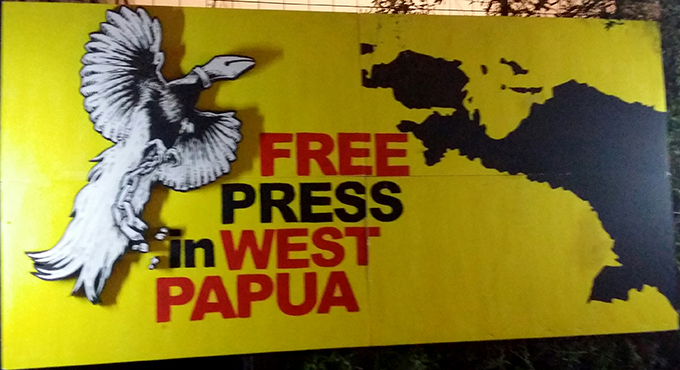
The Free Press in West Papua Solidarity and Papua Cultural Night saw people gather to celebrate West Papua through music, dance, and art, and also show support for repressed journalists in the Indonesian-ruled region.

Attendees posted pictures on social media site Instagram with the hashtag #LetThemIn.

Difficulties surrounding media freedom in West Papua will also be at the centre of a discussion session today, ahead of the global conference tomorrow.

The discussion will include talks by Tabloid Jubi’s founder, Victor Mambor, the head of Indonesia Amnesty International, Usman Hamid, and director of the Auckland University of Technology’s Pacific Media Centre, Professor David Robie.

More than 1500 people have registered to attend World Press Freedom Day events this year, which began on Monday, May 1 and will run until Thursday, May 4.  

Graphic images at the Free West Papua Media cultural celebration in Century Park Hotel, Jakarta, on Sunday. Image: David Robie/PMC
]]>

Keith Rankin’s Chart of the Month – Descended from Royalty?

]]>

Analysis by Keith Rankin – Chart of the Month – Descended from Royalty?

While reading a news-site recently, I caught a link to the following from ancestry.com: Do You Come From Royalty? While the article itself doesn’t actually mention “royalty”, it’s true that many people wonder if they are descended from someone famous or infamous (or both); say King Henry the Eighth, or King Edward the First (who reigned in 1300).

To determine whether you are descended from royalty, you don’t have to subscribe to Ancestry. Just do the maths. King Henry reigned 17 generations ago, while King Edward goes back 25 generations. It turns out that, 17 generations back each of us has 131,072 ancestors; 25 generations back we have 33,554,432 ancestors. (Of course most of these will not be unique ancestors, especially given that Britain had a reproductively active population in the year 1300 of about one million people, and that most New Zealanders have substantial British ancestry.)

My chart shows that, while the chance of an ethnically British person being descended from any given reproductively active British person in King Henry’s time is about four percent, the chance of being descended from any given such person in King Edward’s time is 100 percent (actually, a probability of one, rounded to 15 decimal places). Most of us will have King Edward – and most of his subjects – multiple times in our family trees.

]]>

Asia-Pacific holds many ‘worst records’ in media freedom report, says RSF

]]>

AsiaPacificReport.nz

Media freedom is under threat now more than ever – and many of the worst violators are in the Asia-Pacific region, says the Paris-based global watchdog Reporters Without Borders/Reporters Sans Frontières (RSF).

The 2017 RSF World Press Freedom Index reflects a world in which attacks on the media have become commonplace and strongmen are on the rise.

“We have reached the age of post-truth, propaganda, and suppression of freedoms,” said RSF.

The latest freedom index “highlights the danger of a tipping point in the state of media freedom in many countries”.

“Media freedom has retreated wherever the authoritarian strongman model has triumphed. The obsession with surveillance and violations of the right to the confidentiality of sources have contributed to the continuing decline of many countries previously regarded as virtuous.”

A total of 21 countries are now coloured black on RSF’s global press freedom map because the situation there is classified as “very bad,” and 51 are colored red — the situation in these countries is classified as “bad”.

Overall, the situation has worsened in nearly two-thirds (62.2 percent) of the 180 countries monitored in the index.

-Partners-

Woes and ills
The index unveils woes and ills that are obstacles to media freedom throughout the world.

The Asia-Pacific region is the third-worst violator overall but has many of the worst kinds of records, says the RSF report.

Two countries in the region, China (176th) and Vietnam (175th), are the world’s biggest prisons for journalists and bloggers.

The Asia-Pacific also has some of the most dangerous countries for journalists — Pakistan (139th), Philippines (127th) and Bangladesh (146th).

Some of the biggest “press freedom predators” at the head of the world’s worst dictatorships — including China, North Korea (180th), and Laos (170th) — are in the region and these countries are news and information “black holes”.

“More and more Asian governments deliberately confuse the rule of law with rule by law,” said Benjamin Ismaïl, the head of RSF’s Asia-Pacific desk.

“By adopting increasingly draconian laws, governments with authoritarian tendencies hope to justify their attempts to gag the media and critics.

“When this is not enough to ward off condemnation by the international community, these governments are quick to brandish the principles of non-interference, sovereignty or even national security in order to escape their international human rights obligations and their constitutional duty to protect freedom of the media and information.”

Pacific highlights in the RSF report include:

Australia (rose 8 places to 19th)
Australia has a strong public media, but the ownership of its print media is heavily concentrated. Two media groups – News Corporation (owned by billionaire Rupert Murdoch) and Fairfax Media – are responsible for 85 percent of newspaper sales. Overall, the media enjoy a great deal of freedom, although protection of journalists’ sources varies from state to state. Coverage of Australia’s refugee detention centers on Manus Island (off Papua New Guinea) and the Pacific Ocean island of Nauru is nonetheless restricted. New laws in 2015 provided for prison sentences for whistleblowers who disclose information about conditions in the refugee centers or operations by the Australian Security Intelligence Organisation. A telecommunications law has opened the door for surveillance of the metadata of journalists’ communications. Federal police raids on Labor Party parliamentarians in 2016 violated the confidentiality of sources and showed that the authorities were more concerned about silencing the “messengers” than addressing the issues of concern to the public that had been raised by their revelations.

Fiji (rose 13 places to 67th)
The adoption of a new constitution in 2013 and the ensuing parliamentary elections in September 2014, the first since the 2006 coup d’état, had a positive impact on access to information. This could be seen in the public debate and pluralistic coverage during the election itself, despite some problems in the run-up. The media are nonetheless still restricted by the 2010 Media Industry Development Decree and the Media Industry Development Authority (MIDA) that it created. Violating the decree is punishable by up to two years in prison. After giving the media additional leeway during the election, Prime Minister Voreqe Bainimarama resumed his policy of keeping the foreign media at a distance and publicly described them as “hostile.” In 2016, this was his grounds for a blacklist of foreign journalists that include Barbara Dreaver, a reporter for New Zealand’s Television NZ, and Michael Field [lifted later in the year].

New Zealand (dropped 8 places to 13th)
Media freedom thrives in New Zealand but is not entirely exempt from political pressure. The media continue to demand changes to the Official Information Act, which obstructs the work of journalists by allowing government agencies a long period of time to respond to information requests and even makes journalists pay several hundred dollars for the information. In August 2016, the government revealed a grim future for whistleblowers, announcing a bill that would criminalise leaking government information to the media and would dramatically increase the surveillance powers of the intelligence services. Journalists, bloggers, and civil society representatives would be among the potential targets of the proposed law, which could be adopted in 2017.

Papua New Guinea (rose 5 places to 51st)
Papua New Guinea’s media are diverse and dynamic and enjoy a relatively free environment, but journalists are still subject to violence. There have been several cases in 2017 of journalists being the targets of police violence, such as when the police opened fire on students demonstrating peacefully. Prime Minister Peter O’Neill’s government seems to have turned a deaf ear to calls from the media to guarantee their safety. Some officials encourage media self-censorship by directly threatening journalists whose articles criticise them. Although Australia announced that it would close its refugee detention centre on Papua New Guinea’s Manus Island, the centre is still operating. Journalists trying to cover the fate of the centre’s detainees were obstructed from doing so during 2016.

Samoa (rose 8 places to 21st)
Thanks to the liveliness of media groups such as Talamua Media and the Samoa Observer Group and individual newspapers such as Iniini, Samoa continues to be a model in the Pacific region. The Media Council law adopted in early 2015 decriminalised defamation but some media outlets had their reservations, accusing the ruling Human Rights Protection Party of planning to use the Council to exercise more effective control over the Samoan media. The Samoa Media Council was finally created in 2016 and its first task was the adoption of a code of ethics in February 2017. However, some media outlets are still concerned that the government could take advantage of the Council in the event of conflicts with the media.

Timor-Leste (rose 1 place to 98th)
No journalists have even been jailed in connection with their work in Timor-Leste (East Timor), a country with fewer than 1.2 million inhabitants. Articles 40 and 41 of its Constitution guarantee free speech and media freedom. However, various forms of pressure are used to prevent journalists from working freely, including legal proceedings, police violence, and public denigration of media outlets by government officials or parliamentarians. The creation of a Press Council in 2015 was a step in the right direction, despite the reservation expressed by the media about the way its members are elected. But the media law adopted in 2014, in defiance of the international community’s warnings, poses a permanent threat to journalists and encourages self-censorship. Until now, East Timor has never managed to enter the top half of the World Press Freedom Index, but all eyes are now turned on President-Elect Francisco Guterres and the policies he may adopt to promote media freedom.

Tonga (dropped 12 places to 49th)
Independent media outlets have increasingly assumed a watchdog role since the first democratic elections in 2010, and in 2014 began asserting themselves in their criticism of the government and its policies. However, some political leaders do not hesitate to sue media outlets, exposing them to the risk of heavy damages awards. Journalists are forced to censor themselves under the threat of going bankrupt. In an effort to regulate “harmful” online content, especially on social networks, the government adopted new laws in 2015 including the Communications Amendment Act, which provides for the creation of an Internet regulatory agency with the power to block websites without reference to a judge. In 2016, Prime Minister Samuela ‘Akilisi Pōhiva, the leader of the pro-democracy party, repeatedly called on Tonga’s public broadcaster to suspend a journalist for asking him too many tough questions. It was indicative of the increase in tension between the government and media since his election in 2014.

The 2017 RSF World Press Freedom Index – click on the map for interactive country rankings. ]]>

Blogger stabbed to death in Maldives as CPJ issues media freedom report

]]>

AsiaPacificReport.nz

Al Jazeera’s Mahmoud Abdelwahed reports on one journalist’s arrest and detention in Egypt. Video: Al Jazeera

Authorities in the Maldives should swiftly identify and bring to justice those responsible for the murder of blogger Yameen Rasheed, says the Committee to Protect Journalists.

Rasheed died after he was found with multiple stab wounds in the stairway of his apartment building, according to media reports circulated just as CPJ was releasing its report on the state of global media freedom ahead of next week’s World Press Freedom Day events in Jakarta, Indonesia.

A Sri Lankan woman in Colombo points to a photo of murdered Maldivian blogger Yameen Rasheed from his blog. Image: Eranga Jayawardena/CPJ

The latest CPJ report said that 259 journalists had been detained or jailed during 2016 and 1236 media people killed since 1992.

Al Jazeera, whose reporter Mahmoud Hussein was among those detained, featured a news story about the latest report and an Inside Story programme asking whether the use of new technology making censorship easier.

Technologies like social media and surveillance had led to a rise in killings and imprisonment of reporters around the world, said CPJ.

The CPJ figures showed Egypt to be one of the most dangerous countries in the world to work as a journalist, Al Jazeera said.

-Partners-

Hussein, who was arrested in Egypt while on holiday, is awaiting trial on charges of “spreading false news”.

Al Jazeera has denied the allegations and is demanding his immediate release.

Satirical blogger
In the Maldives, Yameen Rasheed was transported to Indira Gandhi Memorial Hospital, where he died while receiving treatment, according to Raajje TV.

He had 16 stab wounds to his chest, neck, and throat, the independent broadcaster reported.

Rasheed, 29, was known for his satirical political commentary on his blog, The Daily Panic, and on Twitter. Before his death, he had complained on social media that police had not acted in response to death threats he said he had received.

“Maldivian authorities should spare no effort to identify and prosecute Yameen Rasheed’s killers,” CPJ Asia programme coordinator Steven Butler said from Washington, DC.

“The Maldives must not become a country where bloggers can be murdered with impunity.”

The Maldives Police Service said in a statement it was investigating the murder. In a statement, President Abdulla Yameen Abdulla Gayoom condemned the crime and sent condolences to Rasheed’s family.

Rasheed led the “Find Moyameeha” campaign after his friend and Minivan News reporter Ahmed Rilwan Abdulla was abducted in 2014. Minivan News later changed its name to the Maldives Independent.

Rilwan is still missing.

]]>

Don’t forget social aspects when protecting environment, says cleric

]]>

AsiaPacificReport.nz

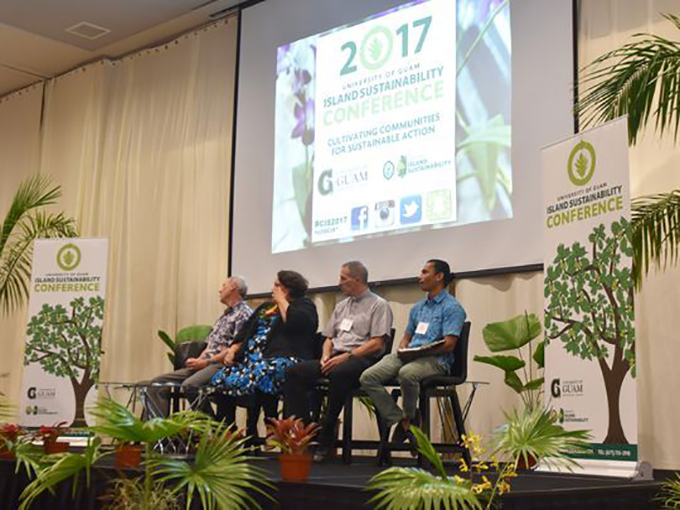
A climate change panel hears a question from the audience during University of Guam’s Island Sustainability Conference. Image: John I. Borja/Pacific Daily News

By John I. Borja in Hagåtña, Guam

The social aspects of climate change must be considered in efforts to protect the environment, says Guam’s coadjutor archbishop.

Archbishop Michael Byrnes was on a climate change panel for the University of Guam’s eighth Island Sustainability Conference.

Aside from his position with the church, Byrnes has a science background, with a bachelor’s degree in microbiology.

He was joined by Kate Brown, executive director of Global Islands Partnership; David Helweg, director of Pacific Islands Climate Science Center and Xavier Matsutaro, national climate change coordinator of Palau.

“Climate not only changes the community. The community changes climate,” Byrnes said. He referenced Pope Francis’ letter on “integral ecology,” which is the idea of preserving the nature of the world to protect those most vulnerable.

Byrnes said that for people who followed the Bible’s teachings, there was a moral responsibility to treat the Earth well.

-Partners-

Disregarding the nature of the Earth was a misunderstanding of God’s intentions, he said.

Efforts of many
It took the effort of many to make aware the impact of climate change, Brown said.

Brown was the keynote speaker for last Thursday’s conference. In her speech, she shared how sustainable actions were being implemented in the Pacific islands.

UOG President Robert Underwood asked the panel how they responded to people who did not believe in climate change, despite years of scientific research.

Helweg said one reason climate change was not being accepted was because of poor translation of the scientific research. A deeper connection needed to be made with those people to help them understand, he said.

“We need to go out into the community, in the villages and work with them to find out what they value highly,” Helweg said.

That way, information about climate change could be transformed to relate to their needs, he said.

Matsutaro said an economic factor sometimes played a role in people oblivious to the impact of climate change. The coal industry, for example, could harm the environment but it was also a necessary industry for revenue in some areas.

“If you know that you are extracting resources and you know that that resource is causing environmental problems, at some point you’re going to have to shift that behavior,” Matsutaro said.

Everybody wants to live in a clean environment. Parents would want their children to be in a healthy environment, he said.

John I. Borja is a Pacific Daily News reporter.  

]]>

Pacific student journalists passionate about reporting climate change

]]>

AsiaPacificReport.nz

University of the South Pacific student journalists talk about climate change and their daily lives — and the future. Video: Julie Cleaver/Kendall Hutt/PMC

By Julie Cleaver and Kendall Hutt in Suva

Pacific journalism students in Fiji say reporting climate change is crucial for the survival of the region.

The University of the South Pacific students say educating people about the issue throughout the region and the world is a key factor when it comes to “saving” the Pacific.

“Covering climate change is important for me because my country’s life and my country’s peoples’ lives are at stake, so I need to let institutions outside my country know that we are facing the effects of climate change, and its severe effects that we’re facing,” says Shivika Mala, a third-year Fiji journalism student who is also majoring in politics.

Shivika Mala (Fiji) … “my country’s life and my peoples’ lives are at stake.” Video still: Julie Cleaver/PMC

Mala also says it is time for the global media to pay more attention to the Pacific’s current situation and not just focus on natural disasters.

“Climate change is happening. This is the reality and it’s about time journalists and other people who don’t necessarily believe in climate change to start doing their research and start understanding the challenges, the implications, and the impact it has on not only the Pacific countries, but other countries as well,” says Mala.

-Partners-

She says this is because the homes and lives of herself and her peers have already been affected.

Climate change ‘something personal’
“Climate change for me is something personal. It’s something that effects my country and the Pacific and the world as well. Climate change for me means loss of life, and loss of loved ones.”

For Vilimaina Naqelevuki, a 20-year-old journalism and politics student, her village, Nariko, on Ono Island in the Kadavu group, has already suffered great loss.

Nariko has been suffering from the impacts of climate change and therefore believes the island’s younger generation will lose their sense of culture, Naqelevuki says.

Vilimaina Naqalevuki (Fiji) … “within the years to come I won’t have an island left to go back to.” Video still: Julie Cleaver/PMC

“I was fortunate enough to have met my great-grandmother, she passed away six years ago. She tried to talk and teach us as much as she possibly could about what was left of the island.

“It’s a little bit emotional and every time I talk about it I get really sad, because I know for a fact that within the years to come I won’t have an island left to go back to, and that just saddens me a lot.”

For Semi Malaki, who is studying a double-major in journalism and politics, climate change has also already become a reality in his home country, Tuvalu.

“For us in Tuvalu it’s more to do with the security and survival of our people, because we all know climate change causes the sea level to rise.”

Semi Malaki … “for us in Tuvalu it’s more to do with the security and survival of our people.” Video still: Julie Cleaver/PMC

Changed food lifestyle
He also says climate change has changed the lifestyle of people in Tuvalu, particularly regarding food. This is because the rising sea level makes it difficult to grow food as salt water contaminates crops.

“People now are now less dependent on root crops and more dependent on imported foods from overseas, and that’s had a lot of impact on our diets.

“This has health impacts on non-communicable diseases, like lots of Tuvaluans have suffered from diabetes and high blood pressure due to the change in their diets.”

He also says people are migrating away from Tuvalu because of the fear that the country might sink one day.

Due to forced migration, culture and traditional ways of life is also at stake for Pacific people.

Loss of culture
“What climate change does is remove these people from their traditional and everyday lives and completely sends them somewhere else. They have to restart their lives again,” says Mala.

Tekstar Jimmy … “changing weather patterns affects that cultural knowledge we used to have.” Video still: Julie Cleaver/PMC

For Vanuatu, where the population largely relies on subsistence farming, losing culture is already a fact of life, says Telstar Jimmy, a mother of three who is completing a double major in journalism and language and literature.

“Sixty-five percent of our population relies on subsistence farming. That’s naturally their way of life. All they know is how to grow crops and also how to fish.

“That’s been a major part of their lives and changing weather patterns is affecting that because our ancestors used to know when to go fishing or which places to do their fishing. But now, because of changing weather patterns it affects that cultural knowledge we used to have.”

Additionally, Jimmy says one of Vanuatu’s 100 plus languages has already been lost as a result of climate change migration.

“In some places where we had different dialects, when we had to relocate them to another place and in order to adapt to the particular environment, they have to use the bigger languages to communicate with the people there.

“As they use more of the bigger languages, they lose the smaller languages that were originally there and that is why some of our languages have already begun to be lost.”

For Jimmy, Mala, Malaki, and Naqelevuki, their message for the world is clear: climate change is real.

“Climate change is happening to us. We’re going to lose our land, we’re going to lose our culture and our identity if we don’t do anything about it.”

Julie Cleaver and Kendall Hutt are in Fiji for the Bearing Witness project. A collaborative venture between the University of the South Pacific’s journalism programme, the Pacific Centre for the Environment and Sustainable Development (PaCE-SD), the Auckland University of Technology’s Pacific Media Centre and documentary collective Te Ara Motuhenga, Bearing Witness seeks to provide an alternative framing of climate change, focusing on resilience and human rights.

]]>

Activists, media freedom advocates plan ‘global action’ for West Papua

]]>

AsiaPacificReport.nz

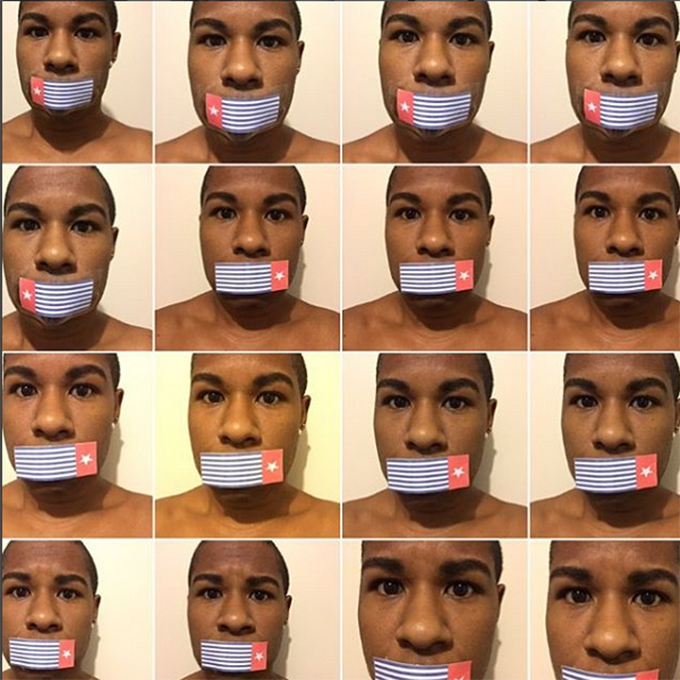
“Gagged” West Papua. Instagram montage by tuckwolf_

Media freedom advocates and human rights activists are planning a “global action” for West Papua with demonstrations marking UNESCO world press freedom day events in Jakarta next week.

The advocates want to focus global attention on the “media blackout” long imposed by Indonesian authorities, in spite of promises to open up access to the two Melanesian provinces of Papua and West Papua adjoining independent Papua New Guinea.

West Papua’s Benny Wenda (left) with PMC journalist Henry Yamo from Papua New Guinea at the Pacific Media Centre during his last visit to New Zealand in 2013. Image: Del Abcede/PMC

The global action will begin on May 1 and run for three days climaxing with World Press Freedom Day on May 3.

Prominent UK-based West Papuan lawyer and civil rights campaigner Benny Wenda will then pay a visit to New Zealand the following week to raise awareness.

He will speak at a Pacific Media Centre-hosted event at Auckland University of Technology among several New Zealand venues.

The Auckland event is being organised by Auckland West Papua Action, the Asia Pacific Human Rights and Pax Christi.

Wenda, spokesperson for the United Liberation Movement for West Papua (ULMWP) and a tribal leader, will visit New Zealand from May 8-16.

-Partners-

Seeking justice
He is seeking support for justice for the people of West Papua and backing from New Zealand for Pacific-led West Papua initiatives at the United Nations.

Last time Wenda visited New Zealand in 2013, he was banned by Speaker David Carter from speaking in Parliament Buildings.

But now a larger group of cross-party parliamentarians is supporting West Papua, so he is expected to get a warm reception from MPs.

Wenda will be welcomed onto Orakei Marae on arrival and invited to address Ngati Whatua Orakei whanau.

A packed schedule of meetings in Auckland, Wellington, Christchurch and Te Tai Tokerau follows.

The West Papua media freedom action campaign.

May 1 marks the anniversary of a “Day of Terror” in 1963 when Indonesia first occupied West Papua. Since that day human rights groups have estimated that more than 500,000 West Papuan people have died.

“Help to bring as many people as possible together to create a truly global action for West Papua,” said the Free West Papua Campaign website.

Plea for photos
“Remember to send any photos/footage you would like to us and we will publish them and share your solidarity with the world.”

In London, protesters plan to meet at Trafalgar Square at 12noon on May 1 and march to the Indonesian Embassy in Westminster.

In Abuja, Nigeria, protesters will meet at 8am on May 1 in Eagles Square at the International Workers Day Rally. West Papuan support is being organised by Dimeji Macaulay from Conscience Radio.

Other demonstrations (with details announced soon) are being planned for:

More information:

#PressFreedom
#WestPapua

]]>

Post-coup Rabuka crackdown as seen from Fiji Times editor’s ‘hot seat’

]]>

AsiaPacificReport.nz

REVIEW: By Shailendra Singh

A Fiji Diary: Reminiscences and Reflections of a Newsman is a selection of revised and updated writings by Vijendra Kumar, a former editor of The Fiji Times, compiled into an engaging and highly readable book.

The 13 sections and 100-odd pages combine Kumar’s personal experiences and journalistic views to provide unique insights into some major events that shook Fiji, and shaped its future.

The portrayal is enriched by anecdotes of Kumar’s encounters with some important personalities who, for better or worse, influenced the country’s destiny. Fiji’s founding Prime Minister Ratu Sir Kamisese Mara features quite heavily. Competing with him for space is Sitiveni Rabuka of the 1987 coup notoriety.

At the narrative’s heart are the vivid accounts of Kumar’s remarkable life story while growing up in Nadi. What emerges is a fascinating portrait of the simplicities as well as the complexities of a life lived in Fiji — a depiction many Fijians would readily identify with.

Kumar started in journalism humbly enough: as a self-taught, underpaid, and sometimes unpaid proofreader cum reporter/editor of the National Federation Party (NFP) mouthpiece, the weekly Pacific Review. Duties included errands to collect editorial copy from party leader, the late AD Patel’s home. In the book, the prominent Nadi lawyer comes across as somewhat snooty — a pukka sahib in Kumar’s words — and rather tardy with deadlines, often giving Kumar the runaround.

When he plucked up the courage to ask for his pay, Kumar was shown the empty office till. On a lucky week, he received $25. This saw Kumar take up high school teaching, a job he stuck with for 12 years, before returning to his true calling as a reporter, but this time at The Fiji Times, in 1969.

-Partners-

Within six years, Kumar had become the first local editor at the iconic national daily, up till then largely an expatriate stronghold. His resignation in 1991 and subsequent migration to Australia was a consequence of Fiji’s first coup in 1987. Kumar dwells on the coup at length, which is hardly surprising, since the coup’s impact was not just stunning, but also enduring.

Trauma felt deeply
The trauma was felt deeply, both at the national and personal levels.

During his time in Australia, Kumar served as a subeditor at the Courier Mail in Brisbane, before retiring in 2001. It was a remarkable journey for a descendent of Indian indentured labourers; one who left home at the tender age of six to live with his aunt to gain access to better education.

Kumar’s insights matter: As the editor of The Fiji Times, he was at the vantage of major developments in the country’s history, observing them unfold, interpreting them, and reporting their impacts nationally. In the first chapter, “Goodbye to Paradise”, it’s apparent that even a newspaperman like him was taken in by Fiji’s relative post-independence calm.

The mirage was shattered by Rabuka’s nationalist coup. In Kumar’s view, the coup turned Fiji into a “purgatory for half its people”.

The post-coup media crackdown created a precarious environment for journalists. Kumar writes that the editorship was always a “hot seat”, but after the coup the “heat became almost unbearable”. After four years of “harassment, intimidation and outright threats, he felt that he could no longer discharge his professional duties with ‘honestly and without fear’.”

Kumar expresses disappointments and regrets without rancour. His measured analysis demonstrates an astute knowledge of Fiji politics and a deep respect for Fijian culture. “The Fall of a Titan” was his tribute to Ratu Mara after his death in April 2004.

Kumar notes that the Rabuka coups not only signalled the death of democracy, but also the fall of a titan in Ratu Mara, who hastened his own demise by failing first to condemn the coup, and then, by leading the post-coup regime.

Coups replete with irony
Coups are by nature replete with irony. Mara was accused of being behind the very coup that, in the eyes of many, tarnished his record. The suspicions were fuelled by none other than a brooding Rabuka, who said he felt used and betrayed by the coup’s unseen power-brokers.

In Kumar’s view, Ratu Mara “dedicated his life to his country” and will be “kindly judged by history. The Pacific Island states have produced no greater son,” he writes. But Ratu Mara critics, who accuse him of a litany of sins — ranging from racism to corruption, and crony capitalism to political opportunism — would strongly disagree with Kumar.

Like many a leader, Ratu Mara was a controversial figure. The team of reporters that Kumar headed did not spare Mara, even though Kumar had gotten to know him personally. If Kumar’s portrayal in the book sounds forgiving, it’s probably because of hindsight and reflection.

His evaluation possibly stems from a more holistic analysis of Ratu Mara’s record, and a healthier appreciation of human frailties. Even Gandhi, the “Mahatma” or “great soul” is said to have had skeletons in his closet.

Ratu Mara tried to be a political centrist, and if he failed, the fault wasn’t his alone. The middle ground in an ethnically-divided country like Fiji is a precariously fine line. It’s a slippery slope that has claimed quite a few political scalps, such as the doomed multi-racial coalition headed by opposition leader Jai Ram Reddy and Prime Minister Rabuka in 1999. Rabuka’s fall in particular added to the ironies of the 1987 coup.

Kumar highlights a number of such political absurdities. His soft side surfaces in his tribute to the late Irene Jai Narayan. The fiery Narayan was shunned by her National Federation Party electorate after she crossed the floor to join Ratu Mara’s Alliance Party in 1987.

Kumar not only dissects Narayan’s defection, but he also highlights her distinguished service to the country. “She lit a spark among women,” he states.

Fiji academic, Professor Satendra Nandan pins down Kumar’s style best in the book’s foreword: Kumar “provides a balanced picture with a rare generosity of mind, but often with sharp and discriminating insights”.

Highly-regarded editor
This attitude explains why Kumar was a highly-regarded newspaper editor, even in the face of growing scepticism about the ethics of a market-driven media, increasingly locked in fierce ratings and circulation wars.

Academics like McNair and Fallow have drawn attention to the emergence of an increasingly aggressive form of journalism that has given rise to a “decline of deference”, with political leaders considered prized targets. This trend marks a wide paradigm shift in political reporting — from “healthy scepticism” and an “independent, adversarial relationship with politics”, to a “corrosively cynical and hyper-adversarial” posture.

Media researcher Spiess calls it “attack dog journalism” — an aggressive reporting strain that goes beyond the watchdog role and harms “fledgling democracies” by “nurturing intolerance and diminishing faith” in leaders.

Some media analysts partly attribute the fall of Prime Minister Mahendra Chaudhry’s government in 2000 to media hyper-adversarialism. Others see media hyper-adversarialism as just a theory. But even as a theory, media hyper-adversarialism is pertinent for a vulnerable, multi-ethnic democracy such as Fiji.

In Fiji, sound and mature editorial judgments are crucial for public trust and confidence, especially in crisis situations. In this respect, it’s likely that Kumar’s clear-thinking and foresightedness helped steer The Fiji Times through the dangerous 1987 coup waters without sinking into oblivion.

The second coup in September 1987 forced the paper’s closure for seven weeks. It reopened after direct representations to Rabuka, who only asked that the paper not publish “inflammatory” material. Regrettably, Fiji’s second national newspaper, the Fiji Sun, which had also bravely criticised Rabuka’s actions, closed for good after the first coup.

While forced out of Fiji by circumstances, Kumar, like many exiles, is still emotionally attached to the country. His multicultural outlook is reflected in his qualified support for Voreqe Bainimarama’s 2006 coup. In “The Rise of a Reformer”, first published in 2012, Kumar sees Prime Minister Bainimarama’s mission as reforming a flawed, racially-based political system and building a stronger democracy.

Overall, Kumar’s disdain of a coup culture is evident. He writes: “Although coup-makers’ corpses eventually end up rotting on the dung heap of history, the countries experiencing such dislocation continue to wallow in a social, economic and political quagmire for a long time.”

Kumar then poses a poignant question: “Can Fiji go against the tide of history?” That is no doubt the silent prayer of many a coup-jaded Fijian.

A Fiji Diary: Reminiscences and Reflections of a Newsman, by Vijendra Kumar. Brisbane, Qld: Samford. 2016. 109 pages. ISBN 9780646957395. Available (or can be ordered) at the USP Bookshop, Laucala Campus, Suva.

Dr Shailendra Singh was a journalist at The Fiji Times from 1989 to 1996. He is now the senior lecturer and coordinator of the USP Journalism Programme.

]]>

Indonesia military threatens news site after generals coup plot story

]]>

AsiaPacificReport.nz

The Intercept article that sparked the Indonesian military into action after a translated version was published by Tirto website.

Indonesia’s military says it is reporting an online news site to the police after it wrote about an Intercept story alleging current and retired generals plotted to overthrow President Joko “Jokowi” Widodo, reports The Jakarta Post.

The Intercept, co-founded by Glenn Greenwald, a journalist known for his stories about the US National Security Agency’s mass surveillance, published the story earlier this week.

Citing intelligence documents, unnamed generals and protest leaders, it alleges that huge protests in Jakarta against the capital’s minority Christian governor Ba­suki “Ahok” Tja­haja Pur­nama — defeated in this week’s election —  were a front for a movement to unseat Jokowi.

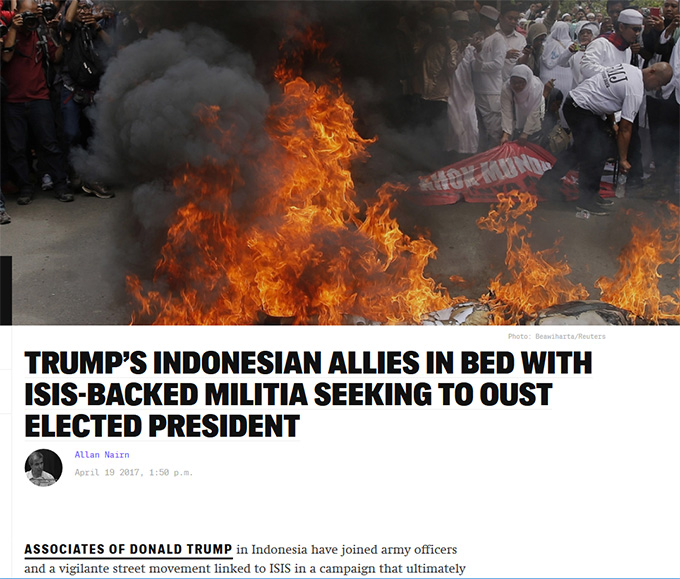
READ MORE: Trump’s Indonesian allies in bed with ISIS-backed militia seeking to oust elected president

A graphic of investigative journalist Allan Nairn published by Tirto website.

The military’s statement yesterday said an account of The Intercept story, written by investigative journalist Allan Nairn and published by the Indonesian site Tirto, was either “not true” or a “hoax”.

It said it was reporting Tirto so it could be “investigated and proceeded against in line with existing laws”.

New chief: Indonesian Military (TNI) commander General Gatot Nurmantyo (centre), accompanied by Presidential Security Detail (Paspampres) commander Brigadier-General Suhartono (right) and Maj. Gen. Bambang Suswantono (left), speaks to journalists after the Paspampres commander handover ceremony in Jakarta last month. Image: Antara

Democracy Now!‘s Amy Goodman has interviewed Allan Nairn and writes:

-Partners-

“Nairn reveals Indonesians involved in the coup attempt include a corporate lawyer working for the mining company Freeport-McMoRan [which owns the controversial Freeport mine in West Papua], which is controlled by Donald Trump adviser Carl Icahn.

The Tirto article.

Video has even emerged showing the lawyer at a ceremony where men are swearing allegiance to ISIS. According to Allan Nairn, two of the other most prominent supporters of the coup are close associates of Donald Trump: Fadli Zon, the vice-speaker of the Indonesian House of Representatives, and Hary Tanoe, Trump’s primary Indonesian business partner, who’s building two Trump resorts, one in Bali and one outside Jakarta.

“Nairn’s article is making waves in Indonesia. The Indonesian military is threatening legal action against the news portal tirto.id, after it published a partial translation of the article and ran a profile about Allan Nairn.

“In response, Nairn tweeted a message to the Indonesian military, saying, quote, ‘Dear TNI: If you want to threaten brave Indonesian reporters and publishers, please threaten me too,’ unquote.”

In the interview with Democracy Now!, Nairn said:

“Indonesia is in the midst of a political crisis, in that there is an attempt to stage what people on both sides of the conflict call the coup. And this is a de facto, or even direct, coup against the elected president, the elected government of Indonesia, which is headed by President Widodo — Jokowi.

“Jokowi was the first person from outside the political elite who ever was elected president. He’s—on certain issues, in certain respects, he’s a bit of a reformist.

“He got elected, in an important part because he speaks the language of the poor, and people relate to him. He has been pushing social programs on health and education.

“But, especially in recent months, his government has been fighting for survival. Those backing this coup project include the top generals in the country, who are seeking to escape any whisper of accountability for their past mass murders — mass murders that have been supported by the US — and for their ongoing atrocities in West Papua, also the friends and business partners and political associates of Donald Trump.

“The local Trump people in Indonesia, including his top political backer, the politician Fadli Zon, including his local business partner, Hary Tanoe, and others, have been funding and backing this coup movement.”The instrument they have been using is a—what purports to be a radical Islamist street movement, which has been staging massive demonstrations on the streets of Jakarta, demonstrations drawing out hundreds of thousands, perhaps millions, of people.

“And their hook is what they claimed to be a religious issue, where they are attacking and demanding the death by hanging of the incumbent governor of Jakarta, who happens to be an ethnic Chinese Christian who is currently standing trial for insulting religion, for insulting Islam.

“And he could actually be sent to prison.”

The Democracy Now! article and video.
]]>

Climate report author challenges ‘inadequate’ emission pledges

]]>

AsiaPacificReport.nz

Professor Morgan Wairiu … concerned that “business as usual” approach of some countries will have real-world effects on Pacific Island countries on the frontline of climate change. Image: Julie Cleaver/Video still

By Kendall Hutt and Julie Cleaver in Suva

The commitment of more than 190 nations to reducing global emissions has been called into question by a lead author of a special climate change report which seeks to highlight the impact of global warming above 1.5 degrees.

Professor Morgan Wairiu, an expert in food security and climate change with the University of the South Pacific’s Pacific Centre for Environment and Sustainable Development (PaCE-SD), says countries’ current commitment to reducing global emissions is alarming given the pressing need to reduce the impacts of climate change.

“The commitments that the countries have pledged is still inadequate. If you aggregate all those commitments in terms of emission reductions, we will still be above the two degrees cap that the Paris Agreement calls for.”

Despite this inadequacy, it is at least a starting point, he added in an interview with Asia Pacific Report.

Dr Wairiu, a Solomon Islander who is one of only two Pacific Islanders working on the report, said the “business as usual” approach of some countries, which saw the global average temperature on track for 2.7 degrees, would have real-world effects on Pacific Island countries that were on the frontline of climate change.

“For Pacific Island countries, because of our vulnerable ecosystems, we can manage up to 1.5 degrees, but beyond that we’re going to start losing our ecosystems and livelihood, our resources, and then the survival of our people.”

-Partners-

Commissioned by the UN Framework Convention on Climate Change (UNFCCC) following the Paris Agreement in late December 2015, the Intergovernmental Panel on Climate Change’s (IPCC) 1.5 degrees report seeks to avoid such negative outcomes.

Dr Wairiu said this was because data collected by the 86 authors would allow countries to “take stock” of their current emissions targets.

When this report is released in 2018, it will help countries decide whether to increase or cut back emissions.

Non-binding commitments
Under the Paris Agreement, countries responsible for two-thirds of the world’s total emissions have made non-binding commitments to curb their greenhouse gas emissions.

By 2025 the US has pledged to reduce emissions from 26 percent to 28 percent relative to 2005 levels.

China, on the other hand, says it will lower its emissions by 60 to 65 percent, but only after reaching maximum carbon emissions by 2030.

The European Union, meanwhile, aims to cut back emissions by at least 40 percent relative to 1990 levels.

The issue is that these Intended Nationally Determined Contributions (INDCs) put forward by nations prior to the Paris Agreement were up to each individual country to implement and enforce, Dr Wairiu said.

If these are not honoured or increased, scientists have warned the world will surpass the threshold in which global warming is reversible. The results of which will be catastrophic, observers believe.

Heat waves are predicted to last a third longer, rain storms would be about a third more intense, sea level will continue to rise, and tropical reefs would continue to degrade, a study by the European Geosciences Union revealed in 2016.

Loss of more atolls
The implications for human life of a warmer planet mean already vulnerable communities who live close to sources of water will face more flooding and drought.

For the Pacific, this means the loss of more atolls to sea level rise, salt water intrusion to fresh water supplies and staple crops, and the forced migration of Pacific Islanders.

“Some countries will disappear from the face of the world”, Dr Wairiu said.

He said a 1.5 degree global average temperature was the threshold in which Pacific Islands would be able to survive, therefore. Beyond that, the future was relatively unknown.

Despite this, Dr Wairiu stressed that the report was not a policy document.

“We will not be entering into any policy dialogue or giving directions to countries in terms of policy issues.

“The commitment has already been made.”

Pacific Media Centre’s Kendall Hutt interviewing Professor Morgan Wairiu … the report will have no bearing on COP23 taks in Bonn in November, but is important for the Pacific. Image: Julie Cleaver/PMC

Due to the report’s 2018 release and its nature, Dr Wairiu said it would also have no bearing on the upcoming COP23 talks in Bonn, Germany, which is co-chaired by Fiji.

Although the report is important for the Pacific, Dr Wairiu acknowledged.

“It’s very important because this is a call from Pacific Island countries. You know, they formed this coalition around the legal setting of 1.5 degrees during the Paris COP meeting, which is part of the Paris Agreement.

“This particular report will inform Pacific Island countries whether achieving 1.5 degrees is feasible or not. We’ll still be making very important decisions based on this report.”

Julie Cleaver and Kendall Hutt are in Fiji for the Bearing Witness project. A collaborative venture between the University of the South Pacific’s journalism programme, the Pacific Centre for the Environment and Sustainable Development (PaCE-SD), the Auckland University of Technology’s Pacific Media Centre and documentary collective Te Ara Motuhenga, Bearing Witness seeks to provide an alternative framing of climate change, focusing on resilience and human rights.

]]>

Barry Coates: PACER Plus – how the Pacific Way is being undermined

]]>

AsiaPacificReport.nz

ANALYSIS: By Barry Coates

A new trade agreement has been signed between some of the Pacific island nations and their richer neighbours — Australia and New Zealand. The PACER Plus agreement has been controversial during the 8 years of negotiations.

There were promises that this would not be a usual free trade agreement, but instead would be for the benefit of the Pacific.

However, announcements of the final agreement shows those promises have not be met. The agreement has been shaped more by the advantages to Australia and New Zealand exporters than the aspirations of the Pacific’s people.

One of the key benefits that the region was seeking was a substantial aid package that would enable Pacfic countries to increase their supply of goods and services for export. However, the amount provided of $55 million over 5 years, to be shared across the 12 Pacific island countries is less than 1 percent of the current level of NZ and Australian aid to the Pacific.

A far more significant programme of skills training and infrastructure building is required to boost productive capacity in Pacific island countries.

A second benefit sought was a commitment from Australia and New Zealand to provide visas for specific numbers of seasonal workers. This was not agreed. The current system of adjustable numbers of seasonal workers will continue.

-Partners-

And thirdly, the Pacific wanted access to Australia’s markets. Currently Pacific exporters can’t export tropical fruit that is produced in Australia, like bananas and pineapples, and imports of kava are severely restricted.

Australia’s closed markets
However, PACER Plus does not include provisions to open up Australia’s markets, even though the Pacific countries are required to do so.

The Pacific will bear costs from PACER Plus. Firstly, there will be a loss of tariff revenue from reducing their tariff rates. This will have an adverse impact on funding for social priorities like health care and education, as well as the costs of protection from climate change impacts and adaptation measures.

The experience of Pacific nations, like Tonga, under the World Trade Organisation (WTO) shows that it is difficult to replace lost revenue through indirect taxes, like GST, a point made by the IMF.

Cutbacks in public services and public sector staff are likely to occur. This is likely to be exacerbated by the investment provisions in PACER Plus that will put pressure on governments to allow foreign investors to privatise those public services that are potentially profitable.

Secondly, PACER Plus includes restrictions on governments’ right to regulate. These have been used in the past to prevent Pacific governments from restricting imports that have adverse social impacts. In particular, the New Zealand government has mounted pressure, using trade agreements, to stop Pacific governments from restricting the import of unhealthy foods.

There have been calls for New Zealand to stop exporting fatty foods to the Pacific, but these restrictions are not included in PACER Plus.

Thirdly, PACER Plus will undermine producers and small business. Local food producers have long been concerned about PACER Plus, as was shown in a Social Impact Assessment undertaken by civil society organisations. Their livelihoods are already threatened by cheap and unhealthy imports that are undermining local foods.

Accelerating unhealthy imports trend
PACER Plus is likely to accelerate that trend and prevent Pacific countries from being able to introduce measures that would restrict imports and favour the development of local foods.
The development of most of the “developed” economies was supported through measures to provide initial protection while they were able to produce and gain competitiveness.

But these “infant industry” measures are restricted in PACER Plus. This was a key issue for Papua New Guinea and Fiji. As the Pacific’s largest economies, they need to provide local opportunities for youth employment and building a viable domestic economy is crucial for their development.

There are major implications on the smallest and most vulnerable Pacific countries. PACER Plus would extend the core of WTO’s trade rules to the Pacific island countries, such as Cook Islands, Federated States of Micronesia, Kiribati, Nauru, Niue, Palau, Republic of Marshall Islands and Tuvalu that are not WTO members.

Further, the absence of the two largest economies in the Pacific from PACER Plus (PNG and Fiji) undermines Pacific regionalism, an aim long supported by NZ and Australia. This undermines the Pacific Island Countries Trade Agreement (PICTA) and the Melanesia countries’ trade agreement.

PACER Plus also undermines the framework for Pacific regionalism, a long standing aim of Australia and New Zealand, as well as the Pacific island nations themselves.

The agreement has been driven too much by Australia and New Zealand’s commercial interests.

New Zealand Trade Minister, Todd McClay stated that PACER Plus “future-proofs our access.” This is achieved through “Most Favoured Nation” provisions that mean that Australia and New Zealand will get as good a deal as any other country.

‘Lock-in’ resisted by Fiji, PNG
This is likely to undermine preferences that could be provided to poorer developing countries. This “lock-in” of preferences has been resisted by Fiji and PNG. These disputes over PACER Plus are likely to drive deeper wedges in the relationships between NZ and these two most influential Pacific nations.

Finally, there has been a lack of transparency and constructive engagement with civil society in the Pacific. While there have been some meetings with civil society, and information sessions to NGOs and business, the text of PACER Plus has not been made available to civil society, small business or Parliamentarians to understand what is being signed.

Trade is crucial to the Pacific, but the agreements need to be fair. PACER Plus will be officially signed in Tonga in June. There is still time for a rethink.

Barry Coates is a Member of Parliament for the Green Party, based in Auckland. He was director of Oxfam New Zealand for 2003-14, and has worked for many years on Pacific trade issues, in collaboration with Pacific civil society.

]]>

‘We have to act now’ — Marshall Islanders blast Runit n-pollution

]]>

AsiaPacificReport.nz

By Kendall Hutt in Suva

A group of Marshall Islanders is calling on the Pacific to stand with them in solidarity as they urge leaders to prioritise healthy oceans.

The Marshall Islands Student Association (MISA) delivered a talk at the University of the South Pacific in Fiji expressing concern about current political inaction towards addressing land-based contaminants in the ocean.

“The time to act is now. We have to act now,” said Brooke Takala, a MISA member and doctoral candidate who specialises in education for sustainability.

With the United Nations Oceans Conference set to take place in New York in June, MISA has launched a campaign called MISA4thePacific, where Pacific Islanders can submit poetry, dance, art and photos urging for action regarding Sustainable Development Goal (SDG) 14.1.

SDG 14.1 seeks to prevent and significantly reduce marine pollution of all kinds by 2025, particularly from land-based activities, including marine debris and nutrient pollution, the implementation of which is to be discussed at the conference co-hosted by Fiji and Sweden.

“If we don’t prioritise SDG 14.1, all of our other sustainable development goals are moot. There’s no point,” Takala said.

-Partners-

“If we have radiation leaking into our ocean and poisoning our food systems there’s no food security, there’s no water security, there’s no maternal health, there are no opportunities. This has to be prioritised.”

Widespread suffering
This call to action comes in light of widespread suffering still endured by the Marshallese following nuclear testing on Enewatak and Bikini atolls by the US during the 1940s and 1950s.

Nuclear testing in the Pacific has caused countless people in the region to suffer from the effects of radioactive fallout.

These include widespread displacement, loss of culture, and serious health issues including high rates of cancer and deformity.

More than 70 years on from the first nuclear tests, many islands and atolls remain uninhabitable.

Plutonium leakage
The members of MISA highlighted that there is an inability to address large quantities of plutonium leakage from the dome on Runit Island on Enewatak Atoll, which contains toxic waste left over from the 67 nuclear and thermonuclear bombs tested by the US.

“Danger Dome” … toxic waste leakage on Runit Island on Enewetak Atoll. Image: Wikipedia

Takala said she wanted the US to finally take stock of its “unfinished business” in the Marshall Islands and recognise that Castle Bravo, the 15-megatonne hydrogen bomb tested on Bikini Atoll in 1954, which had a blast one thousand times bigger than Hiroshima, was not simply an “accident”.

“For me personally as a mother of a young Enewatak boy whose land rights are on that island with a nuclear waste storage site, I want the world to know that the US has stolen my child’s future and that they need to be held accountable. And I think when we share that message that it is this child’s future, all of our children’s’ futures at stake, and that we cannot let this go.”

Data collected by the US which would fully determine whether the water surrounding Runit Island is contaminated is either still classified or redacted, she added.

“Danger Keep Off” … data on the sea surrounding Runit still classified or redacted. Image: underwaterkwaj.com

This means the ocean surrounding Runit Island could be polluted, but no one knows for certain as radiation is difficult to detect without access to scientific equipment.

The atoll’s fresh water lens, which is present under the island and sits on the salt water, enters the dome from below every high tide as it is elevated, meaning as the tide rolls out radioactive isotopes are dispersed into the ocean, MISA says.

‘Radiation knows no boundaries’
“Radiation knows no boundaries. You cannot taste it, you cannot smell it, you cannot see it and it does not stop at our colonial boundaries, our country boundaries,” said Takala.

Danity Laukon, a member of MISA, said before radioactive nuclear waste was stored on Runit Island it was a beautiful place with prime fishing ground.

“It’s not the same anymore. On top of this climate change is happening.”

Takala said the Marshall Islands was at the forefront of climate change, so addressing the leakage of Runit’s dome was urgent.

This is because climate change for the Runit Islands is not a question of if, but when.

Climate change implications
“When those inundations come, and when sea level rises happening, and Runit Dome becomes underwater, it won’t just be a matter of it leaking into the ocean from the bottom, but the whole thing.

“So for those of us who live on Enewatak, whose families are from Enewatak, this is the most pressing matter for us. For the rest of us in the Marshall Islands, it affects all of us. But even on a larger scale for all of us in the Pacific.”

Maureen Penjueli, a supporter of MISA, reflected that it was now time for the remainder of the Pacific and the next generation to take up the baton in the fight for nuclear-free oceans.

She said the Marshall Islands had been fighting and endured enough.

“It’s a burden for the rest of us to bear.”

MISA said despite calls for Pacific solidarity, they remained determined to make leaders recognise the need to address the lingering effects of radiation in the ocean.

“Going to New York is the plan.”

Julie Cleaver and Kendall Hutt are in Fiji for the Bearing Witness project. A collaborative venture between the University of the South Pacific’s journalism programme, the Pacific Centre for the Environment and Sustainable Development (PaCE-SD), the Auckland University of Technology’s Pacific Media Centre and documentary collective Te Ara Motuhenga, Bearing Witness seeks to provide an alternative framing of climate change, focusing on resilience and human rights.

Brooke Takala … “Radiation knows no boundaries. You cannot taste it, you cannot smell it, you cannot see it and it does not stop at our colonial boundaries, our country boundaries.” Image: Kendall Hutt/PMC ]]>

PNG election writs issued but full polling schedule due next week

]]>

AsiaPacificReport.nz

Grand Chief Sir Michael Somare, founding “father” of Papua New Guinea, was given a traditional chieftain’s welcome — and farewell — from politics by New Ireland Governor Sir Julius Chan in Kavieng this week. Video: EMTV

By Quintina Naime in Port Moresby

The complete polling schedule for Papua New Guinea’s 2017 National Elections will be released at the end of next week.

PNG Electoral Commissioner Patilias Gamato … polling schedule still not finalised. Image: Loop PNG

PNG Electoral Commissioner Patilias Gamato said the polling schedule for the five-yearly elections had yet to be finalised. He would sign off and have it gazetted and released.

The polling schedule will include the place and dates of polling at different venues in the electorates across the country so people know exactly where to go and vote.

The issue of writs today indicated the start of nominations and an eight-week campaign period.

The nomination period is seven days from today, and the campaign period ends on June 8.

-Partners-

The polling period is for 14 days starting on June 24. A two-week counting period is due to start on July 9 and the writs must be returned by July 24.

PNG’s Governor-General, Bob Dadae was due to sign and issue the writs at Government House in Port Moresby.

K1000 nomination fee
Candidates can pay a nomination fee of K1000 (NZ$448) into the electoral commission trust account.

Gamato said they must produce the deposit slip of the payment as evidence so that the Returning Officer can receive their nominations.

The intending candidates have completed a candidate bio data form which gave an indication of the total number of candidates contesting this election.

It also projected how many candidates would be in one electorate so that the PNGEC can prepare the candidate posters.

“We cannot allocate the boxes until nominations are closed.

“After the nominations are closed on April 27, the returning officer of both the provincial and open seat will do a draw and will pick candidates to allocate a number to each one,” Gamato said.

“Once the numbers are allocated they will then give us that information and the photographs of the candidates for us to print the posters.”

Gamato said that the printing of posters would be done in the country and the commission had identified various print companies that would start printing once nominations closed.

Quintina Naime is a reporter with Loop PNG.

]]>

Fiji youth must be ‘ambassadors for climate change fight’, says NGO chief

]]>

AsiaPacificReport.nz

Jenny Jiva, a Fiji student climate change activist, speaking in a Bearing Witness interview with PMC journalist TJ Aumua in Suva last year. Video: PMC

By Repeka Nasiko in Lautoka

Fiji’s youth should become active ambassadors in the fight against climate change, says a leader of a rural non-government organisation.

Addressing University of Fiji students during the institute’s climate change awareness programme this week, Foundation for Rural Integrated Enterprise and Development (FRIEND) local associate director Dr Jone Hawea backed Fiji’s COP23 co-host role.

“If our youths unite and be active ambassadors in the fight against climate, we can ensure that our prime minister is speaking on behalf of say 90 percent of the population,” he said.

“The population of the country does not matter, the proportion of the population standing behind our prime minister and raising their voices on climate change, is what matters.”

Dr Hawea said Fiji’s COP 23 role offered a unique opportunity for all Fijians to influence international policies on climate change adaptation and mitigation.

-Partners-

“And we should take full advantage of it as it would have significant impacts on grassroots levels.

“Now that the Prime Minister, Voreqe Bainimarama, has taken the bold step, it means that we now have an opportunity which may not come again, to influence international policies which we know for a fact eventually filters down to our communities.”

Dr Jone Hawea … grassroots efforts need policy changes. Image: FRIEND

Dr Hawea added that work at the grassroots level would not make as much impact if policies did not change.

“If we are going to concentrate a lot on doing things at the ground level and the policies do not evolve, the work would not be so significant.

“At the international arena, we could tell them to change policies that may be affecting us, amend policies to benefit the countries in climate change adaptation and mitigation.”

The student interactive seminar session was the first awareness session hosted by Fiji University’s School of Science and Technology at the Saweni campus in Lautoka, western Fiji.

Repeka Nasiko is a Fiji Times reporter.

]]>

Eelco Rohling: We need to get rid of carbon in the atmosphere too

]]>

AsiaPacificReport.nz

ANALYSIS: By Professor Eelco Rohling in Canberra

Getting climate change under control is a formidable, multifaceted challenge. Analysis by my colleagues and me suggests that staying within safe warming levels now requires removing carbon dioxide from the atmosphere, as well as reducing greenhouse gas emissions.

The technology to do this is in its infancy and will take years, even decades, to develop, but our analysis suggests that this must be a priority. If pushed, operational large-scale systems should be available by 2050.

We created a simple climate model and looked at the implications of different levels of carbon in the ocean and the atmosphere. This lets us make projections about greenhouse warming, and see what we need to do to limit global warming to within 1.5℃ of pre-industrial temperatures – one of the ambitions of the 2015 Paris climate agreement.

To put the problem in perspective, here are some of the key numbers.

Humans have emitted 1,540 billion tonnes of carbon dioxide gas since the industrial revolution. To put it another way, that’s equivalent to burning enough coal to form a square tower 22 metres wide that reaches from Earth to the Moon.

Half of these emissions have remained in the atmosphere, causing a rise of CO₂ levels that is at least 10 times faster than any known natural increase during Earth’s long history. Most of the other half has dissolved into the ocean, causing acidification with its own detrimental impacts.

-Partners-

Although nature does remove CO₂, for example through growth and burial of plants and algae, we emit it at least 100 times faster than it’s eliminated. We can’t rely on natural mechanisms to handle this problem: people will need to help as well.

What’s the goal?
The Paris climate agreement aims to limit global warming to well below 2℃, and ideally no higher than 1.5℃. (Others say that 1℃ is what we should be really aiming for, although the world is already reaching and breaching this milestone.)

In our research, we considered 1℃ a better safe warming limit because any more would take us into the territory of the Eemian period, 125,000 years ago. For natural reasons, during this era the Earth warmed by a little more than 1℃.

Looking back, we can see the catastrophic consequences of global temperatures staying this high over an extended period.

Sea levels during the Eemian period were up to 10m higher than present levels. Today, the zone within 10m of sea level is home to 10 percent of the world’s population, and even a 2m sea-level rise today would displace almost 200 million people.

Clearly, pushing towards an Eemian-like climate is not safe. In fact, with 2016 having been 1.2℃ warmer than the pre-industrial average, and extra warming locked in thanks to heat storage in the oceans, we may already have crossed the 1℃ average threshold.

To keep warming below the 1.5℃ goal of the Paris agreement, it’s vital that we remove CO₂ from the atmosphere as well as limiting the amount we put in.

So how much CO₂ do we need to remove to prevent global disaster?
Are you a pessimist or an optimist?

Two rough scenarios
Currently, humanity’s net emissions amount to roughly 37 gigatonnes of CO₂ per year, which represents 10 gigatonnes of carbon burned (a gigatonne is a billion tonnes). We need to reduce this drastically. But even with strong emissions reductions, enough carbon will remain in the atmosphere to cause unsafe warming.

Using these facts, we identified two rough scenarios for the future.

The first scenario is pessimistic. It has CO₂ emissions remaining stable after 2020. To keep warming within safe limits, we then need to remove almost 700 gigatonnes of carbon from the atmosphere and ocean, which freely exchange CO₂. To start, reforestation and improved land use can lock up to 100 gigatonnes away into trees and soils. This leaves a further 600 gigatonnes to be extracted via technological means by 2100.

Technological extraction currently costs at least US$150 per tonne. At this price, over the rest of the century, the cost would add up to US$90 trillion. This is similar in scale to current global military spending, which – if it holds steady at around US$1.6 trillion a year – will add up to roughly US$132 trillion over the same period.

The second scenario is optimistic. It assumes that we reduce emissions by 6 percent each year starting in 2020. We then still need to remove about 150 gigatonnes of carbon.

As before, reforestation and improved land use can account for 100 gigatonnes, leaving 50 gigatonnes to be technologically extracted by 2100. The cost for that would be US$7.5 trillion by 2100 – only 6 percent of the global military spend.

Of course, these numbers are a rough guide. But they do illustrate the crossroads at which we find ourselves.

The job to be done
Right now is the time to choose: without action, we’ll be locked into the pessimistic scenario within a decade. Nothing can justify burdening future generations with this enormous cost.

For success in either scenario, we need to do more than develop new technology. We also need new international legal, policy, and ethical frameworks to deal with its widespread use, including the inevitable environmental impacts.

Releasing large amounts of iron or mineral dust into the oceans could remove CO₂ by changing environmental chemistry and ecology. But doing so requires revision of international legal structures that currently forbid such activities.

Similarly, certain minerals can help remove CO₂ by increasing the weathering of rocks and enriching soils. But large-scale mining for such minerals will impact on landscapes and communities, which also requires legal and regulatory revisions.

And finally, direct CO₂ capture from the air relies on industrial-scale installations, with their own environmental and social repercussions.

Without new legal, policy, and ethical frameworks, no significant advances will be possible, no matter how great the technological developments. Progressive nations may forge ahead toward delivering the combined package.

The costs of this are high. But countries that take the lead stand to gain technology, jobs, energy independence, better health, and international gravitas.

Dr Eelco Rohling is Professor of Ocean and Climate Change at the Australian National University. Disclosure statement: He receives funding from the Australian Research Council and the UK Natural Environment Research Council. He is also affiliated with the University of Southampton, UK. This article was first published by The Conversation and is republished by Asia Pacific Report under a Creative Commons licence.

]]>

Gallery: Bearing Witness crew go to market on Fiji campus

]]>

AsiaPacificReport.nz

GALLERY: By Kendall Hutt in Suva

University of the South Pacific has a colourful market which happens in the third week of every month for four days. Locals and students are both welcome.

There is music, food and clothes stalls, and also books and accessories.

I snapped some photos while Julie Cleaver got b-roll for the climate change mini documentary we’re making.

We have several interviews lined up today, so watch for our stories over the next couple of days.

1. Have guitar … and we have the singers.

2. Girls tasting cakes.

3. Fruit table.

4. “Bula and namaste.”

6. Clothing stall – how much is that lei?

5. “Heart and soul.”

7. This lei looks great.

8. Bula shirts on market day at USP – PMC’s Kendall Hutt (left) and Julie Cleaver.

]]>

Across the Ditch: Caregivers Get $2b Deal From Govt + Survival Story + The Finale

Across the Ditch: Australian radio FiveAA.com.au’s Peter Godfrey and EveningReport.nz’s Selwyn Manning deliver the final of their weekly bulletin, Across the Ditch. FIRST UP: Weather + Headlines + ITEM ONE: The New Zealand Government announced a $2 billion deal that will see caregivers in NZ receive a significant wage increase. ALSO: A wonderful survival of an eight year-old girl who was in a boating accident yesterday on the Manukau Harbour and treaded water for over two hours before being rescued by Coastguard. She has now been released from hospital and is back home with her family. The search for a 52 year-old relative continues today. In Depth – It must be election year in NZ The Prime Minister Bill English announced this week that 55,000 workers in New Zealand’s caregiver sector will get a significant lift in their weekly wages. The Prime Minister said the deal will cost the Government $2 billion and addresses gender inequality in the female dominated sector. There’s an irony in the background to this announcement. Those advocating the interests of the caregiver sector sought a government commitment to addressing the gender inequality. Basically, they argued that if the sector was dominated by male employees, the wages would be significantly higher. The Government fought tooth and nail through the courts, lining up some of the best Crown lawyers to be found. But that was when John Key was prime minister. It appears the new PM, Bill English, is determined to brand his leadership as being fiscally prudent but fair. English even went as far as to applaud the caregivers, advocates, and unions for the way they negotiated with Government, and acknowledged that they had been underpaid for too long. The $2 billion deal is costed over five years and will see caregivers hourly rate increase from $16-$18 up to between $19 and $27. The band is determined by the caregiver’s skill and experience grade. The Health Minister Jonathan Coleman said the costs of residential care will likely lift beyond the government subsidies paid to private providers operating in the aged and continuing care sector. Coleman said this increase, paid in many cases by the elderly or their families could go up by around $100 per week topping out at just short of $1000.00. ITEM TWO – And it’s goodbye from him It’s the last episode of Across the Ditch. Peter Godfrey and I have been doing our weekly bulletin for over a decade, pretty close to 12 years by our recollection. It has been fun, rewarding, and an honour. I thought we could highlight some of the things we have talked about. There was the Christchurch earthquake that killed 185 people. The quake struck at 12:51pm on February 22 2011 and registered 6.3 on the Richter scale. New Zealanders were humbled by the help and support that flooded in from overseas, and the first of our global friends to arrive were from Australia. Due to my preoccupations, we have talked a fair bit about politics. But it always interests me how your state and New Zealand share many common issues. So, analysing the substance of solutions seems progressive. There were some lighter moments too. Like when we were doing a live talk while I was in hospital. We were about 10 minutes into our talk when a nurse injected into my IV line morphine. As far as I could tell we got through the bulletin without your audience realising too much was amiss. But there was no hiding from a coughing fit I once had on air. And also the inevitable technical hiccups when a telco seemed determined to cut us off after 15 minutes. Oddly, it seemed to occur almost every time we spoke about spies and intelligence issues. There was the time when we were discussing something or rather, and suddenly there was a deafening squawking sound. You thought I had a Kookaburra in the room with me! The truth was I hadn’t fed the dog his marmite sandwich for his breakfast, so ole Blake the Greyhound protested. He stormed into the home office with his squeaky toy, Lance, and dominated the remainder of the bulletin. Perhaps that was the most poignant account of life across the ditch here in New Zealand. Thanks for sharing your time with us Peter. Kia Ora, Ka kite No, Haere ra. Take care.]]>

UP students, alumni protest against honorary doctorate for Duterte

]]>

AsiaPacificReport.nz

The University of the Philippines Board of Regents’ offer of a doctorate has storred anger among students and staff on campus. Image: Rappler

An honorary doctorate degree for President Rodrigo Duterte? Not if students at the internationally renowned University of the Philippines can help it.

Several students and alumni of UP spoke up against the Board of Regents’ (BOR) offer of a Doctor of Laws, honoris causa, degree to the President.

The motion to confer this was initiated by Senator Regent Francis Escudero and seconded by Regents Farolan and Jimenez.

Students and alumni have heavily criticised this move on social media: “Giving honor to a man who challenges basic human decency, discourages public dissent, promotes a culture of impunity, and lauds extra-judicial killings, UP has taken a major step backward in upholding Honor and Excellence.”

The Office of the Student Regent also released a statement to condemn the offer.

The statement read: “Honors are not deserved by a president whose regime killed thousands of citizens and leaders of progressive groups under Oplan Tokhang and Oplan Kapayapaan.

“Honours must not be given to a president that declares all-out war against his people to quell their struggle for just and lasting peace, and reimposes death penalty to legitimise the killing of the poor.”

-Partners-

Highest policy body
The UP Board of Regents is the university’s highest policy making body.

Chairperson Patricia Licuanan of the Commission on Higher Education (CHEd) said Duterte had been offered the honorary doctorate as part of tradition.

Licuanan co-chairs the Board of Regents with UP President Danilo Concepcion.

UP offers the honorary doctors degree to Philippine presidents, usually in their first year in office. Former President Benigno Aquino III was also conferred the degree when he was speaker at the 2011 UP Diliman campus graduation.

“In keeping with tradition, UP is conferring an honorary doctorate on the President. President Duterte has yet to accept,” Licuanan said in a text message to media.

The hashtag #DuterteNotWorthy trended on Twitter. Here is what they had to say:

Some of the Twitter comments against the planned doctorate for President Duterte. Image: PMC
]]>

Bryce Edwards Analysis: Massive and positive victory for low-paid workers

]]>

Dr Bryce Edwards.[/caption] Analysis by Dr Bryce Edwards – Massive and positive victory for low-paid workers

Yesterday’s historic pay agreement for care and support workers is a massive victory for the low-paid, and indicates the unusual political times we live in. 
Has it become fashionable to support big pay increases for low paid workers? That’s how it appears, given the almost-blanket positive coverage of the Government’s settlement with unions to increase pay for care and support workers in the aged care and disability sectors.
The agreement involves a significant transfer of money to low-paid workers, and potentially has quite a few ramifications for the rest of the labour market. Yet it’s hard to find any criticism or negativity about this landmark win for workers.
Most of the commentary is entirely jubilant and full of praise for the workers who have taken on an industry and economy and won a massive victory, seemingly against the odds. For perhaps the best example of this, see Mark Sainsbury’s Care workers’ historic pay rise tempered by decades of exploitation.
Sainsbury says: “This is a historic day. It’s not often that more than 50,000 low-income care workers get some good news – a 43 percent pay rise. But let’s be brutally honest – the reason the pay hike is so massive is that these workers were being exploited to begin with.”
He goes on to sing the praises of trade unions (“yes, there is still a vital place for groups representing workers’ rights”), and paint the picture of a “David and Goliath battle” in which working class hero, Kristine Bartlett, managed to change history. And although the $2 billion settlement money still has to be found, “that’s no excuse for underpaying human beings. We owe so much to Kristine Bartlett and the other cases the Service and Food Workers’ Union took on; workers struggling for all those years because of the mentality it was ‘women’s work’, doing work we couldn’t or wouldn’t do, for a pittance.
Positive newspaper editorials 
This view seems to be shared by all the main newspapers, who have published strongly supportive editorials today backing the settlement.
The Otago Daily Times says “the settlement remains a giant step towards giving some low-paid New Zealand women (and men) the dignity, respect and financial reward they deserve” – see: A giant step for womankind.
The editorial also sells the settlement as positive for everyone, as it is “redistributing the wealth in a more equitable manner. More money to women means more money to families and children (and it is likely to be money spent locally). It also means women have more chance to put money towards vital retirement savings and the like. Surely everybody wins? The message the settlement sends about value (of women, their work and those they look after) reaches far beyond the pay packet.”
Today’s New Zealand Herald editorial says “Nobody will begrudge residential carers the big pay increase agreed yesterday between their union, employers and the Government. The carers, predominantly women, provide services to the elderly and disabled that are not always pleasant but need to be performed with patience, compassion, professionalism and a good deal of common sense. On all these requirements they have deserved to be paid much more the minimum wage” – see: Pay equity deal could lift all low incomes.
The editorial even positively suggests that the settlement could have flow-on effects in other sectors, increasing wage rates, and “If the decision starts to lift all low incomes, it will do a great deal of good.”
Todays’ Dominion Post editorial points out that “This is quite simply a huge change in New Zealand’s approach to wage setting, and nobody knows where it will lead”, but that it is “wholly welcome” – see: Justice for women in the workplace will cost, but it is welcome.
The Press editorial gives a good background explanation of the case, and has a simple message: “It is about whether New Zealanders are paid enough, full stop” – see: Aged care settlement an important pay equity milestone. And it suggests that even more needs to be done: “The settlement does not solve all issues that could be said to fall under the umbrella of pay equity and access to work. There are still barriers to working parents and more attention must be paid to making childcare affordable and easily accessible. Workplaces must become more family-friendly for both men and women.”
A victory to celebrate for the low-paid and exploited
Articles that explain the settlement focus on the difference it will make to those workers – especially women – at the bottom of the labour market. Accounts about the plight of those earning around the minimum wage are an eye-opener. In Audrey Young’s article, I haven’t had time to breathe or let it all sink in, says victorious rest home worker Kristine Bartlett, Kristine Bartlett – the aged-care worker taking the original court action against her employer – recounts why this decision “will be a life changer” for the workers.
Bartlett says: “I’ve seen them come to work sick, they haven’t been able to afford to go to doctors, I’ve seen them walk in the rain, I’ve seen them come without lunch, and that’s what breaks my heart.” And “This case is going to be a big life changer. It is going to let them live with a little bit of dignity and hopefully bring them out of poverty that a lot are in.”
Another aged-care worker, Mavis Pearce, is interviewed in Brittany Baker’s ‘New era’ ushered in with equal pay deal for care workers. She recalls how the low rate of pay has impacted on her life: “It was such a low income that Pearce would often miss meals just to feed her three children”. She says “Nine times out of 10, you’d feed the kids and went without yourself”. See also Cate Broughton’s Pay equity deal a ‘monumental step forward’ for social justice.
A strange National Party agreement?
National Party blogger David Farrar has suggested that the settlement is “probably the biggest victory for unions in the last 30 years” – see: $2 billion and not one extra service provided. And he’s the unique voice of opposition to the deal, saying “I can’t support something that costs $2 billion and doesn’t result in a single extra person being provided care.”
But it’s Farrar’s own National Government that is implementing this huge victory for low-paid workers. So what’s going on?
Leftwing political analyst Gordon Campbell is also bemused by a National Government taking such an apparently radical decision, especially one that furthers the goal of gender pay equality: “”Strange indeed to hear a National Prime Minister not only singing the praises of raising the wages of the lowly paid, but also preaching that this will enable employers to reap future benefits from reduced staff turnover via upskilling their workers and offering them a viable career path. Wow. Can this really be the same National Party that threw the workforce to the wolves of the free market when it championed the Employment Contracts Act? Can it be the same National Party whose first act after winning the 2008 election was to scrap the pay equity unit within the Labour Department? Similarly, wasn’t it an incoming National government that began its term of office in 1990 by scrapping the Employment Equity Act that had allowed for intersectoral pay comparisons?” – see: On the aged-care settlement.
Campbell suggests that the answer may be that this sort of settlement could only actually occur under a National Government: “perhaps only a centre-right government could have pulled off the politics of this large pay rise to workers in the aged care, disability care and home support sector. (A Labour government would have been accused of colluding with its union mates, and of recklessly putting the economy at risk for ideological reasons.)”
National’s unusual move is also examined by Audrey Young, who says “It’s National, but not as we know it”, and asks: “So what motivated National, the party of the bosses, to give some of the lowest paid workers $2.048 billion over five years? And how did the least militant action by a union result in the biggest win in living memory?” – see: A stunning deal that fits the times.
She suggests that National had options to fight the claim, but “That would have been unacceptable to many in the Cabinet, not least because of the essential truth of the claim.” Young points to the likelihood of “Paula Bennett, Judith Collins or Anne Tolley” leading the charge for these low paid women in the caucus, and against the ideology of market forces that has made these workers poorly paid.
She also argues that National’s pay equity settlement can be understood within New Zealand’s political culture, which she says is about rectifying inequities: “These days, in a country where addressing grievances is part of the core of what we are, it would have been unacceptable to have either ignored the grievance going through the courts or to have overridden it with law.”
Young also praises the union movement: “The Government had the good fortune to be dealing with a realistic and smart union. The activism over decades by feminists and unionists helped to shift views about women in unions, women as workers, and pay equity.” Furthermore: “The union was not hung up on dealing with National or back pay. It was not hung up on only union members getting the benefits. The result was the best evidence of the best that unions can do.”
In line with this, Claire Trevett reports that Prime Minister Bill English “acknowledged the unions for a ‘constructive approach’ in what he described as tough negotiations and said the increases were just reward for a dedicated workforce which had been underpaid in the past” – see: Prime Minister Bill English warns other health workers not to expect pay hikes after careworkers’ pay equity victory.
And writing for the NBR, Rob Hosking suggests that the settlement shows just how much this government has moved away from an earlier neoliberal labour market approach – see: What to worry about from the $2b pay equity settlement (paywalled).
Hosking says: “Tripartite negotiations of the kind normally associated with the drag-down, late-night-whisky-and-sausage-roll meetings in the Prime Minister’s office back in the 1970s have been going on in those back rooms for some time. While these talks were not quite as crudely political as the days in which Sir Robert Muldoon and the Federation of Labour president of the day would emerge and blurrily insult each other for the cameras, there is certainly a sense in this settlement of the government taking a much more hands-on approach to such matters than has been the norm for a generation. And this, really, is the most significant part of the announcement by Prime Minister Bill English and Health Minister Jonathan Coleman yesterday. The government is engaging in something of a ‘back to the future’ approach to such negotiations.”
What’s more, there seems to be a surprising degree of positivity about the settlement from private sector – see Aimee Shaw’s Government funding for healthcare workers welcomed.
Finally, for some serious satire about these issues, see my blog post of Cartoons about pay equity in New Zealand.
Today’s content
 
All items are contained in the attached PDF. Below are the links to the items online.
Pay equity settlement
Gordon Campbell (Scoop): On the aged-care settlement
Greg Presland (The Standard): Why National had to settle the Pay Equity case
Audrey Young (Herald): A stunning deal that fits the times
Emma Hurley and Maiki Sherman (Newshub): Govt signs off $2 billion pay equity settlement
No Right Turn: A victory for women
David Farrar (Kiwiblog): Huge pay rises – taxpayer funded
Immigration
Anthony Robins (Standard): Immigration in election year
Justice
Shane Cowlishaw (Newsroom): Watchdog eyes mental health inquiry
Employment
Housing
Economy
Anthony Robins (Standard): National’s economic report card fail
Health
Tax
Mac Mckenna (NBR): Five options for tax relief
Education
Road safety
Gordon Campbell (Scoop): On the costs of cost-cutting
Dairy industry
Karl du Fresne (Manawatu Standard): Busybodies interfere with dairy choices
Other
Terence O’Brien (Stuff): Delving for nuclear disarmament
Chester Borrows (Taranaki Daily News): When it comes to prejudice there is no helping some people
Martyn Bradbury (Daily Blog): Why I have to boycott the Poppy this ANZAC Day
Paul Little (North and South): Ok computer: A history of the Wanganui Computer
Matthew Hutching (Newshub): Easter trading laws a ‘shambles’
 
]]>

ACPA: Communicating for our common home — ‘reporting Pacific news’

]]>

Pacific Media Centre

Event date and time: 

Thursday, August 24, 2017 – 10:45 11:25

From August 23-25 this year, the Australasian Catholic Press Association is having its annual conference at Rydges Hotel in Auckland. The theme for the conference is “Communicating for our Common Home”.

The Common Home theme is drawn from the 2015 encyclical letter by Pope Francis “Laudato Si’ – On Care for Our Common Home”.  As does the encyclical, the conference links care for the environment with care for people who live in that environment.

The conference will be attended by 40-60 people, mostly editors and senior reporters from Catholic publications in Australia, New Zealand, Fiji and Papua New Guinea.

On August 24, from 10.45am to 11.25am, a three person panel presentation/discussion on a topic related to the conference theme will be held. The topic theme will be: “Reporting/communicating about Pacific news and issues and Migrant/Refugee news and issues”.

More information

]]>

WILPF: It is time to ban the bomb

]]>

Pacific Media Centre

Event date and time: 

Saturday, May 27, 2017 – 08:00 Wednesday, June 14, 2017 – 16:00

History is being made at the United Nations. The majority of governments, together with international organisations and civil society groups including WILPF, are gathering to start negotiations of a treaty banning nuclear weapons.

It took incredible amounts of determination, creativity, and courage to get here. We have seen decades of activism against the bomb. Endless engagement with nuclear-armed states. The collection of baby teeth. Millions of people marching in the streets. Commitments made and broken. Pleas from survivors of nuclear weapons use and testing. Many, many conversations in various UN forums. Countless UN resolutions. Multiple joint statements.

More information later

]]>

Hidden stories past and present … 25 years of the ACIJ

]]>

Pacific Media Centre

A scene from the film Balibo… four of the Balibo Five journalists shortly before they were killed in East Timor in 1975. Image: ©Tony Maniaty/Pacific Journalism Review

Event date and time: 

Saturday, April 29, 2017 – 10:00 16:00

The UTS Australian Centre for Independent Journalism has made a significant contribution to journalism and has been a strong advocate for the public right to know and the role of journalism in strengthening democracy.

In its more than 25-year history, the ACIJ collaborated on major investigations with a wide range of media outlets and was involved in both national and international research collaborations such as the Global Environmental Journalism Initiative.

If you believe, as we do, that independent journalism has a vital role to play in strengthening democracy, we invite you to join us and pay tribute to hidden stories past and present and the legacy of the Australian Centre for Independent Journalism.

The Pacific Media Centre, long a partner of the ACIJ, will be represented at this event by its director, Professor David Robie.

Pacific Media Watch story | More information

When

29 April 2017
10:00 am – 4:00 pm

(lunch and drinks provided)

Where

City – BroadwayCB06 Peter Johnson Building, Building 6

Level 3, Room 56

Cost

FREE

RSVP

This is a FREE event, but registrations are essential.
Please RSVP by Tuesday 18 April to acij@uts.edu.au
]]>

Fiji needs better urban planning to reduce climate change impact, says researcher

]]>

AsiaPacificReport.nz

Joeli Varo … “hard measures”, such as sea walls, need combining with “soft measures”. Image: Kendall Hutt/PMC

By Julie Cleaver and Kendall Hutt in Suva

The effects of climate change on vulnerable areas throughout Fiji could be reduced if the island nation adopts several more land planning measures, says a local researcher.

Speaking at a Pacific Centre for Environment and Sustainable Development (PaCE-SD) seminar today about “Disaster Risk Reduction from a Physical Planning Perspective: Fiji”, Joeli Varo, a Lands Officer for the government’s Sustainable Land Use Planning and Development Unit, says there are two ways in which Fiji can both mitigate and adapt to flooding.

These involve “hard measures” such as sea walls and “soft measures” such as ensuring compliance with building regulations.

“I would say we need a combination of both, because in our urban areas they need hard structures — they need sea walls because we cannot do soft measures in those areas. We cannot plant trees, we cannot retreat, we cannot relocate, and we just have to implement hard measures,” he said.

“For rural area settings, there is still room for relocation and retreat. We can apply soft measures there.”

Varo, who completed a Master of Science degree in urban and regional planning, said moving inland was one of the most viable options for alleviating the effects of climate change in Fiji.

-Partners-

Communities at risk
Varo said this was because coastal areas were more vulnerable to being hit by tropical cyclones, compared to inland areas due to infrastructure not complying with building regulations.

This was because houses on the foreshore were required to be a certain distance from sources of water, such as the ocean and rivers. Houses also required a certain size area of grass in order to absorb excess water.

Rural communities and coastal areas were therefore the most severely affected by floodwaters.

“As the result of flooding, stagnant water causes unpleasant smells to linger, pollution in streams and creeks, and a decline in the subsequent quality of drinking water.”

Varo highlighted the impacts of Severe Tropical Cyclone Winston, which devastated Fiji early last year, leaving 44 people dead and 45,000 displaced.

He also said Cyclone Winston represented a growing trend in the Pacific where small island nations were facing extreme weather with greater frequency, intensity and magnitude.

“It’s intensifying and it’s getting bigger in magnitude. We’ve seen an increase from category one to category three, and just recently in 2016 it was category five — imagine that? That is the worst in the South Pacific.”

Higher damage costs
The cost of damage caused by such weather was something that needed to be considered, Varo added.

Data from the United Nations Development Programme (UNDP) quoted by Varo revealed damage caused by Severe Tropical Cyclone Evan in late 2012 paled in comparison with those of Winston.

Cyclone Evan cost the Fijian government F$75.29 million (NZ$49.68 million), whereas Winston cost a staggering F$1.99 billion (NZ$1.37 billion).

“They’re getting intensified and the magnitude and cost in US dollars is tremendous, from millions to billions. So for small island states such as Fiji, we cannot control this, it’s coming. We just have to mitigate and adapt to these changes and natural phenomena.”

A Suva seawall … the responsibility of tackling climate change effects “lies with both the community and the government”. Image: Kendall Hutt/PMC

Varo said tackling such “natural phenomena” at the urban planning level had a flow-on effect which reduced the impact of extreme weather events on communities in the Pacific.

He said the responsibility of tackling climate change effects lay with both the community and the government.

“We need to work together in this digital era. We need people, because people define policy. Without the people there is no use for policy. So public participation is much more needed for collaboration with civil society and private stakeholders.”

However, he says this will not change the inevitable.

‘We just have to adapt’
“We cannot stop climate change – bear that in mind. Climate change is coming and no one can stop it. We just have to adapt and mitigate so that our urban areas are resilient to these undesirable forces, like increasing sea levels. We just have to adapt, instead of retreat.”

Varo planned to head to the Caribbean to continue his research into climate change and begin his doctorate.

He said the Caribbean was feeling the effects of climate change in a similar way to the Pacific.

“Unlike New Zealand and Australia that are continental islands, for us Small Island Developing States we need to collaborate among ourselves to save us in the future.

“We are looking up to Australia and New Zealand as our older brothers, to help us small islands collaboratively come together and plan for the next 10 to 15 years.”

Julie Cleaver and Kendall Hutt are in Fiji for the Bearing Witness project. A collaborative venture between the University of the South Pacific’s journalism programme, the Pacific Centre for the Environment and Sustainable Development (PaCE-SD), the Auckland University of Technology’s Pacific Media Centre and documentary collective Te Ara Motuhenga, Bearing Witness seeks to provide an alternative framing of climate change, focusing on resilience and human rights.

Julie Cleaver of the Bearing Witness project interviews planning researcher Joeli Varo in Suva today. Image: Kendall Hutt/PMC
]]>

Bill McKibben: Stop swooning over Justin Trudeau – he’s a disaster for the planet

]]>

AsiaPacificReport.nz

Canadian Prime Minister Justin Trudeau … “When it comes to the defining issue of our day, climate change, he’s a brother to the fat old guy in DC.” Image: Sean Kilpatrick/The Guardian

OPINION: By Bill McKibben

Donald Trump is so spectacularly horrible that it’s hard to look away – especially now that he’s discovered bombs. But precisely because everyone’s staring gape-mouthed in his direction, other world leaders are able to get away with almost anything.

Don’t believe me? Look one country north, at Justin Trudeau.

Look all you want, in fact – he sure is cute, the planet’s only sovereign leader who appears to have recently quit a boy band. And he’s mastered so beautifully the politics of inclusion: compassionate to immigrants, insistent on including women at every level of government. Give him great credit where it’s deserved: in lots of ways he’s the anti-Trump, and it’s no wonder Canadians swooned when he took over.

But when it comes to the defining issue of our day, climate change, he’s a brother to the old orange guy in Washington.

Not rhetorically: Trudeau says all the right things, over and over. He’s got no Scott Pruitts in his cabinet: everyone who works for him says the right things. Indeed, they specialise in getting others to say them too – it was Canadian diplomats, and the country’s environment minister, Catherine McKenna, who pushed at the Paris climate talks for a tougher-than-expected goal: holding the planet’s rise in temperature to 1.5C (2.7F).

But those words are meaningless if you keep digging up more carbon and selling it to people to burn, and that’s exactly what Trudeau is doing. He’s hard at work pushing for new pipelines through Canada and the US to carry yet more oil out of Alberta’s tar sands, which is one of the greatest climate disasters on the planet.

-Partners-

Last month, speaking at a Houston petroleum industry gathering, he got a standing ovation from the oilmen for saying: “No country would find 173bn barrels of oil in the ground and just leave them there.”

Recoverable oil estimate
Yes, 173bn barrels is indeed the estimate for recoverable oil in the tar sands. So let’s do some math. If Canada digs up that oil and sells it to people to burn, it will produce, according to the math whizzes at Oil Change International, 30 percent of the carbon necessary to take us past the 1.5C target that Canada helped set in Paris.

That is to say, Canada, which represents one half of 1 percent of the planet’s population, is claiming the right to sell the oil that will use up a third of the earth’s remaining carbon budget. Trump is a creep and a danger and unpleasant to look at, but at least he’s not a stunning hypocrite.

This having-your-cake-and-burning-it-too is central to Canada’s self-image/energy policy. McKenna, confronted by Canada’s veteran environmentalist David Suzuki, said tartly: “We have an incredible climate change plan that includes putting a price on carbon pollution, also investing in clean innovation.

“But we also know we need to get our natural resources to market and we’re doing both.” Right.

But doing the second negates the first – in fact, it completely overwhelms it. If Canada is busy shipping carbon all over the world, it wouldn’t matter all that much if every Tim Horton’s stopped selling doughnuts and started peddling solar panels instead.

Canada’s got company in this scam. Australia’s Malcolm Turnbull is supposed to be more sensitive than his predecessor, a Trump-like blowhard.

When he signed on his nation to the Paris climate accords, he said: “It is clear the agreement was a watershed, a turning point and the adoption of a comprehensive strategy has galvanised the international community and spurred on global action.”

Which is a fine thing to say – or would be, if your government wasn’t backing plans for the largest coal mine on Earth.

Mathematically and morally absurd
That single mine, in a country of 24 million people, will produce 362 percent of the annual carbon emissions that everyone in the Philippines produces in the course of a year.

It is obviously, mathematically and morally absurd.

Trump, of course, is working just as eagerly to please the fossil fuel industry – he’s instructed the Bureau of Land Management to make permitting even easier for new oil and gas projects, for instance. And frackers won’t even have to keep track of how much methane they’re spewing under his new guidelines.

And why should they? If you believe, as Trump apparently does, that global warming is a delusion, a hoax, a mirage, you might as well get out of the way.

Trump’s insulting the planet, in other words. But at least he’s not pretending otherwise.

]]>

Time for independence from a crumbling US empire

]]>

Pacific Media Centre

Obama was the “white knight” who came along to save the US and the world after the George Bush Presidency, just as Bill Clinton came long after 12 years of Ronald Reagan and George Bush Senior. And I have no doubt that there will be another “white knight” to come along after Trump to save the US and the world. All of that is irrelevant.This is about the longer view of the Empire and the bigger picture, writes Murray Horton.

The advent of the Trumpocalypse in the US provides an unprecedented opportunity to take a good, hard look at Aotearoa’s place in the world.  And to ask the question – why are we still a loyal member of the American Empire?  As the old saying goes, you are judged by the company you keep. But I need to be very clear, from the outset – this is not about Donald Trump. I’m sure you’re all sick to death of that subject. The only observation about him that I’d like to make is this – some compare him to Hitler. I think that’s incorrect. To me, he is Mussolini, with hair.
 
Trump is simply the catalyst who offers us a once in a lifetime opportunity to build this campaign and create a truly non-aligned Aotearoa. We know that there are plenty of New Zealanders right across the political spectrum who are just as appalled as we are by what the world is witnessing going on in the US every day.  But it’s not about whoever happens to be US President.  This is not about relitigating the 2016 US Presidential election – I shed no tears that Hillary Clinton didn’t win (and am happy to explain my reasons why, if asked).

Nor do I pine nostalgically for Barack Obama – I found plenty wrong with his Presidency (and, once again, am happy to spell out why, if asked).

Obama was the “white knight” who came along to save the US and the world after the George Bush Presidency, just as Bill Clinton came long after 12 years of Ronald Reagan and George Bush Senior. And I have no doubt that there will be another “white knight” to come along after Trump to save the US and the world. All of that is irrelevant. I am here to talk about the Empire – who the Emperor happens to be at any given time is neither here nor there. This is about the longer view and the bigger picture.

I am the organiser for the Campaign Against Foreign Control of Aotearoa (CAFCA), which is based in Christchurch and has members throughout the country. We have been going for more than 40 years; we grew out of the great and very successful global anti-imperialist campaign of the 1960s and 1970s against the war in Vietnam. What I’m talking about here takes us right back to CAFCA’s roots — back to the future, so to speak.

CAFCA says it’s time for this country to pull the plug, to finish the business started in the 1980s which saw NZ both nuclear free and out of ANZUS; and to break the chains — military, intelligence, economic and cultural –  that continue to bind us to the American Empire. Let’s deal with the world on our terms, not on those dictated from whichever empire we happen to be a junior member of at the time.

Somebody needs to take the initiative and we’re happy to do so. Accordingly, CAFCA is preparing to initiate and drive a nationwide dialogue to advance the case for a non-aligned Aotearoa based on policies of economic, military and political independence.
 
Not a new CAFCA thing
This is not a new thing from CAFCA – it has been part of our core issues since we were founded. To quote from our charter, sub-section “What Does CAFCA Stand For?”:

“An independent Aotearoa based on policies of economic, military and political self-reliance, using Aotearoa’s resources for the benefit of the people of Aotearoa, and refusing involvement in the self-serving military and economic treaties of big foreign countries. We oppose foreign control, irrespective of which country it involves. We oppose the exploitation of Aotearoa’s people and resources by foreign companies, and any foreign military or intelligence activities in Aotearoa”.

There’s another part of our charter which is worth quoting:

“CAFCA is a protest group, an educational group and a Leftwing progressive group. We define ourselves as ‘progressive nationalists’ – we take the viewpoint of working people in Aotearoa. We reclaim the legitimacy of ‘nationalism’. We reject racism, either as used against foreigners or as used against opponents of foreign control. We are also internationalists – as we are fighting a global enemy, we work with global allies”.

I want to stress this point, because the word “nationalism” is one that has been stolen and besmirched by the Right, both globally and in NZ. CAFCA is both simultaneously internationalist and nationalist – Leftwing, progressive nationalist (another good phrase suggested to us recently is “positive nationalism”). Words are funny things, which can mean different things in different eras – when I started off as a young Leftwing political activist (as a 1960s’ high school boy) I was proud to call myself a libertarian. Because that’s what I was – it meant I was an anarchist and anarchists were called libertarians in those days. Not now – it means quite the opposite. Another word stolen and besmirched by the Right.

So, what is CAFCA going to do about any of this? We have decided to create the Aotearoa Independence Movement. What is AIM? It’s a campaign, not an organisation. It most definitely is not yet another political party (so, please don’t ask me what are our policies on superannuation or cats). And it’s very early days yet, in what will be a long process. We’re simply at the stage of seeking groups and/or individuals to join a national coordinating committee to run the campaign.  This speech does not mark the official launch of the campaign, there is a lot more preparatory work to be done yet before we get to that stage. But it’s an announcement, we’re putting the idea out there and saying that it’s going to happen.

What will CAFCA do to “initiate and drive this nationwide dialogue”? That will be decided by the organisations and individuals that get involved in the campaign for a truly non-aligned Aotearoa. We invite as many people as possible to get involved. We see this as an idea whose time has come, one worthy of a major campaign.

Recycled title
I should point out that, not only is this campaign taking CAFCA back to the future; even its title turns out to be recycled. When it was suggested, by one of my committee colleagues, and adopted by the rest of us, I thought: “That name rings a bell”. So, I consulted our organisational history. In 1986 we changed the country name in our title from New Zealand to Aotearoa. We asked our members to vote on three options, all including Aotearoa.

One of the unsuccessful contenders was the Aotearoa Independence Movement, so there really is nothing new under the Sun. You might be amused to learn that the other unsuccessful contender was Campaign for an Independent Aotearoa. Think about that acronym for a minute. Personally, I would have loved us to have been renamed as CIA but I was outvoted.

CAFCA thinks that gaining true independence from the American Empire, and becoming non-aligned, is an idea whose time has well and truly come. It is not “anti-American” (or “racist” or “xenophobic”, for that matter).  We stand with the American people who are currently fighting back in their millions against the daily outrages being perpetrated by Trump and his reactionary billionaire cronies. We stand with them as we stood with them in common causes ranging from the war in Vietnam to the invasion of Iraq and the failed attempt to impose the TPPA on our peoples.

Nor is CAFCA some “far Left voice in the wilderness” in calling for this. No less a pillar of the Establishment than Christchurch’s Press newspaper published a very recent editorial (18/2/17) entitled: “Ties With US Must Be On NZ’s Terms”. That is exactly what CAFCA and AIM are saying.

The Press editorial is worth quoting:

“What has to be remembered is that New Zealand has also grown up a lot since the ANZUS tiff 30 years ago. The anti-nuclear stance has matured into a more robustly independent New Zealand foreign policy. The old alliances with Britain and the US are in the past. New Zealand is now more interested in the United Nations and other multilateral arrangements.

“Our independent small-nation stance will become more important in the Trumpian era, when US foreign policy will become more uncertain and unpredictable. Our helpful American friends are very welcome here, but it is good to extend the hand of friendship on our own terms, and not as a junior partner in an outdated alliance.”

Quite extraordinary
This is really quite extraordinary, coming from a paper like The Press (or any other major mainstream NZ media outlet). When the ANZUS “tiff” was raging 30 years ago, The Press and its mates were proclaiming that the sky would fall. As recently as the criminal invasion of Iraq in 2003, The Press faithfully parroted the US and UK propaganda line. The editorial also includes some eyebrow raising wishful thinking – try telling the SAS that “the old alliances with Britain and the US are in the past”.

The reference to “our helpful American friends” is to the very recent role of the US Navy and Coast Guard in helping NZ after natural disasters. But, in the case of the 2016 Kaikoura earthquake, the US Navy wasn’t sent here for the purpose of helping with that (nobody has yet worked out how to predict earthquakes). It was sent to Auckland to be the centrepiece of the NZ Navy’s celebration, a political propaganda role to soften up NZ public opinion by being the first US warship to visit NZ in more than 30 years.

The Kaikoura quake happened and was seized as public relations gold. The Press editorial also has a glaring omission, which I’ll come to a little further along.

The CAFCA committee had some internal debate about this title of this speech referring to the US Empire as “crumbling”. Yes, the US is far and away the world’s mightiest (and therefore most dangerous) military Power. But all empires have a use by date, and their strength wanes and then they’re gone (either literally, as in the disintegration of the huge land empire of the former Soviet Union) or they fade away over time until they are just a memory, like the British Empire.

And the evidence is there that the US Empire has reached its tipping point – the evidence comes in various forms. One obvious one is the inexorable rise of China as the up and coming empire, whose unquestionable economic power is rapidly being accompanied by its growing military power. Another piece of evidence is the increasing military and political irrelevance of the US in the Middle East, which has been one of its major strategic concerns for many decades.

I’m talking about the war in Syria, where the US has been reduced to being just one player among many and not one of the important ones. I’m talking about the resurgence of Russia under Putin, which is sticking it to the US across a whole spectrum of issues and, in a richly ironic turn of events, is accused of interfering in US politics (payback time for many years of US interference in Russian politics).

Don’t just take our word for it that the US Empire is crumbling – Trump’s election slogan, repeated ad nauseum, was “Make America Great Again”. Tens of millions voted for that and it won him the election. Of course, Trump and co don’t want to end the US Empire anytime soon, they want to reassert its “greatness” and continue lording it over the rest of the world.

Dangerous times ahead
A cornered rat is always the most dangerous, which makes for dangerous times ahead for the rest of us. But the evidence is that the US Empire is, indeed, crumbling.

One thing that I should say here (and this is my personal opinion, I don’t think CAFCA has ever discussed this) – it strikes me as glaringly obvious that not only should we get out of the US Empire, but we should also cut all vestigial ties with our original Empire, namely dear old Mother England. Get rid of the Queen of England as our Head of State and save ourselves the megabucks it costs us taxpayers to run a Governor-General as her Representative.

Make all the necessary constitutional and legislative changes that flow from that. John Key made a feeble attempt to start the process with his flag referendum but that was such a half pie sort of thing, so much a case of putting the cart before the horse, that it predictably failed. Don’t muck around, go for the full pie solution. Get shot of Mother England and Uncle Sam. It’s called leaving home and living your own life and it’s what all of us do in the much vaunted “real world” that we keep getting told about. It’s called being independent.

Don’t we already have an independent foreign policy? Well, we are most definitely nuclear free, and that is something to be very proud of. It puts NZ well ahead of most other countries. I recommend that you read Maire Leadbeater’s excellent book Peace, Power And Politics: How New Zealand Became Nuclear Free. The lesson from that successful campaign was that it was won from the grassroots up, not from the top down – it wasn’t bestowed upon us from on high by some enlightened politicians. And, as a direct consequence of that, we are out of ANZUS. But the key fact about that one is that NZ was kicked out, we didn’t leave of our own accord. If things had panned out the way that 1980s’ Labour government wanted, we would have had our cake and eaten it, by being both nuclear free and still in ANZUS.

Both of those highly commendable achievements were won a generation ago and have become the status quo, part of the cultural furniture. But things haven’t progressed from there, and the powers that be, both in NZ and the US, have been actively working to nullify those facts on the ground, to get around them, to subvert them, and to render them irrelevant. My case is that we have a half pie independent foreign policy, if that; and it will take another grassroots campaign of similar scale to achieve a full pie one. AIM is that very campaign.

That’s not to say that there haven’t been some laudable instances of NZ acting independently of our imperial masters – such as, for the first time ever, we stayed out of someone else’s war, namely Iraq (although we did send so-called “non-combat” forces there, which did end up helping the illegal occupiers’ combat forces); and NZ played the key role in reaching a lasting peace settlement in Bougainville – under a National government, to boot.

But those are exceptions, not the rule. Despite being both nuclear free and out of ANZUS, NZ has continued to be a loyal junior partner to the US in American wars such as in Afghanistan (and NZ’s role in that war is under the spotlight right now, with the new book Hit & Run proving that our “heroic” SAS has the blood of innocents on its hands).

Loyal junior satellite
We are the most loyal of junior satellites in the vitally important covert Five Eyes intelligence alliance, the secret ANZUS best illustrated by the Waihopai spy base; and in slavishly doing the bidding of both of the US government and American transnational corporations when told to do so (the entire and seemingly endless Kim Dotcom case is the perfect example of that). We’re not as much of a doormat as Australia but that’s not much of a benchmark, and we’re getting there.

So, what would a non-aligned foreign policy look like? Firstly, it’s not the same thing as neutrality, armed or otherwise. It doesn’t mean isolationism. It would mean that New Zealand would pick our allies and, if necessary, our wars, on a case by case basis, decided first and foremost by what is in the interests of the New Zealand people, not the interests of foreign governments and/or corporations. We are currently being subjected to a four-year long rolling maul of militarist propaganda centenary about World War I, we are being force fed a diet of nauseating pap and propaganda about it (I wonder if NZ will mark this year’s centenary of the Russian Revolution with the same enthusiasm).

That war was the epitome of imperialist wars; it literally was a clash of empires, with ordinary people from all over the world, including one of my own great-uncles, paying for it with their lives in their tens of millions. It was a war with absolutely no justification. It demonstrates exactly why New Zealand needed then, and still needs, a non-aligned foreign policy. New Zealand has fought, and continues to fight today, a lot of other people’s wars.

None of them justified – with the exception of World War II, because it posed an existential threat to not only New Zealand but the world at large (my father was a prisoner of war in that one). We fought both those world wars as the most loyal servants of the British Empire and as soon as that was over and power shifted to the American Em pire, we rode off with those cowboys.

A non-aligned foreign policy would involve cutting the strings that continue to bind us to the American Empire.  I am also the organiser for the Anti-Bases Campaign (ABC), and the AIM campaign entirely endorses ABC’s demands, which are are clear and easily understandable – the NZ Government Communications Security Bureau (GCSB) spy bases at Waihopai and Tangimoana (which are US National Security Agency bases in all but name) must be closed; the GCSB, which is simply a junior subcontractor for the NSA, must be abolished; and the US military transport base at Christchurch Airport, which has been there for more than 60 years, must be demilitarised, to end it providing cover for US military and intelligence activities that have nothing to do with providing logistic support for peaceful scientific research in Antarctica.

Fascinatingly, that Press editorial which I quoted makes absolutely no mention of Waihopai or Five Eyes. Yet they are, by far, NZ’s most important contributions to the US Empire – much more so than a handful of SAS soldiers in Afghanistan or NZ Army “trainers” in Iraq. Getting Aotearoa out of the Five Eyes spy network and closing the Waihopai spy base would remove this country from being entangled in wars and spying that serve the interests of the US and other countries, not ours.

Being non-aligned would eliminate the use of the NZ military as guns for hire in other people’s wars and prevent them committing the war crimes detailed in Nicky Hager and Jon Stephenson’s new book Hit & Run.

Aotearoa Independence Movement
I’ve already said that a non-aligned foreign policy is not the same thing as neutrality, armed or otherwise. But there is no reason why that topic should not be discussed as part of the dialogue that CAFCA will initiate via the means of the Aotearoa Independence Movement campaign. All options should be on the table and explored as we redefine our place in the world.

Now, I must stress, the specific suggestions that I’m about to raise are from me alone – they are not CAFCA policy, it has never discussed them, and AIM doesn’t have any specific policies yet, they will come out in the wash.

I personally think neutrality should be on the agenda. Armed neutrality is a well-established practice globally. Does anybody think counties like Switzerland, Sweden or Austria are disadvantaged, poor, or isolated as a result of their long entrenched national policy of armed neutrality? The NZ peace movement put in a lot of work promoting positive neutrality in the 1980s as part of the successful campaign that made NZ nuclear free and out of ANZUS. Credit must be paid to John Gallagher and the late Larry Ross, both of Christchurch (John is now in Nelson).

I don’t foresee a non-aligned Aotearoa as being “isolationist”. Quite the opposite. This country already does a lot of UN peacekeeping work, we need to do more and not just under UN auspices. I’ve already mentioned the commendable role that an unarmed NZ military presence played in bringing peace to Bougainville. NZ has dined out on our military role in East Timor – but, we only went there when our American Big Brother told us it was now all right to do so (and thus, instantly, reversing a quarter of a century of shitting on the long-suffering Timorese people).

Let’s take this further – do we need a military at all? What does it do beyond fight other people’s wars in other people’s countries? Why are NZ soldiers still fighting in an Afghan civil war? The question naturally arises – OK, what would I do about ISIS? It deserves to be classified as a criminal organisation per se, as was the Waffen SS and for the same reasons.

It needs to be defeated and rooted out, stem and branch. But opposition to NZ’s involvement in the war against ISIS does not mean support for ISIS. So, you’ll get no argument from me as to the need to wipe out IS. The question is: whose responsibility is that? And my answer is: not ours. New Zealand needs to get out of Iraq ASAP and stay out of Syria.
ISIS arose directly out of the disastrous invasion and occupation of Iraq; ISIS arose from the ashes of al Qaeda, the defeat of which was the justification for the invasion of Afghanistan. Something else, just as nasty, will inevitably replace ISIS when it is defeated. None of that stuff will be sorted out until the root causes of the permanent Middle East regional war are addressed.

One of those causes is a Sunni/Shi’ite civil war stretching back centuries, the Muslim equivalent of the religious wars that decimated the Christian world 500 years ago. The US and the West in general, including NZ, are out of their depth there and should get out and stay out. Muslims will have to sort it out themselves. And the West’s hypocrisy is sickening – it, including NZ, bootlicks to Saudi Arabia, a feudal dictatorship that could show ISIS a thing or two when it comes to public beheadings, floggings, torture, misogyny, crushing dissent and propagating Islamic fanaticism and terrorism, including into the very Western countries rushing into war against ISIS.

Western petrol bowser
Ah, but Saudi Arabia is the Western world’s petrol bowser, isn’t it?

So, do we need a military at all? What was the Army’s longest peacetime deployment in NZ history? Their occupation of the Christchurch CBD for more than two years after the February 2011 killer quake. I saw these poor bored soldiers having to man the cordon every day and I felt sorry for them.

I mean, is that what we pay the military to do? Is that what our Army is for? Wouldn’t it better to significantly upscale Civil Defence for that? Or even create a National Guard to handle disaster relief and any arising civil unrest. Why do we have a Navy performing fisheries patrols? A proper Coastguard could do that (and replace Navy ships taking Cabinet Ministers for PR junkets and photo ops).

The Air Force only now performs transport roles, it has no combat capability. So demilitarise those planes and helicopters.

Is all this pie in the sky stuff? Nope. Is there a country in the world without an Army? Yes – Costa Rica, which inhabits a much rougher neighbourhood than we do, and has happily done without an Army for longer than I’ve been alive Think of the tens of billions of dollars that would be freed up for really important national priorities like health, education and housing. The cops could handle any domestic counter-terrorism work currently allocated to the military (they’ve got enough guns and like waving them around). And the cops could replace the spies – the advantage is that, theoretically at least, their actions are accountable to a court.

Just what have we got out of being in the Western alliance, or what John Key described as “the club”? Well, John got to play golf with Barack Obama (and he’s probably pleased that he doesn’t have to do so with Donald Trump).

Where were our allies when we were subjected to the only act of State terrorism committed on NZ soil, namely France’s murderous attack on the Rainbow Warrior?  Where were our allies when Mossad, the Israeli spy agency, committed a hostile act of espionage on our soil, namely seeking to criminally gain NZ passports for the purposes of State terrorism? So, that’s the thanks we get for being in “the club”. Terrorism and espionage committed on our soil by our “allies”.

Activist foreign policy
Still speaking personally, I advocate a non-aligned Aotearoa pursuing an activist foreign policy. There is plenty of unfinished business. Yes, 2017 marks the 30th anniversary of the landmark nuclear free law. What tends to be forgotten is that the Lange Labour government tried to have its cake and eat it, i.e. by going nuclear free and staying in ANZUS. The Yanks were having none of that and kicked us out.

Thank God – imagine being ANZUS with Trump. But that same Labour government went to great lengths to assure our big brothers that we wouldn’t spread “the Kiwi disease”.

And we haven’t. Let’s do so – let’s actively work for a nuclear free world, one country or region at a time, if necessary. Let’s demand that all the nuclear powers, overt or covert (I’m talking to you, Israel) disarm and dismantle their weapons of mass terror and genocide. And I mean all, not just the North Korean loonies and the Iranian theocrats.

Let’s speak truth to power and tell countries such as Australia and the US what we find abhorrent in areas such as their human rights and race relations practices. Because that’s what’s friends do. And in the case of those two countries, they’ve never hesitated from telling us what they think about us or from giving us unsolicited advice. The US State Department patronisingly does an annual public assessment of every country in the world – let’s ensure that NZ does the same on the US.

Successive governments have always said that our belonging to “the club” enables us to punch above our weight, to sit at the big boys’ table. Good, let’s do something useful about major global issues. I’ve already mentioned the need to address root causes in the Middle East. Unusually, NZ did just that, in the dying days of the Obama Administration, using our temporary Security Council membership to vote against illegal Israeli settlements in occupied Palestine. We only did that because the US told us we were allowed to and, crucially, abstained from using its veto.

The reaction from Israeli PM Netanyahu was typical threatening hyperbole – he said it represented a “declaration of war” by NZ on Israel. Let’s get on the right side of history in the Middle East – like eventually we did in places like South Africa and East Timor.

Regionally, Aotearoa needs to be much more activist. As a First World capitalist economy we are part of the climate change problem that threatens the whole world and nowhere more imminently than our tiny Pacific neighbours. There is clamour for NZ to take in more refugees and I fully support that – the inhabitants of these doomed atolls need to be at the top of the list. All of them, if necessary – we’re only talking thousands of people.

Not a climate change solution
This is not a solution to the problem of climate change (that’s a whole other, but vitally related, issue, one which Trump is actively making worse) – it is merely a reaction to the problem, a recognition that we have a responsibility to help our neighbours whom we have harmed.

There are other regional issues that Aotearoa should be addressing. Decolonisation of France’s Pacific empire is an obvious one. And it’s not just France – why isn’t Aotearoa supporting the people of West Papua who only want what the people of East Timor got (independence from a violent and genocidal Indonesian occupation)? I have a personal interest in the Philippines –  it is commendable that Norway is sponsoring the interminable peace talks between the government and the revolutionary Left which has been waging a war of national liberation for 50 years.

But why did one of our Asian near neighbours have to go to the other side of the world to get such help? Why hasn’t Aotearoa recognised the alternative government of the Philippines, the one headed by the National Democratic Front? And why are we pussyfooting around with President Rodrigo Duterte, a man who makes Donald Trump look like a sensitive new age guy, a President who openly incites mass murder?

Why, specifically, was he allowed to enter this country in 2016? I suggest that he be barred from any future visits or, if he comes here, he be arrested under international law as a mass murderer (which is what happened to the murderous Chilean dictator, General Pinochet, who was arrested and held in Britain on an international warrant (he was eventually set free and went home to die in his bed. But it gave the old bastard a well-deserved fright).

Now, once again, global power (economic at first, with political and military still to come) is shifting from the US to China. I do not advocate NZ transferring its allegiance to become a loyal servant of the arising Chinese Empire. Many mainstream commentators have remarked on the irony of the US adopting protectionism under Trump, with China stepping into the spotlight as the champion of globalisation and what is laughingly called “free trade”.

I’m not surprised. When I was young, the Western media unfailingly referred to “Communist China” or “Red China”. I think they should now be compelled to routinely refer to “Capitalist China”.

And NZ seems to have a bad case of wanting to have 50 cents each way, when it comes to the rival US and Chinese Empires. China is our biggest trading partner but we’re still a very active military and intelligence junior partner of the US, whose main priority in its recent military, trade and foreign policies has been to contain and confront China (that was the purpose of the TPPA, as far as Obama was concerned. And China, pointedly, wasn’t invited to join it).

Pilger documentary
In July 2017, the NZ military is taking part in annual military exercises with the US and Australia (ANZUS lives again, but, ssshh, don’t tell the NZ public) which are a rehearsal for a military assault on China. John Pilger’s new film is titled The Coming War On China, and in a recent online interview with Gordon Campbell at Scoop, Pilger was asked what NZ could do to lessen military tensions between the US and China. He said:

“Well, New Zealand can start by speaking with an independent voice, decoupling itself from the American train. Perhaps New Zealanders imagine their government resigned from the ANZUS Treaty in the 1980s. In fact, the treaty was never abrogated and New Zealand has remained a willing participant in the most important US-invented strategic network, known as Five Eyes. New Zealand could take positive regional initiatives to protect its vast environment from war games, such as speaking out about the US taking control of nine million square miles of the Pacific — an area double the size of the mainland United States — as a ‘marine range complex’ run by the Pentagon and spun by President Obama in 2014 as ‘the world’s largest marine reserve’. Why not a ‘zone of peace’ in the South Pacific, proposed by New Zealand?”

China is far from blameless in this and needs to be told, as much as the US, to stop throwing its weight around in the South China Sea. As I said above, I have a personal interest in the Philippines, which is one of China’s neighbours which have borne the brunt of that country’s bullying behaviour in the South China Sea. China was the first foreign country I ever visited, in 1973, with an NZ student delegation. I distinctly remember officials telling us that China would never be an imperialist country. Obviously, that was then and this is now.

But if militarily we suck up to the Yanks, economically we’ve jumped into bed with China. True to form, we have put all our eggs into one basket (dairying) and hope to sell them in one market (China). Once again, that puts NZ into a terribly vulnerable position if and when something goes wrong in the Chinese economy, or it develops its’ own dairying industry. As the trade-off for that short-term gain NZ has opened the doors to a Chinese takeover of that very industry and the rich farmland on which it depends. So, it will be a race to see which comes first – China developing its own dairy industry, meaning that it won’t need NZ anymore; or China owning the NZ dairy industry, rendering the question academic.

I need to make clear that I am using the example of China only to make the point; my criticism would be the same if the country involved was Australia, the US, Britain, Japan or wherever. In fact, China is a very minor player in the relentless takeover of Aotearoa by transnational corporations and foreign individuals. As of March 2016: China was the country of origin of the owners of $729 million worth of NZ companies – by contrast, Australians owned $50 billion worth of NZ companies. And the US owned $7 billion worth.

An independent foreign policy means not being part of anyone’s empire but standing on our own two feet and picking and choosing our friends and allies, based on what is in our own national interest and in the public interest (I make that point because NZ Big Business has a habit of hijacking the phrase “national interest” to mean what is in its interests). Foreign policy does not only involve military alliances and wars; these days it predominantly means trade. The same principle applies – that NZ chooses our trading partners based on what is in our national interest and. more importantly, what is in the public interest. Global trade is dominated by transnational corporations and their interests have been prioritised by the governments of their nominal home countries, governments which have subject to corporate capture, governments that think what is good for Big Business is good for not only their own countries but for the world.

Most of what are misleadingly called “free trade” agreements are nothing of the kind – they are investment agreements, serving as the Trojan horse of the transnationals to gain access to ever more markets for profit, power and control. In that respect, much of global foreign policy has been privatised, meaning that the agenda is being set, not by sovereign governments but by transnational corporations using their political allies to further their interests. The most recent example of these (but by no means the only one) was the unlamented Trans Pacific Partnership Agreement which, thankfully, was defeated. Not by Donald Trump signing an Executive Order like some holdover from the Roman Empire, but by a huge, global grassroots people’s campaign in which the New Zealand people played a very active and leading role.

People-friendly globalisation
Which brings us to the subject of globalisation? Would a non-aligned Aotearoa want to get out of the international market? No, why would we? We’re an international trading nation and always have been. I’m indebted to my friend and CAFCA colleague, Bill Rosenberg, who, in his capacity as policy director/economist of the Council of Trade Unions, has written: “Could We Have A People-Friendly Globalisation?”. I quote:

“I suggest that what we should seek as far as possible is consistency between our aims at home and our international aims. Wellbeing should be primary. Agreements should recognise as primary the right of each nation to make rules in its citizens’ interests in certain essential areas. An example is in areas fundamental to their wellbeing including health, education, safety, environment, conservation, culture, human (including labour) rights, and actions it considers necessary to address disadvantage of social groups, inequalities of income and wealth, and inequalities of outcomes. Within those limits, intentional trade barriers can then be reduced. The process of developing these agreements should be as similar as possible to the development of domestic legislation, with much greater openness and public consultation.”
 

Bill quotes other experts who write that what they call “hyperglobalisation” is a direct threat to both democracy and the nation state. Bill writes: “I unashamedly choose a working democracy: The point of this is certainly not to advocate closing up the borders. That would be daft. The point is that the current intense model of globalisation – hyperglobalisation – must be reformed to make it friendly to democracy within nation states”. Bill’s whole article is well worth reading – it is the lead piece in the February 2017 CTU Monthly Economic Bulletin (Bill writes each Bulletin in its entirety).
 

Murray Horton speaking to broadcaster Ray Mankelow and Pacific Media Watch journalist Kendall Hutt with Sally James in the background at the seminar. Image: Del Abcede/PMC

Now I realise that a lot of these words are political dynamite and mean very different things to different people. Words and phrases such as “non-aligned, independence, sovereignty, nation state, democracy, globalisation”. Questions arise – “independence from whom and for whom?” How do you define democracy? Is it “sovereignty” for Aotearoa’s “people” or “peoples”? (I once spent one whole meeting deciding where the apostrophe should go in a group’s title, i.e. would it be “People’s” or “Peoples’”?. It sounds funny but it was deadly serious, and important. And it had nothing to do with grammar). So, before any questioner here says, for instance: “I’ve heard no mention tonight of tino rangatiratanga”, or indeed, any question beginning with: “I’ve heard no mention of”, I point out that all that CAFCA is doing, via the AIM Campaign, is initiating a nationwide dialogue. There are lots of things that I haven’t mentioned in here. We (by which I mean both CAFCA and AIM) are not a political party presenting a package of policies. Definitions and questions will be part of that dialogue process.

How would being non-aligned affect ordinary New Zealanders in their daily lives? Let’s look at one area, which is central to CAFCA’s reason for being, and therefore I am most definitely speaking on CAFCA’s behalf about this. That area is, of course, the whole one of foreign control, as per our title. A non-aligned Aotearoa would adopt a much tougher approach to what is misleadingly labelled foreign “investment” (the great majority of which is actually a takeover, not investment at all). This has been the subject of many previous speeches and articles by me and others in CAFCA, and is not the central focus of this particular speech, so I’m not going to go over all that here.  

Suffice to say that the central principle would be that their presence here would have to be genuinely deemed to be in the national interest and in the public interest. This is our home and they are visitors to our home – the home owner sets the rules for the visitors. Let’s apply that slogan that we keep being told in other contexts – it is a privilege, not a right. As far as foreign purchases of NZ rural land are concerned, there is a good case to be made for a blanket ban. If that is deemed “aspirational”, then the “realistic” option is to only allow land to be leased by foreigners, not bought.

Buying up of NZ land
That one subject alone – the seemingly never-ending buy up of NZ’s prime rural land by foreigners (both rich individuals and agribusiness) is the one that has most emotional resonance with New Zealanders. When the Crafar Farms sale to Chinese buyers first became a major political issue several years ago, John Key said that he didn’t want to see New Zealanders “become tenants in our own country”. I very rarely agreed with anything Key said but I’m happy to quote him on that one. Naturally, his deeds as Prime Minister for eight long years did not match those words.

I need to make plain here that this has got nothing to do with immigration. CAFCA does not “hate foreigners” (in my case, I had an Australian migrant grandfather and I am married to a Filipina and have a large family in the Philippines, many of whom have visited NZ). Immigration is not our issue, except for subjects like absentee foreign owners, landlords and speculators having an adverse effect on the country’s housing crisis and homelessness. We have no problem with migrants coming here to live and work (the Christchurch rebuild depends on them).

And I – this is my personal opinion – believe that NZ can and should take a lot more refugees. Would I want them as neighbours? They already are, specifically Eritrean refugees in a Housing NZ flat across the street. No problems, very nice people. Better, in fact, than some of the no hoper Kiwis we’ve endured as neighbours.
 
What we do need a lot less of are the foreign absentee owner “rich pricks” (to use Michael Cullen’s immortal phrase) buying up and sealing off great tracts of NZ’s rural land for use as boltholes or private playgrounds. As we know, US billionaire Peter Thiel was this year revealed as having effectively bought NZ citizenship in order to buy land for his bolthole here unhindered and to have all of the benefits and none of the obligations involved in actually living here. NZ is all the fashion for the American super-rich 0.01 percent wanting boltholes – a recent very long New Yorker article entitled “Doomsday Prep For The Super-Rich” included this:

“The growing foreign appetite for New Zealand property has generated a backlash. The Campaign Against Foreign Control of Aotearoa – the Māori name for New Zealand – opposes sales to foreigners. In particular, the attention of American survivalists has generated resentment. In a discussion about New Zealand on the Modern Survivalist, a prepper Web site, a commentator wrote, ‘Yanks, get this in your heads. Aotearoa NZ is not your little last resort safe haven’.”

CAFCA’s fame has obviously spread. We’ve never been contacted by the New Yorker.

I’ll wrap this up without coming to a sweeping conclusion, or any sort of soaring crescendo. I wasn’t planning on giving this speech now. I was coming to Auckland for something else and [Pacifi Media Centre director] David Robie invited me to speak at AUT while I’m in town (for the first time in three years). Having accepted, I had to think of something to talk about. Both I and CAFCA thought the opportunity to speak about AIM was too good to pass up.

But, as I said, this is not the launch of that, and I’m not on a speaking tour to promote it. It’s early days and a lot of preparatory work has to be done yet. It’s rather like what we in Christchurch see with the numerous new buildings going up in town – an awful lot of time has to be spent literally preparing the ground, getting the underground essentials and foundations right, before anything appears in sight.

The whole purpose of announcing the Aotearoa Independence Movement campaign is to initiate and drive a nationwide dialogue to advance the case for a non-aligned Aotearoa based on policies of economic, military and political independence. It is to provide the means for discussing, defining and deciding what would be involved in that, and everything that would flow from it. To decide what that would mean and how to get there. I think you’ll agree that this is a discussion that Aotearoa needs to have and that now is the time to have it.

Murray Horton is organiser for the Campaign Against Foreign Control of Aotearoa (CAFCA),This is the text version of an address he gave at a Pacific Media Centre-organised seminar at Auckland University of Technology on 7 April 2017.

– Asia Pacific Report coverage of Murray Horton’s speech

– Murray Horton speaking on Livestream video
 

]]>

Balance of rights and duties should ‘protect journalists’, says Wiranto

]]>

AsiaPacificReport.nz

Chief Security Minister Wiranto … journalists have right to investigate and report. Globe

Indonesia’s Chief Security Minister Wiranto says it is important to maintain a “balance” between rights and duties to avoid violence against journalists on duty.

Wiranto spoke during a forum titled “Violence Against Journalists on Duty” at Persada Executive Club in Jakarta last week, which also saw in attendance Air Force (TNI AU) spokesman Air Commodore Jemi Trisonjaya, head of the Indonesian Press Council Yosep Adi Prasetyo, head of Indonesian Journalists Association (PWI) Margiono, as well as representatives of government institutions and media.

“There needs to be a balance between rights and duties. If they are consistently implemented, violence against journalists will not occur,” Wiranto claimed.

According to the 1999 Press Law, authorities are not allowed to prohibit a journalist from news coverage.

Reporters carrying out their duties are most often subject to violence by security officials who on the spot try to prevent the reporting.

Wiranto said journalists had the right to investigate and report. However, their duty was to support the nation.

He added that there was no intention from the authorities to exercise violence, but more discussions should take place regarding the issue.

-Partners-

Violence statistics worse
Alliance of Independent Journalists (AJI) data shows that violence against journalists in 2016 was worse than in the previous year, making Indonesia rank 130th out of 180 on the World Press Freedom Index report — below Timor-Leste, Taiwan and India.

“Violence is not what we desire. There were 78 incidents in 2016 and 42 incidents in 2015. Most of the incidents occurred spontaneously, when the authorities felt threatened,” Wiranto said.

Violence, however, does not only come from the hands of the police.

Last Wednesday morning, a cameraman from a local TV station was punched while reporting a flood in Kemang, South Jakarta.

The perpetrator, know by initials K.G.U., and his two friends were opening the hood of their Morris Mini Cooper, which broke while trying to cross the water.

Unhappy with the camera pointing at them, the 25-year-old K.G.U. approached the reporter and attacked him. He was caught by police a few hours later.

West Papua press freedom and human rights violations have also been on the rise in recent months.

]]>

Walden Bello: When we defied China over the Spratlys

]]>

AsiaPacificReport.nz

President Rodrigo Duterte still has a chance to salvage national honour by proceeding with his original plan to raise the Philippine flag on Pag-asa (Thitu Island) in the Philippines-claimed Spratly Islands, says Walden Bello.

OPINION: By Walden Bello in Manila

On July 19, 2011, three of my colleagues in Congress and I landed on Pag-asa Island in the Spratlys. Our mission: affirm our country’s sovereignty over nine islands and maritime formations in our possession amid China’s increasingly aggressive behaviour in the area.

In the days before our trip, Beijing condemned the mission and warned then President Benigno Aquino III to order us to cancel it.

The Chinese Ambassador went to the Department of Foreign Affairs to lodge a protest. To his credit, President Aquino made no effort to stop us.

Instead, Presidential Spokesperson Edwin Lacierda told the Chinese our government practised the separation of powers and, besides, we were not doing anything wrong since we were visiting Philippine territory.

A few days ago, President Rodrigo Duterte announced to the world that he would go to Pag-asa to raise the Philippine flag on June 12 this year.

-Partners-

Then, he did the unthinkable: fearing Beijing’s displeasure, he abruptly backed off. Duterte violated the basic rule of diplomacy when a small country faces a big country: you don’t allow yourself to be intimidated.

Practically the whole country supported the President’s initial decision to raise the flag at Pag-asa. There was great relief that the policy of appeasing the beast was finally over.

Of course, if there were a credible Chinese threat to prevent Duterte’s visit by force, the President’s retreat would have been understandable.

But there was no such threat; the Chinese were not so foolish as to threaten the use of force to prevent Duterte from visiting an island that has had a Filipino community since the late 1970s, when Pag-asa was made a municipality of the province of Palawan.

The reason for the presidential retreat was more ignominious: Duterte backed off because he was worried Chinese President Xi Jin Ping might be offended.

Born to resist
Our visit to Pag-asa lasted no more than four hours. But it was hugely symbolic. The military garrison and community of about 60 people welcomed the congressional party, composed of myself, Representative Teddy Baguilat, and two other members of the 15th Congress.

We also had with us then Palawan Governor Abraham Mitra, Pag-asa Mayor Eugenio Bito-onon, and Major-General Juancho Sabban, the commander of the Western Command, who was one of the strongest backers of our visit.

We brought two Philippine flags, one of which was hoisted in a flag ceremony under a fierce noonday sun. Asked to speak, I remember saying, “We come in peace. We support a diplomatic solution, but let there be no doubt in anybody’s mind, in any foreign power’s mind that if they dare to eject us from Pag-asa, if they dare to eject us from our rightful territories, Filipinos will not take that sitting down. Filipinos are born to resist aggression. Filipinos are willing to die for their soil.”

After hiking around the island, enjoying its white sandy beaches, swimming a bit, and posing with the islanders behind a huge banner that read “West Philippine Sea,” we took off at around 4 pm.

Our visit had made three firsts: Our flight was the first commercial plane to land on Philippine territory in the Spratlys. Ours was the first congressional delegation to visit the area. But the third was the most important: our mission was the first act of official defiance of China’s aggression into our national territory.

President Duterte had the opportunity to accomplish a far more significant assertion of our national sovereignty than ours. For he is not just an ordinary individual but the principal representative of a country that is being kicked around by a bully.

When he said he would go and raise the flag on Pag-asa, he made us all proud; when he turned tail, he shamed our country before the global community.

He still has a chance to salvage the national honor by proceeding with his original plan.

Former Congressman and political commentator Walden Bello led a congressional mission to affirm Philippine sovereignty over its possessions in the Spratlys in July 11, 2011. As congressman from 2009 to 2015, he championed an independent foreign policy, criticising both China’s aggressive moves in the Spratlys and the United States’ drive to make the Philippines its military satellite to contain China. Bello authored House Bill 1350 renaming the South China Sea the West Philippine Sea. He made the only recorded resignation-on-principle in the history of the Congress in 2015 owing to principled differences with the Aquino III administration, one of which was Aquino’s concluding the Enhanced Defense Cooperation Agreement with the United States. This article was first published by Rappler and Asia Pacific Report publishes Walden Bello’s articles with permission.

]]>

Amnesty blasts foreign companies over ‘profiting’ from Nauru refugees abuse

]]>

AsiaPacificReport.nz

Protesters calling for the closure of the Nauru and Manus Island detention centres in 2016. Image: Amnesty International

By Kendall Hutt in Auckland

Foreign companies are profiting off human rights abuses carried out at the Australian offshore refugee processing centre on Nauru, Amnesty International says.

In its new report, Treasure I$land: How companies are profiting from Australia’s abuse of refugees on Nauru, Amnesty International has detailed how Spanish multinational Ferrovial and its wholly-owned Australian subsidiary Broadspectrum have been reaping vast profits from  contracts on the island nation.

The Treasure Island report on Nauru.

Broadspectrum’s three-and-a-half-year contract, set to expire in October, is worth A$2.5 billion, which has risen from A$350 million between September 2012 and February 2014, the Amnesty International report said.

“Broadspectrum is well aware of the conditions faced on Nauru by refugees and people seeking asylum and, in some cases, its employees and sub-contractors are directly responsible for neglect and abuse.”

‘Open-air prison’
Amnesty International describes Nauru’s refugee processing centre as an “open-air prison” designed to deter some of the world’s most vulnerable people from seeking safety on Australia’s shores.

“Australia’s offshore processing system on Nauru subjects refugees and people seeking asylum to a daily diet of humiliation, neglect, abuse and poor physical and mental health care.”

-Partners-

It said such suffering had come in the face of Australia’s efforts to deter people from entering the country irregularly, efforts the Australian government claimed were “necessary”, Amnesty International alleged.

This “necessary” deterrence by the government and the functioning of Nauru’s offshore processing system would not be possible without Broadspectrum’s involvement.

“It is Amnesty International’s view that Broadspectrum runs the refugee processing centre (RPC) on a daily basis and has effective control over the day-to-day lives of refugees and asylum-seekers at the RPC, and that it does so on behalf of the Australian government and with the government’s ultimate oversight and control,” the report said.

Such a statement comes despite Australia’s denial it has any responsibility for refugees and people seeking asylum after it forcibly deports them to Nauru.

Human rights abuses
The human rights abuses the report has detailed include physical abuse of children, sexual assault, and the fact refugees are living in poor conditions exacerbated by the fact there is significant environmental damage due to large-scale phosphate mining.

All of this is compounded by the fact employees must adhere to strict confidentiality agreements.

It is also a criminal offence for medical and welfare professionals to speak out.

The international media itself has also been continuously barred from the island by the Nauru government.

In light of the report’s findings, Amnesty International has also issued a stern warning for those thinking of picking up Broadspectrum’s contract and says it is putting them on notice.

“You will be complicit in an intentionally and inherently abusive and cruel system, you will be acting in direct contravention of your human rights responsibilities and you will be exposing yourself to potential legal liability.”

End ‘indefinite limbo’
Speaking to Asia Pacific Report from Brisbane, Kate Schuetze, a Pacific researcher and policy adviser with Amnesty International for the Pacific, Australia and New Zealand, said Broadspectrum needed to end the “indefinite limbo” in Nauru as soon as possible before October and withdraw its services.

She said Amnesty International had “consistently called for Nauru to be closed” and “alternative arrangements” made for the some 1000 refugees on the island.

Amnesty International said the government of Australia needed to end its policy of offshore processing and detention and permanently close its centres on Nauru and Manus Island.

“It should change its policy” Schuetze said.

She said the report should “serve as a warning” for anyone else considering taking over Broadspectrum’s contract.

Broadspectrum, however, has denied all allegations by Amnesty International that it has committed human rights abuses.

“Broadspectrum does not agree with the multiple assertions that we have caused, contributed to, or are complicit in, human rights abuses.

“The care and wellbeing of asylum seekers and refugees is paramount in our processes and actions,” Broadspectrum said.

]]>

Vanuatu’s Chief Kalsakau lifts coastal fisheries ban at Blacksands for Easter

]]>

AsiaPacificReport.nz

Ni-Vanuatu villagers with some of the fishing catch of the day at Blacksands. Image: Vanuatu Daily Post

By Jonas Cullwick in Port Vila

Hundreds of people from Blacksands, Kokoreko, Man Ples and Malapoa converged at Blacksands beach in the vicinity of the Vanuatu capital of Port Vila when the paramount chief of Ifira, Teriki Paunimanu Mantaoi Kalsakau III lifted the ban on harvesting of marine resources.

The paramount chief and his council traveled by banana boat to Blacksands where he declared the ban on the full length of Blacksands to Prima River lifted for the five days of the Easter weekend to allow the people of the area to be able to fish the area to supplement their protein during the weekend celebration of Easter.

Teriki Mantoi Kalsakau III said when lifting the ban yesterday he was glad to to do this to help the people living on the areas around the Blacksands sea coast.

He added that the ban on the harvesting of marine resources was important to enable the coast to become full of fish again.

In recent years the full coast was so overfished that fishermen had to go far out to sea in canoes and mostly boats to be able to catch fish.

He said the ban will be back in place on Tuesday after the Easter holiday was over and would last another two to two-and-a-half years before a similar lifting of the ban could take place.

-Partners-

The people of Ifira who look after the ban organised the day that saw nets that had been cast hours earlier drawn and others on canoes catch fish. The catch was shared with families to take home while some of the catch was also cooked at the beach for people to eat.

The Ifira community-based Resource Management ban on harvesting of marine resources in the area from Prima River to Kawenu was put in place towards the end of last year.

The paramount chief said it would be there for the next 12 years with periodical lifting of the ban to allow community harvesting to take place.

Jonas Cullwick is a former general manager of the Vanuatu Broadcasting and Television Corporation (VBTC) and is now a senior journalist with the Vanuatu Daily Post.

]]>

‘Keep PNG great’ farewell message from the Grand Chief

]]>

AsiaPacificReport.nz

Papua New Guinea’s founding Prime Minister Sit Michael Somare … retiring from Parliament after 40 years in politics. Image: Loop PNG

By Gloria Bauai in Port Moresby

“I’m leaving with good memories of the country,” says Papua New Guinea’s Grand Chief Sir Michael Somare.

“Who would have thought — in 1968 — that my journey into the world of politics would take this long and this far?

“I have been blessed with a long life and over the years, seen this country progress from a colony.

“I will go, but if need arises, I will still speak on important issues for the betterment of PNG,” he said today when being farewelled after almost five decades in politics.

The country faces a general election in June and the Grand Chief is stepping down as Governor of East Sepik and after four periods as PNG’s prime minister.

Sir Michael, 81, thanked the country for the support and farewell in particular.

-Partners-

He also thanked the Motu-Koitabu people for giving their land — years ago — to make Port Moresby the national capital district.

His parting wish is for Papua New Guinea to continue to develop and prosper, using our wealth and resources to achieve this.

“Government must, increasingly, empower the population so that they have dignity, confidence and clarity on our future. Have open discussions on where we want our country to be.

“Importantly, provinces should have the power to generate their own revenue,” he said.

‘Do the right thing’
“I want next Parliament and public service to ensure that they do the right thing to keep Papua New Guinea together as a great nation.”

Freddy Mou reports from Kavieng that the Governor of New Ireland, Sir Julius Chan, a former prime minister, and the people of the province would farewell Sir Michael the “New Ireland Way” on Tuesday.

Sir Michael Somare, “father” of PNG’s independence, in his political heyday. Image: Radio NZ

Sir Julius said: “It is only fitting that we give Sir Michael this farewell after more than 40 years in politics, especially recognising and appreciating his contributions to the province and people of New Ireland.”

It will be an open this event starting at 10am with a motorcade from the airport to the Catholic Mission field.

There will be singsing, dance and passim custom for the Grand Chief and his wife Lady Veronica.

Somare hill and street
A street and a hill in Port Moresby will be named after Sir Michael.

National Capital District Governor Powes Parkop announced this when farewelling Sir Michael today.

According to Parkop, the hill at Four-Mile, where the Grand Chief’s Port Moresby residence is located, will be called the Michael Somare Hill.

Also, a street at Waigani, referred to as “Somare circuit” will be renamed Michael Somare Boulevard.

Parkop said following the elections, a four-lane road would be built there and a big statue of the Grand Chief would be erected.

Parkop thanked Sir Michael for his service and promised to honour his legacy.

“We might not have joined your party, joined your government and serves as minister in your cabinet, but we all have been inspired and guided by you directly or indirectly,” he said.

Gloria Bauai is a Loop PNG journalist.

]]>

AUT journalists head off to Fiji for Bearing Witness climate project

]]>

AsiaPacificReport.nz

Daku children playing at their local school – an image from last year’s Bearing Witness project. Image: TJ Aumua/PMC

As schools, universities and other educational centres closed early today in the face of warnings over high winds and power outages with the full force of Cyclone Cook bearing down in New Zealand, the Pacific Media Centre confirmed its climate change Bearing Witness project would go ahead this weekend.

The University of Auckland, Unitec and Auckland University of Technology were closed by late morning because of the predicted extreme weather.

The PMC’s ‘Bearing Witness’ project team … Julie Cleaver (left) and Pacific Media Watch contributing editor Kendall Hutt. Image: Del Abcede/PMC

Media said the University of Auckland had made the decision “to ensure the safety of our staff and students in light of current information”.

But the worst of the storm is expected to be over by Good Friday morning tomorrow.

Two of AUT’s Pacific Media Centre students, Pacific Media Watch editor Kendall Hutt and Debate acting editor Julie Cleaver, will leave on Easter Sunday for the second year of the Bearing Witness project.

The graduate student journalists will be based at the University of the South Pacific.

-Partners-

“This is a tremendous experiential opportunity for our students to explore stories related to climate change and Pacific islands resilience,” said centre director Professor David Robie.

“It is a critically important year too for the Pacific with Fiji and Germany co-hosting COP23 talks on climate change.”

Partners on the project include Te Ara Motuhenga (documentary collective at AUT), the Pacific Centre for the Environment and Sustainable Development (PaCE-SD) and the Regional Pacific Journalism Programme – both at the University of the South Pacific.

]]>

COP23 co-chairs plan ‘Bula Spirit’ to liven up climate change agenda

]]>

AsiaPacificReport.nz

Germany and Fiji’s investment in raising awareness of climate change in the Pacific has also taken on a symbolic representation with the launch of the COP23 logo. Image: Climate Change

Highlighting the effects of climate change on small island states remains the central focus of upcoming climate negotiations co-chaired by Germany and Fiji.

United Nations Conference of Parties 23 (COP 23) climate change talks take place in Bonn, Germany, in November, but this will not prevent Fiji from bringing the plight of the Pacific to the world stage.

Elenoa Turagaiviu of FBC TV reports Germany’s assistance ahead of the talks “has been great” and is further “enhanced” following a series of meetings in Fiji.

The assistance means COP23 will also have a Pacific flavour.

“The German government has said that it wants this to be a Fijian COP and has offered to pay for the branding of the event, the Fijian performers and the cultural items and artefacts that we will take to Bonn to infuse COP23 with the ‘Bula Spirit’,” said Prime Minister Voreqe Bainimarama in Suva this week.

German State Secretary for the Environment Jochen Flasbarth said Germany would continue to support Fiji as it prepared to chair the climate change talks.

“The German Prime Minister will always stand by those affected by climate change as a partner and we are really delighted to be cooperating with Fiji on the upcoming COP23. We can already see now that Fiji will be a very strong leader for the world.”

-Partners-

Germany and Fiji’s investment in raising awareness of climate change in the Pacific also takes on a symbolic representation.

The Fiji Times’ Nasik Swami reports part of Flasbarth and Bainimarama’s talks included the launch of the COP23 logo.

The logo, selected following a competition in February, was designed by former Filipino national and now Fijian citizen Maria Sekiguchi of Suva’s Greenhouse Studios. It features a partly-submerged island with a huge wave bearing down on it.

Bainimarama said the wave represented a cyclone with an eye in the middle, symbolising the wrath of Tropical Cyclone Winston and the devastation it caused throughout Fiji in early 2016.

Sekiguchi said the widespread damage caused by Winston was the inspiration that led her to design the winning logo.

The logo also captured the vulnerability to climate change of small island developing states such as Fiji, Bainimarama said.

Set to be seen by billions of people around the world in November, Bainimarama added that the logo is something every Fijian should be proud of.

]]>

Fiji’s opposition NFP calls for dismissal of media authority chief

]]>

AsiaPacificReport.nz

The regulation of social media in Fiji is at the heart of calls for Media Industry and Development Authority chair Ashwin Raj to resign. Image: Rivaliq

By Nasik Swami in Suva

A Fiji opposition party has called for the immediate dismissal of Ashwin Raj as both chair of the Media Industry Development Authority (MIDA) and director of the Fiji Human Rights and Anti-Discrimination Commission (FHRADC).

The National Federation Party (NFP) call follows Raj’s suggestions to stifle freedom of speech on national television – FBC TV’s talkback show 4 the Record.

NFP leader Professor Biman Prasad said the suggestions earlier this month on FBC TV when Raj urged the state to pursue regulation of social media was “shocking” and must be condemned in the strongest terms.

National Federation Party leader Dr Biman Prasad … “shocked” by MIDA chair Ashwin Raj’s call for social media to be regulated. Image: Jona Konataci/Fiji Times

“The NFP strongly condemns these suggestions to the state by Mr Raj, which we know are all being said under the pretext of responsibility,” Dr Prasad said.

“It is chilling, unconstitutional and could be easily wielded as an instrument to again stifle the voices of the people of Fiji.

“What we find further disturbing are his pointed attacks on political parties and then the further justification of these attacks to bring in regulation over social media.”

-Partners-

Dr Prasad said Raj should be terminated from his positions to allow other more “worthy, neutral and independent” Fijians to apply for the position.

“His utterances and accusations are damning where he has crossed the line as a public servant acting as a mouthpiece for a political agenda.”

In response, Raj claimed the NFP leader seemed to be in the habit of distorting facts.

“The fact is that my intervention on 4 the Record was very clearly about considering the possibility of regulating hate speech on the social media,” Raj said.

“Hate speech is a constitutional crime. It is not about suppressing freedom of expression. I clearly talked about balancing freedom of expression with responsibility.”

The leader of the NFP had been invited by the FBC twice to address these matters and he refused, Raj said.

“If he is the paragon of virtue and is speaking truth to power, then why is he refusing to engage me on these matters that affect ordinary Fijians?”

MIDA chair Ashwin Raj … calls for regulation of social media because of hate speech online. Image: Fiji Television

Raj said both the Fiji Constitution and international law expressly prohibited hate speech.

“This was in fact affirmed by the UN High Commissioner for Human Rights in a statement issued on the International Day for the Elimination of Racial Discrimination.

“Does the UN High Commissioner have a political agenda and must be dismissed? Here is a political party that has given active credence to hate speech and when I called them out for what it is, they do what the NFP has always done, ask the heads of independent institutions to resign.

“So I am not surprised.”

Nasik Swami is a reporter for The Fiji Times.

]]>

Brazil enters the military airlift market, with New Zealand as a target.

]]>

36th Parallel Assessments – Headline: Brazil enters the military airlift market, with New Zealand as a target.

 Photo: Embraer.com

Military aviation has become a global business that transcends strike forces and combat-only platforms. Flexibility in non-military missions such as search and rescue, firefighting and medical evacuation are now added to traditional military airlift missions like troop and weapons transport, airdrop and long-range patrol, surveillance and intelligence gathering. In this analytic brief 36th Parallel Assessments examines the KC390, a new entry from Embraer in the medium airlift market, which is being considered by the Royal New Zealand Air Force as a future generation Air Mobility lift option.

In partnership with the Brazilian Air Force, the Brazilian aerospace giant Embraer has begun development of the KC390, a turbofan (jet) powered, extended range multirole medium airlift platform that expands on Embraer’s Defense and Security range of surveillance, ground attack and training aircraft. The move into military aviation (now 14 percent of Embraer’s global sales) was a natural course for a company that has strong history in civilian aviation, including commercial, corporate and agricultural aircraft. Founded in 1969 and headquartered in Sao Paulo, Embraer has over 19,000 employees and construction, maintenance, parts and service facilities in ten countries, including China and Singapore in the Western Pacific Rim. With over 8000 planes flown by 100 airlines and public and private entities in 90 countries, Embraer is the third largest aircraft manufacturer in the world.

Development of the KC390 is coincident with a critical moment for the Royal New Zealand Air Force. As part of a NZ$20 billion Defense upgrade over the next 15 years, the RNZAF is scheduled to replace its aging airlift capability in the early 2020s under its Future Air Mobility Capability project. The RNZAF capability is a medium lift component that consists of 5 Lockheed Martin C-130 Hercules utility platforms and 2 Boeing 757 transports. Some of the airframes on the C-130s are 50 years old, and both they and the 757s are unable to provide the payload or range requirements for a future independent airlift capability in New Zealand’s primary theater of operations (the South Pacific and Antarctica). Documents attached to the 2016 Defense White Paper speak of a “like-for-like” purchase of newer aircraft, but the RNZAF is particularly interested in procuring planes that carry heavier payloads over longer distances but can still land and takeoff on short unprepared airfields and which are flexible enough to perform a variety of roles including search and rescue, intelligence gathering and surveillance, air drop (paratroopers and pallets) as well as troop, helicopter, armour and general cargo transport. The key values are flexibility, durability, range, payload and cost.

Although the RNZAF as not expressed a preference for a particular platform, frontrunners for the airlift replacement have been widely discussed. These included an upgraded version of the Hercules, the C-130J “Super Hercules,” the Boeing C-17 and the Airbus A400M. Although the C-130J is a “like-for-like” replacement option, both the C-17 and A400M are heavy lift platforms that, while satisfying several of the RNZAF requirements cannot operate from short rough runways and are very expensive (over NZ$250 million each). Boeing has discontinued production of the C-17 so it will have to be purchased second hand, whereas the A400M has just entered service with the Royal Air Force and five other countries after years of delays, cost overruns and a fatal crash during testing. Other options, such as converting well-proven commercial aircraft like the Boeing 777 or Airbus 320 have also been mooted in New Zealand policy circles, but none of these have the multirole flexibility or durability of dedicated military aircraft.

The entrance of the KC390 into the military airlift market fills the gap between the US and European alternatives and RNZAF requirements. Designed as a direct competitor to the C-130J, the KC390 can undertake short takeoff and landings on rough airstrips and flies faster with a greater payload and range than its rival. In addition to the roles outlined by the RNZAF, the KC390 can perform aerial refueling for fixed wing and rotary aircraft, medical evacuation (up to 74 litters and 8 medical personnel), aerial firefighting and, due to its enhanced survivability systems and robust landing gear, tactical combat operations. Because of the greater width, length and height of its cargo bay, the KC390 can carry the New Zealand Defense Forces largest armoured personnel carrier or a helicopter, something that a C-130 cannot do.

Source: https://www.aereo.jor.br/2011/05/07/a-repercussao-do-kc-390/

One essential difference between the KC390 and the RNZAF’s current airlift options is that, because of its wing and fuselage fuel tanks, it has the ability to safely pass the current Point of No Return (PNR) on Antarctic flights and still be able to turn around and return to the New Zealand mainland on a load of fuel while carrying a 14 ton payload (with a maximum payload of 26 tons, five more than the Hercules). This requirement was made very clear in a 2013 near-disaster involving a RNZAF 757 low on fuel flying in bad weather on an Antarctic mission, and has become part of the RNZAF airlift tender specifications. Because it has a rough short field landing and takeoff capability, the KC390 has better options in the event it must make emergency landing on small landmasses (the C130J does not have the range to make a flight to Antarctica without aerial re-fueling). As part of its airworthiness certification the KC 390 has undertaken cold weather crosswind trial flights in Southern Chile as well as refrigerated hanger tests in the US, so the manufacturer has specifically focused on that aspect of the RNNZAF requirements.

Beyond its performance specifications, the KC390 offers good value for money. The export version of the C-130J costs approximately US$120 million. The KC390, which is scheduled to enter service in 2018, costs around US$85 million per unit. The C130J entered into production in the mid 1990 using baseline technologies from the 1960s, whereas the KC390 is a new airframe using state of the art components.

Six countries have ordered 60 copies of the KC390. Argentine, Chilean, Colombian, Portuguese, other European and US suppliers, including Boeing, BAE Systems and Rockwell Collins, contribute to the manufacture of the aircraft. Boeing has a major service contract for the KC390 that extends to on-site servicing in the field. Among other countries, trials are being conducted by Canada and Sweden to ascertain the utility of the KC390 in a variety of roles. In November 2016 Embraer answered a RNZAF Request for Information (RIA) to replace the 5 C-130s with a similar number of KC390s, with a decision on the potential purchase expected in mid to late 2017.

Embraer is committed to extended post-delivery material, fleet, flight, information technology and field services, which means that ongoing employment benefits will be shared throughout the supply, service and maintenance chain. As its first foothold in the Western Pacific military aviation lift market, an RNZAF contract for the KC390 also makes New Zealand a potential hub for Embraer expansion in Australasia.

New Zealand has a history of looking to the US and Europe for its defense needs, but the entrance of Embraer in the military aviation lift market provides it with a wider range of options than in previous procurement cycles, both in terms of platform design and unit costs. Given the Future Air Mobility Capability upgrades outlined as essential for the future performance of the RNZAF in the 2016 Defense White Paper and its addenda, expanding the NZ defense procurement horizon to South America may prove opportune and propitious. If nothing else, the supply chain ripple effect of procuring the KC390 opens a range of high technology value added opportunities previously unknown to potential stakeholders on both sides of the Pacific.

Although all of the platforms under consideration have significant merits and the C-130J is a well-proven platform that is seen as a natural replacement option, the KC390 represents a new type of airlift capability. And whereas banking on tradition is what military ceremony is made of, when it comes to defense procurement, the opportunity costs of contracting non-traditional partners could well be worth reconsidering traditional RNZAF practice. The KC390 offers that possibility.

]]>

Keith Jackson on Turnbull in PNG — media snubs, refugee jitters and money problems

]]>

AsiaPacificReport.nz

The headline in a Post Office Box item about Australian Prime Minister Malcolm Turnbull’s “neocolonialism”. He is pictured with PNG Prime Minister Peter O’Neill. Image: poboxblog

COMMENT: By Keith Jackson

That was one strange weekend Malcolm Turnbull just spent in Papua New Guinea on his first official visit, even if at first glance the running sheet looked typical enough.

The usual Aussie-prime-minister-in-PNG schedule was dusted off trotting out a tête-à-tête with the PNG PM, a Bomana-Kokoda experience and a business breakfast dominated by expats. Nothing new there.

But otherwise there were some bizarre deviations, including a mix-up which left the PNG media believing it hadn’t been invited to a Turnbull press conference.

As ABC PNG correspondent Erik Tlozek put it in a Facebook post:

“I am disappointed and embarrassed that my PNG media colleagues felt they were not allowed to attend this morning’s press conference with Malcolm Turnbull at Bomana.

“If Australia wants to show that its government is open to media scrutiny, surely it should welcome journalists to a presser held in their own country.”

-Partners-

Later SBS journalist Stefan Armbruster added to this by tweeting:

“Hear from sources [that] PNG journalists excluded from Turnbull presser post-Kokoda wreath-laying. [They] were told it’s an ‘Australian thing’.”
An Australian thing?

This was later rendered by New Zealand journalist Michael Field as:

“Some Australian journos now using Facebook to say sorry for the Whites-Only press briefing Turnbull had in PNG: Melanesians journos were excluded”

– not quite on the money but an understandable interpretation.

The Australian High Commission in PNG later apologised for what was described as

“a misunderstanding”.

As Radio New Zealand International’s Johnny Blades reported,

“the fact that only Australian journalists had access to Mr Turnbull during this leg says a lot about how Canberra conducts its business in PNG.”

Manus asylum seekers
Turnbull further raised the ire of Papua New Guineans and refugee support groups by sidling away from one of the key issues in the Australia-PNG relationship – the future of asylum seekers stranded on Manus Island.

He didn’t address the issue front on, preferring to use the evasive words, “one step at a time.”

This prompted Manus MP Ron Knight to tweet: “He hasn’t even the courtesy of meeting the Manus leaders or coming here to see himself the problem. No respect.”

Turnbull’s Immigration Minister Peter Dutton was not as reticent as his boss, airily telling PNG the refugees were its problem, not Australia’s,

This provoked a sharp rebuff from Transparency PNG’s gritty chairman Lawrence Stephens: “You haul people illegally into PNG. Now they become PNG’s problem? Come on!”

Dutton doubled down with what read like a “stuff you PNG” statement: “We’ll be withdrawing the assets from Manus Island. We are not going to have a detention centre there for other uses. We’re not going to have facilities being used or repurposed. The centre will be dismantled.”

So there, PNG. We’ll trash all the stuff we gave you and go home.

Turnbull had earlier run into criticism about the timing of his trip from former PNG prime minister Sir Mekere Morauta.

‘Dangerous position’
Morauta said Turnbull had placed himself in a “dangerous position”, especially “with the prospect of a new government just around the corner”.

Turnbull dismissed the complaint, saying the timing of his visit was “entirely unrelated” to any domestic political events in PNG and that the election was a matter for the people of PNG “absolutely”.

Before departing Port Moresby for India, Turnbull also was forced to deflect questions about Papua New Guinea’s poor economic performance.

Asked if it was a concern to Australia that the PNG government was “broke”, Turnbull said this was a matter for the PNG government.

Not entirely the case, though, as just a couple of weeks ago Australia effectively refused to bail out PNG who had asked that the half billion dollars of tied Australian aid be used instead to prop up its budget.

Australia had said no.

Oh, and a footnote to that business breakfast with Malcolm Turnbull. Christine Aiwa – executive assistant to the managing director of the Post-Courier – paid K900 for four senior journalists to attend.

“But the waiters were instructed not to serve our journalists any breakfast; one was only given an orange juice,” she wrote on Facebook.

“That’s discriminating. I will not stop until I get the full refund of K900 back, and I want an apology.”

It was, all in all, quite a weekend.

Keith Jackson blogs at PNG Attitude where this column was first published. It is republished with the permission of the author.

]]>

Praise for PNG surgery team in 9 open heart operations

]]>

AsiaPacificReport.nz

Some of the unnamed Port Moresby General Hospital heart team. Image: Loop PNG

By Quintina Naime in Port Moresby

The Papua New Guinea National Doctors Association has congratulated the local medical team for successfully carrying out the open heart operation last week.

The team of local doctors — surgeons, physicians and anesthetists — and nurses conducted open heart surgeries on nine patients with less assistance from the usual visiting Singapore team.

They have undergone training at the National Heart Centre Singapore over several years and have been assisted by the Singapore team but are now more self-sufficient and independent.

Those trained in Singapore through Operation Open Heart include two cardiologists, one cardiac surgeon, two clinical perfusionists, six nurses and one echo technician with more expected in the future.

They are based at the Port Moresby General Hospital which is the only level seven hospital for the country.

PNGNDA president Dr James Naipao said PNG could achieve anything without hesitation.

-Partners-

Dr Naipao said: “The only problem in PNG is that we generally do not trust our qualified people in all facets of the workforce.

“PNG must trust its own human resource that have finished training, that are working and those in training.”

Dr Naipao was impressed with the Singapore team having trust and confidence in PNG’s local team operating on heart patients independently.

He said this sent out a signal to the hospital management, Department of Health and the government that Papua New Guinea had a team ready to independently treat heart patients.

Dr Naipao stressed that the higher authorities must now without hesitation support the cardiac team at Port Moresby General Hospital than looking at other options from within Papua New Guinea or overseas.

“These options, if in the planning, will not serve the rural majority and urban poor. PMGH must serve its function as a national referral hospital level seven for PNG.”

Dr Naipao added that patients referred to the hospital must be satisfied rather than being regretful.

Quintina Naime is a Loop PNG reporter.

]]>

NZ ‘oil ministry’ charges Greenpeace chief, 2 other Amazon Warrior protesters

]]>

AsiaPacificReport.nz

Russel Norman swimming in front of the deep sea oil exploration ship Amazon Warrior. Video: Greenpeace NZ

Greenpeace NZ executive director Russel Norman has been charged under New Zealand’s Crown Minerals Act along with two others for their peaceful protest at sea against the Amazon Warrior, which is searching for deep sea oil on behalf of Chevron and Statoil.

Russel Norman, Greenpeace NZ executive director and a former co-leader of the Green Party, Sara Howell a 25-year-old Greenpeace volunteer from Wales, and Gavin Mulvay, a kite maker from Ashburton, have been charged with interfering with the oil exploration ship Amazon Warrior under the Section 101B(1)(c) of the Crown Minerals Act, known as the Anadarko Amendment.

They were arrested just after they got off the protest boat Taitu in Napier.

In response, Norman made the following statement:

Charged by the ‘Ministry of Oil’
“Three of us who got in the water yesterday in front of a climate-destroying oil ship have been charged.

“We have been charged, not by the police, but by ‘The Ministry of Oil’ (the petroleum division of MBIE [Ministry of Business, Innovation and Employment]) – the government’s ministry responsible for supporting, subsidising and propping up the oil industry here in New Zealand, using public money.

-Partners-

“The science of climate change is unequivocal. It tells us that if we are to avoid catastrophic climate change we cannot burn even known fossil fuel reserves, let alone new oil – which is exactly what the Amazon Warrior is looking for.

“The oil industry is the most powerful industry in the history of humanity and they have huge influence on governments.

“Ours is no different.

“Our government are backing that industry’s greed over the collective interests of its own people and all humanity.

“For the first time in New Zealand history, we are being charged under the ‘Anadarko Amendment’ – part of the Crown Minerals Act for interfering with a mining ship.

“This piece of legislation was specifically written and passed to stop peaceful protest at sea after Greenpeace protests against Petrobras in 2011.

“It was put in place by the government to protect the interests of big oil and to stifle dissent.

The charge sheet over the protest against the Amazon Warrior. Image: Greenpeace NZ

“It is an anti-democratic law designed to silence the voice of reason – a collective voice that demands we stop this insane trajectory toward self-destruction on that is drilling and burning oil which drives climate change.

“Because of our government’s complicity with the oil industry, and its failure to protect us from dangerous climate change, we had no choice but to take action yesterday to secure our common future.

“We will continue to resist the oil industry by every peaceful means available – until our action, and the collective action of millions of people here and across the planet, eject this industry from New Zealand and from the rest of the world.

“If all of us are to have a future. The oil industry can have no future.

“We are the generation that ends the age of oil.”

]]>