Page 1207

Bryce Edwards’ Political Roundup: Winston Peters’ fight against “filthy” politics

New Zealand First leader and Deputy Prime Minister Winston Peters with Governor General Dame Patsy Reddy and Prime Minister Jacinda Ardern.

Bryce Edwards’ Political Roundup: Winston Peters’ fight against “filthy” politics

[caption id="attachment_13635" align="alignright" width="150"] Dr Bryce Edwards.[/caption] No one should have been surprised by Winston Peters taking legal action this week over what he calls “filthy politics”. After all, he signaled before the election that he was determined to use the law to get justice. And although most of the media reaction has been very negative, it really is understandable that he is still seeking answers. [caption id="attachment_15332" align="aligncenter" width="800"] Deputy Prime Minister Winston Peters (left), the Governor General of New Zealand Dame Patsy Reddy (centre), with Prime Minister Jacinda Ardern – image taken at the swearing in of the new Labour-led Government, October 26, 2017.[/caption] The new deputy prime minister is taking the action against nine individuals, including former National prime minister Bill English, the head of the Ministry of Social Development, and Newshub political reporter Lloyd Burr. It’s all because he believes that the personal information about his superannuation overpayment was deliberately made public at the height of the election campaign. For more details of the legal action, see Nicholas Jones’ Winston Peters’ legal action a ‘personal matter’, Ardern says. Newsroom co-editor Tim Murphy was also served legal papers by Peters’ lawyers, and he details the court action in Winston goes fishing. Murphy explains that Peters is seeking a judgement related to a “breach of privacy”, and is requesting those served provide all sorts of records of communications relating to the Peters superannuation scandal in order to discover who is responsible for the breach of his privacy. The best discussion and examination of the law around this case is by Mai Chen, in her article published today, No quick resolution in Winston Peters superannuation leak case. She explains how the court process is supposed to work, and concludes: “The likelihood is that it will take several months for the court to determine the matter – longer if there are appeals.  If the court grants Peters’ applications, and he finds what he is looking for, then the substantive claim for breach of privacy will then be determined against the alleged leakers.” Much of the case revolves around the fact that Peters’ superannuation information was provided to Government ministers by the Ministry of Social Development under the so-called “no surprises” policy, in which officials make politicians aware of anything that might affect their job. And it is the decision by the Ministry’s boss, Brendon Boyle, to inform ministers that Peters is also challenging. Tracy Watkins reports what Peters’ affidavit has to say on this: “The briefing, while required by the National Party government, has to the best of my knowledge no basis in law. The no surprises policy is considered by myself and counsel to be both a breach of the Privacy Act requirements and the duty of care to protect my client’s private information held by the MSD” – see: Winston Peters looks to sue over pension leak. No surprises in Peters’ fight Although the legal action has been portrayed as a surprise, Peters was very clear during the election campaign that he intended to pursue the issue after the election. For example, Claire Trevett reported at the time: “Peters said he would speak to his lawyer about his options and was determined to get to the bottom of the matter so people could have confidence when dealing with Government departments” – see: Winston Peters calls in the lawyers, claiming character assassination attempt. The same article reported “Labour leader Jacinda Ardern said there was a need to get to the bottom of it to ensure people’s privacy was protected by Government departments” and said the episode fed the “perception that dirty politics was rife”. And Peters was inclined to use even more colourful language to describe what had happened, claiming that he was the victim of “filthy politics”, and that “it’s deceitful, it’s duplicitous, it’s all the worst elements of dirty politics.” Peters supported by left and right bloggers If Peters is correct and there was an orchestrated attempt to turn voters against him by using state-provided information to the media, then surely Peters is to be encouraged in his bid to find justice. However, it’s hard to find much published support for his endeavour. The exception is Lynn Prentice, writing at The Standard, who says Suck it up political sleazers. Prentice argues that the leak of Peters’ private information was “clearly politically motivated”, and the whole operation was “a classic Dirty Politics ploy”. Therefore Peters’ legal fight is to be supported: “Frankly win or lose, it is just another round in the continuing battle to reduce the garbage in local politics that National and Act seem to like adorning themselves in. It should also be a round in making public servants accountable for who they choose to share private information with, and that includes with their current political masters. I wish Winston Peters and his legal team the best of luck with cleaning this kind of trash out of our local politics. I’m sure that there will be a lot of other people cheering him on in his search for personal responsibility and liability over politically motivated privacy breaches.” From the opposite side of the political tracks, blogger Cameron Slater is also in solidarity with Peters against this “dirty politics”. He has written comprehensively about the case on his Whaleoil blog – see: Winston starts dropping lawsuits on media and Nats. Slater points the finger at National’s current leadership: “This also shows that the deliberate leaked attack against Winston Peters, those involved, and the subsequent actions show where the election was lost. No doubt the discovery process will find that it was in fact a deliberate strategy of National, and one which ultimately backfired. It was a poorly executed and ultimately short-sighted smear job on Winston Peters by the so-called ‘brains trust’ of National’s campaign team. It also shows that the real dirty politics players inside National, who have never appeared in any of Nicky Hager’s books, are in fact those aligned with Bill English.” Bad blood with National The launch of legal action is a sign that Winston Peters is in revenge mode, according to Patrick Gower: “Winston Peters search for ‘utu’ is now clearer than ever before. Not only has he dispatched National into Opposition – now he has targeted them with legal action over leaking his pension details. It will now be obvious to most New Zealanders that there was way too much bad blood between National and Winston Peters for them to form a Government together” – see: Winston Peters deepens ‘utu’ with legal action over pension leak. Of course Lloyd Burr reported at the time of the superannuation scandal: “Winston Peters is on the warpath over who leaked details of his pension over-payments. The New Zealand First leader says he’s the victim of a privacy breach, claiming it’s dirty politics orchestrated by the National government – and he’ll ‘lodge a serious action’ when his lawyer returns from an overseas holiday today” – see: Winston Peters accuses National of ‘filth and dirt’. Despite the fact that Peters had clearly signaled his intentions to pursue legal action, some political journalists are now suggesting that this week’s legal move is an indication that New Zealand First never would have chosen to go into coalition government with the National Party. Here’s what Newstalk’s Barry Soper says: “It was just over a week later that the same three Nats filed into the coalition casino with the gambler Peters, who unknown to them, or anybody else for that matter, had already laid his cards on the table. The dealing had been done. Like all good gamblers, Peters kept a stony face, letting them believe they were still in the game whereas in reality they’d been dealt out when the court papers were filed against them. The notion that he could now be sitting at the same Cabinet table with them is beyond comprehension. But they were playing blind, so for that matter was Labour. If they’d known of the court papers they might not have been so generous. But Peters played on, playing one side off against the other until he struck the jackpot with Jacinda” – see: Pension papers is why Wily Winston Peters went with Labour. The New Zealand Herald has published an editorial today, along similar lines, saying “the main reason this lawsuit is unwise is it discredits his post-election negotiations and inevitably reflects on the Government he has chosen. It is now obvious there was extremely little possibility he could work with Bill English, Paula Bennett, Steven Joyce and Anne Tolley since he had initiated legal action against them the day before the election. Why he put them and the public through three weeks of uncertainty only Peters knows. It is hard to avoid the conclusion it was to increase his leverage on Labour” – see: Peters’ suing of ex-ministers discredits negotiations. The latest Listener magazine is also extremely critical of Peters’ legal action, saying “for him to proceed with this action now does far more to lower his reputation than the pension controversy” – see: We deserve better than Winston Peters’ legal stunt. The main point of the editorial is to say: “legal action confirms he harboured a material distrust of National. How can we not believe he simply used those talks for bargaining leverage, with no intention of doing a deal with National?”. The Listener thinks the action is somewhat bullying: “It’s also appalling that he has included a senior public servant and two former political staffers in his discovery claims, knowing, as he must, how hard it is for such employees to defend themselves in a politically charged situation. And it’s an ogreish and futile act for any politician, as Peters as done, to demand that journalists disclose sources.” Media freedoms under threat? The Herald editorial above provides a further argument against Peters taking legal action over the scandal: “It is disturbing that Peters seeks to have journalists reveal their sources through court discovery procedures. He evidently wants the court to order them to hand over phone records, notes and emails relating to his superannuation overpayment. His attitude to news media going about their job leaves a lot to be desired and may come to pose a threat to press freedom if he now uses his position to try to put his antagonism into law.” This is another aspect of the case that Mai Chen discusses in her article, suggesting that the journalists involved might attempt to “claim privilege under section 68 of the Evidence Act 2006, which allows them to withhold information that might disclose the identity of an informant”. Additionally, she says they “may try to argue that there should be no discovery because Peters’ substantive claim will fail, either because disclosing the information about his superannuation was not highly offensive to start with, or because the disclosure was in the public interest having regard to Peters’ position as leader of the NZ First Party.” Finally, Toby Manhire has also expressed his concern about media freedoms – see his article on The Spinoff: The brand new Deputy PM just served papers on the media and that is not good at all. After expressing disappointment in the deputy prime minister starting his new job in this way, he reminds him of the other lawsuit he has promised against a broadcaster: “And if he’s determined to continue waging war on the media, hasn’t he got enough on his plate already, what with that lawsuit he promised he’d filed against Mark Richardson, for comparing him to pus?”]]>

Critical Politics Newsletter: New Zealand Politics Daily – 9 November 2017

Critical Politics Newsletter: New Zealand Politics Daily – 9 November 2017 – Today’s content

Editor’s Note: Here below is a list of the main issues currently under discussion in New Zealand and links to media coverage.  [caption id="attachment_297" align="aligncenter" width="1600"] The Beehive and Parliament Buildings.[/caption] Today’s content Below are the links to the items online. The full text of these items are contained in the PDF file (click to download). Parliament Dominion Post Editorial: National wins a battle but winning the war is different ODT Editorial: High expectations for new Parliament Finlay Macdonald (RNZ): Political football: Labour and National tied at 2-all Chris Trotter (Daily Blog): Settling The Stardust: The Grim Logic Behind National’s Opposition Tactics Liam Hehir (Medium): How the Chris Hipkins thing shows that politics isn’t fun anymore Tim Watkin (Pundit): In defence of discord Fiona Kennedy (Newsroom): Why coalition friction could be a good thing Laura Walters (Stuff): Why did Labour give National the tools it wanted to frustrate legislative progress? Talisa Kupenga (Māori TV): National’s tactics a “wake-up call” for PM – Shane Jones Claire Trevett (Herald): National puts Speaker’s Trev-O-Meter to the test RNZ: Fractious exchanges over Assistant Speaker election Herald: Anne Tolley elected deputy Speaker as Nats test Mallard’s patience David Farrar (Kiwiblog): The Speakers Chris Bramwell (RNZ): Govt puts Parliament into urgency to start 100-day plan Newswire/Newshub: Paid parental leave Bill passes first reading Anna Bracewell-Worrall (Newshub): National to back Government’s Parental Leave Bill – tonight Jane Patterson and Benedict Collins (RNZ): 52nd Parliament opens with traditional ceremony Herald: Parliament kicks off: Government agenda set out in opening of Parliament Stacey Kirk (Stuff): It was the PM’s turn to strike – and she did not hold back Dene Mackenzie (ODT): Ardern’s ‘government of inclusion’ Alexia Russell (Newstalk ZB): Ardern attacks National’s record as Parliament gets underway Herald: Labour introduces first bill after rough start Derek Cheng (Herald): Bill English delivers fiery first speech as Opposition leader Derek Cheng (Herald): Maiden speeches pay tribute to regional NZ Stu Oldham (Timaru Herald): Rangitata-based MP Jo Luxton’s maiden speech pitches for regional development and education Spinoff: WATCH: Everything you missed during the swearing in of parliament Nicholas Jones (Herald):Labour MP Willow-Jean Prime breastfeeds in Parliament: ‘I see it as role-modelling’ Laura Walters (Stuff): New Zealand’s new baby-friendly Parliament Newshub: Willow-Jean Prime breastfeeds in Parliament debating chamber Derek Handley (Herald): Nearly a quarter of MPs are under 40 Eileen Goodwin (ODT): Woodhouse battling ‘extremely red lobby’ Bob McCoskrie (Christian Life): Three Key Issues In The Next Three Years Christina Persico (Stuff): Dual citizenship saga ‘demands people’s careers for no good reason’ Government Andrew Dickens (Herald): Has Gareth Morgan no feelings at all? Ben Mack (Washington Post): How the far right is poisoning New Zealand Finlay Macdonald (Paperboy): Jacinda Ardern on being prime minister: ‘You can be empathetic and have steel’ Trade Richard Harman (Politk): National tries to drive wedge into coalition Herald: Ardern hoping to return from Vietnam with a trade deal Sam Sachdeva (Newsroom): Ardern’s Asia trip a major international test Patrick O’Meara (RNZ): PM Jacinda Ardern heads to APEC hoping to win concessions on TPP Barry Soper (Herald): Jacinda Ardern’s broken the mould Newshub: Fears NZ’s TPP demands could sink it Mike Hosking (Herald): Let’s not get too picky about our trade partners The Standard: TPP, Corporate Coup or “Free trade”? The Standard: This TPP… Reserve Bank and economy Vernon Small (Stuff): Reserve Bank move sees Ardern cast as ‘canary in the mine’ of central bank reform Hamish Rutherford (Stuff): Reserve Bank says impact of new Government initiatives is “very uncertain” Michael Reddell (Croaking Cassandra): The Robertson reviews of the RB Act Dene Mackenzie (ODT): New finance minister says Govt will stick to pledges Capitalism and inequality Peter Skilling (Impolitikal): On inequality and market ‘realism’: Why do we want what we’ve got? Andrew Callander (Taranaki Daily News): Free market capitalism – friend or foe for society? Winston Peters legal action Herald Editorial: Peters’ suing of ex-ministers discredits negotiations Karl du Fresne: Were the coalition talks skewed by Peters’ secret utu plan? Cameron Slater (Whaleoil): You bet it’s personal, real personal Paddles Charles Anderson (Guardian): Paddles, First Cat of New Zealand and social media star, dies after being hit by car BBC: Paddles, New Zealand PM’s ‘first cat’, dies in car crash Ella Predergast (Newshub): Tributes flow into SPCA after the death of Jacinda Ardern’s cat Paddles Employment Emile Donovan (RNZ): Migrant workers: Visa conditions linked to exploitation RNZ: Govt to investigate better protection for workers Herald: Film industry heavy-hitters meet as axe hangs over ‘Hobbit law’ Jonathan Handel (Hollywood Reporter): New Zealand Poised to Repeal Anti-Union ‘Hobbit Law’ Greg Presland (The Standard): The new Pay Equity Legislation Herald: Opposition MPs say it’s a sad day – but Labour hits back over pay equity legislation Shane Cowlishaw (Newsroom): You can’t use the past to predict the future of work Matt Stewart (Stuff): Wellington could become digital security hub as global cyber attacks ramp up Tax Nita Blake-Persen (RNZ): Super Fund dealt with Paradise Papers firm Tom Pullar-Strecker and Reuters (Stuff): NZ Super documents may have been leaked in ‘Paradise Papers’ Andrea Black (Let’s talk about tax):‘It’s a long way to paradise from here’ Andrea Black (Let’s talk about tax): Cold as charity Justice and police Edward Gay (RNZ): Teina Pora: ‘Thank the Andrew guy that’s fixing it all’ Sam Hurley (Herald): Teina Pora ‘happy and free’ after compensation adjusted for inflation by Government Mike Hosking (Herald): National’s abysmal handling of David Bain, Teina Pora cases Teuila Fuatai (Newsroom): New Zealand’s 340 teenage prisoners Martyn Bradbury (Waatea News): Combating the racist Prison Industrial Complex: Short term, medium term & long term Farah Hancock (Newsroom): Police confirm agreement with spyware seller Education Lynda Stuart (Herald): Now teachers can assess what children can do RNZ: NZ children of Asian parents risk losing heritage – report Jessica Long (Stuff): Call for a national languages policy to preserve children’s bilingual skills Alwyn Poole (Stuff): Enhancing the whole NZ education system Max Towle (Wireless): An Aussie university is just hiring women for jobs in its Maths department Environment Matt Burrows (Newshub): Zero Carbon Act to give businesses ‘a pathway’ to investment – James Shaw Newswire: Government rules out new mining projects on public land Dave Frame (Spinoff): I’m sorry, activists – but NZ’s climate target is actually fine Liz Mcdonald (Stuff): Industries fear effects of new Government’s environmental stance Lois Williams (RNZ): Water worries as avocado industry spreads to Far North Alexa Cook (RNZ): MPI considering Canterbury rabbit virus application Gareth Morgan  David Farrar (Kiwiblog): Why TOP will never make 5% Aziz Al-Sa’afin (Newshub): Outrage at Gareth Morgan’s dead cat jibe after death of Jacinda Ardern’s pet Stuff: Gareth Morgan launches ongoing tirade after PM’s cat Paddles’ death Herald: Cat hater Gareth Morgan: ‘Was it out and about wandering?’ Refugees and immigration 1News: Watch: ‘For me it’s a slight’ – Jacinda Ardern rejects comparisons between herself and Donald Trump over immigration Ian Telfer (RNZ): Big hole in Dunedin refugee support – advocate Lesley Deverall (Newstalk ZB):Ardern: No cuts to immigration coming just yet Damon Rusden (Daily Blog): The politics of principle RNZ: PNG PM threatens Manus Island intervention RNZ: 100 days of protest on Manus Island RNZ: 24 Manus refugees quit detention centre Health Eric Frykberg (RNZ): Increase in children with ‘severe’ dental issues Pam Jones (ODT): Past time to tackle male suicide: expert Jim Tucker (Taranaki Daily News): Doing their best with a flawed system Defence Nicholas Jones (Herald): Government to talk to NZDF about Hit & Run allegations Jo Moir (Stuff): Government to look into the allegations about SAS actions in Afghanistan Emma Hurley (Newshub): Will the Government investigate the Hit & Run allegations? Transport Ian Telfer (RNZ): Latest petrol increase ‘not justified’ as price hits new high Barney Irvine (Herald): We need to know a fuel tax for Auckland will be put to good use Miri Schroeter (Manawatu Standard): Passenger train through the gorge still on the agenda Todd Niall (RNZ): National’s election promise derails train plans Other Russell Brown (Public Address): How harm happens Philip Barry (Herald): An electricity price review should look at network operators RNZ: CID expects refocus of NZ aid effort]]>

‘The world must act now’ on climate change, calls Bainimarama

]]>

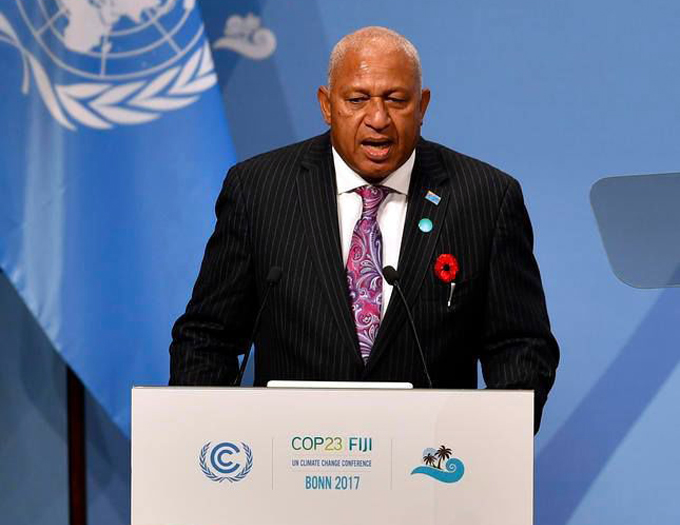
Fiji’s Prime Minister and COP23 President Voreqe Bainimarama … “do everything we can to make the Paris Agreement work”. Image: Vanuatu Daily Post

By Anita Roberts in Bonn, Germany

The Paris Climate Agreement must be implemented swiftly as backing away will expose people to more risks, Fiji’s Prime Minister Voreqe Bainimarama has told world leaders.

Representing Pacific Island countries, Bainimarama, President of the 23rd Conference of Parties (COP23) to the United Nations Framework Convention on Climate Change (UNFCCC), pleaded for collective action from world leaders to tackle climate change after taking up the position of president from Morocco in Germany yesterday.

The future of life on earth depends on everyone’s choices – everyone must act on climate change, he said, when opening the Climate Planet in Bonn City.

“Our world is in distress from extreme weather events caused by climate change as destructive hurricanes, fires, floods, droughts, melting ice, and changes to agriculture which threaten food security.

“Thus, the need for urgency is obvious.

-Partners-

“All over the world, vast numbers of people are suffering – bewildered by the forces ranged against them.

“Our job as leaders is to respond to that suffering with all means available.

‘We must not fail our people’
“This includes our capacity to work together to identify opportunities in the transition we must make.

“We must not fail our people.

“That means using the next two weeks and the year ahead to do everything we can to make the Paris Agreement work and to advance ambition and support for climate action before 2020,” Bainimarama said.

Fiji Broadcasting Corporation (FBC) reports Bainimarama also called for climate negotiations to agree to limiting global temperature rise to below 1.5 degrees Celsius.

“By aiming for 1.5 degrees, we are setting ourselves a serious challenge.

“But it provides us with a mission. It engages our capacity for ingenuity, for organisation and sheer hard work.

 “The only way for every nation to put itself is to lock arms with all other nations and move forward together.

Assist the vulnerable
“We must appeal for a lot more resolve to assist the more vulnerable to adapt to climate change,” he said.

Bainimarama also announced the launch of an ocean pathway to ensure the ocean is an integral part of the UNFCCC process by 2020, the Vanuatu Daily Post reports.

COP23 officially opened on November 6 with a traditional Fijian ceremony and ‘Bula Spirit’.

‘Drua’, a Fijian ocean going canoe in the foyer of the world climate conference serves as a powerful symbol of resilience and unity during the meeting.

It also signifies the resilience of the ancient culture of the Pacific in the face of adverse impacts of climate change.

Climate talks in Bonn continue until November 17.

Anita Roberts is a reporter with the Vanuatu Daily Post. She is among ten journalists from the Pacific invited by the German Foreign Affairs Ministry to COP23 as part of a competition reflecting the importance of this year’s COP to small Pacific Island countries.

Print Friendly, PDF & Email

Article by AsiaPacificReport.nz

]]>

Bryce Edwards’ Political Roundup: Government’s spinning out of control

Bryce Edwards’ Political Roundup: Government’s spinning out of control

[caption id="attachment_13635" align="alignright" width="150"] Dr Bryce Edwards.[/caption] The Labour-led coalition got off to a disastrous start in parliament yesterday, with the first day spiralling out of control for them and resulting in farcical scenes of capitulation to the Opposition over select committee details and the election of the Speaker.  Prime Minister Jacinda Ardern and Leader of House Chris Hipkins then doubled down on the error with the absurd way they tried to spin the episode. It looks like this administration could be as bad as the last one in terms of disingenuous spin-doctoring. [caption id="attachment_3483" align="aligncenter" width="614"] New Zealand Parliament.[/caption] Labour’s out-of-control shambles The best explanation of what went wrong for the new government yesterday is Claire Trevett’s news report, National makes Government look like fools as it blackmails Labour for Speaker vote. She explains that National called into question whether Labour MP Trevor Mallard would have the numbers to be elected as the new Speaker of the House, which led to the Government quickly agreeing to an embarrassing deal with National in order to get their support to elect him. Trevett followed this up with a further explanation, saying “there was initially confusion because Labour had believed it could cast proxy votes for the five missing MPs, who included NZ First leader Winston Peters and Trade Minister David Parker who were at Apec. However, because those MPs had not yet been sworn in, their votes could not be used” – see: Nats fire warning shot on day one. As Stuff political editor Tracy Watkins put it, “It’s a fair bet that this is not what Labour’s strategists and senior ministers wanted day one of the rest of the next three years to look like” – see: Red-faced Government needs to bury first-day farce, fast. Watkins calls Labour’s Speaker episode “shambolic”, and stresses how it projects a picture of the coalition’s lack of control, and these “are just the sort of images Labour doesn’t need. Those images have catapulted what would normally be an in-house, procedural stoush, into a defining moment. They fit the Opposition narrative – the narrative being that this is the same party that only a few months ago was divided, and defeated, that Labour wasn’t ready for power, that the next three years are going to be a shambles.” So, in the end National obtained a surprising compromise out of Labour – an agreement to allow 109 MPs to be allocated to select committees, instead of 96. Up until this time, Labour had signaled its utter intransigence in accommodating National’s very strong preference. Shadow Leader of the House, Simon Bridges, went on TVNZ1’s Breakfast today to say the maneuver in the house was about “making it very clear” to Chris Hipkins that National was unhappy over the select committee MP numbers, which would limit their “ability to scrutinise the government” – see: ‘Yesterday was a day of incompetence by the Government’ – Simon Bridges’ dramatic move in Parliament just ‘vigorous testing’. On whether Bridges’ had bluffed to Labour about them not having the numbers to elect Mallard, he says “It wasn’t a bluff, but I didn’t know [the numbers] exactly”, and “I could tell it was close one way or another”. Bridges says “You can call it a bluff.. I’d call it vigorous testing.” Of course, National is milking Labour’s farce for all it’s worth. But many of their criticisms – although self-serving – aren’t unfair. Opposition leader Bill English was quoted saying, “I’ve never seen that happen on the day of electing a Speaker where the proceedings of Parliament were stopped because the government didn’t know what numbers it had, didn’t know whether it could elect the Speaker and essentially sought our support” – see Sarah Robson’s Govt denies being hoodwinked over Speaker election vote. In the same article, English says: “They’ve got three parties, they didn’t know their own numbers – every day they’re going to have challenges being organised enough to run the Parliament properly.” Labour’s spin control has been out-of-control When politicians suffer setbacks and make mistakes, it’s usually best that they just admit the problem, thereby allowing everyone to move on from it. Unfortunately for Labour, they have taken the opposite strategy and tried to deny it all – which has merely made the situation worse for them. Both Jacinda Ardern and Chris Hipkins have gone on the attack, blaming National for the incident, and challenging the accounts of political reporters. Claire Trevett reports: “Prime Minister Jacinda Ardern denied it was embarrassing and described the set-back as a ‘minor irritation’ and ‘sadly, a bit of politics’.” – see: Nats fire warning shot on day one. According to Ardern, Labour simply reached out to National out of a desire for consensus, because “I wanted to show … this was going to be a Parliament that was different. So it was [my hope] we wouldn’t have that vote and we didn’t.” Chris Hipkins repeated these lines today on TVNZ1’s Breakfast, and denied he had worried that the coalition didn’t have the numbers to elect the Speaker. According to TVNZ, “he said they knew they had the numbers but didn’t want Parliament to get off on the wrong foot.” And in terms of the compromise over the select committee MP numbers, Hipkins indicated that they had always planned to give National the additional numbers. He also went on the AM Show this morning – see Newshub’s Chris Hipkins blames ‘shambolic’ Parliamentary opening on National. However Bridges also appeared on this, disputing the Labour MP’s account: “There’s a bit of post-event rubbish already by Chris Hipkins. It was quite clear to me from the way they acted they didn’t know the rules, they’re confused about that and they didn’t know their numbers and they’re confused about that”. And for Hipkins’ most challenging media interview, you can listen his six-minute interview with an exasperated Guyon Espiner, who says to Hipkins: “Do you really expect us to believe that?!” – see RNZ’s ‘First day farce’ for new govt in Parliament – Hipkins. I also went on the AM Show today to discuss the matter, and expressed my disappointment that the new government was so quickly moving into heavy spinning mode: “That’s one of the worst things about this story for Labour. Not just that it was such a shambles for them and they lost this manoeuvre by National, but they then tried to spin it… And the public hate politicians that are just so obviously spinning it. So Jacinda Ardern had the first day of Parliament going from Saint Jacinda to being seen as a liar” – see Newshub’s Labour’s ‘unprecedented disorganisation’ shows spin and shambles – Bryce Edwards. The NBR’s Rob Hosking also clearly doesn’t believe the Government’s account of yesterday’s debacle: “The claim now that it only made the concession, to give National another 13 select committee places than planned for the rest of the Parliament, just so there could be a nice vibe around Mr Mallard becoming Speaker, shows either an odd set of political priorities or a belief the rest of us are idiots. Take your pick” – see: Silly parliamentary games and some bigger worries (paywalled). Hosking makes the point that, ultimately, the story doesn’t matter that much: “Few will pay much direct attention. It is yet another example of politicians playing silly beggars, and few New Zealanders really care who sits where in what committee room in Wellington.  But it shows a government which is having trouble doing the political equivalent of walking and chewing gum at the same time.  Any more examples of slipshod organisation and the impression of a shambolic, amateur approach to government will start to bed in.” Finally, we’ve already had the coalition government’s formation explained via the analogy of buying a pie (see my previous roundup: The legitimacy of the Labour-led government, and now Liam Hehir updates the analogy to explain yesterday’s farce in Parliament – see This pie analogy is the most Kiwi way of explaining electing the speaker ever.]]>

Critical Politics Newsletter: New Zealand Politics Daily – 8 November 2017

Critical Politics Newsletter: New Zealand Politics Daily – 8 November 2017 – Today’s content

Editor’s Note: Here below is a list of the main issues currently under discussion in New Zealand and links to media coverage.  The full text of these items are contained in the PDF file (click to download). [caption id="attachment_297" align="aligncenter" width="1600"] The Beehive and Parliament Buildings.[/caption] Opening of Parliament RNZ: Parliament’s opening ‘a first day farce’ Claire Trevett (Herald): National makes Government look like fools as it blackmails Labour for Speaker vote Newshub: Chris Hipkins blames ‘shambolic’ Parliamentary opening on National Newshub: Labour’s ‘unprecedented disorganisation’ shows spin and shambles – Bryce Edwards Liam Hehir (Medium): This pie analogy is the most Kiwi way of explaining electing the speaker ever Liam Hehir (Medium): Labour denies falling for second trick Claire Trevett (Herald): Nats fire warning shot on day one 1News: ‘Yesterday was a day of incompetence by the Government’ – Simon Bridges’ dramatic move in Parliament just ‘vigorous testing’ Tracy Watkins (Stuff): Red-faced Government needs to bury first-day farce, fast Herald Editorial: Opposition will keep the Government on its toes Sarah Robson (RNZ): Govt denies being hoodwinked over Speaker election vote Sarah Robson (RNZ): House trading: Nats bluff Labour on day one Anna Bracewell-Worrall (Newshub): National’s first show of power: Grinding Parliament to a halt Gwynn Compton (Libertas Digital): Hipkins’ creates omnishambles on first day as Leader of the House David Farrar (Kiwiblog): Labour fails to have numbers for Speaker so caves in on select committees Martyn Bradbury (Daily Blog): New Government meltdown on first day Nicholas Jones (Herald): Labour and National face-off in Parliament opening over Speaker vote Jo Moir (Stuff): Government forced to do a deal with National after failing to have the numbers in the House 1News: Watch: Confusion in Parliament during less than smooth swearing in of new Speaker Trevor Mallard 1News: MPs sworn in as New Zealand’s 52nd Parliament opens for business RNZ: MPs sworn in to 52nd Parliament Emma Hurley (Newshub): Record level of women in New Zealand Parliament Isobel Ewing (Newshub): Trevor Mallard sworn in as Speaker Gordon Campbell (Scoop): On the battle over select committees Liam Hehir (Medium): Does National have a majority? No Right Turn: The triennial reminder Winston Peters legal action Barry Soper (Newstalk ZB): Pension papers is why Wily Winston Peters went with Labour Richard Harman (Politik): Peters fingers English as architect of conspiracy to ruin his reputation Patrick Gower (Newshub): Winston Peters deepens ‘utu’ with legal action over pension leak Tim Murphy (Newsroom): Winston goes fishing Nicholas Jones (Herald):  Winston Peters’ legal action a ‘personal matter’, Ardern says Lynn Prentice (Standard): Suck it up political sleazers. Cameron Slater (Whaleoil): Winston starts dropping lawsuits on media and Nats Toby Manhire (Spinoff): The brand new Deputy PM just served papers on the media and that is not good at all David Farrar (Kiwiblog): Winston goes fishing Herald: Winston’s legal action a ‘fishing expedition’ Barry Soper (Newstalk ZB): Winston Peters suing over superannuation scandal RNZ: Peters launches legal action over superannuation leak Tracy Watkins (Stuff): Winston Peters looks to sue over pension leak Patrick Gower (Newshub): Winston Peters takes legal action against National Party over leak ‘plot’ Paddles dies Herald: The last moments of Paddles, the First Cat Herald: Jacinda Ardern’s cat Paddles has died after being hit by a car Newshub: Jacinda Ardern’s cat Paddles has died after being hit by car 1News: Prime Minister Jacinda Ardern’s cat Paddles dies after being hit by car RNZ: Jacinda Ardern’s cat Paddles has died Stuff: Paddles, Jacinda Ardern’s cat, has been killed, apparently run over Government Fran O’Sullivan (Herald): Eyes of world on our Coalition of Change Brian Easton (Pundit): How Have We Changed? Tim Watkin (Pundit): A very MMP election… & a manicured mandate 1News: ‘So much emotion in the room’ – Clarke Gayford on the moment Jacinda Ardern learned she would be PM Trade Sam Sachdeva (Newsroom): David Parker plots a new approach to trade 1News: Jacinda Ardern plans to negotiate ‘best interest’ for NZ in TPP negotiations Matthew Brockett (Blooberg): New Zealand’s PM Sees Benefits for Her Country in the TPP Trade Deal Economy and Reserve Bank Bernard Hickey (Newsroom): Robertson faces his toughest choice Nicholas Jones (Herald): Overhaul of Reserve Bank outlined: Employment to be added as objective Jane Patterson (RNZ): ‘We want New Zealanders to be in work and to be paid well’ Liam Dann (Herald): Market relieved as Govt sets out Reserve Bank plan Shane Cowlishaw (Newsroom): Robertson announces details of Reserve Bank review BusinessDesk: NZ govt’s operating deficit in line with expectations Employment Joshua Hitchcock (Spinoff): Māori unemployment is a national crisis Jessie Chiang (RNZ): Exploited staff numbers ‘tip of the iceberg’ – lawyer Susan Hornsby-Geluk (Stuff): Shocking number of New Zealand workers who pay to work Gordon Anderson (Newsroom): Four key principles of NZ labour law Laura Baker (Stuff): How NZ paid parental leave compares to the rest of the world Susan Edmunds (Stuff): Parental leave boost is welcome, but it could be better Rachel Clayton (Stuff): New Zealand’s big healthcare gender pay gap Mathew Brockett and Paul Allen (Bloomberg): The World’s Youngest Female Leader Targets Equal Pay for Women The Wireless: ‘Inequality will grind you down’ Steve Deane (Newsroom): The problem with equality for NZ footballers Bev Cassidy-Mackenzie (Stuff): A swelling sea change in attitude towards diversity Manus Island refugees RNZ: Court rejects restoration of services to Manus detention centre Gareth Hutchens (Guardian): Turnbull says Manus detainees aren’t scared, just manipulated by ‘activists in Australia’ Health Kirsty Johnston (Herald): Child tooth decay soars as kids have to share toothbrushes Amy Wiggins (Herald): Commissioner critical of care given to man found living in squalor Education Dominion Post Editorial: How to fix the problems with charter schools Camilla Highfield (Stuff): National Standards – let’s not throw the baby out with the bathwater Housing Peter Lyons (ODT): Reality bites: housing’s heady days are over Jennifer Eder (Stuff): Ministry makes ‘no single men’ offer to push through emergency housing plan Liam Hehir (Medium): Does Labour’s workaround work? Farming and environment Russel Norman (Spinoff): Let’s untie Fonterra’s hands, and see what they can do for NZ rivers Richard Swainson (Stuff): The science of water pollution should be taken seriously Eric Frykberg (RNZ): Are there too many native birds? Alexa Cook (RNZ): Calls for a national standard for organics Tax Rebecca Stevenson (Spinoff): Offshore trusts are pretty legal – until they’re not ODT Editorial: If I had a little money… Leith Huffadine (Stuff): The Paradise Papers explained: What you need to know Mike Hosking (Herald): Do you support tax-dodging Apple? Justice Jarrod Gilbert (Herald): Boot camp idea robbed Bill English of a legacy Herald: Andrew Little confirms Teina Pora’s compensation to be increased Jo Moir (Stuff): Government announces extra compensation payout for Teina Pora, adjusted for inflation Inequality, poverty and welfare John Minto (Press): Agrees with Winston Peters: capitalism delivers for the wealthy Michael Fletcher (Herald): Welfare system needs radical shake up Stacey Kirik (Stuff): New Government puts Social Investment approach for vulnerable Kiwis under review Daniel Walker (Newstalk ZB): Data for those using social services safe, Government confirms No Right Turn: Good riddance Kelvin Teixeira (Dominion Post): Rising living costs seeing more families turning to food banks Other Charlie Dreaver (RNZ): 13,000 military-style semi-automatic weapons in NZ 1News: It is not obvious how Government will ‘crack the problem’ of Pike River re-entry, says Bill English Brian Rudman (Herald): Guy Fawkes pointless exercise in burning money Māmari Stephens (E-Tangata): Just what are we really commemorating with Rā Maumahara? Dominion Post Editorial: Mayor saves the day – for now]]>

Bryce Edwards’ Political Roundup: A fractious, dirty new Parliament starts today

Bryce Edwards’ Political Roundup: A fractious, dirty new Parliament starts today

[caption id="attachment_13635" align="alignright" width="150"] Dr Bryce Edwards.[/caption] The 52nd Parliament officially opened this morning, and it might end up being one of the more fractious and tense representative assemblies New Zealand has seen for some time. There are already signs that any goodwill between the Government and Opposition has been depleted, and instead of constructive and useful political engagement, we can expect to see dirty fighting and an intense struggle between the new coalition government attempting to carry out reforms, and what has been described as “the opposition from hell”.  [caption id="attachment_3483" align="aligncenter" width="614"] New Zealand Parliament.[/caption] Even in the couple of hours since Parliament opened there have been some incredible stories that show the potential chaos and intense feeling already brewing – see Nicholas Jones’ Labour and National face-off in Parliament opening over Speaker vote, and the Herald’s Winston Peters takes legal action against nine people he believes helped leak pension overpayment info. It suggests that the public should get ready for a wild ride as the swings, surprises and intensity of this year’s colourful election campaign are matched by the configurations in the new Parliament. National’s hellish opposition The National Party has already signalled its intention to be a forceful opposition in Parliament. Of course, this is quite appropriate – New Zealand’s Westminster system is highly dependent on a strong opposition keeping the government of the day in check. But just how combative will the Opposition be? There is sometimes a fine-line for oppositions to walk between being robust, and being petty, dirty, and overly-obstructive. On the one hand, National Leader Bill English showed today that his party can be willing to agree with the new Government, by announcing it would support the extension of Paid Parental leave to 26 weeks, despite National’s policy of a shorter period of entitlement, and having vetoed a parliamentary bill on this last year – see Newshub’s National does U-turn on paid parental leave. On the other, Bill English signalled last week that his party is going to try to make life very difficult for the new government, saying “You should expect more tension and more pressure in the Parliament” – see Nicholas Jones’ Bill English warns Labour: ‘it’s not our job to make this place run’. According to this report, the National Party “will use its size to frustrate progress for the new Government.” And that reference to National’s size is the key point – because with 56 MPs, this is the largest party to occupy the opposition benches in New Zealand’s political history. Former Labour Party staffer Emma Espiner warns National is going to be The Opposition from Hell. Writing a month ago, Espiner predicted “we will see a Monster Opposition – 56 seats – think what that will look like and even sound like – the debating chamber is small, your opponents close, and 56 roaring MPs facing new Labour and Green Ministers will be genuinely testing.” Furthermore, although many parties shifting from government to opposition often descend into infighting, Espiner suggests this isn’t likely to occur with National, who are hell-bent on staying united simply because “they will relish the opportunity to make life hell for the NZ First/Labour/Green coalition.” And she points to all the resources that will allow National to make life difficult for the coalition government. Tracy Watkins wrote yesterday, “National MPs have been highly visible and energetic in their first days back in Opposition, giving weight to the message that they mean business. They also have the advantage of more insider knowledge than their opponents at the moment. While the new ministers get up to speed, National’s former ministers know the system inside and out.” – see: Parliament will now be in session and Labour should not expect an easy ride. Gerry Brownlee can be expected to be one of the big hitters in opposition. Jenna Lynch has already pointed to Brownlee as upping his game and aggression levels, and she labels him “National’s Agitator-in-Chief” – see: Gerry Brownlee shows National is set to play rough. Lynch’s story is about a hard-hitting press release issued by Brownlee: “He stepped up and sent out the first real opposition press release, the first real attack.  The haste and blunt wording is a symbolic message of what’s to come. The fact that it came from Brownlee is a sign this is a directive from high – go hard or go home. It’s a lesson for all the newbies – ‘This is how we act in Opposition’. It’s rough, tough and it will get dirty.” A large part of the reason for National’s combativeness is the process by which they find themselves in opposition. They weren’t expecting defeat, and many still feel wronged and are therefore unchastened. Rob Hosking explains much of this in his RNZ column, National needs to be a ‘practical and sceptical’ opposition. Here’s his main point: “Usually when a party goes into opposition after a long stint in government it is not so much put there as flung there by angry or disillusioned voters. This usually comes after one final Parliamentary term in which the party is shot full of bullet holes by attacks from the opposition, the media, and, not infrequently, their own side. Ministers are exhausted – usually more so than they realise until the adrenaline of office vanishes. The party tends to be divided and demoralised. This is not one of those situations – not quite, anyway. National is the largest party in Parliament. It will be resourced accordingly. Its members – most of them – did not expect defeat. There is nowhere near the same demoralisation apparent in 1999 or in 1984 – or seen in Labour in 2008 and 1990.” National’s fight over select committee numbers An arcane but important fight has been going on over the last day about how many MPs should be allocated to the parliamentary select committees that examine legislation. It’s a convoluted and complex story, but best summed up by Jane Patterson: “Labour and National have their first major disagreement in the new Parliament over the number of MPs serving on select committees. National said changes to MP representation means its ability to hold the new government to account is being compromised. The number of MPs who will sit on select committees has been reduced, but Leader of the House Chris Hipkins said that was because of an agreement all political parties signed up to in the last Parliament. Simon Bridges, the shadow Leader of the House, said having fewer seats would mean 11 National MPs would miss out on sitting on a select committee” – see: Labour and National spat over MP representation. Simon Bridges, who is the new shadow leader of the house, has expressed National’s opposition to the changes in a dramatic fashion: “It’s a really alarming erosion of the Opposition’s democratic rights in our Parliament like we have never seen before. It is an unprecedented situation” – see Nicholas Jones’ National clashes with Labour: ‘erosion of democratic rights’. For an elaboration of Bridges’ arguments it’s worth reading David Farrar’s Labour freezing National MPs out of select committees, and Graeme Edgeler’s Despite Simon Bridges’ idiocy, does he have a point on overall (subject) select committee membership? And for the best critique, see Andrew Geddis’ Simon Bridges thinks that Simon Bridges is eroding parliamentary democracy. Of course, the whole debacle has now been resolved courtesy of another debacle, in which Labour mismanaged its numbers and strategy today when the new Parliament opened. For Claire Trevett’s take on what happened, see: National makes Government look like fools as it blackmails Labour for Speaker vote. This extraordinary episode has provided a useful example of what might be coming during this Parliament – a very intense battle in which the gloves are off between Labour and National. Richard Harman reports on how Simon Bridges had said that National was going to fight Labour over the issue, with him saying that Labour was “going to find that they have got a much less reasonable, more obstructive Opposition that will find issues to muck them around on” – see: Bridges planning to logjam Parliament. Threats to slow down the coalition government are taken very seriously by Gordon Campbell, who suggests that we are witnessing the importing of US-style tactics: “the National Party has been planning to mimic the worst practices of the Republican Party when it comes to its parliamentary tactics in opposition. For the eight years of the Obama administration, the Republicans responded by trying to create legislative gridlock at every opportunity. If it couldn’t run the business of government, it would do its damndest to derail the ability of anyone else to govern” – see: On the battle over select committees. Campbell applauds Labour for fighting back, and trying to thwart National’s plans on the select committees, saying “A line is being crossed here. It is not the job of her Majesty’s loyal Opposition to oppose, not to render Parliament ungovernable.” And certainly, the Government’s Leader of House, Chris Hipkins, was fairly upfront in suggesting that Labour’s intransigence over the select committee numbers was, in part, due to a fear that National was going to use the committees to deliberately frustrate the Labour’s reform agenda. Hipkins therefore declared “It would be fair to say we are not of a mind to increase the numbers on select committee in order to make it easier for them to do that” – see Laura Walters’ National calls Government’s plans for select committee ‘undemocratic’. However, regardless of who came out on top in this battle, blogger No Right Turn suggests that everyone loses, as once again it just shows all politicians in a bad light – see: Hypocrisy all round. Finally, National might be feeling smug about how things went today, but conservative political commentator Liam Hehir has sounded a note of caution, suggesting National should avoid being too negative too early.]]>

Critical Politics Newsletter: New Zealand Politics Daily – 7 November 2017

Critical Politics Newsletter: New Zealand Politics Daily – 7 November 2017 – Today’s content Editor’s Note: Here below is a list of the main issues currently under discussion in New Zealand and links to media coverage. The full text of these items are contained in the PDF file (click to download). [caption id="attachment_297" align="aligncenter" width="1600"] The Beehive and Parliament Buildings.[/caption] AUS-NZ relations and Manus refugee crisis Gordon Campbell (Werewolf): On Ardern’s refugee non-deal Grant Bayldon (Spinoff): Seeking asylum is a legal right. Could somebody tell Mike Hosking? Jessie Anne Dennis (Spinoff): Words are cheap. Now Ardern must take real action to save the Manus Island refugees Chris Trotter (Daily Blog): Australia: Seeing What We Have To See. Brent Edwards (RNZ): Manus Island refugees: Jacinda Ardern likely to come under more pressure to do more Herald Editorial: New PM does well in first outing Jane Patterson (RNZ): Trans-Tasman tension gives way to smiles No Right Turn: Rolling over for Australia RNZ: Emergency exposes Manus Island healthcare deficit Newstalk ZB: Manus Island asylum seekers losing hope after Australia rejects NZ offer Anna Bracewell-Worrall and Isobel Ewing (Newshub): Australians will be entitled to a free year of tertiary education in New Zealand 1News: Watch: Government’s threat of tertiary fee retaliation against Australia ‘irrelevant’, says Bill English Laura Walters (Stuff): NZ taxpayers shouldn’t be paying for Australians’ education, Bill English says 1News: ‘It’s only fair if we respond’ – Australian tertiary policy to triple Kiwi fees stuck in Senate   Trade and international relations Vernon Small (Stuff): Jacinda Ardern seeking TPP concessions at first appearance on international stage Jane Kelsey (Herald): Signing TPPA-11 would break Labour’s word Jane Kelsey (Daily Blog): Jacinda says ISDS is a dog. So let’s put it down Catherine Beard (Herald): New Government needs to land TPP Benedict Collins (RNZ): Trade deal ‘top of mind’ at APEC Alexia Russell (Newstalk ZB): Jacinda Ardern picks EU over Russia in trade talks Nicholas Jones (Herald): Russia free trade agreement not the priority: PM Talisa Kupenga (Māori TV): German President and NZ Prime Minister discuss trade and science opportunities Stacey Kirk (Stuff): German President touches down in New Zealand for high-level meetings Craig Hoyle (Stuff): Meet Boots, New Zealand’s ‘Depcatty High Commissioner’ in London   Parliament Andrew Geddis (Pundit): Simon Bridges thinks that Simon Bridges is eroding parliamentary democracy Graeme Edgeler (Public Address): Despite Simon Bridges’ idiocy, does he have a point on overall (subject) select committee membership? Richard Harman (Politik): Bridges planning to logjam Parliament RNZ: Select committee changes ‘anti-democratic’ – Bill English Sam Sachdeva (Newsroom): Battle brewing over select committee cuts David Farrar (Kiwiblog): Labour freezing National MPs out of select committees No Right Turn: Hypocrisy all round Jane Patterson (RNZ): Labour and National spat over MP representation Nicholas Jones (Herald): National clashes with Labour: ‘erosion of democratic rights’ Laura Walters (Stuff): National calls Government’s plans for select committee ‘undemocratic’ Liam Hehir (Stuff): National should avoid being too negative too early Tracy Watkins (Stuff): Parliament will now be in session and Labour should not expect an easy ride Phil Smith (RNZ): The Commission Opening: What to expect Herald: Parliament opens: Guide to the week’s ceremony 1News: MPs to be sworn in, Speaker elected as 52nd Parliament opens Gwynn Compton (Libertas Digital): The political week ahead – 6 November 2017   Paid Parental Leave Nicholas Jones (Herald): Prime Minister Jacinda Ardern confirms paid parental leave increased to 26 weeks by 2020 Ellen Read and Stacey Kirk (Stuff): Paid parental leave to increase to 26 weeks RNZ: Parental leave increase ‘right thing to do’ – PM Anna Bracewell-Worrall (Newshub): Jacinda Ardern commits to extending paid parental leave by a month Newshub: Parent advocates applaud 26-week leave Bil Herald: Paid parental leave: Dad leaves job after snarky comments Chris Bramwell (RNZ): Fears over extended paid parental leave for small businesses Newshub: National does U-turn on paid parental leave   Government Hamish Rutherford (Stuff): Wellington Mayor ‘not losing sleep’ over Government relocation pledge Jo Moir (Stuff): Jacinda Ardern is taking the government back to Waitangi after a two year hiatus Colin Williams (Stuff): Hipkins looks to change for the better Katee Shanks (Rotorua Daily Post): Waiariki MP Tamati Coffey confident ahead of maiden speech Jared Nicoll (Stuff): New minister Kris Faafoi wants more compassion for the vulnerable David Farrar (KIwiblog): What sort of poll boost should the new Government get? Claire Trevett (Herald): Greens meeting to set election date to replace Metiria Turei as woman co-leader Herald: Ever wondered what the Prime Minister’s office looks like? Clarke Gayford (Spinoff): Nothing is different, everything is different: Clarke Gayford on his first days as first gent Herald: DNA detectives delve into Jacinda Ardern’s family tree Whananui Chronicle: Jacinda Ardern as Mona Lisa wins Mangaweka art competition   Tax Colin James (ODT): Tax will be the ultimate reform test Ric Stevens (Press): Paradise Papers show tax dodgers will be found out RNZ:IRD works with international agencies on tax haven leak Greg Presland (Standard): Paradise lost   Education Jody O’Callaghan (Stuff): Low decile schools have double the trouble hiring staff John Gerritsen (RNZ): Govt funding inadequate, principals say Herald: High stress levels, not enough funding and staff struggles, NZCER report finds Jo Moir (Stuff): Education minister to review all charter schools after threatening some with closure   Employment Teuila Fuatai (Newsroom): More labour inspectors: a return to the past? Mike Hosking (Herald): Why pay parity doesn’t work in sport Newstalk ZB: Living wage advocates praising govt decision   Health Eileen Goodwin (ODT): Health authority in Ronald McDonald damage control Bronwyn Howell (Newsroom): Reducing GP fees not so simple Nikki Preston (Herald): Mumps outbreak: Vaccination catch-up campaign floated for 10-29 year-olds Newswire: Govt warned not to ask for DHB resignations Hawke’s Bay Today: Hastings Health Centre offers free visits for under-18s   Pike River Sam Strong (Press): Families of Pike River victims says Government is ‘on the same page’ with them over mine re-entry Ryan Boswel (1News): ‘This is important to all NZ’ – Govt must make amends for handling of Pike River aftermath, says Andrew Little Benedict Collins (NRZ): Andrew Little meets Pike River families Herald: Pike River families meet with Andrew Little over possible re-entry Anna Bracewell-Worrall (Newshub): Pike River families put faith in Andrew Little   Guy Fawkes Bruce Munro (ODT): A place for peace ODT Editorial: Do we really need Guy Fawkes? Martyn Bradbury (Daily Blog): In defence of Guy Fawkes – let’s take it back for the Activist Left Megan Gattey (Stuff): Why New Zealand should consider ditching Guy Fawkes for Matariki   Justice Herald: Gang influence in prisons in Corrections Minister’s sights after string of serious assaults David Farrar (Kiwiblog): Good and bad ways to reduce the prison population David Garrett (Stuff): Why Labour wants to repeal ‘three strikes’   Environment Gerard Hutching (Stuff): Dairy farming critic Alison Dewes appointed Landcorp environment head Lyn Webster (Stuff): Cows not the only dirty things finding their way into rivers Ged Cann (Stuff): Endangered hawksbill turtle dies after eating 106 pieces of plastic   Immigration Catherine Hutton (RNZ): Immigration public counter closures sparks warning Sophie Christie (Telegraph): New Zealand looks to woo thousands of British bricklayers in lead up to Brexit   Maori Party Herald: Tuku Morgan’s resignation as Maori Party president turned down Carrie Stoddart-Smith (Ellipsister): It’s looking like a rewind not a reset   Housing Amber-Leigh Woolf (Stuff): Amateur property investment is ‘going to disappear’, but could be a good thing, say experts Interest: Think tank welcomes Housing Minister’s suggestions of simplifying planning rules and abolishing Auckland’s rural urban boundary David Farrar (Kiwiblog): Labour threatens land confiscation   Defence Newshub: No auto-renewal for Kiwis in Iraq – PM Laura Walters (Stuff): Defence chiefs from NZ, Australia and UK discuss countering violent extremism Kirsty Lawrence (Stuff): Taxpayers have forked out for 99 courts martial to be held in the past 17 years   Other Sarah Robson (RNZ): Controversial data-for-funding plan scrapped Adriana Weber (RNZ): Daughter forced to forgo mum’s funeral, says she had ‘no support’ Duncan Greive (Spinoff): Gareth Morgan is shutting down the Morgan Foundation to double down on TOP Newshub: David Seymour finds euthanasia hope in Australia Don Rowe (Spinoff): ‘The battle now is with ourselves’: Tūhoe declare war on drug dependence Laura Dooney (RNZ): Wellington council still owed $50k from failed fashion week]]>

Sogavare voted out as no confidence motion passes after ‘fierce’ debate

]]>

PM Sogavare out … no confidence motion passes 27-23 after “vitriolic” day in Parliament. Image: SIBC

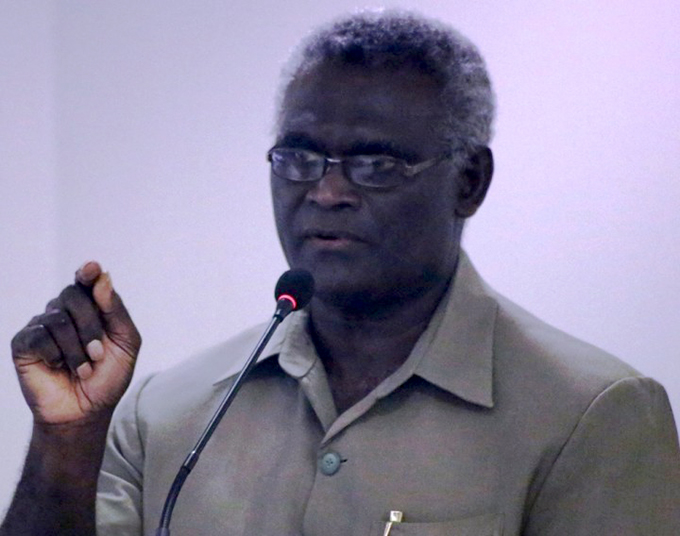
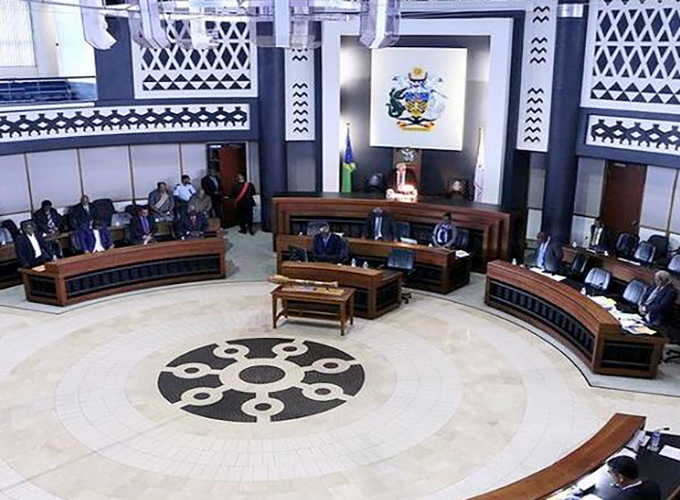
The Solomon Islands is without a formal Prime Minister tonight after the motion of no confidence against Manasseh Sogavare passed Parliament this evening after more than nine hours of debate. It means a new government – and almost certainly a new Prime Minister – is set to take control of the country following a frantic lobbying period which expected following today’s vote. A vote on the new Prime Minister will eventually take place after the Governor-General is notified by Sogavare. No specific time frame has been set, however. Independent group leader and member for Northeast Guadalcanal Dr Derek Sikua was singled out – by Sogavare himself, who accused him of treachery – as the potential next Prime Minister, however as many as five names have been thrown into the mix. An emotional Sogavare said he would walk out with his head up “because I have done nothing wrong against the people of this country”. The motion passed 27-23 following a vitriolic session of Parliament today, where fierce debate centred on the integrity of projects, and accusations of corruption were flung across the floor. Accusations of kickbacks involving projects such as the Tina River Hydro Scheme, the Skyline Housing project, the fibre optic cable were central to the debate.

-Partners-

PM integrity questioned  The integrity of the now deposed Prime Minister was questioned multiple times during the session, and Sogavare, referring to himself in the third person as “the Prime Minister” throughout his speech, addressed almost all of them in a sprawling 90 minute oration. Sogavare said he had been targeted by a group motivated by “deliberate lies” to “assassinate” his leadership. He singled out Dr Sikua, and accused him of wanting to become the next Prime Minister. “It is sad that innocent members of Parliament have become hopeless victims in this plan,” he said. Sogavare also accused MPs of knowingly misleading the public about their intentions surrounding the anti-corruption bill, and its delay, and using it as a tactic to undermine him. “My only mistake is that I stood up against corruption and corrupt leaders. “A vote for yes is a vote for corruption,” he said. Sogavare hits back He said concerns over the issue of hiring his nephew as chief of staff screamed of hypocrisy, and questioned why it was an issue that would trigger the move on his leadership. “We need to clean up our own backyard before we start pointing the finger. “If you vote “I” you vote with a guilty conscience, because it’s not right,” Sogavare said. In response Dr Sikua said he was not simply opportunistic and was doing it for the right reasons. He said all he needed was the numbers. The marathon session ended at 6.45pm after Parliament opened at 9.30am. The Solomon Islands Broadcasting Corporation (SIBC) reports Sogavare refused to resign this morning after being asked by Dr Sikua on the floor of Parliament. Consolidation efforts fail The motion of no-confidence was received on Sunday, October 29, following the sudden resignations of several MPs and backbenchers who switched allegiance to the Opposition. The successful motion comes despite efforts last week by Sogavare to consolidate his power and the return of MPs Moses Garu and Dickson Mua to the ranks of the Democratic Coalition for Change Government (DCCG).
Print Friendly, PDF & Email
Article by AsiaPacificReport.nz]]>

Bryce Edwards’ Political Roundup: Has Jacinda Ardern failed her first international test of leadership?

Prime Minister of New Zealand, Jacinda Ardern.

Bryce Edwards’ Political Roundup: Has Jacinda Ardern failed her first international test of leadership?

[caption id="attachment_13635" align="alignright" width="150"] Dr Bryce Edwards.[/caption] Is our new government doing enough about the Manus refugee crisis? Well, it’s hardly doing anything. Instead of putting pressure on the Australian Government to allow New Zealand to take refugees from Manus Island, Prime Minister Jacinda Ardern seems to have capitulated entirely to Australian Prime Minister Malcolm Turnbull on the issue.  Former Labour Party leader Andrew Little has said the New Zealand Government needs to “cause international embarrassment” to Australia for not accepting New Zealand’s offer. Little says “This is a time to step up and say, in an age of world-wide humanitarian crises, one that is on our doorstep, one that involves our nearest neighbour physically and diplomatically then we need to be applying a bit of a stiff arm on it and say, ‘we can help’.” Similarly, James Shaw has said the New Zealand Government has “a lack of spine” in dealing with the refugee crisis. But that was then, and now Labour is leading the government. Ardern seems determined to do the opposite of what her colleagues were strongly advocating for a year ago. Instead of openly criticising and pressuring the Australian government over the humanitarian crisis they have caused at Manus Island, Ardern has mostly been running Malcolm Turnbull’s arguments for him in the New Zealand media. New Zealand won’t call out Australia over the refugee crisis [caption id="attachment_15325" align="aligncenter" width="800"] The Prime Minister of New Zealand, Jacinda Ardern, was officially sworn in on October 26 2017 by the Governor General Dame Patsy Reddy.[/caption] Jacinda Ardern has embarrassed herself by being too meek with the Australian Government, according to political commentator John Armstrong – see his column: Jacinda Ardern will find ‘doing the right thing’ gets harder the longer she’s PM. Armstrong says Ardern needs to “slam” the Australians’ for their “morally bankrupt treatment of the Manus Island refugees”. He criticises her for “meekly saying that New Zealand was in the ‘lucky position’ of not having to struggle with the refugee issue, unlike Australia. Arden will have to do better than that. She can do better than that.” Instead, the Prime Minister has returned to New Zealand from her meeting with Turnbull, and has been parroting his lines about the need to deal with the so-called “people smugglers”, and how the US first needs to take its agreed number of refugees before New Zealand gets involved. She told RNZ today, “I have to accept that Prime Minister Turnbull is prioritising the agreement that substantially resolves the issue at this point.” And in terms of people smugglers, she said “I agree that those who are the instigators of trying to exploit people’s fear and vulnerability by encouraging them to take to the seas should be prosecuted and should be pursued” – see: PM says she’ll keep tabs on Manus Island. The problem is Turnbull has essentially told Ardern that, in terms of the current crisis at least, Australia retains the right to decide New Zealand’s refugee policy on who is accepted into the country. And she has simply agreed to this. Ardern could be accused of failing her first test on the world stage – one in which she could have made a real difference. Claire Trevett reports the advice of the lawyer for the Manus Island refugees, Greg Barns, who argues this crisis “provided Ardern with a chance to stamp her mark” – see: Manus could be PM Jacinda Ardern’s ‘Tampa moment’: Australian lawyer. Barns is quoted as saying “Helen Clark did the right thing and it would be great if Jacinda Ardern did the same. It’s a chance for New Zealand to show moral leadership, which Australia has lacked now for 20 years.” New Zealand has been fobbed off Some journalists are suggesting Jacinda Ardern made progress in getting the Australian Prime Minister to take New Zealand’s offer of accepting refugees more seriously. Tracy Watkins says that “Replacing a flat ‘no’ with ‘maybe later’ is a clear – if subtle – softening of the earlier rejections of the New Zealand offer” – see: Turnbull’s warm welcome for Ardern underscores continuity in trans-Tasman relations. Another perspective is that Turnbull has simply become more diplomatic in his rejection of help from New Zealand. After all, he is now under huge pressure, with the UN condemning the situation, and even his own former Minister of Immigration, Kevin Andrews, breaking ranks to say that the Australian Government needs to more seriously consider the offer. And furthermore, the bi-partisan consensus has also broken down, with the Labor leader, Bill Shorten, also calling for the government to let the refugees go to New Zealand. With such intense pressure to yield to New Zealand, Turnbull’s change in language was really the bare minimum of what he needed to do, while at the same time not changing his actions. As Claire Trevett writes, “it was effectively a No Delayed” – see: Key bromance haunts Jacinda Ardern’s first Australia visit. Australia continues to justify declining New Zealand’s offer to take refugees on the basis that the US has previously agreed to take 1,250 and therefore Turnbull wants to negotiate this first before considering New Zealand’s offer. Ardern therefore suggests that New Zealand’s offer is under “active consideration” by Australia, and she has been quoted as saying “I absolutely understand the priority that has been placed around the agreement with the United States” – see Michael McGowan’s report, Turnbull says he will consider NZ refugee deal only after US resettlements. But according to Manus refugee Behrouz Boochani, the US agreement shouldn’t be believed: “They announced the deal a year ago but only 25 people sent to America. They are only playing with us and media, it’s a fake deal to waste time” – see Newshub’s US deal a lie, choose NZ – Manus refugee. Similarly, Gordon Campbell suggests negotiations with the US will take a very long time, and therefore concludes that “Sooner rather than later, New Zealand has to stand up to Australia over its refugee policy. Otherwise, our silence and inaction will be taken as tacit acceptance, and we will be seen (accurately) as enabling Canberra’s systematically inhuman treatment of hundreds of the world’s most vulnerable people, and their families. The clock is now ticking on Ardern’s personal timetable” – see: On Ardern’s refugee non-deal. Doing nothing of any substance about the crisis raises questions about whether the new Labour-led coalition government is complicit in Australia’s abusive operations. New Green MP – and former refugee – Golriz Ghahraman has been outspoken about the issue, being reported as saying “New Zealand’s silence has made it complicit in human rights abuse in Australian offshore detention” – see RNZ’s MP calls NZ’s Manus Island silence ‘complicity’. And blogger David Farrar says this criticism could equally be applied to her own government – see: Is a Green MP calling Labour complicit in human rights violations? New Zealand won’t take the refugees directly from Manus Island Many are now suggesting that because Australia has abandoned the refugees, the New Zealand government should be able to simply rescue them without getting Australia’s prior approval. This is best expressed by Brian Rudman in his column, Time for a little gunboat diplomacy. He says, “It’s time to shame our Australian cousins by dispatching a naval vessel to Manus Island to rescue the 600 or so refugees trapped on Australia’s very own Devil’s Island.” But Jacinda Ardern ruled this out today, because of New Zealand’s formal offer to the Australians: “No, no, because the offer is still under active consideration by Australia so there is no need to do so” – see Jane Patterson’s Prime Minister Jacinda Ardern won’t bypass Australia over Manus. On this, Gordon Campbell says: “For her part, Ardern has chosen not to confront Australia and has agreed to delay making the NZ resettlement offer directly to Papua New Guinea. Given the glacial pace of the US response, and the urgency of the humanitarian crisis on Manus, there is no justification for not proceeding with an approach to PNG right now.” It also has to be pointed out that the current offer to Australia isn’t particularly radical, given the circumstances. Lawyer Felix Geiringer‏ (@BarristerNZ) has tweeted: “There is a humanitarian crises happening on our doorstep. It is time for more drastic action. Merely repeating John Key’s offer is not enough.” For other examples of social media reaction, see my blog post, Top tweets about the Australia-Manus-NZ situation. Leftwing blogger Daphna Whitmore also points out that the current offer really isn’t generous: “It is the smallest of gestures from a country that does very little to extend a welcome to refugees. There are over 22 million refugees in the world and New Zealand is ranked at the bottom of the developed world when it comes taking refugees. Overall New Zealand is 110th in the world for refugees per capita adjusted for GDP. The offer to take 150 refugees is not in addition to the modest annual 1000 refugee intake. Ardern, like Key before her, made it clear this to be within the quota” – see: Manus Island: “It’s f******* disgraceful”. RadioLive talkback host Alison Mau is advocating that New Zealand take all of the Manus Island refugees, saying “I can’t think of a nobler, more important contribution for our Prime Minister to make as her first political legacy, something that would be remembered as a source of pride for generations to come” – see: Tampa rescue is point of pride – but we’re too gutless to do it again. Finally, for the brave speech that the New Zealand Prime Minister should have made if she wanted to truly make a principled stand in the weekend, see Toby Manhire’s Hey mate, this Manus thing’s got to stop. It includes the line: “Talk is cheap, I get that, and my government will be judged on the extent to which it all adds up to more than warm fuzziness.”]]>

Bryce Edwards’ Political Roundup: “Youthquake” fails to shake NZ

Ballot Box.

Bryce Edwards’ Political Roundup: “Youthquake” fails to shake NZ

[caption id="attachment_13635" align="alignright" width="150"] Dr Bryce Edwards.[/caption] In the lead-up to this year’s election there was conflict amongst political pundits and activists about whether a “youthquake” was set to rattle the foundations of the status quo. And the debate has been reignited with the Electoral Commission releasing contentious data this week about voter turnout of different age groups.  [caption id="attachment_15103" align="aligncenter" width="594"] General Election 2017.[/caption] The original debate was parodied after the election in the National Business Review, which published its own piece of fake news about the lack of a youthquake. Titled, “Quake recovery work continues”, the earnest news report stated: “There were frantic scenes this week as pundits worked around the clock to reach the victims of a devastating seismic shock that never happened. As many as no bodies are now understood to have been recovered. The so-called youthquake was scheduled to hit New Zealand last weekend, with its epicentre located around most of the country’s university campuses. The sudden surge had been expected to knock out National’s power system. To date, though, the only bodies recovered appear to have been well-known pundits.” Youthquake forecasts “vindicated” On Wednesday, the Electoral Commission released its official Voter turnout statistics. These appeared to show that voter turnout had increased significantly amongst younger age groups. This is best conveyed in Laura Walters’ Young voter turnout up by 6.5 per cent. Looking at the official figures, Walters reported “The turnout for the 18-24 age bracket rose from 62.7 per cent in 2014, to 69.3 per cent in 2017.” Similarly, the turnout figures for Maori voters were reported to have increased, with Susan Strongman saying “Maori voter turnout increased by 3.5 percentage points across both the Maori and general rolls this year – from 67.6 percent in 2014 to 71.1 percent in 2017” – see: Youth voter turnout gets a big bump. These reports had some activists buoyant and Martyn Bradbury proclaimed that the lesson was: “Don’t listen to mainstream pundits” – see: Mainstream media claim no Youth Quake. Gordon Campbell expressed his satisfaction with the results, saying “youth turnout in New Zealand among the under 30s would be the envy of most other developed countries. Our millennials rocked the vote this year” – see: New Eyes on Trade. The real story about youth voter turnout However, as Massey University political scientist Grant Duncan told the AM Show, “You have to remember the commission’s figures are a percentage of the enrolled voters”. Duncan pointed out that the picture of youth turnout is actually very different when you take into account the fact that a huge proportion of young eligible voters didn’t enrol this year –  in fact, these statistics went backwards – see Newshub’s Election ‘youthquake’ a myth, figures show. According to this report, “While turnout for 18 to 24-year-olds on the electoral roll jumped from 62.7 percent to 69.3 percent, there were actually fewer in that age group enrolled to vote in 2017 than in 2014.” The overall result is that voter turnout amongst youth hardly increased at all, and stayed at incredibly low levels – only about half of young people in the 18-24-year-old category voted. I’ve carried out my own analysis of the figures, which suggests that, roughly, “the 18-24-year-old age group went from 48% turnout in 2014 to 50% turnout in 2017. This was a 2 percentage point increase. For the 25-29-year-old range, there was a 3-percentage point increase, from 51% to 54%. And in the next band, 30-34-year-olds, the increase was 5 percentage points – from 59% to nearly 64%. The other age bands didn’t change much” – see my blog post, No real youthquake in 2017. Similarly, once you take into account adult New Zealanders who don’t enrol, the overall voter turnout for the election amongst all age groups was about 73 per cent. This was up only about 1 percentage point, from 72 per cent in 2014. Hence, the turnout appears to be the third lowest since women got the vote. Therefore, the so-called “missing million” voters – or 963,854, by my calculations – were still absent from the electoral process. Using a similar approach, blogger David Farrar says there was No youthquake. And Gwynn Compton also declares there “wasn’t a youthquake, but a youth tremor”, and that “those aged 18-24 made up a lower percentage of overall enrolments than they did in 2014” – see: Greying population and youth tremor sees middle age voter squeeze. It’s also worth checking out Compton’s excellent number crunching of age statistics in his latest blog post, Youngest, oldest, most & least representative electorates. Why is youth participation so low? RNZ’s Brent Edwards looks at the turnout statistics for youth, and also concludes that “in the end only just over half of all young people – including those who didn’t enrol – voted” – see: More young people voted, but no youth quake. He interviews “Five first-time voters from Aotea College in Porirua” to find out “why so many of their peers did not vote or enrol to vote”. Overall, he says, “They believe for a number it might have been because they did not understand the parties’ policies.” You can also listen to their explanations in the three-minute interview: More young votes in Election 2017, but no ‘youthquake’. The low voter turnout of youth needs to be contextualised amongst bigger changes in society in recent decades. This is where Canterbury University political scientist Bronwyn Hayward is focused in her diagnosis. She is reported as believing “compared with the baby boomers, millennials have lost a lot of the traditional institutions – churches, trade unions, even sports teams – that used to foster a sense of social solidarity”, and atomised individuals don’t participate in politics like they used to – see Steve Liddle’s article, Election leaves plenty to improve in democracy. This article also focuses on local attempts that have been made to increase voter turnout via publicity and social campaigns. For example, “Founded in 2014, RockEnrol, adopted a ‘sizzle and steak’ approach aimed at empowering 18- to 29-year-olds to vote… RockEnrol organised music, parties, celebrities and shareable content as the ‘sizzle’ to attract sign-up pledges, with the ‘steak’ the later follow-up calls.” Do these awareness and marketing campaigns have an impact on voter turnout? Victoria University of Wellington sociologist Jack Foster thinks not. Based on his research, he says that such outreach campaigns and the inevitable call for more civics education misses the point. There are bigger societal, economic and political changes that impact on political participation – see his article, The Trauma of the Non-Voter. Foster’s main point is this: Non-voters “are perhaps not some apathetic, disinterested subject who shirks their citizen duties, but rather a symptom of a wider democratic malaise; a morbid symptom of a civilisation in which democracy has been ‘hollowed out’.” Of course, it’s not only younger people who are voting in lower numbers than the rest of society. According to Grant Duncan, “electorates with a large number of poor and immigrants also have lower turnouts” – see Newshub’s Election ‘youthquake’ a myth, figures show. Duncan says, “There’s really quite a kind of social inequality and an economic inequality in relation to who turns out, as well as the age issue.” Maori, too, are voting in much lower numbers – about 10 percentage points lower than non-Maori. And to explain this, Laura O’Connell Rapira, of Rock Enrol, says it’s about colonisation: “research shows that one of the main reasons that Maori don’t vote in higher numbers than Pakeha, is because of historical distrust towards the Crown because of our colonial history” – see Susan Strongman’s Youth voter turnout gets a big bump. The best post-election discussion about why youth didn’t vote in greater numbers is the Herald article written by young lawyer Christian Smith – see: What happened to the youthquake? While Smith’s whole article is well worth reading, his conclusion is important. He argues that, although this year’s election campaign involved many crucial issues for youth voters, the differences between what the parties were offering simply weren’t great enough to mobilise large numbers of young people to participate. Here’s his conclusion: “by the end of the New Zealand election the gap between Labour and National’s youth policies, while not small, was no longer decisive. For many, the difference eventually came down to whose plan would work better, not who understood the issues better. The irony for Labour is that Jacindamania and Labour’s policies on youth forced National to engage on issues they had been happy to ignore for nine years. Consequently for young people, the difference between a National-led future and a Labour one became less dramatic.” Finally, it’s worth considering whether all this focus on youth turnout is actually so important. After all there are many other ways of being political. And this is what political science student Brodie Fraser argues in her opinion piece, Screw parliament: how you can create political change right now.]]>

Sogavare appoints eight new ministers in effort to consolidate government

]]>

PM Sogavare’s efforts to consolidate government after political instability … eight new ministers appointed. Not pictured: Duddley Kopu. Image: Solomon Star News.

Following the resignation of nine ministers last weekend Prime Minister Manasseh Sogavare has made moves to consolidate the coalition government.

The Solomon Islands Broadcasting Corporation (SIBC) reports Sogavare has sworn in eight new ministers.

Ishmael Avui, Minister for Development, Planning and Aid Coordination; Augustine Auga, Minister for Agriculture and Livestock Development; Nestor Ghiro, Minister for Provincial Government and Institutional Strengthening; Bradley Tovosia, Minister for Forestry and Research; Moses Garu, Minister for Home Affairs; Jimson Fiau Tanagada, Minister for Police, National Security and Correctional Services; Dickson Mua, Minister for Mines, Energy and Rural Electrification; and Duddley Kopu, Minister for Agriculture and Livestock Development took their oaths Wednesday afternoon.

Sogavare’s assistant press secretary, Alex Akwai, said the government is trying to maintain stability in the current political situation.

He told SIBC: “Political stability is one important thing for the government in terms of progress and development.”

Among those who resigned last weekend, Garu and Mua told Solomon Star News they returned to the ranks of the Democratic Coalition for Change Government (DCCG) coalition as joining the Opposition to remove Sogavare would make no positive difference to national development.

Mua added there was no justified reason for removing Sogavare as it would only cause uncertainty and was not in the national interest.

-Partners-

Sogavare hits out
Sogavare has hit-out at the ministers who resigned and the motion of no confidence against him, stating the defectors were apprehensive about the country’s anti-corruption bill, which is to be introduced in parliament on Monday.

“Some of these resignations come as no surprise based on the fact that some of these same Ministers were responsible for undermining the progress of the ACB and the Opposition and Independent Parliamentary Groups have inadvertently aligned themselves with this agenda,” a statement from the prime minister’s office said Sunday.

Sogavare said that despite the ministers provoking political instability, the DCCG remained “confident” the national interest would prevail over personal agendas.

Sogavare added the return of Garu and Mua was a testament to this.

However, former deputy prime minister Manasseh Maelanga has rejected such accusations concerning the ACB, labelling them a cheap attack strategy, SIBC reports.

Maelanga said the ministers and backbenchers resigned due to personal convictions and on individual grounds.

“When we resigned, it shows that there is no trust and confidence in the Prime Minister, and that is why we resigned,” he said.

Continued ACB work
Maelanga stated both himself and those who had resigned would continue and complete the work to get the ACB through parliament, which he had initiated as acting prime minister following a petition by civil society representatives to have it brought back.

“It’s a clear picture that it is not the anti-corruption bill that we resigned from.”

Print Friendly, PDF & Email

Article by AsiaPacificReport.nz

]]>

RSF condemns ‘gag’ of Tonga’s state broadcaster ahead of general election

]]>

RSF condemns government ‘gag’ of TBC … transfer of senior journalists Laumanu Petelō (right) and Viola Ulakai. Image: Kalino Latu/Kaniva Tonga

Pacific Media Watch Newsdesk 

Reporters Without Borders (RSF) has condemned moves by Prime Minister ‘Akilisi Pōhiva’s government to “gag” the Tonga Broadcasting Commission prior to the general election on November 16.

RSF says it joins those who have criticised a decision to deprive two senior public broadcasting journalists of all editorial responsibility in what it says is an “apparent government move to seize control of the state media”.

“Ever since it took office in late 2014, the Pōhiva administration has been trying to intimidate those within the TBC who don’t toe the line,” said Daniel Bastard, the head of RSF’s Asia-Pacific desk in a statement.

“The prime minister needs to understand that public service broadcasting does not mean government propaganda.

“If guarantees of media independence are not given quickly, international bodies, including the Commonwealth, will have to reconsider the aid they provide to Tonga,” Bastard added.

RSF’s condemnation comes after TBC’s chief editor Laumanu Petelō and news manager Viola Ulakai were controversially transferred out of the newsroom and into a marketing and sales department known as “NGO Services”, as reported by Pacific Media Watch.

-Partners-

The decision was made by TBC’s new chairman Dr Tevita Tu’i Uata, who has said the broadcaster’s restructure came due to a news failure.

Uata Pohiva’s ‘ally’
“The problem is that the content is not popular, that’s why it ran at a loss,” he told Kaniva News.

RSF states Dr Uata’s appointment a month ago was the “first step” to seize control of the TBC, which oversees two state TV channels and two state radio stations, as he is an “ally” of Pōhiva.

Petelō and Ulakai’s lawyer, Clive Edwards, said the transfer was illegal as it violates their contracts.

Edwards said the move was also dangerous due to Dr Uata’s attitude of using his position for campaigning and accused the government of “trying to control the media”, RSF reports.

Both Petelō and Ulakai had had run-ins with Pōhiva, with his administration launching several legal actions against the senior journalists in the past three years.

Ulakai was suspended in April 2015 on the recommendation of the minister of public enterprises after asking Pōhiva “too many tough questions”.

Petelō told the prime minister during a press conference in March “we are not your enemy” following comments by Pōhiva the role of the media was to “facilitate the work of government”.

Tonga is ranked 49th out of 180 countries in RSF’s 2017 World Press Freedom Index, after falling 12 places in the space of a year.

Article by AsiaPacificReport.nz

]]>

Bryce Edwards’ Political Roundup: The Coalition’s very clever ban on foreign house sales

Bryce Edwards’ Political Roundup: The Coalition’s very clever ban on foreign house sales

[caption id="attachment_13635" align="alignright" width="150"] Dr Bryce Edwards.[/caption] The new coalition government looks set to record a big political win with its very clever plan to ban house sales to foreigners. Previously Labour’s policy of banning foreigners from buying houses in New Zealand had appeared to be a difficult promise to achieve – mainly because of the government’s responsibilities under existing and upcoming trade deals. The main problem was with the looming Trans Pacific Partnership (TPP) deal, which Labour may well sign New Zealand up to. But it now seems that the coalition government can avert any conflict between the ban and the trade deal, simply by introducing the ban before the TPP is signed and implemented. Patrick Gower explains it like this: “Ardern has got into power, asked the officials and they have come up with a very simple ‘hack’ – bring in the ban before the trade deal is signed off. If this is true, it was a damn easy fix” – see: Jacinda Ardern goes for 2-for-1 ban and TPP deal. What will the foreign buyer ban achieve? [caption id="attachment_35" align="alignleft" width="300"] Auckland housing market.[/caption] Obviously the intention of the ban is to reduce competition for buying houses, therefore limiting price increases. But will this really work? Not according to former National staffer Gwynn Compton, who says the effect of the ban will be “None. Zilch. Nada” – see: The pointlessness of a foreign buyer ban. He says “Australia implemented the same thing in December 2008 it had no impact there either. In fact, much like New Zealand’s prices, house prices in Sydney and Melbourne have nearly doubled since 2008.” Referring to the fact that foreigners will still be allowed to buy new houses, Compton says that the only impact of the new rules will be to shift “the two or three per cent of property investment that comes from overseas from existing homes to new builds instead. The small resulting increase in prices there pushes citizens and residents back into the existing home market, and thus increases competition there by the same amount. The overall result? You’re no better off than you were before, unless you’re a property developer.” Property Institute CEO Ashley Church also emphasises that the main impact will be to push investment towards new builds. He was quoted on TVNZ Breakfast saying, “It’s not a ban, it’s a redirection of investment… Foreign investors who want to invest in New Zealand residential property they can still do so, but they’ve got to invest it in the construction of new buildings. That’s a good thing for the economy, with 40,000 houses in Auckland required almost straight away” – see: Foreign buyer ban ‘more symbolic’, effect on first home buyers ‘almost none’, says Property Institute CEO. Real estate agents also think the ban will have little impact on their business – see Adriana Weber’s Foreign home-buyer ban: will it make any difference? The same article cites economist Gareth Kiernan saying that “many foreigners had already been squeezed out of the market by the banks toughening up restrictions on foreign investors.” Kiernan is also quoted on the slowdown of overseas investment in housing in Susan Edmunds’ article, Foreign buyer ban will affect small proportion of property sales. He says “the major banks have stopped approving mortgages based on overseas income” and the “Chinese government has also tightened the restrictions around the ability of Chinese nationals to move money out of China”. In the same article BNZ chief economist Tony Alexander warns “we don’t know to what extent buyers will find ways around the rules, such as getting friends and relations already here to purchase on their behalf, as has apparently been happening in the Asian communities, according to anecdotes”. The foreign buyer ban is politically powerful [caption id="attachment_4843" align="alignleft" width="300"] David Parker, New Zealand’s Minister for Economic Development, Minister for the Environment, Minister for Trade and Export Growth, and Attorney-General.[/caption] The coalition government has stepped back from suggesting that the change will make a huge difference to housing affordability. Instead, David Parker is emphasising that the ban is an “important point of principle” – see Laura Walters’ How much of a difference will the foreign house buyers ban make? Parker has been focusing on the more ideological aspect of how the ban fits into the fight against inequality, saying the ban is aimed at the rich elite and will affect the “one per cent” – see Sarah Robson’s Foreign home buyers to be banned – PM. Parker explains: “Just about everyone who buys who’s a foreign person buying into New Zealand – they’re a very very wealthy ‘1 percenter’… And I think that’s one of the excesses of global capital, when you allow those sorts of interests to influence your housing market.” Therefore, this big first move of the coalition government can be seen as symbolically very important. And that’s what Patrick Gower argued this morning, saying “It sends the symbol that this Government is different to the last one, on housing in particular” – see Newshub’s Labour’s foreign housing ban ‘symbolism’ – Patrick Gower. And he says it will be politically powerful: “Gower argued the ban is supported by two-thirds of the public, and the Government will get credit from voters for instituting it.” An even more sceptical view is that this big announcement can be seen as a sop to leftwing coalition supporters who are soon going to have to accept the Government signing up to the TPP. This is the argument made by Rob Hosking in the NBR: “So this week’s announcement was part distortion – the foreign buyers announcement is good crowd-pleasing stuff but it won’t mean much at this point in the housing cycle – and part the start of a softening process” – see: Ardern drops ‘sovereignty’ concerns over TPP (paywalled). To go even further, here’s Mike Hosking’s view that the housing buying ban is entirely pragmatic: “This so-called ban is window dressing, it’s xenophobic, made-up political bollocks for expediency purposes and nothing else. It’s the move you make to make you look like you’re doing something, when in reality it’s for headlines and coalition promises – not for any real effect. It’s the work of inexperienced amateurs” – see: Foreign house buyer ban ‘xenophobic bollocks’. Labour’s beef with National Patrick Gower says this could be a big win for the prime minister, and predicts “It will be extremely embarrassing for National, if she pulls this off, as it said it could never be done.” And National’s prior role in trying to prevent Labour from achieving a ban is now in the spotlight. Ardern herself has come out and criticised the former National Government, saying that it now seems they didn’t even ask their officials for advice on whether a ban on foreigners buying houses was possible. Some speculate that National actually went out of their way to “wedge” Labour on the issue. Vernon Small explains that when the former government was negotiating the TPP, it deliberately chose not to include the possibility for a future government to implement a foreigner ban on house buying. He asks: “Was National’s decision to exclude a ban on foreign buyers of Kiwi homes from free trade deals a poison pill left for Labour to swallow?” – see: Foreign buyers ban in, Labour points finger at Nats for ‘misleading’ over free trade clash. Small reports that “there has been speculation that former prime minister John Key and his team were explicit – leave it out. If they were so weasel-cunning it’s easy to see how the logic would flow; create an irreconcilable clash between Labour’s policy on foreign house buyers and the TPP so they can have one but not the other.” Labour clearly blames National and its former trade negotiator, Tim Groser for the problem. New minister for trade negotiations, David Parker, has expressed bitter disappointment that National wouldn’t cooperate with Labour, so as to maintain a bi-partisan consensus on trade agreements. In an interview with the Herald, Parker says: “It has absolutely been clear for many, many years that the Labour Party in terms of trying to maintain bipartisan consensus around this has been strong on this ability to have New Zealand markets for our land, not international markets, and therefore how the last government chose to do that was an attempt to wedge us” – see Audrey Young’s David Parker targets trade deal and bar on house sales to overseas buyers. Of course, now Groser is the Government’s diplomatic representative in Washington, and the question of his re-call is therefore on the agenda. Parker says this is a matter for Winston Peters, as Foreign Minister, to decide, but adds: “He is one of the people who wedged us on this issue” and “He was pretty central to those decisions.” The AgriHQ publication has recently put across the view that in the previous National Government, “Tim Groser tried and failed to persuade Cabinet colleagues to accommodate the Labour Party’s previous policy of restricting house purchases by non-residents to preserve a long-standing consensus on trade policy between the two major parties” – see Nigel Stirling’s Groser backed trade policy. However, according to this account, “the recommendation never saw the light of day after a ‘captain’s call’ from then Prime Minister John Key and National campaign manager Steven Joyce in the middle of the Korean talks meant Groser was forced to back down.” This is also covered by Richard Harman in his column, Did National play politics with MFAT’s TPP advice? Harman says this account reinforces the “suspicion that National played partisan politics with the TPP.” But he points to a briefing paper produced by the Ministry of Foreign Affairs and Trade, which also appears to give poor advice on these issues. Harman says: “That calls into question the quality of the advice given to the previous Government on the TPP and raises the question as to whether it was advice tailored to be acceptable to the National Government”. Finally, for satire on this issue, see my blog post, Cartoons about foreign house sales and TPP.]]>

NZ exhibition aims to highlight ‘regeneration’ of refugees lives

]]>

By Kendall Hutt in Auckland

Black-and-white photographs are aiming to start a conversation and dispel myths around former refugees and asylum seekers in New Zealand.

Transplanted: Refugee portraits of New Zealand showcases two-metre tall, black-and white-close-up portraits of former refugees by award-winning photographer Alistair Guthrie.

The portraits are currently on display in a ten-day exhibition at the New Zealand Portrait Gallery in Wellington.

“Refugees lives have been pulled up from the roots and transplanted on new soil,” explains curator and journalist Tracey Barnett.

“I created Transplanted because I wanted to show the regeneration of lives, that these people can become our future – carpenters and teachers and insurance brokers and our art gallery directors just like anyone else.

“In New Zealand about roughly 45 percent of our quota intake are children. They grow up to be Kiwis in every sense of the word.

-Partners-

“You may not even recognise that they began life as a refugee because they speak with a Kiwi accent, eat pineapple lumps, and cheer for the All Blacks on a Saturday night just as loudly as anyone else,” Barnett said.

Refugee ‘talking space’
Transplanted opened with a talk by former Prime Minister Sir Geoffrey Palmer on Friday and continues until Sunday, November 5 with insights from former refugees and international diplomats.

Tracey Barnett, journalist-turned-advocate for changing refugee narratives … “just like anyone else”. Image: Tracey Barnett.

The gallery exhibition is also a “refugee talking space”, intended to turn the tide on negative perceptions of refugees, both globally and closer to home.

“It has been incredibly saddening and worrying to see the label of refugees become so disrespected.

“These people have overcome tremendous odds and tremendous difficulties to get to safety, something any of us would aspire to,” Barnett told Asia Pacific Report.

Barnett, who serves on the executive board of the Refugee Council of New Zealand, said the media was partly to blame.

“Unfortunately the media shows these people always in the worst moments of their lives, but the reality is that it’s just one short chapter of a much bigger life.”

A highlight has been the ‘Human Library’ sessions, Barnett said, where former refugees speak one-on-one with the public.

Lives in limbo
“It’s been incredibly moving, enjoyable and informative I think for everyone who’s participated and it’s a real highlight.”

Human Library sessions … “incredibly moving, enjoyable and informative”. Image: Tracey Barnett

But while some refugees lives have been “transplanted on new soil” in New Zealand, the lives of asylum seekers in one of Australia’s offshore detention centres remain in limbo.

“These refugees have every reason to be afraid and every reason to be worried that they will not be protected and they will not be safe,” Barnett said.

The words of Wage Peace NZ’s founder come as a 2013 offer by New Zealand to take in 150 refugees a year from Australia’s detention centres remains “nixed” by Australia.

This means asylum seekers on Manus Island, around 600 of whom are refusing to leave the now closed centre, are being forced to relocate to several sites in nearby Lorengau – including the Manus Refugee Transit Centre – or “trade one hell for another” for the “other prison island” of Nauru where human rights abuses are rife, Barnett said.

Many of the single men who remain on Manus fear for their lives, with reports locals have allegedly already looted the centre.

Barnett said “there have been worrying and frightening outbreaks of violence” in the past.  

Manus supplies cut
These outbreaks of violence include a shooting on April 14, 2017 in which bullets were directly fired into the refugee centre by security forces.

All power, water and food supplies have stopped at the refugee processing centre.

A notice posted by Papua New Guinea’s Immigration and Citizenship Service Authority stated all staff had left and the site would be returned to the Defence Force today.

“This is the last communication you will receive at this location,” the notice stated.

Closure of Australia’s detention centre on Manus Island … “will not end refugee suffering”. Image pixelated by SBS. Image: SBS News

The closure of Manus Island comes after PNG’s Supreme Court ruled last year the centre was illegal and unconstitutional.

Barnett said New Zealand’s new Labour-led government should also be applying “huge pressure” and push to renegotiate its 2013 deal with Australia.  

“This makes a perfect opportunity for Prime Minister Jacinda Ardern to stand back and say ‘I’m a new government, this is a new possibility, let’s talk about doing this as a one-off instead and helping you evacuate the camps, but you must agree to not reopen them’,” Barnett said.

Examine NZ offer
Ardern has said she would renew the offer after examining the proposal Australia continues to reject.

“I want to look at the detail of the offer that was made and the obligations that we’ve set out that we would take on,” she said.

“Of course that would be within our refugee quota, and within existing intent that we’ve shared with the UN around taking UN mandated refugees.”

Green MP Golriz Ghahraman, herself a former refugee from Iran, has recently labelled New Zealand’s alleged silence over the past four years as ‘complicity’.

Former refugee Golriz Ghahraman … New Zealand silence on Manus Island issue equals “complicity” in Australia’s human rights abuses. Image: Alistair Guthrie

Ghahraman will be speaking this evening at the exhibition on the ‘I am not a label: Young refugee voices’ panel.

Manus Island’s closure also provides an opportunity to provide “fresh eyes” on New Zealand’s own refugee policies, Barnett said.

“New Zealand has never pulled its weight when it comes to our quota.

‘We can do more’
“Unfortunately we rank 95th worst in the world per capita for the total number of refugees and asylum seekers we host.

“If you measure it by our relative wealth, our GDP, it’s even worse and we rank 121st worst in the world.

“That isn’t good enough and we can do more,” Barnett said.

Although it was “wonderful” New Zealand’s quota was going up to 1500, Barnett stated it would be a while before refugees felt its impact.

“The quota is only reviewed every three years and we’ll be changing our quota in 2018. It will be several years again before we hit that 1500 mark.

“I’m hoping that the government will consider changing that number earlier and faster to make a bigger impact.

“We can do more and we should.”

Article by AsiaPacificReport.nz

]]>

Bryce Edwards’ Political Roundup: The surprising new power behind Winston Peters

]]>

Bryce Edwards’ Political Roundup: The surprising new power behind Winston Peters

[caption id="attachment_13635" align="alignright" width="150"] Dr Bryce Edwards.[/caption] As the new coalition government forms, a number of crucial staffing appointments are being made by Labour, New Zealand First and the Greens. Some of these jobs are incredibly important, as the people in them can end up being more powerful than most of the MPs in the party caucuses. Depending on the role and the person appointed, they can become a central part of the success or otherwise of a government or party in power.  The most interesting new appointment announced so far, is that of political scientist Jon Johansson to the role of Chief of Staff for New Zealand First – see Jo Moir’s news report, Political scientist Jon Johansson made NZ First chief of staff. A surprising appointment [caption id="attachment_15343" align="alignleft" width="225"] Political scientist Jon Johansson is NZ First’s new chief of staff.[/caption] Judging by reactions, everyone has been entirely surprised by Johansson’s shift from being a political scientist to a political player. And certainly, it’s quite unusual for a political scientist to go from teaching politics to practicing it. But it does happen from time to time. National’s controversial Jian Yang is a prime example, having previously taught politics at the University of Auckland. And for the latest on him, see Matt Nippert’s article yesterday, Three unanswered questions about our spy-trainer MP. But perhaps it’s not entirely surprising that Johansson has shifted into politics. He’s long been very close to many politicians and others around the Beehive. In fact, few university academics would know the corridors of power as well as Johansson – he’s a creature of the Wellington political scene like no other, and should have little trouble shifting from the classroom to the Beehive. A surprising party to go with That the Victoria University of Wellington lecturer has chosen to pin his colours to New Zealand First is a surprise for most political followers. After all, in the past he has been more associated with Labour and the Greens, and in the lead-up to the 2014 election he advised these opposition parties in their quest to project themselves as a coherent alternative government. There will inevitably be ideological questions about Johansson’s shift into partisan politics. In the past, as an academic and political commentator he has endeavoured to be as objective as possible. However, he has previously been forthright when it comes to what might be regarded as “socially conservative” ideologies or policies. For example, he became the major academic critic of Don Brash’s Orewa Speech. And it will be interesting to see how he will respond in his new role when inevitably confronted with socially conservative politics involving New Zealand First. Why Johansson’s appointment is smart  Johansson’s affinity with Winston Peters will make him a good fit with the New Zealand First leader. He will play the role of Peters’ right-hand-man. And because Johansson is a leading expert in political strategy and New Zealand politics, he will be very valuable to New Zealand First. Furthermore, Johansson’s academic specialty is in political leadership. He is already highly aware of Peters’ strengths and weaknesses. He knows how leadership works, leaders succeed, and how Peters can best create a legacy as one of the top political leaders of our era. If nothing else, we can expect to see some spectacular new speeches from the New Zealand First leader. But more than this, Johansson’s appointment is smart because the political scientist is also close to Labour and the Greens. His role as chief of staff is primarily going to involve coalition management, ensuring that the New Zealand First caucus and staff are working together with their counterparts. Because Johansson is already close to the two other parties, he will be well placed to ensure coalition stability and make sure that New Zealand First’s interests are looked after by Labour and the Greens. The fact that Johansson does not have a history of involvement in the New Zealand First party could be considered a disadvantage in his role as chief of staff. After all, he won’t be aware of the configurations of power and policy within his new party. And he’s essentially an outsider, coming in to manage people who don’t know him or necessarily trust him. But this could also be an advantage. He won’t be tainted by any of the factional differences and loyalties in the party. He therefore comes in as a more independent manager of the party, and this may help when dealing with disputes and differences. He will also have a greater degree of objectivity, which can be very useful in these roles. It’s not always good to have a party activist running the parliamentary operations of a political party. Sometimes having someone with a background and strong ideological belief in a party can be a handicap. Why Johansson’s appointment is risky  Of course, successful political management isn’t simply a matter of knowing all the theory, and Johansson is coming into this important management role with no proven record or experience in the nitty-gritty of how Parliament works. Added to that, the New Zealand First party is one of the more elusive and mysterious political vehicles around. So, landing straight at the top of this empire – albeit beside Winston Peters – might still prove a difficult task. He will need to show that he has the temperament and diplomacy to deal with complicated and difficult coalition and internal-party problems. As an outsider, Johansson may also not be in the best position to wield his considerable new power in a way that will protect the party. “Guns for hire” often don’t have the knowledge and emotional commitment that enables them to advance the party’s core interests, and inevitably they are readier to compromise on issues in a way that a “true believer” in the party might see as “selling out”. After all, there will be many party activists and MPs who have slogged away to get the party into government, and may feel that suddenly an outsider has taken the most powerful job in the parliamentary team. And there will be doubts that he knows how New Zealand First voters really think and feel, like they do. Also, Johansson’s perceived closeness to Labour could be a problem. Those in New Zealand First might come to regard him as being too ready to give way to Labour and the Greens, or that in his liaisons with the coalition partners he is vulnerable to “Stockholm Syndrome”. Johansson’s past political commentary New Zealand First’s political opponents and the media will look to Johansson’s many articles, chapters, books, and media appearances to find critical statements he’s made about Winston Peters and his party. Some of this might make for interesting reading. Already, one person on Twitter has tweeted a statement of Johansson’s from 2005: “Well, that he was mercurial, charismatic, but really was never a team player, and as such, in terms of legacy, there’s really not much of a record there at all. It’s always in a sense been more of a style over substance.” And interestingly enough, Winston Peters then “liked” this on Twitter. And during the election campaign, Johansson published a number of opinion pieces that might now be re-read in a new light. Here they are: • Change is coming, ready or not. • Game On: Dancing with the Zeitgeist. • Battling the zeitgeist. • The big crunch – minor party struggles . • Turei, Key to Labour’s surge. • Can National overcome the three-term curse? • Relentlessly positive vs relentlessly dissatisfied. • Ardern is ‘standout leader’ of post-Clark Labour. Finally, many journalists were taught by Johansson when they studied politics at Victoria University of Wellington. Press gallery reporter Henry Cooke (@henrycooke), for example, on hearing of Johansson’s appointment tweeted his lecture notes from 11/05/12: “Winston will want to be part of the next election. He might enter some kind of abstention agreement. He stands to gain more from National than Labour. Jon thinks Jacinda has potential as leader, like a young 21st Clark with warmth.” For more such tweets, see Top tweets about Jon Johansson becoming NZ First Chief of Staff.]]>

Government in Solomon Islands ‘collapsing’ as MPs change allegiance

]]>

Solomon Islands government ‘intact’ says DCCG … 18 MPs switch allegiance to Opposition, Independents. Image: Loop PNG

A change of government is likely on the horizon for the Solomon Islands after several MPs changed allegiance.

The saga unfolded on Saturday following the resignation of seven cabinet ministers, including Deputy Prime Minister and Minister for Home Affairs Manasseh Maelanga.

Other ministers include Minister for National Planning and Aid Coordination Danny Philip, Snyder Rini, Minister for Fisheries and Marine Resources, Minister of Forestry and Research Chris Laore, Moses Garu, Minister of Police, National Security and Correctional Services, Minister of Public Service Moffat Fugui and Elijah Doromuala, Minister of Justice and Legal Affairs.

Deputy private secretary to the Governor-General, Rawcliffe Ziza, revealed the ministers resigned after losing confidence in Prime Minister Manasseh Sogavare, Solomon Star News reports, prompting the newspaper to headline the move as ‘Government collapsing’.

The drama continued Sunday as two more ministers resigned from the Democratic Coalition for Change Government (DCCG), bringing the total number of resignations to nine, the Solomon Islands Broadcasting Corporation (SIBC) reports.

The ministers were Minister of Provincial Government and Institutional Strengthening David Tome and Minister of Peace, National Unity and Reconciliation Samson Maneka.

Several backbenchers have also resigned, Solomon Star News reports, meaning 18 MPs have deserted Sogavare since Saturday.

-Partners-

MPs join Opposition
They have since joined the Opposition and Independents in a show of solidarity at the Honiara Hotel and again in parliament.

The move brought the ‘Honiara Hotel Camp’ to 29 members on Sunday, Solomon Star News reports.

Opposition ranks grow … 18 MPs switch allegiance from Sogavare-led Democratic Coalition for Change Government. Image: Solomon Star News

The SIBC also reports Sogavare will face a motion of no confidence when parliament resumes on Monday, November 6.

Speaker of Parliament Ajilon Jasper Nasiu received the motion from the leader of the Parliamentary Independent Group Dr Derek Sikua on Sunday.

According to an MP who wished to remain anonymous, a new prime minister will be elected within two weeks, the Solomon Star News reports.

“Members of the DCCG have totally lost all trust and confidence in the leadership of Sogavare.

“Sogavare has allowed his controversial nephew Robson Djokovic to control government affairs,” the MP said.

Government remains intact
It is believed Sogavare’s major cabinet shakeup – embarked on since early August – which saw several ministers reassigned and two terminated, upset the United Democratic Party, the major coalition partner of the DCCG.

A government issued statement said the government remains intact despite the walkout of nine ministers.

Article by AsiaPacificReport.nz

]]>

Tūhoe leader’s address to deliver ‘hard truths’ about New Zealand

]]>

Tūhoe settlement, self-determination chief negotiator Tamati Kruger … ‘historic opportunity’ to deliver Bruce Jesson lecture. Image: Tamati Kruger.

By Alex Braae in Auckland

Tūhoe leader Tamati Kruger has some hard truths to deliver in his upcoming 2017 Bruce Jesson Memorial lecture.

The chair of Tūhoe Te Uru Taumatua says New Zealand needs to face up to the fact that “we create a reality to suit our time and our purpose, and some of it is quite dishonest”.

“In New Zealand we have a mythology that we are a clean green nation, when we are not. We have another mythology that we’re quite egalitarian and liberal. We are not.

“We are quite a cruel people to refugees and people who have emigrated here. We are not as tolerant as we pretend to be.

“We have these things we have to be truthful about, to repair and fix,” Kruger said.

Kruger will speak tomorrow at the University of Auckland in a lecture which honours the late journalist and political thinker Bruce Jesson. The lecture has been delivered in previous years by notable intellectuals, including Jane Kelsey, Nicky Hager and David Lange.

-Partners-

He will also be speaking about his experiences leading his iwi, Tūhoe’s settlement with the Crown, and the Te Urewera Act. Kruger was the chief negotiator for Tūhoe in the settlement process.

Navigating differing politics
He said an important part of leadership has involved navigating the difference between Māori and Pākehā politics.

“Part of the blessing of Pākehā politics is you have this apparatus called law, where you can bend people to one’s will. But in Tūhoe politics you have to depend on your reputation and integrity for people to find that whatever you have to say has some wisdom and truth in it.”

On taking up the mantle of leadership, he said he “got to the stage where I could not renounce my parents’ prayers that I contribute something back to the iwi.

“I don’t see myself as having to do what I do forever…I’m probably facing the end part of my contribution to the Tūhoe people and I just want to continue to do my very best.”

Acting chair of the Bruce Jesson Foundation, Simon Collins, said the theme of the lecture was always about “the most important issues that we face in New Zealand, and one of the big elephants in the room is the big disparity between Māori and everyone else”.

“What Tūhoe is doing is one of the most exciting responses to that. They’re taking it into their own hands to do something about the problem.

“That’s what we’re hoping Tamati Kruger can talk about – what they’re doing can have lessons for all of us.”

Alex Braae is a journalism major at the Auckland University of Technology. 

Article by AsiaPacificReport.nz

]]>

Fiji’s devastated Tukuraki village moves to new site after landslide

]]>

A Pacific Media Centre video at Tukuraki by the Bearing Witness team Julie Cleaver and Kendall Hutt in May.

Pacific Media Centre Newsdesk

After more than five years of living in temporary housing, the community of Tukuraki in the highlands of Fiji are this weekend celebrating as they move into their newly built, disaster resilient village.

The Tukuraki community – featured by the Pacific Media Centre’s Bearing Witness climate project in May – was devastated in 2012 as a landslide buried 80 percent of their village and tragically took the lives of a young family including a toddler and young baby.

The opening of the new Tukuraki village on Friday with SPC’s Dr Audrey Aumua (from left), Minister Inia Seruiratu and EU’s Christoph Wagner. Image: SPC

The community were forced to relocate to temporary homes as they were at risk of further landslides and in the midst of recovering from the landslide, the community was hit by Cyclone Evan only 10 months later.

In February last year, the community was again forced to flee to nearby caves as Tropical Cyclone Winston hit – the community’s third major disaster in four years.

As a result, the Fiji government deemed relocation for the inland community an urgent priority and approached the Pacific Community (SPC) to support in this work.

-Partners-

On Friday, 11 homes and a community hall built to category five cyclone standards were officially opened.

The F$756,000 relocation of the Tukuraki village to a safer and less disaster prone site was made possible through the European Union and the ACP Group of States-funded Building Safety and Resilience in the Pacific Project (BSRP) implemented by the Pacific Community.

Reducing vulnerability
The BSRP Project is committed to reducing the vulnerability for the Pacific to disaster and climate change.

Flashback to January 2012…mud and rock buried Tukuraki village, killing Anare Taliga and his family. Image: Janet Lotawa/Rise Beyond The Reef.

Inia Seruiratu, High Level Climate Change Champion for COP23 and Minister for Agriculture, Rural and Maritime Development, and National Disaster Management and Meteorology said:

“Today as we celebrate the critical milestone for Tukuraki, we also remember Anare Taliga (38 years), Mereoni Robe (23 years), Losena Nai (18 months) and Makelesi Matalau (6 months), who lost their lives to the devastating landslide that altered the lives of everyone in the Tukuraki community.

“The achievement of creating a disaster resilient community that has been led by the community itself is testament to the resilience of the Tukuraki community.”

In addition to the buildings, the project also provided the community with access to a reliable water sources. The Ba area is known for enduring long term droughts and to counter this issue, the project built a dam nearby and have strategically placed water tanks that connect to each household, ensuring the community will never run out of water.

Pacific Community Deputy Director-General Dr Audrey Aumua said: “This community knows and understands disaster but what makes this relocation remarkable is the partnership led by Fiji government with SPC and the European Union to achieve real, measureable disaster resilience at the community level.

“We know this new community will protect not only the lives but the livelihoods of the Tukuraki community and we are immensely proud to be a key partner in this work.”

Community assisted
Along with the 11 homes and the evacuation centre, the Tukuraki community has also been assisted with a retaining wall (to prevent soil erosion), road access, site levelling and a playground.

The new location is closer to Nalotawa District School which means the community will have easier access to schools as well as health services.

European Union head of cooperation Christoph Wagner said: “We are proud to partner up with the Fiji government and the Pacific Community on this project as it not only has helped the people of this community, it has also established for the nation what a resilient rural community looks like.

“With the effects of climate change and rising tides threatening coastal communities all over the Pacific, Tukuraki stands as a great example of how effective partnerships can sustain development.”

Tukuraki is the first inland community to be relocated, a unique feature as the other 46 key priority communities for relocation are all coastal.

Article by AsiaPacificReport.nz

]]>

Bryce Edwards’ Political Roundup: The new government may not be so radical after all

New Zealand First leader and Deputy Prime Minister Winston Peters with Governor General Dame Patsy Reddy and Prime Minister Jacinda Ardern.

Bryce Edwards’ Political Roundup: The new government may not be so radical after all

[caption id="attachment_13635" align="alignright" width="150"] Dr Bryce Edwards.[/caption] For a week now, the political left has been celebrating, and the political right has mostly been catastrophising. The dominant theme has been that this is a government of change – indeed, a government of radical leftwing change. But there are some signs and more sober readings of events that suggest the new administration might not be as radical as it first appeared.  The political right is becoming relaxed [caption id="attachment_15332" align="aligncenter" width="800"] Prime Minister Jacinda Ardern (right), Deputy Prime Minister Winston Peters (left) and the Governor General of New Zealand Dame Patsy Reddy (centre) – image taken at the swearing in of the new Labour-led Government, October 26, 2017.[/caption] Rightwing commentator Matthew Hooton has the most interesting and sober reading of the new government as relatively moderate. His NBR column today in print is titled “Why Ardern needs to manage expectations”. In this, Hooton responds to fears (or hopes) that the new government is anti-capitalist or even boldly radical. He opens the column like this: “If this is what the end of capitalism-as-we-know-it looks like, everyone can relax. The seven-page Labour-NZ First coalition agreement and the equally brief Labour-Green confidence and supply agreement are surprisingly benign. There is hardly anything in either that Sir John Key or even Bill English wouldn’t have signed up to in a flash had they thought it was the difference between government and opposition.” Hooton then goes through key elements of the new government’s programme of reform and sees parallels with initiatives under the former National administration,   including the regional development fund, tree-planting, the new Forestry Service, and the leap in the minimum wage. But his thoughts on the new Cabinet personnel are most interesting. Here’s Hooton on Ardern’s two most powerful ministers: “The finance minister, Mr Robertson, is more the Wellington technocrat he became in the 2000s than the Otago student radical he pretended to be in the early 1990s. Economic development minister David Parker is a political puritan and can be expected to fix the worst of National’s corporate-welfare excesses and government-procurement mess. As trade minister, his views on modern international economic agreements like the TPP are entirely mainstream.” And he makes similar observations about other ministers. Hooton even claims to be relaxed about the New Zealand First leader: “Mr Peters’ call for capitalism to have a human face is inherently conservative and not a call to nationalise the means of production, distribution, and exchange.” And as to why so many radical statements are being made by people in the new government: “It is perhaps because of the relative conservatism of her government’s announced programme and key personnel that the prime minister will have an ongoing need to throw some red-meat rhetoric to her left over the weeks ahead. The business community should set this aside.” Even Mike Hosking is starting to relax about the new government. Initially the broadcaster struggled with the change of government – see, for example, Steve Kilgallon’s How Mike Hosking handled the election result – but now Hosking seems to have realised that the Labour-led coalition isn’t going to live up to his worst fears. He wrote, on Wednesday that Maybe the new Government’s not the end of the world after all. In this he argues that “If you look with an open mind, there is always a decent amount there to – at the very least – not be overly bothered or freaked about.” Hosking goes through a number of key policies of the new administration, and challenges the reader as to what there is to disagree with. Even on the minimum wage boost, Hosking sees common sense: “A lot of people will argue the minimum wage needs to be higher than it is, and here’s a good example of why this Government isn’t as radical as its opponents might want to make it out to be. They want the minimum wage to be 20 bucks by 2020, that’s three years away, and it’s already over 16. So we are hardly talking radical change here.” And business leaders themselves are ready to accept that the new administration isn’t all bad. For example, Wellington Chamber of Commerce chief executive John Milford writes today welcoming the Prime Minister “absolutely ruling out” allowing workers to negotiate their employment conditions by striking – see: Signals are encouraging, but some of the policies could be a problem. He also notes how keen Jacinda Ardern is to work with business. The media on how moderate the government is Newspaper editorials have been relatively positive about the new government, and are downplaying the notion there is anything to worry about. When the coalition agreements were announced this week, the New Zealand Herald seemed pleasantly surprised: “Much of what has been said in the past few weeks and days have raised fears the fundamentals of a modern, market-led economy might be at risk. The package of policies announced yesterday do not appear to go that far” – see: Peters agrees to a cautious, tentative deal. On some of the major interventions in the economy, the editorial expresses relief that “they will likely not fundamentally undermine the economy”. Similarly, it regards Winston Peters as having made little ground in terms of his desire to reform monetary policy and “Most of the coalition agreements are token concessions to Peters.” The editorial concludes: “The language of both agreements is more cautious and tentative than a prescription for change. If this is as daring as the coalition gets, the economy should not suffer too much harm.” The Dominion Post newspaper also seems to be giving the new government coalition agreements a stamp of approval, noting in its editorial that some of the more radical or alternative policy agendas of the three parties have been watered down or left aside – see: Fudging the coalition. It concludes: “The areas where it fudges, however, remain very important, and might simply lead to paralysis or cop-out. In reality the coalition’s plan is probably not radical.” The latest Listener magazine is also somewhat surprised about the lack of boldness or real action promised by the new government, and says “the public awaits more details on how Ardern and Peters intend redressing capitalism’s shortcomings” – see: PM Jacinda Ardern needs to assert her authority over NZ First – and fast. The magazine complains about the watering down of some key issues: “In Opposition, Labour talked a lot about child poverty and homelessness, creating expectations that it had new ideas for solving these long-standing and complex problems. However, the only reference to housing in the coalition agreement is the words ‘establish a housing commission’. Children do not live in commissions. Similarly, environmental causes that had a high profile in the election campaign have not translated into significant policy wins.” And it lampoons the inclination of the new government to kick for touch on so many vital issues: “The Government intends to ‘commission a feasibility study’ on moving the Ports of Auckland, ‘recognise’ the potential for aquaculture, ‘examine’ agricultural debt, ‘re-examine’ the Defence Capability Plan, ‘investigate’ growing Kiwibank and a volunteer rural constabulary, ‘review’ the processes of Parliament, ‘hold a full-scale review’ into power prices and ‘hold a public inquiry’ on local-government costs.” Modifying the status quo But we may have to wait and see whether the new Labour-led administration is going to be one of radical reform . Audrey Young argues this week that “On the basis of the agreement released, it is not yet possible to tell whether it will a Government of radical change, as New Zealand First wanted, or whether it is one that modifies the status quo. That will become apparent in May next year when Grant Robertson delivers his first Budget with the plans to implement the gains” – see: Radical change or modified status quo? Similarly, Tim Murphy argues that despite some of the rhetoric from Winston Peters, his party hasn’t really won any great boldness of policy in its coalition agreement with Labour, and so “NZ First’s effect on this government will be a ‘modifying’ rather than revolutionising one” – see: Searching for Winston’s legacy. Furthermore, since Peters has chosen to be Foreign Minister, it seems unlikely he will be able to play any role as a radical reformer in this government. John Armstrong notes that the “appointment seems to be more about status and seniority than Peters being serious about mounting a reform-heavy offensive on ‘irresponsible capitalism’. If he was serious about tackling the latter, he would have ensured he was allocated such portfolios which offer the means to make a difference on that front” – see: Winston Peters starting to look like he’s ready to hand over to Shane Jones. Nonetheless, if you’re after some counter-arguments to show that the incoming administration really is going to shakeup the economy and society, see Martyn Bradbury’s Why the new Government is far more revolutionary than many suspect, and David Slack’s Back to the future? Finally, for the ultimate counterview, you can read an article published in The Australian: Kiwis now led by a Commie as Ardern attacks capitalism and embraces socialist roots.]]>

Jakarta power plants could cause premature deaths, says Greenpeace

]]>

Greenpeace activists stage a demonstration in front of the Health Ministry office in Jakarta last month. Image: Muhammad Adimaja/Jakarta Globe/Antara

Pacific Media Centre Newsdesk

Jakarta will be surrounded by more than 10 coal-fired power plants (PLTU) within a 100km radius, which could lead to premature deaths, Greenpeace Indonesia has reported.

The report entitled Silent Murder in Jakarta predicted that the presence of the PLTU could cause 10,600 premature deaths and 2800 low weight births a year in Greater Jakarta areas.

Jakarta is already surrounded by eight PLTUs. The other four will begin operating between 2019 and 2024 and another one, which is currently operating, will be expanded in 2019.

Greenpeace Indonesia’s climate and energy campaigner Didit Wicaksono said on Tuesday that the city’s air quality was bad, and it was mostly caused by transportation and housing.

“But the fact is, it’s not only transportation that damages the health of Jakarta’s residents and their children, it’s also large capacity PLTUs in Java, specifically around Jakarta, and two steam and gas power plants [PLTGU] in Jakarta,” Didit said in a statement.

“Pollution generated from the power plants has also caused Jakarta’s air to be unhealthier.”

-Partners-

Based on Greenpeace Indonesia’s study, the combined emissions from the PLTUs will likely affect cities located to the north and west of the power plants, namely Cilegon and Tangerang in Banten, Bogor in West Java, Jakarta, as well as Bekasi, Depok, Tambun and Karawang in West Java.

The pollution could cause serious respiratory disease, stroke, cardiovascular disease and other heart related disease. Children, pregnant woman and the elderly are the most vulnerable to the pollution.

“For the sake of public health, Greenpeace encourages the Indonesian government to improve the emissions standard for thermal power plants and monitor their performance,” Didit added.

Article by AsiaPacificReport.nz

]]>

Scott Waide: Why sorcery superstition thrives in PNG where services are poor

]]>

ANALYSIS: By Scott Waide in Lae, Papua New Guinea

In the early hours of October 23, 2017, a woman in her late 40s was dragged out of her home by a mob who accused her of practising sorcery.

Until then, she had lived much like them – in a tiny rented shack in a settlement in Lae City at the edge of the Bumbu River.

The men carried what the landlord later described as a bamboo, used for witch hunting. According to them, the bamboo tells them where a sorcerer is.

READ MORE: Police rescue woman accused of sorcery

An edited image from the Bumbu River “sorcery” accusations incident … “failure of education”. Image: Pacific Media Watch

Police were alerted and came just in time to rescue the woman we later came to know as “Elizabeth” from the Eastern Highlands. They fired shots, dispersed the crowd and took the woman to hospital.

Her neighbour, someone who shared meals with her, was initially confused when they dragged her into her yard.

-Partners-

“They were going to burn her in front of my house,” she said. She continued her tale as I listened. She told them that she could be innocent. Her closest neighbor became her enemy after a few unfounded accusations.

She went on to justify why the accusations were correct.

Neighbour turned enemy
“She took my baby the other time. I think she ate her heart. I don’t know,” she said.

Her closest neighbour was now her enemy.

As I stood on the banks of the Bumbu river listening to the men and women talk about the sanguma meri I was going to interject, to try to make them see reason. But I held back.

This was not something you explain and reason to people who have grown up in a belief system that has never been challenged since childhood.

How do you do it?

From the outside, we see the obvious: Brutal violence against women. We see the mob mentality and the abuse. What do they see? A sorcerer who is a threat to society and life itself.

We are on two separate wavelengths. We are not connecting. Police can arrest 100 people, or a whole village. But the idea remains. You have to kill the idea with another.

‘Gruesome’ Madang case
In Madang in 2014, seven people including two children were killed in a raid on their village. The attackers were searching for sorcerers “responsible for a number of deaths” in the neighbouring village.

Gruesome pictures of hacked bodies were obtained by police. Later, 100 men and boys as young as 10 were arrested and taken to the Madang police station for questioning.

Each person had a sense that justice had been served, that they all did the right thing.

On the banks of the Bumbu River, what struck me was that most of the accusers were people younger than me – in their 20s and 30s. These are people you assume would be forward thinking and educated enough to not connect three unrelated deaths to a random woman in their community.

Maybe those who died perished after drinking water from the contaminated river. Maybe they died from multidrug resistant TB. But how would they know?

Their world is not one where bacteria and viruses live. They live in a world where people just do not die suddenly from heart attacks or suffer from depression or mental illness. There has to be a reason for the death and usually someone is to blame.

I was personally angered and disgusted that we have allowed our country to come to this state.

Failed education system
We are partly reaping the results of a failed education system imposed on our communities in 1995. An education system that took grade eight and ten dropouts and made them elementary school teachers in a few weeks.

In the Sandaun province, the Catholic Education Service struggled to implement government policy which demanded that the person with the highest education level in the village (which consultants assumed was grade 12), be trained as an elementary school teacher.

In Oksapmin, where I spent weeks with a research team talking to teachers and members of the community, that government directive was hard to implement if the “most educated” had completed grade eight a few years ago.

Over 20 years PNG sacrificed quality for quantity to meet UN goals of universal primary education. It looked good politically when we reported on the number of kids now able to attend school. But it was a double-edged sword.

We created generations of Papua New Guineans over two decades who could not even read after third grade. We chucked out critical thinking and opted to have our kids parrot whatever the teacher said and did according to the syllabus provided by the education department.

The evidence of the results are all around us — in the primary schools, in the high schools and in the universities.

Then our very own in the government system stole money meant to go to the health and education of our kids. Over the years, we saw education funding stolen through incomplete projects and medicine from area medical stores sold to private clinics while public medical facilities suffered.

The Public Accounts Committee hearings exposed so much of the rot. But few of the corrupt got the the pain they deserved.

Education ‘a burden’
A friend of mine, an academic, told of how students just want to get university life over and done with so they could “get jobs and work for money.” She said education has become a burden for those poorly educated in primary school and high school. University is no longer a fun learning experience.

The accusers of the woman are from a generation that came from the broken education system.

Their families are unable to access medical care because the health system is so heavily burdened and still too expensive for them. Every death is blamed on sorcery. Every illness can be blamed on some random old woman living near them.

In Pindiu, Morobe Province where I travelled with a provincial government team, the superstition is so deeply rooted. How can they trust modern medicine when they do not have access to it?

A village birth attendant assists nearly every woman who gives birth. If a child is born with a deformity, it is because of sorcery.

Superstition thrives where service delivery is poor.

Scott Waide is EMTV’s Lae bureau chief and runs the blog My Land, My Country. This article was republished with permission by Pacific Media Watch.

Article by AsiaPacificReport.nz

]]>

Bryce Edwards’ Political Roundup: The new government line-up

Prime Minister of New Zealand, Jacinda Ardern.

Bryce Edwards’ Political Roundup: The new government line-up

[caption id="attachment_13635" align="alignright" width="150"] Dr Bryce Edwards.[/caption] The new government has officially taken office, and we know who will be doing what following yesterday’s allocation of ministerial portfolios. Below are five important general themes that have emerged about the new ministerial line-up. 1) A strong and sensible administration has been put together [caption id="attachment_15325" align="aligncenter" width="800"] The Prime Minister of New Zealand, Jacinda Ardern, was officially sworn in on October 26 2017 by the Governor General Dame Patsy Reddy.[/caption] The consensus amongst political commentators and newspaper editorials is that Prime Minister Jacinda Ardern has cleverly put together a credible new ministerial line-up. She has done so in a way that seems to satisfy all the different demands within the coalition. The three parties will be generally happy with what they have got, and ministers seem to be in the right portfolios. As Audrey Young comments, “Forming a ministry is a delicate job but Jacinda Ardern made it look easy. Navigating her way through hierarchies, talent, egos, expectations and political considerations is a minefield. But she has done a remarkable job in balancing those in her ministerial appointments and has come up with a very credible ministry” – see: Jacinda Ardern takes job of assembling cabinet in her stride. Overall, it is a strong line-up of ministers. The one criticism that could be made is that everything was a bit too predictable, with no big surprises. Sam Sachdeva says in this regard, “it was relatively hard to quibble with the list. Any shocks were few and far between, with Labour’s ministers largely tasked with handling portfolios they had already worked on in opposition” – see: Ardern plays it safe with ministerial line-up. But the government will be very happy if that’s the extent of the criticism. For an excellent backgrounder on the new ministers and under-secretaries, see RNZ’s Who’s who in the new Labour-led coalition? Also very useful, is Laura Walters’ Jacinda Ardern’s new ministers and a peek into their backgrounds. 2) Jacinda Adern as Minister for Child Poverty Reduction is significant By taking on the role of the new Minister for Child Poverty Reduction, Jacinda Ardern is signalling this issue will be a high priority for the new government. It is a stake in the ground, emphasising that all her talk about this issue isn’t just rhetoric. It’s therefore a gutsy move and contrasts strongly with John Key’s previous decision to take on the portfolio of tourism. Today’s Dominion Post editorial focuses on this appointment, calling it the “single most important part of the coalition’s new ministry” – see: Major challenges for a Cabinet with little experience. But the newspaper also warns of the difficulties involved, and points to previous prime ministers personally taking on reform agendas, with less than perfect results. Audrey Young calls the self-appointment “commendable” and explains why: “It is more than just symbolism. It is a bold move which directly links her leadership to a commitment to reduce child poverty as a primary goal. Failure on that front won’t be an option for her government.” It is certainly a risk. Will Ardern really be able to turn poverty figures around? If not, this will be very embarrassing for her and the government. Vernon Small says: “She will be measured on one of the most important and difficult issues facing the country. Three years is a very short timeframe to make a big impact on a problem that has been decades in the making” – see: Jacinda Ardern displays innovation and industry but Apec test looms. 3) The powerful ministers are now obvious It goes without saying that Ardern and Winston Peters will be powerful (as PM and deputy), as will Grant Robertson as Minister of Finance. But we can now see who the other powerful players will be. David Parker is going to be a particularly crucial minister. Jason Walls and Pattrick Smellie have labelled him as the “linchpin in the new coalition cabinet, taking the pivotal economic development, environment and trade portfolios that will connect him to key ministers in both the New Zealand First and Green parties” – see: David Parker emerges as pivotal minister in new cabinet. Parker’s power is partly based on the fact that he “has emerged as a key confidant of the new Labour leader since she took over from Andrew Little in August, and has a long and cordial relationship with the deputy prime minister and foreign minister to be, Winston Peters.” But it goes further than this. Vernon Small also addresses Parker’s strategic linchpin role: “His lead portfolio is Attorney-General, but the engine room will be his other roles, which include important links to NZ First and the Greens, both of which rate and trust him. As Environment Minister he ties into the Greens, who dominate in that arena, holding Conservation (Eugenie Sage) and Climate Change (Shaw). As Economic Development Minister he will be working closely with NZ First’s Regional Economic Development Minister Jones, who, with a $1 billion-a-year capital fund, will get to cut the ribbons on the cheques written by Robertson. As Trade and Export Minister Parker will give Labour’s input into what, in government-ese, are called the external-facing roles that are otherwise dominated by Peters in Foreign Affairs, under-secretary Fletcher Tabuteau and NZ First’s Ron Mark in Defence.”: Phil Twyford is now deemed to be “Minister for Auckland”, having been given the Housing portfolio, as well as the related portfolios of Transport, and Urban Development. These are major issues for the whole country and Labour has big plans in these areas, which makes Twyford central to the new administration. But because these issues are especially relevant to New Zealand’s biggest city, Twyford is going to be critical to Auckland. Andrew Little has been given the hefty portfolios of Justice, Courts, and Treaty negotiations – which is appropriate for a former lawyer. He also has responsibility for the security services, as well as the new portfolio responsible for re-entering the Pike River mine. Chris Hipkins has the big Education portfolio (which includes Tertiary education), and is also Leader of the House and Minister of State Services. Audrey Young explains: “Hipkins will also be in a uniquely pivotal position to keep an eye on potential problems in ministries and ministerial offices as State Services Minister and Minister Responsible for Ministerial Services.” Shane Jones is looking very powerful – he has his hands on $1b for the regions each year, including the responsibility for ensuring 100m trees are planted annually. He is also in charge of the new Forestry Service, which will be housed in Rotorua. This role sets him up to be Peters’ replacement as leader. For more on all this, see Patrick Gower and Lloyd Burr’s Revealed: Shane Jones Minister for 100 million trees, $1 billion regional fund. In contrast, the Greens are looking less powerful, mainly through being outside of Cabinet. But the Greens’ roles are mainly related to environmental issues – as opposed to welfare, social policy, economy, etc – which means the party gets to re-build as a more green-focused force over the next three years. 4) Portfolios and ministries have been renamed and re-configured As is normal with an incoming government, a number of the official portfolio roles and ministries have had a shakeup. The Ministry of Primary Industries is being split into three separate agencies and ministers: Agriculture, Fisheries, and Forestry. For more detail about the break up, as well as positive reaction to the news – see Craig McCulloch’s MPI to be dismantled under new government. Similarly, it seems that MBIE is also to be broken up. Vernon Small reports: “Steven Joyce’s brainchild, the super ministry of business, employment and innovation, will be blown into fragments.” For more on this, see Sam Sachdeva’s Ardern plays it safe with ministerial line-up. He also reports that Bill English’s Social Investment Agency may yet survive in the new government, and will initially be “handled by Social Development Minister Carmel Sepuloni”. Some portfolios have also been re-amalgamated. The Education portfolio has been united and there is no longer a separate minister of tertiary education. Chris Hipkins has responsibility for the whole sector. Similarly, Housing is also re-united, under Phil Twyford. And there are new portfolios. Andrew Little is the Minister for re-entering the Pike River mine. More surprisingly, Kelvin Davis is in charge of Crown-Maori Relations – apparently, a role concentrating on post-Treaty settlement relations. The Dominion Post comments that this “signals a move beyond the (vital but historical) work of treaty settlements. Building a more future-focussed partnership between the treaty partners is in theory a sound idea, although the scope of the new project remains unclear. Davis is a capable politician who might do useful work here.” And today’s Otago Daily Times explains that this new portfolio “will be critical to Labour retaining the faith of the Maori who voted for the party in such strong numbers” – see the editorial, Great expectations for Ardern. Bill English has criticised the new ministerial line-up for being “bloated” – there are now 31 ministers and under-secretaries, which is the largest ever. English says that roles have been created as a “make work scheme” for the three parties. He’s probably right – the new prime minister has obviously had to cater to the political needs of all three parties. Every government does this, but it seems Ardern has taken this a step further. 5) Demographically, the new ministerial line-up can be seen as more diverse Ethnically, the new ministerial line-up is more diverse. There are now 13 ministers with a Maori or Pasifika heritage. But Asian representation appears to be zero. For more on the Maori and Pasifika demographics of the ministers, see John Boynton and Mihingarangi Forbes’ Maori MPs secure 18 ministerial portfolios, RNZ’s Four Pasifika ministers in new NZ govt line-up, and Teuila Fuatai’s Time for more Pacific clout at Government table. In gender terms, the Cabinet continues to be unequal. Seven of the 20 ministers in Cabinet are women – the same as the outgoing government, and the same as in the Helen Clark Labour government – see Andy Fyers’ New Cabinet has a gender balance problem. But, for the first time, the Minister of Maori Development is a woman – Nanaia Mahuta. Finally, for satire on the new ministerial line-up, see my blog post of Cartoons about the new government.]]>

PNG media council calls for ‘silence’ on domestic violence to be broken

]]>

The Family, Sexual, Violence Actions office in Port Moresby has condemned news of women being violently abused in Papua New Guinea with manager Ruth Beriso calling on citizens to act and “stop being spectators”. Video: EMTV

Pacific Media Watch Newsdesk

The Media Council of Papua New Guinea is calling for an investigation into the untimely death of senior journalist and Post-Courier business editor Rosalyn Albaniel Evara.

“While the council respected the wishes of her immediate family to proceed with her burial, it acknowledges that the pain that Late Rosalyn had to endure is no longer just hers, and a pain that many more women in the country may be going through every day,” the MCPNG said in a statement.

Evara, 41, was rushed to hospital last week on October 15 after collapsing in her home.

She died in Port Moresby General Hospital later that day.

READ MORE: Pacific Media Watch coverage on this issue

-Partners-

Pacific Media Watch reports Evara’s funeral on Monday was overshadowed by abuse allegations, after her aunt, Mary Albaniel, said her niece had been a victim of violence.

“No to violence against women”. Image: Loop PNG

The MCPNG is now calling on PNG’s media fraternity to push for justice for the victims of gender-based violence.

“It has happened to one of our own, and it is time to acknowledge that it needs to stop.

Domestic violence ‘cancer’
“More needs to be said about this cancer, which thrives behind closed doors and breeds on fear,” it said.

The MCPNG said many female journalists in PNG suffered from violent and abusive relationships, which affected their work and families.

It said the media could no longer keep silent and must continue to report on the issue “despite cultural and social challenges”.

“It is not too late to help those who are living with the same fear she had to endure,” the MCPNG stated.

Human Rights Watch has stated PNG’s government has taken insufficient steps to address gender-based violence.

Described as an “emergency” which needs addressing in their 2015 report “Bashed Up: Family violence in Papua New Guinea”, domestic violence rates in PNG remain among the highest in the world and are rarely prosecuted.

Article by AsiaPacificReport.nz

]]>

Pacific’s role and history of nuclear suffering boosted treaty success

]]>

AsiaPacificReport.nz

ANALYSIS: By Dr Vanessa Griffen

The Norwegian Nobel Committee announced earlier this month that the 2017 Nobel Peace Prize was awarded to ICAN, the International Campaign to Abolish Nuclear Weapons.

ICAN is an international non-profit network of more than 465 organisations with campaigners in 100 countries.

ICAN was singled out by for the Nobel Peace Prize announced on October 6, as the committee recognised the role it played in raising awareness of the humanitarian impacts of nuclear weapons and in helping to bring about the historic Treaty on the Prohibition of Nuclear Weapons, adopted in the UN General Assembly on July 7 this year.

The treaty now makes nuclear weapons illegal for any use, development or threat of use. They are to be eliminated.

While ICAN is honoured by the award, it immediately gave credit to the many campaigners around the world who helped make the treaty possible. It also noted the role of the hibakusa atomic bomb survivors of Hiroshima and Nagasaki, and nuclear weapons testing victims all over the world, who shared their suffering to bring about the prohibition treaty.

The Pacific Islands’ region has a long history of protesting against nuclear weapons due its legacy – unique in the world perhaps – of being used by nuclear armed states, the United States, United Kingdom and France as sites to develop and test their nuclear weapons.

Pacific’s long anti-nuclear history of struggle … ICAN campaigners Abacca Anjain-Maddison (Marshall Islands, from left) and Vanessa Griffen (Fiji, right) with the outspoken voice of the hibakusha (Japan’s atomic bomb survivors), Setsuko Thurow, at the UN General Assembly treaty conference. Image: ICAN

-Partners-

The Marshall Islands, French Polynesia, and Christmas Island in Kiribati, were used for years for the conduct of horrendous nuclear tests.

Sixty-seven nuclear tests were conducted in the Marshall Islands from 1946-1958; French Polynesia had 30 years of atmospheric and underground tests by France.

Pacific countries protested
All Pacific countries joined in anti-nuclear protests from the 1970s to the present.

The Pacific Island states have joined other non-nuclear states and ICAN, in supporting the humanitarian initiative and calls for a legal instrument to prohibit these weapons use under any circumstances.

Several Pacific states voted on resolutions in the United Nations and in international conferences on humanitarian impacts of nuclear weapons, keeping up Pacific voices on the nuclear weapons issue.

In the final treaty negotiations in New York, nine Pacific countries voted for the adoption of the historic treaty prohibiting nuclear weapons, joining 122 states that voted “yes”.

Seven Pacific states had already signed the treaty when on September 20 in New York when it opened for official signatories – Fiji, Kiribati, Palau, Samoa, Solomon Islands, Tuvalu, Vanuatu.

In the period now of heightened tensions between the United States and North Korea threatening to use and develop nuclear weapons, the 2017 Nobel Peace Prize gives timely support to ICAN and the treaty that makes nuclear weapons illegal.

What the Nobel Peace Prize is giving strong support for is this historic shift in international thinking on nuclear disarmament – to the opposite philosophy from deterrence -– of rejecting any use, development or threat of use of nuclear weapons because they are inhumane and dangerous.

Humanitarian initiative
The Pacific Islands have always been a part of that campaign – way before it was called a humanitarian initiative, because Pacific Islanders knew first hand the humanitarian, environmental and health impacts on many generations, of nuclear weapons because of the region’s involuntary experience of weapons’ tests.

As the Nobel Prize of 2017 is awarded this year to ICAN and its international campaign and the new ban treaty, the Pacific Island countries and many campaigners will celebrate.
The Prime Minister of Samoa, speaking at the UN General Assembly on September 22 said:

“As small island states, we are no longer protected by our isolation” and explained why he gladly signed the treaty on behalf of Samoa. He pointed to the global dynamics “leading our world perilously close to a potential catastrophe of unimaginable proportions.”

The Pacific Islands has lived through those catastrophes – still ongoing, in Marshall Islands, French Polynesia, among service men affected by nuclear radiation.

Fifty states’ ratifications are needed to bring the Treaty on the Prohibition of Nuclear Weapons into force.

With 12 Pacific countries with UN status, the region could play a significant role again, in ratifying soon, so the period before the treaty is enforced is shortened. It is needed urgently.

The Pacific nuclear legacy has been channelled into being a force to be reckoned with. It joins other non-nuclear states that have helped create this alternative to stalled nuclear disarmament – a global treaty for nuclear disarmament that stresses humanitarian impacts as its rationale.

‘Defending’ N-weapons
Present treaties on nuclear disarmament such as the Non-Proliferation Treaty( NPT) do the opposite – defending the use of such nuclear weapons they helped to shape.

None of the nine countries that possess nuclear weapons – the United States, Russia, Britain, China, France, India, Pakistan, North Korea and Israel – took part in the treaty to prohibit nuclear weapons and the United States, Britain and France say they will never sign it.

On December 10, ICAN will receive its award in Oslo from the Norwegian Nobel Committee.

As most campaigners know, the work to prohibit nuclear weapons must continue with more urgency than ever. The Pacific Islands have done a great deal to share their experience of nuclear testing and launch a new approach to nuclear disarmament – prohibition of such weapons.

Dr Vanessa Griffen of Suva, Fiji, is a Pacific supporter of ICAN. She was formerly a member of the Fiji-based ATOM Committee (Against Testing on Moruroa) and a member of the Nuclear Free and Independent Pacific (NFIP) movement. She attended with ICAN two of the three international conferences on the humanitarian impacts of nuclear weapons and was part of ICAN’s lobby team at the negotiations for the Treaty on the Prohibition of Nuclear Weapons. This article was especially written for Asia Pacific Report.

]]>

PNG journalist death sparks anger over violence against women

]]>

AsiaPacificReport.nz

Post-Courier journalist Rosalyn Evara … furore over the circumstances of her death. Image: Loop PNG

Pacific Media Centre Newsdesk

Papua New Guinea’s National Capital District Governor Powes Parkop sought a court order to stop the burial of a journalist until a proper post-mortem has been conducted on her, reports The National.

Her burial was halted this morning after the last relative objecting to a post-mortem – her mother – agreed, reports Loop PNG.

Her body was taken back to the funeral parlour last night under instructions by investigating police homicide unit detectives and latest reports said the result of the post-mortem would be known tomorrow.

READ MORE: Funeral of Post-Courier journalist overshadowed by abuse allegations

Her paternal family had also sought a post-mortem, reports said.

Rosalyn Albaniel Evara, 41, was business editor of the PNG Post-Courier newspaper until she died on Sunday, October 15.

-Partners-

Her death has unleashed a wave of anger over violence against women in Papua New Guinea.

The front pages of Papua New Guinea’s two daily newspapers contrasted today with The National splashing Evara’s death on the front page while the late journalist’s own newspaper, the Post-Courier, featured a curtainraiser on the Kumuls for their Rugby League World Cup opener in Port Moresby next Saturday.

A tale of two newspapers … contrasting front pages of The National and the Post-Courier today. Image: Alex Rheeney

This sparked PNG Media Council president Alex Rheeney, a former chief editor of the Post-Courier, to condemn his old newspaper on social media.

Writing in The Pacific Newsroom, Rheeney said in a bitter commentary directed at the Post-Courier:

“Halo she was your employee and one of the best – if not the best – until the end. All employers have a duty of care to their employees and the Post-Courier continues to fail by not seeking justice for their business editor Rosalyn Albaniel Evara and giving editorial prominence to the issue from the date of her death.

“The newspaper failed to get to the bottom of the death of the esteemed journalist, and my former colleague, when she passed on … October 15, leaving that responsibility [to] close friends and family.

“In today’s edition you choose to belittle the memory of one of Papua New Guinea’s top journalist by running stories and pictures on her funeral service yesterday on Page 16, unlike The National which did well by giving the issue front page coverage.

“As a former chief editor of the newspaper, I am shocked and disgusted at the management’s failure to give editorial prominence to the issue and be proactive in relation to the death of Rosalyn and push for a full investigation into her shocking death, as a responsible employer.

“Where is the empathy to and for Papua New Guinean professionals who contribute to your annual profits?”

Current Post-Courier editor Todagia Kelola defended his newspaper’s decision to carry the report of the funeral well inside the newspaper, saying it was an issue of “the angle” for the news.

The newspaper had taken an editorial decision to focus on the funeral rather than the allegations around her death, he told Loop PNG.

In a separate statement, he claimed the funeral had been “hijacked” over the allegations.

The Minister for Youth, Religion and Community Development, Soroi Eoe, condemned Evara’s death and joined Parkop’s call on authorities to investigate the allegations.

“I condemn such death in the strongest terms based on the allegations of late Mrs Evara being a victim of gender based violence. Again the matter is serious and must be dealt with accordingly.”

Injury marks on body
At her funeral service at the Rev Sione Kami Memorial Church in Port Moresby yesterday, The National reports, her aunt, Mary Albaniel, showed to the crowd images of her body with injury marks on it.

“The images were shown on a screen inside the church,” the newspaper said.

“No to violence against women”. Image: Loop PNG

“Mary Albaniel wore an orange t-shirt with the words: ‘No to violence against women’ on the back. She told the congregation that her niece had been a victim of violence.”

The National reported that the images showed that Evara had injuries to several parts of her body.

A death certificate from the Port Moresby General Hospital showed that Evara, 41, was rushed the hospital after she had collapsed that afternoon. She was reported to have been suffering from headaches the previous day.

Governor Parkop last night was working with police homicide unit at Boroko and the coroner to get a court order to stop her planned burial today at the 9-Mile Cemetery outside Port Moresby until a proper post-mortem was conducted to confirm the cause of her death.

‘Mere allegations’
Parkop, a strong advocate of ending violence against women, said he had called up the newspaper but was told that claims of violence instituted on her by someone close to her were “mere allegations”.

“I will follow up to find out the truth,” Parkop said.

“I am determined that there must be [a] prosecution if the allegation is true.”

Overseas media were yesterday also chasing up the story of her death.

A police homicide officer at the Boroko police station confirmed with The National last night that they were working on the case with Parkop.

Evara’s mother Ella Albaniel, a former principal of Lae School of Nursing, told The National that she was against the idea of a post-mortem although her daughter could have died from injuries, The National reported.

Evara completed Grade 12 at the Aiyura National High School in Eastern Highlands in 1993.

She spent two years at Divine World University where she graduated in 1995 with a Diploma in Communication Arts.

She worked with Word Publishing until about 2002 when she joined the Post-Courier.

Evara was based in Lae, Madang and Port Moresby.

]]>

Bryce Edwards’ Political Roundup: The legitimacy of the Labour-led government

Bryce Edwards’ Political Roundup: The legitimacy of the Labour-led government

[caption id="attachment_13635" align="alignright" width="150"] Dr Bryce Edwards.[/caption] Many New Zealanders are disgruntled that the new government does not include the largest party in parliament – i.e. National, which won 44.4% of the vote. Some are even questioning the legitimacy of the Labour-led government.  It’s worth checking out a basic but ingenious explanation of MMP coalition government from the following Facebook post from Eva Allan: “Allow me to explain MMP: There’s one mince and cheese pie left in the shop it costs $5. Bill has $4.50. Jacinda has $3.70. Winston has 70c. James has 60c and David has 5c. No one has enough money to buy the pie by themselves but Jacinda, Winston and James put their money together and buy the pie. Bill gets no pie because he needed 50c but didn’t have any friends to help him pay for the pie. I hope this helps explain things.” [caption id="attachment_297" align="aligncenter" width="1600"] The Beehive and Parliament Buildings.[/caption] Legitimacy challenged This Facebook post has been a hit, and the reason it has resonated so strongly is there are still plenty of loud challenges being made to the legitimacy of the new government. The fact that the three parties that came second, third, and fourth in the election have been able to combine together to get a majority in Parliament is, of course, a new phenomenon. New Zealand hasn’t seen this under MMP yet, although we were always going to eventually. In fact, having the biggest party get 44 per cent of the vote and not be in government is incredibly rare, even in other countries with proportional representation. Jane Clifton has been searching around and found that “the only other time it has happened was in Sweden in the 1970s” – see her latest column, Minority Rules: Who will be the first voted off Coalition Island. For the most colourful and interesting challenge to the legitimacy of the new government, see Richard Prebble’s column, Jacinda Ardern will regret this coalition of losers. Prebble makes the astonishing allegation: “There has been a coup. The political scientists can tell us it’s legal but the fact remains – it is undemocratic. For the first time in our history who governs us is not the result of an election but the decision of one man. Jacinda Ardern is Prime Minister in name only. The only real power that the Prime Minister has is to allocate portfolios.” Prebble goes further with the hyperbole, saying that “New Zealand is now a Shogunate. In Japan the Emperor had the title and the Shogun had all the power.” This column has received an exasperated reply from Chris Trotter, who says “there is not a word of truth in any of this”, and he suggests that Prebble knows this and is simply trying to lay the ground for a counter-coup in which the new government is brought down – see: Dark transactions: Winston Peters decision to “Go Left” has already set his enemies in motion. Prebble’s eccentric arguments aren’t entirely marginal – in fact they’re broadly in line with a media that has given considerable weight to the idea that National has a “moral authority” or mandate to govern due to enjoying greater popularity than Labour. This is actually best conveyed on the front page of The Australian newspaper, which had a large headline declaring “NZ Shock: Losers take power”. You can see this front page and others in my blog post: Newspaper frontpages on the New Zealand election and new government. Although the Australian newspaper might simply be ignorant of the local constitutional reality in New Zealand, much of the New Zealand media also pushed a similar line about National’s position. Newspaper front pages in this country were very one-sided after the election, suggesting National had “won”, and that it was almost a formality that New Zealand First would put National back into office. In fact, the Sunday Star Times editorial after the election said: “Let us be clear: Peters has no choice. The voting public cannot, and will not, tolerate him abusing his kingmaker position by swinging his support behind Ardern, when she is trailing 13 seats behind National. Some will be happy with this outcome; some disappointed. But the result is clear and unequivocal. A record 2.5 million New Zealanders voted. An unprecedented 1.2 million voted for National” – see Jonathan Milne’s Voters cannot, and will not, tolerate Winston abusing his kingmaker position. Arguments against the “moral authority” line As Eva Allan’s Facebook post conveys, the simple answer to those who dispute the legitimacy of the new government is to point out that the National Party doesn’t have the necessary majority of seats in Parliament, whereas the combined three parties of government do. Bryan Gould points out “The only thing that matters – as it always does under any voting system in a Westminster-style parliament – is that it must be able to win crucial votes in parliament – that is, it must have a parliamentary majority.  How that majority is made up, and whether or not it includes the largest party, is completely irrelevant.  A coalition of (let us say) the five smallest parties in parliament would be perfectly legitimate, as long as it commanded a majority” – see: How MMP is meant to work. Similarly, MMP campaigner Hans Grueber says, “It does not matter if the majority is reached by one, two, three or any number of parties as long as they together represent the majority of the voters. That is why a proportional system is regarded as the most democratic. Majority rules. There is nothing undemocratic about the fact that the voters have decided not to give one party an absolute majority but spread their votes among four parties in the clear expectation that these parties would have to compromise and work together to form a coalition to reach a majority in Parliament” – see: Nothing says the largest party has moral right to govern. However, the best refutation of the “moral authority” argument has been made in a stream of tweets by Michael Appleton‏ (@michelappleton). Not only does he make logical arguments about the legitimacy of the new government, but Appleton also calculates how much popular support this government has compared to previous ones. He finds that the Ardern Administration “represent a higher proportion of Kiwi voters” than two-thirds of governments since 1936. For ease of reading, I have compiled all of Appleton’s tweets in one blog post: Has the new NZ government been installed by an undemocratic coup? A Twitter reply. So why has the media given so much weight to the idea that the party with the most seats should govern? Public law expert Edward Willis has blogged on “Why the media got it wrong” (as well as why they are wrong) – see: Why being the largest party matters (and why it doesn’t). Willis has two possible answers – one is that the media deemed accuracy less important than the need for copy and controversy, and the second is “the issue is a subtle one, and the news media isn’t adept at drawing distinctions between political and constitutional questions.” Finally, for a further dose of the “moral authority” argument – including from National’s Northland MP Matt King – see Laura Macdonald’s MMP attacked online after coalition formed.]]>

Global research project examines ‘social impact’ of natural disasters

]]>

AsiaPacificReport.nz

CESASS director Dr Hermin Indah Wahyuni … environment “out of focus” in Indonesia. Image: Kendall Hutt/PMC

By Kendall Hutt in Auckland

How Indonesian society manages in the face of natural disasters is the focus of a global research collaboration as part of the Indonesian government’s World Class Professor programme.

Spearheaded by the Universitas Gadjah Mada’s Centre for Southeast Asian Social Studies (CESASS), the WCP collaboration centres on ecological communication.

“We tried to find a topic which would facilitate us working together, and two other universities have specifications in tsunami mitigation and focus on maritime coastal disasters,” said CESASS director Dr Hermin Indah Wahyuni.

These are the Universitas Syiah Kuala’s (Unsyiah) Tsunami Disaster Mitigation Research Centre (TDMRC) and Universitas Diponegoro’s Centre for Coastal Rehabilitation and Disaster Mitigation Studies (COREM).

The Auckland University of Technology’s Pacific Media Centre and its director, Professor David Robie, are also part of the maritime disaster issues research project.

Speaking to Asia Pacific Report, Dr Wahyuni said CESASS and its partners wanted to highlight the “social aspect of maritime disasters” and were interested in three aspects of ecological communication.

-Partners-

“We would first like to know how the society communicates about disasters; understanding about the environment and why media is important in constructing reality and making disasters important; and how infrastructure has developed.

Environment ‘unimportant issue’
“We have the feeling society does not categorise what is happening around a disaster,” she said.

Dr Wahyuni said the problem may lie in people’s perceptions and the mentality surrounding natural disasters.

“It’s unlucky, as as a society we don’t think the environment is an important issue.

“We never discuss about why, for example, the fish are dying. It’s happening, but it’s out of focus for us.”

In an attempt to understand Indonesia’s thinking and hopefully turn the tide on Indonesia’s poor environmental record, Dr Wahyuni and her team are in the midst of investigating the social, political and economic impacts of natural disasters.

The team revealed the findings of their early research at a PMC hosted seminar series while in New Zealand earlier this month.

The focus of CESASS’ Dr Budi Irawanto’s research is how the stories of natural disaster survivors are told by Indonesian media.

Focus on survivors
“The focus of my research is how the media deals with tragedy through the narratives of survivors,” he said.

Although venturing into a “new kind of territory”, Dr Irawanto said his research interest came about after discovering there were a lack of studies on the relationship between natural disasters and the media.

Focusing on weekly magazine Tempo and using the 2004 Boxing Day tsunami, the 2006 earthquake in Yogyakarta and 2010 Mount Merapi eruption as case studies, Dr Irawanto’s early research revealed survivor narratives are underrepresented in the media due to a focus on the economic impacts of natural disasters.

Universitas Gadjah Mada’s Dr Budi Irawanto … economic impacts of natural disasters overtake survivor narratives. Image: Kendall Hutt/PMC

The suffering of survivors was brought closer, he said, but “compassion fatigue” existed. 

Dr Wahyuni reflected such a focus on economics may be due to the makeup of Indonesian society.

“The dynamic of our society is mostly in the political system…Business interests are more important than how we conserve our environment.

“With this research we would like to more deeply explore this problem from many perspectives – media, anthropology, economy.”

‘We need journalists’
However, Dr Wahyuni acknowledged the media had a large role to play in bringing environmental issues into focus.

“We need journalists that can translate, for example, climate change. It is very difficult to translate the concept to ordinary people as climate change is very hard to understand,” she said.

Further research by CESASS academics has provided insight into the communication of natural disasters in Indonesia.

Analysing over 45,000 tweets between 2014 and 2015, Dr Bevaola Kusumasari’s research focused on how people use social media platform Twitter during disasters.

Focusing on the Asia-Pacific region, Dr Kusumasari’s research revealed how different sectors of society – government, non-governmental organisations, media and celebrities – use Twitter.

Dr Kusumasari’s research findings … Twitter could be ideal platform for relief coordination. Image: Kendall Hutt/PMC

Dr Kusumasari discovered NGOs use Twitter for relief coordination, while media and government participate in second-hand reporting and celebrities encourage the public to donate to relief efforts.

Although tweets came from outside the disaster zone, Dr Kusumasari found Twitter’s speed of reach could mean it is the ideal platform for relief coordination.

Future collaboration hope
Dr Wahyuni said she hoped the research collaboration marked the beginning of an ongoing academic relationship between CESASS and its partners, and that the research has real-world effects.

“We are starting with the academic, the university, the student awareness about what we can do to attempt to change this situation.

“We will support the effort to look after the environment better.”

PMC director Dr Robie, who has specialised in environmental journalism and launched the Bearing Witness climate project in 2016, heads to Indonesia next week as part of the WCP programme.

]]>

Keith Rankin Analysis: A Century of New Zealand Elections

Governments and their popular support. Graph by Keith Rankin.

Keith Rankin Analysis.

In 2017, the popular vote for the parties supporting the government is just over 50 percent – as it has always been since proportional representation was introduced 1996.

Before 1996 it was another story. After 1951, only 1972 and 1984 showed majority popular support for the resulting government. However, there was a block of elections from 1925 to 1951 in which popular support for the government exceeded 50% (with a proviso around John A Lee’s Labour breakaway party in 1943).

Of the post-war FPP elections, popular support for the resulting government was especially weak in 1954, 1966, 1978, 1981 and (most of all) 1993.

We must note that Independents always played a role upto 1935, much as they have done in Australia this century. I have used light blue for conservative Independents (and for Christian/Conservative parties in recent years). And I have used dark grey for Labour-supporting Independents (and for New Zealand First in recent years).

Of particular interest among the earlier elections are 1928 and 1931. In 1928 the party that had been third in 1925 (United, the rump of the Liberal Party of John Ballance, Richard Seddon and Joseph Ward; and led, from September 1928, by the now 72-year-old Ward).

In 1928 Reform, the principal precursor of National, had more votes than United but was tied on seats (27 each). United was able to form a government with Labour support on confidence and supply. It was Labour’s first taste of power. The arrangement did not last; it was Ward’s death in 1930 that revealed that United without Ward was really a very conservative party. (The global economic depression took hold in New Zealand in the second half of 1930.)

In 1931, Labour had more votes than any other party, and had increased its vote. But Labour was well short of a majority. A conservative coalition of United (3rd place) and Reform assumed power. United’s leader (George Forbes) continued as Prime Minister. Indeed, in all three elections which Forbes contested as leader of his party (1925, 1931 and 1935) his party had come third. Further, Forbes was instrumental in the postponement of the 1934 election, a situation that we would not tolerate of Jacinda Ardern and her government.

The chart is necessarily presented, on two dimensions, in a binary format. We should not presume the popular opposition to these governments as a united opposition, given the presence of independent MPs and independent parties such as Social Credit and New Zealand First.

Social Credit (shown in dark green) was never in government until, in the 1990s, it joined the Alliance (shown in dark red). Likewise, New Zealand First (in dark grey) is, with one exception, shown as ‘opposition’ unless a part of government. In 2005, a New Zealand First vote was not a vote for a Don Brash National change government. In 2017 a vote for New Zealand First was either a vote for ‘change’ or for a ‘substantially modified’ status quo. The exception is 1996, where there was no status quo, as it was New Zealand’s first MMP election. So, in 1996 I have split the New Zealand First support between government and opposition.

The Māori Party formed from Labour, in opposition to Labour. In the public mind it was been widely seen as ‘brown National’, and it was on that basis that it was not returned to Parliament in 2017. So here I have depicted the Māori Party (from 2005) as pro-National. This acts as a counterweight to the depiction of New Zealand First since 2005 as pro-Labour.

There is nothing exceptional about the present governing arrangement. Indeed, it’s what most people (at least in the media) expected to be the outcome in 1996. Multiparty government is not only associated with proportional representation. It has also been the reality in the United Kingdom for most of this decade. And it is a common reality in Australia.

Will the new government last until the next scheduled election year? Probably. 1928 and 1996 provide examples of a governing arrangements that did not last, even though in each case the Prime Minister was throughout the leader of the same party. We have to go back more than 100 years – to 1912 – to find a case when a Leader of the Opposition became Prime Minister mid-term. The 1912 situation can and will happen again, probably in the next twenty years. It nearly happened in 1998.

Urban battle for Marawi finally over – 1000 dead, says Philippines

]]>

AsiaPacificReport.nz

The war is over, but Marawi City on Mindanao Island is devastated. Image: Rappler files

Pacific Media Centre Newsdesk

The five-month battle against terrorists in the southern Marawi City on Mindanao has ended, Philippine Defence Secretary Delfin Lorenzana announced today.

“After 154 days of the siege of Marawi by the Daesh-inspired Maute ISIS group, or after a week since the Commander-in-Chief declared the liberation of Marawi, we now announce the termination of all combat operations in Marawi,” Lorenzana told reporters.

Urban warfare: The 153 day war as compiled by Rappler’s Carmella Fonbuena.

He made the statement at the ASEAN regional security meeting in Clark, Pampanga, reports Rappler.

The announcement comes almost a week after President Rodrigo Duterte announced the “liberation” of Marawi from “terrorist influence” on October 17, during his visit to the war-torn city.

Lorenzana said government security forces – both the armed forces and the police – “nipped the budding infrastructure and defeated terrorism in the Philippines”.

Government forces had been fighting a fierce war with the terrorist Maute Group and a faction of the Abu Sayyaf Group, led by supposed ISIS emir Isnilon Hapilon.

-Partners-

Local government thanks military
Crisis spokesperson Zia Alonto Adiong said the local government was thankful to the military.

“I must not forget to address this message of gratitude to all our troops who have tirelessly fought in the last few months in our city. Our gratitude to our splendid men goes forth from all our hearts in this city and the entire province,” Adiong said in a press conference after Lorenzana’s declaration.

But Adiong said the hard work was just beginning.

“We may allow ourselves to a brief period of rejoicing right now, but let us not forget for a moment the toil and efforts that lie ahead…. We must recognise that the end of the war is only the first step toward building the peace,” Adiong said.

1780 hostages rescued
More than 1000 people have been killed in the war.

In a press conference in Marawi, AFP information chief Colonel Romeo Brawner said that 920 terrorists had been killed, but troops were still trying to recover around 30 to 40 corpses left in the last holdout building.

On the government side, 165 soldiers and cops had been killed in action, Brawner said.

A total of 1780 hostages had been rescued, and 850 firearms were recovered.

In Clark, Lorenzana said that in defeating what he called “thus far the most serious attempt to export violent extremism and radicalism” in the Philippines and the region, “we have contributed to preventing its spread in Asia and give our share of maintaining global peace, stability, and security”.

“While we submit that this tactical and strategic gains will not annihilate the ideology completely, we declare that this achievement is clear manifestation of how our regional cooperation can lead to a decisive advance against the proliferation of terrorism in this part of the world,” he added.

Lorenzana thanked other countries – in particular China, the United States, Australia, Malaysia, Indonesia, Brunei, and Singapore – in the battle to liberate the city.

Catalyst for cooperation
“We hope that this operational achievement in Marawi in the Philippines will be the catalyst that shall bring to the core future cooperation and partnerships not only against terrorism but also those that shall defeat other regional and global security threats,” he added.

Presidential Spokesman Ernesto Abella, commended the troops, including those killed in action, “for their courage, gallantry, and sacrifice”.

“With the liberation of Marawi, our focus now shifts to the enormous and challenging task of rebuilding, reconstruction and rehabilitation of the Islamic city.

“The damage to Marawi’s infrastructure and private properties and the displacement of thousands of residents require the government’s unified and comprehensive effort; thus, we call on all our citizens to come together to move our country forward towards a peaceful, prosperous and secure future,” he said.

]]>

Brimob officer dies in Papua shooting exchange with armed group

]]>

AsiaPacificReport.nz

Security officers from the “Amole Task Force” on standby at Mile 61 in Tembagapura in Mimika, Papua, last month. Two vehicles belonging to mining giant PT Freeport Indonesia were fired on by unknown assailants while travelling to the mining area at Mile 61. Image: Papua Police

By Nethy Dharma Somba in Jayapura

First Brigadier Berry Pramana Putra, a member of the National Police’s Mobile Brigade stationed in Timika, Papua, has been killed in an exchange of fire with unidentified gunmen on Utikini bridge, Tembagapura, Mimika regency.

The Jakarta Post reports that Berry died yesterday during a pursuit of armed assailants who were allegedly behind a shooting incident in the mining area of US-based PT Freeport Indonesia at Mile 60 to 67, Papua police Chief Inspector General Boy Rafli Amar said today.

“The victim died on the scene while Mobile Brigade members were in an exchange of fire with an armed criminal group on Utikini bridge, a day after the group shot at two patrol vehicles owned by PT Freeport,” he said in Jayapura.

He alleged the group was behind security disturbances in Freeport’s mining area. He also suspected it was the same group who seized two Steyr assault rifles and ammunition from members of the Mobile Brigade two years ago, as the same weapons were believed to have been used in the shooting that killed Berry.

The allegations arose from the bullet casings found at the scene.

‘Group identified’
“We have identified the group, although we will not yet publish the name of the group,” Chief Inspector Boy added.

-Partners-

No additional security personnel would be added despite the incidents, he said, adding that police would handle the issue in accordance with law enforcement procedures to end the security disturbances in Papua.

The Papua police delivered the body of First Brigadier Berry to his hometown in Bengkulu in a release ceremony led by Boy. As Berry had died on duty, the police also granted him a posthumous promotion to one level above his rank.

Nethy Dharma Somba is a reporter for The Jakarta Post.

]]>

Murray Horton: Hey, Jacinda, let’s do this – be truly independent

]]>

AsiaPacificReport.nz

“The Americans are very proud of having won their independence from the British Empire; it’s time for us to do the same from the American Empire.” Cartoon: Malcolm Evans/TDB

OPINION: By Murray Horton, of the Aotearoa Independence Movement

Jacinda Ardern, we have some suggestions for when you go as New Zealand’s incoming Prime Minister to APEC in Vietnam next month. Take note of where you are – in a country that fought Western imperialists for decades, first the French, then the Americans, to successfully achieve independence.

What more appropriate inspiration for your new government, one elected by people wanting change for the better, to declare that Aotearoa too will become truly non-aligned and independent?

Close the Waihopai spy base, get out of Five Eyes, and pull the plug on the ANZUS-in-all-but-name military and intelligence alliance with Trump’s increasingly dangerous and unhinged United States. Get out of the American wars that we are already in, such as in Iraq and Afghanistan and definitely stay out of any new wars that Trump may try to drag us into, such as in Korea.

The Americans are very proud of having won their independence from the British Empire; it’s time for us to do the same from the American Empire.

Don’t sign the TPPA (Trans Pacific Partnership Agreement) while you’re at APEC. With or without the US, it’s a dog.

And it is extremely feeble of Labour to say that your only quibble is your wish to stop foreign speculators from buying NZ houses. That is commendable in itself, but it is the very least of what’s wrong with the TPPA and so-called “free trade” deals like it.

-Partners-

The whole model of such foreign investment agreements is broken and needs to be reconsidered from scratch. They are in the interests of transnational corporations only, and certainly not in the interests of the New Zealand people.

Don’t be bullied
Don’t be bullied by so-called experts and journalists with an ideological agenda who accuse you of wanting to “close New Zealand off from the world”. Tell them to look no further than Australia which, for example, has much more stringent restrictions on house ownership by foreigners.

It’s great that you are giving the existential issue of climate change a high priority. Make sure that your government does something real about it, not just more greenwash. One thing that needs to be done immediately is to open this country’s doors to our Pacific neighbours who are under immediate threat of literally going under due to climate change.

They did nothing to cause this problem – whereas New Zealand certainly did and continues to do – but they pay the cost. Taking them in is not a solution to climate change, it is simply an acknowledgement of reparations for damage done. All up, there are only a few thousands of them. We owe them safe haven much more than we do American billionaires seeking a bolthole.

Both Labour and New Zealand First have expressed concern, to a greater or lesser degree, about foreign control of this country. Rest assured that it consists of a lot more than house sales and the relentless takeover of NZ’s prime rural land. They are important but the important stuff is who owns the real guts of the economy.

Name any sector of the NZ economy – take banks as just one example – and it is owned outright by, or dominated by, transnational corporations. That is where the emphasis must be for a government that is really committed to change. Making transnationals pay their fair share of tax is fine but is just tinkering around the edges. It is dealing with the insult, not the injury

Don’t just stop the further sale of public assets such as state houses – take back those assets that have been stolen from the people of New Zealand by your predecessors (both National and Labour). Renounce and reverse Rogernomics, not just because it proved to be electoral poison for Labour but because it was, and is, fundamentally wrong.

It constitutes a crime against the people, a crime of the few against the many. You can trace the dramatic spike in NZ’s deplorable slew of negative social statistics back to the deliberate imposition of that institutionalised inequality and declaration of class war on workers and those at the bottom of the heap.

Naughty old Uncle Winston has had the bad manners to mention the “C” word, one which no recent labour Leader has ever mentioned, let alone in a critical sense, for fear of inducing double incontinence in the business sector.

Good on him for doing so but he is indulging in wishful thinking. Trying to put a “human face on capitalism” is, to use another phrase from the election campaign, putting lipstick on a pig. Concentrate on sorting out the pig and forget about the lipstick.

Murray Horton
Spokesperson, Aotearoa Independence Movement (AIM)
Christchurch

]]>

Disaster risk reduction event in West Papua a boost for sustainability

]]>

AsiaPacificReport.nz

The objective of Indonesia’s RPJMN plan is to protect the economic growth centers from the threat of disaster, ensuring the sustainability of development. Image: Netral News

Pacific Media Centre Newsdesk

Disaster risk reduction efforts need to be understood as investments to sustain development plans rather than mere budget expenditures, says Indonesia’s National Disaster Mitigation Agency (BNPB).

The agency is holding the 2017 Disaster Risk Reduction Month event in four areas of West Papua from today until Wednesday, the head of BNPB Willem Rampangilei announced.

Rampangilei added that the Nawacita (Nine Priorities) programme and the 2015-2019 National Medium Term Development Plan (RPJMN) document emphasise disaster management, particularly disaster risk reduction into national to local development planning, reports Netral News.

“The objective of the plan is to protect the economic growth centers from the threat of disaster so as to ensure the sustainability of development,” Rampangilei said.

In the RPJMN document, the government set the priority of 136 regencies/municipalities as the center of high-risk economic growth.

Disaster risk reduction would increase resilience so that it did not significantly affect the development process, Rampangilei said.

-Partners-

One of the disaster risk reduction efforts was by lowering the risk index of disaster at the centres of economic growth.

In 2016, BNPB together with the government and other stakeholders, lowered the disaster risk index by 15.98 percent. In 2019, the disaster risk index is targeted to fall by 30 percent, according to the RPJMN.

Rampangilei said it was vital to strengthen government and community understanding of disaster risk reduction activities as an investment for resilience.

Expected investments include building of joint awareness, dialogue and networking among stakeholders involved in disaster risk reduction activities.

]]>

Six couples married in mass wedding in new trend in PNG

]]>

AsiaPacificReport.nz

The mass wedding in Port Moresby today. Video: EMTV News

Pacific Media Centre Newsdesk

A mass wedding ceremony was conducted for six couples in the Papua New Guinea capital of Port Moresby today, reports EMTV News.

All six couples turned up looking bright and beautiful for the occasion – blue shirts for the men and purple wedding dresses for the women – where they publicly announced their vows and their love for each other.

Mass weddings has become a growing trend since the first event of its kind two years ago, when 20 couples were wedded.

On that occasion, 14 March 2015, Adelaide Kari reports that the Murray Barracks Sergeants’ Mess was the venue for the mass wedding.

Among the newly weds then was EMTV senior journalist Delly Bagu who married Gamini Waigalo.

-Partners-

EMTV News items are republished by Asia Pacific Report with permission.

]]>

Prof Jane Kelsey: Labour must address its own criticism that the TPPA lacks evidence of benefits to New Zealand

]]>

Opinion by Prof Jane Kelsey: Labour must address its own criticism that the TPPA lacks evidence of benefits to New Zealand ‘Before the new government can decide its position on the Trans-Pacific Partnership Agreement (TPPA), including whether it would genuinely boost exports and provide a net benefit to the country, Labour needs to address its own criticism that there is inadequate evidence to support even the original deal’, says University of Auckland law professor Jane Kelsey. Labour’s minority viewpoint in the select committee report on the TPPA (set out below)said: ‘the modelling as presented is not sufficient for us to be confident benefits proposed in the National Interest Analysis will eventuate. … Questions about whether the deal might secure just an additional nine jobs for the industry went without compelling answer from Government officials’.* Elsewhere, Labour noted that international academic studies showed there could be job losses to New Zealand from the deal. To remedy these defects, ‘Labour joins calls made by submitters calling for further modelling of the TPPA’s impacts on employment and wage distribution. We also join submitters calling for a related public health analysis of the TPPA impact.’ Labour’s criticisms related to the original agreement, which included the purported economic gains from access to the US market. Since the US withdrawal, there has been no update of the flawed National Interest Analysis in relation to the TPPA-11, let alone a proper robust cost-benefit analysis across the agreement’s 30 chapters. The only research cited by former Trade Minister Todd McClay was a Japanese study that was based on the same flawed modelling and ignored all the costly downsides. Professor Kelsey cautions the new government that, if its position on the TPPA is to have any integrity, the first step must be to commission a new independent economic analysis that addresses all the costs and benefits, as well as the public health analysis it said was required. —

    International treaty examination of the Trans-Pacific Partnership Agreement  Report of the Foreign Affairs, Defence and Trade Committee New Zealand Labour Party minority view  The first Labour Government pushed for market access improvements in Europe, and the Party has continued to push for free trade since. Yet, the Labour Party wishes to protest in the strongest terms at the Government’s failure to effectively represent the long-term interests of New Zealand in the Trans-Pacific Partnership negotiations. As it stands, we cannot support the ratification of the-Trans Pacific Partnership Agreement. Sovereignty concerns  The Government’s Chief Negotiator indicated to the committee that the Government had given a clear negotiating mandate for Trans Pacific Partnership Agreement (TPPA) negotiations. Unfortunately, and under repetitive questioning, the Chief Negotiator could give no assurance that that mandate encompassed preserving the right of future New Zealand governments to ban the sale of residential housing to non-resident foreign speculators. Locking in the status quo and weakening the right of future sovereign governments to ban foreign speculators is foolish. Countries as varied as Singapore, Vietnam, and Australia sought and received wide-ranging powers in the TPPA to bolster their economies against the negative effects of foreign speculation in their housing markets. A climate that favours investment in the speculative sector over the productive sector generates a less secure prosperity, and puts New Zealand at the mercy of the vagaries of investor confidence. The Government’s ongoing failure to quell distortions in our economy risks eventual capital flight. The current laissez-faire economic approach to economic management speaks to a level of resignation about an expected long-term decline in our nation’s financial security. The Labour Party believes the ability to act in the interests of New Zealand residents and citizens is a principle that builds faith in participative democracy. Unnecessary weakening of sovereign State powers achieves the opposite. Inadequate modelling  Flaws in the TPPA National Interest Analysis modelling were brought to the committee’s attention. In one case, value calculations were out by a factor of 300 due to simple arithmetical error. No analysis has been conducted into where the benefits of increased trade might be expected to fall―which is central to the desirability of the TPPA. For example a standard economic approach would suggest that the benefit of tariff reductions on New Zealand exports flows to overseas consumers. Yet the current analysis has this benefit accruing to New Zealanders. Traditional economic theory would also suggest that the benefits of the trade deal’s increase in dairy output (equivalent to the output of three large dairy farms by 2030) would accrue also entirely to consumers abroad. Questions about whether the deal might secure just an additional nine jobs for the industry went without compelling answer from Government officials. Uncertain gains  The estimated economic advantage to New Zealand of the TPPA is expected by the Ministry of Foreign Affairs and Trade to be around 0.9 percent of GDP by 2030. Fifteen percent of this will come from tariff reductions―and this is more likely to accrue to foreigners than New Zealand residents. As one commentator noted, in a wildly optimistic scenario that assumed half of the benefit of tariff reductions accrued to New Zealand exporters: the total value of that gain by 2030 would equate to 0.05 percent of GDP. Unfortunately the modelling as presented is not sufficient for us to be confident benefits proposed in the National Interest Analysis will eventuate. An example is instructive: the analysis shows that 14 percent of the proposed economic gain is likely to come from reductions of 25 percent attributed to improved trade facilitation. The modelling in the National Interest Analysis only refers to Customs clearance times. This analysis is not New Zealand specific―it is based upon all goods traded within the TPPA region. The modelling says that the average current time spent in port for all goods traded in the TPPA is 1.6 days, so the reduction is equivalent to nine hours. It seems unlikely that currently efficient New Zealand port processes could be curtailed by this amount without compromising on quality of service and therefore we have no certainty that this proposed benefit will genuinely accrue to New Zealand. The magnitude of the 0.9 percent GDP change forecast by the Government as a result of TPPA implementation by 2030 contrasts sharply with an expected “business as usual” GDP increase of 47 percent over the same time period. Given this knowledge, the proposed benefits fall well within the margin of error for most credible long-term economic forecasting models. It is likely that exchange rate fluctuations and measures to remove distortions (such as those that promote speculation in the housing market) will have a significantly higher impact on New Zealand’s economic growth over the same forecast period. Omissions in modelling  Crucially, the modelling does not try to make any attempt to understand what the likely employment consequences of the TPPA will be. Nor are there any employment figures given within the 273 pages of the National Interest Analysis. Heavily redacted analysis provided through OIA requests shows that the Government’s preferred analysis has as a central assumption “labour is fully employed, and is fixed at each baseline year”. The preferred analysis therefore assumes no unemployment, nor any labour force growth. These assumptions are not credible, nor are they a basis for any responsible government to proceed in signing a binding agreement with consequences as far reaching as the TPPA. Analysis from Tufts University has shown that there could be job losses from the agreement as employment is offshored into lower cost centres. Their analysis suggests that a figure of 6,000 jobs could be lost as a direct consequence of the agreement by 2025. Their analysis of the agreement suggests that the GDP gains from the report are also likely to be limited, with an increase of 0.77 percent of GDP forecast. Significantly, they also forecast that the labour share of output (i.e. wages and salaries) will see a fall of 1.45 percent over the period. Labour joins calls made by submitters calling for further modelling of the TPPA’s impacts on employment and wage distribution. We also join submitters calling for a related public health analysis of the TPPA impact. Conclusion  The Labour Party is the party of free trade. As a party, we have always sought to deliver the benefits of free trade to New Zealand, and to reduce the barriers to growth for our firms and workforce. In doing so, we have been mindful of the constitutional convention that governments should not seek to bind the hands of future governments, unless there is a clear and bipartisan agreement to do so. The Labour Party has sought to deliver economic agreements with other countries that promote and support economic growth, and deliver new and improved working opportunities for our residents. The failure of the Government to preserve New Zealand’s ability to legislate in its future interest, and the inadequacy of modelling supplied to the committee means that we cannot be confident that the TPPA agreement put before the committee meets these objectives. The best available analysis suggests that it is likely to lead to a reduction in the number of jobs. The proposed gains are marginal, if they even exist. It remains to wonder whether with better political leadership, an agreement with more clearly demonstrated benefits to New Zealand might have been offered up to the committee for consideration. Had the Government through the five year negotiating period adopted a model of rigorous consultation with opposition parties, academia, unions, and business―as has been done in New Zealand in the past―a clearer and more informed negotiating mandate might have been gathered. Equally, and in response to the questions such consultation inevitably raises, the Government might have commissioned modelling and developed policy responses to address concerns about employment, income distribution, and public health impacts. Sadly this was not done. Certainly, in those other TPPA countries where fuller and wider consultation was undertaken, public backlash to the agreement finally reached appears more muted. The TPPA will have ramifications for generations of New Zealanders. For their sake, we should not so lightly enter into an agreement which may exacerbate long-term challenges for our economy, workforce, and society.
]]>

Bryce Edwards’ Political Roundup: NZ’s radical new government of change

Bryce Edwards’ Political Roundup: NZ’s radical new government of change

[caption id="attachment_13635" align="alignright" width="150"] Dr Bryce Edwards.[/caption] Could we be witnessing the beginning of a radical new time in New Zealand politics? The newly announced Labour-NZF-Greens coalition government is certainly starting out by making some rather radical statements and promises. The first radical declaration came in Winston Peters’ announcement that he was going with Labour. Peters stated “Far too many New Zealanders have come to view today’s capitalism, not as their friend, but as their foe… And they are not all wrong.” He emphasised that his party’s choice between National and Labour was “for a modified status quo, or for change”, and so he chose “change”. A government for these “anti-capitalist” times https://youtu.be/ma17TqJHGeQ It is a sign of our times that the word “capitalism” is so frequently used by New Zealand politicians, and normally in a critical way. The global zeitgeist of anti-Establishment rebellion has truly made its way to New Zealand politics. Winston Peters is not the only one denouncing the problems of capitalism. Prime Minister elect Jacinda Ardern went on The Nation today and gave one of her more leftwing interviews. She signalled the need for radical change, saying “When you have a market economy, it all comes down to whether or not you acknowledge where the market has failed and where intervention is required. Has it failed our people in recent times? Yes. How can you claim you’ve been successful when you have growth roughly 3 percent, but you’ve got the worst homelessness in the developed world?” – see Newshub’s Homelessness proves capitalism is a ‘blatant failure’ – Jacinda Ardern. There is certainly change in the air, and Newshub’s Patrick Gower channels this very strongly in his column: A true Government of change. Here’s how Gower starts the column: “Change. That is the word that sums up the new Government. Change – complete change. The new Government will totally change New Zealand’s politics and its economy. It will be truly revolutionary and transformative in so many ways.” For Gower, it goes far beyond a change of government: “When the last Government changed from National to Labour in 2008 there was never going to be change like this – and there wasn’t, there was incrementalism. Not this time. This time it is different. The politics of the day were extraordinary – but the change to come will be even more extraordinary. There is a huge warning that comes with this huge change – it will hurt, and some of it won’t work. This Government is unique – but that also means it is untested. All these represent a different New Zealand – a changed New Zealand. Change isn’t coming: it is here – and it is coming at New Zealand very fast.” We are headed into “uncharted waters” according to Duncan Garner, who says Winston Peters “may want an end to the neoliberal capitalist agenda, which he claims has hurt too many” – see: The accidental prime minister and the Utopian expectations. And Garner concludes his column saying “Some governments promise little and deliver more. This one is promising big and that makes it awfully hard from day one. All the best.” A mood for change A government of change seems to have been widely welcomed. Simon Wilson takes a moment to contemplate the change he dreams of seeing – see: Jacinda Ardern and the left boldly look to the future. Even newspaper editorials are welcoming a new era. The Otago Daily Times says that “New Zealand is in for a significant change in direction in policy. Social policy will be front and centre of the new government. Ms Ardern has made it clear she wants to end child poverty” – see: Mood for change recognised. But it warns that if “a financial downturn is on the way”, then “Ms Ardern and her Cabinet will be truly tested.” The Dominion Post argues “Peters is right that this was an election where a majority wanted change” – see: A welcome game-changer. And the editorial emphasises Peters’ self-proclaimed radical orientation: “So Winston Peters has gone for change and not just a modified status quo. He even talks about reforming capitalism so New Zealanders will view it as a friend and not a foe. These are astonishing remarks from a man who is supposedly a conservative.” Rod Oram also celebrates change, saying “The change to a Labour-led coalition government will bring new ideas and energy to a wide range of New Zealand’s economic challenges” – see: With new leadership comes a fresh agenda. Importantly, he points out that in 2017 the business community made it clear it is also relatively open to change, with many CEOs signaling that they are more pragmatic than in the past, and keen for urgent progress to be made in the areas of “infrastructure; housing; productivity; education; and inequality”. Radical policy change? There is a strong focus in political commentary on how much radical change is about to occur in terms of policy reform. Dan Satherley has one of the best summaries of what we can initially expect – see: What Labour has planned in its first 100 days, and how likely it’ll happen. He evaluates the likelihood of various policy initiatives being implemented over the next few months. Jane Patterson’s version is also very good – see: Sixth Labour govt: What’s in store for NZ. And for a focus on how reforms might immediately impact on youth, see Max Towle’s What can young people expect from a Labour-NZ First coalition? Duncan Garner advocates that, given that “the country is so structurally broken apparently”, “Ardern must cancel holidays for her new ministers and pull them back to Parliament early next year. That would signal intent and urgency. Parliament goes to sleep for two months; this new Government must change that and get to work and stay there. The first 100 days programme is big, and will require a similar commitment” – see: The accidental prime minister and the Utopian expectations. There are plenty of sectors that might be about to get a shake up. Adele Redmond writes that “New Zealand’s education sector is preparing for a sea change under the new Labour-New Zealand First government” – see: New government brings policies marking massive changes in education. And Nicholas Jones reports that Free university study just months away. For changes in the media, see Tom Pullar-Strecker’s New era for public broadcasting anticipated. And on immigration, see Matthew Theunissen’s New Government could cut immigration numbers ‘overnight’. Already there are leaks coming out about what the Greens have gained from the new government, see Anna Bracewell-Worrall’s The Greens’ 10 big policy gains. The strongest radicalism of the new government may end up occurring – perhaps counter intuitively – in the provinces. Peters has negotiated a supposedly transformative agenda for the regions. This is best explained by Politik’s Richard Harman in his report, NZ First gets huge fund to spend in provinces. Here’s Harman’s key point: “Labour has agreed to a huge provincial Development Fund as part of its coalition agreement with NZ First. The fund is Labour’s answer to NZ First’s manifesto promise to restore GST collected from tourists back to the regions where it was collected. The money will be under the control of NZ Ministers. It is estimated that around $1.5 billion in GST is collected from tourists each year. Politik understands that the Provincial Development Fund will have at least hundreds of millions of dollars in capital – possibly more with a total nearer $1.5 billion.” For more on this regional development, see Martin van Beynen’s Will Labour-NZ First coalition bring a new era in regional development? The Labour-led government will “tap into the zeitgeist of the time”, producing change in economic and social policy, according to Tracy Watkins – see: Get ready for the Jacinda Ardern honeymoon. Here’s Watkin’s list of where we can expect significant change: “An Ardern-led government will be able to lead from the front on many of the issues that dominated the election – the environment, cleaning up our rivers and streams, doing better at delivering affordable housing, and addressing deprivation and disparities. These were all issues National would have had to tackle also, but there would have been a difference in emphasis and tone, and the shifts would have been incremental, rather than dramatic. There will also be a big shift in economic direction – a Labour, NZ First, Greens government will be more interventionist than a National government and will go harder and further on income distribution through measures like Labour’s families package, boosting the minimum wage and a big step up in the State house building programme”. Reality check on radicalism Former National Cabinet minister Wayne Mapp expresses his enthusiasm for change in his very interesting column, I was a National MP for 15 years, and today I’m excited about Jacinda. He suggests change perhaps might not be as extensive as promised: “Don’t expect the end of neo-liberalism, which seems to mean whatever anyone wants it to mean. For instance the new government is not about to re-impose tariffs and bring back import licensing. They are not going to end the floating dollar. They are not about to nationalise swathes of the economy. And due to Labour’s Rules of Budget Responsibility and the coalition deal, they will not be increasing taxes, or bringing in a capital gains tax, or a water tax, at least not before 2020.” “So what sort of government are we going to get?” Mapp asks. Here’s his answer: “It will be in the atmospherics that the biggest changes will come. And these will really mean something. Even today there are people who remember the optimism that Norman Kirk bought to New Zealand. Jacinda has the chance to remake the narrative of our country. This is less about the hard core of policy and more about the image we portray to ourselves and to the world.” Also providing a reality check, Andrew Geddis blogs to say we should not “see this as a new dawn of immediate, radical change” – see: Schrodinger’s cat is Malawi’s flag. He points out that “Ardern was very, very quick to emphasise in her first Q&A session after Peters’ announcement that Labour remains committed to running surpluses and to staying within existing fiscal frameworks (or other economicy jargon I don’t really understand). And, of course, the Greens have signed up to a similar commitment. So, there will be change – but change of a responsible, careful, considered sort. Change that won’t scare the horses too much … or, more importantly, the farmers who own those horses.” Stephanie Rodgers points to a list of progressive reforms to come, but says “This is no Corbynist revolution” – see: After the sigh of relief, time to set a decisive course. She calls for the political left to keep pressuring and support Labour to make big bold changes in its first term. In terms of any type of anti-capitalist or anti-neoliberal ideology that might underpin the new government, it’s worth reading Oliver Chan’s blog post, Single malt Keynesianism for a new New Zealand. He describes an odd alliance between two very different forces in the new government: “A seemingly unlikely cabal has emerged out of the New Zealand general election, between inner-city left-wingers and a pinstripe-suited older gent who, together, might lead the death knell of neoliberalism in New Zealand and could be an example for the broader-left worldwide.” For Bryan Gould this mix of radical populism is a relatively benign one, and he celebrates that New Zealand has gone down a more progressive route of anti-Establishment politics: “We are all entitled to congratulate ourselves on the fact that this potentially ticking time-bomb has produced in New Zealand, not a Donald Trump or some other extremist, but a broadly based and secure government that is committed to considered policies that will address the problem” – see: Our democratic process worked. Finally, for satire about the government’s new anti-capitalist approach, see Steve Braunias’ The secret diary of Winston Peters.]]>

Indonesian academic exchange an opportunity for unique collaboration

]]>

Report by David Robie. This article was first published on Café Pacific

From AUT University

Pacific Media Centre director Professor David Robie will next week join academics from around the world in a global professorial exchange with Indonesia’s Universitas Gadjah Mada. In return, six academics from the progressive Yogyakarta university have visited Auckland University of Technology for the first communication and publication research collaboration of its kind in New Zealand.

The academics from Yogyakarta, led by Gadjah Mada University’s Centre for Southeast Asian Social Studies (CESASS) director Dr Hermin Indah Wahyuni, arrived in Auckland earlier this month for a two-week visit featuring workshops, seminars and joint research projects related to climate change.

They will also be collaborating with their newly published research journal IKAT, the PMC’s 23-year-old Pacific Journalism Review and AUT Library’s Tuwhera research platform on a major project involving ecological communication and Asia-Pacific maritime disasters.

Dr Robie is one of six academics invited by CESASS as part of the Indonesian government’s World Class Professor (WCP) programme to strengthen international publication and research studies.

He will visit Gadjah Mada University for two weeks, joining Professor Thomas Hanitzsch, chair and professor of Communication Studies at the Ludwig-Maximilians-Universitat Munchen, Germany; Professor Judith Schlehe, professor of Social and Cultural Anthropology at University of Freiburg, Germany; Dr Magaly Koch from the Centre for Remote Sensing at Boston University; Professor Hermann M. Fritz from Georgia Institute of Technology; and Dr David Menier, associate professor HDR at Université de Bretagne-Sud, France.

Head of the School of Communication Studies, Professor Berrin Yanikkaya recently welcomed the Indonesian academics and recognised the role of the PMC. Dr Yanikkaya said:

“David has for many years run a vibrant and dynamic research centre out of the School of Communication Studies. The Pacific Media Centre has become a focus for research and political commentary and thanks to David’s energy and commitment has attracted many overseas scholars whose research has further enriched the unique perspective that the centre offers on Asia-Pacific affairs.

“I’m extremely pleased to host our guests from Indonesia and to join with them in congratulating David on this acknowledgement of his life’s work.”

]]>

Top award for Māori, Treaty and colonial historian with new focus

]]>

AsiaPacificReport.nz

Professor Paul Moon … top accolade for sustained and exceptional academic achievement. Image: AUT

Pacific Media Centre Newsdesk

One of New Zealand’s best-selling and most-respected historians and social commentators, Professor Paul Moon, has been acknowledged for his contributions as a researcher, academic and teacher.

The AUT Excellence Awards recognise and celebrate excellence in the university’s community.

Professor Moon was awarded the top accolade – the AUT University Medal – this week for sustained and exceptional academic achievement, especially in Māori, Treaty of Waitangi-related issues and early New Zealand history.

The award at Auckland University of Technology comes as Professor Moon prepares to launch a new online course, focusing on the Holocaust.

The paper is the first of its kind in New Zealand and will be delivered entirely online, enabling people to study from all over the world. It is anticipated that the course will be available next year.

Surveying the Holocaust, from its historic origins in European anti-Semitism, through to its implementation during the period of the Third Reich, the course will centre on the preconditions of the Holocaust in Europe, its subsequent implementation and scale, and recent historiographical issues relating to its enduring significance.

-Partners-

Students will have the opportunity to investigate in detail a specific case study relating to the Holocaust, and to examine the relevance of the Shoah in the contemporary world.

Interactive learning
There will be lecturer support, tutorials for students to participate in, interactive learning, regular feedback on students’ work, and a comprehensive range of resources. The technical aspects of the paper will be supported by AUT’s Centre for Learning and Teaching.

“Now, more than ever, it’s important to remember the uniqueness of the Holocaust, and to understand the mentality that led to it,” Professor Moon says.

Professor Moon also received the Teaching Innovation award. His innovative approach to increasing student engagement has resulted in a number of fully online papers focusing on New Zealand history.

These four papers have formed the basis of AUT’s minor in history.

In his 24 years at AUT, Professor Moon has built an international reputation in the field of New Zealand history.

His innovative approach to learning has led to the development of online history papers and delivery of history based treaty seminars, resulting in a new undergraduate history minor at AUT in 2016.

Professor Moon has published 26 books, including Encounters: The Creation of New Zealand, which was shortlisted for the international Ernest Scott Prize in History.

Biographies, Treaty claims
Other titles include This Horrid Practice: The Myth and Reality of Traditional Maori Cannibalism, A History of New Zealand in the Twentieth Century, a trilogy of volumes on the Tūhoe tohunga (expert) Hohepa Kereopa, as well as biographies of Governors Hobson, FitzRoy, and the Ngapuhi chief Hone Heke,

His works have been published by some of the biggest international publishers including Penguin, Random House and HarperCollins.

He has worked on several Treaty of Waitangi claims and with numerous government agencies on Treaty-related issues. He is one of only a few historians whose work has been cited favourably in Parliament by MPs.

“The award is recognition of the growing role of history as a discipline at AUT, and of the contribution of all the people involved in teaching the subject,” Professor Moon says.

]]>

Goodbye Maggie baggage – RIP neo-liberalism in NZ: 1984–2017

]]>

AsiaPacificReport.nz

OPINION: By Frank Macskasy

Winston Peters has called it: NZ First is going into coalition with Labour-Greens.

In reality, it was the only decision he could possibly make.

Firstly, National has a scary reputation for devouring it’s coalition partners:

Peter Dunne – falling electoral support at each election until he faced a potentially humiliating defeat by Labour’s Greg O’Connor. Instead, he chose to resign and leave Parliament voluntarily rather than being turfed out by the voters of Ōhāriu.

ACT/David Seymour – a shadow of its heyday in 2002, when it had nine MPs, it is currently hooked up to perpetual political life-support. Seymour is tolerated by the Nats as a cute mascot rather than as a useful partner. No one has the heart to flick the “off” switch to end Seymour’s tenacious grip on parliamentary life.

The Māori Party – its close alliance with successive National governments took it from five seats in 2008 to losing everything at this election. Coalition with the Tories was the proverbial “kiss of death” for the Māori Party.

-Partners-

NZ First has dodged that party-killing-bullet by declining to join with the National “Black Widow” Party.

Baggage of failed policies
Secondly, a National-NZ First Coalition would have meant taking on the baggage of failed policies; knee-jerk rush from crisis-to-crisis, and bad headlines from the last nine years of mismanagement from the Key-English administration:

  • Increasingly polluted waterways
  • Families living in cars
  • Under-funded health system
  • Stretched mental health services
  • Increasingly unaffordable housing
  • Rising greenhouse gas emissions
  • Low wages
  • Economic growth predicated on housing speculation and immigration
  • … etc, etc, etc.

A coalition with National would have meant taking ownership of nine years of worsening statistics and bleak media headlines.

How would that benefit NZ First? The answer is self-evident.

National has had nine years to address the critical problems confronting us as a nation. The sight of families with children living in cars or rivers that are toxic with urban and rural pollution and unfit to swim in is not the New Zealand we wanted to leave future generations.

Yet that is precisely the legacy bequeathed by the Nats and their neo-liberal, market-driven ideology. That would have been the poisoned chalice from which Peters would have supped from.

Fresh start offered
A coalition with Labour and the Greens offers a fresh start. It puts NZ First into a brand new government, with a fresh leadership, new ideas, and none of the baggage offered by a tired government that had simply run out of ideas.

It also accords Winston Peters with the legacy he sought: the kingmaker who put the sword to 33 years of the neo-liberal experiment.

The nightmare of Roger Douglas and Ruth Richardson is over. Neo-liberalism is dead.

Thank you, Winston Peters.

And as I promised: I offer my apologies for doubting that you would make the right decision. This is one of those occasions where I am happy to have been proven 100 percent wrong.

Frank Macskasy is a media and politics columnist with New Zealand’s The Daily Blog. Asia Pacific Report has a publishing arrangement with TDB.

]]>

Jokowi’s foreign policy becomes more visible, says ex-envoy to US

]]>

AsiaPacificReport.nz

Diplomats say Indonesia’s provincial and district leaders should to tap into international opportunities that arise from the country’s position as one of the founders of Asean. Image: Muhammad Adimaja/ Jakarta Globe/Antara

Indonesia’s foreign policy under President Joko “Jokowi” Widodo has become more visible regionally and globally, contrary to popular assumptions from the early days of his administration that saw him concerned only with domestic affairs, says a senior diplomat.

Today, October 20, marks Jokowi’s third year in office.

“There used to be this perception that President Joko Widodo, in the early days of his administration, was not too concerned with foreign policy, but now we are seeing the opposite,” said Dino Patti Djalal, Indonesia’s former ambassador to the United States and founder of the Foreign Policy Community of Indonesia (FPCI).

Speaking at a press conference in Jakarta, Djalal highlighted the need to reflect on the past 50 years of the Association of Southeast Asian Nations and its future, for the sake of Indonesia’s presence on the international scene.

He said it was crucial if Indonesia “wants to be a leader recognised by the international community,” because Asean is the one domain where its leadership has been “naturally accepted”.

“Indonesia’s policy toward Asean is the backbone of our foreign policy, so we must continue to lead in the association,” Djalal added.

In the context of Asean, Indonesia’s leadership has been in the face of the ongoing crisis in Myanmar’s Rakhine State, in which more than half a million people have already fled to neighbouring Bangladesh.

-Partners-

Free, active policy needed
Djalal also noted the importance of free, active and creative foreign policy for Indonesia to be a key player in global peace and cooperation efforts.

According to the seasoned diplomat, one of the challenges for the country’s policy in the future will be “non-traditional issues” such as humanitarian crises.

FPCI is hosting its third Conference on Indonesian Foreign Policy (CIFP) in Jakarta tomorrow. The Jakarta Globe is one of the event’s media partners.

The conference’s 18 sessions will cover a range of topics, with Asean and globalisation as the main theme.

Participants will also discuss the South China Sea dispute and the regional influence of the world’s powerful leaders — United States President Donald Trump and Chinese President Xi Jinping.

One of the sessions will be devoted to the potential Indonesia’s provincial and district leaders have to tap into international opportunities.

According to Dino, a survey conducted recently by FPCI revealed that so far only a few regions know how to capitalise on the country’s position as one of the founders of Asean.

More Indonesian stories

]]>

NZ’s Peters opts for coalition with Labour-Green in government

]]>

AsiaPacificReport.nz

Jacinda Ardern’s speech in full after being named next New Zealand prime minister. Video: Guardian Wires

Pacific Media Centre Newsdesk

Queenmaker Winston Peters ended almost three weeks of intense media speculation by declaring tonight that his centrist New Zealand First party would form a coalition government with the progressive Labour-Green bloc.

He spurned the ruling conservative National Party of outgoing Prime Minister Bill English, saying that NZF had more in common with Labour in terms of the future development of New Zealand.

Labour leader Jacinda Ardern, 37, will thus become New Zealand’s third woman prime minister after National’s Jenny Shipley and Labour’s Helen Clark – and NZ’s second-youngest premier.

This follows a mercurial rise for Ardern, who succeeded Andrew Little as party leader less than three months ago.

“These negotiations have been robust. But there has been more that has united the parties than has divided,” Ardern said after the Peters announcement.

-Partners-

“Labour has always believed that government should be a partner in ensuring an economy that works and delivers for all New Zealanders.”

Although Labour was beaten by National on election night on September 24, the Labour-NZ First-Green bloc picked up two extra seats from special voters and also represents more than half of New Zealander voters, who voted for change.

Peters is expected to become deputy PM and the Greens are expected to have environmental ministerial appointments outside cabinet to become a government partner for the first time.

Analysts believe the new government will have more progressive policies in terms of New Zealand relations with the Pacific and also more positive and active policies around climate change.

The new government is also expected to give greater emphasis to social justice policies and housing.

]]>