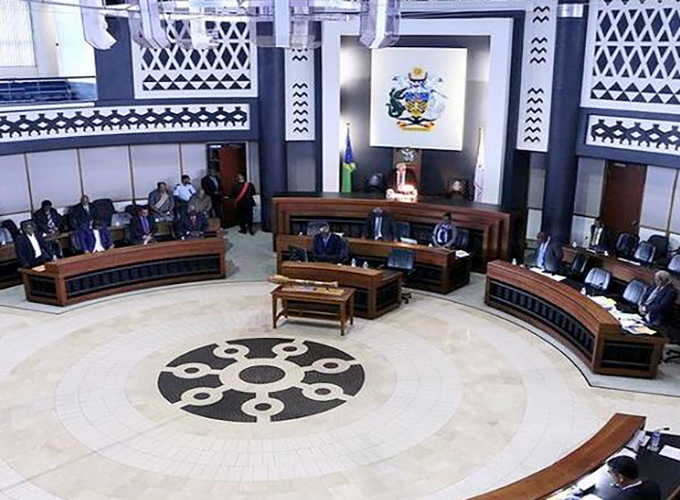
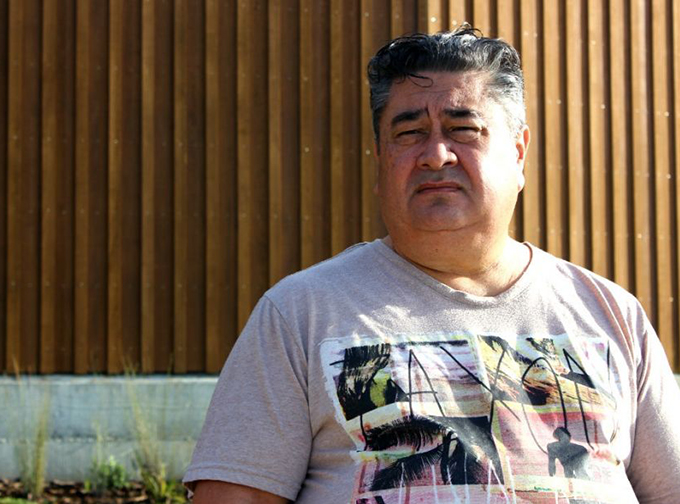
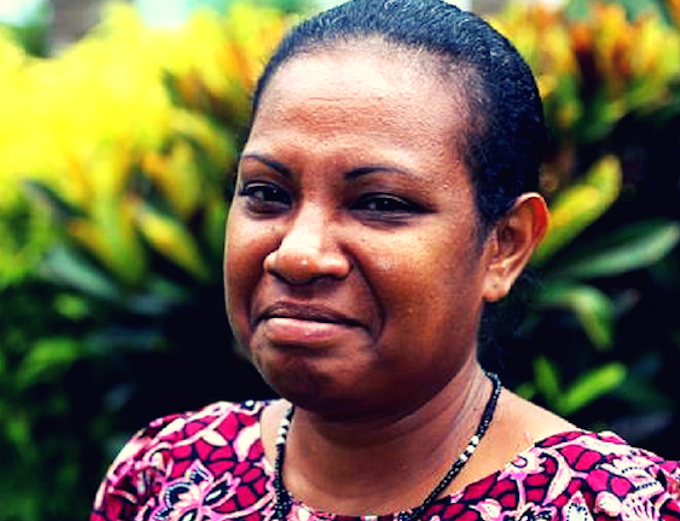
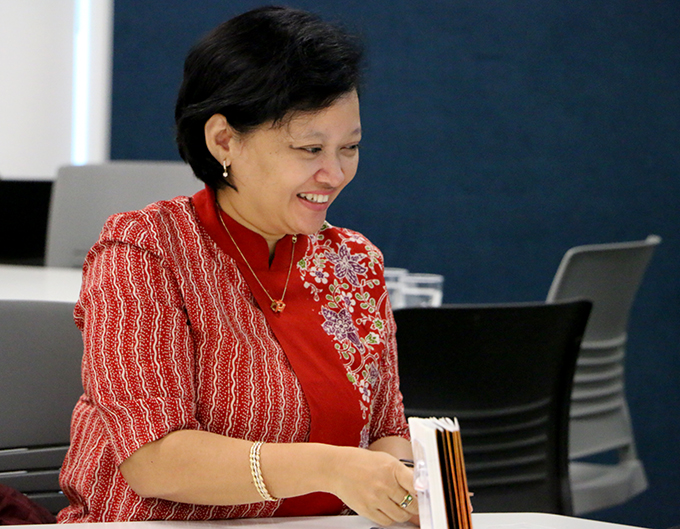
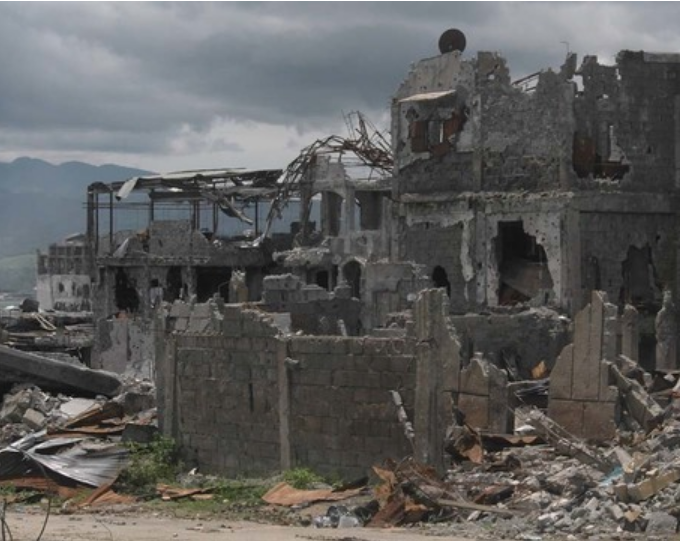
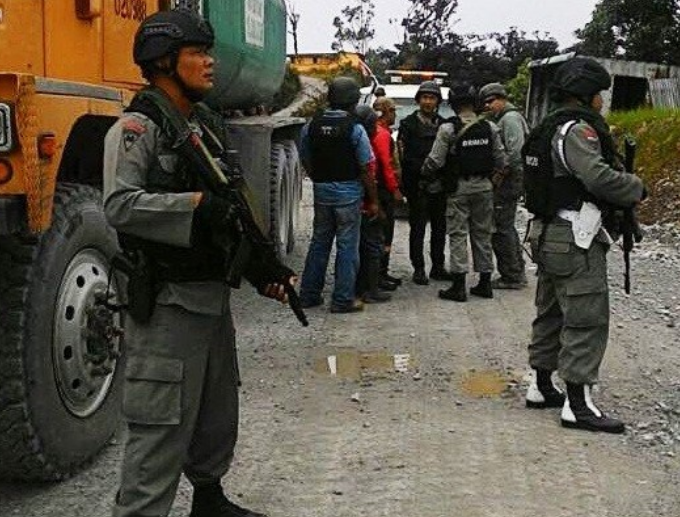
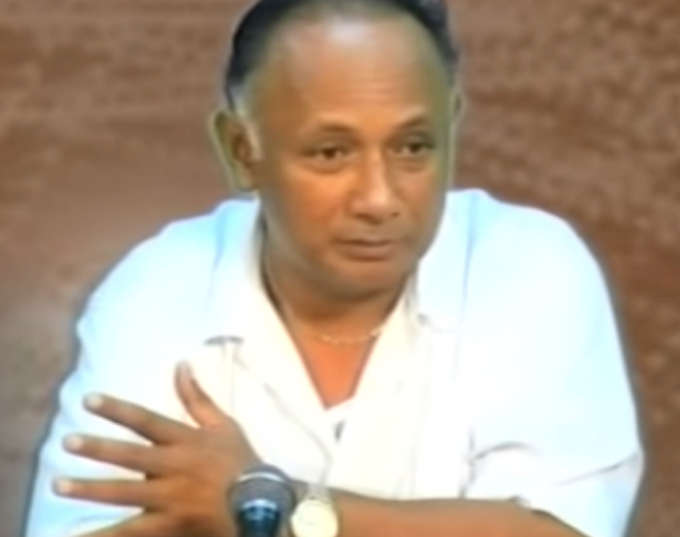
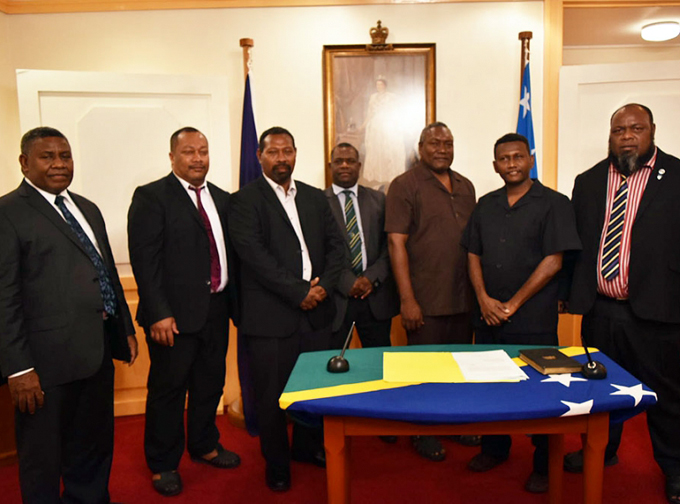
 PM Sogavare’s efforts to consolidate government after political instability … eight new ministers appointed. Not pictured: Duddley Kopu. Image: Solomon Star News.
Sogavare appoints eight new ministers in effort to consolidate government

Following the resignation of nine ministers last weekend Prime Minister Manasseh Sogavare has made moves to consolidate the coalition government.
The Solomon Islands Broadcasting Corporation (SIBC) reports Sogavare has sworn in eight new ministers.
Ishmael Avui, Minister for Development, Planning and Aid Coordination; Augustine Auga, Minister for Agriculture and Livestock Development; Nestor Ghiro, Minister for Provincial Government and Institutional Strengthening; Bradley Tovosia, Minister for Forestry and Research; Moses Garu, Minister for Home Affairs; Jimson Fiau Tanagada, Minister for Police, National Security and Correctional Services; Dickson Mua, Minister for Mines, Energy and Rural Electrification; and Duddley Kopu, Minister for Agriculture and Livestock Development took their oaths Wednesday afternoon.
Sogavare’s assistant press secretary, Alex Akwai, said the government is trying to maintain stability in the current political situation.
He told SIBC: “Political stability is one important thing for the government in terms of progress and development.”
Among those who resigned last weekend, Garu and Mua told Solomon Star News they returned to the ranks of the Democratic Coalition for Change Government (DCCG) coalition as joining the Opposition to remove Sogavare would make no positive difference to national development.
Mua added there was no justified reason for removing Sogavare as it would only cause uncertainty and was not in the national interest.
Sogavare hits out
Sogavare has hit-out at the ministers who resigned and the motion of no confidence against him, stating the defectors were apprehensive about the country’s anti-corruption bill, which is to be introduced in parliament on Monday.
“Some of these resignations come as no surprise based on the fact that some of these same Ministers were responsible for undermining the progress of the ACB and the Opposition and Independent Parliamentary Groups have inadvertently aligned themselves with this agenda,” a statement from the prime minister’s office said Sunday.
Sogavare said that despite the ministers provoking political instability, the DCCG remained “confident” the national interest would prevail over personal agendas.
Sogavare added the return of Garu and Mua was a testament to this.
However, former deputy prime minister Manasseh Maelanga has rejected such accusations concerning the ACB, labelling them a cheap attack strategy, SIBC reports.
Maelanga said the ministers and backbenchers resigned due to personal convictions and on individual grounds.
“When we resigned, it shows that there is no trust and confidence in the Prime Minister, and that is why we resigned,” he said.
Continued ACB work
Maelanga stated both himself and those who had resigned would continue and complete the work to get the ACB through parliament, which he had initiated as acting prime minister following a petition by civil society representatives to have it brought back.
“It’s a clear picture that it is not the anti-corruption bill that we resigned from.”

Article by AsiaPacificReport.nz
]]>RSF condemns ‘gag’ of Tonga’s state broadcaster ahead of general election

RSF condemns government ‘gag’ of TBC … transfer of senior journalists Laumanu Petelō (right) and Viola Ulakai. Image: Kalino Latu/Kaniva Tonga
Pacific Media Watch Newsdesk
Reporters Without Borders (RSF) has condemned moves by Prime Minister ‘Akilisi Pōhiva’s government to “gag” the Tonga Broadcasting Commission prior to the general election on November 16.
RSF says it joins those who have criticised a decision to deprive two senior public broadcasting journalists of all editorial responsibility in what it says is an “apparent government move to seize control of the state media”.
“Ever since it took office in late 2014, the Pōhiva administration has been trying to intimidate those within the TBC who don’t toe the line,” said Daniel Bastard, the head of RSF’s Asia-Pacific desk in a statement.
“The prime minister needs to understand that public service broadcasting does not mean government propaganda.
“If guarantees of media independence are not given quickly, international bodies, including the Commonwealth, will have to reconsider the aid they provide to Tonga,” Bastard added.
RSF’s condemnation comes after TBC’s chief editor Laumanu Petelō and news manager Viola Ulakai were controversially transferred out of the newsroom and into a marketing and sales department known as “NGO Services”, as reported by Pacific Media Watch.
The decision was made by TBC’s new chairman Dr Tevita Tu’i Uata, who has said the broadcaster’s restructure came due to a news failure.
Uata Pohiva’s ‘ally’
“The problem is that the content is not popular, that’s why it ran at a loss,” he told Kaniva News.
RSF states Dr Uata’s appointment a month ago was the “first step” to seize control of the TBC, which oversees two state TV channels and two state radio stations, as he is an “ally” of Pōhiva.
Petelō and Ulakai’s lawyer, Clive Edwards, said the transfer was illegal as it violates their contracts.
Edwards said the move was also dangerous due to Dr Uata’s attitude of using his position for campaigning and accused the government of “trying to control the media”, RSF reports.
Both Petelō and Ulakai had had run-ins with Pōhiva, with his administration launching several legal actions against the senior journalists in the past three years.
Ulakai was suspended in April 2015 on the recommendation of the minister of public enterprises after asking Pōhiva “too many tough questions”.
Petelō told the prime minister during a press conference in March “we are not your enemy” following comments by Pōhiva the role of the media was to “facilitate the work of government”.
Tonga is ranked 49th out of 180 countries in RSF’s 2017 World Press Freedom Index, after falling 12 places in the space of a year.
Article by AsiaPacificReport.nz
]]>Bryce Edwards’ Political Roundup: The Coalition’s very clever ban on foreign house sales
Bryce Edwards’ Political Roundup: The Coalition’s very clever ban on foreign house sales
[caption id="attachment_13635" align="alignright" width="150"] Dr Bryce Edwards.[/caption]
The new coalition government looks set to record a big political win with its very clever plan to ban house sales to foreigners. Previously Labour’s policy of banning foreigners from buying houses in New Zealand had appeared to be a difficult promise to achieve – mainly because of the government’s responsibilities under existing and upcoming trade deals.
The main problem was with the looming Trans Pacific Partnership (TPP) deal, which Labour may well sign New Zealand up to. But it now seems that the coalition government can avert any conflict between the ban and the trade deal, simply by introducing the ban before the TPP is signed and implemented. Patrick Gower explains it like this: “Ardern has got into power, asked the officials and they have come up with a very simple ‘hack’ – bring in the ban before the trade deal is signed off. If this is true, it was a damn easy fix” – see: Jacinda Ardern goes for 2-for-1 ban and TPP deal.
What will the foreign buyer ban achieve?
[caption id="attachment_35" align="alignleft" width="300"]
Dr Bryce Edwards.[/caption]
The new coalition government looks set to record a big political win with its very clever plan to ban house sales to foreigners. Previously Labour’s policy of banning foreigners from buying houses in New Zealand had appeared to be a difficult promise to achieve – mainly because of the government’s responsibilities under existing and upcoming trade deals.
The main problem was with the looming Trans Pacific Partnership (TPP) deal, which Labour may well sign New Zealand up to. But it now seems that the coalition government can avert any conflict between the ban and the trade deal, simply by introducing the ban before the TPP is signed and implemented. Patrick Gower explains it like this: “Ardern has got into power, asked the officials and they have come up with a very simple ‘hack’ – bring in the ban before the trade deal is signed off. If this is true, it was a damn easy fix” – see: Jacinda Ardern goes for 2-for-1 ban and TPP deal.
What will the foreign buyer ban achieve?
[caption id="attachment_35" align="alignleft" width="300"] Auckland housing market.[/caption]
Obviously the intention of the ban is to reduce competition for buying houses, therefore limiting price increases. But will this really work?
Not according to former National staffer Gwynn Compton, who says the effect of the ban will be “None. Zilch. Nada” – see: The pointlessness of a foreign buyer ban. He says “Australia implemented the same thing in December 2008 it had no impact there either. In fact, much like New Zealand’s prices, house prices in Sydney and Melbourne have nearly doubled since 2008.”
Referring to the fact that foreigners will still be allowed to buy new houses, Compton says that the only impact of the new rules will be to shift “the two or three per cent of property investment that comes from overseas from existing homes to new builds instead. The small resulting increase in prices there pushes citizens and residents back into the existing home market, and thus increases competition there by the same amount. The overall result? You’re no better off than you were before, unless you’re a property developer.”
Property Institute CEO Ashley Church also emphasises that the main impact will be to push investment towards new builds. He was quoted on TVNZ Breakfast saying, “It’s not a ban, it’s a redirection of investment… Foreign investors who want to invest in New Zealand residential property they can still do so, but they’ve got to invest it in the construction of new buildings. That’s a good thing for the economy, with 40,000 houses in Auckland required almost straight away” – see: Foreign buyer ban ‘more symbolic’, effect on first home buyers ‘almost none’, says Property Institute CEO.
Real estate agents also think the ban will have little impact on their business – see Adriana Weber’s Foreign home-buyer ban: will it make any difference? The same article cites economist Gareth Kiernan saying that “many foreigners had already been squeezed out of the market by the banks toughening up restrictions on foreign investors.”
Kiernan is also quoted on the slowdown of overseas investment in housing in Susan Edmunds’ article, Foreign buyer ban will affect small proportion of property sales. He says “the major banks have stopped approving mortgages based on overseas income” and the “Chinese government has also tightened the restrictions around the ability of Chinese nationals to move money out of China”.
In the same article BNZ chief economist Tony Alexander warns “we don’t know to what extent buyers will find ways around the rules, such as getting friends and relations already here to purchase on their behalf, as has apparently been happening in the Asian communities, according to anecdotes”.
The foreign buyer ban is politically powerful
[caption id="attachment_4843" align="alignleft" width="300"]
Auckland housing market.[/caption]
Obviously the intention of the ban is to reduce competition for buying houses, therefore limiting price increases. But will this really work?
Not according to former National staffer Gwynn Compton, who says the effect of the ban will be “None. Zilch. Nada” – see: The pointlessness of a foreign buyer ban. He says “Australia implemented the same thing in December 2008 it had no impact there either. In fact, much like New Zealand’s prices, house prices in Sydney and Melbourne have nearly doubled since 2008.”
Referring to the fact that foreigners will still be allowed to buy new houses, Compton says that the only impact of the new rules will be to shift “the two or three per cent of property investment that comes from overseas from existing homes to new builds instead. The small resulting increase in prices there pushes citizens and residents back into the existing home market, and thus increases competition there by the same amount. The overall result? You’re no better off than you were before, unless you’re a property developer.”
Property Institute CEO Ashley Church also emphasises that the main impact will be to push investment towards new builds. He was quoted on TVNZ Breakfast saying, “It’s not a ban, it’s a redirection of investment… Foreign investors who want to invest in New Zealand residential property they can still do so, but they’ve got to invest it in the construction of new buildings. That’s a good thing for the economy, with 40,000 houses in Auckland required almost straight away” – see: Foreign buyer ban ‘more symbolic’, effect on first home buyers ‘almost none’, says Property Institute CEO.
Real estate agents also think the ban will have little impact on their business – see Adriana Weber’s Foreign home-buyer ban: will it make any difference? The same article cites economist Gareth Kiernan saying that “many foreigners had already been squeezed out of the market by the banks toughening up restrictions on foreign investors.”
Kiernan is also quoted on the slowdown of overseas investment in housing in Susan Edmunds’ article, Foreign buyer ban will affect small proportion of property sales. He says “the major banks have stopped approving mortgages based on overseas income” and the “Chinese government has also tightened the restrictions around the ability of Chinese nationals to move money out of China”.
In the same article BNZ chief economist Tony Alexander warns “we don’t know to what extent buyers will find ways around the rules, such as getting friends and relations already here to purchase on their behalf, as has apparently been happening in the Asian communities, according to anecdotes”.
The foreign buyer ban is politically powerful
[caption id="attachment_4843" align="alignleft" width="300"] David Parker, New Zealand’s Minister for Economic Development, Minister for the Environment, Minister for Trade and Export Growth, and Attorney-General.[/caption]
The coalition government has stepped back from suggesting that the change will make a huge difference to housing affordability. Instead, David Parker is emphasising that the ban is an “important point of principle” – see Laura Walters’ How much of a difference will the foreign house buyers ban make?
Parker has been focusing on the more ideological aspect of how the ban fits into the fight against inequality, saying the ban is aimed at the rich elite and will affect the “one per cent” – see Sarah Robson’s Foreign home buyers to be banned – PM. Parker explains: “Just about everyone who buys who’s a foreign person buying into New Zealand – they’re a very very wealthy ‘1 percenter’… And I think that’s one of the excesses of global capital, when you allow those sorts of interests to influence your housing market.”
Therefore, this big first move of the coalition government can be seen as symbolically very important. And that’s what Patrick Gower argued this morning, saying “It sends the symbol that this Government is different to the last one, on housing in particular” – see Newshub’s Labour’s foreign housing ban ‘symbolism’ – Patrick Gower. And he says it will be politically powerful: “Gower argued the ban is supported by two-thirds of the public, and the Government will get credit from voters for instituting it.”
An even more sceptical view is that this big announcement can be seen as a sop to leftwing coalition supporters who are soon going to have to accept the Government signing up to the TPP. This is the argument made by Rob Hosking in the NBR: “So this week’s announcement was part distortion – the foreign buyers announcement is good crowd-pleasing stuff but it won’t mean much at this point in the housing cycle – and part the start of a softening process” – see: Ardern drops ‘sovereignty’ concerns over TPP (paywalled).
To go even further, here’s Mike Hosking’s view that the housing buying ban is entirely pragmatic: “This so-called ban is window dressing, it’s xenophobic, made-up political bollocks for expediency purposes and nothing else. It’s the move you make to make you look like you’re doing something, when in reality it’s for headlines and coalition promises – not for any real effect. It’s the work of inexperienced amateurs” – see: Foreign house buyer ban ‘xenophobic bollocks’.
Labour’s beef with National
Patrick Gower says this could be a big win for the prime minister, and predicts “It will be extremely embarrassing for National, if she pulls this off, as it said it could never be done.” And National’s prior role in trying to prevent Labour from achieving a ban is now in the spotlight.
Ardern herself has come out and criticised the former National Government, saying that it now seems they didn’t even ask their officials for advice on whether a ban on foreigners buying houses was possible. Some speculate that National actually went out of their way to “wedge” Labour on the issue.
Vernon Small explains that when the former government was negotiating the TPP, it deliberately chose not to include the possibility for a future government to implement a foreigner ban on house buying. He asks: “Was National’s decision to exclude a ban on foreign buyers of Kiwi homes from free trade deals a poison pill left for Labour to swallow?” – see: Foreign buyers ban in, Labour points finger at Nats for ‘misleading’ over free trade clash.
Small reports that “there has been speculation that former prime minister John Key and his team were explicit – leave it out. If they were so weasel-cunning it’s easy to see how the logic would flow; create an irreconcilable clash between Labour’s policy on foreign house buyers and the TPP so they can have one but not the other.”
Labour clearly blames National and its former trade negotiator, Tim Groser for the problem. New minister for trade negotiations, David Parker, has expressed bitter disappointment that National wouldn’t cooperate with Labour, so as to maintain a bi-partisan consensus on trade agreements. In an interview with the Herald, Parker says: “It has absolutely been clear for many, many years that the Labour Party in terms of trying to maintain bipartisan consensus around this has been strong on this ability to have New Zealand markets for our land, not international markets, and therefore how the last government chose to do that was an attempt to wedge us” – see Audrey Young’s David Parker targets trade deal and bar on house sales to overseas buyers.
Of course, now Groser is the Government’s diplomatic representative in Washington, and the question of his re-call is therefore on the agenda. Parker says this is a matter for Winston Peters, as Foreign Minister, to decide, but adds: “He is one of the people who wedged us on this issue” and “He was pretty central to those decisions.”
The AgriHQ publication has recently put across the view that in the previous National Government, “Tim Groser tried and failed to persuade Cabinet colleagues to accommodate the Labour Party’s previous policy of restricting house purchases by non-residents to preserve a long-standing consensus on trade policy between the two major parties” – see Nigel Stirling’s Groser backed trade policy. However, according to this account, “the recommendation never saw the light of day after a ‘captain’s call’ from then Prime Minister John Key and National campaign manager Steven Joyce in the middle of the Korean talks meant Groser was forced to back down.”
This is also covered by Richard Harman in his column, Did National play politics with MFAT’s TPP advice? Harman says this account reinforces the “suspicion that National played partisan politics with the TPP.” But he points to a briefing paper produced by the Ministry of Foreign Affairs and Trade, which also appears to give poor advice on these issues. Harman says: “That calls into question the quality of the advice given to the previous Government on the TPP and raises the question as to whether it was advice tailored to be acceptable to the National Government”.
Finally, for satire on this issue, see my blog post, Cartoons about foreign house sales and TPP.]]>
David Parker, New Zealand’s Minister for Economic Development, Minister for the Environment, Minister for Trade and Export Growth, and Attorney-General.[/caption]
The coalition government has stepped back from suggesting that the change will make a huge difference to housing affordability. Instead, David Parker is emphasising that the ban is an “important point of principle” – see Laura Walters’ How much of a difference will the foreign house buyers ban make?
Parker has been focusing on the more ideological aspect of how the ban fits into the fight against inequality, saying the ban is aimed at the rich elite and will affect the “one per cent” – see Sarah Robson’s Foreign home buyers to be banned – PM. Parker explains: “Just about everyone who buys who’s a foreign person buying into New Zealand – they’re a very very wealthy ‘1 percenter’… And I think that’s one of the excesses of global capital, when you allow those sorts of interests to influence your housing market.”
Therefore, this big first move of the coalition government can be seen as symbolically very important. And that’s what Patrick Gower argued this morning, saying “It sends the symbol that this Government is different to the last one, on housing in particular” – see Newshub’s Labour’s foreign housing ban ‘symbolism’ – Patrick Gower. And he says it will be politically powerful: “Gower argued the ban is supported by two-thirds of the public, and the Government will get credit from voters for instituting it.”
An even more sceptical view is that this big announcement can be seen as a sop to leftwing coalition supporters who are soon going to have to accept the Government signing up to the TPP. This is the argument made by Rob Hosking in the NBR: “So this week’s announcement was part distortion – the foreign buyers announcement is good crowd-pleasing stuff but it won’t mean much at this point in the housing cycle – and part the start of a softening process” – see: Ardern drops ‘sovereignty’ concerns over TPP (paywalled).
To go even further, here’s Mike Hosking’s view that the housing buying ban is entirely pragmatic: “This so-called ban is window dressing, it’s xenophobic, made-up political bollocks for expediency purposes and nothing else. It’s the move you make to make you look like you’re doing something, when in reality it’s for headlines and coalition promises – not for any real effect. It’s the work of inexperienced amateurs” – see: Foreign house buyer ban ‘xenophobic bollocks’.
Labour’s beef with National
Patrick Gower says this could be a big win for the prime minister, and predicts “It will be extremely embarrassing for National, if she pulls this off, as it said it could never be done.” And National’s prior role in trying to prevent Labour from achieving a ban is now in the spotlight.
Ardern herself has come out and criticised the former National Government, saying that it now seems they didn’t even ask their officials for advice on whether a ban on foreigners buying houses was possible. Some speculate that National actually went out of their way to “wedge” Labour on the issue.
Vernon Small explains that when the former government was negotiating the TPP, it deliberately chose not to include the possibility for a future government to implement a foreigner ban on house buying. He asks: “Was National’s decision to exclude a ban on foreign buyers of Kiwi homes from free trade deals a poison pill left for Labour to swallow?” – see: Foreign buyers ban in, Labour points finger at Nats for ‘misleading’ over free trade clash.
Small reports that “there has been speculation that former prime minister John Key and his team were explicit – leave it out. If they were so weasel-cunning it’s easy to see how the logic would flow; create an irreconcilable clash between Labour’s policy on foreign house buyers and the TPP so they can have one but not the other.”
Labour clearly blames National and its former trade negotiator, Tim Groser for the problem. New minister for trade negotiations, David Parker, has expressed bitter disappointment that National wouldn’t cooperate with Labour, so as to maintain a bi-partisan consensus on trade agreements. In an interview with the Herald, Parker says: “It has absolutely been clear for many, many years that the Labour Party in terms of trying to maintain bipartisan consensus around this has been strong on this ability to have New Zealand markets for our land, not international markets, and therefore how the last government chose to do that was an attempt to wedge us” – see Audrey Young’s David Parker targets trade deal and bar on house sales to overseas buyers.
Of course, now Groser is the Government’s diplomatic representative in Washington, and the question of his re-call is therefore on the agenda. Parker says this is a matter for Winston Peters, as Foreign Minister, to decide, but adds: “He is one of the people who wedged us on this issue” and “He was pretty central to those decisions.”
The AgriHQ publication has recently put across the view that in the previous National Government, “Tim Groser tried and failed to persuade Cabinet colleagues to accommodate the Labour Party’s previous policy of restricting house purchases by non-residents to preserve a long-standing consensus on trade policy between the two major parties” – see Nigel Stirling’s Groser backed trade policy. However, according to this account, “the recommendation never saw the light of day after a ‘captain’s call’ from then Prime Minister John Key and National campaign manager Steven Joyce in the middle of the Korean talks meant Groser was forced to back down.”
This is also covered by Richard Harman in his column, Did National play politics with MFAT’s TPP advice? Harman says this account reinforces the “suspicion that National played partisan politics with the TPP.” But he points to a briefing paper produced by the Ministry of Foreign Affairs and Trade, which also appears to give poor advice on these issues. Harman says: “That calls into question the quality of the advice given to the previous Government on the TPP and raises the question as to whether it was advice tailored to be acceptable to the National Government”.
Finally, for satire on this issue, see my blog post, Cartoons about foreign house sales and TPP.]]>
NZ exhibition aims to highlight ‘regeneration’ of refugees lives

By Kendall Hutt in Auckland
Black-and-white photographs are aiming to start a conversation and dispel myths around former refugees and asylum seekers in New Zealand.
Transplanted: Refugee portraits of New Zealand showcases two-metre tall, black-and white-close-up portraits of former refugees by award-winning photographer Alistair Guthrie.
The portraits are currently on display in a ten-day exhibition at the New Zealand Portrait Gallery in Wellington.
“Refugees lives have been pulled up from the roots and transplanted on new soil,” explains curator and journalist Tracey Barnett.
“I created Transplanted because I wanted to show the regeneration of lives, that these people can become our future – carpenters and teachers and insurance brokers and our art gallery directors just like anyone else.
“In New Zealand about roughly 45 percent of our quota intake are children. They grow up to be Kiwis in every sense of the word.
“You may not even recognise that they began life as a refugee because they speak with a Kiwi accent, eat pineapple lumps, and cheer for the All Blacks on a Saturday night just as loudly as anyone else,” Barnett said.
Refugee ‘talking space’
Transplanted opened with a talk by former Prime Minister Sir Geoffrey Palmer on Friday and continues until Sunday, November 5 with insights from former refugees and international diplomats.
The gallery exhibition is also a “refugee talking space”, intended to turn the tide on negative perceptions of refugees, both globally and closer to home.
“It has been incredibly saddening and worrying to see the label of refugees become so disrespected.
“These people have overcome tremendous odds and tremendous difficulties to get to safety, something any of us would aspire to,” Barnett told Asia Pacific Report.
Barnett, who serves on the executive board of the Refugee Council of New Zealand, said the media was partly to blame.
“Unfortunately the media shows these people always in the worst moments of their lives, but the reality is that it’s just one short chapter of a much bigger life.”
A highlight has been the ‘Human Library’ sessions, Barnett said, where former refugees speak one-on-one with the public.
Lives in limbo
“It’s been incredibly moving, enjoyable and informative I think for everyone who’s participated and it’s a real highlight.”
But while some refugees lives have been “transplanted on new soil” in New Zealand, the lives of asylum seekers in one of Australia’s offshore detention centres remain in limbo.
“These refugees have every reason to be afraid and every reason to be worried that they will not be protected and they will not be safe,” Barnett said.
The words of Wage Peace NZ’s founder come as a 2013 offer by New Zealand to take in 150 refugees a year from Australia’s detention centres remains “nixed” by Australia.
This means asylum seekers on Manus Island, around 600 of whom are refusing to leave the now closed centre, are being forced to relocate to several sites in nearby Lorengau – including the Manus Refugee Transit Centre – or “trade one hell for another” for the “other prison island” of Nauru where human rights abuses are rife, Barnett said.
Many of the single men who remain on Manus fear for their lives, with reports locals have allegedly already looted the centre.
Barnett said “there have been worrying and frightening outbreaks of violence” in the past.
Manus supplies cut
These outbreaks of violence include a shooting on April 14, 2017 in which bullets were directly fired into the refugee centre by security forces.
All power, water and food supplies have stopped at the refugee processing centre.
A notice posted by Papua New Guinea’s Immigration and Citizenship Service Authority stated all staff had left and the site would be returned to the Defence Force today.
“This is the last communication you will receive at this location,” the notice stated.
Closure of Australia’s detention centre on Manus Island … “will not end refugee suffering”. Image pixelated by SBS. Image: SBS NewsThe closure of Manus Island comes after PNG’s Supreme Court ruled last year the centre was illegal and unconstitutional.
Barnett said New Zealand’s new Labour-led government should also be applying “huge pressure” and push to renegotiate its 2013 deal with Australia.
“This makes a perfect opportunity for Prime Minister Jacinda Ardern to stand back and say ‘I’m a new government, this is a new possibility, let’s talk about doing this as a one-off instead and helping you evacuate the camps, but you must agree to not reopen them’,” Barnett said.
Examine NZ offer
Ardern has said she would renew the offer after examining the proposal Australia continues to reject.
“I want to look at the detail of the offer that was made and the obligations that we’ve set out that we would take on,” she said.
“Of course that would be within our refugee quota, and within existing intent that we’ve shared with the UN around taking UN mandated refugees.”
Green MP Golriz Ghahraman, herself a former refugee from Iran, has recently labelled New Zealand’s alleged silence over the past four years as ‘complicity’.
Former refugee Golriz Ghahraman … New Zealand silence on Manus Island issue equals “complicity” in Australia’s human rights abuses. Image: Alistair GuthrieGhahraman will be speaking this evening at the exhibition on the ‘I am not a label: Young refugee voices’ panel.
Manus Island’s closure also provides an opportunity to provide “fresh eyes” on New Zealand’s own refugee policies, Barnett said.
“New Zealand has never pulled its weight when it comes to our quota.
‘We can do more’
“Unfortunately we rank 95th worst in the world per capita for the total number of refugees and asylum seekers we host.
“If you measure it by our relative wealth, our GDP, it’s even worse and we rank 121st worst in the world.
“That isn’t good enough and we can do more,” Barnett said.
Although it was “wonderful” New Zealand’s quota was going up to 1500, Barnett stated it would be a while before refugees felt its impact.
“The quota is only reviewed every three years and we’ll be changing our quota in 2018. It will be several years again before we hit that 1500 mark.
“I’m hoping that the government will consider changing that number earlier and faster to make a bigger impact.
“We can do more and we should.”
Article by AsiaPacificReport.nz
]]>Bryce Edwards’ Political Roundup: The surprising new power behind Winston Peters

Bryce Edwards’ Political Roundup: The surprising new power behind Winston Peters
[caption id="attachment_13635" align="alignright" width="150"] Dr Bryce Edwards.[/caption]
As the new coalition government forms, a number of crucial staffing appointments are being made by Labour, New Zealand First and the Greens. Some of these jobs are incredibly important, as the people in them can end up being more powerful than most of the MPs in the party caucuses. Depending on the role and the person appointed, they can become a central part of the success or otherwise of a government or party in power.
The most interesting new appointment announced so far, is that of political scientist Jon Johansson to the role of Chief of Staff for New Zealand First – see Jo Moir’s news report, Political scientist Jon Johansson made NZ First chief of staff.
A surprising appointment
[caption id="attachment_15343" align="alignleft" width="225"] Political scientist Jon Johansson is NZ First’s new chief of staff.[/caption]
Judging by reactions, everyone has been entirely surprised by Johansson’s shift from being a political scientist to a political player. And certainly, it’s quite unusual for a political scientist to go from teaching politics to practicing it.
But it does happen from time to time. National’s controversial Jian Yang is a prime example, having previously taught politics at the University of Auckland. And for the latest on him, see Matt Nippert’s article yesterday, Three unanswered questions about our spy-trainer MP.
But perhaps it’s not entirely surprising that Johansson has shifted into politics. He’s long been very close to many politicians and others around the Beehive. In fact, few university academics would know the corridors of power as well as Johansson – he’s a creature of the Wellington political scene like no other, and should have little trouble shifting from the classroom to the Beehive.
A surprising party to go with
That the Victoria University of Wellington lecturer has chosen to pin his colours to New Zealand First is a surprise for most political followers. After all, in the past he has been more associated with Labour and the Greens, and in the lead-up to the 2014 election he advised these opposition parties in their quest to project themselves as a coherent alternative government.
There will inevitably be ideological questions about Johansson’s shift into partisan politics. In the past, as an academic and political commentator he has endeavoured to be as objective as possible. However, he has previously been forthright when it comes to what might be regarded as “socially conservative” ideologies or policies. For example, he became the major academic critic of Don Brash’s Orewa Speech. And it will be interesting to see how he will respond in his new role when inevitably confronted with socially conservative politics involving New Zealand First.
Why Johansson’s appointment is smart
Johansson’s affinity with Winston Peters will make him a good fit with the New Zealand First leader. He will play the role of Peters’ right-hand-man. And because Johansson is a leading expert in political strategy and New Zealand politics, he will be very valuable to New Zealand First.
Furthermore, Johansson’s academic specialty is in political leadership. He is already highly aware of Peters’ strengths and weaknesses. He knows how leadership works, leaders succeed, and how Peters can best create a legacy as one of the top political leaders of our era. If nothing else, we can expect to see some spectacular new speeches from the New Zealand First leader.
But more than this, Johansson’s appointment is smart because the political scientist is also close to Labour and the Greens. His role as chief of staff is primarily going to involve coalition management, ensuring that the New Zealand First caucus and staff are working together with their counterparts. Because Johansson is already close to the two other parties, he will be well placed to ensure coalition stability and make sure that New Zealand First’s interests are looked after by Labour and the Greens.
The fact that Johansson does not have a history of involvement in the New Zealand First party could be considered a disadvantage in his role as chief of staff. After all, he won’t be aware of the configurations of power and policy within his new party. And he’s essentially an outsider, coming in to manage people who don’t know him or necessarily trust him. But this could also be an advantage. He won’t be tainted by any of the factional differences and loyalties in the party. He therefore comes in as a more independent manager of the party, and this may help when dealing with disputes and differences.
He will also have a greater degree of objectivity, which can be very useful in these roles. It’s not always good to have a party activist running the parliamentary operations of a political party. Sometimes having someone with a background and strong ideological belief in a party can be a handicap.
Why Johansson’s appointment is risky
Of course, successful political management isn’t simply a matter of knowing all the theory, and Johansson is coming into this important management role with no proven record or experience in the nitty-gritty of how Parliament works.
Added to that, the New Zealand First party is one of the more elusive and mysterious political vehicles around. So, landing straight at the top of this empire – albeit beside Winston Peters – might still prove a difficult task. He will need to show that he has the temperament and diplomacy to deal with complicated and difficult coalition and internal-party problems.
As an outsider, Johansson may also not be in the best position to wield his considerable new power in a way that will protect the party. “Guns for hire” often don’t have the knowledge and emotional commitment that enables them to advance the party’s core interests, and inevitably they are readier to compromise on issues in a way that a “true believer” in the party might see as “selling out”.
After all, there will be many party activists and MPs who have slogged away to get the party into government, and may feel that suddenly an outsider has taken the most powerful job in the parliamentary team. And there will be doubts that he knows how New Zealand First voters really think and feel, like they do.
Also, Johansson’s perceived closeness to Labour could be a problem. Those in New Zealand First might come to regard him as being too ready to give way to Labour and the Greens, or that in his liaisons with the coalition partners he is vulnerable to “Stockholm Syndrome”.
Johansson’s past political commentary
New Zealand First’s political opponents and the media will look to Johansson’s many articles, chapters, books, and media appearances to find critical statements he’s made about Winston Peters and his party. Some of this might make for interesting reading. Already, one person on Twitter has tweeted a statement of Johansson’s from 2005: “Well, that he was mercurial, charismatic, but really was never a team player, and as such, in terms of legacy, there’s really not much of a record there at all. It’s always in a sense been more of a style over substance.” And interestingly enough, Winston Peters then “liked” this on Twitter.
And during the election campaign, Johansson published a number of opinion pieces that might now be re-read in a new light. Here they are:
• Change is coming, ready or not.
• Game On: Dancing with the Zeitgeist.
• Battling the zeitgeist.
• The big crunch – minor party struggles .
• Turei, Key to Labour’s surge.
• Can National overcome the three-term curse?
• Relentlessly positive vs relentlessly dissatisfied.
• Ardern is ‘standout leader’ of post-Clark Labour.
Finally, many journalists were taught by Johansson when they studied politics at Victoria University of Wellington. Press gallery reporter Henry Cooke (@henrycooke), for example, on hearing of Johansson’s appointment tweeted his lecture notes from 11/05/12: “Winston will want to be part of the next election. He might enter some kind of abstention agreement. He stands to gain more from National than Labour. Jon thinks Jacinda has potential as leader, like a young 21st Clark with warmth.” For more such tweets, see Top tweets about Jon Johansson becoming NZ First Chief of Staff.]]>
Political scientist Jon Johansson is NZ First’s new chief of staff.[/caption]
Judging by reactions, everyone has been entirely surprised by Johansson’s shift from being a political scientist to a political player. And certainly, it’s quite unusual for a political scientist to go from teaching politics to practicing it.
But it does happen from time to time. National’s controversial Jian Yang is a prime example, having previously taught politics at the University of Auckland. And for the latest on him, see Matt Nippert’s article yesterday, Three unanswered questions about our spy-trainer MP.
But perhaps it’s not entirely surprising that Johansson has shifted into politics. He’s long been very close to many politicians and others around the Beehive. In fact, few university academics would know the corridors of power as well as Johansson – he’s a creature of the Wellington political scene like no other, and should have little trouble shifting from the classroom to the Beehive.
A surprising party to go with
That the Victoria University of Wellington lecturer has chosen to pin his colours to New Zealand First is a surprise for most political followers. After all, in the past he has been more associated with Labour and the Greens, and in the lead-up to the 2014 election he advised these opposition parties in their quest to project themselves as a coherent alternative government.
There will inevitably be ideological questions about Johansson’s shift into partisan politics. In the past, as an academic and political commentator he has endeavoured to be as objective as possible. However, he has previously been forthright when it comes to what might be regarded as “socially conservative” ideologies or policies. For example, he became the major academic critic of Don Brash’s Orewa Speech. And it will be interesting to see how he will respond in his new role when inevitably confronted with socially conservative politics involving New Zealand First.
Why Johansson’s appointment is smart
Johansson’s affinity with Winston Peters will make him a good fit with the New Zealand First leader. He will play the role of Peters’ right-hand-man. And because Johansson is a leading expert in political strategy and New Zealand politics, he will be very valuable to New Zealand First.
Furthermore, Johansson’s academic specialty is in political leadership. He is already highly aware of Peters’ strengths and weaknesses. He knows how leadership works, leaders succeed, and how Peters can best create a legacy as one of the top political leaders of our era. If nothing else, we can expect to see some spectacular new speeches from the New Zealand First leader.
But more than this, Johansson’s appointment is smart because the political scientist is also close to Labour and the Greens. His role as chief of staff is primarily going to involve coalition management, ensuring that the New Zealand First caucus and staff are working together with their counterparts. Because Johansson is already close to the two other parties, he will be well placed to ensure coalition stability and make sure that New Zealand First’s interests are looked after by Labour and the Greens.
The fact that Johansson does not have a history of involvement in the New Zealand First party could be considered a disadvantage in his role as chief of staff. After all, he won’t be aware of the configurations of power and policy within his new party. And he’s essentially an outsider, coming in to manage people who don’t know him or necessarily trust him. But this could also be an advantage. He won’t be tainted by any of the factional differences and loyalties in the party. He therefore comes in as a more independent manager of the party, and this may help when dealing with disputes and differences.
He will also have a greater degree of objectivity, which can be very useful in these roles. It’s not always good to have a party activist running the parliamentary operations of a political party. Sometimes having someone with a background and strong ideological belief in a party can be a handicap.
Why Johansson’s appointment is risky
Of course, successful political management isn’t simply a matter of knowing all the theory, and Johansson is coming into this important management role with no proven record or experience in the nitty-gritty of how Parliament works.
Added to that, the New Zealand First party is one of the more elusive and mysterious political vehicles around. So, landing straight at the top of this empire – albeit beside Winston Peters – might still prove a difficult task. He will need to show that he has the temperament and diplomacy to deal with complicated and difficult coalition and internal-party problems.
As an outsider, Johansson may also not be in the best position to wield his considerable new power in a way that will protect the party. “Guns for hire” often don’t have the knowledge and emotional commitment that enables them to advance the party’s core interests, and inevitably they are readier to compromise on issues in a way that a “true believer” in the party might see as “selling out”.
After all, there will be many party activists and MPs who have slogged away to get the party into government, and may feel that suddenly an outsider has taken the most powerful job in the parliamentary team. And there will be doubts that he knows how New Zealand First voters really think and feel, like they do.
Also, Johansson’s perceived closeness to Labour could be a problem. Those in New Zealand First might come to regard him as being too ready to give way to Labour and the Greens, or that in his liaisons with the coalition partners he is vulnerable to “Stockholm Syndrome”.
Johansson’s past political commentary
New Zealand First’s political opponents and the media will look to Johansson’s many articles, chapters, books, and media appearances to find critical statements he’s made about Winston Peters and his party. Some of this might make for interesting reading. Already, one person on Twitter has tweeted a statement of Johansson’s from 2005: “Well, that he was mercurial, charismatic, but really was never a team player, and as such, in terms of legacy, there’s really not much of a record there at all. It’s always in a sense been more of a style over substance.” And interestingly enough, Winston Peters then “liked” this on Twitter.
And during the election campaign, Johansson published a number of opinion pieces that might now be re-read in a new light. Here they are:
• Change is coming, ready or not.
• Game On: Dancing with the Zeitgeist.
• Battling the zeitgeist.
• The big crunch – minor party struggles .
• Turei, Key to Labour’s surge.
• Can National overcome the three-term curse?
• Relentlessly positive vs relentlessly dissatisfied.
• Ardern is ‘standout leader’ of post-Clark Labour.
Finally, many journalists were taught by Johansson when they studied politics at Victoria University of Wellington. Press gallery reporter Henry Cooke (@henrycooke), for example, on hearing of Johansson’s appointment tweeted his lecture notes from 11/05/12: “Winston will want to be part of the next election. He might enter some kind of abstention agreement. He stands to gain more from National than Labour. Jon thinks Jacinda has potential as leader, like a young 21st Clark with warmth.” For more such tweets, see Top tweets about Jon Johansson becoming NZ First Chief of Staff.]]>
Government in Solomon Islands ‘collapsing’ as MPs change allegiance

Solomon Islands government ‘intact’ says DCCG … 18 MPs switch allegiance to Opposition, Independents. Image: Loop PNG
A change of government is likely on the horizon for the Solomon Islands after several MPs changed allegiance.
The saga unfolded on Saturday following the resignation of seven cabinet ministers, including Deputy Prime Minister and Minister for Home Affairs Manasseh Maelanga.
Other ministers include Minister for National Planning and Aid Coordination Danny Philip, Snyder Rini, Minister for Fisheries and Marine Resources, Minister of Forestry and Research Chris Laore, Moses Garu, Minister of Police, National Security and Correctional Services, Minister of Public Service Moffat Fugui and Elijah Doromuala, Minister of Justice and Legal Affairs.
Deputy private secretary to the Governor-General, Rawcliffe Ziza, revealed the ministers resigned after losing confidence in Prime Minister Manasseh Sogavare, Solomon Star News reports, prompting the newspaper to headline the move as ‘Government collapsing’.
The drama continued Sunday as two more ministers resigned from the Democratic Coalition for Change Government (DCCG), bringing the total number of resignations to nine, the Solomon Islands Broadcasting Corporation (SIBC) reports.
The ministers were Minister of Provincial Government and Institutional Strengthening David Tome and Minister of Peace, National Unity and Reconciliation Samson Maneka.
Several backbenchers have also resigned, Solomon Star News reports, meaning 18 MPs have deserted Sogavare since Saturday.
MPs join Opposition
They have since joined the Opposition and Independents in a show of solidarity at the Honiara Hotel and again in parliament.
The move brought the ‘Honiara Hotel Camp’ to 29 members on Sunday, Solomon Star News reports.
Opposition ranks grow … 18 MPs switch allegiance from Sogavare-led Democratic Coalition for Change Government. Image: Solomon Star NewsThe SIBC also reports Sogavare will face a motion of no confidence when parliament resumes on Monday, November 6.
Speaker of Parliament Ajilon Jasper Nasiu received the motion from the leader of the Parliamentary Independent Group Dr Derek Sikua on Sunday.
According to an MP who wished to remain anonymous, a new prime minister will be elected within two weeks, the Solomon Star News reports.
“Members of the DCCG have totally lost all trust and confidence in the leadership of Sogavare.
“Sogavare has allowed his controversial nephew Robson Djokovic to control government affairs,” the MP said.
Government remains intact
It is believed Sogavare’s major cabinet shakeup – embarked on since early August – which saw several ministers reassigned and two terminated, upset the United Democratic Party, the major coalition partner of the DCCG.
A government issued statement said the government remains intact despite the walkout of nine ministers.
Article by AsiaPacificReport.nz
]]>Tūhoe leader’s address to deliver ‘hard truths’ about New Zealand

Tūhoe settlement, self-determination chief negotiator Tamati Kruger … ‘historic opportunity’ to deliver Bruce Jesson lecture. Image: Tamati Kruger.
By Alex Braae in Auckland
Tūhoe leader Tamati Kruger has some hard truths to deliver in his upcoming 2017 Bruce Jesson Memorial lecture.
The chair of Tūhoe Te Uru Taumatua says New Zealand needs to face up to the fact that “we create a reality to suit our time and our purpose, and some of it is quite dishonest”.
“In New Zealand we have a mythology that we are a clean green nation, when we are not. We have another mythology that we’re quite egalitarian and liberal. We are not.
“We are quite a cruel people to refugees and people who have emigrated here. We are not as tolerant as we pretend to be.
“We have these things we have to be truthful about, to repair and fix,” Kruger said.
Kruger will speak tomorrow at the University of Auckland in a lecture which honours the late journalist and political thinker Bruce Jesson. The lecture has been delivered in previous years by notable intellectuals, including Jane Kelsey, Nicky Hager and David Lange.
He will also be speaking about his experiences leading his iwi, Tūhoe’s settlement with the Crown, and the Te Urewera Act. Kruger was the chief negotiator for Tūhoe in the settlement process.
Navigating differing politics
He said an important part of leadership has involved navigating the difference between Māori and Pākehā politics.
“Part of the blessing of Pākehā politics is you have this apparatus called law, where you can bend people to one’s will. But in Tūhoe politics you have to depend on your reputation and integrity for people to find that whatever you have to say has some wisdom and truth in it.”
On taking up the mantle of leadership, he said he “got to the stage where I could not renounce my parents’ prayers that I contribute something back to the iwi.
“I don’t see myself as having to do what I do forever…I’m probably facing the end part of my contribution to the Tūhoe people and I just want to continue to do my very best.”
Acting chair of the Bruce Jesson Foundation, Simon Collins, said the theme of the lecture was always about “the most important issues that we face in New Zealand, and one of the big elephants in the room is the big disparity between Māori and everyone else”.
“What Tūhoe is doing is one of the most exciting responses to that. They’re taking it into their own hands to do something about the problem.
“That’s what we’re hoping Tamati Kruger can talk about – what they’re doing can have lessons for all of us.”
Alex Braae is a journalism major at the Auckland University of Technology.
Article by AsiaPacificReport.nz
]]>Fiji’s devastated Tukuraki village moves to new site after landslide

A Pacific Media Centre video at Tukuraki by the Bearing Witness team Julie Cleaver and Kendall Hutt in May.
Pacific Media Centre Newsdesk
After more than five years of living in temporary housing, the community of Tukuraki in the highlands of Fiji are this weekend celebrating as they move into their newly built, disaster resilient village.
The Tukuraki community – featured by the Pacific Media Centre’s Bearing Witness climate project in May – was devastated in 2012 as a landslide buried 80 percent of their village and tragically took the lives of a young family including a toddler and young baby.
The opening of the new Tukuraki village on Friday with SPC’s Dr Audrey Aumua (from left), Minister Inia Seruiratu and EU’s Christoph Wagner. Image: SPCThe community were forced to relocate to temporary homes as they were at risk of further landslides and in the midst of recovering from the landslide, the community was hit by Cyclone Evan only 10 months later.
In February last year, the community was again forced to flee to nearby caves as Tropical Cyclone Winston hit – the community’s third major disaster in four years.
As a result, the Fiji government deemed relocation for the inland community an urgent priority and approached the Pacific Community (SPC) to support in this work.
On Friday, 11 homes and a community hall built to category five cyclone standards were officially opened.
The F$756,000 relocation of the Tukuraki village to a safer and less disaster prone site was made possible through the European Union and the ACP Group of States-funded Building Safety and Resilience in the Pacific Project (BSRP) implemented by the Pacific Community.
Reducing vulnerability
The BSRP Project is committed to reducing the vulnerability for the Pacific to disaster and climate change.
Inia Seruiratu, High Level Climate Change Champion for COP23 and Minister for Agriculture, Rural and Maritime Development, and National Disaster Management and Meteorology said:
“Today as we celebrate the critical milestone for Tukuraki, we also remember Anare Taliga (38 years), Mereoni Robe (23 years), Losena Nai (18 months) and Makelesi Matalau (6 months), who lost their lives to the devastating landslide that altered the lives of everyone in the Tukuraki community.
“The achievement of creating a disaster resilient community that has been led by the community itself is testament to the resilience of the Tukuraki community.”
In addition to the buildings, the project also provided the community with access to a reliable water sources. The Ba area is known for enduring long term droughts and to counter this issue, the project built a dam nearby and have strategically placed water tanks that connect to each household, ensuring the community will never run out of water.
Pacific Community Deputy Director-General Dr Audrey Aumua said: “This community knows and understands disaster but what makes this relocation remarkable is the partnership led by Fiji government with SPC and the European Union to achieve real, measureable disaster resilience at the community level.
“We know this new community will protect not only the lives but the livelihoods of the Tukuraki community and we are immensely proud to be a key partner in this work.”
Community assisted
Along with the 11 homes and the evacuation centre, the Tukuraki community has also been assisted with a retaining wall (to prevent soil erosion), road access, site levelling and a playground.
The new location is closer to Nalotawa District School which means the community will have easier access to schools as well as health services.
European Union head of cooperation Christoph Wagner said: “We are proud to partner up with the Fiji government and the Pacific Community on this project as it not only has helped the people of this community, it has also established for the nation what a resilient rural community looks like.
“With the effects of climate change and rising tides threatening coastal communities all over the Pacific, Tukuraki stands as a great example of how effective partnerships can sustain development.”
Tukuraki is the first inland community to be relocated, a unique feature as the other 46 key priority communities for relocation are all coastal.
Article by AsiaPacificReport.nz
]]>Bryce Edwards’ Political Roundup: The new government may not be so radical after all

Bryce Edwards’ Political Roundup: The new government may not be so radical after all
[caption id="attachment_13635" align="alignright" width="150"] Dr Bryce Edwards.[/caption]
For a week now, the political left has been celebrating, and the political right has mostly been catastrophising. The dominant theme has been that this is a government of change – indeed, a government of radical leftwing change. But there are some signs and more sober readings of events that suggest the new administration might not be as radical as it first appeared.
The political right is becoming relaxed
[caption id="attachment_15332" align="aligncenter" width="800"] Prime Minister Jacinda Ardern (right), Deputy Prime Minister Winston Peters (left) and the Governor General of New Zealand Dame Patsy Reddy (centre) – image taken at the swearing in of the new Labour-led Government, October 26, 2017.[/caption]
Rightwing commentator Matthew Hooton has the most interesting and sober reading of the new government as relatively moderate. His NBR column today in print is titled “Why Ardern needs to manage expectations”. In this, Hooton responds to fears (or hopes) that the new government is anti-capitalist or even boldly radical.
He opens the column like this: “If this is what the end of capitalism-as-we-know-it looks like, everyone can relax. The seven-page Labour-NZ First coalition agreement and the equally brief Labour-Green confidence and supply agreement are surprisingly benign. There is hardly anything in either that Sir John Key or even Bill English wouldn’t have signed up to in a flash had they thought it was the difference between government and opposition.”
Hooton then goes through key elements of the new government’s programme of reform and sees parallels with initiatives under the former National administration, including the regional development fund, tree-planting, the new Forestry Service, and the leap in the minimum wage.
But his thoughts on the new Cabinet personnel are most interesting. Here’s Hooton on Ardern’s two most powerful ministers: “The finance minister, Mr Robertson, is more the Wellington technocrat he became in the 2000s than the Otago student radical he pretended to be in the early 1990s. Economic development minister David Parker is a political puritan and can be expected to fix the worst of National’s corporate-welfare excesses and government-procurement mess. As trade minister, his views on modern international economic agreements like the TPP are entirely mainstream.” And he makes similar observations about other ministers.
Hooton even claims to be relaxed about the New Zealand First leader: “Mr Peters’ call for capitalism to have a human face is inherently conservative and not a call to nationalise the means of production, distribution, and exchange.” And as to why so many radical statements are being made by people in the new government: “It is perhaps because of the relative conservatism of her government’s announced programme and key personnel that the prime minister will have an ongoing need to throw some red-meat rhetoric to her left over the weeks ahead. The business community should set this aside.”
Even Mike Hosking is starting to relax about the new government. Initially the broadcaster struggled with the change of government – see, for example, Steve Kilgallon’s How Mike Hosking handled the election result – but now Hosking seems to have realised that the Labour-led coalition isn’t going to live up to his worst fears. He wrote, on Wednesday that Maybe the new Government’s not the end of the world after all. In this he argues that “If you look with an open mind, there is always a decent amount there to – at the very least – not be overly bothered or freaked about.”
Hosking goes through a number of key policies of the new administration, and challenges the reader as to what there is to disagree with. Even on the minimum wage boost, Hosking sees common sense: “A lot of people will argue the minimum wage needs to be higher than it is, and here’s a good example of why this Government isn’t as radical as its opponents might want to make it out to be. They want the minimum wage to be 20 bucks by 2020, that’s three years away, and it’s already over 16. So we are hardly talking radical change here.”
And business leaders themselves are ready to accept that the new administration isn’t all bad. For example, Wellington Chamber of Commerce chief executive John Milford writes today welcoming the Prime Minister “absolutely ruling out” allowing workers to negotiate their employment conditions by striking – see: Signals are encouraging, but some of the policies could be a problem. He also notes how keen Jacinda Ardern is to work with business.
The media on how moderate the government is
Newspaper editorials have been relatively positive about the new government, and are downplaying the notion there is anything to worry about. When the coalition agreements were announced this week, the New Zealand Herald seemed pleasantly surprised: “Much of what has been said in the past few weeks and days have raised fears the fundamentals of a modern, market-led economy might be at risk. The package of policies announced yesterday do not appear to go that far” – see: Peters agrees to a cautious, tentative deal.
On some of the major interventions in the economy, the editorial expresses relief that “they will likely not fundamentally undermine the economy”. Similarly, it regards Winston Peters as having made little ground in terms of his desire to reform monetary policy and “Most of the coalition agreements are token concessions to Peters.” The editorial concludes: “The language of both agreements is more cautious and tentative than a prescription for change. If this is as daring as the coalition gets, the economy should not suffer too much harm.”
The Dominion Post newspaper also seems to be giving the new government coalition agreements a stamp of approval, noting in its editorial that some of the more radical or alternative policy agendas of the three parties have been watered down or left aside – see: Fudging the coalition. It concludes: “The areas where it fudges, however, remain very important, and might simply lead to paralysis or cop-out. In reality the coalition’s plan is probably not radical.”
The latest Listener magazine is also somewhat surprised about the lack of boldness or real action promised by the new government, and says “the public awaits more details on how Ardern and Peters intend redressing capitalism’s shortcomings” – see: PM Jacinda Ardern needs to assert her authority over NZ First – and fast.
The magazine complains about the watering down of some key issues: “In Opposition, Labour talked a lot about child poverty and homelessness, creating expectations that it had new ideas for solving these long-standing and complex problems. However, the only reference to housing in the coalition agreement is the words ‘establish a housing commission’. Children do not live in commissions. Similarly, environmental causes that had a high profile in the election campaign have not translated into significant policy wins.”
And it lampoons the inclination of the new government to kick for touch on so many vital issues: “The Government intends to ‘commission a feasibility study’ on moving the Ports of Auckland, ‘recognise’ the potential for aquaculture, ‘examine’ agricultural debt, ‘re-examine’ the Defence Capability Plan, ‘investigate’ growing Kiwibank and a volunteer rural constabulary, ‘review’ the processes of Parliament, ‘hold a full-scale review’ into power prices and ‘hold a public inquiry’ on local-government costs.”
Modifying the status quo
But we may have to wait and see whether the new Labour-led administration is going to be one of radical reform . Audrey Young argues this week that “On the basis of the agreement released, it is not yet possible to tell whether it will a Government of radical change, as New Zealand First wanted, or whether it is one that modifies the status quo. That will become apparent in May next year when Grant Robertson delivers his first Budget with the plans to implement the gains” – see: Radical change or modified status quo?
Similarly, Tim Murphy argues that despite some of the rhetoric from Winston Peters, his party hasn’t really won any great boldness of policy in its coalition agreement with Labour, and so “NZ First’s effect on this government will be a ‘modifying’ rather than revolutionising one” – see: Searching for Winston’s legacy.
Furthermore, since Peters has chosen to be Foreign Minister, it seems unlikely he will be able to play any role as a radical reformer in this government. John Armstrong notes that the “appointment seems to be more about status and seniority than Peters being serious about mounting a reform-heavy offensive on ‘irresponsible capitalism’. If he was serious about tackling the latter, he would have ensured he was allocated such portfolios which offer the means to make a difference on that front” – see: Winston Peters starting to look like he’s ready to hand over to Shane Jones.
Nonetheless, if you’re after some counter-arguments to show that the incoming administration really is going to shakeup the economy and society, see Martyn Bradbury’s Why the new Government is far more revolutionary than many suspect, and David Slack’s Back to the future?
Finally, for the ultimate counterview, you can read an article published in The Australian: Kiwis now led by a Commie as Ardern attacks capitalism and embraces socialist roots.]]>
Prime Minister Jacinda Ardern (right), Deputy Prime Minister Winston Peters (left) and the Governor General of New Zealand Dame Patsy Reddy (centre) – image taken at the swearing in of the new Labour-led Government, October 26, 2017.[/caption]
Rightwing commentator Matthew Hooton has the most interesting and sober reading of the new government as relatively moderate. His NBR column today in print is titled “Why Ardern needs to manage expectations”. In this, Hooton responds to fears (or hopes) that the new government is anti-capitalist or even boldly radical.
He opens the column like this: “If this is what the end of capitalism-as-we-know-it looks like, everyone can relax. The seven-page Labour-NZ First coalition agreement and the equally brief Labour-Green confidence and supply agreement are surprisingly benign. There is hardly anything in either that Sir John Key or even Bill English wouldn’t have signed up to in a flash had they thought it was the difference between government and opposition.”
Hooton then goes through key elements of the new government’s programme of reform and sees parallels with initiatives under the former National administration, including the regional development fund, tree-planting, the new Forestry Service, and the leap in the minimum wage.
But his thoughts on the new Cabinet personnel are most interesting. Here’s Hooton on Ardern’s two most powerful ministers: “The finance minister, Mr Robertson, is more the Wellington technocrat he became in the 2000s than the Otago student radical he pretended to be in the early 1990s. Economic development minister David Parker is a political puritan and can be expected to fix the worst of National’s corporate-welfare excesses and government-procurement mess. As trade minister, his views on modern international economic agreements like the TPP are entirely mainstream.” And he makes similar observations about other ministers.
Hooton even claims to be relaxed about the New Zealand First leader: “Mr Peters’ call for capitalism to have a human face is inherently conservative and not a call to nationalise the means of production, distribution, and exchange.” And as to why so many radical statements are being made by people in the new government: “It is perhaps because of the relative conservatism of her government’s announced programme and key personnel that the prime minister will have an ongoing need to throw some red-meat rhetoric to her left over the weeks ahead. The business community should set this aside.”
Even Mike Hosking is starting to relax about the new government. Initially the broadcaster struggled with the change of government – see, for example, Steve Kilgallon’s How Mike Hosking handled the election result – but now Hosking seems to have realised that the Labour-led coalition isn’t going to live up to his worst fears. He wrote, on Wednesday that Maybe the new Government’s not the end of the world after all. In this he argues that “If you look with an open mind, there is always a decent amount there to – at the very least – not be overly bothered or freaked about.”
Hosking goes through a number of key policies of the new administration, and challenges the reader as to what there is to disagree with. Even on the minimum wage boost, Hosking sees common sense: “A lot of people will argue the minimum wage needs to be higher than it is, and here’s a good example of why this Government isn’t as radical as its opponents might want to make it out to be. They want the minimum wage to be 20 bucks by 2020, that’s three years away, and it’s already over 16. So we are hardly talking radical change here.”
And business leaders themselves are ready to accept that the new administration isn’t all bad. For example, Wellington Chamber of Commerce chief executive John Milford writes today welcoming the Prime Minister “absolutely ruling out” allowing workers to negotiate their employment conditions by striking – see: Signals are encouraging, but some of the policies could be a problem. He also notes how keen Jacinda Ardern is to work with business.
The media on how moderate the government is
Newspaper editorials have been relatively positive about the new government, and are downplaying the notion there is anything to worry about. When the coalition agreements were announced this week, the New Zealand Herald seemed pleasantly surprised: “Much of what has been said in the past few weeks and days have raised fears the fundamentals of a modern, market-led economy might be at risk. The package of policies announced yesterday do not appear to go that far” – see: Peters agrees to a cautious, tentative deal.
On some of the major interventions in the economy, the editorial expresses relief that “they will likely not fundamentally undermine the economy”. Similarly, it regards Winston Peters as having made little ground in terms of his desire to reform monetary policy and “Most of the coalition agreements are token concessions to Peters.” The editorial concludes: “The language of both agreements is more cautious and tentative than a prescription for change. If this is as daring as the coalition gets, the economy should not suffer too much harm.”
The Dominion Post newspaper also seems to be giving the new government coalition agreements a stamp of approval, noting in its editorial that some of the more radical or alternative policy agendas of the three parties have been watered down or left aside – see: Fudging the coalition. It concludes: “The areas where it fudges, however, remain very important, and might simply lead to paralysis or cop-out. In reality the coalition’s plan is probably not radical.”
The latest Listener magazine is also somewhat surprised about the lack of boldness or real action promised by the new government, and says “the public awaits more details on how Ardern and Peters intend redressing capitalism’s shortcomings” – see: PM Jacinda Ardern needs to assert her authority over NZ First – and fast.
The magazine complains about the watering down of some key issues: “In Opposition, Labour talked a lot about child poverty and homelessness, creating expectations that it had new ideas for solving these long-standing and complex problems. However, the only reference to housing in the coalition agreement is the words ‘establish a housing commission’. Children do not live in commissions. Similarly, environmental causes that had a high profile in the election campaign have not translated into significant policy wins.”
And it lampoons the inclination of the new government to kick for touch on so many vital issues: “The Government intends to ‘commission a feasibility study’ on moving the Ports of Auckland, ‘recognise’ the potential for aquaculture, ‘examine’ agricultural debt, ‘re-examine’ the Defence Capability Plan, ‘investigate’ growing Kiwibank and a volunteer rural constabulary, ‘review’ the processes of Parliament, ‘hold a full-scale review’ into power prices and ‘hold a public inquiry’ on local-government costs.”
Modifying the status quo
But we may have to wait and see whether the new Labour-led administration is going to be one of radical reform . Audrey Young argues this week that “On the basis of the agreement released, it is not yet possible to tell whether it will a Government of radical change, as New Zealand First wanted, or whether it is one that modifies the status quo. That will become apparent in May next year when Grant Robertson delivers his first Budget with the plans to implement the gains” – see: Radical change or modified status quo?
Similarly, Tim Murphy argues that despite some of the rhetoric from Winston Peters, his party hasn’t really won any great boldness of policy in its coalition agreement with Labour, and so “NZ First’s effect on this government will be a ‘modifying’ rather than revolutionising one” – see: Searching for Winston’s legacy.
Furthermore, since Peters has chosen to be Foreign Minister, it seems unlikely he will be able to play any role as a radical reformer in this government. John Armstrong notes that the “appointment seems to be more about status and seniority than Peters being serious about mounting a reform-heavy offensive on ‘irresponsible capitalism’. If he was serious about tackling the latter, he would have ensured he was allocated such portfolios which offer the means to make a difference on that front” – see: Winston Peters starting to look like he’s ready to hand over to Shane Jones.
Nonetheless, if you’re after some counter-arguments to show that the incoming administration really is going to shakeup the economy and society, see Martyn Bradbury’s Why the new Government is far more revolutionary than many suspect, and David Slack’s Back to the future?
Finally, for the ultimate counterview, you can read an article published in The Australian: Kiwis now led by a Commie as Ardern attacks capitalism and embraces socialist roots.]]>
Jakarta power plants could cause premature deaths, says Greenpeace

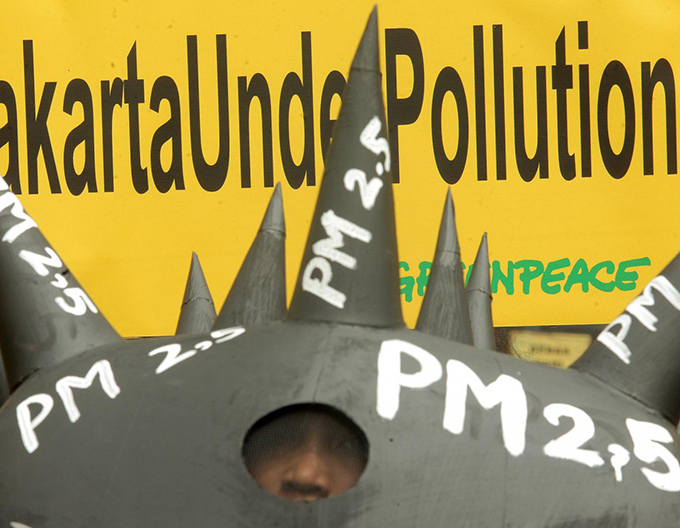
Greenpeace activists stage a demonstration in front of the Health Ministry office in Jakarta last month. Image: Muhammad Adimaja/Jakarta Globe/Antara
Pacific Media Centre Newsdesk
Jakarta will be surrounded by more than 10 coal-fired power plants (PLTU) within a 100km radius, which could lead to premature deaths, Greenpeace Indonesia has reported.
The report entitled Silent Murder in Jakarta predicted that the presence of the PLTU could cause 10,600 premature deaths and 2800 low weight births a year in Greater Jakarta areas.
Jakarta is already surrounded by eight PLTUs. The other four will begin operating between 2019 and 2024 and another one, which is currently operating, will be expanded in 2019.
Greenpeace Indonesia’s climate and energy campaigner Didit Wicaksono said on Tuesday that the city’s air quality was bad, and it was mostly caused by transportation and housing.
“But the fact is, it’s not only transportation that damages the health of Jakarta’s residents and their children, it’s also large capacity PLTUs in Java, specifically around Jakarta, and two steam and gas power plants [PLTGU] in Jakarta,” Didit said in a statement.
“Pollution generated from the power plants has also caused Jakarta’s air to be unhealthier.”
Based on Greenpeace Indonesia’s study, the combined emissions from the PLTUs will likely affect cities located to the north and west of the power plants, namely Cilegon and Tangerang in Banten, Bogor in West Java, Jakarta, as well as Bekasi, Depok, Tambun and Karawang in West Java.
The pollution could cause serious respiratory disease, stroke, cardiovascular disease and other heart related disease. Children, pregnant woman and the elderly are the most vulnerable to the pollution.
“For the sake of public health, Greenpeace encourages the Indonesian government to improve the emissions standard for thermal power plants and monitor their performance,” Didit added.
Article by AsiaPacificReport.nz
]]>