Page 1162

Abolish stamp duty. The ACT shows the rest of us how to tax property

]]>

Source: The Conversation (Au and NZ) – By Brendan Coates, Fellow, Grattan Institute

This week we’re exploring the state of nine different policy areas across Australia’s states, as detailed in Grattan Institute’s State Orange Book 2018. Read the other articles in the series here.

You might think that being a state (or territory) treasurer is a boring job. The federal treasurer gets all the media attention and controls many of the big economic levers, including income and company tax, massive Australia-wide spending and trade and competition policy.

But you would be wrong.

Grattan Institute’s State Orange Book 2018 shows that if state treasurers relied less on taxes that hurt the economy and more on the ones that are the very best they could provide a huge boost to their economies.

The big prize

Almost every tax hurts economic growth, but some hurt more than others.

Our state treasurers know this, yet they continue to make poor choices.

Taxes on transactions, such as stamp duties on real estate purchases, are particularly inefficient.

They make it more expensive to move home to take a new job across town or in a different town, encouraging people to stay put. They make it more expensive to move into bigger or smaller homes, encouraging people to renovate instead.


Read more: To make housing more affordable this is what state governments need to do


With the typical stamp duty bill now above A$40,000 in Sydney and Melbourne, this is more than just an idle theory.

In contrast, taxes on land are extraordinarily efficient, and council rates equally so.


ACT is showing the way

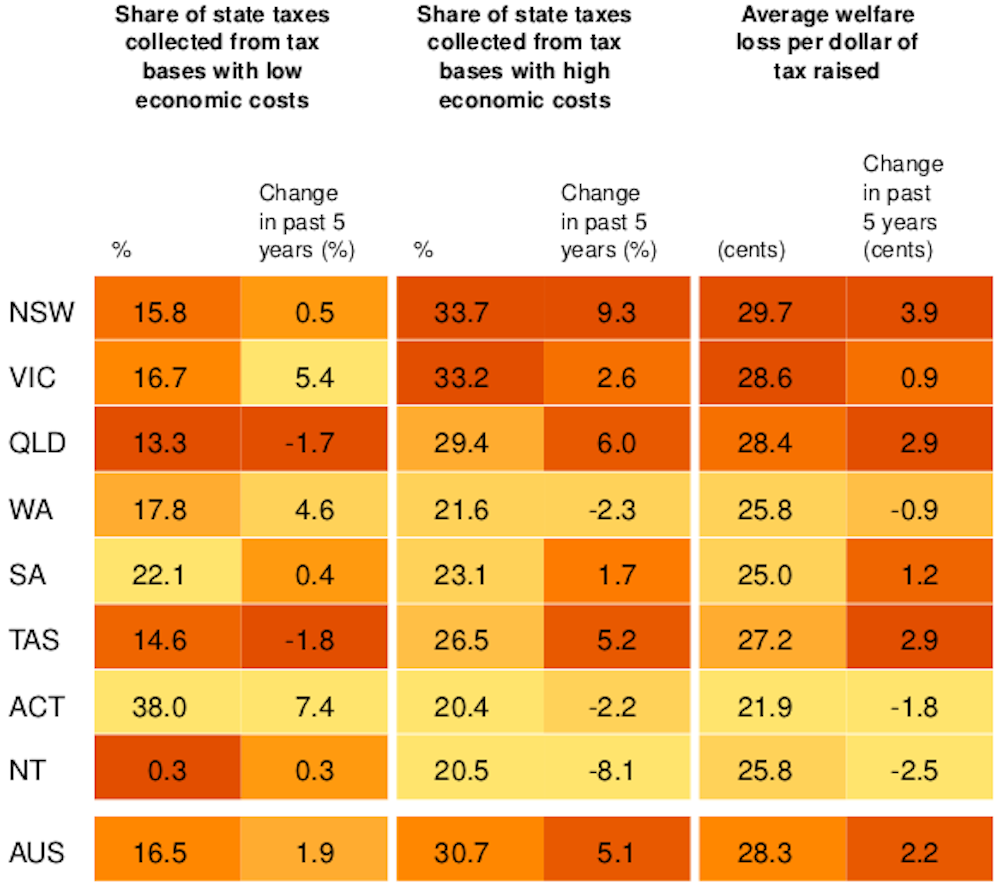
The Australian Capital Territory has Australia’s most efficient tax base – every dollar of revenue raised costs the economy just 21.9 cents.

New South Wales has the least efficient – every dollar of revenue raised costs the economy 29.7 cents.


Grattan Institute Orange Book 2018

While most states are going backwards

Unfortunately, in most states taxes have became less efficient over the past five years.

Booming property prices in Sydney and Melbourne inflated stamp duties, giving them a growing share of the tax base in NSW and Victoria.


Average excess burden of taxation cents per dollar of tax revenue collected in each state and territory (2006-2016) Grattan Institute Orange book 2008

They should copy the ACT

All state treasurers should follow the lead of the ACT and replace stamp duties with broad-based property taxes.

Our calculations suggest that doing so could make Australians up to $17 billion a year better off, while also making housing more affordable.

And stamp duties are unfair. They make some families pay more tax than others simply because they move home more often.


Read more: Infrastructure splurge ignores smarter ways to keep growing cities moving


An annual flat tax set at between A$5 and A$7 for every A$1,000 of unimproved land value would be enough to fund the abolition of property stamp duties.

Which won’t be easy

Proposals to make the switch have stalled because the politics is hard.

Recent purchasers would be reluctant to pay an annual tax so soon after paying stamp duty. A property tax would pose difficulties for people who are asset-rich but income-poor, especially retirees.

And property taxes cause angst: quarterly property tax bills remind people that they are taxpayers more often than does a one-off stamp duty with each purchase.

So state treasurers should make the switch gradually, as in the ACT: slowly wind back stamp duty and ramp up broad-based property tax over time.


Read more: Australia’s dangerous fantasy: diverting population growth to the regions


It would provide the states with an increasingly stable revenue stream while reducing the disparity between those who bought a home just before the change and just afterwards.

To ensure that asset-rich but income-poor households could stay in their homes, state treasurers would have to allow them to defer paying the levy (with interest) until they sell their properties.

And they should axe insurance tax

State treasurers should also replace state taxes on property, life, health and motor vehicle insurance with a broad-based property levy. Most states have already abolished insurance levies to fund fire and emergency services.

Insurance taxes deter people and businesses from buying adequate insurance, leaving them exposed to risks such as flood or fire damage to their home, or motor vehicle theft.

And charge for rezoning

And state treasurers should follow another ACT lead and introduce explicit “betterment taxes” to capture some of the windfall gains from rezoning of land.

Government permission to build higher-density housing, or convert farmland into greenfield housing land, generates large unearned windfall gains for landowners.

Taxing these windfall gains would be a particularly efficient form of taxation, would reduce the opportunities for corruption in the planning system, and would enable state treasurers to reduce other more economically harmful and regressive taxes.

And apply payroll tax widely

Finally, state payroll taxes should be broadened by abolishing carve-outs for small businesses.

This would enable state treasurers to cut payroll tax rates across the board.

Generous thresholds and exemptions have weakened states’ payroll tax bases and increased the economic costs of the tax.


Read more: Grattan Institute Orange Book 2018. State governments matter, vote wisely


Astoundingly, around 90% of NSW businesses are exempt from payroll tax.

We believe that, taken together, this set of reforms would make a big difference to economic growth.

Voters might even reward the treasurers and their premiers.

ref. Abolish stamp duty. The ACT shows the rest of us how to tax property – http://theconversation.com/abolish-stamp-duty-the-act-shows-the-rest-of-us-how-to-tax-property-105378]]>

One man’s trash: how using everyday items for play benefits kids

]]>

Source: The Conversation (Au and NZ) – By Brendon Hyndman, Senior Lecturer and Course Director of Postgraduate Studies in Education, Charles Sturt University

Primary school students have over 4,000 recess and lunch periods a year. This is a substantial period of time we can utilise to improve play habits and behaviour.

To enhance the quality of outdoor play, primary schools across Australia are moving away from more traditional, fixed school play facilities (such as monkey bars and slides) and embracing everyday equipment.

This includes loose, recycled or scrap parts (blocks for climbing/building, tunnels, pipes, crates, foam, rubber and plastic parts) and sports equipment (balls, bats, boards and hoops). The equipment can be transformed according to students’ play needs over time.

Sourced from households and the community, the equipment strategy has been recognised as cost-effective, sustainable and continues to produce cognitive, social and physical benefits for primary school students.


Read more: Should we just let them play?


The benefit of every day items for play

Australian research has found the introduction of everyday equipment into outdoor school spaces has resulted in significant increases in primary school students’ physical activity intensity during active play, step counts, types (and complexity) of play, physical quality of life, enjoyment and can complement the national curriculum.

Students have used the movable equipment to work cooperatively in different team roles to design, plan, construct, observe, negotiate and learn from each other to discover new ideas to solve problems.

Teachers have reported improvements in social inclusion, behaviour, staff/student happiness, confidence, self esteem, levels of aggression, injury and bullying incidences from introducing everyday equipment. Head teachers in the United Kingdom have even reported improvements in students’ classroom engagement.

Research is unveiling that everyday equipment can align with the play needs of girls within school spaces, as girls tend to enjoy play opportunities that are more creative, imaginative and social.

Scrapstore Play Pod in Action in the United Kingdom.

Read more: Play-based learning can set your child up for success at school and beyond


Creative potential

The introduction of every day “mobile” equipment has the potential to improve students’ creativity and initiative by increasing the number of play variables (such as colours, shapes, sizes, types, quantities, potential locations) available. Students can then take advantage of increased play options to make their own games, discoveries and obstacle courses.

With more play options, students are more challenged, preventing frustration and boredom. Boredom can result from being exposed to the same fixed playground equipment lodged in the same location year after year.

Every day equipment in action at an Australian Primary School.

Read more: Being in nature is good for learning, here’s how to get kids off screens and outside


What can parents do at home?

Because everyday equipment is sourced from homes, play can be replicated beyond school time. Here are a few tips:

  1. make sure kids have enough space for multiple play areas to avoid collisions

  2. ensure the area is clear of any hazards such as wires and glass. Grass areas with trees are best, allowing a softer surface for landing. Hard-surface undercover areas can be an alternative during wet conditions

  3. source movable equipment from either the home or community, including milk crates, pipes, plastic sheets, tyre tubes, wooden planks, plastic sheets, assorted play balls, bats and rope. Cardboard boxes and plastic objects such as buckets, baskets and hula hoops can be useful short-term play options, but can be less sustainable

  4. start by introducing around five types of equipment and occasionally add more items over time. Teachers have reported this strategy works better than giving too many options at once

  5. provide a large storage area (container, pod or cage) to put all the equipment away at the end of the the week, session or before rainy weather. Cardboard boxes can go out of shape quickly, especially with rain.

  6. although supervision is important, make sure children can direct their own play without too much adult intervention. Self-directed play and providing adequate levels of risk and challenge is vital for children’s development. Adults also need to be accepting that it could get messy

  7. have a rule that allows kids to have specific equipment for the entire week and then be distributed to others the following week. Consider rules such as no stacking or jumping from equipment above waist height on harder surfaces

  8. have a routine for an adult to regularly check for any damaged equipment (such as removing equipment with wooden/plastic splinters). The adult can also reflect on how the children are using the equipment (for example, consider if anything should be added or removed to aid the play structures).

We need to give kids more space to be creative, especially in outdoor school spaces, to develop the cognitive, social and physical capabilities they’ll need into adulthood.

ref. One man’s trash: how using everyday items for play benefits kids – http://theconversation.com/one-mans-trash-how-using-everyday-items-for-play-benefits-kids-105851]]>

To tackle inequality, we must start in the labour market

]]>

Source: The Conversation (Au and NZ) – By Jim Stanford, Economist and Director, Centre for Future Work, Australia Institute; Honorary Professor of Political Economy, University of Sydney

This article is the second in the Reclaiming the Fair Go series, a collaboration between The Conversation, the Sydney Democracy Network and the Sydney Peace Foundation to mark the awarding of the 2018 Sydney Peace Prize to Nobel laureate and economics professor Joseph Stiglitz. These articles reflect on the crisis caused by economic inequality and on how we can break the cycle of power and greed to enable all peoples and the planet to flourish. The Sydney Peace Prize will be presented on November 15 (tickets here).


Scientific understanding of the consequences of inequality has grown by leaps and bounds in recent years. Thanks to the pioneering work of scholars such as Joseph Stiglitz, Kate Pickett and Richard Wilkinson, and Tony Atkinson, we know that persistent social and economic inequality exacts an enormous toll: on mental and physical health, the stability and efficiency of communities, and macroeconomic performance.


Read more: The fair go is a fading dream, but don’t write it off


How, then, should this pervasive and multidimensional problem best be tackled? Statistically, we can measure income inequality at three different levels. And those levels provide a natural categorisation of the policies needed to combat it.

First, inequality can be measured in incomes received before government steps into the picture. This “market income” includes wages and salaries, income from personal investments, profits and dividends from businesses, and other sources. Inequality is highest for market income, and has grown notably over the last generation.

Second, we measure inequality again after government has collected taxes and made transfer payments back to households. “Disposable income” thus reflects the cash redistribution arising from government fiscal and social policies. So long as income taxes are progressive and transfer programs (like unemployment benefits, child benefits and age pensions) are broadly accessible (or even targeted at lower-income households), inequality in disposable income is lower than for market income.

Finally, inequality in final living standards should consider the value of non-monetary public sector programs. Public services like education, health care, recreation and transportation do not put money into consumers’ pockets but they do enhance their standard of living. And the impact of these public goods and services is larger (relative to income) for lower-income households. Inequality in “final consumption” is therefore lower still than inequality in disposable income.

Government matters in reducing inequality

The importance of government programs in reducing inequality is starkly visible in this three-tiered framing. In Australia, for example, taxes and transfer payments reduce inequality by about one-third (comparing market to disposable income). And public services reduce inequality by another third (comparing final consumption to disposable income). This makes it especially important to reject calls to cut taxes (even taxes paid by working people) and the public programs that taxes fund.


Read more: Who gets what? Who pays for it? How incomes, taxes and benefits work out for Australians


In international terms, Australia’s fiscal policies do a relatively poor job of moderating inequality. This is mostly because taxes and public programs are small (relative to GDP) compared to other countries, and hence have less redistributive effect (even though Australia’s income supports are highly targeted at low-income residents).

Australia therefore ranks slightly worse in inequality in disposable income (25th out of 36 OECD countries according to the Gini coefficient) than in market income (21st). Preserving and expanding taxes and income supports – like Newstart benefits, which have languished in real terms for decades – and expanding public services over time are essential for reducing Australia’s inequality.

However, the redistributive hand of government can only do so much to moderate the inequality that the so-called “market” produces, and reproduces. Government fiscal and social policies cannot single-handedly overcome a starting point that gets worse and worse over time.

Labour market changes are driving up inequality

For most households, labour income is the most important source of private income. Two related factors are undermining labour incomes and driving up inequality.

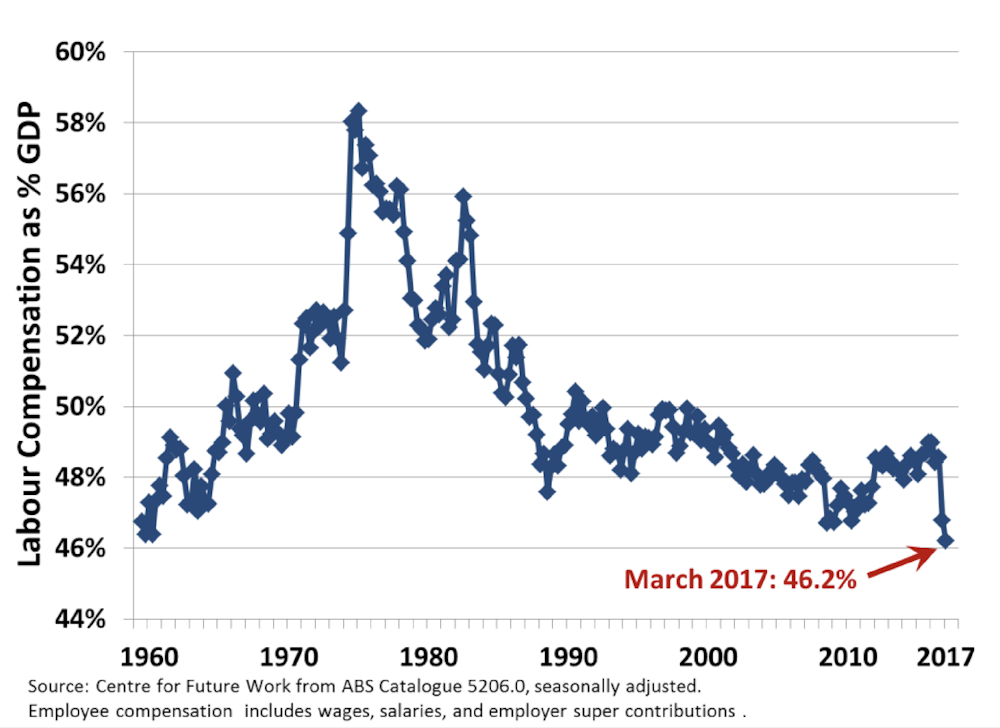
First, the share of total national income paid out in wages, salaries and superannuation has eroded dramatically since the neoliberal economic reforms of the 1980s and 1990s. Wages are barely keeping up with inflation, let alone matching labour productivity growth.

The result is a steady fall in workers’ collective share of the pie. This reached a postwar low in 2017, as shown in Figure 1.

Figure 1. Labour compensation as a share of nominal GDP. Centre for Future Work, Author provided

There has been an offsetting rise in the share of income going to business owners and investors. Not surprisingly, wealthy people own the largest portion of that wealth, so redistributing income from labour to capital increases inequality.

At the same time, the distribution of a shrinking slice among workers has itself become more unequal. This also reflects the erosion of Australia’s once-vaunted labour market institutions. These were deliberately set up in the postwar era to build a more equal, inclusive society (the “fair go”). Most important in this regard have been:

The institutions that were designed to lift wages and make them more equal have been consciously dismantled. So it’s no surprise that only a shrinking minority of workers can now (thanks to particular skills or position in the economy) win wage increases of the sort most workers once took for granted. Others face low, stagnant and insecure incomes.

This transformation in the labour market has been the fundamental driver of the growing gap so visible in our communities.

So what needs to be done?

Fixing this problem requires an ambitious, multidimensional effort to rebuild the policy levers of inclusive growth. Minimum wages should be high enough that anyone working full-time can escape poverty. Supplemental measures like penalty rates and casual loading should be strengthened, not eroded. The award system should again aim to support wage growth for all workers, not just those at the bottom.

Relaxing Australia’s unique and punitive restrictions on collective bargaining and allowing workers to negotiate multi-firm or industry-wide agreements would also lift wages across the board. Instead of being vilified and persecuted, unions should be accepted and supported as an essential and constructive part of a normal labour market.

Unionists and social advocates are now forcefully prosecuting the argument to “change the rules” of Australia’s labour market. This will be one of the top issues in the run-up to the next federal election. And this debate is long overdue – because tackling inequality has to start in the labour market.

ref. To tackle inequality, we must start in the labour market – http://theconversation.com/to-tackle-inequality-we-must-start-in-the-labour-market-105729]]>

What are ‘decodable readers’ and do they work?

]]>

Source: The Conversation (Au and NZ) – By Misty Adoniou, Associate Professor in Language, Literacy and TESL, University of Canberra

The Victorian Coalition has promised $2.8 million for “decodable readers” for schools if they win the upcoming election.

Money for books must surely be a good thing. But what exactly is a “decodable reader”? After all, surely all books are decodable. If they weren’t decodable they would be unreadable.


Read more: Lost for words: why the best literacy approaches are not reaching the classroom


What is decoding?

The Australian curriculum provides a clear definition of decoding:

A process of working out the meaning of words in a text. In decoding, readers draw on contextual, vocabulary, grammatical and phonic knowledge.

However the Victorian Coalition is defining decoding as “sounding out letters”. As their policy platform states:

Decodable books are designed to align with explicit, systematic phonics instruction. They are simple stories constructed using almost exclusively words that are phonetically decodable, using letters and letter-groups that children have learned in phonics lessons.

The “decodable readers” they are funding are books that are contrived to help children practise a particular letter-sound pattern taught as part of a synthetic phonics program.

For example, the following sentences are from a decodable reader designed to focus on the consonants “N” and “P” and short vowel /a/

Nan and a pan.

Pap and a pan.

Nan and Pap can nap.

Decodable readers don’t have a narrative. Reading a-z.com

Books like this have no storyline; they are equally nonsensical whether you start on the first page, or begin on the last page and read backwards.

While they may teach the phonics skills “N” and “P”, they don’t teach children the other important decoding skills of grammar and vocabulary.

And as many a parent will testify, they don’t teach the joy of reading.


Read more: The way we teach most children to read sets them up to fail


What about the children’s vocabulary development?

Meaning and vocabulary development are not the focus of decodable readers. Yet, research shows the importance of vocabulary for successful reading.

Students need to add 3,000 words a year to their vocabulary to be able to read and write successfully at their year level.

Limited vocabulary in books translates to lack of vocabulary growth.

What is the alternative to ‘decodable readers’?

Supporters of decodable readers are hopeful these books will support students with reading difficulties, by focusing closely on the sounds in words. However, focusing on sounds alone is not sufficient to support a struggling reader.

The reality is all children learning to read need to listen to, and read books that are written with rich vocabulary, varied sentence structures and interesting content knowledge that encourages them to use their imagination.

Compare the text about Pan and Nap with the opening lines of Pamela Allen’s very popular story Who Sank the Boat?:

Beside the sea, on Mr Peffer’s place, there lived a cow, a donkey, a sheep, a pig, and a tiny little mouse. They were good friends and one sunny morning, for no particular reason, they decided to go for a row on the bay. Do you know who sank the boat?

This book immediately engages children and asks them to question, imagine and help solve a problem. Children always ask for this book to be read again and again and they enjoy joining in. They learn new vocabulary and incidentally learn about complex sentence structures, which they emulate in their oral language and story writing.

Kids want to unveil the mystery of who sank the boat – and they learn in the process. Amazon.com

Read more: A balanced approach is best for teaching kids how to read


Using books to teach all the decoding skills

Using rich authentic texts supports all the decoding skills described in the Australian curriculum – phonics, vocabulary and grammar.

In Pamela Allen’s story above, we can look at the word “bay” and notice the parts /b/ – /ay/, which help us to say and spell the word. What happens if we change the beginning – how many other words could we write and read? For example, day, say, play, and so on.

We can look at the “frequent” words. These are the words that we can’t always “sound out” but which make up the 100 most frequent words in English. For example, do, you, they, were, the.

These words are very important to teach children, as these 100 words make up 50% of all written language.

We can develop their vocabularies with words and phrases such as “for no particular reason”, “decided” and “beside” .

We can introduce them to beautifully literate sentence structures, for example, “Beside the sea, on Mr Peffer’s place, there lived a cow, a donkey, a sheep, a pig, and a tiny little mouse”.

Decodable readers can only do the phonics part of the reading puzzle. They are a very inefficient way to teach reading.

So what do we want for all children learning to read?

When teaching children to read, we hope they will learn reading is pleasurable and can help them to make sense of their lives and those around them.

The strategies children are taught to use when first learning to read greatly influence what strategies they use in later years. When children are taught to focus solely on letter-sound matching to read the words of decodable readers, they often continue in later years to over-rely on this strategy, even with other kinds of texts. This causes inaccurate, slow, laborious reading, which leads to frustration and a lack of motivation for reading.

A book must be worth reading and give children the opportunity to learn the full range of strategies needed to read any text.

Children who grow up with real books, with rich vocabularies, beautiful prose and genuine storylines reach a higher level of education than those who do not have such access, regardless of nationality, parents’ level of education or socioeconomic status.

And yet it’s children from disadvantaged backgrounds who are less likely to have access to these books in their homes. It’s crucial schools fill the gap.

A$2.8 million spent on beautifully written books to fill Victorian classroom libraries would be a far more effective use of the education budget.

ref. What are ‘decodable readers’ and do they work? – http://theconversation.com/what-are-decodable-readers-and-do-they-work-106067]]>

Phubbing (phone snubbing) happens more in the bedroom than when socialising with friends

]]>

Source: The Conversation (Au and NZ) – By Yeslam Al-Saggaf, Associate Professor, Charles Sturt University

Have you ever been around people who spend more time looking at their phone than they do at you? Then you know what it feels like to be “phubbed” – and you’re probably guilty of doing it yourself.

Phubbing is the practice of looking at your phone while in the presence of others. And as smartphones become ever more entwined in the everyday lives of Australians, phubbing has become so common that many people think it’s normal.

People phub during work meetings, while socialising with friends at cafés, while having dinner with their family, while attending lectures and even while in bed.

But how common is phubbing in Australia? And in what social situations is it most prevalent?

To find out, we surveyed 385 people and asked them how often they look at their smartphones while having face-to-face conversations with others. They recorded their answers as: never, rarely, sometimes, often, or all the time.


Read more: She phubbs me, she phubbs me not: Smartphones could be ruining your love life


We’re more likely to phub family than colleagues

We found 62% of those surveyed reported looking at their smartphone while having a face-to-face conversation with another person or persons.

Gender made no difference to how often someone phubbed. Neither did geography, with people living in the city and the country phubbing equally as often. But younger people phubbed others more frequently than older people. And people phubbed their partners most of all.

The study also revealed smartphone users phubbed their parents and children more frequently than they phubbed their colleagues at work, clients and customers. These findings suggest a professional attitude towards using the smartphone in the workplace.

We phub more in bed than when socialising

Some social situations are more conducive to phubbing than others.

We found people phubbed each other more when commuting together on public transport, during work coffee or lunch breaks, when in bed with their partners, when travelling together in private transport and when socialising with friends.

People were less likely to phub others during meetings, during meal times with family, and during lectures and classes.


Read more: The importance of actually unplugging on National Day of Unplugging


Boredom isn’t the main reason people phub

We were interested in finding out whether boredom plays a role in phubbing behaviour so we asked our survey participants to complete an eight-item Boredom Proneness Scale.

Sample questions included “I find it hard to entertain myself” and “many things I have to do are repetitive and monotonous.”

We found boredom did explain why people phub, but that the influence of boredom is very small. Other factors, such as the “fear of missing out” (FOMO), lack of self-control, and internet addiction may play a more important role in phubbing behaviour.

The effect of phubbing depends on the situation

Looking at the smartphone while a person is having a face-to-face conversation with another person is a relatively new phenomenon. While it may violate some people’s expectations, it’s no simple task to categorise the behaviour as good or bad.

One theory suggests that when people get phubbed they might judge the behaviour according to how important the phubber is to them. For example, phubbing among friends is probably more acceptable than a subordinate phubbing a manager during a work-related meeting.


Read more: How the smartphone affected an entire generation of kids


While that might be good news for the workforce, it’s not great for close relationships. Phubbing partners can make them feel less important and this can decrease the satisfaction with the relationship. In the case of children, especially those at a vulnerable age, phubbing them can make them feel unloved, which can have a detrimental effect on their well-being.

Our findings can be used to inform programs, policies and campaigns that aim at addressing the phubbing phenomenon.

It’s clear from the research smartphone users are more likely to phub those who are closely related to them than those less close to them. So next time you get phubbed when you are out with someone, take it as a compliment – it could mean they consider you a close friend.


The research discussed in this article will be published in the Proceedings of the 2018 International Conference on Information Systems (ICIS).

ref. Phubbing (phone snubbing) happens more in the bedroom than when socialising with friends – http://theconversation.com/phubbing-phone-snubbing-happens-more-in-the-bedroom-than-when-socialising-with-friends-105966]]>

Why are unions so unhappy? An economic explanation of the Change the Rules campaign

]]>

Source: The Conversation (Au and NZ) – By Shirley Jackson, PhD Candidate in Economic Sociology, University of Melbourne

In October hundreds of thousands of workers took to the streets to campaign for better wages and conditions as part of the Australian Council of Trade Unions’ Change The Rules campaign.

The response from critics of the movement, including the Commonwealth government, has been to decry the temporary loss of economic output and to blame the rallies on a mix of union anarchy and militancy.

But they’ve missed the point.

The evidence shows that conditions for Australian workers have been getting worse as trade union membership has declined.

There are five ways to look at this.

Wage growth

The Australian Bureau of Statistics tally of average weekly earnings has grown impressively since 1995, from around A$550 to A$1,200.


But changes in the average wage don’t tell us much about changes in the typical wage.

That’s because, being an average, it is highly sensitive to changes in the composition of the workforce and to increases in the very high pay earned by Australia’s highest earners.

If low-income workers lose their jobs the average wage will go up.

If high-flying executives get paid even more it will also go up.

Real wage growth

A better measure of typical wages, the ABS wage price index, is also growing.

But it too is misleading.

Real wage growth – which is the amount wages have been growing over and above prices – tells us much more.


While the wage price index has grown by 65% over the past two decades, real wages have increased by only 12%.

For many young people, it’s even worse: their share of wage growth has been negligible or even negative.

This means that for an increasing number of Australians wages are failing to keep pace with the cost of living.

Share of gross domestic product

Another way to measure wages is to look at how much of what Australia produces is being paid out to workers.

The most common measure of what’s produced is gross domestic product.

That very basic measurement suggests that the economy has been growing for 27 years – a fact The Economist newspaper celebrates when describing Australia as the most successful economy in the developed world.

But wage earners are sharing in the success less than others.

While GDP has certainly been rising every year, the percentage of it spent on wages has been falling.


Those who praise Australia’s economic growth sometimes miss the wood for the trees.

Gross domestic product has indeed grown over the past 27 years, but in that same period the share of it paid to workers has fallen by four percentage points.

The pie has been growing, but the slices for workers have been getting thinner.

Inequality

The most common measure of income inequality is the Gini coefficient.

A coefficient of 1 would mean all the income was all in one person’s hands. A coefficient of zero would mean it was evenly distributed.

Unfortunately, Australia’s Gini coefficient has been climbing further away from zero.


The International Monetary Fund has found that there is a likely causal relationship between low trade union density and high income inequality.

In Australia income inequality has grown as trade union membership has fallen.


Union militancy

The minister for jobs and industrial relations, Kelly O’Dwyer, says the union movement wants a return to the “dark days of mass union militancy”.

It wants workplace division and disruption, it wants the ability to flagrantly break any industrial laws it doesn’t like, and it demands union officials be given the power to subject businesses up and down the country to their every demand, regardless of the capacity of those businesses to accede to those demands.

It is certainly true that more trade union activity leads to more days lost per year to industrial action.


However, there doesn’t seem to be much evidence to support O’Dwyer’s claim that any increase in the days lost to strikes will wreak havoc on the economy.

For example, in 1988 Australia reached the height of “industrial militancy” and lost a total of 1,641 days to industrial action across all industries.

Yet in that year GDP grew by 3.4%.


Read more: Five questions (and answers) about casual employment


Compare this to 2017, when only 148 days were lost to industrial action and GDP grew by only 2.3%.

In the past few months GDP growth has since bounced back to 3.4% with no noticeable change in the days lost to strikes.

While there doesn’t seem to be a link between declining industrial action and GDP, there does seem to be one between industrial action and the share of GDP paid out in wages.

The recent resurgence of the union movement is an attempt to get the share back up.

ref. Why are unions so unhappy? An economic explanation of the Change the Rules campaign – http://theconversation.com/why-are-unions-so-unhappy-an-economic-explanation-of-the-change-the-rules-campaign-105673]]>

What teeth can tell about the lives and environments of ancient humans and Neanderthals

]]>

Source: The Conversation (Au and NZ) – By Tanya M. Smith, Associate Professor in the Australian Research Centre for Human Evolution, Griffith University

Increasing variation in the climate has been implicated as a possible factor in the evolution of our species (Homo sapiens) 300,000 years ago, as well as the more recent demise of our enigmatic evolutionary cousins, the Neanderthals.

But knowing the impact of that change on a year-by-year basis has always been a challenge.

Most prehistoric climate models are derived from large-scale records such as deep-sea cores or terrestrial sediment layers. These methods yield information on the scale of thousands of years, making it impossible to understand how seasonal climate patterns directly impacted ancient humans and their evolutionary kin.

My colleagues and I have found a solution using clues from our own mouths, as we detail today in an article in Science Advances. We used teeth to reveal climate records formed during the development of ancient hominins.


Read more: Archaeology can help us prepare for climates ahead – not just look back


In the teeth

Teeth are a really useful indicator of past environments.

This is possible because teeth have biological rhythms and key events get locked inside them. These faithful internal clocks run night and day, year after year, and include daily growth lines and a marked line formed at birth.


Read more: How we’re using fish ear bones as ‘time capsules’ of past river health


Histologists like me carefully saw teeth, remove tiny slices and painstakingly map records of microscopic growth during childhood.

For this new study, we examined the enamel in fossilised teeth from two Neanderthal children (dated to 250,000 years ago) and one modern human child (dated to 5,000 years ago) from an archaeological site in southeastern France known as Payre.

Using the sensitive high-resolution ion microprobe (SHRIMP) at the Australian National University we measured how the oxygen isotope ratios varied on a weekly basis in these ancient teeth.

Our approach is based on the fact that two naturally-occurring atomic variants of oxygen vary in predictable ways.

During prolonged periods of warm weather, surface water is higher in the heavy variant of oxygen. The opposite pattern occurs during cool periods.

When individuals drink from streams or pools of water, values from these sources are recorded in the hard mineral component of forming teeth.

The SHRIMP measurements allowed us to create multiyear paleoenvironmental records from the fossil teeth.

What the teeth reveal

The oxygen records show that the two Neanderthals inhabited cooler and more seasonal periods than the modern human who grew up in the same place more recently.

This is consistent with our basic understanding of ancient climates in France, as 250,000 years ago this region was cooler than it has been over the past 10,000 years, when the unlucky modern human child lived and died.

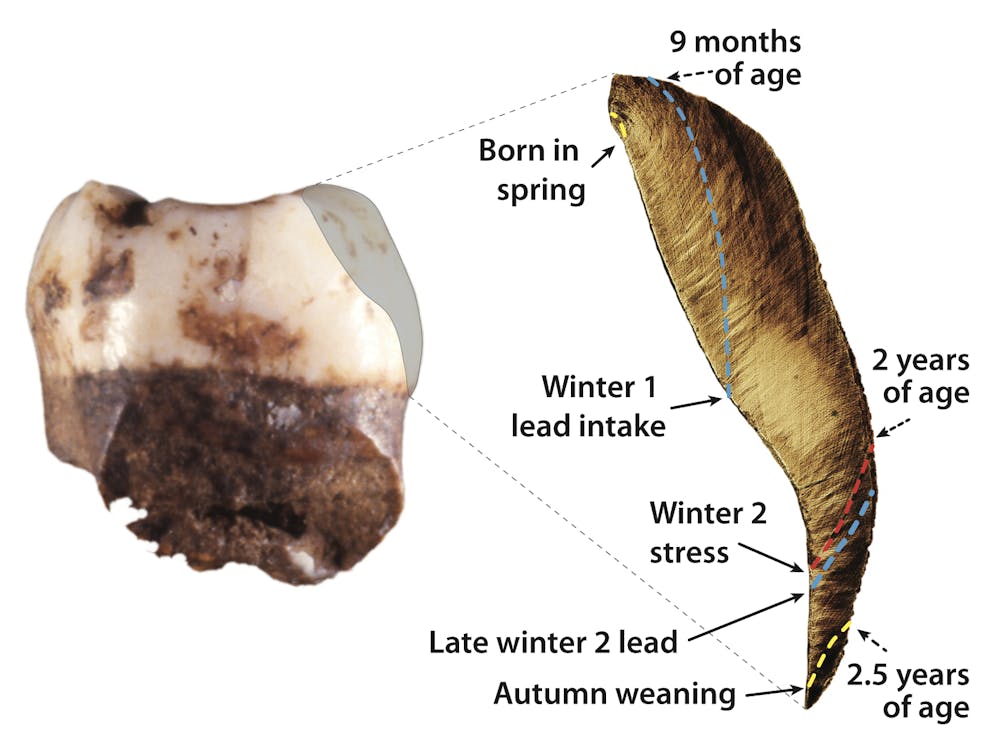
A 250,000-year-old Neanderthal tooth yields an unprecedented record of the seasons of birth (age 0), nursing (yellow box), illness (red line) and lead exposures (blue lines) over the first 2.8 years of this child’s life. Oxygen isotope values sampled on a weekly basis are shown as a ratio of heavy to light variants.

We’ve already shown that teeth preserve faithful records of milk intake during nursing, proving that orangutan mums are lactation champs – they nurse their infants for eight or more years.

In the current study we were able to pair seasonal cycles during tooth formation with nursing behaviour, showing that one Neanderthal child was born in the spring and stopped consuming its mother’s milk 2.5 years later, during the autumn.

Even more surprising is the fact that both Neanderthal children were exposed to lead at least twice during cooler times of the year, likely through consumption of contaminated food and/or water.

First molar tooth from a 250,000-year-old Neanderthal child. Yellow dotted lines indicate the beginning and end of nursing, a red dotted line corresponds to an illness, and blue dotted lines indicate lead exposures. Tanya Smith and Daniel Green

Lead occurs naturally in several historic mines in this region of France, and this is the oldest known prehistoric exposure to this neurotoxic substance. No level is considered safe for humans or animals, and these exposures occurred during a critical time in the early lives of these Neanderthals.

More teeth needed

These findings raise intriguing questions about Neanderthal behaviour that require further study, and youngsters with unworn teeth are especially helpful. Although dozens of young Neanderthals have been unearthed, coaxing teeth from the curators of collections for this kind of semi-destructive study is a tall order.

But the more teeth we are able to examine in such detail, the more information we will gather about the lives of ancient people on a year-by-year basis.

Our approach will also facilitate much-needed tests of theories about the impact of climate change on human technological development, and insight into Neanderthal nursing behaviour — a key determinant of population growth and life history.

Previously, my colleagues and I discovered that an eight-year-old Belgian Neanderthal was weaned at 1.2 years of age. This probably was atypical as the nursing signal dropped off rapidly and the individual showed stress in its first molar at this exact time.

We’re not sure if this means that it was separated from its mother or just really sick – but it’s likely that Neanderthals kids nursed for longer when they could.

Our new approach allows scientists to flesh out the lives of ancient children with unprecedented detail, including fine-scaled views of life in Ice Age Europe, through the remarkable tales their teeth tell.

ref. What teeth can tell about the lives and environments of ancient humans and Neanderthals – http://theconversation.com/what-teeth-can-tell-about-the-lives-and-environments-of-ancient-humans-and-neanderthals-104923]]>

How new spinal injury treatments help some people to walk again

]]>

Source: The Conversation (Au and NZ) – By Lyndsey Collins-Praino, Senior Lecturer in School of Medicine, University of Adelaide

A spinal cord injury can change your life in the blink of an eye.

But today, research published in two leading scientific journals shows that walking again is possible for individuals following spinal cord injury.


Read more: Yes there’s hope, but treating spinal injuries with stem cells is not a reality yet


Targeted electrical stimulation

Grégoire Courtine’s research group from the Swiss Federal Institute of Technology in Lausanne reported that a kind of treatment called targeted neurotechnology allowed three individuals who had suffered a spinal cord injury to walk again. The technique delivers timed electrical stimulation, called EES, over the surface of the spinal cord.

The EES was effective despite the injury having occurred more than four years previously, and even though the individuals showed either permanent motor deficits (loss of muscle function) or complete paralysis – even after extensive previous rehabilitation.

Improvements were seen immediately following EES: the people were able to voluntarily activate muscles to produce a desired movement – such as extension of the ankle – in the paralysed leg.

Optimising the EES for each individual allowed them to time their movements to EES sequences appropriately. Within five days, participants were able to walk overground and even adjust their leg movements and walking speed.

Perhaps most excitingly, after a few months of targeted EES, participants regained voluntary control over their previously paralysed muscles, even in the absence of EES. This allowed them to walk or even cycle outside of the laboratory.

What is spinal cord injury?

Damage to the spinal cord is typically caused by a traumatic event – such as motor vehicle accidents, sports related incidents or falls. Within Australia, 250-350 new cases of spinal cord injury occur each year, with more than 10,000 people currently living with a spinal cord injury.


Read more: Without mandatory safety standards, indoor trampoline parks are an accident waiting to happen


When an incident occurs, the vertebrae, or bones, that make up the spinal column may dislocate or fracture. This results in bone pushing on and compressing the delicate spinal cord, causing bleeding and bruising.

The damage results in loss of both motor (muscular) and sensory function below the level of injury. Injuries below the cervical (neck region) typically result in tetraplegia, where all four limbs are affected. Injuries in the thoracic or lumbar region of the cord typically result in paraplegia, causing paralysis of the trunk, legs and lower part of the body.

It is uncommon to completely severe the spinal cord, with some small function often remaining below the level of injury in most individuals.

Communication highway

Our spinal cord serves as the communication highway between our brain and our body.

If a highway is damaged or closed, you can’t travel along it to reach your destination. Similarly, when the spinal cord is damaged, the signals and messages that are normally transmitted between our brain and our body can no longer reach their target destination. This results in loss of muscle control, loss of sensation, bowel and bladder problems and sexual dysfunction.

Walking and other voluntary movements are controlled by signals that travel from the front of the brain, down to other nerve cells in the spinal cord, and then nerves that travel from the spinal cord to the muscles involved.

What is so exciting about this new research is that it suggests several months of EES may be able to restart activity of these pathways. This is consistent with the group’s previous work, but is the first time such an effect has been demonstrated in humans.


Read more: Controversial brain study has scientists rethinking neuron research


An exciting step

This is an exciting step forward in a field of research where so many trialled treatments to improve function after spinal cord injury have failed.

Other attempts have been unsuccessful for a number of reasons. First, many of the models used to explore spinal cord injury don’t accurately mimic the specific types of problems seen in individuals following spinal cord injury. This makes it difficult to translate findings from experimental work into meaningful advancements in the clinic.

Also, spinal cord injury itself is a real mixed bag – not all injuries are created equal. As a result, it’s difficult to find treatments that may be effective for all individuals.

Indeed, even in the study by Courtine’s group, only individuals with less complete injuries to the spinal cord were included. This may limit the applicability of the research to individuals with more severe types of injury.

The success of Courtine’s method also seems to be tied to the use of timed, rather than continuous, EES for the treatment – this allowed the people in the trial to retain a sense of where their legs were placed in space (a sense known as proprioception). Other trials had not used this approach.

What the future holds

While these studies are an exciting advance, future studies in this area will need to overcome some limitations.

First, this method required the people involved to undergo an invasive and resource-intensive series of steps to implant the EES electrodes and determine the best stimulation approach. This may be prohibitive for others due to physical or financial constraints.

In addition, so far the therapy has only been trialled in a very small number of individuals who have experienced relatively mild, incomplete injuries of the spinal cord. This is not indicative of the severity of injury for many.

It is critical that future studies investigate whether EES may be effective even with more severe injuries, including complete injuries where only a few or no undamaged nerves remain.


Read more: Take it from me: neuroscience is advancing, but we’re a long way off head transplants


We still don’t know if this technology can lead to improvements in everyday activities.

And it’s important to remember that motor function is only one of a host of symptoms experienced by those with spinal cord injury. In a survey of individuals with paraplegia, they said improvement of bladder and bowel control and restoration of sexual function was more important for their quality of life than being able to walk again.

So while those who have suffered a spinal cord injury have reason to feel cautiously optimistic, there is still much work to be done in this area.

ref. How new spinal injury treatments help some people to walk again – http://theconversation.com/how-new-spinal-injury-treatments-help-some-people-to-walk-again-106055]]>

After a deadly month for domestic violence, the message doesn’t appear to be getting through

]]>

Source: The Conversation (Au and NZ) – By Silke Meyer, Senior Lecturer in Domestic and Family Violence Practice, CQUniversity Australia

On average, at least one woman is killed every week at the hands of a current or former partner in Australia. Last month, the numbers were even more alarming. Nine women were killed in October – seven allegedly in the context of a current or former intimate relationship, the other two also suspected to have died at the hands of male perpetrators.

While these deaths are a disturbing reflection of the pervasive nature of violence against women in Australia, they have largely gone unnoticed. Aside from a small number of female journalists who called on Australia’s leaders to address the crisis, the media more broadly, as well as governments and the wider public, have mostly remained silent.

These recent incidents raise questions around the effectiveness of awareness and educational campaigns developed under Australia’s National Plan to Reduce Violence Against Women and their Children, released in 2011 to improve the country’s response to domestic violence.


Read more: The Violence Against Women Act is unlikely to reduce intimate partner violence – here’s why


How well are current awareness campaigns faring?

Research suggests that campaigns aimed at raising awareness about domestic violence, such as the federal government’s “Let’s Stop it at the Start” campaign, can increase public understanding of gendered violence and the types of support available for those affected.

The federal government’s ‘Let’s Stop it at it the Start’ campaign.

Evidence of this can be seen in the substantial increase in calls to police and applications for domestic violence protection orders following the roll-out of awareness campaigns in recent years.

However, efforts to change public attitudes towards domestic violence, especially attitudes ascribing blame to victims, have been less successful. The National Community Attitudes Survey shows persistent victim-blaming attitudes in society when it comes to this issue.


Read more: Blaming victims for domestic violence: how psychology taught us to be helpless


This is concerning because research shows a clear link between victim-blaming attitudes and the perpetration, as well as tolerance, of domestic violence.

What do current campaigns get wrong?

Part of the reason why current campaigns have been ineffective at changing public attitudes may lie in how they frame the issue of domestic violence.

Campaigns need to go beyond communicating what constitutes domestic violence in intimate relationships and where to get help. They need to explain how and why this type of violence can affect anyone. And they need to illustrate how perpetrators control their victims and manipulate those around them.

By failing to do so, we allow domestic violence to remain an issue solely of concern to victims, making it less worthy of public concern.

A narrow focus on victim experiences and awareness creates a false and dangerous sense of security among the general public. It also perpetuates the assumption that domestic violence only impacts those who make “poor relationship choices”. And it implies that a woman’s choice in partner or her behaviour in a relationship plays a role in the domestic violence she experiences.


Read more: Young Australians’ views on domestic violence are cause for concern – but also hope


Research clearly shows the behaviour of victims has little bearing on the likelihood of domestic violence in intimate relationships. Domestic violence can happen to anyone, regardless of age, race or socioeconomic status.

Highlighting how perpetrators manipulate their victims can be effective in bringing this to light. Perpetrators tend to be charming, manipulative and extremely skilled at image management. They are rarely openly abusive from the start. By the time their abusive behaviours become obvious, they have frequently isolated their victims and manipulated others into perceiving them as a good partner.

What can we do better?

Awareness campaigns should reinforce why domestic violence is everyone’s business, not just a problem for those directly affected.

Men play a crucial role. While men living in Australia are far less likely to be killed by an intimate partner, especially if they have never been abusive to that partner, women have a one in four chance of experiencing emotional, physical and/or sexual violence in at least one of their intimate relationships.

Instead of responding to awareness campaigns with questions about why male victims are overlooked by society, men need to become a voice in this fight.

For those unsure how or why, activists like Jackson Katz offer compelling reasons and strategies. As role models, men’s voices are crucial in calling out violence against women.

Some campaigns are starting to hold the general public accountable for violence prevention. Queensland’s #dosomething campaign, for example, emphasises that domestic violence is a societal issue that impacts everyone.

Queensland’s campaign to encourage bystanders to get involved.

Victoria’s “Respect Women: Call it Out” campaign specifically highlights the role of men in preventing domestic violence and offers user-friendly examples of how it can be done. More importantly, it removes some of the concerns that bystanders have when trying to help or speak out against this type of violence.

Victoria’s ‘Respect Women: Call It Out’ campaign.

In order to make domestic violence everyone’s business rather than an issue solely for women, awareness campaigns need to follow these examples. More importantly, they need to address how perpetrators manipulate victims, their families and their communities, and how we all play a role in speaking out against such violence.

If we aren’t able to do this, women’s deaths will continue to be met with silence and Australia will continue to tolerate the alarming prevalence of domestic violence.

ref. After a deadly month for domestic violence, the message doesn’t appear to be getting through – http://theconversation.com/after-a-deadly-month-for-domestic-violence-the-message-doesnt-appear-to-be-getting-through-105568]]>

Your poo is (mostly) alive. Here’s what’s in it

]]>

Source: The Conversation (Au and NZ) – By Vincent Ho, Senior Lecturer and clinical academic gastroenterologist, Western Sydney University

If you’ve ever thought your poo is just a bunch of dead cells, think again. Most of it is alive, teeming with billions of microbes. Here’s what studies in healthy adults reveal makes up our poo.

Water

Our faeces is largely (75%) made up of water, although this differs from person to person.

Vegetarians have a higher water content in their stools. Those who consume less fibre and more protein have a lower water content. Fibre has a high water-carrying ability and makes our stools more bulky, increases the frequency of bowel movements and makes the process of passing bowel motions easier.


Read more: Health Check: what your pee and poo colour says about your health


The other 25% of faeces is made up of solids, which are mainly organic (relating to living matter) materials. A small proportion of solids is made up of inorganic material such as calcium and iron phosphate as well as dried constituents of digestive juices.

Around 25-54% of the organic material is made up of microbes (dead and living), such as bacteria and viruses.

Our poo is teeming with microbes, most of them alive. www.shutterstock.com

Microbes

Bacteria in faeces have been extensively studied. It’s estimated there are nearly 100 billion bacteria per gram of wet stool.

One study that looked at a collection of fresh stools in oxygen-free conditions (as oxygen can damage certain types of bacteria) found almost 50% of the bacteria were alive.

The different types of bacteria present in faeces can influence how hard or loose stool samples can be. For example, Prevotella bacteria, which can be found in the mouth, vagina and gut, are more commonly seen in those with soft stools. In fact, a high-fibre diet is strongly associated with these bacteria.

Ruminococcaceae bacteria, which are common gut microbes that break down complex carbohydrates, favour harder stools.

Viruses have been less studied than bacteria as components of the gut microbiota – the population of bacteria and viruses that live in our gut. It is estimated there are 100 million to 1 billion viruses per gram of wet faeces in most of us.

This number can change considerably when people become sick with viral gastroenteritis, such as in norovirus infections, where levels of more than a trillion viruses per gram of stool can be found.

What is the human microbiome?

Certain types of viruses that infect bacteria, called bacteriophages, have been linked to diseases of the gut like Crohn’s disease and ulcerative colitis.


Read more: So you think you have IBS, coeliac disease or Crohn’s? Here’s what it might mean for you


Archaea are bacteria-like microbes that can inhabit some of the most extreme environments on Earth such as hot springs, deep sea vents or extremely acidic waters. Archaea that produce methane are known to live in the human gut and account for around 10% of non-oxygen-dependent microbes.

Such methane-producing archaea like Methanobrevibacter are associated with harder stools and constipation as methane can slow down intestinal movement. It is believed there are around 100 million archaea per gram of wet faeces.

Single-celled fungi (yeasts) are present in the gut of about 70% of healthy adults. They occur in estimated concentrations of up to a million microorganisms per gram of wet faeces but comprise only a small proportion (0.03%) of all microbes.

Other organic material

Some of the organic material includes carbohydrates or any other undigested plant matter, protein and undigested fats. Faeces does not contain large quantities of carbohydrates as the majority of what we eat is absorbed. However, undigested amounts remain as dietary fibre.

Our faeces don’t contain a large proportion of carbohydrates as most are absorbed in the body. from shutterstock.com

Some 2-25% of organic matter in faeces is due to nitrogen-containing substances such as undigested dietary protein, and protein from bacteria and cells lining the colon that have been shed.

Fats contribute 2-15% of the organic material in our faeces. The amount of fat excreted into our stools is highly dependent on dietary intake. Even with no fat intake, though, we do get some excretion of fat into our faeces. Fat in faeces can come from bacteria in the form of short-chain fatty acids when they ferment foods, in addition to undigested dietary fat.

Plastic particles

A recent study has found that microscopic plastic particles can appear in our faeces when we drink from plastic bottles or eat foods that have been wrapped in plastic.

This small study of eight participants who were exposed to plastics in their food and drink identified up to nine different types of plastics in their stools. But we need larger studies and additional analytical research to understand the clinical significance of this.

Poo is different in disease

Not everyone’s poo is going to be the same. Diseases such as inflammatory bowel disease can lead to changes in the type of bacteria in our gut and result in raised inflammatory proteins that can be detected in our stool.

The presence of blood in the stool could signal bowel cancer, though this isn’t always the case. Fortunately there is a good screening test that can pick up the presence of trace blood in the stools and lead to further investigations such as a colonoscopy.

Sign up for the newsletter

Sign up to Thrive, a weekly dose of evidence to help you live well.

ref. Your poo is (mostly) alive. Here’s what’s in it – http://theconversation.com/your-poo-is-mostly-alive-heres-whats-in-it-102848]]>

State governments can transform Australia’s energy policy from major fail to reliable success

]]>

Source: The Conversation (Au and NZ) – By Tony Wood, Program Director, Energy, Grattan Institute

This week we’re exploring the state of nine different policy areas across Australia’s states, as detailed in Grattan Institute’s State Orange Book 2018. Read the other articles in the series here.


Energy policy in Australia is a major failure. The federal government has been unable to forge an effective policy to ensure affordable, reliable and low-emissions electricity. It’s time for the states to step up.

Internationally, responsibility for climate change policies rests with national governments. The federal government says it remains committed to Australia’s target under the Paris Agreement, but it has abandoned the emissions-reduction obligation of the National Energy Guarantee (NEG). This leaves Australia’s electricity sector, which is responsible for 34% of our overall emissions, with no credible policy to reduce those emissions.

The states should fill this policy vacuum if it persists. They should work together on a nationwide emissions reduction scheme through state-based legislation, independent of the federal government. A Commonwealth-led national policy would be best, but a state-based policy is far better than none.


Read more: The too hard basket: a short history of Australia’s aborted climate policies


In October 2018 the COAG Energy Council agreed to continue work on the reliability element of the NEG. The states and territories should maintain this support and implement this policy with the Commonwealth government, and so support the reliability of the National Electricity Market during a challenging transition.

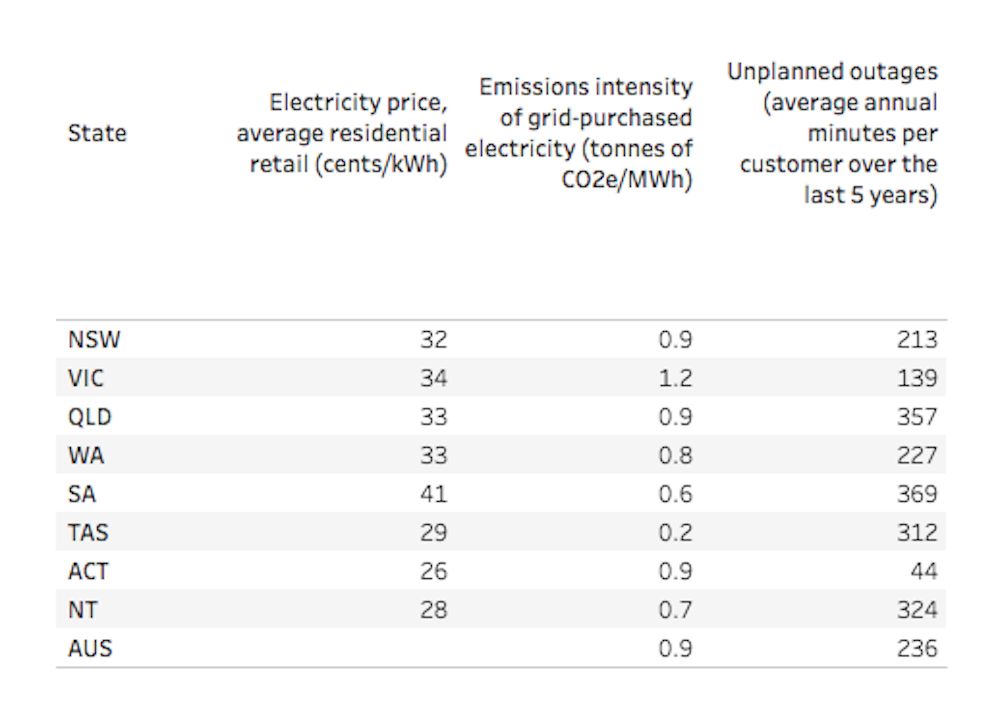
The Grattan Institute’s State Orange Book 2018 shows that there is also much the states can do to reduce energy prices. Consumers are understandably upset – household retail prices have increased by more than half in the past decade, according to the Australian Competition and Consumer Commission (see page 7 here).

How your state measures up on energy. Grattan Institute State Orange Book 2018

The federal government is certainly focused on price – Prime Minister Scott Morrison has referred to Energy Minister Angus Taylor as the “minister for getting electricity prices down” – but many important pricing policies depend on state action.

Retail pricing is the obvious example. Poorly regulated retail electricity markets have not delivered for consumers. Retail margins are higher than would be expected in a truly competitive market. Many consumers find the market so complicated they give up trying to understand it.


Read more: A high price for policy failure: the ten-year story of spiralling electricity bills


State governments should work alongside the federal government to help consumers navigate the retail “confusopoly”. Governments should require retailers to help consumers compare offers and get the best deal. They should also stop retailers using excessive pay-on-time discounts (which tend to confuse rather than help consumers and can trap lower-income households), and ensure vulnerable customers do not pay high prices.

However, governments should resist the temptation to use price caps as a quick fix. If set too low, price caps could reduce competition and drive longer-term price increases.


Read more: Capping electricity prices: a quick fix with hidden risks


Western Australia, Tasmania and the Northern Territory, which have not yet adopted retail competition, should move in that direction – while learning from the mistakes of others.

Network costs make up the biggest share of the electricity bill for most households (see page 8 here) and some small businesses. This is particularly an issue in New South Wales, Queensland and Tasmania, where network values increased substantially under public ownership and those costs were passed on to consumers.

These states should write down the value of their overvalued networks or provide rebates to consumers, so the price of the networks is more closely aligned to the value they provide to consumers. Given the poor performance of publicly owned networks, any network businesses still in government hands should be privatised.

Responsibility for setting network reliability requirements should be transferred to the Australian Energy Regulator to prevent risk-averse state governments from imposing excessive reliability standards, which would drive up network costs again.


Read more: Amid blackout scare stories, remember that a grid without power cuts is impossible… and expensive


Until recently, it seemed state governments had learned the lessons from the bad old days of excessively generous subsidies for rooftop solar. That was until August 2018, when the Victorian government committed more than A$1 billion to pay half the cost of solar panels for eligible households and provide an interest-free loan for the remainder. Most of these systems would pay for themselves without subsidy. The Victorian government should abandon this waste of taxpayers’ money.


Read more: Policy overload: why the ACCC says household solar subsidies should be abolished


Finally, Australia’s gas market is adding to the price pain of homes and businesses. As international prices rise, there is no easy way to avoid some painful decisions. But some state policies are making matters worse.

The Victorian and Tasmanian governments’ moratoria on gas exploration and development constrain supply and drive up prices. The moratoria should be lifted. Instead, these states should give case-by-case approval to gas development projects, with safeguards against specific risks.

Australia needs reliable, affordable electricity to underpin our 21st-century economic prosperity. That must be protected while we also decarbonise the energy sector.

Energy market reform was at the forefront of national competition policy in the mid to late 1990s. But reform has since slowed, and the states are partly responsible. The states can rekindle the fire by pursuing a clear, nationally consistent action plan for affordable, reliable and low-emissions electricity.

Australia’s households and businesses – and the environment – are relying on the states to step up.

ref. State governments can transform Australia’s energy policy from major fail to reliable success – http://theconversation.com/state-governments-can-transform-australias-energy-policy-from-major-fail-to-reliable-success-105740]]>

Ideas of home and ownership in Australia might explain the neglect of renters’ rights

]]>

Source: The Conversation (Au and NZ) – By Bronwyn Bate, PhD Candidate, Urban Research Program, Western Sydney University

In Australia, when we think of home, we think of ownership. This normalisation of home ownership is reflected in the “Great Australian Dream”, the belief that it’s the best way to achieve financial security. This “dream” is based on the premise that if you work hard you will one day be able to buy a home. Home ownership is an important goal for many Australians. Home ownership implies success.

Linked to the importance of home ownership are our conceptions of home – what home means and the ways home can and should be made. Popular understandings of home suggest that feelings of home are most easily created between a house and the person who owns it.


Read more: ‘Just like home’. New survey finds most renters enjoy renting, although for many it’s expensive


What is home?

So ingrained is this relationship between home and ownership that in my recently published paper I argue that research rarely considers the ways non-owners make and think about home. This is problematic, given recent housing trends.

Recent changes in housing, particularly the increased cost of home ownership and curbing of public housing, have created a greater demand for rental housing. As a result, there is an undersupply of privately rented housing in Australia.

Australian tenancy laws add to the insecurity of the private rental sector. Tenancy laws and policy reflect cultural norms in Australia, where private renting is seen as a form of short-term, transitional housing.

Recently, significant media and public attention has been directed at the impact of state-based tenancy legislation. It is argued that tenancy laws need to be changed to reflect current housing trends and the needs of many tenants to have long-term, secure housing.


Read more: When falling home ownership and ageing baby boomers collide


Rental insecurity is a persistent source of stress for many tenants. It’s a key reason that many tenants struggle to feel at home in their rental property. A person’s ability to identify feelings of home with their dwelling has been shown to impact psychological health and overall well-being.

My research findings suggest that while tenancy law affects the ways we understand and make home, likewise, our meanings of home affect how we shape and understand tenure and policy. Australian tenancy law reflects broader cultural values that associate the meaning and making of home with home ownership.

While researchers and policymakers focus on how tenancy law can negatively affect or restrict renters within their homes, the actual practices of home-making by renters are often overlooked. Current understandings of home typically reference what home means to home owners. My research points to the importance of understanding the ways private renters make home – and make home meaningful – so that any changes to tenancy law reflect the needs of tenants.


Read more: Life as an older renter, and what it tells us about the urgent need for tenancy reform


Is having a home a right or a privilege?

While there is no doubt that small changes are being made, perhaps the lack of consideration for tenants in tenancy laws and policy is indicative of our larger beliefs about what it is to “feel” at home and make a home. The “Great Australian Dream” is based on the belief that hard work will eventually lead to home ownership. Yet owning a home is becoming impossible for many people, irrespective of how hard they work.

If we understand home to be a basic right, then we will have policies that reflect this. If we understand home to be a privilege, reserved only for those who manage to achieve home ownership, then we will forever live in a country where tenure security and a feeling of being “home” are reserved for those who are able to buy a house. Consequently, our policies will continue to support the idea that, ultimately, a rental property cannot be “home” to a tenant.

The question then remains: do we consider home a right or a privilege? This issue is at the very heart of Australia’s housing crisis. Until we change our meaning of home by separating it from ownership, we will never be able to “fix” Australia’s housing crisis.


Read more: What do single, older women want? Their ‘own little space’ (and garden) to call home, for a start


ref. Ideas of home and ownership in Australia might explain the neglect of renters’ rights – http://theconversation.com/ideas-of-home-and-ownership-in-australia-might-explain-the-neglect-of-renters-rights-104849]]>

Cricket Australia’s culture problem is it still doesn’t think fans are stakeholders in the game

]]>

Source: The Conversation (Au and NZ) – By David R. Gallagher, Malcolm Broomhead Chair in Finance, The University of Queensland

The most telling part of the long-awaited review into the rotten culture of elite Australian cricket is what it doesn’t say. Or more correctly, what it does say, but what the establishment that owns and controls professional cricket won’t let us read.

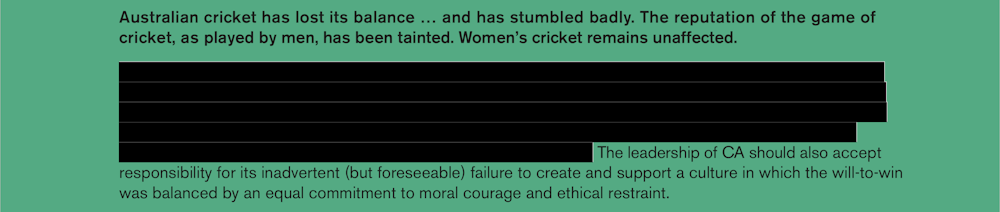
Even a chunk of the executive summary of the report is redacted, like state secrets from a confidential intelligence dossier. A further 22 other pages in the report also have redacted material, in some parts quite extensive.


First page of the executive summary of the report Australian Cricket: A Matter of Balance. Cricket Australia

There may be other reasons for the dozens of redactions, but it’s hard not to conclude the principle motivation is that some criticisms of Cricket Australia, and of specific individuals, are just too close to the bone.


Second page of the executive summary of the report Australian Cricket: A Matter of Balance. Cricket Australia

The redactions are at odds with the “complete transparency” talked about by Cricket Australia chairman David Peever.

They are emblematic of Cricket Australia’s lack of accountability to the game’s most important stakeholders – the cricketing public.

A very public scandal

The report stems from the ball-tampering scandal in March 2018, when the leaders of the Australian men’s cricket team were involved in a brazen attempt to cheat during a match with South Africa. Three players, including captain Steve Smith and vice-captain Dave Warner, were given unprecedented 12-month suspensions.

Cricket Australia then commissioned the respected Ethics Centre to conduct an independent review covering “cultural, organisational and/or governance issues” related to cricket’s administration.


Read more: Australian cricket’s wake-up call on a culture that has cost it dearly


The investigation has spanned the entire organisation (including the member state associations that are essentially the shareholders of Cricket Australia). It has looked at selection processes, values, leadership and the financial arrangements involving players, sponsors and broadcasters.

Sins of omission

The report says the leadership of Cricket Australia should accept responsibility for several failures. We don’t know what the first failure is, because it has been redacted. But the second is an “inadvertent (but foreseeable) failure to create and support a culture in which the will-to-win was balanced by an equal commitment to moral courage and ethical restraint”.

The review does – as far as we can tell – save Cricket Australia from blame for promoting a “win at all costs” culture. But it levels a charge almost as serious.

In our opinion, CA’s fault is not that it established a culture of ‘win at all costs’. Rather, it made the fateful mistake of enacting a program that would lead to ‘winning without counting the costs’.

It is this approach that has led, inadvertently, to the situation in which cricket finds itself today – for good and for ill.

A series of unfortunate events

Several significant and controversial decisions were made in the weeks prior to the report’s delayed release. After a “global search”, the board appointed Cricket Australia insider Kevin Roberts to replace retiring chief executive James Sutherland. It then re-appointed long-time board chairman David Peever for a further three-year term.


Cricket Australia’s Chairman David Peever and outgoing CEO James Sutherland following Cricket Australia’s annual general meeting on October 24, 2018. AAP Image/Penny Stephens

These decisions suggest Cricket Australia’s highest echelons just aren’t taking responsibility. Doesn’t the buck stop with the chairman and board? How can a significant review finding cultural problems across the entire structure not lead to any meaningful changes in its leadership and governance?


Read more: Cricket Australia’s culture sore: captains of the finance industry should take note


Notable rejections

Cricket Australia says it will adopt most of the independent review’s 42 recommendations. It accepts “sin bin” measures for cricketer bad behaviour, that annual cricketer awards take into account sportsmanship and character, establishing an ethics commission to strengthen accountability, and to finally include sledging in an anti-harassment code.

There are, however, two notable rejections.

One is that, “subject to issues of confidentiality (commercial and otherwise)” the board publish the minutes of its meetings, as is done by the Board for Control of Cricket in India. Another cross marked here against transparency.

Operating in a parallel universe

All this points to a critical problem with Cricket Australia’s governance and leadership.

On page 13, the report includes a definition of cricket’s stakeholders: “All parties who hold a stake in the success of CA and Cricket-in-Australia (the general public was not included in the scope for research).”

This seems to sum up Cricket Australia’s attitude perfectly: it pays lip service to the fans, but in practice treats them as a cash cow, not real stakeholders.

Cricket is a sporting monopoly, like other sporting codes. Cricket Australia is a company limited by guarantee, and owned by the state and territory associations. It controls the game as a lucrative business. The general public might love the game, but we have no ownership or direct influence over it.

The only means we might have to effect meaningful reform is by voting with our feet.

ref. Cricket Australia’s culture problem is it still doesn’t think fans are stakeholders in the game – http://theconversation.com/cricket-australias-culture-problem-is-it-still-doesnt-think-fans-are-stakeholders-in-the-game-105843]]>

New Caledonia on brink of fateful decision – new nation or status quo?

]]>

The New Caledonia referendum will determine whether it will remain a French territory or become independent. Image: SBS video screenshot

By Stefan Armbruster in Noumea

New Caledonia, a group of picturesque islands in Melanesia that are the closest neighbour to Australia and New Zealand, have been French-owned since 1853. But this may change at the weekend.

On Sunday, November 4, those eligible among its 270,000 residents will go to the polls to answer “yes” or “no” to one question: “Do you want New Caledonia to accede to full sovereignty and become independent?”

Settlers first arrived in New Caledonia about 3000 years ago, but it was given its current name by Captain James Cook on a brief visit in 1774. He said it reminded him of Scotland.

SBS VIDEO: A new Pacific neighbour – view on Facebook

NEW CALEDONIA OR KANAKY?: THE INDEPENDENCE VOTE

The remainder are a mix of French, Polynesians, and people from other former French colonies, including descendants of Algerians sent to the penal colony in the late 1800s after an uprising.

READ MORE: Flashback to the 1980s – ‘Blood on their banner’

-Partners-

New Caledonia’s economy relies heavily on subsidies from France, has about a quarter of the world’s nickel resources and a thriving tourism industry based on the country’s rich Kanak culture and many natural wonders, including the second largest barrier reef in the world.

Why a referendum?
Relations between Kanaks and non-indigenous people have been defined by uprisings in 1878 and 1917 during which hundreds were killed, creating lasting distrust between the traditional landowners and the colonists.

Ethnic tensions erupted into violence again in the 1980s and a hostage-taking crisis in 1988 ended in bloodshed, leaving 19 Kanaks and six French security personnel dead.

The French government and New Caledonian representatives signed the Noumea Accord in 1998 that established a framework for the transfer of more autonomy to the territory and allow up to three referendums on independence, of which this is the first.

Charles Wea, the Kanak and Socialist National Liberation Front (FLNKS) spokesman in Australia, told SBS News: “We want to build a new society and new country and set up effectively a new relationship with France because we can no longer accept French colonialism in New Caledonia.”

But many New Caledonians fear what will happen if there is a yes vote.

Among them is Louise Vignols, who is studying in Sydney. She said: “France support us a lot with everything and if they’re not here anymore then we are just going to drop, it would be like Vanuatu, and we would be poor.”

The New Caledonian referendum voting paper. Image: French Republic

How will it affect Australia and New Zealand?
New Caledonia holds a strategic position as a French territory with military headquarters in the Pacific, meaning Australia currently shares a maritime boundary with a nuclear-armed, permanent member of the UN Security Council.

In May, French President Emmanuel Macron visited Australia before heading to New Caledonia as part of the referendum preparations. He proposed an axis between France, India and Australia in the Indo-Pacific in which New Caledonia would play a key role.

Denise Fisher, a visiting fellow at the Australian National University (ANU) and former consul-general to New Caledonia, said: “Any Australian strategic analyst would see the benefit of having a Western ally, a global leader, in the South Pacific to share the strategic burden, especially as we face geo-strategic change with China coming into the region.”

What is the expected outcome?
A special and controversial electoral roll has been created on which all Kanaks and only long-term New Caledonian residents can register. It is separate from registers for French and local government elections.

If there is a yes result, New Caledonia will enter a phase of transition to an independent sovereign nation.

If it is “no”, under the agreements signed by the French government 30 years ago, there can be another referendum in 2020, which if negative again can be followed by a third in 2023.

“There have been a number of polls. Indications would suggest, for this first vote at least, the answer is likely to be a ‘no’ to independence,” Fisher said.

French Prime Minister Édouard Philippe recently announced a surprise visit to New Caledonia. He is due to arrive in the capital Noumea the day after the referendum for talks with all parties.

FLNKS spokesman Wea said: “We took almost 30 years to prepare. Kanak people, we are ready to get independence in terms of economic, in terms of social, in terms of cultural.”

This SBS News report by Stefan Armbruster is republished with permission.

Print Friendly, PDF & Email

Article by AsiaPacificReport.nz

]]>

Flashback to Kanaky in the 1980s – ‘Blood on their banner’

]]>

About 175,000 New Caledonians will vote on the future of their Pacific territory this Sunday—a status quo French-ruled New Caledonia, or an independent Kanaky New Caledonia. What will be their choice? David Robie backgrounds the issues that led to the vote.

With New Caledonia facing the first of possibly three referendums on independence on Sunday—given the widely expected defeat this time around, it is timely to reflect on the turbulent 1980s.

An upheaval known locally by the euphemism of “les evenements” led to the 1988 Matignon and 1998 Nouméa accords as a compromise solution for indigenous Kanak demands for independence back then and the power sharing that has evolved for the past three decades.

The climax is with this Sunday’s vote, but if the status quo remains the accords provide for a further two referendums in 2020 and 2023.(1)

READ MORE: Asia Pacific Report coverage of the referendum

NEW CALEDONIA OR KANAKY?: THE INDEPENDENCE VOTE

When the Pacific was still in the grip of Cold War geopolitics, France claimed that it wished to retain its South Pacific presence for similar reasons to the United States—a concern about communism and the old Soviet Union, the desire for stability and the maintenance of the “balance of power”.

But there were other, more sinister, factors behind the publicly stated reasons. French colonialism in both New Caledonia and Tahiti in the 19th century was largely motivated by the wish to prevent the South Pacific becoming a “British lake”. (2)

-Partners-

New Caledonia became the most critical factor in this political equation. When Vanuatu became independent from Britain and France in 1980, France’s then State Secretary for Overseas Territories, Paul Dijoud, pledged that “battle must be done to keep New Caledonia French”.

New Caledonia was at that time the last “domino” before French Polynesia where the vital nuclear tests for the force de frappe were still being carried out until they ended in 1996.

Revolt, assassinations
It is in this context that the 1984 Kanaks revolted against French rule, which eventually cost 32 lives—most of them Melanesian, with the Hienghène massacre the most devastating early clash and culminating in the assassinations of independence leaders Jean-Marie Tjibaou and Yéiwene Yéiwene on 4 May 1989.

Within eight weeks of the start of the rebellion, militant Kanak leader Éloï Machiro, who had bloodlessly captured the mining town of Thio, was dead—shot by French police marksmen. From then on nationalist tensions in New Caledonia rapidly became convulsions, spreading throughout the South Pacific and culminated in the Ouvéa cave massacre on 5 May 1988 with the brutal death of 19 young militants and two French security forces. (3)

The New Caledonian events led to my 1989 book Blood On Their Banner: Nationalist Struggles in the South Pacific (4) and the shocking story of the Ouvéa hostage-taking saga and its savage climax was told graphically in Mathieu Kassovitz’s 2011 film Rebellion (l’Ordre et la morale).(5)

A report by CIGN hostage negotiator Captain Philippine Legorjus, who had tried valiantly to achieve a peaceful end to the crisis, said: “Some acts of barbarity have been committed by the French military in contradiction with their military duty.”

His report later became the basis of the controversial feature film’s script.

The following 1984 article, “Blood on their Banner”, one of my first while covering New Caledonia as an independent journalist through the 1980s, was published in the New Zealand Listener and later included in my 2014 book Don’t Spoil My Beautiful face: Media, Mayhem and Human Rights in the Pacific.(6)

***

A masked Kanak militant near Thio, New Caledonia, 1985, on the cover of the Swedish edition of David Robie’s 1989 book Blood on their Banner. Image: David Robie/PMC

BLOOD ON THEIR BANNER

New Zealand Listener

27 October 1984

Leaders of New Caledonia’s independence movement say that time is running out. Their blood has already been spilt and they fear more bloodshed lies ahead.(7)

A new flag flutters defiantly from makeshift flagpoles in a handful of villages in New Caledonia. It is blue, red, and green-striped—symbolising the sky, blood and earth. A golden orb represents the rising sun.

This premature banner of independence was first hoisted in Lifou Island during an official ceremony recently marking the 44th anniversary of General de Gaulle’s call for a Free France.

Two flags … French tricolour and the Kanak ensign symbolising independence. Image: David Robie/PMC

Mayor Edward Wapae, of the ruling Independence Front, recalled that de Gaulle’s speech in 1940 showed a determination to “liberate France soil from the Nazi occupiers and to reconquer French independence, the principles of which had made her the home of the rights of man and liberties”.

In the next breath, Wapae said that the children and the grandchildren of the Kanaks (the largest single ethnic group in New Caledonia), who had fought for France then, were fed up with vain promises. He made a “last chance” plea for France to honour “her declarations condemning colonisation and defending the right of each people to decide their own future”.

The flags are just one manifestation of a growing mood of impatience and disillusionment among Kanaks demanding independence in the French-ruled South Pacific territory—New Zealand’s closest major Pacific Island neighbour. Another is the talk in villages of the “sacrifices” made by peasants during the Algerian war of independence.

French Pacific Regiment troops on ceremonial parade outside New Caledonia’s Territorial Assembly in Nouméa. Image: David Robie/PMC

South Pacific Forum leaders, meeting in Tuvalu during August [1984], again caution against putting too much pressure on France while urging that Paris speed up the colonisation process.

Take-it-easy attitude
Yet for the Kanaks, and neighbouring Vanuatu, this take-it-easy attitude is rather bewildering. “The Forum sees things the same way as the French socialists and our position—their Pacific brother—isn’t seriously considered,” complains Jean-Marie Tjibaou, who as Vice-President of the Government Council holds the territory’s highest elected post.

He has been particularly disillusioned with Australia and New Zealand, at least until Prime Minister David Lange’s sudden “reconnaissance mission” to Nouméa in early October.

Vanuatu’s Prime Minister, Father Walter Lini, also disappointed at the Forum’s lukewarm support, plans to press the New Caledonian case at the United Nations and try to get it reinstated on the so-called Decolonisation Committee’s list. He blames the Forum if violence erupts in the territory and fears “foreign opportunists may exploit the instability”.

The Independence Front, now renamed the Kanak Socialist National Liberation Front (FLNKS), recently decided to boycott and obstruct fresh elections due in the territory next month in protest against a new statute of autonomy.

Instead, the FLNKS has called its own parliamentary elections for November 11, planning to form a provisional government by December and renamed the country Kanaky.

Although the statute calls for a referendum on independence in 1989, the Forum believes this should be advanced to 1986—while the FLNKS wants independence next year.

Lini criticises the view, often expressed by Australia and New Zealand, that Paris has been doing all it could and should be given time to decolonise. “The history of French decolonisation frequently has not been peaceful … and no other South Pacific nation, apart from Vanuatu, has suffered it.”

Vanuatu’s ruling Vanua’aku Pati has made a revolution that opens the door for the FLNKS to form a government-in-exile in Port Vila. But Vanuatu’s government ministers are reluctant to discuss this and it is believed they would prefer a “people’s government to be with the people” in New Caledonia.

Hectic trip
In Tuvalu, Lange won support for establishing a five-nation Forum ministerial delegation—including New Zealand and Vanuatu—to visit Nouméa for talks with French authorities and the indépèndantistes.

After briefly flying to Nouméa and Port Vila at the end of his hectic trip, he stressed it was clear all New Caledonian political groups apart from the right-wingers wanted independence. He hoped to bring the factions together before the elections but his peaceful initiative may already be too late.

A Kanak girl in Nouméa’s Place des Cocotiers during a pro-independence rally in 1984. Image: David Robie/Tu Galala

Why are the indépèndantistes taking this more militant stance when they are at present in the driver’s seat as the senior coalition partner in the government? “With the present colonial electoral system and past immigration policies, Melanesians are a minority in their homeland,” explains Vice-President Tjibaou, a 48-year old sociologist. “We cannot accept that logic. Now we’re putting a halt to it.

“We need a statute that will accept our logic—the logic of Kanak sovereignty.”

The bitter reality for New Caledonians, both brown and white, is that the French government has pushed through an autonomy statute that nobody wants. The Territorial Assembly in Noumea unanimously rejected the bill earlier this year. Justin Guillemard, leader of the extreme right-wing Caledonian Front, describes the law as an “administrative monstrosity” and “racist” in favour of Melanesians.

President Francois Mitterrand’s government, so keen to foster a strong middle ground, now seems further away than ever from any consensus among New Caledonians. And the Caldoche (settlers) are alarmed at the FLNKS’s determination to seek foreign help.

Wealthy businessman Jacques Lafleur, a deputy in the French national Assembly and leader of the Republican Congress Party which held local power until two years ago, denounced as “provocative” a visit by Tjibaou to Port Moresby in August when he lobbied an Asian-Pacific leaders’ regional summit. Lafleur also condemned a recent visit to Libya by two other Independence Front leaders.

Great admirer
The 51-year old Lafleur is a fifth-generation Caldoche and a great admirer of former Prime Minister Sir Robert Muldoon— “the only South Pacific leader who understands us”.

With an air of cynicism, he says: “Maybe there could be independence in 20 years or so, but it depends on what sort … I would never be a Kanak citizen. We are French people and the Kanaks are French too… One bad move and there will be blood in the streets.”

But for the Kanaks, blood has already been flowing in the streets and they fear more being spilt. French authorities have been quietly building up the strength of military forces in the territory to maintain order, if necessary. It is believed more than 4000 paramilitary and regular troops are now garrisoned there.

A French Pacific Regiment marine in a Nouméa military parade in the 1980s. Image: David Robie/PMC

One MP, Yann-Celene Uregei, has a photograph in his office of his face battered and bleeding from the blows of a policeman’s truncheon at a protest rally during a previous French Government’s rule. Two years ago a group of extremist white thugs burst into the Territorial Assembly chamber and attacked pro-independence MPs. They received light sentences. There have also been sporadic riots.

On the night of 19 September 1981, French-born Pierre Declercq, 43, secretary-general of the Union Calédonienne and a leading strategist of the Independence Front, was shot with a riot gun through the study window on his Mt Dore home. It was the first assassination of a South Pacific political leader. Now, three years later, nobody has yet been put in the dock for the murder.

During August more than 600 people marched on the Noumea courthouse demanding that a trial be held over the killing of “white martyr” Declercq, whose party was the key member of the FLNKS. Similar protest rallies were held in Poindimie, Pouebo, Voh and on Lifou Island in the Loyalty group.
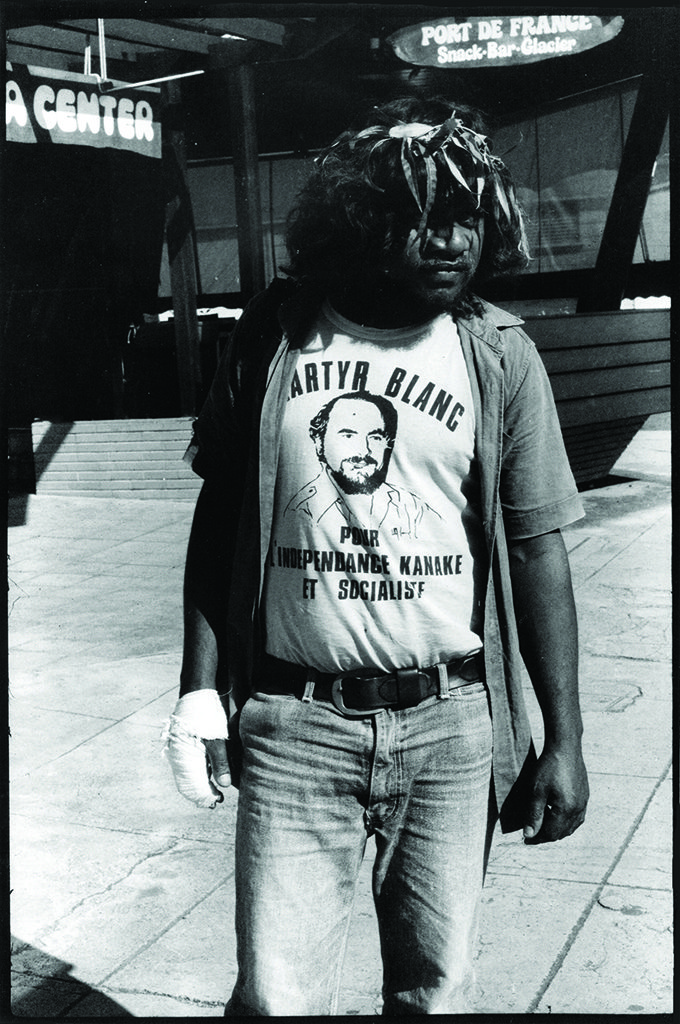
Kanak wearing a “white martyr” tee-shirt honouring an assassinated early FLNKS leader Pierre Declercq. Image: David Robie/PMC

A young motorcycle mechanic, Dominic Canon, was arrested and charged four days after the murder. Another man, Vanuatu-born barman Martin Barthelemy, was arrested a year later. But both suspects have been freed on bail.

Judicial delay scandalous
Marguitte Declercq accuses justice officials and gendarmes of obstructing inquiries into her husband’s killing; League of Human Rights secretary-general Jean-Jacques Bourdinat has called the judicial delay scandalous.

When I spoke to the cherubic-faced Canon, now 22, in his workshop on the outskirts of Noumea just after his release on $5000 bail from the notorious Camp Est prison, he insisted: “I’m innocent. They put me in jail for nothing.”

New Caledonia’s problem stem from its complex racial mix. Kanaks number only 60,000 out of a population of 140,000. About 50,000 Europeans form the next largest group, and the rest are potpourri of Vietnamese, Indonesians, Tahitians and Wallisians.

New Caledonia was annexed by France in 1853, mainly for the use as a penal colony. In three decades after 1860 more than 40,000 prisoners—including leaders of the 1871 Paris commune insurrection and other political exiles—were deported to the colony.

“Colonial assassins” graffiti denouncing French colonial rule in the Place des Cocotiers, Noumea, 1984. Image: David Robie/PMC

For almost a century the Kanaks were deprived of political and civil rights But after they finally won the vote in 1951, they begun to wrest a limited share of their own country’s development—which was later fuelled by a nickel boom.

According to Vice-President Tjibaou, the New Caledonian territorial government has less power now than during the controversial loi cadre years between 1956 and 1959, when the territory was almost self-governing. Later conservative French governments favoured policies which meant New Caledonia was governed as an integral part of France until the Mitterrand administration embarked on reforms in 1981—after the assassination of Declercq.

The indépèndantistes argue that the current French reforms, far from being progressive, have in fact only been restoring some of the progress made in the 1950s. And they fear that if the Socialists lose office in the French general election due in 1986 they will be faced with another stalemate. Hence their urgency for independence next year.

Unique style
They claim President Mitterrand betrayed a commitment to independence made before being elected, and again at a roundtable conference at Nainville-les-Roches last year.

The controversial statute will increase the Territorial Assembly from 36 seats to 42 (slightly favouring the indépèndantistes): create a unique style of upper house comprising custom chiefs and representatives of elected town councils; introduce six regional (Kanaks prefer the word pays, or cultural community) administrations; and establish a special commission to prepare the way for a referendum on self-determination in 1989.
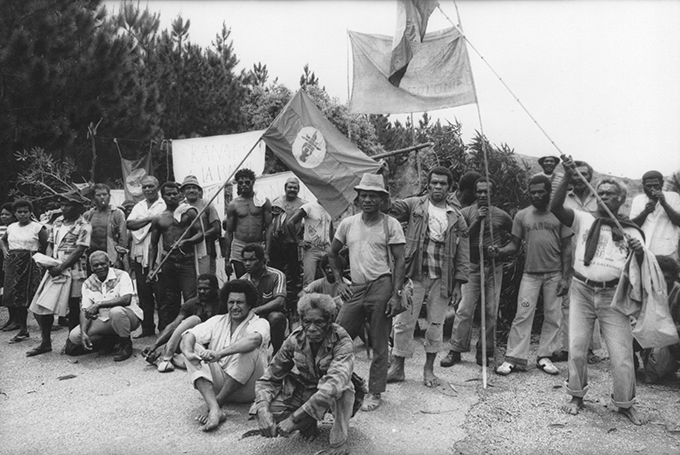
Kanak villagers guard a barricade near Bourail, New Caledonia, 1985. The Kanak flag bears a red band representing the blood sacrificed in their struggle. Image: David Robie/London Sunday Times

“We haven’t any choice but to oppose the application of the statute,” says Tjibaou. “We must impose an ‘active’ boycott, because if we accept these elections under the statute of autonomy, we accept the colonial logic behind them.”

Tjibaou believes the election result would be insignificant and unrepresentative of the territory. Many FLNKS leaders consider that the French government couldn’t allow an unrepresentative local government, so they would annul the elections and be forced into making quicker concessions for electoral reforms.

French officials concede there could be a case for a qualified franchise, such as Fiji’s nine-year residential clause, but consider the FLNKS demand that voters should be only Kanaks or people with at least one parent born in New Caledonia to be “unconstitutional”. Fearful of eventual independence, white Caledonians are applying in droves for immigration permits to Australia. Wealthy New Caledonians are also buying lands in New Zealand’s South Island, California, Hawai’i, Queensland and the French Riviera.

Most Kanaks support the Independence Front, a coalition of five parties until the Kanak Socialist Liberation, led by charismatic Nidoishe Naisseline, split away recently over the election boycott decision. Naisseline, a Sorbonne-educated grand chief, says Kanaks “shouldn’t try to copy nationalist movements in Africa and Indo-China”.

The majority of Europeans back Lafleur’s Republican Congress Party which used to advocate continued integration with France. Now it is outflanked on the right by the Caledonian Front while the centrist Caledonian New Society Federation (FNSC), also mainly European, has been supporting the Independence Forum for the last two years.

New Caledonian politics is highly complex, and feelings are potentially explosive.
While the rest of the South Pacific—apart from Vanuatu, which was forced to cope with an abortive secession—peacefully gained independence, New Caledonia seems fated to break that pattern. Little wonder the indépèndantistes have included symbolic blood on their banner.

***

Ongoing conflict
Over the next seven years, I closely reported the ongoing conflict in Kanaky for Pacific and global media.

Multimillionaire mining and property mogul Jacques Lafleur, one of the richest men in France and the biggest thorn for Kanak independence, even though he eventually reluctantly signed the two critical accords paving the way for possible independence, died in 2010 aged 78.
He dominated New Caledonian politics for more than three decades, including 29 as a member of the French National Assembly.

Along with Jean-Marie Tjibaou—one of the great visionary Pacific leaders until he was assassinated in 1989 (7), Lafleur signed the 1988 Matignon accord and then the Noumea accord in 1998, and honoured a pledge to Tjibaou to open the way for a Kanak stake in the nickel mining industry.

Lafleur agreed to sell his controlling stake in Societe Miniere du Sud Pacific (SMSP) to the Kanak-dominated Northern Province government in 1990.

New Caledonian nickel is shipped to many Asian countries where it is processed to manufacture steel, electronics and consumer goods. The nickel industry has made many Caldoche wealthy, with minerals for 90 percent of the territory’s export revenue.
Criticism of the industry is highly unpopular with the establishment.

The Pacific Media Centre’s Professor David Robie is author of Blood on their Banner: Nationalist Struggles in the South Pacific and Don’t Spoil My Beautiful Face.

References
1. Haut-Commissariat de la Republique en Nouvelle-Caledonie (2018). Consultation sur l’accession a la plein souverainete de la Nouvelle Caledonie.
2. David Robie (1989). Introduction. In Blood On Their Banner: Nationalist Struggles in the South Pacific. London: Zed Books, p. 17.
3. Max Uechtritz (2018, May 7). Blood in the Pacific: 30 years on from the Ouvéa Island cave massacre. Asia Pacific Report.
4. David Robie (1989). Och världen blundar… kampen för frihet i Stilla havet [And the world closed its eyes – campaign for a free South Pacific]. Swedish trans. Margareta Eklof]. Hoganas, Sweden: Wiken Books; David Robie (1989). Blood On Their Banner: Nationalist Struggles in the South Pacific. London: Zed Books.
5. David Robie (2012). Gossana cave siege tragic tale of betrayal. Pacific Journalism Review: Te Koakoa, 18(2), 212-216.
6. David Robie (2014). Don’t Spoil My Beautiful face: Media, Mayhem and Human Rights in the Pacific. Auckland: Little Island Press./
7. David Robie (1984, October 27). Blood on their banner. New Zealand Listener, pp. 14-15
8. Sarah Walls (2009). Jean-Marie Tjibaou: Statesman without a state: a reporter’s perspective. The Journal of Pacific History. 44(2), 165-178.

Print Friendly, PDF & Email

Article by AsiaPacificReport.nz

]]>

Attention economy: Facebook delivers traffic but no money for news media

]]>

Source: The Conversation (Au and NZ) – By Merja Myllylahti, Research Fellow, Auckland University of Technology

Facebook and quality journalism are uneasy companions. Recent headlines suggest the platform’s “lies” about video metrics “smashed” journalism and the platform “crashed and burned” news companies’ referral traffic after it changed its algorithm in January.

The Australian Competition and Consumer Commission is currently holding a digital platform inquiry to investigate what kind of impact social media platforms, search engines and other content aggregators have on the local media market. In the United Kingdom, the Cairncross review is assessing similar issues, looking for ways of sustaining high-quality journalism in a changing market.

My research suggests these enquiries should pay attention to the impact of Facebook and the lessons we’ve already learned about the social platform.


Read more: Class action against Facebook over facial recognition could pave the way for further lawsuits


Lesson one: overstated metrics

You should not trust all the metrics platform companies offer.

A recent article in The Atlantic revealed that a lawsuit has been filed against Facebook, because it allegedly overstated its video statistics for years, “exaggerating the time spent watching them by as much as 900% percent.”

The article asserts that “hundreds of journalists” lost their job after Facebook lured news companies to invest in video. However, Facebook has denied these claims.

The Spinoff, a digital native media company in New Zealand, recently posted a story with a similar analysis of the platform’s impact, saying that Facebook’s fake video statistics “smashed New Zealand journalism” because when it encouraged news companies to invest in online video production, they followed.

New Zealand media were collateral damage in Facebook’s obsessive desire to grow at all costs.


Read more: How to stop haemorrhaging data on Facebook


Lesson two: traffic dependency

You should not rely on Facebook traffic.

A recent report by the Tow Center for Digital Journalism shows that in the United States, news companies have a substantial presence on Facebook. The report found that roughly 80% of the local news outlets are using the social platform.

Additionally, two recent studies demonstrates how news companies rely on Facebook to drive their traffic. My own research of four New Zealand news companies shows that 24% of their traffic came from social media, and most of that came from Facebook. Together social and search drove 47% of New Zealand news sites’ traffic.

A larger study of 12 newspapers and broadcasters in Europe, conducted by Reuters Institute for the Study of Journalism, notes:

… news organisations are making major investments in social media and report receiving significant amounts of traffic” from social media.

These studies confirm news companies’ Facebook dependency in terms of traffic, although the level of dependency differs between media outlets. The Reuters study found that Facebook’s algorithm changes in January had a severe impact on some of the news companies’ traffic. However, the severity of impact differed between media outlets. For example, Le Monde saw its interactions drop by almost a third, but for The Times these grew.

In New Zealand, The Spinoff suffered a substantial drop in its traffic after Facebook’s algorithm tweaks: its traffic from the platform dropped from 50% to 30%. We have seen similar drops in other markets, too.

The Nieman Lab, which reports on digital media innovation, found that following Facebook’s algorithm change, the drop in referral traffic was not universal. Some not-for-profit media organisations benefited.

Bottom line: The decline in referrals to publishers from Facebook is not universal, and in the face of those declines, other sources of traffic are more important than ever.

Indeed, it would be wise for all news outlets to grow their direct traffic which delivers better user engagement and monetisation.

Lesson three: don’t do it for the money

You don’t make much money on Facebook.

My research suggests if news companies abandoned Facebook, they would hardly lose any money. For the companies studied, social media traffic made up 0.03%–0.14% of their total revenue, and social shares 0.009%–0.2% of total revenue. These figures don’t take into account advertising income from platforms or subscription conversion.

The reason news companies continue to distribute their content on social media platforms is because they gain attention. News companies believe they can turn this attention into money, but so far with little success.

However, some news publishers have reported that they have gained digital subscriptions from the platforms. The Reuters study notes Facebook delivers news companies audience engagement that is “considered more cost effective at driving digital subscription sales.”

The bottom line is there is no data yet to verify how well news publishers manage to convert social media attention to digital subscriptions. Google, Facebook, Amazon and Apple are all offering, or are in the process of offering, digital subscription services to news publishers, but how well these will work for news companies remains to be seen.

ref. Attention economy: Facebook delivers traffic but no money for news media – http://theconversation.com/attention-economy-facebook-delivers-traffic-but-no-money-for-news-media-105725]]>

While I Was Waiting captures the tragedy of the Syrian civil war in Damascus

]]>

Source: The Conversation (Au and NZ) – By William Peterson, Senior Lecturer in Drama, Flinders University

Review: While I Was Waiting, OzAsia Festival.


Unrest breaks out in a proud and ancient city, its inhabitants are divided against one another, local big shots control neighbourhoods, war rages outside the city gates, and many inhabitants scatter to all corners of the earth. This is not ancient Troy, rather Damascus today.

The tragedy of Syria, which since 2011 has been broadcast into our homes via television, computers, and hand-held devices, is perhaps amplified because the place once looked so familiar to us. This is true especially of pre-2011 Damascus, with its cosmopolitan, well-dressed people enjoying middle-class lives in a beautiful city with attractive, tree-lined streets.

Given what has happened in Syria, that a piece of theatre could be made about the intersecting lives of six people living in Damascus in 2015 is itself the real miracle of this Arabic language production of While I Was Waiting. It was created in Marseilles, France, where a group of diasporic Syrian actors came together with a few remaining in their home country to create this hard-hitting play, crafted by playwright Mohammad Al Attar and under the direction of Omar Abusaada.

Since that time, the play, which received its Australian premiere at Adelaide’s OzAsia Festival, has toured extensively to Europe, the US and Japan. It is easy to understand the play’s international appeal. It is written and presented by very people who themselves are, in the words of Abusaada, “living in that in-between space.” This space, between “staying and going”, is presented in a mode between “documentary and drama,” integrating clips of dynamic and deeply affecting videos taken surreptitiously on the streets of Damascus by Reem Alghazi.

Mohammad Alrefai (not in OzAsia production) and Mustafa Kur. Masashi Hirao

The play’s action, which unfolds between spring and winter 2015, revolves around each character’s relationship to a young man, Taim (Kinan Hmidan), who, we soon learn, was found comatose in the back seat of a car. Like his friends and family who gather to attend to him, we want to know more, who did this to him and why, but these questions are left unanswered, as they are for those who love him.

At the start of the play, Taim lies immobile on a hospital bed as his mother recites verses. The actor rises from the bed and it soon becomes apparent that for the rest of the play it will be his spectral presence that moves in and around those who gather at his bedside.

In addition to his mother, we are soon introduced to his elder sister Nada (Nanda Mohammad), who had fled to Beirut to build an independent life, his girlfriend Salma (Reham Kassar) and an older friend, Ousama (Mohamad Alrashi) who gets through the day self-medicating with hashish.

At times, the drama was overloaded with unnecessary and cumbersome dramatic questions, with conflicts quickly flaring in predictable ways between mother and daughter, mother and girlfriend, the daughter and the hash-smoking brother’s friend. There is perhaps too much drama over the long-dead father, the making of Taim’s film, which connects the story of the family with the city, and unanswered phone calls on the night of his death.

Mohamad Alrashi and Nanda Mohammad and . Stavros Habakis

But it is in the quiet, confessional moments where this play is most affecting. In one such sequence, Nada shows her comatose brother a series of photos that connect the personal with the mad world outside. We see the little girl, safe and protected, the time when “the family was the limits of my world.”

When we later see the sadness in her adult eyes, it hurts. She recalls “the last time I’ll ever see your name come up on my mobile.”

At such moments, of which there are many in this production, there is no acting, no artifice, only the pain borne of real, incalculable loss.

A dramatic and emotional counterpoint is created by another young man, an aspiring DJ whose life was cut short years earlier. He occupies a kind of DJ’s booth onstage, activating the urban soundscape that weaves in and out of the play’s action from a position that floats above the city. His hovering world, the world of “the unburied dead,” becomes the Damascus that we want to see restored.

And it is on high above the city that the play’s emotional arc comes full circle for the audience. Here we see Taim on the roof of his building, just before the “accident,” looking out at a sea of lights. As he lingers to connect one last time with the city he loves and has decided to leave, we too are there with him, enveloped by the sounds of a broken city.


While I Was Waiting is being staged as part of the OzAsia Festival in Adelaide until October 31.

ref. While I Was Waiting captures the tragedy of the Syrian civil war in Damascus – http://theconversation.com/while-i-was-waiting-captures-the-tragedy-of-the-syrian-civil-war-in-damascus-106075]]>

Rebel music: the protest songs of New Caledonia’s independence referendum

]]>

Source: The Conversation (Au and NZ) – By Michael Webb, Lecturer in music education and ethnomusicology, University of Sydney

On November 4, New Caledonians will go to the polls to vote for either continued French governance, or independence.

Many Australians, who might holiday there to taste French culture in the Pacific, are unaware of the continuing struggle for sovereignty of the Kanak people (Indigenous New Caldeonians) since the catastrophe of their colonisation by France in 1853. This struggle has often been told through music.

Our research looks at the role of music in political struggles in Melanesia, particularly in West Papua and New Caledonia. Across Melanesia, music is not only evidence of ancient and living cultures, it is also a celebration of Indigenous resistance, agency and resilience.

Songs of resistance

Just now in the street I saw my children
Advancing, shouting “Freedom!”
The high school was empty, where are the youth?
In the streets the city was in protest

Written in 1985, these opening lines, from pioneer Kanak protest singer Jean-Pierre Swan’s song Liberté, refer to les évènements, “the Events”. These were a bloody civil war in New Caledonia in the 1980s that culminated in the massacre of 19 Kanaks by French commandos in 1988, and the assassination in 1989 of the great Melanesian pacifist independence campaigner, Jean-Marie Tjibaou.

Resistance to French rule has ebbed and flowed since French annexation but was re-energised in 1969 with the formation of the Foulards Rouges (the Red Scarves), a group that combined anti-colonial leftism and Pacific cultural nationalism.

The Red Scarves were led by Nidoish Naisseline, heir to a high chief, whose arrest and imprisonment in September 1969 sparked a riot and ultimately, the Kanak Awakening, a period of intense Indigenous resistance to overseas occupation.

This movement was immortalised in the song, Jamulo Ataï, with lyrics penned by Naisseline himself. Jamulo, in the title, was Naisseline’s nickname and Ataï was the 19th century Kanak resistance leader. By pairing his name with Ataï’s, Naisseline was equating himself to the great leader.

One verse of the song mentions the quest for self-rule:

In September ’69
The crown of Jamulo remains
And we will support it forever
Leave the natives their independence

Almost a century before, in 1878, Ataï had led an uprising in which 1,200 Melanesians were slaughtered. Ataï was assassinated and his head sent to France as a trophy.

In the mid 1980s, Kanak musician and intellectual Théo Menango’s funk-rock band, Yata (Ataï in reverse), looked to the past for inspiration, memorialising the slain hero in a song that provocatively compared him with Christ:

Ataï the pure, the steadfast, the great saint
Like Christ your blood was shed
Ataï your name must last
Like Christ your work is immortal
Ataï, oh, you’re revealing to me the path to take
In your footsteps is freedom!

Past traumas

The relentless drive to dismantle Kanak culture and shut down anti-colonial protest gave birth in the 1980s to the kaneka music genre, which combined musical elements and the Black pride and rights stance of Jamaican reggae with the “tchap” rhythm and sound of Indigenous percussion instruments.

There was an outpouring of kaneka songs marking past and present traumatic events and injustices. Here is a selection:

Ouvanu by the kaneka band Waan, remembers the guillotining on the orders of the colonial governor in 1868 of 10 Kanak men at Ouvanu in Puébo, in the north of Grand Terre (the large island of New Caledonia).

The lament Loulou by the kaneka band Bwanjep, refers to the night ambush by settlers at Wan’yaat in 1984 of several cars containing prominent Kanaks.

Ten people were shot, including two brothers of the visionary Kanak leader Jean-Marie Tjibaou. One of them was nicknamed Loulou.

Homage a Eloi Machoro by the kaneka band JDVK, celebrates Eloi Machoro, the Kanak militant who became known as a destroyer of ballot boxes.

He was shot dead in 1985 by police a few kilometres from where Chief Atai had fallen 110 years earlier.

Gossanah Iaai by the kaneka band Nodeak documents the massacre by French Special Forces of 19 Kanaks in the Gossanah caves on Ouvéa in the Loyalty Islands in 1988.

A music festival

A year ago, we flew to Lifou in the Loyalty Islands for Fest Mela, a weekend music event at the town of Hapetra organised by the kaneka superstar, Edou Wamai, who lives locally.

Fest Mela was headlined by the Melbourne-based West Papuan group, Black Sistaz, who are daughters of the renowned West Papuan independence activist band of the 1980s, the Black Brothers.

Members of Kool Groove at Fest Mela, draped in the Kanak flag. Michael Webb

The roster of local bands included Kool Groove who played a local style of guitar-based folk music. Draped in the Kanak flag, members expressed pride in their local language, culture and future nation.

On Lifou, we were received by the Chief of Hapetra, who requested that the Black Sistaz sing for him. They responded with a moving a cappella song from the island of Biak in West Papua.

Black Sistaz singing for the Chief at Hapetra. Michael Webb

As Melanesian nations still under colonial rule, West Papuans and Kanaks consider their fate to be intertwined — each believes the other can assist in achieving sovereignty over their own soil. Kanak musicians have also composed songs advocating for an independent West Papua, such as Free West Papua by the acoustic kaneka band, Lyric Kanak Gong.

In Melanesia, at crucial moments when the destiny of Pacific First Peoples is being decided, such as in this week’s referendum, songs can remind of past sacrifices and help to imagine possible futures.

Our thanks to Rosie Makalu, Eric Gawe and Nina Soler in Kanaky (New Caledonia).

ref. Rebel music: the protest songs of New Caledonia’s independence referendum – http://theconversation.com/rebel-music-the-protest-songs-of-new-caledonias-independence-referendum-105580]]>

Explainer: what any country can and can’t do in Antarctica, in the name of science

]]>

Source: The Conversation (Au and NZ) – By Julia Jabour, Leader, Ocean and Antarctic Governance Research Program, University of Tasmania

Antarctica is owned by no one, but there are plenty of countries interested in this frozen island continent at the bottom of the Earth.

While there are some regulations on who can do what there, scientific research has no definition in Antarctic law. So any research by a country conducted in or about Antarctica can be interpreted as legitimate Antarctic science.


Read more: How a near-perfect rectangular iceberg formed


There are 30 countries – including Australia – operating bases and ships, and flying aircraft to and from runways across the continent.

Russia and China have increased their presence in Antarctica over the past decade, with China now reportedly interested in building its first permanent airfield.

It is not surprising there is significant interest in who is doing what, where – especially if countries ramp up their investment in Antarctic infrastructure with new stations, ships or runways.

Their actions might raise eyebrows and fuel speculation. But the freedom of countries to behave autonomously is guided by the laws that apply to this sovereign-neutral continent.

Treaties and signatories

There are 12 original signatories to the 1959 Antarctic Treaty, including Australia, and they do not have to prove their commitment to the treaty since they wrote the rules.

Another 41 countries have signed on since 1959, and they do need to prove commitment.

Non-signatory countries, such as Iran or Indonesia, are freed from many of these legal obligations.

Until such time as the Antarctic Treaty has been designated customary international law applicable to all states by a high authority (such as the International Court of Justice), non-signatories can essentially do what they like in Antarctica.

The appliance of science

Autonomous freedom of activity by signatory countries is legitimised through the fact that science is the currency of credibility in Antarctica. This is important for two reasons:

  1. scientific research has legal priority
  2. new signatories can become decision-makers when they do science.

The “freedom of scientific investigation” is preserved in Article II of the Antarctic Treaty. It directs that signatories to the treaty can conduct scientific research of any kind anywhere in the Antarctic, without anybody else’s permission.

The Scientific Committee on Antarctic Research (SCAR) coordinates Antarctic research, but being a member is not a prerequisite for doing Antarctic science.

Further, the treaty outlines the process for new signatories (that is, other than the original 12) to achieve Consultative Party (decision-making) status.

Decisions are made by consensus (that is, everyone agrees or there is no formal objection). So every country’s “vote” counts and new countries aspire to gain a seat at the table to further their national agendas.

They become Consultative Parties by conducting “substantial scientific research activity” (Article IX.2) and when this has been accomplished to the satisfaction of the other decision-makers, they will be accepted.

Piggy backing

Demonstrating interest in Antarctic science was initially interpreted as building a base or dispatching an expedition (Article IX.2). But after the adoption of the environmental protocol to the treaty in 1991, this was re-interpreted.

Parties were encouraged (but not legally bound) to consider piggy-backing on existing national scientific expeditions of other countries, and to share stations and other resources such as ships and aircraft where possible.

Currently there is only one jointly operated scientific base – Concordia, occupied by both France and Italy. The Novolazarevskaya airfield is a joint operation coordinated by Russia.

This encouragement was designed to reduce the potential for expansion of the footprint of human activities.

In 2017 the Consultative Parties adopted revised guidelines for how to become a decision maker. These outline new rules on a concept that has never been articulated publicly in an Antarctic forum before – evaluating the quality of scientific research.

This could put the brakes on the rapid addition of new signatories to the table.

There are limits

Although there is freedom to conduct science anywhere in Antarctica, what any country cannot do is lay claim to territory on the basis of its research efforts.

The treaty expressly excludes new claims or the extension of existing claims. Signatories that conduct research, and support those endeavours by building a base and infrastructure such as an airstrip, cannot use those actions as a basis of a claim while the treaty is in force.

Seven countries claim Antarctic territory: Argentina, Australia, Chile, France, New Zealand, Norway and the United Kingdom. Two others – the United States and the Russian Federation – have reserved their rights to claim any or all of Antarctica in the future.

These paper claims are acknowledged by Article IV of the treaty. But its artful craftsmanship prevents conflict over the claims and reservations during the life of the Treaty – which incidentally has neither an expiry nor a future review date.

Because the Article II freedoms permit research to be undertaken anywhere on the continent, the borders delineating claims become irrelevant to all but the claimant.

A party has an option of recognising a claim, or not, and does not need anyone’s permission to build a station or send an expedition. This means that the claimants have very limited capacity to exercise sovereignty in their territory. This effectively reduces their power to that of jurisdiction only over their own nationals.


Read more: How a trip to Antarctica became a real-life experiment in decision-making


The sting in the tail is that conducting substantial scientific research activity in Antarctica – including the building of support infrastructure – is the pathway new states must take to achieve decision-making status.

This is only constrained by the legal requirement to undertake an environmental impact assessment of any activity prior to its commencement.

Irrespective of whether the activity’s proponent complies with best practice environmental evaluation, under the rules, no other party can veto that activity.

Essentially, any country – whether a party to the treaty or not – can do whatever they like in Antarctica.

ref. Explainer: what any country can and can’t do in Antarctica, in the name of science – http://theconversation.com/explainer-what-any-country-can-and-cant-do-in-antarctica-in-the-name-of-science-105858]]>

Traditional culture may help Indigenous households manage money better

]]>

Source: The Conversation (Au and NZ) – By Robert Breunig, Professor of Economics and Director, Tax and Transfer Policy Institute, Crawford School of Public Policy, Australian National University

Few areas of public policy are as hotly debated as how to close the income gap between Indigenous and non-Indigenous Australians. There are some uncontroversial goals, such as improving job opportunities and reducing the high rate of Indigenous unemployment. But other ideas to better target welfare are bitterly divisive.

The cashless credit card, for example, has been described as a vital response to the problem of welfare policies that systemically enable illicit drug use, alcohol abuse and gambling. It has also been called the epitome of neocolonial and punitive policy implemented for some imagined political gain at the expense of vulnerable people.


Both assessments may be valid, given the context. One of the problems with Indigenous welfare policy is an oversupply of assumptions and a lack of detailed information about the realities of lived experience.


Read more: How to get a better bang for the taxpayers’ buck in all sectors, not only Indigenous programs


It is generally assumed, for example, that the patterns of why people in Australia are poor, and how they manage the money they have, are largely the same for Indigenous and non-Indigenous. But this might be incorrect.

We decided to dig into the statistics and compare the experience of financial stress in Indigenous and non-Indigenous households.

Our findings surprised us.

While financial stress is much more common in Indigenous households, we found evidence of substantial capacity to manage scarce resources. Indigenous households in remote areas seem to manage better than those in urban areas. Large Indigenous households do better than non-Indigenous ones.

We are hesitant to draw any grand policy conclusions, except to underline a clear truth: those in the field of Indigenous policy need to base their decisions on accurate information, lest they undermine the capabilities and strengths that people already possess.

Defining financial stress

Financial stress is a relative experience. It’s not just about income level, but how individuals or households cope. The degree of stress can be different for two people on the exact same income, depending on the choices they make.

The Australian Bureau of Statistics defines a range of indicators to determine financial stress. Spending more than your income is one. Being unable to pay power and phone bills is another. Going without meals and not having money to heat your home are two others.

We split financial stress into “cashflow” (inability to pay housing costs or utilities or borrowing from friends) and “hardship” (missing meals, pawning something, not being able to pay to heat the home or applying for welfare) problems. These two types of problems are fundamentally different. Hardship problems are rarer and more likely to be associated with severe disadvantage.

We then devised a method to better compare the experience of these two forms of financial stress in Indigenous and non-Indigenous households. For this we use two large surveys covering more than 12,000 households: the Household Income and Labour Dynamics in Australia (HILDA) and the 2014-15 National Aboriginal and Torres Strait Islander Social Survey (NATSISS).

Cashflow stress

Indigenous households experience more cashflow problems than comparable non-Indigenous households, even when we control for income and other household characteristics.


That is, an Indigenous household with the same income as an average non-Indigenous household is more likely to experience cashflow problems – in some cases substantially so.

There is evidence this financial stress is exacerbated by the widespread demand-sharing custom known as “humbugging”. An Indigenous person is more likely, for example, to let someone else use their ATM card.

Hardship

Yet when it comes to the more extreme form of financial stress, Indigenous households are at least as effective as non-Indigenous households at avoiding hardship.


That is, while Indigenous households experience more financial stress – because they have, on average, much lower incomes – our model indicates an Indigenous household with the same income as the average non-indigenous household has the same or smaller probability of experiencing financial hardship.

Remote households

Our modelling also shows Indigenous households in remote and very remote areas appear to do better at avoiding financial stress than counterparts in non-remote areas.


The ABS uses five classes of remoteness based on relative access to services. ABS

Again, while remote households have, on average, much lower incomes – and therefore more financial stress – our method is able to show that a remote household is less likely to experience financial stress than a non-remote household with the same income.

This suggests there is value in traditional practices for Indigenous households.

Large households

Finally, large Indigenous households seem to manage better than large non-Indigenous households. As household size grows, Indigenous households need less extra income to have the same probability of experiencing financial stress.

This is significant because it suggests policies that encourage better sharing of resources among large extended family groups could be a highly efficient social insurance mechanism.

Interestingly, the presence of multiple families in a household has no significant effect on the probability of experiencing financial stress. This contradicts the policy assumption that multiple families in a house makes things worse.


Read more: FactCheck Q&A: is $30 billion spent every year on 500,000 Indigenous people in Australia?


Overall our research suggests Indigenous people, particularly those in remote areas, have substantial capacity to manage scarce financial resources. Policy makers need to leverage these capabilities through implementing policies that support and enhance them.

ref. Traditional culture may help Indigenous households manage money better – http://theconversation.com/traditional-culture-may-help-indigenous-households-manage-money-better-104060]]>

Trust Me, I’m An Expert: Food fraud, the centuries-old problem that won’t go away

]]>

Source: The Conversation (Au and NZ) – By Sunanda Creagh, Head of Digital Storytelling

What have you eaten today? And how much do you know about how it was produced, what was added to it along the way, and how it made its way to your plate?

Even as most of us grow increasingly removed from actual food production, many consumers still take food fraud and perceptions of food purity incredibly seriously.

Scandals around “meat glue” or milk and honey contamination, and the skyrocketing global interest in organic foods, underscore the fact that many of us still care quite deeply about the foods we eat and how they’re produced – and that’s affecting food labelling, regulation and consumer behaviour.

One person who’s studied that terrain closely is Dr Andrew Ventimiglia, a Research Fellow at The University of Queensland, who researches food fraud and how it relates to science, culture, trademark law and food regulation.


Read more: Trust Me, I’m An Expert: Cyclone season approacheth, but this year there’s a twist


He sat down with The Conversation’s deputy politics and society editor Justin Bergman to talk about the weird history of food adulteration and certification – everything from 19th century dairy farmers adding sheep brains to skim milk to make it look frothier, to centuries-old oil and wine adulteration scandals.

Dr Ventimiglia said types of food fraud laws have been recorded as early as the 13th century, but the issue really came into focus in the 1800s.

Adulterated milk was one of the first issues that got national attention, and this was roughly in the mid 1800s to late 1800s, both particularly in the UK and the US. And the earliest form of adulterated milk that was really concerning to regulators was actually simply skim milk.

Producers who were making skim milk were adding flour or starch, sometimes carrots for sweetness, but they were also adding things that did pose a public health risk.

So, for instance, chalk was added to increase the whiteness of milk, as well as often sheep or calf brains to froth the milk […] those posed really legitimate health risks that were recognised by early analytic chemists and that really initiated some early food regulations.

And while food scandals persist today, food standards are increasingly more concerned with fraudulent claims on packaging and innovations in food production. For instance, is yoghurt made with coconut milk still considered yoghurt? What to do about foods that claim to be “all natural?”

Special thanks to our multimedia intern, Dilpreet Kaur Taggar, for editing this segment together.


Read more: Trust Me, I’m An Expert: How augmented reality may one day make music a visual, interactive experience


From food adulteration to food poisoning

We also hear from Associate Professor Shauna Murray from the UTS Plant Functional Biology and Climate Change Cluster, about her research into ciguatera fish poisoning. It’s a non-bacterial illness associated with fish consumption and symptoms in humans may include gastrointestinal, neurological and even sometimes cardiovascular problems.

Editorial intern Jordan Fermanis spoke to Dr Murray about why this tropical disease is showing up further south, and how recreational fishermen are helping researchers unlock the mysteries of ciguatera.


Trust Me, I’m An Expert is a podcast where we ask academics to surprise, delight and inform us with their research. You can download previous episodes here.

And please, do check out other podcasts from The Conversation – including The Conversation US’ Heat and Light, about 1968 in the US, and The Anthill from The Conversation UK, as well as Media Files, a brand new podcast all about the media. You can find all our podcasts over here.

Additional audio and credits

Additional editing by Dilpreet Kaur Taggar

Kindergarten by Unkle Ho, from Elefant Traks

Free Music Archive: Podington Bear, Clouds, Rain, Sun

Demand increases for organic produce, 23 ABC News.

Is your honey real honey or just “sugar syrup”? ABC News Australia.

Fake honey: Study finds disturbing results, ABC News Australia.

Meat glue secret, Today Tonight.

Chinese milk report, CNN.

Missouri Wine History, MissouriWine.

Pure. Fresh. Milk. 1991 Promo.

Australian milk ad.

Sad Marimba Planet by Lee Rosevere from Free Music Archive

ref. Trust Me, I’m An Expert: Food fraud, the centuries-old problem that won’t go away – http://theconversation.com/trust-me-im-an-expert-food-fraud-the-centuries-old-problem-that-wont-go-away-105576]]>

I have an exam tomorrow but don’t feel prepared – what should I do?

]]>

Source: The Conversation (Au and NZ) – By Claire Brown, Associate Director, The Victoria Institute; National Director, AVID Australia, Victoria University

You have an exam tomorrow and you’re not feeling prepared. With only a few waking hours to go, how is it best you spend your time?

To pass tomorrow’s exam, cramming might help you write more on the paper than you would have without doing any form of study, depending on how stressed out you are. But it certainly won’t help you learn the information deeply. You will have forgotten most of what you crammed within a week.

Cramming doesn’t work for retaining information

Research shows we overestimate our ability to remember information and underestimate the importance of actively learning information. Students will often say they don’t need to take notes because they have great memories. But this research suggests we assume we’ll remember things forever as well as we do now (we won’t). We underestimate our need to learn and relearn information to be able to recall it when we need it.

As an article in The New York Times put it, cramming is like jam-packing your brain:

But hurriedly jam-packing a brain is akin to speed-packing a cheap suitcase, as most students quickly learn — it holds its new load for a while, then most everything falls out.

So if your exam is tomorrow then cramming might help, but research shows when students see the same material again at a later date, it’s like they have never seen it before.

Cramming and stress

If you’re feeling anxious, it might be better to put the books down and not attempt to cram. Cramming can clog working memory and that can result in cognitive overload, making you feel overwhelmed.

Going to bed late because of a cramming session, overstimulated from too many energy drinks, then tossing and turning with an overloaded brain, could be worse for you than just giving up now and going to bed.

Information is more likely to be retained by your brain if you put it in there slowly over time. from www.shutterstock.com

Four study strategies that are better than cramming

It’s never too late to adopt good study habits that will improve your exam success and relieve your exam anxiety.

1. Get organised

A major reason for cramming is poor organisation of time. Time-poor students should use a planner to identify the times available for study and block out those times in the planner. Then actually be disciplined and use that time to study.

Get a study binder – electronic or hard copy – and keep it organised. Use it regularly to store and review your study notes and materials.

Being organised with your study materials helps you to be organised in your thinking, too, as you can easily access the materials you need to help you study in the time you have prioritised to study.

2. Take, make, interact with and reflect on notes

Taking notes is important. An active note-taking process is important to help you transfer new information from short-term memory and then recall it more easily after it is stored in the long-term memory.


Read more: What’s the best, most effective way to take notes?


Read more: What’s the best way to take notes on your laptop or tablet?


3. Keep interacting with the content

Research has found the rate you forget information is minimised if you interact with (reread/discuss/write) new information within 24 hours of first receiving it. A second, shorter repetition within 24 hours brings recall back up to 100%. A third repetition within a week for an even shorter time brings recall back to 100%.

Going back to the suitcase analogy:

When the neural suitcase is packed carefully and gradually, it holds its contents for far, far longer. An hour of study tonight, an hour on the weekend, another session a week from now: such so-called spacing improves later recall, without requiring students to put in more overall study effort or pay more attention, dozens of studies have found.

When cramming, students often concentrate on one thing intensively for a long period of time. That doesn’t work either. Research shows learning is more effective if the type of material being studied is mixed and study periods are spaced out over time.

That’s why athletes, musicians and students should mix up their training/rehearsal/study sessions by practising different skills over different time periods, rather than focusing on just one thing for an extended time.


Read more: Why block subjects might not be best for university student learning


4. Self-testing

So once you have a good set of notes, what is the best way to interact with them? Self-testing is a powerful way to study and learn.

Other tools you can use to help you self-test are to use mnemonics and flash cards. Mnemonics are memory devices that help you to recall information. An example of a well-known mnemonic is “In 1492, Columbus sailed the ocean blue”.

Flash cards are a great way to self-test. Good organisation of where you store your flash cards and effective use of them are essential to maximise their study potential. It’s good to mix up sets of flash cards and study them in short bursts.

For tomorrow…

If all you want to do is retain the information until after your exam tomorrow, a bit of cramming now might help. But if you’re feeling highly anxious your brain might not retain new information anyway. It might be a better idea to eat a nutritious dinner, go to bed early and get a good night’s sleep.

When you wake up, take a few deep breaths and remind yourself you can only do as well as you can do, and it will all be over in a few hours anyway.

But next time save yourself the stress and take the time to engage with the content frequently. Only this will ensure it’s locked up tight in your brain for a long time. And, finally, good luck!


Read more: HSC exam guide: maximising study and minimising stress


ref. I have an exam tomorrow but don’t feel prepared – what should I do? – http://theconversation.com/i-have-an-exam-tomorrow-but-dont-feel-prepared-what-should-i-do-105849]]>

National interest test for research grants could further erode pure research

]]>

Source: The Conversation (Au and NZ) – By Gavin Moodie, Adjunct professor, RMIT University

A few days have now passed since we learnt that in 2017 the former Minister for Education and Training, Simon Birmingham, secretly rejected 11 grants recommended by the Australian Research Council.

Naturally enough the research community reacted with outrage, and since then criticism has snowballed. Andrew Norton, The Grattan Institute’s Higher Education Program director weighed in while others lined up to express their dismay.


Read more: Simon Birmingham’s intervention in research funding is not unprecedented, but dangerous


‘National interest’ test

Now the new minister for education Dan Tehan has announced what a “new national interest test” for research grants. He also announced that the Coalition government will follow Labor’s lead and reveal when an application recommended by the ARC is rejected by the minister:

As Minister for Education, I can guarantee the sector that I will be transparent in reporting ARC grant funding decisions. I have asked the ARC to add an additional category to the grant outcomes so applicants are notified of instances where a project is ‘recommended to but not funded by the Minister’.

Because of the secrecy of the minister’s rejections, the only previous known rejection of ARC recommendations was in 2005 by the then Coalition minister for education Brendan Nelson.

But the idea of a national interest test for ARC grants isn’t exactly new.

What’s going to change?

The ARC’s current funding rules, signed by Birmingham on 22 August 2017, include these selection criteria:

d. Benefit

  • Will the completed Project produce significant new knowledge and/or innovative economic, commercial, environmental, social and/or cultural benefit to the Australian and international community?
  • Will the proposed research be cost-effective and value for money?

What is likely to be new is a narrower restriction of grants to the government’s science and research priorities adopted after a consultation process led by the former Chief Scientist Ian Chubb.

The minister has asked the ARC Chief Executive Officer Sue Thomas and a panel of experts to update these priorities for the ARC and to align the ARC’s “financial structure” to the priorities.

This is a long way from the traditional understanding of peer research grants that should only have one criterion: how much the proposed research would extend knowledge.

It also could be narrower than the view common in the 1990s, and partly expressed in the government’s science and research priorities, that since it’s impossible to be strong in everything, the government should concentrate research in selected areas and institutions. That, at least, accepted the principle that Australia should aspire to contribute to the world’s stock of fundamental knowledge.


Read more: Some questions for Simon Birmingham, from two researchers whose ARC grant he quashed


What do we want from research?

A focus on “national interest” could easily restrict research grants to those projects with obvious utilitarian benefits, and would accentuate the erosion of pure basic research from 40% of all higher education research in 1992 to 23% in 2016.

While this may assuage critics of “useless” university research, it gets close to introducing a “pub test” for ARC grants, as observed by highly respected Orientalist Roger Benjamin, whose was behind one of the grants rejected by Birmingham.

It’s also ironic that at least some of the grants rejected by Birmingham would have supported research into Western civilisation, something right wing members of the government are keen to have funded by the Ramsay Centre.

ref. National interest test for research grants could further erode pure research – http://theconversation.com/national-interest-test-for-research-grants-could-further-erode-pure-research-106061]]>

Trails on trial: which human uses are OK for protected areas?

]]>

Source: The Conversation (Au and NZ) – By Bill Laurance, Distinguished Research Professor and Australian Laureate, James Cook University

There’s no question about it: parks and protected areas are the absolute cornerstone of our efforts to protect nature. In the long term, we can’t save wildlife and ecosystems without them.

But people want to use parks too, and in rapidly growing numbers. Around the world, parks are destinations for recreational activities like hiking, bird-watching and camping, as well as noisier affairs such as mountain-biking, snowmobiling and four-wheel-driving.

Where do we draw the line?

Road risks

Let’s start by looking at the roads that take us into and through parks. They can be a double-edged sword.

Roads are needed to allow tourists to access parks, but we have to be very careful where and how we build them.

Road for an industrial gold mine slicing through Panamanian rainforest. Susan Laurance

In regions where law enforcement is weak, roads can rip apart a forest — sharply increasing illegal activities such as poaching, deforestation and mining.

According to my (Bill’s) research, new roads – often driven by foreign mining or timber investors from nations such as China – could damage up to a third of all the protected areas in sub-Saharan Africa.


Read more: The global road-building explosion is shattering nature


In Nouabale Ndoke Park in the Congo Basin, poaching wasn’t a big problem until a new road was built along the edge of the park.

Suddenly the fatal rak-rak-rak of AK-47 rifles – often aimed at elephants by ivory poachers – was being heard all too often.

Bill Laurance examines a forest elephant slaughtered by poachers in the Congo. The elephant’s face had been hacked off to extract its valuable ivory tusks. Mahmoud Mahmoud

Trails on trial

Roads are one thing, but what about a simple bike trail or walking track? They let in people too. But they are harmless, right?

Not always. A 2010 Canadian study found that mountain biking causes a range of environmental impacts, including tyres chewing up the soil, causing compaction and erosion. This is a significant problem for fragile alpine vegetation in mountainous areas where many bikers like to explore.

Rapidly moving cyclists can also scare wildlife. In North America and Europe, many wild species, such as bears, wolves, caribou and bobcats, have been shown to flee or avoid areas frequented by hikers or bikers.

In Indonesia, even trails used by ecotourists and birdwatchers scared away some sensitive wildlife species or caused them to shift to being active only at night.

The red panda, an endangered species. Some wildlife avoid areas with even limited human use. Pixabay

Every type of human activity – be it hiking or biking or horse riding — has its own signature impact on nature. We simply don’t know the overall effect of human recreation on parks and protected areas globally.

However, a study earlier this year found that roughly one-third of all terrestrial protected areas worldwide – a staggering 6 million square kilometres, an area bigger than Kenya – is already under “intense” human pressure.


Read more: One-third of the world’s nature reserves are under threat from humans


Roads, mines, industrial logging, farms, townships and cities all threaten these supposedly protected places. And on top of that are the impacts – probably lesser but still unquantified – of more benign human activities aimed at enjoying nature.

Keep people out?

Is the answer to stop people from visiting parks?

Not really. Visitors in many parts of the world help to fund the operation of national parks, and provide vital income for local people.

Exposure to nature is also one of the best ways to enhance human health, build support for environmental protection, and generate political momentum for the establishment of new protected areas.

A hiker in the Leuser Ecosystem, Indonesia. William Laurance

What’s more, locking people out of land is a very unpopular thing to do. Governments that block people from accessing nature reserves often face an electoral backlash.

How to manage humanity

If we accept that people must be able to use parks, what’s the best way to limit their impacts on ecosystems and wildlife? One way is to encourage them to stay on designated trails and tourist routes.

A recent study (using geotagged data from photos) showed that half of all photos by park visitors were taken in less than 1% of each park.

In other words, most visitors use only a small, highly trafficked part of each park. That’s good news for nature.

If people tend to limit their activities to the vicinity of pretty waterfalls, spectacular vistas, and designated hiking areas, that leaves much of the park available for sensitive animals and ecosystems.

Forest elephants in Central Africa. In the past decade, two-thirds of all forest elephants have been wiped out by poachers and expanding roads. Thomas Breuer/ Wikipedia, CC BY-SA

There are many opportunities for practical science and management. We want to help design protected areas in a way that lets people enjoy them – but which also focuses their activities in particular areas while retaining large intact areas where wildlife can roam free with little human disturbance.

And while we’re designing our parks, we want to use every opportunity, and every visit, to educate and empower tourists. We need people using parks to understand, appreciate, and stand up for nature, rather than thinking of parks as simply playgrounds.

ref. Trails on trial: which human uses are OK for protected areas? – http://theconversation.com/trails-on-trial-which-human-uses-are-ok-for-protected-areas-105742]]>

To make housing more affordable this is what state governments need to do

]]>

Source: The Conversation (Au and NZ) – By John Daley, Chief Executive Officer, Grattan Institute

This week we’re exploring the state of nine different policy areas across Australia’s states, as detailed in Grattan Institute’s State Orange Book 2018. Read the other articles in the series here.


House prices might now be falling, but Australians’ anxiety over housing affordability is not. Price falls of a few percentage points in Sydney and Melbourne are cold comfort to first home buyers. They are still paying 50% more than they would have five years ago.

Further price falls are likely, but even then housing will still be less affordable than it was two decades ago.


Read more: Three charts on: poorer Australians bearing the brunt of rising housing costs


Home ownership rates are declining across Australia, especially among the young and the poor. An increasing proportion of low-income earners are in rental stress in all states except Queensland and Tasmania.

STATE HOUSING SCORECARD

Grattan Institute State Orange Book 2018, Table 5.1

The required policy response remains the same. As Grattan Institute’s State Orange Book 2018 shows, state governments need to ensure a lot more housing is built.

What has happened to housing?

Australia’s population is growing rapidly. Our cities have not kept up, so there is less housing per person. The primary obstacle appears to be planning rules that delay or prevent development.

All states except Tasmania have less housing per person than a decade ago

Grattan Institute State Orange Book 2018, Figure 5.1

The New South Wales, Victorian and Queensland governments have all changed planning rules and processes over the past five years or so. This has resulted in new building finally catching up with population growth, even if a significant backlog remains.

The extra supply has already contributed to flattening rents and falling apartment prices in Brisbane. It will help push rents and prices lower in Sydney and Melbourne as well.

But today’s record level of housing construction is the bare minimum needed to match rapid population growth largely driven by immigration.


Read more: How migration affects housing affordability


And yet authorities in NSW and Queensland are responding to NIMBY pressures by making it harder to increase density. In the Victorian election campaign, Opposition Leader Matthew Guy is promising to do the same.

Record housing construction will need to be maintained to meet city plan housing targets

Grattan Institute State Orange Book 2018, Figure 5.2

What should governments do?

Resisting higher-density development is the wrong response. To enable more homes to be built in inner and middle-ring suburbs of our largest cities, state governments should:

  1. Introduce a new small redevelopment housing code. It would protect neighbours, reduce planning uncertainty and improve the quality of new developments. The code would include the things that worry neighbours the most, such as privacy, height and overshadowing.

  2. Allow taller developments of four to eight storeys “as of right” on major transport corridors and around train stations.

  3. Set housing targets for each local council. The targets should be linked to plans for the growth of the city as a whole. Where councils fail to meet planning targets, independent planning panels should step in.

The best evidence is that building an extra 50,000 homes a year for a decade could leave Australian house prices 5-20% lower than what they would have been otherwise, stem rising public anxiety about housing affordability, and increase economic growth.

Reform tenancy rules

As well as boosting supply, state governments should make renting more attractive by changing residential tenancy laws to increase the security of renters and help renters make their property feel like their home. The Victorian government recently tipped the balance more towards tenants. Other state governments should follow suit.


Read more: An open letter on rental housing reform


Of course, changes in tenancy laws in favour of renters could reduce the supply of rental housing and increase rents, but any such effects are likely to be vanishingly small. More likely some investors will sell their properties to first home buyers, which means one less rental property and one less renter.

Boost the public housing supply

The housing affordability crisis has made life particularly hard for low-income earners. There is a powerful case for extra public support for the most vulnerable Australians. But not all policies will be equally effective.

Boosting social housing will be expensive. Increasing the stock by 100,000 dwellings – broadly sufficient to return social housing to its historical share of the total housing stock – would require extra public funding of around A$900 million a year, or an upfront capital cost of between A$10 billion and A$15 billion.

Even then social housing would house only one-third of the poorest 20% of Australians. Most low-income Australians would remain in the private rental market.

The big problem is that there is not enough “flow” of social housing available for people whose lives take a big turn for the worse. Tenants generally take a long time to leave social housing; most have stayed more than five years

To overcome these issues, governments should build more social housing, and tightly target it to people most at risk of becoming homeless for the long term. Extra support for the housing costs of low-income earners should otherwise be delivered primarily by boosting Commonwealth Rent Assistance.


Read more: Super. If Labor really wanted to help women in retirement, it would do something else


Stop offering false hope

State governments also need to stop offering false hope. Even though policies such as first home owners’ grants have proved ineffective time after time, they were the centrepieces of the housing plans of NSW and Victoria announced last year. Inevitably these are really second home sellers’ incentives: the biggest winners are people who own homes already, and property developers with new homes ready to sell.

Similarly, state governments shouldn’t claim that housing and business incentives and regional transport projects will divert a lot of population growth to the regions. Such policies haven’t made much difference in the past. And they provide excuses not to make the tough calls on planning.


Read more: Australia’s dangerous fantasy: diverting population growth to the regions


None of the policies recommended in our State Orange Book 2018 are easy politically. But Australians need to face up to a harsh truth: either people accept greater density in their suburb, or their children will not be able to buy a home.

ref. To make housing more affordable this is what state governments need to do – http://theconversation.com/to-make-housing-more-affordable-this-is-what-state-governments-need-to-do-105050]]>

Curious Kids: If a star explodes, will it destroy Earth?

]]>

Source: The Conversation (Au and NZ) – By Samuel Hinton, PhD, The University of Queensland

This is an article from Curious Kids, a series for children. The Conversation is asking kids to send in questions they’d like an expert to answer. All questions are welcome: find out how to enter at the bottom. You might also like the podcast Imagine This, a co-production between ABC KIDS listen and The Conversation, based on Curious Kids.


If a star explodes, will it destroy the Earth? – Sascha, age 8, Hurstbridge Victoria.

What a great question. Thank you, Sascha. The answer is a resounding “I hope not!”

Luckily for us, not all stars explode and then die. When stars age, they change from a dwarf star (our Sun is actually currently a dwarf star) into a giant star. If a star is big enough it can then explode in what we call a “core-collapse supernova”. But it would need to be around ten times more massive than our Sun for that to happen.

Crab Nebula – the remnant of an exploding star. Wikipedia

So, we’re safe from the Sun exploding. But that doesn’t mean we’re safe in general, because giant stars are big!

In several billion years, the Sun will run out of hydrogen (that’s a gas it burns for fuel) and as it shifts to sticking different atoms together it will expand outwards. First, it will swallow Mercury. Then Venus. And then it will swallow Earth.

This is not great for Earth.

The good news is we have billions of years to prepare for this and leave the planet, if humans are even still around by then.

This animation shows the supernova event which created the Crab Nebula. Credit: ESA/Hubble (M. Kornmesser & L. L. Christensen)

Read more: Curious Kids: Why do stars twinkle?


But you asked about exploding stars. So are there stars other than the Sun, which might explode soon close to us?

Yes, there are! As long as by “soon” we mean within a million years.

The Orion nebula and Betelgeuse. Wikipedia

If you find the constellation Orion in the sky, there is a bright red star at one end – this is Betelgeuse. It is a red supergiant star – so big that if we swapped its position with the Sun, Betelgeuse would swallow Mars, and the asteroid belt. It might also swallow Jupiter as well.

And within the next million years Betelgeuse is expected to explode. Luckily for us, it is around 600 light years away, far enough that when it explodes Earth is safe.

When Betelgeuse explodes it will be so bright that it will outshine the full moon for over a month. We’ll be able to see it in the day time and walk around at night, able to see solely from Betelgeuse’s light.

But it won’t destroy the Earth.

The good thing about space is that – even though it has lots of dangerous stuff floating in it – it’s so big and empty that it almost doesn’t matter.

The Andromeda galaxy – currently heading straight towards us! Wikipedia

Two galaxies smashing together and merging into one sounds catastrophic. But space is so empty that even with the hundreds of billions of stars from the Andromeda galaxy shooting towards us, we don’t expect any collisions between stars at all. There’s just too much space between them. That’s not just with our Sun, but with any of the billions of stars in the Milky Way.

It’s crazy how big space is!


Read more: Curious Kids: Why is the Earth round?


Hello, curious kids! Have you got a question you’d like an expert to answer? Ask an adult to send your question to us. You can:

* Email your question to curiouskids@theconversation.edu.au
* Tell us on Twitter by tagging @ConversationEDU with the hashtag #curiouskids, or
* Tell us on Facebook

CC BY-ND

Please tell us your name, age and which city you live in. You can send an audio recording of your question too, if you want. Send as many questions as you like! We won’t be able to answer every question but we will do our best.

ref. Curious Kids: If a star explodes, will it destroy Earth? – http://theconversation.com/curious-kids-if-a-star-explodes-will-it-destroy-earth-105127]]>

We need better jury directions to ensure justice is done

]]>

Source: The Conversation (Au and NZ) – By John Gibbons, Adjunct Professor in Linguistics, Monash University

In a trial involving a jury, the judge gives the jury instructions on various issues including the relevant laws, trial process and evidence. In Victoria, these instructions are know as jury directions.

Jury directions are necessary to ensure a fair trial. Juries need to understand the directions to reduce the likelihood of a miscarriage of justice, which may result in an innocent person going to prison, or even dying in systems where there is a death penalty. Equally, it could lead to a guilty person being released to commit more offences. Miscarriage of justice is by definition unjust, damaging for the participants, and reflects poorly on the justice system.

However, jury directions can be complex and difficult to understand, and can therefore may not fulfil their main purpose of instructing the jury. To avoid miscarriages of justice, we need a jury direction process that leads to maximum juror understanding.


Read more: Eight cases from across history which still shape the law today


What are the issues with jury directions?

The main purpose of jury directions is to communicate with the jury about the issues mentioned above. But judges have a second hidden audience – appeal court judges – and a secondary motive, which is to avoid retrials on the grounds that the directions were not given correctly.

In order to ensure their jury directions are legally watertight and avoid successful appeals, judges will use language and procedures that a court or jurisdiction has previously approved. This has led to judges using legalistic processes and wordy, complex language that may be poorly understood by jurors. In practice, this second motive has come to dominate the process and undermine the primary purpose of communicating with the jury.

Some factors on the jury’s part may also impede communication. Jurors may have limited understanding of the legal system and legal language. They may be overwhelmed by the complexity of jury directions, making it difficult to process and retain the information. Limits on jurors’ attention spans can also be an issue, as jury directions often take several hours, during which jurors can be affected by stress, fatigue and boredom. Judges have said that jurors’ attention is often lost during this.

The archaic dress, strange procedures, extreme formality, and hierarchy of the courtroom can confuse and intimidate jurors.


Read more: Language puts ordinary people at a disadvantage in the criminal justice system


Then there is the method of communication between judge and jurors, which is overwhelmingly spoken and one-way: from the judge to the jury. The process for the jury to communicate to the judge can be onerous. In Victoria, the jury communicates with the judge by writing down their message and pass it to the tipstaff, the judge’s assistant, who then passes it to the judge. This places a barrier on verbal interaction and decreases communication.

What can be done to improve jury directions?

To judge whether jury directions have been successfully communicated, we need to ask whether the demands made by the procedures and language of the jury directions matched the capacity of the target audience.

Advocates for clearer legal language, known as the plain legal language movement, believe that communication is enhanced if it is brief, orderly and clear (particularly not unnecessarily complex).

For example, take a relatively standard jury direction, given at the start of a trial, which is instructing them to make their decision solely on the evidence presented in the trial. The direction is 202 words long, plus an additional example, and most of the sentences are long and complex. Furthermore, it is disorganised and redundant.

Here is a suggested revision, made with the lawyerly help of Matthew Weatherson of the Judicial College of Victoria:

What is evidence?

There are two kinds of evidence.

First – what the witnesses say or agree to. It is not what the lawyers suggest.

Second – exhibits. These are things that we will show you. I will tell you when there is an exhibit, and we will give it a reference letter or number.

It is around one quarter the length of the original. The complexity of the language has been considerably reduced. The information has been logically re-organised. It is more orderly, briefer and clearer, and therefore more likely to be understood.


Read more: If small print ‘terms and conditions’ require a PhD to read, should they be legally binding?


Some other possible procedural changes are:

  • questioning jurors about the meaning of the directions to ensure they understand them
  • having more direct interactive communication between the judge and jurors
  • providing written forms of the directions as well as spoken
  • making the written directions available during the trial.

Currently, jury directions inadequately instruct jurors because the need to address a secondary audience, the appeal court, has overridden the needs of the primary audience, juries.

Perfect communication is unachievable. However, improving communication is certainly possible, and it is important to do so when so much is at stake.

ref. We need better jury directions to ensure justice is done – http://theconversation.com/we-need-better-jury-directions-to-ensure-justice-is-done-104417]]>

How Mirka and Georges Mora fled the Holocaust and created bohemia across the world

]]>

Source: The Conversation (Au and NZ) – By Sabine Cotte, Honorary fellow of the Grimwade Centre for Cultural Materials Conservation, University of Melbourne

Book Review: Mirka & Georges, A Culinary Affair (MUP).

Launched in the year of Mirka Mora’s 90th birthday – and sadly, her death – Mirka & Georges, A Culinary Affair is a lovely book about two very influential figures in Melbourne’s artistic and food history.

Holocaust survivors, Mirka and Georges Mora arrived in Australia from Paris in 1951, ready to live a new life and inject their European culture and bohemian joie de vivre into a sedate and dull Melbourne. The couple opened cafes and restaurants that became the rendez-vous of the city’s art world, as well as the place to enjoy fine French dining.

Georges and Mirka at Mirka Café 1954. Photographer unknown Heide Museum of Modern Art Archive, Melbourne

They were close friends of the art patrons John and Sunday Reed, and Georges was instrumental in the establishment of Heide, the Reeds’ property, as a Museum of Modern Art in 1981. Later, they went their separate ways to become an influential art dealer (Georges) and a renowned artist (Mirka).

Written by Lesley Harding and Kendrah Morgan, senior curators at Heide, the book mixes a history of the Moras and their restaurants until their separation in 1970, with recipes retrieved from Mirka’s papers and family photos. The recipes are illustrated with photos of Mirka’s artworks, which I found slightly too staged compared to the joyous, organic clutter of her real life studio.


Read more: Diaries, petticoats and copious research: a rare glimpse into Mirka Mora’s artistic process


Mirka and her mother c. 1929. Photographer unknown Mirka Mora papers, private collection, Melbourne

In the first chapter, La jeunesse (Youth), we see gorgeous images of Mirka’s happy years before the war, with her antiques dealer father, inventive seamstress mother, two sisters and a family friend who frequently took her on holidays in Normandy. They were followed by the sombre years of German occupation and the arrest of Mirka, her sisters and her mother in Paris in July 1942, and their subsequent deportation to a camp in the city’s outskirts.

Mirka in Nouzette’s garden c. 1933. Photographer unknown Mirka Mora papers, private collection, Melbourne

In Paris’ Winter Velodrome, where they were detained for a few days, we get a glimpse of Mirka’s mother in the face of adversity: although hungry, she directed her girls to throw the hot potatoes they were eventually given to eat at the policemen below them in the stands, much to their enjoyment and “laughter amidst the tears”. No wonder her daughter grew into a sparkling woman, prone to food flicking and anything mischievous and atmosphere-lifting.

The family’s miraculous liberation from the Pithiviers camp, the years in hiding in a small village in Bourgogne, although they have been recounted several times by Mirka, remind us how life can change at a minute’s notice.

Günter [Georges] in his French Foreign Legion uniform c. 1940. Photographer unknown Mora Family Archive, Los Angeles, courtesy Phillipe Mora

Georges’ youth, much less known until recently, is equally well documented. It his helped by his son Philippe’s recent research into his father’s past, told in the movie Monsieur Mayonnaise (2016), and interviews with his second wife Caroline Williams Mora.

We follow him from his youth in Leipzig where he was born Günter Morawski, into a wealthy family of art collectors, to the university years in Berlin and his flight from the Nazis to Paris in 1933. Reborn as a patent agent for inventors, he briefly joined the French foreign legion before starting to work for a Jewish orphanage, smuggling many children out of France. It was there that he met the 19-year-old Mirka, working as a junior supervisor.

The couple’s arrival in Melbourne in 1951 was a great contrast to Paris. Far from being defeated, they embraced their new life. They developed strong friendships with local artists and their studio in Collins Street became a focal point for meetings, exhibitions and parties.

Mirka Mora, Family Gathering in the Dream Park, 2008, Oil on canvas, 65 x 182 cm. Courtesy William Mora Galleries, Melbourne

This naturally led to opening Mirka café, where the couple’s legendary hospitality and vivacious conversation were accompanied with hearty French food, including Georges’ favourite dish Langouste à la Parisienne. The children’s memories pepper the chapters with funny cameos (such as artist Francis Bacon being transfixed by Philippe’s painting of the nanny in the shower).

One can only imagine the Balzac restaurant – with Charles Blackman as the cook, its walls decorated by Mirka, displaying sculptures by John Perceval – in full flight during the Melbourne 1956 Olympics.

Mirka’s studio 1967. Photographer unknown Mirka Mora papers, private collection, Melbourne

Still from Gertie Anschel’s home movies, showing the Mirka Café street sign. Title no. 525755. National Film and Sound Archive, courtesy Phillipe Mora

The ups and downs of family life, the couple’s bohemian circle and running restaurants make for a string of stories featuring international and local celebrities. This continued with the Tolarno hotel and restaurant from 1964 to the early 1970s, when the marriage ended, heralding new lives for Georges and Mirka.

An easy book to flick through, this will please cooking enthusiasts as well as lovers of anecdotes. However it is worth poring over the text, which gives a glimpse of the intensity of a time when the pair contributed so much to Melbourne.

As Philippe Mora notes in the foreword:

Baillieu Myer famously said our father ‘made Melbourne a city’ … In an absurdly misogynist society, Mirka cut a swathe for all women —artists and writers in particular. Her humour, ghastly to us at the time, was a sword that cut hypocrisy deep.

Mirka Mora Pas de Deux — Drawing and dolls is showing at Heide until 24 March 2019.

ref. How Mirka and Georges Mora fled the Holocaust and created bohemia across the world – http://theconversation.com/how-mirka-and-georges-mora-fled-the-holocaust-and-created-bohemia-across-the-world-105029]]>

Speaking with: ‘Everybody Lies’ author Seth Stephens-Davidowitz on why we tell the (sometimes disturbing) truth online

]]>

Source: The Conversation (Au and NZ) – By Michael Lund, Deputy Editor: Science + Technology, The Conversation

How much do you really know about your friends? Your co-workers? Your community and your country?

The fact is that much of what we think we know about the people around us is likely to be skewed, because people tend to lie. We lie in conversation, on social media, and in surveys. But there exists an online trove of data that allows us to paint a much more accurate picture of who we really are.

That’s the argument of US data scientist Seth Stephens-Davidowitz, author of the book Everybody Lies and our guest on today’s episode of Speaking with.

Stephens-Davidowitz says he uses data from the internet – what he calls “the traces of information that billions of people leave on Google, social media, dating, and even pornography sites” to tell us the surprising and sometimes disturbing truth about who we really are.

Seth Stephens-Davidowitz spoke with David Tuffley, a senior lecturer in applied ethics and sociotechnical studies at Griffith University, to talk about what he learned.


Edited by Dilpreet Kaur.

Recorded by Michael Lund.

Seth Stephens-Davidowitz is in Australia to speak at the Festival of Dangerous Ideas in Sydney on this Sunday, November 4.

Subscribe to The Conversation’s Speaking with podcast on Apple Podcasts, or follow on Tunein Radio.

You can find more podcast episodes from The Conversation here.

Music

ref. Speaking with: ‘Everybody Lies’ author Seth Stephens-Davidowitz on why we tell the (sometimes disturbing) truth online – http://theconversation.com/speaking-with-everybody-lies-author-seth-stephens-davidowitz-on-why-we-tell-the-sometimes-disturbing-truth-online-105570]]>

Scrap workers deal with Saudi Arabia following execution, says Jakarta NGO

]]>

Migrant Care activists hold a rally in protest against the execution of an Indonesian migrant worker in front of the Saudi Arabia Embassy in Jakarta on March 20, 2018. Image: Seto Wardhana/Jakarta Post

By Dian Septiari in Jakarta

The Migrant CARE advocacy group has called on Indonesia’s Manpower Ministry to cancel a recent agreement with Saudi Arabia to send Indonesian migrant workers to the kingdom in limited numbers, following the execution of Indonesian worker Tuti Tursilawati on Monday.

Migrant CARE executive director Wahyu Susilo strongly condemned the execution of Tuti by Saudi authorities and urged President Joko “Jokowi” Widodo to take significant diplomatic measures in protest against Riyadh, such as scrapping a pilot project to send a limited number of migrant workers to Saudi Arabia.

“President Jokowi must cancel the agreement between Indonesia and Saudi Arabia on the One Channel System [because the execution is] proof that Saudi Arabia does not fulfill the terms and conditions pertaining to the protection of the rights of migrant domestic workers,” Wahyu said in a statement.

READ MORE: The Saudi state-sponsored murder of Khashoggi updates

The assured protection of migrant workers’ rights was an explicit requirement in documents signed by Manpower Minister Hanif Dhakiri and his Saudi counterpart Ahmed Sulaiman Al Rajhi on October 11, the rights activist said.

The One Channel System was a scheme agreed upon by the labour ministers that would allow Indonesia to send a certain number of workers to the Middle Eastern kingdom, bypassing a 2015 moratorium.

-Partners-

Tuti was sentenced to death in 2011 for beating her employer to death with a stick in self-defence against attempted rape.

She ran away but was raped instead by nine Saudi men before the police brought her into custody, tribunnews.com reported.

She was executed on Monday without prior notification to her family and Indonesian officials.

During a recent joint commission meeting between Indonesia and Saudi Arabia, Foreign Minister Retno Marsudi requested the cooperation of Riyadh to provide consular notifications in accordance with the 1963 Vienna Convention on consular relations.

President Jokowi also asked Saudi Foreign Minister Adel bin Ahmed Al Jubeir for assurances that Indonesian migrant workers’ rights be protected.

“Jokowi must be truly serious in responding to a situation like this. When he met with the Saudi foreign minister, the President asked Saudi Arabia to provide protection for Indonesian migrant workers and work to resolve the [murder of journalist Jamal] Khashoggi in earnest,” Wahyu said.

“It turns out the request was simply ignored.”

Dian Septiari is a Jakarta Post journalist.

Print Friendly, PDF & Email

Article by AsiaPacificReport.nz

]]>

Protecting the ‘right to be forgotten’ in the age of blockchain

]]>

Source: The Conversation (Au and NZ) – By Raja Jurdak, Research Group Leader, Distributed Sensing Systems @ Data61, CSIRO

There’s been a lot of hype about blockchain over the past year. Although best known as the technology that underpins Bitcoin, blockchain is starting to disrupt other industries, from supply chains to energy trading.

One of the key selling points of blockchain is that once data is added to the chain, it can’t be changed or removed. This makes blockchain trustworthy.

But this same immutability makes blockchain problematic in a world where privacy laws require companies to delete your data from databases once it has served its purpose. This is known in some jurisdictions as the “right to be forgotten”.

We have designed a blockchain in which users can remove their data from the database without violating blockchain’s consistency.


Read more: Blockchain is useful for a lot more than just Bitcoin


There is currently a growing market of Internet of Things devices, from smart homes and self-driving cars to voice assistants and smart energy meters. These devices continuously collect digital biographies of our lives. As this data is increasingly being stored on blockchains, the tension between blockchain and the right to be forgotten will only increase. Our tool could help.

How blockchain works

At its core, blockchain is a database that is jointly managed by a distributed set of participants. Whenever new data is added to the database, all the participants must agree to verify it. In this way, blockchain removes the need for a third-party, such as a bank, to verify transactions.

The blockchain ledger is organised into blocks, where each block is linked to the previous block through cryptographic hash functions. These functions create a short code based on the content of the previous block, and it is not possible to guess this code without trying all possible codes. Chaining the blocks in this manner ensures that the data stored in them cannot be altered, as any changes made would break the blockchain consistency.

This makes blockchains immutable. It also makes blockchain data easy to trace and audit, particularly for large networks like the Internet of Things. These features are highly attractive for organisations operating across organisational boundaries, and in environments where participants may not fully trust each other.

Regulatory challenges

The European Union’s recent General Data Protection Regulation (GDPR) is a significant piece of legislation that is at odds with a digital economy underpinned by blockchain.

The GDPR requires companies that hold people’s data to erase that data once the original purpose they needed it for is complete. That means that people must be able to remove their data from third party databases after a certain period of time.

Blockchain – being unchangeable – presents an obstacle to exercising that right.


Read more: What Wikipedia can teach us about blockchain technology


Risks to privacy

Let’s say you live in smart home that uses sensor data to monitor your home security. You have a home insurance policy and, in order to receive lower premiums, you allow your smoke alarm and security sensor data to be recorded on a blockchain.

The blockchain data can be accessed by the police, the fire department and the insurance company so they can audit any smoke alarm or security events. Once your insurance period has ended, you should be able to remove your security data from the blockchain to enhance your privacy.

If you left your data on the blockchain indefinitely, that would increase the risk of your data being identified as yours, and your activities being tracked by any entity with access to the blockchain.

A blockchain participant typically uses one or more public keys as its identities. The transactions in blockchain are stored anonymously, as there is no direct link between the public keys and the real participant identity. But a breach in identity in any of the transactions, for instance by linking the transaction content to other known data about the user, leads to all interactions of the users’s devices, stored in blockchain, to be tracked by all blockchain participants.
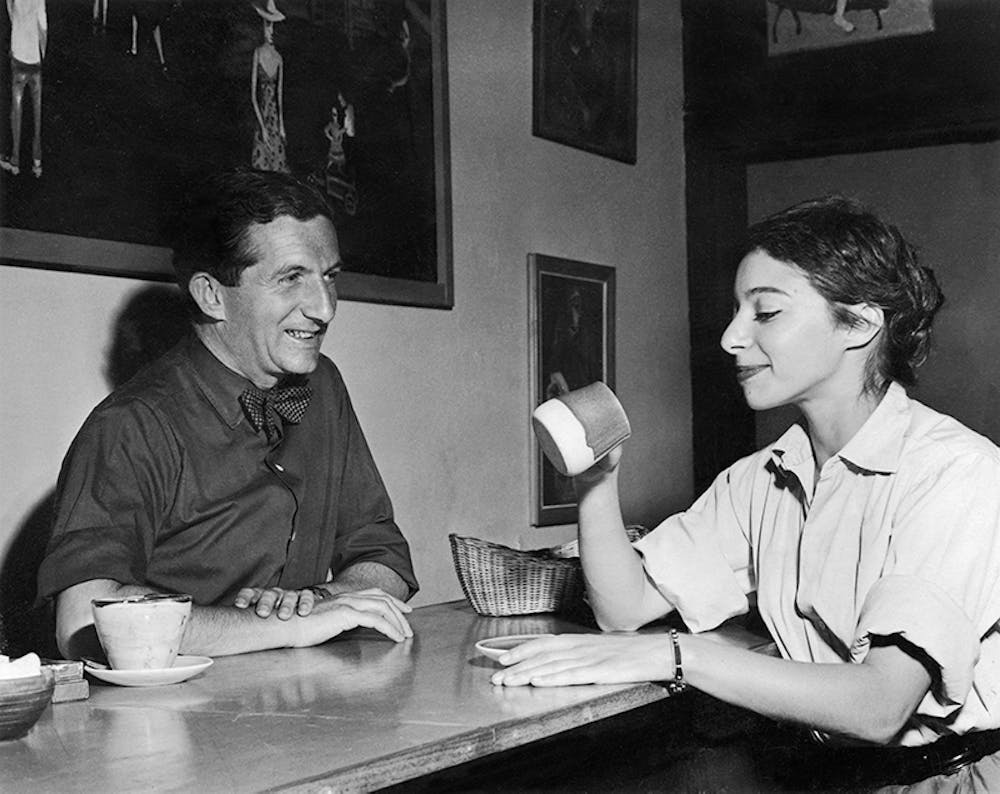

Removing data without breaking the chain

So being able to the remove data from the blockchain without “breaking the chain” would be beneficial for user privacy. It would also be beneficial to save storage space on the servers that store blockchain ledgers.

But currently, removing data from a blockchain is not possible without breaking the blockchain’s consistency.

We have come up with a solution that makes it possible to remove your detailed transaction data from a blockchain database, without removing the auditable trace that the transaction took place.

As described in our peer-reviewed publication this month, Memory Optimised Flexible Blockchain allows you to temporarily store, summarise, or completely remove your transactions from blockchain, while maintaining the blockchain’s consistency.

The remaining trace of the data (its hash) on the blockchain can still be used in the future, in case disputes over what happened arise. For instance, if a home owner wanted to verify that a break-in took place at their house under a previous insurance policy, they could provide a private copy of the data with its associated hash. A legal authority could then compare the hash of the person’s data with the hash that is still stored on the shared blockchain and thereby validate the authenticity of the person’s claim.

This approach provides you with full administrative control of your blockchain-stored data. It makes it possible for you to remove or summarise this data, without sacrificing the ability to audit the data in the future.


Read more: Using blockchain to secure the ‘internet of things’


Reclaiming privacy and control

It is important to note that our published approach can run atop any existing blockchain solution, and does not affect the blockchain consistency. The links among blocks through hash functions are preserved, even as specific blocks are removed or summarised from the chain. In other words, the link of any blockchain entry remains, but the bag containing some data can be cut loose.

In fact, as long as the removed content is stored privately outside of the blockchain, the data’s authenticity can be independently verified at a later time by comparing it against the hash in the blockchain. In this way, you can reclaim control of any previously shared data and exercise your right to be forgotten in the age of blockchain.

ref. Protecting the ‘right to be forgotten’ in the age of blockchain – http://theconversation.com/protecting-the-right-to-be-forgotten-in-the-age-of-blockchain-104847]]>

Russia is a rising military power in the Asia-Pacific, and Australia needs to take it seriously

]]>

Source: The Conversation (Au and NZ) – By Alexey D Muraviev, Associate Professor of National Security and Strategic Studies, Curtin University

Many analysts have seen China’s rapidly growing naval power as a sign that Australia needs to rethink its defence strategy in the Asia-Pacific region. Indeed, China has made remarkable strides in building up its defence capability. But it is worth noting that another military power is increasingly making its presence felt in our region – Russia.

The Coalition government does not give Russia much consideration at all in its current strategic planning. None of the recent Australian defence white papers, including the 2016 paper, considered Russia a significant military power. This perception stems from post-Cold War assumptions that Moscow has little political influence due to its reduced military power and limited economic engagement with our region.

Perhaps these assumptions were true in the 1990s or even ten years ago. However, current strategic realities are very different.

Putin’s game plan for military prowess

In the 2000s, Russia’s military began to gradually rebuild its combat potential. Under President Vladimir Putin’s leadership, the once cash-strapped military force received a massive financial boost and, more importantly, full political support.

After years of decline and neglect, Russian military power in the Asia-Pacific region is making a major leap forward. According to my research, Russian air force units deployed to East Asia received some 300 new upgraded aircraft from 2013-18. This is about equal to the total strength of the current Royal Australian Air Force.

By 2019, the Russian Eastern Military District (the military arm responsible for operations across the Pacific) is expected to receive more than 6,240 pieces of new and upgraded military equipment. This will include battle tanks, missiles and heavy artillery, aircraft, electronic warfare systems and more.


Read more: Australia’s naval upgrade may not be enough to keep pace in a fast-changing region


The Russian Pacific Fleet, the main means for Russia to exert power in the region, is expected to receive some 70 new warships by 2026. This will include 11 nuclear-powered and diesel-electric submarines, and 19 new surface warships – nearly the same number Australia is planning to add over the coming decade.

Russia is also increasingly showcasing this new-found military power in the region.

From late August to mid-September, the Russian military carried out the largest single show of its military power in 37 years, the Vostok 2018 war games. According to the Russian Ministry of Defence, the war games involved 297,000 personnel, more than 1,000 aircraft and 80 warships. A sequence of large-scale exercises was held across eastern Siberia, the Russian Far East and parts of the Arctic. The maritime component was staged in the Okhotsk and Bering seas on Russia’s Pacific coast.

The Vostok 2018 strategic manoeuvres in Siberia and along the Pacific coast.

Condemned by NATO as a rehearsal for “large scale conflict”, the war games signalled that Russia’s military is prepared for possible confrontation in the Asia-Pacific region. This reinforces what many analysts believe is Putin’s intention – to reassert Russia’s status as a global power.


Read more: Russia not so much a (re)rising superpower as a skilled strategic spoiler


Russia’s ‘soft’ military power on the rise

Russia also continues to be a key provider of advanced military technology in the Asia-Pacific region. Last year, Russia supplied 52 countries globally with US$45 billion worth of arms – making it the world’s second-biggest arms supplier, behind the US. Over 60% of Russian arms exports go to Asian countries, with Southeast Asia accounting for most of that total.

Putin meeting Indian Prime Minster Narendra Modi this month. Harish Tyagi/EPA

The Russian military is making its presence felt. This month alone, the Russian army staged joint exercises with Pakistan, while Russian warships were operating in the Indian and Pacific oceans.

Through these arms sales and joint activities, Russia is increasingly bringing Asian countries into its orbit and altering the balance of power in the region by increasing their military capabilities.

Putin visiting China’s Xi Jinping in June. Michael Klimentyev/EAP

In addition to existing security and defence relationships with China, India and more recently Pakistan, Russia has been actively seeking to build ties with other countries on Australia’s doorstep – Indonesia, Malaysia, Myanmar, the Philippines, Thailand and Fiji.

Australia should closely follow Moscow’s growing strategic intimacy with Beijing. In contrast with Western countries, Russia has been willing to share its military expertise with China. And China has taken up the offer. The PLA, for instance, took part in the Vostok 2018 war games under Russia’s command.

Russian activities in and around Australia

Finally, we should not be ignorant of Russia’s activities in Australia and near our shores, which have intensified in recent years.

In 2009, Australian intelligence reported a sharp increase in Russian intelligence-gathering activities in Australia. Russia continues to have an interest in Australia’s national intelligence, especially highly sensitive information shared by the US and its NATO allies.

In November 2014, a Russian naval task group staged operations near Australia’s north at the same time Putin attended the G-20 summmit in Brisbane. This triggered a brief media storm, and was seen by some as a projection of Russia’s naval power.

Last December, Russian strategic bombers conducted exercises out of an Indonesian airfield close to Australia, forcing Australian Defence personnel in Darwin into a state of “increased readiness”. There were concerns the exercises may have been aimed at information gathering.

Then in March, two “undeclared intelligence officers” were expelled from the Russian embassy in Canberra, raising more questions about Russian covert activities in Australia. Two months later, a Russian training warship visited Papua New Guinea – the first visit of its kind for the Russian navy.

Australia-Russia relations at a low point

Russia is making its presence felt in the region for the benefit of its regional allies and clients, and as a form of deterrent to its geopolitical rivals.

Australia’s strategic alliance with the US is clearly on Moscow’s radar. Russia has a keen interest in our joint defence facilities and intelligence sharing, as well as our latest defence technology and operations.


Read more: Russia’s grand strategy: how Putin is using Syria conflict to turn Turkey into Moscow’s proxy


Australia’s hard stance on issues related to Russia, such as Moscow’s annexation of Crimea, the downing of Malaysia Airlines flight MH17, Russia’s involvement in the Syrian conflict and the attempted assassination of former double agent Sergei Skripal in the UK, further complicates our relations with Moscow.

In October, Canberra also joined London in condemning the Russian military for its ongoing cyber-operations against the West, including Australia.

Australia’s relations with Moscow are at their lowest point in decades. And while Australia is by no means a priority for Russia, the country is still being viewed as a geopolitical and security rival. The time has come for us to appreciate a power north of the Great Wall, as well.

ref. Russia is a rising military power in the Asia-Pacific, and Australia needs to take it seriously – http://theconversation.com/russia-is-a-rising-military-power-in-the-asia-pacific-and-australia-needs-to-take-it-seriously-105390]]>

Forget bouncing back, balance is the healthiest way to manage weight post-pregnancy

]]>

Source: The Conversation (Au and NZ) – By Clare Collins, Professor in Nutrition and Dietetics, University of Newcastle

When you have a newborn baby, your waistline may be the last thing on your mind. Yet women often feel pressured to lose their “baby weight” as quickly as they can after pregnancy.

It’s completely normal to have some weight left over at the end of pregnancy. This is due to the change in body composition to support the pregnancy.


Read more: Dieting after birth can make mum’s self esteem worse


Bouncing back to your pre-pregnancy weight immediately after giving birth is neither realistic nor recommended. Instead, taking a balanced approach to weight loss over several months will optimise a woman’s future health outcomes. Achieving a healthy weight after having a baby is also important if you’re planning on another in the future.

How quickly should I lose my pregnancy weight?

There are no set recommendations for how quickly you should return to your pre-pregnancy weight after having a baby. But it is important to lose your pregnancy weight at some point post pregnancy, so it is not carried through to your next pregnancy, or into later life.

Each woman’s weight loss experience will be slightly different. Most studies show women retain about 1-5.5 kilograms at 6-12 months after pregnancy. In our study we found three out of every four women retained some of their pregnancy weight six months after the birth, and one in three retained more than 5 kgs.

Very low energy diets or fad diets are not recommended during pregnancy nor immediately following birth. Trying to lose weight too fast can mean your food choices are less likely to provide a good balance of nutrients, which are needed while your body gets back to a non-pregnant state and for breastfeeding.


Read more: What is a balanced diet anyway?


Sign up for the newsletter

Sign up to Thrive, a weekly dose of evidence to help you live well.


Health benefits of losing the baby weight

Weight gained in pregnancy is due to the growth of the baby, placenta, amniotic fluid, the uterus and changes in body tissues including the breast and fat stores – especially in the hips, back and thighs.

A few weeks after having your baby, this will generally include some extra fat tissue and breast tissue. Having some stored fat tissue at the end of pregnancy is nature’s way of making sure mothers have enough stored energy to support breastfeeding.

Losing this extra store of body fat in the first year following childbirth will help improve a woman’s future health trajectory.

It may be tricky with a newborn, but prioritising healthy eating is likely to help with weight loss. From shutterstock.com

One review looked at change in body weight between pregnancies and the relationship with health outcomes in the second pregnancy. Across 11 studies of 925,000 women, a major increase in body weight between pregnancies (equivalent to three extra units of BMI or 9kg) was associated with an 85% increased risk of having a large-for-gestational-age baby and a 50% greater risk of having a baby weighing more than 4 kgs.

Mothers who had gained this level of weight were three times more likely to develop gestational diabetes and 70% more likely to have a caesarean section.

In the same review, reducing weight between pregnancies was associated with a reduced risk of developing gestational diabetes and having an large-for-gestational-age baby. But there was also an increased risk of having a baby born small for gestational age.

Reducing weight 3-12 months after birth is also associated with lower heart disease risk factors. Weight gain during that time is associated with increased risk of high blood pressure, type 2 diabetes and heart disease.

Top tips for returning to your pre-pregnancy weight

Try to gain pregnancy weight within your recommended weight-gain target. One of the biggest predictors of not returning to your pre-pregnancy weight is gaining too much weight during pregnancy. There are different ways you can check your recommended weight gain target for pregnancy.

Be active. Exercise can help improve both mental and physical health after pregnancy. It can improve sleep, help reduce fatigue, improve your fitness and help you return to your pre-pregnancy weight. Aim for 150 minutes of moderate intensity aerobic exercise per week. Begin by building up ten minute bursts of activity at a time. Start with slow, short and gentle exercise after childbirth, like walking, and gradually increase your duration, speed and intensity. It’s important to discuss returning to exercise after pregnancy with your doctor.

Focus on healthy eating. Women who improve both their eating and exercise habits are more likely to return to their pre-pregnancy weight. The Eat-for-Health Calculator can give you an idea of what you should be eating after pregnancy.

Keeping active is important for both physical and mental health after having a baby. From shutterstock.com

Track your progress. After pregnancy, women who self-monitor their eating and exercise habits lose up to three times more weight. You can record your daily food and exercise levels in a diary, wear a pedometer to track your daily steps or use a heart rate monitor to track exercise intensity. You could also try mobile phone apps or other physical activity trackers.

Breastfeeding may help. When your body produces breast milk, it uses energy (around 2,620 kJ per day), which can come from the fat tissue stored during pregnancy, as well as the energy from food and drink you consume. Breastfeeding may help with weight loss, although it’s normal to feel more hungry when you’re breastfeeding. The key is to mostly eat healthy foods so your body then has to draw on its energy stores. Breastfeeding has lots of other benefits for you and your baby, so getting the support you need is important.


Read more: Breastmilk alone is best for the first six months – here’s what to do next


Start a conversation with your doctor. They can provide you with advice and support around weight loss, mental health and overall well-being in the period following your baby’s birth. They can also refer you to a dietitian or exercise specialist for individual nutrition and exercise support.

ref. Forget bouncing back, balance is the healthiest way to manage weight post-pregnancy – http://theconversation.com/forget-bouncing-back-balance-is-the-healthiest-way-to-manage-weight-post-pregnancy-98306]]>

India unveils the world’s tallest statue, celebrating development at the cost of the environment

]]>

Source: The Conversation (Au and NZ) – By Ruth Gamble, David Myers Research Fellow, La Trobe University

India’s Prime Minister Narendra Modi will today inaugurate the world’s largest statue, the Statue of Unity in Gujarat. At 182m tall (240m including the base), it is twice the height of the Statue of Liberty, and depicts India’s first deputy Prime Minister, Sardar Vallabhbhai Patel.

The statue overlooks the Sardar Sarovar Dam on the Narmada River. Patel is often thought of as the inspiration for the dam, which came to international attention when the World Bank withdraw its support from the project in 1993 after a decade of environmental and humanitarian protests. It wasn’t until 2013 that the World Bank funded another large dam project.

Like the dam, the statue has been condemned for its lack of environmental oversight, and its displacement of local Adivasi or indigenous people. The land on which the statue was built is an Adivasi sacred site that was taken forcibly from them.


Read more: India’s development debate must move beyond Modi


The Statue of Unity is part of a broader push by Modi’s Bharatiya Janata Party (BJP) to promote Patel as a symbol of Indian nationalism and free-market development. The statue’s website praises him for bringing the princely states into the Union of India and for being an early advocate of Indian free enterprise.

The BJP’s promotion of Patel also serves to overshadow the legacy of his boss, India’s first prime minister, Jawaharlal Nehru. Nehru’s descendants head India’s most influential opposition party, the Indian National Congress.

The statue was supposed to be built with both private and public money, but it attracted little private investment. In the end, the government of Gujarat paid for much of the statue’s US$416.67 million price tag.

The statue under construction, January 2019. Alexander Davis

The Gujarat government claims its investment in the statue will promote tourism, and that tourism is “sustainable development”. The United Nations says that sustainable tourism increases environmental outcomes and promotes local cultures. But given the statue’s lack of environmental checks and its displacement of local populations, it is hard to see how this project fulfils these goals.

The structure itself is not exactly a model of sustainable design. Some 5,000 tonnes of iron, 75,000 cubic metres of concrete, 5,700 tonnes of steel, and 22,500 tonnes of bronze sheets were used in its construction.

Critics of the statue note that this emblem of Indian nationalism was designed by a Chinese architect, and the bronze sheeting was put in place by Chinese labour.

The statue’s position next to the controversial Sardar Sarovar Dam is also telling. While chief minister of Gujarat from 2001 to 2014, Modi pushed for the dam’s construction despite the World Bank’s condemnation. He praised the dam’s completion in 2017 as a monument to India’s progress.

Both the completion of the dam and the statue that celebrates it suggest that the BJP government is backing economic development over human rights and environmental protections.

Both the statue and its setting are examples of unsustainable development. Divyakant Solanki/AAP Image

The statue’s inauguration comes only a month after the country closed the first nature reserve in India since 1972. Modi’s government has also come under sustained criticism for a series of pro-industry policies that have eroded conservation, forest, coastal and air pollution protections, and weakened minority land rights.

India was recently ranked 177 out of 180 countries in the world for its environmental protection efforts.

Despite this record, the United Nations’ Environmental Programme (UNEP) recently awarded Modi its highest environmental award. It made him a Champion of the Earth for his work on solar energy development and plastic reduction.

The decision prompted a backlash in India, where many commentators are concerned by the BJP’s environmental record.


Read more: Bridges and roads in north-east India may drive small tribes away from development


Visitors to the statue will access it via a 5km boat ride. At the statue’s base, they can buy souvenirs and fast food, before taking a high-speed elevator to the observation deck.

The observation deck will be situated in Patel’s head. From it, tourists will look out over the Sardar Sarovar Dam, as the accompanying commentary praises “united” India’s national development successes.

But let’s not forget the environmental and minority protections that have been sacrificed to achieve these goals.

ref. India unveils the world’s tallest statue, celebrating development at the cost of the environment – http://theconversation.com/india-unveils-the-worlds-tallest-statue-celebrating-development-at-the-cost-of-the-environment-105731]]>

No state has all the answers in school education

]]>

Source: The Conversation (Au and NZ) – By Peter Goss, School Education Program Director, Grattan Institute

This week we’re exploring the state of nine different policy areas across Australia’s states, as detailed in Grattan Institute’s State Orange Book 2018. Read the other articles in the series here.


School education in Australia is generally good, but it should be better.

The federal government provides about one-third of total funding for school education, but it’s state and territory governments that run schools. State government policy is therefore a key lever for lifting student outcomes.

The Grattan Institute’s State Orange Book 2018 shows how state and territory governments are performing on the issues that matter to Australians, and what they should do to improve.

Where we are

No set of metrics can cover everything that matters in schooling. For this report, we chose four metrics that provide a high-level snapshot and highlight some important differences among states:

  • student progress (learning growth) in primary school, taking account of differences in school advantage

  • the proportion of students achieving at high levels in Year 9 NAPLAN reading and numeracy

  • the proportion of students at or below the national minimum standard in Year 9 NAPLAN reading and numeracy

  • government funding to state government schools as a proportion of their funding target.

Student progress and achievement are two sides of the same coin. Progress is the best way to understand how much schools contribute to learning. Achievement in Year 9 reflects what students can do as they get closer to leaving school.

The picture that emerges from these metrics is nuanced.

Queensland was the star performer in primary school progress, but its Year 9 achievement was some way below the highest-performing states.

New South Wales and Western Australia were good at supporting high-achieving students in secondary school. They also reduced the proportion of Year 9 students who were at or below minimum standards. But the rate at which their students learn in primary school was middle-of-the-pack.

The ACT performed well in Year 9 NAPLAN, largely due to its relatively advantaged population. But on a like-for-like basis, ACT students made two to three months less progress than the national average in primary school. Our recent Measuring Student Progress report showed the same is true in secondary school.

In 2017, Victoria spent the least on its government schools. Does this mean Victoria is more efficient than other states? That’s a hard argument to make when it didn’t out-perform in the other three metrics.

South Australia needs to lift its game; it performed below average on the outcome and equity metrics, whether or not socioeconomic advantage was taken into account.

Tasmania and the Northern Territory both performed better than expected in primary school, once their socioeconomic disadvantage was taken into account. But they still have the highest proportion of students at or below the Year 9 national minimum standard, perpetuating intergenerational disadvantage.

As well as content knowledge, we need to improve skills such as resilience and collaboration. Dan Peled/AAP

Read more: Will sorting classrooms by ability improve marks? It depends on the mix


Where we should be

School education in Australia needs to improve in three distinct ways.

First, we need to improve the teaching of core academic skills. Content still matters, even in the era of Google. Mastering content helps underpin more advanced abilities such as the ability to appraise and apply knowledge.

Second, we must go beyond traditional academic skills and content.

Skills such as critical thinking, collaboration, resilience and initiative are important in preparing young Australians for their lives after school. We need to figure out how best to measure and teach these skills.

Third, we need to reduce the gaps between the educational haves and have-nots.

Looking beneath the headline metrics, the students making the slowest progress in every state are those in the most disadvantaged schools. And, as we showed in our 2016 report Widening Gaps, the students who miss out most are bright children in disadvantaged schools.


Read more: Want to improve NAPLAN scores? Teach children philosophy


How to get there

There are pockets of great teaching practice across Australia, but also pockets where teaching needs to be more effective. We should build on what is working best, as well as learning lessons from overseas.

To lift teaching effectiveness, state governments need to create adaptive education systems that enable continuous improvement by design, not by chance. This means getting much better at selecting and spreading what works best.

The goal is not for all teachers to teach the same material in the same way, but for all teachers to use practices that have been shown to work, and to adapt them to meet the needs of their students.

To work this way, teachers need better data on the learning progress of each of their students, as well as their achievement. State governments can help by making it easier for teachers to identify high-quality classroom assessment tools and resources.

State governments should also create explicit jobs for top teachers, to use their subject expertise to spread effective practice within and across schools. Simply reading about what works is not enough to improve teaching; teachers need to see good practice in action, try new ways of working, and get specific feedback.

Most states have tried coaching programs, but they often chop and change, and coaches are not always subject experts. We need a much more systematic approach.

At the same time as investing in supporting front-line teachers, states should work on strengthening the evidence base about what works well in the classroom. This includes randomised controlled trials and quasi-experimental approaches that confirm whether a promising teaching approach really delivers the goods. It also includes better information about what practices are being used in classrooms today.

State education departments need to develop new ways to work – neither centrally controlled nor fully devolved – if they’re to become truly adaptive. Adaptive improvement is happening in schools all over Australia. But too often it is disconnected and led by individuals who may move on, rather than being part of the normal way of working.

At the moment, no state or territory has all the answers. Each should learn from the others and do better, in pursuit of a national imperative: providing the best education for all children.


Read more: Why poor kids continue to do poorly in the education game


ref. No state has all the answers in school education – http://theconversation.com/no-state-has-all-the-answers-in-school-education-105213]]>

How to watch a scary movie with your child

]]>

Source: The Conversation (Au and NZ) – By Carol Newall, Senior Lecturer in Early Childhood, Macquarie University

On Halloween, the cinemas and TV channels are filled with horror movies. But what should you do if you have a young child who wants to watch too?

Many of us have a childhood memory of a movie that gave us nightmares and took us to a new level of fear. Maybe this happened by accident. Or maybe it happened because an adult guardian didn’t choose the right movie for your age.

For me it was The Exorcist. It was also the movie that frightened my mum when she was a youngster. She had warned me not to watch it. But I did. I then slept outside my parents’ room for months for fear of demonic possession.


Read more: Trick or treat? The psychology of fright and Halloween horrors


Parents often ask about the right age for “scary” movies. A useful resource is The Australian Council of Children and the Media, which provides colour-coded age guides for movies rated by child development professionals.

Let’s suppose, though, that you have made the decision to view a scary movie with your child. What are some good rules of thumb in managing this milestone in your child’s life?

The Exorcist, 1973, may not be the best first scary movie for a child. IMDB

Watch with a parent or a friend

Research into indirect experiences can help us understand what happens when a child watches a scary movie. Indirect fear experiences can involve watching someone else look afraid or hurt in a situation or verbal threats (such as “the bogeyman with sharp teeth will come at midnight for children and eat them”).

Children depend very much on indirect experiences for information about danger in the world. Scary movies are the perfect example of these experiences. Fortunately, research also shows that indirectly acquired fears can be reduced by two very powerful sources of information: parents and peers.

In one of our recent studies, we showed that when we paired happy adult faces with a scary situation, children showed greater fear reduction than if they experienced that situation on their own. This suggests that by modelling calm and unfazed behaviour, or potentially even expressing enjoyment about being scared during a movie (notice how people burst into laughter after a jump scare at theatres?), parents may help children be less fearful.

There is also some evidence that discussions with friends can help reduce fear. That said, it’s important to remember that children tend to become more similar to each other in threat evaluation after discussing a scary or ambiguous event with a close friend. So it might be helpful to discuss a scary movie with a good friend who enjoys such movies and can help the child discuss their worries in a positive manner.

Bill Skarsgård in It, 2017. IMDB

Get the facts

How a parent discusses the movie with their child is also important. Children do not have enough experience to understand the statistical probability of dangerous events occurring in the world depicted on screen. For example, after watching Jaws, a child might assume that shark attacks are frequent and occur on every beach.

Children need help to contextualise the things they see in movies. One way of discussing shark fears after viewing Jaws might be to help your child investigate the statistics around shark attacks (the risk of being attacked is around 1 in 3.7 million) and to acquire facts about shark behaviours (such as that they generally do not hunt humans).


Read more: The great movie scenes: Steven Spielberg’s Jaws


These techniques are the basis of cognitive restructuring, which encourages fact-finding rather than catastrophic thoughts to inform our fears. It is also an evidence-based technique for managing excessive anxiety in children and adults.

Exposure therapy

If your child is distressed by a movie, a natural reaction is to prevent them watching it again. I had this unfortunate experience when my seven-year-old daughter accidentally viewed Miss Peregrine’s Home for Peculiar Children, which featured a monster with knives for limbs who ate children’s eyeballs for recreation.

My first instinct was to prevent my daughter watching the movie again. However, one of the most effective ways of reducing excessive and unrealistic fear is to confront it again and again until that fear diminishes into boredom. This is called exposure therapy.

To that end, we subjected her and ourselves to the same movie repeatedly while modelling calm and some hilarity – until she was bored. We muted the sound and did silly voice-overs and fart noises for the monster. We drew pictures of him with a moustache and in a pair of undies. Thankfully, she no longer identifies this movie as one that traumatised her.

This strategy is difficult to execute because it requires tolerating your child’s distress. In fact, it is a technique that is the least used by mental health professionals because of this.

However, when done well and with adequate support (you may need an experienced psychologist if you are not confident), it is one of the most effective techniques for reducing fear following a scary event like an accidental horror movie.

Fear is normal

Did I ever overcome my fear of The Exorcist? It took my mother checking my bed, laughing with me about the movie, and re-affirming that being scared is okay and normal for me to do so (well done mum!)

Fear is a normal and adaptive human response. Some people, including children, love being scared. There is evidence that volunteering to be scared can lead to a heightened sense of accomplishment for some of us, because it provides us with a cognitive break from our daily stress and worries.

Hopefully, you can help ensure that your child’s first scary movie experience is a memorable, enjoyable one.

ref. How to watch a scary movie with your child – http://theconversation.com/how-to-watch-a-scary-movie-with-your-child-105973]]>

From the jarnpa of central Australia to trolls: the many meanings of monsters

]]>

Source: The Conversation (Au and NZ) – By Yasmine Musharbash, Senior Lecturer of Anthropology, University of Sydney

The word “monster” was coined from two Latin verbs “monere” (to warn) and “demonstrare” (to reveal). In tandem, they create a sense of warning, or a portent. The figure of the monster signals what threatens society.

Monster Anthropology combines the interdisciplinary field of Monster Studies, which explores the meanings of monsters, with anthropology, which is concerned with understanding how different peoples see and experience the world in their own specific ways. Less focused on fictional monsters in literature and popular culture, (such as ghosts, zombies, vampires, aliens, dragons, and elves) it considers the monsters who haunt the people anthropologists work with.

These monsters are more than characters in myths, songs, and stories from around the fire. They are “out there” on the prowl, lurking in the shadows, lying in wait, going about their monstrous business in the real world. They appear in all kinds of shapes, and for all kinds of reasons. Some are cheeky and mischievous, some are mysterious, others are downright evil.

But all monsters make their mark on the communities they haunt.

Fears come to life

In central Australia, for example, many Aboriginal people are terrified of jarnpa. These monsters may look like humans, but they possess superhuman powers. They can fly as fast as a bullet and make themselves invisible. They love to kill and do so with ease, using either sorcery or brute force.

Jarnpa have existed in the Tanami Desert since time immemorial. In the past, when local people moved across the desert in their seasonal rhythms, jarnpa were held responsible for otherwise inexplicable deaths. A person and a jarnpa must have crossed paths, and the jarnpa did what jarnpa do: it killed.

Nowadays, Aboriginal people live in permanent communities dotted across the desert. It is believed these small towns have become magnets for jarnpa, who flock to them to kill. Interestingly, they kill only Aboriginal residents, while non-Indigenous locals are not even afraid of them.

We can interpret jarnpa as providing insights into prevailing inequalities between Indigenous and non-Indigenous people – in particular the fact that Indigenous Australians have a life expectancy of around 10 years less than those who are non-Indigenous.

A statue of an Anito. Wikimedia

Another compelling example of monsters who exert a distinct influence over the people they haunt are the Anito, spirits of the Indigenous Tao people on Lanyu Island, Taiwan. Their presence on the island and in the Tao’s lives is all-encompassing.

As the Anito take great joy in spoiling people’s plans, the Tao will not discuss their intentions out loud. For the same reason, the Tao are taught to keep their emotions hidden.

Anger, for example, is said to draw the Anito in, enabling them to detach the soul from one’s body. To ward off this danger, children are taught to suppress anger from an early age. Through these and more examples, anthropologist Leberecht Funk illustrates how the Anito shape every aspect of Tao life.

Dangerous allies

Other monsters are less intrusive, but this does not mean they are any less potent of meaning. Take the Latharr-ghun, for example. This is a big, black, scaly dragon said to live in caverns and underground tunnels in and around Litchfield National Park in the Northern Territory.

The traditional custodians of the land under which the Latharr-ghun roams, the Mak Mak Marrangu people, told anthropologist Joanne Thurman how it can pop up through soft soil and pull you down with it.

In Litchfield National Park, the Latharr-gun lives in caverns and underground tunnels. Shutterstock

The Mak Mak Marrangu know how to recognise the “th-d-th-d-th-d” sound signalling its approach. They say they learned how to calm the Latharr-gun from “the old people”. It’s imperative to stand very still, while announcing in the local language that one belongs to the land. Slinging some sweat in the direction of the Latharr-gun also helps, as that way it can smell that one is “from here”.

Put differently, the danger the Latharr-gun poses can be mediated by custodians only. In the context of a contested land, over which Aboriginal, mining, pastoral, and National Park interests clash, the Latharr-gun becomes a strong if dangerous ally.


Read more: The ancient origins of werewolves


Icelandic anthropologist Helena Onnudottir describes another monstrous ally: the Tröll. Human-like in appearance but larger and bit uncouth and rough, they live in caves and crevasses across Iceland and make their presence felt in a number of ways.

Like other Icelandic monsters, they are the idiom through which Icelanders know their land – and themselves. Further, as Onnudottir describes, in a situation of danger she “called on her Tröll … and the Tröll headed her call,” ensuring her safe passage.

The Princess and the Trolls, John Bauer, 1913. Wikimedia

Such ambiguity in nature, being both threatening and familiar at once, is characteristic of all monsters.

Taking monsters seriously

Monsters always take on specific cultural meanings wherever they are found. Consider ghosts, for example. They are one of the most prolific monsters, existing everywhere across time and space. And yet, they do so differently.

Ghosts in Fiji are recognisably related to other local supernatural beings and take on the same responsibilities as ancestral spirits. According to anthropologist Geir Henning Presterudstuen, they reinforce central cultural beliefs about Fijian cosmology, joining in with ancestors protecting the wellbeing of land and people. As they haunt people they also reflect the same concerns about ethnic and social relations that preoccupy the locals, such as sexual morality and maintaining racial borders.


Read more: Friday essay: why YA gothic fiction is booming – and girl monsters are on the rise


Meanwhile ghosts in North Maluku, Indonesia, as anthropologist Nils Ole Bubandt reports, are part of the current political climate. For instance, a series of unnerving events was understood to be caused by the ghost of a woman whose husband had been killed in a conflict.

The woman had joined in herself, only to be raped, killed, and dumped in the forest. Her haunting the living echoed her own trauma and that of the conflict more widely.

The study of monsters can be a shortcut towards understanding different fears and how they manifest culturally. This is why taking other people’s monsters seriously becomes ever more urgent in these apocalyptic times of climate change, wars, inequality, terrorism, deforestation, extinction, floods, fires, and droughts.

ref. From the jarnpa of central Australia to trolls: the many meanings of monsters – http://theconversation.com/from-the-jarnpa-of-central-australia-to-trolls-the-many-meanings-of-monsters-100755]]>