Bowel cancer mostly affects people over the age of 50, but recent evidence suggests it’s on the rise among younger Australians.
Our study, published recently in Cancer Epidemiology, Biomarkers and Prevention, found the incidence of bowel cancer, which includes colon and rectal cancer, has increased by up to 9% in people under 50 from the 1990s until now.
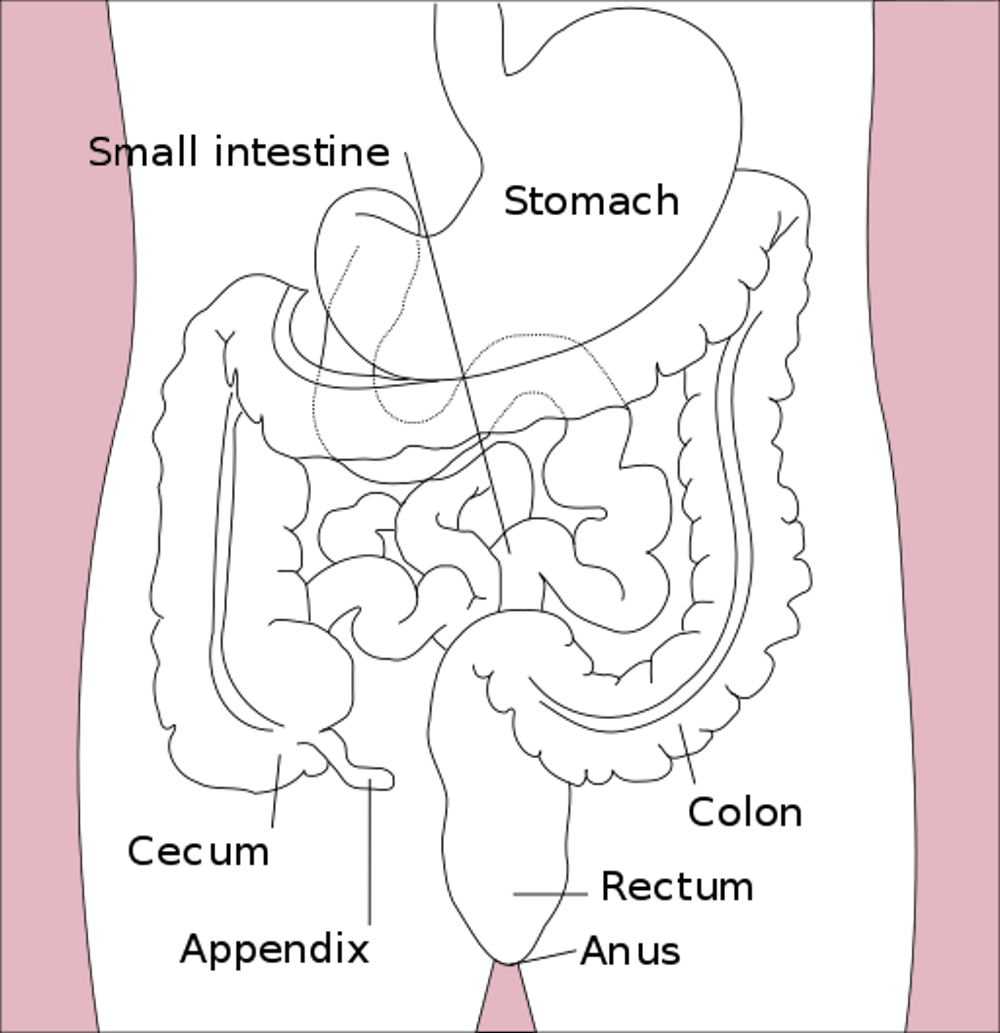
Bowel cancer includes cancer of the colon and rectum.Wikimedia Commons
This trend is also being seen internationally. A study from the United States suggests an increase in bowel cancer incidence in people aged 54 and younger. The research shows rectal cancer incidence increased by 3.2% annually from 1974 to 2013 among those aged age 20-29.
Bowel cancers are predicted to be the third most commonly diagnosed cancer in Australia this year. In 2018, Australians have a one in 13 chance of being diagnosed with bowel cancer by their 85th birthday.
Our study also found bowel cancer incidence is falling in older Australians. This is likely, in part, to reflect the efficacy of the National Bowel Cancer Screening Program, targeted at those aged 50-74. Bowel cancer screening acts to reduce cancer incidence, by detecting and removing precancerous lesions, as well as reducing mortality by detecting existing cancers early.
This is important, as bowel cancer has a good cure rate if discovered early. In 2010 to 2014, a person diagnosed with bowel cancer had a nearly 70% chance of surviving the next five years. Survival is more than 90% for people who have bowel cancer detected at an early stage.
That is why screening is so effective – and we have previously predicted that if coverage rates in the National Bowel Screening Program can be increased to 60%, around 84,000 lives could be saved by 2040. This would represent an extraordinary success. In fact, bowel screening has potential to be one of the greatest public health successes ever achieved in Australia.
Why the increase in young people?
Our study wasn’t designed to identify why bowel cancer is increasing among young people. However, there are some factors that could underpin our findings.
Unhealthy lifestyle behaviours, such as increased intake of highly processed foods (including meats), have also been associated with increased bowel cancer risk. High quality studies are needed to explore this role further.
Alcohol is thought to contribute to an increased risk of bowel cancer.from shutterstock.com
So, should we be lowering the screening age in Australia to people under the age of 50?
Evaluating a cancer screening program for the general population requires a careful analysis of the potential benefits, harms, and costs.
A recent Australian study modelled the trade-offs of lowering the screening age to 45. It showed more cancers would be potential for detected. But there would also be more colonoscopy-related harms such as perforation (tearing) in an extremely small proportion of people who require further evaluation after screening.
A lower screening age would also increase the number of colonoscopies to be performed in the overstretched public health system and therefore could have the unintended consequence of lengthening colonoscopy waiting times for people at high risk.
One of the most common symptoms of bowel cancer is rectal bleeding. So if you notice blood when you go to the toilet, see your doctor to have it checked out.
A healthy lifestyle including adequate exercise, avoiding smoking, limiting alcohol intake and eating well, remains most important to reducing cancer risk.
Aspirin may also lower risk of cancer, but should be discussed with your doctor because of the potential for side effects including major bleeding.
Most importantly, we need to ensure eligible Australians participate in the current evidence-based screening program. Only 41% of the population in the target 50-74 age range completed their poo tests in 2015-2016. The test is free, delivered by post and able to be self-administered.
The 2009 Black Saturday fires burned 437,000 hectares of Victoria, including tens of thousands of hectares of Mountain Ash forest.
As we approach the tenth anniversary of these fires, we are reminded of their legacy by the thousands of tall Mountain ash “skeletons” still standing across the landscape. Most of them are scattered amid a mosaic of regenerating forest, including areas regrowing after logging.
But while we can track the obvious visible destruction of fire and logging, we know very little about what’s happening beneath the ground.
In a new study published in Nature Geoscience, we investigated how forest soils were impacted by fire and logging. To our surprise, we found it can take up to 80 years for soils to recover.
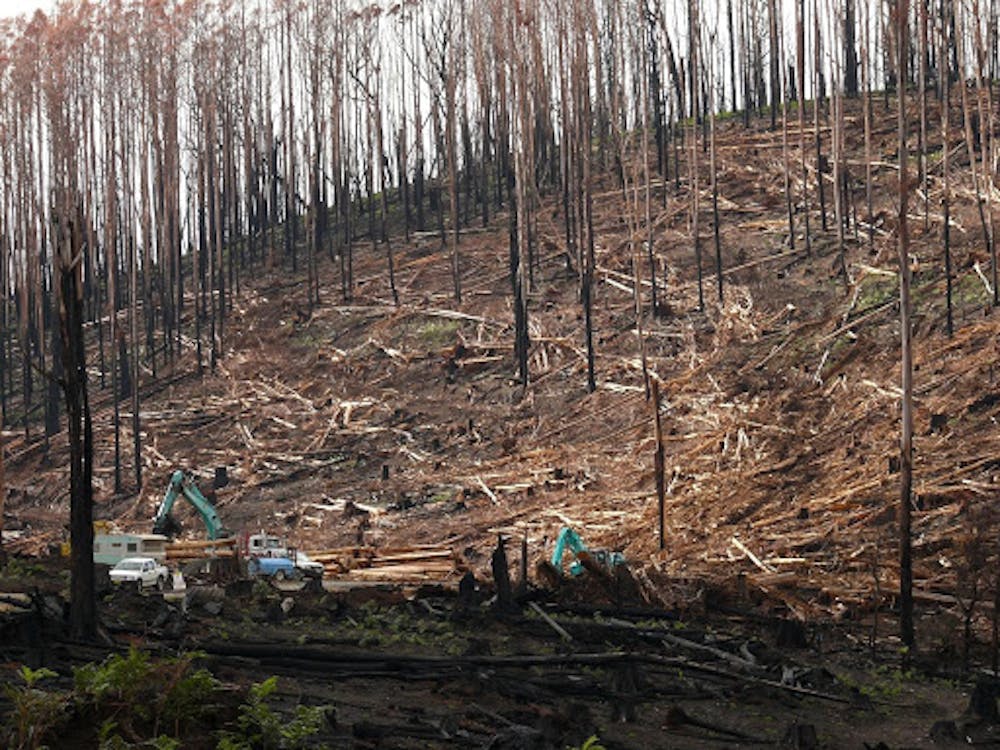
Logging among the charred remains of Mountain ash after the 2009 fires.David Blair, Author provided
Decades of damage
Soils have crucial roles in forests. They are the basis for almost all terrestrial life and influence plant growth and survival, communities of beneficial fungi and bacteria, and cycles of key nutrients (including storing massive amounts of carbon).
To test the influence of severe and intensive disturbances like fire and logging, we compared key soil measures (such as the nutrients that plants need for growth) in forests with different histories. This included old forests that have been undisturbed since the 1850s, forests burned by major fires in 1939, 1983 and 2009, forests that were clearfell-logged in the 1980s or 2009-10, or salvage-logged in 2009-10 after being burned in the Black Saturday fires.
We found major impacts on forest soils, with pronounced reductions of key soil nutrients like available phosphorus and nitrate.
A shock finding was how long these impacts lasted: at least 80 years after fire, and at least 30 years after clearfell logging (which removes all vegetation in an area using heavy machinery).
However, the effects of disturbance on soils may persist for much longer than 80 years. During a fire, soil temperatures can exceed 500℃, which can result in soil nutrient loss and long-lasting structural changes to the soil.
We found the frequency of fires was also a key factor. For instance, forests that have burned twice since 1850 had significantly lower measures of organic carbon, available phosphorus, sulfur and nitrate, relative to forests that had been burned once.
Sites subject to clearfell logging also had significantly lower levels of organic carbon, nitrate and available phosphorus, relative to unlogged areas. Clearfell logging involves removing all commercially valuable trees from a site – most of which are used to make paper. The debris remaining after logging (tree heads, lateral branches, understorey trees) is then burned and the cut site is aerially sewn with Mountain Ash seed to start the process of regeneration.
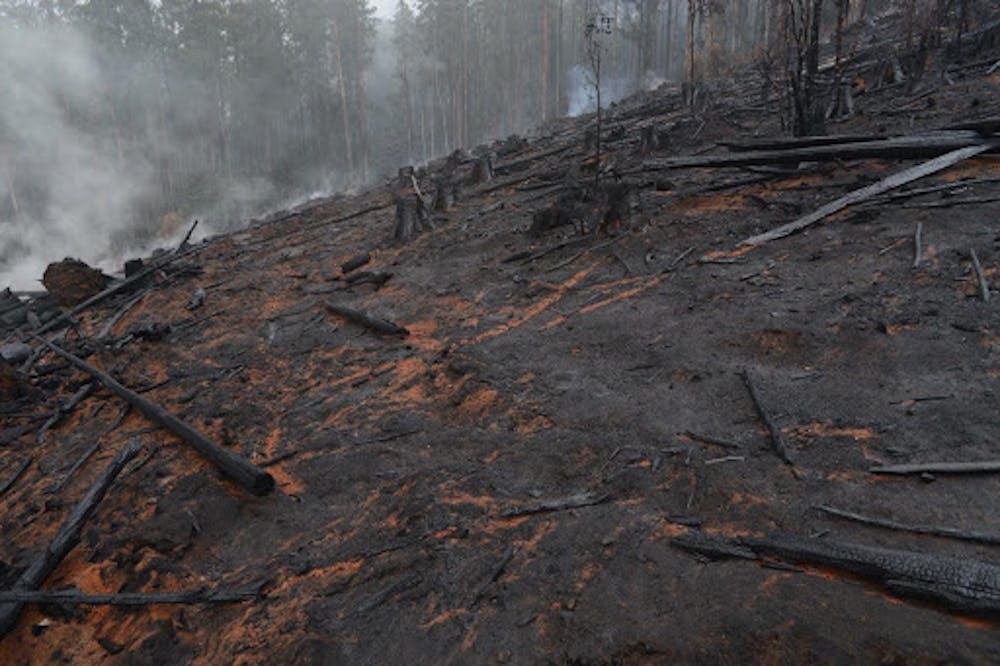
Fire is important to natural growth cycles in our forests, but it changes the soil composition.David Lindenmayer, Author provided
Logging compounds the damage
The impacts of logging on forest soils differs from that of fire because of the high-intensity combination of clearing the forest with machinery and post-logging “slash” burning of debris left on the ground. This can expose the forest floor, compact the soil, deplete soil nutrients, and release large amounts of carbon dioxide into the atmosphere.
Predicted future increases in the number, frequency, intensity and extent of fires in Mountain Ash forests, coupled with ongoing logging, will likely result in further declines in soil nutrients in the long term. These kinds of effects on soils matter in Mountain Ash forests because 98.8% of the forest have already been burned or logged and are 80 years old or younger.
To maintain the vital roles that soils play in ecosystems, such as carbon storage and supporting plant growth, land managers must consider the repercussions of current and future disturbances on forest soils when planning how to use or protect land. Indeed, a critical part of long-term sustainable forest management must be to create more undisturbed areas, to conserve soil conditions.
Specifically, clearfell logging should be limited wherever possible, especially in areas that have been subject to previous fire and logging.
Ecologically vital, large old trees in Mountain Ash forests may take over a century to recover from fire or logging. Our new findings indicate that forest soils may take a similar amount of time to recover.
This is a longer read at just under 2,000 words. Enjoy!
The beginning of the 2019 school year will be a time of planning and crystal-gazing. Teachers will plan their instructional agenda in a general way. Students will think about another year at school. Parents will reflect on how their children might progress this year.
One group of students who will probably attract less attention are the gifted learners. These students have a capacity for talent, creativity and innovative ideas. They could be our future Einsteins.
They will do this only if we support them to learn in an appropriate way. And yet, there is less likely to be explicit planning and provision throughout 2019 to support these students. They’re more likely to be overlooked or even ignored.
Giftedness in the media
You may have noticed the recent interest in gifted learning and education in the media. Child Genius on SBS provided a glimpse of what the brains of some young students can do.
We can only marvel at their ability to store large amounts of information in memory, spell words correctly they’d probably not heard before and unscramble complex anagrams.
The Insight program on SBS, provided another perspective.
Students identified as gifted explained how they learned and their experiences with formal education. Most accounts pointed to a clear mismatch between how they preferred to learn and how they were taught.
Twice exceptional
The students on the Insight program showed the flipsides of the gifted education story. While some gifted students show high academic success – the academically gifted students, others show lower academic success – the “twice exceptional” students.
Many of the most creative people this world has known are twice exceptional. This includes scientists such as Einstein, artists such as Van Gogh, authors such as Agatha Christie and politicians such as Winston Churchill.
Their achievements are one reason we’re interested in gifted learning. They have the potential to contribute significantly to our world and change how we live. They’re innovators. They give us the big ideas, possibilities and options. We describe their achievements, discoveries and creations as “talent”.
These talented outcomes are not random, lucky or accidental. Instead, they come from particular ways of knowing their world and thinking about it. A talented footballer sees moves and possibilities their opponents don’t see. They think, plan, and act differently. What they do is more than what the coach has trained them to do.
Understanding gifted learning
One way of understanding gifted learning is to unpack how people respond to new information. Let me first share two anecdotes.
A year three class was learning about beetles. We turned over a rock and saw slater beetles scurrying away. I asked:
Has anyone thought of something I haven’t mentioned?
Marcus, a student in the class, asked:
How many toes does a slater have?
I asked:
Why do you ask that?
Marcus replied:
They are only this long and they’re going very fast. My mini aths coach said that if I wanted to go faster I had to press back with my big toes. They must have pretty big toes to go so quick.
Slater beetles, also known as wood lice, pill bugs or roley poleys.from www.shutterstock.com
He continued with possibilities about how they might breathe and use energy. Marcus’ teacher reported that he often asked “quirky”, unexpected questions and had a much broader general knowledge than his peers. She had not considered the possibility he might be gifted.
Mike was solving year 12 calculus problems when he was six. He has never attended regular school but was home-schooled by his parents, who were not interested in maths. He learned about quadratic and cubic polynomials from the Khan Academy. I asked him if it was possible to draw polynomials of x to the power of 7 or 8. He did this without hesitation, noting he had never been taught to do this.
Gifted students learn in a more advanced way
People learn by converting information to knowledge. They may then elaborate, restructure or reorganise it in various ways. Giftedness is the capacity to learn in more advanced ways.
First, these students learn faster. In a given period they learn more than their regular learning peers. They form a more elaborate and differentiated knowledge of a topic. This helps them interpret more information at a time.
Second, these students are more likely to draw conclusions from evidence and reasoning rather than from explicit statements. They stimulate parts of their knowledge that were not mentioned in the information presented to them and add these inferences to their understanding.
This is called “fluid analogising” or “far transfer”. It involves combining knowledge from the two sources into an interpretation that has the characteristics of an intuitive theory about the information. This is supported by a range of affective and social factors, including high self-efficacy and intrinsic goal setting, motivation and will-power.
Their theories extend the teaching. They’re intuitive in that they’re personal and include possibilities or options the student has not yet tested. Parts of the theory may be incorrect. When given the opportunity to reflect on or field-test them, the student can validate their new knowledge, modify it or reject it.
Marcus and Mike from the earlier anecdotes engaged in these processes. So did Einstein, Churchill, Van Gogh and Christie.
Verbally gifted
A gifted learning profile manifests in multiple ways. Much of the information we’re exposed to is made up of concepts that are linked and sequenced around a topic or theme. It’s formed using agreed conventions. It may be a written narrative, a painting, a conversation or football match. Some students exposed to part of a text infer its topic and subsequent ideas – their intuitive theory about it.
These are the verbally gifted students. In the classroom they infer the direction of the teaching and give the impression of being ahead of it. This is what Mike did when he extended his knowledge beyond what the information taught him. Most of the tasks used in the Child Genius program assessed this. The children used what they knew about spelling patterns to spell unfamiliar words and to unscramble complex anagrams.
Visual-spatially gifted
Other students think about the teaching information in time and space. They use imagery and infer intuitive theories that are more lateral or creative. In the classroom their interpretations are often unexpected and may question the teaching. These are the non-verbally gifted or visual-spatially gifted students.
They frequently do not learn academic or social conventions well and are often twice exceptional. They’re more likely to challenge conventional thinking. Marcus did this when he visualised the slaters with large “beetle toes”.
What we can learn from gifted students
Educators and policy makers can learn from the student voice in the recent media programs. Some of the students on Insight told us their classrooms don’t provide the most appropriate opportunities for them to show what they know or to learn.
The twice exceptional students in the Insight program noted teachers had a limited capacity to recognise and identify the multiple ways students can be gifted. They reminded us some gifted profiles, but not the twice-exceptional profile, are prioritised in regular education.
These students thrive and excel when they have the opportunity to show their advanced interpretations initially in formats they can manage, for example, in visual and physical ways. They can then learn to use more conventional ways such as writing.
Multi-modal forms of communication are important for them. Examples include drawing pictures of their interpretations, acting out their understanding and building models to represent their understanding. The use of diagrams by the the famous physicist Richard Feynman is an example of this.
For students like Mike, adequate formal educational provision simply does not exist. With the development of information communication technology, it would be hoped that in the future adaptive and creative curricula and teaching practices could be developed for those students whose learning trajectories are far from the regular.
As a consequence, we have high levels of disengagement from regular education by some gifted students in the middle to senior secondary years. High ability Australian students under-achieve in both NAPLAN and international testing.
The problem with IQ
Identification using IQ is problematic for some gifted profiles. Some IQ tests assess a narrow band of culturally valued knowledge. They frequently do not assess general learning capacity.
As well, teachers are usually not qualified to interpret IQ assessments. The parents in the Insight program mentioned both the difficulty in having their children identified as gifted and the high costs IQ tests incurred. In Australia, these assessments can cost up to A$475.
An obvious alternative is to equip teachers and schools to identify and assess students’ learning in the classroom for indications of gifted learning and thinking in its multiple forms. To do this, assessment tasks need to assess the quality, maturity and sophistication of the students’ thinking and learning strategies, their capacity to enhance knowledge, and also what students actually know or believe is possible about a topic or an issue.
Classroom assessments usually don’t assess this. They are designed to test how well students have learned the teaching, not what additional knowledge the students have added to it.
Gifted students benefit from open-ended tasks that permit them to show what they know about a topic or issue. Such tasks include complex problem solving activities or challenges and open-ended assignments. We are now developing tools to assess the quality and sophistication of gifted students’ knowledge and understanding.
Tips for teachers and parents
Over the course of 2019, teachers can look for evidence of gifted learning by encouraging their students to share their intuitive theories about a topic and by completing open-ended tasks in which they extend or apply what they have learned. This can include more complex problem solving.
During reading comprehension, for example, teachers can plan tasks that require higher-level thinking, including analysis, evaluation and synthesis. Teachers need to assess and evaluate students’ learning in terms of the extent to which they elaborate on the teaching information.
Parents are often the first to notice their child learns more rapidly, remembers more, does things in more advanced ways or learns differently from their peers. Most educators have heard a parent say: “I think my child is gifted.” And sometimes the parent is correct.
Parents can use modern technology to record specific instances of high performance by their children, and share these with their child’s teachers. The mobile phone and iPad provide a good opportunity for video-recording a child’s questions during story time, their interpretations of unfamiliar contexts such as a visit to a museum, drawings or inventions the child produces and how they do this, and ways in which they solve problems in their everyday lives. These records can provide useful evidence later for educators and other professionals.
Parents also have a key role to play in helping their child understand what it means to learn differently from one’s peers, to value their interpretations and achievements and how they can interact socially with peers who may operate differently.
It is students’ intuitive theories about information that lead to creative, talented outcomes and innovative products. If an education system is to foster creativity and innovation, teachers need to recognise and value these theories and help these students convert them into a talent. Teachers can respond to gifted knowing and learning in its multiple forms if they know what it looks like in the classroom and have appropriate tools to identify it.
Many people move in the summer months, but not everyone realises that moving starts a process of identity transformation that never really stops.
I first noticed something about place changing a person when I moved to Canada. While Canada and Australia share many similarities, there were still significant differences. The clothes worn were one, and occasionally a phrase would seem unfamiliar. I was teased for saying “queue” instead of “line up”, and “no worries” instead of “no problem”.
When I moved back to Australia, to tropical Cairns, I found myself in a world that moved on “tropical time”. It could hardly have been more different from the fast-paced world of North America. I had to adapt.
Identities are created and evolve in places. Places can be physical, geographical areas and can also be places inhabited virtually, including online games, forums and blogs, or in discourse, such as books and magazines. These places continually shape our identities, changing as we live our lives day by day.
When we move to a new house, especially if it’s a big move such as from city to country or from one country to another, the process of moving inevitably changes us. For a start, we are now a newcomer and the “locals” will speak of us that way. That shapes how we are perceived and perhaps even whether and how we are accepted socially. The norms and morés of the new community may influence us in other ways, even prescribing how we are “supposed” to act in the new area.
‘City girls’ and ‘country girls’
In my recent research into how media affect lifestyle migrants in rural Queensland, I looked at how place changes people. Many of the women I spoke to described themselves as a “city girl” or a “country girl”. These women framed their identity in relation to their location.
The women who called themselves a “city girl” often chose activities that took them to places where they felt they could relate more – such as the shops, galleries and other amenities of the city. Their identification with the city resulted in weaker bonds locally and sometimes meant that they chose to return to the city. Certainly, they were less satisfied with country life.
On the other hand, women who identified as a “country girl” engaged in activities accessible in their rural locations, including crafts, cooking, gardening and outdoor activities. Their free time reinforced their emplaced nature and strengthened their ties to their place and the people in it. They adapted to being in the country and were happy with where they lived.
Knowing what to do in certain places is a form of capital, as Pierre Bourdieu outlines. Capital describes the knowledge needed to play the game in a particular place.
There are different types of capital, including cultural, economic and educational. Knowing how to act when working at a major company, for example, is different from knowing how to get on when unemployed. These are different fields, which require different capitals. One requires corporate smarts, the other stipulates smarts in various other areas.
Even if our fields don’t change as dramatically as described above, we still use differing capitals when at work, at home, with friends and as a parent. The way we learn how to act, or adapt, is achieved through the expansion of what’s called habitus.
Ordering coffee is part of many people’s daily ritual, but don’t expect a cafe on every corner outside the city.Jacob Lund/Shutterstock
Habitus is the stuff we do without thinking – the beliefs, norms and ways of doing things that are a part of us. If we were in a witness protection program, these are the things that would trip us up and lead the bad guys to us. It’s simple stuff, like ordering coffee a certain way, or bigger things like thinking about the world through a particular framework or liking blue or living in the city.
To expand our habitus, we need to see new ways of doing things and imagine these for ourselves. This could happen by watching TV shows, reading books, travelling to other parts of the world or seeing someone else do something differently. It’s hard to change habitus, because we need to be open to new ideas that permeate our reality and we need to like them enough to decide to adopt them and let them become a part of us.
When we move, we are changing the field we occupy. To adapt to this, we watch how other people play the game and, to fit in, we most likely adopt these ideas within our habitus and change a bit. At the same time, we might influence the people around us, changing them a little bit too. It works dynamically.
So, yes, moving countries or to the country from the city is an identity-altering project, and the more the fields are different, the more we have to adapt.
Over the past few decades technological change and globalisation have fundamentally changed the nature of the “average” job. There is greater competition and higher expectations. We face more situations, projects, tasks or objectives that are new, different, unclear or inexact.
To investigate whether Australian workers are equipped to handle this growing ambiguity at work, we studied attitudes towards ambiguity in a sample of more than 800 people.
We found those with positive attitudes towards ambiguity were more creative, better leaders and better overall performers. They reported lower stress levels and higher incomes than those with negative attitudes towards ambiguity.
Our research also revealed something surprising. Younger workers show less capacity to cope with ambiguity than older workers.
It is possible this simply shows ambiguity gets easier with age. Older workers might be more comfortable with ambiguity because they have years of experience and life events to draw from. Indeed, studies show people tend to become more conscientious and emotionally stable as they age, which might improve their capacity to manage ambiguity.
But it is also possible that the ability of younger workers to cope with ambiguity won’t improve with age. Perhaps it is here to stay, a consequence of the progressive removal of ambiguity from personal lives.
Studying attitudes
To explore the consequences of people’s attitudes towards ambiguity, we surveyed 800 workers from a range of industries. Participants responded to a set of 45 statements such as “I get anxious taking on problems that don’t have a definite solution” and “I like engaging with complex work problems”. We asked all participants about their age, experience, income and professional competencies. A subset also rated their colleagues on leadership, creativity and teamwork.
The results showed substantial generational differences in attitudes: 70% of Generation Y respondents (those aged 24 to 37) scored below the average (mean) score on the questionnaire; Generations Z and Y (those aged 18 to 37) were twice as likely as older workers to score in the bottom 10% (those with the most negative attitudes), and about half as likely to score in the top 10% (the most positive attitudes).
Our research indicates three traits common to workers who cope well with ambiguity:
they report remaining calm and composed in the face of ambiguity
they have a strong desire for challenging work, reporting a strong preference for novelty and risk over routine
they have skills that enable them to manage uncertainty, reporting being very good at planning, utilising resources and problem-solving.
Among younger workers, our findings point to a paradox. Generations Y and Z express just as much desire for novel, challenging work as older workers. But they lack the skills and confidence required to manage uncertainty when it occurs, and are more likely to become anxious.
These results challenge a common stereotype about younger people: that being “digital natives” means they are equipped with the skills required to adapt and innovate. Our study found strong evidence to the contrary.
Explaining the differences
One theory is that this generational shift relates to parenting styles. Jonathon Haidt and Greg Lukianhoff, authors of The coddling of the American mind: How good intentions and bad ideas are setting up a generation for failure, argue that overprotective parenting became more prevalent in the 1980s. Just as shielding children from germs has arguably weakened their immune systems, it may be that efforts to shield children from unpredictable environments has resulted in them being less resilient adults.
Although Haidt and Lukianhoff are particularly focused on explaining increasing political correctness in university students who have grown up with social media, their theory raises a compelling possibility. Are younger adults less tolerant of ambiguity because of overly protected childhoods?
A second possibility relates to the integration of technology in our personal lives. It is often assumed that technology “disrupts” our life and increases our exposure to ambiguity. But perhaps technology is actually reducing our exposure to ambiguity.
No video game, for example, is purely random. With repetition you can learn its patterns to master the game; and if you make a mistake you can simply restart.
Google Maps, as another example, means we rarely get lost on the road. It eliminates ambiguity regarding fastest route and estimated arrival time. Siri provides us with answers to virtually any question at any time. Shazam allows us to discover the title of songs in seconds. There is even a “pizza counter” app that can advise us on how much pizza to order for a specific number of people based on hunger levels.
It is possible, therefore, that by steadily reducing our exposure to “everyday” ambiguity, technology has compromised our ability to manage uncertainty when it arises.
Training for tolerance
Does this mean younger people are at a permanent disadvantage in increasingly competitive and ambiguous work environments? No. There is good evidence you can purposefully train yourself to better tolerate ambiguity.
One simple method is to increase your exposure to ambiguity. This might include regularly attending new events, meeting new and different people or even travelling abroad. Although travel is worthwhile for its own sake, research shows that living in a foreign country boosts a person’s capacity to creatively navigate ambiguity.
You can also develop those habits and competencies that have been linked to tolerance of ambiguity. Our results indicated that emotional intelligence, assertiveness and creativity are particularly important. These attributes allow you to remain focused and confident when in new situations. Mindfulness and relaxation techniques can enhance emotional intelligence and creativity, while a variety of different practices can help with assertiveness.
Our research has highlighted that greater tolerance of ambiguity leads to greater work satisfaction. So if you want a happier working life, look for ways to see ambiguity as an opportunity.
In Charlotte Brontë’s novel Jane Eyre (1847) the marriage ceremony of Jane Eyre and Edward Fairfax Rochester is spectacularly interrupted by the solicitor Mr Briggs declaring an impediment to the union: the prior marriage of Rochester to Bertha Antoinetta Mason in Spanish-town, Jamaica. Taken then, with others, to see the wife secreted in a third-story windowless room at Thornfield Hall, Jane remembers,
What it was, whether beast or human being, one could not, at first sight tell: it grovelled, seemingly, on all fours; it snatched and growled like some strange wild animal: but it was covered with clothing; and a quantity of dark, grizzled hair, wild as a mane, hid its head and face.
Rochester later explains to Jane that Bertha is “bad, mad, and embruted”, of “pigmy intellect” and “giant propensities” toward the “intemperate and unchaste” which “prematurely developed the germs of insanity” passed on in the maternal line.
Wide Sargasso Sea was first published in 1966.Wikimedia
Bertha’s mother is a Creole. In the British Caribbean, Creole meant born in the region. Creole was not of itself a racial descriptor. Distinctions were made between white, coloured and black Creoles.
Author Jean Rhys, a white Creole, took umbrage with Brontë’s stereotypical depiction of Bertha. She was “vexed” by Brontë’s “portrait of the ‘paper tiger’ lunatic, the all wrong creole scenes, and above all by the real cruelty of Mr Rochester”.
In writing what she initially thought of as the story of the first Mrs Rochester, published in 1966 as Wide Sargasso Sea, Rhys insists that her character Antoinette Cosway Mason Rochester “must be at least plausible with a past” and that she needs to establish:
the reason why Rochester treats her so abominably and feels justified, the reason why he thinks she is mad and why of course she goes mad, even the reason why she tries to set everything on fire, and eventually succeeds.
The Sargasso Sea is part of the Atlantic Ocean north-east of the Caribbean. Cut off from ocean currents, it is relatively becalmed and harbours drifts of sargassum seaweed.
In Rhys’s novel, the Sargasso Sea is a symbol of what separates Antoinette Cosway Mason Rochester and Edward Fairfax Rochester: disparate colonial and imperial histories and experiences; Rochester’s visceral racism and disdain for the mixing of cultures; his abhorrence and fear of the tropical landscape; and dispossession of Antoinette.
Rhys was born Ella Gwendolen Rees Williams in Roseau, Dominica in 1890, and lived as an expatriate in England and Europe from 1907 until her death in 1979. Wide Sargasso Sea was her fifth novel.
Her Welsh father William Rees Williams was a government medical officer who had settled in Dominica in the 1880s; her mother Minna was a white Creole whose family had lived for several generations in Dominica. Rhys’s great-grandfather James Potter Lockhart (1774-1837) had owned enslaved people and plantations. Rhys writes in her autobiography Smile Please that as he “was a slave-owner the Lockharts, even in my day, were never very popular. That’s putting it mildly”.
A prequel to Jane Eyre
Told in three voices — those of white Creole, Antoinette Cosway Mason Rochester, the young Englishman she marries, who implicitly reveals his own name to be Edward Fairfax Rochester when he renames her Bertha, and Grace Poole, Bertha’s keeper at Thornfield Hall — Wide Sargasso Sea is a prequel to Jane Eyre.
Internal evidence in Jane Eyre establishes that Brontë’s Rochester and Bertha marry in 1819 and that Jane Eyre returns to the ruins of Thornfield Hall and Rochester in June 1834. Wide Sargasso Sea, though, is set in the late 1830s and the 1840s.
Rhys’s choice of historical setting enables her to draw on and try to work her way through planter class and Lockhart family mythology about the economic and social impact of the abolition of slavery.
Historian and poet Kamau Brathwaite has described plantation slavery cultures as “race-founded & race-foundered”. Rhys’s ancestors, the Lockharts, kept family secrets about the massive debts owed by James Potter Lockhart. The British government paid financial compensation to slaveowners for the freeing of enslaved people. The monies James Potter Lockhart anticipated receiving were paid to his chief creditor in part payment of debt.
In Jane Eyre, Brontë uses Bertha’s monstrosity to question the morality of British divorce law, which keeps Rochester in a marriage in which coverture treats husband and wife legally as one person.
Rhys, rather, exposes the absence of a Married Women’s Property Act in Britain at the time the novel is set, the vitiating reach of the system of primogeniture by which property was inherited by eldest sons, and too convenient use of the criminalisation of obeah. Obeah comprises healing and spiritual practices which draw on African-Caribbean religiosity.
In Wide Sargasso Sea, the Rochester family and Antoinette’s stepfamily organise an arranged marriage between Edward and Antoinette. The Rochesters do this for a £30,000 dowry that will secure the prosperity of a second son and the Masons for kinship links to a landed English family. The Masons do not make a separate financial settlement on Antoinette, leaving her no means if she abandons the marriage. Rhys’s Rochester finds the arranged marriage unmanning.
Jane Eyre and Edward Rochester in the 1943 film adaptation of Jane Eyre.Wikimedia Commons
Christophine, rumoured to be an obeah woman, has been both a slave and servant of the Cosway and Mason families and is hired when Antoinette and Rochester honeymoon at Granbois, an estate in Dominica. When Christophine confronts Rochester over his ill-treatment of Antoinette, Rochester threatens to report her to the local police if she does not leave immediately.
The Rochester figure thinks of Antoinette, “Creole of pure English descent she may be, but they are not English or European either”. He is tapping into common British ideas at the time of the degeneration of white people in the tropics, ideas still current into the 20th century.
Brontë’s Rochester’s use of the word “intemperate” to describe Bertha marks her Creoleness as a tropical identity. White Creole degeneracy was seen to be an effect of the tropical climate, the physical and social environment, living in close, domestic proximity to non-white people, and the corrupting influence of slave ownership.
Rhys likens phases of her work on Wide Sargasso Sea to making a “complicated” patchwork quilt: unpicking, cutting, repurposing, and stitching of material as part of a new narrative design.
Part of her countering of Brontë’s characterisation of Bertha is the setting up of similarities between Jane and Antoinette: social dislocation after the deaths of fathers; complex patterns of having surrogate mother figures; education at a girls’ school, Lowood in Jane’s case and a convent in Antoinette’s case after her mother Annette, grieving over the death of a son, is institutionalised as insane; and experiencing prophetic dreams, for example.
A West Indian Flower Girl and Two other Free Women of Color. Oil painting by Agostino Brunias.Wikimedia Commons
Rhys draws out the limits of the reliability of Antoinette’s and Rochester’s points of view. In Part One, Antoinette’s memories of childhood, the narrative highlights the narrow reach of her social experience and the ways her colonial values and language are shaped by reliance on the outlooks of her mother and her circle. Rochester finds the tropics and the fragility of European imperial enterprise disorienting and threatening. He fears being engulfed by them, by desire for Antoinette’s exoticism, and by the proximities of cultural and racial difference.
In developing the character of Rochester, Rhys draws not only on Jane Eyre, but also on William Shakespeare’s Othello and Macbeth, and Charles Baudelaire’s Le Revenant.
At 76 and in poor health, Rhys won the W.H. Smith Award for Writers and the W.H. Heinemann Award of the Royal Society of Literature for Wide Sargasso Sea. She accepted a CBE in 1978. Rhys insisted that fame and greater financial security from prizes, royalties and writing grants came “too late” in life for her to enjoy fully. At her death Rhys was working on autobiographical vignettes which, edited by Diana Athill, were published in 1979 as Smile Please: An Unfinished Autobiography.
Adaptations of the novel
Scenes from Wide Sargasso Sea were filmed for Sargasso! A Caribbean Love Story (1990), a University of the West Indies initiative. The 1993 Australian film of Wide Sargasso Sea was directed by John Duigan and produced by Jan Sharp. In 2006 Brendan Maher directed a telemovie of Wide Sargasso Sea for BBC Wales.
BBC 2006, Wide Sargasso Sea telemovie.
Rhys’s re-visioning of a classic has inspired writers from around the world to do the same and literary critics to theorise the dynamic of authors from colonial and ex-colonial cultures writing back to European texts and to examine the intersections of the treatment of ideas of racial, gender, sexual and class identities in women’s writing.
Wide Sargasso Sea has been seen, with John Fowles’s The French Lieutenant’s Woman (1969), as originating neo-Victorian literature. Research on Rhys’s larger body of writing has been reshaping the field of New Modernist Studies.
Since the 1980s, Charlotte Brontë and Jean Rhys have often been made and remade, indeed celebrated in each other’s images. “Wide Sargasso Sea has literally wound its way into … subsequent rewritings of Jane Eyre”, comments critic Armelle Parey.
As examples, artist Paula Rego’s early 21st-century lithograph series Jane Eyre was shaped by her reading of Wide Sargasso Sea and Bertha figures are given humanity and a human voice in David Malouf’s libretto for Michael Berkeley’s chamber opera Jane Eyre (2000) and in Coral Lansbury’s Ringarra (1985), a reworking of Jane Eyre in a contemporary Australian setting.
Confined at Thornfield Hall, Rhys’s Antoinette longs for a favorite red dress which powerfully reminds her of her Caribbean home. Bertha Mason now often appears in red dress on stage, as in Polly Teale’s Jane Eyre (1997), which rapidly became the most performed adaptation of Brontë’s novel around the world and the 2015 National Theatre Live production of Jane Eyre broadcast by satellite to cinemas.
Joseph Taylor as Mr Rochester and Mariana Rodrigues as Bertha Mason in Jane Eyre.The Lowry/flickr
As my account of Rhys’s influence suggests, Wide Sargasso Sea has particularly engaged Australian writers, playwrights, filmmakers, sound artists and composers. Barbara Hanrahan’s narrative about Stella Edenbrough and Moak in The Albatross Muff (1977), for instance, is an allusive reworking of aspects of Antoinette’s relationship with Christophine and features colonial fortune-hunting.
Woman in the Attic (1987), by Gabby Brennan and Polly Croke, directed by Peter Freund, and performed by Whistling in the Theatre at the Anthill Theatre in Melbourne, blends adaptations of both Jane Eyre and Wide Sargasso Sea. Paul Monaghan directed and devised Obeah Night, performed at La Mama, Melbourne, in 1993. A combination of physical theatre, opera and spoken text, it is based on Part Two of Wide Sargasso Sea.
Brian Howard’s opera Wide Sargasso Sea was performed by Chamber Made Opera in Melbourne in 1997, directed by Douglas Horton. Jennifer Livett’s Wild Island (2016) reworks both Jane Eyre and Wide Sargasso Sea in one of its plotlines.
Most recently Willoh S. Weiland and Halcyon Macleod’s Crawl Me Blood, a sound and video installation, with a music track devised by Felix Cross, was staged in Hobart and Melbourne in 2018. Set in the Caribbean in 2018, the narrative develops motifs from Rhys’s novel to provoke audiences to think about the racialised legacies of colonialism there and in contemporary Australia.
The controversy over Gillette’s new advertisement focused on toxic masculinity highlights the differences between challenging stereotypes of women and men in advertising.
Viewed more than 23 million times on YouTube, the advert has so far attracted more than 330,000 comments, about 650,000 likes and 1.1 million dislikes. No advertising campaign challenging stereotypes about girls and women has ever been this controversial.
Gillette’s ‘We Believe: the best a man can be’ advertisement.
Perhaps that is because those adverts have tended to celebrate an “empowered” view of girls and women. There is even a term to describe this type of advertising with pro-female messages – femvertising – that has its own dedicated awards.
Challenging gender stereotypes of men, on the other hand, is proving less straightforward.
Other campaigns that have explored modern versions of masculinity have taken a similar approach to femvertising. But Gillette’s new advertisement is different. It uncompromisingly confronts problems such as sexism, bullying and harassment associated with toxic masculinity. As a result some perceive it as negative – a denunciation as opposed to a celebration of boys and men.
It exemplifies a significant creative challenge for advertisers at a watershed moment in the movement for gender equality. How do you celebrate masculinity without acknowledging toxic masculinity in this time of #metoo?
Gender stereotypes in advertising
My research examines sexist advertising practice and how this more broadly contributes to gendered inequalities. For example, how advertisements that glorify the violent exploitation of women work to normalise violence against women.
Fashion house Dolce & Gabbana’s 2007 spring/summer advertising campaign was criticised for simulating a gang rape scene.Supplied
Gender stereotypes are another form of sexist advertising practice.
Because advertisements must simply and persuasively communicate a message that can be understood by a relatively broad audience, the industry has long been susceptible to perpetuating stereotypes – oversimplified ideas of the way people should be.
Recall how television program Masterchef promoted its 2013 series as a “battle of the sexes”. The women wore pink and men blue. They trash-talked one another with a litany of stereotypes: “men are more experimental!”, “women can multitask!”.
Critically, most creative work in agencies has historically been led and shaped by men using hypermasculinity as a model for creativity. One study has likened agency cultures to locker rooms – intensely competitive, structured by male bonding and rife with sexual harassment and gender-based discrimination. As a result few women have been able to break into and succeed as creatives in advertising.
But this has begun to change, and the industry has started to face up to the problematic way in which advertising has reinforced gender stereotypes. There is increasing resistance to portrayals suggesting a single way to be a man or woman.
Last year the World Federation of Advertisers launched guidelines for progressive gender portrayals in advertising, namely unstereotyping ads, that highlights the importance of diverse teams and gender aware cultures. The Australian Association of National Advertisers (AANA) updated its Code of Ethics to state that gender-stereotypical roles and characteristics, such as a man doing DIY, must not suggest these are always associated with or carried out by that gender.
Gillette’s parent company Procter & Gamble, along with other multinationals heavily invested in gender-based marketing, has joined the Unstereotype Alliance, a United Nations-backed initiative to eradicate harmful gender-based stereotypes in advertising. Alliance members commit to creating content that depicts people as empowered actors, refraining from objectifying people and portraying progressive and multi-dimensional personalities.
Challenging toxic masculinity
Toxic masculinity refers to norms and ideals of manhood that are both constraining and harmful. It fosters rigid expectations that boys and men should be dominant, aggressive, stoic and devoid of emotion. It is instilled by telling boys to “toughen up” because “boys don’t cry”. It is contemptuous of men “acting like girls”. It is harmful to both men and women.
The director of Gillette’s new advertisement, Australian-born Kim Gehrig, is no stranger to this territory. Her short film You Think You’re a Man explores the cultural expectations of what it means to “be a man” in Australia.
But the backlash against her work for Procter & Gamble highlights the challenge of addressing masculine stereotypes. A core criticism is that it lacks the positivity of femvertising, such as the 2014 #LikeAGirl campaign for Procter & Gamble’s brand Always, which turned a phrase used to insult boys into an empowering message.
Other brands marketed to male customers have managed to avoid criticism while dumping the toxic stereotypes they have previously peddled.
Unilever’s brand Lynx (also known as Axe) is a good example. It had a history of using sexual objectification in its advertising for men’s personal grooming products. In 2011 the British Advertising Standards Authority banned six of its adverts for being demeaning and offensive.
In 2016 it reformed its image with the #FindYourMagic campaign, which challenged narrow notions of masculinity.
Real men can love kittens: Lynx’s #FindYourMagic campaign challenged masculine stereotypes.Supplied
It followed up in 2017 with its #IsItokforGuys campaign that aired the private struggles men experience with the pressure to “be a man”.
The Australian soft-drink brand Solo, owned by Schweppes, is another example of marketers dropping their reliance on aggressively hyper-masculine stereotypes without backlash. In its recent A Thirsty Worthy Effort campaign, a man is no longer engaging in extreme sports to get an extreme thirst; he’s making a costume for his daughter’s school play.
Uncomfortable dialogue
Lynx celebrated men being themselves and unpacked unhealthy and narrow expressions of masculinity. Solo used humour to celebrate men taking an active role in domestic life. Where Gillette has dared to be different is in how the advertisement speaks to its male audience.
It directly and unflinchingly tells men how they should behave: do not bully, patronise, speak over, humiliate or sexually harass women. It tells men how they should treat one another. It challenges men to hold one another to account and set better role models for the “men of tomorrow”, cautioning that “the actions of the few can taint the reputation of the many”.
It shows the huge creative challenge the #metoo revolution poses to advertisers. How can you celebrate masculinity without addressing the toxic behaviours exposed by #metoo revelations?
Gillette’s commercial appropriation of #metoo may sit uncomfortably with some, but advertising is often at its most powerful when it captures the zeitgeist.
Encouraging men to call out how others behave around, speak about and treat women is critical in affecting change and advancing gender equality. Gillette’s statement reinforces this: “If we get people to pause, reflect and to challenge themselves and others to ensure that their actions reflect who they really are, then this campaign will be a success”.
Its approach to challenging male stereotypes and expectations has raised an uncomfortable and provoking dialogue. Representing men as vulnerable, kind, empathetic and modest in advertising is imperative if we are to move beyond the limited cultural portrayals that we often see of men. It is a step forward for an industry with a very chequered past.
The controversy over Gillette’s new advertisement focused on toxic masculinity highlights the differences between challenging stereotypes of women and men in advertising.
Viewed more than 23 million times on YouTube, the advert has so far attracted more than 330,000 comments, about 650,000 likes and 1.1 million dislikes. No advertising campaign challenging stereotypes about girls and women has ever been this controversial.
Gillette’s ‘We Believe: the best a man can be’ advertisement.
Perhaps that is because those adverts have tended to celebrate an “empowered” view of girls and women. There is even a term to describe this type of advertising with pro-female messages – femvertising – that has its own dedicated awards.
Challenging gender stereotypes of men, on the other hand, is proving less straightforward.
Other campaigns that have explored modern versions of masculinity have taken a similar approach to femvertising. But Gillette’s new advertisement is different. It uncompromisingly confronts problems such as sexism, bullying and harassment associated with toxic masculinity. As a result some perceive it as negative – a denunciation as opposed to a celebration of boys and men.
It exemplifies a significant creative challenge for advertisers at a watershed moment in the movement for gender equality. How do you celebrate masculinity without acknowledging toxic masculinity in this time of #metoo?
Gender stereotypes in advertising
My research examines sexist advertising practice and how this more broadly contributes to gendered inequalities. For example, how advertisements that glorify the violent exploitation of women work to normalise violence against women.
Fashion house Dolce & Gabbana’s 2007 spring/summer advertising campaign was criticised for simulating a gang rape scene.Supplied
Gender stereotypes are another form of sexist advertising practice.
Because advertisements must simply and persuasively communicate a message that can be understood by a relatively broad audience, the industry has long been susceptible to perpetuating stereotypes – oversimplified ideas of the way people should be.
Recall how television program Masterchef promoted its 2013 series as a “battle of the sexes”. The women wore pink and men blue. They trash-talked one another with a litany of stereotypes: “men are more experimental!”, “women can multitask!”.
Critically, most creative work in agencies has historically been led and shaped by men using hypermasculinity as a model for creativity. One study has likened agency cultures to locker rooms – intensely competitive, structured by male bonding and rife with sexual harassment and gender-based discrimination. As a result few women have been able to break into and succeed as creatives in advertising.
But this has begun to change, and the industry has started to face up to the problematic way in which advertising has reinforced gender stereotypes. There is increasing resistance to portrayals suggesting a single way to be a man or woman.
Last year the World Federation of Advertisers launched guidelines for progressive gender portrayals in advertising, namely unstereotyping ads, that highlights the importance of diverse teams and gender aware cultures. The Australian Association of National Advertisers (AANA) updated its Code of Ethics to state that gender-stereotypical roles and characteristics, such as a man doing DIY, must not suggest these are always associated with or carried out by that gender.
Gillette’s parent company Procter & Gamble, along with other multinationals heavily invested in gender-based marketing, has joined the Unstereotype Alliance, a United Nations-backed initiative to eradicate harmful gender-based stereotypes in advertising. Alliance members commit to creating content that depicts people as empowered actors, refraining from objectifying people and portraying progressive and multi-dimensional personalities.
Challenging toxic masculinity
Toxic masculinity refers to norms and ideals of manhood that are both constraining and harmful. It fosters rigid expectations that boys and men should be dominant, aggressive, stoic and devoid of emotion. It is instilled by telling boys to “toughen up” because “boys don’t cry”. It is contemptuous of men “acting like girls”. It is harmful to both men and women.
The director of Gillette’s new advertisement, Australian-born Kim Gehrig, is no stranger to this territory. Her short film You Think You’re a Man explores the cultural expectations of what it means to “be a man” in Australia.
But the backlash against her work for Procter & Gamble highlights the challenge of addressing masculine stereotypes. A core criticism is that it lacks the positivity of femvertising, such as the 2014 #LikeAGirl campaign for Procter & Gamble’s brand Always, which turned a phrase used to insult boys into an empowering message.
Other brands marketed to male customers have managed to avoid criticism while dumping the toxic stereotypes they have previously peddled.
Unilever’s brand Lynx (also known as Axe) is a good example. It had a history of using sexual objectification in its advertising for men’s personal grooming products. In 2011 the British Advertising Standards Authority banned six of its adverts for being demeaning and offensive.
In 2016 it reformed its image with the #FindYourMagic campaign, which challenged narrow notions of masculinity.
Real men can love kittens: Lynx’s #FindYourMagic campaign challenged masculine stereotypes.Supplied
It followed up in 2017 with its #IsItokforGuys campaign that aired the private struggles men experience with the pressure to “be a man”.
The Australian soft-drink brand Solo, owned by Schweppes, is another example of marketers dropping their reliance on aggressively hyper-masculine stereotypes without backlash. In its recent A Thirsty Worthy Effort campaign, a man is no longer engaging in extreme sports to get an extreme thirst; he’s making a costume for his daughter’s school play.
Uncomfortable dialogue
Lynx celebrated men being themselves and unpacked unhealthy and narrow expressions of masculinity. Solo used humour to celebrate men taking an active role in domestic life. Where Gillette has dared to be different is in how the advertisement speaks to its male audience.
It directly and unflinchingly tells men how they should behave: do not bully, patronise, speak over, humiliate or sexually harass women. It tells men how they should treat one another. It challenges men to hold one another to account and set better role models for the “men of tomorrow”, cautioning that “the actions of the few can taint the reputation of the many”.
It shows the huge creative challenge the #metoo revolution poses to advertisers. How can you celebrate masculinity without addressing the toxic behaviours exposed by #metoo revelations?
Gillette’s commercial appropriation of #metoo may sit uncomfortably with some, but advertising is often at its most powerful when it captures the zeitgeist.
Encouraging men to call out how others behave around, speak about and treat women is critical in affecting change and advancing gender equality. Gillette’s statement reinforces this: “If we get people to pause, reflect and to challenge themselves and others to ensure that their actions reflect who they really are, then this campaign will be a success”.
Its approach to challenging male stereotypes and expectations has raised an uncomfortable and provoking dialogue. Representing men as vulnerable, kind, empathetic and modest in advertising is imperative if we are to move beyond the limited cultural portrayals that we often see of men. It is a step forward for an industry with a very chequered past.
Political Roundup: Behind the junior doctors’ strike
by Dr Bryce Edwards
Dr Bryce Edwards.
Get ready for more industrial action in public hospitals this year. The junior doctors’ dispute with the District Health Boards is set to continue, with acrimony ramping up, as well as some rather bitter infighting between trade unions. One political commentator is even comparing the significance of the hospital battle to the infamous Waihi Miners’ Strike of 1912.
The 48-hour doctors’ strike last week was the first major industrial action of the year, and the next round is due in a week’s time, with another 48-hour strike scheduled for 29-30 January. And a month after that, on 28 February, the existing employment contract between most junior doctors and the District Health Boards (DHBs) is set to expire, which is at the centre of what could be a long-running and nasty dispute.
There’s a prediction of “more mediation, strikes, facilitation or even lock-outs” at hospitals if the doctors and DHBs aren’t able to resolve the stalled negotiations which started ten months ago – see Katarina Williams’ What happens if the junior doctors’ contract dispute isn’t resolved?
At the crux of the matter is a major disagreement about the work rosters for junior doctors in the hospitals. The DHBs want to weaken some of the conditions that the main doctors’ union say prevent them from over-working in an unsafe way. The DHBs disagree, and argue “that they want local clinicians and hospital managers to make decisions about rosters, not the union’s head office” – see RNZ’s District health boards reject claims made by striking doctors’ union.
But there’s much more to it than this. According to the Resident Doctors Association (RDA), which is the union that the overwhelming majority of junior doctors belong to, the DHBs are actually attempting to avoid settling the dispute so that they can use a provision in employment law to automatically start shifting doctors onto an inferior employment contract.
Some of this is explained in an editorial in The Press, which says: “The forthcoming strike by junior doctors is more complicated than most because there are not one but two unions in play, each with different perspectives on what junior doctors want” – see: Divided unions drive doctors’ strike.
The editorial explains that back in 2017, the main junior doctors’ union, the RDA, managed to negotiate what it saw as a much safer roster system, but that led to a breakaway union being established: “The new deal that followed said junior doctors could not work more than 10 days in a row, reduced from 12 days. But not all doctors agreed, with some claiming that the new rosters were inflexible and had been “imposed” and “enforced” by the RDA. They argued that important training time was reduced, leading to the formation of a breakaway union, the Specialty Trainees of New Zealand (SToNZ), which emerged about six months ago. That group agreed to work 12 consecutive days in order to have more training time”.
Due to the existence of the small breakaway SToNZ union, which the RDA say has negotiated a vastly inferior employment contract, the DHBs can effectively force new doctors, and those shifting between hospitals – which is highly common for training doctors – to go onto the inferior SToNZ contract.
Another union is involved – the Association of Salaried Medical Specialists (ASMS) – which supports the junior doctors. ASMS executive director, Ian Powell argues that the DHBs have set out with this “cunning” plan to effectively snooker the junior doctors and therefore just “bludgeon their way to victory” – see his opinion piece, Blame DHBs, not the unions, for the junior doctors’ strike.
Ian Powell says that “The DHBs have foolishly embarked upon a bargaining strategy that requires a ‘winner takes all’ outcome, which is disastrous where there is an ongoing employment relationship between the employers and their captive employees”.
But Powell also argues that the situation is much more complicated than might be immediately presumed, because some doctors – essentially those who have broken away from the RDA – do not actually want their working week restricted, as they rely on these longer hours for their training and advancement.
Hence, the ASMS tried to broker a deal with the hospitals and junior doctors: “We invited the DHBs and RDA to meet with us to explore how we might do this, as the issues are too complex to address through the blunt instrument of collective bargaining. The RDA responded positively to our initiative, but the DHBs declined, preferring an adversarial process. ASMS and RDA are progressing this work on our own, but it is disappointing that the DHBs have abrogated their responsibility. Had they agreed to participate, the industrial confrontation could have been avoided.”
The picture gets even more complicated with union rivalries given the involvement of the Public Service Association (PSA) in the various disputes. It turns out that the PSA has played a key role in fostering the small SToNZ breakaway union. And so, although other unions, such as the Nurses Organisation, are supporting the junior doctors’ industrial action, the PSA – together with the Council of Trade Unions (CTU) – have held back any public support for the strikes.
In fact, an email from the PSA to Ian Powell was leaked to the media last week, which suggests strong hostility from New Zealand’s biggest union towards the junior doctors’ struggle. You can read the leaked email here: Email from PSA secretary Erin Polaczuk regarding the RDA.
In the email, PSA secretary Erin Polaczuk makes the case against unions supporting the junior doctors, because their union isn’t affiliated to the CTU, and she accuses the RDA and associated unions of free-loading and poaching union members. This is covered in Stacey Kirk’s article, As junior doctors strike, leaked email shows bitter rivalry between unions.
As reported by Kirk, the RDA has responded to these claims by accusing the PSA of undermining an existing union by supporting a breakaway new union, which for some in the union movement is tantamount to “scabbing” (or betraying other employees in their struggle against employers).
The national secretary for the RDA, Deborah Powell – no relation to Ian Powell – is quoted as criticising the PSA for encouraging and assisting the rival junior doctors’ union: “The PSA was supporting them. The rest of the trade union movement did not believe the PSA should because they perceived StoNZ to be an employer’s union – too close to the employer… The problem with unions that are too close to the employer is that it leads to employment agreements that disadvantage employees. That’s exactly what’s happened. StoNZ has settled a collective agreement with the District Health Boards, with vastly inferior terms and conditions to that of the RDA collective”.
Longtime leftwing commentator and unionist Chris Trotter has also reacted with astonishment at what has been going on, suggesting that the PSA has been essentially playing into the hands of the DHB employers, because legally they can now use the existence of the PSA-created union as a way to refuse doctors the ability to retain their existing working conditions – see: Silence of The Lambs: Why Is the CTU saying so little about the Resident Doctors’ Struggle?
Trotter’s blogpost from Friday condemns the facilitation of “the formation of a minority union which employers later use to break the industrial resistance of the union representing the overwhelming majority of workers in dispute”. He argues that “Union rivalries should not be allowed to obscure the very real threat posed to the New Zealand trade union movement by the DHBs’ divide-and-rule strategy.”
To Trotter, what the DHBs are doing is similar to what happened in the infamous Waihi Miners’ strike: “The strategy adopted by the DHBs’ negotiators bears an alarming similarity to that adopted 107 years ago by the Waihi Gold Mining Company. Step 1: Encourage the establishment of a small rival union. Step 2: Use it to undermine the position of the much larger union resisting the employer’s demands. It was a strategy which led directly to one of the most bitterly contested industrial disputes in New Zealand labour history.”
The concern for unions is that other employers will end up emulating what the DHBs are doing: “employers in other sectors of the economy will not be slow to follow the DHBs’ lead. The precedent established at Waihi: establishing a ‘scab’ union to facilitate the crushing of a real one; instantly became the template for the destruction of militant unionism in New Zealand.”
Trotter also wonders if the apparent refusal of the CTU to intervene or to even show any solidarity with the junior doctors “has anything at all to do with the fact that the current CTU President, Richard Wagstaff, is a former National Secretary of the PSA.”
For a similar analysis, but with more in depth background on what has led to the junior doctors’ dispute with the DHBs it’s worth reading Peggy Stewart’s Why resident doctors are striking. She bemoans that “established public sector unions may be using this opportunity to settle old scores, making resident doctors pay the price in significantly-reduced conditions and less employment protections.”
This article also draws attention, not just to the PSA’s alleged hostility to the doctors’ union, but also that of the CTU, pointing out that in 2009 the CTU came out against the then strike actions in hospitals, with Helen Kelly arguing that striking doctors might “give unions a bad name”.
The article raises further questions about whether the current DHB strategy against the junior doctors is endorsed by government officials or indeed by Labour in Government: “It seems likely that the DHBs collective bargaining strategy has been given at least tacit approval by the Ministry of Health. The degree of involvement of Labour’s Minister of Health, David Clark, in directing this strategy is unknown, but he cannot be unaware. It is appalling that public sector workers are facing such a clawback in their hard-fought for working conditions, under a supposedly worker-friendly Labour-led government.”
Finally, although the PSA itself organised strikes last year at MBIE, Inland Revenue and the Ministry of Justice, it may be that the nature of modern unionism means there is less inclination to show solidarity with other striking workers. In this respect it’s worth reading last year’s Listener feature on the head of the PSA: Union leader Erin Polaczuk opens up about the future of the movement. In this, Polaczuk explains that the union movement is “smarter now” than it was in the 1970s, that the “feminisation of the union movement has changed things”, which means “We are not guys coming in and having a punch-up”, and strikes are a “last resort” in this “mature era”.
Charity groups such as St Vincent de Paul are reporting a 38% increase in donations, year on year, as we get rid of the clothes, books and household items that don’t “spark joy” or have a place in our future.
And there is good reason to get on board, whether it’s via the KonMarie method, or just having a good clear-out. Clutter can affect our anxiety levels, sleep, and ability to focus.
It can also make us less productive, triggering coping and avoidance strategies that make us more likely to snack on junk and watch TV shows (including ones about other people decluttering their lives).
My own research shows our physical environments significantly influence our cognition, emotions and subsequent behaviours, including our relationships with others.
Why clutter is bad for your brain
Bursting cupboards and piles of paper stacked around the house may seem harmless enough. But research shows disorganisation and clutter have a cumulative effect on our brains.
Our brains like order, and constant visual reminders of disorganisation drain our cognitive resources, reducing our ability to focus.
The visual distraction of clutter increases cognitive overload and can reduce our working memory.
In 2011, neuroscience researchers using fMRI (functional magnetic resonance imaging) and other physiological measurements found clearing clutter from the home and work environment resulted in a better ability to focus and process information, as well as increased productivity.
And your physical and mental health
Clutter can make us feel stressed, anxious and depressed. Research from the United States in 2009, for instance, found the levels of the stress hormone cortisol were higher in mothers whose home environment was cluttered.
A chronically cluttered home environment can lead to a constant low-grade fight or flight response, taxing our resources designed for survival.
We produce more stress hormones when we’re surrounded by clutter.Jason Leung
This response can trigger physical and psychological changes that affect how we fight bugs and digest food, as well as leaving us at greater risk of type 2 diabetes and heart disease.
Clutter might also have implications for our relationships with those around us. A 2016 US study, for instance, found background clutter resulted in participants being less able to correctly interpret the emotional expressions on the faces of characters in a movie.
And surprisingly, it doesn’t go away when we finally get to bed. People who sleep in cluttered rooms are more likely to have sleep problems, including difficulty falling asleep and being disturbed during the night.
Could clutter really make us fat?
Multiple studies have found a link between clutter and poor eating choices.
Disorganised and messy environments led participants in one study to eat more snacks, eating twice as many cookies than participants in an organised kitchen environment.
Other research has shown that being in a messy room will make you twice as likely to eat a chocolate bar than an apple.
Sometimes we switch off and avoid looking at or thinking about the clutter and mess.Designologist
Tidy homes have been found to be a predictor of physical health. Participants whose houses were cleaner were more active and had better physical health, according to another study.
Hoarding can cause physical pain
Buying more and more things we think we need, and then not getting rid of them, is an actual disorder in the American Psychiatric Association’s Diagnostic and Statistical Manual of Mental Disorders (DSM-V). According to DSM-V, those with hoarding disorder compulsively acquire possessions on an ongoing basis and experience anxiety and mental anguish when they are thrown away.
A Yale study using fMRI showed that for people who have hoarding tendencies, discarding items can cause actual pain in regions of the brain associated with physical pain. Areas of the brain were activated that are also responsible for the pain you feel when slamming a finger in a door or burning your hand on the stove.
People who suspect they have hoarding disorder can take heart: cognitive behavioural therapy has been shown to be an effective treatment.
Participants in Marie Kondo’s Netflix show Tidying Up report that her decluttering method changes their lives for the better. Indeed, her first book was called The Life Changing Magic of Tidying Up.
Research does indeed show cluttered home environments negatively influence the perception of our homes, and ultimately our satisfaction of life. The study authors note the strong effect is because we define “home” not just as a place to live, but as:
the broader constellation of experiences, meanings, and situations that shape and are actively shaped by a person in the creation of his or her lifeworld.
But it seems clutter isn’t always bad. One study showed messy desks can make us more creative. The findings suggested neat, ordered environments make us more likely to conform to expectations and play it safe, while messy ones move us to break with the norm and look at things in a new way.
Source: The Conversation (Au and NZ) – By Lee Baumgartner, Associate Research Professor (Fisheries and River Management), Institute for Land, Water, and Society, Charles Sturt University
The recent catastrophic collapse of Darling River fish communities is truly heartbreaking. As fingers continue to be pointed in all directions, two questions bubble to the top of mind: can this system recover? And, if so, how?
From even the darkest hour comes hope. It was wonderful to hear the basin’s various governments speak about developing a “strategy” over recent weeks. And the good news is that one already exists and can guide our actions from here.
The strategy is one of the rare documents agreed to by the federal government and all basin states: because it made sense. It was visionary and forward-thinking – contributed to by a multitude of scientists, managers, Indigenous groups and basin communities.
During the first ten years of its life the strategy helped us learn more about our native fish than in any other period. But direct funding ceased in 2012. Since then, implementation of its recommendations has been opportunistic and without central coordination. That said, the strategy is still relevant and the need to resurrect its funding has never been greater.
The Native Fish Strategy recognised that native fish are recreationally and culturally valued by all those who live in, and visit, the Murray-Darling Basin. It also acknowledged that most native fish species found there aren’t found anywhere else in the world.
‘Muzza’ the Murray Darling cod, a native species that suffered devastating mass deaths at the start of 2019.AAP Image/Dean Lewins
Most importantly, the strategy describes these fish as important indicators of ecosystem health. That should be a warning to us when considering recent events in the Darling. When fish are stressed, it is because our rivers are stressed. It’s that simple.
How to help our fish
Our native fish are pretty simple creatures, really. They need healthy habitat, more natural water flows, the ability to move around, minimal pests to compete with, and sparing use of active human intervention (including stocking). The first decade of the strategy sought to provide hard data on how a range of different threats impact fish. It also successfully trialled a suite of solutions.
Because of the strategy, we know why aquatic and riparian habitats are crucial for fish. And putting habitat back in the river, through plans like building fish hotels (yes, they are a thing), can help fish recover rapidly. Many decades of clearing the Darling River of logs and minor obstructions has left large stretches smooth and unsuitable for fish to lay eggs, shelter or hide from predators, so reintroducing native plants and natural “snags” is essential for a productive future fishery.
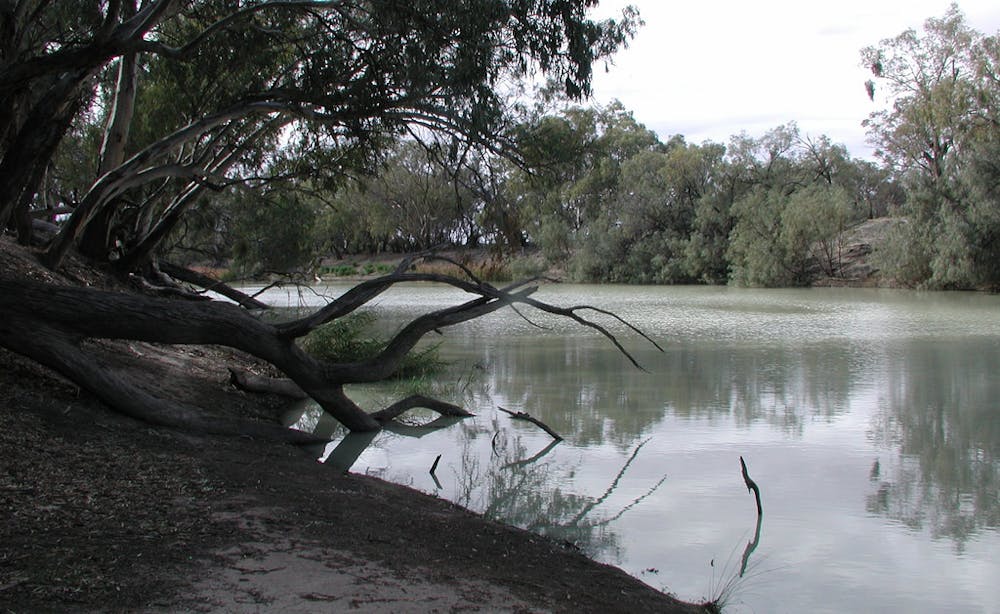
When logs and other natural debris fall into rivers they form ‘snags’, creating pockets of calm water where fish can hide, rest and lay eggs.spelio/Flickr, CC BY-NC-SA
The current drought, the second in ten years, has added to the need for better water flow regulation. Not to belabour the obvious, but fish need water. Some parts of the Darling main channel have been dry for some time. No water means no fish.
Many wetlands in the Lower Darling have not been watered for more than a decade. For some fish in the Murray-Darling, that is one-third of their life; for others it is longer than their lifetime. Native Fish Strategy research taught us that with the right amount of water, fish will spawn and thrive, but it is important that the water is of high quality, is flowing, and connects fish with their crucial habitat.
Finding the balance
Fish scientists and managers are realists and recognise that there will always be competing uses for water – including irrigation and town supply. But the fact that our fish stocks are so stressed highlights the need to find a balance.
Work under the Native Fish Strategy demonstrated that anywhere between 100 and 12,000 fish can be abstracted, per day, by a single pump. When extrapolated over the many thousand irrigation pumps and diversion points across the basin, this means millions of fish are lost each year. They are either diverted into water distribution canals, or pumped onto crops and die.
This can be fixed by fitting pumps with off-the-shelf or custom-designed fish screens. Each pump that can be fitted with a screen in the Darling will translate to thousands of fish that will stay in the river. When conditions are right again, screening pumps will be a key to helping fish recover. Presently, no pumps on the Darling are fitted with screens for fish protection.
We also know the Darling River is an important fish swimway. There is a famous story among fish scientists of a tagged golden perch which, during 1974 flooding, migrated from Berri in South Australia to the Condamine River in Queensland. It is a stark demonstration that fish in the basin ignore political boundaries. But in non-flood years such a migration is impossible; there are far too many barriers such as weirs and dams.
There is strong evidence that in some years the Lower Darling contributes significantly to fish populations in Victoria and South Australia.
This connectivity is of paramount importance for affected reaches of the Darling. For these reaches to recover, fish need to migrate from elsewhere. The Native Fish Strategy taught us that providing fishways (also known as fish ladders) and fish-friendly regulators with layflat gates helps larvae drift downstream, improving recovery. There is already a blueprint available to connect the Darling: it only needs to be implemented.
This schematic shows fish ladders already installed in some parts of the River Murray to let fish swim by man-made barriers.AAP Image/South Australian Government
What does the Darling’s future look like?
The Native Fish Strategy has provided us with a range of tools to help the Darling River quickly recover. So the future of the Darling depends on what we do now. It is up to us to ensure we leave future generations a river in better condition than it is in now.
This is our Waterloo moment. The scoping work has been done; the strategy already exists; the solutions have already been developed and tested. But all of this is meaningless if it’s not used. The Darling River has sent us a strong message. The question is: will we listen? We bloody well need to.
Source: The Conversation (Au and NZ) – By Tess Newton Cain, Adjunct Associate Professor, School of Political Science & International Studies, The University of Queensland
January is an odd time for high level visits to the Pacific. But Prime Minister Scott Morrison’s decision to focus on the region at the start of the year indicates he listened to the criticism of his failure to attend the Pacific Islands Forum meeting in Nauru last September.
This visit began and ended with security. The Vanuatu leg of the trip provided a clear illustration that, when it comes to security, what Canberra understands (and wants) does not necessarily line up with the needs of Pacific island countries.
Vanuatu and security
Vanuatu is seeking support for domestic security issues, such as increasing its police force. This is more of a priority than a security treaty with Australia, as Canberra had proposed during the Vanuatu prime minister’s 2018 visit to Australia – it was rejected at the time. Ahead of Morrison’s visit, Vanuatu’s foreign minister, Ralph Reganvanu, reiterated there was no appetite in his government to enter into an exclusive security agreement with any country.
Vanuatu’s longstanding membership of the Non-Aligned Movement (formed during the Cold War by states who did not wish to be aligned with either of the then superpowers) is part of what informs this position.
Something like the Australia-Solomon Islands security treaty – which envisages rapid deployment of Australian troops (subject to consent by both governments) – would be highly problematic for most people in Vanuatu, a country that places high value on its hard-won independence and sovereignty.
The visit to Fiji was particularly significant given strained relationships between the two governments since the 2006 coup. Some in Australia’s foreign policy community believe the freeze pushed Fiji’s Prime Minister, Frank Bainimarama, to build relationships with China, Russia, and others to the detriment of Canberra in terms of influence.
That’s why securing the Black Rock redevelopment deal last year – a site that’s to become a regional hub for training of defence and security personnel – is a success for Australia. Having Morrison there to break ground on the project may indicate all is now forgiven on both sides.
However, a visit by the leader of the region’s largest democracy and the apparent credibility it gives to Bainimarama’s government will be a disappointment to those who have ongoing concerns about human rights and democratic governance in Fiji.
The Fiji trip unveiled a Fiji-Australia Vuvale Partnership, touted as elevating the relationship beyond diplomacy. The agreement includes a commitment to annual leaders’ meetings, something that already exists between Australia and Papua New Guinea. Other than that, we have yet to see what it will look like in practice.
Further to last year’s announcement of the creation of an Office of the Pacific in the Department of Foreign Affairs and Trade (DFAT), Morrison used this trip to announce Ewen McDonald (currently Australia’s High Commissioner to New Zealand) as its head.
What was said (and just as importantly what wasn’t) during this week’s visit to the region indicates Australia needs to do more listening and learning. For too long, people in the Pacific have felt their voices have not been heard when it comes to how Australia engages in the region.
In Vanuatu, Morrision demonstrated particular tone-deafness on the issue of ease of travel. Across the region, people are frustrated about the difficulties they face in getting visas to visit Australia.
The Australian government announced a frequent traveller visa card on the margins of last year’s APEC summit. This is intended for politicians, sports people and business leaders. But its narrow scope doesn’t cut it as far as people in Vanuatu are concerned. Officials transiting to attend international meetings or families visiting students at Australian universities, for instance, aren’t included.
Morrison also isn’t listening when it comes to Australian broadcasting to the Pacific. He announced A$17.1 million dollars to fund TV content for broadcast to and in the region. This money is to be funnelled to commercial providers via Free TV Australia, snubbing the established Pacific expertise of the ABC and SBS/NITV. Not to mention their reputation in the region.
This ignores specific representations from the Pacific which have stressed time and again what they want is high quality content to raise the level of public debate about the issues they care about.
Scott Morrison did “show up” though, as he had planned. It’s a first step. Whether Australia-Pacific relationships are now on the right path, we have yet to see.
Curious Kids is a series for children. You can send your question to curiouskids@theconversation.edu.au. You might also like the podcast Imagine This, a co-production between ABC KIDS listen and The Conversation, based on Curious Kids.
Why do spiders have hairy legs? – Audrey, age 5, Fitzroy, Melbourne.
Good question, Audrey! Believe it or not, I have studied the hairy legs of spiders for years and can give you some definitive answers on this.
But before we talk about the spider’s fur, think about your very own hairs.
First, there is the hair on your head, which protects you from the sun and rain. Then, there is smaller hair above your eyes – your eyebrows and eye lashes. These prevent dust from entering your eye.
And then have a closer look – you have all that very fine hair on your arms and legs, you can hardly see. What happens when you very, very gently touch this hair or blow at it? It tickles! This very fine body hair helps humans to feel if something is touching you.
In spiders, it is quite similar. Their body hair helps them to feel if something is touching them. Say you took a paintbrush and gently touched a spider with it (don’t do this without an adult there, of course, because some spiders can be dangerous). This touch will make the spider’s hairs bend. The spider will feel that something big is touching it and probably think “Oh dear, there is something that wants to eat me!” and run off.
Like you, spiders have different types of hairs. But spiders can do much more cool things with their hair then we can with ours (except, maybe that we are superior in styling our hair in a cool fashion).
Spidey senses
Have you ever seen a spider with ears? Well, no (that would actually look funny!) That’s because spiders use hairs on their legs to listen! Sounds unbelievable, but that’s how it is.
Does a spider have a nose? I’ve never seen one, and I have seen lots and lots of spiders. To smell, spiders use hairs.
Does a spider have a tongue? Nope. They use – you guessed it – hairs!
So spiders can feel, listen, smell and taste with their hairy legs. Pretty cool, right?
Some spiders can also use their hairs to grip onto a very flat surface – this is why you see spiders walking happily across a window, a ceiling or high up on a wall. (This is also how Spiderman does it, by the way).
Actually, not all spiders than can do that. Only the ones that have special Spiderman-hairs on their feet can do it. These Spiderman-hairs are tiny and have even tinier hairs on them – hairs on hairs. Scientists are trying to learn from these spiders and create Spiderman gloves. With such gloves you could climb up a skyscraper like a spider!
Show-off spiders
Spiders can be quite colourful. Do you know peacock spiders? Here is a picture of one:
The bright parts of a peacock spider are due to its colourful hairs.Flickr/Jurgen Otto, CC BY
The peacock spider’s colours come from special hairs on its legs and body and they are used to impress other peacock spider mates and find a partner. The peacock spider boy waves his coloured hairy legs in a funky dance to tell the spider girl, “I am the best guy you’ll ever find”. Such a show-off! Here’s how they look when they dance:
So you see, spiders need hairs for quite a lot of things in their life – and that is why they have hairy legs.
Hello, curious kids! Have you got a question you’d like an expert to answer? Ask an adult to send your question to us. You can:
* Email your question to curiouskids@theconversation.edu.au * Tell us on Twitter by tagging @ConversationEDU with the hashtag #curiouskids, or * Tell us on Facebook
Please tell us your name, age and which city you live in. You can send an audio recording of your question too, if you want. Send as many questions as you like! We won’t be able to answer every question but we will do our best.
If you bumped into a Homo erectus in the street you might not recognise them as being very different from you. You’d see a certain “human-ness” in the stance, and his or her size and shape might be similar to yours.
But their face would be flatter, with a more obvious brow. And having a conversation would be hard – his or her language skills would be poor (although they could certainly craft a stone tool or light a fire).
Of course this is entirely hypothetical, as Homo erectus is now extinct. This enigmatic human ancestor probably evolved in Africa more than 2 million years ago, although the timing of their disappearance is less clear.
Homo erectus was in the news over 2018 thanks to new discoveries in the Philippines and China, which have transformed our understanding of this not too distant family member.
So who was Homo erectus? And could 2019 be the year we learn more about our mysterious ancestor?
Homo erectus was first discovered in Java, Indonesia and then China – these are the famous “Java Man” and “Peking Man” fossils. Eugène Dubois’ 1891 discovery on Java (originally called Pithecanthropus erectus) was a key piece of evidence in supporting Darwin’s ideas of human evolution.
The recent discovery of stone artefacts in the Loess Plateau of China suggests that a hominin, probably Homo erectus, was living in the region by 2.1 million years ago. This evidence pushes back their presence in Asia back by at least 400,000 years.
Other ancient Homo erectus sites are present in the Caucasus region of Georgia (1.8 million years ago), on Java and in Africa.
Homo erectus is thought to have become mostly extinct following the emergence of modern humans – yet some specimens from Java have been dated (with some controversy) to as recently as 40,000 years ago. If this dating is correct, it suggests that they coexisted with Homo sapiens, although probably only in very small pockets in Indonesia.
The expansion of Homo erectus throughout the globe was the first time that a hominin species had ventured beyond Africa, and occurred 2 million years before modern humans replicated this great feat of exploration. They may have been encouraged to spread so rapidly by the expansion of grassland during this period, driven by climate change. This created more habitats for plant-eating animals and so increased the amount of available prey.
Homo erectus was the first of our ancestors to physically resemble modern humans. They were taller and their brain was larger than previous hominin species such as Australopithecus sp. or Homo habilus.
They had a slightly different face to us: it was flatter with more prominent brow ridges.
There are clear differences in the size and shape of the skull in Homo sapiens compared to other human-like species including Homo erectus (schematic).from www.shutterstock.com
The importance of meat in their diets is still contested, with some researchers considering they were primarily meat eaters and others believing that they had a much broader diet.
Homo erectus was much smarter than previous hominins, being the first species to use fire and may have been the first to live in hunter-gather groups. They made stone tools in a style called the Acheulian, characterised by distinctive hand axes.
Despite this, their cognitive ability fell a long way short of modern humans. There is currently no evidence that Homo erectus was capable of undertaking modern behaviours such as using language or making art.
The importance of the recent discovery of archaeological material attributed to Homo erectus in the Philippines helps us learn more details about what this species may have been capable of.
Previously, it was widely accepted that Homo erectus was not able to undertake water crossings. This theory fitted with their presence as far as Java, but not across deeper water represented by the Wallace line to travel further east.
A discovery in the Philippines (and possibly in Sulawesi) overturns this, and opens the exciting possibility that Homo erectus may have been more capable sailors than we previously thought.
How are they related to us?
One of the most contentious aspects of Homo erectus is who to include in the species. While many researchers include a wide range of specimens from around the world as Homo erectus, some classify the African and Eurasian specimens as Homo ergaster. Others use the terms Homo erectus senso stricto (ie. in the narrow sense) for the Asian specimens and Homo erectus senso lato (ie. in the broad sense) for all specimens.
This somewhat confusing situation is actually far clearer than the early history of Homo erectus where a wide range of names including Anthropopithecus, Homo leakeyi, Pithecanthropus, Sinanthropus, Meganthropus, and Telanthropus were used. The reason for this complexity is that Homo erectus (whatever you choose to call them) have a comparatively wide range of morphological characteristics making it difficult to decide how much diversity to include within the definition of the species.
What is clear is that Homo erectus sits somewhere on the human lineage as an ancestor to modern humans, serving as a transition from early hominins such as Australopithecus to Homo heidelbergensis, Homo neanderthalensis and Homo sapiens.
No area of archaeology has seen such vibrant change in recent years than how we understand our family tree. New species have been discovered (and debated) and the ages of the earliest examples of various species are constantly being revised. Unfortunately we only have limited fossils to work with and so new specimens and sites can quickly change our understanding of human evolution.
There is no doubt that ancient DNA studies will contribute to resolving this uncertainty – however DNA sequences have not yet been recovered from Homo erectus. We await this eventual discovery with baited breath!
Liberal women must surely be asking why their party is so clear-eyed when facilitating the departure of competent women, and yet so mealy-mouthed about recruiting and promoting them.
Prominent among Prime Minister Scott Morrison’s comments on Kelly O’Dwyer’s retirement to pursue family life, was to say he supported his minister’s decision, and indeed supported all such choices by women.
Such clarity has been conspicuously absent from the Liberal Party’s leadership since its now widely accepted “women” problem came to the fore in 2018 amid claims of bullying, implied career threats, ingrained gender bias, and other generally oafish behaviour.
Even more opaque has been the Liberal Party’s puzzling refusal to broach any corrective action to address a powerful internal preference for men, when selecting candidates in winnable seats. This, despite a miserable return of just 13 female MPs of its 76 in the lower house after the 2016 election.
It is even worse now, and voters are on to it.
Not the first such departure
O’Dwyer is the second female Liberal from Victoria to call it quits in six months after her friend, the talented rookie backbencher Julia Banks, spectacularly called time on the party in the wake of Malcolm Turnbull’s brutal ouster.
Banks went to the cross bench to form a quartet of competent female moderates with past ties or sympathies to the centre-right – Banks, Kerryn Phelps, Rebekha Sharkie, and Cathy McGowan.
There have been other high-profile departures this term also on family grounds with two frontbenchers on the Labor side – former minister Kate Ellis, and rising star Tim Hammond – both bowing out.
That federal politics is hard on families and relationships is hardly news, but the slew of resignations / defections underscores how little has been done to change things.
And poignant, given her portfolio
In any event, O’Dwyer’s retreat is arguably the most pointed given the current debate, her particular government portfolio, her hard-won ministerial seniority, and her party’s woes.
It makes Liberal retention of her previously safe Melbourne seat of Higgins somewhere between problematic and unlikely.
On the social media platform Twitter where cynicism and vitriol flows freely from people hiding behind false identities, her departure has been met with some appallingly personal abuse, exaggerated outrage, and claims she was merely a rat leaving a sinking ship.
It is true that retaining the seat would have been no certainty even with O’Dwyer still as the candidate, especially given Victoria’s recent anti-conservative tendencies in state election races, but with a new candidate, the Liberal jewel is undoubtedly more vulnerable.
Feminists will be aggrieved to see another senior woman go but they might also be quietly disappointed in her stated reasons.
In contradistinction to some of her predecessors, O’Dwyer, did substantive work as minister for women, and unlike some, gave the impression of actually believing in the mission.
She also garnered respect from across the aisle and within the press gallery as a person of warmth and humility – stand-out qualities on Capital Hill.
It is a portfolio she believed in
O’Dwyer created enemies however on her party’s increasingly reactionary right flank by outlining the challenges for women – especially in politics – acknowledging the Liberal Party’s poor image in some quarters.
Her introduction of a women’s economic security statement last year was another material achievement resisted by some as political correctness.
But in declaring her job’s incompatibility with family life, there was an unmistakable note of resignation, even defeat in O’Dwyer’s “choice”. And coming from the minister most directly involved in remediating that problem for women, her resignation cannot help but reinforce the message that politics may well be no place for women.
Morrison’s superficially virtuous support for the choices for women, was no help either – typical of much conservative sophistry around this whole issue.
Morrison isn’t helping
Masquerading as a pro-choice feminist while endorsing a senior colleague’s decision to give up her career for child-rearing and home duties takes some chutzpah.
An alternative approach might have been to lament her departure as symptomatic of a flawed representational system, acknowledge the failure of politics to renovate its male paradigm, and vow to change the culture in material ways.
It might even be called leadership.
For a government laced with longstanding (if undeclared) quotas for ministerial selection – think ratios in the ministry applied to the number of Libs to Nats, House to Senate, moderates to conservatives, and even between states – the blind spot over women’s under-representation and the philosophical objection to corrective action (quotas) is all the more bizarre.
It is a mark of how far conservative Liberals have drifted from contemporary public attitudes and even their own philosophy that some would countenance re-nationalising of energy assets and building new coal-fired power stations before correcting a clear market imperfection within their own organisation.
And with speculation that Julie Bishop could also withdraw from the 2019 field, the situation facing Morrison’s Liberals threatens to deepen.
Through all of this, voters’ views come second.
Not so long ago, Bishop was easily the most popular alternative to Malcolm Turnbull in voter land but such unrivalled public support was good for just 11 votes in the party room.
Fiona (not her real name) came to Australia from New Zealand as a 19-year-old backpacker. Here, she met a man, got married and had two boys. The domestic violence began after her first son’s birth, and Fiona endured it for several years.
In 2017, when her children were eight and ten, Fiona summoned the strength to leave her husband. Not being an Australian citizen, she found she wasn’t eligible for government assistance, so Fiona fled back to New Zealand seeking protection and support.
Her husband immediately acted to have the children returned to Australia and, being a citizen, received free legal assistance from the government. Fiona was ordered to return her children to Australia.
This happened because under international law, Fiona’s case is considered one of “child abduction”. Under the Hague Convention on the Civil Aspects of International Child Abduction 1980, a child is considered “abducted” if he or she is removed by one parent without the other parent’s consent.
The Convention was drafted in the late 1970s to deal with fathers abducting their children across borders after losing custody of their children, or believing they would lose custody. It was never meant to be applied to cases involving mothers fleeing domestic violence.
The Convention makes no mention of domestic violence and has no protections for abused mothers. Despite this, for the past couple of decades, 70% of Hague cases have involved mothers fleeing domestic violence. When this law is applied to such cases, the outcomes can be catastrophic for abused women and children.
My research has explored how the Convention affects abused mothers who flee with their children across international borders. I have interviewed ten women, including Fiona, who were ordered to return their children to an abusive situation by Australian and other courts. All felt their voices were not heard and their domestic violence experiences not believed by the courts. They felt they were treated like criminals.
Catastrophic outcomes
The Sydney Family Court, in 2008, ordered a 24-year-old woman to return her two young sons to the UK, where they had been born. The woman had fled with her children to Sydney where her family lived, after years of abuse. Shortly after her return, she fled again to a refuge with her children. On the way there, she was brutally murdered by her estranged husband, on a public street, in front of her children and mother.
When the Convention was drafted, abductors were assumed to be non-primary carers who were taking the law into their own hands after having lost a custody battle. But it’s now been recognised most so-called abductors are mothers who are the children’s primary carers.
The Convention is the main international agreement that covers international parental child abduction. It provides an expeditious process to have a child returned to their home country. A child must have been abducted to, or retained in, a Hague Convention member country for the process to work. Nearly 100 countries – including Australia, New Zealand, South Africa, the UK and the US – are signatories.
The Convention came into effect in Australia in 1987. It is implemented through the Family Law Act 1975 and the Australian Family Law (Child Abduction Convention) Regulations 1986. Australia’s Central Authority, which is part of the Attorney-General’s department, handles all cases of international parental child abduction to and from Australia. Its powers stem from the Convention and the Regulations are strictly enforced by the courts in all cases.
Some exceptions in Australia’s Regulations can be raised in dometic-violence related abduction cases. But lawyers I also interviewed in my research have said the bar has been set so high by the courts, these are too hard to meet. Also the “best interests of the child” test, which is applied in domestic family law cases, is not the test applied in Hague cases.
Fiona’s husband was provided with free legal representation. Experienced lawyers worked with their counterparts in NZ to return the children to their father in Australia and the New Zealand Family Court cooperated by ordering the children’s return.
Fiona told me that the Convention
discriminates against mothers and kids … and the judges and lawyers don’t really consider the domestic violence the mothers have gone through and that the kids have witnessed.
Fiona and the children returned with just a bag of clothes. She received a small family assistance payment from Centrelink because the children were citizens, but no public housing, access to community services or free legal representation.
Many women suffer alone and have no outside or government assistance.from shutterstock.com
Fiona’s mother had to move from New Zealand to Brisbane to support her daugher and the children financially, emotionally, and physically. After one year, the Brisbane Family Court awarded Fiona’s husband full parental responsibility for the children. Fiona returned to New Zealand, broke and devasted.
To this day, she survives on the generosity of women she befriended on social media who also lost their children to abusive partners. She is still being financially and emotionally abused by her ex, and struggles with anxiety and depression.
What other countries have done
Progress has been made in this area outside of Australia.
In a child abduction case considered by the European Court of Human Rights in 2010, the court held the Convention was obligated to consider general principles of international law and other human rights instruments. It also held the Convention “cannot be interpreted in a vacuum” and that the “best interests of the child must always be paramount.”
There has also been a substantial change in US law, which has allowed courts to see domestic violence as a defence under the Convention.
In Australia, mothers fleeing domestic violence with their children still face harsh legal consequences. A woman fleeing with her child across borders within Australia can be penalised if she has violated family court orders without a reasonable excuse. A court may vary the orders, order her to pay the legal costs of the other parent, or a fine, and could even sentence her to imprisonment.
She can also be charged with child stealing. If she is a citizen, she may be eligible to access various community resources, including Legal Aid, for representation.
However, a mother fleeing from overseas to Australia is in a different situation. She will face serious legal consequences under the Convention. The US courts can criminally prosecute a mother who has abducted her child from that country and imprison her. Even if she is an Australian citizen, she may have to represent herself in court if she can’t afford a lawyer. Unlike her abusive partner, she has no right to free lawyers.
It’s rare for Australia’s Legal Aid to fund these defences, as mothers generally don’t have a good chance of succeeding in court. My analysis of Hague cases heard in Australia between 2015 and 2018 showed not one case where the mother was represented by Legal Aid.
Rita’s story
Rita (not her real name) was an Australian citizen who met an American man in LA, where she had relocated for work, married and had a son. After experiencing domestic violence for two years, she fled back to Brisbane with her two-year old. She was given access to income and other Centrelink services, government housing, Medicare, pro bono legal representation and charity assistance.
Even so, after an application lodged by her husband, the Central Authority and the Brisbane Family Court ordered Rita to return her infant to LA. Rita also returned.
She received no housing, no medical assistance, and no free legal representation. She suffered from anxiety and depression, and could not work. If it had not been for a friend, she would have been homeless. She told me:
Because of the Convention, I could have been sent to federal prison in California, and have lost my son to someone who abused both of us. He had legal custody of my son and I had nothing, just because I tried to keep me and my son alive.
Australia’s law makers need to take cases of this nature far more seriously. One step forward would be to add a separate “domestic violence defence” to the Regulations under which the Hague Convention is administered.
In doing so, abused mothers accused of abducting their children would have a better chance of defeating a return application. And our courts would not be able to continue putting women’s lives and their children’s safety in jeopardy.
At Sydney’s enormous Rookwood Cemetery, a lichen-spotted headstone captures a family’s double burden of grief.
The grave contains the remains of 19-year-old Harriet Ann Ottaway, who died on 2 July 1919. Its monument also commemorates her brother Henry James Ottaway, who “died of wounds in Belgium, 23rd Sept 1917, aged 21 years”.
While Henry was killed at the infamous Battle of Passchendaele, Harriet’s headstone makes no mention of her own courageous combat with “Spanish flu”.
Harriet’s story typifies the enduring public silence around the pneumonic influenza pandemic of 1918–19. Worldwide, it killed an estimated 50-100 million people – at least three times all of the deaths caused by the First World War.
Arguably, we could consider 1919 as another year of war, albeit against a new enemy. Indeed, the typical victims had similar profiles: fit, young adults aged 20-40. The major difference was that in 1919, women like Harriet formed a significant proportion of the casualties.
There was no doubt about the medical and social impact of the “Spanish flu”. Although its origins remain contested, it certainly didn’t arise in Spain. What is known is that by early 1918, a highly infectious respiratory disease, caused by a then-unknown agent, was moving rapidly across Europe and the United States. By the middle of that year, as the war was reaching a tipping point, it had spread to Africa, India and Asia.
About a third of the entire world’s population was infected with Spanish flu.Macleay Museum, Author provided
It also took on a much deadlier profile. While victims initially suffered the typical signs and symptoms of influenza – including aches, fever, coughing and an overwhelming weariness – a frighteningly high proportion went rapidly downhill.
Patients’ lungs filled with fluid – which is why it became known as “pneumonic influenza” – and they struggled to breathe. For nurses and doctors, a tell-tale sign of impending death was a blue, plum or mahogany colour in the victim’s cheeks.
This, sadly, was the fate of young Harriet Ottaway. Having nursed a dying aunt through early 1919, in June she tended her married sister Lillian, who had come down with pneumonic influenza.
Despite taking the recommended precautions, Harriet contracted the infection and died in hospital. Ironically, Lillian survived. But in the space of less than two years she had lost both a brother to the Great War and her younger sister to the Spanish flu.
An intimate impact worldwide
Indeed, as Harriet’s headstone reminds us, this was an intimate pandemic. The statistics can seem overwhelming until you realise what it means that about a third of the entire world’s population was infected.
Whatever your heritage, your ancestors and their communities were almost certainly touched by the disease. It’s a part of all of our family histories and many local histories.
It wasn’t just victims who were affected. Across Australia, regulations intended to reduce the spread and impact of the pandemic caused profound disruption. The nation’s quarantine system held back the flu for several months, meaning that a less deadly version came ashore in 1919.
But it caused delay and resentment for the 180,000 soldiers, nurses and partners who returned home by sea that year.
Responses within Australia varied from state to state but the crisis often led to the closure of schools, churches, theatres, pubs, race meetings and agricultural shows, plus the delay of victory celebrations.
The result was not only economic hardship, but significant interruptions in education, entertainment, travel, shopping and worship. The funeral business boomed, however, as the nation’s annual death rate went up by approximately 25%.
Yet for some reason, the silence of Harriet’s headstone is repeated across the country. Compared with the Anzac memorials that peppered our towns and suburbs in the decades after the Great War, few monuments mark the impact of pneumonic influenza.
Nevertheless, its stories of suffering and sacrifice have been perpetuated in other ways, especially within family and community memories. A century later, these stories deserve to be researched and commemorated.
Despite the disruption, fear and substantial personal risk posed by the flu, tens of thousands of ordinary Australians rose to the challenge. The wartime spirit of volunteering and community service saw church groups, civic leaders, council workers, teachers, nurses and organisations such as the Red Cross step up.
They staffed relief depots and emergency hospitals, delivered comforts from pyjamas to soup, and cared for victims who were critically ill or convalescent. A substantial proportion of these courageous carers were women, at a time when many were being commanded to hand back their wartime jobs to returning servicemen.
In resurrecting stories such as the sad tale of Harriet Ottaway, it’s time to restore our memories of the “Spanish flu” and commemorate how our community came together to battle this unprecedented public crisis.
Women are considerably over-represented in the teaching profession. Recent data show, among recent Australian university graduates, 97% of pre-primary teachers, 85% of primary teachers and 68% of secondary teachers are female. Similarly, large proportions of women in teaching are also observed across the OECD.
The share of male teachers in Australia has been declining since 1977. What can explain this notable and persistent gender imbalance? Generally, it’s attributed to gender differences in occupational preferences and social roles.
But our research suggests economic forces may be a key contributing factor. Understanding and addressing the reasons for the gender imbalance in teaching is important. It represents a distortion in this particular labour market. It could also send and perpetuate unhelpful signals about the career aspirations of men and women, to the detriment of both.
“It’s the labour market, silly!”
In a recent paper, we considered whether women (and men) choose to become teachers in line with or in spite of economic incentives. In the context of Australia, researchshows the quality of people who choose to go into teaching responds to the relative wage distribution in the labour market. In other words, a higher wage attracts better quality teachers.
Our analysis investigated whether the gender composition in teaching reflects the relative wage distributions for women and men. In particular, we compared the salaries of women choosing to become teachers to that of women choosing other professions. We also carried out a similar analysis for men.
This approach helps explain the observed gender distribution. For men, the opportunity cost of becoming a teacher relative to choosing another profession is high. Men give up a higher potential salary by choosing teaching over a non-teaching career.
For women, the opposite occurs. Average salaries are lower in non-teaching occupations, so the choice to become a teacher comes at a substantially lower opportunity cost. It can even be a more profitable career choice than others because for women with a Bachelor of Arts (BA), teaching is one of the best paying jobs.
This suggests wage structures in the labour market underpin occupational choices. Men and women face different trade-offs and opportunity costs when choosing careers. This may contribute to the observed concentration of women – or feminisation — in certain occupations.
Clearly, the concentration of women in teaching is problematic from a gender equality perspective. Parents, students and schools value the exposure to a diverse workforce that is more representative of society.
What can be done to attract more men to teaching?
A seemingly obvious solution is to increase teachers’ salaries across the board. But this may, in fact, raise the concentration of women in teaching even more. Higher salaries would further increase the returns in teaching relative to other professions for women.
Raising salaries for all teachers wouldn’t necessarily encourage more men to go into teaching.from www.shutterstock.com
But it would have a small or negligible impact on the returns for men. Men would continue to be attracted to the higher salaries in professions other than teaching.
Efforts to raise the share of male teachers are likely to have limited success until the underlying structural economic incentives are addressed. That is, the higher wages in non-teaching jobs, which tend to pull men away from teaching.
Discussions around the gender composition of different occupations, particularly teaching, tend to focus on factors such as gender predisposition, social influences and job attributes, such as greater flexibility and work-life balance. These factors may play an important role to varying degrees, but reviewing and reforming the monetary incentives which influence gender segregation in occupations is a good starting point.
Additional ways we could address this are by:
providing additional scholarships for men in teaching
ensuring teaching career plans fulfil the ambitions and expectations of both male and female teachers
improving the image of teaching as an essential job to enhance a society.
Source: The Conversation (Au and NZ) – By Ben Phillips, Associate Professor, Centre for Social Research and Methods, Director, Centre for Economic Policy Research (CEPR), Australian National University
Labor is going into the election promising to tax capital gains more heavily. Depending on who you listen to, it’ll either hit the very highest of earners, or middle earners – people such as teachers and nurses. The same critics have claimed different things at different times.
The truth is even stranger. In part because people who present as being part of one income group are often better described as being part of another.
It’s certainly stranger than fiction.
What are capital gains?
Capital gains are the profits made from buying something at one price and selling it at another. These profits are typically taxed at only half the rate of other income. (Technically, only half of each capital gain is taxed.)
The discount, introduced by Prime Minister John Howard in late 1999, was sold as ensuring that profit takers wouldn’t be taxed on the workings of inflation, a concession that was already built into the system, although in a more complicated way.
But because inflation had fallen so dramatically, the 50% discount went much further. It taxed capital gains, so-called “unearned income”, at a much lower rate than income earned in the form of wages and salaries, and also at a lower rate than bank interest and other forms of income.
In the lead up to the coming election (and the last one) the Labor Party has promised to wind back the discount, cutting it from 50% to 25% for newly-purchased assets held for more than a year, meaning that for those assets three quarters of each gain will be taxed instead of one half.
There are two (apparently contradictory) views about who the changes will hit, both of them spelled out in the pages of The Australian, and both sourced to the treasurer Josh Frydenberg.
Frydenberg/Bowen tweets
On January 5 the treasurer said investors would pay the “world’s highest tax” under Labor’s changes.
But that would only be the case if they were the very highest earners, on more than A$180,000. And it would only be the case for a short time where the capital gains are a one off.
Mr Frydenberg quoted a rate of 36.75% for capital gains tax, which would be three quarters of 49%, which itself would be made up of the top marginal rate of 45% plus the 2% Medicare levy plus the 2% temporary budget repair levy that Labor plans to reintroduce for two years.
That top marginal rate only applies to Australians on more than A$180,000.
Then ten days later on January 15, Mr Frydenberg said most of the workers hurt would be on much lower incomes, of up to A$80,000.
Then shadow treasurer Chris Bowen entered the debate, calling Fyrdenberg’s second claim “silly”. He said 70% of the total amount of capital gains tax discounts claimed was claimed by the top earners.
But he didn’t address the treasurer’s contention that most of the beneficiaries are lower earners.
What the data says
The Australian National University’s microsimulation model of the tax and social security system, PolicyMod, and the Australian Tax Officie’s Taxstats 2015-16 enable us to get at the truth.
Using a 2% sample of the tax returns submitted, including the information about capital gains and capital losses, we are able to work out who is the hardest hit by capital gains tax by income, age and gender.
At first blush we find that almost all capital gains tax collected – 85% – is paid by the top 10% of income earners. The bottom 10% (and also the bottom 20%) pay nothing.
It shouldn’t be surprising. High earners pay more tax than low earners because they earn more. The top 10% of earners also pay 51% of personal income tax.
Not many people pay capital gains tax
Around 900,000 Australians report capital gains per year, a figure used by the treasurer to suggest capital gains are widespread.
But after taking losses into account, the number reporting net capital gains falls to 670,000. Only about 540,000 of them pay capital gains tax. The others have taxable incomes below the tax-free threshold.
Of the 540,000 who do pay capital gains tax, 29% are in the top 10% of earners by taxable income.
A very high 12.7% are in the top 3% of earners, meaning they are on the very highest tax bracket, earning A$180,000 or more.
Small in number though they are, the Australians in the top 3% who pay capital gains tax, pay 74% of it. They pay 30.7% of all personal income tax.
They’re often retirees, and women
Older Australians pay only 5.6% of all personal income tax but about 29% of all capital gains tax.
Surprisingly, partnered women are also over-represented, paying 19.4% of personal income tax but an outsized 28.7% of capital gains tax. This is what you would expect if couples planning to minimise tax put the asset they were planning to buy and sell in the name of the lower paid partner.
Persons with wages and salaries are underrepresented, paying around 88% of personal income tax but only around 47% of capital gains tax.
But these figures are misleading.
Partnered women pay 19.4% of personal income tax but an outsized 28.7% of capital gains tax.Shutterstock
It gets stranger still
By definition, most people’s incomes will be high in the year in which they pay capital gains tax. Examining their total income in that year, as we have done, will wrongly make it look as if it is mainly high income people who pay capital gains tax.
An alternative measure would be to rank people by their taxable income after deducting their capital gains. It’d rank them by something more like their normal income.
When we do that we find that the share of capital gains tax paid by the top 10% of earners is nothing like the 85% we first found. It’s a much lower 38%.
This measure produces another, very odd, result.
The bottom 10% turn out to pay, not none of the capital gains tax collected as we had thought, but an overweight 20%.
Stranger still, the next-bottom 10%, the people who fit somewhere between the bottom 10% and the 20%, pay only 4% of the capital gains tax collected.
Our lowest earners embrace capital gains…
There’s something odd at the bottom for those reporting capital gains. The clue lies in what they are at the bottom of. They are at the bottom of the taxable income scale.
And they are indeed odd.
The bottom 10% claim an awful lot of capital gains – an average of A$161,000 per capital gains tax payer, which is more than that claimed by any other income group, including the top 10%.
Capital gains make up a large share of their taxable income, larger than for higher income groups, and far lower than for other low income groups. Only around 8% receive government pensions or allowances.
Although their taxable incomes, after deducting net capital gains, are in the bottom 10%, their actual wealth and living standards are likely much higher up the distribution. Many own shares and businesses or have negatively geared investment properties. They get dividend imputation cheques and report business losses.
…although they don’t act like low earners
To get closer to the unvarnished truth, we would need to compare capital gains by household, examining the combined income of each household, which is less easy to manipulate than the income of an individual. But Australia’s tax system is built around individuals, so it’s hard to do. We would also like to know more about their typical income and whether capital gains were likely a one off or something more permanent.
Here’s what we can say:
Labor’s change will “grandfather” existing assets, meaning they will continue to be taxed under the present, more generous, arrangement. This means Labor’s change won’t have much of an effect for years, making any simple guess of how much money it makes an overestimate.
At the moment, personal taxpayers pay A$6.7 billion per year in capital gains tax. Labor’s changes could potentially reap half that amount, but they would build up to it slowly, and by the time they got there, fewer people would look for capital gains as a means of escaping tax, meaning they would never get there, and giving a boost to other kinds of tax revenue.
It’s pretty certain that those who would feel it most would be higher income earners, older Australians, partnered women, quite often on behalf of their higher income partner.
Source: The Conversation (Au and NZ) – By Jane Simpson, Chair of Indigenous Linguistics and Deputy Director of the ARC Centre of Excellence for the Dynamics of Language, Australian National University
And of these, only 13 traditional Indigenous languages are still spoken by children. It means that in 60 years’ time only 13 of Australia’s languages will be left, unless something is done now to encourage these children to keep speaking their language, and to encourage children from other language groups to start speaking their heritage languages.
In the Australian 2016 Census, nearly 650,000 Australians identified as Indigenous. Of these, around 10% (63,754) reported themselves as speaking an Indigenous language at home (they could also be speaking English and/or another Indigenous language). So which languages have the most speakers today?
Even for the 13 traditional Indigenous languages still spoken by children, the total numbers of speakers are tiny. The largest speaker numbers are:
Djambarrpuyngu (one of the large group of Yolŋu languages spoken in Arnhem Land – 4,264 speakers)
Pitjantjatjara (one of the large group of Western Desert languages – 3,054 speakers)
Warlpiri (spoken in Central Australia – 2,276 speakers)
Tiwi (spoken on the Tiwi Islands – 2,020 speakers )
Murrinh-Patha (spoken at Wadeye in the Northern Territory – 1,966 speakers)
Kunwinjku (one of a group of related languages spoken in west Arnhem Land – 1,702 speakers)
13,733 people report that they speak a new Indigenous language. New languages have developed since 1788 from contact between English speakers and Indigenous languages speakers.
These include Kriol spoken in the Katherine region and across the Kimberley, Yumpla Tok spoken in the Torres Strait and Cape York, and Aboriginal English. Others don’t have widely recognised names, and so the Census under-reports these.
Anthropologist Norman Tindale’s 1974 map of Aboriginal languages.Held at the South Australia Museum
Of the 600,000 other Indigenous people, many are actively relearning their ancestral languages. From the 2016 census these include:
However we should be wary of difficulties in counting languages and speakers in the Census. One is drawing boundaries between languages and dialects.
Another is variable names for languages – if Indigenous people don’t have a name for the language they talk (which is common among the world’s smaller languages), or if the Census data analysers don’t recognise that name, then their language will be assigned to “Australian Indigenous languages not further defined” – in the 2016 Census this accounts for 8,625 of the 63,754 people.
A third difficulty is that the Census question doesn’t distinguish between people who speak an Indigenous language as their main means of everyday talk, and people who are actively relearning an Indigenous language, and use English for most everyday talk.
The ambiguities and incompleteness in the Census results mean that it is important to find other ways to supplement it. Later this year the Australian government will release its National Indigenous Languages Report which will give a more comprehensive picture.
Indigenous people who speak English or a new Indigenous language as their first language often want to learn and reawaken their heritage language from old recordings and documents, and sometimes from elderly speakers.
The Federal government is currently supporting many groups in language reawakening, which can be a transformative activity. In some places it has made Indigenous people and heritage visible through signage, welcomes to country and art events.
Signage at Hobart’s Mount Wellington using the Tasmanian Aboriginal, palawi kani, name for the mountain, kunanyi.Flickr/Pursuedbybear, CC BY-NC-SA
The demand to learn these languages at school level is increasing, and the supply of teachers with relevant training can’t keep up. There’s only one public teacher education program that addresses this demand: the Master of Indigenous Language Education at the University of Sydney.
Indigenous people who don’t speak English as a first language face enormous pressure to switch to speaking English only (even though elsewhere in the world multilingualism is common, and affords social and intellectual advantages).
Things that currently make it hard are that:
all government services are delivered in English as the default
interpreters and translations are often not available, or only available for serious court cases and serious medical problems
schools mostly operate in English with inadequate attention to the language needs of the children.
The number of first language speakers of new and traditional language who need language support for access to services is very small – around 60,000. Governments could require at least some of the public servants servicing that area to speak the local language. There are few local Indigenous public servants in remote communities – what if a concerted effort was made to recruit and train more local people?
Jill Seraine doing the Bininj Kunwok course.Provided by Cathy Bow, Author provided
Schooling is another area for support. Governments could say that in communities where the majority of the population speak a language other than English, then the schools should recognise the children’s mother tongue in the initial years of schooling, in order to make the best decisions on how to use languages in their education. Skilled teachers fluent in the local Indigenous language and English are highly valuable in this process. The most cost-effective way of doing this is to make sure local Indigenous people have access to good teacher training.
Having more local Indigenous teachers in remote communities has many other social advantages as well. Properly supporting lessons in Indigenous languages in schools requires rich documentation of the language and society, and so protects cultural heritage. Above all, it shows that the children’s first language is valued by everyone.
A New Year’s Resolution for this International Year of Indigenous Languages: let’s encourage governments to work with Indigenous people to help fulfil hopes for our national languages treasure.
The political down time over summer can be something of a respite for an embattled government. But for Scott Morrison, it has just brought more setbacks. The weekend announcement by cabinet minister Kelly O’Dwyer that she will leave parliament at the election is the latest and most serious.
O’Dwyer says she wants to see more of her two young children, and would like to have a third, which involves medical challenges.
Her decision is understandable. The first woman to have a baby while a federal cabinet minister has been juggling an enormous load.
But with the general expectation that the Morrison government is headed for opposition, many people will think (rightly or wrongly) that O’Dwyer was also influenced by the likelihood she faced the grind of opposition, which is a lot less satisfying than the burden of office.
Bad timing for the minister for women
Her insistence at Saturday’s joint news conference with Morrison that he will win the election won’t convince anyone.
If the Liberals didn’t have their acute “woman problem”, O’Dwyer’s jumping ship wouldn’t be such a concern. She’s been a competent minister, not an outstanding performer. She was not in “future leader” lists.
But it’s altogether another matter to have your minister for women bailing out when there has been a huge argument about the dearth of females in Coalition ranks, damaging allegations of bullying within the Liberal party, and high profile Victorian backbencher Julia Banks deserting to the crossbench.
All in all, the Liberal party is presenting a very poor face to women voters. It was O’Dwyer herself who told colleagues last year that the Liberals were widely regarded as “homophobic, anti-women, climate-change deniers”.
Anti-women climate-change deniers?
An effort earlier this month to have assistant ministers Sarah Henderson and Linda Reynolds talk up the Liberals’ credentials on women looked like the gimmick it was.
O’Dwyer says she has “no doubt” her successor as the Higgins candidate will be a woman. Morrison also says he thinks there will be a female replacement.
But this just highlights how the Liberal party’s failure to bring enough women through the ranks now forces it into unfortunate corners.
The candidate will be chosen by a local preselection. As one journalist quipped at the news conference, is the situation that blokes needn’t apply?
And what if a man happened to win? Remember Morrison’s experience in the Wentworth byelection, where he wanted a woman and the preselectors gave him Dave Sharma?
Sharma was generally considered a good candidate – and Morrison is happy for him to have his second try against independent Kerryn Phelps at the general election.
Assuming, however, that Higgins preselectors heed the gender call, it seems they will have some strong female contenders to choose from.
Paediatrician Katie Allen, who contested the state election, has flagged she will run; Victorian senator Jane Hume is considering a tilt.
There is inevitable speculation about whether former Abbott chief- of-staff Peta Credlin might chance her arm for preselection.
But her hard-edged political stance would be a risk in an electorate where the Greens have been strong – savvy Liberals point out a climate sceptic wouldn’t play well there. And it would be embarrassing for her if she ran for preselection and was defeated.
O’Dwyer rejects the suggestion she was swayed by the possibility she might lose Higgins. Some Liberals were pessimistic about the seat after the party’s drubbing in the Victorian election, and Labor was ahead in two-party terms in a poll it commissioned late last year.
But the government has a 10% margin in two-party terms against Labor, and despite the polling the ALP doesn’t expect to win the seat. (In 2016 the Greens finished second.)
O’Dwyer, who is also minister for jobs and industrial relations, remains in her positions and in cabinet until the election. Understandably Morrison would not want a reshuffle. But having a lame duck minister in the important IR portfolio is less than optimal.
Attention turns to Bishop
Inevitably O’Dwyer’s announcement has turned attention onto the future of former deputy Liberal leader Julie Bishop. Bishop has said she is contesting the election but there is continuing speculation she might withdraw.
While she has previously left open the possibility of running for the opposition leadership this makes no sense.
Now in her early 60s, her chances of ever becoming PM would be virtually nil if Labor won with a good majority and was set for two terms. That’s if she had the numbers to get the leadership in the first place.
It is assumed Bishop has said she’s staying so she stymies any replacement she doesn’t want (such as attorney-general Christian Porter whose own seat is at risk) and can secure a candidate she favours.
Even though she’s a backbencher now, it would be a another blow for the Liberals if Bishop does decide to retire at the election.
She was humiliated when she received only a handful of votes in the August leadership ballot. Her treatment left her deeply angry, especially because none of her Western Australian colleagues supported her.
But out in the community she is very popular and many voters still can’t understand why, when there was a change of prime minister, she was not the one chosen.
If Bishop were to walk away, she would be making a rational decision. But it would send another powerful negative vibe to voters about the Liberal party and women.
Political Roundup: New-look Pride Parade under threat
by Dr Bryce Edwards
Prime Minister Jacinda Ardern has always been an enthusiastic supporter of and participant in Auckland’s annual Pride Parade. This year, however, she seems inclined to give the controversial “new-look” event a swerve.
New Zealand Prime Minister, Jacinda Ardern, at the APEC leaders’ summit, November 2017 (Image courtesy of APEC.org).
Last week, the organisers of the Pride Festival finally announced what they have planned for next month’s festivities, with the customary central event – the Pride Parade – taking a much smaller role in the week. And although the event is being promoted as being more political in nature, it seems likely that many political people and politicians will be actively avoiding it.
Jacinda Ardern did her best to keep out of the controversy last year over whether uniformed police could march in the parade, saying simply that she believed the experience was “at its best when it’s an inclusive event”. But she seems unlikely to attend herself, telling the Express magazine that “We haven’t set the schedule for 2019. I am hoping to participate in Pride week in some form” – see her interview: Mother of the nation: Express talks to Prime Minister Jacinda Ardern.
Ardern made a highly-diplomatic statement to the magazine that is, no doubt, designed to carefully appeal to both sides of the dispute about police involvement in the parade: “I would be happy to see a time when Pride Parade organisers feel happy to include them… For me, the Pride parade is a celebration of diversity and equality for all. It’s also rightly been a place where history – how far we’ve come and what work still needs to be done – has been acknowledged too.”
The magazine reports that Ardern is unlikely to attend this year’s pride parade: “when asked if she would be participating in 2019’s scaled down march, she appears less determined to be involved with this year’s effort”. Furthermore, in a move reminiscent of John Key avoiding Waitangi for Waitangi Day, the Prime Minister appears to be getting around the problem by “removing her gaze from purely being focused on Auckland Pride and looking to support celebrations around the country.”
The “new-look” pride parade was announced on Thursday as an “inclusive” walk replacing the previous celebration. The organisers who have, controversially, banned police from marching in uniform, have come up with a very different event to the traditional one after some confusion about whether the event would even take place, and whether it would be a celebration or protest march.
Many of the details are still unannounced, but the organisers have made the key decision to shift the event from Ponsonby to downtown Auckland. According to Melanie Earley, “The walk will take place on February 9, beginning at Albert Park in the central city and ending at Myers Park” with organisers explaining that “although the parade was traditionally held in Ponsonby many Pride members felt alienated from the suburb” – see: Auckland Pride Board reincarnates parade as walk.
Ponsonby is viewed by some as too mainstream and affluent. Hence, “The decision was intended to encourage all members of the rainbow communities to feel safe and included in the event.” Significantly, the traditional backers of the Parade, the Ponsonby Business Association, had withdrawn their support for the event in light of the ban on police.
The new walking event is being promoted as more engaged with the queer community than corporates, and generally being more “edgy”. Auckland Pride board’s Zakk d’Larté has said the focus would be on getting people to participate, as it would be “less of a spectacle, with floats, for people to watch from the sidelines”. And as well as being “queer, rainbow, beautiful and gayer than ever” the organisers say “It’s going to be a grassroots-led parade”.
But will there actually be much participation? Given the radical change in orientation of the event, together with the loss of corporate sponsorship, and the controversy over uniformed police being banned, some are predicting that it will be a flop. For instance, blogger Martyn Bradbury predicts that the walk “will be poorly attended and media coverage will be deeply negative.” He says that this “could all have a terrible backlash”, as many in the queer community and supportive public might be alienated by the organisers’ actions.
Bradbury has derided the organisers as producing an event for a liberal, politically correct elite rather than for everyday people. In one blogpost, he reflects: “so this is what woke politics leads to, a walk for pride with the Green caucus, half a dozen reporters from The Spinoff covering it and a handful of Action Station activists from Wellington coming up in a bus? This could be the first pride parade in history that actually goes backwards!” He sees “an enormous boycott of the event” taking place.
In fact, broadcaster Duncan Garner has called on the queer community to boycott the event. In an interview last month with Rainbow NZ chair Gresham Bradley (who said there had been a “political takeover” of the Pride Parade), Garner claimed that the current organisers retained their positions through undemocratic means – see: ‘Farcical stitch-up’: Calls to boycott Auckland Pride parade after board wins vote.
In another blow to the new-look parade, it was reported last week that the Auckland Council is forbidding its staff from attending in anything that might identify them as council employees – essentially a different sort of “uniform ban” – see Express’ news report: Auckland Council employees not to participate in official capacity at pride march.
Here’s the key part: “Auckland Council employees have been told they will not be participating in the February 9th March in any official capacity. Auckland Council employees have been told the Council will not be participating in next month’s Pride march which has replaced the traditional parade. Council employees are still able to participate but it must be in a private capacity with no council logos to be displayed.”
The same article also confirms that the parade is no longer being funded by the Auckland Council: “The news follows Auckland Tourism, Events and Economic Development (ATEED) pulling their funding for the event as the new format of a ‘march’ did not meet Auckland Pride’s previously agreed outcomes with the council authority.”
It seems that the overall Pride Festival still has official Council support, but the new-look parade is now officially separate from the week of celebrations. On the Auckland Pride website all references to the parade have been removed, and when the Pride Festival publicity was released on Thursday, it contained nothing about what is usually the main event.
A separate coordinator has now also been hired for the new-look parade – former Green Party activist, Richard Green. Additionally, following ongoing resignations, the board has now been through the employment of two organisers for the main festival, and a third has just been hired – see Express’ Auckland Pride appoint new festival coordinator – the second in less than a month.
The Auckland Pride organising board has clearly been through a difficult time. But in December they survived an attempt to get them removed by a vote of no confidence. Discussing this, the board chair, Cissy Rock, told TVNZ Breakfast that the backlash on the police-ban had been stronger than she had expected: “I expected it to have repercussions but I didn’t think it was going to be like wildfire through the whole community” – see 1News’ After surviving coup, Auckland Pride Board chair remains defiant on police uniform ban, corporate backlash.
The same news item also gives the views of an opponent, Stacey Kerapa, who had previously been on the board organising the Hero Parade, and had worked as a sex worker and transgender advocate for decades.
Her experiences and opinions are also covered well in a very interesting article by Julie Hill: ‘They’re about to destroy nearly 35 years of gay progress with the police’. According to this, “Kerapa has bitter first-hand experience of how brutal police are capable of being to Māori trans people, but the progress made over the years means that the decision to ban uniformed cops is a huge mistake”.
There have also been plenty of activists standing up for the new-look parade and the right of organisers to ban police. For example, PR professional David Cormack has written about the “commodification of the rainbow culture” and “sickening corporate ownership” which has attempted to pressure the organisers not to ban the police – see: The price of Pride.
And for a sympathetic account of the background to the decision to ban uniformed police from the march, see Sarah Murphy’s Pride and police: The history, issues and decisions behind the debate. She emphasises that this is about long-existing issues coming to the surface of the queer community, including: racism, transphobia, safety concerns, and “pinkwashing”. She points out that much of the debate has excluded young generations in the movement, “with those speaking out generally being older community members and people who are accustomed to having a platform”.
One of the most exhilarating things about Wesley Enoch’s tenure as Artistic Director of the Sydney Festival has been the huge increase in the number of First Nations artists programmed, not only from Australia but also Canada and Aotearoa New Zealand. Festival audiences have had the opportunity not only to witness a local festival being decolonised, but also to listen to an increasingly global dialogue through and about First Nations performance.
Like Gabriel Dharmoo’s Anthropologies Imaginaires and Cliff Cardinal’s Huff in the 2017 festival, Deer Woman is a work written, directed, designed, composed, stage managed and performed by First Nations artists from Canada. And like these works, it too is anchored by a solo performance of fierce skill, focus and precision.
On entering the theatre, we see a sparse set: two screens stand at roughly 45 degrees to the audience and 90 degrees to each other; in between the screens, there is a camera on a tripod and a blue cooler. The screens display infrared footage of deer nosing about in the forest, their eyes glowing green. In the background, the Everly Brothers croon “Devoted to You,” “Walk Right Back,” and “Love Hurts.” The harmonies are beautiful but the titles and lyrics do not bode well.
Throughout Deer Woman, Cherish Violet Blood expertly balances the demands of cinematic and theatrical acting.Prudence Upton
Silence falls, except for the crickets, and Lila (played by Cherish Violet Blood) enters from between the screens. She puts on a hoody, opens the cooler, pulls out a can and cracks it open. It gives a satisfying hiss. “Hey, I’m back,” she says – apparently, we have already been conversing.
Having established that we are in the middle of something – though we are not sure what – Lila begins to set the scene. The first act introduces us to Lila’s girlfriend, Gloria. Lila tells how Gloria, who works at a halfway house, got free tickets to a performance and decided to take the women for an outing. Unbeknownst to her, it featured a woman hanging on a meat hook while a man fisted her. The audience gasps at the inappropriateness, but we are not off the metaphorical hook either.
Instead, Lila teases us about going to see the show, crying a little bit, exclaiming over its “power” and “importance,” and heading home feeling like a good person. “Enjoy your pain porno!” shouts Gloria as she and the women leave at interval. We, on the other hand, have already been warned that Deer Woman has no interval. How are we going to negotiate the next 90 minutes?
This mood of teasing, daring and warning the audience shifts into something happier in the second act. Lila stands – finally – and takes us back to her childhood. Her favourite people are Aunty Gary – her mother’s queer brother, who is described as “our only uncle and aunty; we’re really lucky he’s both” – and her sister Hammy.
We then learn about Lila’s sexual abuse, which she decides she can take as long as it keeps her little sister safe, and her young adulthood in the army. It is while she is away that Hammy goes missing. It seems that Lila was protecting a country that still does not protect its own. The third act deals with the aftermath of Hammy’s disappearance, including Lila’s detailed plans for revenge.
Deer Woman is a work of immense power – to invoke the theatregoer mocked in the first act – but also restraint. Tara Beagan’s script is immaculately structured, and the language is striking for its specificity (welfare pops, Gretzy, the Chinook, the Sally Ann), poetry (Bob is as “quiet as a stump” and Gary is a “pessimistic cheerleader”), and bleak humour (Gloria claims to attend the “uni of life – you graduate by not getting killed”).
Deer Woman excels because of its solo performer, Cherish Violet Blood.Prudence Upton
The set, by director and designer Andy Moro, is similarly effective. Most of the time, the live performer and the two screens are in sync but occasionally they decouple. One screen might dissolve into footage of the fairground while the other screen might freeze Blood’s face wearing a particular expression. The sound design is similarly understated: we hear the distant cries of people enjoying rides, crowds at a rally, and one sister singing the other to sleep.
None of this would matter though if the wrong person were cast as Lila and Deer Woman excels because Blood does. Throughout the entire show, Blood expertly balances the demands of cinematic and theatrical acting, combining subtle facial gestures within the frame with expansive physical ones beyond it. It is a consummate performance that oscillates between entertaining, confessing to, disciplining, daring and playing with the audience.
Within the context of this year’s festival, Deer Woman serves as an important counterpoint to Adam Lazarus’s Daughter, one of the most conservative shows – in form, content and politics – I have seen in some time. Indeed, I could not help but think of Daughter in the opening scenes, when Lila is describing Gloria’s disastrous outing to the theatre, which features a “white guy saying real rank stuff”. While both shows are solo performances that deal with gender and sexual violence, that is where the similarities end.
Whereas Daughter employs theatre to amplify the loudest voice in the room, i.e. that of the privileged straight man, Deer Woman puts a queer woman of colour centre-stage, has her survey the room and speak her desire to destroy it. Indeed, rather than the violence against women, it seemed to be the idea of women taking revenge that shocked the audience. People who had been sitting forward started to lean back, several people walked out, and one woman muttered to her companion “this is horrible.”
Deer Woman features a sparse set.Prudence Upton
Companies often grant reviewers only one ticket, meaning that I regularly see theatre by myself. When a show finishes I always walk briskly and purposefully to the car park or train station, informed by a lifetime of banal advice: walk as if someone is expecting you, keep your keys at the ready, call someone on your phone, don’t wear headphones, do wear shoes you can run in if need be.
But on the night of Deer Woman, I walk more slowly, open my chest and shoulders, feel the strength in my back. There is an army of big sisters out there, I think to myself, and we are coming for you. In the morning, news of Aiia Maasarwe’s murder would break and I would shrink back to my normal size. But for one glorious moment, I was – like Deer Woman – wild and free.
Deer Woman is being staged as part of the Sydney Festival until January 20.
Source: The Conversation (Au and NZ) – By Julian Bolleter, Deputy Director, Australian Urban Design Research Centre, University of Western Australia
Australia is one of the most successful multicultural societies in the world. Nonetheless, in recent times many Australians have come to regard population growth, and particularly immigration, as a problem – at best – to be solved. In contrast, we believe population growth and migration present a creative opportunity to shape new Australian cities unlike any we have built to date.
In a globalised economy where technology has prevailed over geography, Australians are natural global citizens. However, all is not well in multicultural Australia. Recent and credible polling indicates that 64% of Australians think the level of immigration over the past decade has been too high – up from 50% in 2016.
In response to these issues, the Morrison government is considering a plan requiring some new migrants, including refugees, to settle for up to five years in regional areas.
However, there are limits to this approach. Voting patterns indicate Australians in regional Australia are also often resistant to increased migration. Moreover, the mechanisation and automation of farming mean that jobs are often scarce.
What does Australia do? Board and turn back every boat? Leave the refugees without support on the Kimberley coast? Plan to help as many as we can and then hope we can ship back tens of thousands of people?
If Australians are not so enthusiastic about sharing their good luck with refugees [and migrants], a charter city administered by Australia will at least allow them access to the governmental and legal institutions which have served Australia so well.
In line with this sentiment, we have designed an urban model for a bustling, multicultural and entrepreneurial metropolis located on Australia’s northern coast which would run under its own charter. Such a city would provide refuge and opportunity for many migrants, above and beyond what Australia already accepts through its humanitarian migration program.
An indicative plan for Refuge City.‘Future Making’ students and staff, University of Western Australia
Why the northern coast? We selected this area because it has many advantages, such as proximity to rapidly growing Indonesia, availability of mineral and energy resources, and – in the case of the Northern Territory – Commonwealth control of land. This is important because it gives the federal government full legislative power to create a charter city unconstrained by opposition from the states.
Refuge City would comprise dense, car-phobic and adaptable urban neighbourhoods (of up to 32,000 people) based partly on migrant ethnicities – forming a city of cities, rather than a monolithic mass of urbanism.
A city of cities: a model of the proposed Refuge City.‘Future Making’ students and staff, University of Western Australia
As required, this form would enable different cultural groups to follow many of their own cultural practices and develop a measure of self sufficiency. The design of these neighbourhoods would be developed with the communities and would reference – within limits – the urban traditions of the residents’ home countries so to provide a “home away from home”.
A cross-section view of a Refuge City neighbourhood.Nur Mohd Rozlan, Author provided
Rather than the cultural model of the “melting pot” – which is under assault in many cities of the world – these urban neighbourhoods would cradle islands of relative cultural specificity yet maintain an overall cultural diversity. Natural areas, recreational open spaces and schools would provide crucial interstitial spaces between the urban islands and their respective communities. Moreover, an integrated bus system and a wide distribution of jobs would also stimulate interactions between communities. This will moderate the cultural specificity of the urban islands over time.
The design of each city neighbourhood will reference the urban traditions of the residents’ home countries.‘Future Making’ students and staff, University of Western Australia
Adapting the charter city model
Like other charter cities such as Shenzen, an independent government would govern the city, running it with respect to a specific charter. The autonomous government will incorporate an alliance of representatives from Australia’s federal and territory governments and potentially other countries within the Asia-Pacific region and beyond.
The charter’s terms, which will define the city’s operation, include a much lower personal and company tax regime than elsewhere in Australia, to stimulate investment and jobs. Businesses would pay workers the Australian minimum wage but would not otherwise offer award wages or conditions. Complementing this will be a basic but liveable social security, housing, education and primary health care system.
On arrival, migrants would receive a temporary visa. They would be able to apply for a skilled migration visa if they gain marketable skills from the city’s trade schools and university campuses, or a permanent business visa if they establish a successful business (both business and education would be conducted in English).
Moreover the city would avoid the need for mandatory offshore detention of arrivals by boat, which the UN Human Rights Council has condemned as a “massive abuse” of migrants. This has in turn profoundly damaged Australia’s moral authority globally. Despite our tarnished reputation, Australian residents would be welcome in Refuge City, whether as students attending global university hubs, starting a business, or enjoying the city’s bustling diversity while on a weekend getaway. Conversely, Refuge City residents would also be able to visit other Australian cities, and in particular Darwin.
Through a leasehold model, Indigenous landholders would maintain ownership of Refuge City land and gain a sustainable and substantial rental income from it. This is not unprecedented. Canberra embodies a similar system, with all land leased to “owners” as a Crown lease.
Moreover, given Indigenous culture’s continuing ownership and intimate knowledge of the land, we would develop the Refuge City designs with land councils. Without such sincere engagement, traditional owners would rightly veto new city development under the Aboriginal Land Rights (Northern Territory) Act 1976.
Through our Refuge City model Australians could aid many more refugees than they would otherwise accept as fully fledged immigrants to the existing cities. In so doing, we could make Australia the world’s great 21st-century refuge.
Heading back to work after the holidays means turning your thoughts to what’s for lunch. Are you a meticulous lunch planner, or do you only make a decision once those first hunger pangs signal it’s lunchtime?
Whether you bring lunch from home or buy it from a staff canteen or food outlet will depend on the availability of food nearby and whether you have a workplace kitchen with a fridge, microwave and sandwich press.
While it’s easy for work lunch to be an afterthought, there are multiple advantages to bringing your lunch from home and eating in a staff room, rather than at your desk.
Planning meals for the week ahead gives you more control of your food choices.
The most recent national nutrition survey of 4,500 adults found those who “grazed”, rather than ate regular meals, had poorer diets and were more likely to carry excess weight.
Rather than thinking about your options at lunchtime, plan and shop for the week ahead.Minerva Studio/Shutterstock
A 2017 French study of 40,000 adults found those who planned their meals were 13% more likely to have the healthiest eating patterns and 25% more likely to consume a better variety of healthy foods, compared to those who didn’t plan.
The planners also had about a 20% lower risk of having obesity. But we need to keep in mind that this is an association and does not prove causation.
Even doctors report that poor nutrition at work makes them feel irritable, tired, hungry, frustrated and unwell. It makes it harder for them to concentrate, and affects their performance and decision-making.
Workplace interventions to promote healthier eating have included nutrition education, support or counselling to help change behaviours, personalised feedback on nutrition and/or workplace changes such as increased availability of healthier meals, vegetables, fruit and water. These programs have led to small but positive improvements in dietary patterns, lifestyle choices and feelings of wellness.
One study found eating with others at work helped promote social cohesion and boosted poeple’s sense of well-being.
In another study that followed 39,000 Thai adults over four years, researchers found those who ate by themselves were more likely to be unhappy.
Having a healthy diet may lower the risk of developing depression, according to a review of the research into diet and depression, which pooled results from 21 studies involving 117,229 people.
The researchers found high intakes of vegetables, fruit, wholegrains, fish, olive oil, low-fat dairy products, and low intakes of animal foods, were associated with a lower risk of depression.
A greater risk was linked to high intakes of red and/or processed meat, refined grains, lollies, high-fat dairy products, butter, potatoes, gravies and low intakes of vegetables and fruit.
In a program aimed at increasing fruit and vegetable intakes in young adults, those who were given two extra serves to eat each day reported an increase in vitality, well-being and motivation compared to those told to stick to their usual (low) intakes.
Take fruit you actually like, even if it’s a bit more expensive.Alliance/Shutterstock
Interestingly, participants who were given vouchers to purchase more vegetables and fruit, and sent text message reminders to eat more of them, didn’t increase their fruit and vegetable intake as much as those who were actually given the extra serves.
So having the healthy foods available is key to eating them.
Take lunch to save money
Preparing food at home saves you money. A survey of 437 adults in the United States found those who prepared meals at home more often spent less money on food away from home, less money on food overall, and had healthier dietary intakes.
Australian research shows eating healthily can be more affordable than eating unhealthy foods.
The image below shows the ingredients to make five work lunches that incorporate:
3 serves of salad/vegetables
2 pieces of fruit
a tub yoghurt or cheese
vegetable sticks with some dip for snacks.
Plan a lunch menu, write a matching shopping list and start saving money.Bronte Goddensmith 2019
This costs about A$7.50 a day. If you bought a fast-food lunch plus a couple of snacks it could cost A$10-A$15 or more each day.
Over a year, the savings from bringing lunch from home versus buying it adds up to A$600 to A$1,800 for one person.
You need to be organised to take your own lunch so other factors that influence your food choices don’t hijack good intentions. Try these tips:
1) plan your lunches for the week – write a matching shopping list so you have all the ingredient at your fingertips
2) invest in a lunchbox – pack it the night before and put it in the fridge. That way you minimise time needed in the morning to make lunch
Be creative so it’s easy to eat healthy food at work.Image from Rijk Zwaan 2018
3) try a lunch of leftovers – as you clear away the evening meal, pack leftovers into microwave safe storage containers and refrigerate
4) portion out healthy snacks in small containers – this could include nuts, dip and vegetables such as cherry tomatoes, baby corn, snack cucumbers and carrot sticks.
5) buy a range of fruits you really like – relative to the cost of snacks from vending machines, it’s less expensive and much better for you
6) try making a stack of sandwiches, such as curried egg or cheese on weekends and freeze them
7) make a mini-salad in a snaplock bag using baby cos lettuce cups, cherry tomatoes and capsicum so you can grab and go
8) freeze bottles of water and add one or two to you lunch box to keep food cool on your way to work.
If you’ve been following recent buzz in the gaming industry, you might be under the impression that video games are more accessible than they’ve ever been. Popular talking points include how video game audiences are increasingly large and diverse.
This perception is due, in large part (as games researcher Jesper Juul identifies), to the rise of more user-friendly interfaces that bypass many of the roadblocks associated with controller “literacy”. (For example, knowing that if you want your avatar to jump further you need to hold the jump button down rather than just press it.)
It’s true that more people are now able to play games without such a high degree of prior gaming knowledge – thanks to haptic play on mobile devices and natural interfaces on videogame consoles, such as those displayed by the recent Nintendo Switch or Sony’s PlaystationVR. These control schemes are more intuitive, and far less reliant on players accumulating controller literacy.
But despite the celebratory discourse around gaming’s increased accessibility, serious efforts to make gaming accessible to people living with disability remain rare.
The videogame industry needs to improve in this area. And that depends on changing the assumptions made at a design level about who plays video games.
Videogame designers make assumptions about the body
AbleGamers is an organisation that advocates for disabled gamers, and it estimates there to be around 33 million gamers with disabilities in the United States alone.
But recent media reports suggest that people living with a disability face barriers to entry formed by inaccessible technologies.
All video games – from those played on a PlayStation 4 to an Oculus Rift – are technologies of the body. We scan movements on the screen with our eyes, grip controllers with our hands, rapidly tap buttons with our fingers, and so on.
But the assumption that everyone who plays video games has a body that functions in the same way can be exclusionary for gamers living with a disability.
One aspect of Ablegamers work involves evaluating video games from a disability perspective.
For example, its evaluation of the Nintendo Switch points out some usability issues for disabled players. Its report addresses the Switch controller’s inability to reprogram buttons – a function necessary for those unable to use the traditional configuration.
It also addresses an inability to change screen font sizes, a potential issue for players with visual impairments. These issues underline how the Switch’s design is based on normative assumptions about the bodies that will use it.
AbleGamers has published an open access manual for more inclusive game design.
Aside from the hardware, there can also be usability issues within games themselves. A number of games released in 2018 exemplify a lack of accessibility.
For example, the recent Spyro Reignited Trilogy for current generation consoles did not feature subtitles. Subtitles are a necessity for deaf players, and an option in many contemporary games.
Another of the year’s most hotly anticipated releases, Pokemon: Let’s GO, featured motion-based controls for capturing Pokemon. As one of the main game play features, this has created a number of accessibility issues for players with physical disabilities unable to perform the requisite gesture.
In both of these instances, and indeed in many more, considerations of disability have been sidelined, and players with disabilities potentially excluded from play.
How is this being redressed?
There have been some recent advances by game developers which seek to increase accessibility.
This year Microsoft has released its “Adaptive Controller” for the Xbox One, which is designed to redress accessibility issues present with the Xbox One’s standard controller. As the controller’s advertising copy reads:
Designed primarily to meet the needs of gamers with limited mobility, the Xbox Adaptive Controller features large programmable buttons and connects to external switches, buttons, mounts and joysticks to help make gaming more accessible.
The Xbox adaptive controller provides more options for players.Xbox
For the most part, though, players are still incredibly reliant on third-party developers to create specialised devices, which can be costly. For example, one device used by a quadriplegic Dota 2 streamer costs $449. This creates potential economic barriers for players with disabilities.
As researchers David Wästerfors and Kristofer Hansson point out, players with disabilities are also creating their own specialised controllers.
But shouldn’t the onus be on game developers to make gaming accessible?
Redressing a tendency to marginalise disability in games requires much more awareness of disability at a design level.
“Game engines” – the tools used for the creation of video games – are already encouraging accessibility. Epic Games’s Unreal Engine 4 is a good case in point. This engine allows game developers to see what their game would look like with various forms of colour blindness, enabling them to more diligently incorporate disability into game design.
We need to see more of this in the industry.
In 2018, video games are culturally significant, and central to the lives of many. It’s crucial that, within the context of broader conversations about gaming and exclusion, we take issues of disability and accessibility in gaming seriously.
The stakes of being excluded will only increase, as videogames become more central in our everyday lives.
On June 23, 2016 the United Kingdom held a referendum to decide whether it should leave or remain in the European Union. More than 30 million people took part in the vote with 51.9% choosing to leave and 48.1% to remain.
Six months later, the new Prime Minister Theresa May delivered a speech in which she said:
the British people voted for change… And it is the job of this government to deliver it.
Where it got messy is deciding how to leave the Union. Would it be a clean break, the so-called hard Brexit, or a softer version where some links to the EU remained?
But first, a bit about the EU
The European Union is an economic and political partnership of 28 European countries across the whole continent, including France, Germany, Italy, Sweden, Finland, the UK and Ireland. It operates under a “single market” which means goods, services, capitals and people can move around as if the member states were one country.
Nineteen of the member countries, not including the UK, share a common currency, the Euro. The EU also has its own parliament which sets rules in areas including the environment, transport and consumer rights.
The European Union is made up of 28 member states.Reuters
May’s hard Brexit strategy
Theresa May’s vision for leaving the European Union came in a Brexit White Paper, which she delivered to Parliament on February 2, 2017. The paper explained that, in negotiating the exit with the EU, the UK would:
not be seeking membership of the EU’s single market
pursue a new strategic partnership with the EU
pursue a new customs arrangement with the EU to secure new trade agreements with other countries bilaterally and in wider groupings.
In substance, this white paper is a clear indication for the hard Brexit option. A soft Brexit would be where the UK would somehow remain in the European single market, or at the very least become an external member of the EU Customs Union. This is the case for Turkey and some micro-nations including Monaco, Andorra and San Marino.
A customs union is an arrangement between two or more countries which allows goods to circulate freely in the area of the union. This is done by removing tariffs between the countries inside the union and introducing a common external tariff for the countries outside the union.
A customs union does not cover trade in services and flows of capital and people. But the treaties that have established the EU enshrine the single market (of which the customs union is a component) in four inextricable pillars: the free movement of goods, services, capital and labour. For the EU this is an all-or-nothing package, so that single market members cannot pick and choose only some of the four freedoms.
Hard or soft, deal or no deal?
The issue of a hard or soft Brexit is different from that of the deal, or no-deal, Brexit. The first issue has already been set: it’s a hard Brexit, as Theresa May is not seeking membership of both the EU single market and Customs Union.
May isn’t seeking for the UK to remain part of the European Customs Union.Picture taken in UK specialty store in Berlin by Clemens Bilan
This allows the UK to independently negotiate international trade agreements either with individual countries or other customs unions after the UK’s official withdrawal date: March, 29 2019. After this date, the UK and EU may or may not strike a deal on what happens next.
So, the post-withdrawal arrangements with the EU comprise the deal or no-deal issue currently at stake: will the UK crash out of the EU with or without shared plans, and with or without a gradual implementation period?
The Brexit deal
Both the UK government and the EU governing bodies clearly prefer to split with a deal and a more gradual separation process. To this aim, the two sides have spent nearly two years in the painstaking negotiation of a withdrawal agreement.
This is the now infamous “Brexit deal” – a 585-page legally-binding text agreed to by the EU and UK government on November, 14 2018. The deal sets the terms of the UK’s divorce from the EU and can only enter into force once ratified by the UK parliament.
But, on January 15, 2019 Britain’s House of Commons rejected the Brexit deal by a stunning and unprecedented majority of 230. More than one third of Theresa May’s majority MPs joined the opposition parties against the Brexit deal despite confirming their confidence on the government the following day.
Like in an actual divorce, the rejected agreement sets the terms for splitting the assets, liabilities and people shared across the two sides. Leaving aside the numerous legal resolutions especially affecting commerce, the deal in particular defines how much money the UK owes the EU and the terms under which the estimated £39bn will be paid.
Theresa May’s deal (between the EU and the UK) on Brexit was shot down by a majority in the House of Commons.Parliamentary Recording Unit Handout/EPA
The deal also preserves the existing residency and working rights of UK citizens living elsewhere in the EU and of the EU citizens living in the UK up until the end of the Brexit implementation period set for 31 December 2020.
But the thorniest issue of the Brexit deal, and the one that proved to be its major fault line, is the proposed method of avoiding the return of a physical border between the UK’s Northern Ireland and the Republic of Ireland – an EU member state.
Ireland is split in two, and there are no hard borders as long as everyone is part of the EU.from shutterstock.com
The Northern Ireland backstop
The island of Ireland is divided into two separate entities: the Republic of Ireland, which is an independent nation member of the EU, and Northern Ireland, which is part of the UK and has 18 seats in the UK parliament.
The Northern Ireland backstop is a convoluted measure of last resort to maintain an open border between Northern Ireland and the Republic of Ireland until the UK and the EU can find a long-term solution for an indefinite period – even after the expiration of the Brexit implementation period (December, 31 2020).
The fact is – with or without the Brexit deal – the Brexit White Paper’s outline to stay outside the EU Single Market and Customs Union means that, eventually, a physical border will reappear on the island of Ireland.
This is an ominous prospect as memories of the “Troubles”, the bloody Northern Ireland conflict triggered by border clashes in the late 1960s – between the majority unionist or UK loyalist Protestant population and the minority Catholic or Irish nationalist one – are still fresh.
Over the years the UK and Ireland’s EU membership eliminated any hard borders in Ireland. This played a major part in spelling the end of the Troubles in the 1998 Good Friday Agreement, which is also based on keeping the whole of Ireland border-free.
A hard Brexit repudiates one of the cornerstones of the Good Friday Agreements and, short of a customs union with the EU, any deal would only kick the can down the road. Theresa May’s proposed solution is the Irish border Brexit backstop.
Conservative Brexit hardliners and the Northern Irish Democratic Union Party voted against Theresa May’s deal.PAUL MCERLANE/EPA
It’s called a backstop precisely because it pushes the UK border with the EU back away from Northern Ireland. This would mean Northern Ireland would all but remain subject to the EU legal framework and be kept virtually separate from the rest of the UK for an indefinite time.
And this is why the conservative Brexit hardliners, and the small but indispensable Northern Irish Democratic Union Party (DUP), voted against Theresa May’s deal. Despite the fact a majority of Northern Irish voted to remain in the EU in the 2016 referendum, the DUP fears the backstop would provide momentum to those who wish to reunify Ireland.
On the other hand, despite Theresa May’s insistence, the EU is not providing any legally binding guarantee of a definite expiry date for the Irish backstop. The EU’s strategic game is clear, as the continuing existence of the Irish backstop provides yet another strong negotiating chip in respect to any future dealings with the UK.
So what are the alternatives to Theresa May’s hard Brexit deal? Wild guesses include delaying or withdrawing the withdrawal, so to speak, while some even call for a second Brexit referendum. Considering the political uncertainties and legal realities, any guess is little more than wishful thinking.
Source: The Conversation (Au and NZ) – By Joseph Ibrahim, Professor, Health Law and Ageing Research Unit, Department of Forensic Medicine, Monash University
A surprising group of people stand to benefit from the aged care royal commission, whose hearings start today. These are residents of nursing homes in the far future — people in their 50s and 60s, and their children. How is that possible?
All current nursing home residents the royal commission was established to help will have died before there is any substantive change.
The latest statistics show there are 207,142 older people living in 2,695 facilities owned by 902 different providers. These providers receive more than A$11.2 billion a year from the commonwealth government. A total of 57,769 residents, or more than 27%, die every year.
Residents on average live in nursing homes for two years and six months. This is shorter than the average of three to five years it takes for most royal commissions to form, investigate, conclude and deliver their recommendations.
How did we get here?
It’s been a long road to this royal commission, paved with repeated shocking and disturbing episodes of neglect, abuse and poor care for our vulnerable elderly parents, grandparents and neighbours in residential care.
This royal commission has its genesis in the 1997 Aged Care Act. Perhaps its greatest failing was a lack of an explicit single national common standard and understanding of the purpose of residential aged care facilities. That is what should be achieved for the person who becomes a resident.
We all understand the purpose of child care, schools, hospitals and prisons. We judge these by how they improve the lives and well-being of people they serve. However, the absence of a common positive social understanding of the purpose of nursing homes contributes to the community’s inability to judge how well they perform. The Act describes nursing homes’ tasks, activities and services but this is not enough.
However, over the next two decades, successive governments, regulators and providers did not manage to actively or sufficiently apply this new knowledge to practice. That includes evidence from premature deaths investigated by coroners across Australia.
For instance, Riverside nursing home’s licence was revoked after 57 residents had kerosene added to baths in January 2000 to control an outbreak of scabies. A fundamental contributing factor was the failure to apply up-to-date evidence. We’d known about a better treatment for scabies since 1931.
In Quakers Hill, a recently employed registered nurse admitted to deliberately lighting a fire that killed 14 people. Contributing factors included the failure of clinical governance systems to recognise and assist impaired health professionals; and a lack of scrutiny of the employee’s qualifications and credentials.
The scale of the investigation is enormous and far greater than most people realise. We don’t know the breadth and depth of harm across the nation as this has not previously been examined in a rigorous, systematic way that we do with health care.
The royal commission appears to have limited its investigation to the nature of care over the past five years, which covers the current 207,142 living residents and the those who died in the past five years (around 290,000 residents).
The health department’s submission to the House of Representatives inquiry into residential aged care (submission 72, p8), advised receiving reports of assault or alleged assault of 1.2% of residents a year. Over five years, the total number of residents affected would be more than 12,400 incidents (1.2% of 207,000 residents each year for five years).
Along with these serious incidents of potential abuse remains the question of substandard clinical care. A conservative estimate would be based on the premise that aged care performs as well as health care, which harms a minimum of 6% of patients from each interaction. This equates to more than 62,100 incidents of harm (6% of 207,000 residents each year for five years).
The scale of neglect and abuse is potentially so large the royal commission will be consumed with addressing the potential criminal and human rights abuses. This is also consistent with why royal commissions are usually called — to investigate corruption, impropriety, illegal activity or gross administrative incompetence.
The challenge facing the royal commission is to better understand and rectify substandard clinical care by identifying how the aged care sector, government, regulators and health professionals failed to recognise, report and address this harm. By comparison, we’ve know how to do this in the health care sector since 2000.
This royal commission matters most to those who are still young, healthy and living at home. It is this group who will receive the benefits of any positive reforms or suffer the consequences of any shortcomings.
Given the broad terms of reference for the royal commission, it is difficult to imagine how it will deliver its findings in 12 months. A more realistic estimate is the inquiry will take up to three years followed by a fourth year for the incumbent government to consider the recommendations, a fifth year for reform to be debated in parliament and legislated, then five years for any substantive policy and practice reforms to be put in place.
This takes us to 2030, by which time at least four cohorts of residents will have entered a nursing home and died.
Australian schools constantly strive to improve the literacy outcomes of their students. Supporting literacy achievement for struggling readers is particularly important because these readers have their disadvantage compounded: capable students develop “richer” skills through continued exposure to reading, and the gap between them and struggling readers widens.
The number of Australian students deemed “low performers” in reading literacy proficiency has been rising over time. Our percentage of high performers is shrinking – nearly one in five adolescents are in the low performer category.
With school about to start for the year, we should consider how we can optimise support for struggling readers. Young people’s literacy attainment significantly shapes their academic, vocational and social potential. More than seven million adult Australians have their opportunities limited by their literacy level.
Research suggests the presence of qualified library staff in school libraries is associated with better student performance in literacy. But until now, little was known about what specifically they do to achieve this. My new research gives us insight into these key practices.
What do they do?
In 2018, I visited 30 schools in urban and rural sites as part of the Teacher Librarians as Australian Literature Advocates in Schools project. I interviewed teacher librarians to explore a range of questions, including the role they play as literacy educators.
For some children, silent reading time is the only time they have to read.from www.shutterstock.com
There are 40 recurring literacy support strategies used by teacher librarians. But my recent paper focuses on ten strategies that have a particularly strong link to supporting struggling readers:
1. Identification of struggling readers. Teacher librarians support the timely identification of struggling readers through the data they collect on student performance. The sooner struggling readers are identified, the sooner the school can help them.
2. Providing age and skill-appropriate materials for struggling readers. Teacher librarians match students with age-appropriate materials they can manage and topics and genres they prefer. The more a student enjoys and is interested in reading, the more likely they are to keep it up.
3. Teaching students how to choose books they like. Both children in primary and secondary schools have suggested they would read more if it were easier to choose books that appeal to them. Teacher librarians teach students how to do this.
4. Support for students with special needs and readers at risk. For example, Hannah, a teacher librarian, described working with “a young boy who is dyslexic, and I was reading to him and made a dyslexic error, and went back and explained what I’d done and he said, ‘Yeah, I do that, too.’” She then connected him with age and skill-appropriate materials, and he went on to read “an enormous amount”.
5. Matching struggling readers to appropriate books for their skill level.Research suggests when struggling readers have texts matched appropriately with their ability and personal interest, they are more persistent, invested, and use more cognitive skills. Teacher librarians show expertise in making good matches.
6. Promoting access to books.Access to books is positively related to reading motivation, reading skills, reading frequency and positive attitudes toward reading. Teacher librarians make their books accessible. Francesca described regular use of a pop-up library:
We take [it] out into the wilds. And you know, kids will come up and go, ‘oh, what have you got, what have you got.’”
7. Making books and reading socially acceptable. Where young people believe books are socially acceptable, they’re more likely to read and have a positive attitude toward reading. Reading frequency is associated with literacy benefits, so this is ideal. Teacher librarians use a variety of strategies to enhance how books are viewed socially in their schools, including facilitating peer recommendations.
8. Reading to students beyond the early years. Reading aloud offers a range of benefits in the early years and beyond, including an increased enjoyment of reading and increased motivation. Libba described reading aloud to the teenage boys in her classes as a wonderful experience that was very well received. One boy even stated: “that was beautiful”.
9. Facilitating silent reading time. Though opportunities for silent reading at school may be limited, for some struggling readers, it’s the only book reading they do. Teacher librarians act as keen advocates for silent reading in their library and more broadly in the school. And something is better than nothing, especially for readers who struggle.
10. Preparing students for high stakes literacy testing. Achievement on high-stakes literacy tests is essential for graduation in Western Australia, a controversial move which has seen graduation rates slide. A similar initiative has been explored but rejected in NSW.
Teacher librarians supported struggling readers to achieve this essential academic goal through a range of initiatives. For example, teacher librarian Stephanie supported students to use practice online testing programs in her library, which gave students the practice they needed to sit both NAPLAN and online literacy and numeracy assessment (OLNA) tests.
Why does this matter?
Teacher librarians in Australian schools are a valuable resource often taken for granted. They have faced significant budgetary cuts in recent times, despite a 2011 government inquiry into school libraries. Teacher librarians noted they play an important educative role in our schools.
Recent findings suggest teacher librarians’ morale and related sense of job security may be low. If schools and policy-makers wish to improve students’ literacy outcomes, they should invest in school libraries and our dual-qualified teacher librarians.
Incentives, in one form or other, are central to our lives.
The Soviet experiment ended in December 1991 because it turned out that when people got paid the same whether they worked hard or slacked off, most people slacked off.
People often work incredibly hard early in their careers to improve their promotion prospects. Parents will to go to extraordinary, sometimes life threatening, lengths to protect their children because of biological incentives. Doctors, nurses, emergency workers, and teachers often go above and beyond the call because of intrinsic motivation.
Without incentives of some kind nothing much happens. As former US treasury secretary Larry Summers once noted, “nobody in the history of the world ever washed a rental car.”
We are bombarded by incentives…
From bonuses for meeting “key performance indicators”, to stock options for executives, to no-claim bonuses on insurance policies, to the threat of the sack for to poor performance, we swim in a sea of incentives.
While carefully designed ones can improve our performance, perhaps dramatically, poorly thought out ones can do the opposite. And, unfortunately, they are all too common.
The problem is, people really do respond to incentives – often in the most literal and destructive ways.
…with unintended consequences
The list of incentive schemes that have gone awry is almost endless. The consequences range from corporate malfeasance, to teachers cheating on behalf of their students, to plagues of rats and snakes.
We have witnessed staggering accounting scandals and bankruptcies like those of Enron and WorldCom where the high-powered incentives for senior executives to report good results became high-powered incentives to create what appeared to be good results.
Anyone who has read or watched “The Big Short” knows the story of how high-powered incentives for mortgage brokers and traders of mortgage-backed securities triggered the global financial crisis.
Closer to home, the Hayne royal commission has shown how incentives in Australia’s financial services sector have led to questionable and sometimes illegal behaviour.
Teachers can cheat, hunters can breed cane toads…
Even where millions of dollars aren’t at stake, incentives can lead to perverse outcomes. Steve Levitt of Freakonomics fame was highly critical of the Obama administration’s “Cash for Clunkers” program that was to buy back old cars at high prices and scrap them in order stimulate new car sales
He warned that as originally designed it would encourage people with younger cars to hold on to them for longer in order to qualify for the high price, holding sales back.
In a similar vein, Pauline Hanson’s proposal to pay welfare recipients 10 cents for each live cane toad they turn over to the authorities would also likely exacerbate the cane toad problem by leading to breeding of toads for the bounty. The same thing happened with cobras in colonial India and with rats in colonial Vietnam. Yuck!
Told their careers depended on their students performing well in tests, some teachers in Pennsylvania famously falsified tests by erasing incorrect answers after the papers had been handed in and replacing them with correct ones in order to lift results.
Incentives work alright, but often in ways we wish they hadn’t.
Oddly, the way to escape perverse outcomes might be to make incentives harder to understand.
…unless the incentives are opaque
In a paper just published in the the RAND Journal of Economics, Florian Ederer of Yale, Margaret Meyer of Oxford and I suggest making incentives less obvious.
Where there are two dimensions of a job that we want incentivised, it can make sense to pay out on only one, but not to say which one.
It’s an approach the British National Health Service stumbled on to after first attempting to incentivise low waiting times and then patient outcomes.
When it announced it was going to rewards hospital for lower waiting times, waiting times plunged as patients were reportedly left in ambulances and not “checked in” in order to cut reported waiting times, leading to some appalling outcomes. When they switched to rewarding measured outcomes instead, waiting times soared.
It’s why teachers don’t announce what material is going to be on a final exam ahead of the exam (because otherwise the students would study only that material).
It is why the Productivity Commission in its recommendation that an independent panel select ten “best in show” super funds to be on a list of default funds presented to people entering the workforce stopped short of setting out exactly what the criteria would be.
It’s why Google and Facebook don’t reveal the algorithms they use to rank web sites and keep changing them, a practice about which News Corporation complains in a submission the Australian Competition and Consumer Commission’s digital platforms inquiry.
If Google and Facebook did make clear exactly what they were rewarding throughout high placement in search results (length of time on site, links from other sites, number of hits) the publishers would aim for that at the expense of other things.
We could learn a bit from Google and Facebook. Sometimes it’s best for the people whose good behaviour you are trying to encourage not to know exactly which behaviour you’ll reward.
That’s because it’s a mix of how people feel and how they objectively are.
And it’s multifaceted, including things such as spending, saving, investing, borrowing, and insuring, and competing goals that involve trade-offs, such as whether to spend or save.
To help, the Melbourne Institute and the Commonwealth Bank have pulled the dimensions together in a collection of measures we think are the first of their kind: the Reported and Observed Financial Well-being Scales.
The results released this week show most Australians are doing OK. They report no difficulty paying necessary expenses, can cover unexpected expenses, and feel on track to provide for their financial futures. However, a substantial minority struggle.
As expected, people’s income, assets, and home ownership play big roles in their financial well-being. But their attitudes, capabilities, and behaviour are probably even more important, meaning good financial well-being is possible even at modest levels of income and wealth.
Two ways of examining well-being
Adapting definitions that have been proposed for Australia and elsewhere, we define financial well-being as the extent to which people both perceive and have
financial outcomes in which they meet their financial obligations
financial freedom to make choices that allow them to enjoy life
control of their finances, and
financial security
now, in the future, and under possible adverse circumstances.
To construct the scales, we sieved through 33 self-reported survey measures and 17 bank-record measures that captured different elements of our definition. Formal analyis resulted in our two distinct but related scales.
The first, which we call the CBA-MI Reported Financial Well-being Scale, uses people’s answers to 10 survey questions about how they feel; about things such as dealing with their expenses, building up savings, and control over their finances.
The second, which we call the CBA-MI Observed Financial Well-being Scale, uses data from people’s bank records about their balances, payment problems, and ability to cover unexpected expenses.
The two scales move together. People with high levels of financial well-being on one scale tend to have high levels on the other.
However, the two scales are distinct and capture different aspects of well-being, complementing each other and jointly providing a fuller picture than either could alone.
On average, Australians enjoy moderate to high levels of financial well-being, but many experience problems. About a quarter of people report difficulty meeting their necessary expenses, and more than a third report not being able to handle a major unexpected expense or not having enough money for future financial needs.
When it came to characteristics associated with financial well-being, we find that people who earn more and own more assets enjoy higher well-being on average. Home-owners, healthier people, and married couples also tend to have a higher financial wellbeing. But within these categories financial well-being can vary.
Both measures of well-being are higher for people who balance their spending and savings, have strong savings habits, always pay their credit card balances, sacrifice for the future, and actively plan and budget.
And there are surprises.
Retirees and older people tend to enjoy higher financial well-being than younger people, contrasting with the view that retirement is accompanied by financial distress.
People with high mortgage debt and large housing costs also experience higher levels of well-being, although this may be associated with the wealth that is associated with their homes.
The strong agreement between the two scales reassures us that they are indeed measuring financial well-being. However, the scales sometimes diverge, particularly when measuring the financial well-being of people with complex financial situations, including immigrants and business owners.
Improving financial well-being
The low levels of financial well-being experienced by some Australians are a cause for concern. Our measures can help identify these people and their circumstances.
More importantly, they tell us that people in similar circumstances can experience very different levels of financial well-being, telling us there is considerable scope for improving outcomes.
And the strong associations of well-being with financial attitudes, capabilities, and behaviours — all characteristics that can be changed — point to promising avenues for interventions.
Linguistically speaking, Australia is special. With around 250 languages spoken when Australia was first colonised, Australia was one of the most linguistically diverse places in the world.
At most missions through the mid-20th century, Aboriginal languages were to be replaced with English. The Commonwealth Office of Education explained its intention in 1953:
The policy of assimilation demands a lingua franca as soon as possible – not only for communication between aboriginal and European but between aboriginal and aboriginal. That lingua franca must be English… There is a need everywhere for a planned, vigorous and maintained drive for English. Substitution of a new language for the old is not likely to disrupt the traditional social structure of the people any more than the substitution of Christian religion for their old religion and superstitions. In fact the former might assist the latter process.
Government policy looks forward to the loss of Aboriginal languages so that the Aborigines may be “assimilated.”
In pursuit of this policy, the Commonwealth Government banned Aboriginal languages in schools. It required teachers in mission schools to report on whether and for what reason they used any Aboriginal words. Aboriginal languages were to be forbidden even in the playground. The use of mission dormitories, separating children from families, compounded the attack on language.
Mission school children on Groote Eylandt in the 1960s.Groote Eylandt Linguistics
This attack was partly based on the idea that Aboriginal languages were deficient and impaired critical thinking. Missionary linguist Beulah Lowe was told in the 1950s that Aboriginal people have “no real language.” Linguist Robert Dixon remembered being told in 1963 that Aboriginal languages were “just a few grunts and groans.”
As recently as 1969, the Commonwealth government presumed the need for “remedial work” in Aboriginal schools due to the supposed “inhibitory influences” of “bilingualism in education”.
The few Europeans who did learn Australian languages were mostly missionaries. But their approaches were contradictory. On the one hand they directly contributed to the loss of Aboriginal languages by putting children in dormitories, English-only schools and separating families. On the other, missionaries showed a greater concern for languages than other colonisers, due to their drive to translate the Bible.
These efforts to translate the Bible were slow compared to those overseas. The first Aboriginal Bible was completed in 2007 (in Kriol, spoken in northern Australia). The Maori Bible was complete in 1868 and by 1946 the Bible was in 30 Pacific languages.
Translation efforts began in 1824 when Lancelot Threlkeld began learning Awabakal of the Lake Macquarie region and, with his Aboriginal co-translator Biraban, completed an Awabakal Gospel. But disease and violence devastated the community. By 1840 only 16 people were left at the mission.
Other small-scale translation projects followed. German missionaries, perhaps due to their Lutheran tradition of Bible translation or their unfamiliarity with English, made significant efforts. Teichelmann and Schurmann, for example, wrote a grammar of the Kaurna language of the Adelaide region in 1840.
Missionary Judith Stokes and Gula Lalara work on the Anindilyakwa language in the 1970s.Groote Eylandt Linguistics
Missionary linguists always depended on Aboriginal co-translators to teach and translate their language. Carl Strehlow at Hermannsburg worked in with Moses Tjalkabota. Strehlow was one of the few who acknowledged his Aboriginal partner; we don’t know the names of others.
In many places, Aboriginal people used missionaries to have their language and knowledge recorded for future generations. Their foresight is being rewarded. Now, over a century later, their work is being used in language revival projects.
Learning English
Meanwhile, many Aboriginal people quickly learned English, finding it brought them opportunities to defend their interests. They were often gifted linguists. Usually already multilingual when the colonisers came, adding English was relatively easy.
Dispossession of land often meant distinct Aboriginal language communities were thrust together, so Aboriginal people used English, or an English pidgin, as a lingua franca. Some thought it best to keep their language secret from colonisers, perhaps to hide their Aboriginality and the associated discrimination, perhaps to uphold their authority over their cultural knowledge. So they spoke English.
Changing attitudes
By the 1940s, white Australia was realising Aboriginal people were not doomed to extinction. Instead, they assumed Aboriginal cultures and languages would die out once Aboriginal people assimilated.
Aboriginal linguists and missionaries at Hermannsburg, Ernabella and Milingimbi in central and northern Australia advanced translation in Arrente, Pitjantjatjara and Yolngu Matha and used language in the classroom. Yet as late as 1964, Capell wrote of recording languages so that they “may be handed down to generations who will see them only as darker members of a European culture”. Linguistic research was still considered a matter of archiving languages on their deathbeds.
Attitudes began changing in the 1960s. In 1963, Yolngu people presented their Bark Petition to the Commonwealth government. The petition was written first in Gupapyngu with an English translation. Aboriginal languages could no longer be dismissed as “grunts and groans” of little cultural value.
In 1973, the Commonwealth government introduced mother tongue education at select Aboriginal schools. Aboriginal educators increasingly called for and implemented “two-ways” education.
Today it is possible to study Indigenous Languages Education or Yolngu Studies. Or you could learn a word a day through RN’s Word Up. Communities are “waking up” languages such as Kaurna and Awabakal. But there is a long way to go. Communities wishing to keep language strong still face barriers of policy, prejudice, funding and resourcing.
Political Roundup: Will the Government fix spying in the public service?
by Dr Bryce Edwards
The week before Christmas was dominated by what may actually have been the most important political issue of the year in New Zealand – revelations that government agencies have spied on New Zealanders through the use of private investigators. The matter ended up being somewhat buried in the end-of-year chaos, and perhaps conveniently forgotten about by politicians with an interest in the issue remaining unresolved.
Yet the story isn’t going away. Today, the Herald published revelations about how the private investigations firm Thompson & Clark was previously employed by government-owned Southern Response insurance to review Official Information Act answers about the use of the private investigations firm itself – see Lucy Bennett’s Megan Woods seeks answers on Southern Response’s use of private investigators.
Here’s the key part of the story: “In January 2017, when Woods was the opposition spokeswoman on the Christchurch quake recovery, Thompson & Clark Investigations Ltd (TCIL) invoiced Southern Response $2070 for reviewing a response to an Official Information Act request from the Labour Party research unit on its use of TCIL.”
The article reports on how “TCIL also appears to advise Southern Response on how to circumvent public scrutiny.” For example, Thompson & Clark gave the following advice to Southern Response’s chief executive: “to get around disclosure, privacy and OIA issues, we normally set up a discreet email address for you – in Gmail or similar … do you want us to set up a discreet email account for you – or do you want to?”
The original “explosive” SSC report
Despite the State Services Commission report being released during the busy period just prior to Christmas – leading to what some see as a lack of media coverage and scrutiny of the issues – there have been some excellent articles and columns published about it.
Andrea Vance produced some of the best coverage of the report and the aftermath. Her first report, Security firm spied on politicians, activists and earthquake victims, detailed the full extent of what had been uncovered by the report into government agencies using private investigators. Overall, she said that the “explosive report details a slew of damning revelations”.
Vance followed this up with an in-depth article, Public service bosses ignored warnings about Thompson & Clark for years, which revealed that “for a decade public service bosses ignored the warnings about Thompson & Clark. Their tentacles were everywhere. Dozens of ministries and agencies used their services – and yet no-one in the upper echelons of the public service questioned their reach or influence.”
According to Vance, “officials became drunk on the power of the information offered up by security firms like Thompson & Clark. It allowed them to keep tabs on their critics and stave off any reputational damage.” She also argues that “A cavalier attitude to personal and sensitive information, and a troubling disregard for the democratic right to protest, was allowed to flourish within the public service over 15 years and successive governments.”
Hamish Rutherford produced some excellent analysis, explaining: “In an age where the use of contractors is already under scrutiny, a string of government agencies have effectively outsourced snooping, in some cases for highly questionable reasons. In some cases this was done with a lack of clear contracts, creating a fertile atmosphere for mission creep” – see: Use of private investigators exposes carelessness about role of the government.
Rutherford writes about how remarkable it is that public servants weren’t aware (according to the report) that what was going on was unacceptable. He therefore concludes: “we are reading about public servants who appeared to be seduced by private investigators, who decided to make their job easier without considering the implications for democratic rights, or the need to remain neutral. Weeding out improper behaviour may take work, but it seems the report exposes examples where public servants need to be told what their job involves, which would be a far more fundamental problem.”
RNZ’s Tim Watkin also has some strong analysis of what occurred, saying that the report on the state snooping “is a bit of a page-turner and a terrifying read for anyone who cares about the integrity of the public sector” – see: Heart of Darkness in the public sector.
According to Watkin, the situation is perplexing, given the risk-averse nature of the public service: “My concern is what this says about the culture at the heart of our public service. How did leaders who are by the very definition of their roles meant to be servants of the public decide that this level of covert surveillance was a good idea? Government agencies are typically so risk averse these days that they have multiple managers signing off press statements and an inability to make a decision on which pencils or toilet paper to buy without first clearing it with the minister’s office. Yet they are willing to subject those ‘ordinary New Zealanders” to secret surveillance.”
Possibly, Watkin says it’s the very risk-averse nature of the current public service that has caused them to be more open to snooping on citizens: “there seems to be a deep-seated sense of butt-covering and paranoia”. This is the very point made by Gordon Campbell in his blogpost, On why Thompson + Clark are just the tip of the iceberg.
In recent years, according to Campbell, the public service has become politicised, meaning that public servants have become more sensitive to the political needs of their ministers rather than the public good. This means that snooping on citizens and protestors starts becoming sensible, and to dissent against breaches of ethics in the public service has become much more dangerous for your career.
Not surprisingly, some of the strongest condemnation of state snooping on citizens has come from those organisations known to be affected – especially environmental groups. Former Green co-leader, and now Greenpeace head, Russel Norman emphasises the anti-democratic nature of what has been going on: “The chilling effect of being under constant and intrusive surveillance for simply campaigning on important social issues, fundamentally corrodes what it means to live in a free and democratic society. We’ve learnt that under the previous government, no-one was safe from being spied on if they disagreed with government policy” – see: Rotten to the core: The chilling truth revealed by the SSC report.
Norman concludes: “The State Services Commission (SSC) investigation may well be one of the most important examinations into the inner workings of the state that we’ve seen in New Zealand. I’d go as far as to call it our Watergate moment.”
If that sounds like the expected complaints of an activist, then it’s also worth reading what former United Future leader Peter Dunne had to say in his column, Only a first step in the data battle.
Dunne explains what has occurred as being “a gross breach of that implicit covenant between the Government and its citizens”, and he raises serious questions about how much more privacy is being curtailed by government agencies. In particular: “Was any information provided, formally or informally, to the intelligence services by Thompson and Clark, and was any information gathered at the behest of the intelligence services?”
Newspaper editorials have also condemned what has been uncovered in the public service. The Otago Daily Times has a strongly-worded editorial about the dangers to democracy uncovered in the report: “It blasts a warning about the insidious nature of state power and the need for vigilance and protection. Those who would disregard civil liberties for what they might think is the greater good should think again. Big brother and big sister are an ever-present threat. This is even more so in the electronic age. It was first thought the internet might lead to more freedom and more opportunity for dissent. But the massive losses of privacy, the ease with which data is collected and modern data analysis all hand more potential power and surveillance ability to big business and big government” – see: An ‘affront to democracy’.
In Christchurch, The Press has been asking important questions about what the report has revealed – see the editorial: More questions about spies and the public service. Here are the concluding questions: “The public needs to know more about this scandal that is so contrary to the way we expect our public servants to behave on our behalf. The public wants to know who approved of this surveillance, why it was considered necessary in a democracy and, perhaps most important of all, how much was really known about it by the ministers in charge.”
Will anything actually be done about the spying scandal?
The biggest risk to arise out of the controversial investigation into government agencies’ misuse of spying on citizens is that nothing further will now occur. So despite new stories being published about the state surveillance, there’s a danger that we are coming towards the end of the scandal, with no significant reform being offered to correct the problems.
Although the Thompson & Clark firm has been discredited by the scandal, many are arguing that they are not actually the real problem. For example, Andrea Vance says: “although they took advantage, Thompson & Clark aren’t responsible for public service culture and the undermining of democratic rights. That lies with Peter Hughes. For public confidence to be fully restored, the public service must demonstrate accountability and accept culpability, starting from the top down.”
Perhaps it’s time for a proper official and independent commission of inquiry into the spying problems in the public service. Security analyst Paul Buchanan has been arguing for this. And Gordon Campbell agrees: “given that the Thompson+ Clark problem is a by-product of the politicisation of the public service, security analyst Paul Buchanan is dead right in calling for a public inquiry. Only a wide-ranging investigation can address the attitudinal issues and power relationships between ministerial staff and public servants, of which Thompson + Clark are merely one of the end results.”
Tim Watkin has also argued that more needs to happen: “The proper response to this report is not a few hours of tut-tuting, the Prime Minister expressing formulaic concern that the spying was “disturbing” and the symbolic resignation of a single chair. No, the proper response is a change to the public sector culture. So who will lead that?”
Long-time political activist Murray Horton also proposes an inquiry – see: Thompson & Clark just tip of spyberg. Let’s have an inquiry into whole covert world of state spying. Horton explains the significance of the latest changes in state surveillance of citizens, saying that there’s been two major changes: contracting the spying out (perhaps deliberately in order to escape rules), and expanding the targets beyond just activists.
Other activists – especially those affected by the state spying – put forward proposals for reform in Jessie Chiang’s article, Environmental groups call for change after security firm revelations. For example, Russel Norman calls for prosecutions of those involved, and for the Ministry of Business, Innovation, and Employment to be broken up. And Kevin Hague from Forest and Bird says: “I’m encouraging state services to go back to [learning] how to operate as a state service… and your obligations to the public and not just to the government of the day”.
For more thorough reform suggestions, also see blogger No Right Turn’s A private Stasi. He says “Businesses like Thompson and Clark, whose service is explicitly anti-democratic, need to be made illegal and put out of business.”
Finally, there’s the issue of the breaches of rules by Crown Law when working for the Ministry of Social Development – which Andrea Vance has described as “one of the most shocking findings”. The chief executive of MSD at the time was Peter Hughes, who of course is now chief executive of the State Services Commission, and therefore in charge of the whole of the public service. There will therefore be suspicions of conflicts of interest in terms of resolving that issue, and Hughes has handed the ongoing task to his own deputy at the SSC. For the best discussion of all this, see Aaron Smale’s Hypocrisy at the highest levels.
Political Roundup: Should rodeos be banned in New Zealand?
by Dr Bryce Edwards
The Summer rodeo season is in full swing. And so protesters are, once again, drawing attention to what they regard as the cruel and archaic nature of this “entertainment sport”. This is leading to clashes between rodeo supporters and protesters.
Rodeo, steer wrestling. Image sourced from Wikimedia.org.
A few days ago, the group Save Animals from Exploitation (SAFE) revealed that two animals had recently died at a rodeo in Gisborne. Rodeo organisers had already acknowledged that a bull had been killed, but a whistle-blower alerted the animal rights group to the fact that a horse had also been killed at the event – see Karoline Tuckey’s Second animal death at Gisborne rodeo ‘freakish’.
SAFE accused the rodeo of a cover-up over the death and claimed that, in general, it “highlighted a lack of transparency” in rodeos. But the president of the New Zealand Rodeo and Cowboys’ Association (NZRCA), Lyal Cocks, explained the silence over the death, saying that his organisation “has understandably become cautious [about] speaking out in an environment of extreme negativity towards rodeos, which appears to be promoted by most media organisations.”
Cocks also explained the horse’s death at the rodeo: “After it competed it went out into the yards out the back, and for some inexplicable reason it went into a post and died, it was instantaneous – it was very strange, freakish.” Similarly, when another bull died at a Martinborough rodeo last year, after breaking its leg, at the time Cocks described this as “freak accident”.
Latest rodeo protests
Tensions are rising between supporters and protesters of rodeos, with an altercation taking place a few days ago at a Whangarei event – see Esther Taunton’s Protesters ‘assaulted like the animals’ at rodeo, animal rights group says. Some of this tension revolves around animal welfare activists attending rodeos and filming events, with organisers trying to ban the use of cameras.
One of the organisers of the Northland rodeo, Dianna Bradshaw, explained: “The camera ban was due to the possibility of footage being used out of context”. She added: “These people have an agenda, they’re not coming to these events with an open mind.”
According to one of the activists, Josh Howell, “There was particular emphasis on not being able to film the roping event – the calf roping event – because they acknowledge that it’s particularly controversial… They said we don’t want you filming at all even on your phones the calf-roping because one image can be taken out of context” – see RNZ’s Rodeo protesters consider police action after supporters confront them at event.
A number of other rodeos and protests have occurred in recent weeks. For example, about 24 people from the Queenstown Animal Activist group picketed outside a Wanaka event at the start of the month, calling for an end to “legalised animal abuse” – see Michael Hayward’s About 5000 attend Wanaka Rodeo despite protests.
Call for a rodeo ban
Animal rights activists are demanding that rodeos be outlawed in New Zealand. However, this demand has already been considered by the current Government and rejected. Until she was sacked for alleged mistreatment of staff, Meka Whaitiri was the minister responsible for animal welfare (as the associate Minister of Agriculture), and she made a decision not to introduce a ban on rodeos.
The decision was announced in March of last year, with Tess Nichol reporting that “Whaitiri didn’t believe rodeos were harmful enough to justify a ban” – see: Government won’t ban rodeo, animal welfare Minister says. According to this report: “She acknowledged public concern, but said rodeos were popular in many communities. The Ikaroa-Rāwhiti Māori electorate MP grew up on the East Coast of the North Island and said rodeos were common there – she had attended several herself.”
In lieu of a ban, the minister announced that she would work to strengthen regulations, and said she had asked the National Animal Welfare Advisory Committee “to fast track further advice on rodeos this year”. It’s unclear, however, if this came to anything, and after Whaitiri was dismissed as a minister the Prime Minister decided to leave the ministerial portfolio of animal welfare unfilled.
Animal welfare organisations have been unimpressed with the Government’s lack of action on rodeos. The SPCA has responded by saying that “more needs to be done” and reiterated its support for a rodeo ban. The SPCA has also reminded the Government that it promised to do more: “They need to take this very seriously and uphold their election promise, which was to ban the use of animals under 12 months, flank straps, rope burning and the use of electronic prods” – see Newshub’s Govt won’t ban rodeos but will look into improving animal welfare.
The Government and then-minister, Whaitiri, were also criticised for allowing rodeo organisers to attend a hui that was supposedly “described as solely for animal advocates” to discuss how to improve animal welfare – see Nicole Lawton’s Animal welfare meeting ends in walkout after rodeo boss attends.
This article also draws attention to corporate sponsors pulling out of involvement with rodeos: “Foodstuffs, LJ Hooker New Zealand, Saddlery Warehouse, Stuff, Meridian Energy, House of Travel, Bayleys, and Harcourts, all withdrew sponsorship in relation to the animal cruelty claims made by advocacy groups.”
There has, however, been some reform of the rules and regulations governing how rodeos treat animals. According to Michael Hayward, reporting in September, “The New Zealand Rodeo Cowboys Association announced four key changes to improve animal safety, which were confirmed at their recent AGM”, and he details these – see: New rodeo animal welfare rules ‘crisis management’, critics say.
Rodeo debate heating up this summer
This week Green Party MP Gareth Hughes has written an opinion piece making the moral arguments against rodeos: “Do this to a companion animal like a cat and a dog and you would be jailed. Do this on a farm and you could be investigated and prosecuted. Do it in front of a crowd at a rodeo and it is called entertainment. This summer in New Zealand, animals are being terrified, hurt and killed for fun” – see: Rodeo is animal cruelty dressed up as entertainment.
There is a growing sense of inevitability in much of the debate about rodeos being eventually consigned to history. Much of this escalation of concern started towards the end of last summer, with plenty of articles and opinion pieces forecasting a rodeo-free future. For example, the Hawkes Bay Today newspaper ran an article last February reporting on the growing activism following on from animal deaths at rodeos – see: Rodeo in the spotlight: Could Hawke’s Bay incidents be the beginning of the end?
In this, SAFE campaigns manager Marianne Macdonald is quoted saying “Year by year more and more people are speaking out strongly against rodeo. It’s really not something that New Zealand, in 2018, wants. It’s something that really needs to be consigned to the history books.” She adds: “Rodeos are banned in the UK, the Netherlands and parts of Australia, the United States and Canada. It’s time for New Zealand to make a change.”
In contrast, however, the Rodeo Association’s Lyal Cocks points out: “Judging by the increased crowd sizes this season… there are many more people who would like to see rodeo continue as a sport in NZ than those who would like it banned.”
In fact, the Rodeo Association estimates that about 100,000 people attended events last summer. And the sport has been fighting back against bad publicity, even employing former MP Michael Laws as a spokesperson, and getting Government MPs and ministers along to events – last February New Zealand First MPs Ron Mark and Mark Patterson were special guests at rodeo events.
This escalating ideological battle was well covered last year by Philip Matthews in his feature article, Cowboys and injuries: The end of rodeo? In this, he points to changing societal attitudes to the use of animals in sport, and cites survey evidence: “a Horizon Research survey commissioned by Safe and the SPCA found that 59 per cent of people wanted an end to animals in rodeo, 63 per cent wanted calf roping banned and 66 per cent wanted an end to use of flank straps, which cause animals to buck.”
Last year, newspaper editorials also weighed in on the issue – with the Dominion Post asking “Is this really how we want to have fun in a supposedly civilised country in the 21st century?” – see: Rodeos pitting humans against animals belong in the past. In contrast, the Otago Daily Times sat on the fence on the issue, pointing out the right to protest and right to participate in rodeos, and emphasising that both sides need to acknowledge the rights and concerns of the others – see: The rights of rodeos and animals.
For an indication of the turning tide on rodeos, it’s well worth reading Rachel Stewart’s mea culpa on the sport, in which she declares that “As a kid, I rode steers at my rural district sport’s day” but “we all know in our hearts that rodeo is wrong” – see: Rodeo doomed to bite the dust.
Stewart concludes: “Rodeo is on the way out. It’s on the wrong side of history, and the likes of Michael Laws won’t save it. In fact, unwittingly, he’s likely the best thing to happen to the anti-rodeo movement. Because “the truth of the matter is” that rodeo is toast. Yee-ha!”
Similarly, another columnist from the provinces, Tom O’Connor, says “In my brash youth I rode bulls at various rodeos around the country” but “I have come to question the attitude of my youth” – see: All the fun of the rodeo not worth any animal’s pain. He concludes “Like bull fighting, rodeos belong to history, as enjoyable as they might have been.”
For a counter to all this, writing a year ago, Michael Laws argued that concerns about rodeo animals are misplaced: “The science suggests animals suffer no long-term harm. And rodeo injury rates for participating animals are less than for many other animal events. Therefore, NZ Rodeo believes that animal activists are fundamentally misinformed and misguided” – see: Rodeo’s critics ignore findings that it’s not cruel.
Finally, for those wanting to enjoy the rodeo, or to protest its existence, the Rodeo and Cowboys’ Association has listed its upcoming events here: 2018/2019 Rodeo Dates.
Australia is a nation of animal lovers, so when animal abuse is reported in the media, the public are understandably horrified. And they are enraged when the punishment for the offence is seen to be inadequate.
In 2016, a Tasmanian man was sentenced to 49 hours of community service and ordered to pay court costs of A$82.15 for beating six penguins to death with sticks. This caused a public outcry and led to more 50,000 people signing a petition calling for a review into the sentence.
Community outrage across Australia over the decade has led to a number of state and territory governments changing their animal welfare laws to increase the maximum penalties for offences. Queensland amended its maximum penalty for cruelty from two to three years in 2016. South Australia amended the Animal Welfare Act 1985 in 2008.
The maximum time for imprisonment in SA jumped from one to two years, and the maximum fine increased from A$10,0000 to A$20,000.
The SA amendments also introduced a new aggravated offence for particularly horrific crimes against animals, which were deliberate or reckless. Those found guilty of this offence can receive a four-year prison sentence or a A$50,000 fine.
An increase in the maximum penalty for an offence in legislation doesn’t necessarily mean penalties increase in practice. Maximum penalties are put in place as a guide for the courts to benchmark the seriousness of a particular offence.
Judges have a degree of discretion, are guided by previous decisions and have to consider some basic sentencing principles in determining sentence.
Our research – undertaken in collaboration with the SA RSPCA, and published in the journal Animals – shows that penalties have in fact doubled in SA since the change in law. We also looked at the nature of offences in the state and the demographics of offenders.
Who is in charge of prosecution for animal cruelty?
While the police have powers to prosecute animal cruelty cases, the bulk of animal law enforcement in South Australia is done by the RSPCA. The state government has given the RSPCA (SA) powers to enforce animal welfare laws.
Most reported offences were against pets, and a minority included livestock.Drimtry Ulitin/Unsplash
Eight animal welfare inspectors respond to cruelty complaints made by the public through the RSPCA’s cruelty hotline. The inspectors communicate with in-house lawyers to determine whether they will take the case to court. RSPCA inspectors have comparable powers to the police when it comes to investigation and enforcement of the Animal Welfare Act – but they have limited manpower and funds.
Average penalty has increased
Until now the average penalty courts give for animal cruelty offences has remained unknown. We analysed 314 closed case files dated between 2006-2008 and 2016-2018 to compare the penalties given before and after the legal change.
We found the average fine increased from A$700 to A$1,535 over the 12 year period, from before to after the law change with the average prison sentences doubling from 37 to 77 days. But, the maximum prison sentence ever handed down for animal cruelty in SA is still only seven months; 41 months shy of the maximum available.
Is this poor use of statutory maximums unique to animal law? Well, probably not; this is a common feature of the criminal law in relation to so-called summary or minor offences. These can be heard by a single magistrate and include road traffic crimes and minor assaults.
Who are the main offenders?
We also investigated the types of offences committed against animals, and the demographics of offenders.
The majority of offences in our study involved companion animals, or pets, (75%) with the remainder involving livestock.
Thankfully, the percentage of serious, aggravated offences (at least those detected), is low – at 5% of the total. To be classified as a serious offence, the offender’s action must cause serious harm or death to the animal, which was deliberate.
The remaining were the lesser offences, often involving a failure of care, such as poor feeding, or failing to get veterinary treatment when needed.
Males were three times more likely to commit (or at least be charged) with an aggravated offence than females. There was no difference in the proportion of males and females committing the lesser offence.
The average age of offenders across all offences was late 30s to early 40s, with the aggravated offence tending to be perpetrated by slightly younger males.
We found that a higher percentage of animal offences were recorded in Adelaide’s northern suburbs (31%). The north-western suburbs had the second highest rates (9%), closely followed by the southern suburbs (8%).
Adelaide’s northern suburbs were ranked as the most disadvantaged area in SA in the 2016 Australian Census. Since many cruelty cases result from a failure to provide basic care to animals, this is likely a contributing factor to these statistics.
Penalties aren’t enough
While the increase in average penalties is a good sign, it’s likely not enough to decrease animal abuse. The maximum penalty is more of a symbolic gesture to “get tough” rather than a practical figure.
There hasn’t been much research into whether increasing penalties for animal cruelty does reduce the abuse. South Australia hasn’t seen a decrease in offences reported by the RSPCA in their annual statistics, since the change.
Given socioeconomic factors appear to play a part in abuse, education programs in animal care and responsible pet ownership could be more beneficial. As could penalties that better fit the crime, or those that focus on rehabilitation (such as counselling and anger management) to tackle the root of the issue.
Acts of animal cruelty can be reported to your state or territory RSPCA, either by phone or email.
Starting this month, teaching students who fail or haven’t yet taken the Literacy and Numeracy Test for Initial Teacher Education (LANTITE) will not be able to teach in Victorian schools. Previously, around one in 20 teachers who had failed the test or hadn’t taken it yet received provisional registration. Prospective students who took the test late in 2018 received their results on January 11.
Victoria is the first state to implement these new standards. The test is a federal initiative. By 2020, all states and territories will be required to ensure all new teachers pass the test before registration.
The test is meant to ensure all new teachers can read, write and perform simple maths equations. In this Viewpoints, Lynn Sheridan argues this test can’t predict a teacher’s effectiveness, while Nan Bahr argues we should prevent teaching students who haven’t yet passed, or who fail the test, from registering.
This means students who don’t have the means to pay the A$185 fee (up to three times) will be barred from registration, regardless of their efficacy as a teacher. It also doesn’t test for a range of personal attributes essential to good teaching, including interpersonal and communication skills, resilience and passion for teaching. And it measures their test-taking ability, not their ability to teach that knowledge in practice.
Increased attention on how we select teachers for initial teacher education programs and employment is needed. Research shows we need to pay attention to both academic and non-academic capabilities to recruit the most appropriate teachers.
Ensuring initial teacher education programs are effective and high quality are now national education priorities. But there has been little systematic focus on how we make decisions about choosing teachers for the classroom, or students for initial teacher education programs.
Teacher effectiveness can only be measured by how they support their students’ achievement. A new teacher needs job opportunities and colleagues who support their teaching. Research shows practise is far more important than natural talent.
It takes time, practice and support for a new teacher to fully understand the demands of the profession and become an effective teacher. The personal attributes of the person selected, their development and commitment to improvement, teaching opportunities and guidance are crucial to good teaching.
Testing prospective teachers for literacy and numeracy alone is not enough.from www.shutterstock.com
Nan Bahr: The vital life skills of literacy and numeracy are learned and honed at school and they must be taught and demonstrated by every teacher. Send away applicants for teacher registration who can’t meet the mark. Link them up with support programs for literacy and numeracy, and only provide provisional registration when they have met the standard. We know parents expect it.
If we want our children to be fully literate, and numerate, they need to be taught by people who have a high level of personal skill. The literature, social media and intuition tell us how important it is for teachers to have strong personal literacy and numeracy capabilities. They’ll struggle to employ the required skills for instant feedback in spotting basic errors and appropriately correcting them: fundamental for enhancing learning. It’s unlikely they’ll be able to unpick complex texts, problems, and ideas with their students.
As teachers, they need a deep understanding of what it means to be literate and how they can lead learners to their own functional and critical literacy. Without this, our children will not be enabled to be effective communicators of their ideas or self-reliant as functional adults.
These capabilities are important life skills. Without numeracy and critical literacy skills, a person will struggle. A calculator won’t help without a conceptual understanding of what needs to be calculated and why. A spell check won’t help comprehension of the messaging in written communication. A grammar check won’t help anyone be a powerful writer capable of advocating for themselves or their families.
If we want these capabilities for our children, teachers must have them. Some might say to leave it as a requirement only for the English and maths teachers, but functional and critical literacy and numeracy are a feature of every discipline area.
The Literacy and Numeracy Test for Initial Teacher Education regularly identifies pre-service teachers who struggle. There is an opportunity to re-sit the tests multiple times. But if a pre-service teacher can’t pass, they’re clearly not ready to oversee student literacy and numeracy development.
If a student teacher can’t pass the test, they’re clearly not ready to oversee student literacy and numeracy development.from www.shutterstock.com
Lynn Sheridan: The literacy and numeracy test (LANTITE) is a useful indicator of a graduate teacher’s ability to pass a year nine NAPLAN style test. It’s only a very simplistic “first pass” instrument to determine suitability of students for the teaching profession.
The LANTITE test does not determine a teacher’s level of personal skills, intuition or life skills. It simply tests baseline literacy and numeracy skills at a year nine level only.
Current research suggests it would be better to assess a graduate teacher’s suitability for teaching based on their teaching performance and teaching degree results.
Much more is required to develop quality graduate teachers. Firstly, they should be selected on both academic and non-academic attributes, then supported in their education and into the teaching profession. Through this coordinated, long-term approach, student teachers can develop as effective teachers.
Nan Bahr: There is definitely more to teaching than functional personal literacy and numeracy. I also agree tests are inexact measures for understanding the deep and nuanced dimensions of critical literacy and numeracy. But we shouldn’t forgive people who have not yet demonstrated functional literacy and numeracy and allow them to be registered teachers anyway.
A teacher’s perceived professionalism is undermined if their written communication is poor, or if they can’t do simple calculations. Even apart from the classroom context, a teacher’s letter to parents peppered with spelling errors, or assessments with miscalculated grades undermine the professional perceptions of the capabilities of teachers to teach complex ideas.
The profession’s reputation and status can’t withstand such a body blow. We should fully support the requirement for teachers to demonstrate basic literacy and numeracy skills prior to professional registration.
Sea ice cover in Antarctica shrank rapidly to a record low in late 2016 and has remained well below average. But what’s behind this dramatic melting and low ice cover since?
Our twoarticles published earlier this month suggest that a combination of natural variability in the atmosphere and ocean were to blame, though human-induced climate change may also play a role.
Antarctic sea ice is frozen seawater, usually less than a few metres thick. It differs from ice shelves, which are formed by glaciers, float in the sea, and are up to a kilometre thick.
However, in late 2016 Antarctic sea ice dramatically and rapidly melted reaching a record low. This piqued the interest of climate scientists because such large, unexpected and rapid changes are rare. Sea ice coverage is still well below average now.
We wanted to know what caused this unprecedented decline of Antarctic sea ice and what changes in the system have sustained those declines. We also wanted to know if this was a temporary shift or the beginning of a longer-term decline, as predicted by climate models. Finally, we wanted to know whether human-induced climate change contributed to these record lows.
Hunting for clues
Sea ice cover around Antarctica varies a lot from one year or decade to the next. In fact, Antarctic sea ice cover had reached a record high as recently as 2014.
Antarctic and Arctic sea ice cover (shown as the net anomaly from the 1981–2010 average) for January 1979 to May 2018. Thin lines are monthly averages and indicate the variability at shorter time-scales. Thick lines are 11-month running averages.Bureau of Meteorology, Author provided
That provided a clue. As year-to-year and decade-to-decade sea ice cover varies so much, this can mask longer-term melting of sea ice due to anthropogenic warming.
The next clue was in records broken far away from Antarctica. In the spring of 2016 sea surface temperatures and rainfall in the tropical eastern Indian Ocean were at record highs. This was in association with a strongly negative Indian Ocean Dipole (IOD) event, which brought warmer waters to the northwest of Australia.
While IOD events influence rainfall in south-eastern Australia, we found (using both statistical analysis and climate model experiments) that it promoted a pattern in the winds over the Southern Ocean that was particularly conducive to decreasing sea ice.
These surface winds blowing from the north not only pushed the sea ice back towards the Antarctic continent, they were also warmer, helping to melt the sea ice.
These northerly winds almost perfectly matched the main regions where sea ice declined.
Atmospheric circulation and sea ice concentration during September to October 2016. The top figure shows the Sep–Oct wind anomaly (vectors, scale in upper right, m/s) in the lower part of the atmosphere; red shading shows warmer, northerly airflow, and blue shading represents southerly flow. The bottom figure shows sea ice extent: green represents more sea ice than average, and purple shows regions of a reduction in sea ice (Figure 2a of Wang, et al 2019.Author provided
Though previous studies had linked this wind pattern to the sea ice decline, our studies are the first to argue for the dominant role of the tropical eastern Indian Ocean in driving it.
But this wasn’t the only factor.
Later in 2016 the typical westerly winds that surround Antarctica weakened to record lows. This caused the ocean surface to warm up, promoting less sea ice cover.
The weaker winds started at the top of the atmosphere over Antarctica, in the region known as the stratospheric polar vortex. We think this sequential occurrence of tropical and then stratospheric influences contributed to the record declines in 2016.
Taken together, the evidence we present supports the idea that the rapid Antarctic sea ice decline in late 2016 was largely due to natural climate variability.
The current state of Antarctic sea ice
Since then, sea ice has remained mostly well below average in association with warmer upper ocean temperatures around Antarctica.
We argue these are the product of stronger than normal westerly winds in the previous 15 or so years around Antarctica, driven again from the tropics. These stronger westerlies induced a response in the ocean, with warmer subsurface water moving towards the surface over time.
The combination of record tropical sea surface temperatures and weakened westerly winds in 2016 warmed the entire upper 600m of water in most regions of the Southern Ocean around Antarctica. These warmer ocean temperatures have maintained the reduced extent of sea ice.
Antarctic sea ice extent is seeing a record low start to the New Year. It suggests the initial rapid decline seen in late 2016 was not an isolated event and, when combined with the decadal-timescale warming of the upper Southern Ocean, could mean reduced sea ice extent for some time.
We argue what we are seeing so far can be understood in terms of natural variability superimposed on a long-term human-induced warming signal.
This is because the rainfall and ocean temperature records seen in the tropical eastern Indian Ocean that led to the initial sea ice decline in 2016 likely have some climate change contribution.
This warming and the recovery of the Antarctic ozone hole may also impact the surface wind patterns over coming decades.
Such changes could be driving climate change effects that are starting to emerge in the Antarctic region. However the limited data record and large variability indicate it’s still too early to tell.
We would like to acknowledge the role of our co-authors S Abhik, Cecilia M Bitz, Christine TY Chung, Alice DuVivier, Harry H Hendon, Marika M Holland, Eun-Pa Lim, LuAnne Thompson, Peter van Rensch and Dongxia Yang in contributing to the research discussed in this article.
Source: The Conversation (Au and NZ) – By Alessandro R Demaio, Australian Medical Doctor; Fellow in Global Health & NCDs, University of Copenhagen
If we’re serious about feeding the world’s growing population healthy food, and not ruining the planet, we need to get used to a new style of eating. This includes cutting our Western meat and sugar intakes by around 50%, and doubling the amount of nuts, fruits, vegetables and legumes we consume.
These are the findings our the EAT-Lancet Commission, released today. The Commission brought together 37 leading experts in nutrition, agriculture, ecology, political sciences and environmental sustainability, from 16 countries.
Over two years, we mapped the links between food, health and the environment and formulated global targets for healthy diets and sustainable food production. This includes five specific strategies to achieve them through global cooperation.
Right now, we produce, ship, eat and waste food in a way that is a lose-lose for both people and planet – but we can flip this trend.
What’s going wrong with our food supply?
Almost one billion people lack sufficient food, yet more than two billion suffer from obesity and food-related diseases such as diabetes and heart disease.
The foods causing these health epidemics – combined with the way we produce our food – are pushing our planet to the brink.
One-third of the greenhouse gas emissions that drive climate change come from food production. Our global food system leads to extensive deforestation and species extinction, while depleting our oceans, and fresh water resources.
To make matters worse, we lose or throw away around one-third of all food produced. That’s enough to feed the world’s hungry four times over, every year.
At the same time, our food systems are at risk due to environmental degradation and climate change. These food systems are essential to providing the diverse, high-quality foods we all consume every day.
A radical new approach
To improve the health of people and the planet, we’ve developed a “planetary health diet” which is globally applicable – irrespective of your geographic, economic or cultural background – and locally adaptable.
The diet is a “flexitarian” approach to eating. It’s largely composed of vegetables and fruits, wholegrains, legumes, nuts and unsaturated oils. It includes high-quality meat, dairy and sugar, but in quantities far lower than are consumed in many wealthier societies.
dairy products such as milk and cheese (250g per day)
protein sourced from plants, such as lentils, peas, nuts and soy foods (100 grams per day)
small quantities of fish (28 grams per day), chicken (25 grams per day) and red meat (14 grams per day)
eggs (1.5 per week)
small quantities of fats (50g per day) and sugar (30g per day).
Of course, some populations don’t get nearly enough animal-source foods necessary for growth, cognitive development and optimal nutrition. Food systems in these regions need to improve access to healthy, high-quality diets for all.
The shift is radical but achievable – and is possible without any expansion in land use for agriculture. Such a shift will also see us reduce the amount of water used during production, while reducing nitrogen and phosphorous usage and runoff. This is critical to safeguarding land and ocean resources.
By 2040, our food systems should begin soaking up greenhouse emissions – rather than being a net emitter. Carbon dioxide emissions must be down to zero, while methane and nitrous oxide emissions be kept in close check.
How to get there
The commission outlines five implementable strategies for a food transformation:
1. Make healthy diets the new normal – leaving no-one behind
Shift the world to healthy, tasty and sustainable diets by investing in better public health information and implementing supportive policies. Start with kids – much can happen by changing school meals to form healthy and sustainable habits, early on.
Unhealthy food outlets and their marketing must be restricted. Informal markets and street vendors should also be encouraged to sell healthier and more sustainable food.
Realign food system priorities for people and planet so agriculture becomes a leading contributor to sustainable development rather than the largest driver of environmental change. Examples include:
incorporating organic farm waste into soils
drastically reducing tillage where soil is turned and churned to prepare for growing crops
investing more in agroforestry, where trees or shrubs are grown around or among crops or pastureland to increase biodiversity and reduce erosion
producing a more diverse range of foods in circular farming systems that protect and enhance biodiversity, rather than farming single crops or livestock.
The measure of success in this area is that agriculture one day becomes a carbon sink, absorbing carbon dioxide from the atmosphere.
Technology can help us make better use of our farmlands.Shutterstock
3. Produce more of the right food, from less
Move away from producing “more” food towards producing “better food”.
This means using sustainable “agroecological” practices and emerging technologies, such as applying micro doses of fertiliser via GPS-guided tractors, or improving drip irrigation and using drought-resistant food sources to get more “crop per drop” of water.
In animal production, reformulating feed to make it more nutritious would allow us to reduce the amount of grain and therefore land needed for food. Feed additives such as algae are also being developed. Tests show these can reduce methane emissions by up to 30%.
We also need to redirect subsidies and other incentives to currently under-produced crops that underpin healthy diets – notably, fruits, vegetables and nuts – rather than crops whose overconsumption drives poor health.
4. Safeguard our land and oceans
There is essentially no additional land to spare for further agricultural expansion. Degraded land must be restored or reforested. Specific strategies for curbing biodiversity loss include keeping half of the current global land area for nature, while sharing space on cultivated lands.
The same applies for our oceans. We need to protect the marine ecosystems fisheries depend on. Fish stocks must be kept at sustainable levels, while aquaculture – which currently provides more than 40% of all fish consumed – must incorporate “circular production”. This includes strategies such as sourcing protein-rich feeds from insects grown on food waste.
5. Radically reduce food losses and waste
We need to more than halve our food losses and waste.
Poor harvest scheduling, careless handling of produce and inadequate cooling and storage are some of the reasons why food is lost. Similarly, consumers must start throwing less food away. This means being more conscious about portions, better consumer understanding of “best before” and “use by” labels, and embracing the opportunities that lie in leftovers.
Circular food systems that innovate new ways to reduce or eliminate waste through reuse will also play a significant role and will additionally open new business opportunities.
For significant transformation to happen, all levels of society must be engaged, from individual consumers to policymakers and everybody along the food supply chain. These changes will not happen overnight, and they are not the responsibility of a handful of stakeholders. When it comes to food and sustainability, we are all at the decision dining table.
The EAT-Lancet Commission’s Australian launch is in Melbourne on February 1. Limited free tickets are available.
When I go to see the new film Storm Boy, which opens in cinemas nationally today, my mind will turn to the landscape that forms the film’s backdrop. This is the Kurangk (Coorong), land of the Ngarrindjeri Nation. The Nation’s cultural heritage, testifying to the Ngarrindjeri’s enduring connection to the region, is being destroyed by off-road vehicles.
The film, starring Geoffrey Rush, Jai Courtney, David Gulpilil, and Finn Little, is a new adaptation of Colin Thiele’s 1964 novel, first made into film in 1976. The story, about a young boy who adopts a clever, orphaned pelican, is widely loved among Australians.
The Kurangk is found in south eastern South Australia and covers an area of 50,000 hectares. Its main feature is a long, brackish to very salty estuary that stretches 130 km in a south-east direction from the Murray Mouth, where Australia’s iconic Murray River meets the sea.
The southern Kurangk is an important breeding ground for Noris (pelicans), with the broader landscape supporting over 200 species of birds. As a result of these unique qualities and others the Kurangk has been recognised under the Ramsar Convention as a Wetland of International Importance since 1985.
The region is an important cultural landscape that has sustained the Ngarrindjeri Nation culturally and economically since Creation. Middens comprising of discarded cockle shells, which can be found on the sand dunes of the Younghusband Peninsula that separate the Kurangk’s estuary from the Southern Ocean, are testament to this ongoing connection.
In the early 1980s, archaeologist Roger Luebbers documented the location, size and content of various middens in the Kurangk, demonstrating that these middens form the largest, most extensive evidence of Aboriginal occupation in the region. At the time Luebbers also worked with members of the Ngarrindjeri Nation, recording oral accounts to get a sense of people’s continued connection to the Kurangk since colonisation.
His work demonstrated an uninterpreted and continuing connection of the Ngarrindjeri Nation into historic times, which continues today through the ongoing management, use and enjoyment of this landscape.
Noris (pelicans) on the Kurangk at dawn.Photo: Amy Della-Sale/Ngarrindjeri Regional Authority Inc.
Disappearing under the wheel
Luebbers considered the cultural heritage of the Kurangk unparalleled in temperate Australia and argued for its long-term protection. But despite the high quality and comprehensiveness of these archaeological investigations, little has been done to ensure the long-term protection of this heritage.
Archaeologist Roger Luebbers examining middens on the Kurangk.Photo: Rhys Jones, AIATSIS, JONES.R05_CS-000141919
Studies have shown that sand dunes, where middens lie, are vulnerable to visitors to the Kurangk, especially off-road vehicles such as quad bikes and four-wheel drives. Since the 1980s these have become much more common. As a result, the number of visitors to remote, dune areas of the Kurangk has steadily increased over the intervening decades, coinciding with increased impacts to Ngarrindjeri cultural heritage, which are physically disturbed by the tyres of the vehicles.
While there are signs in the Kurangk directing people to stay within fenced access tracks and designated camping areas, numerous visitors ignore or even vandalise these so they can access dune areas where the vast middens are located.
Given the large area the Kurangk occupies, illegal vehicle use can go undetected despite National Parks rangers regularly monitoring visitor use. Ngarrindjeri elders I have worked with over the years have described burial grounds within the Coorong turned to dust as a result of illegal vehicles.
Encroaching seas
Climate change is also having a dramatic impact on the landscape of the Kurangk. Vehicle tracks along the ocean have become reduced thanks to erosion linked to sea level rise. Tragically, some visitors have lost their lives trying to negotiate this thin strip of coastline.
Vehicle track along the ocean in the southern Kurangk.Author provided
As access to these parts of the Kurangk becomes more restricted, more people are encroaching illegally on the dunes where Ngarrindjeri cultural heritage lies. Stopping vehicle access to areas where people have historically had access is difficult. The South Australian government must also balance this with its obligation to allow continued public access due the Kurangk’s National Park status.
To protect this amazing heritage and the landscape where it resides, we’ll need to address visitor behaviour, improve infrastructure, and address the effects of climate change. Otherwise an irreplaceable record of the Ngarrindjeri Nations’ long-term and continued connection to this incredible cultural landscape will be destroyed forever.
The author would like to thank the ongoing support of Ngarrindjeri elders and colleagues, Grant Rigney, Amy Della-Sale and Roger Luebbers.
Colonising the Moon, and beyond, has always being a human aspiration. Technological advancements, and the discovery of a considerable source of water close to the lunar poles, has made this idea even more appealing.
But how close is China to actually achieving this goal?
If we focus on the technology currently available, China could start building a base on the Moon today.
The first lunar base would likely be an unmanned facility run by automated robotics – similar to Amazon warehouses – to ensure that the necessary infrastructures and support systems are fully operational before people arrive.
The lunar environment is susceptible to deep vacuum conditions, strong temperature fluctuations and solar radiation, among other conditions hostile to humans. More importantly, we have yet to fully understand the long term impact on the human body of being in space, and on the Moon.
Seeds taken to the Moon by the Chang’e-4 mission have now reportedly sprouted. This is the first time plants have been grown on the Moon, paving the way for a future food farm on the lunar base.
Building a lunar base is no different than building the first oil rig out in the ocean. The logistics of moving construction parts must be considered, feasibility studies must be conducted and, in this case, soil samples must be tested.
China has taken the first step by examining the soil of the lunar surface. This is necessary for building an underground habitat and supporting infrastructure that will shield the base from the harsh surface conditions.
3D printed everything
Of all the possible technologies for building a lunar base, 3D printing offers the most effective strategy. 3D printing on Earth has revolutionised manufacturing productivity and efficiency, reducing both waste and cost.
China’s vision is to develop the capability to 3D print both inside and outside of the lunar base. 3D printers have the potential to make everything from daily items, like drinking cups, to repair parts for the base.
But 3D printing in space is a real challenge. It will require new technologies that can operate in the micro gravity environment of the Moon. 3D printing machines that are able to shape parts in the vacuum of space must be developed.
We know that Earth materials, such as fibre optics, change properties once they are in space. So materials that are effective on Earth, might not be effective on the Moon.
Whatever the intended use of the 3D printed component, it will have to be resistant to the conditions of lunar environment. So the development of printing material is crucial. Step-by-step, researchers are finding and developing new materials and technologies to address this challenge.
On a larger scale we have seen houses being 3D printed on Earth. In a similar way, the lunar base will likely be built using prefabricated parts in combination with large-scale 3D printing.
Examples of what this might look like can be seen to entries in the 3D printed habitat challenge, which was started by NASA in 2005. The competition seeks to advance 3D printing construction technology needed to create sustainable housing solutions for Earth, the Moon, Mars and beyond.
NASA’s Habitat Challenge: Team Gamma showing their habitat design.NASA 3D Printed Habitat Challenge
Living on the Moon
So far, we’ve focused on the technological feasibility of building a lunar base, but we also need to consider the long term effect of lunar living on humans. To date, limited studies have been conducted to examine the the biological impact on human physiology at the cellular level.
We know that the human organs, tissues and cells are highly responsive to gravity, but an understanding of how human cells function and regenerate is currently lacking.
What happens if the astronauts get sick? Will medicine from Earth still work? If astronauts are to live on the Moon, these fundamental questions need to be answered.
In the long term, 3D bioprinting of human organs and tissues will play a crucial role in sustaining lunar missions by allowing for robotic surgeries. Russia recently demonstrated the first 3D bioprinter to function under microgravity.
Can China build a lunar base? Absolutely. Can human beings survive on the Moon and other planets for the long term? The answer to that is less clear.
What is certain is that China will use the next 10 to 15 years to develop the requisite technical capabilities for conducting manned lunar missions and set the stage for space exploration.