Page 1089

Kiwi photographer stabbed during roadside robbery in PNG

Pacific Media Watch Newdesk

A Kiwi photographer was stabbed last week during a roadside robbery in Papua New Guinea.

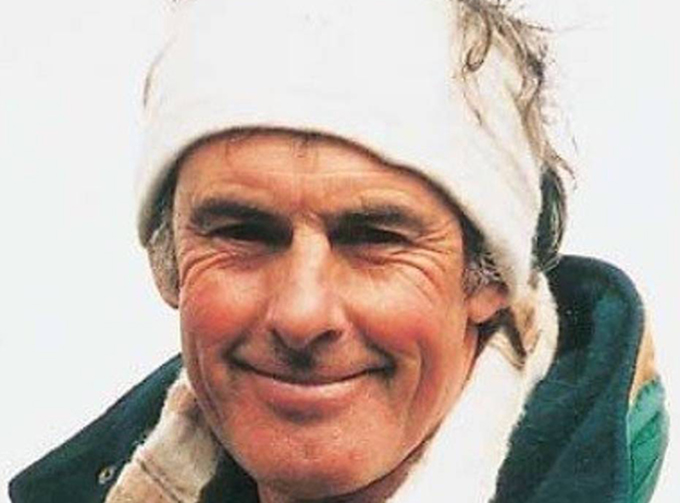
Colin Monteath, 71, and Australians Chris Hoy and Greg Mortimer had all their belongings stolen near the city of Mt Hagen while on their way to visit the popular destination Rondon Ridge Lodge, reports the Otago Daily Times.

Their car was stopped at a road block by six people armed with knives and axes.

READ MORE: PNG police minister to use social media to keep citizens safe

Monteath sustained machete wounds to his wrist when he refused to hand over his camera gear.

He survived because the weapon directly struck his wristwatch, which shattered upon impact, reports stuff.co.nz.

-Partners-

After the attack, a local woman helped find their car keys which had been thrown in the jungle.

They then drove to Mt Hagen Hospital where Monteath received surgery on his wrist and was discharged that same day, June 5.

At least six men have been arrested after the local community helped track them down.

Most of the stolen equipment was also recovered and returned.

Monteath told stuff.co.nz that the locals were very helpful and apologetic and he still loved Papua New Guinea despite what happened.

Australian Greg Mortimer said the incident was unfortunate but there are bad people all over the world, reports the Papua New Guinea Post-Courier.

Trans Niugini Tours owner Bob Bates, who runs Rondon River Lodge where the victims had been heading, said nothing like this attack had ever happened in the 13 years of their operation.

“It is just disgusting that the elderly tourists would be attacked the way the three men were,” Mr Bates said.

Monteath is a Christchurch based polar and alpine photographer who has been taking international geographic photos for magazines and books since 1973.

After returning to New Zealand, he told his family, “Unless you’re defending your family, never ever defend any material goods,” reports stuff.co.nz.

Print Friendly, PDF & Email

Article by AsiaPacificReport.nz

$154m earmarked for development assistance in Fiji

Pacific Media Centre Newsdesk

Fiji expects a total value of Official Development Assistance (ODA) in 2019-2020 to be  F$154.4 million, reports FBC News.

According to FBC’s northern editor Elenoa Turagaiviu, this will consist of $13.8 million to be disbursed as cash grants and $140.6 million of aid-in-kind contributions.

According to the 2019-2020 Budget Supplement, the priority areas for the ODA support in 2019-2020 include education, health, agriculture, financial inclusion, poverty alleviation, social mitigation and renewable energy.

The Economic Services sector is expected to receive the majority of the cash grants at $6.5 million, of which $4.0 million will be provided by the European Union (EU) for the Sustainable Rural Livelihood programme, reports FBC News.

In addition, $1.5 million will be provided by the World Bank for the REDD+ project, while the Government of India has committed $1.0 million towards the Micro Small Business Grant initiative.

About $0.3 million will be provided by the UNDP for the Fiji Ridge to Reef Project, while a grant of $0.5 million is expected from the World Bank for the Sustainable Energy Financing Project.

-Partners-

UNICEF is expected to contribute $500,000 for the Water, Sanitation and Hygiene (WASH) Programme.

Largest support
Fiji’s social services sector is expected to receive the largest support in aid-in-kind donations, worth around $58.5 million.

The majority of these funds will be provided by the Australian government for the Australia-Pacific Technical College, the Access to Quality Education Programme, the Fiji Health Sector Improvement Program and the Pacific Women Shaping Pacific Development Programme.

This amounts to 41.6 percent of the total aid-in-kind that Fiji will receive.

In addition, the New Zealand government has allocated $7.8 million for various projects in the health, education and housing sectors.

Meanwhile, the Korea International Corporation Agency has committed $2.4 million to strengthen competencies in health sector responses to climate change.

A further $3.7 million will be provided for a medical volunteer scheme in the fields of dietetics, physiotherapy and biomedical services.

Elenoa Turagaiviu is FBC News northern editor.

Print Friendly, PDF & Email

Article by AsiaPacificReport.nz

Children have fun playing sports and don’t need to satisfy adults’ ambitions

Source: The Conversation (Au and NZ) – By Simon Walters, Senior Lecturer in Sport and Recreation, Auckland University of Technology

Playing sports has clear social, physical and mental health benefits for children. But evidence shows that youth sports in Western societies have become increasingly controlled and regulated by adults, which takes the fun out for many children.

Participation rates by adolescents have been declining and recent statistics released by the Accident Compensation Corporation (ACC) show a 60% surge in sports injuries for children in the 10 to 14 age group over the past decade in New Zealand.

In response to concerns about declining participation from this age group, the North Harbour Rugby Union recently decided to remove representative junior teams. The decision was based on a considerable body of research that suggests children’s sport is increasingly driven by adults ambitions.


Read more: Five tips to help your kid succeed in sport – or maybe just enjoy it


Policy based on evidence

The decision attracted national and international attention. Several ex-All Blacks were vocal about it, with some players for (notably Wayne “Buck” Shelford and Jeff Wilson) and some against.

The move was backed by Sport NZ, the crown entity responsible for governing sport and recreation in New Zealand, and by the New Zealand Rugby Union. It also received support from other sports in New Zealand, including New Zealand Cricket.

Despite similar earlier moves by Netball NZ and messages of support from sport leaders, there was considerable backlash on social media. Typical responses fell back on the argument that political correctness had gone mad, which is a common response that tends to close off any meaningful debate. For example, one father interviewed on a news segment said the decision had effectively closed off a “career pathway” for his two boys. But sports journalist Dylan Cleaver pointed out that:

The only pathways kids should be on until well into their teens are footpaths. The idea that a 12-year-old is on the pathway to a professional sports career is ridiculous and speaks only to parental obsession , not reality.

North Harbour Rugby based its decision on research that shows young people play sport primarily for fun, to be with their mates and for the sheer joy and exhilaration it provides.

The period of adolescence is the time most associated with dropout from sport, and a key reason commonly cited is that sport stops being fun. In the US, researcher Amanda Visek drilled deeper. Her research found that “fun” for children meant up to 81 different things. Number one was “getting compliments from coaches”, followed by “playing well during a game”. Winning came in at number 30.


Read more: Pay to play: is participating in sport becoming too expensive for everyday Australians?


Culture change in children’s sports

Sport NZ has acknowledged that there are issues with child and youth sporting systems. In 2015, they funded a youth sport “culture change” project, Good Sports, which ran over a three-year period in the Auckland area. The project was designed and implemented by Aktive Auckland, in close collaboration with researchers in youth sports.

A key focus was to have research-informed conversations with parents, coaches, volunteers and teachers, as well as the organisations that put the structures in place, about what makes a quality sporting experience for a young person. It was in a large part due to these conversations that North Harbour Rugby decided to scrap representative junior rugby.

Aside from concerns about dropout, research also shows that an overemphasis on representative teams and performance at an early age promotes early specialisation. Our NZ-based research suggests that over-engagement in organised sport (often associated with early specialisation) can increase risk of overuse injuries, possibly contributing to the increased injuries in young people identified by ACC.

Representative teams at early ages have also been associated with over-the-top adult behaviour at sporting events and with selection that biases older and more physically mature children. This further supports the concerns of North Harbour Rugby that their player development may be closing doors for talented but less physically mature children. The move to remove junior representative teams has since been replicated by a number of other provincial rugby unions.

The international media attention the decision received suggests that there is a need for a culture change in other sports and other countries. It is the children’s game, not ours.

ref. Children have fun playing sports and don’t need to satisfy adults’ ambitions – http://theconversation.com/children-have-fun-playing-sports-and-dont-need-to-satisfy-adults-ambitions-115373

Silver makes beautiful bling but it’s also good for keeping the bacterial bugs away

Source: The Conversation (Au and NZ) – By Mark Blaskovich, Senior Research Officer, The University of Queensland

To mark the International Year of the Periodic Table of Chemical Elements we’re taking a look at some of the elements used by researchers in their work.

Today’s focus is silver, an element seen as a marker of second place – but this reputation is undeserved.


Silver has long played second fiddle to other elements. In sport, it is the symbol of second place, giving way to gold in the medals. In jewellery, airline frequent flyer programs and credit cards, silver is also topped by gold and platinum.

Hold that silver high! Proud medal winners from the Sochi Winter Olympics, 2014. Flickr/Andy Miah, CC BY-NC

But in the world of useful elements, silver should be gold.

My interest in silver originated when growing up in Canada, searching through loose change for pre-1968 quarters (25 cents) that were made from 80% silver (currently worth at least US$2.24 each).


Read more: From the bronze age to food cans, here’s how tin changed humanity


More recently, in my current scientific role fighting antimicrobial resistance, my interest has been piqued by silver’s association with killing bacteria.

The silver medical treatment

Silver has a long history of antibacterial activity. The Phoenicians lined clay vessels with silver to preserve liquids (around 1300BCE), the Persians and Greeks used silver containers to store drinking water (around 5000-300BCE) and Americans travelling west during the 1880s added silver coins into water barrels.

More recently, both American and Russian space programs have used ionic silver to purify water, including on the International Space Station.

Colloidal silver, a suspension of very small nanoparticles of silver metal, has found widespread use as a popular home remedy for a range of ailments, but is often marketed with dubious claims and is not supported by the scientific community.

Some websites claim the use of silver cutlery and dinnerware by wealthy Europeans in the Middle Ages may have helped favour their survival during the bubonic plague, though evidence supporting this is scant.

On a related note, one version of the origin of the term “blue blood” to describe the wealthy is based on their use of silver dinnerware, with significant silver ion ingestion known to cause argyria, or purple-grey skin.

Despite these nonscientific associations, silver has found widespread acceptance in the medical community for specific applications of its antibacterial properties.

Silver for burns

Silver nitrate solutions were found to prevent eye infections in newborns in the 1880s, and were still commonly used for this in the 1970s. Solutions were also used to treat burn injuries, leading to many scientific reports in the 1960s, such as a 1968 study on treating extensive thermal burns with 0.5% silver nitrate solution that describes an apparent reduction in death.

Both 0.5% silver nitrate solution and 1% silver sulfadiazine cream are still used in burn care and are accompanied by new silver-based wound dressings.

The antimicrobial use of silver has crept into consumer products, such as antibacterial bandages, socks and deodorants, and antibacterial coatings on a range of products such as refrigerators.

While this may sound like a good idea, there are concerns that widespread use of silver could cause bacteria to become resistant, not only to silver, but also to our important antibiotics.

It’s not known exactly how silver kills bacteria, but it seems to work by multiple mechanisms, including cell membrane damage and free radical generation.

Our work on silver is looking at whether it can help existing antibiotics work more effectively, especially against resistant bacteria. This research, which has been ongoing for more than five years, has identified that there is better synergy between silver and some types of antibiotics than others, but we don’t yet know why.

Eventually, this research could lead to new formulations of antibiotics with better activity, where the actual antibiotic remains the same but it is delivered as a salt with silver, instead of a more common ion like sodium.

The silver resources

The actual word silver stems from the Anglo-Saxon name for it, siolfur, while its chemical symbol Ag comes from the Latin name for silver, argentum.

Silver can sometimes be found as nuggets of pure metal, though this form is more rare than gold. Most often it is found combined with other elements in ores such as argentite (with sulfur) or galena (with lead).

Not so shiny yet, a lump of silver ore. Shutterstock/hecke

The ores are mined and the silver generally removed by smelting (heating combined with chemical reactions). It is believed this technique was discovered before 2000BCE.

Historically, the major use of silver has been as coinage and in jewellery. Traditional photography uses silver halides for the photosensitive film, while mirror backings and Christmas ornaments use silver-plated glass.


Read more: Titanium is the perfect metal to make replacement human body parts


Silver lies in the middle of the periodic table. It is encircled by other useful and well-known metals such as (clockwise from above) copper, zinc, cadmium, mercury, gold, platinum, palladium and nickel.

I would argue that silver shines brightly above its neighbours – it actually does, as it has the highest reflectivity of any metal – and also is the best at conducting electricity and heat.

So silver really does deserves top of the podium: a gold for silver!


If you’re an academic researcher working with a particular element from the periodic table and have an interesting story to tell then why not get in touch.

ref. Silver makes beautiful bling but it’s also good for keeping the bacterial bugs away – http://theconversation.com/silver-makes-beautiful-bling-but-its-also-good-for-keeping-the-bacterial-bugs-away-115367

Human trafficking and slavery still happen in Australia. This comic explains how

Source: The Conversation (Au and NZ) – By Jennifer Burn, Professor, Faculty of Law, University of Technology Sydney

We might not want to believe it, but human trafficking and slavery happens in Australia. Slavery is not an historical artefact, but a tragic reality for millions of people around the world, including in Australia.

Recently, the term “modern slavery” has been used to contrast contemporary forms of slavery from historical slavery such as that seen during the transatlantic slave trade.

In practice, modern slavery is an umbrella term that is often used to describe human trafficking, slavery and slavery-like practices such as servitude, forced labour and forced marriage.

But slavery is timeless. It has always been about the commodification of the body of a man, woman or child, the theft of liberty and sometimes life.


Read more: Modern Slavery Bill a step in the right direction – now businesses must comply


Anti-Slavery Australia, at the University of Technology Sydney, started researching and assisting trafficked and enslaved people in Australia back in 2002. For over 17 years, Anti-Slavery Australia has provided access to legal advice and assistance to hundreds of people who have experienced modern slavery.

In 2018 alone, Anti-Slavery Australia helped over 123 people who had been trafficked to or from Australia, or had faced slavery-like conditions while in Australia, including forced marriage, servitude and forced labour.

But this is just the tip of the iceberg. A recent report by the Australian Institute of Criminology estimates that only one in five victims are detected. This means that the cases we see are likely to be a small proportion of the scale of trafficking and slavery in Australia.


Read more: At last, Australia has a Modern Slavery Act. Here’s what you’ll need to know


Vulnerable people of any background or status can be cruelly exploited. Some groups, such as migrant workers or young people, are more vulnerable than others.

So what does modern slavery look like in Australia?

Here are four real world examples, with names of individuals and businesses changed, to explain the different kinds of exploitation seen at Anti-Slavery Australia and considered in Australian courts.


Slavery/domestic servitude

In Australian law, slavery is defined as

the condition of a person over whom any or all of the powers attaching to the right of ownership are exercised, including where such a condition results from a debt or contract made by the person.

Essentially, slavery is when a person is controlled as if they were mere property.

Wes Mountain/The Conversation, CC BY-ND

Eventually, with the help of one of Mr and Mrs K’s family members, Mary was able to leave this situation.

This example is based on a case that ultimately led to Mr and Mrs K being found guilty of slavery offences and sentenced to eight and four years’ imprisonment respectively.


Servitude

Servitude is when a person does not consider themselves to be free to stop working or leave their workplace, because of threats, coercion or deception; and the person is significantly deprived of their personal freedom in their life outside of work.

Wes Mountain/The Conversation, CC BY-ND

Eventually, Tom managed to escape from the house, flagged down a motorist and contacted police. Police responded and found 49 other exploited people who had been coerced and controlled.

This example is based on a case that led to two people being found guilty of causing a person to enter into or remain in servitude and sentenced to three years’ and two-and-a-half years’ imprisonment.


Forced labour

Forced labour is when a person does not consider themselves free to stop working, or to leave their workplace, because of threats, coercion or deception.

Wes Mountain/The Conversation, CC BY-ND

Eventually, John was able to get help, but he was in very poor health and died a few years later.


Forced marriage

A forced marriage is when a person is married without freely and fully consenting because of either coercion, threat or deception. It could also be because they’re incapable of understanding the nature and effect of a marriage ceremony, possibly because of their age or mental capacity.

A forced marriage is different from an arranged marriage or a sham marriage. The main difference is that there is consent in arranged and sham marriages.

Wes Mountain/The Conversation, CC BY-ND

To find out more about the scenarios you have read, additional information and confidential legal advice contact Anti-Slavery Australia. See www.antislavery.org.au. For information and advice on forced marriage see www.mybluesky.org.au. ​

ref. Human trafficking and slavery still happen in Australia. This comic explains how – http://theconversation.com/human-trafficking-and-slavery-still-happen-in-australia-this-comic-explains-how-112294

3 out of 4 kids with mental health disorders aren’t accessing care

Source: The Conversation (Au and NZ) – By Melissa Mulraney, Postdoctoral research fellow, Murdoch Children’s Research Institute

Three-quarters of Australian children with mental health disorders aren’t getting professional help, according to our new research. Girls, younger children and families from non-English-speaking backgrounds are the least likely to access mental health services.

We looked at the mental health of just under 5,000 Australian children aged eight to 13 via parental surveys of their child’s emotional and mental health. We then linked the results with Medicare data to see which families had accessed help.

Fewer than one in four children we identified as having a mental health problem saw a health professional in the 18 months after we surveyed them.


Read more: What’s the best way to screen for child mental health issues?


Left unaddressed, mental health problems can become more entrenched and harder to treat. And mental health problems in childhood can have lifelong ramifications including increased risk of mental health problems in adulthood, poor educational attainment, unemployment, and contact with the criminal justice system.

So ensuring children and adolescents who experience mental health problems receive access to timely and effective care is essential.

What types of mental health problems do kids have?

Around 14% of children and adolescents aged four to 17 meet diagnostic criteria for at least one mental health disorder.

The most common mental health disorders in Australian children in this age group are anxiety disorders, which affect 6.9% of children, and attention deficit hyperactivity disorder (ADHD), which affects 7.4% of children.

Around 50% of all adult mental disorders begin before the age of 14. Yet in 2017-18, children under the age of 15 had the lowest use of Medicare-rebated mental health services (5.1%) of any Australian age group.


Read more: How to know if your child is addicted to video games and what to do about it


Younger children

Younger children were less likely to access services than older children. Some 20-27% of children aged 12-13 years accessed services, compared to 9-15% of children aged eight to nine years.

Young children respond to and process emotional experiences and traumatic events in ways that are very different from adults and older children. Consequently, it can be more difficult to recognise problems in early childhood.

A child acting up in the classroom, for example, may be perceived as being “naughty” rather than having mental health problems. Or a child may experience stomach aches and headaches which are caused by anxiety but thought to be a physical problem.

Boys are more likely to receive help for mental disorders than girls. From shutterstock.com

When problems are recognised, families may delay getting help for young children in the hope that they will “grow out of” the mental disorder.

While this may apply in some cases, treatment is still important. Take ADHD, for example. Although about 80% of children with ADHD will grow out of it by adulthood, children with ADHD often find it hard to make friends. If they miss out on developing their social skills early in life, it can become increasingly difficult to make friends during adolescence and adulthood when peer relationships become more complex.

In our study, the factors most consistently associated with getting support were symptom severity and parent perception that the child needed help.

The gradual onset and increase in severity over time of many mental health problems means children and their parents are more likely to seek services when the symptoms become severe or impact significantly on the child’s ability to function. This typically occurs as they grow older.


Read more: Children’s well-being goes hand in hand with their dads’ mental health


Boys versus girls

We found girls were less likely to receive care than boys. Girls made up 50% of children with mental health problems in the study, yet accounted for just 30% of children who received support for emotional problems at ages eight to 11.

This may have something to do with the fact that mental health conditions can be more difficult to recognise in girls.

Boys are more likely to externalise problems such as anxiety by reacting angrily when asked to do something that upsets them. Girls are more likely to internalise these issues by withdrawing or appearing very quiet, making problems harder to detect. In an environment like the classroom, boys’ problems are more likely to get noticed because of their disruptive nature.

Culturally and linguistically diverse backgrounds

Around 14% of children with emotional problems came from a non-English speaking background, but they only accounted for 2% who received help.

The reluctance of parents from non-English speaking backgrounds to get help may be related to different cultural understandings of mental health and illness. They may also struggle to find services for their child in their own language.

Mental health conditions may also be more difficult to recognise among children from non-English speaking backgrounds, where quietness in the classroom may be mistaken for a language issue rather than a mental health issue.

We need change

Over the past 20 years there has been little change in the prevalence of child and adolescent mental disorders in Australia despite increased investment in resources. This is likely in part because the quality and the intensity of services provided have not improved.

Children may not be receiving sufficient treatment sessions or treatment sustained over a long enough period to meaningfully impact on their symptoms. It’s recommended that children receive at least eight sessions of cognitive behavioural therapy for the treatment of anxiety, for example, but many children will require more.

Australia’s health system rewards discharging patients from care within a set number of appointments rather than once they have improved. The Medicare Better Access scheme allows for a maximum of ten subsidised appointments with a psychologist in a calendar year. But again, many children require more.


Read more: What about the mental health of kids with intellectual disability?


We need a system-level shift to funding based on measured symptom improvement rather than a capped number of appointments both in hospital settings and in the community.

Our research suggests we need to better understand parent and child drivers of why children miss out on care, particularly girls, younger children, and those from diverse backgrounds. Doing so and ensuring access to high-quality care will benefit not only the child and their family now but also the adult they will become.

ref. 3 out of 4 kids with mental health disorders aren’t accessing care – http://theconversation.com/3-out-of-4-kids-with-mental-health-disorders-arent-accessing-care-118597

Not everyone cares about climate change, but reproach won’t change their minds

Source: The Conversation (Au and NZ) – By Chloe Lucas, Postdoctoral Research Fellow, University of Tasmania

So much for Australia’s “climate election”. In the event, voters in last month’s federal poll didn’t put climate policy at the top of their wish list.

Contrary to opinion polls predicting a groundswell of support for Labor’s relatively progressive agenda on climate and economics, the election results revealed that Australians are more divided on climate change than we thought.


Read more: Australians disagree on how important climate change is: poll


Voters for progressive climate policy were dismayed at the re-election of a prime minister who famously brought a lump of coal into Parliament. Perhaps understandably, one of the immediate responses among these progressive voters was to express anger at those who don’t share their concern.

But anger feeds a divisive politics that cannot help us to address our big collective challenges. By retreating into social media echo chambers where mockery and disrespect are the norm, we risk losing entirely the social cohesion and trust needed for democracy to work.

A whole-of-society discussion about our collective future is urgently needed. Now is the time to reinvent how we communicate about climate change, particularly with those who don’t see it as an urgent concern. Here’s how.

Addressing the ‘climate-unconcerned’

Contrary to the assumption that unconcern about climate change is evidence of selfishness or politically motivated denial, our research shows that people who resist climate concern are just as likely to be caring, ethical and socially minded as anyone else.

While there is a small minority of people who actively campaign against climate action, within society at large, those who are simply unconcerned about the climate crisis encompass a broad range of political views and levels of political engagement.

Far from being prejudiced, unreasonable, apathetic or ignorant, our studies in Australia and the UK show that many people who are unconcerned about the climate nevertheless care about issues including justice, the common good, and the health of ecosystems.

Belonging to a social group that doesn’t have its own narratives of climate concern is one of the most common reasons for unconcern. People who are unconcerned about climate change often see it as a “greenie” issue. If they identify themselves as opposed to green politics, they are unlikely to prioritise calls for climate action.

The rural/city divide also plays a key part in polarising narratives of climate action, as regional and outer-urban Australians, who are more likely to be economically dependent on natural resources, feel ignored and devalued by policies designed to appeal to capital city electorates. If we want to break down polarisation on climate change, we need to understand what matters to rural and conservative social groups.

Bridging the divide

Our findings suggest a set of principles for engaging with people who are unconcerned about climate change:

  • Respect difference. Don’t assume that being unconcerned about climate change is a moral failing. People have other active concerns that are no less valid.

  • Listen. Build relationships with people who have different life experiences to your own, by asking what is important to them. Appreciate that some people may find social change more threatening and immediate than climate change. Empathising with this feeling can foster understanding of the core concerns that underpin resistance to change, and potentially help identify ways to address these concerns.

  • Value values. Avoid arguments based on appeals to the authority of science, or the consensus of expert opinion. “Debating the science” is a red herring – people’s responses to claims about climate change are motivated primarily by what they value, and the narratives of their social group, not their acceptance of scientific fact. Focus on values you might have in common, rather than getting caught up in disputes over facts.

  • Move beyond Left and Right. Don’t conflate political ideology with stance on climate. Showing that climate is not a defining issue for social groups is really important to avoid polarisation. We need to work against the idea that action on climate is an exclusively left-wing or “greenie” agenda.

Adopting these principles can help to build a political culture around climate science and policy that responds to the different priorities of Australians, all of whom are simply seeking a safe and secure future. This approach recognises that no action on climate change is possible without public trust and involvement in democratic institutions.

What can we learn from the UK?

Australia’s parliamentary system and media environment have much in common with that of the UK. Although the UK has not been immune to political divisions on climate change, with levels of concern typically higher on the political left than on the right, Britain has maintained a bipartisan approach.

With the help of intiatives supporting a pluralistic approach to climate policy discussions, the UK Climate Change Act passed into law in 2008 with almost unanimous cross-party support.


Read more: The UK has a national climate change act – why don’t we?


Research in the UK has provided an evidence-based set of language and narratives to use when discussing climate change. This is focused on core socially conservative values such as maintaining the status quo (protecting it from a changing climate), avoiding waste (of household energy), and investing in secure (renewable) energy. There is also a push to reinvigorate democratic debate through citizens’ assemblies on climate change.

Now is the time for Australians to listen to each other, and develop a pluralistic approach to discussions on our shared future. The alternative is to sink deeper into partisan hostility and recrimination. And after a decade of division on climate policy, is that really the best way forward?

ref. Not everyone cares about climate change, but reproach won’t change their minds – http://theconversation.com/not-everyone-cares-about-climate-change-but-reproach-wont-change-their-minds-118255

Selective schools mainly ‘select’ advantage, so another one won’t ease Sydney’s growing pains

Source: The Conversation (Au and NZ) – By Christina Ho, Senior Lecturer, Social & Political Sciences, University of Technology Sydney

NSW Premier Gladys Berejiklian has re-ignited the ongoing debate about selective schools by announcing a new selective school will be built in the “key growth area” of southwest Sydney. In announcing the school, the premier said:

There is strong demand for selective schools, with around 15,000 applications for only 4,200 places. This new school will provide another convenient local option for these students and their families.

But selective schools are never a “local option”. Selective school entry is open to anyone who meets the cut-off in the admissions test, regardless of where they live. Selective school students routinely travel for hours across Sydney to get to and from school.

And despite claims selective schools provide opportunities for gifted students across all socioeconomic backgrounds, the data actually show otherwise – selective schools are mainly comprised of advantaged students.

What are selective schools?

Fully selective schools have no catchment zones like other public schools. This means students in southwest Sydney will receive no priority when they seek admission to this new school. So, despite claims the school is needed to cater for population growth in this area, this school will never be a local school.

Selective high schools are public schools that cater for high-achieving, gifted students. NSW has more selective schools than the rest of the states combined. This new one will be the 49th if both both fully and partially selective schools are included. Victoria has only four selective schools, Queensland three and Western Australia one.


Read more: Should gifted students go to a separate school?


Each year, selective schools dominate the HSC leader boards, comprising virtually all the top ten performing schools in NSW. These remarkable outcomes come from grouping together high-achieving, gifted students, and teaching them using specialised methods and materials.

The positive aspects lie in selective school students spurring each other on to reach their potential. And sometimes in a comprehensive school gifted students are bored or bullied. But the disparity selective schools create outweighs the benefits.

They ‘select’ the most advantaged

An average of 73% of students in NSW’s fully selective schools came from the highest quarter of socio-educational advantage (SEA) in 2016. The SEA is based on factors shown to have an impact on students’ educational outcomes, such as parents’ occupation and education.

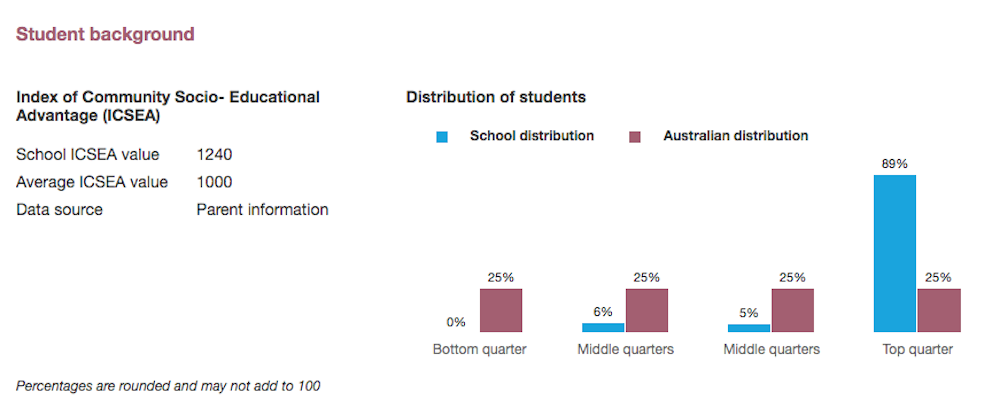
At NSW’s highest-scoring school, James Ruse Agricultural High School, 89% of students came from the top SEA quarter in 2016. Only an average 2% of students across all of NSW’s fully selective schools came from the lowest SEA quarter.

James Ruse Agricultural College student profile 2016. MySchool (screenshot)

Gifted students do exist in lower-income families and research shows they are underachieving due to lack of opportunity – but selective schools don’t seem to be the answer. The data on selective schools show gifted students from disadvantaged backgrounds are being locked out of the selective system.

In fact, students in selective schools are now so advantaged they surpass those in many high-fee private schools. The My School website calculates an Index of Socio-Educational Advantage (ICSEA) for each school in Australia. ICSEA is set at an average of 1,000 across Australia. The higher the ICSEA, the higher the level of educational advantage of students attending the school.

As the table below shows, in 2016 just over half of the 20 most advantaged high schools in NSW were selective schools.


They don’t reflect the community

Selective schools don’t reflect the communities in which they are located, meaning they are not the “local option” Berejiklian hopes the new school will be.

While public schools have traditionally been local community hubs, exposing students to the full range of diversity in their neighbourhoods, selective schools are not able to fulfil that function. Their level of advantage almost always exceeds that of other local schools. And this is true in wealthy as well as lower-income areas.

As the table below shows, ICSEA scores for selective schools in Penrith, Campbelltown, Gosford, Newcastle and Wollongong far surpassed those of surrounding local schools.


Selective schools also don’t reflect the ethnic composition of our community and are overwhelmingly dominated by students from language backgrounds other than English (LBOTE). On average, 83% of students in Sydney’s fully selective schools were from a LBOTE in 2017. At James Ruse, the figure was 97%.

James Ruse Agricultural College student profile 2017. MySchool (screenshot)

Most selective school students are children of skilled migrants, particularly from Asia, who tend to be highly educated and who invest heavily in their children’s education. This includes paying for many hours of private tutoring, especially in the lead-up to the selective schools admission test.

The use of tutoring to secure a competitive edge is another barrier preventing lower-income families from accessing the selective system.


Read more: Selective entry schools: tutoring improves student outcomes, but adds pressure


High-achieving students need more access to educational programs that will enable them to reach their full potential. But this new selective school is not the solution.

ref. Selective schools mainly ‘select’ advantage, so another one won’t ease Sydney’s growing pains – http://theconversation.com/selective-schools-mainly-select-advantage-so-another-one-wont-ease-sydneys-growing-pains-118449

‘I really have thought this can’t go on’: loneliness looms for rising numbers of older private renters

Source: The Conversation (Au and NZ) – By Alan Morris, Research Professor, University of Technology Sydney

Loneliness is increasingly recognised worldwide as a critical social issue and one of the major health hazards of our time. Our research shows older private renters are at high risk of loneliness and anxiety. This is a growing concern as more Australians are renting housing later in life. By contrast, only a small proportion of the social housing tenants we interviewed said they were lonely.

The links between housing arrangements and loneliness could have profound implications for our health. As former US surgeon general Vivek H. Murthy said:

The reduction in life span [for people experiencing loneliness] is similar to that caused by smoking 15 cigarettes a day, and it’s greater than the impact on life span of obesity … Look even deeper, and you’ll find loneliness is associated with a greater risk of heart disease, depression, anxiety and dementia.


Read more: Why secure and affordable housing is an increasing worry for age pensioners


What causes loneliness?

The causes of loneliness are multifaceted and complex. The number of people living alone in Australia is clearly a factor. In 2016, just under one in four households (24.4%) were single-person households. That’s up from one in five in 1991.


Read more: One in four Australians are lonely, which affects their physical and mental health


Research suggests low-income individuals are more likely to experience loneliness. So, too, are people who have a serious mental or physical health condition or have had a serious disruptive event (financial or job loss, illness or injury, or relationship breakdown) in the last couple of years.

The impact of housing tenure on loneliness has received little attention. While recognising that there are no definite associations, we interviewed about 80 older (65-plus) private renters and social housing tenants who depended on the Age Pension for their income. These in-depth interviews indicated that their housing tenure was a critical factor in their risk of experiencing loneliness.


Read more: When falling home ownership and ageing baby boomers collide


Many older private renters are lonely

Many older private renters have little disposal income, because the cost of housing uses up much of their income. They also live with the constant possibility that they may be asked to vacate their accommodation. Their limited budgets mean they often end up living in a poorly located property. These features, individually or in combination, create fertile ground for anxiety and loneliness.

Their dire financial situation was often an obstacle to social activities. One interviewee told of how she had to choose between food or breaking her isolation by using public transport.

Well, you sort of think what you can do with $2.50. That’s a loaf of bread type of thing. – Beverley *

A 72-year-old woman living by herself said she could not afford the outings organised by her church.

There’s quite an active social club at the church for over-55s but I can’t go to any of those … Sometimes I think it would be nice to go on something that appeals to me, yes. And they might have an afternoon at somebody’s home and you’re asked to bring a plate [of food]. You see, I couldn’t afford to do that.

Peter, 67 and divorced, had left the workforce prematurely due to ill-health.

I’ve become very isolated. I used to, before I had the hip operation, I used to play tennis and I loved to play tennis … but I really can’t afford it. I’ve found a few clubs that I could go and play in. I’d like to get back to it, but they say, ‘Ah, the fees are this and you pay it annually,’ and I can’t come up with $150 or $200 or whatever.

Lack of money and insecure tenure were sources of enormous distress and anxiety, which further discouraged social contact. Brigette (67) was brutally honest:

You do get depressed and I believe that’s why people suicide … And there have been times when I’ve thought, what is the point to life? I really have thought this can’t go on, you know … I feel sorry for people because it is hard, and once you stay in it’s like crawling out of a slime pit … I have to say, ‘Get up and go out, go up the shops … Pretend you need potatoes or something.’

Not all of the private renters interviewed experienced loneliness. These interviewees usually had strong family ties or had managed to find affordable and secure accommodation.


Read more: Many people feel lonely in the city, but perhaps ‘third places’ can help with that


Social housing tenants feel less isolated

In sharp contrast, only a small proportion of the social housing tenants interviewed said they were lonely. Almost all were adamant they did not experience loneliness and felt they had strong social ties. Their affordable rent, security of tenure, long-term residence and having neighbours in a similar position meant they could socialise and were not beset by anxiety.

An 85-year-old long-established social housing tenant’s response to the question about loneliness and isolation was typical:

I do like it around here. I know where everything is and I know all the people, especially around these units you know. I know everyone and they know me. I like it around here. This is my home, you know. This is a community, I think. Like I know all the people and we’ve become really good friends. I couldn’t think of being anywhere else. – Kay

Pam, who had been a private renter before being allocated social housing, reflected on how her life had changed:

Well, it is changed because I’m happier and I think I’m healthier and I have a lot of new friends. I also have a lot more people around me for support if anything does happen. If I get sick and if they don’t see me for a few days someone will come and say, ‘Pam, are you OK?’ In private housing there was nobody.

The residualisation of social housing meant some tenants were living in what they perceived to be unbearable conditions. However, they generally were able to deal with their situation. Patricia coped with her very challenging neighbours by going to the local community centre.

No, I hate it [public housing]. I live here [at the community centre] every day. Yes, I’m on the committee here and I do things every day. This is my home, my family. Everybody is friendly with everybody. We have outings and things.

What the interviews indicate is that the housing tenure of age pensioners often plays a fundamental role in whether they are able to escape the experience of loneliness. Older private renters are far more likely to experience loneliness than their counterparts in social housing and that loneliness can be acute.

* All the names used are pseudonyms.


Read more: Designing cities to counter loneliness? Let’s explore the possibilities


ref. ‘I really have thought this can’t go on’: loneliness looms for rising numbers of older private renters – http://theconversation.com/i-really-have-thought-this-cant-go-on-loneliness-looms-for-rising-numbers-of-older-private-renters-118046

More people are retiring with high mortgage debts. The implications are huge

Source: The Conversation (Au and NZ) – By Rachel Ong ViforJ, Professor of Economics, School of Economics, Finance and Property, Curtin University

The number of mature age Australians carrying mortgage debt into retirement is soaring.

And on average each mature age Australian with a mortgage debt owes much more relative to their income than 25 years ago.

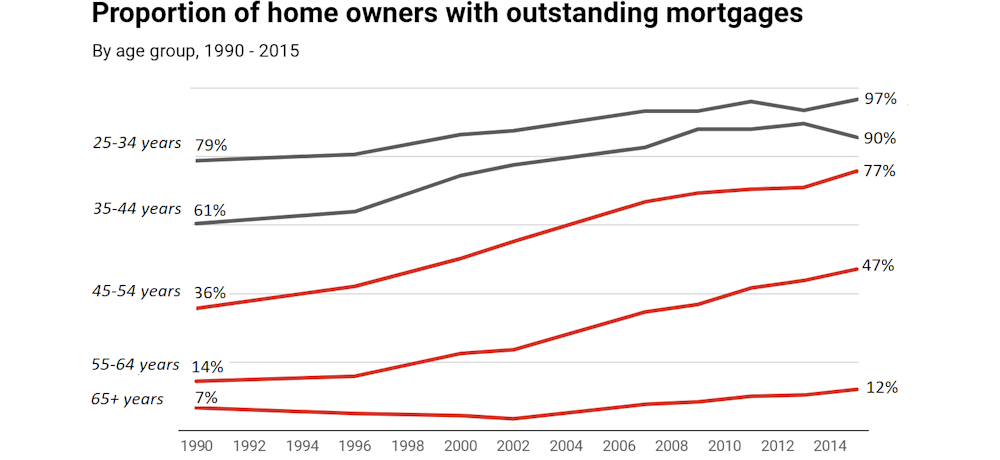
Microdata from the Bureau of Statistics survey of income and housing shows an increase in the proportion of homeowners owing money on mortgages across every home-owning age group between 1990 and 2015. The sharpest increase is among homeowners approaching retirement.

More mortgaged for longer

For home owners aged 55 to 64 years, the proportion owing money on mortgages has tripled from 14% to 47%.

Among home owners aged 45 to 54 years, it has doubled.


Source: Authors’ own calculations from the Surveys of Income and Housing

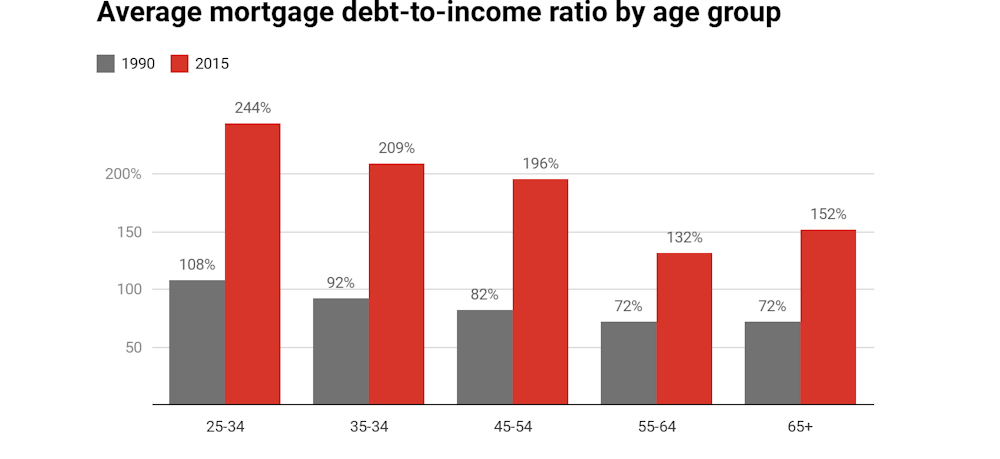
Meanwhile, the average mortgage debt-to-income ratio among those with mortgages has pretty much doubled across every home-owning age group.

In the 45-54 age group the mortgage debt-to-income ratio has blown out from 82% to 169%.

For those aged 55-64 it has blown out from 72% to 132%.


Among mortgage holders. Source: Authors’ own calculations from the Surveys of Income and Housing

Three reasons why

The soaring rates of mortgage indebtedness among older Australians have been driven by three distinct factors.

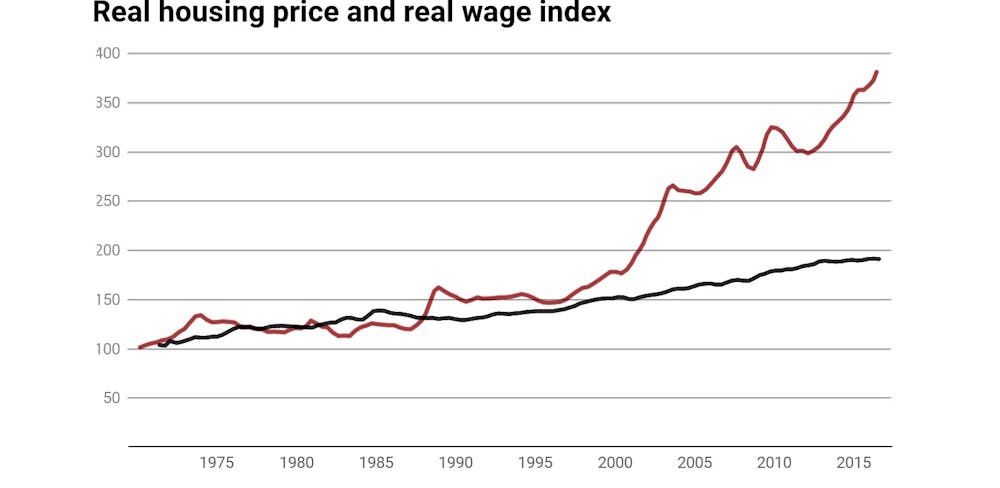
First, property prices have surged ahead of incomes.

Since 1970 the national dwelling price to income ratio has doubled.


Prices and wages in 1970 are assigned an index of 100. Sources: Treasury, ABS, Committee for Economic Development of Australia

Despite weaker property prices, the ratio remains historically high. This means households have to borrow more to buy a home. It also delays the transition into home ownership, potentially shortening the the remaining working life available to repay the loan.

Second, today’s home owners frequently use flexible mortgage products to draw down on their housing equity as needed for other purposes. During the first decade of this century, one in five home owners aged 45-64 years increased their mortgage debt even though they did not move house.

Third, older home owners appear to be taking on bigger mortgages or delaying paying them off in the knowledge that they can work longer than their parents did, or draw down their superannuation account balances.

Super could be changing our behaviour

For mortgage holders aged 55-64 years, there is evidence to suggest that larger debts prolong working lives.

In 2017 around 29% of lump sum superannuation withdrawals were used to pay down mortgages or purchase new homes or pay for home improvements, up from 25% four years earlier.

In the Netherlands, where a mandatory occupational pension scheme along the lines of Australia’s super scheme has been in place for much longer, over one-half of home owners aged 65 and over are still paying off mortgages.


The base is the total number of uses of lump sums rather than the number of people taking lump sums. ABS 6238.0 Retirement and Retirement Intentions

The implications are huge

Internationally, studies have found that indebtedness adds to psychological distress. The impacts on wellbeing are more profound for older debtors, without the ability to recover from financial shocks.

Debt-free home ownership in old age used to be known as the fourth pillar of the retirement incomes system because of its role in reducing poverty in old age. It allowed the Australian government to set the age pension at relatively low levels.

Growing indebtedness will increase after-housing-cost poverty among older Australians and create pressure to boost the age pension.

Mortgage debt burdens late in working life will also expose home owners to unwelcome risks, as health or employment shocks can ruin plans to pay off their mortgages.

During the first decade of this century, around half a million Australians aged 50 years and over lost their homes.

Taxpayers will be under pressure to help

Those losing home ownership are often forced to rely on rental housing assistance. Moreover, as older tenants they are unlikely to ever leave housing assistance. This will put pressure on the government to boost spending on housing assistance, which is likely to further boost demand for housing assistance.

Super and government housing assistance could become the safety nets that allow retirees to escape their mortgages.

It wasn’t the intended purpose of superannuation, and wasn’t the intended purpose of housing assistance. It is a development that ought to be front and centre of the inquiry into the retirement incomes system announced by Treasurer Josh Frydenberg.

It is a change we’ll have to come to grips with.


Read more: Home ownership foundations are being shaken, and the impacts will be felt far and wide


ref. More people are retiring with high mortgage debts. The implications are huge – http://theconversation.com/more-people-are-retiring-with-high-mortgage-debts-the-implications-are-huge-115134

What’s so special about the Mona Lisa?

Source: The Conversation (Au and NZ) – By Susan Broomhall, Professor of History, University of Western Australia

Every day, thousands of people from around the world crowd into a stark, beige room at Paris’s Louvre Museum to view its single mounted artwork, Leonardo da Vinci’s Mona Lisa.

To do so, they walk straight past countless masterpieces of the European Renaissance. So why does the Mona Lisa seem so special?

The mystery of her identity

Leonardo da Vinci, Mona Lisa, oil on poplar wood, c. 1503–06?, 77 x 33 cm, inv. 779. Musée du Louvre, Paris. Wikimedia.

The story told by one of Leonardo’s first biographers, Giorgio Vasari, is that this oil portrait depicts Lisa Gherardini, second wife of a wealthy silk and wool merchant Francesco del Giocondo (hence the name by which it is known in Italian: La Gioconda).

Leonardo likely commenced the work while in Florence in the early 1500s, perhaps when he was hoping to receive the commission to take on a massive wall painting of The Battle of Anghiari.

Accepting a portrait commission from one of the city’s most influential, politically-engaged citizens might well have helped his chances. A recently discovered marginal note by Agostino Vespucci, one-time assistant to the diplomat and writer Niccolò Machiavelli, records that Leonardo was working on a painting of “Lisa del Giocondo” in 1503.

Agostino Vespucci, Handwritten comment about the Mona Lisa in Cicero’s Epistolae ad familiares (Bologna 1477), Bl. 11a, held in Heidelberg, University Library, D 7620 qt. Heidelberg University

The Italian painter Raphael, a great admirer of Leonardo, leaves us a sketch from around 1505-6 of what seems to be this work. When Leonardo later moved to France in 1516, he took this still unfinished work with him.

However, art scholars have increasingly voiced doubts about whether the image in the Louvre can indeed be Vasari’s Lisa, for the style and techniques of the painting match far better Leonardo’s later work from 1510 onwards.

Additionally, a visitor to Leonardo’s house in 1517 recorded seeing there a portrait of “a certain Florentine woman, done from life,” made “at the instance of the late magnificent Giuliano de Medici.” Medici was Leonardo’s patron in Rome from 1513 to 1516. Was our visitor looking at the same image Vasari and our marginal diarist describe as Lisa, or another portrait of a different woman, commissioned later?

All in all, just who we are seeing in the Louvre remains one of the work’s many mysteries.

A portrait stripped bare

In comparison to many contemporary images of the elite, this portrait is stripped of the usual trappings of high status or symbolic hints to the sitter’s dynastic heritage. All attention is thus drawn to her face, and that enigmatic expression.

Before the 18th century, emotion was more commonly articulated in painting through gestures of the hand and body than the face. But in any case, depictions of individuals did not aim to convey the same kinds of emotions we might look for in a portrait photograph today — think courage or humility rather than joy or happiness.

Additionally, a hallmark of elite status was one’s ability to keep the passions under good regulation. Irrespective of dental hygiene standards, a broad smile in artworks thus generally indicated ill-breeding or mockery, as we see in Leonardo’s own study of Five Grotesque Heads.

Leonardo da Vinci, Grotesque Heads, c. 1490s, pen, Royal Library, Windsor. Wikimedia

Our modern ideas about emotions leave us wondering just what Mona Lisa might have been feeling or thinking much more than the work’s early modern viewers likely did.

A 20th century phenomenon

In fact, there is a real question as to whether anyone before the 20th century thought much about the Mona Lisa at all. The historian Donald Sassoon has argued that much of the painting’s modern global iconic status rests on its widespread reproduction and use in all manner of advertising.

This notoriety was “helped” by its theft in 1911 by former Louvre employee, Vincenzo Peruggia. He remarkably walked out of the museum one evening after closing time with the painting wrapped in his smock coat. He spent the next two years with it hidden in his lodgings.

Shortly after its return, the Dadaist Marcel Duchamp used a postcard of the Mona Lisa as the basis for his 1919 ready-made work, LHOOQ, initials that sound in French as “she has a hot ass”.

Marcel Duchamp, with Francis Picabia, L H O O Q, 1919, published in the magazine 391, No. 12, March 1920. Wikimedia

Although not the first, it is perhaps among the best known examples of Mona Lisa parodies, along with Salvador Dali’s Self Portrait as Mona Lisa, 1954.

Cultural furniture

From Duchamp and Dali, we have increasingly seen the Mona Lisa used as a trope. Balardung/Noongar artist Dianne Jones has reprised the work in her inkjet photographic portraits of 2005, which are less pointed in their swipe at white European art and more luminous in their appropriation of Mona Lisa’s sense of dream-like plenitude.

The painting appears as cultural furniture in the recent music video Apeshit, 2019, by Beyoncé and Jay Z, in which they romp across the Louvre backed by a troupe of scantily clad dancers, striking Lady Hamilton-like poses in front of famous works of art.

The video for Apeshit.

Apeshit itself closely imitates earlier works of contemporary high culture, not least French New Wave film director Jean-Luc Godard’s Bande à Part (Band of Outsiders), 1964, in which three friends, including Mona Lisa-like Anna Karina (Godard’s famous muse), meet up and run through the Louvre in record time.

Jean-Luc Godard, Bande à part (extract), 1964.

Meanwhile, the notorious theft of a work of art by German performance artist Ulay in 1976, in which he removed the most famous (and kitsch) painting in the National Gallery in Berlin, Carl Spitzweg’s 1839 portrait of The Poor Poet, was a reprise of the theft of the Mona Lisa in 1911.

Wim Delvoye, Suppo, 2012, Musée du Louvre, Paris. Martin Gautron/flickr

Many contemporary artists have rubbished all the reverence surrounding bucket-list art visits such as that to the Mona Lisa.

Recently, Belgian art provocateur Wim Delvoye (whose shit-producing machine, Cloaca, 2000, is one of the centrepieces of Hobart’s Museum of Old and New Art) installed Suppo (2012), a giant steel corkscrew suppository, under the Louvre’s central glass entry pyramid. This made it the first sighting of art in the museum to which the Mona Lisa’s visitors flock.

Still, the mysteries of the Mona Lisa look set to intrigue us for years to come. It is precisely the breadth and depth of possible interpretations that makes her special. Mona Lisa is whoever we want her to be – and doesn’t that make her the ultimate female fantasy figure?

ref. What’s so special about the Mona Lisa? – http://theconversation.com/whats-so-special-about-the-mona-lisa-117180

View from The Hill: A soft reprimand from one hard man to another

Source: The Conversation (Au and NZ) – By Michelle Grattan, Professorial Fellow, University of Canberra

When Home Affairs Minister Peter Dutton told his departmental secretary Mike Pezzullo he shouldn’t go ringing up senators to set them straight, it was a rebuke laced with empathy, a message delivered from one hard man to another in a sympathetic manner.

After last week’s police raid on News Corp journalist Annika Smethurst’s home (a day before the raid on the ABC), Centre Alliance senator Rex Patrick issued a statement declaring that Dutton and Pezzullo “clearly hate media scrutiny”.

He said the police actions “are very clearly intended to have a chilling effect on journalistic inquiry”. There would be questions to be answered when the Senate sat, the senator warned.

Pezzullo, a veteran of sparring with Senate committees and never one to take a backward step, decided to get in first, with some direct answers to his critic.

He’s been angry ever since publication of the Smethurst article, which revealed bureaucratic discussions about widening the remit of the Australian Signals Directorate, an agency that carries out electronic spying. Elements of the story were denied at the time, as misconstruing what was being discussed.

Pezzullo contacted Patrick. According to Patrick, Pezzullo told him he considered his remarks slanderous, although quickly making it clear he wouldn’t be pursuing that element. He said it was unfair for Patrick, holding a high office, to criticise him when he had no way to publicly rebut the criticism.

Patrick said Pezzullo was polite – he wasn’t aggressive or offensive. Pezzullo told him the Smethurst article had been inaccurate and referred back to evidence he had given to a Senate committee on it.

Patrick said it wasn’t the content of the call but its intent that concerned him, when he reflected on what it had been about.

He concluded Pezzullo was trying to stop him criticising the Home Affairs department. But, he added, as a former submariner “I’ve lived in an environment of sharks – much bigger sharks than Mr Pezzullo”.

Pezzullo has rejected the construction Patrick put on the call. He told the ABC: “My sole request […] was to ask that he reflect on his adverse references to my purported view of media scrutiny.

“His comments were unfounded and not able to be responded to by me in the media as quite properly I lack the public platform that he has, and uses.

“I was grateful that he took my call and appreciative of the fact that he undertook to consider my representations, which of course he was under no obligation to do.”

Asked whether he had any concerns at Patrick saying he felt Pezzullo was trying to intimidate him, Prime Minister Scott Morrison told reporters: “I do find those things concerning”.

He and Dutton had discussed the matter, he said, and Dutton “has had an appropriate conversation with the secretary”.

That “appropriate conversation” was not a harsh one. The statement later issued by Dutton included both a sharp negative character reference on Patrick and an understanding of where Pezzullo was coming from.

“Secretary Pezzullo and I discussed the matter this morning. Like me he is disgusted at some of the outrageous lies and slander he and I are regularly subject to, but nonetheless I advised the secretary it was inappropriate to contact Senator Patrick even if just to point out the inaccuracies in the senator’s press release,” Dutton said.

“Further I advised it was counter productive because I have always found Senator Patrick to be a person of the sort of character who would seek to misrepresent the secretary’s words, and the secretary agreed the contact was not appropriate and that is where the matter ends.”

Patrick – who has foreshadowed a private member’s bill for a referendum to write press freedom into the constitution – said as far as he was concerned also “that’s the end of the matter. I’m relatively confident [Pezzullo] won’t do something like that again”.

But more generally, the issues of the raids and press freedom are far from at an end. There is consideration of a Senate inquiry, or a review of some other kind. Senate leader Mathias Cormann has indicated more will be said later in the week.

In deciding its reaction, the government is trying to gauge how much the press freedom issue is a matter of public concern – as distinct from the concern of the media itself.

ABC chair Ita Buttrose met Morrison on Tuesday. The meeting was arranged before the raid on the ABC and covered other matters, but Buttrose made it clear she would take a strong line in the talks on media freedom. She said afterwards that Morrison had “taken on board” what she had said.

Asked whether he would support a parliamentary inquiry into press freedom, Morrison said on Tuesday, “What I’m going to do on this issue is listen carefully. I think we have to keep these matters in perspective”.

He pointed to stronger legal protections for journalists that had been enacted.

He said it was important to honour two principles – that no one was above the law and that press freedoms were central to our democracy.

“And if there is a suggestion, or evidence, or any analysis, that reveals that there is a need for further improvement of those laws, well the government is always open to that. […] I intend to proceed calmly, and soberly, and consultatively.”

Asked whether better protections were needed for whistleblowers in the public service, Morrison said: “This is something that is regularly looked at”, suggesting it would be a topic in any review. “But it is also important that we balance the issues of national security, the primacy of our laws, and that no one stands above them, whether they’re politicians, or journalists, or editors, or anyone else.

“And that the rule of law applies to everybody in this country.”

ref. View from The Hill: A soft reprimand from one hard man to another – http://theconversation.com/view-from-the-hill-a-soft-reprimand-from-one-hard-man-to-another-118619

How to get the nutrients you need without eating as much red meat

Source: The Conversation (Au and NZ) – By Evangeline Mantzioris, Program Director of Nutrition and Food Sciences, University of South Australia

If you’re a red meat-eater, there’s a good chance you’re eating more of it than you should. At last count, Australians ate an average of 81 grams of red meat per day.

The planetary health diet was developed by researchers to meet the nutritional needs of people around the world, while reducing food production’s environmental impact. It recommends reducing our red meat intake to around 14g a day. That’s around 100g of red meat a week.


Read more: How to feed a growing population healthy food without ruining the planet


Australia’s dietary guidelines are more conservative and recommend limiting red meat intake to a maximum of 455g a week, or 65g a day, to reduce the additional cancer risk that comes from eating large quantities of red meat.

So, what should you eat instead? And how can you ensure you’re getting enough protein, iron, zinc and vitamin B12?

Protein

Animal sources of protein provide essential amino acids, which the body uses to make muscle, tissue, hormones, neurotransmitters and the different cells and antibodies in our immune system.

The planetary health diet offers a good blueprint for gaining enough protein from a variety of other animal sources. It recommends eating, on average:

  • 25g of chicken per day
  • 28g of fish per day day
  • 1.5 eggs per week
  • 200g of milk per day day
  • 50g of cheese per day.

In addition to the 14g of red meat in the planetary health diet, these foods would provide a total of 45g of protein per day, which is around 80% of our daily protein needs from animal sources.

The remaining protein required (11g) is easily met with plant foods, including nuts, legumes, beans and wholegrains.

Nuts are a good alternative to meat. Eakrat/Shutterstock

Iron

Iron is essential for many of the body’s functions, including transporting oxygen to the blood.

Iron deficiency can lead to anaemia, a condition in which you feel tired and lethargic.


Read more: Why iron is such an important part of your diet


Pre-menopausal women need around 18 milligrams a day, while men only need 8mg. Pre-menopausal women need more iron because of the blood they lose during menstruation.

So, how can you get enough iron?

Beef, of course, is a rich source of iron, containing 3.3mg for every 100g.

The same amount of chicken breast contains 0.4mg, while the chicken thigh (the darker meat) contains slightly higher levels, at 0.9mg.

Pork is similarly low in iron at 0.7mg.

But kangaroo will provide you with 4.1mg of iron for every 100g. Yes, kangaroo is a red meat but it produces lower methane emissions and has one-third the levels of saturated fat than beef, making it a healthier and more environmentally friendly alternative.

Plant protein sources are also high in iron: cooked kidney beans have 1.7mg and brown lentils have 2.37mg per 100g.

Kidney beans and lentils are good sources of iron. Hermes Rivera

If you wanted to cut your red meat intake from the 81g average to the recommended 14g per day while still getting the same amount of iron, you would need to consume the equivalent of either 50g of kangaroo, 100g of brown lentils or 150g of red kidney beans per day.

Zinc

Zinc is an essential mineral that helps the body function optimally. It affects everything from our ability to fight bugs, to our sense of smell and taste.

Zinc requirements are higher for men (14mg a day) than women (8mg a day) due to zinc’s role in the production and development of sperm.

Of all meat sources, beef provides the most zinc, at 8.2mg per 100g.

Chicken breast provides just 0.68mg, while the chicken thigh has 2mg.

In kangaroo meat, the levels of zinc are lower than beef, at 3.05mg.

The richest source of zinc is oysters (48.3mg).

Beans such lentils, red kidney beans and chickpeas all provide about 1.0mg per 100g.

To meet the shortfall of zinc from reducing your red meat intake, you could eat 12 oysters a day, which is unlikely. Or you could eat a combination of foods such as 150g of red kidney beans, one serve (30g) of zinc-supplemented cereals like Weet-bix, three slices of wholegrain bread, and a handful of mixed nuts (30g).

Vitamin B12

Vitamin B12 is important for healthy blood and nerve function. It’s the nutrient of most concern for people cutting out meat products as it’s only found in animal sources.

Requirements of vitamin B12 are the same for both women and men at 2.4 micrograms (mcg) a day.

Beef and kangaroo provide 2.5mcg per 100g serve, while chicken and turkey provide about 0.6mcg.

Dairy products also contain vitamin B12. One glass of milk would give you half your daily requirement requirement (1.24mcg) and one slice of cheese (20g) would provide one-fifth (0.4mcg).

A glass of milk would provide half the vitamin B12 you need in a day. AntGor/Shutterstock

Vitamin B12 can be found in trace amounts in spinach and fermented foods, but these levels aren’t high enough to meet your nutritional needs. Mushrooms, however, have consistently higher levels, with shiitake mushrooms containing 5mcg per 100g.

To meet the shortfall of vitamin B12 from reducing red meat intake, you would need to eat 75g kangaroo per day or have a glass of milk (200ml) plus a slice of cheese (20g). Alternatively, a handful of dried shiitake mushrooms in your salad or stir-fry would fulfil your requirements.

Don’t forget about fibre

A recent study found fibre intakes of around 25 to 29g a day were linked to lower rates of many chronic diseases such as coronary heart disease, type 2 diabetes, stroke and bowel cancer.

Yet most Australian adults currently have low dietary fibre levels of around 20g a day.

By making some of the changes above and increasing your intake of meat alternatives such as legumes, you’ll also be boosting your levels of dietary fibre. Substituting 100g of lentils will give you an extra 5g of fibre per day.

With some forward planning, it’s easy to swap red meat for other animal products and non-meat alternatives that are healthier and more environmentally sustainable.

ref. How to get the nutrients you need without eating as much red meat – http://theconversation.com/how-to-get-the-nutrients-you-need-without-eating-as-much-red-meat-110274

‘Faboriginal’ Steven Oliver jump-starts a conversation about race in a thrilling new show

Source: The Conversation (Au and NZ) – By William Peterson, Associate Professor, Flinders University

Review: Bigger and Blacker, Adelaide Cabaret Festival, Sun 9 Jun


Nothing beats the Adelaide winter blues quite like a superb, well-crafted cabaret show in a warm, cosy, intimate space. And few theatre spaces are more suited to cabaret than the Famous Spiegelent, which returns for the 2019 Adelaide Cabaret Festival, now under the leadership of Artistic Director Julia Zemiro.

Among the opening weekend highlights was the world premiere of self-described “faboriginal” Steven Oliver’s autobiographical Bigger and Blacker, a series of poignant, and hard-hitting stories told through song, prose, and spoken word poetry. Many will know Oliver from his brilliant character sketches on the ABC series, Black Comedy.

Working with musical director and cabaret stalwart Michael Griffiths, Oliver, a gay Aboriginal man, presents stories of “being lost and found again”. The journey touches on his recent success, one that suddenly made him if not famous, at least “gaymous”.

It takes us through his setbacks in finding love, the pain of confronting racism in the online world and his struggle with depression to his offer to open up cultural space for Aboriginal and non-Aboriginal Australians to meaningfully engage with one another.

Oliver brilliantly and relentlessly plays with words from a position of his double-marginalisation as “a minority within a minority”. As we travel with him, we are guided through unlikely spaces, including the back room of a gay bar where, as he observes, Aboriginal men “won’t be hard to find because we’re the only blacks”.

In a smart, black suit and bow tie, Oliver commands the stage with his presence and his stories. His spoken word poetry alternates with his original songs: both possess a confessional, soulful quality.

Words pour out of his body and heart, sometimes erupting like a geyser, then a raging river, winding down into a narrow stream, a patter, punctuated by a pause. He is at times a conjurer, using language like a preacher, taking it into the realm of incantation. It is as if by saying it, he makes it so.

Oliver alternates between spoken word and poetry throughout the show. Claudio Raschella

Read more: Black Comedy: the ABC makes a bold foray into race relations


Throughout, his hands and body only briefly come to a full stop, and then only for dramatic effect.

Oliver is a beautiful mover, swaying and rocking, at one point launching into a jaunty tap routine while engaged with a bit of playful banter with the ever-dapper Griffiths, seated at the piano. But his hands are his most expressive physical tool. They accentuate and underline words, flittering, exploding and twirling at speeds that sometimes appear to be faster than light.

Oliver’s rhyming is clever, at times brilliant, as he lets the movement of the words guide him into storytelling, rapping, and then transitioning into song. Griffiths adeptly supports him, leading from spoken word to song with musical phrases that appear as if out of the air.

Griffiths also provides back-up vocals and harmonies for Oliver, while never overpowering him. It is a musical collaboration marked by generosity, restraint, and mutual respect.

Oliver’s hands are his most expressive tool. Claudio Raschella

At times, Oliver gives us more naughty than nice, causing jaws to drop a bit, as when, early in show, while speaking of the therapeutic value of dance, he says, “When you shake your ass, you shake off a lot of shit”. Taking a beat, he adds, “ohhhh, that came out wrong”, requiring another beat, ending with an audible audience groan.

Oliver shows himself to be a master at drawing the audience into the material, an essential feature of cabaret. Many of his musical numbers caused spectators to involuntarily tap their feet on the wooden floor of the Spiegeltent, physically connecting us to one another.

Though intensely personal, Oliver’s words and songs are consistently interwoven into the larger social fabric of being Indigenous in Australia. Speaking of trolling on Facebook on social media, he observes trenchantly, “The thing about racism is that it teaches you how to behave”. When he later recounts his struggle with depression, he connects it to a story about a boy bullied for being effeminate, calling for a world where such a boy would “not just dance to sadness, but just dance”.

Bringing the personal and the political together, Oliver ended the evening with another urgent spoken word piece. “I’m a blackfella”, he asserts, observing that learning to engage starts “by talking to me”.

With Bigger and Blacker, Oliver jump-starts such a conversation by bringing us along for a ride that is thrilling, exhilarating, and at times, equal parts naughty and challenging.

Adelaide Cabaret Festival is on until June 22.

ref. ‘Faboriginal’ Steven Oliver jump-starts a conversation about race in a thrilling new show – http://theconversation.com/faboriginal-steven-oliver-jump-starts-a-conversation-about-race-in-a-thrilling-new-show-118582

Why the Israel Folau case could set an important precedent for employment law and religious freedom

Source: The Conversation (Au and NZ) – By Anthony Forsyth, Professor of Workplace Law, RMIT University

Former Wallabies rugby star Israel Folau is the latest in a series of Australian employees to lose their jobs because of social media posts in recent years.

Through a combination of common law rules and broadly expressed codes of conduct, employers have increasingly been able to control their workers’ private activities, including on social media.

But what makes Folau’s case different is that it sets up a clash between employment contract law and legal protections against discrimination on the basis of religion.

This could set an important employment law precedent for future cases like this, which is especially contentious at a time when religious freedom is being so fiercely debated in Australia.

What claim has Folau brought?

Rugby Australia terminated Folau’s employment contract last month after a tribunal determined his actions had breached the organisation’s code of conduct. The offending behaviour was an Instagram post by Folau in April, warning homosexuals (among others): “Hell Awaits You. Repent! Only Jesus Saves.”


Read more: Egging the question: can your employer sack you for what you say or do in your own time?


Folau has now brought a claim under Section 772 of the Fair Work Act alleging the termination was because of his religion and, therefore, unlawful.

The application argues that as a manifestation of his Christian religion, including regular church attendance and preaching, Folau is:

…compelled to communicate the word of God and the message contained within the Bible.

According to media outlets, he is claiming around A$5 million in lost salary and an additional A$5 million in compensation for other missed opportunities, including sponsorships.

What the Fair Work Act says in cases like this

Rugby Australia maintains that Folau was dismissed not because of his religious beliefs, but because he breached the player code of conduct.

The code is typical of that of many businesses. It requires players to treat everyone equally and with dignity, regardless of their sexual orientation; not to use social media to breach expected standards of behaviour; and not to make public comments or otherwise act contrary to the best interests of the game.

What makes Folau’s claim unique is that it depends on the court’s view of whether he was dismissed for reasons that included his religion, as specified under Section 772 of the Fair Work Act.


Read more: The ‘gay wedding cake’ dilemma: when religious freedom and LGBTI rights intersect


This claim could be easier for Folau to prove than another part of the Fair Work Act commonly relied upon in discrimination cases, Section 351.

Case law tells us that Section 351 requires the employee to prove an employer was motivated to discriminate against him or her because of religion. So, if an employer can point to an employee’s breach of their employment obligations as the reason for dismissal – instead of a discriminatory motive – then the employee’s claim fails.

In contrast, under Section 772, Folau only has to show that his religion was merely among the reasons for the dismissal.

However, in order to make his case, he will also need to demonstrate that his Instagram post constituted an exercise of his religion.

There are some big questions to be resolved here: how far does a person’s right of religious expression extend? Does being a Christian necessarily mean you can express the views of your faith in any public forum?

And does it allow Folau to express his views in the way that he did (noting that he says he was simply quoting from the Bible)?

Rugby Australia chief Raelene Castle says Folau repeatedly ignored warnings about his behaviour on social media. David Gray/AAP

Are there any precedents in case law?

Discrimination law doesn’t help us out much here.

Various state and territory laws protect a person from being discriminated against due to religious “belief”, “conviction” or “activity.” However, the case law shows that only certain characteristics of those who observe a particular religion fall within these protections, for example, a Hindu who practices fasting, or a Sikh wearing a turban. Previous cases haven’t dealt with the question of speech associated with a person’s religion.

For further guidance, we can turn to cases involving an employee’s right to express political opinions. But here, too, we find a bit of a mixed bag.

Academics seemingly have more latitude to express political opinions because their free speech rights are backed up by “intellectual freedom” clauses found in most university enterprise agreements.


Read more: Explainer: does Rugby Australia have legal grounds to sack Israel Folau for anti-gay social media posts?


This enabled former James Cook University physics professor Peter Ridd to successfully contest his dismissal for public comments critical of climate science. Academic freedom was also behind the claim mooted by La Trobe University’s Roz Ward, who was suspended in 2016 for social media comments criticising the “racist Australian flag,” before the university eventually backed down.

By comparison, federal public servants are subject to very restrictive policies curtailing their free speech rights.

However, the case of former Department of Immigration official Michaela Banerji shows that public service employees may be able to rely on the implied constitutional freedom of political communication. She won a workers’ compensation case on the basis that her dismissal for anonymous tweets criticising government policies breached her constitutional rights. The federal government is now contesting that ruling in the High Court.

New territory for employment law

Outside the academic and public sector contexts, we don’t yet have a definitive ruling on the apparent conflict between an employer’s right to control employees’ social media comments and the protections of religious or political freedom found in discrimination law.

Many of these cases settle out of court, such as Angela Williamson’s claim against Cricket Australia for unfair termination following tweets she sent that were critical of Tasmanian government policy on access to abortion.

It’s highly likely that a settlement will be reached in the Folau case, as well. But if it does go to trial, I think the employer’s contractual right to impose standards of behaviour will trump the rugby star’s right to express his religious views.

Court rulings have tended to favour employers seeking to enforce their behavioural policies and codes, including the regulation of employees’ private activities. The Folau case is an important opportunity to see whether the right to express religious views can halt the steady march of employer control in the era of social media.

ref. Why the Israel Folau case could set an important precedent for employment law and religious freedom – http://theconversation.com/why-the-israel-folau-case-could-set-an-important-precedent-for-employment-law-and-religious-freedom-118455

Auckland Council declares climate emergency after meeting with youth

By Radio New Zealand

Auckland Council has declared a climate emergency after an Environment Committee meeting today.

The council’s motion was passed unanimously and was met with applause from activists in the packed public gallery.

Activists had told committee members many of them would be voting this election and their votes depended on what councillors would decide.

READ MORE: UN Security-General tells youth be ‘noisy as possible’ on climate change

Waiata Rameka-Tupe from the group Climate Conscious Mana Rangatahi brought a stuffed New Zealand sea turtle to the table with her, saying it had died because its stomach was filled with plastic.

Waiata Rameka-Tupe said her stuffed sea turtle had died because its stomach was filled with plastic. Image: RNZ

Rameka-Tupe said her group was excited the council had made the declaration but warned it would be watching carefully to see if they followed up with action.

-Partners-

Representing the school climate strikers, Generation Zero’s Sidd Mehita put the council on notice if they wanted their votes.

“We need to see you have skin in the game,” he said.

It was not just young people speaking today, with activist Rosie Gee telling the council it was time to stop using soft words like “encourage” when it comes to making change.

Policy change was the best way to limit climate change and it was needed now, she said.

The Environment Committee includes every member of the council, so its decisions are binding immediately without having to go through further council processes.

In a press release, the council said the declaration meant it was committing to:

  • Robustly and visibly incorporate climate change considerations into work programmes and decisions.
  • Provide strong local government leadership in the face of climate change, including working with local and central government partners to ensure a collaborative response.
  • Advocate strongly for greater central government leadership and action on climate change.
  • Increase the visibility of our climate change work.
  • Lead by example in monitoring and reducing the council’s greenhouse gas emissions.
  • Include climate change impact statements on all council committee reports.

Councillors also voted that all reports presented by staff to decision making committees should include a climate impact statement.

All supported the declaration, but several said the council did not have a handle on the problem and would need to make major, concrete changes if the declaration was to be meaningful.

This article is published under the Pacific Media Centre’s content partnership with Radio New Zealand.

Print Friendly, PDF & Email

Article by AsiaPacificReport.nz

5 ways the government can clean up the Murray-Darling Basin Plan

Source: The Conversation (Au and NZ) – By Barry Hart, Emeritus Professor Water Science, Monash University

The health of the Murray-Darling Basin, Australia’s largest and most complex river system, is in rapid decline, and faces major challenges over the next 30 years as the climate changes.

In our view, there are still major problems with the implementation of the Murray-Darling Basin Plan. These must be addressed to make sure the system is resilient enough to have a reasonable chance of bouncing back from future shocks to the river’s ecosystems, particularly due to climate change.


Read more: Damning royal commission report leaves no doubt that we all lose if the Murray-Darling Basin Plan fails


Here are five ways the government can clean up the Murray-Darling Basin Plan so the river system has a chance of surviving in the long term.

1. Allow the rivers to spill into the floodplain

There are restrictions in all states on deliberately using environmental water (water set aside to keep the rivers healthy) to go over the river bank and inundate the floodplain. When this happens, it’s known as “overbank flow”, and is restricted to areas and times of year when it’s permitted.

Overbank flow is the connection between rivers and their floodplain, and is essential for two reasons.

Populations of water birds like pelicans are not recovering as well as they used to after drought and flood cycles in the Basin. Shutterstock

The first is to ensure floodplain wetlands and forests are resilient. For example, without additional water, the current red gum forests along the River Murray are likely to die and be replaced with black box trees, which need less water.

The second is for the exchange of nutrients and organic matter between rivers and floodplains. Without these inputs from the floodplain, the river system would only be able to support a much smaller number of fish.

Governments have been reluctant to work towards increased overbank flows, largely because of a potential backlash from landholders who don’t want their floodplain land to be flooded.


Read more: Aboriginal voices are missing from the Murray-Darling Basin crisis


But in several regions, such as the Edward-Wakool system in New South Wales, landowners and government officials are working through the issues that infrequent flooding has on riverside agricultural land, such as stock being unable to graze flooded areas, crops being innundated by floodwaters, and loss of access to parts of their property through road flooding.

We hope their discussions will lead to a balance, where overbank flows can still occur with minimum impact on landholders.

Still, without changes to state policies on overbank flows, parts of the Basin’s floodplain systems are unlikely to have sufficient resilience to absorb future stresses.

2. Better management of the rivers

The Commonwealth and states now have almost 3 trillion litres (3 gigalitres) of dedicated environmental water, purchased from irrigators, many of whom have made significant water savings by upgrading their irrigation equipment.

This is called “held” environmental water. Currently, there is around 3 trillion litres of held environmental water, and 13.7 trillion litres of water allocated to irrigators in the Murray-Darling Basin.

Sheep drink from a water storage canal between Pooncarie and Menindee. Farmers along the Darling River and the Menindee Lakes are under increasing pressure from drought. Dean Lewins/AAP Image

Management of this environmental water is relatively new, compared with the management of water for irrigators, which has been occurring for the better part of 80 years in rivers such as the Murray, Goulburn and Murrumbidgee.

There is a major difference in when environmental and irrigation water is needed through the year. Farmers have their highest water demand for irrigation in late spring and summer, while the major environmental water demand is often highest in late winter and early spring. This is when high natural inflows would have filled river channels and spilled into floodplain forests and wetlands.

The use of the river channels to deliver irrigation water has lead to large flows in the summer when naturally the river flows would have been low. This has resulted in environmental problems, such as bank erosion and the wrong triggers for fish breeding.

3. A greater focus on river refuges

During periods of low or no flow, many of the Basin’s rivers exist as networks of waterholes. In such dry periods, these waterholes are vital habitats, or “refuges”, for fish, frogs, waterbugs, and other species that need permanent water.

Changes in land use, flow regimes and the condition of riverbank vegetation all threaten the ability for these waterholes to act as refuges for these species. These waterhole refuges also need a full set of structural habitats, such as snags and riverbank vegetation.


Read more: A good plan to help Darling River fish recover exists, so let’s get on with it


Maintaining a “mosaic” of refuges with different levels of connection is required for the full suite of species to be able to survive droughts.

4. Better protection of planned environmental water

Runoff – rainwater that drains from the land and into the rivers – will be seriously affected by climate change.

A predicted 20% reduction in rainfall is expected in the southern Basin by 2050. This would translate to a 40-50% reduction in runoff, and would impact on all water in the Murray-Darling Basin.

Disturbingly, the current policy in the Basin Plan safeguards the entitlements to irrigation water and held environmental water, but not the rest of the flow – which is largely also “environmental” water. Currently, this makes up around half of the total flow (32.5 trillion litres per year) in the Murray-Darling Basin a very large volume.

Drought stricken wetlands of the Murray-Darling Basin. We need a more coordinated management of all of the Basin’s natural resources. Shutterstock

The effect varies over the basin, but by 2030, overall losses are predicted to be two to three times greater for water that is outside of these entitlements, compared with irrigation water and held environmental water.

Unless this policy is changed, climate change will have an excessive impact on the river’s health. Entitlement-holders will continue to take the same amount of water while the overall river flow drops dramatically. This deficiency must be addressed when the Basin Plan is reviewed by 2026.

5. Linking water and other natural resource management

The Basin’s water resources do not exist in isolation from other “natural capital”, such as riverbank habitats, floodplain land, and the surrounding catchments.

Before the Basin Plan, the Murray-Darling Basin Commission had in place an integrated natural resource management strategy, but this has now been discontinued.

River scientists know “the catchment rules the river”. But the water and catchments are now managed separately, despite many calls over the years for better integration.

Poor agricultural practices result in sediment, nutrients and salt entering the rivers in runoff. This reduces water quality and harms the Basin’s ability to provide essential “ecosystem services”, such as water quality improvement and the effective functioning of the ecosystem.


Read more: It’s time to restore public trust in the governing of the Murray Darling Basin


We believe a more coordinated management of all natural resources in the Basin, and attention to other complementary measures, should be addressed when the current Basin Plan is reviewed in 2026.

We submit that continuing with the existing Basin Plan, it’s unlikely the Murray-Darling Basin will be resilient enough to withstand future climate impacts, and we will see major detrimental changes to the basin’s ecosystems.

At the very least, we must properly implement the current Basin Plan by addressing the first three issues above, and also make the necessary policy change to ensure the other two issues – protection of planned environmental water and better links with other natural resources – are addressed in the next Basin Plan in 2026.

ref. 5 ways the government can clean up the Murray-Darling Basin Plan – http://theconversation.com/5-ways-the-government-can-clean-up-the-murray-darling-basin-plan-116265

Curious Kids: where do rocks come from?

Source: The Conversation (Au and NZ) – By Alan Collins, Professor of Geology, University of Adelaide

Curious Kids is a series for children. If you have a question you’d like an expert to answer, send it to curiouskids@theconversation.edu.au You might also like the podcast Imagine This, a co-production between ABC KIDS listen and The Conversation, based on Curious Kids.


Where do rocks come from? – Claire, age 5, Perth, WA.

Wow, Claire, what a great question. Sitting in a university, I rarely get asked such brilliant questions. So, thank you.

As strange as it sounds, rocks are made from stardust; dust blasted out and made from exploding stars.

In fact, our corner of space has many rocks floating around in it. From really fine dust, to pebbles, boulders and house-sized rocks that can burn up in the night sky to make meteors or “shooting stars”.

The Moon and our local planets – Mars, Venus and Mercury – are just the largest rocks floating around our part of space. These are all made from space dust stuck together over billions of years.


Read more: Curious Kids: how was the Earth made?


An artist’s impression of early Earth, which was then a molten ball of lava flying through space. NASA/JPL-Caltech, CC BY

The ‘light’ rocks are on the Earth’s surface

Planet Earth is a rock too, but so much has happened since it was formed from dust and small rocks that smashed and stuck together 4.543 billion years ago.

As the space dust hit each other to make the earth, it got super hot and melted. The Earth was, at that time, a spinning ball of red-hot lava flying through space.

In this melted lava planet, heavy bits of the earth sank and the light frothy bits gathered on the surface.

Have you ever looked closely at a glass of milky coffee at a cafe? The dark heavy coffee is at the bottom, whereas the light, frothy milk sits on the top. Well, our planet was a bit like that coffee billions of years ago.

We don’t see the really heavy rocks these days because they sank deep in the planet very early on. The rocks we see on the surface are like the frothy milk! They were light and rose to the top. Then, as time moved on, the planet cooled and froze to become the solid earth we have now.

I know most rocks are heavy. But in fact some rocks – even really big ones like Uluru – are actually much lighter than the rocks found in the deep Earth.

Lava and plates

Those rocks on the Earth’s surface actually move around. Large chunks the size of continents (called “plates”) jostle each other and this can cause earthquakes. Some of them get forced under other plates and heat up and eventually melt. This forms more lava. The lava erupts from volcanoes, then cools and forms new rocks.

Here are some pictures of lava in the melted state and then after it has cooled down:

Volcanic lava in Etra Ale Volcano in Ethiopia in 2016. Lava emerges from volcanoes and then cools on the Earth’s surface to form rocks. Petr Meissner/flickr, CC BY
The rocky surface of Etra Ale in Ethopia is the result of recently set lava. author provided/ Alan Colllins, Author provided (No reuse)

Read more: Curious Kids: how do mountains form?


Mountains and gems are also rocks

Mountains form where two plates smash into each other. The rocks that get caught between two of the Earth’s plates get squashed under huge pressures and heat up. These can form really beautiful rocks. Sometimes gems form in these rocks and people try to find them to make jewellery.

A beautiful ruby in a rock in south India. The rock was squeezed and heated half a billion years ago to form this gem. author provided/Alan Collins, Author provided (No reuse)

Rain and ice break up the rocks in mountains. These form sand and mud that get washed out to form beaches, rivers and swamps. This sand and mud can get buried, squashed and heated, which eventually turns them into rocks.

Rocks contain a record of the history of our planet; what is has been through and what is capable of. We are only just learning how to read it.

So, next time you see a rock, just think what an incredible story it contains.

Spectacular layered sedimentary rocks from Tigray, Ethiopia, where each layer represents an ancient sea bed. Rocks of these types contain the history of the surface of the planet. Author provided

Hello, curious kids! Have you got a question you’d like an expert to answer? Ask an adult to send your question to curiouskids@theconversation.edu.au

CC BY-ND

Please tell us your name, age and which city you live in. We won’t be able to answer every question but we will do our best.

ref. Curious Kids: where do rocks come from? – http://theconversation.com/curious-kids-where-do-rocks-come-from-116429

NASA and space tourists might be in our future but first we need to decide who can launch from Australia

Source: The Conversation (Au and NZ) – By Melissa de Zwart, Professor, Adelaide Law School, University of Adelaide

In a sign the Australian Space Agency is already opening up new doors for Australian industry, NASA says it will be launching rockets from Arnhem Space Centre, in Nhulunbuy in the Northern Territory, in 2020.

Minister for Industry, Science and Technology Karen Andrews has also indicated she will encourage space tourism from Australia. She wants passengers to experience zero-gravity from the convenience of a domestic airport.


Read more: Five ethical questions for how we choose to use the Moon


But who gets to decide what can be launched into space? That depends on where the launch takes place, and in the case of Australia those rules are currently under review.

International treaty

The authority for who approves, supervises and grants permission for launch of space objects is based on UN treaties that provide a framework for international space law. The most important is the Outer Space Treaty (OST), which entered into force in 1967.

Article VI of the OST provides that nation states (that is, countries) bear “international responsibility” for “national activities” undertaken in outer space by government and commercial users alike.

States remain responsible for activities undertaken by commercial entities – for example, companies such as SpaceX – and are obliged to undertake ongoing supervision of such activities.

How individual countries choose to conduct such supervision is left entirely up to them, but in most cases it is done by way of domestic space law.

Another international treaty, the Liability Convention provides that the liability of the state extends to all launches that are made from that state’s territory. For example, the US is legally responsible for all launches that take place from that country as well as for launches elsewhere that it procures.

This imposes a significant burden on the state to ensure that international requirements are complied with.

Domestic space law regulates matters such as the granting of launch permits, and insurance and indemnity requirements. In Australia, this is achieved through the Space Activities (Launches and Returns) Act 2018. In New Zealand, the Outer Space and High-altitude Activities Act 2017, applies.

The Starlink network

In the US, it’s the Federal Communications Commission (FCC) that gave Elon Musk’s SpaceX permission to launch thousands of Starlink satellites as part of a plan to create a low-orbit internet network.

The licence is for one constellation of 4,409 satellites and a second constellation of 7,518 satellites. The FCC requires launch of half of the total number planned within six years.

The first 60 satellites were launched into orbit last month, and have already given rise to a number of concerns.


Read more: Lights in the sky from Elon Musk’s new satellite network have stargazers worried


Scientists and astronomers are worried such a large constellation of satellites will be visible to the naked eye in the night sky. In response, Musk has already agreed to make the next batch less shiny.

Penalties apply

As well as granting launch licences, the FCC can also issue fines for any unlicensed launch by US operators.

Swarm Technologies launched four SpaceBee satellites from India in January 2018, after having been denied a licence from the FCC. The FCC was concerned the satellites were too small to be effectively tracked by the US Space Surveillance Network.

FCC subsequently fined Swarm US$900,000, partly as a way to spread the word that licensing of launching is a serious business but because the company had also performed other activities that required FCC authorisation.

In addition to presenting issues for tracking, new satellites also presented a hazard in terms of their potential to create large debris fields.

Notably, there are no binding international laws with respect to the creation of space debris. There are non-binding Space Debris Mitigation Guidelines issued by the UN Inter-Agency Space Debris Coordination Committee. But these are only guidelines and are frequently overlooked in the interests of commercial expediency.

The 2018 Australian Act does require the applicant for various Australian licences (such as a launch permit) to include “a strategy for debris mitigation”. This may include, for example, a plan to de-orbit the satellite after a certain number of years.

Launches from Australia

Australia’s first claim to fame as a space-faring nation was the launch of WRESAT (the Weapons Research Establishment Satellite) from Woomera, South Australia, in 1967.

But the launch platforms on nearby Lake Hart were dismantled following the departure to French Guiana in 1971 of the European Launcher Development Organisation (ELDO) – whose name ELDO still graces the sole hotel in Woomera, in outback South Australia.

The ELDO hotel in Woomera. Flickr/kool skatkat, CC BY-NC-ND

From this time until the late 1990s there was little interest in space launches from Australia.


Read more: Lost in space: Australia dwindled from space leader to also-ran in 50 years


The Space Activities Act 1998 was enacted in response to a brief interest in US company Kistler Aerospace developing a spaceport at Woomera, SA.

But no spaceport was constructed nor any launches conducted. A review of the Space Activities Act and of the Australian space industry in 2016-2017 led to the new Space Activities (Launches and Returns) Act in 2018.

This Act envisions a broader role for domestic space industries, including but not limited to, launch.

The rules which flesh out the details of the application of that licensing regime are currently open for public review and comment. The deadline for making a submission closes at the end of this week.

ref. NASA and space tourists might be in our future but first we need to decide who can launch from Australia – http://theconversation.com/nasa-and-space-tourists-might-be-in-our-future-but-first-we-need-to-decide-who-can-launch-from-australia-117912

How many Australians are not heterosexual? It depends on who, what and when you ask

Source: The Conversation (Au and NZ) – By Francisco Perales, Senior Research Fellow (Institute for Social Science Research & Life Course Centre) and ARC DECRA Fellow, The University of Queensland

Almost two years after the heated discussions accompanying the 2017 marriage equality postal survey, LGB Australians remain at the centre of public debates. For example, there are ongoing issues around religious freedoms, and homosexuality was at the centre of Israel Folau’s controversial statements.

But one aspect about the Australian LGB populations that is often ignored is who, and how many, belong to them.

In fact, there is a large degree of uncertainty internationally about the share of the non-heterosexual population. The accuracy of early US studies by Alfred Kinsey has been largely discredited. More recent work by demographer Gary Gates provided more robust information, but left many questions unanswered.


Read more: Marriage equality was momentous, but there is still much to do to progress LGBTI+ rights in Australia


In Australia, there is comparatively less information – notwithstanding recent research efforts. Understanding the prevalence of non-heterosexuality — as well as how this varies according to who, what and when we ask — is an important endeavour.

It can contribute to more inclusive social policies and services. It also allows us to reflect critically on traditional narratives about sexual orientation and their applicability to current debates within Australian society.

Here, we collate and discuss estimates of the prevalence of sexual-minority status in contemporary Australia, leveraging recent information from several major social and health surveys.

Dimensions of sexual orientation: what you ask

Academic scholarship usually distinguishes between three dimensions of sexual orientation: behaviour, attraction, and identity. These lead to different definitions of non-heterosexuality:

  • engaging in same-sex sexual behaviour;

  • feeling some degree of sexual attraction towards people of the same sex; and

  • self-identifying as lesbian, gay, bisexual, or other smaller sexual-orientation groups (for example, asexual, pansexual, demisexual).

Few Australian studies collect information on the three domains of sexual orientation from the same sample. But those that do provide an interesting picture: the prevalence of non-heterosexuality varies drastically depending on the domain asked about.

Take, for example, the Australian Longitudinal Study on Women’s Health, a long-running health survey tracking several cohorts of women over time. Its youngest cohort, comprising roughly 17,000 women, was asked about sexual orientation at ages 22-28 years in 2017. When sexual-minority status was defined on the basis of identity, 38% of these young women fell into a category other than “exclusively heterosexual” (that is, “mostly heterosexual”, “bisexual”, “mostly lesbian” or “lesbian”).

However, the “mostly heterosexual” category accounted for the bulk of this figure, and some might question whether these women should be counted as non-heterosexual. Excluding the “mostly heterosexual” category, the share of sexual-minority women falls to about one in eight (12.4%).


If sexual-minority status was defined using same-sex sexual behaviour (having had sex with other women at some point of their lives), about a third (32.9%) of the young women in the study would fall into this group. Yet only 3.7% of them reported that their sexual experiences with women were at least as frequent as those with men.

Finally, 43.5% of women in this sample acknowledged feeling some sexual attraction to other women. But again, a more conservative measure — feeling as intense a sexual attraction for women as for men — reduces this statistic to 1 in 10 (9.9%).

Interestingly, the degree of overlap between measures is not as large as could be expected. While 52.9% of the young women reported some non-heterosexuality on at least one dimension (identity, attraction or behaviour), only 23.4% did on all three dimensions.

Gender differences: who you ask

Some surveys ask sexual-orientation questions of both men and women, which allows comparisons by gender.

The Household, Income and Labour Dynamics in Australia Survey, for example, asked a sexual-identity question of approximately 16,000 men and women aged 15 years or older in 2016. A greater share of women (1 in 25, or 3.9%) than men (1 in 33, or 2.9%) identified as gay/lesbian or bisexual.

However, these figures are likely to be underestimated, as 6.1% of women and 4.8% of men chose uninformative response options – “other”, “don’t know”, and “prefer not to say” — which suggests that many of them may not be heterosexual.

Estimates of non-heterosexuality from the 2014 General Social Survey for the Australian population aged 18 years and older are slightly lower, at 2.5% for women and 2.4% for men.


The Longitudinal Study of Australian Children asked a sexual-attraction question to a sample of about 3,500 boys and girls aged 14-15 years in 2014. In this youth sample, 1.2% of girls reported feeling sexually attracted to other girls exclusively, 4.4% feeling attracted to both boys and girls, and 4.4% being “unsure” about their attractions.

Among boys, 0.4% reported feeling sexually attracted only to other boys and 2% to both boys and girls, while 1.7% were “unsure”. Therefore, as for the adult population, more adolescent girls than boys fell into the combined sexual-minority category — 1 in 18 (5.6%) compared with 1 in 42 (2.4%), excluding the “unsure” group.


The higher propensity for women (and girls) compared to men (and boys) to fall into the sexual-minority group has also been observed in other countries, such as the US, and attributed to lower acceptance of male than female homosexuality and greater erotic plasticity and sexual fluidity among women.

Sexual fluidity: when you ask

This phenomenon of sexual fluidity gives rise to other fascinating statistical patterns surrounding the prevalence of non-heterosexuality. For example, our recent research demonstrates that women’s sexual orientation should not be assumed to be static.

Rather, some women experience shifts in their sexual orientation over time, responding to changes in their personal and social circumstances. Thus, the prevalence of non-heterosexuality also varies as a function of age and life-course stage.

We used Australian Longitudinal Study on Women’s Health data to track a cohort of women born between 1973 and 1978 from ages 22 to 27 years in 2000 to ages 34 to 39 in 2012. Approximately one in eight (12.5%) changed their response to the sexual-identity question on at least one occasion. The most common changes involved movements from “exclusively heterosexual” to “mainly heterosexual”, and vice versa.

However, the results were very different when we repeated this exercise using data from a younger cohort of women, born between 1989 and 1995 and followed from ages 18 to 23 years in 2013 to ages 22 to 28 years in 2017. Approximately one in three (32.8%) of these young women changed their response to the sexual-identity question at least once. The most common changes involved moving away from the “exclusively heterosexual” and “mainly heterosexual” categories.

Societal change

Less is known about change over the time in the number and share of Australians who are non-heterosexual. This is because most data collections only began asking about sexual orientation in recent years.

Estimates based on the 2001/2002 and 2012/2013 instalments of the Australian Study of Health and Relationships (each canvassing about 20,000 men and women age 16-59), suggest an increase in the prevalence of non-heterosexuality across different measures.

The share of men identifying as homosexual or bisexual went up from 2.5% to 3.2%. The share of women identifying as lesbian or bisexual also rose, from 2.2% to 3.8%. While the share of men expressing some same-sex sexual attraction increased slightly (6.8% and 7.4%), this increased more markedly for women (12.9% and 16%). Similarly, the prevalence of lifetime same-sex sexual experience increased for both sexes, with the increment being more pronounced among women (8.5% to 14.7%) than men (6% to 6.6%).


Similarly, Australian Census data suggest a marked increase in the number of same-sex couples — from about 10,000 in 1996 to about 47,000 in 2016. The 2016 figure means that, on that year, approximately one in 100 Australian couples was a same-sex couple.

What does it all mean?

The variability in estimates of sexual-minority status according to who, what or when you ask might come as a surprise to many. It also casts doubts over traditional “us and them” narratives about sexual orientation.

Using certain definitions, Australian sexual minorities appear in fact pretty “major”. While only one in 25 Australians identify as gay, lesbian or bisexual, feeling some attraction to members of the same sex or seeing oneself as “mainly heterosexual” is fairly common—especially among women.


Read more: Australia has finally achieved marriage equality, but there’s a lot more to be done on LGBTI rights


Which of these indicators of sexual orientation is a better predictor of life outcomes in contemporary Australia? How does structural stigma affect these different groups? Which domains of sexual orientation should we ask about in official statistics? How should we ask these questions to elicit accurate and unbiased responses?

More broadly, the nuances here serve as an important remainder of the complexity of human sexuality. Large-scale quantitative studies have only scratched the surface. More information on, for example, less socially salient but clearly emerging sexual-orientation and gender-identity groups (for example, asexual, pansexual, demisexual, transcurious, and bigender) is needed to fully map gender and sexuality in our society.

Then we can better understand how these personal traits contribute to shaping the lives of everyday Australians.

ref. How many Australians are not heterosexual? It depends on who, what and when you ask – http://theconversation.com/how-many-australians-are-not-heterosexual-it-depends-on-who-what-and-when-you-ask-118256


Around half of 17-year-olds have had sex and they’re more responsible than you think

Source: The Conversation (Au and NZ) – By Christopher M Fisher, Associate Profressor in Young Peoples Sexual Health & Sex Education, La Trobe University

Just under half of year 10 to 12 students have had sex, according to research released today.

They know more about sexually transmitted infections (STIs) than you might think and are using a variety of sources for their sexual health information.

But there’s room to improve condom use and STI testing for sexually active teens. Only 13% of all those surveyed thought they were likely to get an STI.


Read more: Good sex ed doesn’t lead to teen pregnancy, it prevents it


In 2018, we surveyed 6,327 secondary students in years 10 to 12 from across Australia in all kinds of schools, for the Sixth National Survey of Secondary Students and Sexual Health.

We asked them a range of questions about their sexual health. These included where they turned to for information about sexual health, and how often. We asked if they liked their sex education. And yes, we asked about their sexual activity, or lack of it.

All up, 47% of students told us they had sex – defined as vaginal and/or anal intercourse regardless of the gender of the partner.

That might sound a lot. But rest assured, it was age-dependent. Year 10s were much less likely to have had sex yet (34% had ever had sex) compared to year 11s (46%) and 12s (56%).


Read more: ‘Do I need to shave my pubic hair before having sex?’


Recent US reports suggest teens are having less sex than they used to. The US Centers for Disease Control found between 1991 and 2017 the percentage of students who’d had intercourse dropped from 54% to 40%.

In Australia since 2012, the rate has dropped 3% from 50%, which is within the margin of error, meaning there might be no actual decline.

The average age at which students had begun engaging in various sexual activities ranged from 13 for masturbation to 15 for mutual touching and oral sex.

The average age for the 47% who had experienced sexual intercourse in our survey was about 16 years old. This is slightly lower than other researchers have found. But our survey results may not represent Australian teens as a whole.
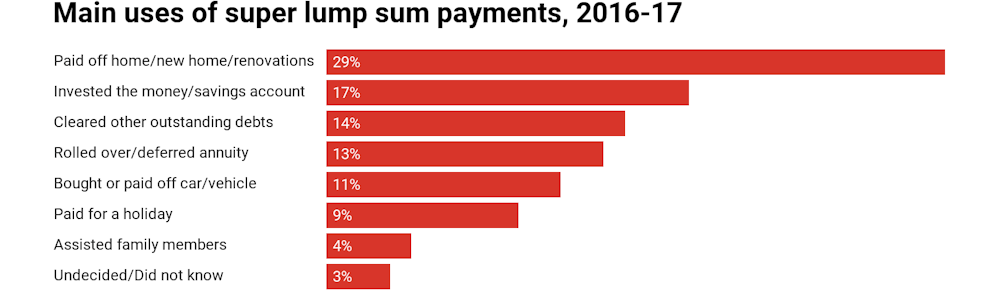
Of teens who were sexually active, most were in a relationship or had a partner about the same age. Japheth Mast/Unsplash

Of those who were sexually active, most (76%) were having sex in their homes, in a relationship (65%) or with a partner about the same age as them (86%).

They largely reported responsible behaviours. These included discussing having sex (81%) beforehand and protecting their health (77%). They used condoms (56%) and/or the pill (41%).

In short, teens in Australia are doing pretty well in relation to sex. And this isn’t new: the findings echo what has been seen in previous versions of the same survey over the past 25 years.

How about unwanted sex?

We also continue to find about a quarter (28%) reported some kind of unwanted sex at some point in their lives.

“Unwanted” means very different experiences for different people. A quarter (23%) of those reporting unwanted experiences wrote in comments. Many suggested it was a sense of “meh” or “just wasn’t really into it at the time”. But they provided no indication of regret.

While the survey did not ask about rape or sexual assault, slightly less than 1% of all participants did write explicitly about such experiences.

Despite this, we found 93% wanted their last sexual encounter. Overall, 85% indicated they felt extremely good and happy about their last experience and fewer (less than 20%) reported feeling upset, worried or guilty.

Shifts in school-based sex education to include a greater emphasis on relationships and skills in communication might, in part, explain the good sex teens are reporting.

How about smartphones and sexting?

Some things have changed, like using the internet to find sexual health information. That’s almost double what was reported in 2013 (44% then, 79% now). This isn’t surprising, given the pervasiveness of the internet today – 88% did the survey on an internet-enabled mobile device.

Rates of sexting seemed to have gone down by about 3% across each of the specific behaviours asked about. Overall about a third of students had engaged in some form of sexting. For those who were sexting, it was mostly with a partner or friend and only a few times in the previous two months.

Good marks, but room for improvement

So when it comes to sex and sexual health, Australia’s students are receiving pretty good marks. But there is room to continue improving.

The levels of reported unwanted sex, and the complexity of it, suggest a more nuanced approach may be warranted. Talking to teens about unwanted sex could expand beyond rape, sexual assault and issues of consent to cover communicating about desires and pleasure in a relationship leading to hopefully less “meh”.

Rates of STIs among young people suggest there is room to improve condom use and testing among sexually active teens. Only 13% thought they were likely to get an STI.

Luckily, Australian teens are having healthy conversations with partners, part of realising a happy, healthy and pleasurable sex life.


Read more: How to make your next sexual health check less, erm … awkward


ref. Around half of 17-year-olds have had sex and they’re more responsible than you think – http://theconversation.com/around-half-of-17-year-olds-have-had-sex-and-theyre-more-responsible-than-you-think-118337

We can halve train travel times between our cities by moving to faster rail

Source: The Conversation (Au and NZ) – By Philip Laird, Honorary Principal Fellow, University of Wollongong

The Melbourne-Sydney air corridor is now the second-busiest in the world. That’s true for either the number of passenger planes flying between the two airports or by counting actual passenger numbers, now over 9 million passengers a year. That’s an increase of 28% since 2009.

On an average day, some 12,330 people get on a plane in Sydney to fly to Melbourne. A similar number make the reverse journey.

Most passengers will have taken some time to get the airport and waited well over half an hour at the airport just to get on the plane. Once on board, the cramped conditions in economy once prompted comedian Jean Kittson to observe that even battery hens feel sorry for the passengers.


Read more: Let’s get moving with the affordable medium-speed alternatives to the old dream of high-speed rail


Contrast this with getting on a high-speed rail (HSR) train that can travel at speeds of 250km/h or more from city centre to city centre on selected routes. Starting with Japan in 1964, these trains now operate in 12 countries in Asia, Europe, the UK, and now Morocco.

Australia’s high-speed rail investigations since 1984 have cost an estimated A$125 million in today’s terms. However, not even one kilometre of corridor has been reserved. High-speed rail has often been promised, often before elections (including a Melbourne-Geelong service in the latest one) – as The Chaser observed in 2016 – only to vanish afterwards.

The Coalition’s election promises included A$2 billion for high-speed rail that would halve travel time between Melbourne and Geelong. James Ross/AAP

How does this compare to other countries?

Japan’s network has been slowly but surely extended, from the initial Tokyo-Osaka 515km Shinkansen in 1964 to more than 2,750km of lines on new dedicated track. More lines are under construction. To date, there have been more than 10 billion passenger movements with no loss of life from collision or derailment.

Japan has had high-speed rail services since 1964. JR Central Sydney office, Author provided (No reuse)

China has had a rapid rollout of trains moving up to 350km/h. Starting in 2008 with Beijing to Tianjin taking 30 minutes to cover 120km, China’s high-speed rail network now extends over 20,000km. This includes Beijing-Shanghai (opened in 2011 with a fatal collision that year) and Beijing-Guangzhou (the longest HSR route in the world). In 2018, the short Guangzhou-Hong Kong section opened.

China now has the world’s biggest high-speed rail network.

Germany’s high-speed rail is of interest to Australia, with a mixture of new track construction (Neubaustrecken) one section at a time and upgrading of existing track. This progressively improves rail capacity and reduces travel times.

Many other countries have medium-speed rail, with trains moving at speeds of 160-240km/h. In Uzbekistan, for example, Talgo tilt trains take about 2 hours to move between Tashkent and Samarkand. This is a distance similar to Sydney to Canberra, which is currently a train journey of over four hours.

A Talgo Afrosiyob tilt train in Uzbekistan covers the same distance as the Sydney-Canberra line in half the time. Talgo, Author provided (No reuse)

So what’s stopping Australia?

High-speed rail has been studied repeatedly since 1984 in Australia. The Howard government raised expectations before the 1998 election with a Sydney-Canberra Speedrail proposal. John Howard said this “nation-building project” would deliver “ourselves – and our children – a visionary new transport system of which we can all be proud”.

The proposal was to use existing track from Sydney’s Central Station to near Campbelltown, then new track to Canberra airport. The train would take just 84 minutes to complete the trip. The cost was then about A$4.5 billion, with the private sector to finance all but about A$1 billion.

The Howard government withdrew support for the project in December 2000. Instead, it commissioned yet another study and shut down high-speed rail for another decade.

An image of how the Sydney end of the Sydney-Canberra Speedrail line would have looked. ARHSnsw Rail Resource Centre, Author provided (No reuse)

The Gillard government commissioned more studies. In 2013 the cost of a new Sydney-Canberra high-speed rail sector was estimated at A$23 billion with an east coast network to cost A$114 billion.

In its 2017 budget, the Turnbull government moved the focus to medium-speed rail or “faster rail”. The National Faster Rail Agency will come into being on July 1.

What are the prospects for faster rail?

There is a good case for pursuing “faster rail”, given the difficulties of making progress on high-speed rail. Australia could follow the lead of Germany and other countries in building isolated new sections of track to high-speed standards, one at a time. These sections can link with existing mainlines, to allow for new trains to run faster than cars.

This has worked well in Victoria since 2006 with the introduction of regional fast rail on four corridors. These trains run at up to 160km/h on upgraded tracks. Further track upgrading is under way in Victoria.

Faster VLocity trains now connect Victoria regional centres and Melbourne. Mattinbgn/Wikimedia, CC BY

Queensland and Western Australia also have trains that can move at 160km/h on good tracks.

However, in New South Wales, the preponderance of mainline track with “steam age” alignment with many tight curves means intercity train speeds are too slow. The NSW government, along with ordering new intercity trains, has retained an overseas expert, Professor Andrew MacNaughton, to advise on high-speed rail versus faster rail and track upgrades to speed up trains. This is for the four main lines from Sydney to each of Newcastle, Orange, Canberra, and Wollongong.

These lines offer good potential to speed up trains by rebuilding old sections of track. In fact, between Sydney and Junee, there is scope to reduce the point-to-point distance by 60km to speed up freight trains plus reduce fuel use and emissions.

This track upgrade, along with tilt trains, would also allow the 11-hour Sydney-Melbourne XPT travel time to be cut to about six hours or less.

ref. We can halve train travel times between our cities by moving to faster rail – http://theconversation.com/we-can-halve-train-travel-times-between-our-cities-by-moving-to-faster-rail-116512

Women priests could help the Catholic Church restore its integrity. It’s time to embrace them

Source: The Conversation (Au and NZ) – By Dorothy Ann Lee, Stewart Rearch Professor of New Testament, Trinity College, University of Divinity

In the wake of the royal commission into child sexual abuse, Christian churches in this country need not only radical reform of their principles and practices, but also ways of recovering their integrity. For the Catholic Church, with its patriarchal structures, ordaining women to the priesthood is one way to achieve this.

In 2016, Pope Francis appointed a commission to report on women in the early church, asking the question of whether women could be ordained as deacons. (Deacons are the first level of ordination in the Catholic Church before priesthood.)

Now the pope has said the commission was divided on the issue. The commission agreed there were women deacons in the early church, but disagreed on whether they had any power. The pope has handed the report to a gathering of the heads of female religious orders, and may call the commissioners back for further input.

Note that, in all this, the Catholic Church has not even begun to debate the question of whether women can be priests (the second and more powerful level of ordination in the church). Yet if we look closely at the Bible and the history of the church, there are very good reasons why women should hold these positions of high authority.

As the mother and grandmother of Catholic children, it pains me that women cannot be ordained in the Catholic Church. I can tell my grandson that he might think about becoming a Catholic priest when he grows up, but I cannot say the same to my granddaughters.

As an Anglican priest, I have seen ordained women of extraordinary capacity working in the Anglican Church and exercising authority. I know women deacons, women priests and women bishops, and can testify to the marvellous work of ministry they are doing.

I also know scores of Catholic women who would make truly remarkable priests. They are loving, self-giving, intelligent and responsible, with spiritual depth and wisdom. They would do much to restore the church’s integrity.

Pope Francis at the weekly general audience in Saint Peters Square, Vatican City, in June 2019. Ettore Ferrari/EPA/AAP

Idolatry of maleness

The main argument used in the Catholic hierarchy to exclude women from priesthood is that, to represent Christ at the altar in Mass, the priest must be male. The priest stands in for Jesus and therefore has to have a “natural resemblance” to him, and that resemblance is his maleness.

Opponents to women priests also claim that, at the Last Supper, Jesus ordained the 12 male apostles and no women. In subsequent church tradition, they say, women were never priests and to ordain them now would make the church contradict its own tradition.

Yet there are a number of arguments, from within the church’s own theological framework, that strongly support the ordaining of women as priests. At the most basic level, the church baptises (christens) females as well as males; there is no gender barrier around baptism. This has enormous implications.

In baptism, a person takes on something of the identity of the Risen Christ. He or she now belongs to Christ in a unique way. Not only are they committed to living a Christlike life of love and justice, they are also able to represent Christ in loving service to others. Yet supposedly only at the altar are they unable to represent Christ!

Jesus was not only male but also Jewish. Priests in the Catholic Church are not required to be Jews, but can represent Christ from widely divergent ethnic and cultural backgrounds.

Maleness, in other words, is given a significant weighting over all other social and cultural differences, including femaleness. In this sense, this belief represents an idolatry of maleness – an exalting of male over female, despite the inclusive impetus of baptism and despite the fact that, in creation, women as well as men are made equally in God’s image. The “natural resemblance” to Christ that is needed is not maleness but rather humanness.

Biblical scholars, moreover, have argued that Jesus ordained no-one in his lifetime: neither at the Last Supper nor anywhere else. It is even possible that women were present at this event.

There is compelling evidence that women, in the ministry of Jesus and the early church, held positions of leadership and authority. Mary Magdalene was the first to meet the risen Christ and the first to proclaim its message to the other disciples; the later church called her the “apostle of the apostles”.


Read more: Friday essay: who was Mary Magdalene? Debunking the myth of the penitent prostitute


Piero di Cosimo, ‘Mary Magdalene’, 1500-1510, oil on panel. Wikimedia Commons

We find references in the New Testament to a female deacon (Phoebe), to a female apostle (Junia) and to a host of women who were leaders in ministry. The same is true for the early centuries where there is evidence of women deacons and priests, and even of a female bishop.

The exclusion of women from leadership in the church came at a later date (possibly in the fourth century and later in some places) when it lost something of its radical beginnings, inherited from Jesus. Here the argument from tradition – that women never were ordained or held positions of leadership – simply does not hold.

Change is necessary

The Catholic Church believes that tradition is dynamic: unfolding and developing throughout history (this was most famously articulated by John Henry Cardinal Newman in 1845). New perspectives and understandings can and do come in new contexts. The ordination of women belongs arguably in this category of new and emerging truths.

In a number of Anglican churches, particularly in places where terrible abuse occurred in the past, the appointment of senior, ordained women has had a vital role to play in reforming and transforming the church.

Women’s ordination is necessary in the current climate of the Catholic Church. There is no better time for it to happen than now. It will confirm, in ways beyond mere words, the church’s determination to move beyond the sins of the past. It will mean a significant move beyond the old structures where only men made decisions and a protective boys’ club existed within leadership.

This is not a call coming only from outside the Catholic Church. Many of the faithful within believe the same thing, and Catholic women in places such as Ireland and Germany are becoming more vocal and organised in their fight for women’s ordination.

In Australia, too, there are Catholic women working to be heard on the issue, supported by both laity and priests. Now is the time for something new to emerge from the ashes of the past.

ref. Women priests could help the Catholic Church restore its integrity. It’s time to embrace them – http://theconversation.com/women-priests-could-help-the-catholic-church-restore-its-integrity-its-time-to-embrace-them-118115

Karoronga, kele’a, talanoa, tapoetethakot and va: expanding millennial notions of a ‘Pacific way’ journalism education and media research culture

Research


David Robie

Monday, June 10, 2019

Abstract

Media AsiaAs critical issues such as climate change, exploited fisheries, declining human rights and reconfiguration of political systems inherited at independence increasingly challenge the microstates of Asia-Pacific, approaches to news media and journalism education are also under strain. University based journalism education was introduced to the South Pacific in Papua New Guinea at independence in 1975 and in Fiji at the regional University of the South Pacific in 1994, while Technical Vocational Educational and Training (TVET) institutions have been a more recent addition in the region. Some scholars argue there is little difference between Pacific and Western approaches to journalism, or that some journalism schools are too focused on Western media education, while others assert there is a distinctive style of journalism in Oceania with cultural variations based on the country where it is practised and parallels with some approaches in Asia such as ‘mindful journalism’. This paper examines a ‘Pacific way’ journalism debate which echoes a regional political concept coined by the late Fiji president, Ratu Sir Kamisese Mara. The paper argues for a greater appreciation of the complexities of media cultures in Pacific nations and proposes a more nuanced, reflexive approach to journalism in the Pacific region. This is reflected in a ‘talanoa journalism’ model that he advocates as a more culturally appropriate benchmark than monocultural media templates.

About the author

Professor David Robie is an author, journalist and media educator specialising in Asia-Pacific affairs.


Report by Pacific Media Centre

Simply returning rescued wildlife back to the wild may not be in their best interest

Source: The Conversation (Au and NZ) – By Bruce Englefield, PhD Student. Faculty of Veterinary Science, University of Sydney

There are few checks done to see how well injured or orphaned Australian animals survive after they’ve been released into the wild, we found in our new research published today.

That’s a worry for the more than 50,000 native animals that are released in Australia each year. It’s especially worrying for any orphans who’ve never experienced life in the wild.

But we found the rules governing the return of wildlife are not always in the animal’s best interest.


Read more: Not just activists, 9 out of 10 people are concerned about animal welfare in Australian farming


Our review of Australian animal welfare legislation, regulations, codes of practice and policies found a complex regulatory system that varies between states and territories. It’s a system that is fragmented, contradictory and inconsistent.

This makes it difficult for the many thousands of volunteers and others who try to rescue and rehabilitate native animals.

Australia lags in animal welfare

We believe Australia lags behind the developed world in animal welfare and animal law. This situation evolved haphazardly and is hampered by policies that rely on assumptions based largely on neither scientific nor factual evidence.

Current policy mandates that rehabilitated rescued animals must be placed into the wild. The survival of these animals after release depends on their behavioural and physical attributes, yet some could be ill-equipped to survive.

From our reading of current regulations, any such assessment of an animal’s suitability for release is either negligible or questionable.

There is also no reliable method of identifying animals after release. Indeed, most jurisdictions forbid it and, perhaps as a direct result, there is minimal monitoring to show what happens to released animals.

Return to where?

In general, all Australian jurisdictions require rehabilitated animals to be returned to the wild. But rather than using a more general definition of rehabilitation we should think of returning the animal to its natural habitat or state.

The distinction between these two possible destinations is far from semantic. It can be argued the natural habitat (or state) of a hand-reared orphan animal, is one of captivity.

Many wildlife carers releasing an animal and seeing it disappear into the wild may equate this with success, but this may be an unfortunate convenient illusion.

The released animal may not be the happy state that carers may prefer to assume. Vague assumptions that naturalness in releasing animals to the wild is reliably associated with better well-being are largely unfounded.

But wildlife carers have no choice in the matter. They are required to consign the animals, to which they have devoted hours of care, to an uncertain fate for which they may be very poorly prepared.

And they must do so even if their knowledge, experience and pragmatism directs their thinking to more favourable alternative solutions. These include allowing some native animals to be kept in large-scale facilities such as private fenced enclosures, national parks, islands and other fenced options.

Concern for orphans in the wild

The regulations make no distinction between animals that are injured, rehabilitated and released, and those that are rescued as orphans. These are often physically unharmed but require milk substitute feeding from a bottle and nurturing by – and possible inadvertently bonding with – humans prior to release to the wild.

Adult and juvenile native animals raised in the wild usually have all their innate and learned behaviour instincts intact when they are injured and rescued.

Unless they remain in captivity for a prolonged period, or are subjected to inappropriate housing and handling, their instincts generally persist and kick-in once they have been released. They have an opportunity to survive.

In contrast, the chances for orphans to survive after release seems remote.

Orphans that needed hand-rearing generally become habituated to the smells, sounds and sights of human presence and the captive environment.

The requirement to return orphans to the wild, with no account taken of their mental state, may be difficult to defend on conservation, ethical, moral and practical grounds.

Think of the carers

The physical and mental protection of Australian injured or orphaned native wildlife should be recognised as an important animal welfare issue. The physical and mental well-being of the wildlife carers who rehabilitate them is just as important as a human welfare issue.


Read more: Man’s stressed friend: how your mental health can affect your dog


In the absence of criteria that take into account the mental well-being of the animals and their carers, the current policy of releasing all hand-reared wildlife to the wild must be reviewed.

Using a One Welfare approach – that considers the the animals, the humans and the environment – would see a regulatory framework that balances the needs of rescued wildlife, wildlife carers and conservation.

The public and Australia’s extraordinary wildlife carers deserve to be confident that regulation is consistent among jurisdictions and reflective of best practice for the rescued wildlife and the environment.

ref. Simply returning rescued wildlife back to the wild may not be in their best interest – http://theconversation.com/simply-returning-rescued-wildlife-back-to-the-wild-may-not-be-in-their-best-interest-118521

Samoa bans Elton John movie Rocketman from cinemas

By Justin Fa’afia in Apia

The Samoa Censorship Board has banned the screening of Rocketman – a biographical movie about the life of British rock star Elton John.

“Unfortunately due to censoring issues, we have had to cancel Rocketman,” the Apollo Cinemas Samoa stated during a Facebook update of its movie screenings for the week.

The cinemas confirmed that the movie was not approved for screening.

READ MORE: Elton John protests over the censoring of Rocketman

This is the second time the Samoa Censorship Board has banned a gay biography – with the first being the movie Milk banned in 2009. This was based on the life of US gay rights activist Harvey Milk.

Samoa was only one of two countries which banned Rocketman, the other being Egypt. However, Russia has also stirred controversy by censoring parts of the film.

-Partners-

Directed by Dexter Fletcher and written by Lee Hall, the film follows Elton John’s early days as a prodigy at the Royal Academy of Music to his musical partnership with Bernie Taupin. The film is titled after John’s 1972 song “Rocket Man”.

Members of the Samoan fa’afafine community have expressed their dismay at the ban with some calling it a “disappointment”.

‘Selective morality’
The international community has also reacted with Tuisina Ymania Brown, the co-secretary general of Geneva-based non government organisation International Lesbian, Gay, Bisexual, Trans and Intersex Association (ILGA), calling the ban a “selective immorality” approach.

“This movie is a creative piece of work that should be celebrated as art, now we are saying that art that celebrates fa’afafines are not allowed?”

Tuisina said the decision should have been taken more seriously.

“We should not censor issues that are so open yet accept Filipino movies which seem to promote infidelity among neighbours and family members. This is the board being selective on their perceptions of immorality.”

According to Tuisina the banning of Rocketman which celebrates the life of an artist is ironic given that the Censorship Board allows movies that contain extreme violence against women, gender based violence, infidelity and other issues they perceive as immoral.

“The power of the Church has now reached into censoring the celebration of art. There are more important issues we should focus on, such as gender-based violence, Church paying taxes and other much more vital issues.”

Rocketman was released on May 30 and by June 4 had grossed US$67.2 million in the box office.

Attempts to reach the Samoa Censorship Board were unsuccessful and no public statement has been issued regarding the ban. The board consists of representatives from the Church.

Justin Fa’afia reports for Newsline Samoa.

Print Friendly, PDF & Email

Article by AsiaPacificReport.nz

Four things students with vision impairment want you (their teachers and friends) to know

Source: The Conversation (Au and NZ) – By Melissa Cain, Lecturer in Inclusive Education and Arts Education, Australian Catholic University

Schools are set up for students who can see. But around 3,000 school-aged children in Australia have a vision impairment – 300 of these have a severe vision impairment or are blind. These children are generally educated in mainstream schools, sometimes with little support for their needs.

We interviewed 15 students aged 7-14 with a vision impairment attending state, Catholic, and independent schools. We also interviewed their parents and teachers.

We are both mothers of children born blind and are aware of the diverse range of schooling experiences for such students. We wanted to investigate why the disparity occurs and how students with vision impairments can be helped.

Our interviewees taught us some new things about their experiences at school, including what they wish their peers and teachers knew about them. Here are the four key messages they wanted to communicate.


Read more: Inclusive education means all children are included in every way, not just in theory


1. Ask me what you need to know

Many teachers have never met a student who is blind. These teachers are concerned at their ability to meet the needs of students with a vision impairment.

It was clear from our interviews that students with vision impairments knew what they needed to enable them to participate in class. But they said teachers often provided the solution themselves instead of asking the students what worked best for them.

When we asked our interviewees why they didn’t offer up their own solutions, they said things like

to be honest I don’t really tell them, it’s only a hassle for them

only when it’s really important, I tell them

I have to teach them how to help me. I wish they would just ask.

One child said:

my teachers ask me – “is it better if I email you this image or worksheet, or would you like to access it the way everyone else accesses it through OneNote?” I like being given that choice.

With reference to their peers, one student told us:

it gets really awkward when a classmate doesn’t understand what my vision impairment is. If my peers knew what I could see, it would be really helpful.

From these responses, it is clear students want their teachers and classmates to have an understanding of their vision impairment and ask how to best to support them.

We conducted this research to find ways to improve the educational experience for our sons with a visual impairment. Author provided

2. I don’t need as much protection as you think I do

Students with disabilities have the same basic needs as other students. But past research shows students with vision impairment tend to be given fewer opportunities in all areas of their life.

Although the students we interviewed felt their teachers treated them equally to others, their comments indicated they were given fewer opportunities.

One student told us:

I am not allowed to play on the monkey bars because it’s too dangerous.

Another said:

they tell me “you might hurt yourself” which pretty much means “get off” or “stop doing that”

I got told I wasn’t allowed to go down the water slide with everyone else. They were wrapping me up in cotton wool.

It’s important for teachers to have expectations of students that prepare them for the competitive job market, where people are judged equally. Students with vision impairment may need help, but they should not be excluded.

Our interviewees acknowledged they wanted to feel included but often felt like they were a burden. One student said:

I often hear [other students] say things like “why do we have to have this kid, because if we have him on our team then we have to use a special ball”.

3. Sometimes I don’t follow instructions because I can’t see them

Sometimes, teachers may assume students with a vision impairment aren’t engaging in work or following instructions. But research shows students with vision impairments often miss out on incidental information, such as non-verbal cues or instructions, that other students picked up.

Students with a vision impairment can’t always see where the teacher is pointing. from shutterstock.com

Our conversations with students support this. One of our participants said when a video was being played on the whiteboard, she got “chatty because I can’t see and I get bored”.

Another student said how the teacher gave him direction to go “over there”. This student couldn’t see where the teacher was pointing, so he didn’t do as instructed.

Teachers could interpret both these responses as disrespectful behaviour. But in these instances, the students wanted to engage. They just weren’t able to access the non-verbal cues and weren’t consulted on what strategies worked best for them.


Read more: Standardised tests limit students with disability


Considering classroom activities with equitable engagement, such as videos with audio description and detailed verbal instructions, are simple ways to overcome such barriers.

4. There’s more to me than my disability

There are many variations of vision impairment which are as diverse as the individual students who have them. Research highlights the success of a student is determined by the student’s self-identity.

Our participants indicated they want teachers and friends to see them for the person they are and notice their unique interests and talents.

We asked students how they would describe themselves. Not once did they place their vision impairment as primary to their identity. They said things like:

I’m a good reader

I’m quite an active learner

I have high expectations

I am a sporty kid

I enjoy music and I play drums in the band

I’m not very good at math.

Our research shows that despite some barriers to education, students with vision impairment are being more included in mainstream classes than before. This is due, in part, to the increasing opportunities afforded by digital devices.

Strategies such as asking students how to best support them, understanding their individual needs, and encouraging social participation through an inclusive school culture can all help students with vision impairment access education on the same basis as their peers.

ref. Four things students with vision impairment want you (their teachers and friends) to know – http://theconversation.com/four-things-students-with-vision-impairment-want-you-their-teachers-and-friends-to-know-115377

Manus Island refugee given asylum by Switzerland

By RNZ Pacific

A Manus Island refugee granted asylum in Switzerland will continue to fight for the freedom of refugees Australia detains in Papua New Guinea and Nauru.

Abdul Aziz Muhamat, 25, fled Sudan in 2013 but was detained for travelling by boat to Australia to seek asylum.

During almost six years in detention on the PNG island, Muhamat was an outspoken critic of the regime that imprisoned him and thousands of other refugees indefinitely without trial.

READ MORE: Manus Island police chief calls for state action over suicidal refugees

He regularly provided comment and interviews to journalists from around the world and was the subject of The Messenger podcast.

In February, Muhamat was given a special visa to travel to Switzerland to receive an international award for human rights defenders.

-Partners-

From Geneva on Saturday, he posted a video on social media to announce his claim for asylum had been accepted.

WATCH VIDEO: Abdul Aziz Muhamat announces his claim for asylum has been accepted

“Thanks for the Swiss for granting my asylum today. They gave me lots of energy and that energy will make me concentrate on what is happening on Manus Island, and also will make me fight harder than the way that I used to fight before.

“Now I have the tools and I have everything it takes for me to fight for the freedom of each and everyone.

“And the fight has just started. I have no idea how long this fight will take but I can assure you this fight will never be completed until the last person will leave the island of Manus or Nauru.”

About a thousand refugees are still unable to leave the two Pacific countries.

  • This article is published under the Pacific Media Centre’s content partnership with Radio New Zealand.
  • More refugee stories
Print Friendly, PDF & Email

Article by AsiaPacificReport.nz

How Qantas and other airlines decide whether to fly near volcanoes

Source: The Conversation (Au and NZ) – By Heather Handley, Associate Professor in Volcanology and Geochemistry, Macquarie University

Mount Agung volcano in Bali, Indonesia, has been erupting intermittently since November 2017. The volcano erupted six times in the last month and resulted in the cancellation and delay of some flights in and out of Bali’s Ngurah Rai International Airport.

Such continuous but sporadic volcanic activity is a challenge for local emergency management.

But it’s also an issue for planes.


Read more: Bali’s Agung – using ‘volcano forensics’ to map the past, and predict the future


Captain Mike Galvin, head of fleet operations at Qantas Australia, told us volcanic ash in the air is a concern for airlines.

“The primary issue of volcanic ash for aeroplanes is the melting of ash in the engine turbines and the blocking of sensors that measure air speed and altitude. This can result in differences in flight information displayed to each pilot,” Galvin said.

“Qantas pilots are trained in these procedures during simulator training.

“Additional problems arise from reduced visibility due to the opacity of windscreens, and contamination of air entering the cabin.”

Currently the airline industry adopts a “no fly” policy for any visible or discernible volcanic ash.

“Engine and aeroplane manufacturers will not certify any level of ash tolerance,” Galvin said.

Ash is a serious problem for planes

Mt Agung is just the latest example of volcanoes interrupting flights in Indonesia and other countries.

In April 2010, an eruption of Eyjafjallajökull volcano in Iceland caused disruption to European air traffic for several days and cost the aviation industry an estimated US$250 million per day.

Volcanic ash is made up of volcanic glass, crystals and other rock fragments less than 2mm in size. Ash from explosive eruptions can reach into the stratosphere – 10-20km above the volcano, which is within the cruising altitude of commercial aircraft – and be dispersed by winds up to thousands of kilometres away.

An ash particle just over 0.1mm long erupted during the 18 May 1980 eruption of Mount St Helens (magnified 200 times). USGS

The 1982 eruption of Mt Galunggung in Java, Indonesia, clearly demonstrated the potential impact of volcanic ash to aircraft.

Flight BA009 en route to Perth from Kuala Lumpur flew through ash from the eruption. This caused sulfurous fumes to enter the cabin and the failure of all four engines, which fortunately restarted after a dive to lower altitude.

Keeping watch on volcanic ash in the skies

Following several aviation encounters with volcanic ash in the 1980s, the International Civil Aviation Organisation (ICAO), in collaboration with the World Meteorological Organisation (WMO), established nine volcanic ash advisory centres (VAACs), in Anchorage, Buenos Aires, Darwin, London, Montreal, Tokyo, Toulouse, Washington, and Wellington.

Map showing the nine volcanic ash advisory centres (VAACs) and the regions they are responsible for. Bureau of Meteorology

The role of the VAACs is to provide advice to the aviation industry about the location and movement of volcanic ash within their region. The VAACs gather information issued from local volcano observatories, satellite imagery and other available information such as volcano webcams, pilot reports, and online news.

VAACs perform detailed modelling for individual eruptions and issue images in the shape of a polygon (“ash polygon”) showing current ash-affected air, and where ash is predicted to move over the next few hours.

The Darwin VAAC covers the volcanically active regions of Indonesia, Papua New Guinea and the southern Philippines.

How airlines manage risk

Qantas’ Mike Galvin said he makes safety decisions based on information gathered by his team using all available sources.

With regards to Bali’s Mt Agung, Galvin said getting the timing right is an important aspect of the process.

“Here in Australia we might be 5-6 hours away from the ash in Indonesia so we need to make decisions several hours before the plane departs,” he said.

Galvin works closely with the Darwin and Tokyo VAACs.

“But we also have our own team of five meteorologists on constant shifts, who utilise information from other sources such as satellite images from the Japanese Himawari satellite,” he said.

“If a polygon of ash lies over the destination airport or on its approach or departure path, then we will not land.”

Example summary of the volcanic ash advisory from the Darwin VAAC at the beginning of the Agung eruption in November 2017. Ash polygons shown in red. Each picture shows the forecast of ash movement over a period of hours. OCHA/ReliefWeb/Pacific Disaster Centre using Darwin VAAC data

How science can help

Since the Icelandic eruption there has been increased research into volcanic ash impacts on aeroplane engines and how much ash they can tolerate.

While it is possible engines can tolerate low concentrations of ash, experts don’t yet know what the precise limit of ash that a particular engine can withstand. Further research is needed to determine this.

“Science can also assist the aviation industry though better assessment of the concentrations of ash at different altitudes such as at 20,000 and 30,000 feet,” Galvin said.

In the longer term, volcano science can help airlines understand more about volcanic ash hazards and risks to particular regions. For the Asia-Pacific region, average recurrence intervals have been calculated for each magnitude of volcanic eruption. This is measured by a Volcanic Explosivity Index (VEI).

To put VEI in context, the eruptions in the current phase of activity at Agung have been attributed a VEI of 3 on a logarithmic scale that runs from 0 to 8. It’s estimated we have 1.4 eruptions per year of this magnitude in the Asia-Pacific region.

Calculated average return periods for volcanic eruptions of various magnitudes in the Asia-Pacific Region. Eruption data from Smithsonian Volcanoes of the World Catalogue (volcano.si.edu) and LaMEVE database of large explosive eruptions (www.bgs.ac.uk/vogripa/view/controller.cfc?method=lameve). Data completeness analysis carried out for each Volcanic Explosivity Index (VEI) category by Stuart Mead and Christina Magill (2014). Christina Magill, Author provided

The 1883 Krakatau eruption in Indonesia and 1991 Pinatubo eruption in the Philippines were significantly larger, VEI 6 eruptions, which have been estimated to recur every 111 years in the region.

This raises the question of how well prepared the aviation industry is, and countries as a whole, for the next even larger VEI 7 eruption, such as that at Tambora in Indonesia in 1815, which erupted 175 cubic km of fragmented volcanic material in just 24 hours.

Recent scientific research on Agung suggests that the molten rock (magma) feeding Agung volcano below may also be connected to the neighbouring volcano, Batur. The connectivity of magma plumbing systems may explain the joint eruptions of both Agung and Batur in 1963 and may present an additional volcanic hazard to consider for Bali.

Intrusion of molten rock (magma) between the neighbouring volcanoes of Agung and Batur on Bali that was responsible for 2017 pre-eruptive seismic swarm at Agung. Albino et al., 2019, CC BY

ref. How Qantas and other airlines decide whether to fly near volcanoes – http://theconversation.com/how-qantas-and-other-airlines-decide-whether-to-fly-near-volcanoes-117899

The gender pay gap for the FIFA World Cup is US$370 million. It’s time for equity

Source: The Conversation (Au and NZ) – By Keith Rathbone, Lecturer, Modern European History and Sports History, Macquarie University

The winner of the Women’s World Cup on July 7 will take home more than just a trophy – there’s also US$4 million in prize money at stake, more than double the amount the US women’s team won at the previous World Cup in 2015.

Compare this to what the winner of the men’s World Cup pocketed in 2018, however: the French team earned US$38 million for that victory.

As play gets under way at the Women’s World Cup, much attention is being focused on the enormous gender gap between the two tournaments. It’s not just the winners who are disproportionately underpaid – it’s all the teams and players, and even their professional clubs.

FIFA has set aside US$30 million in total prize money for this year’s women’s tournament, while the men’s pool totalled US$400 million in 2018. In addition, FIFA gives the men’s teams US$48 million in preparation costs and distributes another US$209 million to the clubs that release players for the tournament. The women get US$11.5 million for preparation costs and US$8.4 million in club compensation.


Read more: Growth of women’s football has been a 100-year revolution – it didn’t happen overnight


In April, the Australian women’s national team, the Matildas, threatened legal action to redress the pay imbalance, citing FIFA’s own statutes that have enshrined a commitment to “gender equality”. John Didulica, CEO of Professional Footballers Australia, the trade union that represents male and female pros at the ACTU, called the pay gap:

…an imbalance of proportions only FIFA could come up with a straight face.

Gender pay gap at all levels

FIFA defends the pay imbalance with the usual claim that it reflects the difference in revenue produced by the men’s and women’s tournaments. As FIFA President Gianni Infantino so inelegantly said last year:

Maybe one day women’s football will generate more than men’s football.

Critics, however, don’t buy this argument. Because FIFA refuses to open its books fully to the public, this claim is hard to substantiate. The PFA, for one, thinks the sizeable pay gap is:

…either couched in diplomacy or politicisation … or just looking at their balance sheet, it’s totally arbitrary, it’s got no reference to any economic KPIs.

FIFA, however, is not the only culprit when it comes to pay disparity in football (or other sports, for that matter). Women’s footballers also point to pay gaps at both the club and federation level in many countries.

In fact, the world’s best player, Norway’s Ada Hegerberg, won’t even be competing at this year’s World Cup in France over a dispute with her national federation over its overall investment in and treatment of women’s football. The Norwegian Federation pledged to achieve gender parity in pay two years ago, but Hegerberg, the first-ever women’s winner of the Ballon d’Or, says more needs to be done.

The Norwegian team is competing without its star player, Ada Hegerberg. Tolga Bozoglu/EPA

In Australia, the W-League receives considerably less revenue from Football Federation Australia, which doesn’t make a huge amount of sense considering that both the men’s and women’s leagues lose money.

And despite significant increases in women’s club salaries over the past few years, there are vast inequities here, too. In 2017, Forbes published a shocking comparison that showed the Brazilian striker Neymar earned more money (US$43.8 million per year) from his club, Paris Saint Germain, than the combined salaries of all the women competing in the seven top women’s leagues (D1 Féminine, Frauen Bundesliga, FA Women’s Super League, the National Women’s Soccer League, Damallsvenskan, the W-League, and the Liga MX Femenil).

There is a major pay gap between club salaries in Australia too. Former Socceroos star Tim Cahill, for instance, earned A$3.5 million to play for Melbourne City in 2016-17, which was more than all 181 women who competed in the W-League that year.


Read more: Change Agents: Susan Alberti and Debbie Lee on establishing a national women’s football league


What can be done to close the gap

In Ireland, Denmark, Australia and the United States, women have used industrial action to earn better pay and working conditions.

Strikes have proved effective, as well. In 2015, the Matildas refused to compete in a two-game series in the US to force the team to raise their base pay from A$21,000 per year. As midfielder Teresa Polias explained:

We’re not asking for millions of dollars. We’re asking for minimum wage, to sustain our lives off the pitch to do well on it.

Following that strike, the players successfully negotiated a pay increase, with star player Sam Kerr now earning a reported A$400,000 a year. The players’ action not only helped the Matildas earn more, but also all the women competing in the W-League.

Sam Kerr reacts during Australia’s surprising upset loss to Italy in the World Cup. Tolga Bozoglu/EPA

While strikes have proved effective for some, others have turned to lawsuits. In March, the US women’s national team filed suit against the US Soccer Federation, alleging that its unequal pay for men’s and women’s footballers violated the US Equal Pay Act.

They have a strong case. In recent years, the women’s national team has outperformed the men on the field (winning three World Cup titles and four Olympic gold medals) and attracted more fans to its games and generated more revenue. Yet the women can only earn a maximum of US$4,950 per friendly, while the men earn on average US$13,166 for the same type of match.

If the team wins its case, the federation might face steep fines or be forced to pay the women’s players retroactively.


Read more: Women’s World Cup: extra time to reflect on the broader injustices women and girls face


Wider gender inequality issues

The pay issue is just one of many injustices that women’s soccer players face. For instance, women routinely play in more difficult conditions than men. At the 2015 Women’s World Cup in Canada, players were forced to compete on artificial turf rather than grass, which many blamed for a range of injuries. At the World Cup, women also often play with fewer rest days between games, stay in less conformable accommodation, and travel in economy class.

Many women also note that FIFA and their national federations have not done enough to promote the women’s game around the world. One glaring example of this is the fact that FIFA scheduled the Women’s World Cup final this year on the same day as the finals for two other men’s tournaments – the Gold Cup and Copa America.

While many obstacles remain, the success that women’s footballers have had in challenging the status quo has inspired athletes in other sports to fight for their rights too. Earlier this year, 200 of the world best women’s ice hockey players vowed not to play in any professional leagues in North America this season until they are paid a living wage and provided with health insurance.

The Women’s World Cup in France provides one of the biggest stages for women’s soccer players to state their case for pay equity. In 2017, the Swedish women’s national team turned heads when they took their names off the back of their jerseys and replaced them with empowering messages for young girls. What might the US women’s team or the Matildas do when (and if) they get their time in the spotlight in the final in Paris?

ref. The gender pay gap for the FIFA World Cup is US$370 million. It’s time for equity – http://theconversation.com/the-gender-pay-gap-for-the-fifa-world-cup-is-us-370-million-its-time-for-equity-118400

Health Check: why do women live longer than men?

Source: The Conversation (Au and NZ) – By Melinda Martin-Khan, Senior research fellow, The University of Queensland

In Australia, an average baby boy born in 2016 could expect to live to 80, while a baby girl born at the same time could expect to live until closer to 85. A similar gap in life expectancy between men and women is seen around the world.

As we better understand why people die, we’re learning how biological and behavioural factors may partly explain why women live longer than men.

Scientific advancements also impact the health of women and men differently.


Read more: Australian women outlive men then struggle with disadvantage


Biology and behaviour

While women may live longer than men, they report more illnesses, more doctor visits and more hospital stays than men. This is known as the morbidity-mortality paradox (that is, women are sicker but live longer).

One explanation is that women suffer from illnesses less likely to kill them. Examples of chronic non-fatal illnesses more common in women include migraines, arthritis and asthma. These conditions may lead to poorer health, but don’t increase a woman’s risk of premature or early death.

But men are more susceptible to health conditions that can kill them. For example, men tend to have more fat surrounding their organs (called visceral fat) and women tend to have more fat under their skin (called subcutaneous fat). Visceral fat is a risk factor for coronary heart disease, the leading underlying cause of death for Australian men.

Coronary heart disease, which results from a combination of biological factors and lifestyle habits, is a major reason for the difference in mortality between men and women.

Other biological factors may contribute to men ageing faster than women, but these remain to be fully understood. For example, testosterone in men contributes to their generally larger bodies and deeper voices. In turn, this may accelerate the age-related changes in their bodies compared to women.

On the flip side, women may have a slight advantage from protective factors connected with oestrogen. Coronary heart disease has been observed as three times lower in women than in men before menopause, but not after, indicating that endogenous oestrogens could have a protective effect in women.


Read more: Not just about sex: throughout our bodies, thousands of genes act differently in men and women


Some behaviours that can lead to an earlier death are more common in men. Accidental deaths, including those caused by assault, poisoning, transport accidents, falls and drownings, are particularly high among young males aged 15-24.

Men also have a greater tendency to smoke, eat poorly and avoid exercise. These habits lead to often fatal chronic illnesses, including stroke and type 2 diabetes, and are also risk factors for dementia.

Developments in science and public health

Many scientific discoveries have led to improved clinical practice or changes in government health policies that have benefited the lives of women.

For example, innovations in birth control have enabled greater choice and control over family size and timing. This has resulted in fewer pregnancies that may have led to dangerous births, and improved general physical and mental health for women. Improved clinical care has resulted in fewer women dying during childbirth.

As people reach an older age, the gap in life expectancy narrows. From shutterstock.com

Public health programs such as screening for breast cancer have had impacts on life expectancy over time. Similarly, vaccines to prevent cervical cancer have now been distributed in 130 countries.

Of course, there have been similar public health policies and clinical innovations that have benefited men too, like screening for bowel caner.

So although we may have some insights, we can’t conclusively answer why women continue to live longer than men.

Mind the gap

The gap between men and women decreases the longer they live. In 2016, at birth in Australia, the gap was 4.2 years, with a male expected to die at 80 on average. But as that male gets older, the gap decreases to 2.7 years at age 65, to one year at age 85 and to just 0.3 years at age 95.

This suggests men who live to an older age have been able to avoid certain health risks, giving them a greater prospect of a longer life.


Read more: Indigenous health leaders helped give us a plan to close the gap, and we must back it


Ultimately, none of us have control of when or how we’re going to die. But paying attention to factors that we can change (such as maintaining a healthy diet, doing exercise and avoiding smoking) can reduce the risk of dying earlier from a preventable chronic disease.

While women may always live longer than men, by a year or two, men can try to make some lifestyle changes to reduce this gap. That being said, women should work towards these goals for a long and healthy life, too.

ref. Health Check: why do women live longer than men? – http://theconversation.com/health-check-why-do-women-live-longer-than-men-117750

Look beyond crisis accommodation so people like Courtney Herron aren’t homeless in the first place

Source: The Conversation (Au and NZ) – By David MacKenzie, Associate Professor, School of Psychology, Social Work & Social Policy, University of South Australia

When the battered body of 25-year-old Courtney Herron was found in Royal Park in Melbourne on Saturday, May 25, it was not the first time a homeless person had been killed in Melbourne. But, as with the Jill Meagher murder in 2012, this particular case has shocked the community and, according to informed sources, rattled the Victorian government.

Courtney Herron had been couch-surfing and sleeping rough. She was experiencing mental health issues and trying to deal with drug addiction. Her shocking death, an act of violence against a young woman, reminds us of the vulnerability of rough sleeping, and the disturbing and continuing reality of youth homelessness.

Some advocates are calling for a renewed focus on rough sleeping and more crisis accommodation in the major cities where homeless people are most visible. Such advocacy is well-intentioned but deeply misguided.


Read more: Homelessness soars in our biggest cities, driven by rising inequality since 2001


We need sustained housing strategies, not quick fixes

Similar proposals have been raised before. In the early 1990s, there were calls for the empty 11-storey Prince Henry Hospital complex on St Kilda Road to be turned into a shelter for the homeless.

The spectre of a new generation of homelessness shelters haunted a city in which the dormitory shelters such as “The Gill” had only recently been decommissioned. Fortunately, experienced social workers came forward to advise Melbourne City Council not to bow to loud but misguided advocacy. The proposed Prince Henry Shelter complex did not happen and the hospital was demolished in 1994.

Of course, there needs to be an efficient and effective response to rough sleeping in the Melbourne CBD and in every other capital city. Only last year Victoria’s Homelessness and Rough Sleeping Action Plan was launched, backed by a A$9.8 million Towards Home package, “to provide housing and support to an increasing number of people sleeping rough across inner Melbourne”.

The fact is that the goal of housing rough sleepers has not been achieved, despite many attempts over the years. Could it be that a kneejerk symptomatic response from government, which so often falls short of strategic action, is part of the problem?

Developing more crisis accommodation seems to make common sense, which is probably why such proposals continue to be raised. Crisis accommodation supports people who are currently homeless. It has an immediate and short-term impact, but cannot reduce homelessness.

So what needs to be done?

If we are seriously to reduce homelessness in a sustained way, counterintuitive thinking and action are required, not simplistic “common sense”.

Pouring more public funds into crisis accommodation simply treats the symptoms of the problem. But it does not contribute to a reformed service system that can begin to make serious inroads into reducing the problem. According to the National Report Card on Youth Homelessness, issued in March 2019, two of the four key policy imperatives are:

  1. to stem the flow of young people into homelessness or early intervention
  2. to get young people out of homelessness as quickly as possible by providing rapid rehousing options and an accessible and affordable youth housing sector for young people who have become homeless and have nowhere to return to.

Read more: Youth homelessness efforts get a lowly 2 stars from national report card


The current service system is mostly a crisis response. Early intervention capacity is grossly underdeveloped and youth housing options are limited.

The current system relies heavily on crisis-driven emergency responses, and under-resources ongoing prevention and housing services. Author provided

In general, we don’t need more crisis services, but we do need much greater early intervention and youth housing capacity.

The weighting of services to prevent homelessness and house people should look more like this in the future. Author provided

While we don’t know the detailed circumstances of how Courtney Herron came to be sleeping rough, there would have been many opportunities to avert her descent into homelessness. But, even if that were not practicable, she should never have been left to sleep out in Royal Park. The sad, most likely scenario is that her death will not bring on strategic reform but only more short-term crisis responses and a push to get more homeless people off the streets quickly.

On the other hand, this tragic death could be a catalyst for real change. We need to do much more. More to the point, we could and should do so much better.

ref. Look beyond crisis accommodation so people like Courtney Herron aren’t homeless in the first place – http://theconversation.com/look-beyond-crisis-accommodation-so-people-like-courtney-herron-arent-homeless-in-the-first-place-118182

An intimate, arresting exhibition highlights the hard work of living queer

Source: The Conversation (Au and NZ) – By Leigh Boucher, Senior Lecturer – Modern History, Macquarie University

Queerdom, an exhibition showing at the Imperial Hotel in Erksineville, is an arresting and unsettling archive of queer and trans performances in Sydney.

A collaboration between photographer Jamie James and poet Quinn Eades, working here as James Eades, Queerdom presents a history of sexual and gender transgression that refuses containment and comfort. Instead, these works ask much more probing questions about the hard work of living and performing on the sexual and gender margins.

The exhibition aims to present what the artists term a “queertrans” history, from the 1990s until today – this term is a deliberate attempt by the artists to put these identities, practices and experiences into productive dialogue with each other.

Each work pairs a photograph of a queer or trans (or both) performance with poetry. In one sense this is an exhibition about live performances; stages and performers at the Imperial in Erskineville, Performance Space in Redfern, the Albury Hotel in Paddington, and Tap Gallery in Darlinghurst loom large.

‘falling in’, image: Stelladelight and Tank, Grumbalism, Red Rattler, Marrickville 2019. © Queerdom/James Eades

Implicitly, the exhibition delineates a historical geography of queer performance – of dissidence moving westward, as queer alternatives have been pushed from Darlinghurst and Surry Hills to Redfern, Erskineville and Marrickville by rising rents and the cultural homogenisation that so often accompanies them. That this exhibition is taking place at the Imperial is a reminder of how important and vulnerable those spaces can be.

We see “Glitta Supernova” leaning back on stage at Fetish Ball in 1996, screaming in delight as she sprays orange liquid, Berocca we are assured, over her audience – and not from her mouth. “What’s so terrifying about piss”, we are asked. And what might happen if we just “let ourselves taste it … could we just acquiesce?”

Life on the margins

While this might be an exhibition about performance, words work in tandem and tension with these photographs to produce intimate accounts of life on the margins of the sexual and gender order more broadly. This exhibition has much to say about the emotional life of its subjects.

As any historian will tell you, archives are not simply repositories of data from the past – they are mediated representations of historical knowledge. This archive provokes and unsettles what we might expect to see in an exhibition about gender and sexuality, as we might well expect a queer project to do.

‘lost gays of Sydney’, image: Victoria Barracks, Albury Hotel, Oxford St, Darlinghurst, 2001. © Queerdom/James Eades

In one sense, Queerdom is a powerful riposte to the comforting narratives that abounded in the campaign for same-sex marriage and its aftermath. Leaders in this campaign, as well as the exhibitions shaped by its politics during the 2018 Mardi Gras, tended to mobilise a story in which sexual minorities were making the final steps towards love, happiness and acceptance.

The story works something like this: sexual minorities in the past were caught in the trap of socially imposed shame and loneliness, unable to express and manifest their sexual and gender identities in public. The hard work of activism since the 1970s, not least in projects that spoke the language of liberation and pride, has offered a route to happiness and love. Gay and lesbian life, we are so often told, is all about love and a happy, shining couple finally able to get married.

This intimate exhibition of exuberant and modest moments has more challenging and discomforting things to say.

We see Kimo and Teik-Kim Pok, backstage at Carriageworks during the performance series Quick and Dirty in 2009, looking tired and confused, one performer wrapped in a towel with furrowed brow, the other looking pensively into a mirror.

This is not the golden couple of marriage equality. These friends (or lovers, or maybe just performers):

turn to face each other / to catch a mirror’s silvered kiss / take steel into delicate throat / swallow a quiet sword or seven / say this is acceptance and not regret

‘appraisal’, image: Kimo and Teik-Kim Pok, Quick and Dirty, Performance Space, Carriageworks, 2009. © Queerdom/James Eades

Of course, some of the pieces here can be yoked to a story of pride and celebration. There is a heathy dose of queer fabulosity on display. Photographs abound of performances exploding with pleasure and the thrill of gender and sexual transgression, however the poetry works hard to force the viewer to think carefully about what they are seeing and the easy thrill they might get from the labour of others.

While some critics might suggest the inclusion of poetry alongside these photographs makes their meaning rigid, leaving less space for ambiguity, these words do precisely the opposite – they force you to stop, they ask you questions.

A photograph of the performance “Axis of Evil” at Carriageworks in 2009 captures the performers back stage, in the familiar setting of a mirror-filled and clothes-strewn dressing room. Sinewy arms protrude and make up runs down faces.

after crimson ribbons / five bodies bringing the house down / the thunk of twenty limbs on a juddering stage // now doubled in the dressing room / now grinning in the aftermath / now coming down in the detrius

‘the other side’, image: Axis of Evil, Quick and Dirty, Performance Space, Carriageworks 2009. © Queerdom/James Eades

Through the inclusion of moments offstage, Queerdom asks us to consider the emotional cost of living and performing in ways where the narrative destination might not be a happy couple with easily recognisable gender identities. These are moments on the edges of difference.

We see performers looking wrung out, collapsing into one and other while also looking uncertain about what these moments might mean.

Here, life looks exhilarating, but also exhausting. Living in ways that don’t conform to the stories we like to tell about gender, sexuality and intimacy isn’t just a struggle for recognition. It’s the struggle against the terms under which that recognition is proffered – the desperate work of trying to exist and thrive in ways that make others so very uncomfortable.

“You know they’re still saying we’re monsters”, James Eades points out in the poem “taking the coverings off”. Maybe a bit of unsettling monstrosity is what we should be working towards, even if it is sometimes terrifying and exhausting.

Queerdom is showing upstairs at the Imperial Hotel, Erskineville until June 30.

ref. An intimate, arresting exhibition highlights the hard work of living queer – http://theconversation.com/an-intimate-arresting-exhibition-highlights-the-hard-work-of-living-queer-118176

Australia’s discussion of kava imports reflects lack of cultural understanding

Source: The Conversation (Au and NZ) – By Apo Aporosa, Post-doctoral research fellow, University of Waikato

The Australian government is considering an increase in the amount of kava travellers can bring into the country. The consultation process includes a proposed pilot program to ease restrictions on kava importation for personal use from two to four kilograms per person.

Many Australian residents, especially those with Pacific Island heritage, will welcome this, but the proposal is based on fundamentally flawed evidence.

In submissions to Australia’s Office of Drug Control, the governments of Fiji and Vanuatu have argued that significantly higher amounts should be allowed.

Australia’s restrictions on kava are based on concerns about its misuse in remote communities. But the government’s policy is imperialistic and ignores evidence about kava use, side effects and cultural significance.


Read more: Words from Arnhem land: Aboriginal health messages need to be made with us rather than for us


Kava: the sociable drink

Kava (Piper methysticum) is widely cultivated by Pacific Island communities for its root, which is ground up and mixed with water to make a beverage for ceremonies and other cultural settings.

Kava contains kavalactones, psychoactive ingredients that create a relaxed yet clear-headed state in the drinker. Unlike alcohol, it does not cause marked euphoria or lead to emotional changes, such as disinhibition. It is also not addictive.

Many Pacific Island communities now produce a powdered form of the root, which is exported for medical and social purposes all over the world.

Australian regulations on kava date from 1997, when a 2kg limit was introduced on the amount of kava passengers could bring into Australian without a permit. In 2007, a complete ban on kava was introduced in the Northern Territory. The 2kg limit remains in other parts of Australia.

Controlling kava

The government’s move to regulate kava followed “concerns” about kava abuse within Aboriginal communities in the Northern Territory. Kava was originally introduced into these communities in the 1980s as part of a suite of measures aimed at reducing the harm caused by alcohol.

Opinion pieces published following kava’s introduction referred to all-night binges and illicit mixing of alcohol and kava. The government seized on this as grounds for introducing the Northern Territory ban, despite a lack of coherent evidence to support the reports, and praise for kava’s role in reducing alcohol-related violence.

This imperialistic policy has continued, with widespread negative consequences. Reports show that the inability to access kava has led to substance switching, with far more serious drugs being used instead.

This has affected the Aboriginal communities the restrictions were designed to protect as well as Pacific Island communities throughout Australia. For them, kava is more than a pleasant drink.


Read more: Ken Wyatt faces challenges – and opportunities – as minister for Indigenous Australians


Flawed consultation process

It is concerning that the flawed understanding that underpinned the introduction of Australia’s kava regulations persists in the current pilot program. This is evident in the information put forward for consultation and in the proposed changes.

The consultation is being couched as recognition of “the cultural and economic importance of kava to Pacific Islanders”, but health and social impacts of kava continue to be misrepresented. Examples include frequent references to kava having toxic health effects. Such claims of toxicity have been refuted recently and demonstrate an entrenched lack of understanding of alternative cultural perspectives.

The World Health Organisation (WHO) has found, as recently as 2016, that both research and historical evidence show that:

It is possible for kava beverage to be consumed with an acceptably low level of health risk.

Similarly, the characterisation of the “dry and scaly skin” that can follow kava consumption as a “toxic effect” is misplaced. Kava dermopathy is a common and well understood side effect of prolonged kava use. It is known to be harmless and reversible. Some Pacific people see it as a positive demonstration of the individual’s engagement with their culture.

The unnecessary linking of kava dermopathy with toxicity shows that the attitudes and policy that underpin the consultation continue to be culturally skewed, based on outdated understanding of kava’s cultural significance.

Kava as culture, identity

This lack of understanding is most evident in the section dealing with “social impacts of kava use”. The first matter discussed refers to illicit markets for kava and their adverse community impacts. This maintains the negative connotations of kava.

Although kava’s ability to promote “fellowship and companionship” is mentioned, it is followed by a reference to “relationship distress” through kava use. A large body of research demonstrates that kava is not addictive and that its psychoactive properties are neither hallucinogenic nor stupefying.

If people choose to spend their time drinking kava, it is exactly that: a choice. Some people choose to spend time on other recreational activities, including gaming, watching television and playing on their phones, and these choices may cause “relationship distress” as well, but it doesn’t make these activities ripe for regulation.

What the consultation fails to understand is that the significance of kava drinking in Pacific Island communities, wherever they are located, goes far beyond its social aspects. Kava represents an ingestible manifestation of culture and identity, considered by many to be transferring spiritual power. Particularly for diasporic communities, kava circles provide a cultural classroom where respect, language and traditions are taught and reinforced.

Turning kava into a scapegoat through unnecessary regulation has ongoing adverse impacts for Pacific and Aboriginal communities throughout Australia.

ref. Australia’s discussion of kava imports reflects lack of cultural understanding – http://theconversation.com/australias-discussion-of-kava-imports-reflects-lack-of-cultural-understanding-115662

‘Please explain’ call by hardliners over Australian police at Bougainville mine

By Chris Baria at PNG Mine Watch

The chairman of Bougainville Hardliners Group and former combatant-turned-businessman, James Onartoo, has called on the Autonomous Bougainville Government (ABG) Police Minister to explain what the Australian Federal Police (AFP) were doing at the site of the controversial Panguna mine last Wednesday (June 5).

According to Onartoo, members of the communities around the mine site became suspicious when they saw the Australian police taking GPS readings at various points around the mine.

These points included the one where the mining company BCL had considered building an airstrip in the early part of the Bougainville crisis to fly in aircraft supposedly to evacuate expatriate mine workers and their families out of Panguna.

READ MORE: Fury in Bougainville over mining amendment go-ahead

“I think the public is owed an explanation as to what is happening. To the best of my knowledge the AFP were ousted in 2007 on suspicions of spying on the ABG and the people of Bougainville by the former President, late Joseph Kabui,” Onartoo said.

“Their presence at Panguna, which is the site of so much controversy and disagreements plus issues of sensitive nature stemming from proposed reopening by ABG, raises serious questions considering the fact that in the past Australia always supported military intervention by the PNG Defence Force to regain control of the mine.

-Partners-

“If AFP can raid the ABC office in Australia itself, then they are capable of anything, including maybe gathering intelligence on ground for the purpose of regaining control of Panguna and restarting the mine with use of force,” Onartoo said.

Onartoo said that it is a well known fact that Australia’s interest in the mineral deposits at Panguna never declined and Australian advisers to ABG have denounced agriculture, tourism, fisheries and other sustainable industries, claiming that only mining is able to finance Bougainville’s independence.

Several companies which are vying to reopen the Panguna mine, which was shutdown by landowners in 1990, are also of Australian origin.

The AFP party, which comprised three policemen and two civilians – including a doctor – were escorted on their visit to the autonomous region by the Bougainville Service Commander, Francis Tokura and police personnel.

They are also said to have visited the proposed border post sites at Koromira and Kangu Beach.

Onartoo said he had nothing to say about AFP visiting other parts of the Autonomous Region.

Print Friendly, PDF & Email

Article by AsiaPacificReport.nz