Team work is common across society. From schools to multinational businesses, people usually collaborate in groups towards a shared goal.
It can work well, but sometimes, it can be a disaster. One team might create a proposal for a new policy because all members manage to agree on details, while another fails because they can’t find common ground.
Why is it that groups can vary so much in their outcomes? We know that some people are better team players than others. In fact, job interviews and personality assessments often include questions about team skills.
But this assumes that only individual personality is relevant, not the interaction between people with various personality characteristics.
Investigating group behaviour
We don’t yet fully understand how different personality types within a group interact and how that affects group outcomes. To address this, we investigated which mixes of personalities create more or less cooperative group working styles.
We wanted to know whether it matters how many group members show personality traits that have been found to be less cooperative. People high on so-called psychopathic personality traits are characterised by goal-oriented, fearless, impulsive, manipulative behaviours, and also by less cooperative behaviours such as refusing to find common ground when interacting with another person.
But does the proportion of individuals high on these traits within a group matter for the overall group behaviour?
We asked participants to decide whether to cooperate with the people sitting next to them in mixed groups, composed of different numbers of participants with high or low scores on a questionnaire for psychopathic personality traits.
Participants who did not know each other were asked if they would like to cooperate with the people next to them, over a series of rounds.Supplied
We found groups that were composed entirely of people with low psychopathic traits and groups with a low proportion (20%) of individuals with high psychopathic traits showed the expected cooperative behaviour. But in groups with a larger proportion (50%) of individuals with high psychopathic traits, the overall rate of cooperative behaviour was significantly lower. We measured this by the number of cooperative decisions participants in a group made.
The overall group behaviour seems to be more than the sum of its parts. Group composition had an effect on cooperation over and above the effect of the individuals’ own level of psychopathic traits. Group members with low levels of psychopathic traits behaved less cooperatively and more “psychopathically” when in groups with more people who had high levels of psychopathic traits.
This suggests that interacting with people with high psychopathic traits increases uncooperative behaviour across all members of a group. The personality characteristics of group members matter for cooperative behaviour, and can change individuals’ behaviour. But the effect is only seen when a substantial proportion of individuals in a group have non-cooperative personality traits.
These findings indicate that group composition matters. Teams working on a collaborative task are more likely to cooperate successfully if most of the group members have more cooperative personality types. But our findings also trigger new questions about what role the type of task plays in collaborations and whether group behaviour stabilises over longer time periods.
In his first days as leader Anthony Albanese has taken two decisive actions to reset Labor’s relationship with the militant Construction, Forestry, Maritime, Mining and Energy Union.
Reshuffling Labor’s frontbench, he removed responsibility for industrial relations from Brendan O’Connor, whose brother Michael is the CFMMEU’s national secretary. This was always a huge conflict of interest, but one that Bill Shorten as opposition leader declined to address.
Then this week Albanese moved to turf out of the ALP the union’s Victorian secretary John Setka, whose behaviour over a long period has been notorious. Albanese had Setka’s party membership suspended, and he flagged he’ll ask for his expulsion at next month’s ALP national executive meeting.
Under Shorten, the CFMMEU had what many regarded as a special position. The union formed part of his base, and protected and helped him when he needed numbers.
Albanese has had no such relationship, and he repeatedly emphasises that he’s come to his position without any deals or obligations.
That has made it all the easier for him to take on Setka, who should have been called out a very long time ago.
The trigger point Albanese used was a report that Setka had denigrated anti-domestic violence campaigner Rosie Batty, in remarks he made at a meeting of the union executive. Setka was talking about charges he’s facing of using a carriage service to harass a woman – he has already said he’ll enter a guilty plea. He was reported to have told the union meeting that Batty’s work had led to men having fewer rights.
Albanese was well aware the Setka affair was about to become a lot uglier in coming days, and the ALP needed to shake him off.
Setka’s initial fightback took the form of appearing hand-in-hand with his wife at a news conference, in which they said they’d been to hell and back and people should lay off them.
Setka denied he’d denigrated Batty, a denial quickly backed by a couple of officials at the meeting. This potentially complicated the situation for Albanese (who insisted he’d checked out the report) in the event of Setka fighting the expulsion move.
But precisely what he’d said or not said about Batty became fairly irrelevant once ACTU Secretary Sally McManus weighed in, meeting Setka on Thursday to tell him he should quit his union position.
McManus, incidentally, believed Setka’s denial; she too had checked out the report, and was satisfied “he never said anything to denigrate Rosie Batty”. Rather, she argues he should quit as an official because of his behaviour (which she stresses she can’t comment on in detail for legal reasons) and the damage being caused.
For the union movement, the Setka affair goes to the heart of its strong pitch against domestic violence, and its credentials in championing women’s rights. The ACTU currently is led by two women – its president is Michele O’Neil – making it even more imperative to match words with actions.
“There is no place for perpetrators of domestic violence in leadership positions in our movement,” McManus said in her Thursday statement.
“We have already put on record the union movement’s values and our principles regarding family and domestic violence.
“We also believe in equality for women and know that instances of violence against women are not just unacceptable, they stand in the way of achieving equality.”
She told the ABC the Setka issue was “about the broader reputation of the union movement, and I think it means that we are in a position where we can’t continue to advocate in the way we want to on issues while John Setka is the main story”.
McManus, who consulted widely with union leaders in taking her stand, is reflecting the position of a number of important unions, such as the Australian Services Union, which represents those who work in domestic violence services and the SDA (the “Shoppies”), which has many female members.
Unsurprisingly, Setka says he won’t resign, and he has the backing of Victorian branch delegates, making it uncertain how things will play out.
It’s a safe bet the ALP executive will back Albanese’s expulsion move – not to do so would be an inconceivable repudiation of his leadership.
With her authority on the line, McManus’s gamble is that as the story unfolds, Setka will be more isolated and will eventually step down or be forced to do so.
Asked whether the ACTU could disaffiliate the union if it would not get rid of its rogue official, McManus said this wasn’t something that had been thought about. She pointed out it would be a very serious course to take over one official.
But one thing the ACTU has been thinking about is the ammunition Setka is giving the government for its fresh push to bring in tough legislation – the Ensuring Integrity bill – to crack down on unions and officials that break the law.
Among its provisions, the legislation would “allow the Federal Court to prohibit officials from holding office who contravene a range of industrial and other relevant laws, are found in contempt of court, repeatedly fail to stop their organisation from breaking the law or are otherwise not a fit and proper person to hold office in a registered organisation”.
The bill was before the last parliament; it was opposed by Labor, and there wasn’t sufficient crossbench support to pass it.
But now the government is hot to trot. Assuming Labor continues to oppose, the question will be whether the government can get it through a Senate likely in general to be easier for the Coalition than the last one was.
It would come down to the votes of One Nation and Centre Alliance. One Nation would be on board. Centre Alliance would want changes that applied equivalent provisions to misconduct in the corporate sector.
If the union movement can’t deal with its Setka problem, the government’s argument, and its hand, certainly will be strengthened in its battle for the bill.
As one union man put it succinctly, “John Setka has bought the naming rights to the Ensuring Integrity legislation”.
The Solomon Islands Government should exercise caution as it considers whether to maintain diplomatic ties with Taiwan or switch to China, an academic says.
Last week, amid diplomatic visits from both Australia and New Zealand, the Solomon Islands Foreign Minister Jeremiah Manele said the government would take its time to make an informed decision.
The director of the Centre for Pacific Studies at the University of Hawaii, Dr Tarcisius Kabutaulaka, said China’s aid focus on large infrastructure projects was appealing to some Solomon Islands MPs.
But leaders need to consider whether the country can manage not only the potential debt that could be incurred but also the intensity of a relationship with China, he said.
“Think about whether or not we are prepared for a relationship that is going to come with intensity both in terms of diplomacy as well as in terms of investment and how we can best benefit from it,” Dr Kabutaulaka said.
-Partners-
“So at the end of the day it is the interest of the Solomon Islands people that is the most important thing.”
Dr Kabutaulaka also said Australia and New Zealand’s actions in the Pacific speak louder than their attempts to play down concerns over the Solomon Islands considering cutting diplomatic ties with Taiwan in favour of China.
In their official statements during last week’s visits to Solomon Islands, both Australia and New Zealand said they were not putting any pressure on the country either way.
But Dr Kabutaulaka said Australia’s Step Up and New Zealand’s Pacific Reset policies told a different story.
“We cannot get away from the fact that Australia and New Zealand have … have done in recent years attempted to strengthen their influence in the Pacific Islands region vis-a-vis the rising presence or assertive presence of the People’s Republic of China,” Dr Kabutaulaka said.
This article is published under the Pacific Media Centre’s content partnership with Radio New Zealand.
A recent survey on the world’s plants found a shocking number have gone extinct – 571 since 1750. And this is likely to be a stark underestimate. Not all plants have been discovered, so it’s likely other plants have gone extinct before researchers know they’re at risk, or even know they exist.
In Australia, the situation is just as dire. The Threatened Species Recovery Hub recently conducted two evaluations that aren’t yet published of extinct plants in Australia. They found 38 have been lost over the last 170 years, such as the Daintree River banana (Musa fitzalanii) and the fringed spider-orchid (Caladenia thysanochila).
But uncertainty about the number of plant extinctions, in addition to the 38 confirmed, is an ongoing concern.
Both studies pointed out the actual number of extinctions is likely to be far more than those recognised in formal lists produced by the Commonwealth and state and territory agencies.
For example, there is still a high rate of discovery of new plant species in Australia. More than 1,600 plants were discovered between 2009 and 2015, and an estimated 10% are still yet to be discovered.
The extinction of Australian plants is considered most likely to have occurred in areas where there has been major loss and degradation of native bushland. This includes significant areas in southern Australia that have been cleared for agriculture and intensive urbanisation around major cities.
Many of these extinct plants would have had very restricted geographic ranges. And botanical collections were limited across many parts of Australia before broad scale land clearing and habitat change.
Why extinction goes undocumented
There is already one well recognised Australian plant extinction, a shrub in Phillip Island (Streblorrhiza speciosa), which was never formally recognised on any Australian threatened species list.
Black magic grevillea (Grevilla calliantha) is known from only six populations within a range of 8 square kilometres. In the wild the species is threatened by frequent fire, habitat loss, invasive weeds, herbicide overspray, grazing animals and phytophthora dieback.Dave Coates
Researchers also note there are Australian plants that are not listed as extinct, but have not been collected for 50 years or more.
While undocumented extinction is an increasing concern, the recent re-assessment of current lists of extinct plants has provided a more positive outcome.
The re-assessment found a number of plants previously considered to be extinct are not actually extinct. This includes plants that have been re-discovered since 1980, and where there has been confusion over plant names. Diel’s wattle (Acacia prismifolia), for instance, was recently rediscovered in Western Australia.
A significant challenge for accurately assessing plant extinction relates to the difficulties in surveying and detecting them in the Australian landscapes.
Many have histories associated with fire or some other disturbance. For example, a number of plants spend a significant part of their time as long-lived seeds – sometimes for decades – in the soil with nothing visible above ground, and with plants only appearing for a few years after a fire.
But by far, the greatest reason for the lack of information is the shortage of field surveys of the rare plants, and the availability of botanists and qualified biologists to survey suitable habitat and accurately identify the plants.
Purple-wood wattle (Acacia carneorum) is slow growing and rarely produces viable seed. Threats are not well understood but grazing by livestock and rabbits is likely to impact on the species.Andrew Denham
What we’ve learnt
The continuing decline of Australia’s threatened plants suggests more extinctions are likely. But there have been important achievements and lessons learnt in dealing with the main causes of loss of native vegetation.
Our understanding of plant extinction processes – such as habitat loss, habitat degradation, invasive weeds, urbanisation, disease and climate change – is improving. But there is still a significant way to go.
One challenge in dealing with the causes of Australian plant extinction is how to manage introduced diseases.
Two plant diseases in particular are of major concern: Phytophthora dieback, a soil-borne water mould pathogen, and Myrtle rust, which is spread naturally by wind and water.
Both diseases are increasingly recognised as threats, not only because of the impact they are already having on diverse native plant communities and many rare species, but also because of the difficulties in effective control.
Two Australian rainforest tree species Rhodomyrtus psidioides and Rhodamnia rubescens were recently listed as threatened under the NSW legislation because of myrtle rust.
Native guava (Rhodomyrtus psidioides) A tree species around the margins of rainforest between the NSW and the QLD border. The species is has now been listed as Critically Endangered. Surveys of rainforest areas infected with Myrtle Rust found that 50 to 95% of native guava trees were killed by the disease within a few years.Zaareo/Wikimedia
While extinction associated with disease is often rapid, some individual plants may survive for decades in highly degraded landscapes, such as long-lived woody shrubs and trees. These plants will ultimately go extinct, and this is often difficult to communicate to the public.
While individual species will continue to persist for many years in highly disturbed and fragmented landscapes, there is little or no reproduction. And with their populations restricted to extremely small patches of bush, they’re vulnerable to ongoing degradation.
In many such cases there is an “extinction debt”, where it may take decades for extinction to occur, depending on the longevity of the plants involved.
But it’s not all doom and gloom. A recent study found of the 418 threatened Australian plants showing ongoing decline, 83% were assessed as having medium to high potential for bouncing back.
And with long-term investment and research there are good prospects of saving the majority of these plants.
How much trust do you have in politics and public institutions? It’s one of the most important political questions of our time. All over the world there has been a decline in trust, which is leading to a sea change in our politics – from Trump and Brexit through to the emergence of radical progressive causes that are challenging orthodoxies around economics, ethnicity and gender. So, suddenly people are more sceptical about authority, and it’s having major consequences, for good or ill.
Here in New Zealand there’s mixed evidence on the issue of trust, and today some new survey statistics are out which give us a better idea of levels of trust and mistrust. These come via Victoria University of Wellington’s Institute for Governance and Policy Studies, which commissions the Colmar Brunton market research firm to ask the public questions about trust each year.
It’s first worth noting that last year’s results were particularly interesting. I covered this in a column back then, explaining that New Zealand appeared to be experiencing the opposite of what was happening in the rest of the world as, since the election of the new government, trust had suddenly increased – see: New Zealand’s revival of trust in government.
I argued that the dynamic 2017 election campaign, together with the phenomenon of “Jacindamania” and the change of government gave the sense there was something new and different happening in politics.
The latest survey results reveal mixed evidence about the health of public trust. To some extent the “honeymoon” is over, with some of the levels of improved trust registered last year now dropping back. But other elements of the survey show some enduring levels of improved trust. You can see the details of the latest survey here: Latest trust survey explores link to political leanings.
When looking at the question of how much the public trusts government ministers, when the survey was first carried out in 2016, there was a net “trust deficit” of -44 per cent. This meant that a lot more people said they distrusted government ministers than trusted them. This improved significantly in the next survey, in 2018, with the net trust improving to just -25 per percent. Trust in ministers has dropped, however, in the latest survey to -32 per cent.
Similarly, trust in MPs went from -47 per cent in 2016, to -25 per cent in 2018; and is now declining again, down to -39 per cent. So, the new government honeymoon has ended, but the negative stats haven’t yet dropped back to pre-Coalition government levels.
There are plenty of other healthy trust statistics. When survey respondents were asked if they trust “the government to do what is right for New Zealand”, 63 per cent answered positively. This is similar to last year’s result of 65 per cent, and much higher than the 2016 figure of only 48 per cent.
Similarly, when asked “To what extent do you think New Zealand citizens interests are equally and fairly considered by government?”, 50 per cent replied that they had a great deal or reasonable amount of trust in this. This is the same result as last year, and up on the 39 per cent figure of 2016.
Also of interest is that “inter-personal” trust has “increased modestly” according to the survey results, with 54 per cent saying they trust most people, up from 48 per cent last year.
Trust is held differently depending on your ideology
Not all groups in society have similar levels of trust in institutions, however. Interestingly, the Colmar Brunton survey also asks people to place themselves on the left-right ideological scale, and then comes up with some correlations between ideology and trust. It turns out those on the “centre-left” are most trusting of MPs and government ministers, charities; local government; judges/courts, and so forth. In contrast, the least trusting of these – and most other institutions – are those further to the left.
The director of the Institute for Governance and Policy Studies, Simon Chapple, has written an article on this today, exploring the ideological dynamics involved – see: The ‘left’ is least trusting of others.
Looking at the political left, Chapple says: “The institutions where the left is least trusting include, perhaps unsurprisingly, both big and small business, churches and the police. Perhaps more surprisingly to some, the left is least trusting of schools – arguably the most left-leaning large-scale social institution in New Zealand, in their fellow New Zealanders to make informed choices about the country’s future, in charities, and in other people generally.”
What is particularly interesting is this is at variance with those who say they are in the centre-left, the centre, and the centre-right. Instead, it seems, those on the left share much of their scepticism with those on the political right.
Chapple explains: “In some cases, in terms of low institutional trust, the closest group to the left is the other end of the political spectrum, the right – a version of the so-called ‘horseshoe theory of politics’. For example, both left and right are most similar in their relatively low levels of trust in Government ministers, MPs, charities, local government, judges and courts, Political party funding, and in their fellow New Zealanders to make informed choices.”
Corruption perception problems
One of the antitheses of trust in politics is “corruption”. Therefore, it’s useful that in 2019 the VUW survey asks about perceptions of corruption, with the question: “Is corruption widespread throughout the government in New Zealand or not?”. To this, 34 per cent say “yes”, and 66 per cent say “no”.
Chapple comments on this: “While this is still low compared with other developed countries (e.g. the United States, where Gallup reported the figure was 75% in 2014), a similar question (in a Gallup survey) in 2013 gave a New Zealand figure of 24%, suggesting a worrying local rise in corruption perceptions.”
The corruption question can be looked at in terms of the ideologies of the survey respondent, with centre-left and centre-right voters being less inclined to see corruption. Here’s the list of those answering “yes” to the widespread existence of corruption in government: “Left 36%; Centre-left 20%; Centre 37%; Centre-right 25%; Right 42%”.
Colmar Brunton’s survey notes who else might be inclined or disinclined to see corruption: “Females, aged 18-29, who are dissatisfied with life and are generally distrustful of people are more likely to say corruption is widespread throughout the New Zealand government. Conversely males, aged over 60, who are satisfied with life and trust people are less likely to say corruption is widespread.”
Other recent survey evidence on trust
Colmar Brunton has also carried out research for New Zealand’s Parliament on the public’s attitudes to politicians. You can see this report here: Survey of the New Zealand public.
Most importantly, the survey found that that 27 per cent of New Zealanders said they trusted Parliament, compared to 29 per cent who expressed distrust, and 44 who were neutral. This compared poorly to other institutions. For example, 41 per cent of respondents declared trust in the “civil service”, and 8 per cent expressed distrust, and 51 were neutral.
There are a number of additional results relating to trust:
• 13 per cent “would speak highly of Parliament”
• 7 per cent “would speak highly of MPs”
• 60 per cent “believe big business and vocal minorities are the ones who influence Parliament”
• 37 per cent “feel there’s no point in trying to influence Parliament as nothing will change”
• 21 per cent “feel a sense of ownership of Parliament”
• 16 per cent “feel connected to Parliament”
Another recent survey – the annual Edelman Trust Barometer – which came out in earlier in the year can be read here: Kiwi employers the most trusted to lead change. This shows that “New Zealanders’ overall trust in the major institutions has remained flat since last year’s study”, with the following figures: “government (50%), NGOs (48%), business (47%), and media (34%)”, but with the addition of “my employer” emerging as the most trusted institution (74%).
One of the advantages of this survey is that it separates out “the division in society between the haves and have-nots” in looking at trust, suggesting that societies like New Zealand have a growing trust gap between the “informed public” and the “mass population”, which appears to be occurring elsewhere in the world: “New Zealand is in line with these global results, with an 11 point gap showing tertiary-educated, higher-earning Kiwis are overall far more trusting of institutions such as the Government and the media than the general population. This gap extends to faith in the system. Far more informed members of the public believe the system is working for them (41%) than the general population (30%)” – you can see the full report here: Trust at Work: 2019 Acumen Edelman Trust Barometer.
Of course, today’s major focus on trust goes further than just politics and authorities. The Otago Daily Times’ Bruce Munro examines how a new book by Dunedin psychologist Chris Skellet shows “where New Zealanders had previously assumed trust, we are now obliged to assume mistrust” – see: Trust is the new love.
When Britain ceded its control of Hong Kong in 1997 – after its 100-year lease expired – concerns were raised that a 50-year “one country, two systems” formula would be insufficient to protect citizens’ rights.
Britain’s last governor of Hong Kong, Chris Patten, was among those warning about the risks to the territory’s autonomy under Chinese control.
However, it was argued at the time the “one country, two systems” deal was the best outcome that could be struck under the circumstances.
Twenty-two years later, not quite halfway through a 50-year transition to a notional end to a “two systems” arrangement, it is clear that the relatively benign outcome envisaged in 1997 is under unusual stress.
Mass pro-democracy demonstrations over recent days have underscored the fact that Hong Kong residents are fearful of creeping mainland control that will obliterate their relatively unfettered rights under the 1997 formula.
Their immediate concern is an extradition bill, before Hong Kong’s legislature, that would enable Beijing to extradite alleged criminals. The legislation invites understandable concerns that it could be misused to secure the extradition to the mainland of China’s critics under the pretext these individuals had engaged in criminal activity.
Hong Kong’s relatively free media are alarmed at threats to press freedom inherent in the bill.
Beijing has done little to assuage these concerns. It has accused “foreign forces” of misleading Hong Kongers as part of an attempt to destabilise China.
In China, authorities have blocked foreign news sites to prevent the dissemination of reports and images from the streets of Hong Kong. This is no doubt out of concern that street demonstrations might become contagious on the mainland.
The fact these demonstrations coincided with the 30th anniversary of the June 6 1989 Tiananmen massacre in which hundreds, if not thousands, died in a government crackdown will have fuelled Beijing’s nervousness about developments in Hong Kong.
What distinguishes the latest mass protests against Chinese attempts to circumvent its 1997 “one country, two systems” undertakings from protracted disturbances in 2014 is that this time it reflects increasing alarm about Beijing’s stealthy attempts to extend its control.
In 2014, demonstrations against Beijing’s violation of its commitment to autonomous local elections lasted months. This was the so-called “umbrella movement”, distinguished by the symbolic carrying of umbrellas by demonstrators.
In 2019, and judging by events characterised by fairly heavy-handed use of tear gas, water cannons and other methods to break up the demonstrations, the authorities have resolved to try to nip in the bud this challenge to Beijing-dominated Hong Kong rule.
Whether this works remains to be seen.
The disturbances pose a challenge to Western governments at a particularly fraught moment in global affairs. Relations between the US and China are on a knife’s edge over trade and other issues. This includes sales of sophisticated weaponry to Taiwan, tightening sanctions on Iran’s oil exports, moves to bar the telecommunications supplier Huawei from building 5G networks of US allies, including Australia, and a confrontational approach to China in Washington more generally.
From Australia’s standpoint, the Hong Kong disturbances come at an awkward moment as a newly elected government in Canberra wrestles with China policy.
Foreign Minister Marise Payne’s initial response to events in Hong Kong was too meek. Through a spokesperson, she said:
The Australian government is taking a close interest in the proposed amendments […]
Not only does Hong Kong absorb A$11 billion worth of Australian merchandise exports annually, services trade at A$3 billion is significant, and total investment in Australia of A$116 billion puts the former British territory in the top 10 foreign investors.
On top of that, about 100,000 Australians are resident in Hong Kong. This is not a small number in a population of 7.5 million.
While it is true Hong Kong is less important economically than it was in 1997, when its GDP was 16% of China’s (it’s now 2%), it still remains an indispensable financial conduit and testing ground for financial reforms.
Hong Kong provided the financial platform for China’s cautious experimentation in its move towards making the yuan a global currency. Hong Kong’s stock exchange is an important vehicle for capital-raising for Chinese companies.
The events of recent days have placed Beijing’s woman in Hong Kong, Carrie Lam, who was selected by Beijing as chief executive two years ago, in an invidious position. If she yields to the protesters and withdraws the extradition law, she will fun foul of her controllers in Beijing.
If she pushes ahead in the Legislative Council with the support of 43 out of 70 pro-Beijing lawmakers, as she insists she will, she risks further disturbances.
At up to 30cm long and armed with spines for crushing and shredding food, we’ve identified a previously unknown creature that would have been a giant among its neighbours in the waters off modern-day South Australia.
Trilobites are related to modern-day crustaceans (such as crabs and lobsters) and insects, and are some of the oldest animals to appear in the fossil record.
Because of their abundance, trilobites are considered a model group for understanding the Cambrian explosion – the sudden appearance about 540 million years ago of almost all major animal groups on Earth.
Trilobites first appeared around 520 million years ago and lasted for about 270 million years.
An illustration of the Cambrian seafloor with the trilobite Redlichia rex in the foreground.Katrina Kenny, Author provided
Exceptional fossil deposits
Our most important understanding of life around the time of the Cambrian explosion comes from a series of rare, exceptional fossil deposits called Konservat-Lagerstätten (German for “conservation storage-place”).
These deposits preserve not only the hard parts of organisms such as shells, but also the soft parts such as eyes, muscles and guts. The most famous of these is the Burgess Shale from Canada, although a number of other similar deposits have been discovered in places such as China and Greenland.
Australia also boasts one of these deposits – the only one in the Southern Hemisphere. It is called the Emu Bay Shale and is found on Kangaroo Island in South Australia.
The most common fossils within the Emu Bay Shale are trilobites.
The latest find
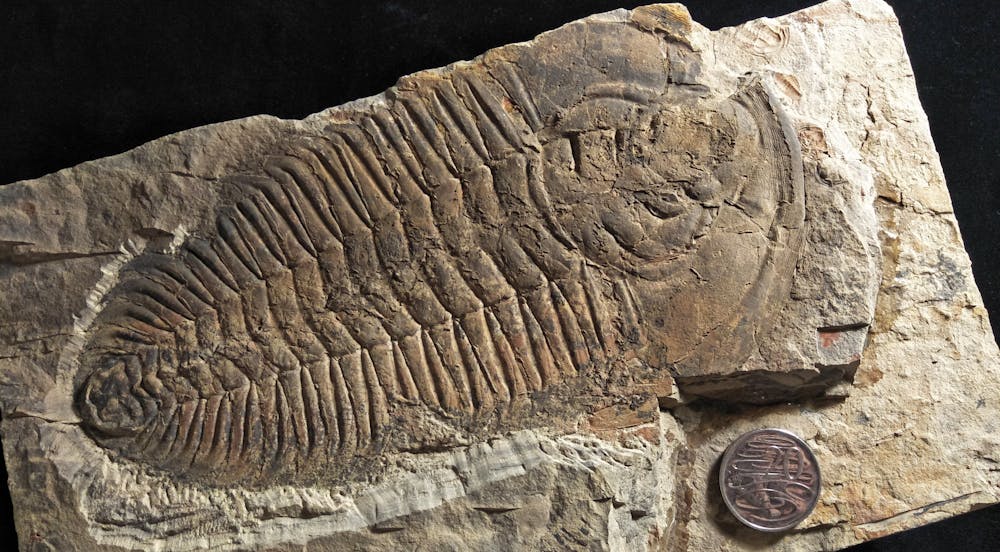
In our study, we describe a very large new trilobite from the Emu Bay Shale. It’s one of the largest trilobites known from the Cambrian Period.
A large specimen of the newly described trilobite Redlicha rex from the Emu Bay Shale compared to a 20c coin.James Holmes/University of Adelaide, Author provided
Due to its exceptional size and armament, we decided Redlichia rex would be an appropriate name. This is reminiscent of the name Tyrannosaurus rex – rex means “king” in Latin. The Redlichia part of the name is the genus (the same as Homo in Homo sapiens), originally named in 1902 after palaeontologist Karl Redlich.
Because the Emu Bay Shale preserves the soft parts of organisms, we find the appendages (or legs) of trilobites preserved as well as the hard shell. These soft parts are extremely rare – complete appendages are known for only six of the more than 20,000 described species.
What is even more special about the Emu Bay Shale examples is that because Redlichia rex was so big, the appendages are also very large, making them easier to look at in detail.
A graphic reconstruction of the Redlichia rex appendage used for shredding and crushing prey.Katrina Kenny, Author provided
The most important feature of these is an enlarged inner side of the base of each pair of legs, which was covered in short, robust spines and worked as a nutcracker.
Carnivores of the sea
Unlike those of other trilobites, the morphology of the spines suggests they may have been adapted to crushing shells of other Cambrian animals. If this were the case, the most likely food Redlichia rex would have been eating was other trilobites.
In the Emu Bay Shale, we also find what are called coprolites, or fossilised poo. In these we find pieces of crushed-up trilobite.
Crushed-up pieces of trilobite were found in the coprolites, the fossilised poo.James Holmes, Author provided
It was originally thought poo fossils such as these were produced by the giant Cambrian predator Anomalocaris – a metre-long beast with two strange claws in the head and a circular, vampire-toothed mouth. But it now seems likely that Redlichia rex produced some of these.
Consistent with this idea, some specimens of Redlichia rex show injuries resulting from attack. These may also be from Anomalocaris, although it is possible that Redlichia rex indulged in cannibalism, or took part in territorial battles (as is seen in modern lobsters).
Once animals began to eat each other, the selective pressure to adapt methods to prevent being eaten would have been very high. This is almost certainly the reason why hard shells evolved in the Cambrian – for protection against predation.
Lobsters caught battling it out today.
The result would have been an evolutionary arms race between predators and prey, with each developing more efficient ways of defence and attack, such as the development of shell-crushing abilities in certain animals.
The formidable appendages of Redlichia rex are probably a result of this, and this giant trilobite was likely a source of terror for small creatures on the Cambrian seafloor.
For South Asians, there’s a distinct difference between “rice with curry” and “curry with rice”. When we spoke to Indian and Sri Lankan migrants with type 2 diabetes and heart disease, they told us the advice they received on ways to reduce the quantity of staples like rice in their diet was difficult to implement.
This was because it doesn’t match with their perception of a “proper” meal – that is, a lot of rice and a little bit of curry. Receiving dietary advice not tailored to their cultural needs created a feeling that clinicians didn’t understand the social value they placed on traditional foods.
This acted as a barrier to effectively managing their diets, and in turn, their conditions.
While Australia’s multiculturalism enhances the fabric of society, the health outcomes of some of Australia’s culturally and linguistically diverse groups are poor in comparison to the majority population. We looked at type 2 diabetes and heart disease partly because these conditions are experienced more commonly in migrant groups.
Importantly, people from culturally and linguistically diverse backgrounds tend to have lower levels of health literacy than people born in Australia. People with lower health literacy are less likely to access health care, and more likely to mismanage chronic health conditions (for example, by misinterpreting medical advice or medicine dosage instructions, or having a limited sense of severity of disease).
It’s imperative to consider cultural and language differences if we want to achieve the best health outcomes for our diverse population.
Language is just the start
Providing interpreting services in the patient’s language is important, but not the only consideration. Even when someone is well-versed in English, medical terminology or jargon can be hard to comprehend.
In addition, conceptualisations of health and illness and ways of expressing these vary across cultural and language groups.
For example, a common expression for psychosomatic symptoms (where there may be no disease, but physical symptoms such as nausea may be related to mental stress) in either Hindi or Punjabi, is dil (heart) doob (sinking) raha hai (is).
Another example is the use of ice on an acute injury. This is often seen as going against traditional Chinese medicine principles, upsetting the balance between Yin and Yang energies.
So the focus needs to go beyond language and include broader cultural considerations. For health professionals, this can be achieved by establishing trust with the patient and their family. It means being attuned, respectful and responsive to cultural differences in understandings of disease.
Can someone really be trained to be ‘culturally competent’?
Cultural competency is the ability to work effectively with culturally and linguistically diverse populations.
Many professionals – not only health professionals – should now be aware of the term, with the recent proliferation of cultural competency training packages. These programs are designed to train staff to become more culturally competent by providing information about various cultures.
People from different cultural backgrounds have different understandings of health and illness.From shutterstock.com
While these training packages are a good source of information, whether completing the package is enough to deem a person “culturally competent” is questionable.
Many such packages are delivered within a short time frame, leaving little scope for individual learners to reflect on their practices and develop practical strategies around how they can be more culturally responsive.
And these packages rarely include any follow-up assessments or evaluation to ascertain if their completion actually promotes more culturally responsive clinical practice.
While mandating training is an efficient way to ensure practice improvement and meet accreditation requirements, it can turn people away from being engaged with the learning.
Instead of mandating training, the focus should be on facilitating staff engagement with diverse groups. This might include celebrating cultural diversity by perhaps holding a diversity day in the workplace, where people are encouraged to showcase their cultures through performances, food and traditional outfits.
People need to develop an interest in engaging with culturally and linguistically diverse groups before being motivated to complete training.
Partnership and participation
Apart from equipping staff with knowledge and skills, we need to create a safe and respectful environment where people from culturally and linguistically diverse communities feel empowered to voice their opinions.
Strong partnerships between government, organisations and communities should see a gradual improvement in the engagement of people from culturally and linguistically diverse communities in health-care activities.
While cultural competency implies a skill that can be perfected, cultural responsiveness suggests provision of culturally appropriate care is an ongoing process involving self reflection and lifelong learning.
So rather than striving to be culturally competent, it may be more realistic to work towards the provision of culturally responsive health services.
Source: The Conversation (Au and NZ) – By Mark Pearson, Professor of Journalism and Social Media, Griffith Centre for Social and Cultural Research, Griffith University, Griffith University
For the past week, momentum has been building for a national parliamentary inquiry into media freedom following the police raids on ABC and News Corp journalists.
But the issue of press freedom isn’t restricted to Canberra – there’s another contentious debate taking place at the moment in the Northern Territory over a plan by the government to close the NT’s courts to the media in cases involving young offenders.
The debate centres on a bill that would introduce the nation’s most restrictive rules on reporting on juvenile offenders, including punishments of up to a year in jail for journalists who enter a juvenile court or publish details of any case.
Media reporting identifying young offenders can affect their prospects of rehabilitation, their sense of identity and their connection to the community.
It also quoted a young witness, who said that when his name was published by the media
it made me feel like everybody knew that I was a criminal and not a person … It feels like the public can see right through me … I began to feel like I was a lost cause.
Why ‘naming and shaming’ can be harmful
The so-called “naming and shaming” of young offenders has been a part of the media’s coverage of the territory’s courts for many years. The NT is the only jurisdiction in Australia where youth proceedings are held in open court, unless the court orders them closed.
More than a decade ago, NT barrister Mark Hunter detailed examples of children being pursued by photographers outside territory courthouses. One was identified and described in the Northern Territory News as a “bored thug”.
In another instance, a 15-year-old offender was named and his photograph twice run on the newspaper’s front page, Hunter recounted.
He explained that past attempts by defence attorneys to suppress the identities of young offenders had been rejected by judges on the grounds it would infringe on open justice and press freedom. It was also believed that “shaming” offenders would purportedly assist with their rehabilitation and reintegration into society.
However, a study by criminologists Duncan Chappell and Robyn Lincoln on media coverage of Indigenous youth in the NT, found that publicly identifying offenders actually had a number of adverse effects. These included limiting their opportunities for an adequate defence and reinforcing stereotypes of Indigenous criminality.
Given these concerns about the well-being of Indigenous youth, why are media groups opposing the move to close the NT’s courts?
For starters, media organisations like the Darwin Press Club say the move runs counter to the longstanding principle of open justice in the territory. In its statement opposing the bill, the press club said:
the bill in its present form represents a retrograde step in terms of transparency and the community’s right to know about the Northern Territory’s youth justice system.
It also made the key point that media access to the courts was necessary to expose “the widespread ineptitude within the Northern Territory’s youth justice system” and pointed out that it was the ABC Four Corners documentary in 2016, “Australia’s Shame”, that exposed the youth justice problems leading to the Don Dale Commission.
The Darwin Press Club says the Four Corners report on Don Dale would have been ‘an offence to publish or broadcast under the proposed overhaul’ of the NT laws.Glenn Campbell/AAP
It is a recognised common law rule that the media should be able to publish fair and accurate reports of court proceedings. This includes the right to identify parties involved in cases.
But the High Court has ruled that this right is not absolute and courts may be closed when it comes to matters of “privacy or delicacy” or “where it is necessary to secure the proper administration of justice.” This is why all other Australian jurisdictions impose restrictions on media attendance in court cases involving juveniles and publicly identifying young offenders.
Some jurisdictions, including Tasmania and Queensland, only allow media access or reporting on juvenile cases with the permission of the court, while most others allow the media to report on juvenile cases without identifying the children involved. Victoria also prohibits the naming of the location of the proceedings, as is proposed in the NT.
But none of these jurisdictions goes as far as the proposed blanket ban on the reporting of youth offender cases in the NT.
Debates over the media’s rights to cover such cases are not isolated to the Northern Territory. The NSW Law Reform Commission is conducting a broader open justice inquiry that includes an examination of restrictions on covering court proceedings, including those involving children. The Victorian Law Reform Commission has issued a consultation paper in its inquiry into contempt of court and the restrictions placed on media organisations covering a variety of cases.
A key problem in the digital era is the lack of uniformity on reporting restrictions in Australia’s nine jurisdictions in a variety of court matters. These include sex crimes, coroners’ hearings, bail proceedings, mental health tribunals and the issuing of suppression orders, to name a few.
The result is a confusing array of hundreds of reporting prohibitions representing a minefield for journalists and social media users wanting to report or comment on a court case.
All this is in addition to the tangle of national security laws that affect journalists and their sources, now at the centre of the debate over press freedom following the AFP raids.
Whatever the outcome of the NT proposal, the Commonwealth, state and territory attorneys-general need to inject some uniformity into this confusing web of publishing laws, while also acknowledging the importance of transparency and open justice to the functioning of a healthy democracy.
While Dark Mofo’s winter solstice events populate many above-ground sites across Hobart, its heart of darkness will always be the subterranean galleries of the Museum of Old and New Art.
The museum just got a lot bigger with the opening of a $27 million extension housing four major new artworks from renowned contemporary artists. The works – by Alfredo Jaar, Ai Weiwei, Oliver Beer and Christopher Townend – have been unveiled in time for this year’s festival, in conjunction with a new temporary installation by Berlin-based Simon Denny.
These new commissions contribute to an already impressive collection of art. The physicality of the newly excavated spaces adds a compelling dimension, and the new works offer immersive and interactive ways of engaging with some of the darker questions of our times.
The extension is called Siloam, after an ancient water channel built in Jerusalem. As visitors traverse its tunnels, hidden movement sensors activate Townend’s sound installation, Requiem for Vermin. Comprising 230 speakers, the composition has been configured to flood the senses with harmony and texture and trick the brain into hearing what is not there, like full orchestras, choirs, and piano and sounds from nature.
Siloam, Mona’s new underground extension.Mona/Jesse Hunniford. Image courtesy Mona, Hobart, Tasmania, Australia
Accessed via a tunnel and operating at a scale reminiscent of large caves in Vietnam and Cambodia, where temples were secreted to avoid the bombing raids of the American war, Ai Weiwei’s White House offers sanctuary from the visual and sensory bombardment.
The artist uses industrial paint to recuperate a Qing Dynasty home that was scheduled for demolition. This massive ready-made is supported on clear, crystal orbs that absorb and mirror the surroundings, offering a fluid, milky abstraction when viewed from above.
White House, 2015 by Ai Weiwei.Mona/Jesse Hunniford. Image courtesy Mona, Hobart, Tasmania, Australia
From the tranquillity of this cavern, a staircase leads up to Alfredo Jaar’s immersive, experiential journey through hell, purgatory and heaven inspired by Dante Alighieri’s 14th-century poem The Divine Comedy.
The entrance is a portal of devil’s-cloak red – only ten people can enter at a time. There are strict protocols and instructions – an amalgam of performative ritual and briefing about the required behaviours – including a ban on speaking whilst inside the work.
Silently bonding, we are led into the first chamber, where the senses are activated via the ears, skin and eyes.
Heat, sound, light and silence are employed in a highly staged and meticulously directed experience, which according to Jaar, references a hell of our own making – that is climate change.
As we move through purgatory and on to paradise, the artist draws on his skills as filmmaker and architect to manage the combination of space and image for poignancy and impact. His careful modulation of media ensures this is much more than art as spectacle.
Entrance to The Divine Comedy, 2019, by Alfredo Jaar.Mona/Jesse Hunniford. Image courtesy of Mona, Hobart, Tasmania, Australia
The Divine Comedy offers us an opportunity to traverse the polarities of life and death, heaven and hell, sin and redemption. The latter is also a concern of Oliver Beer’s interactive sculpture, Mona Confessional, which creates a bridge between the interior and exterior of the building.
The internal sculpture is a soft, dark felt spiral like a giant ear canal; the external component a giant ear-trumpet in weathering steel.
On fumbling their way into the dimly-lit centre of the inner ear, the visitor encounters sounds spilling from the outside world and is invited to confess and reveal their innermost thoughts.
On the outside, another anonymous person listens to these thoughts. Neither party even knows where the other is located.
A disturbing game
Denny’s installation also uses interactivity and play. His concerns though, are less metaphysical, and more of a hard-edged critique of capitalism. Like Jaar, Denny warns of a climate change catastrophe of our own making.
Exhibited across three galleries, Denny’s works present an unsettling examination of the mining industry. It shows how technology is changing the nature of human labour, hastening species extinction and spawning a new industry of data collection.
Making use of the O (Mona’s mobile device that serves as a digital art guide), some parts of the exhibition are embedded with data that can be scanned by the device to reveal more content and information, in the form of videos and vignettes.
The spare and cavernous first room holds just one object, a cage that could be a bird aviary. On closer inspection, this unnervingly industrial object/sculpture reveals itself as the life-sized realisation of an actual patent drawing (owned by Amazon) of a cage.
Its purpose, if ever made, is to protect the body of a lone human sitting among robots in a fully-automated workspace.
Simon Denny, Amazon Worker Cage Patent (US 9,280,157 B2:Julie Shiels
On the wall of the same room we are introduced to videos of the endangered King Island Brown Thornbill. The reference to the canary in the coal mine is deliberate: the extinction of the Thornbill heralds the potential disappearance not just of the human worker, but of the human species.
The second room, by contrast, is a riot of movement and colour. At first glance the life-sized sculptures of industrial machinery look real under harsh artificial lights – it could be a trade show replete with exhibits and interactive screens.
We must focus our O devices on images of the endangered Thornbill to gather information about the rare metals being mined.
Simon Denny, Mine, 2019, installation view at Mona.Mona/Jesse Hunniford. Image Courtesy Mona, Museum of Old and New Art, Hobart, Tasmania, Australia
Denny has extended the game metaphor by turning the floor into an enlarged version of the classic Australian board game Squatter. Australia no longer rides on the sheep’s back but instead hitches a lift with the fully-automated, long-wall tunnel miner.
Simon Denny, Mine, 2019, installation view at Mona.Mona/Jesse Hunniford. Image Courtesy Mona, Museum of Old and New Art, Hobart, Tasmania, Australia
Either way, the accumulated wealth is based on the same colonial legacy of dispossession: prospectors stake their claims just as the squatters settled “empty” land and called it “mine”.
Denny has even created a new board game for our current era. It’s called Extractor, and also serves as a catalogue for the show.
The final room offers a survey of work by other artists that also addresses the merging of the human and the technological to meet the contemporary demand for labour. But it is also a ruse to drive home the point that everyone is in on the game, including Mona.
At the end of the exhibition, it is revealed how the museum is tracking our behaviour and gathering our data through our use of their mobile device. In this context we are all players in the game.
Dark Mofo is on until June 23. Simon Denny’s Mine is at Mona until April 2020.
In the 12 years to 2015, life expectancy in Australia increased by 2.3 years for men (to 80.4) and 1.6 years for women (to 84.6). Our health-adjusted life expectancy increased along with it – by two years for men (to 71.5) and 1.3 years for women (to 74.4).
Health-adjusted life expectancy estimates the number of full health years people can expect to experience over the course of their lives. By comparing this measure to life expectancy, we can see whether longer life expectancy is accompanied by more years lived in full health.
Pleasingly, these trends show we’re not just living for longer – but we’re staying healthy for longer, too.
In the Australian Burden of Disease study, released today, the Australian Institute of Health and Welfare has mapped the impact and causes of illness and death in Australia between 2003 and 2015.
The improvement in health-adjusted life expectancy alongside life expectancy in the last 12 years builds on continual improvements in life expectancy seen in Australia over several decades.
These improvements in our health can be accorded to advancements in science and medicine, and certain changes we’ve made in our lifestyles. But there’s still plenty of room to do better.
How have we achieved this?
Some 89% of the health improvement between 2003 and 2015 was due to improvements in heart health, reductions in cancer, and improved infant health.
Health improvement refers to reductions in the burden of disease, measured in disability adjusted life years (DALYs). DALYs take into account premature death as well as the burden of illness and disability caused by disease and injury.
Heart disease and stroke
In the period from 2003 to 2015, there was a 36% reduction in the age-standardised burden of disease due to heart disease and stroke. Improvements in heart health accounted for 56% of the overall improvement in health.
The vast majority of the reduction in the cardiovascular disease burden has been due to reductions in smoking, high blood pressure and high cholesterol. Some of the improvement is due to better treatment (for example, surgical interventions like stent insertions).
We’ve been seeing strong progress in this area over many years. The chance of dying from heart disease or stroke is now one sixth of what it was in 1970.
The reduction in the burden of disease from cancer, which accounted for 25% of the improvement in health, has been partly due to the reduction in risk factors such as smoking. Prevention through screening has also played an important role.
Reductions in the burden of disease due to infant and congenital conditions accounted for 8% of the improvement in health between 2003 and 2015. This was due to improved treatment of infants with congenital conditions and better prevention of problems such as sudden infant death syndrome (SIDS).
Advances in medicine – both prevention and treatment of disease – contribute to Australians living longer than they used to.From shutterstock.com
Managing our risk factors is key
Overall, reductions in risk factors has been responsible for 51% of the health improvement we’ve seen between 2003 and 2015.
Although some risk factors like overweight and obesity have worsened, the decline in smoking, high blood pressure, high cholesterol and alcohol use has more than compensated for those risk factors which have worsened or those risk factors, like physical inactivity, which have not improved.
We’re by no means reaching the end of the line in terms of opportunities to improve our health.
Some 38% of the burden of disease in 2015 was due to risk factors like smoking (still accounting for 9.3% of the burden), overweight and obesity (8.4% of the burden), poor diet (7.3%), high blood pressure (5.8%), excessive alcohol intake (4.5%), high cholesterol (3%), insufficient physical activity (2.5%) and child abuse and neglect (2.2%).
Health isn’t equal
The report reveals significant inequalities in health, with those living in the poorest areas having a health-adjusted life expectancy at least five years lower than those living in the richest areas.
The burden of disease in the poorest areas is 50% higher than in the richest areas. For some diseases like heart disease, the burden of disease is 70% higher in the lowest socioeconomic areas, whereas for cancer the burden of disease is 40% higher.
So the news isn’t all good. While there’s opportunity for us to manage our risk factors on an individual level, these health disparities warrant urgent attention on a broader health policy level.
When Prime Minister Scott Morrison announced his cabinet a couple weeks ago, he made a point of trumpeting the seven women who would serve as ministers – a “record number” for an Australian government.
Despite this breakthrough, however, female representation remains a visible problem for the Coalition. Just 23% of the Coalition’s MPs are women after the recent federal election, compared to 47% for the ALP.
The Coalition’s “women problem” has long been discussed in the media. But it’s not just the number of women in parliament that matters – it’s how they go about legislating for change.
A neoliberal feminist approach to policy-making
Having women in positions of political power does make a difference. Not only does this bring a diversity of viewpoints to the decision-making process, research shows women politicians are more likely than men to introduce legislation that benefits women.
In fact, researchers analysing the World Economic Forum’s Global Gender Gap data have found the presence of women in politics is the most important factor in improving gender equality. Other significant factors include having a female head of state and large numbers of female ministers.
In Australia, political parties across the ideological spectrum can take credit for introducing legislation aimed at improving women’s lives. But there is a difference in how the parties on the right and left approach the issue of gender equality, the policies they pursue and the overall effectiveness of these policies.
A closer look at the Coalition’s policies on women’s issues, for example, reveals an approach more in line with “neoliberal feminism”, a new brand of feminism that recognises gender inequality but ignores the broader socioeconomic and cultural structures that hold women back.
According to neoliberal feminists, the struggle for gender equality is no longer dependent on collective action by society. Rather, it’s up to individual women to make the most of their opportunities and find success.
This focus on the individual informs many of the Coalition’s policies on women’s issues, such as its future female entrepreneurs program and its pledge to provide scholarships and work experience opportunities for women seeking careers in the finance industry. This approach dovetails with Morrison’s overall campaign mantra, as well:
If you have a go in this country, you will get a go. There is a fair go for those who have a go.
But while the Coalition government tends to promote policies geared toward individual women’s advancement, the underlying causes of gender inequality are sometimes overlooked.
Breaking down the government’s key gender equality platform
In November, the Coalition government released its Women’s Economic Security Statement (WESS) – its first major policy plan on gender equality issues. It contained three main “pillars” to achieving gender equality – workforce participation, earning potential and economic independence.
We’ve examined the programs offered in each of these areas to assess how effective they’ll be in improving women’s lives.
The goal of the workforce participation initiative is to close the gap between the percentage of men and women in the labour force, which is currently 9.5%.
This part of the plan details various employment programs being introduced by the government that may benefit women. It also focuses on improving data collection to better track the gender pay gap across industries. But while this is important, there is no commitment to action based on this improved evidence.
The only immediate benefit for women re-entering the workforce is more flexible access to paid parental leave. But the initiative has been criticised for its silence on other important workplace participation issues, such as access to quality part-time work and affordable housing.
The economic independence part of the plan includes some commendable initiatives around expediting family law property disputes for couples who are separating or divorcing, which reduces the financial strain on women.
There is also a continued commitment to help women experiencing domestic violence, for instance, by funding legal assistance to ensure victims are protected from direct cross-examination by their perpetrators in court. However, when you look at the specifics, the plan mostly just repackages existing government initiatives.
This part of the plan also does not recognise the broader issues impacting women’s economic independence, such as the barriers in the social security system faced by victims of domestic violence and the high proportion of women and single-parent households living in poverty.
Finally, the earning potential initiative includes a promise to expand a program encouraging girls to pursue careers in STEM fields (science, engineering, technology and maths), and the funding of a new program to support female entrepreneurship.
While important, these initiatives do not address the systemic issues preventing women from boosting their earning potential, such as introducing programs to address the cultural barriers to women working in STEM.
Finally, there is the matter of the funding for all of the programs proposed in the Women’s Economic Security Statement – the plan only allocates A$119 million over four years for the entire package of reforms. Women’s groups have criticised this modest investment, given the scope of the problems.
Childcare workers are among those advocating for equal pay in Australia. Women make up 97% of the industry.Daniel Pockett/AAP
What steps the government should take
It is time to move beyond this individualised approach to gender equality. What Australia needs is a systemic approach toward improving the lives of women that includes major reforms to the welfare system, significant increases in funding and resources devoted to domestic violence, improved housing affordability, and reforms to the tax system that unfairly disadvantages women.
The Coalition government should take note: neoliberal feminism may benefit some women, but is unlikely to herald long-lasting changes that improve the lives of all women, particularly those at the lower end of the pay scale.
In the 12 years to 2015, life expectancy in Australia increased by 2.3 years for men (to 80.4) and 1.6 years for women (to 84.6). Our health-adjusted life expectancy increased along with it – by two years for men (to 71.5) and 1.3 years for women (to 74.4).
Health-adjusted life expectancy estimates the number of full health years people can expect to experience over the course of their lives. By comparing this measure to life expectancy, we can see whether longer life expectancy is accompanied by more years lived in full health.
Pleasingly, these trends show we’re not just living for longer – but we’re staying healthy for longer, too.
In the Australian Burden of Disease study, released today, the Australian Institute of Health and Welfare has mapped the impact and causes of illness and death in Australia between 2003 and 2015.
The improvement in health-adjusted life expectancy alongside life expectancy in the last 12 years builds on continual improvements in life expectancy seen in Australia over several decades.
These improvements in our health can be accorded to advancements in science and medicine, and certain changes we’ve made in our lifestyles. But there’s still plenty of room to do better.
How have we achieved this?
Some 89% of the health improvement between 2003 and 2015 was due to improvements in heart health, reductions in cancer, and improved infant health.
Health improvement refers to reductions in the burden of disease, measured in disability adjusted life years (DALYs). DALYs take into account premature death as well as the burden of illness and disability caused by disease and injury.
Heart disease and stroke
In the period from 2003 to 2015, there was a 36% reduction in the age-standardised burden of disease due to heart disease and stroke. Improvements in heart health accounted for 56% of the overall improvement in health.
The vast majority of the reduction in the cardiovascular disease burden has been due to reductions in smoking, high blood pressure and high cholesterol. Some of the improvement is due to better treatment (for example, surgical interventions like stent insertions).
We’ve been seeing strong progress in this area over many years. The chance of dying from heart disease or stroke is now one sixth of what it was in 1970.
The reduction in the burden of disease from cancer, which accounted for 25% of the improvement in health, has been partly due to the reduction in risk factors such as smoking. Prevention through screening has also played an important role.
Reductions in the burden of disease due to infant and congenital conditions accounted for 8% of the improvement in health between 2003 and 2015. This was due to improved treatment of infants with congenital conditions and better prevention of problems such as sudden infant death syndrome (SIDS).
Advances in medicine – both prevention and treatment of disease – contribute to Australians living longer than they used to.From shutterstock.com
Managing our risk factors is key
Overall, reductions in risk factors has been responsible for 51% of the health improvement we’ve seen between 2003 and 2015.
Although some risk factors like overweight and obesity have worsened, the decline in smoking, high blood pressure, high cholesterol and alcohol use has more than compensated for those risk factors which have worsened or those risk factors, like physical inactivity, which have not improved.
We’re by no means reaching the end of the line in terms of opportunities to improve our health.
Some 38% of the burden of disease in 2015 was due to risk factors like smoking (still accounting for 9.3% of the burden), overweight and obesity (8.4% of the burden), poor diet (7.3%), high blood pressure (5.8%), excessive alcohol intake (4.5%), high cholesterol (3%), insufficient physical activity (2.5%) and child abuse and neglect (2.2%).
Health isn’t equal
The report reveals significant inequalities in health, with those living in the poorest areas having a health-adjusted life expectancy at least five years lower than those living in the richest areas.
The burden of disease in the poorest areas is 50% higher than in the richest areas. For some diseases like heart disease, the burden of disease is 70% higher in the lowest socioeconomic areas, whereas for cancer the burden of disease is 40% higher.
So the news isn’t all good. While there’s opportunity for us to manage our risk factors on an individual level, these health disparities warrant urgent attention on a broader health policy level.
While Australia still lacks effective climate change policies, the debate has definitely shifted. It’s particularly noticeable to scientists, like myself, who were very active participants in the Australian climate debate just a few years ago.
The debate has moved away from the basic science, and on to the economic and political ramifications. And if advocates for reducing greenhouse emissions don’t fully recognise this, they risk shooting themselves in the foot.
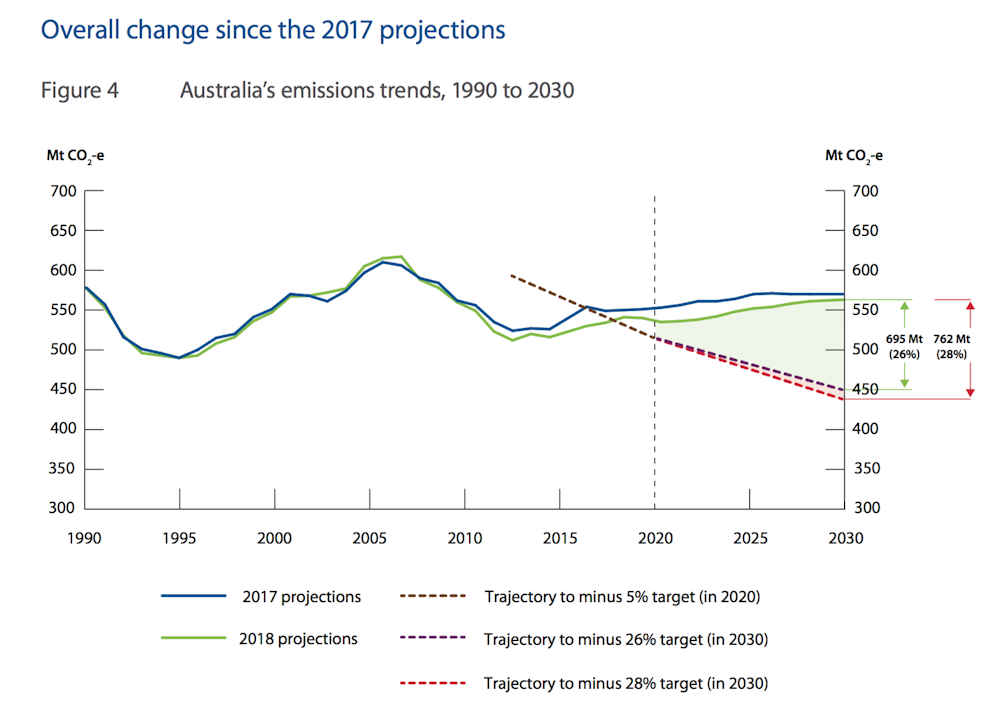
Australia’s carbon dioxide emissions are not falling.Department of Environment and Energy
The old denials
Old-school climate change denial, be it denial that warming is taking place or that humans are responsible for that warming, featured prominently in Australian politics a decade ago. In 2009 Tony Abbott, then a Liberal frontbencher jockeying for the party leadership, told ABC’s 7.30 Report:
I am, as you know, hugely unconvinced by the so-called settled science on climate change.
The theory and evidence base for human-induced climate change is vast and growing. In contrast, the counterarguments were so sloppy that there were many targets for scientists to shoot at.
Incorrect predictions of imminent global cooling were made on the basis of rudimentary analyses rather than sophisticated models. Cycles were invoked, in a manner reminiscent of epicycles and stock market “chartism” – but doodling with spreadsheets cannot defeat carbon dioxide.
That was the state of climate “scepticism” a decade ago, and frankly that’s where it remains in 2019. It’s old, tired, and increasingly irrelevant as the impact of climate change becomes clearer.
Climate “scepticism” was always underpinned by politics rather than science, and that’s clearer now than it was a decade ago.
Several Australian climate contrarians describe themselves as libertarians – falling to the right of mainstream Australian politics. David Archibald is a climate sceptic, but is now better known as candidate for the Australian Liberty Alliance, One Nation and (finally) Fraser Anning’s Conservative National Party. The climate change denying Galileo Movement’s claim to be to be non-partisan was always suspect – and now doubly so with its former project leader, Malcolm Roberts, representing One Nation in the Senate.
Given this, it isn’t surprising that relatively few Australians reject the science of climate change. Just 11% of Australians believe recent global warming is natural, and only 4% believe “there’s no such thing as climate change”.
So what has changed in the years since Abbott was able to gain traction, rather than opprobrium, by disdaining climate science? The Australian still runs Ian Plimer and Maurice Newman on its opinion pages, and Sky News “after dark” often features climate cranks. But prominent politicians rarely repeat their nonsense any more. When the government spins Australia’s rising emissions, it does it by claiming that investing in natural gas helps cut emissions elsewhere, rather than by pretending CO₂ is merely “plant food”.
As a scientist, I rarely feel the need to debunk the claims of old-school climate cranks. OK, I did recently discuss the weather predictions of a “corporate astrologer” with Media Watch, but that was just bizarre rather than urgent.
Back in the real world, the debate has shifted to costs and jobs.
Modelling by the economist Brian Fisher, who concluded that climate policies would be very expensive, featured prominently in the election campaign. Federal energy minister Angus Taylor, now also responsible for reducing emissions, used the figures to attack the Labor Party, despite expert warnings that the modelling used “absurd cost assumptions”.
Many people still assume the costs of climate change are in the future, despite us increasingly seeing the impacts now. While scientists work to quantify the environmental damage, arguments about the costs and benefits of climate policy are the domain of economists.
Jobs associated with coal mining were a prominent theme of the election campaign, and may have been decisive in Queensland’s huge anti-Labor swing. It is obvious that burning more coal makes more CO₂, but that fact doesn’t stop people wanting jobs. The new green economy is uncharted territory for many workers with skills and experience in mining.
Debates about climate policy remain heated, despite the scientific basics being widely accepted. Concerns about economic costs and jobs must be addressed, even if those concerns are built on flawed assumptions and promises that may be not kept. We also cannot forget that climate change is already here, impacting agriculture in particular.
Science should inform and underpin arguments, but economics and politics are now the principal battlegrounds in the Australian climate debate.
When you think about private tutoring, you might imagine parents striving to give their children a competitive edge. But many parents use tutoring to fill gaps in their child’s schooling – such as to improve their literacy.
In our research, some parents did speak of tutoring as a way of securing entry into the school they want for their child. But these were in the minority. Most spoke of using it to help fix academic problems, temporary and ongoing.
The rise of private tutoring shows parents are taking responsibility for children to achieve Australia’s national literacy goals. It seems they believe the education provided at school is simply not enough to meet a learner’s needs.
Private tutoring on the rise
In Brisbane, we saw branded signage of new tutoring companies appearing in the local shops. We also found advertisements for tutoring in streets near schools, in school newsletters, on parent sites on Facebook, and on community noticeboards.
And we wanted to find out why tutoring was so appealing to parents.
We interviewed 35 parents about tutoring for their Year 5 (aged around 9-10) children. The parents were from both urban and rural areas. Around three-quarters were sending their children to public schools and one-quarter to Catholic or independent schools.
One parent used a tutor as a helpful ally in the relationship between the parents, child and teacher.from shutterstock.com
Of the 35 parents, 23 had used tutoring for some of their children or planned to do so. Ten said they had thought about it or would use it if necessary.
Two were reluctant to get their child a tutor despite their children’s educators encouraging them to do so. One of these parents told us her child had missed a lot of school for medical problems, but their location was a problem when it came to accessing tutoring.
Why do parents pay for tutoring?
The tutoring market offers parents many options. Services range from help with homework, to test and examination coaching, and instruction in the reading and writing content of the Australian Curriculum: English.
Most of the parents (20) we interviewed spoke of using tutoring to fix what they saw as their children’s academic problems.
Sometimes the problem was a specific gap in knowledge and skills. One parent had been averse to tutoring but then her child’s English grades dropped a little:
We couldn’t work out why or how he went from getting straight As to getting a B in English. And so we just spoke to other parents and they said their kids did really well with a tutor. So we went there and the big focus was confidence on his writing.
This tutoring was short-term.
The second-biggest group of parents (9) told us they used tutoring to support suspected or diagnosed learning difficulties in their children. These included dyslexia (inability to read accurately), dysgraphia (inability to write coherently), autism and attention-deficit hyperactivity disorder (ADHD).
One of these parents told us the school couldn’t give enough personalised attention to her child:
Because the kids are struggling and the curriculum moves so much and there’s only one teacher to how many kids per class that can’t always spend the time on that one child.
For another of these parents, the private tutor was a helpful ally in a cooperative relationship between the family, the school teacher and the tutor:
I sit with the teachers at the start of every term and we look at where she’s struggling. I ask them to give me a learning plan now and then I feed that through the tutor and they’re teaching her off that.
Another took her child to a private tutor during school time to support diagnosed learning difficulties. While this mother felt the tutoring was helpful, the cost became prohibitive. She told us:
I had to pay for it out of my own pocket. It was too much, that’s also why I stopped doing it, too much money.
The final, and smallest, group of the parents we spoke to (just three) used tutoring as one of the many enrichment activities they used for their children.
Two of these parents had prepared their children for scholarships or entry exams to selective schools. As one parent told us, “we had ten lessons on testing”.
So, some parents do use tutoring as part of hyper-competitive and remedial education strategies. These more traditional uses of tutoring remain relevant for parents today. However, parents now also use tutoring more broadly to optimise their children’s school experience and achievement.
Parents have been “responsibilised” (a concept that assumes people are charged with responsibility for achieving the goals of national policy) for making all manner of choices to create the best education for their child.
Tutoring is one resource for the responsibilised parent.
We need to have a community conversation about the limits of responsibilisation. A few parents talked about the cost constraining their use of tutoring:
I would love to get more tutoring for them but the affordability of it […] you just can’t, especially on one income.
A child’s mastery of literacy shouldn’t be constrained by their parents’ income.
Digital technologies such as artificial intelligence (AI) and robotics are said to make many jobs redundant due to automation. BeefLedger, a QUT research project with a focus on blockchain and agtech (agricultural technology), tells a different story. It turns out the project generates jobs not usually associated with rural and regional Australia.
BeefLedger is a two-year A$1.5 million project that set out to track and protect the authenticity of Australian beef in the rapidly growing Chinese market. It also shows, though, that blockchain and agtech can generate jobs in the creative industries in regional Australia, too.
The Australian beef industry is worth more than A$13 billion a year. Around 75% of its output is exported. Yet demand from markets like China will soon exceed our supply capacity.
And that opens a door to food fraud, a A$40 billion-a-year problem globally. Food fraud is reducing Australia’s brand value in China.
Led by QUT with funding from the Food Agility CRC and industry partners, BeefLedger is designed to protect Australia’s brand integrity by fighting food fraud. As well as verifying food provenance, it eases cross-border logistics and payments. It does this by creating an integrated blockchain-enabled beef provenance and smart contract platform.
So where do creative jobs come into it?
BeefLedger engages producer communities in rural Australia in new ways. BeefLedger is working with the District Council of Grant and Mount Gambier High School to develop digital video stories about the Limestone Coast and Mount Gambier region. By producing authentic local content that showcases food provenance to consumers, the project opens up regionally branded export opportunities in the Chinese market.
This creative content will be used across various platforms to strengthen the brand authenticity of Limestone Coast beef in the Chinese market. Farmers collaborate with students producing this content. In turn, BeefLedger adds value and benefit to the local community.
The students visit farms and feedlots to learn about digital farming (agtech), the Internet of Things (IoT) and data analytics. BeefLedger engages students in agricultural science, data visualisation, creative storytelling, and food provenance narrative branding. They also learn about Chinese culture, including food and media consumption practices such as WeChat.
Could a technology and innovation initiative such as BeefLedger become an example of how to arrest the brain drain of young people to metropolitan cities? Might such new career prospects be an incentive even for city slickers to consider regional Australia as their new home?
Is blockchain really killing jobs?
There are about as many opinions as there are experts. –Erin Winick
The desire to eliminate middlemen has been around for as long as there have been middlemen. Calling this desire disintermediation has gained currency with the rise of blockchain and other distributed ledger technology.
The removal of intermediaries in a supply chain is said to enable frictionless capitalism, where producers have a more direct relationship with consumers. This supposedly leads to more profit for producers and a better deal for consumers.
The future of work in a blockchain world remains contested. Some have estimated that blockchain and smart contracts could make 30–60% of jobs redundant. Rebuttals of these dire predictions point to new jobs and new businesses being created.
Rather than thinking of disintermediation as killing jobs, we find consumer culture and expectations are creating new ones. Nowhere is this more evident than in the creative industries.
Originally, cultural intermediaries were identified mostly as advertisers and marketers. Today, they are a growing profession filling a range of roles: arts managers, curators and promoters, fashion, food and lifestyle gurus, journalists, DJs and online product reviewers. In China, the latter have become social influencers in an industry worth more than A$12 billion.
But when you ask a cultural intermediary what their job is, they are more likely to say: “I am a brand manager / curator / arts worker,” and not, “I am a cultural intermediary.” Cultural intermediation is a theoretical construct to describe a wide range of existing and emerging occupations.
New careers in cultural intermediation
The generalisation of entrepreneurialism in neoliberal societies into so many different occupations and areas of practice – the bootstrapping ethos of not searching for but creating one’s job – goes a considerable way to making everyone an intermediary whether they want to be or not. –Peter Conlin
We are seeing a third wave of socially engaged cultural intermediaries in the creative city. This includes facilitators, enablers, community workers, activists and social entrepreneurs. It often includes those working in not-for-profit and non-government organisations.
The cultural intermediation at play in the BeefLedger project entails brokerage, lateral thinking, conceptual reordering and dot-joining people and community assets. This is the craft so many professionals in the creative industries practise every day just to get a gig: applied creativity.
Intermediation and disintermediation cannot be reduced to a simple binary of good or bad. Nor should our understanding of them be confined to sales, marketing or e-commerce. Our work on the BeefLedger project applies creativity across the persistent silos of the 3Cs – Community, Culture and Commerce – towards mutually beneficial results.
In fact, digital technology such as blockchain may soon increase demand for professional cultural intermediaries. They bring an ability to articulate commercial aims and objectives in creative and community terms. This then enables a more holistic integration of business, social and regional agendas.
John switches on the power saw he’s bought secondhand on eBay. The machine “arcs” – shooting out a visible electric charge. So he takes it apart to investigate. He identifies the problem: the field coil, a current-carrying component that generates an electric field. Once fixed, the saw works as new.
I met John during my doctoral research into tinkerers — people who love to adapt and repair things. But many things have become harder to fix.
Just a few decades ago, manufacturers packaged everyday appliances with instructions on how to repair them. Now they come with danger warnings and threats that doing so will void the warranty.
Repair is discouraged by unavailable replacement parts, glued assemblies and tamper-proof cases that are difficult to open. So we discard things rather than fix them.
Much research suggests this harms more than the natural environment. It also affects our mental environment. There’s a connection between the way society treats material objects and the way it treats people.
Returning to an economy of repair could help create a kinder, more inclusive society. By mending broken things we might also help mend what’s broken in ourselves.
Repair is an investment of ourselves
The environmental case for a repair economy is obvious. It saves natural resources and reduces waste.
The product of our discard economy: a woman scavenges for recyclable plastics at the Dandora dump near Nairobi, Kenya.Daniel Irungu/EPA
There’s also a strong economic case. In his book Curing Affluenza, Australian economist Richard Denniss argues a community that repairs its goods “would employ more people, per dollar spent, than a community that instinctively disposes of them”. It would create more high-skill jobs and reduce the cost of living.
The social case is as strong. As Europe starts banning the disposal of unsold and returned consumer products, a mounting body of research shows that repair economies can make people happier and more humane.
During research for my 2017 book Tinkering: Australians Reinvent DIY Culture, I learned how material repair generates a deep sense of care, pride, belonging and civic participation.
Even solitary acts of repair involve a community of influences. Through acts of repair we experience products as expressions of our collective knowledge. Repaired products become bearers and extensions of personhood: like genomes, they carry their pasts within their presence.
By contrast, product obsolescence “blocks our access to the past”, argues Francisco Martínez, an ethnographer at the University of Helsinki. His research found repair was “helping people overcome the negative logic that accompanies the abandonment of things and people”. Repair made “late modern societies more balanced, kind and stronger”. It was a form of care, of “healing wounds”, binding generations of humanity together.
Like Polish sociologist Zygmunt Bauman, Martínez draws parallels between the displacement and neglect of objects and those of people.
In Estonia, Martinez says, repairing things “establishes continuity, endurance and material sensitivity” in a society disrupted by Soviet-style socialism and subsequent transition to capitalism:
Contemporary mending and the reluctance to dispose of material possessions can also be a way to resist dispossession and adapt to convoluted changes; the act throwing away is perceived as a threat to memory, to security, and to historical and ecological preservation.
Similar observations have been made in different economies.
Studying Londoners living in reviled council flats following the Thatcher years, British anthropologist Daniel Miller observed residents who fixed their kitchens. Those with strong and fulfilling social relationships were more likely to do so; those with few and shallow relationships less likely.
Miller is among many scholars who have observed that relationships between people and material things tend to be reciprocal. When we restore material things, they serve to restore us.
Right to repair movement
Repair economies don’t regard material things as expendable. They relocate value in the workings, relations and meanings of things. By contrast, consumer economies encourage us to relate with products in ways that damage the planet and promote a kind of learned helplessness.
In response, the global “right to repair” movement has mobilised.
Such “glocal” — at once global and local — initiatives reinscribe humane values into mass culture. They encourage participatory citizenship and create informal exchanges of knowledge, skills, materials, goodwill and values. They create what sociologists call cultural capital, the benefits of which are recognised in public health funding of initiatives such as Men’s Sheds.
In Europe, environment ministers are pushing laws obliging manufacturers to make appliances repairable and enduring. Many US states are considering “fair repair” laws, and federal authorities have deemed it unlawful for phone and other tech manufacturers to prevent owners repairing their products. In Australia, state governments are considering ways to promote a “circular economy”, in which material resources circulate for as long as possible.
We already have the tools to move away from an economy that values overconsumption and wasting resources. Doing so would allow us to fix more than just our products.
A company called WAM Clothing, not owned by Indigenous Australians, currently has exclusive rights to use the flag on clothing. It has issued cease and desist notices to companies including the AFL (which uses the flag on club jerseys for its Indigenous round) and Spark Health, an Indigenous social enterprise. The latter has launched an online petition calling for the copyright arrangements to be changed.
While there is no need for anyone to get permission to use the Australian flag, so long as they abide by the guidelines respecting its use, this is not the case for the Aboriginal flag.
The reason is that the Aboriginal flag is a copyright work owned by the artist who created it over 40 years ago – Luritja man Harold Thomas.
Harold Thomas photographed in 2016.Fiona Morrison/AAP
Thomas created the flag for a national Indigenous day in July 1971, and this is not the first time his flag has been embroiled in copyright controversy.
When it was adopted as the flag of the Aboriginal people of Australia by proclamation of the Governor-General on July 14, 1995, several other claimants came forward asserting that they were the artist behind it. Thomas was successful in establishing his claim to authorship before the Federal Court in 1997.
As the creator of the flag, Thomas is its owner and can grant licences to other parties to make copies of the flag, or indeed refuse its use altogether.
Under Australian law, his copyright will last for 70 years after his death, and can be claimed by his heirs or anyone else to whom he might choose to assign it. Thomas can assert his rights against anyone making any copy of the flag, even if they are not selling it or using it commercially – this could even include bringing an action against someone with a tattoo of the flag.
Following the Federal Court decision in 1997, Thomas granted a licence to a company called Flags 2000, giving that company the right to reproduce and manufacture the flag. In 2003, Flags 2000 and Thomas brought a successful action against a man named Mr Smith, who had made and sold copies of the flag without permission.
Today, the licence to use the flag on items of clothing is held by WAM Clothing. This was granted by Thomas in October 2018.
One of the owners of WAM Clothing, Ben Wooster, is also the director of a company called Birubi Art. Last year, the Australian Competition and Consumer Commission brought legal proceedings against Birubi for its production and sales of boomerang and other souvenir products featuring visual images and symbols of Aboriginal art, all of which were produced by artisans in Indonesia.
The Federal Court found that by representing these works as hand painted or made by Aboriginal Australians, Birubi had engaged in misleading and deceptive conduct. A hearing on the penalties and orders against the company will be held this Friday, but it is already in liquidation, which could limit the impact of any orders.
A goal umpire uses Aboriginal flags to signal a goal during a football match in Alice Springs in 2016.Dan Peled/AAP
A recent report of the Australian Parliament’s Standing Committee on Indigenous Affairs identified the harms caused to Indigenous peoples and communities by inauthentic souvenirs and crafts with no connection to the Aboriginal peoples whose stories, histories and culture they depict.
Together, these issues highlight the difficulties faced by Aboriginal artists in this field. Many people still erroneously believe that traditional styles of painting are not capable of being owned under copyright law. A number of Aboriginal artists have resorted to litigation to prevent use of their designs on an array of commercial products, from currency to carpets.
A change.org petition started by Spark Health, whose brand Clothing the Gap raises money for Aboriginal health, states: “This is not a question of who owns copyright of the Flag. This is a question of control.”
However, the two cannot be separated: it is the owner of the copyright who has control over how a work may be used.
As copyright owner, Thomas has the right to grant licences to whomever he pleases, whether Indigenous or not.
Asking the government to intervene in this way could be seen as yet another appropriation of Aboriginal property rights – in this case, the rights of an artist to maintain ownership of his work.
At the same time, enforcing copyright of such a powerful and well-loved symbol against those seeking to use it to express their cultural identity, solidarity or sympathy, or for charitable causes, gives rise to justifiable resentment.
The symbolism of the flag, expressed by Thomas in the original 1997 court case, is worth remembering here:
I wanted to make it unsettling. In normal circumstances you’d have the darker colour at the bottom and the lighter colour on top and that would be visibly appropriate for anybody looking at it. It wouldn’t unsettle you. To give a shock to the viewer to have it on top had a dual purpose, was to unsettle … The other factor why I had it on top was the Aboriginal people walk on top of the land. (Thomas v Brown (1997) 37 IPR 207, 214.)
Following recent recommendations for reform from the Australian Law Reform Commission and the Productivity Commission, it could be that this case gives impetus for the government to explore ways to make copyright fairer for both artists and users.
Press freedom groups are sounding the alarm over a pair of police raids on journalists. Last week, Australian Federal Police swept into the headquarters of the Australian Broadcasting Corporation in Sydney, reviewing thousands of documents for information about a 2017 report The Afghan Files that found Australian special forces soldiers may have committed war crimes in Afghanistan.
The Afghan Files … How the ABC reported a “Defence leak exposing deadly secrets of Australia’s special forces” in 2017. Image: Screen shot of ABC/PMC
The raid came on Wednesday, one day after police in Melbourne raided the home of Annika Smethurst, a reporter with the Herald Sun newspaper.
Democracy Now! speaks to Australian journalism professor Joseph Fernandez – correspondent of Reporters Without Borders and Pacific Journalism Review – and Peter Greste, founding director of the Brisbane-based Alliance for Journalists’ Freedom.
Greste was imprisoned for 400 days in 2013 to 2014 while covering the political crisis in Egypt.
Transcript This is a rush transcript. Copy may not be in its final form.
AMY GOODMAN: This is Democracy Now! I’m Amy Goodman, with Juan González.
JUAN GONZÁLEZ: Press freedom groups in Australia are sounding the alarm over a pair of police raids on journalists. On Wednesday last week, Australian Federal Police swept into the headquarters of the Australian Broadcasting Corporation in Sydney, reviewing thousands of documents for information about a 2017 report that found Australian special forces may have committed war crimes in Afghanistan.
ABC investigations executive editor John Lyons spoke on his own network just minutes after police served a warrant naming a news director and the two reporters who broke the story.
JOHN LYONS: They have downloaded 9,214 documents. I counted them. And they are now going through them. They’ve set up a huge screen, and they’re going through, email by email. It’s quite extraordinary.
And I feel—as a journalist, I feel it’s a real violation, because these are emails between this particular journalist and his boss, her boss, its drafts, its scripts of stories.
I’ve never seen an assault on the media as savage as this one we’re seeing today at the ABC. … And the chilling message is not so much for the journalists, but it’s also for the public.
AMY GOODMAN: Wednesday’s raid on the ABC came one day after police in Melbourne raided the home of Annika Smethurst, a reporter with the Herald Sun newspaper. Police served a warrant related to Smethurst’s reporting on a secret effort by an Australian intelligence service to expand its surveillance capabilities, including against Australian nationals.
Australia’s acting Federal Police Commissioner Neil Gaughan defended the raids, saying journalists could face prison time for holding classified information.
COMMISSIONER NEIL GAUGHAN: No sector of the community should be immune for this type of activity or evidence collection, more broadly. This includes law enforcement itself, the media or, indeed, even politicians.
AMY GOODMAN: Well, for more, we’re joined by two guests in Australia. With us from Brisbane is Peter Greste. He is the UNESCO chair in journalism and communications at University of Queensland. He is founding director of Alliance for Journalists’ Freedom.
He was imprisoned for over a year, for 400 days, in 2013 to 2014, while covering the political crisis in Egypt.
And joining us from Perth, Australia, Professor Joseph Fernandez is with us, a media law academic at Curtin University, Australia’s correspondent for Reporters Without Borders.
We welcome you both to Democracy Now! Joseph Fernandez, let’s begin with you. Lay out exactly what happened and when it took place, all the details as you know them, both the raiding of ABC and the journalist’s home.
Professor Joseph Fernandez … the police “spent seven-and-a-half hours going through every nook and cranny of [reporter Annika Smethurst’s] belongings, including the rubbish bin outside the house”. Image: Democracy Now! screenshot by PMC
JOSEPH FERNANDEZ: Thank you for having me on your show. The two raids happened within 48 hours of each other. It began with a raid on Annika Smethurst’s home. You have introduced her.
At her home, the Australian Federal Police spent seven-and-a-half hours going through every nook and cranny of her belongings, including the rubbish bin outside the house. And they sought to access her email messages, phone messages and anything they could lay their hands on, including what she might have kept away in her undies drawer.
Annika obviously was very traumatised by this, but she has held her head up high, in the knowledge that the story about which she was being investigated was really something very arguably and very strongly in the public interest or of legitimate public concern.
The second raid, the following day …
AMY GOODMAN: And that story was?
JOSEPH FERNANDEZ: Sorry. Can you say that again, please?
AMY GOODMAN: And that story was, Joseph?
JOSEPH FERNANDEZ: The story was that there was a discussion, a discussion about a plan to expand state surveillance, that would have possibly included surveillance of ordinary citizens. And this was quite an unprecedented idea.
And the objective of such a plan was obviously going to be justified on the premise of protecting national security.
The second raid happened at the headquarters of the national broadcaster ABC, the Australian Broadcasting Corporation, in Sydney. And police officers entered the premises armed with a warrant with an exhaustive inventory of things that they were looking for.
And as you have noted, they scoured hundreds and thousands of documents and materials, and left with a small collection of materials in a sealed package, with the agreement not to use them until a possible challenge is considered in the days ahead.
JUAN GONZÁLEZ: And, Joseph Fernandez, these raids coming within a day of each other, was there any coordination, or were these related in any way?
JOSEPH FERNANDEZ: That’s an interesting question. One of the first questions that sprung into people’s minds was whether they were related, whether this was instigated by the government. The prime minister quickly moved to distance himself and his government from the raids, claiming that the two agencies and the police were acting entirely of their own accord.
And the police themselves are on record as saying that the two events are unrelated. And so, it’s left to be seen, you know, whether new light will be shed on the real circumstances that led to these raids. It’s quite hard to accept, without inquiry as to whether there was absolutely no notice given, whether informally or formally, to the bosses in government.
AMY GOODMAN: And for people to understand, I mean, the ABC is the leading broadcaster throughout Australia. I wanted to bring Peter Greste into this conversation. We had you here in our studio after you were imprisoned for well over for year by Egypt with your two Al Jazeera colleagues.
You were working with Al Jazeera at the time. You certainly knew what it meant to be arrested, to not have rights, not to be even told at the beginning why the Egyptian authorities were holding you. Now you see the situation in Australia.
And I was wondering if you can talk about the laws around press freedom, if you have them in Australia. Amazingly, in this warrant, the warrant gave the police wide-ranging authority to view, seize, edit and destroy virtually any document it saw fit.
PETER GRESTE: Yeah, that’s right. Look, there are a whole host of questions in there, Amy, but let me deal with the very beginning of it, and that’s the way I felt when I heard about the news, because it did—I mean, even now I can feel my skin pricking up, thinking about the raids and what that would have felt like, because I know exactly what it was like to have agents burst into your room looking for evidence, and all of the confusion that surrounds that, the outrage that surrounds that.
But I never really honestly expected to see it take place here in Australia. And it seems to me that even though I’m not suggesting Australia is about to become an authoritarian state like Egypt anytime soon, I think that we are being pushed in the same direction by the same kind of imperatives around national security, the prioritising of national security over the human rights and democratic rights of citizens, largely because it’s much easier to make the political case for national security legislation, particularly when you see attacks in the streets and the consequences of that, but much harder to make the more abstract case for human rights and citizens’ rights, freedom of speech, freedom of the press and so on, until you see what that means in practical terms.
And that’s what we saw last week with these two raids. I think it’s very, very concerning to me, and I’m deeply worried.
Now, as you mentioned, we don’t have in Australia any explicit protection for press freedom written into the law, nothing about freedom of speech. Australia has no bill of rights. All we have is an implied right of political communications, that the High Court decided that was there as a function of our democracy.
They said that we live in a representative democracy, and you can’t have an effective representative democracy without political communication, therefore, that right is somehow inferred in the Constitution.
But without anything like the First Amendment in the United States here in Australia, without any explicit protection for press freedom, what we’re seeing is a lot of scope for our legislators to draft laws that really intrude on press freedom in all sorts of deeply troubling ways that make it much harder for journalists to protect their sources, make it much harder even for journalists to contact sources within government.
And so, what we’re seeing is a vast web of interconnected national security laws that, in all sorts of ways, make these kinds of raids that we saw last week possible.
I’m not so critical of the Federal Police for carrying out the raids. I accept that they were probably doing their jobs. And as we’ve been hearing, there may well have been some kind of political involvement in there.
But let’s take what the Federal Police have been saying at face value, that there was nothing political. If there was nothing political, if they were simply fulfilling their duties under the law, then, clearly, the law needs to change. And that’s what we need to start talking about.
JUAN GONZÁLEZ: And, Peter Greste, we have about a minute left, but I wanted to ask you, in terms of—who determines the violations of state secrets? Is there one centralised agency, or can various federal agencies decide to conduct these kinds of raids in Australia?
PETER GRESTE: No. Look, it’s quite difficult to know quite how the laws come into effect or come into force. I mean, let’s take a look at the data retention laws, the metadata. In any number of more than 20 agencies, government agencies can look into any Australian’s metadata without a warrant.
Now, they need to apply for a special journalist warrant if they want to investigate journalists’ metadata in a search for sources, but, otherwise, there is no—there is no warrant system. They can look anywhere, anywhere that they want.
And I think that’s the kind of scope that we’re talking about. That’s overreach. You talk to any lawyer, any civil rights activist, anyone who knows about the way the law operates, and they’ll acknowledge that that’s overreach. And we need to really start a vigorous conversation within this country about the limits of state power and the kind of ways that we need to encourage and support press freedom, and also the protection of whistleblowers, because, ultimately, these raids were in the hunt for the sources of these stories, for the journalists’ sources, for the whistleblowers that felt that these stories needed to be told.
AMY GOODMAN: Well, we have to wrap up right now, but we want to continue the vigorous discussion, and we’re going to bring folks Part 2 at democracynow.org under web exclusives.
Peter Greste, we want to thank you, UNESCO chair in journalism and communications, University of Queensland, founding director of the Alliance for Journalists’ Freedom, imprisoned for more than 400 days.
Also, Joseph Fernandez, a media law academic at Curtin University, Australia’s correspondent for Reporters Without Borders. Stay with us. I’m Amy Goodman, with Juan González.
An excerpt from the cover of Mekim Nius – Tok Pisin for “newsmaking”.
David Robie
Wednesday, June 12, 2019
Abstract
The news media is the watchdog of democracy. But in the South Pacific today the Fourth Estate role is under threat from governments seeking statutory regulation, diminished media credibility, dilemmas over ethics and uncertainty over professionalism and training. Traditionally – with the exception of Papua New Guinea where university education has been the norm – the region’s journalists have mostly learned on the job in the newsroom or through vocational short courses funded by foreign donors. However, today’s Pacific journalists now more than ever need an education to contend with the complex cultural, development, environmental, historical, legal, political and sociological challenges faced in an era of globalisation. From the establishment of the region’s first journalism school at the University of Papua New Guinea in 1975 with New Zealand aid, Mekim Nius traces three decades of South Pacific media education history. Dr David Robie profiles journalism at UPNG, Divine Word University and the University of the South Pacific in Fiji with Australian, Commonwealth, French, NZ and UNESCO aid. He also examines the impact of the region’s politics on the media in the two major economies, Fiji and Papua New Guinea – from the Bougainville conflict and Sandline mercenary crisis to Fiji’s coups
– David Robie is a New Zealand journalist and media educator who has worked in the Pacific for more than two decades. For nine years he headed the journalism programmes at both the University of Papua New Guinea and the University of the South Pacific, where he was programme coordinator. He won Qantas and NZ Media Peace Prize awards for Pacific journalism and was the 1989 Australian Press Council Fellow. He is currently professor of Pacific journalism and director of the Pacific Media Centre at Auckland University of Technology.
ACTU secretary Sally McManus will meet union leader John Setka on Thursday to discuss his “words and actions”, as Setka’s union allies push back against Anthony Albanese’s move to have him expelled from the ALP.
The controversial Victorian secretary of the Construction, Forestry, Maritime, Mining and Energy union appeared with his wife Emma Walters at a news conference and on radio on Wednesday to deny he had denigrated anti-domestic violence campaigner Rosie Batty.
Last week Nine newspapers reported Setka told a meeting of the CFMMEU national executive Batty’s work had led to men having fewer rights.
At Albanese’s instigation, Setka’s ALP membership has been suspended. Albanese will move for his expulsion when the party’s national executive meets on July 5. Before that, Setka will be in court late this month on charges of harassing a woman, to which he has said he will plead guilty.
The Labor party is currently working out a procedure by which he gets natural justice when his expulsion come up.
The Setka affair is now dominating discussion at the highest level of the union movement. McManus returned from Geneva early to deal with it.
She said in a statement on Wednesday she had “consulted with union leaders who are concerned by Mr Setka’s words and actions, which are not compatible with our values, and have impacted on our movement.
“The ACTU condemns all acts of family and domestic violence. Australian unions have made ending family and domestic violence a priority.
“I have heard what Mr Setka had to say today. I have sought a meeting with him tomorrow to discuss these matters. I will have more to say following this meeting.”
Earlier she had said that if any allegations relating to harassment were correct, “John Setka must resign. There is no place for perpetrators of domestic violence in leadership positions in our movement.”
Albanese has said he is not reflecting on the court case.
Setka said the report of what he said at the CFMMEU national executive meeting about Batty was “completely false. I have always been a huge supporter of Rosie Batty and admired her tireless work”.
“The member who leaked these false allegations, for nothing more than political gain, should be the one who hangs their head in shame. I completely agree with Mr Albanese [that] any comments denigrating Rosie Batty are completely unacceptable.”
Pressed on what he had said, Setka replied, “It was just going into what lawyers had told me in regards to some of the laws and had nothing to do with Rosie Batty changing the laws or anything. … There was nothing denigrating and nothing terrible said about Rosie Batty at all”.
He said would not be stepping down from his union position, which is an elected one.
Labor frontbencher Kristina Keneally told Sky she did not believe Setka’s union position was tenable.
Albanese took steps to verify the story about what Setka had been reported as saying at the meeting before announcing his move against him.
But Chris Cain, national president of the Maritime Union (a division of the CFMMEU), who was at the executive meeting said the allegations about what Setka had said were false and “misinformation”. He said Albanese should apologise.
Setka also got backing from the state secretary of the Electrical Trades Union Victoria, Troy Gray, who said Albanese’s remarks about Setka were based on a “complete fabrication”. “Albanese needs to withdraw,” Gray said.
However other unions, including the Australian Services Union, which has members working in domestic violence services, are particularly concerned with the Setka situation. The ASU said in a statement: “John Setka should resign if any of the allegations against him are true. The comments attributed to him do not reflect the values of our union movement or the ASU. The alleged comments are abhorrent to victim survivors of family violence and thousands of ASU members who work on the frontline in the family violence sector.”
United Voice has said it supports the ACTU’s position that if any of the reported allegations against Setka were correct “he must resign”. It has also expressed concern about the alleged statements about Batty.
Setka told his news conference that over recent years he and his wife had “been to hell and back, with relentless attacks on us personally for what is nothing more than some people seeking their own political gain. The result of this was our relationship hit rock bottom.
“We’ve both said and done things that we aren’t proud of. But this is not an opportunity to get John Setka. My family should not be used as political bait. We’re working very hard together to rebuild our marriage and are confronting the issues that led to the breakdown of our marriage”.
Curious Kids is a series for children. If you have a question you’d like an expert to answer, send it to curiouskids@theconversation.edu.au You might also like the podcast Imagine This, a co-production between ABC KIDS listen and The Conversation, based on Curious Kids.
Why do leeches suck our blood? – Thomas, aged 6.
The short answer is that leeches need blood to grow and reproduce (make baby leeches).
Leeches are worms that live in water or on land and feed by sucking blood from fish, frogs, lizards, birds or, if they get the chance, larger animals like humans.
They suck blood because it is a very good food for them. Some leeches only need to feed once a year.
The only trouble with sucking blood is you have to do it very carefully, especially if the animal you are sucking it from is able to bite you or pull you off. So leeches, like all blood suckers, usually like to bite without causing too much pain. They like to bite in spots where they are hard to find.
Blood clots but leeches have a solution
The other thing leeches have to worry about is that blood clots. A blood clot forms whenever you get a cut which stops bleeding in a few minutes – eventually the blood clot forms a scab.
This happens when blood contacts the air. It clumps together and forms a solid lump. The leech cannot feed if the blood forms a lump and so it releases a chemical that prevent this clumping.
This keeps the blood flowing so the leech can suck for two or three hours without stopping. That way it collects enough food to last until it finds another animal to bite.
Leeches are not the only animal that feeds on the blood of animals. Others include mosquitoes, ticks, vampire bats (yes they exist, but only in South America), bed bugs, lice, other insects and the lamprey fish. All these feed on larger animals – but don’t kill them, so they are all called parasites.
Parasites all live on or in other animals and many of them feed on blood. Blood is easy to collect whether you are inside or outside the body. It is highly nutritious and there is always lots of it, so the animal the parasite is feeding on can usually spare some.
Here are some leeches on the shoe of a hiker in the rainforest.Shutterstock
Leeches and medicine
Leeches can be annoying and their bites can make us itchy but they are not usually dangerous to humans. In fact, leeches have been used to treat human diseases for thousands of years. Their blood sucking ability was thought to be useful in sucking diseased or “bad” blood out of the body and so sick people had leeches applied regularly.
However, we now know that allowing leeches to suck blood does little to help in most cases. In fact, if too many leeches are applied, a sick person can get weak from loss of blood.
The one area of medicine where leeches are still helpful is using them to improve blood circulation in the skin. They also reduce the chances of blood clotting when that could be dangerous in some sick people. However, these days we can make an artificial version of the chemical leeches use to prevent blood clots, which is called “hirudin”.
Leeches need blood to grow and reproduce, which they can do easily as all leeches are both male and female at the same time. They still have to mate with another leech but both partners can lay eggs after mating.
Revenge films remain popular, in part, because they re-stage a formative aspect of human culture – the bonding of societies around communal acts of violence. As René Girard has written, scapegoating – the designation and punishment of the victim – is one of the foundational cultural moments.
The staging of violence, within the controlled environment of the cinema, fascinates viewers, eliciting a troubling mixture of desire to see punishment enacted upon another body (especially another deserving body) and revulsion at this desire.
Australian writer-director Jennifer Kent’s recent film, The Nightingale, is, as far as revenge films go, watchable if uninspired. The story follows Irish convict Clare (Aisling Franciosi) as she seeks revenge for her rape, and the murder of her husband – and baby – at the hands of a group of soldiers led by the unbelievably repulsive Hawkins (Sam Claflin).
Assisted by guide Billy (Baykali Ganambarr), an Indigenous Tasmanian with his own axe to grind against the British colonisers, Clare traverses the Tasmanian wilderness in search of her antagonists, eventually catching up with them in Launceston.
It’s a requirement, for this kind of melodramatic fare to work, that the actions of the antagonists are so reprehensible in the eyes of the viewer – and unforgivable – that the blood-lust of the protagonist can be justifiably acquitted.
Consider Michael Winner’s Death Wish, the prototype of 1970s and 1980s revenge films, and the brutality with which the thugs attack Paul Kersey’s (Charles Bronson’s) family in that film. Or Tarantino’s Kill Bill films – Bill (David Carradine) has to have done some pretty bad stuff to justify his ultimate decapitation by The Bride (Uma Thurman) – and, spoiler alert, he has!
Aisling Franciosi in The Nightingale.Sydney Film Festival.
The Nightingale certainly meets this requirement. The baddies are so irredeemably bad, that there is never any doubt about the outcome that awaits them at the end. Indeed, at the screening I attended, members of the audience cried out in triumph when they were killed.
Clare’s life has been so completely destroyed by the actions of Hawkins and his underlings, that her quasi-suicidal desire for vengeance makes perfect emotional sense. After all, how would one survive seeing their infant murdered?
Where the film isn’t as effective, is in the realisation of this vengeance. For this kind of fantastic genre fare, its tone is remarkably dour, and, given the one dimensional characterisations, it lacks the complexity to lend necessary interest to its gravitas.
And this is the problem: the film seems to imagine it is doing or saying something more interesting about the colonial experience than it is.
What it actually suggests – that the Tasmanian genocide was genocidal for Indigenous Tasmanians, and that the colonial life was hard for women (especially for women convicts) – is so painfully obvious, and its treatment so heavy-handed, that the whole thing is rather underwhelming. (For comparison, see the 1970s exploitation film Journey Among Women, which much more effectively visits similar ground.)
Baykali Ganambarr in The Nightingale.Sydney Film Festival.
Despite being a well-made, and engaging film, The Nightingale is, in short, disappointing. This is more so the case, given Kent’s previous film, The Babadook, is one of the best Australian genre films of the 21st century, a masterclass in psychologically grounded, genuinely terrifying horror cinema.
The performances in The Nightingale are good if unspectacular. Franciosi as Clare tries hard to embody the role, but is overly dependent upon facial expressions. Hers is the kind of facially-driven performance – mouth twitching when angry, eyebrows furrowing in consternation – we often see from early-career cinema actors.
Perhaps the most interesting aspect of the film is the controversy surrounding its reception in relation to its violence, including a particularly confronting scene of infanticide. Given hundreds, if not thousands of more violent films have emerged from Hollywood and world cinema since the 1960s – many of which are extremely popular – one cannot help but ask if this controversy has anything to do with the gender of Kent.
Perhaps women (or, at least, non-French women) are not supposed to make films that depict brutal rape and murder?
Still, I think the mixed reception of the film has less to do with its violence, and more to do with the tension between its attempts at sombre realism and the fundamental absurdity of its revenge narrative.
Revenge films are essentially idiotic (but pleasing) fantasies, so attempts at gritty realism in the genre will always be in tension with their Manichean, good vs. evil narrative structures. This grates, I suspect, with viewers at an intuitive level.
Don’t get me wrong – it’s nice to see a well-made Australian genre film on the big screen – one just feels that The Nightingale could have been much more interesting than it is.
A parasite known to infect beaks in some iconic Darwin finches on the Galapagos Islands is changing the mating song of male birds.
Our research, published today in Proceedings of the Royal Society B, reveals how the parasite deforms the beak. This has the effect of weakening the male bird’s mating call, and making it no longer clearly distinguishable from that of other closely related species.
A changed song can have an important effect on the male finch’s ability to find a mate.
It’s another factor that could contribute to declining numbers of these already threatened birds on the Pacific archipelago, about 1,000km off the coast of South America.
A family song to impress
A male finch learns the mating song from his father, and produces the same song for the rest of his life.
It’s a simple tune consisting of one syllable repeated 3 to 15 times, depending on what species of finch he belongs to. Larger-bodied finch species produce a slower song with few syllable repeats, and smaller-bodied finch species produce faster song with many syllable repeats.
Whatever species of finch you belong to, hitting the high notes is important – because females prefer males who can produce such vocally challenging songs.
In the case of the Medium Tree Finch (Camarhynchus pauper), a critically endangered species that only occurs on Floreana Island of the Galapagos Islands, its species-typical song has a bright resonance that rings across the forest canopy.
Medium Tree Finch. Author provided35.5 KB(download)
An accomplished male singer that can hit the high notes is quickly swooped up by a female looking to pair with a proficient singer.
Many Darwin’s finch species now have beaks with massively enlarged nostrils because of damage the feeding fly larvae have caused during the nestling stage. We discovered that a changed beak apparatus measurably affects the song of Darwin’s tree finches with consequences for pairing success.
A Medium Tree Finch male with extremely enlarged nostrils is unable to hit the high notes.
Medium Tree Finch with enlarged nostrils. Author provided32.2 KB(download)
We found the same pattern in Small Tree Finches (C. parvulus) with enlarged nostrils.
Male finches that produce song with a narrower frequency bandwidth, because their song has a lower maximum frequency, have poor quality song. These males are less likely to be chosen by females, a pattern we documented in both the Medium Tree Finch and the Small Tree Finch.
Also, the song of Medium Tree Finches with enlarged nostrils sounds like the song of the Small Tree Finch.
Small Tree Finches. Author provided29 KB(download)
When species merge
But confusion among the species and their mating songs may not necessarily be a bad thing for the future survival of individual finches – though it could herald the collapse of species lineages.
Previously, we discovered evidence of hybridisation in Darwin finches. This is where two separate species of finch breed which could potentially produce a new species, phase out one of the species, or cause the collapse of the two existing species into one.
When a female Medium Tree Finch inspects male Small Tree Finches in the forest, she pairs with one who produces high quality song, even if that male is from another species.
A Tree Finch with a normal beak and nostril size, so no infection from the parasite.Katharina J Peters, Author provided
This female choice seems to be paying dividends, because hybrid pairs with greater genetic diversity also sustained fewer of the parasitic larvae in the nest. And that could lead to fewer birds with infected beaks.
There are concerted efforts underway to develop control and eradication methods for P. downsi on the Galapagos Islands, building on a collaborative relationship between the Charles Darwin Foundation and the Galapagos National Parks. The Philornis downsi Action Group is an international consortium of concerned scientists working to develop biological control methods.
Our new research is an important step towards understanding how this invasive fly may be changing the evolutionary pathway of Darwin’s finches by literally changing the beak of the finch.
Uber Air will start test flights of its aerial taxi service in 2020, and move to commercial operations by 2023, the ABC reported today.
Melbourne, Dallas and Los Angels have been named as three test cities for the trial.
Along with Dallas and Los Angeles, Melbourne has been named as one of the sites for Uber Air trials starting in 2020.Uber / AAP
As a researcher in unmanned aerial systems, I was asked recently if I would ride on an Uber Air taxi. After a brief ponder, my answer is “yes”.
The introduction of Uber Air in 2023 may feel way out of reach for many people, but I believe this is a feasible and exciting development in air travel.
If Australia’s Civil Aviation Safety Authority (CASA) has signed off on the safe operation of this new aircraft I would love to experience an aerial taxi.
The aviation industry is well developed, and various aircraft share the skies. Helicopters, general aviation and large commercial aircraft are all regarded as a safe and considered an acceptable form of transportation.
A newer addition to the industry is the passenger carrying drone, and one which is being introduced at speed.
Boeing’s GoFly competition has been set up to “foster the development of safe, quiet, ultra-compact, near-VTOL personal flying devices capable of flying twenty miles while carrying a single person”. (VTOL refers to vertical take-off and landing).
US$2 million is up for grabs for successful designs and prototypes. Of the competitors, five phase two winners were announced in March 2019, and the competition is still ongoing to find the most innovative and optimum solution for a passenger-carrying aircraft.
Dubai’s police force is reportedly conducting trials with a hovering vehicle, something that resembles a flying motorcycle.
Uber says it has a vision to provide VTOL ride share services for passengers throughout the world.
Whether the first Uber Air vehicle will be piloted by a human on board or remotely, or via an autopilot is still unknown. This will depend on the required levels of safety set by CASA.
I believe the end goal would be to be fully autonomous, however, this would require extensive proof these system are completely safe.
Quite simple technology
Unlike a helicopter, the technology base of a drone is far simpler. Controlled by computers, they use electricity as a primary power source from batteries and brushless electric motors to make them thrust into the sky. This type of system has been used with great success with smaller drones in the commercial market.
Current smaller drones have the capability of flying autonomously: no pilot is needed. A pick up location and a return location can be programmed into the drone, and it is able to land, takeoff and fly without pilot assistance.
This is not strictly considered to be an artificial intelligence system. Drones operate through a series of checkpoints in the sky, which they track all the way to the final destination. This is reliant on GPS, much like the GPS in your phone or navigating the streets using a Google Maps.
The scaling up of this technology to carry passengers was only a matter of time.
But the clear next step is research on how safe these aircraft are going to be. This is important not just for future passengers on board, but also for the people and property they will fly over.
Like traditional aircraft which go through a rigorous certification process, drones may be subjected to the same amount of scrutiny.
Due to the simplicity of the drone system, this type of certification may take less time than a traditional aircraft (which can take many years, depending on the complexity of the design being certified).
Fortunately, we have a very proactive regulatory body in CASA. This authority is seen as a world leader in not only drone policies and procedures for safe drone operation, but it already actively consults and assists people in the drone industry.
It’s likely CASA played a role in getting Uber Air trials assigned to Melbourne.
A few nerves
Much like the helicopter when it was introduced back in the 1940s, people are likely to be apprehensive about a passenger-carrying drone in the first instance. The idea that unmanned vehicles may soon be flying through the sky raises many questions and concerns about the implications on people’s lives and the safety of the community.
This is a natural response. It takes time to develop confidence in new technology – especially one that has the responsibility of flying people around cities.
Over time helicopter technology progressed, and it was made safe and reliable – it was eventually seen as an acceptable mode of transportation. A similar progression with drones is likely.
We can be confident the technology will be properly tested and proven safe before the common citizen will be able to phone order an Uber Air trip across town.
Australia is the perfect place for testing, especially this country’s capacity for rapid development and continuous testing in outback Australia.
Google and other international bodies have tested new drone technology in Australia in a safe and regulated manner.
The Uber Air taxi will be no different with extensive testing to improve the technology, efficiency and reliability.
Internationally, the Ardern government is seen as a progressive beacon, and its recent budget was watched closely as a milestone in the “year of delivery” for Ardern’s well-being agenda.
The budget is a leap ahead of other Western democracies in that it replaces the gross domestic product (GDP) with a set of well-being measures and six focal areas to justify investment. Transforming the economy and society towards environmental sustainability is one of them.
The recently released state of the environment report highlighted deep concerns about trends in biodiversity conservation, greenhouse gas emissions and freshwater health. Budget 2019 signals a meaningful shift, but more in intention than sufficient funding.
Two very different tactics are at play in the well-being budget, and both can be seen in areas related to the environment. First, in conservation, government officials know where support is needed and can use the budget to address historic underinvestment.
Where the path for delivery isn’t clear, the government has budgeted a minimum credible investment over four years and is working through the complexity of directing that investment. This second tactic dominates climate change, freshwater, and their convergence in sustainable land use.
To better understand how these tactics play out, it helps to look at the way information is presented in New Zealand’s budgets, which are seen as a model for transparency. Announcements describe investment of new money, typically over four years, but not necessarily how the money will be spread out across the years. More detailed information that appears with the budget helps to clarify when spending will occur, as well as whether spending will really happen.
A budget includes main estimates, estimated actuals and actuals, listed over three years. These reveal useful insights, including a persistent pattern through the past decade of underspending compared to what was announced in budgets.
Conservation spending
The conservation budget provides a typical example, showing how significant the signalled increases in funding will be. Expenditure increases from steady budget estimates of less than NZ$450 million from 2008 to 2018 to NZ$600 million in 2020.
But from 2010 through to 2016, there was a persistent pattern of underspending by NZ$30–49 million each year, relative to the budget announcements. The pattern ended after becoming controversial, but resulted in a cumulative underinvestment of NZ$275 million, which the latest budget aims to redress.
Budget 2019 also highlights major investments in biosecurity. By 2020, this budget will be nearly double the NZ$205 million spent in 2017. Historically, funding for biosecurity has been stable but low compared to the benefits of maintaining New Zealand’s natural isolation from pests and disease. Such benefits are hard to measure until they are lost following an incursion of a new pest or disease.
The budget includes a sustainable land use package of NZ$229 million over four years, including several components. It addresses the mounting environmental challenges facing agriculture. The sector generates excess nutrient flows to iconic lakes and rivers, and roughly half of New Zealand’s greenhouse gas emissions.
The government has committed to transforming the economy toward sustainability, but the budget signals only the broad direction of investment. One clear signal in the budget is an end to government subsidies for intensifying agriculture, confirming last year’s decision to end support for large irrigation projects, on which the previous government spent NZ$13 million in 2017.
But most components in the new package will not reach full funding levels until the 2021 financial year. The amounts of funding signal a credible start, but are unlikely to be enough. On an annual basis, the new package is only about 0.14% of the NZ$40 billion value of land-based primary sector exports.
Past budgets show that complex expenditure that depends on further planning, reorganisation or new structures is often delayed beyond initial projections. This applies to this budget, too. A major freshwater taskforce is now underway but was delayed from its original plan, which means its work is not reflected in this budget. Reform of the software platform that links farm management to environmental regulations will receive NZ$30.5 million, but there are no clear objectives.
Overall, spending with an environmental classification increased 40% from NZ$0.92 billion in 2017 to NZ$1.28 billion last year. However, with a decrease to NZ$1.17 billion estimated for this year, it may make sense to ask whether the projected increase to NZ$1.55 billion for 2020 will be achieved.
To understand the challenges of funding complex environmental issues, we can look to the history of items in the budget – officially called appropriations – containing the words climate change. Budget projections went as high as NZ$64 million to be spent in 2009. But actual spending peaked at NZ$49 million in 2010. This spending bottomed out under NZ$12 million in 2014, and is estimated to be NZ$30 million this year. Estimated expenditure for 2020 exceeds the 2009–10 peak for the first time, at nearly NZ$70 million.
Estimates overshot actual spending by an average of NZ$7 million each year from 2010 through 2018. It makes sense to assume this signals a backlog of work to figure out what needs to be done on climate change issues.
Overall, for science and the environment, a first glance suggests this is hardly a “year of delivery”. Despite a focus on transformation in six areas of spending, including natural and social capital rather than GDP, the budget kicks any real plans for change down the road. But it prioritised achievable goals fairly well, given the big constraints posed by past underinvestment combined with a political commitment to fiscal responsibility.
If the budget succeeds in delivering for New Zealand’s environment, it will be by spending wisely to reverse past underinvestment in specific areas and ensuring that degradation stops and reverses in the relevant areas of environmental well-being. Success can only come through the latter, if groups like the climate change commission and freshwater task force forge clear paths through the political constraints that will guide investment in future budgets.
Imagine if the Government had announced the $20b new spend on the military on Budget Day. Or if yesterday’s announcement had occurred before the declaration that New Zealand was pulling its troops out of Iraq. It would have been much less palatable to supporters, some of whom are already questioning the priorities of this Labour-led government.
Here’s the key part: “Big ticket items include more than $3.5b for new and replacement naval vessels and maritime helicopters, and up to $2.5b for upgrades to New Zealand’s Air Force. The Government also plans to bolster New Zealand’s army personnel to 6000 by 2035 – up from the current number of 4700 troops. As well as the traditional land, sea and air funding, the plan includes money for ‘space-based systems’ as well.”
At the top of the spending list is a decision to purchase “a fleet of so-called Super Hercules planes… costing more than $1 billion” – see RNZ’s NZ Defence Force spends $1 billion on newer aircraft fleet. And, both heavy and light “tanks” (or “armoured vehicles”) are also high up the military’s wish list that is being steadily ticked off by Defence Minister Ron Mark.
Such a massive military spend-up doesn’t really fit with the Government’s stated new “Wellbeing” approach, especially when so much of the reaction to the Budget was about the perceived inadequate spending on health, education and housing. As National leader Simon Bridges was self-righteously able to point out, the Government seems to be prioritising “tanks over teachers”.
Indeed, according to Zane Small, “National’s defence spokesperson has labelled the Government’s $20 billion defence spending plan ‘disingenuous’ and questioned how it fits into its ‘wellbeing’ mantra” – see: National questions how $20 billion defence spend is ‘wellbeing’. However, spokesperson Mark Mitchell also claims the Labour-led Government is simply continuing what National had been planning, saying the spending announcement “is reconfirming that we were on the right track with our 2016 Defence Capability Plan – they’ve confirmed that”.
Will Labour and Greens supporters be troubled by the Government falling into line with National’s pro-military plans? A backlash is unlikely. As with this government’s last big military spending announcement – see my column from last year, Where are the protests over the Government’s new ‘submarine-killers’? – opposition will be muted. Peace Movement Aotearoa and other progressive and protest groups are likely to be soft on this expenditure because it’s coming from a government “from their side”.
It’s more than tribal loyalty that might prevent a backlash though. The spin and framing of the military spend-up means that the essence of the escalating militarism is well camouflaged.
This can be seen in the almost Orwellian attempts to recast the military as some sort of “peace”, humanitarian, or environmental force. This is brilliantly conveyed in Stacey Kirk’s opinion piece in which she channels the military’s thinking on why they need more money, with a justification for liberal concerns – see: Why does NZ need a military? For more reasons than you might think.
Summing up why the military spending can be sold as being part of a “wellbeing” approach, Kirk says: “Guns, ships, planes and drones don’t bring ‘wellbeing’. Peace and security do though. Sustainable food sources do, ongoing climate science hopefully will, disaster and humanitarian relief does in a very direct and measurable way”.
Kirk concludes that the Government is therefore doing the right thing: “A $20b spend on defence equipment is a lot of money. Personal politics is likely to dictate whether that’s seen as wasteful or necessary. But New Zealand relies on the defence force for its protection in more ways than may be obvious. A defence force is necessary. Having one ill-equipped to do what it needs to would arguably be a more definitive waste.”
In another article on the spend-up, Kirk points to the more traditional – and perhaps, accurate – reasons that the Government is giving for building up a stronger military: “rising tensions between competing super powers, resource competition and plays for military dominance in the region and further abroad. New Zealand’s military had to be able to meet international obligations with coalition partners, and the Government expected the defence force to operate in the South Pacific on the same level it does in New Zealand territory. It would be a key plank of supporting the Government’s Pacific Reset” – see: NZ military $20b shopping list: Planes, boats, soldiers, satellites and drones.
Clearly the supposed threat of China looms large in the spending decisions, as Gordon Campbell explains: “this latest round of Defence purchases is our membership fee for defence alliances that were conceived way back during the Cold War era of the 1950s, some 70 years ago. The force configurations and related projections of military power belong to a bygone era, and the steeply mounting cost of the hardware can no longer be justified by any realistic threat scenarios in the Pacific, or the South China Sea. The only conceivable ‘enemy’ to justify these expenditures is China. Are we really planning for war with our main trading partner?” – see: On the military withdrawal from Iraq.
Campbell suggests the decision, together with the announcement on Iraq and Afghanistan, shows “the Greens have been fobbed off, once again”. The Greens, have indeed, largely come on board with the escalating military expenditure, which is explained today by Richard Harman in his column, How Ron Mark persuaded the Greens to support our defence forces. Interviewing the party’s defence spokesperson, he says “Golriz Ghahraman was full of praise for Mark, for his approach to policy and for the way he has undertaken the review of the Plan.”
Clearly the Greens have been been won over on the basis of the justification of climate change and a military that takes on more humanitarian work. Ghahraman explains that the military’s “core work is going to be much more focused on things that are not to do with violence and war which is what we’ve been advocating for really strongly over the years”.
But have the Greens fallen for the green-washing of the military? According to Harman, the Greens’ traditional opposition “is tempered with a recognition of the role that Defence can play in civilian situations, particularly in the Pacific”.
Ghahraman also seems to have found a connection with the Defence Minister, which has enabled them find common ground. She says: “I think we do have incredibly high levels of mutual respect and we’ve come to this from a position of wanting to collaborate”.
Ghahraman explains: “I think, for him, has been dealing with someone who has also seen war in the Middle East… So we’ve we connected with each other because we both know what the work of Defence is really like.” She adds, “We’ve been able to kind of have a conversation at a really detailed level and also a really human level…. And I really do respect him.”
Nonetheless, despite defending the general plan, the Greens have still argued for lower spending and some different military priorities. Ghahraman has gone on RNZ today to say: “That is a lot of money and defence equipment costs a lot – but again we could have invested in smaller planes and done without the war-making capability that we’re renewing” – see Jonathan Mitchell’s Defence Force’s $1b spend unnecessary – Greens.
Ghahraman also told Richard Harman, “that the Plan needed to be read alongside the decision announced yesterday to end the New Zealand army deployments in Iraq and Afghanistan.” And surely that is precisely why the Government made sure the troop departure was announced prior to the spend-up report. The “good news” departure announcement will have helped inoculate the Greens and Labour against criticism for then being so gung-ho on militarism.
For the announcement on New Zealand’s departure from its military deployments in the Middle East see Jason Walls’ ‘Time to go’: NZ to pull troops out of Iraq by June 2020, says Prime Minister Jacinda Ardern. Here’s the key detail: “There are 95 non-combat Defence Force personnel in the Taji Military Complex – their job is primarily to train Iraqi Security Forces. Following cabinet’s decision, that number will be reduced to 75 next month, then to 45 in January next year. The remainder would withdraw by June 2020.”
The Greens have claimed victory with the decision, despite the decision to extend the deployment for the time being. This caused some strong push back from the Deputy Prime Minister, who said: “It’s a bit hard to argue you’ve won when the troops are still there until June of next year – let’s be logical about it… How can it be a win if they’re still there?” – see Jason Walls’ Winston Peters: ‘A bit hard to argue’ decision to bring Kiwi troops home was a ‘Green win’. Furthermore, on the idea that the Greens had influenced the decision, Peters said “first time I had ever heard that”.
Finally, former Defence Minister Wayne Mapp has written a thoughtful response to the (delayed) decision to withdraw troops from the Middle East, suggesting that, in the end, this shows that Labour – despite its protests to the contrary – actually has a similar approach to National on foreign affairs and war – see: This belated withdrawal suggests the 2015 Iraq controversy wasn’t all it seemed. Mapp says that this episode illustrates that “Labour is not nearly as radical as their rhetoric would sometimes indicate. There is much more continuity with this government than some of their members would like to pretend.”
Source: The Conversation (Au and NZ) – By Hannah Brown, Postdoctoral Research Affiliate, University of Adelaide; Chief Science Storyteller, South Australian Health & Medical Research Institute
In recent years, we’ve seen increasing scrutiny about the procedures being delivered in the IVF clinic, often referred to as “add-on” or supplementary technologies.
These are optional extras you may be offered on top of your normal fertility treatment, often at an additional cost.
Today in the Australian and New Zealand Journal of Obstetrics and Gynaecology (ANZJOG), Australian researchers report the use of one very commonly used technology called ICSI (intra-cytoplasmic sperm injection) may be ineffective in certain groups to which it’s offered.
This is concerning because prospective parents using IVF are often vulnerable, and willing to pay thousands of dollars for any procedure they believe might improve their chance of conceiving. We need to ensure whatever they’re being offered is grounded in the strongest scientific evidence.
ICSI involves injecting a single sperm into an egg to facilitate fertilisation (which would normally happen in the fallopian tube, or in a dish in the process of in vitro fertilisation).
It was originally developed to help couples with male-factor infertility (when a fertility issue is identified with the male, such as poor quality or very low numbers of sperm).
For these couples, where fertilisation may be the barrier to fertility, the barrier is removed by injection of the sperm directly into the egg.
While ICSI may not necessarily be classified as an add-on technology, it’s now used widely in IVF clinics – notably, more widely than just for couples diagnosed with male infertility.
ICSI differs from traditional IVF in that it involves a single sperm being injected directly into an egg.From Shutterstock.com
Data collected from Australia and New Zealand shows that almost 65% of couples are having ICSI as part of their fertility treatment. These numbers reflect global trends, with some countries such as Italy reporting almost exclusive use of ICSI.
But the level of male infertility in couples with fertility issues is only about 40-50%.
What does this research find?
Researchers from a Melbourne IVF clinic looked at historical data collected between 2009 and 2015.
In reviewing more than 3,500 cycles of fertility treatment, they examined couples who had exclusively female-factor infertility (the female has an identified cause of fertility), or unexplained fertility, and excluded couples who had male-factor infertility.
They went on to compare the success rates of both in vitro fertilisation (natural fertilisation in a dish), and ICSI (sperm injection directly into the egg). They wanted to understand whether ICSI was beneficial to more couples than just those with male-factor infertility, given the widespread use of the technology around the world.
They found couples who had standard in vitro fertilisation were more likely to to take home a baby than couples who had ICSI, suggesting the technology may actually be hindering a couple’s chance of starting a family.
They report that for every 15 couples who have the ICSI procedure when the couple do not have diagnosed male-factor infertility, one less pregnancy is achieved.
What can’t we assume from the paper?
When scientists perform retrospective analyses (those done on historical data which is already collected), there are a number of things which are impossible to extract and understand (limitations).
While the paper reports that couples won’t benefit from ICSI if they don’t have a male-factor infertility diagnosis, unpicking all of the factors that may have led to that outcome is very difficult.
For couples using IVF, making sense of the many ‘add-on’ procedures available can be confusing.From shutterstock.com
For example, we don’t know if a clinician was encouraging the use of ICSI in couples who appeared to be more infertile, meaning this group were less likely to conceive regardless of the intervention.
We need more evidence
Given ICSI is an additional cost to couples seeking fertility care (hundreds of dollars on top of in vitro fertilisation), this study supports the need for further exploration of the benefits (or lack thereof) of technology in the fertility sector.
The highest quality of evidence comes from randomised controlled trials, where data is collected prospectively, once a research question and hypothesis have been determined, and with strict criteria for patient inclusion and treatment.
Randomised controlled trials would be the ultimate way to determine whether ICSI – and many of the add-on technologies in the IVF arena such as time-lapse imaging, embryo glue, and assisted hatching – will improve a couple’s chances of taking home a healthy baby.
Many of the technologies currently used for fertility treatment lack this high-level empirical evidence.
Asking the right questions
ICSI is still a suitable treatment for many fertility patients, and your doctor can explain why the procedure is right for you and your infertility diagnosis – particularly if you have confirmed male-factor infertility.
When discussing your treatment with your fertility specialist, you should ask them if all the technologies they are suggesting are supported by the highest quality scientific evidence.
If you have learned about add-on technologies in your own searches, you should ask your doctor to explain the current state of evidence with that particular technology, for a patient in your situation (age, fertility status, and so on). There is also useful advice to be found online.
Researchers and doctors still don’t have all the answers when it comes to IVF add-ons. But asking these questions may save you from unnecessary costs and procedures.
Curious Kids is a series for children. If you have a question you’d like an expert to answer, send it to curiouskids@theconversation.edu.au You might also like the podcast Imagine This, a co-production between ABC KIDS listen and The Conversation, based on Curious Kids.
Why did the dinosaurs die? – Whitaker, age 4.
That’s a great, and tricky question!
We know that dinosaurs ruled the Earth for about 180 million years. Then, around 66 million years ago, a huge rock from outer space (called an asteroid) smashed into the Earth.
It crash-landed near Mexico. It shook the ground. It made big waves in the sea. Any animals and plants that were nearby would have gotten squashed or washed away!
The asteroid made lots of dust and dirt and rocks to fly up into the air. All that dust and dirt covered the planet and made the sky dark. There were many forest fires too.
Before the asteroid hit Earth, there were lots of volcanoes erupting in what we now call India. They made smoke, and ash, and gases fill up the air. We are not sure if the asteroid then hitting Earth made more volcanoes erupt. Maybe it was just very bad timing.
From cold to hot
It was so dusty and dark that the warm sunshine couldn’t reach the ground. This made the Earth very cold.
But after the dust settled and the sun came out, the Earth got very hot indeed. The sea creatures, plants, and land animals didn’t like that very much. The plants probably had a hard time growing. The plant-eating animals ran out of plants to eat, and then the animals that ate other animals also ran out of food. So it became very hard for dinosaurs to survive.
But it’s still really hard to know for sure exactly why the dinosaurs died. Dinosaur-scientists (palaeontologists) still wonder whether it was because of the asteroid, or the volcanoes, or both the asteroid and volcanoes. Did the animals get too cold or too hot? Did they run out of food?
We might not ever know for sure, but we will always keep looking for answers!
Here is a life-size skeleton of Muttaburrasaurus in the Queensland Museum. Muttaburrasaurus was a large, plant-eating dinosaur that lived in eastern Australia.Shutterstock
Most of the dinosaurs died. We call this going “extinct”. An animal is extinct when it doesn’t exist anymore anywhere in the world.
It wasn’t just most dinosaurs that went extinct 66 million years ago. Among others that went extinct were: flying reptiles called pterosaurs, huge reptiles that swam in the ocean called plesiosaurs and pliosaurs, creatures with curled, spiral shells called ammonites, and lots of other plants and animals.
Here’s an artist’s impression of a pterosaurs.ShutterstockHuge reptiles called plesiosaurs once swam in the ocean.Shutterstock
But others survived. Different types of insects, lizards, crocodiles, mammals, birds, sharks, fish, crabs, snails, flowers, ferns and trees all made it through.
How? We don’t really know.
It could be because the animals were small and didn’t need much food. Maybe it was because they could eat crunchy seeds the dead plants left behind, or mushrooms growing on the dead plants, or tiny scraps of old, dry meat. Maybe it was because they could burrow into the ground to keep warm. Maybe it was because they could swim far away to keep safe. And maybe some of those dry, crunchy seeds could grow into plants after they were buried for a long time.
But we know they survived.
Woolly mammoths once roamed the Earth.Shutterstock
Those animals and plants found new homes. And as the plants grew bigger and stronger, the animals could grow bigger too. They could take the place of the big dinosaurs that had died. Big woolly mammoths, giant kangaroos, and whales now roamed the land and sea. New types of plants grew, like grass. And a long time later, human beings evolved – that’s us!
Now mammals rule the Earth.
Not all the dinosaurs died
Did you know that not all the dinosaurs went extinct 66 million years ago? They’re not the type of dinosaurs you might be thinking of, like Tyrannosaurus, or Brachiosaurus, or Muttaburrasaurus. The dinosaurs that survived were… birds!
That’s right! All birds are actually dinosaurs.
Ancient birds lived beside other dinosaurs. They survived the asteroid and volcanoes. And now birds live alongside us today.
I think it’s sad that all the other dinosaurs went extinct so long ago. But we can remember them by visiting museums and looking at fossils, or by reading books about them, or by watching birds fly through the sky.
But if it weren’t for all the other dinosaurs going extinct so long ago, fluffy little mammals wouldn’t have had room to grow and evolve. And there wouldn’t be any humans.
Today’s birds evolved from prehistoric times. Birds survived the asteroid that led to the extinction of dinosaurs.
Hello, curious kids! Have you got a question you’d like an expert to answer? Ask an adult to send your question to curiouskids@theconversation.edu.au
This article was developed from a series of interviews with politicians, officials and other key players, including former Immigration minister Chris Evans and former Victorian premier Steve Bracks. Others preferred to remain anonymous.
We know very little about the kind of government Scott Morrison runs. After beating Peter Dutton and Julie Bishop to the prime ministership in August last year, most commentators assumed Morrison was keeping the chair warm until Labor’s Bill Shorten won the 2019 election.
Following the Coalition’s unexpected victory, it’s time to ask more searching questions, not only about Scott Morrison’s political values and policy aspirations, but about his prime ministerial style.
Recent history suggests processes of policy decision-making can make or break governments.
Labor’s shambolic attempts to create asylum seeker policy during the Rudd-Gillard years are emblematic of the dire consequences when tried-and-tested processes of policy advice fail.
In the face of internal dissent, thousands of asylum seekers arriving by boat and a marauding opposition leader, the government rejected its most vital source of advice, the public service.
It began in 2009
In mid-October 2009, Prime Minister Kevin Rudd was informed that a vessel carrying 78 Sri Lankan asylum seekers was in danger of sinking in Indonesian waters. Rudd negotiated directly with the Indonesian president Susilo Bambang Yudhoyono and decided to dispatch a Customs vessel, the Oceanic Viking, to rescue the asylum seekers and return them to Indonesia.
The then immigration minister Chris Evans first heard of the plan when he received a phone call from Rudd’s chief of staff, Alister Jordan.
Jordan was not consulting the immigration minister, but rather informing him of a plan that had been enacted. Evans rang his departmental secretary, Andrew Metcalfe, who told him the plan would not work because the asylum seekers would refuse to disembark.
Asylum seekers arrive by boat to Christmas Island, June, 2012. The Labor government tried to make sure no asylum seekers who tried to come to Australia by boat can ever enter the country.ROSSBACH/KREPP/AAP
As Metcalfe had foreseen, the asylum seekers refused to leave the Australian boat at Bintan. Australian voice surveillance revealed there was talk of mass suicide.
The standoff lasted four weeks, until a deal was struck that saw the Sri Lankans resettled in countries including New Zealand.
Officials in the Immigration Department were dumbfounded. One told me:
The Oceanic Viking was a thought bubble from Rudd … It was an absolute debacle. It was crazy. It had nothing to do with immigration but we were asked to go in and fix it up. And that scuttled any possibility of us doing anything with Indonesia for a long time.
The boats kept coming. There were 6,555 boat arrivals in 2010. On the night he lost the prime ministership to Julia Gillard, Rudd told the Labor caucus that if he won the leadership vote, he would “not be lurching to the right on question of asylum seekers”.
What Rudd didn’t mention was that the government had been actively exploring offshore options for some time.
The Immigration Department had prepared a list of possible sites for offshore detention that included Malaysia, Pakistan, Thailand, Indonesia, and East Timor.
Sounding out the East Timorese government
Evans was focused on pursuing a multilateral solution. His officials consulted with members of the refugee lobby, including the prominent lawyer David Manne, about being part of a broader regional arrangement that had the approval of the United Nations High Commissioner for Refugees (UNHCR).
Evans and his department worked on an offshore deal that would meet with the approval of Australian stakeholders, neighbouring countries, and the UNHCR. But meanwhile, a small group of ministers focused on East Timor.
The former Victorian premier, Steve Bracks, was approached at an airport and asked to sound out the East Timorese government about a processing centre. Bracks reported back that Prime Minister Xanana Gusmao was interested, but he would need some time to win support within his government.
Then immigration minister, Chris Evans, was focused on pursuing a multilateral solution.Alan Porritt/AAP
Gusmao wanted negotiations to be done through the president, Jose Ramos Horta. This process was in train when Kevin Rudd was overthrown as prime minister on June 24, 2010.
In a speech to the Lowy Institute on July 5, the new prime minister, Gillard, announced she had discussed with Horta the possibility of establishing a regional processing centre in East Timor. But in going public, she had pre-empted the internal East Timorese process. Gusmao distanced himself from the plan and it quickly fizzled.
Meanwhile, the public servants who had been working on the multilateral solution were left scratching their heads. One official told me:
I have no idea where [East Timor] sprang from.
We were working on arrangements … and one of the really difficult things was thought bubbles kept coming from funny quarters and then you’d have the media onto it, laughing at it or making a joke of it.
Failed Malaysia initiative
After the 2010 election, the new immigration minister Chris Bowen secured an offshore processing arrangement with Malaysia. Immigration Department officials had encouraged Bowen to bring refugee stakeholders and the UNCHR on board.
But Bowen, who was facing immense political pressure from opposition leader Tony Abbott, preferred to deal unilaterally with his Malaysian counterpart, Hishamuddin Hussein, with whom he had developed a strong rapport.
Hours before the first 16 asylum seekers were due to be transported to Malaysia, Manne obtained an injunction against their removal from Australia, pending a challenge to the legality of the government’s agreement with Malaysia.
Lawyer David Manne at the Federal Court Building in Melbourne, 2011. Then, Manne’s application to the High Court of Australia to prevent the transfer of refugees to Malaysia was upheld.Julian Smith/AAP Image
In September 2011, the High Court decided in a six-to-one decision that the Malaysia agreement contravened the Migration Act because the refugees would not be given the protection required by the Australian legislation.
According to a key player, the High Court ruling was the product of a profound failure of process:
the government did a very bad job at … going to the organisations who would be part of any solution. And, instead, pissed them off so comprehensively they went to the High Court.
After the failure of the Malaysia initiative, the Gillard government hurriedly reopened the Nauru and Manus Island processing centres.
In 2013, then Prime Minister Kevin Rudd and Opposition Leader Tony Abbott debate about asylum seeker policy, and the ‘PNG solution’.
When Rudd replaced Gillard in June 2013, he announced that no one who arrived by boat would ever be settled in Australia. The boats slowed, but it was the institution of boat turnbacks under the Abbott government’s Operation Sovereign Borders that stopped them altogether.
The consequences of the Rudd and Gillard governments’ blundered handling of asylum seeker policy were considerable. Indonesia and East Timor were unnecessarily offended, the government’s political fortunes suffered and, most significantly, asylum seekers were again subjected to processing on Nauru and Manus Island.
It is conceivable that Manus and Nauru would have remained closed and Operation Sovereign Borders rendered unnecessary had the Rudd and Gillard governments heeded the advice of the Immigration Department to bring key refugee stakeholders and UNHCR on board into the process.
The institution of rigorous decision-making processes will not guarantee Scott Morrison’s success, but they could help him avoid many of the pitfalls that contributed to the downfall of the Rudd and Gillard governments.
Carolyn Holbrook is presenting a talk on this topic at the Australian Policy and History ‘History and the Hill’ Conference at Deakin University on Thursday, June 13
Fifteen months after the treaty pledged to usher in a “new chapter” in the relationship between Australia and neighbouring Timor-Leste, the document remains unratified and the country loses millions of dollars a month from a Timor Sea field belonging to the Timorese.
Reporting in the latest edition of Eureka Street, freelance writer Sophie Raynor, who has been living in Dili for two years, has condemned Australia for “another [action] in a long line of Australia’s failure to do the right thing by Timor-Leste”.
Then Foreign Minister Julie Bishop signed the treaty in March last year and tabled it in the Australian Federal Parliament, saying it was “her hope” that it would be ratified by the end of the year.
Although it remains unratified, Australia continues to draw millions of dollars a month from a 10 per cent share in a field found to belong entirely to Timor-Leste.
The Timor-Leste Governance Project estimates that field could have generated A$60 million over the preceding 12 months.
-Partners-
Australia will provide $95.7 million in foreign aid to Timor-Leste between 2018 and 2019.
“Technically, we don’t owe that $60 million to Timor-Leste. There’s no legal right in the treaty for either country to claim compensation for lost revenue from the Timor Sea,” writes Raynor.
‘Beatific big brother’ “But Australia’s role in Timor-Leste’s historic and hard-won independence 20 years ago this August burnished our reputation as a beatific big brother — a reputation until now unmarred, despite decades of those fractious Timor Sea negotiations, allegations of our spying and serious accusations of collusion.
“For years, we’ve positioned ourselves as an international champion of moral righteousness, of sovereignty and of self-determination, and as Timor-Leste’s liberator.
“But we can’t have it both ways. Taking unearned Timor Sea wealth is another in a long line of Australia’s failure to do the right thing by Timor-Leste.”
Former Prime Minister John Howard called the Australian-led liberation of Timor-Leste one of our most noble acts of foreign policy this century — the peacekeeping part; not the preceding 30 years of heavy-handed economic encroachment in the Timor Sea.
“Our delay in ratifying the boundary treaty and our refusal to commit to repaying that unearned money is squarely at odds with how we think of ourselves in this story,” writes Raynor
“And it’s unconscionably in breach of our moral duty to do the right thing by a neighbour.”
“Australia remains Timor-Leste’s largest, most financially generous and most important aid and development partner, and many Australian-funded projects provide significant and much-needed support and opportunities to Timor-Leste,” writes Raynor.
“But it’s laughable to say we’re concerned with Timor-Leste’s prosperity if we’re committed to scraping from its vaults more money than we give in foreign aid; to say we’re for its stability when we’re eroding a fragile economy’s ability to reinvest its resource wealth into education, health and agriculture; to champion regional security when we’re risking a generation of economic refugees with few job prospects at home and an in-fighting government.
“We’re more concerned with excuses than with fronting up and admitting to ripping off Timor-Leste — again.”
Eureka Street is a publication of the Australian Jesuits and is a vibrant online journal of analysis, commentary and reflection on current issues in the worlds of politics, religion and culture.
The first question that will have to be answered before the case against the alleged perpetrator of the Christchurch mosque attacks can proceed is whether he is fit to stand trial.
When there is no debate about whether a specific person carried out an act of mass murder, the question of whether they are mad or bad provokes difficult discussions.
But the conclusion matters. While the insane are not legally responsible for what they do, the sane are.
When mass murderers are not part of any political group and are killed in their attack, such as the Las Vegas shooter who killed 59 unarmed civilians in 2017, many may have nodded in agreement when President Donald Trump described him as a “very, very sick individual”.
Others will be sceptical of such classifications, especially when there is no history of mental illness and the attacks reflect a degree of sophistication and planning. The sceptics will also point out that a label of mad, as opposed to bad, helps put a paper wall between the killers and other members of society who may, in fact, not be that dissimilar.
Often these debates are not necessary as the killer is clearly part of a recognised terrorist group or ideology. In these situations, the label of bad fits easier.
The reasons why some people become terrorists are often associated with a toxic mix of political, social and personal dynamics. At the core are often feelings of alienation, offset by an offer of identity, purpose and significance within a new community that nurtures them against a perceived enemy that is threatening them, their culture or the political worldview they aspire to. These killers then belief that direct actions involving extreme violence against unarmed civilians is legitimate, as the existing political systems have failed them.
These people understand the implications of their decisions. But they come to conclusions which are the antithesis of what the majority of people believe. This is not to suggest that the killers are psychopaths. Mass murderers often do have a conscience and feel empathy, but in very limited circles. Fundamentally, they are not mad.
Of course, much of what is written about the psychology of mass murder is guess work. Terrorists and mass murderers don’t usually volunteer as experimental subjects, and questions to the the killers are often impossible as they are also killed during their acts of violence. This means that the psychology in this area is marked more by theory and opinion than by good science.
Making psychology fit into Law
Unfortunately, this conclusion is not satisfactory for the courts in the few instances where defendants have been captured and have left behind clear links to a political ideology, such as a manifesto. These people must have their psychological conditions forced into legal definitions, as a way of attributing responsibility, or not.
The first stage of the legal process, when the question of whether an accused is mad or bad is asked, is when they are examined to see if they are “unfit to stand trial”. In New Zealand, this means a defendant may avoid trial if they are unable, due to mental impairment, to conduct a defence or to instruct their counsel to do so.
This includes those who are unable to understand the purpose or possible consequences of the proceedings. Mental impairment is taken to include both mental disorder (a state of mind characterised by delusions or by disorders of mood or perception to such a degree that it poses a serious danger to that person or others) and intellectual disability.
It was this stage of the comparable legal proceedings that caused such difficulty with a Norwegian far-right terrorist, who in 2011 killed 77 people and left behind a manifesto which was emailed to over 1000 addresses 90 minutes before the attack. Psychiatric experts initially classified him as unfit to stand trial because he was found to be “psychotic” during the attack. Following a public outcry, a second report, in which the murderer cooperated, came to the opposite conclusion. It found that although he may have had a personality disorder, he was not psychotic at the time of the attack. This meant he proceeded to trial.
A possible finding of mental impairment or a personality disorder does not mean that the accused is legally insane. The insanity, as in law of New Zealand, signifies a severe mental illness producing significant incapacity to understand the factual or moral quality (having regard to the commonly accepted standards of right and wrong) of one’s actions. While many legally insane offenders may also be mentally impaired, not all mentally impaired people are insane. These people may retain sufficient mental capacity to be held legally responsible for their actions.
But even if someone is fit to stand trial, the option of pleading insanity remains. However, such an option is often not popular with people accused of terror or mass-murder. The man known as the Unabomber, who also left behind a manifesto, examined this option at his hearing after his lawyers recommended pleading insanity as a way to avoid the death penalty when he was tried in the United States. He refused to go along with this defence strategy, preferring to plead guilty, rather than let posterity think he was of unsound mind.
Australian news consumers access news less often and have lower interest in it compared to citizens in many other countries. At the same time, Australians are more likely to think the news media are doing a good job keeping them up to date and explaining what’s happening.
These findings are contained in the Digital News Report: Australia 2019. In its fifth year, the Digital News Report Australia is part of a 38-country survey coordinated by the Reuters Institute for the Study of Journalism at the University of Oxford.
In comparison to the other countries, the survey of 2,010 online adults shows that Australian news consumers:
are the “lightest” news consumers out of 38 countries
The survey finds almost half (48%) of Australian news consumers are “light” users, who access news once a day or less, whereas the global average across the 38-countries was one-third (34%).
Correspondingly, Australia also has the lowest number of “heavy” news consumers, who access news more than once a day, at 52%. This is compared to an average of 66% across the other countries.
Participants were asked how often they typically access news, meaning national, international, regional/local news and other topical events accessed via any platform (radio, TV, newspaper or online).Author provided
Reliance on a single news source
Australians also use fewer sources or platforms to access news. Just one third say they get their news from four or more sources, such as online, social media, TV, newspapers, social media and so on. This is well below the 38-country average of 44%.
More Australians rely on just one source to get their news (21%), which is higher than the 38-country average (17%). Only three other countries in the survey (Japan, South Korea and the US) have more people relying on just one source to access news than Australia.
The data tell us that Australians who rely on just one source of news also tend to consume less of it. Those who use four or more sources to get their news, also seek news more often.
Participants were asked which, if any, of the following they have used in the last week as a source of news.Author provided
Preference for Netflix over news
Globally, news consumers are more likely to pay for video streaming services such as Netflix than news, but Australians have a stronger preference for entertainment over news than consumers in other countries.
More than a third (34%) of Australians say they would prioritise a subscription for a video streaming service, compared to an average of 28% across 16 countries where the question was asked. Only 9% of Australians say they would choose online news first.
This year, survey participants were asked whether they thought the news media in their country was doing a good job across five areas:
scrutiny
relevance
negativity
keeping them up to date
explaining.
Australians delivered a mixed report card on these questions and the results vary compared to the global average. On a positive note, two-thirds of Australian news consumers (66%) agree the news keeps them up to date, which compares favourably to the global average of 62%.
But Australian news consumers are also more likely to think the news is too negative (44%) compared to the country average (39%). Australians are also slightly more likely to agree that the news is not relevant to them (28%) compared to the international average of 25%.
Participants were asked to indicate whether they thought the news media in their country was doing a good job or not according to five criteria.Author provided
According to the data, perceptions of news performance are strongly influenced by age and gender. Younger news consumers are the least likely to feel the news is relevant to them, particularly Gen Z women. This points to opportunities for more content that speaks to this age group.
Significantly, Australian news consumers who rely on legacy media for their main source of news, such as TV and newspapers, are more likely to think journalism is performing well. This highlights the ongoing importance of well-resourced traditional news brands as part of the hybrid mix of online and offline news sources.
The lower rates of news consumption in Australia can perhaps be explained by the fact that Australian news consumers are less interested in both news and politics.
58% of Australians say they have a high interest in news, which is below the 38-country average (60%). When compared to other English-speaking democratic countries (UK, US, Canada and Ireland), Australians and Canadians are the least interested in news, and Americans and UK news consumers are the most interested (67%).
Australians are also slightly less interested in politics. Two thirds of Australians (65%) said they have little or no interest in politics, compared to 63% across the other countries. In contrast, Turkish news consumers have the highest interest in politics (67%) and Malaysians the lowest (19%).
When compared to other English-speaking democratic countries Australians are the least interested in politics, and news consumers in the US are the most interested (59%).
Participants were asked how interested, if at all, they would say they are in politics.Author provided
Analysis of the data clearly shows that interest in politics is one of the strongest indicators of engagement with news. Those who are interested in politics are more likely to have a high interest in news, access it often, use more sources, have higher trust in it and are more likely to pay for it.
Participants were asked their MAIN source of news, how interested they would say they are in news, and how interested they would say they are in politics.Author provided
The connection between political interest and news interest is supported by a range of academic studies examining citizen participation in politics and the role of the news media. Generally speaking, the research finds a reciprocal relationship, but some types of news consumption inspire greater interest in politics than others.
A 2018 study found those who rely on commercial TV for news, rather than a public broadcaster, have lower interest in politics. Given the high rates of commercial TV news consumption in Australia this might help partly explain the lower interest in both news and politics – but this requires further research.
Interest in news by age and gender
It’s possible that people’s interest in news and politics has been displaced. Rather than adverse events causing people to disconnect, their interest and attention has been drawn to other things. This is the primary thesis of the “attention economy”, and we see evidence of this in the levels of interest in news between genders and generations, and the platforms they tend to get news from.
Participants were asked how interested, if at all, they would say they are in news.Author provided
Women and Gen Z have lower interest in news, but they are also more likely to get their news from social media than men, and older generations. Whereas, men and older generations are better conditioned to engage with politics and news via traditional channels.
A further contributor to Australians’ low interest in news could well be the general malaise among the Australian population toward the news media and politics. Research shows trust in politics, politicians and the news media to be at an all-time low.
This year’s Digital News Report also finds general trust in news is low, at 44%. Trust in news found on social media (18%) and search engines (32%) is even lower. Given that more Australians (57%) use online sources as the main source for news, this isn’t surprising.
Over the past year, there has been a lot of turbulence in the news media, with takeovers, closures, job losses and a leadership crisis at the national public broadcaster. This general turmoil in the news media was echoed in the corridors of power, with a third prime minister installed in as many years.
This overall climate of instability reflects a degraded political and news environment, which can be seen in some of the findings this year.
A Kiwi photographer was stabbed last week during a roadside robbery in Papua New Guinea.
Colin Monteath, 71, and Australians Chris Hoy and Greg Mortimer had all their belongings stolen near the city of Mt Hagen while on their way to visit the popular destination Rondon Ridge Lodge, reports the Otago Daily Times.
Their car was stopped at a road block by six people armed with knives and axes.
Monteath sustained machete wounds to his wrist when he refused to hand over his camera gear.
He survived because the weapon directly struck his wristwatch, which shattered upon impact, reports stuff.co.nz.
-Partners-
After the attack, a local woman helped find their car keys which had been thrown in the jungle.
They then drove to Mt Hagen Hospital where Monteath received surgery on his wrist and was discharged that same day, June 5.
At least six men have been arrested after the local community helped track them down.
Most of the stolen equipment was also recovered and returned.
Monteath told stuff.co.nz that the locals were very helpful and apologetic and he still loved Papua New Guinea despite what happened.
Australian Greg Mortimer said the incident was unfortunate but there are bad people all over the world, reports the Papua New Guinea Post-Courier.
Trans Niugini Tours owner Bob Bates, who runs Rondon River Lodge where the victims had been heading, said nothing like this attack had ever happened in the 13 years of their operation.
“It is just disgusting that the elderly tourists would be attacked the way the three men were,” Mr Bates said.
Monteath is a Christchurch based polar and alpine photographer who has been taking international geographic photos for magazines and books since 1973.
After returning to New Zealand, he told his family, “Unless you’re defending your family, never ever defend any material goods,” reports stuff.co.nz.
Fiji expects a total value of Official Development Assistance (ODA) in 2019-2020 to be F$154.4 million, reports FBC News.
According to FBC’s northern editor Elenoa Turagaiviu, this will consist of $13.8 million to be disbursed as cash grants and $140.6 million of aid-in-kind contributions.
According to the 2019-2020 Budget Supplement, the priority areas for the ODA support in 2019-2020 include education, health, agriculture, financial inclusion, poverty alleviation, social mitigation and renewable energy.
The Economic Services sector is expected to receive the majority of the cash grants at $6.5 million, of which $4.0 million will be provided by the European Union (EU) for the Sustainable Rural Livelihood programme, reports FBC News.
In addition, $1.5 million will be provided by the World Bank for the REDD+ project, while the Government of India has committed $1.0 million towards the Micro Small Business Grant initiative.
About $0.3 million will be provided by the UNDP for the Fiji Ridge to Reef Project, while a grant of $0.5 million is expected from the World Bank for the Sustainable Energy Financing Project.
-Partners-
UNICEF is expected to contribute $500,000 for the Water, Sanitation and Hygiene (WASH) Programme.
Largest support Fiji’s social services sector is expected to receive the largest support in aid-in-kind donations, worth around $58.5 million.
The majority of these funds will be provided by the Australian government for the Australia-Pacific Technical College, the Access to Quality Education Programme, the Fiji Health Sector Improvement Program and the Pacific Women Shaping Pacific Development Programme.
This amounts to 41.6 percent of the total aid-in-kind that Fiji will receive.
In addition, the New Zealand government has allocated $7.8 million for various projects in the health, education and housing sectors.
Meanwhile, the Korea International Corporation Agency has committed $2.4 million to strengthen competencies in health sector responses to climate change.
A further $3.7 million will be provided for a medical volunteer scheme in the fields of dietetics, physiotherapy and biomedical services.
Playing sports has clear social, physical and mental health benefits for children. But evidence shows that youth sports in Western societies have become increasingly controlled and regulated by adults, which takes the fun out for many children.
Participation rates by adolescents have been declining and recent statistics released by the Accident Compensation Corporation (ACC) show a 60% surge in sports injuries for children in the 10 to 14 age group over the past decade in New Zealand.
In response to concerns about declining participation from this age group, the North Harbour Rugby Union recently decided to remove representative junior teams. The decision was based on a considerable body of research that suggests children’s sport is increasingly driven by adults ambitions.
Despite similar earlier moves by Netball NZ and messages of support from sport leaders, there was considerable backlash on social media. Typical responses fell back on the argument that political correctness had gone mad, which is a common response that tends to close off any meaningful debate. For example, one father interviewed on a news segment said the decision had effectively closed off a “career pathway” for his two boys. But sports journalist Dylan Cleaver pointed out that:
The only pathways kids should be on until well into their teens are footpaths. The idea that a 12-year-old is on the pathway to a professional sports career is ridiculous and speaks only to parental obsession , not reality.
North Harbour Rugby based its decision on research that shows young people play sport primarily for fun, to be with their mates and for the sheer joy and exhilaration it provides.
The period of adolescence is the time most associated with dropout from sport, and a key reason commonly cited is that sport stops being fun. In the US, researcher Amanda Visek drilled deeper. Her research found that “fun” for children meant up to 81 different things. Number one was “getting compliments from coaches”, followed by “playing well during a game”. Winning came in at number 30.
Sport NZ has acknowledged that there are issues with child and youth sporting systems. In 2015, they funded a youth sport “culture change” project, Good Sports, which ran over a three-year period in the Auckland area. The project was designed and implemented by Aktive Auckland, in close collaboration with researchers in youth sports.
A key focus was to have research-informed conversations with parents, coaches, volunteers and teachers, as well as the organisations that put the structures in place, about what makes a quality sporting experience for a young person. It was in a large part due to these conversations that North Harbour Rugby decided to scrap representative junior rugby.
Aside from concerns about dropout, research also shows that an overemphasis on representative teams and performance at an early age promotes early specialisation. Our NZ-based research suggests that over-engagement in organised sport (often associated with early specialisation) can increase risk of overuse injuries, possibly contributing to the increased injuries in young people identified by ACC.
Representative teams at early ages have also been associated with over-the-top adult behaviour at sporting events and with selection that biases older and more physically mature children. This further supports the concerns of North Harbour Rugby that their player development may be closing doors for talented but less physically mature children. The move to remove junior representative teams has since been replicated by a number of other provincial rugby unions.
The international media attention the decision received suggests that there is a need for a culture change in other sports and other countries. It is the children’s game, not ours.
Today’s focus is silver, an element seen as a marker of second place – but this reputation is undeserved.
Silver has long played second fiddle to other elements. In sport, it is the symbol of second place, giving way to gold in the medals. In jewellery, airline frequent flyer programs and credit cards, silver is also topped by gold and platinum.
Hold that silver high! Proud medal winners from the Sochi Winter Olympics, 2014.Flickr/Andy Miah, CC BY-NC
But in the world of useful elements, silver should be gold.
My interest in silver originated when growing up in Canada, searching through loose change for pre-1968 quarters (25 cents) that were made from 80% silver (currently worth at least US$2.24 each).
Silver has a long history of antibacterial activity. The Phoenicians lined clay vessels with silver to preserve liquids (around 1300BCE), the Persians and Greeks used silver containers to store drinking water (around 5000-300BCE) and Americans travelling west during the 1880s added silver coins into water barrels.
Colloidal silver, a suspension of very small nanoparticles of silver metal, has found widespread use as a popular home remedy for a range of ailments, but is often marketed with dubious claims and is not supported by the scientific community.
Some websites claim the use of silver cutlery and dinnerware by wealthy Europeans in the Middle Ages may have helped favour their survival during the bubonic plague, though evidence supporting this is scant.
On a related note, one version of the origin of the term “blue blood” to describe the wealthy is based on their use of silver dinnerware, with significant silver ion ingestion known to cause argyria, or purple-grey skin.
Despite these nonscientific associations, silver has found widespread acceptance in the medical community for specific applications of its antibacterial properties.
Silver for burns
Silver nitrate solutions were found to prevent eye infections in newborns in the 1880s, and were still commonly used for this in the 1970s. Solutions were also used to treat burn injuries, leading to many scientific reports in the 1960s, such as a 1968 study on treating extensive thermal burns with 0.5% silver nitrate solution that describes an apparent reduction in death.
Both 0.5% silver nitrate solution and 1% silver sulfadiazine cream are still used in burn care and are accompanied by new silver-based wound dressings.
While this may sound like a good idea, there are concerns that widespread use of silver could cause bacteria to become resistant, not only to silver, but also to our important antibiotics.
Our work on silver is looking at whether it can help existing antibiotics work more effectively, especially against resistant bacteria. This research, which has been ongoing for more than five years, has identified that there is better synergy between silver and some types of antibiotics than others, but we don’t yet know why.
Eventually, this research could lead to new formulations of antibiotics with better activity, where the actual antibiotic remains the same but it is delivered as a salt with silver, instead of a more common ion like sodium.
The silver resources
The actual word silver stems from the Anglo-Saxon name for it, siolfur, while its chemical symbol Ag comes from the Latin name for silver, argentum.
Silver can sometimes be found as nuggets of pure metal, though this form is more rare than gold. Most often it is found combined with other elements in ores such as argentite (with sulfur) or galena (with lead).
Not so shiny yet, a lump of silver ore.Shutterstock/hecke
The ores are mined and the silver generally removed by smelting (heating combined with chemical reactions). It is believed this technique was discovered before 2000BCE.
Historically, the major use of silver has been as coinage and in jewellery. Traditional photography uses silver halides for the photosensitive film, while mirror backings and Christmas ornaments use silver-plated glass.
Silver lies in the middle of the periodic table. It is encircled by other useful and well-known metals such as (clockwise from above) copper, zinc, cadmium, mercury, gold, platinum, palladium and nickel.
I would argue that silver shines brightly above its neighbours – it actually does, as it has the highest reflectivity of any metal – and also is the best at conducting electricity and heat.
So silver really does deserves top of the podium: a gold for silver!
If you’re an academic researcher working with a particular element from the periodic table and have an interesting story to tell then why not get in touch.
We might not want to believe it, but human trafficking and slavery happens in Australia. Slavery is not an historical artefact, but a tragic reality for millions of people around the world, including in Australia.
Recently, the term “modern slavery” has been used to contrast contemporary forms of slavery from historical slavery such as that seen during the transatlantic slave trade.
In practice, modern slavery is an umbrella term that is often used to describe human trafficking, slavery and slavery-like practices such as servitude, forced labour and forced marriage.
But slavery is timeless. It has always been about the commodification of the body of a man, woman or child, the theft of liberty and sometimes life.
Anti-Slavery Australia, at the University of Technology Sydney, started researching and assisting trafficked and enslaved people in Australia back in 2002. For over 17 years, Anti-Slavery Australia has provided access to legal advice and assistance to hundreds of people who have experienced modern slavery.
In 2018 alone, Anti-Slavery Australia helped over 123 people who had been trafficked to or from Australia, or had faced slavery-like conditions while in Australia, including forced marriage, servitude and forced labour.
But this is just the tip of the iceberg. A recent report by the Australian Institute of Criminology estimates that only one in five victims are detected. This means that the cases we see are likely to be a small proportion of the scale of trafficking and slavery in Australia.
Vulnerable people of any background or status can be cruelly exploited. Some groups, such as migrant workers or young people, are more vulnerable than others.
So what does modern slavery look like in Australia?
Here are four real world examples, with names of individuals and businesses changed, to explain the different kinds of exploitation seen at Anti-Slavery Australia and considered in Australian courts.
Slavery/domestic servitude
In Australian law, slavery is defined as
the condition of a person over whom any or all of the powers attaching to the right of ownership are exercised, including where such a condition results from a debt or contract made by the person.
Essentially, slavery is when a person is controlled as if they were mere property.
Wes Mountain/The Conversation, CC BY-NDWes Mountain/The Conversation, CC BY-NDWes Mountain/The Conversation, CC BY-NDWes Mountain/The Conversation, CC BY-ND
Eventually, with the help of one of Mr and Mrs K’s family members, Mary was able to leave this situation.
This example is based on a case that ultimately led to Mr and Mrs K being found guilty of slavery offences and sentenced to eight and four years’ imprisonment respectively.
Servitude
Servitude is when a person does not consider themselves to be free to stop working or leave their workplace, because of threats, coercion or deception; and the person is significantly deprived of their personal freedom in their life outside of work.
Wes Mountain/The Conversation, CC BY-NDWes Mountain/The Conversation, CC BY-NDWes Mountain/The Conversation, CC BY-ND
Eventually, Tom managed to escape from the house, flagged down a motorist and contacted police. Police responded and found 49 other exploited people who had been coerced and controlled.
This example is based on a case that led to two people being found guilty of causing a person to enter into or remain in servitude and sentenced to three years’ and two-and-a-half years’ imprisonment.
Forced labour
Forced labour is when a person does not consider themselves free to stop working, or to leave their workplace, because of threats, coercion or deception.
Wes Mountain/The Conversation, CC BY-NDWes Mountain/The Conversation, CC BY-NDWes Mountain/The Conversation, CC BY-ND
Eventually, John was able to get help, but he was in very poor health and died a few years later.
Forced marriage
A forced marriage is when a person is married without freely and fully consenting because of either coercion, threat or deception. It could also be because they’re incapable of understanding the nature and effect of a marriage ceremony, possibly because of their age or mental capacity.
A forced marriage is different from an arranged marriage or a sham marriage. The main difference is that there is consent in arranged and sham marriages.
Wes Mountain/The Conversation, CC BY-NDWes Mountain/The Conversation, CC BY-NDWes Mountain/The Conversation, CC BY-ND
To find out more about the scenarios you have read, additional information and confidential legal advice contact Anti-Slavery Australia. See www.antislavery.org.au. For information and advice on forced marriage see www.mybluesky.org.au.