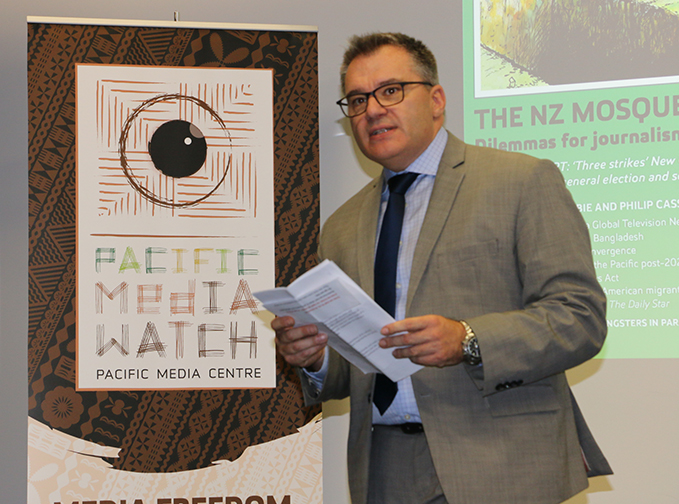
Professor Guy Littlefair … Pacific Journalism Review “provides once again a magnificent example of the best, most relevant most meaningful research”. Image: Michael Andrew/PMC
By Michael Andrew
A creative “grab bag” of projects has been unveiled by the Pacific Media Centre in a showcase of collaboration across academic and communication communities.
AUT doctoral candidate Atakohu Middleton opened the night with a karakia before pro-vice chancellor and faculty dean Professor Guy Littlefair officially launched PJR – which focuses heavily on the New Zealand mosque massacre and media dilemmas of democracy – with a powerful and poignant speech.
Pacific Media Centre director Professor Dr David Robie … an occasion to celebrate a range of projects coming to fruition in one moment. Image: Michael Andrew/PMC
Describing universities as the “critic and conscience of society”, he lauded the value of the new PJR research in light of the media response to the March 15 atrocity.
He said how the privileged Pākehā narrative of New Zealand history made the violence of the attack all the more affronting for a media community consisting of mostly young, white journalists.
“This double issue of PJR that I have the privilege to launch tonight picks up on the narrative at precisely this point,” he said.
“’Dilemmas for journalists and democracy [PJR title]’ – these five words encapsulate for me the critic and conscience role of universities.
“This journal provides once again a magnificent example of the best, most relevant, most meaningful research that I as a dean could hope to see come from this wonderful faculty of ours.
“David and the team, I could not be more proud.”
The trailer for Banabans of Rabi.
Banabans of Rabi Banabans of Rabi was then screened after an introduction by AUT screen production senior lecturer Jim Marbrook.
Marbrook, who helped produce the film, described it as a successful product of collaboration between journalism and screen production students.
He explained that film creators Blessen Tom and Hele Ikimotu had to overcome particular challenges to get to the remote Fijian island of Rabi and make the documentary.
“The philosophy of the Bearing Witness project is to go to areas that are under reported, that are quite difficult to get to; with that comes risks and complications.
“It’s kind of a pressure cooker situation to drop two students into.
“There is not a lot of power on the island, it’s isolated. Complicating that is the mix of languages; Fijian, Gilbertese and Banaban as well.
Blessen Tom then described filming on Rabi where scarcity of electricity meant that he had to be very selective with his choice of shots to conserve battery power.
Sri Krishnamuthi and Blessen Tom’s documentary about Pacific Media Watch.
PMW Project – The Genesis
Postgraduate communications student and former NZ Press Association journalist Sri Krishnamurthi introduced the Pacific Media Watch Project – The Genesis documentary which pays homage to the origins of the PMW media freedom project.
Through making the film with Blessen Tom, Krishnamurthi described learning about the project, from its creation in response to the wrongful arrest of three Tongans in the famous “contempt of Parliament” case in 1996, to its two decades since as a “watchdog of Pacific journalism.”
He stressed the value of the project and its role in the development of student journalists.
“The beauty of it is the use of student contributing editors – all of them will echo my sentiments; that this little gem which is invaluable as a guardian of Pacific journalism must be kept going for years to come.”
PMC Online
Finally, Tony Murrow of Little Island Press unveiled the new mobile friendly and robust PMC Online website, the product of almost two years of his team’s work in collaboration with the PMC.
He said the bold and colourful design reflected the vibrancy and diversity of the Pacific Media Centre.
Pacific Media Centre director Professor David Robie acknowledged all those who had contributed and collaborated on the assortment of projects – including Pacific Journalism Review co-editors and collaborators Khairiah Rahman, Dr Philip Cass, Del Abcede, Nicole Gooch and Professor Wendy Bacon, whom he described as one of the best investigative journalists in Australia.
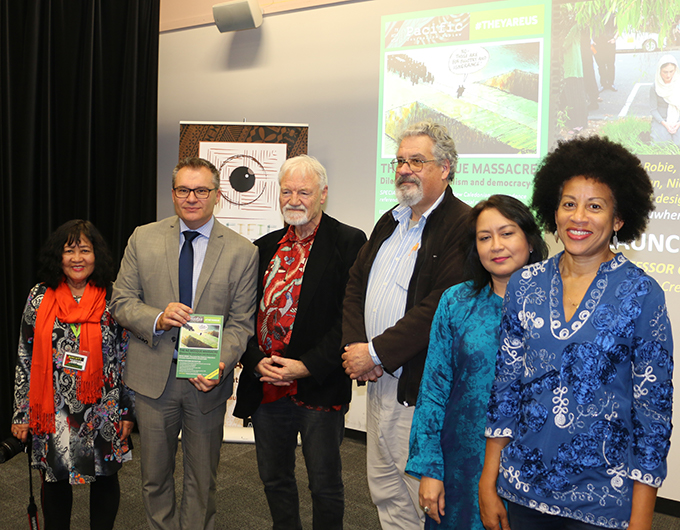
Professor Guy Littlefair with Pacific Journalism Review team members designer Del Abcede (from left), founding editor Professor David Robie, associate editor Dr Philip Cass, assistant editor Khairiah Rahman and Associate Professor Camille Nakhid, an editorial board member and chair of the PMC Advisory Board. Image: Michael Andrew/PMC
Pauline Hanson has saved Energy Minister Angus Taylor from an inquiry into his intervention over endangered grasslands, with a Labor motion defeated 33-32 in the Senate.
Earlier Taylor defended his intervention in a statement to the House of Representatives, insisting he had obtained a meeting with officials on the grasslands in response to representations from local farmers, and there was no canvassing of the compliance issues that were on foot relating to land in which he had an interest.
The opposition continued to pursue Taylor in question time, but it was already clear it would not have the numbers in the Senate for the inquiry. Hanson said One Nation, which has two votes, would not back a “witch hunt”. Labor’s motion had the support of the Greens, Centre Alliance and Jacqui Lambie. The other crossbencher, Cory Bernardi, voted with the government.
In 2017 Taylor sought a briefing on the classification as endangered of the natural temperate grassland. The environment minister at the time was Josh Frydenberg who was not, however, at the meeting that occurred in response to Taylor’s representation.
At the time there was an investigation into the clearing of a section of the grassland on the property of the company Jam Land Pty Ltd, of which Taylor’s brother Richard is a director. Angus Taylor has an interest in Jam Land through his family company.
Taylor told parliament that when he took up the matter there “had been strong antagonism expressed by the farming community about federal and state native vegetation regulation.”
In late 2016 and early 2017 he had spoken with farmers in his Hume electorate and nearby about their worries with the listing of the grassland.
“On 21 February 2017, I spoke with a farmer near Yass who expressed strong and detailed concerns about the revised listing, pointing out that it had occurred despite the concerns of the National Farmers’ Federation and NSW Farmers, and with little consultation with farmers themselves,” he said.
“All of these farmers were completely disconnected from our family farming operations.”
Taylor said the revised listing of the grassland – which is in both the Hume and Eden-Monaro electorates – “would ultimately halt pasture improvement and efficient weed control across the Southern Tablelands and Monaro” and “has the potential to do untold damage to agricultural productivity throughout the region”.
“I sought a briefing on the revised listing from the then minister’s office, which I made clear was not to include any discussion of compliance matters.”
Taylor said FOI documents already released showed that an official had written that the meeting was “to answer questions on the technical aspects of the listing outcome”, and would “stay out of completely” any compliance action underway.
This was how the meeting had gone, Taylor said. “At no time during this meeting, was any compliance matter, or any personal interest of mine, discussed. At that meeting we discussed precisely what the department had said we would discuss.”
The opposition pressed Taylor to produce any correspondence from complaining farmers. Nothing was forthcoming.
Labor’s Senate leader Penny Wong accused Taylor of using his ministerial position to “shore his investments up”.
She told the Senate: “Mr Morrison says Mr Taylor has one KPI, to be the minister for lower prices. But he is the minister to increase the value of his own investments.
“Angus Taylor failed to declare a direct financial interest in a company [in the declaration of interests register]. But worse, he then used his position, as a minister, to defend that company’s interests after it was accused of breaking the law.”
Indian tiger numbers are up, according to one of the most detailed wildlife surveys ever conducted. Tiger populations have risen by 6%, to roughly 3,000 animals.
The massive survey may set a new world standard in counting large carnivores. The encouraging results validate India’s impressive investments in tiger conservation.
Large, solitary predators hate being seen. They owe their entire existence to being able to avoid detection by prey and sneak close before attacking.
Hence, when we want to count tigers, the tigers don’t help. But accurate population numbers are fundamental to good conservation. Every four years since 2006, the Indian government conducts a national census of tigers and other wildlife.
The efforts the project team undertakes to derive the tiger population estimate are nothing short of phenomenal: 44,000 field staff conducted almost 318,000 habitat surveys across 20 tiger-occupied states of India. Some 381,400 km² was checked for tigers and their prey.
(There is an application in with the Guinness Book of World Records to see if this is the largest wildlife survey ever conducted anywhere in the world.)
The team placed paired camera traps at 26,760 locations across 139 study sites and these collected almost 35 million photos (including 76,523 tiger and 51,337 leopard photos). These camera traps covered 86% of the entire tiger distribution in India. Where it was too dangerous to work in the field (14% of the tigers’ distribution) because of political conflict, robust models estimated population numbers.
Millions of photos were analysed to create an accurate count of India’s tiger population.Author provided
Count the tigers
Collecting this volume of data would be an utter waste of time if it were poorly analysed. The teams took advice from some of the world’s foremost experts to sort the photos: pattern matching experts who could identify whether a photo of a tiger taken in the monsoon matched that of a tiger taken in the dry season while walking at a different angle, machine learning experts to speed up species identification, and spatial analysis experts to estimate the populations of tigers and their prey.
The research team took this advice and coupled it with their own knowledge of tiger ecology to develop a census that is unique among large carnivore studies.
We were fortunate enough to be among the non-Indian scientists invited to review this process. Peer review is a crucial part of any scientific endeavour, and especially important as early Indian tiger surveys were notoriously unreliable.
Actual numbers
So how did they do? A total of 2,461 individual tigers older than one year of age were photo-captured. The overall tiger population in India was estimated at 2,967 individuals (with an error range of roughly 12%).
Out of this, 83.4% were estimated from camera-trap photos, and the rest estimated from robust modelling. Tiger numbers have increased by 6% per year, continuing the rate of increase from the 2014 census. This is a wonderful success for Indian conservation efforts.
However not all is rosy. There has been a 20% decline in areas occupied by tigers in 2014 to today, although tigers have moved into some new areas (some 8% of their Indian range is new). The coordinators of the tiger survey – Yadvendradev Jhala and Qamar Qureshi – conclude that while established and secure tiger populations in some parts of India have increased, small, isolated populations and those along corridors between established populations have gone extinct.
This highlights the need for conservation efforts to focus on improving connectivity between isolated populations, while incentivising the relocation of people out of core tiger areas, reducing poaching and improving habitat to increase prey resources.
This will be no easy task with India’s burgeoning population, but investment from private sector tourist corporations in land acquisition along corridors and the creation of community conservancies could supplement government funding for expanding protected corridors.
The success of India’s census has led the governments of Nepal and Bangladesh to employ the same project team to help estimate their own tiger populations. These methods can – and should – be employed for other iconic, charismatic species that can be individually identified, such as jaguars in South and Central America; leopards, cheetahs, and hyenas in Africa, and possibly even quolls in Australia.
This article was co-authored by Chris Carbone, Senior Research Fellow at the Zoological Society of London.
The plan to manage water in the Barwon-Darling is not working, according to a draft review released last week.
The New South Wales Natural Resources Commission, which released the draft report, found the Barwon-Darling is an “ecosystem in crisis”. The report provides a robust blueprint for a more sustainable water-sharing plan.
The review confirms criticism the existing plan gives too much water to irrigators and has added to pressures on the entire Murray-Darling ecosystem.
The draft review examines the 2012 Water Sharing Plan for the Barwon-Darling, which covers 1,600km of the river from Mungindi to Wilcannia. The river here flows south-west through a relatively narrow floodplain with a tightly meandering channel and a highly variable flow pattern.
The river is unregulated and depends heavily on upstream rivers for its water (for example, Condamine–Balonne, Border rivers, Gwydir and Namoi).
January’s massive fish kills around Menindee are only the most recent example of the pressures on the river’s ecosystems. Alongside the fish deaths, research has shown that other aquatic species in the system, such as river mussels, have suffered losses that will take many decades to recover.
Communities that live along the river told the commission people can no longer fish, swim or drink the river water. Graziers struggle to provide water for their stock because the river dries up more often.
Indigenous communities are particularly affected because without water their strong connection to the river – the Barka – is being damaged. A Barkandji elder told the commission:
The river is everything. It’s my life, my culture. You take the water away from us, we’ve got nothing.
Bad priorities
While the review found drought, upstream water extraction in NSW and Queensland and climate change have all contributed to these problems, the greatest effect comes from inappropriate water-sharing rules, particularly when water levels are low.
The law underpinning river management in NSW prioritises protecting the environment and basic landholder rights (including native title) over irrigation. However, the commission found the current plan does not achieve this.
In fact, the plan has been highly controversial since it was enacted in 2012. This in large parts arose because major changes were made between the draft plan circulated in 2011 and the actual plan gazetted in 2012. The commission documents 16 such changes in the review and rates six as substantial.
The NSW government did not publicly explain the reason for such significant alteration in 2012, but there has been much speculation powerful vested interests influenced the government to provide more water for irrigation.
The most important effect of these changes was letting irrigators take water even when the river is very low. The review concludes:
These provisions benefit the economic interests of a few upstream users over the ecological and social needs of the many.
The review recommends the NSW government urgently change water-sharing rules so these better comply with the legal requirements to protect the environment and other water users, restore community trust and make the river more resilient to future shocks.
Key priorities for the NSW government are:
redesigning the water-sharing rules so environmental protection and basic landholder rights cannot be harmed by lesser priorities such as irrigation
introduce new flow targets to more effectively protect critical ecosystems and enhance river health
change rules relating to water extractions by A Class licence holders during critical low-flow periods, particularly those relating to commence-to-pump, cease-to-pump, and the size of pumps.
introduce and enforce more effective metering and monitoring
develop strategies and rules that address the inevitable impacts of climate change
develop and implement more integrated management of water resources in the northern Murray-Darling Basin.
The commission did note there have been positive changes to the NSW government’s approach to water policy and management since the ABC 4 Corners report Pumped in 2017 and the subsequent Ken Matthews report.
However, the Murray-Darling Basin Plan required NSW to complete a new water resource plan for the Barwon-Darling River by June 2019. The state missed this deadline. The NSW water minister has requested an extension to December 31 2019. A recent assessment by the Murray-Darling Basin Authority suggests NSW is still some way from completing this water resource plan.
While NSW delays, the Barwon-Darling river system and its communities suffer. The NSW government now has an excellent blueprint for a new plan. It must urgently implement the review’s 29 recommendations and complete a new plan for the Barwon-Darling before the end of 2019.
When Reece Kershaw takes over as the new commissioner of the Australian Federal Police (AFP) in October he will become the eighth person to lead the organisation since its creation in 1979.
Kershaw becomes commissioner at a critical time for the AFP. The organisation is not in the media’s good books following its post-election raids on journalists working for the ABC and News Corp.
His role will be even more challenging with the AFP now sitting in the Home Affairs portfolio. The AFP Association (AFPA), the union representing 6,500 AFP members, claims the AFP is losing its independence and integrity in the super portfolio. The danger is that the AFP will become politicised over time.
Kershaw has demonstrated he is not afraid of change and tackling thorny integrity issues – traits that could serve him well in his new role.
The question remains, however, whether Kershaw will oversee another transformative era for the AFP, or if our current political and security environment will require more of a focus on organisational stability.
A police force trusted by the public
The AFP was created following the most serious terrorist attack in Australia – the Sydney Hilton hotel bombing in 1978. In the wake of the attack, the Fraser government commissioned Sir Robert Mark, the London Metropolitan Police deputy commissioner, to report on Australia’s policing capabilities. The opening of the report noted that
some aspects of policing are … common to all free societies; for example, the extent to which the effectiveness of a police force depends on public confidence and support arising from its accountability.
The AFP’s dependence on public confidence has not changed in the 40 years since its formation.
Choosing a first commissioner to lead the AFP was difficult. Mark recommended the merger of the ACT and Commonwealth police forces, both of which already had a commissioner. In adopting Mark’s recommendations, the Fraser government choseSir Colin Woods, another former deputy commissioner of the London Metropolitan Police, as the first head of the AFP.
The choice of Woods, another Englishman, avoided a choice of the Commonwealth commissioner over the ACT commissioner – or vice versa.
Woods’ successors were Major General Ron Grey; Northern Territory commissioners Peter McAulay and Mick Palmer; and AFP deputy commissioners Mick Keelty, Tony Negus and Andrew Colvin (who is stepping aside at the end of September).
Changes in the political environment over the years, as well as heightened security concerns from crime and terrorism, have required some of these men to be greater agents of change than others.
Palmer, for instance, remodelled the AFP’s national arm from a quasi-military service to a more flattened team structure during his term as commissioner from 1994-2001. This created a flexible and dynamic model of policing that put the AFP in a good position to handle the terrorist threats that followed the 9/11 attack and 2002 Bali bombings.
During his time as commissioner, Mick Keelty was fond of saying, ‘If a police force doesn’t have its integrity, it has nothing.’Alan Porritt/AAP
This action, among others, helped build public trust in the AFP. The latest Essential poll in March showed that the AFP – along with other police services – enjoyed the highest level of public trust of any Australian institution and organisation.
Maintaining this trust will be one of Kershaw’s key challenges, particularly in the wake of the AFP media raids.
When I was working for the AFP, I often heard Keelty tell audiences:
If a police force doesn’t have its integrity, it has nothing.
Kershaw’s focus on integrity issues
Kershaw began his policing career with the AFP in 1988 and clearly learned lessons about leadership integrity while serving under Keelty.
Kerhsaw then stepped into the NT commissioner role, which he held until his current promotion.
The reports that have followed Kershaw’s shift from NT to federal commissioner are telling. The acting NT commissioner, Michael Murphy, praised Kershaw for confronting integrity failures at all levels.
We need to police by consent, that is vitally important. Commissioner Kershaw made it quite clear that if you can’t align with those values, then you shouldn’t really belong to a public safety agency.
This reflects the Mark report’s observations on the role of the police from 40 years ago.
Kershaw’s ability as a deputy commissioner to confront his superior also shows the moral strength expected of police leaders. He will need to exercise this strength in his new role as the political pressures on the AFP are sure to increase.
The Morrison government will likely demand that any future national security leaks be investigated. These have always been sensitive for any government. And special references from government – the technical term that includes leaks – cannot be ignored by the AFP.
Dealing with the special references from government in a balanced way will shape a bigger challenge for Kershaw – maintaining the AFP’s independence in the Home Affairs portfolio. If the AFP becomes permanently enmeshed within the Home Affairs culture, it may indeed lose its identity.
In the 78 years between the time of federation in 1901 and the creation of the AFP, the Commonwealth relied on ten different police forces. It then took years to overcome the ACT-Commmonwealth rivalry within the AFP. With the 40th anniversary of the AFP now approaching, few if any serving officers will have known anything but the current culture of the AFP.
Defending and improving this culture through further integrity-building will benefit both the AFP and the Australian community at large. We should all wish Kershaw success in these endeavours.
James Marape told The Guardianthat Australia had “a moral responsibility … to the upkeep of the planet”, particularly given the extreme effect it was having on smaller Pacific nations.
“I don’t intend to speak from Canberra’s perspective, they have their own policy mindset, but as human beings I know they will respond to the moral obligation that is prevalent amidst us, that we are environmentally sensitive to the needs of others.”
He said the voices of smaller island nations must be listened to.
“As big countries in the Pacific – Papua New Guinea, Australia, New Zealand – we have a sense of responsibility to the smaller island countries, because displacement of these smaller communities will first and foremost be our neighbourhood responsibility,” Marape said.
In a wide-ranging interview, Marape outlined a vision for his country, to leave behind a history of wasted opportunities and squandered resources, and move towards a healthy and educated nation free of violence.
– Partner –
In May, after Scott Morrison led the Coalition to an election victory, Pacific leaders urged him to do more on climate change, saying Australia was “lagging behind”.
Marape, undertaking his first official visit to Australia last week, said he would “not be silenced” on environmental responsibility.
“We can have our resources but we must have it in an environmentally-friendly manner, so that we leave planet earth to the next generation not in the form we’ve inherited but a better form.”
He said he believed Australia, New Zealand, and PNG should lead the Pacific as a “bloc” of nations reconstructing their economies to handle resource productions in a more environmentally and socially sensitive way.
On Thursday Marape warned foreign companies already in PNG that he intended to crack down on regulatory compliance, and also shake up revenue processing to ensure PNG drew at least 50% in taxes and royalties.
He also wanted to see a shift towards an agricultural exports economy, as a “food bowl for Asia” rather than the current dependence on mining.
“For the amount of wealth the lord has blessed us with … the actual translation of this resource into improving peoples life hasn’t happened well in 44 years,” he told Guardian Australia.
“I don’t blame the past they lived at the time. They wrote the history, I’m going to write the future for our country.”
He said if his government didn’t get the balance right, future generations would blame them.
His comments followed an ambitious declaration on Thursday that the impoverished nation would be free of its dependence on Australian aid – more than half a billion dollars a year – within the decade.
He told Guardian Australia a prosperous PNG was a “win-win” for Australia.
“If we are independent economically, if we are solid and sustaining our own life, your taxes don’t need to come to us,” he said.
“We’ll keep the borders up north safe, we’ll have a better, friendly region up there, so the entire region is safe. If we disintegrate up there it affects Australia too.”
This article is republished by Asia Pacific Report with permission from Keith Jackson’s blog PNG Attitude.
Ligandrol can help repair and build muscles. While it has been studied as a treatment for cancer and other conditions where patients experience muscle weakness and wastage, it is banned for use by professional athletes.
So how long has this drug been around, and how does it work?
History of Ligandrol
Ligandrol, which is also known by the development codes LGD-4033 and VK5211 and the name Anabolicum, was initially developed by the company Ligand Pharmaceuticals in the United States. It was patented in 2009.
The drug has also been examined for other conditions, including as a possible treatment for cancer-related weight loss, enlarged prostates, for patients who have a diminished function of testes and ovaries, and as a potential cure for breast cancer.
Ligandrol is still considered an experimental drug, and as such, is not approved for sale by the Australian Therapeutic Goods Administration (TGA).
How Ligandrol works
Ligandrol is taken orally as a tablet at doses between 0.5 and 2 milligrams.
The drug is what pharmacists call a selective androgen receptor modulator (SARM). These drugs bind at specific sites on skeletal muscles. There, they initiate a cascade of processes which change the expression of different genes in the DNA of muscle cells. The end effect is an increase in the repair and growth of muscle.
This means Ligandrol works in a similar way to testosterone and anabolic steroids, although SARMs typically have fewer side effects. The typical side effects of anabolic steriods can include short-term aggression and violence, acne, and sleeping difficulties, and long-term effects such as damage to the liver and kidneys, depression, and high blood pressure.
In contrast, in clinical trials of patients taking Ligandrol, the rate of side effects was similar to those in the placebo group and included headache and dry mouth. While clinical trial participants on Ligandrol did have a higher rate of throat infections, it was concluded this was not due to the drug.
Because Ligandrol can potentially be used to gain an advantage in competitive sports, the World Anti-Doping Agency (WADA) placed the drug on its prohibited list.
Shayna Jack’s hypothesis that it must have entered her system through contaminated supplements is not without merit. The TGA regularly bans the import of supposedly natural supplements for weight loss, erectile dysfunction, and body building because they contain prescription-only medicines.
For safety and security, athletes should only use supplements from reputable brands bought from reliable stores in their home country. The risk of accidentally taking a banned substance is significant if an athlete buys supplements online.
The 166 donated vehicles used during last year’s Asia Pacific Economic Cooperation (APEC) conference in Papua New Guinea have been distributed to government institutions, non-governmental organisations and churches.
They were handed over by the Department of Finance in Port Moresby last Friday.
Present to officially handover vehicle keys to recipients was Minister for Finance and Rural Development Charles Abel and Finance Secretary Dr Ken Ngangan.
The vehicles were donated to the Papua New Guinea government by the governments of China and Japan.
“As part of the process of disposing of assets acquired for APEC, we are starting with the vehicles given, they are of high value. The disposal will not only include vehicles but all assets that were purchased by the APEC authority,” said Dr Ngangan.
– Partner –
“It has taken us a long time but the process that we going through are done transparently so to account for all assets purchased.”
Dr Ngangan said all these was submitted to the Finance Minister and then to the attention of the National Procurement Commission for endorsement of disposal of donated assets.
Public assets He said the process of disposal follows under the Procurement Act and the Public Finance Management Act complies with disposal requirements.
“The Department of Finance is the department responsible for the disposal of public assets and we have now taken ownership of all assets purchased by the APEC Authority.
The next process will include the state-purchased assets which is about 321 in total,” he said.
“After that we will provide a full report and submit to our Finance Minister, and to the National Executive Council, National Procurement Commission board and other oversight agencies like Ombudsman Commission and to everyone including the general public.”
Last week, violent riots erupted in the NSW Frank Baxter Juvenile Justice Centre. Several inmates allegedly attacked known sex offenders, and a held a siege on the rooftop lasting nearly 22 hours. In June, officers at the centre walked off the job after a number of violent attacks by detainees.
And on average, 980 young people were in youth detention in Australia every night in the June quarter of 2018. While there has been some fluctuation in this number, there has been an overall increase in the average number of young people in detention per night since 2014.
This crowding and rising tensions have led to an Australia-wide spotlight on youth detention, which began with the 2016 ABC Four Corners investigation, “Australia’s Shame”, on the treatment of young offenders in detention centres in the Northern Territory and, in turn led to a royal commission into Northern Territory’s youth justice system.
Young people in detention often come from unstable backgrounds, their literacy levels are generally very low, they have extensive childhood trauma. On release, their prospects of employment are low. And many young people in custody are known to have experienced some form of childhood trauma, such as neglect, and physical, sexual and emotional abuse.
But research has shown young people often grow out of their offending behaviours and rejoin their local communities.
It’s time the youth justice system considered alternative community-based models that better recognise the ability for young people to abandon crime.
The juvenile justice system in NSW
In Australia, a person under the age of 10 years old cannot be charged with a criminal offence, and young person must be at least 18 to be tried in court as an adult.
The Young Offenders Act 1997 is the primary diversion legislation for young offenders in NSW. “Diversion” is used to steer young people away from involvement in the criminal justice system or deter their long-term involvement into adulthood.
The principles of this act are to ensure there are alternative measures in place to deal with young people who come into contact with the criminal justice system. These measures include warnings, cautioning and Youth Justice Conferencing.
It’s widely accepted there are certain, more minor crimes committed disproportionately by young people, such as property crime. In these cases, young people are more likely to end up diversionary programs.
Those who do end up in custody are likely to have done so for more serious offences, for example, drug, sexual or terrorism offences, and many of the detainees have histories of violence.
While being withdrawn from the community is part of the punishment for these young people, the isolation of custody can have compounding problems upon release. As a result, there are growing calls for an overhaul of the youth justice system.
The New Zealand model
Following the recent Frank Baxter riots, Stewart Little, the general secretary of the Public Service Association, has called for a judicial inquiry. And Ruth Barson, director of legal advocacy at the Human Rights Law Centre, said the worst course of action would be a “knee-jerk and punitive” response.
Rising tensions in youth justice centres have led to calls for an overhaul of the system.Dean Lewin/AAP
While reform would happen on a state-by-state basis, Australia could look to the New Zealand model to deal with young people who come into contact with the youth justice system.
The New Zealand model has a strong focus on community, and recognises that the majority of young people grow out of participating in crime.
When a young person comes into contact with police, Police Youth Aid officers have specialised training to work with young people to divert them from the court system.
As a result, as many as 80% of young people in New Zealand are diverted from the court system.
If a young person does end up going before the court, they first undertake a Family Group Conference where the best form of intervention is determined. This process is supervised by the court and ultimately goes back before the judge for approval.
The young person is active in this process. But if they don’t comply, they must then go through a more formal process. This can take many forms, depending on the nature of the offence, such as a hearing in Youth Court or the matter may be transferred to the district court.
In part, this model is being trialled in Queensland. The families of Aboriginal and Torres Strait Islander children who come into contact with the criminal justice system are being given a greater role in family-led decision-making and Youth Justice case planning.
While custody may have a place in the youth justice system, an overhauled framework might look to place a stronger focus on the role of the community and breaking down barriers and stigmatisation of justice involved young people.
Source: The Conversation (Au and NZ) – By Deborah Bateson, Clinical Associate Professor, Discipline of Obstetrics, Gynaecology and Neonatology, University of Sydney
Fertility awareness apps are being championed as a new approach to contraception. In reality, while the technology may be new, women have been predicting the fertile days in their menstrual cycles to prevent pregnancy for a very long time.
But the growth of the “femtech” industry, alongside a seemingly growing wave of younger women looking to move away from hormonal methods of contraception, has led to a renewed interest.
Fertility awareness methods and apps can help women better understand their bodies, are relatively cost-effective, and have no side-effects.
Yet at the same time, the apps rely on dedicated daily monitoring and data entry, and strictly abstaining from unprotected sex for several days each month. They also leave significant room for user error.
Most importantly, their effectiveness remains to be properly proven with research evidence.
We don’t know exactly how many Australian women use these apps, but a 2016 survey found 2.8% of contraceptive users aged 18 to 51 were using a fertility awareness method of contraception.
Anecdotal clinical experience points to a small but increasing number of women who may at least be trying a fertility awareness app.
Importantly, not all fertility apps are equal. The earliest apps were designed to predict fertility to optimise a woman’s chance of becoming pregnant. Some apps available today can function either for this purpose, or to prevent pregnancy.
Tracking apps such as Period Tracker and Clue simply monitor the menstrual cycle and associated symptoms.
Contraceptive apps go a step further, using an algorithm to compute the fertile and non-fertile days in a woman’s cycle. The app alerts the user to abstain from sex (or use a condom) on fertile days, and indicates on which days unprotected sex is less likely to lead to pregnancy.
Women using fertility awareness methods of contraception will need to abstain from sex, or use a condom, for several days every month.From shutterstock.com
Most of these apps also collect data on basal body temperature, while some call for a woman to examine her cervical mucus secretions – both additional indicators of fertility.
Only Natural Cycles, an app designed by Swedish husband and wife scientists, has been licensed as a contraceptive device (though not in Australia). Although certified by the European Union and US regulatory organisations, it has not undergone the Australian Therapeutic Goods Administration approval process.
How do fertility apps work?
While the eggs released from the ovary each month survive for around 24 hours, sperm can survive for five days or more in the uterus and fallopian tubes. This means a woman has roughly six fertile days each month.
This “fertile window” extends from the five days before ovulation to one day after ovulation. The challenge lies in predicting exactly when ovulation – the egg release from the ovary – occurs.
Calendar-based methods rely entirely on menstrual cycle length and an assumption that ovulation occurs 14 days before the next period. But both menstrual cycle length and ovulation timing are highly variable, making these methods less effective than fertility awareness methods of contraception which include additional fertility indicators.
“Symptothermal” methods, for instance, involve taking the basal body temperature first thing every morning with a special thermometer in the vagina. This checks for the small rise in core temperature that follows ovulation (although illness or a late alcohol-fuelled night out can affect the reading).
A daily check for a sensation of wetness at the entrance to the vagina can also be added. Cervical mucus becomes stretchy and viscous during fertile days to help sperm swim up into the uterus.
The number of directed abstinence days varies between apps. The Natural Cycles app plays it safe with approximately ten “red for no sex” days per cycle, and sends motivational messages to help support adherence.
An app called Dot advises 11–13 high risk days, depending on the user’s cycle lengths and other factors. This longer window is likely because this app relies on menstrual cycle length alone, and so may be less precise in predicting ovulation.
How effective are fertility apps for contraception?
Contraceptive effectiveness is based on the number of pregnancies occurring in the first year of use, both in perfect research conditions and in typical everyday use.
The oral contraceptive pill is more than 99% effective in perfect use, but up to seven in every 100 women become pregnant in the first year of typical use, due to forgetting pills or running out.
Different women will have different preferences for contraception. But it’s important to understand the pros and cons of each option.From shutterstock.com
Studies of the Natural Cycles app report a typical use failure rate of 7%, similar to the contraceptive pill. But these studies have been controversial and their authors have acknowledged limitations in capturing accurate data on unplanned pregnancies.
For example, in one study, the pregnancy rate relied on users logging a positive pregnancy test result on the app, but also on assumptions made about possible pregnancies among women who discontinued the app and therefore weren’t followed for the duration of the research.
Where to from here?
Although the “perfect use” figures may look high, we need more rigorous research into fertility apps – which notably leave much room for “imperfect use”.
Learning to use fertility awareness methods of contraception can be complicated and arduous to maintain. Modifying sexual behaviour in line with instructions from the app can also be a challenge.
Research into the Natural Cycles app found high discontinuation rates. Some 54% of women stopped using it after one year of use.
Women who are dissatisfied with other methods of contraception or prefer a hormone-free approach for personal or medical reasons, and are comfortable with the demands of the method, may choose to use apps.
But the bottom line is, fertility awareness apps are not as effective as other methods of contraception (particularly IUDs and implants). Apps require dedicated daily monitoring and data entry, strict adherence to when you can and can’t have unprotected sex, and leave room for user error.
The scientific community will continue to call for more high-quality research, while fertility apps with seductive “scientifically proven” and “clinically tested” claims will undoubtedly proliferate.
In making an informed choice, it’s important for every woman to be aware of the pros and cons of all contraceptive methods. Your doctor or local family planning clinic can provide advice and direct you to evidence-based resources.
Australia carries an enormous and increasing mental health burden. At the same time, housing disadvantage is on the rise in Australia. Our latest research indicates the trends are related. A systematic review of the evidence shows housing disadvantage is harmful for mental health, and the effects stay with you well after your housing situation might have improved. For instance, living in an overcrowded house from birth to early childhood is associated with depression in midlife.
In recent years, several high-quality Australian and international studies have sought to understand the relationship between housing disadvantage and mental health. A small portion of this evidence base has attempted to rigorously quantify the effect of housing on mental health over an extended period. Bringing the results of such longitudinal studies together, we conducted a systematic review to establish whether housing disadvantage can lead to poorer mental health down the track.
Housing disadvantage includes overcrowding, falling behind on mortgage payments or rent, moving house often, insecure housing tenure, subjective perception of inadequate housing, eviction, or poor physical housing conditions. Our systematic review of international evidence shows that, regardless of how housing disadvantage is considered, there is a correlation with poorer mental health in future.
In the studies we reviewed, sample sizes ranged from 205 to 16,234 people. The follow-up period ranged from within one year to as long as 34 years across all life stages — birth to adulthood and old age. Despite deliberately excluding studies on the two extremes of homelessness and severe mental illness, we found each study confirmed an association between at least one marker of housing disadvantage and poor mental health.
The mental health outcomes included higher odds of depression, stress and anxiety. The studies included in the review detected these outcomes across all age groups from both very short follow-up periods of about two years to reasonably long periods over decades.
These findings make sense. Housing is a central part of our lives. It is, for most of us, our largest expenditure. It shapes our experiences; it is both a financial asset and a home.
Our review highlights a great diversity of mechanisms through which housing affects mental health outcomes (such as anxiety and depression) at different stages of life. For example, physical housing problems such as damp or cold affect mental health in different ways to housing-related financial insecurities. But there is evidence that physical housing and affordability problems may work together to amplify the mental health effects.
At the same time, our public housing sector can only provide a safety net for the most vulnerable people with high and complex needs. Waiting lists are long. And we’re seeing no substantive government commitment to reduce this shortage of social housing.
In addition, the quality of our housing is getting worse across the entire housing stock. The Australian Index of Unhealthy Housing is a composite measure of housing affordability, security, quality, location and accessibility. The index charts an increase in housing disadvantage across our housing stock since 2000, including a marked increase for low-income private renters.
Due to the growing unaffordability of housing, many of us simply cannot keep up with basic maintenance and repairs. Band-aid solutions mean some of us live with cold and damp housing, homes that leak when it rains, homes unable to accommodate growing families, or homes that may not support our needs as our mobility declines. At the most extreme end, 116,427 of us were homeless on census night.
Given the scale of housing disadvantage, its role in driving poor mental health should greatly concern us all. It suggests a large number of Australians will suffer with mental health issues related to, or worsened by, inadequate housing.
The changes in tenure and quality in the housing sector have been widely discussed. The mental health consequences of housing also need to be discussed and even prioritised.
The Australian government’s latest research funding initiative, the Medical Research Future Fund, has a “Million Minds Mental Health Research Mission”. It aims to support research into the causes of mental illness, and the best early intervention, prevention and treatment strategies. Our systematic review suggests it is vital that both research and public investment directed towards improving mental health consider the affordability, quality and condition of people’s housing.
Housing is central to our lives. When it is affordable, secure and in good condition, it provides a foundation for us to participate fully in and contribute to society.
If we discovered a risk-free medication that protected people’s mental health, we would be clamouring for it to be made widely available. In considering the shape that housing policies might take, what if we thought of decent housing as a form of mass medication? A protective safety net? Wouldn’t it be something we’d invest in and prescribe for all?
The ACCC did not set out to determine whether either company has broken the competition rules. That can only be determined in an investigation of specific conduct based on specific facts and evidence.
Having identified risks, the ACCC did set out to determine how they might be contained.
Its proposals are rightly cautious, reflecting the complexities of digital markets and the challenges in ensuring that any intervention protects the competitive process rather than individual competitors.
With market power comes dangers
The ACCC points out that substantial power won by serving consumers is not against the law.
It acknowledges that Google and Facebook provide services that are highly valued.
And it emphasises the distinctive features of digital markets that contribute to this power: extraordinary economies of scale, network effects, massive accumulations of data and the use of highly sophisticated data analytic techniques.
These features help Google dominate internet search and internet search advertising and help Facebook dominate social networks and display advertising.
While they also help deliver value for consumers, they can be used against new entrants that may offer a better deal and against other businesses (such as traditional media companies) that have come to rely on Google and Facebook to deliver services to customers.
The ACCC wants to reduce the risks…
There are no quick fixes. The ACCC rightly rejected the idea that platforms such as Google and Facebook be broken up.
Given the highly interconnected complex nature of the markets in which the major platforms participate, divestiture would not guarantee, and might in fact harm, consumer welfare.
The report recommends instead building up the ACCC’s capacity to aggressively enforce the competition rules and to review acquisitions that would further entrench the dominant players’ market power.
Many of the other recommendations are designed to ameliorate imbalances in information and bargaining power between the platforms and business users, and between the platforms and consumers in relation to the collection and use of their personal data.
Implementing these recommendations presents challenges, not the least of which is to ensure they don’t themselves damage competition.
…hunt out abuses…
The ACCC proposes the establishment of a new specialist branch within the ACCC to build and sustain the skills needed to continue studying digital platforms and enforcing their competition and consumer rules.
This is a welcome initiative. It replicates similar capacity-building initiatives in the United States and Europe.
The report is peppered with references to European cases in which Google has been subject to thundering fines for various abuses of dominance. It also invokes the European mantra that these powerful companies have “special responsibility”.
But the Australian misuse of market power prohibition may not be flexible as the one in Europe. The ACCC has recommended broadening the unfair trading law in order to allow it more flexibility, and not only for use in dealing with digital platforms.
The recently amended section 46 of the Competition and Consumer Act will play a role, but it is yet to be taken for a proper run and, in the digital context, its application will be complicated by the rapid pace of innovation in digital markets.
…and scrutinise mergers…
In an acknowledgement that digital mergers are different, the ACCC wants to ensure the merger laws pay attention to mergers with potential as well as actual competitors, and to mergers with the owners of data assets.
It also wants Google and Facebook to voluntarily notify it of any future acquisitions. This is a polite request backed by a thinly veiled threat of repercussions.
But the report also implies that neither of these proposals may be enough.
Still more changes to the merger law might be needed to persuade judges of the need to stem unhealthy concentration in the Australian economy generally.
Australia almost certainly needs a compulsory notification regime, triggered by a combination of turnover and transaction value thresholds to ensure nascent competitors are not snuffed out.
Both of these are bigger conversations that the Commission needs to engage government and business in.
…while not offering much for legacy media…
The Commission has stepped away from a proposal in its preliminary report that there be a special regulator to oversee the relationships between platforms and media organisations, significant business users and advertisers.
It might have listened to criticism that the proposal would benefit traditional players in disrupted industries more than it benefits consumers.
The advertising industry is highly fragmented, complex and constantly changing. The evidence that the new platforms are distorting competition in the industry is questionable at best. The ACCC has sensibly suggested it needs to thoroughly examine dynamics in the ad tech supply chain before firming up any recommendation.
For the media industry, the compromise is that each platform be required to negotiate a code of conduct to be overseen and enforced by the Australian Communications and Media Authority.
Whether this will address media concerns about the appropriation of their content and about short notice periods for algorithm changes that can make their products hard to find remains to be seen.
But, recognising that the platforms are themselves knee-deep in the media business, the ACCC has called for a wholesale overhaul of media regulation to level the playing field and remove regulatory impediments to competition, an idea the government seems to have accepted.
…and upgrading protections for privacy
The call for broad ranging reform of our privacy laws to wrench them into the digital age is also likely to be accepted by government.
The platforms might grumble at additional privacy requirements imposed country by country without an international standard, but the proposal to work with them on the development of an enforceable code at least allows them a seat at the table, and a chance to ensure the regulations are workable.
The challenge will be to ensure that the regulatory burdens don’t disproportionately hurt small businesses and prospective entrants, the ones the ACCC wants to help.
An imminent ACCC-led reform that will help both new entrants and consumers is the Consumer Data Right, which will give consumers more control of their data and enable them to move it between suppliers.
The ACCC’s work on digital platforms has just begun and there is a long and bumpy road ahead. The government should give it the time and money it will need to get on with it.
Caron Beaton-Wells is host of the Competition Lore podcast, exploring competition policy and law in a digital age.
Source: The Conversation (Au and NZ) – By Amanda Lotz, Fellow, Peabody Media Center; Professor of Media Studies, Queensland University of Technology
Living with two preteens, I get almost daily requests to approve new apps. My standard response is to ask my kids to describe the app, why they want it, and how it makes money.
The last question is important, and not just to avoid to avoid in-app charges. Understanding the forces that drive the online economy is crucial for consumers, and increasingly citizens. All the new tools we access come at a cost even when they seem to be free.
How technology companies make money is a good question for digital media users of any age. It lies at the heart of the Australian Competition and Consumer Commission’s inquiry into the power and profits of Google and Facebook, the world’s two most ubiquitous digital platforms.
The competition watchdog’s job was to look at how online search engines, social media and digital content aggregators wield power in media and advertising, how that undermines the viability of traditional journalism (print in particular), and what can be done about it.
Limited recommendations
Its final report makes a swag of recommendations to limit these platforms’ market dominance and use of personal data.
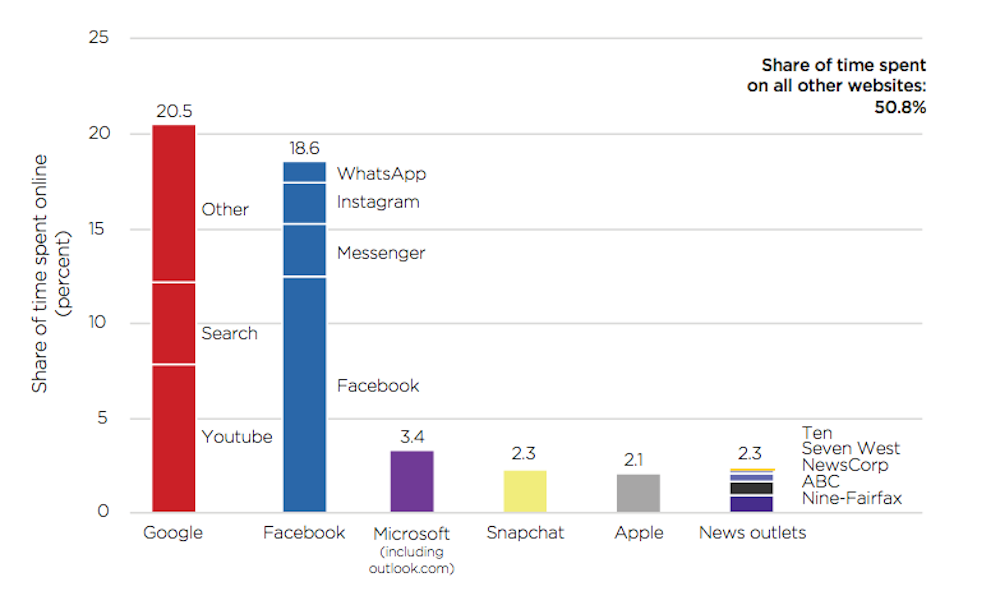
One example is requiring devices to offer consumers a choice of search engine and default browsers. Google now requires Android phones to pre-install Google apps. This feeds a “default bias” that contributes to it being used for 95% of Australian searches.
Another is reforming Australia’s privacy laws to address the digital environment. Platforms’ “take it or leave it” policies now give consumers little choice on having their data harvested.
But on the area of concern central to the inquiry’s establishment – the decline in journalism – the recommendations are relatively minor:
a code of conduct to treat news media businesses “fairly, reasonably and transparently”
“stable and adequate” government funding for the ABC and SBS
government grants (A$50 million a year) to support original local journalism
tax incentives to encourage philanthropic support for journalism.
The reality is that there is little governments can do to reverse the technological disruption of the journalism business.
Targeted revolution
The internet has made stark that news organisations aren’t primarily in the journalism business. The stories they produce play an incomparable social role, but the business model is to deliver an audience to advertisers.
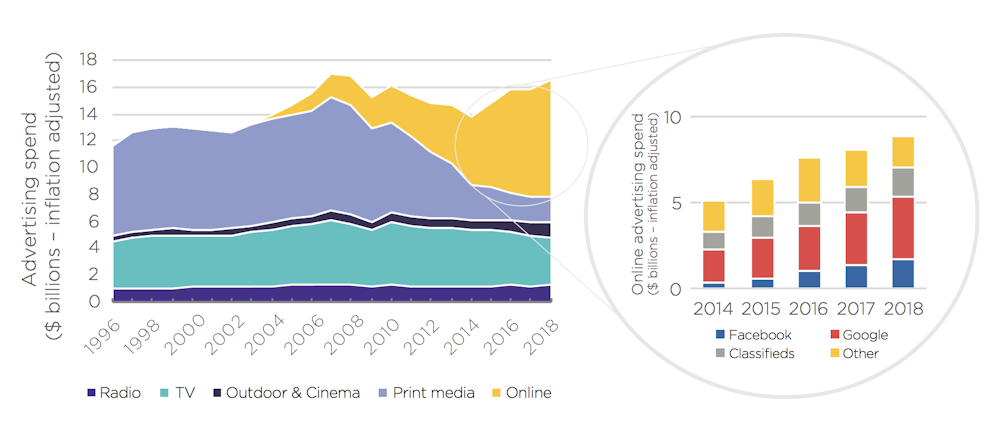
Australian advertising expenditure by media format and digital platform.ACCC
Social media and search give advertisers better tools to target messages to more precise groups of potential consumers. It is a phenomenally better mousetrap.
Traditional advertising is expensive and inefficient. An advertiser pays to reach a broad audience, most with no interest in what is being advertised.
Search allows advertisers to pay to reach people precisely when they are looking for something. Google knows what you are interested in, and serves up advertising accordingly. In the last quarter alone its advertising in its properties (Search, Maps, Gmail, YouTube, Play Store and Shopping) made US$27.3 billion in revenue.
Social media platforms have a different model, but one no less damaging to the old newspaper business model. It’s a bit more like traditional mass media advertising, selling the attention of users to advertisers, but in a far more targeted way.
To the extent Facebook, Instagram, Twitter and so on capture your attention, and effectively monetise content made by others through sharing, they also undercut traditional news businesses.
Follow the money
No regulation can fix this. As the competition watchdog’s report notes, Australian law does not prohibit a company from having substantial market power. Nor does it prohibit a company “from ‘out-competing’ its rivals by using superior skills and efficiency”.
No one – not even the tech companies – is necessarily to blame for the technological innovation that has disrupted traditional news organisations.
To see that, as with my kids understanding how their apps make money, it’s just a case of following the money.
Making super contributions voluntary for people earning less than A$50,000 a year, as proposed by Liberal Senator Andrew Bragg, would be a backward step for women.
It would predominantly be used by women, because more women earn less than A$50,000 than men. In 2016-17, 306,008 women earned less than A$50,000, compared with 216,749 men.
Many would find it a help. An extra 9.5% of salary (an extra 12% if compulsory superannuation contributions climb as planned) would be exceedingly useful.
And most women have much less super than most men. In 2017, the median super balance for women aged 60-64 was A$36,000. For men it was A$110,000.
This is partly because women are much more likely than men to take time out of work or to work part-time to care for children and other family members, and partly because of the persistent gender pay gap.
The gender pay gap means that women contribute less to superannuation, and as a result are much more likely than men to experience poverty and hardship in retirement and will have to rely on the pension anyway, regardless of super.
So why not let women take the money?
Senator Bragg says his proposal could lift disposable incomes for low earners, and save the government A$1.8 billion in the first year alone, because earnings taken in cash are taxed more highly than earnings paid into super – although these people are least able to afford the extra tax.
But it could also change the dynamics within relationships.
Compared with other developed countries, Australia has a high proportion of “1.5 earner” families, made up of a man working full-time (often earning much more than A$50,000) and a woman working part-time (often earning less).
They would be tempted to regard the lower earner’s superannuation account as unnecessary and take the money upfront, using only the higher earners account for retirement.
The inevitable outcome would be a reversal of the recent narrowing of the superannuation gap, with women increasingly dependant on their husbands (or a good divorce lawyer) for security in retirement.
Why not make super meaningful?
There are alternatives that would reduce the gender gap in retirement incomes. The 2016 Senate inquiry into economic security for women in retirement recommended government contributions during parental leave and removing the exemption for employers of low income earners earning less than A$450 per month.
And in 2010 the Henry Tax Review recommended a flat tax concession for super contributions, instead of the present one that widens the gap between low and high earners.
Although successive governments have made changes to the superannuation system, none has adopted the recommended flat tax concession. Nor have they shown much concern for workers earning less than A$50,000.
Earlier this month, Senator Bragg’s party pushed through parliament legalisation that excludes workers earning less than A$48,000 from the full budget tax offset.
Workers earning less than A$50,000 find it difficult to make ends meet. It is true that the super system (and the new tax offset) treats them badly. But allowing them to opt out of super would make them even more reliant on either the pension or better-off partners.
In her book Wordslut, Amanda Montell argues that patriarchal assumptions deny women an active role in society, claiming that, “In our culture, men run the show”.
With a degree in creative writing and linguistics, having studied “how language works in the real world”, Montell has set out to “verbally smash the patriarchy”. Her aim is to educate a readership of women who need “the knowledge to reclaim the language that for so long has been used against us”.
She promises that:
By the end of this book you’ll have all the nerdy know-how you need to sound like the sharpest word ninja in the room.
The wording of her promise sums up both the strengths and weaknesses of this book. Montell tries too hard to popularise her agenda by adopting up-to-date slang and jargon, although she must be fully aware of how transient and imprecise this strategy makes her argument.
Black Inc
Occasionally, she is also seduced into making irrelevant asides that contribute nothing to her argument. For example, she mentions a seminal feminist paper that was published in 1997, “the same year as Princess Diana’s death and Mike Tyson’s bite fight”.
Despite all this, it is a book that explores the fascinating etymology of words such as “bitch” and “slut” that we were taught never to use in polite company, and which have nonetheless underpinned gendered attitudes.
Gender and sexuality
Since the second wave of feminism in the 1970s, sociolinguists have been studying language and gender: how people use language to express gender, how gender impacts how a person talks, and how their speech is perceived.
Montell comprehensively discusses the way in which second-wave feminist activists put the distinction between sex and gender on the “mainstream cultural radar in the mid 20th century”. She notes that “no one ever posed a semantic distinction between sex and gender until the 1960s” and that the word gender didn’t enter the mainstream English lexicon until the 1980s.
As she also notes, the rise of the #MeToo movement with fifth-wave feminism has accelerated discussions around gender and sexuality in the press, with even the Summer 2019 issue of Playboy magazine dedicated to the topic.
Montell’s book ranges across issues relating to sex, gender and language with many provocative pronouncements.
Amanda Montell, author of Wordslut.Black Inc
The most astounding, to my mind, is her claim about “valley-girl ‘vocal fry’,” also known by linguists as “creaky voice”, “a raspy, low-pitched noise that we often hear as people trail off at the end of their sentences”. Particularly teenage girls.
Montell says that:
Today’s sharpest linguists … have data suggesting that “teenage girl speak”, one of the most loathed and mocked language styles, is actually what Standard English is going to sound like in the near future. In a lot of ways, it’s already happening. And that’s making a lot of middle-age men very, very cranky.
Her credibility would have been enhanced if she had provided data for this bold claim, as it would seem to me that this is a style of language mostly confined to certain parts of California.
Montell rails against sexism in relation to women, but exhibits it herself in relation to men, particularly older men. Through most of the book she uses the term “dude” to replace the word “man”, oddly claiming that “today dude is one of the most beloved terms in the English language”.
Her ageism is evident when she discusses how labels such as cisgender, transgender, graygender, and pansexual “aren’t surfacing just because it’s suddenly trendy to have an identity that will perplex and/or pissoff all our great-aunts and-uncles at Thanksgiving”. She quotes many male and female linguists throughout the book, but mentions the age of only two, a woman who is “now in her 70s” and a man who is 58 years old.
In his preface to Gwynne’s Latin (2014), the conservative British grammarian Neville Gwynne mentions what he calls the “now-contentious problem of how to express what for the entire history of English literature until the last few decades was the all-embracing ‘he’.”
Surprisingly, he suggests that before then it was never considered “remotely inappropriate or uncomfortable” and goes on to comfort the readers of his book by stating that “on the few occasions [in his book] that you see the all-embracing “he” or equivalent, that it is occurring without any offence being intended”.
Publications such as the Australian government’s Style Manual for Authors, Editors and Printers have accepted the singular “they” for decades, way ahead of those in the UK and the USA. Montell advocates the singular “they”, along with North American linguistics societies and dictionaries, although The Times style guide does not enthusiastically endorse it:
He and his can no longer refer to both sexes equally; he or she will sometimes do. It is often easier to use the plural they for he or she, and sometimes even the ugly their for his or her. Do this only when necessary.
Montell predicts, however, that “20 years from now, introducing yourself with your name and your pronouns could become the norm”.
In a book that aims for an educated readership, we would expect to see an index and a list of references. This book has neither. Montell’s failure to consistently and meticulously cite her sources somewhat diminishes the value of the book.
Much of the research that she mentions, such as a 2003 study of 30 Irish men and 30 Irish women on their swearing habits, features very small populations.
She also makes sweeping generalisations with no evidence: “people above the age of forty have always loathed teen slang”. The smattering of underwhelming cartoons contributes nothing to the text.
The book could also have done with a closer edit. On page four, Montell makes a grammatical and a factual error when she states that “Homo sapiens have been around for 200,000 years”. (Homo sapiens is thought to have originated in Africa more than 315,000 years ago.) Many readers will be put off by the book’s annoyingly gauche and patronising style: “You may or may not have heard of a little thing called patriarchy?”
But is the book worth reading? Yes. Despite my reservations, I enjoyed reading it. Montell puts her linguistics degree to good use in a thorough coverage of historical sociolinguistics that forms the precursor to the contemporary feminist stance practised in many arenas today.
About 2000 people showed their support as New Zealand protests against a controversial proposed housing development at Ihumātao in South Auckland entered their fifth day.
RNZ reporters at the scene sid it was abuzz with people and activities that included traditional Māori massage, mirimiri.
At least 50 tents were erected in the main paddock which protesters reclaimed from police yesterday.
Government minister Peeni Henare, the MP for Tāmaki Makaurau, arrived at the site at midday with fellow minister Willie Jackson.
– Partner –
They were welcomed onto Ihumātao with a roaring powhiri.
Earlier this week both ministers were reluctant to weigh in on the land dispute, saying there was nothing the government could do to resolve it.
A representative of mana whenua, Eru Rakena, spoke directly to Henare, asking him what he would do if Ihumātao was his land and under threat.
Appeal for support He asked the ministers for their support to save the land from a housing development so it could be used by his mokopuna.
He said whānau protesting were mana whenua and had always been mana whenua.
Mana leader Hone Harawira … “stay away” from the issue plea to the prime minister. Image: RNZ
Mana movement leader Hone Harawira said Prime Minister Jacinda Ardern should stay away from the land dispute at Ihumātao, and allow her Māori ministers to find a resolution.
Yesterday Ardern vowed that no building would take place at Ihumātao while the government and other parties tried to broker a solution
Harawira arrived at the site this morning with more than 100 Destiny Church members to pledge his support for protesters.
He said it was disappointing that Māori ministers had not taken a lead role in trying to find a solution.
“It would be nice to see the Māori ministers leading here rather than being told what to do by Jacinda.
‘Stay overseas’ “I don’t think she knows what’s going on here. Stay overseas. Leave it to Peeni and the whānau here. Let’s get it done.”
Earlier, one of the Save Our Unique Landscape (SOUL) campaign leaders, Pania Newton, said people were arriving from all over the country to oppose the Fletcher Building development on land considered sacred by iwi.
Newton said there would be a free concert later today, with Stan Walker, Ladi6, Troy Kingi, NRG Rising and others performing.
“We just are so grateful for the support that is coming in from the nation.
“We are expecting around 10,000 to 15,000 visitors so we do encourage everybody to come on down and enjoy the event and to come and take a stand on the land with us and with our whānau and our marae to protect it.”
Destiny Church leader Brian Tamaki said Pākehā systems and the government would never be able to help Māori.
He said a solution to the land dispute would come from the ground up.
Range of stakeholders Henare told Kim Hill on Saturday Morning ahead of his visit to the disputed site that there was a range of stakeholders.
“There are mana whenua, there are whānau, there are iwi, there are local supporters, that’s the trickiness of this all … mana whenua have as we know traditional rights in places like this, but we also have other people involved too.
“Mana whenua are Ti Akitai, Te Wai o Hua, Tainui and Te Kawerau ā Maki – those are the mana whenua. Now whether people like it or not, engagement that the Crown has had in the past with those tribes … for legislation purposes, they are recognised as mana whenua.”
But Henare said no one was denying the whakapapa to the land of people from the group Save Our Unique Landscape.
“There’s no doubt it’s caused a lightning rod, if you like, for the issue of Māori land rights and that’s what’s seen so many other iwi and people from across the country make their way to Ihumātao.”
Henare said it was a complex issue which had been through many courts and also involved Auckland Council, as well as mana whenua.
“One of the points made to me by mana whenua, who have said many of the people that are going there aren’t from there, and that creates a bit of a challenge because they would argue that they’re not respecting the rights of mana whenua there.
‘Passionate people’ “While I don’t want to belittle the role of mana whenua in this, the fact remains there’s many passionate people that made their way to Ihumātao.”
The government has been considering how to broker a situation for a number of months, Henare said.
He said he and minister Jackson were going there today primarily to listen and to get a feel for what was going on.
Despite the prime minister’s assurances no houses would be built at Ihumātao until a solution was found between both groups, people still arrived during the night to support those protesting against the development.
Green MP Mārama Davidson was one of those supporting the SOUL (Save Our Unique Landscape) group by sitting with the line of protesters in front of police.
Around 30 tents were set up in a paddock and people were also sleeping in their cars.
Throughout the night there was singing and speeches of support as many fires around Ihumātao lit up the whenua.
Fletcher Building welcomes talks A senior Fletcher Building executive has welcomed the chance for talks while the development of housing at the Ihumātao site in south Auckland stops.
Steve Evans, the company’s chief executive of residential and land development, said the company had had about a dozen meetings with the Save Our Unique Landscape group in recent years.
Last night, after meeting iwi, Fletchers and Auckland Council, Ardern said no houses would be built at the site while they tried to broker a solution.
Evans said people had the right to protest.
He said the hui with iwi and the government meant no further work would happen at the site for now while talks were arranged.
This article is published under the Pacific Media Centre’s content partnership with Radio New Zealand.
Democracy and inequality are two of the most contentious political issues of our era. Across the globe there is growing discontent about political systems not working well, while the rich are getting richer and the poor get poorer.
Declining democracy and increasing economic inequality are usually seen as linked, with the popular notion taking hold in many countries that the super-rich elite have hijacked the political system and are using it to entrench their wealth and power. Here in New Zealand, for example, a 2017 survey showed 64 per cent of the public believed that “the economy is rigged to advantage the rich and powerful”.
And it’s a global phenomenon, with politicians, political movements, populists, and elections centring around concerns about political elites and “the 1 percent”.
An important film has just come out that contributes to debates about the state of democracy and inequality – and it’s been made by New Zealanders Justin Pemberton (directing) and Matthew Metcalfe (producing). The film is an adaptation of French economist Thomas Piketty’s best-selling book “Capital in the 21st Century”.
Currently screening as part of the New Zealand International Film Festival, it’s already had showings in Auckland, and it’s about to open in Wellington and then the rest of the country. You can watch the film’s trailer: Capital in the 21st Century – Official Trailer.
Inequality researcher Max Rashbrooke provides an overview of the film for the festival programme: “Pemberton relays this story in saturated, pop art-style colours. He also blends archival footage with film sequences, both old and new, into an almost hallucinatory cocktail, as if the bizarre excesses of wealth defied realistic description.”
The film adaption is very different from the economics text book: “Piketty’s thesis is crisply and engagingly presented in a documentary purposefully light on graphs and numbers, and heavy on top-notch talking heads (Nobel laureate Joseph Stiglitz, the Financial Times’ Gillian Tett, et al.), visuals of the rich and famous, and stylised historical recreations.”
The reviews for the documentary so far have been full of praise. TVNZ’s Miriama Kamo wrote on Facebook this week that “It’s an incredible achievement to turn economist Thomas Piketty’s 800-page book into a visual feast and provocative thought piece about capitalism and the perils of inequity, in 90 minutes”.
Similarly, another view of the film says that director Pemberton succeeds in translating Piketty’s book into film: “it is a brilliantly accessible, panoramic introduction to his ideas. Pithy and sensual, it is essential viewing: Pemberton’s magnificent achievement” – see John Hurrell’s A Thin slice of NZIFF 2019 so far. The review states that it’s a film that “despite its extremely alarming content, you don’t want to end.”
And documentary film-maker Bryan Bruce declared that Capital needed to be watched by those in and around the New Zealand political system: “I would really like to see a screening of this film in our parliament – or perhaps have it projected onto the walls of it this summer” – see: Capitalism in the 21st Century.
Bruce sums up the film, saying it “delivers an excellent overview of 400 years of Capitalism and reveals why, if we don’t close the widening gap between the rich and the poor, history tells us there will be violence and revolution.”
Although the film is about the past, present and future of capitalism and democracy in global terms, it has plenty of relevance for the New Zealand situation. This is made especially clear in Danyl Mclauchlan’s excellent review of the film, which thoughtfully considers the themes of both the film and Piketty’s original book, and how it applies to this country – see: Piketty’s Capital comes to the big screen, urging us to make the world less terrible.
Mclauchlan explains how global capitalism appears to be reverting back to something akin to its earlier period of the 18th and 19th centuries, in which wealth dominates, and there’s very little capacity for the system to deal with inequalities.
In terms of New Zealand, he’s somewhat pessimistic: “The capital gains tax and KiwiBuild were supposed to attenuate this wealth transfer [of recent years] but failed, so it’s still ongoing; locked in no matter who is in government. That’s what real transformative political change looks like. Given its nature and who it benefits, how hard it is to overturn – we can’t even put a price on carbon – it’s difficult to feel optimistic about Piketty’s invitation to recapture our democracy and fix the system from within.”
But Mclauchlan’s conclusion is the same as Piketty’s – that it’s important to keep on struggling against the power of business: “we know the problems, we know the solutions; we have no other credible options. And we have an obligation to the generations who’ll be born into capitalist systems of the 21st century to try and make their world less terrible than it was in the 19th, or most of the 20th.”
In one interview about the film, Pemberton illustrates the power of business in contemporary democracy with reference to when film industry bosses got the John Key-led National Government to change some important laws to suit them: “One of the clearest examples for me was when one of the world’s wealthiest film companies, Warner Bros, lobbied the NZ government to change our labour laws and provide them with generous tax breaks in exchange for making the Hobbit movies here. It really showed the power of capital and its desire to weaken the position of labour—along with the inability of governments to resist such pressure” – see Steve Newall’s Capital in the Twenty-First Century director explains his NZIFF doco.
In this interview, Pemberton also discusses the role he wants the film to play in encouraging people to fight back against the lack of democracy: “The goal is to stimulate composed and clear conversations around capital, to illuminate the forces of capital and to show how it moves, acts and reacts. In many democracies, capital has become the tail that’s wagging the dog, which is creating outcomes that are worst for most of us—as two-thirds of people in developed economies are now on track to be poorer than their parents. But the future is not written. One of the reasons Capital In The Twenty-First Century takes such a long-view of capital is to highlight how our relationship with capital can and has changed over time. I’m also sure it will again.”
But like Piketty, in many ways the filmmaker seems very pessimistic about the uneven relationship between capitalism and democracy, saying “I think capital is damaging democracy… And this is why we can’t address issues virtually all of us are concerned about – like climate change, like housing costs, like tax havens.”
Pemberton is still optimistic about the power of politics and democracy to fix big problems in the world. He told RNZ’s Kim Hill: “There’s no reason why tax havens can’t be solved. I mean, that’s just so simple. The only thing that stopping us solving the issue of tax havens is capital and the way that capital is dominating politics. It is really that basic; rich people, wealthy people, like them and they put pressure on governments to maintain them.” And “Fixing democracy and wrenching it back from the wealthy is the only way to rein in capital, Pemberton says.”
You can listen to his very interesting 26-minute interview with Hill here: Justin Pemberton – Capital in the Twenty-First Century. And in this he also talks about other intractable problems, such as climate change: “when you’re thinking about climate change, the reason it’s not being sorted is because of capital, is because of capital and politics. It’s not because most people don’t believe this is an urgent thing that needs to be dealt with. It’s the capital that’s getting in the way.”
The film has just screened in Australia and the Australian Financial Review, not normally known for its sympathy for the plight of the poor and exploited, gave the film a strong review, saying the “doco is essential viewing for anyone who sees the cinema not as an escape from the workaday world on a rainy day, but as a tool that helps us understand the strange days in which we live”.
The Australian Financial Review’s New Zealand counterpart, the National Business Review has also published an in-depth video interview with Pemberton about the making of the film and it’s subject matter – see: Nathan Smith’s Kiwi director breathes new life into Piketty’s ‘Capital in the 21st Century’ (paywalled).
The NBR reports that the Piketty analysis and film “was a ‘warning call’ that if the conditions of today’s global economy, funnelling the world’s capital into fewer and fewer hands (particularly to the owners of the giant tech companies), then a return to the inequalities of previous centuries is ‘inevitable’.”
In the interview, Pemberton singles out tech companies for special mention: “Global capital is now one big beast, represented in its purest form by the big tech companies. They create far fewer jobs than did the companies of the past and make vastly more amounts of money but pay no tax… This is breaking the social contract we all signed up to as democratic countries. I know Facebook, Google and Apple want their workers to enjoy roads or the justice system and reasonable education but they’re not going to pay for it”.
He concludes: “I think 99.99% of the planet would be better off if we looked at renegotiating our relationship with capital”.
Finally, the movie is next screening in Wellington as part of the New Zealand International Film Festival. And as part of the screenings on Sunday and Monday, I’ll be holding post-screening question-and-answer sessions with director Justin Pemberton – for details see: Capital film screenings in Wellington and elsewhere.
Source: The Conversation (Au and NZ) – By Thomas Astell-Burt, Professor of Population Health and Environmental Data Science, NHMRC Boosting Dementia Research Leadership Fellow, University of Wollongong
Our results suggest the type of green space does matter. Adults with 30% or more of their neighbourhood covered in some form of tree canopy had 31% lower odds of developing psychological distress. The same amount of tree cover was linked to 33% lower odds of developing fair to poor general health.
We also found poorer mental and general health among adults in areas with higher percentages of bare grass nearby, but there’s likely more to that than meets the eye.
Treed neighbourhoods have a natural appeal to people.Tim Gouw/Unsplash
How did we do the research?
Our research involved tracking changes in health over an average of about six years, for around 46,000 adults aged 45 years or older, living in Sydney, Newcastle or Wollongong. We examined health in relation to different types of green space available within a 1.6 kilometre (1 mile) walk from home.
Our method helped to guard against competing explanations for our results, such as differences in income, education, relationship status, sex, and age. We also restricted the sample to adults who did not move home, because it is plausible that people who are already healthier (for instance because they are more physically active) move into areas with more green space.
So is the answer simply more trees and less grass? Not exactly. Let’s get into the weeds.
Imagine you’re walking down a typical street on a summer’s day in the middle of an Australian city. It’s full of right angles, grey or dark hard surfaces, glass structures, and innumerable advertisements competing for your attention. Then you turn a corner and your gaze is drawn upwards to a majestic tree canopy exploding with a vivid array of greens for as far as you can see.
A tree-lined street like Swanston Street in Melbourne is a more walkable street.kittis/Shutterstock
Let’s get the obvious out of the way. Walking down this green street, you may instantly feel some relief from the summer heat.
Studies are linking high temperatures with heat exhaustion and mental health impacts. Research has suggested trees, rather than other forms of green space, may be best at reducing temperatures in cities. It may also simply be more comfortable to walk outside in cooler temperatures – not to mention going for a run or bike ride, both of which are good for mental health.
But as the minutes of walking beneath this natural umbrella of lush foliage accumulate, other things are happening too. The vibrant colours, natural shapes and textures, fresh aromas, and rustling of leaves in the breeze all provide you with effortless distraction and relief from whatever it was you might have been thinking about, or even stressing over.
Trees can provide a soothing sensory distraction from our troubles.Jake Ingle/Unsplash
You walk past groups of people on the footpath taking time to catch up over coffee in the shade. Some research has found that tree cover, rather than green space more generally, is a predictor of social capital. Social capital, according to Robert Putnam, refers to the “social networks and the associated norms of reciprocity and trustworthiness” that may have important influences on our life chances and health.
Dogs and trees both contribute to building healthy social relations.Liubov Ilchuk/Unsplash
You walk further and a chorus of birdsong soars through the neighbourhood noise. Trees provide shelter and food for a variety of animals. Research suggests tree canopy tends to be more biodiverse than low-lying vegetation.
Increased biodiversity may support better mental health by enhancing the restorative experience and also via the immunoregulatory benefits of microbial “Old Friends” – microorganisms that helped shape our immune systems but which have been largely eliminated from our urban environments.
Green spaces with tree canopy are settings where communities can come together to watch birds and other animals, which can also be catalysts for new conversations and developing feelings of community belonging in the neighbourhoods where we live … just ask dog owners.
Parks with a variety of vegetation, including trees and grass, may be more attractive for a wider range of outdoor activities than those with few trees.Author
Furthermore, large areas of bare grass in cities can make built environments more spread-out and less dense. Without tree canopy to shield from the midday sun, this may increase the likelihood of people using cars for short trips instead of walking through a park or along a footpath. The result is missed opportunities for physical activity, mental restoration, and impromptu chats with neighbours. Previous work in the United States suggests this might be why higher death rates were found in greener American cities.
Grassed areas can occupy a large amount of space for surprisingly little mental health benefit.chuttersnap/Unsplash
Large open areas of grass can be awesome for physical activity and sport, but let’s make sure there is also plenty of tree canopy too, while also thinking about ways to get more people outdoors in green spaces. Here are some suggestions.
Making Australia greener and healthier
As the density of Australian cities continues to increase and more of us live in apartments and/or work in high-rise office blocks, it is great to see strategies to invest in tree cover and urban greening more generally across Australia. Cities with such plans include Sydney, Melbourne, Brisbane, Bendigo, Fremantle, and Wollongong.
The Australian Competition and Consumer Commission (ACCC) has called for “holistic, dynamic reforms” to address the online dominance of digital behemoths such as Google and Facebook.
A 600-page report, released today, makes 23 recommendations for regulating digital platforms – covering competition law, consumer protection, media regulation, and privacy.
Most of the suggested reforms are aimed squarely at countering the dominance of Facebook and Google, which the ACCC says has distorted a range of markets including advertising and media.
The ACCC recommends forming a new branch to deal specifically with Google and Facebook. But it doesn’t propose itself as the sole watchdog: the report also recommends a regulatory role for the Australian Communications and Media Authority (ACMA).
Meanwhile, the Office of the Australian Information Commissioner (OAIC) is called upon to develop an enforceable code to regulate platforms’ use of data. And even the Australian Tax Office will potentially be involved, as part of a proposal to introduce measures to encourage philanthropic funding of public-interest journalism.
Digital platforms with more than a million active users in Australia will be required to provide ACMA with codes to address the imbalance in the bargaining relationship between these platforms and news media businesses. These codes are expected to recognise the need for value-sharing and monetisation of news content.
Under the recommendations, ACMA would also be expected to monitor digital platforms’ efforts to identify reliable and trustworthy news, and to manage a mandatory take-down code for content that breaches copyright.
Market muscle
The ACCC report highlights the “substantial market power” enjoyed by Google and Facebook in their respective domains of web searching and social media. While it is not unlawful for firms to have this degree of power, it does mean they are likely to be subject to the (as yet untested) misuse of market power law introduced in 2017.
The ACCC is concerned that current merger laws do not go far enough, given large platforms’ ability to remove future competitive threats by simply buying start-ups outright. Such acquisitions may also increase the platforms’ access to data. The ACCC considers that either or both of these could entrench a platform’s market power.
As a result, the report recommends changes to Australia’s merger laws to expressly require consideration of the effect of potential competition, and to recognise the importance of data. It also recommends that platforms should be obliged to notify the ACCC in advance of any proposed acquisition.
This is not a substantial change to the existing law, which already allows consideration of anti-competitiveness. But it is a signal that the ACCC will be focusing on this issue.
The ACCC also wants Google to allow Australian users of Android devices to choose their search engine and internet browser – a right already enjoyed by Android users in the European Union.
Empowering consumers
The ACCC recommends substantial changes to Australian Consumer Law, to address the huge inequalities in bargaining power between digital platforms and consumers when it comes to terms of use, and particularly privacy.
The report’s most significant proposal in this area is to outlaw “unfair practices”, in line with similar bans in the US, UK, Europe, Canada, and elsewhere. This would cover conduct that is not covered by existing laws governing the misuse of market power, misleading or deceptive conduct, or unconscionable conduct.
This could be relevant, for example, where a digital platform imposes particularly invasive privacy terms on its users, which far outweigh the benefits of the service provided. The ACCC also called for digital platforms to face significant fines for imposing unfair contract terms on users.
Federal communications minister Paul Fletcher photographed during a press conference to release the ACCC report.AAP Image/Bianca de Marchi
The report recommends a new mandatory standard to bolster digital platforms’ internal dispute resolution processes. This would be reinforced by the creation of a new ombudsman to assist with resolving disputes and complaints between consumers and digital platforms.
Protecting privacy
The ACCC found that digital platforms’ privacy policies are long, complex, vague, and hard to navigate, and that many platforms do not provide consumers with meaningful control over how their data is handled.
The ACCC also highlighted several matters on which it is considering future actions. These include the question of whether Facebook breached consumer law by allowing users’ data to be shared with third parties (potentially raising similar issues to the investigation by the US Federal Trade Commission, which this week resulted in a US$5 billion fine against Facebook), and whether Google has collated users’ location data in an unlawful way.
In a statement, Treasurer Josh Frydenberg and federal communications minister Paul Fletcher accepted the ACCC’s overriding conclusion that there is a need for reform.
The federal government will now begin a 12-week public consultation process, and said it expects to release its formal response to the report by the end of the year.
Sign up to the Beating Around the Bush newsletter here, and suggest a plant we should cover at batb@theconversation.edu.au.
On a warm evening in early 1802, Robert Brown sat aboard the HMS Investigator describing several plant specimens collected that day. Brown was the botanist on Captain Matthew Flinders’ expedition, and they had been anchored in King George Sound for nearly a month documenting the remarkable flora of the area.
He keenly awaited the return of their gardener, Peter Good, who had left earlier in search of a curious “pitcher plant” discovered the previous morning by botanical artist Ferdinand Bauer and landscape artist William Westall.
Unbeknownst to him, in minutes he would be gazing upon a uniquely wondrous plant: Cephalotus follicularis, the Albany pitcher plant.
Named after the southwestern Australian port city around which it occurs, the Albany pitcher plant stands out as an oddity even by the standards of carnivorous plants. The species is instantly recognisable, as it produces distinctive insect-trapping pitcher leaves that sit on the ground almost expectantly waiting for prey.
The Conversation
The toothed mouth and overarching lid of these pitchers look superficially similar to those of the tropical pitcher plants (Nepenthes) and North American pitcher plants (Sarracenia). However, these plants are not related; this similarity is a remarkable example of convergent evolution. The Albany pitcher plant is unique.
C. follicularis is the only species in the genus Cephalotus, which is the only genus within the family Cephalotaceae. Its nearest living relatives are rainforest trees from tropical South America, from which it is separated by some 50 million years. Indeed, it is the only carnivorous plant among the 70,000 species, a quarter of all flowering plants, that make up one of the largest evolutionary plant groups, the rosid clade.
The Albany pitcher plant is more closely related to cabbages, roses and pumpkins than it is to other pitcher plants.
The Albany pitcher plant only grows in a very small area of Western Australia, and is thought to be an ancient Gondwanan relict from a period when this region was almost tropical. It grows in nutrient-poor soils of coastal swamps and lowlands, where it survives by luring insects into its traps to be digested in a pool of enzymes at the base of each pitcher. Each pitcher bears a lid to prevent rain from diluting the pool of enzymes, with translucent windows to disorient trapped prey and prevent escape.
Interestingly, one species of insect not only survives inside the fluid of the pitchers, but relies on it for survival. The wingless stilt fly Badisis ambulans lays its eggs in the pitchers, and the larvae develop in the pool of pitcher fluid, feeding on captured prey.
The wingless stilt fly lives inside the Albany pitcher plant.Tony D/Wikimedia, CC BY
These stilt flies live only in the dense vegetation of the swamps inhabited by the Albany pitcher plant. They look more like an ant than a fly, which is probably a deliberate mimicry of the ant Iridomyrmex conifer, the primary prey of the pitcher plant. It is likely that these three species – plant, fly and ant – have co-evolved together over millions of years.
The Albany pitcher plant was probably widespread in the southwest corner of WA before European settlement, and almost 150 populations have been recorded throughout this region. However, the species has declined dramatically over the past century as extensive land has been cleared throughout the southwest for agriculture and urban development.
The Albany pitcher plant now occurs only as small, isolated populations in remnant habitat patches. It is thought that less than 3,000 hectares of habitat suitable for the species now remains in the greater Albany region. Recent survey efforts suggest that fewer than 20 populations of the Albany pitcher plant still exist, and fewer than 5,000 plants remain.
A swamp near Walpole after an intense prescribed burn.David Edmonds, Author provided (No reuse)
Despite the perilous state of the Albany pitcher plant, it still has no formal conservation status. Indeed, swamps containing the species have been bulldozed for housing development in the past 12 months. But habitat loss and changes to bushfire frequency and water flow are not the only threats to this amazing species. Current projections of a drying climate in the southwest of Western Australia may see the species pushed towards extinction in the coming decades.
Incredibly, the Albany pitcher plant is also at risk from poaching. The species is prized for its horticultural novelty, and unscrupulous individuals dig up plants from the wild either to grow or sell. At one accessible location where the species was known to grow in abundance, every single plant within reach has been removed. At other sites, entire populations have been dug up.
Without improved conservation measures, and tough penalties for removing this incredible species from its natural habitat, the Albany pitcher plant and its complex web of insect relationships face a potentially dire future.
Source: The Conversation (Au and NZ) – By Brendon O’Connor, Associate Professor in American Politics at the United States Studies Centre, University of Sydney
According to much of the early commentary, Robert Mueller’s testimony on Wednesday before two US congressional committees was a disappointment.
Democrats are frustrated the special counsel did not make a clear-cut case for impeaching President Donald Trump. Mueller answered questions in the most minimalist way possible, often suggesting congresspersons simply read his report on the investigation into Russian interference in the 2016 presidential election.
Democrats wanted Mueller to testify in the hope the American public would start paying more attention to his findings on how Trump obstructed justice.
It turned out that Mueller’s testimony was more sophistic than animating. But it did again highlight damning things about the president’s behaviour.
During the hearing, Republicans unimaginatively echoed Trump’s claims of a “witch-hunt” and asserted that the Mueller report turned up no evidence of collusion with Russia during the 2016 election or of obstruction of justice.
Like Attorney-General Bob Barr’s disingenuous summary of the Mueller report, these claims by Republicans this week were not true, but they have created a narrative that Trump is innocent. This claim is given ballast by Republicans’ allegations that FBI agents conducting the Mueller investigations were politically biased because some of them had said negative things about Trump in private correspondence or donated money to the Clinton campaign.
If saying highly negative things about Trump behind closed doors disqualified bureaucrats and politicians from doing their job, Washington DC would grind to a halt. However, in public Republicans are sticking with Trump, doing his bidding in the Congress and tying their fortunes to him at least for the foreseeable future.
Democrats may initiate impeachment proceedings in the House of Representatives, but the trial ultimately occurs in the Senate, where the Republicans have a 53-47 majority. As a result of these numbers and the need for a two-thirds majority vote to dismiss a president, removing Trump from office via impeachment proceedings is very unlikely.
Republicans are showing no signs of abandoning Trump. It is worth remembering that no president has ever been removed from office by the Senate, although two – Bill Clinton and Andrew Johnson – have been impeached by the House of Representatives.
Given these political rather than legal realities, will Democrats continue to push for Trump’s unlikely impeachment? The answer is yes. Although Democratic house leaders led by Nancy Pelosi, the speaker of the house, are urging caution, the fresh wave of Democratic congresspersons elected in 2018 who rode a strong wave of anti-Trump sentiment in their congressional districts will continue to push hard for impeachment.
However, this divide can be overstated. As Pelosi’s comments following Mueller’s testimony demonstrate, the fact that Republicans control the Senate and are unlikely to convict the president may not factor into future considerations among the house leadership. Pelosi wants a strong case, not an act of political theatre. As she put it:
The stronger our case is, the worse the Senate will look for just letting the president off the hook.
Pelosi knows that the case against Trump continues to build. Democrats are pursuing the president in federal courts for a number of alleged financial improprieties, and the House Judiciary Committee is preparing to enforce a subpoena against Don McGahn – the former White House Counsel allegedly directed by Trump to fire Mueller during his investigation.
In his testimony on Wednesday, Mueller confirmed that Trump pressured McGahn in yet another attempt to obstruct justice. Those who have read the Mueller report would know that there were many such attempts. These include Michael Flynn’s lies to the FBI about his conversations with Russians during the transition, the pressuring and eventual firing of FBI director James Comey, and the attempted cover-up of Don junior’s meeting with a Russian lawyer at Trump Tower in June 2016 to get whatever dirt he could on Hillary Clinton.
The challenge for Democrats, if they go ahead with impeachment in the House of Representatives, is to articulate a clear case about why such drastic action is justified.
In legal terms, the case that Trump obstructed justice is strong, whereas the case for collusion with Russia is weaker.
However, the Mueller report and his testimony produced no smoking gun. Mueller rightly warned that the Russians have an ongoing campaign to undermine the faith of Americans in democracy. Given the existing levels of frustration and apathy about politics in America, Mueller’s alarm on this issue should be taken seriously. This was one of the few issues that the reluctant witness Mueller became more animated and forceful about.
Many of us are following the vast cast of characters central to the Trump era, the complex details of the Mueller report and Trump’s financial dealings, as well as the congressional hearings into Trump’s behaviour in office.
However, there is a simpler reality to keep in sight. That is that during the Trump presidency, the truth has been more politicised than ever. Increasingly, the truth is presented as a lie and a lie as the truth.
University of Canberra Vice-Chancellor Professor Deep Saini and Professorial Fellow Michelle Grattan discuss the week in politics including progress the Federal Parliament has made this week, Albanese’s opposition’s new tactics in question time, Scott Morrison’s announcement of his new head of his department, Phil Gaetjens, and the Prime Minister’s views on the public service role.
We found more than 45% of the coastline was already affected by extreme weather events caused by climate change. What’s more, these ecosystems are struggling to recover as extreme events are expected to get worse.
There is growing scientific evidence that heatwaves, floods, droughts and cyclones are increasing in frequency and intensity, and that this is caused by climate change.
Life on the coastline
Corals, seagrass, mangroves and kelp are some of the key habitat-forming species of our coastline, as they all support a host of marine invertebrates, fish, sea turtles and marine mammals.
Our team decided to look at the cumulative impacts of recently reported extreme climate events on marine habitats around Australia. We reviewed the period between 2011 and 2017 and found these events have had devastating impacts on key marine habitats.
Healthy kelp (left) in Western Australia is an important part of the food chain but it is vulnerable to even small changes in temperature and particularly slow to recover from disturbances such as the marine heatwave of 2011. Even small patches or gaps (right) where kelp has died can take many years to recover.Russ Babcock, Author provided
These include kelp and mangrove forests, seagrass meadows, and coral reefs, some of which have not yet recovered, and may never do so. These findings paint a bleak picture, underscoring the need for urgent action.
During this period, which spanned both El Niño and La Niña conditions, scientists around Australia reported the following events:
2013:Extensive coral bleaching took place along more than 300km of the Pilbara coast of northwestern Australia.
2016: The most extreme coral bleaching ever recorded on the Great Barrier Reef affected more than 1,000km of the northern Great Barrier Reef. Mangrove forests across northern Australia were killed by a combination of drought, heat and abnormally low sea levels along the coast of the Gulf of Carpentaria across the Northern Territory and into Western Australia.
Many of the impacted areas are globally significant for their size and biodiversity, and because until now they have been relatively undisturbed by climate change. Some of the areas affected are also World Heritage Areas (Great Barrier Reef, Shark Bay, Ningaloo Coast).
Seagrass meadows in Shark Bay are among the world’s most lush and extensive and help lock large amounts of carbon into sediments. The left image shows healthy seagrass but the right image shows damage from extreme climate events in 2011.Mat Vanderklift, Author provided
The habitats affected are “foundational”: they provide food and shelter to a huge range of species. Many of the animals affected – such as large fish and turtles – support commercial industries such as tourism and fishing, as well as being culturally important to Australians.
Recovery across these impacted habitats has begun, but it’s likely some areas will never return to their previous condition.
This work suggests that even in places where recovery starts, the average time for full recovery may be around 15 years. Large slow-growing species such as sharks and dugongs could take even longer, up to 60 years.
But extreme climate events are predicted to occur less than 15 years apart. This will result in a step-by-step decline in the condition of these ecosystems, as it leaves too little time between events for full recovery.
This already appears to be happening with the corals of the Great Barrier Reef.
Gradual decline as things get warmer
Damage from extreme climate events occurs on top of more gradual changes driven by increases in average temperature, such as loss of kelp forests on the southeast coasts of Australia due to the spread of sea urchins and tropical grazing fish species.
Ultimately, we need to slow down and stop the heating of our planet due to the release of greenhouse gases. But even with immediate and effective emissions reduction, the planet will remain warmer, and extreme climatic events more prevalent, for decades to come.
Recovery might still be possible, but we need to know more about recovery rates and what factors promote recovery. This information will allow us to give the ecosystems a helping hand through active restoration and rehabilitation efforts.
We will need new ways to help ecosystems function and to deliver the services that we all depend on. This will likely include decreasing (or ideally, stopping) direct human impacts, and actively assisting recovery and restoring damaged ecosystems.
Several such programs are active around Australia and internationally, attempting to boost the ability of corals, seagrass, mangroves and kelp to recover.
But they will need to be massively scaled up to be effective in the context of the large scale disturbances seen in this decade.
Mangroves at the Flinders River near Karumba in the Gulf of Carpentaria. The healthy mangrove forest (left) is near the river while the dead mangroves (right) are at higher levels where they were much more stressed by conditions in 2016. Some small surviving mangroves are seen beginning to recover by 2017.Robert Kenyon, Author provided
We need trees in our lives. This past summer, Adelaide experienced the hottest temperature ever recorded in an Australian state capital, hitting 46.6 degrees on January 24. Trees beautify otherwise grey cities and cool our suburbs during heatwaves. But different species have different levels of tolerance of heat, lack of water and other threats posed by climate change.
In a newly published study, we investigated likely climate change impacts on 176 of the most common tree species planted across Australian cities. Our analysis showed more than 70% of these species will experience harsher climatic conditions across Australian cities by 2070. Some of the most commonly planted trees are unlikely to survive these conditions.
So which tree species are best suited to particular places? Which species are more likely to thrive, rather than just survive, under a changing climate? Which of our beloved tree species won’t make it?
Tree species growing in warmer cities are more likely to be affected than those in cooler cities. Some species, such as the golden wattle (Acacia longifolia) or the prickly paperbark (Melaleuca styphelioides), might not make it in northern cities, unless we invest precious resources – such as water – to maintain these civic assets. Other species, such as the native frangipani (Hymenosporum flavum) or the tuckeroo (Cupaniopsis anacardioides), will likely become more suitable for planting in southern cities.
Trees are wonderfully effective at improving the microclimate of our cities, which makes tree plantings an effective and efficient way to adapt to climate change. The leaves of trees absorb and dissipate much of the sun’s radiation.
Trees cool air and land by several degrees compared to areas of concrete and asphalt. Swipe the heat map below to see how effectively trees cool down our cities. (Red indicates hotter areas, blue cooler areas.)
Swipe the map to see how much trees cool urban areas. Red indicates hotter areas, blue cooler areas. This temperature map was collected during a heatwave in Adelaide, South Australia, on February 9 2017 by AdaptWest over the cities of West Torrens, Charles Sturt and Port Adelaide-Enfield.Used with permission of AdaptWest Adelaide (https://www.adaptwest.com.au/mapping/heat-maps)
Governments recognise the importance of trees and have developed vital initiatives, such as the national 20 Million Trees program and the 5 Million Trees program in New South Wales. These are important first steps to increase urban tree cover across Australia. But the question arises: are we planting the right tree species?
What does the science say?
Australian cities are blessed with a higher diversity of tree species compared to other cities globally. However, the 30 most commonly planted species make up more than half of Australia’s urban forests.
This poses a great risk for our cities. If we were to lose one or two of these common species, the impact on our urban tree cover would be immense. Consequently, our best insurance is to increase the diversity of our trees.
Species composition of Australia’s urban forests across 60 local government areas. The size of each word is proportional to the number of tree stems recorded for each species.Alessandro Ossola
Our quest to find climate-ready tree species is only just beginning. Supported by Hort Innovation Australia, the NSW Department of Planning, Industry and Environment, and the Commonwealth government, our team embarked on a project called Which Plant Where in conjunction with researchers at Western Sydney University. Our mission is to find the best plant species for urban landscapes that will be resilient to climate change.
We work with the nursery industry to provide evidence on species’ resilience to extreme heat and drought by testing plants to their limits in research glasshouses. Our work with plant growers and nurseries will inform them on how to adapt their business, by identifying the new challenges posed by climate change, as well as selecting highly diverse palettes of climate-ready species. We advise landscape architects, designers and urban planners about not only the best planting choices, but also how to increase the biodiversity of our cities.
We are committed to do more science in coming years, but you can start making a difference today. Australia’s National Tree Day will be celebrated again this year on Sunday, July 28. It’s a great opportunity to teach our families, communities and businesses about the importance of tree planting and environmental stewardship as key elements of adapting to climate change.
An old Chinese adage says:
The best time to plant a tree was 20 years ago. The second best time is now.
This weekend is your time. The game is simple – head to your closest plant nursery. Ask your local grower about which tree species are suitable for the local growing conditions and pick one you like. Then, plant a tree in your yard, or join one of the many planting events across Australia.
Teach your kids, family and friends about the difference they can start making today – for their future and our common good – one tree at a time.
A plant nursery growing a diverse range of tree species for the upcoming planting season.Alessandro Ossola
As a social media platform, Twitter does not have the most glowing reputation. If you just rely on what you hear about it, you might think Twitter is no more than a hotbed for raging politics and viral campaign hashtags. But is that all there is?
The news media’s intense focus on political strife is misleading. In our new research, we studied Twitter from a different angle, and found it has important social functions as well.
This matters. As calls for social media regulation grow, it’s critical we see Twitter and other platforms in all their facets to make sure any possible new legislation affecting the social media platform doesn’t cause collateral damage in other areas.
In our study, we developed the term “phatic sharing” to describe Twitter activity that serves such a social function.
It’s remarkable that the phatic practices from the early days of the platform still persist after more than a decade, and it should give us hope that Twitter and other social media platforms may not be lost entirely to the political partisans and propagandists.
It’s a symptom of the biases in news coverage as well as in much scholarly research that such social practices on the platform are often overlooked, and that we focus instead mainly on high politics.
Twitter in a day
Rather than looking only for the hashtags and accounts we knew about already, our research took a snapshot of all Australian Twitter activity on an ordinary day in 2017, analysing 1.3 million tweets.
This helped us find user practices often overlooked by researchers and journalists, precisely because they don’t seek the limelight and don’t attach to visible hashtags and viral memes.
We found that hashtags like #auspol constitute a minority practice: more than three-quarters of all Australian tweets that day did not contain any hashtag. This means that any research that only focuses on hashtags like #auspol fails to capture the full range of Twitter activity.
Interaction network between Twitter accounts in the Australian Twittersphere, 22 March 2017.Axel Bruns & Brenda Moon / QUT Digital Media Research Centre
The breadth of topics over the course of the day becomes clearer from a network visualisation of interaction patterns among Twitter users, shown above.
Yes, there’s a solid cluster of users talking about domestic and international politics. But similarly, there are many other groups in the network that stay well away from such topics and talk about what’s important to their own lives.
Shooting the breeze
Of the distinct groups of accounts we identified through our network analysis, the most numerous and most active over a day are the phatic sharers – a cluster of accounts using Twitter in a completely different way from the political hashtag warriors.
There is no clear thematic focus to what these accounts do. Roughly half their tweets are retweets, contain URLs, or both, and a quarter are original tweets that neither @mention or retweet anyone else. Only about 5% of their tweets are hashtagged.
So, we interpret this group as using Twitter essentially as a place to hang out and shoot the breeze.
Donald Trump’s prolific tweeting has helped boost Twitter’s image as being full of political strife.Shutterstock
They’re not interested in a wider reach for their tweets (otherwise they’d use hashtags). They mainly share personal updates and observations, or they retweet the things they encounter as they hang out on Twitter.
In other words, they’re using Twitter as it was originally intended, not as what it has become in the years since the social media platform launched.
Not just ‘pointless babble’
Some might see such practices as a waste of time. A 2009 report on how people used Twitter at the time described similar activities as “pointless babble”.
But to dismiss what we see here so glibly would be a mistake. For the users involved, phatic sharing can be important for personal expression and as a tool to maintain social ties.
This means they’re posting updates, sharing links, and retweeting other people’s posts not because they contain breaking news or engage with national and international events, but because this continuous communicative presence on the platform has a social – phatic – function. This is similar to the small talk we might engage in at work, with friends, or at social events.
It doesn’t matter so much what’s said, but that it is said at all. In offline reality, speaking and interacting maintains our place in the social network, rather than becoming just a silent bystander.
The same, it seems, applies on Twitter. For phatic sharers, simply following the tweets of others is not enough.
And that is perhaps the central point here: as a practice, phatic sharing reclaims Twitter as a truly social network, rather than simply as a source of breaking news or a place for public debate between politicians, journalists, and activists.
So next time we’re offended by Donald Trump’s latest Twitter outbursts, or frustrated by the predictably partisan battles in domestic political tweeting, why not just unfollow those accounts and find some more interesting people to connect with?
You’ll need to look beyond the trending hashtags (and in fact, beyond hashtags altogether) to find them, though.
As respiratory clinicians, we have been conducting outreach clinics to the Kimberley, in northern Western Australia, for about ten years, treating children with bronchiectasis, a chronic lung disease in which the breathing tubes in the lungs are damaged.
If left untreated, bronchiectasis can eat away at the lungs and cause devastating long-term effects.
Our research, published today in the journal Respirology, shows how Aboriginal health providers, visiting clinicians, and Aboriginal families can work together to detect illness that may lead to bronchiectasis as symptoms first appear, using local language, stories, and resources.
These resources, including an animated video, highlight that chronic wet cough, in the absence of any other symptom or sign, can be the earliest and often only warning sign of lung disease.
Let’s kick this wet cough.
Why early detection is key
A persistent, low-grade wet cough is often a sign of mucus in the airway that has become infected. Over time, this mucus begins to destroy the lung tissue.
Limiting the extent of lung damage is predicated on timely recognition and management of the chronic wet cough. Treatment may include antibiotics and chest physiotherapy.
If left untreated, the disease can progress and result in a lot of coughing, feeling breathless, losing sleep, feeling worried and helpless, and, eventually, early death.
In Australia, lung infections are the most common reason Aboriginal children are hospitalised. Young Aboriginal children in WA are up to 13 times more likely to be admitted for lung infections than non-Aboriginal children.
More than a quarter of young Aboriginal children admitted with lung infections will go on to develop potentially life-shortening chronic lung disease.
Lung disease is a major contributor to the gap in life expectancy between Indigenous and other Australians. Indigenous Australians hospitalised with bronchiectasis die, on average, 24 years earlier than non-Indigenous Australians with the condition.
Each quarter, Perth Children’s Hospital sends a multidisciplinary team to see about 30 children, mostly Aboriginal, who have been referred for specialist care by doctors from across the vast Kimberley region.
We have witnessed the consequences of lung disease being diagnosed too late. We once treated an adolescent Aboriginal boy with end-stage bronchiectasis. He was so sick that he was unable to walk or lie flat. His lung function was less than 25%, well below the threshold for lung transplantation.
This boy was dying from an illness that could have been halted or reversed had someone treated him effectively before his disease had progressed this far. A note in his medical record stated: “Lost to the system.”
In our clinics, we noticed a high prevalence of Aboriginal children with lung disease who were seen too late, when preventable lung damage was already permanent.
We found we were not always eliciting accurate histories from families. Specifically, when we asked engaged parents if their children had a wet cough, the parents would say “no” when, in fact, the children did have a wet cough.
Accurate medical history taking is crucial to providing good medical care, as is the provision of culturally appropriate care. But we realised a barrier was preventing us from communicating effectively with families, and preventing those families seeking timely medical care for their children.
From mucus to goonbee
We addressed the issues through partnerships with Aboriginal families, researchers, Aboriginal health providers, and government. We identified the barriers and enablers for both families and clinicians to recognise and manage early lung disease and stop it progressing to serious life-limiting illness.
We interviewed 77 Aboriginal families and clinicians in the Kimberley, and discovered that families had never heard that a daily wet cough for more than four weeks could indicate serious infection.
Coughing was so prevalent among Aboriginal children that symptoms were being normalised.
When families were given culturally appropriate health information, they sought medical help. Parents also gave an accurate history about the presence of wet cough once they better understood the topic.
This child, accompanied by her siblings and mother, undergoes chest physiotherapy as part of her daily routine to combat chronic lung disease.Pamela Laird
Culturally appropriate information included use of local language terms – such as goonbee for mucus in Yawuru language – and use of stories or images that families could relate to.
Clinicians can liken the lungs to an upside-down tree, for instance, where the tree trunk is the windpipe, the branches are the breathing tubes, and the leaves are the air sacs where oxygen is transferred to the blood.
We also developed culturally relevant educational resources for clinicians and families, including an animated film and an information flip chart.
Through collaboration, mutual respect, and knowledge translation in our clinics, we are now witnessing little lungs growing stronger, Aboriginal families empowered with knowledge and advocating for their children, and clinicians skilled to provide culturally informed care to children. These observations are being supported by research soon to be published.
By engaging and working together, we will find sustainable solutions to kick chronic wet cough and help prevent Aboriginal children with sick lungs from flying beneath the radar.
On July 1, the banking industry got yet another code of conduct – its fifth since 1993 – and although it is voluntary, all of the retail banks have signed up.
In the promotional video, Australian Banking Association chairman Shayne Elliott describes it as “a step”, acknowledging that there is a lot of work to do.
In and of itself it won’t restore trust, but it will absolutely help. It’s about the industry saying: hey this is what we stand for, this is how we are going to live our lives, this is how we are going to interact with you, but it’s importantly about holding us to account.
It’s an admission that the previous codes haven’t been worth that much.
Australian Banking Association, Raising Standards – New Banking Code.
The 1993 edition promised customers a quick and fair dispute-resolution mechanism, outside the drawn-out and often costly court system.
However a subsequent revision in 2003 allowed banks to opt out, and steered some disputes back into the courts.
It also created a Code Compliance Monitoring Committee, appointed and funded by subscribing banks and the Australian Banking Association, which over time investigated fewer and fewer breaches of the code.
It got to the point where in 2017-18 the committee said that five banks reported zero breaches of the code’s credit and dispute resolution obligations, and six banks reported zero breaches of their debt collection obligations.
This was despite a growing body of evidence of breaches assembled for the banking royal commission.
Everything old…
The Code Compliance Monitoring Committee has been rebadged as the Banking Code Compliance Committee. It will have the power to publicly name banks that breach the code, report serious and systemic ongoing issues to Australian Securities and Investments Commission, and require banks to rectify or take corrective action for serious breaches of the code.
In some cases the new body can offer unlimited compensation.
It has its hands full. In its first six months it has received 35,000 complaints, some dating back up to ten years. About 12,000 of them relate to banks. In May it received more than 600 enquiries per day.
lists of direct debits and recurring payments, making it easier to switch banks
notice of transaction fees before they occur
extra care when providing banking services to the vulnerable
better protections including a cooling-off period for guarantors, and
notice to guarantors of changes to the borrower’s circumstances.
For credit card customers, banks will:
remind customers when a credit card introductory offer is about to end
cease unsolicited offers to increase credit limits, and
let customers reduce their credit limits or close their card accounts online.
Small businesses are covered for the first time. The code offers:
simplified loan contracts with fewer conditions for total loans under A$3 million (the Small Business and Family Enterprise Ombudsman wanted a threshold of A$5 million)
longer notice periods for when loan conditions change, and
greater transparency when using valuers and insolvency practitioners.
The Australian Securities and Investments Commission will monitor what happens with small business and publish its findings every six months. It has no broader role in administering the code. Only complaints that are deemed severe will be be referred to it for investigation and prosecution.
More than window dressing?
Small business will have to stay on their toes. Only some of the more than 100 institutions that provide services to them have signed up to the code. None of the online-only lenders has signed up.
Will this, the fifth iteration of the of the code, move beyond what at times has seemed cynical window-dressing?
Trust is built on demonstrated behaviours. Not only will the banks need to stick to their new code, but any breaches will need to be addressed in a timely and substantive manner.
Source: The Conversation (Au and NZ) – By Joanna Mendelssohn, Honorary Principal Fellow, University of Melbourne. Editor in Chief, Design and Art of Australia Online, University of Melbourne
In this series, we look at under-acknowledged women through the ages.
Ten images of a woman screaming with theatrical rage, pasted onto board, decorated with glitter paint. The faces she makes are almost comic, but there is an intensity to them. The title, Pat’s Anger, says it all.
In 1992, the year of her first exhibition, Australian artist Pat Larter wanted her husband, the artist Richard Larter, to understand how his unconscious selfishness made her feel.
She asked her son, Nicholas, to make multiple digital close-up photographs of her face as she lay on the carpet, and arranged the subsequent prints to show to Richard with the comment: “This is how you make me feel.” It was about this time that Richard’s diaries stopped referring to “my house” and changed to “our house”.
Images of Pat dominate Richard Larter’s figurative work. Deborah Hart, now Head of Australian Art at the National Gallery, once described her as “one of the most painted, drawn, photographed and filmed artist-partners in the entire history of art”.
In 1971, Richard’s Pop-influenced paintings of Pat’s body in various guises led the art historian Bernard Smith to describe him as “probably the most original talent to emerge in Australia in recent years”. Even though Richard regularly spoke of Pat’s importance, Smith did not notice her.
It took many years for Pat to be recognised both as a major influence on her husband’s work and as an artist in her own right.
Yass/New South Wales/Australia, Richard Larter (England; Australia, b.1929, d.2014), Pat Larter painting in her studio from the Pat Larter archive c1995, colour photograph, 14.8 x 10 cm.National Art Archive | Art Gallery of New South Wales Gift of Richard Larter 1999 Photo: AGNSW ARC153.104.1
Pat met Richard when she was 15, on her first day of work as an office junior. She was from a poor London family; he was the discontented son of a politically conservative, artistically aware family. He introduced her to cinema, she introduced him to theatrics and burlesque humour.
In 1962, with three children in tow, the Larters emigrated to Australia. Richard had unsuccessfully tried to exhibit his art in London, but here he came to the attention of Frank Watters and Geoffrey Legge, who were interested in new artists for their recently opened Watters Gallery in Sydney.
Pat Larter, ‘Lets get with it’, 1993, 122×91.Courtesy Diane Larter
The Larters bought a house at Luddenham in the hinterland south-west of Sydney. Two more children were born. While Richard painted after finishing his day job, Pat entertained the children with dress-ups, tap dancing and performances as “the world’s worst ballerina”. These continued after they bought a television, but stopped when Richard commandeered the living room so he could make larger paintings.
She had always posed nude for him, but now he began to incorporate elements of her costume in his paintings. She appeared as a stripper, a risqué schoolgirl, a naughty maid. Sometimes he painted her full-frontal – challenging viewers to comment on her exposure.
In 1969 they began to make experimental films, initially on a super-eight camera. Stills from these, showing Pat in various poses, were incorporated into the subject matter for Richard’s paintings.
Although Pat initiated many of the performances, the (male) critics and curators who admired the result gave credit to Richard Larter alone. This was not unusual for the time.
She was nobody’s Pat
In 1974 Richard was appointed visiting artist at the Elam School of Art in Auckland. Pat participated in his lectures here, which evolved into performances.
The head of sculpture at Elam at the time, Jim Allen, attracted many international visitors. In 1974 one of these was Terry Reid, a visiting Canadian artist who initiated the international mail art event for Auckland.
International Mail Art had its origins in postcards exchanged by Dada artists in the 1920s. It had grown into a significant movement of creative anarchy where artists, many of them from countries under political oppression, would exchange postcards. The recipients would sometimes add to them before forwarding the cards on. By the 1970s, dominant figures in the movement would stage thematic mail art events.
In Auckland, artists were invited to send works of precisely one inch in size. Pat’s entry was called “Barely an Inch Dared”. Reid said of her work:
[it was] perfect … She had actually made prints from her body and each was a perfect inch … an inch of elbow, or clitoris or whatever and so … No part of the body became more important or more special than any other part which I thought was a really nice thing to do.
When the Larters returned to Luddenham, Pat began to send and receive mail art in an ever-growing practice. She enjoyed exploring and ridiculing sexual politics, inventing the feminist mail art term, “Femail Art”.
She used children’s stamp sets to make punning slogans: “Oh Pun Legs”, “Mamaries”, “Self Exposure”. When a Brazilian artist assumed her explicit works were an invitation for mutual masturbation, she incorporated his offer into her reply, stencilling, “She’s nobody’s Pat”.
Pat was also involved in a mailart show protesting French nuclear tests in the Pacific, the promotional poster for which shows her screaming face, encouraging artists from around the world to protest against nuclear power.
Sydney/New South Wales/Australia, The University of Sydney Union (Australia), Terry Reid (Canada; Australia, b.1942), Cees Francke (Netherlands, b.1952, d.2002), Kari Lapinpuro (Australia), Silvia Jansons (b.1950), Meltdown: special issue of the University of Sydney Union Recorder from the Pat Larter archive 1979, book of 38 stapled pages, black and white on paper, 37.7 x 27.3 cm book closed; 37.7 x 54.5 cm book open.National Art Archive | Art Gallery of New South Wales Gift of Richard Larter 1999 Photo: AGNSW ARC153.1.2
She also continued to make films. Most were with Richard, but Men (1975) is a solo effort where the viewer is taken from the sign on a toilet block to linger over bronzed bodies on a beach. She described this as giving men “the Playboy treatment”, where the final contrast was between a muscle-bound man’s torso and a classical marble statue.
This challenge of the nature of gaze influenced her sexualised political performances in the anarchic Mahouly-Utzon Performance Troupe. Most dramatic of all was Tailored Maids, a critique of female circumcision where she sat behind a sheet, using shadow play so that as the implements of destruction – including secateurs – approached her body, she threw pieces of raw meat into the audience.
An artist in her own right
In 1982 the Larters sold the property at Luddenham and moved to the centre of Yass township. The departure is recorded in a mail art postcard showing Pat’s celebratory performance. Tellingly, the National Gallery of Australia’s catalogue credits this work as being solely by Richard Larter.
Pat Larter (England; Australia, b.1936, d.1996), Richard Larter (England; Australia, b.1929, d.2014), Still of the performance To Yass from the Pat Larter archive 1982 gelatin silver photograph, 14.0 x 9 cm.National Art Archive | Art Gallery of New South Wales Gift of Richard Larter 1999 Photo: AGNSW ARC153.1043.1
In 1989, on a visit to Canberra, Pat saw an exhibition of work by Aboriginal women from Utopia in the Northern Territory. She was fascinated both by their art and the fact that they painted with the work flat on the ground. By this time Pat had ceased to model for Richard. Her knees especially were too painful for any more posing.
Inspired by the Utopia artists she began a series of abstract paintings as visual reactions to music, placing the boards flat on the kitchen table. She did not want to use Richard’s colours, but instead bought craft paints and glitter from the local craft shop. In 1992 she held her first exhibition at Legge Gallery.
Both Pat and Richard were enthusiasts for the newly available Super Scan laser printer, which enabled giant colour photographs. Pat’s subjects were men, photographed in a Sydney brothel, posing as beefcake, confronting the viewer, enhanced with glitter paint. Her work was included, along with that of her husband, in the 1996 Adelaide Biennial at the Art Gallery of South Australia.
Later that year, a persistent pain in her back, along with her aching legs, led her to seek a specialist’s opinion in Canberra. By the time a diagnosis of lymphoma was made, she only had weeks to live. Pat Larter died on October 14 1996.
Following her death, her family and friends, especially Richard, were concerned that she be remembered as an artist in her own right. He gave the Pat Larter archive to the Art Gallery of New South Wales. In 1999 Steven Miller, the Head Research Librarian, curated the first exhibition of Pat’s mail art and Larter films. The Legge and Watters galleries continued to exhibit her work, and gradually her paintings have entered public collections.
In 2006 Casula Powerhouse Arts Centre organised a touring exhibition Larter Family Values, honouring both Pat and Richard Larter. More recently a new generation of feminist artists have come to appreciate the radical nature of her art, which still challenges (some) of today’s viewers.
Scott Morrison is a command-and-control kind of guy, as he sought to show this week.
He told his backbench to keep their opinions in line or internal, appointed a man he’s personally close to as his new head of the Prime Minister’s department, and put the public service in its place.
But he also discovered that, even when an election win gives you great authority, that only operates up to a point, at least with your frisky parliamentarians.
It is not that the post-election Coalition party room is trying to undermine Morrison, as the right wing did with Malcolm Turnbull. It’s that some are intent on venting their opinions, to make a splash or perhaps, in some cases, because they think they should be higher up the ladder.
After all, they might ask, doesn’t the Liberal party (when convenient) boast that its MPs are on a long rein? Isn’t its mantra freedom of speech? And where is it written that the meek shall inherit advancement?
Liberal backbenchers at the moment are especially focused on superannuation, with a number speaking out against the legislated future rise in the superannuation guarantee, despite the government sticking by it, at least at the moment.
In his maiden speech on Wednesday, new NSW Liberal senator Andrew Bragg went a lot further. “I would change direction. Super should be made voluntary for Australians earning under $50,000,” he said, even suggesting that maybe it should be voluntary for everyone.
For his trouble Bragg, well known for his forthrightness, was publicly slapped down by Finance Minister Mathias Cormann. Asked if he agreed with Bragg, Cormann said in the Senate: “The answer is no. And I’ve told him that privately. […]And now publicly.”
More generally, the voices coming from the backbench about the guarantee might be regarded as something of a canary-in-the-mine ahead of the government’s proposed review of retirement income.
Bragg wasn’t the only Liberal backbencher to be given short shrift. When Craig Kelly, perennially vociferous, suggested looking at including the family home in the pension assets test, Treasurer Josh Frydenberg instantly shut down that thought bubble.
It is not clear what, if anything, the government might put out of bounds for the retirement income inquiry.
The planned review follows a recommendation from the Productivity Commission which called for “an independent public inquiry into the role of compulsory superannuation in the broader retirement incomes system”. The PC said this should happen before the rise in the guarantee, which now stands at 9.5%. From mid 2021 it starts to phase up to 12% in 2025.
The review could open a Pandora’s box. Asked on Thursday about its scope, Morrison hedged, indeed sounding less than enthusiastic about the whole exercise: “Reviews look at all sorts of things, but they are reports of reviews, not of the government”.
That’s true, but their recommendations can cause a lot of trouble to a government.
Retirement income is one of the most sensitive policy areas – a point underlined by the Coalition’s 2016 election experience with superannuation changes and the political cost to Labor of what its opponents successfully dubbed its “retirement tax”.
If, depending on the terms of reference, the review urged abandoning the superannuation guarantee rise (already previously delayed by the Coalition), and the government decided to go down that path, this could set up a clash on retirement income at the next election.
While the latest chapter of the superannuation debate is just heating, the much simpler argument about Newstart continues to boil. Newstart’s paucity has been acknowledged by business leaders, John Howard and Barnaby Joyce, among many others. This week Western Australian Liberal senator Dean Smith added his voice.
On Thursday the Senate referred to a committee the adequacy of Newstart and related payments, with a report to come early next year. Notably, the reference was supported by Centre Alliance, One Nation and Jacqui Lambie.
Having just legislated $158 billion in tax cuts, even ministers are embarrassed about Newstart; they hate being asked whether they could live on $40 a day. But welfare payments are well down the scale of this government’s priorities, and it will not contemplate a boost that would eat into the projected surplus.
Nevertheless, the pressure won’t abate and it will be hard for the government to avoid doing something by the time the next budget comes around.
Senator Stirling Griff, from Centre Alliance, which holds crucial votes for the Coalition’s legislation in the Senate, says his party is willing to use its muscle in its negotiations to try to force the government to act, even if an increase is modest.
Morrison’s naming this week of a new head for his department did not come as a surprise. Prime ministers these days like to have their own man in this job (no woman has headed the department), and Morrison has a long association with Phil Gaetjens, who moves from treasury. The election result was its own miracle for Gaetjens, who would have been sacked if Labor had won.
What was more notable was the message Morrison sent to the bureaucracy. Essentially, it is one that downplays the public service’s role as a generator of policy ideas and sees it primarily as implementer and deliverer.
Asked about its advisory role, he said: “It is the job of the public service to advise you of the challenges that may present to a government in implementing its agenda. That is the advisory role of the public service. […] But the government sets policy. The Government is the one that goes to the people and sets out an agenda”.
There was a rather different emphasis in the farewell message from outgoing secretary Martin Parkinson, who encouraged his department’s staff “to have a view, be curious, understand what is happening at the forefront of policy and policy-related research, engage widely with stakeholders from all parts of the community, and be resolutely committed to advocating for truly evidence-based policy.”
In describing his view towards the public service Morrison, who loves a good slogan, has produced a new one, “Respect and expect”. A few bureaucrats might be thinking there’s more “expect” than “respect” in the PM’s attitude.
The Queensland Police Service (QPS) has dropped trespass charges against a prominent French journalist and his film crew who were arrested while filming anti-Adani protesters earlier this week, reports ABC News.
“The decision to withdraw charges follows careful consideration of the circumstances, including QPS policies and procedures,” the statement said.
– Partner –
“As a result, the QPS will withdraw all charges against a 28-year-old Victorian man and four male French nationals — aged 29, 30, 32 and 39 — when the matters are brought before Bowen Magistrates Court again on July 30.”
Charges will still proceed against two Victorian women, aged 20 and 22, who took part in the protest.
Shortly after being released from Bowen police station on Monday, Clément expressed his surprise at being arrested.
‘Difficult to understand’ “It’s just difficult to understand why police decided to do that because we are not a danger, we did not block the railway, we are just filming, reporting what is going on here,” he said.
QPS said representatives of all five people had been notified of the decision and that it would make no further comment on the matter as it remained before the courts.
Media Entertainment and Arts Alliance (MEAA) CEO Paul Murphy said it was “wonderful news”.
Murphy said the union had written to the Premier, Attorney-General and Police Commissioner asking for the charges to be dropped.
“It was such a bad look for Australia and it is great news that common sense has prevailed,” Murphy said.
“It seems extraordinary they were not given the opportunity to be informed that they were on private land and given the opportunity to move on.
“They were simply arrested and then had these extraordinary bail conditions imposed on them, it was completely wrong.”
He said he could not recall a previous occasion when journalists had been charged while covering a protest.
“But coming from the back of the recent AFP raids on the ABC and a News Corporation journalist, it certainly is a worrying time in Australia for press freedom,” he said.
French TV reporter Hugo Clément and his crew were arrested on Monday while filming a protest near the Abbot Point coal terminal in Queensland. Image: H. Clément/RSF
The Pacific Media Centre has a new website and it will be going live over the next week.
A project almost two years in the making, the PMC Online website features a new vibrant design along with an innovative user interface.
Social enterprise website developer Tony Murrow from Little Island Press says that although the layout and design has been updated, the main aim of the project was to modernise the platform for security and user experience.
“Unlike most websites, it fulfils a number of purposes,” he says.
A unique website for a university environment, it features a blend of news and current affairs content, including the Pacific Media Watch freedom project along with research publication.
– Partner –
“It’s more of a Swiss army knife approach where you’re accommodating a wide range of tools under a single unifying element,” says Murrow.
The most significant change is the new website’s mobile friendly platform, which will allow users to browse easily from their cellphones.
Better showcase Pacific Media Centre director Professor David Robie says this will “enormously enhance” the user experience.
“Personally, it has irked me to see a ‘not mobile friendly’ rider on Google for a few years.”
“When PMC Online was first launched in 2010 it was a very innovative and appealing design at the time.”
The new mobile version of PMC Online.
“And now this new updated design on Drupal takes us into a new digital era and it is a much better showcase for the work of the Pacific Media Centre, its student media outputs and its challenging ‘critical conscience’ social justice content.”
He says the PMC Online website is used by a variety of media as a resource in the Asia-Pacific region.
Little Island Press has collaborated with the PMC on number of projects for almost a decade.
One of the most significant projects was in 2015, when 40 AUT journalism and television students worked with LIP to generate “Eyes of Fire – Thirty Years on”, an archive of contemporary environmental and climate stories to mark the 30th anniversary of the Rainbow Warrior bombing on 10 July 1985.
It is believed to be the largest single journalism project carried out a media school in New Zealand.
Little Island also collaborates with the PMC in the printing of the Pacific Journalism Review research journal that is now in its 25th year of publication.
The launch of the new website along with the publication of this years Pacific Journalism Review will be celebrated at the Pacific Media Centre’s Midwinter Showcase tomorrow night.
The tablet version of the PMC Online. Image: Del Abcede/Scott Creighton/Amy Tansell
A 100-metre-wide asteroid passed just 70,000km from Earth on Thursday, Australian time. It was discovered by the Brazilian SONEAR survey just days ago, and its presence was announced mere hours before it zoomed past our planet. The lack of warning shows how quickly potentially dangerous asteroids can sneak up on us.
The asteroid, reassuringly designated 2019 OK, is not a threat to Earth right now. However, 2019 OK and other near-Earth asteroids do pose a genuine risk. The Tunguska explosion in 1908 and the Chelyabinsk meteor in 2013 were equivalent to large nuclear explosions, and under the wrong circumstances a meteor impact could devastate a city.
The Chelyabinsk meteor, just 20m across, showed how destructive asteroids can be.
Searching for danger
Astronomers are well aware of the risks posed by asteroids hitting Earth. Meteor craters can be found around the globe, and some relatively fresh examples include Wolfe Creek in northern Australia and the imaginatively named Meteor Crater in Arizona. A huge asteroid impact 65 million years ago near Chicxulub in modern-day Mexico initiated the fall of the dinosaurs.
The Wolfe Creek crater was created by a meteor impact thousands of years ago.Dainis Dravins – Lund Observatory, Sweden.
Asteroids are typically so far from Earth that they resemble stars, rather than the craggy rocks they are. However, because asteroids travel around the Solar System, they move relative to the distant stars. Thus astronomers can discover asteroids by taking sequences of images and looking for objects that move from image to image.
Astronomers are spotting more near-Earth asteroids all the time.NASA
And yet, some asteroids still manage to sneak up on us. Why?
Astronomers are good at discovering asteroids that are visible at night, but less good at spotting asteroids during the daytime. Asteroids also are fainter the further they get from Earth.
At closest approach and with dark skies, 2019 OK would have been visible with a pair of binoculars as point of light drifting slowly across the sky. But three days before that it was 1,000 times fainter, and thus harder to spot. What’s more, for the past month it has been relatively close to the Sun in the sky, so it has only been visible around twilight.
2019 OK was finally tracked down by the SONEAR survey on Wednesday, and soon after that it was independently detected by the ASAS-SN telescope network. Both of these surveys use relatively small telescopes with sensitive cameras to search large areas of sky, rather than using large telescopes to study small patches of sky.
Close calls
Before its discovery as a near-Earth asteroid, 2019 OK was imaged by other telescopes, but its significance wasn’t recognised. But these earlier images did help astronomers nail down the asteroid’s orbit.
2019 OK has a very elliptical orbit, taking it from the asteroid belt beyond Mars to within the orbits of both Earth and Venus. As each orbit takes 2.7 years, it isn’t always going to pass as close to Earth as it did this time. It will make close approaches in the future, but hopefully not quite this close.
Other near-Earth asteroids are also on track to make close approaches to our planet. The 400m-wide Apophis will pass roughly 30,000km from Earth on Friday April 13, 2029, which will only come as bad news if you’re particularly superstitious.
Both 2019 OK and Apophis are far larger than the Chelyabinsk meteor, which was just 20m across. The risk of them hitting Earth may be small, but they would be devastating if they did.
Avoiding Armageddon
If we find an asteroid on an actual collision course with Earth, is there anything we can do? With just a day or week’s notice we would be in real trouble, but with more notice there are options.
However, these are missions of discovery rather than destruction. Indeed, destroying a near-Earth asteroid may be counterproductive, potentially creating multiple destructive asteroids.
So how can we stop catastrophe? The solution may be to give dangerous asteroids a gentle nudge rather than a vicious kick. If an asteroid’s velocity can be changed by just 1km per hour, over years that adds up to thousands of kilometres’ difference in position. Given that the pale blue dot of Earth is just 12,750km across, a small nudge to a big rock may be enough to avoid annihilation.
The world swimming championships currently taking place in South Korea have been attracting global attention not so much for the performances in the pool as the protests over alleged doping taking place on the podium.
The target of these protests has been the Chinese swimmer Sun Yang. After Sun won his fourth straight world title in the 400-metre freestyle, his arch-rival, Australian Mack Horton, refused to take the podium to receive his silver medal.
Days later, Britain’s Duncan Scott, who finished third to Sun in the 200-metre freestyle event, also snubbed Sun by refusing to take part in the medal winners’ group photo and shake the Chinese swimmer’s hand.
The protests have again shed light on the problems with the system set up to prevent doping in elite sport.
Many have heaped praise on Horton and Scott for protesting the alleged misdeeds of a suspected drug cheat. But it’s important to look at the facts surrounding Sun’s case before vilifying him in such a public way.
The facts of the case
It is true that Sun has a dubious history when it comes to drug testing. In 2014, he served a three-month suspension after testing positive for the banned stimulant trimetazidine, which he said was used to treat a heart condition.
More recently, one of Sun’s security guards used a hammer to smash a vial of his blood last year to prevent a doping test on the sample. While this action would certainly raise suspicions, digging deeper into the facts of the case reveals there is much more to the story.
To make sense of the controversy, one must understand the anti-doping system and the athletes’ rights within the system. Central to an effective anti-doping program is a standard set of procedures designed to protect all athletes from malicious or inappropriate testing processes.
Sun’s sample was collected by three doping control officers, but only one of them had the appropriate accreditation to carry out the test. Acknowledging this fact, a doping tribunal with FINA (the International Swimming Federation) concluded earlier this year that
the blood that was initially collected (and subsequently destroyed) was not collected with proper authorisation and thus was not properly a ‘sample’.
As a result, the tribunal concluded that the sample collection was “invalid and void”.
In addition, one of the doping control officers breached athlete confidentiality by taking photos and videos of Sun during the collection process. This is an important procedural breach. In accordance with World Anti-Doping Agency (WADA) procedures, an athlete is guaranteed anonymity until a sanction for a doping violation is handed down.
There was also only one male doping control assistant to collect a urine sample, another violation of procedures outline by WADA. The tribunal noted:
Such facts, once established, are a compelling justification for the athlete to refuse to have any further personal and sensitive contact with the DCA [doping control assistant].
Ultimately, the FINA doping tribunal determined that the appropriate procedures for collecting Sun’s samples were not followed, clearing the way for him to compete at the world championships.
A flawed system, but also fair
This isn’t to say that Sun is without fault. There are procedures that athletes must follow to contest a flawed or faulty sample collection – and smashing a vial of blood is clearly not an appropriate response.
While the world swimming governing body accepted the doping tribunal’s findings, WADA has appealed the finding to the Court of Arbitration for Sport (CAS). If the CAS verifies the procedural problems with the sample collection, it is very likely that Sun will be exonerated.
Sun’s case highlights the flaws in the anti-droping regime, but it’s also important to remember that the WADA Code and urine and blood sample procedures are designed to ensure all athletes are treated fairly within a standardised process.
This system is designed not only to protect the sport from drug cheats, but also to protect athletes from being falsely accused.
Being called a “doping cheat” is one of the worst accusations an athlete can face. So, while Sun is not blameless, his accusers should consider the possibility that it is the anti-doping system that is actually at fault in this case.
Richard Ings, the former Australian Sports Anti-Doping Authority (ASADA) chief, came to Sun’s defence for this reason. Describing himself as “no fan of Sun Yang”, he nonetheless said
I do believe that athletes are treading a very treacherous path if they are making allegations against other individuals that they cannot substantiate.
No matter the sport, be it swimming or any other, the fight against doping will always exist. But only once the doping control process has determined that an athlete has violated the rules can we safely label him or her a “drug cheat”.
Two people in Victoria and New South Wales have died after eating smoked salmon contaminated with listeria, health authorities report. Both were over 70 and had underlying health conditions.
Health authorities are also investigating a non-fatal Queensland case.
Although Australia’s chief medical officer has not confirmed smoked salmon is behind these three cases, he says this is the “likely source”.
So what is listeriosis, who’s at risk and what can we do to prevent getting sick?
Listeriosis is caused by eating food contaminated with a bacterium called Listeria monocytogenes. It’s an uncommon illness but can be deadly if it causes septicaemia (blood poisoning) or meningitis (inflammation of the membranes around the brain).
The elderly are particularly susceptible to listeriosis, as are pregnant women and their fetuses, and those with weakened immune systems.
Past outbreaks have been linked with rockmelon, raw milk, soft cheeses, salads, unwashed raw vegetables, cold diced chicken, pre-cut fruit and fruit salad.
Listeria is found widely in soil, water and vegetation, and can be carried by pets and wild animals. Listeria contamination of food can occur in restaurants and home kitchens, where the bacterium can be found, and spread, in areas where food is handled.
Contamination levels of raw fish, including salmon, tend to be low. Contamination can occur at any point along the food production chain. It can occur at the food processing stage, for instance in machines used in salting, skinning and slicing fish.
Listeria has also been found in smoked fish products. It is not possible to produce cold-smoked fish that is consistently free from listeria. This is because cold smoking does not involve cooking the fish by heat during the smoking process in order to produce the characteristic delicate texture. In contrast, hot smoking, which is carried out a higher temperature but leaves a less moist and firm texture, kills off listeria.
Manufacturers of cold-smoked fish try to ensure levels of listeria are low. They do this by obtaining product from producers that have a history of non-contaminated fish, freezing, restricting shelf-life time or by using preservatives.
But Listeria monocytogenes is quite a hardy bacterium. It can survive at refrigerated temperatures; viable listeria has been found in vacuum-packed smoked salmon at 4℃.
Listeria also has mechanisms to survive acidic environments such as the stomach, and to grow in oxygen-free environments. Temperatures of 74℃ or greater are needed to kill it.
What are the symptoms?
Eating foods that contain listeria won’t necessarily make you sick. It can survive in the body, moving between cells (human phagocytes) for a long time. This is, in part, why there can be a long “incubation period” between ingestion and onset of illness. This can be as long as 70 days but is usually around three weeks.
Symptoms include fever, muscle aches and gastrointestinal problems such as nausea, vomiting and diarrhoea.
In severe cases, symptoms can include collapse and shock, particularly if there is septicaemia. If the infection has spread to the central nervous system, more worrying symptoms will occur, such as headache, stiff neck, confusion, seizures and the person may go into a coma. In such cases, the fatality rate is as high as 30%.
In pregnant women, the bacteria are thought to cross the lining of maternal blood vessels and then enter the fetal circulation of the placenta. Infection during pregnancy can lead to miscarriage, stillbirth and newborn infections.
Treatment for confirmed infections involves antibiotics and supportive measures such as intravenous fluids for dehydration.
When infection does occur in pregnancy, the early use of antibiotics can often prevent infection of the fetus or newborn.
But even with very prompt treatment, infections can be deadly in high-risk groups.
Why are some groups at higher risk?
Pregnant women are a special group known to be at higher risk for listeriosis. The underlying mechanisms for why pregnant women are susceptible to listeriosis are not well understood but it’s thought an altered immune system is involved.
People with weakened immune systems, such as those on cancer treatment or medications that suppress the immune system, are more susceptible to developing listeriosis because their bodies are less able to fight off the bug.
Newborn babies are also extremely vulnerable as their immune systems have not yet matured, as are the elderly, whose immune systems are declining.
Not everyone needs to stay clear of smoked salmon products but those in a higher risk group should. And once a specific product has been identified as a source of a food-borne illness outbreak such as listeria, then throw it away.
Here are some practical things you can do to prevent the spread of listeria:
thoroughly cook raw food from animal sources, such as beef, lamb, pork and poultry
wash raw vegetables and fruit thoroughly before eating
use separate cutting boards for raw meat and foods that are ready to eat
wash your hands with soapy water before and after preparing food
wash knives and cutting boards after handling uncooked foods
Current leader of the National Party, Simon Bridges.
Current leader of the National Party, Simon Bridges.
The National Party heads into its annual conference in Christchurch this weekend amidst continued speculation about its leadership, whether the party can win in 2020, and questions about the ideological direction of the party.
This week’s leaked opinion polling results won’t help the mood, and it won’t help Bridges’ hold on the leadership. Last month the Newshub Reid-Research poll put National on only 37 per cent. Such a low number would normally have ratcheted up talk of Bridges’ demise, except for the fact that TVNZ’s Colmar Brunton poll came out the same night, showing National was incredibly buoyant, and in fact had overtaken Labour, on 44 per cent.
That’s why this week’s leak of UMR’s polling was significant. This also put National on 38 per cent, suggesting that terrible Newshub poll was probably the correct one. You can see details of the poll here in Tova O’Brien’s report: Labour’s secret internal polling reveals National below 40 percent. She explains why her media outlet is reporting on the leak of an internal poll: “The data was not leaked by the Government. Newshub would not normally run an outside poll, but three years of data like this hasn’t been leaked to us before.”
And this morning Newshub have published further information from the UMR polling, showing that 60 per cent of those surveyed have either an unfavourable or very unfavourable opinion of Simon Bridges, compared to 26 per cent who are favourable – see: Labour Party poll leak: Simon Bridges’ favourability drops again.
Other journalists also reported on the rumoured polling numbers, with Barry Soper saying the Labour-commissioned UMR poll put Labour on 42 per cent, the Greens on 9 per cent, and “New Zealand First has also increased slightly” – see: Can Simon Bridges survive another unfavourable poll?
According to Soper the leaked poll was likely to give Bridges another push: “it’s National that’s bleeding and it looks set to haemorrhage, with growing whispers within the party that it’ll be Simon Bridges’ blood being spilled before too long. The party has dropped beneath the psychological barrier of 40 per cent, now sitting on 38. It’s the focus groups that’ll concern National, with Bridges having about as much traction as a bald tyre.”
Bridges’ leadership debated
Despite the poor polling there are a number of commentators suggesting that Bridges’ leadership is actually safe. The Herald’s Claire Trevett recently argued that the lack of an obvious replacement is helping Bridges: “the lack of a clear successor guaranteed to lift that polling further, and a wariness of instability. The question of when National should move comes second to the question of whether National should move. Then there is the who. It needs to be somebody MPs can be sure will fare better than Bridges. That may seem like a low bar, but Bridges cannot stand accused of not throwing his all into the job” – see: One poll to bury Simon Bridges, another buys him more time (paywalled).
She wonders if there really is the will in the National caucus to make the necessary leadership change, and says MPs will be highly aware that a successful changeover needs to be clean and quick: “leadership changes should be dealt with like a sticking plaster and ripped off quickly to shorten the pain. They cannot afford to have a drawn out, multi-challenger contest such as they had last time.”
National insider Matthew Hooton appears to agree, suggesting that the MPs are unlikely to change their leader because they simply can’t agree on a replacement, and the most obvious successor, Judith Collins, is just too strongly opposed by some colleagues – see his column, Meet the National Party leadership contenders (paywalled). He says that “the prospect of a Collins leadership is opposed adamantly by inhouse detractors such as Maggie Barry, David Carter, Nikki Kaye, Anne Tolley and Michael Woodhouse.”
Hooton says that National MPs worry that, although Collins might well be a much more successful leader than Bridges, she might also be worse. He likens this to the fear that British Conservative MPs had about Boris Johnson, which “kept Theresa May in office for the past year”.
Similarly, he points to the type of conversation that he says Labour MPs were having in 2013: “Sure, David Shearer is a disaster, but do you have any idea how bad it could get with David Cunliffe?” And he concludes: “Right now, it seems National MPs prefer to sleepwalk to certain defeat in 2020 the way Phil Goff’s Labour did in 2011, instead of taking the risks Labour did in 2014 and 2017 with two very different candidates, Cunliffe and Ardern respectively.”
Other leadership options are discussed by Hooton (Todd Muller, Nikki Kaye, Mark Mitchell), with the suggestion that their ambitions are also blocking the rise of Collins to the leadership at the moment: “Until a ticket emerges with one willing to serve as deputy to another, Bridges is safe.”
In a more recent column, Hooton also examines the one big issue that might determine whether National has any chance of returning to government next year – how National orientates to New Zealand First – see: Simon Bridges’ big call on Winston Peters (paywalled).
Hooton suggests that National has two broad options. Do they try to kill them off and declare boldly that National would not do a coalition deal with Peters? Or do they announce New Zealand First to be their preferred party for coalition. The latter option, Hooton says, would make National look like a more viable option for getting into government, since Peters is likely to once again be the deciding factor, and it might also start fostering divisions in the current government.
Bridges’ hold on the leadership is also thought to have been enhanced by his recent caucus reshuffle, along with the departure of Amy Adams. According to veteran political journalist Richard Harman, the National leader “used his caucus spokesperson reshuffle to shore up his own position while he left his potential rivals unrewarded” – pointing to the poor outcomes for rivals Judith Collins and Todd Muller – see: Bridges shores up his position.
Harman explains: “Most notably, National’s highest rating ‘preferred Prime Minister’, Judith Collins has lost her Infrastructure portfolio though she retains housing… Further down the caucus, Climate Change spokesperson, Todd Muller, was not promoted. That was despite his high profiler work on developing a bipartisan consensus on climate change with the Minister, James Shaw. Muller has spoken on this at every one of the party’s regional conferences this year, and it appeared that the party more or less regarded him as a frontbencher. And he is perceived by many, particularly in the rural and provincial wing of the party as a potential future leader. Bridges has him at Ranking 31 though he has gained the forestry portfolio.”
He reports that some “party insiders saw it as ‘petty’ and part of a deliberate strategy to confine Muller to the back benches.” Harman also reports: “There was some talk within the caucus of running a Collins/Muller ticket against Bridges, but it would seem unlikely that Muller would have been comfortable with that.
The announced departure of Amy Adams the same week might have also been a welcome relief to Bridges, but while a leadership rival was removed it was also widely seen as a vote of “no confidence” in the chances of National returning to power anytime soon. Mike Hosking, for example, wrote that “the only conclusion you can draw is she sees defeat” – see: National’s exodus shows the party lacks belief.
It’s all part of a bigger problem, Hosking suggests: “This all adds to National’s ongoing problems. Their leader, their numbers, and now their retention of talent. They simply don’t look like they’re on a roll or anywhere close to it. They don’t look like the home of the winners.”
National’s harder line on climate change
Some commentators believe the issue of climate change has become the frontline issue for National – not just in terms of its election agenda, but also as a proxy for the internal leadership rivalries.
Claire Trevett has written about how Bridges’ current plan to get ahead of Labour is to emulate the successful Australian Liberal Party election campaign under leader Scott Morrison: “ScoMo’s campaign was an inspiration for Bridges and he has made it clear he expects to emulate it. Morrison’s campaign was more like an Opposition campaign. It focused on attacking his rival’s policies more than promoting his own. And it worked a treat. The past two weeks have been something of a test run for Bridges to try the same as he embarks on his bid to galvanise the ‘quiet New Zealanders.’ It helps that one of Morrison’s social media whizzes was one of Bridges’ staffers and she has now returned to Bridges” – see: Simon Bridges’ plan to topple Jacinda Ardern – ScoMo (paywalled).
She points out that National has converted the Liberal’s tagline against Bill Shorten of “The Bill Australia can’t afford” to “New Zealanders can’t afford this Government” in campaigns focusing on “fuel tax increases, cost of living increases such as rent, and the car tax.”
Trevett says “Bridges needs the election to be fought on hip pocket issues rather than personality or leadership.” He’s now targeting National’s messages to tradies, farmers, families, and those reliant on cars.
This might even work according to long-time Bridges critic, journalist Graham Adams, who notes that a harder line on environmental issues might actually yield votes for National – see: Simon Bridges searches for a miracle.
Adams points to one aspect of Morrison’s win in Australia, which might have been of interest to Bridges: “Scott Morrison’s win was aided by a significant swing against the Labor Party in Queensland sparked by the giant Adani coal-mine project, which the Coalition government supported but Labor had long been ambivalent about as it weighed its implications for jobs against its contribution to carbon emissions.”
Adams elaborates: “Bridges is bound to have noticed – and perhaps Scott Morrison reminded him – that when jobs are at stake, people will often vote for their immediate financial survival rather than the planet’s putative long-term prospects. On the campaign trail, Bridges will be able to point to many aspects of the government’s policies around sustainability and climate change that will harm employment.”
And in this regard, Adams points to the Government’s ban on new permits for offshore oil and gas exploration, as well as the more recent decision by “Greens minister Eugenie Sage to stop Oceana Gold buying 178 hectares near its mine in Waihi for a tailings reservoir that would have extended the life of its mine for as much as 12 years (and supported 350 lucrative jobs).”
There are definite signs that National is now taking a less liberal line on climate change issues. This view is well canvassed by Simon Wilson in his scathing opinion piece, Why National is our biggest climate change threat (paywalled).
Here’s his main point: “As long as National holds to this position, to me it demonstrates it is unfit to govern. National says it knows we have to combat climate change but undermines every effort to address the issue. Sneers at plans to promote rail. Refuses to endorse the Zero Carbon Bill. Claims it will reintroduce new rights to fossil fuel exploration. These past two weeks, it’s done its best to destroy the Government’s proposals for vehicle and agricultural emissions. Both those emissions sources should be beyond politics by now.”
It appears that there’s an internal strategic element to National MPs now taking harder lines on climate issues – because it’s become a proxy for who should lead the party into the 2020 election.
Newsroom’s Bernard Hickey explains: “It has become a proxy for an internal National caucus fight over the leadership, with both Paula Bennett and Judith Collins competing to take a harder line than Todd Muller, and forcing a weakened Bridges to back away from his previous support of measures to address climate change. Muller even contradicted Bridges in a weekend interview.” In order to appeal to traditional supporters, “National’s leadership contenders are now competing to see who can talk loudest about climate change measures being a ‘tax’ on poorer drivers and farmers.”
Finally, with National’s apparent loss of direction and ideological coherence, there are some big questions about where the party should go next, with some suggesting that emulating some of the strengths of Donald Trump and other successful conservatives and rightwingers might be what’s needed – see Martin van Beynen’s What a populist National Party would look like.
Headlines over the past week have given false hope to the roughly 8–10% of women of reproductive age with endometriosis:
Endometriosis is an inflammatory disease where tissue similar to the lining of the uterus (called the endometrium) is found outside the uterus, causing pelvic pain and/or infertility.
We don’t know what causes endometriosis and, while surgery and medical management can help many women manage their symptoms, the condition negatively impacts women’s lives in almost every area, from work to intimate relationships.
They found mice with endometriosis had higher levels of a type of white blood cell (called a macrophage) than healthy mice. This led to increased production of a growth hormone known as insulin-like growth factor (IGF)-1.
When the levels of macrophages and IGF-1 were lowered, the mice behaved in ways that implied they had less pain.
While this was a very well-designed study and these insights might help us get closer to understanding why the pain in endometriosis seems to persist despite medical or surgical treatment, the researchers haven’t found the cause of the disease, let alone a cure.
How was the research conducted?
There were three main parts to the study: one in live mice, one looking at how mice cells responded in a lab environment, and a component that focused on human women.
Mice experiments
The researchers performed two experiments on two groups of mice: one group had endometriosis, the other didn’t.
The first experiments compared levels of macrophages – a specific type of white blood cell involved in the immune system – in mice with and without endometriosis, then monitored mice behaviours that reflect pain.
The researchers then attempted to reduce the level of macrophages and IGF-1 release in some of the mice with endometriosis. They wanted to assess whether pain levels would be reduced or return to the same levels as the mice without endometriosis.
The second experiment identified that the hormone IGF-1, produced by macrophages, is higher in mice with endometrosis.
The researchers exposed half of the mice with endometriosis to a drug that would block IGF-1 and again assessed their pain-related behaviour.
Lab studies of mice cells
The researchers studied mice cells in the lab.Shutterstock
Another two aspects of the study took place in mice cells.
One looked at the changes in markers of inflammation in the brain and spine of mice with and without endometriosis.
The second looked at nerve growth and sensitivity to pain in the presence of IGF-1.
Testing the theory in women
The researchers attempted to demonstrate that IGF-1 was higher in endometriosis tissue and the peritoneal (abdominal cavity) fluid of women with endometriosis compared to women without.
To do this, they recruited women with chronic pelvic pain who were undergoing laparoscopy (a procedure where a camera and surgical tools are used via small cuts in the abdomen) for diagnosis and treatment of endometriosis.
What were the results?
The researchers found mice with endometriosis had higher concentrations of macrophages than those without endometriosis. These macrophages had increased production of IGF-1.
In women with endometriosis, the researchers detected macrophages that produced IGF-1 within endometriosis tissue specifically.
Women with endometriosis also had a greater concentration of IGF-1 in their peritoneal (abdominal cavity) fluid than women without endometriosis. Their pain scores increased as their IGF-1 levels increased.
When the researchers tried to reduce the concentration of macrophages in mice, the animals seemed to exhibit fewer pain-related behaviours. But not all behaviours changed with the reduction of macrophages.
Similarly, when mice were given a drug that prevented IGF-1 from having its normal effect, mice seemed to experience less pain.
The effect of reducing macrophages in mice also seemed to have a positive effect on reducing inflammatory markers at the level of the brain and spine.
What does it all mean?
The researchers found evidence that IGF-1 was higher in both women and mice with endometriosis, and this rise was due to increased production by macrophages, which are associated with endometriosis.
These increased levels of IGF-1 seem to contribute to the pain experienced by mice with endometriosis. This is likely to occur because IGF-1 encourages nerve development, which makes that tissue more sensitive to pain.
It’s important to remember that mice are not just small, furry humans, so we need further studies to determine if these high levels of IGF-1 have the same contribution to pain in humans as in mice, and if reducing them has the same effect on pain that was observed in the mice experiments.
We also need to keep in mind that these mice had endometriosis for a relatively short time compared to the many years that women with endometriosis have the disease. There may be other changes occurring over the longer term that can’t be explored in these mice models.
The study gets us one step closer to understanding why endometriosis causes pain and offers a cautiously optimistic hope for future therapies to treat women experiencing endometriosis-related pain.
But it does not explain the cause (or causes) of endometriosis, which remains evasive.
– Mathew Leonardi, Mike Armour and George Condous. Cecilia Ng, Clinical Trials Network Manager of the National Endometriosis Clinical and Scientific Trials (NECST) at Jean Hailes for Women’s Health, also contributed to this article.
Blind peer review
This Research Check is a good summary and interpretation of the research paper on the association between IGF-1-related pain and endometriosis.
This study is published by a respected research team and they are careful not to overstate their findings. By contrast, the newspaper article in The Sun is a major misrepresentation of the study and one that would unnecessarily raise hope of an imminent cure for endometriosis in the minds of the many women suffering from this disease.
Endometriosis is a complex disorder that has both genetic and environmental risk factors. It is unlikely that any single issue will be found that is solely responsible. This is reflected in the several different approaches to treatment that are currently in use. – Peter Rogers
Research Checks interrogate newly published studies and how they’re reported in the media. The analysis is undertaken by one or more academics not involved with the study, and reviewed by another, to make sure it’s accurate.
Reports of research misconduct have been prominent recently and probably reflect wider problems of relying on dated integrity protections.
The recent reports are from Retraction Watch, which is a blog that reports on the withdrawal of articles by academic journals. The site’s database reports that journals have withdrawn a total of 247 papers with an Australian author going back to the 1980s.
This compares with 324 papers withdrawn with Canadian authors, 582 from the UK and 24 from New Zealand. Australian retractions are 0.01% of all retractions reported on the site, a fraction of Australia’s 4% share of all research publications.
Australian retractions have fallen from around 25 a year when Retraction Watch was launched in 2010 to an average of 11 in each of 2018 and 2017. This is in line with all retractions falling from 5,108 in 2010 to an average of 660 in the last two years.
Scratching the surface
But this is not a good indication of trends in research cheating. Probably only a modest proportion of all flawed publications are identified and retracted. There can be a delay of several years before research problems are found, reported and verified.
Common reasons for retracting articles include duplicating results, errors in results or analysis, and plagiarism. Other reasons include falsification or fabrication of data, research misconduct and unreliable research.
But not all retractions are for nefarious reasons. One publisher retracted a paper because it had through misunderstanding published the wrong version of the paper on its website. It promptly published the right version once its mistake had been noticed.
Research misconduct is a long-standing problem. The Piltdown Man hoax in which the hoaxer claimed to have discovered the “missing link” between apes and humans was perpetrated back in 1912.
And research misconduct can have serious consequences. Opposition to vaccination is bolstered by a fraudulent paper claiming a link between the measles, mumps and rubella vaccine and autism and bowel disease, which was published in 1998.
It is hard to argue for evidence-based policy and practice if there are serious doubts about the quality of the evidence. Even where there is no cheating, confidence in all research is undermined by the replication crisis in which researchers can’t repeat earlier findings.
Misconduct undermines science
Reports of research misconduct strengthen the denial of science and undermine the argument for taking concerted action to manage climate change and other problems.
The stresses on researcher and student malefactors are probably similar. They are the pressures to succeed in an increasing competitive environment. As societies become more unequal there are much higher rewards for apparent success and bigger penalties for failure.
Academic misconduct also likely reflects the contemporary conditions of universities, which are increasingly expected to be businesslike in managing their greatly increased resources.
Much higher student-to-staff ratios make it much harder to develop the close and supportive relations between teachers and students that discourage cheating.
The Australian government established the Australian Research Integrity Committee in 2011, but it has limitations. It reviews institutions’ responses to allegations of research misconduct, which in turn integrate institutions’ academic integrity policies, employees’ contracts and institutions’ disciplinary policies and enterprise agreements.
The fundamental problem is that the traditional systems for ensuring researcher and student integrity are based on the trust that is built from personal interactions within a much smaller system. They are also based on the volunteerism of the less formal traditional scholarly community for refereeing grant applications and journal submissions.
More systematic and rigorous processes will probably be needed as higher education transitions to universal access and wholesale research. As processes are formalised the costs of refereeing submissions may no longer be hidden in experts’ voluntary contributions to their community of scholars. They are likely to be professionalised, and costed and paid for explicitly.
Academics’ relations with most undergraduate students and with most researchers will become more formal. Sadly, academics will likely have to trust less their students and other researchers. Even collaborating researchers have been caught by the failures of co-authors in the parts of the research and writing they were responsible for.
Conversely, much of what students and researchers have done on trust will have to be checked by new systems introduced by institutions, research granting bodies and publishers. Most students and researchers will experience far more bureaucracy.
The failures of academic integrity of students and researchers may be only a fraction of all work by scholars. But they so corrode trust in academic qualifications and publications that stringent measures will be needed to protect academic integrity. Hopefully those measures will be more preventive than punitive.
Scott Morrison has appointed his one-time chief of staff Phil Gaetjens to head the prime minister’s department. He replaces Martin Parkinson, who finds himself out of a top public service job for the second time under the Coalition government.
Gaetjens has most recently been secretary of the Treasury, a position to which he was appointed when Morrison was treasurer.
Morrison told a news conference: “Following the election, the secretary of Prime Minister and Cabinet and I have agreed that it is an opportune time for new leadership of the Department of Prime Minister and Cabinet”.
Parkinson, a highly respected career public servant, was sacked as Treasury secretary by the Abbott government, and brought back to the public service as head of the prime minister’s department by Malcolm Turnbull. His current contract ran until early 2021.
He said in a statement to departmental staff on Thursday: “This timing works for me personally and allows the PM to make a transition to a secretary who will be able to support him through the full parliamentary term”.
He was quoted in Thursday’s The Australian as saying, “Absolutely I would not want anyone to think there was anything about my relationship with the Prime Minister that was leading me to leave”.
Although prime ministerial sources dispute that Parkinson was displaced, it had been rumoured since the election that Morrison wanted a change at the top of his department.
Gaetjens’ public service career appeared doomed only months ago when a Labor government seemed likely. Then-shadow treasurer Chris Bowen had criticised his appointment as political and made it clear he would be removed under a Shorten government.
The new head of Treasury will be Steven Kennedy, who is now secretary of the infrastructure department.
Earlier Kennedy was a deputy secretary in the prime minister’s department. In that position, he was in charge of innovation and transformation, as well as leading work on cities, regulatory reform, public data and digital innovation. He also served in the office of Julia Gillard when she was prime minister, seconded as the director of cabinet and government business and senior economic adviser.
Morrison pointed out both Gaetjens – who was also Peter Costello’s chief of staff – and Kennedy had had experience in the political realm, noting that while Gaetjens had worked on the Coalition side Kennedy had worked on the Labor side.
The PM was ready for a question suggesting the choice of Gaetjens would be seen as politicisation of the public service, reeling off appointments Labor had made of people who had worked in the political arena.
Morrison left the way open for further shake ups at the top of the service. “I will always reserve that right to make further changes where I believe they are necessary. I think these are the ones that are necessary right now”. There will be an acting secretary in the Infrastructure department for the time being.
Morrison is Minister for the Public Service and has strong ideas on how it should operate. At his news conference he once again stressed the emphasis he is placing on its responsibility for efficient implementation.
He summed up his attitude: “When it comes to the public service, my view is to respect and expect”.
Asked about the service’s role in giving advice, he said, “It is the job of the public service to advise you of the challenges that may present to a government in implementing its agenda. That is the advisory role of the public service. […] But the government sets policy. The government is the one that goes to the people and sets out an agenda, as we have”.
Parkinson in his statement to his departmental staff told them: “I want to continue to encourage you to have a view, be curious, understand what is happening at the forefront of policy and policy-related research, engage widely with stakeholders from all parts of the community, and be resolutely committed to advocating for truly evidence-based policy”.