Page 1062

This extinct kangaroo had a branch-crunching bite to rival today’s giant pandas

Source: The Conversation (Au and NZ) – By D. Rex Mitchell, Postdoctoral Fellow, University of Arkansas

A giant kangaroo that roamed Australia during the Ice Age had a far mightier bite than its modern-day cousins, according to new research which suggests this species could eat a tough, woody diet similar to that of a giant panda.

The extinct short-faced kangaroos, known as sthenurines, were very different to kangaroos of today. They had thick-set bodies, long muscular arms, often only a single large toe on each foot, and box-shaped heads rather like a koala’s.

Some of these species had massive skulls, with enormous cheek bones and wide foreheads. All this bone would have taken a lot of energy to produce and maintain, and it likely wouldn’t have evolved unless it was needed to accommodate very strong biting forces. This in turn suggests these kangaroos probably included very hard food as part of their diet, just as bamboo-chomping pandas do today.


Read more: Giant kangaroos were more likely to walk than hop


To find out just how well these kangaroos could bite, I analysed a skull from one particular sthenurine kangaroo species, Simosthenurus occidentalis, for which we have good-quality fossils.

S. occidentalis was huge, weighing around 120kg, and went extinct an estimated 42,000 years ago.

I used computed-tomography (CT) scans of its skull to create a three-dimensional computer model. This then allowed me to simulate various bites and estimate the strength and distribution of forces across its skull during such actions.

Mean machine

According to my measurements, this kangaroo had a very mechanically efficient bite. This means more muscle force could be translated into bite force, allowing it to achieve harder bites with less effort.

Short-faced kangaroos could put a lot of force through their teeth without stressing their skull. D. Rex Mitchell/PLOS, Author provided

For crushing hard foods, this was largely achieved with the help of broad rows of large molars that extended far back along the jaw. But I also found there was a risk of jaw dislocation when biting at the rear teeth, because they are very close to the jaw joints.

However, I found evidence of an enlarged muscle positioned inside the kangaroo’s immense cheek bones. My simulations demonstrated this would reduce the risk of jaw dislocation, thus allowing this kangaroo to bite very hard with greater confidence.

It’s perhaps no coincidence this muscle is also enlarged in the giant panda, which feeds on tough bamboo and therefore also needs a powerful bite.

I also found the skull of S. occidentalis was very resistant to twisting when biting hard on one side of the mouth. This suggests this kangaroo may have crushed very thick vegetation by putting it directly into its premolars, rather than biting at the front. Watch a giant panda eating bamboo and you’ll see it does exactly the same thing.

Side dish: giant pandas bite with their back teeth. Author provided

Modern kangaroos have grazing diets based mainly on grasses. Other marsupial herbivores, such as tree-kangaroos and koalas, have browsing-based diets featuring small twigs and leaves from trees and shrubs. But no browsing marsupials today have the jaw power to eat whole branches.

My findings suggest short-faced kangaroos were therefore able to feed on parts of trees and shrubs that other herbivores of the time couldn’t eat. This would have given these powerful kangaroos a competitive edge during drought or other times of stress.


Read more: Giant marsupials once migrated across an Australian Ice Age landscape


Given S. occidentalis was living in Australia until relatively recently in evolutionary terms, both climate-induced and human-induced factors potentially played roles in the eventual extinction of this species. But one thing is for sure: regardless of how they died off in the end, they were crushing it while they lived.

ref. This extinct kangaroo had a branch-crunching bite to rival today’s giant pandas – http://theconversation.com/this-extinct-kangaroo-had-a-branch-crunching-bite-to-rival-todays-giant-pandas-123266

How philosophy 101 could help break the deadlock over drug testing job seekers

Source: The Conversation (Au and NZ) – By Alison Ritter, Professor & Specialist in Drug Policy, UNSW

The proposal to drug test welfare recipients keeps on bouncing back. The most recent attempt, announced last week, is now the third proposal since 2017.

But the tenacity with which the government is pursuing this agenda reflects, not necessarily a fixed policy position, but rather a moral stance. And this moral stance conflicts with that of the proposals’ critics.

Are we doomed to countless repeats of the same policy proposal? Or, as the Australian Social Policy Conference heard in Sydney this week, can we use philosophical arguments to help break the deadlock?

Why are we seeing a similar policy proposal again, the third in recent years?.

What’s proposed?

These proposals are examples of welfare conditionality. In other words, welfare participants need to meet certain conditions or behave in certain ways to receive their payments.

Drug testing welfare recipients was originally proposed in 2017, failed to get support, then proposed again in 2018 and stalled in the Senate.

This third attempt has only very minor changes from the original two versions: additional testing for heroin and cocaine, and the removal of the requirement for welfare recipients to pay for positive test results.

These changes are part of the proposal to randomly drug test 5,000 new recipients of Newstart and Youth Allowance at three sites in NSW, Qld and WA. A positive drug test would lead to 24 months of income management.

Another positive test would lead to a medical assessment, and where indicated, rehabilitation, counselling or ongoing drug tests.


Read more: Income management doesn’t work, so let’s look at what does


The ‘pro testing’ philosophy

Three moral positions sit behind the proposal to drug test welfare recipients: contractualism, paternalism and communitarianism.

Contractualism says the relationship between citizens and the state should be based on reciprocal agreement, with mutual obligations. In other words, people who receive income support should be subject to conditions.

Paternalism enables those conditions to be ones where someone is protected from the consequences of their own poor decision-making (such as taking an illicit drug).


Read more: We don’t need no (moral) education? Five things you should learn about ethics


And this is morally justifiable in the communitarian sense of the importance of community solidarity and social cohesion. In other words, the collective good — however this may be defined but in this particular case the integrity of the social security system — is greater than any individual freedoms or rights to privacy, such as drug-taking. This communitarianism position does seem at odds with the government’s approach to individualism and freedoms in other areas.

This typical example, from the National Party’s Mark Coulton in 2018, reflects policy debate using paternalism, mutual obligation and communitarianism:

The community has the right to expect that taxpayer funded welfare payments are not being used to fund drug addiction.

Combining these three positions appears to give the proposal to drug test welfare recipients an unassailable moral foundation.

What do the critics say?

Critics of the proposals have outlined their concerns about drug testing welfare recipients in Senate submissions, and in the media.

Concerns have included the lack of evidence supporting a relationship between drug use and employment, not enough drug treatment programs, the costs associated with the proposal, and the view that it is punitive and discriminatory.


Read more: Drugs don’t affect job seeking, so let’s offer users help rather than take away their payments


The critics’ philosophy

While proponents of drug testing welfare recipients argue from the moral positions of contractualism, paternalism and communitarianism, critics come from a different philosophical standpoint.

Their arguments are largely focused on using evidence to argue the potential harms to testing outweigh the benefits. Philosophically speaking, this would be a consequentialist, utilitarian moral position.

Opponents also argue (for example, see submission 28) the proposal infringes human rights, which all Australians have a right to receive. This includes the right to social security, privacy, an adequate standard of living, and the right to equality and non-discrimination.


Read more: Drug testing welfare recipients raises questions about data profiling and discrimination


This can be seen in comments such as the following from the Greens’ Adam Bandt, also from 2018:

You don’t lift people out of poverty by taking away their rights.

And the following from Senate submissions:

There is no evidence drug testing of welfare recipients either improves employment outcomes or reduces harms associated with drug taking.

How could we shift the debate?

The proponents and the opponents effectively slide past each other given these fundamentally different moral positions. For example, no matter how much empirical data shows the harms outweigh the benefits (utilitarianism), the contractualism view does not see this as relevant.

It seems proposals to drug test welfare recipients may be here to stay unless there is a shift in the moral frames.


Read more: History, not harm, dictates why some drugs are legal and others aren’t


This may mean the critics need to mount effective arguments against paternalism, contractualism and communitarianism.

For example, for paternalism to be ethical, we need to show it can be justified and can actually help someone. This is highly questionable with the drug testing proposal.

We can also argue whether the conditions for contractualism are met. Contractualism is built on the premise of fair reciprocity by both parties (both parties are entering into the “mutual obligation” contract as equals). Given the structural inequality experienced by people with drug problems (such as unequal access to education or health services) the conditions for fair reciprocity may not be met.

If critics are willing to tackle the moral underpinnings of the recent proposals, we may be able to speak to policy makers in a language (and philosophy) they understand. This is essential if we are to block this unjust and discriminatory policy.

ref. How philosophy 101 could help break the deadlock over drug testing job seekers – http://theconversation.com/how-philosophy-101-could-help-break-the-deadlock-over-drug-testing-job-seekers-123098

The Great Barrier Reef is in trouble. There are a whopping 45 reasons why

Source: The Conversation (Au and NZ) – By Jon C. Day, PSM, Post-career PhD candidate, ARC Centre of Excellence for Coral Reef Studies, James Cook University

When the managers of the Great Barrier Reef recently rated its outlook as very poor, a few well known threats dominated the headlines. But delve deeper into report and you’ll find that this global icon is threatened by a whopping 45 risks.

The most publicised main threats relate to climate change and poor water quality, and are unquestionably the most damaging.

However, many of the 45 threats are not well known or understood. All but two are happening now – and most are steadily getting worse. Collectively, it means the Great Barrier Reef is heading for a “death by a thousand cuts”.

Flood plume extending 60 kilometres offshore from the Burdekin River to Old Reef after an extreme monsoon weather event, February 2019. Matt Curnock

The last prognosis was bad. Now it’s worse

The Great Barrier Reef Marine Park Authority produced the 2019 Outlook Report, required by law every five years. It shows the total number of threats has increased from 41 in 2014 to 45 now. Click here for the authority’s list of all 45 threats.

All of these threaten the Great Barrier Reef’s World Heritage values – the factors that make it globally outstanding. Of the 45 threats, 42 threaten its remarkable ecosystem.

The new threats include the loss of cultural knowledge, especially by the Indigenous traditional owners, and the potential negative impacts of genetic modification which are not well understood but could occur when modified organisms are released into the wild.

The table below shows the most alarming 21 risks to the Great Barrier Reef ecosystem. It is becoming clear that many of the risks are serious, and the situation is getting worse.

Author provided/The Conversation, CC BY-ND

Click here for a table displaying the data in full.

The threats you may not have heard of

The likelihood and consequences of many lesser known threats are increasing.

The ten threats leading to “very high” risks are of greatest concern, especially as all are considered “almost certain” to occur. They include:

• The modification of coastal habitats from continued urban and industrial development. Vegetation clearing damages important ecosystem services for many marine species.

Illegal fishing and poaching elsewhere are impacting global fish stocks. This will increase the incentive for such activity on the Great Barrier Reef, with major consequences for some species and habitats.

Altered weather patterns are predicted as climate change accelerates, including more frequent and/or intense cyclones, floods and heatwaves. These weather events are natural processes in tropical regions, but when severe can prolong recovery times of coral ecosystems by up to 20 years.

At least six of the 11 “high” risks are worsening, including:

Disease outbreaks in corals, turtles and coral trout were of “minor” consequence in 2009 but “major” consequence in 2019.

• The likelihood of altered ocean currents and their flow-on effects has been revised from “unlikely” in 2014 to “almost certain” in 2019. An increase in speed and the southern extent of the East Australian Current has already been observed. Such changes could irreversibly affect how eggs, larvae and juvenile organisms are naturally distributed.

Cyclone Yasi wrought havoc along the Queensland coast, including Port Hinchinbrook (pictured) in 2011. Severe events are expected to become more frequent, potentially damaging the Great Barrier Reef and communities. AAP

Read more: The Barrier Reef is not listed as in danger, but the threats remain


• The likelihood of problems from artificial light emitted from shipping and coastal development has increased from “likely” in 2014 to “almost certain” in 2019. This is known to affect turtle hatchlings and may be detrimental to seabirds and fish behaviour.

Many of the threats to the reef ecosystem occur simultaneously, and can act together to exacerbate the impacts. These cumulative effects are not all well understood and have not been adequately addressed in the Outlook Report, so this is further cause for concern.

Don’t forget the main threats – with catastrophic consequences

We cannot forget the problems that loom largest for the Great Barrier Reef: climate change and poor water quality.

The report rates the potential consequences of climate change-related sea temperature increase and ocean acidification as catastrophic.

A photo depicting two threats to the Great Barrier Reef: coal ships anchored near Abbot Point and a flood plume from the Burdekin River (February 2019); such plumes can carry pollutants and debris to the Great Barrier Reef. Matt Curnock

Sea temperature increase is certain to continue, leading to further bleaching and possible death of corals and other organisms that will damage the entire reef ecosystem.

Ocean acidification (decreasing ocean pH levels) is reducing the capacity of corals and other calcifying organisms to build skeletons and shells, which reduces their capacity to create habitat.

The federal government is failing to meaningfully address Australia’s contribution to climate change, especially as the scale of the problem is much greater than the scale of interventions to date.


Read more: The Great Barrier Reef outlook is ‘very poor’. We have one last chance to save it


Runoff containing sediment, nutrients and pesticides, mainly from agriculture, is causing poor water quality which can stifle the growth of coral and seagrass, and encourage outbreaks of the damaging crown-of-thorns starfish.

Despite substantial investment of human and financial resources to address the problem, the Queensland Government’s latest water quality report card this month gave the reef a rating of “D” overall and warned that high sediment loads “will continue to be transported to, and remain in, the region”.

So where to now?

It is clear that despite management efforts at local, regional and national levels, a significant number of threats to the reef are getting worse. The evidence leading to the ‘derived trend’ arrows on the right-hand side of the above table indicates ongoing concerns.

Adani’s Abbot Point coal terminal, and the Caley Valley wetlands. Critics say the coastal development is damaging the surrounding environment. Gary Farr

Much more effort is required to effectively address complex threats such as climate change. But to ensure that the Great Barrier Reef survives as a healthy, resilient ecosystem, we must also ensure the lesser known risks are addressed.

This requires greater efforts by the community, industries, traditional owners and non-government organisations together with strong leadership from governments and their agencies. Unless this happens, the prognosis for the Great Barrier Reef is worse than “very poor” – and the ecological, social, economic and cultural impacts of that will be devastating.

Support for the aerial images by Matt Curnock was provided by TropWATER JCU, the Marine Monitoring Program – Inshore Water Quality through the Great Barrier Reef Marine Park Authority, the Queensland Government, the Landholders Driving Change project led by NQ Dry Tropics, CSIRO and the National Environmental Science Program Tropical Water Quality Hub.

ref. The Great Barrier Reef is in trouble. There are a whopping 45 reasons why – http://theconversation.com/the-great-barrier-reef-is-in-trouble-there-are-a-whopping-45-reasons-why-122930

Keen IT students can improve their marks when given a chance to learn from their mistakes

Source: The Conversation (Au and NZ) – By Muneera Bano, Lecturer Software Engineering, Swinburne University of Technology

From a very young age, we are conditioned to learn to succeed by avoiding failures or mistakes.

Our traditional education system is built largely on examination that marks down students for their mistakes in any assessed work. Students don’t often get a chance to have those mistakes highlighted early on so they can correct them before any final assessment.

But in research published this month we show how we used the mistakes information technology students make to help them learn and improve their marks in assessment, if they were keen to do so.


Read more: Protecting your kids from failure isn’t helpful. Here’s how to build their resilience


How to embrace mistakes

Mistakes can be valuable learning opportunities that help us all to improve ourselves.

In our curriculum design, we should shift the focus from penalising the mistakes students make, to how well they can learn from and improve upon their mistakes.

In our study we experimented by formally embracing mistakes made by IT students at University of Technology Sydney. We turned their mistakes into an educational resource to help them improve their communication and interpersonal skills.

There is a lack of resources for teachers of IT to show students how to effectively conduct interviews with clients or potential business customers.

Our research aim was to help these students develop those skills.

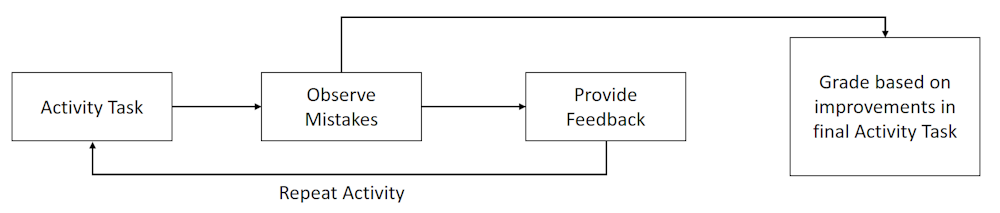
We used a corrective feedback learning approach, which advocates using failures or mistakes as learning opportunities. We designed an activity the students would repeat and at each stage we provided feedback and asked them to reflect on their mistakes.

We would then observe – but not mark – the progress of the students in each iteration. It’s important students are given a chance to improve upon their mistakes after each feedback.

Designing activity tasks to ‘learn from mistakes’.

Role-play interviews

Our study was conducted over two semesters with a total of 348 students enrolled in the Master of Information Technology’s unit of Enterprise Business Requirements at UTS.

One of the tasks for students was a role-playing activity. They were required to play a business analyst and interview a client about their technology and software needs.

We’ve seen in the past that students in this unit struggled with the social aspects of the interviewing task. So we designed the task by providing students with the opportunity to interview the client three times.

They received feedback on their mistakes at the end of every round and were given an opportunity to improve for the next round.

In the first semester, we observed the students and developed a list of 34 mistakes they made while interviewing a client, such as mistakes in communication skills, analyst behaviour, interaction with customer, and teamwork and planning.

In the second semester, we used that list of mistakes to monitor the progress the students made in all three iterations of the role-play interview activity.

After three interviews with the client, the students submitted a report for final assessment. It was on that report alone that they were marked.

For those students who scored low (below 50%) or average (50% and 60%) on their final assessment, they showed little motivation to improve their mark in all three rounds of feedback.

But those who scored 90% or more in their final assessment showed they were motivated to improve their mark. They made fewer mistakes in the second and third iterations of the interview, in comparison to their first interview.

These students improved upon their mistakes in communication, teamwork, planning and personal skills.


Read more: How to make good arguments at school (and everywhere else)


But the top-scoring students still struggled with the customer interaction part even by the third interview. When asked, the students reflected later that they needed more practice to improve that part of interviewing skills.

We can all learn from mistakes

The experiment found we need to include more preparation for students to develop and practise their skills.

Some university courses may already be doing this kind of feedback in assessment, but that wasn’t the case in our IT unit.

By providing a safe and simulated environment for our students to practise self-reflection and try to improve, our hope is that it offers a chance to build resilience and prepare mentally for the real world outside the classroom.

ref. Keen IT students can improve their marks when given a chance to learn from their mistakes – http://theconversation.com/keen-it-students-can-improve-their-marks-when-given-a-chance-to-learn-from-their-mistakes-122792

Fancy an e-change? How people are escaping city congestion and living costs by working remotely

Source: The Conversation (Au and NZ) – By Andrew Glover, Postdoctoral research fellow, RMIT University

Many Australians have longed to live outside the city. The treechange and seachange movements – migration from urban areas to rural and coastal towns – have been responsible for much of the population growth outside urban areas in recent years.

Now a newer migration trend is under way: e-change. E-changers are people who move away from the large capital cities to nearby regional and coastal “lifestyle” towns, where they use broadband internet connections to perform work remotely.


Read more: Meet the new seachangers: now it’s younger Australians moving out of the big cities


A limiting factor for moving to regional areas has always been the lack of high-skill job opportunities. But remote work allows people to have more flexibility in where they live – they can work from anywhere.

Information and communication technology is making this possible for more and more people whose work primarily requires digital connectivity rather than constant physical presence. Email, video conferencing, online project management software and even telepresence robots are all tools that people can use to work remotely outside an office.

Getting away from the rat race

Our large capital cities like Sydney and Melbourne are experiencing significant challenges. As they expand outward and increase in density, traffic congestion is intensifying. Despite significant investment in road construction and public transport, Infrastructure Australia this year reported:

Road congestion is expected to increase in all Australian cities between 2016 and 2031.

Average daily commutes in Australia’s cities are already at all-time highs. The results of long commutes include lower job and life satisfaction.


Read more: Australian city workers’ average commute has blown out to 66 minutes a day. How does yours compare?


Commuting in the city is also a public health hazard. This is because the time spent on transport reduces the time we have for other activities. And activities like exercising, socialising or spending time with our families are important for our well-being.

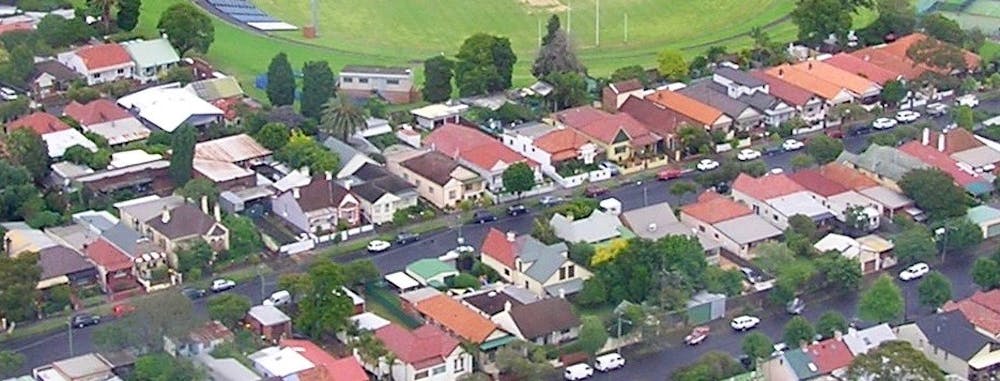
City housing prices are increasingly unaffordable, particularly in well-serviced areas reasonably close to the CBD. Buying a home in suburban Sydney or Melbourne is now out of reachfor many young people.

E-changers seek the best of both worlds: doing skilled work that has traditionally been available only in the city, while avoiding the congestion and high cost of city living.

Who are e-changers?

Obviously, not everyone can work away from their place of employment. Some jobs require people to be physically present all or most of the time.

But for many professional or creative workers in today’s digital economy, being productive doesn’t have to mean being in an office in the city every day.

One of Australia’s most successful new companies – software developer Atlassian – is in the midst of a remote working revolution. The tech company Stripe is also forgoing the traditional office by opening a new employment hub that is entirely remote. These companies recognise that valuable employees shouldn’t need to live in Sydney or Melbourne if they can perform their role while living elsewhere.

However, remote workers need not be completely absent from a workplace. Instead of commuting every day, an employee might come into an office once or twice for face-to-face meetings. They can then work the rest of the week remotely at or near their home.

Flexible work arrangements like this mean a higher quality of life for employees. Cities will also benefit from reduced commuting congestion.


Read more: Flexible working, the neglected congestion-busting solution for our cities


It doesn’t have to mean working from home

Remote workers don’t always work from home. Many people find it difficult to mix work and home life in the same physical space. That’s why remote workers often frequent cafes, libraries, satellite offices, or co-working spaces.

Co-working spaces are a multibillion-dollar industry globally and are becoming popular in Australia. While mostly still located in cities, co-working spaces are increasingly appearing in smaller coastal and regional towns. This trend indicates a demand from e-changers to work outside the home.

In the US, towns and small cities outside the large metropolitan areas are encouraging people to move to their area. They are offering remote workers subsidised housing, free access to co-working spaces and even paying them thousands of dollars in cash as an incentive.

Co-working spaces are booming overseas – this one is in Turin, Italy – with some towns and small cities offering free access to attract remote workers. MikeDotta/Shutterstock

Read more: Co-working spaces are part of the new economy, so town planners better get with the times


Is e-change the future for Australia?

Reducing the need for people to commute to their place of work every day could be an effective way to ease pressure on our congested city roads and public transport systems.

Remote work allows people to live outside our largest cities, where they’re more likely to be able to buy a home.

As more people adopt an e-change lifestyle, it might help to reinvigorate the economies and civic life of regional and coastal towns.

Making remote work more widely available might also increase workforce participation among groups that aren’t able to commute to an office every day. They include people with caring responsibilities, people with disabilities and those already living in regional areas.


If you think your organisation would benefit from understanding e-change and remote work, the authors would like to hear from you.

ref. Fancy an e-change? How people are escaping city congestion and living costs by working remotely – http://theconversation.com/fancy-an-e-change-how-people-are-escaping-city-congestion-and-living-costs-by-working-remotely-123165

Worried about agents of foreign influence? Just look at who owns Australia’s biggest companies

Source: The Conversation (Au and NZ) – By Clinton Fernandes, Professor, International and Political Studies, UNSW

The attention being given to possible covert influence being exercised by China in Australia shouldn’t distract us from recognising that very overt foreign influence now occurs through investment.


Read more: Inside China’s vast influence network – how it works, and the extent of its reach in Australia


Right now US corporations eclipse everyone else in their ability to influence our politics, through their investments in Australian stocks.

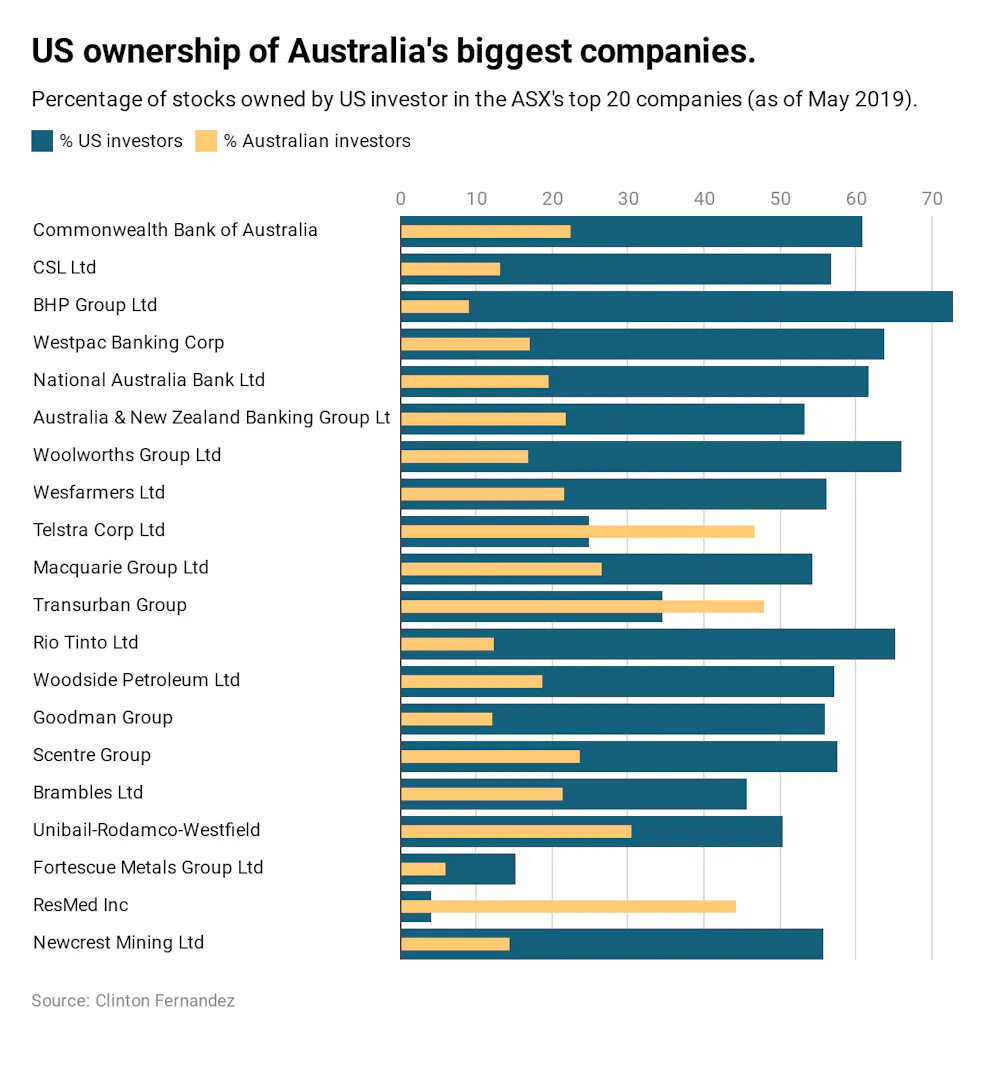
Using company ownership data from Bloomberg, I analysed the ownership of Australia’s 20 biggest companies a few days after the 2019 federal election in May. Of those 20, 15 were majority-owned by US-based investors. Three more were at least 25% US-owned.


https://datawrapper.dwcdn.net/x0ODc/2/

According to my analysis, all four of our big banks are majority-owned by American investors. The Commonwealth Bank of Australia, the nation’s biggest company, is more than 60% owned by American-based investors.

So too are Woolworths and Rio Tinto. BHP, once known as “the Big Australian”, is 73% owned by American-based investors.

In the 1980s BHP advertised itself as ‘The Big Australian’. Now that’s all history.

The ASX’s top 20 companies make up close to half of the market capitalisation of the Australian Securities Exchange.

Such a concentration of foreign ownership should be a concern regardless of how much we see the US as an ally committed to liberal-democratic values, and appreciate that US corporate interests are not necessarily monolithic or necessarily exercised in accordance with a government agenda.

Nonetheless, under so-called investor-state dispute settlement (ISDS) clauses, which the US government has systematically pushed in its trade deals with other nations, US corporate investors are getting unprecedented rights in foreign markets.

ISDS provisions mean a foreign investor can sue a government for compensation in an international tribunal if the government makes any change in law or policy that “harms” an investment. This is something no Australian citizen can do.

Philip Morris’ smoking gun

Since I did my analysis, the composition of the ASX top 20 has changed. The bottom four companies – Unibail-Rodamco-Westfield, Fortescue Metals Group, ResMed and Newcrest Mining – have made way for Insurance Australia, Suncorp, Amcor and South32.

This, however, has not signficantly altered the dominance of US investor interests.

It should also be noted that US investment firms also manage the wealth of foreign clients. But data from CapGemini and Merrill Lynch suggest the majority of assets the firms manage are American-owned, even if the precise number cannot be determined.

There are arguably good grounds to include ISDS clauses in free-trade agreements, but the potential downside is exemplified by the case of tobacco giant Philip Morris, which challenged Australia’s plain-packaging laws for cigarette packs.

The US company did so by moving ownership of its Australian operations to Hong Kong and then using the ISDS clause embedded in an investment treaty between Australia and Hong Kong. It used the clause to argue the Australian government’s law amounted to unjust confiscation of trademarks and intellectual property.

The ISDS clause gave Philip Morris privileges no Australian company or individual had. Even though it lost, having its case thrown out on the grounds it was an abuse of process, it only had to pay half of Australia’s costs, which added up to almost A$24 million.

Jonathan Bonnitcha and his co-authors argue in their book The Political Economy of the Investment Treaty Regime that when states take legal action against each other, they have an incentive not to advance legal arguments that may backfire on them down the track. They have defensive interests.

Under ISDS clauses, though, private investors don’t have defensive interests. States cannot commence proceedings against them. They can attack with adventurous legal arguments, and not worry about defending themselves from those same arguments down the road.

Unlike courts, ISDS arbitrations lack standardised rules of procedure. Predictability of outcomes is much lower. Proceedings are private, not public. Only the final outcome is routinely available, and only if the parties agree.

Transparency matters

Under foreign influence transparency laws that came into effect in March, “foreign principals” must declare their role in influencing governmental and political decision-making. Foreign principals include governments, organisations, individuals and “entities”.

A company falls within the definition of a “foreign government-related entity” if its directors are accustomed or under an obligation to being influenced by a foreign government or political organisation, or if these governments and organisations hold more than 15% of the company’s shares or voting power, or can appoint at least 20% of the company’s board of directors; or otherwise exercise substantial control.


Read more: Agents of foreign influence: with China it’s a blurry line between corporate and state interests


All well and good. Australian democracy benefits when foreign efforts to influence policies are conducted in an open and transparent manner.

But should not there be equal accountability and transparency over who owns our most powerful companies, the privileges they have under ISDS provisions, and what happens in any dispute proceedings?

ref. Worried about agents of foreign influence? Just look at who owns Australia’s biggest companies – http://theconversation.com/worried-about-agents-of-foreign-influence-just-look-at-who-owns-australias-biggest-companies-123343

Hidden women of history: Marau Ta’aroa, the Sydney-schooled ‘last Queen of Tahiti’

Source: The Conversation (Au and NZ) – By Nicholas Hoare, PhD Candidate in Pacific History, Australian National University

In this series, we look at under-acknowledged women through the ages.

From Tongan Princes to the daughters of Sāmoan political leaders, elite Australian schools have long been considered desirable locations for the children of high-ranking Pacific families. One such student was a young Tahitian named Joanna Marau Ta‘aroa who attended Sydney Ladies’ College from 1869 to 1873.

While easily “mistaken for a Spaniard” on the streets of downtown Sydney, the young Marau was in fact the second youngest daughter of an aristocratic Tahitian mother, Ari‘i Taimai, and a wealthy Englishman of Jewish descent, Alexander Salmon. (The pair, who had married in 1833, had nine children, all of whom enjoyed a cosmopolitan upbringing, speaking English and being educated overseas.)

Although little is known about her time in Sydney, other than an abiding memory of ice-cold baths and unpleasant Australian mutton, Marau’s Australian education was cut short at the age of 14 when she was summoned home to marry Prince Ari‘i-aue. Her marriage to the alcoholic future king, who was some 22 years her senior, saw her written into the history books as “the last Queen of Tahiti”.

An unhappy match

By all accounts, Marau’s royal wedding was a spectacular affair, with a fusion of Polynesian and European style festivities continuing across Papeete, the Tahitian capital, for two days. However, unlike that of her parents, her marriage was far from a love match.

It was a strategic alliance between the Pōmare family – who had always struggled to gain legitimacy in the eyes of the Tahitian public – and her mother’s Teva dynasty, who were more readily recognised as the true holders of chiefly power and prestige.

But in Marau’s words, her husband’s behaviour “quickly became impossible to tolerate”. Allegedly suffering from syphilis, tuberculosis and occasionally pneumonia, the prince’s predilection for rum before noon was legendary.

Despite the kindness shown to her by his mother Queen Pōmare IV, palace life was far from happy for Marau. She found herself spending more and more time at her mother’s home in Papara, where she occupied herself reading, learning Tahitian embroidery and unravelling the secrets of her family’s land.

After the death of the Queen, she was briefly encouraged to return to her prince’s side to ascend the throne in September 1877. However, less than two years later, the now-Queen Marau accepted a royal pension of 300 francs per month and moved out permanently.

Queen Marau, 1879, photographer unknown. Collection du Musée de Tahiti et des îles – Te Fare Manaha

Children shut out

While the pair did not officially divorce until January 1888, from 1879 onward they would appear together only at official ceremonies where neither would talk to the other. However, Marau would not let these personal circumstances get in the way of living a life befitting of royalty.

In 1884 she took to Europe – without the King’s blessing – where she was “received and celebrated all over”, often finding herself in homes and palaces of elite Parisian families. Wearing old-style Tahitian dresses, Marau would attend the theatre most nights, where she revelled in the limelight as any 25-year-old guest of honour would do.

Queen Marau, 1889 by Sophia Hoare. Collection du Musée de Tahiti et des îles – Te Fare Manaha, Author provided (No reuse)

Meanwhile, back in Tahiti, her husband felt that press reports of his wife’s reception by the French political class “offended our dignity and insulted us as people”. This was perhaps a little rich coming from somebody who just four years earlier had ceded sovereignty over Tahiti and its dependencies to the French for a sizeable pension in return. (Famed American historian Henry Adams would write that he “now gets drunk on the proceeds, $12,000 a year”.)

For Queen Marau, the tip of the iceberg was the King’s refusal to recognise her two daughters, Teri‘i (born in 1879) and Takau (born in 1887), as his own.

Though they eventually took the Pōmare name – the third, Ernest, who arrived several months after the divorce proceedings, was never officially recognised – all three children were shut out of the royal inheritance. After Pōmare V’s refusal to recognise the third child, Marau famously snapped back that none of them belonged to him anyway.

‘True old-goldishness’

In the months preceding the death of Pomare V in June 1891, Queen Marau played host to Henry Adams and his artist-friend John La Farge. Bored and growing increasingly critical of colonial Papeete, the pair’s fortunes changed upon meeting Marau and her brother Tati Salmon at Papara. Of Marau, Adams wrote:

If she was once handsome, certainly her beauty is not what attracts men now. What she has is a face strongly marked and decidedly intelligent, with a sub-expression of recklessness, or true old-goldishness … One feels the hundred generations of chiefs who are in her, without one commoner except the late Salmon, her deceased parent.

Finding her “still showy, very intelligent, musical, deep in native legends and history, and quite energetic”, Marau became the perfect conduit between Adams and her ageing mother. In turn, this enabled the pair to work on the production of the Memoirs of Arii Tamai (1901). A history of pre-colonial Tahiti from the perspective of the Teva family, it is now regarded as a canonical text in Tahitian ethnography.

A dominant public figure

With most scholars tending to lose interest in Marau’s life at this point, it would be tempting to end our story here with the Queen living out the rest of her years “hard-up” on a measly government pension.

But the reality was that she remained a dominant public figure until her death in February 1935.

When massive phosphate deposits were discovered on the nearby island of Makatea in 1907, Marau frustrated the progress of an Anglo-French consortium by using her influence to sign contracts with local landowners, despite knowing she lacked the means to exploit the mineral herself.

While the intervention netted her a tidy payment of 75,000 francs and an ongoing royalty of 37 and a half centimes per ton of phosphate extracted, victory was even sweeter as the man behind the phosphate operation was her ex-husband’s lawyer, Auguste Goupil, chief architect of the plan to write her children out of their royal inheritance.

Finally, just as the stories of Ari‘i Taimai were collected and written down by a younger, energetic Marau, her own daughter Takau did the same for her mother in her dotage (eventually published in 1971 as Memoires de Marau Taaroa). As modern and tumultuous as her life may have been, the Memoires also portrays someone who never lost her grounding in ancient Tahitian culture.

Nothing reflects this better than Marau’s grand tomb at Uranie cemetery just outside of Papeete. Her tomb, taking the form of the grand Teva-family marae, Mahaiatea, it is a tribute to one of Tahiti’s greatest cultural and spiritual monuments.

Tomb of Queen Marau, Uranie Cemetery, Tahiti. Photo by Nicholas Hoare, 2018

This monument to the Tahitian god ‘Oro, consecrated by the famous Tupaia between 1766-8, had been destroyed in 1865 by a European planter in order to construct a bridge. The bridge itself was soon washed away by flood.

ref. Hidden women of history: Marau Ta’aroa, the Sydney-schooled ‘last Queen of Tahiti’ – http://theconversation.com/hidden-women-of-history-marau-taaroa-the-sydney-schooled-last-queen-of-tahiti-122539

Liu defends herself after concerns about her Chinese associations

Source: The Conversation (Au and NZ) – By Michelle Grattan, Professorial Fellow, University of Canberra

The Liberal member for Chisholm, Gladys Liu, has strongly proclaimed her loyalty to Australia and her support for the government’s policy on China, amid a row over her record of past associations with organisations with links to the Chinese Communist party.

Liu issued a statement following a politically disastrous interview with Sky on Tuesday night in which she repeatedly floundered when pressed on her connections to Chinese organisations – claiming a lack of memory – and her views in relation to China, including its activities in the South China Sea.

In the statement – in which the hand of the Prime Minister’s office was evident – Liu confirmed she had previously been

  • honorary president of the United Chinese Commerce Association of Australia. “My involvement was done for no other reason than to support the promotion of trade between Australia and Hong Kong, and to encourage individuals in the Australia-Hong Kong community to undertake community work.”

  • honorary president of the Australian Jiangmen General Commercial Association Inc in 2016

  • honorary role in Guangdong Overseas Exchange Association in 2011.

She said she no longer had an association with any of these organisations.

These organisations have indirect or direct links to the CCP’s United Front Work Department, which co-opts and organises Chinese in other countries to act in the interests of the CCP.

Liu said some Chinese associations “appoint people to honorary positions without their knowledge or permission.

“I do not wish my name to be used in any of these associations and I ask them to stop using my name.

“I have resigned from many organisations and I am in the process of auditing any organisations who may have added me as a member without my knowledge or consent.”

Liu, who won the Victorian marginal seat of Chisholm at the May election, said she was “a proud Australian, passionately committed to serving the people of Chisholm, and any suggestion contrary to this is deeply offensive”.

Noting she was a new MP, she said she had not been clear in the Sky interview and “should have chosen my words better”. She stressed she was in accord with government policy on issues relating to China.

“Australia’s longstanding position on the South China Sea is consistent and clear.

“We do not take sides on competing territorial claims but we call on all claimants to resolve disputes peacefully and in accordance with international law.

“Our relationship with China is one of mutual benefit and underpinned by our Comprehensive Strategic Partnership. China is not a democracy and is run under an authoritarian system. We have always been and will continue to be clear-eyed about our political differences, but do so based on mutual respect, as two sovereign nations, ” Liu said.

“As a proud Hong Kong-born Australian I do not underestimate the enormity of being the first Chinese-born member of parliament.

“I know some people will see everything I do through the lens of my birthplace, but I hope that they will see more than just the first Chinese woman elected to parliament. I hope they will see me as a strong advocate for everyone in Chisholm.”

Earlier, Labor’s foreign affairs spokeswoman Penny Wong challenged Scott Morrison to assure the parliament and the public “that Gladys Liu is a fit and proper person to be in the Australian parliament”.

“I can recall the Liberal Party making Sam Dastyari a test of Bill Shorten’s leadership – well this is Scott Morrison’s test,” Wong said. Dastyari eventually resigned from the Senate after a scandal involving in particular his links with Chinese political donor Huang Xiangmo.

Labor tried to probe the Liu situation in the House, but was mostly thwarted by the questions being ruled out of order. In the Senate, Foreign Minister Marise Payne defended Liu’s fitness.

ref. Liu defends herself after concerns about her Chinese associations – http://theconversation.com/liu-defends-herself-after-concerns-about-her-chinese-associations-123362

Politics with Michelle Grattan: Independent MP Helen Haines on using ‘soft power’

Source: The Conversation (Au and NZ) – By Michelle Grattan, Professorial Fellow, University of Canberra

Helen Haines, MP for the Victorian regional seat Indi, made history at the election as the first federal independent to succeed another independent.

She was backed by grassroots campaigners, Voices for Indi, who had earlier helped her predecessor, Cathy McGowan, into parliament. But while McGowan towards the end of her time in the House of Representatives shared real legislative power after the Coalition fell into minority government, the same power does not lie with the lower house crossbench today.

Still, Haines believes she has what she calls “soft power” as she has focused on relationship building during the first few months into her term.

Building relationships is key to getting things done and it’s key to establishing an environment that is less an environment of conflict and less an environment of bringing people down.

On current legislation, Haines is in favour of the government’s push to stop animal-rights activists from publishing farmers’ personal information.

Many people have contacted my office deeply concerned about this and I’m very supportive of bringing their views to the house on this.

But she’s a trenchant critic of the government proposal for trials to drug test people going onto Newstart and Youth Allowance. She says “the evidence is not there to support” the move.

In Indi, she points to mental health and aged care as frontline issues, which she will seek to work with the government on.

New to podcasts?

Podcasts are often best enjoyed using a podcast app. All iPhones come with the Apple Podcasts app already installed, or you may want to listen and subscribe on another app such as Pocket Casts (click here to listen to Politics with Michelle Grattan on Pocket Casts).

You can also hear it on Stitcher, Spotify or any of the apps below. Just pick a service from one of those listed below and click on the icon to find Politics with Michelle Grattan.

Additional audio

A List of Ways to Die, Lee Rosevere, from Free Music Archive.

Image:

AAP/ Mick Tsikas

ref. Politics with Michelle Grattan: Independent MP Helen Haines on using ‘soft power’ – http://theconversation.com/politics-with-michelle-grattan-independent-mp-helen-haines-on-using-soft-power-123347

Politics with Michelle Grattan: Helen Haines – an independent – on using ‘soft power’

Source: The Conversation (Au and NZ) – By Michelle Grattan, Professorial Fellow, University of Canberra

Helen Haines, MP for the Victorian regional seat Indi, made history at the election as the first federal independent to succeed another independent.

She was backed by grassroots campaigners, Voices for Indi, who had earlier helped her predecessor, Cathy McGowan, into parliament. But while McGowan towards the end of her time in the House of Representatives shared real legislative power after the Coalition fell into minority government, the same power does not lie with the lower house crossbench today.

Still, Haines believes she has what she calls “soft power” as she has focused on relationship building during the first few months into her term.

Building relationships is key to getting things done and it’s key to establishing an environment that is less an environment of conflict and less an environment of bringing people down.

On current legislation, Haines is in favour of the government’s push to stop animal-rights activists from publishing farmers’ personal information.

Many people have contacted my office deeply concerned about this and I’m very supportive of bringing their views to the house on this.

But she’s a trenchant critic of the government proposal for trials to drug test people going onto Newstart and Youth Allowance. She says “the evidence is not there to support” the move.

In Indi, she points to mental health and aged care as frontline issues, which she will seek to work with the government on.

New to podcasts?

Podcasts are often best enjoyed using a podcast app. All iPhones come with the Apple Podcasts app already installed, or you may want to listen and subscribe on another app such as Pocket Casts (click here to listen to Politics with Michelle Grattan on Pocket Casts).

You can also hear it on Stitcher, Spotify or any of the apps below. Just pick a service from one of those listed below and click on the icon to find Politics with Michelle Grattan.

Additional audio

A List of Ways to Die, Lee Rosevere, from Free Music Archive.

Image:

AAP/ Mick Tsikas

ref. Politics with Michelle Grattan: Helen Haines – an independent – on using ‘soft power’ – http://theconversation.com/politics-with-michelle-grattan-helen-haines-an-independent-on-using-soft-power-123347

BOOK REVIEW: Brian Toohey’s Secret warns against Australia being ‘joined at the hip’ with US

Source: The Conversation (Au and NZ) – By Tony Walker, Adjunct Professor, School of Communications, La Trobe University

When journalist Brian Toohey began researching his book Secret: The Makings of Australia’s Security State, he could not have foreseen publication would coincide with real-time overreach by government agencies of their security responsibilities.

Contemporary examples of such overreach include: a raid on a Canberra journalist’s apartment in search of evidence of who might have leaked top-secret information about the government’s surveillance plans; pursuit of a former intelligence officer and his lawyer over revelations Australian agents had bugged presidential offices of Australia’s weakest neighbour; and intrusions into ABC offices to gather evidence of sources of information about alleged Special Air Service war crimes in Afghanistan.

Laws that are antagonistic to journalist inquiry in pursuit of wrongdoing have been hustled through the Australian parliament in the past several years. Toohey writes:

No major party seems bothered by the use of new surveillance technology that allows governments to detect contact between journalists and their sources, effectively denying whistle-blowers the opportunity to reveal abuses of power and criminal behaviour.

If this was simply a matter of constraining journalists’ attempts to expose government secrets, it would be one thing. But it has become an assault more broadly on the public’s right to know about the seamier aspects of government behaviour.


Read more: Why the raids on Australian media present a clear threat to democracy


Governments have taken advantage of the war on terror to strengthen their ability to suppress unwelcome disclosure. In the process, they have raised the stakes for whistle-blowers whose conscience dictates that activities that skirt – or break – the law should be exposed.

The Labor opposition has baulked at its responsibilities to push back against some of the more expansive powers accorded under the security legislation.

Labor’s weakness is not least a consequence of its worries about being wedged on national security issues. In this regard, governments of the day have taken advantage of legitimate concerns about multiple security threats.

All this is well described in Toohey’s sprawling account of the history of the Australian security state. It stretches from the early fumbling days of the Australian Security Intelligence Organisation (ASIO), whose activities would not have been out of place in the Keystone Cops.


Read more: To protect press freedom, we need more public outrage – and an overhaul of our laws


Based on a lifetime of reporting for various publications, including The Australian Financial Review and the National Times, Toohey provides behind-the-scenes snapshots of the Central Intelligence Agency’s anxieties about threats posed by the Whitlam government to American spy stations on Australian soil. He also examines the role of senior public servants in manipulating governments of the day and intelligence blunders that led to the Iraq war.

The list is long, and reflects poorly on the individuals and agencies involved.

Media organisations have realised too late the threats the new security legislation poses to journalistic inquiry. Proprietors and the industry itself, for that matter, have underestimated the determination of government to pursue journalists and whistleblowers under both existing statutes and the new legislation.

In the absence of explicit freedom of speech protections in the Constitution, Australian journalists find themselves at the mercy of a vastly expanded security state.

No government, Labor or conservative, is likely to reverse course.

The June 2018 Espionage Act is one case of Orwellian overreach. It makes it an offence to receive

information of any kind, whether true or false and whether in a material form or not, and includes (a) an opinion; and (b) a report of a conversation.

How this provision made its way through a democratically-elected legislature is confounding.

Apart from a description about threats posed to reasonable disclosure of information about government activities in the public interest, the rub of Toohey’s book lies in its telling of the sort of relationship that has evolved between Australia and its security guarantor.

This will be regarded by readers and critics as the most controversial element of Secret. Not everyone will agree with the author’s observations about risks to Australian sovereignty posed by its security relationship with the United States allied with a potentially damaging antagonism towards China in the national security establishment.

But his arguments are well made and deserve attention. This is especially so in view of our involvement in Iraq 2003, where the principal justification post facto has been that Australia needed to continue making regular down-payments on its security arrangements with the United States.

This is what Toohey describes as Australia being “chained to the chariot wheels of the Pentagon”. He writes:

The British monarchy has no say in Australian government decisions. It’s a different story with the head of the American Republic. A US president presides over a military-industrial complex with a huge say in whether the Australian government goes to war, buy particular weapons, host US-run military intelligence bases and ban trade with certain countries. The upshot is that Australia has now surrendered much of its sovereignty to the US.

In this context, Toohey quotes an off-key contribution to the debate about the power of a military-industrial complex. In 2016, former Australian ambassador in Washington, Kim Beazley, in his capacity as a board member in Australia of Lockheed Martin, gave a speech in which he described himself as a member of a “benign deep state” where the real power is “a military/intelligence phalanx”.


Read more: The shaky case for prosecuting Witness K and his lawyer in the Timor-Leste spying scandal


It is not clear whether he was joking, but the fact is he has long associated himself with an uncompromising pro-American viewpoint.

Beazley, now governor of Western Australia, remains influential in Labor security policy-making.

Toohey’s concluding chapters offer some fairly pungent criticism of Australia’s national security establishment. It refuses, he says, to welcome China’s rise. Instead, it agitates for an increased US military presence in the region, it advocates a confrontational approach to Beijing and a strategy aimed at damaging the Chinese economy, never mind that this will have negative consequences for Australia itself.

At the same time, it lobbies for an ever-closer security relationship with the US summed up by Malcolm Turnbull in 2017 in which he said Australia is militarily “joined at the hip to the US”.

Toohey argues that rather than being “joined the hip”, Australia has more scope for individual initiative, and, in extreme circumstances, the capacity to deter and defend itself.

This book is the work of a contrarian. It should be read.

ref. BOOK REVIEW: Brian Toohey’s Secret warns against Australia being ‘joined at the hip’ with US – http://theconversation.com/book-review-brian-tooheys-secret-warns-against-australia-being-joined-at-the-hip-with-us-122848

The Joker’s origin story comes at a perfect moment: clowns define our times

Source: The Conversation (Au and NZ) – By Ari Mattes, Lecturer in Media Studies, University of Notre Dame Australia

The joker, the trickster, the jester, the provocateur – there is a rich cultural history of these roles going back at least as far as Greek mythology’s Hermes.

One of the most famous jester figures of the modern age is the Joker, who made his debut in the first issue of Batman comics in 1940.

The first comic book appearance of The Joker. Wikipedia

As Batman’s arch-nemesis, the Joker offers a reprieve from the less interesting narcissistic, angst-ridden histrionics of the hero. The Joker’s punishment of society is often comical, and his relentlessly ironic spirit of rebellion contrasts with Batman’s dour moral self-righteousness.

The Joker is funny, cool, and refreshingly intelligent. He is also back in theatres next month in the aptly named Joker, which this week won Best Film at the Venice Film Festival.

The cultural provocateur

In a deck of cards the joker is (most of the time) formally useless. The two joker cards are omitted from most games, yet the deck is incomplete without them.

The joker is a necessary non-card, the exception that glues together the rest of the pack. A card of shifting rank and use, the joker offers a spark of improvisation within a rigidly hierarchical order.

Culturally, the joker reaffirms the social order through his lampooning of it, turning socially significant places into spaces of carnival and clowning, revealing the comical and absurd cracks in a spirit of anarchic play.

The card offers ‘a spark of improvisation’. Wikimedia Commons, CC BY

Yet this role has always been intimately tied up with the institutions it appears to subvert. The court jester, for example, functioned in part to legitimise the social order. He maintained a performative relationship with the people, but his acts of subversion of power reaffirmed its very boundaries in the first place.

There are many of these self-styled “maverick” figures in global politics today, who strategically position themselves as somehow outside of the power structures they in fact serve to reproduce.

The words and actions of such provocateurs flirting with the boundaries of social good taste and etiquette should always be taken with a grain of salt. Power can reproduce itself in multiple ways -including through its apparent critique.


Read more: Prime Minister Boris Johnson: the jester has taken the throne


1989: Wackiness with a nasty edge

Within the Batman franchise, the most effective characterisations of the Joker have him tottering dangerously between comedic whimsy and psychopathic sadism – that liminal space in which, arguably, all great comedy occurs.

Perhaps the greatest actor to portray the role is Jack Nicholson in Tim Burton’s Batman (1989). Nicholson’s Joker embraces the wackiness of Cesar Romero’s earlier interpretation in the 1960s TV series but adds a genuinely nasty edge, and this combination of colourful zaniness with lethal brutality makes for a disturbing experience for the viewer.

“I make art until someone dies,” Nicholson’s Joker says to journalist Vicki Vale (Kim Basinger) in an art museum after he and his goons have defaced several pieces whilst bopping along to Prince.

“See, I am the world’s first fully functioning homicidal artist.”

By the late 1980s, Nicholson, appearing as the perfect sleazeball in films like The Witches of Eastwick (1987), was the man behind some of the most hated characters in cinema. He was, thus, perfectly cast as the Joker – it helps that the Joker’s demonically twisted face isn’t that far from his own.

Nicholson received first billing in Batman and, as Roger Ebert commented, the viewer’s tendency is to root for the Joker over Batman. It is this ambiguity that makes Burton’s film so compelling.

2008: Why so serious?

Heath Ledger’s Joker from The Dark Knight (2008), for which he received a posthumous Best Suporting Actor Oscar, was virtuosically full-bodied. Ledger is eerily, vitally intense. Yet the famous question he asks in the film – “Why so serious?” – could easily be turned back on Ledger’s own performance.

Ledger endows the role with a psychological realism that, paradoxically, makes for a less interesting (and less complex) experience for the viewer than more ambiguous portrayals.

The uncomfortable mixture of the comical and the sadistic is what makes the character perennially appealing – we never know which Joker we will be getting at any time. Ledger, by making the character “real”, turns him into, merely, a rather humourless creep.

2017: Caught in a bad bromance

The symbiotic nature of the relationship between Batman and the Joker usually remains unexplored. Wonderfully, The Lego Batman Movie (2017) makes this relationship centre stage.

The film follows the Joker (Zach Galifianakis) as he tries to get Batman (Will Arnett) to admit that he needs the Joker as much as the Joker needs him. Batman refuses to acknowledge the bond the two share throughout most of the film; when he finally does, their bromance can fully mature.

The Joker and Batman – the original couple. Warner Bros

2019: A mental deterioration

The latest version of the Joker is played by Joaquin Phoenix, an actor whose career has oscillated between the absurdly intense (Walk the Line) and the disarmingly clownish (I’m Still Here). Todd Phillips’ film promises to revitalise the character in an origin story following down-on-his-luck comedian/clown Arthur Fleck who transforms into the Joker as his mental health deteriorates.

Early reviews have praised the film’s representation of the current political landscape. Time Out calls it a “nightmarish vision of late-era capitalism”, and IndieWire suggests it is “about the dehumanising effects of a capitalistic system that greases the economic ladder”.

In the context of the incel movement – in which men rally around the perception of their own unjust victimhood – a narrative of a violent folk hero forming through the failure of his dreams of celebrity glory seems strikingly poignant.

The frequency with which mass shootings now occur in America (in 2012 James Holmes killed 12 people at a screening of The Dark Night in Aurora, Colorado) has also lead to concerns about how the story will be read. The same Indiewire review criticised the film as “a toxic rallying cry for self-pitying incels”.

Given the necessity for a law and order stalwart against which the Joker can launch his antics, it is notable that there is no Batman in this film. Will the Joker be able to sustain a feature-length narrative on his own?

Send in the clowns

Clownish figures seem to be becoming the new normal in professional politics. In April, comedian Volodymyr Zelensky was elected president of the Ukraine. The UK’s new prime minister, Boris Johnson, has been dubbed “Bojo” by the press – and they’re not just alluding to his name.

Much of the popularity of Trump has emerged from his presentation of himself as an outsider to the elite willing to lampoon and ridicule power – never mind that, as a rich New York City businessman, he is power personified.

The broader significance of this phenomenon is a little trickier to diagnose. It makes sense that, in an age when everything is valued in terms of its entertainment function (and when most people are aware of the common sleights of hand of the mainstream media they consume), clownish reality TV stars, provocateur comedians and gregariously sleazy entrepreneurs would amass unprecedented levels of power in the public domain.

Politicians entertain us by donning the outfit of the jester and making fun of politicians.

Perhaps this reflects a more widespread public cynicism regarding professional politics, or perhaps it is simply a reflection of a desire to be perpetually distracted by entertaining clowns.

At any rate, the film should be a hoot to watch.

Joker will be released in Australia October 3.

ref. The Joker’s origin story comes at a perfect moment: clowns define our times – http://theconversation.com/the-jokers-origin-story-comes-at-a-perfect-moment-clowns-define-our-times-123009

Michael Andrew: The NZ media’s coverage of the West Papua protests


OPINION: By Michael Andrew of Pacific Media Watch

For the past three weeks, a wave of violent protest has been spreading across West Papua and Indonesia.

Sparked by a racist attack on West Papuan students, the protests have featured the burning of government buildings, 6000 troops mobilised, an internet blackout, marauding, snake-wielding militias stabbing demonstrators and at least 10 civilian deaths as the government attempted to smother the ugly truth of its own colonial legacy.

And yet, despite these egregious human rights abuses on a Pacific people, in a region of immense significance and proximity to New Zealand, the mainstream media has largely ignored the issue.

READ MORE: Leading West Papuan independence activist arrested in Jayapura

Apart from state broadcasters TNVZ and RNZ International and a solitary article by the Otago Daily Times, barely a word has been published online about West Papua. None of New Zealand’s three biggest commercial media websites have featured the unrest since it started in mid-August.

Comparatively, the Hong Kong Anti-Extradition demonstrations have been featured on the same websites 20 times in the past three weeks alone.

The conflict in Kashmir has featured at least 10 times.

West Papua however, much closer to home, is apparently not worth mentioning.

If human suffering is the standard by which society measures the significance of an event, then the developments in West Papua should at the very least be an interesting story.

Why then is the mainstream media so unwilling to touch it?

The question was put to Pacific journalist for RNZ International Johnny Blades, who told Pacific Media Watch that the current mainstream coverage has not at all reflected the seriousness of the West Papua issue.

Johnny Blades … “Perhaps the Papua issue seems too difficult to cover, and media outlets may simply be more interested in sticking with the foreign news they are used to or think will get clicks.” Image: RNZ

“The protests and related unrest, and the response by Indonesian authorities, are signs of a big crisis that countries in our part of the world ought to be concerned about,” he said.

“It has implications for numerous neighbouring countries, and has the potential to destabilise a wider region.”

While the lack of coverage is startling, he acknowledged that the reasons were complicated.

“Media outlets have difficulty accessing information about Papua. Indonesia practically restricts any outside access to Papua but media outlets haven’t seemed interested enough to take up the option of engaging local Papua-based journos to work with them.”

“Perhaps the Papua issue seems too difficult to cover, and media outlets may simply be more interested in sticking with the foreign news they are used to or think will get clicks.”

West Papua itself has been embroiled in intermittent conflict since the 1960s, when Indonesia claimed the land as its province through a widely discredited UN-sanctioned referendum called “The Act of Free Choice”, or derisively referred to as “The Act of No Choice”.

However, the current unrest is unlike anything that has happened before as it has involved a growing group of ethnic Indonesians who are passionately campaigning on behalf of the Papuan cause.

Last week, eight Indonesian activists were arrested in Jakarta on charges of treason or “makar” for either raising the West Papuan flag or engaging in pro-Papua activism. They reportedly remain in prison, forced to listen non-stop to nationalist songs under some type of Orwellian psychological punishment.

But the drama is not at all confined to the Indonesian borders. Last week, police accused prominent Indonesian human rights lawyer Veronica Koman of “inciting” unrest by posting about the protest on twitter from overseas. Interpol has reportedly been contacted to help track her down.

In another report, The Coordinating Minister of Politics, Law and Security Issues Wiranto threatened England-based West Papuan Independence leader Benny Wenda, saying that he would personally arrest him if he returned to Indonesia.

Wiranto himself is an ex-army General who despite being found by the UN to have committed war crimes and human rights abuses in East Timor is responsible for managing the unrest in Papua.

Even for the layperson, this saga is madness! Earlier this week, West Papuans reported that masked motorcyclists had tossed a bag “aggressive” of pythons into their dormitory, presumably in retaliation for the protests.

If newsreaders need twists, drama, and absurd irony to keep them engaged then the West Papua story deserves to be shared more.

But even if New Zealanders aren’t necessarily interested in the developments in West Papua or are unaware of its existence or location, shouldn’t it be the media’s job to inform them?

Journalist and editor of Evening Report Selwyn Manning thought so, saying that the mainstream news media was not doing its job to foster public interest in significant events.

“The disinterest is due to the mainstream news media not meeting its fourth estate function, that is to report on issues where conflict, environmental impact, or natural disasters have yet to spark a multilateral intervention.”

But he also said that New Zealander’s interest in certain events was dictated by government interest and involvement, a factor that in this case would certainly hinder Kiwi’s awareness of West Papua.

“Politically our governments are reticent to get involved in human rights issues occurring within Indonesian-controlled states. It is a geopolitical and diplomatic thing.”

The government certainly appears to be keeping West Papua at an incredibly long arms-length. Apart from the Foreign Ministry saying that it was “deeply concerned” about the violence and had raised the issue with Indonesia, little has been done to actively challenge the human rights violations.

Naturally, the New Zealand government wants to preserve its diplomatic relationship with a valuable and very powerful country of 260 million people and with a GDP nearly the size of Australia’s.

However, New Zealand ignoring political or social developments in Indonesia is like an investor ignoring a tumultuous public feud between a CEO and employees in a profitable company. It’s just bad business.

But even if the government is turning its back on West Papua, the media does not need to follow suit, nor does the public.

In Papua New Guinea, the people are defying their government’s recognition of Indonesia’s sovereignty over West Papua and are marching on mass for the freedom of their fellow islanders.

Amnesty International, Human Rights Watch, political and religious groups and even UN officials are weighing in on the unrest, backing the West Papuan cause or demanding an end to the human rights abuses and for Indonesia to hold those responsible to account.

The New Zealand public can also weigh in on West Papua, but first it needs to know that it is an issue in the first place.

“A lack of understanding about West Papua and exactly where it is remains a factor,” said Johnny Blades

This needs to change. For whatever reasons or whether it is interesting news or not, New Zealanders should be given the opportunity to learn about West Papua and decide for themselves if it’s worth their concern.

The media can make that happen.

Article by AsiaPacificReport.nz

Why do astronomers believe in dark matter?

Source: The Conversation (Au and NZ) – By Michael J. I. Brown, Associate professor in astronomy, Monash University

Dark matter, by its very nature, is unseen. We cannot observe it with telescopes, and nor have particle physicists had any luck detecting it via experiments.

So why do I and thousands of my colleagues believe most of the universe’s mass is made up of dark matter, rather than the conventional matter that comprises stars, planets, and all the other visible objects in our skies?

To answer that question you need to appreciate what dark matter can and cannot do, understand where in the universe it lurks, and realise that “dark” is just the start of the puzzle.

Unseen influence

Our dark matter story starts with speed and gravity. Throughout the cosmos we see objects travelling in orbits under the influence of gravity. Just as Earth orbits the Sun, the Sun orbits the centre of our galaxy.

The speed required to keep a celestial body in orbit is a function of mass and distance. For example, in our Solar System, Earth moves at 30km per second, whereas the most distant planets dawdle at several kilometres per second.

Our galaxy is incredibly massive, so the Sun orbits at 230km per second despite being 26,700 light years away from our galaxy’s centre. However, as we move further from the centre of the galaxy, the orbital speeds of the stars remains roughly constant. Why?


Read more: What a new map of the universe tells us about dark matter


Unlike our Solar System, whose mass is dominated by the Sun, mass in our galaxy is spread across thousands of light years. As one moves to larger distances from the galactic centre, the stars and gas enclosed within this radius increases. Can this additional mass explain the vast speeds of the most distant stars in our galaxy? Not quite.

In the 1960s, the pioneering US astronomer Vera Rubin measured the orbital speeds in the Andromeda galaxy (the galaxy next to the Milky Way) to distances of 70,000 light years from that galaxy’s core. Remarkably, despite this distance being well beyond the bulk of Andromeda’s stars and gas, the orbital speed remained near 250km/s.

This phenomenon isn’t unique to individual galaxies either. Back in the 1930s, Swiss-American astronomer Fritz Zwicky found that galaxies orbiting within galaxy clusters were moving far faster than expected.

What’s going on? One possibility is that a vast amount of unseen mass extends beyond the stars and gas. This is dark matter.

Indeed, the work of Zwicky, Rubin and subsequent generations of astronomers indicate there’s more dark matter in the universe than conventional matter. (As for dark energy, that’s a whole other story.)

The motion of stars and gas in Andromeda provided some of the first evidence for dark matter. Adam Evans

Remarkably, our inability to see or detect dark matter provides clues as to how it behaves. It must have few interactions with itself and conventional matter apart from the force of gravity – otherwise we would have detected it emitting light and interacting with other particles.

As dark matter mostly interacts via gravity alone, it has some curious properties. A cloud of hot gas in space can lose energy by emitting light, and thus cool down. A sufficiently massive and cold gas cloud can collapse under its own gravity to form stars.

By contrast, dark matter cannot lose energy by emitting light. Thus, while conventional matter can collapse into dense objects like stars and planets, dark matter remains more diffuse.

This explains an apparent contradiction. While dark matter may dominate the mass of the universe, we don’t think there is much of it in our Solar System.

Simulation success

As the motion of dark matter is dominated solely by gravity, it is also comparatively easy to model analytically and in simulations.

Since the 1970s we have had formulae for the number of dark matter structures, which also happen to predict the number of massive galaxies and clusters of galaxies. Furthermore, simulations can model the buildup of structures through the history of the universe. The dark matter paradigm doesn’t just fit data, it has predictive power.

The motion of dark matter is dominated by gravity, so it is easier to simulate than conventional matter.

Is there an alternative to dark matter? We infer its presence using gravity, but what if our understanding of gravity is wrong? Perhaps gravity is stronger at large distances than we think.

There are several alternative gravity theories, with Mordehai Milgrom’s Modified Newtonian Dynamics (MoND) being the best-known example.

How do we distinguish dark matter from modified gravity? Well, in most theories gravity pulls towards the mass. Thus, if there’s no dark matter, gravity pulls towards the conventional matter, whereas if dark matter dominates then gravity will predominantly pull towards dark matter.

So it should be easy to tell which theory is right, right? Not exactly, as dark matter and conventional matter roughly follow each other around. But there are some useful exceptions.

The deflection of light by gravity reveals dark matter in colliding clusters of galaxies. X-ray: NASA/CXC/CfA/M.Markevitch et al.; Optical: NASA/STScI; Magellan/U.Arizona/D.Clowe et al.; Lensing Map: NASA/STScI; ESO WFI; Magellan/U.Arizona/D.Clowe et al.

Smash clouds of gas and dark matter together and something wonderful happens. The gas collides to form a single cloud, while the dark matter particles just keep moving along under the influence of gravity. This happens when clusters of galaxies collide with each other at vast speeds.

How do we measure gravity’s pull in colliding galaxy clusters? Well, gravity pulls not just on mass but on light too, so distorted images of galaxies can trace gravitational pull. And in colliding galaxy clusters, gravity pulls towards where the dark matter should be, not towards the conventional matter.

Ripples in time

We can see the influence of dark matter not just today but in the distant past, right back to the Big Bang.

The Cosmic Microwave Background, the afterglow of the Big Bang, can be seen in all directions. And in this fireball we can see ripples, the result of sound waves travelling through ionised gas.

Ripples in the cosmic microwave background reveal the presence of dark matter. ESA, Planck Collaboration

These sound waves result from the interplay of gravity, pressure and temperature in the early universe. Dark matter contributes to the gravity, but doesn’t respond to temperature and pressure like conventional matter, so the strength of the sound waves depends on the ratio of conventional matter to dark matter.

The direct detection of dark matter remains a challenge for particle physicists. Fermilab

As expected, measurements of these ripples taken by satellites and ground-based observatories reveal there’s more dark matter than conventional matter in our universe.

So is the case closed? Is dark matter definitely the answer? Most astronomers would say dark matter is the simplest and best explanation for many of the phenomena we see in the universe. While there are potential issues for simplest dark matter models, such as the number of small satellite galaxies, they are interesting problems rather than compelling flaws.

But the fact remains that we are yet to detect dark matter directly. This doesn’t particularly bother me, as physics has a history of particles that have taken decades to directly detect. If we haven’t detected it 20 years from now I may be concerned, but for now I’m betting that dark matter is the real deal.


Read more: Digging for cosmic gold: the hunt for dark matter at the bottom of a gold mine


ref. Why do astronomers believe in dark matter? – http://theconversation.com/why-do-astronomers-believe-in-dark-matter-122864

Will a vegetarian diet increase your risk of stroke?

Source: The Conversation (Au and NZ) – By Evangeline Mantzioris, Program Director of Nutrition and Food Sciences, University of South Australia

Research Checks interrogate newly published studies and how they’re reported in the media. The analysis is undertaken by one or more academics not involved with the study, and reviewed by another, to make sure it’s accurate.

A UK study finding vegetarianism is associated with a higher risk of stroke than a meat-eating diet has made headlines around the world.

The study, published in the British Medical Journal last week, found people who followed vegetarian or vegan diets had a 20% higher risk of having a stroke compared to those who ate meat.

But if you’re a vegetarian, there’s no need to panic. And if you’re a meat eater, these results don’t suggest you should eat more meat.

While we don’t fully understand why these results occurred, it’s important to note the study only showed an association between a vegetarian diet and increased stroke risk – not direct cause and effect.


Read more: Clearing up confusion between correlation and causation


What the study did and found

The researchers looked at 48,188 men and women living in Oxford, following what they ate, and whether they had heart disease or a stroke, over 18 years. The researchers grouped the participants according to their diets: meat eaters, fish eaters (pescatarians) and vegetarians (including vegans).

While vegan diets are quite different to vegetarian diets, the investigators combined these two groups as there were very small numbers of vegans in the study.

In their analysis, the researchers accounted for variables which are known risk factors for heart disease and stroke, including education level, smoking status, alcohol consumption, and physical activity.


Read more: Is vegetarianism healthier? We asked five experts


They found vegetarians had a 22% lower risk of heart disease than meat eaters. This is equivalent to ten fewer cases of heart disease per 1,000 vegetarians than in meat eaters over ten years.

Yet the vegetarians had a 20% higher rate of stroke, equivalent to three more strokes per 1,000 vegetarians compared to the meat eaters over ten years.

The decrease in heart disease risk seemed to be linked to lower body mass index (BMI), cholesterol levels, incidence of diabetes, and blood pressure. These benefits are all known to be associated with a healthy vegetarian diet, and are protective factors against heart disease.

This study showed fish eaters (who did not consume meat) had a 13% lower risk of heart disease, but no significant increase in the rate of stroke when compared to meat eaters.

As with any study, there are strengths and weaknesses

The main strength of this study is that it closely followed a very large group of people over a long period of time.

The major weakness is that being an observational study, the researchers were not able to determine a cause and effect relationship.

So this study is not showing us vegetarian diets lead to increased risk of stroke; it simply tells us vegetarians have an increased risk of stroke. This means the association may be linked to other factors, aside from diet, which may be related to the lifestyle of a vegetarian.

The study’s authors suggest a difference in vitamin B12 levels between the vegetarian and meat-eating groups may have contributed to the results. From shutterstock.com

And while vegetarian and vegan diets may be seen as generally healthier, vegetarians still may be eating processed and ultra-processed foods. These foods can contain high levels of added salt, trans fat and saturated fats. This study did not report on the whole dietary pattern – just the major food groups.

Another major weakness of this study is that vegans and vegetarians were grouped together. Vegetarian and vegan diets can vary considerably in nutrient levels.

So why would the vegetarian group have a higher stroke risk?

These kind of observational studies are unable to provide what scientists call “a mechanism” – that is, a biological explanation as to why this association may exist.

But researchers will sometimes offer a potential biological explanation. In this case, they suggest the differences in nutrient intakes between the different diets may go some way to explaining the increased risk of stroke in the vegetarian group.

They cite a number of Japanese studies which have shown links between a very low intake of animal products and an increased risk of stroke.


Read more: Eat your vegetables – studies show plant-based diets are good for immunity


One nutrient they mention is vitamin B12, as it’s found only in animal products (meat, fish, dairy products and eggs). Vegan sources are limited, though some mushroom varieties and fermented beans may contain vitamin B12.

Vitamin B12 deficiency can lead to anaemia and neurological issues, including numbness and tingling, and cognitive difficulties.

The authors suggest a lack of vitamin B12 may be linked to the increased risk of stroke among the vegetarian group. This deficiency could be present in vegetarians, and even more pronounced in vegans.

But this is largely speculative, and any associations between a low intake of animal products and an increased risk of stroke remain to be founded in a strong body of evidence. More research is needed before any recommendations are made.

What does this mean for vegetarians and vegans?

Vegetarians and vegans shouldn’t see this study as a reason to change their diets. This is the only study to date to have shown an increased risk of stroke with vegetarian or vegan diets.

Further, this study has shown overall greater benefits are gained by being vegetarian or vegan in its association with reduced risk of heart disease.

Meanwhile, other studies have shown meat eaters – particularly people who eat large amounts of red and processed meats – have higher risk of certain cancers.


Read more: Are there any health implications for raising your child as a vegetarian, vegan or pescatarian?


Whether you’re an omnivore, pescatarian, vegetarian or vegan, it’s important to consider the quality of your diet. Focus on eating whole foods, and including lots of vegetables, fruits, cereals and grains.

It’s equally important to minimise the intake of processed foods high in added sugars, salt, saturated and trans fats. Diets high in these sorts of foods have well-established links to increased risk of heart disease and stroke. –Evangeline Mantzioris

Blind peer review

The analysis presents a fair and balanced assessment of the study, accurately pointing out that no meaningful recommendations can be drawn from the results. This is particularly so since the majority of the data was collected via self-reported questionnaires, which reduces the reliability of the results.

While in many cases the media has reported an increased stroke risk in vegetarians, total stroke risk was not actually statistically different between the groups. The researchers looked at two types of stroke: ischaemic stroke (where a blood vessel supplying blood to the brain is obstructed) and haemorrhagic stroke (where a blood vessel leaks or breaks).

A statistically significant increased risk in the vegetarian group was only seen in haemorrhagic stroke – and even there it’s marginal. Statistically, and in total numbers of people affected, the reduced heart disease risk in the vegetarian group is more convincing. –Andrew Carey

ref. Will a vegetarian diet increase your risk of stroke? – http://theconversation.com/will-a-vegetarian-diet-increase-your-risk-of-stroke-123083

Why Gladys Liu must answer to parliament about alleged links to the Chinese government

Source: The Conversation (Au and NZ) – By Clive Hamilton, Professor of Public Ethics, Centre for Public and Contextual Theology, Charles Sturt University

Around 2005, the Chinese government began pushing its policy of huaren canzheng, or “ethnic Chinese participation in politics overseas”. It was a new tactic in the Chinese Communist Party’s “united front” strategy to gain political influence abroad by helping trusted members of the Chinese diaspora gain political influence.

Since then, ethnic Chinese people supported by Beijing have begun joining political parties and running for office in Canada, New Zealand, Britain and Australia. The strategy is most advanced in Canada, but it’s been building in Australia, too.

The baleful consequence of this new situation is that Chinese communities, already seriously under-represented in parliaments, now find themselves represented by people whose loyalties are in doubt. The CCP has poisoned the well.


Read more: Politics with Michelle Grattan: Clive Hamilton and Richard Rigby on Chinese influence in Australia


Liu’s links with various organisations

It’s with these developments in mind that questions have been raised about the alleged links of the newly elected Liberal member for Chisholm, Gladys Liu, to organisations associated with the Chinese Communist Party.

Investigations by the ABC and Nine newspapers have revealed that Liu has been closely connected with a number of organisations in Australia and China that are directed by or closely linked to the CCP’s powerful United Front Work Department.

One of the department’s tasks is to co-opt and guide ethnic Chinese people living abroad so they act in the interests of the Communist Party. Its size and importance have increased sharply under President Xi Jinping, who has described United Front as one of the party’s “magic weapons”.


Read more: Inside China’s vast influence network – how it works, and the extent of its reach in Australia


One prominent United Front organisation is the Guangdong provincial branch of the China Overseas Exchange Association, an overseas propaganda and influence outfit headed by high-ranking party officials. Documents show that Liu has been a council member of this organisation.

She has also confirmed she has been an honorary president of the United Chinese Commerce Association of Australia.

There is strong evidence that this body is part of the CCP’s United Front network for exerting political influence in Australia. For example, the current president, Huang Zhuang, has close links with party organisations in China. And its permanent honorary president, Lo Man-tuen, is a member of the Chinese People’s Political Consultative Conference, a top-level patriotic advisory body.

In September 2018, Liu was also appointed honorary president of the Australia Jiangmen General Commercial Association, an investment promotion body whose senior officers, including its president Wilson Cui, hold positions in CCP United Front organisations.

The Jiangmen association was one of the organisations that backed a protest on the streets of Melbourne in 2016 against a ruling of the Permanent Court of Arbitration in The Hague, rejecting China’s claims to much of the South China Sea.

Liu said she “cannot recall” being a member of the China Overseas Exchange Association. And she has previously said she is unaware of any Communist Party links with the other organisations that she participates in and that she has only joined them to promote trade and community activities.

Questionable donors

Liu has been an energetic supporter of the Liberal cause. She has run for office in Victoria a number of times and was once employed as an adviser to Liberal leader Ted Baillieu.

But she is perhaps most admired in the Liberal Party for her fundraising ability. Her claim to be “one of the most effective fundraisers in the Victorian division” of the party is almost certainly true.


Read more: The world has a hard time trusting China. But does it really care?


However, her fundraising came under a cloud last month when it was reported by the Herald Sun that the Liberal Party had been forced to return A$300,000 to dodgy donors that she had brought to an event in 2015. (Liu has denied that any funds were returned to donors).

Then-Prime Minister Malcolm Turnbull refused to have dinner with the donors because he had been warned off by our intelligence services due to “security concerns”. Foreign Minister Julie Bishop and opposition leader Matthew Guy did likewise.

Why Liu must answer to parliament

Even though Liu has denied having links with the Chinese Communist Party, there are now serious questions swirling around her and legitimate doubts about whether she owes “allegiance, obedience, or adherence to a foreign power”.

Those words are taken from section 44 of the Constitution. While many federal politicians have been disqualified from parliament because they have turned out to be citizens of another country, the question of allegiance to a foreign power is a far weightier reason for disqualification.

Parliament must now grapple with Liu’s case. If there is enough evidence to indicate she may owe allegiance to a foreign power, then parliament ought to refer her to the High Court, where the claims can be tested.

Otherwise, a dark cloud will hang over her as long as she sits in the House of Representatives. And a dark cloud will overshadow the Liberal Party, because more and more people will want to know why it stuck with Liu when it knew that intelligence agencies had concerns strong enough to deter the prime minister from meeting with her donors.

ref. Why Gladys Liu must answer to parliament about alleged links to the Chinese government – http://theconversation.com/why-gladys-liu-must-answer-to-parliament-about-alleged-links-to-the-chinese-government-123339

Vanuatu Daily Post: Indonesia online propaganda undermining West Papua

By Dan McGarry in Port Vila

In the wake of a Vanuatu Daily Post investigation into what appeared to be a deliberate attempt to spread fake news targeted at the government of Vanuatu and other supporters of West Papuan independence movement, a BBC investigative journalist has found clear evidence of a concerted campaign to pollute discussions relating to West Papua.

The in-depth report was published on the Bellingcat website. Bellingcat is a ground-breaking investigative website that uses digital sleuthing tools to uncover major stories.

It helped identify the killers in the assassination of Russian dissident Sergei Skripal, and provided definitive evidence that Russia was supplying a mercenary army to prop up the Syrian government war effort.

It also provided critical data suggesting that Russian-backed forces were responsible for downing Malaysian Airlines flight 17, which was hit by an anti-aircraft missile while flying over Ukrainian airspace.

Now, the website has turned its attention to the West Papua conflict and some of the many ways Indonesia is trying to drown out dissent and confuse people sympathetic to the cause of West Papuan freedom.

READ MORE: West Papua internet restored after Wenda, Koman accused of ‘provocation’

– Partner –

Using open source investigative tools, BBC journalist Benjamin Strick has uncovered clear evidence pointing to a bot network operating on Twitter, and joined to Instagram and Facebook accounts providing pro-government propaganda.

The logo for one of these accounts bears a striking resemblance to one used on other pages identified in an earlier Daily Post investigation into fake news pages that had been using plagiarised and faked content to undermine the government of Vanuatu.

Facebook quietly took the original pages down after concerns were raised by the Daily Post and others. Within days, however, the same content had reappeared in other pages, one of which featured an almost identical logo.

By using Facebook’s “boost” option, which spreads a message in exchange for payment, the fake news posts were able to reach engagement levels rivalling some of this newspaper’s top stories.

The Bellingcat investigation uncovered a web of interconnected “bot” accounts, which were used to promote pro-government information in online discussions of the ongoing political struggle.

“While there has been targeted internet disruption in Papua and Indonesia,” Strick wrote, “and the banning of counter narrative YouTube content, something that has not been exposed, until now, is an active bot network disseminating pro-government content through major social media platforms.

“The campaign, fuelled by a network of bot accounts on Twitter, expands to Instagram, Facebook and YouTube. The content is spread in Tweets using specific hashtags such as #FreeWestPapua, #WestPapuaGenocide, #WestPapua and #fwpc.”

He goes on to outline how he used open source intelligence gathering software to analyse the content of tweets using these hashtags, and determined that the behaviour of dozens of accounts was consistent with the kind of propaganda operation made famous in the Cambridge Analytica scandal.

The findings are consistent with behaviour observed by the Daily Post and others. If it is in fact determined that state actors are behind these accounts, it would raise important questions concerning our national sovereignty and what appears to be an effort to quash the demand for independence within West Papua and online as well.

  • Dan McGarry is the media director of the Vanuatu Daily Post group. This editorial was published in the Post yesterday. The Pacific Media Centre republishes VDP articles with permission.
Print Friendly, PDF & Email

Article by AsiaPacificReport.nz

Why Victoria’s new anti-vilification bill strikes the right balance in targeting online abuse

Source: The Conversation (Au and NZ) – By Liam Elphick, Adjunct Research Fellow, Law School, University of Western Australia

Two weeks ago, Victorian Reason Party MP Fiona Patten introduced a new anti-vilification bill to the state parliament.

In the midst of heated public debate over the federal government’s draft Religious Discrimination Bill, Patten’s bill has been given far less attention.

The Racial and Religious Tolerance Amendment Bill is described by Patten as an “Australia-first” attempt to target hate speech and trolling on social media, particularly against women.


Read more: Why Australia’s anti-vilification laws matter


Others have warned of unintended consequences that may arise related to free speech, likening the bill to section 18C of the Racial Discrimination Act.

But in reality, Patten’s bill provides a common sense approach to protecting Victorians from harmful verbal abuse at a time when such protections are being eroded at the federal level.

Parliamentary debate on the bill continues this week.

What is the current Victorian law?

Victoria currently prohibits vilification through the Racial and Religious Tolerance Act.

This prohibits a person from engaging in conduct against another person or group in public that incites:

  • hatred
  • serious contempt
  • revulsion, or
  • severe ridicule

Any of these four standards can be used to meet the threshold test for vilification. If this is met, a claimant can lodge a complaint through the Victorian Equal Opportunity and Human Rights Commission (VEOHRC) or the Victorian Civil and Administrative Tribunal (VCAT).

However, this conduct is only prohibited when it is on the basis of another person or group’s race or religion.


Read more: #MeToo must also tackle online abuse


There are some exceptions where reasonable statements made in good faith are rendered lawful. This includes artistic works, academic and scientific works, fair media reporting, and statements made “in the public interest”.

These exceptions ensure that the right to freedom from discrimination and vilification is balanced with the right to free speech. If anything, the exceptions err on the side of protecting free speech.

It is also considered a more serious criminal offence when a person “intentionally” engages in conduct that the person “knows” is likely to vilify.

What does the Patten bill do?

The Patten bill seeks to extend vilification protections to other attributes, namely gender, sexual orientation, gender identity, sex characteristics and disability.

The bill also grants new powers to the VEOHRC to be able to request information from any relevant person or business to identify online “trolls” after a vilification complaint has been made.

Such requests could require, for instance, social media companies to hand over information on individuals who engage in online abuse through “anonymous” accounts. This request only applies to existing complaints, though. It does not provide a carte blanche right for authorities to search through social media to identify offenders, and is subject to VCAT approval.

The bill also contains appropriate confidentiality and privacy controls to prevent unreasonable disclosure of this information.

The bill also does not change the threshold test for vilification, except that “incitement” is replaced with “likely to incite”. As such, conduct would be prohibited if it was “likely to” incite hatred, serious contempt, revulsion, or severe ridicule on the basis of the above attributes (including race or religion).

Further, consistent with other Australian jurisdictions, the bill would deem “reckless” vilification a criminal offence. This would cover dangerous acts of vilification in which an offender has wilfully disregarded the harm caused to other people, even if they may not have “intended” the outcome.

It would also change the subjective test for criminal vilification – that an offender “knows” their conduct is vilification – to an objective test.

This ensures judges do not have to subjectively “go inside” the heads of offenders to ascertain their knowledge at the time of an offence, which can lead to unpredictable results.

Why are the changes needed?

The Patten bill would ensure that women, the LGBTI+ community and people with disabilities are afforded the same protections from harmful abuse as those granted for race and religion.

Over 64% of LGBTI+ people between the ages of 16 and 27 have been subject to verbal abuse on the basis of their sexual orientation, gender identity or intersex status. Thoughts of self-harm are almost twice as likely to occur for LGBTI+ young people after they have been subject to such abuse.


Read more: Marriage equality was momentous, but there is still much to do to progress LGBTI+ rights in Australia


Thirty percent of all women have experienced online abuse or harassment, with a third of these reporting fears for their physical safety as a result.

Further, a significant proportion of complaints under Tasmania’s strong anti-vilification laws are from people with disabilities.

All of these groups deserve protection.

The Patten bill would also modernise a nearly 20-year-old law that is largely ill-equipped to deal with online abuse.

The bill would particularly help the VEOHRC in responding to complaints over online gendered hate speech and bullying, such as that directed at AFLW player Tayla Harris earlier this year.

What about concerns about the bill’s reach?

Despite reports to the contrary, the bill is not “section 18C on steroids”.

Section 18C of the Racial Discrimination Act prohibits acts that are “reasonably likely” to “offend, insult, humiliate or intimidate” a person or group. These standards are lower than the threshold test for racial and religious vilification under Victorian law.

The Victorian test would be largely unchanged by the Patten bill. As such, even with the Patten bill changes, it would be harder to prove vilification under Victorian law than under section 18C.

Indeed, complaints under the current Victorian law are hardly voluminous; only 26 were lodged in the past two years.


Read more: Section 18C is an important part of a civilised society and no threat to free speech


Suggestions that the bill reaches far beyond other Australian anti-vilification laws and uniquely restricts free speech are also blatantly incorrect.

Tasmania provides far stronger protection for vilification, prohibiting conduct that a reasonable person would anticipate would offend, insult, ridicule, humiliate or intimidate another person. It also protects a more expansive range of attributes that include age, relationship status and pregnancy.

Existing laws in Queensland, NSW and ACT contain almost identical provisions to the Patten bill.

The main difference is that those three jurisdictions do not protect gender, while the Patten bill (and Tasmania) does.

Considering the prevalence of online gendered abuse, the protection of women in anti-vilification laws is entirely appropriate. Indeed, the unique aspect of Patten’s bill is its granting of important additional powers to address largely gendered online abuse and trolling.

The Patten bill is not a radical attack on free speech. Rather, it represents a sound, appropriate and balanced approach to protecting vulnerable groups from harmful abuse, particularly in our social media age.

In a period where the federal government is undermining and overriding existing discrimination and vilification protections, this bill provides some much-needed hope and reason.

ref. Why Victoria’s new anti-vilification bill strikes the right balance in targeting online abuse – http://theconversation.com/why-victorias-new-anti-vilification-bill-strikes-the-right-balance-in-targeting-online-abuse-123014

Forensic science isn’t ‘reliable’ or ‘unreliable’ – it depends on the questions you’re trying to answer

Source: The Conversation (Au and NZ) – By Claude Roux, Distinguished Professor of Forensic Science, University of Technology Sydney

After recent criticism in the US and the UK, forensic science is now coming under attack in Australia. Several recent reports have detailed concerns that innocent people have been jailed because of flawed forensic techniques.

Among the various cases presented, it is surprising that the most prominent recent miscarriage of justice in Victoria did not rate a mention: the wrongful conviction of Farah Jama, who was found guilty of rape in 2008 before the verdict was overturned in 2009.

This omission is not entirely unexpected. The forensic evidence in the case against Jama was DNA. Despite this fact, the recent media comments have re-emphasised the view that DNA is the gold standard when it comes to forensic techniques. Justice Chris Maxwell, president of the Victorian Court of Appeal, said:

…with the exception of DNA, no other area of forensic science has been shown to be able reliably to connect a particular sample with a particular crime scene or perpetrator.

How can the same technique simultaneously be the forensic gold standard and contribute to such a dramatic miscarriage of justice? Is forensic science so unreliable that none of it should be admissible in our courts? Of course not, otherwise the criminal justice system would be left relying on much less reliable evidence, such as witness statements and confessions.


Read more: Get real, forensic scientists: the CSI effect is waning


Evidence in context

It makes no sense to assess the reliability of any forensic technique in the abstract. A forensic method is only “reliable” as far as it helps answer the particular questions asked in the context of a particular case. Asking the wrong questions will undoubtedly deliver the wrong answers, even if the best and most fully validated forensic method is applied.

Conversely, some forensic methods are perceived by some commentators to have less intrinsic value or even questionable reliability. But these methods might yield the answer to a crucially relevant question.

A typical example would be an incomplete shoe mark of poor quality left at a crime scene. It might not be possible to assign this mark to a specific shoe, but it might be enough to exclude a particular shoe or to identify the direction in which the perpetrator walked.

Forensic science is much more than merely applying methods or conducting tests – success also depends on the ability to identify and answer a relevant question.

A forensic science system is not like a clinical laboratory, processing samples and producing results for prescribed tests. Rather, good forensic science requires collaboration between investigators, scientists and other stakeholders. The focus should be resolving judicial questions using a scientific approach.

What matters most is the detection, recognition and understanding of the traces left by individuals during an alleged crime. This a much more complex issue than simply deciding whether or not a particular forensic method is deemed “reliable”.

Complex process

Forensic science is much less cut-and-dried than television dramas might suggest. When a DNA swab or a shoe mark lands on a forensic scientist’s lab bench, it has already gone through many steps, each with their own uncertainties.

These uncertainties are unavoidable, because forensic traces typically represent the aftermath of a chaotic event. The only option is to manage these uncertainties through a better understanding of how these traces are generated, persist, degrade, interact with each other, and how the information they hold can be interpreted.

The debate about the reliability of forensic science is not new. It illustrates a more fundamental issue: the lack of understanding of forensic science among the general public (who are potential jurors), and even among highly reputable law practitioners and non-forensic scientists.

Legacy of reform

The high-profile 2009 US National Academy of Sciences report and the 2016 Obama Administration report, both of which criticised some uses of forensic evidence, prompted an international reaction and several reviews of forensic practices.

They justified more empirical research to support some forensic conclusions. These improvements have been occurring in Australia for some years under the leadership of the National Institute of Forensic Science and through several academic research programs. And the recent UK House of Lords enquiry into the state of forensic science in England and Wales identified the Australian forensic science model as a leading example.

However, these reports excluded crime scene management from the scientific domain. They provided limited guidance about the challenging topic of interpretation of forensic evidence. This is disturbing because these are the two areas that require most attention if we are serious about improving forensic science outcomes.


Read more: ‘This is going to affect how we determine time since death’: how studying body donors in the bush is changing forensic science


As the recent media coverage has shown, evidence interpretation remains a sore point between the legal and scientific communities. Where is the boundary of the responsibility of science versus the law? The fact that the legal community poorly understands forensic evidence is undoubtedly a shared responsibility. Shifting the blame onto forensic science will only exacerbate the problem.

If we think this is all too hard with traditional physical evidence, how does the criminal justice system expect to cope with our rapidly evolving digital society? Digital evidence is typically harder to assess than physical evidence in terms of volume, variety, rapidity, and privacy issues.

Better education, research and collaboration will form a large part of the answer. They will induce a better understanding of forensic science and its fundamental principles, so it can serve justice with confidence.

ref. Forensic science isn’t ‘reliable’ or ‘unreliable’ – it depends on the questions you’re trying to answer – http://theconversation.com/forensic-science-isnt-reliable-or-unreliable-it-depends-on-the-questions-youre-trying-to-answer-123020

Australia’s political lobbying regime is broken and needs urgent reform

Source: The Conversation (Au and NZ) – By George Rennie, Lecturer in Politics, University of Melbourne

Recent jobs taken by former senior ministers Julie Bishop and Christopher Pyne have brought on ire of the Australian Senate, which is now concluding an inquiry into the matter.

The testimony before the inquiry has been extraordinary: not just for what was said, but for what wasn’t — Australia’s lobbying laws are almost totally ineffective.

The Senate’s reaction reflects a wider sense in the electorate that elected officials may be putting their own interests ahead of the nation’s. As a result, trust in government and its institutions has been falling.


Read more: Australia’s lobbying laws are inadequate, but other countries are getting it right


Moreover, Bishop and Pyne’s example reflects an increasingly common problem, in which senior decision makers go on to lobby for the same organisations they once made decisions about. This problem — called the “revolving door” — is severely undermining efforts to regulate corruption and lobbying, and little attention has been paid to the matter by our major parties.

Lobbying’s inadequate regulation in Australia

Australia’s lobbing regulation broadly consists of two documents, the lobbying code and ministerial statement. Beyond this, the Criminal code prohibits political corruption.

The regulation requires that ex-ministers not lobby members of government, the public service or defence force on matters relating to their former portfolios, and can not take advantage of privileged information recently gained in their role as minister. This applies for 18 months after they have left their roles.

In spite of this, former foreign minister Bishop took a role at one of the government’s biggest private aid contractors, Palladium, and former defence minister Pyne took a role with consulting firm EY to help build its defence business.

When asked to about these roles, both suggested they were not breaching the lobbying code, as they would not lobby for their clients.

And the person who was responsible for oversight, head of the prime minister’s department Martin Parkinson, agreed, telling the senate that there “was no evidence” that they had breached the code.

This is telling, and rests on the belief that to be a “lobbyist”, you must be active and explicit in representing your clients’ interests to government. But it also misses the point of our revolving-door prohibition.

The philosophical basis for prohibiting a minister from taking positions like Bishop’s and Pyne’s rests on three basic problems: the potential for bias, unfair access to former colleagues or subordinates, and the insider information a decision-maker has gained from their former role.

Perhaps the biggest problem is that of bias, which Parkinson’s testimony effectively ignored. There is the potential for a decision-maker to know — or even expect — that they will be later employed by the same companies and individuals that benefit from their decisions.

There is no accusation here that any recent ministers have engaged in such a subtle form of corruption. But that is also the problem: it would be impossible to know if it had.

Our laws require an explicit quid pro quo arrangement (that is, an obvious bribe) to have existed for someone to be found in breach of them. Short of someone confessing to the matter, this is very hard to prove. The days of “brown bags of cash” are largely gone, but it’s worth thinking of how the idea of a well-paying job might be similarly corrupting.

This is why the necessary response to the problem of the revolving door is to prohibit it (sometimes for up to five years), and have an independent regulator enforce the lobbying regime.

Changing the rules of the game

Aside from its inquiry into Bishop and Pyne’s new jobs, the Senate has just passed a bill legislating for a federal Independent Commission Against Corruption (ICAC), to be called an Integrity Commissioner, to oversee lobbying regulation.


Read more: Lobbying 101: how interest groups influence politicians and the public to get what they want


This is important, as the prime minister’s department and attorney-general’s office have shown that they are unwilling to aggressively enforce the lobbying code. Since the code was adopted in 2008, there have been no recorded breaches, but this hardly reflects the absence of wrongdoing. Rather, as Parkinson inadvertently pointed out, the code is so narrowly worded that breaches are barely possible.

Beyond this, the question is what would happen if a genuine breach was discovered?

The answer is probably nothing. No part of the code sets out penalties. The most stringent punishment that could be dealt would be to deregister a lobbyist (even though many skirt this system altogether), or block a lobbyist’s access to decision-makers. Neither of these possible remedies has ever been used.

In other words, even if a national integrity commission is created, any lobbying laws it oversees would need to be dramatically improved.

Lobbying and the ‘marketplace of ideas’

There is an ideal of democracy based on the “marketplace of ideas”. In this ideal, a population hopes that ideas are heard equally and fairly, but that best ideas are the ones acted on. This is an important ideal, but it is only an ideal.

So, the challenge is to make the system as fair as possible. The current lobbying system doesn’t get close. Instead of ideas being presented to decision makers on “merit” (however defined), it is most easily accessed by those with the closest relationships to government. Consequentially, the current lobbying regime undermines Australia’s democracy.

Fixing this problem is not easy, but is doable. This requires major reform, but the path to such reform is clear – not a challenge of feasibility as much as of political will.

ref. Australia’s political lobbying regime is broken and needs urgent reform – http://theconversation.com/australias-political-lobbying-regime-is-broken-and-needs-urgent-reform-123003

We need to stop perpetuating the myth that children grow out of autism

Source: The Conversation (Au and NZ) – By Sandra Jones, Pro Vice-Chancellor, Engagement, Australian Catholic University

Around 1% of the population has an autism spectrum disorder, with estimates ranging from one in 150 to one in 70.

While people differ in the range and severity of their symptoms, common features include difficulties with communication and social interaction, restrictive and repetitive behaviours and interests, and sensory sensitivities.


Read more: What causes autism? What we know, don’t know and suspect


According to the 2017 Autism in Australia report, autism is most prevalent among children aged five to 14, with 83% of Australians with an autism diagnosis aged under 25.

But while children are more likely to have a diagnosis of autism than adults, this doesn’t mean children “grow out” of autism.

Why are rates higher among children?

There are a number of reasons why the prevalence of autism is higher among school-aged children than adults, starting with the measurement.

“Prevalence” refers to the rate of diagnosis and/or self-reports, not the rate of actually having autism. As autism is a lifelong condition, it’s more likely the rates of actually having autism are stable across adults and children.

Diagnostic techniques and awareness of autism have improved dramatically in recent times. Many autistic adults would not have been given a formal diagnosis, but rather misdiagnosed or just seen as “weird”.


Read more: Do more children have autism now than before?


These days, there are clear benefits of having and reporting a diagnosis for school-aged children; including access to funding and educational support. This means parents who suspect their child has autism may seek out a diagnosis when in previous generations they would not.

There are far fewer benefits to having and reporting a diagnosis for adults, and many more barriers, including stigma and discrimination.

Some children lose their diagnosis

Autism is a lifelong condition. However, a small number of studies suggest a minority of children may “lose” their autism diagnosis.

A 2011 analysis of American national survey data found 13% of children diagnosed with autism (187 of the 1,576 whose parents responded to the question) had “lost” their diagnosis.

The most common reason was “new information”, such as being diagnosed with another developmental, learning, emotional, or mental health condition.

Only 21% of the 187 parents reported their child had lost their diagnosis due to treatment or maturation; and only 4% (eight children) had a doctor or other professional confirm the child did not have ASD and did not have any other developmental, learning, emotional, or mental health condition.

A recent study in the Journal of Child Neurology examined the records of 569 children diagnosed with autism between 2003 and 2013. It found 7% (38 of the 569) no longer met the diagnostic criteria.

However, most were diagnosed with another behaviour disorder (such as attention-deficit hyperactivity disorder) or a mental health condition (such as anxiety disorder).

Just three children out of 569 did not “warrant” any alternative diagnosis.

Many autistic children learn to mask their symptoms and act like their neurotypical peers. Pressmaster/Shutterstock

Read more: Five myths about autism


The few studies that report on children who no longer met the criteria for a diagnosis of either autism or another condition are typically small-scale observational studies.

In 2014, for example, US psychiatry researchers studied 34 people aged eight to 21 years who were diagnosed with autism before the age of five but no longer met the criteria for a diagnosis. This was defined as the “optimal outcome”.

The researchers found the “optimal outcome” group did not differ from “typically developing” children on socialisation, communication, most language sub-scales and only three had below-average scores on face recognition.

So, a very very small number of children lose their diagnosis and appear to function normally. But these small-scale studies don’t have the capacity to differentiate between “growing out of” and “learning to mask” autism-related behaviours.

Masking symptoms

The diagnostic and statistical manual (DSM-5) used to classify mental health disorders states symptoms of autism start early and continue throughout life, though adults may be able to “mask” their symptoms – at least in some situations.

One of the unexpected findings of the 2014 study of people who lost their autism diagnosis is they tended to have high IQs. The researchers suggest high levels of cognition allowed this group of autistic people to identify and compensate for their social differences.

Many autistic people learn to mask their behaviours and thought patterns from a young age; and this is particularly common with girls. They learn that to fit in and be accepted by their peers they need to act and speak like neurotypical people.

Masking is physically and emotionally draining, and leads to a range of negative outcomes such as exhaustion, burnout, anxiety, and depression – as well as negative self-perception and low self-esteem.


Read more: Autistic people aren’t really accepted – and it’s impacting their mental health


Why are these myths so harmful?

Many parents struggle with their child’s diagnosis of autism, as they face the realisation their child’s life may be very different from the one they imagined.

The myth that children can grow out of autism – if their parents do a good enough job of educating or changing them – is harmful for the whole family.

It can prevent parents from seeing and accepting their child as the wonderful human being they are and recognising their strengths.

Sadly, it can also lead to a lifetime of the autistic person perceiving themselves to be a failed neurotypical person rather than a successful autistic person.

Parents of children newly diagnosed with autism have to adjust to the idea their child’s life may be different from what they imagined. Natalia Lebedinskaia/Shutterstock

Australia, like many countries, has made great strides in the provision of educational supports for these students in primary and secondary school. Then we stop.

Of those who complete secondary school, only 19% receive a post-school qualification. This compares with 59% of those with any form of disability and 68% of those without a disability.

In terms of work, ABS data from 2015 shows the unemployment rate for people with an autism diagnosis was 31.6%; more than three times the rate for people with any disability (10%) and almost six times the rate of people without disability (5.3%).


Read more: Expecting autistic people to ‘fit in’ is cruel and unproductive; value us for our strengths


Autistic children don’t grow into neurotypical adults, they grow into autistic adults who are under-serviced, isolated and stigmatised.

Until our employers, educational institutions, governments and communities fully understand this, we will continue to fail to provide them with appropriate educational and employment opportunities.

So, will your child grow out of their autism? Probably not, but with the right support, encouragement and understanding they might grow into it.

ref. We need to stop perpetuating the myth that children grow out of autism – http://theconversation.com/we-need-to-stop-perpetuating-the-myth-that-children-grow-out-of-autism-119540

Everyone’s business: why companies should let their workers join the climate strike

Source: The Conversation (Au and NZ) – By Ian McGregor, Lecturer in Management, UTS Business School, University of Technology Sydney

Multinational ice cream company Ben & Jerry’s will close its Australian stores for this month’s global climate strike and pay staff to attend the protest, amid a growing realisation in the business community that planetary heating poses an existential threat.

It is one of hundreds of business in Australia and many more overseas that plan to support the strike on Friday, September 20.

Millions of people around the world are expected to take part in the schools-led civil action, led by 16-year-old Swedish student and climate activist Greta Thunberg.

A young child holds a sign as part of a climate strike in Sydney in March 2019. AAP

Read more: Mark Butler calls for “ruthless” re-examination of Labor policies, including on climate


The strike will call for decisive global action on climate change ahead of a major United Nations summit in New York on September 23.

Scientists themselves recently urged their colleagues to embrace political activism, even civil disobedience, arguing that using peer-reviewed research to influence policymakers has not brought about the radical change needed.

Ben & Jerry’s will close 35 shops across Australasia for the duration of the strike. The company’s Australian arm has declared that business as usual “is no longer a viable plan” in the face of a climate emergency. Or as the company says in its values statement: if it’s melted, it’s ruined.

No one will be spared from the effects of unmitigated climate change, and that includes the business community. That’s why I argue that all businesses should support the climate strike any way they can.

There is no escape

The Department of the Environment and Energy has warned of the pervasive effects on Australian business of higher temperatures, altered rainfall patterns and more frequent or intense fires, heatwaves, drought and storms.

The department says the changes will be felt “by every person and every organisation, public or private, and at all levels, from strategic management to operational activities”.

Firefighters battling a bushfire on the Sunshine Coast on September 9, 2019. Bushfires are expected to become more frequent and intense as a result of climate change. John Park/AAP

Many in the business sector recognise the looming challenge, including the Business Council of Australia which has called for a bipartisan energy and climate change policy framework.

So who’s already on board?

Ben & Jerry’s Australia and New Zealand marketing manager, Bert Naber, confirmed to me in an interview that the company would close its stores for several hours on September 20.

Staff will be paid while the stores are closed. The company is strongly encouraging staff to take part in the strike but their attendance is not compulsory.

A photo from June 2019 showing dogs hauling a sled over a rapidly melted ice sheet during an expedition in northwest Greenland. Steffen M. Olsen/Danish Meteorological Institute/ EPA

The company will also close its US stores for the strike, joining other retailers such as Patagonia, Lush Cosmetics, and personal care firm Seventh Generation.

Australian marketing agency Republic of Everyone is closing its business for the day. ounder Ben Peacock is encouraging his staff to attend the event and perhaps even take a volunteer role.

Other large organisations such as software giant Atlassian are making it as easy as possible for staff to attend.

Atlassian chief executive Mike Cannon-Brookes. HOWORTH

Atlassian chief executive Mike Cannon-Brookes said the climate crisis “demands leadership and action … But we can’t rely on governments alone.”

Cannon-Brookes co-founded Not Business As Usual, an alliance of progressive Australian companies pushing for greater action on climate change. As of September 9, more than 230 companies had joined the alliance and pledged to allow employees to strike including Future Super, Canva and Bank Australia.

On climate, business is a broad church

Calls from the Australian business sector for climate action have grown louder as the threat worsens. The sector has also demanded long-term certainty to assist with investment decisions – particularly energy businesses and large power consumers such as manufacturers.

Operations at Ravensthorpe nickel mine in Western Australia, owned by BHP. The firm has called for stronger climate action. BHP

However across the business community, research indicates that views are split on the need for stronger climate action.

Some parts of the business sector, such as insurance, reinsurance, financial services, renewable energy and energy efficiency have advocated for strong climate action early since the 1990s.


Read more: Australians disagree on how important climate change is: poll


Fossil fuel extraction industries, fossil fuel-driven electricity generation and vehicle manufacturers have, however, traditionally opposed strong emissions reduction targets.

There are exceptions. [Global mining company BHP], for example, is now calling for stronger action because it recognises that climate change is a huge global challenge that requires an urgent collaborative market and policy response.

Climate-aware investors are also calling on companies to act. They include superannuation giant HESTA, which recently demanded that Australian oil and gas companies Woodside and Santos link executive pay to reducing their emissions.

Advice for employees wanting to attend the strike

Of course, many employers will not be closing their doors for the climate strike and some workers will have to seek leave from their jobs to attend. The exact rules surrounding this will depend on individual awards or enterprise agreements.

In some cases employees may be able to negotiate an arrangement with their manager to enable them to participate in the strike.

Swedish schoolgirl and climate activist Greta Thunberg, who has inspired climate strikes around the world. ALBA VIGARAY/EPA

While I strongly support the strike, I do not recommend “chucking a sickie” or not turning up for work so you can take part. That approach is likely to make your employer unhappy and leave them in the lurch.

I recommend that employees providing vital services, such as paramedics and the like, support the strike in ways other than leaving their duties. Supporting events in the lead-up to the strike can be found here.


Read more: UK becomes first country to declare a ‘climate emergency’


At the time of writing, 26 unions were listed on the Schoolstrike4climate website.

National Tertiary Education Union president Alison Barnes told me in an interview on September 4 that “the time for urgent action is now … we encourage people to take appropriate leave or make necessary arrangements with their employers to attend [the strike]”.

ref. Everyone’s business: why companies should let their workers join the climate strike – http://theconversation.com/everyones-business-why-companies-should-let-their-workers-join-the-climate-strike-122976

Climate explained: regenerative farming can help grow food with less impact

Source: The Conversation (Au and NZ) – By Troy Baisden, Professor and Chair in Lake and Freshwater Sciences, University of Waikato

CC BY-ND

Climate Explained is a collaboration between The Conversation, Stuff and the New Zealand Science Media Centre to answer your questions about climate change.

If you have a question you’d like an expert to answer, please send it to climate.change@stuff.co.nz

I would like to know to what extent regenerative agriculture practices could play a role in reducing carbon emissions and producing food, including meat, in the future. From what I have read it seems to offer much, but I am curious about how much difference it would make if all of our farmers moved to this kind of land management practice. Or even most of them. – a question from Virginia

To identify and quantify the potential of regenerative agriculture to reduce greenhouse gas emissions, we first have to define what it means. If regenerative practices maintain or improve production, and reduce wasteful losses on the farm, then the answer tends to be yes. But to what degree is it better, and can we verify this yet?

Let’s first define how regenerative farming differs from other ways of farming. For example, North Americans listening to environmentally conscious media would be likely to define most of New Zealand pastoral agriculture systems as regenerative, when compared to the tilled fields of crops they see across most of their continent.

If milk and meat-producing animals are not farmed on pasture, farmers have to grow grains to feed them and transport the fodder to the animals, often over long distances. It’s hard to miss that the transport is inefficient, but easier to miss that nutrients excreted by the animals as manure or urine can’t go back to the land that fed them.

Healthy soils

Returning nutrients to the land really matters because these build up soil, and grow more plants. We can’t sequester carbon in soil without returning nutrients to the soil.

New Zealand’s style of pastoral agricultural does this well, and we’re still improving as we focus on reducing nutrient losses to water.


Read more: New Zealand launches plan to revive the health of lakes and rivers


Our pastoral soils tend to have as much carbon as they once did under forest, but concerns have been raised about carbon losses in some regions. Yet, we do still have two big problems.

First, the animals that efficiently digest tough plants – including cows, sheep, and goats – all belch the greenhouse gas methane. This is a direct result of their special stomachs, and chewing their cud. Therefore, farms will continue to have high greenhouse gas emissions per unit of meat and milk they produce. The recent Intergovernmental Panel on Climate Change (IPCC) report emphasised this, noting that changing diets can reduce emissions.

The second problem is worst in dairying. When a cow lifts its tail to urinate, litres of urine saturate a small area. The nitrogen content in this patch exceeds what plants and soil can retain, and the excess is lost to water as nitrate and to the air, partly as the powerful, long-lived greenhouse gas nitrous oxide.

Defining regenerative

Regenerative agriculture lacks a clear definition, but there is an opportunity for innovation around its core concept, which is a more circular economy. This means taking steps to reduce or recover losses, including those of nutrients and greenhouse gases.


Read more: Regenerative agriculture can make farmers stewards of the land again


Organic agriculture, which prohibits the use of antibiotics and synthetic pesticides and fertilisers, could potentially include regenerative agriculture. Organics once had the same innovative status, but now has a clear business model and supply chain linked to a price premium achieved through certification.

The price premium and regulation linked to certification can limit the redesign of the organic agricultural systems to incremental improvements, limiting the inclusion of regenerative concepts. It also means that emission studies of organic agriculture may not reveal the potential benefits of regenerative agriculture.

Instead, the potential for a redesign of New Zealand’s style of pastoral dairy farming around regenerative principles provides a useful example of how progress might work. Pastures could shift from ryegrass and clover to a more diverse, more deeply rooted mix of alternate species such as chicory, plantains, lupins and other grasses. This system change would have three main benefits.

Win-win-win

The first big win in farming is always enhanced production, and this is possible by better matching the ideal diet for cows. High performance ryegrass-clover pastures contain too little energy and too much protein. Diverse pastures fix this, allowing potential increases in production.

A second benefit will result when protein content of pasture doesn’t exceed what cows need to produce milk, reducing or diluting the nitrogen concentrated in the urine patches that are a main source of nitrous oxide emissions and impacts on water.

A third set of gains can result if the new, more diverse pastures are better at capturing and storing nutrients in soil, usually through deeper and more vigorous root growth. These three gains interrelate and create options for redesign of the farm system. This is best done by farmers, although models may help put the three pieces together into a win-win-win.

Whether you’re interested in local beef in Virginia, or the future of New Zealand’s dairy industry, the principles that define regenerative agriculture look promising for redesigning farming to reduce emissions. They may prove simpler than agriculture’s wider search for new ways of reducing greenhouse gas emissions, including genetically engineering ryegrass.

ref. Climate explained: regenerative farming can help grow food with less impact – http://theconversation.com/climate-explained-regenerative-farming-can-help-grow-food-with-less-impact-123090

Trees can add $50,000 value to a Sydney house, so you might want to put down that chainsaw

Source: The Conversation (Au and NZ) – By Sara Wilkinson, Associate Professor, School of the Built Environment, University of Technology Sydney

Sydney’s Inner West Council has a new policy that it is reported means “residents will no longer need to seek council approval to prune or remove trees within three metres of an existing home or structure”. Hold on, don’t reach for that chainsaw yet, because research shows good green infrastructure – trees, green roofs and walls – can add value to your home.

Green infrastructure offers significant, economic, social and environmental benefits. Urban greening is particularly important in dense urban areas like Sydney’s Inner West. Among its benefits, green infrastructure:

Some of these benefits accrue to owners/occupiers, whereas others provide wider societal benefits.


Read more: Higher-density cities need greening to stay healthy and liveable


A 2017 study focusing on three Sydney suburbs found a 10% increase in street tree canopy could increase property values by A$50,000 on average. And the shading effect of trees can reduce energy bills by up to A$800 a year in Sydney. So retaining your green infrastructure – your trees, that is – can deliver direct financial gains.

On a larger scale, a collaborative project with Horticulture Innovation Australia Limited compared carbon and economic benefits from urban trees considering different landuses along sections of two roads in Sydney. Higher benefits were recorded for the Pacific Highway, with 106 trees per hectare and 58.6% residential land use, compared to Parramatta Road, with 70 trees per hectare and 15.8% residential.

For the Pacific Highway section, total carbon storage and the structural value of trees (the cost of replacing a tree with a similar tree) were estimated at A$1.64 million and A$640 million respectively. Trees were also valuable for carbon sequestration and removing air pollution.

Tree species, age, health and density, as well as land use, are key indicators for financial and wider ecosystem benefits. Specifically, urban trees in private yards in residential areas are vital in providing individual landowner and collective government/non-government benefits.

Take away the trees close to these houses in Marrickville, in Sydney’s Inner West, and how much would be left? Graeme Bartlett/Wikipedia, CC BY-SA

Challenges of growth

As populations grow, cities increase density, with less green infrastructure. The loss of greenery affects the natural environment and both human and non-human well-being.


Read more: We’re investing heavily in urban greening, so how are our cities doing?


Tree canopy cover across Greater Sydney plummets closer to the city centre. © State of New South Wales through the Greater Sydney Commission. Data: SPOT5 Woody Extent and Foliage Projective Cover (FPH) 5-10m, 2011, NSW Office of Environment and Heritage

Trees and other green infrastructure reduce some impacts of urban density. However, policies, government incentives and national priorities can produce progress in urban greening or lead to setbacks. In the case of the Inner West Council, for instance, the inability to fund monitoring of changes in tree cover could lead to reductions at the very time when we need more canopy cover.

Key concerns include installation and maintenance costs of green infrastructure (trees, green roofs and walls) in property development, and tree root damage. Knowledge and skills are needed to maintain green infrastructure. As a result, developers often consider other options more feasible.

In the short and long term, multiple performance benefits and economic and environmental values are needed to establish the viability of green infrastructure.


Read more: Australian cities are lagging behind in greening up their buildings


Learning from Stockholm

Stockholm shares many issues found in Australian cities. Stockholm houses over 20% of Sweden’s inhabitants, is increasing in density and redeveloping land to house a growing population. Aiming to be fossil-free by 2050, Stockholm acknowledges the built environment’s role in limiting climate change and its impacts.

In a research project we intend to use virtual reality (VR) and electroencephalogram (EEG) technology to assess perceptions of green infrastructure and reactions to it in various spaces.

Our project combines VR with EEG hardware, which measures human reactions to stimuli, to learn how people perceive and value green infrastructure in residential development.

Identifying all the value of green infrastructure

The many benefits of green infrastructure are both tangible and non-tangible. Economic benefits include:

  • those that directly benefit owners, occupants or investors – stormwater, increased property values and energy savings
  • other financial impacts – greenhouse gas savings, market-based savings and community benefits.

Read more: If planners understand it’s cool to green cities, what’s stopping them?


The various approaches to evaluating net value present a challenge in quantifying the value of green infrastructure. The most common – cost-benefit analysis, triple bottom line, life cycle assessment and life cycle costing – are all inadequate for evaluating trade-offs between economic and environmental performance. Conventional cost-benefit analysis is insufficient for investment analysis, as it doesn’t include environmental costs and benefits.

This is salient for green infrastructure, as owners/investors incur substantial direct costs, whereas various shareholders share the value. Perhaps, in recognition of the shared value, a range of subsidies could be adopted to compensate investors. Discounted rates anyone?

Recent efforts to evaluate the business case for green infrastructure include attempts to identify and quantify the creation of economic, environment and community/social value. However, an approach that includes a more comprehensive set of value drivers is needed to do this. This is the gap we aim to fill.

The results of experiments using VR and EEG technology and semi-structured interviews will provide a comprehensive understanding of green infrastructure. This will be correlated with capital and rental values to determine various degrees of willingness to pay.

With this knowledge, property developers in Sweden and Australia will be able to make a more informed and holistic business case for increasing green infrastructure for more liveable, healthy cities.

Maybe we can then persuade more people, including those in the Inner West, to hang onto their trees and leave the chainsaws in the garage.

ref. Trees can add $50,000 value to a Sydney house, so you might want to put down that chainsaw – http://theconversation.com/trees-can-add-50-000-value-to-a-sydney-house-so-you-might-want-to-put-down-that-chainsaw-122710

Another official Australian report has been doctored to gloss over rising inequality

Source: The Conversation (Au and NZ) – By Peter Saunders, Research Professor in Social Policy, UNSW

First it was the Bureau of Statistics. It produced an notoriously bland press release headed “Inequality stable since 2013-14” when its own analysts had told it there had been a “significant increase” in wealth inequality since 2011–12, that wealth inequality was “at its peak” since it was first measured, and that there had been “a significant downward change” in the wealth share of the bottom fifth of Australian households.

The analyst who penned the note about the significant downward change added, in what appears to have been a plea for guidance: “I’m not sure that we want to draw attention to this though??”.

We know this only because of emails released by the Bureau of Statistics in response to a Freedom of Information request.

Christopher Sheil and Frank Stilwell drew attention to it in The Conversation and then went on to suggest that the Productivity Commission might have also been downplaying the growth in wealth inequality by producing its own bespoke measure at odds with others.


Read more: It’s not just the ABS. It’s also the Productivity Commission downplaying the growth in inequality


I am not convinced that the Productivity Commission did downplay the growth in wealth inequality, but that doesn’t mean sensitivity about inequality isn’t widespread in official circles, apparently including, as I will outline, the Australian Institute of Health and Welfare.

First, the Productivity Commission.

Sheil and Stilwell present a chart showing the Commission’s 2017 report to be “the odd man out” among five studies – the only one to show a decline in the share of wealth going to the top 10% between 2013-14 and 2015-16.

Productivity Commission understandable

But on the graph presented by the Productivity Commission itself the decline is miniscule.

The PC study also measured a different thing to the other studies: so-called equivalised wealth, which is wealth adjusted for household size and composition.

This isn’t the place to argue the merits of the PC approach (I have problems with it), merely to note that if the PC’s findings were substantially different from other findings, it might be because it was measuring something different.


Read more: Inequality is growing, but it is also changing as Australia’s super rich evolve


This isn’t the case for what happened two years ago at the government-funded Australian Institute for Health and Welfare.

Institute for Health and Welfare inexplicable

Australian Institute of Health and Welfare

Every two years since 1993 the AIHW has produced a report that presents reliable and detailed information about the need for and provision of welfare services such as aged care, child care, education, housing and disability services.

Every two years since 1993 the Australian Institute for Health and Welfare (AIHW) has produced a report that presents reliable and detailed information about the need for and provision of welfare services such as aged care, child care, education, housing and disability services.

I was involved in early discussions about the structure and content of Australia’s Welfare and have been asked (with others) to comment on draft chapters prior to release. In 1999 I contributed a chapter. I spoke at its launches in 1997 and 2005. I am a strong supporter of the AIHW and of its work.

In recent years it has added an overview of Australia’s welfare progress over a wide range of dimensions using a framework that covers 15 key indicators divided into seven themes.

It summarises recent changes in each indicator and indicates whether they are, on balance, favourable or unfavourable, or whether there has been no change or no clear trend.

Australia’s Welfare 2017, table 9.2.2

One of the themes is material living conditions. The second of its three indicators is income inequality.

“Errata Slip”, AIHW

Table 9.2.2 summarises the changes between 2003-04 and 2013-14 as “unfavourable”.

Yet when I received my hard copy of that report in mid-November 2017, I was surprised to find a loose-leaf insert inside the front cover headed “Errata slip,” dated October 11, 2017.

An errata is usually a list of factual errors and corrections.

This one dealt not with factual errors but contained what were essentially three changes to the way in which income inequality was described, all of them the same.

In each case a phrase like this was removed

The difference between household income levels in the highest and lowest income quintiles has nearly doubled from 1994-95 to 2013-14

and replaced by one like this

While the distribution of income in Australia has shown little change in recent years, income inequality has risen since the mid-1990s as measured by the Gini coefficient.

Each quintile contains one-fifth of the population, where the top quintile contains those with the highest incomes and the bottom contains those with the lowest incomes.

The statement that has been replaced is correct. The difference between household income levels in the highest and lowest income quintiles had nearly doubled between 1994-95 and 2013-14.

But it has been expunged from the version of the report that can be downloaded from the AIHW website, even though careful readers will note that one instance of it still survives unexpurgated on page 355.

The one that got away, marked in yellow. Australia’s Welfare 2017, page 355

The changes struck me as weird at the time.

Errata are normally reserved for correcting or removing gross errors of fact discovered after printing. In this case, the changes simply replaced a factually correct statement of what the data showed (that income inequality had gone up substantially) with one that was far more qualified.

I find it inconceivable that those responsible for producing such a well-researched, meticulously-checked, authoritative and extensively assessed (internally and externally) report would, at this very late stage, have decided to insist on the change themselves.


Read more: Don’t believe what they say about inequality. Some of us are worse off


So did the Institute give in to external pressure to conform and fall in behind the (incorrect) government line that income inequality hasn’t grown? It’s hard to think of another explanation.

If this is the case, what the Institute did is made it easier for the Bureau of Statistics to dilute the message of its own statistics two years later.

Even stranger still…

One of the most bizarre aspects of this whole episode is that the current government has been actively pursuing policies designed to increase inequality – at least in the short-run – through substantial tax cuts for those at the top, and resistance to raising Newstart for those at the bottom.

Both have been justified on the grounds that widening income gaps will increase incentives to work and save and encourage more Australians to “have a go”.

It thus seems odd for the government to try to suppress or alter information that shows two of its policies working as planned, if that’s what’s happened here.


Read more: There’s a reason you’re feeling no better off than 10 years ago. Here’s what HILDA says about well-being


We need reliable and accurate data on inequality in order to monitor all aspects of our progress and tell whether programs are working as intended. Massaging presentations to make it look as if less is happening than actually is doesn’t serve public policy well.

The agencies that provide this data must abide by the strongest possible standards to ensure the integrity of their data. As far as is known, they do. But those standards have to extend to the presentation of their data. Without that, we will become less than we are, and we will have less idea of what we are doing.

ref. Another official Australian report has been doctored to gloss over rising inequality – http://theconversation.com/another-official-australian-report-has-been-doctored-to-gloss-over-rising-inequality-123091

Liberal moderate Russell Broadbent will not vote for government’s mandatory sentencing legislation

Source: The Conversation (Au and NZ) – By Michelle Grattan, Professorial Fellow, University of Canberra

A senior Liberal backbencher, Russell Broadbent, has strongly attacked the government’s legislation for mandatory sentencing for serious child sex offences under federal law and indicated he won’t vote for it in parliament.

Attorney-General Christian Porter specifically acknowledged the Victorian MP’s criticism – which was made at a backbench committee meeting on Monday – when briefing the Coalition parties on the legislation on Tuesday.

Broadbent has made it clear he would not vote for the bill, which will be introduced into parliament on Wednesday.

But he would not cross the floor – he wouldn’t be present for a vote.

Porter argued for the plan on the grounds that the sentencing had not been adequate in these cases.

But at Monday’s meeting Broadbent, a moderate, said mandatory sentencing interfered with the separation of powers, and removed the option for judges to take into account the particular circumstances of a case.

Announcing the details of the legislation last week Porter said 28% of child sex offenders convicted of federal offences in 2018-19 served no jail time.

Among those who got jail sentences “the average length of time that offenders spent in custody was just 18 months,” Porter said.

The government says that as well as mandatory sentencing, the legislation will

  • have a presumption against bail for serious and repeat offenders

  • increase maximum penalties, including up to life imprisonment for the most serious offences

  • contain presumptions in favour of cumulative sentences and actual imprisonment

  • ensure all sex offenders, when released, are adequately supervised

  • prevent courts discounting sentences on the grounds of good character where this was used to facilitate the crime.

Labor is opposed in principle to mandatory sentencing but has indicated it may agree to it when it is tied to child protection.

A spokesman for shadow attorney-general Mark Dreyfus said: “We haven’t yet seen the detail of this bill. When the government releases the bill we will go through our usual parliamentary processes. We will consider it in light of the advice from experts on how to best keep our children safe.”

The Law Council of Australia has opposed the mandatory sentencing plan, saying “sentencing is not a one-size-fits-all exercise, but this is the effect mandatory sentencing has.”

In 2000 three Liberal backbenchers, Petro Georgiou, Danna Vale, and Peter Nugent threatened to cross the floor over mandatory sentencing of Aboriginal juveniles in the Northern Territory. They were instrumental in stopping the practice. But Broadbent was not in parliament then – he had been defeated in 1998 and did not return until 2004.

ref. Liberal moderate Russell Broadbent will not vote for government’s mandatory sentencing legislation – http://theconversation.com/liberal-moderate-russell-broadbent-will-not-vote-for-governments-mandatory-sentencing-legislation-123273

Trust Me, I’m An Expert: what science says about how to lose weight and whether you really need to

Source: The Conversation (Au and NZ) – By Sunanda Creagh, Head of Digital Storytelling

Everywhere you turn these days, there’s a diet ad, or family member or friend raving about some new diet that apparently works wonders.

But what does the research actually say about how to lose weight – and if you even need to lose it in the first place?

To find out, The Conversation’s Alexandra Hansen interviewed Clare Collins, a professor in nutrition and dietetics at the University of Newcastle.

Professor Collins, who recently wrote an article titled The science behind diet trends like mono, charcoal detox, Noom and Fast800, also designed a free online course called The science of weight loss – dispelling diet myths.

Alexandra began by asking Clare Collins how a person would know if they needed to change their diet.


Read more: The science behind diet trends like mono, charcoal detox, Noom and Fast800


New to podcasts?

Podcasts are often best enjoyed using a podcast app. All iPhones come with the Apple Podcasts app already installed, or you may want to listen and subscribe on another app such as Pocket Casts (click here to listen to Trust Me, I’m An Expert on Pocket Casts).

You can also hear us on Stitcher, Spotify or any of the apps below. Just pick a service from one of those listed below and click on the icon to find Trust Me, I’m An Expert.


Read more: Health Check: what’s the best diet for weight loss?


Additional reading:

The Australian Guide to Healthy Eating

Credits:

Recording and editing by Wes Mountain and Chynthia Wijaya, additional editing by Sunanda Creagh.

Additional audio

Kindergarten by Unkle Ho, from Elefant Traks.

CNN report.

BBC report.

Images

Shutterstock

ref. Trust Me, I’m An Expert: what science says about how to lose weight and whether you really need to – http://theconversation.com/trust-me-im-an-expert-what-science-says-about-how-to-lose-weight-and-whether-you-really-need-to-122635

Climate change is bringing a new world of bushfires

Source: The Conversation (Au and NZ) – By Dale Dominey-Howes, Professor of Hazards and Disaster Risk Sciences, University of Sydney

Spring has barely arrived, and bushfires are burning across Australia’s eastern seaboard. More than 50 fires are currently burning in New South Wales, and some 15,000 hectares have burned in Queensland since late last week.

It’s the first time Australia has seen such strong fires this early in the bushfire season. While fire is a normal part of Australia’s yearly cycle and no two years are alike, what we are seeing now is absolutely not business as usual.


Read more: Grim fire season looms but many Australians remain unprepared


And although these bushfires are not directly attributable to climate change, our rapidly warming climate, driven by human activities, is exacerbating every risk factor for more frequent and intense bushfires.

The basics of a bushfire

For some bushfire 101, a bushfire is “an uncontrolled, non-structural fire burning in grass, scrub, bush or forest”. This means the fire is in vegetation, not a building (non-structural), and raging across the landscape – hence, uncontrolled.

For a bushfire to get started, several things need to come together. You need fuel, low humidity (which also often means the fuel itself has a low moisture content and is easier to burn), and oxygen. It also helps to have an unusually high ambient temperature and winds to drive the fire forward.

In Australia, we divide bushfires into two types based on the shape and elevation of the landscape.

First are flat grassland bushfires. These are generally fast-moving, fanned by winds blowing across flattish open landscapes, and burn through an area in 5–10 seconds and may smoulder for a few minutes. They usually have low to medium intensity and can damage to crops, livestock and buildings. These fires are easy to map and fight due to relatively straightforward access.


Read more: The summer bushfires you didn’t hear about, and the invasive species fuelling them


Second are hilly or mountainous bushfires. These fires are slower-moving but much more intense, with higher temperatures. As they usually occur in forested, mountainous areas, they also have more dead vegetation to burn and are harder to access and fight.

They burn slowly, passing through an area in 2-5 minutes and can smoulder for days. Fires in upper tree canopies move very fast. Mountainous bushfires actually speed up as they burn up a slope (since they heat and dry out the vegetation and atmosphere in front of the fire, causing a runaway process of accelerating fire movement).

About 70 blazes are still burning across Queensland. AAP Image/Dan Peled

Climate change and bushfire risk

To be clear, as previously reported, the current bushfires are not specifically triggered by climate change.

However, as bushfire risk is highest in warm to hot, dry conditions with low humidity, low soil and fuel load moisture (and are usually worse during El Niño situations) – all factors that climate change in Australia affects – climate change is increasing the risk of more frequent and intense bushfires.

Widespread drought conditions, very low humidity, higher than average temperatures in many places, and strong westerly winds driven by a negative Southern Annular Mode (all made worse by human-induced climate change) have collided right now over large areas of the eastern seaboard, triggering extremely unusual bushfire conditions – certainly catching many communities unawares before the start of the official bushfire season.


Read more: The air above Antarctica is suddenly getting warmer – here’s what it means for Australia


Different regions of Australia have traditionally experienced peak bushfire weather at different times. This has meant that individual households, communities and the emergency services have had specific periods of the year to prepare. These patterns now seem to be breaking down, and bushfires are happening outside these regular places and times.

Map of bushfire seasons. Bureau of Meteorology

New challenges for the emergency services

While experts recently forecast a worse-than-average coming bushfire season, the current emergency has essentially exploded out of nowhere.

Many Australian communities do know how to prepare but there is always some apathy at the start of bushfire season around getting households and communities bushfire-ready. When it’s still relatively cold and feeling like the last whisps of winter are still affecting us, bushfire preparation seems very far off.

Compounding our worsening bushfire conditions, we are increasingly building in bushfire-prone areas, exposing people and homes to fire. This tips the scales of risk further in favour of catastrophic losses. Sadly too, these risks always disproportionately affect the most vulnerable.


Read more: Natural disasters are affecting some of Australia’s most disadvantaged communities


With such extensive fires over wide areas, the current emergency points to an extremely frightening future possibility: that emergency services become more and more stretched, responding to fires, floods, storms, tropic cyclones and a myriad other natural hazards earlier in each hazard season, increasingly overlapping.

Our emergency services do an amazing job but their resources and the energy of their staff and volunteers can only go so far.

Regularly the emergency services of one area or state are deployed to other areas to help respond to emergencies.

But inevitably, we will see large-scale disasters occurring simultaneously in multiple territories, making it impossible to share resources. Our emergency management workforce report they are already stressed and overworked, and losing the capacity to share resources will only exacerbate this.

Immediate challenges will be to continue funding emergency management agencies across the nation, ensuring the workforce has the necessary training and experience to plan and respond to a range of complex emergencies, and making sure local communities are involved in actively planning for emergencies.

ref. Climate change is bringing a new world of bushfires – http://theconversation.com/climate-change-is-bringing-a-new-world-of-bushfires-123261

How might an apology feature in the new religious freedom bill?

Source: The Conversation (Au and NZ) – By Renae Barker, Lecturer in Law, University of Western Australia

Sometimes legal disputes are about more than money. Sometimes what is really wanted is an apology – an acknowledgement of wrongful treatment. As former President of the Human Rights and Equal Opportunity Commission, Sir Ronald Wilson, said in White v Gollan, an apology can restore a complainant’s “sense of dignity and self-worth”.

If the federal government’s proposed Religious Discrimination Bill becomes law, a person seeking an apology for religious discrimination will have a new avenue to do so.

As the law stands, the only federal protection against religious discrimination is in the Fair Work Act 2019. While a court can order remedies such as reinstatement or monetary compensation, there appears to be no case under the Fair Work Act which an employer has been ordered by a court to apologise for unlawful termination on the basis of discrimination – religious or otherwise.


Read more: Religious Discrimination Bill is a mess that risks privileging people of faith above all others


In contrast, an apology can be ordered under the proposed Religious Discrimination Act in conjunction with the existing remedy provisions of the Australian Human Rights Commission Act 1986.

The Religious Discrimination Bill has been modelled, in part, on the Racial Discrimination Act. Like the Racial Discrimination Act, complaints made under the proposed Religious Discrimination Act will be made initially to the Australian Human Rights Commission. They may then be referred to the Federal Court if the parties are unable to resolve their dispute.

One of the orders the Federal Court can make is for an apology. The Human Rights Commission Act allows a court to make an order requiring a respondent “to perform any reasonable act or course of conduct to redress any loss or damage suffered by an applicant”. This can include an order to make a private and/or public apology.

There are several cases in which a court has ordered an apology for racial discrimination. In White v Gollan, for example, a publican was ordered to send a written apology and publish an apology in a newspaper circulating in the district after he refused to serve two people in the public bar because they were Aboriginal.

Courts consider that the aims of anti-discrimination legislation sometimes can be advanced by an order to apologise for unlawful discrimination.

In this respect, Israel Folau’s case highlights a difference between orders made under the Fair Work Act and orders that will be available under the proposed Religious Discrimination Act.

Earlier this year, Folau called for an apology from Rugby Australia. He said:

First and foremost I am hoping for an apology from Rugby Australia and an acknowledgement that even if they disagree with my views I should be free to peacefully express my religious beliefs without fear of retribution or exclusion.

Israel Folau’s lawyer, George Haros, has said an apology would “come a long way to resolving the dispute”.

However, Rugby Australia’s Chief Executive, Raelene Castle, has so far ruled out an apology, saying:

…inclusion means inclusion for everybody, and we’ve got portions of our community who were very hurt and upset by Israel’s comments, hence why we are in this situation.

The parties to the Folau case go to mediation on December 13. If that fails, the case will go to court in February next year. In his statement of claim, Folau has sought an apology. He will need to persuade the court that an apology order is necessary to “remedy” the effects of wrongful termination under the Act. However, obtaining an apology as an order rather than by negotiation is a long shot.


Read more: Why Christians disagree over the Israel Folau saga


Given Rugby Australia’s reluctance to apologise so far, even if the court ordered an apology, would there be any point?

Some state tribunals have recognised that a distinction can be drawn between a personal, sincere and heartfelt apology, which cannot be compelled, and an apology that is an acknowledgement of wrongdoing under anti-discrimination legislation.

Despite the fact some judges regard an ordered apology as a contradiction in terms, identified benefits include a complainant receiving the remedy they seek, and public acknowledgement of unlawful conduct, which in turn promotes the aims of anti-discrimination laws.

Further, some cases show that once wrongdoing is found, those initially unwilling to apologise may be willing to do so. Finally, an ordered apology may restore a party’s sense of self-worth and dignity.

Undeniably, monetary compensation can be an important to remedy for the harmful effects of discrimination. Yet the opportunity to receive an apology order may prove to be an important additional remedy under the proposed legislation.

ref. How might an apology feature in the new religious freedom bill? – http://theconversation.com/how-might-an-apology-feature-in-the-new-religious-freedom-bill-122873

India’s moon mission should be considered a success, and a lesson in spacefaring

Source: The Conversation (Au and NZ) – By Rebecca Allen, PhD candidate researching galaxy formation and evolution, Swinburne University of Technology

Over the weekend, India attempted to make history by becoming just the fourth nation to successfully land a probe on the Moon. It came agonisingly close, but after journeying millions of kilometres, the Vikram lander lost contact in the final few hundred metres and crash-landed on the lunar surface.

But it would be both unfair and plain wrong to label the mission a failure.

Two-month trip

After a postponed launch, India’s Chandrayaan-2 spacecraft began its journey to the Moon on July 22.

Onboard it carried the Vikram lander and Pragyan rover, equipped to search the lunar south pole for water and other valuable resources. Everything seemed to be going according to plan. Chandrayaan-2 completed several orbits around Earth and then the Moon, slowly making its way closer to the lunar surface and taking photographs the whole time.

Trajectory of the Chandrayaan 2 spacecraft. Source: Indian Space Research Organisation.

On September 2, the Vikram lander separated and began to make its descent. All communications were normal until the lander was within 2km of its goal.

Then it went silent – a space engineer’s worst nightmare.

Chandrayaan-2 Surveys the lunar surface. Indian Space Research Organisation

Vikram, do you copy?

So far, the Indian Space Research Organisation’s (ISRO) engineers have not been able to reestablish communications with the lander. It’s likely Vikram landed with enough force to damage its communications equipment, as well as other instruments.

But all hope was not lost, as Chandrayaan-2 remained in orbit above the Moon and, with its high-resolution camera, was able to spot the lander. If oriented favourably, Vikram could still manage to power itself up.

ISRO has not admitted defeat and will keep trying to connect to Vikram for the next two weeks. However, the chances of success diminish with time.

While the Chandrayaan-2 mission has not gone as expected, it cannot be called a failure. The Chandrayaan-2 orbiter will continue to monitor the Moon for up to seven years and the high-resolution images it takes will be vital to future international efforts to land on the Moon.

Technically a success

The near success of Vikram’s landing should be celebrated. To appreciate just how hard it is, let’s delve into some physics.

Earth is rotating and also hurtling through space at more than 100,000km per hour. The Moon is almost 400,000km away and travelling around 4,000km per hour as it orbits Earth.

To reach the Moon, you first have to escape Earth’s gravity and ensure you’re going at the right speed to orbit Earth a few times before moving far enough to be caught by the Moon. Then you slowly decrease your distance to the lunar surface, inching closer over several orbits until you are low enough to use powered assistance to land.


Read more: India has it right: nations either aim for the Moon or get left behind in the space economy


It took the United States and Russia decades to design, plan and execute missions to the Moon. In fact, the ISRO was founded shortly after the successful Apollo 11 mission.

We should applaud the hard work India has done over the past 50 years to get this far. This sentiment was clear as Indian prime minister Narendra Modi addressed his country, all of whom stood in solidarity with the scientists who spent countless hours in pursuit of their goal.

A global space community

The story of the Indian lander echoes that of the failed Israeli landing attempt earlier this year.

The Beresheet lander was built by private company SpaceIL, which was chasing the coveted Google Lunar XPrize when an engine malfunction caused it to swan dive into the Moon’s surface.

I mention this mission to reiterate just how hard the task is, but also to demonstrate that the old Cold War space superpowers are no longer the only ones in the game. Countries and even private companies across the world are gaining spacefaring capabilities and undertaking incredible missions that will enable humankind to go further than ever before.

In the next five years, more than a dozen missions to the Moon from six different countries, including Japan and Korea, are slated. This doesn’t include NASA’s ambitious Artemis mission that seeks to put the first woman on the Moon.


Read more: Five reasons India, China and other nations plan to travel to the Moon


But as the cliché goes, with great power comes great responsibility.

Now that countries across the world can send things into space, we must have solidarity as a global spacefaring community to consider how our actions up there will affect us on Earth and to ensure long-term success in space ventures.

This is not the last international space mission you will hear about in the news this year.

In coming years, we may even be discussing Australian ventures into space – and maybe even to the Moon itself.

ref. India’s moon mission should be considered a success, and a lesson in spacefaring – http://theconversation.com/indias-moon-mission-should-be-considered-a-success-and-a-lesson-in-spacefaring-123171

Here’s what you can eat and avoid to reduce your risk of bowel cancer

Source: The Conversation (Au and NZ) – By Suzanne Mahady, Gastroenterologist & Clinical Epidemiologist, Senior Lecturer, Monash University

Australia has one of the highest rates of bowel cancer in the world. In 2017, bowel cancer was the second most common cancer in Australia and rates are increasing in people under 50.

Up to 35% of cancers worldwide might be caused by lifestyle factors such as diet and smoking. So how can we go about reducing our risk of bowel cancer?


Read more: What’s behind the increase in bowel cancer among younger Australians?


What to eat

Based on current evidence, a high fibre diet is important to reduce bowel cancer risk. Fibre can be divided into 2 types: insoluble fibre, which creates a bulky stool that can be easily passed along the bowel; and soluble fibre, which draws in water to keep the stool soft.

Fibre from cereal and wholegrains is an ideal fibre source. Australian guidelines suggest aiming for 30g of fibre per day for adults, but fewer than 20% of Australian adults meet that target.

Wheat bran is one of the richest sources of fibre, and in an Australian trial in people at high risk of bowel cancer, 25g of wheat bran reduced precancerous growths. Wheat bran can be added to cooking, smoothies and your usual cereal.

It’s not clear how fibre may reduce bowel cancer risk but possible mechanisms include reducing the time it takes food to pass through the gut (and therefore exposure to potential carcinogens), or through a beneficial effect on gut bacteria.

Once bowel cancer is diagnosed, a high fibre diet has also been associated with improved survival.

Dairy is ‘probably’ protective against bowel cancer. from www.shutterstock.com

Read more: Interactive body map: what really gives you cancer?


Milk and dairy products are also thought to reduce bowel cancer risk. The evidence for milk is graded as “probably protective” in current Australian bowel cancer guidelines, with the benefit increasing with higher amounts.

Oily fish may also have some protective elements. In people with hereditary conditions that make them prone to developing lots of precancerous growths (polyps) in the bowel, a trial where one group received a daily supplement of an omega 3 polyunsaturated fatty acid (found in fish oil) and one group received a placebo, found that this supplement was associated with reduced polyp growth. Whether this is also true for people at average risk of bowel cancer, which is most of the population, is unknown.

And while only an observational study (meaning it only shows a correlation, and not that one caused the other), a study of bowel cancer patients showed improved survival was associated with daily consumption of coffee.

What to avoid

It’s best to avoid large quantities of meat. International cancer authorities affirm there is convincing evidence for a relationship between high meat intake and bowel cancer. This includes red meat, derived from mammalian muscle such as beef, veal, lamb, pork and goat, and processed meat such as ham, bacon and sausages.

Processed meats have undergone a preservation technique such as smoking, salting or the addition of chemical preservatives which are associated with the production of compounds that may be carcinogenic.

Evidence also suggests a “dose-response” relationship, with cancer risk rising with increasing meat intake, particularly processed meats. Current Australian guidelines suggest minimising intake of processed meats as much as possible, and eating only moderate amounts of red meat (up to 100g per day).

What else can I do to reduce the risk of bowel cancer?

The key to reducing cancer risk is leading an overall healthy lifestyle. Adequate physical activity and avoiding excess fat around the tummy area is important. Other unhealthy lifestyle behaviours such as eating lots of processed foods have been associated with increased cancer risk.

And for Australians over 50, participating in the National Bowel Cancer Screening program is one of the most effective, and evidence-based ways, to reduce your risk.


Read more: INTERACTIVE: We mapped cancer rates across Australia – search for your postcode here


ref. Here’s what you can eat and avoid to reduce your risk of bowel cancer – http://theconversation.com/heres-what-you-can-eat-and-avoid-to-reduce-your-risk-of-bowel-cancer-120084

Arts education helps school students learn and socialise. We must invest in it

Source: The Conversation (Au and NZ) – By Sandra Gattenhof, Associate professor, Queensland University of Technology

There has been renewed scrutiny in recent weeks about spending on private school capital works. Alongside science labs, sporting fields, and “wellbeing spaces”, many of Australia’s richest schools feature elaborate performing arts centres.

Melbourne’s Wesley College’s redevelopment, for example, includes a $21 million music school and $2.3 million visual arts and design precinct. Meanwhile, programs for disadvantaged students who show artistic talent have relied on volunteers and small grants.

Usually comparisons between public and private schooling focus on academic or sporting outcomes – but what of creative education?

Increased engagement in arts education has wide ranging benefits for academic and social outcomes – and those most at risk have the most to gain. Research has long shown the arts offer many benefits beyond “art for arts sake”, with health, social and economic benefits which offer both private and public value.

Confidence gained from arts programs, and their capacity to support healthy risk taking improves academic outcomes and student behaviour. For teachers, the arts can be a way of connecting to children who struggle with conventional approaches.

An uncommon experience

Last year, the ABC’s Don’t Stop The Music showcased the work of the inspirational principal and staff at Challis Primary School, a disadvantaged school in the Perth suburbs.

Through a public donation program, the school was able to provide students with musical instruments to loan and access to music education experts. Over the series, we saw how engagement in the arts supports academic, social and emotional development – as well as redressing issues such as attrition and disengagement.

The program was lauded by school staff, parents and children, but it is not the common experience of students in Australian public schools.

Measuring creativity and the effects of arts engagement is not simple. But this will be the challenge for evaluators such as Programme for International Student Assessment, which will track creativity and critical thinking from 2021. The 2015 Australian PISA scores across reading literacy, mathematical literacy and scientific literacy placed in the middle performance range. An outcome of the measuring creativity may result in greater funding to public schools to lift the score depending on the outcome.

A non-national Australian curriculum

In 2011, then Minister of the Arts Peter Garrett enshrined arts into the Australian Curriculum.

This historic move meant all Australian children and young people would be entitled to arts education from their first moment of early schooling to the end of year 10.

But the implementation of this arts curriculum has not been fully realised. This is a result of two factors: the lack of training in arts delivery in tertiary teaching courses across Australia, and the lack of infrastructure and resources in public schools.

Don’t Stop The Music starkly showed the results of underfunding and sub-optimalfacilities for arts programs. The music program would not have been successful without the donations of instruments and additional support from external experts.

By contrast, the 2011 documentary Mrs Carey’s Concert focused on the music program at MLC School in Burwood, NSW – with its double-storey music centre – and the students’ biennial performance at the Sydney Opera House. In Don’t Stop the Music, students from Challis Primary School made do with practising in the library, staff room, or whatever empty space they can find.

Their support didn’t come from a multimillion dollar venue but from the tenacity of teachers who believed deeply in their students.

Rights of the Child

The United Nations’ Convention on the Rights of the Child states that all governments:

shall respect and promote the right of the child to participate fully in cultural and artistic life and shall encourage the provision of appropriate and equal opportunities for cultural, artistic, recreational and leisure activity.

Scott Rankin, CEO and Creative Director of Big hART, one of Australia’s leading arts and social change organisations, takes this further:

Culture is far from recreational, elitist or optional. It is an issue of justice, which plays out in pragmatic ways, as an essential service.

The centrality of the arts in the lives of children and young people is key to developing entrepreneurship, social intelligence, problem solving and critical thinking skills, which are becoming increasingly essential as preparation for work in the 21st century.

Students gain more from creative education than just art appreciation. Dan Himbrechts/AAP

The career outcomes for students who had access to state-of-the-art creative facilities versus those who did not have yet to be quantified in Australia. In 2016, British research showed that award-winning actors there were over twice as likely to have been educated at an independent school. Conversely, this was not true of popular musicians.

If inequitable education funding continues, Australia’s children and young people in low socio-economic or marginalised communities will not have the creative skills and innovation mindsets to see them become successful and productive citizens both now and in the future.

It’s time to reprioritise funding and direct it to Australia’s creative kids who could most benefit.

ref. Arts education helps school students learn and socialise. We must invest in it – http://theconversation.com/arts-education-helps-school-students-learn-and-socialise-we-must-invest-in-it-122199

Don’t practice ‘promiscuous partisanship’, former public service commissioner warns bureaucrats

Source: The Conversation (Au and NZ) – By Michelle Grattan, Professorial Fellow, University of Canberra

The relationship between ministers and the Australian public service has transformed from a partnership to one more like “master-servant”, with the “master” including the minister’s staff, according to former senior bureaucrat Andrew Podger.

Podger, who headed various federal departments and was public service commissioner, said this had come about through the “thickening” of the interaction between the public service and ministers, coupled with the professionalisation of politics.

Delivering the Parliamentary Library Lecture on Tuesday, Podger said the incentives for senior public servants had changed, and this had affected the way they acted.

“Controlling the public service to minimise political risk is too often given more weight than taking advantage of the intellectual capacity and administrative experience the APS has to offer’”, he said.

Some senior public servants tried to demonstrate “responsiveness” to please their “masters” “by devoting resources to more tactical and immediate support than to strategic and longer term advice”.

This was, in the term coined by the late Peter Aucoin, a Canadian expert on public administration, to exercise “promiscuous partisanship” – “a willingness to go too far in supporting the elected government’s political agenda and then switching when government changes, going too far again in supporting the new government’s political agenda.

“They presumably think this demonstrates non-partisanship, but it really just prostitutes the professional apolitical role of the APS, blurring the line between the role of the APS and that of ministerial staff and undermining the confidence of the parliament and the public in the APS as an apolitical institution,” Podger said.

His observations come ahead of the release of the Thodey review of the APS and after Scott Morrison has made it clear that he sees the service’s role as primarily implementation of the government’s agenda, downplaying its provision of wider advice.

Podger said he thought the view that a more independent public service offered ministers greater political risk than benefit “is more often the view of ministerial staff than ministers themselves”.

“A government genuinely determined to improve services to Australians and to pursue policies in our long-term interests should value a highly capable civil service.”

He was hopeful Morrison on reflection “takes a broader view of the important role of the APS that goes beyond service delivery and implementation of government policies, to encompass strategic policy advice that is taken seriously”.

Challenges the government would face, including those identified by Morrison in relation to the economy and global uncertainty, would require calling on expert bureaucratic advice, he said.

“Investing in the capability of the APS and nurturing it as an institution is a particular responsibility of any prime minister.”

Podger said the role of the public service commissioner needed strengthening. This was “particularly in light of the common practice in recent decades of prime ministers appointing individuals known and favoured personally by them as secretary of the Department of Prime Minister and Cabinet”.

Morrison has recently appointed Phil Gaetjens as head of the Prime Minister’s department. Gaetjens was chief of staff to Morrison when he was treasurer.

“The APS needs a clear and separate professional head of the service, focused on stewardship of the APS and its capability to serve future governments as well as the current one,” Podger said.

“The secretary of PM&C is the operational head, marshalling the resources of the APS to meet the requirements and lawful directions of the prime minister and the cabinet.”

Podger urged a more independent process for appointing departmental heads, with the APS commissioner taking the lead role in advising on secretary appointments.

Under this process, the prime minister would be required to consider advice from a panel led by the commissioner and including up to two other secretaries selected by the commissioner. If the PM did not follow the panel’s advice, he or she would have to table in parliament the reasons for selecting someone else.

ref. Don’t practice ‘promiscuous partisanship’, former public service commissioner warns bureaucrats – http://theconversation.com/dont-practice-promiscuous-partisanship-former-public-service-commissioner-warns-bureaucrats-123181

How rivalries between doctors and pharmacists turned into the ‘turf war’ we see today

Source: The Conversation (Au and NZ) – By Philippa Martyr, Lecturer, Pharmacology, Women’s Health, School of Biomedical Sciences, UWA, University of Western Australia

Would you like to go to your local pharmacy and buy prescription medicines without seeing the doctor first? Or would you like to collect your prescription medicines at the local supermarket?

These are some of the options canvassed now the Commonwealth government is negotiating the seventh Community Pharmacy Agreement with pharmacists.


Read more: Explainer: what is the Community Pharmacy Agreement?


Groups representing pharmacists and doctors are putting forward their own cases about how health care should be delivered in Australia, where it’s delivered and who delivers it.

Arguments are playing out as a type of “turf war” between the professions as each side discusses which is the safest, most cost-effective way to deliver health care over the next five years.

But the professions haven’t always existed as we know them today. And current “turf wars” are not new. In fact, history shows us the changing nature of the professions since medieval times.


Read more: Forget folk remedies, Medieval Europe spawned a golden age of medical theory


Modern pharmacy traces its origins to the medieval apothecary. But so does modern medical practice. That’s because the job of apothecary doesn’t line up neatly with modern ideas of “doctor” and “pharmacist”.

In the 17th and 18th centuries, apothecaries could do pretty much anything: diagnose, create medicines from raw materials, and administer drastic remedies like bleeding and purging.

By colonial times, medicine in Australia was largely unregulated and based on enthusiastic self-help. Home medicine chests were popular. They contained often-deadly raw materials such as antimony and opium for preparing home remedies for everything from constipation to breast cancer.

In remote areas, trained doctors could clash with other healers who prescribed, dosed, bound wounds, delivered children, pulled teeth and set fractures.

Medicine was a matter of “buyer beware”. You took your chances with your own medical theories, recipes and dosages. People also expected to buy whatever medical ingredients they needed from the nearest available shop – whether it was a pharmacy, a feed store or a grocer.

This shop sold a range of goods, not just medicines (The Capricornian, Rockhampton Qld, December 31 1898, p20). Trove Newspapers

It took determined action from groups of British-trained doctors to impose legal order, placing their own profession at the top of the healing tree.

But many colonial legislators weren’t convinced doctors were really experts in health care. Parliamentary debates revealed stories about bad, trained doctors and good, untrained healers.

Legislators knew laws didn’t always protect people from careless medical or pharmacy practice. In Colac in Victoria in 1880, a pharmacist’s apprentice accidentally put ammonia rather than morphine in a medicine and killed a child.

Apothecary jars: apothecaries didn’t fit with modern notions of doctors or pharmacists. They did a bit of everything, including diagnose illness and dispense medicines. by callmekato is licensed under CC BY-NC-ND 2.0, CC BY

When colonial doctors were asked to assess pharmacy qualifications, sometimes they knew so little they had to register everyone who presented themselves as qualified.

Over the course of the 20th century, Australia’s medical and pharmacy laws gradually limited pharmacists to preparing and dispensing medicines.

At the same time, poisons legislation reduced the range of drugs available over the counter. These included “patent medicines”, ready-made mixtures, some of which worked, some of which contained very little medicine.

The boundaries change again

Since then, the boundaries of what each profession is allowed to do has changed once more.

Now, pharmacists can dispense medication without a prescription for people receiving stable treatment. This only includes medicines like the contraceptive pill and drugs for high levels of blood fats (like statins). Pharmacists can also give flu vaccines.

And some pharmacists want to do more. A March 2019 review found Western Australian pharmacists want to be able to prescribe medications for chronic illnesses like asthma and diabetes.


Read more: Drunken midwives and snooty surgeons: a short history of giving birth


There are also some new players in the game. The giant retailer Chemist Warehouse wants to dispense prescription drugs free to pensioners in Australia, as it does in New Zealand. Convenience stores like 7-Eleven now want to sell prescription medicines. And pharmacies may one day operate out of supermarkets.

When pharmacists won the right to administer flu shots, they were accused of taking money away from GP practices. Now, GPs are asking for the right to own pharmacies attached to their practices.


Read more: Relaxing pharmacy ownership rules could result in more chemist chains and poorer care


Deregulation arguments come full circle

The world of unregulated medicine has gradually became more tightly managed, but now we are hearing calls for deregulation.

Doctors and pharmacists have always talked about protecting the public from risks. But there are other factors involved, like having a monopoly on an expensive product.

If GPs and pharmacists provide similar services, it’s easy to ask why one group has to train far longer than the other, and be paid more than the other.

How this current turf war will end up is anyone’s guess.

ref. How rivalries between doctors and pharmacists turned into the ‘turf war’ we see today – http://theconversation.com/how-rivalries-between-doctors-and-pharmacists-turned-into-the-turf-war-we-see-today-122534

Keep your job options open and don’t ditch science when choosing next year’s school subjects

Source: The Conversation (Au and NZ) – By Tracey-Ann Palmer, Lecturer, Initial Teacher Education, University of Technology Sydney

Thousands of Year 10 students are in the process of choosing subjects for their final years of school and half will probably choose to ditch science.

For someone like me who thinks science is one of the most worthwhile things I’ve ever studied, that decision is bewildering.

The downward trend in science enrolments has been watched with concern for decades and is the subject of much research.


Read more: Curious Kids: how was maths discovered? Who made up the numbers and rules?


But still science continues to be out of favour with teens despite its potential use in a wide range of employment opportunities, beyond the traditional science careers.

Teens live in a world of science

Today’s teenagers have gown up in a world shaped by science. Most don’t know life without the internet and have the world at their fingertips (and parents to help) through computers, smartphones and other connected devices.

Schools are doing what they can to try to teach students the skills they need to prosper in a future that continues to be shaped by science, with increased use of automation, artificial intelligence and so on.

You would think students in this environment would jump at science as a subject that teaches critical thinking and problem solving – just the skills needed in this modern world.

But that’s just not happening.

There are plenty of books written on why students aren’t choosing science and government reports on why we need more science skills, so you might wonder what hasn’t been done.

That’s where my research comes in. I have studied as a scientist, teacher and marketer and I thought the problem might not be science at all, but how students see science compared to the other subjects they can choose. To me it looked like a purchase decision.

How students choose subjects

I wanted to know how students chose their subjects and how they saw science, so I asked them.

Initially, I spoke to 50 students from five New South Wales schools and then 15 adults (careers advisers and teachers) who helped students make their choices. I went to the information events at these schools and reviewed the subject choice documents given to students.

Next, a group of 379 Year 10 students were surveyed to ask about their subject choices. They were asked to rank 21 factors I found students considered when they chose their subjects. These factors included things such as parent advice, teacher advice, enjoyment of a subject, subject difficulty and the expected mark.

What I found was that the students seemed to use a two-stage process to choose their five to six subjects. The first stage was a choice on “love” or “hate” (they used those words). Then, with any subjects left over, they judged the value of the subject compared to the others available.

This value was in terms of how useful a subject was for a career or further study, and how much effort they would need to put in to get good marks. Unfortunately, this is where things go wrong for science.

Science looks like the bad buy

Students reported more often (16 against 7) that they saw science as harder than other subjects, and as harder to get marks. Students didn’t say they wanted to avoid work – it just had to be worth it.

Unfortunately, science has a problem here too. Students repeatedly commented that science wasn’t as useful as other subjects – unless you wanted to be a doctor, scientist, engineer or something similar.

I did not see anything at any of the school subject selection events that countered this idea. This makes science look like the bad buy. It’s seen as expensive in terms of time and effort to get marks, and as having limited use.

Yet science is useful in a range of careers, from carpentry to management and many other roles – basically any career that needs answers backed by evidence. Science helps us to understand and participate in the world in which we live.

But this is not clear to students. Their perception of the usefulness of science is very narrow, so there is no longer pressure to include it as a staple next to mathematics and English.

Seeing the value of science

Knowing this gives us something to work with. Along with all the other great work to help students love science, we can work on their perceptions of the value of science at the time they are choosing subjects.

Schools should invite people from a wide range of career backgrounds to come talk to students to share their ideas on how science is useful in their jobs.


Read more: Timely intervention: how Doctor Who shapes public attitudes to science


We can also do some very practical things to make sure science is at its most attractive when students are choosing subjects – for example, doing fun work in the lab and not scaring them with any challenging exam just before they choose.

These teenagers do not take subject choice lightly – they know they may be closing the doors on some paths. It would be wrong to convince students to take any subject that’s not right for them, but this is about helping them see the value of science.

If they see that value of science subjects through good information and good experiences then they may decide to stay with science, at least for a couple more years.

ref. Keep your job options open and don’t ditch science when choosing next year’s school subjects – http://theconversation.com/keep-your-job-options-open-and-dont-ditch-science-when-choosing-next-years-school-subjects-123012

Urban growth, heat islands, humidity, climate change: the costs multiply in tropical cities

Source: The Conversation (Au and NZ) – By Taha Chaiechi, Senior Lecturer, James Cook University

Some 60% of the planet’s expected urban area by 2030 is yet to be built. This forecast highlights how rapidly the world’s people are becoming urban. Cities now occupy about 2% of the world’s land area, but are home to about 55% of the world’s people and generate more than 70% of global GDP, plus the associated greenhouse gas emissions.

So what does this mean for people who live in the tropical zones, where 40% of the world’s population lives? On current trends, this figure will rise to 50% by 2050. With tropical economies growing some 20% faster than the rest of the world, the result is a swift expansion of tropical cities.

Population and number of cities of the world, by size class, 1990, 2018 and 2030. World Urbanization Prospects 2018, United Nations DESA Population Division, CC BY

Read more: Healthy, happy and tropical – world’s fastest-growing cities demand our attention


The populations of these growing tropical cities already experience high temperatures made worse by high humidity. This means they are highly vulnerable to extreme heat events as a result of climate change.

For example, extremely hot weather overwhelmed Cairns last summer. By December 3 2018, the city had recorded temperatures above 35°C nine days in a row. Four consecutive days were above 40°C.

Cairns’ heatwave summer. Authors, using BOM temperature data

For our research, temperature and humidity sensors were strategically placed in the Cairns CBD to represent people’s experience of weather at street level. These recorded temperatures consistently higher than the Bureau of Meteorology (BoM) recordings, reaching 45°C at some points.

Highest temperatures recorded by James Cook University weather data sensors during the November-December 2018 heatwave in Cairns. Image: Bronson Philippa, Author provided

Local effects magnify heatwave impacts

Urban environments in general are hotter than non-urbanised surroundings that are covered by vegetation. The trapping of heat in cities, known as the urban heat island effect, has impacts on human health, animal life, social events, tourism, water availability and business performance.

The urban heat island effect intensifies the impacts of increasing heatwaves on cities as a result of climate change.

Projections of increased heatwave frequency for Cairns region using visualisation platform on Queensland Future Climate Dashboard. Queensland Future Climate Dashboard/Queensland Government, CC BY

But it is important to remember that other local factors also influence these impacts. These include the scale, shape, materials, composition and growth of the built environment in a particular location and its surrounding areas.

The differences between the BoM data recorded at Cairns airport and the inner-city recordings show the impacts of urban expansion patterns, built form and choice of materials in tropical cities.

The linear layout of Cairns has, on one hand, enabled the formation of attractive places for commercial activities. As these activity centres evolve into focal points of urban life, they in turn influence all sorts of socioeconomic parameters.

On the other hand, the form the built environment takes changes the patterns of wind, sun and shade. These changes alter the urban microclimate by trapping heat and slowing or channelling air movements.

The layout and structures of Cairns CBD alter local microclimates by trapping heat and altering air flows. State of Queensland 2019, CC BY

Read more: City temperatures and city economics, a hidden relationship between sun and wind and profits


Shifting the focus to the tropics

To date, a large body of research has explored the undesired consequences of climate change and urban heat islands. However, the focus has been on capital and metropolitan cities with humid continental climates. Not many studies have looked at the economic and social impacts in the tropical context, where hot and humid conditions create extra heat stress.

Add the combined effects of climate change and urban heat islands and what are the socio-economic consequences of heatwaves in a tropical city like Cairns? We see that climate change adds another dimension to the relationship between cities, economic growth and development.

This presents a huge opportunity to start thinking about building cities that are not superficially greenwashed, but which instead tackle pressing issues such as climate variability and create sustainable business and social destinations.


Read more: Requiem or renewal? This is how a tropical city like Darwin can regain its cool


In cold climates, heatwaves and urban heat islands are not necessarily undesired, but their negative impacts are more obvious and harmful in warmer climates. And these harmful impacts of heatwaves on our economy, environment and society are on the rise.

We have scientific evidence of the increasing length, frequency and intensity of heatwaves. The number of record hot days in Australia has doubled in the past five decades.

Projections of changes in heatwave frequency for northern Queensland in 2030 and 2070. Queensland Future Climate Dashboard/Queensland Government, CC BY

What are the costs of heatwaves?

Increased exposure to heatwaves amplifies the adverse economic impacts on industries that are reliant on the health of their outdoor workers. This is in addition to the extreme heat-related fatalities and health-care costs of heatwave-related medical emergencies. As a PwC report to the Commonwealth on extreme heat events stated:

Heatwaves kill more Australians than any other natural disaster. They have received far less public attention than cyclones, floods or bushfires — they are private, silent deaths, which only hit the media when morgues reach capacity or infrastructure fails.

Heat also has direct impacts on economic production. A 2010 study found a 1°C increase resulted in a 2.4% reduction in non-agricultural production and a 0.1% reduction in agricultural production in 28 Caribbean-basin countries. Another study in 2012 found an 8% weekly loss of production when the temperature exceeded 32°C for six days in a row.

The 2017 Farm performance and climate report by the Australian Bureau of Agricultural and Resource Economics and Sciences (ABARES) states:

The recent changes in climate have had a significant negative effect on the productivity of Australian cropping farms, particularly in southwestern Australia and southeastern Australia.

Average climate effect on productivity of cropping farms in southwestern and southeastern Australia since 2000–01 (relative to average conditions from 1914–15 to 2014–15). Farm performance and climate, ABARES, CC BY

It’s not just farming that is vulnerable. A Victorian government report report this year estimated an extreme heatwave event costs the state’s construction sector A$103 million. The impact of heatwaves on the city of Melbourne’s economy is estimated at A$52.9 million a year on average.

Impacts of heatwaves on Victoria’s main economic sectors. State of Victoria Department of Environment, Land, Water and Planning, CC BY

According to this report, economic costs increase exponentially as the severity of heatwaves increases. This has obvious implications for cities in tropical regions.

As the next step in our research, we are examining the relationship between local urban features, urban heat islands, the resulting city temperatures and their direct and indirect (spillover) effects on local and regional economic activities.


Read more: Making a global agenda work locally for healthy, sustainable living in tropical Australia


ref. Urban growth, heat islands, humidity, climate change: the costs multiply in tropical cities – http://theconversation.com/urban-growth-heat-islands-humidity-climate-change-the-costs-multiply-in-tropical-cities-120825