Page 1048

It’s easy to get us walking more if we have somewhere to walk to near our home and work

Source: The Conversation (Au and NZ) – By Rebecca Bentley, Associate Professor, Centre for Health Equity, Melbourne School of Population and Global Health, University of Melbourne

We know walking more and increasing our levels of exercise are good for our health.

But how can we walk more in our busy lives?

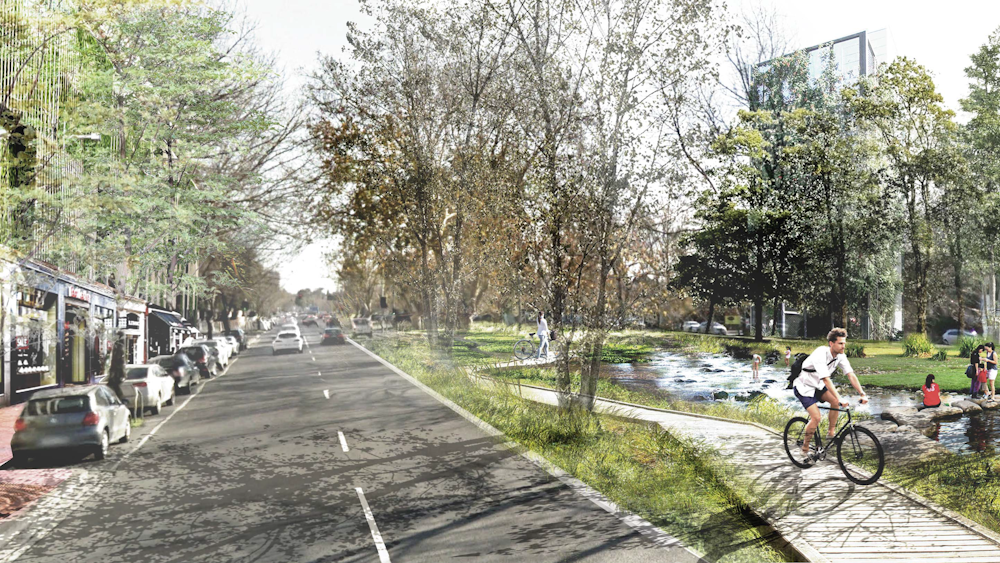
Our research shows people walk more if the city’s design provides them with places to walk to near where they live, work or study.


Read more: Health Check: do we really need to take 10,000 steps a day?


The research also shows people walk even more if they live in a place that has good public transport and plenty of jobs or employment opportunities they can easily access.

What gets us walking

Our study examined walking behaviours in nearly 5,000 adult commuters in Melbourne, drawn from the Victorian Integrated Survey of Travel and Activity between 2012 to 2014.

We looked at what level of access they had for destinations to walk to, typically within about 800 metres, close to their home, work or study place. This could be local cafes, shops, supermarkets, libraries and other services, often referred to as local accessibility.

The amount walked on an average day by those with good local accessibility at home or near where they worked or studied was around 12 minutes. Those with limited access to local facilities walked only seven minutes.

People with good local accessibility near their homes walked five minutes more per day than those with poor local accessibility. People with good local accessibility near where they worked or studied walked nine minutes more.


Read more: Young people want walkable neighbourhoods, but safety is a worry


But to get our activity to the next level we needed to look beyond what was locally accessible to people.

We looked at people’s relative travel commute time by public transport compared with driving, the level of public transport service accessible from where they lived, worked or studied, and the number of jobs within 30 minutes of people’s homes by public transport. These are sometimes referred to as measures of regional accessibility.

We found that the greater access people had to resources and public transport regionally, the more they walked.

For example, after accounting for local accessibility, people living in places with a higher number of jobs available within a 30-minute public transport journey walked just over four minutes more on average than people in areas with very low job availability.

People living in places where taking public transport was more efficient timewise than driving, walked more than seven minutes extra a day compared with people with low levels of public transport.

A little extra help

Our study also looked at the combination of local and regional accessibility to see if they encouraged people to walk even more.

We found that high exposure to both local accessibility and public transport accessible opportunities beyond the immediate neighbourhood was associated with greater walking benefits than exposure to just one or the other alone.

This combination of factors supported people to do around ten minutes more (give or take depending on the measures used) of walking on average per day.

We know people who travel by public transport are likely to walk more than those who travel by car.

Public transport effectively separates people from their own vehicle, be it at home or a park-and-ride stop. Public transport delivers them as pedestrians close to their destination, which in turn promotes walking throughout the day.

If people walk more in their residential environment (say to the shops, library, or post office), take public transport to their workplace or place of study and then walk more in this environment too (at lunchtime for example), they do ten more minutes of physical activity in a day than their counterparts who drive.

A message to planners

The message this new research tells us is simple.

City and urban design and transport planning have the potential to deliver a regular extra dose of what’s been described as the “miracle cure” of exercise by encouraging us to walk more.

A variety of walkable destinations that support people’s daily living needs to be designed into existing and, more importantly, new developments. That means at locations where we live, work, and study.


Read more: Making our cities more accessible for people with disability is easier than we think


This can be done by locating shops, schools, post offices, GPs and public transport stops within good walking distance. Jobs need to be located close to where people live. This will encourage walking, cycling and public transport commuting. When this is not possible, employment opportunities should be embedded within well connected and efficient public transport networks.

Cities that support people to walk more will provide population health benefits through increased physical activity, helping them to become truly smart and healthy cities.

ref. It’s easy to get us walking more if we have somewhere to walk to near our home and work – http://theconversation.com/its-easy-to-get-us-walking-more-if-we-have-somewhere-to-walk-to-near-our-home-and-work-124500

Grattan on Friday: A little more confusion added to the climate policy debate

Source: The Conversation (Au and NZ) – By Michelle Grattan, Professorial Fellow, University of Canberra

Joel Fitzgibbon was on his mobile at a cafe at the Commonwealth Parliamentary Offices in Sydney on Thursday when he encountered Scott Morrison getting a mid-morning coffee.

“You’re making a lot of sense,” Morrison said to Labor’s resources spokesman, who’d set off a fire storm in his party by suggesting the ALP revise its climate policy to adopt the upper end of the government’s target of reducing emissions by 26-28% by 2030.

“Your love won’t help me, Prime Minister,” Fitzgibbon shot back.

He’s right there. Fitzgibbon’s radical proposal has burst open the conundrum the opposition has in reshaping one of the ALP’s centrepiece election pitches.

It’s a great deal more complicated than, for example, dealing with the franking credits plan, which Labor can’t afford to keep in its present form. That can be restructured, or dumped, without much political angst.

But the climate policy – for a 45% reduction in emissions by 2030 and a target of net zero by 2050 – has become an article of faith within Labor, and among many of its supporters. It’s also a policy that in the election split the voters Labor needed, attracting some but driving away others.

Weaken the policy and there will be a reaction from the ALP’s inner city constituents, who tend to look toward the Greens out of the corner of their eye. Keep a very high target and lose people once again – to the Coalition or minor parties on the right – from the traditional base, including in regional areas, especially in Queensland where coal mining is a thing.


Read more: Labor’s climate and resources spokesmen at odds over future policy


Fitzgibbon maintains that by adopting the 28% target, Labor would not just be more acceptable to blue collar voters but would put more pressure on the government to act – although this latter point seems a stretch.

Getting to 28% without destroying blue collar jobs or harming the economy would also provide “a great foundation” for prosecuting the case for further action, he claims.

Among the multiple problems Labor has in reviewing its policy is that it will be considering a more pragmatic, less ambitious approach just when the climate debate is once again taking off in public consciousness.

It’s hard to assess precisely the extent to which the step up in activism represents the wider public view. Indeed the civil disobedience demonstrations are infuriating some people because of the disruption. Nevertheless, the period ahead could see the issue biting more, as the ALP is considering easing back.

Given how quickly things change and the relevance of what other countries do, in strict policy terms Labor arguably would be best not to settle a policy until, say, early 2021, for a 2022 election. But the government (and the media) will be able to exploit a Labor vacuum, so that holding out does carry political cost.

Fitzgibbon, who represents the NSW coal seat of Hunter and experienced voter wrath in May, won’t get the ambit claim he outlined this week. That would be going too far for the party, and for its climate spokesman Mark Butler who has a lot of reputation at stake. As soon as Fitzgibbon made public his proposal, Butler said it wouldn’t be embraced by Labor, declaring it was “fundamentally inconsistent with the Paris agreement and would lead to global warming of 3℃.”

Fortunately for the government, Fitzgibbon’s intervention reduced the attention on its energy policy, the inadequacy of which was again highlighted this week.


Read more: Labor’s climate policy: back in the game but missing detail


As the Coalition pushes ahead with seeking to get its “big stick” legislation to deal with recalcitrant power companies through parliament, criticisms of its policy came from, among others, the chair of the Energy Security Board Kerry Schott and the Grattan Institute.

Schott, whose board advises federal and state governments, wrote in the Australian Financial Review, ahead of the paper’s energy summit, that “government interventions to cap prices and to effectively subsidise certain generation projects will not encourage the considerable new investment and innovation that is needed”.

The Grattan Institute, which released a report on Australia’s electricity markets, said the government’s “fight to avoid the impending closure of the Liddell coal power station in NSW makes it harder for Australia to achieve its emissions reduction targets, and is likely to increase electricity prices and reduce the reliability of supplies”.

The AFR summit saw much finger pointing, with energy minister Angus Taylor blaming industry for the lack of investment, and industry blaming the government.

Taylor said dismissively: “Time and again we’ve seen industry participants and commentators swept up in the excitement of complex new programs represented by the latest fashionable acronym that everyone pretends to understand but few ever do.” Origin Energy’s CEO Frank Calabria said “the mere existence of the big stick is acting as a handbrake on investment, right when we need investment the most”.


Read more: Australia to attend climate summit empty-handed despite UN pleas to ‘come with a plan’


In theory, Morrison could have tried to use the great authority his unexpected election win gave him to pursue more appropriate energy and emissions reduction policies. Admittedly, it would have been extremely difficult, as it would have contradicted much the government had been saying and doing.

But it was never an option. Morrison is either wilfully blind to what needs to be done (although when treasurer he supported the more rational policy of a National Energy Guarantee), or he is afraid to stir those powerful naysayers in his party.

So where are we left?

With a government stubbornly tied to a set of policies that experts insist won’t deliver effective results. And an opposition that’s in a funk about where it should position itself in the future.

Meanwhile Australia’s overall emissions rise (although electricity emissions are down, as some coal fired power goes out of the system); high electricity prices remain a burden on private and business consumers alike; and there is nervousness about the summer power supply.

ref. Grattan on Friday: A little more confusion added to the climate policy debate – http://theconversation.com/grattan-on-friday-a-little-more-confusion-added-to-the-climate-policy-debate-125060

Wayne Swan warns US Democrats not to fall into Labor’s trap of overloaded agenda

Source: The Conversation (Au and NZ) – By Michelle Grattan, Professorial Fellow, University of Canberra

Labor party president Wayne Swan has warned that the United States Democrats could be at risk of the overloaded agenda trap that helped defeat the ALP in May.

Writing in the American progressive journal Democracy Swan, a former treasurer, says that in Labor’s loss, the size of its agenda was more decisive than its shape.

“Labor had too many individual policies that, while fully funded, couldn’t be effectively communicated.” Thus opponents could characterise the ALP agenda as big spending and big taxing.

Swan says that given the Australian experience, he feels “some queasiness” at the array of policies being discussed in the emerging Democratic primaries.

“The policies are all urgent and correct, but they are too many, offering attack angles beyond a Republican strategist’s wildest dreams.

“The shape is right – but the sizing is wrong.

“I may be worried about nothing if the Democratic primary process does its job of whittling down the agenda to something more manageable, but I fear for the consequences if the Democratic primaries become a series of purity tests on policy that saddle an eventual nominee with too broad a policy terrain to be adequately defended from Trump and the Murdoch State Media.”

Swan writes that experience in Australia, the US and the recent Scandinavian elections showed the populist right’s rise was hollowing out the centre left’s support among working class and lower-income people.

This was happening “when the right’s solutions only exacerbate the root causes of people’s justified anger at the political system: austerity, the destruction of social welfare, and the turbocharging of inequality.

“Re-channelling this anger toward immigrants and the already disadvantaged is proving a more durable political tactic than anyone expected.”


Read more: How might Labor win in 2022? The answers can all be found in the lessons of 2019


Swan argues that progressive parties have the harder time of it when voters are distrustful.

“In an era of toxic distrust toward politicians and government itself, progressive parties suffer more because we promise more.

“Labor’s agenda was large; beyond a certain point, your ideas just end up jostling for limited political airspace and for a claim on the trust of voters.”

Faced with this “terrible conundrum” progressives can’t do less, according to Swan.

“We cannot retreat on either the shape or the content of our agenda. But size is another thing.

“Like it or not – and I don’t like it one bit – we are living in a world where the right’s success in demonising the whole political class depletes the reservoir of voter trust progressive parties rely on to shape and win a mandate for change.

“This means that we must find a way of communicating our vision through a shortlist of high-profile, easily campaignable policies.

“We must also acknowledge that the agenda can only be as large as the voters’ trust in the leader and the party to deliver it,” he writes.

“In a world of diminished voter trust, progressives must start with a core set of saleable, intelligent reforms that build political capital for the next tranche of reform, and the one after that.”

ref. Wayne Swan warns US Democrats not to fall into Labor’s trap of overloaded agenda – http://theconversation.com/wayne-swan-warns-us-democrats-not-to-fall-into-labors-trap-of-overloaded-agenda-125067

Pay pharmacists to improve our health, not just supply medicines

Source: The Conversation (Au and NZ) – By John Jackson, Researcher, Faculty of Pharmacy and Pharmaceutical Sciences, Monash University

When you have a medicine dispensed at your local pharmacy under the Pharmaceutical Benefits Scheme (PBS), two things happen. The federal government determines how much the pharmacy receives for dispensing your medicine. It also decides what you need to pay.

This so-called fee-for-service funding means pharmacies maximise their revenue if they dispense many prescriptions quickly.

Rather than fast dispensing, it would be better for patients and the health-care system if the funding model paid pharmacists for improving the use of medicines, not just for supplying them.

This is possible, according to our research published recently in the Australian Health Review. And it should be considered as part of the next Community Pharmacy Agreement, which outlines how community pharmacy is delivered over the next five years.


Read more: Explainer: what is the Community Pharmacy Agreement?


Dispensing medicine is more complex than it looks

Dispensing medications may seem simple but this can be misleading: it includes both commercial and professional functions.

Under the PBS, the pharmacy receives a handling fee and mark-up on the cost of the drug to cover the commercial cost of maintaining the pharmacy and stock.

It also receives a dispensing fee for the pharmacist’s professional activities. These include reviewing the prescription to ensure it is legal and appropriate, taking into account factors such as your age, whether you are pregnant and which medicines you’ve been prescribed before; creating a record of the dispensing; labelling the medicine; and counselling you, including providing a medicine information leaflet if needed.

Higher dispensing fees are paid for medicines needing greater levels of security (such as controlled drugs including opioids) and for medicines the pharmacist must make up (such as antibiotics in liquid form).


Read more: Health Check: is it OK to chew or crush your medicine?


But for the vast majority of PBS prescriptions, a pharmacy receives the same basic dispensing fee, currently A$7.39.

If you have a medicine dispensed for the first time, if it has a complicated dose, or it carries particular risks such as side effects or interactions, a pharmacist is professionally obliged to provide counselling matched to the risk. The more detailed the counselling, the greater the time needed.

However, at present, the dispensing fee to the pharmacy does not change depending on the level of counselling you need. Indeed, the current funding model is a disincentive for the pharmacist to spend time with you explaining your medicine. That’s because the longer they spend counselling, the fewer prescriptions they can dispense, and the fewer dispensing fees they receive.

What could we do better?

Performance-based funding, in which payment is adjusted in recognition of the efforts of the service provider or the outcomes of the service delivered, is becoming more common in health care and can correct some of the volume-related issues mentioned above.

It’s already being used in Australia. For instance, GPs are paid a Practice Incentives Program (PIP) to encourage improvements in services in areas such as asthma and Indigenous health.

However, performance-based funding has yet to be used for pharmacists’ dispensing in Australia.

We propose dispensing fees should be linked to the effort pharmacists make to promote improved use of medicines. This is based on the principle that counselling means people are more likely to take their medications as prescribed, which improves their health.

In other words, pharmacists would receive higher dispensing fees when more counselling is required or if counselling leads to patients taking their medications as prescribed.

Pharmacists who spend longer counselling, for instance if someone’s health status has changed, should be rewarded for it. from www.shutterstock.com

Dispensing fees could be linked to the actual time taken to dispense a prescription: the longer the time, the higher the fee. The time taken would depend on the nature of the drug; the complexity of the patient’s treatment; recent changes in the patient’s health status or other medicines that need to be taken into account; consultation with the prescribing doctor; and the level of advice and education provided.

A blended payment model could include a fee-for-service payment for commercial processes and a performance-linked payment for professional functions.

The most experience with performance-based payments to pharmacy is in the United States, where evidence is developing of patients taking their medicine as prescribed and lower total health-care costs.

In England, the government’s Pharmacy Quality Scheme is similar to the Australian Practice Incentives Program for GPs. It funds improved performance in areas such as monitoring use of certain drugs and patient safety.

There is some concern about performance-linked payments. Performance targets need to be achievable without being onerous. And performance needs to be clearly linked to the payment being made, but not if other services suffer.

Incentives could apply to you too

Cost is a barrier to some people taking their medicines with over 7% of Australians delaying or not having prescriptions dispensed due to cost.

However, there is currently no financial incentive for you to have a generic (non-branded) medicine dispensed, which would save on PBS expenditure. So it makes sense for generic medicines to be a lower cost to you.


Read more: Health Check: how do generic medicines compare with the big brands?


There is also currently no financial incentive for you to take your medicine as prescribed, which would likely improve your health and save the health budget in the long run. We are not aware of any country varying patient charges based upon this, although there are ways of monitoring if people take their medicines as directed.

However, countries such as New Zealand and the United Kingdom have lower or no patient prescription charges, minimising costs as a barrier to patients taking their medicine.

What would need to happen?

Dispensing a prescription should be an invitation for the pharmacist to interact with you and help you with advice on the effective and appropriate use of your medicine. At present, there is no incentive, other than professionalism, for pharmacists to add such value.

The proposed changes would require a major restructure to the funding of dispensing to provide incentives that are equitable and transparent and that did not adversely affect disadvantaged, rural and Indigenous people.

There would need to be agreement on reliable and valid performance measures and reliable information systems.

However, funding based on a professional service model rather than a dispensing volume model would support your pharmacist to provide greater benefit to you and the health-care system.

ref. Pay pharmacists to improve our health, not just supply medicines – http://theconversation.com/pay-pharmacists-to-improve-our-health-not-just-supply-medicines-124641

‘Highly charged story’: chemistry Nobel goes to inventors of lithium-ion batteries

Source: The Conversation (Au and NZ) – By Mark Blaskovich, IMB Fellow, The University of Queensland

This year’s Nobel Prize in Chemistry goes to three chemists who collectively developed something that has become an absolute necessity in our daily lives – the lithium ion battery. From mobile phones to portable tools to electric cars, in less than four decades this invention has become a staple of modern society and could be instrumental in providing the energy storage needed to help power a renewable energy future.

The prize was shared equally by Stanley Whittingham, now at the State University of New York at Binghamton; John Goodenough, a former professor at Oxford University and now at the University of Texas at Austin; and Akira Yoshino, a researcher at Japanese chemicals company Asahi Kasei.

L-R: John Goodenough; Stanley Whittingham; Akira Yoshino. Niklas Elmehed/Royal Swedish Acad. Sci.

Lithium batteries have substantial advantages over previous types of batteries. They are vastly lighter and more compact than the antiquated lead batteries still found in most cars. They can be recharged, unlike the cheap “disposable” zinc or alkaline batteries still commonly used in toys and other portable devices.

What’s more, lithium batteries don’t contain a toxic metal, unlike nickel-cadmium rechargeable batteries, and they also don’t suffer from the latter’s “memory effect” where after multiple partial discharges the battery only discharges to the level it had been repeatedly discharged to.

Lithium ion batteries’ closest competitors are nickel-metal hydride batteries, but these are heavier and don’t carry as much energy.


Read more: How do lithium-ion batteries work?


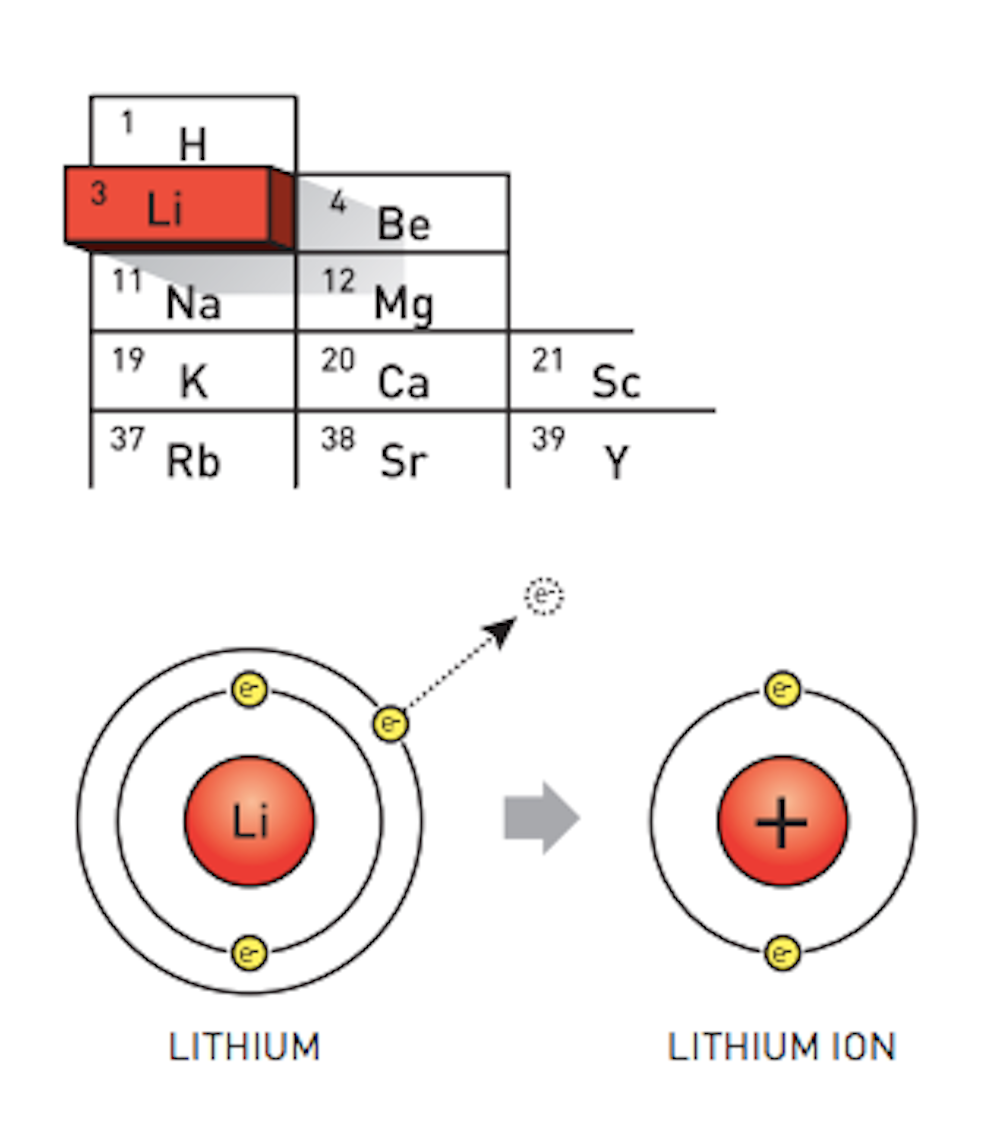
The lithium atom readily loses an electron to become a lithium ion. Johan Jarnestad/Royal Swedish Acad. Sci.

Whittingham developed the first functional lithium battery in the 1970s, after moving from Stanford University to the oil company Exxon. Exxon wanted to diversify amid fears of running out of oil in the early 1970s. Ironically, given that electric cars might eventually displace petrol vehicles, Exxon abandoned its promising battery research program when oil prices fell in the early 1980s.

Whittingham realised that lithium is a useful battery material because its atoms readily release their electrons, which can then provide a flow of charge.

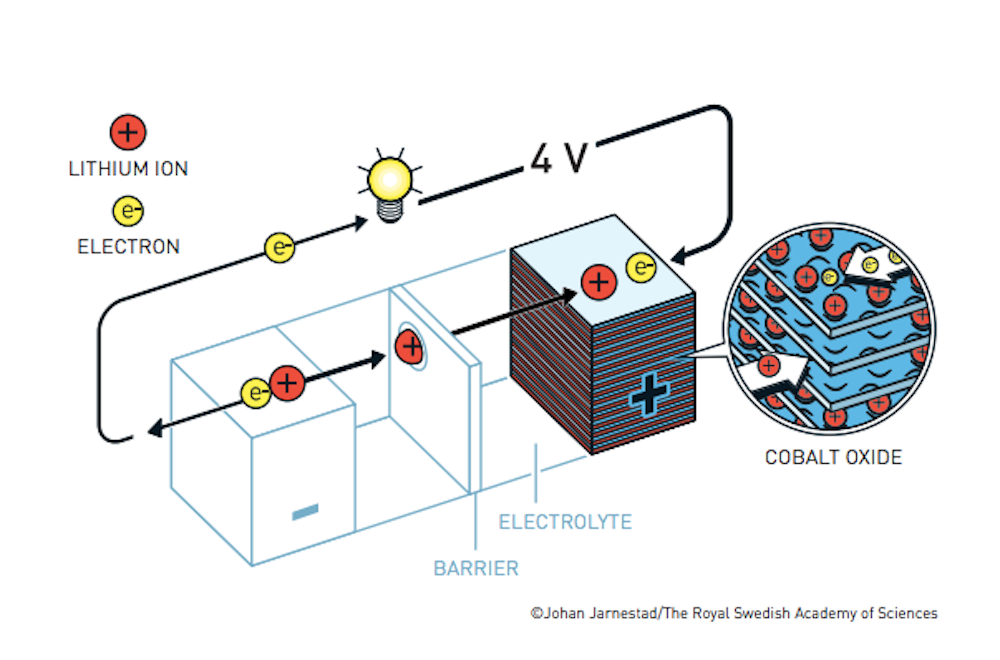
The next advancement was made by Goodenough, who figured out that changing one of the components of Whittingham’s battery, from titanium disulfide to cobalt oxide, resulted in a much more powerful battery. He later found that iron phosphate was a less expensive and less toxic alternative that also worked well.

Goodenough’s battery. Johan Jarnestad/Royal Swedish Acad. Sci.

The final step that led to the modern commercial battery was taken by Yoshino, who replaced the solid lithium metal in previous batteries with lithium ions embedded in a form of carbon called petroleum coke. This removed the danger posed by highly flammable lithium metal, which burns when exposed to air.

Crucially, this also meant the battery’s electrodes were not degraded by chemical reactions. This is why lithium batteries can be recharged many times without losing power.

Akari Yoshino’s crucial innovation was to protect the lithium ions inside a matrix of carbon. Johan Jarnestad/Royal Swedish Acad. Sci.

That brings us pretty much up to date. Lithium-ion batteries are now so ubiquitous that you’re almost certainly reading this on a device that contains one.

But the story doesn’t quite end there. Goodenough, despite being 97 and the oldest person ever to receive a Nobel Prize (they are not awarded posthumously) reportedly still goes to the lab every day.

Research is still continuing into making lithium batteries more safe and powerful, including at CSIRO in Australia. There is also lots of effort to come up with the next generation of portable power.


Read more: To build better batteries, you need to catch them in the act


As Olof Ramstrom, a member of the chemistry prize committee, quipped “this is a highly charged story of tremendous potential”.

ref. ‘Highly charged story’: chemistry Nobel goes to inventors of lithium-ion batteries – http://theconversation.com/highly-charged-story-chemistry-nobel-goes-to-inventors-of-lithium-ion-batteries-125051

Just 29 companies receive 59% of Australia Council funding. Artists are calling for a change

Source: The Conversation (Au and NZ) – By Jo Caust, Associate Professor and Principal Fellow (Hon), University of Melbourne

Today, the Daily Review published an open letter with more than 700 signatures addressing the meeting of cultural ministers, which convenes this Friday.

The letter is signed by some of the most important artists and arts-workers in Australia, including Mother and Son writer Geoffrey Atherden, photographer William Yang, dancer Liz Dalman, playwright Patricia Cornelius, publisher and critic Katharine Brisbane, Terra Nullius author Claire G. Coleman, La Mama artistic director Liz Jones, and former Adelaide Festival artistic director David Sefton.

This meeting will be discussing the Major Performing Arts (MPA) framework, and the open letter is an “urgent request [for ministers] to withhold [their] endorsement of the revised MPA Framework.” They write:

Across all measures, the independent and small-medium sector is the lifeblood of the national arts ecology. This sector, on which Australian culture depends for its productivity, efficiency and international reputation, is on the verge of collapse.

The letter captures the growing feelings of despair and disenfranchisement in the arts sector.

Protected funding for 29 companies

The MPA Framework, in existence under various titles since 1999, ensures the majority of available arts funding at the federal and state level is directed to 29 performing arts companies.

Of the A$177 million in arts funding the Australia Council had to distribute in 2016-17, $109 million went to MPA companies: the open letter says the current proportion of funding to the MPA companies is 59%. These companies aren’t subject to peer review, and are protected from cuts to arts funding.

The MPA organisations include ten orchestras, five opera companies, eight theatre companies, and three ballet companies. These companies are generally focused on the western canon and follow the European tradition in terms of their cultural priorities.

They tend to be white and male dominated in their leadership – Bangarra is the only First Nations company. The very nature of major performing companies excludes all other art forms, such as literature and the visual arts.


Read more: Australia’s art institutions don’t reflect our diversity: it’s time to change that


Primarily located in Sydney and Melbourne, MPA companies attract most of the arts sponsorship as well as the majority of the box office income: companies are theoretically only eligible to be a member of the MPA if they can demonstrate a non-grant income of more than $1.6 million.

The rich continue to get richer and the poor get poorer.

The open letter intends to draw urgent attention to the situation facing the broader community due to their funding inequity, the overall cuts in funding, and the lack of any real increase to arts funding over many years.

Reconsidering the framework

In 2018, the government hosted a survey about the future of the MPA companies, receiving 8,026 responses. The cultural ministers will be responding to the findings of this survey at their Friday meeting.

The public survey asked five questions, including what should be the MPA’s “guiding principles”, what the criteria for being an MPA company should be, and:

[…] MPA companies are not subject to a competitive process through peer review for their base funding […] Do you agree with this approach?

The open letter calls for the MPA framework to be abolished and for these companies to be subjected to peer review, like all other arts organisations and artists.

As the letter notes, smaller companies play to larger audiences; are more artistically innovative; and undertake more international tours.

Grants to individual artists – who also fall outside the MPA framework – have fallen by a third since 1999.

Many believe the two-tiered funding model is decimating the sector. Smaller players manage on very little and are seen as disposable, putting arts organisations that have been the backbone of the arts ecology at risk and causing many artists to struggle to survive, or leave the arts altogether.


Read more: Federal arts funding in Australia is falling, and local governments are picking up the slack


An artistic ecosystem

Like the environment, the arts are an ecosystem. If a major part of it is damaged irreparably, the entire system could collapse.

Big companies rely on the output of small companies for development of new content, artistic styles, and emerging artists. Without the underlying structure of the independent and small-to-medium sector, the big companies can become moribund.

One argument is these large companies are labour intensive and require many more resources to stay afloat than a small gallery or a publishing company. It follows, then, it is necessary for governments to provide a large amount of funding to these companies.

Yet, as the open letter notes, big companies received a subsidy of $31.50 per audience member; the small-to-medium and independent sector receive a subsidy of $3.36 per audience member.


Read more: Majors and the majority: planning for Australia’s artistic legacy starts now


There are some hard questions here the letter writers want the culture ministers to address.

Do they want to support a healthy arts ecosystem? Do they want to lose extraordinary artists, arts activity and arts organisations year after year, because the government wants to protect the few who are big and powerful? Leaders talk about cultural diversity, but are they willing to shift funding priorities to ensure it occurs?

It’s critical the culture ministers address these fundamental questions without them being captured continually by political interests. The future of Australia’s arts ecology depends on it.

ref. Just 29 companies receive 59% of Australia Council funding. Artists are calling for a change – http://theconversation.com/just-29-companies-receive-59-of-australia-council-funding-artists-are-calling-for-a-change-124873

Our leaders ought to know better: failing to pass on the full rate cut needn’t mean banks are profiteering

Source: The Conversation (Au and NZ) – By Kevin Davis, Professor of Finance, University of Melbourne

The unwillingness of the major (and other) banks to immediately cut their headline mortgage rates by as much as the Reserve Bank cuts its cash rate always attracts bad press, as well as condemnation from treasurers and prime ministers.

After the big four passed to variable rate owner-occupiers only 0.13-0.15 percentage points of this month’s 0.25-point cut in the Reserve Bank cash rate, Treasurer Josh Frydenberg said they had decided to put profits “before their customers”, adding:

What we do expect the banks to do is to provide their customers with the best possible deal, and it’s very disappointing that they haven’t done that

Prime Minister Scott Morrison said the banks were “basically profiteering”:

How else do you describe it? I’ve never been one, whether as treasurer or prime minister, to give the banks a leave pass

Are the banks “profiteering”? Or are they right when they say their loan rates simply reflect their cost of funding?

‘Profiteering’ isn’t straightforward

My inquiries suggest that while there may indeed be some behaviour that could reasonably be described as profiteering, the banks’ complex funding arrangements explain much of their decisions not to pass on all of the past three interest rate cuts.

The cash rate is the rate for overnight lending between banks, and while it ultimately influences all interest rates, overnight lending and borrowing is a very small part of bank funding.

Most of the funds banks lend come from deposits and wholesale borrowings. They are typically provided for months or years rather than nights.


Read more: 0.75% is a record low, but don’t think for a second the Reserve Bank has finished cutting the cash rate


The rates banks pay for these funds don’t necessarily change immediately or by the same amount as the cash rate. But even when they do, the average cost of funding for bank loans changes much more slowly because it also includes the cost of funding taken out at earlier rates, until that funding is replaced by new funding taken out at new rates.

So the banks’ argument that their funding costs don’t move with the cash rate has theoretical merit.

But how can we assess whether it is valid in practice?

The figures cast doubt on the “profiteering” claim

One way is to look at the behaviour of the net interest margin (NIM) of the banks. This is the difference between the amount of interest they earn on loans and other investments over and above the interest they pay on their funding, expressed as a percentage of their interest-earning assets.

If they are “profiteering” by not reducing loan rates in line with funding costs, the NIM should increase. Has this happened?

The figures suggest not – although they are not published frequently enough to give a definitive figure for developments over the past few months. Note also that there are always other factors influencing the NIM. A shift into higher risk-lending, for example, could be expected to see an increase in the NIM to reflect higher loan rates charged for greater risk.


Net interest margins of the big four

100 basis points = 1 percentage point. KPMG analysis from ANZ, CBA, NAB and WBC half yearly reports

But the figures aren’t conclusive

The net interest margins of the big four have fallen markedly since 2010 and appear to have plateaued.

But that needn’t mean home borrowers are getting better deals.

The banks might be widening their margins on highly profitable home loans while narrowing them on others.

And even small changes in net interest margins (the kind not easily seen on graphs) can generate large dollar sums of the sort the banks need to offset the seemingly ever-mounting costs of compensation and fines resulting from the banking royal commission.


Read more: Sam and the honest broker: why Commissioner Hayne wants mortgage brokers to charge fees


The difficulty of reaching a conclusion is compounded by the abundance of mortgage loan rates, such that it is the “headline” variable rate which attracts media and public attention, but which not all new borrowers pay.

Most banks offer significant discounts to new customers who are savvy enough to bargain and are good credit risks. There is not enough good contemporaneous information about what banks are charging these customers.

This isn’t to say that changes in the headline rate are unimportant. Headline rates are especially important because they apply to the mass of “back book” (existing) mortgage customers who are slow to rebargain or refinance.

Both headline and discounted rates matter

Changes in rates on the back book matter much more for bank profits than changes in rates on the front book (new borrowers). They adjust in line with the headline rate, the ones the politicians and bank critics notice.

Unfortunately for those existing borrowers, those rates move slowly because they depend on the banks’ past funding costs. They are funded from a mix of short term and other borrowings for terms of three months to several years.

Only as that existing funding matures and banks can refinance at lower rates can the average cost of their funds decline – and even then not generally by as much as the cash rate. Bank average funding costs are necessarily less variable than the cash rate, such that even over time after long lags we can’t necessarily expect their headline rates to track the cash rate.


Read more: Cutting interest rates is just the start. It’s about to become much, much easier to borrow


Of course, it would be foolish to rule out the possibility that the major banks, all wearing costs as a result of the royal commission, are attempting to recoup some of those costs by a less than complete pass-through of their average funding costs.

If they are, the offerings of alternative mortgage providers with different funding models will be become relatively more attractive and there will be more in it for customers who switch.

Ultimately, it’s customer awareness and action that will inhibit bank “profiteering”, far more than jawboning by politicians and the media.

ref. Our leaders ought to know better: failing to pass on the full rate cut needn’t mean banks are profiteering – http://theconversation.com/our-leaders-ought-to-know-better-failing-to-pass-on-the-full-rate-cut-neednt-mean-banks-are-profiteering-124874

Shh! Don’t mention the public housing shortage. But no serious action on homelessness can ignore it

Source: The Conversation (Au and NZ) – By David Kelly, Research Fellow, HOME Research Hub, Deakin University

Today, October 10, is World Homeless Day. Next week the Council to Homeless Persons will convene the Victorian Homelessness Conference to discuss options for ending homelessness. On the program are presentations and discussions about Aboriginal homelessness, youth homelessness, the links between mental health and homelessness, the NDIS, and a debate about tiny homes.

Nowhere is there any mention of, or provision for discussion about, public housing.

This is despite the fact that providing public and community housing (together, social housing) is the single most effective means to get people out of homelessness, and that nearly 43,000 households are on the state waiting list, and that Housing Minister Richard Wynne – who has primary responsibility for social housing – will be opening the conference.


Read more: Focus on managing social housing waiting lists is failing low-income households


The program does include a session on “How to win friends and influence homelessness policy”. The title may offer a clue to why housing advocacy groups no longer mention the actual housing solution – public housing. Interestingly, the keynote speaker, Dr Stephen Gaetz of the Canadian Observatory on Homelessness, will discuss among other things “underinvestment in social housing” in his own country.

The Canadians appear to be less anxious about upsetting their governments and the development industry. Earlier this year, British Columbia’s minister for housing, Selina Robinson, said of Vancouver’s housing affordability crisis that “this is not a supply problem: it is a right supply problem”.

Robinson was directly challenging the mantra that increasing housing supply is the solution to unaffordable housing. She was arguing for direct investment in housing specifically for low-income households.

Housing policy is the problem

Public housing supply has lagged behind housing need for decades in Australia. Australia needs to build 100 public housing dwellings a day for 20 years to provide for the people in the most urgent housing need – typically the bottom two-fifths of income groups – according to a recent study. This is achievable but would require a significant change in current policy.


Read more: Australia needs to triple its social housing by 2036. This is the best way to do it


Public housing policy in Victoria has become craven. Productivity Commission statistics for 2019 show every state in Australia except Victoria and South Australia has increased net spending on social housing since 2014-15. Since 2016 Victoria has transferred more public housing stock to the private sector than any other state. The state has fewer public housing dwellings today than ten years ago.

In a critique of the management of public housing, the Victorian auditor-general was scathing about a lack of long-term vision. The report described the current approach as “disjointed, poorly communicated and lacking in a comprehensive understanding of asset performance”.

The major policy response has been the Homes for Victorians initiative. Its centrepiece is the redevelopment of inner-city public housing estates in Melbourne. The objective is to shift public housing provision to the private sector under the cover of renewal. No effort has been made to meet the obvious demand on the public housing wait list.

A Victorian parliamentary inquiry in 2018 and research study in 2019 raised serious concerns about the renewal program, its ability to meet the needs of vulnerable people and its very objectives.


Read more: Governments have no excuse for keeping public in the dark on public housing deals


A number of public housing estates – Northcote, North Melbourne, Preston, Heidelberg and Ascot Vale – have already been partially or fully emptied of people. Demolition has begun at North Melbourne. Private developer MAB has been awarded the contract to develop these estates and sell the new dwellings to private owners.

Walker Street Estate in Northcote is scheduled for demolition in March 2020. Celeste de Clario, Author provided

The great majority of dwellings on these estates will be privately owned. The rest will be given to the community housing sector.

Community housing providers are required to take 75% of their clients from the Victorian Housing Register. However, rents can be higher and the increasing corporatisation of the sector pushes fundamental housing justice questions to the background.


Read more: ‘Growth’ of community housing may be an illusion. The cost-shifting isn’t


After renewal, these estates will have less capacity to house people who are experiencing chronic homelessness and have other complex needs. Capacity to address chronic housing inequality across Victoria will be reduced.

How public housing policy must change

The logic that drives housing policy in Victoria and Australia is undermining the most important and effective tool we have for ending homelessness: public housing.

Victoria’s Housing Establishment Fund is the main policy mechanism for those needing urgent accommodation. Yet, instead of providing secure permanent housing, it is increasingly being used to provide short-term unsafe shelter in cheap motels and rooming houses.

International evidence shows permanent housing for people experiencing homelessness is more cost-effective and does more to end homelessness. It also secures the housing system to work better for all.

The most effective and cost-efficient way of overcoming homelessness, housing insecurity and inequality is to provide and maintain public housing. This requires a shift in policy direction that values housing not as real estate but as a basic right to a safe, secure place to dwell. In Australia this also means linking housing justice to questions of Treaty and land justice for which Indigenous peoples have been calling for generations.

Victoria’s peak social justice and housing advocates have been aiming to win over state governments and influence homelessness policy for decades now. The crisis in affordable housing is just getting worse. Perhaps it’s time to consider an alternative strategy.


Read more: Why should the state wriggle out of providing public housing?


ref. Shh! Don’t mention the public housing shortage. But no serious action on homelessness can ignore it – http://theconversation.com/shh-dont-mention-the-public-housing-shortage-but-no-serious-action-on-homelessness-can-ignore-it-124875

Indonesia denies NZ diplomats entry into West Papua

Pacific Media Watch Newsdesk

The New Zealand embassy has confirmed Indonesia has denied its diplomats’ requests to visit Papua and assess the conflict and human rights situation in the turbulent region.

According to The Sydney Morning Herald and The Age, a spokesperson from the New Zealand embassy confirmed the travel ban, which has been extended to diplomats from the British and Canadian embassies as well.

The Indonesian Foreign Ministry, Kemlu, reportedly cited security concerns following weeks of violence and protest as the reason to deny entry.

READ MORE: WEST PAPUA: Veronica Koman ‘won’t be silenced’ despite daily death threats

“Security considerations were the main concern at the moment,” Kemlu spokesman Teuku Faizasyah said.

“We [Kemlu] follow the decision by the government to limit foreigners to visit Papua, including diplomats.”

– Partner –

Australian and United States diplomats had not requested permission to visit however as they feared such inquiries would cause a “diplomatic headache”.

The article said that the decision to block entry “underscored Indonesian sensitivities about the independence movement and recent violence in the provinces of Papua and West Papua”.

This follows reports that the UN Office of the High Commissioner for Human Right has also been repetitively blocked from visiting Papua, despite being invited in 2018.

According to RNZ Pacific, UN Human Rights Commissioner Michelle Bachelet has said the talks with Jakarta to arrange a visit had stalled.

“We have been working with the authorities, but we haven’t been able to progress it. But we will continue to talk to them because they promised to my predecessor the visit to West Papua but afterward we try to make it work and it hasn’t worked yet but I hope it will work.”

The situation in Papua has reached a crescendo in the last two weeks with reports of over 30 people killed during protests and at least 11500 fleeing violence in the highland town of Wamena, reports Fiji Village.

Reports indicate that those killed were Papuans shot by military but also non-native residents burned to death when protestors torched buildings.

Despite calls from international groups to investigate the deaths on both sides of the conflict, the Indonesian government has been focusing its efforts on finding and apprehending those it deems responsible for inciting the protests.

According to The Jakarta Post, Papuan activists arrested for treason were surreptitiously moved from the Papuan city of Jayapura to East Kalimantan, prompting condemnation from their lawyers and rights groups.

Meanwhile, a build up of Indonesian troops and a nearby shootout has prompted the border between Papua New Guinea and Papua to be closed.

While ethnic violence and anger has characterised the conflict in recent weeks, there have been instances of stirring kindness and humanity with reports of security forces protecting Papuans from Indonesian militias and Papuans protecting Indonesians from the indigenous protestors.

The Jakarta Post reports that Papuans from Wamena personally escorted non-native residents into a safe zone during the worst of the demonstrations and helped them escape the town afterwards.

Print Friendly, PDF & Email

Article by AsiaPacificReport.nz

Trump’s ratings slightly down after Ukraine scandal as Warren surges to tie Biden in Democratic polls

Source: The Conversation (Au and NZ) – By Adrian Beaumont, Honorary Associate, School of Mathematics and Statistics, University of Melbourne

About two weeks since a transcript of Donald Trump’s phone conversation with the Ukrainian president was revealed, his approval with all polls in the FiveThirtyEight aggregate is 41.6% and his disapproval is 54.0%. Trump’s net approval is -12.4%, down 2.5% since last fortnight’s article.


Read more: Warren placed second after Biden, as Trump’s ratings rise. But could the impeachment scandal make a difference?


With polls of registered or likely voters, Trump’s approval is 42.2% and his disapproval is 53.9%, for a net approval of -11.7%, down 3.4% since last fortnight. The Ukraine scandal has had a small but discernible impact on Trump’s ratings.

As I wrote previously, I did not expect this scandal to have a serious or lasting impact, as better-educated voters already detest Trump, while lower-educated voters are far more focused on the economy. Indeed, after an initial drop, Trump’s ratings have stabilised recently.

While there has only been a modest drop in Trump’s ratings, support for impeachment has risen sharply. Before the Ukraine scandal, 51.0% opposed impeachment and 40.1% supported it, according to the FiveThirtyEight tracker. Currently, 49.2% support impeachment while 43.3% are opposed. Support has risen strongly among Democrats and non-aligned voters, but only modestly with Republicans.

The vast majority of Trump disapprovers now support impeachment, but the Ukraine scandal has not converted many Trump approvers into disapprovers.

Despite the increased public support for impeachment, there is very little chance that the Senate, which Republicans control 53-47, will reach the two-thirds majority required to remove Trump from office before the November 2020 election. In the RealClearPolitics average, Trump has well over 80% support for the Republican presidential nomination, with the other three candidates at about 2% each. Republican senators are very unlikely to go against their party’s base.

In head-to-head polling against the three leading Democrats in RealClearPolitics averages, Trump trails Joe Biden by 7.4 points (7.7 points last fortnight). He trails Elizabeth Warren by 4.5 points (4.0) and Bernie Sanders by 5.2 (4.8).

US jobs situation still good

Last week, there were worse than expected September industry surveys for the services sector in both the US and Europe. However, the US added 136,000 jobs in September and the unemployment rate dropped to 3.5% – the lowest since 1969. The one negative aspect of this jobs report was that hourly pay dropped 1c after increasing 11c in August.

The low US unemployment rate is not just because of low participation. The employment population ratio – the percentage of eligible Americans who are employed – increased 0.1% to 61.0% in September, its highest since December 2008, near the beginning of the global financial crisis.

My view is that, bad as Trump’s ratings are, they would be worse without the strong US economy; this explains why Trump’s ratings improved during September as the recession talk from August faded. If the US jobs reports continue to have good news until November 2020, Trump will have a reasonable chance of re-election.

There are two economic policies being pursued by the right that could undermine the global economy. One is the US/China trade war, where talks this week are unlikely to make progress. The other is Brexit, particularly a no-deal Brexit. A no-deal Brexit may occur on October 31, but is more likely after an election that current polling indicates the UK Conservatives would win.

Warren surges to tie with Biden in Democratic polls

In the RealClearPolitics average of Democratic national polls, Warren and Biden are virtually tied, with Warren at 26.6% and Biden 26.4%. It is the first lead for anyone other than Biden. Sanders is at 14.6%, Pete Buttigieg at 5.6%, Kamala Harris at 4.4% and nobody else has more than 3%.

Since the September 12 Democratic debate, Warren’s support has increased at the expense of Biden, Harris and Sanders. Some of Sanders’ recent drop is probably due to his October 1 heart attack.

In early state polls, there have been no new polls since last fortnight in Iowa, with Warren leading Biden by 23.0% to 20.3%. In New Hampshire, the two polls taken since the September 12 debate have Warren leading Biden by one to two points.


Read more: US Democratic presidential primaries: Biden leading, followed by Sanders, Warren, Harris; and will Trump be beaten?


The big exception to Warren’s rise is South Carolina, which is the last of the four early states to vote on February 29. Owing to strong black support for Biden, he has a lead over Warren exceeding 20 points in three post-debate polls in that state.

The next Democratic debate will be held on October 15. Contrary to my previous expectations, the 12 qualifying candidates will not be split over two nights, but instead appear all on one night. The threshold has been increased for November and future debates, and so far eight candidates have qualified for the November 20 debate.

Brexit, Austrian, Portuguese and Canadian elections

I wrote for The Poll Bludger about Brexit and the September 29 Austrian election results, in which the conservatives won, but need an ally to reach a majority. My latest Poll Bludger article is about Brexit and the October 6 Portuguese election, a rare triumph for the left in a democratic world that is trending to the right.

The Canadian election will be held on October 21. The CBC Poll Tracker has the Conservatives and Liberals virtually tied in voting intentions, with the Liberals ahead on seats, but short of a majority.

Australian Newspoll: 51-49 to Coalition

The latest Australian Newspoll, conducted September 26-29 from a sample of 1,660, gave the Coalition a 51-49 lead, unchanged since early September. Primary votes were 42% Coalition (down one), 33% Labor (down two), 13% Greens (up one, and their best Newspoll since 2015) and 6% One Nation (up one).

Scott Morrison’s net approval was +4, down six points. Anthony Albanese’s net approval was -1, up four points. Morrison led Albanese as better PM by 50-31 (48-28 previously).

Voters favoured prioritising the US relationship over China by 56% to 25%. All figures from The Poll Bludger.

ref. Trump’s ratings slightly down after Ukraine scandal as Warren surges to tie Biden in Democratic polls – http://theconversation.com/trumps-ratings-slightly-down-after-ukraine-scandal-as-warren-surges-to-tie-biden-in-democratic-polls-124768

A national drought policy should be an easy, bipartisan fix. So why has it taken so long to enact a new one?

Source: The Conversation (Au and NZ) – By Linda Botterill, Professor in Australian Politics, University of Canberra

In a country as dry as Australia, surely it is a no-brainer that we have in place a coordinated, national drought response that can be rolled out the same way that the Natural Disaster Relief and Recovery Arrangements are triggered when the country experiences cyclones, floods or bushfires.

Drought used to be part of these arrangements but, for good policy reasons, was removed in 1989.

Our last attempt at national drought policy

Once upon a time, Australia had a national drought policy. It was enacted in 1992 following a comprehensive review and report by an independent panel, the National Drought Policy Review Task Force, and detailed negotiations between Commonwealth and state ministers and their officials.

The policy included commitments by both state and Commonwealth governments to implement a coordinated and comprehensive package of programs covering drought preparation and response.

At the Commonwealth level, these measures were centred around:

  • the controversial “exceptional circumstances” provisions of its revised Rural Adjustment Scheme, which were aimed at supporting farm businesses by subsidising up to 100% of the interest paid on commercial loans.

  • a farm household support scheme that provided short-term income support to farmers and also offered grants for those who decided to leave the land.

  • farm management bonds, later known as farm management deposits, that allowed farmers to set aside pre-tax income they could later draw on in times of need.

  • a drought relief payment (added to the policy in 1994) that provided income support for farmers in areas declared to be experiencing “exceptional circumstances” drought. By May 1995, over 10,000 families were accessing this payment every month.

Flaws in the policy

As anyone familiar with these programs will know, the exceptional circumstances program was plagued by problems.

The first was the lack of clarity around defining when a drought moved from a “normal” situation that was expected to be managed by farmers, to an “exceptional” situation with which even the best manager could not be expected to cope.

The definition of an “exceptional circumstances” drought became the subject of ongoing debate, along with concerns that drought assistance was based on administrative boundaries, leading to inequities that became known as the “lines on maps” problem.


Read more: Just because both sides support drought relief, doesn’t mean it’s right


The second issue was the amount of information farmers were required to provide in order to demonstrate eligibility for “exceptional circumstances” assistance. The process was considered onerous and time-consuming.

Amid these concerns, a comprehensive review of drought policy was conducted in 2008 by the Productivity Commission. This was accompanied by a report by the Bureau of Meteorology and CSIRO on the likely impact of climate change on the frequency and severity of droughts in Australia, and an independent report on the social impact of drought.

Following the review, the government decided to end the “exceptional circumstances” program in 2009. This effectively gutted the national drought policy.

Since then, there has been no further attempt at developing a comprehensive, predictable drought policy response from the federal or state governments. There have been intergovernmental National Drought Agreements, but these have done little more than restate the principles underpinning the country’s drought policy since 1992.

In recent years, the Coalition government has appointed a drought envoy, Barnaby Joyce, and drought coordinator-general, Stephen Day, to study the impact of drought on farmers and recommend possible solutions, but we have yet to see what either has come up with.

Drought envoy Barnaby Joyce says he has sent drought reports directly to Scott Morrison, but these have not yet been made public. Lukas Coch/AAP

Providing meaningful, timely and predictable support

Much of the criticism levelled at the government’s response to the current drought relates to its ad hoc and knee-jerk nature. This reactive way of dealing with drought highlights the need to return to a more predictable approach. This would avoid perceptions of pork barrelling and provide certainty to farmers about what support is available and under what circumstances.

A new national drought policy needs to take several forms. First, it needs to support farmers to prepare for drought before it happens. This is one area where the current policy has been moderately successful.

As of August 2019, Australian farmers had set aside a total of $5.809 billion in farm management deposits. These deposits have encouraged farmers to manage financial risk by building up cash reserves in high-income years, which they could then use during times of drought.

Individual farmers can currently hold a total of $800,000 in deposits. One possible improvement is to raise the ceiling on annual deposits in the years following drought recovery to allow a rapid rebuilding of cash reserves.

Second, a strong drought policy needs to provide support to all farmers during drought, not just those who have accumulated sufficient deposits to help them ride out the lean years.

In recent years, many farmers have taken advantage of long-term, low-interest loans to help during drought, and some have called for zero-interest loans to be made available, as well. But loans are not an ideal solution, as repayments are generally required even when farm incomes remain low.

An alternative to low- or no-interest loans are income contingent loans. Similar to the HECS-HELP scheme in higher education, these types of loans only require repayment when the borrower can afford to do so.

This would not only give farmers greater flexibility when it comes to repayment, it would also greatly reduce the extensive red tape that strangled the old “exceptional circumstances” scheme.


Read more: Farm poverty: an area of policy aid built on sands of ignorance


Third, we need a serious rethink of the way we provide income assistance to farmers in a broader sense. Providing income support to farmers who are asset-rich, for instance, raises questions about fairness when compared with poor people in cities who are struggling to get by on Newstart payments.

This imbalance has come into stark focus in recent weeks, particularly on social media, as government ministers have discussed the introduction of drug testing for Newstart recipients, and in the debate around the Indue card.

There has been no serious attempt in the past 45 years to measure the extent of poverty among farmers. We can develop more appropriate and equitable income-support policies if we can better understand the genuine nature of their need.

The elephant in the room

While the government has assiduously avoided making the link, an effective national drought policy also cannot be divorced from discussions about climate change.

The 2008 Productivity Commission report was pretty clear in its conclusions about the impact of climate change on drought in Australia. A growing number of farmers are now acknowledging this reality. Denying the need for serious consideration of climate change is not doing our agricultural producers any favours.


Read more: Is Australia’s current drought caused by climate change? It’s complicated


Developing an effective national drought policy is hard work. But in another sense, it should also be easy. This is because, unlike many other areas of government policy, it can be bipartisan.

Although the National Party has historically been aligned with rural voters, all parties are broadly sympathetic to farmers and value their contributions to the economy and, importantly, our national identity. The public also generally regards farmers positively and is responsive to their plight when they are faced with hardship.

As such, this should be one area where our politicians can come together to develop a coherent national response — one that is known in advance, forward-looking, equitable with other income-assistance programs in the community, and provides meaningful support before, during and after drought.

ref. A national drought policy should be an easy, bipartisan fix. So why has it taken so long to enact a new one? – http://theconversation.com/a-national-drought-policy-should-be-an-easy-bipartisan-fix-so-why-has-it-taken-so-long-to-enact-a-new-one-124775

Is this study legit? 5 questions to ask when reading news stories of medical research

Source: The Conversation (Au and NZ) – By Hassan Vally, Associate Professor, La Trobe University

Who doesn’t want to know if drinking that second or third cup of coffee a day will improve your memory, or if sleeping too much increases your risk of a heart attack?

We’re invested in staying healthy and many of us are interested in reading about new research findings to help us make sense of our lifestyle choices.

But not all research is equal, and not every research finding should be interpreted in the same way. Nor do all media headlines reflect what was actually studied or found.

So how can you tell? Keep these five questions in mind when you’re reading media stories about new studies.

1. Has the research been peer reviewed?

Peer review is a process by which a study is checked by experts in the discipline to assess the study’s scientific validity.

This process involves the researcher writing up their study methods and results, and sending this to a journal. The manuscript is then usually sent to two to three experts for peer review.

If there are major flaws in a study, it’s either rejected for publication, or the researchers are made to address these flaws.

Although the peer-review process isn’t perfect, it shows a study has been subjected to scrutiny.


Read more: Peer review has some problems – but the science community is working on it


Any reported findings that haven’t been peer reviewed should be read with a degree of reservation.

2. Was the study conducted in humans?

Findings from studies conducted in animals such as mice or on cells in a lab (also called in vitro studies) represent the earliest stage of the scientific discovery process.

Regardless of how intriguing they may be, no confident claims about human health should ever be made based on these types of study alone. There is no guarantee that findings from animal or cell studies will ever be replicated in humans.

3. Are findings likely to represent a causal relationship?

For a study to have relevance to our day-to-day health, the findings need to reflect a causal relationship rather than just a correlation.

If a study showed that coffee drinking was associated with heart disease, for example, we want to know if this was because coffee actually caused heart disease or whether these to things happened to occur together.

In a number of studies that found this association, researchers subsequently found that coffee drinkers were more likely to be smokers and therefore, these results were more likely to reflect a true causal relationship between smoking and heart disease.

Just because something is common among coffee drinkers, doesn’t mean coffee caused it. Africa Studio/Shutterstock

In observational studies, where researchers observe differences in groups of people, it can sometimes be difficult to disentangle the relationship between variables.

The highest level of evidence regarding causality comes from double-blind placebo controlled randomised controlled trials (RCTs). This experimental type of study, where people are separated into groups to randomly receive either an intervention or placebo (sham treatment), is the best way we can determine if a something causes disease. However it, too, is not perfect.

Although other types of studies in humans play an important role in our understanding of health and disease, they may only highlight associations that are not indicative of causal relationships.


Read more: Clearing up confusion between correlation and causation


4. What is the size of the effect?

It’s not enough to know that an exposure (such a third cup of coffee or more than nine hours of sleep a night) causes an outcome, it’s also important to clearly understand the strength of this relationship. In other words, how much is your risk of disease going to increase if you are exposed?

If your risk of disease is reported to increase by 50% (which is a relative risk), this sounds quite frightening. However, if the original risk of disease is low, then a 50% increase in your risk may not represent a big actual increased risk of disease. A 50% increased risk of disease could mean going from a 0.1% risk of disease to your risk being 0.15%, which doesn’t sound quite so dramatic.


Read more: What you need to know to understand risk estimates


5. Is the finding corroborated by other studies?

A single study on its own, even if it’s a well-conducted randomised controlled trial, can never be considered definitive proof of a causal relationship between an exposure and disease.

As humans are complex and there are so many variables in any study, we can’t be confident we understand what is actually going on until findings are replicated in many different groups of people, using many different approaches.

Until we have a significant body of evidence that is in agreement, we have to be very careful about our interpretation of the findings from any one study.

What if these questions aren’t answered?

Switch news sites or try to see the original study. Fizkes/Shutterstock

If the media report you’re reading doesn’t answer these questions, consider changing news sites or looking at the original paper. Ideally this would be linked in the news article you’re reading, or you can search PubMed for the article using a few keywords.

The journal article’s abstract should tell you the type of study, whether it was conducted on humans and the size of the effect. If you’re not blocked by a paywall, you may be able to view the full journal article which should answer all of the questions you have about the study.


Read more: Where’s the proof in science? There is none


ref. Is this study legit? 5 questions to ask when reading news stories of medical research – http://theconversation.com/is-this-study-legit-5-questions-to-ask-when-reading-news-stories-of-medical-research-117836

It’s only October, so what’s with all these bushfires? New research explains it

Source: The Conversation (Au and NZ) – By Chris Lucas, Senior Research Scientist, Australian Bureau of Meteorology

Summer might be more than six weeks away, but out-of-control bushfires have already torn across parts of eastern Australia in recent days, destroying homes and threatening lives.

As of Wednesday afternoon, up to 30 homes were feared lost or badly damaged by bushfires burning in northern New South Wales. About 40 fires burned across the state.

This did not come as a surprise to meteorologists and fire agencies. Record-breaking heat and windy conditions were forecast for parts of NSW and Queensland this week, prompting severe fire danger ratings.

We’re often told the Australian bushfire season is starting earlier. This year it began in September on the eastern seaboard. Last year and in 2013, significant spring fires hit NSW and in 2015 they affected much of the nation’s southeast.

But what lies behind this phenomenon? We examined seasonal fire weather history for 44 years at 39 weather stations to find the precise answer.

This analysis is the most comprehensive ever conducted in Australia. It confirms the strength of the relationship between climate drivers such as El Niño, climate change, and the Australian bushfire season. It also demonstrates that a few milder bushfire seasons do not mean climate change isn’t happening.

A house burnt by bushfires in Laidley, southeast Queensland, photographed on October 9 2019. Scott Davis/AAP

Hot, dry, windy conditions spell fire trouble

The prerequisites for a severe bushfire season are high temperatures, low humidity, and strong winds that coincide with long periods of low rainfall.

These weather ingredients are used to calculate an area’s fire danger rating, using the Forest Fire Danger Index. The index produces a score reflecting the severity of fire weather on a given day, where zero represents minimal fire danger, 50 represents conditions where a fire ban may be issued, and 100 is considered potentially catastrophic.


Read more: Climate change is bringing a new world of bushfires


Loss of human lives and property most often occurs on days when the index is high in a particular area. But strong seasonal fire weather doesn’t always translate to high-impact fires. Other factors in play include terrain, vegetation, ignition and the weather on the day.

In our research, we analysed the strength of the worst fire weather conditions to understand the relative severity of fire weather during different seasons and years, in relation to various climate drivers.

A Bureau of Meteorology video explaining bushfire weather.

Why is fire weather so different every year?

In Australia, the year-to-year changes in climatic conditions are largely driven by three factors: the El Niño Southern Oscillation, the Indian Ocean Dipole, and the Southern Annular Mode.

Each of these climate drivers involves either changes to sea surface temperatures, wind movements, or both. They can all can affect temperature and rainfall patterns across the Southern Hemisphere, including Australia.

Our research confirmed that across the continent over more than four decades, climate drivers have affected the variability of Australia’s fire weather.


Read more: The phoenix factor: what home gardeners can learn from nature’s rebirth after fire


Of these drivers, the El Niño Southern Oscillation is the most influential. Weather during an El Niño phase is typically hot and dry, leading to worse seasonal bushfire conditions.

The positive phase of the Indian Ocean Dipole often coincides with El Niño and exacerbates its effects. This phase generally results in lower than average rainfall across southern Australia.

But when these two climate modes are in a negative phase, our research confirms that Australia often experiences more rain and milder bushfire conditions.

The modes evolve over many months and their effects on fire weather persist for several seasons. Their state during winter and spring is a strong indicator for the rest of the fire season for much of Australia.

The strength of the relationship between climate drivers and fire weather in spring. Purple squares show the strength of the relationship. Larger squares indicate a stronger relationship. User provided

The Southern Annular Mode refers to the north-south movement of strong westerly winds in parts of the Southern Hemisphere. When the mode is in a prolonged negative phase, fire weather conditions in Australia are worse – particularly in NSW. This effect is pronounced in winter and spring and means less rainfall and strong westerly winds.

The 2019 winter saw a persistent negative Southern Annular Mode, as did the 2013 and 2018 winter and spring seasons. There was a strong El Niño event and positive Indian Ocean Dipole in 2015. Australia’s bushfire season started earlier than usual in each of these years.

The converse is also true. In 2011 a strong La Niña (the opposite of an El Niño) resulted in milder bushfire seasons, as did the negative Indian Ocean Dipole of 2016.

Climate change is a culprit too

Long-term climate change in Australia is an undeniable reality. The State of the Climate 2018 report for Australia notes strong land surface temperature increases and a 10-20% decline in cool season rainfall across southern Australia since the 1970s. These changes are closely associated with increasing human greenhouse gas emissions, as well as natural variability.

The changed conditions has led to an average increase in the severity of seasonal bushfire weather across Australia – especially in southern parts of the continent. The increased severity affects all seasons but in particular spring, which means that, on average, the bushfire season is starting earlier.

NSW Premier Gladys Berejiklian visits the control room at the NSW Rural Fire Service headquarters in Sydney on October 9, 2019. AAP/James Gourley

Pulling it all together

Our research has made clear that climate modes bring large and rapid swings to the fire weather, while human-induced climate change gradually increases background fire weather conditions. The trend generally means an earlier start to the bushfire seasons than in the past.


Read more: Grim fire season looms but many Australians remain unprepared


Climate change is definitely playing a role in producing the earlier start to bushfire seasons and overall more extreme seasons, particularly in southeastern Australia. However, the natural variations in climate modes continue to play a key role, meaning we should not expect every bushfire season to be worse than the last as a result of climate change.

Similarly, a few milder bushfire seasons among a string of record high seasons does not mean that climate change should be dismissed.

ref. It’s only October, so what’s with all these bushfires? New research explains it – http://theconversation.com/its-only-october-so-whats-with-all-these-bushfires-new-research-explains-it-124091

‘Louts, thugs, bullies’: the myth that’s driving Morrison’s anti-union push

Source: The Conversation (Au and NZ) – By Anthony Forsyth, Professor of Workplace Law, RMIT University

What have Scott Morrison and and Attorney General Christian Porter got in mind for unions?

The answer seems to be more of the same, more use of coercive power to make it harder for unions to fulfil their democratic functions of protecting workers and fighting inequality.

The newly-reintroduced Ensuring Integrity Bill was rejected in 2017, but the government thinks it’s got a better chance now, with the support of at least four of the six senate crossbenchers.

In part that’s because of the behaviour of John Setka, head of the Victorian branch of the Construction Forestry Maritime Mining Energy Union who has been convicted of using a carriage service to harass a woman.


Read more: View from The Hill: Now the senators are taking on John Setka


The Bill does not actually address Setka or his conduct, but the Government is using that negative impression to justify these new laws.

And it’s because of words like these, used by Justice Dyson Heydon, the royal commissioner tasked with examining trade union governance and corruption by the Abbott government:

it is clear that in many parts of the world constituted by Australian trade union officials, there is room for louts, thugs, bullies, thieves, perjurers, those who threaten violence, errant fiduciaries and organisers of boycotts

It’s also what the government wants people to believe about trade unions; that they are ugly, violent, law-breaking and self-interested.

In truth the most unionised occupation is teaching, the next most unionised is health care, and the third is protective services.

Why make it harder for teachers and nurses?

My research finds that there was a problem with union corruption the best part of a decade ago, most starkly apparent in the Health Services Union scandal, but for the most part unions have cleaned up their act.

I told the Senate inquiry into the Ensuring Integrity Bill that a proportionate response to the Royal Commission’s findings was warranted.

It included legislation imposing higher standards of financial management accountability on union officers, higher penalties for serious breaches of the Registered Organisations Act, criminal penalties for “corrupting benefits” and requirements for disclosure of benefits passing to a union under an enterprise agreement, clearer governance standards for separate entities and union funds such as election funds, and a specialist regulator for registered organisations.


Read more: Fall-out from Setka affair could give Coalition easier passage of union bill


Almost all of these measures have now been implemented. So what are we to make of the reheated Bill? It looks like an opportunistic attempt to take down unions.

Morrison needs an agenda

The government didn’t expect to be re-elected. Its business mates are demanding industrial relations reform. They want to shut down powerful unions like the Construction Forestry Mining Energy Union. The government tried to stop it merging with the Maritime Union to become the CFMMEU rather than the CFMEU, but the Bill didn’t get through parliament in time.

With that objective frustrated, business wants new weapons to take on unions.

Hence the provisions in the Bill enabling employers, the minister and the Registered Organisations Commission to seek the disqualification of union officials and the deregistration of unions; provisions that could prove very handy in an industrial dispute, adding to the already extensive range of weapons employers already have access to.


Read more: Grattan on Friday: Morrison government solid on industrial relations reform but bootlicks One Nation on family law


The Bill massively over-reaches. The government claims it’s simply applying to unions the same regulatory standards that apply to corporations. But its application of the corporate model is highly selective.

So it’s one rule for unions

Schedule 1 would allow court-ordered disqualification to be sought against a union official on much wider grounds than those available for company directors.

An employer could seek to have an official removed because they have been involved in a technical breach of the protected industrial action rules under the Fair Work Act, but a union could not seek disqualification of a company director who had breached the same legislation by, for instance, presiding over the underpayment of workers.

Disqualification could also be sought because a union official had breached the proposed “fit and proper person” test.

There is no fit and proper test for company directors, although there is for people providing financial advice and running businesses including labour hire businesses in Victoria.

The purpose of the latter test is to impose barriers to entry on dodgy and exploitative managers. There is no equivalent justification for prefventing someone becoming a union official.


Read more: Fall-out from Setka affair could give Coalition easier passage of union bill


Schedule 2 proposes new grounds for deregistering unions that partly mirror some of the grounds for court-ordered wind-ups of companyies under the Corporations Act.

Another rule for employers

But the addition of new grounds relating to a union’s (or members’) non-compliance with a wide range of laws has no equivalent in the Corporations Act.

Among the proposed grounds is “obstructive industrial action” – unprotected action that hinders of interferes with the activities of an employer or a public service, or that has a substantial adverse effect on community safety, health or welfare. Only a single instance would be needed.

The target of Schedule 2 seems to be the CFMMEU. But Commissioner Heydon neither recommended deregistration of the CFMEU nor proposed any change to the deregistration provisions.

The government already has the ability to seek deregistration of the CFMMEU under the Registered Organisations Act. Some of its grounds, including repeated breaches of court orders, would be sufficient in my view.

Instead of testing the existing law, the government has chosen to seek much wider grounds for deregistration and to give more parties, including employers, access to the mechanism, creating a threat to all unions, not just the CFMMEU.

And confusion about what unions do

The Coalition and employers can’t seem to make up their minds about unions.

They present them as both:

  • a relic of the past, facing imminent demise, representing only 15% of the workforce

  • a threat to the economy, with the merged CFMMEU threatening one part of the economy, and the proposed amalgamation of the National Union of Workers and United Voice threatening another.

The Ensuring Integrity Bill tells us it’s this second view that’s predominant, notwithstanding the reality that most unions play a valuable role in protecting vulnerable workers from exploitation, challenging managerial power in the workplace, and enhancing our democracy.

ref. ‘Louts, thugs, bullies’: the myth that’s driving Morrison’s anti-union push – http://theconversation.com/louts-thugs-bullies-the-myth-thats-driving-morrisons-anti-union-push-123688

Saturn has more moons than Jupiter – but why are we only finding out about them now?

Source: The Conversation (Au and NZ) – By Lucyna Kedziora-Chudczer, Program Manager / Adjunct Research Fellow, Swinburne University of Technology

With the discovery of 20 more moons orbiting Saturn, the ringed planet has overtaken Jupiter as host to the most moons in the Solar system. Saturn now has 82 known moons, whereas Jupiter has a paltry 79.

Announced at the International Astronomical Union’s Minor Planet Centre by a team of astronomers from the Carnegie Institute for Science led by Scott S. Sheppard, the discovery is the latest advance in the 400-year history of our understanding of the satellites of our neighbouring planets.

As technology has improved, we have observed more and more of these tiny, distant worlds – and we can be reasonably confident there are still plenty waiting to be discovered.

How do we even know Saturn has moons?

Although the planets of the Solar system are all visible to the naked eye and have been known to humans since antiquity, it wasn’t until Galileo Galilei turned a telescope on Jupiter in 1610 that we discovered Earth was not alone in having an orbiting companion.

Galileo saw Jupiter’s four largest moons and could make out what we now know are Saturn’s rings. Decades later, with better telescopes, Christian Huygens and Giovanni Domenico Cassini observed Saturn’s moons.


Read more: Curious Kids: why does Saturn have rings?


It became clear that the giant planets are surrounded by multitudes of satellites, resembling smaller versions of the Solar system. By the middle of the 19th century, telescopes had improved enough that the first eight moons of Saturn – including Titan, the largest – had been viewed directly.

The introduction of photographic plates, which enabled the detection of fainter objects with long-exposure observations, helped astronomers increase their count of Saturn’s moons to 14.

Closer inspections

It was a long journey (literally) to the next big improvement in our view of Saturn’s moons. Many of the smaller moons were not discovered until the Voyager fly-by missions in the 1980s and the more recent 13-year stopover of the Cassini spacecraft in Saturn’s orbit.

Until these closer visits, we knew little about the moons aside from the fact that they existed.

One of Cassini’s goals was to explore Titan, which is the only moon in the Solar system with a thick, smoggy atmosphere. Another was to take a look at Saturn’s other mid-sized moons, including frozen Enceladus, which may hold an ocean of liquid water beneath its icy crust.


Read more: A look back at Cassini’s incredible mission to Saturn before its final plunge into the planet


Cassini also discovered much smaller moons, so-called “shepherd moons” that interact with Saturn’s rings by carving gaps and wavy patterns as they pass through a rubble of rocks and snowballs.

Bigger telescopes, more moons

These close-up observations from space advanced our understanding of individual moons that stay near to Saturn. Recently, many more moons have been found in orbits much further from the planet.

These more distant moons could only be detected with large optical telescopes such as the Subaru telescope at Mauna Kea in Hawaii. The telescope is equipped with sensitive cameras that can detect some of the faint objects separated by millions of kilometres from Saturn.

The new moons were discovered by comparing photos like this pair taken about an hour apart. While the background stars stay fixed, the moon – highlighted with orange bars – moves between frames. Scott Sheppard

To confirm that these objects are indeed associated with Saturn, astronomers have to observe them over days or even months to reconstruct the shape and size of the moon’s orbit.

Many small moons are fragments of shattered large moons

Such observations revealed a population of moons that are often described as “irregular” moons. They are split into three distinct groups: Inuit, Gallic, and Norse. They all have large, elliptical orbits at an angle to those of moons closer to the planet.

Each group is thought to have formed from a collision or fragmentation of a larger moon. The Norse group consists of some of the most distant moons of Saturn, which orbit in the opposite direction to the rotation of the planet. This suggests they could have formed elsewhere and were later captured by the gravitational force of Saturn.

Of the 20 new moons, 17 belong to the Norse group including the furthest known moon from the planet. Their estimated sizes are of the order of 5km in diameter.

Most of the newly discovered moons have retrograde orbits, going in the opposite direction to Saturn’s spin. Carnegie Institution for Science

Have we found all the moons now?

Are we likely to find even more moons around Saturn? Absolutely.

Some of the newly discovered moons are very faint and at the limit of detection with currently available instruments. New, bigger telescopes such as Giant Magellan Telescope will allow us to observe even fainter objects.

In the meantime, the 20 new moons need names. Carnegie Science has invited everyone to help.

ref. Saturn has more moons than Jupiter – but why are we only finding out about them now? – http://theconversation.com/saturn-has-more-moons-than-jupiter-but-why-are-we-only-finding-out-about-them-now-124888

Why we need ‘crazy’ ideas for new city parks

Source: The Conversation (Au and NZ) – By Wendy Walls, Lecturer in Landscape Architecture, University of Melbourne

Two seemingly unrelated but important things happened in Melbourne last week. One was a memorial service for David Yencken AO; the other was the exhibition opening of the Future Park Design Ideas Competition. The connection between the two is that both gave us radical ideas for Melbourne’s open space.

David Yencken was a visionary man who had a profound impact on Victoria and Melbourne. He was responsible, among many things, for the transformation of Southbank and co-founding Merchant Builders. But one of his wildest ideas was the 1985 Greening of Swanston Street, when vehicle traffic was closed and a weekend street party was held right in the middle of Melbourne.


Read more: How a three-decade remaking of the city revived the buzz of ‘Marvellous Melbourne’


As the secretary (chief executive) of the Ministry for Planning and Environment, Yencken had been charged with changing perceptions of the city by rethinking its public spaces. At a time before pop-up parks and guerrilla gardening, his radical idea demonstrated what was possible for the inner city and sowed the seed of the idea of closing Swanston Street to traffic.

The project was not without controversy – it was costly and came in for political criticism as a stunt. But looking back to a time when inner Melbourne was underutilised and dominated by traffic, we can see how that radical idea sparked the imagination about what was possible for the city centre.

The Greening of Swanston Street in 1985. Victorian Ministry of Planning

Read more: A day for turning parking spaces into pop-up parks


Future Park fires imaginations and debate

This is just what the Future Park competition needs to achieve. The open competition held by the University of Melbourne and the Australian Institute of Landscape Architects has attracted global interest, with 123 entries from 20 countries.

The brief was simple but provocative. Designers were to find space within 10 kilometres of the city centre and design a future park that responds to the challenges of Melbourne today. The design responses from the 31 shortlisted entries ranged from manufactured lagoons to urban wildlife corridors and street transformation parks that Yencken would be proud of.

Melbourne from Past to Last, a vision of a city street park. Future Park Design Ideas Competition, Author provided

The first wave of media coverage on the competition inspired a range of public comments about Melbourne’s open space. For example, from the online comments in The Age:

Royal Park is a massive area of underutilised space. Driving down Elliott Av it’s just an open wasteland. Grassland and scattered gum trees does not make a welcoming “park”.

How about bulldozing the eyesore known as Federation Square and putting a park in its place?

These designs forget to include the things that make it a Melbourne park, graffiti, vandalism, weeds and the homeless.

Architects and landscapers rarely, if ever, have a grasp on what will work for people … they are too busy trying to be creative, and not busy enough trying to make people happy.

What the public comments show us is that there is no single or obvious solution to our parks and public spaces. Some people like it busy, some people like the quiet. Some want European trees and others desire native plantings. It’s complicated, and each of these opinions make valid points.

Just like Yencken’s Greening of Swanston, there will always be debate about what makes good public space. And that is exactly why we need more radical ideas – some might call them “crazy” – for our cities.

We know the future of our cities will be complicated. Like it or not, there will be more people, a changing climate and increasing pressure on infrastructure and services.


Read more: If we want liveable cities in 2060 we’ll have to work together to transform urban systems


Wicked problems call for radical thinking

These messy issues are often described as wicked problems. Popular in public policy and management, the term is used to explain problems with debatable cause and effect. Critically, the lack of agreement about wicked problems produces conflicting goals towards resolution.

Obviously, we need science, governance and planning, but finding solutions to wicked problems will also require creativity and collaboration. We need debate and we need ideas that can expand our imagination about what our cities can be. This is why it is so important that the competition entries for the Future Park explore new and outrageous possibilities.

Ideas throughout the shortlisted entries include plans for a new NBN: the National Biodiversity Network, which creates ecological corridors across the country. Others propose transforming schools into parkland; parks designed for bees; designs that return darkness to our urban landscapes; and sculpting new islands as rising sea levels engulf our coastline.

Multi-deck parks: as cities grow and space becomes ever more precious, urban parks replace car parks. Future Park Design Ideas Competition, Author provided

As design solutions, these ideas reflect the challenges of our world today. While many of these schemes are technically, socially or economically unfeasible, they remind us of the power of thinking outside of the box. Importantly, the competition format puts all of these ideas together in one place for us to think about and discuss.

In Australia, we have a limited culture of “open design competitions” for either built projects or speculative solutions. But design competitions provide opportunities for new voices and discovering unexpected solutions within these wild ideas.

Radical ideas are important and so is having the freedom to voice them. Especially as a way of expanding the discussions we need to have about the challenging future.


Read more: Reshaping Sydney by design – few know about the mandatory competitions, but we all see the results


The Future Park competition winners will be announced on Friday, October 11, at the 2019 International Festival of Landscape Architecture in Melbourne. The Future Park exhibition is at Dulux Gallery, Melbourne School of Design, University of Melbourne, from October 4 to November 1.

ref. Why we need ‘crazy’ ideas for new city parks – http://theconversation.com/why-we-need-crazy-ideas-for-new-city-parks-124772

Labor’s climate and resources spokesmen at odds over future policy

Source: The Conversation (Au and NZ) – By Michelle Grattan, Professorial Fellow, University of Canberra

Opposition resources spokesman Joel Fitzgibbon has had his proposal to bring Labor’s climate change target into line with the government’s immediately torpedoed by the party’s climate spokesman Mark Butler.

In a speech to the Sydney Institute made public ahead of its Wednesday evening delivery Fitzgibbon suggested the ALP offer “a political and policy settlement” to match the higher end of the government’s 26-28% target for reducing emissions on 2005 levels by 2030.

Labor’s controversial election policy was for an ambitious 45% reduction.

Fitzgibbon said the change he advocated would mean “the focus would then be all about actual outcomes, and the government would finally be held to account and forced to act.

“A political settlement would also restore investment confidence and for the first time in six years, we could have some downward pressure on energy prices,” Fitzgibbon said.

But Butler rejected the proposal saying the government’s target “is fundamentally inconsistent with the Paris agreement and would lead to global warming of 3℃.

“Labor remains committed to implementing the principles of the Paris Agreement, which are to keep global warming well below 2℃ and pursue efforts around 1.5℃,” he said.

“Labor’s commitment to action on climate change is unshakeable. We will have a 2050 target of net zero emissions and medium-term targets which are consistent with the agreement,” Butler said.

Despite dismissing Fitzgibbon’s idea, Butler has acknowledged that Labor’s climate change policy must be up for grabs in the party’s review of all its policies between now and the 2022 election.

But revising the climate policy will be one of its major challenges, because the party is caught between its inner city progressive constituency and its traditional blue collar voters. Its ambivalent position on the planned Adani coal mine cost it votes in Queensland at the election.

Apart from the politics, the 45% target for 2030 would be more unrealistic at the next election because emissions at the moment are increasing, meaning ground is being lost.

Fitzgibbon, who takes a more pro-coal attitude than many of his colleagues, had a big swing against him in his NSW coal seat of Hunter.

He said in his speech that a 28% reduction would be a “meaningful achievement” and could be built on later. He also pointed out bluntly that Labor couldn’t achieve anything if perpetually in opposition.

“If we could get to 28% by 2030, and also demonstrate that we could do so without destroying blue collar jobs or damaging the economy, then we would have a great foundation from which to argue the case for being more ambitious on the road to 2050,” he said.

Shadow treasurer Jim Chalmers, who is from Queensland, refused to be pinned down when pressed on Fitzgibbon’s proposal.

“My view is we can take real action on climate change without abandoning our traditional strengths, including in regional Queensland,” he said.

The Victorian minister for energy, environment and climate change, Lily D’Ambrosio, asked at the Australian Financial Review’s national energy summit about Fitzgibbon’s comments, said she wasn’t much interested in what a federal opposition did.

“We have a very strong and ambitious policy and we took that to the last state election, and we all know the result of that election, so we will continue to implement our policies and get them done,” she said.

Federal energy minister Angus Taylor pointed to the divisions in the opposition but welcomed that there were “people in Labor who are making sensible suggestions about dropping their policies from the last election.

“What we saw happen there was Labor went to the election with policies – 45% emissions reduction target, 50% renewable energy target – where they weren’t able to or willing to detail the costs and impacts of those policies,” he said.

ref. Labor’s climate and resources spokesmen at odds over future policy – http://theconversation.com/labors-climate-and-resources-spokesmen-at-odds-over-future-policy-124991

There are three types of climate change denier, and most of us are at least one

Source: The Conversation (Au and NZ) – By Iain Walker, Professor of Psychology, University of Canberra

Last week, amid the cacophony of reactions to Greta Thunberg’s appearance before the United Nations Climate Action Summit, a group of self-proclaimed “prominent scientists” sent a registered letter to UN Secretary-General António Guterres. The letter, headed “There is no climate emergency”, urged Guterres to follow:

…a climate policy based on sound science, realistic economics and genuine concern for those harmed by costly but unnecessary attempts at mitigation.

The group, supported by 75 Australian business and industry figures, along with others around the world, obviously rejects the scientific consensus on climate change. But this missive displays remarkably different tactics to those previously used to stymie climate action.


Read more: Climate explained: why some people still think climate change isn’t real


The language of climate change denial and inaction has transformed. Outright science denial has been replaced by efforts to reframe climate change as natural, and climate action as unwarranted.

However, this is just another way of rejecting the facts, and their implications for us. Denial can take many forms.

Shades of denial

The twin phenomena of denial and inaction are related to one another, at least in the context of climate change. They are also complex, both in the general sense of “complicated and intricate”, and in the technical psychological sense of “a group of repressed feelings and anxieties which together result in abnormal behaviour”.

In his book States of Denial, the late psychoanalytic sociologist Stanley Cohen described three forms of denial. Although his framework was developed from analysing genocide and other atrocities, it applies just as well to our individual and collective inaction in the face of the overwhelming scientific evidence of human-induced climate change.

The first form of denial is literal denial. It is the simple, conscious, outright rejection that something happened or is happening – that is, lying. One Nation senators Pauline Hanson and Malcolm Roberts, among others, have at one time or another maintained this position – outright denial that climate change is happening (though Senator Hanson now might accept climate change but denies any human contribution to it).

Interestingly, former Prime Minister Malcolm Turnbull yesterday blamed “climate change deniers” in his own government for blocking any attempt to deal with climate change, resulting paradoxically in higher energy prices today.


Read more: Misogyny, male rage and the words men use to describe Greta Thunberg


It is tempting to attribute outright denial to individual malice or stupidity, and that may occasionally be the case. More worrying and more insidious, though, is the social organisation of literal denial of climate change. There is plenty of evidence of clandestine, orchestrated lying by vested interests in industry. If anyone is looking for a conspiracy in climate change, this is it – not a collusion of thousands of scientists and major science organisations.

The second form of denial is interpretive denial. Here, people do not contest the facts, but interpret them in ways that distort their meaning or importance. For example, one might say climate change is just a natural fluctuation or greenhouse gas accumulation is a consequence, not a cause, of rising temperatures. This is what we saw in last week’s letter to the UN.

The most insidious form of denial

The third and most insidious form is implicatory denial. The facts of climate change are not denied, nor are they interpreted to be something else. What is denied or minimised are the psychological, political, and moral implications of the facts for us. We fail to accept responsibility for responding; we fail to act when the information says we should.

Of course, some are unable to respond, financially or otherwise, but for many, implicatory denial is a kind of dissociation. Ignoring the moral imperative to act is as damning a form of denial as any other, and arguably is much worse.

The treatment of Thunberg, and the vigour with which people push away reminders of that which they would rather not deal with, illustrate implicatory denial. We are almost all guilty, to some extent, of engaging in implicatory denial. In the case of climate change, implicatory denial allows us to use a reusable coffee cup, recycle our plastic or sometimes catch a bus, and thus to pretend to ourselves that we are doing our bit.

Almost none of us individually, or we as a nation, has acted as we ought on the science of climate change. But that does not mean we can’t change how we act in the future. Indeed, there are some recent indications that, as with literal denial, implicatory denial is becoming an increasingly untenable psychological position.

While it is tempting, and even cathartic, to mock the shrill responses to Thunberg from literal and interpretive deniers, we would do well to ponder our own inherent biases and irrational responses to climate change.

For instance, we tend to think we are doing more for the planet than those around us (and we can’t all be right). We also tend to think literal deniers are much more common in our society than they in fact are.


Read more: Extinction Rebellion protesters might be annoying. But they have a point


These are just two examples of common strategies we use to deny our own responsibility and culpability. They make us feel better about what little we actually do, or congratulate us for accepting the science. But they are ultimately self-defeating delusions. Instead of congratulating ourselves on agreeing with the basic scientific facts of climate change, we need to push ourselves to action.

ref. There are three types of climate change denier, and most of us are at least one – http://theconversation.com/there-are-three-types-of-climate-change-denier-and-most-of-us-are-at-least-one-124574

‘Beautiful’ Manus needs Australian development, says journalist

By RNZ Pacific

Australia should help Manus Island develop industries like tourism, a journalist who covers refugee detention in Papua New Guinea has said.

Melbourne’s Michael Green has visited Manus Island twice, and from his research has produced an award winning podcast, The Messenger, a book, They Cannot Take the Sky, and an artwork, How Are You Today, which is currently on display in New Zealand.

Green said formal employment increased by 70 percent on Manus Island through Australia’s detention regime.

LISTEN: Michael Green on RNZ’s Dateline Pacific

READ MORE: UN Human Rights chief scorns Australian offshore detention

But, with the refugees now transferred to Port Moresby, Green said employment opportunities were needed on Manus.

– Partner –

“I’ve spoken to people there who think that there’ll be an opportunity for a big tourism industry on Manus. It’s a beautiful place,” he said.

“There are now a lot of hotels which weren’t there before. Perhaps that might be possible. It will require a big shift.”

The people of Manus should decide what industries they wanted to develop and ask Australia for help, Green said.

“People will adapt. They’ve been adapting to colonial influence on that island for a long time. But I do think the Australian government has a responsibility to not just walk away,” he said.

“It would be good for the people on Manus to work out what they want and then demand it of the Australian government.”

About 1500 refugees have been detained on Manus by Australia since 2013 and Green said media coverage during that time had damaged the island’s reputation.

“There’s been some really bad coverage. And lots of the guys [refugees] will slip into saying things like, ‘Manus is a hellhole’. There’s some really terrible language that’s used,” he said.

“Actually Manus Island is a stunningly beautiful place and when I’ve visited there the people have been incredibly kind and generous.”

About 300 refugees remain in Papua New Guinea. Now in Port Moresby, some are in hotels awaiting resettlement in the United States, others are being forced into residential accommodation and about 50 men not given refugee status are locked up in a new immigration detention facility at Bomana.

Green said those not accepted by the US were unlikely to be able to settle in PNG.

“People who have tried to stay haven’t been able to access permanent residency,” he said.

“I know that some of those people… would like to go New Zealand. I hope that there would be a change in the Australian government’s attitude to the prospect of New Zealand resettlement.”

He was particularly concerned for the Bomana men.

“Lots of those people can’t be deported. It baffles me. I can’t understand what the Australian government thinks is going to happen to people who’ve been held indefinitely, without charge for this period of time. You can’t pretend the problem is going to solve itself.”

  • This article is published under the Pacific Media Centre’s content partnership with Radio New Zealand.
  • More refugee stories
Print Friendly, PDF & Email

Article by AsiaPacificReport.nz

What are hives, the common skin condition that gives you itchy, red bumps?

Source: The Conversation (Au and NZ) – By Rodney Sinclair, Professor of Dermatology, University of Melbourne

Have you ever wondered who buys those huge boxes of antihistamines prominently displayed all year round in your local pharmacy? If antihistamines were just used for hay fever, you’d think sales would be good in spring, but pretty mediocre for the rest of the year.

Many of the antihistamines sold in Australia are actually for hives, or what doctors call urticaria. Hives produces multiple red, raised bumps (or wheals) that are incredibly itchy. Hives occurs all year round.


Read more: Common skin rashes and what to do about them


The condition is really common, with a Korean study showing around 22% of people can expect to have it at some time in their life.

Some people also get angioedema, where small blood vessels leak fluid into the tissues, causing spectacular swelling. If the swelling affects your throat and airways you can suffocate.

Fortunately, for the vast majority of people, hives comes and goes in a couple of weeks. While you can feel pretty miserable when you have it, antihistamines work well to control the rash and itch. Suffocation is exceptionally rare.

When hives won’t go away

If you are unlucky enough to still have hives after six weeks, it’s likely to persist six months, six years or even 26 years later.

This is what dermatologists call chronic urticaria, which affects about 1% of the population (around 250,000 Australians). The itch, sleep disturbance, swelling and rash associated with it severely impair people’s quality of life. Of all skin diseases, chronic urticaria seems to worsen your mood and disrupt day-to-day living the most.

One antihistamine tablet is usually enough to control hay fever. But people with chronic urticaria may need two, three or sometimes four tablets a day to control their itch. Even that may not be enough to stop the wheals.

What causes hives?

So what causes hives? If your hives go away within six weeks, you probably had them because of a delayed reaction to a viral infection. Sometimes this acute condition is caused by an allergic reaction to a medication; an antibiotic allergy is a common cause. Occasionally a food allergy causes hives.

What about chronic urticaria, when hives last more than six weeks? Doctors don’t know the exact cause. While patients often suspect a food allergy, doctors rarely find a food trigger.

We don’t know exactly what causes hives, seen here as raised, red bumps or wheals. from www.shutterstock.com

But we know autoimmunity is involved, when the body’s immune system targets itself.

Most patients with chronic urticaria have antibodies against their own immune system. In particular, these antibodies target molecules critical to a normal allergic response (immunoglobulin E, or IgE, and its receptor).


Read more: Explainer: what are autoimmune diseases?


When antihistamines don’t work

If antihistamines don’t help, there are other options.

Medications that specifically target IgE and get to the root cause of urticaria autoimmunity are now available, provided you meet all the special criteria. Only dermatologists are allowed to prescribe this medicine on the PBS.

To date, omalizumab has been the most effective treatment for chronic urticaria patients who don’t respond to antihistamines. It’s given as an injection under the skin every four weeks. Unfortunately symptoms in fewer than 50% of patients are completely controlled.

A new drug ligelizumab, which is still in clinical trials, is showing promise, according to international research we were involved with published recently in the New England Journal of Medicine. However, this experimental drug, which also targets IgE autoimmunity, is only available in Australia as part of a clinical trial.


Read more: Randomised control trials: what makes them the gold standard in medical research?


ref. What are hives, the common skin condition that gives you itchy, red bumps? – http://theconversation.com/what-are-hives-the-common-skin-condition-that-gives-you-itchy-red-bumps-121693

Stories for hyperlinked times: the short story cycle and Rebekah Clarkson’s Barking Dogs

Source: The Conversation (Au and NZ) – By Amelia Walker, Lecturer in Creative Writing, University of South Australia

Why do we tell stories, and how are they crafted? In this series, we unpick the work of the writer on both page and screen.

Affirm Press

We live hyperlinked lives, expected to be switched on and logged in 24 hours a day, seven days a week. Time is a dwindling resource, multitasking is our default setting. We’re constantly reading: online articles, emails, social media posts. But for many of us, this dip-in, dip-out reading feels dissatisfying. We crave deeper engagement.

Enter the short story cycle — a hybrid of a novel and a short story collection. In her collection, Barking Dogs, Rebekah Clarkson offers a superbly constructed creative feat into the form, giving us a strong insight into how short story cycles operate and what they can offer to readers and writers.

A long history

Short story cycles are by no means new. Notable twentieth century examples include James Joyce’s Dubliners, Flannery O’Connor’s A Good Man Is Hard to Find, William Faulkner’s Go Down, Moses and Louise Erdrich’s Love Medicine.

However, until recently, short story cycles have received less attention and have been harder to get published than novels. This appears to be changing. Twenty-first century American authors Elizabeth Strout and Jennifer Eagan have had significant success with the form.

Scribe

Recent Australian contributions to the re-emerging short story cycle tradition include The Turning by Tim Winton (2004), Shadowboxing by Tony Birch (2006), The Boat by Nam Lee (2009), Transactions by Ali Alizideh (2013), Plane Tree Drive by Lynette Washington (2017) and Barking Dogs by Rebekah Clarkson (2017).

Barking Dogs was penned by Clarkson as part of her PhD in creative writing through the University of Adelaide. It represents the product of her extensive research into short story cycles and related literary practices.

Clarkson describes the short story cycle as a form in which each individual story can stand alone as an independent work of art, but when arranged with other stories, generates interconnection and perhaps interdependence. The 13 stories in her Barking Dogs can all be read and enjoyed in themselves, but are enhanced when read and appreciated in context. The book as a whole offers something else yet again — a greater tapestry, to which each story adds different threads.

Connections, recurring roles

Of the many links between separate yet connecting episodes in Barking Dogs, the most obvious is place. The book’s setting is Mount Barker, an Adelaide Hills town, portrayed at a moment of major change as housing developers carve the formerly idyllic, quiet community into a bustling outpost of aspirational suburbia.

Issues of this transformation — social, environmental, and economic — are considered from multiple points of view, through the voices of characters whose attitudes differ. This reflects Clarkson’s desire (expressed via email) to “represent a real place through fiction without privileging any particular perspective”.

Character provides another crucial set of interconnections in Barking Dogs. In several cases, major characters from particular stories reappear as minor characters or visitors in others. Elsewhere, this means revisiting the same main character at a different time and in a different situation. In the story Raising Boys, for example, Malcolm Wheeler is a suburban father dealing with relatively mundane albeit relatable everyday issues including marriage tensions, a child struggling at school, and complaints from neighbours about his son’s dog, which barks noisily.

Stories in the cycle make reference to popular parenting guides on raising boys. Annie Spratt/Unsplash, CC BY

A later story, The Five Truths of Manhood, reintroduces Malcolm as he learns that he has cancer. The diagnosis pushes Malcolm’s underlying frailties and reveals different aspects to the characters of his wife and son. This casts new light on how all three characters behave in the story. The references both stories’ titles make to Steve Biddulph’s books on manhood guide the reader to reflect on how social constructions of masculinity matter for families and individuals.

Another recurring character is Sophie Barlow, a missing schoolgirl who, though not directly present in any story, figures in the memories, thoughts and dreams of other characters.

We first encounter Sophie in Something Special, Something Rare, in which she has left her family home early in the morning but has not yet officially disappeared. Sophie’s father, Graham, reflects on how Sophie didn’t want to go bird watching with the family, and thus slowly recognises his own emotional disconnection from his daughter. Her tragic disappearance is foreshadowed towards the end of the story, when Graham realises:

He missed her. He really missed her. He’d been missing her for a couple years.

In contrast to this deeply personal view of Sophie, the story World Peace concerns Janice, a 12-year-old schoolgirl who cannot remember Sophie’s surname but remembers liking the sound of it:

Sophie Someone. It was the name of a girl you’d want to be friends with. It had a feel to it […] like a good song.

Sophie is remembered differently yet again in two other stories, and thereby hovers, ghost-like, throughout the collection. Her tragic demise falls between the cracks of the community, which is mirrored by how she falls between the cracks of stories.

The hidden tale of Sophie, among other recurrent themes and motifs of Barking Dogs, means each story in the book can be read again and again, with new levels of meaning gained each time. The book therefore meets Clarkson’s own key criterion for a successful short story cycle.

In email interview, Clarkson declares “the best response a reader can have is the desire to flip back to the beginning and read again”. Barking Dogs certainly provokes this desire, demonstrating the multifarious potentials of the short story cycle as a form that readers, writers and publishers will continue to develop and embrace in the coming years.

ref. Stories for hyperlinked times: the short story cycle and Rebekah Clarkson’s Barking Dogs – http://theconversation.com/stories-for-hyperlinked-times-the-short-story-cycle-and-rebekah-clarksons-barking-dogs-123166

The Eulogy review: the life and lonely death of one of Australia’s greatest pianists

Source: The Conversation (Au and NZ) – By Timothy McKenry, Professor of Music, Australian Catholic University

How could one of the best pianists Australia has ever produced die lonely, neglected and impoverished in a dilapidated house in suburban Melbourne?

The Eulogy, a documentary written and directed by Janine Hosking examines the life, career and tragic death of Australian concert pianist Geoffrey Tozer, who passed away aged 54 from liver disease.

The film begins with Paul Keating reading the now-infamous eulogy he delivered at Tozer’s memorial almost exactly a decade ago. The speech, which starts out as a celebration of the pianist’s life and achievements, culminates in an attack on Australia’s cultural establishment.

Keating speaks of the arts in Australia as riven with “bitchiness and preference” and “inverted snobbery”. He accuses the Melbourne and Sydney Symphony Orchestras of treating Tozer with “indifference and contempt” and suggests the people “who had charge in the selection of artists during this period should hang their heads in shame”.

Tozer has been called one of Australia’s greatest pianists. Madman

The late conductor and music educator Richard Gill (who never saw Tozer perform) acts as a first-person narrator for the film as he tries to make sense of Tozer’s legacy and evaluate Keating’s claims.

Gill’s discovery of Tozer is intercut with archival footage of performances and the film’s soundtrack makes extensive use of Tozer’s many recordings. Discussions with friends, family and colleagues together with readings of Tozer’s diary and correspondence draw a sympathetic portrait of the virtuoso musician.

Charming animations guide the film’s audience around the diverse locales of Tozer’s life story. These places range from pre-partition India, Tasmania, Melbourne, London, Canberra (where he first met Paul Keating) to a disastrous misadventure in Queanbeyan in NSW where Tozer tried unsuccessfully to convert a convent building into a music conservatory.

Animated graphics punctuate the film.

Suburban Melbourne becomes a visual metaphor for Tozer’s ignominy, with images and descriptions of his final dilapidated house intercut with explorations of the Tozer archive – a repository lovingly curated, but nevertheless located in little more than a converted shed.

Video footage of Tozer being interviewed reveals a softly spoken and clearly insular man who struggled with the burden of expectation placed on child prodigies. The film offsets a sense of indignation at the purported neglect Tozer suffered with a compassionate account of his personal struggles and alcoholism. Keating’s claims are not allowed to stand untested and a picture emerges of a talented musical genius with limited life skills.

The film raises important questions about the significance of Tozer in our cultural canon, the duty of care held by Australia’s cultural institutions, and the precarious and vexing nature of talent.

Conductor Richard Gill narrates the film and his own discovery of Tozer’s legacy. Madman

The audience is left in no doubt Tozer was indeed a world-class musician. Gill’s journey comes to a climax when – by candlelight in that Queanbeyan convent building – he listens for the first time to Tozer’s performance of a concerto by the Russian composer Nikolai Medtner.

Tozer’s advocacy for and recordings of this previously almost unknown Russian master are widely praised and stand as one of his greatest achievements. The film’s presentation of this recording highlights Tozer’s extraordinary artistry. By staging the scene at the convent, the filmmakers juxtapose a musical triumph with his personal failure.

In its interrogation of Keating’s accusations against the Australian arts establishment, the film delves into the tragedy of Tozer’s personal life. It argues Tozer’s mother – with a combination of hot-housing, impossible expectations and lifelong codependency – denied him a normal childhood. This meant the pianist, following his mother’s death, could not deal with the adult world and used alcohol to cope.

A compassionate examination of what appears to be Tozer’s only romantic relationship – albeit a short one – gives the audience insight into the extent of his personal dysfunction.

Tozer at the piano a few years before his death.

The neglect Tozer suffered from Australia’s leading orchestras in the last 15 years of his life comes across less as “inverted snobbery” or the Tall Poppy Syndrome, but the stark reality of the requirements of working in any creative profession.

Orchestras schedule concerts two years in advance and must necessarily work with musicians they can rely on. Though clearly a genius, Tozer ultimately lacked the personal stability essential to success in the arts.

In searching for an antagonist and settling on Tozer’s mother, the film misses an opportunity to interrogate Western culture’s awkward relationship with notions of talent.

Although educationalists tout ideas of a growth mindset and the notion talent is not fixed, research into musical prodigies affirms genetics, a singular focus and a specialised educational environment are often a prerequisite to a talent like Tozer’s.

We can’t reasonably laud Tozer as a prodigy and musical genius while also casting his mother (who was also his first piano teacher) as a villain.

The Eulogy is an engaging and ultimately evenhanded evaluation of the life of a great Australian musician and a complex personality. As one of Richard Gill’s many former students myself, the death of the film’s narrator in October last year made the film still more poignant.

The Eulogy opens in cinemas today.

ref. The Eulogy review: the life and lonely death of one of Australia’s greatest pianists – http://theconversation.com/the-eulogy-review-the-life-and-lonely-death-of-one-of-australias-greatest-pianists-124164

Cosmic theorist and planet-hunters share physics prize as Nobels reward otherworldly discoveries

Source: The Conversation (Au and NZ) – By Michael Cowley, Astrophysics Research and Teaching Associate, Queensland University of Technology

This year’s Nobel Prize in Physics has been awarded to three researchers for their contributions to two unique fields.

Half of the 9 million Swedish krona (A$1.34 million) award goes to James Peebles, a Canadian cosmologist at Princeton University, “for theoretical discoveries in physical cosmology”.


Read more: Nobel Prize in Physics: James Peebles, master of the universe, shares award


The other half is split between two Swiss astronomers, Michel Mayor of the University of Geneva, and Didier Queloz from the University of Geneva and University of Cambridge, “for the discovery of an exoplanet orbiting a solar-type star”.

Göran Hansson, Secretary General of the Royal Swedish Academy of Sciences, said that together, these contributions provide us with an “understanding of the evolution of the Universe and Earth’s place in the cosmos”.

L-R: James Peebles, Michel Mayor, Didier Queloz. Niklas Elmedhed/Nobel Media.

Cosmology

Peebles’ theoretical calculations have allowed cosmologists to interpret the cosmic microwave background (CMB), leftover radiation from the aftermath of the Universe’s birth 13.8 billion years ago. Discovered by accident more than 50 years ago, the CMB represents a goldmine for cosmologists, containing secrets to the Universe’s origins, age, and composition.

The cosmic microwave background, based on Planck data. ESA and the Planck Collaboration

While Peebles’ theoretical framework has provided the key to unlocking the secrets of the CMB, it has also left cosmologists with an even bigger question – one that revolves around the composition of the Universe.

Currently, regular matter – the stuff that makes up the stars, the planets, and everything on Earth – is believed to comprise only 5% of the total mass and energy in the Universe. The remainder includes a mixture of dark matter (25%), a mysterious form of matter that is invisible to traditional observational techniques, and dark energy (70%), which is thought to be the reason for the Universe’s expansion.


Read more: From dark gravity to phantom energy: what’s driving the expansion of the universe?


While these “dark” components remain mostly elusive, the pioneering work of US astronomer Vera Rubin proved almost beyond doubt that dark matter exists. Rubin’s ideas revolutionised cosmology, but sadly she never won a Nobel Prize and passed away in 2016.

Exoplanets

Mayor and Queloz were honoured for their 1995 discovery of an exoplanet – a planet outside our Solar system – orbiting a Sun-like star.

Using custom-made instruments on the Observatoire de Haute-Provence telescope in France, Mayor and Queloz observed a distant star in the constellation Pegasus, called 51 Pegasi, and found it to be wobbling.

This wobble is caused by the gravitational effects of a planet tugging on its host star and is observable via the changing nature of the star’s light. When viewed by a distant observer, the wobble affects the star’s light spectrum. If the star is moving towards an observer, its spectrum appears slightly shifted towards the blue end, but if it is moving away, it is shifted towards the red end.

By looking at these “Doppler shifts” using an observational method known as radial velocity, astronomers can not only detect the presence of a planet, but also estimate its mass and orbital period (the length of the planet’s “year”).

Radial velocity method of detection. Johan Jarnestad/Royal Swedish Academy of Sciences

Mayor and Queloz discovered a Jupiter-mass planet, dubbed 51 Pegasi b. Its orbital period was just 4.2 days, compared with Earth’s 365-day journey around the Sun. This itself was a surprise, as astronomers didn’t expect such a massive planet to orbit so quickly and closely around its host star. The discovery gave rise to the nickname “hot Jupiter” for these types of planets, and heralded a new era of exoplanet research.


Read more: Nobel Prize in Physics for two breakthroughs: Evidence for the Big Bang and a way to find exoplanets


Today, more than 4,000 exoplanets have been discovered in the Milky Way galaxy, with many more expected in the years to come. Besides giving astronomers new insights into how our Solar system and its planets formed and evolved, exoplanet research may also answer the ultimate question of whether we are alone in the Universe.

ref. Cosmic theorist and planet-hunters share physics prize as Nobels reward otherworldly discoveries – http://theconversation.com/cosmic-theorist-and-planet-hunters-share-physics-prize-as-nobels-reward-otherworldly-discoveries-124973

Tagata Pasifika: Youth lead indigenous storytelling at Moana Loloto

Pacific Media Centre Newsdesk

Young Pasifika performers and artists came together last week for Moana Loloto, a night of indigenous storytelling to explore four pressing issues the Pacific and its people are facing.

Held at the Mangere Arts Centre in South Auckland, young people of Te Moana-nui-ā-Kiwa used dance, art and stories to discuss West Papua, the land occupations at Ihumātao and Mauna Kea and climate change, with a specific focus on Kiribati.

Tagata Pasifka spoke to some of the young “Pacific influencers” who were helping to bring these issues into the spotlight.

READ MORE: UN Security-General tells youth be ‘noisy as possible’ on climate change

Mission 2 Zero’s Emily Muli said that it was a space to nurture stories and told the Pacific way.

“We just wanted to give space to people to talk about that in our ways so that’s through talanoa and creative arts.”

– Partner –

She said there has been a lot more engagement with issues like climate change over the past two years and this could be seen in the number of events that are being held.

Also speaking was Pelenise Alofa of the Kiribati Climate Action Network who told Tagata Pasifika that her work to help build resilience on Kiribati was made harder by a lack of political will in developed countries.

“My government and my people are trying their best, we try to adapt but we need more support from the developed countries to help us.”

  • This video was republished through Pacific Media Centre’s partnership with Tagata Pasifika
Print Friendly, PDF & Email

Article by AsiaPacificReport.nz

Quiz: Does destiny shape your decisions? Your answer could affect your marriage satisfaction

Source: The Conversation (Au and NZ) – By Wang-Sheng Lee, Associate professor, Deakin University

Married couples make a number of important decisions together, such as where to live, what type of house to buy, how many children to have and how to educate them. And the extent to which a person believes in powerful forces – like fate, luck or destiny – is among the personality characteristics that influence the way these decisions are made.


Read more: Have you found ‘the one’? How mindsets about destiny affect our romantic relationships


This is known as “locus of control”, a psychological term referring to how much a person thinks they have control over the outcomes of their lives, rather than feeling like their lives are influenced by external forces.

For example, having an “internal orientation” means you’d expect you could solve problems on your own. On the other hand, an external orientation means you think luck, fate, destiny, a higher power, or other outside influences will be more important to help resolve issues.

Our new published research, which crunched survey data from thousands of Australian heterosexual couples, showed those who felt a strong sense of control over their lives (internal locus of control) were far more satisfied in their marriage than those who put a greater emphasis on outside forces (external locus of control).

Are you my density? I mean, destiny?

Marriage satisfaction

We tested the impact of “locus of control” on marriage satisfaction with a nationally representative group of married couples. Data was taken from the Household, Income and Labour Dynamics in Australia (HILDA) project, collected from more than 7600 households between 2001 and 2017.

And we analysed questions such as whether your own locus of control, or that of your spouse, has a greater impact on how happy you are in your marriage.


Read more: All you need is love: the psychology of romance


There were four key findings.

First, we found having an internal locus of control and a partner who is also internally oriented is associated with higher marriage satisfaction. In other words, if neither you nor your partner believe in powerful external forces like fate, you’re more likely to be in a happy marriage.

You had me at ‘internally oriented locus of control’. IMDb

We also found that for both men and women, your own locus of control is more important for how happy you are in a marriage, rather than your partner’s locus of control.

And spouses sharing a similar level of locus of control is beneficial to a marriage because they’d typically have similar views about how problems can be solved. But having a similar locus of control is still less important for your own marriage satisfaction than you having an internal locus of control.

Finally, we found heterosexual couples with a more externally oriented husband experience a greater decline in marriage satisfaction over time, compared with couples where the husband is more internally oriented. We did not find a corresponding effect for wives.

Locus of control is important because it affects couple interactions. It could lead to disagreements and misaligned perceptions regarding how household decisions are made.

For example, one variable we looked at was financial decisions. And we found externally oriented husbands married to more internal wives were more likely to report financial decisions were usually made by the wife, and less likely to report financial decisions were shared equally. However, internal wives perceive matters differently and view they aren’t solely making these decisions.

Our findings are particularly pertinent for couples considering marriage, because locus of control doesn’t generally change much over time, unless you make an active effort to do so – for example, through couples therapy.

Quiz: what’s your locus of control?

So before deciding to get married, couples could take this test determining your individual locus of control. This will offer a better idea of what to expect, based on the orientation of their partner and their own locus of control.


Read more: This trait could be key to a lasting romance


You can answer a few questions to determine your own locus of control. How much do you agree or disagree with each of the following statements?

It is important to note locus of control is a continuum. Most people lie somewhere between the two extremes.


Broadly speaking, a score of 13 or lower implies you have an internal orientation, while a score of 21 or higher implies you have an external orientation. A score in-between 14 to 20 implies you have a midlevel orientation.

Now get your partner to do the test and have a chat!

ref. Quiz: Does destiny shape your decisions? Your answer could affect your marriage satisfaction – http://theconversation.com/quiz-does-destiny-shape-your-decisions-your-answer-could-affect-your-marriage-satisfaction-123345

Can hiding likes make Facebook fairer and rein in fake news? The science says maybe

Source: The Conversation (Au and NZ) – By Marian-Andrei Rizoiu, Lecturer in Computer Science, University of Technology Sydney

This is the first article in a series looking at the attention economy and how online content gets in front of your eyeballs.


You may have read about – or already seen, depending on where you are – the latest tweak to Facebook’s interface: the disappearance of the likes counter.

Like Instagram (which it owns), Facebook is experimenting with hiding the number of likes that posts receive for users in some areas (Australia for Facebook, and Canada for Instagram).

In the new design, the number of likes is no longer shown. But with a simple click you can see who liked the post and even count them.

It seems like Facebook is going to a lot of trouble to hide a seemingly innocuous signal, especially when it is relatively easy to retrieve.

Facebook prototypes hiding like counts.

Facebook’s goal is reportedly to make people comfortable expressing themselves and to increase the quality of the content they share.

There are also claims about ameliorating user insecurity when posting, perceived liberty of expression, and circumventing the herd mentality.

But are there any scientific grounds for this change?

The MusicLab model

In 2006, US researchers Matthew Salganik, Peter Dodds and Duncan Watts set out to investigate the intriguing disconnect between quality and popularity observed in cultural markets.

They created the MusicLab experiments, in which users were presented with a choice of songs from unknown bands. Users would listen online and could choose to download songs they liked.

The users were divided into two groups: for one group, the songs were shown at random with no other information; for the other group, songs were ordered according to a social signal – the number of times each had already been downloaded – and this number was shown next to them.


Read more: Users (and their bias) are key to fighting fake news on Facebook – AI isn’t smart enough yet


A song’s number of downloads is a measure of its popularity, akin to the number of likes for Facebook posts.

The results were fascinating: when the number of downloads was shown, the song market would evolve to be highly unequal (with one song becoming vastly more popular than all the others) and unpredictable (the winning song would not be the same if the experiment were repeated).

Based on these results, Australian researchers proposed the first model (dubbed the MusicLab model) to explain how content becomes popular in cultural markets, why a few things get all the popularity and most get nothing, and (most important for us) why showing the number of downloads is so detrimental.

They theorised that the consumption of an online product (such as a song) is a two-step process: first the user clicks on it based on its appeal, then they download it based on its quality.

As it turns out, a song’s appeal is largely determined by its current popularity. If other people like something, we tend to think it’s worth taking a look at.

So how often a song will be downloaded in future depends on its current appeal, which in turn depends on its current number of downloads.

This leads to the well-known result that future popularity of a product or idea is highly dependent on its past popularity. This is also known as the “rich get richer” effect.

What does this have to do with Facebook likes?

The parallel between Facebook and the MusicLab experiment is straightforward: the songs correspond to posts, whereas downloads correspond to likes.

For a market of products such as songs, the MusicLab model implies that showing popularity means fewer cultural products of varying quality are consumed overall, and some high-quality products may go unnoticed.

But the effects are even more severe for a market of ideas, such as Facebook. The “rich get richer” effect compounds over time like interest on a mortgage. The total popularity of one idea can increase exponentially and quickly dominate the entire market.

As a result, the first idea on the market has more time to grow and has increased chances of dominating regardless of its quality (a strong first-mover advantage).


Read more: We made deceptive robots to see why fake news spreads, and found a weakness


This first-mover advantage partially explains why fake news items so often dominate their debunking, and why it is so hard to replace wrong and detrimental beliefs with correct or healthier alternatives that arrive later in the game.

Despite what is sometimes claimed, the “marketplace of ideas” is no guarantee that high-quality content will become popular.

Other lines of research suggest that while quality ideas do make it to the top, it is next to impossible to predict early which ones. In other words, quality appears disconnected from popularity.

Is there any way the game can be fixed?

This seems to paint a bleak picture of online society, in which misinformation, populist ideas, and unhealthy teen challenges can freely flow through online media and capture the public’s attention.

However, the other group in the MusicLab experiment – the group who were not shown a popularity indicator – can give us hope for a solution, or at least some improvement.

The researchers reported that hiding the number of downloads led to a much fairer and more predictable market, in which popularity is more evenly distributed among a greater number of competitors and more closely correlated to quality.

So it appears that Facebook’s decision to hide the number of likes on posts could be better for everyone.

In addition to limiting pressure on post creators and reducing their levels of anxiety and envy, it might also help to create a fairer information exchange environment.

And if posters spend less time on optimising post timing and other tricks for gaming the system, we might even notice an increase in content quality.

ref. Can hiding likes make Facebook fairer and rein in fake news? The science says maybe – http://theconversation.com/can-hiding-likes-make-facebook-fairer-and-rein-in-fake-news-the-science-says-maybe-124671

No, serving sizes on food labels don’t tell us how much we should eat

Source: The Conversation (Au and NZ) – By Emma Beckett, Lecturer (Food Science and Human Nutrition), School of Environmental and Life Sciences, University of Newcastle

The Australian Guide to Healthy Eating sets out how much we should eat from each of the food groups. If we eat the recommended number of “standard serves” from each food group for our age and sex, it puts us in a good position to have a healthy, balanced diet.

But what is a standard serve? And does it match what’s on our food labels?

Standard serves

Despite the name, standard serves are not very standard, even in the Australian Guide to Healthy Eating. Serves can be described by energy (kilojoules or kJ for short) contained in a serve, units of food such as “one medium apple”, or “one slice of bread”, by weight, or by volumes like a cup.


Read more: Food as medicine: why do we need to eat so many vegetables and what does a serve actually look like?


A “serve” is also different between each of the food groups and even within the food groups.

One serve of grains is about 500kJ. That’s one English muffin but only half a bread roll. Or it could be half a cup of porridge, one-quarter of a cup of muesli, or three-quarters of a cup of wheat cereal flakes.

One serve of dairy is 500-600kJ, which could be one cup of milk, but is only three-quarters of a cup of yoghurt, or a half cup of ricotta cheese. Hard cheeses are defined by slices, with two slices to a serve, assuming each slice is about 20g.

Australia’s Guide to Healthy Eating outlines the number of serves we need each day to stay healthy. eatforhealth.gov.au

Serves on food labels

Nearly all packaged foods in Australia have nutrition information panels. These include information meant to help us make better food choices.

The exact information depends on the food. But they have to at least include how much energy (kJ), protein, fat (total and saturated), carbohydrates (total and sugars) and salt (sodium) is in the product. These contents are always listed twice, per 100g (100mL for liquids) and per serving.

The manufacturer sets the food label’s serving size. Andrey_Popov/Shutterstock

But the serving on the label has nothing to do with the standard serves in the Australian Guide to Healthy Eating. The serving size on the label is not a recommendation on how much you should eat – it is decided by the manufacturer. It’s based on how much they expect a person to typically eat, or the unit size the product is eaten in.

This could be very different to a standard serve. For example, the labelled serving size on a chocolate bar might be “one bar” – 53g of chocolate containing 1,020kJ. But the Australian Guide to Healthy Eating says a serve is half a small bar (25g) or about 600kJ, and it’s recommended we limit discretionary food (junk food) to one serve per day.

Comparing serving sizes between brand and package sizes

In Australia, there are no rules about how these serving sizes are set. A serving might not be the same in similar products, or in different brands of the same product.

This can make products hard to compare. The serving size of a soy sauce in one brand, for example, could be one-tenth of a soy sauce made by another company.


Read more: Fat free and 100% natural: seven food labelling tricks exposed


To add to the confusion, a serving also doesn’t necessarily reflect portion size: how much a person consumes in a meal or sitting.

A 250g packet of microwave white rice, for example, might be labelled as having two 125g servings. This is because the manufacturer expects it to serve two people. But one of those labelled servings is almost two standard serves of grains.

To make it even more confusing, in the same brand of rice, a 450g family pack could be labelled as having four serves, with each serve 112g. That’s 10% smaller than the serving size in the smaller packet. But it assumes a family of four could split the pack between them in a meal. So, in this package, one labelled serving size would be the equivalent of about 1.7 standard serves of grains.

How serves on labels impact our food choices

Even though labelled serving sizes are not related to standard serves or the recommended amounts that should be eaten, research shows consumers often interpret the labelled servings as being recommendations for portion size or for following dietary guidelines.

Studies show the listed serving size impacts how much people choose to eat. Larger serving sizes on labels can make it appear that a large serve is recommended, leading to people eating or serving themselves more. This has been shown with several foods, including cookies, cereal, lasagne and cheese crackers.

A larger serving size on the lasagne label might mean you’re likely to eat more of it. Stockcreations/shutterstock

But for some foods, like lollies, larger serving sizes can make them look less healthy, leading to reduced consumption or smaller portion sizes. This is likely because the large number of kilojoules stands out in the per serving data.

So what should you do?

Because serving sizes can vary by product and manufacturer, it’s easiest to use the per 100g or 100mL information, instead of the per serve information when comparing products. But think about the actual weight or volume you will consumer when you consider how it fits your daily intakes.

The recommended diet for the average adult is based on eating 8,700kJ of energy per day. To get this much energy from a balanced diet, that’s 50g protein, 70g fat and 310g carbohydrates. We also want to aim for 24g or less of saturated fats, and 30g or more of fibre.

But needs will differ by life stage, activity level, sex, your current weight and your weight goals. There are online calculators to estimate your requirements.

Memorising serving sizes and guidelines can be hard. To make it easy, you can print a copy of the Australian Guide to Healthy Eating food groups and serving sizes to keep where you can see them when preparing food.


Read more: Health Check: how to work out how much food you should eat


ref. No, serving sizes on food labels don’t tell us how much we should eat – http://theconversation.com/no-serving-sizes-on-food-labels-dont-tell-us-how-much-we-should-eat-123755

Climate explained: why some people still think climate change isn’t real

Source: The Conversation (Au and NZ) – By David Hall, Senior Researcher in Politics, Auckland University of Technology

CC BY-ND

Climate Explained is a collaboration between The Conversation, Stuff and the New Zealand Science Media Centre to answer your questions about climate change.

If you have a question you’d like an expert to answer, please send it to climate.change@stuff.co.nz

Why do people still think climate change isn’t real?

At its heart, climate change denial is a conflict between facts and values. People deny the climate crisis because, to them, it just feels wrong.

As I’ve argued elsewhere, acknowledging climate change involves accepting certain facts. But being concerned about climate change involves connecting these facts to values. It involves building bridges between the science of climate change and peoples’ various causes, commitments and convictions.

Denial happens when climate science rubs us up the wrong way. Instead of making us want to arrest the climate crisis, it makes us resist the very thought of it, because the facts of anthropogenic global heating clash with our personal projects.

It could be that the idea of climate change is a threat to our worldview. Or it could be that we fear society’s response to climate change, the disruption created by the transition to a low-emissions economy. Either way, climate change becomes such an “inconvenient truth” that, instead of living with and acting upon our worries, we suppress the truth instead.


Read more: Five climate change science misconceptions – debunked


Negating reality

Sigmund Freud and his daughter Anna were the great chroniclers of denial. Sigmund described this negation of reality as an active mental process, as “a way of taking cognisance of what is repressed”. This fleeting comprehension is what distinguishes denial from ignorance, misunderstanding or sheer disbelief. Climate change denial involves glimpsing the horrible reality, but defending oneself against it.

Contemporary social psychologists tend to talk about this in terms of “motivated reasoning”. Because the facts of climate science are in conflict with people’s existing beliefs and values, they reason around the facts.

When this happens – as social psychologist Jonathan Haidt memorably put it – they aren’t reasoning in the careful manner of a judge who impartially weighs up all the evidence. Instead, they’re reasoning in the manner of a defence lawyer who clutches for post hoc rationalisations to defend an initial gut instinct. This is why brow-beating deniers with further climate science is unlikely to succeed: their faculty of reason is motivated to defend itself from revising its beliefs.

A large and growing empirical literature is exploring what drives denial. Personality is a factor: people are more likely to deny climate change if they’re inclined toward hierarchy and against changes to the status quo. Demographic factors also show an effect. Internationally, people who are less educated, older and more religious tend to discount climate change, with sex and income having a smaller effect.


Read more: Climate explained: Why are climate change skeptics often right-wing conservatives?


But the strongest predictor is one’s politics. An international synthesis of existing studies found that values, ideologies and political allegiances overshadowed other factors. In Western societies, political affiliation is the key factor, with conservative voters more likely to discount climate change. Globally, a person’s commitment to democratic values – or not in the case of deniers – is more significant.

This sheds light on another side of the story. Psychology can contribute to explaining a person’s politics, but politics cannot be entirely explained by psychology. So too for denial.

The politics of denial

As the sociologist Stanley Cohen noted in his classic study of denial, there is an important distinction between denial that is personal and psychological, and denial that is institutional and organised. The former involves people who deny the facts to themselves, but the latter involves the denial of facts to others, even when these “merchants of doubt” know the truth very well.

It is well established that fossil fuel companies have long known about climate change, yet sought to frustrate wider public understanding. A comprehensive analysis of documentations from ExxonMobil found that, since 1977, the company has internally acknowledged climate change through the publications of its scientists, even while it publicly promoted doubt through paid advertorials. The fossil fuel industry has also invested heavily in conservative foundations and think tanks that promote contrarian scientists and improbable spins on the science.

All this is rich manure for personal denial. When a person’s motivated reasoning is on the hunt for excuses, there is an industry ready to supply them. Social media offers further opportunities for spreading disinformation. For example, a recent analysis of anonymised YouTube searches found that videos supporting the scientific consensus on climate change were outnumbered by those that didn’t.

Undoing denial

In sum, denial is repressed knowledge. For climate change, this repression occurs at both the psychological level and social level, with the latter providing fodder for the former. This is a dismal scenario, but it shines some light on the way forward.

On the one hand, it reminds us that deniers are capable of acknowledging the science – at some level, they already do – even though they struggle to embrace the practical and ethical implications. Consequently, climate communications may do well to appeal to more diverse values, particularly those values held by the deniers themselves.

Experiments have shown that, if the risks and realities of climate change are reframed as opportunities for community relationship building and societal development, then deniers can shift their views. Similarly, in the US context, appealing to conservative values like patriotism, obeying authority and defending the purity of nature can encourage conservatives to support pro-environmental actions.

On the other hand, not all deniers will be convinced. Some downplay and discount climate change precisely because they recognise that the low-emissions transition will adversely impact their interests. A bombardment of further facts and framings is unlikely to move them.

What will make a difference is the power of the people – through regulation, divestment, consumer choice and public protest. Public surveys emphasise that, throughout the world, deniers are in the minority. The worried majority doesn’t need to win over everyone in order to win on climate change.

ref. Climate explained: why some people still think climate change isn’t real – http://theconversation.com/climate-explained-why-some-people-still-think-climate-change-isnt-real-124763

Kangaroos (and other herbivores) are eating away at national parks across Australia

Source: The Conversation (Au and NZ) – By Patrick O’Connor, Associate Professor, University of Adelaide

Protected land, including national parks, are a cornerstone of conservation. Once an area is legally protected, it is tempting to assume that it is shielded from further degradation.

However, our research, published in the journal Global Ecology and Conservation, has found Australia’s national parks are under serious threat of overgrazing. Significantly, native kangaroos are major contributors to the problem.

In some places we looked at, the effect of overgrazing in protected areas was just as pronounced as on private land with no legal protection at all.

In the public debate over culling and otherwise managing kangaroo populations, attention is typically divided between their economic impact on people versus welfare concerns. But there’s a third unwilling participant in this dilemma: the thousands of other native species affected when native grazer populations grow out of control.

Native birds like the diamond firetail are threatened when abundant grazing animals eat the plants the birds depend on. Tom Hunt

Protected from what?

National parks and other protected areas can be safeguarded in a variety of legal ways. Activities such as grazing of domestic stock, building, cropping and some recreational activities (hunting, fishing, dogs) are usually restricted in protected areas. However, previous research has found protected areas continue to face intense pressure from agriculture, urbanisation, mining, road construction, and climate change.

Less conspicuously, the loss of predators from many Australian ecosystems has let herbivore populations grow wildly. Overgrazing, or grazing that leads to changes in habitat, is now a key threat to biodiversity.

Overgrazing by herbivores affects native species such as the diamond firetail, which is declining in southeastern Australia due to loss of habitat and the replacement of native grasses with exotic species after overgrazing and fire. Overgrazing has also been shown to reduce the abundance and diversity of ground-dwelling reptiles.

In the face of a global extinction crisis, we need good evidence that national parks and reserves are serving their purpose.


Read more: The alpine grazing debate was never about science


To determine whether protected areas are being overgrazed, we assessed grazing impact on native vegetation at 1,192 sites across the entire agricultural region of South Australia. We looked at more than 600 plant species in woodlands, forests, shrublands, and grasslands.

The data were collected by monitoring programs, some of which included citizen scientists, aimed at tracking change in the condition of native vegetation.

Researchers looked at hundreds of sites across Southern Australia to check how grazing animals were affecting the environment. Tom Hunt

We found that grazing pressure was already high on unprotected land when we began monitoring around 2005, and grazing impact has grown since then. On protected land, three things are happening as a consequence of inadequate management of grazing by native and introduced animals:

  1. grazing impact in protected areas has substantially increased,

  2. protected areas in some regions now show equally severe effects from grazing as seen on private land without any conservation protections, and

  3. the character of our landscapes, including national parks, is set to change as the next generation of edible seedlings is lost from protected and unprotected ecosystems.

The increased severity of grazing in protected areas paints a dire picture. This threat adds to the rising pressure on protected areas for recreational access (and other uses).

The grass is not greener

It’s well accepted that introduced species such as deer, goats, horses, camels and rabbits badly affect Australia’s native vegetation. There are a variety of control measures to keep their populations in check, including culls and strong incentives for control on farmland. Control of feral animals is normally less contentious than control of endemic species like kangaroos, because we feel a custodial responsibility for native species.

But the numbers of native kangaroos and wallabies has also increased dramatically since 2011 as populations across Australia responded to an increase in feed at the end of the Millennium drought and reduced culling in settled areas due to changes in regulation and growing opposition to culls on animal welfare grounds.


Read more: Plants are going extinct up to 350 times faster than the historical norm


Managing kangaroo populations, on the other hand, is a polarising issue. Arguments about culling kangaroos can be bitter and personal, and create perceptions of an urban-rural divide.

However, a few species – even if they are native – should not be allowed to compromise the existence of other native plants and animals, especially not where we have dedicated the land to holistic protection of biodiversity.

Extinction rates in Australia are extremely high, especially among plants. Research has also found conservation funding is disproportionately aimed at individual species rather than crucial ecosystems. We must address our reluctance to manage threats to biodiversity at the scale on which they operate.

Protected areas must be managed to meet clear biodiversity targets and control overgrazing, including from native species.


Read more: Fixing Australia’s extinction crisis means thinking bigger than individual species


Welfare concerns for conspicuous native species need to be weighed against the concern for the many other less obvious native plant and animal species. If our national parks and reserves are not managed properly, they will fail to meet the conservation need for which they were established.

ref. Kangaroos (and other herbivores) are eating away at national parks across Australia – http://theconversation.com/kangaroos-and-other-herbivores-are-eating-away-at-national-parks-across-australia-122953

Universities don’t control the labour market: we shouldn’t fund them like they do

Source: The Conversation (Au and NZ) – By Denise Jackson, Associate Professor / Coordinator of Work-Integrated Learning (WIL) programs, ECU School of Business and Law, Edith Cowan University

From 2020, universities will receive a certain amount of government funding based on four performance measures: student drop-out rates; participation of Indigenous, lower socioeconomic status and regional and remote students; student satisfaction with the university experience; and employment outcomes.

The government finalised the funding model in recent days and announced:

Graduate employment outcomes will be the most important factor under the performance-based funding model for universities[…]

This model will determine more than A$80 million of extra university funding (on top of the A$7 billion annual government subsidies), which is based on population growth estimates in the Commonwealth Grant Scheme.

Graduate employment outcomes will account for 40% of this money. That’s double the weighting of the other three funding criteria.


Read more: Government funding will be tied to uni performance from 2020: what does this mean, and what are the challenges?


Universities can do some things to improve graduate employment prospects, but their power over this aspect of “performance” is limited. Employment opportunities and outcomes are dictated mainly by the labour market.

And focusing on churning out employable graduates could, in fact, lead universities to discriminate against students who statistically have lower employment outcomes, such as those from lower socioeconomic backgrounds.

Here are three reasons giving employment outcomes twice the weight of other performance measures is a problem.

1. The labour market determines employment outcomes

Universities can make a difference to how employable a student is. They can do so through curriculum initiatives such as work-integrated learning, where students engage with industry and the community as part of their degree.

Research shows internships during study were a key reason for graduates’ ability to secure a quality job.

But it’s the wider market factors that ultimately account for how many graduates find work. Figures show employment outcomes for graduates steadily improved for the last three years, in line with the falling rate of overall unemployment in Australia.

Between 2016 and 2018 – when the unemployment rate fell from 5.8% to 5% – the overall graduate employment rate rose from 86.4% to 87%.


Read more: Graduate employment is up, but finding a job can still take a while


External factors determine the availability of graduate job roles, recruitment bias (such as institution status), as well as wider domestic economic conditions (such as economic uncertainty and business confidence) and globalisation (including trends in outsourcing labour).

2. It’s a blunt measure

The government-commissioned final report on performance-based funding, released in August 2019, recommends employment outcomes be measured by “overall graduate employment rates for domestic bachelor students”.

These are tracked in the Graduate Outcomes Survey. Graduates complete this survey four months after they finish their course.

Using “overall rates” is a blunt measure that doesn’t take into account the type of employment the graduate is in. It applies to any kind of employment – including full-time, part-time or casual work – as a percentage of graduates available for employment.

Nor does this measure give any insight into whether the work is related to the graduates’ degrees or is meaningful and satisfying for them.


Read more: Should university funding be tied to student performance?


Rising graduate underemployment means graduates are increasingly overqualified in their roles and not drawing on the skills acquired at university. This is particularly problematic for those in more general degrees such as humanities, creative arts and social sciences.

Because the survey is conducted four months after course completion, the data represent graduates’ transition to the workforce, rather than giving much insight into their actual labour market achievements.

3. It could lead to discrimination

Some people are more employable than others. This means a university’s graduate employment outcomes will depend on its cohort of graduates.

One of the performance-based measures encourages universities to engage with equity groups – Indigenous, lower socioeconomic status and regional and remote students. But evidence shows low socioeconomic status students are less likely to find work than their peers.

Giving employment outcomes more weight may lead to unis discriminating against student groups that could lower it. from shutterstock.com

Giving “employment outcomes” double the weight of “participation by equity groups” may lead universities to prioritise enrolling students who are more likely to help them score better on the first measure.

What could the government do instead?

The measure of “overall employment” does acknowledge not all graduates can, or want to, work full-time. Yet, whether they have a job or not doesn’t give any insight into quality. In a recent study, graduates rated enjoyment and interest in their job higher than job security when it came to defining career success.

It’s important for universities to support their graduates in finding quality roles. But whether or not this is happening can only be realistically gauged over a longer period than four months.

The United Kingdom now includes measures for satisfaction and well-being in its own graduate outcomes survey, which it has shifted from six to 15 months after course completion. The UK has done this in recognition of the importance of intrinsic measures, such as career satisfaction, and the need to give graduates time to find their feet in the labour market.


Read more: Surveys are not the best way to measure the performance of Australian universities


The purpose of education is not just about getting a job. It’s also about empowering students to achieve meaningful and sustainable careers for social and economic good. If the government wants to link universities’ performance to graduate outcomes, it needs an outcomes-based performance measure that universities have greater control over and that is related to students’ career readiness.

Universities could have some control of this by gauging the professional capabilities of students that employers consider important. These include teamwork, communication, critical thinking and problem solving.

Students complete the Student Experience Survey when they start and complete their studies. These data on self-reported capability development could also be linked to later post-graduation responses on career success. This could be done with a more meaningful measure, such as career satisfaction.

ref. Universities don’t control the labour market: we shouldn’t fund them like they do – http://theconversation.com/universities-dont-control-the-labour-market-we-shouldnt-fund-them-like-they-do-124780

Looking to rent a home? 6 things that will help or hinder you

Source: The Conversation (Au and NZ) – By Bronwyn Bate, PhD Candidate, Urban Research Program, Western Sydney University

Two-thirds of tenants in Australia rent through a real estate agent. A national shortage of private rental housing forces these tenants to impress the real estate agent to secure a property – their application needs to stand out from other applications.

An analysis of articles on leading online real estate sites www.realestate.com.au and www.domain.com.au identifies six aspects of interactions between the real estate agent and tenant that affect a tenant’s ability to secure a rental property. My research reveals the power of the agent over the tenant. Agents strongly stigmatise certain tenant characteristics during the property search.

These real estate articles typically fail to recognise the systemic issues of housing shortages in Australia. As owner-occupied housing becomes more unaffordable and public housing becomes less available, a variety of household types are competing in a high-demand private rental market.


Read more: Affordable housing lessons from Sydney, Hong Kong and Singapore: 3 keys to getting the policy mix right


Households have differing economic, cultural and social capital. This puts some applicants for a rental property at a disadvantage. But real estate sites present the issue of secure rental housing as an individual problem that can easily be overcome once a tenant understands how to highlight their desirable characteristics when applying for a rental property.

How do agents assess tenants?

When assessing a rental application, the two most important qualities a real estate agent looks for are a tenant’s ability to pay the rent on time and their ability and/or willingness to care for the rental property.

In addition, a tenant’s ability to impress the real estate agent matters. My research identifies six aspects of interactions between agent and tenant that affect the ability to secure a rental property:

  1. responsibility – positive reference/s from previous agents and/or landlords help demonstrate this
  2. making an impression – dress appropriately and be on time for inspections, engage with the agent and present an easy-to-read, error-free application form
  3. established relationships – a previously established relationship with the agent or landlord improves the tenant’s chances
  4. honesty – tenants are encouraged to be honest with their agent about their lifestyle
  5. flexibility – be flexible about lease length and the cost of rent
  6. creative thinking – for example, bringing cupcakes to a rental inspection.

Through these interactions, tenants can highlight their desirable characteristics while downplaying their undesirable characteristics.

Selection process reinforces disadvantage

The ability to make a good impression on the agent, however, is largely based on a variety of factors that place some tenants at a disadvantage.

A pet, no matter how cute, is unlikely to help you secure a rental property. Shutterstock

For example, tenants are advised that several lifestyle factors may hamper their ability to secure a property. These include pets, dependent children, age, a negative rental history and other potential housemates.

These findings match those of an Australian survey of private renters, commissioned by Choice, National Shelter and the National Association of Tenant Organisations. It found 50% of renters have experienced discrimination in the private rental sector. This includes discrimination on the basis of: pets (23%), receiving government payments (17%), age (14%), having young children (10%), being a single parent (7%), race (6%), needing to use a bond loan (5%), gender (5%), disability (5%) and sexuality (2%).


Read more: A white face can be a big help in a discriminatory housing market


Further, when it comes to making an impression, some tenants are at a significant advantage. For example, factors such as English proficiency and the ability to “dress to impress” are often a reflection of economic and cultural capital.

The articles assume that presenting an application form with no spelling and grammatical errors is simply a matter of taking a little extra care. However, a newly arrived migrant may find this difficult, not because of laziness but because they may not yet be proficient in English.

The articles also highlight a tenant’s willingness to be flexible as important. Flexibility is presented in the following ways:

  • where demand for properties is high, tenants are advised to offer more rent
  • when a tenant has no rental history, they are advised to offer to pay rent in advance
  • tenants are also advised to cater to the needs of the real estate agent and landlord by being flexible about the length of the lease.

Tenants’ ability to be flexible in these ways varies greatly. For example, not all tenants have the means to offer more rent or pay rent in advance. The ability to be flexible about lease length also differs depending on individual circumstances.

My research shows the process of securing a rental property could reinforce the disadvantage of some tenants. This raises an important question. When private rental housing is the only option, what happens to those tenants who fail to impress the real estate agent?


Read more: Informal and illegal housing on the rise as our cities fail to offer affordable places to live


ref. Looking to rent a home? 6 things that will help or hinder you – http://theconversation.com/looking-to-rent-a-home-6-things-that-will-help-or-hinder-you-123753

Painting Qantas chief executive Alan Joyce as a superhero is part of a long Australian tradition

Source: The Conversation (Au and NZ) – By Claire Wright, Research Fellow, Centre for Workforce Futures, Macquarie University

Alan Joyce is Australia’s highest-paid chief executive.

Alan Joyce is one of the Financial Review’s ten most covertly powerful people.

Alan Joyce writes heartwarming notes to children.

Alan Joyce is getting married.

And he is apparently some sort of superhero.

Something about chief executives brings forth testimonials like this, published in the News Corporation tabloids last month, which followed the revelation that Joyce was Australia’s highest paid corporate chief (taking home A$24 million in 2018-19).

Penned by Angela Mollard, a journalist specialising in celebrities, it said he had

turned around a failing company, put thousands of dollars in shareholders’ pockets, boosted the superannuation of Mr and Mrs Average and prevented thousands from losing their jobs.

Joyce, and all the best chief executives, she argued, were

alchemists, strategists, innovators and geniuses. They have the sort of agile brains that produce solutions to problems which seem intractable. They lead not from a textbook but from an internal well of brilliance that seems constantly replenished.

Further, executives like Joyce deserved to be rewarded for

the risks they take, the entrepreneurship they exhibit, the education they’ve invested in and the particular brand of brilliance that comes along all too rarely.

It’s been said before

I’ve been examining the language used to describe Australia’s elite executives over the past 100 years, and what’s being said about Joyce is familiar – right down to the use of the word “genius”.

This kind of talk, repeated for more than a century now, leads us astray if we keep repeating it. It creates misunderstandings about how large companies work. Chief executives aren’t superhuman, their characteristics are not those of their companies, they don’t single-handedly determine the fate of those companies or personally employ their workers, they aren’t necessarily selfless or patriotic, and they don’t necessarily have the best interests of the nation at heart.


Read more: CEOs who take a political stand are seen as a bonus by job applicants


Sir Charles Mackellar, chairman of the Mutual Life & Citizens’ Assurance Company and a director of a host of other companies including the Colonial Sugar Refining Company was labelled a “genius” when he died in 1914.

FA Govett, the London-based head of Australia’s Zinc Corporation was labelled as a “man of exceptional ability” in 1926.

Often they had higher ideals.

Sir William Lennon Raws, a director of four of Australia’s biggest companies including BHP and Elder Smith, was a “well-meaning capitalist with a dream”.

Like Joyce and his contemporaries that work their “butts off to do the right thing”, Raws was

palpably rich and could be richer; but I doubt if the making of another million would be as much to him as the achievement of one of his cherished hopes.

It’s their own work

Daily Telegraph, May 6, 1926

Executives have long been seen as the sole reason for their company’s success. In 2019, Joyce single-handedly “took a beleaguered company and transformed it”.

Similarly, in the late 1800s, BHP director William Jamieson was solely responsible for the development of the Broken Hill region.

Robert Philp of Burns Philp and Company was an Australian patriot who “controlled her destinies during a critical period”.

Industrialist and car manufacturer Edward Holden worked tirelessly to “benefit the state and the company”.

Corporate director and university chancellor Sir Normand Maclaurin was “endowed with talents of a very high order […] having at heart the welfare of the nation”.

They’re exceptional

Joyce’s success might be due to his “big dick energy”, but he wasn’t the first. In the early 1900s, Joseph Pratt – director of the National Bank of Australasia, the Land Mortgage Bank, the Melbourne Tramway and Omnibus Company and Metropolitan Gas Company – was described in the most masculine of terms as a big man

tall, erect, well-made and muscular. He has a pleasant, manly face, indicative of straightforwardness and goodness of disposition, and upon which grows a russet beard, containing a few grey hairs…

Sir Mark Sheldon – chairman of the Waterloo Glass Bottle Works, a director of the Australian Bank of Commerce, and vice president of the Sydney Chamber of Commerce – also also big ,

big in his outlook, his ideas, and his accomplishments. Perhaps his height (6 feet, 1.5 inches) enables him to look a bit farther ahead than the ordinary man

Painting corporate chiefs like this gives corporations a human face. It helps convince customers and investors that their money is in safe hands. If Alan Joyce is a ‘good man’, then the Qantas Group is seen as a good company.


Read more: Swollen executive pay packets reveal the limits of corporate activism


It also makes executives untouchable. After all, if they are blessed with unique or exceptional abilities, and if their company is doing well (whatever the reason), it is hard to argue with the millions being spent on them.

Even if it’s $24 million, even if it’s more.

ref. Painting Qantas chief executive Alan Joyce as a superhero is part of a long Australian tradition – http://theconversation.com/painting-qantas-chief-executive-alan-joyce-as-a-superhero-is-part-of-a-long-australian-tradition-124167

Honk if you love Untitled Goose Game: why we should invest more in our indie game creators

Source: The Conversation (Au and NZ) – By Luke Brook, Lecturer – Games & Interactivity, Edith Cowan University

A new comedic video game about a mischievous goose has become a viral sensation – reaching the top of the digital sales charts, inspiring a steadily increasing stream of memes and fan-art, and earning celebrity endorsements from the likes of Blink 182 and Chrissy Teigen.

Untitled Goose Game is the latest release by Melbourne-based indie developer House House.

The game takes place in a quiet and unsuspecting English village and tasks the player – a mischievous goose – with making life unpleasant for the townsfolk. “It’s a lovely morning in the village and you are a horrible goose,” reads the promo text.

Funded through Film Victoria, Untitled Goose Game is an indication of what the Australian games industry is capable of with funding and support.

A funded success

Untitled Goose Game is the latest in a long line of globally successful video games developed by small-team indie developers in Australia, joining the likes of HalfBrick’s Fruit Ninja, Hipster Whale’s Crossy Road, and Black Lab Games’ Battlestar Galactica Deadlock.

These developers all received funding and backing from various government support programs.

The same cannot be said for vast majority of independent game development studios across Australia, which continue to operate and succeed despite practically no recognition or support, and the discontinuation of many federal and state government support and funding schemes. The federal government’s Interactive Games Fund was axed in 2014.


Read more: No country for new videogames: Brandis and Abbott are playing with our creative future


In 2018, Australians spent in excess of A$4 billion on video games, and the income generated by Australian game development studios totalled A$118 million, 80% from overseas sales.

The global industry generated revenue of almost US$138 billion (A$205 billion) in 2018 and is estimated to reach US$180 billion (A$267 billion) by 2021.

An evolving industry

Australia was once home to several big studios, including 2K Australia, Blue Tongue, Pandemic, THQ Australia, and Team Bondi.

Over the last decade, one-by-one the studios closed their doors due to excessive operating costs, the global financial crisis, and changes to production and distribution pathways.

The closure of large studios has paved the way for a new era of development, reminiscent of the golden age of video game design.

During the mid-1970s and early-1980s, game developers often funded and developed video games in their homes and distributed software independently.

As the industry grew, it was increasingly dominated by corporations. Publishers provided financial support to studios and took over the manufacturing, marketing and distribution of games. The market grew too fast, and became over-saturated with poor quality games. In 1983, the industry crashed.

The industry started to recover following the release of the Nintendo Entertainment System (NES) in 1985. Previous systems, such as Atari, gave unrestricted freedom to third-party developers. The NES introduced strict quality control measures and controlled what games were available on the system. With quality control came additional costs, and many independent developers were unable to operate without a publisher.

Publishing terms became progressively worse, with development studios having to sacrifice creative control and intellectual property to publishers. It hasn’t been uncommon for developers to be run into the ground.

But since 2012, independent video game development has been on the rise, and the game industry is now in an “indie game renaissance”.

The rise of the internet has enabled developers to use alternative, low-cost methods to develop, market and distribute their games. Independent studios can now reach customers directly with reduced costs for production and distribution.

However, reduced costs do not mean no costs: small-scale studios would benefit greatly from grants and funding schemes.

A model for success

The popularity of Untitled Goose Game comes from a perfect confluence of factors: a stylistic and playful art style, slapstick humour, an adaptive soundtrack, logical puzzle solving, and the high level of accessibility and short learning curve due to the simplistic control scheme.


Read more: Music that you help make: composition for video gaming draws on tradition and tech


The game’s success shows great things can come from investing in small, independent teams.

Canada’s media strategy, where video games are an industry of focus, shows us what the right levels of support and financial investment can help to achieve.

Due to the collaborative support of the Canadian Trade Commissioner Service and Canada Media Fund, Canada’s video game industry is booming. Canada’s video game industry ranks among the largest of any country in the world, with over 21,000 full-time employees and contributing C$3.7 billion (A$4.1 billion) to the country’s economy.

Despite these success stories and recommendations, the Australian government appears reluctant to provide any assistance to support the industry.

For now, we can only imagine what we could achieve if we invested more in our indie creators.

ref. Honk if you love Untitled Goose Game: why we should invest more in our indie game creators – http://theconversation.com/honk-if-you-love-untitled-goose-game-why-we-should-invest-more-in-our-indie-game-creators-124508

View from The Hill: Malcolm Turnbull delivers the unpalatable truth to Scott Morrison on climate and energy

Source: The Conversation (Au and NZ) – By Michelle Grattan, Professorial Fellow, University of Canberra

Sometimes birthdays are best let pass quietly. The Liberals are finding the 75th anniversary of their founding another occasion for the blood sport they thought they’d put behind them.

Tony Abbott and Malcolm Turnbull are out of parliament – for which Scott Morrison is much thankful – but their passions are unabated. Each has let fly in interviews with The Australian’s Troy Bramston to mark the anniversary.

Abbott repeated that it was Turnbull’s undermining which did him in (only the partial truth) and indicated he wouldn’t mind returning to parliament but didn’t think the Liberal party would ask him (absolutely true).

Turnbull’s was the more pertinent and, from where the government stands, pointed interview because it fed very directly into central issues of the moment, climate change and energy policy.

“The Liberal Party has just proved itself incapable of dealing with the reduction of greenhouse gas emissions in any sort of systematic way,” Turnbull said.

“The consequence … is without question that we are paying higher prices for electricity and having higher emissions.”


Read more: Morrison has led the Coalition to a ‘miracle’ win, but how do they govern from here?


He knows what he’s talking about. These issues were critical (though not the only factor) in Turnbull losing the leadership twice – first in opposition and then in government. And that was despite doing deals and trade offs to try to satisfy the right in his party.

He still frets about the battles which cost him so much for so little gain. He told the Australian, amid boasts about what his government had done, that his biggest regret as PM was not settling a new energy policy.

What Scott Morrison really thinks on the climate challenge, or what he would do if he were just driven by policy concerns without regard to party considerations or electoral judgements are in that category of known unknowns.

In few areas can Morrison’s beliefs be divined free of political context.

But we do know two things.

Firstly, we don’t have a satisfactory energy policy: emissions are rising; power prices are too high; investment is being discouraged. An analysis released by the Grattan Institute this week was damning about how federal government policies were discouraging investment including by “bashing big companies” (the so-called “big stick” legislation, allowing for divestment when an energy company is recalcitrant, is still before parliament).

Secondly, climate change is again resonating strongly in the community.


Read more: Can the Liberal Party hold its ‘broad church’ of liberals and conservatives together?


Critics dismiss the attention young activist Greta Thunberg has received internationally, and this week’s “Extinction Rebellion” demonstrations, and many in the government would point to the election result to note that climate change did not carry the day with the “quiet Australians”.

The Morrison win, however, doesn’t mean the issue lacks cut through, or won’t have potency in the future. And although the Liberals like to talk about the miracle victory, it should be remembered the win was by a sliver, not by 30 seats. What made it so notable was that it defied expectations.

Turnbull said in his interview the Liberal party had been influenced by a group that was denialist and reactionary on climate change.

It still is, but this group is not giving trouble at the moment because Morrison, unlike his predecessor, is not provoking them.

The problem for Morrison is that keeping his party calm doesn’t solve the policy problem. Unless that is more effectively tackled, it could come back to bite him, regardless of the positive tale he tries to spin, such as in his United Nations speech.

Turnbull also said in his interview that, among much else, in government he had been “very focused on innovation” which, as we remember, was his catch cry in his early days as PM.

And, if we take information from the Harvard Kennedy School’s Center for International Development, reported in Tuesday’s Australian Financial Review, Australia needs innovation to be a much higher priority.

Australia fell from 57th to 93rd between 1995 and 2017 on the index of economic complexity, which measures the diversity and sophistication of countries’ exports. Our wealth comes from the minerals and energy that form the bulk of our exports but “Australia⁩ is ⁨less complex than expected⁩ for its income level. As a result, its economy is projected to grow ⁨slowly.⁩ The Growth Lab’s ⁨2027⁩ Growth Projections foresee growth in ⁨Australia⁩ of ⁨2.2%⁩ annually over the coming decade, ranking in the ⁨bottom half⁩ of countries globally,” the data says.

“Economic growth is driven by diversification into new products that are incrementally more complex. … ⁨⁨Australia⁩ has diversified into too few products to contribute to substantial income growth.⁩”


Read more: The Turnbull government is all but finished, and the Liberals will now need to work out who they are


Turnbull’s talk of innovation, agility, and the like was seen by many in his ranks, particularly in hindsight, as too high falutin’. It certainly went down badly in regional areas, which is why in 2016 the Nationals sharply differentiated themselves in the election campaign.

The Harvard work suggests Turnbull’s innovation ambition was on the right track. But the political evidence showed he was a bad salesman for this (and a lot else).

Morrison is a good marketing man. But the test of his prime ministership will be whether he can use his marketing skills to sell policies that the country needs, rather just what he thinks will go over easily with his constituency.

The most effective leaders (and that excludes both Abbott and Turnbull) can both identify what the nation requires and persuade enough of the voters to embrace it, even when it’s difficult. They operate not on the principle of the lowest common electoral denominator, or simplistic descriptions of their supporters – rather they pursue the highest achievable goals.

ref. View from The Hill: Malcolm Turnbull delivers the unpalatable truth to Scott Morrison on climate and energy – http://theconversation.com/view-from-the-hill-malcolm-turnbull-delivers-the-unpalatable-truth-to-scott-morrison-on-climate-and-energy-124889

Malcolm Turnbull delivers the unpalatable truth to Scott Morrison on climate and energy

Source: The Conversation (Au and NZ) – By Michelle Grattan, Professorial Fellow, University of Canberra

Sometimes birthdays are best let pass quietly. The Liberals are finding the 75th anniversary of their founding another occasion for the blood sport they thought they’d put behind them.

Tony Abbott and Malcolm Turnbull are out of parliament – for which Scott Morrison is much thankful – but their passions are unabated. Each has let fly in interviews with The Australian’s Troy Bramston to mark the anniversary.

Abbott repeated that it was Turnbull’s undermining which did him in (only the partial truth) and indicated he wouldn’t mind returning to parliament but didn’t think the Liberal party would ask him (absolutely true).

Turnbull’s was the more pertinent and, from the government’s point of view, pointed interview because it fed very directly into central issues of the moment, climate change and energy policy.

“The Liberal Party has just proved itself incapable of dealing with the reduction of greenhouse gas emissions in any sort of systematic way,” Turnbull said.

“The consequence … is without question that we are paying higher prices for electricity and having higher emissions.”


Read more: Morrison has led the Coalition to a ‘miracle’ win, but how do they govern from here?


He knows what he’s talking about. These issues were critical (though not the only factor) in Turnbull losing the leadership twice – first in opposition and then in government. And that was despite doing deals and trade offs to try to satisfy the right in his party.

He still frets about the battles which cost him so much for so little gain. He told the Australian, amid boasts about what his government had done, that his biggest regret as PM was not settling a new energy policy.

What Scott Morrison really thinks on the climate challenge, or what he would do if he were just driven by policy concerns without regard to party consideration or electoral judgements are in that category of known unknowns.

In few areas can Morrison’s beliefs be divined free of political context.

But we do know two things.

Firstly, we don’t have a satisfactory energy policy: emissions are rising; power prices are too high; investment is being discouraged. An analysis released by the Grattan Institute this week was damning about how federal government policies were discouraging investment including by “bashing big companies” (the so-called “big stick” legislation, allowing for divestment when an energy company is recalcitrant, is still before parliament).

Secondly, climate change is again resonating strongly in the community.


Read more: Can the Liberal Party hold its ‘broad church’ of liberals and conservatives together?


Critics dismiss the attention young activist Greta Thunberg has received internationally, and this week’s “Extinction Rebellion” demonstrations, and many in the government would point to the election result to note that climate change did not carry the day with the “quiet Australians”.

The Morrison win however, doesn’t mean the issue lacks cut through, or won’t have potency in the future. And although the Liberals like to talk about the miracle victory, it should be remembered the win was by a sliver, not by 30 seats. What made it so notable was that it a result that defied expectations.

Turnbull said in his interview the Liberal party had been influenced by a group that was denialist and reactionary on climate change.

It still is, but this group is not giving trouble at the moment because Morrison, unlike his predecessor, is not provoking them.

The problem for Morrison is that keeping his party calm doesn’t solve the policy issue. Unless that is more effectively tackled, it could come back to bite him, regardless of the positive tale he tries to spin, such as in his United Nations speech.

Turnbull also said in his interview that, among much else, in government he had been “very focused on innovation” which, as we remember, was his catch cry in his early days as PM.

And, if we take information from the Harvard Kennedy School’s Center for International Development, reported in Tuesday’s Australian Financial Review, Australia needs innovation to be a much higher priority.

Australia fell from 57 to 93 between 1995 and 2017 on the index of economic complexity, which measures the diversity and sophistication of exports. Our wealth comes from the minerals and energy that form the bulk of our exports but “Australia⁩ is ⁨less complex than expected⁩ for its income level. As a result, its economy is projected to grow ⁨slowly.⁩ The Growth Lab’s ⁨2027⁩ Growth Projections foresee growth in ⁨Australia⁩ of ⁨2.2%⁩ annually over the coming decade, ranking in the ⁨bottom half⁩ of countries globally,” the data says.

“Economic growth is driven by diversification into new products that are incrementally more complex. … ⁨⁨Australia⁩ has diversified into too few products to contribute to substantial income growth.⁩”


Read more: The Turnbull government is all but finished, and the Liberals will now need to work out who they are


Turnbull’s talk of innovation, agility, and the like was seen by many in his ranks, particularly in hindsight, as too high falutin’. It certainly went down badly in regional areas, which is why in 2016 the Nationals sharply differentiated themselves in that campaign.

The Harvard work suggests Turnbull’s innovation ambition was on the right track. But the political evidence showed he was a bad salesman for this (and a lot else).

Morrison is a good marketing man. But the test of his prime ministership will be whether he can use his marketing skills to sell policies that the country needs, rather just what he thinks will go over easily with his constituency.

The most effective leaders (and that excludes both Abbott and Turnbull) can both identify what the nation requires and persuade enough of the voters to embrace it, even when it’s difficult. They operate not on the principle of the lowest common electoral denominator, or simplistic descriptions of their supporters – rather they pursue the highest achievable goals.

ref. Malcolm Turnbull delivers the unpalatable truth to Scott Morrison on climate and energy – http://theconversation.com/malcolm-turnbull-delivers-the-unpalatable-truth-to-scott-morrison-on-climate-and-energy-124889

Trump decision to withdraw troops from Syria opens way for dangerous Middle East power play

Source: The Conversation (Au and NZ) – By Tony Walker, Adjunct Professor, School of Communications, La Trobe University

US President Donald Trump’s precipitate announcement he was withdrawing American forces from northeast Syria to enable Turkey to assert its authority along the border risks wider regional bloodshed – and further destabilisation of one of the world’s most volatile corners.

If implemented against a furious pushback from his own side of politics, the Trump decision threatens a region-wide conflagration. These are the stakes.

Trump has given contradictory signals before on the same issue. It remains to be seen whether he gives ground again after what appears to have been a hasty, certainly ill-considered, decision following a phone conversation with Turkish leader Recep Tayyip Erdogan.

Now under enormous stress from his own side, Trump is resorting to bombast. He tweeted:

Leading the charge against the Trump decision is his close ally, South Carolina Senator Lindsey Graham. He has threatened to introduce a Senate resolution opposing the administration’s decision, describing the move as a “stain on America’s honour”.

Like plucking a thread from a finely woven Turkish rug, the administration’s announcement effectively to abandon a Kurdish militia could lead to a complete unravelling of that part of the Middle East in which various forces have collided since the Syrian civil war broke out in March 2011.


Read more: Iran and US refusing to budge as tit-for-tat ship seizures in Middle East raise the temperature


America’s Kurdish allies, the Syrian Democratic Forces (SDF) militia arm (known as the YPG), would be at the mercy of a Turkish thrust across the Syrian border into territory the Kurds now control.

Turkey has made no secret of its intention to create what it is calling “safe zones” up to 30 kilometres inside the border in northeast Syria. This would enable it to relocate tens of thousands of Syrian refugees among the 3.6 million on Turkish soil.

In the face of such a Turkish move, the YPG would be hard put to hold sway against both Turkey’s military and Islamic State fighters seeking to take advantage of militia weakness in the absence of US support on the ground and in the air.

The ABC reports that something like 70,000 members of Islamic State or their supporters are being held in camps in SDF-controlled territory. Around 60 people of Australian origin, including children, are in this situation.

Thousands of IS militants are being held in prison camps in SDF-controlled territory. These fighters have already sought to stage mass breakouts from prison facilities.

Turkey views the YPG militia as cross-border allies of Kurdish separatists – and it regards the Kurdish separatists as terrorists.

The situation along the Turkish-Syria border is, by any standards, an explosive mix.

At the same time, Syrian forces of Bashar al-Assad, backed by Iran and Russia, would inevitably be poised to take advantage of chaos and regain territory lost in the civil war. This is a highly destabilising scenario.

In other words, Trump’s announcement could hardly portend a more worrisome outcome in a part of the world riven by years of conflict.

The US announcement also sends a disturbing signal to the wider Middle East that the Trump administration is intent on pulling back from its commitments in an unstable region.

Confidence in American steadfastness is already precarious due to Trump’s repeated statement that America wants to remove itself from “endless” wars in the Middle East.

In a Twitter message early this week that amplified a White House announcement, Trump said it was time for the US to withdraw from “these ridiculous Endless Wars”.

Trump also attacked European allies over their failure to take back their nationals among IS fighters held in SDF-run detention centres in northeast Syria. Some 10,000 prisoners are being detained.

This is a situation ripe for Iran’s Revolutionary Guard Corps (IRGC) and Vladimir Putin’s Russia. The latter is seeking to reassert itself in a region it regards as its own sphere of influence. Moscow’s support for Damascus is part of this regional power play.


Read more: Twenty-five years after the Oslo Accords, the prospect of peace in the Middle East remains bleak


These are telling moments. Signs of an apparent American lack of commitment might well encourage Iran and Russia, as well as Islamic militants such as IS and al-Qaeda. These groups have been biding their time.

None of America’s regional friends, including Gulf states and Israel, will draw any comfort at all from the Trump decision – if implemented – to head for the exit.

By any standards, this is a mess of Trump’s own making.

ref. Trump decision to withdraw troops from Syria opens way for dangerous Middle East power play – http://theconversation.com/trump-decision-to-withdraw-troops-from-syria-opens-way-for-dangerous-middle-east-power-play-124784

‘The Australian government is not listening’: how our country is failing to protect its children

Source: The Conversation (Au and NZ) – By Faith Gordon, Lecturer in Criminology, Monash University

Last month, Australia appeared before the UN Committee on the Rights of the Child in Geneva for a five-year assessment of the government’s progress in protecting the rights of children. The hearing included submissions from the Australian government, the Australian Human Rights Commission and civil society organisations on everything from youth justice issues to children’s health and well-being.

Among those who spoke at the hearing was 12-year-old Dujuan Hoosan from Arrernte and Garrwa country in central Australia, who called on the Australian government to stop imprisoning 10-year-olds, support Aboriginal-led education programs, and respect the culture and rights of all children in Australia.

I came here to speak with you because the Australian government is not listening. Adults never listen to kids like me. But we have important things to say.

He is believed to be the youngest person ever to address the UN Human Rights Council.

On Friday, the UN committee handed down its report – and it paints a gloomy picture.


Read more: Australia must do better at protecting children’s rights


The committee was extremely critical of the Australian government on a range of issues. These included the high numbers of children in care and the criminal justice system, the continued forced sterilisation of children with disabilities, the government’s treatment of refugee and asylum-seeking children, and the lack of meaningful opportunities for children to participate in decision-making on policies that affect their lives.

Many of the recommendations go to the heart of the ingrained political, cultural and legal inferiority of children in Australia.

Children and the criminal justice system

The Australian government played a major role in the drafting and passage of the UN Convention on the Rights of the Child nearly 30 years ago and was among its first signatories. The convention is one of the most ratified human rights treaties in history. It plays an important role in defining and upholding the rights of children.

Despite this, Australia still does not have a national strategy to ensure the implementation of appropriate protections of children’s rights.

The youth justice system in Australia, for example, has been described for some time as being in crisis.

In 2017, the Royal Commission into the Protection and Detention of Children in the Northern Territory shone a light onto some of the most serious violations in Australia’s youth justice system. It found that over the past decade, children in the NT were frequently mistreated, abused, humiliated and left alone for long periods. The local government has done little to address the issues since then.


Read more: One year on from Royal Commission findings on Northern Territory child detention: what has changed?


Queensland’s youth justice system is now under scrutiny, after media reports earlier this year found that children as young as 10 were being housed in adult watch houses.

Nationally, media reports and official statistics show the rising numbers of children being remanded in prison rather than being granted bail. This is contrary to international guidelines, which say that prison should only be used as a “last resort”.

The UN committee report made a number of major recommendations on criminal justice issues, including urging the Australian government

  • to immediately raise the minimum age of criminal responsibility from 10 to an internationally acceptable age of 14

  • to immediately implement the 2018 recommendations of the Australian Law Reform Commission to reduce the high rates of Indigenous children who are imprisoned

  • to prohibit the use of isolation and force against children in detention, including the use of restraints, and immediately investigate all cases of abuse and mistreatment of children in detention

  • to urge the Northern Territory and Western Australia to review and repeal mandatory minimum sentences for children.

Some of these recommendations were tabled over a year ago by the royal commission, but no major steps have been taken since.

The committee also urged Australia to explicitly prohibit corporal punishment of children in all settings, including homes, schools, detention centres and alternative care. It also called for laws in states and territories that permit “reasonable chastisement” to be repealed.

These laws currently allow adults to physically discipline children as long as it is “reasonable” in the circumstances. As campaigners against the practice rightly argue, “reasonable” is a vague term and open to interpretation. The UN committee wants it banned, as has recently taken place in Scotland.

Mental health and suicide

The committee also said it was “seriously concerned” that the number of Australian children with mental health problems was on the rise. This is particularly so for children in Aboriginal and Torres Strait Islander communities or alternative care, those who are homeless, living in rural and remote areas or asylum-seekers, those from culturally diverse backgrounds and LGBTI children.

The report noted that

almost one in seven children were assessed with mental health problems, with suicide being the leading cause of death for those aged 15-24.


Read more: How we can help refugee kids to thrive in Australia


Among its recommendations to the government were

  • prioritising mental health service delivery to children in vulnerable situations, such as those groups listed above

  • strengthening measures to ensure the side effects of certain drugs for ADHD are fully communicated to parents/guardians and children and that they are prescribed “as a measure of last resort”

  • continuing to provide children with education on sexual and reproductive health as part of the mandatory school curriculum.

Political attitudes toward children

Finally, the committee also addressed the ways in which Australian politicians responded to children who took part in recent climate strikes.

Prime Minister Scott Morrison brushed off children’s demands for climate action, while others made patronising comments about them being better off in the classroom than on the streets protesting.

The committee emphasised that the effects of climate change have an undeniable impact on children’s rights and expressed “its concern and disappointment” that the children’s climate change protests

received a strongly worded negative response from those in authority, which demonstrates disrespect for their right to express their views on this important issue.

Time for change

None of these changes will happen without political will. Civil society, human rights groups and state children’s commissioners have crucial roles to play in continuing to advocate on behalf of children and speak up when they are being mistreated and their rights are being infringed.

The committee’s report card is not a badge of honour, and it puts Australia on a list of countries that have the necessary resources to support their next generation, but are failing to do so.

ref. ‘The Australian government is not listening’: how our country is failing to protect its children – http://theconversation.com/the-australian-government-is-not-listening-how-our-country-is-failing-to-protect-its-children-124779

‘Stop playing politics’: refugees stuck in Indonesia rally against UNHCR for chronic waiting

Source: The Conversation (Au and NZ) – By Chrisanthi Giotis, Postdoctoral Research Fellow, School of Communication, University of Technology Sydney

One evening last month, the young man from Afghanistan, of Hazara ethnicity, arrived in Jakarta. His people-smuggler dropped him at the UNHCR entrance reserved for refugees, where he was told to wait.

The next day, mid-morning, he was still outside waiting to speak to someone. He was too afraid to give me his name or even his age, but he appeared to be in his early 20s.

He had been fleeing for 20 days, ten days hiding in wait in Kabul, then another ten days in transit through three countries. His choice to come to Indonesia was based solely on escaping immediately.

Through a translator he said:

I needed to get out quick. I just wanted to come as soon as possible so I came through an agent. My agent brought me here, I have no shelter so I am just waiting for the UNHCR for information.


Read more: Refugee-run school in Indonesia a model for governments to emulate


I’ve been working with a refugee-run school in Indonesia for the past year. There, refugees aren’t allowed access to education or work, and asylum seekers can be arrested at the whim of authorities. This, compounded with chronic waiting, has led to a straining relationship with the UNHCR, the key institution in their lives.

Only 509 of 14,016 people (3.5%) were resettled in Indonesia last year. Of those , only 84 came to Australia. And so far this year, the number of people resettled from Indonesia to Australia is just eight.

Figures like these explain why, for many months now, the UNHCR office in Jakarta has been the subject of ongoing protests made up of street protests outside the building in the city centre and civil disobedience in the upscale suburb of Kalideres. Refugees and asylum seekers have refused to vacate a disused military building temporarily allocated to them.

Like false advertising

Refugees argue the very existence of the UNHCR Jakarta office is a kind of false advertising.

Twenty-four-year-old Ali Jawad Haidari has been in Indonesia for over seven years. He said:

If you cannot support refugees you should close your office. You should say we cannot support refugees, announce in the media we cannot do anything.

At Kalideres, the broken trust is visceral. People question the staff’s willingness to prosecute cases, and why they visited Kalideres with security guards when there was never a hint of violence in the months of protest (and for that matter, why they were not allowed to enter the main UNHCR building through the front door).

They also questioned the ethics of the UNHCR, when the institution offered a one-off payment of roughly a month’s living expenses to the refugees in exchange for leaving the Kalideres site. The refugees initially thought this would be the beginning of ongoing UNHCR support.

And they questioned why the agency supposed to protect them would turn off their electricity and water.


Read more: Over a month on in post-election Australia: No mercy for refugees in Indonesia


In fact, “The UNHCR is making me sick” is a refrain I heard multiple times during interviews.

Hassan Ramazan, a spokesperson for the Hazara refugees at Kalideres, said the sit-in protests exist because their community and the relatives who support them by sending cash, are at breaking point. He said:

There are people here since 2009, 10, 11, 12, 13, their supporters can not support them any more.

The refugees who wait

Ramazan also points to the seeming arbitrariness of resettlement. Interview wait times to determine refugee status vary, with some who arrived more recently resettled than those who’ve been waiting for years.

What’s more, single men believe they are treated with suspicion in western countries. Twenty-eight-year-old Muhammad Hanif is one of those single men, who received his refugee registration in 2013. He said:

Lots of singles have been here seven or eight years, we also pray for families to be resettled, but also for us, it should be fair.

And Haidari points out people may have arrived alone but are still family members – brothers, sons, fathers.

My friend arrived alone and is still waiting. Recently his 13-year-old son was injured in a bomb blast in Afghanistan, spent two months in hospital, and still the UNHCR said they can’t do anything.

My friend when he came here his son was six, now he’s 13-years-old and injured.

Work rights could alleviate chronic waiting

Waiting is a contemporary strategy of migration management.

But chronic waiting must be taken into account in refugee policy, as it causes and prolongs psycho-social damage and changes the nature of societal and institutional relationships.


Read more: The right to work can empower refugees in Malaysia


For the majority of refugees, chronic waiting is unlikely to result in effective protection unless a refugee’s country of origin becomes safe to return to. This is unlikely in the foreseeable future for the major refugee producing countries.

Even in countries with major refugee populations, their plight is mostly ignored.

But not always. In Malaysia – where the refugee population is ten times that of Indonesia and work has been informally accessed for years – there are moves to make work legal for refugees.

Work could help alleviate economic pressures and restore agency and dignity lost in waiting. But the refugees are keenly aware of Indonesia’s local poverty and insecure work conditions. And because Indonesia is not a signatory to the 1951 Refugee Convention, it is not obliged to look after refugees.

Masooma, her two-year-old daughter Zahra and her husband Ali are one of the families protesting in Kalideres. Author provided

Nevertheless, ways for refugees to sustain themselves are supposedly being discussed in Indonesia.

For Haidari, a martial arts champion, work would solve many of his problems. But the authorities have stopped him from competing. He said:

If I could just fight I would never knock on the UNHCR door again.

Refugee spokesperson Ramazan doesn’t see work rights as the ultimate solution, but he does ask what sort of generation is being created. They’re living on the streets, without access to education or the example of seeing their parents work.

Thirty-seven-year-old Masooma, who is in the Kalideres complex with her husband and two-year-old daughter, has another, pointed, question.

They say the first priority is for people with critical problems, who are sick, and that’s the reason resettlement is slow.

Since they don’t give us support and assistance of course we will get sick, and then what should we do with that process? What will we do if we get sick and then go to another country?

Essentially, there is no point in breaking people, then helping them.

ref. ‘Stop playing politics’: refugees stuck in Indonesia rally against UNHCR for chronic waiting – http://theconversation.com/stop-playing-politics-refugees-stuck-in-indonesia-rally-against-unhcr-for-chronic-waiting-124176