Page 1039

Enough ambition (and hydrogen) could get Australia to 200% renewable energy

Source: The Conversation (Au and NZ) – By Scott Hamilton, Strategic Advisory Panel Member, Australian-German Energy Transition Hub, University of Melbourne

The possibilities presented by hydrogen are the subject of excited discussion across the world – and across Australia’s political divide, notoriously at war over energy policy.


Read more: Hydrogen fuels rockets, but what about power for daily life? We’re getting closer


On Friday Australia’s chief scientist Alan Finkel will present a national strategy on hydrogen to state, territory and federal energy ministers. Finkel is expected to outline a plan that prioritises hydrogen exports as a profitable way to reduce emissions.

It is to be hoped the strategy is aggressive, rather than timid. Ambition is key in lowering the cost of energy. Australia would do better aiming for 200% renewable energy or more.

It’s likely the national strategy will feature demonstration projects to test the feasibility of new technology, reduce costs, and find ways to share the risk of infrastructure investment between government and industry.

There are still a number of barriers. Existing gas pipelines could be used to transport hydrogen to end-users but current laws are prohibitive, mechanisms like “certificates of origin” are required, and there are still key technology issues, particularly the cost of electrolysis.

These issues raise questions of what a major hydrogen economy really looks like. It may prompt suspicions this is just the a latest energy pipe dream. But our research at the Australian-German Energy Transition Hub argues that an ambitious approach is better than a cautious one.

Aggressively pursing hydrogen exports will reduce costs of domestic energy supply and provide a basis for new export industries, such as greens steel, in a carbon constrained world.


Read more: Making Australia a renewable energy exporting superpower


Optimal systems cost less

We used optimisation modelling to examine how a major hydrogen industry might roll out in Australia. We wanted to identify where major plants for electrolysis could be built, asked whether the existing national electricity market should supply the power, and looked at the effect on the cost of the system and, ultimately, energy affordability.

Australian Hydrogen export locations.

Our results show the locations for future hydrogen infrastructure investment will be mainly determined by their capital costs, the share of wind and solar generation and the capacity of electrolysers to responsively provide energy to the system, and the magnitude of hydrogen production.


Read more: How hydrogen power can help us cut emissions, boost exports, and even drive further between refills


We also identified potential demonstration projects across Australia, such as:

  • large-scale production of liquid hydrogen and export from the Pilbara in Western Australia
  • hydrogen to support steel manufacturing in South Australia
  • injecting hydrogen into the gas networks in Victoria and support industry and electricity generation
  • hydrogen to supply transport fuel for major users such as trucks, buses and ferries in New South Wales, and
  • hydrogen to produce ammonia at an existing plant in Queensland.

An export-oriented economy

If we assume electrolysers remain expensive, around A$1,800 per kilowatt, and need to run at close to full-load capacity all the time, the result is large hydrogen exporting hubs across the country, built near high quality solar and wind power resources. Ideal locations tend to be remote from the national energy grid, such as in Western Australia and Northern Territory, or at relatively small-scale in South Australia or Tasmania.

There is much debate around the current cost of electrolysis, but consensus holds that economies of scale will substantially reduce these costs – by as much as an order of magnitude. This is akin to the cost reductions we have seen in solar power and batteries.

200 per cent renewables scenario

This infrastructure requires some major investment. However, our modelling shows that if Australia produces 200% of our energy needs by 2050, exporting the surplus, we see major drops in system costs and lower costs of energy for all Australia. If Australia can produce 400 Terrawatt-hours of hydrogen energy for export, modelling results show the average energy cost could be reduced by more than 30%.

Hydrogen ambition reduces costs of electricity supply.

The driving factor is our level of ambition. The more we lean into decarbonising our economy with green energy, the further the costs fall. The savings from the integrated and optimised use of electrolysers in a renewable-heavy national electricity market outweigh the cost of building large renewable resources in remote locations.

A large hydrogen export industry could generate both substantial export revenue and substantial benefits to the domestic economy.

Hydrogen export economy versus true RE economy

To sum up, the picture above shows two possible hydrogen futures for Australia.

In the first, Australia lacks climate actions and electrolyser costs remain high with limited economies of scale, and we export from key remote hubs such as the Pilbara.


Read more: We need a national renewables approach, or some states – like NSW – will miss out


In the other, ambition increases and costs drop, and the hydrogen export industry connects to the national grid, providing both renewable exports and benefits to the grid. This also promotes the use of hydrogen in the domestic market. Australia embraces a true renewable economy and a new chapter of major energy exports begins.

Either way, Australia is primed to become a hydrogen exporting superpower.

ref. Enough ambition (and hydrogen) could get Australia to 200% renewable energy – http://theconversation.com/enough-ambition-and-hydrogen-could-get-australia-to-200-renewable-energy-127117

NZ remains unscathed by US-China trade war, but that’s no reason for complacency

Source: The Conversation (Au and NZ) – By Hongzhi Gao, Associate professor, Victoria University of Wellington

Despite disruptions to global value chains, the 18-month trade tensions between the US and China appear to have left New Zealand exporters unscathed so far.

As our analysis of StatsNZ’s merchandise trade data shows, New Zealand has managed an overall growth of 4.7% in merchandise exports over the year ending in August. New Zealand exports to top trading partner China grew by 19.6% (slightly less than 21.1% during the previous year).

There was also strong growth in exports to Thailand (18.7%, compared to negative growth in 2017/2018) and to the Philippines (15.5% compared to 7.2%).

It is not all good news, though. Exports to New Zealand’s second most important trading partner Australia dropped to -0.1% (from 5.8% in 2017/2018). More worryingly, there was a sharp drop from 43.9% to 4.4% for Hong Kong, 39.4% to -10.1% for Singapore, 23.4% to -18% for the United Arab Emirates, and many other countries. Export growths to almost all of New Zealand’s second-tier trading partners have fallen.

Should New Zealand exporters be worried about these shifts in exports? There are several ways we can drill deeper into the impacts of the trade war between the world’s two largest economies.

Politics in the way of trade

First, exporters may be concerned over politically motivated policies that would have an adverse effect on goods from New Zealand. While the impact of tariffs is immediate for US and Chinese exporters, the most worrying aspects for exporters from third-party countries like New Zealand are non-tariff barriers that can be politically motivated.


Read more: How to get ready as the US-China trade war spills over to other countries


For more than 70 years, the dispute settlement system of the World Trade Organization (WTO) (previously GATT) provided a process for countries to resolve trade grievances. But the US-China trade war has sidelined these global principles and replaced them with tit-for-tat exchanges of tariffs and political power wrestling between the two big powers. As politics gets in the way of trade flows, companies are encountering an increasing level of political control or intervention (e.g. stricter checks at customs, stricter processes for issuing or renewing licences for importing, and stricter scrutiny over inbound or outbound foreign direct investment).

While many non-tariff trade barriers are not caused by the trade war, they are amplifying fear and worry about protectionist measures, with negative sentiment among customers and suppliers (especially from the US and China). New Zealand exporters need to calm their customers and reassure them that the current political stand-off between the two giants does not affect New Zealand’s commitments to their markets.

Patriotic consumer response

Second, consumer boycotts can become contagious during international political conflicts. A disagreement with political powers of a country can be interpreted as an attack on the identity of people in in-group cultures.

Some companies, such as the Danish company Arla, were boycotted in Middle Eastern markets because they were associated, through country of origin, with the Danish cartoonists behind the Muhammad cartoons, which offended Muslims. When it comes to China, consumer boycotts can be accelerated and politically directed because of the size of the market and political structure of the country. Consumers often collectively and emotionally follow the guidance of political forces.

China is an extra sensitive market because of its relatively closed society (with internet and other censorship), rising nationalism and strong collectivist and in-group culture. The current Hong Kong crisis could easily embroil any foreign company that has either intentionally or unintentionally supported the youth and democratic movements.


Read more: University under siege: a dangerous new phase for the Hong Kong protests


The most recent example is the boycott of the Houston Rockets and National Basketball Association by Chinese official media and sponsors because the Rockets’ general manager Daryl Morey tweeted a message supporting the Hong Kong movement. Cathay Pacific was also targeted, and its CEO resigned following pressure by Beijing over participation by some of its employees in protests.

Rising costs of exports

Third, exporting costs rise as a result of political disruptions in global trade. A trade war creates uncertainty among managers about the global business environment. Information is largely asymmetrical, complex and dynamic. Firms have to spend more resources to communicate, coordinate and adjust to the threat from political disruptions.

Sluggish export demand, negative customer sentiment, decreasing export prices and volatile foreign exchange rates can all contribute to the costs of exporting.

Overall, the current trade war or the evident (or potential) political decoupling between the US and China has made global business and export environments especially sensitive.

Companies in New Zealand should watch closely how the trade tensions develop and avoid politically provocative marketing, communication and public relations while finding ways to address rising export costs.

ref. NZ remains unscathed by US-China trade war, but that’s no reason for complacency – http://theconversation.com/nz-remains-unscathed-by-us-china-trade-war-but-thats-no-reason-for-complacency-125710

Dramatic and engaging, new exhibition Linear celebrates the art in Indigenous science

Source: The Conversation (Au and NZ) – By Heidi Norman, Professor, Faculty of Arts and Social Sciences, University of Technology Sydney

Aboriginal and Torres Strait Islander readers are advised this article contains images and names of deceased people.

Review: Linear, Powerhouse Museum, Sydney

The value of Australian First Peoples’ scientific knowledge is now being more widely acknowledged.

New exhibition Linear brings artworks into this conversation about the use and adaptation of this knowledge, the impact of industrial technology and the ways new technology can foster our appreciation of place.

The exhibition features the work of more than 16 Indigenous artists and material from the Powerhouse collection, including David Unaipon’s journal and designs.

Country

The most striking feature of this ambitious and disruptive exhibition is a map of Australia, titled Corpus Australis by artist Ngarinyin Elder David Mowaljarlai. The map is a sensationally transformative view of “country”.

The conventional vision of the nation is often marked by the borders of the states and territories. Another familiar map of country is the Aboriginal map of languages and nation groups with borders of rivers, creeks, grasslands and ranges that rivals any map of Europe.

Bernard Singleton makes spears and throwers inspired by the laws of nature.

The idea of a nationwide Aboriginal political identity was forged in part through the 1967 referendum campaign and the land and liberation politics of the 1970s; where red, black and yellow captured the people, land and sky.

Mowaljarlai‘s map depicts our shared nation as a body. The gulf country in the north is the lungs. To the south, the Great Australian Bite is the pubic region and Uluru the bellybutton. The rib cage extends from the west to east.

Corpus Australis represents our country as connected through Indigenous and non-Indigenous sites and the sharing of resources and technology over millennia. This is a profound elevation of country to the fore of political debates and discussions.

Scholar Benedict Anderson explained that the modern nation is “imagined”, yet Mowaljarlai reveals its deep connections and patterns interwoven across vast landscapes.

Old ways, new technology

The work of well known figures flanks the entry to the main exhibition space.

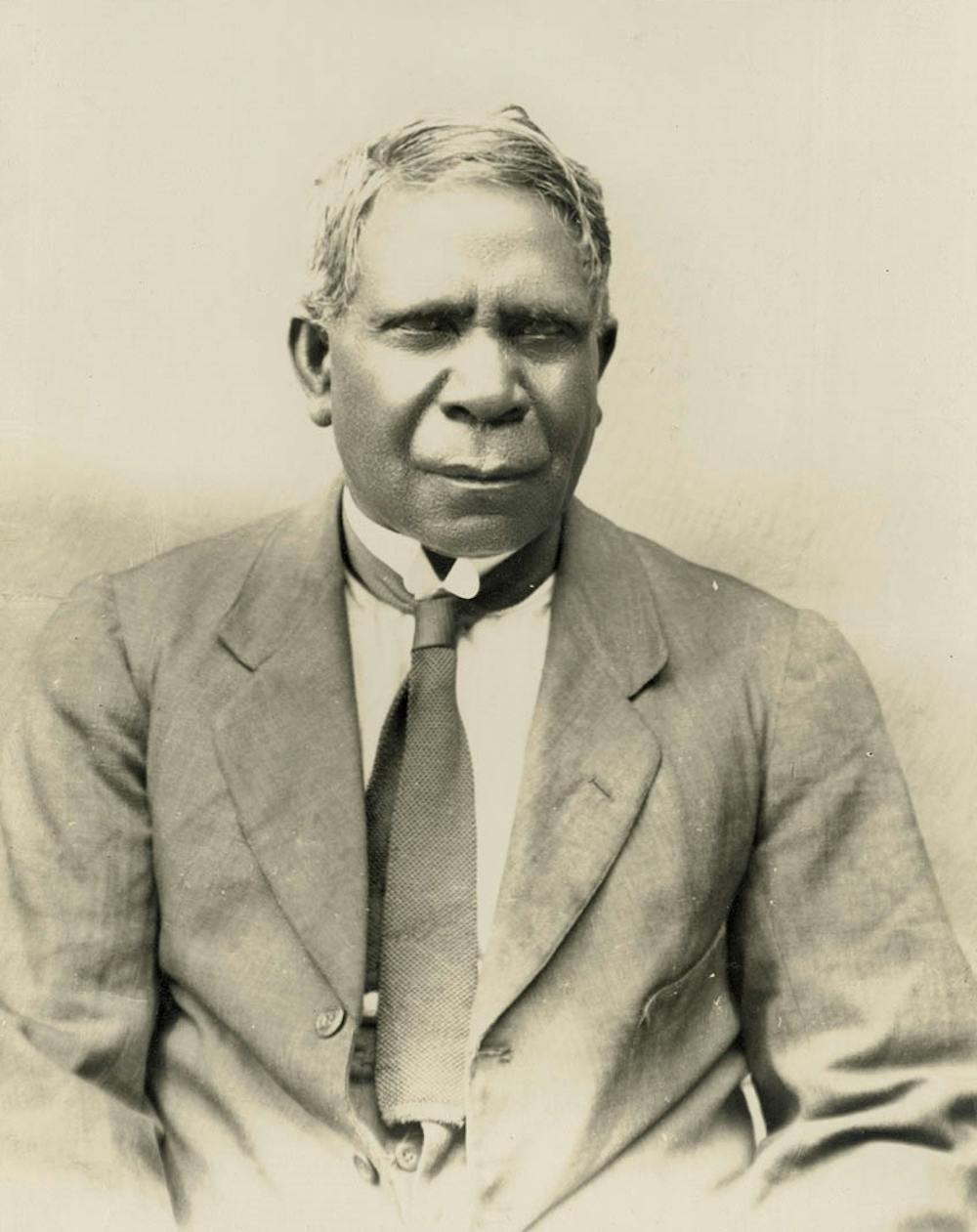
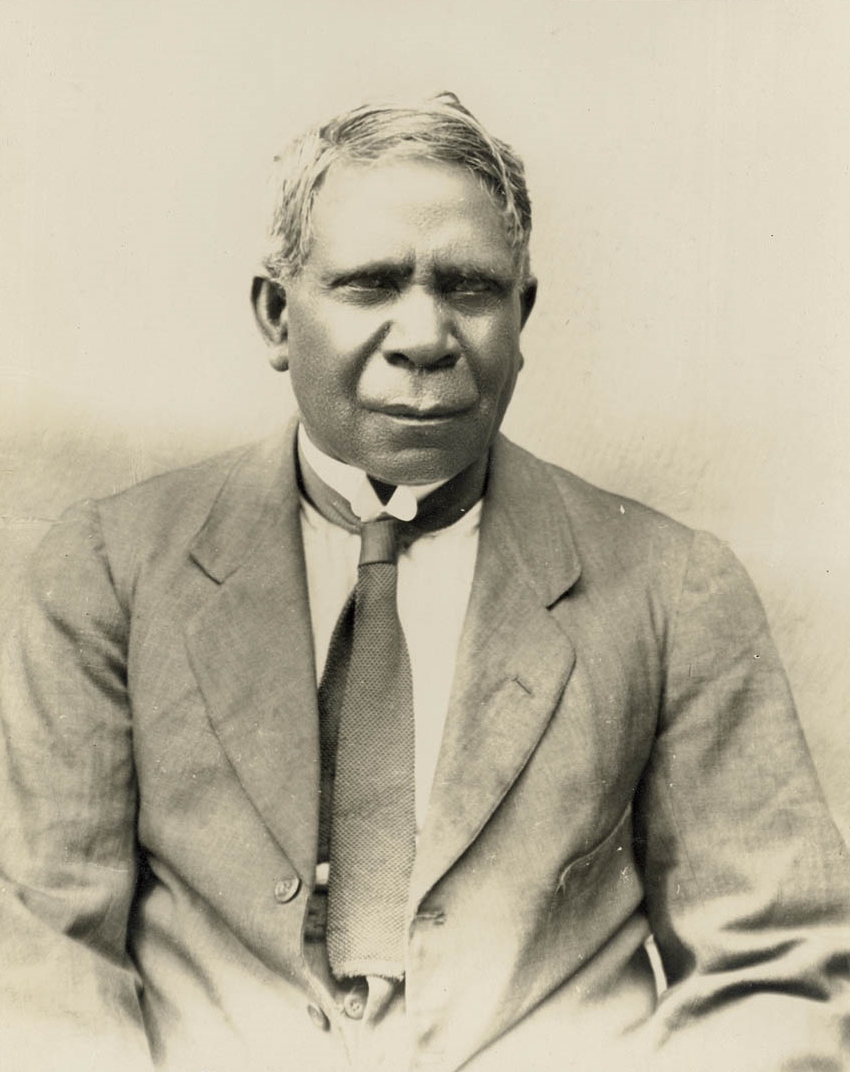
Born in 1872, Unaipon – a celebrated inventor who was Australia’s first published Aboriginal author – appears on our $50 note.

Drawings by inventor David Unaipon, who is on our $50 note, are included in Linear. Wikimedia

In the exhibition, Unaipon’s work shows how he applied classical knowledge and immense intellectual curiosity to a comparison of the design features that create upward lift for both the boomerang and rotary helicopter blades.

His drawings introduce the viewer to the complexity of Indigenous knowledge: the design of the boomerang, hunting clubs and rituals depicted in bark paintings, and the wap (harpoon) used by activist Murrandoo Yanner whose right to hunt crocodile under Native Title was upheld by the High Court in 1999. Weaving, in the form of three cloaks, stands in for the powerful presence of women welcoming visitors to country.

The works range from photography to weaving, sculpture, digital technology, design and installation art. Artists include Wayne Quilliam, Lorraine Connelly-Northey, Maree Clarke, Mikaela Jade, Nicole Monks, Glenda Nicholls, Lucy Simpson, Bernard Singleton, and Vicki West. They all comment on Indigenous science.

Grinding stone and mill, maker not recorded, collected circa 1900. Photo by Ryan Hernandez/MAAS

If the map foregrounds the work, the exhibition finds closure in a 17-minute virtual reality film. Collisions by artist and filmmaker Lynette Wallworth, immerses the viewer in the land and pace of Nyarri Nyarri Morgan and the Martu people of the Western Australian desert. The film won the 2017 Emmy Award for Outstanding New Approaches to Documentary.

Wearing Virtual Reality googles, the viewer might be just off Harris Street in Ultimo, but their body sails to the desert country to sit in the back of a Toyota, complete with bumps, muffled sounds and gentle breeze. They can turn around to see the convoy of cars and cloud of red dust that followed behind.

As grass fires ignite, a view from high in the sky shows the mosaic pattern of gentle burning. The fire crackles as it moves along the grass.

On fire

The technology of burning that so shaped this ancient country has returned in some parts of Australia where Aboriginal land has been repossessed. In other parts of the country, fires are raging wild and threaten everything in their path.

Lynette Wallworth’s VR film Collisions won an Emmy in 2017.

Back in the VR world, we sit around the campfire and in front of a big screen that is hitched to the side of the ubiquitous Toyota (bonnet up). We watch footage of the Maralinga bombings. It starts as a mushroom cloud explosion and builds to a fierce storm front that blackens the sky as it races towards us; the bodies of dead kangaroo carcasses hurtle through the air ahead of the blast. All is dead and forlorn. What an unimaginable atrocity to inflict on Martu country.


Read more: Virtual reality film Collisions is part disaster movie, part travelogue and completely immersive


This is a dramatic and engaging exhibition. As Mowaljarlai’s map announces, it provides a new way of seeing this country: as a body and landscape not of separate nations and language groups – although that is true – but a land with shared rituals, customs and technologies.

There has long been a call for all Australians to embrace this ancient country, rather than fight against it. The Indigenous science and technology in Linear offer us new ways of thinking about the past and future of our now shared land.

Linear in showing at the Powerhouse Museum, Sydney until June 30

ref. Dramatic and engaging, new exhibition Linear celebrates the art in Indigenous science – http://theconversation.com/dramatic-and-engaging-new-exhibition-linear-celebrates-the-art-in-indigenous-science-127023

The NDIS is changing. Here’s what you need to know – and what problems remain

Source: The Conversation (Au and NZ) – By Helen Dickinson, Professor, Public Service Research, UNSW

National Disability Insurance Scheme (NDIS) Minister Stuart Robert this month announced a number of “practical changes” to the scheme.

Acknowledging the NDIS is not consistently living up to expectations, he said these improvements will put it “onto a business as usual even keel for the long term”.

While the proposed changes have promise, there remain some fundamental challenges plaguing the scheme that these reforms are unlikely to address.


Read more: Here’s what needs to happen to get the NDIS back on track


A scheme under pressure

The NDIS represents a massive policy reform process, so it’s unsurprising it should face teething problems and challenges during implementation.

Official figures show more than 310,000 people now have plans in place, with the scheme intended to reach around 460,000 by full roll out next year. This has all been achieved at significant pace.

Yet in recent months, we’ve seen continued criticism of the scheme and the agency that administers it (the National Disability Insurance Agency, or the NDIA).

Grievances relate to issues including failure to pay service providers enough to cover costs; provider fraud allegations; the inability of people with disability to access services; and the remuneration level of the NDIA’s new CEO.

Added to these are concerning accounts of abuse and neglect beginning to emerge from the disability royal commission.

NDIS minister Stuart Robert announced changes to the NDIS in a speech at the National Press Club on November 14. Mick Tsikas/AAP

Delivering the last 20%

Minister Robert described the NDIS as “about 80% there, with 20% left to go”. He acknowledged the last 20% is often the hardest.

The government’s plan for the NDIS focuses on six key aims including quicker access and quality decision making, equitable and consistent decisions and better long-term outcomes for participants.

While critical of the “jargon and gobbledegook” in the recent announcements, consumer groups have welcomed a number of the minister’s plans, identifying these as areas they have been advocating for over the last few years.


Read more: Understanding the NDIS: how does the scheme work and am I eligible for funding?


Some positive changes

Among the promises that should have a positive impact is the announcement people will be able to use their funding more flexibly. Currently funds are locked into particular categories of supports and activities and it’s not easy to move resources between these.

The reality is people’s lives do not fit neatly into administrative categories and the flexibility to use funds differently should make a big difference.

Further, from April next year people will be able to see a draft of their plan before it’s approved. At present most participants see their plan for the first time when they formally receive it after the planning process. Any mistakes made typically require a full review, causing delays in getting services in place and adding to the planning workload.

Participants will also be able to make small changes to their plan without it undergoing a full review, which will be a relief to those who have become mired in endless plan reviews due to changes in their situation.

The NDIS has seen improvements over recent months, including a reduction in the length of time children wait to receive a plan. From shutterstock.com

Soon people will also be able to request longer plan durations, of up to three years. Currently most plans last one year. For people who have relatively stable disability – that is, their health and capacity isn’t getting any worse or any better – this will be a relief. The move also cuts some unnecessary red tape and will reduce planners’ workloads.

But it does require people to have a clear sense of their priorities and needs. It may be detrimental to people whose circumstances are more changeable – they could become locked into a plan that no longer suits their needs.


Read more: Women, rural and disadvantaged Australians may be missing out on care in the NDIS


We will also see the roll out of independent assessments to be paid for by the NDIS. This should have a positive impact as people currently either have to pay for their own assessments or wait for a significant length of time on a public waiting list. In terms of equitable access this is a significant improvement.

Finally, plans will be made accessible in additional formats including large font, audio, e-text and braille. For many outside the system it will come as a surprise this is not standard practice.

The devil is in the detail

There’s no doubt we’ve seen some real improvements in the scheme in recent months. The wait time for children to receive a plan halved over the last quarter (to 48 days). The number of people waiting for assistive technologies (like wheelchairs or communication devices) has reduced by nearly two-thirds. This is good but around 5,000 people are still waiting.

So progress can be made, but these new promises come with little detail about how they will be delivered.

Meanwhile, the system is already creaking at the seams with little spare capacity.

In 2014, a staffing cap was placed on the NDIA, restricting the numbers employed to 3,000, though the government has committed to increasing the cap gradually to 3,400 in 2020-21. Although reducing the number and frequency of full plan reviews will reduce demand for planners, it’s difficult to envision how this will free up sufficient spare capacity to support all these changes.

A number of organisations have also criticised the quality of planners, who often have limited training and experience in disability services. There seems to be little in these announcements to tackle this.


Read more: The NDIS costs are on track, but that doesn’t mean all participants are getting the support they need


It’s also important to note having a plan doesn’t guarantee being able to access services. In many parts of the country we’re seeing significant waiting lists for even the most common supports (for example, occupational therapy).

A new report found nearly one-third of disability providers reported a loss of income in the last financial year and several were concerned for their long term viability. There is an urgent need to address issues of supply within the system before we see even greater gaps emerge.

While these recent promises edge the NDIS in the right direction, the scheme is still facing some fundamental challenges. These will need to be addressed if the NDIS is to live up to the aspirations of those accessing it.

ref. The NDIS is changing. Here’s what you need to know – and what problems remain – http://theconversation.com/the-ndis-is-changing-heres-what-you-need-to-know-and-what-problems-remain-127223

Why Australia can no longer avoid responsibility for its citizens held in Syria

Source: The Conversation (Au and NZ) – By Anthony Billingsley, Senior Lecturer, School of Social Sciences, UNSW

The small number of Australians being held in prison camps in northern Syria has been an ongoing, albeit low-level, challenge for the Australian government. There are believed to be eight Australian fighters for the Islamic State in captivity, along with around 60 Australian women and children.

Despite its reluctance, the Australian government may eventually feel obliged to bring many or all these people home.

So far, the Australian public seems to have accepted the government’s line that it’s too dangerous to extract them from Syria. As Prime Minister Scott Morrison succinctly put it:

I’m not going to put any Australians in harm’s way.

An increasingly untenable position

The government believes there are valid security concerns in bringing these people back to Australia. Home Affairs Minister Peter Dutton has claimed some of the women are “hardcore” and “have the potential and capacity to come back here and cause a mass casualty event”.

Identifying these people, gathering evidence about their crimes and managing domestic fears would be a big challenge.

However, the government’s position on extracting them from Syria has become less tenable after the Turkish invasion of northern Syria in October. This followed US President Donald Trump’s announced withdrawal of the American military buffer in the region.

The invasion added uncertainty to an already fraught situation. The Kurdish-dominated Syrian Democratic Forces, who were central to the defeat of the Islamic State, were compelled to reinforce their forces on the border with Turkey.


Read more: Western states must repatriate IS fighters and their families before more break free from Syrian camps


Many of their forces have been engaged in controlling prison camps in northern Syria, where about 12,000 men and boys suspected of Islamic State ties, including 2,000 to 4,000 foreigners from almost 50 countries, are held. Some camps also hold about 100,000 Syrian and foreign family members of IS suspects.

The invasion focused attention on the state of the camps, which are overcrowded, unsanitary and experiencing considerable unrest. There have been some escapes from the camps, and many fear they are close to collapse.

The situation increases the possibility that young people in the camps will be radicalised.

Last week, the US government, which has repatriated some of its nationals, offered to help allies, including Australia, rescue their citizens from northern Syria. On the same day, Turkey called on Australia to repatriate its IS fighters and their families in Turkish custody.

Groups like Save the Children and Human Rights Watch have also called for the repatriation of women and children in the prison camps.

In Canberra, shadow home affairs minister Kristina Keneally has also argued Australia has a moral obligation to repatriate the women and children who were taken to Syria against their will.

Al-Hawl camp in northern Syria where eight Australian IS fighters and some 60 women and children are believed to be held. Tessa Fox/AAP

Barriers to bringing detainees back

While Australia has not joined the Dutch in outright rejecting the US offer, the Morrison government has shown no enthusiasm for the idea.

Its position has been further undermined by the actions of other nations with citizens in the camps. Kosovo, Uzbekistan, Tajikistan and Kazakhstan, for example, have already repatriated hundreds of prisoners.

And Britain is considering options for repatriating its citizens. A government document reported on last month said,

While difficult, the practical challenges in arranging and implementing an extraction (of IS suspects) are likely to have solutions.

Australia, by contrast, has continued to focus on the difficulties of extracting its citizens from the area, rather than tackling the legal challenges associated with bringing them home. Our legislative framework is still not sufficiently robust to deal with returnees.

The government has had many years to figure this out. In 2014, the UN passed a resolution obliging all countries to adopt measures to deal with the issue of foreign fighters.


Read more: Why is it so difficult to prosecute returning fighters?


There are ways to try those suspected of crimes committed in another country. The principle of universal jurisdiction, for example, would allow Australia to interrogate and prosecute those currently held in Syria.

Lower-level suspects who are desperate to escape from Syria could also be required to accept certain conditions, such as restrictions on movement and contacts and participation in re-education programmes. The Australian women in the camp have already indicated they are open to this.

But instead of looking at these options, Australia has endeavoured to keep out returning fighters and their families. Laws have been passed to strip some of their citizenship, running counter to several international conventions, including the Universal Declaration of Human Rights.

And the temporary exclusion orders bill passed in July gives Dutton the power to bar Australian citizens from returning home for up to two years if they are suspected of supporting a terror organisation.

There are few other options

Some governments have suggested that IS captives in Syria should be transferred to Iraq, where trials of suspected IS members have already been held. The problem with this idea is that Iraq’s justice system is deeply flawed and has imposed the death penalty after some highly dubious trials.

For example, France sent some suspects there only for them to be summarily sentenced to be hanged.


Read more: Preventing foreign fighters from returning home could be dangerous to national security


Equally unacceptable would be to allow the Australian prisoners to fall into the hands of the Syrian regime.

In coming months, as conditions in the camps deteriorate and Syrian government forces expand their control of the area, we can expect mounting pressure on governments like Australia’s to repatriate their citizens.

In the long run, these are Australian citizens who should be entitled to the benefits that come from that, including due process of law. It is hard to see how the government can continue to deny their rights.

ref. Why Australia can no longer avoid responsibility for its citizens held in Syria – http://theconversation.com/why-australia-can-no-longer-avoid-responsibility-for-its-citizens-held-in-syria-127439

An American company will test your embryos for genetic defects. But designer babies aren’t here just yet

Source: The Conversation (Au and NZ) – By Dennis McNevin, Professor of Forensic Genetics, University of Technology Sydney

Designer baby, anyone? A New Jersey startup company, Genomic Prediction, might be able to help you.

Genomic Prediction claims to be able to use DNA testing to predict disease risk in an embryo. The idea is to study hundreds or thousands of small variations in DNA, known as genetic markers, and use sophisticated computer algorithms to correlate these with diseases such as type 1 and type 2 diabetes, breast cancer and “intellectual disability”.

If the company’s recent research is any guide, it may move on to predicting other traits such as height and even educational attainment.

But the connections between genetic variations and differences in real human beings are far from straightforward. And even if we can make these connections, should we?

Lessons from forensics

In my own field, forensic genetics, we have a similar goal: to produce a “molecular photofit” or “DNA mugshot” of the perpetrator of a crime, using DNA left at a crime scene. At first, there was great optimism.

Only six genetic markers were required to predict blue or brown eye colour with reasonable accuracy. However, prediction of intermediate eye colours (green, hazel, light brown) was less accurate. Testing for hair colour soon followed (24 markers) and, most recently, skin colour (41 markers).

Eye, hair and skin colour are all largely controlled by a small number of genes related to the pigment melanin. There are two types of melanin, a dark and a light form, and between them they give rise to the spectrum of eye, hair and skin colours.


Read more: World’s first genetically modified human embryo raises ethical concerns


High doses of the light pigment are found only in individuals with European ancestry, particularly northern European. Prediction systems have really only been developed and tested rigorously on Europeans and North Americans.

This is the case with many large “genome-wide association studies” (GWAS) and data sets, including some of those used by Genomic Prediction. Individuals without European ancestry are poorly represented, and the associations between genetic markers and traits don’t always replicate in populations that don’t have European ancestry.

Slow progress

Since these first few pigmentation prediction systems, progress has been slow in forensic genetics. This is because most traits – even ones that are strongly influenced by genetics – are very “polygenic”, which means they are influenced by many different genes.

For example, height and educational attainment are both highly heritable. But they are under the influence of hundreds, if not thousands, of genetic markers, each with a very small effect on the trait.

Further, the marker variants with the largest influence are generally the rarest ones. For example, the variants with the largest influence on height each account for only one or two centimetres and are present in no more than 0.2% of the population. More common variants each account for height differences of mere millimetres or even less.

Polygenic scores add up all the tiny effects of these multiple marker variants to give an overall prediction. But there are several caveats.

First, they don’t take account of genetic synergies (epistasis). The effects of two (or more) different markers may not add up in any simple way.

Second, they completely ignore environmental effects: the “nurture” part of “nature versus nurture”. For example, although both are highly heritable, height is affected by nutrition, and educational attainment is influenced by educational expectations and parental education. So, really, what is being predicted is the genetic potential for a particular trait.

A practical and ethical minefield

Assuming Genomic Prediction can predict these potentials accurately, will they all be found in one embryo?

Let’s say you want a tall, brown-eyed, high educational achiever with a low risk of breast cancer. The odds of finding all of these potentials in one embryo is very low, like throwing dozens of dice and having them all come up with sixes.

Even if you are lucky with your roll of the genetic dice, are you sure your designer baby will thank you when they grow up? Your idea of the perfect trait might not be theirs. You are, in effect, choosing their DNA without their consent.


Read more: 3-parent IVF could prevent illness in many children (but it’s really more like 2.002-parent IVF)


Are you ready to see a prediction of what your baby might look like as an adult, or a photo-board from which to choose your future offspring? Companies are already offering to produce molecular photofits of unknown donors of crime-scene DNA. It’s not a giant leap to designer babies.

At US$1,000 per case and an additional US$400 per screened embryo for expanded pre-implantation genomic testing (EPGT is Genomic Prediction’s “flagship product”), designer babies will inevitably be more available to wealthier parents. There are valid concerns that this could lead to genetic advantage and disadvantage along socio-economic lines.

Genetic screening is already common practice, especially for chromosomal disorders. Like many others, my own daughter received a nuchal fold thickness assessment as a standard ultrasound screen for Down syndrome.

Screening for genetic risks is just one more step along this continuum. But how many steps should we take? Once we start selecting for “desirable” characteristics, it’s easy to see the moral slope becoming very slippery.

ref. An American company will test your embryos for genetic defects. But designer babies aren’t here just yet – http://theconversation.com/an-american-company-will-test-your-embryos-for-genetic-defects-but-designer-babies-arent-here-just-yet-126833

A collapsing star in a distant galaxy fired out some of the most energetic gamma rays ever seen

Source: The Conversation (Au and NZ) – By Gavin Rowell, Associate Professor in High Energy Astrophyics, University of Adelaide

The brightest fireworks in the universe are called gamma-ray bursts and are created by the death throes of certain kinds of stars. These intense blasts release as much energy in one second as the Sun will over its whole lifetime, but we still don’t understand exactly how they do it.

We are getting closer, however. We recently had the best ever look at the incredibly high-energy gamma rays emitted by these bursts. Gamma rays are like particles of visible light, but each of these high-energy rays carries as much as 100 billion times more energy.

New research published this week in Nature by two teams of scientists from around the world (I am a member of one of them) reveals the gamma rays are more energetic than we knew and that the afterglow of the burst lasts much longer.

What are gamma-ray bursts?

In the late 1960s, secret spy satellites designed to look for gamma-ray flashes from nuclear explosions began to detect mysterious bursts of gamma rays coming from outer space. It was not until the 1990s that scientists began to unravel the mystery with data from new satellites.

We now believe at least some of these gamma-ray bursts are caused by the collapse of super-massive stars. Many stars end their lives in an enormous explosion called a supernova, but very heavy stars can create an even bigger blast called a hypernova.


Read more: Flash, aah-aah! Could a gamma ray burst eradicate all life on Earth?


In this process, the star’s core collapses and becomes a rapidly rotating black hole. The surrounding gas forms a spinning disk around the black hole, which then creates a narrow, intense jet of radiation. If this jet is pointing towards Earth, we can see it as a bright gamma-ray burst, which typically lasts no more than a minute or two.

The very high-energy gamma rays are given off by matter that is accelerated to very close to the speed of light as it whirls around the black hole.

Because the bursts are rare and don’t last long, it can be difficult to get a good look at one with a telescope.

The afterglow

On July 20 2018, gamma-ray and X-ray satellites alerted the world to a new gamma-ray burst, named GRB 180720B. It was a very strong burst and lasted for about 50 seconds – a relatively long duration, indicating the death of a massive star.

Following the alert, several observatories around the world immediately began observing the spot in the sky that the burst came from. About 10 hours later, that spot came into view for the High-Energy Stereoscopic System (HESS) gamma-ray telescopes in Namibia.

Even though 10 hours had passed, HESS was able to observe the afterglow of the burst, which still included extremely energetic gamma rays.

Very high-energy gamma rays from the gamma-ray burst GRB 180720B, 10 to 12 hours after the burst, as seen by the large HESS telescope. Supplied, Author provided

At HESS we have been looking at other gamma-ray bursts in this way for more than a decade. This was the first time it detected gamma rays from the high-energy afterglow at energies never seen before.

While we had anticipated the detection of gamma-ray bursts at these high energies, the discovery that they were still around many hours after the initial burst came as a great surprise.

This result suggests the accelerated particles creating the gamma rays still exist or are created a long time after the explosion, which is hard to explain with our existing theories of what happens in gamma-ray bursts.


Read more: An extragalactic mystery: where do high-energy cosmic rays come from?


Even more energy

Also just published are observations of a different gamma-ray burst (GRB 190114C) made using the Major Atmospheric Gamma Imaging Cherenkov (MAGIC) telescopes in the Canary Islands.

The MAGIC astronomers caught the “prompt” early stages of the burst, detecting gamma rays with even more energy – some of the most energetic ever seen.

These detections show we still have much to learn about gamma-ray bursts. But they also give us confidence that our methods to detect them are improving. We will be able to study plenty more in the future with the much more sensitive Cherenkov Telescope Array, which is now under construction.

ref. A collapsing star in a distant galaxy fired out some of the most energetic gamma rays ever seen – http://theconversation.com/a-collapsing-star-in-a-distant-galaxy-fired-out-some-of-the-most-energetic-gamma-rays-ever-seen-127114

We live in a world of upheaval. So why aren’t today’s protests leading to revolutions?

Source: The Conversation (Au and NZ) – By Peter McPhee, Emeritus professor, University of Melbourne

We live in a world of violent challenges to the status quo, from Chile and Iraq to Hong Kong, Catalonia and the Extinction Rebellion. These protests are usually presented in the media simply as expressions of rage at “the system” and are eminently suitable for TV news coverage, where they flash across our screens in 15-second splashes of colour, smoke and sometimes blood.

These are huge rebellions. In Chile, for example, an estimated one million people demonstrated last month. By the next day, 19 people had died, nearly 2,500 had been injured and more than 2,800 arrested.

How might we make sense of these upheavals? Are they revolutionary or just a series of spectacular eruptions of anger? And are they doomed to fail?

Iraq’s protests have been the bloodiest of anywhere in the world in recent months, with more than 300 confirmed dead. Ahmed Jalil/EPA

Key characteristics of a revolution

As an historian of the French Revolution of 1789-99, I often ponder the similarities between the five great revolutions of the modern world – the English Revolution (1649), American Revolution (1776), French Revolution (1789), Russian Revolution (1917) and Chinese Revolution (1949).

A key question today is whether the rebellions we are currently witnessing are also revolutionary.

A model of revolution drawn from the five great revolutions can tell us much about why they occur and take particular trajectories. The key characteristics are:

  • long-term causes and the popularity of a socio-political ideology at odds with the regime in power

  • short-term triggers of widespread protest

  • moments of violent confrontation the power-holders are unable to contain as sections of the armed forces defect to rebels

  • the consolidation of a broad and victorious alliance against the existing regime

  • a subsequent fracturing of the revolutionary alliance as competing factions vie for power

  • the re-establishment of a new order when a revolutionary leader succeeds in consolidating power.

Hong Kongers have been protesting for six months, seeking universal suffrage and an inquiry into alleged police brutality, among other demands. Fazry Ismail/EPA

Why today’s protests are not revolutionary

This model indicates the upheavals in our contemporary world are not revolutionary – or not yet.

The most likely to become revolutionary is in Iraq, where the regime has shown a willingness to kill its own citizens (more than 300 in October alone). This indicates that any concessions to demonstrators will inevitably be regarded as inadequate.

We do not know how the extraordinary rebellion in Hong Kong will end, but it may be very telling there does not seem to have been significant defection from the police or army to the protest movement.


Read more: Is there hope for a Hong Kong revolution?


People grow angry far more often than they rebel. And rebellions rarely become revolutions.

So, we need to distinguish between major revolutions that transform social and political structures, coups by armed elites and common forms of protest over particular issues. An example of this is the massive, violent and ultimately successful protests in Ecuador last month that forced the government to cancel an austerity package.

Ecuadoreans began protesting in October when an executive decree came into effect that eliminated the subsidy on the price of gasoline. Paolo Aguilar/EPA

The protests in Hong Kong and Catalonia fall into yet another category: they have limited aims for political sovereignty rather than more general objectives.

All successful revolutions are characterised by broad alliances at the outset as the deep-seated grievances of a range of social groups coalesce around opposition to the existing regime.

They begin with mass support. For that reason, the Extinction Rebellion will likely only succeed with modest goals of pushing reluctant governments to do more about climate change, rather than its far more ambitious aspirations of

a national Citizen Assembly, populated by ordinary people chosen at random, to come up with a programme for change.

Mass protests also fail when they are unable to create unity around core objectives. The Arab Spring, for instance, held so much promise after blossoming in 2010, but with the possible exception of Tunisia, failed to lead to meaningful change.

Revolutionary alliances collapsed rapidly into civil war (as in Libya) or failed to neutralise the armed forces (as in Egypt and Syria).

Why is there so much anger?

Fundamental to an understanding of the rage so evident today is the “democratic deficit”. This refers to public anger at the way the high-water mark of democratic reform around the globe in the 1990s – accompanied by the siren song of economic globalisation – has had such uneven social outcomes.

One expression of this anger has been the rise of fearful xenophobia expertly captured by populist politicians, most famously in the case of Donald Trump, but including many others from Jair Bolsonaro in Brazil to Rodrigo Duterte in the Philippines and Victor Orbán in Hungary.


Read more: The Joker to Guy Fawkes: why protesters around the world are wearing the same masks


Indeed, there are some who claim that western liberalism has now failed).

Elsewhere, the anger is popular rather than populist. In upheavals from Lebanon and Iraq to Zimbabwe and Chile, resentment is particularly focused on the evidence of widespread corruption as elites flout the basic norms of transparency and equity in siphoning government money into their pockets and those of their cronies.

Protesters in Lebanon were initially angry over the crumbling economy and corruption, but have since called for an entirely new political system. Wael Hamzeh/EPA

The broader context of today’s upheavals also includes the uneven withdrawal of the US from international engagement, providing new opportunities for two authoritarian superpowers (Russia and China) driven by dreams of new empires.

The United Nations, meanwhile, is floundering in its attempt to provide alternative leadership through a rules-based international system.

The state of the world economy also plays a role. In places where economic growth is stagnant, minor price increases are more than just irritants. They explode into rebellions, such as the recent tax on WhatsApp in Lebanon and the metro fare rise in Chile.

There was already deep-seated anger in both places. Chile, for example, is one of Latin America’s wealthiest countries, but has one of the worst levels of income equality among the 36 nations in the Organisation for Economic Co-operation and Development.

Rebellions with new characteristics

Of course, we do not know how these protest movements will end. While it is unlikely any of the rebellions will result in revolutionary change, we are witnessing distinctly 21st century upheavals with new characteristics.

One of the most influential approaches to understanding the long-term history and nature of protest and insurrection has come from the American sociologist Charles Tilly.


Read more: Animal rights activists in Melbourne: green-collar criminals or civil ‘disobedients’?


Tilly’s studies of European history have identified two key characteristics.

First, forms of protest change across time as a function of wider changes in economic and political structures. The food riots of pre-industrial society, for instance, gave way to the strikes and political demonstrations of the modern world.

And today, the transnational reach of Extinction Rebellion is symptomatic of a new global age. There are also new protest tactics emerging, such as the flashmobs and Lennon walls in Hong Kong.

The Extinction Rebellion movement has organised climate change protests in scores of cities, including across Australia. Bianca de Marchi/AAP

Tilly’s second theory was that collective protest, both peaceful and violent, is endemic rather than confined to years of spectacular revolutionary upheaval, such as 1789 or 1917. It is a continuing expression of conflict between “contenders” for power, including the state. It is part of the historical fabric of all societies.

Even in a stable and prosperous country like Australia in 2019, there is a deep cynicism around a commitment to the common good. This has been created by a lack of clear leadership on climate change and energy policy, self-serving corporate governance and fortress politics.

All this suggests that Prime Minister Scott Morrison is not only whistling in the wind if he thinks that he can dictate the nature of and even reduce protest in contemporary Australia – he is also ignorant of its history.

ref. We live in a world of upheaval. So why aren’t today’s protests leading to revolutions? – http://theconversation.com/we-live-in-a-world-of-upheaval-so-why-arent-todays-protests-leading-to-revolutions-126505

Veterans have poorer mental health than Australians overall. We could be serving them better

Source: The Conversation (Au and NZ) – By Nicole Sadler, Associate Professor, Department of Psychiatry, University of Melbourne

A career in the Australian Defence Force (ADF), or the armed forces in any country, can be rewarding, but also demanding. Challenges include the rigorous training, frequent moves, and maintaining social connections.

Beyond this, military personnel may be exposed to trauma during combat, peace-keeping missions, border protection, disaster and humanitarian relief, and training accidents.

They may be confronted not only with threats to their own lives or safety, but also with the suffering or death of others, which can have a significant emotional and psychological impact.

So it’s not surprising we see higher rates of mental illness among veterans compared to the overall Australian population.

The rates of suicide are also concerning, particularly among younger veterans. Between 2001 and 2016, 373 Australian veterans took their lives. Male veterans under 30 had a suicide rate more than twice the national average for men the same age. These figures have led to considerable community concern, including calls for a royal commission into veteran suicide.

Whether or not this eventuates, we should be targeting veterans with a high level of care that better reflects their unique set of needs.

Transitioning back into civilian life

Recent research has highlighted one of the most challenging periods for military personnel can be transitioning back to civilian life.

Major lifestyle changes can be stressful for anyone, but leaving the ADF can feel like more than leaving a job. It will likely represent a change in a person’s way of life across the board.

While many transitioning personnel may initially experience some uncertainty and a sense of losing some part of themselves, most make the adjustment successfully. For others, the problems may not go away and for some, may become worse, unless they receive help.


Read more: From shell shock to PTSD: proof of war’s traumatic history


A comprehensive study commissioned by the Departments of Veterans’ Affairs (DVA) and Defence in 2015 found ADF members who had discharged or transitioned to the Reserves were at greater risk of experiencing mental health issues compared to both those who were still serving and the broader Australian community.

For example, in the previous 12 months, 17.7% of transitioned ADF personnel had experienced post-traumatic stress disorder (PTSD) compared to 8.7% still serving in the ADF full-time, and 5.2% in the Australian community.

Other common mental health conditions in transitioned ADF personnel include depression (11.2%), and anxiety disorders such as panic disorder (5.4%), agoraphobia (11.9%) and social phobia (11%), all estimated to be higher than rates in the general population.

Rates of suicidality (thinking about, planning or attempting suicide) were more than double for those who had transitioned out of full-time ADF service compared to those still serving in the ADF full-time (21.7% versus 8.8%), and ten times greater than the Australian community.


Read more: Mindfulness therapy alleviates soldiers’ PTSD, but only in the short term


Seeking and receiving help

About 75% of veterans who reported they had mental health concerns in the DVA study had sought and received assistance at some point from a GP or mental health professional. These rates are much higher than in the general community and auger well for the preparedness of veterans to seek care.

However, as is the case in the Australian community and internationally, there is an under-engagement with evidence-based treatment and practice. Only about 25% of help-seeking veterans were estimated to be receiving evidence-based care, such as cognitive behavioural therapy. This may be because veterans don’t stay engaged in health services for long enough to receive evidence-based treatments.

So while the help-seeking and care delivery for veterans is on par with, and in some ways exceeds, that of the general community, there’s room for improvement to ensure veterans remain engaged with services and receive the treatment they need.

About three-quarters of veterans with mental health concerns will seek help. From shutterstock.com

What could we be doing better?

Coming from a health system in the armed forces where health care is organised for them, veterans may have heightened expectations about the level of coordinated and integrated practice.

So first, we need improved integration and coordination of services, including development of outreach capabilities which more proactively engage with veterans and their families and connect them to appropriate services. Outreach can be led by health professionals or intersect with existing peer support networks.

Second, we need to enhance the knowledge and skills among health professionals in the various services to which veterans are reaching out. Importantly, services and treatments should be delivered with appropriate “military cultural awareness”.

This means practitioners demonstrating they understand the types of experiences veterans may have been exposed to, and the potential lasting impacts of these experiences. Veterans are likely to be more engaged in services if they feel well understood.


Read more: Why some veterans feel alienated on campus and how universities can help


Parallel to this, we need to be aware of the needs of, and actively support, the families who often bear the brunt of the mental health problems experienced by the veterans. Open Arms – Veterans & Families Counselling, a free national counselling service, plays a large role in provision of this support.

Ultimately we need to continue to focus on innovations in the prevention of and early interventions for mental health problems among veterans, including suicidality. In doing so we must maintain a focus on well-being outcomes more broadly and not just on symptoms and conditions, ensuring our goal remains assisting veterans in living a meaningful and satisfying life in all its domains.

If this article has raised issues for you or you’re concerned about someone you know, call Open Arms on 1800 011 046 or Lifeline on 13 11 14.

ref. Veterans have poorer mental health than Australians overall. We could be serving them better – http://theconversation.com/veterans-have-poorer-mental-health-than-australians-overall-we-could-be-serving-them-better-119525

Extinction of ice age giants likely drove surviving animals apart

Source: The Conversation (Au and NZ) – By Aniko Blanka Toth, Postdoctoral Fellow, Macquarie University

As the world grapples with an extinction crisis, our large mammals are among the most endangered. These threatened species – rhinos, pandas, tigers, polar bears and the like – greatly influence their ecosystems. So what will happen to the smaller animals left behind?

Clues from a past megafaunal extinction could give us the answer. Thousands of years ago, many large mammals went extinct including mammoths, saber-toothed cats and Australia’s giant wombat. The extinctions happened at different times, shortly after human colonisation on each continent.

A study I led, published in the journal Science, has found after the megafauna disappeared, many surviving mammal species went their separate ways. This weakened connections between species and may have made ecosystems more vulnerable.

As human activity drives modern megafauna towards extinction, our study gives valuable insights into the potential repercussions for smaller survivors.

Many large mammals, such as the polar bear, are at risk of extinction. Henry H. Holdsworth/Natural Habi

Surprise results

Our team analysed the fossil records of 93 mammal species at hundreds of sites in North America, dating back up to 21,000 years, before the extinctions began.

We then determined the extent to which a particular species lived alongside others at each site. We found that after the extinction of large mammals, smaller mammals often distanced themselves from neighbouring species and were found together much less often than expected.

Surprisingly, this separation occurred while many survivors were claiming new habitats after the extinctions – which meant the potential space for co-habitation had actually aincreased.

The below diagrams show how animal species may have lived alongside each other before and after the megafauna extinctions. In the first, two species occupied the same area while co-habiting (orange sites). In the second, animals occupied the same area but were more segregated (red and yellow sites).

Created by Anikó Tóth

Such segregation suggests a change in interactions between species after the extinction event. Survivors may have rapidly become more abundant as large mammals disappeared, causing more competitive interactions. This could have prompted them to exclude each another from individual sites.

Our analysis suggests the repercussions of megafauna extinctions are still being felt today – leading to species increasingly segregated across continents, and interacting more opportunistically.


Hover over an animal silhouette to learn more about it. Notice the size difference between the largest North American fauna 12,000 years ago and today


Animals need each other

Connections between species large and small are the lifeblood of a functioning ecosystem, making it stable and resilient. Today’s large mammals are comparatively smaller than the megafauna of the last ice age. However, they still play a vital role in shaping ecosystems.

Just like in the past, modern large mammals may carry out pest control, aid seed dispersal and spread nutrients (by walking long distances and pooping out digested vegetation). This benefits humans and other species.


Read more: Why we need to protect the extinct woolly mammoth


Some large animals also shape and create homes for others. For example, elephants in Africa push over trees to create open grasslands, much like their Pleistocene-era cousin, the Columbian mammoth. This enables other species adapted to grasslands, such as gazelles and zebras, to share the habitat.

If elephants became extinct and no longer pushed over trees, grasslands would change and remaining animals may die or move away. In this way, the loss of interactions may make the ecosystem less stable and more vulnerable.

And animal extinctions have a snowball effect when it comes to species interactions. If half the species in a community go extinct, at least three quarters of the possible interactions in the system die with them.

Thylacoleo carnifex, the extinct marsupial lion. Image credit: Mauricio Antón

Lessons for Australian conservation

Although our study was restricted to North America, its findings have the potential to inform conservation efforts in Australia and shine a light into the past.

Australia’s fossil record and historical accounts document many species of large mammals which have become extinct. For example, more than 40,000 years ago humans wiped out large carnivores such as the marsupial lion and more recently, the Tasmanian tiger.

People also introduced invasive medium-sized carnivores such as foxes and feral cats, the spread of which went unchecked for years. This devastated the unique and diverse suite of smaller Australian marsupials.


Read more: An end to endings: how to stop more Australian species going extinct


Today, the extermination of feral cats is a major conservation problem in Australia. Had the marsupial lion still been around, feral cats may have been killed and marginalised by these larger animals, slowing their spread.

When planning animal conservation and management, it may be just as important to protect interactions as it is to save individual species. When introducing or eliminating species as part of environmental initiatives, it’s crucial to consider all possible interactions we are adding, as well as those we are taking away.

ref. Extinction of ice age giants likely drove surviving animals apart – http://theconversation.com/extinction-of-ice-age-giants-likely-drove-surviving-animals-apart-125132

Australia: Lack of information on apartment defects leaves whole market on shaky footings

Source: The Conversation (Au and NZ) – By Martin Loosemore, Professor of Construction Management, University of Technology Sydney

The litany of defects, poor building standards and regulatory failures has serious implications for apartment owners, occupiers and buyers alike. Fears of a loss of confidence in the sector have unfortunately come true. Our research suggests a lack of reliable information about building defects is a critical factor in the crisis.


Read more: Would you buy a new apartment? Building confidence depends on ending the blame game


About a year ago, we started a research project with six industry partners in New South Wales entitled Cracks in the Compact City: Tackling Defects in Multi-Unit Strata Housing. The context is compact city planning policies and a rapid shift towards apartment living in Australian cities.

The urban development strategies of NSW and other states rely on higher-density cities with many more multi-unit strata title dwellings. The human and economic impacts of the building defects crisis could undermine these strategies.

Even with our resources, obtaining data on the extent and nature of defects in NSW apartment buildings has been a challenge. Individual buyers and owners must face even greater obstacles.

This lack of access to information poses a clear challenge to the principle of “buyer beware” that underpins property sales. The imbalance it creates between buyers and sellers is a prime example of what economists call “information asymmetry”.

Why does this matter for the whole apartment market?

Nobel laureate George Akerlof explained how the price and quality of goods traded in a market affected by information asymmetries tend to gradually reduce to the point where only lowest-cost “lemons” remain. When buyers can’t tell the difference between products of good and bad quality, they typically prefer the cheapest available. This forces higher-quality products out of the market.

Sellers can also exploit this situation to hide poor-quality products from consumers. They might even charge the same as competitors selling higher-quality products.

While some unscrupulous sellers might profit in the short term, overall profits fall for everyone as confidence and links between price and quality are undermined. Ultimately, the entire market can collapse.


Read more: It’s not just the building cracks or cladding – sometimes uncertainty does even more harm


The risks are highest in markets with these two features:

  • sellers are not rewarded for delivering information to buyers or cannot disclose it effectively
  • buyers cannot discriminate between the quality of different products, as is often the case in apartment developments.

These problems are more likely when buyers cannot easily inspect products at the time of sale – as with apartment units bought off the plan.

When a vendor sells a product to multiple buyers, again typical in apartment developments, that can multiply the impact of information asymmetries.

The buyer of a standalone house might be able to make the sale conditional on an independent inspection of the entire building. But such clauses are very difficult to negotiate in off-the-plan sales for apartments in multi-unit buildings.

It would also be too costly for each buyer to commission such an inspection. Buyers are unable to organise a joint inspection of the building until after they have settled, which greatly increases their risk. While NSW’s new defects bond scheme does require an inspection, it happens after ownership is transferred.

The negative impacts for buyers have spill-over effects as information asymmetries mean risks are perceived to increase across the entire apartment housing sector. Negative publicity, such as the flammable cladding and defects scandals, can cause values to fall market-wide, regardless of the quality of individual developments. At the same time, finance and insurance costs increase.


Read more: The big lesson from Opal Tower is that badly built apartments aren’t only an issue for residents


The issue persists for subsequent buyers too. Information about defects is often unavailable due to poor record-keeping or confidentiality agreements. Ironically, this adds to the information asymmetries that contributed to the problem in the first place.

What can we do about the problem?

To reduce information asymmetries, sellers and buyers tend to engage in two main types of behaviour: signalling and screening.

Signalling involves sellers flagging the higher quality of their products to buyers indirectly. For example, a reputable developer may use warranties and brands or quality marks, certificates and awards as a sign of their high-quality work. Buyers may well be prepared to pay more for higher-quality products that won’t cost more in the longer term.

Crucially, signalling only works if the signal is credible. At present, there are no construction-specific quality certifications and warranties, only generic standards such as the international ISO 9001: 2015. And the administrative burden and costs of independent third-party certification make it unviable for many small companies. So instruments like ISO 9001 are likely of very limited value for effective signalling in the apartment sector.

The NSW Building Commissioner is supporting an industry rating system that will enable better signalling. Data mining will be used to identify risky players and phoenix operators. It should take effect in the apartment sector by 2021.

Screening involves buyers investing time and resources to uncover the likelihood of defects. This includes examining available records and the behaviours of sellers and their representatives. But this adds to buyers’ costs, which disadvantages them in the marketplace.

Stakeholders in the building development process should be compelled to release this information. NSW’s new law on off-the-plan contract sales will increase sellers’ disclosure obligations and provide stronger protections for buyers. Importantly, sellers will have to identify material changes made during the development process at least 21 days before settlement.

A similar requirement involving an independent expert building inspection would help buyers better understand the risk of defects before they finalise their purchase.


Read more: Housing with buyer protection and no serious faults – is that too much to ask of builders and regulators?


Another positive move is the requirement in the new Design and Building Practitioners Bill for declared designs and as-built drawings to be lodged with the government. The Building Commissioner has said these will be made available on an easy-to-access platform.

This would enable buyers to check information as the development progresses, before the crucial building handover. It’s a step towards creating a “digital twin” for everyone licensed to perform construction work, making it easier for the public to check their record.

While the devil is likely to be in the detail, the NSW government is on the right track in tackling the information asymmetry problem. However, the various information gatekeepers will still have to be persuaded – or required – to release information they have long withheld in their own interests.

ref. Lack of information on apartment defects leaves whole market on shaky footings – http://theconversation.com/lack-of-information-on-apartment-defects-leaves-whole-market-on-shaky-footings-127007

How Hitler memes made their way around the world and into the Fair Work Commission courtroom

Source: The Conversation (Au and NZ) – By Benjamin Nickl, Lecturer in International Comparative Literature and Translation Studies, University of Sydney

In September, the Fair Work commission rejected an unfair dismissal claim by a BP worker who made a Downfall video meme about his boss. Fair Work called it “inappropriate and offensive”.

Last week, the worker appealed Fair Work’s decision, saying the commission did not understand “the broader genre of Downfall video”.

Downfall video memes are online parodies of a bunker scene from a 2004 German film where a furious Hitler learns that his generals have let him down and the war is lost. Hitler loses it. He calls his soldiers “cowards, traitors and failures”, his veins popping with rage and spittle flying.

In the 15 years since the film’s release, the scene has taken on a life of its own. Downfall memes show “Hitler” raging about everything from cancelled exams to Twitter outages to election results, thanks to doctored subtitles.

In a robust online video culture that always hungers for the next Star Wars Kid how did an angry Hitler and this scene go viral – and stay viral – for so long?

Hitler finds out he didn’t get into Hogwarts.

The bunker

The original Downfall (2004; Der Untergang in German) is a historical war film about Hitler’s final days, directed by Oliver Hirschbiegel.

When it was released, a good number of German film critics and reviewers thought the humanising of Hitler’s sieg-heiling rants in a bunker filled with SS rank-and-file goons was tasteless.

Some dismissed the bunker scene in particular as unnecessary in a film premiering 60 years after WWII ended. After all, they said: we already knew Hitler was a madman and that humans can be monsters.

This is where the internet went to work. A legion of keyboard warriors around the globe lifted the scene from the original film at the time studios and film festivals were using it widely to promote Downfall.

The parodies – and our reactions – show what happens when cultural items move from one context to another. It’s a tricky leap when it comes to a figure like Hitler. When you add the move from drama to comedy , it gets a whole lot trickier.


Read more: Explainer: what are memes?


Generation phenomenon

Creative minds adapted Hitler’s German outrage. They copied and pasted, cut and inserted, and most importantly, they re-subtitled.

This readaptation is what makes video memes such a generative phenomenon.

A YouTube search for “Hitler Finds Out” or “Hitler Reacts To” yields thousands of videos. You’ll see how Hitler freaks out over global warming. He erupts when he hears about Donald Trump’s presidential bid and complains about the popularity of Pokemon Go. In one favourite he expresses fury that Christians are sending solar-powered bibles to Haiti.

‘Where the hell is my pizza?!’

The Downfall video meme has turned into a productive avenue for sociocultural commentary in each country and language it appears in, whether Chinese, Japanese or Spanish. Mostly, it gives voice to youth trends and blue-collar issues such as industrial action.

In the Fair Work unfair dismissal case, the scene was the medium via which an employee and his wife vented about his BP bosses during a drawn-out pay dispute.

Some international versions have packed political bite. One Malaysian parody refers to Abdullah Ahmad Badawi, who served as the Malaysian prime minister from 2003-2009. It has Hitler question Badawi’s turn to martial law and suppression of press freedom.

All this goes straight to the heart of the genre of Downfall video memes. Some are highly political while the vast majority turn on regional events, local slang and very limited in-group jokes. Taken together, they make a larger point about pop culture fads and stick-it-to-the-man sentiments.

Hitler wants a PS3 for Christmas but gets a Wii instead.

A meme that stuck

Some might argue that because the Downfall video memes appropriate a representation of a filmmaker’s Hitler instead of authentic archival footage, it’s acceptable to reuse the scene for comedy.

Others feel it is highly problematic to hide the real Nazi monster who orchestrated the systematic death of millions under layers of pixels and captions for laughs.

‘I’ll tell you what Chuck Norris is! If Chuck Norris gets shot today, tomorrow will be the bullet’s funeral!’

We need to have more conversations about what happens when cultures get adapted and sensitive topics in a nation’s history go viral.

The Downfall parodies have maintained cultural relevance for more than a decade, enduring far longer than most fleeting memes like Hey Girl or Dog Shaming posts. This is because they have become a fill-in form of sorts – an empty vessel for rageful rants. One may also argue that the original film was a dark-humoured parody of Hitler to begin with.

Lawyers for the sacked BP worker are not just arguing his bosses didn’t get the joke. They are saying Downfall memes do more than simply equate someone with Hitler. Rather, they connect to the hundreds of memes which came before to poke fun at something or to vent.

Whether it was appropriate for him to share the joke with colleagues will be up to the full bench that hears his appeal.

A very meta parody: Hitler finds out about the Downfall parodies.

The original film’s director approves of the meme by the way. Hirschbiegel said in a 2010 interview:

I think I’ve seen about 145 of them! Of course, I have to put the sound down when I watch. Many times the lines are so funny, I laugh out loud, and I’m laughing about the scene that I staged myself! You couldn’t get a better compliment as a director.

ref. How Hitler memes made their way around the world and into the Fair Work Commission courtroom – http://theconversation.com/how-hitler-memes-made-their-way-around-the-world-and-into-the-fair-work-commission-courtroom-127314

Buttigieg surges to clear lead in Iowa poll, as Democrats win four of five US state elections

Source: The Conversation (Au and NZ) – By Adrian Beaumont, Honorary Associate, School of Mathematics and Statistics, University of Melbourne

Two and a half months before the February 3 Iowa Democratic caucus, the highly regarded Selzer poll for CNN and the Des Moines Register gave Pete Buttigieg 25% in Iowa (up a huge 16 points since the mid-September Selzer poll).

Elizabeth Warren was second with 16% (down six), followed by Joe Biden at 15% (down five), Bernie Sanders at 15% (up four) and Amy Klobuchar at 6% (up three). No other candidate received more than 3%.

The proposed candidacy of former New York City mayor Michael Bloomberg was not well received. He had just 2% support, and his favourable ratings among Democratic likely caucus attendees were 58% unfavourable, 19% favourable. Democrats are very unlikely to back a billionaire.

I believe Buttigieg’s relative youth (he’s only 37) is an asset, compared with Warren, who will be 71 by the November 2020 general election. Donald Trump will be 74 then, Biden almost 78 and Sanders 79.


Read more: US Democratic presidential primaries: Biden leading, followed by Sanders, Warren, Harris; and will Trump be beaten?


Over the last few months, Buttigieg has put many resources into Iowa, allowing him to take advantage of Warren’s stumbles over Medicare for All. He has taken votes from Biden with an appeal to more moderate voters.

However, there is a catch for Buttigieg. The two earliest states to vote in the Democratic contest, Iowa and New Hampshire (February 11), are almost all white. The overall Democratic primary electorate is far more diverse. Black voters made up 61% of the 2016 South Carolina Democratic primary electorate.


Read more: Warren placed second after Biden, as Trump’s ratings rise. But could the impeachment scandal make a difference?


The latest Quinnipiac poll of South Carolina (February 29) gave Buttigieg less than 1% among black voters. Buttigieg’s net favourable rating was +6 with black voters compared to +36 with white voters.

Buttigieg’s problems with black voters may be caused by him being gay. While blacks vote overwhelmingly Democrat at general elections, this is attributable to the Republicans’ perceived racism, and black Democrats are far more socially conservative than other Democrats, as this chart from analyst Nate Silver shows.

The question is, if Buttigieg wins Iowa, will his ratings with black voters improve? As far as winning Iowa goes, there are still two and a half months to go, and Buttigieg’s surge could deflate.

Biden continues to lead in national Democratic polls

In the RealClearPolitics average of national Democratic polls, Biden has 27.0%, Warren 20.3%, Sanders 18.8%, Buttigieg 8.3% and Kamala Harris 4.8%. Nobody else has more than 3% support. Since my previous US politics article last fortnight, Biden is down slightly and Sanders and Buttigieg up.


Read more: Trump could win again despite losing popular vote, as Biden retakes lead in Democratic polls


In the average of the five most recent Iowa polls, Buttigieg has 21.0%, Warren 18.8%, Biden 17.6% and Sanders 17.2%. In New Hampshire, Warren leads with 20.0%, followed by Biden at 18.0%, Buttigieg 16.5% and Sanders 16.0%. However, the most recent New Hampshire poll gave Buttigieg 25%, and a ten-point lead over both Warren and Biden.

In Nevada (February 22), Biden had 29.0%, Warren 20.0%, Sanders 19.8% and Buttigieg just 7.3%. Biden maintained a 19-point lead over Warren in South Carolina.

The next Democratic presidential debate is Thursday (in Australia); this debate will feature ten candidates. Six candidates have qualified so far for the December 19 debate, which has higher thresholds.

Democrats win four of five highest offices at US state elections

Most US state elections are held concurrently with federal elections, but there were elections this November in New Jersey, Virginia, Mississippi and Kentucky (all on November 5) and Louisiana (November 16). Virginia and New Jersey held legislative elections, while Mississippi, Kentucky and Louisiana held gubernatorial elections.

At the November 5 elections, Democrats gained the Kentucky governorship by a 49.2-48.8 margin. Kentucky is a very white, rural state that voted for Trump in 2016 by 30 points. Republicans held the Mississippi governorship by a 52.1-46.6 margin (Trump by 18 in 2016).

In Virginia (Hillary Clinton by five), Democrats gained control of both chambers of the state legislature, the House by 55-45 and the Senate by 21-19. Democrats easily held the New Jersey legislature (Clinton by 14). Also of note: a New York City referendum introduced Australian-style preferential voting by 73.5-26.5.

At the November 16 Louisiana state election (Trump by 20), the Democrats held the governorship by a 51.3-48.7 margin.

Thus, Democrats won the highest office in four of five state elections this November, including in two states – Kentucky and Louisiana – that voted for Trump by landslide margins in 2016. A year before the presidential general election, Democrats performed strongly in these state elections.

Trump’s ratings and general election polls

In the FiveThirtyEight aggregate, Trump’s ratings with all polls are currently 41.3% approve, 54.0% disapprove, a net approval of -12.7%, up 0.5% since last fortnight. With polls of registered or likely voters, Trump’s ratings are 42.6% approve, 53.6% disapprove, a net approval of -11.0%, up 1.2% since last fortnight.

In the FiveThirtyEight impeachment tracker, 46.8% support removing Trump from office and 45.2% are opposed (47.5-45.7 support last fortnight).

RealClearPolitics has no new national general election polls since my last update. Trump trails Biden by 10.2%, Warren by 7.3%, Sanders by 7.9% and Buttigieg by 4.5%. Buttigieg currently has far lower name recognition than the other leading Democrats, and is likely to improve his head-to-head polling against Trump if he makes a positive impression.

UK and Spanish elections

In Tuesday’s Poll Bludger article, I wrote that the Conservatives have extended their large lead, and are likely to win a landslide at the December 12 UK election.

I believe the Conservatives are being assisted by voter fatigue with the politics of the current hung parliament. This could also apply to the US: if the Democrats nominate a candidate who is not seen as extreme, they could benefit from fatigue with Trump’s Twitter behaviour.

On November 12, I covered the results of the second 2019 Spanish election for The Poll Bludger. The combined left parties won 158 of the 350 lower house seats, to 150 for the combined right, with the other 42 seats going to mostly leftist regional parties. On November 12, a tentative agreement was reached between the two largest left parties.

Australian Newspoll: 50-50 tie

In the latest Australian Newspoll, conducted November 7-10 from a sample of 1,680, there was a 50-50 tie between the major parties, a one-point gain for Labor since late October. Primary votes were 40% Coalition (down two), 35% Labor (up two), 12% Greens (down one) and 7% One Nation (up one).

Scott Morrison’s net approval was up one point to +3. Anthony Albanese had a huge 12-point jump in net approval to +5. Morrison led by 46-32 as better PM (47-32 previously). Figures from The Poll Bludger.

An Essential poll, also conducted November 7-10, failed to match Newspoll’s exuberance on Albanese’s ratings. Albanese’s net approval in Essential fell eight points from October to +3, while Morrison was also down five points to +4.

ref. Buttigieg surges to clear lead in Iowa poll, as Democrats win four of five US state elections – http://theconversation.com/buttigieg-surges-to-clear-lead-in-iowa-poll-as-democrats-win-four-of-five-us-state-elections-127210

It’s hard to breathe and you can’t think clearly – if you defend your home against a bushfire, be mentally prepared

Source: The Conversation (Au and NZ) – By Danielle Every, Senior Research Fellow in social vulnerability and disasters, CQUniversity Australia

If you live in a bushfire-prone area, you’ll likely have considered what you will do in the event of a bushfire.

The decision, which should be made well in advance of bushfire season, is whether to stay and actively defend a well-prepared property or to leave the area while it’s safe to do so.

The emphasis in bushfire safety is on leaving early. This is the safest option.

In “catastrophic” fire conditions, the message from NSW Rural Fire Service is that for your survival, leaving early is the only option.


Read more: How a bushfire can destroy a home


In other fire conditions, staying and defending requires accurately assessing the safety of your house and the surrounding environment, preparing your property in line with current best practice and understanding fire conditions.

It also requires a realistic assessment of not just your personal physical capacity to stay and defend but also your psychological capacity.

Why do people stay and defend?

Our survey of people who experienced the 2017 NSW bushfires asked what they would do next summer if there were catastrophic conditions. Some 27% would get ready to stay and defend, and 24% said they would wait to see if there was a fire before deciding whether to stay and defend or leave.

Animal ownership, a lack of insurance, and valuable assets such as agricultural sheds and equipment, are motivators for decisions to stay and defend.


Read more: How we plan for animals in emergencies


If animal owners aren’t home they will often return to their properties when bushfire warnings are issued, contrary to official advice, to retrieve or protect their animals and physical assets.

Although these decisions are understandable they can also lead people who aren’t physically or psychologically suited to staying and defending to do so.

Many people will choose to stay and defend their properties. AAP/Dan Himbrechts

What if you’re not psychologically up to it?

The reality is that a bushfire is a threatening, high-risk situation. It’s hard to see, hard to breathe, noisy and hot.

These conditions can overwhelm our ability to think clearly and act calmly. People in the Sampson Flat Fire in South Australia in 2015, for example, experienced high levels of stress which caused them to:

  • change their plan at the last minute, including leaving late which is the most dangerous response to a fire
  • drive unsafely, especially speeding
  • forget to take important items (such as medication)
  • leave their animals behind
  • engage in unrelated tasks that took up precious time
  • ignore the threat (by going to sleep, for example).

This is one person’s account of how they responded as the fire approached:

[I] grabbed my son […] saw the smoke and […] went and got the boxes that I’d prepared which I packed when he was a baby. So I had stupid things in the boxes, like baby outfits. But I can’t freak him out […]

[I]n the back of my mind I’m thinking about what do I need to do […] I’ve quarter a tank of diesel, I’d better go get diesel. I also had a back seat full of books that I’d been tidying up [from] his room, so I thought op shop, better do that because I’ll clear the back seat. […]

Came in the house like a mad woman screaming for cats, nowhere in sight. I’ve got four cats and not one of them [is there]. Grabbed a bag and then started putting stupid amounts of clothes in like 20 pair of socks, and then basically I threw the dog in the car. […] So flat panic.


Read more: Bushfires can make kids scared and anxious: here are 5 steps to help them cope


What’s going on with our thinking?

The spectrum of actions from frenzy and flight to freezing reflects the model of “affective tolerance”. When stress exceeds what we can tolerate, we can become hyper-aroused and may have racing thoughts and act impulsively.

Or we may experience hypo-arousal, where we shut down and feel numb and passive.

Our brains consist of three basic parts: the brain stem, limbic system and cortex. These are sometimes described as the primitive, emotional and thinking brains.

In most situations, our thinking brain mediates physical responses to the world around us.

But under high amounts of stress, this connecting loop between the more reactive emotional and physical parts of our brain and our thinking cortex becomes separated. University of California, Los Angeles, professor of psychiatry Dan Siegel describes this as flipping our lid.

Flipping our lid is an automatic response and, from an evolutionary perspective, it’s a highly useful one – we don’t have time to think about whether or not to run when our lives are threatened.

But in a bushfire, these automatic responses are often not the best way to respond and can prompt us to make unsafe decisions.

To survive a bushfire, we need to make complex and often highly emotional decisions in rapidly changing conditions.

Animals can affect people’s decision to stay or go. AAP/Darren Pateman

How do you control the fear?

In an analysis of 33 people who survived extreme conditions in the Black Saturday bushfires, researchers tentatively concluded that the major contributor to their survival was their ability to maintain their mental focus. They could control their fear and keep their attention on the threat and how to respond.

In order to stay and defend safely, it’s vital to have the skills to re-connect the loop between the thinking and the automatic and feeling parts of the brain.

The AIM model, based on stress inoculation theory, suggests preparing before bushfire by anticipating, identifying and developing strategies for coping with stress:

  • anticipate: know how the brain and body responds in an emergency (and that these are normal)

  • identify: be aware that this response is occurring (what is happening in your mind/body that tells you that you are acting from the “basement brain”)

  • manage: have practised strategies for switching mindsets and re-establishing the brain loop.

A large Australian study shows people who are better psychologically prepared for a bushfire:

  • have accessed information on what it means to be mentally prepared
  • have previous experience of bushfires
  • are mindful (have the ability to stay present)
  • use an active coping style such as the AIM model (anticipate, identify, manage)
  • have low levels of stress and depression.

Currently, the most accessible resource on developing mental preparedness is the Australian Red Cross RediPlan guide which includes preparing your mind based on the AIM (anticipate, identify, manage) model.


Read more: Our land is burning, and western science does not have all the answers


ref. It’s hard to breathe and you can’t think clearly – if you defend your home against a bushfire, be mentally prepared – http://theconversation.com/its-hard-to-breathe-and-you-cant-think-clearly-if-you-defend-your-home-against-a-bushfire-be-mentally-prepared-127019

Climate change will make fire storms more likely in southeastern Australia

Source: The Conversation (Au and NZ) – By Giovanni Di Virgilio, Research associate, UNSW

Temperatures across many regions of Australia are set to exceed 40℃ this week, including heatwaves forecast throughout parts of eastern Australia, raising the spectre of more devastating bushfires.

We have already heard warnings this fire season of the possibility of firestorms, created when extreme fires in the right conditions form their own weather systems.


Read more: Firestorms and flaming tornadoes: how bushfires create their own ferocious weather systems


Firestorms are the common term for pyrocumulonimbus bushfires – fires so intense they create their own thunderstorms, extreme winds, black hail, and lightning.

While they are very rare, our research published earlier this year, found climate change is making it likely they will become more common in parts of southeast Australia.

We also identified certain regions in southern and eastern Australia, including near Melbourne’s fringe, that in the second half of this century will be far more vulnerable to these events than others.

How firestorms happen

The 2003 Canberra bushfires, devastating on a grand scale, saw a Canberra resident film a fire tornado for the first time ever. Six years later, the ferocious Black Saturday bushfires in Victoria created three separate pyrocumulonimbus events.

More recently, fire storms devastated California in November 2018.

Pyrocumulonimbus events begin with the intense heat of a very big and fast-burning wildfire, which causes a large and rapidly rising smoke plume. As the plume rises, low atmospheric pressure causes it to expand and cool. Moisture can condense into a type of cloud known as a pyrocumulus – not pyrocumulonimbus, yet. This type of cloud can be common in large fires.

However, with the right environmental conditions the plume goes much higher and pyrocumulonimbus clouds can form, towering up to 15km in some cases. As it rises, the plume cools, and the upper part of the clouds form ice particles that collide and can produce lightning.

These thunderstorms can create erratic and dangerously strong wind gusts. These can drive blizzards of embers that ignite spot fires beyond the fire font.

Lightning from the plume can start new fires, well ahead of the main fire. In one case, lightning generated in a pyrocumulonimbus cloud has been recorded starting new fires up to 100km ahead of the main fire.

How climate change makes firestorms more likely

One of the key elements to a firestorm forming is the precondition of the atmosphere above it. We wanted to investigate how a changing climate might affect the likelihood of firestorms happening.

Previous research has found there is more dynamic interaction between a large fire and the atmosphere when the air about 1.5km above the surface is relatively dry, and when there are larger temperature differences across increasing altitudes.

The larger the temperature difference, the more unstable the atmosphere may become. When higher altitudes get cold more quickly than normal, and are also very dry at low levels, it can become more likely that a pyrocumulonimbus event will develop during a large fire.

We used high-resolution climate modelling of projected lower atmospheric instability and dryness conditions to assess the risk of pyrocumulonimbus in southeastern Australia between 2060 and 2079, compared with 1990-2009. We then overlaid this information with the forest fire danger index to identify particularly dangerous fire days.

We were then able to identify how often dangerous fire weather days occurred at the same time as a dry and unstable atmosphere. Verifying our models against past observations, we then examined how often these two characteristics coincided in the future under climate change, should our greenhouse gas emissions remain on their current trajectory.

The results were startling. From 2060 onwards, we saw sharp increases in dangerous fire days across southeast Australia that coincided with atmospheric conditions primed to generate firestorms.

These extremely dangerous days also shifted across seasons, starting to appear in late spring, whereas historically Australian pyrocumulonimbus wildfires have typically been summer phenomena.

Across large areas of Victoria and South Australia, on average, we saw four or five more days every spring that were conducive to pyrocumulonimbus events.


Read more: A surprising answer to a hot question: controlled burns often fail to slow a bushfire


These were sobering findings, even in a land of extremes like Australia. Our research suggests human-caused climate change has already resulted in more dangerous weather conditions for bushfires in recent decades for many regions of Australia. These trends are very likely to increase due to rising greenhouse gas emissions.

ref. Climate change will make fire storms more likely in southeastern Australia – http://theconversation.com/climate-change-will-make-fire-storms-more-likely-in-southeastern-australia-127225

Climate change will make fire storms more likely in south eastern Australia

Source: The Conversation (Au and NZ) – By Giovanni Di Virgilio, Research associate, UNSW

Temperatures across many regions of Australia are set to exceed 40℃ this week, including heatwaves forecast throughout parts of eastern Australia, raising the spectre of more devastating bushfires.

We have already heard warnings this fire season of the possibility of firestorms, created when extreme fires in the right conditions form their own weather systems.


Read more: Firestorms and flaming tornadoes: how bushfires create their own ferocious weather systems


Firestorms are the common term for pyrocumulonimbus bushfires – fires so intense they create their own thunderstorms, extreme winds, black hail, and lightning.

While they are very rare, our research published earlier this year, found climate change is making it likely they will become more common in parts of southeast Australia.

We also identified certain regions in southern and eastern Australia, including near Melbourne’s fringe, that in the second half of this century will be far more vulnerable to these events than others.

How firestorms happen

The 2003 Canberra bushfires, devastating on a grand scale, saw a Canberra resident film a fire tornado for the first time ever. Six years later, the ferocious Black Saturday bushfires in Victoria created three separate pyrocumulonimbus events.

More recently, fire storms devastated California in November 2018.

Pyrocumulonimbus events begin with the intense heat of a very big and fast-burning wildfire, which causes a large and rapidly rising smoke plume. As the plume rises, low atmospheric pressure causes it to expand and cool. Moisture can condense into a type of cloud known as a pyrocumulus – not pyrocumulonimbus, yet. This type of cloud can be common in large fires.

However, with the right environmental conditions the plume goes much higher and pyrocumulonimbus clouds can form, towering up to 15km in some cases. As it rises, the plume cools, and the upper part of the clouds form ice particles that collide and can produce lightning.

These thunderstorms can create erratic and dangerously strong wind gusts. These can drive blizzards of embers that ignite spot fires beyond the fire font.

Lightning from the plume can start new fires, well ahead of the main fire. In one case, lightning generated in a pyrocumulonimbus cloud has been recorded starting new fires up to 100km ahead of the main fire.

How climate change makes firestorms more likely

One of the key elements to a firestorm forming is the precondition of the atmosphere above it. We wanted to investigate how a changing climate might affect the likelihood of firestorms happening.

Previous research has found there is more dynamic interaction between a large fire and the atmosphere when the air about 1.5km above the surface is relatively dry, and when there are larger temperature differences across increasing altitudes.

The larger the temperature difference, the more unstable the atmosphere may become. When higher altitudes get cold more quickly than normal, and are also very dry at low levels, it can become more likely that a pyrocumulonimbus event will develop during a large fire.

We used high-resolution climate modelling of projected lower atmospheric instability and dryness conditions to assess the risk of pyrocumulonimbus in southeastern Australia between 2060 and 2079, compared with 1990-2009. We then overlaid this information with the forest fire danger index to identify particularly dangerous fire days.

We were then able to identify how often dangerous fire weather days occurred at the same time as a dry and unstable atmosphere. Verifying our models against past observations, we then examined how often these two characteristics coincided in the future under climate change, should our greenhouse gas emissions remain on their current trajectory.

The results were startling. From 2060 onwards, we saw sharp increases in dangerous fire days across southeast Australia that coincided with atmospheric conditions primed to generate firestorms.

These extremely dangerous days also shifted across seasons, starting to appear in late spring, whereas historically Australian pyrocumulonimbus wildfires have typically been summer phenomena.

Across large areas of Victoria and South Australia, on average, we saw four or five more days every spring that were conducive to pyrocumulonimbus events.


Read more: A surprising answer to a hot question: controlled burns often fail to slow a bushfire


These were sobering findings, even in a land of extremes like Australia. Our research suggests human-caused climate change has already resulted in more dangerous weather conditions for bushfires in recent decades for many regions of Australia. These trends are very likely to increase due to rising greenhouse gas emissions.

ref. Climate change will make fire storms more likely in south eastern Australia – http://theconversation.com/climate-change-will-make-fire-storms-more-likely-in-south-eastern-australia-127225

To feed the world in 2050 we need to build the plants that evolution didn’t

Source: The Conversation (Au and NZ) – By Claudia Vickers, Director, Synthetic Biology Future Science Platform, CSIRO

We need to revolutionise agriculture in the next 30 years. In 2050 we may have almost 10 billion people to feed. Farmland is already degraded by existing agriculture, and climate change is putting new pressure on crops and livestock.

With the tools we have now we can’t create new breeds and cultivars fast enough to cope with the rapidly changing conditions. How will we get strong yields in uncertain environments and make more food without using more land?

Part of the answer is synthetic biology: using cutting-edge genetic technology to build organisms that evolution never did. Synthetic biology has already had some successes, such as turning yeasts into tiny chemical factories and giving cotton the qualities of synthetic fibres.

At CSIRO, we have already used synthetic biology to produce energy-rich feed for livestock. Our scientists have “switched on” high oil production in the stems and leaves of plants, which could potentially triple the amount of oil they produce.

But these examples are just the beginning.

What is synthetic biology?

Synthetic biology applies engineering theory to biological systems. It relies on a standard kit of biological “parts” such as genes that can be combined to generate complex subcellular machines, circuitry, devices and even whole cells and complex engineered organisms.

This means cells and other biological systems can be designed like electrical circuit boards. Methods that have been successful in other areas of engineering – such as design-build-test-learn cycles, robotic assembly systems and using artificial intelligence algorithms to extract meaning from large data sets – can now be used on life itself to rapidly improve engineered organisms.


Read more: The synthetic biology revolution is now – here’s what that means


Beyond evolution

Evolution allows plants and animals to explore various different solutions to problems they encounter via random mutations and natural selection.

For example, breathing can work in several different ways, and some of these are much more efficient than our lungs. Evolution doesn’t necessarily deliver the best solution to a problem – it just delivers one that lets an organism survive in a given niche.

So, for any given problem, better solutions may exist than the ones already available in biology. Synthetic biology lets us explore this untested “solution space” much more quickly than evolution – on a timescale of weeks or months, rather than years or millennia.

Synthetic biology therefore allows us to explore places where evolution has never gone – and in some cases, probably never would go. It means we can reach outcomes chosen to meet human needs, instead of evolutionary pressures.

Changing the system

To make the most of synthetic biology, there are several systemic challenges that need to be addressed.

I recently met with colleagues from around the world to explore these challenges for agricultural synthetic biology and we have just published our conclusions in Nature Plants.

We agreed that synthetic biology is changing not just what we deliver but how we do this kind of science.

Designing high-throughput bioengineering experiments is quite different from the bespoke, master-craftsperson approach we have used previously. It requires a conceptual and cultural shift that has to happen in a relatively short time frame. Universities will need to modernise their teaching programs to keep pace.


Read more: A fresh opportunity to get regulation and engagement right – the case of synthetic biology


We also need to build robotic infrastructure (known as “biofoundries”), create faster analytical systems to handle testing, and develop new data-analysis methods and machine-learning algorithms. A global alliance of biofoundries was recently established to help push this science forward rapidly.

Basic research into the fundamental principles of the systems that we aim to engineer must also be supported. We cannot engineer effectively unless we understand the system we are modifying. Engineering a system effectively in turn aids our understanding of that system.

Finally, we must ensure the social, legal, ethical, regulatory and institutional issues surrounding synthetic biology are addressed in parallel with development and deployment of these technologies.

An opportunity for Australia

Australia has recognised the importance of synthetic biology. CSIRO, Australia’s national science agency, established the Synthetic Biology Future Science Platform in 2016 to build our synthetic biology capability. This is now a A$60 million research and development program with 45 partners nationally and internationally.

It includes a strong investment in social sciences and responsible innovation. The Australian Council of Learned Academies published a roadmapping report for synthetic biology in 2018, and the Australian Research Council has just invested A$35 million into an ARC Centre of Excellence in Synthetic Biology.

At CSIRO, synthetic biology is being used to create cotton with the properties of synthetic fibres, such as being stretchy, non-creasing and even waterproof. This avoids the use of petrochemicals, and the cotton remains biodegradable.

And at The University of Queensland we are engineering yeast – the same yeast used to make beer, wine and bread – to make sustainable agricultural chemicals. The chemicals can alter crops and their associations with microbes in the roots so they take up nutrients more efficiently. The aim is to increase the yield of crop plants.

We have much to do and a relatively short time to do it in. We need to explore uncharted territory beyond evolution to solve the existential problems that agriculture faces. The synthetic biology tools and techniques we are developing will be critical to deliver the agriculture we need in a challenging future.

ref. To feed the world in 2050 we need to build the plants that evolution didn’t – http://theconversation.com/to-feed-the-world-in-2050-we-need-to-build-the-plants-that-evolution-didnt-127316

Innovation competitions are the next big thing. Here are 8 ways to make them work

Source: The Conversation (Au and NZ) – By Olga Kokshagina, Researcher – Innovation & Entrepreneurship, RMIT University

For centuries, human beings have relied on patents to encourage and protect innovation.

The electric light was patented, the phonograph, television, WiFi and Nespresso capsules.

But many inventions were not: matches, vaccination, computers and the internet.

Patents work by granting inventors an exclusive licence to make money out of their inventions for a set period of time. They are a reward for coming up with ideas and they promote disclosure of the ideas.

But, paradoxically, even if patents raise the number of innovations, they can also slow progress by imposing barriers to market entry on non-patent holders and decreasing the number of follow up innovations.

The rise of the prize

Part of the original patent for the electric light. US Patent and Trademark Office

Increasingly, prizes are used as an alternative to patents: among them the Longitude Prize for an accurate and fast test for bacterial infections, and the Bill and Melinda Gates Foundation Prize for innovation in vaccine delivery.

Competitions are said to be worth US$1.25 billion, and US$2 billion by 2024.

Among the platforms is MIT solve, which is running competitions to develop systems to help children under five develop learning and cognitive skills and help businesses eliminate waste and reuse resources.

Another is Xprize which has developed a US$20 million prize for converting carbon dioxide emissions into valuable products.

No guarantees

MIT Solve executive director Alex Amouyel announcing this year’s global challenges. Jenny Zhao/MIT

As we speak, teams of innovators are competing for the US$5 million IBM Watson AI Xprize to demonstrate how humans can collaborate with artificial intelligence.

Other teams are competing for the US$1 million women safety prize.

Using competitions isn’t new.

A contest in France in the late 1700s to develop a method of preserving food that wouldn’t spoil while soldiers were away fighting wars led to the development of canned food.

Another in Britain produced a method for finding longitude at sea.

But it is easy to get substandard results.

Together with researchers in Europe, US and Australia, I have identified eight key ingredients for unleashing their full power.

Tip 1: define the right problem

Overly complex or specific challenges attract fewer participants. Yet so do overly abstract or general challenges.

So it’s important to be both specific and universal. Innovation often comes from outsiders in the field, so it can help to reframe the problem to be applied in many places.

For example, a contest that deals with computational problems in biology can be formulated in a way that it can be generalised to any life sciences problem involving computation.

Tip 2: reach the right people

Crowdsourcing is about tapping into unexpected ideas, often from unexpected places.

Partnering with recognised institutions or high-profile individuals can help.

For example, a competition on the use of big data for cancer epidemiology managed to create a community of more than 1,000 members partly by forming scientific and ethical committees of acknowledged experts.

Tip 3: keep participants active

Participation in competitions drops off rapidly over time, especially for innovators with lower levels of expertise.

A proven method of maintaining interest is to allow participants to comment on each other’s ideas and even join forces.

Another is to break a challenge into smaller parts to enable participants to engage with each other about their progress.

Tip 4: get informed ambassadors

It helps to find online ambassadors, who are knowledgeable enough to make great connections and provide feedback.

The best of them are open to the unexpected and connect people in ways that find truly new ground.

Tip 5: challenge their solutions

Sometimes the proposed solutions aren’t bold enough.

It is possible to challenge participants to make them more ambitious by asking “what if” questions or using techniques like SCAMPER (substitute, combine, adapt, modify, eliminate, reverse ideas), ASIT (advanced systematic inventive thinking) and reverse brainstorming.

Tip 6: set the right incentives

Monetary prizes can work, but often it’s not the amount that matters. Participants spend more money competing than the prize is worth.

Sometimes the best financial prize isn’t money but recognition, employment opportunities, funding to develop ideas, or even patents.

In the late 1700s during a butter shortage the French Emperor Napoleon III offered a prize for anyone who could produce a cheap alternative. The winner was offered a patent, for margarine.

Tip 7: be prepared to redefine the problem

Sometimes competitors need to refine the problem as well as find the solution. They need to be encouraged to think broadly.

One tool is the C-K method that links knowledge to concepts. It has been used in this case to create a common understanding among cancer patients, oncologists and data scientists leading to new lines of cancer inquiry.

Tip 8: evaluate with an open mind

Evaluators are often confronted with novelty bias. Where ideas seem too radical or too far from traditional business models, they struggle to understand their potential. Even if a firm adopts them, bold ideas can be extremely hard to implement.

Companies can be encouraged to move beyond their traditional way of doing things by open innovation intermediaries.

Done right, competitions can be powerful. But getting the most out of them isn’t easy.

Prizes and patents are complementary: competitions allow us to test radically new ideas and patents ensure their protection.


Read more: Do patents promote innovation?


ref. Innovation competitions are the next big thing. Here are 8 ways to make them work – http://theconversation.com/innovation-competitions-are-the-next-big-thing-here-are-8-ways-to-make-them-work-124898

Big men do cry: cricketers are leading the charge for inclusive masculinity

Source: The Conversation (Au and NZ) – By Keith Parry, Senior Lecturer in Sport Management, University of Winchester

Rising Australian cricket star Will Pucovski has recently taken the surprising step of asking not to be considered for selection for the national men’s team ahead of the First Test against Pakistan, which starts on Thursday. Pucovski cited a need to focus on his mental well-being.

For a player to turn down potential selection for the national team may at first glance be surprising, or even scandalous. But Pucovski is one of a recent trio of professional Australian cricketers to take a break from playing to boost their mental well-being, alongside Glenn Maxwell and Nic Maddinson.


Read more: Myles Garrett, Don Cherry and the changing nature of the sports boys club


Internationally, other high profile male athletes have spoken out about problems with mental health, including English Premier League footballer, Danny Rose, Wales rugby player, Dafydd James, and NBA basketball player, DeMar DeRozan.

Negative stereotypes associated with mental health issues were once a matter of shame and embarrassment, only to be discussed quietly in fear of being branded as “weak”. This is particularly true for traditionally “manly” sportsmen who have come under fire in the past for opening up.

But as the contemporary definition of masculinity becomes less rigid, more athletes are able to speak out about their mental health issues while, at the same time, paving the way for their fans to say it’s okay to not be okay.

Opening up wasn’t always well-received

For elite athletes, training and performance demands can lead to high psychological stress. This is on top of facing media and public scrutiny, threats of sudden and enduring injuries, and retirement. Despite these pressures, elite athletes don’t often seek help for, or even recognise, poor mental health.


Read more: ‘Australian’ enough to be a hero?


In fact, a raft of ex-England cricketers (Marcus Trescothick, Mike Yardy, Jonathan Trott and Steve Harmison), have written about experiencing mental health issues in their autobiographies. In all cases, their off-field battles halted their international careers, but their struggles were poorly understood at the time.

When Mike Yardy left the 2011 World Cup, one outspoken pundit proclaimed:

he must have been reading my comments about his bowling. That must have upset him because it’s obviously too much for him at this level.

One of Jonathan Trott’s critics said he felt “conned” by the player reporting a “stress-related illness” when he left an Ashes series. He suggested Trott “did a runner. He did not fight and got on a plane and went home”.

Steve Harmison never openly disclosed mental health problems until the end of his career, due to his belief that if fans and “… people in the England set-up knew how bad it was I’d never play for my country again”. His struggles were written off as “homesickness”.

When Marcus Trescothick returned home in the middle of a tour in 2006, he battled with how to report this, eventually saying:

Having picked up a virus and also some personal issues to resolve, I decided to return home.

He was hounded by the press, who were eager to uncover the real reason.

Glenn Maxwell is one of three Australian cricketers who recently opened up about mental health. AAP Image/Darren England

Today, mental health is more readily accepted in the wider community to be an illness, making it easier for male athletes to disclose mental ill health as a reason for not being fit to play.

For Will Pucovski, the response from the media and the public has, for the most part, been to applaud his bravery at speaking out, demonstrating care and understanding of his situation.

Cricket Australia general manager of national teams Ben Oliver said everyone in the “Australian cricket family” support’s Pucovski’s decision.

And Virat Kohli, the Indian cricket captain, and one of the most prominent and influential players in the sport, described the moves as “remarkable” and having “set the right example”.

Sport and masculinity

Historically, men were taught that being “masculine” meant to revere violence and stoicism and to hyper-sexualise women, in an attempt to distance themselves from associations of weakness and homosexuality.

Sport has been a key avenue for developing and displaying masculinity from early childhood; for developing “real men”.

Australia, in particular, has a history of celebrating “manly” sporting displays and sports such as rugby league and Australian rules football are valued, in part, because they are tough, physical games.


Read more: Rugby league may finally have reached its tipping point on player behaviour and violence


Athletes are often labelled heroes and role models because they uphold national archetypes and images of a “typical” person. In Australia, they are prime examples of the typical masculine “matey” hero, and true Australians.

But in recent years, the definition of masculinity has softened to become more inclusive. Behaviours like talking about feelings, recognising mental well-being and playing more active roles in family life (particularly around childbirth) are now more acceptable than they used to in our recent past.

This means it has become easier for male athletes to admit when they’re not okay. And their position as role models in turn triggers more discussion, including among sports fans, who are often a hard to reach group when it comes to mental health awareness.

If athletes, as masculine heroes, can admit to experiencing poor mental health, then so too can those that look up to them. Cricket Australia’s Ben Oliver said:

By Will bravely taking this position, he will undoubtedly inspire others facing similar challenges to speak up and take positive steps towards improving their mental well-being.


Read more: Sporting dads: male athletes need family-friendly policies too


Rather than honouring athletes who endure both physical and mental pain in silence, it’s time to recognise that those who can admit they’re struggling and seek help are the real heroes and real men.


If this article has raised issues for you or you’re concerned about someone you know, call Lifeline on 13 11 14.

ref. Big men do cry: cricketers are leading the charge for inclusive masculinity – http://theconversation.com/big-men-do-cry-cricketers-are-leading-the-charge-for-inclusive-masculinity-127108

Make the study of economics “more sexy”: Chris Bowen

Source: The Conversation (Au and NZ) – By Michelle Grattan, Professorial Fellow, University of Canberra

Labor frontbencher Chris Bowen, who has previously been shadow treasurer and before that treasurer, wants the study of economics made “more sexy” to attract more students, especially women, to study it.

And he thinks young people’s concerns about climate change might be a way to encourage them into a discipline which has seen falling numbers.

In his Warren Hogan memorial lecture, Bowen highlights the rise of business courses and the decline of those in economics. The lecture, to be delivered on Wednesday night, has been released beforehand.

The number studying economics in their HSC or equivalent qualification has gone from about 40,000 in 1993, to about 11,000 today, Bowen points out.

Since the early 1990s, which is when the subject of business studies was added to the curriculum the study of economics in high schools has collapsed by 70% across Australia, and 75% here in NSW.

Economics is now taught in just one third of government schools and half of non-government schools.

And while the number of university undergraduates studying economics at university has remained static at around 10,000 over this time, this is of course against the background of a big increase in the numbers of university students in total, meaning economics has shrunk has a proportion of university study generally.

In fact between 2001 and 2016, the number of economics undergraduates fell slightly, while the numbers undertaking banking and finance, management and commerce and business studies degrees grew strongly.

Bowen says that in the decade to 2016, the number of Australian universities offering economic degrees fell from 21 to 17.


Read more: Women are dropping out of economics, which means men are running our economy


Meanwhile the gender gap in economics students has been rising.

In the early 1990s when I was a young economics student at school, the breakdown of males and females in the economics classrooms of Australia was 50-50. … The ratio of boys to girls is now two to one. That’s worse than we do in the STEM subjects.

While saying he has nothing against business studies, Bowen says he is “concerned that the nation will lose out, our society will lose out, if fewer young people are trained in the fundamentals of good economic decision making and more and more are trained in the more commercial skills sets of banking and business studies”.

Bowen says young people are passionate about big issues, notably climate change and inequality.

They want solutions. And if we want solutions that are effective, enduring and efficient, only economics can supply them.

A rigorous economic training can equip young people to challenge the issues of their age. And explaining the value of economic training to young people in dealing with things like climate change and inequality might just make it a more attractive option for study.

Passion to tackle climate change might be one selling point for young people and the study of economics.

Bowen says the government should add climate change to the list of National Health Priority Areas.

Current areas are cancer control, cardiovascular health, injury prevention, mental health, diabetes mellitus, arthritis and musculoskeletal conditions, obesity and dementia. The government recently proposed the addition of medicines safety.

Bowen says severe climate change, of the type the world is on track for, threatens health. Adding climate change to the priority list would raise awareness of the health challenge it presents “and set out a road map for dealing with it”.

ref. Make the study of economics “more sexy”: Chris Bowen – http://theconversation.com/make-the-study-of-economics-more-sexy-chris-bowen-127360

Instead of showing leadership, Twitter pays lip service to the dangers of deep fakes

Source: The Conversation (Au and NZ) – By David Cook, Lecturer, Computer and Security Science,Edith Cowan University, Edith Cowan University

Fake videos and doctored photographs, often based on events such as the Moon landing and supposed UFO appearances, have been the subject of fascination for decades.

Such imagery is often deep fake content, called so because it uses deep learning associated with neural networks and digital image processing.

Last week, Twitter revealed plans to introduce a new policy governing deep fake videos on its platform.

The company proposed it would warn users about deep fake content by flagging tweets with “synthetic or manipulated media”. Twitter says media may be removed in cases where it could lead to serious harm, but has stopped short of enforcing a strict removal stance. Users have until November 27 to provide feedback.

In adopting this warning-only approach towards deep fakes, the social media giant has shown poor judgement.

Why deep fakes are dangerous

With advances in computer science, deep fakes are becoming an increasingly powerful tool to deceive people using social media.

Deep fake clips of celebrities and politicians are realistic enough to trick users into making financial, political and personal decisions based on the fake testimony of others.

This Youtube clip featuring actor Bill Hader shows how realistic deep fake content can be.

Whether it’s a David Koch erectile dysfunction cream scam, an announcement by Donald Trump that AIDs has been eradicated, or a fake interview with Andrew Forrest leading to a finance scam, deep fakes present a serious risk to our ability to trust what we view online.


Read more: People who spread deepfakes think their lies reveal a deeper truth


Social media companies have so far taken a sloppy approach to this threat. They have even promoted the use of photo algorithms letting users experiment with animated face masks, and provided tutorials on how to use editing programs.

Deep fake production is the professional version of this practice. At its worst, it can even threaten democracy.

Twitter’s latest draft policy on deep fakes sets a dangerous precedent. It allows social media platforms to handball away their responsibility to protect customers from manipulated videos and imagery.

Twitter should be just as accountable as television

It’s time social media giants such as Twitter started seeing themselves as the 21st century version of free-to-air television. With TV, there are clear guidelines about what cannot be broadcast.

Since 1992, Australians have been protected by the 1992 Broadcasting Services Act, ensuring what is shows in “fair and accurate coverage”. The act protects viewers in regards to the origin and authenticity of television content.

The same principles should apply to social media. Americans now spend more time on social media than they do watching television, and Australia isn’t far behind.

By suggesting they only need to flag tweets with deep fake content, Twitter’s proposed policy downplays the seriousness of the threat.

Sending the wrong message

Twitter’s draft policy is dangerous on two fronts.

Firstly, it suggests the company is somehow doing its part in protecting its users. In reality, Twitter’s decision is akin to watching a child struggle to swim in heavy surf, while nearby authorities wave a sign saying: “some waves may be hard to judge” – instead of actually helping.


Read more: Lies, ‘fake news’ and cover-ups: how has it come to this in Western democracies?


Senior citizens and inexperienced social media users are particularly vulnerable to deep fakes. This is because they’re predisposed to trust online content that looks authentic.

The second reason Twitter’s proposition is dangerous is because social media trolls and sock puppet armies enjoy surprising online audiences. Sock puppets are specialists in deceiving users into believing they’re a single fake person (or multiple fake perople) by means of false posts and online identities.

Basically, content that has been signposted as deep fake will be exploited by people wanting to amplify its spread. It’s unrealistic to suppose this won’t happen.

If Twitter flags posts that are fake, yet leaves them up, the likely outcome will be a popularity surge in this content. As per social media algorithms, this means a greater number of fake videos and images will be “promoted” rather than retracted.

Twitter has an opportunity to take a leadership role in preventing the spread of deep fake content, by identifying and removing deep fakes from its platform. All major social media platforms have the responsibility to present a unified approach to the prevention and removal of manipulated and fake imagery.

The circulation of a Nancy Pelosi deep fake video earlier this year revealed social media’s inconsistency in the handling of deceitful imagery. YouTube removed the clip from its platform, Facebook flagged it as false, and Twitter let it remain.


Read more: AI can now create fake porn, making revenge porn even more complicated


Twitter is in the business of helping users repost links and content as many times as possible. It creates profit by generating repeated referrals, commentary, and the acceptance of its content through promoted trends.

If deep fakes aren’t removed from Twitter, their growth will be exponential.

A looming threat

Early versions of such spurious content were relatively easy to spot. People in the first deep fake clips appeared unrealistic. Their eyes would’t blink and their facial gestures wouldn’t sync with the words being spoken.

There are also examples of harmless image manipulation. These include web apps on Snapchat and Facebook that let users alter their photos (usually selfies) to add backgrounds, or resemble characters such as cute animals.

However, this new generation of altered imagery is often hard to distinguish from reality. And as criminals and pranksters improve their production of deep fakes, the other side of this double-edged sword could swing at any time.

ref. Instead of showing leadership, Twitter pays lip service to the dangers of deep fakes – http://theconversation.com/instead-of-showing-leadership-twitter-pays-lip-service-to-the-dangers-of-deep-fakes-127027

If weight loss is your only goal for exercise, it’s time to rethink your priorities

Source: The Conversation (Au and NZ) – By Evelyn Parr, Research Fellow in Exercise Metabolism and Nutrition, Mary MacKillop Institute for Health Research, Australian Catholic University

As an aesthetic society, we often demonise body fat and stigmatise people with lots of it. There’s often an assumption that people carrying excess weight don’t exercise and must be unhealthy.

But that’s not true: you can be fat and fit. In fact, as we age, low levels of fitness can be more harmful to our health than high amounts of fat.


Read more: Interactive body map: physical inactivity and the risks to your health


For those considering starting exercise, try looking beyond weight loss for motivation. No matter how much you weigh, there are always benefits to exercise.

Exercise actually does a pretty poor job of getting us to expend enough excess energy to lose weight. This is partly due to a compensatory effect of our appetite, which increases after we exercise.

Exercise changes our body composition – how much fat we have as a ratio to how much lean (muscle) tissue we have – but this doesn’t always cause big changes on the scales.

Here are just five ways exercise improves our health, no matter how much we weigh.

1. Better cardiorespiratory fitness

Cardiorespiratory fitness is a measure of how far and hard you can run without needing to stop, or how many stairs you can climb without being out of breath. Running for longer, or climbing more stairs, means you have a higher absolute cardiorespiratory fitness which cannot be improved with weight loss alone.

Having a high body mass index (BMI) may reduce the absolute intensity you can exercise but it doesn’t mean it is less effective.

You may be able to jog between every third lamppost, for example, but not run consistently for 1 km. While it may seem the periodic jogging is not as impressive, it’s all relative to your baseline and any exercise is better than none.

You don’t have to run the whole time to improve your fitness. Demkat/Shutterstock

If you’re carrying a lot of excess weight, you might prefer non-weight bearing exercise such as swimming or cycling indoors to minimise stress on your joints – but this will depend on you and what you like doing. After all, you’re more likely to continue exercising if you enjoy it.

If you’re thinking “but I hate running/swimming/cycling/dancing and I’d rather lift weights”, then lift weights! Although lifting weights doesn’t have the same effects as cardio training, the benefits are still as important for mobility, joint function and maintaining muscle mass as we age.


Read more: Don’t have time to exercise? Here’s a regimen everyone can squeeze in


2. Lowered risk of heart disease and stroke

Exercise reduces the risk of heart disease and stroke, even in those with a chronic disease such as diabetes, irrespective of body fatness.

Regular exercise helps lower blood pressure, improves delivery of blood throughout the body, and reduces inflammation, even in those with a high body mass index.

3. Reducing the ‘bad’ fat

Exercise improves our body’s ability to use energy. We store large amounts of energy as fat, which is quite hard to break down, as it costs a lot of oxygen compared to “cheaper” fuels for the body to use like glucose.

But when we exercise regularly, we increase our body’s ability to use fat as a fuel source as well as requiring more energy at rest.

This doesn’t necessarily mean more exercise equals more fat loss, but it does mean more fat turnover, and typically less fat stored in and around the organs (the “bad” visceral fat).


Read more: Belly fat is the most dangerous, but losing it from anywhere helps


4. Mental health benefits

Research has consistently shown that people who exercise (regardless of body size and shape) have better mental health and lower levels of stress, depression and emotional problems.

It does this via blood flow to the brain, increased release of endorphins that make us feel happy, and by helping to moderate the brain’s response to stress.

Often, the hardest part is getting started with exercise or going to perform the exercise, but once you are moving the mental health benefits begin.

People who exercise have better mental health. Africa Studio/Shutterstock

5. Preventing weight gain

While exercise may not help us lose a lot of weight on the scales, it’s a good way to keep weight off and prevent weight regain.

Regular exercise continues to encourage the body to use stored fuels and remodel tissues (such as muscle) to grow healthier and stronger.

But preventing weight regain is tough. People who have lost weight may need greater amounts of exercise to counteract the physiological drive to return to the heavier body weight.


Read more: Genes, joules or gut bugs: which one is most to blame when it comes to weight gain?


If you need some extra help getting started or finding a routine that suits you, talk to your GP or consider seeing an accredited exercise physiologist.

ref. If weight loss is your only goal for exercise, it’s time to rethink your priorities – http://theconversation.com/if-weight-loss-is-your-only-goal-for-exercise-its-time-to-rethink-your-priorities-120083

Climate explained: why coastal floods are becoming more frequent as seas rise

Source: The Conversation (Au and NZ) – By James Renwick, Professor, Physical Geography (climate science), Victoria University of Wellington

CC BY-ND

Climate Explained is a collaboration between The Conversation, Stuff and the New Zealand Science Media Centre to answer your questions about climate change.

If you have a question you’d like an expert to answer, please send it to climate.change@stuff.co.nz

I saw an article claiming that “king tides” will increase in frequency as sea level rises. I am sceptical. What is the physics behind such a claim and how is it related to climate change? My understanding is that a king tide is a purely tidal effect, related to Moon, Sun and Earth axis tilt, and is quite different from a storm surge.

This is a good question, and you are right about the tides themselves. The twice-daily tides are caused by the gravitational forces of the Moon and the Sun, and the rotation of the Earth, none of which is changing.

A “king” tide occurs around the time when the Moon is at its closest to the Earth and Earth is at its closest to the Sun, and the combined gravitational effects are strongest. They are the highest of the high tides we experience.

But the article you refer to was not really talking about king tides. It was discussing coastal inundation events.


Read more: King tides and rising seas are predictable, and we’re not doing enough about it


When tides, storms and sea levels combine

During a king tide, houses and roads close to the coast can be flooded. The article referred to the effects of coastal flooding generally, using “king tide” as a shorthand expression. We know that king tides are not increasing in frequency, but we also know that coastal flooding and coastal erosion events are happening more frequently.

As sea levels rise, it becomes easier for ocean waves to penetrate on to the shore. The biggest problem arises when storms combine with a high tide, and ride on top of higher sea levels.

The low air pressure near the centre of a storm pulls up the sea surface below. Then, onshore winds can pile water up against the coast, allowing waves to run further inshore. Add a high or king tide and the waves can come yet further inshore. Add a bit of sea level rise and the waves penetrate even further.

The background sea level rise has been only 20cm around New Zealand’s coasts so far, but even that makes a noticeable difference. An apparently small rise in overall sea level allows waves generated by a storm to come on shore much more easily. Coastal engineers use the rule of thumb that every 10cm of sea level rise increases the frequency of a given coastal flood by a factor of three.

This means that 10cm of sea level rise will turn a one-in-100-year coastal flood into a one-in-33-year event. With another 10cm of sea level rise, it becomes a one-in-11-year event, and so on.

Retreating from the coast

The occurrence rates change so quickly because in most places, beaches are fairly flat. A 10cm rise in sea levels might translate to 30 or 40 metres of inland movement of the high tide line, depending on the slope of the beach. So when the tide is high and the waves are rolling in, the sea can come inland tens of metres further than it used to, unless something like a coastal cliff or a sea wall blocks its way.

The worry is that beaches are likely to remain fairly flat, so anything within 40 metres of the current high tide mark is likely to be eroded away as storms occur and we experience another 10cm of sea level rise. If a road or a house is on an erodible coast (such as a line of sand dunes), it is not the height above sea level that matters but the distance from the high tide mark.

Another 30cm of sea level rise is already “baked in”, guaranteed over the next 40 years, regardless of what happens with greenhouse gas emissions and action on climate change. By the end of the century, at least another 20cm on top of that is virtually certain.


Read more: Our shameful legacy: just 15 years’ worth of emissions will raise sea level in 2300


The 30cm rise multiplies the chances of coastal flooding by a factor of around 27 (3x3x3) and 50cm by the end of the century increases coastal flooding frequency by a factor of around 250. That would make the one-in-100-year coastal flood likely every few months, and roads, properties and all kinds of built infrastructure within 200 metres of the current coastline would be vulnerable to inundation and damage.

These are round numbers, and local changes depend on coastal shape and composition, but they give the sense of how quickly things can change. Already, key roads in Auckland (such as Tamaki Drive) are inundated when storms combine with high tides. Such events are set to become much more common as sea levels continue to rise, to the point where they will become part of the background state of the coastal zone.

To ensure cities such as Auckland (and others around the world) are resilient to such challenges, we’ll need to retreat from the coast where possible (move dwellings and roads inland) and to build coastal defences where that makes sense. The coast is coming inland, and we need to move with it.

ref. Climate explained: why coastal floods are becoming more frequent as seas rise – http://theconversation.com/climate-explained-why-coastal-floods-are-becoming-more-frequent-as-seas-rise-127202

Old white men dominate school English booklists. It’s time more Australian schools taught Australian books

Source: The Conversation (Au and NZ) – By Larissa McLean Davies, Associate Professor Language and Literacy Education, University of Melbourne

In recent weeks, Australian universities’ commitment to teaching Australian literature has come under scrutiny. This came amid revelations Sydney University has withdrawn funding from its Chair of Australian Literature – the nation’s first.

Later news of the possible closure of UWA Publishing compounded anxiety about the future of Australian literary studies. An article in The Australian newspaper noted there is no local university in which an undergraduate student can specialise in Australian literature.


Read more: The open access shift at UWA Publishing is an experiment doomed to fail


The concern goes beyond tertiary studies. We conducted a project exploring secondary school teachers’ engagement with Australian texts. We found Australian books are not consistently taught in classrooms and, when they are, they more often than not marginalise female, refugee and Indigenous authors.

A professor famously said he would teach the novel Kangaroo, in the absence of appropriate texts by Australian authors. Wikimedia commons

The demographic of Australian classrooms has changed significantly in the past fifty years. But the texts studied in English have remained remarkably stable.

In our multi-cultural society, where compulsory schooling is intended to help develop critically informed and empathetic citizens, this situation requires serious attention.

Why teachers don’t teach Aussie books

Studying English and literature in settler societies was historically intended to support students to value “Englishness”. As a result, Australian literature, if it was acknowledged at all, was systematically marginalised and maligned in the 19th and early 20th centuries.

In the 1940s – in a precursor to what we now call the “cultural cringe” – an English professor famously renounced Australian literature. He said that, in the absence of appropriate books by Australians, he would lecture on DH Lawrence’s novel, Kangaroo.


Read more: ‘Australia has no culture’: changing the mindset of the cringe


Australia’s first national curriculum, in 2008, attempted to respond to this enduring imperial literary legacy. It mandated teaching Australian literature, placing Aboriginal and Torres Strait Islander literature at the heart of this commitment.

Harper Lee is one of two female authors on the list of the top 15 books taught by English teachers we compiled from our national survey. Wikimedia commons

Most states and territories have mandated text lists for school senior years, which generally include titles by Indigenous authors. But recent research in Victoria has shown school uptake of these texts is limited.

Our research shows teachers are often reluctant to select books by Australian authors. Reasons for this include a limited knowledge of diverse Australian texts, often due to a lack of exposure to Australian literature at school and university.*

There are fewer teaching resources for Australian literature too and teachers are concerned about inaccurately representing the stories of Indigenous Australians.

Some teachers we spoke to also raised questions about the quality of Australian literature, as compared with more established canonical texts. One teacher said:

While I appreciate that it is important to have Australian literature in the curriculum […] I find that Australian texts are often very similar and this limits the number of themes and ideas the students are exposed to over the course of their education.

We also conducted a national survey of more than 700 English teachers, asking them what books they taught in class. The following top 15 texts were most referenced:


This should not be seen as a definitive list of texts most used in Australian classrooms. But it does offer insight into the relative status of Australian literature in the curriculum.

Most works on this list are written in the past, by male British or American writers. Most of these have formed part of the school literary canon for generations. There are only two texts by women, Hinton and Lee, and no texts by Australian women, migrant Australians or Aboriginal writers.


Read more: Diversity, the Stella Count and the whiteness of Australian publishing


The only texts by Australians cited here are Marsden’s 1990s dystopian invasion series and Silvey’s 2009 coming of age novel.

How do we change it?

Our research showed teachers need more time, knowledge, resources and confidence to include more Australian literature in the classroom. This is not surprising given teachers we surveyed and interviewed often completed both secondary and tertiary studies in English without significant experiences of Australian literature.

Coleman’s speculative fiction novel has been studied by our teacher researchers.

In response, colleagues and I have partnered with the Stella Prize (a literary award for Australian women writers) to develop the teacher-researchers project.

Teachers select a text from the Stella long-list. They then work intensively with the project team – which includes teacher-educators and Australian literary studies experts – and university archives or other cultural collections, to develop resources to teach their chosen texts that can be shared.

Texts in this pilot project have included Heat and Light by Ellen Van Neervan, Terra Nullius by Claire G. Coleman and The Hate Race by Maxine Beneba Clarke.

This project will expand the literary knowledge and experiences of teachers, students and school communities involved. But a concerted, bipartisan and enduring commitment to resourcing scholarship and teaching of Australian writing across universities and schools is imperative.

If we are to ensure all students experience Australian stories from the past and the present, Australian writing, in all its rich diversity, must be a central part of a literary education.

ref. Old white men dominate school English booklists. It’s time more Australian schools taught Australian books – http://theconversation.com/old-white-men-dominate-school-english-booklists-its-time-more-australian-schools-taught-australian-books-127110

Putting homes in high-risk areas is asking too much of firefighters

Source: The Conversation (Au and NZ) – By Mark Maund, PhD Candidate, School of Architecture and Built Environment, University of Newcastle

The impacts of the bushfires that are overwhelming emergency services in New South Wales and Queensland suggest houses are being built in areas where the risks are high. We rely heavily on emergency services to protect people and property, but strategic land-use planning can improve resilience and so help reduce the risk in the first place. This would mean giving more weight to considering bushfire hazards at the earliest stages of planning housing supply.

The outstanding dedication of emergency agencies such as the NSW Rural Fire Service and Queensland Fire and Emergency Service is obvious in their efforts to save lives and properties despite the increasing intensity of fires. However, strategic land-use planning could help reduce the risks by being more responsive to such changes in hazards.


Read more: Grattan on Friday: When the firies call him out on climate change, Scott Morrison should listen


Comprehensive management of bushfire risk should include a strategic planning focus on reducing the pressures on emergency services and communities. We may have to rethink land-use planning approaches that prove inadequate to deal with the increasing intensity and unpredictability of natural hazards.

Strategic planning policies and practices provide the opportunity to be more attentive to changes in bushfire hazards in particular. Planning decisions that fail to do this may leave communities exposed and heavily reliant on emergency services during a disaster.

Planning to build resilience

The Australian government has identified land-use planning as a key step in managing natural hazards. In 2011, the Council of Australian Governments declared:

Locating new or expanding existing settlements and infrastructure in areas exposed to unreasonable risk is irresponsible.

The increasing intensity of hazards associated with climate change makes strategic planning even more relevant. Land-use planners could help greatly with building resilience by placing natural hazards at the top of their assessment criteria.

Long before bushfires loom on the horizon, strategic land-use planning can avoid putting housing in areas identified as high risk. Dan Peled/AAP

Read more: Drought and climate change were the kindling, and now the east coast is ablaze


Coordinating land-use planning reforms is itself a challenge. Planning in Australia involves many policies, institutions, professions and decision-makers. Policies and processes differ depending on the state or territory.

Furthermore, planners must reconcile the demand for residential land from population growth and the need to protect the environment. Deciding where to locate housing is often fraught with complexity, so the process needs expert early input from relevant scientific communities and emergency services.

Anticipate risk to reduce it

Land-use planning offers an opportunity in the earliest phase of development to manage the combined pressures of population growth, urban expansion, increasing density and risks of natural hazards.

When rezoning land for residential development, many issues have to be considered. These include environmental sustainability, demand for housing and the location of existing buildings and infrastructure, as well as natural hazards. It’s a complex and intricate process, but clearly the strategic planning stage is the first opportunity to minimise exposure to bushfire risk.

Existing policy and processes may defer the detailed review of bushfire risk and other natural hazards to development stages after land has been rezoned. There’s a case for policy to increase the importance attached to bushfire hazards at this early stage.

Ultimately, strategic planners aim to locate settlements away from risk of natural hazards. However, bushfires continue to have disastrous impacts on people and properties. Ongoing demand for housing may add pressure to build in areas exposed to risk.

Settlements are pushing into undeveloped areas that are more likely to be exposed to bushfire risk. The role of strategic land-use planning then becomes even more critical. The devastation we have seen this month shows why this risk must be given the highest priority in land-use planning, particularly when zoning land as residential.


Read more: Natural hazard risk: is it just going to get worse or can we do something about it?


Key steps to reform planning

The increasing intensity of bushfires points to a need to rethink planning processes and mitigation strategies to reduce exposure to such hazards before they arise. This will help ease the burden on emergency services of managing a disaster when it happens. We can’t ignore the opportunities to minimise the risks at the early stages of land-use planning. Key steps include:

  • a policy review to mandate natural hazards, including bushfire risk, as one of the highest priorities in policy, with an objective framework for making land-use decisions
  • mandatory consultation with relevant science disciplines to model natural hazard risks when land is considered for rezoning
  • involve emergency services in the strategic planning phase to help minimise future risk.

ref. Putting homes in high-risk areas is asking too much of firefighters – http://theconversation.com/putting-homes-in-high-risk-areas-is-asking-too-much-of-firefighters-127126

There’s a yawning gap in the plan to keep older Australians working

Source: The Conversation (Au and NZ) – By Andreas Cebulla, Senior Research Fellow, South Australian Centre for Economic Studies, University of Adelaide

In the past decade a 30-year trend to earlier retirement has been reversed. In OECD countries the average age at which people retire has risen by about one to two years. In Australia the average age has risen from 64 to 65.6 for men, and from 61.8 to 64.2 for women.

For the Australian government, though, this isn’t enough.

In a speech last night, Treasurer Josh Frydenberg called Australia’s ageing population an “economic time bomb”.

Over the next four decades the number of Australians working and paying income tax for every person over the age of 65 would fall from 4.5 to 2.7, he said. The proportion of people over 65 in the workforce would therefore have to grow substantially.

The government needs people to keep working and paying income tax to offset spending on age pensions, health care and the like.

Its most obvious policy stick is to raise the eligibility age for the pension, which is now 66 but will be 67 in 2023. Raising it further, however, is something the government has rejected as not on the cards. Instead Frydenberg is talking about more training for older workers to keep their skills relevant.


Read more: How we could make the retirement system more sustainable


But my research with Mikkel Barslund, Jürgen Bauknecht, Nathan Hudson-Sharp, Lucy Stokes and David Wilkinson suggests this is a very small and unappealing carrot.

Our findings suggest there’s a limit to retirement ages rising organically. Because there comes a point where work, especially full-time work, just isn’t something most people want to – or indeed can – do.

The reason has to do with getting tired at and through work, how that tiredness affects partners and families, and the limit to which workplaces have shown themselves capable of accommodating the needs and preferences of older workers.

This is something that can only be addressed by dramatically reconfiguring work options.

The limits of job satisfaction

These conclusions are based on two studies into the experiences of older workers.

These studies have been based on data gleaned from two large European surveys, the Survey of Health, Ageing and Retirement in Europe (SHARE) and the European Social Survey (ESS). SHARE is a database of information on the health, socio-economic status and family networks of about 140,000 individuals aged 50 or older in 28 countries. ESS measures the attitudes, beliefs and behaviour of people in more than 30 nations. The demographics of these surveys means the results are relevant to the Australian population.

The first study used data from SHARE to model the link between the step into retirement, job satisfaction and the factors that shape job satisfaction.

The results found people happy in their jobs retired later than those who were less satisfied with their job and its working conditions.

That’s perhaps not a surprising finding. But what is interesting is that our modelling showed that, if every mature age workers’ job satisfaction was raised to its highest level, the effect on retirement would still be small.

It would add, on average, about three months to current retirement ages.

The effect was stronger for women and those with tertiary qualifications. If working conditions made them more satisfied with their job, they would spend an extra 9 to 12 months in work before retiring.


Read more: Keeping mature-age workers on the job


Job satisfaction is only part of the story, though. The second study, using data from ESS, highlights the obstacle of increasing tiredness to longer working lives. This is so because tiredness after work can adversely affect relationships with partners and families.

Interestingly, the significant factor in the perceptions of partner or family is not the number of hours worked but ability to determine a daily work schedule.

Those with greater influence over their working day were much less likely to find their partner or family “fed up” with their working beyond the time they could have retired. This greater control did not eliminate tiredness, but it appeared to help non-retirees better balance work with home life.

Tangible measures

Our studies do point to a few tangible things that can be done do to make working in later life more bearable.

Improved job satisfaction could come from reducing time pressures, minimising physically demanding work, better pay, skill development opportunities and more autonomy. In particular, greater flexibility over working hours would help.

These are things, of course, that might improve job satisfaction for any worker, regardless of age. But they are within the control of the employer, not the government.

So perhaps what Josh Frydenberg and the federal government now need to talk about is not just a narrow focus on education or training to help older Australians remain in the workforce for longer, but how to encourage better working environments for everyone, regardless of age, gender or occupation.

ref. There’s a yawning gap in the plan to keep older Australians working – http://theconversation.com/theres-a-yawning-gap-in-the-plan-to-keep-older-australians-working-119013

Natural history on TV: how the ABC took Australian animals to the people

Source: The Conversation (Au and NZ) – By Gay Hawkins, Professor, Institute for Culture and Society, Western Sydney University

Most of us will never see a platypus or a lyrebird in the wild, but it’s likely we’ve encountered them on television.

Our new research looks at the vital role early ABC television played in making Australian animals accessible to audiences.

In the early years of ABC TV, there was very little locally produced animal content. When animals were on the small screen, they were usually imported from the BBC.

Foremost among the imports was David Attenborough’s Zoo Quest (1954–1964), following the young naturalist’s exploits in Guyana, Borneo and Paraguay collecting live animals for London Zoo.

Zoo Quest was formative in the development of natural history television. It launched Attenborough’s career and established many of the cultural conventions of the format: the authoritative and intrepid male narrator venturing to exotic places in search of animals being their wild selves.

For Attenborough, the thrill of showing animals in their natural states gave the show “the spice of unpredictability”.

From the farm to the bush

The initial strategy for local animal content by ABC TV was to use familiar radio techniques – panel talks and natural sounds – and just add pictures.

Junior Farmer Competition, for instance, was a successful radio show. When it moved to television in 1958, live cattle, sheep and poultry were brought into the studio and competitors were asked to handle them before the cameras.

In the recording studio for Junior Farmer Competition, March 1961. abcarchives/flickr, CC BY-NC

This show was a remarkable experiment in visualising a radio format – but it didn’t last. The logistics of wrangling livestock in a TV studio proved too difficult.

During the 1960s, the ABC began screening locally made wildlife shows. Wild animals were no longer somewhere else, in Africa or South America: they were all around us.

Wildlife Australia (1962-1964) was written by ornithologist and radio broadcaster, Graham Pizzey and produced with the CSIRO. The series took viewers into unique Australian environments, and explored the native wildlife in these habitats.

Other shows offered variations on this theme of an emerging environmental nationalism. Around the Bush (1964) starred naturalist and educator Vincent Serventy out in the field; Wild Life Paradise: Australian Fauna (1967), was filmed at the Sir Colin Mackenzie Sanctuary (later Healesville Sanctuary) and offered content about what made Australian animals unique.

Around the Bush with Vincent Serventy was also published in a book by the ABC. ABC

As recurring references to Australia in these titles suggest, these shows were determinedly national. They often represented animals as living in “the bush” or “the environment”.

This early reference to “the environment” framed it as a zone where nature and culture interacted – usually with bad outcomes for nature. As early as 1962, audiences were invited to look at animals as both fascinating and vulnerable.

Animals and their habitats were framed as in need of public attention and concern in order to limit human intrusion and impact.


Read more: Hidden women of history: Kathleen McArthur, the wildflower woman who took on Joh Bjelke-Petersen


While nature conservation movements had been around since the post WWII period, they often focused on preservation of scenic sites for human pleasure. This early environmentalism gave conservation a more political edge. It valued nature in its own right and questioned development at all costs.

Dancing Orpheus

Probably the most groundbreaking early natural history show made by the ABC was Dancing Orpheus (1962).

The award winning Dancing Orpheus captured the sounds and movements of the lyrebird. Screenshot/ABC/NFSA

Celebrated for its visual and technical prowess in capturing the secretive superb lyrebird, the most powerful scene showed a cock bird performing its elaborate courting display. The narration by John West offered scientific explanation, but the focus was on the extraordinary aesthetics of this pure natural expression.


Read more: Let me see you shake your tailfeathers: why lyrebirds really can dance


Dancing Orpheus was celebrated not just because it captured a rare and beautiful lyrebird performance, but because it also showed the emerging power of television to make remarkable Australian animals visible to audiences.

Dancing Orpheus was one of the catalysts for the development of natural history television at the ABC, which really took off with the watershed series Bush Quest with Robin Hill (1970).

Bush Quest featured the artist and naturalist Hill observing and sketching the wildlife of central and coastal Victoria. It established a new audience for Australian wildlife, breaking with earlier presentations of the remote bush or outback.

Bush Quest cultivated a new environmental ethos in viewers increasingly aware of nature’s fragility.

An ongoing legacy

The ABC’s Natural History Unit was created in 1973. This small unit produced a suite of top rating programs that publicised a huge variety of Australian animals, way beyond the usual kangaroos and koalas.

Its watershed moment was the internationally acclaimed series Nature of Australia (1988). Nature of Australia offered audiences an experience of national identification and pride based on our remarkable natural – rather than cultural or military – history. It put nature at the heart of definitions of national uniqueness.

Early natural history television on the ABC showed audiences animals and places they didn’t even know existed, and explained natural processes in ways that were accessible and engaging. It also showed audiences how vulnerable these animals and habitats were to human actions and intervention.

Natural history television on the ABC didn’t just make animals entertaining: it implicated audiences in their lives and survival, a significant factor in building environmental awareness.

ref. Natural history on TV: how the ABC took Australian animals to the people – http://theconversation.com/natural-history-on-tv-how-the-abc-took-australian-animals-to-the-people-125221

Government to inject economic stimulus by accelerating infrastructure spend

Source: The Conversation (Au and NZ) – By Michelle Grattan, Professorial Fellow, University of Canberra

The government is responding to increasing concern about the faltering economy by bringing forward A$3.8 billion of infrastructure investment into the next four years, including $1.8 billion for the current and next financial years.

Scott Morrison will outline the infrastructure move in a speech to the Business Council of Australia on Wednesday night, while insisting the government is not panicking about Australia’s economic conditions.

The government’s action follows increasing calls for some stimulus, with concern the tax cuts have not flowed through strongly enough to spending.

The just-released minutes of the last Reserve Bank meeting show the bank seriously considered another rate cut at its November meeting but held off, partly because it thought that might not have the desired effect. Reserve Bank governor Philip Lowe has previously urged more spending on infrastructure.

Morrison is making appearances in various states to publicise the government’s infrastructure plans.

The infrastructure bring-forward over the coming 18 months is $1.27 billion plus $510 million in extra funding. Over the forward estimates, the bring-forward is $2.72 billion plus $1.06 billion in additional funding.

The government’s latest action means since the election it will have injected an extra $9.5 billion into the economy for 2019-20 and 2020-21. This comprises $7.2 billion in tax relief, $1.8 billion in infrastructure bring-forwards and additional projects, and $550 million in drought assistance to communities.

In his BCA speech, draft extracts of which have been released, Morrison is expected to say that “a panicked reaction to contemporary challenges would amount to a serious misdiagnosis of our economic situation”.

“A responsible and sensible government does not run the country as if it is constantly at DEFCON1 the whole time, whether on the economy or any other issue. It deals with issues practically and soberly.”


Read more: If you want to boost the economy, big infrastructure projects won’t cut it: new Treasury boss


He will say that notwithstanding the headwinds, including the drought which has cut farm production, the economy has continued to grow, and is forecast to “gradually pick up from here” with jobs growth remaining solid.

“Against this backdrop, it would be reckless to discard the disciplined policy framework that has steered us through many difficult periods, most recently and most significantly the end of the mining investment boom, which posed an even greater threat to our economy than the GFC.”

The projected return to surplus this financial year would be a “significant achievement”.

Lauding the government’s legislated tax relief, Morrison will say. “Our response to the economic challenges our nation faces has been a structural investment in Australian aspiration, backed by responsible economic management.”


Read more: Why we’ve the weakest economy since the global financial crisis, with few clear ways out


Morrison’s infrastructure bring-forwards follow his post election approach to the states asking for projects that could be accelerated.

As a result of this process we have been able to bring forward $3.8 billion of investment into the next four years, including $1.8 billion to be spent this year and next year alone.

This will support the economy in two ways – by accelerating construction activity and supporting jobs in the near term and by reaping longer run productivity gains sooner.

Every state and territory will benefit, with significant transport projects to be accelerated in all jurisdictions – all within the context of our $100 billion ten-year infrastructure investment plan.

This bring forward of investment is in addition to the new infrastructure commitments we have made in drought-affected rural communities since the election.

In his address Morrison is also expected to announce the first stages of the government’s latest deregulation agenda, aimed at enabling business investment projects to begin faster.

ref. Government to inject economic stimulus by accelerating infrastructure spend – http://theconversation.com/government-to-inject-economic-stimulus-by-accelerating-infrastructure-spend-127358

Government makes changes to error-prone robo-debt collection

Source: The Conversation (Au and NZ) – By Michelle Grattan, Professorial Fellow, University of Canberra

The government has overhauled its much-criticised robo-debt scheme which has seen many welfare recipients asked to repay money they do not owe.

A Tuesday email to staff in the Human Services department’s customer compliance division said “additional proof” would now be required when using income averaging to identify overpayment and raise a debt.

“This means the department will no longer raise a debt where the only information we are relying on is our own averaging of ATO [Australian Taxation Office] income data,” the email said.

“In the past we have asked people to explain discrepancies to us. In the future, even if someone does not respond to these requests, we will seek more information to help us determine if there is a debt.”

There will also be a freeze on some existing debts while they are re-examined.

The email said the department would focus on those where the person had not replied to requests for clarification.


Read more: Robo-debt is only one way government stigmatises claimants. There’s only so much a class action can do


An assessment would then be made about whether further information was available to clarify what debt there was.

The Minister for Government Services Stuart Robert played down the changes and did not apologise for past errors under the system.

“The government makes no apologies for fulfilling our legal obligation to collect debts with income from clients and of course, with wider debt collection.”

He said the present income averaging system would continue to be used in assessing debt. The key “refinement” would be the addition of “proof points”.

Robert said he had asked for the review of the “small” cohort “who have a debt raised solely on the basis of income averaging so we can commence discussions with them and seek further points of proof”.

People did not need to contact the department – it would contact them.

A robo-debt class action lawsuit is investigating whether the more than 400,000 debt notices issued since mid 2016 were lawful. The claim is that “averaging” an individual’s fortnightly earnings based on a “simplistic application of an imperfect computer algorithm”, does not appear to be lawful.


Read more: Danger! Election 2016 delivered us Robodebt. Promises can have consequences


Opposition spokesman Bill Shorten said for years the government claimed there was “nothing wrong with its revenue raising monster.”

“But now under immense pressure from Labor and with a looming class action [Robert] has hit the emergency brakes on this scheme.

“They’re junking the reverse onus of proof where victims have to prove they don’t owe the debts. That means robo-debt is being taken to the wreckers yard.

“Other changes signify the regime going forward will not be robo-debt as we know it.”

But Shorten said questions remained, particularly what happened to those who had been wrongly assessed and to the money wrongly collected.

ref. Government makes changes to error-prone robo-debt collection – http://theconversation.com/government-makes-changes-to-error-prone-robo-debt-collection-127324

Government announces changes to error-prone robo-debt collection

Source: The Conversation (Au and NZ) – By Michelle Grattan, Professorial Fellow, University of Canberra

The government has overhauled its much-criticised robo-debt scheme which has seen many welfare recipients asked to repay money they do not owe.

A Tuesday email to staff in the Human Services department’s customer compliance division said “additional proof” would now be required when using income averaging to identify overpayment and raise a debt.

“This means the department will no longer raise a debt where the only information we are relying on is our own averaging of ATO [Australian Taxation Office] income data,” the email said.

“In the past we have asked people to explain discrepancies to us. In the future, even if someone does not respond to these requests, we will seek more information to help us determine if there is a debt.”

There will also be a freeze on some existing debts while they are re-examined.

The email said the department would focus on those where the person had not replied to requests for clarification.


Read more: Robo-debt is only one way government stigmatises claimants. There’s only so much a class action can do


An assessment would then be made about whether further information was available to clarify what debt there was.

The Minister for Government Services Stuart Robert played down the changes and did not apologise for past errors under the system.

“The government makes no apologies for fulfilling our legal obligation to collect debts with income from clients and of course, with wider debt collection.”

He said the present income averaging system would continue to be used in assessing debt. The key “refinement” would be the addition of “proof points”.

Robert said he had asked for the review of the “small” cohort “who have a debt raised solely on the basis of income averaging so we can commence discussions with them and seek further points of proof”.

People did not need to contact the department – it would contact them.

A robo-debt class action lawsuit is investigating whether the more than 400,000 debt notices issued since mid 2016 were lawful. The claim is that “averaging” an individual’s fortnightly earnings based on a “simplistic application of an imperfect computer algorithm”, does not appear to be lawful.


Read more: Danger! Election 2016 delivered us Robodebt. Promises can have consequences


Opposition spokesman Bill Shorten said for years the government claimed there was “nothing wrong with its revenue raising monster.”

“But now under immense pressure from Labor and with a looming class action [Robert] has hit the emergency brakes on this scheme.

“They’re junking the reverse onus of proof where victims have to prove they don’t owe the debts. That means robo-debt is being taken to the wreckers yard.

“Other changes signify the regime going forward will not be robo-debt as we know it.”

But Shorten said questions remained, particularly what happened to those who had been wrongly assessed and to the money wrongly collected.

ref. Government announces changes to error-prone robo-debt collection – http://theconversation.com/government-announces-changes-to-error-prone-robo-debt-collection-127324

Evacuating with a baby? Here’s what to put in your emergency kit

Source: The Conversation (Au and NZ) – By Karleen Gribble, Adjunct Associate Professor, School of Nursing and Midwifery, Western Sydney University

Every summer in Australia, bushfires, cyclones and floods threaten lives and properties. Preparing for these emergencies includes creating an emergency kit that contains everything you and your baby will need if essential services are disrupted or you need to evacuate.

Infants are particularly vulnerable in emergencies. Without access to appropriate food and fluid they can become seriously ill within hours, particularly in hot weather.


Read more: Hospitals feel the heat too from extreme weather and its health impacts


Families can be isolated without power or water in their homes for long periods. They can be stranded in their cars while evacuating for hours or even days. And because government planning for infants is lacking, even when you reach an evacuation centre, you may have to wait to access infant feeding supplies.

But parents can find it difficult to pack the necessary supplies for their babies. We are so used to having reliable power and water that it’s hard to imagine what it’s like not to have them.

During the 2011 Queensland flooding and cyclone Yasi disasters, for example, one-quarter of families evacuated were unable to pack adequate infant feeding supplies.

This difficulty is compounded by the fact that, apart from Queensland, state and territory governments do not provide detailed guidance for parents on what to pack for babies in emergency kits. Some emergency organisations offer more advice on what to pack for pets than for babies.

Gathering supplies at the last minute can be dangerous as it can delay leaving.

So, what do parents and caregivers need in their kit?

Emergency kits should have everything you need to look after your baby for at least three days without having any access to electricity or water.

Breastfed babies

If your baby is less than six months old and fully breastfed, you will need nappies, wipes, and some extra water to keep hydrated.

Author provided

Some mothers worry they won’t be able to breastfeed during an emergency. Babies are often unsettled in emergencies but stress doesn’t impact milk production.

However, it can slow the release of milk. If this happens, keep offering the breast, look at your baby, think about how much you love them; this will release hormones that make the milk flow and help you and your baby to feel more relaxed. Frequent breastfeeding increases the amount of milk a baby takes from the breast.

You might need to feed more often. Romanova Anna/Shutterstock

Expressed breastmilk-fed babies

If you feed your baby expressed breastmilk, you need to learn how to hand express, as it may not be possible to wash pump parts.

You will also need drinking water for yourself, detergent, around 400ml of water per feed for washing hands, disposable plastic cups or single-use bottles and teats for feeding the baby, as well as nappies and nappy wipes.

Author provided

Formula-fed babies

If you are are formula feeding, we suggest the following as a minimum:

  • an unopened tin of infant formula
  • enough bottles and teats to have one for every feed (thoroughly washed, sterilised and completely dry before sealing in a ziplock bag)
  • small bottles of still drinking water (not mineral or carbonated water) for reconstitution
  • large containers or bottles for washing hands and the preparation area (about 500ml per time)
  • detergent for washing hands and the preparation area
  • paper towels for drying hands and the preparation area
  • nappies and nappy wipes.
Author provided

All of these supplies can be stored in a large plastic tub with a flat lid that you can turn upside down and use as a clean preparation surface.

When using the kit, it’s important to only make up the infant formula when it is going to be fed to the baby and to throw out any leftover formula within an hour of starting the feed.

Babies aged over six months

If your baby has started solids, include enough canned baby foods and disposable spoons in your kit to feed your baby for three days.

Babies aged over six months will need solids as well. Syda Productions/Shutterstock

Other things to consider

If you are formula feeding and it’s possible you’re going to be isolated at home without power for more than a few days, you may need to store resources such as a gas stove and a large quantity of water to enable washing.

Emergencies often occur during heat waves and general advice includes drinking plenty of water to prevent dehydration. This advice doesn’t apply to babies under six months of age. Young babies can be made very ill if given water alone. Instead, offer your baby more frequent breast or formula feeds.

If you’re wondering whether to stop breastfeeding, consider delaying this decision until after the summer emergency season has passed, as it’s much easier to breastfeed than to formula feed in emergency conditions.

ref. Evacuating with a baby? Here’s what to put in your emergency kit – http://theconversation.com/evacuating-with-a-baby-heres-what-to-put-in-your-emergency-kit-127026

We modelled 4 scenarios for Australia’s future. Economic growth alone can’t deliver the goods

Source: The Conversation (Au and NZ) – By Cameron Allen, Researcher, UNSW

Despite 28 years of uninterrupted economic growth, future generations of Australians face being worse off due to increasing household debt, cost-of-living pressures, rising wealth inequality, climate change impacts and environmental degradation.

But our new research finds a fairer, greener and more prosperous Australia is possible – so long as political leaders don’t focus just on economic growth.

Evaluating Australia’s progress by 2030

We modelled four development scenarios for Australia through to 2030:

  • “Growth at all Costs”, emphasising economic growth
  • “Green Economy”, emphasising environmental outcomes
  • “Inclusive Growth”, emphasising social equality
  • “Sustainability Transition”, balancing economic, social and environmental outcomes.

Each scenario involved different policy and investment settings, particularly around tax and subsidies, government expenditure and private investment.

We then evaluated each scenario against the Sustainable Development Goals, an internationally recognised set of targets and indicators that measure national progress in 17 major areas. These include economic growth, poverty, inequality, education, health, clean water and clean energy.

CC BY-NC-SA

Goals, targets and indicators

Each goal involves multiple targets and indicators. Goal 8, for example, is “Promote sustained, inclusive and sustainable economic growth, full and productive employment and decent work for all”. This involves 10 targets including per capita economic growth, decoupling economic growth from environmental degradation, and protecting labour rights. Each target comes with at least one indicator (for example, the growth rate of real GDP per capita, material consumption per GDP, and the rate of occupational injuries).

In all, the 17 goals cover 169 targets. Because Australia has not adopted SDG targets, we chose 52 of those (with about 100 indicators) then modelled Australia’s progress in 2030 using our four scenarios.


Read more: Australia falls further in rankings on progress towards UN Sustainable Development Goals


The graph below shows each scenario’s score (with 0% meaning no progress, 100% target achieved) on each of the 17 goals. We also calculated an average score for each scenario across all goals to aid comparison.

Simulation results for each scenario across all 17 SDGs. The scenarios are: 1.GC = Growth at All Costs; 2. GE = Green Economy; 3. IG = Inclusive Growth; 4. ST = Sustainability Transition. Coloured bars show the % progress on each goal based on a set of targets from 0 to 100%. Cameron Allen, Author provided (No reuse)

Growth alone is not the answer

Our model projects a business-as-usual approach will achieve progress of about 40% across all goals and targets. The “Growth at all Costs’ scenario scored only slightly better: 42%.

Economic growth – defined as an increase in a nation’s production of goods and services – is generally measured by the annual change in real gross domestic product (GDP).

Our “Growth at all Costs” scenario involves accelerating economic growth through higher population growth and lower taxes. Net migration is modelled as being 350,000 a year by 2030, with the population reaching just over 30 million. The government’s tax revenue as a proportion of GDP is 10% less than now as a result of lower tax rates.


Read more: If you think less immigration will solve Australia’s problems, you’re wrong; but neither will more


Government spending is about 15% less (as a percentage of GDP), with cuts particularly to health, education and social security, but more spending on transport infrastructure. There are no new measures to tackle greenhouse gas emissions, land degradation or other environmental concerns.

In our modelling this scenario increases GDP growth to about 2.6% a year, with low unemployment and declining government debt. But it comes at the expense of income inequality and the environment.

Even on the one goal it might be expected to do relatively well – Goal 8 – this scenario performs quite poorly. That’s because the goal measures per capita GDP growth, not just the total GDP growth most politicians talk about, along with a range of social and environmental indicators.

The following graphs show how the four scenarios compare on real GDP (i.e. adjusted for inflation), per capita GDP, income inequality and greenhouse gas emissions.

Caption here. Cameron Allen, Author provided (No reuse)

Sustainability transition

With an overall score of 70%, the “Sustainability Transition” scenario is the clear winner.

This scenario modelled slower population growth and higher taxes on consumption, income and profits and trade. With net migration of 100,000 a year by 2030, the population reaches about 28 million. Tax revenue as a percentage of GDP is about 8.5% higher than now. This funds more spending on health, education and social security, as well as the equivalent to 1% of GDP on the sustainability of transport, water, energy, agriculture and energy systems.

The overall result is economic growth of about 2.1% a year, with government debt 10% higher than our business-as-usual projection.

But per capita GDP is higher. Unemployment and income inequality are lower. Fewer people live in relative poverty, and life expectancy is higher. Energy, water and resource consumption is down. So are greenhouse gas emissions. There is more forested land. This delivers a more prosperous, fairer and greener nation in 2030.


Read more: Australia has the wealth to ensure a sustainable future, but too many people are being left behind


Possible futures

These results run contrary to the “growth and jobs” narrative that dominates political debate in Australia. Both sides of politics emphasise economic growth as the key to prosperity. But this narrative is clearly flawed when we look at a broader set of issues.

The Sustainable Development Goals seek to capture all of these issues in a coherent way. Our study explores four plausible futures, and there are many other possible combinations that could be explored with worse or better results.

What is clear is that business as usual certainly won’t ensure Australia has a more prosperous, fairer and environmentally sustainable society.

ref. We modelled 4 scenarios for Australia’s future. Economic growth alone can’t deliver the goods – http://theconversation.com/we-modelled-4-scenarios-for-australias-future-economic-growth-alone-cant-deliver-the-goods-126823

Australia’s major summer arts festivals: reckoning with the past or retreating into it?

Source: The Conversation (Au and NZ) – By Caroline Wake, Senior Lecturer in Theatre and Performance, UNSW

Australia invests heavily in its major festivals: A$5 million in state government funding for Sydney Festival, $7 million for Perth, and $9 million for Adelaide.

Funding for festivals has remained relatively constant over the past five years, even as other arts funding has been slashed. Adelaide Festival will even receive an additional $1.25 million a year for the next three years while the rest of the local sector will face cuts.

So what should festivals do in such circumstances: focus on bringing the world to us – or make us reflect on ourselves?

Major Australian arts festivals have always balanced the local and the global. Festivals can offer local artists the opportunity to create works of scale and reach wider audiences. On the other hand, festivals are also a chance to bring new and challenging work from overseas.

Three of Australia’s major multi-arts festivals take place in the first three months of the year, and their 2020 programs offer an interesting insight into how artistic leaders are making festivals in the face of shrinking budgets for the rest of the sector.

Sydney, 8–26 January

Wesley Enoch started at Sydney Festival in 2017 armed with passion and vision.

The first Aboriginal artistic director of the festival, his tenure has been characterised by a strong focus on First Nations artists. Sydney Festival overlaps with Australia Day, and Enoch programmed The Vigil on January 25 2019: an invitation to gather at Barangaroo and reflect on “the day before it all changed.” He is repeating this programming in 2020.

2020 also includes three world premiere theatre works by Indigenous artists, and major visual art exhibitions including Fiona Foley and Vernon Ah Kee. Enoch has championed Patricia Cornelius, started a disability programming initiative, and the festival claims to be “the largest single commissioner of Australian work.”

My Name Is Jimi at the 2018 Sydney Festival told the story of four generations of Torres Strait Islanders. Daniel Boud/Sydney Festival

Enoch’s programming feels driven by a conviction that festivals have the power to rehearse new stories, resurrect lost classics, and re-imagine the future.

Perth, 7 February – 1 March

During her four years at the helm of the Perth Festival from 2016-19, Wendy Martin cultivated a profound sense of place, giving local audiences and artists space to reflect on what it means to live and create in the city.

Her festivals opened with large, inclusive public events. She commissioned work from Perth artists, culminating in seven world premieres this year. She invited international artists to collaborate with local companies and work with local communities. She foregrounded artists with disabilities.

You Know We Belong Together, a play about Down Syndrome and Home and Away, premiered at the 2018 Perth Festival. Toni Wilkinson/Perth Festival

2020 will be Iain Grandage’s first festival, and he is following Martin’s lead. The first week of the festival will be dedicated exclusively to Aboriginal work, including a large-scale Shakespearean production and a suite of children’s songs, both devised and performed in Noongar language.

It is too early to say what will define Grandage’s term in Perth, but if 2020 is anything to go by he is going to continue to focus on the local and celebrate what it means to be from WA.

Adelaide, 28 February – 15 March

Neil Armfield and Rachel Healy debuted in Adelaide in 2017. In contrast to Enoch and Martin’s emphasis on local people and place, Armfield and Healy have defaulted to prioritising works of scale from overseas.

If there is a guiding concept to their four festivals, it is the classic. Their international imports have focused on proven successes from Europe, with a preference for male auteurs (Barrie Kosky, Thomas Ostermeier, Romeo Castelluci) directing canonical operas and plays .

Barrie Kosky’s Saul was the centrepiece of the 2017 Adelaide Festival. Tony Lewis/Adelaide Festival

In 2020, while Sydney and Perth are staging major new theatre works, the only Australian theatre in Adelaide will be William Zappa’s 2017 adaption of The Illiad; and a Belvoir/State Theatre Company of South Australia production of American playwright Clare Barron’s Dance Nation.

The 2020 program has no Indigenous-led opera, theatre, dance, or visual art – surprising given Armfield’s strong track record of nurturing Aboriginal artists at Belvoir.

Each of Armfield and Healy’s festivals have broken box office records. But ticket sales are not the only measure of a festival’s value and bigger is not always better.


Read more: Beyond bulldust, benchmarks and numbers: what matters in Australian culture


Would it matter if box office dipped, if local artists and audiences gained? The number of tickets sold doesn’t speak to the number of new stories told, old languages learned (Enoch has programmed free classes of the Sydney language), or traditions invented.

Adelaide Festival looks increasingly out of step with other major Australian festivals. Whereas Perth and Sydney are firmly anchored in place, Adelaide Festival could be happening anywhere in the world.

What is a festival for?

When the broader arts sector has been starved of funding but is also hungry for change – eager to become more equitable and diverse – I think festivals take on additional visibility and responsibility.

Perth and Sydney have recognised this by commissioning diverse local artists working in diverse forms. These festivals are engaging with their place in contemporary culture by supporting local artistic communities, and reflecting stories of their cities back to their audiences.

Meanwhile, Adelaide has continued down a well worn path. One could say they are being conservative but my read is the reverse – their refusal to move with the times is almost radical.

Sydney and Perth festivals have shown us artistic leadership that wants to reckon with the past; Adelaide’s leadership want to retreat to it.

ref. Australia’s major summer arts festivals: reckoning with the past or retreating into it? – http://theconversation.com/australias-major-summer-arts-festivals-reckoning-with-the-past-or-retreating-into-it-126829

Don’t (just) blame echo chambers. Conspiracy theorists actively seek out their online communities

Source: The Conversation (Au and NZ) – By Colin Klein, Associate Professor of Philosophy, Australian National University

Why do people believe conspiracy theories? Is it because of who they are, what they’ve encountered, or a combination of both?

The answer is important. Belief in conspiracy theories helps fuel climate change denial, anti-vaccination stances, racism, and distrust of the media and science.

In a paper published today, we shed light on the online world of conspiracy theorists, by studying a large set of user comments.

Our key findings are that people who eventually engage with conspiracy forums differ from those who don’t in both where and what they post. The patterns of difference suggest they actively seek out sympathetic communities, rather than passively stumbling into problematic beliefs.


Read more: A short history of vaccine objection, vaccine cults and conspiracy theories


We looked at eight years of comments posted on the popular website Reddit, a platform hosting millions of individual forums called subreddits.

Our aim was to find out the main differences between users who post in r/conspiracy (a subreddit dedicated to conspiracy theories) and other Reddit users.

Using a technique called sentiment analysis we examined what users said, and where they said it, during the months before their first post in r/conspiracy.

We compared these posts to those of other users who started posting on Reddit at the same time, and in the same subreddits, but without going on to post in r/conspiracy.

We then constructed a network of the subreddits through which r/conspiracy posters travelled. In doing so, we were able to discover how and why they reached their destination.

Seeking the like-minded

Our research suggests there is evidence for the “self-selection” of conspiracy theorists. This means users appear to be seeking communities of people who share their views.

Users followed clear pathways to eventually reach r/conspiracy.

For example, these users were over-represented in subreddits focused on politics, drugs and internet culture, and engaged with such topics more often than their matched pairs.

We were also surprised by the diversity of pathways taken to get to r/conspiracy. The users were not as concentrated on one side of the political spectrum as people might expect. Nor did we find more anxiety in their posts, compared with other users.

Our previous research also indicated online conspiracy theorists are more diverse and ordinary than most people assume.

Where do the beliefs come from?

To dig deeper, we examined the interactions between where and what r/conspiracy users posted.

In political subreddits, the language used by them and their matched pairs was quite similar. However, in Reddit’s very popular general-purpose subreddits, the linguistic differences between the two groups were striking.

So far, psychologists, sociologists, and philosophers have struggled to find anything distinct about conspiracy believers or their environments.

Social media can play a role in spreading conspiracy theories, but it mostly entrenches beliefs among those who already have them. Thus it can be challenging to measure and understand how conspiracy beliefs arise.


Read more: The internet fuels conspiracy theories – but not in the way you might imagine


Traditional survey and interview approaches don’t always give reliable responses. This is because conspiracy theorists often frame their life in narratives of conversation and awakening, which can obscure the more complex origins of their beliefs.

Furthermore, as philosopher David Coady pointed out, some conspiracy theories turn out to be true. Insiders do sometimes uncover evidence of malfeasance and cover-ups, as recent debates over the need for whistleblower protections in Australia reflect.

Echo chambers worsen the problem

Research about online radicalisation from philosophy has focused on the passive effects of technologies such as recommended algorithms and their role in creating online echo chambers.

Our research instead suggests individuals seem to have a more active role in finding like-minded communities, before their interactions in such communities reinforce their beliefs.

These “person-situation interactions” are clearly important and under-theorised.

As the psychologist David C. Funder puts it:

Individuals do not just passively find themselves in the situations of their lives; they often actively seek and choose them. Thus, while a certain kind of bar may tend to generate a situation that creates fights around closing time, only a certain kind of person will choose to go to that kind of bar in the first place.

We suspect a similar process leads users to conspiracy forums.

A complex web of interactions

Our data indicates that conspiracy beliefs, like most beliefs, are not adopted in a vacuum. They are actively mulled over, discussed, and sought out by agents in a social (and increasingly online) world.

And when forums like 8chan and Stormfront are pushed offline, users often look for other ways to communicate.

These complex interactions are growing in number, and technology can amplify their effects.

YouTube radicalisation, for example, is likely driven by interactions between algorithms and self-selected communities.

When it comes to conspiracy beliefs, more work needs to be done to understand the interplay between a person’s social environment and their information seeking behaviour.

And this becomes even more pressing as we learn more about the risks that come with conspiracy theorising.


Read more: Why conspiracy theories aren’t harmless fun


ref. Don’t (just) blame echo chambers. Conspiracy theorists actively seek out their online communities – http://theconversation.com/dont-just-blame-echo-chambers-conspiracy-theorists-actively-seek-out-their-online-communities-127119

University under siege: a dangerous new phase for the Hong Kong protests

Source: The Conversation (Au and NZ) – By Amanda Tattersall, Postdoc in Urban Geography and Research Lead at Sydney Policy Lab. Host of ChangeMakers Podcast., University of Sydney

While thousands of Hong Kongers have protested “like water” for the past six months – flowing through the city with seemingly spontaneous movements – the past week has seen a shift in strategy. Last week, students escalated their actions yet again by occupying most of Hong Kong’s universities.

The last remaining occupation at Polytechnic University remains under siege by the police force. Police say surrender is the only option for the students and have threatened to use live ammunition if they are attacked.

Hundreds of protesters, including secondary school students, have been trapped inside since Sunday. Jerome Favre/EPA

Why universities are sanctified spaces

The siege comes off the back of months of ratcheting police violence in response to the protests, including the use of live rounds, water cannons and nearly 6,000 canisters of tear gas.

The protesters, meanwhile, have remained mobile and flexible, which has allowed them to keep going for so long. This adherence to being “like water” has helped overcome the limitations that demonstrators faced in previous protests.

The government, for example, was able to wait out the 79-day Umbrella Movement in 2014, banking that protesters would eventually find the daily grind of occupying city streets too difficult.

The Tiananmen Square occupation in 1989, likewise, was vulnerable to a Chinese military crackdown because the protesters were congregated in a central place.


Read more: ‘We fear Hong Kong will become just another Chinese city’: an interview with Martin Lee, grandfather of democracy


The current university occupations in Hong Kong – and the shift away from “being water” – happened not out of choice but necessity.

Universities are sanctified spaces in Hong Kong. As education providers, they are symbols of freedom and are formally protected under Hong Kong law. In a city of limited democracy, the law deems universities to be private property, meaning there is a protocol preventing police from entering campuses unless it’s an emergency.

When several police officers were found inside the University of Hong Kong in July, for example, the police issued an apology .


Read more: Hong Kong: police legitimacy draining away amid spiral of rage and retaliation


Hong Kong’s universities also represent what the protesters are fighting for. They are a space for democracy-building, and it’s no secret that many students have used the protection of campuses to organise. Some dormitories have become spaces for storing medical supplies and equipment to respond to police violence.

Then, last week, these safe spaces were threatened when police officers began moving on several campuses across the city to make arrests. The subsequent student occupations arose as a defensive posture to protect universities – and everything they represent – from state intervention.

Students have been actively supported by academic and administrative staff, who have closed campuses in an attempt to de-escalate the situation, acted as mediators with police and criticised the government for its “ineffective” response to the protests.

But unlike the fluid occupations of Hong Kong streets, shopping malls and the airport of previous months, the students found themselves fixed inside the universities. The police soon sensed an advantage, and at Polytechnic University they formed barricades around the campus.

Pro-democracy protesters clashing with police outside the Polytechnic University on Sunday night. Jerome Favre/EPA

Using arrest as a form of intimidation

The siege has had a military quality. For the first time, police deployed a LRAD sound device, a controversial weapon previously used in the Iraq war.

The students, meanwhile, have retaliated with petrol bombs and bows and arrows. When some have tried to flee, they have been bombed with tear gas and pushed back onto campus.


Read more: Hong Kong is one of the most unequal cities in the world. So why aren’t the protesters angry at the rich and powerful?


As of today, the university is still blockaded with more than 100 students believed to be inside. There have been multiple police invasions and retreats. New flanks of protesters have surrounded the police cordon. Older residents are forming human chains to get medical supplies to the site.

Police have threatened that every person left inside the university will be arrested. Protesters have been told they will be charged with rioting, which carries a maximum punishment of 10 years in jail.

Mass arrest has been used in an attempt to force protesters to back down for a while now. Hong Kong police reported this week the total number of arrests for the duration of the protests is so far 4,491 (more than 750 of them children).

Everyone arrested is subject to at least 48 hours detention. Some have been held in a controversial, remote detention facility, where detainees have alleged abuse in custody.

One explanation for all the arrests is that police are trying to remove key leaders from the front lines. Academics also see it as a form of intimidation.

As Ray Yep Kin-man, a City University political scientist, has noted:

In the past two months, some arrests were made even without strong evidence. I think police are adopting the strategy of arresting people to deter others from taking part in the protests.

Beyond arrest, the students have reason to be concerned. Many occupiers have written letters to their loved ones, fearing they will die. Democracy supporters and religious leaders are pleading for them to be released safely. They fear some protesters may refuse to leave, choosing instead to make a last stand.

The Hong Kong government’s approach is to try to deescalate the protests through fear. But the university siege, the now-overturned ban on wearing masks and the threats of live ammunition all show that Hong Kong’s protesters will not back down based on threats or violence.

Only meaningful changes to how the police work and how the government operates will end this battle for Hong Kong.

ref. University under siege: a dangerous new phase for the Hong Kong protests – http://theconversation.com/university-under-siege-a-dangerous-new-phase-for-the-hong-kong-protests-127228

Our land is burning, and western science does not have all the answers

Source: The Conversation (Au and NZ) – By David Bowman, Professor of Pyrogeography and Fire Science, University of Tasmania

Last week’s catastrophic fires on Australia’s east coast – and warnings of more soon to come – will become all too common as climate change gathers pace. And as the challenges of modern hazard reduction become clear, there is much to learn from the ancient Aboriginal practice of burning country.

Indigenous people learnt to use fire skillfully and to their advantage, including to moderate bushfires. Most of the fires were small and set at dry times of the year, resulting in a fine-scale mosaic of different vegetation types and fuel ages. This made intense bushfires uncommon and made plant and animal foods more abundant.


Read more: A surprising answer to a hot question: controlled burns often fail to slow a bushfire


Contemporary fire managers also attempt to lower bushfire risk by reducing fuel loads through hazard reduction burning. To minimise costs, this is often achieved by dropping incendiaries from aircraft.

Concern is growing that such methods exacerbate biodiversity declines and often do not prevent a subsequent bushfire. As climate change makes bushfires more ferocious and extreme, now is the time to better understand how our First Peoples used fire.

Patch burning in the Midlands region of Tasmania. The technique draws on traditional Aboriginal knowledge and can help in modern fire management. Alan McFetridge

A slow, ancient craft

Traditional Aboriginal fire practices are based on local knowledge and spiritual connection to country.

Before white settlement, Aboriginal people were a constant presence in the landscape, and traditionally burnt country by walking the land. This meant they could control the timing and spread of fire, as well as its ecological effects.

By contrast, most modern fire programs are far less flexible and responsive. They usually take place on weekdays in specific seasons and weather conditions. Many fires are ignited from the air – especially those in remote areas where vast areas of burning is desired. This technique results in bigger, more intense fires than those conducted by Aboriginal people.


Read more: Grattan on Friday: When the firies call him out on climate change, Scott Morrison should listen


Contemporary fire managers do reduce fuel in small areas, through ground crews working on foot. These crews often work in specific weather windows such as fog, and at cooler times of day such as the evening, to keep fires controlled and protect sensitive areas.

This method is reminiscent of Aboriginal fire practice and leads to smaller, less intense fires than aerial ignition. But it also differs from traditional techniques. Modern ground crews use “drip torches” – hand-held devices filled with fuel – and burn in a box pattern. By contrast, Indigenous people use a slower technique such as dragging a smouldering stick through the bush, and burn in spiral or strip patterns to achieve a mosaic effect.

A hazard reduction operation conducted by the NSW National Parks and Wildlife Services in the Blue Mountains. About 120 hectares were burnt. Mick Tsikas/AAP

Taking lessons from the past

Aboriginal fire practice across Australia was severely disrupted by European invasion. The practice is being reinvigorated through initiatives such as the Firesticks Alliance, an Indigenous-led network involving training, on-ground works and scientific monitoring to better understand the ecological effects of cultural burning.

But there is a huge opportunity to further develop traditional fire management alongside western science. Our project on a farm in Tasmania offers a good example. Since 2017, University of Tasmania scientists have worked with a farmer and the Aboriginal community to reintroduce Indigenous burning to native grasslands (see video below).

This project began as straightforward research into fire management in an endangered eucalypt woodland community. It took a novel turn when the landowner asked that the Tasmanian Aboriginal community be involved. We then employed Aboriginal rangers to burn experimental plots.

Importantly, this research does not take the old-school anthropological approach of solely studying Aboriginal burning practices. Instead, it is a true collaboration where all parties learn from each other.

As a consequence, the project design changed in the course of the experiment. For example its original “efficient” approach involved burning predetermined units of a set size. But in the second year, Aboriginal rangers selected the areas burnt, resulting in a patchy and varied burning pattern.


Read more: Bushfires can make kids scared and anxious: here are 5 steps to help them cope


The project is still being monitored and results are not finalised. However it has already achieved an important goal: stronger cross-cultural partnerships.

Such initiatives should not be rushed. Genuine engagement of the Aboriginal community requires time, allowing trust to build between groups that don’t have a long history of working together.

The project took place on private property, at the request of a landowner who took responsibility for approvals and compliance. Such small-scale projects are excellent for building skills and allowing Aboriginal people to reconnect with country. Upscaling such projects to public lands such as national parks requires more complex negotiation and agreement, but this will be easier if a record of successful smaller programs exists.

Indigenous-led burning at a project site in Tasmania. Matthew Newton

Looking to the future

There are profound cultural differences between traditional and modern fire management, stemming from different understanding of belonging, place, history, values and metaphysics.

The growing fire crisis means it’s vital western science and Aboriginal knowledge are brought together to make communities as fire-safe as possible.

This includes a sustainable funding model for Indigenous-led fire management programs, as well as cross-cultural training for both Indigenous and non-Indigenous fire managers to better work together.

ref. Our land is burning, and western science does not have all the answers – http://theconversation.com/our-land-is-burning-and-western-science-does-not-have-all-the-answers-100331