Source: The Conversation (Au and NZ) – By Francesco Paolucci, Associate Professor; Head of Health Policy Program, Sir Walter Murdoch School of Public Policy and International Affairs, University of Newcastle
Private health insurance has come under intense scrutiny in recent months, as it becomes clear health insurers are failing to stop the exodus of young people dropping their cover.
Legislated age-based discounts began in April 2019 but haven’t achieved their aim of keeping young people in private health insurance. In July to September, the largest decreases in coverage were for people aged between 25 and 34, and in particular 25- to 29 year-olds, with more than 7,000 people in that age group dropping their private health insurance cover in that period.
This trend should come as no surprise. We’ve known since the 1970s that young people drop out of private health in voluntary insurance markets, especially those with an underlying universal public system such as Medicare. If too many young people exit the system, premiums go up for everyone.
This was also confirmed by last week’s Grattan report, which argued private health insurance premiums should be made cheaper for Australians aged under 55.
This could lead to unaffordable premiums for the elderly or the sick. But this potential problem can be addressed through other measures.
Community versus risk rating
In Australia, private health insurance operates under a legislated “community rating” system. Insurers are forced to charge everyone the same premium for the same cover, irrespective of their age, gender or health status.
This means the young and healthy subsidise older, sicker Australians. Young people end up paying high premiums, relative to their underlying health risk and, as we’ve seen, this encourages the young and healthy to drop their cover.
This would mean those who are at low risk (based on their age and other risk factors) pay lower premiums, and those who are at high risk (older people who are more likely to have health problems) pay higher premiums than they currently do.
How do you make it fair?
Risk ratings for private health insurance would challenge the principle of solidarity and affordable access to coverage. These are the reasons community ratings were established in the first place.
Responding to last week’s Grattan Institute proposal to move towards age-based premiums, Private Healthcare Australia chief executive Rachel David told Nine newspapers the community rating rule was “critical to keeping health care affordable for our ageing population”.
To solve the problem of older and higher-risk members being priced out of private health insurance, private health insurance rebates would need to be redirected.
Rebates are currently a means-tested percentage off the price of your insurance premiums. These discounts are based on income/age and are irrespective of your health needs.
Under a risk-rating scheme, the rebates would need to become risk-based rebates. The rebates would be provided based on a person’s health status, such as their age and health conditions, to discount their insurance premiums.
Risk-based rebates would help tackle equity, as those who face higher premiums would get greater rebates.
An additional rebate would apply to people whose expenses are above a certain threshold, to provide additional financial support for those who face the higher premiums. This would help ensure higher premiums don’t become prohibitive.
Such a move would require redistributing the A$9 billion in taxpayer subsidies that currently flow to the private health insurance system.
Risk-based payments are often criticised because of the extensive data requirements consumers would need to disclose, including more personal details, information about the person’s past claims and the illness for which they’ve been diagnosed.
Risk-based systems are also criticised because of the sophistication of the techniques needed to calculate (and subsidise) individuals’ risk correctly.
It is possible to make Australia’s private insurance system more sustainable and stop young people leaving the system by relaxing the community rating restrictions and adjusting the rebate system.
Source: The Conversation (Au and NZ) – By Luke Zaphir, Researcher for the University of Queensland Critical Thinking Project; and Online Teacher at Education Queensland’s IMPACT Centre, The University of Queensland
This is the second of two essays exploring key theories – cognitive load theory and constructivism – underlying teaching methods used today.
Constructivism is an educational philosophy that deems experience as the best way to acquire knowledge.
We truly understand something – according to a constructivist – when we filter it through our senses and interactions. We can only understand the idea of “blue” if we have vision (and if we aren’t colour blind).
Constructivism is an education philosophy, not a learning method. So while it encourages students to take more ownership of their own learning, it doesn’t specify how that should be done. It is still being adapted to teaching practice.
The philosophy underpins the inquiry-based method of teaching where the teacher facilitates a learning environment in which students discover answers for themselves.
One of the earliest proponents of constructivism was Swiss psychologist Jean Piaget, whose work centred around children’s cognitive development.
Piaget’s theories (popularised in the 1960s) on the developmental stages of childhood are still used in contemporary psychology. He observed that children’s interactions with the world and their sense of self corresponded to certain ages.
For instance, through sensations from birth, a child has basic interactions with the world; from two years old, they use language and play; they use logical reasoning from age seven, and abstract reasoning from age eleven.
Jean Piaget observed children discover the world in stages that correspond with their age.from shutterstock.com
Before Piaget, there had been little specific analyses on the developmental psychology of humans. We understood that humans became more cognitively sophisticated as they aged, but not exactly how this occurred.
Piaget’s theory was further developed by his contemporary, Lev Vygotsky (1925-1934), who saw all tasks as fitting into:
tasks we can do on our own
tasks we can do with guidance
tasks we can’t do at all.
There’s not a lot of meaningful learning to be made in the first category. If we know how to do something, we don’t gain too much from doing it again.
Similarly, there’s not much to be gained from the third category. You could throw a five year old into a calculus class run by the most brilliant teacher in the world but there just isn’t enough prior understanding and cognitive development for the child to learn anything.
Most of our learning occurs in category two. We’ve got enough prior knowledge to make sense of the topic or task, but not quite enough to fully comprehend it. In developmental psychology, this idea is known as the zone of proximal development – the place between our understanding and our ignorance.
Using the zone for learning
Imagine asking ten-year-old students to go about adding every number from 1 to 100 (1 + 2 + 3 + 4 + 5 and onwards). They could theoretically do this by brute force addition which will likely bore and frustrate them.
A constructivist inspired teacher might instead ask: “is there a faster way of doing it?” and “is there a pattern of numbers?”
With a bit of help, some students might see that every number pairs with a corresponding number to add to 101 (1 + 100, 2 + 99, 3 + 98). They end up with 50 pairs of 101, for a much easier, faster sum of 50 x 101.
The pattern and easy multiplication might not have come intuitively (or even at all) to most students. But facilitation by the teacher pushes their existing knowledge into a meaningful learning experience – using a completely mundane problem. It then becomes a process of discovery rather than monotonous addition.
In a group, each student contributes their individual capabilities to solve a given problem.from shutterstock.com
Medical students began using constructivist pedagogies in US and Australian universities in the 1960s. Instead of teachers showing students exactly how to do something and having them copy it (known as explicit instruction), tutors prompted students to form hypotheses and directed them to critique one another.
Learning methods based on constructivism primarily use group work. The emphasis is on students building their understanding of a topic or issue collaboratively.
Imagine a science class exploring gravity. The question of the day is: do objects drop at different speeds? The teacher could facilitate this activity by asking:
“what could we drop?”
“what do you think will happen if we drop these two objects at the same time?”
“how could we measure this?”
Then, the teacher would give students the chance to conduct this experiment themselves. By doing this, teachers allow students to build on their individual strengths as they discover a concept and work at their own pace.
Do objects drop at different speeds?from shutterstock.com
Experiments in science class, excursions to cultural landmarks in history class, acting out Shakespeare in English – these are all examples of constructivist learning activities.
What’s the evidence?
Constructivist principles naturally align with what we expect of teachers. For instance, teacher professional standards require them to build rapport with students to manage behaviour, and expert teachers tailor lessons to students’ specific cultural, social and even individual needs.
Explicit instruction is still appropriate in many instances – but the basic teaching standard includes a recognition of students’ unique circumstances and capabilities.
Constructivism can be seen as merely a descriptive theory, providing no directly useful teaching strategies. There are simply too many learning contexts (cultures, ages, subjects, technologies) for constructivism to be directly applicable, some might say.
And it’s true constructivism is a challenge. It requires creative educational design and lesson planning. The teacher needs to have an exceptional knowledge of the subject area, making constructivist approaches much harder for primary school teachers who have broader general knowledge.
A major challenge for constructivism is the current outcomes-focused approach to learning. Adhering to a curricular requirement for assessment at certain times (such as end-of-term tests) takes the focus away from student-centred learning and towards test preparation.
Explicit instruction is more directly useful for teaching to the test, which can be an unfortunate reality in many educational contexts.
An an education philosophy, constructivism has a lot of potential. But getting teachers to contextualise and personalise lessons when there are standardised tests, playground duty, health and safety drills, and their personal lives, is a big ask.
On Monday the Australian government will release the Mid-Year Economic and Fiscal Outlook (MYEFO). This will – as required by the Charter of Budget Honesty – provide an update on the key assumptions made in this year’s budget, and track the implications of decisions made since the budget for the projected surplus.
There are two things you can count on about MYEFO.
First, the government will have to pare back its forecasts for economic growth, wages growth and employment growth.
Second, no matter what the economic reality is, the forecast for a budget surplus will remain.
The government has made economic management – as measured by the rather dubious criterion of budget balance – the central plank of its electoral strategy. As the Australian National University’s 2019 Australian Election Study revealed, voters preferred the government’s economic policies to Labor’s by a wide margin (47% to 21%, with 17% thinking there was no difference). On the management of government debt, the margin was 44% to 18%.
But the economy isn’t doing very well. GDP annual growth is 1.7%, not the 2.75% forecast in the budget. The unemployment rate is 5.3%, compared to the forecast of 5.0%. Wage growth is 2.2%, not the 2.75% forecast.
Iron ore supplements
The forecast budget surplus for the fiscal year to June 2020 will be made to hang together, thanks to a higher-than-forecast iron ore price.
That price – which determines the dollar value of Australia’s biggest export and hence the tax revenue it generates – is not reflected in the GDP figure, which only takes into account volumes.
The iron-ore price is now US$92.50 a tonne. The budget assumed the average price would be $US88 for the 2020 budget year, thanks to a reduction in the international supply of iron ore caused by a tailings dam bursting in January at the Córrego do Feijão mine near the town of Brumadinho in southeastern Brazil.
The dam’s collapse released a tsunami of sludge that destroyed farms, houses, roads and bridges, and killed 272 people.
The river of sludge released by the dam spill in Brumadinho, Minas Gerais, Brazil, January 26 2019.Antonio Lacerda/EPA
Ensuing mine shutdowns reduced iron ore output from operator Vale (the world’s biggest iron ore miner) by about a third. This in turn led to the price of iron ore this year being very high, as the following chart illustrates.
The Australian government sensibly assumed the Brazilian mine would come back online and the ore price would revert to $US55 per tonne by March 2020.
But just think about the 2020-21 fiscal year. The government’s own sensitivity analysis shows for the full 2020-21 budget year a difference in the iron ore price of US$10 a tonne translates to a A$3.7 billion difference in the budget bottom line.
That has helped this year, but it also shows how dependent the budget’s relatively small A$7.1 billion “underlying cash balance” is on a commodity price that’s out of our control.
Yet, given the political non-negotiability of the surplus, we can expect assumptions that stretch credulity to maintain a surplus forecast.
Some action?
This is all against a backdrop of calls for fiscal stimulus from the governor of the Reserve Bank of Australia, the Business Council, every mainstream economist and recently Australia’s top chief executives.
But any stimulus meaningful enough to boost the ailing economy would blow the budget surplus. And the assumptions have already been stretched to breaking point, so there’s very little room for the government to manoeuvre.
The government will probably announce some sort of “investment allowance” – where companies get a modest tax break for specific types of investments in the short term. As I have argued before, this will do something to boost investment and the economy generally, but not nearly as much as a full-scale reduction in the company tax rate to 25% for all businesses.
But the government can’t afford to do a proper tax cut because of its devotion to a wafer-thin surplus.
The danger of too little action
In the end, what the government ends up announcing will really be an allocation of responsibilities. It will determine how much of the work of economic recovery it will do itself, and how much it will want to palm off to the Reserve Bank.
The downside of the former is losing the budget surplus.
The downside of the latter is that the Reserve Bank will have no choice but to cut the cash rate to 0.25% in early 2020 and then embark upon a bond-buying program – i.e. “quantitative easing” or “QE”.
As even Reserve Bank governor Philip Lowe has himself admitted, more aggressive monetary policy brings with it the (further) risk of asset-price bubbles and financial instability.
Right now the government is putting all its chips on the surplus. Will that turn out to be a good bet? Time will tell.
2020 will reveal much about the future of the Australian economy and whether we manage to escape dramatic problems like a recession.
We live in interesting times – but perhaps more in the “Ancient Chinese curse” kind of way than any of us would like.
It seems like every time we switch on the idiot box we are confronted with news footage of another disaster. Bushfires in Australia. A hurricane in North America. A tsunami in Indonesia.
Part of this, of course, is merely a reflection of the sensationalist rationale of commercial news in the first place – in order to sell advertising space, this news needs to be sufficiently engaging to keep people from switching the channel.
But the unfortunate reality of global warming means that natural disasters are becoming more frequent and more severe. And Hollywood cinema has kept pace, offering some recent spectacular depictions of natural disaster in the context of global warming.
Climate change is central to the narrative of the 2004 film The Day After Tomorrow directed by Roland Emmerich. In it, a changing climate leads to a series of extreme storms in a precursor to a cataclysmic shift into a new Ice Age.
The 2015 film San Andreas, meanwhile, looks at the effects of a massive earthquake throughout California.
Geostorm (2017) posits a scientific response to global warming – through the international development of a planetary network of satellites that can control the weather – and what happens when it becomes weaponised.
The latest in this genre of big budget, Hollywood eco-disaster movies is Moonfall slated to begin production in 2020. Emmerich will be directing the $150 million project, which follows a team attempting to stop the moon from colliding with earth after it has been struck by an asteroid.
The script has been co-written by Emmerich and his regular collaborator Harald Kloser – with whom Emmerich wrote the disaster epic 2012, a 2009 film about the race to save the planet as the earth’s core heats up.
Emmerich has described Moonfall as a cross between 2012 and Independence Day (minus the extra-terrestrial element). It’s unclear whether global warming will feature directly in its plot, but given Emmerich’s record of making ecologically aware films, it seems likely.
How, then, do such films help and/or hinder us in managing our anxieties regarding the progressive deterioration of the planet? As natural disasters become more commonplace, is there a point at which we will become too distressed by the real to reproduce it as entertaining spectacle?
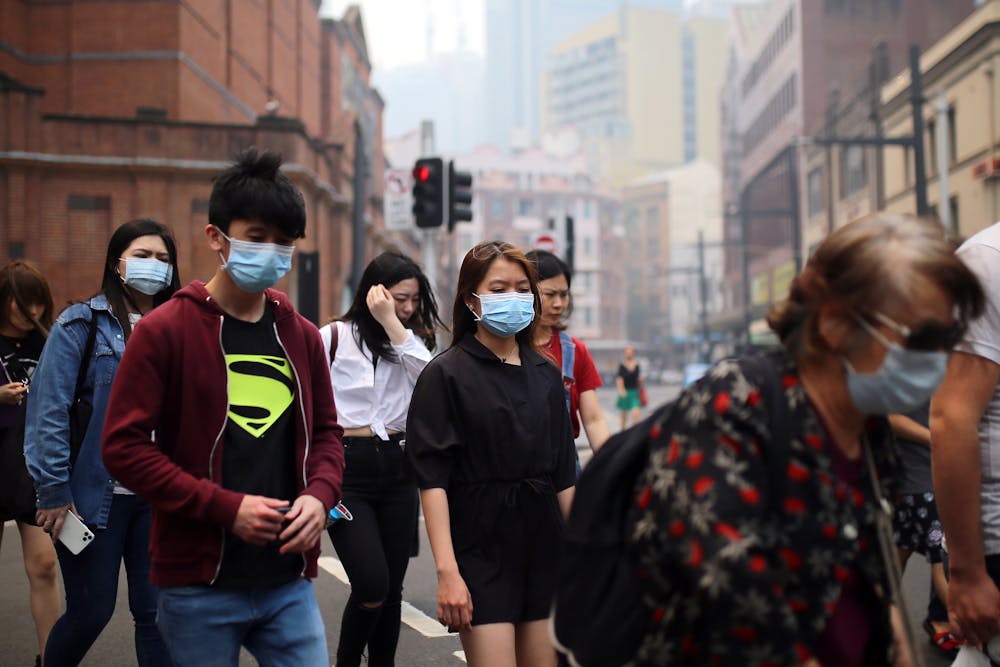
A woman wears a mask to protect herself from bushfire-related smoke haze in Sydney this month.Paul Braven/AAP
‘Bad stars’
The term disaster, with its etymology from ancient Greek for “bad star,” has always elicited cosmic allusions. Disaster suggests that the universe is awry; the planets are out of alignment, bad stars are causing chaos and disorder.
The secularisation of disaster in the modern era, through the notion of risk and insurance, attempts to sever this connection to the word’s planetary origins, envisioning it on the scale of the manageable “accident”, which can be insured against.
Yet, in the context of global warming, and following the large-scale atrocities of the 20th century such as the two world wars, the dropping of the atomic bombs on Hiroshima and Nagasaki, and the Holocaust, it’s clear that disasters are far from manageable. One of the ways we have sought to manage our anxieties about disaster is through popular film.
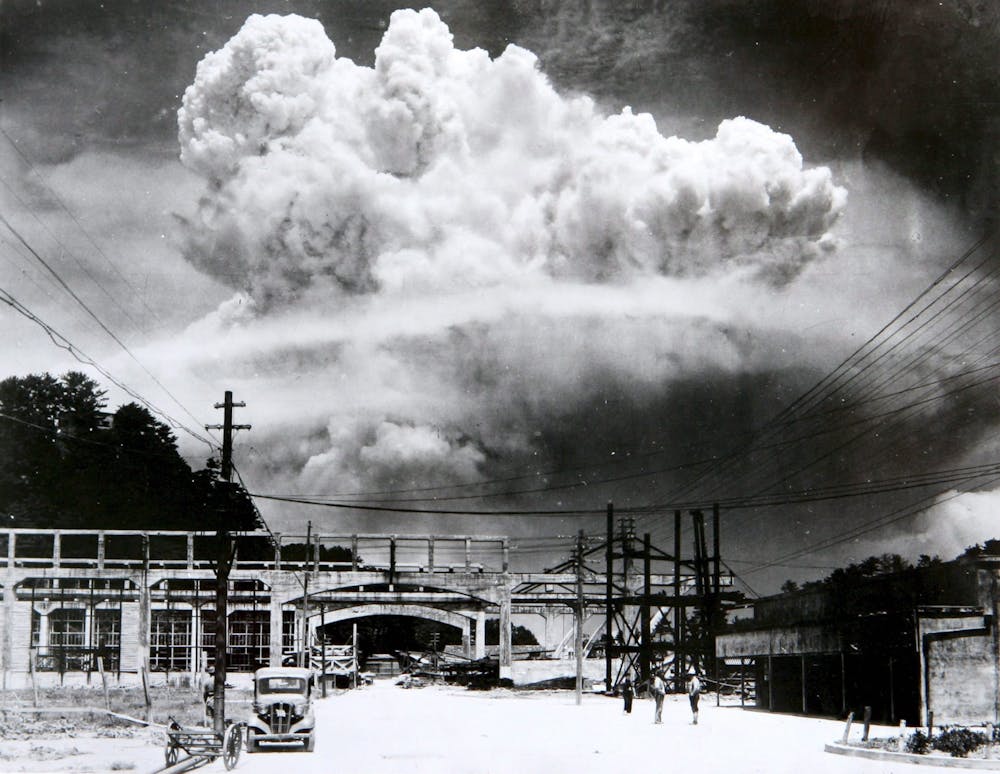
A photo made available by the Nagasaki Atomic Bomb Museum shows a view of the mushroom cloud photographed from the ground during the bombing of Nagasaki, Japan in 1945.Nagasaki Atomic Bomb Museum handout/EPA
The Hollywood disaster film genre has undergone, roughly, two major cycles. The first was in the 1970s. It included blockbuster melodramas like The Towering Inferno, The Poseidon Adventure, and the Airport films (so brilliantly parodied in Flying High).
These cinematic disasters were often instigated by some kind of natural element – an earthquake, or a tidal wave. But they were also often structured around the malfunctioning of technologies in human-built environments (The China Syndrome being a prime example).
The heroes in these films were usually strong, hard-boiled men. Gene Hackman in The Poseidon Adventure, for example, leads, as though by sheer willpower alone, a group to safety following the capsizing of the eponymous ship. As viewers, we are awed by his grim determination in overcoming adversity amid often stark images of people dying.
The second cinematic cycle begins in the 1990s with ecologically sensitive films like Twister, which follows a group of meteorologists as they chase violent tornadoes across Oklahoma, and Dante’s Peak, about the disastrous effects of the eruption of a volcano on a small Washington town. Such films prefigure later, more explicit global warming eco-disaster films, like Emmerich’s masterful The Day After Tomorrow.
While the earlier disaster films were characterised by their ensemble casts and soap-opera like structures, these newer ones dedicate more energy towards showing the disasters (using elaborate CGI and high definition), and imagining social and governmental responses to them.
Affectively, they depend upon the pathos of groups working together to overcome adversity. As in a Christian vigil, the viewer of these films takes solace from participating in this community of suffering.
The Vigil, 1884. Oil on canvas, by John Pettie.Wikimedia Commons
The pleasure of disaster on film
On one level, popular film as “entertainment” offers us reprieve from the petty banalities, inconsistencies and disappointments of everyday life, by giving us a vision of a world ordered into timely narrative. Events are tied together in a fundamentally meaningful fashion.
We are able to defer the concerns of the ordinary for a couple of hours, and participate in a viscerally stimulating and pathos-laden experience. The unwieldy disasters we see in the real world are thereby represented in a contained fashion, allowing us the illusion of conceptual and emotional mastery. But at the same time, this process pacifies us, numbing us to, and distracting us from, reality.
Similarly, our response to disaster films is ambivalent. On one hand, we enjoy watching the ultimately effective responses of the state to the disaster. In The Day After Tomorrow, for example, following some initial bumbling, the US government saves millions of Americans by organising a deal for US migration to Mexico(!)
On the other hand, epic images of full-scale disaster are the visual and visceral centrepieces of these films, and awe and terrify us. Indeed, our most intense pleasure in these films emerges from their sublime images of destruction.
Watching San Francisco fall to pieces in San Andreas is awe inspiring. In The Day After Tomorrow, one of the most sublime sequences involves the ocean swelling and rolling through Manhattan, gathering people and vehicles in its stead after crashing into the Statue of Liberty.
Watching San Francisco fall to pieces in San Andreas is awe-inspiring.New Line Cinema, Village Roadshow Pictures, RatPac-Dune Entertainment
These pleasures in destruction and restoration occur within the context of a more saccharine kind of empathy we feel with the masses of faceless victims. By the films’ endings, we can take solace in the images and acts of community building and collective overcoming. Along with the victims, we mourn worlds destroyed, and are hopeful about worlds beginning to be rebuilt.
The economics of disaster
Hollywood disaster films often feature antagonists who are stubborn bureaucrats and greedy capitalists, but also US presidents who are calm, compassionate and measured, taking an appropriate amount of time to decide how to act and then acting decisively.
In The Day After Tomorrow, this is firstly President Blake (Perry King), who makes cool-headed decisions about the future of America and dies when his motorcade is caught in a storm and destroyed. Later, President Becker (Kenneth Welsh) is magically transformed from a pig-headed obstructionist after he assumes the presidency.
Perry King in The Day After Tomorrow (2004).Twentieth Century Fox, Centropolis Entertainment, Lions Gate Films
This, of course, contrasts with real-life presidential responses to disaster. In 2017, following Hurricane Maria’s devastating effects on Puerto Rico, Donald Trump criticised Puerto Ricans for the economic burden Maria gifted the US government, while simultaneously implying the event wasn’t very bad – not a “real catastrophe” compared to Katrina. This was all while delivering his emergency address on Puerto Rican soil!
At a time in which solidarity and compassion were expected, Trump was criticised by many for making the issue about the US’s economic burden; and yet, like many things Trump does, this inadvertently raised some critical issues surrounding the economics of disaster in the modern era.
US President Donald Trump speaks next to Puerto Rico’s Governor Ricardo Rossello and US First Lady Melania Trump at the Luis Muniz aerial base in San Juan, Puerto Rico, in October 2017.Thais Llorca / POOL/EPA
The imagination of disaster – its preempting, in a sense, its prediction – offers insurers (and the reinsurers who back them), following rapidly updated actuarial tables, a unique opportunity to capitalise on risk.
At the same time, disasters are a boon to some capitalist investors, who are able to buy into the development of new infrastructure for a profit.
Disaster in this way is a chief “innovator”, sucking up surplus capital, offering the most literal realisation of what conservative economist Joseph Schumpeter celebrated as one of the virtues of capitalism – its capacity for “creative destruction”.
Technology and disaster
French philosopher Paul Virilio has argued that the invention of every technology is simultaneously the invention of its accident. The invention of the car, for instance, invents the car crash. While the disaster film is acutely aware of these failures built into every technology, the genre’s relationship towards technology is more complex than outright critique.
Perhaps the most striking ambivalence of disaster films concerns the role – and virtues – of technology in facilitating and overcoming disaster. This is explicitly worked through in “man-made” disaster films like The China Syndrome, The Towering Inferno, and, more recently, Deepwater Horizon.
Natural disaster films like The Day After Tomorrow and Geostorm envision global warming as the product of devastating technological practices, and offer technological solutions to this. In Geostorm, the network of satellites that control the weather malfunction, and rapidly become the cause of even greater disaster as the film progresses.
Geostorm (2017) envisions global warming as the product of devastating technological practices, and offers technological solutions to this.Warner Bros., Electric Entertainment, RatPac-Dune Entertainment
And yet, at a higher level, these films are entirely dependent on cutting edge visual and aural technologies to stage the awe inspiring disasters in the first place. They also require a great deal of investment – of capital, and human labour – and, therefore, create a great deal of waste.
Disaster cinema, in unconsciously teasing out the relationship between technophilia and technophobia, forces us to confront one of most pressing dilemmas of the age of the Anthropocene: should we reflect on and think through the causes of disaster, or use technology to act in the hope of preventing future disasters?
A discourse of technological “solutions” to climate change fits squarely into the logic critiqued by philosopher Timothy Morton in his book Dark Ecology.
Technology, in the first place, depends on the extraction of power from nature, and the conversion of the natural into waste-creating power. Suggesting that something can cohere with a technological “problem: solution” framework is thus perhaps part of the problem itself.
Indeed, the myth that there can be a “growth”-oriented solution to global warming is convincingly undone in one of the key academic works on global warming discourse, Anneleen Kevis and Matthias Lievens’ The Limits of the Green Economy.
By studying Hollywood’s mediations of disaster – its attempts at containment and emotional management – we can perhaps begin to learn something about the ongoing tensions and contradictions that define ecological existence in modernity.
The future of disaster
The sheer frequency of contemporary natural disasters raises the question – is there a point at which we will lose our appetite for watching them staged on film?
I suspect the answer is a resounding “no.” Following September 11, it was commonplace to hear people say the footage of the planes crashing into the World Trade Centre looked like it was from a movie. But what movie? The documentary photo-realism of the footage barely resembled Hollywood’s slick action and disaster spectacles.
More notably, Hollywood films began to adopt the September 11 style after the event itself, with the hand-held, found-footage style realism of films like Cloverfield becoming a cliche by the end of the first decade of the 21st century.
This, once again, exemplifies the comforting finitude popular film narratives offer viewers. The more frequent disasters become, the greater will be the need for emotional management by the corporations that produce popular news and entertainment.
The more desperate people become about global warming – and the emergence of grassroots activist groups like Extinction Rebellion suggests people are becoming increasingly desperate – the more popular media corporations will assuage our anxieties with carefully ordered, pacifying spectacles.
For the last week or so, people have been walking around Sydney with their heads down, eyes red from the smoke, wearing masks to filter the air.
Pedestrians are seen wearing masks as smoke haze from bushfires in New South Wales blankets the CBD in Sydney this week.Steven Saphore)/AAP
This is like something from a disaster film – and similar scenes of the effects and aftermath of catastrophe are continuing to appear around the globe.
Yet, there is no evidence this will curb Hollywood’s appetite for disaster. In fact, cultures and societies – like individuals – have historically attempted to deal with collective trauma by replaying and restaging it in art, from the Chauvet cave paintings to The Longest Day. This may make people feel both better and more helpless at the same time.
Scott Morrison is picking up that Australia’s devastating, prolonged fires are producing a soured, anti-government mood among many in the community.
It may not be entirely rational for people to turn on politicians in such situations. The actual fighting of the fires, driven primarily at state and local levels, appears to have been efficient.
But the government has invited anger in terms of the broad debate by being so inactive and partisan about climate change over years.
Morrison is struggling to navigate his way through these fraught days before Christmas. He’s stressing unity – “I want to reassure Australians, that the country is working together … to deal with the firefighting challenge”. He’s refusing to meet calls for a national summit or a COAG meeting on the fire effort, but he’s highlighting the federal government’s co-ordinating activities.
He’s placing the most positive spin he can on what Australia is doing on climate change, but all the time emphasising Australian emissions are only a tiny portion of the global total “so any suggestion that the actions of any state or any nation with a contribution to global emissions of that order is directly linked to any weather event, whether here in Australia or anywhere else in the world, is just simply not true”.
The fires are putting pressure on the government by elevating the climate issue and opening new division among Liberals. Only this time – and importantly – the internal wedge is coming from the left rather than the right of the party. The PM is being pushed to do more, rather than being held back.
Morrison is no longer able to gloss over the climate debate. The big question for the next year or two is whether he will reposition the government.
As former treasury secretary Ken Henry has argued, “today’s catastrophic bushfires, and rapidly vanishing water security, again following years of drought, put the present government in a similar position” to when John Howard moved on climate change in 2006.
Morrison is the ultimate pragmatist and so, if he sees it in his interest, he may well be willing to readjust. Not radically, nor quickly. Just enough, as and when he judges it, to satisfy middle ground voters.
He did a little of this before the election, when he topped up funding for “direct action” and advanced pumped hydro, although some read more into the shift than was there.
This week NSW Liberal environment minister Matt Kean bluntly called out his federal colleagues’ dancing around the climate-fires link.
“Let’s not beat around the bush … let’s call it for what it is. These bushfires have been caused by extreme weather events, high temperatures, the worst drought in living memory – the exact type of events scientists have been warning us about for decades that would be caused by climate change,” said Kean, who is the leader at state level of the moderate faction.
“There has been a lot of talk since the federal election about ending the climate wars. I think that that talk has been misplaced. It’s not time to end the climate wars. It’s time to win the climate wars.”
Kean also notably acknowledged the “leadership” on the issue of Malcolm Turnbull (who again prodded the bear on Monday’s ABC Q&A).
One federal Liberal says, “for a long time [Kean’s line] is where the overwhelming majority of the party has stood [but] nobody was willing to say it. The community is so concerned it has given us the cover to come out and say it”. The MP points to the impact of the issue in Liberal heartland seats in Sydney and Melbourne.
The federal government has repeatedly derided the Victorian and Queensland Labor governments for what it argues is their excessive ambition on renewables and emissions reduction. Kean has flagged NSW plans to strengthen its stand. The federal government is clearly exposed as the odd player out.
Yet it is the states’ targets for renewables that are helping the national effort on emissions reduction, according to figures just released by the environment and energy department in its report “Australia’s emissions projections 2019”.
Looking at Australia’s progress towards its 2030 Paris target of a 26-28% reduction on 2005 levels – which, incidentally, can only be reached via the much-criticised course of carrying over Kyoto credits – the report has revised down its 2018 estimate for projected 2030 emissions.
Reasons for this revision include the boost to the “direct action” fund and “stronger renewables deployment”. A factor in the latter was “the inclusion of 50% renewable energy targets in Victoria, Queensland and the Northern Territory”.
The projection is now for Australia to have renewables generating 48% of its electricity by 2030 – very close to the Labor policy of 50% of which the government was so critical.
Energy Minister Angus Taylor’s speech at the United Nations COP25 conference in Spain this week showed how, as the inevitable transition to clean energy progresses, the government is conflicted. Regardless of years of scepticism about renewables from the federal Coalition, Taylor in Madrid lauded Australia’s achievements in this area.
“In Australia, an unprecedented wave of low emissions energy investment is already underway,” he boasted.
“Last year, renewable investment was Australia’s highest on record at A$14.1 billion, which is world leading investment given our population. Renewables are now more than 25% of our electricity supply in our National Electricity Market.”
Reality is gradually proving stronger than ideology as the energy mix changes, but not entirely. The debate around a new coal-fired power station goes on. The government before the election promised a feasibility study into a possible venture in Queensland, and the Nationals continue to push for action.
If a feasibility study left the way open for a coal-fired station, would the government be willing to provide any financial help or guarantee a portion of the energy output? Given the reluctance of private capital, that would likely be the only way it could happen.
There was a certain irony in Anthony Albanese touring coal country in central Queensland this week, given the climate debate.
Visiting Emerald, Rockhampton and Gladstone among other stops, Albanese was beginning his mission to reconcile the strands in Labor’s climate messages, after Bill Shorten failed to do so, costing vital Queensland votes.
This week Albanese has been talking up the domestic transition to renewables, while providing reassurance to the coal areas by declaring the world will continue to want Australian coal for the foreseeable future.
He says the role of government in relation to new coal mines is to make the environmental judgements; if they pass that test, then such projects live or die on their ability to raise private finance. On Adani, he says it has its approval and he’s urging it to get on with providing the jobs (the company says it is doing so).
As to a new coal fired power station: he believes it would not get private finance.
Very aware Shorten was smashed for trying to walk in different shoes on climate and coal when he was in the inner city and in regional Queensland, Albanese is aiming for a story to which he can get a favourable reception all round the country.
That won’t be easy. Then nothing is, for anyone, on the climate issue.
Source: The Conversation (Au and NZ) – By Katharine Kemp, Senior Lecturer, Faculty of Law, UNSW, and Co-Leader, ‘Data as a Source of Market Power’ Research Stream of The Allens Hub for Technology, Law and Innovation, UNSW
Today, the federal government responded to the recommendations of the Australian Competition and Consumer Commission (ACCC) “world-leading” Digital Platforms Inquiry.
The response, however, is a less-than world-leading roadmap for reform.
Few dispute the ACCC’s inquiry was ground breaking, as it held to account tech giants including Google and Facebook, and the power they wield over media, advertising and consumers.
But the government’s plan for reform lags behind other major global jurisdictions, where greater privacy protections have been enacted.
The recommendations, and the response
The ACCC spent 18 months on the Digital Platforms Inquiry, publishing its hefty final report in July.
In the report, 23 recommendations were made. These include wide-ranging reforms to consumer protection and privacy laws.
In today’s announcement, the government supported six of these recommendations in their entirety and ten “in principle” (with plans for further reviews).
It “noted” five others, and rejected two.
A lagging Privacy Act
In its final report, the ACCC highlighted that Australia’s privacy laws did not give consumers the same protections granted in other comparable countries and the European Union.
For instance, the European Union’s General Data Protection Regulation (GDPR), gives European consumers more choices and more complete information about how their personal data is used.
The ACCC’s recommendations on privacy sought to align Australia’s privacy laws with the GDPR. This included imposing higher standards for consumer consent and privacy notices, and introducing rights to erase personal data in certain situations.
The government does support higher penalties for breaches of the Privacy Act, and will act on that recommendation sometime next year. However, there will be another 18 months of inquiry into whether any other improvements to the Privacy Act are actually required.
The government also supported, in principle, a new statutory tort (law) of serious invasion of privacy, which was also recommended by the Australian Law Reform Commission in 2014.
Similarly, the ACCC’s report proposed a private right of action (which allows an individual to sue directly) on privacy matters. This right is currently only available to the regulator. The government supports this recommendation in principle, but it is “subject to consultation and design of specific measures”.
The reality is, privacy best practice standards are evolving rapidly around the world, while Australia lags behind. Australian web and app-based businesses have to design their services to comply with overseas legislation.
To its credit, the government made a commitment of A$26.9 million over four years to fund a new unit in the ACCC.
This unit will monitor and report on the state of competition and consumer protection in digital platform markets.
Its first task will be to conduct further inquiries into the advertising technology (ad-tech) sector, in line with an ACCC recommendation. Ad-tech facilitates personalised targeted advertisements, such as those presented by Facebook and Google.
The key issue, from a platforms perspective, was the ACCC’s proposal to have a voluntary code of practice regarding the power imbalances between digital platforms and news media businesses. A voluntary code means the industry has the opportunity to develop new rules itself.
The government has directed the ACCC to work with stakeholders to develop and implement voluntary codes to address this power imbalance, and the ACCC must provide a progress report on code negotiations in May next year.
The code must be finalised no later than November. If agreement isn’t reached, the government has reserved the right to impose a mandatory code.
The government will also work with the Australian Communications and Media Authority (ACMA), in a staged process to reform media regulation.
The objective is to have a “platform-neutral” regulatory framework covering both online and offline delivery of media content (for example, having common rules for Netflix and free-to-air television).
In practice, this “staging” is likely to lead to the first legislation being introduced into parliament in late 2020.
What was left out?
One of the recommendations the government rejected was the proposed mandatory ACMA take-down code, which would assist copyright enforcement on digital platforms. The rejection was on the basis that major copyright owners and users identified “unintended effects” of such a code.
The government also rejected the proposal that philanthropic funding of journalism should be tax deductible, mainly because it is in the process of implementing a deductibility framework, introduced in 2017.
The ACCC also recommended the prohibition of unfair contract terms. It repeated this proposal in the context of small businesses and consumer loyalty schemes.
The government noted this, and promised there will be consultation on a range of policy options to strengthen unfair contract term protections.
The was also a “note” response on the recommendation to prohibit certain unfair trading practices. There is currently work underway through Consumer Affairs Australia and New Zealand exploring such a prohibition.
The government deferred adopting a change to search engine and internet browser defaults. Instead, the ACCC will monitor and report back on Google’s roll-out of options in Europe.
The ACCC also proposed changes to merger law. These were intended to address what in Europe is called a “killer acquisition”.
The government anticipates further public consultation on this proposal.
Unfortunately, the government’s plan for further legislative reviews offers only the mere possibility of improvement to consumer privacy protections. And even if these eventuate, they are more than eighteen months away.
Source: The Conversation (Au and NZ) – By Lidia Morawska, Professor, Science and Engineering Faculty; Director, International Laboratory for Air Quality and Health (WHO CC for Air Quality and Health); Director – Australia, Australia – China Centre for Air Quality Science and Management (ACC-AQSM), Queensland University of Technology
Bushfire smoke has now been blanketing parts of Australia for months. This week the air quality in Sydney reached new lows, reported to be 12 times hazardous levels in some parts of the city on Tuesday.
Beyond being stifling and unpleasant, people are experiencing irritated eyes and breathing difficulties.
We’ll only fully understand the longer term health effects in the weeks and months to come.
When the situation is as bad as it has been in Sydney over the past few days, people stop asking questions about whether air pollution has an impact on health; we know it has. The question on everybody’s mind now is: how can I protect myself and my family?
Our natural instinct tells us if the conditions outside are bad, we should seek refuge inside. The indoor environment provides some protection against bushfire smoke and outdoor air pollution in general, but the degree of protection depends on the type of building and importantly, its ventilation.
Buildings such as shopping centres, most modern office buildings and hospitals are equipped with heating ventilation and air conditioning (HVAC) systems, which incorporate air filters.
The efficiency of these systems depends on the filter technology and the size of the filtered particles. Smaller particles are generally more difficult to catch and remove, but sophisticated technology can achieve this. It varies, but what we call HEPA (high efficiency particulate air) filters can remove close to 100% of airborne particles.
The particles we’re concerned about in bushfire smoke are ultrafine particles. So these are likely to be removed with HEPA filters, but could get through less sophisticated filters.
The smoke haze is a result of ongoing bushfires outside of Sydney.Steven Saphore/AAP
Residential homes and apartments are not commonly equipped with HVAC systems. Instead, they’re naturally ventilated, typically by opening the windows. So in residential houses, the indoor concentrations of pollutants are often close to the outdoor concentrations, particularly when the windows are open.
Even if the windows are closed, outdoor pollutants will penetrate indoors if the building is “leaky”, meaning there are cracks the air can get through. This is the case in many old buildings, particularly those built from timber.
Air purifiers
One option to improve the quality of indoor air is to use air purifiers. Air purifiers use a system of internal fans to pull the air through a series of filters that remove airborne particles. The air purifier then circulates the purified air back into the room.
But again, the protection offered by purifiers can range from low to very high. As with filtration systems, the level of protection depends on the type of purifier you have. Those equipped with HEPA filters are much more efficient.
Their effectiveness also depends on the volume of air the purifier services, the setting (one room or several interconnected rooms), the ventilation rate (this is measured by how many times the whole volume of air is exchanged per hour) and how it is set to operate (continuous or intermittent).
To put this in context, operating a purifier equipped with a HEPA filter in a typical bedroom would significantly reduce the concentration of air pollution in the bedroom, most likely to a safe level. However, operating a less efficient purifier in a large, open plan house is not likely to help much.
Face masks
Many people consider face masks to be the best protection against air pollution. But for the most part, they merely provide a false sense of security.
Firstly, a mask is only effective if it’s properly fitted: if the fit is not perfect, most of the small particles, such as those present in the pollution plume from bushfires, will get through.
Secondly, the efficiency of the mask depends on the behaviour of the person wearing it. This includes how long you wear the mask for and how often you take it off. Considering wearing a mask is uncomfortable – particularly when it’s hot – it’s not easy to keep it on all the time.
Industrial style masks are more fitted than simple fabric masks, so can be more effective – but still depend on the wearer’s behaviour. These are not practical to wear all the time.
And if it’s questionable whether a mask will protect an adult, it’s even less likely to protect a small child. A child cannot be expected to tolerate the inconvenience and discomfort of correctly wearing a mask.
In summary, indoors we are protected to some degree from outdoor air pollution, so consider staying inside where possible – particularly if you have an existing health condition.
You might like to wear a mask or invest in an air purifier. These may help to some degree, but are emergency measures that don’t in themselves represent a solution.
While the air quality is likely to improve in Sydney and other affected regions as these fires ease, our changing climate means we can only expect to be in this situation more and more. The only real way forward is to address the climate crisis urgently and decisively.
Grant Robertson, New Zealand's Minister of Finance. Image courtesy of https://www.labour.org.nz/grantrobertson
Dr Bryce Edwards.
In his big-spending infrastructure announcement yesterday, Grant Robertson reinforced what many political commentators say about him – he’s electorally smart, but way too conservative to be a genuine leftwing minister of finance. Robertson does what is right for winning votes, but not necessarily what is in the interests of the country or even Labour’s own constituency.
The spend-up on infrastructure is electorally smart. It answers critics from across the political spectrum who complain that this government has not addressed the infrastructure deficit brought about by previous National and Labour governments.
That’s why plenty of economists have given the package a thumbs-up. For example, Donal Curtin has blogged to say, “It was, from an economic perspective, completely correct” – see: Give that man a DB. And he suggests any opposition to the announcement is suspect: “Show me someone who disagrees with this boost, and I’ve a better than average chance of showing you a nutter.”
There has also been widespread endorsement of the general package from across the political spectrum. The Herald’s business editor Liam Dann pointed to this accomplishment: “Today’s announcement was ‘welcomed’ by BusinessNZ, The Employers and Manufacturers Association and the Council of Trade Unions. Getting the thumbs-up from these three in one afternoon is no mean feat” – see: What a time to be a finance minister (paywalled).
Dann also gave credit to the Government’s adroit timing and packaging of the new spending: “The Government gets to make a pre-Christmas splash with surplus spending headlines, it gets another bite in the quiet news vacuum of the New Year when it announces the highly anticipated specifics of new transport spending. And it still leaves plenty of fiscal headroom for voter-friendly acts of budget generosity later in 2020.”
Similarly, Herald political editor Audrey Young suggests that the lack of detail in Robertson’s announcement will work in the Government’s favour: “That will come in early January to kick-start the Government’s election year. Robertson presented the outlines of a turbo-charged capital spending plan with enough lack of detail at present to avoid providing a target for the National Opposition. But essentially, Robertson and Prime Minister Jacinda Ardern will be able to announce the details of a $7.6 billion in new capital spending at the start of election year” – see: Robertson sets up Govt nicely for election year (paywalled).
She also suggests that this was all deliberately designed as an election year gambit: “Robertson denied that delaying the big reveal until 2020 is anything to do with election year – he would say that, wouldn’t he?”
She says the Finance Minister “failed to identify one single shovel ready project. Or even reveal how many of those will be started next year. Given the Infrastructure Commission has a list of over 500 projects, worth $21 billion, Mr Robertson could’ve plucked a few of those out of the hat and said work would be starting soon.”
Business journalist Pattrick Smellie also says that the configuration of yesterday’s announcement means “it is almost inconceivable that the government doesn’t have an election year hip pocket splurge of some sort up its sleeve for the ordinary New Zealand family” – see: Why so conservative, Grant?
Smellie suggests the Government has cleverly left itself with plenty of room to manoeuvre because the announcement relates to one-off capital spending and not increasing operational spending, which means that next year could see increases for welfare beneficiaries and possible tax cuts via a shift in income tax brackets.
The focus of the Government’s increased capital spending on transport, and roading in particular, is also seen as clever. Hamish Rutherford labels the new-found fashion for roads “pragmatic” because, “Although building new roads may be less transformational than the Government hoped, it may also be smart politics. Not only are such projects popular with many voters, they can provide measurable productivity gains” – see: Grant Robertson promises a wall of transport demand into the future (paywalled).
Rutherford also explains that for a government that needs to find projects that are almost ready to go, and with fewer construction industry capacity restrictions, roading is the perfect area to spend on.
Similarly, Thomas Coughlan argues that the Government’s spending decisions are being influenced by partisan strategic gain: “this Government’s funding of additional roads robs National of the oxygen it needs in opposition. The party is yet to release its transport policy document. But Robertson’s announcement today of $6.8b in additional transport spending could steal National transport spokesman Chris Bishop’s thunder by gazumping some of Bishop’s promises” – see: Politics and economics are strange bedfellows, but they’ve made $12b of magic.
Why the announcement is conservative
Although on the surface, Grant Robertson’s announcement involves massive amounts of new spending, many commentators have been underwhelmed by it. According to Thomas Coughlan’s article above, although economists have approved of the announcement, the level of new spending was “not nearly as much as they’d wanted”. He cites KiwiBank senior economist Jeremy Couchman as believing “the Government still had more room to lift borrowing to tackle the infrastructure deficit.”
Similarly, journalist Bernard Hickey wrote this morning that the amount of spending is “nowhere near enough to fill a yawning and growing infrastructure deficit”, and points out that new debt levels will barely increase on what they are now.
Westpac’s economists also dismissed the significance of the new expenditure, labelling it a “bit of a damp squib”, and suggesting that because “the spending would be spread over many years have only a small impact on the economy” – see Tom Pullar-Strecker’s Infrastructure boost cheers business groups but economists fear lag.
The same article reports the Infometrics firm as arguing that given current low debt levels, the “Government could have announced a much larger investment”.
Pattrick Smellie suggests the levels of new spending could be considered “unduly conservative – even miserly”. He says “Having raised expectations the government could push out the ratio of net Crown debt to 25 percent of gross domestic product from the current 20 percent limit, the forecasts unveiled in today’s Budget Policy Statement look tame” – see: Why so conservative, Grant?
The focus of the spending should have been entirely different, according to leftwing political commentator Chris Trotter, who has written a scathing blog post, labelling Robertson’s announcement “disgraceful” with a “courage and compassion deficit” see: Grant Robertson spends up large – on the Establishment!
He asks what Greta Thunberg, or even the Greens, would have to say about the fact that only a tiny fraction of the new spend – $200m – is being allocated “to making the Zero Carbon Act mean something”. Instead, the bulk of the money is going on roading.
Trotter believes the Greens should be outraged: “the Greens’ response to his announcement is just plain sad. To be clear, their transport champion, Julie Anne Genter, has been humiliated. The road transport lobby has effortlessly outmanoeuvred whatever policy wonks she’s had pitching the case for rail.”
He is also astonished that none of the $12bn is being spent on welfare, despite this government claiming to be “transformational”, and the Prime Minister preaching the “politics of kindness”. For Trotter it’s a betrayal of Labour’s voters: “Never mind that pouring money into the pockets of our poorest citizens is the fastest and most effective way of delivering our economy a much-needed shot of adrenaline. No, never mind all that. Finance Minister Robertson and Social Welfare Minister Carmel Sepuloni have no intention of upsetting the Establishment by giving beneficiaries anything remotely resembling a Christmas present.”
Finally, Gordon Campbell makes the economic and compassionate case to the Minister for Child Poverty Reduction, Jacinda Ardern, that increased government spending should actually be going on implementing the recommendation of the Welfare Expert Advisory Group – see: On welfare vs infrastructure spending.
The pacific island nation of Samoa has been making headlines over the past month due to a significant measles outbreak. At last count, 4,995 measles cases had been recorded, and 72 people, mostly young children, had died.
The actual number of cases and deaths is likely to exceed this, because not everyone with measles will present for medical treatment, and not all deaths occur in hospital.
Tragically, 40% of recorded deaths have been in babies under one year old, and nearly 90% among children less than five.
With a population of 200,000, Samoa has fewer people than Geelong or Hobart. So a significant proportion of the population has been affected. More than one in five Samoan babies aged six to 11 months have contracted measles during this outbreak, and more than one in 150 babies in this age group have died.
Fortunately, with increasing vaccination coverage, we’re now finally seeing signs the number of new measles cases in Samoa is slowing.
Contagious but preventable
Measles causes a fever with cough, runny nose and red eyes, followed by a rash. Around one in three cases develop complications, most often diarrhoea and pneumonia.
Measles is probably the most contagious virus affecting humans. In a susceptible population – that is, people who have neither been vaccinated nor had measles previously – a single person with measles would infect 12 to 18 others.
A rash is one of the defining symptoms of measles.From shutterstock.com
The most frustrating and tragic thing about this outbreak is that a safe and effective vaccine is available. A single dose of measles vaccine (MMR or MMRV vaccine is used in Australia) provides protection to between 95% and 98% of recipients, while two doses protect 99% of vaccinated people.
Because measles is so infectious, about 94% of the population need to be vaccinated to stop it spreading. “Herd immunity” means unvaccinated people, including those unable to be vaccinated due to young age or specific medical conditions, are protected.
These deaths were caused by human error and not the vaccine per se. The vaccines were inadvertently mixed with expired muscle relaxant anaesthetic instead of water.
This tragic incident resulted in the suspension of the national measles vaccination program and loss of confidence in vaccine safety. Because of this, vaccine coverage for one-year-old children for the first dose of measles vaccine fell from 76% in 2012 to 31% in 2018.
When a traveller re-introduced measles to Samoa in August this year, these unvaccinated children made it possible for measles to gain a foothold and spread throughout the country.
The first laboratory-confirmed measles cases were reported in September, and an outbreak was declared in October. In the face of rising measles cases and deaths, the Samoan government declared a state of emergency on November 15, setting the scene for a campaign of mandatory vaccination.
The government shut down on December 5 and 6 during a door-to-door vaccination campaign. People who had not been vaccinated were asked to leave a red flag or cloth outside their home.
Official estimates indicate 93% of the population have now been vaccinated. Achieving vaccination rates over 95% among children aged six months to four years will be key to stopping this measles outbreak.
Health workers preparing vaccination packages ready for mobile distribution.National Critical Care and Trauma Response Centre, Author provided
Aiding the public health response
This outbreak has placed enormous pressure on hospital staff and the Samoan health system. Samoa’s largest hospital has more than doubled its usual capacity, including duplicating an emergency department, paediatric wards and intensive care unit in old hospital wings.
In response to a request from Samoa, the Australian Medical Assistance Team (AusMAT) has been in Samoa since early November. For two weeks in November, I was part of AusMAT’s “team bravo”, which included 34 specialist nurses, doctors and public health experts.
AusMAT set up a temporary ward in Apia, Samoa, to treat young patients.National Critical Care and Trauma Response Centre, Author provided
AusMAT is one of several teams that have travelled from overseas to help Samoa manage this outbreak.
My role as a public health specialist included working with local and international staff on case diagnosis, analysis and reporting of measles cases and deaths, and identifying the most important groups to receive urgent vaccination.
Measles vaccines have been in widespread use in Australia since the early 1970s. The last recorded measles death in Australia was in 1995, and in 2014 the World Health Organisation declared Australia had eliminated measles.
Despite this, travellers regularly re-introduce measles to Australia, which can spread to susceptible people they come into contact with. As recently as this week, Victoria has been the subject of a measles warning, after three people were diagnosed in Melbourne.
High vaccine coverage (in 2018, 94.6% of five-year-old Australian children were fully vaccinated) means a measles outbreak of this magnitude would not occur in Australia at present. However, Samoa’s experience is a reminder there’s no room for complacency around vaccine preventable diseases.
Auckland City from Bayswater. Image by Selwyn Manning.
The case for a complete relocation of Auckland’s Waitematā Harbour freight port is far from established. Nevertheless, Auckland will grow over the long term, and the freight operations need to move away from the area close to the downtown Ferry Terminal.
This area should become like Sydney’s Circular Quay. The question is: where is Auckland’s equivalent to Sydney’s Botany Bay? This question has become pressing, with Prime Minister Ardern declaring that the port must shift.
There is another option that should be added to the present list of options. The option is Māngere Inlet, the portion of Manukau harbour between Māngere Bridge, Southdown and Ōtāhuhu; Port Southdown.
While the capital costs for this option would be higher than other options, most likely, the operational benefits would be higher, and the ongoing operational costs would be lower. The essential component of this option would be the construction of a ship canal across the Ōtāhuhu portage.
History:
A ship canal in Auckland is not a novel idea. The first formal proposals for such a canal date to around 1850. The debates peaked in the 1900s’ decade. Legislation preserving land‑rights for such a purpose was eventually repealed, in 2010. It was in the 1890s that the Manchester Ship Canal and the Keil Canal were built. The first Welland Canal in Canada – which allows ships to bypass Niagara falls – opened in 1829. The present Welland Canal was completed in 1932, and carries trans‑Atlantic as well as domestic shipping. In April this year, I enjoyed a stay in the old Pilot Lodging which overlooks this ship canal at Port Colborne.
In September 2019, Lisa Truttman published The Canal Promoter, available from:
Ms Truttman outlines the various canal proposals, in the context of an account of the life of one of the most prominent canal promoters, David Bruce Russell. The booklet is an important addition to the growing body of material exploring Auckland’s history. For my purposes here, however, I will just cite Truttman’s final paragraph:
Today [2019], there still exists a Local Purposes Reserve (Canal) along the old line delineated in 1850 from the Ōtāhuhu Cemetery on one side and the Portage Canal Foreshore Reserve on the other at the Tāmaki River side, bisected by Great South Road, and ending at Saleyards Road. Much of it is used by adjoining buildings encroaching onto it, carparks, storage yards and the like. With the repeal of the 1908 Auckland and Manukau Canal Act in 2010, there is no intention of land being taken … under the Public Works Act, for a canal. So, the reserve at Ōtāhuhu remains, more or less, simply as a historical anomaly.
These historical proposals all differ, in one major respect, from my Māngere Inlet proposal. Past writers saw such an isthmus canal as a means of access to the Waitematā from the west. They were not at all envisaging a day when the Waitematā port itself might need to be disestablished. Rather they wanted to shorten the sea routes to Auckland from Australia and from the South Island. And – before the Panama Canal – the main sea route from the United Kingdom. Indeed, in the 1900s most passions were exercised over where the canal should be, not whether it should be. The route through New Lynn – though requiring more earthworks than Ōtāhuhu – would have created a more direct shipping route from the Manukau Heads to Port Waitematā.
The economic case for a canal to solve this Auckland access problem diminished with the growth of the railways and the motorways, and more latterly, with the growth of international trade with Asia. Further, the once important coastal shipping industry became only a faint shadow of its former self.
My proposal is for Māngere Inlet as an east coast harbour. The reserve at Ōtāhuhu should remain reserved.
The ‘Port Southdown’ Proposal:
The proposal is that a new Auckland port be created in Māngere Inlet, through the construction of a dyke to the west of the inlet (the site of the old Onehunga bridge could have been a possibility), and a ship canal to the east, presumably at the site of the Ōtāhuhu portage. While a Tāmaki canal itself would be quite small compared to the foreign canals cited – therefore not über‑expensive – other substantial costs would be the re‑acquisition of land, and the construction of tunnels and bridges to allow existing roads and rail lines to cross the canal. There may also need to be a partial relocation of existing railway infrastructure, and of the fuel pipeline to Wiri.
A possibility could be to have a lock running through the dyke. However, there are already coastal shipping facilities at Onehunga. Container transhipment by land from Onehunga to Southdown should not be a problem. The new (low) Māngere Bridge, for which construction started last month, would be incompatible with shipping. Rather, the Māngere side of this facility is intended to have a recreational focus.
The Operational Benefits of the Māngere Inlet site:
Māngere Inlet is the site that best links with the Auckland’s existing industrial locus. It is close to the present Southdown landport; close to Auckland International Airport; close to the Ōtāhuhu railfreight hub; close to both Auckland’s motorways; and close to Auckland’s main southern hinterland. A container port in the Inlet would not conflict with other land uses, because this is already a contaminated industrial zone.
In a future low‑carbon world, shipping and rail will need to displace road haulage. It means that there will be a substantial revival of coastal shipping, given the constraints on rail expansion in New Zealand. A Tāmaki canal – giving Auckland a new east coast port – can facilitate coastal transhipment between Auckland, Northland and Bay of Plenty.
The Operational Costs:
I expect that there will be a need for ongoing dredging of Māngere Inlet. However, with no river outlets into the new harbour basin, the accumulation of silt may not prove to be the major problem it is in many foreign ports.
Such a low‑cost operation contrasts substantially with the operational costs associated with getting substantially more freight into (and out of) Auckland by land. These high operational costs are all characteristics of the Northland, Bay of Plenty, and Firth of Thames proposals.
The Capital Costs:
These are the cost of construction (canal, dyke, and new port facilities), of initial dreging, of land acquisition, and of building new road and rail links under and over the canal. (And maybe a railway over the dyke – from Onehunga to Middlemore – with a branch to the airport.)
While probably higher than for the other options, these costs may not be much higher if the other options are costed properly. For example, the costs to the residents of West Auckland that would arise from intensive rail and road freight construction (and operations) from Northland would need to be properly included in the Northland option that the present government appears to be favouring.
A Level Playing Field:
A Tamaki‑Southdown‑Māngere proposal – such as that outlined here – should be included as an option for a relocation site for Port Waitematā. The comparative cost‑benefit analysis should be equitable, with due consideration for differences in the long‑term operational benefits and costs, with transport sustainability – impact on climate change among other things – firmly in mind.
The cost of running the 2017 UK general election was estimated at £140 million (A$270 million). It’s likely to be higher this time. In 2017, the Conservatives, Labour and the Liberal Democrats spent nearly £38 million (A$73 million) on their campaigns, much of it on social media, and again it’s likely to be higher this time.
So once the votes have been counted and receipts processed, what will we have learnt about UK politics, and Britain’s place in Europe?
Ultimately, and regardless of the final vote tally, UK politics has never been more paradoxical, fragmented and contradictory. The UK political system was designed to build strong parliamentary majorities for long, five-year terms.
Indeed, the 2011 Fixed-term Parliaments Act was introduced to entrench this tradition, yet proved irrelevant. If we include the 2016 European Union referendum – the Brexit vote – this is the fourth time Britons have been to the polls in five years.
So what can we expect this time? On some polls, the nation looks headed for another hung parliament, with no clear majority of either of the major parties. While many voters, especially outside the main metropolitan centres, seem disillusioned and angry with politics, voter turnout has increased for the past four elections, with a respectable 68.8% turnout in 2017.
Other polling has the Conservative Party, led by Boris Johnson, holding a relatively steady lead of about 43%, with Jeremy Corbyn’s Labour hovering about 10% below. Yet, for a national election, the result is likely to be decided on a highly regional, fragmented and seat-by-seat basis.
Johnson’s campaign is based on the slogan “Get Brexit done”. On one level, this is savvy politics, tapping into longstanding voter frustration. Yet Johnson is a charlatan, prone to hyperbole, and voters remain wary of him.
Johnson, after all, promised he would rather be “dead in a ditch” than ask for another Brexit extension, if the third deadline of October 31 2019 was not met. Moreover, he hung the Northern Ireland Democratic Unionist party (DUP), his erstwhile coalition partners, out to dry with his last Brexit deal.
While the Conservatives have sought to buttress their Brexit plans with some increased public spending, including the dubious pledge of 50,000 new nurses (a disputed figure since it already includes 20,000 existing nurses), these promises are neither trusted nor credible. Strikingly, while Johnson employs the rhetoric of “one nation” Tory-ism, former prime minister John Major and other Conservative heavyweights have refused to back him.
Corbyn, in contrast, has been running an altogether different campaign. He would rather run on any other issue except Brexit. His “Brexit-neutral” policy is an agonised compromise between his own Euroscepticism, the estimated 30% of Labour voters who voted “leave”, and the vast majority of (especially London-based) remainers.
Corbyn has consolidated his 2017 agenda, with another big-vision, high-cost program. These include ambitious claims to build free broadband internet for the whole UK, increasing health spending and widescale nationalisation.
The sums involved are significant, and the electorate remains largely unconvinced. Yet, in another irony, Labour’s plans would still not take the UK to either French or German levels of investment in public services.
Corbyn, like Johnson, has also presided over mass defections from his party and lacks the support of former leaders.
The Scottish National Party, led by Nicola Sturgeon, will seek to exploit anti-Tory and Labour feeling in Scotland.AAP/EPA/Robert Perry
Overall, UK politics is undergoing a fundamental realignment, masked by the electoral maths and first-past-the-post voting system. While the Liberal Democrats were expected to make major inroads under Jo Swinson’s leadership, this has failed to materialise. Johnson has also been helped significantly by the decision of Nigel Farage’s Brexit Party not to contest Conservative seats.
Despite the promise of a new politics from breakaway party Change UK – The Independent Group, it has rather fizzled out. Ironically, this is a strangely familiar two-party race in large parts of England. Yet, regionally, if the Scottish National Party builds on its result – it holds 35 of the 59 seats in Scotland – it may dominate in staunchly “remain” Scotland.
So, what might happen? There are at least three potential scenarios.
First, a clear Johnson victory, in which the Conservatives win a strong majority of the 650 seats. This would rely on a collapse of the Liberal Democrat vote and the Corbyn “surge” to fail.
Second, a hung parliament, in which Johnson, like Theresa May before him, would need to eke out a deal to secure power. This might rely on a new healing relationship with the DUP.
Third, a Corbyn win, in a minority “rainbow” coalition on the back of a promise of a second referendum. Again, paradoxically, these might all lead to further Brexit paralysis.
While Johnson did win a majority for his withdrawal agreement, it’s far from clear, even with a strong majority, if a “hard” Brexit can be avoided. Basically, a hard Brexit would cuts all ties and links with the EU, and the UK would be bogged down trying to negotiate a new trade deal with Europe. Yet, even if Brexit is paralysed, Scottish independence will certainly inch closer.
A further EU referendum might also expose what we know already: on many issues, the UK remains deeply divided. Whatever the result, there are underlying cultural and social changes taking place across the UK, and the party system is nowhere close to catching up to them.
The ultimate paradox for Johnson is that all this electoral activity might not have changed anything at all.
Our team has discovered a cave painting in Indonesia that is at least 44,000 years old and which may cast new light on the beginnings of modern religious culture.
This ancient painting from the island of Sulawesi consists of a scene portraying part-human, part-animal figures hunting wild pigs and small buffalo-like animals with spears or ropes.
Hunting scene at Leang Bulu’ Sipong 4. The top image shows a photostitched panorama of the rock art panel (images enhanced using DStretch). The bottom image is a digital tracing of the rock art scene.Ratno Sardi (top); Adhi Agus Oktaviana (bottom).
As we report today in Nature, our dating study shows this is the world’s oldest known representational artwork (as the images depicted are figurative in nature).
The depiction of the part-human, part-animal hunters may also be the earliest evidence of our capacity to conceive of things that do not exist in the natural world. This ability is a cornerstone of religious thought and experience with origins long shrouded in mystery.
Earliest hunting scene in prehistoric art.
Sulawesi’s ice age art
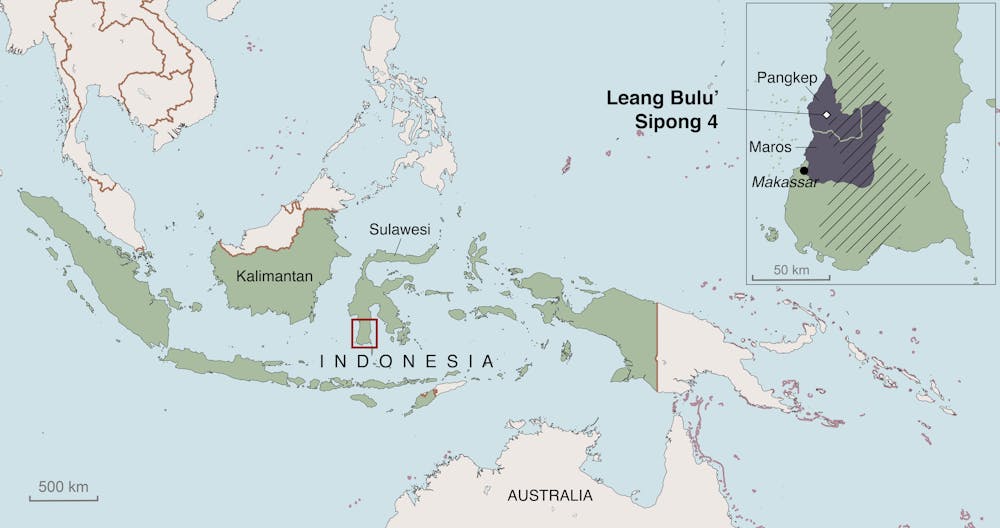
The new cave art site is named Leang Bulu’ Sipong 4 and our Indonesian colleagues discovered it in December 2017. It is one of hundreds of cave art sites in the Maros-Pangkep limestone karst region of South Sulawesi.
Map of Sulawesi showing the location of the cave art site Leang Bulu’ Sipong 4.Kim Newman
In 2014, we announced that a cave (Leang Timpuseng) in Maros-Pangkep harbours one of the world’s oldest rock art motifs, a hand stencil created at least 40,000 years ago.
First discovery of 40,000-year-old cave art in Sulawesi.
We also recently reported on a figurative painting of a banteng (a species of wild cattle) dating to at least 40,000 years ago from a Kalimantan cave on the adjacent island of Borneo.
Palaeolithic cave art discovery in Kalimantan, Borneo.
Until now, this painting was the earliest known figurative motif on the planet.
A team effort to date the art
Rock art is very challenging to date.
Fortunately, we were able to collect small mineral growths that had formed over the paintings at Leang Bulu’ Sipong 4. We dated this “cave popcorn” using uranium-series analysis, which calculates ages by measuring the radioactive decay of elements.
We conducted our study in collaboration with researchers from several Indonesian institutions, including Indonesia’s National Research Centre for Archaeology (ARKENAS) and scientists from the culture heritage preservation department (BPCB) in Makassar.
The dating of four “popcorns” returned ages between 35,100 and 43,900 years.
So the art in this Indonesian cave was created at least 44,000 or so years ago!
Why is this art important?
Our results show the painting at Leang Bulu’ Sipong 4 is the oldest figurative art in the world.
Aside from the extraordinary antiquity of this painting, this is the first time a detailed visual narrative or “story” has been identified in cave art at such an early period.
The standard view in Europe is that humanity’s first rock art consisted of simple geometric symbols, which evolved into the sublime figurative paintings of animals from France and Spain from around 35,000 years ago. In this view, the first scenes and human-animal hybrids (known as therianthropes) came along much later.
But the art at Leang Bulu’ Sipong 4 suggests the major components of an advanced artistic culture were already present in Sulawesi 44,000 years ago: figurative art, scenes, and therianthropes.
It’s possible “complex” art like this was already being made somewhere in Asia (or Africa) even longer ago.
The dawn of human spirituality
The early portrayal of therianthropes at Leang Bulu’ Sipong 4 is fascinating.
Hunting scene at Leang Bulu’ Sipong 4. A group of small part-human, part-animal figures is apparently capturing an anoa (a buffalo-like creature native to Sulawesi) with what seem to be ropes or spears.Ratno Sardi
In Western culture we are most familiar with part-human, part-animal images like werewolves. But therianthropes often have great religious significance.
A therianthropic figure in the hunting scene at Leang Bulu’ Sipong 4. This motif appears to represent a human figure with bird-like head and beak.Ratno Sardi
For example, ancient Egyptians revered and feared many deities and demons whose physical forms combined animals and humans, such as the jackal-headed god of death, Anubis, and the sphinx, which had a lion’s body and a human head.
When did we first develop the capacity to dream up such extraordinary creatures?
Up until now the earliest known image of a therianthrope in world archaeology was the “Lion-man” from Germany, a figurine of a human with a feline head carved from a mammoth’s tusk. Nazi archaeologists unearthed this artefact in 1939 and it is said to be 40,000 years old.
At 44,000 years or more, the figures from Leang Bulu’ Sipong 4 predate “Lion-man”. They may represent the earliest indication of our ability to imagine the existence of non-real entities like therianthropes.
This ancient world is disappearing
This Sulawesi cave art is a gift from the dawn of human culture. But it is crumbling away before our eyes.
Our rock art surveys with our Indonesian colleagues have uncovered many new cave sites in Maros-Pangkep with spectacular figurative paintings that still await dating. We have also observed the alarming deterioration of this art at almost every location.
Monitoring by BPCB confirms the limestone cave wall surfaces on which the paintings were made are peeling off, erasing the art. This process is happening quickly: at some sites, patches of art 2–3 cm wide vanish every couple of months.
It would be a tragedy if these exceptionally old artworks should disappear in our lifetime. We need hard scientific data that can tell us why this globally significant rock art is deteriorating and what we can do about it – and we need it now.
Why are women with diabetes and their babies at greater risk?
Women with diabetes have an increased risk of pregnancy complications, particularly if they’re among the more than 60% whose pregnancies are unplanned.
Harm can be to the mother, such as preeclampsia, where her blood pressure increases, her body swells and her liver and kidneys may be damaged. If left untreated, preeclampsia can lead to seizures and loss of mother and baby.
Pregnancy can also affect the mother’s diabetes directly, from changes in how her body uses insulin.
Early in pregnancy, women may become more sensitive to insulin and be more likely to have extremely low blood sugar levels (becomehypoglycaemic), severe enough to lose consciousness.
Later in pregnancy, hormones released from the placenta make the body more resistant to insulin, which can make controlling her blood glucose much more difficult.
Babies are at a greater risk of malformations due to sub-optimal levels of glucose they may be exposed to in the womb.from www.shutterstock.com
If higher blood glucose levels continue or the mother has extreme blood glucose levels, this may lead to miscarriage, stillbirth or the baby dying shortly after birth.
So it’s no wonder the childbearing years can be daunting.
1. Think about contraception early, even if you want a baby
Are you planning to become pregnant? If “yes”, then contraception is important to make sure you’re ready for pregnancy, and when it happens, there’s the greatest chance of a healthy baby (see point 2). If “no” and you are sexually active, or soon will be, then you also need effective contraception.
So, start discussing contraception early in your childbearing years, ideally before you become sexually active. You can do this either through your diabetes team or your regular health-care provider.
Long-acting reversible contraception, like this intrauterine device, is recommended for women with diabetes.from www.shutterstock.com
Long-acting reversible contraception (for instance, intrauterine devices or implants) are strongly recommended as these have the lowest failure risk and minimal, if any, impact on your diabetes.
Some oral contraceptives are less effective than long-acting reversible contraception and can lead you to gain weight (which can impact how well your diabetes is managed). Weight gain may also increase your risk factors for heart disease, and increases the risk of pregnancy complications, such as having a large baby.
2. If you want a baby, find a pre-pregnancy diabetes management service
A pre-pregnancy diabetes management service is a one-stop-shop that looks after your pre-pregnancy care including contraception (see point 1) to make sure the time for conception is right for you.
Using one of these services has been shown to reduce the risk of your baby being malformed by 75% or dying before or at birth by 66% compared to those that do not receive such pre-pregnancy care.
So ask your health-care provider if there is a service like this in your area, and if there is, ask for a referral well before trying to conceive.
At a pre-pregnancy diabetes service, you will get advice and support on all aspects of diabetes from a multidisciplinary team including: a diabetes specialist, a diabetes educator and dietitian, linked with obstetric or gynaecology services.
This includes the impact pregnancy can have on diabetes complications; the impact of diabetes on your baby and pregnancy outcomes; miscarriage and IVF; folic acid supplementation (see point 5); and medication safety (see point 6).
But these services are not available in all areas. Before our diabetes contraception and pre-pregnancy service opened in 2018, few clinics in NSW specialised in diabetes pre-pregnancy care.
3. Choose the right health-care provider for your pregnancy
Once you know you’re pregnant, ask your GP to refer you to a diabetes specialist team of health-care professionals experienced in managing diabetes in pregnancy. This team will work with an obstetric team.
Such a multi-disciplinary approach means endocrinologists, obstetricians trained in high-risk pregnancy care, dietitians and diabetes educators, among others, will be looking after you.
Early referral is essential, preferably before eight weeks gestation. This is to allow your insulin to be carefully managed to avoid uncontrolled changes in glucose that, as mentioned earlier, can affect you and your baby.
Every woman should have access to diabetes specialist services through a hospital, but in rural and remote areas this may be some distance away.
Although there may be some telehealth options, it is important that ongoing management and particularly the birth are planned with that diabetes specialist team as soon as possible. Your GP will need to refer you.
4. Keep healthy glucose levels before and during pregnancy
Whichever health professional or team of health professionals looks after you, maintaining your blood glucose levels within range as much as possible before and during pregnancy is vital.
It helps women with diabetes fall pregnant safely, reducing the chance of miscarriage. If you are using IVF, fewer miscarriages will mean fewer rounds of IVF.
Healthy glucose levels also provide a growing baby an environment where it will flourish, reducing the chances of pregnancy complications.
one hour after eating level, less than 8.0 mmol/L, and
two hours after eating, less than 7 mmol/L.
Naturally, these may need to be higher if hypoglycaemia is a problem.
If you have type 1 diabetes and are planning pregnancy, are pregnant or have very recently had a baby, you now have access to a free glucose sensor, a wearable device that monitors your glucose continuously. With this device, you should aim to be within 3.5-7.8mmol/L more than 70% of the day.
At present there is not enough evidence to support using a continuous glucose monitoring during pregnancy if you have type 2 diabetes. But glucose monitoring remains very important before breakfast and after meals.
Pregnant women with diabetes are recommended to take a high dose of folate (5 milligrams daily, as opposed to 0.4-0.5 milligrams in women without diabetes.
That’s because the risk of having a baby with a neural tube defect is raised in women with diabetes.
So if your health-care professional doesn’t raise this, mention it yourself and buy a folate supplement from your local pharmacy.
6. Ask about your medications
It’s important to talk to your health-care provider as soon as you know you are pregnant so they can advise whether it is safe to continue taking your existing diabetes medication.
Metformin does not cause malformations but does cross the placenta. It’s used where the benefits from improved glucose control outweigh any possible theoretical long-term risks to the baby.
Other oral medications to lower blood glucose are generally not approved for use during pregnancy.
This is the first of two essays exploring key theories – cognitive load theory and constructivism – underlying teaching methods used today.
Explicit guidance and feedback from teachers is more effective in teaching students new content and skills than letting them discover these for themselves.
This is a premise of cognitive load theory, which is based on our knowledge of evolutionary psychology and human cognition, including short- and long-term memory.
The theory holds that most children will acquire “natural” skills – such as learning to listen to and speak a native language – without schools or instruction. We have specifically evolved to acquire such knowledge automatically. It is called “biologically primary knowledge”.
But there is another category of knowledge – “biologically secondary knowledge”, which we have not evolved to acquire. It consists of virtually every topic taught in schools from reading and writing to science and maths.
Cognitive load theory is concerned with the acquisition of secondary knowledge.
The theory now underpins the method of explicit instruction – where a teacher will explicitly provide students with information or demonstrate a way of doing things – a common means of teaching in schools. Cognitive load theory explains why this method works.
But if other people aren’t available, secondary knowledge can be discovered during problem solving – such as engaging in research. Such discovery, or inquiry, works but is slow and inefficient. It should only be used when we cannot obtain needed information from others.
Whatever way it’s acquired, new secondary information must first be processed by our working (or short-term) memory. We use working memory when we are paying attention to something. But this memory resource is severely limited in capacity and duration.
When faced with new, secondary information, working memory can process no more than about two to three items of information at any given time and for only about 20 seconds.
Once the new information has been processed by working memory, it can be transferred to a long-term memory that has no known capacity or duration limits.
We can only process two or three bits of new biologically secondary information in our short-term memory at any one time.from shutterstock.com
Think of what you are doing now. You are faced with an immensely complex set of squiggles on a screen. The reason they don’t appear complex to you is because of the enormous amount of information you hold in long-term memory.
Information which has been processed in working memory and stored in long-term memory can be transferred back to working memory to generate action and thought appropriate to a given context. That is what we do when we read.
Cognitive load theory uses this cognitive system to generate teaching methods.
The ‘worked example’ effect
Probably the best-known teaching method is based on the “worked example effect”. This occurs when students who are shown how to solve a particular problem or write a specific essay learn better by studying an example first, instead of generating a solution themselves.
A colleague and I showed this in 1985. One group of students were shown a series of problems and their worked example solutions. Another group wasn’t given example solutions.
The first group performed significantly better on a subsequent test of similar problems to the example. Subsequent work demonstrated the same effect on transfer problems that differed from the example, than the group who had to come up with the the solutions themselves.
Studying a worked example reduces the working memory load compared with generating a solution yourself. When solving a problem, you will inevitably consider a large number of possible moves, many of which do not assist in reaching the solution.
But when the solution is provided by a worked example, you are shown exactly which moves are relevant and you don’t have to consider a large number of alternative moves that lead to dead ends.
The problem solutions can be stored in long-term memory.
Once lots of problems and solutions are stored in long-term memory, we are in a better position to work out a solution to a new problem that can be related to previously learned solutions.
Basically, to think deeply, we need lots of knowledge stored in long-term memory.
Other examples
To reduce unnecessary cognitive load, teaching must be properly structured. Learning is impeded, for instance, if students need to unnecessarily split their attention between several sources of information such as a diagram and text. But learning is facilitated by physically integrating the diagram and text.
Think of a geometry diagram with statements underneath it saying things like “Angle ABC = Angle DBE (vertically opposite angles are equal)”.
Experiments have demonstrated that the very simple act of placing the statement on the diagram itself (putting “Angle ABC” next to where angle ABC actually is) reduces the cognitive load.
But if the text is redundant to the diagram, it should be eliminated altogether. For example, if you are teaching how the blood flows through the heart, lungs and body you might provide a diagram with arrows indicating the direction of flow.
A statement such as “blood flows from the left ventricle to the aorta” is redundant because it should be clear from the diagram. Studies have shown giving students the diagram alone reduces the cognitive load compared to students who are given a diagram with redundant text.
These effects can only be shown if the information studied is complicated. If a student is learning the symbols of the chemical periodic table (Fe stands for “iron”), it does not matter how the information is presented because the cognitive load is low.
heart.
What are the alternatives?
Alternatives to cognitive load theory, such as teaching critical thinking, often place a heavy emphasis on learning new problem solving or thinking strategies. Unfortunately, there are few randomised, controlled trials demonstrating their effectiveness.
Cognitive load theory assumes that, for example, critical thinking is biologically primary and so unteachable. We all are able to think critically if we have sufficient knowledge stored in long-term memory in the area of interest.
A car mechanic can think critically about repairing a car. I, and I dare say most of you reading cannot. Teaching us critical thinking strategies instead of car mechanics is likely to be useless.
A private member’s bill, moved by Labor MP Josh Burns, recently called on the Australian government “to help build more affordable homes” in response to the growing homelessness crisis. A premise of the bill is that a lack of social housing is a major cause of homelessness and increasing the supply is a key element of solving the problem. The government’s response was that one solution is to encourage social housing tenants to find paid work, so they can move into private rental housing.
The problem with this argument is it overlooks the major barriers to entering the private rental market for low-income households. It also does not excuse the failure to invest adequately in building more social housing.
There is certainly a shortage of social housing. About 140,600 applicants were on the waiting list for public housing and 8,800 households were wait-listed for state-owned-and-managed Indigenous housing as at June 30 2018. Another 38,300 applicants were waiting for mainstream community housing as at June 30 2017 (the most recent publicly available data). Together, these tenure types comprise most of Australia’s social housing.
Tenure in social housing was once effectively unlimited provided tenants paid their rent and maintained their property. But waiting list pressures have led to a new approach. In his response to the private member’s bill, the assistant minister for community housing, homelessness and community services, Luke Howarth, argued:
There needs to be more responsibility […] from state governments to help people who are able to get back into the workplace to then move on from social housing so that it will provide a flow-through effect for people currently on the waiting list.
Howarth’s argument is consistent with much state and territory policy. For example, the NSW Future Directions policy explicitly commits to “upskilling” tenants to enable them to live in private rental housing.
Tacitly overlooked in such “pathways” policies are the barriers to entering private rental. Across Australia less than 26% of private rental properties are affordable for households on a minimum wage. Less than 4% are affordable and appropriate for households on income support.
Prejudice and discrimination against tenants perceived to pose a greater risk to landlords’ investments make access even more difficult.
Low-income households in the private rental market also face insecure tenure. “No-grounds terminations” are permitted in all states and territories except Tasmania and, from July 1 2020, Victoria (except at the end of the first fixed term).
Under “no grounds” termination, landlords can evict tenants for no stated reason at the end of a fixed-term lease and at any time on a periodic lease. Fear of retaliatory eviction makes it less likely tenants will assert their legal rights.
Even if private rental access and affordability were certain, many social housing tenants are not in a position to undertake employment. In 2017–18, about 398,900 households were in social housing in Australia. Many of them relied on the disability support pension (21%) or the age pension (19%) as their main source of income.
Long-standing targeting of social housing to greatest need means tenants are disproportionately likely to have low educational qualifications and limited marketable skills. They face considerable employment challenges, not the least of which is stigmatisation.
It is also worth considering what “employment” realistically looks like for social housing tenants seeking to enter or re-enter the workforce. It’s likely to be as casualised labour in the gig economy.
As social policy researchers Greg Marston and Catherine McDonald have argued, we cannot assume exiting welfare for the labour market leads automatically to social and economic security. Precarious, intermittent, low-wage employment does not offer a sound basis for sustaining a private tenancy.
Of course, social housing tenants should be supported to find work and to move out of social housing if they want to. But the evidence would suggest tenant choice is not the motivation here. Rather than creating “pathways” as a way of managing social housing waiting lists, governments would have greater impact on the housing crisis if they invested much more in social housing.
In addition to providing more social and affordable housing, governments must act on the systemic problems in the private rental market. This includes developing nationally consistent tenancy legislation to provide more protection for tenants, including against no-grounds evictions, and providing the resources to properly enforce such laws.
The board of Australia’s second-biggest bank is in for some stick at its annual general meeting today, as Westpac shareholders vent their displeasure at the scandal involving breaches of anti-money-laundering rules.
But though it will be uncomfortable, with enough shareholders likely to vote against the remuneration report to trigger a vote to spill the entire board, a full-blown revolution is not on the cards.
With the number of shares held determining how many votes each shareholder gets, major investor support is enough to suppress most shareholder uprisings.
This, and a fundamental problem facing all collectives, currently limits the potential of shareholders to hold corporations to account, both through choosing to hold shares or not, as well as through voting power.
Ethical divestment
Decisions by shareholders to avoid profiting from business considered unethical arguably goes back centuries, with religious communities consciously avoiding investments in slavery, arms, alcohol, tobacco and gambling – so-called sin stocks.
Since the the 1980s secular funds have extended this idea to the more expansive agenda of social and environmental sustainability. One thread of this ethical investment trend has led to the divestment movement.
Fossil fuel divestment advocates outside the Australian Stock Exchange on the day of Whitehaven Coal’s annual general meeting in November 2013.Greenpeace/AAP
The movement’s rationale is that divestment increases the cost of capital. It’s effectiveness, however, is a matter of debate. Bill Gates is among the critics, calling divestment “a false solution”. One argument is that it simply means companies end up being owned by shareholders only interested in profits. It has also been argued fossil fuel divestment might even cause emissions to rise.
Shareholder activism
Shareholder activism takes a different approach to divestment. It’s about immersion rather than aversion. It involves shareholders directly engaging with directors and executives of companies to effect change from within.
Unlike ethical investment, the roots of shareholder activism are not altruistic. Historically to be called an activist shareholder was no compliment. It probably meant you were a hedge fund focused solely on reaping bigger profits. This was typically done by pressuring boards and management to sell off under-performing assets and disburse the cash to shareholders.
To date, little activism has been motivated by altruistic purposes. That’s partly to do with a fundamental problem that limits the ability of activism to influence corporate behaviour for non-financial reasons.
Economists call it the free-rider problem. In essence it’s the problem of individuals having little incentive to contribute to a collective resource when they can enjoy its benefits even if they don’t.
How this applies to shareholders was first outlined by Harvard academics Adolf Berle and Gardiner Means in their seminal 1932 book The Modern Corporation and Private Property.
Ownership of public corporations is generally diffused between a significant number of shareholders. Individual shareholders have little incentive to monitor senior management, because of the cost they bear while others reap benefits.
Ironically, corporate boards are meant to mitigate this free-rider problem. Their job is monitor management on behalf of shareholders. But Westpac’s anti-money-laundering scandal adds to the evidence the system might be broken. The allegations suggest a board incapable or unwilling to effectively monitor senior management in complex and sprawling conglomerates.
Shareholder engagement and activism should play an increasingly important role in shaping corporate behaviour, improving the quality of board monitoring and addressing the free-rider problem.
Big institutional shareholders in particular could be more active in ensuring boards have skilled, competent directors. They could also foster a culture of openness by supporting directors to challenge senior management without fear of putting their tenure at risk.
In the 12 years since New Zealand introduced the retirement fund KiwiSaver, nearly three million New Zealanders have enrolled and 30 KiwiSaver providers are now collectively managing NZ$57 billion in investments.
In the year to Sept 2019, fund providers earned NZ$479.8 million in fees, with each member charged an average of NZ$132 per year.
Our research explores the gap between initial expectations and reality, and shows that New Zealanders miss out on tens, and in some cases hundreds, of thousands in retirement savings.
The New Zealand government introduced KiwiSaver in 2007 to address a lack of retirement savings. The savings scheme takes employee and employer contributions and gives them to a private fund manager to invest. Members can either choose a fund manager or are assigned one at random. The government also makes a contribution, which we included in our calculations, but note that not everyone is receiving what they are entitled to.
Managing a fund costs money, and with nearly NZ$57 billion invested, New Zealanders have paid NZ$479.8 million in fees to fund managers. Fees are often quoted to members in a way that makes them appear deceptively small.
For instance, the average KiwiSaver growth fund will cost 1.25% per year. The equivalent UK fund would likely cost around 0.92%. To many New Zealanders, this difference may sound inconsequential, which has motivated a recent move to quote fees as dollar amounts on annual statements.
Fees are a double-edged sword. They erode retirement savings by reducing monthly contributions and the future compounding of those savings. The result is tens of thousands less in retirement.
For example, a 25-year-old member in the average growth fund with an income of NZ$50k is likely to pay NZ$50k in fees over the life of their KiwiSaver. They will retire with about NZ$255k in savings. In contrast, the cheapest growth fund would charge just under NZ$15k in fees over the same period, and would result in over NZ$300k in savings at retirement.
Economies of scale
While policymakers debate whether New Zealanders pay too much, our research looks at economies of scale. When the government established KiwiSaver, policymakers thought the high fees KiwiSaver providers were charging would reduce as more people invested.
They expected that as funds increased in size, the costs of running them would be spread over larger pools of funds and it would become cheaper to manage the investments. These cost savings would then be passed on to members.
We collected data on the total fees charged by KiwiSaver providers along with the assets under management and the number of members a fund has. Our project included 24 fund providers and over 267 individual funds (across five risk groups) between 2013 and 2018.
If there are economies of scale present, then as a fund gets larger, either by increasing the amount of money or by increasing the number of members, the fees should increase by a less than proportional amount. Put differently, a 1% increase in size should result in a less than 1% increase in fees.
But this is not the case. When we consider the amount of money invested, a 1% increase in the assets under management results in about a 1% increase in fees. In other words, as the total sum invested in KiwiSaver increases, we can expect total fees to increase at the same rate. This means KiwiSaver providers are either not seeing any cost savings at all as they get bigger or are refusing to pass these savings onto investors.
When we consider the number of members in a fund as the measure of size we see some evidence of economies of scale. A 1% increase in members results in a 0.93% increase in fees, a small reduction in the fees.
Unfortunately, large increases in KiwiSaver members are unlikely. KiwiSaver already has over 80% of eligible New Zealanders enrolled. In 2019, the number of members grew by 3% across all funds. Future economies of scale won’t be large.
The expected cost savings have not materialised and seem unlikely to. The total amount of KiwiSaver fees providers collect looks set to continue to increase at a steady rate. For members, the consequence will be expensive funds (compared with their peers in other countries) and far less in retirement savings come age 65.
Nick Broomfield’s latest documentary, Marianne & Leonard: Words of Love tells the story of the fabled relationship between Leonard Cohen and Marianne Ihlen, which unfolded after they met on the Greek island of Hydra in 1960.
It was there that they lived and loved for the best part of a decade, and where Cohen wrote the poetry, novels and eventually songs, that made his reputation.
Their romance was captured in the 1967 song So Long, Marianne from Cohen’s debut album, and entrenched in a 1969 record sleeve image of Ihlen wrapped in a towel while seated before Cohen’s typewriter. Here, we were presented with the Norwegian muse behind the songs.
Cohen and Ihlen were all but separated by the end of the 1960s. But as if bringing their storied romance full circle, they both passed away within three months of each other in 2016, although not before Cohen sent an urgent letter to the dying Ihlen.
That note — heard in the film being read to Ihlen on her death bed — provides the emotional climax to Marianne & Leonard, seeming to bridge the decades its author and recipient had been apart. It asks viewers to believe they had remained in love; anticipating their reunion in the afterlife.
Broomfield has a particular interest in the lives of music celebrities. He has previously trained his cinematic eye on Kurt Cobain and Courtney Love, Whitney Huston, and Biggie and Tupac. Yet, his interest in Cohen and Ihlen is more than professional. As he recounts in voice-over, he was briefly Ihlen’s lover when he found himself on Hydra in the late 60s, while Cohen was shuttling between the island, Montreal, New York and Nashville.
Cohen could no more contain his ambitions to Hydra than he could contain his affections to Ihlen, and he eventually left both behind. As with Cohen, Broomfield’s island romance was seemingly formative, and he kept in contact with Ihlen as she negotiated her painful break-up with the musician. Broomfield thereby became an observer of the damage done to those who find themselves caught in the slipstream of fame, a role he retains in the film.
Two incompatible genres
Marianne & Leonard is an intriguing meeting of two seemingly incompatible genres — the documentary, with its claims to reality; and the romance, which allows for the improbable.
A portrait of Marianne Ihlen.Copyright Nick Broomfield
A nod to realism early in the film, with an attribution of “the early sixties” attached to archival film footage, proves incorrect. (The age of Ihlen’s child, born in 1960, dates the footage to at least 1967). But on one level, such oversights hardly matter. The film is not so much interested in locating the specific origins of Ihlen and Cohen’s relationship, as it is in emphasising the timelessness of their romance.
Yet, Marianne & Leonard struggles to fill its 97 minutes of screen time. There is only a sparse amount of footage of either Cohen or Ihlen on Hydra, and only a fragment of them together in the same frame. Only by careful cinematic editing can Cohen and Ihlen be presented as a couple in this film.
The pair together.Copyright Aviva Layton
Broomfield then faces the narrative challenge of maintaining interest in the now-distant relationship across nearly five decades in order to reach Ihlen’s demise and the reconciling letter. The film addresses this task by detouring through Cohen’s well-documented career, supported by ex-band mates speaking to camera.
By contrast, Ihlen’s subsequent marriage and domestic life are quickly summed up and dispensed with. There is little of substance said about her other than how she occasionally positioned herself to support other creative types such as singer Julie Felix, and Broomfield himself.
So whereas Cohen is afforded limitless agency as his fame advances, Ihlen remains fixed in the role of the beautiful ingénue, the muse, the part-time lover.
A visual refrain running through the film is of the blazingly blonde Ihlen pictured in slow-motion, wistfully looking out across the Aegean from aboard a yacht.
While this time-bound imagining sets a sympathetic tone towards Ihlen, Marianne & Leonard is more admiring in its representation of Cohen as a man active in the world, singing and seducing his way across the globe while struggling with the inner demons that drive his spiritual longing and lust in equal measure.
Harder truths
Broomfield does not shy away from the hurt Ihlen and her son suffered while Cohen pursued his art and his “appetite” (a coy term the musician uses for his unappeasable sexual desire). But, neither does it confront the harder truths of the license taken by, and conceded to, creative men.
Leonard Cohen writing.Copyright Axel Jensen Jr
When applied to great artists, myth and romance are frequently more appealing than reality.
Accordingly Marianne & Leonard recounts a romantic ideal that audiences might wish for, and which its subjects themselves burnished over the years. And viewers familiar with the storyline will likely leave the cinema with their biases confirmed.
For those who think of Cohen as the finest singer-songwriter of his generation, there is plenty of material to support that claim and attest to the resulting adulation. For those who approvingly — or otherwise – regard Cohen as a “ladies’ man” (to half conjure the title of his ill-fated record with producer, Phil Spector), that judgement is also borne out.
For others who admire Cohen as a poetic searcher, his years in a Buddhist monastery are also accounted for, even if this section of the film has little to do with the love story at its heart.
And for those inclined to see Cohen and Ihlen as being blessed by eternal love, then the film will play straight to their romantic expectations.
Viewers will not, however, learn much about Ihlen herself, beyond her entrenched representation as Cohen’s Hydra lover and “muse”.
The NSW Law Reform Commission will hand down its final recommendations for a reformed definition of sexual consent in the new year, following draft proposals in October.
The commission’s inquiry is largely the result of the advocacy of Saxon Mullins, who was let down by the legal system when the man accused of raping her, Luke Lazarus, was acquitted in a judge-only trial. A jury had earlier convicted him.
The point of legal contention was whether Lazarus believed on “reasonable grounds” Mullins was consenting. The jury in the first trial ruled Lazarus had no grounds for believing Mullins consented, therefore finding him guilty.
But following an appeal, judge Robyn Tupman ruled Lazarus did reasonably believe he had consent, referring, among other details, to Mullins’ supposed failure to do anything “physical to prevent the sexual intercourse from continuing”.
Much of the debate since the beginning of the review has focused on whether the law in NSW should adopt an “affirmative” approach to sexual consent. With a legal model of affirmative consent, Mullins’ case might have had a different outcome.
Affirmative consent is broadly supported in the community, and adopting it would bring the law in NSW more in line with the current approaches in jurisdictions like Victoria and Tasmania.
But, how this works as law in a rape trial is less clear. The NSW commission should take note that the wording of Victoria’s legislation in particular offers limited protection in court.
What is affirmative consent?
The model of affirmative consent is based on the idea all people have the right to have sex or not have sex. A person who wants to have sex with another person must actively confirm, by “taking steps”, that the other person also wants to have sex.
They could ascertain this via verbal agreement or active participation, as opposed to passive submission. The question of whether an alleged perpetrator had reasonable grounds to believe the complainant was consenting could be answered more clearly if these steps were an expectation of every sexual encounter.
Affirmative consent means taking active steps to confirm the other person wants to have sex.From shutterstock.com
In conducting its review into consent law in NSW, the commission looked to the way consent law operates in other states.
It gave the highest praise to approaches in Victoria and Tasmania, despite a lack of empirical evidence to show how these laws are working in practice.
Victoria
Myself and colleagues looked at 15 rape trials from the County Court of Victoria between 2008 and 2015 to explore how affirmative consent translates into legal practice.
Our findings raise concerns about whether the law in Victoria is able to change the way “rape myths” – falsities which blame women for being raped and excuse men’s predatory behaviour – play out in trials.
Despite using language that reflects an affirmative approach to consent, the way Victoria’s law has been written fails to implement the standard in practice.
The Victorian Crimes Act defines consent as “free agreement”. A person who does not “reasonably believe” the other person consents should be found guilty of rape.
It’s not, however, until the act defines what a reasonable belief means that there is specific reference to the “steps taken” by the initiator of sex, for example, asking the other person if they want to have sex. The act says:
whether or not a person reasonably believes that another person is consenting to an act depends on the circumstances
without limiting subsection (1), the circumstances include any steps that the person has taken to find out whether the other person consents…
The cumulative impact of these two sections of the law is that a person seeking sex does not need to take any steps to make sure the other person actually wants to have sex.
Further, there is no test of reasonableness of the steps themselves. So, if a person took unreasonable steps – for example, claiming they thought about consent, but did not do or say anything to make sure the other person was consenting – this could constitute a “step” in the eyes of the law. This effectively renders the premise of affirmative consent redundant.
Tasmania
In Tasmania, a belief in consent is not honest nor reasonable if the accused “did not take reasonable steps in the circumstances” to ensure the other person was consenting.
This approach avoids the two biggest pitfalls of the Victorian law, because first, steps are mandatory, and second, those steps must be reasonable steps. Under Tasmanian law the “steps” need to be more proactive to be considered reasonable. In a Tasmanian court, a person will have to identify actions they took to make sure they had consent.
The Tasmanian approach embeds affirmative consent into law, a feat not achieved in Victoria. So in delivering its final recommendations, the NSW commission would be best placed to take cues from Tasmania.
Affirmative consent is a good thing. But the way the legislation is worded is important.From shutterstock.com
A promising proposal
In its draft proposals, the commission suggested these laws sit under a set of “interpretive principles” to make them easier for jurors to apply.
These principles reflect the core values of the affirmative approach to sexual consent. They state: “sexual activity should involve ongoing and mutual communication, decision-making and free and voluntary agreement between the persons participating in the sexual activity.”
The inclusion of these principles will be important in making affirmative consent law in NSW.
Further, the commission has provided some clarity around the vague idea of “taking steps”, a key concern raised in earlier submissions. The draft proposals suggest defining steps as “whether the accused person said or did anything to ascertain if the other person consented”.
This language means that, unlike the ruling of the NSW Court of Appeal in Mullins’ case, a “step” will constitute more than just the accused “thinking” about consent. Instead, the commission frames a “step” as a physical act, achieved through actions and words.
Yet, the draft proposals have not responded to the ongoing concerns with Victorian law. They don’t lend support to mandating that the accused demonstrate to the court that they took steps to ensure they had consent. It’s important this be addressed in the final recommendations, or NSW will not be moving towards a model of affirmative consent.
Review: Finke: There & Back, directed by Dylan River
The Finke Desert Race takes place in the harsh desert environment near Alice Springs. Scores of motorbikes and cars are raced over two days along an off-road track that stretches approximately 229 kilometres each way.
The race was first envisioned as a motorbike race to test the skills of a small group of local enthusiasts in 1976. Cars were introduced 1988, and the race has developed into a heavily sponsored and lucrative international spectacle. Narrated by actor Eric Bana, Finke: There & Back follows the high-speed journey of those in a quest to be named King of the Desert.
As we watch the highs and lows of the competitors featured in this film – directed by 25-year-old Finke racer Dylan River – we learn about competition, risks and rewards.
Eric Bana narrates the action, which was shot by 16 cinematographers.
Thrill of the chase
For the racers and supporters, “Finke fever” – the energy that surrounds the event including all the accompanying celebrations – comes in hot every year on the Queen’s birthday long weekend, when it takes place.
Winning is determined by completion time, so speed (over 160 kilometres per hour) is the focus. Many of the race vehicles are specifically designed for the event and cost around $500,000 to produce.
The Finke race is dangerous. As such, it seems similar to extreme sports such as Proximity Flying and Big Wave surfing. But extreme sports are mostly undertaken in unconstrained environments, are non-competitive, and free from competition rules and external regulations.
Participation in extreme sports is also not determined by preset time limits. Effective participation is about surviving to participate another day.
More akin to endurance competitions, the modern Finke Desert Race is tightly planned with organisers working in crack teams to prepare and set out the track, manage risk, keep track of competitors and plan for disasters such as injury or death. In a sense, the goal of winning on competition day – rather than surviving – might make Finke more dangerous.
The desert environment adds uncertainty and excitement. Accordingly, the film’s imagery takes in the grand aerial scale reminiscent of Warren Miller’s jaw dropping snow sport and skating blockbusters, but also gets up-close and dusty as we get to know the personalities taking part. It was nominated for Best Cinematography in a Documentary in the recent AACTA film awards.
First-time director Dylan River, 25, has completed the Finke track three times.Madman Films
Need for speed
The film introduces us to a group of athletes and briefly explores their motivations and experiences.
“Once in your veins,” narrator Bana tells us, “the race is an incomprehensible addiction.”
Initially, the classic reasons for such endeavours – a “search for adrenaline” and adventure, a lifelong love of speed – are given. But we soon realise there is more to the impulses that drive these racers. One competitor calls it “escapism in its purest form”.
Isaac Elliot, now in a wheelchair having suffered a traumatic accident ten years earlier, is keen to describe the event as an “adrenaline rush”, but he has a bigger point to prove. His personal quest to finish what he started.
Isaac Elliott wants to finish what he started a decade ago.Madman Films
Not all competitors consider winning the main reason to race. Though a five-time winner, Randall Gregory calls the Finke challenge “just a race”. It affords him personal growth and opportunities to test his physical and mental capacities.
Even though the Finke race is more akin to a sporting competition, these experiences are reflected in what we know about extreme sports athletes. Participation facilitates a deeper understanding of personal limits, values and beliefs about what is possible.
Extreme sports participants recognise the need to assess the challenges ahead and also accept the seriousness of the activity they are about to undertake. This can lead to a decision to walk away if the assessment is unfavourable. Bound by time, the Finke race does not allow those risk assessments to take place.
The film tells us that just over 70 motorbike riders out of a field of over 500 bikes fail to finish. The impact on the riders’ body is reported by the racers themselves. “I’ve fractured six vertebrae, fractured my sternum and my collar bone,” says one, adding that with a new family he’ll “touch wood” in the hope of avoiding further injury. We also see competitors dig deep for the mental strength required to stay in the race.
In a sad post-script, rider Daymon Stokie, who is featured in the film, died in another race six months after production.
Finke competitor Daymon Stokie died after filming.
The film is an incredible insight into what it takes to prepare and compete as well as the implications of the competition for personal development and the riders’ families.
Finke: There & Back is a must-see for those interested in motorbikes and especially those interested in off-road motorbiking. Viewers who’ve never been exposed to this world will likely be struck by the intensity of the race and the interaction between the riders’ skill, daring and the harshness of the environment.
Special event screenings across Australia from December 5
I moved to Sydney less than five weeks ago and the city has been shrouded in smoke haze on and off since then. I joke this is my “Sydney hazing” but it’s only now – having worked on climate change for over a decade – that I’m suddenly feeling burnt out. This is not in any way to compare my experience to those who have lost their homes, communities and loved ones to the bushfires.
But the smoke cuts through Australia’s clouds of climate denial that pretend we are neither vulnerable nor responsible.
We often refer to the “atmosphere” and “climate” of a particular space or community. We can be “on cloud nine”, “under the weather”, or “snowed under”. We know the weather affects people’s moods. My research, and that from a range of disciplines, is increasingly finding that human emotional, social and embodied experiences are intimately related to the weather and climate.
Beachgoers on Milk Beach as smoke haze from bushfires in New South Wales blankets the CBD in Sydney on Saturday, December 7 2019.AAP Image/Steven Saphore
Psychological smokescreens
Research is mixed on how extreme weather changes people’s perspectives on climate change. After severe storms and floods hit the UK in 2013 and 2014, scientists found those directly affected were more worried about climate change and supported climate change policies beyond direct, flood-related mitigation.
Some research has suggested climate change can prompt “information aversion”, where we actively or subconsciously avoid distressing facts and construct a safer, more comforting narrative.
This tendency may be what drives such bracing platitudes as: “Australia is a sunburnt country”; “We’ve always had fires”; “Us Aussies are tough!”
A few face masks aside, the majority of us in Australia’s smoky cities have appeared to continue with business as usual: people just keep going to work. But I hope that, below this surface, the lingering taste of char at the back of our throats is sparking a change in the political atmosphere.
Igniting political change
No one should tell you how to feel about climate change, but I can tell you that you have a right to feel angry and sad. It is normal to feel overwhelmed – a word that once meant being literally inundated by water – in a world with rising seas and increasing floods.
Relatedly, droughts can leave us feeling drained. Awakening and sitting with these feelings is really important, but it’s also crucial not to dwell in despair.
But research also tells us hardly anyone talks about their climate concern. For example, a recent study from Yale University found only 18% of Americans hear people they know talking about climate change once a month or more. It makes sense: climate change is scary and has become highly politicised, meaning it is hard to know where to start, what to say, or who to talk to.
While this is a coping mechanism to try to protect ourselves emotionally, these norms work to deny the significance of climate change, prevent useful personal and social introspection and stall community action.
So how do we create a change in the political climate? Those of us for whom a smoky city is our only tangible experience, so far, of climate change, need to step up and demand our government not only meet minimum international obligations, but become the renewable energy and climate policy leaders we could be. We also need to talk about climate change more: with our friends, families, peers and communities.
Discussing the fires last week, one colleague mentioned she was fuming. This struck me as an empathetic echo of the smouldering state of our regional communities. My favourite sign from the school strikes has been “As oceans rise, so do we”. And now, I’d like to add, “As fires rage, so do we”.
A new species of extinct penguin has been discovered. It’s helping us bridge the gap between modern penguins and their counterparts from the Paleocene epoch – the 10-million-year period following dinosaur extinction.
The world’s oldest known penguins existed only a few million years after the mass-extinction event that wiped out the dinosaurs – except for birds, the only dinosaurs that didn’t go extinct.
Some of these earliest penguins had longer legs than their living relatives. And some species, including the colossal Kumimanu biceae, would have rivalled the size of you or I.
Published in the journal Palaeontologia Electronica, our research describes a unique, archaic penguin species that lived alongside these giant early species, between 62.5 and 60 million years ago.
Unlike its huge counterparts, Kupoupou stilwelli was only about the size of a modern king penguin. It also had leg bone proportions akin to living penguins.
Penguins today are well-adapted for a largely aquatic lifestyle.
They’re specialised for flying seamlessly through water – a medium 800 times denser than air. Modern penguins have dense bones to counteract buoyancy, and flat, wide, flipper-like wings with stiffened joints which powerfully propel them underwater.
The oldest penguins we know of had already begun to fly down this watery path.
Kupoupou was no exception. Although its flattened wing bones weren’t as wide or stiff as its modern relatives, CT scans of Kupoupou bones reveal they were dense, too.
An artistic interpretation of Kupoupou stilwelli, swimming in the seas around what would one day be known as Chatham Island.Jacob Blokland / Author provided
Importantly, Kupoupou is the first non-giant penguin species discovered to have relatively short legs, similar to penguins today.
Modern penguins use their short hind limbs for waddling on land. But in water, these short legs allow a hydrodynamic shape that maximises swimming efficiency and helps the bird steer.
It could be Kupoupou used its legs in a similar way, and was likely a good swimmer.
These short legs coincide with the Kupoupou’s stout and short tarsometatarsus (a foot bone unique to birds, made out of fused elements), which is distinctly different from the longer bones found in the feet of other similar-sized Paleocene species.
Other giant penguins alive at that time had shorter legs like Kupoupou, and their greater mass possibly allowed them to forage even deeper in the aquatic realm.
What makes Kupoupou unique is that it’s the oldest species known to resemble living penguins in both size and leg proportions.
The general evolutionary position of early penguins, including Kupoupou, compared to modern penguins and their closest living relatives, tubenosed birds (such as albatrosses and shearwaters). The right-hand images illustrate differences in wing and foot (tarsometatarsus) bone proportions between typical tubenoses, Kupoupou, and modern penguins. The bones are not to scale.Jacob Blokland / Author provided
How we made our discovery
In 2003, Monash University Associate Professor Jeffrey Stilwell discovered a variety of fossils on coastal platforms at Chatham Island, a landmass 800km east of New Zealand’s South Island.
An assortment of fossils were collected during expeditions over the next several years, ranging from isolated bones to partial skeletons encased within hard rock. Some of this material appeared to belong to long-extinct penguins.
Exposed and isolated bones could be studied directly. However, for bones of single individuals surrounded by hard rock, CT scanning was required to virtually reveal what lay inside.
CT scanning helped us virtually model bone material that lay within hard rock.Jacob Blokland / Author provided
Using these methods, we were able to identify at least two species of ancient penguin from Chatham Island.
The newly named species, Kupoupou stilwelli, was represented by multiple specimens consisting of numerous wing and leg elements. “Kupoupou” means diving bird in Te Re Moriori, while “stilwelli” honours Stilwell, who organised and led the parties involved in the fossil collections.
By today’s standards Kupoupou was large (although likely not exceeding one metre). That said, it was certainly dwarfed by many other fossil penguins from throughout the entire fossil record, with the oldest being around the same age of Kupoupou and the youngest living about 25-million-years ago.
However, because we do not have the full skeleton for Kupoupou, and because penguin fossils are often of different proportions to the bones of living penguins, exact size estimates for these ancient birds must be taken with caution.
Other bones revealed Kupoupou lived alongside at least one other penguin on Chatham Island, which is slightly larger and more robust. However, these fossils were not named as a new species because the skeleton was too incomplete.
An artistic rendition of early Chatham Island penguins upon a coastal outcrop.Jacob Blokland / Author provided
Another piece of the penguin puzzle
The ancestors of penguins rapidly radiated into empty oceans following the mass-extinction that wiped out the dinosaurs.
These Chatham Island fossils add to the already large diversity of penguins that lived only a few million years after this event, all of which – apart from Crossvallia unienwillia – were from New Zealand.
This massive diversity in the eastern region of New Zealand’s South Island adds to the hypothesis that penguins first evolved in this region.
It also supports the idea that penguins branched from the lineage leading to their closest living relatives, such as albatrosses and petrels, before dinosaurs went extinct.
Kaveh Zahedi, Deputy Executive Secretary for Sustainable Development, United Nations Economic and Social Commission for Asia and the Pacific (ESCAP).
“The 2030 Agenda is coming to life”, declared the Secretary General at the opening of the first SDG Summit, a quadrennial event for the follow up and review of the 2030 Agenda for Sustainable Development. As leaders from Asia – Pacific took the floor, they highlighted country progress of SDG implementation and reaffirmed commitment to achieve the 2030 Agenda. Statements reflected different approaches across the region. Yet all converged on one priority: accelerated actions and transformative pathways.
Because we are not on track.
Van Nguyen, Sustainable Development Officer, United Nations Economic and Social Commission for Asia and the Pacific (ESCAP).
Earlier this year, our Asia Pacific SDG Progress Report emphasized the region will not achieve any of the 17 SDGs by 2030 at the current pace of progress. While less people in Asia and the Pacific are living in extreme poverty (Goal 1), the poorest are harder to reach. They are more vulnerable to stresses and shocks as progress in reducing inequality has stagnated (Goal 10). Our region’s stubborn reliance on fossil fuels (Goal 7) continues to anchor countries to the grey economy of the past, shroud crowded cities with smog (Goal 11), and put millions of lives at risk (Goal 3). Communities living in low lying coastal areas are seeing their homes being swept away by rising sea levels (Goal 11) as climate actions have yet to take effect (Goal 13).
Business as usual is simply not an option.
Accelerating progress is essentially not about advancing on a single or a cluster of goals. Transformations are needed in the underlying systems behind the 17 Goals. Six entry points identified in the Global Sustainable Development Report 2019 offer a clear pathway to trigger change and multiply the impacts of our actions.
They resonate greatly with the development challenges of Asia – Pacific.
Investing in human well-being and capabilities such as increased public spending in Asia – Pacific to match the global average in the area of education, health and social protection, can lift over 328 million out of extreme poverty by 2030. It will also allow us to build resilience of the most vulnerable populations against external shocks, as revealed in ESCAP’s 2018 Social Outlook for Asia Pacific.
Increased investment to achieve energy decarbonization and universal access to energy would allow our region to reduce energy-related carbon dioxide emission by almost 30%; and avoid nearly 2 million premature deaths by 2030, as shown in ESCAP’s Economic and Social Survey of Asia and the Pacific 2019.
The entry point of promoting sustainable urban and peri-urban development is ever more critical as our region became majority urban for the first time in human history in 2019. The Future of Asian & Pacific cities Report 2019 shows that 1.2 billion new residents will move to Asian-Pacific cities by 2050. They will all need decent jobs, affordable housing, transportation, and clean water and sanitation.
We have the tools to support this transformation, with the four levers identified in the Global Sustainable Development Report 2019.
Governance, particularly effective, transparent, accessible and inclusive institutions, is fundamental to drive the implementation of the Goals. Countries gathering at the 6th Asia-Pacific Forum for Sustainable Development declared that the delivery of the SDGs relies on the whole-of-society approach.
Multi-stakeholder partnerships and participation are key success factors.
Sound economic policies and finance are key to fast track progress. ESCAP’s Economic and Social Survey of Asia and the Pacific 2019 estimates that the annual additional investment of 1.5 trillion to achieve the SDGs by 2030 in Asia-Pacific is affordable if countries develop sound tax policy, efficient public spending and private sector engagement.
Empowerment and inclusion, the epicenter of individual and collective action, was found to contribute to reducing inequality and accelerating the progress towards a broad array of the SDGs, according to the 2019 research Accelerating progress: An empowered, inclusive and equal Asia Pacific.
Emerging technologies and innovations have the potential to change lives on an unprecedented scale. One such example is the use of big data applications in forecasting and early warning of extreme weather events, such as during the super typhoon Mangkhut in 2018, documented in the ESCAP’s Asia-Pacific Disaster Report 2019. Such good practices need to be scaled up.
The SDG Summit concluded with a political declaration which calls for a “decade of action and delivery for sustainable development”. Since then, we have seen over twenty commitments for actions for Asia-Pacific by Governments, civil society organisations and the private sector across the 17 Goals registered on the SDG Acceleration Platform. This has given us hope as we move into the year of 2020. The region is arriving at this critical juncture in the path towards sustainable development. We know where we want to be. It is time to deliver on our pledge.
About the authors:
Kaveh Zahedi, Deputy Executive Secretary for Sustainable Development, United Nations Economic and Social Commission for Asia and the Pacific (ESCAP)
Van Nguyen, Sustainable Development Officer, United Nations Economic and Social Commission for Asia and the Pacific (ESCAP)
Mosquito-borne disease is a concern for health authorities around Australia. Each year, thousands fall ill to Ross River virus disease caused by mosquito bites.
Tracking mosquito populations can help us respond to these threats, and new research suggests citizen scientists may be the key to doing this more effectively.
Health authorities coordinate the surveillance of mosquitoes and their pathogens. These surveillance data help improve the understanding of mosquito-borne disease outbreaks.
However, there aren’t enough resources to set mosquito traps everywhere. It can also be tricky getting specimens from the field to the lab for testing. This is where citizen science is important.
This public-led movement involves volunteers gathering scientific data for programs coordinated by professional scientists, simply through taking photos or recording sounds on their smartphones.
In this way, sightings of animals and plants can be reported. Citizen scientists can even help in experimental design, data analysis and distribution of research results.
Getting bu-zzzz-y tracking mosquitoes
One program called Mozzie Monitors, launched in June last year, is shedding light on how citizen science can address critical resource shortages in mosquito surveillance efforts.
Our research published last week in Science and the Total Environment reveals how the program’s use of smartphone e-entomology (“e” stands for electronic) is enabling the low-cost upscaling of mosquito surveillance.
The program involves recruiting volunteers to set up cheap and simple mosquito traps in their backyards, and use their smartphones to send back data on the caught mosquitoes.
Mozzie Monitors volunteers used a simple BG-GAT trap to catch mosquitoes.Cameron Webb/NSW Health Pathology, Author provided
A crowd-funding campaign attracted donations from over 150 people to help launch the program, from which 126 people became actively involved in data collection.
Each participant was provided with an easy-to-use Biogents BG-GAT (Gravid Aedes Trap) and asked to email the research group with photos of collected mosquitoes. Scientists were then able to use these photos to identify and count the different species collected. This approach is called e-entomology.
Data collected by citizen scientists helps professionals paint a clearer picture of the frequency of a mosquito species in an area.x, Author provided (No reuse)
The volunteers sent more than 10,000 photos of mosquitoes to scientists. From these, 15 different species were identified, ranging from Aedes notoscriptus (the common Australian backyard mosquito) to Aedes camptorhynchus, a mosquito flying into suburbs from nearby coastal wetlands.
The number of mosquitoes changed throughout the year in response to changing temperatures. Unsurprisingly, they hit their peak during summer.
The Mozzie Monitors program marks the first time formal mosquito trapping has been combined with citizen science.
A key research question for us was: do the data collected by citizen scientists align with data collected in formal mosquito surveillance programs?
To test this, the data collected by Mozzie Monitors volunteers were compared to data collected from a professional program monitoring mosquitoes around urban wetlands. Mosquitoes associated with these wetlands can pose pest and public health risks.
The citizen scientists contributed more than four times the amount of data than professional monitoring efforts. This included locally important species known to spread Ross River virus.
In terms of the number and diversity of mosquitoes collected, citizen science proved just as reliable as a professional program.
In Brisbane, the Metro South Public Health Unit’s Zika Mozzie Seeker program has sought to detect the arrival of exotic mosquitoes that may increase the risk of potentially serious diseases caused by the dengue, chikungunya, or Zika viruses.
In Spain last year, citizen scientists using the Mosquito Alert app for smartphones detected the arrival of an invasive mosquito, Aedes japonicus, before local authorities could.
Where to now?
The citizen science movement is growing across the world, promoting life-long learning among citizens.
It’s important communities continue to be made aware of their potential role in wildlife surveillance efforts.
By engaging the public in Mozzie Monitors, we’ve been able to integrate citizen science with a professional programs to boost mosquito surveillance.
Now, more mosquitoes can be trapped in more locations, giving health authorities a clearer picture of potential health risks. This also increases our chances of detecting invasive species that are a biosecurity threat.
Apart from monitoring mosquitoes, the Mozzie Monitors program is educating communities about mosquito diversity in their own backyards, and helping raise awareness of local disease risk.
As mosquitoes were identified during the trial, results were made available on the research group website. Citizen scientists were updated monthly on the distribution and frequency of mosquitoes in and around their suburbs. This encouraged many participants to identify mosquitoes they collected themselves.
As we approach the last days of the decade, it’s important to reflect on the fight for human rights, the setbacks and successes over the past year in Australia and around the world.
Our list isn’t ranked, and far from exhaustive – we acknowledge it doesn’t include many human rights struggles worthy of greater attention. But, in flagging some of the issues needing urgent attention, we hope to gather support for the broader movement that strives to achieve justice and secure dignity for more people.
China holding one million Muslims in ‘political education camps’
China is arbitrarily detaining an estimated one million Muslims in Xinjiang, in what the authorities call “political education camps”. Millions more are subjected to intrusive mass surveillance.
Leaked internal Chinese Communist Party documents described in chilling detail just how the Chinese authorities keep the Uighurs locked up.
The size of your beard, where you travel and whether you use the back door of the house are all potentially indicators of “terrorism” that can send you to the camps with no legal process at all.
The leaked documents are consistent with previous reporting on Xinjiang, but reveal the campaign originated from President Xi Jinping himself. They dispel the Chinese government’s claims these camps are merely “vocational training centres”.
More than two dozen countries joined two United Nations statements in Geneva and New York urging China to end this arbitrary detention of Muslims.
In response, China organised several dozen countries, including notorious rights abusers such as Russia, Egypt, and the Democratic Republic of Congo, to join statements commending China for its counter-terrorism efforts.
Faced with the growing body of evidence of large-scale human rights violations backed by China’s leadership, the question is whether the rest of the world will hold the Chinese government to account in 2020.
Some women in Saudi Arabia can travel freely
Following unprecedented global attention on Saudi Arabia’s discriminatory male guardianship system, which restricts women’s rights to travel (among other things), Saudi authorities undertook reform.
Earlier this year Saudi Arabia lifted the ban on women driving.EPA/AHMED YOSRI
At last, Saudi women over 21 years old have the right to travel abroad freely and obtain passports without permission from their male guardian. But this is a shallow victory for Saudi women, who still face myriad rights abuses at home.
Activists remain locked up for peaceful acts of free expression, some alleging they have been tortured.
The Saudi government also hasn’t taken meaningful steps to provide accountability for the murder of journalist Jamal Khashoggi, or for their alleged war crimes in Yemen.
Australia’s performance on the UN Human Rights Council
After initially taking a low-key approach to its membership in the UN Human Rights Council, Australia stepped up in its second year. This was to ensure the council renewed the mandate of the special rapporteur on Eritrea, where human rights continue to deteriorate.
In September, Australia led a joint statement bringing attention to human rights violations by Saudi Arabia, and the government joined two UN statements on Xinjiang.
In 2020, the final year of Australia’s membership term, the government should keep up the pressure on Saudi Arabia and China by pressing for independent international inquiries into longstanding abuses.
Aged care: a shocking tale of neglect
“A shocking tale of neglect” was the headline of the Royal Commission’s interim report into the Australian aged care system.
Tabled in the federal parliament in October, the report revealed more than 270,000 cases of substandard care in Australian nursing homes in the past five years. It argued for a major overhaul to transform the way Australia supports people as they grow older.
One of the issues the commission heard testimony on was the routine use of drugs to control the behaviour of older people with dementia, without a medical purpose.
This practice is known as chemical restraint, and the drugs have devastating effects. They increase the risks of falls or strokes, and can render previously energetic people lethargic and, in some cases, unable to speak.
The aged care Royal Commission revealed hundreds of thousands of substandard care in Australian nursing homes.Shutterstock
A Human Rights Watch report detailed the practice in 35 aged care facilities in Australia, and its impact on residents and their families.
It called for the government to prohibit chemical restraint and ensure adequate staffing with appropriate training to support people with dementia.
Water rights under threat in Australia
Australians saw the haunting image of dead and dying fish in Australia’s most important river system, the Murray Darling.
The scale of dead and dying fish in the Murray Darling Basin shocked Australians.AAP Image/Dean Lewins
The right to clean drinking water, recognised under international human rights law, is already under threat for people in some rural and remote communities across New South Wales and Queensland. And it will become more relevant as droughts exacerbated by climate change continue to bite Australian cities and towns.
In the Northern Territory community of Laramba, 250 kilometres northwest of Alice Springs, the level of uranium in the drinking water is more than double the level recommended in the Australian Drinking Water Guidelines. It prompted legal action against the territory’s government.
What’s more, for the first time since records were kept, on November 11 no rain was recorded on continental Australia.
Youth-led climate justice movements
One of this year’s most refreshing developments was the youth-led action on climate change. It brought together environment and human rights concerns, inspiring an estimated 300,000 Australians to join a global strike in September.
Greta Thunberg is leading the global climate change movement, demanding action for the sake of future generations.EPA/Rodrigo Jiménez
For some, it was a way to demonstrate outrage at the federal government’s weak position and lack of action to address climate change.
And, of course, many were moved to strike because the brave and passionate voices of Greta Thunberg and other children who are demanding action for the sake of future generations.
We hear them loud and clear – and call on Australia’s leaders to listen and act.
Source: The Conversation (Au and NZ) – By Nathan Kettlewell, Chancellor’s Postdoctoral Research Fellow, Economics Discipline Group, University of Technology Sydney
Every year private health insurers raise premiums and every year we rue the hit to our hip pocket. This cycle is heavily regulated: insurers apply to the health minister who must approve premium hikes unless deemed contrary to the public interest. Premiums then change on April 1.
While the government celebrates this apparently modest price rise, consumers are right to point out that premium growth continues to outstrip inflation and wage growth. How do insurers justify this?
Australians have come to expect that come April 1 each year, their private health insurance costs will go up – often by a lot.
These increases have been substantially more than wage growth or inflation. Between 2011 and 2019, the cumulative growth in nominal premiums (before rebates) was 49%. Over the same period wages grew by 21% and CPI by 16%.
Insurers have justified the growth in premiums by pointing out that benefits – the money private health insurers pay out when we go to hospital or have treatment – have also grown substantially.
Growth in benefits is due to both higher medical costs and more claims. In fact, benefits per service have hardly changed since 2014 and have actually fallen for prostheses (such as hip and knee replacements), which highlights the importance of growth in number of claims.
Insurers are also facing growing cost pressure due to the exodus of young people from insurance and an ageing insurance pool.
Traditionally young people have cross-subsidised the higher expenses of older people, but increasingly they are deciding that private insurance is a bad deal. In the past 12 months, the number of people aged 20-34 with private hospital cover has declined by almost 50,000.
Insurers can point out that their profit margins are not unusually high compared to other forms of insurance. Figures from the Australian Prudential Regulation Authority show that in 2019 after-tax profits were 9.5% of premium revenue for general insurers. Meanwhile, after-tax profits for private health insurers were 5.6% (6.4% for for-profit funds).
Insurers can also point out that their net margins and benefits-to-premiums revenue ratios have been relatively stable over the past decade. Against this, growth in premiums has mostly acted to sustain profit margins rather than extend them.
But does this really matter for assessing price hikes? While shareholders would like to maintain the margins they’re accustomed to, there’s nothing intrinsically meaningful about historical figures.
The profits in one sector also don’t entitle insurers to the same profit in a different sector.
Ultimately, it’s hard to know what the “right” level of profit is. For now, private health insurance remains a relatively profitable industry.
What will the price increase mean for you?
Forty-four percent of Australians have private hospital cover and 53% have general treatment cover for things like dental and optical. For these Australians, the health minister estimates singles will pay an average of A$35 more per year (A$0.68 per week) and families A$103 more per year (A$1.99 per week).
It’s important to recognise that the 2.92% figure is a weighted industry average. Some policies will increase by more (and less) than 2.92%. You will find out by how much your plan is increasing early next year.
Those facing large price increases might downgrade their cover and some may drop it altogether. If healthier people drop out of insurance, that will put upward pressure on premiums in the future.
Australia’s private health insurance system relies on young people who don’t use their insurance to subsidise older Australians who do.wavebreakmedia/Shutterstock
So, is the 2020 premium increase justified?
With the information at hand, 2.92% seems reasonable by historical standards. Growth in benefits has been declining since 2017 and this should flow to premiums.
Going forward, the government will need to do more than crack down on premium-setting if it wants to arrest growing costs. The biggest pressures are from rising hospital and medical fees and an ageing insurance pool.
Recent attempts to reduce costs by negotiating a better deal with medical device manufacturers was a good move, although insurers claim it failed to meaningfully lower their costs because manufacturers increased the volume of devices sold.
Higher premium rebates for young people are more dubious since rebates are only cost-effective if they cause lots of people to take up insurance who wouldn’t otherwise.
It’s the end of the first year of school for many children and proud parents. Some children may be reading quicker than their classmates, others slower; some can add double digits, others only single. What’s normal?
Not all babies talk, walk and are toilet-trained by the same age and it’s the same thing as the progress each child makes at school. A child’s particular circumstances may affect their learning.
Children may have vision or physical constraints; big social, family, or emotional upheaval; or other issues that might impact on progress. This is why comparisons are tricky and the idea of “normal” or “typical” is subjective.
But generally speaking, if your English-speaking child is at least six years old by the end of the year, there are some standard things the Australian curriculum outlines they should know and be able to do.
1. Know letter names and sounds
Children need to know letters are the building blocks of words. They should know individual letter names and sounds (a is said as “ay” and is the short sound in cat; b is “bee” and the short sound in but). They should know the sound of a letter doesn’t change when it is capitalised.
By the end of year one, children should understand there is a predictable relationship between sounds and letters. And they should have phonemic awareness.
Phonemes are the sounds in language – like br, th, sh, ay, ee, eye, oh and you – so phonemic awareness is the awareness of sounds. It is the ability to hear and manipulate sounds in spoken language. Your kid should be able to know things like:
changing sh in the word shack to get track or snack
hearing the difference between jet and pet
knowing mat rhymes with cat and rat, but that dog doesn’t rhyme with cat
combining sounds like m + a + n to make man
separating sounds such as in d-i-g
identifying the sounds when they are written on the page.
2. Recognise ‘sight words’
Sight words are the most frequently occurring words in the English language. By the end of the first year of school, most children will be familiar with about 100 of these. They should know them without having to sound them out, and how to write them.
The easy words include: the, me, my, Mum, and, this, is, and a. Then they progress to: with, once, want, put and were.
Your six year old is expected to know how to recognise familiar words and have a range of strategies to manage unfamiliar words. These strategies start with sounding out and looking at known letters, sounds and letter combinations. They extend to using pictures for clues and a developing understanding of how sentences work to guess the word.
For instance, the child can look at the image, noticing a garage, identify that the unknown word starts with a “g”, and deduct the word is “garage” without really being sure that’s what it says. Successful guestimations build confidence.
A child’s speed of word identification, accuracy and appropriate expression in reading aloud will develop across the year. Being read to and reading for themselves – using known stories with repeating lines of text – will help.
The Very Hungry Caterpillar uses many sight words.from shutterstock.com
Children’s vocabulary should improve as they engage in quality conversations and books. Regularly reading a variety of books with your children supports development. Talk about pictures, words, the story-line, the author and illustrator. Inspire your child to get involved.
Write complex sentences
By the end of year one, children should be able to write increasingly complex sentences, using their letter and sound knowledge for good approximations of unfamiliar words. They should apply known sight words to write about their experiences.
They can sequence events (“I had breakfast and then came to school”) and show cause and effect (“My dog was sick and we had to clean it up”). You might see humour appearing in written work.
Handwriting by the end of the first year should show your kid knows how to control their pencil by:
correctly forming letters (top to bottom, and anti-clockwise circles for letters such as c, a, d, g)
writing using upper and lower case letters in the appropriate places (capitals at the beginning of names)
printing on the lines.
Can your kid stick to the lines?from shutterstock.com
Know numerals and what they represent
By the end of year one a child should know what numbers mean (3 = three items), as well as number patterns and sequences. This includes:
seeing that numbers 11-19 have a one at the front and the other digit changes
recognising a number is consistent regardless of the item (7 dogs vs 7 lollies – it’s still seven)
beginning computation (understanding “my hat” and “your hat” means there are two hats)
and multiple addition is multiplication (2 dogs, plus 2 dogs, plus 2 dogs = 6 dogs and is the same as 3×2 dogs).
Know the basics of colours, shapes, money and time
Some other things your kids should be doing by the end of year one:
investigating nuances of colour (unless colour confusion is a known issue) and water
understanding shapes (2D = square and 3D = cube)
know the basics of money (a house and a car cost a lot of money; parents pay money to use electricity)
getting the hang of time – clock faces (analogue time) and digital clocks, and how to read and estimate time as it passes (yesterday, next week, days of the week, months of the year)
understand a metre is a 100 centimetres, and a kilometre is a long walk
have well-established social skills, including sharing, problem solving and team work.
Perhaps the skills and knowledge parents can be nurturing are problem solving, curiosity, and imagination. These are the basics which set children up for success.
For the thousand or so farmers in Canberra in the past week venting their anger at the federal government, it’s the Murray-Darling Basin Plan to blame for destroying their livelihoods and forcing them off the land.
We can’t comment directly on their claims about the basin plan. But our research, looking at the years 1991 to 2011, suggests little association between the amount of water extracted from the Murray-Darling river system for irrigation and total farmer numbers.
That’s not to say there aren’t fewer farms in the basin now than a decade ago – there are – but our analysis points to the more important drivers being the longer-term influences of changing climate, economics and demographics.
Indeed our study predicts another 0.5℃ increase in temperature by 2041 will halve the current number of farmers in the basin.
Hostility to water recovery
The waters of the northern basin run to the Darling River and the waters of the southern basin run to the Murray River.MDBA
Over many decades state governments in Queensland, New South Wales, Victoria and South Australia licensed to farmers more entitlements to water than the river system could sustain. The basis of the Murray-Darling Basin Plan, enacted in 2012, was to rectify this through buying back about a quarter of all water licences to ensure an environmental flow.
A water entitlement, despite its name, does not guarantee a licence holder a certain amount of water. That depends on the water available, and that is determined by the states, which make allocations to each type of licence based on its type of security and current conditions.
With drought, farmers have seen their allocations severely cut back, sometimes to nothing. And partly because they see there’s still water in the River Murray, some are very angry.
Hostility to water recovery in fact predates the plan’s enactment, to when the federal government began buying back water entitlements in 2008. The Commonwealth now holds about 20% of water entitlements across the basin. More than two-thirds of these licences were recovered between 2008 and 2012.
Lack of correlation
Our research thus covers the period of most significant water buybacks. It also covers the period of the Millennium Drought, from 2001 to 2009, when the amount of water extracted from the river system dropped by about 70%.
Yet we see little evidence reduced water extractions led to more farmers exiting the industry.
As a very broad overview of the situation, the following graph illustrates the lack of correlation between measured water extraction in the Murray-Darling Basin and decreasing farmer numbers.
Water extractions have varied significantly between years, with a big decline over the decade of the 2000s even while farmers’ need for irrigated water increased due to lack of rain. La Niña brought record rains in 2010-11. The current drought across the basin took grip from about 2017.
Yet farmer numbers have declined at a relative steady rate. Within the basin in the time-period we modelled, they fell from about 90,000 in 1991 to 70,000 in 2011. This can be seen as part of a wider trend, with total farmer numbers in the four basin states falling from more than 230,000 in 1976 to barely 100,000 in 2016.
It might be argued that because irrigated farms make up only a quarter of all farms, the overall numbers might mask a greater correlation between water extractions and decline in irrigated farms. While the specific impacts on irrigation farming in recent years warrant further study, there’s no signal in our data pointing to extractions making a discernible contribution to farmer numbers throughout the basin.
Modelling farmer movement
Our findings are based on a specialised data set of population and agricultural census information from statistical local areas from 1991 to 2011. We used climate risk measures from 1961 onwards.
The following infographic shows the exit pattern of farmers by local area between 1991 and 2011.
Farmer exit from the Murray-Darling Basin region, 1991 to 2011.Sarah Ann Wheeler, Ying Xu and Alec Zuo, Author provided (No reuse)
We included as many climate, economic, farming, water and socio-demographic characteristics as possible to capture historical farmer movements and create a model able to predict movements based on variables such as average temperature.
Need for a multifaceted response
Overall our modelling results suggests the most significant and largest influences on farmer exit are rising temperatures and increased drought risk, followed by the economic factors that have have been reducing the proportion of the population engaged in farming for more than a century.
Declining commodity prices, higher unemployment and urbanisation are strongly associated with farmer exit. Urbanisation, for example, has made it attractive for farmers on city fringes to sell their land to property developers and exit the industry.
Research suggests irrigators in psychological distress are more likely to want the basin plan suspended. Our research suggests their distress is probably not primarily driven by the federal government buying water entitlements from licence holders who sold them willingly. Water recovery and the basin plan is simply an easier focal point of blame than the longer-term trends making the farming lifestyle less viable.
Nothing will be gained by focusing on short-term “fixes” at the cost of longer-term environmental harm. The problems facing all farmers cannot be addressed in isolation from longer-term global climate and economic trends.
As a society we have to decide what we value: do we want to see such a mass exodus of farmers from the land in the face of a drying climate? If not, future policy for the Basin must consider the real long-term drivers of farm exit and take a multi-faceted approach to climate change, water, land, drought and rural development.
Source: The Conversation (Au and NZ) – By Peter Ellerton, Lecturer in Critical Thinking; Curriculum Director, UQ Critical Thinking Project, The University of Queensland
As bushfires rage and our cities lie shrouded in smoke, climate change is shaping as a likely topic of conversation at the family dinner table this Christmas.
Such discussions can be fraught if family members hold differing views. You may not all agree on the urgency of dealing with climate change – or indeed whether it is happening at all.
When I teach the art of argumentation – a core skill of critical thinking – I tell my students about the concept of “point at issue”. This is what the argument is about and should be the focus of rational discussion.
But when debating emotive and controversial topics such as climate change, the point at issue can become lost.
So what to do? We can learn much from Swedish climate activist Greta Thunberg – a master of staying on topic.
Family discussion about politics can be fraught – especially climate politics.Flickr
A simple, unwavering message
Thunberg is in the Spanish capital Madrid this week for COP25 – a major conference of nations signed up to the Paris climate agreement.
Thunberg’s solo school strikes in Sweden last year sparked a global movement. But in typical rational style, Thunberg told supporters in Madrid the protests have “achieved nothing” because global emissions are still rising.
Thunberg’s public statements consistently communicate a few key points:
the planet is warming, we are responsible and we need to fix it
hope is fine, but it is pointless without action
economic concerns are irrelevant in the face of collapsing ecosystems
if we do not fix this, future generations will remember us for our failures.
A smoke haze covering the east coast is bringing climate concerns to the fore.Stephen Saphore/AAP
Each time Thunberg speaks, these issues are centre-stage. She is not distracted by rhetoric, straw-man arguments, personal abuse, or by condescension or appeals to economic theory.
For example in a TED talk in March, Thunberg responds with uncommon clarity to those who seek to put the burden of action back on her:
Some people say that I should study to become a climate scientist so that I can “solve the climate crisis.” But the climate crisis has already been solved. We already have all the facts and solutions.
Note how the burden is placed back where it belongs: on those who have the power to act now.
Thunberg also refuses to be distracted by patronising comments. When meeting with the US Senate’s climate crisis taskforce in September, she was commended for her enthusiasm and replied:
Please save your praise. We don’t want it […] Don’t invite us here to just tell us how inspiring we are without actually doing anything about it because it doesn’t lead to anything.
To claims she should be in school rather than protesting, Thunberg says:
Why should any young person be made to study for a future when no one is doing enough to save that future? What is the point of learning facts when the most important facts given by the finest scientists are ignored by our politicians?
Thunberg says she has Asperger’s syndrome, an autism spectrum disorder (ASD). She describes it as a “superpower” which has “definitely helped me keep this focus”.
Research has found that people with ASD have a heightened ability to focus on some tasks and in particular, to identify “critical” information.
Greta Thunberg has autism spectrum disorder, and describes it as her ‘superpower’AAP
Back to the dinner table
We may not have Thunberg’s natural aptitude for staying on topic. But we can apply the lessons to our own conversations with friends and family.
Let’s say I’m having an argument with a cranky uncle about renewable electricity. I might argue that we should transition to wind and solar energy because it generates less carbon dioxide than burning fossil fuels.
My uncle might respond by saying I shouldn’t use any energy at all. Maybe he’ll say “then stop driving cars” or “don’t turn on your TV”.
But this response is not addressing the point at issue – that renewable energy generates less carbon than fossil fuels. It is talking about something else: that any use of power is bad. Really, it’s not so much about using power as how that power is generated.
Moving off the point at issue is a classic “strawman” attack, when the argument is misrepresented and argued from that point.
Keeping the argument on track, and keeping it both civil and productive, is a key skill in critical thinking. It is helped by:
making sure everyone is clear about what the point at issue actually is
bringing the conversation back to the point when it strays, or at least acknowledging that we are now talking about something else
calling out any misrepresentation of the point.
This will help keep the integrity of the argument intact and avoid it degenerating into an exchange of ideological blows.
If you need extra help, my colleagues and I have produced a paper to help analyse the rationality of climate denial claims. It also helps you find the point at issue, and stay on it.
This is a skill worth developing in discussion with friends and family. In the maelstrom of ideology surrounding climate change in this post-truth world, keeping a rational focus is critical.
Climate Explained is a collaboration between The Conversation, Stuff and the New Zealand Science Media Centre to answer your questions about climate change.
If you have a question you’d like an expert to answer, please send it to climate.change@stuff.co.nz
I was in Switzerland recently and discovered that they haven’t had any landfill since the early 2000s, because all of their waste is either recycled or incinerated to produce electricity. How “green” is it to incinerate waste in order to produce electricity? Is it something New Zealand should consider, so that 1) we have no more landfill, and 2) we can replace our fossil-fuel power stations with power stations that incinerate waste?
Burning rubbish to generate electricity or heat sounds great: you get rid of all your waste and also get seemingly “sustainable” energy. What could be better?
Many developed countries already have significant “waste-to-energy” incineration plants and therefore less material going to landfill (although the ash has to be landfilled). These plants often have recycling industries attached to them, so that only non-recyclables end up in the furnace. If it is this good, why the opposition?
Here are seven reasons why caution is needed when considering waste-to-energy incineration plants.
Waste-to-energy plants require a high-volume, guaranteed waste stream for about 25 years to make them economically viable. If waste-to-energy companies divert large amounts of waste away from landfills, they need to somehow get more waste to maintain their expensive plants. For example, Sweden imports its waste from the UK to feed its “beasts”.
The waste materials that are easiest to source and have buyers for recycling – like paper and plastic – also produce most energy when burned.
Waste-to-energy destroys innovation in the waste sector. As a result of China not accepting our mixed plastics, people are now combining plastics with asphalt to make roads last longer and are making fence posts that could be replacing treated pine posts (which emit copper, chrome and arsenic into the ground). If a convenient waste-to-energy plant had been available, none of this would have happened.
Waste-to-energy reduces jobs. Every job created in the incineration industry removes six jobs in landfill, 36 jobs in recycling and 296 jobs in the reuse industry.
Waste-to-energy works against a circular economy, which tries to keep goods in circulation. Instead, it perpetuates our current make-use-dispose mentality.
Waste-to-energy only makes marginal sense in economies that produce coal-fired electricity – and then only as a stop-gap measure until cleaner energy is available. New Zealand has a green electricity generation system, with about 86% already coming from renewable sources and a target of 100% renewable by 2035, so waste-to-energy would make it a less renewable energy economy.
Lastly, burning waste and contaminated plastics creates a greater environmental impact than burning the equivalent oil they are made from. These impacts include the release of harmful substances like dioxins and vinyl chloride as well as mixtures of many other harmful substances used in making plastics, which are not present in oil.
European countries were driven to waste-to-energy as a result of a 2007 directive that imposed heavy penalties for countries that did not divert waste from landfills. The easiest way for those countries to comply was to install waste-to-energy plants, which meant their landfill waste dropped dramatically.
New Zealand does not have these sorts of directives and is in a better position to work towards reducing, reusing and recycling end-of-life materials, rather than sending them to an incinerator to recover some of the energy used to make them.
Is New Zealand significantly worse than Europe in managing waste? About a decade ago, a delegation from Switzerland visited New Zealand Ministry for the Environment officials to compare progress in each of the waste streams. Both parties were surprised to learn that they had managed to divert roughly the same amount of waste from landfill through different routes.
This shows that it is important New Zealand doesn’t blindly follow the route other countries have used and hope for the same results. Such is the case for waste-to-energy.
There is also an argument to be made for current landfills. Modern, sanitary landfills seal hazardous materials and waste stored over the last 50 years presents future possibilities of landfill mining.
Many landfills have higher concentrations of precious metals, particularly gold, than mines and some are being mined for those metals. As resources become scarcer and prices increase, our landfills may become the mines of the future.
This is the third article in a series to mark the 50th anniversary of the landmark Melbourne Transportation Plan.
Like the modernist plans of its time, the 1969 Melbourne Metropolitan Transportation Plan was bold in ambition. Major motorways have been built across the city as a result of the plan. For Melbourne, the aspiration of the 1969 plan lives on in our relentless pursuit of new mega-road projects.
From the start, these projects met with community resistance. And, like the roads of the 1960s and ’70s, the roads proposed in recent times for Melbourne, Perth and Sydney can still mobilise communities. As Australian cities continue to build massive urban freeways and toll roads half a century after the heyday of modernist planning, it is time to pause and reflect.
The building of freeways in the 1960s and ’70s triggered major protests by urban residents. These citizens were concerned about the loss of public land, established housing and the spatial divisions big roads create.
Today residents of our cities still have these concerns, to which we can add climate change. The transport sector is the fastest-growing source of emissions that are driving climate change.
There is now substantial international evidence building more freeways does not solve congestion, a principle evident since the 1960s. Instead, it induces more traffic, entrenching reliance on cars.
Melbourne’s 1969 plan proposed over 1,000 kilometres of freeways and arterial roads in a grid-like network covering the entire metropolitan area. Despite many parts of this network having been completed, the controversies continue. Projects such as the East West Link, the West Gate Tunnel, the North East Link and the Mordialloc Freeway have all to varying degrees shown how these projects can mobilise significant community opposition.
Author Andrew Butt discusses the 1969 Melbourne Transportation Plan and its impacts.
In Victoria, the state government has had a resurgence of road-building frenzy. Melbourne will see the construction of the West Gate Tunnel, North East Link and Mordialloc Freeway projects, despite significant reservations expressed by transport academics.
History repeats?
In 1973, the Hamer government heard the community outcry and cancelled many of the inner-city freeways proposed for Melbourne. This was not so for the F19 extension of the Eastern Freeway. It became the site of sustained fierce protest by the community and local government representatives.
Taking heart from successful environmental protests in the late 1960s, such as saving the Little Desert, residents were not going to take the F19 freeway’s threat to their neighbourhood lying down. They went to the barricades (quite literally) to stop the bulldozers and the destruction of the Alexander Parade trees.
In 2013, Melbournians were ready again when this project controversially re-emerged (this time as the East West Link tunnel). Sustained community protest was supported by three local governments (Yarra, Moreland and latterly Moonee Valley) that funded legal challenges to stop the project.
With eventual support from the Labor Party, then vying for political office in the 2014 state election, the project was cancelled. The ALP’s support for the citizen protest movement was arguably a significant factor in winning government.
The subsequently cancelled East West Link project became an election issue in 2014.Julian Smith/AAP
Similarly, the proposed Perth Freight Route (Roe 8), stopped in 2017, provides an extraordinary example of what a community can achieve when united in a single purpose. Again, it took a change of government.
The link between public (and increasingly private) investment in mega-road projects and growing emissions appears to have escaped the attention of the processes that oversee public project decisions – panel hearings, ministerial processes and environmental impact assessments. The costs of these transport projects, driven by past decisions and plans, as well as the costs of not pursuing the alternatives, will affect budgets and our environment over decades.
The WestConnex project is proceeding in the face of opposition from Sydney residents alarmed by its environmental costs.Jeremy Ng/AAP
Though the formal planning processes have largely avoided the connection of road projects to increased emissions, many concerned urban citizens recognise the link.
Groups and individuals are making these connections in their submissions to government planning panels, through social media and on the streets in traditional demonstrations.
These citizens are alarmed by decisions being made in their name. It would appear citizen action has had success in the past. Electoral risk is a powerful motivator for governments.
Emissions demand a change of direction
Taking a leaf out of the backlash against the modernist project vision of the 1969 “free”-way plan for transport based on fossil fuel use, we need to shape a new vision of sustainable, healthy, fair forms of mobility. We can learn from the experience of the 1970s communities that exercised their rights as citizens to participate in civic discussions on a new shared future.
A public event to mark the 50th anniversary of the Melbourne Transportation Plan will be held on December 12 2019, hosted by RMIT University and supported by Swinburne University, Monash University and the University of Melbourne – details here.
As I write these lines, bushfires rage through the ancient forests of New South Wales and our cities are choked with smoke. The severity of these fires is fuelled by drought.
For this reason, the new exhibition Water at Brisbane’s Gallery of Modern Art is a timely and necessary contribution to an important question in art: how to best give visual representation to climate change – something that until very recently has been an abstraction for most people?
It is impossible to separate Water from the politics of climate change. The relationship, however, between art, politics and our cultural institutions can be uneasy bedfellows. This exhibition asks important questions. What is the role of the institution? To care for our shared cultural heritage? To educate? To agitate for change?
Water does all of these things. As debates rage as to Australia’s readiness and commitment to transition to a low carbon economy, perhaps this is where the exhibition is most prescient: it sidesteps the politics and instead presents a nuanced and gentle provocation.
With almost 100 works by international and Australian artists, Water spans the entire ground floor of GOMA. Organised into five themes, “A rising tide”, “Deep”, “Pulse”, “Cycles” and “Held”, the exhibition is fluid and dynamic, much like water itself.
Entering, visitors are greeted by Quandamooka artist Megan Cope’s RE FORMATION (2019), a recreation of a midden consisting of cast-concrete oyster shells and copper slag, a byproduct of the mining industry.
Before colonisation, the coastal shellfish reefs provided a major food source for local Indigenous people and performed a critical role in the health of Minjerribah or Stradbroke Island’s fragile reef ecosystem.
The flexibility of GOMA’s architecture is exploited to full effect with Danish-Icelandic artist Olafur Eliasson’s Riverbed (2014). The gallery space has been radically transformed to become a monochromatic, craggy landscape that gently slopes upwards. Winding its way down through the space is a bubbling creek.
The experience is thoroughly performative as visitors are encouraged to physically negotiate the landscape, to pick a line through the scree. In this way, they are transformed from passive spectators to active walkers.
Eliasson’s intentions are firmly political. He believes that greater awareness can be achieved through participation. By creating shared spaces, new modes of knowing can be developed, a way of reframing and transforming our future.
This question of transformation recurs through the exhibition. Rather than anxiety-inducing nihilism, Water is playful, optimistic and forward-looking.
William Forsythe’s The Fact of Matter (2009) occupies GOMA’s central atrium, inviting visitors to take up the challenge of navigating through the grid-like structure. The work is a metaphor for how we are collectively capable of responding and adapting to the challenges that lie ahead.
David Medalla’s Cloud Canyons No. 25 (1963/2015) reminds us how mutable water can be, as it somehow straddles the boundary between solid and liquid. This work is quietly in constant motion as it hands itself over to chance and gravity, breaking the rules as to how liquids are supposed to behave.
Water’s curator Geraldine Kirrihi Barlow cleverly draws from QAGOMA’s permanent collection to create new dialogues and conversations. Favourites such as Cai Guo-Qiang’s Heritage (2013) return.
Other works such as the video Holding On (2015) by Samoan-born Angela Tiatia have grown in urgency as the peoples of the South Pacific are already feeling the impacts of rising sea levels.
Tiatia’s performance was filmed on the main atoll of the tiny, low-lying island nation of Tuvulu. Tiatia lies motionless on a cement plinth, as the waves from the rising tide slowly and menacingly roll over her.
Other strategies exploit the emotive and humorous possibilities of speculative fiction. Michael Candy’s video work Little Sunfish (2019) takes its departure point from the 2011 Tohoku earthquake and the ongoing leaking of radioactive material from the Fukushima Nuclear Power Plant.
Michael Candy b.1990, Durban, South AfricaLives and works near Tallebudgera Creek, QueenslandLittle sunfish (still ) 2019.Image courtesy the artist.
A small robot was designed to investigate the damage and named “Little Sunfish”. As it becomes increasingly anthropomorphised, the robot, in Candy’s hands, is playful and quirky, albeit leaving a trail of radioactive waste in its wake.
In one extraordinary sequence, Little Sunfish befriends a curious cuttlefish and the distinctions between animal and robot begin to disintegrate.
This exhibition is a subtly crafted plea for water. Water can give and water can take. Without it, however, we are nothing.
The official death toll remains at five, and eight people are still missing, presumed to have died in yesterday’s volcanic eruption at Whakaari/White Island.
The people on the island were tourists and tour guides, including visitors from Australia, the UK, China and Malaysia, along with New Zealanders. Several of the tourists were passengers from the cruise ship Ovation of the Seas.
There is a 50% chance the volcano will erupt again in the next 24 hours.Michael Schade, CC BY-ND
But the question being asked now is why tourists were allowed on such a dangerous island. This will probably feature prominently in investigations – both by police and WorkSafe.
White Island is privately owned, and only permitted operators are allowed to take tourists on guided tours. White Island Tours is one of the main operators in Whakatane, a township on the east coast of the North Island, and they had people on the island yesterday.
This operator has stringent safety checks and was even named New Zealand’s safest place to work in a workplace safety award last year.
But earlier this month, GeoNet had raised the alert level to two (out of five), due to “moderate and heightened volcanic unrest”. Should that have caused enough concern to discontinue tours to the island?
Hindsight is always 20/20, but any visit to an active volcano, or volcanic field bears a certain amount of risk, and usually it is managed by governmental bodies generally, and the tourism industry in particular.
The management, or lack thereof, varies by country and jurisdiction. Commonly, organisation such as GeoNet provide real time updates on volcanic activities and issue warnings of potential hazards. In the case of White Island, it falls ultimately to the operators to decide whether or not to send tours to the island on any given day.
Leading geo-tourism researcher Patricia Erfurt-Coopernotes there is a “distinct lack of safety guidelines for volcano tours at most sites, which is compounded by language problems”.
Management strategies include multi-lingual signage, such as in Japan, and the closure of active sites, such as in Hawaii.
Often, volcanic geologists are able to read early signs of activity, and predict eruptions hours, if not days in advance. But this is not always the case, as we saw yesterday and in the 2007 eruption of Mount Ruapehu.
History of accidents in adventure tourism
Volcano tourism is a subset of adventure tourism, and New Zealand has had its fair share of incidents in this sector. Many will remember the collapse of a viewing platform at Cave Creek in 1995, where 14 people died. After the collapse, the Department of Conservation (DOC) inspected more than 500 structures, resulting in the closure of 65.
A commission of inquiry found a number of shortcomings in the building of the platform and DOC took responsibility for the accident. Since then, New Zealand law has changed so government departments can be held responsible and liable for negligence in offences under the Building Act.
Worldwide, there have been several deadly volcanic eruptions, including Japan’s Mount Ontake in 2014. This steam-driven eruption occurred without clear warning and killed 63 people hiking the mountain, in what became the country’s most deadly eruption in nearly 90 years.
New Zealand promotes itself as the adventure capital of the world, and it is a fine balance for an operator to provide the (often advertised) excitement the thrill-seeking tourists are looking for, and the safety of everybody involved.
Research shows the majority of thrill-seekers are looking for risk, but in a controlled way. The adrenaline rush is paramount, but they don’t seriously want to be at risk of injury or loss of life.
The tragic events of White Island reiterate that we must be vigilant, and have excellent risk management strategies in place. Perhaps it is time for the tourism industry, government and volcanic experts to review current rules. We can minimise the risk, but we can never totally rule it out.
Any adventure tourist must be aware of the potential risk they are taking and should check the tour operator’s website for information about the risk they’d be undertaking, and how the tour operator plans to manage it. If the operator doesn’t have this information available – choose another one.
How and why do we get bruises? – Francesca, aged 8.
Hi Francesca, thanks for sending in this great question.
If you fall off your bike or knock yourself on the coffee table at home, you might notice a blue or blackish spot on your skin a couple of days later. This is called a bruise (a contusion is the medical word for it, if you want to impress your friends).
When you bump into something, tiny blood vessels, called capillaries, can break under the skin. This causes the blood to ooze out of the vessel, kind of like a leaking water pipe. The blood that oozes out then collects under the skin. This is what gives a bruise its colour.
If you get a big bruise, it will go through several colour changes before it disappears – from red, to purple, to blue, and even green and yellow.
At first, when you hurt yourself, you will have a bump on the surface of your skin. It could be a bit sore, and you might notice some redness.
The bump is because of the red cells and other fluids in the blood under the skin – that’s the stuff that oozed out of the blood vessel.
There are many ways you can get a bruise. If you fall off your bike, you might find yourself with a few bruises.From shutterstock.com
After a couple of days, the bruise will start changing into a bluish or purplish colour. The changes in colour happen because the red blood cells are breaking down. The body breaks down these red blood cells because it doesn’t need them anymore.
Finally, as the body starts to clear the unwanted red cells from under the skin, the bruise will look greenish or yellowish. It will start to fade away in about two weeks.
Immediately after you hurt yourself – that is, when you have a bump but it’s not blue or purple yet – you might like to apply a cold pack to the sore spot for at least five to ten minutes. A bag of frozen vegetables works well too.
If the bruise is on your arm or your leg, it can be a good idea to put it up – say on a chair or on the kitchen table.
You should tell your mum or dad or see a doctor if:
the bruise isn’t improving or the colour is not fading away after several days
the bruise is swollen and very painful
you can’t move your leg or arm where the bruise has formed
you’re getting bruises very often for no obvious reasons.
It’s very hard to avoid getting bruises altogether. Especially for kids who like to run around, climb trees, and play sports. And the odd bruise is nothing to worry about.
But when you’re doing something like playing sport or riding a bike, as well as wearing a helmet, it can be a good idea to put on protective gear like knee guards, so you’re less likely to get hurt.
Thousands of koalas may have died in fires burning through New South Wales but expert evidence to a state parliamentary inquiry on Monday said we are unlikely to ever know the real numbers.
Unprecedented fires have burned through millions of hectares of forest, including koala habitat and rainforests untouched by fire for thousands of years.
The devastation won’t stop once the fires are out. Koala populations that survive the fires could be cut off from each other, lowering their genetic diversity and threatening their long-term survival.
To protect Australia’s iconic koalas we need to start freezing their genetic material. With more investment in the fast-developing field of cryogenics, koala hospitals could start taking samples from their patients, creating a vital lifeline for the species as a whole.
Left, Australian seasonal bushfire outlook for the upcoming bushfire season. Right, the comparative koala distribution from January 2017 to 2019.Bushfire and Natural Hazard CRC/Atlas of Living Australia
Experts at the NSW inquiry estimated about 2,000 koalas may have died in fires already this year, and the destruction of habitat means further population declines are inevitable. With areas not usually threatened by fires now at risk, we need new plans for future conservation.
Koalas are highly vulnerable to fire. The heat burns their paws and fur, and the superheated air can cause internal damage to their lungs. The canopy of eucalypt forests is their only refuge, but offers no protection during high-intensity bushfires.
Beyond this direct threat, when large numbers of koalas are killed or badly injured, the genetic diversity of their local populations shrinks.
Over the coming months, koalas will depend heavily on wildlife hospitals for rehabilitation and recovery after fires.
Small, fragmented groups of koalas living in habitat on the edge of urban areas, such as the coastal areas of Port Macquarie and Port Stephens, are particularly at risk.
Port Stephens experienced several fires in 2018 that burned thousands of hectares of koala habitat. This followed a similarly catastrophic fire season five years earlier.
If these events continue at the same rate – or, as predicted by climate modelling, become more intense and more frequent – we may lose sources of koala genetic diversity that cannot be replaced.
Sudden reductions in population size can cause genetic bottlenecks that lead to inbreeding. Eventually this reduces reproductive fitness and makes extinction more probable.
Take, for example, a koala population like that of Port Macquarie, between 1,000 and 2,000 individuals. We estimate that losing 350 koalas from this group would increase inbreeding by 20-50%. It would take five to ten years for the population to recover, assuming no further fires in that time.
While many volunteers and professionals do fantastic work to help koalas survive fire, we have no strategy for safeguarding genetic diversity and reducing the risk of inbreeding.
But we can take a lesson from botanical gardens, which routinely freeze genetic material for seed banks. Freezing koala sperm, eggs and embryos could offer a way to preserve genetic diversity ahead of further population crashes.
Artificial reproduction for koalas – and marsupials generally – is developing quickly. Scientists have used freshly collected sperm to artificially inseminate zoo koalas, which resulted in the birth of live young.
However, the technology does not yet exist to freeze, store and then use koala sex cells. Components of this process do exist, but there is no complete system for marsupials.
If that capacity existed, koala hospitals could easily and inexpensively begin collecting genetic samples from their patients.
Although NSW has invested significantly in koala conservation in recent years, we argue that future funding should also support applied research to make this technology a reality for not only koalas but other marsupials.
Koalas and many other native species are exceptionally unprotected in this new era of record-breaking fires. We need to start planning and investing in long-term conservation solutions and new research-based technologies that provide a last line of defence against the possibility of permanent extinction.
Rewarding the Kiwi 'battlers'. Chart by Keith Rankin.
I have written elsewhere (see reference list below) about the important principles that suggest all enfranchised residents should receive a share of public income, and how the realisation of this is essentially a matter of reformed public accounting.
Here I just consider two typical New Zealanders of different generations, and two policy options. And no jargon.
Policy Options:
Complex option; the status quo.
Simple option: all New Zealanders over 18 receive a universal dividend of $175 per week; additionally, New Zealanders over 65 get a universal superannuation of $171 per week; all income is taxed at 33 cents in the dollar. (The two universal payments combine to $18,000 per year.)
Example People:
‘Married’ persons aged over 65.
‘Married’ persons with children, aged 18 to 64, with partners grossing around $35,000 a year. At lower household incomes, they qualify for Working for Families ‘tax credits’ and Accommodation Supplements.
Example People Findings
The chart looks at differences in the available weekly incomes of these example people, as their gross annual incomes vary from $0 to $100,000 per year; that is, the differences that would apply if Policy Option 1 was replaced by Policy Option 2.
(Note on Policy Option 1. Working for Families ‘tax credits’ are generally paid to children’s caregiver parents. Typically, the caregivers would be the lower earning parents. However, in the scenario here, Example People 2 may be earning more or less than their partners, depending where they are on the chart’s income scale. To deal with this I have attributed these payments equally to each parent.)
(Note on Policy Option 2. This option regards a ‘superannuitant’ as any New Zealander aged over 65, and ‘beneficiary’ as being any New Zealander aged 18-64 who presently receives total public benefits in excess of $175 per week. With Policy Option 2, the first $175 per week of beneficiaries’ benefits becomes an unconditional universal dividend. The remainder continues to be a conditional payment.)
The chart shows that, for Policy Option 2, Example People 1 (‘senior citizens’) would gain about $30 per week if they have zero private earnings. That weekly gain falls to $0 per week if they gross $10,000 in a tax year. Senior citizens earning around $35,000 would be around $60 worse off under Policy Option 2 than under Policy Option 1. Higher earning seniors would be $70 per week worse off. The main losers from Option 2 would be higher earning superannuitants.
The blue part of the chart shows that no working age people would be worse off than at present, and that some would gain. Their actual gains arising from Policy Option 2, which would vary from person to person, peak in our case at around $28,000. The main gainers from Option 2 would be minimum wage workers, and many part-time workers whose earnings are critical to their household budgets.
It is important to note that people of working age earning over $70,000 per year would experience no change. And persons earning between $50,000 and $70,000 – nearly half of all fulltime workers, would gain up to $10 per week.
Other Benefits of Policy Option 2
An important group of gainers would be young people – for example 20 24 year olds – a number of whom are dependent on their parents; others are beneficiaries trapped in benefit poverty. One of the great misfortunes of our times is the difficulty too many young people face in making the transition to economic independence, and to the personal autonomy that ensues from economic independence.
If we consider beneficiaries in general, this policy will not give them any more money directly. But, by allowing them to keep their universal dividend when they take on more paid work, the policy removes their poverty traps.
Policy Option 2 ticks all the boxes: it is affordable, it is simple, it is democratic, and it effectively redistributes income from comfortably off ‘boomers’ to ‘Gen-X’ ‘battlers’ and to millennials struggling in an environment of punitive benefits and precarious work. Option 2 also facilitates fulltime workers (eg 40 hour per week workers) to work fewer hours (eg 30 hours per week) and to live less stressed lives. It is a ‘win win win win win’ policy option. That’s five wins. Further, there would be a reduction in requirement for bureaucratic services as fewer people would seek help through conditional benefits. Tax collection would be substantially simplified.
There are simple and affordable solutions to our seemingly intransigent income distribution problems. It just requires a willingness to see. Thinking that feels bold to one generation, once absorbed, becomes commonsense to the next generation. Traditional ‘National Party’ tax cut policies are blighted by the fact that higher earners gain more than lower earners. In Policy Option 2, the gains go to where they are needed, the rich gain nothing, and the old rich become worse off.
Less targeting of benefits can mean better targeting. Less can be more.
Last week Britain’s Turner Prize for visual art was announced. For the first time, the award went to a collective instead of the usual singular winner. The four finalists – Helen Cammock, Oscar Murillo, Tai Shani and Lawrence Abu Hamden – came together “to make a statement in the name of commonality, multiplicity and solidarity – in art as in society”. The judges agreed and the single prize was shared.
There were, of course, negative responses. Tenuous links were made to joint Booker prize winners and even those who had shared the dubious bad sex writing gong.
While there has been outcry – the usual media and social hyperbole about the artists changing the rules, creating themselves as multiple winners, and making everyone a winner – art is meant to break rules. And prizes must adapt.
Walking the walk
This hasn’t happened before. But why is that a shock? We’re talk about contemporary art, after all. To recast the late Robert Hughes’ book title, the “shock of the new” continues in art, even if it’s a very, very, mild shock in this case.
The important issue in this win is the nature of the four artists’ work chosen for the final show. All four are working in and around similar themes of societal exclusion. The critical point is that their mutual decision is very much in line with their practices. It is a strengthening of their voices and truth. This can only be a good thing for their art, its reception and just as importantly, for other artists that work in similar ways.
While the joint Turner Prize was about the collective action of the finalists, the Booker judges’ decision was about not, by necessity, making the invidious call between two deserving candidates. Neither of these decisions were about an “everyone is a winner” mentality.
There are of course inherent flaws in any prize situation. Judges need to be discriminating and this can be either positive or negative, or even both.
I have been part of this process, as both a contestant and a judge. I have been on the judging panel for the Blake, Clancy and Strathfield art prizes. Both sides of a prize need to be taken with a grain of salt.
Being judged
As an artist, there is something to be said for being in most prize exhibitions and I do hope to be at least a finalist again. The prizes are in some ways a reality check about what I am making as an artist.
Artmaking for me is about constant doubt. Is this the best of what I am doing? Will anyone else get it (yet)?
Selection as a finalist is a recognition by judges that people are finding their own voice, tenacity and truth. For an artist the exhibition is a confidence builder against this necessary doubt.
As a judge, you can see that conviction in the works.
There are also the simply pragmatic questions for artists about putting a work into competitions. Who is judging? What will it cost to prepare and transport the work? Is it worth it? (On the cost issue I do have a related question about competitions charging entry fees for artists and then charging the audience.)
Judging
On the other side of the equation are the judges and what direction the judging panel may take. As the judge of art prizes, I’ve witnessed intense and focussed deliberations but also vividly recall one instance when a fellow judge got very hot-headed and upset about the course of events.
That heat seemed mostly to be about self-righteousness and less about the openness needed to take on the new and unexplored in art.
Are prizes are relevant? If you win, yes, you bet! It isn’t just about the money, but that money can be a really good leg up for many artists on low incomes. My first car came from prize money and it made moving art materials around a whole lot easier.
Prizes are about recognition that goes beyond 15 minutes of fame. Prizes also present the important question of where to go next.
Ultimately, this year’s Turner Prize helps keep contemporary art and practice in the public domain and sparks engagement. Liking or dismissing the artworks or the judging are all possible but wrestling with the work is so much better.
After watching this year’s media raids and the prosecution of lawyers and whistleblowers, it’s not hard to see why Australians wonder about excessive police power and dwindling journalistic freedom.
But these problems are compounded by another, less known issue: police, and other bodies not even involved in law enforcement, have broad powers to access metadata. Each year, police alone access metadata in excess of 300,000 times.
Metadata has been described as an “activity log”: it’s the information that allows a communication to occur. Once, this would have been the address on the envelope. But modern telecommunications metadata consists of the time, date, duration, locations of a connection and more.
And local governments and professional bodies – which were explicitly denied access to metadata in 2015 – have been accessing the same data under different legislation.
What’s more, Optus this year revealed it was granted an exemption from a requirement to encrypt retained metadata. This means the metadata they hold isn’t secure.
Metadata can reveal where you work, live, who you visit, who you communicate with.Glenn Carstens Peters/Unsplash
So why are so many agencies overstepping their powers? The obvious answer is, of course, because they can.
There’s little oversight and consistency in the current metadata regime. The system is spread across two separate pieces of legislation, enacted decades ago, with more than 100 amendments.
This leaves loopholes that various agencies and police exploit for accessing metadata and dodging safeguards.
Why should I care about metadata anyway?
These scandals surrounding the metadata regime have cast a shadow over the Parliamentary Joint Committee on Intelligence and Security’s current review of the outdated laws.
Metadata can reveal where you work, live, who you visit, who you communicate with and potentially reveal your plans by exposing websites you access.
Australian law considers metadata less important than “content” (the voice in a live phone call or message in an email).
So while intercepting a phone call or email requires a warrant, metadata is accessible without a warrant by law enforcement agencies and any other bodies the legislation authorises, such as local governments.
The Abbott-era metadata scheme limits press freedom
In 2015, federal parliament, as part of efforts to target terrorism, passed the metadata retention scheme used today, requiring telcos to keep metadata for two years.
Attempting to address privacy concerns, parliament limited the types of organisations that could access the data and the specific types of metadata that could be retained (excluding web browsing histories). It also created “journalists information warrants” to protect journalists’ sources.
Despite evidence suggesting these limitations wouldn’t work in practice, the legislation was passed.
Tony Abbott’s government brought in the ineffective metadata retention scheme that’s still used today.AAP Image/Joel Carrett
It committed Australia to a data retention scheme at a time when a similar scheme in Europe was ruled invalid for being incompatible with fundamental rights.
Confusing laws mean safeguards don’t work
Law enforcement and intelligence agencies should have access to metadata, but the current system does not strike the right balance between privacy and law enforcement.
The gaps between the two laws that regulate the scheme allow the agencies and police to exploit them for their own purposes.
The first act, originally enacted in 1979 and amended at least 105 times over the last 40 years, was originally drafted to permit telephone intercepts.
The second act, Telecommunications Act 1997 originally contained provisions permitting access to metadata. But some elements were transferred to the 1979 act, leaving a broken and contradictory system of access and loopholes spread across the legislation.
These “logistical” issues result in a metadata access and retention scheme with very few safeguards.
Other safeguards are flawed: access to a journalist’s metadata under a “journalist information warrant” doesn’t actually protect sources, especially since the Public Interest Advocate isn’t bound to make a submission.
And others were deemed unnecessary, like restrictions on access to a lawyer’s metadata, despite professional secrecy obligations; or a requirement beyond a “self-authorisation” to access metadata in general.
So, what should we do to fix the Australian system?
Put simply, Australian communications have changed, so our metadata access laws need to change too. We can start by recognising modern metadata retention and access has large scale privacy implications, surpassing those surrounding telephone intercepts.
We need to assess those implications based on what metadata – now collected and processed via very different technologies – can reveal.
Accessing particularly sensitive types of metadata should require a judicial warrant and an investigation of a sufficiently serious offence that leads to imprisonment.
On the other hand, access to subscriber details, such as name and address, may be available under a less rigorous system of access, but still must be more restricted than the current regime. Even name and address information can be open to abuse.
Past parliamentary inquiries and reviews held throughout 2000s and 2010s have recommended a complete reform of the metadata regime. But these calls have gone unanswered.
We hope the current review also recommends a complete overhaul. A new review to redesign the scheme should be commissioned as soon as possible.
Above all, the government should consider the impact of such system on human rights. Australians deserve to know that access to their metadata is limited, and that metadata access will not be used to prosecute whistle-blowers and journalists for doing their jobs.