Source: The Conversation (Au and NZ) – By Linda Sweet, Professor, Chair in Midwifery, School of Nursing and Midwifery Deakin University and Western Health Partnership, Deakin University
The summer months are upon us and with them we’re getting the usual food safety reminders. Be careful handling raw meat when preparing for your backyard barbecue, refrigerate the potato salad, and so on. These tips are designed to protect us from food poisoning, an unwanted addition to anyone’s summer holiday.
But few people are likely to consider the issue of food handling for babies: in particular, of expressed breast milk. Parents who use expressed breast milk are routinely transferring it between containers, defrosting it, and reheating it.
Breast milk is a raw animal food product. It contains live cells, proteins, carbohydrates, fatty acids, micronutrients, probiotics, and more. But the health-giving properties of breast milk decrease over time. And while breast milk has properties which inhibit the growth of some harmful bacteria, factors such as heat and time can enable these harmful bacteria to grow.
The World Health Organisation recommends feeding babies breast milk exclusively for the first six months of life. So for many babies, this is their only source of food.
Up to 98% of breastfeeding women will express milk at some stage. Mothers may express milk if they are leaving their babies with partners, relatives, or babysitters. Planning to drink alcohol is another common reason women express milk ahead of time.
Mothers may choose to express milk if they’re going to be away from their baby for an extended period.From shutterstock.com
Some mothers only express and never directly feed: around 4% of breastfeeding women in Australia and up to 18% elsewhere. Mothers may exclusively express if their baby is not able to feed (because of a mouth malformation, poor latching, or breast refusal), if returning to work, or for other reasons.
If you’re using expressed breast milk to feed your baby – whether you do it all the time or it’s just a once off – here’s what to keep in mind.
Wash hands with soap and water (or hand sanitiser) every time, and dry on a clean cloth (or paper towel)
equipment and storage containers should be washed with warm soapy water and air dried (or dried with a paper towel).
Storage
Like other food products, the length of time for which you can safely store breast milk will depend on where you store it – whether at room temperature, in the fridge, or in the freezer.
We’ve summarised this information in the table below, where the “ideal limit” will ensure the milk keeps its nutritional value, and the “maximum limit” is the time period which should not be exceeded for safety reasons.
The advice for room temperature does not apply for environmental conditions over 26℃. It’s important to immediately refrigerate or freeze any expressed milk in temperatures above 26℃.
One study looked at storing breast milk in ice-packed coolers, for example a small styrofoam box packed with “blue ice” (the ice packs designed to keep food cold). This study found breast milk could be safely stored in this way for a maximum limit of 24 hours. This may be useful when parents need to store breast milk on the go, but this method of storage requires further research.
Ideally, thaw breast milk in the fridge and use it within 24 hours (you can also thaw it in a container of warm water for immediate use)
nutrients are best maintained under 37℃. Warm the breast milk by putting the bottle in lukewarm water (less than 40℃) for up to 20 minutes. Avoid the microwave for heating because it has the risk of hot spots (overheated sections of the liquid, like when you microwave a meal and some bits are hotter than others)
you can offer cool, room temperature, or warmed milk to the baby
discard any unused remains after a feed.
The guidelines aren’t always clear
In our recently published research, we reviewed the online guidelines around handling and storage of expressed breast milk accessible to Australian women. We found a lot of conflicting advice, which can be confusing for mothers.
Considering breast milk is the only source of food for many young babies, the number of mothers who express, and the future trend toward milk banking, more research needs to be done into the physical properties of breast milk, and its safe handling and storage.
Source: The Conversation (Au and NZ) – By Emma Sheppard-Simms, PhD Candidate, School of Technology, Environments and Design, University of Tasmania
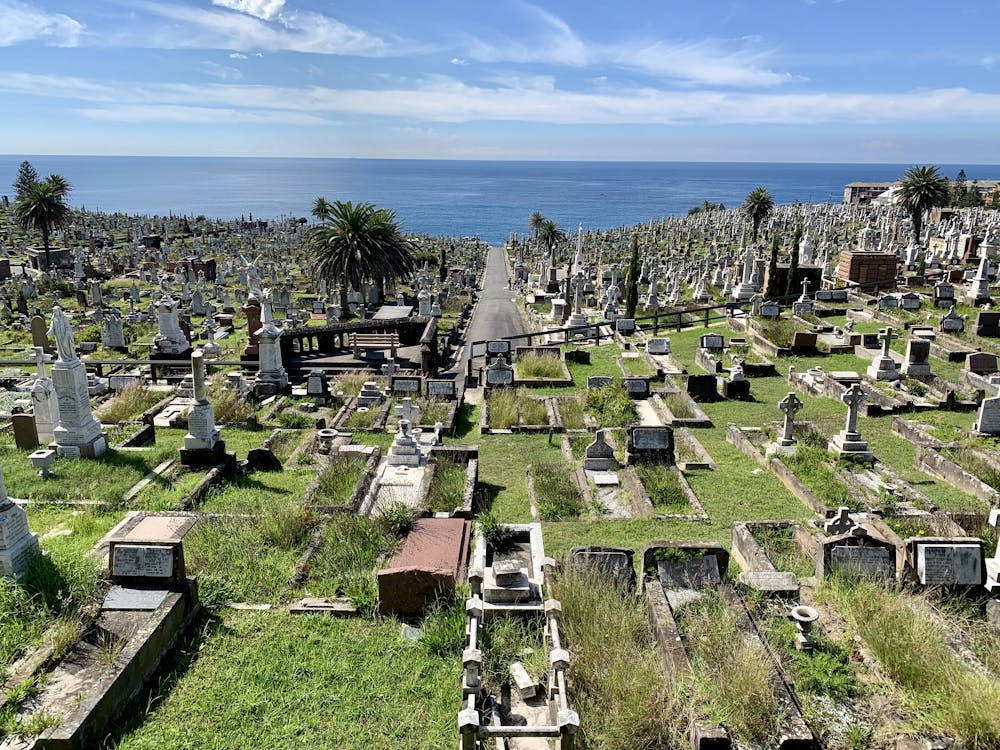
In Australia, interment in a cemetery or a churchyard has been the most common choices for in-ground burial. Over the past 20 years, though, burial has become a less accessible and more costly option for many people. This is because increasing numbers of deaths have created a boom in demand for burial plots and cemeteries are fast running out of space.
The Australian way of death clearly needs to change, but arriving at solutions is a far more complicated matter.
Some people believe composting burial might provide one answer. Also known as “natural organic reduction”, composting burial is the brainchild of Katrina Spade, CEO of alternative burial company Recompose. The process involves decomposition of the corpse in soil — but not within a traditional cemetery.
How does it work?
The first step in the process of composting burial is to place the body into a vessel containing a mix of soil, wood chips, straw and alfalfa. As decomposition begins, microbial activity creates heat. This speeds things up and eliminates germs from the mix.
Over time the body is transformed into soil – around 760 litres of it. A portion of this soil will be returned to relatives for scattering, to make a memorial garden, or to use in public greening projects.
Artist’s impression of the proposed decomposition vessel in Seattle.Images courtesy of Olson Kundig
A pilot interment program conducted by Washington State University showed the process takes about four weeks. This is a big difference to traditional burial. It can take up to hundreds of years before a grave can be reused.
The state of Washington recently legalised composting burial. The next step is implementation and Recompose has paired with architecture firm Olson Kundig to design the world’s first facility for composting burial in Seattle. It has 75 vessels. If these are reused every four weeks, the facility could process about 900 burials per year.
How does the cost compare?
These recent developments pave the way for its possible introduction in Australia. However, many questions remain to be answered. Is it really a more affordable or sustainable option than traditional modes of bodily disposal?
In 2019, Australian Seniors’ Cost of Death Report found the average cost of a basic burial is $8,048. A basic cremation costs $3,108 on average.
However, the cost of an individual burial depends on where you live. Exclusive beachside locales command the highest prices for burial real estate.
And, if you’re an Australian pensioner with no savings who has lived your whole life in the inner city, you’re going to struggle to afford a burial plot in your neighbourhood.
When the Recompose facility opens in 2021 in Seattle, composting burial will be on offer for about USD$5,500 (A$8,000) — about the same as a basic traditional burial in Australia. The costs might come down if the practice becomes widespread.
However, the technology is likely to be covered by patent. This means licensing agreements would limit its adoption. So, in the short term at least, composting burial is likely to be marketed towards those on average to high incomes.
Honouring the dead
Perhaps the main benefit of composting burial is the flexibility of having remains that are not attached to a traditional grave site. If you want to be buried in a particular place that holds personal meaning for you, but don’t mind being decomposed in a building, composting burial may allow this to happen.
Of course, local bylaws that govern the disposal of human remains in public places will continue to play an important role.
Related to this is an underexplored potential for composting burial businesses to partner with government, private industry, nonprofit organisations and local councils to create memorial parks where “human soils” might be interred. A drawback to this could be squeamishness in the community about playing frisbee on top of grandpa.
Artist’s impression of the interior of the proposed Recompose facility in Seattle.Images courtesy of Olson Kundig
A greener alternative
Another potential benefit of composting burial is its sustainability. Founder Katrina Spade claims a metric ton of CO₂ will be saved every time someone chooses composting burial over traditional burial or cremation.
When seen in this light, composting burial makes more environmental sense than cremation. But, just like buying organic fruit, sustainability comes at a premium.
Beneath the practical considerations of space, cost and sustainability are the less visible questions about change and community resistance to burial practices that are new and confronting. It will take a lot to abandon traditional mourning practices that celebrate ideas of permanence, attachment to the grave and the notion of the loved one resting in an earthbound coffin.
There is hope, though, that composting burial will gain in appeal as a way of maintaining these important connections to traditional burial. By respecting each person’s desire to be returned after death to a place of their choosing, composting burial offers an intriguing and sensitive alternative.
A survey this year revealed that Australians, on average, spend 10.2 hours a day with interactive digital technologies. And this figure goes up every year.
This is time we don’t get back. And our analogue lives, which include everything not digital, shrink in direct proportion.
I recently decided to spend four weeks at sea without access to my phone or the internet, and here’s what I learnt about myself, and the digital rat race I was caught in.
Cold turkey
Until a year or so ago, I was a 10.2 hours a day person. Over the years, dependence on technology and stress had destroyed any semblance of balance in my life – between work and home, or pleasure and obligation.
I wanted to quit, or cut down, at least. Tech “detox” apps such as the time-limiting Screen Time were useless. Even with these, I was still “on”, and just a click away from unblocking Instagram.
So I thought: what about going cold turkey? No screen time at all, 24/7. Was that possible, and what would it feel like?
My commute to work passed the Footscray docks, where container-ships come and go. Passing one day, I wondered if it was possible to go on one of those ships and travel from Melbourne to … somewhere?
Turns out it was. You can book a cabin online and just go. And in what was probably an impulse, I went.
The time on that ship taught me there is a whole other side to life, the non-digital side, that gets pushed aside by the ubiquitous screen.
Real life contains people, conversations, flesh and textures that are not glass or plastic.
It also contains whole worlds that exist inside your head, and these can be summoned when we have the time, and devote a bit of effort to it.
These are worlds of memory and imagination. Worlds of reflection and thought. Worlds you see differently to the pallid glare of a screen.
I took four books with me and read them in a way I hadn’t before: slower, deeper and with more contemplation. The words were finite (and therefore precious).
I’d never spent time like this in my whole life, and was inspired to write about it in detail.
Of course, we all have our own commitments and can’t always do something like this.
But away from the screen, I learned a lot about our digital world and about myself, and have tried to adapt these lessons to “normal” life.
Since I’ve been back, it feels like some sense of balance has been restored. Part of this came from seeing the smartphone as a slightly alien thing (which it is).
And instead of being something that always prompts me, I flipped the power dynamic around, to make it something I choose to use – and choose when to use. Meaning sometimes it’s OK to leave it at home, or switch it off.
If you can persist with these little changes, you might find even when you have your phone in your pocket, you can go hours without thinking about it. Hours spent doing precious, finite, analogue things.
How to get started
You could begin by deleting most of your apps.
You’ll be surprised by how many you won’t miss. Then, slowly flip the power dynamic between you and your device around. Put it in a drawer once a week – for a morning, then for a day – increasing this over time.
If this sounds a bit like commercial digital detox self-care, then so be it. But this is minus the self-care gurus and websites. Forget those.
No one (and no app) is really going to help you take back your agency. You need to do it yourself, or organise it with friends. Perhaps try seeing who can go the furthest.
After a few weeks, you might reflect on how it feels: what’s the texture of the analogue world you got back? Because, more likely than not, you will get it back.
For some, it might be a quieter and more subjective pre-digital world they half remember.
For others, it might be something quite new, which maybe feels a bit like freedom.
Is it ever OK to swear? Yes. Swearing can be quite acceptable when delivered to drive home a particular point to a specific audience, enhance a comedic presentation, or deal with pain.
I am sure, in that last context, that midwives and partners have heard it all, many times over. And no-one would begrudge the delivering mother that opportunity. But in my experience, the use of profanity is usually gratuitous, repeatedly designed to offend and, to my mind, frequently just a sign of laziness in speech.
In fact, when delivered to an unsuspecting group, especially where children are present, it can amount to a criminal offence.
So what does the law say about letting fly with a few well-chosen expletives?
Kevin Rudd was applauded after saying “political shit storm” on TV.
Don’t say f*ck in front of children
Public profanity is an offence in every jurisdiction in Australia. The South Australian Summary Offences Act is one good example of this type of prohibition:
A person who uses indecent or profane language or sings any indecent or profane song or ballad in a public place; or in a police station; or which is audible from a public place; or which is audible in neighbouring or adjoining occupied premises; or with intent to offend or insult any person is guilty of an offence. Maximum penalty $250.
But context is everything. Saying “fuck” in front of families at the local sports ground would likely lead to a fine if someone complained to the local police. But the same words used by a comedian at a performance for paying patrons later that night will incur no such sanctioning.
Anyone who has regularly attended live theatre in the past decade, or who watches late night television or listens to late night radio, would know that, over the years, the use of profane language has become widespread.
Indeed, language is forever evolving. Words that used to be uttered sparingly are now deployed in media conversations as a matter of course. They’re subject to “language warnings” informed by the various radio and television codes of conduct, with television codes being particularly cognisant of the likelihood of children viewers.
Norm and Ahmed
Any modern history of the law of profanity in Australia must begin with the story of Alex Buzo’s 1968 play, “Norm and Ahmed”, which was destined to be seen only by adult audiences.
In the play, Buzo presents racial prejudice as profoundly irrational in the behaviour of ordinary Australians. The play script originally ended with the line “fuckin’ boong”. For its debut production in 1968, “fuckin’” became “bloody”. But the following year in Brisbane, Buzo’s original line was used.
After one performance, Norman Staines, the actor who said the line, was arrested. But it was not the use of the dreadful racial slur that had attracted the attention of the two police who mounted the stage, but rather the use of the word “fuckin’”.
The magistrate’s conviction of Staines was later overturned by the Supreme Court of Queensland on the grounds the word was not obscene in the context of the play. The High Court later agreed.
There is little doubt the judgements of these courts set a precedent. Swearing was now acceptable if employed in the context of adult entertainment.
Racist arrests
There are some interesting socio-legal writings on this subject, too. Criminologist Paul Wilson discovered in the New South Wales outback town of Moree in the late 1970s that the police were using the word “fuck” liberally in their banter with each other, while regularly arresting Aboriginal men in the street for using the same word on the basis it was “offensive”.
Wilson concluded from his research experience that rule-makers are often the most flagrant rule-breakers.
What’s more, practising criminal lawyers know police regularly use the offensive language law to give them the widest possible range of excuses to arrest someone giving them grief.
It’s difficult to say how many people today around Australia are charged with using offensive, profane or insulting language in any one year, but you could safely surmise it’s in the thousands.
What we can say from evidence in NSW is that Indigenous people, who comprise 3% of the population, make up approximately one-third of those charged and taken to court on account of their use of language deemed by police to be offensive.
More recently, in 2015, a political activist wore a sandwich board sign that linked former Prime Minister Tony Abbott with the “c” word. The activist was arrested and charged with offensive conduct.
The matter then wound its way through the courts. Two years later, magistrate Jacqueline Milledge concluded the law was concerned with what would offend the “hypothetical reasonable person”, saying:
It’s not someone who is thin-skinned, who is easily offended […] It’s someone who can ride out some of the crudities of life. [The sign is] provocative and cheeky but it is not offensive.
So where does all of this leave us? Can we use profanities? Yes, of course, but one should choose one’s audience carefully, lest the long arm of the law take an interest in our public utterances.
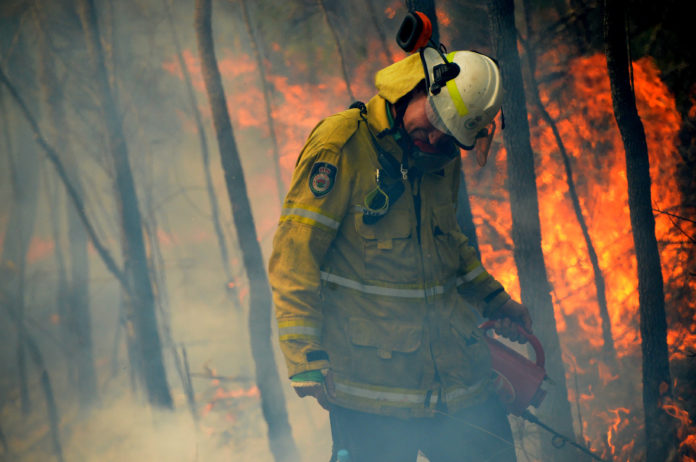
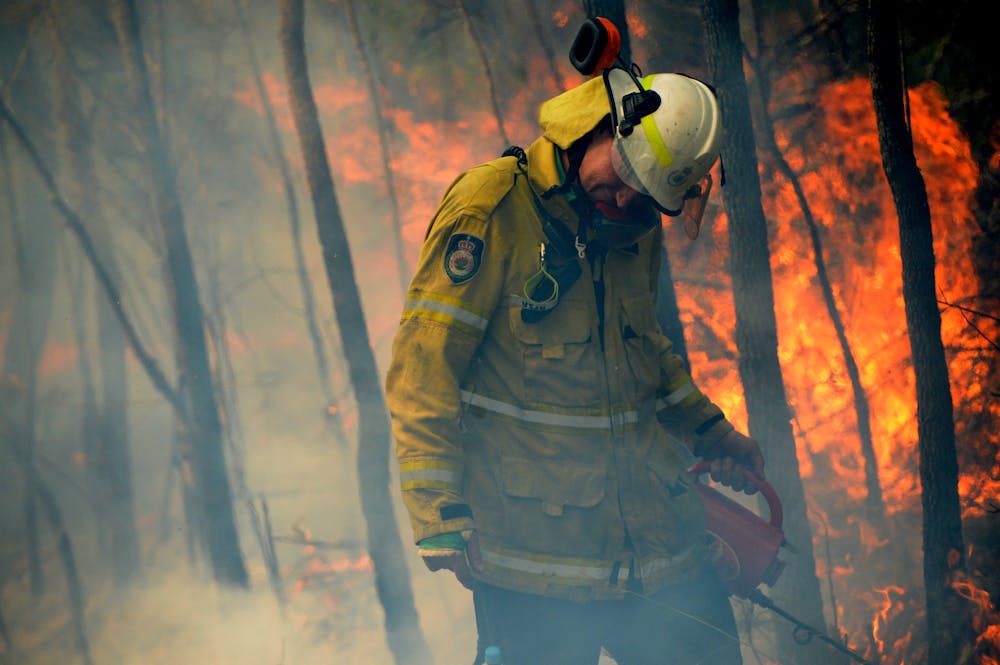
Evocative images of volunteer firefighters fill our newspapers and television screens. As we look with gratitude into their ash-stained faces, we want to see a modern-day hero looking back at us.
But firefighters don’t want us to see heroes, because calling them heroes overstates their ability to control fires and downplays the long-term psychological impacts of fighting fires.
That’s what we’ve learned after interviewing Black Saturday firefighters ten years after the tragedy, as part of an ongoing research project exploring the role of memory and commemoration in organisational planning.
As we listen to their recollections of that day, there is no doubt they engaged in heroic acts and need to be remembered for their bravery. But when we laud firefighters as heroes, we fail to acknowledge the ongoing impact of the fires. As one firefighter told us:
Each year on the Black Saturday anniversary every community group wanted to have a thank you event and they were getting frustrated by the firefighters not turning up.
What they couldn’t understand was what the firefighters were physically and mentally going through at that time.
Memorials do the remembering for us
Government funding for firefighting needs to make provision for counselling services for firefighters dealing with the long-term psychological effects of fighting fires.
Several firefighters talked about “deliberately trying not to remember because it is so difficult”. For others, remembering together was part of the healing process.
After the 10th anniversary, I had a bit of a meltdown. We’d arranged a gathering of that group of people who were very close on the day and I wasn’t going to go. I just had a picture of myself sitting in the corner crying my eyes out all night and it’s the first time that group had come together since the first anniversary and as it turned out it was brilliant.
It was exactly what we needed. It was a very close group of people who had a lot of trust in each other.
Over the past decade, memorials have been erected in communities affected by the Black Saturday fires. But firefighters we spoke to were concerned that creating memorials allowed communities and authorities to relegate the fires and their impact to the past.
Scholars of commemoration have observed that giving monumental form to memory can enable us to divest ourselves of the obligation to remember. It’s as if the memorial does the remembering for us.
Firefighters are battling unprecedented blazes around the country. We should remember their bravery without overstating their ability to fight fires.AAP Image/Jeremy Piper
Rather than building memorials, firefighting organisations need to commemorate through forms of collective communing, where knowledge is shared by older, experienced hands with new firefighters.
This communal commemoration could build on the informal forms of commemoration that firefighters told us they prefer – sitting around the fire truck, sharing stories. Staff rides, for instance, a tactical walk retracing the steps of those involved in a major fire, is an effective way of passing on knowledge while also remembering and honouring the work of firefighters.
Making sure it never happens again
Black Saturday firefighters we spoke to urged memorialisation to elicit a call to action.
Memorials do have a profound effect. The Kinglake memorial for me is extremely powerful in terms of reminding us of the scale of the tragedy, the names – I can still picture the faces. It is deeply emotional and powerful.
But how we can translate that powerful emotion into a resilience and a determination to make sure it never happens again?
Firefighters don’t want a roll call of heroes, but for communities to remember the lessons we have learnt from past fires and to ensure they have a bushfire plan and to heed warnings to leave.
As one firefighter said about the Black Saturday anniversary:
It should have been an opportunity to remind people of the dangers of bushfires and what can happen and the limitations of an organisation like ours, and to use that in a positive way to reinforce future preparedness rather than constantly looking back at the tragedy and not learning anything from it.
It was a national tragedy owned by everybody and we should be able to build up a cultural memory.
Collective memory carries an ethical obligation. In commemorating firefighters as heroes, we can fall into the danger of overstating their ability to control fires, absolving ourselves of responsibility.
Rather than simply valorising and memorialising firefighters as heroes, all levels of governments need to accept responsibility for their role in mitigating future bushfire impacts.
This means ensuring the landscape is managed appropriately, that our firefighters have the resources to fight fires, and that there is effective, science-based climate policy.
An Australian summer can be a holiday by the beach, recovering from exams, or anticipating the next stage of schooling. The summer break can also offer a wonderful opportunity to catch up on some reading.
Award-winning author and illustrator Shaun Tan wrote the
lessons we learn from […] stories are best applied to a similar study of life in general […] At its most successful, fiction offers us devices for interpreting reality.
(If you aren’t familiar with Tan’s work, look out for The Arrival, Cicada and Tales from the Inner City, among others).
Research from New Zealand suggests young adults like to read books which make them laugh, “let them use their imagination, have a mystery or problem to solve, have characters they wish they could be like”.
Based on this, here are some recommendations your teen could read this summer.
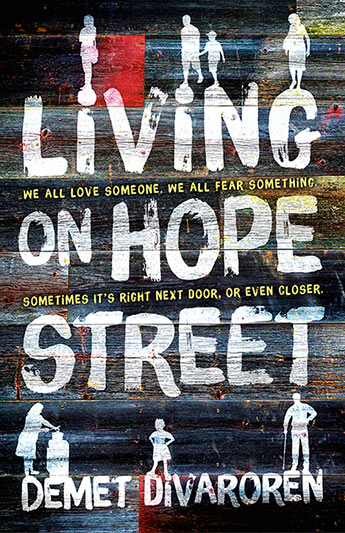
Living on Hope Street by Demet Divaroren does just that. Hope Street is a fictional Australian street with a diverse population.
This diversity is replicated in the book’s multiple-voice narrative structure.
The voices are initially separate but come together in a way that reflects the development of the community.
The characters range in age from school children to a Vietnam war veteran and include a refugee family. Hope Street has messages of tolerance, love, courage, friendship and the importance of family.
In The Things That Will Not Stand, by Michael Gerard Bauer, two teenagers, Sebastian and Tolly, attend a university open day together.
They meet a girl who is not quite what she seems but who so intrigues Sebastian, he stays on long after Tolly has gone home and the open day activities have finished, just so he can see her again.
There are some very funny scenes throughout the book, usually involving Tolly.
The action takes place on just one day, a day which both boys will remember for ever.
This book will particularly appeal to readers at the upper levels of secondary school, inviting them to imagine themselves in the place of the characters.
Maggie Stiefvater sets this book in a remote Colorado town, Bicho Raro, where a most unusual family lives – a family that appears to perform miracles. Into this tiny town comes Pete, whose application to join the army has been rejected and he is seeking to come to terms with that disappointment by hitchhiking.
He has been picked up by Tony, a DJ trying to escape fame and heading to Bicho Raro because he has heard about the family that can perform miracles.
Their visit changes both of them for the better. There is a lot here for older teenage readers as the book involves romance and humour, and has touches of magic and fantasy.
Stiefvaster also explores concepts of good and bad and the importance of knowing ourselves.
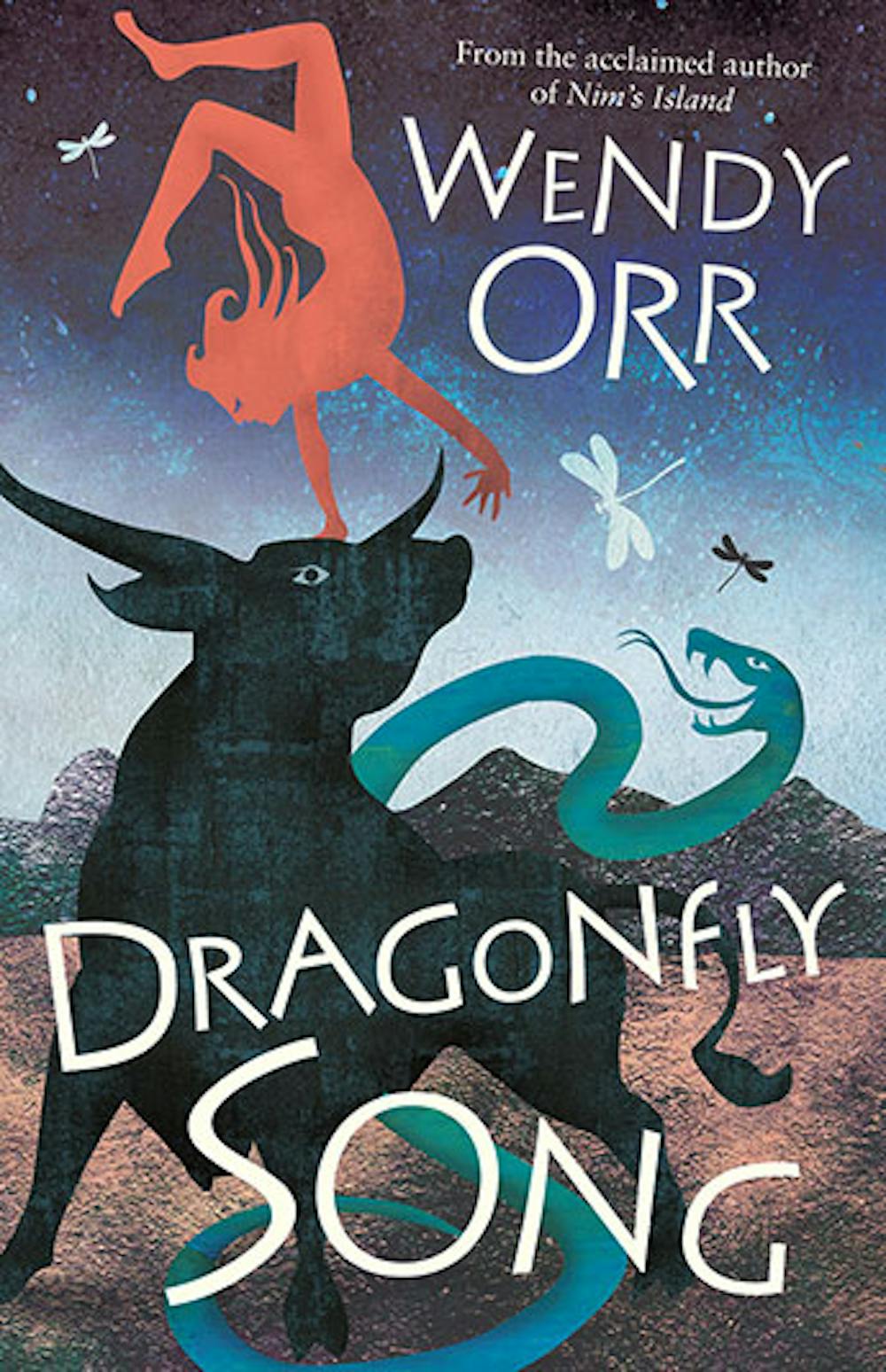
Ancient Crete is the setting for Wendy Orr’s Dragonfly Song. The book tells of those chosen to be the tribute to the Bull King (he chooses a tribute every year).
The outcast girl, called No-Name by everyone, seizes the opportunity to become one of the tributes, a task she knows to be demanding and often dangerous. She will have to brave the bloody bull dances in his royal court.
Will she actually survive the test?
The book is inspired by the legend of the Minotaur. It is thoroughly researched, lyrically written and invites readers to imagine themselves in No-name’s place.
A group of students and their teacher, separated from the others on a school excursion, find an odd-looking book in a deserted house. Emily Rodda beautifully uses the device of a story within a story in His Name Was Walter.
What happens next is mysterious and intriguing as past and present combine. The ending is both poignant and satisfying.
Imagine finding yourself stranded in an unknown wilderness without a mobile phone. This is exactly what happens to Brian in Gary Paulsen’s Hatchet.
It’s a kind of modern Robinson Crusoe story, first published in 1986 before the proliferation of mobile phones.
In this adventure, Brian has to be inventive and resilient to survive. The book is the first in a series of five. One review suggested, for many readers, Hatchet was “the first school-assigned book they fell in love with”.
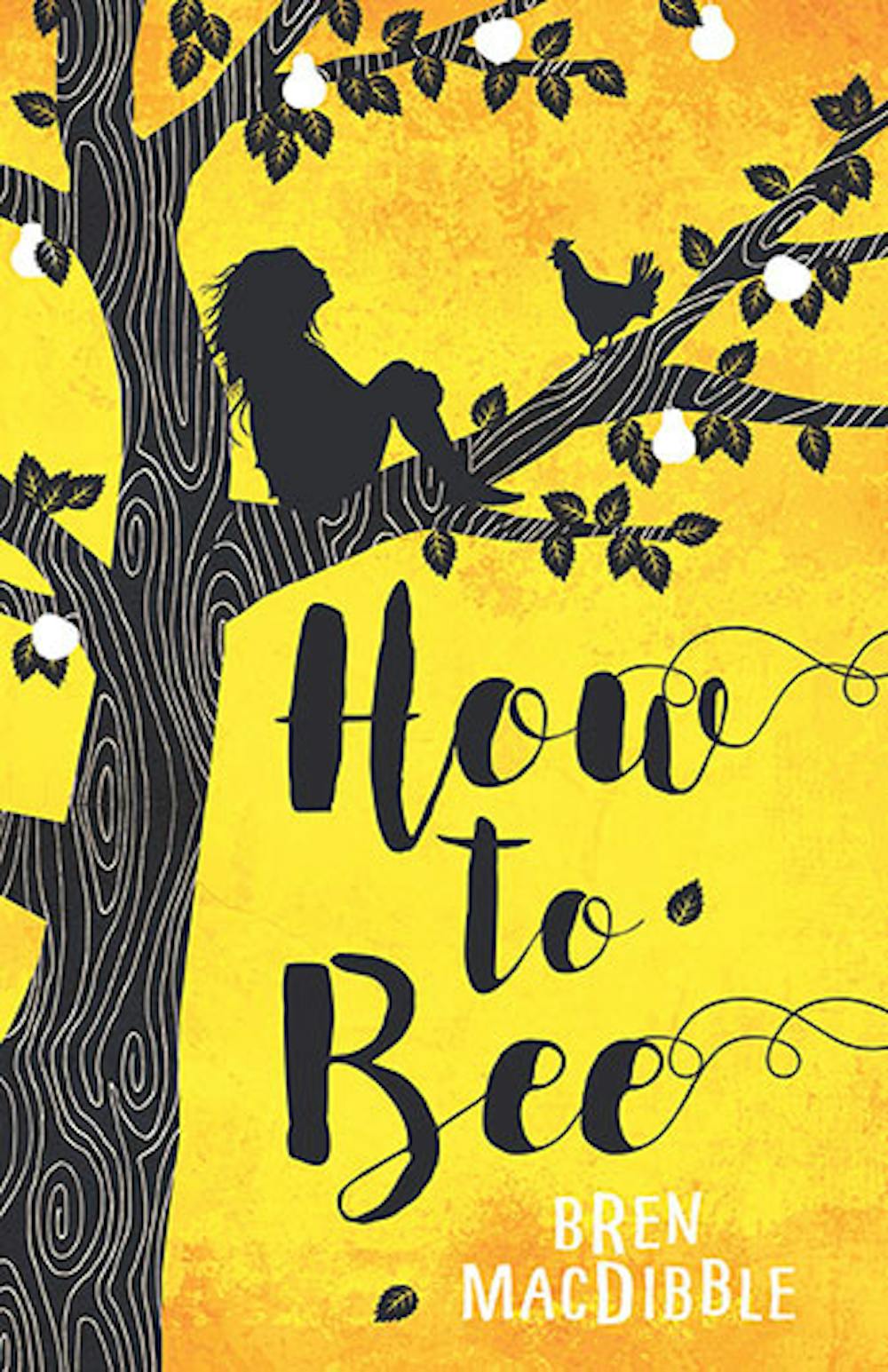
How would life be without bees? How would the pollination of plants, so essential to life on earth, happen?
This intriguing story, by Bren MacDibble, explores that idea and sets up a scenario where children do the pollinating – but only the bravest and quickest.
Penny longs to be one of these, but can she, especially when it looks as though she might be taken away from the life she has known?
Mental health in our cities is an increasingly urgent issue. Rates of disorders such as anxiety and depression are high. Urban design and planning can promote mental health by refocusing on spaces we use in our everyday lives in light of what research tells us about the benefits of exposure to nature and biodiversity.
Mental health issues have many causes. However, the changing and unpredictable elements of our physical and sensory environments have a profound impact on risk, experiences and recovery.
Physical activity is still the mainstay of urban planning efforts to enable healthy behaviours. Mental well-being is then a hoped-for byproduct of opportunities for exercise and social interaction.
Neuroscientific research and tools now allow us to examine more deeply some of the ways in which individuals experience spaces and natural elements. This knowledge can greatly add to, and shift, the priorities and direction of urban design and planning.
What do we mean by ‘nature’?
A large body of research has compellingly shown that “nature” in its many forms and contexts can have direct benefits on mental health. Unfortunately, the extent and diversity of natural habitats in our cities are decreasing rapidly.
Too often “nature” – by way of green space and “POS” (Public Open Space) – is still seen as something separate from other parts of our urban neighbourhoods. Regeneration efforts often focus on large green corridors. But even small patches of genuinely biodiverse nature can re-invite and sustain multitudes of plant and animal species, as urban ecologists have shown.
It has also been widely demonstrated that nature does not effect us in uniform or universal ways. Sometimes it can be confronting or dangerous. That is particularly true if nature is isolated or uninviting, or has unwritten rules around who should be there or what activities are appropriate.
These factors complicate the desire for a “nature pill” to treat urban ills.
We need to be far more specific about what “nature” we are talking about in design and planning to assist with mental health.
The exponential accessibility and affordability of lab and mobile technologies, such as fMRI and EEG measuring brain activity, have vastly widened the scope of studies of mental health and nature. Researchers are able, for example, to analyse responses to images of urban streetscapes versus forests. They can also track people’s perceptions “on the move”.
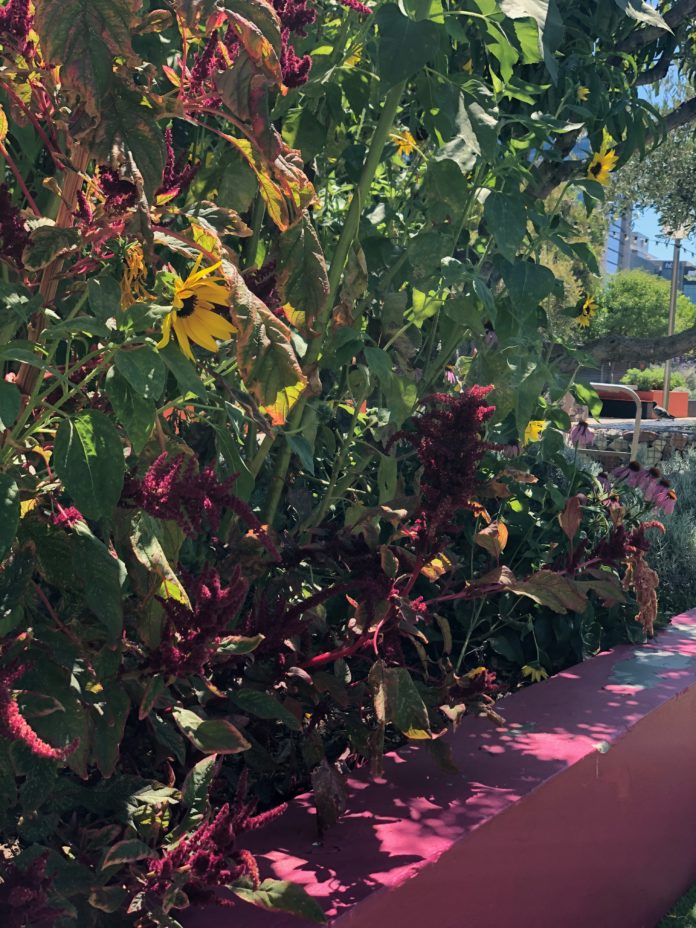
Research shows us biodiverse nature has particular positive benefit for mental well-being. Multi-sensory elements such as bird or frog sounds or wildflower smells have well-documented beneficial effects on mental restoration, calm and creativity.
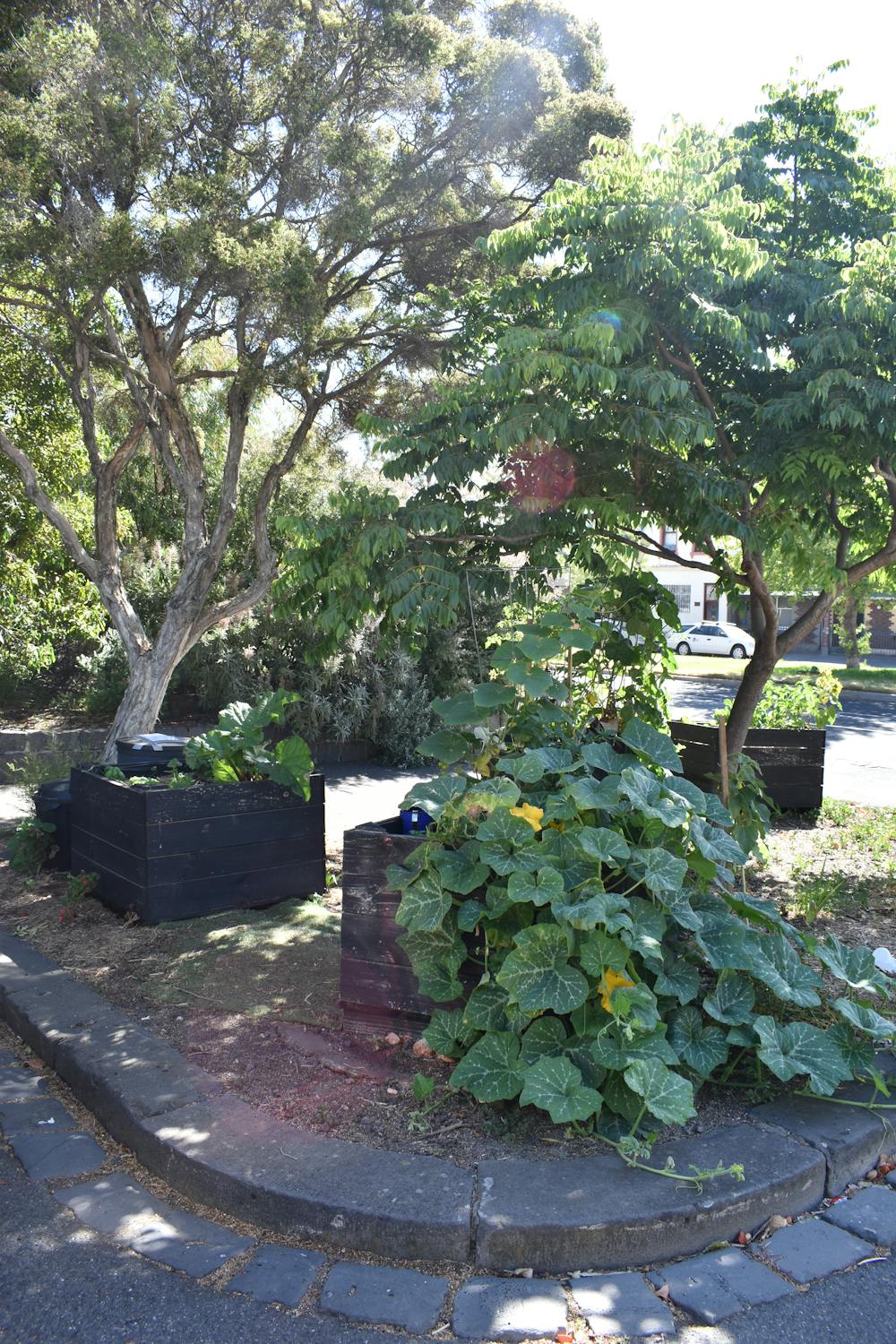
Planters bring life to a roadside in Carlton, Melbourne.Melanie Thomson, Author provided (No reuse)
Acknowledging the crucial role all these senses play shifts the focus of urban design and planning from visual aesthetics and functional activity to how we experience natural spaces. This is particularly important in ensuring we create places for people of all abilities, mobilities and neurodiversities.
These converging illustrations suggest biodiverse urban nature is a priority for promoting mental health. Our job as designers and planners is therefore to multiply opportunities to interact with these areas in tangible ways.
A residential street in Perth.Zoe Myers
The concept of “biophilia” isn’t new. But a focus on incidental and authentic biodiversity helps us apply this very broad, at times unwieldy and non-contextual, concept to the local environment. This grounds efforts in real-time, achievable interventions.
Using novel technologies and interdisciplinary research expands our understanding of the ways our environments affect our mental well-being. This knowledge challenges the standardised planning of nature spaces and monocultured plantings in our cities. Neuroscience can therefore support urban designers and planners in allowing for more flexibility and authenticity of nature in urban areas.
Neuroscientific evidence of our sensory encounters with biodiverse nature points us towards the ultimate win-win (-win) for ecology, mental health and cities.
Hooray it’s the holidays! Time to organise the pet sitter, mail and dentist. Wait, what? It might be worth squeezing a trip to the dentist before you go.
One in 12 travel insurance claims are for dental emergencies. And of those emergencies, three out of four treatments could be prevented by making a timely dentist visit.
Here’s how to avoid an emergency dentist visit while on holiday. But life happens, and there are ways to help yourself if you get into trouble.
The Australian Dental Association recommends a check-up at least three months before you travel. If it’s too late for this break, you might want to add a dental visit to your “must do” list before your next trip.
At best, an early check-up will include only a scale and clean. However, if you need major work, such as dental implants and wisdom teeth removed, you will have ample time to complete treatment before you go away.
If you have dentures, allow enough time with a dentist or dental prosthetist to organise spare plate(s) in case you lose or break your regular ones while you’re away.
Avoid surgery just before flying
A planned dental visit before flying can help avoid complications, particularly related to surgical procedures, such as removing your wisdom teeth.
It’s generally wise to have your wisdom teeth removed well ahead of travel as you might need a hospital stay. It can also take at least two days for the extraction site to heal well enough to fly. That’s because the dry air and pressure can disturb the blood clot that forms where you’ve had your teeth removed.
Molar teeth (including some wisdom teeth) removed from your top jaw can cause other complications when you fly. If you fly too soon after surgery, changes in air pressure could lead to complications related to your sinuses that could see you dribbling your food and drink out of your nose. Not only is this annoying and embarrassing, it can be quite painful. You may also need further surgery to fix this.
It can take at least two days after having your wisdom teeth removed for you to be well enough to fly.from www.shutterstock.com
People can also experience toothache when flying, or even diving. That’s because of a condition called barodontalgia that’s triggered by changes in air pressure, such as when a plane takes off or lands. Often, this pain is a symptom of a loose or leaking filling, a deep cavity close to the nerve inside the tooth, recent dental treatment or sinusitis.
Here are some practical tips to avoid harming your teeth, braces and crowns over summer:
use scissors, not your teeth, to open packaging
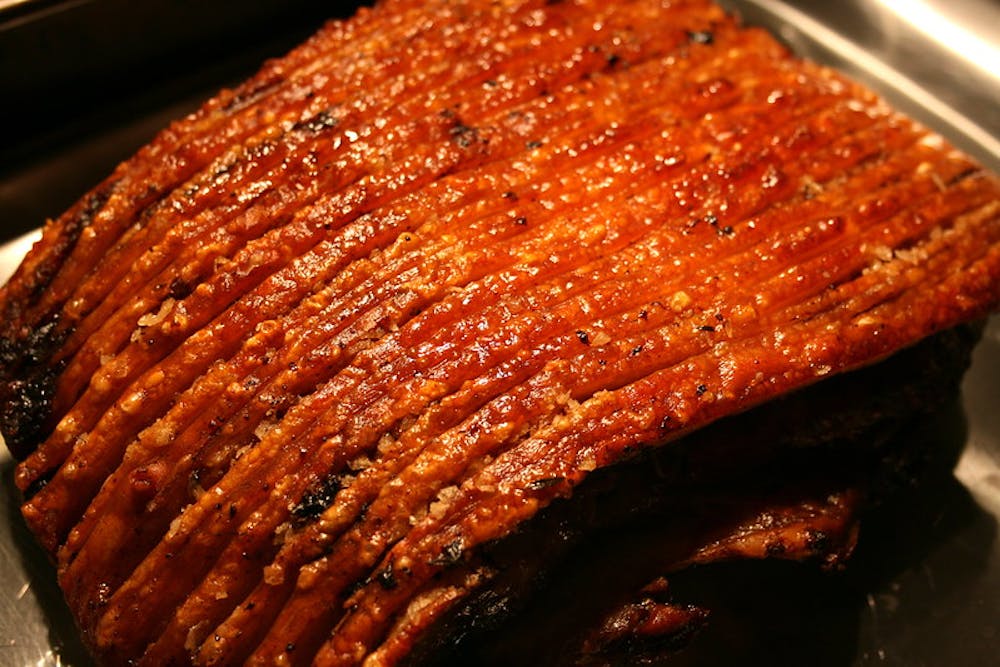
avoid chewing very hard foods such as ice, popcorn kernels, pork crackling, and crunchy candies. This is particularly important if you have braces, or large fillings or crowns as they can easily come unstuck or fracture
if you play contact sport, protect your teeth by wearing a custom fitted mouth guard.
Watch how you chew your pork crackling over the holidays if you want to avoid the dentist.James Box/flickr, CC BY
have toothache — if you have spontaneous, radiating pain or a constant dull ache and/or pain and swelling, over-the-counter pain medication may help. But try to find a dentist as soon as reasonably possible
chip or break a tooth or filling — avoid running your tongue over the site and try to get to a dentist as soon as possible
knock out an adult (not baby) tooth — hold the tooth by the crown (not the root) and rinse with milk if it is dirty, then try to place the tooth back in the socket. If this is not possible, store the tooth in milk or inside your cheek and find a dentist as soon as possible
have a dislodged crown/cap — store the crown in a container; a dentist may be able to glue it back on.
have problems with your braces — shift loose wire that sticks out to make it more comfortable, then see an orthodontist or dentist as soon as possible
get an abscess — seek immediate dental care, and if this not possible, find a doctor or seek emergency hospital care. An abscess can become life-threatening very quickly
suffer trauma to your gums, mouth or face — apply firm pressure to the bleeding site with a clean bandage and seek dental or medical care
crack or break your denture — never try to glue the broken pieces back together, but store the lose parts in a container and seek help from a dental prosthetist or dentist as soon as possible.
I’m away from home. How do I find a dentist?
If you are holidaying in Australia, but away from home, ask a local person to recommend a dentist, or if that’s not possible, search online.
Then call. Although most dental practices close over the public holidays, they usually leave a message with contact numbers in case of an after-hours emergency.
If you need after-hours care, be prepared to pay a call-out fee of A$100-500. Often, the call-out fee is used to separate the real emergencies from those that can wait another day before the practice opens. If no help is at hand, the hospital emergency department may be able to help.
contact your travel insurer to understand what documentation is required to make a claim
contact the Australian embassy, high commission or consulate to help you navigate the health system in the country you’re visiting
if there is no Australian service, the Canadian embassy, high commission or consulate will help you find a dentist.
Don’t forget
After emergency treatment, ask for a copy of your treatment notes, images and x-rays to be sent to your regular dentist. This is particularly important if you need follow-up care when you return home.
And in the unlikely event you’ll need some emergency dental work, don’t forget to enjoy the rest of your break. Happy holidays!
Public space is all around us, from bustling town and city squares to the iconic beaches and wide-open national parks on our doorsteps. In its more mundane forms – such as roads, footpaths, or cycle ways – it’s critical in getting us from A to B.
But the line between what is considered true public space and what is publicly accessible private space is often blurred.
For example, we can enjoy the outdoor plazas of privately owned shopping centres – provided we follow the rules, dress appropriately and consume.
But no protests or large gatherings would be tolerated in such plazas whereas these activities are a common use of our public spaces.
These privately owned public spaces (POPS) are on the increase (New York encourages these spaces and even has a map of them).
So we need to be clear what we mean by public spaces and protect them, where possible.
The ‘public’ private spaces in our cities
Our cities are complex mixes of public and private property. Consider the short walk from Brisbane’s CBD to South Bank to illustrate this patchwork.
We can walk on footpaths, cross roads, bisect the square at Queens Gardens and finally cross the river at the Goodwill Bridge, all on public property, and all the while skirting private boundaries.
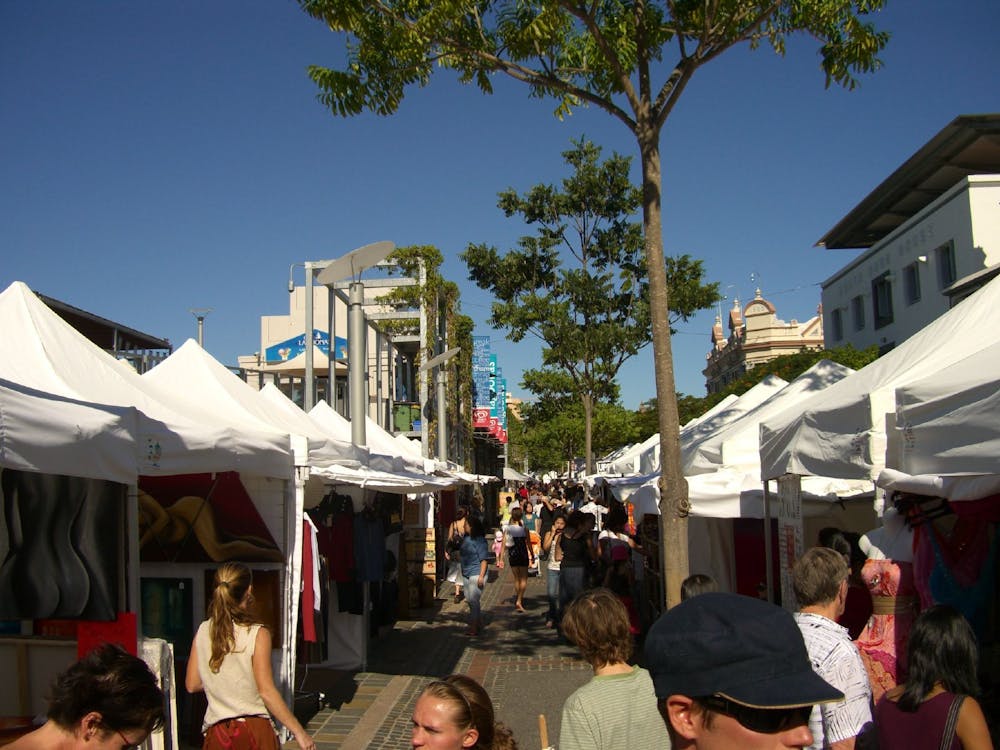
We then arrive at South Bank, with its hybrid mix of open swimming pool, parklands, public institutions and private retail, food outlets and busy markets.
Mostly, it’s an inclusive sort of owner – provided we don’t cause disturbance. But South Bank exemplifies this public-private overlap and the spatial ambiguity this engenders.
Cross the boundaries
This public-private meander is replicated in cities across the globe. They highlight the blurred and porous boundaries that demarcate public and private property.
We navigate these boundaries surprisingly well, alert to the subtle and not-so-subtle lines of property.
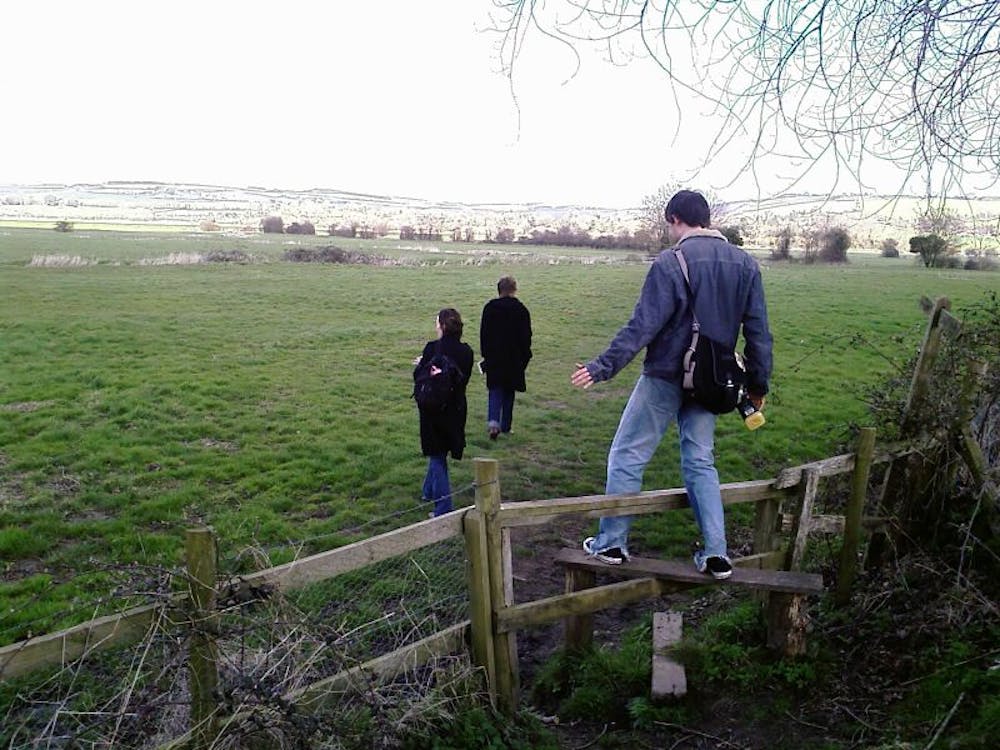
For example, high fences, no trespassing signs, or strategic CCTV cameras tell us “keep out”, versus the marked footpaths, well-trodden grassy shortcuts, or stiles that say it’s okay to enter.
In the UK a stile often points the way people can gain access to cross private land.Flickr/Gilda, CC BY-SA
In England, books are published that help ramblers (hikers and walkers) spot what they can access. Guides to the subtle signs of rural landscapes help citizens legitimately enjoy their rights to roam the countryside and coastal margin – public property rights that often exist over private land.
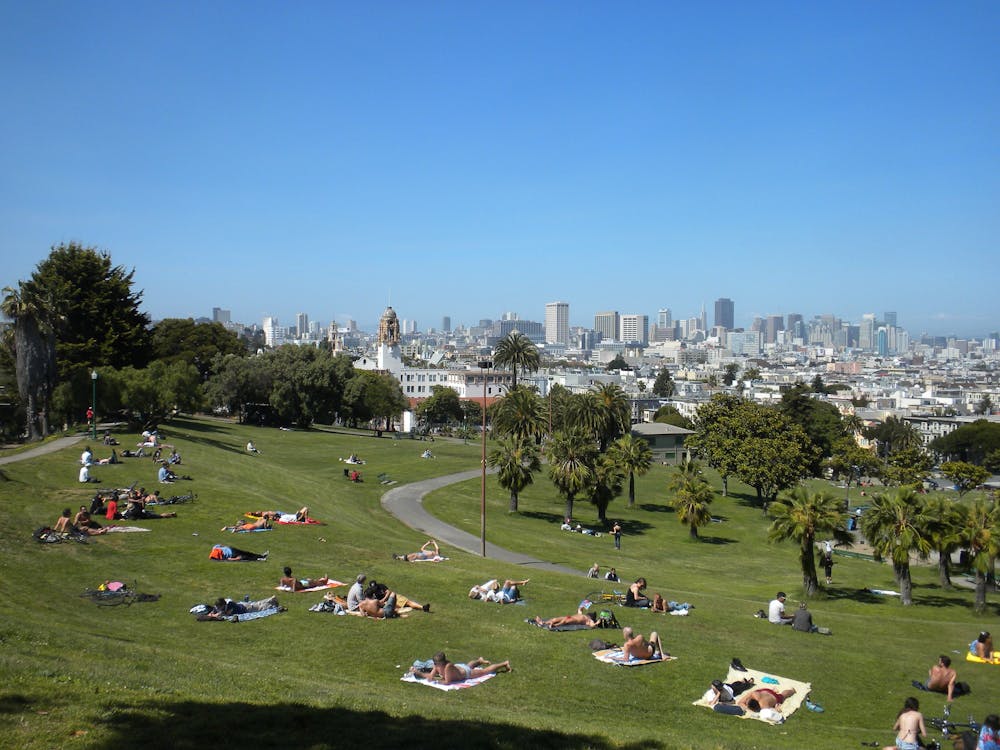
Sometimes we resolutely defend our threatened public property. In San Francisco, a trial to allow people to pay a fee to reserve exclusive sections of grass at the city’s Dolores Park was short-lived after a public outcry.
People enjoying the free public space at San Francisco’s Dolores Park.Flickr/Lucy Orloski, CC BY
Along the California coast, citizens challenged billionaires denying public access to beaches.
Yet, at other times, we are inconsistent in the lines we draw or, worse, the lines we don’t draw at all.
Such inconsistency means the public estate is mostly in retreat. It has been for centuries, marginalised since the enclosure period in Europe when large swathes of common lands were privatised.
Private public spaces
This enclosure is ongoing with the so-called privately owned public spaces that masquerade as something they’re not. A good example is the “public” plazas of office buildings, where we grab a quick lunch. They’re privately owned and not true public spaces at all.
In better appreciating the publicness of public property we can better grasp what’s at stake, the importance of public property to the social and democratic fabric.
Public lands are the forums where we sociably mix with strangers. They serve a public purpose and define public values. They are the conduits that connect us, that permit us to pass and re-pass.
Importantly, public property is where we go to protest and defend the public square, whether in the camps of Occupy Wall Street in New York, the streets of Hong Kong, or the public forests of Tasmania, part of what the Australian High Court calls our “public forest estate”.
That’s why I believe we need to pay more attention to what are our public spaces, how they’re defined and the need to defend them where necessary. Public-private spaces may have their uses, but they’re not the same as true public space.
That’s no public space: the private owners of your local shopping centre only allow you access to the food court if you obey their rules.Flickr/John, CC BY-SA
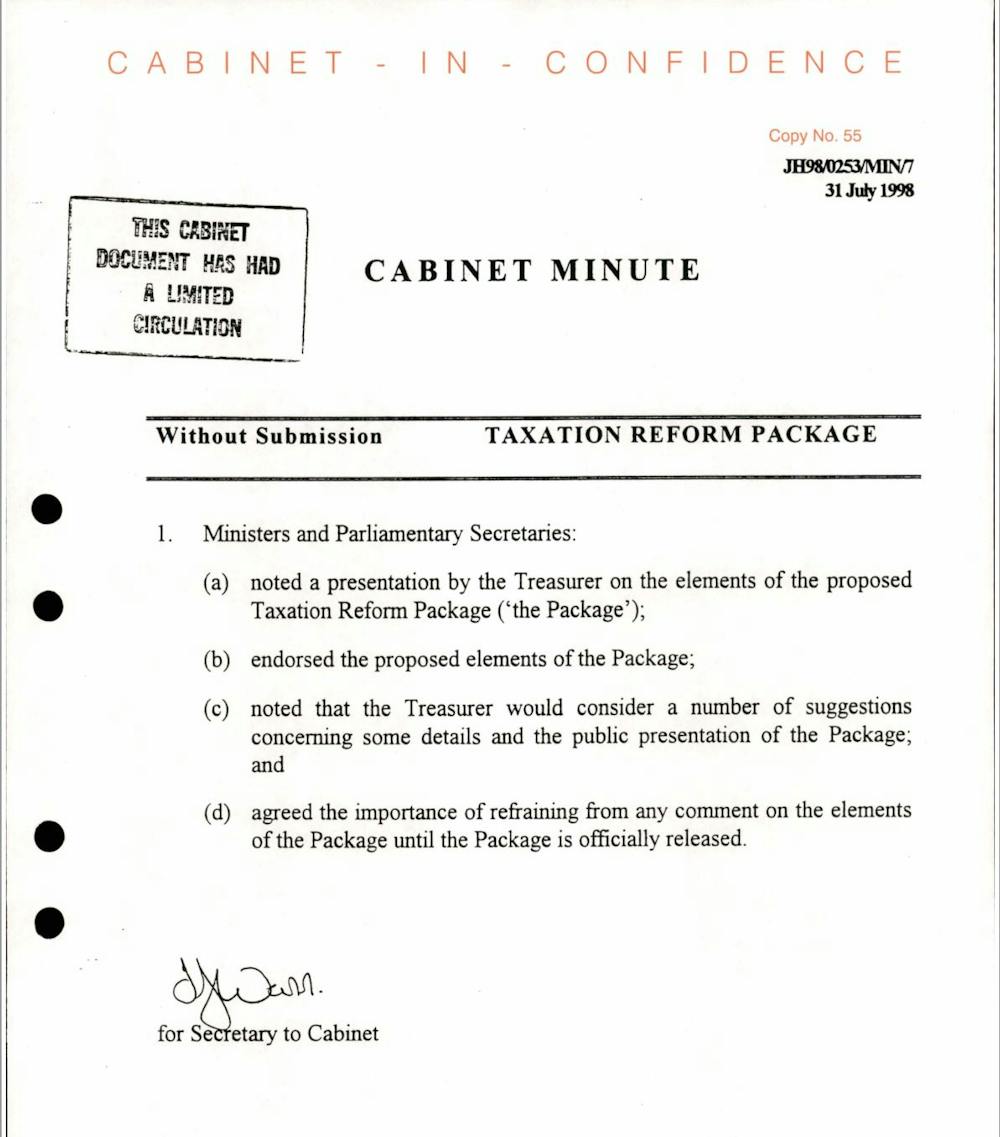
Twice the goods and services tax had been rejected, the first time by Labor, which came close to introducing something similar in 1985 and then by the Australian electorate, which rejected the Coalition’s Fightback tax reform package in 1993.
It had been recommended to the government by the Asprey Tax Review, which reported to Prime Minister Gough Whitlam in 1975 after being set up by Prime Minister William McMahon in 1972.
By the end of the 1990s, there was a GST in almost every other developed country, including New Zealand, which had introduced it at 10% in 1996 and increased it to 12.5% in 1989.
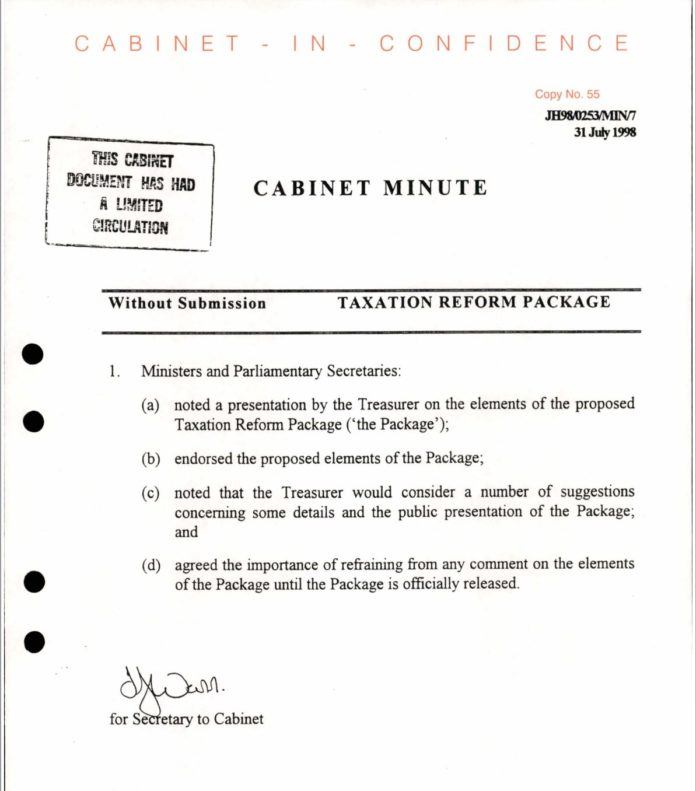
The cabinet records for 1998 and 1999 released this morning by the National Archives don’t give us much of an idea about what made Prime Minister John Howard try one more time, within a year or so of being elected on a promise that there is “no way a GST will ever be part of our policy”.
“Never ever?” the interviewer asked Howard. “Never ever. It’s dead. It was killed by voters at the last election,” Howard replied.
Some of the momentum came from a series of High Court decisions in 1997 that made it illegal for Australia’s states to continue taxing petrol, alcohol and tobacco.
The Commonwealth had to step in. And according to cabinet historian Paul Strangio, who has reviewed the papers released this morning, part of it came from a feeling the government had lost its way, amid “rumblings about the security of the prime minister’s leadership”.
But the papers do give us a good idea of how the momentum became unstoppable.
Once Howard set up a taskforce in August 1997 and asked it to come up with a plan to cut income tax, introduce a broad-based indirect tax and reconfigure Commonwealth-state financial relations, he had a sense of direction.
He called an election a fortnight after announcing the GST on August 13 1998, which he only narrowly won.
His ministers found themselves sidelined, being reduced to offering suggestions for presentation, given that the direction of the policy was already public.
“Were there doubters in the cabinet? Of course there were,” Howard’s treasurer, Peter Costello, said today’s release. “But by that stage we had said several times we were doing it, there was no point in saying let’s not do it.”
So I’d walk out of cabinet meetings with lists of suggestions, one goes on for several pages, instructing the treasurer to do better in explaining the role of the tax on this sector, do better on explaining the exemption for diesel fuel, it went on and on.
Costello made history by presenting to the cabinet on PowerPoint, using slides that have long-since been lost. He also displayed computer modelling of the effect of every income group and family type of every proposed variation in rates and thresholds. He said:
You’ll find one minute in there that says the treasurer presented a proposal for tax reform, which was adopted. That’s the minute of a meeting that went on for seven hours saying how every group would be in front or behind. I became the government’s PowerPoint guy.
As we were coming out of that cabinet meeting after seven hours I asked one of my senior colleagues, how do you think this is going to go? He said he didn’t know, but he liked the colours.
The cabinet made a momentous and expensive decision; that on average no income group of family type would be made worse off.
It lifted pensions and other payments by 4% in order to “overcompensate”, and found itself overcompensating even more when fresh food was excluded from GST in order seal a deal with the Australian Democrats.
Costello had been determined to get the tax in by July 1 2000, just before the Sydney 2000 Olympics. This would allow him to tax hoards of overseas visitors, most of them from countries that already had goods and services taxes.
He admits to nervousness in the lead-up to the date when almost every price in Australia had to change, some coming down as higher wholesale taxes were revoked, and some going up by as much as 10% which was to be the new standard rate. By design, the GST was to be hidden from consumers, incorporated in new prices.
I remember having having a meeting in the cabinet room. We called in (Chief Executives) Peter Bartels from Coles Myer and Roger Corbett from Woolworths. One of them I think it was Roger, said to me: ‘you are telling us to change one billion prices on June 30. One price at a minute to midnight, another on the stroke of midnight. How we do that?’
I had never thought of it in those terms, I began to wonder whether it was a good idea.
The GST created millions of tax collection points, making it far more complex than other attempts at reforming taxes such as the Rudd governments mining tax and the Gillard government’s carbon price.
Each had to be issued with an Australian Business Number.
We thought there were 800,000 businesses in Australia. By the time we finished, we had issued two million Australian Business Numbers, including many businesses that had never been known before.
It didn’t go smoothly at first. Businesses, like the cabinet, were new to computerisation. But by the time Labor’s Kim Beazley was defeated in the 2001 election on a platform that included a “rollback” of the GST, it had come to be accepted as part of the Australian way of paying our way.
Costello’s biggest surprise is that it didn’t go up. It remains at 10%, in part because of a deal that lacks legal force requiring every state to agree before it does.
He says he thought the deal would hold for a while because there would usually be a state going into an election that would veto an increase. He never thought it would hold for 20 years.
Today’s release of archival documents contains lessons for Howard and Costello’s successors. One is that over time, almost any change will come to be accepted as normal. In the language of tax veterans, and “old tax is a good tax”.
It’s what Costello’s predecessor Paul Keating discovered when he introduced the capital gains tax and the fringe benefits tax. After a while, they become normal.
The other lesson is that it pays to buy off likely losers. It also pays to bring in a change that at first loses more than it brings in. Overcompensation is expensive, but if the change is a good one, it can be worthwhile.
It sometimes isn’t enough, though, as Gillard discovered when she brought in the carbon price and overcompensated almost everybody.
Another secret ingredient might have been the broad support from groups that were normally opposed.
Business backed it as a way of getting taxes off incomes and the welfare lobby backed it as a guaranteed stream of money the government could use to provide social services.
It’s an agreement about means, if not ends, that doesn’t come along often.
January 1 1990, Mr Bean debuted on ITV to an audience of 13.45 million. The brainchild of Rowan Atkinson and Richard Curtis, the pilot episode marked the birth of a major comedy character.
Bean has become so familiar, so comfortably part of our pop-culture tapestry, that it’s easy to miss how striking a creation he is.
At the time, the talented Atkinson was best known for his four incarnations of Blackadder.
After a slapsticky first iteration, Blackadder traded heavily on acidic and acerbic dialogue and Atkinson’s knack for delivering it. Even the most lethargic line delivery (“To you Baldrick, the Renaissance was just something that happened to other people.”) dripped with disdain and venomous wit.
In sharp contrast, Bean was a largely silent character – arguably the last great predominantly silent comic creation, extending a genealogy including Charlie Chaplin, Buster Keaton, Harold Lloyd, Harpo Marx and Jacques Tati.
While not to all tastes, Bean is widely recognised and beloved. The absence of dialogue helped the show become a global hit, transcending language and cultural differences to screen in almost 250 countries.
So what is it that makes Mr Bean such an adored creation?
The smaller sketches hold up stronger on repeat viewing, while more elaborate high jinks — Bean playing mini-golf across a whole county, Bean looking after a lost infant at a carnival — have not aged as well and tend to pale in charm and dilute the purity of the concept.
Bean is best when he works on a small scale.
Child – or alien?
Mr Bean has a child-like nature. Silent comedy stars typically played moderately functional adults. Even Harpo Marx, the most overtly childlike of them, had a predatory edge.
In contrast, Bean is, as Atkinson notes, “a child in a grown man’s body”.
The series’ opening credits, in which Bean falls to the ground with a splat from a spaceship, conjure other possible backstories. Is Bean an abductee returned to Earth minus some crucial grey matter? Or an alien attempting (poorly) to pass for human?
Fully formed from the start
Most of the characteristics that made Bean an indelible creation were introduced in the very first episode.
As he sits for an exam, reads the wrong test paper and attempts to cheat his way through it in the first sketch, we see his idiot savant status (he does know trigonometry), his competitiveness and compulsive one-upmanship, and his cruel sense of humour.
In the next sketch, Bean goes to the beach and changes into his bathers in the most complicated way possible.
The sketch introduces Bean’s imbecilic ingenuity — finding inordinately convoluted solutions for basic predicaments — as well as his tendency to generate his own complications and desperation to avoid social humiliation (it is British comedy, after all).
In the third and best sketch — a tour de force showcasing Atkinson’s rubbery complexion and virtuoso gangly physicality — Bean attends a church service, where he struggles to stay awake and clandestinely eat some candy under the admirably straight and puritanical eye of Richard Briers.
The sketch introduces the motif of Bean attempting to imitate human behaviour and everyday rituals and failing, earning the ire of others in the process.
The Bean legacy
Bean headlined 14 television episodes from 1990–1995, two feature films and an animated series, and appeared in various shorts, sketches and the 2012 Olympics.
The films and cartoon somewhat diluted the brand, and the character has endured the wear and tear that comes with longevity and cultural omnipresence: parents getting sick of their children watching Bean, adolescents thinking they’re too cool for Bean.
However, Mr Bean’s worldwide audience speaks loudly to the genius of the character and Atkinson’s performance. By returning to this first episode, 30 years on, we can re-experience the birth of this remarkable comic creation.
A line delivered by Groucho Marx in Duck Soup nicely encapsulates the simple core of Bean’s widespread appeal. He “may talk like an idiot, and look like an idiot, but don’t let that fool you: he really is an idiot”.
Source: The Conversation (Au and NZ) – By Carla Pascoe Leahy, Australian Research Council DECRA Fellow, Historical and Philosophical Studies, University of Melbourne
It would be easy to believe, if you pay attention to the media, that Australian children are in poor shape.
There is certainly some basis to these fears. But it’s also instructive to take an historical perspective, because while childhood has changed in important respects since the second world war, there are surprising continuities.
Every generation of elders has worried about “young people of today”, from the 1950s to the 2010s. Some of the changes to childhood and parenthood could even be characterised as positive. So how has the idea of childhood, and the relationship between children and parents, changed since the 1950s?
The boomers’ parents worried about them too
From its earliest days, a baby of the 1950s usually had a single maternal figure as primary caregiver. Women were expected to become mothers and homemakers, whereas men were expected to be breadwinners and less involved in childcare.
Some valued this gendered division of labour, while some mothers felt restricted by cultural expectations, and some fathers possibly regretted their limited role in their children’s upbringing.
Women’s liberation in the 1970s overturned the idea that mothers would devote themselves solely to child-rearing.National Library of Australia
The women’s liberation movement overturned such assumptions, stimulating increased maternal workforce participation. By the 21st century, expectations reversed, from a presumption that mothers didn’t work to an expectation that they did. In addition to their paid workload, contemporary women’s caring and domestic work increases dramatically after having children. The domestic division of labour is still far from equal.
Many fathers today want to be more involved in their children’s lives but feel constrained by cultural expectations and financial pressures. Australian families have also diversified, embracing new structures including single parents by choice, same-sex parents, blended families and more.
Child-rearing philosophies have certainly changed. Parents of the 1950s relied on informal advice from relatives and friends, whereas today parents can feel overwhelmed by the volume and contradictions of child-raising advice, delivered by health professionals and “experts” of more dubious qualifications.
In parallel to the women’s liberation movement, children’s rights began to be taken more seriously in Australia from the 1970s and were given international legal status under the United Nations Declaration on the Rights of the Child in 1989. Such shifts led to a greater interest in children’s perspectives and emotions. For example, corporal punishment is now widely frowned on and has been banned in schools.
Whereas post-war child-rearing emphasised discipline and routine, parent-child relationships in 2020 are more emotionally expressive, relational and intense.
With the popularisation of psychology, childhood became viewed as the critical phase for emotional growth. Parents, particularly mothers, continue to bear a weighty responsibility for healthy child development.
Despite changes in child-rearing approaches, every generation of Australian parents has tried to do their best for their children. Parental love is constant.
We also expect more emotionally from children. Many post-war children rarely left their mother’s care until kindergarten, whereas today many Australian preschoolers experience some non-maternal care. In 2011, three-quarters of Australian mothers returned to paid work by the time their child was 13 months old, on average resuming when their child was 6.5 months old.
From being a rarity in the 1950s, childcare centres have multiplied. Shifts in caregivers represent rising emotional expectations of preschool children: that they should be able to tolerate separation from their primary caregiver and behave appropriately in a social and learning setting.
As children have gradually spent more time in childcare, preschool, primary school and secondary school, adults outside the family have a greater influence in a child’s life.
Childhood freedom shrinks?
Remembering their postwar childhoods, baby boomers emphasise their freedom to roam as long as they were “home by dark”. Children’s independent roaming has shrunk in urbanised societies across the world since the mid-20th century. But there is plenty of evidence that post-war adults still feared for children’s safety, worrying about poisonous chemicals around the home, and teachers were concerned about “stranger danger”, traffic accidents and dangerous toys.
Baby boomers also recall “making their own fun” without elaborate toys or adult-organised activities. They remember playing scratch footy with a paper ball, swimming in ponds and creeks, and exploring wilder areas. But, simultaneously, store-bought toys became more affordable to less-privileged families in the 1950s, as new materials and mass production reduced prices. And while kids today doubtless have more “stuff”, they still enjoy constructing sandcastles, climbing trees and creating cubbies with sticks and leaves.
The dangers of screen time for young children and the risks of online bullying or abuse generate enormous anxiety in parents today. Yet every generation of parent has worried about children’s “downtime”. In the late 19th century, reading novels was feared to encourage precocious sexuality in young women. In the 1980s, parents warned their children that watching television would lead to “square eyes”.
Children of the 1980s will remember being warned too much television would give them ‘square eyes’.Shutterstock
Concern about tablet or smartphone use among preschoolers follows a long tradition of parental anxiety about the impact of new technologies. While social media can certainly host antisocial behaviour, digital communications can also connect young people across geographic distance and overcome social barriers like mobility issues or vision impairment.
While more instances of anxiety and depression are being identified in children and teenagers, this does not mean mental illness is actually increasing.
These days, parents are more likely to initiate dialogues about painful emotions and challenging relationships. Conversations between parents and children have become franker around many topics, including sexuality, puberty, body safety and dealing with difficult feelings. The emotional lexicon of the parent-child relationship has become more open and complex.
Not all Australians experience happy childhoods or loving families. A series of government inquiries have exposed shocking mistreatment of children, including those forcibly removed from their families, such as the Stolen Generations, and children abused while in the “care” of welfare institutions and religious organisations.
While the revelations of such abuse have been distressing, they indicate an important cultural shift in Australia. No longer will we allow abused children to repress their stories in secrecy and shame. Let’s hope these painful testimonies of past childhoods will help prevent the traumatising of future childhoods.
Australian childhood is in good shape
Concern about childhoods in the present is often a disguise for nostalgia about childhoods past. We nurture highly emotive associations with our memories of growing up, by virtue of the privileged place that childhood is seen to hold in the formation of adult identity.
While the details of childhood and parent-child relationships shift in different historical contexts, the fundamentals remain the same. Childhood is a time of learning, exploring, growing – and the appropriate way to grow is dependent on the cultural circumstances into which each generation is born.
Parents will always strive to do their best for their children. Constant collective concern and criticism only increase parental anxiety and hyper-vigilance, exacerbating the “lawnmower parenting” and “hothouse children” that stimulated the concern in the first place.
Source: The Conversation (Au and NZ) – By Arnagretta Hunter, Physician & Cardiologist, The Canberra Hospital; Clinical Senior Lecturer, Australian National University
Heat is the natural hazard associated with the highest mortality in Australia. When heatwaves occur, the death toll routinely reaches into the hundreds. For example, the 2009 heatwave across southeast Australia resulted in close to 500 deaths.
Heat is more likely to endanger the health of people with pre-existing conditions, people who are socially isolated, and people who have limited access to air conditioning. These are often older members of the community.
Ambient temperatures well below this prompt us to keep ourselves warm, and as the temperature rises we look for ways to keep ourselves cool.
An important mechanism of cooling is perspiration. As sweat evaporates, it cools our skin. However, humid weather impedes our capacity to cool ourselves in this way.
Heat stress occurs when the body can’t cool itself and maintain a healthy temperature. Heat stress can begin at temperatures around 30℃ when the humidity is high, and at temperatures closer to 40℃ in dry heat.
Babies and young children are highly vulnerable to the heat because of their small size. They can become dehydrated and develop heat stress more quickly than adults.
This is because they absorb heat faster, and often cannot remove themselves from hot environments. So little ones need to be kept cool and well hydrated (with milk for babies and water for small children) during hot periods.
Babies and young children can become dehydrated more quickly than adults.From shutterstock.com
While young people and adults face lower health risks from the heat, extended periods of hot weather can adversely affect our mood. One recent study pointed to increased intimate partner violence during heatwaves.
This effect appears to be exacerbated when night time temperatures are also high. High overnight temperatures are associated with increased crime rates, decreased productivity and poorer academic results.
But generally, it’s people over 65 who are at highest risk from the heat.
How does heat affect older people’s health?
The ageing body doesn’t cope with sudden stresses as quickly or effectively as a younger body. For example, an elderly person’s skin does not produce sweat and cool the body as efficiently as a younger person’s skin.
Importantly, heat stress can exacerbate existing health conditions common in older people, such as diabetes, kidney disease, and heart disease. Many heat deaths are recorded as heart attacks.
In short, this is because heat requires our hearts to work harder. In very hot conditions, our blood vessels dilate, increasing our heart rate. For people with abnormal heart function, these hot periods can lead to worsening of their heart failure.
For people with pre-existing kidney disease, dehydration during hot periods can impact their kidney function. So people with kidney disease need to take extra care to stay hydrated during hot periods.
Dehydration can also affect older people’s blood pressure, making falls more likely.
Further, hot weather can affect blood sugar control for people with diabetes. Heat stress can increase blood sugar levels even in people without diabetes, but is most concerning in those with the condition. Poor blood sugar control is associated with many different diabetes complications including increased risk of infections.
Hot weather can indirectly affect health if the heat means not being able to exercise.From shutterstock.com
Older people with chronic medical problems usually take regular medications. Some medications can hinder the body’s ability to regulate temperature and make people more susceptible to heat stress.
For example, people with heart failure often take diuretic medications to manage symptoms like swelling and shortness of breath. But increasing diuretic medications in hot weather can cause dehydration, worsening heart failure and often affecting the kidneys.
Added to this, heat stress may cause disorientation, confusion and delirium. This risk is more pronounced for older people with cognitive conditions and dementia.
Social factors and exercise
Socioeconomic factors and isolation can magnify the risk of heat exposure among older people. For example, some pensioners may not be able to afford air conditioning at home.
Being part of social networks can help. One person may recognise if another is unwell, increasing the likelihood of their friend getting medical attention.
Further, extended periods of hot weather can interrupt our exercise routines. This can be particularly problematic for older people who may be using exercise to manage chronic health conditions.
When our activity is disrupted for weeks at a time it can be hard to regain previous fitness. This can be especially true for older people, as muscle mass is commonly lost as we age. Periods of inactivity accelerate muscle loss, and regaining strength and endurance is often more difficult in this context.
Australia’s climate is changing. We’re likely to experience longer periods of hot temperatures, with hotter summers and some extraordinarily high temperatures. This will test our health and our health-care systems. Understanding the challenge ahead can help to reduce the risks.
On a practical level, be aware of spending too much time in hot temperatures, stay hydrated, and know where you can access air conditioning – particularly if power fails. Consider vulnerable relatives, friends and neighbours, especially those of advanced age.
Bees get a lot of good press. They pollinate our crops and in some cases, make delicious honey. But bees around the world face serious threats, and the public can help protect them.
Of more than 20,400 known bee species in the world, about 1,650 are native to Australia. But not all bees found in Australia are native. A few species have been introduced: some on purpose and others secretly hitchhiking, usually through international trade routes.
As bee researchers, we’ve all experienced seeing a beautiful, fuzzy striped bee buzzing about our gardens, only to realise it’s an exotic species far from home.
We need the public’s help to identify the bees in Australian backyards. There’s a good chance some are not native, but are unwanted exotic species. Identifying new intruders before they become established will help protect our native species.
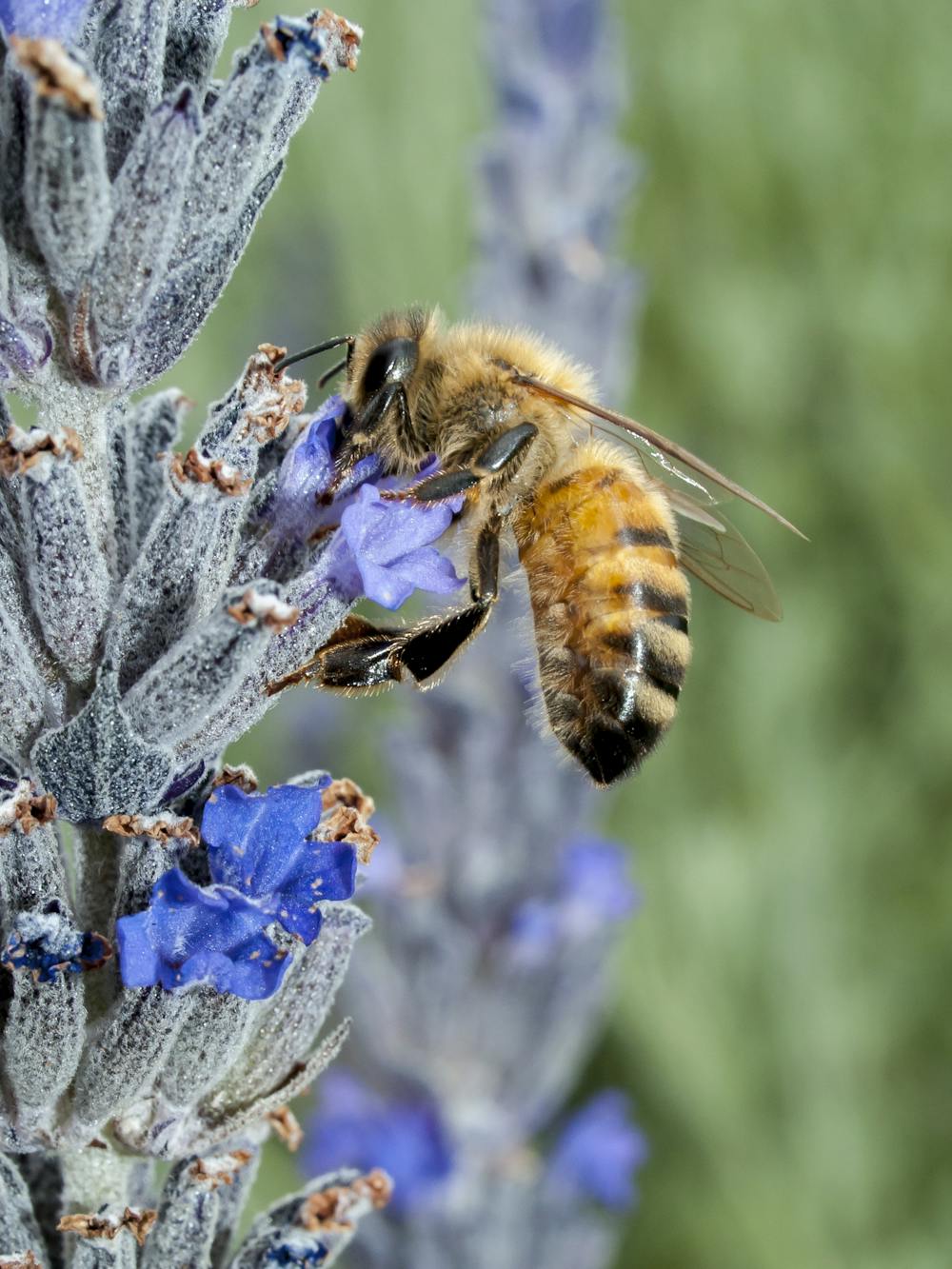
The European honey bee (Apis mellifera) fuels a valuable honey industry and contributes to agricultural pollination. Other introduced species are far less welcome.Tobias Smith
Exotic bees in Australia
The European honey bee (Apis mellifera) is the best-known introduced species, first brought to Australia in the early 1800s. It is now well-established throughout the country, with profitable industries built around managed populations.
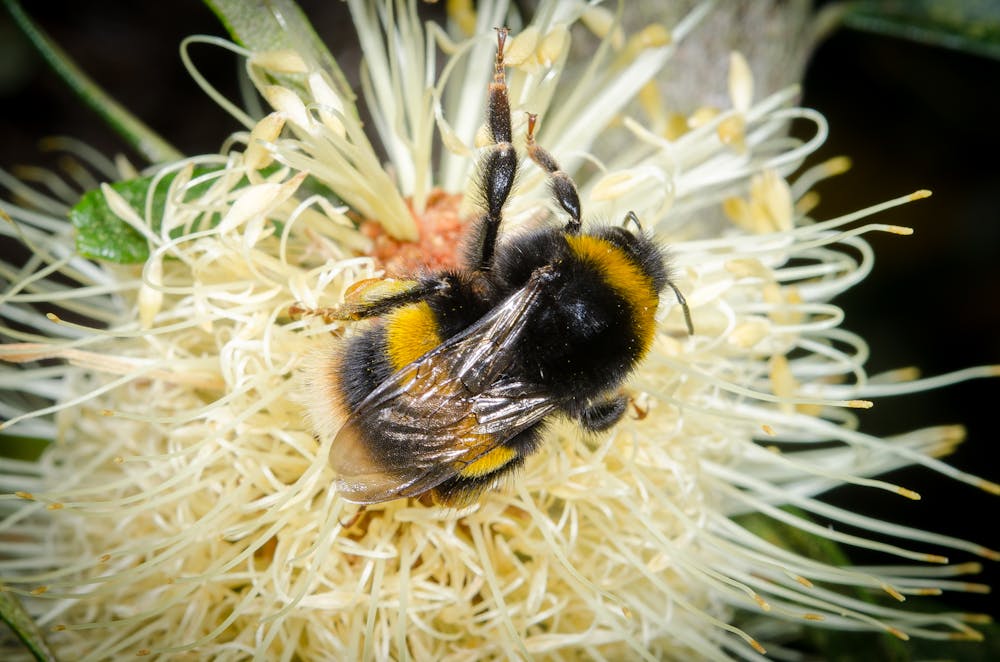
Other invasive species in Australia are less well known (or loved). The European bumblebee (Bombus terrestris) is present in high numbers in Tasmania, but isn’t thought to be established on mainland Australia.
In northern Queensland, the Asian honey bee (Apis cerana) is established around Cairns and Mareeba, from a single incursion in 2007. The original founding colony is thought to have been a stowaway on a boat that sailed to Cairns from somewhere in southeast Asia or the Pacific, where this bee is widespread.
New Asian honey bee incursions at Australian ports occur almost annually, most recently in Townsville and Melbourne. But swift biosecurity responses have so far stopped them becoming established.
The European bumble bee (Bombus terrestris) lives in large numbers in Tasmania, but is not established on the mainland.Tobias Smith, Author provided
Why should we care?
Most insects can spread and establish breeding populations before anyone notices them, so it’s important we pay attention to these small intruders.
Introduced species can bring new parasites or diseases into the country that may harm native insects – including our stingless bees that are so vital to crop pollination – or affect the valuable European honey bee industry.
While bumblebees may help commercial pollination in a handful of Australian crops, they and other introduced species can also compete with native species for resources, or spread weeds.
Most resources go to monitoring invasive species with a more dramatic and understood effect on agriculture and the environment. Bees sneak under the radar – but we’re still curious.
Take the African carder bee (Pseudoanthidium repetitum), which arrived in Australia in the early 2000s. Thanks to citizen scientists, we know they are spreading rapidly. In 2014, they were the third most common bee species found in a survey of Sydney community gardens.
An African carder bee spotted in Lismore. They are the third most common bee species in Sydney community gardens.Tobias Smith, Author provided
Just recently, we found two invasive African carder bees in a backyard in Armidale in northern New South Wales while testing out a new insect monitoring method. There are no confirmed records of this invasive bee in Armidale, although we have seen a few around town since 2017.
Although it’s usually exciting to find a new record for a native species, finding an exotic bee where it’s not supposed to be is worrying. How long have they been there, and how many others are there?
The European bumble bee was recently sighted to global biodiversity.
You don’t have to be totally sure what kind of bee you’ve spotted. Just snap some pictures and upload it to a citizen scientist app like iNaturalist with the date and location.Jean and Fred/Flickr, CC BY
Will you help us keep track?
Anyone can help keep track of potential new invasive species, simply by learning more about the insects in your local area and sharing observations on citizen science platforms such as iNaturalist, or through targeted projects like the African carder bee monitoring project.
You don’t need to be sure exactly what species you’ve seen. Uploading some clear, high-resolution photos, along with the date and location of your observation, will help naturalists and researchers identify it.
Your efforts can help us detect emerging threats, and add to our records of both native and non-native bees (and other species). Plus it’s a great excuse to get outdoors and learn more about the insect life in your area.
Broadcasting fireworks on TV was a ratings success for the ABC as 2018 turned into 2019, with 1.95 million viewers. But 60 years ago, a New Year’s Eve in front of the TV was a very different experience.
Fireworks last New Year’s Eve.Brendan Esposito/AAP
I study historical television and popular culture to develop a small sense of shared experience with the people who watched those same broadcasts.
If you were one of the Australians who happened to have a TV set in 1959, what were you watching?
Imported content
Television content varied from region to region, but looking at Melbourne’s TV Times listings can give us an interesting insight.
One key part of the evening’s viewing still resonates: international content far outweighed locally produced shows. But unlike the fare on streaming services today, the series Australians watched then weren’t exactly current.
In the afternoon, viewers could catch up with shows that had long ceased production. At 4:15 on Nine, you could watch Follow That Man, an early New York city detective series filmed from 1949 to 1954.
At 4:30pm on Seven was Hawkeye and the Last of the Mohicans, a historical action series set in regional New York in the 1750s, which originally aired in 1957.
On the ABC at 6pm, Ivanhoe, a British children’s series staring Roger Moore, was followed by an American sitcom featuring “America’s queen of comedy” Joan Stevens, I Married Joan.
After the news, the schedules started to resemble prime-time US schedules, where Westerns were at a peak of popularity.
Club Seven and In Melbourne Tonight were both variety shows. Club Seven aired from 1959 to 1961 on Thursday nights at 10pm, on a set replicating a nightclub. It was outlasted by In Melbourne Tonight, which aired for 13 years until 1970 and is still viewed as a high point for live Australian television.
A rare clip of Club Seven – unfortunately, not the episode from NYE 1959.
On 24 December, The Age reported the exciting news that Evie Hayes was “breaking a holiday in Queensland” to host Top Pops, a one-off broadcast celebrating the year in music.
On December 31, it reported In Melbourne Tonight would have two hosts: young Australian television staples Bert Newton and Graham Kennedy. The article spruiked, “One of the biggest lineups of artists ever assembled for I.M.T.”
A particular highlight would be Kennedy “featured in a vocal interpretation of 76 Trombones”, the signature song from the musical The Music Man, which was opening soon in Melbourne.
The young Graham Kennedy and Bert Newton on the set of In Melbourne Tonight.Nine
Despite Hayes’ cancelled holiday and Kennedy’s 76 Trombones, New Year’s Eve 1959 wasn’t (on television, at least) a party that carried on into the wee hours.
The ABC went off air at 12:05 and Seven at 12:30. Nine stuck around a bit longer, fitting in an episode of I Led 3 Lives (a drama about an FBI spy who infiltrated the Communist party), to outlast the rest, calling it a night at 12:50am.
Mind you, the following Thursday, the ABC’s close was scheduled for 10:55pm, Seven’s at 11, and Nine’s at 11:45.
Indeed the ABC wouldn’t start broadcasting through the night, every night, until 1993.
Even those episodes from Australia’s TV history that have survived and have been catalogued in archives can be difficult to find and access.
It’s a shame that Australia’s television history isn’t more accessible. Pop culture, like television, can be used to gain an inkling of a society’s interests and lived experiences in a way that isn’t always possible through more formal documents. It can also show how people were marginalised or excluded in Australia’s pop culture landscape.
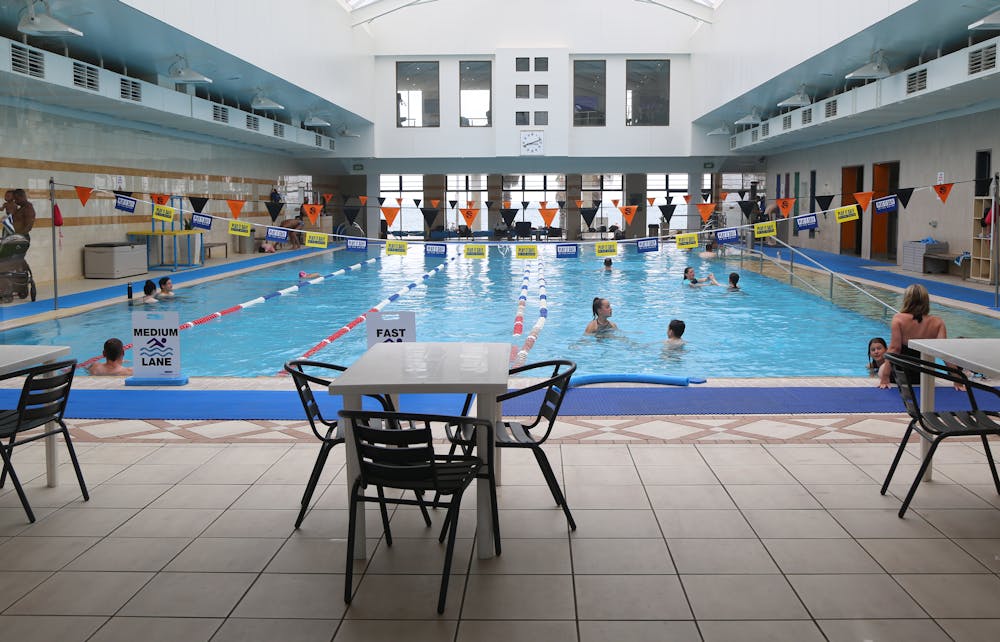
Not long ago, a mother-of-three was refused entry to a Sydney pool because of its policy of one adult for every child aged under six.
Reminding parents of their obligations, Royal Life Saving Australia chief executive officer Justin Scarr said, “life guards are not babysitters and swimming pools are not daycares.”
It’s true drownings can and do happen at public pools. Active supervision means focusing all of your attention on your children all of the time, when they are in, on or around the water.
But with a bit of policy and institutional support, we can make it easier for solo parents to go to the local pool with kids in tow.
Our research in progress suggests a group called Surfing Mums, a social network administered by and for women, may provide an instructive example.
Public pools are not just for swimming laps.Shutterstock
In Australia, public swimming pools are significant community assets. Their importance as community anchors are often obscured until we hear of plans to close them or reduce their funding.
The average Australian visits a local pool more than four times a year – that figure is equal to more than 100 million visits annually.
For women and children, swimming remains one of the most popular forms of physical activity.
And public pools are not just for swimming laps. Many also feature spas, river rides, water slides, wave pools, hydrotherapy pools and water spray grounds. Little wonder, then, swimming and other water activities are growing more popular for sport, fitness, rehabilitation and fun.
Publicly funded pools are also important sites for social connection and belonging. For people who live alone or spend long periods at home with kids, without adult conversation, the pool is a crucial part of social and physical life.
For women with children, physical activity is important, especially post-partum. Swimming after giving birth may help restore muscle tone. It also boosts strength and energy, which may be sapped after pregnancy and childbirth.
Publicly funded pools are also important sites for social connection and belonging.Shutterstock
But just how public is the public pool?
Historically, woman’s admission to and freedoms in these public spaces were closely regulated and mediated by segregation and notions of modesty. For example, woman’s aquatic dress was highly regulated to ensure decorum and propriety. Significant restrictions were placed on when and where women could bathe.
While formal restrictions of this kind no longer exist, access and usage for some women to these important public spaces can be limited.
We need to find new ways to make it easier for mums and dads to get to the pool, and ensure they can have a swim too.
So, in light of the clear need for active supervision, how can swimming pools foster the joys of childhood swimming, regarded by many as an Australian birthright?
‘Surfing mums’ at the pool
Perhaps local governments and commercial pool operators can learn a thing or two from Surfing Mums, a social network developed by two mothers who met up regularly to mind each other’s children while the other surfed.
Surfing Mums is like a playgroup, but with benefits like full public liability insurance and affiliation with the national body, Surfing Australia.
The “surf swap” system sees mums in the group partner up with one another. While one supervises the kids, the other goes for a surf and then they swap.
If used in a pool environment this swap system would ensure children are actively supervised at all times, thereby meeting Royal Lifesaving and state government policies and guidelines.
The adult supervising children would be identified by a hat and brightly coloured shirt and would not enter the water with children while the swap was in progress.
This approach means miscommunications regarding supervision, identified as a contributing factor to drowning fatalities, can be redressed.
Active supervision of children at pools is important.Shutterstock
The result? Active supervision of children, safe pool access and enjoyment for women and their families, all while parents reap the physical benefits swimming offers.
While primary supervision through this network is a focus, there may also be opportunities to provide mothers with important skills and knowledge relevant to secondary drowning prevention through learning resuscitation and lifesaving skills.
For governments at all levels this kind of initiative would have far-reaching benefits, particularly in linguistically and culturally diverse populations where swim safety skills are often less developed.
A pool-swap style system might not be the only or final answer. But creative strategies which enable supervision, connection and friendships just might keep us afloat.
When you drink alcohol it goes into the stomach and passes into the small intestine where it’s quickly absorbed into the bloodstream.
If you have eaten something, it slows the absorption of alcohol so you don’t get drunk so quickly. That’s why it’s a good idea to eat before and during drinking.
It takes your body about an hour to metabolise 10g, or one standard drink, of alcohol.
(There are calculators that help you estimate your blood alcohol level but everybody breaks down alcohol at a different rate. So these calculators should only be used as a guide.)
What causes memory blackouts?
We all have that friend who has woken up after a big night out and not been able to remember half the night. That’s a “blackout”.
It’s different to “passing out” – you’re still conscious and able to carry out conversation, you just can’t remember it later.
The more alcohol you drink and the faster you drink it, the more likely you are to experience blackouts.
Once alcohol in your blood reaches a certain level, your brain simply stops forming new memories. If you think of your brain like a filing cabinet, files are going straight to the bin, so when you later try to look for them they are lost.
How do I sober up?
If you’ve had too much, there’s no way to sober up quickly. The only thing that can sober you up is time, so that the alcohol can be eliminated from your body.
The caffeine in coffee may make you feel more awake, but it doesn’t help break down alcohol. You will be just as intoxicated and impaired, even if you feel a little less drunk.
The same goes for cold showers, exercise, sweating it out, drinking water, and getting fresh air. These things might help you feel more alert, but they have no impact on your blood alcohol concentration or on the effects of alcohol.
What causes hangovers?
Researchers haven’t identified one single cause of hangovers, but there are a few possible culprits.
Alcohol is a diuretic, so it makes you urinate more often, which can lead to dehydration. This is especially the case if you’re in a hot, sweaty venue or dancing a lot. Dehydration can make you feel dizzy, sleepy and lethargic.
An imbalance of electrolytes (the minerals our body need to function properly) can make you feel tired, nauseated, and cause muscle weakness and cramps.
Hangovers can leave you tired, dehydrated, and with an irritated stomach.Adrian Swancar/Unsplash
Too much alcohol can cause your blood vessels to dilate (expand), causing a headache. Electrolyte imbalance and dehydration can also contribute to that thumping head the next morning.
Alcohol also interferes with glucose production, resulting in low blood sugar. Not producing enough glucose can leave you feeling sluggish and weak.
Alcohol also disrupts sleep. It can make you feel sleepy at first but it interrupts the circadian cycle, sleep rhythms and REM (rapid eye movement) sleep, so later in the night you might wake up.
It can stop you from getting the quality of sleep you need to wake feeling refreshed.
Why ‘hair of the dog’ doesn’t work
There’s no way to cure a hangover, even with “hair of the dog” (having a drink the morning after). But drinking the next morning might delay the onset of symptoms, and therefore make you feel better temporarily.
Your body needs time to rest, metabolise the alcohol you have already had, and repair any damage from a heavy night of drinking. So it’s not a good idea.
If you drink regularly and you find yourself needing a drink the next morning, this may be a sign of alcohol dependence and you should talk with your GP.
Suffering from hangxiety?
Alcohol has many effects on the brain, including that warm, relaxed feeling after a couple of drinks. But if you’ve ever felt unusually anxious after a big night out you might have experienced “hangxiety”.
Over a night of drinking, alcohol stimulates the production of a chemical in the brain called GABA, which calms the brain, and blocks the production of glutamate, a chemical associated with anxiety. This combination is why you feel cheerful and relaxed on a night out.
Your brain likes to be in balance, so in response to drinking it produces more glutamate and blocks GABA. Cue that shaky feeling of anxious dread the next morning.
To ease some of the symptoms, try some breathing exercises, some mindfulness practices and be gentle with yourself.
There are also effective treatments for anxiety available that can help. Talk to your GP or check out some resources online.
If you’re already an anxious person, drinking alcohol may help you feel more relaxed in a social situation, but there is an even greater risk that you will feel anxiety the next day.
As well as eating to slow the absorption of alcohol, and drinking water in between alcoholic drinks to reduce the negative effects, you can also:
set your limits early. Decide before you start the night how much you want to drink, then stick to it
count your drinks and avoid shouts
slow down, take sips rather than gulps and avoid having shots.
If you’re worried about your own or someone else’s drinking, call the National Alcohol and other Drug Hotline on 1800 250 015 to talk through options or check out resources online.
Many desexed family pets are the ideal parents of the next generation of family companions, having demonstrated their ability to fit in with family life. Yet by desexing as early as possible, we are removing the best source of happy healthy pets from the doggy gene pool.
We argue there’s room for responsible pet owners and breeders to work together, breeding ideal companion animals and reducing the number of unwanted or unsafe dogs left in shelters.
People want their dogs to suit their family’s needs: tall or short, short-coated or non-shedding, couch potato or running buddy. We have created hundreds of breeds to meet these preferences. However, Australian pet-owners most value dogs that are affectionate, friendly, obedient and safe with children.
Such dogs are a combination of nature and nurture. Most temperament traits in dogs, including aggression, have a genetic basis. Dogs bred for working roles, such as police work, have physical and behavioural assessments to make sure they can do their jobs well.
Working dogs are carefully screened for the right psychological characteristics.AAP Image/Julian Smith
If we treat being a happy and safe companion as a job, we need to select breeding dogs with the right characteristics to succeed. This begins with carefully selecting parents who also have these traits. Many dogs who would breed perfect family pets are themselves family pets, and owners have years of observation to rely on.
A puppy’s early life is also extremely important for creating a suitable pet. Raising them in rich environments, with plenty of affection, equips puppies with important life-skills. For those destined for companionship, this experience includes regular playtime with humans and exposure to life in a modern household. These requirements highlight the need to consider where dogs come from.
Professionals, hobbyists or irresponsible owners
While we don’t have firm data on where Australians get their pets, we can safely assume there are three main sources: commercial breeders, recreational or hobby breeders, and members of the general public who fail to desex their pet dogs.
While new legislation in Victoria targets the worst puppy mills, even the best large-scale commercial operations may struggle to give puppies the attention they need early in life.
Following raids on illegal puppy farms, Victoria introduced strict anti-pet-shop laws.AAP Image/RSPCA Victoria
Meanwhile, recreational breeders, who are often strongly motivated to provide the best upbringing possible, may not select their breeding dogs on the basis of their performance as pets.
Instead, they may focus on success in the show ring or pedigree bloodlines, potentially producing very expensive dogs ill-equipped to be great pets.
And what of the traditional source of the family dog – pet owners who fail to desex their pets? If high rates of desexing exclude from the gene pool those really wonderful pet dogs owned by “responsible” owners, and only irresponsible owners allow their dogs to breed, the resulting puppies are far less likely to possess the traits so desired by prospective homes.
One has only to visit a local shelter to see the unfortunate results of accidental matings among the many wonderful dogs seeking a new home. Thousands of dogs are surrendered in Australia shelters every year.
To secure future generations of successful companion dogs, a new approach to breeding is needed. Restricting who can breed, and issuing penalties to those who break the rules, is one strategy that must of course be developed and enforced.
All breeders must be educated about careful selection of parents, and suitable early experiences in breeding puppies that will excel as pets.
But the final piece in the puzzle should be collaboration between responsible breeders and pet owners in the breeding process.
Whosa good boy? Whoosa very good boy? Who’s integrating very well with the family unit? You are! Yes you are!DORIS META F/Flickr, CC BY-NC
If more responsible dog owners were encouraged not to desex their dogs at an early age, but to wait until their dogs’ physical and behavioural health has been thoroughly demonstrated, the very best companion dogs could be permitted to contribute their genes to the next generation.
This more nuanced approach, where owners and breeders work together to identify dogs of exemplary health and temperament, could enrich the companion dog gene pool and result in happier owners, happier dogs, and emptier shelters. Although not desexing companion dogs does carry risks – from behavioural issues to unwanted puppies – we believe this is worth considering. Always discuss your concerns with your veterinarian. Not snipping in haste may be a better option than snipping everything.
Source: The Conversation (Au and NZ) – By Florence Monique Boulard, Associate Dean Teaching & Learning and Senior lecturer, James Cook University
The school year is over and holidays are upon us. But that doesn’t mean your children’s learning experiences can’t continue.
If you’re planning an overseas trip with your family, you’re in for many benefits. Research shows travel has a positive impact on mental and physical health, and family relationships.
Travel is also an educational opportunity. It’s a rich experience seeing different parts of the world and understanding other cultures. And there are several things you can do to support your children’s learning.
How travel educates
The way children learn while travelling is in many respects comparable to what educational researchers call play-based learning. Play-based learning and travel stimulate children’s minds by boosting their creativity and imagination. Both can also help develop social and emotional skills and encourage language development.
Travelling exposes children to new scenarios and problems to solve – such as following a certain route on a map. They explore new food, encounter people communicating in a different language, notice cars driving on the opposite side of the road and billboards showcasing products they have not seen before.
All of their senses are challenged as they go through these new experiences.
Children can problem solve by looking at maps and figuring out directions.from shutterstock.com
New experiences can provoke some anxiety, which is what sociologist and education professor Jack Mezirow refers to as disorientating dilemmas. He argues such dilemmas are the first step to transformative learning, where the learner’s existing assumptions are challenged and beliefs transformed.
Although Mezirow often associates transformation with elements of life crises, others suggest transformative learning can happen in different contexts, most notably travel.
But transformative learning usually comes at an emotional cost, such as a change of routine which can lead to mixed emotions, especially for children. This is why travelling as a family provides a buffer, as it often promotes a safe environment.
Some of the richest learning, for a child, can be disguised as exploration and adventure. Parents can maximise such learning during travel by subtly incorporating intentional teaching to the experience, just as educators do in play-based learning scenarios.
Here are some ways to do this.
1. Do some pre-reading about the destination
This will help you identify where and how learning might occur. You might also engage your children in this. Say you’re going on a cruise to the South Pacific. Prior to departing you might look at a map of the Pacific with your children to identify the various islands located in this part of the world.
You could also encourage your children to discover the special landmarks of different places using Google Earth. Such activities will support the development of your children’s prediction skills. This helps children anticipate future experiences which increases their intellectual involvement with them.
Educational research has shown the act of predicting strengthens connections between children’s new knowledge and their existing understanding of the world.
2. Learn some of the language together
Learning even a little of the local language will open up aspects of the culture you may not have otherwise experienced.
Together with your children, you can start learning the basics of the new language by downloading some interactive language apps. Another fun way to expand your vocabulary and improve your pronunciation is by singing songs in the target language.
Knowing a bit of the local language is a demonstration of respect which means people are more likely to open up to you, further supporting learning opportunities.
Encourage your children to take notice of things around them.from shutterstock.com
3. Model an inquiring mind
By asking and responding to questions with your children, you’re encouraging new knowledge and helping them engage in critical and creative thinking.
For example, when you are walking down the street of the city you are visiting, encourage your children to take notice of what is going on around them and engage in open-ended questions such as:
“How does this supermarket compare to the one we normally go to back home?”
“Why do you think the houses are built that way?”
4. Throw in a little reflection at the end of each day
Travel will provide so many learning experiences, you will need to allow time for your child to pause and make sense of them. Any teacher will tell you reflecting is often when the deep connections are made between new experiences and existing world views.
Some children will reflect of their own accord, but establishing a routine of doing this together will make sure it happens. The traditional travel diary is still a great tool to engage in self-reflection. Others might enjoy looking at photos taken and reflect on the day through family conversations.
Learning is a life-long journey that extends well beyond the walls of the traditional classroom. By planning for just a little intentional teaching, you can help your children learn to critically think about and appreciate the world around them.
Aboriginal and Torres Strait Islander readers are advised this article contains images and names of deceased people.
Aboriginal women and girls in lutruwita (Tasmania or Van Diemen’s Land) were superb swimmers and divers.
For eons, the palawa women of lutruwita had productive relationships with the sea and were expert hunters. Scant knowledge remains of these women, yet we can find fleeting glimpses of their aquatic skills.
Wauba Debar of Oyster Bay’s Paredarerme tribe was stolen as a teenager to become, according to Edward Cotton (a Quaker who settled on Tasmania’s East Coast), “a sealer’s slave and paramour”.
Servitude and rescue
Foreign sealers arrived on the Tasmanian coastlines in the late 18th century. The ensuing fur trade nearly destroyed the seal populations of Tasmania in a matter of two decades.
At the same time, life became extremely difficult for the female palawa population.
Slavery was still legal in the British Empire, and so the profitability of the sealing industry was underpinned by the servitude of palawa women.
Sporadic raids known as “gin-raiding” by sealers rendered the coastlines a place of constant danger for female palawa.
Pêche des sauvages du Cap de Diemen (Natives preparing a meal from the sea). Drawn by Jean Piron in 1817. Engraving by Jacques Louis Copia.National Library of Australia
Little is known of Wauba Debar other than tales of a daring rescue at sea. Though variations to her story can be found, it most frequently details her long swim and lifesaving efforts in stormy conditions. As one version tells it:
The boat went under; the two men were poor swimmers, and looked set to drown beneath the mountainous grey waves. Wauba could have left them to drown, and swim ashore on her own. But she didn’t.
First, she pulled her husband under her arm — the man who had first captured her — and dragged him back to shore, more than a kilometre away. Wauba next swam back out to the other man, and brought him in as well. The two sealers coughed and spluttered on the Bicheno beach, but they did not die. Wauba had saved them.
Death at sea
Sadly, no one was there to rescue Wauba when she needed it. Her demise during a sealing trip, was at the hands of Europeans.
According to a sailor’s account to Cotton, Wauba was one of the “gins” captured to take along on a whaleboat sailing from Hobart to the Straits Islands (Furneaux Group) as “expert hunters, fishers, and divers, as in most barbarous tribes, the slaves of the men”.
The sailing party camped at Wineglass Bay but woke to find the women and dogs had vanished. A group set off to pursue those who’d taken them. In his 1893 account, Cotton speculated in The Mercury newspaper on the likely cause of her death:
Wauba Debar had, I suppose, been captured in like manner … and possibly died of injuries sustained in the capture, which no doubt was not done very tenderly.
The crew interred Wauba at Bicheno, and marked her grave by a slab of wood with details inscribed.
Accounts differ as to when this actually took place. In 1893, elderly Bicheno residents said Wauba was buried 10 years before the date on the headstone, placing her death around 1822.
However, in his diary entry on 24 January 1816, Captain James Kelly described how he hauled up in Waub’s Boat Harbour due to the heavy afternoon swell. Considering the area was already named after her, it can be concluded that Wauba was likely buried before 1816.
Wauba Debar did not live to be a mother of the tribe of half-bred sealers of the Straits, which became a sort of city or refuge of for bushrangers in aftertime … But she, poor soul was buried decently, perchance reverently, and I suppose other of the captured sisters would be present by the graveside on the shores of that silent nook near the beached boat.
Here lies Wauba
Wauba’s reputation was such that in 1855 the public of Bicheno decided to commemorate her by erecting a railing, headstone, and footstone (paid for by public subscription) at her grave, with “Waub” carved into it.
John Allen, who had been granted land nearby, donated ten shillings towards the cost of the gravestone – notwithstanding his involvement in a massacre at Milton Farm, Great Swanport, 30 years earlier.
Here lies Wauba Debar. A Female Aborigine of Van Diemen’s Land. Died June 1832. Aged 40 Years. This Stone is Erected by a few of her white friends.
Whether prompted by a sense of loss, guilt, or admiration, the community memorialised Wauba, and by extension, the original inhabitants of the land.
Yet by the late 1800s, European demand for Aboriginal physical remains for “scientific investigation” was high. In 1893, the Tasmanian Museum and Art Gallery was determined to procure the remains of Wauba.
Waub’s Bay, Bicheno, is named after Wauba Debar.Shutterstock
The prevailing ethnological theories believed that the study of Australian Aboriginal people, and particularly Indigenous Tasmanians, would reveal much about the earliest stages of human development and its progress.
Wauba’s grave was exhumed, put into a box, labelled “Native Currants”, and dispatched to Hobart.
The locals were outraged. An editorial in the Tasmanian Mail newspaper condemned the act as “a pure case of body snatching for the purposes of gain, and nothing else” that “the name of Science is outraged at being connected with”.
Snowdrops bloom
Wauba’s memorial is the only known gravestone erected to a Tasmanian Aboriginal person during the 19th century, and she is the only palawa woman known to have been buried and commemorated by non-Indigenous locals.
In 2014, Olympic swimmer and Bicheno resident Shane Gould dedicated a fundraising swim to Wauba Debar’s swimming abilities and memory.
The European styled memorial serves as a reminder of the more turbulent interactions between the two peoples that shaped Tasmania’s history from the 1800s onwards.
Wauba’s empty grave is Tasmania’s smallest State Reserve. Her remains were returned to the Tasmanian Indigenous community in 1985. Snowdrops are said to bloom around the grave every spring.
Today’s focus is phosphorus, an element that is vital for life but of limited supply. But we can recover phosphorus from a source that we all give away freely, every day, our urine.
Phosphorus, number 15 on the periodic table, can be highly toxic and flammable and has been used in warfare as an incendiary device, yet it is also essential for life.
As the famous science writer Isaac Asimov said in his 1974 book, Asimov on Chemistry:
Life can multiply until all the phosphorus has gone and then there is an inexorable halt which nothing can prevent.
That’s because phosphorous is essential to all living organisms. It forms the backbone of our DNA as well as the molecule adenosine triphosphate (ATP) that is found in cells and captures chemical energy from the food we eat.
We have yet to find a single living being that does not require phosphorous to survive. But we don’t have an endless supply of phosphorus, and that’s where my research comes in.
Demand grows for phosphorus
Demand for phosphorus and nitrogen increased dramatically in the 20th century as it was found to play a crucial role in fertiliser used for growing crops.
In just over 50 years (between 1961 and 2014) fertiliser production increased tenfold due to the so-called green revolution.
Phosphorus is an important ingredient in many fertilisers used to help grow our plant based foods.Shutterstock/otick
This allowed for a worldwide increase in the agricultural production, particularly in the developing world, which was used to feed an ever-growing global population.
The high demand for nitrogen was met by ramping up a process that captures nitrogen and hydrogen from fresh air and uses it to synthesise ammonia (the major nitrogen-based fertiliser). As the air in Earth’s atmosphere is made of 78% nitrogen, synthetic ammonia production was only limited by its cost.
But phosphorous is generally stored in solid or liquid form, and the cheapest way to cope with the high demand for phosphorous fertiliser was to extract if from phosphate rocks.
Phosphate rocks are a resource that is both limited and not equally distributed. The top five phosphate rocks holders – Morocco and Western Sahara, China, Algeria, Syria, and Brazil – account for 84% of the world reserves. Australia holds just 1.6%.
One solution is to look for other supplies of phosphorus, and that’s where you and I can play a role. Our urine is an excellent source of raw material for phosphorous.
Each one of us excretes up to half a kilogram of phosphorous per year, just through our urine. This makes urine the single largest source of phosphorous from urban areas.
Back in the 17th century, the German chemist Hennig Brandt chose urine to isolate elemental phosphorous. In his experiment, he boiled hundreds of litres of urine down to a thick syrup until a red oil distilled up from it.
He collected the oil and cooled down the urine. After discarding the salts formed at the bottom of the mixture, he added back the red oil. By heating back the mixture for 16 hours, a white fume would come out, then oil, and finally phosphorous.
He was actually searching for the legendary Philosopher’s Stone that would supposedly turn any metal into gold. He might have failed in that, but he showed how easy it was to isolate phosphorous from urine with unsophisticated tools.
Reduce, reuse, recycle
Today’s approaches to recycling of phosphorous from our wastes are way more practical and economical compared to Brandt’s method.
New urine-derived fertilisers have entered the market and the race is on to find the optimal technology to convert smelly urine into a safe, non-odorous commercial fertiliser.
In Australia, researchers from the University of Technology Sydney have developed a process that uses urine as a raw material to produce fertiliser and freshwater. Selected microorganisms are used to oxidise the (smelly) compounds in raw urine and convert volatile ammonia into more stable nitrates.
The treated urine is then filtered through a membrane, which retains the microorganisms allowing for their re-use, while allowing the soluble phosphorus and nitrogen to pass through. Treated and filtered urine is concentrated to reach nutrients concentration similar to commercial fertilisers.
At present, this fertiliser – named UrVal short for “You are Valuable” – is being tested at the Royal Botanical Garden in growing parsley.
Parsley grown using UrVal fertiliser at the Sydney Royal Botanical Garden.Dr. Ibrahim El Saliby, Author provided
Clearly, these new innovations in nutrients recovery from wastes allow us to reduce the dependence on a finite resource (phosphorous).
But they could also enable us to explore the possibility of one day producing food outside of planet Earth where we need fertiliser. Phosphate rocks may not be available in such places, but we’d have plenty of urine.
Screens are everywhere, including in the palms of our hands. Children see how much time we adults spend on our smartphones, and therefore how much we seem to value these devices – and they want to be a part of it.
Children see us constantly looking up information we need to know, and being continuously connected. It’s only natural that they should want to copy this behaviour in their play, and “practise being an adult”.
Most people have an opinion about children and technology, and the media regularly present stories of their potential for learning, or horror stories of the damage they can cause. My research takes a slightly different tack.
Rather than studying children’s screen use per se, I looked at how they play with old and discarded devices, such as a hand-me-down phone handset or an old and defunct laptop that has otherwise outlived its usefulness.
Many early childhood education centres contain play spaces set up to mimic situations in everyday adult life. Examples include “home corner” containing kitchen equipment, of other situations such as offices, hairdressing salons, doctors’ surgeries, and restaurants. These spaces might also let children play at using mobile phones, computers, iPads, EFTPOS machines, or other electronic devices.
I observed classes of 4 and 5-year-olds at two early education centres as they played imaginatively using technologies, to find out how they use devices in their play.
Facebook aficionados
Some of the children’s behaviours were fascinating and eye-opening.
Four-year-old Maddie, for example, “videoed” her educator dancing, and then said she was going to post it to Facebook. She knew the process involved, even though she had only ever watched her mother post, and had never done it herself.
Four-year-old Jack made a “video camera” from cardboard boxes and pretended to film other children. It even had a screen where you could watch the footage he had shot.
Another educator told me her two-year-old child knows the difference between her work phone and her personal phone, and uses a different voice while pretending to talk on each.
In my research, children put phones in pockets or handbags before they went off and played, one child stated “I can’t go out without my phone!”
Practise and pretend
During pretend play, children are often acting at a higher level to practise new skills.
Early childhood educators can use this kind of play to help children understand complex concepts and situations. For example, I have observed preschool children acting out tsunamis in the sandpit, discussing X-rays and broken bones, and showing a child how to care for a doll to practise interacting with a new sibling.
Technologies are no different. Parents and educators can use pretend play with technologies to teach children useful life lessons, such as how to behave appropriately with mobile phones, and when it is appropriate to use them.
In the Facebook example above, the educator could have had a conversation with Maddie about asking permission before taking a video of someone else and posting it to Facebook. They could ask questions like “how would you feel if someone took a video of you dancing and then posted it to Facebook?”
When the children were playing restaurants, one child declared: “no screens at the table!” The children then negotiated that it was okay when the call was very important, or if they needed to look something up to help with whatever the group was discussing. In this way, the children displayed their understanding of the importance of social interactions.
Not only can educators teach children through play, they can also model appropriate behaviour with technologies. By asking children if it is alright to take a photo or video of them, showing the child their image before it is shared with others, and being present and not looking at a screen when a child is speaking, we can show children we respect them and behave ethically towards them.
So before you throw away your broken laptop or your old mobile, consider donating it to your local early childhood centre or, if you have children in your own home, give it to them to use as a toy. You might be surprised at what they will teach you.
The sun’s shining and there’s a trampoline in the backyard. Yet your kids want to spend their summer holidays lying on the couch playing computer games all day.
So what can you do to help your school-aged kids stay active and healthy this summer?
In 2016, a US study found that all the increase in fatness of school-aged children occurred over the summer holidays. During term time, kids get leaner and leaner, only to put it all back on, and then some, during the holidays.
Their fitness also declines during holiday time. To make matters worse, changes are greater in kids from poorer, less educated backgrounds, and the gap between rich and poor widens over multiple summer holidays. The work of the school is undone at home.
What’s going on, and what can parents do about it?
Holidays are different
Kids spend their time differently on holidays, as we showed in a study published earlier this year.
On holidays, Australian kids get 58 minutes a day more screen time than during term time, including spending 16 minutes a day more playing video games. They get 16 minutes less sport and vigorous exercise each day.
They also get 40 minutes more sleep, staying up about 40 minutes later, and sleeping in 80 minutes more.
All this adds up: their overall energy expenditure is more than 5% lower. Over six weeks of school holidays, that amounts to an extra half kilogram of fat in a typical 11-year old, and that’s without counting changes in diet.
Kids eat differently on holidays, too.
On school days, kids can only eat during recess and lunch. Their options are limited by school-based healthy eating initiatives such as “fruit time”, healthy canteen menus, and the curriculum about healthy lunchboxes.
All that goes out the window on holidays. Kids fall victim to the gravitational pull of the big white box in the kitchen.
On weekends and school holidays, kids have greater choice of how much, what and when they eat. Most (knowingly) choose less healthy options.
Later bedtimes mean more screen time and more snacking. Longer lie-ins often mean kids skip breakfast.
The importance of structure
US researchers coined the idea of “structured days”. School days, they argue, are characterised by consistency and structure, which regulate how kids use their time, and when and what they eat.
On school days, for example, two-thirds of kids get up within an hour of each other (roughly between 6:30 and 7:30 am); on non-school days, it is over three hours (between 6:45 and 10:05 am).
Their review of 190 studies compared children’s sleep, physical activity, sedentary behaviours and diet on school days and weekends. They found that in 80% of studies, weekends were associated with unfavourable activity and dietary patterns.
Unstructured time during school holidays can lead to longer lie-ins and missed breakfasts.from www.shutterstock.com
During school term, the unhealthy impacts of unstructured weekend days are diluted. In contrast, the school holidays, and particularly the summer holidays, involve a long string of unstructured days and unfavourable activity and dietary behaviours. This leads to a decline in fitness and accelerated weight gain.
The “filled-time perspective” describes the sensible idea that when children’s time is filled with favourable activities, the time cannot be filled with unfavourable ones.
This suggests it is helpful to fill children’s time with favourable activities, like physical activity and excursions, to reduce the time available for unfavourable activities, such as snacking and screen time.
So what can parents do to keep kids healthy and active on school holidays? Here are four ways, with a proven track record.
1. Get kids outside
Studies consistently show time spent outside is strongly associated with both physical and mental health. That effect is likely due to kids being more physically active outdoors.
An estimated 1.3 million French school children go off to their “colonies de vacances” each summer. In the US, over 14 million kids attend summer camps.
Children who spend more time in summer camp are more active than those who spend more time at home over the summer holiday.
Some 80% of boys and 73% of girls who attended a summer day camp met the daily physical activity recommendations of 60 minutes per day — about four times as many as those reaching that target during the year.
3. Activity before screen time
Only allow screen time when the kids have been physically active, even if that only means doing household chores. On holidays, kids spend 35 minutes more each day doing chores, so this may be your chance to get your kids to pitch in.
4. Plan the day
Organise time for physical activity with your child. Have a game of beach cricket or a mini-Olympics in the backyard. Take the dog for a walk. Organise excursions to the museum, or even shopping, where they get to walk around. Have regular times for meals and relaxation.
Source: The Conversation (Au and NZ) – By Euan Ritchie, Associate Professor in Wildlife Ecology and Conservation, Centre for Integrative Ecology, School of Life & Environmental Sciences, Deakin University
2019 might well be remembered as the year the world caught fire. Some 2.9 million hectares of eastern Australia have been incinerated in the past few months, an area roughly the same size as Belgium. Fires in the Amazon, the Arctic, and California captured global attention.
As climate change continues, large, intense, and severe fires will become more common. But what does this mean for the animals living in fire-prone environments?
Our new research, published recently in the Journal of Animal Ecology, looked at studies from around the world to identify how predators respond to fire.
We found some species seem to benefit from fires, others appear to be vulnerable, and some seem indifferent. In a changing climate, it’s urgent we understand how fires affect predators – and hence potentially their prey –in order to keep ecosystems healthy.
Predators: the good and the bad
Large predators, like wolves and lions, often play important roles in ecosystems, regulating food webs by reducing the numbers or changing the behaviour of herbivores and smaller predators. Many large predators are in dire straits within their native range, while introduced predators, such as feral cats and red foxes, have spread to new regions, where they have devastated native wildlife .
Fires can offer new opportunities as well as problems to predators. Some predators take advantage of charred, more open landscapes to hunt vulnerable prey; others rely on thick vegetation to launch an ambush.
But until now, we have not known which predators are drawn to fire, which are repelled by it, and which don’t care either way. Synthesising information on how different kinds of predators (for example, large or small, pursuit or ambush) respond to fire is vital for both the conservation of top predators and to help protect native prey from introduced predators.
Predators are reacting differently to fire.Adam Stevenson/Reuters
Some like it hot
Our research reviewed studies from around the world to identify how different vertebrate predators (birds, mammals and reptiles) respond to fire in different ecosystems.
We found 160 studies on the response of 188 predator species to fire, including wolves, coyotes, foxes, cats, hawks, owls, goannas and snakes, amongst others. The studies came from 20 different countries, although most were from North America or Australia, and focused on canine and feline species.
Some predators seem to like fire: they are more abundant, or spend more time in, recently burnt areas than areas that escape fire. Our review found red foxes (Vulpes vulpes) mostly responded positively to fire and become more active in burned areas.
Raptors have even been observed in Northern Australia carrying burning sticks, helping to spread fire and targeting prey as they flee the fire.
For other predators, fire is bad news. Following Californian wildfires, numbers of eastern racer snakes fell in burnt areas. Likewise, lions avoid recently burned areas, because they rely on dense vegetation from which to ambush prey.
A global summary of studies examining predators and fire.
The authors of the papers we reviewed thought food availability, vegetation cover, and competition with other predators were the most important things affecting species’ responses to fire.
But perhaps more surprising was that most species, including bobcats and the striped skunk, appeared largely unaffected by fire. Of the affected species, some (such as spotted owls) responded differently to fire in different places.
Overall, we found it is difficult to predict how a predator species will respond to fire.
We still have a lot to learn
Our results show while many predators appear to adapt to the changes that fires bring about, some species are impacted by fire, both negatively and positively. The problem is that, with a few exceptions, we will struggle to know how a given fire will affect a predator species without local knowledge. This means environmental managers need to monitor the local outcomes of fire management, such as fuel reduction burns.
There may be situations in which predator management needs to be coupled with fire management to help prevent native wildlife becoming fox food after fire. There has even been trials to see if artificial shelters can help protect native wildlife from introduced predators after fire.
Getting our knowledge base right
One thing that has hampered our research is the lack of contextual information in many studies. No two fires are the same – they differ in size, intensity, severity, and season – but these details are often absent. The literature is also biased towards dog-like and cat species, and there are few studies on the response of predators to fire in Africa, Asia, and South America.
It is important to note that some predator responses to fire may be overlooked due to the way experiments were carried out, or because monitoring happened too long after the fire.
Unifying how fire, predator numbers and environmental features are recorded would help future studies predict how predators might react to different types of fires in various situations.
As wildfires become more frequent and severe under climate change, understanding how fire intensity and frequency shapes predator populations and their prey will be critical for effective and informed ecosystem management and conservation.
In the years since selfie sticks went global, it has become clear that the mobile phone has changed the way we travel. The ubiquity of social media means tourists can now produce content on the move for their networked audiences to view in close to real time.
Where once we shared slideshows post trip and saved prints and postcards as keepsakes, we now share holiday images and selfies from the road, sea or air — expanding the “tourist gaze” from the traveller to include remote audiences back home.
Travelling has gone from a solitary quest to a “social occasion”. As such, gazing is becoming inseparably linked with photography. Taking photos has become habitual, rendering the camera as a way of seeing and experiencing new places.
Travellers take selfies that present both locations and people in aesthetically pleasing and positive ways.
Indeed, the “instagrammability” of a destination is a key motivation for younger people to travel there – even if filters and mirrors have been used to create a less than realistic image.
This transforms the relationship between travellers and their social networks in three important ways: between tourists and destination hosts; between fellow tourists; and lastly, between tourists and those that stay home.
The urge to share travel imagery is not without risk. An Australian couple were released from detention in Iran in October, following their arrest for ostensibly flying a drone without a permit.
Other tourists earned derision for scrambling to post selfies at Uluru before it was closed to climbers.
Meanwhile, there is a sad story behind the newly popular travelgram destination Rainbow Mountain in the Peruvian Andes. It has reportedly only recently emerged due to climate change melting its once snowy peaks.
Testing the effects
To understand the way social media photography impacts travelling, we undertook an exploratory study of overnight visitors at zoological accommodation in lavish surrounds.
We divided 12 participants into two groups. One group was directed to abstain from posting on social media but were still able to take photos. The second group had no restrictions on sharing photos. Though the numbers were small, we gathered qualitative information about engagement and attitudes.
Participants were invited to book at Jamala Wildlife Lodge in Canberra. The visit was funded by the researchers — Jamala Wildlife Lodge did not sponsor the research and the interviewees’ stay at the Lodge was a standard visit. We then conducted interviews immediately after their departure from the zoo, critically exploring the full experience of their stay.
The study confirmed that the desire to share travel pictures in close to real time is strongly scripted into the role of the tourist; altering the way travellers engage with sites they are visiting, but also their sense of urgency to communicate this with remote audiences.
Pics or it didn’t happen
Participants Mandy and Amy were among those instructed to refrain from posting pictures to social media while at the zoo. They described having to refrain from social media use as a disappointment, even though it seemed to further their engagement.
Interviewer: Did you look at your social media throughout your stay or did you refrain?
Mandy: A bit yeah. But even then, probably not reading it as much as I often would. I don’t think I commented on anything yeah.
Amy: Even today when we put something up [after staying at the Zoo] about the things we’d done today and only a few people had liked it, there was that little bit of disappointment that ‘Oh more people haven’t liked my post.’ Where we didn’t have that for the previous 24 hours [because of the experiment] … because nobody knew about it.
The tension between capturing and experiencing travel is ever-present.Shutterstock
The desire for social media recognition resumed after leaving the zoo. For Michelle, posting after the experience presented new concerns:
Interviewer: How did you feel about not being able to post?
Michelle: Spanner in the works! For me personally not being able to post was a negative experience because I wanted to show people what we’re doing, when we’re doing it.
And I also feel, like a couple of people knew we were going to the zoo, right, and knew that we couldn’t use social media. So, when I eventually post it, they’re going to go, ‘She’s been hanging on to those and now she’s posting them and that’s just a bit weird.’ Like, to post it after the event. Everyone normally posts it in real time.
Later, Michelle commented that withholding content from posting to social media also diminished a part of the experience itself:
I sort of feel like if we don’t share the photos it’s like a tree fell down in the forest and no one heard it, like, we’ve had this amazing experience and if I don’t share them, then no one’s going to know that we had this experience, you know, apart from us.
Tips garnered from travelgrammers fill lots of online video tutorials.
Centre Stage
Digital photography and social media transform the relationship between the travelling self and its audience, as individuals have an expanded — and potentially diversified — audience.
The perfect digital postcard now incorporates the self centrestage. As one participant suggested:
Shannon: It almost feels like it’s kind of an expected behaviour when you are doing something touristy … We’ve actually had tour guides before … kind of a bit disappointed if you don’t take a photograph.
The purpose of photography has shifted from a memory aid to a way of sharing experience in the moment. There is tension now between the need to capture tourist experiences for digital sharing and individual engagement in the tourist activity. Decrying the desire to use photography as a way of communicating experience will not constructively address this tension.
To ensure tourism sustainability, and engagement with their target market, tourism providers need to explore better ways to manage travellers’ face-to-face and digital engagement.
Digital engagements have become a defining part of travel, and organisations should be encouraged to promote online sharing of experiences — phone charging stations and photo competitions were two suggestions offered by our interviewees.
In contrast, device-free days or activities could be another way to encourage face-to-face engagement and prompt tourists to be more considered with their online sharing.
Source: The Conversation (Au and NZ) – By Tanya Hill, Honorary Fellow of the University of Melbourne and Senior Curator (Astronomy), Museums Victoria
A partial solar eclipse will occur across northern Australia on December 26. During the afternoon, the Moon will pass in front of the Sun, partially blocking the Sun’s bright light.
The eclipse will take place north of Geraldton (WA), Alice Springs (NT) and Townsville (QLD). These towns will barely witness the eclipse, as from their vantage point the Moon just skims past the Sun’s outer limb.
Further north, the Moon will hide more of the Sun. For Australia, Darwin will experience the greatest eclipse, with up to 31% of the Sun’s area blocked by the Moon.
However, there won’t be any noticeable effects to let you know that the eclipse is occurring. The daylight will appear just as bright – it doesn’t begin to dim until around 80% or more of the Sun is blocked out.
The partial solar eclipse on December 26 is visible from northern Australia.Xavier M. Jupier / Museums Victoria
To view the eclipse, be sure to take the necessary precautions to see it safely, without risking your eyesight. Most importantly, never look directly at the Sun. The timings and appearance of the eclipse for other locations can be found at timeanddate.com.
Ring of fire
Australia’s experience of the eclipse is relatively modest because we lie on its outskirts. The main event is happening further north, in a narrow band stretching from Saudi Arabia, through southern India, Sri Lanka, Malaysia and out to the island of Guam.
View the eclipse from within that band (including the city of Singapore), and you will see a special type of solar eclipse known as an annular solar eclipse.
Ring of Light in Outback Australia, Northern Territory, May 2013.Noeleen Lowndes
During an annular solar eclipse the Moon passes directly in front of the Sun – as it does during a total solar eclipse – but in this instance, the Moon is too small to fully obscure the Sun from view.
Instead of eclipsing or hiding the Sun, the Moon turns the Sun into a spectacular ‘ring of fire’ that encircles the dark Moon.
It’s a quirk of nature that Earth has a moon that is the right size (about 400 times smaller than the Sun) and is at the right distance (about 400 times closer to Earth than the Sun is) for a total solar eclipse to occur.
But since the Moon follows an elliptical orbit around the Earth, its distance varies slightly throughout its monthly orbit. If the Moon happens to be at or near the most distant part of its orbit during a solar eclipse, then the Moon will appear slightly smaller in the sky leading to an annular solar eclipse.
How to see the eclipse
A way to see the eclipse – while protecting your eyesight – is to project an image of the Sun onto another surface. This also works as a great way to share the moment with others and to enable younger children to share in the experience.
Share the view, with this easy to make and effective pin-hole camera.Sid/flickr
Make a small hole in the bottom of a plastic cup (or piece of cardboard) and with your back towards the Sun, hold the cup so that sunlight passes through the hole and onto a flat surface such as a piece of paper or a wall.
The image of the Sun will be small and faint. But it is generally enough to show that the Sun is no longer a complete circle. It works especially well if you track the changing shape as the eclipse slowly progresses.
A colander is a ready to use pin-hole camera, creating many pretty images of the eclipsed Sun.John Lord/flickr
Specially designed eclipse glasses can be used to look at the Sun directly as they block out most of the light. Make sure they fit well and there are no scratches or other signs of wear or tear. Also it’s important to remember (especially for children) to look away from the Sun before putting on or taking off the glasses.
Eclipse glasses can also be used to look for large sunspots – dark spots or blemishes on the Sun’s surface that are slightly cooler than their surroundings because of strong magnetism. These spots appear quite small but are typically larger than the Earth – an incredible reminder of just how big the Sun truly is.
However, don’t be surprised if you see a blank Sun with no spots at all. We are currently in a deep solar minimum. As I write, the Sun has had no sunspots for over a month. In fact, 2019 has broken the known sunspot record – more than 270 days this year have featured a blank Sun, without any spots. That’s more than any other year since the Space Age began. You can follow spaceweather.com to track the daily sunspot count.
Save the date
This is the third solar eclipse for the year. But while they happen fairly regularly, you must be in the right location to have the full experience. For any specific location, it can be years between partial solar eclipses or centuries can pass between total solar eclipses.
The next total solar eclipse for Australia will occur in April 2023. The band of totality will just clip Australia near Exmouth at the tip of the North West Cape in Western Australia.
However, the eclipse worth waiting for will occur on July 22, 2028. Totality will stretch across Australia, from the top of Western Australia down through New South Wales, passing directly over Sydney. That will be an amazing sight to see.
There’s an enourmous variety of sunscreens to choose from. Majorsupermarkets each sell more than 60 options. And one large pharmacy chain sells more than 100.
So how do you choose sunscreen that’s right for you?
The sun protection factor, or SPF, should be at least 30, preferably 50. SPF describes how much UV gets to the skin. SPF50 allows just 1/50th (2%) of the UV to reach the skin
Go for broad spectrum protection, which filters the full UV light spectrum. UVB rays (290-320nm wavelengths) are responsible for most sunburn and DNA damage, but UVA rays (320-400nm) also cause DNA damage and accelerate skin ageing
Aim for water resistant formulations, which stay on longer in sweaty conditions, and when exercising or swimming. But no sunscreen is completely waterproof
Make sure the sunscreen is approved in Australia. Approval from the Therapeutic Goods Administration (TGA) is the final must-have. All sunscreens for sale in Australia must meet the TGA’s requirements and will carry an AUST number on the packaging. They can only contain ingredients from an approved list that have been tested for safety and efficacy. And the SPF, water resistance and broad spectrum action must be established by testing on human skin. Sunscreens bought overseas don’t necessarily have these safeguards, so proceed with caution.
Once you’ve ticked off the big four, you can limit your options by how the sunscreen is delivered, its ingredients, and other factors.
Pump pack, roll-on or spray?
The sunscreen delivery system is more important than you might think. Sunscreen works best when you use lots — a teaspoon for each limb, a teaspoon each for your front and back, and a teaspoon for your face and neck.
This is easiest to achieve with pump packs or squeeze tubes. People apply far less sunscreen when they use a roll-on. Spray-on sunscreen is even worse; the TGA recommends you apply one-third of a whole can for proper coverage.
How to use sunscreen (Cancer Council)
Look and feel, sensitive skin and kids
Now we get down to the finer choices in sunscreen, and they depend on your personal concerns and preferences. Here are a few common choices.
How to avoiding looking greasy
Greasiness is the most off-putting thing about sunscreen for manyAustralians.
But there are non-greasy formulations, often marketed as “dry-touch” or “matte finish”. These can be comparatively expensive, but worth it if greasiness is your main barrier to using sunscreen.
Your skin may still look shiny immediately after applying it. But it should return to a matte finish within 10-20 minutes as the sunscreen settles into the epidermis, the outer layer of the skin.
How about sunscreen for sensitive or acne-prone skin?
Sensitive skin is irritated by a wide variety of cosmetics, lotions and fragrances. So, you can use ones marketed as kids’ sunscreen because these tend to be fragrance-free.
Those so-called physical blockers are very unlikely to cause allergic or irritant rashes. But they appear white on the skin, unless you chose an option with nano-sized particles, which are invisible to the eye.
Sunscreens containing zinc oxide or titanium oxide are unlikely to inflame sensitive skin.from www.shutterstock.com
If your skin is prone to acne, good options are lotions or gels, rather than creams, and products marked oil-free or non-comedogenic.
Sensitive and acne-prone skin is often limited to the face and neck, so it can be cheaper to have a specialist sunscreen for those parts and a cheaper one for the rest of your body.
Sunscreen allergies are rarer but do affect up to 3% of people. They’re generally caused by a single sunscreen component, usually preservatives or fragrances. A dermatologist can patch test individual ingredients, which you can then avoid by checking labels.
What’s the best sunscreen for my kids?
Parents worry about the effects of both UV exposure and chemical exposure. And of course, small children can be pretty anti-sunscreen.
All Australian sunscreen chemicals are approved by the TGA and are recommended for daily use, even on kids. Plus, many kids’ sunscreens are made with sensitive skin in mind, because skin sensitivity is more common in young children. If your child doesn’t have sensitive skin (skin that reacts with itching or burning sensations to a wide range of body care products), adult sunscreens are fine too.
The Cancer Council and the TGA strongly recommend against homemade sunscreens.
Natural oils and other ingredients promoted in recipes found online generally have a low SPF. And, as they have not been tested for causing irritation, can react unpredictably with the skin.
Cosmetics that contain sunscreen, such as lipstick or foundation with an SPF rating, are not regulated as tightly as regular sunscreens in Australia.
Cosmetics with an SPF 30 or higher can have good protection when you first apply them. But like regular sunscreens, they need to be reapplied throughout the day. That’s not something we usually do, unless you’re going for the caked-on look.
How do magpies detect worms and other food sources underground? I often see them look or listen, then rapidly hop across the ground and start digging with their beak and extract a worm or bug from the earth – Catherine, age 10, Perth.
You have posed a very good question.
Foraging for food can involve sight, hearing and even smell. In almost all cases learning is involved. Magpies are ground foragers, setting one foot before the other looking for food while walking, called walk-foraging. It looks like this:
This is called walk-foraging.Gisela Kaplan, Author provided
Finding food on the ground, such as beetles and other insects, is not as easy as it may sound. The ground can be uneven and covered with leaves, grasses and rocks. Insects may be hiding, camouflaged, or staying so still it is hard for a magpie to notice them.
Detecting a small object on the ground requires keen vision and experience, to discriminate between the parts that are important and those that are not.
Magpie eyes, as for most birds, are on the side of the head (humans and other birds of prey, by contrast, have eyes that face forward).
A magpie’s eyes are at the side of its head and it can only see something with both eyes if that is straight in front of the bird.Shutterstock/Webb Photography
To see a small area in front of them, close to the ground, birds use both eyes together (scientists call this binocular vision). But birds mostly see via the eyes looking out to the side (which is called monocular vision).
This picture gives you an idea of what a magpie can see with its left eye, what it can see with its right eye and what area it can see with both eyes working together (binocular vision).
Here’s how a magpie’s field of vision works.Gisela Kaplan, Author provided
You asked about underground foraging. Some of that foraging can also be done by sight. Worms, for instance, may leave a small mound (called a cast) on the surface and, to the experienced bird, this indicates that a worm is just below.
Magpies can also go a huge step further. They can identify big scarab larvae underground without any visual help at all.
Here is a scarab larva.Gisela Kaplan, Author provided
Scarab larvae look like grubs. They munch on grassroots and can kill entire grazing fields. Once they transform into beetles (commonly called Christmas beetles) they can do even more damage by eating all the leaves off eucalyptus trees.
Here is the secret: magpies have such good hearing, they can hear the very faint sound of grass roots being chewed.
We know this from experiments using small speakers under the soil playing back recorded sounds of scarab beetle larvae. Magpies located the speaker every time and dug it up.
So how do they do it? Several movements are involved.
To make certain that a jab with its beak will hit the exact spot where the juicy grub is, the magpie first walks slowly and scans the ground. It then stops and looks closely at the ground – seemingly with both eyes working together.
Then, holding absolutely still, the magpie turns its head so the left side of the head and ear is close to the ground for a final confirming listen.
Finally, the bird straightens up, then executes a powerful jab into the ground before retrieving the grub.
That is very clever of the magpies. Very few animals can extract food they can’t see. Only great apes and humans were thought to have this ability. Clever magpies indeed. And farmers love them for keeping a major pest under control.
A wedding is one of the biggest expenses in Timor.
The bulk of the cost comes from the “barlake”, a Tetum word which can be translated as “dowry”, or “bride price”, even though the exchanges are usually two-way between the bride and groom families.
The gifts take the form of cash, goats, pigs, buffalo, old coins, gold or silver discs, swords, statues of Catholic saints, coral necklaces, spices, wardrobes, beds, mattresses, and even houses.
Each has different purposes and are exchanged at recognised exchange rates.
The total expenditure on a traditional wedding, including the barlake, can reach $US5,000 to $US20,000, depending on the socioeconomic background of the couple’s families.
For most Timorese, going without a traditional wedding is unthinkable. It consolidates one of the most important social relationships and is the platform used to manage social debts.
A husband who married a bride from Los Palos in Southeast Timor described the obligations to me in this way:
My father-in-law gave me a “price list” that I would have to pay before marrying my wife, such as my wife’s education costs at university, which were 10 buffaloes.
We lived together for a few months before we were officially married, and that was 6 buffaloes, my boarding in their family house is 2 buffaloes, and others I could not remember.
Many Timorese postpone marriage, despite having children.
Seasonal work lifts status
Abino and Floriano in Kununurra as part of the 2017 Seasonal Worker Program.Ceres Farm
Australia’s Seasonal Worker Program has played host to more than 2,000 workers from East Timor (and many more from other Pacific nations) since it began 2014.
Working in Australia for only six months, most send back to Timor between US$4,000 and US$8,000.
A study of seasonal workers who had returned to Timor found half rated “customary obligations” as one of the top five uses of the funds they sent back, along with starting a business, buying a vehicle, buying land and home improvements.
A worker who who had just completed a season told me:
I would like to get married, but the price is unaffordable. I could have worked for my father-in-law in the rice field for many years if I was not given the chance to get into Seasonal Worker Program. We have one three year old child already, it is just the wedding has not yet happened.
Funding a big wedding with remittances from Australia demonstrates financial capacity and status.
Remittances push up marriage rates among those who return and also allow them to marry partners who would normally be unattainable. Timorese parents ask more for high status marriages.
Australian remittances enable participants to get the emotional bonds, security and business connections inherent in marriage they might otherwise miss out on.
And they enable them to “marry up”, at least personally breaking free from the confines of a class-ridden society.
Perhaps the strangest offering is Cats, the big screen adaptation of Andrew Lloyd Webber’s musical, itself based on T.S. Eliot’s cycle of poems.
From the trailer, glimpses of a creepily transformed all-star cast (a sinisterly sibilant Judy Dench, Idris Elba and Taylor Swift to name but a few) and a darkly glamorous cat-fight vibe raised more than a few hackles – so much so, elements have been “subtly” reanimated. Reviews of the film have been overwhelmingly negative.
It remains to be seen whether Cats will land as deftly with film goers as it did in the theatre. But if nothing else, its release provides a timely reminder of how the big screen has gifted us many memorable feline performances.
Here are five of the very best.
Keanu (2016)
Jordan Peele and moggy in Keanu.Artists First, Monkeypaw Productions, New Line Cinema
“That’s the cutest cat I’ve ever seen!”
No, it’s not a Disney movie or an internet meme; it’s a line that speaks for every adult male who crosses paths with the adorable tortoiseshell tabby kitten Keanu.
We first meet this eponymous feline amid the corpse-strewn detritus of a meth lab that has been shot up by two hefty gangster assassins.
Keanu’s escape to suburbia and subsequent kidnapping from his newly adopted human, the nerdy Rell (Jordan Peele) provides the catalyst for this delightfully idiotic buddy/action movie spoof.
Director Peter Alencio and writers Peele and Alex Rubens milk full comedic value from vicious killers turned into cooing, kitten kissing softies – and bumbling middle-class cowards Rell and Clarence (Keegan-Michael Key) into badass, kitten rescuing heroes.
Rocking a bandanna.Artists First, Monkeypaw Productions, New Line Cinema
Viewers familiar with Peele’s directorial work will know he is no respecter of cuteness. Rest assured, a walk on the wild side only sees Keanu’s adorable qualities further enhanced by rocking a wicked black bandanna.
In a dream sequence, his voice is provided by some actor called Reeves.
Alien (1979); Aliens (1986)
Those with an attentive eye for cats on screen and/or for what makes feminist icon Ellen Ripley (Sigourney Weaver) tick won’t be surprised to see the trouble-making ginger Jonesy from the first two films in the Alien franchise on this list.
This (space) ship cat is no mere piece of fluff: he serves a significant plot function, raises tensions at key moments and importantly provides the first film’s only love interest.
Rescuing the moggy complicates Ripley’s escape and reveals a tender, protective side to her steely nature. This is even more powerfully highlighted in the sequel Aliens, even if Jonesy himself only makes a brief early appearance: “and you, you little shithead, you’re staying here”.
Breakfast at Tiffany’s (1962)
Audrey Hepburn and Orangey in Breakfast at Tiffany’s.Jurow-Shepherd
This iconic adaptation of Truman Capote’s novel frequently tops cat movie lists, but while I am more than happy to include Holly Golightly’s flatmate Cat, “poor slob without a name”, near the top of my list I must confess I’m no great fan of the film overall – a ham-fisted, sanitised Hollywood do-over.
Capote, as is well known, was not keen on the casting of Audrey Hepburn as drifter-turned-grifter Holly Golightly, apparently preferring Marilyn Monroe.
Little is known of his view of the casting of Orangey – an award-winning performer – as Cat, but for mine this handsome fellow is a far better actor than George Peppard, the film’s wooden, (Hollywood confected) male lead.
You don’t have to be a cat lover to know who Holly’s true soul mate is.
A Street Cat Named Bob (2016)
This adaptation of a best-selling book tells the true story of a homeless, heroin addict, James Bowen, (Luke Treadaway) who finds love and redemption when he meets Bob, a doughy but lovable ginger who chooses him as his human.
While James is busking or selling The Big Issue, Bob is perched on his shoulder and proves a magnet for punters. When Bob is injured in a fight, James takes on new responsibilities as provider and carer.
After a young friend dies from an overdose, James decides to get clean and is helped by the presence of the watchful, patient Bob.
Sure, it’s no Trainspotting, but there’s enough grit, vomit and despair to avoid the overly sentimental and Bob – played by none other than the real Bob himself – is a delight, exuding an aura of streetwise empathy to a kindred spirit, and adding a dash of mischief, too.
Kedi (2016)
Turkish director Ceyda Torun’s sublimely shot documentary focuses on Istanbul’s many thousands of street cats and the humans whose turf they share, who tend them and take solace in their company without seeking to constrain their freedom.
Torun skilfully intertwines the stories of several cats into the fabric of the places in which they (and, in some instances, their young) survive.
She captures them wandering through street markets, cafés, artists’ studios, workshops and patches of wasteland. We watch them hunting, scavenging and charming their way around fishing boats, riverbanks, tips, kitchens and jetties. They nip in and out of the windows of cramped, ageing flats, through backyards, shops and crowded alleys.
Kedi’s central message is that the centuries-long interdependence of human and feline – marked by easy tolerance, respect and not a little folklore and superstition – is a distinctive marker of Istanbul’s culture, one potentially under threat by the inexorable creep of high rise, urban redevelopment.
It should be cherished and preserved as a civilised and civilising point of pride.
Source: The Conversation (Au and NZ) – By Rod Lamberts, Deputy Director, Australian National Centre for Public Awareness of Science, Australian National University
There are so many stories flying around about the horrors already being wrought by climate change, you’re probably struggling to keep up.
The warnings have been there for decades but still there are those who deny it. So perhaps it’s timely to look at how climate change is affecting you, by wrecking some of the things you love.
1. Not the holiday you hoped for
We often choose holiday destinations with weather in mind. Sadly, climate change may see your usual destinations become less inviting, and maybe even disappear entirely.
Lizard Island, in Queensland, is a popular tourist destination but it’s coral has been affected by bleaching.AAP Image/XL Catlin Seaview Survey
But there’s more to think about than your favourite beach retreat being drowned, or the Great Barrier Reef decaying before you see it.
Now we have to worry that “extreme weather events pose significant risks to travellers”. The warnings here range from travel disruption, such as delayed flights due to storms, through to severe danger from getting caught in cyclones, floods or snowstorms.
Simply getting where you need to go could become an adventure holiday itself, but not a fun one.
2. Last chance to see some wildlife
There are more and more examples of animals falling victim to climate-change induced extreme weather events, such as the horror of mass “cremations” of koalas in the path of recent Australian bush fires or bats dropping dead during heatwaves.
Hundreds of bats dropped dead during a heatwave in Campbelltown, NSW, after temperatures reached 45C in 2018.AAP Image/Supplied/Help Save the Wildlife and Bushlands
On top of that, news of the latest climate-related animal extinctions are becoming as common as reports of politicians doing nothing about it.
Climate change threatens more than 13,000 archaeological sites in North America alone if sea levels rise by 1m. That goes up to more than 30,000 sites if sea levels rise by 5m.
UNESCO is worried that climate change also threatens underwater heritage sites, such as ruins and shipwrecks. For example, rising salinity and warming waters increases ship-worm populations that consume wooden shipwrecks in the Baltic sea.
In Australia, ski resorts are expected to see significant drops in snow fall by 2040 and, as temperatures warm, they will be unable to compensate for this by snow-making, because it doesn’t work if ambient temperatures are too high.
Perhaps recent efforts to make artificial snow will give us a few more years on the slopes, but I’m not holding my breath.
5. Too hot for sport and exercise
It’s not just snow sports that will be affected. As temperatures warm, simply being outside in some parts of the world will not only be less pleasant, but more harmful, causing greater risk of heat stress doing any sport or exercise.
The summer heat already causes problems for fans and players during the Australian Open in Melbourne each January.AAP Image/Julian Smith
It can be heartening to see the strong, intelligent and positive action being taken by the world’s youth in response to the lack of climate action by many governments.
But the fact this is a result of literal, existential crises becoming a normal part of every day life for young people is utterly horrifying.
The ruins of a house destroyed by bushfire near Taree, NSW, November 9, 2019.AAP Image/Darren Pateman
Fires are getting more frequent and more ferocious. The seasonal windows where we safely used controlled burning to clear bushfire fuel are shrinking. It’s not only harder to fight fires when they happen, it’s becoming harder to prevent them as well.
Fires aren’t the only threat to homes. All around the planet, more and more houses are being destroyed by rising seas and increasingly wild storms, all thanks to climate change.
9. Not the wine, please!
Still not convinced climate change is wrecking things you love? What if I told you it’s even coming for your wine.
The grape harvest is getting earlier each year, which experts attribute partly to climate change.AAP Image/Lukas Coch
One small upside is that disruption to traditional wine growing regions is creating opportunities to develop new wine growing areas. But there is no reason to believe these areas will maintain stable grape growing conditions as climate change progresses.
So, what now?
It’s easy to be sad. But to change our trajectory, it’s better to be mad. In the words of that great English singer songwriter John Lydon (aka Johnny Rotten), “anger is an energy”.
So maybe use this list as motivation to think, talk and act. Use it as fuel to make small, large or a combinationof changes.
Share your concerns, share your solutions, and do this relentlessly.
What’s happening right now is huge, overwhelming, and also inevitable without concerted action. There’s no sugar-coating it: climate change is wrecking the things we love. Time to step it up a notch.
The 1927 Tariff Board inquiry into the import duty on gramophone records coming into Australia was about more than industry protection.
In fact the piano roll industry, which might be expected to be the one most concerned about the impact of imported records, wasn’t particularly worried.
But others were.
In the 1927 Tariff Board inquiry, a small group of wealthy white men laid bare their prejudices regarding the gender, class and aesthetic tastes of the Australian public.
The bottom line: the Australian consumer, typically regarded as female, could not be trusted with mass culture.
American jazz music was an agent of cultural and musical decline. It certainly didn’t live up to the standards of the musical establishment. It belonged to the modern department store, that emerging site of consumerism and commercialisation.
Australia was awash with recorded music
By 1925, mechanically-reproduced music was ubiquitous.
The local trade estimated that more than one million gramophones had been sold in Australia. That’s roughly one for every three households.
To walk down the street was to navigate a diverse and complex soundscape, completely different to a generation earlier.
Soldier-settlers doing it tough on the land, glitzy bohemians in city dancehalls, working families flocking to the expanding suburbs, Aboriginal people resisting colonialism on missions and reserves — the gramophone was ubiquitous.
A common sight on the streets of Melbourne was Amy Williams, a widowed mother who busked with her gramophone on the steps of St. Paul’s Cathedral.
She became a cause celebre in 1927. I told her story in a recent podcast.
Australia was host to a bustling and nationally-integrated recording trade.
By 1927, the country boasted four state-of-the-art record factories. They were owned by the biggest players in the global industry: the multinationals HMV, Columbia, Brunswick and Vocalion.
Their products were sold by a nationwide network of record dealers. Some 70% of the records sold in Australia were manufactured in Australia.
‘Men, money and markets’
Politically, those years were defined by conservative government and a focus on national reinvigoration after the horrors of war. The catchcry was “men, money and markets”.
“Men” referred to the need for increased migration to provide workers, “money” to the funds that would be needed to finance development, and “markets” to the countries that would have to be persuaded to buy Australia’s exports, especially minerals, wool and wheat.
It was an environment in which business elites took on the role of tastemakers.
Australia’s 1920s were anything but cocktails and the Charleston — our jazz age was muted. The depression lay around the corner. It was an anxious and uncertain time, and society was deeply riven along lines of gender, race and class.
And developments overseas were worrying Australian gramophone executives.
A cacophony of new voices entered the global recording trade, selling modern music for seriously cheap prices.
In response, the major manufacturers successfully petitioned the Tariff Board for an increase in the import tariff on gramophone records. The entire gramophone fraternity gathered to stress its national importance.
The transcripts of the Tariff Board inquiry read like a courtroom drama.
The Board was made up of prominent businessmen tasked with advising on industry protection.
In reading the transcripts I discovered they had strong aesthetic opinions too.
Are you afraid that to allow these cheap records in is going to deprave the musical taste of the people?
Brookes wanted records to be expensive enough not to lower musical taste, but not so expensive that they might “put up the price of classical music, such as Beethoven symphonies”.
A record retailer presented him with this deeply sexist scenario:
A woman goes into a shop to buy dish clothes or towels, and she sees these records, and sees that they are cheap, and wastes her husband’s money by buying them although she really does not want them. That is how half of these cheap American records are sold.
Brookes interjected:
For the sake of the husbands, wouldn’t it be better if these records were kept out’ of Australia?
The implication was that the typical (female) consumer had only a shallow and passive relationship to music. She needed guidance from elites.
A music seller at the flashy Myer Emporium on Melbourne’s Bourke Street claimed there were “two distinct classes of people buying records” at his store:
One is the regular record buyer at four shillings and better prices … the better class of music, and the other class is the one who wants and will buy only a cheap record.
In case the distinctions weren’t clear enough, he said the two “classes” of records at Myer were physically segregated by a glass partition, so that genteel shoppers wouldn’t be corrupted by rambunctious jazz lovers.
Ultimately, the Tariff Board inquiry was a foregone conclusion. The tariff increase was carried into law in early 1928, and imports of records plummeted. The big four manufacturers further entrenched their hold on the Australian market.
But people still listened to jazz in their thousands.
The Tariff Board became the Industries Assistance Commission, which became the Industry Commission, which became the Productivity Commission. Its inquiries and the work of other official agencies might also reflect cultural assumptions. They’re easier to see from a distance.
Contributors include star swimmers (Shane Gould, Priya Cooper, Daniel Kowalski), actors and comedians (Leah Purcell, Bryan Brown and Merrick Watts), and many others who, though less well known, have cracking stories to tell about their ocean, bay or inland “memory pools”.
Collections like this fly or falter on the quality and originality of the stories. Although some of these are rather matter of fact in the telling, there are some compelling stories here and some wonderfully evocative writing.
Spruhan’s own piece (Embracing the Glorious Kingtide) is lovely, and Watts (Disneyland in Broken Hill), Brown’s (Bumping into Life at Bankstown Baths) and Purcell’s (Dancing in the Water at Murgon) contributions are stand-outs: funny, place-rich and poignant.
The outdoor municipal pool is often seen by wild swimming enthusiasts as an impoverished experience. They might be taken aback by Purcell’s joy in the magical combination of “chlorine and hot chips!” or Brown’s declaration that “one of the greatest things about the Bankstown baths was the smell of chlorine”.
But they would likely find familiar Brown’s observation the pool was “a place of enormous life” where “you worked things out yourself and learned about friendship and loyalty”.
Similarly, Trent Dalton remembers growing up with Sandgate pool:
[…] a massive dugout filled with chlorinated water but what made it magical was you could do so much within it.
He recalls bombing competitions, stunts, parading, mingling, escaping parental scrutiny and, as he says, “getting into deeper water” with girls, cigarettes, booze and wagging school.
Some clouded memories
Despite the different environments, from ocean to paddock, as these adults look back on their experiences, there are common threads in their remembrances. An often-repeated claim is that pools are a democratic, egalitarian space of inclusion in which all comers are welcome.
It’s pretty easy to demonstrate this is not historically true. The 1965 Freedom Ride that exposed the exclusion of Aboriginal children from the Moree Pool is just the most famous example.
Body shaming, racism, other forms of bullying, prohibitive entry charges, and limits imposed by physical design have compromised the access to pools and the pleasure of some people and groups. What this collection shows, though, is that it is not a simple either/or.
One of the unexpected and really interesting aspects of some recollections in The Memory Pool is demonstration of how fluid the dynamics of inclusion and exclusion at pools can be.
Purcell recalls:
[…] a few glances from some of the white mothers thinking, We’re in the same water as them, but looking back, the pool was the only place in town that it seemed okay for everyone to be just doing their stuff.
In a similar vein, there is nuance in Watts’ memories of South Broken Hill pool where he first met Aboriginal kids:
At the pool they just played like the rest of us and we played with them, and we didn’t give it any thought. I do remember a sense of separation though, but […] in that space people couldn’t afford to be bigoted or cruel for a minute, it was simply too hot.
In these lively fragments of swimming pool histories readers can glimpse the ways that “bumping into life” through pools can be abrasive and tough but also spiritedly expansive and hopeful.
Yusra Metwally is founder of Swim Sisters, a swimming support and training group for mainly, but not only, Muslim women. She shares fond memories of the “very lively and inclusive” Greenacre pool.
But then there’s a bad experience at Homebush Olympic Park where a lifeguard told her off for wearing a non-lycra top that gave her the “feeling of not being welcome at public pools”.
And now we read of her enjoyment in, among other swimming experiences, the freedom afforded by Auburn Ruth Everuss Aquatic Centre’s women-only swim sessions. Mick Thomas also nicely captures the sharing-space vibe of ethnic diversity of Geelong’s Eastern beach.
Closed dive, Eastern Beach, Geelong, 2019.Chris (a.k.a. MoiVous)/flickr, CC BY-NC-ND
The community spirit
Whether they are in oceans, towns or paddocks, pools take up much more space than an area map would suggest. As Ellen O’Connor’s account of Saving Fitzroy Pool demonstrates, faced with pool closures, communities resist a lot more than the loss of facilities. Pools are not only for the community, but also of the community.
Many pools have been fund-raised and even physically built by local communities. Lily Sisa’s delightful narration of Dreaming Big in Lightning Ridge describes the community campaign for a pool and the initiative of the “committee of five girls aged between nine and 12”.
It’s a fabulous story of cake-stalls, raffles, donated labuor, media campaigns, a button-holed prime minister, of Gary Stone a local opal miner with big machines who dug the hole, and “Lightning Les who made things of foam and steel”.
Putting environmental questions to one side, I was completely captive to the explosive imagination of Kim Mettam’s grandfather who, near Trigg Island Beach in Perth saw an “extensive limestone reef”.
But he also saw the possibility of an enclosed swimming area safely holding sea creatures and humans and a “soft sandy beach” (the latter involving summers of grandkids moving rocks).
Kim Mettam’s grandfather with his crowbar at Mettam’s Pool.Therese Spruhan
Mettam’s Pool involved 35 years of work and quite a lot of explosives. Now, it gets 4½ stars on Trip Advisor.
Another piece that is simultaneously a story of building a pool and building community, is that of Lee Fontanini’s about her grandfather Archimedes Fontanini.
After clearing a swamp, Archie built a dam. Then, pressed by locals, and with his wife Lucy, he converted the dam into a public pool with diving board, flowers, refreshments, and trout.
It’s another reminder that ethnic diversity is not just a policy goal for contemporary pools, it’s also a poorly recognised component of Australian pool histories and cultures.
Fans of outdoor swimming, in both wild places and public pools, will enjoy The Memory Pool. But there is also something here for non-swimming readers interested in the small stories of ordinary people, about community, migration, class, family, making a life, and how we have and might live together in multicultural Australia.
Fonty’s Pool in Manjimup, Western Australia, shows the tranquility such pools can offer.Therese Spruhan
Last Christmas, my family gathered to organise our Kris Kringle. My sister drew her husband, but they were already buying presents for each other, so we decided to draw again. No one in my family (except me) is particularly interested in mathematics or statistics, but my brother fatefully asked:
What are the chances that all the partners draw each other?
At the time, my family consisted of eight people: my mother and her partner, my older sister and her husband, my younger brother and his new girlfriend, my grandpa (widowed and never remarried), and me (I was single). So there were three sets of partners and two singles.
I started thinking out loud about how to answer my brother’s question. One way to find a probability is to calculate the fraction
The “event of interest” here is that all three partners draw each other’s names and, because there are no other possibilities, my grandpa and I draw each other. This can only happen in one way, so the top line of the fraction above must be 1.
My grandpa unwrapping his new weed sprayer on Christmas day.Author provided
What’s the bottom line?
Unfortunately, the bottom line is much trickier to calculate. You want to count the total number of ways that eight people can draw names from a hat, without drawing themselves. For example, one possible event outcome is: I draw my mum, who draws my brother, who draws my sister, who draws her husband, who draws my brother’s new girlfriend, who draws mum’s partner, who draws my grandpa, who draws me.
My brother’s new girlfriend interrupted my thinking by asking whether the answer isn’t simply eight factorial (which is written in mathematical notation as “8!”).
For those who aren’t familiar,
My family let out a collective “ooooooh!” at what they perceived as a challenge to my mathematical prowess from my brother’s new girlfriend.
Her guess was sensible but not quite right, because it included the outcomes in which someone draws their own name.
Without pen or paper handy I decided to file the problem away in the back of my mind and rejoin the conversation, which had swiftly moved on.
When in doubt, bring in the experts
I found the perfect place to resurrect this problem, at a recent MathsCraft event, which brought mathematicians, teachers and students together to explore problems like a research mathematician.
My University of Melbourne colleagues TriThang Tran, Sam Povall and Rhys Bowden are all experts in different mathematics research fields. I couldn’t think of anyone more qualified to count things than these three – surely they must be able to answer my Christmas conundrum.
However, a short brainstorm session revealed that the Kris Kringle question is harder than initially expected.
But lo, a possible saviour was delivered unto us in the form of Professor Nigel Bean, an expert in applied probability. Like the star guiding the Three Wise Men, hopefully Nigel would be able to guide us puzzled mathematicians to the solution.
“That’s easy!” Nigel confidently announced. But seconds later, his face fell as he too came to the realisation that this problem is deceptively difficult.
We threw ideas around the table, our voices rising in excitement. This captured the attention of two secondary school maths teachers, Amy Xue and Callum Johnson, who came over to investigate. While Sam brought Amy and Callum up to speed, Nigel and Rhys worked on the whiteboard, drawing tables and defining notation to help them. TriThang took a different approach, working at the table and using pictures to illustrate different outcomes.
Mathematicians working on the Kris Kringle problem together. From left to right: Nigel, Rhys, Sam, Amy, Callum and TriThang.
The solution
It took an hour and a half – and a coffee break – but Nigel, Rhys and (independently) TriThang finally arrived at the same solution. The chance that each of the couples in my family draw each other’s names in our annual Secret Santa is 1 in 14,833, or about 0.007%.
However, it was Callum who came up with the answer the fastest. Recalling the topic of derangements that he learned nine years ago at university and encountered again in the final question of the 2016 year 12 NSW Extension 2 maths paper, he produced his solution:
where the bottom line of this equation is just a particularly unusual way of writing 14,833 (the e refers to Euler’s number).
I was proud to finally reveal the solution to my brother: it was incredibly unlikely that all three partners would have drawn each other that night at dinner – about as unlikely as tossing a coin 14 times and coming up with 14 heads. However, he wasn’t quite as excited about knowing the answer as I was. (I told you my family aren’t particularly interested in maths.)
A Christmas twist
Here’s the thing, though: the Kris Kringle question is a known problem, related to the old hats problem. Why didn’t we just Google it?
Well, we all really enjoyed working on the problem. And Christmas is supposed to be fun. So I have to agree with Nigel when he asked: “Where is the fun in that?”
Nigel (left) and Rhys solving the Kris Kringle problem on the whiteboard.
Thanks to all the mathematicians who worked on this problem, ACEMS for hosting the event that brought us together, and my family for coming up with the question.
Source: The Conversation (Au and NZ) – By Aaron Jarden, Associate Professor, Centre for Positive Psychology, Melbourne Graduate School of Education, University of Melbourne
Christmas can be a stressful time of year. You will blow your budget, your relatives will annoy you, and you’ll receive gifts that go straight to Vinnies, all in 40℃ heat.
Meanwhile, your friends post pictures on social media of their idyllic vacations, yearly accomplishments, and super happy toddlers and cats. You may feel extra stress from not accomplishing all the goals you set at the start of the year. You feel this stress in the face of other people’s overt jolliness.
So how can the science of gratitude help you not only cope with, but enjoy, the ups and downs of the festive season?
Gratitude, in short, is a strong feeling of appreciation towards someone who’s helped you. You can also feel gratitude when you make a habit of noticing and appreciating the positives in life. This might be feeling grateful for a cooling breeze on a hot day, appreciating your abilities in the kitchen or as a good friend.
Over the past 20 years or so, there has been quite a bit of research on gratitude.
So, if you want to buffer against those annoying relatives, blown budgets and be more resilient to life’s stressors, developing a greater sense of gratitude can help.
Among the many ways researchers have tested, you can:
write a thank you note for a gift or behaviour you’ve appreciated. It doesn’t have to be a hand written letter. You can express gratitude via text, email or social media
keep a daily journal of things you feel grateful for, such as noting down three things at the end of the day as well as your role in bringing about the three things
spend time contemplating being grateful for certain activities, such as having a family or friends to spend Christmas with or opening presents with children. In other words, thinking about being grateful is also helpful, not just the act of being grateful.
However, there are also a few tricks, twists and turns to be aware of:
consider cultural nuances: someone’s culture can influence how they perceive and react to gratitude. For example, in East Asian and Indian cultures, receiving gratitude can be accompanied by feelings of indebtedness or guilt. This can put pressure on people to reciprocate. This can also be true, but not to the same extent, in Western cultures
gratitude is not for everything: gratitude is not the panacea to all stresses of life; it helps, but it does not cure. It should also not be used to distract from real issues and problems, especially in interpersonal relationships
think about when you use it: be purposeful and strategic about expressing gratitude and don’t overdose on it. Start with the people who help you the most and are the most meaningful to you
don’t forget yourself: show gratitude towards yourself as well as others, such as being grateful for some of your strengths and capabilities.
If you can’t be grateful …
With all the best will in the world, it can be difficult to be grateful faced with the same present from Aunt Betty three years in a row. In this case, our only advice is to smile, and grin and bear it, rather than to pretend to be grateful. You will feel better and so will she.
Matthew Higgins, who has been admitted to the PhD program at Claremont Graduate University in the United States, co-authored this article.
In recent years, false claims have circulated that electric vehicles are “breaking our roads” because they don’t use fuel and so their drivers don’t pay fuel excise.
Fuel excise is built into petrol and diesel prices, charged at around 40 cents per litre. For more than 20 years – well before the introduction of electric vehicles – net fuel tax revenue has been declining, largely due to improvements in vehicle efficiency, meaning engines use less fuel.
But if we take into account fuel tax credits – subsidies for fuel used in machinery, heavy vehicles and light vehicles on private roads – gross fuel tax revenue has actually increased in recent years.
This suggests the tax suffers from a structural problem. Simply applying a new tax to electric vehicles won’t fix it.
It’s also worth remembering that while electric vehicle owners don’t pay fuel excise, they generally pay more in purchase taxes such as GST, because their vehicles tend to be more expensive to buy.
The federal government should encourage uptake of electric vehicles.AAP
Comparison of annual road accident fatalities vs premature deaths due to vehicle emissions in NSW.Asthma Australia/Electric Vehicle Council.
An electric vehicle tax would increase costs for motorists, curb sales and may even encourage the purchase of cheap, fuel-efficient vehicles, driving fuel tax revenue down even further.
Congestion is the bigger problem
The proposed taxes will do nothing to tackle the biggest problem with Australia’s transport system: road congestion.
Sweden, where I lived for several years, offers a possible way forward. In 2006, the city of Stockholm introduced a congestion pricing scheme which charged vehicles for driving in and out of the city centre at peak times.
Focusing solely on electric vehicles misses the broader point: we need to proactively prepare for the transition to a new transport system. This means ditching our unfair, outdated and unsustainable road tax model while reducing congestion.
Instead of simply penalising electric vehicle owners, I suggest an approach where electric vehicle owners could voluntarily opt-in to a new road tax model. Here’s how it would work:
the tax would include a low per-kilometre fee for all travel, and an additional fee for inner-city travel during peak weekday periods
in exchange for opting in, owners would be exempted from the old road tax system, that is: vehicle registration, stamp duty, import tax, luxury car tax, fringe benefits tax, fuel excise, and road tolls.
to ensure a true financial incentive to opt-in to the new road tax model, a significant discount would initially apply. This discount would gradually be phased out as electric vehicle uptake increases, as has occurred with similar overseas schemes
the new road tax model could easily be extended in the future to apply to automated vehicles, and to more accurately reflect the burden transport poses in terms of congestion and pollution.
Australia’s transport system will be disrupted by new technologies.Mick Tsikas/AAP
This is just one example of a balanced approach that would encourage both local adoption of electric vehicles, and public support for fairer road taxes.
Such holistic reform would enable a future transport system with less road congestion, quicker travel times, cleaner air, lower costs and a sustainable road revenue stream.
Let’s be smart and not miss this golden opportunity.
It’s not always possible for families to be together during the Christmas holidays if one parent is working away for several days. They could be on a tour of duty for the Australian Defence Force or in a fly-in, fly-out mining position.
Other jobs, such as those in long-distance transport, firefighting, seasonal agriculture and other occupations, can also regularly take a parent away from home.
Such types of work can be challenging for those seeking a good work-life balance. The parent who works away misses out on time with family, which can be especially difficult with younger children.
Emotional responses can be an increase in tears, anger, outbursts and withdrawing to avoid further hurt.
Social responses include children struggling with daily routines. They might be less likely to cope with the normal frustrations that happen when playing with friends and siblings. Clingy behaviour with adults may also occur, which isolates children from their friends.
The good news is parents can support their young children in a number of ways to build resilience. Families shared these ideas in my research.
The power of narratives
Some programs recommenddeveloping a family narrative. These narratives might be a simple sentence children can use when asked about their absent parent.
For example:
Mum went away on a plane. She is coming home on a plane three sleeps after Easter.
Here is a family narrative a 2.5-year-old child told me:
I miss my daddy. He in Afghanistan. I not go Afghanistan. Mummy not go Afghanistan. Only Daddy go Afghanistan.
Positive activities that nurture a child’s emotional connection with a parent who is away are also important.
This includes encouraging children to draw a picture of an activity they are looking forward to doing with their parent when they return, such as going swimming or visiting the local park.
Encourage a child to draw a picture of a family activity with the parent who is away.Shutterstock/kwanchai c
The parent at home can help by writing down what the picture represents. This can be put in a parcel to send to the parent who is away. Keeping a copy of the drawing can help with communication between the child and the returned parent on reunion. They can discuss and plan family activities together.
With help, children can also write emails and postcards, even record voice or video messages about what they miss, how they feel and what they’re looking forward to doing when the parent gets back.
The parent who works away can also pre-prepare some short video stories about what they liked doing as a child, something they enjoy now and what they hope to do when they return. These can then be played at home when contact is not possible.
Homemade resources children can use to self-soothe when they are missing their parent are useful. These could include a small photo album of the parent and child, a recordable story book with their parent’s voice, or a video of the parent reading them some stories.
Make a time-line sticker chart children can personalise to count off the days. It could start with when the parent left, then include holidays and birthdays, and end when they will return.
Getting support
My research, which explored the experiences of children aged two to five in 11 Australian Defence Force families, found parents left at at home caring for children can feel unsupported.
There is a lack of available resources to help them have conversations with their young children about the parent working away.
One parent said:
Look, you are just on your own when the kids are young, before they go to school. There is nothing out there.
To address this gap, I’ve created two free ebooks, based on the experiences of defence families: Waiting for Daddy and Now that I am big. Although defence-focused, they should be useful to any family that has a parent frequently away from home.
A 900kg baby Jesus statue in Mexico that looks remarkably like musician Phil Collins recently became a social media phenomenon. But in considering art history, we can gain some interesting insights into how we have come to this man-like baby.
The appearance of baby Jesus in art, along with his mother Mary, began after the Council of Ephesus in 431, which emphasised Mary was the Mother of God. We mostly see them together in paintings, although there are some famous images of Mary without her son.
A portrait of Mary and baby Jesus, painted in the fifth or sixth century, in the Santa Maria Maggiore Basilica in Rome.Wikimedia Commons
In the Eastern Orthodox tradition, from around the sixth century until the present, the child Jesus looks like a little man. The idea behind this depiction is to take away one’s emotional response to the baby. Instead, the viewer is drawn into the more important understanding of the action of God in becoming human.
Part of the understanding of the church from the Council of Chalcedon (451) was Jesus’s state of being as fully human and fully divine. Some theologians interpreted this to mean he was fully formed from the beginning, with full knowledge of his godliness. This was difficult to portray in art and hence the man-child.
This interpretation of the two natures of Christ is not part of current teaching, but it dominated how the baby Jesus was depicted.
Many of those images are quite ugly. The art is not interested in naturalism but rather in theological expression.
In Western art throughout the Middle Ages in Europe, the influence of this theology was also evident with images of the baby Jesus either sitting up with a mature stance or tightly swaddled. The latter was an attempt to depict biblical references to a swaddled child or the shroud placed on Jesus after his death.
Ambrogio Lorenzetti’s Madonna and Child c.1319, where Jesus is swaddled.Wikimedia Commons
In the High Middle Ages in Assisi, Italy, St Francis altered the way the life of Jesus was viewed and experienced by creating dramatic events that showed in a realistic way how Jesus had come into this world. (In most art prior to this, the focus on Jesus had been his suffering on the cross and his divinity.)
Instead of Jesus being part of an austere God at a distance, St Francis introduced the life of Christ – particularly his birth – in a very realistic way, by staging street dramas re-enacting the birth of Jesus.
These were later shown in sculptural forms, becoming the first nativity scene. In these street dramas, re-enacted by local people, a real baby was placed in a crib to stand in as Jesus. It was felt people would be closer to God if they understood the humanity of Jesus.
This fresco by Benozzo Gozzoli, c.1452, depicts St Francis at the first nativity scene.Wikimedia Commons
Cherubic bambino
With the arrival of the Renaissance in Italy from the 14th century, the depiction of the baby became much more lifelike. This image of the “bambino” of great beauty has been evident in the centuries since.
In Italy, a rising middle class wanted family portraits with their babies looking natural and beautiful. The rise of naturalism and realism in art also radically changed depictions of baby Jesus.
Tempi Madonna by Raphael, c.1508, shows Jesus as natural and beautiful.Wikimedia Commons
Following the Renaissance, Baroque images of Jesus were very splendid and ornate. In the late Baroque, or Rococo style, these images became even more extravagant and sensual. A typical baby Jesus of this period reaches out to the world with arms outstretched, chubby faced and lying on gold-plated straw.
In Adoration of the Shepherds by Charles Le Brun, c.1689, the baby Jesus shines in the dark stable.Wikimedia Commons
The eventual rejection of this extravagance by the church and cultural establishment from the late 1700s led to the development of neoclassicism, where a more moral and serious view of the world and religious notions became dominant. Mary and Jesus faded from view as subjects during this time.
One effect of the Reformation was the destruction of much art throughout Europe and a huge reduction in commissions for sacred works.
Into the modern period, secularism rose rapidly and the focus of art shifted towards non-religious subjects.
In the 19th century, most Christian art was either reproductions of earlier paintings or romanticised devotional art. Pretty images that had little symbolic content or religious relevance proliferated.
Going back
This huge new sculpture in a Mexican church has been placed on the wall behind the altar and totally diminishes everything else in the surrounding environment.
For the people who gather in this sacred space this would seem overwhelming: the altar is supposed to be the focus of worship but has been eclipsed by the sheer size of the work. Usually, a crucifix would be hanging on the wall behind the altar.
Perhaps most interesting is the way the huge adult face does not seem to match the body. We might laugh, but we could perhaps also ask: is this a deliberate return to the “little man”, a Jesus who was born a fully formed man?
Source: Council on Hemispheric Affairs – Analysis-Reportage
Marc Pilisuk, Jennifer Rountree and Rebecca Ferencik From Berkeley, CA and Portland, OR
In its attempt to stem a spike in the number of Latin American men, women, and children traveling to the U.S., an unprecedented number of them seeking asylum, the Trump administration has pushed Guatemala and other countries in the region to sign “safe third country” agreements. The U.S. is bound by law to permit those seeking asylum and this new agreement is an attempt by the administration to avoid this obligation by declaring Guatemala as a safe third country, requiring asylum seekers from Honduras and El Salvador to remain in Guatemala.
Signing an agreement declaring Guatemala a “safe” country does not make it so. Increasing drug and gang-related violence and poverty—an estimated 59% of Guatemalans live in poverty, most of whom are indigenous—are not the ingredients of a safe and secure environment. This environment is largely a result of the legacy of more than half a century of U.S. policy, intervention, and corporate interest and its deleterious effect on Guatemala’s people.
The Civil War
In the early 1950s, after decades of colonial rule, Guatemala elected Jacobo Arbenz, a nationalist and socialist who sought to transform oligarchic Guatemalan society through land reform and the development of government-owned enterprises. These government enterprises would be in competition with the American corporations, which at the time, dominated the railroad, electric, and fruit-trade industries. Of these American corporations, the United Fruit Company was the most influential. For decades, the company was the largest landowner, employer, and exporter in Guatemala. With nearly half of its land expropriated by Arbenz’ land reform act, United Fruit Company executives and board members (one of whom was then CIA Director Allen Dulles) appealed to the American government. In 1954, the U.S. government installed a puppet leader, overthrowing Arbenz in a coup, undoing his nationalist policies and setting up a strong-arm government that favored the United Fruit Company and other U.S. corporate interests.
Under U.S. guidance, Guatemala’s powerful military force and network of counterinsurgency surveillance—a program purported to stem the tide of communism in the region—continued for more than three decades. From 1960 through 1996, Guatemala was embroiled in a brutal civil war. The succession of military dictatorships were notorious for their scorched earth methods of destroying entire villages—most of them indigenous Mayan communities—in an effort to root out underground guerilla fighters. Their methods included beheading victims and burning them alive, smashing the heads of children on rocks, and raping women. In the fourteen months of Efraín Ríos Montt’s rule in the early 1980s, 10,000 documented killings or disappearances were reported. Conservative figures estimate that 200,000 people were killed or “disappeared” over the course of the war; 93% of the killings are attributed to the Guatemalan military. The United Nation’s Commission for Historical Clarification declared these deaths as genocide because the vast majority of the war’s victims were indigenous Maya. The 1999 report entitled, “Guatemala: Memory of Silence,” also identifies the U.S. involvement in the country as a key factor which contributed to human rights violations, including the training of Guatemalan officers in counterinsurgency techniques and support for the national intelligence system.
The end of Guatemala’s 36-year civil war did not bring peace. Paramilitary bands, many of whom are employed by U.S. and Canadian corporations, continue to roam the Guatemalan countryside targeting indigenous and worker’s rights groups. Similar to United Fruit Company six decades prior, these corporations determine agricultural productivity and the use of natural resources in Guatemala. Companies such as Tahoe Resources Inc., Goldcorp, and Solway group have come to play a dominant role, removing major areas of agriculture and replacing them with silver, gold, and nickel mines, and with no input from local communities. Severe environmental and health consequences occur in surrounding regions, including water shortages and contamination, air pollution, failing crops, skin rashes, infections, and coughs.
The Guatemalan government aids the corporate interests by suppressing peaceful protestors through intimidation tactics, including utilizing false charges, arrests, and the military. The government has declared states of siege, sending in thousands of heavily-armed soldiers to areas where local farmers and activists have opposed the expansion of mining. Indigenous leaders have played a significant role in speaking out against the loss of communal land for subsistence farming and against the deleterious effects of mining on the soil and water. Many of these leaders have been forced into hiding, and in some cases have been falsely accused of being members of drug cartels or other organized crime groups. Others have been killed for speaking out. In 2018 Guatemala recorded the sharpest rise in the murder of environmental defenders, jumping more than fivefold, making it the deadliest country per capita in the world.
Guatemala has the fourth-highest rate of chronic malnutrition in the world, with rates as high as 70% among indigenous communities (Photo-Credit: UN Women)
Simultaneously, for many years in the Western Highlands of Guatemala, drug cartels had persuaded poor indigenous farmers to replace their traditional crops with poppies. Then under pressure from the U.S., the Guatemalan government eradicated the poppy fields, inflicting violence in the process. This left farmers with no other similarly-valued replacement crop and no replacement income, nor any form of assistance. For a time, poppy farming brought a level of self-sufficiency to farmers and their families. This loss of revenue added to pressures, increasing the wave of Guatemalans migrating to the U.S. In addition, military crackdowns against illegal drugs led to a level of organized crime, making life more dangerous for those who remained.
Attempts to Restore Justice: Presidents Involved in Corruption
In 2007, The UN-backed International Commission against Impunity in Guatemala (CICIG) was created. It came about largely as a result of efforts by students and Mayan leaders, exasperated that attempts to bring perpetrators of the country’s civil war to trial gained no traction in the justice system. The commission supported corruption probes that resulted in the indictment of Guatemala’s former president Otto Perez Molina and vice president Roxana Baldetti and the prosecution of prominent government officials, including members of Congress and the Supreme Court, two former presidents Álvaro Colom and Alfonso Portillo, dozens of corrupt judges, and thousands of corrupt police officers. It also supported the detention of powerful drug traffickers in the country. This year, CICIG’s mandate expired, lacking both the continued support of the United States and the support of Guatemala’s President Jimmy Morales, himself under investigation for corruption. In the absence of the CICIG, already powerful organized crime groups are expanding their influence across the country and deepening their partnerships with government officials, the military, and transnational crime networks. Experts observe that, given the current levels of poverty and inequality, this environment of unfettered corruption will only continue to make the country an inhospitable and unsafe place, where families have more reasons to leave than to stay.
Climate Change: Drought Increases Food Insecurity
Land not taken over by foreign mining operations has been impacted by climate change. In recent years, the “Dry Corridor,” the tropical dry forest region on the Pacific Coast of Central America which extends from southern Mexico to Panama, has experienced high temperatures, below-average rainfall and periods of drought, resulting in the significant loss of crops—up to 50-75% for large agricultural operations. For families, the loss of crops have translated to a loss of jobs, income, and subsistence, and has pushed more and more families across the region into food insecurity. Guatemala has the fourth-highest rate of chronic malnutrition in the world, with rates as high as 70% among indigenous communities. U.S. Agency for International Development-funded programs, such as Buena Milpa (meaning “good cornfield”), have helped farmers create seed reserves and learn new methods of soil and water conservation. Many of these programs came to a halt earlier this year when the Trump Administration announced it would freeze $450 Million in funding to Guatemala, El Salvador, and Honduras for failure to stop citizens from migrating to the United States. As Latin American experts have pointed out, halting aid may actually increase migration to the U.S., as food insecurity has been one of the primary drivers of migration from Guatemala.
Conclusion
Guatemala is a case of both global dispossession of people and of advocacy for resistance. The U.S. intervention model has failed in Guatemala. It has used a nation rich in natural resources and in cultural tradition as a tool for extractive resources and for cheap labor. It has relied upon coercion to repress dissent over the failure to provide either decent livelihood or safety for most of its people. Organized community resistance led to CICIG, a UN assisted program, which successfully prosecuted some of the most violent and corrupt violators, but the agency has been undermined by withdrawal of U.S. support over the past two years. Despite dehumanizing efforts to turn away immigrants, Guatemalan families have no choice but to face the hazards of migration to find hope within the wealthy country that has devastated their own. Details differ, but the general problem is repeated in Honduras, El Salvador, Colombia, Somalia, and in much of central Africa. People will continue to flee until there is reparation for the lives that have been traumatized, until their contaminated lands are replenished, and until the devastating economies and military strongmen who run them, with U.S. assistance, are replaced. The meta problem reflects a global question about sustainable values. A system that allows exploitation of people and of habitats so that a few may prosper, comes to feel the pressure of dissenters. When such dissenters are met with brutality, many choose to flee to find refuge. But the exodus will continue as an inevitable part of a system that is not sustainable and is morally unsatisfactory. It is a system that would have much to learn from traditional Maya wisdom in which tribes of people and their environmental habitats are considered sacred and worthy of preservation.
Advocacy groups have developed both to assist in the plight of refugees and to provide people with viable means to restore their country of origin as a place to live in dignity. Groups such as Network in Solidarity with the People of Guatemala (NISGUA) https://nisgua.org offer a way to support this effort.
Marc Pilisuk, Ph.D., is a Professor Emeritus at The University of California Davis and Faculty at Saybrook University, Berkeley, California
Jennifer Rountree, Ph.D., is Project Manager at The Center for Outcomes Research and Education, Portland, Oregon
Rebecca Ferencik, is an Independent Research Analyst, Berkeley, California
Photo credit, central picture: United Nations Women