
Analysis by Keith Rankin.
Role: Economic historian.
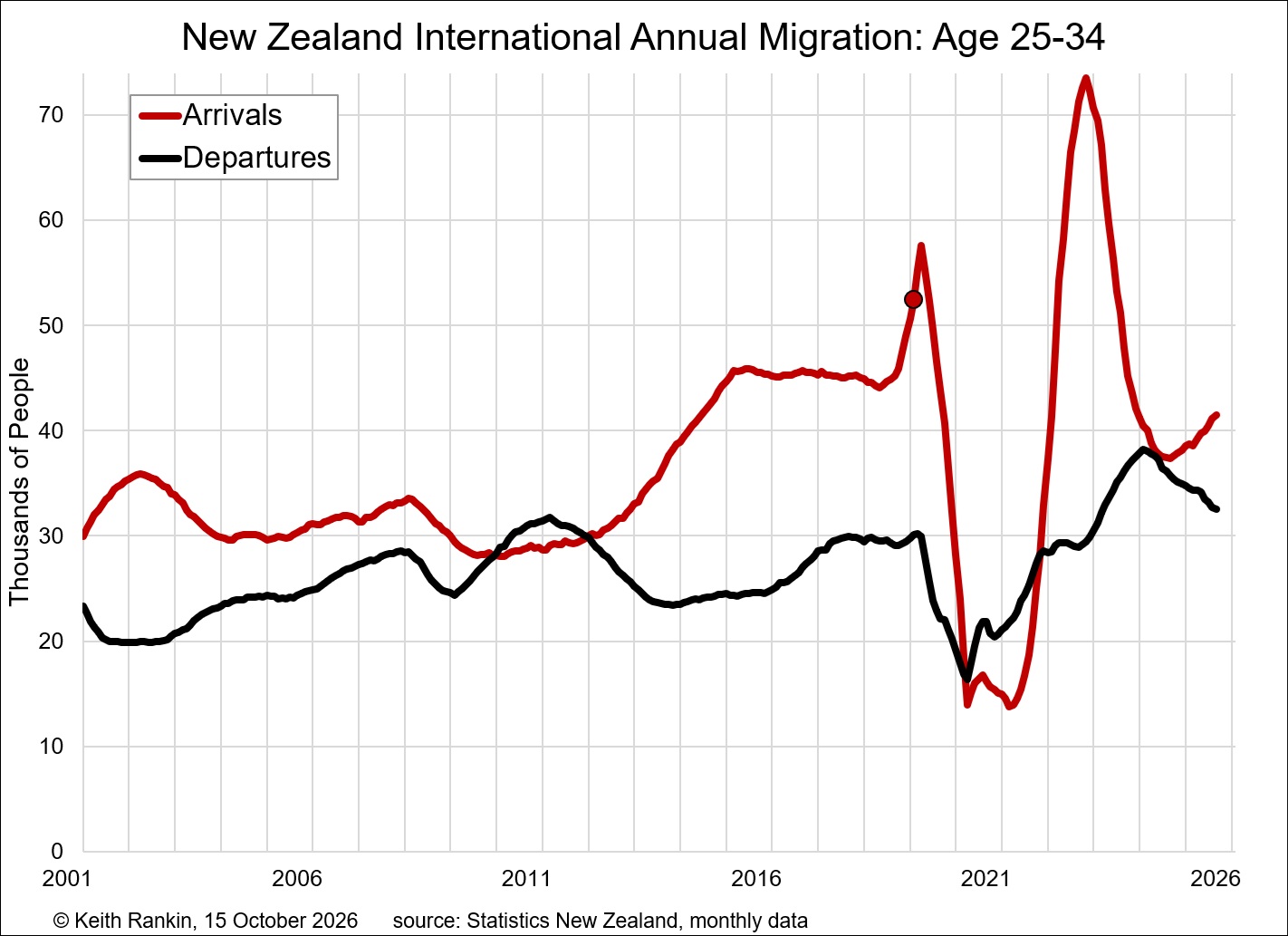
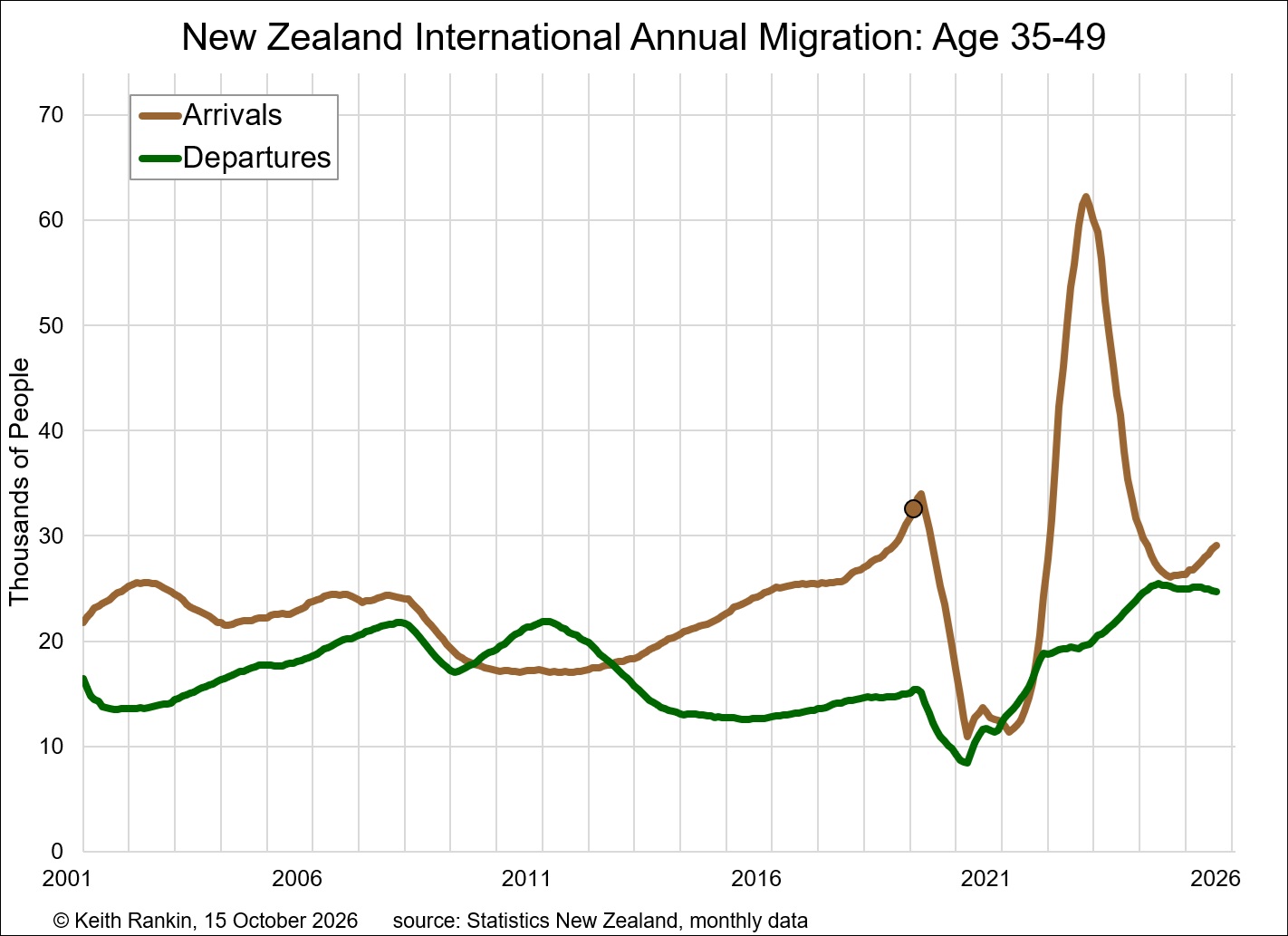
Keith Rankin, 16 October 2026 – The two charts here show New Zealand’s immigration and emigration for this century. While the data was collected monthly, these data are annual ‘rolling averages”.
Age 25-to-34
The first chart shows people aged 25-to-34. On immigration, we see a general pattern of around 30,000 immigrants in this age range during the 2000s. The uptick began in 2013 and ‘stabilised’ at around 45,000 in the late 2010s. This immigration did not drive the housing bubble of 2012 to 2017, but it did place big pressure on the private rental market. While immigration stopped increasing in 2016, it remained at historically high levels, and significantly ahead of emigration.
There was another burst of immigration in 2019. The point with the circle represents the year to January 2020, meaning the last 12-month period which was not influenced by the Covid19 pandemic. The subsequent peak included people returning to New Zealand ahead of their pre-Covid intentions.
Post-Covid, the big catch-up immigration – which included New Zealanders stuck overseas during the pandemic – was short-lived. The New Zealand economy started to ‘tank’ at the end of 2023, though there were signs earlier that year that all was not well. Nevertheless immigrants in this age group continued to exceed emigrants, despite record-high emigration in 2024 and 2025. The most recent data shows signs of a weak recovery in New Zealand, though emigration continues to exceed the highs of 2011 and 2012.
On emigration, in the late 2010s we see emigration at a time when more opportunities were opening up overseas, and when parents of this age group were cashing in on their property-boom capital gains. For adult children, home was leaving them. Australian property prices were then competitive for arriving New Zealanders.
A number of emigrants in 2024 and 2025 will have been immigrants a year or two earlier. Or immigrants around five years earlier, having gained their New Zealand citizenship. (We should note that, to some extent, the acquisition of a New Zealand passport represents an opportunity to emigrate; especially an opportunity for working-age New Zealand residents to settle in Australia. If New Zealand ever passes a law allowing only citizens to vote in elections, the overseas vote in New Zealand elections would become proportionately higher than at present; indeed significantly so, given the proportion of tax-payers in New Zealand who do not have New Zealand passports.)
Age 35-to-49
Looking at older adults, many of these being people with children, we see the same patterns; though with lower numbers. There was less overseas emigration in the 2010s than in the 2000s; though there had been much North Island to South Island migration in the 2010s, coincident with international immigration peaks hitting New Zealand’s North Island.
Again we see a substantial flow of post-pandemic emigration; a flow that is not tapering off for older adults, many of whom have children. Families seeking greener pastures.
Finally
These age-specific data do not show the pattern of specifically trans-Tasman migration. Though we do know that this is the biggest component of emigration; indeed an even bigger component these days, given the heightened geopolitical risks of living further afield.
What we can expect in the immediate future is continued immigration and emigration at persistently higher levels than took place before 2011. The transformation from Aotearoa being a Euro-centric nation to being an Asia-Pacific-focused country will probably only abate when Aotearoa New Zealand (the North Island in particular) becomes categorically a country of mostly non-Europeans. New Zealanders with full European ancestry will become as much ‘ethnics’ – to use that pejorative word – as any other New Zealanders.
About the writer:
Keith Rankin (keith at rankin dot nz), trained as an economic historian, is a retired lecturer in Economics and Statistics. He lives in Auckland, New Zealand.