

Source: The Conversation (Au and NZ)
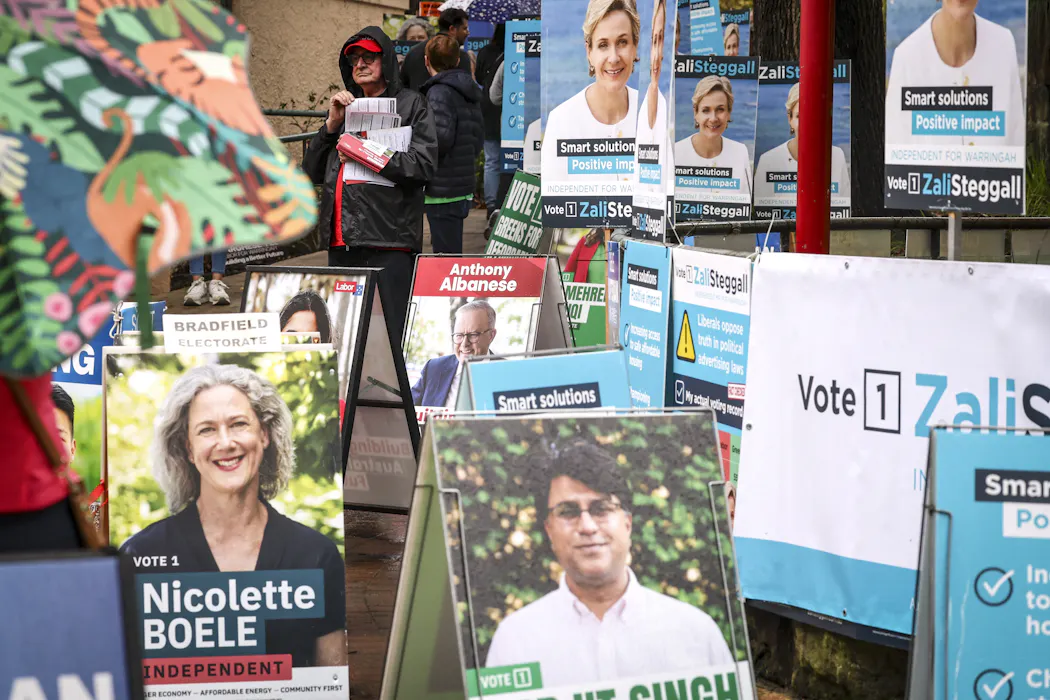
The way political parties and candidates can spend during federal elections is set to change next year. Australians will finally get much better visibility of political donations. For the first time, there will also be a ceiling on money in federal elections.
This ceiling matters because in political campaigns, there’s a strong electoral incentive to outspend your opponents. This can help get your messages to more voters if you can raise the money to do so. This “arms race” pushes too much money into Australian politics and creates fertile conditions for wealthy interests to have too much say and sway.
So getting the ceiling right is central to reducing the influence of money in politics. But how much money do political parties need to communicate with voters? And how much is too much?
A new Grattan Institute policy brief estimates what a better ceiling would look like.
The ceiling is set too high
Electoral expenditure caps set limits on how much political parties and other players can spend on campaigning.
Well-designed caps can reduce the influence of money in politics by reducing political parties’ incentives to fundraise because they can’t spend more than the cap. They can also reduce parties’ dependency on major donors because individual donors become more replaceable.
Reducing the incentive to fundraise gives parliamentarians more time to do their jobs. It gives them more time for grassroots campaigning instead of chasing dollars.
Less money in politics creates more opportunity for those with fewer resources to contest elections.
Expenditure caps need to be high enough to enable political parties and candidates to communicate with voters, but still low enough to actually reduce money in politics.
Unfortunately, the new federal cap of A$90 million per party per year looks to be more than twice as much as needed.
Major advertising campaigns by the Australian Electoral Commission (AEC) in the lead-up to elections and by the Australian Bureau of Statistics (ABS) in the lead-up to the census cost about $30 million on average to develop and run, according to our analysis.
So, even with a reasonable allowance for other electoral expenses, we estimate $40 million per party per year would be plenty.
An electoral expenditure cap of $40 million would force more prioritisation in spending, but still allow politicians to choose where to focus campaign effort and expenditure.
For example, within a $40 million budget, a party could spend just over $20 million developing and running a national advertising campaign (this was the size of the Australian Electoral Commission’s 2025 federal election advertising campaign), plus a letter to every household in Australia, targeted campaigns in a few key seats and states, and extensive polling too.
Alternatively, a party might choose to forgo a mass mail-out, and spend more on targeted campaigns and/or on campaign staff.
And advertising is not political parties’ only means of communication. The media and parliament are the main platforms for sharing messages with voters, for free.
There are many other public platforms and grassroots campaign options – including local events and social media – available to politicians to share their views, set an agenda, and explain their policies.
Lowering the barrier to new entrants
The new reforms also introduce caps on the total spend in one electorate over a campaign period. Our analysis suggests the new electorate cap of $800,000 is likely to be a barrier to new entrants.
The below chart shows the electoral expenditure of all successful new entrants at the past three federal elections. Just two – Helen Haines in 2019 and Dai Le in 2022 – spent less than $800,000. Haines succeeded (and was endorsed by) the retiring incumbent Cathy McGowan. Le narrowly won her seat after the Labor incumbent retired.
Most recent successful new entrants spent substantially more. We can’t say if they needed to spend every dollar they spent to get elected – it’s possible a smaller campaign would have sufficed.
These are mostly high-income electorates, so candidates may have had unusually high capacity to raise funds. However, advertising costs may also be higher in inner-city electorates.
The available evidence suggests it typically costs more than $800,000 to successfully introduce yourself to an electorate as a new federal candidate without a known party brand.
We therefore recommend the electorate cap stays at $800,000 for incumbents and established-party candidates, but there should be a 50% loading for new entrants (new independents and new parties).
This would allow new entrants to spend up to $1.2 million, which would have been sufficient for a third of recent successful new entrants.
Once a candidate or party has been elected, they would no longer be considered new and the lower cap would apply to all future campaigns.
Two paths forward
Ensuring the new expenditure caps are the right size would finally put an end to big-money elections. And an opportunity for reform may be just around the corner.
The new electoral reforms are expected to be challenged in the High Court on the grounds that they impinge on the implied freedom of political communication.
If the challenge, led by former independents Rex Patrick and Zoe Daniel, is successful, parliament will need to act quickly to resolve any issues raised, creating an opportunity to improve these important reforms.
If the challenge is unsuccessful or withdrawn, the rules will likely stay in place for the next federal election, but there would be an opportunity to review them after the election. This could be, at the very least, part of the normal post-election review by the Joint Standing Committee on Electoral Matters, if not through a more substantive expert review.
Either way, parliament should seize the chance to finally fix the money problem in Australian politics.

The Grattan Institute began with contributions to its endowment of $15 million from each of the Federal and Victorian Governments, $4 million from BHP Billiton, and $1 million from NAB. In order to safeguard its independence, Grattan Institute’s board controls this endowment. The funds are invested and contribute to funding Grattan Institute’s activities. Grattan Institute also receives funding from corporates, foundations, and individuals to support its general activities as disclosed on its website.
Original source: https://analysis1.mil-osi.com/2026/09/22/new-rules-finally-put-a-ceiling-on-money-in-politics-but-the-cap-is-double-what-it-should-be/