
Analysis by Keith Rankin.
Role: Economic historian.
Keith Rankin, 6 August 2026 – Yesterday, the latest round of ever-worsening labour force data was released. As usual, the Prime Minister and Minister of Finance are baffled and seeking scapegoats. They will never accept that their narrative, about how a nation’s capitalist economy actually works, is false. They have invested too much in that narrative.
And the mainstream media thrashes around as well, not knowing what questions to ask, and moving on when interrupted by interesting answers.
I listened to John Campbell’s tone-deaf interview (RNZ, Morning Report) with journalist-economist Bernard Hickey this morning. (This is not my first case of criticising Campbell’s style, where he tries to put words into his interviewees’ mouths; and when he gets answers that don’t fit his conceptualisations, he either pivots away from those answers or closes the interview. See my Modern Media as Unintended Propaganda, Scoop 17 June 2026.)
Twice, Hickey mentioned that many if not most of the few ‘new jobs’ are going to people aged over 65. (I did a recent analysis of the rising employment of people aged over 65. Mostly of course they are not taking new jobs from young people. Rather, they are hanging on to their existing jobs, often for many years after they reach the age in which they are entitled to both a universal pension and to withdraw money from their KiwiSaver accounts. See my Retirement Age Labour in New Zealand, Scoop 16 July 2026.)
Twice Campbell simply ignored this central and very interesting point that Hickey was trying to make.
Further into the interview, Hickey mentioned that New Zealand was in a “balance-sheet recession”. The interview immediately ended at that point. Campbell showed no curiosity as to what a ‘balance-sheet recession’ was; he had heard enough to sense that it was something he didn’t want to know about.
On the matter of the jobs going to over-65-year-olds and not going to under-30-year-olds, Hickey was trying to make a point which needed further examination. I sensed that Hickey was arguing against the universal pension, because the pension (New Zealand Superannuation) does not give older people enough incentive to get out of the way. Thus Hickey’s apparent argument was diametrically opposed to the more common argument that we have to raise the age of entitlement to the universal pension as a way of making sure that older people continue to work and don’t retire at age 65.
A very interesting discussion could have been had, about whether it is good or bad for people aged over 65 to be in paid work. The opportunity was lost, and I don’t expect to hear this discussion any time soon.
On the matter of the balance-sheet recession, this is a mildly heterodox concept which neither our mainstream economists, mainstream politicians, nor most mainstream journalists will touch; it is a concept which hints at a solution which is diametrically opposed to the principal point of principle – fiscal probity above all else, except when war beckons – that this government stands for.
A balance-sheet recession is a recession where the principal modus operandi of businesses is survival from actual or imminent debt insolvency. Under these conditions monetary policy – whether tight or loose – makes almost zero difference to what businesses do. It means that, in the absence of a very large external stimulus or debt write-off, the economy can only be restarted through an aggressively expansionist fiscal policy. The Aotearoa New Zealand government of course is doing the exact opposite; it’s pursuing an aggressively contractionist fiscal policy.
Businesses do not hire inexperienced workers when they are in debt-survival mode. We note that New Zealand businesses took on huge amounts of debt in the years after the Covid19 pandemic. Much of that debt was contracted in 2022 and 2023 when the Reserve Bank’s interest rate settings were high. There is a very high level of actual or imminent debt insolvency
Economists have had the full opportunity to learn about balance-sheet recessions, firstly from Japan’s experiences in the 1990s, secondly from the Global Financial Crisis of 2007 to 2010, and thirdly from the Eurozone Crisis of 2020 to 2014. But, for the most part, they have reneged on that opportunity; in favour of repeating, parrot-like, narratives about monetary and fiscal policy which they learned – uncritically – in the 1990s and 2000s.
Whenever circumstances or information change, parrots and too many economists are unable to make the appropriate intellectual adjustments. Economic hawks, by and large, double-down. They remain hawks until death. They are more like clerics than academics.
Indeed Queen Elizabeth noted this inadequacy when she asked a group of economists why they had not seen the Global Financial Crisis coming. (Re the Queens Question, see Letter to the Queen 10 August 2009, and The Queen’s question returns with a vengeance Reuters 7 October 2023.)
Comparative Economic Growth
The chart below compares the economic growth over the last three years, with a number of other comparable countries.
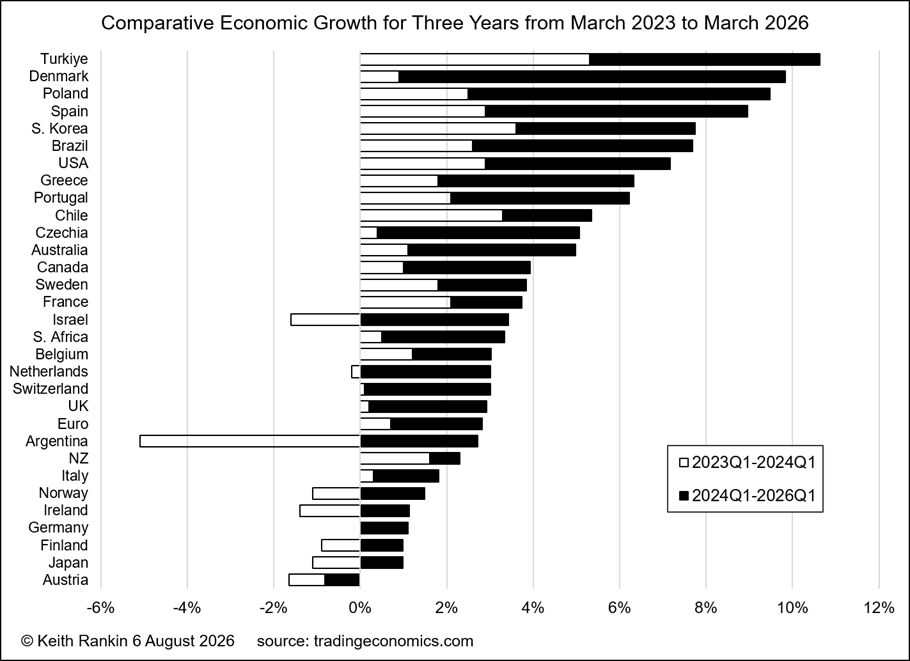
The chart is very generous to New Zealand. It measures GDP in March 2024 and March 2026 with that of March 2023. If it had done whole-year comparisons, the growth for New Zealand over the last two years was actually zero. (See my NZ Economic Growth Over the Medium Term, Scoop 2 July 2026.) Further, New Zealand has had a larger increase in its working-age-population than almost all of the comparator countries; this was not factored into the chart. And finally, New Zealand had such weak growth in the last two years despite receiving a record-high stimulus from export prices; almost certainly a bigger stimulus from this source than any of the other countries in the chart.
The chart measures three year-growth by reading the numbers which match the tip of the solid black bars. Thus Australia’s three-year growth was 5-percent, New Zealand’s was 2.3 percent, and Austria’s was minus 0.8 percent.
The solid black bars show the growth in the two years from March 2024 to March 2026. New Zealand’s is the smallest of all for that period; and, as noted above, a whole-year measurement would have been zero growth for the March 2026 year compared to the March 2024 year.
The hollow black-edged bars represent growth from March 2023 to March 2024. New Zealand was about average in 2023. A number of countries were in recession then, but all of them except Austria have fully bounced back; Austria’s bounce back remains partial. It is not my place here to comment about those countries’ problems, of which there are many. (‘Euro’ represents the Euro-zone within the European Union.)
I’ll note however that both the United States and United Kingdom have much stronger recent growth than New Zealand, essentially due to policies of military Keynesianism, which means that public-sector spending is playing an essential role; albeit a destructive role, given what the public money is being spent on.
Conclusion
New Zealand’s policy elites – including certain journalists at RNZ – have been responding to what is happening in the economy like possums struck by the glare of SUV headlights in full beam. And New Zealand’s non-policy non-elites have little response other than to go – quietly (in most cases) – mad.
Some of the policy elites are going mad too, as well as dumbstruck by circumstances or intellectual rigidity. Just listen to this excellent interview from RNZ today: Tech: What’s the problem with data centres?. If these are the answer, then what is the question?
About the writer:
Keith Rankin (keith at rankin dot nz), trained as an economic historian, is a retired lecturer in Economics and Statistics. He lives in Auckland, New Zealand.