
Analysis by Keith Rankin.
Role: Economic historian.
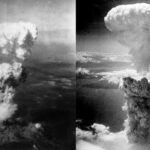
Keith Rankin, 8 July 2026 – Hiroshima Day passed yesterday almost unnoticed. (See this – Make anniversary of Hiroshima bombing ‘Disarmament Day’ – from Japan Times, and this and my this on Scoop.)
I have been pessimistic that the Russia-Ukraine War cannot end without it becoming a limited nuclear war (or worse). (See my Reckless Complacency Meaning the end of Nuclear Deterrence, Scoop, 24 July 2026.) But I’m now seeing Nato as an empty threat, and that some degree of my first scenario (non-nuclear) – “Moscow simply trying to pummel [or actually pummelling] Kyiv into submission” – may be what does achieve an end to the war. Not nice; just realism.
The reason I now see this as a realistic outcome is the substantial draw-down of Ukraine’s capacity to defend itself from aerial attack. Ukraine still has a spectacular offensive capability, which is proving more than an irritant to Moscow, and which can only make it more urgent in Moscow’s eyes to take timely advantage of Ukraine’s lack of defensive stamina. (Like Egypt in its World Cup match against New Zealand.)
World War Two analogy
I draw an analogy with the last year of World War Two (WW2) in Europe. Though, like all analogies, this is inciteful but not definitive.
In my analogy, Germany then is like Ukraine today. And United Kingdom then is like Russia today.
From June 1944 until March 1945 German V1 flying bombs and V2 ballistic missiles were launched at the United Kingdom and liberated Belgium. The principal target was London.
These missile attacks were far more than an irritant to Londoners. About 8,000 of them died; many more were injured. (Note, I am not referring to the London Blitz, which happened mostly in the latter part of 1940.) The worst attack in the last year of that war took place on 25 November 1944, destroying a Woolworths department store in southeast London; 168 were killed “outright”. Another very serious attack, early in 1945, was on London’s Smithfield meat market.
The military outcome of the European war – at least the defeat of Germany – was already certain at the date of the first V1 attack, which came after the success of the D-Day landings. In June 1944, the question was already whenGermany would surrender, and who they would surrender to. These attacks on London were acts of high-tech defiance and hubris; not a realistic attempt to reverse the outcome of the war.
From the British side, most of its carpet bombing (aka ‘morale bombing’) of German cities, and occupied Allied cities such as Le Havre took place in the months after June 1944. This may be compared to the present Russian bombardment of Ukrainian cities.
Thus the analogy is an enthusiastic but forlorn high-tech attack by the losing side against its winning rival; countered by a more lethal and more systematic bombardment by the Allied side. (The good news is that the numbers of civilian casualties by both Ukrainian drones and Russian missiles is less than the analogous numbers in 1944 and 1945. The British attacks on Germany were unnecessarily brutal.)
The analogy doesn’t fully work, in that in 1944 it was the winning side (United Kingdom) which was the proxy of a bigger power. Whereas today it’s the losing side, Ukraine, which is the proxy (of Nato). Essentially from the time of the 1943 Tehran Conference, the United Kingdom served as an American proxy; the American high command relieved the unfocussed and at times reckless Winston Churchill of any real strategic influence over the further conduct of the war.
No 2026 or 2027 analogy with Japan
Neither Moscow nor Kyiv is in a situation like Japan was in July 1945; though Kyiv may yet end up in such a situation. I can see no scenario in which Moscow would ever surrender to either Kyiv, Berlin, Brussels, or Washington.
My sense now, is, that the Ukrainian drone attacks on civilian and industrial attacks in Russia – the attacks on Wildberries are analogous to the rocket attacks in 1944 on Woolworths – will peter out as Russia, at a gathering pace, tightens the noose on Ukraine. Ukraine’s losses will be the greater the longer it takes to accept the motivation and greater strength of Russia. Russia could never accept German ‘peace-keeping’ troops in Kharkiv; or Odessa for that matter.
West Europe has only been a fair-weather friend to Ukraine, seeking unity amidst its own discord by rousing itself against a named enemy; but neither having the means nor the will to take its posturing to the next step.
Some say that Europe or Nato will ‘fight Russia to the last Ukrainian’. Economist Richard Wolff has concluded that Europe, coveting Russia and its lands which are looking better with global warming, is on a new quest for lebensraumin the East; lebensraum was Germany’s principal motive in WW1 and WW2.
I am coming to the view that western geopolitics nowadays is more a tragic case of imperial delusion obfuscated by unsustainable virtue-signalling and by smoke and mirror misinformation. Hopefully it will be all over by Hiroshima Day 2027.
About the writer:
Keith Rankin (keith at rankin dot nz), trained as an economic historian, is a retired lecturer in Economics and Statistics. He lives in Auckland, New Zealand.