
Analysis by Keith Rankin.
Role: Economic historian.
Keith Rankin, 29 July 2026 – Which has been the most nuked region in the world? It’s the Pacific. The first three nuclear weapons to be exploded were in New Mexico, Hiroshima, and Nagasaki. Two (in Japan) with Pacific Ocean shorelines; and the New Mexico Trinity site is the same distance to the nearest Pacific shore as Chatham Island is from Aotearoa’s North Island.
Despite those three early examples, the most nuked part of the world is not the North Pacific.
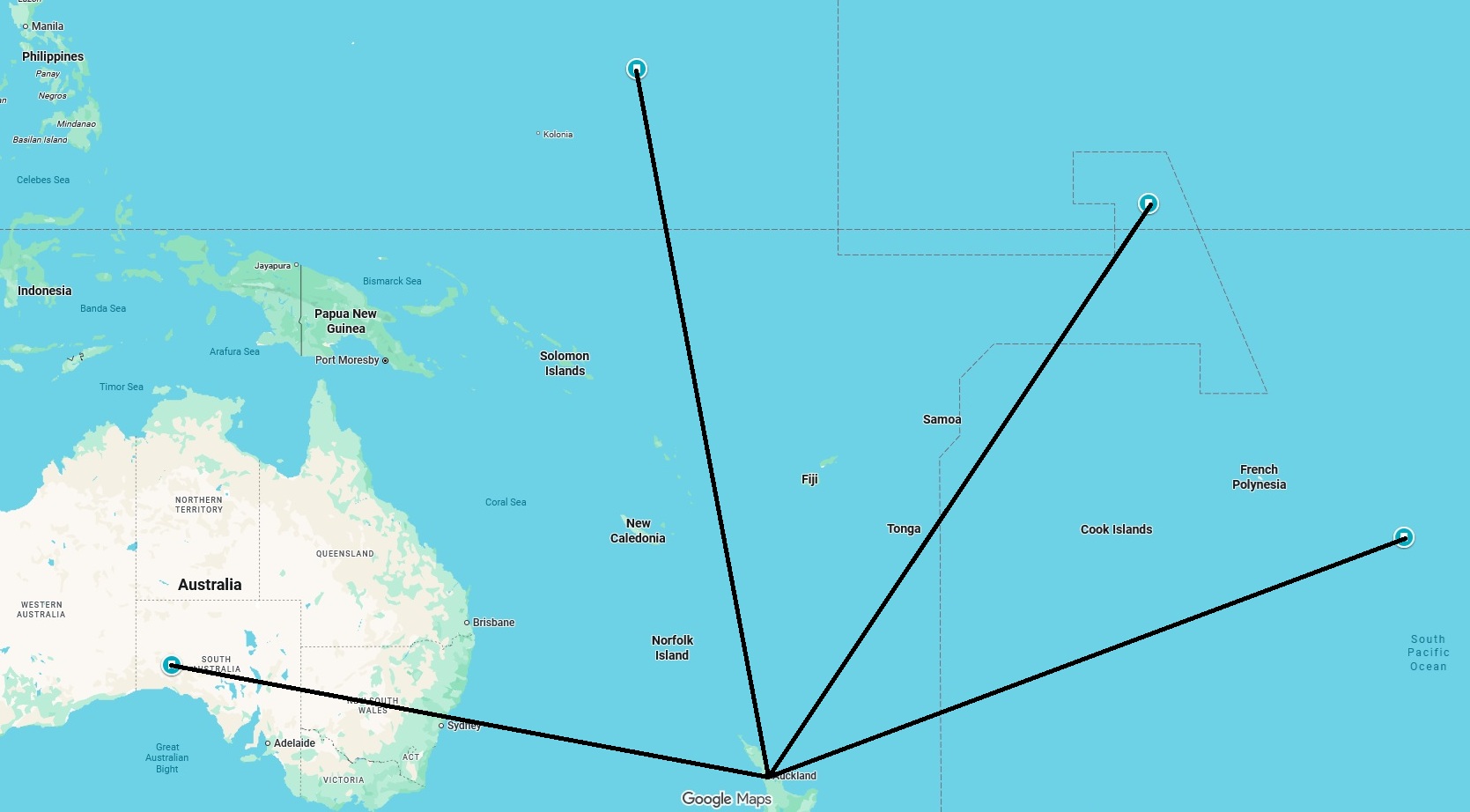
If we think of actual nuclear explosions – especially atmospheric ones – they have predominantly been in Oceania; in four sites which form something of a spoke-wheel around Auckland, as the map below (from Google Maps) shows. These sites of British, American and French explosions in the 1950s and 1960s – including the biggest atmospheric explosions, ever – are: Maralinga (Australia), Bikini Atoll (Marshall Islands), Christmas Island (the world’s biggest atoll, now in Kiribati), and Mururoa Atoll (French Polynesia).
Future nuclear war(s) – there may only be one – will be fought far from the decision centres of the belligerents. Just as Hiroshima was far from Washington and Moscow, and – as with the explosions of the 1950s and 1960s – the damage to life of the indigenous people at or near the nuclear explosions was not a major consideration.
The next nuclear war will be an asymmetric war, and Iran has just written the textbook of how-to-do asymmetric war.
Modern asymmetric war is all about the powerful belligerent(s) with lesser deterrence capability attacking the allies of the belligerent(s) with more layers of deterrence; especially allies which have on their territories poorly defended (physical or human capital) assets which contribute to the war effort of the more powerful belligerent. (See my Reckless Complacency Meaning the End of Nuclear Deterrence, Scoop 24 July 2026.)
Eight of the nine nuclear armed nation-states have capacity to launch weapons from submarines. Nowhere is out of nuclear range.
We, here, are on Russia’s radar. We have imposed various sanctions on Russian personal, and trade with Russia. (Though we have been quite happy to consume Russian fuel-oil that may have been laundered through Korean or Chinese refineries.) Yesterday, our lead story was about a man arrested in Russia for treason; allegedly spying for the SIS. Rhetoric in Wellington towards Moscow is as belligerent as it is anywhere.
Mordor was not always Mordor. Back in the good old Soviet Union days Aotearoa had a strong economic relationship with Russia (as with Iran, too), especially through the dairy industry; the relationship manifested then, in part, through cow for car swap deals. Remember the Lada cars which were not uncommon here in the 1980s? Some were refitted and re-exported to other parts of Oceania. Those cosy days of the Cold War are now long gone. (The downward slide possibly started in 1986 when a risk-taking local sea-pilot – inadvertently, or semi-advertently – sank a Russian cruise-ship full with Australian tourists.)
Russia is aware of the Five-Eyes ‘intelligence’ network. And will also be aware that Central Otago and Auckland are bolt-holes for some of the oligarchs whose intellectual property underpins America’s present global belligerence. And that companies like Rocket Lab are contributing to the activities of the United States’ Department of War, indeed launching satellites from Launch Complex 1. Russia may be aware that the local manufacturing industry has pivoted towards the supply-chain of the United States’ war industry, benefitting from United States’ military Keynesianism.
Should I be concerned, given that I live in Auckland?
About the writer:
Keith Rankin (keith at rankin dot nz), trained as an economic historian, is a retired lecturer in Economics and Statistics. He lives in Auckland, New Zealand.